
In some ways, regional races aren’t a big deal. When the U.S. Ski Team nominates Olympians next season, they aren’t going to go back and check someone’s results at an Eastern Cup or the Tour de Ski Fairbanks.
But in others, they are a very big deal. Juniors rely on these races to qualify for Junior Nationals, the ultimate, season-long goal of many young competitors; college and senior racers use them as tune-ups for carnivals and nationals, and to gauge how their training is going; masters relish the opportunity to hammer out a hard effort and chase age-group glory.
And in the past few years, regional races have gotten bigger and bigger, both in size and importance. Ten years ago, there were only seven FIS-sanctioned series in the U.S., and one of them was that year’s Olympic Games in Utah. Five years ago, there wasn’t a FIS race east of the Mississippi until U.S. Nationals at the beginning of January, and none in New England until the UVM Carnival in February.
This year, there have been four FIS series already, in New England, Montana, and Alaska, and 17 more are on the schedule. The points at regional races have gotten better and better, and can seriously help an athlete’s season ranking.
“If you’re looking purely at the numbers, and the level of points available at our races now, that is certainly increasing, and to the people that are there chasing those points it could certainly be more serious,” New England Nordic Ski Association (NENSA) Executive Director Zack Stegeman told FasterSkier in an interview on Thursday.
And that’s exactly what regional organizations like NENSA want.
“I think that all the organizers in New England have always worked very hard to make these events as good as they can possibly be,” he said. “That’s why we have such great regional races – our venues, and organizers, and NENSA itself has been trying hard to really raise the bar. The abilities of our venues and our community to continually step it up speaks volumes.”
Arguably, nowhere is this trend more apparent than in New England. The opening races of the Eastern Cup series were held last weekend at the Craftsbury Outdoor Center in northern Vermont; Saturday featured almost 400 racers, while Sunday’s number was close to 500.
Which makes it scary when something goes wrong. On Saturday, Craftsbury was on tap to hold a classic sprint qualifier followed by 30-racer heats for the open division, plus 12-person J2 heats and a separate bracket for the next 12 fastest J1’s and OJ’s. Instead, due to timing problems, the heats had to be scrapped entirely and a second qualifier was held in the afternoon.
“We’re constantly evolving and learning from events, whether they go really well, or whether they are a bump in the road,” Stegeman said. “Saturday was definitely one of the latter.”
Cascading Failure
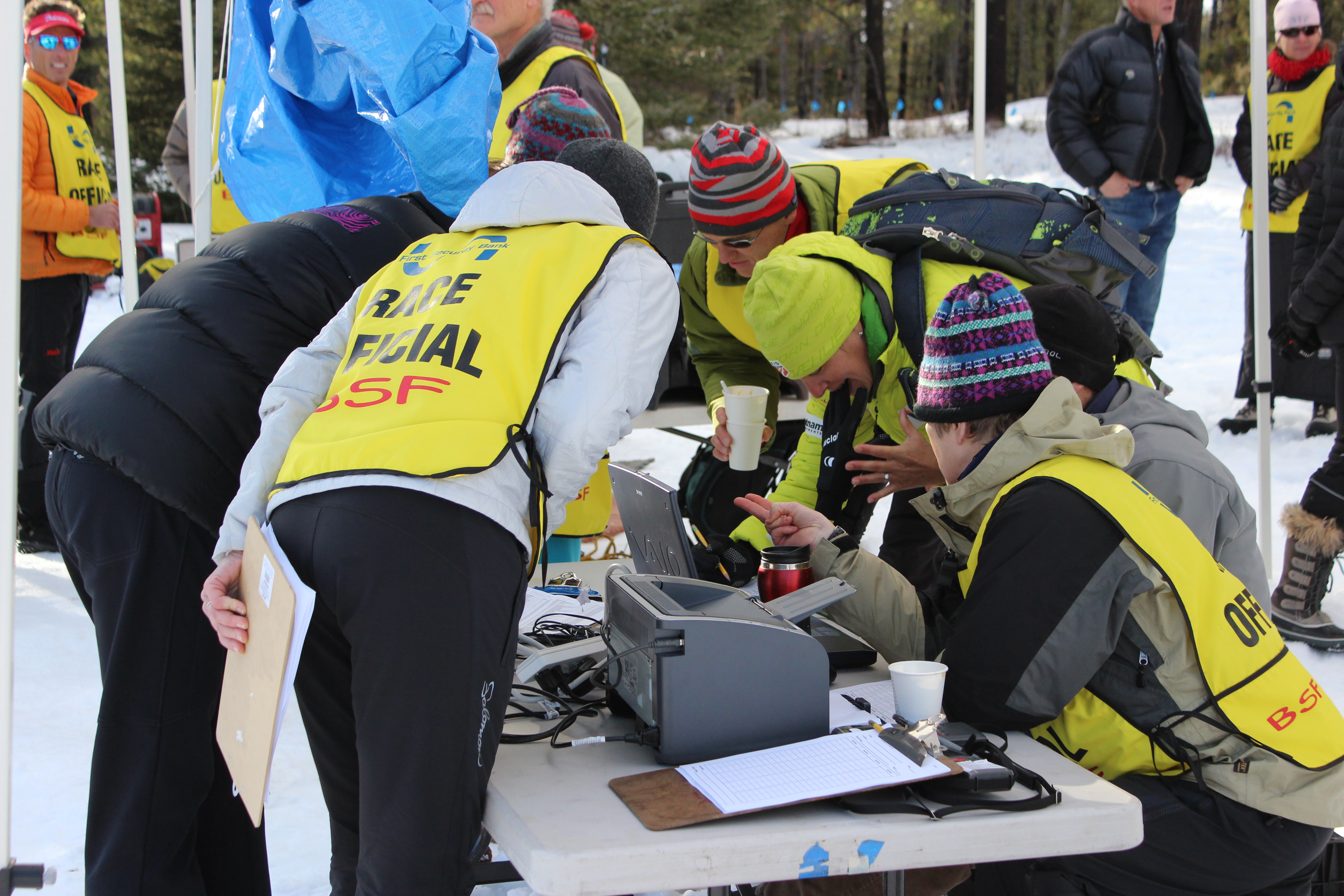
Craftsbury, which hosted a highly successful SuperTour Finals and Distance Nationals in March, has been moving towards using its own timing system. While Summit Timing was in charge of the March races, staff learned the ropes and were ready to implement their own system for the Eastern Cups.
Once the unofficial women’s results were posted, though, it was clear that there had been trouble with timing the morning’s qualifier.
“Once we posted unofficial results, we saw that there were major problems,” Stegeman said. “We tried to run through one fix and put them up again, and that’s when we realized, wait, the thing we’re doing to try to fix it isn’t working… and we identified all the timing equipment malfunctions and our inability to salvage those results.”
With limited daylight in northern Vermont, the race jury and timing crew decided that they wouldn’t have time to reconstruct the results and still run heats, so the immediate consequence was the cancellation of the heats and a second time trial instead. Although there was certainly some initial griping, racers seemed to buckle down and motivate for round two. Coaches quickly got to work re-waxing dozens of pairs of skis.
But for Sheldon Miller, an occasional racer, talented cyclocross competitor, and Craftsbury’s media and computer guru who was heading up the timing crew, the problems were just beginning. When FasterSkier contacted him on Monday afternoon, he was still wading through timing equipment just to get to his desk.
After setting up three Summit timers at the start and three at the finish, Miller had felt confident in his timing system. Ever since the central timing laptop that all those timers fed into crashed mid-race, he has changed his tune.
“It’s great to have all those individual timers, but when the thing that’s consolidating all of that information goes down, it doesn’t really do a whole lot of good in a near-term sense,” he told FasterSkier.
On Saturday, he had the data on the timers, but no way to get it off of them without having it reduced to gobbledygook. But by late Tuesday afternoon, he had unraveled the multiple failures that had created and then heightened the whole mess.
“Saturday’s qualifier results preparation was derailed by a failure of the timing computer and subsequent crashes of XL part way through the men’s race,” Miller wrote in an e-mail.
Despite the “cascading failures”, as he described them, Miller has since been able to reconstruct the data from the morning race by counting backwards from the last finisher. With three separate timers in each place, he had been pretty sure it was possible – but on a sprint day, results need to appear fast, and there simply wasn’t time.
NENSA and Craftsbury had to move on to plan B.
“We wanted to ensure that everyone who had invested the time and the effort to come race walked away with a result that counted,” Stegeman said. “That was really important to us. We were disappointed that we couldn’t do the heats, because they’re really fun.”
But it was the right thing to do, and Stegeman believed that the team had handled the situation as well as it could have.
“Were I to talk to a race organizer, that’s the big thing I would suggest, would be to identify that timeline,” he said. “For us, it was, how much time do we have to repair these results, before we have to just say, too bad, we can’t fix them, we have to run another individual-start before we run out of daylight.”
Public Relations
The change in format did cause problems. Some athletes, for instance, left the venue after the first set of unofficial results were posted, believing that their day of racing was over since they hadn’t qualified for heats. Since Miller has now recovered the morning results, they will receive points, but initially, they were simply DNS for the afternoon race.
Saint Michael’s College was one of those teams, but head coach Molly Peters didn’t seem to hold a grudge.
“It was a bummer to hear about what happened,” she wrote in an e-mail to FasterSkier. “I didn’t make a big deal about it, mainly because I didn’t really know what happened. I was under the impression that they were trying to recover the morning’s results and if they did then they would take the best result… As a race organizer myself, it is hard to get mad. I understand that things happen and it looks like they did what they had to do to make sure it was a valid race.”
Green Mountain Valley School racer Heidi Halvorsen, who placed second in the morning qualifier but won the afternoon edition, agreed.
“The race organizers and all the volunteers at Craftsbury worked unbelievably hard and ran a great race,” she told FasterSkier. “With no snow anywhere else in New England, it was amazing that they have had skiing for the last few weeks, and they were even able to hold races. So it is impossible to criticize the organizers for the timing fluke, they made the best of the situation and overall the race was run very smoothly.”
With so few options for salvaging the race, the biggest question was actually how organizers communicated what was going on to athletes and coaches. At no point did unofficial men’s results ever appear; while that was a good decision, not all racers understood why. A second set of unofficial women’s results were posted, which observers initially assumed had corrected the problem, but those turned out to be wrong too.
It’s unclear exactly what could have been done to prevent teams like Saint Michaels from leaving, or to spread the word that the unofficial results were wrong. While some coaches picked up on the fact immediately, simply based on where their athletes sat on the list, there didn’t seem to be any official announcement that the results were under review.
Stegeman said that he and the jury had hesitated to post anything that was “still fluid,” believing that it could add to the confusion. While they were intently focused and racing against a clock of their own to solve problems, talking to athletes in the parking lot didn’t seem like a good use of time. At several points, they sent “runners” (coaches, as well as J2 and BKL athletes) out into the parking lots to update the community on what was happening. Stegeman was unsure how well the messages were conveyed.
Lessons – And More Questions
As a timer, the lessons from Saturday’s race were simple for Miller, who held himself accountable for the failures even though he isn’t trained as a timer and despite the apparent forgiveness of others.
“The biggest thing is the importance and necessity of having completely independent systems,” he told FasterSkier on Monday. “On Saturday I had three timers, literal timing machines, at the start, three literal timing machines at the finish. On Sunday we added another completely separate system that had nothing to do with what I was doing, as backup. We had two complete parallel systems running that we were able to cross-check against, as well as, should the cascading failures that we had on Saturday occur again, we could just jump off that burning ship and on to the other one.”
That, however, brings up some interesting issues. How many volunteers are needed to time a race with two completely independent systems? Craftsbury has a notoriously deep, loyal, and dedicated volunteer base, but can every venue be expected to have the same – or to pay a thousand dollars or so for a timing company, without a solid guarantee of a better outcome?
NENSA itself has had problems with sprint timing before, both in Weston and in Rumford, Maine; in at least one of those cases, timing had been hired out to professionals. And it’s not just NENSA. Already this year, there have been inconsistencies at other sprints.
“Truthfully, I was much more paranoid during the Bozeman sprints, when they kept erasing the heats and putting up different people, because the World Cup was on the line,” CXC racer Jennie Bender, the winner of the morning qualifier but not the afternoon edition, wrote in an e-mail.
At the Bozeman SuperTours, unofficial qualifier results were allegedly never posted for the classic sprint; or if they were, they were taken down during a protest and organizers continued to distribute bibs while racers and coaches only had access to the hypothetical sprint brackets. As it turned out, those sprint brackets were based on an initial set of qualifier results which were incorrect due to an inadvertent tripping of the timing wand when there should have been a ghost.
There were also other problems with the classic sprint results. Skiers were not initially assigned to the correct heats – for instance, in every sprint, the first, tenth, eleventh, twentieth, twenty-first, and thirtieth fastest qualifying skiers should be assigned to heat one, and so on. The brackets had to be redrawn once the error was caught. Racers in the first heat were already lining up when the announcement came that bibs would be redistributed.
So while organizers always hope for smooth sailing, it’s certainly not a given. There is guaranteed to be more problems in the future, somewhere in the country, whether at a regional race, a SuperTour, or something even bigger.
“It seems to me that there are variety of issues that skiing in North America is grappling with: homologation, climate change’s effect on skiing at large as well as racing in particular (e.g. the desire to have more mass starts vs. too little snow or too short of a loop to support them adequately), smaller clubs or organizations’ ability to provide racers with FIS-scored events (and the inherent requirements the governing body mandates) at a feasible cost, and more,” Miller wrote in an e-mail. “We’re in a very productive time in North American skiing, but these tensions are ones that continually need to be engaged creatively for the sport to continue to thrive.”
Given these challenges, it’s important for race organizers to keep in mind the advice from Stegeman and Miller. Always have completely independent backup systems; set cutoff times for decisionmaking when something goes wrong; keep all the stakeholders involved and informed.
Stegeman believes that his region’s venues are up to the task. For one thing, NENSA is committed to education, and runs seminars for TD’s, race organizers, and even Bill Koch League (elementary school) race officials. But for another, he’s seeing the level of organization at New England venues rise all the time.
“The venues themselves are investing more and more in equipment,” Stegeman said. “Craftsbury had a top-notch camera set up on the finish line anticipating very tight finishes in sprint heats. You wouldn’t have seen that a few years ago. So there’s equipment investment, those are more tangible examples, but there’s investment in the human capital too. Venues all over New England are getting really good people on board from an event organizer standpoint right up to the grooming. Because expectations are rising right along with the rise in field sizes.”
At the end of the day, Bender, too, was optimistic.
“Everyone there saw the panic rise in the hardworking Craftsbury crew once the timing started to malfunction, and knowing many of them, I am sure that all the kinks will be worked out before the next event,” she wrote in an e-mail. “They did a great job on the course and snowmaking, and although some of the coaches and athletes may have been frustrated, it’s just a ski race.”
-Audrey Mangan contributed reporting.