Tag: Zak Ketterson

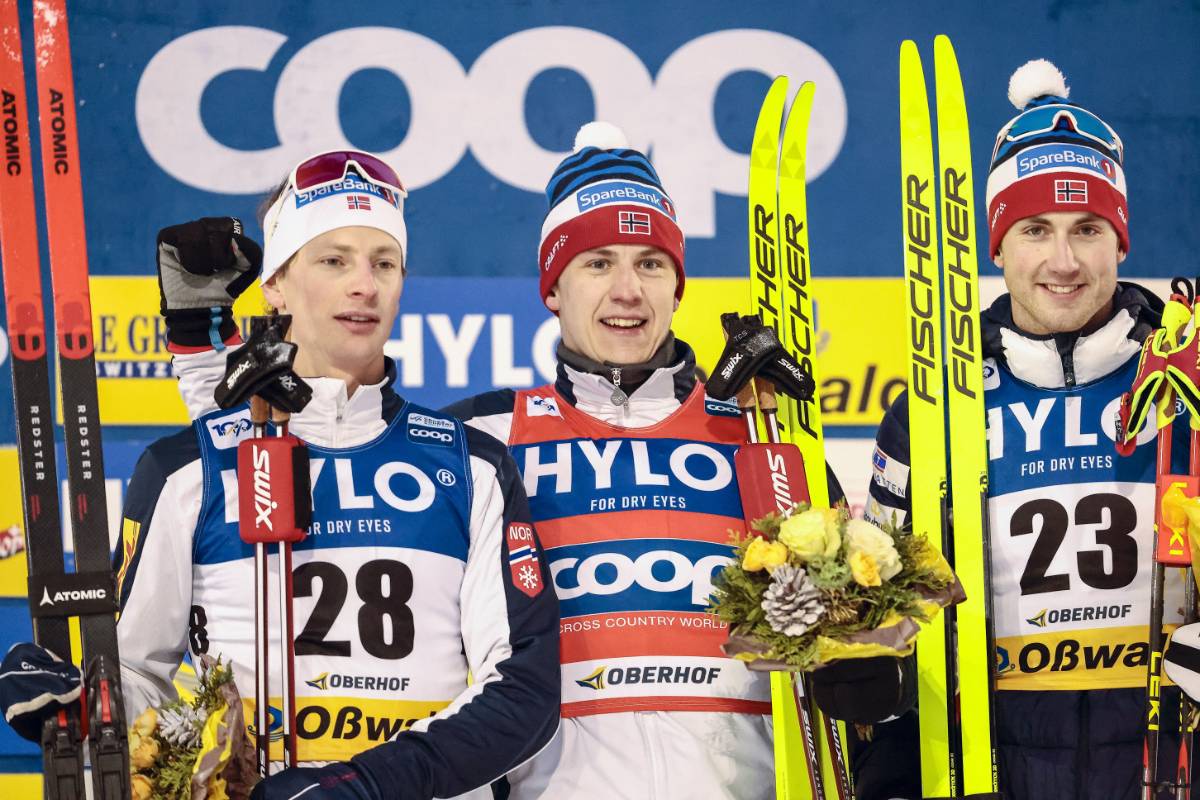
  • Hedegart Emerges From the Fog to Win Holmenkollen 50 k as Klæbo’s Absence Reshuffles the Distance Globe

    Hedegart Emerges From the Fog to Win Holmenkollen 50 k as Klæbo’s Absence Reshuffles the Distance Globe

    This coverage is made possible through the generous support of Marty and Kathy Hall and A Hall Mark of Excellence Award. To learn more about A Hall Mark of Excellence Award, or to learn how you can support FasterSkier’s coverage, please contact info@fasterskier.com.

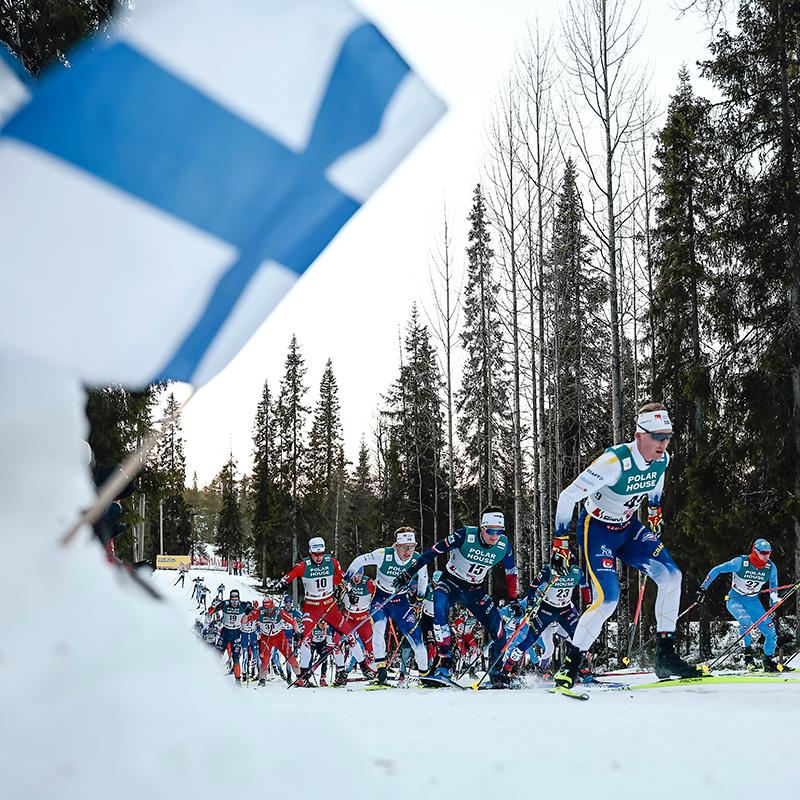
    The start of the Holmenkollen Men’s 50 k Freestyle in Oslo, Norway. (Photo: Authamayou/NordicFocus)

    For nearly two hours on Saturday, 77 men disappeared into a stubborn curtain of fog that clung to the hillsides above Oslo, their figures swallowed by the mist somewhere between the stadium and the high point at Frognerseteren. When it was over, only one emerged with his arms in the air, and it was the one freestyle specialist who had been topping shorter freestyle distance races most of the season.

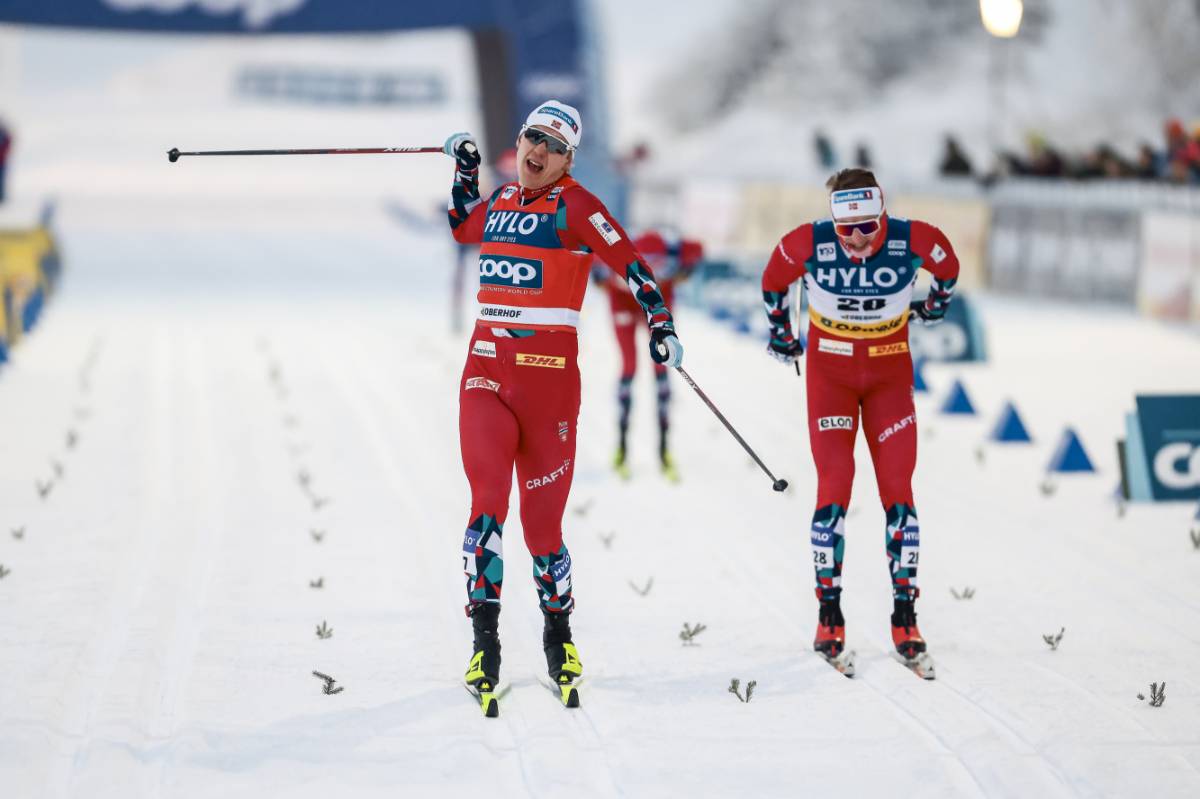
    Einar Hedegart, the 24-year-old former biathlete who only committed fully to cross-country skiing in November, surged past Harald Oestberg Amundsen in the final meters to win the Holmenkollen 50 k Freestyle in 1:51:38.2 — his first victory on cross-country skiing’s most storied stage, in just his seventh World Cup start.

    “This is the greatest feeling I’ve ever had,” Hedegart said after the finish. “This is just a nostalgia stadium. [A] legendary race, almost all my heroes have won this race, and especially Petter Northug. This might be the reason why I’ve been so motivated my whole life to be a cross-country skier.”

    Einar Hedegart (NOR) celebrates winning Norway’s most iconic race. www.nordicfocus.com. (Photo: Authamayou/NordicFocus)

    But the result that will echo loudest across the sport happened away from Oslo. Johannes Hoesflot Klaebo, the overall World Cup leader, was home nursing a mild concussion from a hard crash in the Drammen sprint two days earlier. Klaebo, who has already compiled a nearly perfect season, winning the Tour de Ski, all six Olympic races, secured the FIS Overall Crystal Globe, the FIS Sprint Crystal Globe, and only needed to keep racing the remaining distance races to take the clean sweep of the season with the FIS Distance Crystal Globe. BUT his absence from the start line meant zero points scored in the distance standing today. And with Amundsen’s second-place finish today, the distance crystal globe race was blown wide open: Amundsen now leads the distance standings by three points, 939 to 936, with two distance races remaining at the World Cup Finals in Lake Placid.

    Klaebo posted to Instagram yesterday: “Took a fall yesterday and hit my head pretty hard, but luckily everything is all good in the hood. Ended up with a concussion, so I’ll take some days off from both training and the internet just to make sure everything settles properly. Only got one head, so have to take good care of it.”

    He had been scheduled to fly to the United States on Sunday, but will now stay in Norway for a few extra days, hoping to recover in time for Lake Placid.

    Einar Hedegart (NOR) emerges from the fog to take the win. (Photo: Nordnes/NordicFocus)
    A Race Defined by Fog

    The Holmenkollen 50 k — first raced in 1888, a fixture of the World Cup since 1982, and a race that draws an estimated 100,000 fans to the forested hills above Oslo — returned to the calendar Saturday after a one-year absence. For the first time, the men’s and women’s 50 k races were held on the same day, the women starting 45 minutes behind the men in a format designed to create an all-day spectacle. The fog, however, had other ideas. Conditions were so thick that spectators along the course could hear the racers before they could see them.

    The course — six laps of 8.3 km with 334 meters of climbing per lap — was firm and fast after overnight salting despite an air temperature of 5.0°C. The salted, compact surface was ideal for skating, and the winning time of 1:51:38 came in roughly four minutes faster than the last time the Holmenkollen 50 k was contested in freestyle.

    Harald Oestberg Amundsen (NOR) on his way to second place. (Photo: Authamayou/NordicFocus)

    Through the first three laps, the race unfolded as a cautious tactical affair. A large pack of roughly 40 skiers stayed together, with Martin Loewstroem Nyenget, Mattis Stenshagen, and Federico Pellegrino taking turns at the front. The first athlete to make a decisive tactical move was Iver Tildheim Andersen, who changed skis early at the stadium after the third lap while the rest of the pack continued through. The fresh skis gave Andersen a burst, and when the lead group stopped for their own ski exchange one lap later, he suddenly found himself alone at the front with a roughly 15-second advantage.

    “Just stick with the field as long as possible and then hopefully be in position when the group starts swarming,” Hedegart said of his plan. “But today I was really offside, like 70 percent of the race. So I was lucky that no one took a gap.”

    The chase group — reduced to roughly eight athletes, all Norwegian once France’s Victor Lovera fell off the pace — gradually closed on Andersen through the fifth lap, with Hedegart, Simen Hegstad Krueger, Amundsen, Nyenget, Andreas Fjorden Ree, and Kasper Andersson Herland trading pulls at the front. By the time the group reached the final lap, they had swallowed Andersen, and the race became a question of who had saved enough for the final kilometers.

    Simen Hegstad Krueger (NOR) tried his best to get away for the win. (Photo: Authamayou/NordicFocus)
    Krueger’s Late Charge and Hedegart’s Final Kick

    Krueger, who was celebrating his 33rd birthday the day before, was omitted from the Norwegian Olympic team despite multiple Olympic medals in his career and was the winner of the last freestyle Holmenkollen 50 k. He drove the pace through the final lap. He pushed hard over the climbs near the iconic Holmenkollen church, stringing out the group and shedding Andersen off the back. But Krueger couldn’t sustain the pressure all the way to the finish, and as the group of seven came around the final corner and up the short, steep ramp before the descent into the home stretch, the sprint was on.

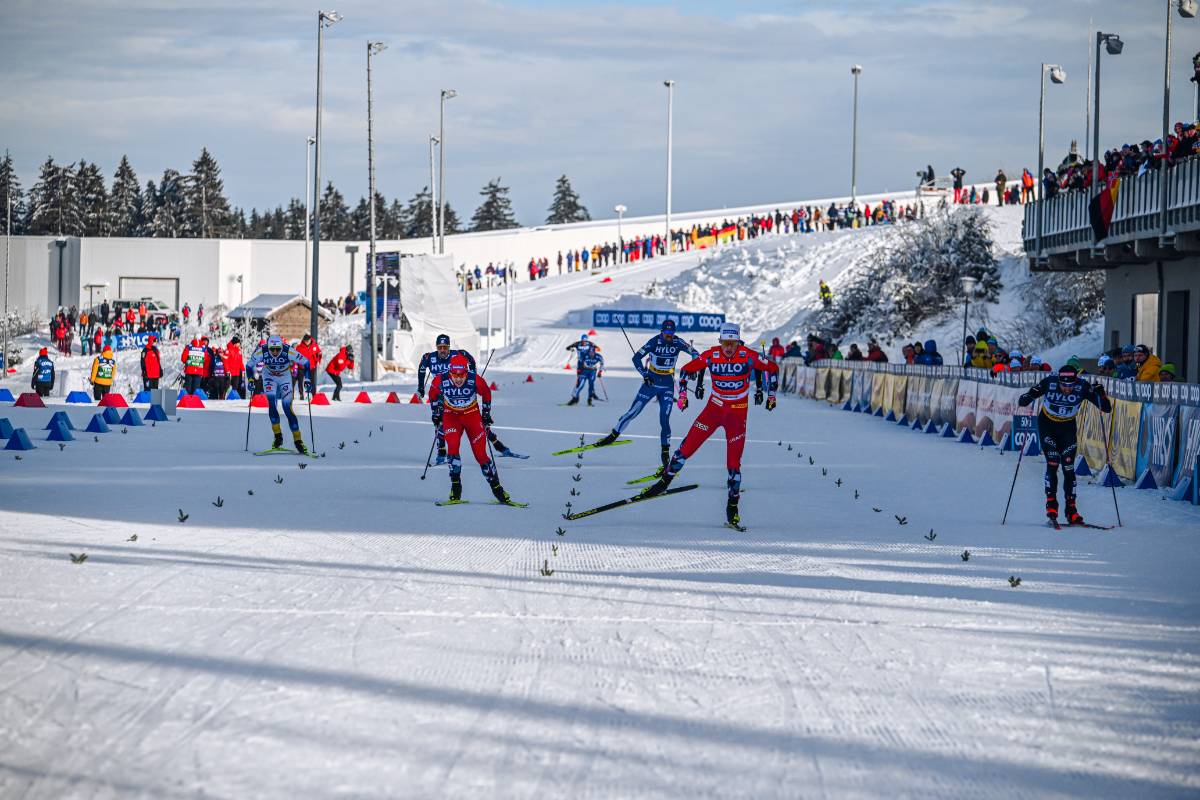
    Amundsen launched first, throwing everything he had at the final few hundred meters. But Hedegart, who had looked labored at points earlier in the race, found a gear no one could match. He came alongside Amundsen, took the lead in front of the grandstand crowd, and raised his fist in celebration as he skied across the line.

    “I felt, like, better,” Hedegart said of his position in the back of the pack through much of the race. “So I was just laying in the field, and I had to remind myself he did the same,” he added, referring to his idol Northug, whose trademark move was stalking from behind before unleashing a devastating sprint.

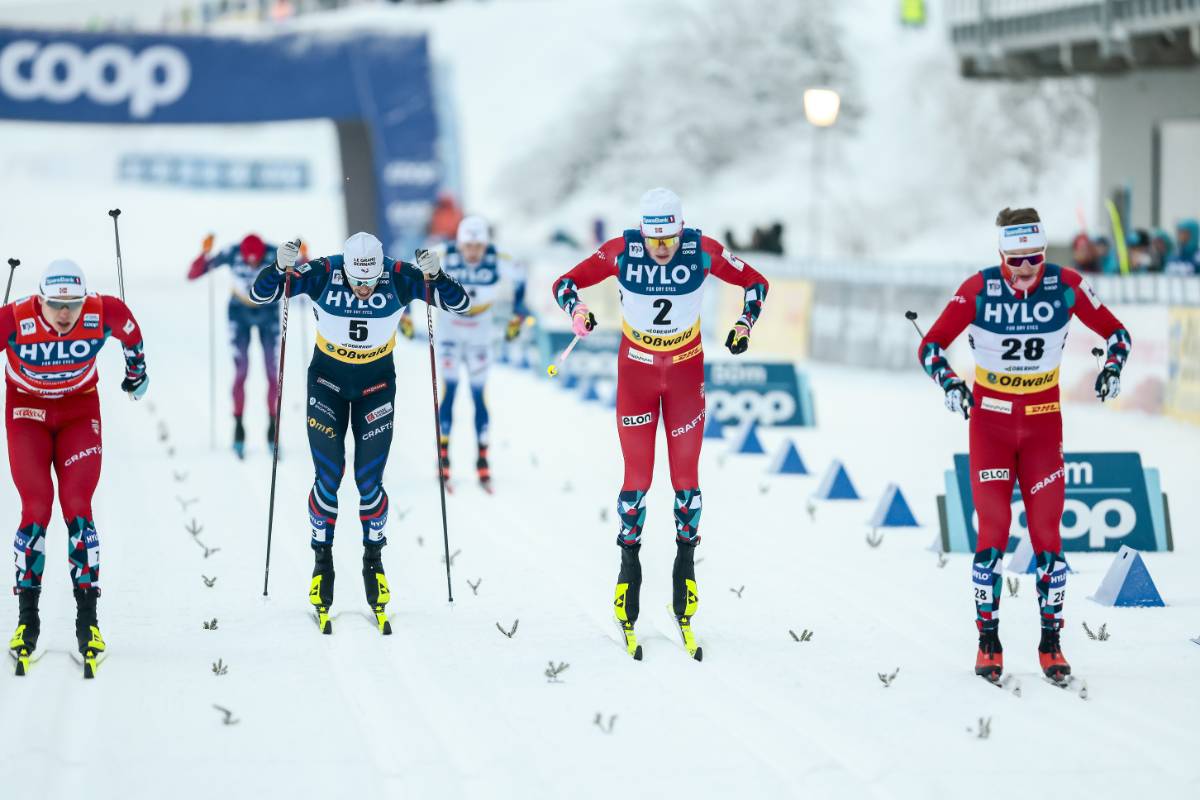
    Harald Oestberg Amundsen (NOR), Mattis Stenshagen (NOR), and Martin Loewstroem Nyenget (NOR), (l-r) stayed in the lead pack. (Photo: Authamayou/NordicFocus)

    Hedegart crossed in 1:51:38.2. Amundsen finished four-tenths of a second behind. Nyenget was third at +1.1. Ree took fourth (+1.5), followed by Herland (+2.1), Krueger (+3.0), Moseby (+4.8), and Andersen (+16.8) after his brave solo effort. Norway swept the top eight positions.

    France’s Lovera was the first non-Norwegian in ninth (+48.1), followed by AIN athlete Savelii Korostelev in 10th (+1:24.2).

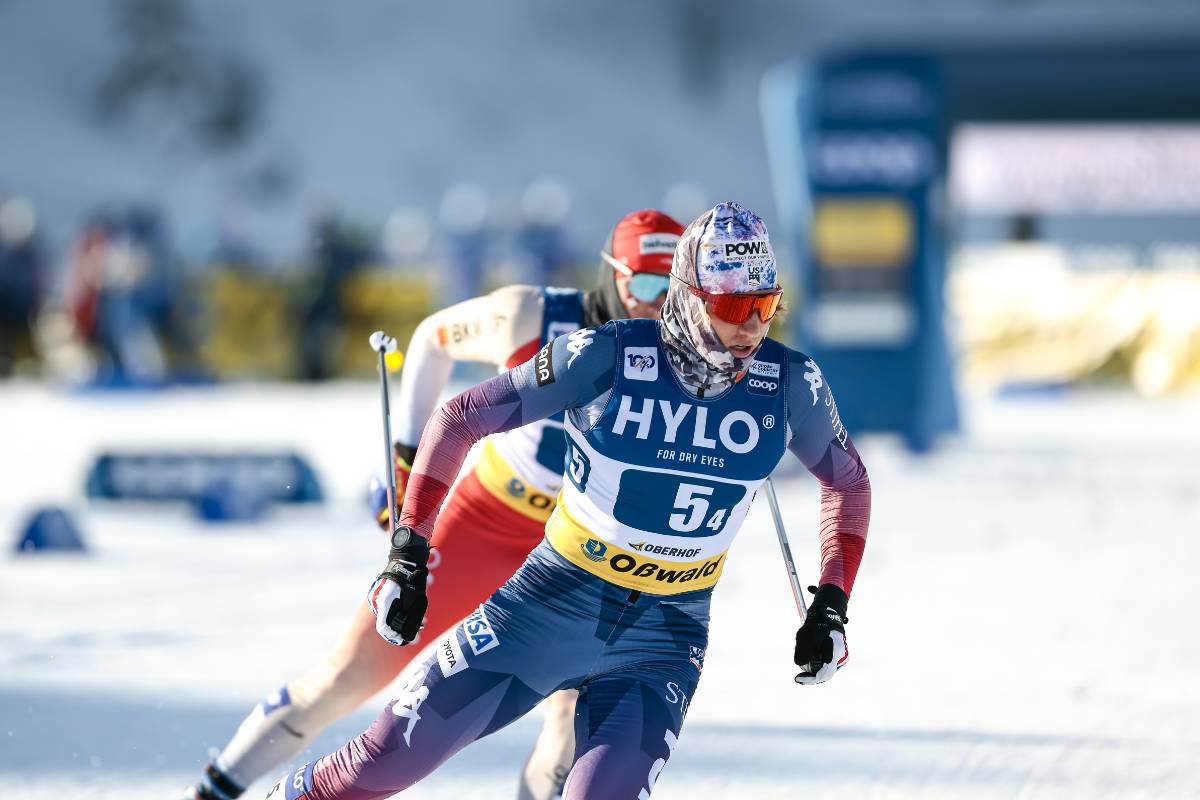
    Zak Ketterson (USA) led the way for the Americans in the chase pack racing for 11th place; he ultimately finished 18th. (Photo: Authamayou/NordicFocus)
    Ketterson Fights for 11th in His Adopted Home

    Zak Ketterson, who spent the summer and fall living and training in Oslo, found himself in the thick of a battle for 11th place, a fight he learned about from coaches stationed along the fog-shrouded course.

    “I had heard from coaches on the side of the trail that our pack was fighting for 11th, and that was super cool,” Ketterson said. “I actually felt pretty fresh at the end and thought my finishing sprint would be pretty good, but I didn’t time it well and got really boxed in on the last couple turns into the finish.”

    Ketterson ultimately finished 18th (+1:54.2), part of a chase pack that came across the line within seconds of each other. He said everyone in the group knew a sprint was coming on the final lap.

    The fog made the tactical picture nearly impossible to read. “I couldn’t see more than 10 meters in front of me,” Ketterson said. “It definitely made it difficult to assess where I was relative to the leaders in the later laps. It also made some of the corners feel way sketchier because you couldn’t really choose an optimal line with such limited visibility.”

    For Ketterson, the race carried personal significance beyond the result. Having trained on the Holmenkollen course through the Norwegian summer and fall, he knew every climb and descent intimately. “This is definitely one of the most iconic and cool races we get to do,” he said. “It was especially special for me this year since I trained on this course all summer and fall living in Oslo. The highlight was definitely having my wife Julie and her family out there cheering me on.”

    What made the performance all the more impressive was the state of his body coming in. “I honestly feel like I am really running on fumes,” Ketterson said. “To be honest, I was not sure if I would even start this race in the morning. I felt so bad, and honestly, my body has felt super up and down in the last few weeks. I’m really curious to see how my body responds to this race. I was pleasantly surprised by how decent it felt, but I feel like the next week could go either way. Especially with the international travel tomorrow.”

    Brian Bushey (USA) gaining experience on his way to 59th place. (Photo: Authamayou/NordicFocus)
    The Rest of the North Americans

    Hunter Wonders was 45th (+5:46.9), Kevin Bolger was 48th (+6:51.3), and Brian Bushey was 59th (+12:24.9).

    Canada’s Xavier McKeever finished 41st (+5:11.4), while Thomas Stephen was 43rd (+5:18.1).

    Harald Oestberg Amundsen (NOR) takes over the FIS Distance Globe lead with just two distance races remaining. (Photo: Authamayou/NordicFocus)
    Distance Globe: Three Points

    The ramifications of Saturday’s race land squarely on the crystal globe picture. Before the race, Klaebo held a 128-point lead over Amundsen in the distance standings and a 636-point lead in the overall. With Klaebo watching from home, Amundsen’s 131-point haul (including bonus points) vaulted him into the distance lead: Amundsen now sits at 939 points, three ahead of Klaebo’s 936. Nyenget climbed to 914 in third.

    Klaebo’s overall World Cup lead, at 2,071 points to Amundsen’s 1,566, remains secure with a 505-point cushion. But the distance globe — awarded to the season’s best across distance events only — will come down to the final two races: a 10 k Classic Interval Start and a 20 k Freestyle Mass Start in Lake Placid, March 20-22.

    If Klaebo can travel to Lake Placid and race, he’ll have every opportunity to reclaim the lead. If the concussion keeps him out, the distance globe is likely to belong to Amundsen.

    Kasper Andersson Herland (NOR), who finished fifth, celebrates with Einar Hedegart (NOR), (l-r) at the finish of the Holmenkollen. (Photo: Authamayou/NordicFocus)
    A Star Made for This Stage

    Hedegart’s career trajectory is one of the season’s best stories. A junior biathlon world champion who struggled with his shooting, he drifted toward cross-country skiing after a surprising second-place finish at the Holmenkollen World Cup last season. He spent the summer training with a cross-country team while bringing his rifle to every camp, undecided. In November, after winning the popular pre-World Cup cross-country race in Beitostoelen, Norway, by a wide margin and missing eight of 20 shots in a biathlon event, he committed to leaving the rifle at home.

    Since then: an Olympic bronze in the 10 k Freestyle behind Klaebo, a team sprint gold partnered with Klaebo, victories in the Engadin Marathon, and now the Holmenkollen 50 k — a distance he had never raced at the World Cup level. He was asked whether his approach of sitting back resembled Northug’s famous stalking tactics.

    “Yeah, I felt like Petter,” Hedegart said. “So I was just lying in the field, and I had to remind myself he did the same.”

    For a race that dates to 1888, that has been won by the sport’s mythical stars, and that is contested before the King of Norway in a stadium surrounded by 100,000 fans, there is no small amount of weight to what happened Saturday at the Holmenkollen. Hedegart is, by every measure, now a cross-country skier.

    The season concludes with the World Cup Finals in Lake Placid, New York, March 20-22. Three races remain. The distance globe is separated by three points. And the world waits to see whether Klaebo can make it to the start line.


    Holmenkollen Men’s 50 k Freestyle FINAL RESULTS

    FIS Men’s Crystal Globe SPRINT STANDINGS
    FIS Men’s Crystal Globe DISTANCE STANDINGS
    FIS Men’s Crystal Globe OVERALL STANDINGS


    Love Stories Like This? Help Keep Them Coming.

    Feature stories like this one take time, access, and care to produce. If you value thoughtful storytelling and independent ski journalism, please consider becoming a Voluntary Subscriber. Your support directly fuels the work we do to cover the people, places, and moments that make our sport special.

    Join the FasterSkier community!


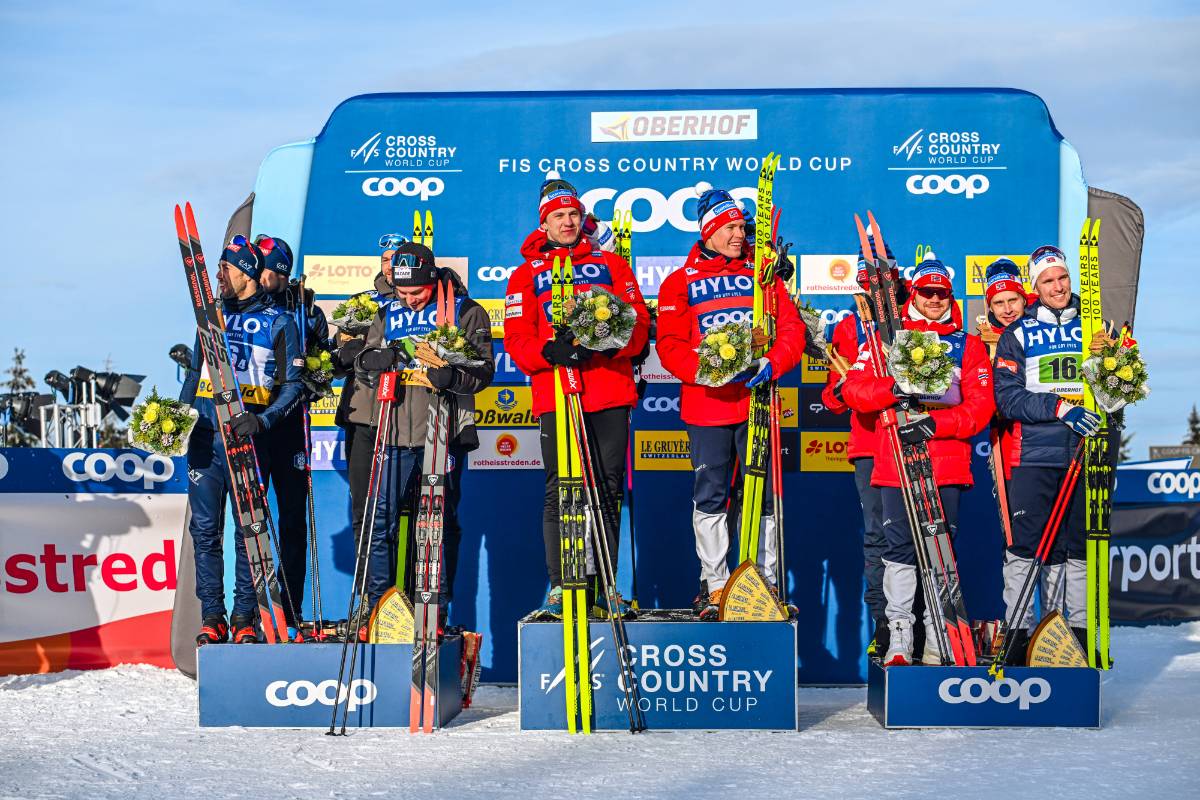
    Harald Oestberg Amundsen (NOR), Andreas Fjorden Ree (NOR), and Martin Loewstroem Nyenget (NOR), (l-r) share the Holmenkollen 50 k Freestyle in Oslo, Norway. (Photo: Authamayou/NordicFocus)
  • A Familiar King: Klaebo Opens Milano Cortina with Skiathlon Gold

    A Familiar King: Klaebo Opens Milano Cortina with Skiathlon Gold

    This article was made possible through the generous support of our voluntary subscribers who have helped put our Nat Herz on the ground at the Olympics. If you value coverage like this, please support FasterSkier with a voluntary subscription.

    Four Norwegian men, including Martin Loewstroem Nyenget (NOR), Mattis Stenshagen (NOR), Harald Oestberg Amundsen (NOR), Johannes Hoesflot Klaebo (NOR), (l-r) set to lead the Men’s 20 k Skiathlon out of the start and begin the 2026 Milano-Cortina Olympic Winter Games in Tesero, Italy. (Photo: Vanzetta/NordicFocus)

    PREDAZZO, ITALY — The snow in Val di Fiemme had finally settled. After a colder night and a full day’s distance from the most recent snowfall, the surface beneath the men’s skis on Sunday morning felt less negotiable than it had twenty-four hours earlier. It was firmer, faster, and exacting—the kind of track that rewards decisiveness and punishes hesitation. On a course defined by momentum, there would be no neutral moments.

    By the time the leaders crested the Zorzi Climb for the final time, illuminated by the bright northern Italian sun, one truth had been clarified: the Olympic Men’s Skiathlon had not produced a surprise. It had produced a confirmation.

    Johannes Hoesflot Klaebo arrived in Val di Fiemme as the most accomplished skier of his generation, the reigning master of range—sprint speed married to endurance patience, and the man who, one year earlier at the World Championships in Trondheim, Norway, became the first skier ever to win gold in every event. On Sunday, in the opening men’s race of the 2026 Olympic Winter Games, he did not reinvent himself. He simply waited, watched, and delivered exactly what the sport has come to expect.

    But the Skiathlon is never only about the man who wins it. It is about where the race breaks, who is caught on the wrong side of that break, and how little time there is to recover once it happens.

    In Val di Fiemme, that truth arrived early—at a fast right-hand corner about two kilometers into the race—and again, more quietly but just as decisively, midway through the skate leg, when a tangle in the pack ended one of Norway’s strongest medal threats.

    An unfortunate early crash took Gus Schumacher (USA) out of a top performance. (Photo: Vanzetta/NordicFocus)

    Firmer Conditions, Faster Consequences

    The men’s skiathlon opened with a 10-kilometer classic leg, mass start, with athletes seeded by season-long results. It is a procedural detail that becomes strategic fact the moment the gun fires: the highest-ranked skiers line up at the front, while those just behind them must navigate the churn.

    On Sunday, the pace was relentless from the first kilometer. The field stretched quickly as athletes fought for position ahead of the course’s first defining technical feature—a fast right-hand corner roughly two kilometers in, where the trail bottoms out before pitching uphill again.

    It was the same corner where Jessie Diggins fell in Saturday’s women’s race. And once again, it reshaped the day.

    Several skiers went down in the crash, including Edvin Anger (SWE), Zak Ketterson (USA), and Gus Schumacher (USA)—all athletes with legitimate top-ten potential under normal circumstances. The cost of falling there was immediate and severe: not just lost momentum, but lost momentum at the precise moment the leaders were accelerating uphill and creating separation.

    “I was dead last after the fall,” Schumacher said afterward. “Unfortunately, Zak fell right in front of me. It was tight coming into that corner, and I didn’t see what happened to Zak, but into the dropdown I got one ski around him and the other caught and spun me around off track.”

    “I did what I could, but when the people at the front are still going as fast, it’s hard to catch them. All I could do was ski as smoothly as I could for the next 18 k. At that point, it’s an individual race. I feel like I skied well for being back there.”

    Zak Ketterson (USA) was involved in the same crash as Schumacher and was forced to burn many matches early while playing chase, which ultimately proved too costly. He ultimately ended the race in 43rd place. (Photo: Vanzetta/NordicFocus)

    Ketterson’s version of the same moment underscored how quickly the situation unraveled.

    “I fell on that same corner Jessie Diggins fell on yesterday,” he said. “I was hopeful we’d ski it well, but coming into it everyone started snowplowing and freaking out and someone in front of me fell.

    “I fell pretty hard, but I got back up and just burned so many matches catching back up to the group. I was fighting from there to the finish.”

    Ahead of them, the race did not wait.

    Xavier McKeever (CAN) had, what he described, the race of his life. (Photo: Vanzetta/NordicFocus)

    Control Without Calm

    With the early chaos, the classic leg splintered the field. A front group formed, thinned, and re-formed, the pace steady enough to discourage attacks but high enough to extract a cost from anyone forced to chase.

    For the U.S. team, there was at least one quiet positive. Head coach Matt Whitcomb felt far better about ski preparation than he had the day before.

    “We had, in general, very competitive skis today,” Whitcomb said.

    But ski quality can only matter if contact is maintained.

    “When you get taken out of contact with the leaders,” Whitcomb said, “the people you’re drafting off of are slower than the leaders. It’s kind of negative compounding—you just drift away.”

    By the time the top eight skiers entered the stadium for the ski exchange at the end of the classic leg, the race had already begun to select for those who could tolerate discomfort without revealing it. Among them were Norway’s Mattis Stenshagen, who soon faded, France’s emerging depth, and Klaebo himself—observant and patient.

    Then the skis changed, and the race revealed its teeth.

    Harald Oestberg Amundsen (NOR) got tangled with Savelii Korostelev (AIN), which caused him to fall and lose contact with the lead pack. Korostelev managed to stay on his feet and was able to earn a fourth place. (Photo: Barbieri/NordicFocus)

    A Quiet Turning Point in the Skate Leg

    The opening kilometers of the freestyle leg altered the race more subtly, but no less decisively.

    At approximately 11.5 kilometers, Harald Oestberg Amundsen (NOR)—who had positioned himself exactly where Norway would want him entering the skate portion—tangled skis with Savelii Korostelev (AIN). Amundsen went down. The lead group did not.

    He remounted quickly, but the elastic had snapped. His chance to fight for a medal in the opening race of the Games was gone.

    For Norway, a team that has dominated the men’s World Cup season at times filling nearly the entire top ten, it was a small moment with outsized implications.

    Hugo Lapalus (FRA), Martin Loewstroem Nyenget (NOR), Savelii Korostelev (AIN), Mathis Desloges (FRA), Johannes Hoesflot Klaebo (NOR), (l-r) formed the lead pack and became the group that would battle for the podium. (Photo: Vanzetta/NordicFocus)

    Desloges, a Yellow Card, and a Protest That Went Nowhere

    As the race accelerated, Mathis Desloges (FRA) briefly found himself leading at the end of the first skate lap. In a moment of confusion, he mistakenly turned into the ski exchange lane before cutting back through the V-boards and rejoining the course.

    The detour shortened his route by only a few meters and offered no meaningful advantage. The race jury issued Desloges a yellow card warning and allowed the result to stand.

    After the race, AIN filed a protest, arguing that the infraction should result in disqualification and elevate Korostelev, who finished fourth, to the bronze medal position. The jury rejected the protest.

    Desloges framed the day not around controversy, but around progression.

    “I’m very happy,” he said. “The preparation was very good. Two years ago today, I became [the U23 World Champion], and now it’s different. I’m better than two years ago.

    “This medal is for my family, for my friends, and for everyone on the French team—the staff and my family.”

    Johannes Hoesflot Klaebo (NOR) delivered a spectacular move on the Zorzi Climb that opened up a large gap in the final kilometer. (Photo: Barbieri/NordicFocus)

    Klaebo on the Zorzi Climb

    There are moments in ski racing that feel preordained—not because they are inevitable, but because the athlete who executes them has taught the sport to expect them.

    Klaebo’s move on the Zorzi Climb belonged to that category.

    He waited. He measured. And then, on the final ascent, he applied a pressure no one else in the group could answer. The gap opened quickly, almost unbelievably so if he had not done the same thing so many times before, and by the time the course tipped back toward the stadium, the Olympic gold medal was no longer in doubt. Klaebo came to the finish with enough margin to ease up, take off his poles, and ski the final meters, celebrating in front of the stadium crowd.

    For Klaebo, the performance was the product of both familiarity and tension.

    “The last couple of days have been nerve-racking,” he said. “I’ve had a very high resting heart rate these days. I’ve been very nervous, but this is my third Olympics, so you get a little bit of experience. This is a track and course that we know a lot from previously—we’ve done a lot of World Cups here.”

    When the skis changed and the race accelerated, that experience showed.

    “I had good skis, my body felt good,” Klaebo said. “It’s always good to start a championship in good shape.”

    One year removed from his historic sweep in Trondheim, Klaebo arrived in Val di Fiemme carrying questions that extended well beyond a single race. Six gold medals are available in Milano Cortina. No man has ever won them all.

    “We’ll see,” Klaebo said. “I’m going to take one race at a time. But it’s a pretty good start. With the weather and the crowds, it was amazing out there.”

    Mathis Desloges (FRA) and Martin Loewstroem Nyenget (NOR), (l-r) come down the finish stretch battling for the silver and bronze medal. (Photo: Barbieri/NordicFocus)

    Nations in Contrast

    France: Depth and Belief

    If Norway remains the benchmark, France is no longer content to chase quietly.

    Desloges acknowledged Norway’s status entering the race, but did not concede anything beyond the present tense.

    “The French athletes are very strong,” he said. “Of course, the Norwegian guys are also very strong, but I believe we can be better. Today, I’m very good, and I’m happy.”

    France backed up that belief with the most comprehensive team performance of the day, placing second, fifth, ninth, and fifteenth.

    “We see the French team on a similar level as our team,” Whitcomb said. “When we have success, they’re one of the first teams to congratulate us. They’re just a really passionate group, and we love to see them succeed.”

    Hugo Lapalus (FRA) and Mathis Desloges (FRA) celebrate an unbelievable day for France. (Photo: Vanzetta/NordicFocus)

    Norway: Gold, Bronze—and Perspective

    For Norway, the medal count told only part of the story. A gold and a bronze would thrill nearly any other nation, but the context surrounding this team—deep enough to leave world-class skiers at home—made the result feel more measured.

    Bronze medallist Martin Loewstroem Nyenget (NOR), racing his first Olympic event, framed the day not as a shortfall, but as an arrival.

    Johannes Hoesflot Klaebo (NOR), Martin Loewstroem Nyenget (NOR), Harald Oestberg Amundsen (NOR), and Mattis Stenshagen (NOR), (l-r) all entered the day with hopes of an Olympic medal for Norway; two delivered, two did not. (Photo: Barbieri/NordicFocus)

    “I’m really happy and proud,” Nyenget said. “It’s a result of training, but also of time away from family and a lot of hard mental work. The past days and weeks, I’ve been nervous, so it’s good to be done with my first Olympic race.

    “To have this first race in this atmosphere, with these blue skies, and have my wife and little kid in the stadium somewhere—it’s a really good day.”

    Asked whether gold and bronze constituted a satisfactory outcome, Nyenget was direct.

    “I think so,” he said. “We have some really high pressure. We’ve been doing crazy good in the World Cup, but usually in championships, all racers are at their very best. You see today that there is strong competition from the French, and we took two podium places. It’s good.”

    After the fall Gus Schumacher (USA) spent the day racing his way through the field, eventually finishing in 24th place. (Photo: Barbieri/NordicFocus)

    United States: Disappointed, Not Discouraged

    For the U.S. team, the early crash changed everything.

    Schumacher and Ketterson were forced into playing chase. Zanden McMullen, who avoided the crash, felt the day slip away in the skate leg.

    “Today’s race was not great, but not horrendous,” McMullen said. “I felt really good in the classic leg and then I don’t know what happened in the skate portion. I was cramping up quite a bit and just didn’t have it.”

    Hunter Wonders (USA) on his way to 31st place. (Photo: Vanzetta/NordicFocus)

    Hunter Wonders, making his Olympic debut, focused instead on the scale of the task.

    “It was hard,” Wonders said. “It was a hard course with tricky conditions. The skiathlon is difficult because it mixes up the muscle groups you use and takes a second to transition, but it was fun. Great Olympic debut.”

    Whitcomb struck a measured tone.

    “I’m feeling good, not great,” he said. “Slightly disappointed, but not discouraged. Nothing about that feels negative to me. This is just one of the days of the Games, and now it’s behind us.”

    Xavier Mckeever (CAN) fighting for a top ten, eventually finishing in 13th place. (Photo: Vanzetta/NordicFocus)

    Canada: The Race of a Lifetime

    For Canada, the day belonged to Xavier McKeever, who finished 13th after spending much of the race on the edge of the top ten.

    “Oh man—that was incredible,” McKeever said. “I can’t believe what just went down, to be honest.”

    He described a race that improved with each kilometer.

    “I felt like I skied it really smart—tried to conserve as much energy as possible—and I just felt better and better,” he said. “The skate felt really good, which is sweet, because that’s usually a weak spot for me.”

    Mid-race, the realization crept in.

    “You can’t really comprehend what’s going on,” McKeever said. “You’re just like, ‘Holy crap, I’m here right now, fighting for top ten.’ It’s surreal, but you’ve got to focus on the race.”

    The result carried deeper meaning.

    “To be honest, I was about a foot away from not making this Olympic team,” he said. “To come here and have the best race of my life so far on the first day at the Olympics—I couldn’t ask for anything more.”

    Mathis Desloges (FRA), Johannes Hoesflot Klaebo (NOR), and Martin Loewstroem Nyenget (NOR), (l-r) share the Olympic Men’s 20 k Skiathlon podium in Tesero, Italy. (Photo: Vanzetta/NordicFocus)

    One Race Down

    The skiathlon rarely offers mercy, and Val di Fiemme offered none.

    There will be more races, more chances, and more medals to chase. Klaebo will insist he is taking this one race at a time. Everyone else will count.

    On firmer snow, with no ambiguity left beneath the skis, the hierarchy revealed itself plainly—and the Olympic Winter Games began exactly where cross-country skiing so often does: with Johannes Hoesflot Klaebo setting the standard.


    Olympic Winter Games – Men’s Skiathlon – RESULTS

    On the ground reporting by FasterSkier’s Nat Herz.


    Help Support Our Olympic Coverage!

    FasterSkier has our own Nat Herz on the ground at the Olympics, which is a significant financial lift for us. If you value the thoughtful work and access FasterSkier provides at championships like this one, please consider becoming a Voluntary Subscriber. Your support directly fuels our work to cover the people, places, and moments that make our sport special.

    Join the FasterSkier community!


    Even Johannes Hoesflot Klaebo (NOR) gets excited to win an Olympic Winter Games gold medal. (Photo: Barbieri/NordicFocus)
  • The Long Way In: Zak Ketterson and the Patience It Took to Reach the Olympics

    The Long Way In: Zak Ketterson and the Patience It Took to Reach the Olympics

    This article was made possible through the generous support of our voluntary subscribers. If you value coverage like this, please support FasterSkier with a voluntary subscription.

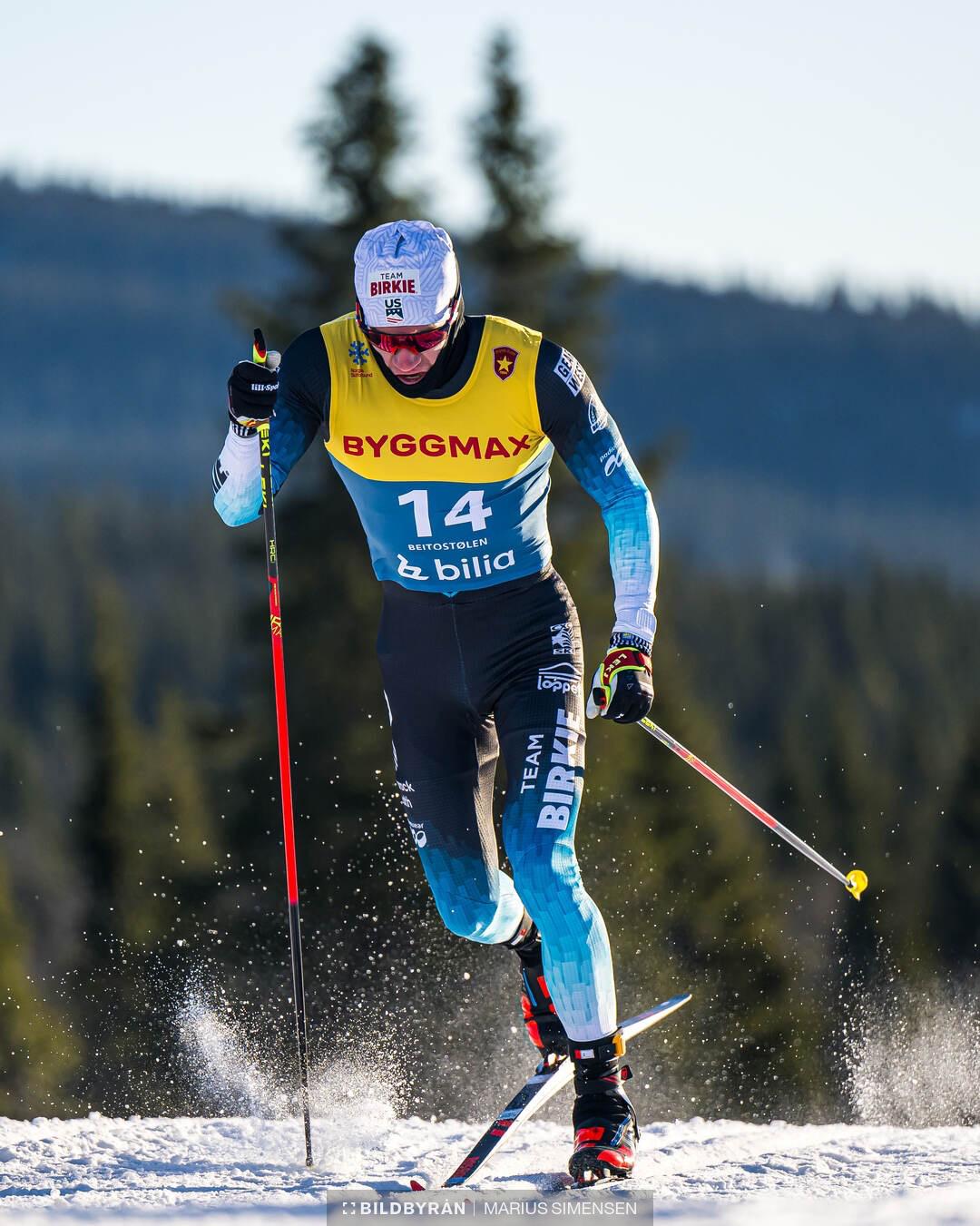
    Zak Ketterson (USA) during the 10 k Classic in Toblach, Italy, as part of the 2026 Tour de Ski. (Photo: Vanzetta/NordicFocus)

    On Monday, a clear winter morning in northern Italy, Zak Ketterson skied intervals while his teammates enjoyed a point-to-point on an idyllic pre-Olympic winter day. The sun was out. The snow was good. He was working.

    “I did some hard intervals,” he said later. “So it was still nice and sunny and everything, but not as enjoyable.”

    That small distinction — between the workout that feels good and the workout that gets you ready — has followed Ketterson for most of his career. He has never been the prodigy. He has never been the junior who arrived early, polished, and inevitable. His path to the Olympic start line has been indirect, uneven, and occasionally fragile. It has also been intentional in ways that only make sense in hindsight.

    At 27, Ketterson is preparing to race at his first Olympic Winter Games, starting with the Skiathlon on Sunday, the culmination of a season that has quietly redefined his place in American men’s cross-country skiing. He has been competitive across formats, consistent across weekends, and calm in moments that once rattled him. But none of that came from doing things the “right” way — at least not the way modern development systems tend to define it.

    Ketterson arrived here by starting late, resisting structure, leaning into racing before training, and trusting that if he kept showing up long enough, the pieces might eventually fall into place.

    They have. Just not quickly.

    Ketterson’s favorite sports as a child were football and baseball. (Photo: Courtesy Photo)

    A Winter Without a Script

    Ketterson grew up in Minnesota, where winter is not an inconvenience so much as a condition. The days shorten. The lakes freeze. School calendars and community life bend around the cold. You don’t opt out of winter there; you adapt to it.

    In many households, adaptation means skiing. For Ketterson’s, it meant something else first.

    “For me, I was always really into football and baseball,” he said. “That was my fall sport and my spring sport.”

    Those sports gave his year shape. Football stretched into late autumn. Baseball pulled him toward summer. They came with teammates, structure, and a clear sense of belonging. Winter, by contrast, arrived as a blank space.

    Basketball — his favorite sport to this day — lived somewhere between play and possibility. He loved it but never formally committed to it. Organized winter athletics never quite settled into his life. Not yet.

    Before skiing was ever part of his life, Ketterson dreamed of being a pro athlete. (Photo: Courtesy Photo)

    Cross-country skiing entered almost accidentally, carried in by family rather than ambition.

    “My brother, for whatever reason, was more into cross-country running, track, and cross-country skiing,” Ketterson said. “He kind of convinced me, like, yo, you don’t have anything going on in the winter, you should just try this.”

    It wasn’t a calling. It was a solution.

    He was thirteen — late by elite skiing standards, but early enough to slip into the margins of the system. In Minnesota, seventh graders could train and travel with high school teams. Ketterson joined at the JV level, young and mostly anonymous.

    The draw wasn’t the work. It was the race.

    “I really liked racing, especially mass starts and sort of the competitive head-to-head aspect of it,” he said.

    Training, on the other hand, felt like an obstacle.

    “I absolutely hated that,” he said. “When it came to going into the woods and just doing a two-hour ski or something, I hated it.”

    Sometimes, hatred turned into avoidance.

    “There were a lot of practices where I would hide in the woods,” he said. “My friends and I would just pretend that we trained, but we were actually just building snow forts.”

    If this were a conventional development story, it might end there. Plenty do. A late start, uneven buy-in, resistance to structure — those are often warning signs.

    But Ketterson kept finding himself back on start lines.

    Early days on skis for Zak Ketterson. (Photo: Courtesy Photo)

    Racing as the Through Line

    What sustained him through those early years was not discipline, but opportunity. Each step forward offered another race, another environment where effort produced immediate feedback.

    Junior Nationals. Then World Juniors. Eventually, college.

    “The thing that kept me in the sport initially was just the racing,” he said.

    That instinct — to measure himself against others rather than against a stopwatch or a training plan — would define much of his early relationship with the sport.

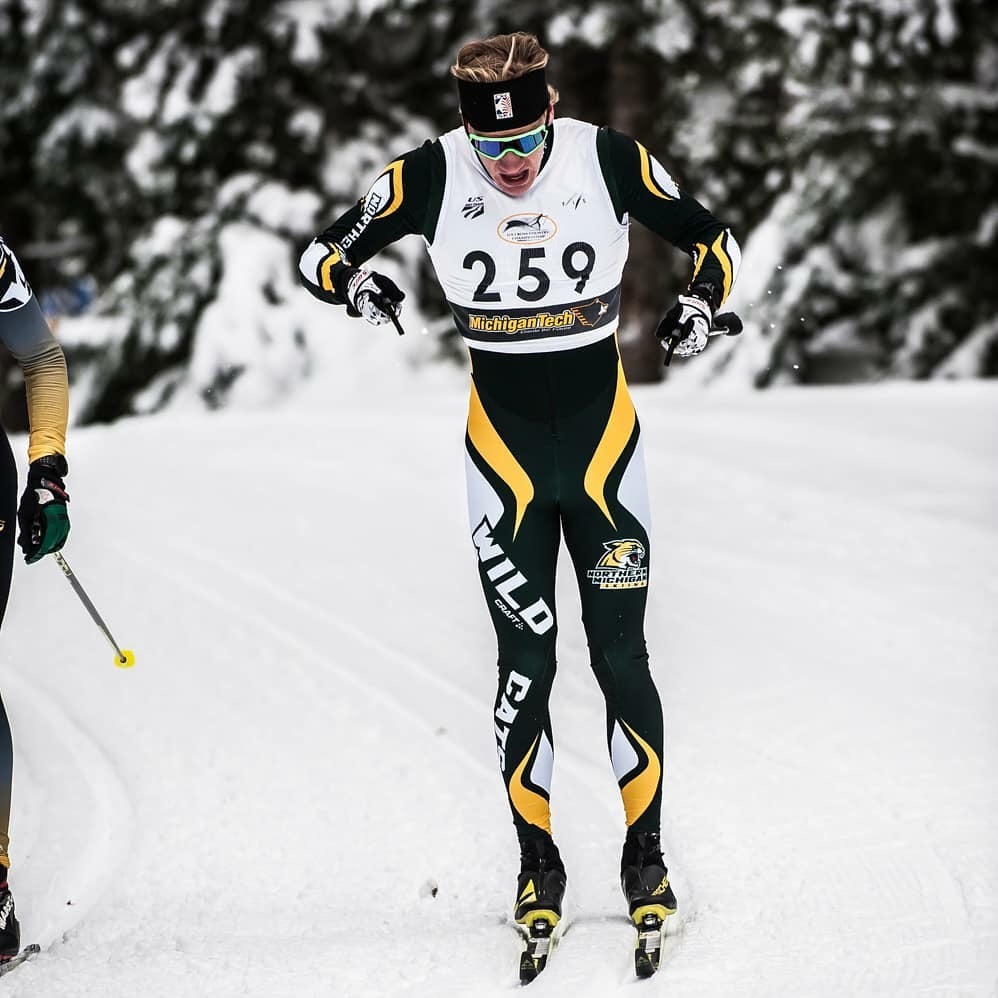
    By the time he reached Northern Michigan University, skiing stopped being seasonal. It became daily. The margin for avoidance narrowed.

    “I started to develop more of a relationship with the training aspect of it,” he said. “Especially in college, I began to really enjoy the process of trying to improve and optimize things.”

    Sleep. Nutrition. Recovery. The quiet details, that barely registered when skiing was something you fit around football and baseball, suddenly mattered.

    The shift wasn’t romantic. It was practical.

    That change carried him into a professional career after graduation — not as a finished skier, but as someone finally willing to do the work consistently.

    A young Zak Ketterson (Midwest/Loppet Nordic Racing) leads the U16 Boys 5 k Classic Mass Start at the 2013 Junior Nationals in Fairbanks, Alaska. (Photo: bertboyer.zenfolio.com. Proceeds go to NNF)

    Northern Michigan, Daily Work

    Northern Michigan University didn’t transform Ketterson overnight. It narrowed the margins.

    Skiing there demanded repetition. Cold mornings. Tired legs. Routine. Improvement stopped being incidental.

    The biggest shift came junior year, when he began dating his now wife, Julie Ensrud, and skiing stopped being something he did mostly alone.

    “When I started dating her my junior year in college,” Ketterson said, “that really coincided with when I started doing a lot better in skiing.”

    Julie grew up in Norway, in a system that treated sport as something you lived inside rather than something you added on. She attended a specialized Norwegian sports high school. She trained at volume. She understood structure.

    “She was kind of living semi-professionally from the age of 16,” Ketterson said.

    She noticed the basics first.

    “I started going to bed a lot earlier,” he said. “I would always just be on my phone until 11 or 11:30.”

    Food followed.

    “Not only eating healthier,” he said, “but eating more of the right things. More carbs. The timing of what you eat with training.”

    By living together senior year, Ketterson’s bad habits became visible.

    “She’s probably the hardest worker and most efficient person I’ve ever met,” he said. “She gets an email and does it immediately.”

    Ketterson noticed the contrast.

    “I used to be super disorganized,” he said. “I used to lose stuff and leave things everywhere.”

    Being around someone who treated time deliberately changed how he approached his own days.

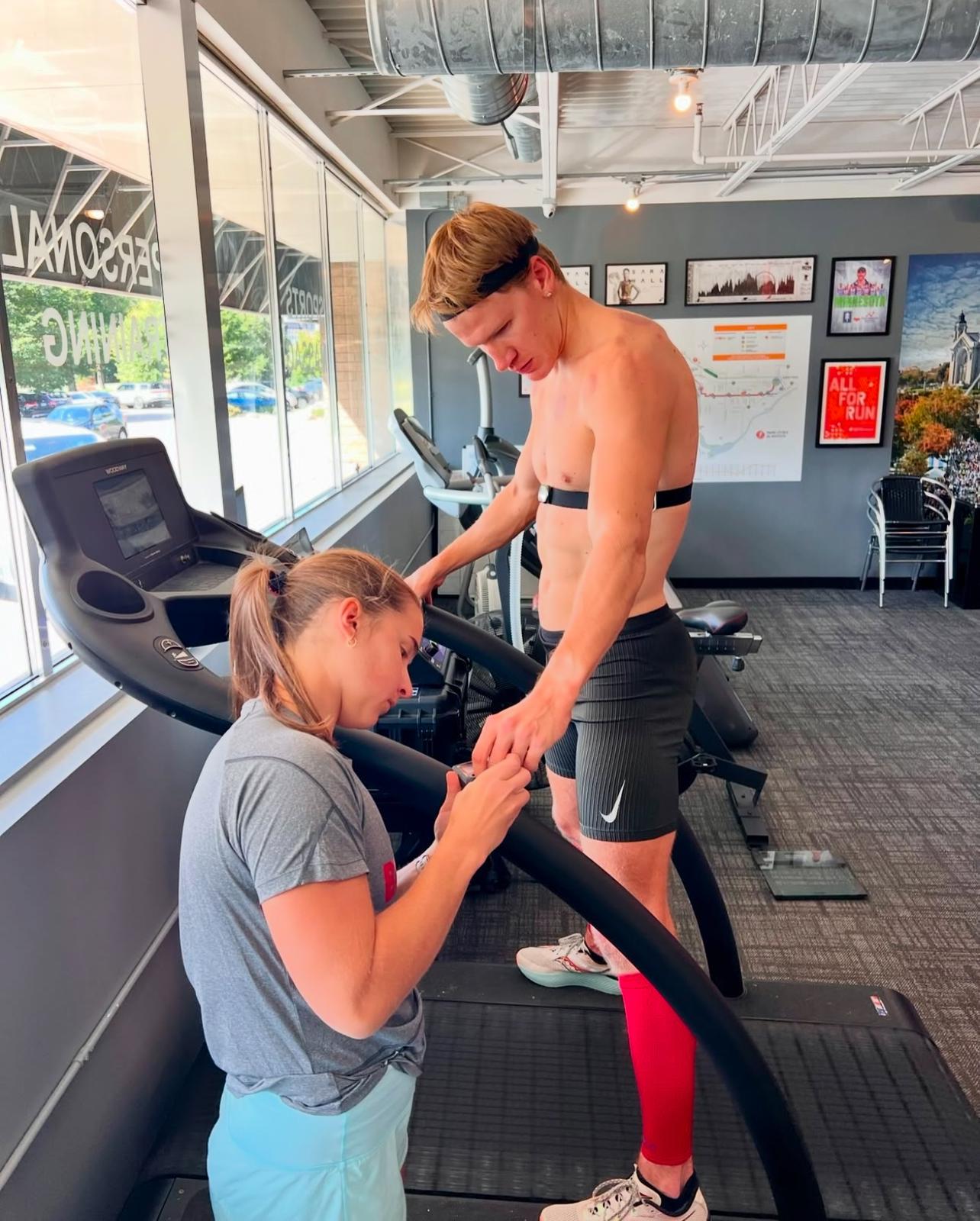
    “She comes to basically every interval session I do,” he said. “Takes video. Takes lactates. Gives technique tips.”

    What could have felt like a sacrifice became shared life.

    “If I were single and just kind of doing this grind alone,” he said, “it would feel like a much bigger sacrifice.”

    Ketterson (NMU) racing at the CCSA opener in Houghton, Michigan during his college days at Northern Michigan University. (Courtesy photo)

    Learning How to Stay Anyway

    Leaving college did not feel like an arrival. It felt like exposure.

    Professional skiing offered fewer guarantees. Results came without permanence. Progress was harder to measure.

    “This is maybe my fifth year as a professional,” Ketterson said. “I feel like I’ve just been sort of taking small steps each year.”

    From the outside, those steps were hard to see. He qualified. He scored points. Then momentum faded.

    “I’ve had glimpses here and there of being quite good on the World Cup,” he said. “But it was so inconsistent and few and far between.”

    One year, sprint qualification came easily while distance slipped. Another season, the opposite.

    “I would qualify every sprint but struggle in distance,” he said. “Or I wouldn’t qualify in sprints, but I’d get a lot of top-30s in distance.”

    The belief stayed intact.

    “I believed I had that all-around potential,” he said.

    Belief, however, doesn’t quiet doubt when seasons stack without resolution.

    Ketterson’s wife, Julie Ensrud, assists him with lactate testing during a treadmill session. (Photo: Zak Ketterson)

    Choosing a Place That Could Hold the Work

    For American skiers, Europe is often something you pass through. For Ketterson, Norway eventually became something else.

    Julie’s family lived outside Oslo, close to training venues and the airport. There was also a cabin — quiet, familiar.

    “It works out super well,” Ketterson said. “I can just get these three- or four-day stints at the cabin and unpack my bag and feel really at home.”

    Most American skiers live out of their bags.

    “There are a lot of Americans who just live out of their bag and are constantly in hotels,” he said.

    In Norway, life slowed just enough for training to accumulate rather than reset.

    “They’re super into skiing,” Ketterson said of Julie’s family. “Her brother skied competitively growing up.”

    Her father, especially, was absorbed by the details.

    “He’s so into ski waxing and the nitty-gritty stuff,” Ketterson said.

    The support wasn’t motivational. It was stabilizing.

    “They’ve sort of adopted me,” he said. “Like, how can we support him?”

    Norway wasn’t the breakthrough. It was the ground beneath it.

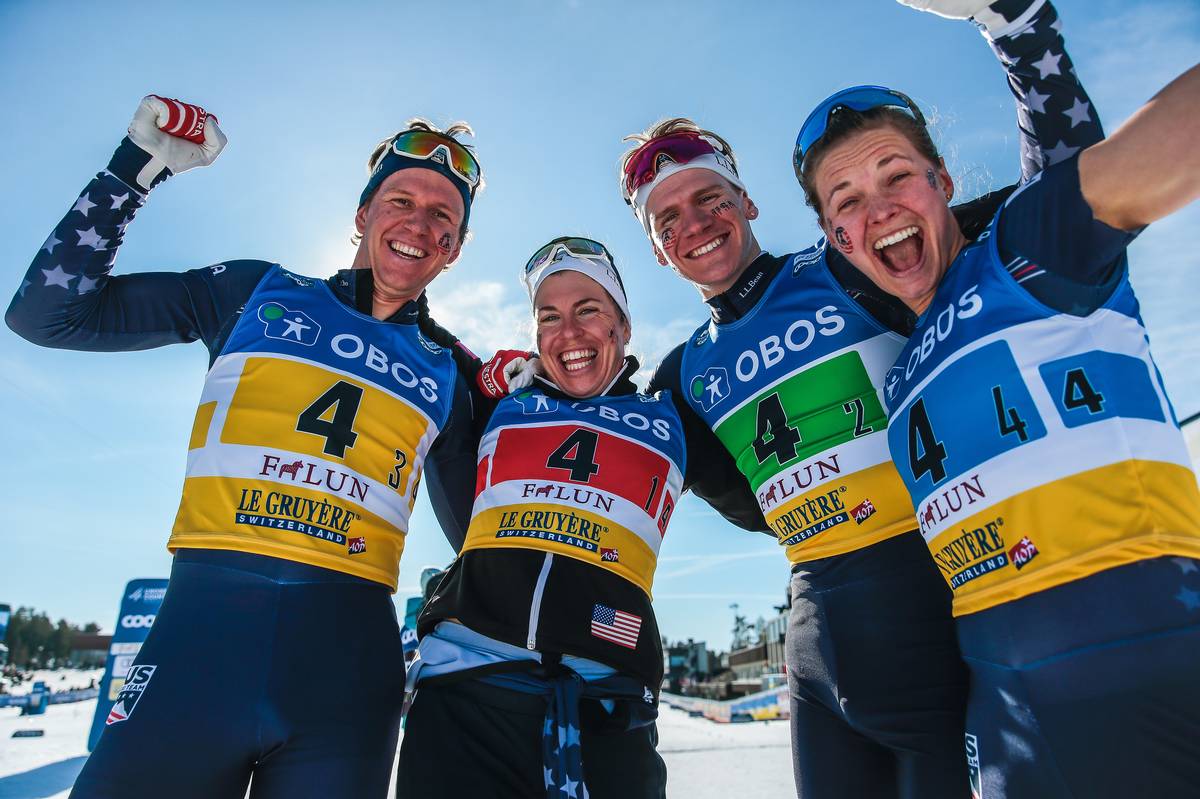
    USA I takes the win in a rare World Cup 4 x 5 k mixed relay in 2022. From left to right, Scott Patterson, Rosie Brennan, Zak Ketterson, and Jessie Diggins. (Photo: NordicFocus)

    Nothing Fancy, Just Better

    With stability in place, the training changed.

    “I started working with a coach in Oslo,” Ketterson said.

    The relationship was loose.

    “He created the framework,” Ketterson said. “But I was still writing probably 90 percent of my training.”

    The biggest change was subtraction.

    “I used to do strength twice a week, sometimes even three times a week,” he said. “Now it was basically once every ten days.”

    The logic was blunt.

    “If you want to get better at double pulling,” he said, “you just need to double pull more.”

    He replaced strength with ski-specific work. Fitness became the priority.

    His training rhythm flattened.

    “My training became much more consistent,” he said. “Every week was pretty similar.”

    No dramatic rest weeks. No spikes. Stress accumulated steadily.

    He returned to the same hills. The same treadmill sessions.

    “If something feels way worse than the last six times,” he said, “then you know you need rest.”

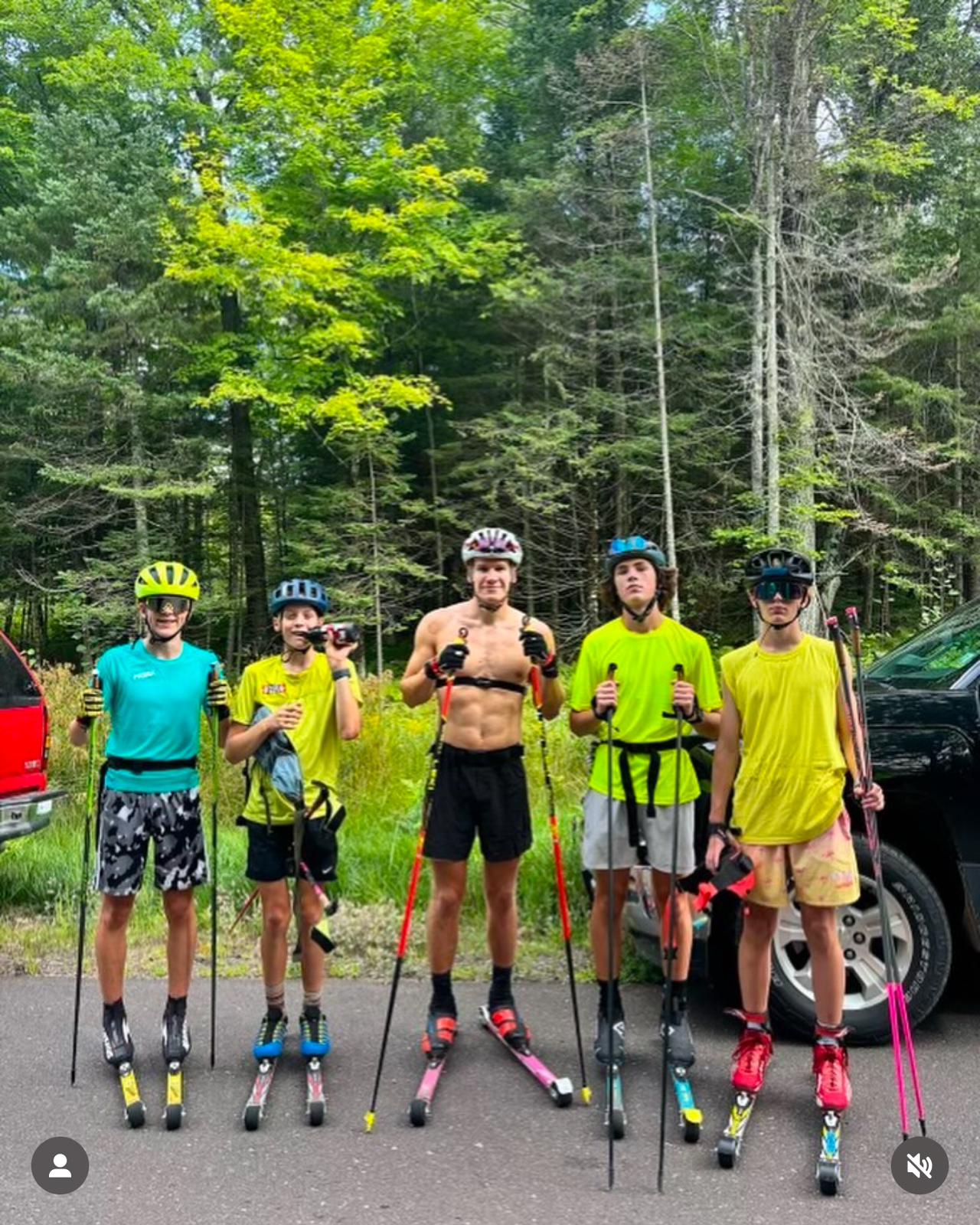
    Zak Ketterson logs some roller-ski hours in Minneapolis with Team Birkie. (Photo: Instagram @zaketterson)

    Toppidrettsveka

    Late in August, Ketterson lined up at Toppidrettsveka, Norway’s popular roller-ski stage race.

    “I was expecting to be absolute middle of the pack,” he said.

    Instead, he stayed with the leaders.

    “From the first race — a mass start 50k — I was fighting for the win,” he said.

    Three years earlier, he had been dropped halfway.

    “That was one of those moments where it’s like, wow,” he said. “This is a really big difference from anything I’ve felt before.”

    Across stages, the pattern held.

    “That gave me a lot of confidence,” he said. “Like, okay — what we’re doing is really working.”

    Still, he waited.


    The Ultimatum

    By autumn, the feeling hadn’t faded.

    “I told Julie that this had been by far my best off-season ever,” Ketterson said.

    Then came honesty.

    “I told her that if I’m not good this year,” he said, “or if I don’t make a really big jump, then I kind of want to retire.”

    It wasn’t dramatic. It was diagnostic.

    “If this doesn’t work,” he said, “then I don’t know anything about training.”

    Zak Ketterson (USA) and Friedrich Moch (GER) (l-r) lapping through the stadium during the Men’s 20 k Mass Start Freestyle in Ruka, Finland, at the beginning of the 2025/2026 season. (Photo: Modica/NordicFocus)

    Ruka

    Ketterson finished 14th in the World Cup opener in Ruka.

    “I was crying in the finish,” he said.

    Not from disappointment.

    “It was such an emotional rush,” he said. “All the work that I’d put in, and that my wife had supported — it finally got some validation.”

    For the first time since college, the feeling matched the effort.

    The season didn’t spike. It held.

    “For the first time,” he said, “regardless of whether it’s a sprint or a distance race, I feel like I can compete that day.”

    Zak Ketterson (USA) racing on the Olympic Sprint Course in Val di Fiemme, Italy, during the 2026 Tour de Ski last month.  (Photo: Vanzetta/NordicFocus)

    Arrival Without a Finish Line

    Ketterson will start his first Olympic race just days from now — older than most of his teammates, newer to the stage, and unusually calm.

    “I’m just treating it like any other race,” he said.

    There is no demand for the outcome. Only execution.

    “What would haunt me,” he said, “is doing something that was within my power not to do.”

    So he will race. He will pace. He will pay attention.

    The long way in has given him that luxury.


    Help Support Our Olympic Coverage!

    FasterSkier has our own Nat Herz on the ground at the Olympics, which is a significant financial lift for us. If you value the thoughtful work and access FasterSkier provides at championships like this one, please consider becoming a Voluntary Subscriber. Your support directly fuels our work to cover the people, places, and moments that make our sport special.

    Join the FasterSkier community!


    Ketterson with family at the Minnesota State Fair. (Photo: Zak Ketterson)
  • In Italy, four years after the COVID Games, Olympic teams are still isolating

    In Italy, four years after the COVID Games, Olympic teams are still isolating

    This article was made possible through the generous support of our voluntary subscribers. If you value coverage like this, please support FasterSkier with a voluntary subscription.

    U.S. Olympic men’s cross-country ski team member Ben Ogden, second from left, speaks at a news conference Thursday, Feb. 5 at the competition venue in Tesero, Italy. From left, Ogden’s teammates are Zak Ketterson, JC Schoonmaker and Zanden McMullen. (Nathaniel Herz for FasterSkier)

    PREDAZZO, ITALY — The Olympics have traditionally been known as a kind of sports melting pot, where competitors from different backgrounds and countries could share meals and trade pins at tight-knight athletes’ villages.

    For winter sports, though, those social traditions ground to a halt at the COVID Olympics in China in 2022. And four years later, it turns out they may not be coming back, at least entirely.

    At this year’s Games in Italy, to avoid the risk of illness, multiple cross-country ski teams are skipping the athletes’ village and staying at private hotels — with participants even restricting contact with their own family members and loved ones who have come to watch.

    U.S. superstar Jessie Diggins, who’s retiring after this season, said at a news conference Thursday that her husband will be traveling to Italy to spectate — presenting what would otherwise be a precious chance for Diggins, who spends her winters thousands of miles from home racing in Europe, to spend time with him. 

    Canoodling is not in the cards, though. 

    The couple can spend unmasked time outdoors together, she said. But inside, “we are still going to be wearing masks,” she added.

    “He wants to protect my health too,” Diggins said. “We’ve been waiting for 10 years to have the rest of our lives together all the time and not worrying about sickness. We can wait.”

    Masked members of the U.S. women’s Olympic cross-country ski team pose for a photo Thursday, Feb. 5 after a news conference at their competition venue in Tesero, Italy. From left , Jessie Diggins, Hailey Swirbul, Sammy Smith, Julia Kern, Novie McCabe and Rosie Brennan. (Nathaniel Herz for FasterSkier)

    The U.S. cross-country team is living outside the Olympic village in an off-site hotel during the entirety of the Games — a substantial financial investment intended to protect “health and wellness” and to keep tabs on who comes in and out of their living space, Kristen Bourne, one of the American coaches, said in a statement.

    “Our top priority is making sure our athletes and staff stay healthy for the entirety of the Games,” Bourne said. “It’s also great to have all of our team together in one place.”

    Some athletes have famously pushed through illness to deliver transcendent performances in other sports — like Michael Jordan’s legendary “flu game” in the NBA championships in 1997, when he scored 38 points after a miserable night of vomiting and diarrhea that he later blamed on tainted pizza.

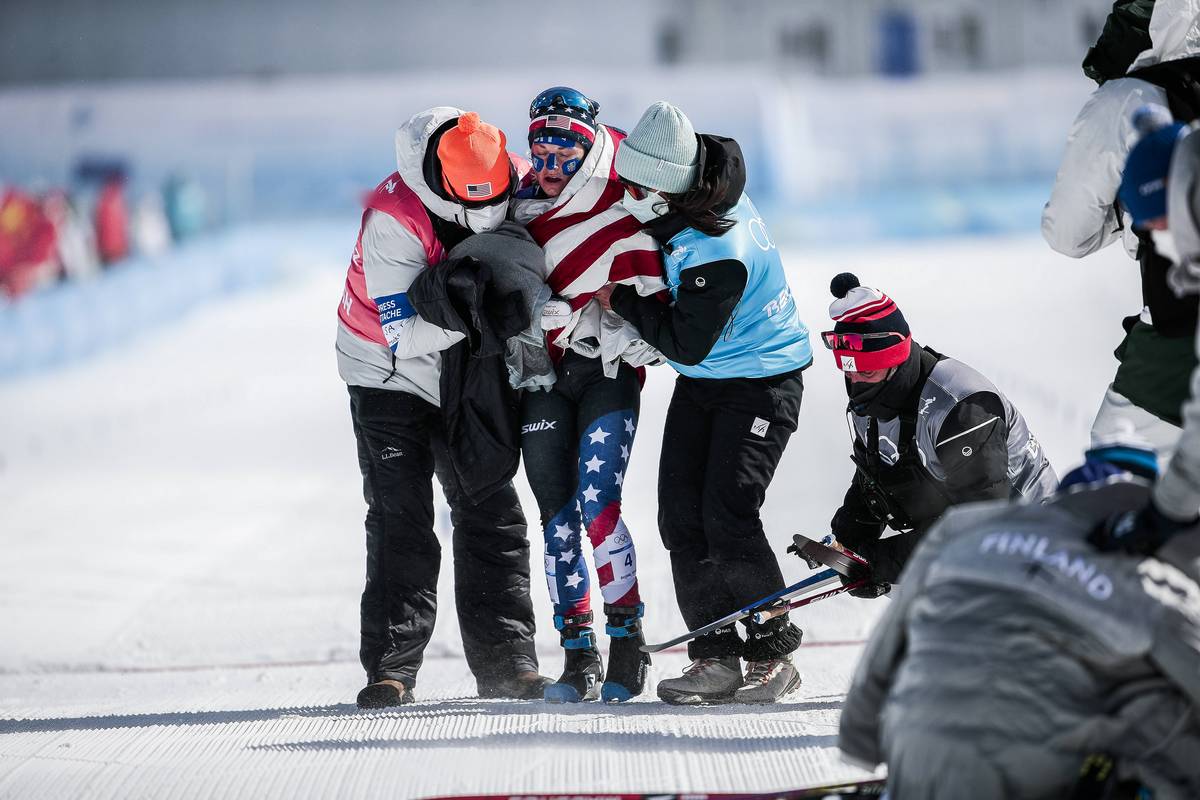
    Diggins even won a silver medal in a long-distance race at the 2022 Games after what she said was her own case of food poisoning. 

    After collapsing at the finish line, Diggins is helped off the course following the Olympic 30 k skate, where she pushed through food poisoning to earn a silver medal. (Photo: NordicFocus)

    But cross-country skiers are especially vigilant about respiratory viruses like COVID or the flu because of their sport’s dependence on their lungs. Infection could derail an athlete’s hopes for the full Olympics. 

    “You definitely get impacted more,” said Kendall Kramer, an American team member from Alaska. “Your body has to be definitely 110% to do the sport on any given day.”

    The U.S. team, Kramer said in a phone interview Wednesday, has collectively agreed to form, in effect, an Olympic bubble among themselves.

    “Worst-case scenario is someone’s a little more loosey goosey because they don’t have as much on the line. And then they would get some hard-hitters sick,” she said. 

    U.S. coaches Kristen Bourne and Matt Whitcomb wore masks at Thursday’s news conference. (Nathaniel Herz for FasterSkier)

    That means athletes will miss out on some of the traditional social aspects of the Games, she acknowledged. But it’s also creating a tighter and more private living experience for the team, Ben Ogden, one of the U.S. men, said at a news conference.  

    “We’re pretty locked down trying not to get sick,” he said. “But that’s okay — because we have six, seven of our best friends inside the bubble.”

    At least one other cross-country ski team is on a similar program. The Swedish tabloid Expressen reported that one of the team’s stars, Ebba Andersson, arrived Tuesday in Italy and will isolate from her teammate and boyfriend, Gustaf Berglund, for the first 48 hours after her arrival. 

    That’s the most likely window for her to start experiencing viral symptoms if she was exposed during travel, the team’s doctor told Expressen.

    Ebba Andersson (SWE) skiing in Val di Fiemme, Italy, during the Individual Sprint of the Tour de Ski on the Olympic course. (Photo: Modica/NordicFocus) 

    “We have closed our hotel. We don’t want outsiders in, and we don’t want infections to come in,” the doctor, Rickard Noberius, told the newspaper. “So, it’s just us and the family who run the hotel — and they have been given strict restrictions as well.”

    The risks of inadequate precautions have become painfully apparent for other athletes in Milan — specifically, the Finnish women’s hockey team. The squad has been hit by an outbreak of norovirus that’s either infected or forced the isolation of 13 players, said Lassi Kuisma, a reporter with Iltalehti, a Finnish newspaper, who’s covering the story from Milan.

    Just eight players and two goalies were able to practice Thursday and the team had to postpone its first game, against Canada. Players are currently facing harsh scrutiny in the Finnish press because of a video filmed Sunday that they posted on Instagram of team members singing a Backstreet Boys song at karaoke at a restaurant outside the Olympic village.

    “Nobody knows where the virus came from, of course,” Kuisma said in a phone interview. “But the team is putting itself under the microscope because they did a thing like that right before the tournament.”

    A columnist at Kuisma’s newspaper contrasted the hockey players’ conduct with that of Finnish cross-country ski star Iivo Niskanen, who’s known for taking strict precautions about his health. Her headline, in a rough translation, said that the women’s hockey team “really screwed up — Iivo Niskanen would never do the same.”

    As for the American skiers, it’s not just Diggins who will forgo time with a spouse during the Olympics. 

    Athlete Zak Ketterson said his time with his wife, who’s traveling to the Games from Minnesota, will also likely amount to outdoor hangs, or possibly with masks indoors. 

    While it can be difficult for everyone on a personal level to limit time with loved ones, Ketterson, like Diggins, said the restrictions totally make sense given how much athletes and the U.S. team have invested in preparing for the Olympics and booking their hotel. 

    “The Olympics are just a few weeks every four years,” he said. “So we can lock in a little bit.”

    Help Support Our Olympic Coverage!

    FasterSkier has our own Nat Herz on the ground at the Olympics, which is a significant financial lift for us. If you value the thoughtful work and access FasterSkier provides at championships like this one, please consider becoming a Voluntary Subscriber. Your support directly fuels our work to cover the people, places, and moments that make our sport special.

    Join the FasterSkier community!


  • Schumacher! Two Days, Two Podiums

    Schumacher! Two Days, Two Podiums

    This coverage is made possible through the generous support of Marty and Kathy Hall and A Hall Mark of Excellence Award. To learn more about A Hall Mark of Excellence Award, or to learn how you can support FasterSkier’s coverage, please contact info@fasterskier.com.

    Gus Schumacher (USA) celebrates his second place finish in the World Cup Classic Sprint in Goms, Switzerland. It was his second World Cup podium finish in as many days. (Photo: Authamayou/NordicFocus)

    Maybe the Americans really are that good . . .

    With the Olympic Games just around the corner, American men (lots of them!) are surging toward the front of the World Cup field. And while the last few World Cup weekends have been events that were only sparsely attended by the sports brightest stars, today’s Classic Sprint in Goms Switzerland was a fully stacked field with most of the primary contenders present. Many of them would be hoping that this event would be a dress rehearsal for the Classic Sprint that will be raced during the Olympics in Val di Fiemme.

    Over the last few weeks, it’s been kinda cool to see what racing would look like in the absence of Johannes Hoesflot Klaebo . . . but now it’s time to turn from things as they have been, and return to things as they should be. Klaebo is back, and it’s an amazing time to watch ski racing: perhaps the greatest ever to do this sport is currently racing and skiing among us. Who knows? Maybe this will be his final season. If he were to succeed during the Olympic Winter Games of Milano-Cortina in the same way he succeeded at last year’s World Championships in Trondheim (six races, six wins, Nordic skiing immortality), there would virtually be nothing left for him to win. This skier has taken us to a rare place in sport history: Babe Ruth is alive and swinging, Muhammad Ali dances across the ring, and we get to watch history played out on live-streamed broadcasts. Let’s enjoy it—and marvel at it—while we can.

    Gus Schumacher (USA) claimed his second podium in as many days with a brilliant second-place finish behind,Johannes Hoesflot Klaebo (NOR) and ahead of Edvin Anger (SWE). (Photo:  Authamayou/NordicFocus)

    While Klaebo is back on tour—and coasted to yet another World Cup Classic Sprint victory—it felt more like an American coming out party and less like yet another Klaebo coronation. Gus Schumacher led the way with a brilliant and confident second place, ahead of a bull-headed Edvin Anger (SWE) who continues to think that Klaebo can be beaten with brute force and raw power. Klaebo proved Anger wrong yet again . . . but it was Schumacher who stole the show.

    “These courses are really hard, like that hill is about a minute long,” said Schumacher. “And yeah, being an all around athlete—like having some distance ability—it really helps me out there.”

    And Schumacher was not the only American to deliver standout performance in Goms. Five American men qualified in the top 17: Ben Ogden 6th, Zak Ketterson 9th, Schumacher 12th, Schoonmaker 13th, Zach Jayne 17th. Jack Young did not produce the Classic sprinting result he may have hoped for. He finished qualifying 39th, just over a second outside the advancing standard. Kevin Bolger also would’ve found himself disappointed this morning in Goms, completing his qualifying round in 61st.

    “The qualifier was a great opportunity to improve on my disappointing results last weekend,” said Jayne. “I created an ambitious race plan and with the great wax support, I delivered. Given that—and given the tough course—I don’t find the (qualifying) result too surprising, but it is a nice treat.”
    JC Schoonmaker (USA) was one of a host of American men delivering great performances in Goms. In the Classic Sprint, Schoonmaker would qualify 12th, and finish 10th overall. (Photo: Authamayou/NordicFocus)
    Americans Crowd the Heats

    The beginning of the Sprint heats made it look like Klaebo was involved in a different sort of drama . . . after the strong qualifying effort of Individual Neutral Athlete, Savelii Korostelev. With the Olympics approaching—and Korostelev improving his performances each week (especially in Classic events)—Klaebo may have felt it prudent to give the young Russian a better look so that he didn’t find himself surprised in Milano-Cortina. Facing Korostelev in Quarterfinal 1, Klaebo drifted craftily to the rear for a clearer view of the young Russian. There Klaebo stayed through the first uphill, and the second where Lauri Vuorinen lost momentum, blocking Klaebo’s progress and wedging him behind Korostelev. But all it took was one extra push from Klaebo over the top to send him flying down the other side—past Vuorinen, past Korostelev, past Valnes, and across the finish line for the heat win. Valnes held on for second in. front of a fast-closing Korostelev.

    Ogden followed Edvin Anger through the second quarterfinal, holding on for second ahead of a fast-charging Hovard Moseby (NOR) who would also secure a lucky loser spot.

    Zachary Jayne and JC Schoonmaker entered Quarterfinal 3 alongside Even Northug (NOR) and Oskar Opstad Vike (NOR). Jayne went straight to the front, determined to use his evident qualifying speed to insure a fast heat. Jayne’s enthusiasm would be quickly curbed by the thin air of high elevation and the slow snow that resulted from overnight accumulations. Jayne would fade to the rear of the field (ultimately finishing 27th on the day) while Schoonmaker surged forward in pursuit of Theo Schley (FRA). Schoonmaker would hold his advantage, even easing up a bit before the line ahead of Anton Grahn (SWE), Vike, and Northug.

    “The heats were just on another level,” said Jayne. “The heat selection was particularly stressful and something I have never experienced before. I chose heat 3 because, statistically, it has the most lucky losers. My position at the front just happened organically and I paid the price for a fast start. Happy to race the way I did, but unsatisfied with the outcome, more to learn and more to reach for. Great day for the Americans and I am truly honored to be a part of it, no matter how small my contribution.”

    After his all-out chase onto yesterday’s Team Sprint podium, it would be understandable if Schumacher appeared sluggish in Quarterfinal 4. But that’s not the way Schumacher races. He seems to have an ability to recover quickly, and to ride waves of seasonal momentum. He popped to the front at the top of the final climb (ahead of an inexplicable stall from Joni Maki), and surged down the other side where he would hold his advantage across the finish line

    Ketterson found himself at the front of what initially appeared to be a tactical heat. He employed an earlier diagonal stride on the first uphill than the rest of his heat, remaining light and quick. If there’s a smart way to ski at the front of a slow heat, Kettterson was demonstrating it. He scampered up the final hill as the field crowded around him, then veered, regretably, into the tracks on the shorter righthand side, slamming the door (as it turns out, a bit over-zealouslys) on Sweden’s Georg Ersson who was lucky to escape with poles and skis intact. Ersson would overcome Ketterson in the finishing straightaway, advancing to the semifinal. Ketterson would find himself disqualified in what would otherwise have been a personal best Classic Sprint performance.

    “Completely my fault!” said Ketterson. “He was in my blind spot and it was a split second decision that obviously ended up being a big blunder. I should have just stayed in my own track and taken the position behind him on the final downhill.”
    “The classic sprint at the Olympics has been my primary goal for the entire season, said Ketterson. “I hope I have shown enough ability to earn a start, but from this point on it’s not within my control so I will just do my best to focus one day at a time.”
    As they say in NASCAR, rubbing is racing . . . and American men were solidly in the mix in every heat of Goms’ Classic Sprint, including the first semifinal where Erik Valnes NOR) hit the deck as JC Schoonmaker (USA) headed for the hinterlands.  (Photo: Authamayou/NordicFocus)
    Classic Sprint Semifinals

    Three American men—Ogden, Schoonmaker, Schumacher—advanced to the Sprint semifinals. Three guaranteed finishes in the top 12: that’s a sign of a seriously strong team. But while it’s great to qualify for a Sprint semifinal, the names on the roster when you get there can be pretty daunting. Semifinal 1: Klaebo, Anger, Schoonmaker, Valnes, Ogden, Northug. That’s a seriously stacked heat. In that semifinal, Klaebo’s start was far more assertive than his quarterfinal, and it produced the result of luring Anger out into an early lead. On-air commentator, Andrew Kastening, got it totally right: “You’d think as time would go on, that Edvin Anger would learn to let Klaebo lead,” said Kastening. Evidently, Anger is not the quickest learner . . .

    Ogden and Schoonmaker maneuvered through the pack, their kick wax seeming sufficient on the ascent of the first hill, but their glide on the downhill seeming less than stellar. Anger continued to lead over the top of the second hill. On the subsequent downhill, Klaebo glided into a too-small gap on the inside of Anger, who held his line and allowed Klaebo to ease through without issue (well done, Edvin). The move allowed Klaebo into the lead, but it sent ripples through the skiers behind the leading duo. Valnes found his ski tips tangling with Schoonmaker’s tails . . . Valnes ended up flopping spectacularly onto his backside while Schoonmaker was launched through the V-boards and into the soft snow of the infield. Schoonmaker somehow managed to avoid complete disaster, stayed on his feet, and managed to find his way back on course. Ogden wove through the carnage to finish third, where he’d wait to see if he would advance to the final as a lucky loser. Schoonmaker would finish fifth behind Northug. Valnes would limp home in sixth.

    The second semifinal was relatively less star-studded, though still featured Sprint standouts such as Vike, Ersson, Joni Maki (FIN) Simone Mocellini (ITA), Anton Grahn (SWE), and Schumacher. Mocellini would make most of the pace in the heat, cresting the final hill with a slim lead over Schumacher. Schumacher would ride fast skis down the final slope, and step deftly inside of Mocellini as they entered the final double pole sections. Schumacher would hold on to cross the finish line first, and advance to the Sprint Final where he would join Ogden.

    Johannes Hoesflot Klaebo (NOR) pushed an unwitting Edvin Anger (SWE) into the lead in both the semifinal and final. (Photo: Authamayou/NordicFocus)
    Classic Sprint Final

    Two Americans advanced to the Classic Sprint Final—that’s a seriously legit statistic—where they’d be joined by Anger, Mocellini, Northug, and the omnipresent Klaebo. Ogden had already looked fatigued in the semifinal (after a high-intensity podium finish in yesterday’s Team Sprint, who can blame him?), but Schumacher continued to look fresh and fast.

    “I was definitely pretty tired from the Team Sprint yesterday,” said Ogden. “Gus and I were pretty fired up; hard to fall asleep (so) I was feeling yeseterday, today1 And with the training block I’ve been doing the last few weeks, I think that was on full display in the final. But I’m still stoked with how today went, for sure. The plan was not to be the best version of myself this weekend—maybe like second best version—so I’m feeling pretty good about how that went down!”

    “I think I still capitalized,” continued Ogden. “And got away with a really really solid day. Good stuff . . . awesome for the team, awesome for everybody!”

    Anger never seems to learn. Maybe one day he’ll become as dominant as his ski tactics currently imply he thinks he is . . . but in Goms’ Classic Sprint Final he was just another guy playing right into Klaebo’s hands. Schumacher is a quick study, though; he’s learned where he nees to be, and he slotted in right behind Klaebo who skied the very same race as in the semifinals: let Anger lead across the flats, step into an open lane to keep from getting bunched on the first uphill, while continuing to force Anger to keep his nose in the wind. Poor kid . . . he imagines himself in a rivalry with Klaebo, who seems only to consider Anger as a convenient stepping stone to ever more Sprint victories.

    That’s when Klaebo switched it up—flowing past Anger on a downhill, powering up the final climb, high-tempo diagonal stride from bottom to top, effectively deciding the race with 400 meters still to go. Schumacher rocketed past Anger as the rest of the field locked up behind the stultified Swede. Schumacher showed his tremendous form and fitness, remaining quick and snappy to the end, powering across the line just behind a relaxed and coasting Klaebo. Schumacher—and Team USA’—would earn a second World Cup podium in as many days. It’s bizarre to watch a Sprint Final become a death march, but such was the level of exhaustion that the Goms Sprint course had loaded into the arms and legs of these racers. Anger survived across the finish line in third. Ogden faded to sixth. Even so, two Americans in a Classic Sprint Final . . . there haven’t been many days that Team USA would celebrate more than this one.

    Schumacher summarized his progress,and his prospects: “The way it’s set up, these races actually probably will give me a bit of a boost, fitness wise, which is cool to think about.”

    Klaebo continues to lead in all World Cup categories this season: Sprint, Distance, and Overall. His level of dominance is unprecedented as the field approaches the Olympic Winter Games.

    Men’s Classic Sprint RESULTS

    Men’s Classic Sprint QUALIFYING

    Help Support Our Olympic Coverage!

    FasterSkier will have our own Nat Herz on the ground at the Olympics, which, to be honest, is a very big financial lift for us. If you value the thoughtful work and access FasterSkier provides at championships like this one, please consider becoming a Voluntary Subscriber. Your support directly fuels the work we do to cover the people, places, and moments that make our sport special.

    Join the FasterSkier community!
  • Klaebo Controls Toblach as Schumacher Anchors the Chase in Men’s 20 k Classic Pursuit

    Klaebo Controls Toblach as Schumacher Anchors the Chase in Men’s 20 k Classic Pursuit

    This coverage is made possible through the generous support of Marty and Kathy Hall and A Hall Mark of Excellence Award. To learn more about A Hall Mark of Excellence Award, or to learn how you can support FasterSkier’s coverage, please contact info@fasterskier.com.

    Johannes Hoesflot Klaebo (NOR) paced the Tour de Ski 20 K Classic in Toblach (ITA) to perfection. (Photo: Vanzetta/NordicFocus)

    By mid-morning in Toblach, the cold had settled into the valley in that particular Dolomite way—dry, bright, and unforgiving. The stadium clock read 10:30 a.m., the tracks were hard-packed, and the Tour de Ski—never gentle, always exacting—had reached a moment where patience mattered as much as power. Stage 4’s men’s 20-kilometer classic pursuit would not be decided by theatrics. It would be decided by discipline.

    From the first push out of the starting line, Johannes Høsflot Klæbo made that clear.

    The Norwegian leader skied as if tethered to an internal metronome, clicking off splits that barely wavered across five laps of the 4-kilometer loop. Behind him, the race congealed into a dense, minute-long chase—ambitious but realistic, orderly but never comfortable. Inside that group, Gus Schumacher did what pursuit racing rewards: work when it mattered, wait when it didn’t, and finish inside the race rather than on its margins.

    Johannes Hoesflot Klaebo (NOR) on his way to first place on the 20 K Classic Pursuit. (Photo: Vanzetta/NordicFocus)

    Klæbo’s Quiet Authority

    Klæbo entered the day with the yellow bib and skied as though intent on keeping it uncontested. At 4 kilometers, he led in 9:11.8; at 8 kilometers, 18:23.4; at 12, 27:34.6; and at 16, 36:53.3—the first three splits almost exact to the tenth. He crossed the line in 46:01.7, never once letting the chase compress to a threatening distance.

    Second place belonged to Mattis Stenshagen (+51.1), who skied the most assertive race of those behind Klæbo and briefly tested the cohesion of the chase on the fourth lap’s long climb. Third went to Edvin Anger (+59.8), tied on time with Italy’s Federico Pellegrino, whose classic form looked as efficient as it did economical. Emil Iversen finished fifth (+1:00.2), matching Schumacher stride for stride to the line.

    That minute—barely more than a breath in Tour de Ski terms—defined the race.

    Gus Schumacher (USA) did much of the work early to bring the chase into one pack behind Klaebo. (Photo: Vanzetta/NordicFocus)

    Schumacher in the Middle of It

    Schumacher finished sixth, also +1:00.2, part of the decisive chase that refused to fracture even as the course repeatedly asked for answers. The result came less than 24 hours after his 5 k freestyle win in Toblach, and the transition—emotionally and physically—was not trivial.

    “It was a little bit tough, honestly,” Schumacher said. “This pursuit started at 10:30 a.m., and I haven’t woken up before eight in probably a month because all our races have been so late. … I definitely enjoyed the win, but the focus was to refocus right away. It’s another new day, and this race was really important for the Tour.”

    Inside the race, Schumacher was not hiding. He described closing the gap to Iversen after the early climbs and doing much of the work that consolidated the group—an effort he acknowledged with pride. “I did most of that work, which I’m actually pretty proud of,” he said. What he didn’t do was overreach. “I wasn’t trying to catch Klæbo or anything,” Schumacher added. “Even though some of the guys might have been thinking that.”

    The fourth lap told the story. Stenshagen pressed hard on the long climb out of the stadium, stretching the elastic just enough to test resolve. Schumacher bent but didn’t break. Over the top, the group exhaled. The fifth lap came fast—but not frantic—and Schumacher found himself boxed in late, a tactical note he filed away rather than lamented.

    “With the overall standings so tight, I don’t think it’s worth thinking about it too much,” he said. “I’m sitting in third right now, and top ten is definitely still the goal. … Everyone from second through ninth is so close that it really comes down to focusing day by day.”

    That may be the most Tour de Ski answer of all.

    Gus Schumacher (USA), Emil Iversen (NOR), Edvin Anger (SWE), and Lars Heggen (NOR) worked together to prevent Klaebo from extending his lead. (Photo: Vanzetta/NordicFocus)

    A Chase by Committee

    Behind Schumacher, the chase’s cohesion owed as much to restraint as to strength. Lars Heggen (seventh, +1:00.3) and Benjamin Moser (eighth, +1:00.8) rounded out a group that included Harald Østberg Amundsen (ninth, +1:03.1). No one bridged to Klæbo; no one detonated the pack behind. The race’s geometry stayed intact.

    That stability mattered in a Norwegian context. With Olympic selection pressure already humming and only a few men’s spots still unsettled, Toblach functioned as both race and audition. Stenshagen’s second place was emphatic. The Tour does not reward one-off brilliance. It rewards survivability.

    Ben Ogden (USA) finding his classic distance form. (Photo: Vanzetta/NordicFocus)

    The Americans: Process Over Panic

    Further back, the pursuit revealed its less visible truths. Ben Ogden finished 29th (+3:03.3), a result that reads well on paper and even better when you hear how he raced it.

    “The biggest challenge is always the start,” Ogden said. “For me, it was about trying to pace the race properly, even when people were moving ahead of me early. … I started with a pack, then a bunch of them dropped me, and I just kind of let that happen, knowing I’d be able to catch some of them later—which I did.”

    That in-and-out rhythm—sometimes lonely, sometimes crowded—is pursuit racing in the middle of the field. Ogden framed it honestly. “Racing in a tight group is obviously more fun,” he said, “but you really have to pace yourself and try not to lose unnecessary time in a Tour, especially when you’re already a little tired.”

    For Zak Ketterson, who started deep in the order, the early kilometers were chaos by design. He finished 42nd (+3:55.1), but the route there mattered.

    “The wave is really challenging, especially starting in bib 70,” Ketterson said. “Five or six seconds have already passed before I even reach the start line. The first two laps were chaos, and I was just trying to stay relaxed and avoid trouble.”

    He did move forward—damage control after a Stage 2 crash that had already cost him minutes. “It was nice to move up a lot today,” Ketterson said, “but the classic sprint on Stage 5 is definitely the main focus now.”

    Ketterson also addressed the jury’s written reprimand for use of a banned technique in a marked stride zone—a penalty that did not disqualify him but appears in the official record. “The technique violation came from double poling in a stride zone,” he explained. “I changed tracks to pass someone, and the motion of doing that ended up being a double pole.”

    For Zak Ketterson (USA), the Tour de Ski hasn’t exactly gone as he had hoped, but today in the pursuit, he showed his form from earlier in the season. (Photo: Vanzetta/NordicFocus)

    When the Day Turns on a Ski

    Kevin Bolger finished 51st (+4:18.6), a result shaped by circumstance rather than strategy. Bolger had been patient by design, content to let early red-lining pass him by before advancing after lap two. Then a ski broke.

    “I like to settle in, and then after lap two start working my way up the field,” Bolger said. “I was just about to do that today when someone merged into my track and broke my ski, which cost me close to a minute. That was pretty disappointing.”

    Before that moment, his choices had been sound. Toblach’s two main climbs invite early commitment to kick wax, and Bolger leaned into it. “It was an easy choice to really feel the kick wax early,” he said. “The skis were feeling great, and I was really excited about how I was going to start moving up the field.”

    Bolger’s broader view was measured, almost cheerful in its realism. “This Tour isn’t quite as massive as some of the past ones,” he said. “It’s about gaining confidence and fitness, as long as you’re able to absorb it after the Tour.” Olympic energy is present, he acknowledged, but not consuming. “At the end of the day, I’m just trying to race fast.”

    J.C. Schoonmaker placed 56th (+4:42.7), while Jack Young finished 80th (+8:07.2), both navigating a day where patience was mandatory, and opportunities were earned in inches rather than meters.

    Andrew Musgrave (GBR) and Antoine Cyr (CAN), (l-r) moving up through the field together. (Photo: Vanzetta/NordicFocus)

    Canada: Trials Done, Work Ongoing

    Canada’s men arrived in Toblach with their Olympic trials already behind them and the Tour serving a different purpose. Antoine Cyr led the way in 13th (+1:54.5), with Thomas Stephen 28th (+3:02.6) and Xavier McKeever 30th (+3:08.1). The emphasis now is accumulation—fitness, familiarity, resilience—rather than immediate results.

    Context at the Margins

    The Tour de Ski has a way of narrowing options without warning. On Thursday morning, one Norwegian men’s Olympic hopeful, Oskar Opstad Vike, withdrew close to start time, a reminder that the margins between readiness and retreat are thin, especially in an Olympic year. Toblach did not create that pressure; it merely revealed it.

    Mattis Stenshagen (NOR) was excited when he crossed the finish line as if he knew he had shown the Norwegian Olympic selectors enough to make the team. (Photo: Modica/NordicFocus)

    What the Splits Say

    A look at the time checks explains why the race felt so controlled. Klæbo’s advantage barely fluctuated. The chase group’s gaps among themselves were measured in seconds—Schumacher, Iversen, Anger, and Pellegrino trading fractional advantages without a decisive rupture. Further back, time losses accrued not in dramatic collapses but in quiet inefficiencies: a missed pack, a broken ski, a moment of over-enthusiasm.

    The course profile—five laps, 137 meters of total climb—rewards restraint. Toblach does not forgive impatience.

    A broken ski for Kevin Bolger (USA) didn’t prevent him from showing his form in Toblach (ITA). (Photo: Vanzetta/NordicFocus)

    Looking Ahead

    Stage 4 did not reshuffle the Tour so much as clarify it. Klæbo remains the reference. The men chasing him know exactly how much ground they have—and how little room there is to gamble it away. Schumacher’s position near the top of the standings is real, earned through effort and discretion. Behind him, athletes like Ogden, Ketterson, and Bolger are racing a Tour that asks for perspective as much as speed.

    Val di Fiemme awaits with its own demands and, this year, Olympic resonance. But Toblach offered a simpler lesson. In a pursuit, the clock is visible; the choices are not. The best skiers make the hard ones look easy—and the easy ones count.

    Men’s 20 K Classic Pursuit Start RESULTS

    Men’s 2026 Tour de Ski OVERALL STANDINGS

    Fastest Skiers on the Day – Men (Top 15, Net Time Only)

    This ranking removes pursuit start gaps and shows who skied the fastest 20 km classic on Stage 4.

    Day Rank Athlete Nation Net Time
    1 Edvin Anger SWE 45:39.5
    2 Simen Hegstad Krüger NOR 45:44.0
    3 Federico Pellegrino ITA 45:45.5
    4 Mattis Stenshagen NOR 45:51.8
    5 Emil Iversen NOR 45:51.9
    6 Gus Schumacher USA 45:52.9
    7 Truls Gisselman SWE 45:58.5
    8 Antoine Cyr CAN 45:59.2
    9 Hugo Lapalus FRA 46:00.5
    10 Johannes Høsflot Klæbo NOR 46:01.7
    11 Benjamin Moser AUT 46:03.5
    12 Savelii Korostelev AIN 46:04.5
    13 Harald Østberg Amundsen NOR 46:07.8
    14 Andrew Musgrave GBR 46:13.6
    15 Lars Heggen NOR 46:17.0

    Net time calculated as finish time minus individual pursuit start offset.

    Places 3-7 where this close for Federico Pellegrino (ITA), Edvin Anger (SWE), Gus Schumacher (USA), Emil Iversen (NOR), (l-r) after 20 K in Toblach (ITA). (Photo: Modica/NordicFocus)

    Love Stories Like This? Help Keep Them Coming.

    Feature stories like this one take time, access, and care to produce. If you value thoughtful storytelling and independent ski journalism, please consider becoming a Voluntary Subscriber. Your support directly fuels the work we do to cover the people, places, and moments that make our sport special.

    Join the FasterSkier community!


    Mattis Stenshagen (NOR), Johannes Hoesflot Klaebo (NOR), and Edvin Anger (SWE), (l-r) shared the pursuit podium in Toblach (ITA). (Photo: Modica/NordicFocus)


  • Schumacher Wins in Toblach as New Four-Heat 5K Format Turns the Race into a Clock-Chasing Puzzle

    Schumacher Wins in Toblach as New Four-Heat 5K Format Turns the Race into a Clock-Chasing Puzzle

    This coverage is made possible through the generous support of Marty and Kathy Hall and A Hall Mark of Excellence Award. To learn more about A Hall Mark of Excellence Award, or to learn how you can support FasterSkier’s coverage, please contact info@fasterskier.com.

    Gus Schumacher (USA) and the rest of Heat 2 climb over Toblach’s iconic feature during the 5 K Freestyle. (Photo: Modica/NordicFocus)

    The Tour de Ski has always asked skiers to live with imperfect information. You race hard when you’re tired. You make decisions based on feelings and instincts, while coaches are screaming ‘splits.’ You tell yourself the only honest thing in a stage race: don’t do anything you can’t recover from tomorrow.

    On Wednesday, the Tour leaned fully into that uncertainty — and then amplified it.

    Stage 3, a 5-kilometer freestyle, arrived with a new wrapper: four separate mass-start heats, each sent off at a different time, with final standings determined only after all heats were complete and all times were combined. The spectacle was real — a small parade of high-speed skating races rather than one long pageant — but the competitive implications were sharper than the format’s novelty suggested. Skiers weren’t simply racing the men next to them. They were racing an invisible standard set by athletes they couldn’t see, in heats that could be slower or faster for reasons that had nothing to do with any one skier’s fitness.

    If that sounds like chaos, it wasn’t. Not for Gus Schumacher.

    Schumacher (USA) didn’t treat the new format as a novelty or a gamble. He treated it like a solvable problem — and in doing so, he won the stage in 9:35.4, claiming the second World Cup victory of his career and stamping his authority on a Tour de Ski day that felt, at times, like a controlled experiment.

    Behind Schumacher, Austria’s Benjamin Moser was second (+0.2), and Norway’s Lars Heggen — the U23 skier who helped turn Schumacher’s heat into a metronome — was third (+0.6).

    And here is the detail that will define how this stage is remembered: the top seven overall finishers all started in the same second heat, the heat that began at 11:48:45. In a race decided on aggregate time, that start time became a kind of gravitational center — the heat where cooperation, pace, and intention converged into the day’s fastest runway.

    Ben Ogden (USA), JC Schoonmaker (USA), Remi Drolet (CAN), and others follow Johannes Hoesflot Klaebo (NOR) during the third heat of the 5 K Freestyle. (Photo: Modica/NordicFocus)

    The Format: Four Races, One Result — and a Quiet Incentive to Collaborate

    The four start times — 11:30:00, 11:48:45, 12:07:30, and 12:26:15 — didn’t just separate the field. They separated narratives. In one heat, the pace would be relentless and communal; in another, it might be cagey, tactical, or simply a touch less urgent. In a normal mass start, you can afford to be patient. In a normal 5K interval start, you can measure yourself against the clock. On this day, you had to do both — without complete visibility into either.

    U.S. head coach Matt Whitcomb framed it simply: the 5K has been absent from the World Cup menu for long enough that today was “unknown territory,” and athletes had to be ready to adapt. “Nobody really knew what to expect,” he said — not because the course was mysterious, but because the format forced a different kind of decision-making.

    Whitcomb also emphasized that heat assignments weren’t random theater. They were determined by overall Tour standings after two stages, via a snake-draw system written into the rules — in other words, the groups were structured, and the group you landed in mattered.

    That mattered most in the heat Schumacher found himself in — and, crucially, in the way he decided to race it.

    Gus Schumacher (USA) leads Heat 2 during Stage 3 of the Tour de Ski in Toblach (ITA). (Photo: Vanzetta/NordicFocus)

    Heat 2 Becomes the Day’s Engine

    By the time Schumacher’s heat went off at 11:48:45, the day already had shape: one race had happened, a set of times had been posted, and the Tour’s new experiment had revealed its first truth — you could win your heat and still lose the stage.

    Schumacher and his heat-mates didn’t merely acknowledge that truth. They embraced it.

    “I think my heat-mates and I realized that having a fast heat was the biggest picture,” Schumacher said afterward. “I was prepared to be 10th in the heat if it meant we were fast.”

    That sentence — prepared to be 10th if it meant we were fast — is the kind of thing athletes say when they’re not racing for ego. It’s what they say when they’re racing for an outcome.

    Schumacher described how the plan became practical: “We were able to trade leads also with Ben Moser’s help and keep the pace fast without too much effort before the hills, then actually continued to work together even better than I thought we would from there into the finish.”

    Whitcomb confirmed the same dynamic from the outside: Schumacher “reached out to Lars Hagen and Ben Moser and came up with a plan,” and the result was “well orchestrated trading off of the lead,” the kind of collaboration you don’t often hear described so plainly in a World Cup race. In a typical mass start, you hide. In a typical interval start, you suffer alone. In this format, the fastest solution was neither — it was to share the work early and arrive at the decisive sections with enough fuel to race, not just survive.

    And the split data makes the story legible.

    At 1.7 km, Schumacher hit 2:54.2. Moser was 2:54.4. Heggen was even quicker at 2:53.5. The heat was not strolling into the race; it was setting terms.

    At 2.7 km, Schumacher reached 4:59.6, and the heat’s front remained dense and alive. By 3.1 km, Schumacher was at 6:16.4 — still close enough to the line that the stage would be won in the last two kilometers, but far enough out that the wrong decision on the climb would show up in the final time like a bruise.

    Schumacher’s last 1.9 km — from 3.1 km to the finish — was the sharpest of the podium trio, and among the best in the field. He closed in 3:19.0, a finish that wasn’t just a sprint, but a controlled acceleration from a high baseline.

    This is what it looked like in practice: a heat that refused to turn into a chess match. A group that made the race fast enough to matter. And a skier — Schumacher — who could do the work and still finish.

    Gus Schumacher (USA) and Benjamin Moser (AUT) lead other Stage 3 top finishers to the line in Toblach (ITA). (Photo: Modica/NordicFocus)

    The Podium: Schumacher Leads, Moser Hangs, Heggen Announces Himself

    Schumacher’s stage win — 9:35.4 — put him at the center of the day’s story, but the day’s podium also revealed how perfectly the format could reward the right combination of collaboration and individual capacity.

    Moser (AUT), second at 9:35.6, was integral to the heat’s pace-making. Heggen (NOR), third at 9:36.0, wasn’t a passenger either — he was part of the mechanism.

    Schumacher was explicit about what the format rewarded him for. “Sometimes I feel like a jack of all trades and a master of none,” he said, “but high-speed skating with an element of required distance capacity is a place where I can excel. I think Minneapolis had that too.”

    It’s the kind of description that links two very different wins — one on home snow in Minneapolis in a 10K Freestyle Interval Start, the other here, in a four-heat 5K puzzle — without pretending they are the same. What connects them, Schumacher suggested, is the ability to ski fast in a way that isn’t fragile: pace you can sustain, not just ignite.

    “I’ve been feeling good, but I’m still building momentum,” he said. “Today definitely helped.”

    Benjamin Moser (AUT), Gus Schumacher (USA), Mattis Stenshagen (NOR), (l-r) worked together to claim the podium of the 5 K Freestyle. (Photo: Vanzetta/NordicFocus)

    Where the Race Was Won: The Climb, the Urge to Go Early, and the Last Kilometer

    If Heat 2 was the engine, the course still demanded decisions — and it punished some of them.

    J.C. Schoonmaker (USA), who would finish 29th, described the mental load of the format in a way that felt honest rather than polished. “The new format just changed the way I thought about things because I felt I needed to be prepared for lots of different scenarios,” he said. “I probably haven’t done a 5K since high school… I was just trying to be ready for whatever came and be ready to react to it.”

    Schoonmaker pinpointed the moment that mattered: “On the big climb, I sensed that things were starting to stretch out a bit, so that was where I decided I needed to make a move. It was a bit early in hindsight because our heat ended up staying together, and I got pretty tired in the very end and lost some positions.”

    That’s the stage’s second truth: in a format like this, you can race aggressively and still end up punished by the math. An early move that might win you your heat can also drain the last 400 meters you need to protect your time — the thing that actually counts.

    Ben Ogden (USA), 20th, offered the same theme from a different angle. He admitted he didn’t dictate his heat’s tempo — and that, in hindsight, he wished he had done more when he felt capable.

    “I didn’t really dictate the pacing in my heat,” Ogden said. “I let Klaebo and Stenshagen really dictate the pacing, and I just held on as best I could.”

    Then the key sentence — the one that tells you how easy it was, in this format, to race the wrong race: “It’s hard to remember that it’s sort of us versus them a little bit in that race format rather than just trying to win your group.”

    Ogden noted that his heat’s final kilometer became a bit of a one-man chore: “Pellegrino led for most of the last K… down through the corners and stuff. I think it would have been better if we’d been trading off leads.”

    In other words, the format quietly rewards heats that turn into rotating pacelines and punishes heats that turn into sprints for pride.

    Schumacher’s heat was a paceline that never forgot the clock.

    Ben Ogden (USA) and Johannes Hoesflot Klaebo (NOR), (l-r) leading Heat 3 of the 5 K Freestyle in Toblach, Italy. (Photo: Vanzetta/NordicFocus)

    The Americans: A Day of Depth Under a Day of Headlines

    Schumacher’s win was the headline, but the U.S. team’s men didn’t only deliver a winner. They delivered a set of performances that made the result feel like something sturdier than a single bright point.

    Here’s where the Americans landed on the day:

    • 1st: Gus Schumacher (USA) — 9:35.4
    • 20th: Ben Ogden (USA) — 9:45.4
    • 29th: J.C. Schoonmaker (USA) — 9:46.2
    • 41st: Zak Ketterson (USA) — 9:48.9
    • 42nd: Jack Young (USA) — 9:49.1
    • 79th: Kevin Bolger (USA) — 10:08.9

    Whitcomb framed the broader men’s story as an execution day — athletes moving up within their heats and carrying out their plans — and in a stage race, that matters. You can’t win a Tour de Ski on one beautiful moment if you give it away everywhere else. You win it by repeatedly doing things that don’t make headlines: staying attached, eating enough, recovering enough, skiing smoothly when you’re cooked.

    Schoonmaker, in particular, gave a clear explanation of how the heat system changed the burden of responsibility. “For someone like me, the group I was in played a big part in my result,” he said. “As someone with not a ton of distance prowess, I didn’t have much responsibility to lead, so I was able to sit in the back and wait.”

    Then, without making excuses, he told the truth about the dependency built into the format: “That basically made it so my overall time was in the hands of the top guys — but with that being said, it also does take fitness to stay with them.”

    It’s a nuanced defense of the format — and also a subtle admission that it can be cruel. It can make your best decision feel like passivity. It can make your best fitness feel like waiting.

    Schoonmaker ended with the line the sport’s decision-makers will want to hear: “It’s a cool balance of tactics and fitness, sprinting and distance, and I hope they keep this format around.”

    Johannes Hoesflot Klaebo (NOR) was the fastest in Heat 3, but that was only good enough for 12th place overall on the day. (Photo: Modica/NordicFocus)

    Norway: The Pressure Cooker Is Always On

    Norway, as ever, arrived in Toblach with depth so thick it looks almost unfair from the outside — and with selection pressure that turns every race into a referendum.

    Johannes Høsflot Klæbo (NOR) finished 12th in 9:44.0, a day when his 12th place looked strange even when the format explained it. Emil Iversen (NOR) was 8th in 9:42.5. Harald Østberg Amundsen (NOR) finished 17th in 9:44.7. Andreas Fjorden Ree (NOR) was 9th in 9:42.6.

    But the real Norwegian story at the sharp end was Heggen — third — and the way his podium was tied to a heat that chose to cooperate rather than conserve. In the Olympic year, Norway’s selection picture isn’t just about who can win on a given day. It’s about who can be trusted to perform across formats, courses, and chaos — and this format delivered chaos with a stopwatch.

    If you are a coach trying to build a roster for Milano-Cortina, you probably liked what you saw from athletes who could do the work and still finish — athletes who could be generous early and ruthless late. That’s not a ski cliché. It’s a trait.

    Antoine Cyr (CAN) led the way for the Canadian men on a strong day in Toblach (ITA). (Photo: Vanzetta/NordicFocus)

    Canada: After Trials, Into the Fire — and Right on the Doorstep of the Top 10

    Canada came into the Tour de Ski after holding Olympic trials at home — a different rhythm than many of their European rivals — and Stage 3 gave the Canadian men a tidy set of results that will matter both psychologically and practically.

    Antoine Cyr (CAN) led the Canadians in 11th (9:43.8), with Xavier McKeever (CAN) 13th (9:44.2) and Max Hollmann (CAN) 14th (9:44.3).

    In a race where the top seven all came from one heat, those placements have extra weight: they suggest Canada wasn’t simply lucky with a draw. They were close enough to the best to make the math uncomfortable. They were within seconds — the kind of seconds that, in a Tour, can turn into minutes if you don’t recover, and can turn into opportunity if you do.

    And because this format was so dependent on heat tempo, these results also reinforce a quieter Canadian strength: the ability to race within a fast-moving group and stay composed enough to cash it in at the end.

    Benjamin Moser (AUT), Gus Schumacher (USA), Lars Heggen (NOR), (l-r) celebrate the podium in Toblach (ITA). (Photo: Modica/NordicFocus)

    A Stage That Felt Like a Debate About the Sport — and a Race That Still Had to Be Won

    The Tour de Ski has always been, in some sense, a referendum. It’s a referendum on endurance. On recovery. On whether your season has enough structure to survive a week of high heart rates and thin margins.

    This stage was something else too: a referendum on presentation. On whether cross-country skiing can be made to feel urgent to people who don’t already love it.

    FIS itself framed Stage 3 as a premiere — the first Heat Mass Start event of its kind at the World Cup level — and pointed directly to fan engagement as a key motivation for the format shift.

    Whitcomb put it less diplomatically in his own way: in his view, whether the format stays should be determined by what fans think, because “what the fans think dictates whether or not the sport survives in some regards.” He described traditional, interval starts as difficult for casual viewers — not because the racing isn’t real, but because it can be hard to feel the tension without context.

    Wednesday’s format was designed to create tension. You could see the effort. You could see the decisions. You could see the finish. And then you had to wait — which is its own kind of tension — to learn what it meant.

    But none of that changes the simplest truth of Stage 3: Schumacher still had to win it.

    He had to be strong enough to take pulls. Smart enough to strategize and invest in cooperation. Calm enough to accept a plan that might have left him “10th in the heat” if the math demanded it. And then, at the end, he had to be fast in the most old-fashioned way — a finish that doesn’t care about format innovation, that doesn’t care about start times, that doesn’t care about how clever you were at 1.7 kilometers.

    It cares only about what you have left when the line is close enough to hurt.

    Three nations working together, one shared podium for Benjamin Moser (AUT), Gus Schumacher (USA), Lars Heggen (NOR), (l-r) in Toblach (ITA). (Photo: Modica/NordicFocus)

    The Tour Moves On — and the Final ‘Hill’ Looms

    Schumacher, already looking forward, kept his gaze where Tour de Ski veterans always keep it: on what the next stage demands.

    “Those time gaps are tight,” he said. “I’ll keep taking it day by day and especially try to ski well tomorrow and keep in mind how important that hill climb will be.”

    That’s the Tour in one sentence: tight gaps, day by day, and a hill that doesn’t care how good you felt yesterday.

    The new 5K heat format gave the Tour a jolt of spectacle, yes — but it also gave us something more interesting: a day that rewarded not only fitness, but the willingness to race in a way that made sense for the structure of the event.

    Schumacher understood it. His heat executed it. The numbers validated it.

    And now the Tour moves on with the usual debts: tired legs, shifting standings, and the knowledge that in a stage race, the best days are never purely celebrations. They are also investments — and the bill always comes due tomorrow.


    Men’s 5 K Mass Start Freestyle RESULTS

    Men’s 2026 Tour de Ski OVERALL STANDINGS


    Love Stories Like This? Help Keep Them Coming.

    Feature stories like this one take time, access, and care to produce. If you value thoughtful storytelling and independent ski journalism, please consider becoming a Voluntary Subscriber. Your support directly fuels the work we do to cover the people, places, and moments that make our sport special.

    Join the FasterSkier community!


    The taste of victory for Gus Schumacher (USA) on the FIS World Cup. (Photo: Vanzetta/NordicFocus)
  • Stenshagen Sets the Pace in Toblach as the Men’s Tour Takes Shape

    Stenshagen Sets the Pace in Toblach as the Men’s Tour Takes Shape

    This coverage is made possible through the generous support of Marty and Kathy Hall and A Hall Mark of Excellence Award. To learn more about A Hall Mark of Excellence Award, or to learn how you can support FasterSkier’s coverage, please contact info@fasterskier.com.

    Mattis Stenshagen (NOR) took stage two of the Tour de Ski in Toblach (ITA). (Photo: Vanzetta/NordicFocus)

    By the time the final seeded skier pushed through the finishing straight in Toblach, the race had already revealed what interval starts always do best: not who looks fastest, but who stays fastest when no one is there to help.

    On a clear, cold Monday morning in northern Italy, the men’s Tour de Ski distance competition began in earnest with a 10-kilometer classic interval start — a race that rewards patience, punishes impatience, and exposes any weakness in pacing, technique, or timing. For some, it was a statement. For others, a warning. For nearly everyone, it was a reminder that the Tour de Ski is less a series of races than a slow accumulation of consequences.

    At the front of the field, Mattis Stenshagen (NOR) delivered the cleanest distance race of his World Cup career, leading from the opening checkpoint to the finish and winning Stage 2 in 22:11.0. Behind him, familiar names followed — Johannes Høsflot Klæbo and Emil Iversen — but the day belonged to the skier who never wavered, never overreached, and never gave back time once he took it.

    Mattis Stenshagen (NOR) led wire to wire in the 10 K Interval Start Classic. (Photo: Vanzetta/NordicFocus)
    A Classic Race, Skied Classically

    From the opening 2.1-kilometer split, Stenshagen established a rhythm that no one else matched. His early advantage was not explosive, but it was decisive: a smooth, efficient tempo that translated into the fastest time at every checkpoint — 2.1 km, 3.0 km, 5.0 km, 6.7 km, 8.0 km — and ultimately at the finish.

    Behind him, the race for the podium unfolded with more complexity.

    Klæbo, starting later with the gold Tour de Ski leader’s bib, skied conservatively through the opening kilometers, conceding small amounts of time before gradually tightening the gap. His second-half splits were among the fastest in the field, but by then Stenshagen’s advantage was already established. Klæbo finished 8.9 seconds back, a strong result that preserved his overall lead without demanding unnecessary risk.

    Iversen followed a similar arc — controlled early, assertive late — but never quite bridged the gap to Klæbo, finishing third at +10.1. Behind the podium, the field compressed quickly, with Iivo Niskanen, Edvin Anger, Erik Valnes, and Harald Østberg Amundsen all skiing within seconds of one another through the middle splits before settling into their final placings.

    It was the kind of race that rewards experience — and punishes even small mistakes.

    Johannes Hoesflot Klaebo (NOR) kept close to the lead on the day and preserved his Tour de Ski lead. (Photo: Modica/NordicFocus)
    Norwegian Depth, Olympic Stakes

    If the Tour de Ski is often described as a test of endurance, for the Norwegian men it is also something else entirely: an extended job interview.

    With the Olympic Games returning to Italy in February, every race carries an added layer of pressure. The margins between selection and omission are thin, and performances like Stenshagen’s matter not just for podiums, but for perception. Beating Klæbo, Iversen, Valnes, and Amundsen head-to-head in a classic interval start sends a message — especially when it is done decisively.

    Emil Iversen (NOR) continued making his case for one of the valuable Norwegian Olympic team spots. (Photo: Vanzetta/NordicFocus)

    The depth of the Norwegian field was evident throughout the top ten, but Stage 2 clarified one thing early in the Tour: no spot is guaranteed beyond Klæbo, and even he is racing with calculation rather than abandon.

    Gus Schumacher (USA) led the American men in the 10 K Classic Interval Start in Toblach (ITA). (Photo: Vanzetta/NordicFocus)
    Schumacher Leads the Americans on a Complicated Day

    For the U.S. men, the day unfolded with a mix of promise and frustration — a pattern that became clear as the split times accumulated.

    Gus Schumacher emerged as the top American finisher, placing 17th, just under 50 seconds back. His race was defined by steadiness rather than volatility, with consistent splits that kept him in contact with the top 20 throughout the day. In a Tour de Ski that rewards durability as much as peak form, Schumacher’s result positioned him solidly in both the stage results and the overall standings.

    Still, Schumacher felt there was more on the table.

    “The pacing wasn’t amazing,” he said. “It was close to the race I expected, but it could have been a bit better with a little more energy over the last two or three kilometers.”

    Part of that equation came down to ski feel — specifically, kick wax that required more effort than anticipated.

    “I think my kick was slightly slipperier than I expected based on how it felt in testing,” Schumacher said. “Having to work for the kick more than I planned on the second lap tilted the scales of my pacing a bit. Overall, it was a solid day, but some small changes could have made a big difference.”

    Rather than holding back, Schumacher said he plans to continue racing the Tour aggressively, while being deliberate about recovery away from the course.

    “This year’s Tour doesn’t feel too hard, so managing load isn’t really on my mind during the races,” he said. “Outside of racing, I’m trying to give myself a lot of quiet time, but I don’t feel any reason to hold back in my efforts.”

    His goals for the Tour strike a careful balance between ambition and pragmatism.

    “I want to end up top 10, but most of all I want to finish,” Schumacher said. “A lot of my focus is on doing everything i can to avoid getting sick.”

    Zak Ketterson (USA) was sharp early during the 10 K Classic in Toblach (ITA). (Photo: Vanzetta/NordicFocus)
    Zak Ketterson’s Race Changes in an Instant

    Through more than seven kilometers, Zak Ketterson was skiing the way he had during the first part of the season.

    His early splits placed him firmly in contention for a top-15 finish, and as he crested the final significant climb with just one uphill remaining, the trajectory of his race appeared set. Then, in an instant, it wasn’t.

    “This race was going really well for me up until I crashed on a really high-speed downhill at about 7.3 kilometers,” Ketterson said. “I was fighting for a top-15 finish and had just one uphill left to go.”

    The fall itself was only the beginning.

    Zak Ketterson (USA) continued his form from November and December through most of the race before a crash changed his day. (Photo: Vanzetta/NordicFocus)

    “After I got up, my muscles got insanely stiff, and I felt really dizzy and disoriented,” he said. “I honestly thought about DNF’ing at that point and was just in survival mode to the finish.”

    The split data tells the story clearly: a sharp loss of time between the 7.1- and 8.0-kilometer checkpoints, followed by a fight simply to reach the line. Ketterson finished well outside his early-race position, but his performance before the crash suggested a level of classic skiing that bodes well for the remainder of the Tour and beyond.

    “I’m feeling okay now — I don’t think I injured anything, but I’ll see how things feel over the rest of the day,” he said. “My shape feels good, so hopefully I’m back in the fight on Stage 3.”

    Ben Ogden (USA) looked strong early in Toblach (ITA). (Photo: Modica/NordicFocus)
    Ogden’s Setback Comes Early

    For Ben Ogden, the defining moment came much earlier in the race.

    Based on the split times, Ogden’s momentum shifted between the 3- and 5-kilometer checkpoints, where a promising early pace gave way to a sudden loss of time. The cause was broken equipment — and a prolonged scramble to find a usable replacement.

    “I broke a pole right around three kilometers — maybe a little before,” Ogden said. “After that, I was kind of swapping poles until I finally got one that was the right side and the right length, which was a bummer.”

    What followed was an unusually long stretch of improvisation in the middle of a World Cup race.

    “I was swapping poles for probably two and a half kilometers,” he said. “I think I swapped four times — from an Italian coach, to a Swiss coach, to an American coach, and then finally to one of my own spare poles that was the right height and side.”

    Ogden eventually crossed the line in 46th, a result that understated how well he felt he was skiing before the incident — and how difficult it was to mentally reset afterward.

    Ben Ogden (USA) crosses the line in Toblach (ITA) with a trail of random poles scattered throughout the course behind him. (Photo: Vanzetta/NordicFocus)

    “It was hard to get back into it mentally,” he said. “But I felt like I skied pretty well over the last couple of kilometers, so I was happy with that. I definitely wish I could have put together the race I felt capable of.”

    From a Tour de Ski perspective, the lost time was costly. But Ogden emphasized that his broader season goals remain intact.

    “My biggest goals this year aren’t in the Tour,” he said. “I still feel like I can take steps toward my big goals this year and feel good about that. These tours can change really quick. I’ve been in the top five in the Tour, and then after one race, I’ve been 40th, so maybe the same will happen in the opposite, but, yeah. Definitely just keep my eye on my main goals this year and trying to stay positive and keep fighting.”

    Antoine Cyr (CAN) during his second World Cup race this season. (Photo: Modica/NordicFocus)
    A Canadian Return to the World Cup

    Stage 2 also marked a quiet but meaningful milestone for the Canadian men, who arrived in Toblach for their first World Cup races of the season after holding Olympic trials in Canada before Christmas.

    Antoine Cyr led the Canadian contingent with a solid performance just outside the top 20, while teammates followed in behind. For a group using the Tour de Ski as both a competitive platform and a form-building block toward February, the results offered a baseline — not definitive answers, but a starting point.

    Johannes Hoesflot Klaebo (NOR), Mattis Stenshagen (NOR), Emil Iversen (NOR), (l-r) take the podium of the 10 K Classic in Toblach (ITA). (Photo: Vanzetta/NordicFocus)
    The Long View of the Tour

    The Tour de Ski rarely reveals its winner on the first distance day. Instead, it reveals tendencies: who overreaches, who fades late, who absorbs pressure, and who survives adversity without letting it define the week.

    In Toblach, Stenshagen showed he could control a race from the front. Klæbo showed he could defend without exposing himself. Others — Ketterson among them — showed flashes of form that mattered more than a single line in the results.

    By the time the Tour leaves Toblach for Val di Fiemme, the standings will shift again. Fatigue will accumulate. Risks will sharpen. And the races will begin to resemble not just World Cups, but rehearsals.

    In Italy, on familiar snow, the men are already practicing for something larger.


    Men’s 10 K Individual Classic RESULTS

    Men’s 2026 Tour de Ski OVERALL STANDINGS


    Love Stories Like This? Help Keep Them Coming.

    Feature stories like this one take time, access, and care to produce. If you value thoughtful storytelling and independent ski journalism, please consider becoming a Voluntary Subscriber. Your support directly fuels the work we do to cover the people, places, and moments that make our sport special.

    Join the FasterSkier community!


    Mattis Stenshagen (NOR) had lots to celebrate following today’s race in Toblach (ITA). (Photo: Vanzetta/NordicFocus)
  • The Devon Kershaw Show: Zak Ketterson moved to Norway. Now he’s having a breakout season.

    The Devon Kershaw Show: Zak Ketterson moved to Norway. Now he’s having a breakout season.

    After growing up in the Twin Cities, Zak Ketterson embarked on an experiment this past year, moving to Oslo and training with a Norwegian team. The decision paid off with a top-10 on the World Cup. With Devon focused on family during the Christmas season, Nat caught up with Zak to hear about training, racing and how he covers his financial obligations as a non-U.S. Ski Team athlete.

    Speaking of financial obligations: We’re really trying to pump up our fundraising with just over one month before Nat heads to the Olympics — an event we’re really looking forward to but one that also comes with significant expense. You can become a voluntary member at here. If you’re already a member, thank you.

    We’ll be back soon. Reach us at devon[at]fasterskier.com and nat[at]fasterskier.com. Thanks for listening.

  • The Devon Kershaw Show: Buckle Up for a Six-Race Ruka Recap

    The Devon Kershaw Show: Buckle Up for a Six-Race Ruka Recap

    It’s on — the 2026 Olympic season, that is. Devon and Nat break down six season-opening races from northern Finland, including a thriller in Sunday’s men’s race.

    Contact us with fan mail, hate mail and everything in between: devon[at]fasterskier.com and nat[at]fasterskier.com. We’re looking for title and other sponsors for our Olympic coverage; email matthew[at]fasterskier.com with inquiries.

  • A Breakaway, a Broken Pole, and a Biathlete’s Bet: Amundsen Wins a Wild 20 k in Ruka

    A Breakaway, a Broken Pole, and a Biathlete’s Bet: Amundsen Wins a Wild 20 k in Ruka

    This coverage is made possible through the generous support of Marty and Kathy Hall and A Hall Mark of Excellence Award. To learn more about A Hall Mark of Excellence Award, or to learn how you can support FasterSkier’s coverage, please contact info@fasterskier.com.

    Sunday morning in Ruka had the look of a place holding its breath. The sun sat low over the trees, the air hovered just on the warm side of freezing, and the men’s World Cup field stepped into the stadium with the faint stiffness of athletes who had already skied two challenging races in two days. A thin glaze shone on the 4-kilometer loop, the kind that makes skis feel nervous and alive at the same time, and even before the starter raised his arm, you sensed the day would run fast.

    The stadium sits at the high point of the course in Ruka, so the men’s 20km mass-start free begins not with the controlled civility of a long climb but with a plunge. Skiers can hit 80 kilometers an hour on the opening descent, the field funneled into two uneasy lanes, and the whole pack—Johannes Høsflot Klæbo included, wearing the yellow bib and chasing the mythical 100th World Cup win—had to thread that speed through a hairpin that felt too tight for comfort even on TV.

    Harald Oestberg Amundsen (NOR) finds his way through the traffic of the Men’s 20 k Freestyle mass start in Ruka (FIN). (Photo: Modica/NordicFocus)

    Ruka is an odd, angular loop: long, steady work on the one side; a shorter, punchier grind up the Impilinna climb; then a sweeping dive back toward the stadium before the last drag to the line. Five laps. One early-season opportunity to reshape the winter. And an Olympic year, which meant that every Norwegian on the line was skiing for more than points—they were skiing for selection.

    Among the Americans, the storylines were as varied as their bibs: Gus Schumacher and Zanden McMullen seeking another elite result after their success in Ruka a year ago, Zak Ketterson racing with newfound confidence after a career-best 14th in Friday’s classic 10 K, and a young supporting cast learning the dynamics of a fast, narrow pack on a tricky course.

    Nothing broke early. The first lap was quick but calm, a kind of rolling truce among athletes who knew how violent the final lap could become. But the race’s character changed—the way good races do—at the unexpected moment.

    Mika Vermeulen (AUT) leads Edvin Anger (SWE) through the stadium. (Photo: Modica/NordicFocus)
    The Gamble at 9.1km

    At the 9.1km sprint banner, Sweden’s Edvin Anger made the first real incision in the race. The 23-year-old surged for bonus points—as expected—but then did something far more interesting: he kept going. Mika Vermeulen of Austria latched on, the two of them taking the descent like they meant it, and for the first time all day, the pack blinked.

    Within a kilometer, the gap was three seconds. Then seven. Then ten. The move was reminiscent of the early break in a bike race. The French and Germans led the chase instead of Norway. Hugo Lapalus briefly tried to bridge and cracked. The Norwegians refused to panic.

    Behind the break, Schumacher and Ketterson were having very different but equally impressive races. Schumacher hovered between fourth and eighth through the middle laps, completely comfortable in traffic. Ketterson floated near the top ten, choosing clean lanes, maintaining position with a calm that looked like something new.

    Further back, Einar Hedegart—the 23-year-old biathlete-turned-cross-country-skier whose win at the Norwegian opener in Beitostølen had already rattled some assumptions inside Norway’s Olympic selection system—drifted quietly toward the front.

    By 13 kilometers, Anger and Vermeulen’s advantage peaked at roughly 13 seconds. It wasn’t supposed to hold. But it looked real. And it was enough to force the race’s next twist.

    Einar Hedegart (NOR), follows Johannes Hoesflot Klaebo (NOR) through the stadium. (Photo: Modica/NordicFocus.)
    The Turn, the Crash, and the Broken Ski

    Gus Schumacher’s day changed off-camera.

    “The race was going super well,” Schumacher said after the finish. “It felt relatively easy; my body was super responsive with great energy. I was able to keep really good position, which is massive in this race.”

    Then came the downhill at roughly 14km, the kind of section where pack dynamics feel like a living organism.

    “I was gliding up on the left side, and Klæbo switched lanes right in front of me, sweeping my tips out. It was too quick and unpredictable for me to do anything,” Schumacher said. “I fell off the side of the trail, my ski ran into the hard snow on the edge, and it broke the tip.”

    He skied another full lap on the damaged ski.

    In the hard, fast conditions, it was just stable enough to keep him in touch—and switching skis would almost certainly have meant losing the group entirely. Remarkably, even with the partial break, Schumacher clawed back toward the front, positioning himself to sprint for a top spot.

    And then the bad luck doubled.

    “In the last kilometers, it got stuck in the deep snow of the test track and broke the tip fully, and that was the end.”

    He finished 39th, but the skiing he showed before the equipment failure will matter more than the result does.

    “I’m super proud of how I was skiing… My body is in a great place, but this weekend’s luck just hasn’t gone my way. Long season ahead.”

    Andrew Musgrave (GBR) and Einar Hedegart (NOR), (l-r) during the final race of the weekend in Ruka (FIN). (Photo: Modica/NordicFocus)
    The Pole Break, the Surge, and the Catch

    At ~16 kilometers, Harald Oestberg Amundsen—already a pre-race favorite—snapped a pole.

    It could have been the story. Instead, it became the turning point.

    Service handed him a new pole instantly. Amundsen slotted back in, glanced up the trail, and began to close the gap. Hedegart came with him. Nyenget followed. The chase, which had felt half-committed earlier, finally had purpose.

    With Anger and Vermeulen still dangling up the trail and the course running out of time, Amundsen moved to the front and began applying real pressure. The gap shrank visibly on the Valkosenvaara climb. By the time the race wound back toward the stadium, the two leaders were in sight, the rope fraying.

    What came next was pure Amundsen.

    He caught the break on the final climb. And then he kept going.

    Gus Schumacher (USA), (NOR), Johannes Hoesflot Klaebo (NOR), Zak Ketterson (USA), Harald Oestberg Amundsen (NOR), and Einar Hedegart (NOR) among others climbing up the final climb of the lap in Ruka, Finland. (Photo: Modica/NordicFocus)
    The Ruka Climb and the Decisive Moment

    With roughly 500 meters left—just before the crest of the Ruka climb—Amundsen stepped out from the group and launched his move. It wasn’t desperate or chaotic; it was clean, timed, and confident. Hedegart tried to respond. Nyenget tried. Anger fought with everything left.

    Nobody matched him.

    Amundsen crested alone, floated through the final meters, and took his 11th career World Cup win with the kind of clarity that defines a season.

    In an on-air broadcast interview after the finish, he explained the day as a study in patience and timing:

    “The conditions were so high-speed that I was quite nervous on the downhills,” he said. “On the first four laps I was pretty far behind and struggling to move up, but I had saved some energy. On the last lap, I felt very strong.

    When they got the gap at the beginning, I was quite far behind, so I just had to wait. But on the last lap, I thought, you can’t just let this go, so I put everything in and caught them on the last uphill… I had good legs today.”

    Behind him, Hedegart—just one year removed from biathlon—finished a remarkable second. Anger earned third after animating the race with the early breakaway. Nyenget was fourth; Vermeulen fifth.

    And Klæbo, in a rare off-day, was 15th.

    Zak Ketterson (USA), and Friedrich Moch (GER), (l-r) lapping through the stadium during the Men’s 20 k Mass Start Freestyle in Ruka (FIN). (Photo: Modica/NordicFocus)
    An American Breakthrough

    Zak Ketterson recorded the best American result of the day—ninth place, the first top-10 of his World Cup career in a mass start—and the performance looked more like the product of design than circumstance.

    Ketterson entered the day already benefiting from Friday’s career-best 14th in the 10 k classic, which earned him a forward bib placement on a course where position matters as much as fitness.

    “I was fortunate to start really far up in the pack because of my performance in the 10 k, and that was huge in such a tight and tactical field,” Ketterson said. “I knew if I moved too far back, it’d be really hard to move back up, so I planned to defend my position as well as I could.”

    He executed the plan with the kind of composure that has eluded him in past mass starts. On a slick, tense course where one mistake could cost half the field, Ketterson held clean lanes, avoided every significant disturbance, and stayed in the top 10–15 as the race stretched into the final lap.

    What’s emerging this season is not just fitness, but a foundation built well before Ruka.

    “This summer and fall, especially, my wife Julie and I went all in on trying to prepare as well as possible for this year,” he said. “I worked harder than I ever have and also have had a really good mindset. That it’s working so well so far is a big testament to all the hard work, and my wife Julie should get a lot of credit for being my number one support staff.”

    The strongest signal of progress came in the final kilometer, when the real attrition began, and Ketterson didn’t fade—he held and even advanced.

    “It meant a lot to be able to have a strong finish because, as I said earlier, I often would finish these types of races and move backwards in the pack,” he said. “I think the fact that I was able to relax so much of the race made it so that I had that energy that was necessary when the pace picked up. I am really proud of how calm I stayed, even though the race was so tight, and the conditions were super sketchy, icy, and fast.”

    For a U.S. men’s program that continues to build depth quietly, Ketterson’s weekend—14th + 9th—marks a meaningful step. It also gives the team, and head coach Matt Whitcomb, a new data point as Olympic-year relay and selection conversations begin.

    Einar Hedegart (NOR) celebrates the victory in Ruka (FIN). (Photo: Modica/NordicFocus)
    What This Race Means

    For Norway: The selection picture grows even more impossibly crowded. Amundsen is in towering early-season form. Hedegart is no longer a curiosity—he’s a factor. Nyenget remains brutally consistent. Klæbo is still the biggest star in the sport, but his chase for World Cup win No. 100 will now continue into Trondheim.

    For the rising generation: Three of the top six—Anger, Hedegart, Desloges—are 23 or younger. The youth wave is no longer a subplot; it’s the plot.

    For the Americans: Ketterson’s top-10 creates new conversations about relays and the Olympics. Schumacher’s form before the crash suggests he’s ready for significant results as soon as his luck stabilizes.

    For the sport: A genuine breakaway, a serious chase, a late-lap catch, a pole break, a ski break, and a new podium—all in one race.

    Ruka is supposed to be the season’s prologue. This one felt like chapter one.


    Men’s 20 k Mass Start Freestyle RESULTS


    Einar Hedegart (NOR), Harald Oestberg Amundsen (NOR), Edvin Anger (SWE), (l-r) share the podium of the Men’s 20 k Freestyle Mass Start in Ruka, Finland. (Photo: Modica/NordicFocus)

    Love Stories Like This? Help Keep Them Coming.

    Feature interviews like this one take time, access, and care to produce. If you value thoughtful storytelling and independent ski journalism, please consider becoming a Voluntary Subscriber. Your support directly fuels the work we do to cover the people, places, and moments that make our sport special.

    Join the FasterSkier community!


  • Nyenget Claims Ruka 10 k, But It’s Not Only Norway on the Podium

    Nyenget Claims Ruka 10 k, But It’s Not Only Norway on the Podium

    This coverage is made possible through the generous support of Marty and Kathy Hall and A Hall Mark of Excellence Award. To learn more about A Hall Mark of Excellence Award, or to learn how you can support FasterSkier’s coverage, please contact info@fasterskier.com.

    Martin Loewstroem Nyenget (NOR) was victorious in Ruka, Finland for the second time in his career. Norway continues its hold on the top of the podium, but more contenders are arising to vie for the remaining steps. (Photo: Modica/NordicFocus)

    Where skiing venues are concerned, winter arrives first in Kuusamo, Finland, site of the ski resort known as Ruka. It makes sense, then, that the 2025-2026 FIS World Cup season would begin in this far-northern place where sunrise and sunset are barely separated by actual daylight.

    The first races of the season are about straightening out the kinks and blowing out the cobwebs. Everyone needs to get back in the groove: athletes, coaches, wax techs, broadcasters, statisticians, reporters. Some pick up right where they left off, others stumble out of the gate, still others wonder why they’ve showed up at all. But the season is long, and performances in the first race (whether memorably good, or memorably bad) don’t forge a mold for the entire season.

    The first FIS World Cup broadcast of the 2025-2026 season suffered from many of the same problems befalling any local race conducted on slushy trails around a city golf course. Conditions are always challenging and stressful, waxing and ski selection make a difference, and the electric timing often fails to work perfectly. In Ruka, on-air commentators Chad Salmela and Kikkan Randall were often left with race splits that failed to update, or blank screens that gave them no information at all. But Salmela and Randall are seasoned pros: they rolled with the punches, and called the race that the cameras showed them. Likewise, most skiers hit their stride by race’s end, and the final results ended up looking like what many fans might’ve expected.

    In pre-race interviews, American, Ben Ogden, expressed the excitement at the start of a new season. “I’ve been hunkered down in Vermont, doing what I do,” grinned Ogden. “I’m excited to be traveling again . . . Nothing like a good ol’ Ruka 10 k to get your Classic skiing going again.”

    The 10 k distance is one requiring both endurance and speed, though neither quality is sufficient to guarantee success in this all-out event. Go out too fast, and you’ll flame out. Start too conservatively, and you’ll never catch up to faster starters. The winner will be the one who commits to the risk of a fast start, and is able to somehow pick up even a bit more speed at the end. Quite a balancing act, quite a miracle of modern athletic performance. Quite a harsh baptisim to start off a World Cup season. Let the racing begin!

    Mika Vermeulen (AUT) reminds us that more than just Norwegians have chances to earn glory in the season to come. (Photo:  Modica/NordicFocus)

    But nothing is certain when it comes to competing at this level—and even the most glowing reputations do not guarantee racing success. World Cup racing is FAST, and there’s no way to know if a racer has that speed until they pull on a bib and toe the starting line. Based on his unprecedented level of domination last season, we kind of expect Klaebo to win . . . but Klaebo didn’t win everything last season, and an interval start race is one in which just about anyone can pop up and deliver a good one. Ultimately, Klaebo earned a spot on the podium, but it seemed almost like an afterthought. Klaebo found himself in the unusual position of being overshadowed by not only the day’s winner—Martin Loewstroem Nyenget (NOR)—but also by the third place skier—Austria’s Mike Vermeulen. Norway had another big day, but it’s evident that Norwegians won’t be the only ones waving their flag on the World Cup podium this season.

    Americans were led by Zak Ketterson’s laudable 14th place finish. He was followed by Ben Ogden 33rd, Gus Schumacher, 36th, Zanden McMullen 47th, JC Schoonmaker 61st, John Steel Hagenbuch 62nd, Luke Jager 67th. No Canadian skiers were entered in this event.

    “I definitely made an effort to control my opening pace, and that’s been a huge focus of mine this offseason,” said Ketterson. “I had a lot of races in the past few seasons where I was top 10 in early splits before blowing up. I know I have this type of performance in me if I pace the race well and have good skis—today was both!”
    10 k Classic Interval Start

    Ten kilometers may not be a truly “classic” distance—the great events of our sports history were typically conducted over far greater distances—but beginning the season with a Classic Interval Start event seems like a tip of the hat to the long history of cross-country skiing. For generations, the races that mattered in cross-country skiing were those in which lone skiers strided into the forest, following narrow pre-set tracks, undertaking daunting solo time-trials toward distant finish lines.

    The lights had already turned on, illuminating Ruka’s ski jumping hill, before the men took to the trails for their 10 k Classic. Like the women’s field had done just a couple of hours before, the men raced two laps around a five kilometer course that climbed up and down Ruka’s steep, benchlike hill sides. The field of 109 starters included the flags of many nations not normally associated with cross-country skiing: Bermuda, Chile, Thailand, India, Peru, Armenia, Israel, Venezuela, Ecuador. It’s an Olympic year, after all, and races from many nations will want to carry their flags into that arena.

    The week leading up to today’s race had been very cold with no new snow, but temperatures approached freezing by race time. The difficulties of waxing and ski prep would be compounded by a light snow that began falling just before the start. Ski testing had all but concluded, setting the stage for any number of potential waxing disasters on Ruka’s steeply climbing course.

    Finland’s eyes were  on native son, Iivo Niskanen—a renowned Classic skiing specialist—who’s Classic skiing prowess was likely to impact the results. Win or lose, Niskanen races with passion and fire; he’s always likely to leave his heart on the course in Ruka. Wearing bib 51, Niskanen was the first of the pre-race contenders to test the course. All other chasers would judge themselves against Niskanen’s split times. Ogden’s pre-race enthusiasm had bubbled to the surface in the early kilometers, as he came through the 1.1 kilometer checkpoint first among early starters. His pace appeared even more solid when he was bettered by Niskanen, but only by a tenth of a second.

    Mika Vermeulen (AUT) was the surprise of the Ruka 10 k Classic. He raced hard from the gun, and secured a place for Austria on the podium. (Photo:  Modica/NordicFocus)

    Klaebo came through the first time check in seventh, a bit behind Niskanen and virtually tied with Edvin Anger (SWE). At 3.1 kilometers, the second time check showed a close race between Anger, Harald Oestberg Amundsen, Klaebo, and Niskanen. Mika Vermeulen (AUT) came surging through the field to put up the fastest split time at 6.1 kilometers.

    Wearing bib number 79, Nyenget possessed the advantage of being the latest starter of all the pre-race contenders. Nyenget used his late starting position to hunt down those who’d gone before, posting a time even faster than Vermeulen. Niskanen appeared to fade down the stretch, coming across as the fastest finisher at that point, just ahead of Mattis Stenshagen (NOR) and holding off Valnes by .1 seconds. Niskanen would finish the day in fifth. Like Niskanen, Anger faded late, ending his day in ninth.

    Nyenget came through with fastest splits at 8.1 kilometers (leading Klaebo by seven seconds). The race would depend on who finished with the most energy in the final two kilometers. Vermeulen crossed the finish line to displace Niskanen from the leader’s chair, but Klaebo and Nyenget were still on course and charging through the final kilometers. Vermeulen’s time in the leader’s chair was shortlived, as Klaebo drove across the line to push the Austrian into second place by 2.1 seconds.

    Seen here duroing the 10 k Classic from the 2025 World Championships in Trondheim , Zak Ketterson (USA) delivered a career-best performance (14th) in Ruka. (Photo: Modica/NordicFocus.)

    Nyenget began his drive to the finish at the same moment he caught up to American, Zak Ketterson.

    “When I saw pre-race that Nyenget was starting behind me, I figured he would catch me before the end of the first 5k lap,” Ketterson explained. “For him to not catch me until the very last hill at about 9.2k was a really nice surprise. It was just a case of matching his pace so that I didn’t get overexcited and go too fast up that hill.”
    Together, Nyenget and Ketterson powered up the final hill where Nyenget pulled away in the herringbone section after Ketterson caught a tip.

    “My plan was to ski fast over the top but I faceplanted at the top of the last hill when my kick wax iced up,” Ketterson said. “I tried to stomp off the snow that had built up, but the skis just stopped in their tracks and I faceplanted!”

    Ketterson would recover to claim his best-ever World Cup finish: 14th place, barely 30 seconds removed from the podium. Nyenget would hold on to best Klaebo by 2.1 seconds, earning the second Ruka Classic win of his World Cup career.

    In post-race interviews, Nyenget, himself, seemed a bit surprised by his victory. “When you hear Johannes is closing the gap—you know he has a beast of a finish,” Nyenget said. “I tried to just maintain my focus on myself.”

    10 K Classic Interval Start RESULTS

    Love Stories Like This? Help Keep Them Coming.

    Feature interviews like this one take time, access, and care to produce. If you value thoughtful storytelling and independent ski journalism, please consider becoming a Voluntary Subscriber. Your support directly fuels the work we do to cover the people, places, and moments that make our sport special.

    Join the FasterSkier community!


    First podium of the World Cup season: Johannes Hoesflot Klaebo (NOR), Martin Loewstroem Nyenget (NOR), Mika Vermeulen (AUT). (Photo: Modica/NordicFocus)
  • Three Wins for Klaebo—and Counting

    Three Wins for Klaebo—and Counting

    FasterSkier’s coverage of this week’s FIS World Championships stands as a proud tribute to an icon of American Skiing, Marty Hall who has generously supported our coverage of international cross country ski events. To learn more about Marty and Kathy Hall’s A Hall Mark of Excellence Award, please contact info@fasterskier.com. We’ll miss you, Marty. 

    Johannes Hoesflot Klaebo (NOR) admits that he has a “home town advantage” in the variable coastal weather conditions typical of  Trondheim. He proved it again with a win in the World Championship 10 k Classic Interval Start. (Photo: Thibaut/NordicFocus)

    Trondheim’s changeable weather changed again as skiers awoke to snow swirling in the morning sky, filling the tracks of the 10 kilometer Classic course. One degree Fahrenheit, snow falling steadily: fearsome conditions on a most important day. The forecast was that snow could turn to rain as the day progressed: clumpy snow, sloppy tracks, gritty competition, a hard-man’s race. Skiers would be pleading for grip, praying for glide.

    All the entrants in today’s World Championship 10 k Classic Interval Start had expected to be chasing Iivo Niskanen (FIN). Time and again, Niskanen has proven himself to be the foremost practitioner of Classic technique, and he definitely would’ve been the odds-on favorite to claim gold in Trondheim. But competitive sport is a funny thing, especially those sports focusing on uber-strenuous endurance training and competition, and taking place in mid-winter. They don’t call it “cold and flu season” for nothing . . .

    Iivo Niskanen dropped out of the 2025 World Championships in Trondheim due to a bout of the flu that has been lingering since his victory in the 10 k Classic in Falun, Sweden. His recovery was not complete in time for Sunday’s Skiathlon in Trondheim. Now, Niskanen has withdrawn from all events in this year’s championships, including today’s 10 k Classic. It was about to become a whole new race.

    And the snow continued falling, sending wax technicians into a panicked frenzy. Those ski-nations blessed with fat budgets and hulking wax trailers have plenty of experience in such challenging conditions, giving their athletes a distinct advantage over lesser-prepared teams. On the other hand, the search for that extra smidgen of speed has seen nations like Norway and Sweden blow the wax on important days in the past, ending the careers of coaches in a number of infamous incidents. There was a lot at stake in Trondheim.

    “This is the weather we are used to in Trondheim, so a little bit of a home advantage today,” said Klaebo after the race. When asked what he thought about the day’s conditions when he first looked at the sky this morning, Klaebo grinned. “Holy $#&%! that’s what I was thinking this morning. But I think the conditions were a little bit better than expected, I think they have done an amazing job, and I think it was an exciting race to watch, as well.”

    Klaebo has good reason to be both satisfied and confident, as he delivered another win for Norway in the 10 k Classic Interval Start. Norway filled the podium with Erik Valnes in second, and Harald Oestberg Amundsen third.

    Gus Schumacher (USA) continues to prove his potential among top finishers in world Championship and World Cup races. His 13th place led all North Americans in the 10 k Classic. (Photo: Modica/NordicFocus)

    Team USA has committed considerable resources to waxing and base prep, but they’ve also missed the boat in that department through each of the first few races at these championships. American skis have dragged, American skiers have slipped, but Gus Schumacher seems always to find a way to produce fine results. In the 10 k Interval Start, he once again proved his ability to pace well and race bravely, finishing 13th. He was followed by Zak Ketterson 27th, Zanden McMullen 40th, Ben Ogden 47th.

    Ketterson commented on the conditions: “When it’s 32 degrees and snowing, it’s Zero skis. When they’re good it’s like the simplest of conditions. If you have one or two pairs and they’re both bad, it’s like “that’s that.”

    “Ending up 13th on a tricky day and tricky conditions,” commented Schumacher. ” It’s pretty sweet to not be satisfied with 13th . . . knowing that there’s more in the tank!”

    Canadian, Antoine Cyr, also continued his string of impressive finishes, starting fast on the day and holding on to cross the line in 18th. Olivier Leveille was the next Canadian in 38th, followed by Max Hollmann in 43rd.

    Achbadrakh Batmunkh (MGL) was one of the many skiers from lesser-known national teams who qualified to race the 10 k Classic Interval Start at the World Championships in Trondheim. (Photo: Thibaut/NordicFocus)
    10 k Classic

    World Championship and Olympic events are staged following rather different standards and practices, including shuffling the starting order of interval start races so that top-seeded skiers will have skiers from lower seeds sprinkled among them. On Tuesday in Trondheim, the 10 k Classic Interval Start will include numerous skiers whose only participation in international racing will be these championships. And they will be right in the middle of things (rather being lumped in an inexperienced bunch at the very end of all starters).

    The 55th starter on the day will be Achbadrakh Batmunkh of Mongolia, followed closely (and almost immediately) by the hyper-speed racing advance of Johannes Hoesflot Klaebo. I wish we could be standing trailside when Klaebo makes that pass. Might he say something to Batmunkh? Some kind encouragement? Some expression of polite camaraderie? Fans of Nordic skiing will remember the immortal Norwegian champion, Bjorn Daehlie, standing at the finish line of the 1988 Olympic 10 k Classic in Nagano to greet the final finisher (Kenya’s Philip Boit). We always hope our heroes will be so magnanimous.

    But there are races to win in Trondheim, and Klaebo must sense that his chances have improved markedly with the withdrawal of his most excellent Finnish rival. But Klaebo isn’t the only one hoping to claim gold at the end of these ten kilometers.

    The first two kilometers climb steeply and steadily, a challenging beginning to a race that requires skiers to start fast. Racing 10 k is risky business, as described by former World Cup champion, Martin Jonsrud Sundby (NOR): “All in all, the biggest climb is from the start,” he said. “And from there, it’s much downhill. A few less demanding climbs. High speeds, but not the most demanding parts.”

    “For sure, after lapping (after 5 k) when you are going out on the second lap you have to do this uphill once more,” Sundby continued. “From 6 k up to 7 k, I think that’s the most crucial part.”

    At the 3.2 kilometer checkpoint, Ketterson led the first 40 starters. It. looked like Team USA might have had greater success in ski prep today in Trondheim. Then bib 40, Antoine Cyr, narrowly topped Ketterson at the 3.2 kilometer mark. It looked like North American teams had gotten things right.

    “It was good, especially my first lap (when) I was getting race leader splits,” said Ketterson. “Looking at the end, I wish I would’ve summoned more effort at the end . . . It maybe looks like I took it out too hard. On the second lap I started to feel like I bogged down . . . I’m pretty happy with it.”

    Wearing bib 56, Klaebo would start just a few places behind his teammate, Martin Loewstroem Nyenget (one of the strongest Classic performers on the World Cup tour this season). Klaebo would have the advantage of split times being relayed to him at multiple points along the course.

    Valnes was back in the racing after having missed the Sprint and Skiathlon with a nagging back injury. He wasted no time, laying down the fastest spilt times at two kilometers. Then the Norwegian crowd watched the arrival of Edvin Anger (SWE), the rangy U23 leader who has shown a willingness to race aggressively. He began topping the early time checks, threatening to upset Norway’s best-laid plans. Anger and Klaebo would trade leads through the next few splits: 5 k, 5.9 k. But at 7 k, Klaebo began inexorably to pull away. Klaebo’s choice to start slower and build his speed seemed to be proving the smartest strategy. Valnes, Nyenget, and Amundsen also slotted in front of Anger at 7 kilometers. Norway was on the rise.

    Wearing bib 46, Anger crossed the line with a considerable gap over all earlier starters, but Norway was bearing down on him. Nyenget, Klaebo, Valnes, and Amundsen wore bibs 54, 56, 58, and 60 . . . and Klaebo was inside the final kilometer, breaking out his once-famous high-running “moose step” up the final hill.

    Anger would claim fourth, ahead of a despondent Nyenget who caught an edge and fell on the tight corner just before the final downhill to the finish. Nyenget was up quickly, but his momentum had been spoiled. He would finish fifth, .2 seconds behind Anger, and 2.6 seconds behind third place, Amundsen.

    In post-race interviews, Klaebo was asked if he had any message for the Swedish men—or the Swedish fans—regarding the dominance of Norwegian skiers on World Championship podiums thus far. He didn’t take the bait . . .

    “I think Edvin (Anger) was doing a good race today,” said Klaebo. “He is for sure gonna be tough tomorrow. Hopefully we’ll see some Swedish color further up on the list as well. All of us want to have them up there to fight for podiums . . . I hope it’s gonna be some cool fights the next couple of days.”

    Klaebo would take the lead at the finish, standing 14.2 seconds ahead of Anger. The Swede greeted Klaebo politely in the finish area where both awaited the finishes of Valnes and Amundsen.

    Erik Valnes (NOR) returned from a recent back injury to claim his first World Championship Distance medal in the 10 k Classic, though the cost of doing so was evident in his collapse just after the finish line. (Photo: Modica/NordicFocus)

    Valnes powered up the finishing straightaway, plowing through the accumulated snow in an excruciating surge to the line. But he was 8.2 seconds too late to claim the win. Klaebo would remain in the leader’s chair, with Anger dropping to fourth after the arrival of third place Amundsen.

    The defending World Champion, Simen Hegstad Krueger (NOR), finished an eyebrow-raising 46th. He may have suffered the very worst day of his career, or he may have seen the handwriting on the wall in the early splits, and decided to shut down his effort to better preserve his chances in the 50 k Mass Start later this week.

    The very best skiers often find the ways needed to claim victory on the biggest stages. There is no bigger stage for them than the World Championships in Trondheim where, this week, Klaebo is proving himself to be the very best.

    “We had amazing skis, and my body feels pretty good,” said Klaebo in post-race interviews. “I felt like I have gotten in good shape for this championship. Just can’t wait for the race again tomorrow.”

    It’s beginning to look like an all-Klaebo World Championship week—and in Klaebo’s hometown—but let’s let him enjoy this hard-won Distance racing victory before we begin counting up the additional medals he could still claim in days to come.

    World Championships 10 k Classic RESULTS

    Norway celebrates in Trondheim as Erik Valnes (NOR), Johannes Hoesflot Klaebo (NOR), Harald Oestberg Amundsen (NOR), (l-r) claimed the podium spots in the 10 k Classic Interval Start. (Photo: Modica/NordicFocus)
  • 2025 World Championships—Zak Ketterson Felt Really Supported on His Way to a Great Race

    2025 World Championships—Zak Ketterson Felt Really Supported on His Way to a Great Race

    This reporting costs money. Please support this coverage with a voluntary subscription (below) so FasterSkier can provide this level of access to the sport we all love year-round.

  • Fast Tracks: World Champs—Zak Ketterson on His Skiathlon and the Complication with Russian Skiers Returning

    Fast Tracks: World Champs—Zak Ketterson on His Skiathlon and the Complication with Russian Skiers Returning

    This reporting costs money. Please support this coverage with a voluntary subscription (below) so FasterSkier can provide this level of access to the sport we all love year-round.

  • Zak Ketterson: His New Training Philosophy and the Road to Ruka

    Zak Ketterson: His New Training Philosophy and the Road to Ruka

    This article was made possible through the generous support of our voluntary subscribers.  If you would like to see more articles like this one, please support FasterSkier with a voluntary subscription.  

    Despite a challenging start to the 2023-2024 season, Zak Ketterson (entering his third year on the U.S. B-Team), narrowly qualified for the Minneapolis World Cup—fulfilling his goal of racing, not merely in the United States, but in his own hometown. The Minnesota native has learned from the highs and lows of last year and is bringing “renewed energy and renewed excitement” to what he hopes will be “a do-over.” FasterSkier connected with Ketterson to discuss his new approach to the off-season, training in the Twin Cities, and what to watch for in Ruka.

    A Long Road Home

    Before we dive into the details his summer training, his expectations for the World Cup opener, and his goals for the coming season, Zak Ketterson takes a moment to reflect on 2023-24. “I was really struggling to put together any kind of good performance,” Ketterson tells me. He was illness-prone (coming down with Covid-19 in early December), fatigued, and “racing so badly in Period I that [he] got booted off the World Cup.” Relegated to the Norwegian domestic racing circuit, he found himself in serious and unexpected danger of missing his chance to start at Theodore Wirth Park—the site first American World Cup in two decades, within walking distance of his Minneapolis home.

    It was a possibility Ketterson “didn’t even consider” at this time last year. However, it was one he was determined to avoid. “I was able to pull myself up from rock bottom and race well enough” to reach the starting line in Minnesota, Ketterson says—first, by qualifying for a fresh slate of World Cup starts in Oberhof, Germany and Goms, Switzerland; then, by qualifying for the Oberhof Sprint Quarterfinals (where he ultimately finished 16th) by a bare 0.14 seconds. The difficult and doubt-laden journey made Wirth Park the highlight of Ketterson’s tumultuous season: It wasn’t just “the day itself; to even make it there was a big deal.”

    Zak Ketterson skied into his first Heats of the World Cup season in Oberhof, eventually finishing 16th in a closely contested !uarterfinal. He credits his hard-fought Oberhof appearance as ensuring his appearance at the Minneapolis World Cup. (Photo: Nordic Focus)

    In retrospect, Ketterson has diagnosed overtraining as the culprit behind last year’s challenges. It’s a realization that has reshaped his approach to the summer and fall. Moreover, it has provided a lesson in personal persistence that Ketterson is carrying with him as he embarks on this year’s World Cup circuit. “I overcame it. I can keep that extra resilience in my back pocket… I’m excited to hopefully prove to myself that I can do this.”

    New Season, New Strategy

    Ketterson described navigating this off-season with a “philosophy shift, from thinking in terms of maximizing quantity, to trying to maximize quality. Any time I did a session, I had to ask myself: ‘What’s the point of this session?’, [instead of] doing sessions for the purpose of just filling out the training log.” He “dialed back [his] volume a little bit” in favor of “going out with intention” and ensuring he could approach key interval sessions at optimal intensity.

    Ketterson feels the psycho-physical effects of these changes have been evident. “I’ve focused on […] making sure I’m excited, ready to do every workout,” and “I’ve been a lot happier, a lot more energetic, and a lot more grateful to be training.”

    Ketterson’s coach (and wife), Julie Ensrud, assists him with lactate testing during a Standard Session. (Photo: Zak Ketterson)

    However, he’s also relied on the hard data of regular progress evaluations to ensure he stays on a productive trajectory. This spring, Ketterson introduced a “Standard Session” to his training plan: A treadmill-running interval with a consistent incline, and a series of pre-set pace blocks which increase at five-minute intervals, which Ketterson would complete roughly every three weeks (at the conclusion of each training block). By “taking lactate [tests] after each stage and also tracking my heart rate and perceived effort, I was able to have a pretty good idea of whether I was carrying more or less fatigue that I might have thought, and also whether my fitness was progressing throughout the year.”

    The utility of this objective metric proved itself throughout the last eight months: “There were actually several times where I had a bad Standard Session where my fitness or, basically, fatigue was just showing that I wasn’t performing up to the standard of the last time I took the test. When that happened, it was a really easy decision to take an easier period and maybe take two or three days off,” Ketterson reported. He sees these data-driven checkpoints as essential to balancing a long-term training load. Without Standard Sessions, “it can be hard to make sure you don’t get overtrained, because the fatigue is really cumulative.” With its omnifarious symptoms, overtraining “can creep up on you.”

    Twin Cities Training

    Ketterson’s re-envisioned, intentionalized training program seems to have produced a positive cycle that leaves him with “headspace” to “be a balanced individual outside of sport” which, in turn, “translate[s] pretty well to [his] performance.”

    “I perform best when I’m happy,” he summarizes.

    Ketterson’s choice to live in Minneapolis—unique among the U.S. A- and B-Team athletes, who largely spend their summers in either the Northeast, the Mountain West, or Alaska—contributes to both the strength of his training and his appreciation for life beyond the trails. He explains: “It’s where I’m from, it’s where my family is; my wife [Julie Ensrud] and I have a house there,” which enabled the “surreal” experience of enjoying breakfast in their own kitchen before walking to the Wirth World Cup. With an abundance of urban trails and bike paths, Ketterson has a range of training options steps from his front door—and can “go to see some Timberwolves games, walk around the city, swim in [his] parents’ pool,” and rollerski at Hyland Park, where he learned to cross-country ski. Logging miles there is “really nostalgic […] To have trained there when I was 10 years old, and to be training there now, 17 years later, as a World Cup skier, reminds me how lucky I am.”

    Ketterson with family at the Minnesota State Fair. (Photo: Zak Ketterson)

    Minneapolis is also the headquarters of Team Birkie, the regional professional group with which Ketterson has competed since 2021, and of which his wife is now Head Coach. In addition to the advantages of training alongside athletes “who, in one [workout] or another, are going to give me a challenge,” Ketterson has consistently benefitted from collaborating closely with the Team Birkie staff to develop tailored deviations from a framework of “universal, good training practices […] Team Birkie has been so respectful of my opinions and of what I’ve learned about myself these last fifteen years. I have the freedom to do what I think makes me the best, and the coaches” support and advance those decisions.

    Moreover, the Twin Cities are the geographic and cultural gateway to a regional network of avid Nordic athletes. “The Midwest is maybe the place in the United States with the biggest critical mass of excited skiers—people who love skiing and are excited about World Cup competition.” Ketterson volunteers at several youth development camps in Cable, Wisconsin (and travel camps to Park City, Utah), “mentoring some of the top junior athletes in the region.” Helping to coach the next generation of Midwest standouts is “pretty special,” because he himself attended these camps “three or four times” as a middle- and high-schooler. While “it’s easy to think that if you want to be a really good skier you have to be born somewhere like Anchorage or Minneapolis, seeing those kids from Spooner [and elsewhere in rural Wisconsin], and how much they care,” reinforces that “skiing is a lot more global and accessible” than it is conventionally understood to be—especially after the “huge shift, for people of all ages who are into skiing in the Midwest” prompted by the Minneapolis World Cup. Ketterson reports an “energy flowing around Wirth Park now, even through the summer months,” and states that the venue has bid for a 2028 World Cup race—a powerful incentive for young athletes who could compete there in four years.

    Summer in the Midwest brings coaching Wisconsin and Minnesota’s promising young skiers at regional development camps. (Photo: Zak Ketterson)

    Not Expectations, But Belief

    One downside of training in the Midwest is, however, the late arrival of snow. Ketterson approached last weekend’s events Beitostølen as an opportunity to get steady on wax instead of wheels, and “to get that early-race rust out of the way before the World Cup.” It can be “daunting” to start the season with World Cup racing, and the Norwegian opener serves as “a really good opportunity to compete with a pretty high-level—honestly, World Cup-adjacent—field […] there’s so many Norwegian domestic guys who don’t get the chance to race” on the FIS circuit. “I don’t envy them in that it’s a cutthroat environment. But, I do envy them in that they have this ‘local’ circuit that rivals the World Cup in its competitiveness. That’s definitely a big reason why [the Norwegians] are so strong.”

    Ketterson’s objective was to at least qualify in the Beitostølen Sprints—a goal he successfully achieved on Friday, finishing 21st overall. Supported by his wife and Norwegian in-laws, Ketterson feels the weekend “went pretty well, all things considered, with how little time [he’s] been able to spend on snow. Especially the Sprint—being able to qualify in that field was a really big accomplishment for [him], and hopefully a good sign of things to come for the rest of the season.”

    Ketterson advanced through Qualifying at last weekend’s Classic Sprints in Beitostølen , Norway. (Photo: Marius Simensen / Zak Ketterson)

    Indeed, as he looks to the World Cup, Ketterson is determined to use the lessons, progress, and resilience of the last year to “be competitive in the races that [he’s] doing.” He finds ‘first day of school’ to be a good metaphor for Ruka. In addition to reconnecting with fellow U.S. team members, some of whom haven’t seen each other since March, the upcoming three days in Finland entail a “shared experience” of anticipation and excitement: “The other athletes have trained just as hard as you have, and they all care just as much as you do, and they are there with similar goals.” While the season start can be “nerve-inducing,” the skiers are among peers who understand and reciprocate the electric attitude of the weekend. “It takes a lot of energy, but it gives a lot of energy.”

    After Ruka, “You have to take it period by period,” Ketterson explains. “Starting with Period I, my first and foremost goal is just to race well enough to move on to the Tour de Ski. Hopefully, if I’m racing at a really high level, I can lower my shoulders a bit.” A Sprint Semifinal placement would be ideal: “I’ve made six or seven World Cup Quarterfinals, but haven’t managed to squeeze through one yet.”

    Beyond the season start, Ketterson states that the Trondheim World Championships are his “biggest priority.” Between stories from his wife’s family and his own experience living and training in Trondheim through the summer of 2023, he’s heard “so much about [the World Championships in] Oslo in 2011 and how legendary that was,” and anticipates the coming Championships will bring similar energy.

    Perhaps more significantly than any single race performance, though, is this season’s “opportunity for a do-over.” Ketterson has clearly reflected on 2023-24, and is ready to compete with “renewed energy and renewed excitement.” It’s an attitude that has only been reinforced by the success elsewhere on the U.S. Men’s Team—success that Ketterson says has not raised expectations but, rather, “belief. When we see Gus [Schumacher] in Minneapolis, J.C. [Schoonmaker] in Ostersund, or Ben [Ogden] in Toblach, the reaction isn’t, ‘Oh, shit, now we need to do that.’ It’s, ‘If those guys can do it, maybe we can do it, too’… Those guys have shown it’s possible. We’ve all bought into this belief that we can do it, and could be the next ones.”

    The FIS World Cup will kick off on Friday, November 29th in Ruka, Finland.

    FasterSkier thanks Zak Ketterson for his time. Some comments have been edited for length and clarity.

  • Norway Reigns Over Close-Fought Relay

    Norway Reigns Over Close-Fought Relay

    This coverage is made possible through the generous support of Marty and Kathy Hall and A Hall Mark of Excellence Award. To learn more about A Hall Mark of Excellence Award, or to learn how you can support FasterSkier’s coverage, please contact info@fasterskier.com.

    Johannes Hoesflot Klaebo (NOR) and Federico Pellegrino (ITA) lead the Team Relay field during the final leg in Oberhof. Klaebo would edge of Pellegrino to put Norway I in 1st, and Italy I in 2nd, on the day. (Photo: Nordic Focus)

    This weekend in Oberhof framed the Men’s World Cup’s hierarchy in stark terms. Coming into Sunday’s 4 x 7.5 k Men’s Relay, five different Norwegian skiers had combined to sweep both Friday’s classic sprint, and Saturday’s 20 k Classic mass start. Remarkably, Norway had done so even without some of their most notable names: Johannes Hoesflot Klaebo, Didrik Toenseth, and Simen Hegstad Krueger had ceded the World Cup spotlight to Erik Valnes and Martin Loewstroem Nyenget, among others. This level of dominance created a vision of Sunday’s Team Relay when athletes clad in the colors of Norway would combine forces; a daunting prospect for the rest of the World Cup field. But Norway could only field two teams in the Relay, leaving room for one more team on the podium.

    That’s not to say that Norway winning was a foregone conclusion. Tey would still need to pick teams. Out a dense thicket of Norwegian contenders, the first four names pulled were Martin Loewstroem Nyenget, Erik Valnes, Paal Golberg, and Johannes Hoesflot Klaebo. They would make up Norway I.

    Individual fortunes on skiing’s World Cup are especially capricious, but the Team Relay has a way of remaining steady over the years. So it came as no surprise when Klaebo surged to the front in a carefully orchestrated finishing straightaway to win for Norway I ahead of his closest contemporary rival, Italy I’s Federico Pellegrino. Moments after that finish, a similar scenario would play out for both country’s second relay teams. Mattis Stenshagen finished in third for Norway II, and Simone Mocellini finished close behind to take fourth for Italy II.

    Olivier Leveille (CAN) finished a strong Canadian performance with his anchor leg in Oberhof. Team Canada finished eighth in the 4 x 7.5 k Team Relay. (Photo: Nordic Focus)

    The conclusion to the race, filled with the names of sprint stars like Klaebo, Pellegrino, and Mocellini, was an accurate indication of the tactical nature of how the field raced throughout the day. Each leg featured two laps of a 3.75 k course that concluded with a steep climb before a long, downhill, run-in to the finish. The pace had been relaxed through the early-goings before hard, deliberate pushes through the final half kilometer by the leaders. That created a lead pack of ten teams that expanded and contracted through the course of each leg. Firmly positioned within that pack was Team Canada, skiing to eighth place behind the combined efforts of Xavier McKeever, Antoine Cyr, Sasha Masson, and Olivier Leveille. Meanwhile, the American team skied to a 13th place finish with Zak Ketterson, Ben Ogden, Scott Patterson, and Gus Schumacher. Ketterson, who skied the first leg, was firmly placed in the main peloton until a downhill tangle with Germany II’s Jan-Friedrich Doerks left him fighting to regain contact. Ketterson managed to do so, but right as he skied onto the tails of Canada’s McKeever the pace surged at the front. It proved to be too much for the American who would hand off to Ogden at the first exchange with a one minute gap to the front of the race. Subsequent American skiers found themselves battling in vain to reduce that gap for the remainder of the day.

    Gus Schumacher (USA) outsprinted Swiss skier Valerio Grond to give the Americans a 13th place finish in the Team Relay in Oberhof. (Photo: Nordic Focus)
    Men’s 4 x 7.5 k Team Relay

    The relay’s first leg—Classic—would set the pattern in the way the course was raced. The field remained relaxed throughout its first run of the 3.75 k lap, nearly coming to a stand-still at the top of the final climb. Then, as the Oberhof course rose out of the stadium, the top skiers would turn the pace up, stretch out the field through the lap, navigate another small contraction on the downhill leading to the final, steep, climb, where they would wait to dive off the top toward the finish-line. In the first leg, that pattern was duly set by Swedish skier Edvin Anger, alongside Norway I’s Nyenget, and Norway II”s Haavard Solaas Taugboel. Nyenget proved to have the hardest pull, and brought Norway I into the first exchange in first place.

    In the second leg, also skied Classic, an early move from France I’s Hugo LaPalus established him in position off the front. For their part, Valnes and Finland’s Iivo Niskanen remained steadfast in their approach to the course, and didn’t lift the pace until the second time through the challenging “A”-climb. There, Niskanen strided away in a steady, deliberate move. Valnes followed. It was the furthest the field bent without breaking. Niskanen and Valnes came into the second exchange with a ten second gap over Italy I’s Elia Barp and the rest of the main field.

    The beginning of Legs 3 and 4—skied Freestyle—helped reset the field.  Norway I’s Golberg and Finland I’s Arsi Ruuskanen came back to the ten team main field. Towards the end of the lap, the pace ticked up just enough to string the field out, with the notable mover being Krueger for Norway II, who would help firmly position both Norwegian team’s at the front. Richard Jouve for France I and Friedrich Moch for Germany I also tried their luck at creating a gap towards the front, but into the final exchange, a group of nine teams remained within ten seconds of each other.

    The finishing sprint in Sunday’s Team Relay in Oberhof. Johannes Hoesflot Klaebo edged out Federico Pellegrino to give Norway I the win. (Photo: Nordic Focus)

    That left an anchor leg comprised of some of the best World Cup sprinters to sort things out. Pellegrino made an early effort to re-join up the front of the field; Sweden I’s William Poromaa joined. When the field surged on the final lap, only Pellegrino proved capable of matching Klaebo’s lift of pace. The pair would stagger briefly on the final climb, allowing their countrymen—Stenshagen for Norway II and Mocellini for Italy II—to re-join the picture. The final sprint saw Klaebo claim victory for Norway I over Pellegrino for Italy I. It was a fitting close to an episodic day like so many seen at World Cup races before.

    World Cup Moves to Switzerland Next Weekend

    The World Cup gets a quick reprieve before resuming action in the Swiss Alpine village of Goms next week. Friday opens with another Team Relay, this one mixed with the Women’s and Men’s fields together. A Freestyle Sprint and Freeestyle 20 k close out the weekend. 

    Oberhof Men’s 4 x 7.5 k Team Relay RESULTS

    Men’s 4 x 7.5 k Team Relay podium in Oberhof, Germany: Norway I first, Italy I second, and Norway II third. (Photo: Nordic Focus)
  • Norwegian Sweep—Minus Klaebo—in Oberhof Classic Sprint

    Norwegian Sweep—Minus Klaebo—in Oberhof Classic Sprint


    This coverage is made possible through the generous support of Marty and Kathy Hall and A Hall Mark of Excellence Award. To learn more about A Hall Mark of Excellence Award, or to learn how you can support FasterSkier’s coverage, please contact info@fasterskier.com.

    Erik Valnes (NOR), Lucas Chanavat (FRA), Johannes Hoesflot Klaebo (NOR), and Ansgar Evensen (NOR) (L-R) sprint for the line during semifinals in Oberhof. Klaebo would finish in third in the heat, and miss out on a World Cup sprint final for the first time in six years. (Photo: Nordic Focus)

    It was a rare day on the World Cup, but patterns, established and emerging, were apparent too. The rare part: Friday in Oberhof marked the first time in six years that Johannes Hoesflot Klaebo (NOR) was eliminated before the Finals in a World Cup Sprint race. In the first semifinal, Ansgar Evensen (NOR) carried out a defiant move on the steep Oberhof climb that gave way to a long final sprint, a pack of three including Klaebo, World Cup Sprint Leader, Erik Valnes (NOR), and Tour de Ski points champion Lucas Chanavat (FRA) vied for the second spot into the Final. Valnes would end up taking it. Klaebo pulled up in third in the heat, momentarily in a lucky loser spot until the second semifinal bested his time. With Klaebo’s day having ended, so too did a streak of 39 straight sprint podium finishes. There were notable circumstances in the post-mortem on that streak. Klaebo was back in the start list following a bout of flu over the holiday break, but also just barely arrived in Germany ahead of Oberhof, as most of the Norwegian national team was delayed in travels late into Germany last night. During the first semifinal, the resulting conditions got translated to a notable result.

    That precedent meant the possibility for something new in the Sprint Final. Even there, deviation from the usual World cup script was minimal; Norwegians dominated the field at the start line, and the race at the finish. Four Norwegians—Valnes, Evensen, Even Northug, and Harlad Oestberg Amundsen—were joined by Ben Ogden (USA), and Swiss skier, Valerio Grond. As he had in the semifinal with Klaebo, Evensen waited through the twists and turns of the first kilometer on the Oberhof course, and then pushed a final, steep, climb to create a lead pack that included all his countrymen into the final sprint. At that point, Valnes had a plan. “I saw Ansgar [Evensen]’s climb in the quarterfinal and semifinal,” he said to FIS media post-race. “So I was aiming for the back of his ski on the final climb.” Valnes would shoot off with Evensen, with Valnes getting the win in a closely-contended double-pole finish. Evensen took second, while Northug sprinted to round out the podium in a Norwegian sweep. 

    Erik Valnes (NOR) celebrates as he crosses the finish-line in the Oberhof. Ansgar Evensen (NOR) behind him, and Even Northug (NOR), would complete a first Norwegian sprint podium sweep of the season. (Photo: Nordic Focus)

    The final result put irony at the heart of the day; in the first race in six years where the most dominant individual Norwegian skier missed the Final, the Norwegians had their most dominant sprint day as a team, sweeping the podium for the first time this season.

    Amid the established precedent of Norwegians topping the men’s results, there was a more auspicious, emerging one too, to note for the Americans. Ogden made it through to the Finals for the third time this season, making it the fourth time in six World Cup sprints that an American has stood on the line in the Finals. Ogden confidently controlled his quarterfinal, then completed a resilient final punch over the last climb in his semi-final to take second in the heat ahead of World Cup Overall leader, Amundsen, and French sprinter Richard Jouve. In the Final, the definitive surge of speed from Evensen and Valnes proved to break the pack and leave Ogden near the back, where he would finish sixth. “During the Finals, Valnes was definitely looking at that [final] hill too,” said Ogden after the race. “And that’s where it felt like the pace lifted until all the way over the finish line.” 

    Like Klaebo’s individual result, Ogden’s sixth place finish was put into context by how his countrymen did on the day. All four American men made the heats in Oberhof: an upward trend for the Team USA. Kevin Bolger skied into the semifinals to take 12th place, while JC Schoonmaker took 24th. Zak Ketterson, meanwhile, overcame being caught up in the Norwegian team travel woes out of Olso to make his first sprint heats of the season, and finish 16th.

    Ogden saw the day as a steady progression of his ability in sprint races. “I’m psyched to get a few [sprint] final opportunities this season,” he said. “I am starting to feel more comfortable moving through the quarterfinals and semi-finals, but it’s still a challenge, and I have to be careful with heat selection. A goal going forward is going to be figuring out how to conserve energy in those so I reach the Final ready to push.”

    All four American men who started the Classic Sprint in Oberhof made the heats, with Ben Ogden taking sixth, Kevin Bolger in 12th, Zak Ketterson in 16th, and JC Schoonmaker in 24th. (Photo: Courtesy Image/Chris Grover).
    Americans Show Poise, Confidence, in Heats

    Of the four Americans that qualified for the heats, Ketterson was the first to take to the line, skiing out of a first heat that included Klaebo and Valnes. Ketterson showed confidence throughout the heat, accelerating along with the field as German skier, Jan Stoelben, launched an attack on the final climb. Into the final run-in, the two Norwegians formed a line in front of the pack to take first and second, but Ketterson had pulled into the ensuing sprint for third and fourth. As Klaebo eased up crossing the line in first, Ketterson’s skis crossed the tails of his skis, sending the Minnesotan falling in the finish pen, but falling into third place in the heat. Ketterson would hold onto the lucky loser spot through the next heat, but faster times throughout the quarterfinals eventually left him in 16th place.

    Zak Ketterson (USA) skied into his first heats of the World Cup season in Oberhof, eventually finishing 16th in a closely contested quarterfinal. (Photo: Nordic Focus).

    Schoonmaker featured in the next quarterfinal, alongside Chanavat, Marcus Grate (SWE), and the only Canadian qualifier on the day, Antoine Cyr. The North Americans remained in the fast-moving quarterfinal until the very last climb when Chanavat and Grate both emphasized the control they had showed throughout the first kilometer, and subsequently eased into the semifinals in first and second. Schoonmaker and Cyr would round out an otherwise-tight pack, finishing fifth and sixth in the heat, respectively.

    The final quarterfinal heat featured Ogden an Bolger lining up alongside each other, alongside Jouve and Grond. “It’s never a plan to take a heat as a teammate-but the way heats played out it made sense for me,” said Bolger post-race. Ogden and Bolger stuck together through the early part of the course, rounding the twists and turns in Oberhof with stars and stripes leading. “I thought we controlled the heat really well!” added Bolger. “Ben is a seasoned classic heats skier and I’m not, so I was just trying to stay as close to him as I could.” The pace was pronounced, and even as Bolger started to fall into the pack while Ogden shot up the final steep climb to mark Grond, he kept with the pace. Ogden would take control of the heat in the final sprint, advancing to the semifinals in first. Bolger surged to finish in fourth place, and, in the fast heat, move into the semifinals as a lucky loser. 

    Ben Ogden and Kevin Bolger head out on course during quarterfinal action in Oberhof. Ogden would win the heat, and finish sixth on the day, as Kevin Bolger secured a lucky loser spot in fourth, and finished 12th on the day. (Photo: Nordic Focus).

    “There is no better feeling than to be able to move onto the semis from a heat with a teammate,” said Kevin Bolger on the quarterfinal performance.

    Bolger would run into a pack of Norwegians, with Klaebo, Evensen and Valnes in semifinal 1. Bolger showed similar poise in the early part of the heat, but the surge that came on the final climb turned out to be just one push beyond what the Wisconsinite could manage on the day, and he would finish the semi-final in sixth, earning a 12th place on the day. The result was Bolger’s best ever in a classic sprint on the World Cup, which he is taking both as a great singular performance, and one that he can build off of. “It was a sick day!” he said. “I have confidence in my classic skiing and sprinting, but qualifying had always been the hill to get over for me- I knew if I could break that barrier, I’d be competitive in the heats, and it showed today. [Still,] the ultimate goal [for me] is to get back on the US Ski Team, and it won’t happen unless I get into a sprint final, so that’s the goal moving forward and the only focus I have.”

    Ben Ogden (USA) smiles alongside World Cup Overall leader Harald Oestberg Amundsen (NOR) after Ogden made his third World Cup sprint final of the season. (Photo: Nordic Focus).

    Ogden took a similar approach to his quarterfinal in his semi-final 2, going out front to control the pack early, and then holding on as Valerio Grond (SUI) and Even Northug (NOR) pushed the middle part of the Oberhof course. Ogden, though, could match the surge that came on the final climb, launching to the outside to go over the top in third place, and then showing his ability to put out a powerful double-pole finish to take second place behind Northug.

    When the Final came, Ogden found himself in a similar position to Bolger in his semifinal. The final surge came on the final hill, and Ogden, this time, couldn’t quite match the pace exhibited by his Norwegian rivals. He would finish the heat in sixth place, and sixth place overall on the day.

    The Americans follow up today’s classic sprint with tomorrow’s 20 k Classic Mass Start. The marked depth that was present in the sprints today will no doubt be what they are after tomorrow, as the same crew of sprinters—Ogden, Schoonmaker, Ketterson—gets augmented by the distance prowess of Gus Schumacher and Scott Patterson. For a team that is heading home to North America in a month, things are trending up; the depth of the results from Team USA confirm the consistency that the men’s half of the Stifel US Ski Team is starting to gain this season.

    Full Oberhof Classic Sprint RESULTS

    Norwegian Sweep: Erik Valnes first, Ansgar Evensen second, and Even Northug third. The first day in six years that  Johannes Hoesflot Klaebo didn’t finish on a World Cup Sprint podium would still be colored in Norwegian red, white, and blue. (Photo: Nordic Focus).
  • The Coach with the Voice: Conversations with Chad Salmela

    The Coach with the Voice: Conversations with Chad Salmela

    Newly appointed Team Birkie Head Coach, Chad Salmela. (Photo: Team Birkie)

    Chad Salmela has a gift for pinpointing the critical characteristics of a moment and building something special from it. See “Here Comes Diggins,” the emphatically shouted announcement of an historic performance in American skiing, one that defined the careers of Olympic champions Jessie Diggins and Kikkan Randall, and of Salmela, himself. When it comes to Nordic skiing, Salmela knows what to say, how to put analysis into a context that audiences will understand, how to involve both enthusiasm and nuance. Now, as he takes on a new role deeply rooted in the Midwest ski community, he understands the nuance through-and-through.

    Salmela has been named new Head Coach of Team Birkie, marking the latest milestone in his long and varied journey as one of American skiing’s renaissance characters. He has been a top junior, US Biathlon team member, US Biathlon coach, successful college program-building coach at St. Scholastica in skiing and (in his current day-job) running, Threshold podcaster (current side gig), American Birkebeiner finish-line announcer (current side-side-gig), a Duluth nordic skiing fixture, sometime Fasterskier contributor, occasional pop culture zeitgeist, and yes, “the voice of the Olympic cross-country skiing on NBC.” The ski community possesses a special commitment, passion, and thoughtfulness towards the sport, but rarely does a single individual in it have all those dials turned to the max. Chad does. And so, when people go looking for all those things that make the sport great, they find them reflected in Chad.

    At his core, though, Chad Salmela is a coach; one stepping back into skiing seven years after his last coaching job. During the interim, he has been a full-time running coach. In fact, in his new role at Team Birkie, he will still be a full-time running coach. Salmela is stepping in as Head Coach with Team Birkie part-time. Which begs the question, what is Team Birkie going to look like?

    It’s all part of the plan to innovate and develop the elite club model: more coaches, enmeshed in the wider Midwest ski community, with backing from Central Cross-Country Skiing (CXC), the Loppet Foundation (the Loppet), and the American Birkebeiner Ski Foundation (the Birkie). All of it is going towards a “commitment to the idea of elite team in the Midwest.”

    The plan will require some hammering out: that’s where Chad Salmela steps in, thinking through—and putting into action—much of what goes into US Skiing. Which made for an opportune time for FasterSkier to catch up with Salmela for a conversation that captured his thoughts on the vision for Team Birkie, how coaching philosophy has developed over the years, and what excites him about jumping back into practicing as a coach after years spent analyzing an evolving sport.

    Chad Salmela (far left) at the 2016 NCAA qualifiers with College of St. Scholastica (CSS) skiers Reitler Hodgert and Kelsey Dickinson as well as assistant nordic coach, Josh Tesch. Seven years on, Salmela is stepping back into coaching skiing with Team Birkie. (Courtesy Photo)

    This interview has been edited for length and clarity.

    Ben Theyerl/FasterSkier (FS): How did you end up in the role of Head Coach for Team Birkie?

    Chad Salmela (CS): It’s been a long process. I told Yuriy Gustev (CXC Skiing Executive Director) flat out no when he first approached me. But as most people who know Yuriy know, he has a good way of getting you to say yes.

    I quit coaching skiing seven years ago at the St. Scholastica for a lot of really good personal reasons. Skiing is uniquely demanding to coach on any level. The deciding factor to go ahead here was that I can manage Team Birkie time-wise, from Duluth, and I do not have to leave my job coaching running at St. Scholastica. That is not something I could not have done when I first switched from coaching skiing to coaching running. My training plans are templated, recruiting systems are in place, the budget is workable year-to-year.

    When it comes to why Team Birkie? It isn’t something that the Midwestern ski community really wants to see fizzle out again.

    I think I see stepping in as stepping into a positive trend in program development for US Skiing. I think we’ve got away from “guru-ism,” where one coach has all the answers. I used to want that as an athlete. We all want that. But the idea here is that athletes won’t be working with one coach, they’ll be working with a whole bunch of coaches. At its core, we are looking to do this collaboratively.

    FS: Before we dig into the details of that structure, what are the aspects of nordic skiing that you’ve missed?

    CS: Coming back to a sport you’ve spent a lot of your life in is a joyful experience on its own. I still am not ready to hop into a wax trailer or follow the circuit, but I’m at a stage as a coach where I’ve not only gone through being an athlete and then coming back to the sport as a coach, but have also gone through the sport as a coach, left, and am now coming back again. That’s quite the journey.

    I also have really missed the technical aspects of this sport. Which is funny, I used to get dinged as a ski coach because my athletes felt like I didn’t spend enough on technique. The technical complexity of skiing tough; it’s been ingrained in me as an observer of skiing. I got my start coaching when I was brought in to the US Biathlon program in 1998 to work with their athletes on technique, because at the time, there was a perception that we were way behind the Europeans. Back then, I was essentially pulling from stuff I was seeing watching Thomas Alsgaard or Ole Einar Bjørndalen in Europe, and back here it called into question some of the really common things we were talking about in America. I guess that’s when I got a reputation for being a coach with an opinion.

    Fast-forward to today. I’ve been following skiing as a commentator, and the appeal is still the same. In the last seven years, freestyle technique has changed a lot. Where power is going and when has changed a lot. That is all stuff I’ve gotten to watch, but not work with athletes on. Last week, Zak sent over some of his clips from Bend Camp and it was really fun to start digging in on.

    FS: Is the structure of Team Birkie going to undergo any wholesale changes?

    CS: I don’t entirely know what it is going to look like yet. I don’t have any plans to make wholesale changes to the program, but I think those decisions will emerge as the we start to get going.

    It’s a decision not to change. Like Zak; I don’t really want to mess with what Zak is doing. I don’t have a lot of experience coaching elite athletes at his stage of development. I have a lot of experience developing them to the elite level. Zak already has a system that has got him 98% of the way to where he wants to be. His best friend, Leo Hipp, has been writing his training plan, and it has worked. I see my job as coming in and just seeing if there are little things to poke at in his process and provide an extra person to review what went well and what went bad. I hope I can help him find the 2%, right? At his level, that is the difference between being hoping to qualify for a sprint heat and putting yourself in the mix to make the Final every week.

    Coaching is always a mix of art and science. I recognize that I am not the answer. I am a possible collaborator to get to an answer. That’s the important tone that I’m trying to set as a coach.

    FS: There is a diverse set of coaching talent working with Team Birkie. What value do you see in pulling together a lot of coaches from across the Midwest together, versus, say, you doing it all yourself?

    CS: I think it’s primarily out of necessity. The constraints on my time made me open to the the idea that putting a good group of people together would make the team stronger.

    I feel really fortunate to have younger coaches to work with who I think all have great experiences, but maybe aren’t ready to take on a whole program like this. I feel like I want to approach this role as more the “high performance director” or whatever you want to call it. Let the younger coaches who are excited to be on the circuit be at the races, living and breathing the coaching experience, and I can help them put all those things into a perspective that will create a cohesive program for our athletes to follow throughout the training year.

    FS: Do you feel like the profession of ski coaching is any more complicated these days than it was when you first started?

    CS: No, I just think we understand more than we did thirty years ago. Back then, we didn’t know what we didn’t know.

    I think we’ve all come into a tighter orbit around some basic truths about training that we can abide by. To pick things up as a coach has gotten simpler as a result. You need to work hard. You need to be consistent. You need to be focused. You need to do a lot of it. Do that, and you are 95% to the elite level. The extra 5% is technical knowledge and experience. That is what coaches can bring to the table. It also happens to be where the difference is on the international stage.

    FS: When it comes to implementing the vision you have for Team Birkie with the coaching staff you have, what does it look like day-to-day?

    CS: It still is kind of impossible to tell because we haven’t started the programs yet. I would describe it as “fuzzy but coming into view.” I am ok leaving it there at this stage. I’d rather design the program in a way that is going to work for what we have. I don’t want to retrofit. Most of our athletes have a way and a place they’re comfortable with training right now as it is. So like Zak, right, is probably going to end up training mostly in Norway this summer. We have athletes who are coaching or working with Loppet Nordic Racing. Again, we don’t want to be intrusive into the basic building blocks of what they are doing.

    FS: You’ve returned a couple of times to Zak Ketterson in talking about getting this program rolling. He has been a strong advocate for Team Birkie and the idea of professional skiing while based out of the Midwest. Does it feel like he is a kind of co-creator in what Team Birkie is going to look like in the future?

    CS: The elite program as it stands is basically Zak. If he hadn’t said that we should keep this going, I don’t know if it would. His desire has brought us Midwesterners into focus though. Simply, he is a good example that we are not doing all we can to support developing athletes here. If they don’t have a place to ski after college, then we can’t expect them to stay in the region. If Zak wants it, then others probably do too, and we should be stepping up and doing it. Our collective commitment is to the idea of an elite team in the Midwest. That is what we want to create going forward.

    As for the coaching, based on our first interactions over the past couple of weeks, I think we’re off to a really good start. Zak is probably more respectful of what I have to say than I feel I’ve earned with him, which is a testament to his character.

    FS: There have been a few iterations of an elite Midwest team in the past, and you’ve been around to see them all. There was the original Team Birkie (which existed ~1990-95) and then notably, the CXC Elite Team that included Jessie Diggins, Adam Martin, Bryan Fish and Jason Cork, among others. When you look back at those, are there any lessons learned about creating something that is truly sustainable for a longer period of time?

    CS: It’s a great question that I’m not sure I have a clear answer to. I wasn’t really around for the original Team Birkie idea, but I was very familiar with the CXC Elite Team. Why did that go away? It was a victim of its own success, mostly. Bryan Fish and Jason Cork both went from CXC directly to the US Ski Team, and US Skiing has benefitted immensely from it. There was talented coaches who could have continued that CXC Elite Team, but the timing just kind of snapped the whole thing. You have to develop key people before they become your key people.

    If you wanted to identify why the Midwest has had a harder time re-establishing something since the CXC Team, I think there is a kind of paradox at play. Our strengths, when they aren’t focused, become weaknesses. The Midwest has more developing athletes racing than any other region in the country, but we have always been more dispersed than other regions. We have a lot of talent in a lot of different places and different programs. Once we focus some of that energy, good things happen. We’ve also had kids growing up here and having to leave to do the next level of skiing for a long time. Whether it was college or club, we would keep a relatively small portion of the talented skiers from the Midwest staying in the Midwest. They were, and still are, going to New England, Alaska, or the West. That is a pretty large logistical hiccup in supporting our homegrown skiers. So, if anything, what we’re now trying to do is focus up our energy again. We want kids from the Midwest to feel like we have their backs.

    FS: At the “elite” club level, there are a lot of different models to make things sustainably successful. Is there something about the challenge of coming up with that which is exciting to you, versus, say, a college program?

    CS: I think it’s more about where the program is and where I can take it. That’s been a fixture of my coaching career. I’ve always walked into “underdog” programs. I’ve never inherited the Green Bay Packers, you know?

    FS: (As a Packers fan) I don’t know if you would want that mess right now…

    CS: Yes. But like, the Scholastica program didn’t exist when I was hired. US Biathlon was on the fringe of the sport when I was there. There are a lot of challenges that come with picking up a kind of fixer-upper, but there are also a lot of opportunities to do things creatively.

    FS: Are there natural strengths for Team Birkie that you can see building on?

    CS: I think those are really clear. This is the only ski program in a major metropolitan area. For some, that is an absolute turn-off, but for others, it is really exciting. There is a draw; there’s a reason why the World Cup is coming here next year, right? Our athletes who have left still feel connected too. Jessie Diggins has been based out of Vermont for a decade and she is still gunning relentlessly for a World Cup here. That is something genuinely special, and so for me, is the energy in which a program like Team Birkie needs to exist in. The Midwest, especially this year, is the hub of American excitement around skiing, and that gives us a platform to build on that draw.

    FS: Has the excitement around the recent milestones in American skiing, a lot of which you have been the voice for, motivated you to return to coaching at all?

    CS: I really don’t know. I think the key thing is that I wasn’t looking to get back into coaching. I understood why Team Birkie reached out to me though, and so now, I am willing to give it a shot. The most telling thing was when I laid it out to my wife, she just shrugged and went, “yeah, it sounds like the perfect thing for you.”

    Chad Salmela in another of his varied roles, interviewing David Norris after his win in the 2023 American Birkebiener. (Photo: (c) 2023 American Birkebeiner Ski Foundation)

    FS: I suspect a lot of our readers know you first and foremost through your commentary work for NBC and Ski and Snowboard Live. Both there, and in this conversation, we’re hearing from a guy who has been thinking about this sport for a long time in a thoughtful, sustained, and focused way. As you hop into coaching and developing the sport again, how do you think we are doing on that front?

    CS: I think the US is doing a relatively good job. The biggest thing we are doing now compared to thirty years ago is keeping talent in the sport long enough to make the decision that they truly want to go for the top level. We have never done that at as high a hit rate as we are now. That speaks to a huge amount of time and focus by a lot of people to get the sport in the United States organized. You couldn’t even list all the names that were important, it was a huge effort. There are old timers and people younger than me who have all contributed.

    FS: Where do think the domestic circuit you are stepping into plays in that?

    CS: I think the pro teams are a good thing. Strong investment in the circuit they compete in is good too. It’s not all straight-forward. As the US Team on the World Cup has become one of the best programs in the world, the gap between the two circuits has grown. There’s also, the, for lack of a better word, “pay-to-play” problem. I think the clubs provide a way to help mitigate that slightly, we have to provide a way for the people who want to pursue the sport to the highest levels to afford it.

    FS: In the Press Release from Team Birkie, you are quoted saying that you “look forward to working with athletes and coaches to find their pathways to success—to base those pathways in scientific principles, sound methodology—but most importantly, finding the creativity necessary to become their best selves.” That strikes me as a very holistic look at the role the sport plays in informing an athlete’s life. Is that an outlook that has always been there for you as a coach, or one you feel you’ve had to develop over time?

    CS: I have had to learn and develop, for sure. I was a brash kid when I was say, a 20-year-old kid. When you are brash, you are hiding insecurities. Age and attitude go hand-in-hand. I think as I matured, I found ways to manage my insecurities better, and in that respect, have become a better coach.

    Improving as a coach requires you to ask what you are missing in your own motivations. The need to be competitive comes naturally. Thinking about the science and philosophy around being competitive does not always. A lot of growth comes simply because the ultimate arbiter in a sport like this is performance. You are kind of, what I call, scrubbing yourself on the washboard of the sport, physically and emotionally, and there is a lot of value to that. What I worry most about as a coach is that you might lose the meaning of doing the sport in just focusing on winning. That is so easy to do when you are in your 20s or 30s, and now as a father, it is the biggest thing I think about getting my kids into the sport.

    Coaching-wise, when you first start out a program, you aren’t as preoccupied with winning, but more so performing at a level that people are going to want to be part of the program going forward. That can cause you to hold on too tight. I definitely said things that were a little more callous than needed to be said because if you are putting everything into it, you will get tired, and you will get frustrated. You learn from making mistakes like that. For every two athletes who like what I have done as a coach for them, there are probably a dozen that do not feel that way. That is one of the laws of coaching. It is not because you are setting out to make someone upset. It’s that you are a little too focused on the wrong things with that athlete.

    That, if anything, is what has helped me grow as a coach. I have gotten better at really focusing on what matters to everybody on a team, so that people get something out of it that isn’t frustration. This sport is hard enough that there will be plenty of frustration over the course of your career, no matter who you are.

    More than anything, I want people to get a great experience from being on a team. They should have a great experience that makes their lives better. You are not going to get good out of bad. You are going to get good out of good and finding that tone from everyone involved is how the strongest programs are built.

  • Diggins, Ketterson, and Loppet Foundation Promote Minneapolis World Cup, “We are here to do this with joy.”

    Diggins, Ketterson, and Loppet Foundation Promote Minneapolis World Cup, “We are here to do this with joy.”

    Jessie Diggins at Wirth Park following the cancellation of the 2020 Minneapolis World Cup. (Photo: Loppet Foundation/(c) 2020 F/Go Photography)

    What are European World Cup skiers asking ahead of the circuit’s first-ever visit to Minneapolis next February?

    According to Jessie Diggins, “They’re like, have you heard of the Mall of America?”

    In a recent media event held at Theodore Wirth Park, Diggins—with fellow Minnesotan US Ski Team member Zak Ketterson—highlighted plans to make the first FIS World Cup held in the United States in 22 years an even bigger Twin Cities attraction than a mall with a whole theme park (soon to be two!) inside of it.

    Alongside Loppet Foundation Executive Director Claire Wilson, Diggins highlighted the deep significance of the Minneapolis World Cup to her and the greater US ski community, and the tangible excitement among World Cup skiers to make the trek to North America next season.

    “No one racing on the World Cup right now has ever competed in the United States. None of us. It will have been 22 years.” said Diggins. That includes the Afton, Minnesota native, who has long advocated for bringing a World Cup to Minneapolis, including the successful bid in March 2020 that ultimately was cancelled due to the COVID-19 pandemic.

    “I’ve always wanted to bring it back here to the community that raised me and gave me all these opportunities. I feel like I owe everything in my ski career to Minnesota—the welcoming, inclusive environment around cross-country skiing has always made me feel happy,” said Diggins.

    Plenty of members of the ski community, and the Minnesota media, were present in the Loppet Adventure Sunday, but so too were the Olympic medals, Crystal Globes, and the World Championship medal that Diggins had won in the decade since she swept Junior Nationals at Wirth Park in 2011. Sure, Diggins is bringing it all back home. But for her and for US skiing, that’s a home that has been profoundly transformed by her accomplishments, and the ethos she has expressed on her way to those accomplishments.

    “We are going to put on a very elite event without elitism,” said Claire Wilson. “We are here to do this with joy, and I can think of no other elite athlete that models that joy better than Jessie Diggins.”

    Wilson detailed the material plans in place to bring that spirit to the event, scheduled 2024’s President’s Day weekend, February 17th-19th. Key to the Loppet Foundation is a presenting partnership with the Share Winter Foundation that will make the event free for all to attend. The partnership will also see a free-to-ski event at Wirth the day after the World Cup races.

    Wilson also announced that the Loppet is committing resources to make the World Cup event “carbon neutral or carbon negative” towards “being an example” of the climate advocacy that many in the cross-country ski community, including Diggins, are doing to promote a sustainable future for the sport.

    US Ski Team Member and Minneapolis native Zak Ketterson, who also participated in the event last Sunday, has seen first-hand the transformation of Wirth Park, and US skiing, to the point where bringing a World Cup is now a viable reality. “When I was racing in high school races here, the World Cup couldn’t have been further from my mind,” Ketterson commented to FasterSkier. “If you would’ve told me back then I’d be a World Cup skier with the opportunity to race in my home town, I would not have believed you.”

    Diggins also reached back in her own memories of the World Cup to explain why the prospect of racing in the United States was an important milestone, saying “I remember sitting in the basement with my dad watching VHS tapes of races that had finished two years before when I was a kid. Now, kids will be able to literally reach out and touch the athletes here at home.”

    The timing of the event next President’s Day weekend is meant to capture the idea of the World Cup as both a celebration of the growth of the US cross-country skiing community, and an opportunity to expand it. “In contrast to [2020] when this was a sprint race on a Tuesday,” said Wilson, “we’ll have a full weekend of racing this time around, one week prior to the Birkie. We’re hoping tens of thousands of people are going to come and make this an entire celebration of the sport of skiing in the United States.”

    Zak Ketterson counts himself among the community that will head to the Twin Cities to celebrate. “I am honestly really excited about this World Cup being a built-in trip home,” he said. “It’ll be a unique experience getting to sleep in my own bed and race a World Cup the next day. I’m definitely going to have these races in the back of my mind all summer and fall.”

    Diggins also spoke to the “celebration” aspect being at the heart of the athlete experience going into the World Cup next year, saying, “It would be fun to win this World Cup…I’m certainly going to try…but what I’m most looking forward to is getting to celebrate bringing the World Cup here and what it will take: so many volunteers, so many people working over the course of six years to make this happen. I know that is going to be the best feeling.”

    Some of the details of what Diggins, and the World Cup field, will be racing in Minneapolis remain to be sorted out. The discipline and distances will be finalized at FIS’ Congress later this month. What other events will color the racing are also still up in the air, though Wilson has said that this World Cup event will likely be pared down and more focused on the actual racing than 2020’s full festival plans. And behind the scenes, the long process of finding the volunteer force to work the event is just in the beginning stages.

    The Loppet though, is finding confidence in what was previously a source of sorrow: the cancellation of their first World Cup bid in 2020. As Diggins eloquently put it, “They’ve already hosted a World Cup, it’s just that this will be the first one with athletes racing at it.”

    Minnesotan natives Zak Ketterson and Jessie Diggins alongside Scott Patterson and Rosie Brennan after winning the 4 x 5 k Mixed Relay in Falun last year. (Photo: NordicFocus)