From the FasterSkier archive — posts syndicated from athletes’ and coaches’ own blogs between 2004 and 2012, kept online as published. Current coverage is at fasterskier.com.

Tag: Zina Kocher

  • FasterSkier’s Canadian Continental Skiers of the Year: Andy Shields and Olivia Bouffard-Nesbitt

    FasterSkier’s Canadian Continental Skiers of the Year: Andy Shields and Olivia Bouffard-Nesbitt

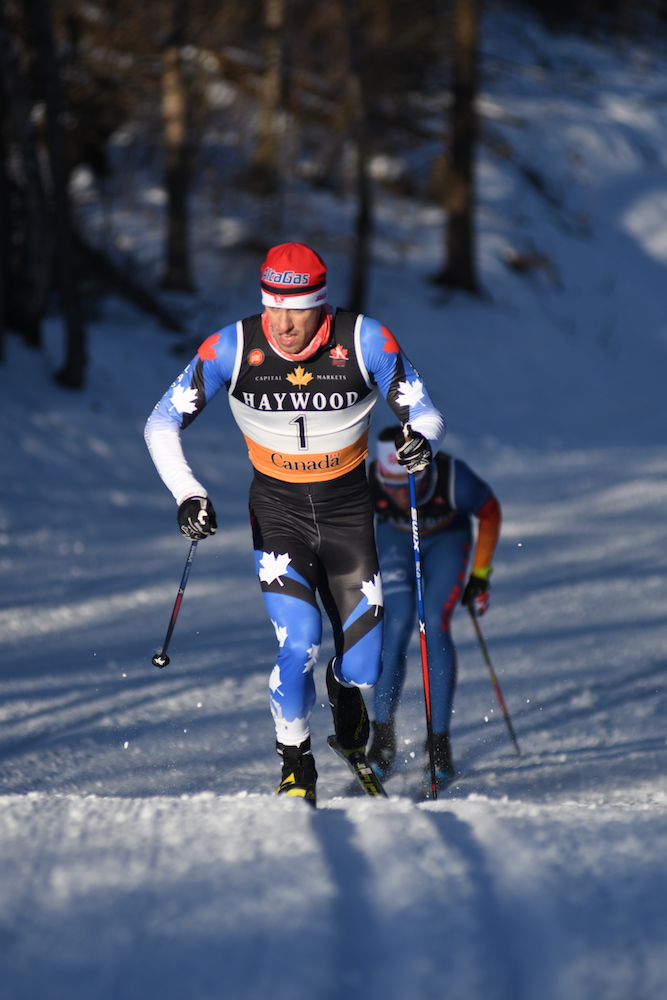
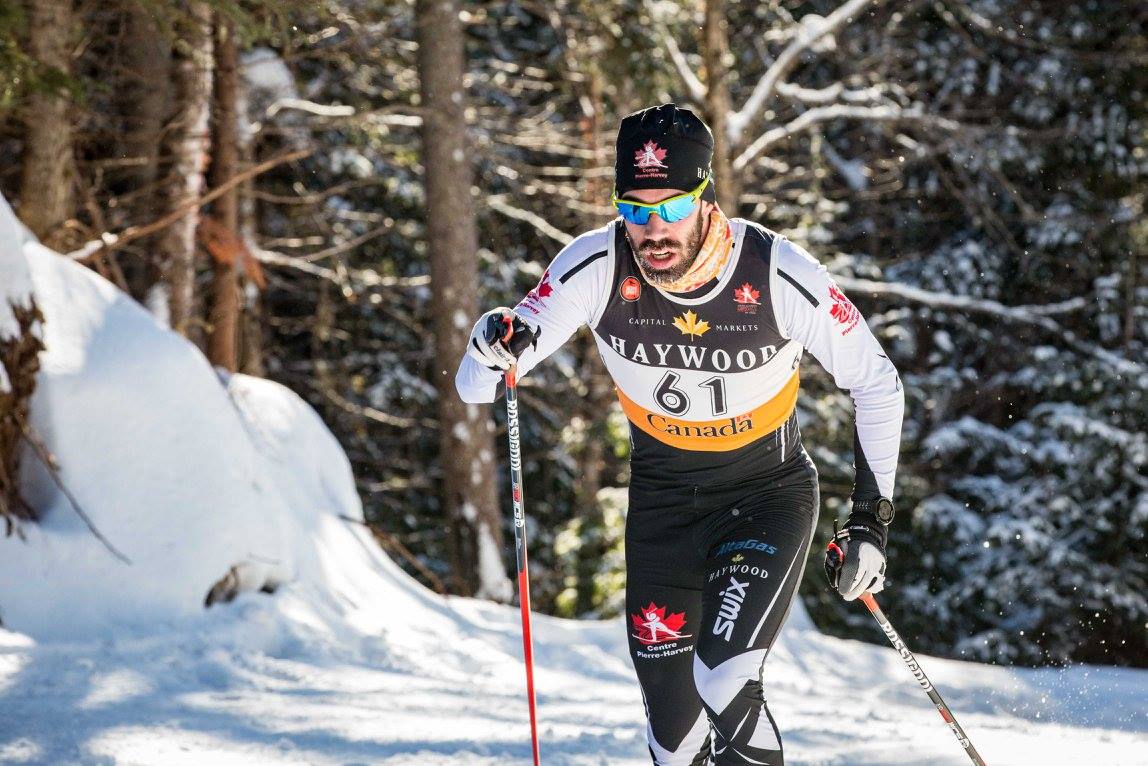
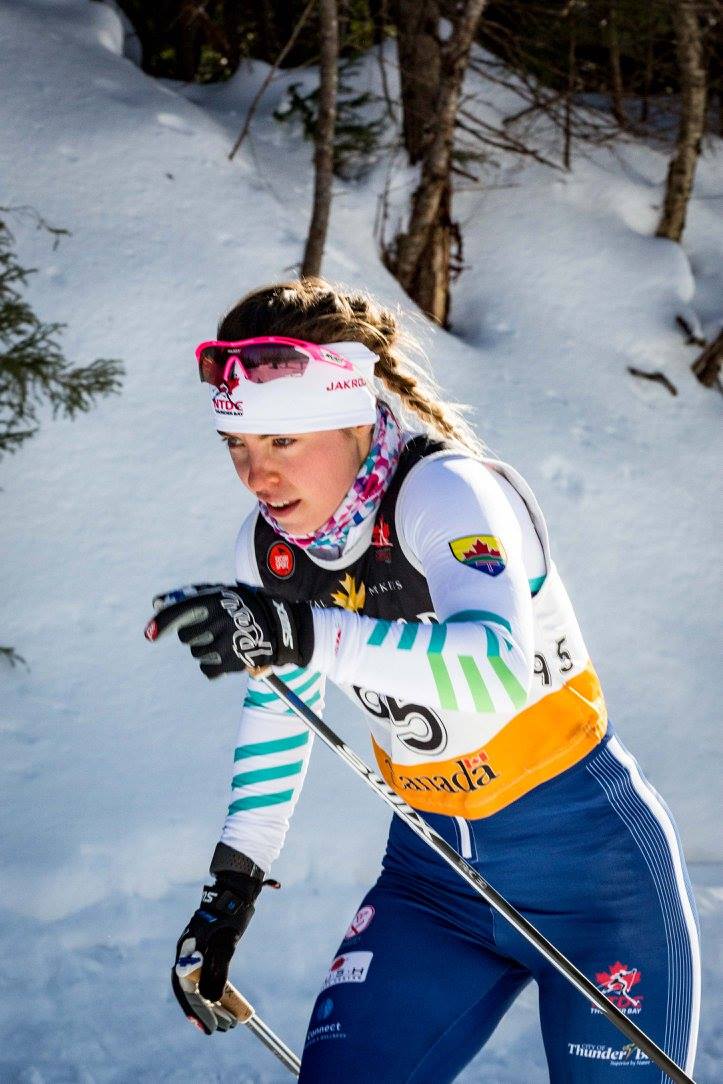
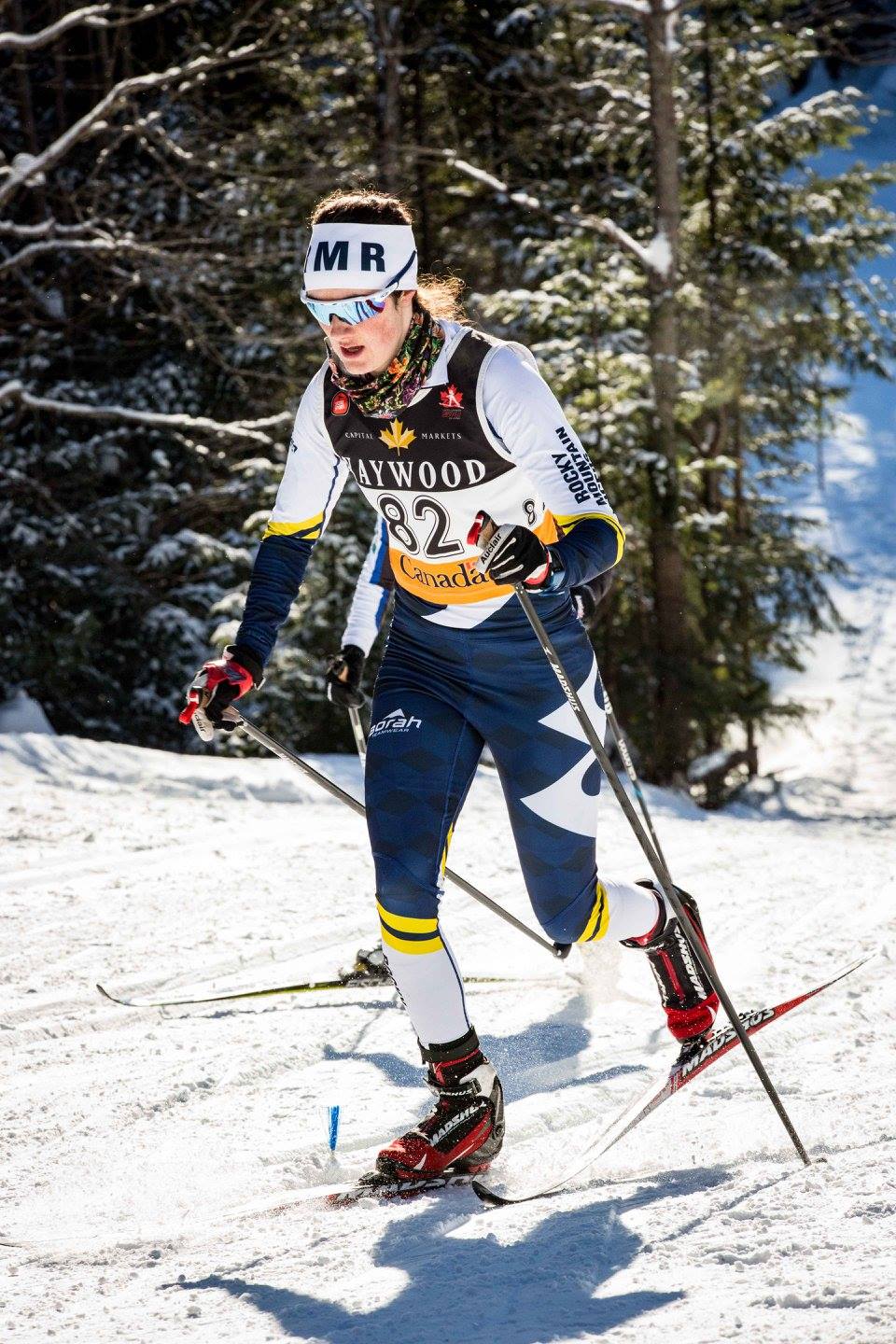
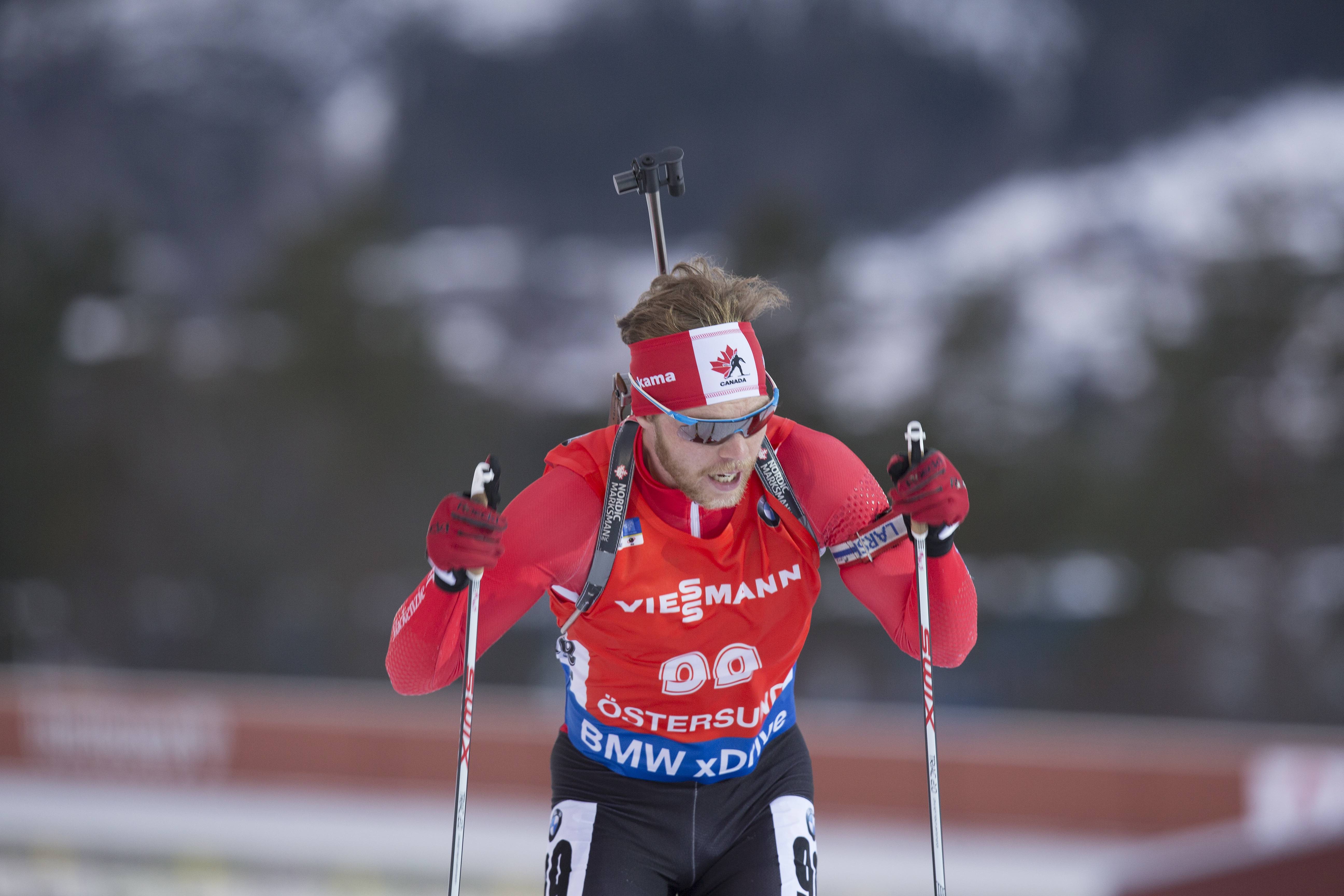
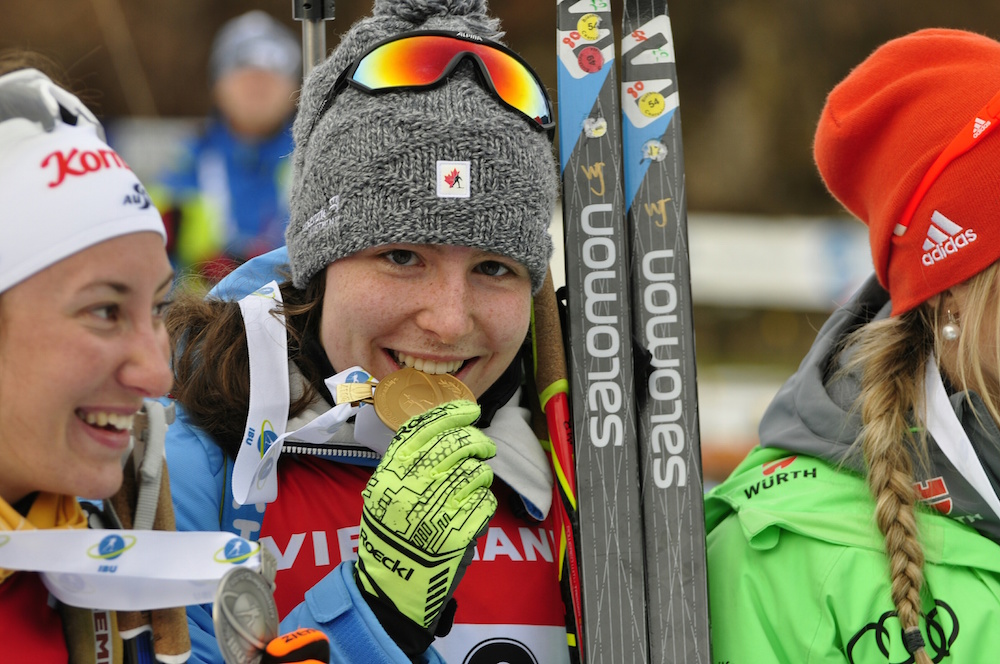
    Andy Shields (l) of Lappe Nordic and Olivia Bouffard-Nesbitt (r) of Rocky Mountain Racers are FasterSkier’s 2018 Canadian Continental Skiers of the Year. (Photos: Doug Stephen & Mario Walker)

    With the 2017/2018 season officially in the rearview, FasterSkier is excited to unveil its annual award winners for this past winter. Votes stem from the FS staff, scattered across the U.S., Canada, and Europe, and while not scientific, they are intended to reflect a broader sense of the season in review. This set of honors goes to the Canadian Continental Skiers of the Year.

    Previous categories: Junior Skiers of the Year | Collegiate Skiers of the Year | Biathletes of the Year | Para-Nordic Skiers of the Year | NoCo Skier of the Year | Canadian Breakthrough Skiers of the Year | U.S. Breakthrough Skiers of the Year | Coach of the Year | U.S. Continental Skiers of the Year

    ***

    Andy Shields, Lappe Nordic

    Despite scaling back his training last year, Andy Shields had one of the most consistent seasons of any Canadian nordic racer, tallying five podiums between the NorAm and SuperTour circuit. That included a win in the 15-kilometer classic mass start at Western Canadian Championships in Red Deer, Alberta, and a runner-up finish in the skate sprint at Canadian Ski Nationals on the trails he trains on at Lappe Nordic in Thunder Bay, Ontario.

    After winning the overall NorAm title in 2015/2016 and going out on his own with the help of his dad  and the Lappe Nordic Ski Club, Shields did it again this winter as the overall NorAm leader at the season’s end. He raced fast enough to earn Period 4 World Cup starts and went on to post a top World Cup finish of 47th in the Holmenkollen 50 k freestyle mass start.
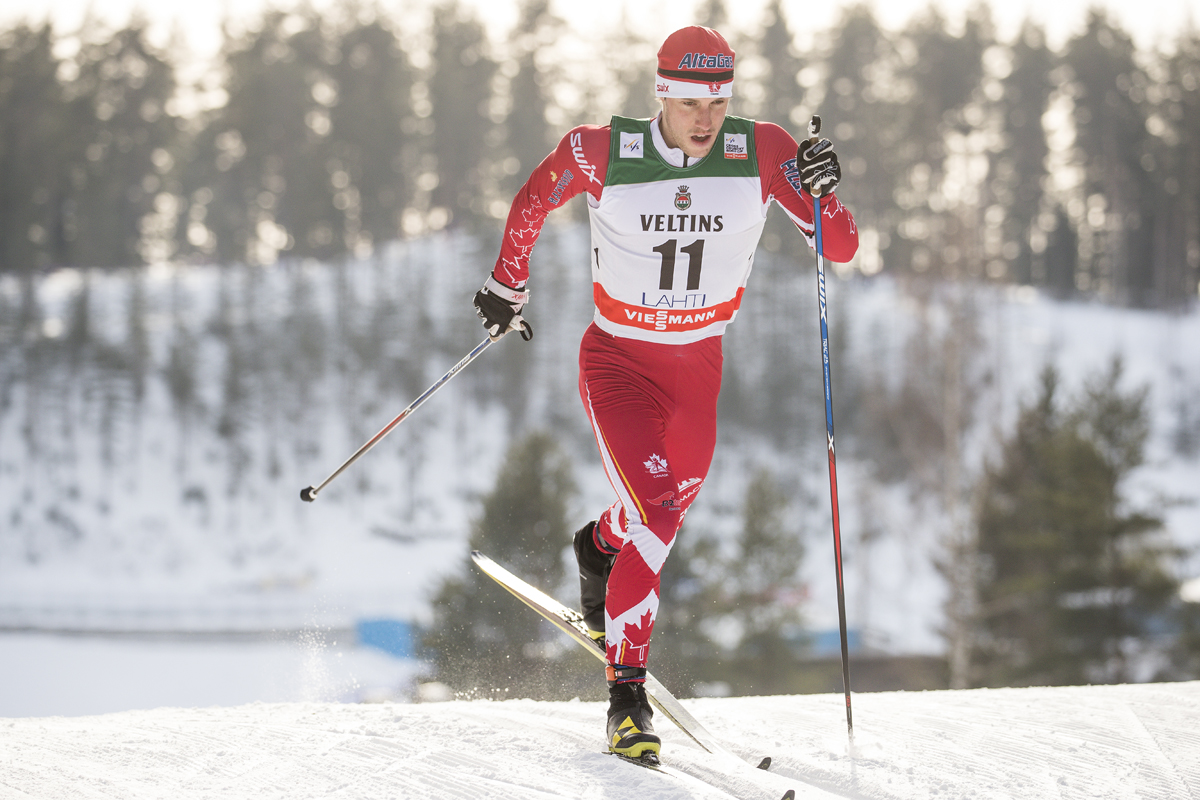
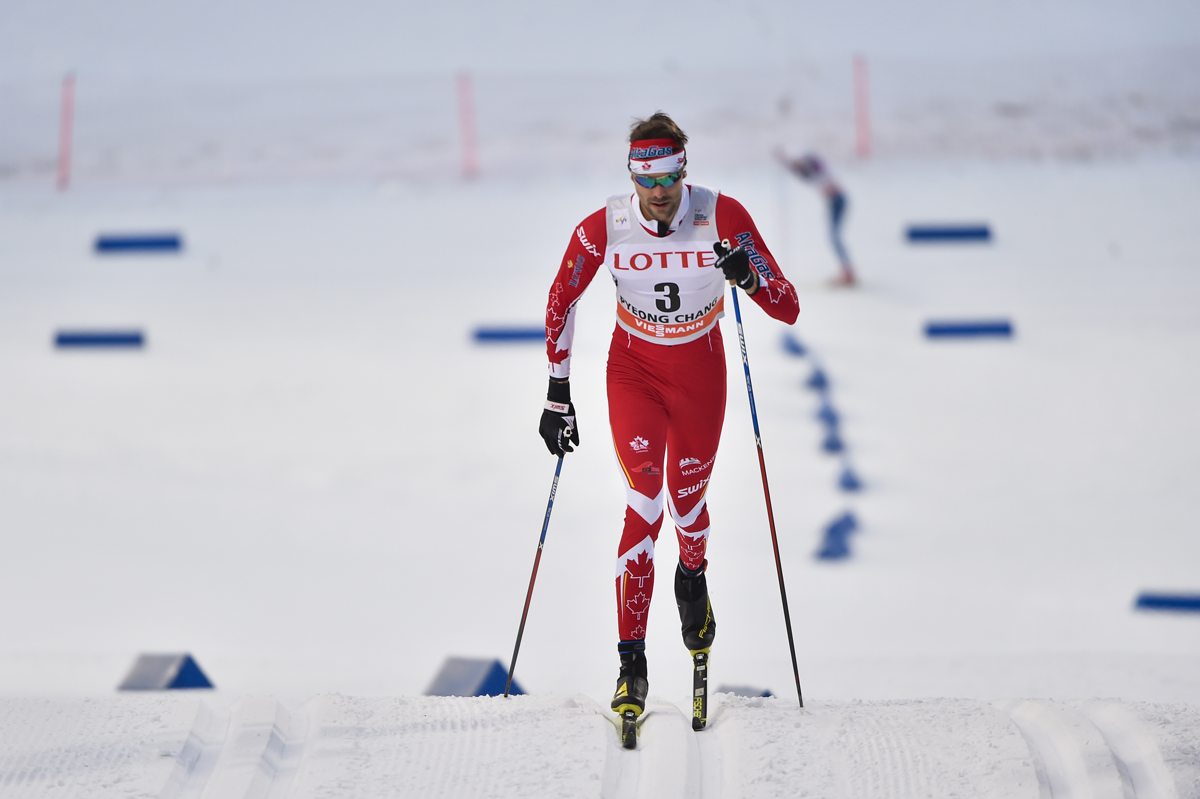
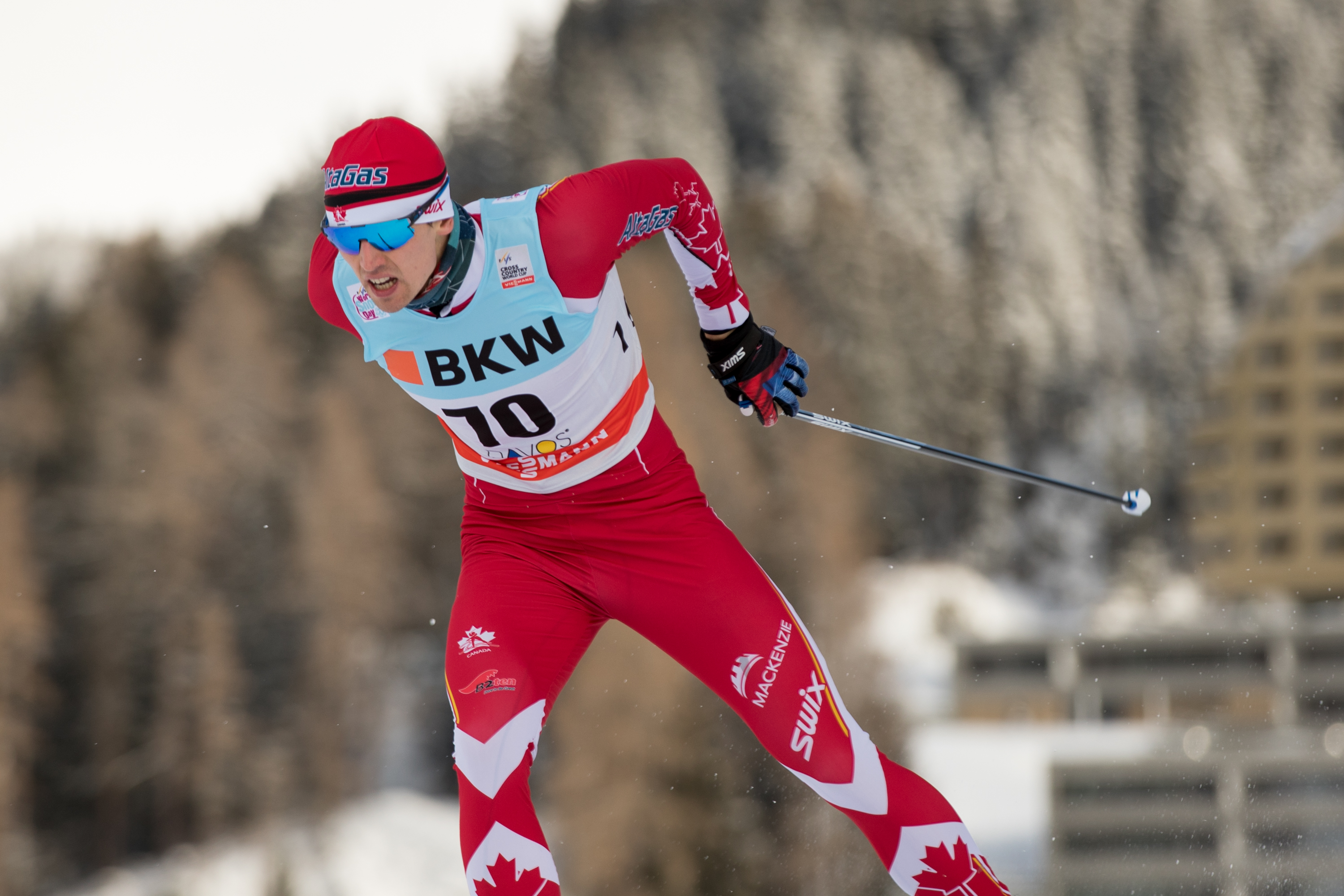
    Andy Shields racing the 15 k classic at the World Cup on March 4 in Lahti, Finland. In his first World Cup distance race of the season, Shields, who won the NorAm overall and placed second in the NorAm sprint standings, finished 70th in that race. (Photo: Fischer/NordicFocus)

    In an email to FasterSkier this week, Shields, 27, who grew up in Waterloo, Ontario, explained that last spring, he changed his mental approach to skiing.

    “Before last April, I had seven years of experience as a full-time skier and I considered it my profession,” he wrote. “However, it was becoming quickly becoming a profession that caused bills rather than paid them especially with the loss of my Canada card. This contributed to an overall feeling of not being too jazzed about competing in another season of full-bore, focussed, make-all-the-little gains, maximum performance training and racing.”

    He questioned whether he wanted to continue racing and how he was going to improve if he wanted to do so.

    “After getting wrecked on the Period 1 World Cups the season before and coming nowhere near a top 30, I had serious doubts on whether it was worth it to keep trying to crack the ‘nut’ we call World Cup racing,” Shields wrote.

    He wondered if he was physiologically and psychologically talented enough to compete at the World Cup level. He considered “setting the bar lower” to make himself happier, focusing solely on top NorAm and SuperTour finishes rather than making it to the World Cup.

    “Obviously it was time to reframe things. It was an Olympic year so and I was still having lots of fun skiing so quitting wasn’t an option,” Shields wrote. “I needed cash so I bought Skiwax.ca and started a business selling ski wax and ski equipment online and became a BNS [Boulder Nordic Sport] Canadian sales rep for SkiGo and a few other brands.”

    That summer, he also worked for his friend’s painting business in Thunder Bay.

    “With cash taken care and the birth of a burgeoning career as a sales rep and business owner, I moved skiing squarely into the ‘hobby’ category,” Shields wrote. “I suspected I could still be reasonably competitive on the NorAm and SuperTour circuits with minimal training if I relied on my large training history — maybe even quick enough to earn an Olympic spot. I decided not to subject a coach to my misadventures and intention of not working too hard. If this new way of approaching things went bad, I wanted it to be my fault.”

    He worked out less than usual last summer and fall (estimating he trained 600 hours total) and didn’t write a training plan nor keep a training log. He followed his intuition and didn’t bother to fix his heart rate monitor when it broke last June.

    “Training was very unstructured and came second to my various jobs – except for a number of training camps with the Greggs, or Micheal Somppi, or others where I buckled down for brief periods of athlete mode,” Shields noted.

    Still, his fitness gradually improved as the offseason wore on. By the time the race season arrived, he was raring to go and “hungry”, Shields reflected.

    “Only one Olympic spot was available to domestic skiers and it was a classic sprint spot, which is my weakest event,” he wrote. “When the selection criteria came out for the Olympic team, it did take awhile to get over the fact that it was extremely unlikely I’d make it. I was able to reset my goal to doing well in the NorAm overall and it wasn’t long into the season before I was in the hunt for the NorAm overall.
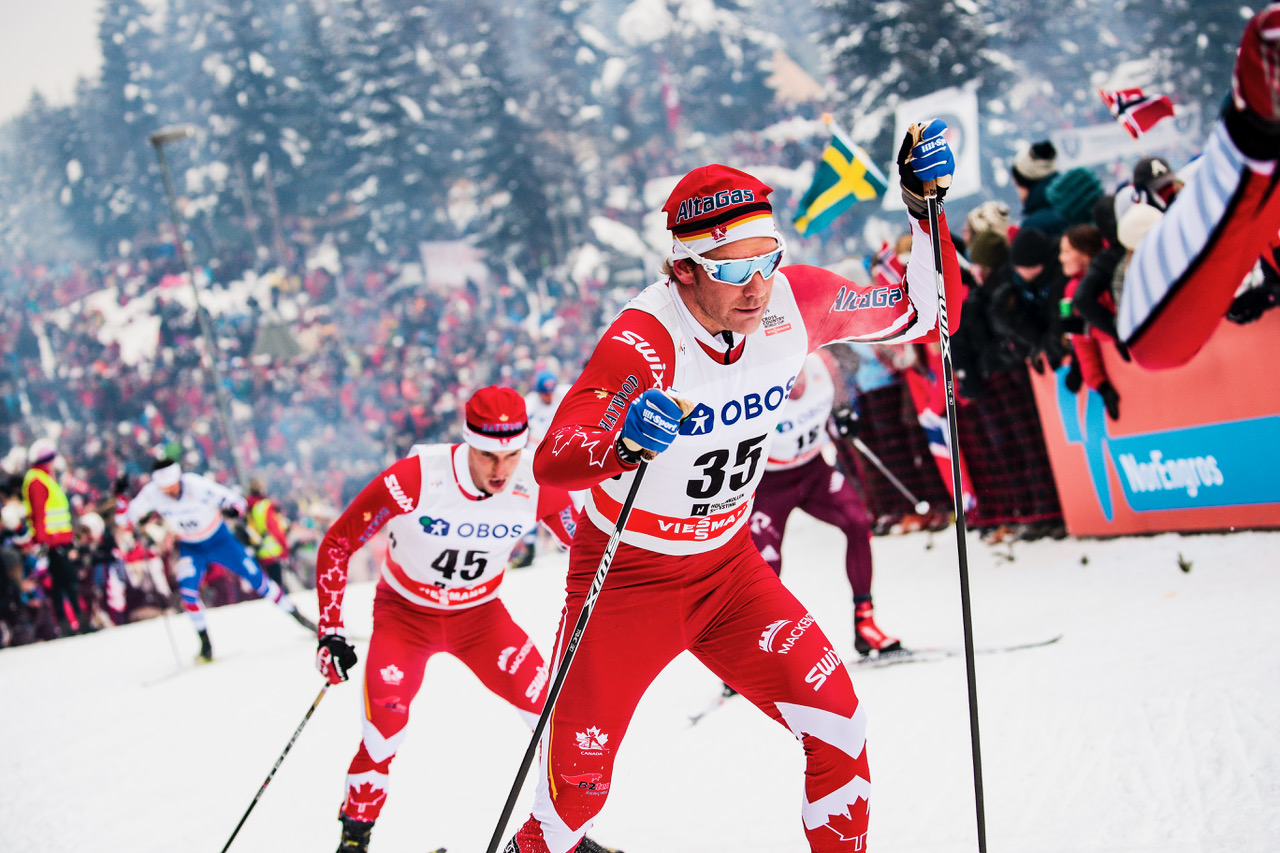
    Canada’s Devon Kershaw leads Andy Shields during the Holmenkollen 50 k freestyle mass start on March 10 in Olso, Norway. (Photo: Fischer/NordicFocus)

    “This was great!” he continued. “I was racing fast mostly and having a lot of fun kicking ass. When I got the opportunity to race period 4 on the World Cup, including the Holmenkollen 50km, it was a fantastic bonus.”

    That iconic race in Oslo, Norway, he said, was the highlight of his season.

    “I don’t know if I’ve ever raced so hard before,” Shields wrote. “Only 25km into the race, I was getting adrenaline rushes from the pain when I survived another climb. I had to skip World Cup Finals because I needed one more good race to lock up the NorAm overall so I came back to North America straight after the Holmenkollen to join Nationals partway through the event.”

    Four days after racing in Oslo, he reached the podium in the Canadian nationals skate sprint.

    “I dedicated that podium to Reijo Puiras who passed away over the summer and was the founder of the Lappe Ski Centre,” Shields wrote. “It turned out that final podium at Nationals was what I needed to secure the NorAm overall. It’s hard not to be satisfied with how this season turned out. I got a great sense of accomplishment from having done it on my own – financially and as my own coach. Of course, I had a lot of help in the wax room and my parents are great roommates.”

    As he looks ahead to 2018/2019, Shields explained that he’s planning to continue down a similar path, while logging some more “serious training” before starting the season on the World Cup in November. World Cup Period 1 remains his main focus for next winer.

    “It’s a chance at redemption for such an abysmal period 1 experience my first time over there,” he said. “World Cup Finals in Quebec City is also a huge focus. I have a number of top 50s in Quebec World Cups so I have a track record of good racing there to build on.”

    Olivia Bouffard-Nesbitt, Rocky Mountain Racers

    In what could very well be dubbed her comeback season, Olivia Bouffard-Nesbitt, 25, took it by storm after a rocky start. The Morin Heights, Quebec, native has dealt with an assortment of setbacks — both big and small — over the last several years. Hindered by stress reactions in her foot from 2013 to 2016, she was injured in a car accident in February 2017, which herniated a disc in her neck. She spent last summer rehabbing that injury, then last fall, discovered issues with her sympathetic nervous system.

    After nearly a year away from the racing, Bouffard-Nesbitt started her season this past January at the Mont Sainte-Anne NorAm, which doubled as Canada’s Olympic trials. In her first race there, she raced to third in the classic-sprint qualifier and advanced all the way to the A-final, but was relegated to 25th overall for a technique infraction. Also at trials, she finished ninth in the 10 k classic.

    “It was an absolute roller coaster (mostly uphill) getting to the start line of my first race of the season – the classic sprint at Olympic trials,” Bouffard-Nesbitt reflected in a recent email to FasterSkier. “But once the dust settled and I found my groove on the Noram circuit, the season actually turned out really well.”
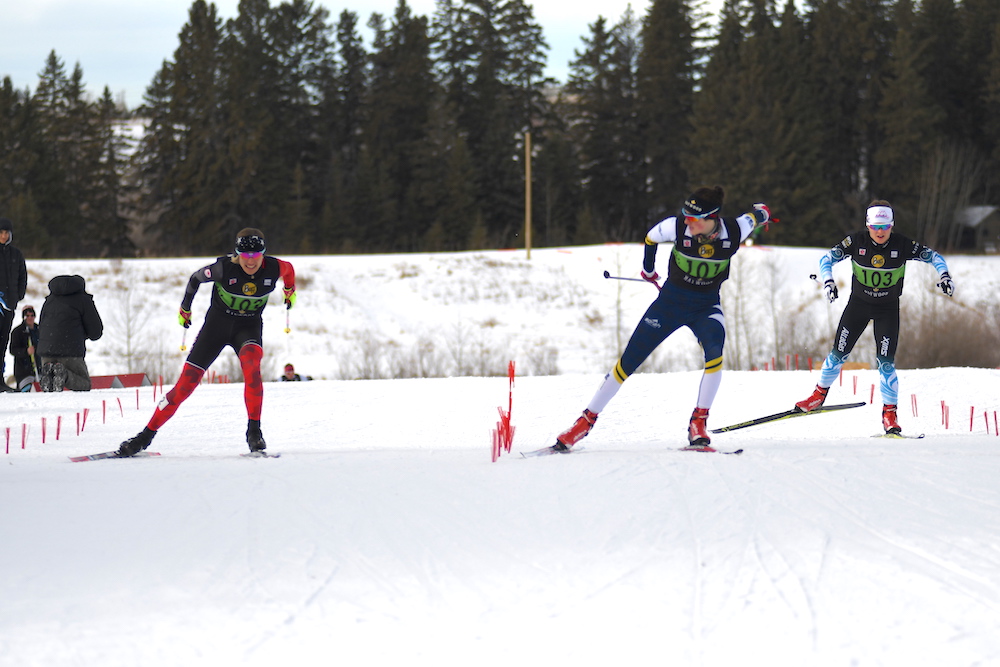
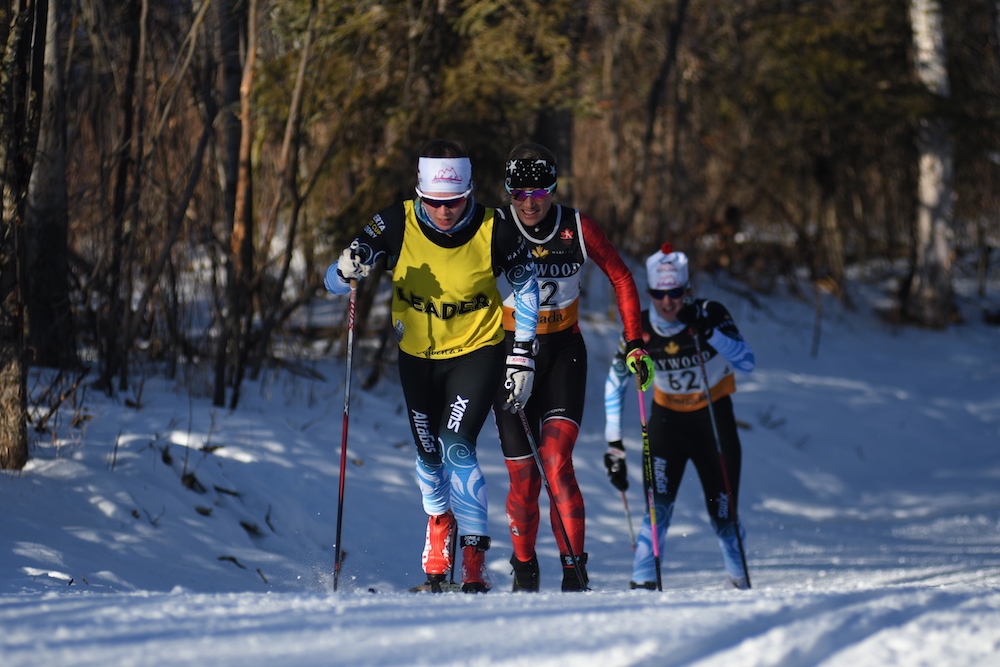
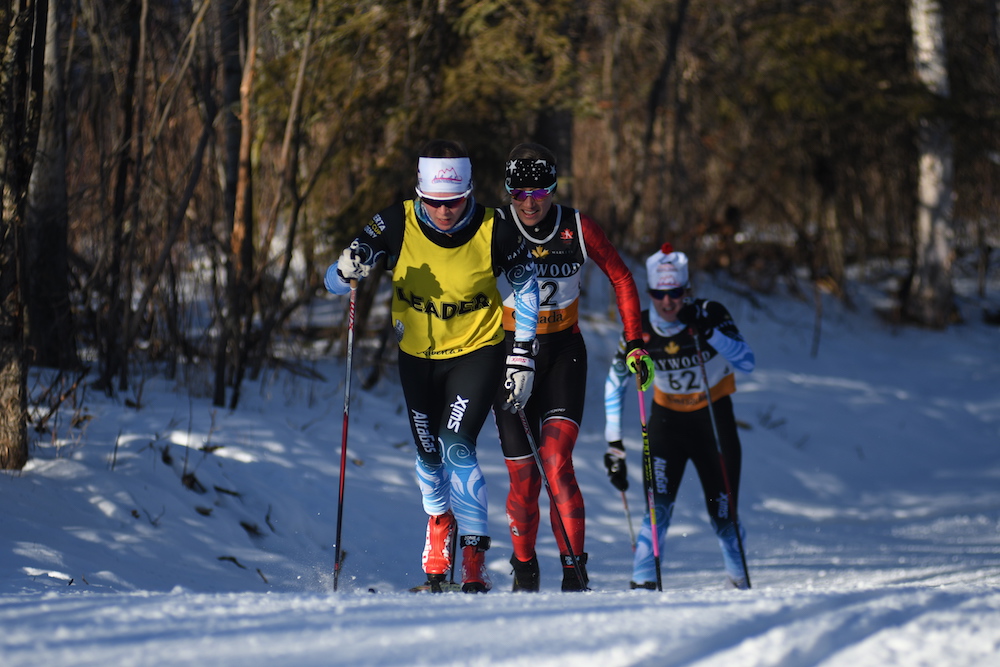
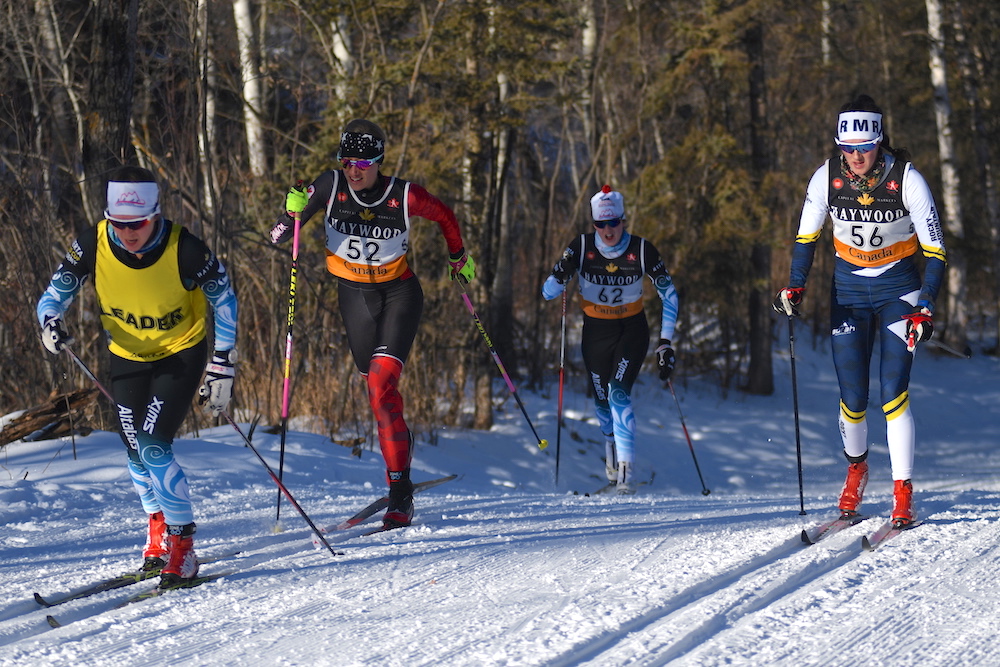
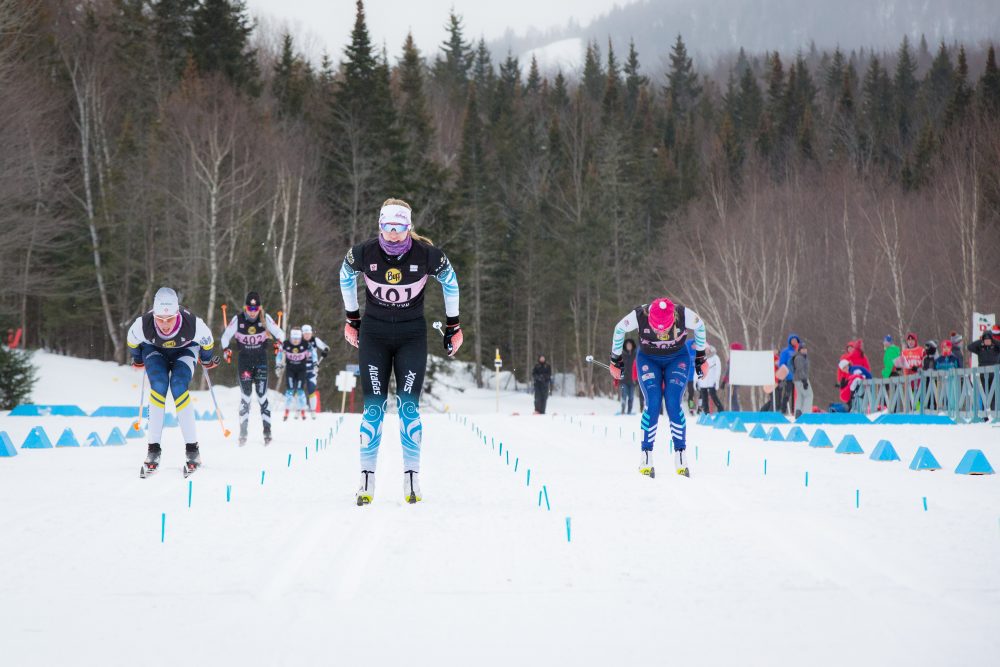
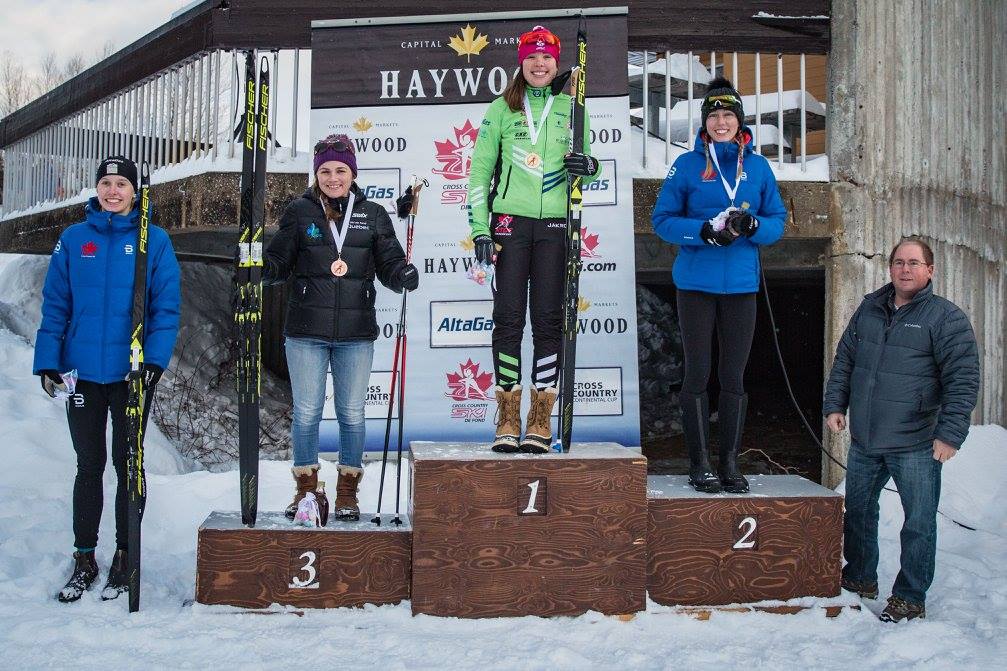
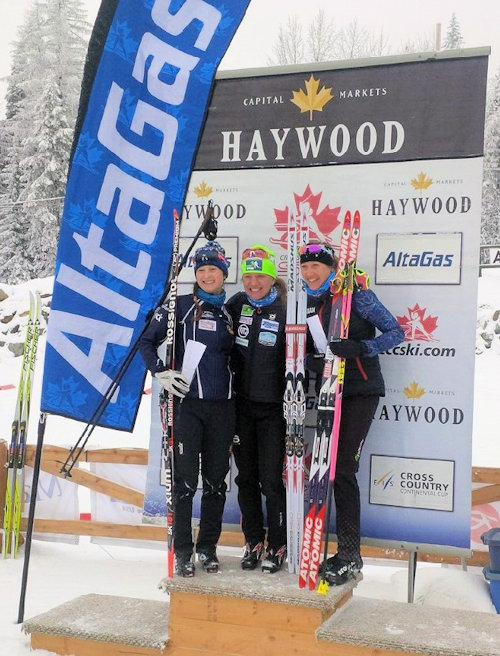
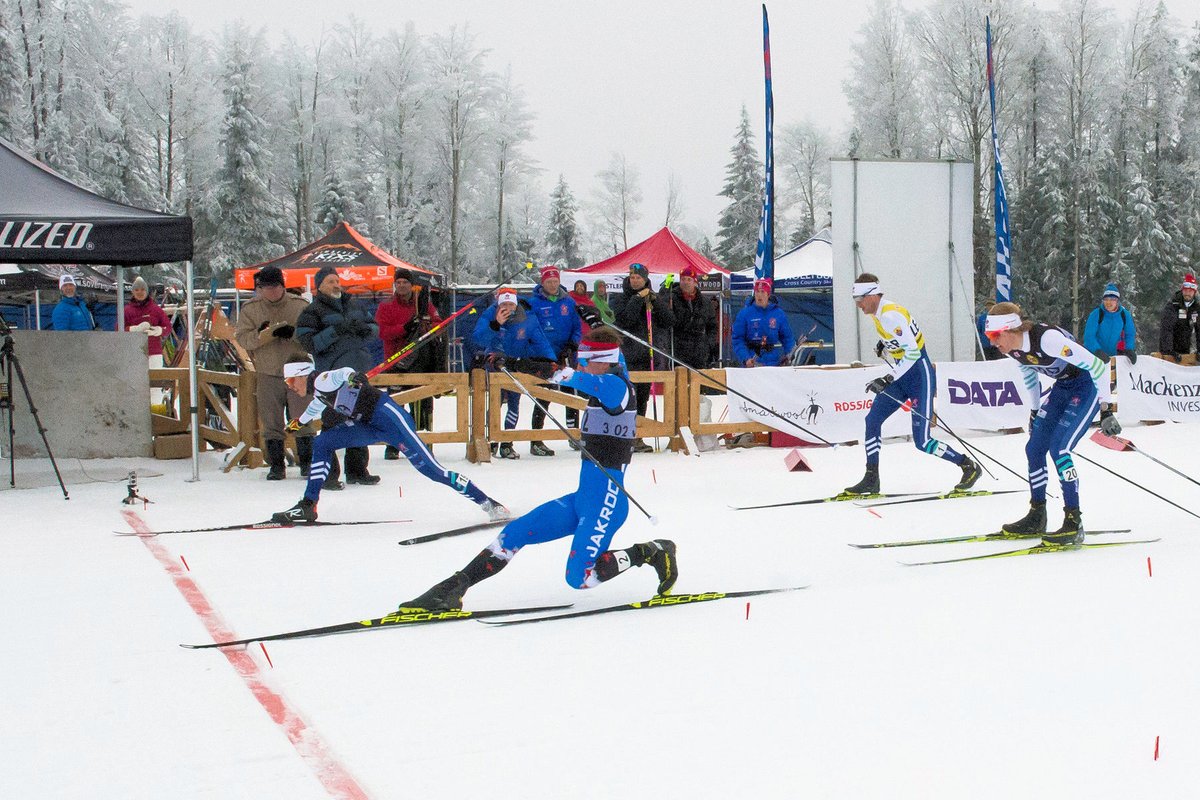
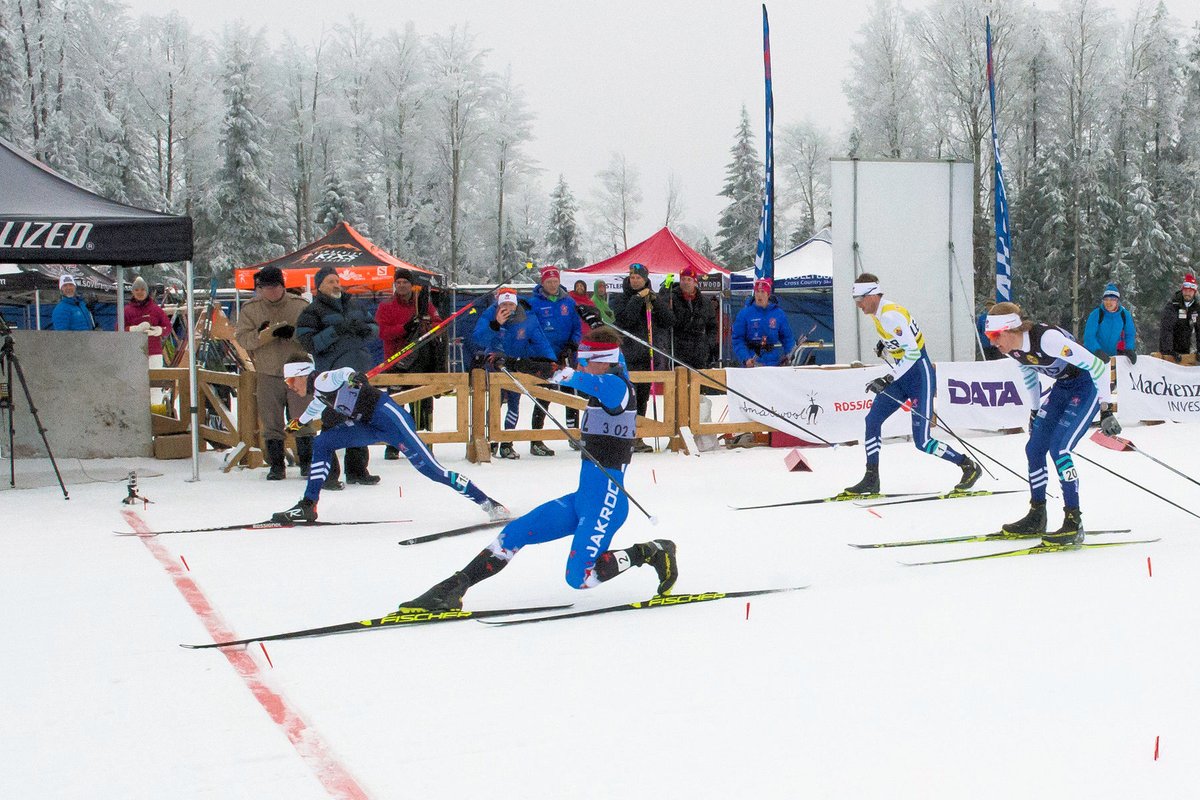
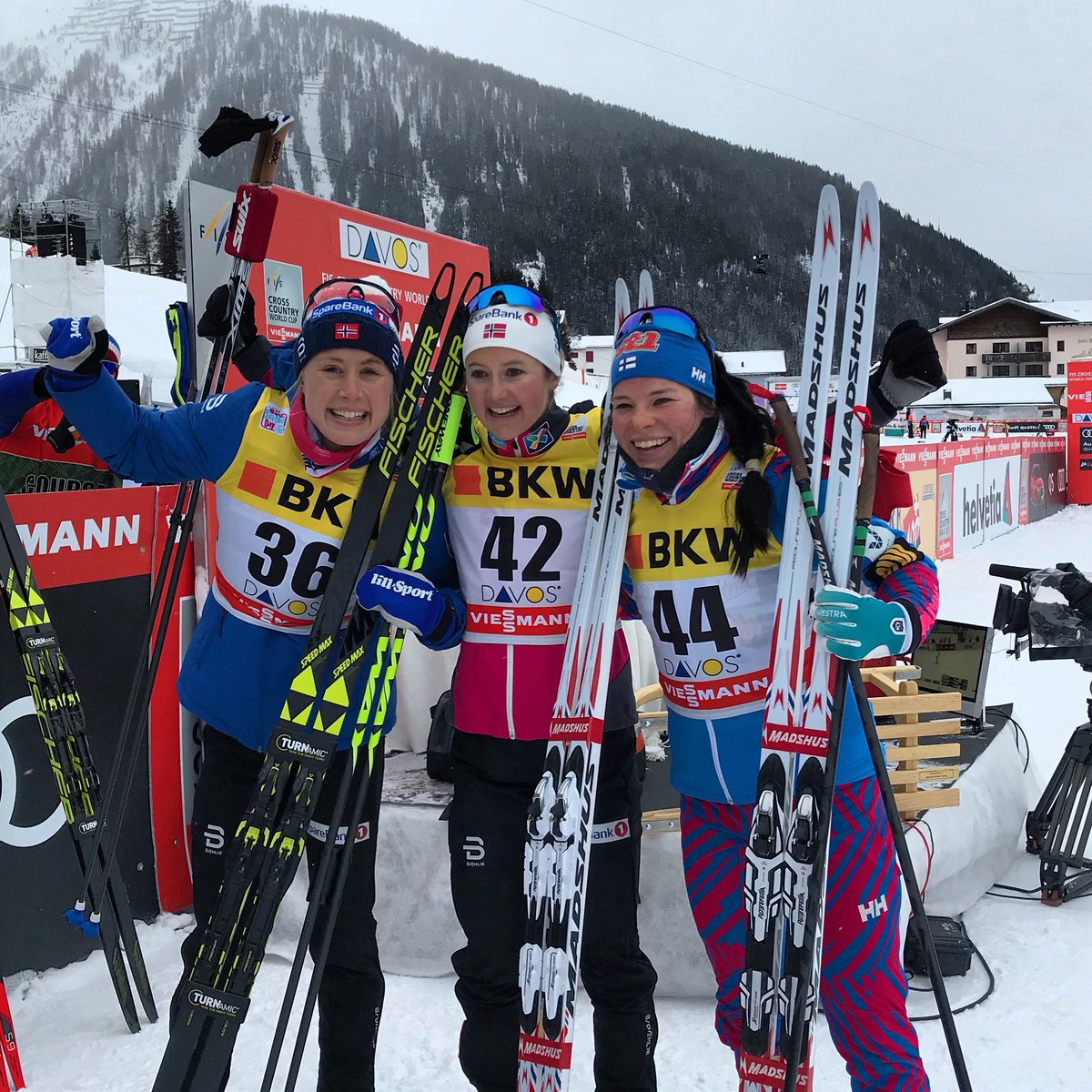
    Olivia Bouffard-Nesbitt (c) holds off Zina Kocher (l) and Annika Hicks (r) to win the women’s 1.2 k freestyle sprint final on Friday at the NorAm Western Canadian Championships in Red Deer, Alberta. (Photo: Doug Stephen)

    At Western Canadian Championships in Red Deer, she earned her first NorAm win in four years, topping the freestyle sprint. She also placed second in the 10 k classic mass start there.

    Bouffard-Nesbitt ended the year with a national title in the 5 k classic as well as the 10 k freestyle pursuit (as the first Canadian/second overall in the latter race) at Canadian nationals. She also placed fourth in the 30 k classic mass start.

    With a strong three months of NorAm/SuperTour racing, Bouffard-Nesbitt ended the season as the first Canadian in the overall NorAm standings (she was second to American Caitlin Gregg, who led the aggregate standings with 830 points). Bouffard-Nesbitt had 635 points, as did Annika Hicks of the Alberta World Cup Academy, but Bouffard-Nesbitt won the tiebreaker based on number of wins.

    Asked about the highlight of her season, Bouffard-Nesbitt said it was winning the 5 k at nationals. More specifically, it was the “unexpected flood of emotion and sense of validation I felt after learning I had won” that race, she wrote.
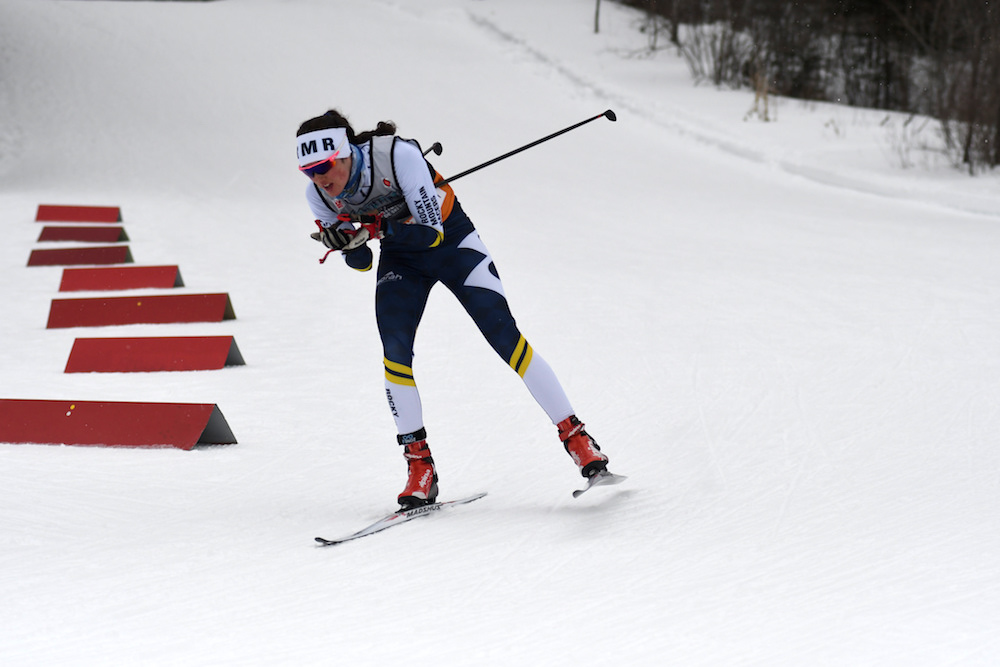
    Olivia Bouffard-Nesbitt (Rocky Mountain Racers) racing to second overall (first Canadian) in the women’s 10 k freestyle pursuit on March 13 for her second national title of the week at 2018 Canadian Ski Nationals in Thunder Bay, Ontario. (Photo: Doug Stephen)

    “Really it felt like my ‘comeback’ had culminated in that moment,” she continued. “I felt like I’d shaken that monkey off my back and I felt so invigorated. I felt like I had finally proven myself. More broadly though, a major highlight was putting so many solid races together back-to-back. For the COC [Continental Cup] standings they count your best 10 races. So after a scrapped trials, I had eleven races to get there, thirteen if you count each pursuit race as two. Finishing the season as the COC leader was the best case scenario. It’s amazing and I’m ecstatic about it!”

    Going into the season, her primary goal had been to take care of herself and make sure she didn’t re-injure her neck. Secondly, she wanted to qualify for the Olympics, and when that didn’t pan out, she shifted her focus to finishing on top of the NorAm circuit.

    Moving forward, Bouffard-Nesbitt plans to continue training with Rocky Mountain Racers in Canmore, Alberta.

    “While I was rehabbing in Quebec, I was itching to get back to Canmore because I had equated being in Canmore to being healthy enough to take up my normal training routine,” she wrote. “… It’s tough to enter a race season, both physically and mentally, when you’re really under-trained. Like I said though, after I recovered from Olympic trials, I was healthy and continuously gaining fitness all winter. It felt great.”

    Next year, she aims to continue building on the work she’s done and gains she’s made over the last year while staying “hyper in tune with my body.”

    “I’m just going to train as usual, and catch up on all the fun I’ve missed,” she wrote. “I’ve been dreaming of putting together a full summer of training for a while, and I’m optimistic that it’s going to happen this year.”

    Honorable Mention: Evan Palmer-Charrette, National Team Development Centre Thunder Bay
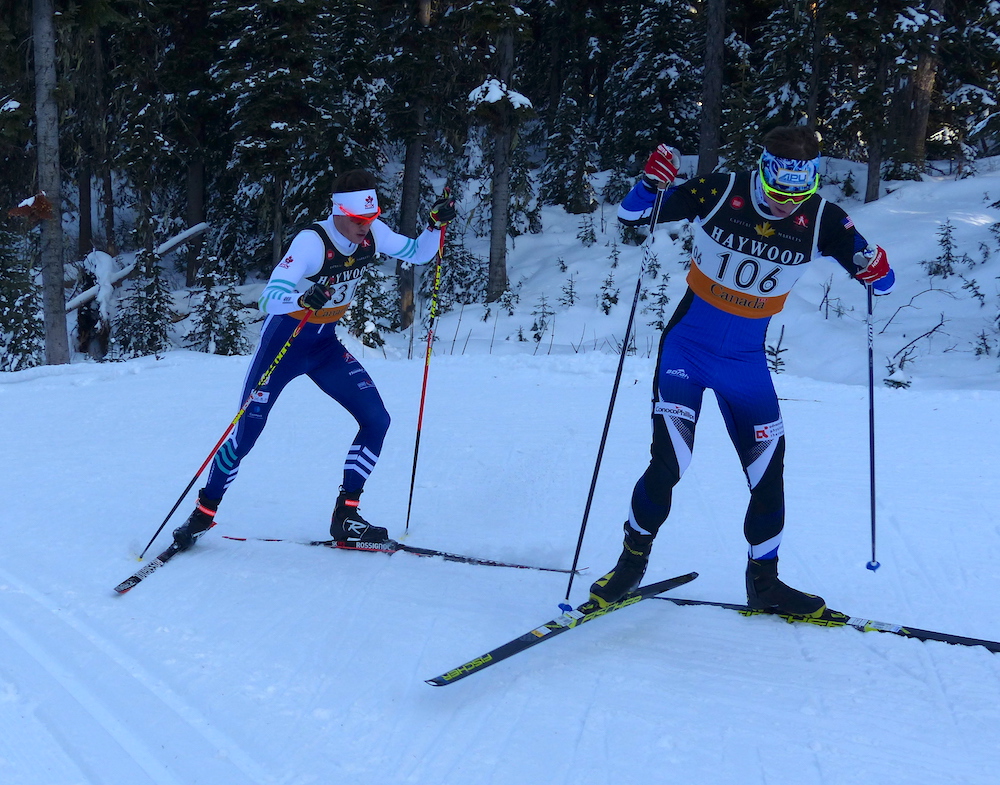
    Evan Palmer-Charrette (l) chases American Thomas O’Harra in the 15 k skate at the Sovereign Lake NorAm near Vernon, B.C. (Photo: Peggy Hung)

    Evan Palmer-Charrette, our Canadian Continental Skier last year, had another stellar season, finishing the winter out with a national title in the 50 k classic mass start and third-place finish in the freestyle sprint at Canadian nationals. There, in Thunder Bay, where he lives and trains with the National Team Development Centre (NTDC) Thunder Bay, he also placed fourth in the national 15 k freestyle pursuit and seventh in the 10 k classic.

    Overall, he ended up third in the NorAm standings, behind Shields and Canadian World Cup Team member Jess Cockney. Earlier in the season at a NorAm mini tour in Rossland, B.C., he raced to second in the skate sprint and fourth in the 15 k skate pursuit for fourth overall in the mini tour.

    He also placed fourth in the classic sprint at Mont Sainte-Anne NorAm Olympic trials. In all, he recorded 15 individual top-10 results between the NorAm and SuperTour in 2017/2018.

    “I like to think, and try to be, a well balanced skier,” Palmer-Charrette wrote of his equal focus on sprints and distance races in an email after the Rossland NorAm.

    “… Overall period one has been a struggle coming into it after be being quite sick,” he wrote at the time. “That being said I think I haven’t burnt my brightest match of the season and have as good of a shot as anyone. I would like to have strong races in both the sprint and distances races in Quebec, but with the sprint being the only race with an Olympic birth that will be the main focus of the event for me.”

    He didn’t make the Olympics, but at 23, Palmer-Charrette still has plenty of racing years ahead of him.

    Honorable Mention: Zina (Kocher) Lawson, Foothills Nordic
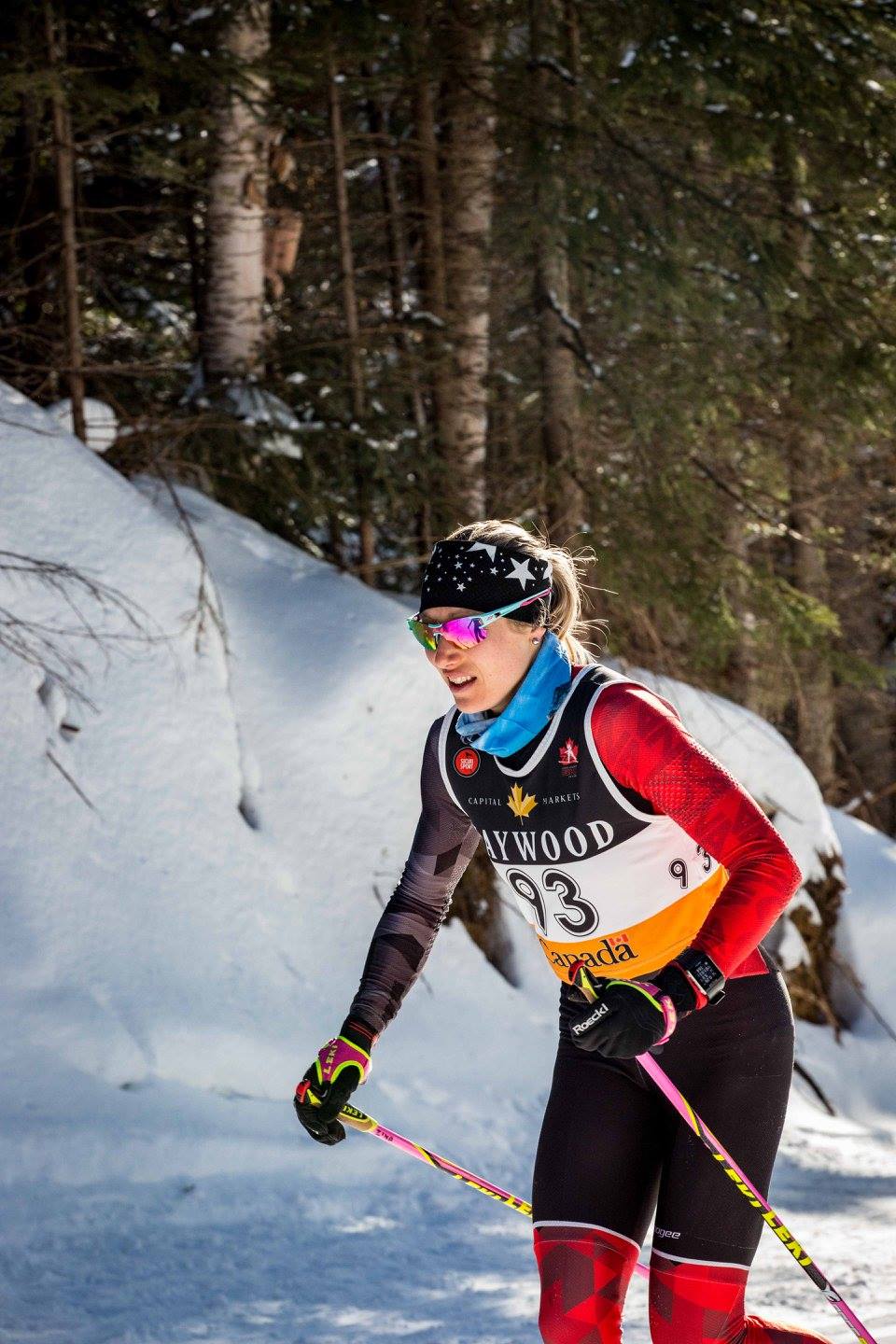
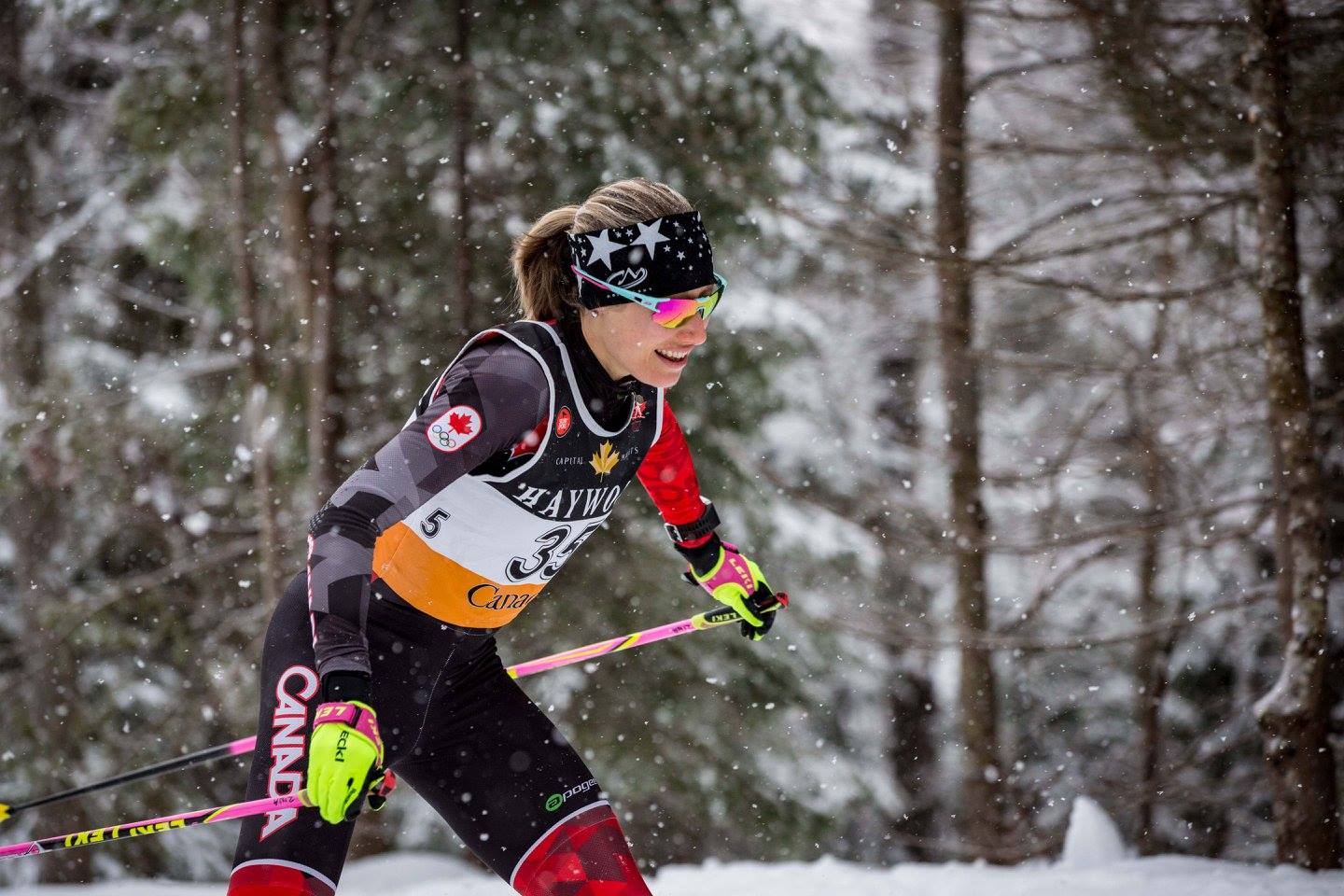
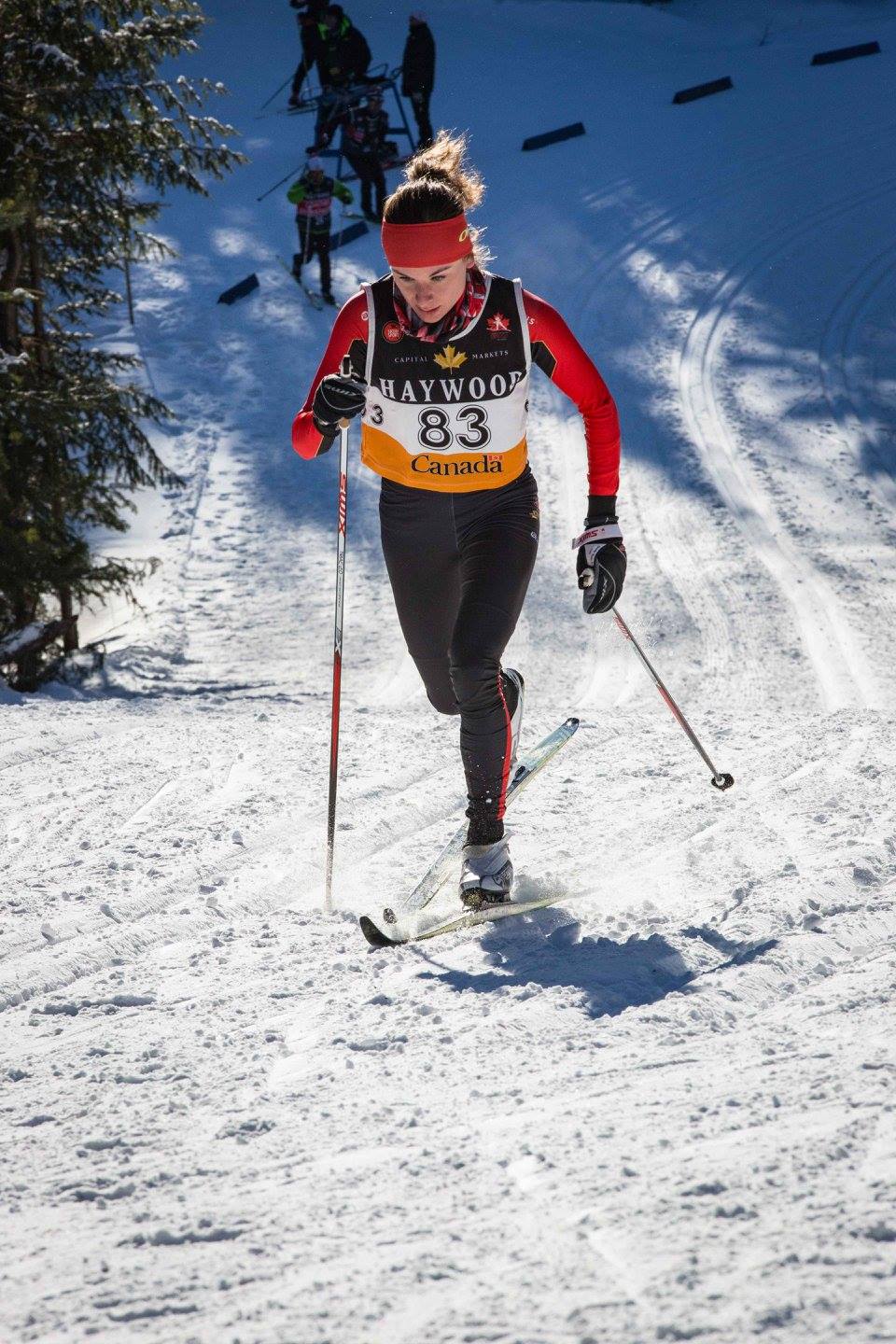
    Zina Kocher (Foothills Nordic) racing to 11th in the 10 k classic on Jan. 10 at the Mont Sainte-Anne NorAm in Quebec. (Photo: Mario Walker/NorAm MSA 2018 Facebook)

    A former national-team biathlete, Kocher was our pick for Canadian Breakthrough Skier of 2018 after coming out of retirement in an effort to make the 2018 Winter Olympics in cross-country skiing.

    She went all-in in an attempt to qualify for her fourth Olympics and ultimately came up short, but she still ended up third in the overall NorAm standings, behind Bouffard-Nesbitt and Hicks, respectively. The 35-year-old Red Deer native reached the NorAm podium in seven individual races and won the 51 k freestyle Gatineau Loppet in mid-February. As the NorAm leader for Period 3, she earned late-season World Cup starts and raced the Holmenkollen 30 k freestyle mass start as well as World Cup Finals. Kocher opted out of Canadian nationals and still finished as the third Canadian in the aggregate NorAm rankings. For now, she is once again retired.

    “I think what I loved the most about this season was the challenge, being pushed out of my comfort zone, and trying a lot of firsts,” Kocher wrote in a recent email to FasterSkier. “And knowing if the big goal didn’t work out, I did have something else I was fully committed to outside of racing. (My massage therapy diploma, I had 3 courses in the fall & 2 during the winter).”

    She made a point to thank former national team coach Justin Wadsworth for coaching her over the last season and for “his enthusiasm & teaching me the classic basics, convincing me I got this,” she wrote.

    “It was really fun to do the NorAm circuit,” she reflected. “I had a really fun time, racing at new places, new formats, and many ‘firsts’ – like classic racing. The biggest challenge was classic! Doing something new and totally out of my comfort zone. And the other big challenge I was feeling, was being ok and comfortable with digging deep and the pain associated with pushing your max efforts. Was also really great to make and also re-establish old connections with the xc community.”

    Just over a week ago, on April 10, Kocher survived a scary incident in an avalanche.

    “I slid 350m, somehow missed a small cliff/rock band, and remained on top though I was in a cloud of snow pretty soon after it started moving, until it stopped and I saw the sky again,” she reflected, crediting her late coach Richard Boruta for saving her life. He passed away in a climbing accident almost exactly eight months earlier, on Aug. 9, 2017.

    “Angel Richard probably scooped me out of there,” she wrote.

  • Bjørgen Says She’s Done: The Latest on XC Retirements

    Bjørgen Says She’s Done: The Latest on XC Retirements

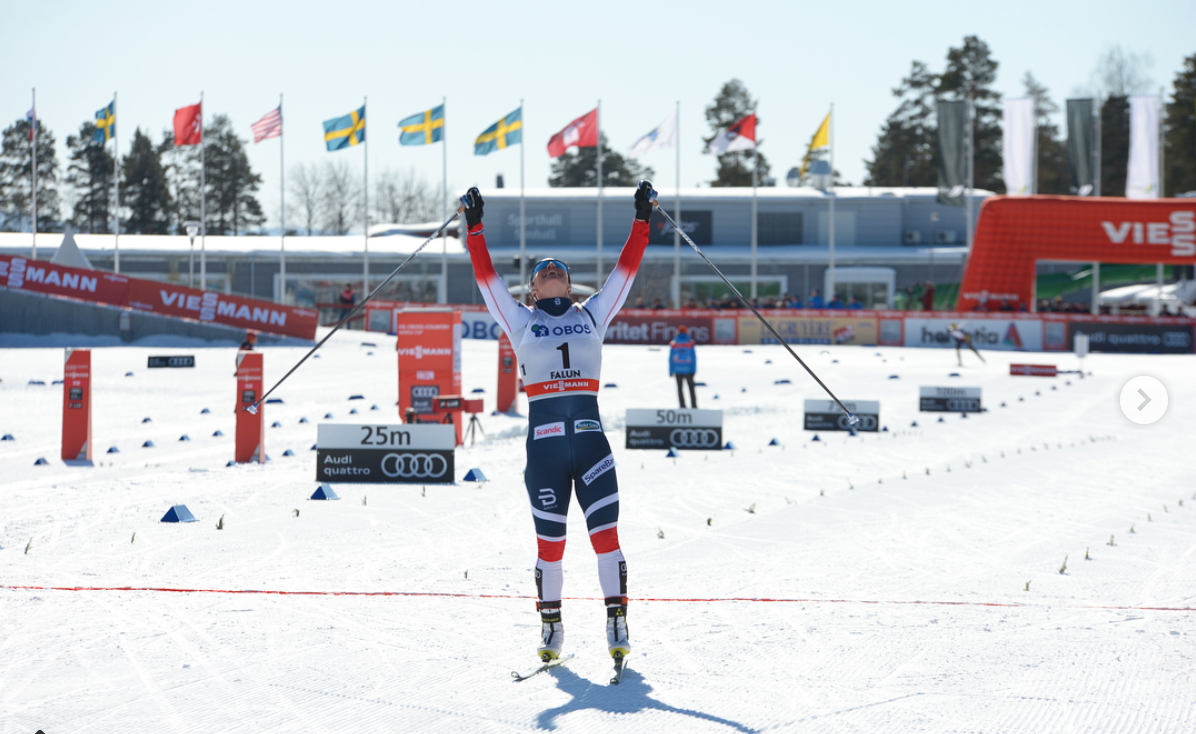
    Norway’s Marit Bjørgen celebrates her overall win in the last race of 2018 World Cup Finals, the 10 k freestyle pursuit,  on March 18 in Falun, Sweden. Bjørgen officially announced her retirement from skiing last Friday, April 6. (Photo: Svenska Skidspelen/Instagram)

    You’ve probably heard the news by now: Marit Bjørgen, the Norwegian queen of cross-country skiing, has decided to retire. The 38 year old made the announcement a week ago after winning the first race of Norwegian nationals, the 5-kilometer classic, on April 6.

    “In reality it has been a long process,” she told NRK that day, according to a translation. “I had almost decided before the competitive season started. I feel that I lack the motivation and desire required to be right there in the top. I also have a little boy at at home, who is beginning to understand more and more, that I’d like to spend time with. That time I can never have again. It’s also a little frightening. This is been half of my life. This is emotional.”

    The most decorated Winter Olympian of all time across all sports with 15 medals, five of which came at the 2018 Olympics in PyeongChang (two golds, a silver, and two bronze), Bjørgen closed her season on Saturday, April 7 with a second-place finish behind teammate Ragnhild Haga in the national 30 k freestyle in Alta, Norway.

    In all, Bjørgen accumulated 114 individual World Cup wins, 184 World Cup podiums, 18 World Championship gold medals (and 26 total at world champs), and eight Olympic golds in five Olympics, according to an International Ski Federation (FIS) press release.

    “I’m proud of what I’ve achieved in my career, but I’ve also been privileged to have been able to win top-level sports,” Bjørgen said in Norwegian team press release. “I am very much thankful to amazing team friends, teammates, coaches, medical team, service team, managers and the whole support crew that have been around me. You have a great deal of credit for my results.”

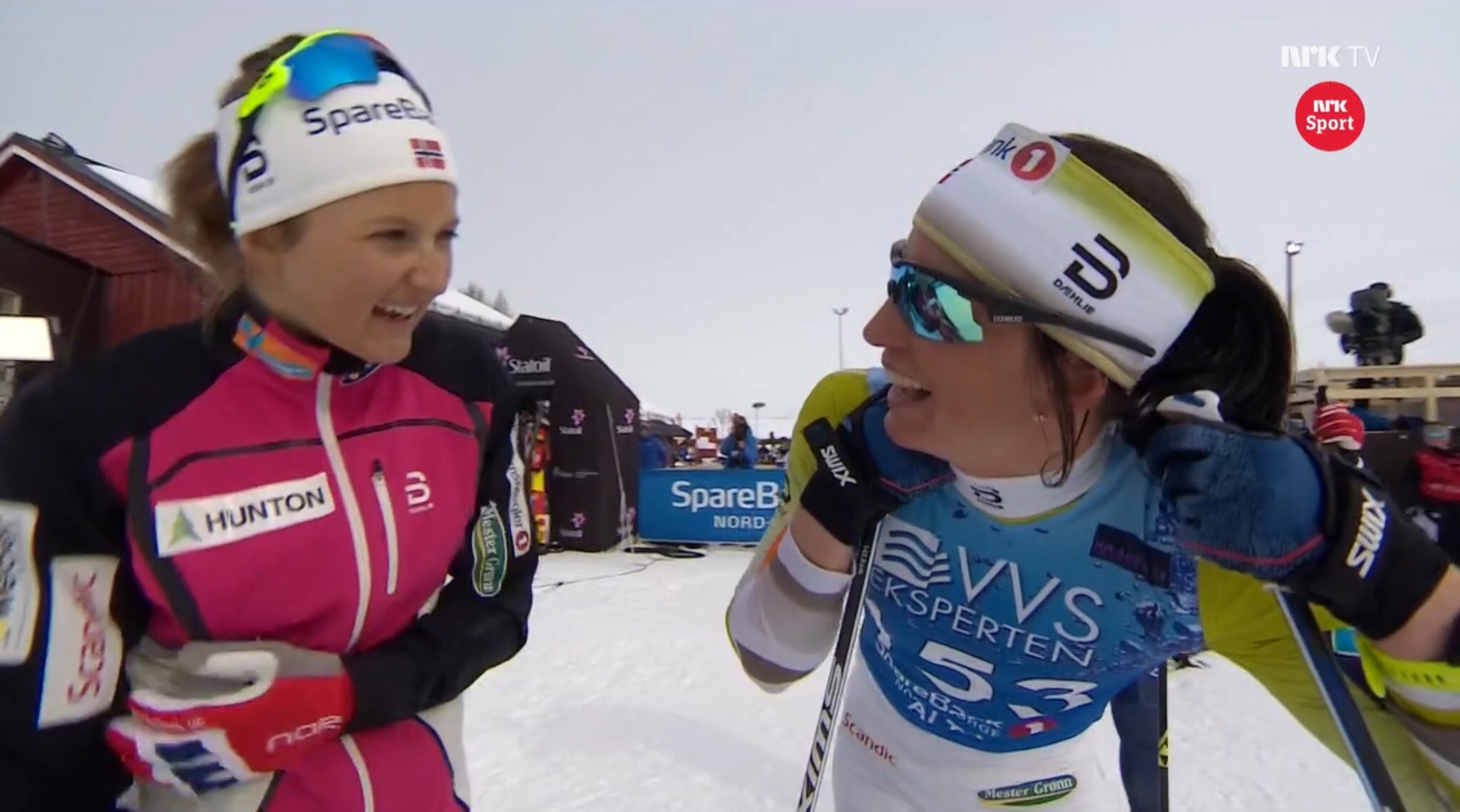
    Teammates Marit Bjørgen (r) and Ingvild Flugstad Østberg after placing first and second, respectively, in the women’s 5 k classic at Norwegian nationals in Alta on April 6. (Screenshot: NRK broadcast)

    Norway’s head coach Vidar Løfshus described Bjørgen as a “team captain” who was “always there for the girls,” according to an interview with NRK.

    He added that she was also a valuable coaching consult.

    “For me, she’s been a good sparring partner; when tough things happening internally, I often call Marit,” Løfshus said, according to a translation. “Now there will be one less coach in my team. There are a lot of good coaches in the association, but … [none that have] won so many medals. She knows more about cross country skiing then I do, Sju, Ole and Roar combined, almost.

    “We can’t let a woman like that disappeared through the back door,” he said of his desire to keep Bjørgen involved with the team. “But now we’re gonna let her exhale and enjoy her time with [her son] Marius and [partner] Fred Børre. She has not had enough time for that. And after that I know she will contribute again.”

    Bjørgen shared emotional moments with her teammates at nationals.

    “She has been a role model to me for many many years,” Ingvild Flugstad Østberg told NRK.

    “One day has to be the last,” Heidi Weng said. “We’ve had a lot of fun with Marit. She’s a legend. She has been the security blanket and the mother in the team.  It’s frustrating not to have mommy at the starting line, someone to joke around with and calm your nerves. Someone who is supportive.”

    Who else is on our list of notable cross-country retirements so far? (For our biathlon list, which should also include the additions of Norway’s Ole Einar Bjørndalen and Emil Hegle Svendsen, click here.)

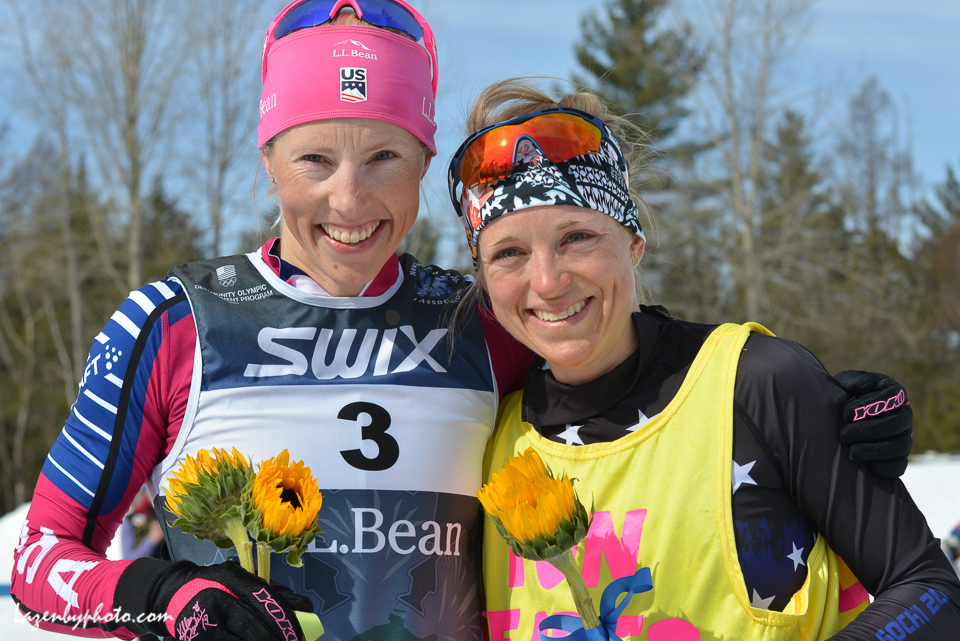
    Kikkan Randall (l) and Liz Stephen after the last race of their professional careers, the 30 k classic mass start at 2018 U.S. Distance Nationals in Craftsbury, Vt. (Photo: John Lazenby/Lazenbyphoto.com)

    From the U.S., we have U.S. Ski Team members Kikkan Randall and Liz Stephen, who said ‘so long’ to international racing, while another team veteran Andy Newell told FasterSkier that he plans to continue racing, but apart from the national team and likely outside of the World Cup circuit.

    Former national-team members Noah Hoffman and Kris Freeman have also announced their retirements from professional skiing. On the domestic side, Annie Hart has stated this was the last season of her ski career as she plans to begin law school.

    There has been talk of a few of Canada’s World Cup Team members retiring, but the only one FasterSkier has confirmed so far is Graeme Killick.

    Zina Kocher, a 2006, 2010 and 2014 Olympic biathlete who came out of retirement to make a bid for the 2018 Olympics in cross-country skiing, has stated that it’s really over this time after her comeback season.

    “As I reflect on the last 16 years that I trained full-time and competed at an international level I’m flooded with a lot of memories,” Kocher, 35, wrote in a blog post last week. “If someone had told me when I started biathlon in ’98 that I would be a ‘lifer’ (aka someone who does the sport & can’t give it up till they’re an old veteran in their 30’s), I would have laughed and said ‘yea right’. But here I am, finally saying goodbye!”

    Michael Somppi, of the Alberta World Cup Academy, is also retiring after 16 years of competitive skiing. Somppi, 29, a former member of Canada’s senior development team, won three national titles and World Cup start rights as Canada’s NorAm overall leader at the end of the 2014/2015 season.

    “I didn’t accomplish everything I wanted to in my ski career, but I am really proud of all that I did accomplish,” Somppi wrote in a blog post on Sunday. “I feel I got all I could out of myself given the circumstances I faced and the system I worked in.  Thinking back to when I started out ski racing in high school, I am amazed how far I’ve come.  ‘Started at the bottom, now we here!’  I picked up racing late and was never the most talented.  I worked hard with extreme motivation and focus to become one of the top skiers in Canada.”

    Heidi Widmer, a Swiss-Canadian skier, is also calling it a career, as is Switzerland’s Gianluca Cologna, the 27-year-old younger brother of Dario Cologna.

    “One of the highlights of my career was certainly the team sprint with my brother Dario at the Olympic Winter Games in Sochi,” Gianluca wrote in a Facebook post announcing his retirement, according to a translation. “We reached the 5th place and could take home an [Olympic] diploma. It was not only a highlight because of the 5th rank, but also because our parents were there to witness it live. I never dreamed of anything like that when I was a little boy.”

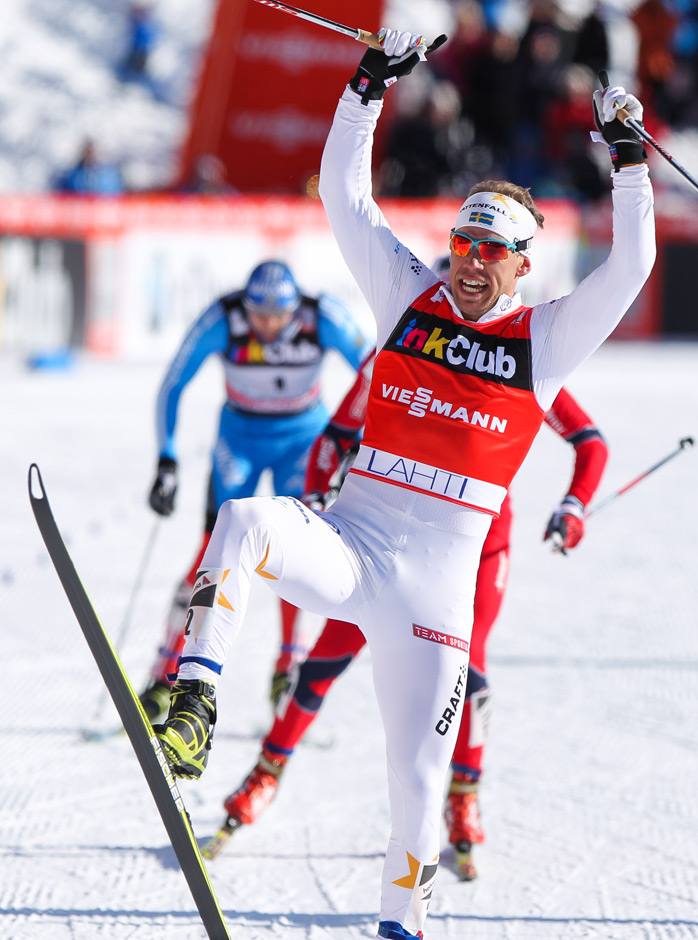
    Sweden’s Emil Jönsson celebrates a 2013 World Cup victory in Lahti, Finland. (Photo: Fischer/NordicFocus)

    The Swedish team is seeing the exit of Anna Haag, Emil Jönsson and Martin Johansson. Haag, 31, won gold with the Swedish women’s relay at the 2014 Olympics in Sochi, Russia, and has four medals from the last three Olympics. Jönsson, 32, Haag’s longtime partner and an internationally renowned sprinter, earned two Olympic bronze medals in 2014.

    From Finland, four-time World Championships gold medalist Aino-Kaisa Saarinen is stepping away from competitive skiing at age 39.

    “I have done this 20 years, what I really wanted, and I have raced my goals and even more,” Saarinen told FasterSkier after the last race of World Cup Finals in Falun, Sweden. “This skiing family is the thing what I’m going to miss the most, and of course, I love the competitions. I don’t know any other job where you can feel so high and so low, so, maybe those are the feelings right now, what I’m going to really miss the most.”

    Poland’s 35-year-old Justyna Kowalczyk, a two-time Olympic champion and two-time World Champion, has announced her retirement as well.

    Then there’s Aurore Jean, 32, who became the second French woman to reach the cross-country World Cup podium with a second-place skate-sprint finish in 2013.

    And last but not least (for now), we have heard news of Russia’s Alexander Legkov — the controversial 2014 Olympic champion who was not allowed to compete at this year’s Games because of Russia’s systematic doping in Sochi — officially retiring.

    “You have all been with me in the course of many years of my professional career and I truly love you all,” the 35-year-old Legkov said at a sports tournament in Khanty-Mansiysk, Russia, on April 6, according to the Russian News Agency. “… I will see all of you later, not at international tournaments, but perhaps at domestic tournaments or marathon. I am announcing the end of my international sports career.”

    At the Sochi Games, Legkov won the 50 k freestyle mass start and took bronze with his teammates his the men’s 4 x 10 k relay. He ended his ski-racing career on March 3 in Rybinsk, Russia, where he placed fourth in the 50 k freestyle Demino Skimarathon.

    Stay tuned for more retirement announcements as they are made public.

  • FasterSkier’s Canadian Breakthroughs: Collin Cameron and Zina Kocher

    FasterSkier’s Canadian Breakthroughs: Collin Cameron and Zina Kocher

    FasterSkier’s 2018 Canadian Breakthrough Skiers of the Year are Zina Kocher (l) and Collin Cameron. (Photos: Mario Walker & Scott Grant/Canadian Paralympic Committee)

    With the 2017/2018 season officially in the rearview, FasterSkier is excited to unveil its annual award winners for this past winter. Votes stem from the FS staff, scattered across the U.S., Canada, and Europe, and while not scientific, they are intended to reflect a broader sense of the season in review. This set of honors goes to Canadian athletes in any disciplines who had a major breakthrough at some level of competition.

    Previous categories: Junior Skiers of the Year | Collegiate Skiers of the Year | Biathletes of the Year| Para-Nordic Skiers of the Year | NoCo Skier of the Year

    ***

    Collin Cameron, Canadian Para-Nordic Skiing

    Four years ago, Collin Cameron didn’t really know what cross-country skiing was. At least, he didn’t know that it was a sport he could do.

    “I did not even know paranordic was a thing, to be honest!” the Canadian wrote in an email last week. “At that time I was just starting to play sledge hockey provincially for our local team here in Sudbury, just for fun.”

    But he since found a local group to try Para-Nordic, and was then recruited onto the Canadian Para-Nordic National Ski Team.

    Canada’s Colin Cameron racing to bronze in the men’s 7.5 k sitting biathlon sprint at the 2018 Paralympic Games in PyeongChang, South Korea. (Photo: Scott Grant/Canadian Paralympic Committee)

    In March, he became a multiple Paralympic medalist when he won bronze in both the 7.5 k and 15 k sitting biathlon competitions.

    At the end of the Games, he picked up another bronze in the open relay, where he teamed up with Brian McKeever. In a four-leg relay, they were one of only two teams to enter with just two athletes, and each raced two different relay legs.

    “Being a part of the open relay team with Brian, and his guides Graham [Nishikawa] and Russell [Kennedy], was something really special and I will never forget it,” Cameron wrote. “Getting my third Paralympic medal with those guys was pretty cool… just being a part of this amazing and successful team of athletes, techs, and coaches has to a favourite moment. Getting to see my teammate and travel roommate Mark Arendz finally earn his first gold medal was really, really awesome!”

    Although he is fairly new to Para-Nordic sport, Cameron’s success wasn’t completely unanticipated. Last season, he won a World Cup race on the same terrain in PyeongChang.

    “Going into the Games, I had one major goal of winning the sprint race I won at the test event the year before,” Cameron explained. “I had to settle for 4th, only 0.7 seconds off the podium. Aside from that single race, my other goal was to finish in the top 10 in all races I entered.”

    As any athlete will tell you, an Olympic or Paralympic medal is a much different animal than getting on the podium at a World Cup race. And Cameron found that to be true, too, when he returned home to Canada.

    “It’s been quite overwhelming to be honest,” he wrote. “I didn’t expect anything like the receptions I’ve received, and it’s really inspiring to see the way the community in both my hometowns have followed mine and the team’s success at the Games. I definitely could not have done this without the huge and overwhelming support from everyone here.”

    His next goal is 2019 World Championships, which will be held in Prince George, British Columbia.

    “I am very fortunate to be able to work with some of the best technical skiers and coaches in the world, that have greatly aided in the whole transition of making myself an endurance athlete…that being said there is still lots of work to do!”

    Zina Kocher, Foothills Nordic

    Yeah, Zina Kocher is 35. Yeah, she’s a three-time Olympian. But she did something brave this year.

    The former biathlete, who had retired in 2016, decided to become a cross-country skier and try to make a fourth Canadian Olympic team. She had been thinking about giving it a go, and discussing with longtime coach Richard Boruta.

    When Boruta died in a climbing accident in September, Kocher decided that even more than ever, she had to give it her best try, in his honor.

    Zina Kocher racing at Olympic Trials at Mont Sainte Anne. (Photo: Mario Walker/NorAm MSA 2018 Facebook)

    In some ways, things didn’t work out. She went to Olympic Trials in Mont Sainte-Anne, Quebec, knowing that it was a long shot — the race formats were heavily skewed towards classic, something that Kocher hadn’t done competitively for years, even though she has long been one of the fastest skate skiers in the country.

    She didn’t make the Olympics. And it might have ended there, but it didn’t.

    “After the selection races, I felt settled, ready to go back to ‘retirement’ or back to my previous next phase and other life goals and stop following, let’s say, a set training plan,” Kocher wrote in an email last week “But then I thought it would be fun to race the NorAm in Red Deer [Alberta], since that’s where I’m from and where I started xc skiing many many years ago! I hadn’t raced there since I was in high school. And then I thought oh Nipika loppet, never done that, why not. And then decided last minute to go to Gatineau Loppet when my friend Kamila (my past coach Richard Boruta’s widow) said she was going and I should come.”

    So, a season that had started with one goal — make the Olympics — went on.

    At that point, Kocher was leading the NorAm series, and found out that as a result she had an automatic spot to race on the World Cup for the last competitions of the season: the Holmenkollen 30 k freestyle mass start in Oslo, Norway, and World Cup Finals in Falun, Sweden.

    “Well, the Holmenkollen is legendary and an awesome opportunity,” she wrote.
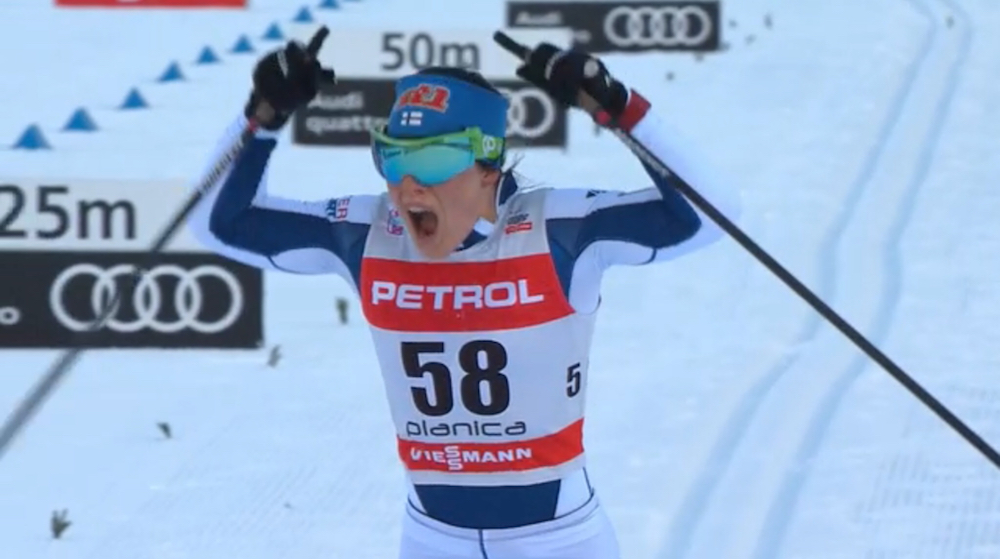
    Kocher had raced there many times before, as a biathlete. Doing so as a skier was a new experience.

    “We had tons of fans cheering us on, pushing us up those big climbs!” she wrote. “I didn’t feel like I was in the best race shape that day, but I gave what I had for a 5 k pace that lasts for a torturous 30 k  … and my body went into some sort of shock post race, but that’s another story.”
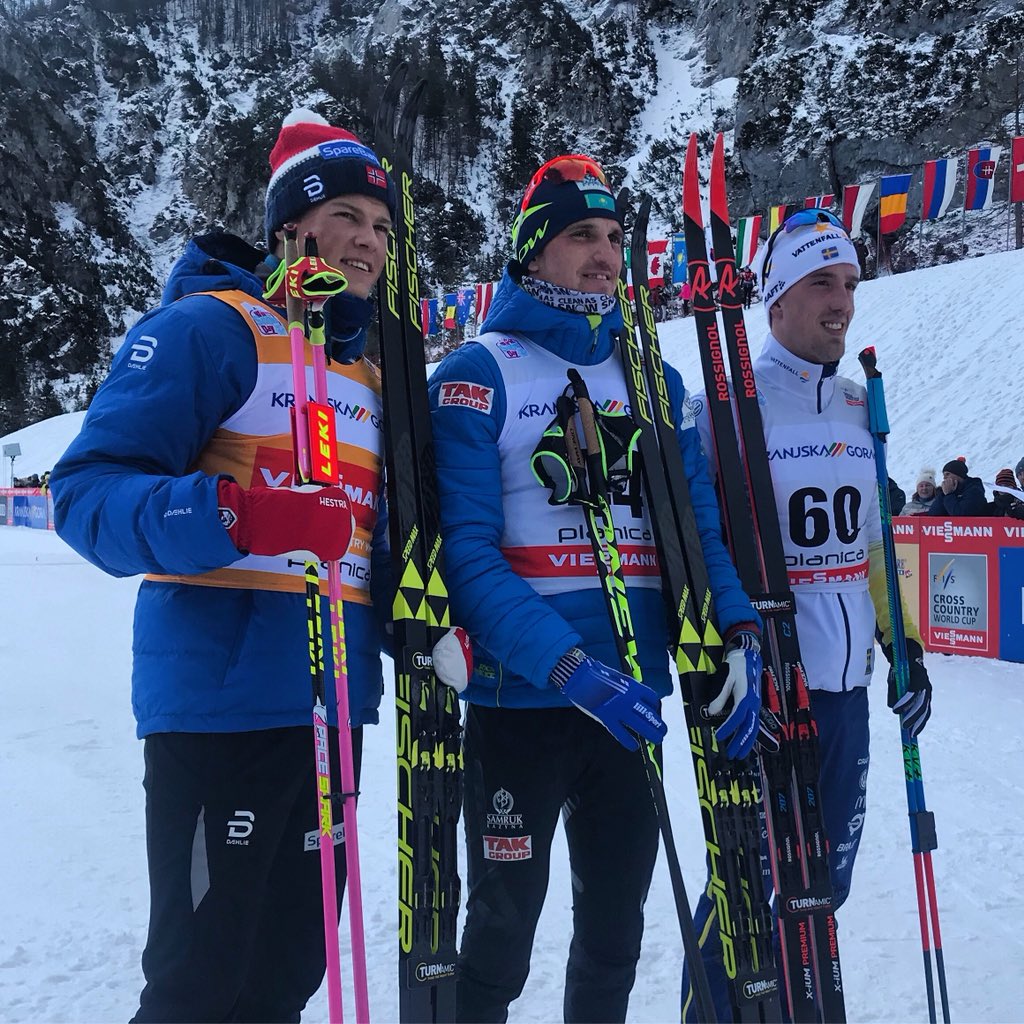
    Despite that, she was the top finisher among the other different Continental Cup leaders.

    And then, on to Falun, where she had to do a classic World Cup race because it was part of a mini tour.

    “One big thing I went though [this season] was facing a fear of being last,” she wrote. “That sounds a bit crazy to say, but I think it’s probably an honest statement for many athletes. No one wants to come last, but someone does! Printed in ink, on a computer screen, it’s there for all to see! … I was terrified of doing a 10 k mass start classic in Falun, and I knew I would probably be last from the start. I was. In the end, it wasn’t so terrifying and I made it to the finish line. Having accomplished it, felt pretty darn good even though it was a bit of a solo 10 k. The fans and coach Babs [Ivan Babikov] were incredible cheerleaders!”

    Now, it’s back to retirement for Kocher. One of her top memories from the season was that Gatineau Loppet.

    “After some contemplation today, I think my favourite moment was doing the 50 k Gatineau Loppet,” she wrote. “Not because I won (great too of course), but because it was a great atmosphere, and it was cool to do a race point-to-point and with a mass… and because I was with Kamila and her friend Lukas. Lukas was actually racing on Richard’s old skis, doing his first ski loppet (he raced both days). Kamila didn’t think she’d be able to do any racing this winter, so it was wonderful to see her do what she loves again, and she even won the overall (both days – skate & classic 50). It was a bit of an emotional weekend. And felt like a great Richard tribute weekend.”
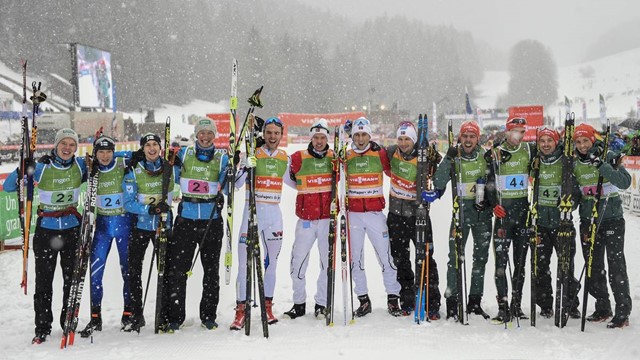
    Honorable Mention: Russell Kennedy, Team R.A.D. & Canadian Para-Nordic Skiing (guide)

    Kennedy accomplished a rare feat this season by competing at both the 2018 Olympics and Paralympics.

    “I’ve been on my own schedule this year because the Team R.A.D. is mostly younger athletes and … I have to do my own thing because I’m going for the Olympics,” Kennedy, last season’s overall NorAm winner, said at the beginning of the season. “So it actually works better for me to be training with Brian [McKeever] because he has similar goals as me.”

    Canada’s Brian McKeever (r) and Russell Kennedy receiving their gold medals from the men’s visually impaired classic sprint at the 2018 Paralympic Games in PyeongChang, South Korea. (Photo: Scott Grant/Canadian Paralympic Committee)

    As the NorAm winner, Kennedy started the season on the brutally competitive first period circuit of the FIS Cross Country World Cup. There, he had a top finish of 48th place in a skate sprint in Davos, Switzerland. It was only his second stint of European World Cups, after competing in Drammen and Oslo last winter.

    Kennedy returned to Canada and secured his Olympic spot by winning the sprint qualifier at Mont Sainte Anne and placing second in the sprint final. Two weeks later, he picked up two second-place finishes in NorAms in Red Deer.

    From there it was to the Olympics, where the 27 year old helped the Canadian relay team to ninth place, and as an individual finished 49th in the 50 k and 54th in the sprint.

    Then it was the Paralympics, which had long been part of the season plan. Kennedy was one of two guides for visually-impaired skier Brian McKeever, and as such picked up a collection of Paralympic gold medals (along with Graham Nishikawa, McKeever’s other guide). It was the third straight Paralympics where McKeever went undefeated – he now has 13 gold medals.

    “These sprint races are miserable,” McKeever said after crossing the line with Kennedy for gold in the sprint, according to a team press release. “They are so hard. The young guys are fast, and have natural snap. There is so much stress in sprint racing, and it goes all day long. I’m much more comfortable with the longer distances, but it was a great day for us. Russell carried the load for us today, and just thrilled we were able to cross the line first.”

    “It is hard to describe the mental states I went though the past couple months,” Kennedy recently wrote on his blog. “From being told that I didn’t make the team to making the Olympic team, feeling like I was getting sick then coming back to some of the better races of my life… There were days I woke up and wondered if it was worth it and if the hard work would pay off or if I was just blowing money on something that I didnt have in me… When I fell in love with training though I knew I was doing the right thing. So fall in love with the process dreamers, when you do you will have all good days!”

    Honorable Mention: Natalie Wilkie, Canadian Para-Nordic Skiing

    Natalie Wilkie is just 17 years old, but she’s a Paralympic gold medalist.

    In the final individual competition of the 2018 Paralympics, Wilkie topped the results sheet in the 7.5 k standing classic race – leading her teammate Emily Young onto the podium in the process. Wilkie was the gold medalist by just 1.6 seconds in an extremely exciting competition.

    Canada’s Natalie Wilkie (r) finishing third, just 0.1 seconds behind Norway’s Vilde Nilsen (l) in second, for her first Paralympic medal in the women’s 1.5 k standing classic sprint in PyeongChang, South Korea. (Photo: Scott Grant/Canadian Paralympic Committee)

    “This is crazy awesome,” Wilkie said in a press release after the race. “I didn’t think this would happen at all. I’m only 17 and this is my first Paralympics… The difference today was double poling. I just kept telling myself to pretend I was elbowing my older brother.”

    She has even inspired older members of the team, too, including 27-year-old Young, who was just a tenth of a second away from silver in that race.

    “What would Natalie do?” she said in the same press release. “I just kept saying ‘What would Natalie be doing.’”

    Earlier in the Games, Wilkie had won bronze in the sprint. And to close things out, she helped the Canadian mixed relay team – with Young, Chris Klebl, and Mark Arendz – to silver, the first relay medal the country had ever won at the Paralympics.

    “What Mark, Chris and the girls did in that first relay was awesome,” McKeever, who teamed up with Cameron for a second relay medal later that same day, said in a press release.

  • Saturday Rundown: Pärmäkoski Beats Bjørgen in Falun 10 k Classic; Bolshunov Notches First Win

    Saturday Rundown: Pärmäkoski Beats Bjørgen in Falun 10 k Classic; Bolshunov Notches First Win

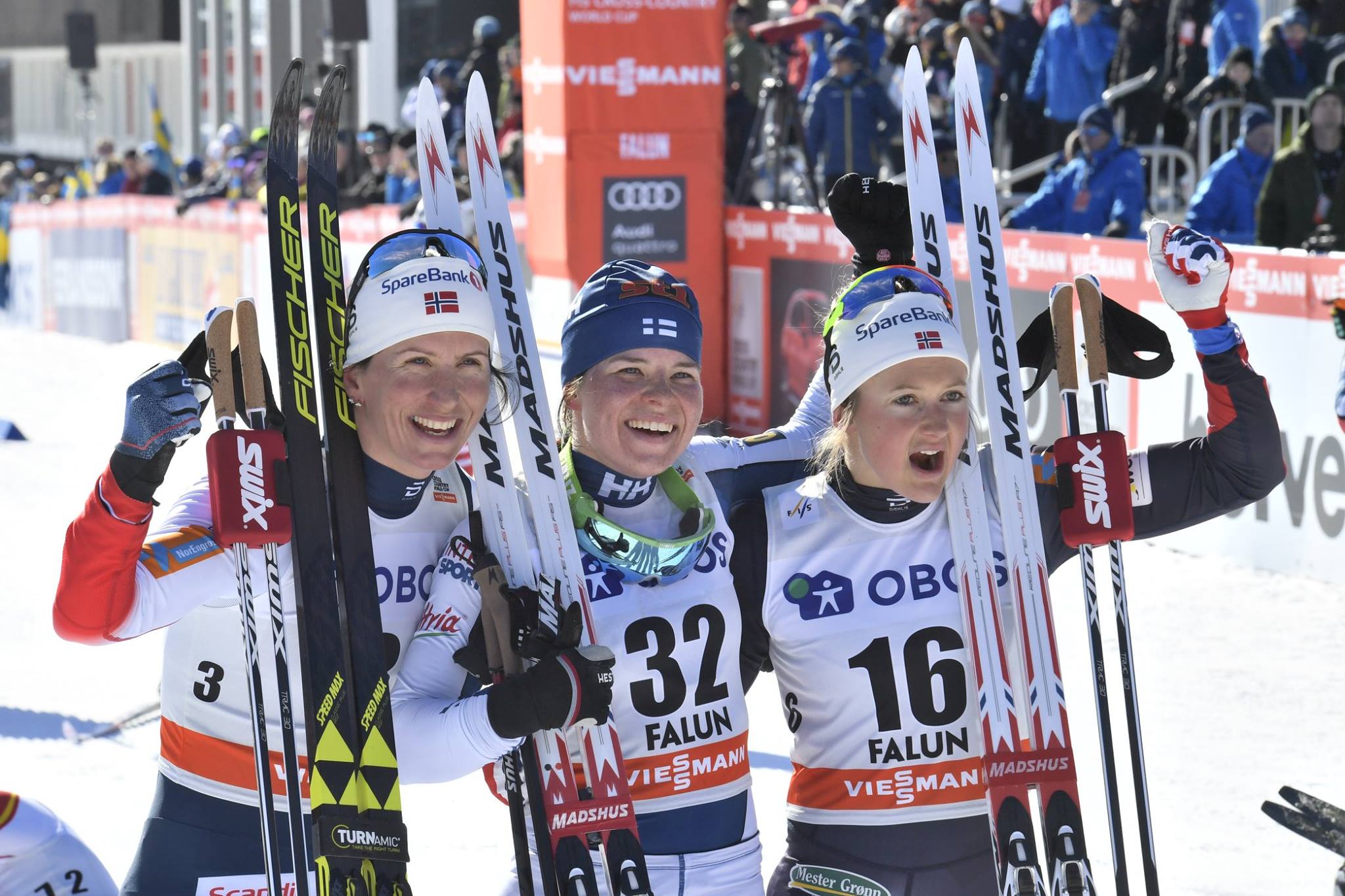
    The women’s 10 k classic mass start podium at 2018 World Cup Finals in Falun, Sweden, with Finland’s Krista Pärmäkoski (c) in first, Norway’s Marit Bjørgen (l) in second and Ingvild Flugstad Østberg (r) in third. (Photo: FIS World Cup Svenska Skidspelen/Facebook)

    FIS Cross Country World Cup Finals (Falun, Sweden): 10/15 k classic mass starts

    Women’s report

    Men’s report

    Day 2 of World Cup Finals in Falun entailed 10- and 15-kilometer classic mass starts on Saturday, and in the first race of the day, Finland’s Krista Pärmäkoski pulled out a thrilling finishing-sprint victory over Norway’s Marit Bjørgen.

    After American Jessie Diggins led early in the first 2.5 k loop, Bjørgen set the tone from the front for most of the race. With less than a kilometer to go, Norwegian powered up the final horseshoe-shaped climb in first, with Pärmäkoski and Bjørgen’s Norwegian teammate Ingvild Flugstad Østberg just behind her. The three had dropped the field while lapping through the stadium around the 7.5 k.

    While Østberg fell off the pace on that final uphill, Bjørgen accelerated as she took a few quick strides over the top, gaining a few meters on Pärmäkoski as they headed into the descent. The finishing stretch is long in Falun, and Pärmäkoski was able to come on strong just before she and Bjørgen entered the final 100 meters before the finish. There, Pärmäkoski’s double-pole speed not only matched Bjørgen, but beat her, as Pärmäkoski passed her with several meters to go and took the win by 0.2 seconds in 26:00.5 minutes. It was Pärmäkoski’s second win of the season and fourth of her career (including time-of-day pursuit stage wins).

    Just behind Pärmäkoski and Bjørgen, who congratulated each other immediately at the finish, Østberg finished 5.1 seconds back in third. Five women fought for fourth place, with Sweden’s Ebba Andersson taking it (+14.5) ahead of Japan’s Masako Ishida in fifth (+14.8), Sweden’s Charlotte Kalla in sixth (+15.2), Austria’s Teresa Stadlober in seventh (+15.4), and Diggins in eighth (+15.5).

    Norway’s Astrid Uhrenholdt Jacobsen was the next finisher across the line in ninth (+24.8), then Finland’s Kerttu Niskanen in 10th (+26.2) and American Sadie Bjornsen in 11th (+26.3).

    Canada’s Emily Nishikawa was the next North American in 36th (+1:31.1), and she led her teammates Cendrine Browne, who placed 50th (+2:05.7), Dahria Beatty in 61st (+2:46.6) and Zina Kocher in 69th (+6:12).

    For the U.S., Sophie Caldwell finished 41st (+1:36.1), Rosie Frankowski 44th (+1:43.7), Caitlin Patterson 47th (+1:54.8), Ida Sargent 52nd (+2:10.2), Liz Stephen 54th (+2:20.0), Kikkan Randall 57th (+2:34.1), and Kaitlynn Miller 64th (+2:50.7). Rosie Brennan did not start.

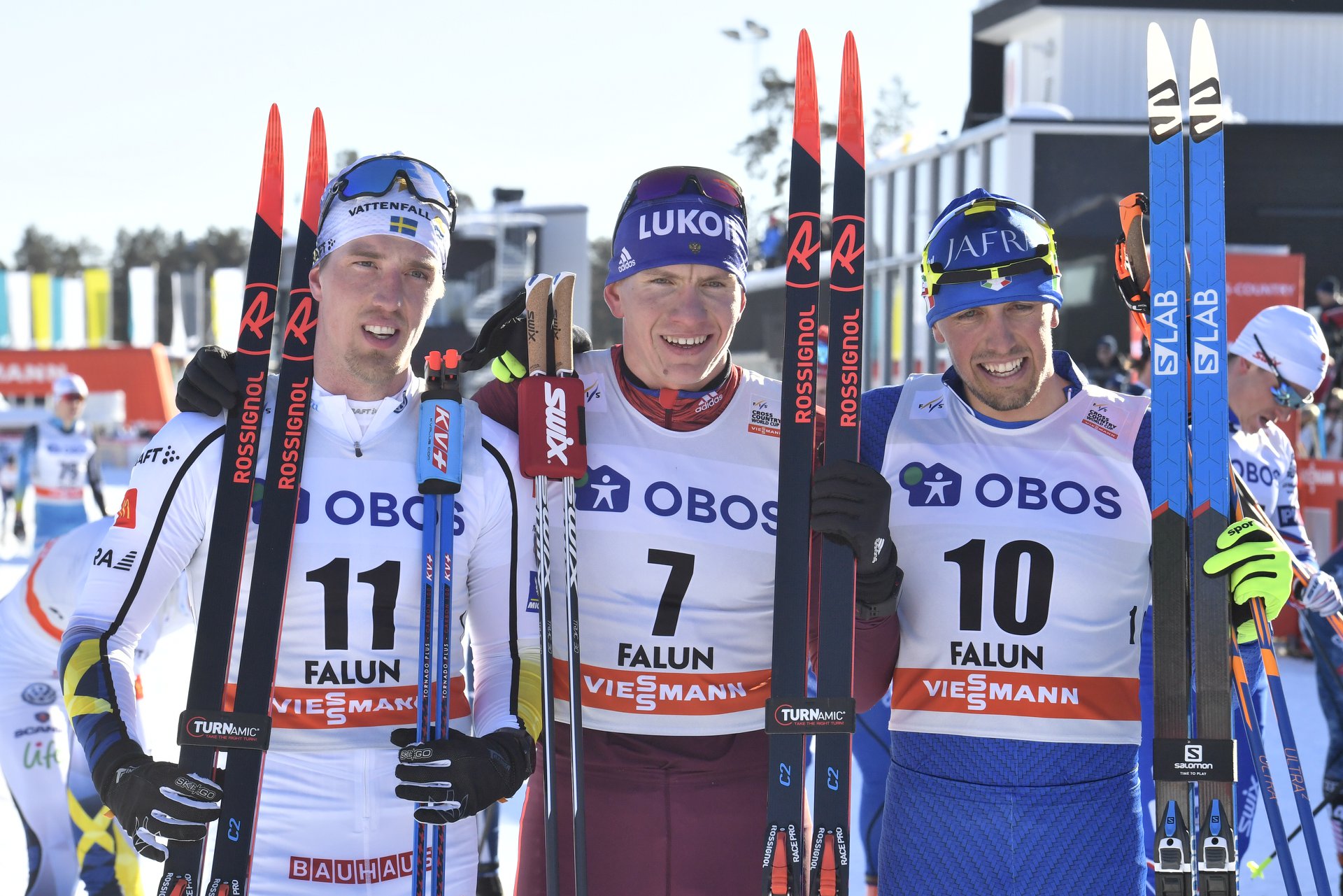
    The men’s 15 k classic mass start podium at 2018 World Cup Finals in Falun, Sweden, with Russia’s Alexander Bolshunov (c) in first, Sweden’s Calle Halfvarsson (l) in second, and Italy’s Francesco de Fabiani (r) in third. (Photo: : FIS World Cup Svenska Skidspelen/Facebook)

    In the men’s 15 k classic mass start on Saturday afternoon, Russia’s 21-year-old Alexander Bolshunov notched his first-career World Cup win after reaching the podium seven other times this season (placing third in six of those seven races).

    Bolshunov hung in the pack and took the lead at the start of the final lap at 11.25 k, ahead of four of his Russian teammates, Alexey Chervotkin in second, Evgeniy Belov in third, Andrey Larkov in fourth, and Maxim Vylegzhanin in fifth. Behind them, Switzerland’s Dario Cologna skied just ahead of Norway’s Martin Johnsrud Sundby and Canada’s Alex Harvey, who were among 29 skiers within four seconds of first.

    While Sweden’s Calle Halfvarsson led the final climb before the stadium, Bolshunov caught him on the downhill and out-double-poled him in the finishing stretch, taking first by 1.3 seconds in 36:59.8. Halfvarsson finished second and Italy’s Francesco de Fabiani scored his second World Cup podium of the season in third (+3.1).

    Kazakhstan’s Alexey Poltoranin missed the podium by 0.6 seconds in fourth (+3.7), Chervotkin followed in fifth (+5.2), ahead of Cologna in sixth (+5.6) and Italy’s Federico Pellegrino in seventh (+5.6), after they finished together. Sundby and his Norwegian teammate Niklas Dyrhaug also crossed the line at the same time in eighth (+6.3) and ninth (+6.3), respectively, just 0.1 seconds ahead of another one of their teammates, Sjur Røthe, in 10th (+6.4).

    Less than five seconds later, Harvey finished 20th (+10.7), ahead of Norway’s Johannes Høsflot Klæbo in 22nd (+13.6). Klæbo slipped out of contention on the third of four laps, as he dropped from fourth to 22nd in less than two kilometers.

    Canada’s Devon Kershaw finished 26th (+14.6) for his fourth-straight race in the top 30 (including his 26th-place finish in the Olympic 50 k classic mass start), Graeme Killick placed 41st (+1:13) and Julien Locke was 81st (+3:29).

    Erik Bjornsen was the top American man in 52nd (+1:47.1), Simi Hamilton finished 62nd (+2:06.4), Kevin Bolger was 69th (+2:27.1), David Norris 70th (+2:31.2), Scott Patterson 71st (+2:40.6), Paddy Caldwell 75th (+2:52.7), and Andy Newell 86th (+4:47).

    World Cup Finals conclude with 10/15 k freestyle pursuits on Sunday.

    Results: Women | Men

    ***

    IBU World Cup (Oslo, Norway): Women’s relay + men’s pursuit

    Women’s relay report

    Men’s pursuit report

    France won the International Biathlon Union (IBU) World Cup women’s 4 x 6 k relay to start the day at Holmenkollen, ahead of Germany and Italy, while the Canadian women’s team (Sarah Beaudry, Julia Ransom, Emma Lunder, and Rosanna Crawford) placed 11th and the U.S. (Clare Egan, Susan Dunklee, Joanne Reid, and Emily Dreissigacker) came back from 21st to finish 15th.

    In the men’s 12.5 k pursuit that followed, France’s Martin Fourcade won his 10th race at Holmenkollen, putting himself 49 points ahead of Norway’s Johannes Thingnes Bø with three individual races in Tyumen, Russia, remaining. US Biathlon’s Sean Doherty tied his second-best result this season in 17th and his teammate Lowell Bailey raced up to 28th with the 19th-fastest time of day. Leif Nordgren placed 40th and Tim Burke was 47th, while Canada’s Scott Gow finished 51st and Christian Gow was 54th.

    Results: Women’s relay | Men’s pursuit

  • Sunday Rundown: Holmenkollen 30 k; Kontiolahti Mass Starts

    Sunday Rundown: Holmenkollen 30 k; Kontiolahti Mass Starts

    The Holmenkollen women’s 30 k freestyle mass start podium on Sunday in Oslo, Norway, with Jessie Diggins (l) in second, and Norway’s Marit Bjørgen (c) in first and Ragnhild Haga (r) in third. (Photo: FIS Cross Country/Twitter)

    FIS Cross Country World Cup (Oslo, Norway): Women’s 30 k freestyle mass start

    Full report

    Marit Bjørgen, the Norwegian queen of distance cross-country events, racked up another victory at Holmenkollen in the women’s 30-kilometer freestyle mass start on Sunday for her seventh win in the World Cup’s ultimate distance event at the famed Norwegian venue. (She had previously won in 2005, 2010, 2012, 2014, 2015 and 2017).

    But she did so in not-so-typical fashion. Instead of breaking the field mid-race and skiing to a comfortable win, like she did in the last race of the 2018 Olympics in PyeongChang, South Korea (a 30 k classic mass start), Bjørgen came from behind to win Sunday’s Holmenkollen 30 k and wasn’t able to let off too much before finish. She didn’t take the lead until less than a kilometer to go and put just enough time into her competition to take the win in 1:18:12.4 hours, while American Jessie Diggins outlasted the chase group of three to place second (becoming the first American woman to reach the Holmenkollen podium), 3.6 seconds behind Bjørgen. Norway’s Ragnhild Haga edged Sweden’s Charlotte Kalla by 0.1 seconds for third place (+4.3), while Kalla settled for fourth (+4.4).

    The rest of the field was strung out, with Norway’s Astrid Uhrenholdt Jacobsen finishing fourth (+11.5) and Ingvild Flugstad Østberg nearly another 1 1/2 minutes back in fifth (+1:39.5). Finland’s Krista Pärmäkoski placed seventh (+1:51.7), Germany’s Stefani Böhler notched eighth (+2:10.2), Austria’s Teresa Stadlober ninth (+2:10.2), and Sweden’s Ebba Andersson 10th (+2:11.9). Less than a second behind Sweden’s Ida Ingemarsdotter in 11th (+2:22.8) was American Sadie Bjornsen in 12th (+2:23.4).

    In the Distance World Cup standings, Diggins gained some valuable points to keep herself in third, now 63 points ahead of Pärmäkoski in fourth. Heidi Weng, who finished 18th on Sunday, still leads the distance standings by 104 points and Østberg is second, 51 points ahead of Diggins.

    In the Overall World Cup, Weng leads by 153 points over Østberg. Diggins is another 104 points back in third, 100 points ahead of Pärmäkoski in fourth. At World Cup Finals next week in Falun, Sweden, a total of 300 points is up for grabs for the winners (50 for freestyle sprint, 50 for classic individual start, and 200 for freestyle pursuit).

    The U.S. had three in the top 20 and four in the points (top 30) in Sunday’s 30 k, with Kikkan Randall in 19th (+3:21.9) and Caitlin Patterson in 28th (+4:13.1). Rosie Frankowski (Alaska Pacific University) missed the top 30 by about 28 seconds in 31st (+4:45.4), Liz Stephen placed 51st (+10:01.7) and Kaitlynn Miller (Craftsbury Green Racing Project) finished 53rd (+16:05.0).

    Cendrine Browne led four Canadian women in 36th (+6:16.1), Emily Nishikawa was 44th (+7:36.1), Zina Kocher (Foothills Nordic) finished 47th (+8:52.0), and Dahria Beatty placed 49th (+9:45.1).

    Results | Distance World Cup standings | Overall World Cup standings

    ***

    Germany’s Vanessa Hinz celebrates her first IBU World Cup win and podium in the women’s 12.5 k mass start on Sunday in Kontiolahti, Finland. (Photo: IBU/Biathlonworld)

    IBU World Cup (Kontiolahti, Finland): Men’s and women’s mass starts

    (Note: This rundown has been updated to include comments from Lowell Bailey and Rosanna Crawford.)

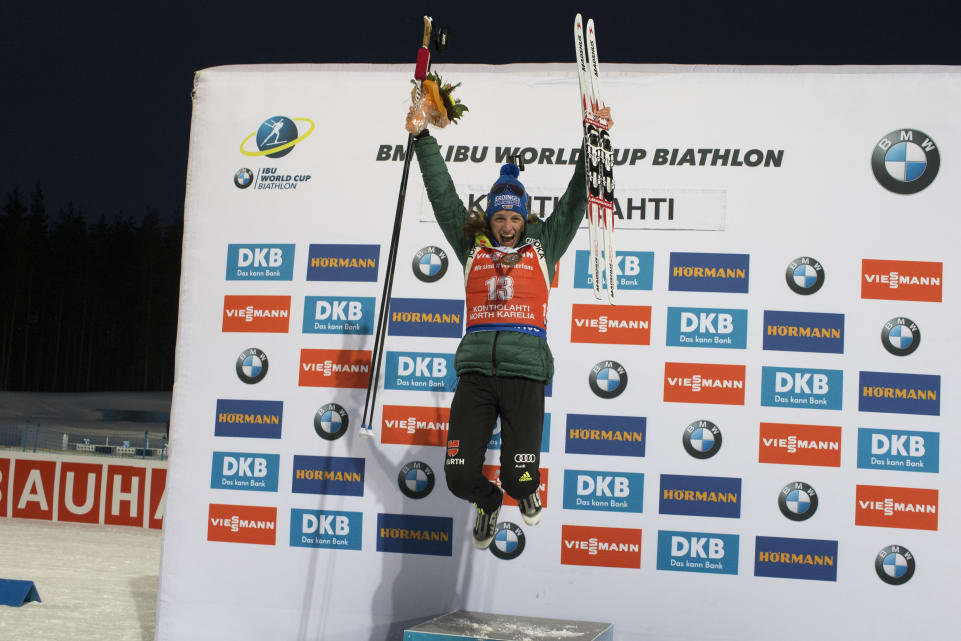
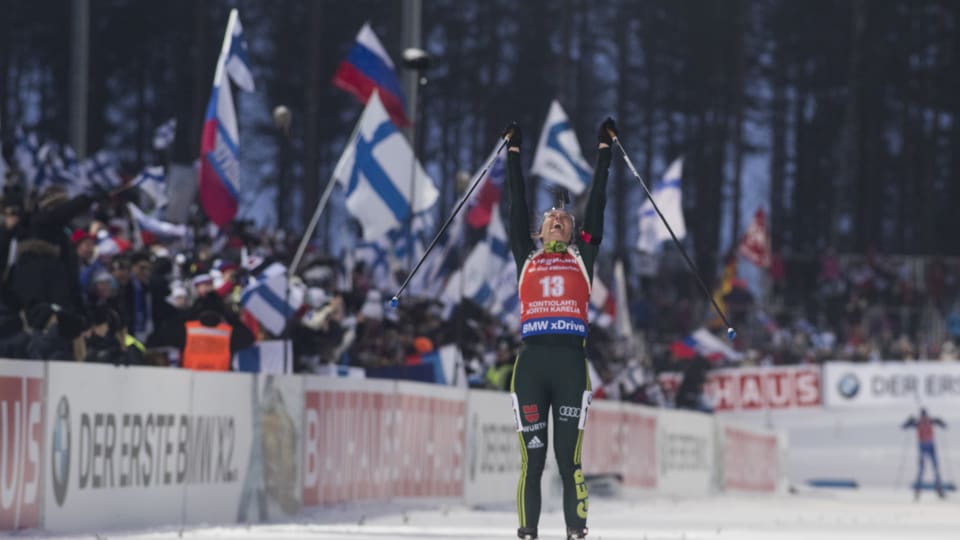
    Germany’s Vanessa Hinz won her first International Biathlon Union (IBU) World Cup race (and achieved her first World Cup podium) and Austria’s Julian Eberhard won his first race of the season (and first mass start of his career) in the women’s 12.5 k and men’s 15 k mass starts on Sunday in Kontiolahti.

    Germany’s Vanessa Hinz celebrates her first IBU World Cup win and podium in the women’s 12.5 k mass start on Sunday in Kontiolahti, Finland. (Photo: IBU/Biathlonworld)

    Hinz shot an impressive 20-for-20 with the third-fastest range time and fifth-fastest shooting time to take the win in 35:47.9 minutes. Third after the first prone stage, she moved into second, then third after cleaning the next two stages. After knocking down her final five targets in the last standing, Hinz left the range almost 24 seconds ahead of France’s Anaïs Chevalier in second and 26 seconds ahead of Italy’s Lisa Vittozzi in third. Hinz stayed ahead of her challengers on the final loop, finishing 13.5 seconds clear of Vittozzi, who claimed second. Chevalier finished third, 16.8 seconds back, while Finland’s Kaisa Mäkäräinen was next across the line in fourth (+43.4) with a gap to Sweden’s Hanna Öberg in fifth (+1:02.1).

    Vittozzi and Chevalier both cleaned the first three stages then had to ski a penalty lap after the last standing bout (0+0+0+1). Mäkäräinen missed three (1+0+1+1) yet skied the second-fastest course time on her home course, and Öberg missed two (0+0+2+0). The fastest course time of the day was clocked by Darya Domracheva of Belarus, who had to ski five penalty laps (0+1+1+3) and ended up 10th (+1:18.2).

    “I always dreamed of shooting four times clean and today I did it,” Hinz, 25, said, according to an IBU press release. “I was so often close to the podium. I knew I could do it. Today, I said, ‘OK, let’s try it and if it works, it is OK … and if not there is another season waiting and other races.’ Now I am on top of the podium and it is crazy.”

    Vittozzi, who placed fourth in the mass start at the 2018 Olympics, was glad to improve on a third-place finish in Friday’s sprint by placing second on Sunday.

    “I have been third so many times and that was not satisfying for me,” Vittozzi said, one day after she won the mixed relay with her team in Kontiolahti. “Today I am very happy about my second place.”

    For Chevalier, it was her first individual podium of the season and it came a day after she and Antonin Guigonnat won the single mixed relay. Chevalier, 25, was severely injured when she was hit by a car last spring, according to an IBU press release.

    “I am very happy to be here today, because it was a very hard season,” she told the IBU. “I forgot how nice it is to be on the podium … I forgot that it was not easy, so I am very happy … I did my best on the last lap; [Vittozzi] was faster, but I am third and happy with that!”

    Canada’s Rosanna Crawford shot 19-for-20 to place 13th (+1:25.9) with her only miss coming in the second prone stage (0+1+0+0). Her overall shooting and range times were 10th fastest of the 30-woman field, compared to her 26th-ranked ski time. Crawford had been in 11th after cleaning the final standing stage, then slipped two spots to finish 13th in her second mass start of the season.

    “Since the skiing wasn’t feeling great today I made sure I was super focused in the range,” Crawford wrote in an email to FasterSkier. “I knew that was my only chance to get a good result today. My one prone miss was a bad trigger pull, but the rest were nice solid hits. I made sure to have a solid set up and then just trusted my rhythm and shooting.

    “I knew that I wanted that top 15, so I just kept fighting and trying to stick with the women when they caught me,” she wrote of her last loop. “The last time up the wall I managed to stay close to [France’s] Anais Bescond, and hold off the two people behind me. Really happy to be in the top 15 again.”

    Clare Egan was the lone American woman to qualify for Sunday’s mass start, and it was the second mass start of her career. She was on track for a top-15 result after missing just one target in the first three stages, but she had to ski three penalty laps on the last standing (0+1+0+3), which put her in 23rd by the finish (+2:05.6). Notably, she skied the 14th-fastest overall course time.

    “I didn’t have quite the same energy level tonight as the last two days, but I still had the 14th rank course time and that means anything is possible in the race,” Egan wrote in an email to FasterSkier. “To put it in perspective, the winner of the race, Hinz, had the 13th rank, just 2 seconds faster than me. This is the first time I’ve felt totally comfortable skiing with the fastest women, and I certainly hope I can maintain this speed for one more week of World Cup racing.”

    Egan was pleased with her 9-for-10 prone shooting and her clean standing stage (“which is the first time I’ve cleaned a standing stage in an individual race this entire year, believe it our not,” Egan wrote).

    “But when I missed my second shot on the final stage, I let that throw me off my game, and really blew the rest of the stage,” she explained. “It’s so hard to keep 100% focus in every scenario, and I find it gets harder and harder towards the end of the race when I’m not necessarily the most lucid. I know that I have to work on so I have a goal to manage the final stage better next week and in the future.”

    Her 23rd-place finish was one better than her previous World Cup mass start finish, which was 24th last season in Hochfilzen, Austria.

    “In my only other mass start, which was last year at World Championships, I felt like an imposter,” Egan reflected. “Maybe because I was the first ‘reserve’ to get called up when one of the top women [did not start]. But this was totally different. I knew I deserved to be there today and was confident about competing with the other top women.”

    “In my only other mass start, which was last year at World Championships, I felt like an imposter … This was totally different. I knew I deserved to be there today and was confident about competing with the other top women.” — Clare Egan (US Biathlon) on Sunday’s mass start

    While the women raced Sunday night, the men’s 15 k mass start took place in the afternoon, when Eberhard passed the likes of France’s Martin Fourcade and Russia’s Anton Shipulin after a tangle late in the race to take the win.

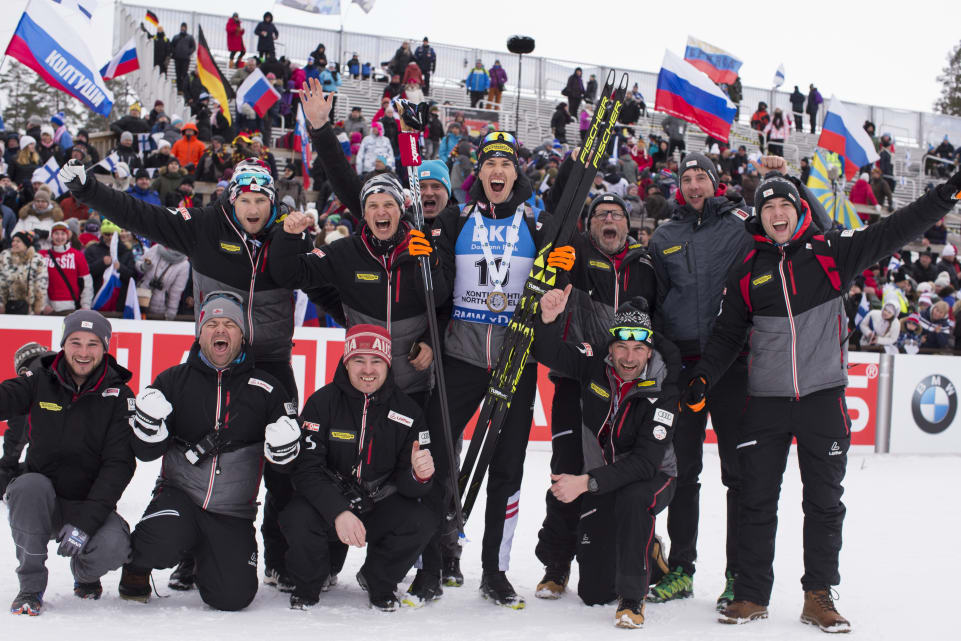
    The Austrian team celebrating Julian Eberhard’s fourth career victory, his first this season and his first in a mass start on Sunday after the IBU World Cup men’s 15 k mass start in Kontiolahti, Finland. (Photo: IBU/Biathlonworld)

    The Austrian had cleaned the first two prone stages to move into third by the race’s halfway point, behind Germany’s Benedikt Doll and Arnd Peiffer in first and second, respectively. Eberhard missed one in the next standing stage, yet left the range in second, 15 seconds behind Peiffer (who cleaned) in first, while Doll missed one as well to slip into third, 19 seconds back.

    With two loops to go, Fourcade was coming back from two early prone penalties and found himself in fifth after a clean standing stage, less than a second behind Shipulin in fourth. On the next standing stage, Fourcade cleaned to take the lead and left the range about five seconds ahead of Shipulin (who also cleaned) in second.

    Eberhard missed one yet remained in contention in third, 17 seconds behind Fourcade. On the last loop, Shipulin caught Fourcade before the course’s notorious climb known as “The Wall”, and Eberhard closed on the two frontrunners as they ascended it. Still several seconds behind over the top, he caught Shipulin on the bridge before the stadium, but the two tangled skis and Shipulin fell. Eberhard stayed upright and pulled even with Fourcade, passing him to take the win in 38:04.8. Fourcade finished second (+6.9) and Shipulin third (+19.3).

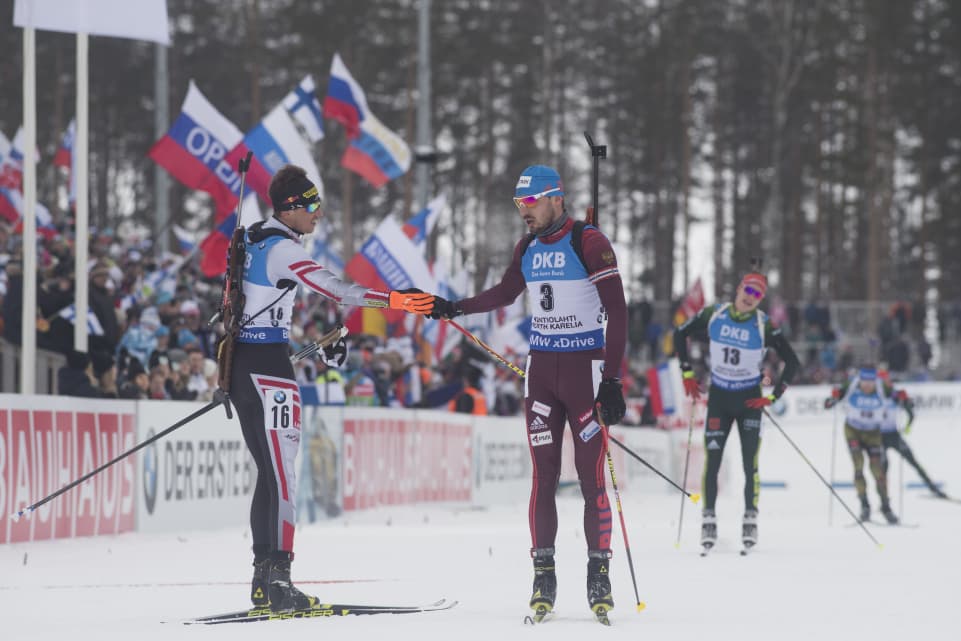
    Austria’s Julian Eberhard (l) and Russia’s Anton Shipulin after the finish of the men’s 15 k mass start the IBU World Cup in Kontiolahti, Finland. Shipulin fell when his skis tangled with Eberhard’s. While Eberhard raced to the win, Shipulin placed third. (Photo: IBU/Biathlonworld)

    “I wanted to be in a sprint with all three, but the bridge is too small for this,” Eberhard said, according to an IBU press release. “I came up the bridge with too much speed. Anton and I were in the same track and there was an accident. I apologized to Anton at the finish but he said these things can happen and it was OK with him.”

    “I hold no grudge against Julian,” Shipulin told the IBU. “This can happen in sports and is all fair … I am in good shape and want to preserve this and perform my best in the last World Cups.”

    Fourcade explained that illness caused him to sit out Thursday’s sprint, and he was only able to train three hours this week.

    “It is really difficult to race in this situation without any feeling or training,” Fourcade told the IBU. “I did not know what to expect today but I am quite satisfied. I would have liked to win, but I used too much energy trying to come back in the early laps and had no energy when it was time to attack.”

    Behind them, Doll picked off one place on the final loop to finish fourth (+21.9), passing his German teammate Erik Lesser, who finished fifth (+23.9). Peiffer followed in sixth (+27.1) as Germany had three in the top six.

    American Lowell Bailey raced to 14th (+1:06.3) with two penalties, both of which came in the standing stages (0+0+1+1). Bailey had been fourth after cleaning the second prone, 16 seconds behind Doll in first, but slipped to 10th after missing one on the next bout. He had to ski another penalty lap on the last stage, and left the range in 14th.

    Overall, Bailey posted the 10th-fastest shooting time, 15th-fastest range time and 18th-fastest course time.

    “I finally felt like I was back in the spot that I ended last season,” Bailey wrote in an email when asked about his consistency. “I felt controlled and able to keep the pace with the top of the field throughout the race.  It was nice to be back in the mix.

    “Although I would have liked to see this ski speed a few weeks ago, better late than never!” he continued.

    Next week’s World Cup in Oslo, Norway, will be his last of the season and his career.

    “After nearly two decades of international racing, Oslo will be my final World Cup as a U.S. Biathlete,” Bailey wrote. “I’m sure it will be emotional but I hope to end my World Cup career on a high note!”
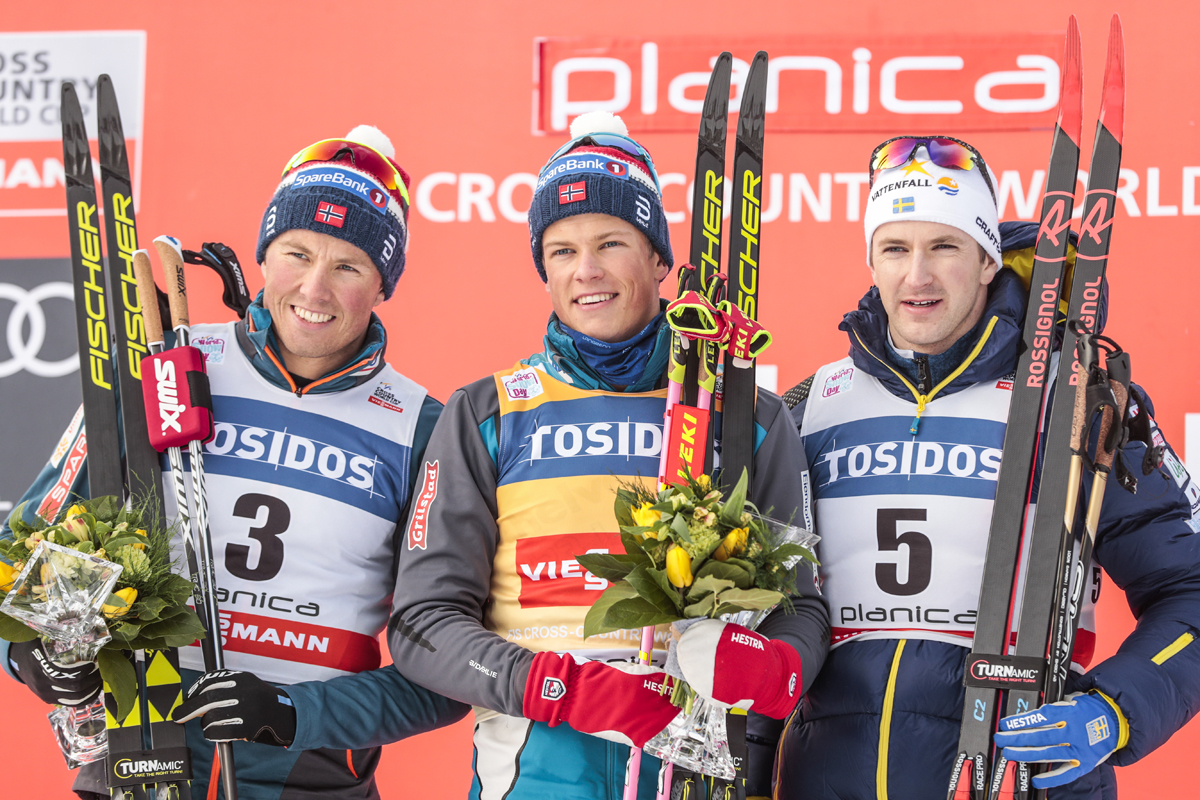
    Results: Women | Men

  • Western Canadian Champs: Notes and Quotes

    Western Canadian Champs: Notes and Quotes

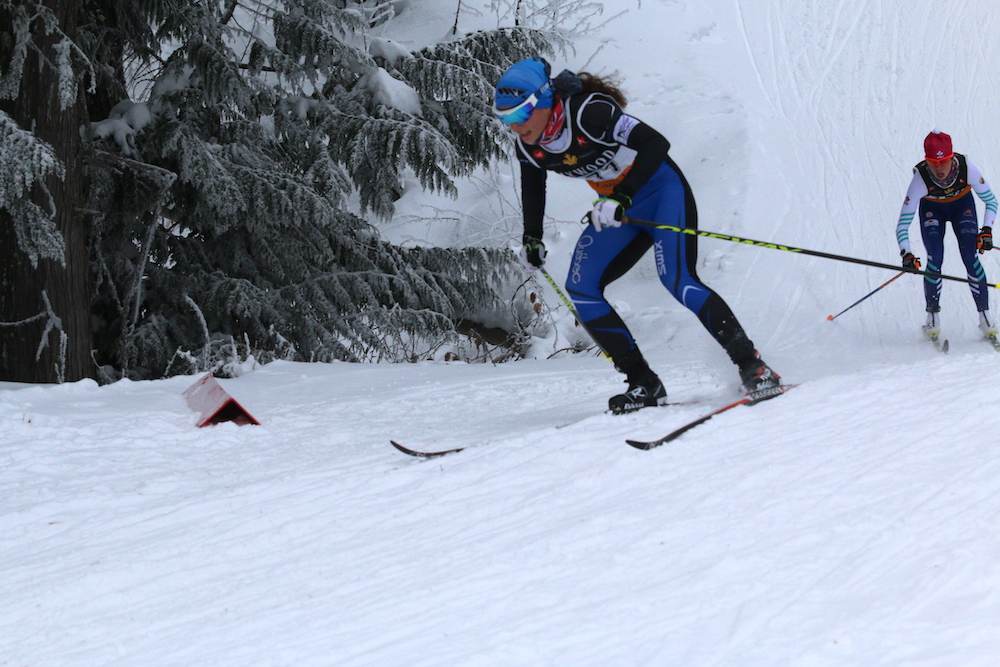
    Alberta World Cup Academy's Annika Hicks leads Zina Kocher (Foothills) and Laurence Dumais (AWCA) in Saturday's 10 k classic. (Photo: Doug Stephen)
    Annika Hicks of the Alberta World Cup Academy (AWCA) leads Zina Kocher (Foothills Nordic) and Laurence Dumais (AWCA) in the women’s 10 k classic mass start on Saturday, Jan. 20 at the NorAm Western Canadian Championships in Red Deer, Alberta. (Photo: Doug Stephen)

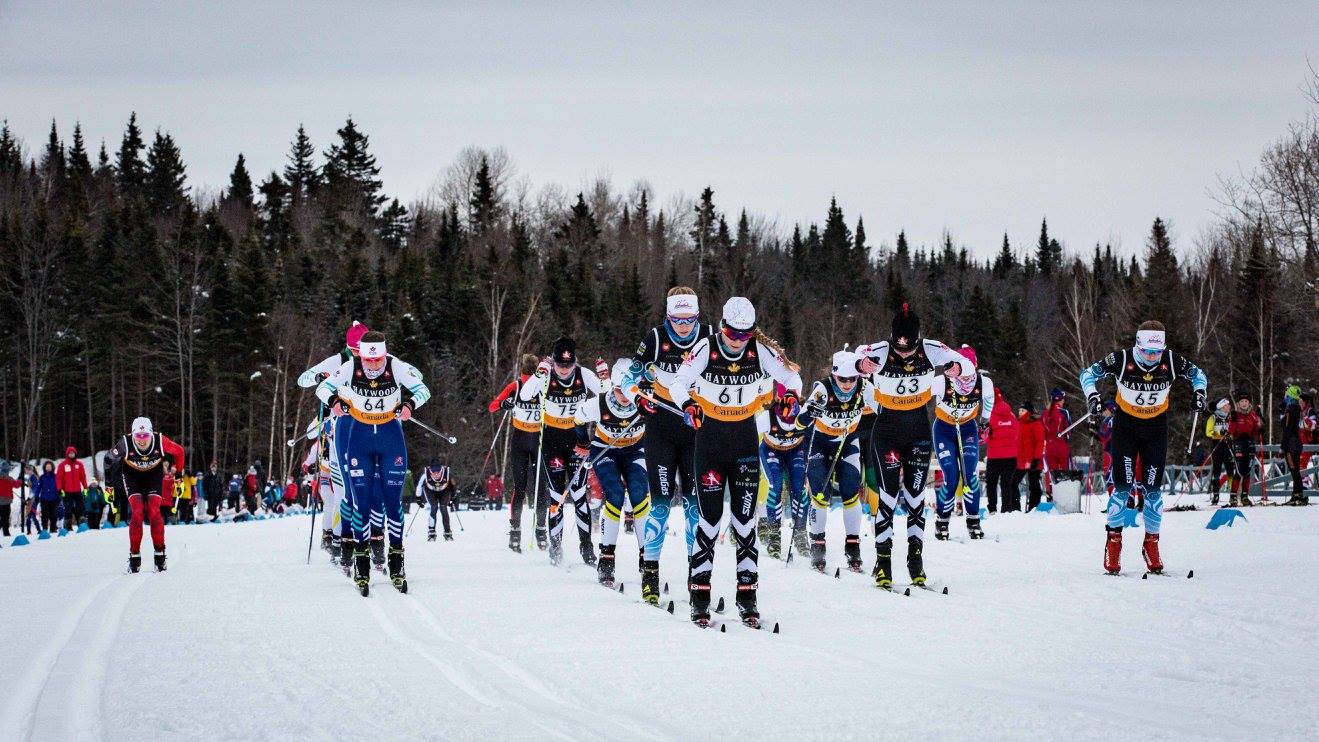
    The NorAm series moved west to Red Deer, Alberta, for Western Canadian Championships last week from Friday, Jan. 19 to Sunday, Jan. 21, with freestyle sprints, classic mass starts and relays at the River Bend Recreation Area trails.

    Each year, the NorAm circuit features both ‘Westerns’ and ‘Easterns’, which are intended to be regional championships so that the younger athletes have the opportunity to experience high-level racing closer to home.

    Easterns has been hosted by Nakkertok for 10 of the last 11 seasons. As the venue is within reasonable driving distance of 12 million Canadians, Eastern Canadian Championships has grown dramatically and is often the largest cross-country skiing Continental Cup event in North America with over 700 racers annually.

    On the other hand, Westerns visits different venues each year. With only 11.2 million Canadians living in the three Western time zones (spanning British Columbia, Alberta, Saskatchewan, Manitoba, Yukon, Nunavut, and the Northwest Territories), travel is always a limiting factor and the fields are much smaller. There were 403 finishers in Saturday’s classic event.

    While this year’s Westerns marked Red Deer Nordic’s first time hosting a NorAm, the club has a rich history in biathlon. Red Deer is also the hometown of retired biathlete Zina Kocher, who transitioned to cross-country skiing this season and was the NorAm series leader at the start of the weekend.

    2018 Western Canadian Championships rundowns:

    Friday: Freestyle sprints

    Saturday: Classic Mass Start

    Sunday: Relays

    Complete results

    Here are some quotes from the top finishers at the three-day Western Championships:

    Freestyle Sprints

    “In the final I took the lead from the beginning, was challenged by Zina [Kocher] in the last 200m but was able to come through in the end.”

    — Olivia Bouffard-Nesbitt (Canadian National Ski Team/Rocky Mountain Racers), won qualifier and A-final

    “[It] didn’t go exactly as I had planned in my head, I got too excited coming into the last downhill and went side by side to Olivia when I maybe should have stayed behind. I’m not a very good sprinter to the line, I feel like I’m going fast & giving it all but the last 100m are definitely not my strong point 😜”

    — Zina Kocher (Foothills Nordic), 2nd in qualifier and A-final

    “With only 2 heats it was a bit strange too…I have found that I improve as the heats progress. Unfortunately we just didn’t have many women out there this weekend competing.”

    — Kocher, on her fourth cross-country sprint race

    “I had a big focus towards the qualifying and I was stronger today than other days in Canada this year. I was happy to ski the way I planned in the heats, the course was very twisty and hard to pass so leading was important from the start.”

    — Jess Cockney (Canadian World Cup Team), qualified 2nd and won the A-final. He’s eyeing the sprints at the upcoming PyeongChang Olympics and will finish his preparation in Canmore

    “Starting position was super important. Jess skied well and is pretty hard to beat in the finish. I had actually intended to race how Jess raced it  so it was kinda weird to watch someone else race the strategy I was thinking of.”

    — Russell Kennedy (Team R.A.D.), qualified 1st and finished 2nd in A-final 

    Classic Mass Starts

    “The classic race was a lot of fun, it was exciting for everyone to have a mass start with the open, junior women, and junior girls. I skied in 3rd or 4th for the first two laps and then unintentionally found myself in the lead starting the last lap. That was not my plan but at that point no one else would take the lead, so I skied in front until the final 100m with Annika on my tails and she out-skied me at the end. It was a good fight.” 

    — Bouffard-Nesbitt, 2nd place

    “Olivia, Annika & I broke away from the pack fairly early on… (not sure when, maybe around the 1st lap it was only the 3 of us). I felt good especially in double pole sections. Maybe my best 10k classic thus far … being that it was my 3rd 10k classic race. Still working on the running herringbone sprints, which is where I unfortunately lost Olivia & Annika middle of the last lap. That technique is tricky to grasp!”

    — Kocher, 3rd place 

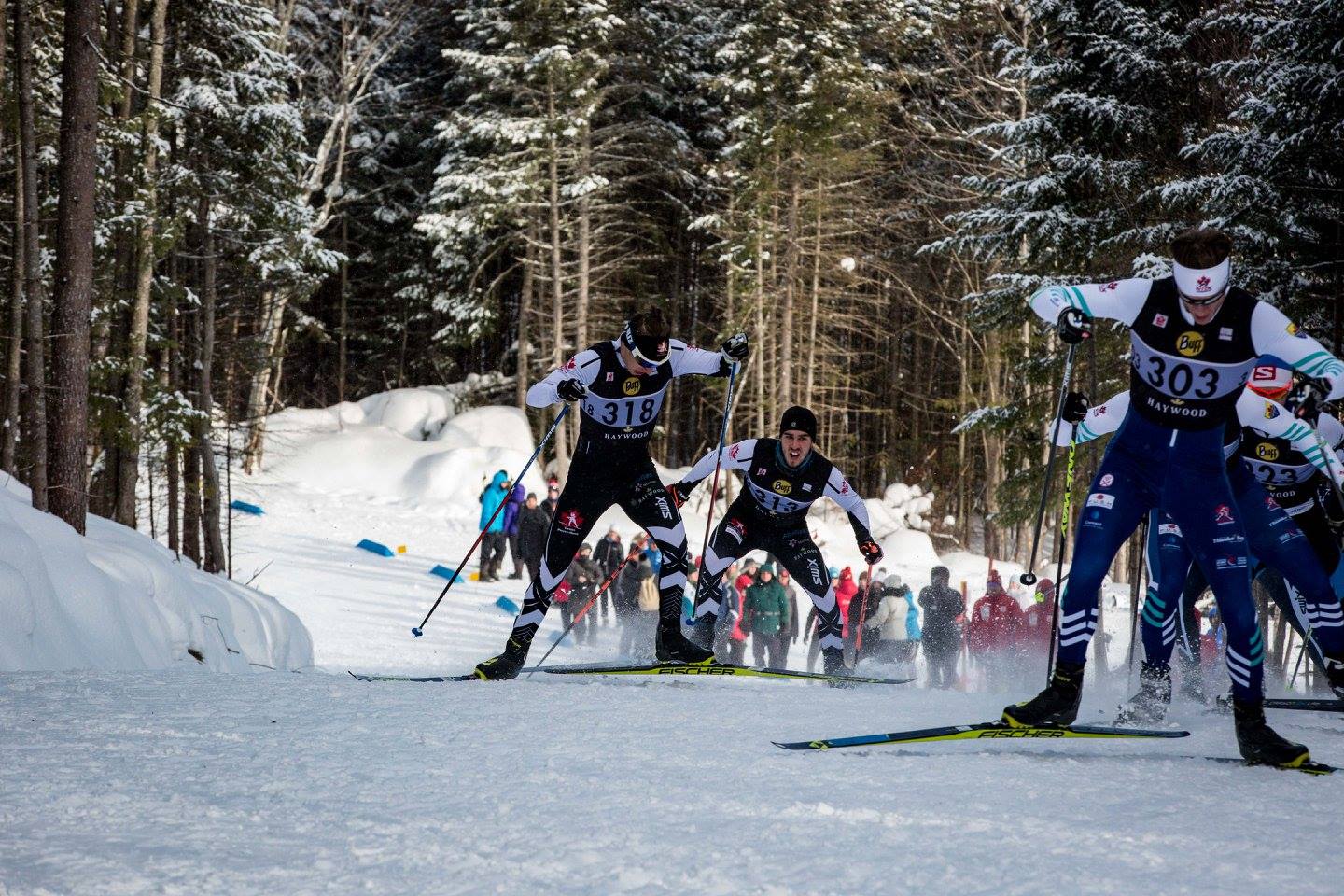
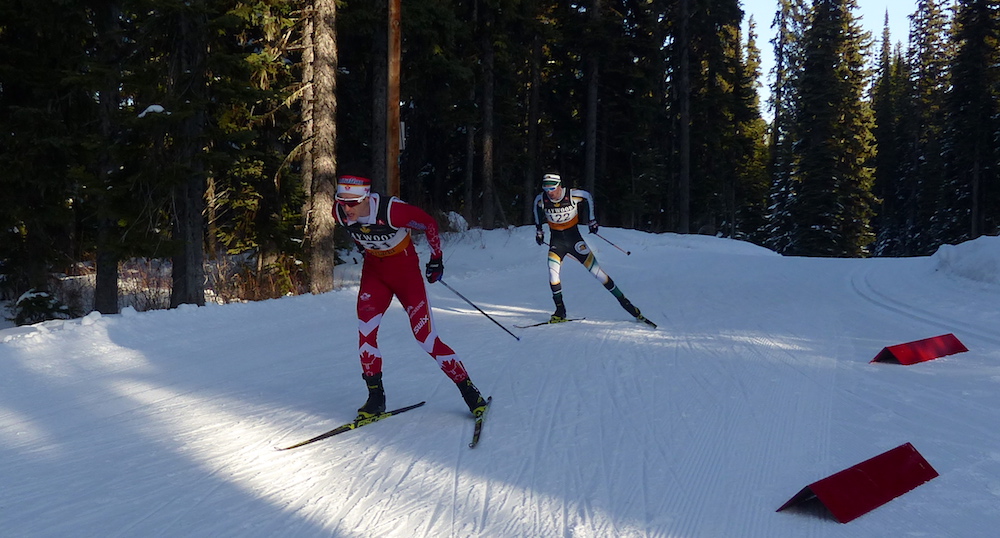
    Andy Shields (Lappe Nordic) leads Russell Kennedy during the men’s 15 k classic mass start at Western Canadian Championships in Red Deer, Alberta. Shields went on to win by 9 seconds over Kennedy. (Photo: Doug Stephen)

    “We had a huge advantage with my skis and took full advantage of them. I felt great and was able to put in a monster move of the final climb.”

    — Andy Shields (Lappe Nordic), 1st

    “I’m really proud of my classic race since I applied my own kick wax! The Caledonia coach, Graeme Moore, is a Red Deer native and SkiGo tech rep, did a great job with testing and took we took a slightly different route than other teams chosing what types of grip wax to use. I ended up going out on a mix of four different brands of grip wax. For glide I was on all SkiGo so I fufilled my role as SkiGo rep that way.”

    — Shields

    “I was pretty happy with my classic race. Was feeling a little flat since I was sick for so long leading up to it but was happy with how my fitness has held together. It was a good day with a pretty fun trail. I pushed kinda early to break the group down a little. Three of us ended up at the front and I lead a little to much on the 3rd lap but held in for a second place!”

    — Kennedy

    “I skied the start of the classic race the way I wanted but made some tactical errors at the end that left me with not enough juice in the last k. I tried to make a break on the last lap from Andy and Russell but I put too much into it and when I couldn’t drop them I had nothing left for when the next attack came.”

    — Scott Hill (BXC), 3rd

    Relays

    “I’m thrilled that relays were added, despite the fact that I won’t be taking part this weekend. I think that one relay per season is a great addition because in the past, Canadians only got to race relays at World Juniors/ U23s or senior Championships.”

    — Bouffard-Nesbitt

    “Relays are great! We don’t get to do enough of them. A fun event that’s a little more low key. They always create interesting race situations.”

    — Shields

    “Its awesome. It’s a good chance for the younger athletes to learn from the older and for teams that don’t usually work together to work together. Plus I think it is good to do 5km every now and then as they are super hard and really good intensity!”

    — Kennedy

    “I really like the addition of a relay on the NorAm. I know that some of the older athletes who are racing a lot and are focused on scoring NorAm points choose to sit the relay out but still having prize money provides a nice incentive. I think having a relay for the younger categories though is really positive and I saw an energy and enthusiasm in the chalet yesterday for the race that you don’t see before an individual race. I think one relay per season is great for the senior categories but I think more would be great for the younger categories.”

    — Hill

    Red Deer in General

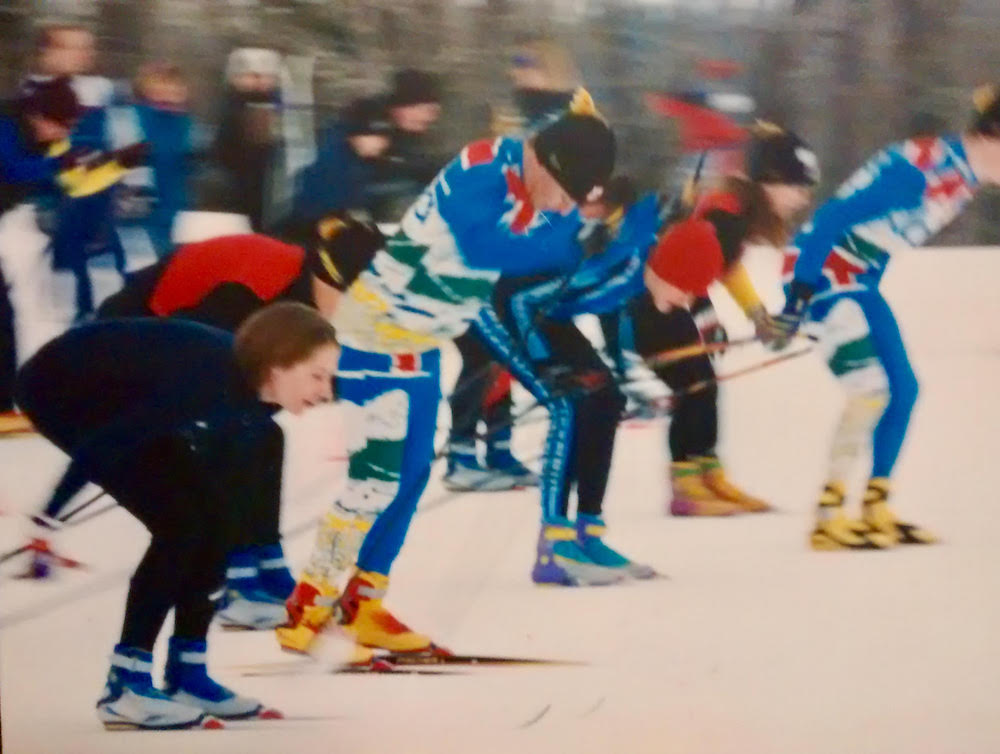
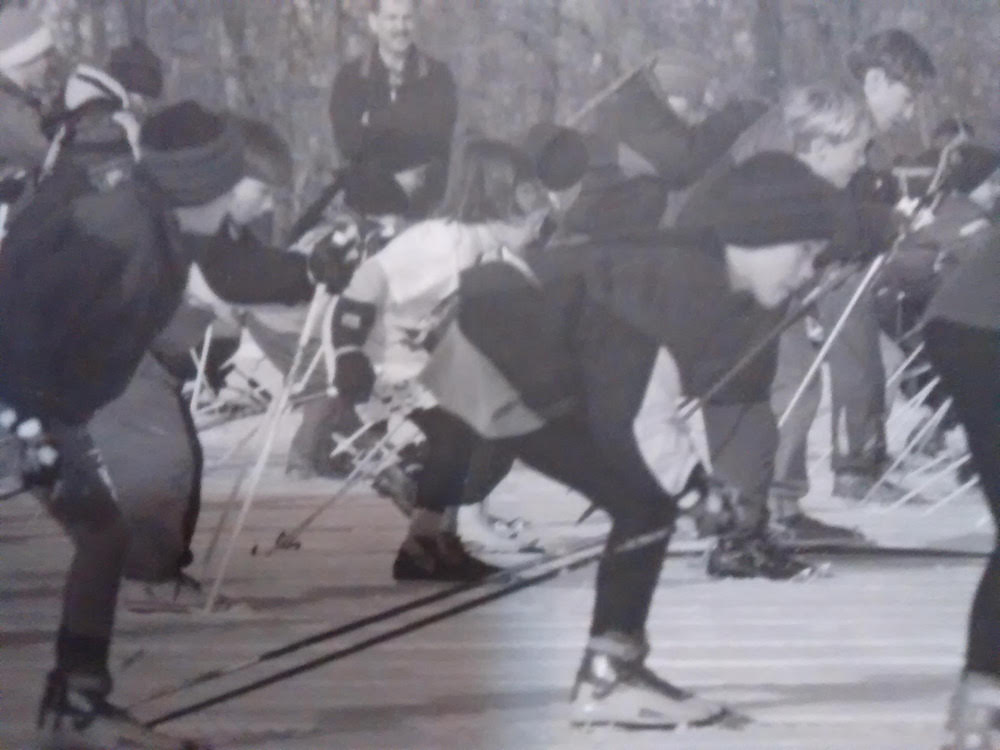
    The start of the Red Deer school loppet in 2000. From left to right, Kocher (no hat), Graham Vanderwater (Alberta team), Kit Richmond (red hat, RMR, future NCAA winner), and Drew Goldsack (future Olympian, too fast to catch his face!). (Photo: Kocher family)
    The start of the Red Deer school loppet in 2000. From left to right: Kocher (no hat), Graham Vanderwater (Alberta team), Kit Richmond (red hat, RMR, future NCAA champion), and Drew Goldsack (future Olympian, already too fast to catch his face!). (Photo: Zina Kocher)

    “[I] had a lot of fun out there and was really great to end my career right where I began. Haven’t raced on these trails since I was 17, so it feels really special. My dad also brought my grandma out to watch me & it’s the first time she’s ever seen me race so that was very special as well. Lots of faces too that I’ve reconnected with today. [I] did a short session with Red Deer Nordic yesterday afternoon, great to be able to give back and provide a little bit of insight. I thoroughly enjoy being able to do this.”

    — Kocher, after Friday’s sprint

    “I also thought the race course was really fun. … There was very little snow in Red Deer, but the race organisers and volunteers still produced a great race course for us. I was really impressed. The volunteers were all very enthusiastic, the day before the distance race I came across a crew of eight or nine volunteers with shovels and two volunteers driving piles of snow around the entire course covering any bare or rocky spots.”

    — Bouffard-Nesbitt

    “Red Deer has been great! I’ve been wearing two hats this weekend: I’m helping Caledonia Nordic with waxing and obviously trying to race too. It been a lot of early mornings out testing and busy evenings prepping skis so have been managing my energy as best I can.”

    — Shields, who doubles as the SkiGo rep for Canada

    Easterns vs. Westerns

    “I think Easterns are a pretty special event, garnering equal or greater racer turnout than Nationals. I don’t think any other competition will be able to rival Easterns, but it would be nice if Westerns drew a few more senior athletes than it did this year. I think Westerns was a big success for the junior categories.”

    — Bouffard-Nesbitt, originally from Morin Heights, Quebec, and currently lives in Canmore

    “It’s nice to have the variety of race formats offered by Westerns and Easterns. It’s too bad there’s no more 30km at Easterns. It was one of my favorite races of the year.”

    — Shields

    “Westerns just can’t compete with the number of skiers that compete at easterns but I think its still an important race for those skiers out west that don’t make the trip to easterns. Having it later in the season might help with more athletes from the east going out.”

    — Hill, originally from Toronto

    Highlights

    “Memory lane on the Riverbend tracks. Really enjoyed the new changes that have been made, a lot of great work has been done by the Red Deer crew. Was a great skate ski track for today’s relay – great flow & steep uphills. … Awesome to0 that my grandma was able to escape from the hospital & watch me compete in the skate sprints!”

    — Kocher

    “It was fun to fight out the heats with Jess [Cockney], he is an excellent tactician and I think I learn a lot from him every time we race.”

    — Kennedy

    “We are positive and we all work well together. We also had some amazing training camps together so I am sure that helped!”

    — Kennedy, on whether becoming a guide to Brian McKeever has made him faster. Kennedy and Graham Nishikawa will share guiding duties for McKeever at the PyeongChang Paralympics and have both been prominent on the NorAm podium this season

    “I was in and out of Red Deer pretty quick so I didn’t get to see too much but racing in a new place is always fun and I got drive around a big truck which was awesome.”

    — Hill

    Skiing doesn't start with the Olympics or end when you retire. Kye Kocher (blond hair) shows his sister Zina how it is done in the Red Deer school loppet. (Photo: Kocher family)
    Skiing doesn’t start or end with the Olympics. Kye Kocher (blond hair) shows his sister Zina how it is done in the Red Deer school loppet. (Photo: Zina Kocher)
  • Sunday Rundown: Planica, Chaux-Neuve, Rena, Red Deer

    Sunday Rundown: Planica, Chaux-Neuve, Rena, Red Deer

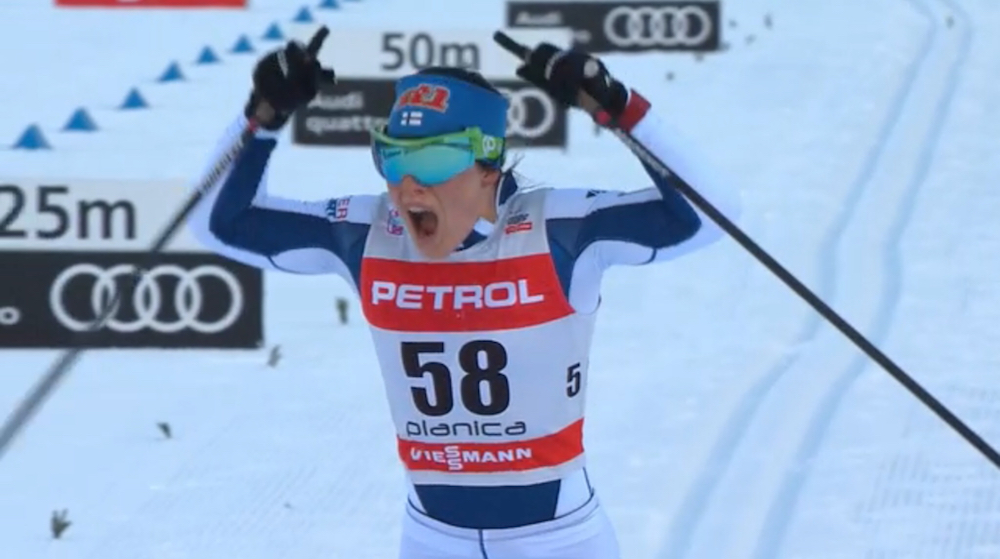
    Finland’s Krista Pärmäkoski after winning her first non-stage World Cup on Sunday in the women’s 10 k classic in Planica, Slovenia. She bested Sweden’s Charlotte Kalla’s time by 3.6 seconds. (Screenshot: ARD broadcast)

    FIS Cross Country World Cup (Planica, Slovenia): 10/15 k classic

    Women’s report

    Men’s report

    Just when it looked like one of those Charlotte-Kalla days, Finland’s Krista Pärmäkoski swooped in and topped the Swede’s time by 3.6 seconds in the women’s 10-kilometer classic individual start on Sunday for her first-career outright World Cup win.

    Outright meaning non-stage; Pärmäkoski has two World Cup wins to her name for setting the fastest time of day in 2016 pursuit races.

    But Sunday’s 10 k in Slovenia saw her rising to the challenge and besting Charlotte Kalla’s time of 27:12.3, which was at least 39 seconds faster than the first 57 starters. Kalla had started 32nd and beat the previous top time set by Swedish U23 skier Ebba Andersson (bib 28) by 48.6 seconds.

    Austria’s Teresa Stadlober started later in bib 56 and clocked the second-fastest time to Kalla, 39 seconds back.

    But it was Pärmäkoski in bib 58 who beat them all. Even Norway’s Heidi Weng, who started 60th, couldn’t come close, as she finished 33.5 seconds off Pärmäkoski’s winning time for third place. That put Stadlober in fourth and Andersson in fifth at the end of the day.

    Finland’s Kerttu Niskanen placed sixth (+49.4), Norway’s Kari Øyre Slind took seventh (+49.5), Poland’s Justyna Kowalczyk (who’s more of a marathon skier these days) placed eighth (+1:02.1), Norway’s Kathrine Rolsted Harsem (who placed second in Saturday’s classic sprint) finished ninth (+1:03.2), and American Jessie Diggins was 10th (+1:05.4).

    Another American, Caitlin Patterson, of the Craftsbury Green Racing Project (CGRP), broke through with her second-best individual World Cup result in 20th (+1:45.2). (Last year, she finished seventh in the pre-Olympic PyeongChang World Cup 15 k skiathlon in a notably small field.)

    Kikkan Randall (U.S. Ski Team) followed in 23rd (+1:50.4), and her teammates Sophie Caldwell placed 31st (+2:17.2), Liz Stephen 35th (+2:34.9), and Ida Sargent 37th (+2:37.5).

    For the second-straight weekend, no Canadian women competed.

    The World Cup men’s 15 k classic podium on Sunday in Planica, Slovenia, with Kazakhstan’s Alexey Poltoranin (c) in first, Norway’s Johannes Høsflot Klæbo (l) in second, and Sweden’s Calle Halfvarsson (r) in third. (Photo: FIS Cross Country/Twitter)

    In the men’s 15 k classic, Kazakhstan’s Alexey Poltoranin tallied his second win of the season and first in a race against Norway’s Johannes Høsflot Klæbo on Sunday, winning by 13.2 seconds over Klæbo in 36:54.7.

    Poltoranin, 30, started 44th and a minute behind the 21-year-old Klæbo. When Klæbo finished, he bumped Russia’s Ivan Kirillov, also 21, out of the leader’s chair by 43.3 seconds. Then Poltoranin finished 13.2 seconds faster, but Klæbo held onto second when Sweden’s 60th starter, Calle Halfvarsson, finished third (+42.8). It was Halfvarsson’s second podium of the season after placing third in the classic sprint at the November World Cup opener in Kuusamo, Finland. In Saturday’s classic sprint in Slovenia, Halfvarsson qualified second but crashed out of the quarterfinals to finish the day in 30th overall.

    Norway’s Emil Iversen started 66th and ended up fourth (+54.7) and Kirillov scored his first World Cup top 10 in fifth (+56.5). Russia had four in the top 10 with Stanislav Volzhentsev in sixth (+57.8), Andrey Larkov in eighth (+1:02.2) and Andrey Sobakarev in ninth (+1:03.4). Norway’s Mattis Stenshagen finished seventh (+1:00.8) and Finland’s Iivo Niskanen took 10th (+1:10.1).

    Scott Patterson (U.S. Ski Team) was the top North American in 43rd (+2:56.2), Ben Lustgarten (Craftsbury Green Racing Project) finished 46th (+3:04.9) and Tyler Kornfield (Alaska Pacific University) was 57th (+4:03.7). Andy Newell did not finish.

    Canada’s Devon Kershaw returned to the circuit and placed 44th (+2:57.1), Bob Thompson (NTDC Thunder Bay) was 64th (+5:05.0), and Dominique Moncion-Groulx (Alberta World Cup Academy) was 70th (+6:11.7).

    Results: Women| Men

    ***

    Russia’s Stefaniya Nadymova outsprinting Japan’s Ayane Miyazaki at the finish for the win at the inaugural women’s Nordic Combined Continental Cup competition on Saturday in Rena, Norway. (Photo: FIS/Romina Eggert)

    FIS Nordic Combined Continental Cup (Rena, Norway): First-ever women’s competitions

    Fourteen women, including American Gabriella Armstrong, made history this weekend by competing in the first women’s Nordic Combined Continental Cup in Rena, Norway (after the scheduled opener in Jan. 6-7 in Otepää, Estonia, was canceled), with back-to-back days of individual large hill/5-kilometer Gundersen start races.

    On Saturday, Russia’s Stefaniya Nadymova took the win in 16:26.9, just 0.6 seconds ahead of Japan’s Ayane Miyazki in second. Germany’s Jenny Nowak joined them on the podium in third, 16.6 seconds out of first. Armstrong finished 12th (+6:24).

    Nadymova, 23, had kicked off the event by jumping to first in the provisional round, which was used for the jumping results, and began the 5 k with a 10-second head start on Nowak in second place. Miyazaki jumped to third and started 14 seconds back. Armstrong jumped to 14th and started 4:08 out of first.

    On Sunday, 15-year-old Miyazaki took the win in 16:23.2, swapping places with Nadymova, who finished second, 11.7 seconds back. Nowak, also 15, repeated in third, but finished over a minute and 21 seconds back out of first.

    Miyazaki had jumped to first place earlier in the day and started the 5 k with a 20-second cushion to Nadymova in second. Nowak jumped to third and started 1:08 minutes back.

    Armstrong, 19, of the New York Ski Education Foundation, jumped to 11th and finished 11th, 4:26.1 after Miyazaki.

    Several U.S. Nordic Combined men also competed in Rena, with Taylor Fletcher placing fourth in Saturday’s individual large hill/10 k, 2.7 seconds behind Austria’s Thomas Joebstl in first. Fletcher had skied up from 25th and 2:17 back after the jump with the second-fastest course time.

    Also for the U.S., Adam Loomis placed 33rd (+2:30.7) after jumping to 45th with the 12th-fastest course time. Grant Andrews finished 41st (+3:28.7), and Jared Schumate 43rd (+4:10.1).

    Fletcher reached the podium in Sunday’s individual large hill/10 k in third behind two Austrians. After jumping to 19th, he skied the fourth-fastest course time to finish third, 3.7 seconds behind Dominik Terzer in first and 2.7 seconds behind Martin Fritz in second.

    Loomis improved to 29th (+1:40.9), up from 35th in the jump, and Andrews finished 37th (+2:36.4) and Shumate 40th (+2:57.9).

    Results:

    Saturday: Women | Men

    Sunday: Women | Men

    ***

    The men’s large hill/4 x 5 k team event podium on Sunday at the Nordic Combined World Cup in Chaux-Neuve, France, with Norway (c) in first, Germany (l) in second, and Finland (r) in third. (Photo: FIS/NordicFocus)

    FIS Nordic Combined World Cup (Chaux-Neuve, France): Saturday & Sunday

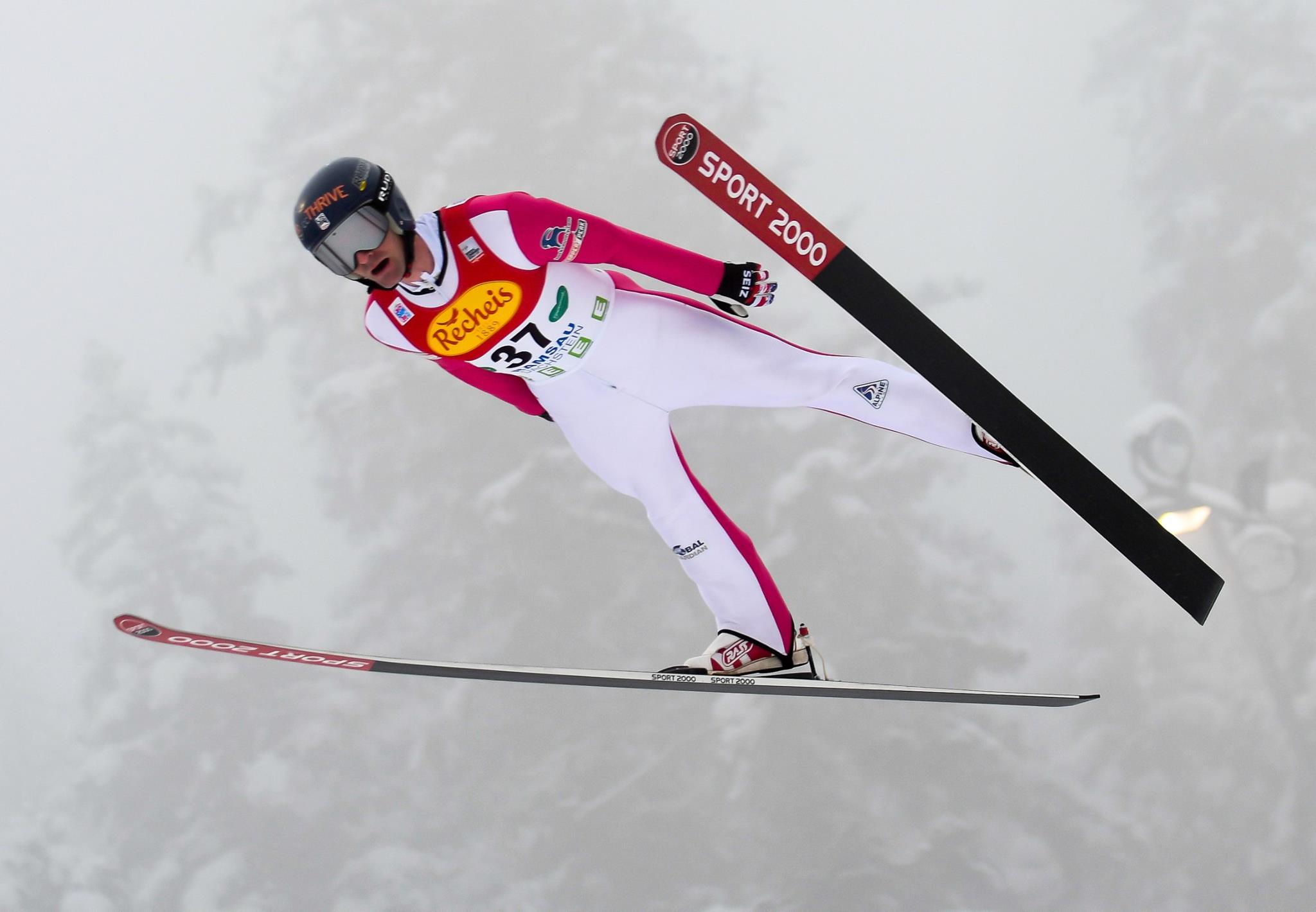
    Four American men competed at the Nordic Combined World Cup this weekend in Chaux-Neuve, France, with three of them racing in Saturday’s individual large hill/10 k Gundersen and all four racing Sunday’s large hill/4 x 5 k team event.

    Norway’s Jan Schmid was the big winner this weekend, racking up an individual win on Saturday and a team victory on Sunday. He won Saturday’s competition after jumping to fourth and starting 27 seconds behind jump leader Akito Watabe of Japan. Schmid worked his way up to first in the 10 k with the third-fastest course time, crossing the line 1.4 seconds ahead of Watabe in 23:32.7.

    Watabe finished second and Finland’s Ilkka Herola placed third (+21.5), just ahead of Austria’s Lukas Klapfer in fourth (+21.8).

    Ben Loomis led USA Nordic in 37th (+2:49), after jumping to 37th, Stephen Schumann finished 45th (+5:17.0) and Ben Berend 46th (+5:22.2).

    On Sunday, Schmid teamed up with Espen Andersen, Jarl Magnus Riiber and Jørgen Graabak to win the 4 x 5 k team event in 47:22.5 by 13.1 seconds. Germany followed in second, with Eric Frenzel, Fabian Rießle, Johannes Rydzek, and Vinzenz Geiger, and Finland placed third (+20.5) with Leevi Mutru, Arttu Maekiaho, Herola, and Eero Hirvonen.

    Norway had led after the jump and started the relay 1:03 minutes ahead of Finland in second. France jumped to third and ended up fourth (+47.4), after being passed by Germany, which had started the relay in fourth.

    Japan placed fifth (+2:50.9), Italy sixth (+3:59.9), Austria seventh (+4:06.8), Poland eighth (+5:22.1), Estonia ninth (+5:52.1), Russia 10th (+6:41.2), and the U.S. (with Schumann, Loomis, Berend, and Jasper Good) 11th (+6:52.4).

    Results: Saturday| Sunday

    ***

    Western Canadian Championships (Red Deer, Alberta): Relays

    Nine men’s teams and six women’s squads contested the open relays on the last day of the NorAm Western Canadian Championships on Sunday in Red Deer, with Ontario’s Team “O” (Scott Hill, Michael Somppi and Andy Shields) winning the men’s 3 x 5 k and Alberta 1 (Annika Hicks, Emma Camicioli and Zina Kocher) winning the women’s 3 x 5 k.

    For Shields and Hicks, it was their second win of the weekend after they won their respective classic mass starts on Saturday.

    Team “O” posted a 19.9-second win over B.C. Storm (Remi Drolet, Tallon Noble and Greg Kilroy), finishing first in 36:22.6. Alberta 5.1 (Sebastien Boehmler-Dandurand, Sam Hendry and Russell Kennedy) placed third (+52.3).

    In the women’s relay, Alberta 1 beat out B.C. Fast, Furious & Freakin’ Awesome (Katie Weaver, Michaela McLean and Kaia Andal) by 2 minutes and 37.8 seconds, winning in 43:17.2. Alberta had two teams on the podium with the Kit Kats (Ember Large, Molly Jane Strum, and Sara McLean) in third (+4:25.8).

    Results

  • Saturday Rundown: Planica and Red Deer

    Saturday Rundown: Planica and Red Deer

    Annika Hicks in the yellow NorAm leader’s bib leads Zina Kocher (52), Olivia Bouffard-Nesbitt (56) and Laurence Dumais (62) in the women’s 10 k classic mass start at Western Canadian Championships on Saturday in Red Deer, Alberta. Hicks went on to win by 2.5 seconds over Bouffard-Nesbitt. (Photo: Doug Stephen)

    Western Canadian Championships (Red Deer, Alberta): 10/15 k classic mass starts

    On Day 2 of the NorAm Western Canadian Championships in Red Deer, Andy Shields of Lappe Nordic won the men’s 15-kilometer classic mass start and Annika Hicks of the Alberta World Cup Academy (AWCA) topped the women’s 10 k classic mass start.

    Andy Shields (1) leads Russell Kennedy during the men’s 15 k classic mass start at Western Canadian Championships on Saturday in Red Deer, Alberta. Shields went on to win by 9 seconds over Kennedy. (Photo: Doug Stephen)

    Shields won the open men’s race by 9.4 seconds in 40:14.4, while Russell Kennedy (Team R.A.D.) placed second for the second-straight day. Scott Hill, of Barrie Cross Country (BXC), reached the podium in third, 14 seconds out of first.

    Friday’s freestyle sprint winner, Jess Cockney (Canadian World Cup Team) placed fourth (+48.5), Michael Somppi (AWCA) followed in fifth (+49.4), and Jack Carlyle (AWCA) was sixth (+52.4). Just 0.1 seconds after Carlyle, Remi Drolet (Black Jack) was the top junior in seventh overall (+52.5), Sam Hendry (Team R.A.D.) was the second junior in eighth (+52.9), Patrick Stewart-Jones (AWCA) finished ninth (+55.0), and Antoine Hebert (AWCA) 10th (+55.2).

    The open women’s race was closer in the race for first place, with Hicks capturing her first NorAm win in 28:51.0, 2.5 seconds ahead of Olivia Bouffard-Nesbitt (Rocky Mountain Racers) in second. All three women that reached the podium in Friday’s sprint returned to it on Saturday, with Zina Kocher (Foothills Nordic) placing third (+23.8). (On Friday, Bouffard-Nesbitt won ahead of Kocher in second and Hicks in third.)

    Laurence Dumais (AWCA) finished fourth on Saturday (+58.4), Kaia Andal (Caledonia Nordic) was the top junior in fifth overall (+1:07.6), Molly Miller (Black Jack) finished sixth (+1:08), Alana Brittin (Revelstoke Nordic) seventh (+1:24.4), Amanda Thompson (Whitehorse Ski Club) eighth (+1:26.6), Paiga Latta (Sovereign Lake Nordic) ninth (+1:48.6), and Beth Granstrom (Revelstoke Nordic) 10th (+1:50.3).

    Western Canadian Championships conclude Sunday with freestyle relays (women’s 3 x 3.75 k and men’s 3 x 5 k).

    Results

    ***

    FIS Cross-Country World Cup (Planica, Slovenia): Classic Sprints

    The men’s classic sprint podium at the World Cup in Planica, Slovenia, on Saturday, with Norway’s Johannes Høsflot Klaebo (c) in first and his teammate Emil Iversen (l) in second and Sweden’s Teodor Peterson (r) in third. (Photo: Fischer/NordicFocus)

    Women’s report

    Men’s report

    Stina Nilsson and Johannes Høsflot Klæbo won the classic sprints against the backdrop o the Julian Alps in Planica, Slovenia, retaining leadership of their respective Sprint Cup standings.

    In the women’s race, Nilsson outgunned Maiken Caspersen Falla of Norway in the final uphill, and then pulled away in the finishing straight. Kathrine Harsem of Norway, who had won the qualifier, also pulled past Falla, claiming second place and the first individual World Cup podium of her career. Harsem crossed the line 1.27 seconds behind Nilsson, and Falla another 0.54 seconds back. After skiing near the front at the beginning of the final the U.S. Ski Team’s Jessie Diggins placed fourth, +3.81. Sweden’s Anna Dyvik was fifth, +4.45, and Norway’s Heidi Weng sixth.

    U.S. sprinter Sophie Caldwell finished the day in ninth after placing fifth in her semifinal heat. Teammates Ida Sargent and Sadie Bjornsen didn’t make it out of the quarterfinals; Bjornsen was caught up when Germany’s Sandra Ringwald crashed, and as a result finished a distant fifth in her heat for 21st overall. Sargent finished 23rd.

    Julia Kern qualified in 43rd (+14.28), Rosie Brennan 49th (+15.87), and Caitlin Patterson 53rd (+17.56). No Canadian women raced.

    In the men’s final, Klæbo simply pulled away from the field, as he had done in most heats all day since winning the qualifier by 2.75 seconds. Emil Iversen was the closest to staying with him; after Klæbo eased up at the finish, his Norwegian teammate crossed the line just 0.64 seconds back. Sweden’s Teodor Peterson claimed third, +8.14, teammate Oskar Svensson fourth, +11.8, Norway’s Eirik Brandsdal fifth, +19.77, and Russia’s Gleb Retivykh sixth, +27.08.

    For the U.S. both Simi Hamilton and Andy Newell placed fourth in their quarterfinals, after qualifying 16th and 23rd, respectively. They ended the day in 19th and 20th.

    A large contingent of U.S. men competed, with the Alaska Pacific University duo of Logan Hanneman and Tyler Kornfield narrowly missed advancing to the heats, finishing 35th (+13.55) and 38th (+13.96), respectively. Teammate Reese Hanneman was 51st in the qualifier (+17.99) and Craftsbury GRP’s Ben Lustgarten 59th (+19.41).

    A Canadian delegation also raced, with Julien Locke leading the way in 62nd (+21.26), Dominique Moncion-Groulx 65th (+22.70), Bob Thompson 66th (+24.48), and Antoine Briand 70th (+27.20).

    Results: women | men

  • Friday Rundown: Antholz IBU World Cup; Western Canadian Championships

    Friday Rundown: Antholz IBU World Cup; Western Canadian Championships

    Norway’s Johannes Thingnes Bø racing to another win in the men’s 10 k sprint on a bluebird day on Friday at the IBU World Cup in Antholz, Italy. (Photo: Manzoni/NordicFocus)

    IBU World Cup (Antholz, Italy): Men’s 10 k sprint

    One prone penalty wasn’t enough to keep Johannes Thingnes Bø from his third-straight victory (and ninth this season, including relays) as the 24-year-old Norwegian won the men’s 10-kilometer sprint on Friday at the International Biathlon Union (IBU) World Cup in Antholz, Italy.

    Bø started 42nd of 109 men and had to navigate tricky wind conditions, along with the rest of the field. After missing one target in the prone shooting, Bø left the range in third, 4.8 seconds behind the race leader at the time, Austria’s Julian Eberhard, and 2.6 seconds behind his Norwegian teammate Lars Helge Birkeland in second.

    Throughout the race, Bø set the fastest course times and took a sizable lead over Birkeland and Eberhard after standing, which he cleaned and left the range 33.5 seconds ahead of Birkeland, who had also hit all five standing targets. Eberhard missed two to slip 1:11.6 minutes back.

    Bø went on to cross the finish line in 23:19.3 minutes, faster than France’s Martin Fourcade (who started behind him in bib 48 and cleaned both stages), as Fourcade finished 12.8 seconds back in second.

    The men’s 10 k sprint podium at the IBU World Cup in Antholz, Italy, with Norway’s Johannes Thingnes Boe (c) in first, France’s Martin Fourcade (l) in second, and Germany’s Arnd Peiffer (r) in third. (Photo: Manzoni/NordicFocus)

    Germany’s Arnd Pfeiffer started 47th, just ahead of Fourcade, and raced to third (+42.2) with clean shooting as well.

    “In the sprint, you almost always have to shot clean,” Bø reflected after, according to an IBU press release. “After my prone miss, I knew a podium would be hard, but you never know; you fight hard. With zero in standing, I knew there was a chance … I had the times from the start and knew I had good speed today … Martin is almost always stronger than me on the last lap, but today I was not tired.”

    Fourcade pointed out that this was his best sprint result in Antholz, a high-elevation venue at some 5,200 feet above sea level, since 2011, “so I am pretty satisfied,” he told the IBU.

    Pfeiffer told German broadcaster ARD that he latched onto Fourcade for the last loop.

    “At least I was clean on the shooting range today, that was not so easy,” Pfeiffer said, according to a translation. “I am pretty proud I managed to do that today. This was not my best day on the course, even if the position might insinuate something else. I had to toil quite a bit, and was lucky that Martin came by for the final [loop], who also wasn’t in his top shape today.

    “In the end of course the result was great, I haven’t been on the podium in an individual-start race so far this season,” Pfeiffer continued. “So I am happy about 100 percent shooting accuracy and hopefully being on the podium if everything works out.”

    Russia’s Anton Shipulin missed the podium by about four seconds in fourth (+46.3) with one standing miss (0+1), France’s Emilien Jacquelin placed fifth (+53.7) with clean shooting, Birkeland ended up sixth (+1:07.8) with zero penalties as well, Eberhard was seventh (+1:21.7) with two misses (0+2), Russia’s Anton Babikov eighth (+1:27.8; no penalties), Vladimir Chepelin of Belarus ninth (+1:32.3; one penalty), and the Czech Republic’s Ondrej Moravec 10th (+1:35.4; no penalties).

    US Biathlon’s Lowell Bailey racing to 41st in the men’s 10 k sprint at the IBU World Cup in Antholz, Italy. (Photo: US Biathlon/NordicFocus)

    Three out of five Americans qualified for Saturday’s pursuit, with Lowell Bailey leading them in 41st (+2:22.0) after one standing miss (0+1). Notably, he had the fifth-fastest overall shooting time.

    Tim Burke was just another 0.4 seconds back in 43rd (+2:22.4) with three penalties (1+2), and Leif Nordgren finished 50th (+2:33.1) with two penalties (1+1) and the second-fastest overall shooting time and third-fastest range time.

    Russell Currier missed the top 60 by 5 seconds in 63rd (+2:55.4) with two misses (1+1), and Sean Doherty finished 75th (+3:15.9) with four penalties (3+1). All five men were recently named to US Biathlon’s Olympic team.

    Macx Davies, who was selected to Biathlon Canada’s Olympic team, was the top Canadian in 66th (+2:58.2) with three misses (1+2). Carsen Campbell finished 82nd (+3:27.9) with two penalties (2+0), Matthew Hudec was 89th (+3:40.6) with one miss (0+1), and Aidan Miller 107th (+5:00.3) with five penalties (3+2).

    The men’s and women’s pursuits will be held Saturday in Antholz at 7:15 a.m. for the women and 9 a.m. for the men EST. Watch live on the Olympic Channel.

    Results

    ***

    Western Canadian Championships (Red Deer, Alberta): Freestyle sprints

    Olivia Bouffard-Nesbitt (c) holds off Zina Kocher (l) and Annika Hicks (r) to win the women’s 1.2 k freestyle sprint final on Friday at the NorAm Western Canadian Championships in Red Deer, Alberta. (Photo: Doug Stephen)

    The NorAm series shifted west to to Red Deer, Alberta, for the fourth weekend of racing.

    Olivia Bouffard-Nesbitt (Rocky Mountain Racers) won the women’s 1.2-kilometre freestyle sprint A-final in 3:09.12, edging out Zina Kocher (Foothills Nordic) and Annika Hicks (Alberta World Cup Academy) by 0.4 and 0.77 seconds, respectively. They qualified in the same order in a small women’s field of 20. Organizers opted to skip the quarterfinals and pinned the top 10 women from the qualifier in two semifinals.

    Jess Cockney (302) winning the men’s 1.2 k freestyle sprint final ahead of Russell Kennedy (r) on Friday at the NorAm Western Canadian Championships in Red Deer, Alberta. (Photo: Doug Stephen)

    The men’s 1.2 k qualifier had 38 starters, and 22 advanced to the quarterfinals. After qualifying in second, 0.16 seconds off the top time set by Russell Kennedy (Team R.A.D.), Jess Cockney (Canadian World Cup Team) won his quarterfinal and semifinal and ultimately the men’s final in 2:24.29, 1.09 seconds ahead of Kennedy in second. Patrick Stewart-Jones (Alberta World Cup Academy) grabbed his first podium of the season, taking third (+1.70).

    Western Canadian Championships usually draw a smaller field than Easterns: more Canadians live within reasonable driving distance of Eastern Canadian Championships (hosted by Nakkertok in Cantley, Quebec) than live in all three times zones of western Canada combined.

    With many of the top athletes in Europe doing final elevation camps for the Olympics and U23s/Junior World Championships, the Western Championships’ open and junior categories were particularly small this year with 287 athletes total.

    Results: Qualifier | Heats | Complete results

  • MSA NorAm Trials: Notes and Quotes

    MSA NorAm Trials: Notes and Quotes

    Cendrine Browne (CNEPH/Canadian National U25 Team) in bib 61 leading the women’s 15 k skiathlon on Jan. 8 at Mont Sainte-Anne NorAm Trials in Quebec. She went on to take the win by 11.9 seconds over Anne-Marie Comeau (Université Laval). (All photos: Mario Walker/NorAm MSA 2018 Facebook)

    The third NorAm of the season in Mont Sainte-Anne (MSA), Québec, was also a Canadian selection event for next month’s Olympics in PyeongChang, South Korea, as well as Junior and U23 World Championships, which start later this month in Goms, Switzerland.

    The original schedule of racing from Saturday, Jan. 6, to Tuesday, Jan. 9, with a backup race day on Wednesday had to be modified when Saturday and Sunday were colder than International Ski Federation (FIS) safety rules allow.

    Cendrine Browne (CNEPH/Canadian National U25 Team) celebrates her decisive win in the women’s 15 k skiathlon on Jan. 8 at Mont Sainte-Anne NorAm Trials in Quebec. (Photo: Mario Walker/NorAm MSA 2018 Facebook)

    The classic sprint was moved to Friday, Jan. 5, for the open categories only. The skiathlon was moved to Monday, the freestyle sprint moved to Tuesday, and the classic interval start races rescheduled for Wednesday.

    The senior men’s races saw a new winner each day, while Cendrine Browne of the Pierre-Harvey National Training Centre (CNEPH) and Canadian National U25 Team won both women’s distance races (the 15 k skiathlon and 10 k classic) and placed second in the skate sprint. She also finished fourth in the classic sprint (and second in the classic-sprint qualifier) to essentially earn one of the remaining spots on the Canadian Olympic team.

    Another CNEPH skier, Antoine Cyr was a big winner in the junior division, winning three out of four races.

    Race rundowns:

    Day 1: Classic sprints

    Day 2: Skiathlons

    Day 3: Skate sprints

    Day 4: Classic interval starts

    Complete results

    While you’ve already heard about the news (and did you catch these Junior/U23 Worlds team announcements?), below you’ll find athlete quotes from each race day.

    ***

    Classic Sprints

    The most probable spot remaining on the Canadian Olympic team was reserved for the top female sprinter at trials in the same discipline that will be contested in PyeongChang: the classic sprint. Browne, who had spent the first month and a half of the season in Europe on the World Cup and considers herself much more of a distance skier, qualified second and finished fourth in the A-final to earn that spot.

    World Cup team member Dahria Beatty, also of the Alberta World Cup Academy (AWCA), who had previously met qualifying criteria for PyeongChang, won both the qualifier and all of her heats. National team member Julien Locke (Canadian U25 Team/Black Jack) edged out Russell Kennedy (Team R.A.D.) for the A-final win, but Kennedy won the tiebreaker for an additional quota spot at the Olympics, if Canada gets it.

    Dahria Beatty (401) of the AWCA/Canadian U25 Team en route to a win in one of her heats in the women’s classic sprint on Jan. 5 at Mont Sainte-Anna NorAm Trials in Quebec. (Photo: Mario Walker/NorAm MSA 2018 Facebook)

    “It felt quite cold today with the wind and humidity but I believe it was only -14c. The course was in good condition.”

    — Beatty (1st), on the conditions

    “When I was doing my intervals on the course the day before the race I felt rushed and bogged down on the herringbone and steep striding sections. I made sure to really focus on how I was going to ski each section technically. On this course that allowed me to be relaxed in my qualifier and ski faster than if I was rushing. I am pleased that I was able to stick to my plan and the heats went well. I led my quarter and semi and then in the final I put myself in a comfortable position off the start and attacked on the climb and led the second half of the race”

    — Beatty on strategy

    “I didn’t have as much confidence in my fitness and I put a lot of pressure on myself to try to execute the perfect race. The snow was faster out of the track so that is where I tried to ski. I was out of the track and picked up a technique infraction around one of the final corners in my quarter final. I’m very disappointed in myself.”

    — Olivia Bouffard-Nesbitt (Rocky Mountain Racers/Canadian National Team), about her first race in 11 months after an injury ended her 2016/2017 season early. She skied a strong semifinal to qualify for the A-final, but was disqualified for a technique infraction in her quarterfinal

    Julien Locke (National U25 Team/Black Jack) qualifying second in the men’s classic sprint on Jan. 5 at Mont Sainte-Anna NorAm Trials in Quebec. (Photo: Mario Walker/NorAm MSA 2018 Facebook)

    “I was quite relaxed coming into these trials. There was obviously a lot on the time, but at the end of the day, it’s just a ski race like any other. I knew that I had been racing well and was confident that I was in strong form. I was aware that both the qualifier and heats were up for consideration and was ready to fight hard in both.”

    — Locke (1st in the A-final, 2nd in the qualifier), on his mental approach

    “The track was in excellent condition yesterday. After having done a race-prep intensity Wednesday evening in slow, soft, heavily-falling snow, the track felt considerably easier on race day. The atmosphere on the course was fantastic. Lots of excitement and a wall of sound at the start and up the 2nd climb.”

    — Locke

    “I played the 1/4 final conservatively, following the Andy and Scott around the course before coming through on the final straight. I decided to be more offensive in the semi and started at a strong pace and skied from the front. With all of the twists in the 2nd half, I wanted to be out of trouble. It took a while to get the body feeling good but by the time the final came around, I knew that I was feeling strong. I pushed the pace from the start and attacked the course to the end. It was great to have the track to myself to just put my head down and ski fast.”

    — Locke on his tactics

    Russell Kennedy (Team R.A.D.) qualifying first in the men’s classic sprint on Jan. 5 at Mont Sainte-Anna NorAm Trials in Quebec. (Photo: Mario Walker/NorAm MSA 2018 Facebook)

    “I have had good fitness this year so I used the first two heats to try some strategies knowing Julian has a really good end kick. That being said the whole final could have taken a win so I just wanted to make sure I was near the front so I could take a podium since I knew that would be my best chance.”

    — Kennedy (1st in qualifying, 2nd in A-final)

    “To be honest I don’t like reading criteria so I didn’t really realize how important it was. I was more interested in racing to my best ability and coming up with a course strategy with my coach Alain [Parent]!”

    — Kennedy, on his mental approach

    “Happy with my result. I was on crutches the day before and didn’t think I would be able to start so pretty happy with the outcome.”

    — Evan Palmer-Charrette (NTDC Thunder Bay; 4th in the A-final) 

    ***

    Skiathlon

    Canadian World Cup Team members Knute Johnsgaard (170) and Jess Cockney (179, behind) leaving the ski exchange halfway through the men’s 30 k skiathlon on Jan. 8 at Mont Sainte-Anna NorAm Trials in Quebec. (Photo: Mario Walker/NorAm MSA 2018 Facebook)

    “It felt really good to take the win today. Even though I’ve met criteria for the Olympics I know people were starting to question my deserving of the spot, and rightfully so. I think I was letting that get to me until today when I finally just raced one for Knute and not to prove anything to anyone else.”

    — Knute Johnsgaard (Canadian World Cup team; 1st) on winning the mental game

    “We had a solid group of 5 or 6 guys right through most of the race and of that group I was pretty confident I could take it if it came down to a sprint.”

    — Johnsgaard

    Jack Carlyle (AWCA) leading Knute Johnsgaard (directly behind) and Graham Nishikawa (162) during the men’s 30 k skiathlon on Jan. 8 at Mont Sainte-Anne NorAm Trials in Quebec. (Photo: Mario Walker/NorAm MSA 2018 Facebook)

    “I am very excited about the race today, this is my first time getting a senior podium on the NorAm and that means a lot to me. I tried to just sit in the group and stay relaxed on the classic portion, and for the skate I wanted to stay near the front of the group.”

    — Gareth Williams (Telemark Nordic/National U25 Team; 3rd) 

    “I am really happy with how my race went today! Throughout the classic portion, all the racers stayed pretty close together. I kept my place near the front of the pack, taking advantage of the draft of the skiers in front of me to save energy. On the last uphill before the downhill finish I managed to pull away from the girl I was skiing with and from there it was just a sprint to the finish! Since we don’t have many opportunities to race Skiathlons in Canada I was happy I had the chance to race this one!”

    — Natalie Hynes (Whitehorse Ski Club), who won junior women’s 10 k skiathlon to earn trip to Junior Worlds

    Antoine Cyr (92) celebrates his first NorAm win in the junior men’s 20 k skiathlon on Jan. 8 at Mont Sainte-Anne NorAm Trials in Quebec. (Photo: Mario Walker/NorAm MSA 2018 Facebook)

    “I found myself alone with about 30 sec lead on the chasing pack. After the exchange, I paced the 10 km well and was able to keep a strong lead. When I crossed the finish line I was guaranteed a spot for Europe !! I jumped in my mom and my sister arm (they came down all the way from Gatineau to see me) I was so happy and then I celebrated with the rest of the team.”

    — Antoine Cyr (CNEPH), on earning a Junior Worlds spot with his first NorAm junior win

    ***

    Freestyle Sprints

    Dahria Beatty (AWCA/National U25 Team) racing to fourth in the women’s skate sprint qualifier on Jan. 9 at Mont Sainte-Anne NorAm Trials in Quebec. She went on to win the A-final for her second-straight NorAm sprint win. (Photo: Mario Walker/NorAm MSA 2018 Facebook)

    “In today’s final, Maya [MacIsaac-Jones] started fast and Zina [Kocher] really attacked the climbs. I tried to make sure I was always sitting in 2nd or 3rd behind those two until the second last climb where I pushed the flat section at the top to go into the twisting downhill behind Zina. I was able to overtake Zina on the last little bump before turning back into the stadium, allowing me to take the best line into the finish.”

    — Beatty (1st), on tactics

    “I felt soooooo tired!!! After the quali, I was wondering if I should do the heats. But as discussed with my coach Louis [Bouchard], my preparation for OWG has started and this sprint was a part of it.”

    — Browne (2nd), on feeling the pain on Day 3

    “The final was rough, I got pushed and cornered but that’s part of the game in sprints! The tactic was to give everything I had left. I thought that maybe I would finish last of my heat because my legs were so heavy! But it turned out that I still had some energy left because I passed Maya and Zina in the last 150 meters to finish 2nd!”

    — Browne

    Zina Kocher (Foothills Nordic) in the women’s skate sprint on Jan. 9 at Mont Sainte-Anne NorAm Trials in Quebec. She finished third in the A-final. (Photo: Mario Walker/NorAm MSA 2018 Facebook)

    “In the final though I wanted to be in 2nd or 3rd for the final downhill because the draft was so important. But it didn’t work out that way. I ended up first and so I just kept going as hard as I could, & then was passed on the downhill by Daria. So I just tried to get into her draft and hold on. I lost it a bit though in the turnaround & mini downhill to the straightaway finish line & Cendrine was in my draft and had a bit more to give than I did in the last stretch to the line.”

    — Zina Kocher (Foothills Nordic; 3rd), on the tactics that got her to the podium

    “Hannah Mehain led us off the start and there was some jostling for position between myself, Catherine [Reed-Métayer] and Hannah. It’s a good course to be out in front, or at least in the top two, so with Hannah making a big effort to lead the start I tucked in behind. I knew I had excellent skis thanks to our amazing support team so was confident that I would be able to make a move on the downhill and push over the small hill into the finish straight!”

    — Annika Richardson (NTDC Thunder Bay; 1st junior woman) 

    “I’m happy with the heat skiing again today but I’m still needing to find the top level for the qualification. I’m confident I can get to the right speed but it hasn’t been totally there yet this year.”

    — Jess Cockney (Canadian World Cup team; 1st)

    Bob Thompson (303) leading his skate-sprint quarterfinal, ahead of Alexis Dumas (318) and Philippe Boucher (313) and others, on Jan. 9 at Mont Sainte-Anne NorAm Trials in Quebec. (Photo: Mario Walker/NorAm MSA 2018 Facebook)

    “Olivier [Hamel] was strong today and led out both my Quarter and Semi-finals to some really quick heat times. In the final there were a couple crashes that worked in my favour so I was able to claim second spot on the podium despite running out of gas well before the finish line.”

    — Andy Shields (Lappe Nordic; 2nd), on the heats

    “The group stayed mostly together through the first two climbs with the main push happening on the long second climb. Knute had an unfortunate crash at the bottom of that hill and [Ricardo Izquierdo-Bernier] had a crash on the last downhill. I was then in third behind Andy with Jess in front and just a bit too far back to challenge Andy for second.”

    — Bob Thompson (NTDC Thunder Bay; 3rd) on the A-final

    ***

    Classic Interval Starts

    Ricardo Izquierdo-Bernier (CNEPH) racing to first in the men’s 15 k classic on Jan. 10 at Mont Sainte-Anna NorAm Trials in Quebec. (Photo: Mario Walker/NorAm MSA 2018 Facebook)

    “This morning I was pretty motivated after my fall in the final of the sprint yesterday. I started fast knowing the course well [having] trained on it the last weeks. This help me very much to pace myself! The second half I just tried to keep my pace to the finish.”

    — Ricardo Izquierdo-Bernier (CNEPH; 1st), on using local knowledge to get his first senior win at NorAms and a trip to U23’s

    “Just rushing to airport. Happy with my week overall in MSA. Shape is good. Skis were good. Will keep improving into Korea for Paralympics.”

    — Graham Nishikawa (Canadian Para-Nordic Team; 3rd)

    “What a weekend! I felt great and I know I will feel even better during the Olympics. My preparation is on point! I did not think that I would perform so well in the two sprints, that was a surprise for me!”

    — Browne (1st)

    Katherine Stewart-Jones (NTDC Thunder Bay/Canadian U25 Team) racing to second in the women’s 10 k classic on Jan. 10 at Mont Sainte-Anna NorAm Trials in Quebec. (Photo: Mario Walker/NorAm MSA 2018 Facebook)

    “There was a lot on the line today and I left it all out there.”

    — Katherine Stewart-Jones (NTDC Thunder Bay/U25 Team), after her second place earned her a trip to U23’s, and the possibility of PyeongChang

    “What really did it for me in this race was the last double pole section about 1 km before the finish. I knew I needed to make up a couple of seconds so I double poled as quickly and as hard as I could using the circular double pole technique that my older sister Heather taught me.”

    — Mehain (1st junior woman), who ensured a trip to Junior Worlds

    “I felt no stress going into the race and I just wanted a fun race. It was sunny and super nice weather. so I decided to go as hard as I can for as long as I can and see what would happen. After 2 km I had a split and I was leading by 25 second.”

    — Antoine Cyr (CNEPH; 1st junior man), on feeling relaxed on the way to his third win in three days

    ***

    Did Not Start

    On Friday, there were five DNS in the heats and another seven in the qualifier. The number of DNS rose by the day.

    “I’m battling a cold and a calf injury I sustained on Thursday before the classic sprint in crash/pile up. I actually started [the skiathlon Monday] but shortly into it realized despite trying to tell myself it I was good to go it was the wrong decision to start given how my body is doing. As for the other 22 athletes, there certainly is a bug going around here. As well some people decided to rest given the change in schedule.”

    — Palmer-Charrette

    Olivia Bouffard-Nesbitt (Rocky Mountain Racers) racing to ninth in the women’s 10 k classic on Jan. 10 at Mont Sainte-Anne NorAm Trials in Quebec. (Photo: Mario Walker/NorAm MSA 2018 Facebook)

    “There have been so many DNS’ this week! I think for everyone it has been partly strategic and partly due to health. These are trials races for everyone so a lot of people are trying to give themselves the best chance possible in their strongest event. Especially with everyone getting sick or feeling like they are getting sick or trying to fight through sickness, skipping a race meant one more day of recovery to prepare for the rest of the week. In my case, my body was not recovering from the sprint effort on Friday and I was also fighting off some action in my sinuses. I didn’t feel well enough race to Monday.”

    — Bouffard-Nesbitt

    “It’s a really tough set of races here which is probably why you’re seeing so many folks DNS. Starting three days straight of racing with the 30km yesterday saps the body in a big way. Our heats ended late in the afternoon today so there’s not as much time for recovery going into tomorrow’s 15km classic. All I can do is get the recovery wheels spinning in preparation for tomorrow’s 15km classic.”

    — Shields

    “I’m really happy with my classic sprint. I was feeling really good. Unfortunately that race was really exhausting because it was a super cold day, I’ve been fighting a cold since Sunday night which is tough considering how important this weekend was. Monday was rough, I was not feeling very good. I decided to take Tuesday off to rest and recover for today which paid off in the end.”

    — Stewart-Jones

    ***

    What Happens Next

    “I was disappointed with how my season started and was struggling to find my race form during WC period 1, so I came home for Christmas to regroup and build up towards the Olympics in February. … I head back over to Europe Jan 15th for our Olympic prep camp and the Seefeld World Cup.”

    — Beatty

    Anne-Marie Comeau (Université Laval) racing to third in the women’s 10 k classic on Jan. 10 at Mont Sainte-Anne NorAm Trials in Quebec. With the best results after Cendrine Browne in the two distance races at trials, she is the next pick for the Olympic team. (Photo: Mario Walker/NorAm MSA 2018 Facebook)

    “This week has been a huge disappointment for me but I’m still so eager to get more training in me and get to a point where I can deliver performances I know I’m capable of.”

    — Bouffard-Nesbitt

    “It’s hard to judge World Cup level racing until you’ve been there and seen how competitive it is for yourself. Some of the races in December where it looks like I’m getting crushed, I might have actually won a Noram, its a completely other world of competition over there. Nevertheless I think my shape is coming around for the games.”

    — Johnsgaard

    “This has guaranteed me a spot for U23 Worlds, but the following days are still important to ensure I can start in more than just the Skiathlon. Some of the stress has been released today but it will still be full charge into the next two days!”

    — Williams

    “The preparation for Pyeongchang is is coming along and seeing speed in the heats is encouraging and the 15km classic [on Wednesday] will be great training for my next block back in Canmore too.”

    — Cockney (who changed his mind the next morning and skipped the classic day)

    “On the DNS front. I didn’t race today so I could rest up as I am leaving for Dresden this afternoon for all the period 2 world cups. The trip is now, myself, Julien Locke, Dominique Moncion Groulx and Antoine [Briand].  Antoine was added after Russell [Kennedy] had to pull out due to sickness since the weekend. After Dresden we will have one day stop in Ramsau, then Slovenia, and then I will be in seefeld for a few days before the rest of the team arrives from Livigno.”

    — Thompson on competing at this weekend’s Dresden World Cup

    “I will be representing Canada from this Sunday all the way till 25 of February racing in Europe. A dream come true for me !! I can’t really believe it yet.”

    — Cyr

    Antoine Cyr (92) celebrates his first NorAm win in the junior men’s 20 k skiathlon on Jan. 8 at Mont Sainte-Anne NorAm Trials in Quebec. (Photo: Mario Walker/NorAm MSA 2018 Facebook)
  • Tuesday Rundown: MSA NorAm Skate Sprints

    Tuesday Rundown: MSA NorAm Skate Sprints

    The senior men’s NorAm skate sprint podium, with Jess Cockney (c) in first, Andy Shields (2) in second and Bob Thompson (3) in third, along with Olivier Hamel in fifth, Knute Johnsgaard in sixth and Ricardo Izquierdo-Bernier in sixth in Mont Sainte-Anne, Quebec. (Photo: Mario Walker/NorAm MSA 2018)

    NorAm Trials (Mont Sainte-Anne, Quebec): Freestyle sprint

    The Mont Sainte-Anne (MSA) NorAm weekend continued Tuesday with freestyle sprints, which counted toward Junior and U23 World Championships team selection only.

    In the women’s 1.3-kilometer sprint, Dahria Beatty, of the Canadian World Cup Team and Alberta World Cup Academy (AWCA), won every heat to take her second win of the MSA NorAm, after winning Friday’s classic sprint. According to a timing error, in which the clock was started well before athletes left the start, the A-final was more than a minute slower than the fastest heat of the day (the second semifinal, which Cendrine Browne won in 3:34.33, ahead of Zina Kocher in second). Beatty won the final with a time listed as 4:39.44.

    “Most definitely we did not ski that much slower, if it was slower,” Kocher wrote in an email after the race. “My legs were on fire & we were all fighting to give it everything!”

    Monday’s skiathlon winner, Browne, of the national U25 Team and Pierre-Harvey National Training Centre (CNEPH), took second overall, 0.52 seconds back, and Kocher (Foothills Nordic) rallied for her first podium of the week in third (+2.44). The day’s fastest qualifier, Maya MacIsaac-Jones, of the U25 Team and Rocky Mountain Racers (RMR) finished the day in fourth (+2.93), Laura Leclair (CNEPH) followed in fifth (+4.78), and Sophie Carrier-Laforte (Skinouk) finished sixth (+30.43).

    The junior women’s NorAm podium in Mont Sainte-Anne, Quebec, on Tuesday, with Annika Richardson (c) in first, Elizabeth Elliott (2) in second, and Catherine Reed-Métayer (3) in third. (Photo: Mario Walker/NorAm MSA 2018)

    Annika Richardson, of the Canadian national junior team and National Team Development Centre (NTDC) Thunder Bay, won the junior women’s sprint in 3:42.10, ensuring a return to Junior World Championships this year. Elizabeth Elliott (Revelstoke Nordic) finished 3.27 second back in second, and junior qualification winner Catherine Reed-Métayer (Skibec/National Junior Team) reached the podium in third, 4.9 seconds back.

    In the men’s 1.35 k skate sprint, World Cup Team member Jess Cockney won the A-final by a commanding 3.5 seconds in 2:56.39, ahead of Andy Shields (Lappe Nordic) in second. Bob Thompson (NTDC Thunder Bay) continued his consistent season in third place (+4.1). Olivier Hamel (CNEPH) followed in fourth (+8.93), Monday’s skiathlon winner Knute Johnsgaard (World Cup Team) finished fifth (+14.9), and Ricardo Izquierdo-Bernier (CNEPH) placed sixth (+35.77).

    Johnsgaard won the qualifying round in 2:57.37, just 0.01 seconds ahead of Hamel in second. Thompson was 2.46 seconds back in third.

    In the junior men’s A-final, Antoine Cyr (CNEPH) took his second consecutive win, finishing first in 3:03.81. Graham Ritchie (NTDC Thunder Bay) placed second (+1.2) and Étienne Hébert (AWCA) third (+1.99).

    Results: Qualifier | Heats | Complete trials results

  • Canadian Olympic Trials: How Selection Works and Who to Watch as They Brave the Cold

    Canadian Olympic Trials: How Selection Works and Who to Watch as They Brave the Cold

    Canada’s Cendrine Browne finished 26th in the women’s 30-kilometer freestyle mass start at the 2017 Nordic World Championships in Lahti, Finland. She will be racing later this week more or less on her home turf at Mont Sainte Anne, Quebec, to try to secure her spot on the Canadian Olympic Team. (Photo: John Lazenby/Lazenbyphoto.com)

    Cross Country Canada’s Olympic selection trials begin on Friday (rescheduled from Saturday due to below-race-legal temperature forecasts), and in the past few weeks it has become even more clear what the national team is looking for in future Olympians.

    Canada has a number of cross-country skiers already qualified for the 2018 Games in PyeongChang, South Korea: Alex Harvey, Len Valjas, Devon Kershaw, Knute Johnsgaard, Jesse Cockney, Graeme Killick, Emily Nishikawa, and Dahria Beatty.

    But in fact, that might be too many. Cross Country Canada (CCC) learned that they currently stand to receive a quota of nine team members (men and women combined) for PyeongChang, based on Canada’s recent international results. That is two quota spots less than at the similar time before the 2014 Olympics in Sochi, Russia.

    The quota is likely to increase, as some of the teams given the largest roster possibilities will probably not use all of their roster space. If that happens, the free quota spots will be redistributed, although just how many additional spots Canada will receive depends completely on the actions of other teams.

    Regardless, the current small roster size means that qualification will shake out differently than the national team had thought it would, CCC High Performance Director Thomas Holland said in a recent phone interview.

    Canada’s Alex Harvey celebrates his victory in the men’s freestyle sprint at World Cup Finals in Quebec City. “I mean, it’s all about the Games and you know Alex is a big contender. We’re putting everything behind him, and making sure he’s got what he needs to get the job done in PyeongChang,” said Cross Country Canada High Performance Director Tom Holland.

    “We based our criteria on what we had in Sochi,” Holland said of designing CCC’s selection process. “In Sochi, we had 11 [athletes initially], and with the reallocation we ended up with 13, so we kind of used that [to develop] the criteria. I guess our results aren’t where we would like them to be [this year] so we have nine, less than we expected.”

    As a result, a revision of the Olympic qualification criteria has specified who is guaranteed a spot, which types of athletes will be picked at trials, and which athletes will be added later if Canada benefits from quota reallocation.

    Specifically, Harvey, Valjas, Kershaw, Johnsgaard, and Cockney are definitely going, as they have met the “Primary Qualifying Criteria” by dint of a third-place World Cup relay or, in Cockney’s case, two 10th-place finishes in sprints, or in Harvey’s case, a whole lot of different top results.

    The next priority is to field a four-woman team, so Nishikawa and Beatty are in, as the only two women to have achieved “Alternative Qualifying Criteria A” of three top-30 results. The trials will determine who will join them. The new amendment specifies that one female sprinter and one female distance skier will be selected.

    That brings the team size to nine. If an additional quota spot materializes, Killick will get the call; he met “Alternative Qualifying Criteria A,” the only Canadian man to do so aside from those who met the primary criteria.

    Should even more quota spots arrive, they would go to, in order, a male sprinter and a female distance skier. CCC has said for months that team size would be capped at 12 no matter how many quota spots are allocated to the team.

    Race Formats and Qualification Scoring

    The Olympic selection races will be held this Friday through next Tuesday, Jan. 9, in Mont Sainte-Anne, Quebec, as part of major competitions with NorAm points on the line and selections being made for Junior and U23 World Championships teams being done at the same time.

    Among those racing at the trials will be Knute Johnsgaard, even though he is already qualified for the Olympics. (Photo: Fischer/Nordic Focus)

    Some of the athletes already qualified for the Games will also be there competing as a tune-up: only one athlete, Harvey, is currently competing in the Tour de Ski, with Kershaw having intended to but falling sick after the first stage. Killick and Nishikawa are racing in Continental Cup races in Europe.

    For the rest of the hopefuls, classic sprints will be contested on Friday, Jan. 5; 10/15 k classic interval starts on Sunday, Jan. 7; and 15/30 k skiathlons on Tuesday, Jan. 9.

    (There will be an additional skate sprint on Monday, Jan. 8, but it will not figure into Olympic qualification. And a forecast of cold weather for Sunday means that more modifications still may come, although the organizing committee is sticking to the planned distance races on Sunday for now.)

    While the distance interval-start race at the Olympics will be skating, Holland said that it would be a classic competition at the upcoming trials for several reasons, the main one being a time constraint that prevented the staging of every possible kind of race.

    Former biathlete Zina Kocher likes skate distance more than classic sprints, and the selection race schedule might not work in the current NorAm leader’s favor. (Photo: Peggy Hung)

    “We have a couple things going on at the same time,” he explained. “We have probably 18 athletes who will qualify for the World Juniors/U23 teams. We couldn’t get that [series] in any earlier, so we have about four days to do all the races… there is classic racing at the Olympics in the relay, in the 30k, that kind of thing, so that was the best scenario we could come up with.”

    That is definitely a blow to skate-specialist athletes looking for an Olympic berth – in particular Zina Kocher, a former biathlete who currently leads the NorAm series (more on that later). But Holland says there hasn’t been much pushback on the classic-heavy schedule.

    “I think they have known, and accepted it,” he said. “You have to ski both techniques at the Games, if you want to maximize the the number of races [an athlete can do]… It’s not ideal, but I guess, you know, we get to look at the skate race in the skiathlon.”

    Sprint and distance ranking lists will be kept separately for men and women, although the distance list for men is something of a moot point as there are no additional male distance skiers set to be added to the team.

    In each case, the list will be made up of only the athletes who have not met qualification criteria in that discipline – so, for example, Johnsgaard, who has met the distance but not the sprint qualification criteria, can be scored on the sprint list, while Cockney, who has met the sprint but not the distance qualification criteria, could be scored on the distance list.

    “[If Johnsgaard qualified] for the sprint spot… the outcome would be that we would have four sprinters (Harvey, Valjas, Cockney, Johnsgaard) and the sprint quota would be full at four athletes,” Holland wrote in an email. “We would move onto a distance athlete as per the ranking in Amendment #2.”

    That said, once at the Olympics, any team member could start any race regardless of whether they qualified via sprint or distance results.

    “Once the athletes are at the Games it is the purview of the coaches and High Performance Director as to who starts in which races – there  are no limitations; we will try to fill start positions,” Holland wrote. “Meeting the nomination procedures/criteria is another matter. Qualifying in a distance or relay event should not give an athlete the automatic right to take a sprint quota spot at the Games.”

    For the female sprinter and the potential additional male sprinter to be selected in Mont Sainte-Anne, the requirement is clearly to “win” the classic sprint on Jan. 6, or at least be the top athlete who wasn’t already qualified for PyeongChang.

    CNEPH's Sophie Carrier-Laforte charging the downhill on her way to third place. (Photo: Kai Syminton-Kruss)
    Sophie Carrier-Laforte charging the downhill on her way to third place in the NorAm women’s 5 k classic in Rossland, B.C. Carrier-Laforte has also had excellent sprint results so far this NorAm season. (Photo: Mark Richards)

    But winning is a bit complicated: with only one spot up for grabs, CCC wants to consider both qualifying speed and final placement at the end of the heats. Thus, a combined score will be made, with 50 percent of points coming from qualifier position and 50 percent of points from final position. For each, one point will be given to the winner, two to the second-place finisher, three to the third-place finisher, etc. The athlete with the lowest combined point score from the day “wins”.

    For female distance skiers, both the 10 k classic interval start and the 15 k skiathlon will be scored. If they are won by the same athlete, then it is clear that this woman will be named to the Olympic team. If two different women win the two races, then the woman with the better result in the race she didn’t win will be picked.

    And if the same athlete tops both the sprint and distance list, then they will be given the designated sprint spot, and the second-ranked distance skier will also be selected for the team.

    An “alternate” sprinter and “alternate” distance skier for both men and women will be named, who will go to the Games only if one of the qualified athletes becomes sick or injured and can’t compete.

    Canada has a scary preview of that at the moment, as Valjas – who stood on the World Cup podium several times last season – returned to Canada in December to deal with injury issues.

    Canada’s Len Valjas racing to second in the men’s classic sprint qualifier at the World Cup in PyeongChang, South Korea, last season. Values left the World Cup Period I early this year to deal with a neck injury, and will be racing at the selection races as part of his return to competition. (Photo: Fischer/Nordic Focus)

    “He injured his shoulder, but it’s an injury that he had last year at the World Championships and it goes much deeper. It really felt like a shoulder injury, but until he came back this time and had an MRI, spent more time with doctors, we really got to the root of the cause,” Holland said. “It’s something that’s going to be there and has to be managed now. At least he knows what it is, and with therapy he can keep it under control. We’re just playing it safe at this point.”

    He anticipates that Valjas will be back in more than enough time for PyeongChang.

    “Now that we know what it is and that he knows how to treat it, with the exercises he has to do on an ongoing basis, and just the right therapy on an ongoing basis, he should be fine,” Holland said. “He’s pretty confident.”

    Who To Watch For

    Depending on quota reallocation, it’s not clear that any more men will be added to the Canadian Olympic team. From that perspective, some attention will be on who wins the men’s sprint – with Julien Locke and Bob Thompson perhaps the favorites to earn it if that quota spot opens up.

    Julien Locke finished 36th in the skate sprint in Davos, Switzerland, tying his second-best World Cup result ever. (Photo: Reese Brown / U.S. Ski & Snowboard)

    And for both men and women, it’s also an opportunity to see how the athletes who returned from World Cup Period 1 with somewhat disappointing results compete, as Holland expects their race fitness to be improving. Beatty, Cockney, Valjas, and Johnsgaard are all registered for the races, as are Locke and Russell Kennedy, who raced Period 1 via a Frozen Thunder sprint win and NorAm leader status, respectively. Finally, there’s Brian McKeever racing, who is always a possibility of shaking up the podium as he prepares for the PyeongChang Paralympics.

    But in the selection races, most of the attention will be on the women.

    Returning from the World Cup are Cendrine Browne, who was two-thirds of the way to her “Alternative Qualifying Criteria A” selection but never notched her third top-30, and Katherine Stewart-Jones. Browne finished 45th in both the 15 k skiathlon in Lillehammer, Norway, and the 10 k skate in Davos, Switzerland, in December.

    “I think she didn’t race to her potential in December for whatever reason, but I expect her to come around here in Mont Sainte-Anne and be off to the Olympics,” Holland said of Browne.

    Then there is fellow 2017 World Championships team member Stewart-Jones, who suffered a concussion in mid-September and had to miss more than a month of training. She jumped back onto the World Cup in Lillehammer and had a top finish of 55th in the Davos sprint.

    Katherine Stewart-Jones has tried to continuously improve her results since rehabbing from a concussion. (Photo: Reese Brown / U.S. Ski & Snowboard)

    “With the concussion she had — sometimes you have to make a decision,” Holland said of her return to racing. “Maybe it was too soon for the World Cup, but you know, [she had a] good training season, and there are more races. I expect her to come around. She has goals for the Olympics, but she’s still a U23 so she has some goals/objectives there as well. We’ll see what she does at the trials.”

    Then there is Kocher, who has rarely competed against the previous two. A several-time Olympian for Biathlon Canada and previous World Cup podium finisher in biathlon, she also won the 5k skate at Canadian Ski Nationals last season and finished second to Nishikawa in the 30 k skate. She was the Canadian champion in the same event in 2013, where she finished behind Switzerland’s Bettina Gruber in the race.

    Kocher is the current NorAm leader, but that has come on the strength of her skating: the top Canadian (in eighth) in the 10 k skate at the Sovereign Lakes NorAm, third in the skate sprint in Rossland, second in the overall minitour after a strong skate pursuit. But in the 5 k classic at the Rossland NorAm, she finished just 12th. A major question is whether he 20 k skiathlon gives her enough room to make up for her classic skiing, and whether she can do well enough in the 10 k classic compared to, say, Stewart-Jones, to earn a nod.

    Second place in the NorAm standings belongs to Andrea Dupont, who finished second, and the top Canadian, in the Rossland skate sprint. She also won the qualifier there, which is an important skill given the sprint scoring system at Olympic trials.

    First-year senior Maya MacIsaac-Jones (r) with her Rocky Mountain Racers teammate Andrea Dupont, currently second in the NorAm standings, after the two placed first and second in the NorAm freestyle sprint at Sovereign Lake. MacIsaac-Jones won for her first NorAm victory. (Photo: Gerry Furseth)

    Annika Hicks was the first Canadian in the classic race in Rossland, and finished third overall in the minitour. She has had a strong start to the season and is currently third in the NorAm rankings, just a few points behind Dupont.

    Sophie Carrier-Laforte, Frédérique Vézina, Maya MacIsaac-Jones, Laura Leclair, Anne-Marie Comeau, Alannah MacLean, and juniors Hannah Mehain and Lisle Compton also have top-five Canadian finishes from individual NorAm races.

    “Maya MacIsaac-Jones, she’s had a rough time with injuries over the last year, but she might surprise us at trials, in sprinting,” Holland said.

    Another racer who has had a tough time with injuries: 2015 World Championships team member Olivia Bouffard-Nesbitt, who hasn’t competed since sustaining a serious neck injury in February. But she’s on the start list for the trials races.

    In the joint NorAm/SuperTour weekend in Sovereign Lake, Carrier-Laforte was the only Canadian to make the sprint final, surrounded by five Americans, after having qualified fourth (again the top Canadian); Dupont was the only other Canadian to finish in the top 10. The pair, along with MacIsaac-Jones, are perhaps the favorites to go up against Stewart-Jones in the classic sprint.

  • Rossland NorAm Rewind: Notes & Quotes

    Rossland NorAm Rewind: Notes & Quotes

    The men’s freestyle sprint A-final finish at the Rossland NorAm on Dec. 16, with Julien Locke (r) outlunging Evan Palmer-Charrettee (l) at the line. (Photo: Kai Symington-Kruss)

    It’s been a week or two since the last NorAm of Canada’s Continental Cup series (10 days to be precise), but without further ado, here are the quotes from the winners and top finishers.

    To recap, the American husband-and-wife combo Brian and Caitlin Gregg came to Rossland, British Columbia, and dominated the three-day mini tour, with Caitlin winning all three races (a 5-kilometer classic, freestyle sprint and 10 k freestyle pursuit) and Brian winning the two distance races (10 k classic and 15 k freestyle pursuit). Canadian National U25 Team member Julien Locke won the men’s sprint on his home trails at the Black Jack Ski Club.

    The women’s podium after the 10 k freestyle pursuit on Dec. 17, the last day of the Rossland NorAm mini tour, with Caitlin Gregg (c) in first, Zina Kocher (second from r) in second, Annika Hicks (third from l) in third, Andrea Dupont (second from l) in fourth, Lisle Compton (far l) in fifth, and Frederique Vezina (r) in sixth. (Photo: Brian Gregg)

    “I absolutely loved racing in Canada these past few weeks,” Caitlin, of Minneapolis, Minnesota, wrote in an email after her second weekend of racing north of the border. (The NorAm season opened at Sovereign Lake near Vernon, B.C., on Dec. 9-10.)

    “My favorite part about the races this weekend in Rossland were the incredible race courses and race organization,” she continued. “The 5k loop is the toughest in North America!”

    “I wish that we had the whole Super Tour field here racing since the Black Jack Ski Club puts on such a fantastic race,” Brian wrote. “The courses in Rossland are World Cup level and some of the most difficult we race all year. … With Rossland just 4.5 hours from Silver Star we picked that as our most competitive local race.  Caitlin and I both felt we needed some more racing in preparation for US Nationals in January.”
    While the races were held on the Black Jack trails some 3,800 feet above sea level, Brian explained that he and Caitlin stayed around 1,300 feet “for a bit better recovery in prep for US nationals.”

    They received race support from the National Team Development Centre (NTDC) Thunder Bay.

    “We have had several training camps with the Thunder Bay team and athletes and it was really great of them to provide the infrastructure for our success this weekend,” Brian wrote. “We were really hoping that Caitlin or any of the other top [U.S.] domestic women could be racing in Toblach this weekend on the World Cup. I was sad to see that we only started 5 athletes of our quota of 7.”
    While their results in the Rossland NorAm don’t count toward their overall SuperTour ranking, Caitlin has so far recorded four podiums this season, with a third-place finish in the Sovereign Lake 10 k freestyle (which counted as a SuperTour). Additionally, she won the skate-sprint qualifier at the SuperTour opener in West Yellowstone, Montana, and went on to finish fifth after a crash in the final. Brian has a total of three wins this season, with a victory in the West Yellowstone SuperTour 15 k classic mass start.

    “I am really happy with my skiing so far this season,” Caitlin wrote. “My goal is to make the 2018 Olympics and be at my peak for the 10k skate at the games.”
    But enough about the Americans, let’s hear from the Canadians who finished near the top of the field in Rossland:

    After the women’s 5 k and men’s 10 k classic interval starts on Dec. 15:

    Ty Godfrey (Canmore Nordic/Team R.A.D.) racing to sixth in the men’s 10 k classic at the Rossland NorAm on Dec. 15. (Photo: Kai Symington-Kruss)
    • Scott Hill (Team Barrie Cross Country (BXC)), 2nd place (first Canadian):

    “I thought I paced the classic race well on a tough course here in Rossland with starting conservative despite it only being a 10k. … Conditions are really good here with just below 0 temperatures but some fresh snow during the classic race made things tricky for the techs but I thought my guys gave me what I needed to race my race.”

    • Bob Thompson (NTDC Thunder Bay), 3rd place:

    “I focused on starting strong and had a great first lap, then just couldn’t hold the pace quite well enough to stay in 2nd. Trying to make consistent lap times a focus while still starting strong at what I feel will be a top time.”

    • Annika Hicks (Alpine Insurance Alberta World Cup Academy), 2nd place (first Canadian):

    “My classic skiing is feeling especially strong which is a big confidence booster going into Trials at MSA [Mont Sainte-Anne, Quebec, Jan. 6-10] because those races are so classic heavy!”

    • Hannah Mehain (Sovereign Lake Nordic/Canadian National Junior Team), 6th overall, top junior woman:

    “I knew it was going to be short because it is only 5km so I decided to go hard out of the start. The course was tough with several long uphill sections so I made little markers on course in my warmup where I would refocus and notch it up. I found they definitely helped. It was easy to become distracted and forget about pushing hard. Before my race, I talked to Kajsa Heyes about the course as she finished before I started and she said that you can punch up the climbs no problem so I trusted her and did just that in my race. I was thankful for grippy wax as there are a lot of hills and it would be tiring to herringbone them all.”
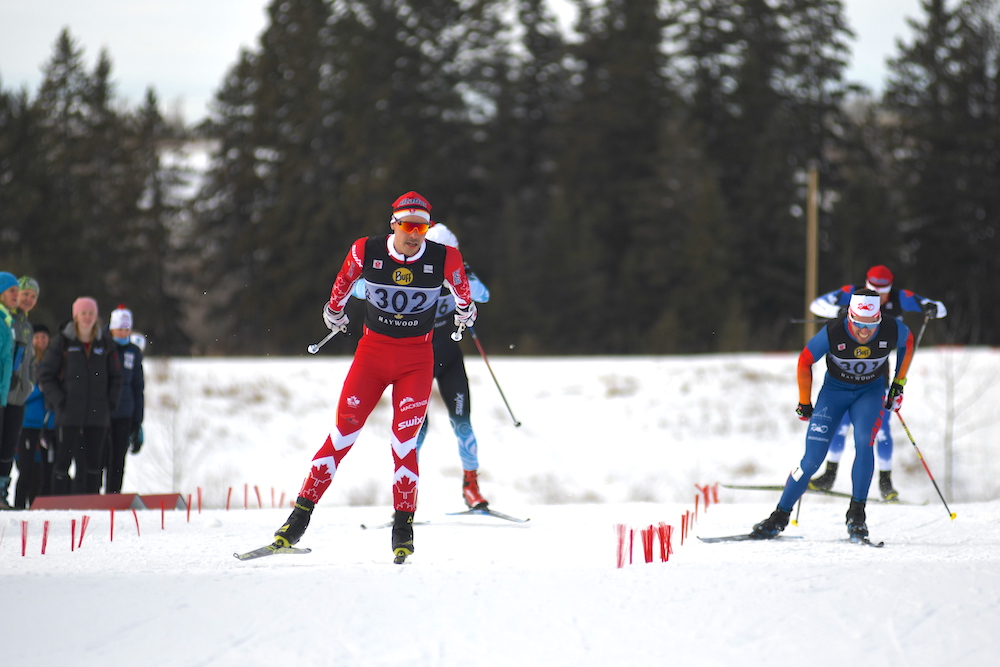
    • Zina Kocher (Foothills Nordic), 12th overall:

    “Being that it was really my first 5k classic race since I was a kid, I should be easy on myself! I still see so many areas on which to improve, mostly with technique. But I want more and know there is another gear untapped inside of me with classic. I focused on being calm and smooth today and I felt much smoother with my technique than the last classic race which is a step in the right direction.”


    After the freestyle sprints on Dec. 16:

    • Julien Locke (Black Jack/Canadian National U25 Team), 1st:

    “It was amazing to race at home today. It’s such a thrill to put on a show for all of the locals, many of whom have been volunteering since I first started racing Kootenay Cups. The Black Jack club is so supportive and they have done a great job putting on the races. The atmosphere on the course was fantastic, so much energy out there.  I’ve been feeling the travel and previous 4 weeks of racing, and the cheering squads certainly gave me a boost.”

    [He started his season on the World Cup and returned to Canada earlier that week.]

    “I returned to North America on Monday evening [Dec. 11] and it took a while to get the body moving this morning. I was lacking tempo in the qualifier but started to get some snap back through the heats. The final was fun, a reasonably fast pace the whole way. The TBay guys were on a mission to take control up the first climb. I snuck by going over the top and stayed at the front up the 2nd climb, through the twists and into the finish. Evan [Palmer-Charrette] carried a lot of speed out of the last decent and put in a good sprint. It was fun to put in a stretch for the line. It was a close one!”

    • Evan Palmer-Charrette (NTDC Thunder Bay), 2nd:

    “I played it the way I wanted to through all the heats. With the gradual incline on the finishing stretch the finish line snuck up on me and I made a last second attempt at a lunge but otherwise I executed quite well. I considered not starting the sprint and even more so after a rough qualifier but my mom made the trip down to Rossland and arrived before the heats so I figured I couldn’t sit out, so all things considered it was a solid day.”

    [Palmer-Charrette finished 23rd in the qualifier.]

    Caitlin Gregg (Team Gregg/Loppet Nordic Racing) racing to her second-straight win at the NorAm in Rossland, B.C., with a victory in the skate-sprint final ahead of Andrea Dupont (101) and Zina Kocher (r). (Photo: Kai Symington-Kruss)
    • Zina Kocher, 3rd:

    “Feel stoked! Totally surprised myself as sprinting is not really my forte. And my 3rd skate sprint race ever. … [I]  gave it everything I had from the start, but I’m almost always last out so I have just learned in biathlon mass starts to use that to my advantage to find the holes/spaces in the group & then move up. I had really great skis today and fully used that to my advantage with the gradual downhill, pushing hard into it & free skating to propel myself into a better position for the next uphill, & before the S turn downhill. I had a bit of a mishap in the 1st heat, getting too close to [Caitlin] in the last corner and tripping on her pole. Got up quick & kept fighting… luckily our heat was fast & I moved on. I think I was just in disbelief each time I moved on, was totally enjoying myself and just kept fighting.

    “Also would like to point out, that this podium sweep were all the old timers. And I was the youngest 😉 Go masters.” 

    [Kocher is 35. Gregg, 37, won the final and Andrea Dupont, also 37, placed second.]


    After the 10/15 k freestyle pursuits on Dec. 17:

    (Note: The rundown linked to above was written based on the pursuit’s “time of day”, or individual stage results, rather than overall mini-tour results. The following referenced results reflect overall pursuit/mini-tour finish.)

    The men’s podium after the 15 k freestyle pursuit on Dec. 17, the last day of the Rossland NorAm mini tour, with Brian Gregg (c) in first, Andy Shields (second from r) in second, Bob Thompson (second from l) in third, Evan Palmer-Charrette (r) in fourth, and Jack Carlyle (l) in fifth. (Photo: Brian Gregg)
    • Brian Gregg, 1st:

    “We [Caitlin and I] entered the final day as the rabbits for the rest of the field.  It is odd to feel that the others are just a few meters behind, but also a great exercise in remaining focused on your own race. I focused on racing as a time trial with a conservative start and the goal of negative splitting each lap.  Andy and Bob closed the gap pretty well in the first lap but a strong final 10km allowed me to get the time back.

    “Our greatest success of the weekend came on day 1 in the classic race. We put a big focus this year on our classic skiing with some on snow training camps in May in Iceland/Norway and August/September in New Zealand and it is great to see that showing on the results page.  It also helped that our skis were amazing.”

    • Andy Shields (Lappe Nordic), 2nd:

    “Scott Hill started just over 10s ahead of me and Bob Thompson started around 20 seconds ahead so I had a couple ‘steps’ to climb and launch off of. I caught Scott in the first km and dropped him before the end of the first lap and caught Bob partway through the second lap. Bob and I tried to chase down Brian Gregg but ended up losing time to him. I found a tonne of pace somehow in the last km and a bit and was able to break away from Bob before the finish. … Usually my pace change in distance races is just awful, but it was quite good on Sunday which is a good sign of fitness.”

    “I had a heavy November of training and I think this weekend was a sign I’ve finally digested the training load. I’ll keep training casual over the holidays so I can hopefully be fresh and ready to go at trials.”

    • Bob Thompson, 3rd: 

    “Pursuit was a solid race. The hunt was on for Brian and after a great first lap Andy [Shields] caught me and we did our best to work together but Brian was just a bit too strong for us and skied away with the overall and the best time of day. … This pursuit was one of the first that I have been one of the top starters and had to chase for top positions while fighting to stay ahead of all those chase groups. Definitely my favourite part of racing this weekend.”

    • Evan Palmer-Charrette, 4th:

    “The pursuit was really fun, I love chasing in a pack with a big group of guys. I did not feel great off the start and my confidence was not very high but by the end of the 2nd lap I started to feel like I was getting into a race gear and finished strong.

    “I started to find a race gear the past two days but overall period one has been a struggle coming into it after be being quite sick. That being said I think I haven’t burnt my brightest match of the season and have as good of a shot as anyone. I would like to have strong races in both the sprint and distances races in Quebec, but with the sprint being the only race with an Olympic birth that will be the main focus of the event for me.”

    • Jack Carlyle (AWCA), 5th: 

    “My strategy was to catch as many people that started just in front of me as I possible early on in the first lap. There was a strong contingent of skiers that started just head of me and I wanted to get up to them as quickly as possible, just to make sure I didn’t loose a strong ride. Once I got settled in a pack the plan was to let the race come to me and let it unfold until the last few kilometers, then I would make moves to fight for positions to the finish. I thought that if I could have a good day, being top 5 in the tour was an achievable goal.

    “It was a really fun race. There was a healthy exchange of lead sharing in the pack I was in, with the pace been pushed most of the time. On the first lap a large pack formed and we all skied together for most of the race, building the pace as the race went on. Seemed as though as the race went on the pack got smaller and smaller, until EPC and I were the last two chasing down the top three skier in front of us (Brian G, Andy S, and Bob T). With about 1.5km to go, Evan and I started playing a little bit of cat and mouse, thinking about the tactics for the finish. Pace slowed down, and you could tell we both had plans to try to out sprint the other in the last stretch. Smart on his part as he was second, and almost first the day before in the sprint and [I] couldn’t even sniff the semis that day. We both gaver at the finish and as you can predict, EPC came across the line in 4th and I in 5th.”

    [Carlyle finished eighth in the 10 k classic to start the mini tour]

    “Going into this past weekend I was really focused on the Classic 10km on the Friday. This was the race I put the most attention on going into the weekend. I knew that I was skating well and I [wanted to] do the same in Classic. The two distance days were the races I knew I had the best chance to reach the podium. Having a strong performance in classic early in the season was important for me going forward. After the race in Silver Star, I knew that I was in a good place physically and mentally to potentially have a strong performance in the Tour weekend.”

    • Scott Hill, 8th: 

    “Sunday was a rough one for me. There was a fast group behind me that formed in the pursuit start and they swallowed me up quickly. I stayed with the group for most of the rest of the race but I didn’t have the legs to stay with the attacks when they happened on the last lap. This past week and weekend were my chance to try some things to get an idea of what’s working for me right now to come up with the best lead up to the Olympic trials in a few weeks. With one good race and one that didn’t really work out I am confident in what I need to do to be in good shape in a few weeks.”

    • Julien Locke, 10th:

    “After spending the past month racing on the WC, the focus for this weekend was to perform at home, and continue to put in good race efforts ahead of the January selection events. … This is the first year I have raced 5 weeks in a row before Christmas. I am looking forward to a focused training block between now and New Years. I’ll be training at home as we have lots of snow at home and excellent conditions at Black Jack, perfect for good preparation.”

    • Antoine Cyr (Pierre-Harvey National Training Centre), 15th overall, 2nd junior:

    “I am super happy with the shape right now. I had a phenomenal start to the season and I have been racing over my expectation, World Juniors trials and Olympic trials are in two weeks so hopefully the shape is still there when I race in Mont-Saint-Anne.”

    “With my second place junior on Friday and the win in the sprint I was well placed for the overall mini tour. In the pursuit I was starting really close to 3 of my teammates so the plan was to stick with them as long as possible and protect my second place in the overall [NorAm standings]. I had a good race with all the top seniors in Canada and I was able to protect my place in the [overall standings].”

    • Zina Kocher, 2nd (first Canadian), former Canadian national-team biathlete:

    “I attacked from the beginning and tried to maintain the pace till the finish.  … Wasn’t sure what to expect with the Pursuit format without the shooting aspect and how that would end up. As in, how can I make up enough time to move up — I felt very behind 1st place starting 2:27 back. I just focused on giving it everything I had & going for it. … Pursuits in biathlon are maybe more exciting & huge possible ups or downs in the results than xc BUT it it is nice to just put my head down and giver ;)”

    “Feeling really great about this weekend. Ski speed felt like it picked up this weekend compared to last & that was the goal. Classic is coming along, learning every day and things are going in the right direction. … I wanted my fitness level to be good, not at it’s best but good & have strong skate finishes.”

    • Annika Hicks, 3rd:

    “The races in Rossland went really well. My plan for the first period of racing was to keep building throughout the month, so to have a couple podiums this weekend was great. … I love racing in Rossland, The distance courses are really challenging and ski really nicely. Conditions were great; the tracks weren’t too soft and the temperature was prefect for racing.”

    • Hannah Mehain, 14th overall and 2nd junior (who won the junior women’s skate sprint):

    “My favorite part of the weekend was the sprint. Before my sprint race, the announcer mentioned how Jessie Diggins made a major breakthrough at Rossland in the sprint races 7 years ago. She won the qualifier by 5 seconds in the senior women category and she was only 17 years old. She ended up taking gold overall that day (I believe, fact check me on this one). This inspired me. I decided I was going to make a breakthrough that day too. And I did.”

  • Sunday Rundown: Ramsau, Toblach, Annecy, St. Ulrich, Rossland (Updated)

    Sunday Rundown: Ramsau, Toblach, Annecy, St. Ulrich, Rossland (Updated)

    Bryan Fletcher (USA Nordic) jumping to 45th in the Nordic Combined World Cup on Sunday in Ramsau, Austria. In the 10 k that followed, he skied the third-fastest time to finish 14th overall. (Photo: Romina Eggert/USA Nordic Facebook)

    NorAm mini tour (Rossland, B.C.): 10/15 k freestyle pursuits

    Team Gregg ended the Rossland NorAm mini tour with another double win, with American Caitlin Gregg and her husband Brian Gregg winning the 10- and 15-kilometer freestyle pursuits, respectively, at the Black Jack Ski Club trails.

    The women’s 10 k freestyle pursuit podium at the NorAm in Rossland, B.C., with American Caitlin Gregg (c) in first, and Canadians Zina Kocher (l) and Andrea Dupont (r), in second and third, respectively. (Photo: Cross Country Canada)

    Caitlin capped the long weekend with her third-straight win, a 48.28-second victory over former Canadian biathlete Zina Kocher (Foothills Nordic). Caitlin started first and was first across the finish in 29:02.86, while Kocher started ninth and rose to second place for her second-consecutive podium (after placing third in Saturday’s skate sprint). Andrea Dupont (Rocky Mountain Racers) started fourth and finished third (+1:58.35) for her second-straight podium as well (she was second in the skate sprint behind Gregg).

    Lisle Compton of the National Team Development Centre (NTDC) Thunder Bay and Canadian National Junior Team finished fourth overall (+2:07.03), Frederique Vezina of the Pierre-Harvey National Training Centre (CNEPH) was fifth (+2:16.10), and Annika Hicks of the Alberta World Cup Academy (AWCA) sixth (+2:16.51). Laura Leclair (CNEPH) placed seventh, Kaia Andal (Caledonia Nordic) was the top junior in eighth overall, Jaqueline Mourao (Brazil Ski Team) ninth, and Sophie Carrier-Laforte (Skinouk) 10th.

    Brian, who won the Rossland men’s 10 k classic on Friday, also started Sunday’s 15 k freestyle pursuit first and finished in that position in 38:43.93. Andy Shields (Lappe Nordic) raced to second overall, 7.65 seconds back, after starting fourth, and Jack Carlyle (AWCA) reached the podium in third (+8.75) after starting 10th.

    Evan Palmer-Charrette (NTDC Thunder Bay) ended the weekend in fourth (+17.68), Philippe Boucher (CNEPH) was fifth (+19.02), Brian McKeever (Canadian Para-Nordic Ski Team) sixth (+22.16), Michael Somppi (AWCA) seventh (+34.62), Alexis Dumas (CNEPH) eighth (+52.78), Bob Thompson (NTDC Thunder Bay) ninth (+54.76), and Julien Locke (Black Jack/Canadian U25 Team) 10th (+1:04.46).

    Results

    ***

    FIS Nordic Combined World Cup (Ramsau, Austria): Saturday & Sunday individual competitions

    Bryan Fletcher (USA Nordic) notched seventh in the Nordic Combined World Cup this weekend in Ramsau, Austria, for his best result since January 2016. (Photo: USA Nordic/Facebook)

    After a bye week, the Nordic Combined World Cup resumed in Ramsau am Dachstein, Austria, with back-to-back individual normal hill/10-kilometer Gundersen starts on Saturday and Sunday.

    On Saturday, American Bryan Fletcher posted his best individual result in nearly two years in seventh place, 32.6 seconds behind German winner Eric Frenzel.

    Saturday’s individual competition on Ramsau’s 98-meter hill started out with Japan’s Taihei Kato going farthest in the jump portion, the Czech Republic’s Tomas Portyk jumping to second, and Frenzel jumping to third. Fletcher tied Japan’s Yoshito Watabe for 28th and the two started the 10 k race 1:02 minutes back accordingly.

    While Frenzel picked off two places to finish first in 24:05.8 minutes, Fletcher moved up 21 spots to seventh place with the second-fastest course time of 23:48.4.

    Germany had two on the podium with Fabian Rießle just 0.7 seconds back in second place, and Norway’s Jan Schmid finished third, 8.1 seconds behind Frenzel.

    On Sunday, Rießle climbed to the top step on the podium, winning the weekend’s second normal hill/10 k in 26:12.5.

    Norway’s Jørgen Graabak led after the jump portion, yet ultimately finished sixth, 9.8 seconds behind Rießle.

    Rießle jumped to ninth and started 18 seconds out of first, then took the win on the four-lap course by just 0.3 seconds over Italy’s Alessandro Pittin. The Italian notched second place after starting 36th based on his jump and racing the fastest 10 k time in 25:00.8.

    Finland’s Eero Hirvonen finished third (+1.5) after starting 10th, and Schmid was another 2 seconds back in fourth (+3.5) after jumping to seventh. Frenzel did not start.

    Three Americans qualified for Sunday’s competition. Fletcher jumped to 45th and started 1:30 back, yet rose to 14th (+43.7) with the third-fastest course time. His younger brother Taylor Fletcher skied the second-fastest course time to finish 34th (+2:01.6), up 24 places after jumping to 58th. Adam Loomis finished 52nd (+4:38.6) after jumping to 59th.

    The U.S. Nordic Combined team is headed back to the states to prepare for U.S. Olympic trials later this month, according to the USA Nordic Facebook page.

    Results: Saturday | Sunday

    ***

    FIS Cross Country World Cup (Toblach, Italy): 10/15 k classic pursuits

    Norway’s Johannes Høsflot Klæbo after winning the men’s 15 k classic pursuit for his seventh World Cup win of the season on Sunday in Toblach, Italy. With win No. 7, he has the most wins before the new year in FIS Cross Country World Cup history. (Photo: FIS Cross Country/Twitter)

    Women’s report

    Men’s report

    If you thought Johannes Høsflot Klæbo was out, think again. After placing 10th in the men’s 15-kilometer freestyle on Saturday in Toblach, the 21-year-old Norwegian raced to his seventh victory of the season in the men’s 15 k pursuit on Sunday.

    In doing so, Klæbo broke the record for the most World Cup wins before the New Year: he’s tallied seven in the last eight races he’s contested.

    On Sunday, he started 10th, 36 seconds behind his Norwegian teammate Simen Hegstad Krüger, who won the 15 k freestyle and started first. Klæbo had worked his way up to third by 11.4 k, and at the finish, he edged Russia’s Sergey Ustiugov by 1.9 seconds for the win in 33:31.1 minutes.

    Ustiugov, who started fifth, claimed second, and Kazakhstan’s Alexey Poltoranin rose from 14th to third place (+4.5), ahead of Russia’s Alexander Bessmertnykh in fourth (+9.7), Finland’s Matti Heikkinen in fifth (+9.8), France’s Maurice Manificat in sixth (+10.7), Norway’s Hans Christer Holund in seventh (+11.1), Switzerland’s Dario Cologna in eighth (+11.8), Canada’s Alex Harvey in ninth (+16.3), and Krüger in 10th (+24.0). Norway’s defending Overall and Distance World Cup champion, Martin Johnsrud Sundby placed 11th (+34.4) after starting 20th based on his result on Saturday.

    Erik Bjornsen once again led the U.S. men, racing from 29th at the start to 26th (+1:43.1). Scott Patterson improved from 42nd to 39th (+2:37.2), Paddy Caldwell moved up from 52nd to 44th (+2:57.7), and Noah Hoffman slipped to 49th (+3:01.7) after starting 40th.

    Canada’s Devon Kershaw moved up five places to 33rd (+2:02.8), Graeme Killick finished 50th (+3:42.0), Russell Kennedy 66th (+5:05.8), and Knute Johnsgaard moved up six places to finish 76th (+6:20.8).

    The all-Norwegian women’s 10 k classic pursuit podium on Sunday at the World Cup in Toblach, Italy, with Marit Bjørgen (c) in first, Ingvild Flugstad Østberg (l) in second and Heidi Weng (r) in third. (Photo: FIS Cross Country/Twitter)

    In the women’s 10 k classic pursuit earlier in the day in Toblach, Norway’s Marit Bjørgen overcame a 22-second starting deficit to take the win by just 0.3 seconds over her teammates Ingvild Flugstad Østberg in second. It was an all-Norwegian podium with Heidi Weng in third (+0.8).

    Bjørgen started fifth, 22 seconds behind Swedish race leader Charlotte Kalla, based on their results in Saturday’s 10 k freestyle individual start. By the 6.4 k checkpoint, Bjørgen led a pack of four other Norwegians and Kalla — all within 1.4 seconds of first. At 8.5 k, Bjørgen led Østberg in second and Weng in third, while another Norwegian Astrid Uhrenholdt Jacobsen skied another eight seconds back with teammate Ragnhild Haga in fourth and fifth, respectively. By that point, Kalla was skiing alone, another 11.7 seconds in sixth, while American Jessie Diggins led a group 25 seconds behind Kalla in sixth.

    Ultimately, Bjørgen finished first in 25:19.3 and formed an all-Norwegian podium with Østberg and Weng, Jacobsen placed fourth, 21.5 seconds out of first and 20.7 seconds behind Weng in third.

    Haga was fifth (+31.8), Kalla sixth (+41.9), Diggins seventh (+53.7), Russia’s Natalia Nepryaeva eighth (+54.2), American Sadie Bjornsen ninth (+55.2), and Austria’s Teresa Stadlober 10th (+55.6) in a photo finish with Finland’s Kerttu Niskanen, who placed 11th (+55.6).

    For the U.S. Ski Team, Diggins and Bjornsen retained their starting positions of seventh and ninth, respectively, while Rosie Brennan started 19th and finished 25th (+2:14.6). Chelsea Holmes (Alaska Pacific University) finished 39th (+3:03.8) and Liz Stephen (USST) finished 48th (+4:05.2).

    Canada’s Emily Nishikawa placed 53rd (+4:14.5), Dahria Beatty finished 63rd (+5:44.7), Cendrine Browne 66th (+5:57.7), and Katherine Stewart-Jones 70th (+7:31.5).

    Results: Women | Men

    ***

    IBU World Cup (Annecy, France): Women’s and men’s mass starts

    Women’s report

    Men’s report

    France’s Justine Braisaz won her first International Biathlon Union (IBU) World Cup race of the season on Sunday at home in Annecy, France, topping the women’s 12.5 k mass start by 11.2 seconds in 37:19.4.

    While Braisaz shot 19-for-20 (0+0+1+0), Iryna Kryuko of Belarus cleaned the four-stage race for second place, her first World Cup podium. Germany’s Laura Dahlmeier, who won Saturday’s 10 k pursuit, placed third (+19.9) with two penalties (0+1+0+1).

    Two North Americans qualified for the selective mass start, with Susan Dunklee (US Biathlon) racing to 20th (+1:16.3) with three misses (1+0+1+1), and Emma Lunder (Biathlon Canada) placing 28th (+2:21.4) with a single penalty (1+0+0+0).

    In the men’s 15 k mass start that followed, France’s Martin Fourcade finally got the win he was looking for, shooting clean and beating his main rival Johannes Thingnes Bø of Norway by 3.9 seconds. Fourcade crossed the finish line first in 36:30.3, Bø settled for second after skiing two early penalty loops (2+0+0+0) and Germany’s Erik Lesser tallied his second podium in Annecy (after placing third in the sprint) in third place again (+6.2) with clean shooting.

    Two Americans and a Canadian qualified for the mass start, with US Biathlon’s Lowell Bailey leading them in 23rd (+2:22.4) with three penalties, Sean Doherty following in 24th (+2:52.5) with four misses, and Biathlon Canada’s Scott Gow finishing 26th (+4:05.4) with five penalties.

    Results: Women| Men

    ***

    OPA Cup (St. Ulrich, Austria): 10/15 k freestyle pursuits

    On the final day of Alpen Cup (a.k.a. OPA Cup) racing in St. Ulrich, Ida Sargent of the U.S. Ski Team (USST) scored her third-straight top five with a fifth place in the women’s 10 k freestyle mass start. She previously placed third in the skate sprint and 5 k classic on Friday and Saturday.

    Germany’s Julia Belger won the women’s mass start on Sunday in 28:33.6, while Saturday’s 5 k winner, Elena Soboleva of Russia placed second (+0.7). Russia had two on the podium with Mariya Istomina in third (+6.4). Germany’s Elisabeth Schicho finished fourth (+15.8), just ahead of Sargent in fifth (+15.9).

    Germany’s Antonia Fräbel placed sixth (+17.1), followed by American Sophie Caldwell in seventh (+17.9). The USST had three in the top 10 with Julia Kern in 10th (+41.9), out of 60 finishers.

    In the men’s 15 k freestyle mass start, Beda Klee of Switzerland took the win in 37:14.6, 2.4 seconds ahead of Germany’s Thomas Bing in second. Six-time Olympian Sergey Dolidovich of Belarus reached the podium in third (+4.5).

    The U.S. had two men in the race, with Simi Hamilton finishing 14th, 16 seconds out of first, and Andy Newell finishing 71st (+2:25.2) out of 118.

    Results: Women | Men

  • Saturday Rundown: Annecy, Toblach, St. Ulrich, Rossland (Updated)

    Saturday Rundown: Annecy, Toblach, St. Ulrich, Rossland (Updated)

    The photo finish for first in the men’s skate sprint final on Saturday at the NorAm in Rossland, B.C., with Julien Locke (near) outstretching Evan Palmer-Charette for first, and Julian Smith (r) taking third third ahead of Bob Thompson (yellow NorAm leader’s bib). (Photo: CCC/Twitter)

    NorAm Mini Tour (Rossland, B.C.): Freestyle sprints

    On Day 2 of NorAm racing in Rossland, British Columbia, Julien Locke, of the Black Jack Ski Club and Canadian National U25 Team, won the men’s 1.4-kilometer freestyle sprint final on his home trails by just one-hundredth of a second over Evan Palmer-Charrette, of the National Team Development Centre (NTDC) Thunder Bay, in 2:38.13. NTDC Thunder Bay had two on the podium with Julian Smith in third, 0.4 seconds behind Locke.

    Locke started the day by qualifying second, just 0.06 seconds behind Bob Thompson (NTDC Thunder Bay), who won the qualifier in 2:39.49. Locke went on to finish second to Thompson in the first quarterfinal, then won the second semifinal while Thompson won the first semi.

    In the final, Locke tallied his first NorAm win of the season, while Thompson, last weekend’s classic-sprint winner at Sovereign Lake, placed fourth (+0.43), missing the podium by three-hundredths of a second. Andy Shields (Lappe Nordic) finished fifth (+1.78) and Sebastien Boehmler-Dandurand (Canmore Nordic/Stefan Kuhn HP Team) sixth (+5.21) in the men’s final.

    Also on Saturday, American Caitlin Gregg (Team Gregg/Loppet Nordic Racing) racked up her second-straight win in Rossland (after topping Friday’s 5 k classic), winning the women’s 1.4 k skate-sprint final in 3:03.36. Canada’s Andrea Dupont (Rocky Mountain Racers) finished 2.5 seconds later for second place and Zina Kocher (Foothills Nordic) scored her first podium of the season in third (+3.53).

    Dupont won the women’s qualifier in 3:07.68, and Gregg qualified second, 0.87 seconds back. Dupont went on to win the first quarterfinal and first semifinal, while Gregg won her quarterfinal and semifinal as well. (Gregg’s quarterfinal had four racers, compared to five in Dupont’s quarterfinal, as only 21 women competed in the senior women’s heats.)

    Also in the final, Laura Leclair, of the Centre National d’Excellence Pierre Harvey/Pierre-Harvey National Training Centre (CNEPH), finished fourth (+6.11), Maya MacIsaac-Jones (U25 Team) was fifth (+6.31) and Sophie Carrier-Laforte (Skinouk) sixth (+8.57).

    Results: Heats | Qualifier

    ***

    OPA Cup (St. Ulrich, Austria): 5/15 k classic

    On the second day of Alpen Cup (a.k.a. OPA Cup) racing in St. Ulrich, Ida Sargent of the U.S. Ski Team (USST) finished third in the women’s 5 k classic behind two Russians, Elena Soboleva and Natalia Matveeva, respectively.

    Soboleva took the win in the individual-start race in 14:25.8, and Matveeva was 12.5 seconds back for second place. Just like Matveeva, Sargent reached the podium for the second-straight race in third (+18.1), after placing third in the freestyle sprint on Friday (Matveeva finished second in the sprint).

    Germany’s Antonia Fräbel finished fourth (+21.0) and American Sophie Caldwell (USST), who won the sprint the day before, placed fifth (+22.7). The other USST member in the race, Julia Kern finished 15th (+53.5).

    The men raced a 15 k classic, with France’s Alexis Jeannerod taking the win in 38:45.6. Germany’s Thomas Wick was 4.7 seconds back in second, and Russia’s Gleb Retivykh placed third (+11.3). The lone American man racing, Andy Newell (USST) finished 36th (+2:07.1) out of 125 finishers.

    The three-day OPA Cup weekend in St. Ulrich wraps up Sunday with 10/15 k freestyle mass starts.

    Results: Women| Men

    https://www.instagram.com/p/Bcxx2GhlDfv/?taken-by=juliakernski

    ***

    IBU World Cup (Annecy, France): Women’s and men’s pursuits

    Susan Dunklee (US Biathlon) after placing sixth and reaching the flower ceremony in the women’s 10 k pursuit at the IBU World Cup on Saturday in Annecy, France. After starting 10th, sixth stands as a season-best for Dunklee. (Photo: Glen Crawford)

    Women’s race report

    Men’s race report

    Germany’s Laura Dalhmeier captured her first win of the season, preventing Slovakia’s Anastasia Kuzmina from her third-straight win, and American Susan Dunklee raced to a season-best sixth in the women’s 10-kilometer pursuit on Saturday in Annecy-Le Grand Bornand, France.

    Canada’s Emma Lunder achieved a career-best 18th after starting 34th, and her teammate Julia Ransom placed 27th after starting 39th.

    In the men’s 12.5 k pursuit that followed, Norway’s Johannes Thingnes Bø started first, shot clean and fended off his competition to rack up his fourth-straight victory — winning by more than a minute.

    And for the second-straight race, France’s Martin Fourcade finished second, this time 1:01.4 minutes behind Bø, who crossed the line first in 32:52.1. Fourcade had to ski two penalty laps later in the race (0+0+1+1), while Russia’s Anton Shipulin, who started sixth and had a single miss (0+0+0+1), rose to third place (+1:10.5).

    American Lowell Bailey shot clean to race up to 14th (+2:13.9) after starting 35th. His US Biathlon teammate Tim Burke finished 26th (+3:03.1) with three penalties (1+0+1+1), after starting 10th.

    Canada’s Scott Gow finished a second later for 27th (+3:04.1) after starting 16th and skiing four penalty laps (1+0+1+2). His brother Christian Gow moved up one spot to 29th (+3:06.6) after starting 30th and shooting 19-for-20 (1+0+0+0).

    The U.S. had four men in the pursuit, with Sean Doherty placing 30th (+3:07.0) with three penalties after starting 17th.

    Leif Nordgren improved to 48th (+4:54.9), up from 56th, despite three misses.

    ***

    FIS Cross Country World Cup (Toblach, Italy): 10/15 k freestyle

    Women’s report

    Men’s report

    The men’s 15 k freestyle podium at the Toblach World Cup in Italy, with Norway’s Simen Hegstad Krüger (c) scoring his first World Cup victory in first place, last weekend’s winner Maurice Manificat (l) of France in second, and Great Britain’s Andrew Musgrave (r) in third. (Photo: FIS Cross Country/Twitter)

    In the men’s 15 k freestyle on Saturday in Toblach, 24-year-old Simen Hegstad Krüger achieved his first individual World Cup victory in 29:58.8 minutes, and was joined on the podium by France’s Maurice Manificat in second (+10.6) and Great Britain’s Andrew Musgrave in third (+11.5).

    Canadian World Cup Team member Alex Harvey missed the podium by 2.5 seconds in fourth place (+14.0), tying his best result of the season after finishing Ruka Triple mini tour in fourth place late last month in Kuusamo, Finland.

    Russia’s Sergey Ustiugov followed in fifth, Norway’s Finn Hågen Krogh was sixth and Hans Christer Holund seventh, Finland’s Matti Heikkinen eighth, Switzerland’s Toni Livers ninth, and notably, Norway’s Johannes Høsflot Klæbo — who hasn’t lost a race all season (he sat out last weekend’s 15 k skate in Davos, Switzerland) — was 10th.

    Erik Bjornsen of the U.S. Ski Team (USST) was the lone American in the points (top 30) in 29th (+1:09.6), Noah Hoffman finished 40th (+1:24.5), Scott Patterson (USST) was 42nd (+1:29.4), and Paddy Caldwell (USST) 53rd (+1:50.0)

    For Canada, Devon Kershaw (World Cup Team) placed 38th (+1:22.1), Graeme Killick (World Cup Team) was 49th (+1:47.8), Russell Kennedy (Team R.A.D.) 60th (+2:13.2), and Knute Johnsgaard (World Cup Team) 85th (+3:28.3).

    The women’s 10 k freestyle podium on Saturday at the World Cup in Toblach, Italy, with Sweden’s Charlotte Kalla (c) in first, and Norway’s Ragnhild Haga (l) and Heidi Weng (r) in second and third, respectively. (Photo: FIS Cross Country/Twitter)

    In the women’s 10 k freestyle individual start in Toblach, Sweden’s Charlotte Kalla tallied her third win of the season in 22:40.1 minutes, ahead of five Norwegians and American Jessie Diggins.

    Norway’s Ragnhild Haga was 5.8 seconds shy of Kalla’s time for second place, and her teammate Heidi Weng was another 8 seconds back in third (+13.8).

    Norway occupied second through sixth place, with Astrid Uhrenholdt Jacobsen in fourth (+17.9), Marit Bjørgen in fifth (+22.6) and Ingvild Flugstad Østberg in sixth (+29.3). Diggins led the U.S. Ski Team (USST) in seventh (+40.5), with Finland’s Kerttu Niskanen close behind in eighth (+43.5) and the second U.S. woman in the top 10, Sadie Bjornsen, another 0.4 seconds back in ninth (+43.9).

    The USST had three in the top 20 with Rosie Brennan placing 19th (+1:15.2) for her second-straight top-20 result (following a 17th place in last weekend’s 10 k freestyle in Davos, Switzerland). Chelsea Holmes (Alaska Pacific University) finished 36th and Liz Stephen (USST) was 47th.

    Emily Nishikawa (Canadian World Cup Team) led her team in 51st, Cendrine Browne (Canadian U25 Team) followed in 55th, Dahria Beatty (World Cup Team) was 69th, and Katherine Stewart-Jones (U25 Team) 77th.

    Results: Women | Men

  • Sovereign NorAm/SuperTour Rewind: Craftsbury Women on Top; Thompson and Torchia Take Wins [Updated Photo Gallery]

    Sovereign NorAm/SuperTour Rewind: Craftsbury Women on Top; Thompson and Torchia Take Wins [Updated Photo Gallery]


    Classic sprint day at the Sovereign Lake Nordic Centre on Saturday, Dec. 9. The NorAm opening weekend also counted as SuperTour races. (Photo: SilverStar Mountain Resort)

    VERNON, British Columbia — For the second consecutive year, the Sovereign Lake NorAm was combined with the SuperTour for an expanded field of racers. The warm, sunny, and windless conditions on both days were a welcome change from the previous season’s cold weather and falling snow. What didn’t change was the ‘south of the border’ feel to the leaderboard.

    The race formats were similar to that of the Davos World Cup, just nine time zones later: Saturday was a classic sprint (Davos was a skate sprint) and Sunday included 10- and 15-kilometer freestyle interval starts.

    With temperatures around -2 degree Celsius and dry, untransformed snow, the waxing was straightforward both days with ski choice dominating the discussions. More than 400 racers competed, including 140 men and 84 women in the open categories.

    Classic Sprint

    Sophie Carrier-Laforte (Pierre-Harvey National Training Centre) leading the women’s classic sprint final at the Sovereign Lake NorAm/SuperTour on Dec. 9, ahead of Sun Valley’s Kelsey Phinney (second from l), Craftsbury’s Kaitlynn Miller (third from l) and APU’s Hannah Halvorsen (far r). (Photo: Peggy Hung)

    Sovereign’s 1.3-kilometer sprint course doesn’t feature large climbs, but it does reward good tactics. There were a few minor incidents off the start when the six tracks became four, and the final 270-degree turn off the bridge into the finishing straight punished tired legs and tight groups.

    American Kaitlynn Miller of the Craftsbury Green Racing Project (CGRP) dominated the open women’s sprint, winning the qualifier and all of her heats. In the A-final, Canadian Sophie Carrier-Laforte, of the Pierre-Harvey National Training Centre (CNEPH), pushed the pace from the start, using her double-poling power to stretch the field over the first three climbs. Miller was last into the hole and used the big climb to work her way to the front, where she was able to control the group through the tricky final turn and get first lane choice to take the win in 2:57.53 minutes. Miller’s teammate, Caitlin Patterson powered past Hannah Halvorsen, of Alaska Pacific University (APU) and the U.S. Ski Team (USST) D-team, to take second, 0.93 seconds behind Miller. Halvorsen claimed third (+2.59), Kelsey Phinney, of the Sun Valley Ski Education Foundation (SVSEF) took fourth (+2.59), and a third Craftsbury skier Liz Guiney placed fifth (+3.53). The lone Canadian in the women’s final, Carrier-Laforte, finished sixth (+4.38).

    Post-race video interviews: Miller (1st) | Patterson (2nd) | Halvorsen (3rd)

    The ‘technique zone’, where only diagonal stride or herringbone techniques are permitted, wasn’t a factor for the women. Finland’s Jasmi Joensuu, a junior at the University of Denver, had tested early in the week and decided to use grip wax for the one steep climb. Joensuu added some excitement the B-final, as she changed clothes and switched to skate skis for her planned cooldown before discovering that the NorAm series does B-finals. Luckily, her classic race skis were still in the start area and she was able to finish third in that heat for ninth overall. 

    Post-race interviews: Joensuu 9th | Dupont 10th

    Bob Thompson (304) of NTDC Thunder Bay leading Sun Valley’s Jack Hegman (307) and Patrick Stewart-Jones (317) of the AWCA during their quarterfinal of the NorAm men’s 1.3 k classic sprint on Saturday at Sovereign Lake near Vernon, B.C. (Photo: Peggy Hung)

    In the men’s race, Bob Thompson, of the National Team Development Centre (NTDC) Thunder Bay, salvaged Canadian pride with a win after qualifying fourth and placing second in his quarter and semi heats. Thompson was the only Canadian in the A-final, closing a gap to the leading three on the bridge turn and double poling from fourth to first to finish in 2:29.31. American Ben Saxton of the Stratton Mountain School (SMS) Elite Team finished just three-hundredths of a second back for second place, and Cole Morgan edged out his SVSEF teammate Jack Hegman by 0.03 seconds for third (+0.48). APU’s Reese Hanneman and Tyler Kornfield followed in fifth (+7.75) and sixth (+ 7.90), respectively, after being gapped early and losing the battle for the four lanes on the first hill.

    Post-race interviews: Thompson (1st) | Saxton (2nd) | Morgan (3rd)

    In the B-final, the lone Canadian in that heat, Evan Palmer-Charrette (NTDC Thunder Bay) recovered from finishing sixth in his semifinal to take the win (for seventh overall) and earn some important series points.

    Post-race interviews: Palmer-Charrette (7th)| Julian Smith (11th)

    The technique zone was a larger challenge for the men as they carried more speed into the start of the zone, keeping the jury busy, although only one athlete was disqualified. Many of the top men used just enough grip wax to prevent ‘gliding herringbone’ and the resulting DQ. There were broken poles and one protest at the merge to four lanes off the start, resulting in one verbal warning from the jury, along with a few quarterfinal crashes on the final turn.

    Results: Heats | Qualifier

    ***

    Freestyle Distance Races

    The men’s 15 k freestyle podium on Day 2 of the NorAm opening weekend at Sovereign Lake near Vernon,B.C., with (pictured) Ian Torchia (NMU/USST D-Team) in first, Jack Hegman (SVSEF) in second, Brian McKeever (Canadian Para-Nordic Team) in third, Kevin Bolger (SVSEF) in fourth (far left), Adam Martin (CGRP) in fifth (far right). (Photo: Peggy Hung)

    The 5-kilometer ‘Upper World Cup’ course is not obviously difficult to someone casually skiing it in Zone 1; there is one mildly challenging corner, one steep climb (‘the wall’), and the total climb is at the lower limit of the International Ski Federation (FIS) homologation range. But racing it is another story, as evidenced by several top finishers after Sunday’s 10/15 k freestyle interval starts who used words like “nightmare”, “hardest”, and “most painful” in post-race interviews.

    In the men’s 15 k, Ian Torchia, a Northern Michigan University (NMU) junior and member of the USST D-team, was on fire, ranking fourth after two of three laps. He described suffering on the last lap and relying on a ride to keep his speed up, but still managed to ski the fastest final lap (in 12:15.7) to take the victory in 36:29.7.

    Hegman placed second, 19.0 seconds back, improving on his fourth place from the sprint. Canadian Para-Nordic skier Brian McKeever, who skipped the Canmore International Paralympic Committee (IPC) World Cup to race at Sovereign, notched third (+22.6). Sun Valley’s Kevin Bolger skied three very even laps (11-second variation from fastest to slowest) to finish fourth. Craftsbury’s Adam Martin took fifth (+28.3), just edging out Para-Nordic guide Graham Nishikawa, who led Torchia into the finish and placed sixth (+29.1).

    Post-race interviews: Torchia (1st) | Hegman (2nd) | McKeever (3rd) | Nishikawa (6th)

    A perennial podium threat at Sovereign and the previous weekend’s SuperTour distance winner, Brian Gregg, of Team Gregg, Central Cross Country (CXC) and Loppet Nordic Racing (LNR), took the lead after Lap 1 with a time of 11:49.8. But by the end of Lap 2, he was visibly losing power, clocking the 18th-fastest lap time, before his 13:10.4 final lap ranked 45th for 16th overall (+1:09).

    Thompson, wearing the NorAm leader’s bib after his victory on Saturday, finished 19th (+1:17.2). The combined NorAm and SuperTour fields made for a highly competitive event, with the top 40 men finishing within two minutes of first.

    Post-race interviews: Gregg (16th) | Thompson (19th)

    Caitlin Patterson (Craftsbury Green Racing Project) racing to the win in the women’s 10 k freestyle on Dec. 10 at the Sovereign Lake NorAm/SuperTour. (Photo: XTS Photography)

    In the women’s 10 k, Patterson moved up from her sprint second place to notch her first win of the season in 27:13.0. She was 30.7 seconds clear of runner-up Rosie Frankowski (APU), and Frankowski claimed second by just one second over Caitlin Gregg (CXC/LNR/Team Gregg) in third. 

    Katherine Ogden, a Dartmouth College freshman and member of the Stratton Mountain School (SMS) and USST D-team, placed fourth (+50.1), just ahead of Becca Rorabaugh (APU) in fifth (+52.7) and Mary Rose (SVSEF) in sixth (+1:00.9).

    Retired biathlete Zina Kocher was the top Canadian in eighth (+1:31.2). Kocher (who raced at Frozen Thunder in November under her new married name of Lawson) will compete as Kocher this season as FIS requires a new passport to register a name change. Not surprisingly for a former biathlete, she enjoyed the skate distance race much more than the classic sprint.

    CNEPH’s distance specialist Frédérique Vézina was the second Canadian in 12th overall (+2:03.3).

    Post-race interviews: Patterson (1st) | Frankowski (2nd) | Gregg (3rd) | Kocher (8th) | Vézina (12th)

    Results

    If you didn’t get your fill of video links above, the local tv station visited the day before the sprints and presciently chose Thompson for their first interview. They also talked to APU’s Erik Flora.

    Sprint Photos

    Distance Photos

    For more distance photos, find XTS Photography on FaceBook.

    Are there photos we are missing? Share with info@fasterskier.com and include photo credit information.

  • Sunday Rundown: Davos, Hochfilzen and Sovereign

    Sunday Rundown: Davos, Hochfilzen and Sovereign

    CGRP's Caitlin Patterson charging up the wall climb. (Photo: Peggy Hung)
    Caitlin Patterson (Craftsbury Green Racing Project) charging up the wall climb en route to the win in the women’s 10 k freestyle on Sunday at the Sovereign Lake NorAm/SuperTour near Vernon, B.C. (Photo: Peggy Hung)

    NorAm/SuperTour (Sovereign Lake near Vernon, British Columbia): 10/15 k freestyle

    VERNON, B.C. — The combined NorAm and SuperTour event at the Sovereign Lake Nordic Centre continued with individual-start distance races and continued with the theme of U.S. domination of the leaderboard.

    Ian Torchia, of Northern Michigan University (NMU) and the U.S. Ski Team D-team, started the day with a big victory in the men’s 15 k freestyle, finishing in 36:29.7 minutes and on the heels of Canadian Para-Nordic guide Graham Nishikawa, who started 30 seconds ahead of him and ended up sixth. Jack Hegman of the Sun Valley Ski Education Foundation (SVSEF) placed second, 19.0 seconds back, to complete his good weekend. Canadian Para-Nordic superstar Brian McKeever rounded out the podium in third, 22.6 seconds back.

    Graham Nishikawa and Ian Torchia worked together after Torchia closed the 30 second gap. (Photo: Peggy Hung)
    Graham Nishikawa (l) and Ian Torchia worked together after Torchia closed the 30-second gap en route to a victory in the men’s 15 k freestyle on Sunday at the Sovereign Lake NorAm near Vernon, B.C. (Photo: Peggy Hung)

    The women were next to get some time in the sunshine with two laps for 10 k. Caitlin Patterson of the Craftsbury Green Racing Project (CRGRP) upgraded from Saturday’s silver to gold on Sunday with winning time of 27:13.0. Rosie Frankowski of Alaska Pacific University (APU) snatched second, 30.7 seconds back. Caitlin Gregg (Team Gregg) raced to third, 1 second behind Frankowski.

    Former Canadian national-team biathlete Zina Kocher started her new cross-country career as the top Canadian in seventh (+1:31.2).

    The weather was a repeat of Saturday: -2 degrees Celsius, windless and sunny. Smiles were evident everywhere, even for athletes who didn’t quite nail the pacing on an unforgiving course.

    Results

    ***

    France’s Maurice Manificat (c) after winning the men’s 15-kilometer freestyle on Sunday in Davos, Switzerland. He finished ahead of Russians Sergey Ustiugov (l) and Alexander Bolshunov in second and third respectively. (Photo: FIS Cross-Country/Twitter)

    FIS Cross Country World Cup (Davos, Switzerland): 10/15 k freestyle 

    Women’s report

    Men’s report

    After a day of sprinting, cross-country racers returned to the Davos World Cup venue on Sunday for the women’s 10-kilometer and men’s 15-kilometer freestyle individual start competitions.

    For his first World Cup win in almost two years, France’s Maurice Manificat took the men’s 15 k race title in a time of 33:56.2. Exactly 4 seconds flat behind Manificat in second place was Russia’s Sergey Ustiugov. Ustiugov’s teammate Alexander Bolshunov, finished 10 seconds behind Ustiugov and 14.6 seconds behind Manificat for the men’s third and final podium spot.

    The remainder of the men’s top ten included Norway’s Simen Hegstad Krüger in fourth (+21.3), Switzerland’s Dario Cologna in fifth (+26.5), Sweden’s Marcus Hellner in sixth (+35.4), Russia’s Denis Spitsov in seventh (+36.1), Hans Christer Holund of Norway in eighth (+36.9), Russian Alexey Chervotkin in ninth (+54.2), and Alex Harvey of Canada in 10th (+1:01.2).

    The next best male North American finisher was American Patrick Caldwell in 41st (1:50.2).

    Canada’s Devon Kershaw placed 44th (1:59.8), Graeme Killick 59th (+2:27.8), Russell Kennedy 68th (+2:43.4), and Julien Locke in 94th (4:27.5). Knute Johnsgaard did not start.

    For the U.S., Noah Hoffman finished 48th (2:05.5) and Scott Patterson 88th (3:46.2). Simi Hamilton did not start and Andy Newell did not finish.

    The women’s 10 k freestyle podium on Sunday at the Davos World Cup in Switzerland, with Norway’s Ingvild Flugstad Østberg (c) in first and Ragnhild Haga (l) in second, and Finland’s Krista Parmakoski (r) in third. (Photo: FIS Cross Country/Twitter)

    In the women’s 10 k, 75 starters finished the 10 k course with Norway’s Ingvild Flugstad Østberg claiming first in a time of 25:28.5. Her Norwegian teammate, Ragnhild Haga finished 5.9 seconds behind her for second place. Krista Pärmäkoski of Finland raced to the third and final podium spot, 7.9 seconds back from Østberg’s winning time.

    Rounding out the women’s top ten was Heidi Weng in fourth (+14.5), Austria’s Teresa Stadlober in fifth (+16.4), Switzerland’s Nathalie von Siebenthal in sixth (+16.4), Finland’s Kerttu Niskanen in seventh (+24.9), Sweden’s Charlotte Kalla in eighth (+26.8), Norwegian Marit Bjørgen in ninth (+35.9), and Astrid Uhrenholdt Jacobsen in tenth (+37.6).

    Leading the U.S. women was Sadie Bjornsen in 12th (+44.6), seven seconds outside the top ten. The next two Americans finishers were within 3.1 seconds of each other, with Kikkan Randall finishing 14th (+56.8) and Jessie Diggins in 15th (+59.9).

    Also scoring World Cup points for the Americans, Rosie Brennan finished in 17th (+1:11.2) and Chelsea Holmes in 29th (+1:32.9).

    The U.S.’s Liz Stephen and Sophie Caldwell finished in 40th (+1:58.5) and 52nd (+2:20.1), respectively.

    For the Canadians, the team was led by Cendrine Browne in 45th (+2:05.9), followed by Emily Nishikawa in 50th (+2:18.4). Dahria Beatty placed 73rd (+2:53.0) and Katherine Stewart-Jones 79th (+3:44.6).

    Results: Women | Men

    ***

    IBU World Cup (Hochfilzen, Austria): Men’s and women’s relays

    Men’s and women’s relays took place on the final day of racing in Hochfilzen, with Norway winning the men’s 4 x 7.5 k and Germany topping the women’s 4 x 6 k by considerable margins.

    Norway’s Ole Einar Bjørndalen, Henrik L’Abée-Lund, Erlend Bjøntegaard, and Lars Helge Birkeland raced to first in 1:21.21.8 hours, nearly two minutes clear of Germany in second, after taking the lead on L’Abée-Lund’s second leg. They avoided the penalty loop and used a total of nine spares, and never lost hold of first place for the rest of the race.

    Germany raced to second (+1:54.9) with Erik Lesser, Benedikt Doll, Arnd Peiffer, and Simon Schempp, with zero penalties and 17 spares, after Peiffer lifted them from fourth to second on the third leg. Schempp held them there, despite using a maximum of three spares on each of his shooting stages, in the final leg.

    France claimed third (+2:34.0) with Jean-Guillaume Béatrix, Simon Desthieux, Emilien Jacquelin, and Quentin Fillon Maillet, despite three penalties and 13 spares. Two of their penalties came on Beatrix’s first leg and another in Fillon Maillet’s final shooting. After being tagged in fifth, Jacquelin raced them up to third on the third leg and Fillon Maillet held onto that position for the last spot on the podium.

    The U.S. men finished ninth (+3:38.3) with Lowell Bailey, Leif Nordgren, Tim Burke, and Sean Doherty, after they combined for three penalties and 13 spares. Bailey avoided the penalty lap and put them in third at the first exchange, while Nordgren slipped to seventh after a penalty, Burke remained in seventh with one penalty as well, and Doherty had one more penalty to anchor the team to ninth.

    Canada placed 15th (+6:22.5) with six penalties and 20 spare rounds, with Christian Gow, Scott Gow, Nathan Smith, and Brendan Green. After being tagged in 21st, Smith raced them up to 13th, using just two spares to clean. Green anchored them to 15th after using six spares and skiing the 15th-ranked time on that last leg.

    In the women’s relay that followed, Germany won by 44.9 seconds over Ukraine, with Vanessa Hinz, Franziska Hildebrand, Maren Hammerschmidt, and Laura Dahlmeier using nine spares while staying out of the penalty lap.

    After Hinz raced them into first, Hildebrand slipped to fourth after using four spares on the second leg. Hammerschmidt raced the fastest third leg to put them back in first, and Dahlmeier held them there to the finish, crossing first in 1:14:36.4.

    Ukraine (0 penalties, 5 spares) took the lead on the second leg but ultimately settled for second with Vita Semerenko, Yuliia Dzhima, Valj Semerenko, and Olena Pidhrushna. Dzhima put them in second heading into the race’s halfway point, but Valj Semerenko lost two places to tag Pidhrushna in third. Pidhrushna used just two spares on the final leg to bring them to second, about 20 seconds ahead of France in third.

    Despite a tough first leg for Marie Dorin Habert, in which she had two penalties and tagged off in 14th, France rose to third place at the finish (+1:04.5) thanks to strong skiing and shooting from anchor Anaïs Bescond.

    The team had a total of two penalties and 13 spares. Celia Aymonier used four spares to put them in ninth after the second leg, and third-leg Justine Braisaz lifted them one more place to seventh before Bescond skied the fastest last leg to pick off four more places.

    Canada placed ninth (+2:31.6) with Emma Lunder, Rosanna Crawford, Megan Bankes, and Julia Ransom, with no penalties and nine spares. Crawford put them in fifth after the second leg, Bankes lost one place on the third leg, and Ransom slipped three more with three spares on her final shooting to finish ninth.

    The U.S. did not enter a women’s team.

    Results: Men | Women

  • From Biathlon to XC: Kocher Un-Retires for a Run at PyeongChang

    From Biathlon to XC: Kocher Un-Retires for a Run at PyeongChang

    Canada’s Zina Kocher heading out for the final leg of the women’s 4 x 6-kilometer relay at 2016 IBU World Championships in Oslo, Norway. Her team went on to place 15th. (Photo: JoJo Baldus)

    “I’m un-retiring for six months,” 34-year-old Zina Kocher said with a laugh on the phone earlier this week. 

    Kocher, who lives in Canmore, Alberta, announced via Instagram on Oct. 2 that she was returning to elite-level racing with the one-and-done hope of making the 2018 Winter Olympics in PyeongChang, South Korea. As she referenced in her social-media post, Kocher’s return to the trails will be “4k” (kilograms) lighter — her current run at the Olympics Games will be in cross-country, not biathlon.

    For sixteen years, Kocher trained and raced as a top-tier Canadian biathlete. She was a three-time Olympic biathlete and raced at 12 World Championships. After the 2016 race season, Kocher pulled the plug on her ski career. She worked as a doula, completed her first year of massage-therapy school at Calgary’s Mount Royal University, and married Alex Lawson this past summer.

    The question for Kocher was what to do with all her pent-up energy? Like many endurance athletes, she’s wired for movement.

    “I guess for the first few months after I retired, I didn’t exercise much,” Kocher said. “I traveled, I went to Turkey and Greece, I rock climbed a lot. … Actually in January 2017, when I started school full time, I just felt that I needed something. When I left school each day, I was like a caged animal and I had to go and be physical because I had had enough of sitting in a chair for hours and listening.”

    That restlessness was partially tamed with bi-weekly gym sessions, running and occasionally, cross-country skiing in the evening. All this was simply to burn extra fuel.

    “My body had a hard time with being sedentary,” Kocher said. “There was no thought about being in the Olympic Games. It was just, I need to be physically active. That was my only thought. I actually would often study for one of my classes while I was on a bike in the weight room because I had to go through flashcards for anatomy. So I would study and work out at the same time.”

    Zina Kocher (r) leads Emily Nishikawa in the 30 k freestyle mass start at the 2017 Canadian Ski Nationals. (Photo: Peggy Hung)

    Flipping through flashcards, passing classes and pumping the blood wasn’t enough. Considering Kocher’s athletic resume, she needed something more. She signed up for the Cross Country Canada (CCC) 2017 Ski Nationals in Canmore. No travel, no stress finding a wax guru to prime the skis — a Canadian nationals in her backyard would simply be a carrot to motivate her while in school.   

    Kocher is known as one of Canada’s best skate skiers — at the 2017 Canadian Ski Nationals in March, she won the 5-kilometer freestyle and placed second to CCC World Cup Team member Emily Nishikawa in the 30 k freestyle mass start.

    “There were definitely side comments after those races from people, like, ‘Are you training?’ and ‘You should maybe think about maybe training full time again,’ and ‘Have you thought about the Olympics?’” she reflected.

    The 2018 Olympics were not part of the plan. But Kocher’s results at nationals started the wheels turning.

    For 10 years, Kocher was coached by Richard Boruta. On Sept. 9 of this year, Boruta died in a climbing accident outside Canmore.

    Last April, Kocher said Boruta made a few passing jokes about qualifying for the Olympics. Initially, she was tepid about the prospects of a comeback. Her primary goal remained finishing her education. She did, however, ask Boruta and her former physiologist if she could mount a viable comeback if she delayed full time training until this September.

    “Basically their thoughts, Richard’s thought and the physio’s was, yeah, I have a huge base behind me and I haven’t exactly laid on the couch and done nothing for a year and a half,” she said. “So we can do this.”

    In a sad twist of timing, Kocher said the day she contacted Boruta to confirm she was ready to begin his training plan was also the day of Boruta’s accident.

    “Richard knew we still wanted to do it, but he was waiting for me basically to be ready to start a full program,” she said. “I think I would have had regrets if I hadn’t done this, and it was going to be our fun challenge together. I think in a way it’s my way to honor Richard.”

    Zina Kocher racing the 15 k individual at the 2014 Sochi Olympics. (Photo: FasterSkier)

    Committed to the comeback, Kocher reached out to former CCC national-team head coach Justin Wadsworth for assistance. Wadsworth also lives in Canmore and is now coaching Kocher.

    “We have had Zina at our training camps in the past and Zina is just a real pleasure to have around,” Wadsworth said on the phone. “She is easygoing and she has always been positive. So she asked me if I would be interested to help, especially in light of what happened with Richard I told her I would be more than happy to do what I can, and so we set out on this journey together.”

    Kocher appears to have all the parts to make an Olympic return. Yet one critical aspect of the comeback is a work in progress. For all of her adult life (up until a year and a half ago), Kocher trained full time as a biathlete. In that world, classic skiing expertise is not a requirement.

    “I feel confident in skating,” Kocher said with a slight laugh. “I don’t feel confident in classic, but I hope that in a couple months I will feel confident in classic.”

    On the International Biathlon Union (IBU) World Cup circuit, her career best was third place in the 15 k individual in 2006 in Östersund, Sweden. In reaching that podium, she was the first Canadian to earn a medal in over a decade. She went on to record several top-1o finishes and was a member of the Canadian women’s 4 x 6 k relay team that placed fourth at a World Cup in 2013, with Megan Imrie, Rosanna Crawford and Megan Tandy. At the Sochi Olympics, her 4 x 6 relay team placed eighth for the best-ever Canadian Olympic result in that event, and she was the top Canadian in 25th in the Sochi 10 k pursuit.

    But all of those events were skate. The classic-technique piece is critically important for Kocher’s PyeongChang quest. The Canadians will host Olympic Trials in January in Mont Sainte Anne, Quebec. At those trials, Kocher will have to contest, and most likely win, a 10 k classic and a skiathlon in hopes of qualifying. (The PyeongChang women’s distance events are a 10 k skate, 30 k classic and 15 k skiathlon.)

    With limited time and limited classic experience — Kocher said she only used classic technique as recovery when she was a full-time athlete — Wadsworth has an abridged plan for Kocher. He also understands the challenges at play. 

    “I’ve seen Zina classic ski a tiny bit over the years,” Wadsworth said. “And classic skiing is got to be right in there with one of the most technical athletic things that you can do. The motion, kicking the ski, it is quite hard to become efficient at.”

    Wadsworth admitted he likes the challenge and has laid down a practical approach to hone Kocher’s classic skiing.

    Zina Kocher waves to the home crowd after placing second in an IBU Cup sprint in Canmore, Alberta. (Photo: Pam Doyle)

    “We have a few strategies,” Wadsworth said. “We have just focused on double poling and skating. And then we are going to start working on actual classic technique once we get on snow so there are no bad habits developed on the rollerskis. We don’t have a lot of time, a couple of months here, but I think she can get to a place where on the right day with the right skis she could stay near enough to the leaders in a skiathlon to let her skating take over.”

    It appears since retiring and un-retiring, Kocher’s high quality, low-volume training has her motor primed. Back in the late spring, Kocher received some data indicating she had not lost much fitness since retiring as a biathlete.

    “I did do a treadmill test just because they needed some subjects for some students, and that was in May or June,” Kocher said. “Everything was totally normal to how I always am in the spring. It was the exact same baseline.”

    More recently, Kocher displayed an effort indicating her temporary comeback may be for real.

    “I will say at this point — we’ve trained for about three or four weeks and then kind of officially together — she did the Norquay uphill time trial and I think she posted her second-best time there as an athlete and among the better times that I have seen from cross-country skiers,” Wadsworth noted. “Fitness-wise she is back in good shape, and I think she is ready to give a good stab at this. … Definitely some really good women are preparing for the Olympics and probably have a leg up on her, but you know, there are some spots available. And I think she has a good opportunity and she has a lot of experience. She is approaching her training plan very wisely and with a lot of experience it might pay off.”

  • At 49, Richard Boruta Leaves a Biathlon Legacy

    At 49, Richard Boruta Leaves a Biathlon Legacy

    Richard Boruta, head coach at the Biathlon Alberta Training Centre, died in a climbing accident on Aug. 9. (Photo: Jane Robertson)

    Few nordic ski racing and biathlon venues are as awe-inspiring as the Canmore Nordic Centre in Alberta, Canada. Just south of the venue, amidst the geologic upheaval that is the Canadian Rockies, punches the Three Sisters — a string of iconic Canmore mountains. While descending from a technical route on the Middle Sister earlier this month on Aug. 9, Richard Boruta, a seasoned climber, died in a climbing accident. He was 49.

    At the time of the accident, Boruta was attempting the Three Sisters Traverse as part of his 50th year, as he was turning 50 in October. It was Boruta’s first time on the climbing route.

    Boruta was a fixture of Canadian biathlon’s high performance and development scenes since 1998 when he immigrated to Canada from his native Czech Republic. Most recently, he was named Biathlon Canada’s male coach of the year for 2017. It was his third time receiving the award.

    His Canadian coaching career began with Canmore’s Rocky Mountain Racers (RMR). Boruta advanced to become the Canadian national team’s head coach in 2002. He remained in that position until 2006, after seeing his athletes compete at the Torino Olympics. Post-Torino, Boruta left the national team to become more involved in the development side of the sport.

    In 2011, Boruta became the head coach of the newly formed Biathlon Alberta Training Centre (BATC).

    Zina Kocher waves to the home crowd after placing second in an IBU Cup sprint two seasons ago in Canmore, Alberta. (Photo: Pam Doyle)

    Zina Kocher, a three-time Canadian Olympic biathlete, fostered a deep connection to Boruta as she emerged onto the Canadian biathlon radar. Kocher told FasterSkier on the phone that she qualified for the national championships in 12th grade at age 17. To her surprise, she placed in the top 10, and Boruta took notice.

    At biathlon nationals, the arrangement was for athletes to attend with the regional coach, not their specific club coach. Boruta was the Alberta regional coach for the event and by default helped guide Kocher. Boruta asked Kocher to join RMR, where he was then coaching.

    “I had friends already on that team,” Kocher said. “I decided to try for the summer.”

    That short-term arrangement quickly evolved. Kocher decided to bump the summer commitment up to a year long stay.  

    “I was enrolled in college and then I decided to train full time and do it for one year and see if I could make the world junior team,” Kocher recalled. “They had a lot of faith in my ability and they pushed me to go for it. I made the world junior team … I made my first Olympics in 2006, and I spent all that time being coached by Richard.”

    Kocher remained on the national team from 2006 to 2011. During that time she worked primarily with other coaches. After a performance downturn in 2011, Kocher decided to train with Boruta and BATC. Until her retirement in 2016, Kocher was coached by Boruta for all but the year following the Sochi Olympics when she trained with the national team. (For the 2016 competition year, Kocher was coached by Boruta as a member of BATC.) From 17, until her retirement at 32 years old, Boruta helped shape Kocher.

    “I feel like he changed a lot himself from the time he was first coaching to the end,” Kocher reflected. “At the beginning, he was quite Eastern European, he was strict. I cried a lot. It was hard. He pushed me, he constantly challenged me, he always expected more from me. If he said ‘good job,’ you did awesome. Those comments he kept to the end, but he turned maybe more Canadian. Near the end, if I got emotional, he would just give me a big hug. He didn’t say anything. It was just a hug.”

    Macx Davies (Biathlon Canada) racing to a career-best 10th in the IBU World Cup 10 k sprint in Ostersund, Sweden, last December. (Photo: Biathlon Canada/NordicFocus)

    Macx Davies, of Biathlon Canada’s national senior team, was also mentored by Boruta at BATC. For his first two years after high school, Davies said Boruta helped him form a knowledge base that eventually led him to a national-team nomination.

    “During those two years we developed a working relationship and he taught me how to be a full-time athlete,” Davies wrote in an email. “From how to train in proper zones, to hitting targets, to being a well-rounded individual, Richard helped shape who I am today.”

    Davies reiterated a point that Kocher made several times: that Boruta was even-keeled, calm and perfectly suited for a sport like biathlon where unsteady nerves can sink an otherwise stellar ski performance.  

    “As a coach, Richard was the most calm and soft-spoken I ever had,” Davies wrote. “Whether you are racing for a spot on the Olympic team or doing a time trial at home, he was the same calm, supportive and helpful coach, always there to give you a smile, head nod, and if you did really well an illusive high-five!”

    Boruta’s life work was still firmly immersed in the present as he coached Megan Bankes, a rising star for Biathlon Canada. At 19 years old, Banks is coming off a season where she won two individual gold medals at the 2017 IBU Junior World Championships. Despite being named to the senior national team, Bankes still trained with Boruta as a member of BATC.   

    Canada’s Megan Bankes takes a bite out of her gold medal after winning the junior women’s 12.5 k individual at 2017 IBU Junior World Championships in Osrblie, Slovakia, and becoming the first Canadian woman to do so at Biathlon Youth/Junior Worlds. (Photo: Airat Aitniakov)

    Helping athletes reach their potential was Boruta’s bread and butter. And for Boruta’s clan of biathletes, that potential often meant the international stage. According to Roddy Ward, Biathlon Canada’s high-performance director, half of the current national team moved through BATC under Boruta’s tutelage.

    “Richard was a key player in helping Canada close the gap to the international podium,” Ward wrote in an email.

    Ward first met Boruta while competing as a junior biathlete. In 2006, when Ward returned to Canmore for a coaching position, he became professionally linked to Boruta.

    “Since 2011, Richard coaching BATC and myself coaching National Team we worked more closely together, often working together with athletes in a NT camp based program (Megan Bankes, Julia Ransom, Emma Lunder, Sarah Beaudry), combining for many training sessions, camps, testing, races etc.,” Ward explained.

    The data and spreadsheets, the periodization and hours trained are part of developing an athlete. A coach may tinker with more technique one year, more volume the next. Yet one aspect of the coaching equation difficult to change is the personality each coach brings to the athlete-coach relationship. Ward noted that by observing Boruta, he came to understand that some of what Boruta practiced could, in fact, make his own coaching more effective.

    “Early in my career I would notice a contrast to Richard and myself on the range while explaining the day’s training,” Ward emailed. “I would be almost yelling the directions while athletes chatted among themselves and ran around not listening (I’d often have to give directions multiple times), while Richard would talk very quietly (like he always does) while all his athletes listened very closely so they could actually hear the directions. I thought there was something to that and started to apply this technique in my own way.”

    Kocher said Boruta understood his inherent strengths. “One time we did this one truth and two lies,” Kocher said. “I’ll never forget because the truth was ‘I believe in nonverbal communication.’ That was him. He didn’t say a lot of words and what he said was valuable and it meant a lot.”

    Ward also absorbed the Boruta “less-is-more” tenant.

    “Talk less and listen more,” Ward wrote. “When you do say something it will have a bigger impact. I used to talk too much, give too much direct feedback, be too assertive. Now I let the athlete lead more, don’t always give them answers immediately, try to listen more than talk. It’s made me a better coach and teacher.”

    But there were days when Boruta could scream encouragement. And in those moments, when the coaching lessons had been ingrained, Boruta revealed his love for seeing others achieve.

    “He was someone who didn’t show a ton of emotion,” Kocher said. “Yet when he showed emotion it was passionate. I remember this happened a few times. A long time ago, for the first time, I was going to make a pursuit. I was a first year senior and had just done a World Cup as a junior. Back then I had never made the top-60. Then in the third World Cup in December, in 2003 I guess, I was in Slovakia. It was a windy day and I shot zero-zero. I just remember leaving the range just like super confidently. I had just shot clean for the first time in my life. Literally, Richard was running beside me on the hill. Somehow he had left the range and he was on the hill and he was cheering me on telling me I could get a top-10. And the course was really open and he was able to come out while I was finishing the climb and hitting the next downhill. Then he was suddenly on the next hill. He was cheering me on that one, and then he was near this bridge near the finish. He just found his way onto all these spots on the course to get me to go harder, and he was at the finish line. I remember his passion a lot from that day.”

    Boruta is survived by his wife Kamila and three sons Michal, Thomas and Lukas, his mother Jirina, father Richard, and granddaughter Sophie.

  • Canadian Nationals: Notes, Quotes and Gallery

    Canadian Nationals: Notes, Quotes and Gallery

    Graeme Killick leads out the 50 k mass start (Photo: W. James MacLean)
    The start of the men’s 50 k freestyle mass start last week at Canadian Ski Nationals in Canmore, Alberta, with Graeme Killick (1) at the front (Photo: W. James MacLean).

    CANMORE, Alberta — Canadian Nationals went to Canmore for 2017 and Canmore delivered. Famous for challenging courses, well-trained volunteers, and erratic weather; the Canmore Nordic Centre showed all three at their best during the eight-day event.

    Each day delivered warm sun, cold winds, snow flurries, and warm winds (often all occurring in a single race lap) to more than 600 racers. The first races each morning were held on fast, transformed snow that transitioned to slow and soft in the afternoon. While 30 of Canada’s top skiers missed the first two days of racing, with a new relay cross event and freestyle interval starts, while competing at World Cup Finals in Quebec City, the real action was in the younger categories with more than 100 racers in each.

    Retired biathlete Zina Kocher and Para-Nordic Ski Team guide Graham Nishikawa collected the open category national titles, while the University of Denver’s Moritz Madlener, a U.S. student from Germany, won the overall.

    On Tuesday, March 21, most of the World Cup Finals racers arrived in time to compete in the 10/15 k classic interval starts, with Devon Kershaw and Emily Nishikawa recovering to take the open-category gold medals.

    The next day, Emily Nishikawa took her second-straight title in the classic sprint, despite being visibly tired in her fifth race in six days. All six women in the A-final had completed in Quebec three days earlier. While the three medalists were posing for a photo, one was overheard saying, ‘We have two days off!’

    In the men’s A-final, Madlener took the overall victory ahead of his University of Denver teammate Dag Frode Trollebø. Evan Palmer-Charrette placed third overall, and as the top Canadian, he earned the national title.

    Thursday held classic sprints for the younger categories and Friday was a rest day for the volunteers.

    Saturday, March 25, brought the 30/50 k freestyle mass starts, with Emily Nishikawa completing her hat trick and another World Cup Team member Graeme Killick showing off some little-known sprinting talent to win his first 50 k.

    Complete results

    (See also: the race analysis link for each day. Want to know who was climbing fastest? Descending fastest? Slowest? Won the climbing prime? It is all here for the distance day.)

    Quotes

    On the importance of nationals

    “When I was a juvenile, I just had learned so much meeting the national team skiers, seeing them ski around, see what they do for warmups, how they race. … So I just want to be here for the next generation and be able to meet anyone who wants to say hi.” — Emily Nishikawa (Canadian World Cup Team)

    “We had 110 girls at the Fast and Female event yesterday. It was really amazing to see so many girls out there. I hope that everyone’s enjoying their nationals and gets some inspiration from watching myself, and Emily, and Graeme, and everyone else who’s been racing overseas race. Especially, too, some of those juniors who had the opportunity to do the World Cups in Quebec. For everyone else in Canada to be able to race them and see where they end up and have that as a marker is really exciting.” — Dahria Beatty (AWCA/National U25 Team)

    “We use these as training races, we need to stay competitive with the best in the country, and that’s what we’re here to do.” — Graham Nishikawa (Canadian Para-Nordic Ski Team guide for Brian McKeever)

    On winning a national championship

    “It’s my fifth race in six days, so I’m really tired, but I couldn’t be happier right now. To win two back-to-back national titles yesterday and today is really cool.” — Emily Nishikawa, after the sprint

    “It was a tough end to the season, but nice to finish on a positive note here. It is incredible to win all three.” — Emily Nishikawa, after two rest days

    “Awesome to be Canadian champion, surprise for sure in a classic sprint for me. Definitely not quite the Canadian field you’d see at a lot of Canadian nationals, a lot of guys sick and injured after World Cups on the weekend, but awesome nonetheless.” — Evan Palmer-Charrette (NTDC Thunder Bay)

    “I’ve never won the 50 before. I’ve have medals in the other races … I’m super happy to get a 50 k win, that’s something that’s been a big goal of mine. I didn’t feel so good coming into this week, so I’m just really happy that it worked out today.” — Killick (World Cup Team)

    “It feels great. Super good race for me on Sunday [March 19] and I’ve had a great week overall.” — Graham Nishikawa

    On the races

    “I wouldn’t say I’m a sprinter, but today with these soft, slushy conditions, it kind of played into my favour. I love classic sprinting, I always have.” — Emily Nishikawa, after winning the sprint

    “I had a good tactic for the final downhill, I found some faster snow outside the track. I did a little slingshot off Dahria. She’s usually so good at tactics, I was thinking, ‘What would Dahria do today?’ and did what she would normally do.” — Emily Nishikawa, after the sprint

    “The prologue was really tough. We had a very tough race yesterday, so the prologue was just getting through it. And then I recovered better than I thought, it got better from each heat to the next.” — Moritz Madlener (University of Denver), after winning the men’s sprint A-final

    “The prologue was very tough. I had a good one, but it was definitely easier in the semifinal. Actually, at the end of the final it was more of a distance race than a sprint race. I think people were hurting a lot, there were very tough conditions, we had sugar snow up our legs, and I was just trying to get up the hill as fast as possible.” — Dag Frode Trollebø (University of Denver), who placed second overall in the sprint A-final

    “I tucked in behind the two guys from Denver. I knew they were going to put in a surge on the climb. I went inside to try and go past them, but they were smart, took the two outside tracks which were still there, inside was really soft. I cut over to get behind them, but I lost a couple metres and just wasn’t able to get that back.” — Palmer-Charrette, after placing third overall in the sprint, first Canadian

    “I double poled the qualification, it was a good decision for me, I ended up ninth. Very good quali for me. I just can’t describe the heats, it was so perfect for me today. It was perfection, from the start to the end.” — Antoine Briand (CNEPH), after placing fourth overall in the sprint, second Canadian

    “Canmore is one of the toughest places to race. The hills are relentless and it suits my skiing. I attacked on the wall of the last lap, which is the toughest part of the course. I was trying to save some energy before that. I just went for it, and didn’t look back.” — Emily Nishikawa

    “Emily won in the end going up the wall. She put on a hard sprint, and I, well, I haven’t really been training [laughs]. My legs seized halfway up and I was like, OK, let’s just get to the finish line.” — Zina Kocher (former Biathlon Canada national team member), after placing second to Nishikawa in the 30 k freestyle mass start

    “Six [races] in eight, nine days. I’m pretty tired, I had no idea how my legs would react to the race, but I allowed myself to surprise myself, and better than I thought. The legs were good.” — Frédérique Vézina (CNEPH), after placing third in the 30 k 

    “Probably shouldn’t have started. I went hard off the start, tried to stay with the group, and was absolutely exhausted today. I was already dropped off the pack by the sprint prime, so I tried to go for it. After that, I just skied out the course, I wasn’t really racing anymore, I didn’t have anything left. I just tried to finish it, it’s never fun to drop out at the end of the season, so I thought it was worth skiing it out. It’s a nice day at least to ski, so many people cheering me on.” — Beatty, who placed 12th overall in the 30 k freestyle, and second in the “Queen of the Wall” climbing prime, behind Sophie Carrier-Laforte

    “I don’t think I’ve ever beaten Andy [Shields] in a sprint. He’s got some speed. I knew it was my only shot, I tried attacking a couple of times and never really had the energy to go away with it, so I just decided to sit in and see what happened. Luckily, Shields had a good attack on the last climb there [pointing] and I was able to, he pulled us away from third place. It was just between us on the finish. I wasn’t counting on myself in the sprint, for sure.” — Killick, after outlasting Shields for the 50 k win

    “I’m happy with how it ended up, but I felt pretty not in control the whole way. Early on, I had some energy so I tried to push it and then that was maybe a bit much. It’s hard to break away when the group comes back on the downhills, so it’s kind of tough for that. I’m just happy with how it ended up.” — Killick

    “Graeme, he’s got some good chops [in sprinting]. That’s not the first time he’s outsprinted me to the end. He had the jump on me with the draft, and his skis were a little quicker than mine as well. I’m happy to be on the podium, would have been nice to get the win, but G-Kill had the tactics and he had the jam to stay with it when I pushed it on the last two climbs. He skied the tactics a little better than I did, I guess, and got the win.” — Andy Shields (Lappe Nordic), after placing second in 50 k freestyle

    Gallery

    Daily collections by W. James MacLean