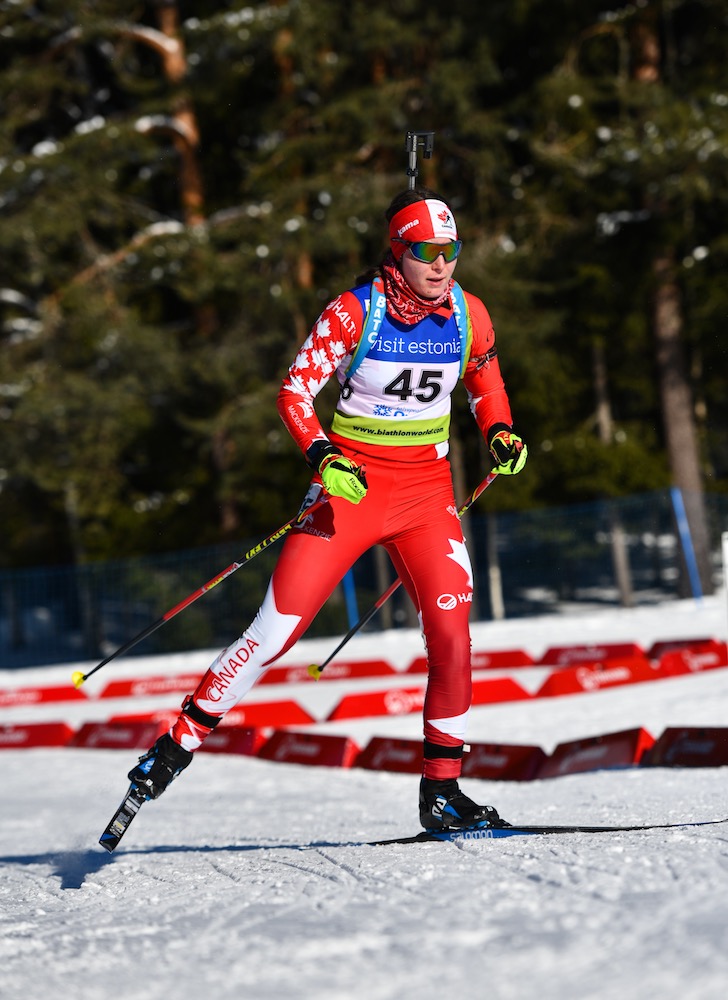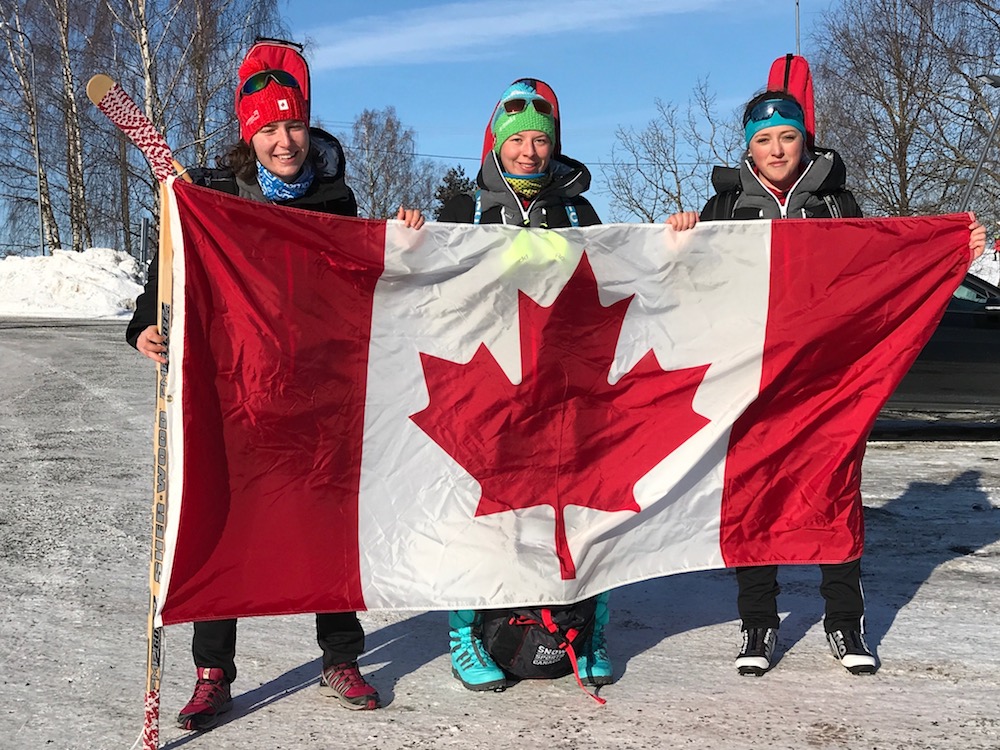
Tag: Zoë Pekos

  • Levins 7th, Bankes 9th, Kiers 16th in IBU Junior Worlds Sprint

    Levins 7th, Bankes 9th, Kiers 16th in IBU Junior Worlds Sprint

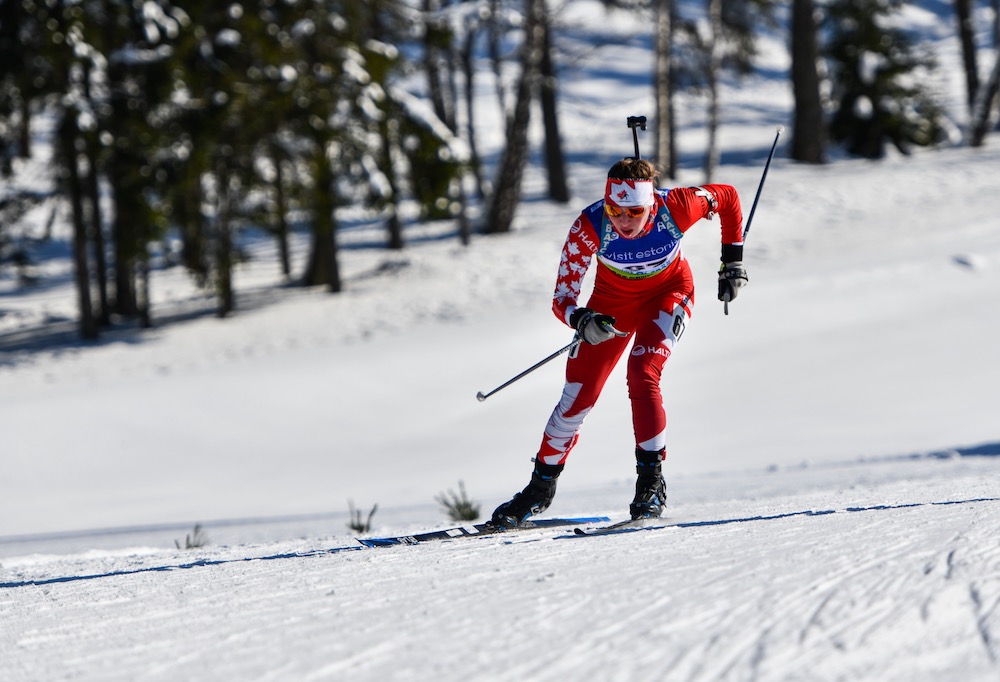
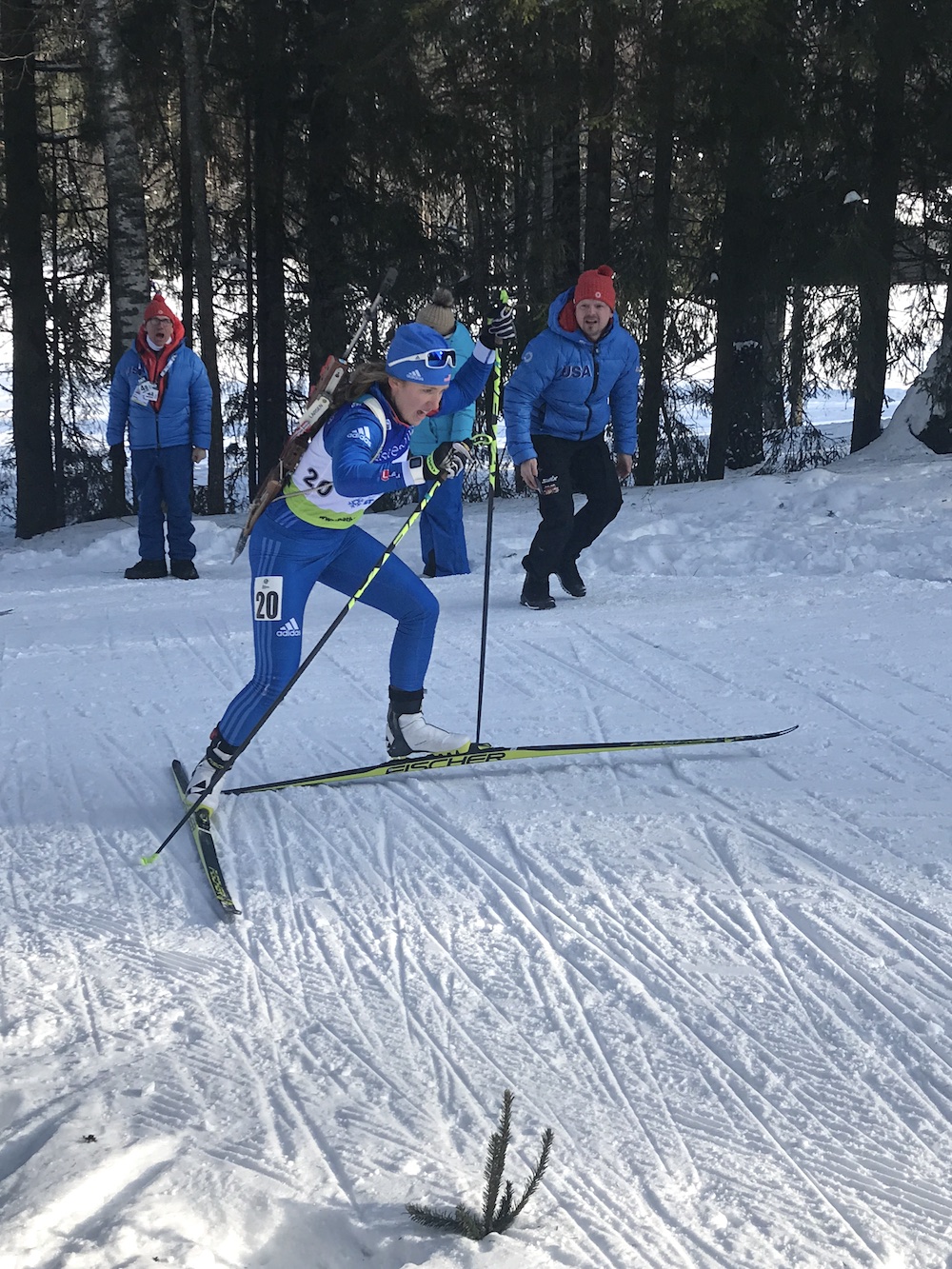
    American Chloe Levins racing to seventh in the junior women’s 7.5 k sprint on Saturday at IBU Junior World Championships in Otepää, Estonia. (Photo: Terri Dickson)

    “There’s almost nothing I love more than being in the hunt during a pursuit,” American Chloe Levins wrote in an email to FasterSkier on Saturday. “I’m prepared. I’m hungry.”

    Two days after placing sixth in the junior women’s 12.5-kilometer individual on Thursday, Levins, 19, raced to seventh place in Saturday’s 7.5 k sprint, which will put her in seventh (and within 10 seconds of fourth place) for the start of Sunday’s 10 k pursuit at the International Biathlon Union (IBU) Junior World Championships in Otepää, Estonia.

    Last year, Levins raced to fourth in the 7.5 k pursuit at 2017 IBU Youth World Championships. So it’s safe to say she has fond memories of that race format.

    On Saturday, Levins, a Middlebury College sophomore, started the 7.5 k sprint in 20th out of 70 women. She missed one of her prone targets, having to ski a penalty lap, and cleaned standing to cross the finish line in second place, just 1.5 seconds behind Russia’s Emma Timerbulatova in first. While both were ultimately bumped to sixth and seventh, respectively, by the time all 70 racers had finished, Levins’s course time still held up as the eighth fastest. Her shooting was among the best, too, with only five women cleaning the two-stage race.

    “There’s been a consistent stream of wind on this range all week long,” Levins explained in the email. “It didn’t fail to show up today either.  Ski conditions were perfect. The snow was cold but fast, and it got faster throughout the day.”

    When asked about the course, she recalled a term her coach Algis Shalna used to describe it: “workhorse”.

    “That’s exactly what it is,” she wrote. “It’s a traditional course with long hills and few transitions. I don’t really have a course profile preference, but working over the top of these hills pushes me past my limits every time.”

    Levins described being able to handle the “steady and relatively calm” wind conditions without many technical adjustments. After hitting all five targets in her standing stage, all she could do was smile as she returned to the course, she wrote.

    “It was a very rhythmic shooting that gave me some momentum leading into the last loop,” Levins recalled. “Our staff and even some of the youth athletes were everywhere on course today, which really helped me gain time on a Russian athlete who left the range 15sec ahead of me at the split.

    “I had the biggest support system in the entire field today,” she added. “I hope they had as much fun during the competition as I did.”

    At the finish, Levins tried to process any time she lost on the course and the time gap between her and first place at the time.

    “My brain immediately went to analyzing the race in search of 1.5 lost seconds,” Levins wrote. “Since the temperatures have been so cold this week, they made all the races 20 second intervals. It was unfortunate that I had to maneuver my way around two groups of at least four competitors along the track on my last loop.”

    In the end, she ended up seventh, 1:31.7 minutes behind Poland’s Kamila Żuk, who won in 22:32.5 with one standing penalty (0+1). Żuk also won Thursday’s 12.5 k individual.

    On Sunday, Levins will start the pursuit 1:32 behind Żuk and just 10 seconds behind Russia’s Valeriia Vasnetcova in fourth place. Markéta Davidová of the Czech Republic will head out of the gate second, 26 seconds behind Żuk, and France’s Myrtille Begue will start third, 52 seconds back. While Davidová made up for two penalties in Saturday’s sprint with the second-fastest course time (behind Żuk in first), Begue shot clean and skied the fifth-fastest course time.
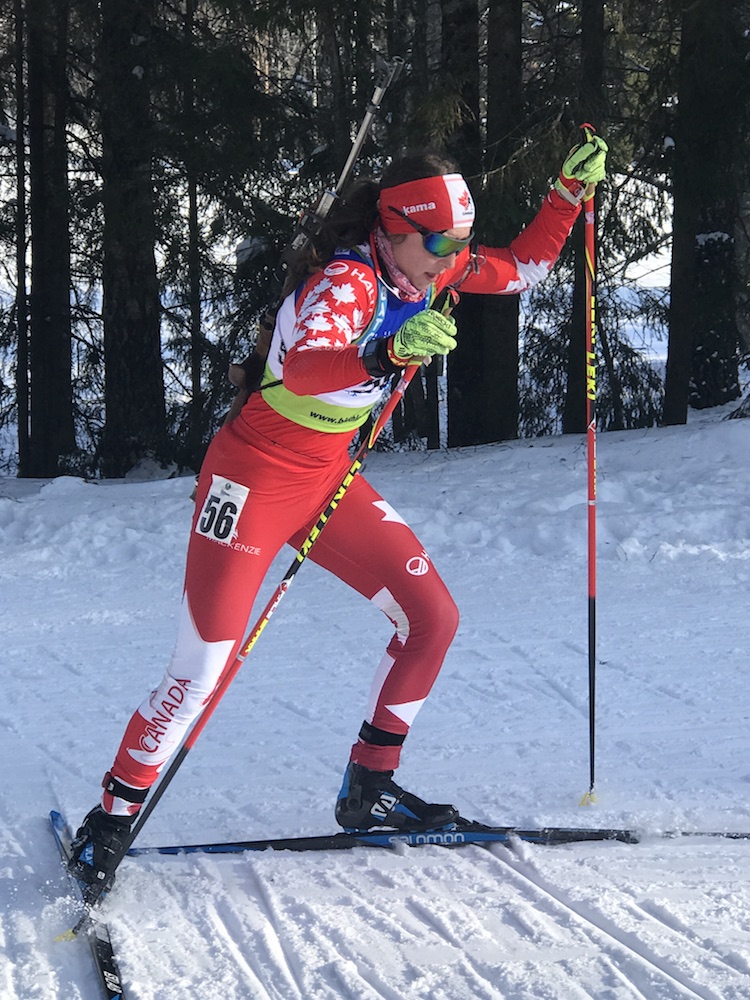
    Canada’s Megan Bankes racing to ninth in the junior women’s 7.5 k sprint on Saturday at IBU Junior World Championships in Otepää, Estonia. (Photo: Terri Dickson)

    Canada’s Megan Bankes placed ninth for her third-straight race of the championships, after finishing ninth in the junior women’s 3 x 6 k relay and ninth in the 12.5 k individual. On Saturday, she had two penalties, one in each stage (1+1), and finished 1:49.5 minutes out of first with the (you guessed it) ninth-fastest course time.

    Bankes will start the pursuit 1:50 back and just 4 seconds behind Norway’s Marit Ishol Skogan in eighth.

    Her teammate Nadia Moser finished 21st (+2:46.2), also with two penalties (0+2), Emily Dickson finished 36th (+3:50.5) with two penalties (1+1), and Canada’s fourth woman Zoë Pekos narrowly missed the pursuit cutoff in 66th (+6:22.4) with four misses (3+1).

    In the junior men’s 10 k sprint that followed, Canada’s Trevor Kiers achieved his best result at his second Junior Worlds in 16th (+1:34.9) with two penalties (2+0). Kiers, 20, previously broke through in 10th and 11th this season in IBU Junior Cup sprints. Last year at Junior World Championships, his best non-relay result was 39th in the pursuit.

    So far in Otepää, Kiers had finished 77th in the 15 k individual and 17th with his team in the 4 x 7.5 k relay.

    “I found it really hard mentally after the relay and individual,” Kiers wrote in an email. “But after a ton of self-reflection, I realised that I put too much pressure on myself to shoot well and perform. I simply didn’t trust myself. After the individual, I had one training session to regain my confidence, and I was able to do just that. I took 60 very focused shots, and only missed 1 prone and 3 standing over the whole session, and the last 30 were clean! I came into today’s race feeling very confident in my shooting, and knew that I could perform, and not allow that pressure to reach me. To go out and have a fun time, and my instincts would kick in, and the shooting would fall into place.”

    On the range, Kiers’s shooting and range times ranked 13th and 14th overall, respectively. As he entered his first prone shooting stage, he recalled that he consciously freed his mind of any expectations.

    “After I shot off my first, the casing got stuck in my chamber and I feel it through off my relaxed sort of focus, but I know that my last two shots were just me being silly,” Kiers wrote. “I knew that the next bout would be good, I had convinced myself that standing would be a breeze, just let my body do what it knows how to do.”

    His next time in the range, he cleaned his standing bout.
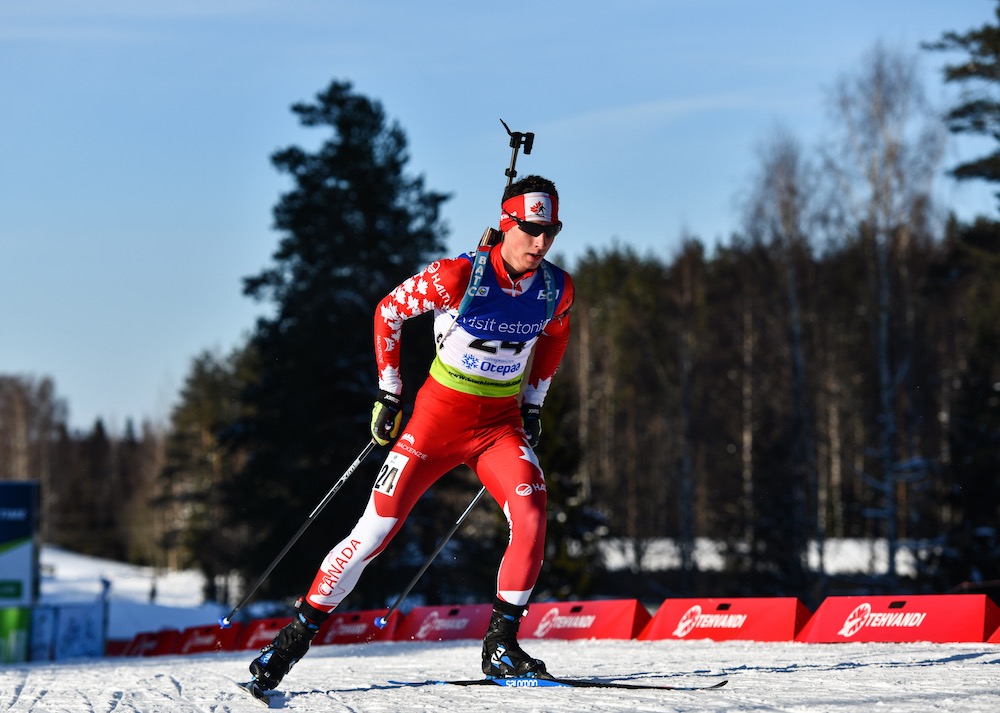
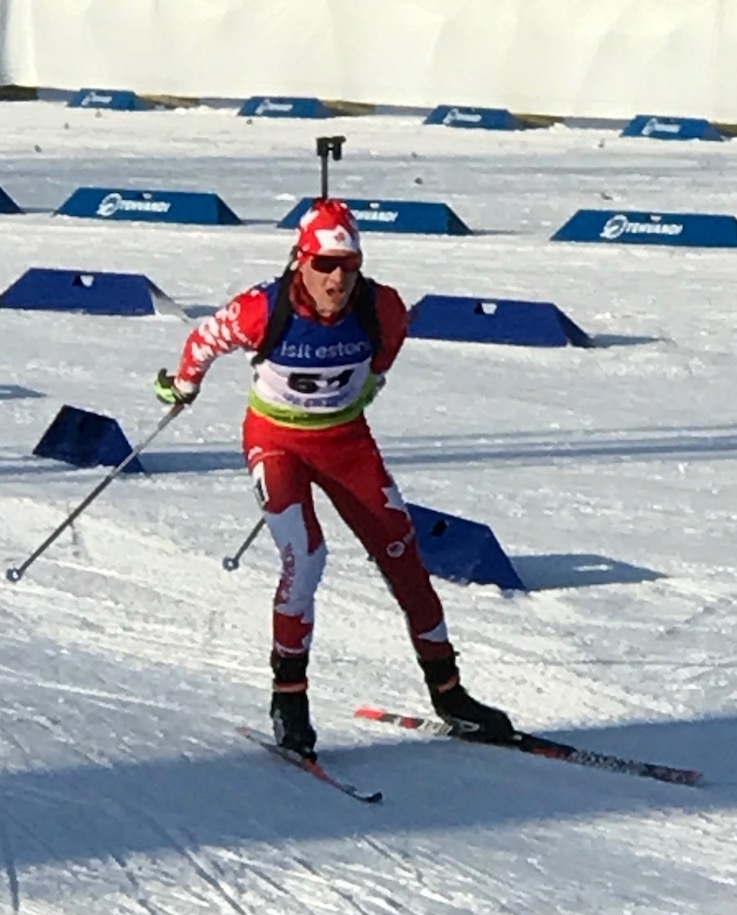
    Canada’s Trevor Kiers racing in the junior men’s 15 k individual at 2018 IBU Junior World Championships in Otepää, Estonia. He placed 77th in that race and went on to finish 16th in the junior men’s 10 k sprint on Saturday. (Photo: Bryan Dickson)

    “Not only did I clean it, but quickly too!” Kiers wrote. “I was one of the fastest shooters of the day, and can reflect back knowing that I didn’t rush, just that it felt good. Heading out on skis, I knew that I still had a shot at a good result, when I went up one of the first long climbs, out wax tech was yelling at me that I was definitely still in it, that I was still skiing on par, and that I could pull this back together! Having that near the beginning of the loop definitely set me up well mentally for the second loop, to keep the grind on, and that I wouldn’t give up any seconds.”

    Based on his shooting, he was confident he could be in the top 20. As the 16th starter, Kiers crossed the finish line in sixth, but some 72 men were still on course. Ultimately, he finished 16th, 1:34.9 behind Russia’s Vasilii Tomshin, who shot clean to win in 25:01.8.

    “When I heard that I got 16th I was super happy!” Kiers wrote. “From the previous races I’ve done this year, I knew that cleaning a race could land me in the top 10, and once I finished with 2 misses, I reckoned that it would probably be a top 25, maybe a top 20, but I apparently skied faster than I thought possible! … Today, I held my own on skis, and proved that I deserve to be up here with the big guns!”

    Looking back on his progression in the sport, he described it as “insane”.

    “… Before two years ago (May of 2016) I had never had a biathlon coach, and did all my training on my own in my backyard range that I built,” he explained. “But I was able to prove myself at the 2016 nationals that February and landed a spot on [Biathlon Alberta Training Center]. BATC has changed a lot about how I had gone about things before, and I think that last year was the time to get used to a full time training lifestyle, and this was the year to start performing, and showing what it has done for me.”

    Kiers will start Sunday’s 12.5 k pursuit in 16th, 1:35 behind Tomshin and seven seconds behind Germany’s Tim Grotian in 15th. France’s Martin Perrillat Bottonet (who had one penalty in the sprint) will start second, 21 seconds back, and Norway’s Sverre Dahlen Aspenes (who missed two) will head out third, eight seconds later.

    “I am super excited to see what I can do tomorrow, but to be truthful, I don’t have any expectations as far as results go,” Kiers wrote. “My expectations are to simply go out there, have some fun, dance to a few songs during warm-up, and see where that takes me. I am really looking forward to leaving everything I’ve got out on the track, being the last race of the championships, no holding back, have no regrets after I finish.”

    Canada had two in the top 30 with Adam Runnalls in 26th (+2:08.3) with three penalties (1+2). Teo Sanchez also qualified for the pursuit by tying for 53rd (+3:19.2) with one penalty (1+0), while Angus Tweedie placed 69th (+4:41.3) with three misses (+4:41.3).

    Cody Johnson shot clean to lead the Americans in 37th (+2:31.1). Tim Cunningham finished 71st (+5:13.5) with seven misses, Jacob Pearson was 79th (+6:24.2) with two penalties (1+1) and Cam Christiansen in 86th (+7:52.5) with three penalties (1+2).

    Results: Junior women | Junior men

    Pursuit start lists: Junior women | Junior men
  • Saturday Rundown: Lahti and Otepää

    Saturday Rundown: Lahti and Otepää

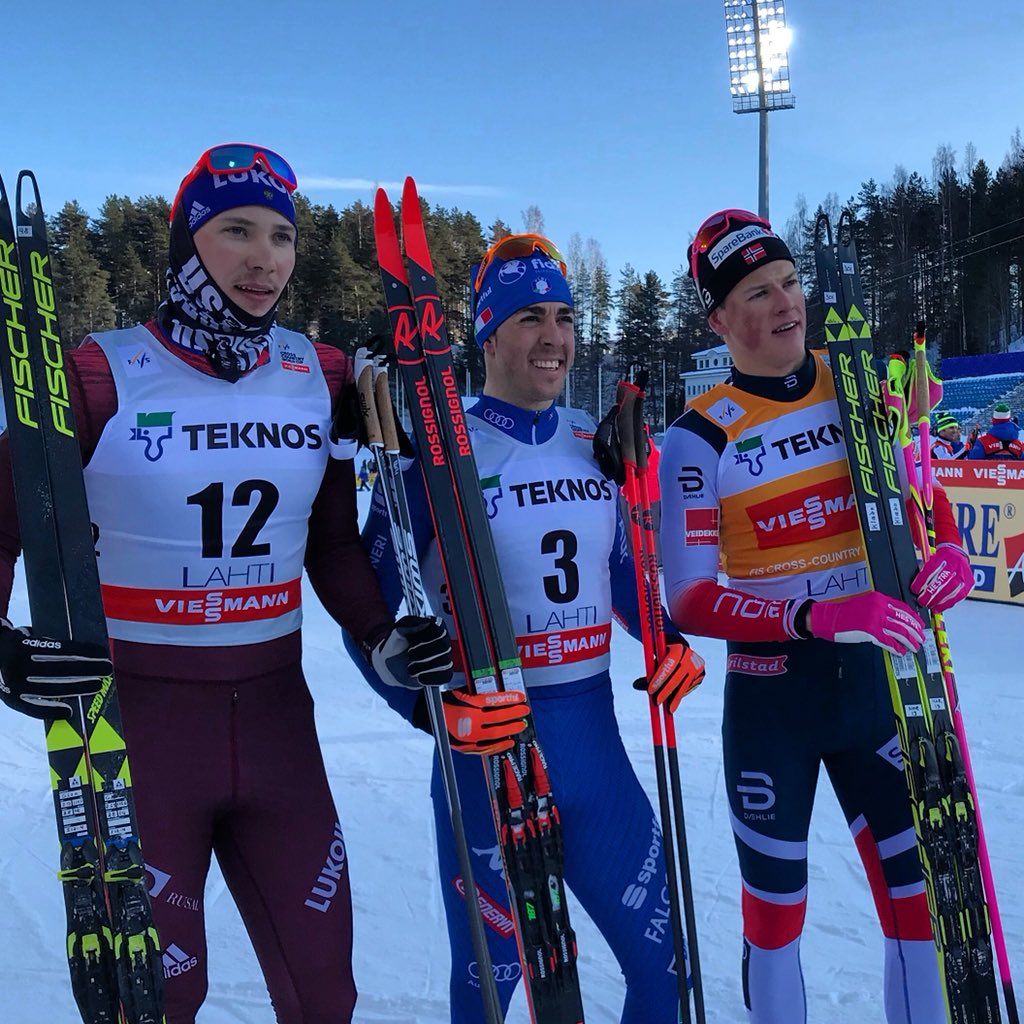
    The men’s 1.6 k freestyle sprint podium at Saturday’s World Cup in Lahti, Finland, with Italy’s Federico Pellegrino (c) in first, Russia’s Gleb Retivykh (l) in second and Norway’s Johannes Høsflot Klæbo (r) in third. (Photo: FIS Cross Country/Twitter)

    FIS Cross Country World Cup (Lahti, Finland): Men’s & women’s freestyle sprints 

    Women’s report

    Men’s report

    The defending world championships from the 2017 freestyle sprint prevailed again in Lahti on Saturday, with Norway’s Maiken Caspersen Falla winning the women’s 1.4-kilometer freestyle sprint final and Italy’s Federico Pellegrino coming out on top in the men’s 1.6 k final at last year’s World Championships venue.

    Falla’s rise to the final started with her qualifying in 12th, 7.96 seconds off the fastest qualifying time set by Sweden’s Hanna Falk in 2:54.72. Russia’s Natalia Nepryaeva qualified second (+0.63) and Finland’s Krista Pärmäkoski third (+3.62), just ahead of Germany’s Victoria Carl in fourth (+3.88) and American Sadie Bjornsen in fourth (+3.88). Four American women qualified for the heats, with Sophie Caldwell in 17th, Ida Sargent in 21st and Rosie Brennan in 29th.

    The women’s 1.4 k freestyle sprint podium at Saturday’s World Cup in Lahti, Finland, with Norway’s Maiken Caspersen Falla (c) in first, and Sweden’s Stina Nilsson (l) and Hanna Falk (r) in second and third, respectively. (Photo: FIS Cross Country/Twitter)

    Falla went on to place second in the first quarterfinal, 0.71 seconds behind Sweden’s Stina Nilsson in first. According to the race jury’s ruling, Carl obstructed Pärmäkoski coming out of the last downhill before they entered the finishing straight and both crashed out of contention, with Pärmäkoski finishing fifth in the heat (+12.11) and Carl sixth (+49.5). Carl was relegated to last (30th place) for the obstruction.

    Falla then won the first semifinal by just 0.04 seconds over Nilsson in second. The two other Swedes in that heat, Falk and Ida Ingemarsdotter, advanced to the final as well as lucky losers with fast-enough times.

    In the final, Falla found herself at the front of the pack early then held her position to the finish, crossing the line in 2:54.83 and beating Nilsson by 0.36 seconds. Sweden had two on the podium with Falk in third (+0.78), Germany’s Sandra Ringwald placed fourth (+0.88), Ingemarsdotter was fifth (+1.83), and Switzerland’s Laurien van der Graaff placed sixth (+3.02).

    Caldwell was the lone American woman to make it past the quarterfinals, as she placed second in her quarterfinal, 0.25 seconds behind Ringwald in first, then fourth in the second semifinal, 1.46 seconds behind Ringwald, who also won that heat. Overall, Caldwell finished the day in eighth.

    Bjornsen placed 17th overall after finishing fourth in her quarterfinal, 2.84 seconds behind Falk in first. Sargent had been second in her quarterfinal until the final tight lefthand corner into the finishing straight, where she slipped to sixth and ultimately finished sixth, 1.07 seconds behind Sweden’s Anna Dyvik in first. Overall, Sargent finished the day in 27th, and Brennan placed 29th overall after finishing sixth in her quarterfinal, 4.91 seconds behind Ingemarsdotter in first.

    Two American men advanced to the heats as well, with Kevin Bolger of the Sun Valley Ski Education Foundation (SVSEF) qualifying in 16th in his World Cup debut, 6.38 seconds behind Norway’s Johannes Høsflot Klæbo, who topped the qualifier in 2:59.06. Erik Bjornsen of the U.S. Ski Team qualified 29th, 8.29 seconds back.

    Meanwhile, Pellegrino qualified for the heats in third (+1.9) behind France’s Baptiste Gros in second (+1.23).

    There, Pellegrino won the first quarterfinal by 0.19 seconds over Klæbo, with the Norwegian visibly backing off before the finish — comfortable enough to automatically advance to the semifinals in second place. But Klæbo showed Pellegrino what he’s made of in the first semifinal and beat the Italian by nine-hundredths of a second.

    Bolger also raced in that first semifinal after placing fourth in his quarterfinal, 0.73 seconds behind Russia’s Gleb Retivykh in first. Bolger’s time was good enough for one of two lucky loser spots in the semifinals, where he went on to finish sixth, 1.86 seconds after Klæbo. Overall Bolger finished the day in 11th.

    Erik Bjornsen placed 20th on the day after finishing fourth in the first quarterfinal (with Pellegrino and Klæbo), 1.56 seconds out of first.

    In the final, Klæbo set the tone, slowing the pace to almost a stop at one point, while he and Pellegrino stood side by side at the top of the course. On the way down, they accelerated, but Norway’s Sindre Bjørnestad Skar was the one who truly attacked. It might’ve been a bit too early, as Pellegrino caught him by the top of the final climb and took the lead on the following downhill into the stadium. Pellegrino held off his challengers, including Retivykh who came on strong out of the downhill, to take the win in 3:16.73, 0.77 seconds ahead of Retivykh in second and 0.9 seconds ahead of Klæbo in third. Skar settled for fourth (+1.3), Finland’s Ristomatti Hakola placed fifth (+1.44) and France’s Lucas Chanavat finished sixth (+7.55).

    In the qualifier, Canada’s Dahria Beatty finished 34th, +13.39 and just 0.9 seconds from making the quarterfinals. She was the only Canadian woman competing.

    American Kelsey Phinney (SVSEF) was also close to making the cut. In her first European World Cup, she placed 36th in the qualifier, +13.74. Caitlin Patterson and Kaitlynn Miller, both of the Craftsbury Green Racing Project,  placed 56th (+20.12) and 61st (+21.70).

    Mathilde Petitjean of Togo, a primarily Quebec-based skier, finished in 59th (+20.80).

    In the men’s qualifier, Logan Hanneman (APU) placed 49th (+11.45). Paddy Caldwell (U.S. Ski Team/SMS T2) finished 59th (+13.55), and APU’s Reese Hanneman and David Norris placed 61st (+14.33) and 67th (+19.27).

    Julien Locke led Canada in 42nd place (+9.78), and Andy Shields finished 60th (+14.29).

    Qualifier results: Women | Men

    Final results: Women | Men

    ***

    IBU Youth World Championships (Otepää, Estonia): Junior women’s and men’s sprints

    Full report

    American Chloe Levins racing to seventh in the junior women’s 7.5 k sprint on Saturday at IBU Junior World Championships in Otepää, Estonia. (Photo: Terri Dickson)

    Poland’s Kamila Zuk won her second race in a row, taking gold in the junior women’s 7.5 k sprint after also winning the individual at World Junior Championships. Zuk had one penalty to two by second-place Marketa Davidova of the Czech Republic, who finished 26.0 seconds back. Bronze went to Myrtille Begue of France, who shot clean to finish 52 seconds back.

    The sole U.S. starter, Chloe Levins followed up her sixth-place finish in the individual with seventh place in the sprint. Levins had a single penalty and finished +1:31.7.

    For Canada, Megan Bankes was close behind Levins in ninth, with two penalties and +1:49.5. Teammate Nadia Moser was 21st, also with two penalties, +2:46.2. Emily Dickson finished 36th, +3:50.5 with two penalties, and Zoe Pekos just missed the pursuit cutoff in 66th (+6:22.4) with four missed shots.

    In the junior men’s 10 k sprint, Vasilii Tomshin of Russia took the gold with perfect shooting. France’s Martin Perillat Bottonet was second, less than a penalty-loop’s worth of time back at 20.5 seconds – and he did have one penalty. Norway’s Sverre Dahlen Aspenes took bronze (+29.4) with two missed shots.

    Trevor Kiers led Canada in 16th, a breakthrough result; his previous World Juniors best was 39th in the pursuit last season. Kiers missed two shots, both in prone, and finished 1:34.9 behind the time set by Tomshin.

    Adam Runnalls placed 26th for Canada (+2:08.3) with three missed shots. Teo Sanchez also qualified for the pursuit by placing 53rd (+3:19.2) with one penalty, and Angus Tweedie was left on the outside looking in with 69th place (+4:41.3) with three missed shots.

    Cody Johnson led the Americans in 37th, with clean shooting, 2:31.1 back from Tomshin’s time. Tim Cunningham was the next finisher in 71st (+5:13.5) with seven missed shots, followed by Jacob Pearson in 79th (+6:24.2) with two penalties and Cam Christiansen in 86th (+7:52.5) with three penalties.

    Results: Junior women | Junior men
  • Thursday Rundown: Levins 6th, Moser 8th, Bankes 9th in Junior Worlds Individual

    Thursday Rundown: Levins 6th, Moser 8th, Bankes 9th in Junior Worlds Individual

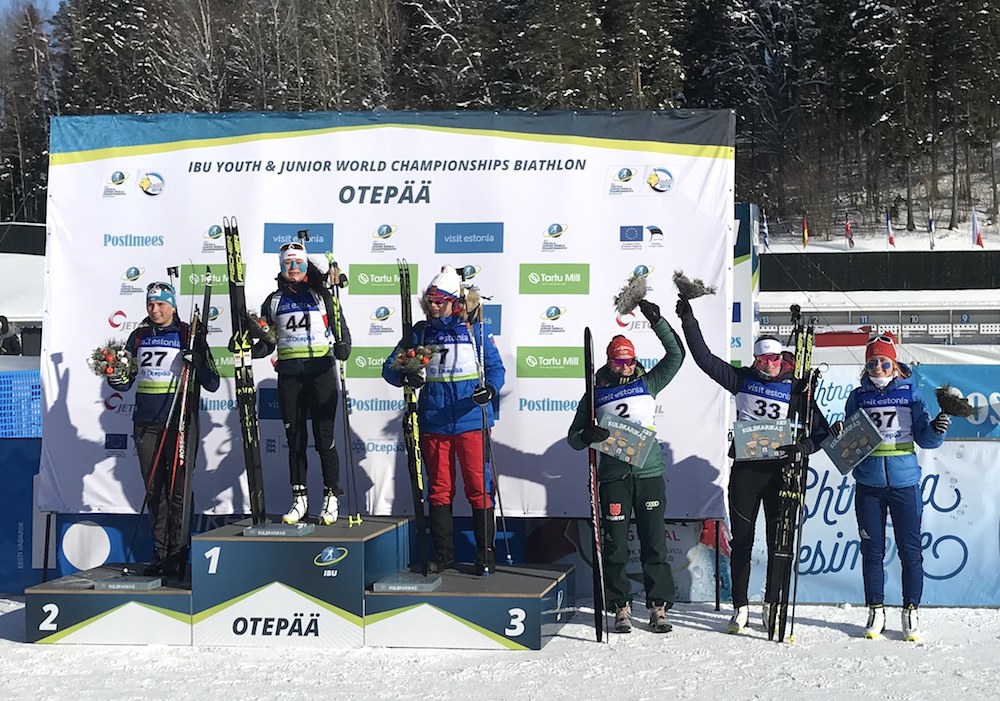
    The top-six finishers at the junior women’s 12.5 k individual flower ceremony on Thursday at IBU Junior World Championships in Otepää, Estonia, with Poland’s Kamila Żuk (second from l) in first, Ukraines’s Anna Kryvonos (l) in second place, Russia’s Irina Kazakevich (third from l) in third, and American Chloe Levins (r) in sixth. (Photo: Erik Lewish)

    IBU Junior World Championships (Otepää, Estonia): Junior women’s and men’s individual

    Three North Americans in the top 10, top nine even. That’s what happened in a single race at the International Biathlon Union (IBU) Junior World Championships on Thursday in Otepää, with American Chloe Levins placing sixth, and Canada’s Nadia Moser and Megan Bankes claiming eighth and ninth, respectively, in junior women’s 12.5-kilometer individual.

    According to the three racers, it was another beautiful day in Otepää with steady, sometimes even gusting, wind.

    Levins was the earliest starter of the three, starting in the middle of the field in bib 37 (out of 70). Bankes headed out of the gate 45th and Moser started near last in 67th.

    Canada’s Nadia Moser racing to eighth in the junior women’s 12.5 k individual at IBU Junior World Championships in Otepää, Estonia. (Photo: Bryan Dickson)

    Despite the late start, Moser, 20 years old and in her second Junior Worlds, explained in an email that she wasn’t nervous. With temperatures rising to a high of -10 degrees Celsius (14 Fahrenheit) on Thursday morning, she almost preferred it.

    “There were also 20 second start intervals which are shorter than the usual 30, so all of the competitors were out of the gate in a shorter amount of time than normal,” Moser wrote.

    In neither Thursday’s women’s race nor the men’s 15 k individual that followed, nobody shot clean. In fact, only one woman shot 19-for-20: Slovakia’s Veronika Machyniakova, who ended up 11th. The top-two finishers in the women’s 12.5 k, Poland’s Kamila Żuk (who placed first in 41:36.1 minutes) and Ukraine’s Anna Kryvonos (who finished 3:04.7 minutes back in second place), both had two penalties. Russia’s Irina Kazakevich placed third (+3:20.0) with three misses — which added three minutes of penalties to her time.

    “I found the wind in the range today to be fairly variable,” Bankes, the defending Junior Worlds champion in the event, wrote in an email. “It was gusting and then dying quiet significantly and also in the middle of shooting bouts which made things a little tricky.”

    At last year’s Junior Worlds in Osrblie, Slovakia, Bankes shot a perfect 20-for-20 for the first time in her career and won gold in the junior women’s 12.5 k individual.

    Thursday brought new challenges, and Bankes explained she was happy to clean her first prone. She went on to miss two in the next standing stage, then one in each of the following two stages (0+2+1+1) to finish the race with four penalties, which ultimately put her in ninth overall (+4:59.1).

    Canada’s Megan Bankes racing to ninth in the junior women’s 12.5 k individual at IBU Junior World Championships in Otepää, Estonia. (Photo: Bryan Dickson)

    “I’m not totally sure what happened in my first standing (when I missed 2) but when I came into my 2nd standing the wind was gusting quite a bit, and I was really happy with how I waited for my first 4 shots, but I was a little annoyed to have missed that last one,” she recalled. “Overall I think my shooting today was pretty good, but I could have been better.”

    While Bankes figured the wind was giving most others trouble as well, she didn’t think that she’d make it into the top 10 with four misses.

    “I don’t like getting splits until the last lap, so I heard Andrew [Chisholm] our wax tech tell me I was fighting for 10th when I passed him, so I really tried to give everything that last lap,” Bankes, 20, wrote. “I was super stoked to see I crossed the line in 7th, and knew I wouldn’t be bumped down too much because I started 3rd seed.

    “Coming off of gold last year, I definitely had high expectations for myself,” she explained. “But I tried to use that as more positive belief in myself to know I can be in the top women, and know that I can shoot well, instead of just focusing on the result number. My main goal going into these championships was to have races that I’m happy with, and to ski and shoot to the best of my abilities.”

    At the end of the day, Bankes wrote that she was “really happy” with her result.

    “I felt like I really held myself together on skis, and kept my technique under control, while also pushing myself to the limit throughout the race,” she wrote. “I’m super stoked to see that the youth women are totally crushing it, and to be right behind Nadia today was also super exciting (also to see Chloe Levins in 6th was fantastic – 3 North Americans in the top 10!)”

    From left to right: Megan Bankes, Nadia Moser and Emily Dickson after the junior women’s 12.5 k individual at IBU Junior World Championships in Otepää, Estonia. (Photo: Bill Gilliland)

    One place ahead of her, Moser scored her first non-relay top 20 at Junior Worlds, leading Canada in eighth (+4:18.9) with three penalties (1+0+1+1). Two days earlier, Moser, Bankes and their teammate Emily Dickson placed ninth in the junior women’s 3 x 6 k relay.

    “I knew I could get a top 10 finish if I could pull my shooting together,” Moser wrote after Thursday’s individual race. “After my third shooting I had missed 2 targets total and I thought then that my top 10 chances were over. On may last loop I had 3 misses and was not even thinking about top 10 anymore. I realized that I must be doing better than I initially thought when everyone who was cheering me sounded really excited. I definitely got lucky today because no one cleaned their shooting. I was extremely happy to have finished in the top 10, especially since I was sure that I had no chance after missing 3 targets.”

    She was pleased to see all of her training over the last year validated on Thursday.

    “I tried really hard to improve over the summer and fall because I really wanted good results this season,” Moser wrote. “I think that the best thing I did today was to stay calm, and take my time in the range. I shot really slowly but that paid off in the end.”

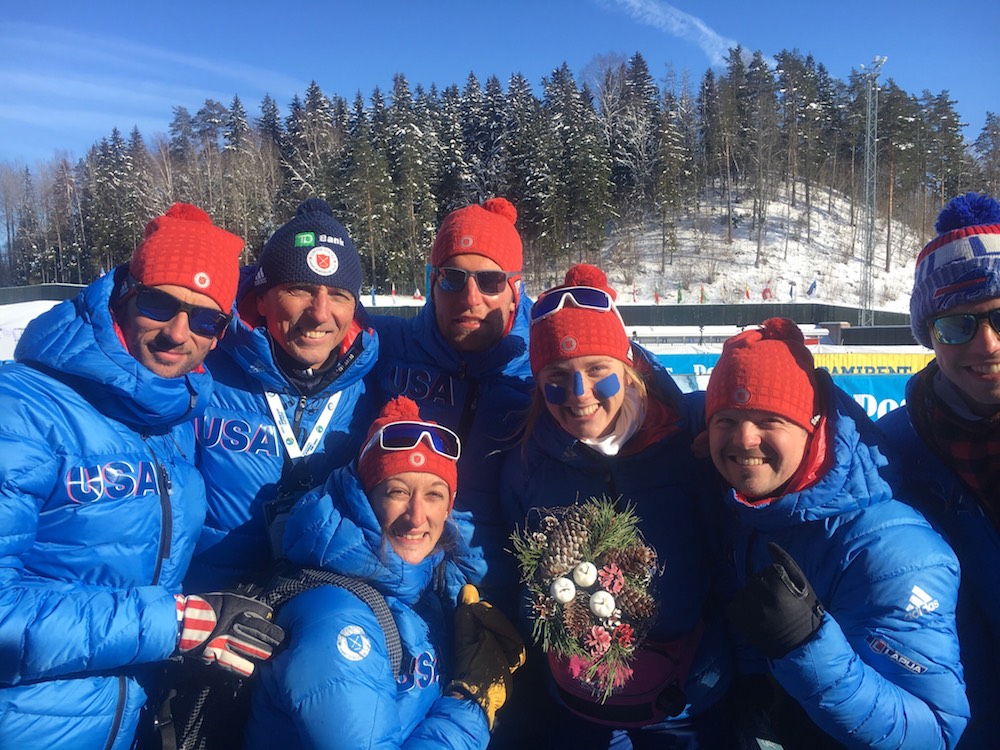
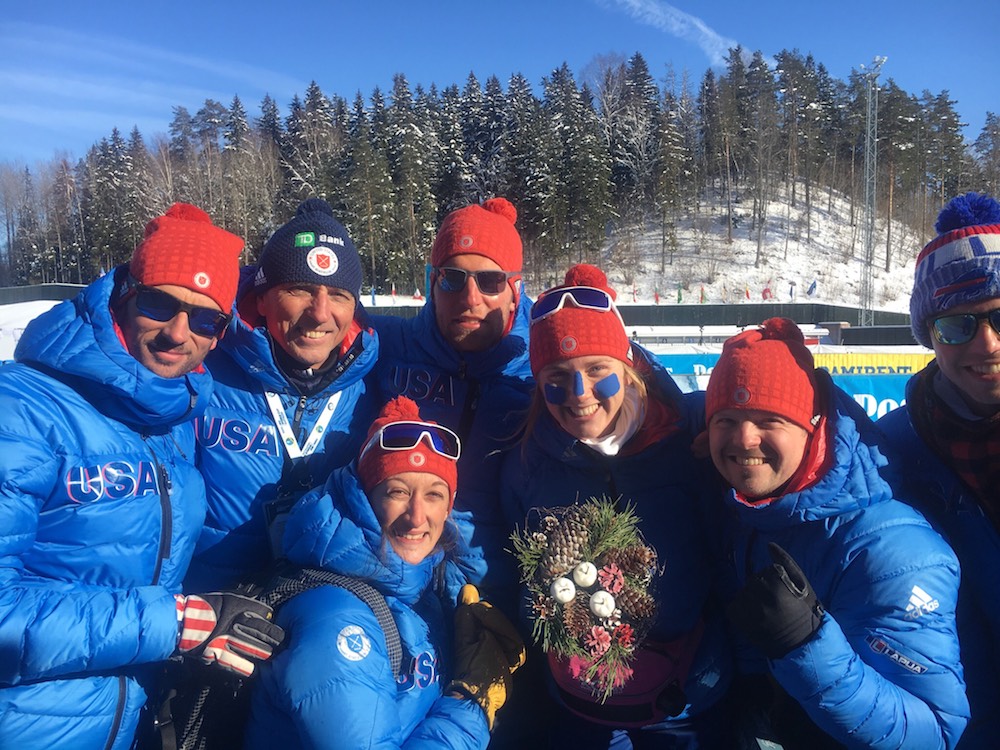
    Chloe Levins (third from r) with the U.S. team staff (from l to r) wax tech Travis Voyer, coach Algis Shalna, assistant coach Danika Frisbie, wax tech Max Bergmann, wax tech Mattias Halquist, and head coach Erik Lewish, after Levins placed sixth in the junior women’s 12.5 k individual at IBU Junior World Championships in Otepää, Estonia. (Photo: Erik Lewish)

    The lone American junior woman at this year’s IBU Youth/Junior Worlds, Levins, 19, finished sixth (+3:37.4) with three penalties (0+1+0+2). At last year’s Youth Worlds, Levins notched fourth place in the 7.5 k pursuit.

    “There’s a big difference between youth and junior competition,” Levins wrote in an email. “A lot of juniors have IBU Cup experience, World Cup experience, and a handful even attended the Olympics. Fortunately, there’s also a big difference between the youth athlete I was last year and the junior I am now. I’ve been fortunate to compete in more winter biathlon races than ever this year, which has really helped me up my game. It’s a good feeling to see that I’m prepared to compete at this level.”

    She explained that she had one goal on Thursday: “smile no matter what,” she wrote. “The hay is in the barn. Now it’s just time to get out of my own way and focus on one thing at a time.”

    While Levins had experienced the rush of being near the front of the race in a pursuit, actually contending for a top result in an individual-start race was a new experience for her, she explained.

    “As always, I tried not to let thoughts of my position distract me from thinking tactically about the course or my shooting process,” Levins noted. “Every lap, every corner, every shooting remained an opportunity for me until the finish line.

    “A lot of my friends finished their races around me, so I did not even see my standing at the finish,” she continued. “When I finally looked at the board and saw that I was more than three minutes back of the leader, I thought that this result, with three penalties myself, was okay. I didn’t expect it to be good enough for sixth place.”

    The race was Levins’s first of the week and she presumably has two more to go — as do Moser, Bankes and most of the other junior women — with a sprint on Saturday and, if they place in the top 60 of the sprint, a pursuit on Sunday.

    As the only American junior woman in Otepää, Levins wrote that she was fortunate to have a significant amount of team support behind her on Thursday.

    “My skis today were incredibly fast,” she emphasized. “Our wax guys made the fastest skis on the track today. … I can’t thank them enough.”

    The U.S. team’s head coach and trip leader, Erik Lewish, pointed out that Levins had the seventh-fastest overall ski time and one of the best shooting performances of the day.

    “It’s great to see that she is right in the mix with this very competitive field (2 of the starters today were competing in the Olympics),” Lewish wrote. “1 more hit and she would have finished in 2nd place today, this is very exciting looking forward to the Sprint and pursuit (sat and Sunday) where she will have another chance to get on the podium.”

    “There are a lot of good things to take from this race and, as always, a lot of things to learn,” Levins concluded. “What’s my goal for the rest of the week? Keep learning. Keep smiling.”

    According to Canada’s head coach and trip leader Jacqueline Akerman, the Canadian techs also nailed the wax.

    “The techs hit the wax perfectly allowing for some of the top skis out there, when skiing form and wax meet it sets the scene for great results,” Akerman wrote. “The shooting was a bit tricky today with varying strength and switching winds, but both [Nadia and Megan] managed to keep misses to a minimum. They both hit enough to place in the top ten on a day when no one in the field shot clean and only one athlete managed one penalty. They are both happy with their performance, and the rest of us are too!”

    Next on the results sheet for Canada was Dickson in 36th (+8:33.7) with five penalties (2+1+0+2), and Zoë Pekos in 63rd (+15:50.6) with eight misses.

    Canada’s Adam Runnalls racing to 29th in the junior men’s 15 k individual at IBU Junior World Championships in Otepää, Estonia. (Photo: Bill Gilliland)

    In the junior men’s 15 k, Canada’s Adam Runnalls led the North Americans in 29th (+4:26.4) with five penalties (0+0+3+2). Teo Sanchez followed in 58th (+7:25.2) with four misses (1+1+1+1), Angus Tweedie was 67th (+9:11.8) with six misses (2+0+2+2), and Trevor Kiers 77th (+12:44.3) with 13 penalties.

    For the U.S., Tim Cunningham finished 53rd (+6:49.3) with six penalties (1+3+1+1), Cody Johnson was 60th (+8:01.7) with seven misses, Jacob Pearson 83rd (+16:39.6) with 13 misses, and Cameron Christiansen 84th (+16:53.6) with eight penalties.

    Russia had two on the podium in the men’s race as well, with Igor Malinovskii scoring his second-straight win after racing to gold in the junior men’s 4 x 7.5 k relay on Tuesday. He has won the last four races he’s contested, including the sprint and the pursuit at IBU Junior Open European Championships before Junior Worlds. Malinovskii finished in 41:48.5 on Thursday with three penalties (1+1+1+0), besting Norway’s Sturla Holm Lægreid in second place by 19.4 seconds; Lægreid also had three penalties (1+0+1+1). Russia’s Said Karimulla Khalili added bronze (+23.0) to his medal collection, with two misses (0+1+1+0), after capturing gold with his relay team.

    No one in the junior men’s individual had fewer than two misses.

    Results: Junior women’s 12.5 k individual | Junior men’s 15 k individual 

  • 20-for-20 with Shilo Rousseau

    20-for-20 with Shilo Rousseau

    Shilo Rousseau competing in a NorAm pursuit last month in Valcartier, Quebec. (Photo: Dan Guay)

    In another 20-something-question, fill-in-the-blanks series, we checked in with the world-class U.S. and Canadian biathletes that will be competing at 2017 International Biathlon Union (IBU) Youth & Junior World Championships Feb. 22-28 in Osrblie (also known as Brezno-Osrblie), Slovakia.

    Here’s 16-year-old Shilo Rousseau, of Team Hardwood, who is representing Canada at her first Youth Worlds. In three individual races at the championships, she finished 45th in the youth women’s 6 k sprint, and 54th in both the 10 k individual and 7.5 k pursuit.

    ***

    “My full name is Shilo Rousseau, but you can call me Shilo. I was born in Elliot Lake, Ontario, raised in Thessalon, Ontario, and one thing you should know about my hometown is that you need to have a good apple collection if you want to survive the many bears that roam the town.

    I started cross-country skiing when I was 10 and started biathlon when I was 11, thanks to my parents.

    Canada’s Shilo Rousseau (Team Hardwood) shooting at the Thessalon Rod and Gun club in January in her hometown of Thessalon, Ontario. (Courtesy photo)

    I currently train in Thessalon with the help of Team Hardwood.

    If I’m not skiing, you might find me listening to Broadway musicals my friend forces me to listen to.

    If I had to pick a favorite book, it would be ‘Throne of Glass’ series.

    One of the things I’m most excited about for Youth/Junior World Championships in Brezno-Osrblie is to race alongside athletes from around the world.

    This will be my first Youth/Junior World Championships, and this year, I’m competing as a youth. One race I’m especially targeting there is the sprint race.

    The best advice anyone ever gave me about skiing or racing was race so fast that you pass out on course and have to be taken to the hospital.

    One of the best race memories I have is leading the 10 km mass start with my teammate Zoë Pekos right beside me.

    If I could meet one World Cup skier, it would be Laura Dahlmeier.

    If I don’t end up being a professional skier, I’ll probably be a professional rapper because I am ultimate.

    I’m probably missing 20 days of school to be here, and my teachers/professors are probably thinking, ‘Insane‘ lol.