Tag: Zoe Roy

  • Wednesday Workout: ‘Exceptional Off-the-Couch Fitness’ with Zoë Roy

    Wednesday Workout: ‘Exceptional Off-the-Couch Fitness’ with Zoë Roy

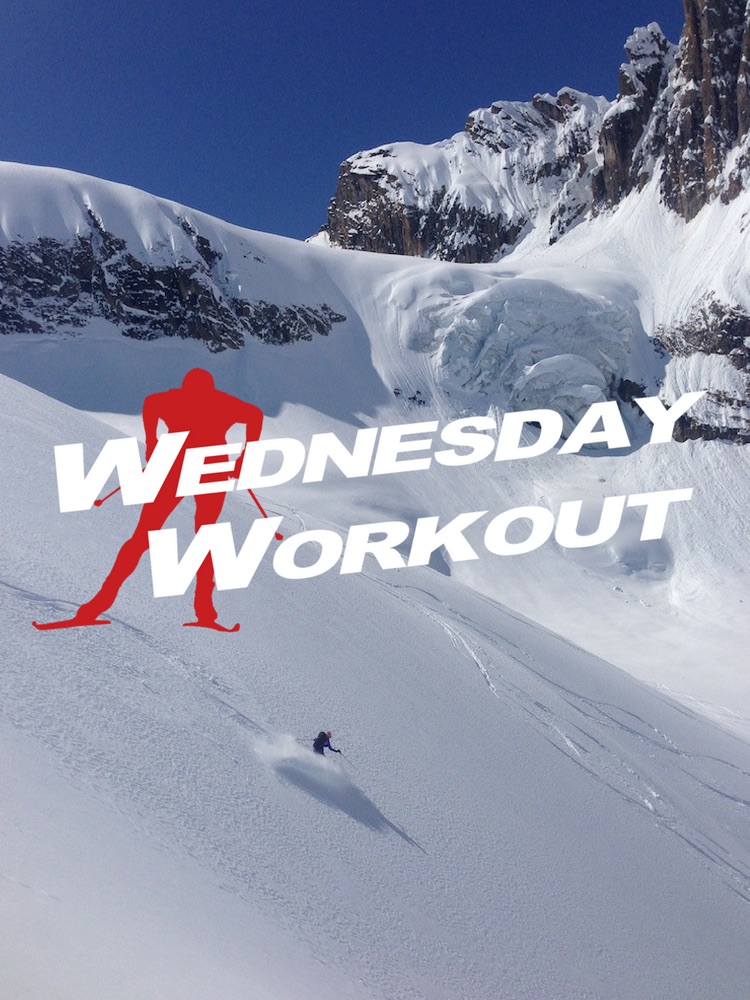
    Zoë Roy tapping into her “exceptional off-the-couch fitness” somewhere above Mistaya Lodge in British Columbia. (Photo: Florian Jungen)

    BEND, Oregon — Zoe Roy.

    OK, OK. First things first. Don’t forget the umlaut.

    So it’s Zoë Roy. (Zoeeeee. Not Zo.)

    If you don’t know Roy and you’ve been to Bend, Oregon, well then, maybe you haven’t exactly been to Bend. Roy is at once keen, kind, clever, artistic, athletic, and nine parts out of ten fun. She is an icon of fun here.

    But let’s cut to the chase. We cover nordic sport and Roy has a history there, too. She skied at the U of U (University of Utah), raced a few World Cups having earned start rights on Canada’s team, and skins and shreds many peaks and slopes when the snow is prime. (Note: the snow must be prime. Like powder. No sun cupping. No ice. Corn snow will suffice.)

    If you were wondering how she skied for Canada (as well as Team Ninja for a season) and resides in Bend during the current low point in bilateral U.S.-Canadian relations, she’s a dual citizen with pure maple leaf DNA. Her parents are both Canadian, yet she had the good fortune of being raised in Bend. With the combo of a Bend upbringing and possessing way above-average athletic talent, she, of course, has participated in the venerable local multi-sport race known as the PPP, or Pole, Pedal, Paddle.

    She is a three-time overall winner of the women’s race. She’s competed in nearly every category, too — pairs, teams and onward — her only career PPP blip being a defeat to her own mother, Muffy Roy, when Zoë was 18 years old. On her 31st trip around the sun, Zoë (who turns 31 next month) remains spry.

    But honestly, she’s sort of like Peter Pan in a good way.

    This is a Wednesday Workout after all. And for that reason, we are going to focus on how Roy trained for this year’s PPP. She said it best herself.
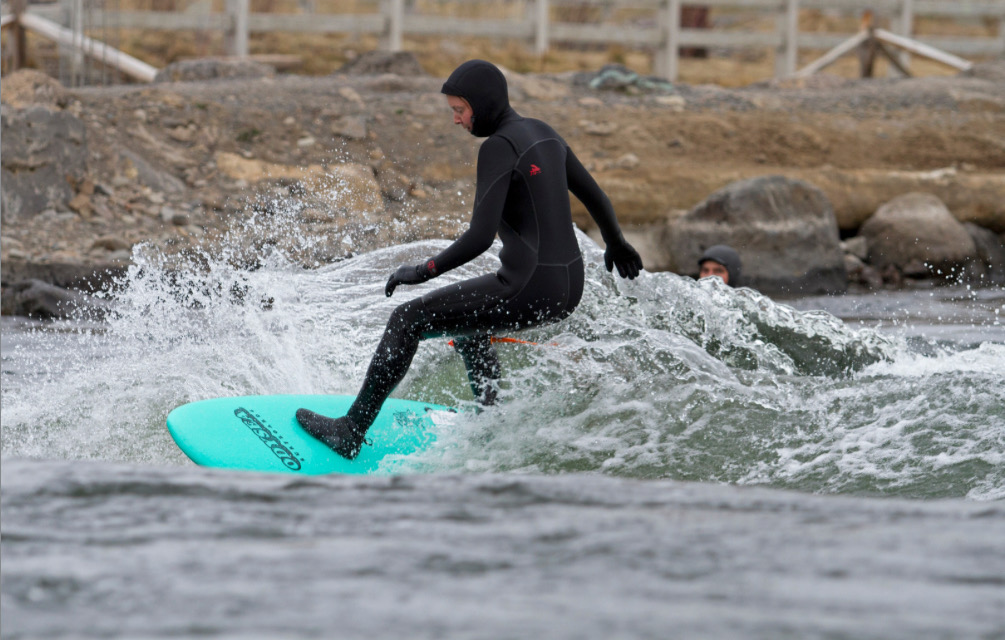
    Surfing the river wave in Bend, Oregon — Zoë Roy. (Photo: Jon Tapper)

    “Training for the PPP involved a lot of time not training for the PPP,” she said as she sipped an Italiano a few weeks back. (In fact, this reporter learned during the interview that an Italiano has less water than an Americano. Good to know when seeking the in-between of an espresso and an Americano.)

    Bottom line: Roy has a huge base of fitness and is still highly trained. Or it appears that way if you run, ride, ski, paddle, skin, or cook with her.

    “Essentially I want to have exceptional off-the-couch fitness,” Roy explained. “To be able to hang with my friends on adventures.”

    As mentioned, that exceptional off-the-couch fitness brought Roy her third consecutive PPP title this year. In other words, as U.S. Ski Team member Simi Hamilton referred to the PPP while in Bend this May, that’s three consecutive “World Championships of the World”. 

    How did she do it?
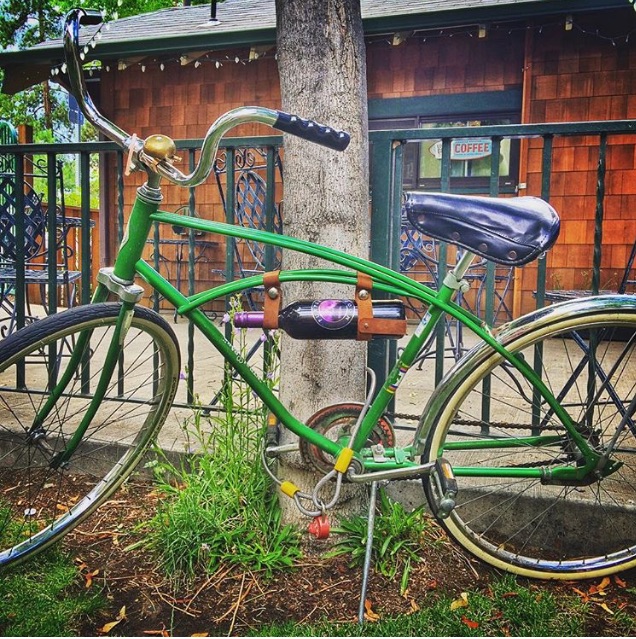
    A prized possession: the Z-Roy edition single-speed townie. Although this Schwinn is Grinch green, Zoë Roy is no Grinch. Her other bike has more travel. (Photo: Zoë Roy)

    Most often, in good weather, which we see plenty of here in Bend, Roy commutes on a single-speed townie bike. Noteworthy is the bottle of wine in lieu of a water bottle affixed to a frame tube. Our guess is that the single-speed builds leg strength while cruising uphill. It was a pretty mild winter here in town so let’s assume Roy commuted on her bike 10 miles per week. Don’t be fooled though. The townie isn’t her only bike. She was an invitee to Bend’s Blitz to the Barrel — a high-octane, enduro-bike race. She placed second.  

    Roy also committed to immersing herself in the local surf scene at the Colorado Avenue river-surfing wave here. The surfing itself builds jedi-balance. The swim into the eddy after a nasty flush from the wave builds upper-body strength.

    “I surfed the wave all the time after I picked up surfing this winter,” Roy said. “And that will pretty much trump all other activities if someone asks me to go to the wave.”

    Questioned whether she nordic skied much this winter, the reply was blunt and a little disappointing to fans of the skinny skis. “I didn’t really nordic ski this winter since my friend Elliott Heath wasn’t around,” Roy said. “I did coach a few XC Oregon master’s clinics though.”

    Roy divulged that she engaged in a trifecta of sweet-sounding trips where the fitness was brought from “meh” to almost Norwegian-style “the shape is good” before the big race.

    Level 5 scenery on the Cinque Terre trail in Italy. (Photo: Zoë Roy)

    In April, she visited Italy where she ran the Cinque Terre trail north of Tuscany. She ran 25 kilometers on Day 1. For that stretch, Roy ran along the coast, then spent the night in Levanto. In the morning, she returned along the ridge for a 28 k jaunt, making for a tidy running loop.

    She then rebounded with a backcountry ski trip to Mistaya Lodge in British Columbia. No name dropping here, but allegedly Roy was on the trip with some likely still pretty fast former Canadian XC skiers and maybe an American one, too. Lots of vert in BC kept Roy’s engine trending towards PPP-primed.

    Then two weeks before the PPP, she climbed and skied Mount Hood. Not shabby. Again, evidence of how above-average, off-the-couch fitness can be a game changer.   

    Here’s also something Roy didn’t mention — she often runs socially with a burly group of runners. Maybe it’s L1 running. Who knows. There’s no training log. No Strava we are aware of. But she runs early mornings on some days.
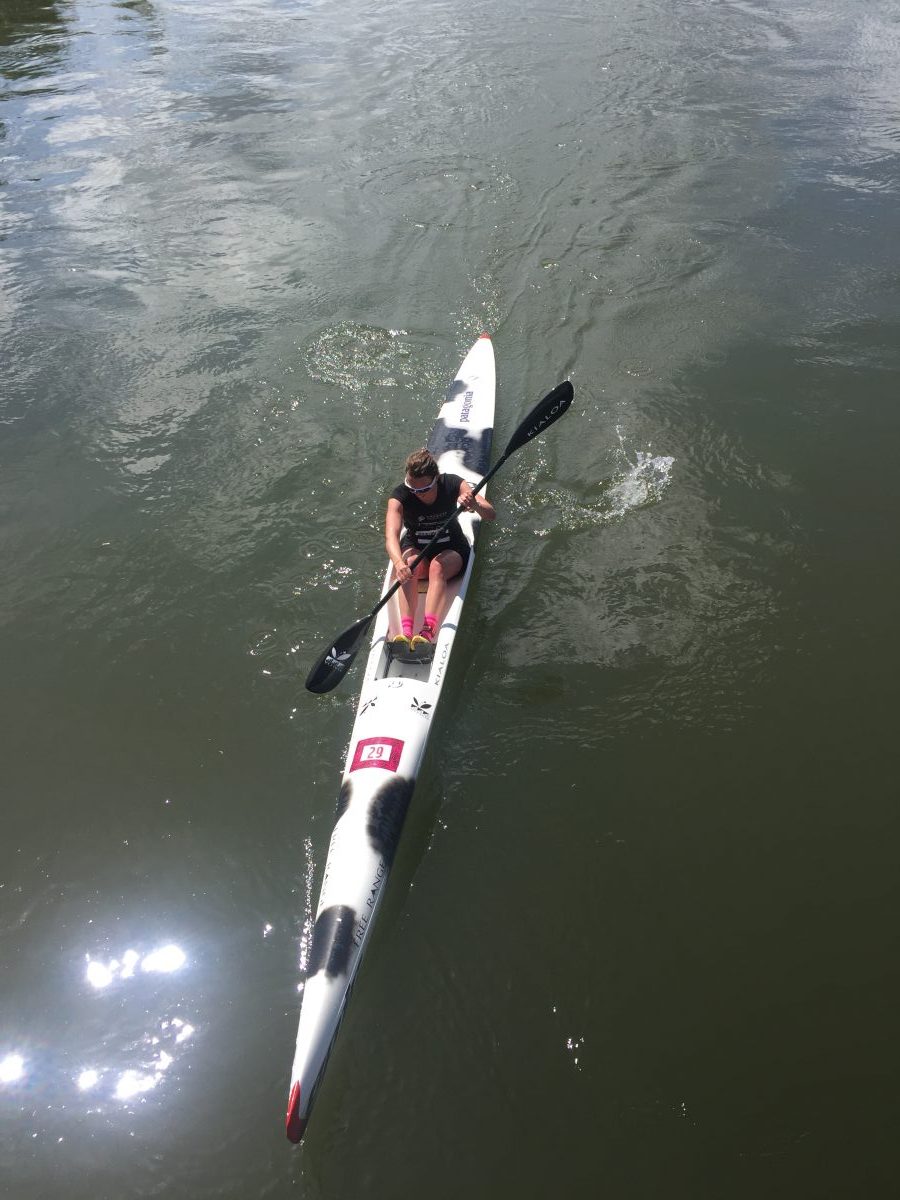
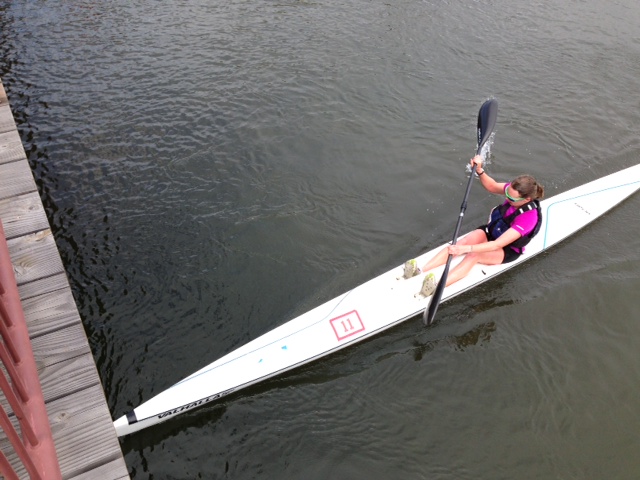
    Zoë Roy paddles “Daisy” the boat on her way to PPP victory. (Courtesy photo)

    She also jumps in and paddles her borrowed surf ski, a boat that resembles a Holstein cow, a few times prior to race day. (Our guess though is she paddles more than a few times pre-PPP.) The boat was salvaged from a dumpster and is white with large patches of carbon fiber and black spray paint here and there from the repairs. Roy calls the boat “Daisy” because it truly appears to have some Holstein lineage.

    Let’s also be real. Roy is a crusher. We’re not exactly calling her out as a sandbagger. However, if you go adventuring with Roy, most likely you’ll be huffing and puffing gaining vertical. So we in town knew she wasn’t rolling over for this year’s PPP when in mid-May she was seen screaming down Century Drive from Mount Bachelor on a TT bike after her morning XC-ski session. Yup, that’s called official “training” for the PPP. Sort of late in the game perhaps.

    To balance life, Roy holds down some pretty interesting jobs. She is the director of development for the Central Oregon Avalanche Association (COAA) and helps coordinate workshops for Wilder Retreats.

    More true facts: Roy makes and sells handcrafted ice cream. She’ll cater a party, too. She also organizes perhaps the toughest ticket in morning dance parties here in Bend. Here’s the hashtag if you’re ever game for 7 a.m., L4 weekday dancing fueled by coffee, chai and Picky Bars: #daybreakerbend. Roy says crashers are welcome. And hey, we’re calling it, the daybreak dancing helped her peak.

    Asked what the Wednesday Workout was exactly as we concluded the interview, Roy savored her Italiano on that lovely June morning and simply noted that the workout will find you.

    https://www.instagram.com/p/Bgkvm9lBR6w/?tagged=daybreakerbend

  • Put to Work in Nicaragua, Nine Canadians Got Dirty for Skiers 4 SchoolBOX

    Put to Work in Nicaragua, Nine Canadians Got Dirty for Skiers 4 SchoolBOX

    Jones hard at work
    Perianne Jones hard at work. (All photos from SchoolBOX)

    Life as a competitive skier is a full-time job. Beyond eating, sleeping and training, skiers usually spend a solid chunk of time drumming up financial support to cover some, if not all, of their skiing-and-life expenses.
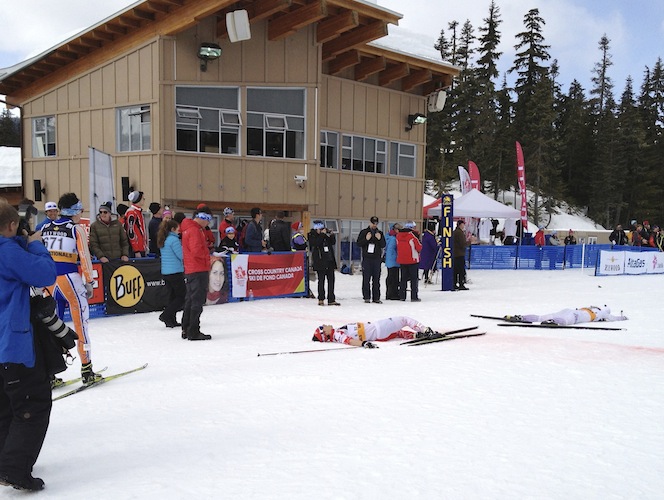
    Last year, nine Canadian cross-country skiers put their needs aside for the time being to fundraise for a charity completely unrelated to their sport. SchoolBOX is an Ontario-based nonprofit focused on building elementary schools in impoverished areas of Nicaragua.

    Headed by two-time Olympian Perianne Jones, the group of skiers known as “Skiers 4 SchoolBOX” raised money last year then travelled to Nicaragua this spring to dive into the construction.

    Getting started

    Jones’s connection to SchoolBOX started in her hometown of Almonte, Ontario. A longtime friend of one of the nonprofit’s founders, Jones — like others in her small town — was supportive of local causes. She had been one herself as an up-and-coming nordic skier shooting for the Olympics. She decided to pay it forward to a third-world support group, founded in 2006, aimed at making education possible for children.
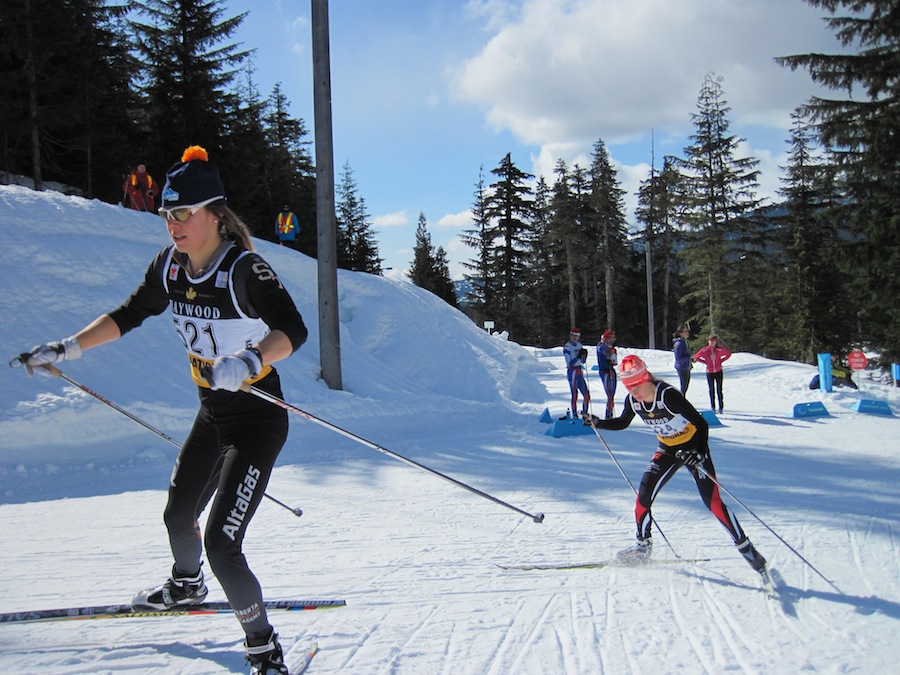
    “There was a fundraising run before the Olympics in 2010 for me [in Almonte],” Jones reflected on the phone earlier this month. “I didn’t want the money to be only for me so I decided to split the money from that with SchoolBOX. I think that was where things started.”

    As part of their school-building program, SchoolBOX makes an effort to connect groups of North Americans to their projects, inviting people to take part in fundraising and volunteering on the ground in Nicaragua. Jones wanted to assemble a group of skiers.

    But the stars would not align for this larger-scale partnership between Jones and SchoolBOX until after the 2014 Sochi Olympics.

    “I always wanted to do more with them, but the timing never lined up until after the Games,” she said.

    She started planning her first trip to Nicaragua’s Masaya region last spring.

    Mark and Olivia
    Olivia Bouffard-Nesbitt and Mark Arendz hanging out with the locals. 

    The athletes

    One would imagine that it might be hard to sell the idea of volunteering manual labour in a foreign country, especially considering the fact that each volunteer is responsible for their transportation to and from that place.

    But according to at least two of the participating skiers, that was not the case — the decision to help out was spontaneous.

    “It actually just happened really quickly, kind of on a whim,” said Olivia Bouffard-Nesbitt of Rocky Mountain Racers. “I was over at Zoë [Roy’s place] doing, I dunno, something crafty, and she was like, ‘Hey, so I’m going to Nicaragua in April for Skiers 4 SchoolBOX and Peri wants us to commit today if you wanna come.’ I didn’t even hesitate.”

    Before earning silver and bronze at the 2014 Sochi Paralympics, Mark Arendz of Canada’s Para-Nordic Team was planning ahead last year for what he’d do after the Games and learned about Skiers 4 SchoolBOX on Facebook.

    “I chatted with Perianne Jones, and before our conversation was over I was in,” he said.

    In addition to Roy, Bouffard-Nesbitt and Arendz, Emily Nishikawa, Gerard Garnier, Stuart Harden, Ruth Tamas, and Jones’ husband, Joel Jaques, also signed up by April 2013.

    Then they started fundraising.

    Finding the funds

    Definitely the biggest thing was coming up with the money to make it happen,” Jones explained.

    Each person in the group had to raise about $1,000, and in an effort to do so, they planned a fundraiser for last fall in Canmore, around the time of Frozen Thunder. According to Bouffard-Nesbitt, the fundraiser didn’t go quite as planned.

    “We put a decent amount of effort into the event itself, but we didn’t do a very good job making sure people were gonna come,” she said. “We had a band, drinks, food and a really good silent auction. When you have a lot of Olympians in the group you get good silent-auction stuff. … After the event, it was pretty much up to each of us to go out and collect our shares of the money.”

    Volunteers had to pay for their own flights.

    “We were fundraising for the part where we were actually on the ground in Nicaragua,” Jones said. “Mostly the money was for the school project itself. They have a construction crew that they pay down there, so they make sure that they’re providing jobs for Nicaraguans and helping them out that way.”

    Training in Nicaragua

    The skiers were in Nicaragua this spring, from April 3 to April 10. Many of them stuck around a bit longer to explore the country.

    “After an Olympic cycle, I think everyone just wanted to shake things up and do something different,” Jones said.

    Because the trip happened at the start of the offseason, everybody was content to enjoy their time away from ski training. Beyond the grueling work of removing dirt from the ground, physical activity was kept to a minimum and consisted of activities such as Roy’s “Tarahumara runs,” according to Bouffard-Nesbitt, (like in Born to Run).

    “Basically they’re twelve-minute runs and it’s kind of like parkour I guess,” she said. “You just go and you do whatever you want and each person takes a turn leading. So you jump off benches and do summersaults and run around posts and do cartwheels and stuff.”

    Digging the hole
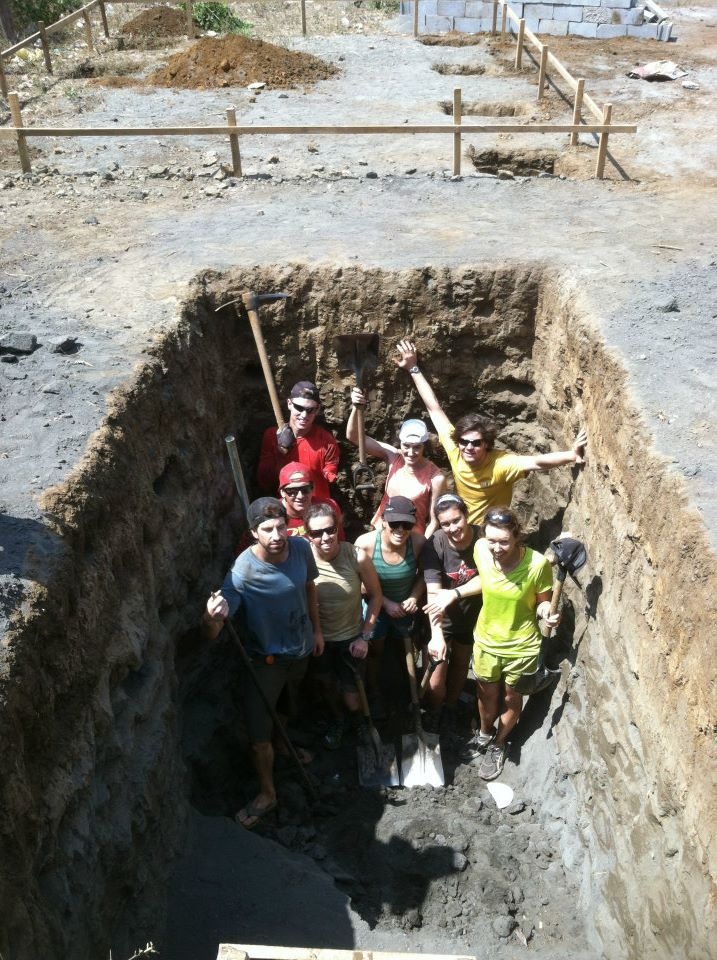
    The nine Canadian skiers dug a big hole for the school’s septic system.

    Building the school

    Upon arrival in Nicaragua, the first day of work started after a night’s sleep and a long drive, to the construction site, in the morning.

    “We were driving down this narrow, super-bumpy dirt road and we turn a corner and there’s this crowd of children standing there,” Bouffard-Nesbitt recalled. “They’re jumping up and down and they had our names printed out on paper that they were holding up.”

    After the warm welcome, it was time to get to work: in their week there, the skiers’ goal was to dig of a big hole for the school’s septic system.

    “The hole that we dug was 3-meters deep, 2-meters wide and 3-meters long. By the end we needed a ladder to get in and out of it,” Jones said. 

    “Mostly what we raised money for was for a sports field, but just so it happened, for the period of time we were there, what they needed done was digging this big hole. Some of the dirt from the hole went to the sports field eventually.”

    The students

    Throughout the week it became clear that the children who would be attending the school had a deep desire to be a part of building it.

    They were so invested in it,” Jones said. “Some of the older kids would come out and grab our shovels and get down in the hole and dig with us. They were really keen to help. When you don’t have a place to learn, you really want that kind of thing. I think for a lot of us, it’s a given.”

     “Some of the older kids would come out and grab our shovels and get down in the hole and dig with us. … When you don’t have a place to learn, you really want that kind of thing. I think for a lot of us, it’s a given.” — Perianne Jones, Skiers 4 SchoolBOX leader & two-time Canadian Olympic cross-country skier

    But it wasn’t all tough work around the construction site. Usually around midday, the hole-digging would wrap up and the skiers would spend time playing with the kids. 

    “One of my favourite memories has to be the soccer-baseball game we had the last day with everyone,” Arendz said. “The construction workers, volunteers, community members and kids — a great time playing but also watching everyone else enjoy themselves.”

    Emily Nishikawa with some potential students.
    Emily Nishikawa with some potential students.

    More than just construction work

    We realized after a couple days at the work site that the people at SchoolBOX saw just as much value in having outsiders come and play with the kids, rather than just, like, digging a hole the entire time” Bouffard-Nesbitt explained.

    “It means a lot to the kids to see that people are coming all the way from Canada and that people care that much about their school,” she added. “In turn, it makes them care about their school. All the kids who attend do so by choice, so the more they’re invested in their school the better.”

    In Nicaragua these schools are more than just the average learning place. They act as a community centre through which other opportunities arise.

    “Once you have a school in a community it opens the doors for all kinds of other things you can have,” Jones said. “Once you have a school you can have a food program as well.”

    The future

    On April 10, the skiers departed — some back to Canada and others to explore other parts of Nicaragua. Their part of the project was finished but the work on the school would continue until the end of July, at which point, to the excitement of everyone involved, the school was completed.

    So will there be more Skiers 4 SchoolBOX projects in the future?

  • The Ninjas Fight On: ‘The Team is Retired … We Hope That The Idea Will Live On’

    The Ninjas Fight On: ‘The Team is Retired … We Hope That The Idea Will Live On’

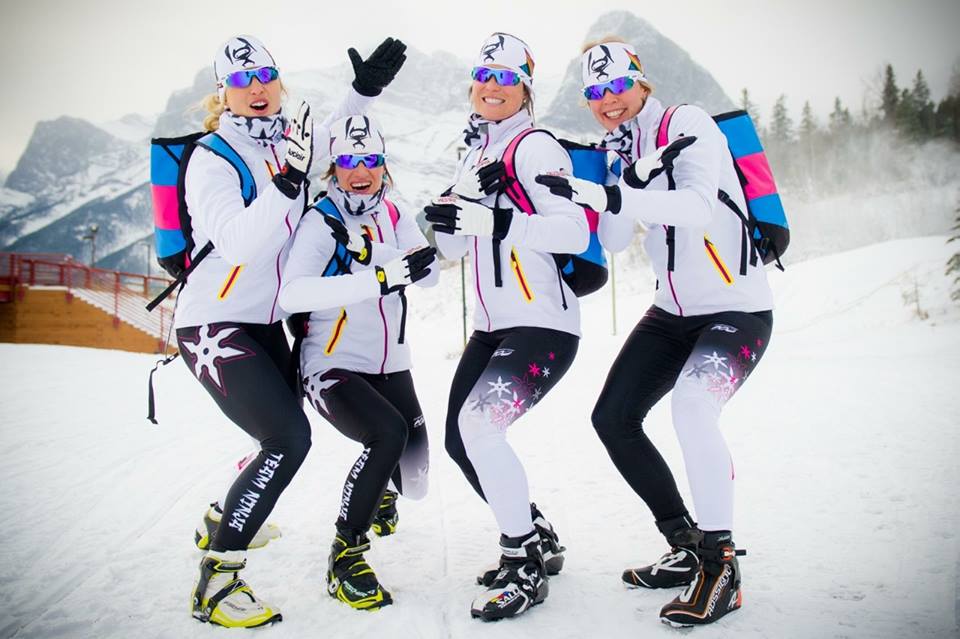
    Team Ninja: l-r Crawford, Ammar, Thomas, Roy; photo courtesy of Team Ninja. https://www.facebook.com/pages/Team-NINJA/181009732101939
    Team Ninja last season in Canmore, Alberta (from l-r) Chandra Crawford, Amanda Ammar, Alana Thomas, and Zoe Roy (Courtesy/Facebook photo)

    With Chandra Crawford, Alana Thomas, Zoë Roy, and team founder Amanda Ammar all bowing out of competitive cross-country skiing this year, Team Ninja only existed for a season, but what a season it was.

    FasterSkier recently checked in with each of the Ninjas, including Thomas, Ammar and Roy, to talk about the independent team and discuss what each of them intend to do as they turn the page to a post-ski racing chapter of life.

    Training with Team Ninja

    Once you get to a certain age, I don’t think you should be on a generic program. We all had our own focuses and goals and we didn’t hold hands the whole time but we came together for key workouts where we’d push each other hard.” — Amanda Ammar, two-time Olympian, former Canadian National Team member and Team Ninja founder

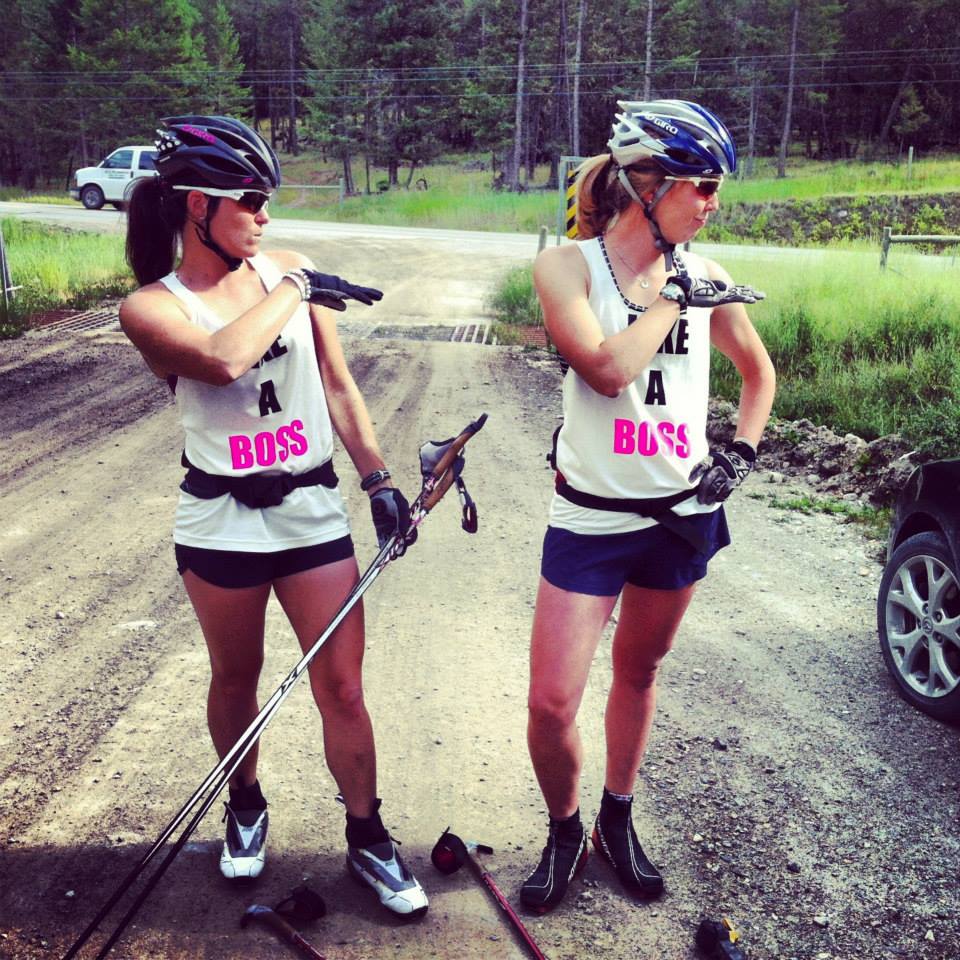
    Thomas (left) and Roy, Ninja training Like A Boss; Photo Courtesy of Team Ninja
    Thomas (left) and Roy, training “Like A Boss” (Courtesy photo)

    One of the features that set Team Ninja apart from other ski teams is that there wasn’t a single coach responsible for guiding all four athletes’ training regimens. Ammar was coached by Chris Butler, Crawford by Peter Larsson, Roy developed her own training program with help from several coaches, and Thomas worked with Jack Sasseville. This approach allowed each member to focus on their own strengths and weaknesses and helped them to work their training around work and injuries. Both Thomas and Ammar were plagued with lower-back issues, common among nordic skiers.

    Ammar tried upping her running hours to take strain off her upper body, only to develop a foot injury from too much running. With advice from U.S. Ski Team member Sadie Bjornsen, Ammar switched her training to swimming for a week and a half and soon after, she posted a personal best in a time trial up the Mt. Norquay access road in Banff, beating her previous best by two minutes.

    Thomas’s back pain stemmed from disc issues and affected her for a large portion of the year.

    “From July on through to January, training was really tough because of my back,” she said.

    For Thomas, it was Team Ninja’s support and positive attitude that motivated her to stick with it.

    While the Ninjas trained hard, it was their desire to have fun first and foremost that defined their training season. They had filled up Sriracha Hot Sauce bottles with a sport drink for “Ninja Juice” feeds on long runs, worn “Like A Boss” T-shirts for every workout at their training camp in Invermere, B.C., and had a blast while mountain biking on trails in Bend, Ore.

    An Olympic Year

    “I had a really solid race season, but it wasn’t quite good enough for the Olympics. I think it was a pretty good ratio having half our team going to the Olympics though! I was really happy to help along my teammates and be part of building their success.” — Zoe Roy

    Ammar leads Brittany Webster in the 15 k skiathlon at Olympic Trials (Photo: Angus Cockney)
    Ammar leads Brittany Webster in the 15 k skiathlon at Olympic Trials (Photo: Angus Cockney)

    When the dust settled after Canadian Olympic trials, two of the seven women on the Olympic team were Ninjas: Crawford and Ammar.

    For Ammar, qualifying for the Olympics was the big goal and, according to her, her team was instrumental in getting her to Sochi.

    “I needed those girls this past year,” she said. “They brought a whole new element of fun and working with them challenged me to push out of my comfort zone. That extra diversity of not having to train by myself really helped me raise the bar. Without them there was no way — plus we had so much fun.”

    Ammar described her Sochi experience as more or less an uphill battle. She and Brittany Webster, of Team Mito Canada, were added to the Olympic team after the official team naming, and as a result, prepared separate from the rest of the team.

    “It was really rough going to the Olympics, having to fight so hard to get there and then have my skis broken in transit,” Ammar said. “I felt like it wasn’t a really fair shot against the world.”

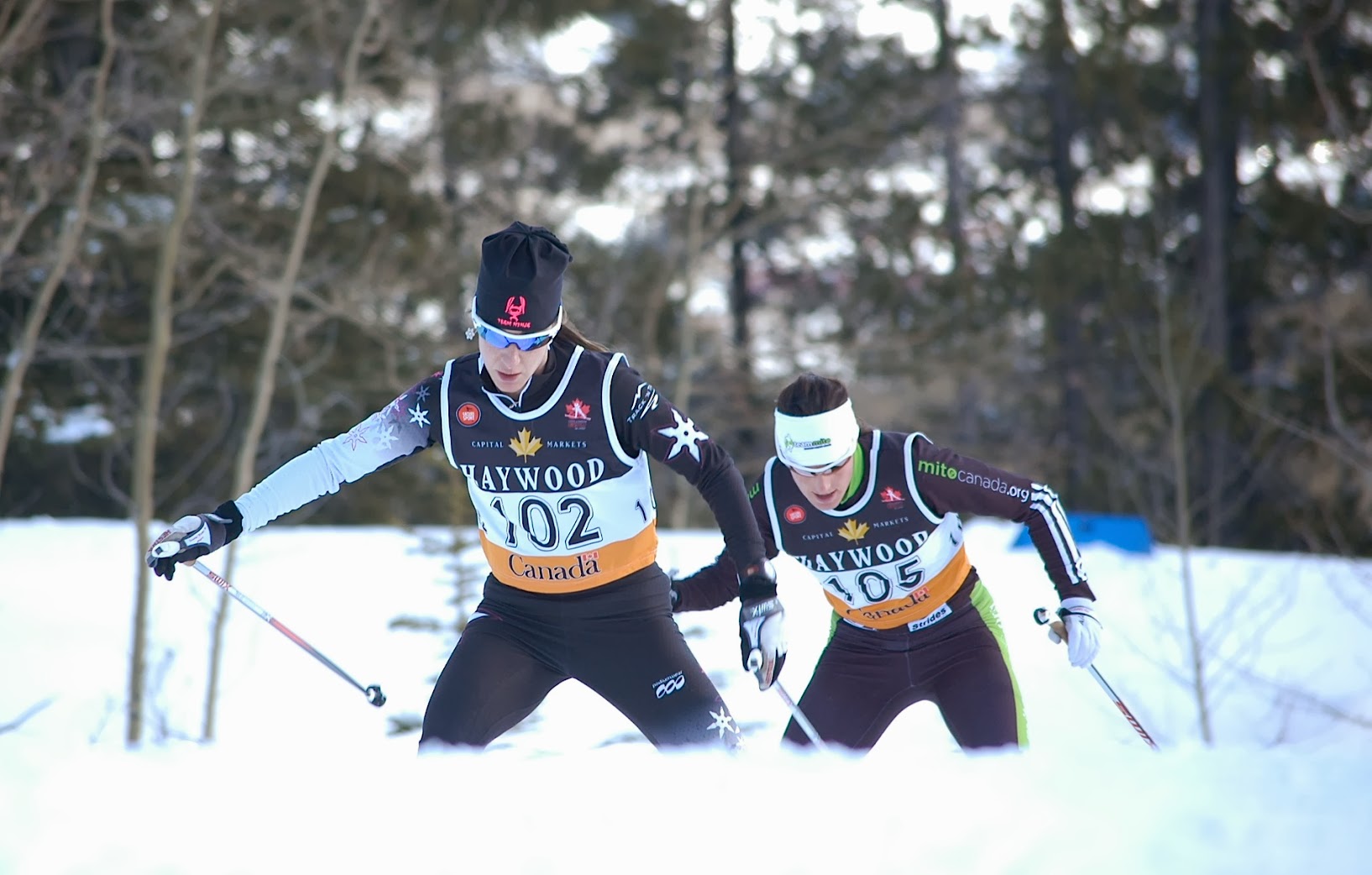
    Aside from the Olympics, Team Ninja made every stop of the NorAm circuit except Westerns. At the first NorAm of the season, they “Christmas-tree bombed” trees at the SilverStar venue. Roy posted two podiums, including a win, at Canadian Eastern Championships in February, and Ammar finished her season with the first national title of her career in the 30 k classic event at Canadian Nationals in March.

    The Future of Team Ninja

    After Nationals, Ammar, 28, was debating continuing her career.

    “At the end of the season it was almost hard for me to retire, I’m in the best shape of my life right now,” she said. “Mentally and physically I’ve never felt stronger than this season.”

    But having spent over 13 years racing competitively (her first nationals was Thunder Bay in 2000), and after having injury continually crop up, she decided it was time to move on.

    Reflecting on her final season, she was content with meeting her two big goals of qualifying for Sochi and winning a nationals distance race. Ammar plans to begin studying Chinese medicine at a Calgary acupuncture school this fall and has already been offered a position, upon the completion of her studies, at the Canmore Alberta clinic where she currently works as an administrative assistant.

    In terms of milestones, 2014 was it for Ammar. The weekend after her return from Sochi, her boyfriend of five years as well as her coach, Chris Butler took her backcountry skiing and proposed to her on top of a mountain.

    “All the Ninjas were betting that it [the proposal] would be at Christmas but when it didn’t happen I thought it’d be next fall,” she said. “I was surprised when he proposed right after the Olympics!”

    She said yes.

    Roy, 26, was happy to finish her career with a solid race season, ranking sixth overall on the NorAm circuit without racing at Nationals. Having raced on the U.S. collegiate circuit with the University of Utah, to the Scandinavian Cup, Roy says it’s time to try something new.

    “I’m moving on to different things,” she said.

    She’s currently the assistant manager at the Paintbox Lodge, owned by 2006 Olympic silver medalist Sara Renner and her husband Thomas Grandi, an alpine Olympian, in Canmore. Roy works with former Alberta World Cup Academy skier Kate Brennan.

    That’s her “summer plan,” she said, explaining she’d like to go into business with her brother.

    “My brother has started a backpack company so I’m thinking of going back to Bend to help him with that in the future,” she said. “This is still in the works but that’d be my plan in the fall.”

    After coping with injury for the last year, Thomas, 26, finally stepped back from skiing in January.

    “On any other team I would have quit earlier, but I wanted to be with the Ninjas and support their races, that was really what kept me around,” she said. “The other Ninjas were really successful and I’m very happy to have been part of it. … I had hoped that I could finish it off strong, but injury ended things a couple months earlier than expected.”

    With a degree in economics under her belt, Thomas will be working this summer at the CIBC bank in Canmore and shredding mountain bike trails in her free time. She plans to return to Ottawa, where she completed her undergrad, to start work on her master’s in the fall.

    The Ninja Spirit

    One thing that each of the Ninjas are adamant about is that, while Team Ninja may have raced its last Canadian Nationals, the team itself is not a thing of the past.

    “The team is retired, but anyone can think of themselves as a Ninja,” Thomas said. “We hope that the idea of team Ninja will live on.”

    The Ninja spirit created by the four athletes has inspired many younger skiers and has the potential of growing into something even bigger than the team that conceived it.

    “I’ve had a couple coaches approach me to keep it going,” Ammar said. “I didn’t realize we had connected with so many younger athletes, but I’d like to share this with younger generations of girls and boys. I’m just trying to figure out how to do this right now.”

    The Ninjas are entertaining the idea of starting an outreach camp for young skiers but for now, with limited time on their hands, they plan to start off small, stepping in to help coach the occasional practice with the Canmore Nordic junior team.

    Team Ninja Ninja Suit Kitty; photo courtesy of Alana Thomas: http://alanaskis.blogspot.ca/
    Team Ninja Ninja Suit Kitty (Photo: Alana Thomas/alanaskis.blogspot.ca)
  • Graham Nishikawa, Marshall Win Two of Three Races at Canadian Eastern Championships

    Graham Nishikawa, Marshall Win Two of Three Races at Canadian Eastern Championships

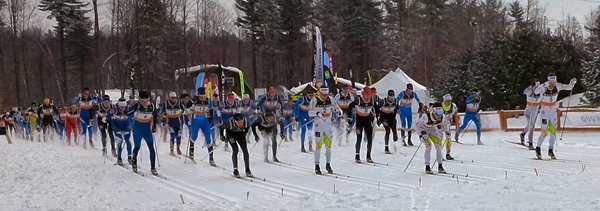
    The men's 20 k classic mass start on Sunday at the 2014 Canadian Eastern Championships in Cantley, Quebec. (Photo: Cross Country Canada)
    The men’s 20 k classic mass start on Sunday at the 2014 Canadian Eastern Championships in Cantley, Quebec. (Photo: Cross Country Canada)

    As all eyes shift to the fast-approaching Olympics in Sochi, Russia, the domestic-racing show resumed in Cantley, Québec, where nearly 700 skiers competed at the three-day Canadian Eastern Championships last weekend. The NorAm was back in full swing after a short break, which gave time to those who didn’t qualify for the Olympics to regroup and return stronger and faster.

    ***

    The championships started with freestyle sprints on Friday. Raphaël Couturier of the Pierre-Harvey National Training Centre (CNEPH) topped the field in the men’s 1.5-kilometere qualifier in 3:20.35, 5.7 seconds ahead of Graham Nishikawa (Canadian Senior Development/Para-Nordic Team) and another 0.09 seconds ahead of Michael Somppi (Alberta World Cup Academy), who advanced in third. In the final, it was the same trio who took the podium spots in the same order.

    “I had great skis prepared by [Skinouk coach Pierre-Olivier] Dorego and I felt that I had a lot of energy to give, especially in the sprint where I gave everything from the start, opening a gap over the rest of the guys,” Couturier wrote in an email.

    Despite the absence of some of the best Canadian skiers, who were racing the World Cup in Italy, Couturier was “very happy to be back in good shape. I did a lot of volume in the last two weeks and it seems to have worked well. It is a relief and it gives me confidence for the races to come!”

    In his first year as a senior, the victory was his first in a senior NorAm competition.

    Alysson Marshall at the 2014 Canadian Eastern Championships in Cantley, Quebec. (Photo http://shootstories.smugmug.com/Canadian-Eastern-Championships/i-TdxGVQW
    Alysson Marshall at the 2014 Canadian Eastern Championships in Cantley, Quebec. (Photo: Canadian Eastern Championships photo gallery)

    In the 1.4 k women’s sprint, Andrea Dupont (Rocky Mountain Racers) set the fastest qualification time in 3:45.63, 1 second ahead of Alysson Marshall (AWCA/NST). A junior, Jennifer Jackson (NDC Thunder Bay) was third, another 1.52 seconds behind, in the qualifier.

    At the end of the day Marshall took the victory, Dupont finished second and Erin Tribe (NDC Thunder Bay) took the last spot of the podium for her best result of the season.

    “The weekend was good. I love racing out east,” Dupont wrote in an email. “It is fun coming back and racing in some of the places I did when I was younger. The east has great snow this year and trails were in amazing condition. Nakkertok always puts on a good race and I always look forward to the Montreal style bagels at the end :)”

    Saturday was middle-distance day with individual starts. In the women’s 10 k freestyle, Dupont started fast then hung on with the third-fastest second lap to beat Zoe Roy (Team Ninja) by 17.8 seconds in 28:37.3. Tribe outsprinted teammate Alannah Maclean (NDC Thunder Bay) by 0.3 seconds for third, 38.2 seconds behind Dupont. Marshall, who skied the fastest second lap, placed fifth (+45.5).

    In the men’s 15 k freestyle, Nishikawa led from start to finish to top Couturier by 13.4 seconds in 36:28.5. Somppi once again took bronze, 31.1 seconds after Nishikawa. Kevin Sandau (AWCA/NST) was nearly another minute behind in fourth (+1:29.0).

    “I felt great last weekend at Easterns — lots of energy,” Nishikawa, who’s headed to the Sochi Paralympics in March, wrote in an email. “It was nice to feel good racing again. Pretty cool to see how many skiers participated.”

    “The 15K skate was again a great race,” Couturier wrote. “I had a fast start and I managed to keep up the speed.”

    Fifteen to 20 centimetres of fresh fell overnight before Sunday’s classic mass starts. In the men’s 20 k, Nishikawa outlasted Somppi by nearly 30 seconds for the win in 58:52.1. Somppi held off Christopher Hamilton (AWCA) by a toe in a photo finish for second (+29.3). Hamilton took third, and Sandau placed fourth, another 17.4 seconds back.

    Marshall picked up where she had left off on Friday to capture her second win of the mini tour in 52:33.6. Dupont placed second, 6.7 seconds back, and Roy was third, 9 seconds after Marshall. Another 1:03.5 behind, Tribe and Maclean tied for fourth.

    “I was super happy with my distance results this weekend,” Dupont wrote. “I haven’t had much chance to race distance this year, so it was fun to take my focus off of sprinting for the weekend.

    “My weekend went very well,” Somppi wrote. “I am happy to have been able to hit the podium in every race. I was really hoping for a victory, but hats off to Graham and Raphael, they were both really strong this weekend. My racing shape is continuing to improve and I feel my best is not far away now.”

    Next Stop: Europe

    Cross Country Canada is organizing a European racing tour mid-February, and while no official announcements have been made yet, some athletes will head over the pond to gain international experience. For those that don’t make it overseas, the next NorAm races will be the Western Canadian Championships Feb. 13-16 at Caledonia Nordic in Prince George, B.C.

    “I had decided of regardless what happened this weekend I was going to head over to Europe and race some OPA’s,” Dupont wrote. “Now, there might be some other opportunities for me. I am waiting to hear about the CCC OPA trip and maybe some World Cup starts in March.”

    “I will be departing next week to Europe for Scandinavian cup races and hopefully the Lahti World Cup,” Somppi explained. “I’m really looking forward to racing in Europe and hopefully having my best races of the season while I’m there.”

    — Alex Matthews contributed reporting

    Results:

    Friday’s freestyle sprints: Men | Women

    Saturday’s 10/15 k freestyle individual starts: Men | Women

    Sunday’s 15/20 k classic mass starts: Men | Women

  • Crawford, Thompson, McKeever, and Nishikawa Score Big at Canadian Olympic Trials

    Crawford, Thompson, McKeever, and Nishikawa Score Big at Canadian Olympic Trials


    The finishing stretch of the men's freestyle sprint. (Photo: Kathy Wylie)
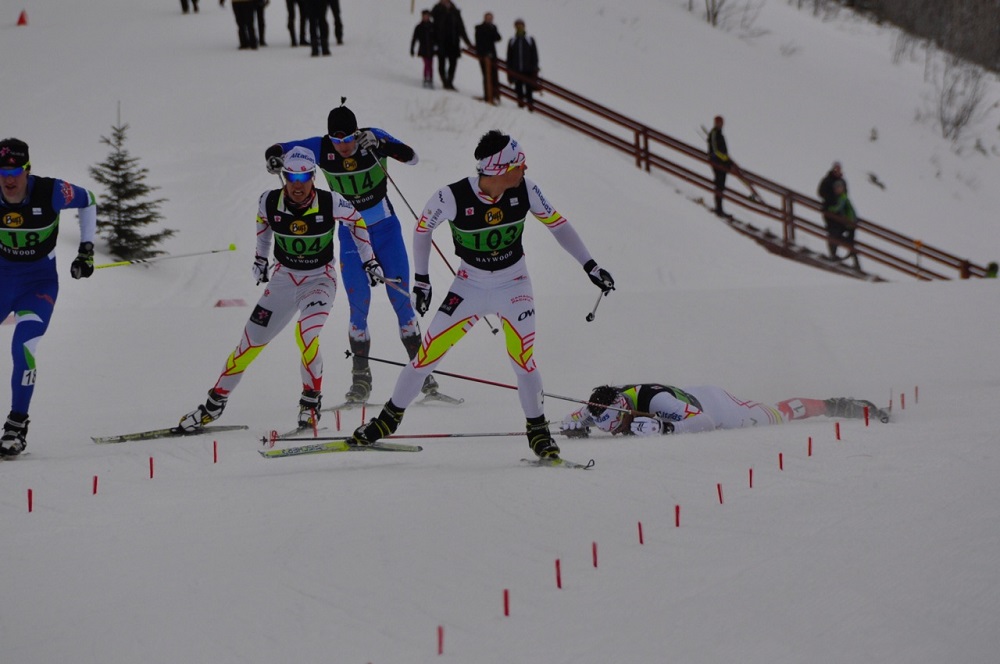
    The finishing stretch of the men’s freestyle sprint after Widmer’s fall. (l-r) Bob Thompson, Graham Nishikawa, Julien Locke, Jesse Cockney, Phil Widmer. (Photo: Kathy Wylie).

    Canada’s Olympic Trials kicked off on Wednesday at the Canmore Nordic Centre with the first of two freestyle sprint races. With perhaps only two spots per gender on the Olympic team up for grabs, there is little room for errors for racers wanting to qualify for the Olympics.

    Freestyle Sprint

    Chandra Crawford of Team Ninja and the Canadian National Team was dominant in the finishing stretch of the women’s final, taking the win with a 2.4 second gap on the rest of the field. Crawford is prequalified for the Olympic team, but has struggled with health issues over the past year. She told Cross Country Canada that,

    “To be able to put it all out there and charge your way to the finish line is what it is all about. It has been a huge effort this year for me to this point, and I’m excited with how today went. I just love racing and it is fun to win today.”

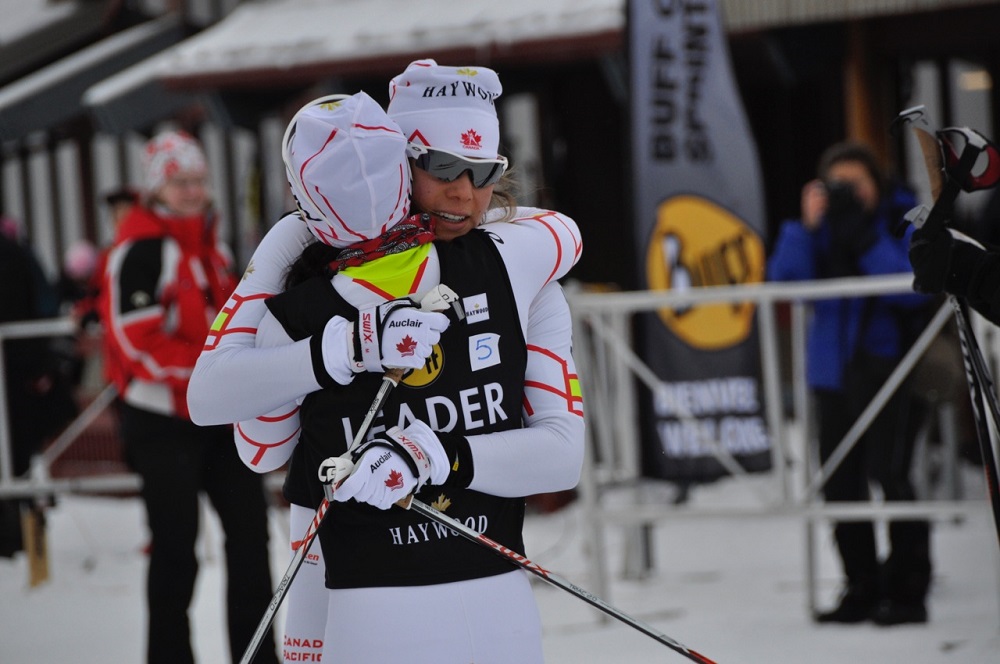
    Heidi Widmer and Emily Nishikawa embrace after the women's sprint final. (Photo: Kathy Wylie)
    Heidi Widmer and Emily Nishikawa embrace after the women’s sprint final. (Photo: Kathy Wylie).

    Finishing behind Crawford was Heidi Widmer of the Alberta World Cup Team (AWCA) and the Canadian National Team (NST). Widmer qualified in first, and looked strong in finishing. Canada is planning to choose one athlete solely off of sprint results, and one from distance results. Crawford’s prequalification puts Widmer in strong position going into the second round of freestyle sprinting on Saturday.

    Rounding things up for the women’s podium was biathlete Zina Kocher of Red Deer, Alberta. Kocher has already qualified for Sochi in biathlon, but is also trying to qualify for the cross-country team. Incredibly, she finished in third in an event that she has rarely, if ever, competed in. In an email, she wrote that,

    “For my first experience, my heats went great. I love hill climbing so this course is fantastic for me!

    My strategy was really just to completely enjoy the day, be challenged by a new experience and do intervals with fast skiers [and] friends! Every heat required a little bit different mindset before starting and thinking about what strategy was needed. I didn’t have any expectations since this was new for me so I just focused on givin’er!”

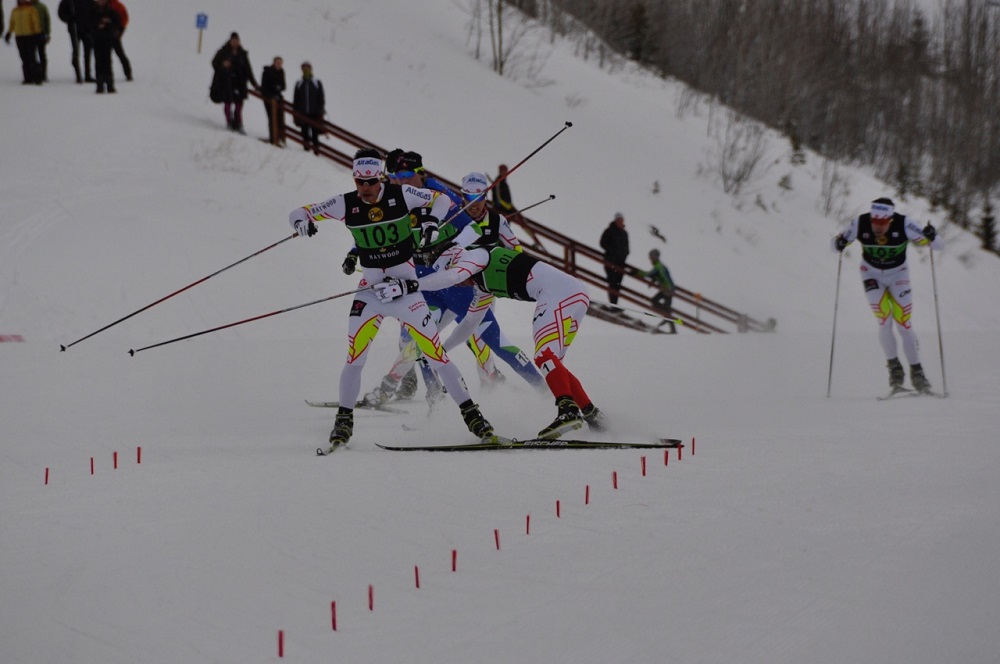
    Jesse Cockney and Phil Widmer collide in the finishing stretch of the men's sprint final. (Photo: Kathy Wylie).
    Jesse Cockney and Phil Widmer collide in the finishing stretch of the men’s sprint final. (Photo: Kathy Wylie).

    On the men’s side of things, the results were equally interesting. Up-and-comer Bob Thompson of Thunder Bay had a stellar day to take the win after qualifying in 18th place.

    According to Jesse Cockney (AWCA-NST), the heats were slow on the day, and coming down the finishing stretch all the racers were in a big pack. A tangle in the last 100 meters between Cockney and Phil Widmer (AWCA-NST) left the win up for grabs, and Thompson snagged it. Cockney held on for second, and Graham Nishikawa (NST) ended up in third.


    Classic 15/10 K

    Racing continued on Thursday with 15/10 k interval start classic racing for the men and women, respectively.

    Brian McKeever of the National Para-Nordic Ski Team eked out the win for the men, starting slowly and building into the four lap race.

    Brian McKeever in Thursday's classic distance race. (Photo: Kathy Wylie).
    Brian McKeever in Thursday’s classic distance race. (Photo: Kathy Wylie).

    “I could see my splits throughout the race and knew what I had to do. My strategy going in was this is a four-lap race. It is not over after two,” McKeever told Cross Country Canada. “I wanted to get into a good rhythm and keep the pace throughout all four laps. I like to be the guy moving up as the race goes along rather than falling back. It feels very rewarding to know I was able to stick to the plan and it worked out. ”

    McKeever is legally blind and, in 2010, was a member of both the Paralympic and Olympic team for Canada in Vancouver. However, he did not get to start any races at the Olympic Games.

    Following closely behind McKeever were Graeme Killick (AWCA) and Kevin Sandau (AWCA-NST), 1.5 seconds and 18 seconds back, respectively. Both racers were strong early in the race and then faded a bit as McKeever made his surge. Sandau wrote in an email that,

    “Since only race winners are only considered in the final selection, everything is on the line for Sunday[‘s distance race]. But the top [five] from today were relatively tight so anything could happen in the skiathlon. For me, the longer the better so looking forward to Sunday!”

    Alysson Marshall, who finished fourth in the classic 10 k, in Wednesday's sprint race. (Photo: Kathy Wylie).
    Alysson Marshall, who finished fourth in the classic 10 k, in Wednesday’s sprint race. (Photo: Kathy Wylie).

    The women’s race, on the other hand, was not nearly as close. Emily Nishikawa (AWCA-NST) showed early on that she was in top form, dominating the race throughout to win by nearly a minute. Keeping her enthusiasm in check, she told Cross Country Canada that,

    “I have put in the work and now put it together for the races and that feels incredible,” said Nishikawa. “The wax was amazing and my skis were incredible today. I’m not going to celebrate just yet. I am going to recover and get ready for Sunday’s race.”

    Runner-up Brittany Webster (Mito Canada) was jubilant, however, after being hobbled last season by sickness and early this season by a training plan designed to produce better mid-to-late season results. Using a race strategy that focused on skiing her own race, Webster wrote that,

    “Whoo, I am not gonna lie it is nice to have that over with! Honestly, I am not even sure where the time went on that course. I remember every second of it and yet I remember nothing of it too. Is that even possible?” She added, “Emily skied fantastic. She started quite [far] back from me so I had no idea what my back splits were to her. All I focused on was keeping it together and standing up on my skis, and the finish result was the finish result.”

    Rounding out the podium for the women was Ninja Zoe Roy. After using the qualifier of Wednesday’s freestyle race as a warm-up for today’s race, Roy skied to a strong third place finish, 1:23 back from Nishikawa.

    The Canadian Olympic Trials, which also serve as selection races for U23 World Championships and World Junior Championships, will continue on Saturday with a second round of freestyle sprinting.

    Women’s Freestyle Sprint Results

    Men’s Freestyle Sprint Results

    Men’s Classic 10 k Results

    Women’s Classic 10 k Results

  • Gregg, Widmer Ward Off Cold for Opening NorAm Wins at Sovereign Lake

    Gregg, Widmer Ward Off Cold for Opening NorAm Wins at Sovereign Lake

    Heidi Widmer (AWCA/NST) after winning Saturday's 10 k freestyle individual start at the opening NorAm at Sovereign Lake, B.C. Two Team Ninja skiers, Amanda Ammar (l) and Zoe Roy (r) placed second and third, respectively.
    Heidi Widmer (AWCA/NST) after winning Saturday’s 10 k freestyle individual start at the opening NorAm at Sovereign Lake, B.C. Two Team Ninja skiers, Amanda Ammar (third from l) and Zoe Roy (r) placed second and third, respectively. Brittany Webster (second from l) placed fourth, and Emily Nishikawa (l) was fifth.

    VERNON, B.C. — Another cold one at Sovereign Lake kept the organizers and athletes scrambling in temperatures around -20 degrees Celsius, but the end result was an exciting day of racing at the first NorAm of the season.

    In the men’s 15-kilometre freestyle individual start on Saturday, American Brian Gregg (Madshus/Team Gregg) rose to the top in 41:03.3 minutes, edging out compatriot and friend Matt Liebsch (XC United/Team StrongHeart) by 3.3 seconds, and Canadian Senior Development Team (NST) member Graham Nishikawa in third (+4.5).

    Matt Liebsch (XC United/Team StrongHeart) racing to second in the Sovereign Lake NorAm 15 k freestyle on Saturday. He finished 3.3 seconds behind winner and friend Brian Gregg (Madshus/Team Gregg) and Graham Nishikawa was the top Canadian in third.
    Matt Liebsch (XC United/Team StrongHeart) racing to second in the Sovereign Lake NorAm 15 k freestyle on Saturday. He finished 3.3 seconds behind winner and friend Brian Gregg (Madshus/Team Gregg) and Graham Nishikawa (CNST) was the top Canadian in third.

    Coming off a SuperTour podium in West Yellowstone, Mont., last weekend, Gregg said he was very happy with his pacing plan that allowed him to move up from third his last time around the 5 k loop.

    “I tried to stay really controlled, and focussed on making each lap maybe a little bit faster,” Gregg said. “Each lap got a lot harder. It was a good strategy.”

    Gregg did a solo time trial on the same course two weeks earlier, and said that experience translated to success on Saturday. After the race, he and Liebsch planned to fly back to Montana to race the second SuperTour distance race of the season — a  15 k classic — in Bozeman on Sunday.

    Liebsch was pleased with his result, racking it up as another step towards his season goals.

    “There is a 30 k skate [at U.S. nationals] that I want to ski very well and prove that I should be on the Olympic squad and start that 50 k skate in Sochi,” he said.

    Nishikawa was satisfied with his day, explaining: “The name of the game today was just staying warm and getting through it alive.”

    Asked about his expectations for the weekend, Nishikawa said, “I am just here to race and get into top race shape.” After training with the Canadian Para-Nordic Team throughout the offseason as a potential guide for the Paralympics, his target is on both the Olympics and Paralympics in Sochi, Russia.

    Top three Canadian men in the Sovereign Lake NorAm 15 k freestyle individual start on Saturday: Graham Nishikawa (c) was third overall, Patrick Stewart-Jones (l) placed fourth, and Kevin Sandau was fifth.
    Top three Canadian men in the Sovereign Lake NorAm 15 k freestyle individual start on Saturday: AWCA teammates Graham Nishikawa (c), who was third overall, Patrick Stewart-Jones (l) in fourth, and Kevin Sandau in fifth.

    Patrick Stewart-Jones of the Alberta World Cup Academy (AWCA) took fourth to lead the U23’s, ahead of Kevin Sandau (AWCA/NST) in fifth.

    Heidi Widmer (AWCA/NST) led the way for the women, winning the 10 k in 33:14.7.

    “Today was a great start to the season,” she wrote in an email. “Even though the weather wasn’t the warmest, it was such a beautiful day on the trails.”

    A couple of Ninjas infiltrated the podium, led by Team Ninja’s founding member Amanda Ammar in second (+26.3). One of Ammar’s teammates and training partners in Canmore, Alberta, Zoe Roy place third another 13.2 seconds back. Racing in their ninja suits, Ammar and Roy snuck ahead of perennial favorites Brittany Webster (Highlands) in fourth and Emily Nishikawa (AWCA/NST) in fifth.

    “[Usually] I struggle with skating,” Ammar said. “I think that is one of my best skate results in a NorAm.”

    Roy was pleased with third, describing her result as “a step in the right direction.”

    The unusually cold weather created challenges for race organizers. The jury announced on Friday that the start would be delayed to 11 a.m. PST. When the volunteer crew finished setting up the stadium and course at 9 a.m., the temperature was still -22 Celsius. The jury then decided to cancel the races for younger groups and start the open categories at noon, which resulted in a race at -18 C.

    The younger racers’ distance races were rescheduled for Sunday, between the open sprint qualifiers and  heats. Sunday’s start was delayed to 10 a.m.

    Many of the racers were not fazed by the cold, but others were visibly affected. What do skiers like the Nishikawas and Graeme Killick have in common, besides a certain resemblance to popsicles at the finish line? All were born in cold communities (i.e. the Yukon, northern Alberta), but have lived in more termperate areas for a number of years.

    Saturday’s distance results

    Kevin Sandau (AWCA/NST) after finishing 15 k freestyle at the Sovereign Lake NorAm, which started in temperatures around 18 C on Saturday afternoon.
    Kevin Sandau (AWCA/NST) after finishing fifth overall in the 15 k freestyle at the Sovereign Lake NorAm, which started in temperatures around 18 C on Saturday afternoon.
  • Meet the Ninjas: Four Independent Skiers Unite

    Meet the Ninjas: Four Independent Skiers Unite

    Canmore's crew of renegades: Team Ninja. From left to right: Zoe Roy, Alana Thomas, Amanda Ammar, Chandra Crawford (Photo: Amanda Ammar)
    Canmore’s renegade crew: Team Ninja (from left to right) Zoe Roy, Alana Thomas, Amanda Ammar, and Chandra Crawford (Photo: Amanda Ammar)

    It all started as a running joke. Amanda Ammar wasn’t actually a ninja, people just thought she was.

    Two seasons ago, the 2006 Olympian and former Canadian National Ski Team member decided to return to competitive nordic skiing after a year-and-a-half hiatus. She did so cautiously, balancing training with a secretarial job at the Rocky Mountain Rehab and Sports Medicine Clinic in Canmore, Alberta.

    “I want to get to a certain level again, but I can’t force it,” she said at the time. “I just have to do what I love doing.”

    That meant working out at odd hours with her boyfriend and coach, Chris Butler.

    “My first year back I was working every day,” Ammar said on the phone last week of her 2011/2012 season. “Me and Chris, we’re like, ‘Yeah, we’re just gonna do ninja training and keep it fun.’ ”

    That winter, she grabbed four NorAm podiums. Friends were supportive, but they didn’t quite understand. When did she train? They never saw her.

    “I was like, ‘Yeah, I’m a ninja,’ ” the 27-year-old said.

    That season, Ammar’s friend Anna Schappert made her a headband with a lightning bolt. She asked for another one – with a ninja – and raced in it last season, ultimately capturing the overall NorAm title.

    The appeal of Ammar’s independent and unorthodox method quickly caught on in Canmore. Friends Alana Thomas and Zoe Roy, formerly of training centres and clubs, joined her at Western Canadian Championships in Grande Prairie, Alberta. There, Ammar and Thomas each won a race and placed second in another, and Roy finished fourth twice at the three-day mini tour.

    Ninjas Amanda Ammar (l), Alana Thomas (c) and Zoe Roy having some fun with training. (Photo: Amanda Ammar)
    Ninjas Amanda Ammar (l), Alana Thomas (c) and Zoe Roy having some fun with training. (Photo: Amanda Ammar)

    Not bad for a band of ninjas.

    The three made the bond more concrete this spring, naming themselves “Team Ninja” and vowing to work hard while always having fun. It wasn’t long before they added a fourth member: Chandra Crawford, who decided to train independently of the Canadian World Cup Team in April.

    According to Ammar, Crawford asked her if she could join. The 29-year-old Olympic gold medalist had her own training plan and coach, Peter Larsson, but wanted some training partners.

    “I said, ‘Yes, but we have some big ground rules,’ ” Ammar said. “We have no bullsh*t on this team. We’re gonna have a ton of fun, be competitive, get together and have really good workouts.”

    Among the rules, as listed on Thomas’s blog: “You must swear to always have fun,” and “only be competitive at the appropriate times.”

    Rules of Team Ninja:
    You must:1. Swear to always have fun2. Promise to only be competitive at the appropriate times3. Be ready to throw down at all workouts3. Keep grumpiness to a minimum

    4. Never laugh at a teammate for wearing makeup during workouts

    5. Always wear your team bling proudly

    “You don’t need to win lunch,” said Thomas, who left the Alberta World Cup Academy early last winter in her first season with the national training centre.

    Like Roy, who raced for the University of Utah before pursuing a professional career with Rocky Mountain Racers last season, Thomas said the team structure wasn’t the right fit. With her own coach, Team Hardwood’s Jack Sasseville, writing her training plan out of Toronto, Thomas said the Ninjas’ work-hard-play-harder approach makes the arrangement work.

    “We’re all on the same page,” she said. “We’re all focused on skiing for at least one more year and skiing at a high level but we also need more flexibility. We each have our own coach so our training plans aren’t identical; we’re not going out holding hands every day.”

    Earlier this week, Thomas rollerskied with two other Canmore-based women, Brittany Webster and Rebecca Reid. There are times when her workout doesn’t jive with her teammates’ or anyone else’s, and she said that’s OK.

    “It’s kind of nice to go by yourself a few days a week,” Thomas said.

    So what makes the four independent skiers a team?

    “We genuinely want each other to succeed,” Thomas explained.

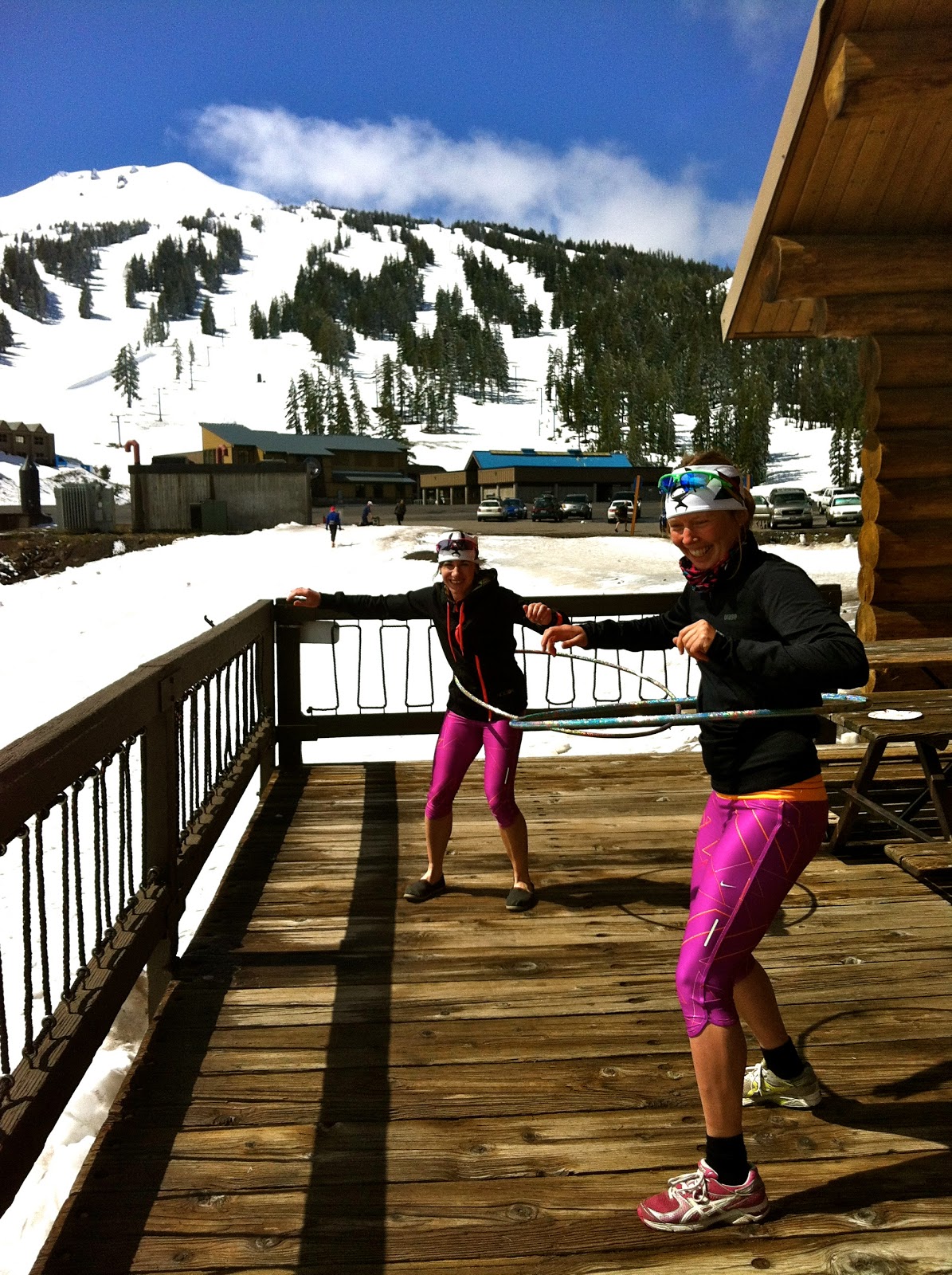
    Hula-hooping Ninjas Amanda Ammar (l) and Zoe Roy. (Photo: Amanda Ammar)
    Hula-hooping Ninjas Amanda Ammar (l) and Zoe Roy. (Photo: Amanda Ammar)

    If one of them makes the Olympics next year, Ammar, Thomas and Roy all said they’d be ecstatic for that person.

    “I don’t think you could really ask for better Canadian girls to train with,” said Roy, who’s in the process of finding a coach. In the meantime, she’s enjoying training with close friends.

    On Saturday, all four will compete in the 5 Peaks Trail Run at the Canmore Nordic Centre. They recently trained together at their first training camp in Bend, Ore., staying at Roy’s mom’s house to cut down on expenses. They’ve planned camps in Osoyoos, British Columbia, and potentially St. George, Utah, where they also have places to stay.

    “Being independent doesn’t mean it’s going to be more expensive by any means,” Ammar said. “A lot of ways you’re going to spend less money. … Non-carded athletes have team fees and a lot of those fees don’t cover travel, so they’re paying rent and team fees on top of it. We’re doing camps in places we have hookups.”

    “You just make it work,” she added. “Chandra’s so used to being on the national team. I said to her, ‘Dude, this is the great thing bout not being on a team. We don’t need to have camps all the time!’ Canmore is awesome. We have a sick setup.”

    And she’s thrilled her approach is affecting others.

    “For so long, I was on a structured program,” Ammar said. She moved to Canmore for her last year of high school, spent three years on the junior national team and three more on the senior squad.

    “It’s hard to work and do all that other stuff,” she added. “I think I just got too focused on one thing, and once I stepped back and I wasn’t skiing at all, I realized that if you have the right boss and setup like we have, you can have a life. I just had to see it for myself.

    “For me, just to go to work, it’s just something else other than skiing and it makes me appreciate skiing even more,” she added. “Mentally I think that all of us need that.”

    In addition to working at the clinic, Ammar has her own cleaning business. Thomas is the retail and event manager for Crawford’s company, Fast and Female, and works at the OutSide Bike & Ski shop. Roy splits her time between working at a coffee shop and the Paintbox Lodge, where she babysits for Sara Renner and Thomas Grandi in exchange for rent.

    As busy as they are, they’re still training full time.

    “We’re not just out here messing around,” Ammar said. “We have fun every day, but we’re working hard. We want to keep it how sport should be; sport should be fun.”

    According to Roy, the community’s already noticed.

    “It’s kind of funny how much it has grown,” she said. “We’ll hear people talking about it, like, ‘There are the Ninjas!’ We’ve got some really nice emails that, ‘You girls are inspiring to our kids on this junior team.’ … Those things make me happy.”

  • Ocariz Digs Deep to Win Debut Pole Pedal Paddle; Bend Native Roy Nabs Second

    Ocariz Digs Deep to Win Debut Pole Pedal Paddle; Bend Native Roy Nabs Second

    Santi Ocariz bringing it home for a 49-second win at Saturday's Pole Pedal Paddle in Bend, Ore. (Courtesy photo)
    Santi Ocariz bringing it home for a 49-second win at Saturday’s Pole Pedal Paddle in Bend, Ore. (Courtesy photo)

    Seven years after discovering the annual Pole Pedal Paddle in Bend, Ore., Santi Ocariz couldn’t shake the urge to try it.

    A 26-year-old Wisconsin native, Ocariz visited Bend during his college summers, fell in love with the area, and resolved to come back and one day compete in the alpine, cross-country, bike, run, kayak and sprint race.

    Two months before last year’s big event, Ocariz and his wife Carolyn set out for their new home in Bend on rollerskis, raising close to $20,000 to feed impoverished children. They anticipated the 3,000-mile trip would take close to three months, but the couple sped up the pace to get Ocariz to Oregon for the PPP.

    They arrived four days before. Ocariz ultimately reasoned he was underprepared in terms of training and equipment, and did not race.

    This year, he was ready — maybe not in training hours, but definitely mentally. Last summer, Ocariz launched toward fatherhood when Carolyn became pregnant with their first child. He shifted his priorities to train less and work more in preparation for the hospital bills and additional expenses, and in March, welcomed baby Sonia to the family.

    Suddenly, two-a-day workouts were no longer a thing, and he was lucky to ski once a week.

    “I don’t think I have trained this little in a year since I was a junior in high school,” Ocariz recalled in an email. “However, what I lacked for in time, I made up in effort.”

    Intervals and time trials become his bread and butter, and Ocariz worked with expert paddler Torsten Heycke on kayak-specific training.

    He started biking in February to work on his weaker link, practiced transitions and graciously accepted a gift from his friends: a plane ticket to Bend for the event on May 18.

    A week and a half before the PPP, the Ocarizes had moved to Moorhead, Minn., where Santi started an accelerated nursing program at Concordia College.

    Suddenly, his initial urge to participate had culminated into a driving motivation to beat everyone else — including several defending champions. Ocariz knew his family could use the $1,000 grand prize for winning the elite individual race, and he remembered that as first place started to slip away last Saturday.

    “Everyone crushed me in the beginning of the race,” Ocariz wrote of the alpine leg, which involves sprinting to the top of Mt. Bachelor to click into skis before navigating gates on the descent.

    With little experience downhill skiing, Ocariz fell behind race leaders Andrew Boone, the 2011 winner, and 2010 champ Marshall Greene. By the start of the 8-kilometer nordic leg, he estimated they had 40 seconds on him.

    Ocariz cut the deficit to 10 seconds by the end of the cross-country ski, and early in the 22-mile bike leg, passed Greene up front. A few minutes later, Greene regained the lead.

    “Marshall destroyed me on the bike,” Ocariz wrote. “By the time I was out of the running transition, Marshall was 2 minutes ahead of me. From here I put my nose to the grindstone and began working on reeling him in.”

    Three miles into the 5-mile run, Ocariz started to lose hope, but only for a moment.

    “As soon as I reminded myself how much the prize money would mean for our family, I leaned forward, shortened my stride, and pushed harder,” he wrote.

    Forty seconds behind at the kayak transition, Ocariz could see Greene. His friend and supporter, Heycke heaved Ocariz’s boat forward in the water, helping him gain 20 seconds. From there, Ocariz focused on staying smooth and paddling smart, gauging his distance from Greene and how hard he was working behind him.

    “By the second turn-around buoy I had almost caught Marshall,” Ocariz wrote. “With about 200 meters to go I put in a surge and passed Marshall.  I was able to put 5-10 seconds on him in that last sprint.  When I hit the beach I burst out of the Kayak, flung my paddle and life jacket, and began sprinting for the finish.  800 meters later, at the finish, I was 49 seconds ahead of him.”

    As a rookie, Ocariz had done it — winning the elite race in 1:44:35 over a slew of local favorites. Marshall was second and Boone finished more than six minutes behind in third.

    “With my PPP inexperience and lack of ability to train as I have in the past, I was unsure of my ability to match up,” Ocariz wrote. “I was definitely the dark horse. … Winning the PPP in Bend is viewed similarly to how winning the Birkie is viewed in the Hayward area.”

    Enough said.

    ***

    For women’s runner up Zoe Roy, achieving a personal best in her hometown’s celebrated race was also significant. A 25-year-old skier currently training in Canada, Roy remembered first racing the PPP on a team when she was 9 or 10. She did it solo at age 12.

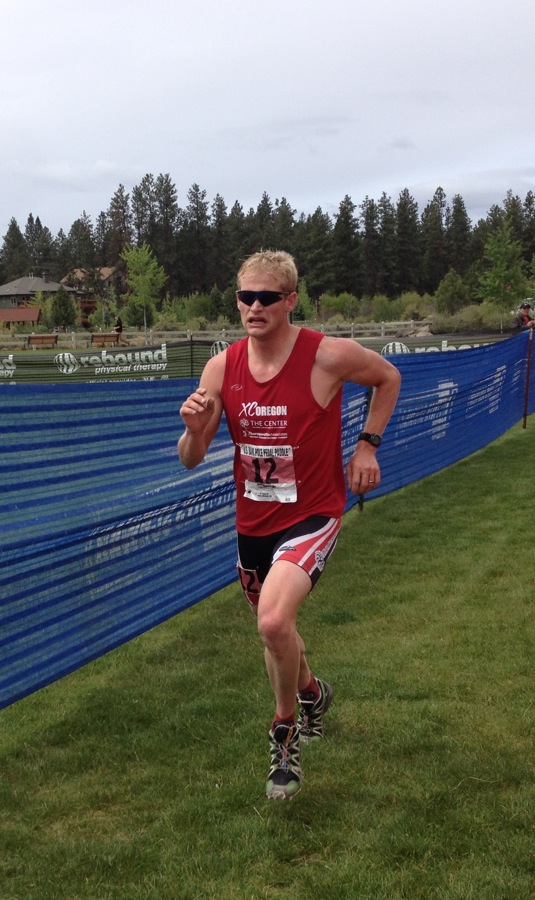
    Zoe Roy near the end of Saturday's Pole Pedal Paddle in Bend, Ore. She placed second for a personal best after friend and three-time winner Sarah Max. (Courtesy photo)
    Zoe Roy near the end of Saturday’s Pole Pedal Paddle in Bend, Ore. She placed second for a personal best after friend and three-time winner Sarah Max. (Courtesy photo)

    In 2009, Roy shared the individual podium with her mom, Muffy, a multiple PPP champion.

    “She was second and I was third,” Roy wrote in an email. “Pretty sweet to be on the podium with your mom, though!”

    She hadn’t raced it since. Back in Bend for an on-snow camp at Mt. Bachelor, Roy decided to enter the 2013 race a week before.

    “I banked mostly on leftover fitness from the winter and tried to do a little a bit of everything just to get comfortable with all the different legs,” she explained.

    Early in on Saturday, Roy led through the alpine and cross-country ski legs into the bike transition. Her friend Sarah Max caught her on the ride, but Roy got back in front during the run.

    “I had about a 20-second lead going in to the paddle and she caught me!” Roy wrote of the kayak leg. “I think my body was so tired from everything else that I could barely hold my arms up, I didn’t know if I was going to make it!”

    Zoe Roy (l) and Sarah Max the day before the Pole Pedal Paddle on May 18 in Bend, Ore. A Canadian skier originally from Bend, Roy placed second behind Max, now a three-time champion. (Courtesy photo)
    Zoe Roy (l) and Sarah Max the day before the Pole Pedal Paddle on May 18 in Bend, Ore. A Canadian skier originally from Bend, Roy placed second behind Max, now a three-time champion. (Courtesy photo)

    A back-to-back champion in 2008 and 2009, Max claimed her third PPP title in 2:04:24, a minute and two seconds ahead of Roy in second. Another Bend resident, Mary Wellington finished third, nearly 5 1/2 minutes behind Max.

    In a race packed with more than a thousand competitors between tandems and teams, Roy stressed the draw of racing individually.

    “The individual is definitely the most team event out there when you factor in the number of people that helped me out, from my awesome support crew (my brother Tosch and my good friend from Bend, Matea) to all the people that I borrowed equipment from,” she wrote. “It takes a village!”

    Now, it’s back to skiing, she explained. Roy is hosting fellow independent Canadian skiers Chandra Crawford, Amanda Ammar and Alana Thomas at her house in Bend for 10 days of training.

    As for Ocariz, he’s already back in classes. After a season off, Carolyn has resumed full-time training and will race remotely for XC Oregon. Santi explained that he and Sonia, now 10 weeks old, will be her support crew.

    “I won’t be training for or focusing on elite racing,” he wrote. “I hope to get to the opportunity to jump into a citizen race or two, but it is not going to be a priority. We have been thrilled with J.D. [Downing] and his organization of the XC Oregon team … The community and team are a perfect fit for us.”

    PPP results

    Carolyn and Santi Ocariz with newborn Sonia on their first family ski. (Courtesy photo)
    Carolyn and Santi Ocariz with newborn Sonia on their first family ski last winter. (Courtesy photo)
  • Canadian Nationals: Foothills Tops Both Men’s and Women’s Team Sprints

    Canadian Nationals: Foothills Tops Both Men’s and Women’s Team Sprints

    Foothill Nordic's Jess Cockney (r) and Phil Widmer (Canmore Nordic), after colliding in the finishing straight of Saturday's freestyle team sprint final at 2013 Canadian Nationals in Whistler, B.C. Cockney went on to win with teammate Brent McMurtry, defending their 2012 national title, while Widmer and Russell Kennedy settled for fourth.
    Foothill Nordic’s Jess Cockney (r) and Phil Widmer (Canmore Nordic), after colliding in the finishing straight of Saturday’s freestyle team sprint final at 2013 Canadian Nationals in Whistler, B.C. Cockney went on to win with teammate Brent McMurtry, defending their 2012 national title, while Widmer and Russell Kennedy settled for fourth. Knute Johnsgaard (l) took silver with teammate David Greer for Whitehorse.

    WHISTLER, B.C. – On a sunny day at Whistler Olympic Park, the men put the cap on an exciting first day of Canadian Nationals with a collision and crash in the final 50 metres of the 2×3 1-kilometre freestyle team sprint.

    Whitehorse divides and conquers to take second and third in Saturday's freestyle team sprint at Canadian Nationals in Whistler, B.C.
    Whitehorse divides and conquers, with Graham Nishikawa skiing around a fallen Phil Widmer (Canmore) on the right and Knute Johnsgaard at left, to take second and third behind Foothills’ Jess Cockney (far right) in Saturday’s freestyle team sprint at Canadian Nationals in Whistler, B.C.

    Four teams entered the final straight together with Phil Widmer of Canmore Nordic in the lead. At the start of the pine-bough lane markers with 50 metres to go, Widmer and Jess Cockney of Foothills Nordic chose the same lane.  Widmer fell, leaving Cockney to defend his national team-sprint title with partner Brent McMurtry. Skiing for different Whitehorse teams, Knute Johnsgaard and Graham Nishikawa split around the fallen Widmer and lunged for the line.

    A year after winning at Canadian Nationals in Quebec, McMurtry and Cockney claimed the team victory in 15:32.03. Johnsgaard finished in 15:33.00, taking silver with partner David Greer.  Nishikawa was 0.31 seconds behind to take bronze with teammate Colin Abbott.

    Widmer recovered to take fourth with Russell Kennedy, 11 seconds after Cockney.  Raphaël Couturier (Skibec) led the second pack another 5 seconds back in fifth with teammate and Canadian National Team biathlete Marc-André Bédard.

    When asked what made the difference, Cockney had a one-word answer: “Brent.”

    “Brent skied so strong on his last leg and gave me such a huge lead,” Cockney added. “All the other guys were gassed after catching up to me.”

    Johnsgaard had a similar view. “I felt really strong. I just didn’t quite have the finishing speed that Jess had in the final,” he said.

    Cockney skied the last leg with a clear tactic in mind.

    “I didn’t feel that strong so I held the lead as long as I could and made sure to tuck in behind Knute and Phil on the downhill into the last 300 metres,” he said. “With the headwind, it was good to tuck behind someone else.”

    Nishikawa also took a strategic approach to the final. A big crash and a broken pole on his first lap of the semifinal put him well off the back of the pack. While Abbott was able to finish the job of rejoining the group, the energy they spent qualifying in second in the fastest heat would come back to haunt them.

    An exhausted top three after Saturday's freestyle team sprint final at 2013 Canadian Nationals in Whistler, B.C.
    An exhausted top three after Saturday’s freestyle team sprint final at 2013 Canadian Nationals in Whistler, B.C.

    In the final, the first-leg skiers went out hard on their third and final lap.

    “Brent attacked and dragged Colin,” Greer said.  “I got around a couple of people and ended up coming in second.”

    “I finally caught the top three teams at the corner with a hundred to go and then they all started their sprint,” Nishikawa said.

    Asked about the crash, he said, “It took a lot of energy to get there so I just had my head down trying to sprint.  I saw some tangles and then I was in a lunge for second as well. It happened fast so I don’t really know what happened.”

    Johnsgaard, who also was in a good position to see the collision, didn’t think any penalties would come of it. “I think it is part of racing,” he said.

    The jury agreed and took no action.

    The women’s 2×3 1-kilometer team sprint was also exciting, but without the finishing-straight fireworks.  On the final lap, Foothills’ Marlis Kromm opened up a gap to send Heidi Widmer off with a sizable lead. Their finish time of 15:17.1 was nearly 10 seconds ahead of Hardwood’s Erin Tribe, who shared silver with Mary Thompson.

    Heidi Widmer (Foothills) leads Anne-Marie Comeau (MSA) in the semifinal of Saturday's freestyle team sprint at 2013 Canadian Nationals in Whistler, B.C. Widmer and her teammate Marlis Kromm went on to win the final.
    Heidi Widmer (Foothills) leads Anne-Marie Comeau (MSA) in the semifinal of Saturday’s freestyle team sprint at 2013 Canadian Nationals in Whistler, B.C. Widmer and her teammate Marlis Kromm went on to win the final.

    Zoe Roy and Michaela Howie teamed up for Rocky Mountain Racers and won the sprint for bronze. Roy finished just over a second ahead of biathlete Julia Ransom (Canmore), who partnered with Kathryn Stone.

    Anne-Marie Comeau (Mont St. Anne) took over from Camille Pépin and quickly moved from fifth to second on the final leg , but a crash on the top hairpin put her back in fifth, six seconds out of the medals.

    Kromm and Widmer were very happy with their result.

    “We were junior challenge girls here [in Whistler at 2008 nationals] and won the relay here so it was really fun to come back,” Widmer said.  “It’s a great start to the week and Mother Nature has been really great today.”

    Both saw the race as tactical. “We wanted to start in control, ski the first couple of laps with the pack and try to save some energy and make our moves in the second half of the race,” Kromm said.

    “It is a long week of racing at nationals,” Widmer added. “The team sprint is important, but you have to be aware of your energy for the rest of the week.”

    The silver medalists said the race was “definitely tactical.”

    “You had to hold on to a spot and pick when to move up and make sure you had something for that last lap,” Thompson said.

    “It was really refreshing that the sun was shining and the skis were fast,” Tribe added. “It was a great day.”

    Results: men | women

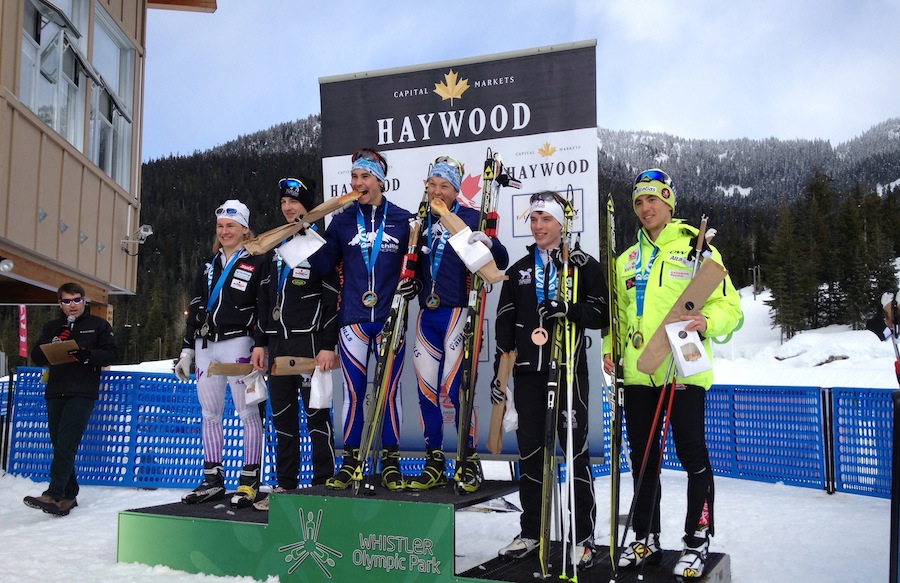
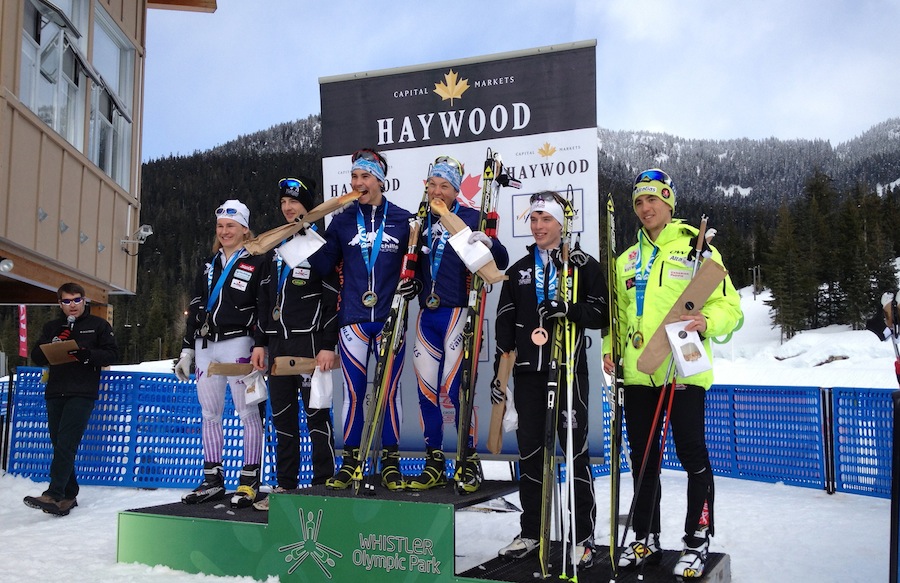
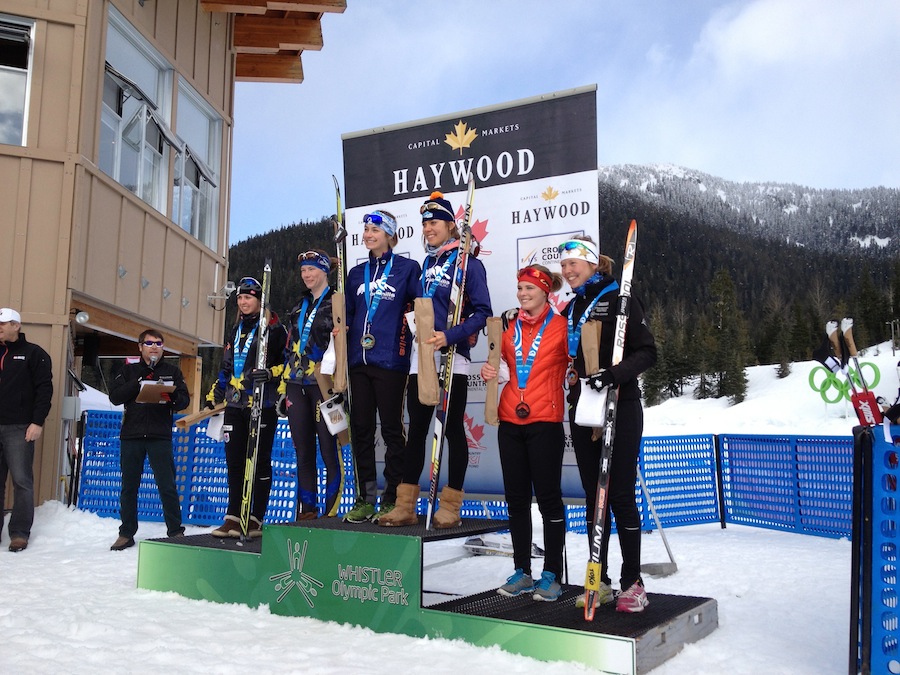
    Women's freestyle team sprint podium at 2013 Canadian Nationals, with Marlis Kromm and Heidi Widmer of Foothills Nordic in first (c), Erin Tribe and Mary Thompson of Hardwood in second (l), and Michaela Howie and Zoe Roy of Rocky Mountain Racers in third. (Photo: Peggy Hung)
    Women’s freestyle team sprint podium at 2013 Canadian Nationals, with Marlis Kromm and Heidi Widmer of Foothills Nordic in first (c), Erin Tribe and Mary Thompson of Hardwood in second (l), and Michaela Howie and Zoe Roy of Rocky Mountain Racers in third. (Photo: Peggy Hung)
    2013 Canadian Nationals men's freestyle team sprint podium: (Photo: Peggy Hung)
    2013 Canadian Nationals men’s freestyle team sprint podium with Purebread Bakery baguettes in hand. Jess Cockney and Brent McMurtry of Foothills Nordic took first (c), Knute Johnsgaard and David Greer of Whitehorse were second (l), and Whitehorse’s Colin Abbott and Graham Nishikawa placed third (r). (Photo: Peggy Hung)
  • Thomas on Leaving the Academy, Shooting for World Championships

    Thomas on Leaving the Academy, Shooting for World Championships

    Alana Thomas (formerly of the Alberta World Cup Acadmy) leads Zoe Roy (RMR) and Emily Nishikawa (AWCA) during the Lappe Nordic NorAm 15 k skiathlon on Jan. 3 in Thunder Bay, Ontario. Thomas was second to Nishikawa, and the two will race for a distance spot at the upcoming World Championships as the NorAm trials continue this weekend in Duntroon, Ontario. (Courtesy photo)
    Alana Thomas (formerly of the Alberta World Cup Acadmy) leads Zoe Roy (RMR) and Emily Nishikawa (AWCA) in the Lappe Nordic NorAm 15 k skiathlon on Jan. 3 in Thunder Bay, Ontario. Thomas was second to Nishikawa, and the two will aim for a distance spot at the upcoming World Championships when the NorAm trials continue this weekend in Duntroon, Ontario. (Courtesy photo: alanaskis.blogspot.com)

    Just a year ago, Alana Thomas dreamed of making one of Canada’s prestigious national training centres.

    The Nakkertok skier and Toronto native had been working toward the goal since she started skiing competitively as a junior. Now 24, Thomas took the unconventional route and went to college, graduating in Carleton University in December 2010 with an economics degree. Ever since, she’s been building back up, training full time and largely seeing results.

    Her breakthrough season last year – including her first OPA Tour trip and European racing experience – earned Thomas a spot on the Alberta World Cup Academy (AWCA) in Canmore for 2012/2013. Thomas accepted, jumped on a plane west and settled into her new pad, living with Canadian World Cup skier Chandra Crawford and two others. For the duration of the summer and fall, she trained with nearly a dozen AWCA women in Canmore. Once winter came, she was eager to see how her hard work would pay off.

    According to Thomas, it didn’t really.

    “You know how you sometimes feel like you’re working away at something and you’re just pushing and pushing, but you’re not really getting anywhere, maybe just treading water?” she said on the phone Wednesday from her parents’ home in Mississauga, Ontario, just outside of Toronto. “That was kind of tough. I was expecting better sensations through the training season.”

    In her World Cup debut at her new home in Canmore, Thomas placed around 60th in all three events Dec. 13-16. Dissatisfied with her results, she left the Academy shortly after.

    Alberta World Cup Academy women, including Alana Thomas (back left), Alysson Marshall (second from back left) and Emily Nishikawa (front, center) during a summer hike up Centennial Ridge near Canmore, Alberta. (Alana Thomas courtesy photo)
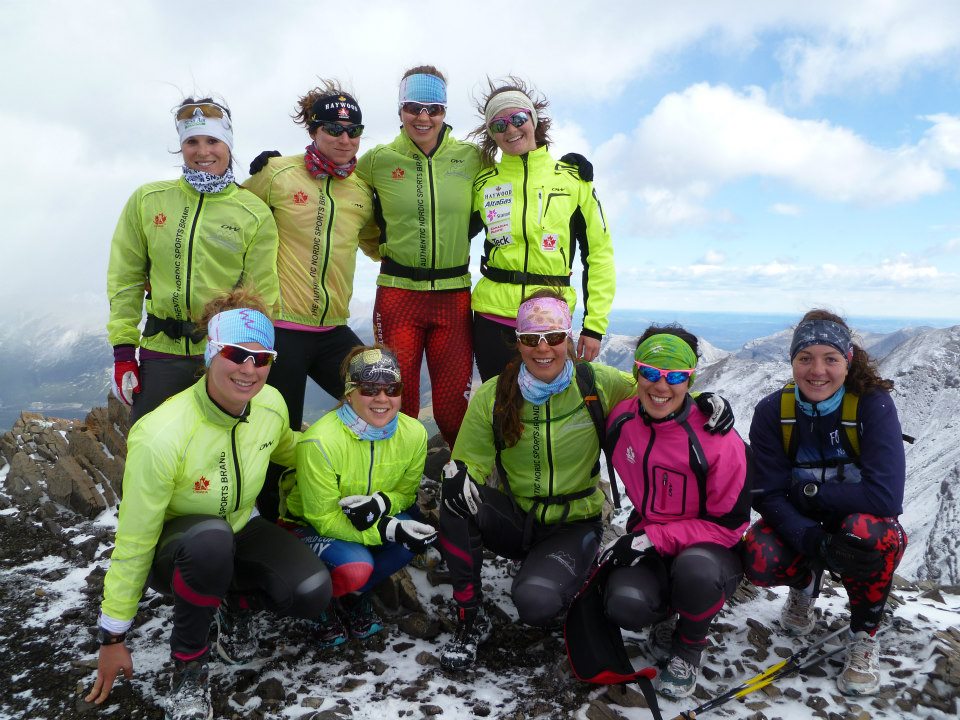
    Alana Thomas (top left) with her Alberta World Cup Academy teammates, including Alysson Marshall (second from top left) and Emily Nishikawa (front, center) during a summer hike up Centennial Ridge near Canmore, Alberta. (Courtesy photo)

    “I think [I was] looking for a bit more fitness and just by leaving the Academy, I got rid of a lot of stress,” Thomas said. “I think I was wasting a lot of energy on things that didn’t really deserve energy. I just feel more relaxed and happy now and working on good training and recovering and just having fun racing.”

    Put simply, the coaching style wasn’t the right fit for her, she said. After years of training mostly independently under Nakkertok’s club umbrella, Thomas said it felt good to get back to some of her old training habits. She’ll continue to live in Canmore for the rest of the season and remains affiliated with Nakkertok, but no longer belongs to a training centre.

    “It was a hard decision to make because I really wanted to be on the team to train with those 10 or 11 other girls who are so committed and so strong,” Thomas said. “It’s too bad that didn’t work out, but it wasn’t anything personal with the other athletes.”

    She’s kept valuable training partners like Zoe Roy of Rocky Mountain Racers, who joined her on a recent trip to Ottawa during a break between NorAms in Thunder Bay and Duntroon, Ontario.

    “It made more sense, I thought, than flying back to Canmore for two weeks and spending so much money on that,” Thomas said. “My friend who moved into my old room [in Ottawa] was going away for all of January so I just moved back into my old room and brought my friend Zoe Roy with me. We had tons of fun training in Ottawa.”

    After a week and a half there, Thomas headed to Mississauga, about a 1 ½-hour drive from Duntroon, the site of this weekend’s NorAms and Senior World Championships trials.

    Nearly three weeks ago at the first half of World Championship trials in Thunder Bay, Thomas placed second in the NorAm skiathlon.

    “I felt like I was closer to being back to where I feel like I should be able to ski consistently or can ski,” she said. “It was nice to know, ‘Oh good, I didn’t just waste the whole year training just to get slower.’ ”

    Now in fighting position for a distance spot at World Championships in late February in Val di Fiemme, Italy, Thomas has to repeat the feat or win Sunday’s 10 k skate race.

    “That was definitely on my list of goals for this year, and so far it seems like a long shot at best, but I’m feeling fit,” Thomas said. “I want to be on the podium this weekend, for sure, and if I get to go to world champs that would be amazing, but if it doesn’t pan out that way, then that’s OK, the season’s not lost.”

    As for what she knows about Highland Nordic’s NorAm courses in Duntroon, Thomas said there’s a new sprint course.

    “I haven’t skied it yet, but I’ve heard that they’ve added way more climbing to it so that should be exciting for a classic sprint,” she said. “On the skate day, it’s a good mix. There’s some steep hills, there’s some more gradual ones, lots of false flats in there, and a couple exciting downhills.”

    She’s looking forward to having her younger brother cheering her on from the sidelines for the first time in six or seven years.

    “He’s like, ‘Which day is gonna be less cold? Which one should I come and watch?’ ” Thomas said. “I was like, ‘Saturday’s the classic sprint.’ He’s like, ‘They do sprints in classic now? That’s so weird!’ ”

  • Nishikawa Siblings Sweep Skiathlon at NorAm World Trials

    Nishikawa Siblings Sweep Skiathlon at NorAm World Trials

    Graham Nishikawa, 29, leads some Alberta World Cup Academy teammates, including Jesse Cockney (207) and Kevin Sandau (202), in the skate leg of Thursday’s NorAm 30 k skiathlon in Thunder Bay, Ontario. Nishikawa won the race to earn a trip to 2013 World Championships (Photo: Martin Kaiser)

    For the second time this season, the Nishikawa siblings – Emily and her older brother Graham – pulled out NorAm victories on the same day at the NorAm World Junior/U23 Trials in Thunder Bay, Ontario. Emily won the women’s 15 k skiathlon by 9.1 seconds in 45:30.5.

    The first time the Nishikawas both topped the podium was at an interval start skate Dec. 9 at Sovereign Lake with a few top domestic racers away at a sprint World Cup in Quebec City. On Thursday, the skiathlon field was slightly stronger as those missing skiers were back to chase points toward a World Championships start opportunity in Val di Fiemme, Italy.  Combined with U23 Worlds and Junior Worlds start places going to the first finishers in those categories, this weekend has been highlighted on most domestic athletes’ calendars.

    The weather has not cooperated with very little snow falling in the last month.  Only a huge effort from Lappe Nordic and volunteers in the local ski community has allowed the race to proceed.  The course had to be shortened, which changed both the number of laps and the shape of the races. The senior women did three laps of 2.5 k classic and three laps of 2.6 k skate.  The junior women did two laps of each.

    Zoe Roy (5) leads Emily Nishikawa in the NorAm leader’s bib during the skate leg of the women’s NorAm 15 k skiathlon on Thursday in Thunder Bay, Ontario. Nishikawa won the race. (Photo: Martin Kaiser)

    While the skate loop remained challenging, the shortened 2.5 k classic loop took on a very different character. “The classic course had long downhill and double pole sections with just one climb near the end of the 2.5k loop,” women’s runner-up Alana Thomas (Nakkertok/XC Ottawa) wrote in an email. At least three of the favourites tried and failed to make a split on that small climb.

    The flatter classic loop resulted in an unusually large group of 13 women arriving at the transition together. Brittany Webster (Highlands Nordic), who was fourth, already struggling with the cold, got tangled “with another athlete who lost her ski box. Can’t blame her, I’ve done things like that before,” she wrote.

    Webster left the transition zone in seventh place, only 7 seconds behind the leading Thomas, but was not able to close the gap.  Thomas, one of those who had tried to split field in the classic loop, wasn’t waiting.

    “[I] tried to string it out again starting the skate portion and got a gap with Emily Nishikawa and Zoe [Roy],” Thomas said of the third-place finisher from Rocky Mountain Racers. “We skied together switching leads and eating up the big hills on the skate course. Emily gapped us a bit in the last k but it sure was an exciting day!”

    Race winner Emily Nishikawa of the Alberta World Cup Academy (AWCA) had a similar view of the racing. “I’m happy with today’s race, and I felt good,” she wrote. “The classic course was pretty easy with a lot of downhill and flat sections so the pack really stayed together, it was hard to break away in that part.  Then in the skate course, I was skiing with Zoe and Alana for the whole time until the last lap where I was able to get a bit of a gap and hold it until the finish.  I was confident I could win, and I’m really glad I was able to do that today.”

    Thomas was satisfied with her second place. “The race was really fun today and especially satisfying after a slow start to the season so far,” she wrote.

    Andrea Lee (NDC Thunder Bay) in seventh led the U23 athletes and qualified for the U23 Worlds. “I was really happy with the way I felt today,” she wrote. “After having a tough time in the races before Christmas, I finally felt like I had my energy back. I struggled a bit in the classic leg, but once I transitioned to skate, I felt much better.”

    Frédérique Vezina of the Pierre-Harvey Training Centre (CNEPH) dominated the Junior Women’s category to earn her JW berth and continue her strong run of results from December. Katherine Stewart-Jones (Nakkertok) and Cendrine Brown (CNEPH) came in together for second and third places after spending much of the race in a chase group with Dahria Beatty (Yukon Ski Team) and Maya MacIsaac-Jones (RMR). Anne-Marie Comeau (CNEPH), ranked second after her world cup successes, did not start.

    Some of the athletes struggled in the -13C conditions, like Webster, who explained she “felt good warming up today, but the cold really got to me out there, and even at the start of the race I could feel my body contracting slower and slower. By the end, of course , you don’t really notice it, but I didn’t ski or feel like I had much punch. Just cold limbs and frost bite on the toes!!”

    Other athletes didn’t mention the cold.  One thing almost every racer mentioned was the work of the volunteers. Thomas wrote, “I’ve got to mention how impressed I was with the course, T-Bay really loves skiing and volunteers spent hours and hours shoveling snow onto the race loops to make today possible – all worthwhile and much appreciated!”

    Men’s Race

    Graham Nishikawa (AWCA) continued what his sister started, winning the men’s 30 k skiathlon at Lappe Nordic by 3.7 seconds in 1:15:51.9.  As with the women’s race, all the top domestic racers were there to earn points towards a World Championships start, or U23 or Junior Worlds trips.

    The lack of snow in the last month forced the use of shortened courses, with even more laps for the men. Nishikawa wrote that “the course was 12 laps of 2.5km. The classic side was gentle and the skate side was challenging. The organizers did an amazing job getting the course together – there is very little snow here!”

    At the end of the 15 k classic, there was a pack of 23 skiers in the transition zone.  While it is typical for the men to ski in packs, this was larger than usual. Second-place finisher Kevin Sandau (AWCA) said the shortened classic course “was sort of good and bad – easier to ski easy and relaxed but at the same time there was too much congestion just cause it was harder to break into a smaller lead pack.”

    The ‘good’ for Sandau, who was “a bit nervous about the classic leg of the race as I haven’t been as strong in classic this season”, was ‘bad’ for some of the other racers who were stronger in classic. Skiathlons usually slightly favour the better skaters, this course was just a little more skewed that direction.

    Sandau was one of the skiers pushing the pace early in the skate leg. “I felt pretty good in the skate leg, and for the first couple laps tried to speed the pace up to thin it out a bit,” he wrote. “Near the 25km mark I knew it was going to come down to the final climb before the stadium for the win, as the four of us in the lead were skiing pretty strong.”

    Graeme Killick (AWCA), who was third, Michael Somppi (AWCA) in fourth, Brian McKeever (Para Nordic National Team) in fifth, and Jesse Cockney (AWCA) in sixth also spent time on the front pushing the pace.

    Racing on his home trails, Somppi slid back into “seventh or eighth place” after the exchange, he explained. “With the trails not being overly wide, it was difficult to pass and the yo-yo effect made it impossible to get into any sort of rhythm,” Somppi wrote. “I was able to move up to 4th as other skiers faded, unfortunately I didn’t have the energy left for a sprint to the finish line.”

    Nishikawa used his experience in the final. “I know the skate course well from previous years- and made my attack on the final climb,” he wrote. “Got a gap and maintained.”

    Sandau was happy with his second place: “On the very last climb, Nishikawa attacked and I couldn’t respond, but was able to just edge out Killick after getting in his draft before the finishing lanes.”

    Somppi’s lack of energy gave him the best view of the finish. “Graham Nishikawa played it well with a strong surge up the final big climb to secure the victory while Kevin and Graeme fought for silver,” he wrote. Personally, he was also fairly pleased. “[I] am happy to have finished with the leaders, however 4th place is always a tough place to finish.”

    Cockney, who was sixth just 2.5 seconds behind McKeever, felt good about his race and is “really looking forward to Saturdays sprint as today shows I have good shape for the weekend,” he wrote. “The last couple laps were just a bit too much for me but I’m happy with the improvement from past years results.”

    Andy Shields (NDC Thunder Bay) used his hometown advantage to finish seventh, good for first in U23 and a trip to U23 Worlds.

    “My goal was to win the U23 category today and that’s what I did so I’m very happy with how things played out,” Shields wrote. “Skis were superb, both ski selection and wax, so I didn’t have to work very hard in the classic leg – which went out slow anyway. I was able to stay with the lead pack for most of the classic but got into the exchange further back than I wanted to. I was able to catch back up to the lead pack in the first half of the skate and in the process ended up dropping all the U23’s.

    “It feels great to qualify for Worlds on the first day of trials. Now I can just concentrate on enjoying the rest of the races by skiing as fast as I can.”

    Raphael Couturier (CNEPH) won the Junior Men’s 20 k skiathlon ahead of Alexis Turgeon (CNEPH) and Ezekiel Williams (Nakkertok) to book his ticket to Junior Worlds.  Jack Carlyle (Soo Finnish), David Palmer (Black Jack) and Scott Hill (Team Hardwood) completed the group of six that skied the last 5 k together.

    Full results at zone4.ca

  • ‘A Dream Come True’: Athletes Soak Up First World Cup and Team Sprint Experience

    ‘A Dream Come True’: Athletes Soak Up First World Cup and Team Sprint Experience

    Reid Pletcher (SVSEF) in the his first World Cup team sprint in Quebec City on Friday. Pletcher and Sylvan Ellefson (SSCV/Team HomeGrown) combined to finish 24th in their first team sprint since racing together as J1s.

    QUÉBEC CITY – From an athlete’s point of view, it was easy to get nervous Friday. Never mind that thousands of spectators lined the manmade World Cup course in front of Québec’s Parliament Building; skiers had to go head-to-head right off the bat with 12 to 13 international racers per semifinal.

    The best ones had their name printed across their bibs. That’s how newcomers could really tell whom they were up against. To fight the nerves and do their best to perform, most skiers in their first World Cup or team sprint simply looked around. They were part of history with the first cross-country World Cup in Québec and the first city sprint in eastern North America. Moreover, they had achieved the goal of most rising skiers and made it to the World Cup.

    “It’s a dream come true,” Stratton Mountain Skier Sophie Caldwell said. “I’ve always wanted to ski a World Cup so it’s pretty exciting. The other day [Alaska Pacific University coach] Erik Flora said it’s just like any other race except it’s run better.”

    She laughed. Caldwell and U.S. Ski Team member Sadie Bjornsen didn’t make it past the first round and finished 14th overall, but Caldwell kept it in perspective.

    “[I was] going from being one of the fastest [on the U.S. SuperTour] to probably definitely the underdog here, but it was nice because there wasn’t a lot of pressure, no expectations really,” Caldwell said. “I was able to somehow turn nerves into excitement.”

    With a sizable Vermont crew cheering from the sidelines, Caldwell said she saw people she knew all the way around the course. At points along the barriers, people stood three deep.

    “I’ve never seen this many people at a ski race,” said 17-year-old Maya MacIsaac-Jones of Rocky Mountain Racers.

    As she and teammate Zoe Roy walked the outskirts of the course in the heart of Québec City, several French Canadians told them “bonne chance,” good luck.

    “It’s the biggest race I’ve done,” said Roy, who learned she would race Friday’s team sprint (in addition to Saturday’s individual sprint) on Thursday while boarding a flight out of Calgary, Alberta.

    “I was a little nervous to start, but I took a deep breath,” the Ontario native said. “It’s just very sweet to have so many people lining the course and a lot of them knew our names, too. It was cool. Canada’s got a lot of support out there.”

    Québec native Alexis Turgeon, of the Pierre Harvey Training Centre at Mont Sainte-Anne 45 minutes north, was visibly brimming with excitement even after being eliminated with teammate Russell Kennedy (Alberta World Cup Academy). He had realistic expectations going in, but that didn’t keep him from studying the course almost daily on a printed map.

    “I pretty much looked at it every day,” Turgeon said. He had been thinking about this since the announcement two summers ago that Québec would host its first World Cup.

    “It’s crazy, my whole family was around the track, my little brother was screaming and my mom was there on the sideline,” he said. “I was racing in front of my girlfriend, … friends from Ottawa, from everywhere came. It’s just a perfect spot to race. The city’s beautiful; the track is perfect. On the first lap you just hear everybody screaming. It just makes you faster and push through the pain more.”

    Both Turgeon, 19, and Kennedy, 21, had never raced a World Cup before, yet were fast enough in the Canmore NorAm qualifiers last weekend to make one of four Canadian teams for Friday’s event. They will also compete individually on Saturday.

    “It’s hard because we never get to race with those guys,” he said of World Cup skiers. “That’s the best preparation we could have for tomorrow’s sprints, I think, seeing what speed you need to have. It’s not what you’re able to do, it’s what you need to do.”

    “It was just fun to be there,” said Kennedy, a dual-citizen who trained with Far West in Truckee, Calif., as a junior before moving to Canmore two years ago. “I was excited.”

    More experienced skiers like Reid Pletcher of the Sun Valley Ski Education Foundation also tried to approach the races with an appreciation for getting there in the first place. A year and a half after suffering a life-threatening head injury in a climbing accident, Pletcher, 24, smiled as he looked out at the course while sitting on the plow of a parked snowcat.

    “I think I’m still on the mend, but it’s been a long journey; I had a hard time believing myself ever since that happened,” he said after placing 24th in his first World Cup team sprint with Sylvan Ellefson (Ski & Snowboard Club Vail/Team HomeGrown).

    “I think me just being here proves that I can come back and that I’m in the mix,” Pletcher added. “[This is] really meaningful. I’m glad I’m here.”

    Hearing his name screamed from the sidelines helped, too, although it was hard to hear everything – or really anything at times.

    “I would hear the occasional screaming my name, and the rest was head down, pain cave,” he said. “As loud as it is here, it’s not sound, it’s not loud, it’s just hard.”

    Becca Rorabaugh of APU said the crowd was what helped her and teammate Caitlin Gregg (Central Cross Country) finish 18th in Rorabaugh’s first World Cup team sprint.

    “Having people the whole time and knowing that you have a teammate, it takes away from you’re like inter-talk when you’re like, ‘Oh, wow this hurts,’ ” Rorabaugh said. “It just kind of erases all that so you just go.”

  • Nishikawa Edges Ellefson, Stephen Runs Solo to Win Spray Drag

    Nishikawa Edges Ellefson, Stephen Runs Solo to Win Spray Drag

    U.S. Ski Team member Liz Stephen extending her lead to win the second annual Spray Drag running race on Saturday in Canmore, Alberta. (USSA Nordic courtesy photo)

    Thirty-six men in the Spray Drag running race didn’t end up chasing Devon Kershaw up Spray Lakes Road in Canmore, Alberta, on Saturday, but they had one heck of a battle from the start.

    According to American Sylvan Ellefson (Ski & Snowboard Club Vail/Team HomeGrown), the pace was fast for a bunch of nordic skiers early on.

    “Any road runner could have pulled away, but it was a quick pace,” he wrote in an email. “It continued on the road with a couple of us switching off in the lead.”

    From the Canmore Nordic Centre, racers (including 26 women and seven junior boys) ascended a snow- and dirt-covered road to the Spray dam. In an email, race organizer and Alberta World Cup Academy coach Stefan Kuhn wrote that some fresh snow made for an interesting race, and it was “definitely colder at the top than last year.”

    Start of the Spray Drag men’s race on Saturday in Canmore, Alberta. The second-annual road run up Spray Lakes Road was a fundraiser for the Alberta World Cup Academy. Graham Nishikawa (5835) won it, followed by Sylvan Ellefson (5805) in second and Michael Somppi (5818) in third. (AWCA courtesy photo)

    The men raced 7.5 kilometers with nearly 400 meters (1,312 feet) of elevation gain, and the women and juniors did 5 k.

    About six men took off at the beginning of the dirt road, including Ellefson and AWCA/Senior Development Team skiers Graham Nishikawa, Michael Somppi, Kevin Sandau, Graeme Killick, and Jesse Cockney. Nishikawa and Ellefson opened up a gap around the halfway point, and Nishikawa – who holds the course record in 29:23 – tested his competitor with about 1 k to go.

    “Nish moved ahead of me put a little speed in to see how I’d react maybe (at least that’s what it felt like, not sure if he actually did … ha),” Ellefson wrote. “And then with about 200m to go he kicked and I couldn’t hold on.”

    Nishikawa, who was third last year to Canadian World Cup Team members Kershaw and Ivan Babikov, won the second annual race – an AWCA fundraiser – in 30 minutes and 28.1 seconds. Kershaw won it last year in 29:44. According to Kuhn, the Canadian national team didn’t compete this year because the race didn’t fit in with their schedule in Canmore.

    “It is a very tough course,” Nishikawa wrote in an email. “I am happy to see my shape is good after the Park City camp.”

    Sylvan Ellefson (SSCV/Team HomeGrown) working to catch Graham Nishikawa (AWCA/CNST) in the final stretch of Saturday’s 7.5 k Spray Drag road race in Canmore, Alberta. (SMS courtesy photo)

    The runner-up, Ellefson finished 14.1 seconds back. Somppi was third (+24.1) and Killick placed fourth (+27.3), respectively. After leading early with Nishikawa and Ellefson, Sandau was fifth (+1:05.5).

    The women’s race turned out to be a spectacle with U.S. Ski Team member Liz Stephen crushing the competition and course record. She won by more than three minutes in 23:01.2, besting the record (25:41 by Madeleine Williams) and last year’s winning time (25:53 by Brittany Webster) by nearly three minutes. Last year, Perianne Jones was second, and Rhonda Jewett finished third.

    After Stephen, Canadian Zoe Roy, who skied for the University of Utah and now trains with Rocky Mountain Racers, placed second (+3:02.0). Heidi Widmer (AWCA) was third (+3:27.3).

    “We where excited to see Heidi run a [personal best],” Kuhn wrote. “Race winner Liz definitely showed us a new level for this event for the ladies’ time.”

    Complete results

  • Roy Returning to Canadian Roots

    Roy Returning to Canadian Roots

    Zoe Roy (RMR) leads Alberta World Cup Academy skiers Emily Nishikawa (c) and Kate Brennan (l) up a climb on the middle of their fourth of six laps in the 30 k classic mass start at Canadian Ski Nationals on March 24 in Mont Sainte-Anne, Quebec. Roy finished seventh to tie a personal best at Canadian nationals.

    Maybe it was the transition to full-time racing or the fact that Zoe Roy was competing in her home nation last season. It could’ve been the back-and-fourth flights across the U.S/Canadian border, or one team’s hospitality that helped Roy reach new heights on the NorAm circuit.

    Whatever it was, she wasn’t fighting it. After spending some 20 years in Bend, Ore., Roy, who turned 25 on Sunday, is moving to Canmore, Alberta. Starting Aug. 1, she plans to live and train at Canada’s cross-country epicenter with Rocky Mountain Racers (RMR), which took her in last year. Traveling with the club and taking advantage of its wax resources, Roy achieved her first NorAm podiums with second- and third-place in 10 k races, and tied her personal best at Canadian nationals in seventh.

    Between races, Roy was studying at the University of Utah in Salt Lake City. In her fifth year there, she was done with collegiate racing and entering the pro scene as a founding member of StellaRacing – a Salt Lake-based women’s squad in its inaugural year. She was also in her first season with XC Oregon, making her club affiliation that much more confusing.

    In committing to a domestic circuit, she chose Canada because she’s from there. Born in Ontario, Roy remains a Canadian citizen and doesn’t have dual ties despite growing up in Bend. She started last year with the West Yellowstone SuperTour, then spent the rest of her season in Canada (except for a convergence trip to Europe and local races in Salt Lake).

    FasterSkier chatted with Roy on the phone last week shortly after her surfing vacation in El Salvador. Earlier this month, she and a childhood friend from Oregon flocked to the sea to learn the sport in a place they could do it every day. After fulfilling their goals and surfing under moonlit skies, Roy was back in ski mode in Bend.

    ***

    FasterSkier: After more than a week of mostly surfing, are you a pro now?

    Zoe Roy: Not a pro by any stretch, but I’m better than really bad. Took lessons the first few days to get the hang of it.

    FS: What was the best part of your trip?

    ZR: I’d say the highlight … was going surfing at night under the full moon. That and the fried plantains.

    Zoe Roy working with a Fire and Ice Camp junior in late June at Mt. Bachelor in Bend, Ore. (MBSEF photo)

    FS: Before El Salvador, you worked at the Fire and Ice Camp in Bend. How was that?

    ZR: The day before we left, I was on snow. It was kind of funny going from that to surfing. … I coached for TUNA [The Utah Nordic Alliance] the week before [the Fire and Ice Camp] and then I did Fire and Ice for a couple days before I left. I was kind of an assistant coach for [that].

    There were a ton of juniors there. It was pretty cool to be able to get all those kids together. At any age, it’s fun to see everyone else skiing, too. You see all your friends that you might not get to see the rest of the year.

    FS: How long had you been back in Bend?

    ZR: I came [back] after school at the beginning of June and I’m going up to Canmore in the beginning of August. … I actually graduated in May [with a degree in] exercise and sport science with a minor in entrepreneurial business and a TESOL certificate, which means I can teach English as a second language.

    FS: Why did you decide to move to Canmore?

    ZR: I had a good year last year and I got to travel with the Canadians a bit. I’m originally Canadian … so I thought I might as well move up there and spend the year skiing with them and see how it goes. That’s the main reason. I also have an aunt and uncle in Calgary so that’s nice, too. I’m on the team RMR, which I traveled with on the Canadian circuit last year. It’s based out of Canmore, so that seemed the natural place to go.

    FS: How did your relationship with RMR start, and what about the team appeals to you?

    ZR: They waxed for me at nationals two years ago so maybe that was the beginning of it, and then after that I got more connected with them.

    It’s a fun team. They have the whole spectrum from juniors up to elite racers. Dasha [Gaiazova] is part of it and Andrea Dupont, those are probably the two main older girls on that team, and then John Jaques, the coach, is awesome, too. It’s probably a combination of who’s there and then John, too. I don’t know [new assistant coach] Mike Vierra too well, but he’s the new coach there, but I’ve heard great things about him, too.

    I’m psyched to be [moving] up there. I feel like there’s a pretty solid group of, not just on that team, but the whole Canmore community. The [Alberta] World Cup Academy’s there so I’m excited to have that whole group of girls to train with. … That’s another big reason. I feel like it doesn’t get much better than that.

    FS: When it comes to climbing the elite ranks of racing, why did you pick the Canadian route?

    ZR: I think mostly because opportunities do exist for me to race in Canada. Those same opportunities don’t exist for me to race for the U.S. because I’m not a U.S. citizen, so I guess that’s the main reason. I thought, ‘If I’m going to see how fast I can race, I might as well go somewhere where there are opportunities to make teams’ … so I thought I’d go to Canada.

    FS: We heard you were leaving XC Oregon, but what’s the status of StellaRacing?

    ZR: As of this coming year we’re splitting up a few more different ways because it was really based out of Salt Lake. I’m heading up to Canada, Katie [Ronsse] is in PT school, Evelyn [Dong] is coming back to Bend.

    It was great; we had an awesome time putting it together and have a team based in Salt Lake to work from and race with, but I’d say as of now, it’s splitting up a bit more. I’m sure some of us will still wear our suits at certain times, but I don’t know if it will be as much as a team as it was last year, but we had a great time doing it.

    FS: What are your goals for this coming season?

    ZR: Well, the World Cups are in Canada so if I qualified for that, that would be amazing, but who knows. If that could happen, that would be awesome, but other than that podiums at NorAms and another Scando Cup would be sweet, too. I don’t know exactly what the opportunities are for another Scando trip.

    FS: What did you gain from the convergence trip?

    ZR: It was cool to just race in Europe and see the other parts of the ski world. It’s good to race against those girls and see what level they’re at. I feel like just that in itself was a good experience.

    [Note: After winning four state championships at Summit High School, Roy spent a year and a half in Austria training and racing at the University of Salzburg.]

    FS: How did you feel last season went overall?

    ZR: I was psyched about those [NorAm] results. What can I attribute it to? I don’t know exactly, but I mean, it’s hard to pinpoint one thing. I guess before that I was racing [collegiately] so I couldn’t come to Canada that much. I was on the NCAA circuit.

    FS: What are your thoughts on truly making the next step to full-time racing?

    ZR: It’s exciting. It’ll be interesting to sort of concentrate more on skiing than I really did before.

  • Nishikawa Takes Second Victory in 10 k Classic (Updated)

    Nishikawa Takes Second Victory in 10 k Classic (Updated)


    Emily Nishikawa racing earlier this winter. Photo: Jesse Winter Photography/JesseWinterPhotography.com.

    Note: This story has been updated to include quotes from third-place finisher Zoe Roy.

    On the final day of racing in the Haywood NorAms in Whistler, British Columbia, on Sunday, Emily Nishikawa (AWCA/CNST) won her second event of the weekend with her victory in the 10 k classic individual start race with a time of 33:03.1 on the course. Amanda Ammar (Canmore Nordic Ski Club) finished second (+13.6) and Zoe Roy (Rocky Mountain Racers/Stella Racing) completed the podium in third (+34.0).

    With her second outright win of the weekend’s races, which also serve as the Canadian U23 and Junior World Championships trials, Nishikawa has all but guaranteed herself a spot on the U23 team. The National Ski Team is expected to make its official selection within the next two days, but race winners generally get an automatic berth on the squad.

    In contrast to the snowy conditions on Saturday for the freestyle sprints, Sunday was marked by blue skies and hard tracks. Nishikawa said that everything went perfectly in her race.

    “I just wanted to start relaxed and kind of build into it on the second half of the course,” she said.

    After hearing a split at the halfway point that she had a one-second lead, she focused on keeping and extending that gap.

    “If you know how much time you need to make up it kind of motivates me a little bit,” Nishikawa said.

    The National Development Team member came off of seventh-place in Saturday’s freestyle sprint, a result she said probably should have been better — “that didn’t go as planned.”

    But with her rebound in the distance classic event, she was pleased with the outcome of the three races overall. Between Thursday’s skiathlon, Saturday’s sprint and Sunday’s classic, athletes competing at the Whistler Olympic Park venue had their work cut out for them.

    “I’m definitely a little tired,” said Nishikawa. “I’m looking forward to some rest.”

    With an eighth and a tenth in the preceding races this weekend, Ammar’s silver medal finish on Sunday marked her best result of the season so far. After taking a year off of ski racing, the former CNST member seems to be back in good fitness.

    Roy’s third-place showing on Sunday has was a step up from her fourth in the mass-start skiathlon. She was outside the top-ten in Saturday’s sprint, but Roy’s distance racing has been getting better all fall.

    “Starting in front of Emily was good motivation and I stayed in front of her until practically at the line,” Roy wrote in an email. She started 30 seconds ahead of Nishikawa.

    The Stella Racing team member said the Rocky Mountain Racers helped her with her skis, which made a significant difference.

    “We had awesome skis all three days … both kick and glide,” Roy wrote. “It was a solid weekend as a whole!”

    Full results.


  • Marathons Are Front and Center for New All-Female Stella Racing Team

    Marathons Are Front and Center for New All-Female Stella Racing Team

    Dong en route to third place in the Lake Placid SuperTour 10 k skate in 2011.

    When the parade of brightly-colored spandex suits heats up the domestic circuit this year, competitors and spectators will see a new squad: Stella Racing. And while America’s first elite women-only team in more than a decade might be small, it will definitely be fast.

    Morgan Smyth, Evelyn Dong, and Zoe Roy decided to start a team based out of Salt Lake City, Utah, and have spent the spring and summer making it happen. Their rationale was pretty simple, according to Smyth.

    “I decided that I wanted to live in Park City but that I still wanted to race,” she wrote in an e-mail. “So we put together a team!”

    All three women had excellent seasons last year with their respective teams. Smyth finished on the podium at U.S. National Championships; she, Dong, and final team member Katie Ronsse took home a collection of SuperTour and NorAm podiums and top-tens. Roy was an NCAA All-American in her last year at the University of Utah, and represented Canada at the University Games in Turkey.

    While Roy ran out of eligibility at Utah, necessitating a move, it was a less obviously logical step for the other women.

    Ronsse and Smyth both had excellent 2011 race seasons representing APU; for Smyth, it was a return to the national stage after compartment syndrome surgery and illness limited her 2010 campaign, while Ronsse had what she called her “most enjoyable [season] as a competitive ski racer.”

    But Ronsse decided to go to graduate school, an idea that had been germinating for a long time. Dong, who had been a mainstay of the XC Oregon program in Bend, also felt like it was time to “try something new.” So, according to Dong, the idea of Stella Racing originated when she was visiting Roy in Salt Lake City last spring.

    Smyth collecting one of her many podiums of 2011 in the Lake Placid SuperTour 5 k classic.

    “I was thinking about moving away from Bend,” Dong said in an interview. “[Roy] had used up her eligibility for skiing in school and also wanted to keep skiing. So we sort of figured that starting a team wouldn’t be a bad idea.”

    Smyth, who had live in Park City before while she was on the U.S. Ski Team, quickly came on board, and the trio started trying to define their team and find sponsors. When Ronsse picked the University of Utah, the original team members said, “why not?” and added her to the squad, even though she hadn’t been looking to continue racing full-time.

    The women decided to focus mainly on marathons, although they will begin the season with the SuperTour races in Montana. After U.S. Nationals, Smyth and Dong will hit up the Boulder Mountain Tour, the Owl Creek Chase, and the American Birkebeiner, then head to Europe for Worldloppet action.

    “We figured there was a niche there for a women’s marathon team,” Dong told FasterSkier.

    Roy, a Canadian citizen, will be focusing more on the NorAm circuit in an attempt to make it to Europe for OPA Cup racing. Ronsse will also be on her own schedule. As a full-time student, she won’t be able to race as often as her teammates and is planning to do just a few competitions.

    Ronsse at the 2011 West Yellowstone SuperTour.

    “I have definitely entered into a new routine, but after a full day of studying I love to rip around outside on the trails,” Ronsse wrote in an e-mail. “If I can together with the other StellaRacing ladies and hammer around with them– it’s a double-bonus! I’ll be one of their biggest fans, and up for just about any good workout or ski clinic that’s organized when they’re back in town.”

    But for the team as a whole, marathons are the focus. And what was originally a decision made out of pure fun and interest has turned out to be a good business move, too.

    “There’s more money in [marathons] and our sponsors, like Toko and our ski sponsors, like to see that too,” Dong said. “So it definitely helps that we’re a lot more visible in that realm.”

    So far, Stella Racing is relying heavily on local benefactors. Dong acknowledged that it was a tough time to start a team, but that the Park City area had been good to them.

    “We’ve had ups and downs,” she said. “We’ve had some things that fell through, but the local sponsors are really pulling through for us. So we’re hoping to start there, and we’re going to be able to do some racing just because of them.”

    She also thanked the athletes’ individual ski sponsors and Toko.

    “Ian Harvey of Toko is helping us out a lot,” Dong said. “[Toko] gave us a kick in the butt to get us going when we had really stalled.”

    Harvey, who is the U.S. Brand Manager for Toko, said that supporting the women was a no-brainer for him.

    Roy racing at western collegiate regional championships.

    “The women on the team are enthusiastic and kind of emit a love of skiing and outdoor sports,” he wrote in an e-mail. “As a father of two girls, I really appreciate role models like this being available to the general public. I want the team to succeed both in terms of getting good results but also in ‘reaching’ a lot of people.”

    Overall, the team has been surprisingly successful in setting up in the midst of a recession.

    “I think financial support is always limited in ski racing, but we are lucky to have a few key sponsors, such as Toko, that are making the team possible,” Smyth said.

    It’s some of the only support they will receive. The team will not have a coach this year, which was both a financial necessity and a choice. With years of elite racing experience under their belts, the women did not seem troubled by being self-coached.

    They also won’t have consistent race support. Dong said that they would be contracting wax technicians at each race rather than retaining a single person for the entire season.

    For now, they are enjoying the last weeks of fall. Dong said that the squad had an excellent summer of training and was prepared for the season.

    “[Park City] is pretty sweet,” she told FasterSkier. “The trails are probably some of the best for training, like running and bounding. And the mountain biking is unreal here.”

    Smyth (left) and Ronsse (2nd from right) with teammates Holly Brooks and Sadie Bjornsen after finishing 3rd and 5th in the classic sprint at 2011 US Nationals. Photo: flyingpointroad.com