Author: Alex Kochon

  • Domracheva Conquers Hochfilzen Blizzard; JT Bø on a Roll; Smith 19th; Doherty 22nd

    Domracheva Conquers Hochfilzen Blizzard; JT Bø on a Roll; Smith 19th; Doherty 22nd

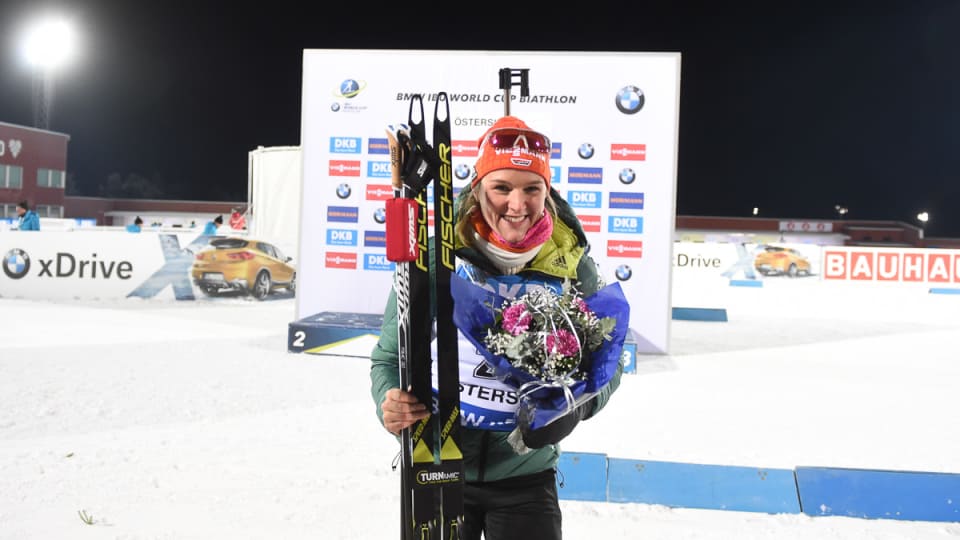
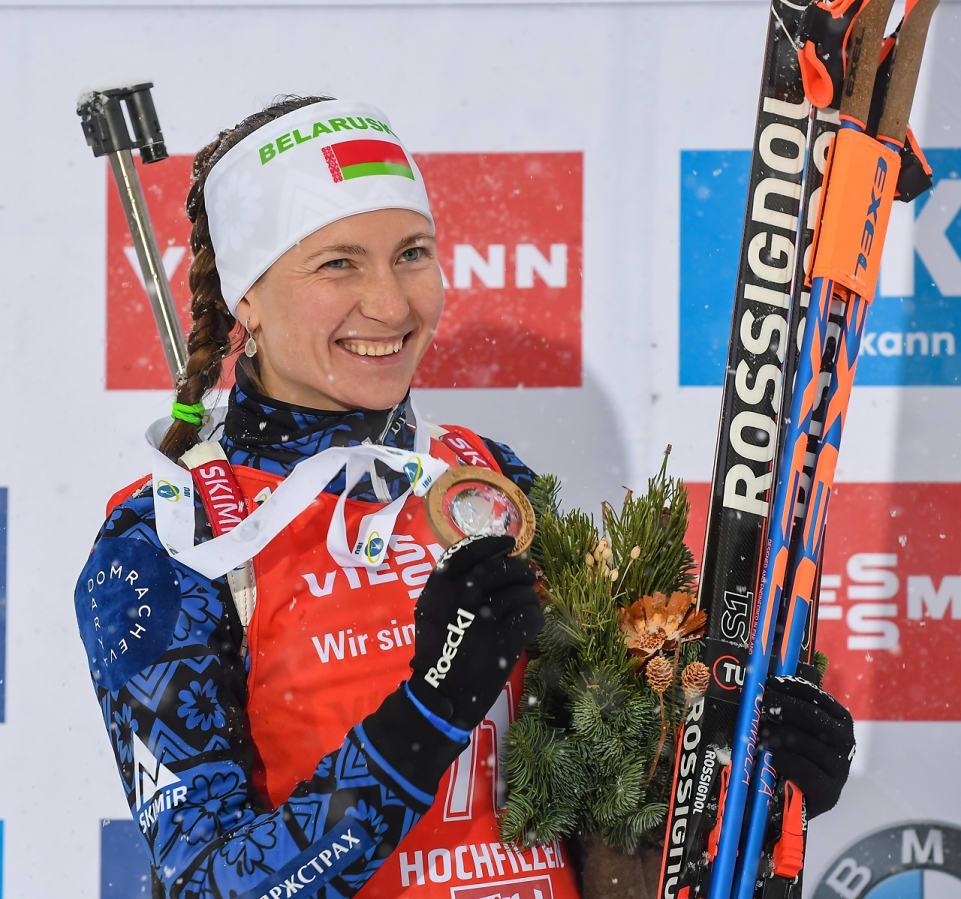
    Darya Domracheva of Belarus after winning her first race in more than a year and a half, the women’s 7.5 k sprint at the IBU World Cup in Hochfilzen, Austria, on Friday. (Photo: IBU/biathlonworld)

    Note: This article has been updated to include comments from Biathlon Canada’s Nathan Smith and Emma Lunder.

    Calm wind and a light drizzle for the men’s International Biathlon Union (IBU) World Cup sprint on Friday afternoon in Hochfilzen, Austria, turned into a full-blown blizzard for the women’s sprint that followed. One multiple-time Olympic and world champion weathered the elements best, as Darya Domracheva of Belarus won the latter with clean shooting. She was one of four women in the top 20 that cleared all 10 targets amid the white-out conditions with a strong wind ripping sideways across the range.

    “I am grateful that I was able to handle these challenging weather conditions today,” said the 31-year-old Domracheva, who had her first child just over a year ago, according to an IBU press release. “It has been a long time since I was on top of the podium, since March 2015, so it is nice to be here.”

    Domracheva is the defending Olympic champion in three disciplines: the individual, pursuit and mass start. On Friday, she won the women’s 7.5-kilometer sprint for her first win over a year and a half, after taking the 2015/2016 season off to have a child and returning to the World Cup this past January. At 2017 IBU World Championships, she raced to silver in the pursuit.
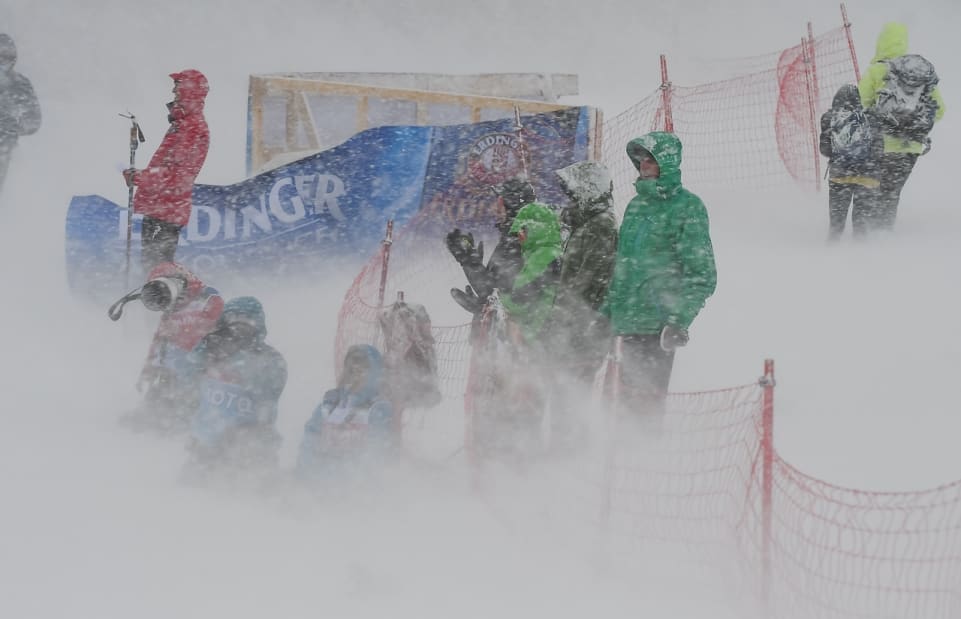
    During the women’s 7.5 k sprint on Friday at the IBU World Cup in Hochfilzen, Austria. (Photo: IBU/biathlonworld)

    But on Friday, in the second sprint of the World Cup season, she was back to her winning ways in the most challenging of conditions. After the men’s race, wet snow began to fall more steadily. Temperatures dropped, making for drier snow that intensified in the minutes leading up to the race.

    “The conditions were completely different in the race from the zeroing, so you had to adapt today,” said Domracheva, who started 71st of 102 women and bested Anastasia Kuzmina’s time by 22.1 seconds for the win in 22:40.2 minutes. Kuzmina, of Slovakia, who started just ahead of her in bib 69, placed second with a single penalty (1+0), bumping Italy’s Dorothea Wierer (bib 48), who also missed one prone target (1+0), to third (+30.6).

    “It was really strange; I could see nothing on the tracks and I had to take off my glasses,” Wierer said, according to the IBU. “In these conditions, the race was decided on the shooting range; with one mistake, that was pretty good. … I think the conditions were the same for everyone; it was snowing for the whole race.”

    “We were all hoping that the forecasted storm wouldn’t materialize, but just as predicted, the flakes started getting heavy about 20 minutes before the start,” US Biathlon’s Clare Egan explained in a post-race email to FasterSkier. “That’s when one of our wax techs says he thought about locking the wax cabin and fleeing the scene. Lucky for us he did not, and I think our skis were the best in the field today. I don’t know how they can make such fast skis for such slow conditions but somehow they manage!”

    Egan led three American women in 35th, 1:56.1 minutes behind Domracheva, with a total of two penalties: one in prone and another in standing (1+1).

    “While I was warming up the wind was extremely strong and then it seemed less intense during my race so I think the earlier starters had worse wind,” Egan recalled. “I took a couple clicks in prone [i.e., adjusted my sight for the wind] but that’s very standard. I actually did a completely normal shooting routine today in both prone and standing, which is a good thing. The trick in biathlon is to replicate your normal shooting routine even when you are in a high-stress race scenario.”

    Egan started 68th, just ahead of Kuzmina. Her overall shooting time ranked 29th in the field, while her course time was 42nd. In comparison, Domracheva had the 43rd-ranked shooting time but was fifth-fastest out on course. Kuzmina was sixth fastest on course and had the second-fastest range time (including setup and actual shooting time).

    “I did not do anything special today, but because I had special skis I managed a decent course time,” Egan wrote. “This year I am making a point to accept however my body feels on a given day and just focus on technique. When I do that, I know that even if I don’t feel great I can still have a great race.”

    In the second World Cup stop of the season, 35th is a season best for Egan and her best result since placing 34th in a sprint last March. Last week in Östersund, Sweden, she placed 75th in the sprint and 79th in the 15 k individual.

    “To borrow an expression I just learned from a British biathlete, I’m super duper chuffed with my race,” she wrote. “Last week’s racing was a real blow to my confidence so I’m very proud of the work I did to turn things around. It took a lot of mental gymnastics and help from our sports psychologist. Today’s race wasn’t exceptional but it was a solid biathlon performance and I’m very content with that. I will be completely happy when all of my teammates have races they can feel good about too. We are very much in this together.”

    Egan will be the lone American woman racing in Saturday’s pursuit in Hochfilzen; both Emily Dreissigacker and Susan Dunklee finished outside the qualifying top 60. Dreissigacker placed 89th (+3:49.1) with three penalties (1+2) and Dunklee was 97th (+4:52.9) with eight penalties (3+5).

    Two Canadian women landed in the top 60 to make the 10 k pursuit, with Emma Lunder in 42nd (+2:03.5) with a single miss (1+0)  and Rosanna Crawford in 49th (+2:19.6) with two penalties (1+1). Megan Bankes just missed the cutoff in 65th (+2:55.3) with three standing penalties (0+3), and Julia Ransom finished 100th (+5:20.6) with seven misses (3+4).

    “I was really happy with my shooting in the race,” Lunder wrote in an email. “I made sure to focus on my cues after making a 5-click correction for the wind, and took a bit of extra time setting up. It was snowing quite heavily, so I did my best to make every shot a good one, but unfortunately I did have one get away from me. When I came into standing it was a lot calmer, but still snowing a lot, so I was pleased with shooting clean! I’ve been working a lot this year on getting my confidence back in the shooting range, and I’ve seen improvements in both my prone and standing.”

    She started second, with only one racer clearing the tracks ahead of her.

    “I followed the tracks of Bib 1 for the first loop, just trying not to ski off the trail!” Lunder reflected. “It was really deep snow for that first loop but all things considered our wax team gave me some pretty quick skis for the race. I felt okay skiing today but I still need to find that next gear when I’m racing, so I’m excited to have a lot of girls around me to chase in the pursuit.”

    Smith 19th, Doherty 22nd
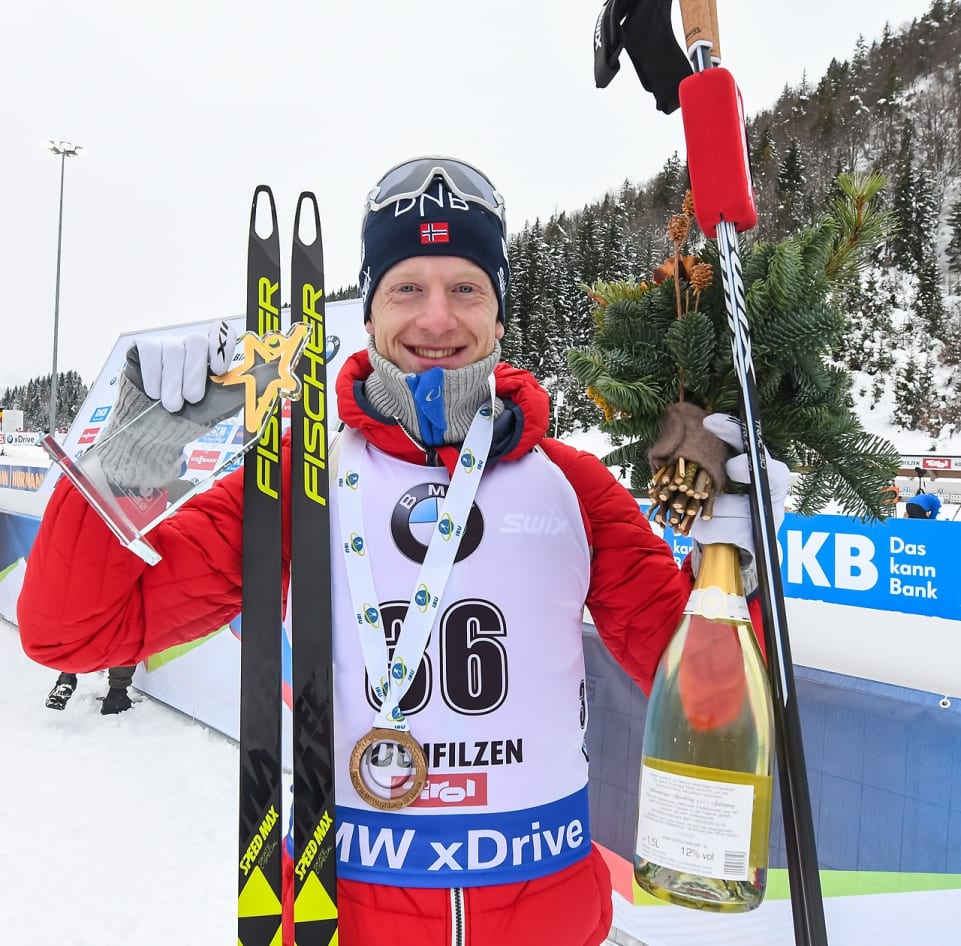
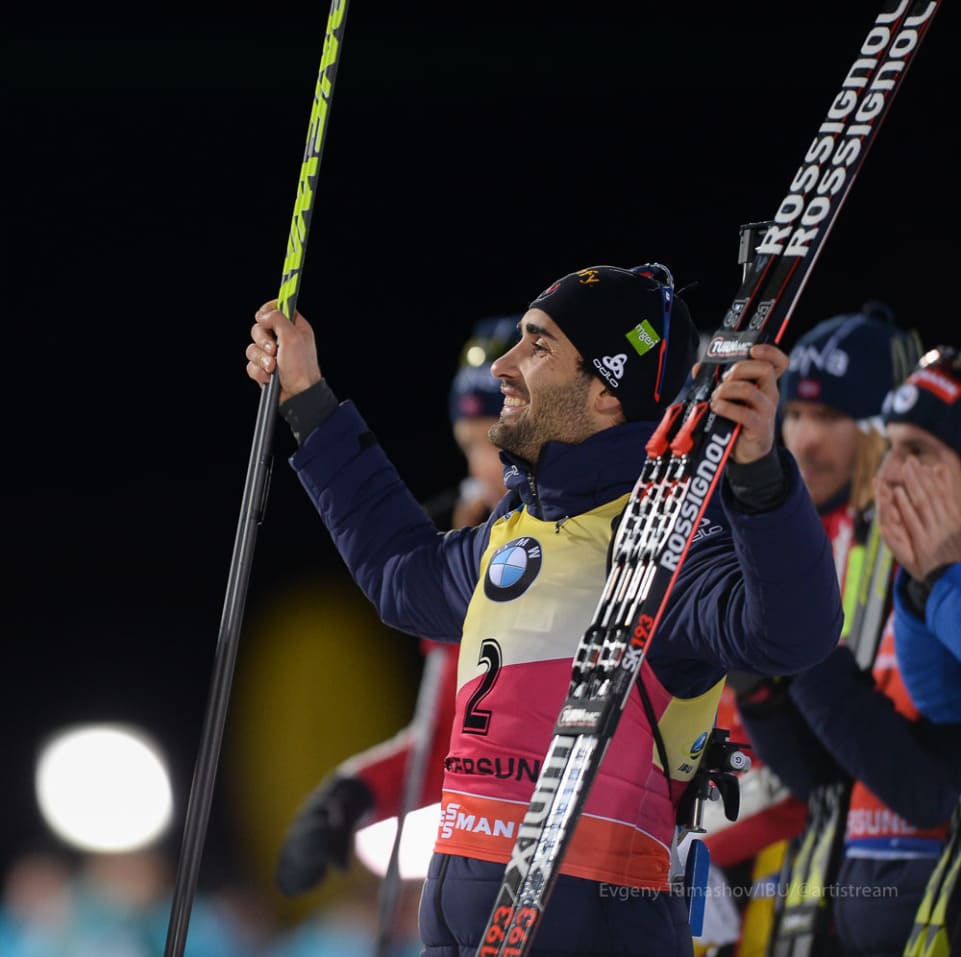
    Norway’s Johannes Thingnes Bø after winning his third race of the season (including a mixed relay and 20 k individual race last week Ostersund, Sweden) in Friday’s 10 k sprint at the IBU World Cup in Hochfilzen, Austria. (Photo: IBU/biathlonworld)

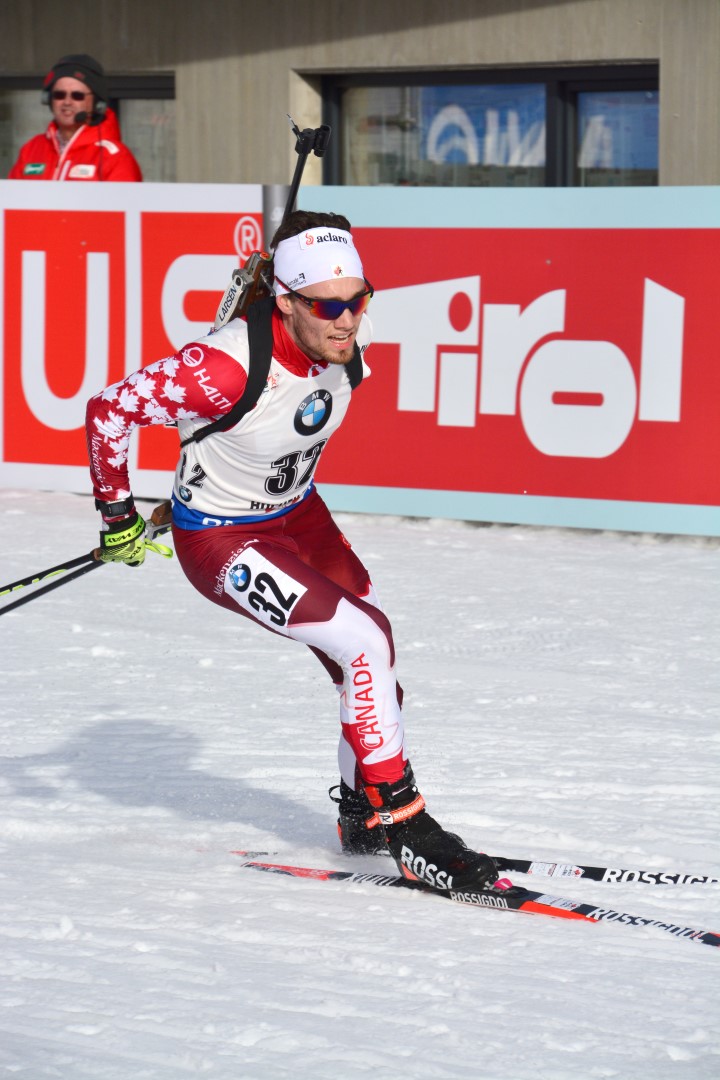
    In the men’s 10 k sprint that opened the Hochfilzen weekend, Canada’s Nathan Smith raced to 19th — his best non-relay World Cup result since March 2016 — and American Sean Doherty placed 22nd for his best result since finishing 18th in a World Cup pursuit last March. Both Smith and Doherty shot clean, along with 12 others out of 108 competitors.

    “Conditions for our race were quite good,” Doherty explained in an email. “Calm winds and overcast. Unfortunately a storm blew in for the women’s race so they had a much tougher course and range today.”

    The top-four men all shot a perfect 10-for-10, with Norway’s Johannes Thingnes Bø in bib 36 setting a faster time around the course than France’s Martin Fourcade (bib 38), who also shot clean. Bø took the win in 24:18.4 and was 12.1 seconds clear of Fourcade, who ended up second. Slovenia’s Jakov Fak notched his second-straight podium (coming off a second place in Östersund’s pursuit) in third (+35.4).

    “It is always better to be first rather than second,” said Bø, who also won the 20 k individual last week in Ostersund, according to an IBU press release. “I was lucky to shoot clean today. That is what I needed to get the win … My plan was like: go until you die, attack all the way. If you want to win, you cannot save the power…I was quite tired in the last loop, but I managed to hold on.”

    Bø’s overall course time was the fastest of the field, 15.3 seconds faster than Fourcade.

    “I cannot comment on any fight because Johannes had too big of an advantage after the standing shooting,” Fourcade told the IBU, referring to his 20-second deficit to Bø after the second shooting stage. “I am just happy that I was able to catch some seconds in the end. We had about the same ski speed as last week, but today he shot clean and I had not chance to win.”

    “I shot clean and ran as fast as I could; that is all you can do,” said Fak, who started 33rd. “I never worried much after that  … You can never be sure about the results until everyone has finished.”

    Smith started 12th and finished 1:31.9 off Bø’s winning time, posting the fifth-fastest overall shooting time while hitting every target. Smith’s course time ranked 54th overall.

    “I was carefull to take it easier for the last 15 sec before the range,” Smith, 31, wrote in an email when asked about his clean shooting. “It’s an awkward entry with a short steep bump.”

    “I’m looking to continue the solid shooting while upping my ski speed a bit, back to around what my shape had been like in November,” he stated. “I’m happy with today’s race. Top 20 is a good accomplishment and a solid step in my comeback. For the pursuit I’m aiming to improve a little and grab a top 16.”

    Doherty started in bib 79 and ended up tying Slovenia’s Klemen Bauer for 22nd, 1:39.2 back. (Bauer had a single penalty in prone.)

    “As long as I stay disciplined the targets will fall,” the 22-year-old Doherty wrote of his clean shooting. “Overall I am happy with my race today. I am excited to take the momentum into the pursuit tomorrow.”

    Saturday will be his first pursuit of the season after placing 82nd in the Östersund sprint. He also placed 38th in the 20 k individual there.

    “The start to the season in Ostersund was tough,” Doherty noted. “That course there is one of the hardest on the whole circuit and we had exceptionally poor snow conditions for the individual, so that was a brutal race. Here in Austria I was looking to make a step froward towards the level of racing I know I am capable of and take care of the final Olympic criteria.

    “To be honest my skiing is pretty poor right now, and that’s fine,” he added.

    Doherty’s overall shooting time was 29th fastest while his course time ranked 57th.

    “The important part of the season is still a ways away and that is when I will be on form,” he wrote. “In general I think I am off to a good start this season but there are still many races to go. So I just want to keep working and using each race as an opportunity to keep improving.”

    All four Canadian men qualified for Saturday’s 12.5 k pursuit, with Scott Gow finishing 43rd (+2:25.1) with three penalties (2+1), Brendan Green 51st (+2:30.3) with one standing miss (0+1), and Christian Gow 54th with clean shooting.

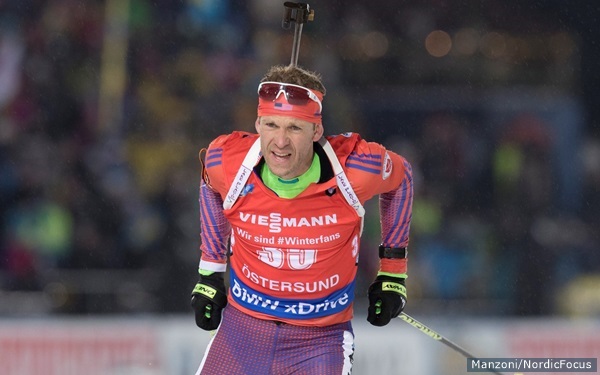
    For the U.S., Lowell Bailey is also in after placing 53rd (+2:32.4) with two penalties (2+0). Tim Burke finished outside the necessary top 60 in 73rd (+3:00.7) with three misses (1+2), Leif Nordgren was 98th (+3:40.2) with three standing penalties (0+3), and Paul Schommer 103rd (+3:54.6) with three misses as well (1+2).

    The men race at 6:15 a.m. Eastern Standard Time Saturday, followed by the women at 8:45 a.m. EST.
    Results: Women | Men

    Pursuit start lists: Women | Men

  • West Yellowstone in Review: Big Wins from Hart, Michaud, Bångman, and Brian Gregg

    West Yellowstone in Review: Big Wins from Hart, Michaud, Bångman, and Brian Gregg

    Another SuperTour season opened in West Yellowstone, Montana, one weekend later than usual this year but with a lot of the old standbys, including a twisty, technical freestyle sprint course and puzzling conditions for the classic distance race.

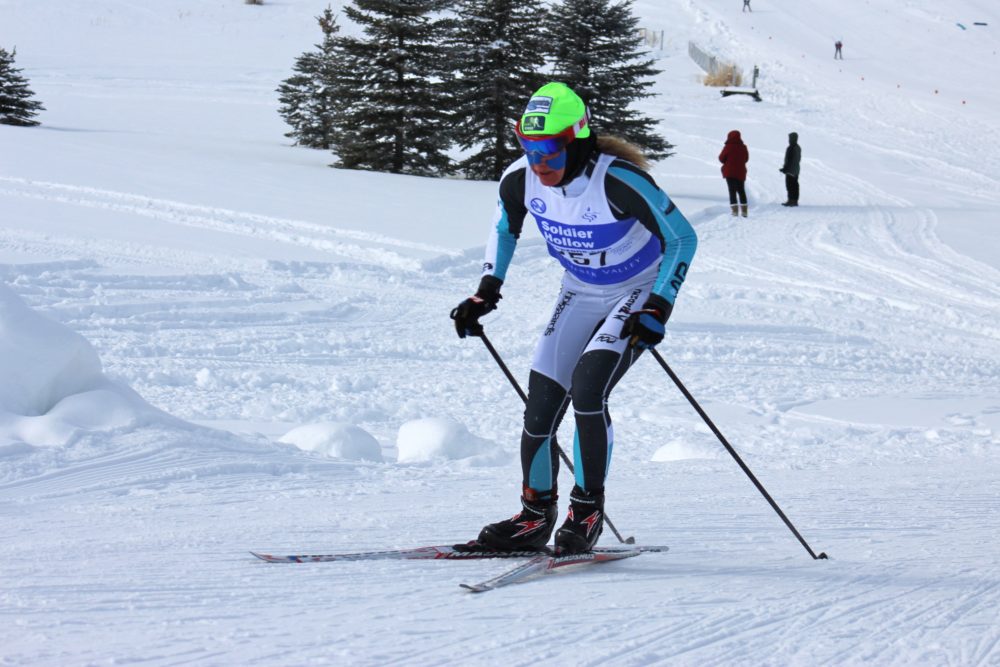
    In a crash-marred women’s final on Saturday, Dec. 2, Anne Hart of the Stratton Mountain School (SMS) Elite Team avoided a tangle between Caitlin Gregg (Team Gregg) and Caitlin Patterson, of the Craftsbury Green Racing Project (CGRP), and skied to the win. According to Hart’s teammate, Erika Flowers, who also raced in the final, the two Caitlins collided in the final winding section before the last big uphill.

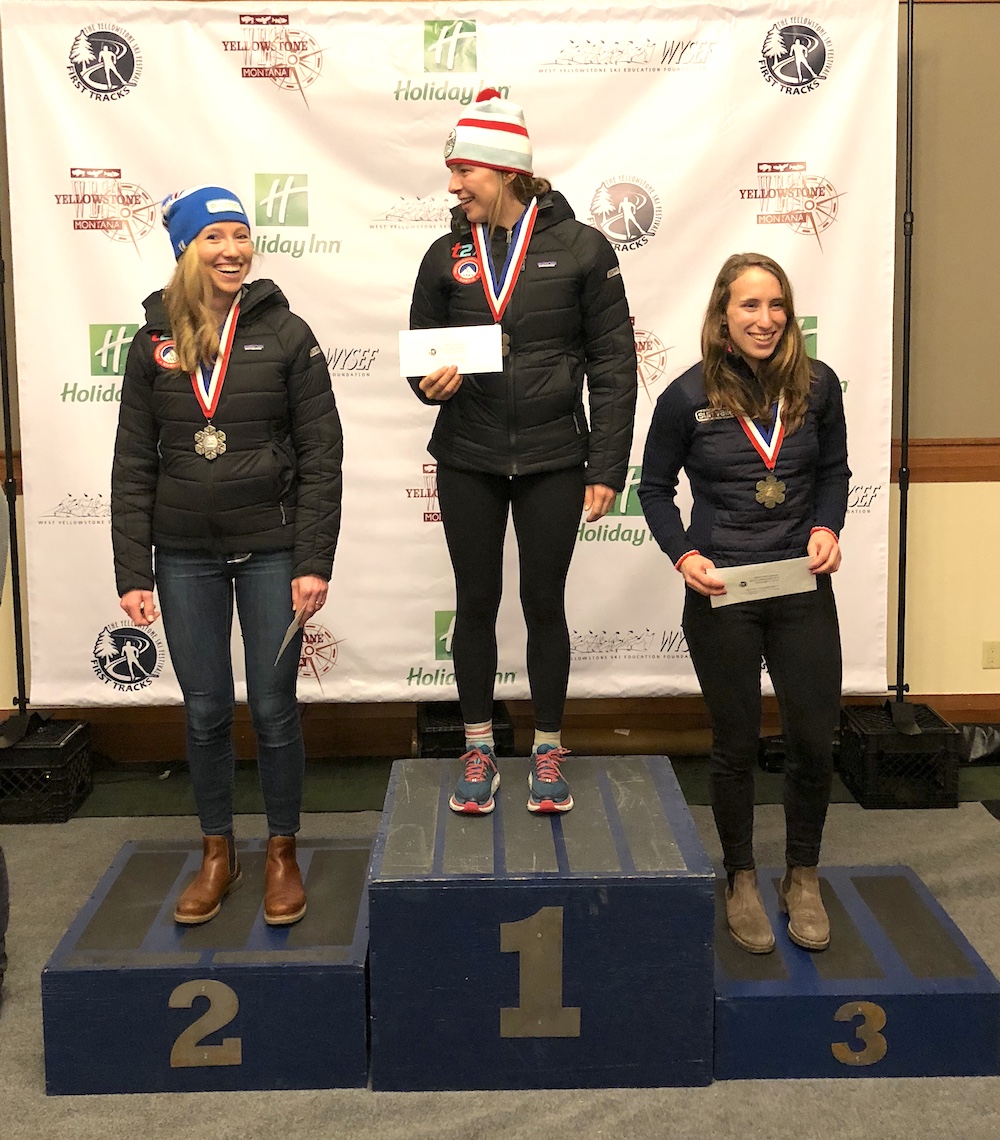
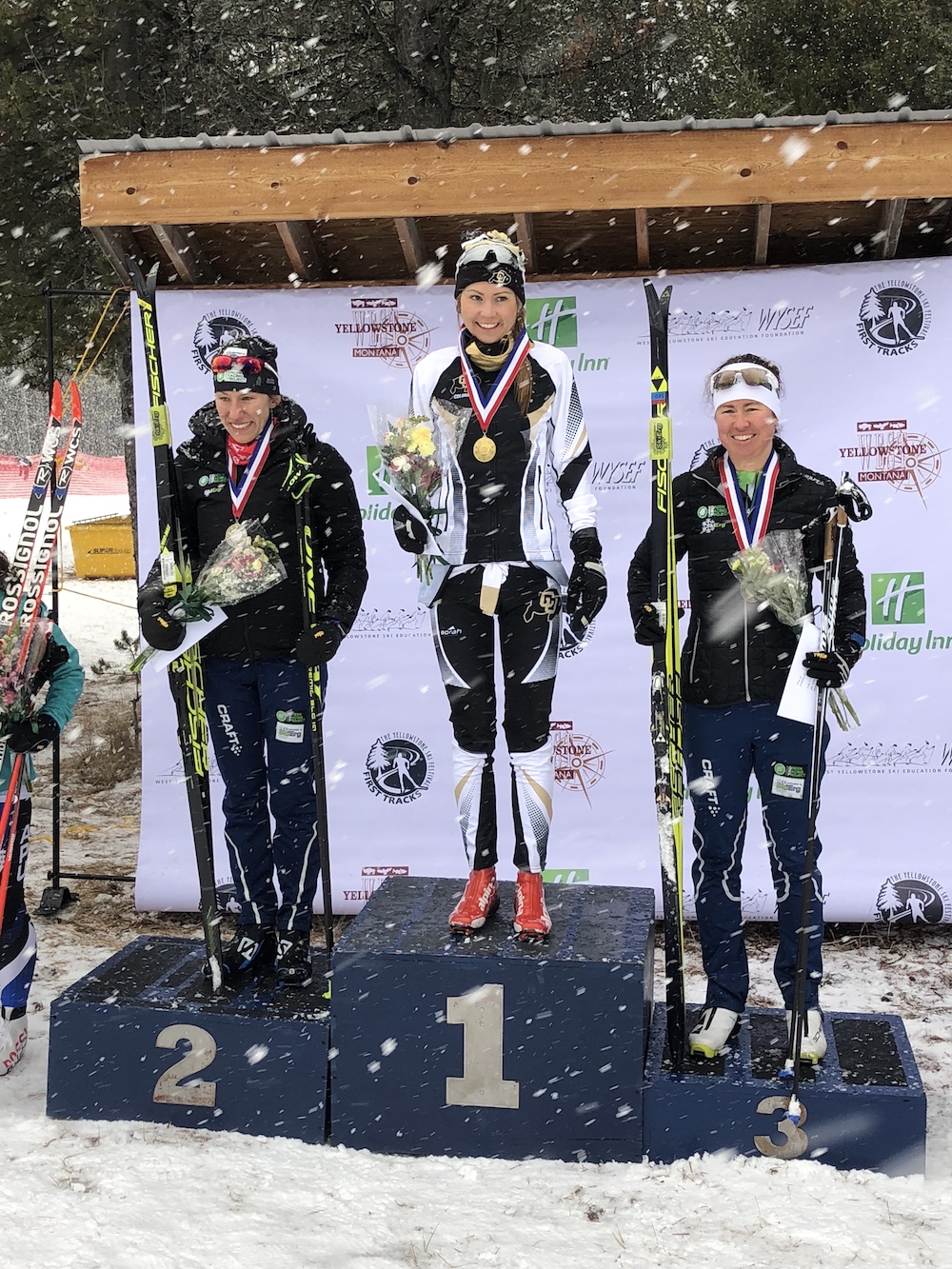
    The women’s skate sprint podium at the first race of the 2017/2018 SuperTour season on Dec. 2, with the SMS Elite Team’s Anne Hart (c) in first and Erika Flowers (l) in second, and Sun Valley’s Kelsey Phinney in third. (Photo: FBD)

    “They went down and some people were just ahead of them and were able to ski around,” Flowers said.

    Hart was one of them.

    “In my journal last night I actually had part of the course labeled ‘mushroom boost,’ which is right over the top of that last hill,” Hart said with a laugh in a post-race interview.

    One of her goals for the day had been to save her “best burst for the end,” she continued. “So I was able to do my planned mushroom boost at the end, came across with the win and I couldn’t be more thrilled.”

    She won the women’s 1.5-kilometer freestyle sprint final in 2:52.49 minutes, just 0.88 seconds ahead of Flowers in second and 0.92 seconds ahead of Kelsey Phinney, of the Sun Valley Ski Education Foundation (SVSEF), in third.

    Alaska Pacific University (APU) and U.S. Ski Team Development (“D”) Team member Hannah Halvorsen followed in fourth (+2.16), while Gregg finished fifth (+6.99) and Patterson was sixth (+7.22).

    “I was fortunate not to go down,” Flowers said, “but I was stuck behind [the crash] so by the time I got kind of untangled from Caitlin Patterson, I was maybe 20 meters back from the group. I was feeling good and I really wanted to win today so I just hammered and was happy to sneak into second place at the end there.”

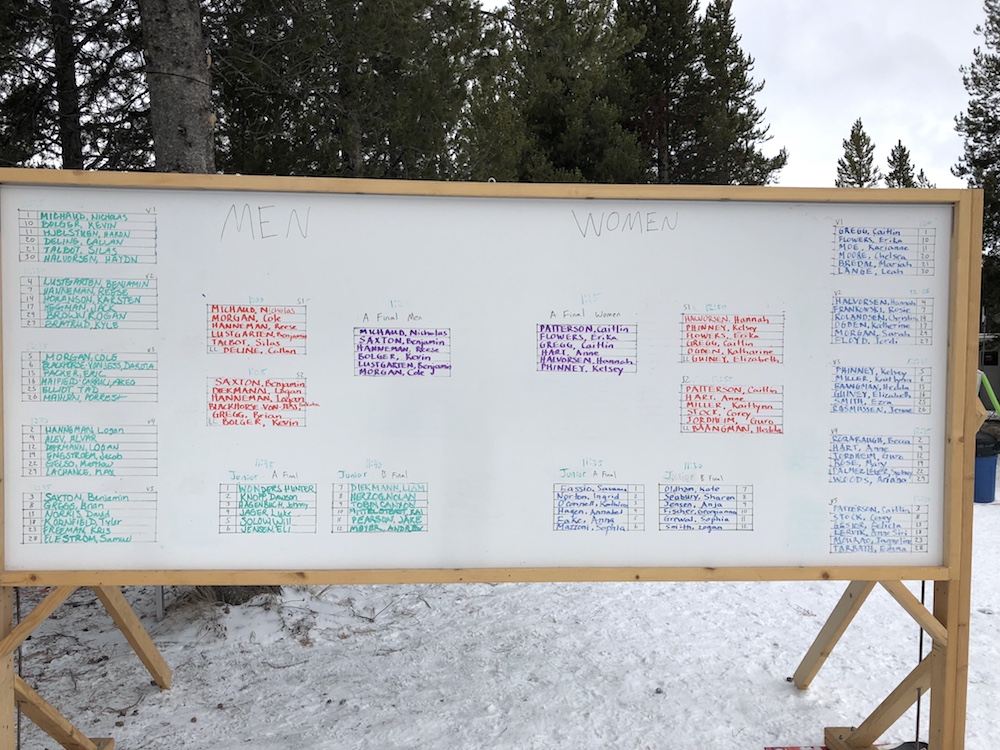
    A look at the SuperTour sprint lineups for the heats on Dec. 2 in West Yellowstone, Montana. (Photo: FBD)

    The sprint day began with Gregg winning the women’s qualifier in 2:50.79. Becca Rorabaugh (APU) qualified second (+2.7) and Patterson was the third-fastest qualifier (+3.0), ahead of Halvorsen in fourth (+5.64) and Phinney in fifth (+6.12). Hart qualified ninth (+8.98), just ahead of Flowers in 10th (+9.03) out of 58 in the women’s race.

    “It’s a weird, fast and very tactical sprint course at high elevation,” Hart said of the Rendezvous Ski Trails’ race course some 6,800 feet above sea level. “So my qualifier wasn’t maybe exactly what I’d hoped but it wasn’t terrible, it wasn’t way off the mark, and I just tried to go through each round skiing in the front and in control. That didn’t happen in the final, but it turned out my being in the back and being sort of tactically aware allowed me to pass a crash.”

    Hart won her quarterfinal and finished second to Patterson in their semifinal. Flowers won the other semifinal to advance to the final, and also won her quarterfinal. Phinney, who ultimately placed third, made it to the final as a lucky loser after finishing fourth in her semifinal, 1.88 seconds behind Flowers in first. Phinney had previously won her quarterfinal.

    “You never really know what to expect for the first sprint of the season,” Phinney said. “I had a pretty good qualifier and then I led my quarterfinal and [that] ended up being the faster quarterfinal so I was feeling pretty good.”

    Phinney’s winning quarterfinal time was more than 3.5 seconds faster than the winning times of the four other quarterfinals.

    “The final was a little bit of mayhem,” Phinney added. “It was kind of just staying on your feet, being able to jump over people’s poles and hope for the best.”

    While most of the top women planned to continue racing at the next SuperTour at the NorAm season-opener this weekend, Dec. 9-10, in Sovereign Lake (a.k.a. Silver Star), British Columbia, most are focused on U.S. Cross Country Championships from Jan. 3-8 in Anchorage, Alaska. And beyond that, some are hoping to get selected to the U.S. team for the 2018 Winter Olympics in PyeongChang, South Korea.

    “I’d really like to win that skate race at U.S. nationals,” Flowers said. “That’s definitely been a goal of mine for the last few years and I haven’t made it happen yet, but I’ll definitely try this year.”

    Michaud’s First Win

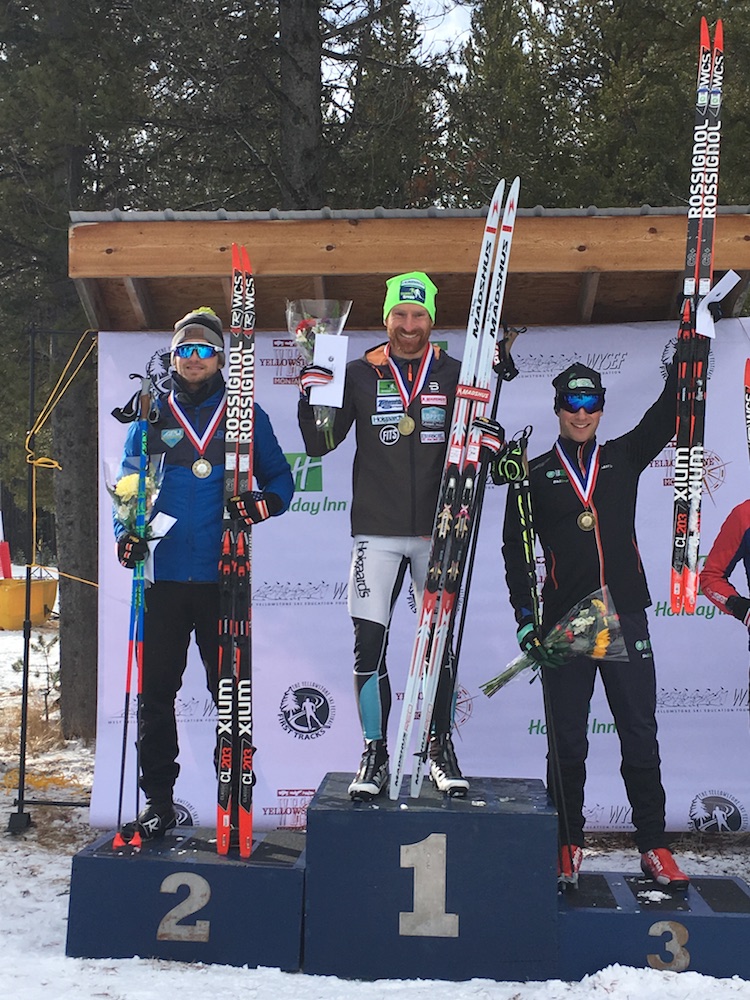
    In the men’s 1.5 k skate sprint the same day, Nick Michaud of the Bridger Ski Foundation (BSF) won the qualifier and every heat thereafter to capture his first-career SuperTour win (and podium) with a winning final time of 2:30.69. He previously won the qualifying round in 2:29.5, just 0.08 seconds ahead of Logan Hanneman (APU) in second.

    Ben Saxton (SMS Elite Team) qualified third (+0.63), Ben Lustgarten (CGRP) followed in fourth (+0.98) and Cole Morgan (SVSEF) was fifth (+1.3).

    Michaud, a 25-year-old who has been jumping into SuperTours since 2010, then won his quarterfinal by 0.13 seconds over his BSF teammate Silas Talbot and his semifinal by just 0.05 seconds over Reese Hanneman (APU).

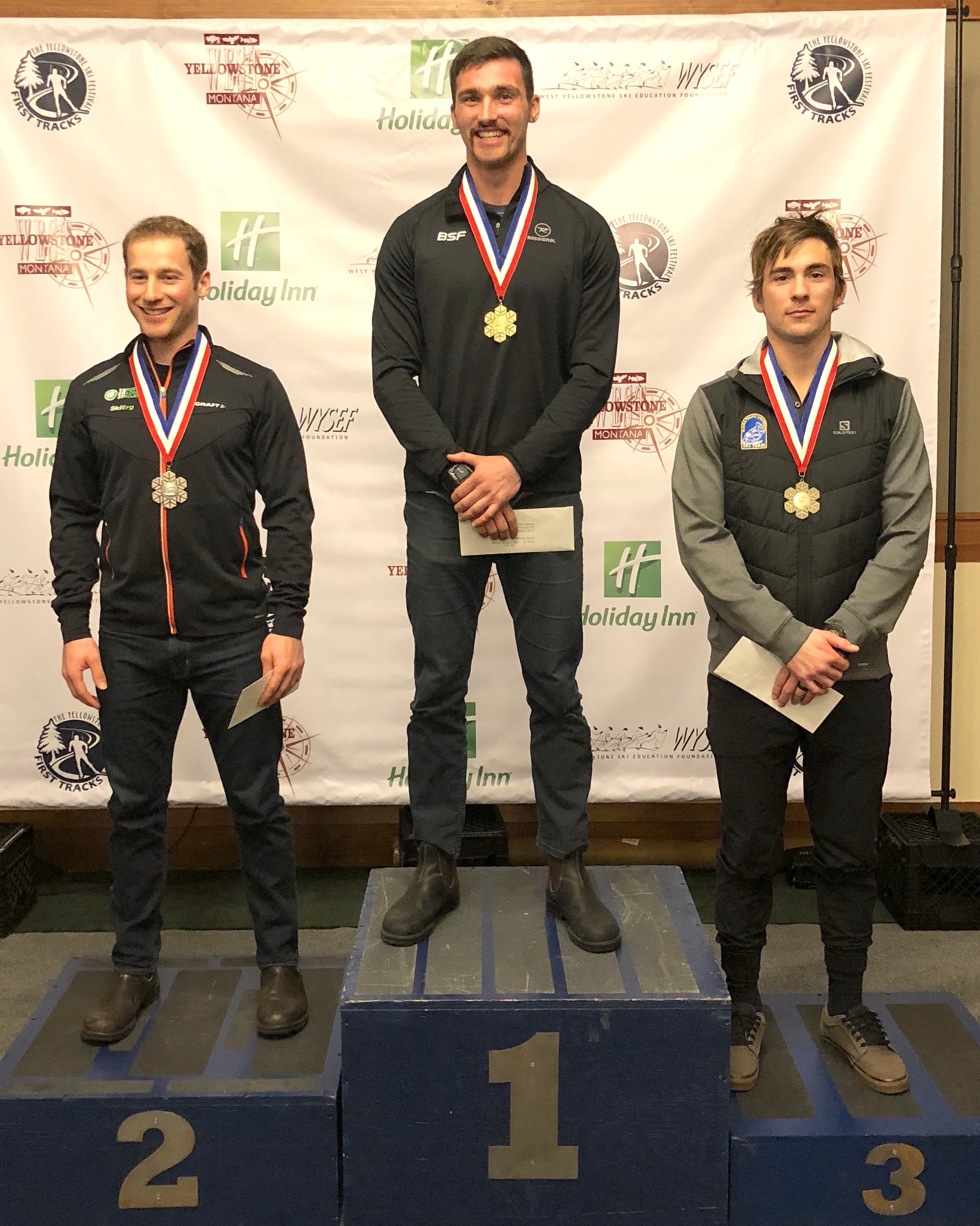
    The men’s skate sprint podium at the first race of the 2017/2018 SuperTour season, with Nick Michaud (c) in first and Ben Lustgarten (l) in second, and Reese Hanneman in third. (Photo: FBD)

    In the final, Michaud skated to a 0.17-second win over Lustgarten in second, while Reese Hanneman crossed the line in third (+0.84).

    “It was just so fun,” Michaud said after. “Conditions were great. Everyone was out here. Great skis, great support; it was just so fun to race.”

    Like many of his competitors, Michaud was looking for another standout result in the classic sprint at Sovereign Lake and had his sights set on U.S. nationals beyond that.

    Hanneman had similar goals.

    “The qualifying criteria for the sprint for the Olympics this year is just on the qualifier and obviously it’s a classic sprint at the Olympics so I think the classic sprints are going to be more important,” Hanneman said. “We have two classic sprints coming up between Silver Star next weekend and nationals in Anchorage [where both a skate sprint and classic sprint will be held] so I’m focusing on throwing down some good classic sprints.”

    After qualifying in seventh then winning his quarterfinal and placing second to Michaud in his semifinal, Hanneman described the heats as “crazy fast.”

    “This is probably the fastest I’ve ever seen it in West so that just means really high speeds and people weren’t really separating much, so you had to be really strong to make moves to pass people at those speeds,” Hanneman reflected. “In the final, everybody was just going for it, and I was able to find a hole and double pole by people going into that final hill there and kind of throw it down there. I burned up some of my matches trying to make that big move to go from the back of the pack into second so I faded a little bit in the final 100 meters, but other than that I was happy with it.”

    Lustgarten, who advanced to the final after placing second in his quarterfinal and third in his semifinal (behind Michaud and Hanneman) described the rounds as “a bit sketchy with the corners. There’s a lot of turns out there; people trying to take insides, going out, going in,” he said.

    “So that was pretty fun and also pretty sketchy and I just had to have really strong finishes because I kept getting boxed out in the back,” Lustgarten added. “But I managed to make my way through the pack on the hills.”

    Also in the final, Kevin Bolger (SVSEF) finished fourth (+2.11), Saxton placed fifth (+2.86), and Morgan took sixth (+3.42).

    Brian Gregg, Bångman Strike Late for Distance Win

    On Day 2 of the SuperTour-opening weekend, racers faced freshly falling snow for the distance races: the women’s 10 k and men’s 15 k classic mass starts.

    While a large group of men stuck together on the first of three laps, by Lap 2, the race leaders, including Brian Gregg, had started to break away. By the third and final time up Telemark Hill, the distance course’s signature climb, David Norris (APU) recalled that they were down to about eight.

    “It was super snowy starting out,” Norris said. “… The pack actually ran really smooth. Every lap on Telemark, I think the pack got smaller. … [The last time up it] I led into Telemark, the big climb, and got to the top of there just with Lustgarten and Brian Gregg, and it was kind of a single-file drag race to the finish. On the last pitch, Brian got up next to me and just kind of pulled away a little bit into the finish.”

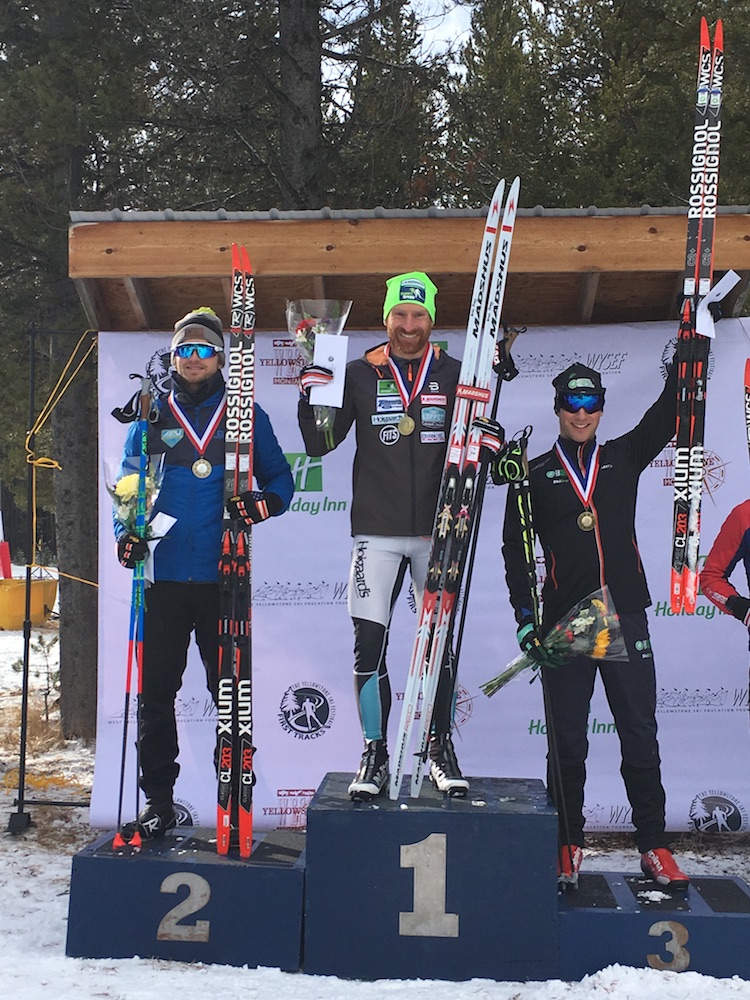
    The men’s 15 k classic mass start SuperTour podium on Dec. 3 in West Yellowstone, Montana,with Brian Gregg (c) of Team Gregg in first, David Norris (l) of APU in second, and Ben Lustgarten (CGRP) in third. (Photo: FBD)

    Gregg, of Team Gregg and Loppet Nordic Racing (LNR), captured the first SuperTour distance win of the season in 41:30.3, just 1.9 seconds ahead of Norris in second. Lustgarten notched his second-straight podium in third place (+4.6), while Kyle Bratrud (CXC Team) finished fourth (+10.9) and Kris Freeman (Caldwell Sport) was fifth (+12.6).

    Tad Elliott (Ski & Snowboard Club Vail) followed in sixth, Eric Packer (APU) was seventh, Ian Torchia, of Northern Michigan University (NMU) and the USST D-Team, was eighth, Hunter Wonders (APU) ninth, and Martin Bergström (University of Utah Ski) 10th.

    Gregg explained that after some pre-race deliberation, he chose to ski on zeros to ensure he had enough kick and avoid icing on the bottom. He was happy with his decision and noted that the he had waxing help from a group composed of several Midwest teams, including LNR, NMU and Central Cross Country (CXC).

    “Our [lead] group of skiers out there all had really good skis so that was really fun,” Gregg said. “It was kind of a tactical race in the sense that it was really hard, like, [you’d] maybe get a little gap on the climbs, but then everybody would bunch back together, so I just tried to conserve energy and really focus on the last kilometer or two kilometers.”

    When Norris attacked on Telemark Hill, Gregg said he followed Norris and Lustgarten over the top.

    “… I was last, then we came in and I just had a little bit more in the end,” he said. “I was really happy with that. I haven’t won a classic SuperTour race since my first SuperTour win in 2010 so there was a few years in between there, but I’ll take it.”

    Gregg, 33, is a 2014 Olympian, who, like his wife (2010 Olympian) Caitlin Gregg, is looking to qualify for a second Olympics this season in PyeongChang. He was pleased with his tactics on Day 2 in West Yellowstone after finding himself too far behind on the sprint’s last climb to contend (he made it to the semifinals and finished ninth overall in the sprint).

    As for Sunday’s distance race, in which Gregg conserved his energy and struck at the right moment, Gregg said he learned from others, too.

    “It’s fun to see other skiers — Tad Elliott is a really good tactician out there so I actually skied a lot with him watching where he’d spend the energy to move up in the pack and where he was just sort of relaxing,” Gregg said.

    “It was definitely faster to be in the draft behind people so the leaders were kind of at a disadvantage,” Lustgarten observed after. “I was kind of mixing it up in the top 20 for the first two laps, and it felt pretty chill, but this is the kind of course where it can go from easy to hard in, like, 50 meters.”

    He explained that Rogan Brown (SVSEF) led for most of the second lap. Brown ultimately tied Adam Martin (CGRP) for 11th place (+28.6).

    “On the third lap I took the lead to do some work myself and then kind of was stuck in the lead unfortunately for most of the lap,” Lustgarten said. “It went from going to pretty easy to really hard in about a k.”

    While he responded to Norris’s attack on Telemark Hill, he couldn’t match Gregg in the meters that followed.

    “Brian Gregg came out of nowhere and I thought I could kind of sneak into second but I just didn’t have it today,” Lustgarten said. “That’s what I want to do with the race. He did it right. I think the best way to do it was to sit in the pack, kind of play the field, see how everyone goes, and just hammer the finish. He did really well today.”

    In the women’s 10 k classic mass start, Hedda Bångman, new to the University of Colorado Boulder (CU) Ski Team this year, double poled to the win in 30:24.8 over two Craftsbury’s Kaitlynn Miller and Caitlin Patterson, respectively.

    “It was really hard conditions today, and I decided just one minute before the start to switch skis,” said Bångman, a 22-year-old Swedish student. “I took my zero skis and I think it was a good decision. I knew before I started I was forced to do double poling because my grip wasn’t the best on the skis so it was hard but … it felt good, except the technique zones [where double poling is not allowed], of course.”

    The West Yellowstone SuperTour women’s 10 k classic mass start podium, with Hedda Bångman (c) of the University of Colorado Boulder in first, and Craftsbury’s Kaitlynn Miller (l) and Caitlin Patterson (r) in second and third, respectively. (Photo: FBD)

    Bångman is new to the U.S. in her freshman season with CU.

    “My shape is good. Everything was good today. It was fun to race and fun to be here to race,” she said. “It’s a little bit different compared to Scandinavia, but I like it. … It feels like it’s more relaxed here, but maybe it’s just my feeling.”

    Miller raced to second place, 1.3 seconds back, ahead of her CGRP teammate Patterson in third (+3.4).

    “It was a nice big group of us for a while there and the conditions were kind of lose and powdery, which I enjoy, so I was having fun with that,” Miller said, noting the APU’s Rosie Frankowski carried a lot of the load of setting the pace up front. “There was a nice group of us for a while that slowly just kept kind of stringing out until there were maybe four or five of us left, and then it was sort of just a sprint to the end there. Hedda kind of came in from third or fourth and just had a really good push to the finish…”

    Frankowski finished 10 seconds after Patterson for fourth place (+13.5), Katharine Ogden (SMS/USST D-team) was fifth (+17.2), Caitlin Gregg sixth, Felicia Gesior (CXC Team) seventh, Anne Siri Lervik (CU) eighth, Flowers ninth, and Corey Stock (BSF) 10th.

    “I want to commend Rosie Frankowski for really pushing the pace middle of the race,” Patterson said. “I think a lot of us out there had fairly slick skis so we were double poling a lot, but they had two technique zones per lap so that was interesting. We had to run those — a little striding, running, herringbone, whatever works to get the diagonal stride. … By the finish we were down to about three of us, and [Bångman] was first and my teammate Kaitlynn Miller had strong double pole into second and I was right behind them in third, so pretty solid day.”

    The SuperTour circuit now moves to Canada to join up with the Sovereign Lake NorAm, with a classic sprint on Saturday, Dec. 9, and 10/15 freestyle individual starts on Sunday, Dec. 10.

    Complete results:

    Day 1 freestyle sprints (scroll to bottom) 

    Day 2 classic mass starts

  • Fourcade Leaves Östersund with a ‘W’; Bailey 17th; Christian Gow Gets Career-Best 21st

    Fourcade Leaves Östersund with a ‘W’; Bailey 17th; Christian Gow Gets Career-Best 21st

    France’s Martin Fourcade celebrating his first IBU World Cup win of the 2017/2018 season in the men’s 12.5 k pursuit on Sunday in Östersund, Sweden. (Photo: IBU/biathlonworld)

    If you were to ask France’s Martin Fourcade what’s wrong with a second and third place, and even two fourth place finishes in the first four races of the International Biathlon Union (IBU) World Cup season, he’d likely politely tell you nothing — it just wasn’t up to his usual standards.

    “Despite my two podiums here, I felt that if I had not won here, it would have been my worst season opener since, for seven years in a row, I won here,” the 29-year-old defending World Cup champion told the IBU after Sunday’s pursuit in Östersund, Sweden. “Now I can be very calm and relaxed for the next competitions.”

    He got down to business out of the start of the men’s 12.5-kilometer pursuit, starting second, just 1 second behind Norway’s Tarjei Bø, who won the sprint to start the pursuit first. Early in the first of five 2.5 k loops, Fourcade set the pace with Bø and Germany’s Erik Lesser in bib 3 slotting in behind him. Fourcade entered the range first to take Lane 1 for the first prone stage, where he and Bø both missed a shot to slip to fifth and sixth, respectively, after each skiing a penalty lap. Meanwhile, Lesser missed four to drop out of the top 30 and nearly a minute and 20 seconds out of first.

    While Fourcade left the range 10 seconds behind Norway’s Emil Hegle Svendsen, who had moved into first with clean shooting, he was back into first 2.5 k later. On the second prone, Fourcade and Bø both cleaned to leave the range just 3.8 seconds apart in first and second, respectively. Svendsen missed one to slip 18 seconds back to third.

    On Loop 3, Fourcade switched into high gear. Bø kept pace, but by the time they lined up together for the first standing stage, Fourcade had the edge. The Frenchmen once again cleaned while Bø missed three to fall to 18th and nearly a minute and a half out of contention by the time he finished his penalty laps.

    Game over. Fourcade spent the next two loops and final shooting going through the motions to secure his victory, cleaning the last standing stage with the 25th-fastest shooting time, then slowly turning to look up at the crowd. He appeared relaxed with his two closest challengers, his French teammate Quentin Fillon Maillet and Slovenia’s Jakov Fak, who started 2 seconds apart in 12th and 10th, respectively, and shot identically (1+0+0+1), skiing together more than a minute back in second and third.

    Fourcade’s final loop time ranked 51st out of 58 yet he still finished first, 40.8 seconds clear of Fak, who dropped Maillet on the final climbs before the stadium. Fourcade claimed his first win of the season in 30:12.2, Fak placed second for his first podium since 2015, and Fillon Maillet took third (+42.1).

    “I must say that I was very surprised because after the third shooting it was more a fight against myself,” Fourcade said. “I am very satisfied about the biathlon I showed.”

    “I think Quentin and I worked well together, half the loop each pushing to keep on the podium,” Fak told the IBU. “Both can be very satisfied about finishing on the podium and leaving Sweden with this result.”

    On a day with variable wind conditions and soft, slow snow, no one in the men’s race shot clean. Six hit 19 of 20 targets, including Fourcade and his brother Simon Fourcade (ninth place) and Norway’s Lars Helge Birkeland (sixth place) in the top 10.

    Christian Gow (Biathlon Canada) racing to his previous career best of 23rd in the men’s 12.5 k pursuit at 2017 IBU World Championships in Hochfilzen, Austria. On Sunday, he placed 21st in the Östersund World Cup pursuit. (Photo: Glen Crawford)

    Biathlon Canada’s Christian Gow also finished with a single penalty (0+0+1+0) in 21st for his best World Cup result. Gow had started the pursuit 26th and 58 seconds back, and picked off five places to finish 2:04.6 behind Fourcade.

    “[Saturday] was my best sprint placing ever, so I knew I was in a good position for the pursuit,” Gow wrote in an email to FasterSkier. “I knew a top 20 was possible, and maybe more if my skiing was on form. Unfortunately, I had some shin issues skiing today so I wasn’t able to ski as well as I would have liked. But I did my job on the range and am happy with how the race turned out.”

    The shin pain he referred to wasn’t anything serious, “just bothered me today for some reason,” he elaborated. “I’m not too concerned though, I’m sure they’ll be fine in a couple days.”

    His shooting time ranked 22nd overall compared to his overall course time in 49th.

    “The shooting conditions were challenging today, but I knew that I could still shoot well if I stayed focused in the range,” Gow wrote. “I shot confidently today and I think that helped a lot.”

    He consistently left the range within striking distance of the top 20: first in 22nd, then in 21st, then 26th, and finally 20th.

    “The course was pretty soft today. That added an extra challenge skiing,” he continued. “I made up all of my time in the range today, but am quite happy with my last loop. I am proud of how hard I was able to push myself on that lap to keep my placing.”

    Leaving Östersund, where he and his older brother Scott Gow and another teammate Julia Ransom all achieved career bests to start their season, Gow said the team mood was positive.

    “Almost everyone had at least one result that they can be proud of and we really performed well as a team which boosts everyone’s confidence I think,” he wrote.

    Four Canadians qualified for the men’s pursuit, with Nathan Smith finishing 42nd (+3:19.2) after starting 24th and missing three shots (1+0+0+2). Scott Gow placed 50th (+4:10.9) after starting 16th and incurring six penalties (1+2+1+2), and Brendan Green followed in 51st (+4:18.6) with five penalties (0+2+2+1).

    Bailey Gets First Top 20 of Season

    Lowell Bailey (US Biathlon) racing to 17th in the IBU World Cup men’s 12.5 k pursuit on Sunday in Östersund, Sweden. (Photo: USBA/NordicFocus)

    Lowell Bailey led two Americans in the pursuit, starting 22nd and 50 seconds back and rising to 17th (+1:40.2) with two penalties (0+1+0+1). After cleaning the first prone stage, where several of the top competitors incurred penalties, Bailey moved up to 12th and 39 seconds out of first.

    One loop later, he found himself nearly a minute back in 19th after a penalty on his second prone. Bailey worked his way back to 11th after cleaning his third stage, but slipped to 15th with a miss in the final standing stage.

    “The range was tricky today. The wind was very shifty and constantly changing,” Bailey explained in an email. “I only tried to focus on the fundamental parts of my shooting (e.g. trigger squeeze, breathing, etc.) and make sure that I was taking good shots.  My groups did move around from one prone to the next, but fortunately, most of the shots stayed in the hit zone.

    “I’m happy with the shooting today,” he continued. “I tried to execute the type of shooting that I’ve worked on all summer.  Although I was happy with the shooting result in the Sprint, I know that I could have shot faster.  It’s a delicate balance; when to go for speed and when to hold back for accuracy.”

    His shooting time in the pursuit ranked third overall, while his course time was 42nd.

    “I definitely don’t feel in my best shape yet,” he wrote. “We deliberately approached the season conservatively, with the mindset that the Olympics are months away and I want to be in my best shape when I hit the tracks in Pyeongchang.”

    Leaving Östersund, where he finished 22nd in the sprint and 67th in the 20 k individual, Bailey wrote that he was satisfied with his first week of racing considering that he came down with a cold a week earlier.

    “All things considered, I feel very fortunate to have come away with some WC points in a field which seems to be one of the strongest international biathlon fields yet,” he wrote.

    Also for US Biathlon, Tim Burke finishing 48th (+3:52.7) after starting 52nd and missing four shots (2+0+1+1).

    With the conclusion of the first IBU World Cup in Östersund, the circuit moves to Hochfilzen, Austria, where racing kicks off again Friday, Dec. 8, with men’s and women’s sprints.

    Results

  • Herrmann Rises to First IBU World Cup Win; Ransom 29th in Östersund

    Herrmann Rises to First IBU World Cup Win; Ransom 29th in Östersund

    Germany’s Denise Herrmann after winning the first IBU World Cup race of her career on Friday in the women’s 7.5 k sprint in Östersund, Sweden. (Photo: IBU/biathlonworld)

    Just over a year and half ago, Germany’s Denise Herrmann took a giant leap and diverged from her career as a World Cup cross-country skier to take up biathlon. She did so at the age of 27, after having been the second-ranked sprinter in the world at the end of 2013/2014 and earning a bronze medal in the women’s relay at the 2014 Olympics. She narrowly missed another Olympic medal, placing fourth in the classic team sprint with Stefanie Böhler. A year later, Herrmann was fourth again in the 2015 World Championships freestyle team sprint with a different teammate, Nicole Fessel.

    After all that, she wanted something different, something new.

    “I owe a lot to cross-country skiing, it was a great time with many highlights, but now I want to face new goals,” Herrmann stated at the time. “The switch to a new discipline will be a big challenge, I am aware of that, but I am confident that I can do it with diligence, courage, and determination!”

    After bouncing between the International Biathlon Union (IBU) Cup and IBU World Cup last season, Herrmann started this season on the big stage at the first World Cup in Östersund, Sweden. And in her 12th World Cup start as a biathlete, she achieved her first individual win.

    “It all begins with dreaming about it,” she told German broadcaster ZDF, according to a translation, when asked if she expected to win at this stage of her career. “But I knew I am currently in a good ski shape and when it works out in the shooting I could probably hang with the top. But to then execute that in competition, in the World Cup and on the big stage here, I was hoping for that, but that I was able to make that a reality makes me all the more happy.”

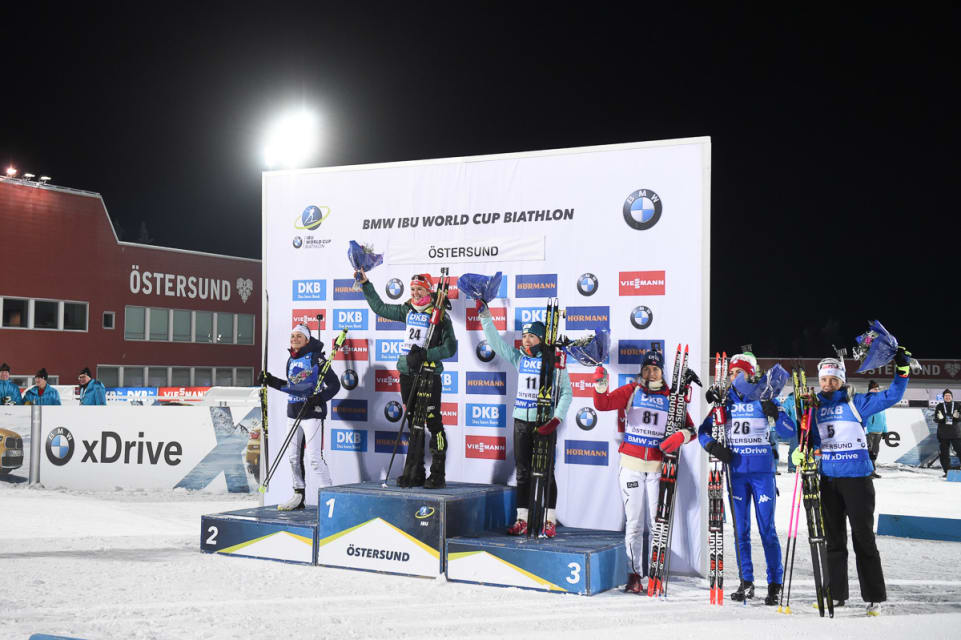
    The women’s 7.5 k sprint podium on Friday in Östersund, Sweden, with Germany’s Denise Herrmann in first, France’s Justine Braisaz in second, and Ukraine’s Yuliia Dzhima in third. (Photo: IBU/biathlonworld)

    Herrmann, 28, won the women’s 7.5-kilometer sprint on Friday in 19:54.8 minutes after shooting 9-for-10 (0+1). She finished 15.2 seconds ahead of France’s Justine Braisaz in second and was 19.6 seconds clear of Ukraine’s Yuliia Dzhima in third.

    Both Braisaz and Dzhima were among 22 women (out of 103 finishers) that cleaned the two-stage race on a cold, essentially windless evening. Norway’s Synnøve Solemdal, who finished fourth (+24.3) to claim the World Cup Total Score leader’s bib, also cleaned, as did Italy’s Lisa Vittozzi in fifth (+24.5).

    Coming off a win in the IBU Cup sprint last week in Sjusjøen, Norway, Herrmann started 24th and was up to second place by the time she cleared all five targets in the first prone shooting stage. Her lone standing miss, which was just above the target, set her back to fifth place as she embarked on her final loop, but with the fastest last loop and fastest overall course time, Herrmann took the win from Braizaz, an early starter in bib 10. Dzhima started 11th.

    “My goal was to start out with a clean prone stage, and then skiing into the standing stage I thought, ‘Oh, with bib 24 you could also go on lane position 24 on the range today. That might be a good omen,’ ” Herrmann reflected. “Of course you still try to leave no target black, but one was still left standing for me. That can be improved in the days to come.”

    Earlier in the week, Herrmann started her season by placing 23rd in the women’s 15 k individual. Asked during an official training session what her chances were of making Germany’s Olympic team, she said she needed to focus on qualifying for the World Cup team first.

    “One of my former coaches said, ‘Positions four and five are a cause for debate, but not one or two,’ ” she told ZDF on Friday. “So I said to myself, ‘Let’s lock this thing up today.’ That it already would work out like this today, I wasn’t expecting that. It’s incredible. I’m totally happy.”

    Julia Ransom (Biathlon Canada) racing to a career-best ninth in the women’s 15 k individual on Wednesday at the IBU World Cup opener in Östersund, Sweden. (Photo: Biathlon Canada/NordicFocus)

    Of the 22 women that cleaned Friday’s race, Julia Ransom of Biathlon Canada was one of them. Ransom started the week with a career-best ninth place in the 15 k, after shooting 20-for-20, and finished 29th in the sprint, 1.16.9 minutes behind Herrmann. In two races, Ransom is 30-for-30 on the range without a miss.

    “Wednesday’s result was of course motivating, but also hasn’t changed any way I approach racing,” Ransom explained in an email on Friday. “At the end of the day, I race because I love it and it’s fun to compete. That being said, it’s even more fun to find yourself a little higher on the results page. Today I was just hoping to keep relaxed and focused and enjoy the day, whatever result that translated to.”

    Ransom’s overall shooting time ranked 36th, up from 53rd in Wednesday’s 15 k.

    “My shooting times were perhaps a little more ‘normal’ today because there was less consequence for a miss,” she explained. “Getting into the groove of racing also helps relax into my normal pace.

    “Overall I am really happy with my race. It was an incredibly fast field out there today and I am proud of how everything went,” she added. “I can’t wait to start the pursuit. Opportunity awaits!!”

    Three Canadian women finished in the sprint’s top 60 to qualify for Sunday’s 10 k pursuit, with Rosanna Crawford placing 46th (+1:41.6) with a single prone penalty (1+0) and Megan Bankes in 60th (+2:10.9) with one standing miss (0+1).

    For Bankes, 20, 60th marks her career best in her third World Cup start, and Sunday’s race will be her first World Cup pursuit. Last season, she won the 12.5 k individual race at IBU Junior World Championships. At Biathlon Canada’s team trials early last month, Bankes was one of two additional women selected to Canada’s World Cup team for the first trimester of racing.

    “I was super stoked to have solid results at trials and make the world cup team, and then prepare for racing in Europe,” the 20-year-old Bankes wrote in an email. “We’ve been in Oestersund for a week now, and I feel like I’m on European time now. Now I’m working on getting back into the swing of full time racing, which for me has been the main goal of this week.

    “It’s definitely hard to know what to expect coming into the first races of the season, but I’ve been really happy with my skiing and my shooting consistency, so I was just excited to come here and give it my best,” she continued. “I’m pleased with my race today, hitting 9/10 and I felt that I skied much better than the Individual. I just decided I would start hard and hold on, which worked pretty well. On the World Cup everyone is so fast, so perfect shooting is pretty much necessary, and skiing crazy fast yourself! I’m really excited for the pursuit, planning on just skiing fast, hitting targets, and enjoying the experience. If I make up some positions that would be fantastic!”

    While Herrmann will start Sunday’s pursuit first with a 15-second head start on Braisaz in second, Ransom will head out 1:17 minutes back in 29th, Crawford 1:42 back in 46th, and Bankes 2:11 back in 60th.

    Canada’s fourth woman in the sprint, Emma Lunder finished 93rd (+3:07.5) with three penalties (1+2). US Biathlon started three on Friday, with Clare Egan placing 75th (+2:32.2) with three misses (1+2), Susan Dunklee 79th with five penalties (2+3), and Emily Dreissigacker 89th (+3:01.2) with two misses (0+2).

    Earlier this week, US Biathlon announced in a press release that its fourth woman, Kelsey Dickinson, would be returning to the U.S. to compete at the IBU Cup Team Trials at Mt. Itasca in Minnesota from Dec.15-19. Because she did not meet the IBU’s World Cup Qualification Point requirement at the first IBU Cup in Sjusjøen, she will need to qualify for US Biathlon’s IBU Cup team.

    The men’s 10 k sprint starts Saturday at 8:45 a.m. EST.
    Results | Women’s pursuit start list

  • A New Season for Biathlon Canada: Ransom Rockets to Career-Best Ninth

    A New Season for Biathlon Canada: Ransom Rockets to Career-Best Ninth

    Julia Ransom (Biathlon Canada) racing to ninth in the women’s 15 k individual on Wednesday at the IBU World Cup opener in Östersund, Sweden. In her first World Cup race of the season, it was Ransom’s career-best result and Biathlon Canada’s best individual result since 2015/2016. (Photo: Biathlon Canada/NordicFocus)
    Entering this season, members of Biathlon Canada had everything to gain and not a whole lot to lose. They had already had their funding reduced to zero by Own The Podium, save for a $50,000-dollar provision that paid for a coach, and its athletes were left to determine their offseason plan: stay home to train or self-fund training camps elsewhere. Many chose to spend most of their summer at the team’s base in Canmore, Alberta, and most started the season on the fly — without any preseason tuneup races in Europe — this week in Östersund, Sweden.

    Julia Ransom was one of those athletes. After prequalifying for Canada’s International Biathlon Union (IBU) World Cup Team for the first trimester of racing, Ransom, 24, jumped into the 2017/2018 season with the Östersund mixed relay this past Sunday — three days after flying over from Canada.

    There, she raced the second leg of the relay and tagged off in 15th, down two spots from where her teammate Emma Lunder tagged her in 13th. The team ultimately finished 15th, with teammates Scott Gow and Brendan Green.

    “Today was a tough day for me. My legs were lead on the course,” Ransom wrote in a post-race email to FasterSkier on Sunday.

    Three days later on Wednesday, it was another ballgame. With little to lose in the women’s 15-kilometer individual in Östersund, Ransom raced to a career-best ninth, which stood as her team’s best non-relay result in two seasons.

    In the first individual race of the season, Ransom is well on her way to securing a spot on Biathlon Canada’s 2018 Olympic team, meeting half of the team’s “Priority 2” Olympic criteria standards. She needs another top 16 to fulfill that second-tier criteria. Priority 1 is one top-eight result in a World Cup (or World Championships, in a championships year like last season) or a top-three in a World Cup relay.

    So far, she is the only one on her team who has cracked the top 16 in two seasons. Last winter, her best result (and her previous personal best) was 18th at 2017 World Championships in the 15 k individual. Canada’s best non-relay result in 2016/2017 was Scott Gow’s 17th place in a 20 k individual World Cup race.

    And again, it’s the first race of the season.

    “I am still in shock with how well today went,” Ransom, a Penticton, British Columbia, native in her fourth World Cup season, wrote in an email to FasterSkier on Wednesday.

    “It is such a relief to start racing again,” she continued. “I wasn’t too nervous today; I had a race plan that I had confidence in and I was excited to give it a go. I also was looking for redemption after my painful relay leg on Sunday.”

    Conditions were chilly, at -12 degrees Celsius (10 degrees Fahrenheit), but calm, accounting for clean shooting for seven out of the top-nine finishers. Ransom was one of them.

    She started 20th (out of 102) and cleaned all four stages in the longest-format women’s race on the circuit. In individual races, shooting is weighed heavily; a minute is added to a competitor’s final time for each missed shot. Fortunately for Ransom, she hit all 20 targets.

    “I was getting some pretty exciting splits during the whole race (top 5, second place, catching the leader etc) so I had an idea this was going to be a good day as long as I kept my shooting together,” she reflected. “I took a sigh of relief after the 20th target went down and just tried to ski as well as I could to the finish. I did take look at the big screen as I left the range, just to make sure I was hearing the techs right!”

    Ransom initially crossed the finish line in third, 28.8 seconds behind Sweden’s Mona Brorsson in first and 9.8 seconds behind Eva Puskarčíková of the Czech Republic in second. Both Brorsson and Puskarčíková also shot clean.

    The 55th starter, Nadezhda Skardino of Belarus, ultimately posted the best shooting and skiing performance of the day, racing to her first World Cup win (and first podium in three years) in 42:57.4 minutes with 20-for-20 shooting. Norway’s Synnøve Solemdal started 75th and shot clean but came up 2.9 seconds short at the finish to place second, bumping Ukraine’s Yuliia Dzhima to third (+12.0). The top-four women all cleaned with another Ukrainian, Valj Semerenko, placing fourth (+30.1).

    Slovakia’s Paulina Fialková finished fifth (+32.2) with a single penalty (0+0+0+1), while Brorsson ultimately placed sixth (+49.6) and Puskarčíková seventh (+1:08.6).

    Ransom ended up ninth for her best World Cup level performance by nine places, ahead of Norway’s Marte Olsbu in 10th and about eight seconds behind France’s Justine Braisaz in eighth.

    “Starting off the season with a top ten has validated the hard work our team has put in and also given me a lot of confidence going forward. It’s a great building block to say the least,” Ransom wrote.

    Asked what she thought made the difference with her training this year, she explained that she’d honed in on increasing her shooting speed.

    “It’s still a work in progress but I am happy where I am so far,” she wrote. “I also did a ton of extra strength work and core stability and it has proven to make a big difference on the skis.”

    On Wednesday, Ransom’s overall shooting and range times ranked in the middle of the pack, around 50th, while her overall course time was slightly faster in 42nd.

    Biathlon Canada Head Coach Matthias Ahrens praised Ransom’s ability to perform under pressure.

    “Especially as the tension mounted, with each clean bout, Julia was closer the podium and she managed the pressure very well,” he said, according to a team press release. “She didn’t get too excited or too nervous, executing clean shooting each time.”

    Four Canadians started Wednesday’s 15 k, with Rosanna Crawford finishing 39th (+3:32.6) with three penalties (0+0+1+2), following her crash in Sunday’s single mixed relay.

    “Rosanna, considering the crash of Sunday, had a really nice race,” Ahrens said in the press release. “It wasn’t certain if she’d race today, and we went in with a strategy not to risk any further injury. She managed a very good race, with a quite good ski time. Her rifle also required repairs from Sunday’s race. Overall, not knowing how she would hold up, particularly on one of the hardest Individual courses on the circuit, it was a nice result for her, in the World Cup points.”

    Megan Bankes finished 75th (+6:28.9) with three misses (2+1+0+0) and Lunder was 83rd (+7:06.3) with five penalties (0+0+2+3).

    US Biathlon started three women, with Susan Dunklee leading the team in 53rd (+4:12.7) with four penalties (1+0+1+2). Clare Egan finished 79th (+6:52.5) with five misses (0+2+1+2) and Emily Dreissigacker was 81st (+7:03.5) with three misses (0+0+1+2).

    The men start their season with a 20 k individual on Thursday at 11:15 a.m. Eastern Standard Time.

    Results

  • Klæbo Holds Off Sundby, Bolshunov and Harvey for Ruka Triple Sweep

    Klæbo Holds Off Sundby, Bolshunov and Harvey for Ruka Triple Sweep

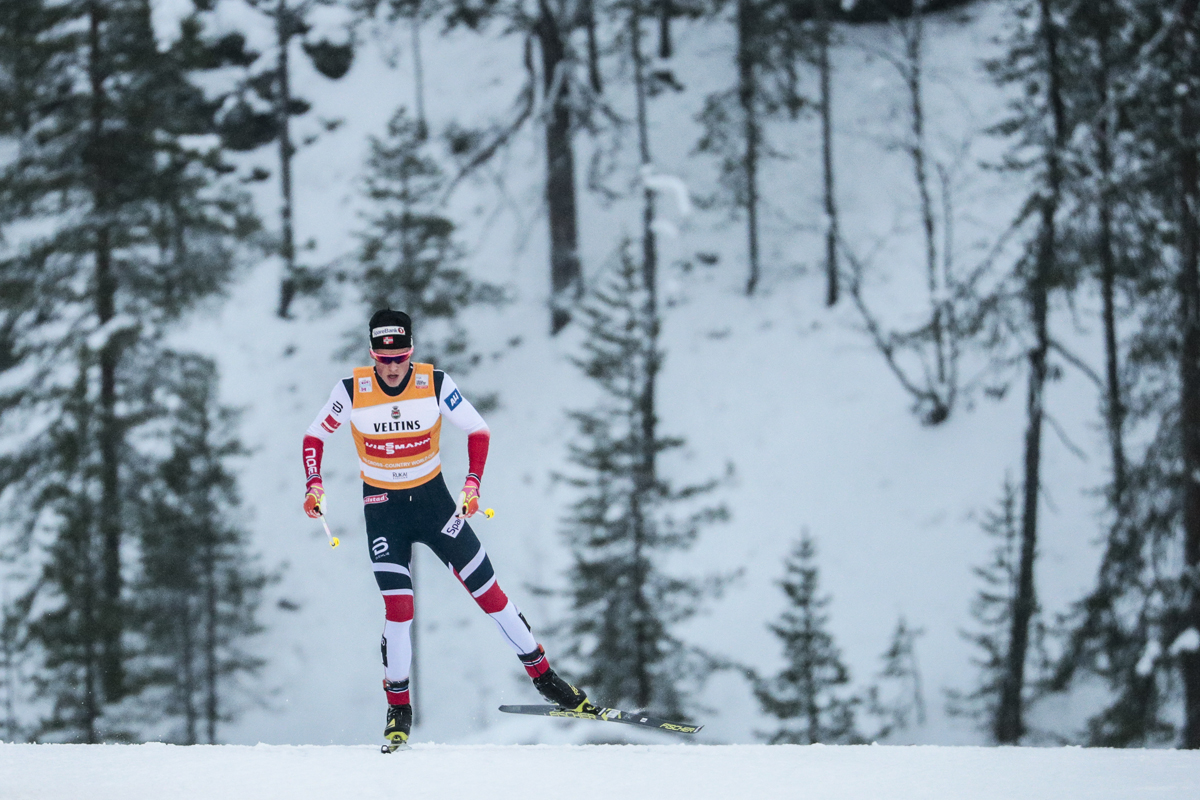
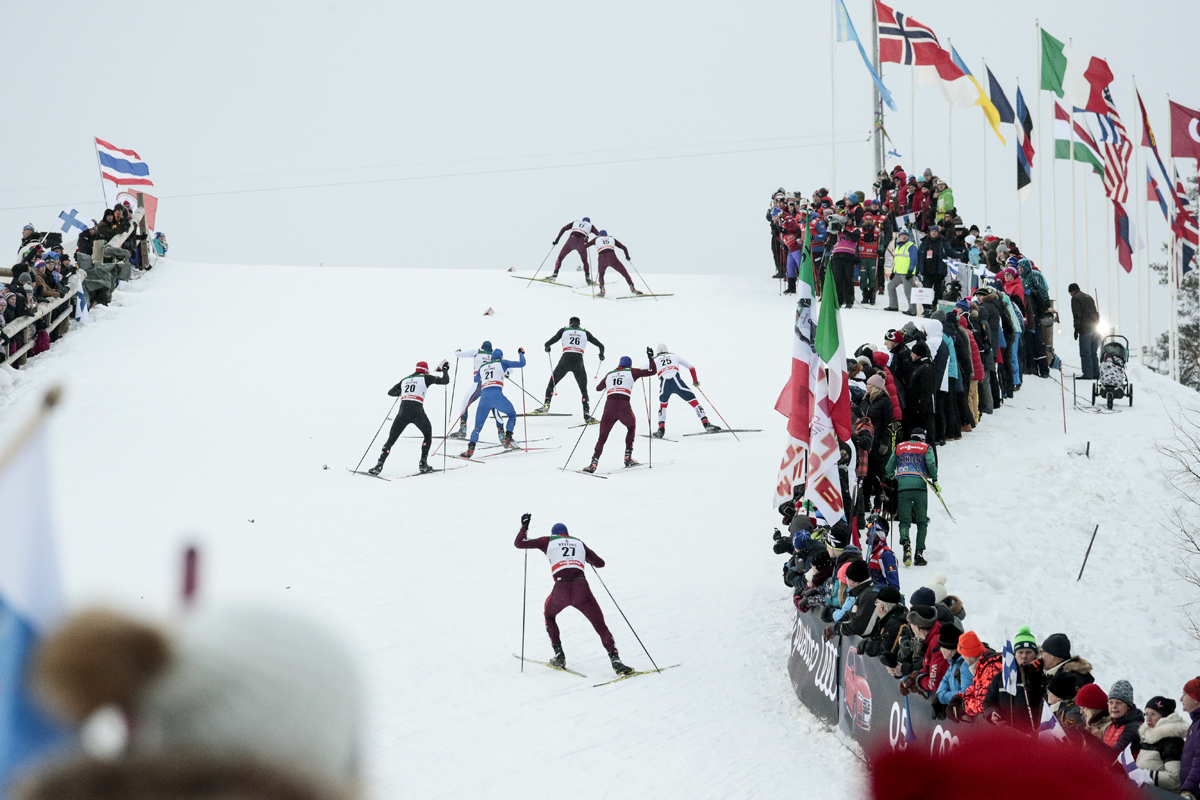
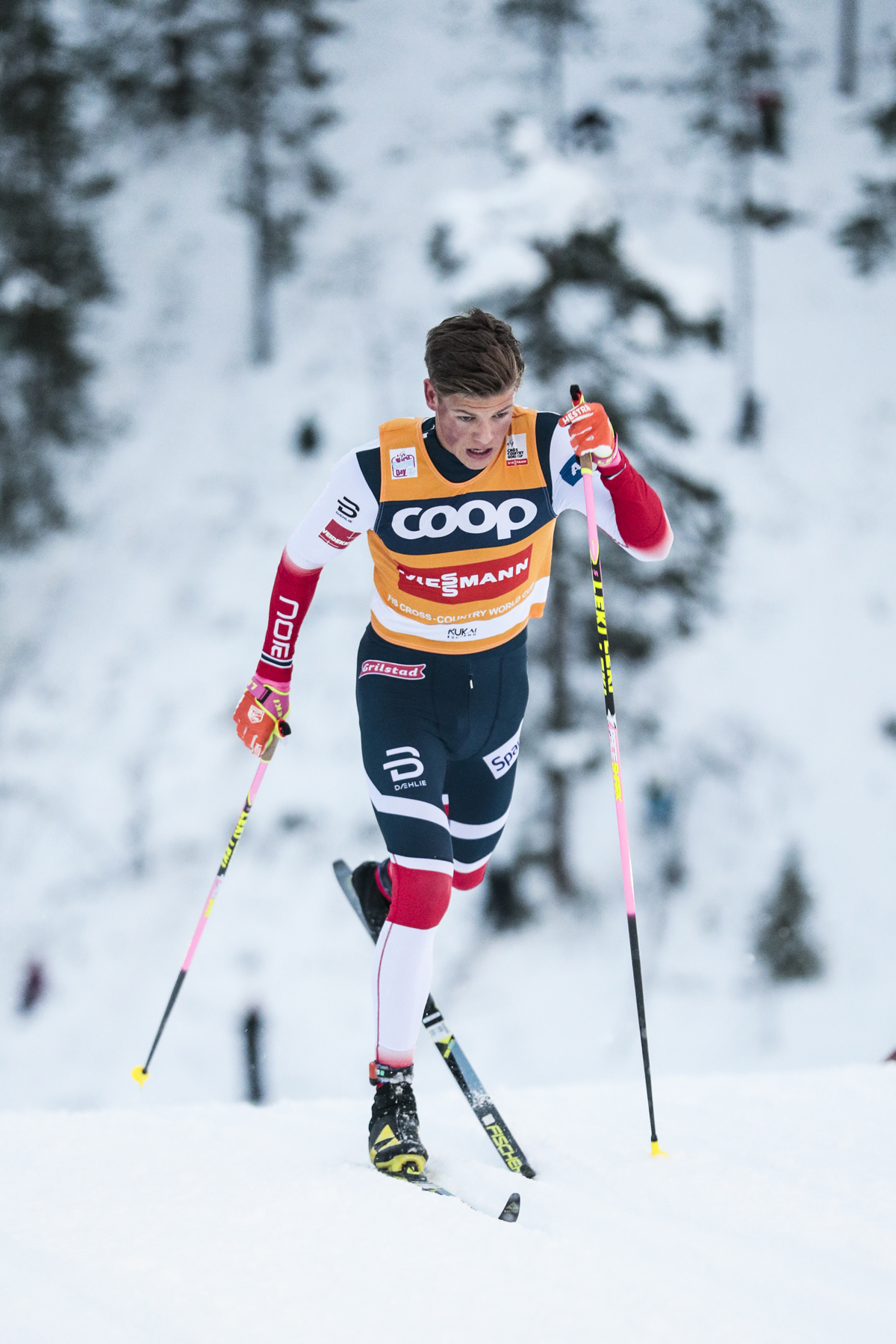
    Norway’s Johannes Høsflot Klæbo en route to his third-straight win in as many days of the World-Cup-opening Ruka Triple in Kuusamo, Finland. He won the 15 k freestyle pursuit for the mini-tour title. (Photo: Fischer/Nordic Focus)

    Two previous days of racing, and back-to-back victories no less, had begun to take its toll on Johannes Høsflot Klæbo within the first few laps of the men’s 15-kilometer freestyle pursuit on Sunday in Kuusamo, Finland. The 21-year-old Norwegian could feel it throughout his body; he was tired and 38 seconds of a starting cushion wasn’t going to be enough to hold off the hungry challengers behind him.

    Klæbo, who won Friday’s classic sprint and Saturday’s 15 k classic individual start on the World Cup opening weekend, wasn’t invincible and he couldn’t race to another win alone. Halfway through the pursuit, the man who started in second place, 38 seconds after him, Russia’s Alexander Bolshunov (who’s actually younger than Klæbo at age 20), had cut that deficit to 19.8 seconds. After him, Norway’s Martin Johnsrud Sundby, who started 10th and 1:05 minutes behind Klæbo, was up to third and just 25.3 seconds back.

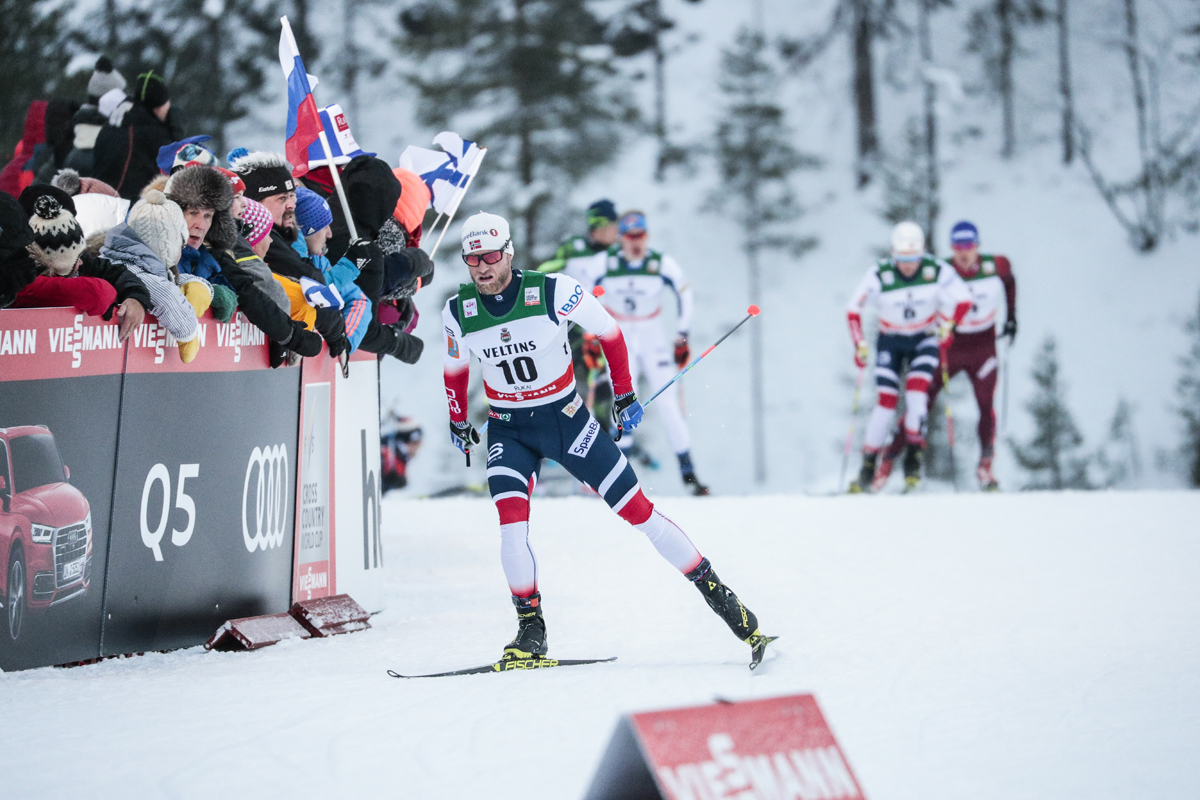
    Norway’s Martin Johnsrud Sundby, who started 10th in the 15 k freestyle pursuit on Sunday, picking off the places on the final day of the Ruka Triple World Cup mini tour in Kuusamo, Finland. (Photo: Fischer/Nordic Focus)

    On his fourth lap, Klæbo accepted the inevitable as Bolshunov and Sundby, who had linked up in an effort to catch him, in fact caught him on a climb around 8.6 k. A larger group of pursuers, including Canada’s Alex Harvey, locked on to the three leaders as well, and from there, the race truly began to take form. Klæbo had to recover, Sundby had to figure out how to try to drop him, Bolshunov had to see what he was capable of, and Harvey had to see how much he could give in the third race of the season.

    The first races of each winter aren’t easy for anyone. Despite spending the summer training for skiing, most North American World Cup skiers don’t get the opportunity to actually race — even on rollerskis — too often during the offseason. Because of the rich ski culture in Europe, rollerski races are a big deal with lots of summer and fall competitions to chose from. And because of Europe’s geography, it’s often easier to get on snow than it is for North Americans.

    (“I think this applies to all the North American actually, compared to Europeans we don’t race as much in summer,” Canadian World Cup coach Ivan Babikov said on the phone on Sunday. “They have races every weekend so they come into the season pretty sharp already with some good speed workouts, when we don’t have that opportunity. So that’s why, I think, every race is a step forward. It’s just, you have to remember or remind yourself how hard it is.”)

    So while Canadians and American World Cup skiers alike often look at an opening weekend like Finland’s Ruka Triple mini tour as a “chance to blow the cobwebs out” or “shake off the rust”, as some have said, it’s also an opportunity to see where you stand — as was the case for Harvey in the final meters of Sunday’s pursuit.

    Later in the fourth of six laps, Klæbo pushed the tempo up a climb, Bolshunov responded, and Harvey went with them. Soon after at 10 k, they lapped through the stadium with 11 men within 2.7 seconds of first. Up front, Bolshunov led Harvey, who had started the race 1:23 back in 12th.

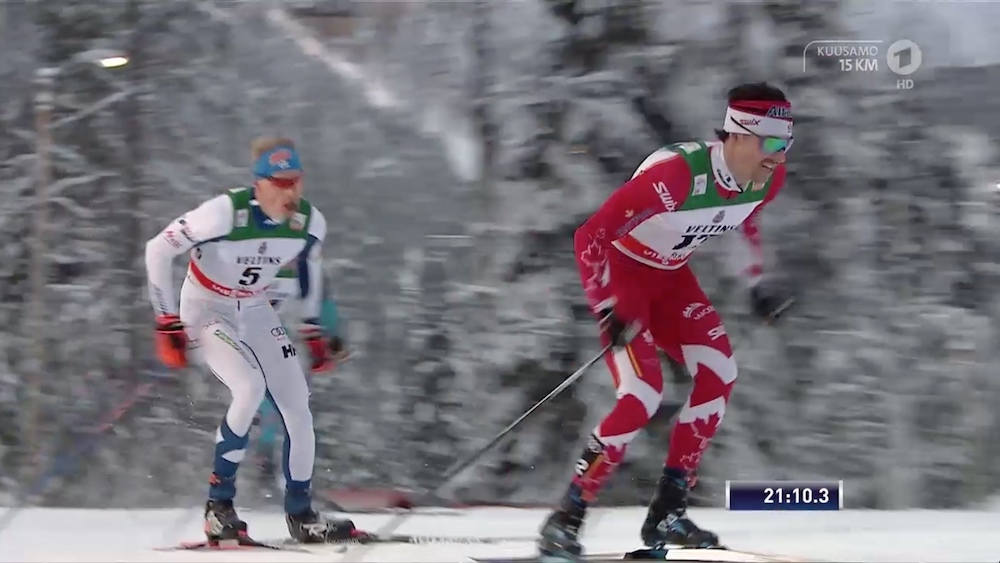
    Canadian World Cup Team member Alex Harvey leads Finland’s Iivo Niskanen during the men’s 15 k freestyle pursuit on Sunday, the final day of the Ruka Triple mini tour in Kuusamo, Finland. (Screenshot: ARD)

    Harvey had spent the first three laps working up to that lead group, initially with the likes of Russia’s Alexey Chervotkin (*who reportedly thanked Harvey after the race) and Sergey Ustiugov, Norway’s Hans Christer Holund and Sweden’s Marcus Hellner, and later with France’s Maurice Manificat, Sweden’s Calle Halfvarsson, Norway’s Emil Iversen, Chervotkin, and Holund, among others.

    “I knew there’d be some fireworks on the last lap so I just wanted to be in the front third of the group, just be ready for a move,” Harvey explained in a post-race phone interview. “I thought Sundby would be the guy making the move, which in the end, that’s what happened. The big uphill in the last lap, that’s where he went. I just wanted to be close to Sundby and ready to respond when Sundby went.”

    Sundby attacked as predicted on the second-to-last climb, around 13.6 k, and Harvey slotted behind him to follow him over the top.

    “I was just actually there on that last uphill when Sundby attacked,” Babikov recalled. “Klæbo was right there. I think there were just Norwegian tactics … Sundby attacked on the last uphill and Klæbo just cooled down and wasn’t chasing him at all, so for Alex, that was his only chance. … If he didn’t chase him, then Sundby probably would have skied away and it would have been a bigger group at the finish, but at the moment he tried, and they actually created a gap … Alex second and Sundby first.”

    With a few meters separating them from Norway’s Didrik Tønseth in third and Klæbo in fourth, Harvey thought he and Sundby had dropped them and that he would fight for first to the finish.

    “I kind of went all-in with the Sundby move,” Harvey said. “When I looked in between my legs just before the last downhill I thought we had a big enough gap … so I was feeling pretty good about my chances there, but not good about taking [Sundby] because I was really, really dead.”

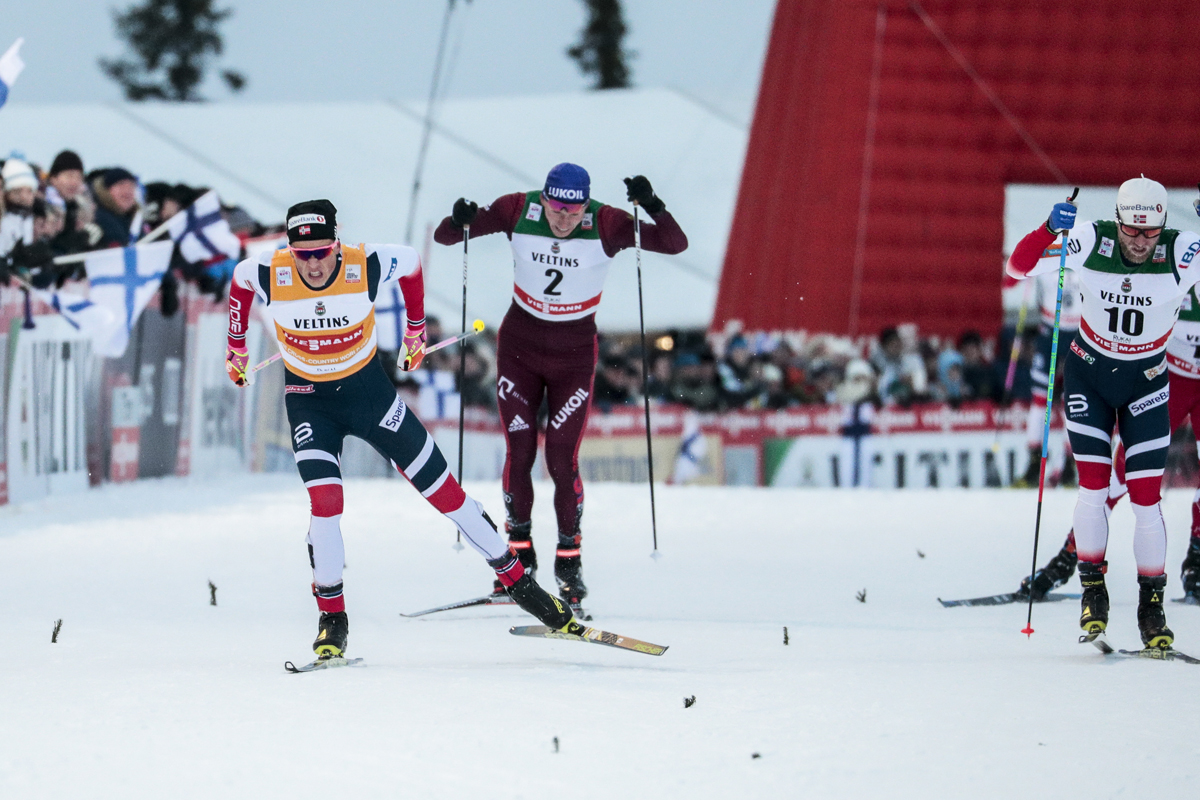
    Johannes Høsflot Klæbo (l) passing fellow Norwegian World Cup Team member Martin Johnsrud Sundby (10) for the win in Sunday’s 15 k freestyle pursuit at the Ruka Triple mini tour in Kuusamo, Finland. Russia’s Alexander Bolshunov (2) was 1 second back in third place for his first World Cup podium while Canada’s Alex Harvey (behind Sundby) placed fourth. (Photo: Fischer/Nordic Focus)

    After what Harvey estimated to be a 45-second downhill, he realized that wasn’t the case. Klæbo and Bolshunov had slingshot back toward the front, and while Sundby was first to the top of the last climb before the finish, Klæbo and Bolshunov were right behind him while Harvey followed in fourth.

    They entered the stadium together in that order, and Klæbo passed Sundby with about 100 meters remaining to take his third-straight win of the weekend.

    “Coming out of my tuck there I was just full of lactate, not feeling any fresher … then I just got passed on the hill,” Harvey recalled. “I had nothing left. That was my move. … I’m happy I made that move, but I couldn’t make a second burst after that.”

    While Klæbo won the pursuit and with it, the Ruka Triple mini-tour title in 36:23.2 minutes, Sundby placed second, 0.4 seconds back, Bolshunov claimed his first World Cup podium in third (+1.0), and Harvey finished another 0.6 seconds back in fourth (+1.6).

    On the day, Harvey’s course time ranked fifth fastest behind Manificat, who was the “winner of the day” in 34:50.9. Finland’s Matti Heikkinen was second fastest (+5.4) after starting 22nd and placing 14th, Holund was third fastest (+7.5) after starting 14th and finishing ninth, and Switzerland’s Dario Cologna, who started 26th and finished 17th, was fourth fastest (+8.7).

    Harvey said starting 17 seconds behind Sundby was a tall task on its own, and he had started the race with a goal of breaking into the top 10 overall. All things considered, fourth place was better than he expected at this point in the season.

    “… But I knew it was still within reach,” Harvey explained. “I believed in it, but I didn’t put too much hope in, let’s say, a top five or fighting for the podium. It was more like I wanted to be back in the top 10 and just that to me seemed already hard enough.”

    Norway’s Johannes Høsflot Klæbo after winning the 15 k freestyle pursuit on Sunday to win the Ruka Triple mini tour in Kuusamo, Finland. (Photo: Fischer/Nordic Focus)

    The fact that he was able to hang with Klæbo and Sundby to the finish was a good sign, he added.

    “Right now, he’s not just a good sprinter, he’s the best distance skier in the world, too,” Harvey said of Klæbo. “I mean, to win a 15 k individual you have to be in very, very good physical shape, so he’s in really good physical shape and I know I’m not yet. I’m not in my best form and Sundby probably isn’t yet, so you never know what’s going to happen later in the season at the Olympics, but for now it’s hard to drop him when he’s actually just in better shape than everybody else in the world.”

    After the race, Klæbo told NRK he was relieved to get the win and have some time to rest before next weekend’s World Cup in Lillehammer, Norway.

    “My legs are shaking now,” Klæbo said. “Feels incredible to be the first to cross the finish line. Now I need a few days rest.

    “This was brutal,” he added. “I’m actually glad they caught up to me and luckily I had good skis. I’m glad I had a few seconds today.”

    Norwegian national-team coach Tor-Arne Hetland told NRK he was “really impressed” with Klæbo.  “We have a diamond in the sport of cross country skiing now,” Hetland said.

    “That’s very nice of him to say. It’s probably a little too much, but it has been a good start to the season,” Klæbo responded to NRK.

    Sundby spoke excitedly about having Klæbo to contest for the overall World Cup lead.

    “For the moment, he’s taking international cross-country skiing for men to a whole ’nother level,” Sundby told NRK. “It is a little humiliating for the rest of us, but at the same time it’s extremely inspiring to see what he does in his second year at this level. It’s hell of fun to have a guy like that on the team.”

    Bjornsen 26th, Kershaw 29th; Caldwell Posts Top-20 Time of Day

    Canada had two in the top 30 on Sunday with Devon Kershaw in 29th (+1:47.8), scoring World Cup points for the second-straight day. He started 28th and 1:59 out of first, just one second behind Cologna in 26th and Russia’s Andrey Larkov in 27th.

    “I just wasn’t strong enough to go with Dario,” Kershaw said on the phone. “I had the perfect chance to be able to follow Dario up the field, but he just started so fast, and on the steep terrain, my legs just — I tried up the first steep wall and at the top, I’m like, man, if I keep going like this, after 5 k I’m gonna be dead.

    Canada’s Devon Kershaw (28) leads American Erik Bjornsen (23) and others during the World Cup men’s 15 k freestyle pursuit on Sunday in Kuusamo, Finland. (Photo: Fischer/Nordic Focus)

    “So I had to manage my energy a little bit and in the end, it turned out that Bjornsen and I’s group just wasn’t strong enough,” Kershaw continued, referring to U.S. Ski Team member Erik Bjornsen, whom he started eight seconds behind and spent most of the race with. “[Our group] had a good 7 1/2 k and then after that, between 7 1/2 kilometers and 12 k, we were skiing really slow. So that’s a bit frustrating in a pursuit because you’re just stuck there in no-man’s land.”

    While he felt like he was skiing the flats well, Kershaw said he struggled with the “biting” conditions, which seemed to limit glide, especially on the notoriously steep course’s climbs.

    “I had to make the choice to be like, OK, I’ve got to just stay in this group and I’m not strong enough to drive the bus, because my legs just weren’t there today on the terrain” he said. “In the end I made a tactical error in the last 600 meters. I should’ve followed Bjornsen on the outside and I went on the inside and was hoping it would open up for me and it didn’t. So I ended up 29th, but that’s OK.”

    Bjornsen started 24th and finished the pursuit in 26th (+1:43.6), after following Larkov in 25th (+1:42.8) across the line and holding off Iceland’s Snorri Einarsson (a former Norwegian skier who raced for the University of Utah) in 27th (+1:46.2), Great Britain’s Andrew Musgrave in 28th (+1:47.2), Kershaw in 29th, and France’s Jean-Marc Gaillard in 30th (+1:49.2).

    “I started right around Cologna and [Finland’s Matti] Heikkinen but there was no way I was going to hold their pace, they were flying,” Bjornsen wrote in an email. “I had to settle in with the group around me. It soon became clear our group was not going to catch anyone in front of us or get caught, so it became a tactical game. Some surges, but for the most part nobody wanted to lead.”

    Devon Kershaw (Canadian World Cup Team) en route to 29th in the 15 k freestyle pursuit on the last day of the Ruka Triple World Cup mini tour in Kuusamo, Finland. (Photo: Fischer/Nordic Focus)

    Kershaw laughed when he talked about some “tips” he gave Bjornsen during the race.

    “He had really fast skis so there were a few times that he came by me on the downhill and then would kind of try to hammer for a minute and then get tired and slow down again,” Kershaw said. “I told him, like, ‘Dude, you’ve got great skis. Unless you can stay in the front and really press, then it’s better just to play the game and wait for the end.’ After that, he did that and he torched us all in the end. So that was kind of fun to see for him.”

    According to Bjornsen, Kershaw suggested he sit back and wait for the sprint.

    “My skis were good but I think my weight is what helped me the most on that last huge downhill,” Bjornsen wrote. “I was fine going for that tactic but at the same time it would have been nice to leave a little more out there today. Stoked to get double points for 26th though!”

    Paddy Caldwell (U.S. Ski Team) racing to 70th in the men’s 15 k classic on Saturday, Day of the Ruka Triple World Cup mini tour in Kuusamo, Finland. In Sunday’s 15 k freestyle pursuit, he skied up to 51st with the 19th-fastest time of day. (Photo: Fischer/Nordic Focus)

    Paddy Caldwell, new to the U.S. Ski Team B-team this year, posted his best World Cup result with the 19th-fastest time of day, 50.5 seconds back from Manificat. He started with the wave in 70th and finished 51st overall (+3:03.1).

    “Going into the race my goal was to move up as much as possible,” the 23-year-old Caldwell wrote in an email. “I wasn’t really thinking about place or time of day – I was just trying to ski fast and put together a good effort.

    “It was really hard to move up in the pack,” he added. “I started midway back in the wave and we kept picking up more and more skiers as the race went on. I tried to relax as much as possible on the hills and build in energy to pass where I could on the flats. … I am really excited with the day and psyched to have had a good result here in Ruka. I’m looking forward to the rest of period 1 and learning more from the big dogs!”

    “Very exciting race out of Erik today,” U.S. Ski Team coach Matt Whitcomb commented on the phone. “… When he settled to the back of his pack on Lap 6 and headed into the downhill with one climb to go, we just all sort of expressed confidence over the U.S. radio channel, got ready see what he could do.  It is so fun to watch him in a stadium when he has to go head to head against five other athletes … he did not disappoint today. Really proud of Erik’s 26th place.”

    As for Caldwell, who skied the 25th fastest time of day in the 2017 World Cup Finals freestyle pursuit, Whitcomb said, “this is his race, the skate distance.”

    “There were times that he was a little bit road-blocked out there, just the way the pursuit race unfolds in that start … and it looked like today Paddy could keep going, so really great signs out of him,” Whitcomb said.

    Whitcomb also highlighted the races of Scott Patterson, who raced up from 78th to 55th (+3:28.4) with the 31st-fastest time, and Noah Hoffman, who improved from 45th to 39th (+2.33.3) with the 35th-fastest time. Also for the U.S., Andy Newell finished the tour out in 75th (+5:39.6).

    American Paddy Caldwell (70) racing with Sweden’s Jens Burman (front) and Canada’s Len Valjas (46), among others, during Sunday’s World Cup 15 k freestyle pursuit on the last day of the Ruka Triple in Kuusamo, Finland. (Photo: Fischer/Nordic Focus)

    Canada’s Len Valjas moved up two places for 44th overall (+2:47.5), Graeme Killick finished the tour in 68th (+4:39.5), Knute Johnsgaard 81st (+6:43.6), and Julien Locke 83rd (+7:33.6).

    Babikov pointed out that Valjas had a shoulder injury that he mostly recovered from, but caused him to struggle with double poling in Friday’s sprint. Despite placing 63rd in that sprint, Valjas was the team’s third-best man in the weekend’s distance races.

    “[In] two distance races, he was third best and actually placed higher than he placed in sprint in the distance, 15 k, hardest one with lots of climbing,” Babikov said. “So that shows he has a good shape, but just needs to scrape that rust off and remember how to go fast again. I think physically he is in a good place, just need to do some more races, and it will come.”

    ***

    *Post-race sidenote: According to Harvey, after the race, the Russian team’s massage therapist told Canadian coach Ivan Babikov that Chervotkin wanted to thank Harvey for pulling him in the pursuit. Chervotkin, 22, started 11th and finished fifth, 6.2 seconds out of first and 4.6 seconds after Harvey in fourth.

    “There’s a bit of beef with the Russians and me right now,” Harvey said. “I came in wondering if they were just going to punch me in the face. They said they wanted to break my teeth, so this is a good turn of things.”

    As Harvey understands it, that was because of what he’s said to journalists regarding Russian doping at the 2014 Olympics.

    “I read that in the Norwegian news, actually, that Petukhov wanted to …,” he said with a laugh. “But I knew the media likes that sort of thing. But I think things are good now.”

    Harvey noted that Bolshunov and Chervotkin, neither of which have been implicated in the doping scandal, are part of “a new generation” in Russian cross-country skiing. “I saw the results in Bruksvallarna; it looks like the have almost as much depth as Norway does. They’re really strong.”

    Results: Men’s pursuit | Men’s time of day

    — Aleks Tangen, Ian Tovell, Jason Albert, and Harald Zimmer contributed

    Racers in the Ruka Triple World Cup 15 k freestyle pursuit, including Russia’s Andrey Larkov, Switzerland’s Jonas Baumann, Italy’s Federico Pellegrino, Switzerland’s Dario Cologna, and Norway’s Simen Hegstad Krueger, ascend a climb in Kuusamo, Finland. (Photo: Fischer/Nordic Focus)
  • Klæbo Steamrolls to Another Ruka Win; Harvey 13th in 15 k Classic

    Klæbo Steamrolls to Another Ruka Win; Harvey 13th in 15 k Classic

    Norway’s Johannes Høsflot Klæbo racing to his second win in as many races at the Ruka Triple on Saturday in Kuusamo, Finland. He won the first distance race of the season, the men’s 15 k classic, by 15 seconds and will start Sunday’s freestyle pursuit with a 38-second head start on the men’s field. (Photo: Fischer/Nordic Focus)

    Is Johannes Høsflot Klæbo better than Petter Northug* was at his age? It’s hard to say, reigning Norwegian World Cup winner Martin Johnsrud Sundby told NRK. But his performance in the last two days is pretty unheard of, Sundby said after Saturday’s 15-kilometer classic.

    On both Friday and Saturday at the Ruka World Cup opener in Kuusamo, Finland, Klæbo (who’s still a U23 athlete at just 21 years old, although he’s on Norway’s exclusive World Cup Team) won both races to start the 2017/2018 season. He didn’t lose a round in Friday’s classic sprint, then came out to take a 15-second victory over fellow Norwegian Didrik Tønseth in Saturday’s 15 k classic.

    “There’s no doubt he’s a phenomenon,” Sundby said after placing eighth on Saturday, 30.7 seconds off Klæbo’s winning time of 33:38.8 minutes, according to a loose translation. “To race like he did yesterday, then do the same today. No, that’s amazing.”

    Klæbo ended last season as both season-long U23 (under-23) World Cup champion as well as the Sprint World Cup champion. He’s started this season without a loss, and he led at most parts of the race on Saturday, except for the 3.1 and 5 k checkpoints, where Russia’s Alexander Bolshunov clocked splits that were 0.9 and 4 seconds faster, respectively.

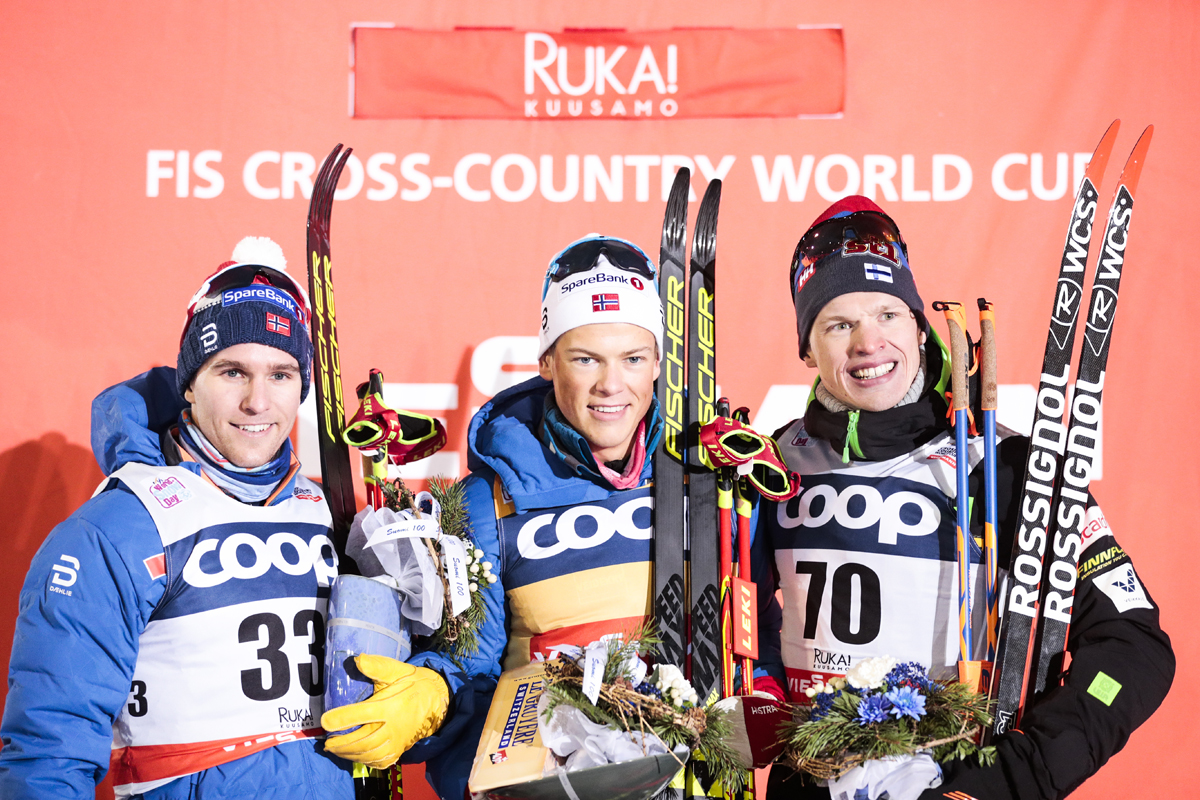
    The men’s 15 k classic podium on Day 2 of the Ruka Triple in Kuusamo, Finland, with Norway’s Johannes Høsflot Klæbo (c) in first, Norway’s Didrik Tønseth (l) in second, and Finland’s Iivo Niskanen (r) in third. (Photo: Fischer/Nordic Focus)

    But Bolshunov, who started 66th (out of 102) couldn’t hold it, and the young gun in bib 42 continued to hold his own in the leader’s chair at the finish. Klæbo ousted Tønseth from the top spot, putting Tønseth in second place. Finland’s Iivo Niskanen in bib 70 charged hard for the win, coming within three seconds of Klæbo around 6 k, but ended up 17.7 seconds short for third place.

    “It’s unbelievable what Johannes did today, having raced four sprint rounds yesterday,” Tønseth emphasized, according to a International Ski Federation (FIS) press release.

    “I was surprised myself,” Klæbo told FIS. “My plan was to open hard. When you fight for the World Cup victory, you try to give everything.”

    As for his reaction to Sundby’s praise, Klæbo told NRK he was trying to remain focused.

    “It’s just two races, so we’ll have to wait and see,” he said. “There is no one who is more of a favorite in the Tour de Ski than Martin. I will smile as long as I have the yellow shirt [as the overall Word Cup leader], but then he will get it in the end.”

    Saturday’s 15 k classic, as Niskanen pointed out, wasn’t an easy one. New snow from overnight and the day before mixed with temperatures around freezing made for glazed tracks, where skis were prone to icing.

    “It was a difficult competition and it was not easy to pick the right skis,” Niskanen told FIS. “Looking at the whole mini tour, third place today is good. I am still not where I would like to be, there are some good things but also some things I have to improve for the [Olympic] Games.”

    He’ll start Sunday’s final race of the Ruka Triple, the men’s 15 k freestyle pursuit, in fifth place, 49 seconds behind Klæbo in first. Bolshunov, who finished fourth on Saturday (19.9 seconds behind Klæbo), will start the pursuit in second. And Klæbo will start first, 38 seconds ahead of the Russian.

    Norway’s Pål Golberg will head out third, 6 seconds after Bolshunov, and Sweden’s Calle Halfvarsson will start fourth, another 4 seconds later and 1 second ahead of Niskanen. Tønseth is slated to start sixth (+0:57) just ahead of fellow Norwegian Emil Iversen and Kazakhstan’s Alexey Poltoranin (both 58 seconds back) in seventh and eighth, respectively. Russia’s Evgeniy Belov** is ninth in the tour standings (+1:05) and will start with Sundby in 10th (+1:05).

    On Saturday, Poltoranin, an early leader in bib 12, placed fifth (+25.6) to move up the mini-tour ranks. He initially bumped Belov, who started 10th, out of the leader’s chair, and Belov ultimately slipped to sixth (+26.5), just ahead of Iversen in seventh (+30.2) and Sundby in eighth (+30.7).

    Russian U23 skier Alexey Chervotkin placed ninth on the day (+31.2). Halfvarsson was 10th (+34.4) after coming within seven seconds of Klæbo’s time in the middle of the race but losing time on the last of three 5 k laps. For Norway, Golberg placed 11th (+38.1) and Hans Christer Holund 12th (+44.7), ahead of Canada’s Alex Harvey in 13th (+49.7).

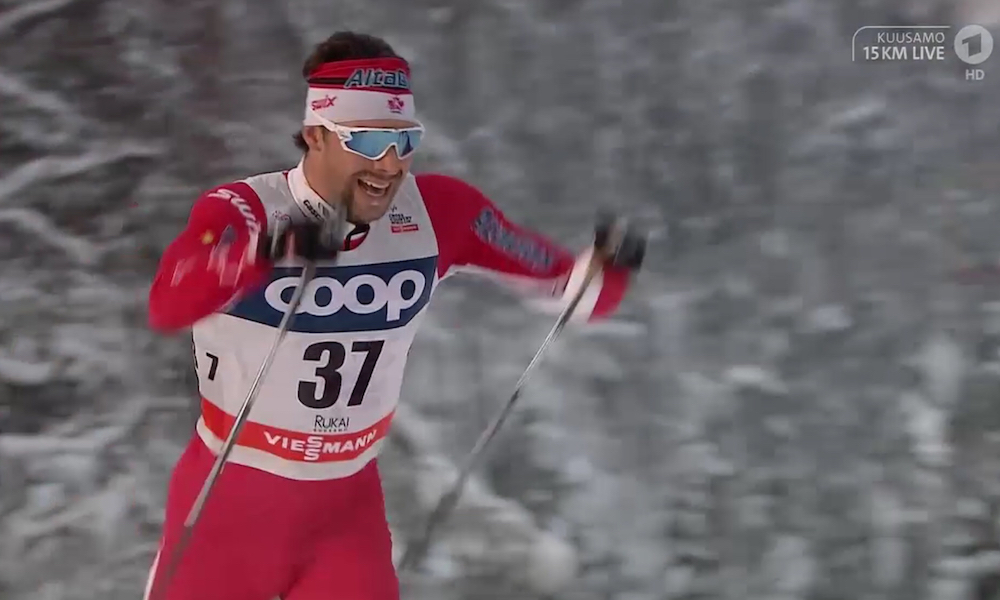
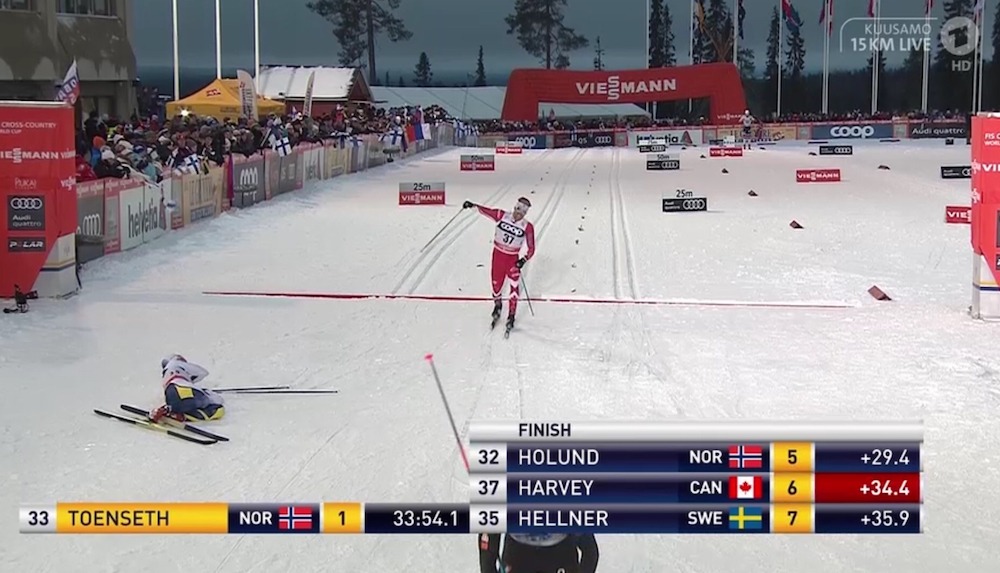
    Canada’s Alex Harvey racing to 13th in the men’s 15 k classic individual start on Saturday at the World Cup in Kuusamo, Finland. (Screenshot: ARD)

    Harvey, who started in bib 37, spent most of his race floating between 10th and 14th place, and did what he needed to get within striking distance of the top 10 for Sunday’s pursuit. He’ll start tomorrow’s race in 12th, 1:23 out of first and 9 seconds behind Chervotkin in 11th.

    “I was just hoping to move forward a bit in the standings but more importantly to deliver another good race,” Harvey wrote in an email on Saturday. The day before, he reached the quarterfinals and finished 21st overall in the sprint.

    “The conditions yesterday were quite different than today’s. Yesterday it was fresh falling snow and cold, then it warmed up quite a bit overnight so today was very glazy [sic] and shiny snow,” Harvey wrote. “Skis were good I think. Not the fastest but good kick in not-so-easy conditions to get grip.”

    Like fellow Canadian World Cup Team member Devon Kershaw, who tied American Erik Bjornsen (U.S. Ski Team) for 26th (both 1:15.2 out of first), Harvey explained that he chose no-wax “hairies”, also known as “rub” skis.

    (“I think a lot of guys went on rub skis,” Kershaw wrote in an email. “I went with rub skis and it was the right choice for me today. The techs were all pretty pumped because I have been very averse to rub skis in the past. The handful of times I’ve been ‘forced’ to race on them I’ve gotten completely destroyed, so today was fun to feel good and make the skis work for me.”)

    Harvey recalled feeling strong on the climbs, using his grip to his advantage.

    “From our more detailed splits it seems I was losing a bit on the flats which is usually my stronger terrain but nothing too dramatic,” Harvey wrote. “I’m happy to be within reach of the top ten, that was the goal for the weekend. Tomorrow I’m looking forward for 2 things. 1: chasing guys ahead of me. 2: skating!”

    Kershaw, who started 13th and had fewer men to chase ahead of him, explained that he paced his first lap so that he’d catch someone like Harvey, and the plan worked.

    “I was going to take my risk and start really slow. Almost level 3 effort,” Kershaw wrote of his pre-race strategy. “I knew I should be able to lap through with either Alex, [Finland’s Matti] Heikkinen, or Dario [Cologna of Switzerland] – and it just so happened that it was Alex. I ended up having great energy after my pedestrian start and was able to ski 10km with him, which obviously allowed me to ski into the points. Perhaps I should have been more aggressive out of the start, but I played it safe and it worked out decently well for me.”

    “That was sweet to have someone there,” Harvey said in a Cross Country Canada press release. “It was good for both of us and really helped pull us both around.”

    Canada’s Alex Harvey (in red) lunges at the finish of the men’s 15 k classic at the Ruka World Cup in Kuusamo, Finland. While he initially finished sixth, he ended up 13th on the day. (Screenshot: ARD)

    Kershaw wrote that he was “decently happy,” with his race. “I know that 26th doesn’t sound earth shattering or anything, but to start the first distance race of the World Cup tour in the points is fine. I’m a notoriously slow starter throughout my career before Christmas, so I’m just looking for some solid races and to hit the points more often than missing them is good.”

    On Sunday, he’ll start 28th, one second behind Cologna in 26th and Russia’s Andrey Larkov in 27th. Bjornsen, the U.S. Ski Team’s leading man in the Ruka tour, is 7 seconds ahead of him in 23rd.

    “I think the celling is probably 20th,” Kershaw wrote of his aspirations for an overall finish for the mini tour. “We have a good group of about 10 guys all starting within 9 seconds of each other. I will hope to stay in that group and have the energy and punch to have a good last lap. You never know what happens in these pursuit starts too – so guys could blow up, but there’s a break at around 20, and then behind me there’s a break at around 30. Will be fun.”

    Bjornsen, who placed 24th in Friday’s sprint, started Saturday’s 15 k in bib 69, just 30 seconds ahead of Niskanen. In an email, Bjornsen described catching a “great ride from Iivo” on the second lap.

    “He’s just amazing here,” Bjornsen wrote. “I’m pretty sure he was disappointed with his result. He comes to Ruka with a mission. I jumped on him for a lap in the middle. It felt very controlled in the double pole sections but he was just striding up the hills no problem. The herring bone was not nearly as efficient. I had to let him go after skiing with him for 6kms.”

    Bjornsen explained that he took a chance and went for glide over grip.

    “I’ve only raced here four times but tricky classic conditions seem to be the norm. The hills are big and steep!” he wrote. “I had a pair of rockets under my feet but I didn’t stride in the tracks once. My double pole is feeling great right now so the tactic was to hammer double pole as far up the hill as I could, and then just get out of the tracks and run/herring bone.”

    After finishing in the top 30 to score World Cup points in the first two races of the season, Bjornsen explained he was feeling “psyched”.

    “I didn’t have the best feelings the last couple weeks, so I wasn’t expecting to be in the points right away,” he wrote.

    “Of course yesterdays race was fun for me, but for sure the highlight of the day was watching Sadie absolutely dominate the heats!” he added of his older sister Sadie Bjornsen placing second in the women’s sprint. “She’s been looking great this year and I think she has a lot more success to come. Personally I believe she was strong enough to take the win, it’s only a matter of time before that happens..”

    On Sunday, he hoped to chase a top-30 overall tour finish.

    “I’m starting around some legends, so it will be a great experience!” Bjornsen wrote.

    U.S. Ski Team coach Matt Whitcomb said he was impressed with Bjornsen’s ability to contend with “some of the best skiers in the world” on Saturday, including Niskanen.

    “[He] kind of took the approach, ‘I am going to swing as hard as I can and hope to connect with the ball,’ and it worked for a large part of that race,” Whitcomb said on the phone. “He was skiing up into the top 20, and then Niskanen on the final lap turned things up a little bit and popped him off … It was a gutsy race, so psyched for Erik. It is so fun to watch him figure out a project, some sort of challenge in the race and go after it. … Twenty-sixth is a hell of a race in Finland.”

    American Noah Hoffman raced to 43rd (+1:58.4) on Saturday, Andy Newell finished 59th (+2:29.6), Paddy Caldwell was 72nd (+2:53.5), Scott Patterson 86th (+3:17.7), and Simi Hamilton 96th (+3:43.4) for the U.S. Ski Team.

    Five other Canadian national-team members competed, with Len Valjas finishing 48th (+2:08.0), Graeme Killick 58th (+2:23.4), Knute Johnsgaard 87th (+3:19.8), Julien Locke (U25 Team) 100th (+3:56.4), and Jess Cockney 109th (+5:20.7).

    ***

    * Northug, 31, who made his World Cup debut in 2005/2006 and has since accumulated 13 World Championships golds and two Olympic gold medals, has started his season this weekend with non-World Cup International Ski Federation (FIS) races in Gålå, Norway, after skipping Norway’s opening FIS races in Beitostølen, Norway, last weekend. Per team rules, he was not allowed to start the Ruka World Cup as a result of that decision. So far in Gålå, Northug finished 17th in the 15 k freestyle on Friday and was eliminated in Saturday’s classic-sprint quarterfinals to place 19th in that race.

    ** Belov, 27 is one of six Russian skiers currently banned from competing at future Olympics as a result of doping at the 2014 Olympics. He and the five others are allowed to compete in FIS events, like the World Cup, unless FIS decides otherwise.

    Results: Men’s 15 k classic | Men’s Ruka Triple standings (Day 2) | Pursuit start list

  • Kalla, Belov Top Gällivare FIS Opener; Randall 8th, Kershaw 12th

    Kalla, Belov Top Gällivare FIS Opener; Randall 8th, Kershaw 12th

    Sweden’s Charlotte Kalla racing to a win in her first race of the 2017/2018 season, the women’s 5 k freestyle in Gällivare, Sweden, on Friday. (Photo: Sporteventgallivare/Instagram)

    Sweden’s Charlotte Kalla and Hanna Falk went 1-2 in Sweden’s season-opening International Ski Federation (FIS) race on Friday in Gällivare, with Kalla winning the women’s 5-kilometer freestyle by 8.8 seconds in 12:58.1 minutes. Falk, her teammate on the Swedish women’s team, placed second and Russia’s Yulia Belorukova took the third spot on the podium, 10.3 seconds out of first.

    The host nation had three in the top four, with Ida Ingemarsdotter in fourth (+16.1). Switzerland’s Nathalie von Siebenthal finished fifth (+17.8), Russia’s Yulia Tchekaleva placed sixth (+23.4), and Russia’s Natalia Nepryaeva was seventh (+25.0).

    Kikkan Randall of the U.S. Ski Team raced to eighth (+27.2), just ahead of Sweden’s Evelina Settlin in ninth (+32.0) and Russia’s Anna Nechaevskaya in 10th (+33.5). Japan’s Masako Ishida was just 0.3 seconds out of the top 10 in 11th.

    In an email, Randall explained that she decided to venture to Europe earlier this year to get some racing in ahead of the World Cup.

    “We also wanted a little extra time to let Breck adjust to the 10hr time change!” she wrote of her 1-year-old son, who will be traveling the World Cup circuit with Randall and her husband, Jeff Ellis, this winter.

    (Article continues below)

    Most of the U.S. Ski Team arrived in Rovaniemi, Finland, on Thursday, Nov. 16 (with the exception of Andy Newell, who is racing this weekend in Beitostølen, Norway, with Noah Hoffman). The rest of her teammates planned to train at the Santasport Olympic training center in Rovaniemi until Nov. 21, when the entire team will meet up in Kuusamo (also known as Ruka), Finland — the site of next weekend’s World Cup opener.

    “I’m happy with my start today,” Randall wrote of Friday’s race. “It took my a couple km’s to get going today but I felt like I was finding my rhythm in the 2nd half of the course.  It’s my first hard session this week after the travel over so today was a good jolt!  It was a competitive field and I was satisfied to be in the mix.”

    Ninety-two women raced the Gällivare 5 k skate, compared to 56 women on Friday in Beitostølen (Norway’s FIS season-opener). Randall planned to race the 10 k classic on Saturday in Gällivare, then skip Sunday’s classic sprint.

    “It’s great to be back around other World Cup skiers again and I’ve always liked Gällivare so it’s nice to be back here,” she wrote. “My former wax tech lives here and has been taking great care of us. … Looking forward to meeting up with the team in Ruka next week.”

    With 46 Swedes and 23 Russians accounting for most of the women’s field, Canada’s Emily Nishikawa put herself in the mix in 26th, 54.9 seconds behind Kalla. Nishikawa’s Canadian World Cup teammate Dahria Beatty placed 56th (+1:38.3).

    For Nishikawa, who’s known as a distance skier, the top-30 result was notable in that a 5 k falls somewhere between a sprint and a distance race.

    “5km is such a hard distance, and it is over so fast, but it is a lot of fun,” Nishikawa wrote in an email. “I have been able to work on my sprinting a bit more this summer as I have been injury free, so I’m looking forward to seeing more speed in my racing this season.”

    She planned to race all three days in Gällivare, including Sunday’s sprint.

    “With these races, I am just hoping to fine tune my fitness and get some hard intensity in to feel sharp for the upcoming World Cup races,” added Nishikawa, who’s entering her fifth World Cup season as a leading member of the Canadian women’s World Cup Team. “Today’s race was a really hard effort and I am happy with how I skied today.”

    The 12th-ranked Russian woman on Friday, Evgenia Shapovalova, who was recently banned for life from future Olympics, placed 22nd.

    Belov Bests Ustiugov

    In the men’s 10 k freestyle on Friday, another one of the Russians sanctioned by the International Olympic Committee (IOC), Evgeniy Belov won in 23:08.5. He was 6.5 seconds faster than his Russian teammate Sergey Ustiugov, who placed second. Ustiugov is the defending Tour de Ski champion and Overall World Cup runner-up.

    Switzerland’s Dario Cologna placed third, 7.6 seconds out of first, and Russia swept fourth through ninth, with Sweden’s Marcus Hellner following in 10th (+36.4). Out of the five actively competing skiers the IOC sanctioned earlier this month, all five raced on Friday in Gällivare, which was legal considering FIS had not ruled they can’t.

    Four of those skiers are men. In addition to Belov, Maxim Vylegzhanin placed 14th (+43.2), Alexander Legkov followed in 15th (+45.9) and Alexey Petukhov finished 23rd (+56.7) out of 157 finishers on Friday.

    Devon Kershaw (front) training with U.S. Ski Team sprinter Andy Newell in Sjusjøen, Norway, last week. (Photo: Noah Hoffman)

    Ahead of them, Canada’s Devon Kershaw ended up 12th (+39.9), tying another Russian Artem Maltsev (who is not on the IOC-banned list) with identical times.

    “My stance on the whole Russian fiasco is unchanged,” Kershaw wrote in an email, referring to a previous email he wrote to FasterSkier earlier this week when asked how he felt about the IOC-banned Russians competing in FIS events. “I find the entire thing both disturbing and hilarious. The fact that FIS is risking their credibility like this makes no sense to me. Apparently there will be an emergency meeting of sorts tomorrow about it (with FIS I’m assuming but I haven’t heard much about it) – so we’ll have to all wait and see what they come up with.

    “As for seeing Belov win – I mean, that’s no surprise,” Kershaw continued. “He’s shown that he’s a force when he’s in form. But yeah, the fact that he and others have been recently banned for life by the IOC are winning races after that news came out just shows the Mickey Mouse club that our sport has become.”

    As for his own race, Kershaw wrote that he felt great about it. The course suited him well without too much hard climbing. “… You kind of need to be pushing the whole way around. I really like courses like that,” he wrote.

    The conditions, however, with about 10 to 15 centimeters of new snow from the early morning that continued into the race, made the course slower, which Kershaw found to be more challenging.

    “But that is another reason why I am so satisfied with the effort today. Individual start skating in soft conditions? Not my favourite, so I’m happy how I was able to execute things,” he wrote. “For me to be in the mix in a 10km skate like that feels great. I had good energy all race and hit my technical goals for the race too, so I have to be satisfied.”

    Kershaw and the rest of Canada’s Period 1 World Cup team arrived in Gällivare last Sunday. Over the last week, they’ve been testing equipment and getting into a race routine ahead of the World Cup opener, he explained.

    “I changed various things with my training this year so it’s exciting to see how my body feels in the beginning of a new season,” Kershaw wrote. “… My goals are really to just be calm and execute well – which means going into the racing with no expectations other than to ski as technically well as possible while working on the whole pacing thing (which can be challenging at the beginning of the season when you don’t have that many races in the body). I’ll look to have another well executed race tomorrow and the results will be what they will be.”

    Canada’s NorAm leader at the end of last season, Russell Kennedy (Team R.A.D.) was the next-best Canadian in 48th (+1:35.7), followed by Len Valjas (World Cup Team) in 49th (+1:37.0). Jack Carlyle (Alberta World Cup Academy) placed 67th (+2:07.2), Julien Locke (National U25 Team) was 72nd (+2:10.9), Graeme Killick (World Cup Team) 90th (+2:32.2), Brian McKeever (Para Nordic Team) 97th (+2:39.0), and Jess Cockney (World Cup Team) 119th (+3:10.7). Knute Johnsgaard (World Cup Team) did not start.

    Racing continues in Gällivare this weekend with 10/15 k classic individual starts on Saturday followed by classic sprints on Sunday.

    Results: Women | Men

  • Caitlin Gregg Suffers Lightning Strike in West Yellowstone, Unharmed and OK

    Caitlin Gregg Suffers Lightning Strike in West Yellowstone, Unharmed and OK

    Caitlin Gregg heading out on an early morning jog before sunrise on Tuesday, Nov. 14, in West Yellowstone, Montana. Later that morning, a little before 9 a.m., she was essentially struck by lightning while running to the nordic ski trails there. (Photo: Instagram/@caitlincgregg)

    She never heard thunder and never saw lightning before it happened, but in an instant, Caitlin Gregg realized the surge running through her body was a one-in-a-million type of occurrence.

    This past Tuesday morning started out like most others for Gregg, who turned 37 exactly a week earlier, during her annual visits to West Yellowstone, Montana. With her skis and poles in each hand, she headed for the Rendezvous Ski Trails on foot — a short jog from the hotel she and her husband, Brian, were staying at.

    It was 33 degrees Fahrenheit around 9 a.m. that morning and snow was falling, “a strange grapple type of snow/sleet”, Gregg, a 2015 World Championships bronze medalist, recalled in an email.

    Caitlin Gregg (Team Gregg) racing to first in the women’s 10 k freestyle at 2017 U.S. nationals last January at Soldier Hollow in Midway, Utah.

    She hadn’t been aware of any thunderstorms in the forecast. If she had, she would have never ventured out on her own, but rather caught a ride to the trailhead and waited for the storm to pass.

    “Many of my teammates throughout the years know how terrified I am of lightning and thunderstorms,” wrote Gregg, a member of Team Gregg and Loppet Nordic Racing, based out of Minneapolis, Minnesota.

    But it was just snowing, or so she thought.

    As she jogged along the road, wearing metal spikes on her shoes for traction, Gregg reached the corner of Electric Street. Suddenly and without warning, lightning — stemming from a natural phenomenon called thundersnow — struck a nearby tower.

    Simultaneously, an electric current surged through her body — up her left leg and out her left arm. She felt the surge followed by her jewelry burning on her skin.

    “It felt like touching an electric fence x 1,000,000,” she wrote. “I had no idea what was happening but a split second later I heard the largest clap of thunder. I realized right away that I needed to get help.”

    Gregg sought out medical attention at a hospital about an hour north in Big Sky, Montana.

    “They checked out my heart’s electrical signal and for any muscle breakdown,” she wrote. “Thankfully all are normal. So, I am a bit shaken but everything seems to be okay.”

    Her left hand “had some peripheral neuropathy and a pins and needles feeling for the rest of the day”, she recalled, but her jewelry didn’t leave any burn marks and she was cleared by the doctors to resume training as she felt up to it.

    “I have been taking it pretty easy and just being careful if I notice any changes,” she wrote. As of Thursday, she hadn’t.

    “I am grateful that I had a great group of teammates and coaches here who could help me out all day and have been skiing with me everyday since,” she added.

    “I learned (through this whole ordeal) that the majority of lightning ‘strikes’ on people are from nearby objects getting hit the the current traveling through the ground,” Gregg explained. “Totally crazy experience. There have been a lot of lightning jokes now circulating the team (CXC and LNR) about how my it will give me super powers [smiley face]. We will see but I am pretty happy to have walked away okay.”

    The day after, she posted a photo on Instagram of herself skiing with Midwest training partners.

    https://www.instagram.com/p/BbhtX4JjxEx/?taken-by=caitlincgregg

    While the odds of being struck by lightning in the U.S. in any one year is about 1 in 1 million (and the odds of being struck in one’s lifetime is 1 in 13,000), Gregg was feeling fortunate to be one of the survivors. According to the National Weather Service, she is one of about 300 Americans who survive lightning strikes each year. Ten percent of all lightning victims don’t make it.

    “I have a new perspective on life for sure now,” Gregg wrote. “I looked up some of the lightning statistics and reports and I am feeling very lucky!”

    And in a small town like West Yellowstone, with a population of about 1,200 (that sees an influx of several hundred skiers each November for the Yellowstone Ski Festival), news — as well as rumors — apparently spread fast.

    “A lot of people thought I died,” Gregg wrote. “The hotel manager was trying to convince people that I am not dead and still staying at his place :)”

    Feeling perhaps more alive or sparky, as she put it, than ever, Gregg is back on the path of trying to qualify for her second Olympics. (She represented the U.S. at the 2010 Winter Olympics in Vancouver, B.C. Her husband Brian, the other half of Team Gregg, raced at the 2014 Olympics in Sochi, Russia.)

    The Greggs arrived in West Yellowstone earlier than usual this year to get acclimated to the altitude, some 6,700 feet above sea level. She planned to race the International Ski Federation (FIS) sanctioned race there on Nov. 25 (women’s 5-kilometer freestyle individual start) before starting the season in earnest with the SuperTour opener: a freestyle sprint and 10 k classic mass start Dec. 2-3, also in West Yellowstone.

    “Despite this strange start to my season Brian and I are still very focused and driven to represent Team USA at the 2018 Olympics in Korea this February,” Gregg concluded.

    — Jason Albert provided reporting

    Caitlin Gregg (r) with fellow American Jessie Diggins (l) and Sweden’s world champion Charlotte Kalla after reaching the podium in the 10 k freestyle at 2015 World Championships in Falun, Sweden. Gregg earned bronze, Diggins silver and Kalla gold.
  • Biathlon Canada Finalize World Cup Team Following Trials (Updated)

    Biathlon Canada Finalize World Cup Team Following Trials (Updated)

    Emma Lunder, of Biathlon Canada’s Senior National Team, racing to second in the women’s modified sprint on Friday, Nov. 10, the last day of Biathlon Canada’s team trials. After reaching the podium three times in three races, she was selected to the IBU World Cup team for the first trimester. (Photo: Peter Collins/petercollinsphoto.com)

    Note: This article has been updated to include comments and verification from Biathlon Canada High Performance Director Roddy Ward, and explain the modified shooting format used for Friday’s sprint.

    ***

    Almost exactly two weeks before Biathlon Canada sends the rest of its World Cup team to Europe for the first trimeter of International Biathlon Union (IBU) World Cup racing, the national team held trials this past Tuesday through Friday on snow in Canmore, Alberta. Three sets of races in four days (all sprints*) determined which Canadian men and women will start the season at the World Cup opener in Östersund, Sweden, Nov. 26-Dec. 3.

    The national-team trials, also known as the “Tour 1 Selection Trials”, ultimately boil down to what Biathlon Canada calls performance percentages, which measures an athlete’s finishing time in a given race against the average of of the top-three finishers’ times in that race. One bad race isn’t a deal-breaker; they consider the best two out of three. At the end of the trials, an athlete’s top-two results (specifically their performance percentages) are averaged for their overall ranking.

    Going into the trials, two women and one man on Biathlon Canada’s senior team had prequalified for the first World Cup tour (World Cups 1, 2 & 3): Rosanna Crawford, Julia Ransom and Scott Gow, according to a national-team program dated Aug. 30, 2017.

    According to the same document, two additional women’s spots and three men’s openings remained. Those went to the two highest-ranked women at the Nov. 7-10 trials — Megan Bankes and Emma Lunder, respectively — and the top-three ranked men — Nathan Smith, Brendan Green and Christian Gow, respectively.

    Emma Lunder (r) with fellow Biathlon Canada national-team member Rosanna Crawford after the women’s modified sprint at Biathlon Canada’s team trials in Canmore, Alberta. Lunder placed second in that race to secure one of the last two spots on Canada’s IBU World Cup Team, while Crawford, who had been pre-selected for the team, placed sixth in that race. (Photo: Peter Collins/petercollinsphoto.com)

    All of the eight aforementioned athletes were nominated to Canada’s 11-member National Senior Team in June. The three remaining biathletes are Sarah Beaudry, who had the third-best overall women’s percentage at trials, Megan Tandy, who ranked fourth and was reportedly coming off an illness after traveling from Germany, and Macx Davies, who ranked seventh in the men’s final percentages after Matthew Hudec of the Biathlon Alberta Training Centre (BATC) in fourth, Carsen Campbell (BATC) in fifth, and Jules Burnotte (Biathlon Estrie) in sixth. (Scott Gow, Crawford and Ransom were not factored into the final percentages.)

    The eight athletes that just missed the World Cup team will start the season on the IBU Cup. Four men and four women earned spots on Canada’s IBU Cup team as a direct result of their performances at trials: Hudec, Campbell, Burnotte, and Davies, and Beaudry, Tandy, Nadia Moser (BATC), and Leilani Tam von Burg (BATC).

    Biathlon Canada’s High Performance Director Roddy Ward described the recent team selections as “straight-up trials”. Based on its published criteria, Biathlon Canada has the option to use discretion in choosing a fourth man and fourth woman for its IBU Cup team, but instead stuck to results, selecting the fifth- through eighth-ranked athletes at trials.

    “We filled the team based on trials,” he explained on the phone on Sunday.

    Ward said he was “feeling really good” about how the World Cup team shook out, with four of their top men returning to the circuit. He mentioned that Smith is healthy and back at full strength, and noted Green’s consistency at trials.

    “On the women’s side, it’s just really good competition … with places changing every day,” he continued.

    Most of the 16 athletes selected to Canada’s World Cup and IBU Cup teams spent much of the offseason together “time-trialling and integrating,” Ward said, which has brought up the level of training as well as made for closer competition among them.

    “My hope is we go to the World Cup and do well and go to the IBU Cup and do well,” he said.

    The Canmore trials began with sprints on Tuesday, which Beaudry and American Lowell Bailey (US Biathlon) won. The only woman to shoot clean, Beaudry topped the women’s 7.5-kilometer sprint by 8.9 seconds over Crawford with a finishing time of 21:57.7 minutes. Crawford missed one in each shooting stage (1+1) for second place and Lunder placed third, 21.1 seconds back, after a single standing miss (0+1). Tandy followed in fourth (+1:05.5) with two penalties (1+1), and Joanne Reid was the top American in fifth (+1:13.9) with one miss (0+1).

    Christian Gow (Biathlon Canada Senior National Team) racing to ninth in the men’s modified sprint on the last day of Biathlon Canada’s team trials in Canmore, Alberta. With the third-best performance percentage of the trials, Gow was the fourth man named to Canada’s IBU World Cup team for the first trimester of racing. (Photo: Peter Collins/petercollinsphoto.com)

    In the men’s 10 k sprint, Bailey also cleaned to beat out Smith by 13.4 seconds with a finishing time of 25:02.5. Smith had to ski one penalty loop after a prone miss (1+0) and Green placed third (+14.5) after two prone penalties (2+0). Scott Gow and his younger brother Christian finished fourth (+29.4) and fifth (+38.8), respectively, and Tim Burke (US Biathlon) was the second American in sixth overall (+1:11.0).

    On Thursday, Smith won the second sprint of the week outright with a 26.1-second victory in the men’s 10 k with perfect shooting and a finishing time of 24:25.3. Green once again followed in second with clean shooting as well, and Artem Prima of Ukraine took third (+1:09.3) with two misses (2+0). While the Americans didn’t compete on Day 2 of the trials, Team Ukraine did, accounting for nearly the same amount of competitors (40 in the men’s race, 20 in the women’s race, compared to 40 in the men’s race and 26 in the women’s race two days earlier).

    Scott Gow finished fourth in the Day 2 sprint (+1:17.0), followed by Hudec in fifth (+1:29.4).

    In the second women’s 7.5 k sprint, a new winner emerged, but second through fourth place were exact repeats from Day 1. Bankes claimed the win in 22:03.5 with clean shooting, while Crawford followed in second, 26 seconds back with two standing penalties (0+2), Lunder placed third (+1:02.8) with two prone misses (2+0), and Tandy was fourth (+1:16.2) with two prone penalties (2+0) as well. Beaudry placed fifth (+2:16.6) with three penalties (2+1).

    After sitting out the first two days of trials, Ransom won Friday’s modified sprint (6.8 k for the women) by just a tenth of a second over Lunder. Ransom hit all of her targets and posted the win in 20:20.4, and Lunder was just off her mark in second place after “cleaning” as well. Per the modified format, each athlete could use up to three spare bullets per shooting bout, similar to a modified relay.

    “We all know [sprints] are important races; they lead to pursuits they lead to mass starts,” Ward explained. “We want to make sure we’re picking good biathletes, but also favoring on the ski-speed side.”

    In addition to giving an athlete more chances on the shooting range, the relay format showed who could excel in those types of races, Ward said.

    Julia Ransom (6) racing to the win in the women’s modified sprint on the last day of Biathlon Canada’s team trials on Nov. 10 in Canmore, Alberta. (Photo: Peter Collins/petercollinsphoto.com)

    As a result of the modified-sprint format, the top-five women avoided the penalty loop. Bankes placed third, 6.7 seconds off Ransom’s time. Bankes’s BATC teammate Nadia Moser finished fourth (+8.6), ahead of American Susan Dunklee (US Biathlon) in fifth (+18.6). Crawford finished sixth (+48.0) with two penalties (2+0) and Tandy placed seventh (+1:13.9) with one miss (1+0).

    In the men’s modified 7.5 k sprint on Friday, Smith emerged as the top Canadian for the third-straight race, winning in 18:42.0 with “clean” shooting. The top-eight men hit all their targets. Green finished second (+11.5) once again, and Scott Gow improved to third (+36.4).

    Prima followed in fourth (+41.5), his Ukrainian teammate Sergey Semenov finished fifth (+1:05.9), Campbell and Burnotte tied for sixth (+1:08.2), and Davies placed eighth (+1:20.2). Christian Gow finished ninth (+1:40.9) with one penalty (1+0), Burke was the top American in 10th (+1:47.7), followed by Bailey in 11th (+1:47.9). Both Americans finished without any penalties.

    Both the U.S. and Ukrainian teams raced two out of the three days of trials, contributing to the total field size of 45 men and 26 women on the last day. Ward emphasized that those teams’ presence made for “some really good competition”, and added that having Canadian juniors race alongside seniors (same distances, same races) showed them a clear path to reaching the World Cup level.

    US Biathlon held the last of its own trials last month and planned to finalized its IBU World Cup team after its Canmore training camp.

    For the Canadian World Cup team, Green and the Gow brothers planned to leave Sunday for Sjusjøen, Norway, where they’ll race at Norwegian biathlon trials. According to Ward, Lunder will depart on Thursday for Sjusjøen, where she’ll start her season with the first IBU Cup sprint on Nov. 23 before meeting the rest of the World Cup team in Östersund. Smith, Crawford, Ransom and Bankes planned to leave Canada on Nov. 22.

    Most of the IBU Cup team will depart on Dec. 1, while Campbell and Beaudry will start their seasons earlier at the IBU Cup opener Nov. 23-26 in Sjusjøen.

    ***

    Final ranking (performance percentages)

    Results: 

    Tuesday’s sprint

    Thursday’s sprint

    Friday’s modified sprint

    (*Why were all of these trials sprint races? When it comes to individual events, IBU Cup and IBU World Cup venues typically open with sprints to determine which athletes qualify for the remaining races of the week at each stop. For instance, the top 60 in the sprint qualify for the following pursuit race, and approximately the top 30 in the overall World Cup rankings qualify for mass starts.)

  • Wednesday Workout: Preseason Agility with U.S. Paralympics Nordic

    Wednesday Workout: Preseason Agility with U.S. Paralympics Nordic

    A look at Mount Van Hoevenberg’s freshly groomed, machine-made trail in late October during a U.S. Paralympics Nordic Program camp in Lake Placid, N.Y. (Photo: BethAnn Chamberlain)

    It’s that time of year when everyone’s raring to get on snow. Let’s say you’re lucky enough to find some — even just a few hundred meters — like the U.S. Paralympics Nordic team did late last month at a training camp at Mount Van Hoevenberg in Lake Placid, N.Y.

    Seven athletes — a combination of high-performance and development skiers — spent a week at Van Ho from Oct. 23-29 for the nordic center’s earliest opening yet on machine-made snow. Starting Oct. 1, the area’s SnowFactory blew enough snow for a 480-meter loop wide enough for two-way skiing. And it did so despite daytime temperatures hovering around 70 degrees Fahrenheit.

    U.S. Paralympics Nordic’s 2017 Lake Placid camp attendees:

    High-performance athletes:
    – Jeremy Wagner
    – Eric Fraizer
    – Bryan Price
    Development athletes:
    – Julius Schram
    – Chris Rassmusen
    – Dave Nicholes
    – William Ward

    On top of that, Van Ho organizers constructed a two-point, 10-meter Para biathlon range, which was connected to the loop and gave the team’s biathletes a place to practice shooting.

    But on Day 2 of camp, the rains came, putting a sizable dent in the skiable terrain. While Van Ho was rebuilding its loop for the end of the week, the Para skiers switched gears to dryland training, shooting and rollerskiing/mountain boarding at the venue’s full-size biathlon range and rollerskiing the paved loop at Lake Placid’s Olympic Jumping Complex — the latter of which is known for its challenging terrain.

    “This was a first for us and proved to be a great training site for all of our sit skiers,” BethAnn Chamberlain, the US Biathlon Paralympics development coach who led the camp, explained in an email, referring to the jumping-complex trails. “Late in the week, despite the continued warm temperatures, the Mt Van Hoevenberg crew was able to put together a short strip of snow for us again, including giving us access to our Biathlon range area.”

    What did they do to make the most of their on-snow time? Chamberlain shared an agility workout for “even the smallest stretch of snow.”

    The Workout: Early season agility

    What you need: At least 200 meters of snow, cones, and if possible, a corner on the track (cones can substitute if no corner is available)

    U.S. Paralympics Nordic high-performance athlete Bryan Price (Casper Mountain Biathlon Club) rounds a corner during an agility workout at a U.S. Paralympics on-snow camp in late October at Mount Van Hoevenberg in Lake Placid, N.Y. (Photo: Mt. Van Hoevenberg/Facebook)

    What you should know: “The basic premise of this workout is to have the athletes ski corners and around cones at different speeds and by taking different lines, and doing so on their own as well as in groups,” Chamberlain explained. “This not only helps the skiers develop a better feel for how their sit ski responds to their movements around corners, but also opens up the idea of the near infinite approaches and techniques to get around a corner or to maneuver around other skiers on course.  (It only take a few minutes of skiing in a sit ski to truly appreciate how difficult it is to maneuver and stay upright, and do so with speed in a sit ski.  I highly recommend everyone, adaptive and non-adaptive skiers to give it a try.)  This is a speed workout disguised as an agility workout.”

    Setup: Using cones, construct two slalom courses for the athletes to race through, head to head.

    Warmup: 20 minutes of easy skiing

    The workout: (45 minutes to 1 hour total)

    • First, ski course at an easy speed and work up to a sprint speed.
    • Then, start the “races”, with two athletes racing at a given time, competing against each other on the parallel courses.
    • Throughout the session, change it up. “You can continue to run ‘races’ in this manner, change the position of the cones, to create different corners to practice on,” Chamberlain wrote. “You can then move onto 180-degree turns, long sweeping turns in both directions and every other kind of other turn you can think of.  Athletes will ski these corners on their own as well as in groups or pairs at easy speeds to start and ramping up to race speed.”
      • “A continued change in the position of cones creates changes the turn they have to make and keeps the athletes engaged and challenged to practice different lines and approaches through out the workout,” she added. “Run these drills along with additional variations such as shuttle run ‘races’ & slalom style turn relays for 45 minutes to an hour.”

    Cool down: 20-30 minutes Level 1 skiing.

    “We had a great week of training in Lake Placid,” Chamberlain noted. “The folks at ORDA [New York State’s Olympic Regional Development Authority] and Mt Van Hoevenberg were amazing and worked very hard making snow for us, which we were able to use for skiing and for Biathlon training.”

    Jeremy Wagner (in black) chases Bryan Price, his U.S. Paralympics Nordic and fellow 2014 Paralympian, during an agility workout at a team training camp in late October at Mount Van Hoevenberg in Lake Placid, N.Y. (Photo: Mt. Van Hoevenberg/Facebook)

    Kris Cheney Seymour, the nordic program and events manager at Mt. Van Ho and ORDA, which owns the venue, explained in an email that while the week was reminiscent of 2017 Junior Nationals (which were also forced to relocate to the jump-complex trails), it was certainly worth it.

    “Hosting the U.S. Paralympic on-snow fall camp is a wonderful opportunity and provided a timeline that pushed boundaries to do something that is normally outside the realm of possibility,” Seymour wrote in an email. “The effort to pull this off was more about effective planning and management of the process.  Of course the dedication of our staff to pull off all pieces was considerable, but everyone had a pieces and executed it well.

    “We started with 480-meter-long stretch of snow, 2 feet deep and 16 feet wide,” he explained.  “The SnowFactory snow was very durable to skier traffic.  In the middle of the week we had a significant rain storm with high winds that compromised the loop and we had to rebuild for the end of the week. … It was a small flashback to the weather we dealt with last year at Junior Nationals.”

    The nordic center is currently stockpiling snow from the SnowFactory in order to open to the public. Over the course of the winter, Van Ho has a stated goal of being open 150 days with skiable snow; last year, it was open 139 days thanks to the SnowFactory (as opposed to 39 days the year before without it).

    “We have a SnowFactory because of unpredictable winter weather,” Seymour wrote. “… Without the SnowFactory this past season we would have lost the stadium and connector trails just under 40% of the days we were open.  Our season would have been closer to 85 days if we only had natural snow.  … As pioneers with the SnowFactory in North America we are still learning from the machine and perfecting our warm weather snow management.  TechnoAlpin has been helpful in sharing how others have used the SnowFactory around the planet, but to some extent, all locations have their own challenges.”

    U.S. Paralympics high-performance athlete Eric Frazier training in late October on machine-made snow at Mount Van Hoevenberg in Lake Placid, N.Y. (Photo: BethAnn Chamberlain)
  • Ski World Reacts to Legkov, Belov Punishment (Updated)

    Ski World Reacts to Legkov, Belov Punishment (Updated)

    After anchoring Norway to fourth in the men’s 4 x 10-kilometer relay at the 2014 Olympics in Sochi, Russia, Petter Northug congratulates the Russian silver medalists, including anchor Maxim Vylegzhanin. As a result of the IOC’s decision to sanction two Russians that competed in Sochi, Russia is to return its relay medal; Norway will thus be awarded bronze and France silver.

    This article has been updated to include comments from Canadian World Cup Team member Alex Harvey as told to Le Journal de Montreal on Wednesday.

    ***

    As the news spreads of the International Olympic Committee’s decision to sanction two Russian cross-country skiers, Alexander Legkov and Evgeniy Belov, for doping at the 2014 Olympics at home in Sochi, Russia, a growing number of skiers and coaches from across the globe are reacting on social media.

    “Hell yes, IOC. Finally starting to take some action,” U.S. Ski Team (USST) member Simi Hamilton wrote on Twitter. “I have a feeling pressure from us clean athletes has paid off!”

    “Today marks a win for clean athletes,” USST Women’s Coach Matt Whitcomb tweeted. “Two cheats are out.  It’s a start.”

    The Russian men’s relay team meets Maxim Vylegzhanin at the finish after he anchored them to silver in the 4 x 10 k at the Sochi Olympics. The IOC recently ruled that the Russian team’s relay result should be invalidated and they are to return their medals.

    Norway’s Petter Northug posted a photo on Instagram of what looked like brunch in a tropical setting with the words: “Feire OL bronse!” (translates to “Celebrating Olympic bronze!”). Northug already has four Olympic medals to his name, two of which are gold (all from the 2010 Olympics), but the men’s 4 x 10-kilometer Olympic relay medal from 2014, which will be awarded retroactively to the Norwegian team (after they placed fourth behind Sweden in first, Russia in second and France in third) will be the first medal for Northug’s teammates Eldar Rønning and Chris Andre Jespersen.

    Later on Wednesday, Northug posted a jocular meme on Instagram, picturing himself racing in the Sochi relay with the words: “You know you are the best anchor when you bring the medal home 4 years after the race.”

    Legkov was part of Russia’s silver-medal relay in Sochi, and as a result of the IOC’s ruling, he must return the two medals he won there (relay silver and 50 k gold). Additionally, the 2014 Olympic results of Legkov and Belov are to be voided and both athletes are barred from competing at (or being granted credentials to) future Olympics. However, both are expected to appeal the ruling to the Court of Arbitration for Sport (CAS) by this Thursday at the latest.

    “It is weird to get the medal in the mail. But if he gets convicted, of course I will take it,” Jespersen told Norway’s Nettavisen, according to a translation. “It’s my only Olympic medal. It is clear I will take it.”

    In an interview with Le Journal de Montreal, Alex Harvey, the leading member of the Canadian World Cup Team who finished third in the overall World Cup and second in the distance standings last season, said he had his suspicions about Legkov — particularly after the 50 k freestyle mass start (in which Harvey placed 19th).

    Canada’s Alex Harvey (front, bib 19) racing in the freestyle sprint at the 2014 Winter Olympics in Sochi, Russia. He finished 19th on the day. Also pictured: Russia’s Sergey Ustiugov (2) made it to the final and placed fifth. (Photo: Fischer/NordicFocus)

    “On the climbs, we could see he was artificially stronger than the rest,” Harvey said, according to a translation. “In Sochi, the last two kilometers were filled with big climbs. It was a course made for Russians knowing that they were doping.”

    He added that the end of each course in Sochi ended with a long, brutal uphill that was exceptionally “physically demanding”.

    As for the recent doping bans involving professional cross-country skiers, Harvey said, “It’s a shame because our sport is now compared with cycling. It is in cross-country skiing and in biathlon that the largest number of dope cases occur.”

    And while he was in favor of the IOC’s decision, he hoped the buck wouldn’t stop there.

    “I’m happy that the IOC finally acted, but Russian skiers are still racing … and one in particular who wasn’t bad in Lahti,” he said, alluding to Sergey Ustiugov, who took gold or silver in all five races he competed in at Lahti World Championships.

    “Ustiugov was young at the Sochi [Olympic Games], but he still reached the final in the sprint,” Harvey said. “Three of the top six men fell, but he was on his way to a podium that day. What the McLaren Report revealed was that the full team was involved in doping. But Ustiugov’s name never came out. And as long as his name doens’t come up, we can only have doubts.”

    Meanwhile, the law firm representing Legkov and Belov is enraged, according to Nettavisen.

    “The decision deserves the term scandal,” the Wieschemann firm stated in its press release on Wednesday. “[It] mocks the declaration of the President of the IOC, Dr. Thomas Bach, to decide only on the basis of secure evidence.”

    While the IOC’s Disciplinary Commission (also referred to as the Oswald Commission) has yet to release its full decision and explain how it arrived at the final rulings, cases for 26 other Russian athletes (four of which are nordic skiers) who allegedly doped in Sochi are still pending, the CBC reported.

    “The Oswald Commission has announced that all hearings for active athletes who could qualify for the Olympic Winter Games PyeongChang 2018 will be completed by the end of November,” the IOC stated.

    As of Wednesday, exactly 100 days out from the 2018 Winter Olympics in PyeongChang, South Korea, it remained unclear whether the commission obtained further evidence concerning Legkov and Belov beyond what was already presented to the CAS.

    Wieschemann claims the commission ruled “without further investigation and without further evidence…”

    “Denis Oswald still stated at the last summit of the IOC that his investigations would go far beyond those of Prof. Richard McLaren,” the firm’s press release stated. “Well that’s actually not the case. The investigation has only been limited to obtaining a new forensic opinion…”

    And while some of the most outspoken individuals in the XC world continue to speak out, others are weighing in on social media as well.

    “… It’s disturbing to find out that some athletes in cross-country skiing have likely doped, and have gone so long unpunished,” Caitlin Patterson of the Craftsbury Green Racing Project wrote on Facebook. “But it reminds me that we must be vigilant, keep looking for ways to support anti-doping testing programs, put pressure on governing bodies to take a stand for clean sport, educate ourselves on progress and pitfalls of the cause, and speak up when we can.

    “I haven’t spoken much on this politicized topic, but recent news such as this disqualification makes me distinctly aware of how much I value clean sport and all it stands for,” Patterson, who has started 27 World Cup races, continued. “Thank you IOC for taking this step towards preserving clean sport! Let’s keep it going, keep the pressure on, and fight to #CompeteClean and #PlayTrue!”

    Former U.S. skier Sylvan Ellefson, who retired in 2014 after racing 23 World Cups, took to Instagram: “Thankful that our @usnordicskiteam contingency all get to move up a couple spots, but I mostly feel for those who have always been moral in their decision making. Those who train and race relentlessly, with their head down, just to find out their competition is taking the easy road. I could go on, but nothing lights me up more than cheaters.”

  • Wednesday Workout with New DU Assistant Mads Strøm

    Wednesday Workout with New DU Assistant Mads Strøm

    A glance at Lookout Mountain in Golden, Colorado, where the DU Ski Team held an uphill skate workout last month. (Photo: Mads Ek Strøm)

    At the end of Mads Ek Strøm’s senior year at the University of Colorado-Boulder (CU), the 26-year-old Norwegian had some decisions to make. He started by looking for a job in the U.S., specifically in the finance industry, in addition to pursuing a master’s degree in finance.

    Mads Ek Strøm of the University of Colorado-Boulder racing to a first place finish in the men’s 10 k freestyle race at the 2016 NCAA Skiing Championships in Steamboat Springs, Colo. (Photo: CUBuffs/Buffzone.com)

    Then the three-time National Collegiate Athletic Association (NCAA) champion — who won back-to-back races at the 2016 championships and came 0.5 seconds from a fourth NCAA title last year — got a call from Dave Stewart, head coach of the University of Denver (DU) Ski Team.

    DU’s assistant coach for the last six years, Hakon Johansen, had accepted a position as head coach of the Chinese biathlon federation, which is aiming to strengthen its snow-sports teams in advance of the 2022 Beijing Winter Olympics, Stewart explained in an email to FasterSkier.

    “When I started thinking about a new coach, Mads was a top choice immediately based on his experience as a competitor, as an NCAA student-athlete and from what I know he invested in his own training and in his teammates,” Stewart wrote of the Oslo native. “I have a lot of faith in a coach who is motivated to pass on to his athletes what he learned from his own experiences.”

    Strøm, a seven-time first-team All American and the winningest male skier in CU history, accepted the offer and started at DU at the beginning of the semester about a month ago. DU announced Strøm’s hiring as assistant nordic coach on Sept. 15.

    “I couldn’t say no when the offer from DU came along,” Strøm wrote in an email. “It’s been awesome so far and it was a great way to still be a part of the skiing community.”

    Mads Strøm (r) and Linn Eriksen were FasterSkier’s Collegiate Skiers of 2016. Strøm is now an assistant coach at DU and Linn Eriksen, also from Oslo, Norway, is a senior at DU. (Photo: Curtis Snyder of the CU Sports Information Dept. and Jamie Schwaberow/NCAA photos).

    His responsibilities include discussing training plans with athletes and helping them reach their goals, he explained.

    “As a coach, I really hope I can help the all the athletes develop as skiers but also as human beings,” Strøm added. “Their goals are my goals and hopefully we can bring back the national championship to Denver for the 24th time. I really want to develop skiers and potentially find and help US skiing to another level.”

    “Mads has hit the ground running here and has been received well by our team,” Stewart noted. “We have a very motivated and fun team this year. A few young new faces and enough experienced returners among both women and men to lead the way. As always, our goals will be to be better than we have been before both individually and as a team and win NCAA’s.”

    We asked Strøm for a Wednesday Workout, and he shared one of the best ones he knows: Level 3 uphill skate intervals.

    DU senior Linn Eriksen skating up Lookout Mountain in Golden, Colorado, last month. (Photo: Mads Ek Strøm)

    “You get to increase your VO2 (Level 3-4) and you get lots of repetitive movement which makes you able to work on technique over a longer period of time in ‘race pace’,” he explained.

    “Before the workout try to make it THE workout of the week, as the interval sessions are the ones that makes you a better skier,” Strøm wrote. “Try to create a training plan where you are rested both physically and mentally the morning of the workout. The second session of the day should be a recovery workout (double poling with core strength or just easy running for 45 minutes to an hour).”

    The Workout: Level 3 6-8 x 8-minutes skate uphill

    1. Warmup: Easy skiing for 30 minutes, some minor speed increases to make the body ready for a hard workout.
    2. The Interval: 6 to 8 times 8-minutes uphill skate. Try to pace it so that every single interval is slightly faster. The last one should be in the form of 30/30, where you try increase the pace for 30 seconds and then rest for 30 seconds and do it 8 times; to increase speed and the tolerance for lactic acid to make it race specific.
    3. Cool down: 10 minutes of Level 1 and 5 minutes of Level 2 to remove as much lactic acid as possible. Remember food and drink after the workout as soon as possible (protein bars, Gatorade, etc.)
    DU sophomore Eivind Kvaale skating up Lookout Mountain in Golden, Colorado, last month. (Photo: Mads Ek Strøm)


  • Highlands Trailblazers Seeks Junior Comp Coach

    Highlands Trailblazers Seeks Junior Comp Coach

    Lead Coach (Part Time)

    Nordic/Biathlon Junior COMPetitive Program 

    (Job posting)

    The Highlands Trailblazers seeks an experienced competitive skier with strong coaching skills to manage the training program for this Junior Competitive (“Jr. Comp”) racing program the Club is adding for the 2017/2018 season. This new program is being formed in response to the rapid growth the Club has experienced over the last few years.

    About Highlands Trailblazers Ski Club

    The Highlands Trailblazers Ski Club is a nonprofit component of Highlands Nordic Inc. It operates year round, helping skiers build new skills, race and enjoy a social, friendly, team atmosphere. The club operates out of Highlands Nordic in Duntroon, just minutes south of Collingwood. The Trailblazers consistently rank among the top 5 ski clubs in Ontario and are only one of three clubs to offer an on-premise biathlon program. The Club has produced skiers that have competed at the national and international level. It’s training programs follow the Cross Country/Biathlon Canada Long Term Athlete Development principles, with programs ranging from Biathlon Bears and Jackrabbits through to the Train to Compete “Comp” and “Comp 0.22” teams. A Board of Directors manages the Club, with the racing program lead by Head Coach Rick Dickey.

    The Program

    The “Jr. Comp” program was developed to focus on athletes at the “Train to Train” LTAD level when they progress through their peak growth period. It provides opportunities for the continual progression of technical skills and physical capacities. It is a high-energy program, which includes both Nordic and Biathlon air rifle athletes. The program places heavy emphasis on team building, group interaction and confidence while working to reach common goals.

    Athletes have learned how to train as part of a Track Attack or equivalent program with an expectation that they are independently driven to be active every day. They have at least one year of experience racing in cross-country or biathlon at a provincially recognized event (Midget Champs, Paraffin Series, etc)

    Key features of the program include:

    Application Details

    Lead Coach Position Overview

    This individual will be responsible for delivering the program to the athletes during dryland training, at camps and at races. Their focus is on guiding the athletes as they develop their physical and mental sport specific and sport general skills based on very frequent contact with them so that their progress can be observed regularly. The Lead Coach will be responsible for setting weekly training plans and directing volunteer parent-coaches assisting in the delivery of programming.

    I) Specific Coaching Expectations

    • Coach the team:
      • Twice per week from July to November
      • Wednesday(1), Saturday & Sunday(2), December to the end of March
      • At training camps and ski races
    • Communicate with athletes regarding program specifics and individual questions
    • Work with the coaching team:
      • Attend coaches meetings as requested
      • Work closely with the lead biathlon coach to coordinate athlete training programs
    • Provide weekly guidance to the squad’s parent-volunteer team

    II) Desired Skills

    A. Be a good technical ski racer and passionate adventurer; biathlon background an asset

    B. Experience coaching athletes, preferably at the younger level (19 and under)

    C. Certified, at a minimum, as Community Coaching (NCCP Cross-Country OR BiCan Community Gold) or equivalent training, and ideally hold Learn to Train certification

    D. Demonstrated Coaching, Cross-Country/Biathlon and Leadership skills such as:

    i) Coaching Skills

    • Ability to translate a seasonal training plan developed by the club’s coaching team, into a daily training plan that the athletes follow
    • Ability to regularly solicit feedback and translate it into clear direction for the team

    ii) Cross-Country/Biathlon Skills

    • Experience training with recognized ski club or training center related to cross-country skiing/biathlon
    • Competed at the provincial or university level, or higher
    • Committed to a “win” attitude based on demonstrated racing or coaching results

    iii) Leadership Skills

    • Ability to work collaboratively with the team based on good communication & organization
    • Ability to take a leadership role driven by initiative and need for minimal supervision.
    • Ability to motivate, and gain the confidence of athletes in an ethical, positive environment

    Compensation:

    • $27,000 based on 155 annual coaching days(3); adjusted to reflect employment start date and negotiable based on successful candidate’s availability and experience.
    • Gas, food and accommodation remuneration for travel to races and camps
    • 50% discount at Pro Shop and free annual trail pass
    • Compensation for coach certification courses

    ***

    1) Wednesdays: 5:00-6:30 pm

    2) Saturday & Sunday: 9:30am to 12:30 pm which may include dry land, roller-skiing and on-snow training

    3) including preparation time and non training time; contact time with parents, athletes and coaches

  • FIS Considers Cat-and-Dog Daycare for World Cup Skiers

    FIS Considers Cat-and-Dog Daycare for World Cup Skiers

    The baby room at the 2017 Ulricehamn World Cup in Sweden. FIS is going to need a bigger space for all the pooches and cats they’re about to allow on tour. (Photo: Kikkan Randall/Instagram)

    Ever an equality advocate, Kikkan Randall is spearheading an effort to allow Fido and friends to accompany their World Cup pet owners on the circuit.

    “I was just blown away by the level of support myself and other new parents had on the circuit this year, thanks to FIS’s new childcare initiative,” Randall, an International Ski Federation (FIS) athlete representative, U.S. Ski Team member and mother of a nearly 1-year-old child, told FasterSkier in an exclusive interview on Saturday morning.

    “A lot of my teammates have fur babies at home, including myself, and I know how hard it is to leave them for months on end,” she continued. “They should have the same rights as humans.”

    A few months ago, Randall sent a survey to her World Cup cohorts to see if there was interest in a pet daycare program. Resoundingly, the answer was yes, she said.

    “I couldn’t believe how many of us had dogs, cats, ferrets, you name it,” she said. “I’m not sure how much FIS can accommodate, but anything is better than nothing.”

    She approached FIS with the idea and was surprised that the federation took it seriously.

    “I had to be very careful with my wording and our requests,” Randall said with a laugh. “I mean, we’re not asking for a zoo, but we would like trained specialists taking care of our pets on a daily basis, giving them walks and lots of belly rubs while we’re out doing our jobs.”

    According to Randall and FIS Cross-Country Special Operations Officer Amanda Fritz, pet-care services could be implemented for the 2017/2018 season.

    “We still have a lot of details to work out, but we plan to discuss this proposal at the FIS Congress meetings this summer,” Fritz said on the phone.

    Asked what animals are being considered and whom this service would be extended to, Fritz explained that cats and dogs are solely on the table at this time.

    “We don’t have the space and staff to care for animals other than felines and canines, and even then, they need to be well-behaved, housebroken, and play well with others,” she said. “I think we’re going to have to put the cats and dogs in separate buildings anyways, and definitely away from the kids. As fun and cute as it would be to let them all play together, it’s simply not realistic. Perhaps we can have play dates and field trips.”

    The service will be available to athletes in the Red Group (World Cup top 30), which also have food and lodging paid for by FIS. If an athlete is on the edge or teetering on that Red Group status, they can bring their fluffy friend and pay for pet-sitting for a nominal fee, Fritz said.

    “We haven’t determined the cost yet,” she added.

    And what about the travel required to get the pets from one venue to the next, especially the long journey from North America to Europe (and vice versa), or from anywhere to PyeongChang, South Korea?

    “That responsibility falls on the athlete,” Fritz said.

    Randall explained that there are, of course, workarounds.

    “If your dog or cat isn’t huge and destructive, apply to have them as a therapy pet and put them in the seat with you,” she said of flying with pets. “I’d never put my cat in cargo.”

    https://www.instagram.com/p/BGQBb9kDSqS/?taken-by=kikkanimal&hl=en

    Randall and her husband Jeff Ellis plan to bring their cat, Kikkananimal’s Animal (who currently has dyed-pink fur), to Europe with them and baby Breck next year.

    “I can’t wait to have the whole family together next year,” she said. “It was so hard leaving our first baby at home. Now he’ll be part of the team, too.”

    FIS is reportedly on the lookout for world-class pet handlers. Qualifications include previous pet babysitting experience, no allergies, a rabies shot, and a death-grip on leashes.

    “Our biggest concern is having another poodle get loose on the trails, like we saw in Quebec,” Fritz said of the episode on the last day of World Cup Finals. “You need to have a strong handle on dog walking. Beyond that, we need to know that these animals are being taken care of with the utmost diligence. These are World Cup athletes’ animals, not just some mutts off the street.”

    FasterSkier will post more updates as they become available.

  • Ending on a High, Bryan Fletcher 11th in Schonach World Cup; Frenzel Wins 5th Straight Overall Title

    Ending on a High, Bryan Fletcher 11th in Schonach World Cup; Frenzel Wins 5th Straight Overall Title

    Bryan Fletcher (U.S. Nordic Combined) jumping to 31st on the large hill at 2017 Nordic Combined World Championships in Lahti, Finland. He later finished the day in 31st in the 10 k Gundersen to lead his team. (Photo: John Lazenby/Lazenbyphoto.com)

    At the season-ending Nordic Combined World Cup weekend in Schonach, Germany, American Bryan Fletcher tallied his second-best result of the season: 11th in the individual large hill/10-kilometer Gundersen start on Saturday, March 18. He did so by posting one of his best jumps of the year, which interestingly tied his jumping result at his season-best World Cup in December in Lillehammer, Norway.

    In Lillehammer, Fletcher jumped to 22nd with a 129-meter leap, also on the large hill, and went on to place ninth in the 10 k. On Saturday in Schonach, the 30-year-old U.S. Nordic Combined veteran jumped to 22nd with a distance of 98 meters, and skied the eighth-fastest 10 k to move up to 11th.

    American Bryan Fletcher leading Japan’s Yoshito Watabe early in the men’s 10 k Gundersen start in the first nordic-combined competition of 2017 Nordic World Championships in Lahti, Finland. Fletcher went on to place 14th and Yoshito Watabe 44th. (Photo: John Lazenby/Lazenbyphoto.com)

    “Jumping was starting to come around at the end of the season a bit more,” Fletcher wrote in an email on Tuesday. “It was still inconsistent but I have learned a lot about myself as a competitor this season especially in regards to my technical skills and abilities. Towards the end of the year I was able to start applying some of the things I have learned about myself to my jumping and the results were slowly starting to improve.

    “Obviously the level is very high in the sport right now and so even small mistakes mean you are out of contention,” he added. “So it’s very hard to confidently make changes during the season with so much at stake. But given my rather up and down season I decided this was the season I had to start to shake up my routine to either find a new, better, or more consistent level or to simply confirm that the way I am doing things is still the be path to be on. Schonach on Saturday was only a small change but obviously had a big impact on my results.”

    Fletcher started the 10 k race 53 seconds behind Japan’s Yoshito Watabe, who led after jumping. Fletcher explained the race was seven laps on a difficult 1.5 k course, which would typically play to his strengths, but he’s been struggling with his shape since World Championships three weeks ago.

    “The legs and body were not responding the way I would have liked. So I was pretty unsure going into the race of how I would hold up,” he wrote. “I went out slow and tried to work into the race a bit saving energy for the last laps which almost paid off big. I was able to make contact with the lead group and be there for the winning move, but I was unable to go with the sprint.  I felt like I skied a smart race and my overall performance but I would have been much happier if I could have hung on for a top 10 result.”

    Germany’s Eric Frenzel, who started seventh based on his jump and started 15 seconds behind Watabe, raced to first with the 10th-fastest time. He finished in 28:14 minutes, 3.4 seconds ahead of Austria’s Wilhelm Denifl in second and 7.1 seconds ahead of his German teammate Johannes Rydzek in third. Denifl had started second, 9 seconds back, and held his position, while Rydzek improved from ninth in the jump. Watabe slipped to 17th (+1:02.5).

    Fletcher, who finished 32.8 seconds out of first and 4.5 seconds out of 10th, led two Americans on Saturday, with 17-year-old Stephen Schumann placing 42nd.

    The Nordic Combined World Cup podium on March 19, the last World Cup of the season, in Schonach, Germany, with Germany’s Eric Frenzel (c) in first, France’s Francois Braud (l) in second, and Japan’s Akito Watabe (r) in third. (Photo: FIS Nordic Combined/Twitter)

    On Sunday in Schonach, none of the Americans completed the Day 2 large hill/10 k competition. Ben Berend jumped to 36th, but did not start the race.

    Meanwhile, Frenzel completed his weekend sweep and claimed his fifth-straight Overall World Cup title with a 7.7-second win over France’s Francois Braud. Japan’s Akito Watabe rounded out the podium in third, 11.2 seconds behind Frenzel.

    Overall, Frenzel ended the season with 1,734 points, Rydzek placed second in the overall standings with 1,609, and Akito Watabe completed the podium in third with 1,086.

    The leader after Sunday’s jump, Germany’s Tobias Simon, did not finish the 10 k. Frenzel started the race in eighth, 57 seconds out of first, and posted the 11th-fastest ski time for his third-straight win after topping the large hill/10 k last Wednesday, March 15, at the World Cup in Trondheim, Norway. There, Fletcher led three Americans in 35th. His brother Taylor Fletcher placed 39th and Berend finished 48th.

    At the previous World Cup on March 11 in Oslo, Norway, Frenzel placed second, just 0.4 seconds behind Akito Watabe in another large hill/10 k. Bryan Fletcher finished 43rd and Schumann 49th.

    “This season was one of the hardest I have had,” Fletcher wrote. “I came into the season ready to go and in really good shape for both XC and jumping. I think my mistake was I was too eager to get the season underway. I had trouble maintaining that fitness and body composition and ultimately had to reset over the holidays and rebuild in order to prepare for World Championships.”

    American Bryan Fletcher (16) after finishing 14th in the normal hill/10 k Gundersen start, the first nordic-combined competition of 2017 Nordic World Championships in Lahti, Finland. He had been in the hunt for a medal but crashed on the final corner coming into the stadium. Behind him, Austria’s David Pommer finished 16th. (Photo: John Lazenby/Lazenbyphoto.com)

    At World Championships, Fletcher led his team in 14th in the opening individual competition: the large hill/10 k. He had been in podium contention until crashing on the last corner, about 200 hundred meters before the finish. That day, he jumped to 16th. Looking back on his season, Fletcher considered that event a season highlight.

    “I wanted to be a contender in that event and I was,” he wrote. “I have replayed that race a few times in my head and I think a few different moves in the final lap and I could have been fully in the fight for the medal. Also Lillehammer was a strong race, also I was happy with my performance in Schonach on Saturday after two disappointing comps the week before.”

    After being sick for a couple weeks in January and feeling like he peaked a week too early for World Championships, Fletcher, who has been competing at the World Cup level since 2009, is already thinking about next season.

    “No rest for the wicked haha,” he wrote. “I have already started my training plan for next season with specific areas in both XC and Jumping that I want to improve upon. Specifically I need to improve my finish sprints and in jumping I need to improve my in run balance and position.”

    “I am really motivated for next year and my body is feeling good,” he continued. “The past two seasons I planned to tone things down a bit in my training, so that I could build up a bit stronger for Pyeongchang.  In the past I have always had a performance build for the 3 years prior to the olympics but have come into the Olympic season a bit flat.  My goal was to disrupt that cycle to increase performance next season.”

    While Fletcher was his team’s most consistent member this season, he explained that jumping overall has been a bit of a struggle amongst his teammates.

    “Our team found a really high level at the end of the summer, however, a 5 week break without jumping due to weather before the season disrupted our progress,” he wrote. “Also our guys changed a lot this summer technically. It takes time to build a high level of jumping and I expect us to continue our progress on what we learned this season to improve those adaptations.  I have no doubt we will be on a higher level next year.”

    For now, Fletcher, a new dad, is enjoying some downtime with his wife and 7-month-old daughter Ellery.

    “It does feel amazing to be home with the family!” he wrote. “… [Ellery] had been sleeping on my chest for about the last 30 minutes and to be honest it was awesome to forget about everything else and just enjoy the moment.”

    Results:

    March 18 & 19: Schonach World Cup Day 1| Day 2 

    March 15: Trondheim World Cup

    March 11: Oslo World Cup 

  • Bjørgen Bests Weng to Finalize Unbeaten Streak; Bjornsen Fifth on the Day in Quebec

    Bjørgen Bests Weng to Finalize Unbeaten Streak; Bjornsen Fifth on the Day in Quebec

    Norway’s Marit Bjørgen celebrates her ninth-straight win in World Cup distance races (anything longer than a sprint) in the last race of the 2016/2017 season, the women’s 10 k freestyle pursuit on Sunday in Quebec City. (Photo: John Lazenby/Lazenbyphoto.com)

    QUEBEC CITY — Generally speaking, most European-based World Cup skiers wouldn’t have picked Canada as their ideal place to end the season. It’s too far across the pond, too far from the beaches, too far from home.

    The other option had been Tyumen in Siberia, so that probably wasn’t a top pick, either, but Québec City became the International Ski Federation’s choice once Russia relinquished its hosting responsibilities for World Cup Finals.

    Québec City organizers, headed by Gestev, had just under two months to prepare. Having hosted two stages of the Ski Tour Canada last season and a World Cup sprint weekend in 2012, they had the experience, but World Cup Finals — complete with three uninterrupted days of racing and season-ending awards — was another animal of its own entity.

    Fortunately, the weather cooperated. Three days before World Cup Finals, Québec City and the eastern part of North America got its biggest snowstorm of the season and perhaps the last several winters. With three straight days of racing taking place on the open-aired Plains of Abraham, most familiar with the expansive downtown park expected bone-chilling wind. Yet with above freezing temperatures at race time, that wasn’t much of a factor, especially not on Saturday and Sunday.

    Each day, spectators and athletes required fewer layers, and by Sunday, some of the athletes were down to bibs only. The sun was intense, there wasn’t a cloud in the sky, and the athletes were happy.

    Norway’s Heidi Weng leads her teammate Marit Bjørgen during the women’s 10 k freestyle pursuit on the last day of World Cup Finals in Quebec City. Bjørgen went on to win while Weng was 1.2 seconds back in second. (Photo: John Lazenby/Lazenbyphoto.com)

    “When I saw that we would race here, I thought, ‘Oh no. We’ll have to go so far from home,’ ” Norway’s Heidi Weng told FasterSkier on Sunday. “But when I come here, it’s more like winter, and I like the track here, and I’ve gone very fast here before. So I knew I could go do a very good race here, so now I hope we come here often. It’s very good, and many people, and the atmosphere, and good snow. It was very great to be here.”

    Weng spoke to a horde of reporters with a large, silver briefcase by her side. In it was one of the Crystal Globes she had just received for winning the Overall and Distance World Cups (she won one globe for each season-long category). Between Friday, Saturday and Sunday, Weng finished sixth in the freestyle sprint, second in the 10-kilometer classic mass start, and second in the 10 k freestyle pursuit. Her Norwegian teammate and longtime idol, Marit Bjørgen beat her in both the distance races.

    In all, Weng racked up about 20 individual World Cup podiums (including her Tour de Ski win, Lillehammer mini tour win, and World Championships silver in the 30 k freestyle mass start). She was the most consistent skier throughout the season, thus earning the Overall World Cup crown by 40 points over Finland’s Krista Pärmäkoski, and distance title by 97 points over Bjørgen.

    “I’ve had many podiums this year,” Weng said. “In sprint I have taken huge steps, so I am very happy with the season. I have won a sprint race, and that’s the most important to me…

    “Maybe I must have a little more confidence that I am good and a good skier, because I always think I am not so good as the others, but now I have a better head,” she added. “Maybe you can say in your head that you are very good and very strong, so next year I do a joke with my head.”

    While Weng keeps telling herself that she can win, Bjørgen is fully aware that she’s back to her top form having won every distance race since the new year. That’s nine straight individual wins, including two from this past weekend.

    After starting one second behind Weng in Sunday’s 10 k skate pursuit, she outlasted the overall and distance World Cup champion by 1.2 seconds at the finish after leading Weng for most of the three-lap race.

    “It has been an incredible season for me after Christmas,” Bjørgen, who had a child in December 2015 and took last season off, told reporters on Sunday. “I won every long distance and four golds in the World Championships so this has been incredible and to win today also.”

    On Sunday, Bjørgen caught Weng quickly and with the third starter, Norway’s Ingvild Flugstad Østberg, heading out 29 seconds back, the two skied off together and away from any threat to their top-two quest.

    On the first lap, Østberg tried to close the gap, coming within 23 seconds of them at 1.3 k, but by the time she lapped through the stadium at 3.3 k, she was 33 seconds behind and just seven seconds ahead of a chase pack with her Norwegian teammate Maiken Caspersen Falla, Pärmäkoski, and Sweden’s Ida Ingemarsdotter and Stina Nilsson. Another 20 seconds behind them, American Sadie Bjornsen and Sweden’s Anna Haag were leading a pack of eight.

    One lap later, Bjørgen and Weng cruised into and out of the stadium 46 seconds before Østberg, who was still 10 seconds ahead of the four-woman chase pack by the time she came through. The group, which was down to Nilsson, Ingemarsdotter and Parmakoski, eventually caught Østberg less than a kilometer before the finish, and Østberg finished at the back of that group in sixth, 1:06.8 behind Bjørgen. In a race for third, Nilsson took it by 1.9 seconds over Ingemarsdotter in fourth and 5.6 seconds ahead of Pärmäkoski in fifth.

    “It was a mental struggle the whole way because they were 15 and 10 seconds behind me all the way, and that’s a difficult gap,” Østberg told FasterSkier. “They were three and four working together, and I was all by myself in front. I really tried to push as hard as I could, and stay in front of them, and I had 10 seconds, and it was less than 1 kilometer left, and I really believed that I could take it, but when they passed me, they had such high speed, I couldn’t keep up with them. So that was not so fun to see them pass me there, but I managed to take the third place overall [in the World Cup], so I have to be satisfied with that, I guess.”

    “I think we worked well together,” Nilsson told FasterSkier. “Krista did the hardest work, I think, but I tried to help her as much as I could, and I was very excited that we could catch up to Ingvild. … I knew that when we started to be in the sprint course, I started to feel at home, then I just wanted to go as fast as I could.”

    Norway’s Marit Bjørgen after outlasting her teammate Heidi Weng for the win in the women’s 10 k freestyle pursuit on Sunday at World Cup Finals in Quebec City. (Photo: John Lazenby/Lazenbyphoto.com)

    Exactly a minute before Nilsson — a sprint specialist — finished third, Bjørgen had crossed the line first in 22:36.1 minutes after getting slightly ahead of Weng coming out of the downhill with 100 meters remaining. Leading up to that point, Weng had come from behind to attack on the second-to-last climb, a markedly steep one, but Bjørgen responded quickly.

    “I thought that Marit was a little bit more tired than me, but when I attacked on the sprint uphill I hoped that I could get some meters to Marit, but she was there, and in the downhill she came from behind and take a better speed,” Weng said. “That sucks, but I was number two, and it’s not many who can be on the podium, so I am very happy.”

    “I knew that it would be a sprint in the end with Heidi and to have her behind me is a very good feeling,” Bjørgen said. “I’m 10 years older and to be there is a good feeling to take with me into the Olympic [year next season].”

    Bjørgen is 36. Weng will turn 26 in July. Nilsson is 23.

    On Sunday, Bjørgen not only won the pursuit and with it, the World Cup Finals mini tour, but she was also the fastest for time of day in 25:35.1. Weng was second fastest, 2.2 seconds back, and Nilsson third (+11.9) after starting seventh and moving her way up to third.

    On her 34th birthday, Germany’s Nicole Fessel was fourth fastest (+15.3), and Bjornsen of the U.S. tied Sweden’s Charlotte Kalla for fifth on the day, 17.8 seconds off Bjørgen’s time.

    Sadie Bjornsen (U.S. Ski Team) soaking up her top-10 finish at 2017 World Cup Finals in Quebec City after placing 10th in the 10 k freestyle pursuit and fifth for time of day. (Photo: John Lazenby/Lazenbyphoto.com)

    Overall Bjornsen placed 10th (+1:27.2) after starting 1:10 minutes back in 10th with Kalla in ninth and skiing with her and Fessel (the 13th starter) to the finish.

    “Charlotte was going so hard from the start,” Bjornsen said after. “I actually did my warm up behind her, trying to get used to her speed because that was my main goal, to stay with her today. I knew it was going to be rippin’, and at one point some of the girls went in front of me, and I let her get away, and I was like, ‘No! I have to stay with her!’ So I had to do a full sprint in the middle to catch back on, which took a lot to recover from.”

    At the finish, just 0.4 seconds separated Kalla, Fessel and Bjornsen, who placed eighth (+1:26.8), ninth (+1:26.9) and 10th, respectively. Ahead of them, Norway’s Falla placed seventh (+1:19.8).

    “I really wanted to outsprint those girls in the finish for some redemption from the sprint race the other day,” Bjornsen said, referring to her 13th place in the World Cup Finals opening skate sprint. “I’m super happy with a top 10 in the tour. That’s some of the best general skiing I’ve done this year, and it’s good to end on a high note.”

    The U.S. had two in the top 20 both overall and for time of day, with Jessie Diggins in 16th (+2:14.8) after skiing the 14th fastest time of day (+35.0). After placing ninth in the sprint and 27th in the classic mass start, she started Sunday in 20th and moved up four places by the finish.

    “This weekend, in particular, was not what I wanted,” Diggins told reporters after. “To be honest, I was in tears before the race, because I was up all night coughing. I don’t know if I was getting sick or what, but I was getting nauseous, and I started to puke a little bit, and I was like, ‘I just want to race, and race in front of my family. I just want to go out there and be able to have a good day.’ ”

    Diggins immediately got to work out of the gate and was up to 19th at the end of the first lap with Germany’s Stefanie Böhler. She skied with Böhler to the finish, before edging the German by two seconds for 16th.

    “I decided I was going to go for it, and it was really working for me when Stefi came by,” Diggins said. “I was just hanging on in the uphills, and then on the downhills, if I was right in her draft, I could push or pull and help each other that way, and that was really cool. I really like skiing with Stefi, she’s awesome, and we were both working together to get the fastest time we could.”

    Jessie Diggins (U.S. Ski Team) racing to 16th in the women’s 10 k freestyle pursuit (up from 20th at the start) with the 14th fastest course time on Sunday at World Cup Finals in Quebec City. (Photo: John Lazenby/Lazenbyphoto.com)

    At the end of the season, Diggins ranked sixth in the overall World Cup and seventh in the distance standings.

    “My biggest goal for today was to only say positive things to myself all day, no matter what anything felt like, no matter what the skis were doing, no matter what my body was doing, no matter how sick I felt, and the only thing was to push really hard and cross the finish line and be proud of pushing,” Diggins said. “You can’t control a lot of things in ski racing, but you can control, how much effort you put into it, and I can honestly say I’ve put 100 percent in this season, and I’m really proud of that.”

    While 12 American woman completed the tour, 15 Canadians women did the same, with Emily Nishikawa (Canadian World Cup Team) leading them in 38th (+4:52.7) after starting 39th. Cendrine Browne, of Canada’s national U25 Team and Pierre Harvey Training Centre, finished just two seconds later in 40th (+4:54.7) after starting 41st.

    “I was the last person to start before the wave,” Nishikawa explained. “And the wave, they’re working together as a mass start and moving pretty fast, so I got caught by them at the end of the first lap. I tucked in behind Rosie [Brennan of the U.S.] for the second lap and I actually had a big tangle with [Switzerland’s] Laurien van der Graaff on the fast downhill so I lost contact, lost all my speed. … and I did my best to come back.”

    Browne started in the wave and described skiing in that group throughout the race.

    “Unfortunately, I finished at the back of the group as I was losing energy,” she told FasterSkier. “I still managed to gain 30 seconds on the leader, which I’m happy about. I finished 41st again, behind my goal of moving towards the top 30, but it’s not dramatic. I think it’s a nice way to cap off the season.

    “It was really an amazing weekend, the atmosphere, the crowd, the conditions, everything was on point,” Browne added in French. “I couldn’t have hoped for a better way to end the season.”

    “We were so lucky to get [the World Cup Finals] here instead of Russia,” Nishikawa said. “We got to start 30 athletes, lots of people starting their very first World Cups, which is so exciting to see. It’s great for development for our country… We’ve got a really exciting group of women coming coming up in Canada now and to see this group of 15 women get starts this weekend is just great.”

    Also for Canada, Dahria Beatty finished 50th, Annika Richardson 55th, Frédérique Vézina 57th, Katherine Stewart-Jones 58th, Andrea Dupont 59th, Annika Hicks 62nd, Sophie Carrier-Laforte 63rd, Sadie White 64th, Lisle Compton 65th, Katherine Weaver 66th, Laura Leclair 67th, and Mia Serratore 68th. Alannah MacLean did not finish.

    American Sadie Bjornsen (10) racing to the line with Sweden’s Charlotte Kalla (9) and Germany’s Nicole Fessel (not shown) during the women’s 10 k freestyle pursuit on Sunday at World Cup Finals. Kalla placed eighth, Fessel ninth and Bjornsen 10th. (Photo: John Lazenby/Lazenbyphoto.com)

    For the U.S., Sophie Caldwell placed 36th (+4:26.1), Rosie Brennan 42nd, Caitlin Patterson 43rd, Chelsea Holmes 45th, Julia Kern 46th, Kaitlynn Miller 52nd, Liz Guiney 53rd, Becca Rorabaugh 54th, Erika Flowers 56th, and Jennie Bender 60th.

    “Sadie’s skating has reached a new level this season,” U.S. Ski Team Head Coach Chris Grover said, according to a team press release. “Jessie also had a measure of redemption leading a train of women and moving up four places in the standings today. Rookie Julia Kern continued to impress, staying in front of the chasing group for the entire race and winning the sprint at the end.

    “We are very proud of the American effort this weekend — athletes, club coaches and U.S. Ski Team staff,” he continued. “We had some great races but, of course, were left wanting a bit more.”

    The U.S. Ski Team will finish out its season in Fairbanks, Alaska, with the SuperTour Finals next week, March 27-April 2. Most Canadians are traveling to Canmore for Canadian Ski Nationals, which started Sunday and extend through this Saturday.

    Pursuit results

    Time of day

    Final Overall World Cup standings

    Final Distance World Cup standings

  • Klæbo Rockets to First Distance Win in Quebec Mass Start; Harvey 4th

    Klæbo Rockets to First Distance Win in Quebec Mass Start; Harvey 4th

    Norway’s Johannes Høsflot Klæbo (r) crossing the line first in the men’s 15 k classic mass start on Saturday at World Cup Finals in Quebec City, 0.5 seconds ahead of fellow Norwegian Niklas Dyrhaug (12), who placed second. Russia’s Alexander Bessmertnykh (behind Dyrhaug) followed in third, just ahead of Canada’s Alex Harvey (1) in fourth. (Photo: John Lazenby/Lazenbyphoto.com)

    QUEBEC CITY — As 75 men jogged out into the center of the World Cup area assembled on the Plains of Abraham for the men’s 15-kilometer classic mass start on Saturday, one man in particular stood out. Alex Harvey, wearing the red suit of the Canadian national team, led the group out. He wore bib No. 1, but if you couldn’t see that from a distance, it didn’t matter. Essentially everyone knew who he was.

    The official hashtag of World Cup Finals in Quebec City this Friday through Sunday has been #GOALEX2017. He is a celebrity in Quebec, a hero to its locals, and someone even non-skiers know quite a bit about.

    And so far, the 28 year old appears to be soaking up every minute of his homecoming. One day after winning the freestyle sprint to start the finals, Harvey was seeded first in Saturday’s classic mass start. He led racers into the stadium, waved to spectators, started on the front line, and led the pack out of the stadium.

    Canada’s Alex Harvey leading Norway’s Johannes Høsflot Klæbo and two other Norwegians and Switzerland’s Dario Cologna (far left) during the men’s 15 k classic mass start on Saturday at World Cup Finals in Quebec City. (Photo: John Lazenby/Lazenbyphoto.com)

    Even when others took turns leading, with Norway’s Niklas Dyrhaug, Emil Iversen and Johannes Høsflot Klæbo setting the pace on the first of four laps, the possibility of Harvey winning never seemed in doubt. He consistently positioned himself within reach of the lead, skiing around sixth for much of the first lap.

    On Lap 2, the lead group remained about 30 strong. Harvey skied within two seconds of the Norwegians up front, with Pål Golberg, Didrik Tønseth, Finn Hågen Krogh, Dyrhaug, and even Klæbo — the 20-year-old Sprint World Cup champion — all still in contention. By the end of Lap 3, Harvey was into second, right behind Tønseth.

    With 3.75 k to go and the crowd’s ability to see the racers on most of the exposed course, the excitement among Harvey fans began to exceed its already high point from the start. Bells, horns, “Gooo Alex!”

    Russia’s Alexander Bessmertnykh attacked on an uphill and Harvey stuck behind him in second. On the second to last climb, a short and steep pitch that ascends up from the Old City’s historic wall, Dyrhaug surged into first, Bessmertnykh followed him in second and Harvey in third.

    Behind them, Klæbo was sizing them all up in fourth, waiting for the perfect time to strike. He did so by moving to the outside lane on the last long downhill and glided into second behind Dyrhaug. They ascended the final pitch together and rounded the final corner before the 100-meter stretch to the finish, where Klæbo continued to accelerate past Dyrhaug and double poled to his first World Cup distance win in 35:23.7 minutes. Dyrhaug finished 0.5 seconds later for second place, Bessmertnykh 0.8 seconds back in third, and Harvey 1.2 seconds behind Klæbo in fourth.

    Canada’s Alex Harvey racing to fourth in the men’s 15 k classic mass start at World Cup Finals in Quebec City. With one race left, the 15 k freestyle pursuit, he is third in the mini tour and third in the Overall World Cup as well. (Photo: John Lazenby/Lazenbyphoto.com)

    While it wasn’t a podium for Harvey, it was a result he was proud of.

    “I’m very satisfied,” he told reporters afterward in French. “Making the top 10 is always a big deal. Today was another step towards securing a third spot in the overall [World Cup]. That was my big goal coming in. So I’m satisfied … You can’t make the podium every time. I felt very good physically.”

    With one World Cup race remaining, Harvey, who’s ranked third in the world, extended his lead on Finland’s Matti Heikkinen in fourth to 92 points. Heikkinen finished 26th on Saturday, 1:04.9 minutes out of first, and will start Sunday’s 15 k freestyle pursuit 27th, 2:15 behind Klæbo as the World Cup Finals mini-tour leader. Dyrhaug will start 22 seconds back in second, followed by Harvey 1 second later in third, and Krogh another 11 seconds back in fourth.

    “Every pursuit is a manhunt so I’ll be hunting the young Norwegian in front,” Harvey said. “It was Klæbo’s first victory in a distance event. We saw him come in second behind Sundby in this year’s first mini tour. So of course, he’s strong. I mean, the guy won five or six gold medals at the Junior Worlds. He’s a complete skier…”

    Asked if he thought he could work with Dyrhaug to reel Klæbo in, Harvey wasn’t counting on one Norwegian helping him bridge the gap to another.

    “I don’t think Dyrhaug will chase, but I will,” Harvey said.

    Dyrhaug told reporters that might not be the case.

    “Tomorrow is going to be an exciting day,” he said in English. “I saw that me and Alex are going out together, so it is in both of our interests to cooperate and do good teamwork, and hopefully we can catch Johannes and then we’ll have to see…

    “We ought to talk together with team staff, hear what Johannes says, too,” he added. “But it is in both interests to have a big gap behind [us]. So if I’m strong, I’m thinking maybe I’m going to help Alex to … yeah, and we’re going to cooperate.”

    In the last year that Klæbo’s been racing World Cups, the three-time 2016 junior world champion (in the freestyle sprint, 10 k classic and freestyle relay) has reached the podium six times in individual World Cups and claimed bronze in the freestyle sprint at this year’s World Championships. But before Saturday, all of his podiums (with the exception of one mini tour) had been in sprints.

    “I hadn’t dreamed about doing a distance race in the World Cup … and cross the finish line in first,” Klæbo said after. “It’s unbelievable.”

    Johannes Høsflot Klæbo leading three other Norwegians, Emil Iversen (l), Finn Hågen Krogh (second from l) and Niklas Dyrhaug (r) during the men’s 15 k classic mass start at World Cup Finals in Quebec City. Klæbo went on to win, Dyrhaug placed second, Krogh 16th, and Iversen 25th. (Photo: John Lazenby/Lazenbyphoto.com)

    He was the most consistent race leader on Saturday, winning one of sprint preems and crossing in second behind his teammate Iversen for the other. In all, he accumulated 27 bonus seconds, which were deducted from his overall time in the mini tour — putting him first by 22 seconds over Dyrhaug.

    “I just tried to be in the front for the bonus seconds to be able to get some seconds,” he explained of his race tactic. “So that was my plan.”

    Despite trying to lead for most of it, he noticed others trying to do the same on the third and fourth laps. In the final stretch of the race, coming off the long downhill toward the finish, Klæbo focused on moving up from fourth.

    “Niklas gapped our group in the last downhill there so we had push really hard on the last uphill to get to him,” he explained. “At the finish, it was just all out.”

    Bessmertnykh, who will start the pursuit in 13th, 1:08 back, after placing 59th in Friday’s sprint, described Saturday’s mass start as “a fun race,” in a post-race interview with the International Ski Federation (FIS). “There was a lot of things happening all the time. I followed Niklas and Johannes on the last climb. We gained a small gap. I managed to ski well the last curve before the homestretch and carried in good speed.”

    Dyrhaug was also satisfied with his race.

    “The only thing was, I was one meter behind in the end,” he said. “I tried my best. I went all in for a long sprint, when it was one half k left, and it was almost.”

    Under blue skies and a beating sun, Dyrhaug described Saturday afternoon in Quebec as “amazing.”

    “We have been competing for like 40 races this year, but this is the most pretty day, and most pretty conditions for the whole year, so thank you, Quebec,” he said.

    Waxing was a challenge, with temperatures warming quickly to about 2 degrees Celsius (mid-30s Fahrenheit) by midday.

    Canada’s Devon Kershaw (r) and Graeme Killick (l) skied together for most of Saturday’s 15 k classic mass start after Kershaw broke a pole early. They went on to place 28th and 32nd, respectively. (Photo: John Lazenby/Lazenbyphoto.com)

    Devon Kershaw was the second Canadian in the top 30, finishing 28th (+1:08.4) after breaking a pole early on.

    “It was pretty chaotic and broke a pole there pretty early in the start and went all the way back into the 60’s, so made for a lot of work to try to get back in,” he said after. “I am proud of the fact that I was able to ski back into the points, but I had a better body than that today for sure and just had a bit of bad luck there.”

    He finished 9.3 seconds ahead of his Canadian World Cup teammate Graeme Killick, who placed 32nd (+1:17.7), and the two essentially skied together from 5.25 k on.

    While Kershaw said he thought the 3.7 k course would be better suited to skating, he was impressed with the atmosphere and the race organization.

    “I think for a classic, there are a lot of corners and it’s pretty tight … [but] to bring the skiing to the people like they did and to use the terrain they have available, I tip my hat, its a great event,” he said. “It is the most crowds I have ever skied with in Canada, the sun is shining, the venue is fantastic, the organizers did a great job, the tracks are in perfect condition. What a great place to race.”

    Erik Bjornsen led the U.S. men in 31st (+1:16.8) and two seconds behind Switzerland’s Roman Furger in 30th. After losing contact with the lead group of 29 on one of the bigger climbs at the end of the second lap, Bjornsen found himself skiing in “no-man’s land” with Sweden’s Teodor Peterson.

    Erik Bjornsen (U.S. Ski Team) leads Sweden’s Teodor Peterson (r) up a climb during the men’s 15 k classic mass start at World Cup Finals in Quebec City. They went on to place 31st and 29th, respectively. (Photo: John Lazenby/Lazenbyphoto.com)

    “It was a bummer to lose that front pack,” Bjornsen said. “I was struggling on the hills out there; I was a little light on kick. I think a lot of the guys were, but I wasn’t doing much striding. It was pretty much from double pole, to having to run outside the track. I felt pretty good, but I was losing time.”

    While skiing with Peterson, Bjornsen said he led at times and wanted Peterson to help drive the chase as well. Peterson ended up just ahead of him in 29th (+1:14.3).

    “I was like, ‘Come on, dude.’ I could see that there was a group behind, chasing us, and we were kind of right in that no-man’s land, which is always a bad spot to be,” he said. “But it was fun. It’s fun to be racing in North America, and have people cheering my name. It’s so unique, and I love it. I wish we could race over here more often.”

    Matt Gelso was the second American in 37th (+1:32.6), Andy Newell finished 45th, Scott Patterson 46th, Noah Hoffman 48th, Ben Lustgarten 49th, David Norris 50th, Simi Hamilton 54th, Paddy Caldwell 59th, Jack Hegman 62nd, Cole Morgan 64th, and Brian Gregg 69th.

    While the U.S. started 12 men, Canada had 15 in Saturday’s mass start with Bob Thompson finishing 55th, Knute Johnsgaard 57th, Len Valjas 61st, Russell Kennedy 63rd, Evan Palmer-Charrette 65th, Andy Shields 66th, Jess Cockney 67th, Brian McKeever 68th, Joey Foster 70th, Gareth Williams 72nd, Ricardo Izquierdo-Bernier 74th, and Julien Locke 75th.

    Results | World Cup Finals standings | Pursuit start list

    Overall World Cup standings

    — Gerry Furseth, François Léger Dionne, Jake Ellis, and Ian Tovell contributed

    The men’s 15 k classic mass start podium on Day 2 of World Cup Finals in Quebec City, with Norway’s Johannes Høsflot Klæbo (c) in first, Norway’s Niklas Dyrhaug (l) in second and Russia’s Alexander Bessmertnykh (r) in third. (Photo: John Lazenby/Lazenbyphoto.com)
  • Harvey Delivers Again at Home, Wins First Race of World Cup Finals in Quebec

    Harvey Delivers Again at Home, Wins First Race of World Cup Finals in Quebec

    Alex Harvey (Canadian World Cup Team) celebrates his World Cup Finals freestyle sprint win at home on Friday in Quebec City. (Photo: John Lazenby/Lazenbyphoto.com)

    QUEBEC CITY — Friday started off about as good as the Canadian men’s team could have hoped for, with five skiers finishing in the top 30 to qualify for the heats in the 1.5-kilometer freestyle sprint on the first day of World Cup Finals. According to Cross Country Canada, that’s the first time five Canadian men have qualified in a World Cup race.

    Racing one lap around the Plains of Abraham in the heart of Quebec City, athletes were bolstered by an estimated 25,000 cheering spectators. While they ramped up the intensity for their Canadian skiers, they went wild for Alex Harvey.

    And the Saint-Ferréol-les-Neiges native delivered in every sense possible.

    Harvey started off as his team’s leading qualifier, clocking in with the fourth-fastest time, 4.14 seconds behind Norway’s qualifying winner, Johannes Høsflot Klæbo, who rounded the course in 2:39.44 minutes. Behind Harvey, four other Canadians also qualified less than seven-tenths of a second apart. Len Valjas qualified 24th (+9:28), Julien Locke of the Alberta World Cup Academy (AWCA) 25th (+9.39), Jess Cockney 28th (+9.90), and Bob Thompson of the National Team Development Centre (NTDC) Thunder Bay in 30th (+9.95) as the final qualifier in the men’s race.

    For Locke and Thompson, it was their first World Cup top 30. For Cockney, it was the beginning of one of his career-best days. For Harvey, he was just warming up.

    Canada’s Alex Harvey celebrates his sixth-career individual World Cup win (not counting World Championships) on Friday at 2017 World Cup Finals in Quebec City. Harvey won the freestyle sprint by 0.31 seconds over Norway’s Finn Hågen Krogh. (Photo: John Lazenby/Lazenbyphoto.com)

    In Harvey’s nine years as a World Cup skier, the 28 year old has racked up six individual World Cup wins — spoiler alert — including Friday’s. He won a skate sprint one other time, three years ago in Szklarska Poreba, Poland. At World Championships, he’s accumulated five medals, with his first coming in the 2011 classic team sprint and the second World Championships gold of his career in the 50-kilometer freestyle mass start less than two weeks ago in Lahti, Finland.

    After winning the longest race on the circuit, Harvey seamlessly switched gears and dominated Friday’s freestyle sprint on a wide-open course with short, steep hills organizers had to work hard to integrate.

    In his quarterfinal and semifinal, Harvey raced to first in both heats in a way few others attempted to do on Friday. He led from start to finish and didn’t appear to worry too much about the draft, only making sure that he was far enough ahead so that no one else could use it to slingshot past him in the finishing stretch. He won his quarterfinal by 0.34 seconds over Simi Hamilton — the lone American man to qualify for the heats — and semifinal by 0.04 seconds over France’s Richard Jouve. That one was a little closer and didn’t give Harvey enough time to remove his pole straps before the finish, like he did in his quarterfinal while Hamilton lunged for the line to secure second behind him.

    It was one of those days where it appeared everyone else was working really hard, while Harvey was simply cruising. But that was confidence and the crowd he was riding, and it was a look that worked for him.

    Canada’s Alex Harvey leading his quarterfinal in the men’s 1.5 k freestyle sprint on Friday at World Cup Finals in Quebec City. Harvey went on to win the final for his second individual World Cup win this season (not counting World Championships). (Photo: John Lazenby/Lazenbyphoto.com)

    In a post-race interview, Harvey explained he decided to set the pace in the fourth quarterfinal. The heats before had been almost 10 seconds slower than Klæbo’s qualifying time, so Harvey knew his quarterfinal contenders had a chance to advance more than the top-two if they skied fast enough.

    He faced a similar situation in the second semifinal. Harvey said he spoke with Jouve and Norway’s Niklas Dyrhaug before their semifinal and discussed how one of them should lead, “to keep pushing, not make it easy, ’cause we want to move to the final,” Harvey said. “The strategy is actually pretty similar most of the time, but it’s a question of being able to actually do it.”

    He did it and advanced to the final as the man to beat. All around the course, fans shouted for “Alex”.

    Out of the gate in the men’s final, Norway’s Finn Hågen Krogh surged to the front. The six finalists launched immediately into the first and longest climb on the sprint course, just short of 250 meters long, where France’s Lucas Chanavat took the lead and Harvey skied just behind him over the top. Racers dropped back into the stadium then skated back out of it again, where Harvey moved to first in front of the two Frenchmen in the final: Chanavat and Jouve.

    Krogh soon after slotted into third and attacked on the steepest climb while Harvey and Hamilton proved to have the most left to answer.

    As Krogh led into the last uphill, Harvey followed, then Hamilton, Jouve, Chanavat and Norway’s Sindre Bjørnestad Skar — the last three within striking distance of Hamilton in third place. Harvey tucked behind Krogh and absorbed his draft, breaking out his powerful V2 with 100 meters remaining and leaving Krogh chasing him to the line. There, Harvey threw up his arms to celebrate, while Hamilton lunged for third in a photo finish with Jouve. The Frenchman took it by 0.07 seconds, Hamilton ended up fourth, 1.01 seconds behind Harvey, Skar fifth (+1.51), and Chanavat sixth (+1.72).

    Canada’s Alex Harvey (l) coming on strong in the finishing stretch to outlast Norway’s Finn Hågen Krogh (2) by 0.31 seconds for the win in the World Cup Finals freestyle sprint on Friday in Quebec City, while France’s Richard Jouve (10) races to third, just ahead of American Simi Hamilton (behind Harvey) in fourth. (Photo: John Lazenby/Lazenbyphoto.com)

    “At the last turn, I was confident,” Harvey said in French. “I looked at him [Krogh] and I knew I had him, but I was focusing on staying second because of a strong headwind in the last downhill.”

    “To be beaten by the 50 k World Champion on the home stretch is tough,” Krogh told the International Ski Federation (FIS) on Friday. “I was simply not good enough.”

    In the finish area, Harvey appeared about as elated as he was after the 50 k in Lahti, a reaction he said was “pure instinct.”

    “But sprinting comes with greater stress, with the risk of falling, of breaking a pole…” Harvey said in French. “To cross the finish line after a sprint is like a deliverance.”

    The win comes just over a year after Harvey placed second in a World Cup skate sprint in Quebec during the Ski Tour Canada. After passing Russia’s Sergey Ustiugov in the finishing stretch, he had been in first until France’s Baptiste Gros snuck up on him on the inside lane. Harvey finished half a second back in second place, but it was still a day he’d remember — his girlfriend Sophie came out on course to congratulate him.

    On Friday, he made sure to lock up the win. And he was met afterward by Sophie, his sister (also named Sophie) and his dad, Pierre Harvey, alongside the finishing lanes.

    “Last year it would have been nice to win,” Harvey said in English on Friday. “When I passed Ustiugov last year, I had so much more speed than him … I didn’t ease up, but I thought I was going to win … and then I saw Baptiste just blow by all of us in the corner of my eye. So I had a bit of that in my mind and just making sure it wasn’t going to slip through my finger two years in a row.”

    Asked how this stacked up to his 50 k win, he said it was close.

    “Today’s victory really isn’t far behind my 50 k win,” he said in French. “My second place last year here was already incredible, so to top that off with a win at home is a dream come true.”

    The win comes after Harvey has competed two 50 k races, including last weekend’s Holmenkollen World Cup in Oslo, Norway, in less than two weeks and traveled across the Atlantic back to his home province.

    “What surprises me is how well he recovered after the double 50 k, in which he did very well, both times,” Louis Bouchard, Harvey’s personal coach and Canada’s co-World Cup coach, said in French. “Usually in sprints, he will hang at the back and make his move right at the end in the final stretch. So tactically, he skied differently today. He felt strong to the point of leading every round right until the end. It’s also rare to see Alex qualify so strongly. His form his tremendous at this point.”

    The men’s freestyle sprint podium on Friday at World Cup Finals in Quebec City, with Canada’s Alex Harvey (c) in first, Norway’s Finn Hågen Krogh (l) in second and France’s Richard Jouve (r) in third. (Photo: John Lazenby/Lazenbyphoto.com)

    Pierre Harvey, a local hero and the inspiration behind the Pierre-Harvey National Training Centre, spoke with reporters after the race. Five years ago, he had been on site to witness his son’s first-career World Cup win in Falun, Sweden.

    “It’s always very emotional,” Pierre said in French. “I was there when he won his first World Cup in Sweden, which I didn’t think he could ever do at the time, but winning became a familiar sight in a way. I thought he would burn himself after the qualification, but he managed to win every round after. It was impressive to see him beat Krogh, a very capable sprinter, in the last stretch.”

    Asked what propelled his son on Friday, Pierre said racing at home.

    “In front of friends and of a cheering crowd, along with great ski conditions, is an extra motivation,” he said. “He left home on the fifth of November, so coming back after months of racing in Europe, he really wanted to put on a show for his friends. I hope he keeps his energy levels high for tomorrow and Sunday’s races.”

    Two more World Cup races remain to close out the season: a 15 k classic mass start on Saturday and 15 k freestyle pursuit on Sunday. Harvey has essentially solidified third place in the overall World Cup rankings with 57 points separating him from Finland’s Matti Heikkinen in fourth place.

    “Today’s win comes with 50 points, 30 bonus seconds and 10 seconds I put on him in today’s qualification,” Alex Harvey explained. “I feel secure with this lead on him.”

    Ahead of him, Norway’s Martin Johnsrud Sundby and Russia’s Ustiugov are not racing in Quebec. Sundby already locked up the World Cup overall and distance titles, and Ustiugov is still 282 points clear of Harvey in third place.

    After Day 1 of 3 in the World Cup Finals mini tour, Harvey leads by 2.3 seconds over Krogh. All 74 racers remaining in the men’s field will start Saturday’s mass start together.

    The Sprint World Cup podium was awarded on Friday, with Norway’s 20-year-old Klæbo in first, Italy’s Federico Pellegrino (last year’s Sprint Crystal Globe winner) in second, and Skar in third. Both Klæbo and Pellegrino were eliminated in the semifinals, with Pellegrino placing seventh and Klæbo eighth on the day.

    As for third and fourth place on Friday, Jouve was thrilled with his fourth individual World Cup podium and first this season after being injured in December and January.

    “It was a really good day for me,” Jouve said in French. “I passed through my quarter and semi as I wanted. I managed to stay in a good position in the finals. I had very good legs and fast skis.”

    Asked what he thought of the crowd’s favoritism for Harvey, he said it wasn’t anything he couldn’t handle.

    “We were here last year, and the public is pleasant and cheers for everyone,” Jouve said. “It’s normal to see them favor the local star.”

    Simi Hamilton (U.S. Ski Team) racing to 16th in the men’s 1.5 k freestyle sprint qualifier on Friday at World Cup Finals in Quebec City. He qualified in 16th and went on to place fourth in the final. (Photo: John Lazenby/Lazenbyphoto.com)

    Even Hamilton, frustrated with fourth, was happy for Harvey.

    “He’s such a good guy. He’s such a great North American teammate. He’s always so psyched when we ski well, and we’re always so psyched when he skis well, as well as all the other Canadians,” Hamilton said. “We are really just like kind of one bigger team, us against all the Europeans we feel like sometimes, so it’s cool to see him so successful and skiing so strong. And he handles his success with so much humility and grace.

    “Someone as talented as he is, and somebody who works as hard as he does, it’s awesome just to feel the energy,” Hamilton added. “He’s such a good ambassador for our sport, and I think that that’s a testament to see all these people cheering him on, because they know that he’s such a great guy, more than just a good ski racer.”

    Hamilton faced Harvey in all three of his heats and followed him in every one.

    “I knew that Alex and Finn were far enough ahead of us that, unless they tripped or something, that we weren’t going to catch them,” Hamilton said of the final. “So I also knew that I was ahead of Jouve and the other two that were behind us a little bit, so I knew that, especially with the tailwind, if I just skied it well that I would have held onto third. And I just didn’t do that, and it sucks. I want it back. I want to do it again. I felt good going into it, I felt like my energy was really good during the entire final, and for whatever reason, I just didn’t ski it.”

    Four Canadians in Top 20

    Earlier in the day, Cockney tied his second-best individual World Cup result in 10th and popped his second top 12 of the season to meet the criteria for the Canadian 2018 Olympic team. After qualifying in 28th and hanging around fourth or fifth for most of his quarterfinal, Cockney used the draft and his reserved energy to sprint from fourth to second in the finishing stretch. He finished just 0.09 seconds behind Klæbo, who won that quarterfinal, and edged Great Britain’s Andrew Young by 0.07 seconds. While Young didn’t advance, Cockney did, and he went on to place fifth in the first semifinal, 1.3 seconds behind Krogh, the winner of that heat.

    Jess Cockney (Canadian World Cup Team) racing to 28th in the qualifier of the men’s 1.5 k freestyle sprint on Friday at World Cup Finals in Quebec City. He went on to place 10th on the day to tie his second-best World Cup result. (Photo: John Lazenby/Lazenbyphoto.com)

    “You can see just how wide open this field is, and it’s so windy that you kind of had to be smart about where you wanted to use energy,” Cockney said of his tactics.

    “I knew the start was straight into the headwind. You could come down with the tailwind behind you and make back a couple spots, or at least close the distance behind some people. And that’s just exactly what I wanted to do in the quarterfinal, and I was lucky that it worked out well, and I had some energy saved from doing that for the finishing straight. So that was really big for me.”

    As for his finishing gear, Cockney laughed and said he’d like to think he’s had that all along. His trouble has been getting into the heats. In the one other World Cup sprint he qualified in this season — the classic sprint in PyeongChang — he went on to finish 10th.

    “It’s funny, I’d like to think I always have some kind of sprint like that, but I never get into the sprints; my qualifying speed is still not there,” Cockney said. “Today, to actually see it on a race course and see it at a World Cup — I’m really happy with that. I can do it on a domestic level, but being consistent at an international level is still taking some time.”

    Four Canadians landed in the top 20 with Valjas in 19th and Locke in 20th. Valjas finished fourth in the first quarterfinal, 1.81 seconds behind Chanavat, who won. Locke placed fourth in the third quarterfinal, 1.89 seconds behind Pellegrino as the winner of that heat.

    “I’m a bit disappointed,” Valjas said. “I didn’t feel like I was able to show my potential today. I always felt boxed in, and every time I tried to make a move, there was somebody there. The course is so turny that when you’re beside somebody you get boxed in, so it’s frustrating. I think I had more speed than I showed today, but I ended up not skiing it well tactically, starting at the back.”

    Asked about the conditions, Valjas elaborated that Quebec had some of the best snow that World Cup skiers have seen all year. Quebec City was hit with a massive snowstorm earlier in the week on Tuesday.

    “Europe is sometimes good, but this is all-time conditions here,” Valjas said. “It’s fast, it’s wide. It’s just, with the curves, it’s harder to pass than I thought.”

    Julien Locke (Canadian U25 Team/AWCA) racing to 25th in the men’s 1.5 k freestyle sprint qualifier on Friday at World Cup Finals in Quebec City. He went on to place 20th on the day for his first World Cup top 30. (Photo: John Lazenby/Lazenbyphoto.com)

    On the other end of the spectrum, Locke, a 23-year-old member of Canada’s U25 Team, was pleased with his performance in his third World Cup start as it marked his first time in the points (top 30). In his first World Cup race last month, he came close in 36th in PyeongChang.

    “At the start of the season, my two main goals were to go to the Korea World Cup and the World Championships,” Locke said. “And I went to Korea, and I unfortunately had a crash there, so I was really hoping for another second chance, and to qualify to come here was fantastic. It’s crazy having Alex here, a world champion coming home, and the atmosphere is incredible. So since this race was announced, doing a good sprint here was my big goal for the year.”

    Thompson, 26, ended up 30th after finishing sixth in the same quarterfinal as Cockney. After making his World Cup debut at last year’s Ski Tour Canada, Thompson started this season on the World Cup in Europe and raced to 31st in the classic sprint in PyeongChang. On Friday, he scored his first World Cup points as well.

    “Getting in the heats has been the goal for every sprint World Cup I’ve gone to do, which is, this is the 17th now, and I think it’s about the seventh sprint or so,” Thompson said. “… Goal number one is, get a top 30. So I got that, I can reassess, and raise the bar a little bit.”

    Newell Narrowly Misses Qualifying

    For the U.S., Andy Newell missed out on qualifying by eight-hundredths of a second in 31st.  Erik Bjornsen was 0.98 seconds back in 33rd, and Cole Morgan (Sun Valley Ski Education Foundation) another second back in 34th.

    “For Andy to be in 31st, disappointing for him,” U.S. Ski Team Head Coach Chris Grover said. “He felt good out there; he’s a little bit mystified. … And then also for Erik Bjornsen and Cole Morgan, who skied great, to be so close to going in … If we’d gotten three or four guys into the heats then I think it would have been a great start to the day. So a little disappointing to miss that opportunity.”

    “I was feeling pretty good out there skiing, so I don’t know why it was slow,” Newell said. “I couldn’t figure out why.”

    Bjornsen said he hasn’t raced much since World Championships and hoped Friday blew the cobwebs out.

    “I was hoping for a little bit more today,” he said. “I obviously wanted to qualify … but I’m excited for the next couple days. … Tomorrow’s a 15 k classic, which is my favorite event, so yeah, hopefully I can put together some good races.”

    Also for the U.S., Paddy Caldwell placed 50th, Matt Gelso 57th, Scott Patterson 58th, Jack Hegman 61st, Brian Gregg 62nd, Ben Lustgarten 69th, David Norris 70th, and Noah Hoffman 73rd.

    Canada’s Andy Shields came close to qualifying in 35th, Russell Kennedy followed in 36th, Devon Kershaw 38th, Knute Johnsgaard 41st, Evan Palmer-Charrette 47th, Joey Foster 53rd, Graeme Killick 64th, Ricardo Izquierdo-Bernier 71st, Brian McKeever 72nd, and Gareth Williams 74th.

    Results | World Cup Finals standings

    World Cup overall standings | Sprint World Cup standings (final)

  • Utah Rallies for NCAA Title; Bergström, Hyncicova Double Champs

    Petra Hyncicova of the University of Colorado-Boulder leading the women’s 15 k freestyle mass start out of the start on Saturday, the last day of NCAA Skiing Championships in Jackson, N.H., with Northern Michigan’s Nicole Schneider (2) and UVM’s Alayna Sonnesyn (3) right there with her.

    JACKSON, N.H. — Two years ago, Martin Bergström quit skiing.

    A month ago, Petra Hyncicova took three weeks off skiing following U23 World Championships due to a painful bursa between her Achilles tendon and heel bone.

    Less than a week after resuming training, Hyncicova, a 22-year-old Czech Republic native and University of Colorado-Boulder (CU) junior, raced to two National Collegiate Athletic Association (NCAA) Skiing Championships titles — the first of her career — in Jackson, N.H.

    The University of Utah ski team celebrates its first NCAA title since 2003 on Saturday, March 11 at 2017 NCAA Skiing Championships in Jackson, N.H. (Photo: Flyingpointroad.com)

    Bergström, a 25-year-old Swedish freshman at the University of Utah, did the same, winning both nordic races at 2017 NCAA Championships and leading the Utah Ski Team to its first team title since 2003.

    Both started off with decisive victories in the women’s 5-kilometer and men’s 10 k classic individual starts last Thursday, with Hyncicova topping the former by 18.7 seconds and Bergström winning the latter by 26.8 seconds.

    Then on Saturday, with temperatures hovering just above the legal racing limit of -20 degrees Celsius (-4 Fahrenheit) and winds ripping across the field that served as the stadium, the two international skiers completed their championships sweep with wins in the women’s 15 k and men’s 20 k freestyle mass starts.

    “When the season started, I figured that I was in really good shape this year,” said Hyncicova, whose previous best NCAA Championships result was second in the skate race last year in Steamboat Springs, Colo. “I was hoping that I could be on the podium again at NCAA’s and maybe hoping that I could win the skate race, but after winning the classic race and after the injury and everything I can’t believe it. It’s insane for me.”

    “Two years ago, I quit skiing back in Sweden and I took one year of just studying,” Bergström said. “And then a friend of mine was on the [Utah] team, and he said there were spots open and that I should try a different environment of skiing and studying and that I could come over here. So I talked to the coaches, and eventually went for this trip and have had so much fun and made many friends. I’m just so happy I came here.”

    On Saturday, Bergström led three Utah men in the top 10, with Martin Mikkelsen placing eighth and Kevin Bolger 10th. The three scored 84 points and their women’s team emerged as the second-highest scorers in the second race of the day to give the Utes a 16.5-point win over Colorado (CU) to end the championships.

    Reflecting on his win on Saturday, before the women’s 15 k, Bergström anticipated it would be a tall order to win the team title.

    “It’s been amazing, and it’s an amazing team,” he said of his season with Utah. “All the training we’ve done and the work we’ve put in this fall and winter. I’m just so happy. Hopefully there’s a slim chance the girls can pull off an amazing race. We’ll see.”

    Utah Director of Skiing Kevin Sweeney later explained just how difficult it was to come from second place on Friday to take the win over CU and Denver University (with Denver finishing third, just one point behind Colorado). In the last decade of NCAAs, Colorado has placed first or second seven times, according to a press release. Denver is next in line with six top-two finishes (including five titles) since 2008.

    “We’ve been crunching numbers and have been able to beat Denver and Colorado by about 30 points on a really good showing during the RMISA [Rocky Mountain Intercollegiate Skiing Association] season, but didn’t know if we could do it in the championships,” Sweeney said, according to a Utah press release. “Bergström was skiing at a whole new level this week, and Mikkelsen had stepped it up, and I knew Kevin Bolger could get top 10. I was also confident in the women, who have been skiing awesome, so I felt good there. It’s awesome to be able to take this new trophy back to our new ski building.”

    Bergström’s Late Move

    The men’s 20 k came down to a five-way sprint to the line, with Bergström taking the win by 0.5 seconds over Mads Ek Strøm, CU senior and two-time 2016 NCAA champion.

    Utah’s Martin Bergström (9) leading CU’s Mads Ek Strøm (35) and Petter Reistad (7) and DU’s Moritz Madlener (behind Bergström) down the finishing stretch of the men’s 20 k freestyle mass start at 2017 NCAA Skiing Championships on Saturday in Jackson, N.H. (Photo: Karen Brown)

    After Denver’s Moritz Madlener led most of the race, Bergström moved to the front on the start of the fourth and final lap. With 5 k remaining, six men remained together: Bergström, Madlener, Strøm, Adam Martin of Northern Michigan University (NMU), Fabian Stocek of Dartmouth College, and Petter Reistad (CU). On the final lap, the group began to string out and Bergström opened up the narrow lead he needed to win at the finish, crossing in 46:02.8 minutes.

    “I just went for it,” Bergström said. “Tried to check who still had power in the legs. Moritz just answered when I upped the tempo, and he continued my push in the second lap, and I knew I was faster in the finish than Moritz, so he had to make his move before the sprint. As an old sprinter, I feel pretty comfortable making a pass. I can maneuver pretty efficiently. I was just happy too see that it was a high-tempo, pack finish, and with the wind and everything, I think it was smart to go a little before the final stretch.”

    On the final lap, Strøm, the defending champion who won both races at last year’s NCAAs, tried to position himself near the lead going into the first climb out of the stadium, just in case someone attacked.

    “They went kind of fast up there, but not too fast, and I was in fourth and I felt pretty good,” Strøm, a 25-year-old Norwegian, said. “Adam Martin caught me sleeping, and gave a gap, so I had to pass him.”

    With about 2 k to go, Strøm said about four men remained in the front group before his teammate, Reistad, pushed to latch back on.

    “Petter came back up, and I was like, ‘Come on dude, just use the speed and try to move up and take the lead,’ and he did,” Strøm said.

    On the pivotal last A-climb at the top of the course, Strøm found himself in third and unsure of his next move.

    “I wasn’t sure how strong the people in front of me were,” he said. “I should have done something sooner, over the last hill of the race. It’s kind of short, the last stretch of the race. I felt pretty good so I’m a little disappointed in second.”

    Saturday stood as Strøm’s second skate race of the season. He had appendix surgery in January.

    “I hadn’t raced much this year,” he said. “At first, I felt pretty good, actually.”

    He started Thursday’s 10 k classic in bib 1 and double poled to eighth place.

    “We decided on double poling and I started bib 1, and I got pretty screwed by that because I had to plow all the snow out of the way,” Strøm said. “I knew the shape was good, and today I was just… I mean second place is OK, but I wanted to win.”

    Just 0.1 seconds behind Strøm on Saturday, Madlener, a 23-year-old German senior who placed second and third at NCAA’s last year, achieved his first podium of the week, 0.6 seconds out of first.

    Reistad finished fourth (+1.2), Stocek fifth (+1.9) and Martin, who was in podium contention until the final lap, sixth (+18.7).

    Asked what his skiing plans are now, Bergström wasn’t sure.

    “I started a civil engineering program back home, and I have two years of eligibility here, but I don’t know,” he said. “I took a chance, and came here, but I haven’t decided if I’m going to stay or not, but we’ll see.”

    Hyncicova Goes For It

    Petra Hyncicova (University of Colorado-Boulder) celebrates her second-straight 2017 NCAA Skiing Championships title on Saturday after winning the women’s 15 k freestyle mass start at the Jackson Ski Touring Center in Jackson, N.H. (Photo: Flyingpointroad.com)

    Two-time 2017 women’s champion Hyncicova, who broke away from the pack with the University of Vermont’s (UVM) Alayna Sonnesyn halfway though the women’s 15 k, said coming to the U.S. was one of her best decisions.

    “I’m so glad I went to the U.S. Every year I’m more and more glad,” she said. “This year was actually supposed to be my last year. I have one more year of NCAA eligibility so I applied for a master’s program so I can be here next year also and I’m so excited.”

    She raced to a 21.1-second victory over Sonnesyn on Saturday in 39:21.6. The next-closest finisher, Hyncicova’s CU teammate Christina Rolandsen, crossed 17.8 seconds later in third (+38.9).

    “Starting with bib 1, it’s easy to be first out of the start,” Hyncicova said of leading out of the start.

    After setting the pace for the first 5 k, she tucked behind Rolandsen, a Norwegian sophomore, to start the the second lap.

    “I was trying on each lap to make a little bit smaller group, and I saw my teammate Christina so I was trying to get her in the group [so] we could go together,” Hyncicova added.

    When she noticed Rolandsen tiring on the second lap, she surged back to the front.

    “Then I took off a little bit,” Hyncicova said. “It wasn’t intentional, but Alayna stuck with me, so I was like, ‘OK, we can do it together. It will be nice to go just in two.’ ”

    Sonnesyn, a junior from Minnesota, led the two-woman breakaway for roughly four kilometers, up until the final A-climb of the race.

    “Coming through this field, it’s so windy, no one wanted to be up front,” Sonnesyn reflected. “I knew that she didn’t want to take the lead, I could tell, but I thought that if I sat back and didn’t take the lead either, the other girls were gonna come back and catch us and I didn’t want that to happen.

    “I kind of knew what was going to happen,” she added of Hyncicova’s game-changing move on the last hill. “She made a really great move up one of the hardest hills up to the high point and I was so impressed with how fast she could ski. I wanted to stay with her, but I just couldn’t. … I mean, she just took off. It was impressive.”

    While the women’s race included several downhill crashes on a hard-packed course, including a close one from Sonnesyn while she was leading on the second lap, Hyncicova said she wasn’t afraid to send it.

    “I love downhill skiing on nordic skis, so for me, it was really fun,” Hyncicova said. “I’m not scared and I enjoyed it.”

    For Sonnesyn, second place marked her second podium of 2017 NCAAs after placing third last Thursday. In two NCAA appearances before that, she had yet to crack the top 20.

    “I am so happy with the way things went,” Sonnesyn said on Saturday. “I definitely had some high goals for this week. I haven’t had the best luck with my NCAA experiences in the past and so I knew I could be competitive this year, but I didn’t know how competitive I could be.”

    She made a point to focus on how she was feeling and not worry about anyone else, both in Thursday’s individual start and Saturday’s mass start.

    “It’s tough to break away on this course, so I knew that if someone was going to break away I didn’t want to be the one to do it, but I wanted to be with them,” she added. “And that’s kind of exactly how it happened. I’m just so happy with the way things went this whole week. … I feel like I’ve improved so much over these last few years with Patrick Weaver as a coach. He’s helped me so much just to become a better skier. I love the sport and I’m just so excited for next year.”

    After Anika Miller of Montana State University (MSU) placed fourth (+44.0), Utah took fifth and sixth with Merete Myrseth (+1:01.5) and Guro Jordheim (+1:16.1), and was the only women’s team with all three in the top 14 with Natalia Müller in 14th (+1:32.1). In all, the Utah women scored 73 points (behind Colorado with 77) to help their program notch its 11th NCAA Skiing title.

    “The turning point of today is when Guro broke a pole, and she was back in the 20’s, and she and Natalia were skiing together,” Sweeney said, according to the press release. “We told them that they had to go and they busted out and made a big move. The men’s results were tremendous, but whether or not we were going to win was based on those guys making the move. It was exceptional athleticism and gutsy performances.”

    Behind Utah with 541.5 points, CU (525) and DU (524) in the top three, Dartmouth placed fourth (400), UVM fifth (355), and MSU sixth (320) in the four-day alpine-nordic, season-ending series.

    Saturday’s results: Men | Women | Team