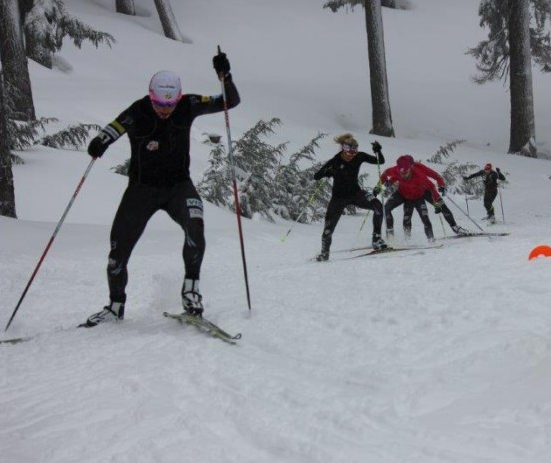
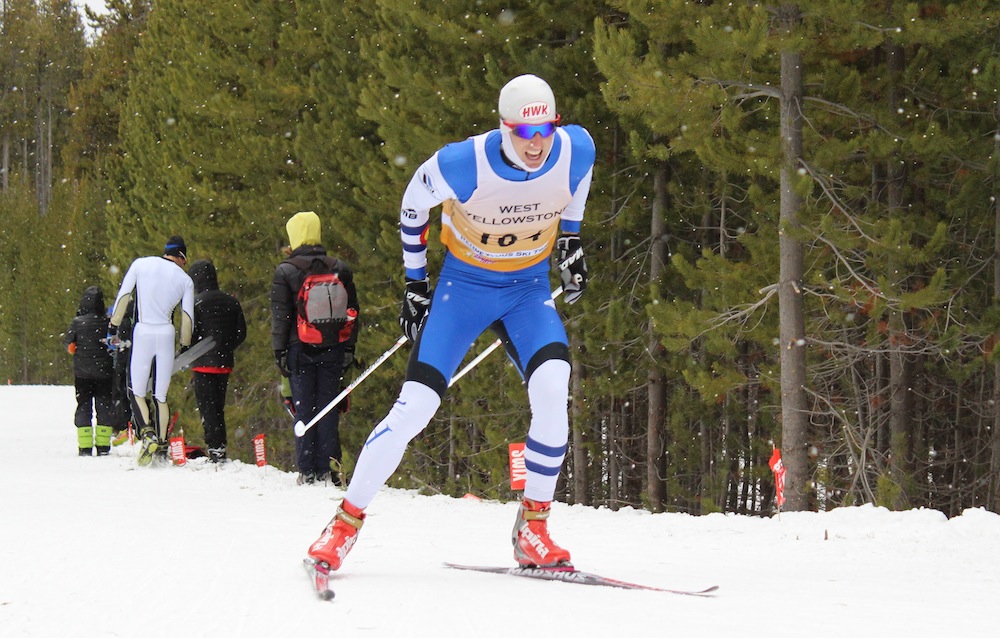
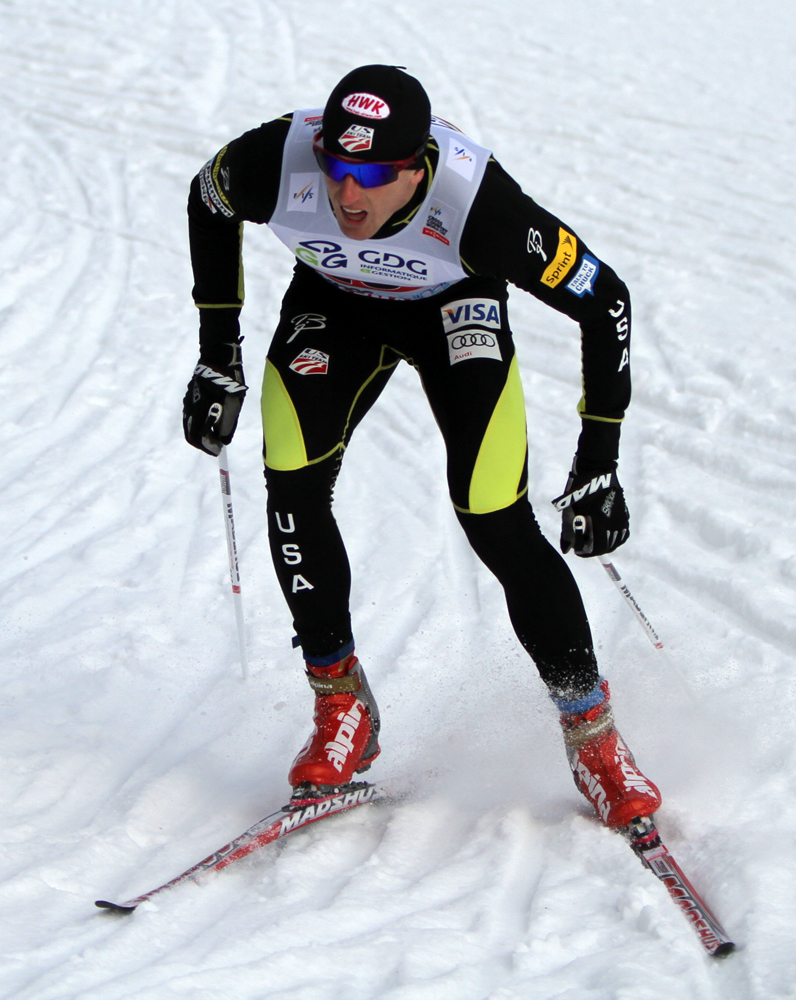
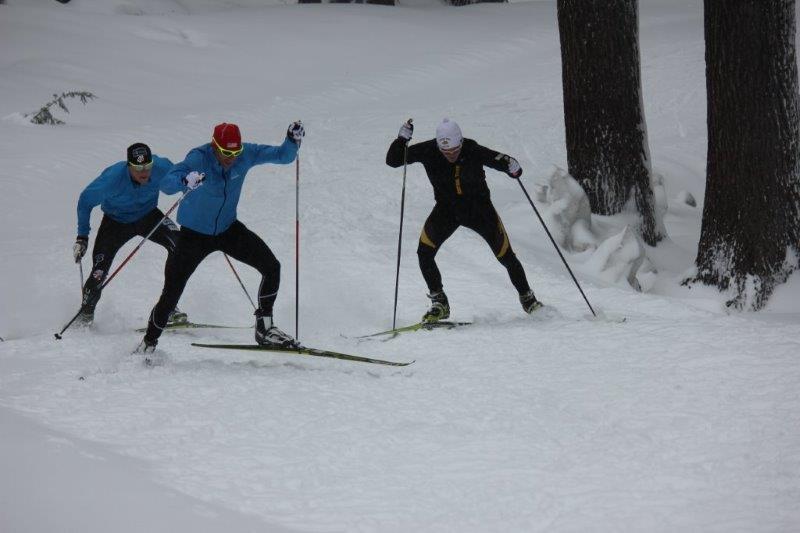
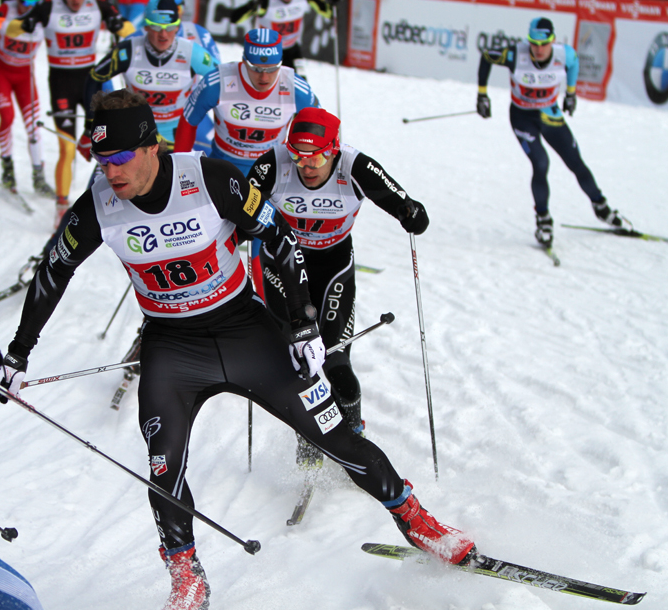
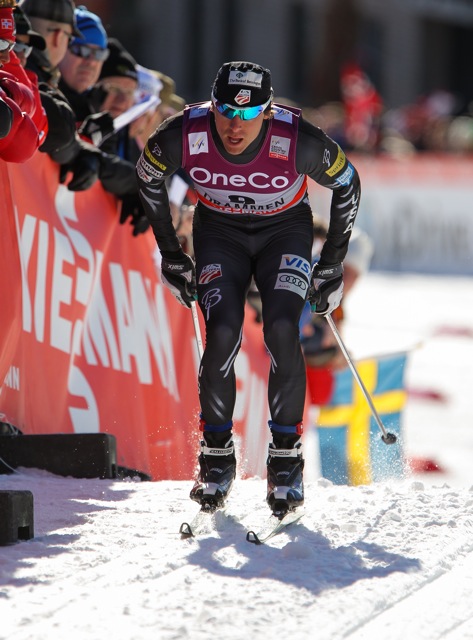
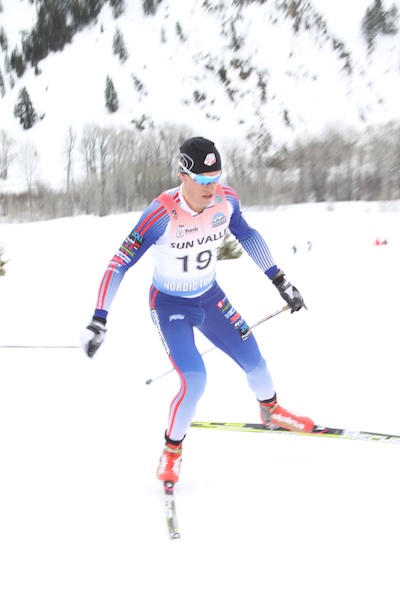
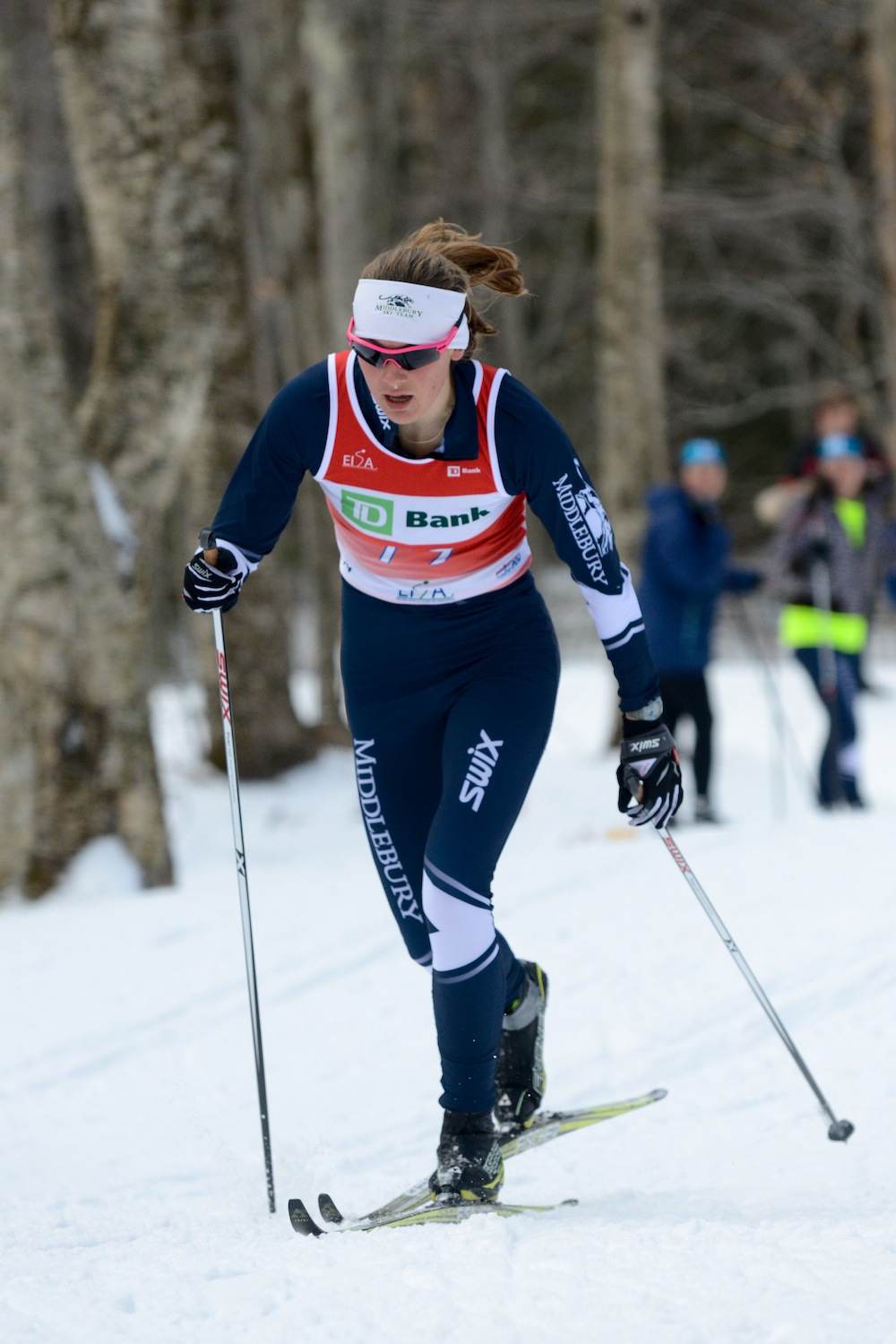
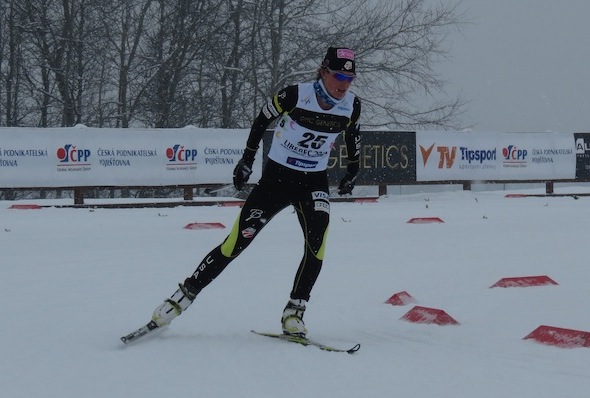
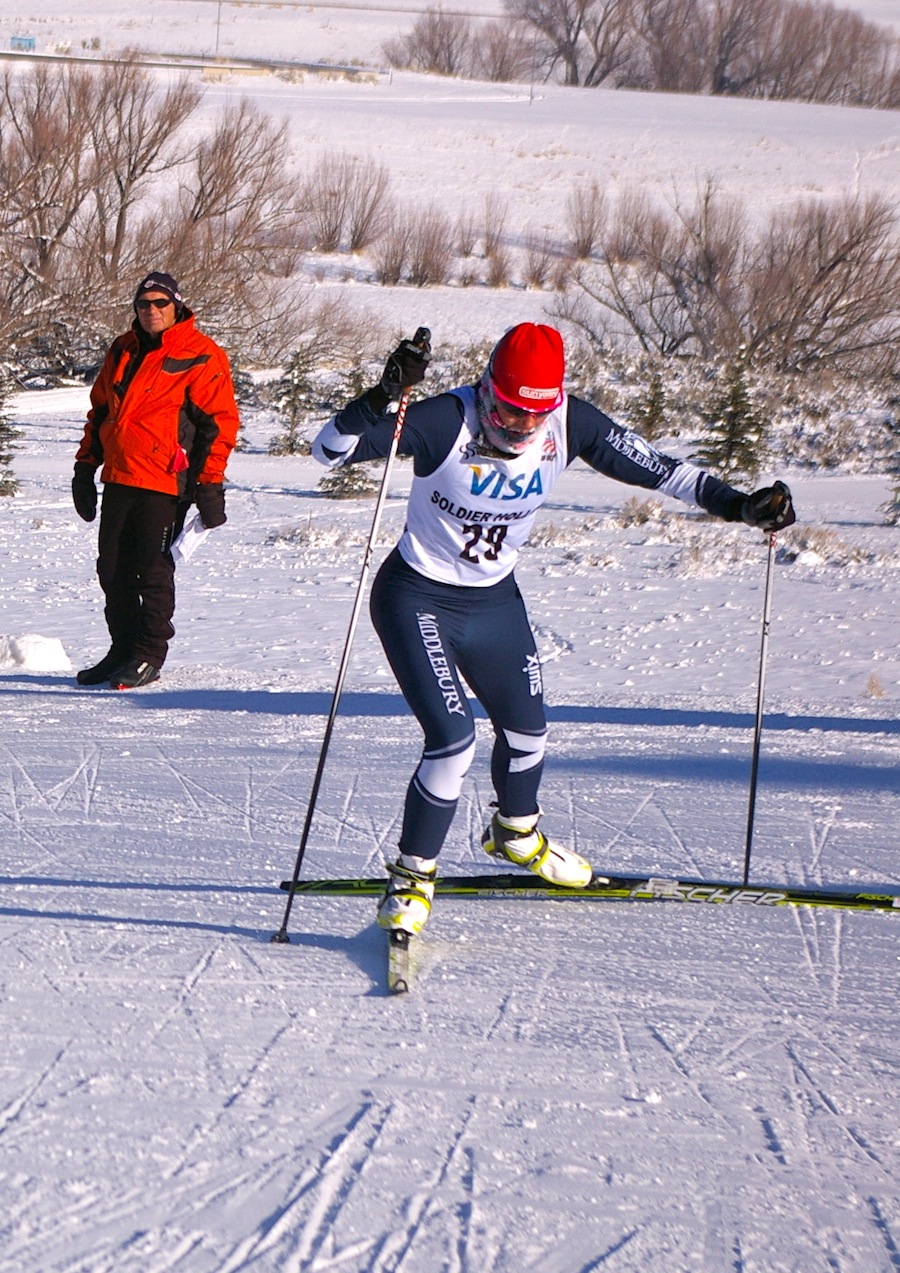
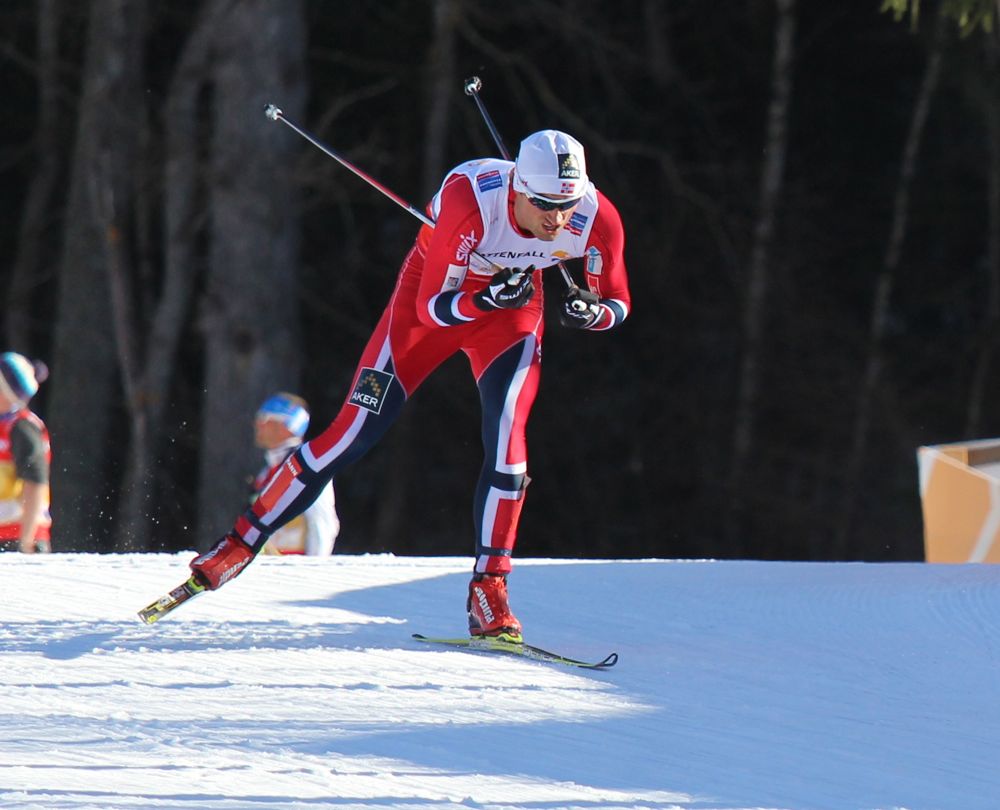
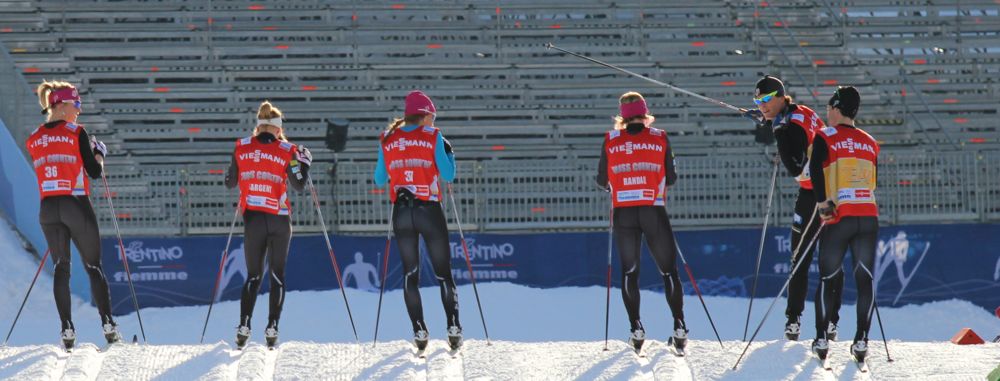
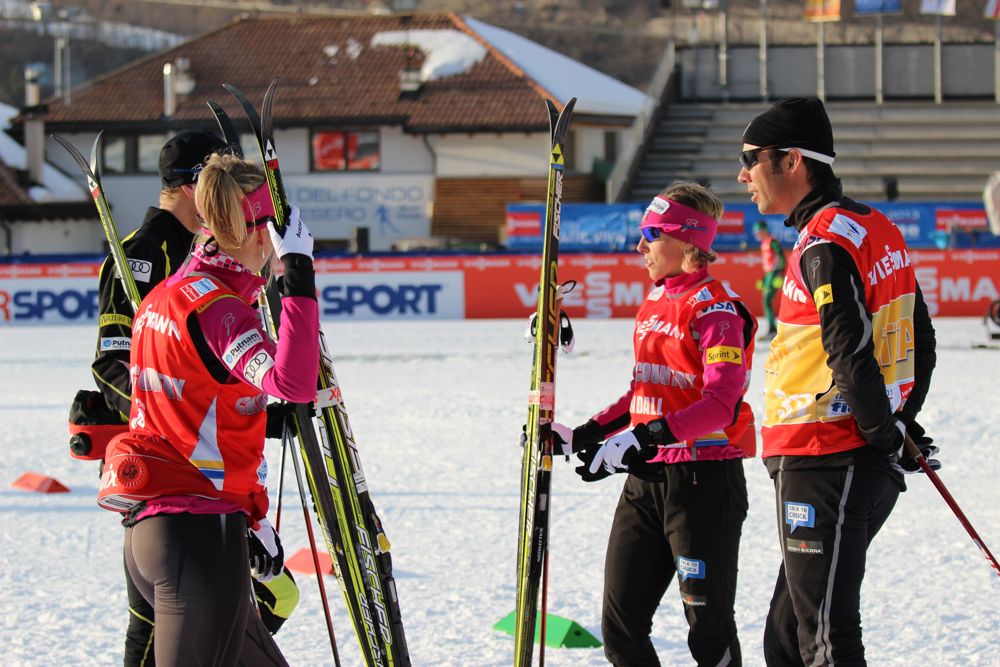
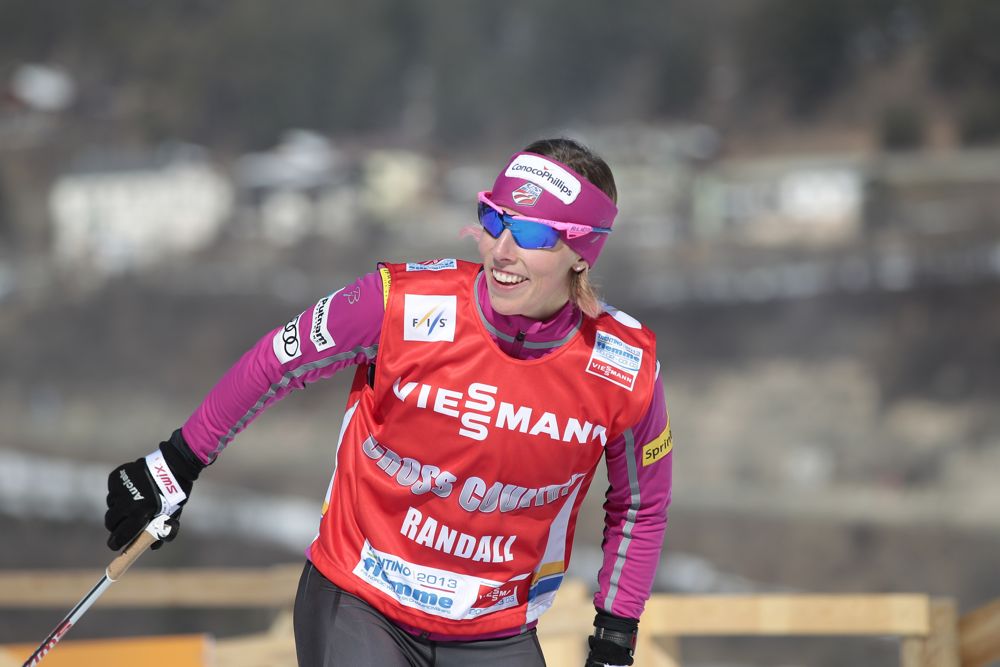
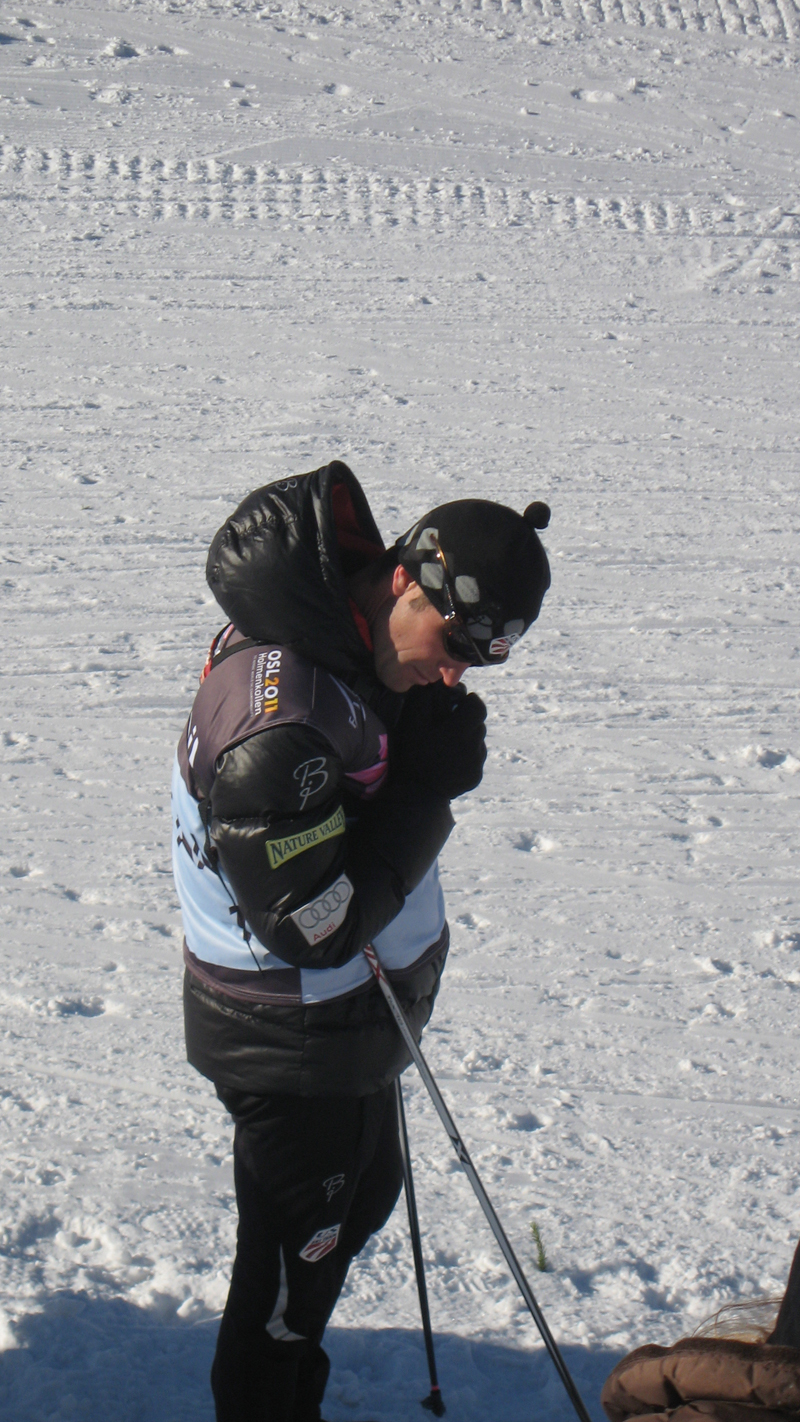
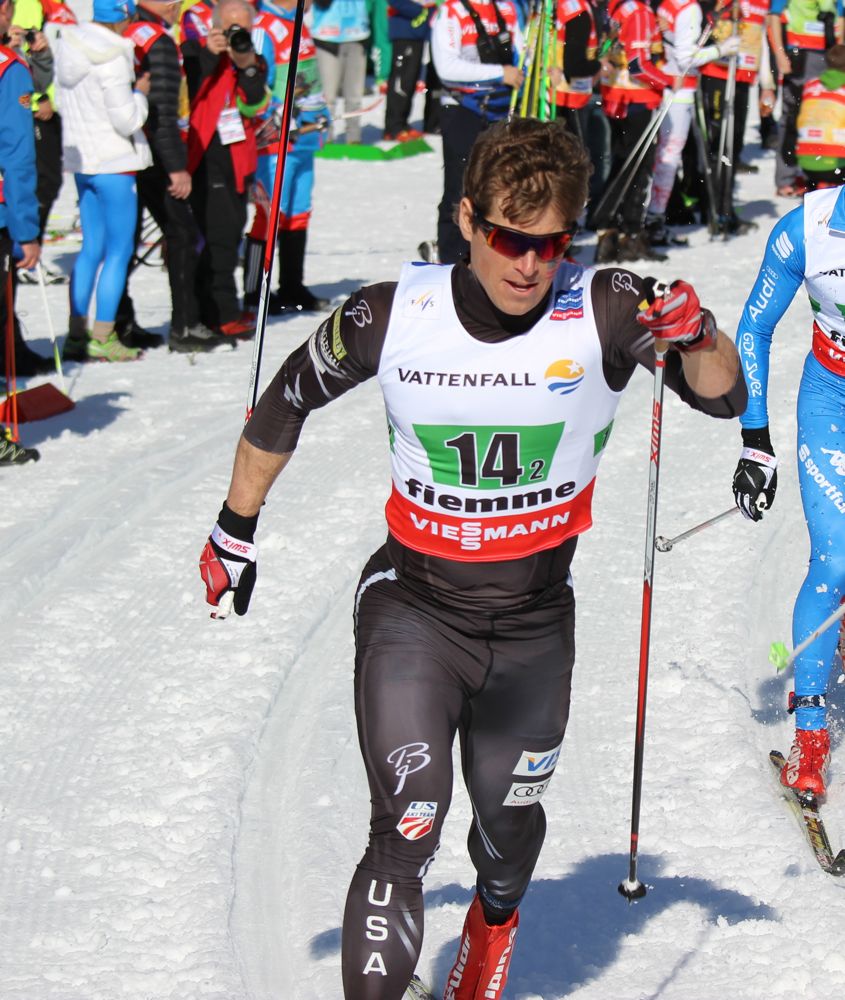
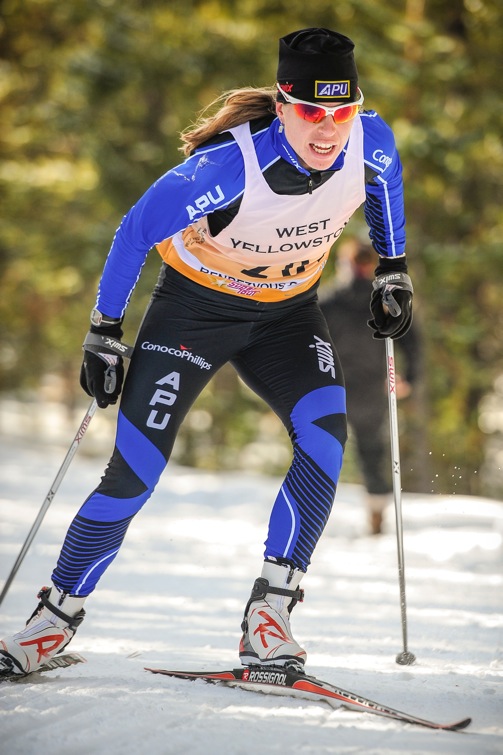
Kikkan Randall leading a recent workout in Bend, Ore. (Photo: Dan Simoneau)
The training season began in earnest for the U.S. Ski Team in Bend, Ore., in the last two weeks, but while many athletes have been putting in two-a-days on snow and on running trails, one of its headliners has had to take a cautious step back from traditional spring workouts. Kikkan Randall, two-time World Cup sprint champion, has battled a recurring flare-up in her left Achilles tendon this spring and has had to take proactive steps to manage it. This has meant less time on snow and more time in the pool and on the bike during the Bend camp, with the hope that she can return to full training in a few weeks.
“This is something I had last summer in addition to the stress fracture, so I think I injured it at the end of last season and it didn’t get the chance to heal,” Randall said. “Sometimes it’s fine, other times it flares up… We did an uphill running workout the first week back and it was just a little bit too much; it kind of set it off a little bit.”
When she experienced a similar issue last summer and fall, Randall doesn’t think she initially gave her Achilles enough time to recover. This year, with the experience of her quick bounce-back from last season’s stress fracture behind her, she’s trying to be smarter about her training to prevent a nagging issue from getting worse.
“All is good, [I’m] just trying to be a little smarter this time around and not push through potential injuries to the point I did last summer,” she said.
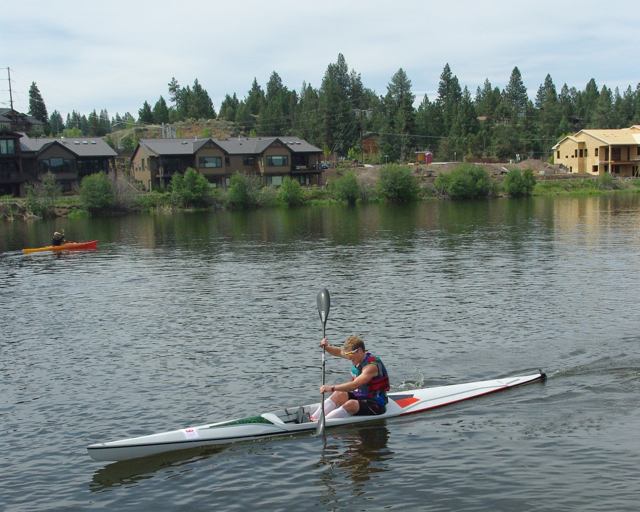
So far, being smarter has meant shortening her on-snow ski sessions in Bend in favor of more hiking, double-poling on a SkiErg, and aquajogging in the pool. Randall is also icing after workouts, getting massages and doing exercises to calm down the flare-up for the time being and return it to full strength.
“I’m just being more proactive this time around to build up the strength so that I don’t get myself in the situation where I really have to stop and back off training,” Randall said.
She says it’s been difficult to forego on-snow sessions with her teammates, but she knows from last winter that she can adjust her training and still be ready to race in time for the start of the World Cup season. Last November, when Randall wasn’t sure how her stress fracture recovery would affect her early season results, she set modest expectations for Period I. She ended up taking third in a 10 k skate on opening weekend, her best result in a distance World Cup to date.
Now, Randall has more confidence in her decision to take it easy this early in the training year.
“The experience from last year showed I can back off, doing training in different ways, and still keep in really good shape if I’m smart and patient,” she said. “I don’t feel the pressure to force the training right now. I can keep the fitness up with these alternate activities if I’m paying attention and working on recovering… It’s not easy to come off the snow early and miss out on things like running, which I really enjoy, but in a couple of weeks I’ll be training as normal.”
Randall says her workouts in the pool and on the bike have enabled her to keep her usual volume. Her return to full training was delayed by a few weeks this May because of a later-than-usual Spring Series, and since returning she’s experienced other signs that she can’t immediately jump back into workouts with the same intensity she could when she was younger.
“I was testing out some new skate boots that ended up bruising my right heel, so we had to adjust the boots and make a few training alterations to let that recover,” Randall said. “[I’m] being careful with the elbows too as we’re reintroducing double poling on pavement.
“I’m finding that I can’t just jump right into training like I used to, but if I work really hard on recovery and building into things, I should be able to train full strength in a few weeks.”
Randall and the rest of the USST are headed to Park City, Utah, on Friday to begin testing at the Center of Excellence. The team atmosphere in Bend, she says, has been as energetic as ever. After Park City, Randall flies to Croatia to fulfill her duties as FIS athlete representative at the governing body’s annual conference.
“I’m super excited for the new season and the energy on the team has been really good,” Randall said. “It’s a good time to take that excitement and manage it in a proper way and not get carried away. We have a lot of training time ahead of us, still.”
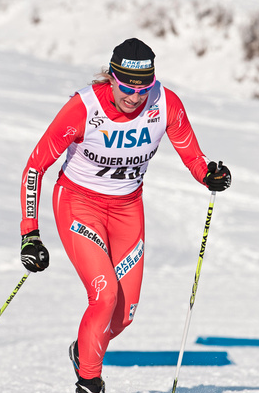
Jennie Bender at 2013 U.S. Nationals, where she won the classic sprint. Photo: Bert Boyer.
On the last day of the season in April, national champion Jennie Bender finished dead last in a race. Out of the 33 women who contested the 30 k classic at U.S. Distance Nationals, Bender crossed the finished line over nine minutes behind the second-to-last athlete and a full 30 minutes behind the race-winner.
“I never want to see myself last ever again,” Bender said in a recent phone interview. “That was horrible and embarrassing. The good thing is, now I know I can…do better and I know I have things I haven’t tapped into yet.”
For Bender, 25, finishing last in California taught her once more how to swallow her pride in a season filled with both trying and triumphant moments. She won her first national championship, the classic sprint, and dropped out of her first race in the span of the same week in Soldier Hollow, Utah. The summer before, she missed months of training while she fought off lyme disease and mono at the same time. At Canadian Nationals in the spring she got strep throat and entered SuperTour Finals on fumes.
Despite the setbacks, the win at nationals taught Bender never to count herself out. That lesson is coming in handy now that she’s facing another physical hurdle: a herniated disk in her back. She thinks the misalignment may be the result her fall in the finish lanes at U.S. Nationals in 2012 and two years of subsequent overcompensation. After making several trips to the doctor, Bender decided not treat the injury with surgery and will instead bring herself back to fitness with physical therapy.
“Obviously it’s disappointing and I’d rather not have this, but it could be a lot worse, I guess,” Bender said. “I’m just going to have to deal with it.”
She can’t run or rollerski at the moment, so Bender is doing the majority of her endurance training on an elliptical, in the pool and with nordic walking. She doesn’t know exactly when she can return to rollerskis, but is confident the problem can be fixed in time to be ready to race in November as long as she’s careful with her physical activity throughout the summer.
The uncertainty comes at a time of transition for Bender. At this moment, she is driving from her home of the past three years with Central Cross Country (CXC) in Minneapolis, Minn., to Bozeman, Mont., to begin skiing for Dragan Danevski’s program at the Bridger Ski Foundation (BSF).
Bender, a Vermont native and University of Vermont graduate, says her decision to leave the Midwest was motivated in part by her unpredictable season and a need for something new.
“I’ve thought a lot this summer about where I want to be and why I’m doing what I’m doing, and I realized that the fire is burning very strongly still,” she said. “I still don’t feel like I’ve reached my potential, which bothers me. It all comes down to personal drive, which is what kept me going this year. Everyone is like, ‘I don’t know how you did what you did this winter,’ and I’m like, ‘I don’t really know, either.’”
At BSF, Bender hopes to reenergize her training.
“I’m excited, because I think…the Bridger Ski Foundation seems to be a very big organization with lots of supporters and it’s a big, enthusiastic ski community with one club,” Bender said. “I’ve only heard good things about the program and about Dragan.”
In addition to Bender, BSF is growing by two other women this season. University of New Hampshire graduate and NCAA All-American Anya Caldwell Bean is headed for Bozeman soon and MSU’s Cambria McDermott will ski in the BSF suit while she red-shirts a year from the NCAA.
“Dragan Danevski is very happy with the acquisitions, and combined with a great group of Post Graduate skiers, is excited about the future of BSF skiing at the top level,” said BSF assistant coach Tim Baucom.
With three elite women on its roster, BSF carries a bigger women’s squad into next season than it’s ever seen.
“It’s bigger than we have had in the past, and the first time that we feel we have several women who will be competitive nationally and internationally,” Baucom said. “Besides Kristina Trygstad-Saari, we have not had many senior women who have been competitive.”
On the men’s side, Torin Koos will again be on the BSF squad and is joined by NCAA All-American Tyler Reinking from MSU. Leif Zimmermann, four-time national champion and 2006 U.S. Olympic team member, is retiring from competition after 15 years of racing.
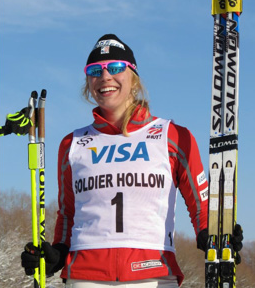
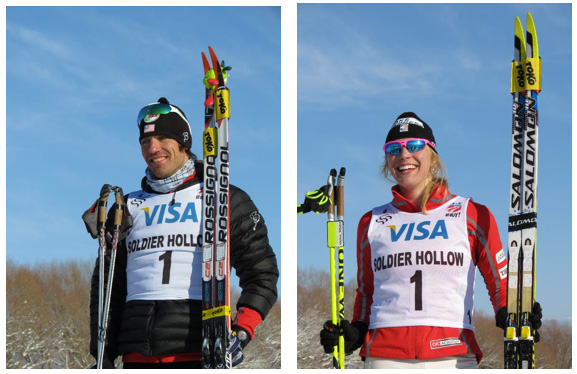
Bender in Soldier Hollow waiting to climb the podium at 2013 U.S. Nationals with men’s classic sprint champion Torin Koos. Bender and Koos will be teammates at the Bridger Ski Foundation next season.
For Bender, the move to BSF gives her more group training opportunities, as her workout partners in Minneapolis last year often included masters and juniors.
“I’ve been training a lot on my own in Minneapolis and I think I’ll be around more girls my age who will be eager to go out and rollerski,” Bender said.
“It’s important to be around, in general, a really active environment and that’s what Bozeman is. It’s very outdoorsy, very active, people are always doing something even if it’s not nordic skiing. As long as there’s people willing to go outside and do something active, that’s very motivating for me to go do the same.”
Bender’s back injury will limit her training options as she settles into her new life in Bozeman. Injured is not the ideal way she would like to be joining a new team, but she is enthusiastic about the change of scene.
“It’s hard to leave the midwestern ski community and the friends I’ve made there the last three years, for sure,” she said. “Developing a healthy environment is all part of life; all part of being a successful athlete is surrounding yourself with positivity. But this is a change I think will be good and I’m excited for some mountains.”
Bender’s goals, she added, are the same as they ever were.
“The moral of the story is, you never know what’s going to happen,” she said. “Obviously my hopes are still high; I [am] out to make the next Olympics… [I’m] strongest in classic sprinting and the [U.S. Ski Team] is already heavy on sprinters, but because women’s sprinting is a big focus this year I think I could contribute to an already stellar lineup.”
And after a rollercoaster season, Bender thinks her inconsistency in the past might work to her advantage in the future.
“It’s a new year; you never know what I’m going to do,” she laughed.
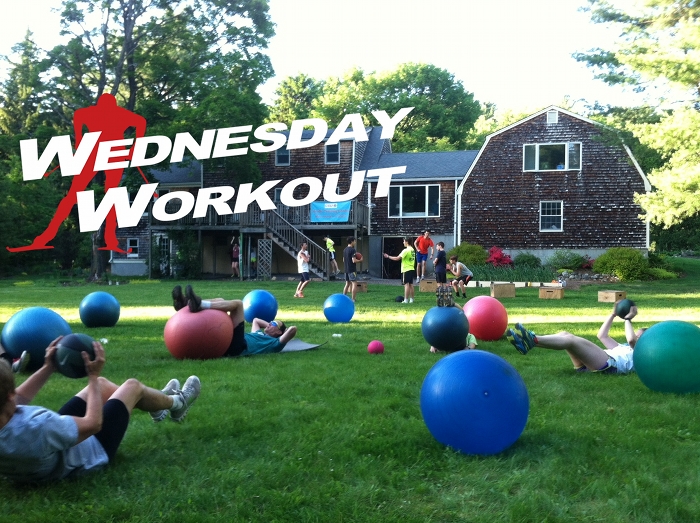
For CSU’s functional strength workout, you need an exercise ball, a medicine ball, a bench, a pull-up bar and a stopwatch. (Courtesy photo.)
Skiing is an upper-body sport. It doesn’t pay just to have a strong engine; if you want to win sprint finishes you’d better have a strong double-pole, too.
As Cambridge Sports Union head coach Rob Bradlee puts it, “it’s not running on skis. When I was a lad, if you were a good runner you could jump on the skis and run with wooden skis and bamboo poles. You didn’t get much out of your arms then, but not anymore.”
To properly build complete body strength in his athletes, Bradlee develops both their specific strength and something he calls functional strength. The workload he recommends for each age group varies (Olympic lifting is for more mature athletes only) but the principles are the same: strong skiers are fast skiers.
He can back his program up with results, too: at this year’s Junior Nationals in Fairbanks, Alaska, CSU ranked fourth amongst junior clubs throughout the country and he had multiple individual top-10s across age groups.
The key to those results, Bradlee says, was strength.
Which brings us to today’s Wednesday Workout, one of the two “functional strength,” workouts his athletes do twice a week in the summer and fall. On Monday and Friday nights, Bradlee’s athletes do circuits of full-body exercises mostly with body weight — “pull-ups, push-ups, squats, step-ups, those types of things,” he says.
There was a popular article in the New York Times recently called “The Scientific 7-Minute Workout,” which Bradlee says is a good, simple starting point for building all-around strength.
“[It] was wonderful,” he said. “It’s a pretty good description of what you can do.”
To complement the twice-a-week functional strength workouts during the summer, Bradlee also has his athletes do specific strength on their own time once or twice a week — namely, double-poling on an erg or on rollerskis with added resistance.
“Skiing is a whole-body movement requiring dynamic balance with decisive, explosive application of power from arms, legs, and core in a completely coordinated fashion,” he writes in the workout instructions. “To ski fast the athlete must gain strength performing the exact motions of skiing in a manner as close to actual skiing condition as possible.”
Specific strength is a topic for another day, however. For now, here one of CSU’s functional strength workouts. It may look like a long list, but you only have to do each set of exercises once unless otherwise noted.
“We do a much bigger variety of exercises with fewer sets than other programs,” Bradlee says. “Why? Because Coach Bradlee is easily bored and hates doing strength work so the idea of, say, having six exercises and doing three sets is horrifying to me even though I know it’s the accepted wisdom for strength. Seems to work out alright.”
Equipment: medicine ball, exercise ball, step-up box or bench, bar for pull-ups
Group Warm-Up
15 x Wood chop with medicine ball
15 x Rotation with medicine ball
10-20 meters: High knee skip
10-20 meters: High knee run
10 x Heel up walk with straight leg dead lift
5-10 x Lunge walk
5-10 x Inchworm
10 x Burpees
Balance
30 secs each leg: quiet balance
30 secs each leg: balance with arm waving and eyes shut
15+ each leg: balance with leg swing
Play catch with knee on ball
Core Stability, Hip Stability and Mobility
1 minute: Front bridge
1 minute: Side bridge
1 minute each: Back bridge (1 leg back, alternate march, 15 x ham curls)
15 x Cook Hip Lift (4 inch lift, 6 inch lift, on medicine ball)
15 x Bent Leg abduction
15 x Straight Leg
Plyometric (Explosive speed) Drills (AMAP = As Many As Possible)
Skiers train at Mt. Bachelor. (Photo: Dan Simoneau)
Sadie Bjornsen (USST) does video work. (Photo: Dan Simoneau)
Bjornsen. (Photo: Dan Simoneau)
Ida Sargent, USST. (Photo: Dan Simoneau)
Holly Brooks, USST. (Photo: Dan Simoneau)
Biathlon training in Bend. (Photo: Dan Simoneau)
Junior skiers follow a Canadian National Ski Team member. (Photo: Dan Simoneau)
Devon Kershaw, CNST. (Photo: Dan Simoneau)
(Photo: Dan Simoneau)
(Photo: Dan Simoneau)
(Photo: Dan Simoneau)
Lenny Valjas, CNST. (Photo: Dan Simoneau)
Valjas. (Photo: Dan Simoneau)
Bend area athletes. (Photo: Dan Simoneau)
(Photo: Dan Simoneau)
No-poles technique work. (Photo: Dan Simoneau)
(Photo: Dan Simoneau)
The U.S. and Canadian national teams currently in Bend, Ore., for their spring camps had an unstructured training session at Mt. Bachelor this weekend. Mt. Bachelor Ski Education Foundation nordic director and three-time Olympian Dan Simoneau snapped photos of junior skiers and World Cup athletes alike ski laps around the trails.
“One of the cool parts of these generation of racers is how much they want to pull kids along,” Simoneau said.
Ryan Scott (SSCV/Team HomeGrown) bringing it home for his first career win at the West Yellowstone SuperTour prologue on Nov. 24.
From the outside, Ryan Scott’s 2012-2013 season seemed to be an inconsistent one. The 23-year-old sprinter for Ski & Snowboard Club Vail/Team HomeGrown started off strong, with a win at West Yellowstone and a podium in Bozeman, Mont, and his early season success earned one of the coveted spots to the Canadian World Cups in December. But in Quebec City he started to lose steam; he got sick upon arrival and didn’t race as he would have liked, taking 60th in qualifying in Quebec and 51st in Canmore.
By the time Scott got to Soldier Hollow, Utah, for U.S. Nationals, he says he was “a little deflated.” He posted the fifth-fastest classic sprint qualifying time but didn’t reach the finals in either discipline. At the Midwest SuperTours later that month he didn’t make the finals, either, and after taking fourth in the sprint prologue in Aspen, Colo., Scott took a six-week break from racing while many of his peers raced Continental Cups in Europe. At SuperTour Finals he only entered the first two races, taking 26th in the classic sprint after qualifying eighth.
By Scott’s own assessment, it was not season he’d hoped for.
“There was really no game plan after January,” he said on the phone on Wednesday. “It was my fault; there was a lack of funds and I was unable to lay out much racing or get over to Europe to compete over there.”
Despite the down year, Scott is motivated for another season and hopes to bring his sprinting to another level in the upcoming Olympic year. Part of his plan to accomplish this involves taking a trip to Norway for a month this June to train with college friends and travel the country.
“Summer is a great time to go, because the training isn’t as structured,” Scott said. “It’s nice and sunny for the most part and it’s a break from training in the U.S. There’s different people to training with — new training stimuli — and that’s always exciting… I have a structured plan, I know what I should be doing and the different aspects to focus on, so it’s easy to jump in and do training with other people and have a little bit of an adventure, too.”
Through connections with old Montana State University roommates and friends from college skiing, Scott will make stops in Oslo, Lillehammer, Trondheim and possibly a few more cities. In Oslo he’ll train with University of Colorado alum Vegard Kjoelhamar and his club, and in Lillehammer Scott will connect with another CU skier, 2013 NCAA Champion Rune Ødegård.
Scott racing in Canada this December.
“I guess he’s good friends with Sjur Røthe, so there’s a good training group there,” Scott said.
To add some competition to the trip, Scott will compete in the St. Olavsloppet, a four-day 350 k point-to-point running relay between Östersund, Sweden, and Trondheim. There are generally 15 people per team and each member rotates through 4 – 13 k legs. Scott participated in the race three years ago on a similar trip to Norway. The race generally attracts a large number of elite and recreational competitors; in 2012 the winning team included Eldar Rønning.
While abroad, Scott also plans to meet up with his father, six-time Ironman World Champion Dave Scott, and compete in a triathlon “for fun.”
“I’ll try to be in good shape for it, but I don’t know how much swimming I’ll be doing,” he laughed.
Scott says that lightly, but he comes from an impressive family of elite athletes. Dave Scott was the most dominant triathlete in the Ironman distance in the 1980s, and Scott’s younger brother, Drew, is beginning to make a name for himself, too — he was second at the USA Triathlon Olympic Distance Nationals last season.
Scott’s connections to the top level of triathlon begs the question: what ties him exclusively to skiing?
“The racing aspect in triathlon is pretty exciting as well, but I’ve always been more drawn to skiing,” he said. “The only tough thing with skiing is there isn’t as much of a clear path to the top on how to move up. After a while it gets a little harder…there’s definitely not as much support or money in the sport, which makes it quite difficult, so most skiers I know are working on the side or full time.
“My heart’s always been in skiing, but we’ll see,” Scott continued. “I’m not going to stick around skiing just to be a decent domestic skier. I think if I don’t break through in the next few seasons I might stop and pick up another profession or switch to triathlon.”
When he comes back to the U.S. in mid-July, Scott plans to have a fresh outlook on skiing. His big goal this year is to qualify for the Olympics in Sochi, Russia, as a sprinter. He believes it’s difficult to maintain a full race schedule as a sprinter in the U.S., but he’s committed to the shorter distance.
“I’m going to be focused solely on sprinting,” Scott said. “I think the disparity between distance skiers and sprinters will be more apparent this season. The all-arounders — there’s not much point to it other than the SuperTour leader’s bib, but as far as the Olympics are concerned they’ll be looking at the top in either sprint or distance, so it’ll be tough to sit in the middle.”
Scott also wants to make it back to the World Cup. His experience in Canada last December was dampened by illness, but he says the exposure to the top level of racing was valuable.
“It’s very motivating,” Scott said. “It’s just such a difference from our SuperTour races, where you have a few people cheering, to suddenly thousands of people cheering. Just the excitement was a really positive note of being there. So obviously I’d like to train hard and hopefully race fast and have another opportunity to show myself on the World Cup.”
Jessie Diggins, Holly Brooks, Kikkan Randall and Liz Stephen skiing at Mt. Bachelor on Wednesday during an interval workout. (Photo: Dan Simoneau)
After six weeks apart, most of the U.S. Ski Team reunited again this week for their annual May training camp in Bend, Ore. Through sunny skies and falling snow, the group put vacation time in the past and set to work at Mt. Bachelor to get ready for the 2013-2014 season. So far that’s included on-snow speed workouts, over distance and intervals, along with mountain biking ride and lots of team meals.
“The team atmosphere is great,” said Holly Brooks, the USST’s newest A-team member. “There are lots of hugs, lots of great meals together and workouts, stories about the spring…it’s really easy to get back into the natural swing of things.”
There is also a quietly building anticipation for the most-hyped part of the upcoming season, the 2014 Olympics in Sochi, Russia. It snowed in Bend on Wednesday for the team’s first group interval workout, and athletes saw the soft conditions as practice for the snow they might see in Sochi.
“It sucks, none of us want to be in cold weather this time of year, but for training it’s pretty good,” said Andy Newell. “Conditions were pretty soft today, but realistically those are the conditions we may see in Sochi and so many other place on the World Cup. So we don’t like it, but it’s good practice.”
Andy Newell, David Norris and Erik Bjornsen during intervals on Wednesday. “Bjornsen and I did a few intervals together, which was great. I don’t get to do intervals with him very often,” Newell said. (Photo: Dan Simoneau)
Bjornsen and I did a few intervals togheter, don’t’ get to do intervals with him very often.
“We got to [Mt. Bachelor] and we said, ‘It’s championship day,’” added Brooks. “That’s Matt [Whitcomb]’s favorite thing to say when it’s adverse conditions.”
The first cross-country race of the Games, the 15/30 k skiathlon, go off on February 8, and a measured excitement for the opening ceremonies is already building in Bend. The team’s training program at the camp is similar to what it’s been in the past — on-snow sessions mixed with less structured workouts on biking and running trails — and only part of their recent goal-setting sessions have focused on Sochi. But there is no denying that Olympic hype has started in the media and within the team, adding an extra element of focus to their first camp.
“For an Olympic year, it’s definitely a big motivator,” Newell said, a 2006 and 2010 Olympian. “You want to make every interval session count; you want to make sure each one is at it’s best. We train like that every year, but it seems more magnified in an Olympic year because you have that thought in the back of your mind. It only comes around once every four years. It raises the intensity level of all the training camps.”
Even with the Olympics looming, however, May is still just the beginning of the off-season. Athletes are being smart as they reenter a full training schedule, Brooks says, resting when they think they need to so they’ll be ready to go come February.
“One thing that’s different is people are extremely proactive about their health and injuries,” she said. The Alaskan skipped SuperTour Finals, for example, to make sure she was fully recovered to begin training for the Olympic year.
“I think our whole team has gotten smarter in that regard,” Brooks continued. “People are being really patient with their bodies and…making sure they’ll be in good health come February.”
The media hype that surrounds the Games has already begun, adding another level excitement to the training season. Newell and women’s team leader Kikkan Randall flew to Los Angeles, Calif., last month for a photo shoot with NBC, where Newell said his interviews with the Olympic broadcaster indicated more interest in cross-country than he’s experienced in the past. The whole team will have another media summit in Park City, Utah, in October, and NPR is scheduled to do a piece on the team during the Bend camp.
As a result, the team’s reunion in Bend has been an opportunity to define what motivates them as a group as they enter a brighter spotlight and a year filled with big expectations. The increased media attention makes the upcoming season feel a little different, Brooks says, but the team’s drive to work hard comes from the same place it always has.
“We had a great team meeting last night and went over some goals that weren’t necessarily performance goals but process goals,” she said. “How to treat each other, what we want to do outside of ski racing as a group and stuff like that. And it was just really cool to see how united everyone is and how motivated everyone is and how we’re really ready to approach the Olympic year as a team.
“There’s not secret to it; it’s not like we do anything different,” Brooks continued. “At this point, we got here by doing something right, and hopefully we continue that good energy and take that with us to Sochi.”
One of the bigger goals for the team will be to replicate their pre-World Championships momentum from last season.
“I think a big goal for me this year and for everyone is: you don’t want to go into Sochi hoping you’re going to do well,” Newell said. “I’m looking to have a successful beginning to the World Cup season…For me a big goal is to be on the podium before going to Sochi. I think that can take the pressure off. Last year the more success we had, the momentum carried to the Championships. So that’ll be the same goal this next year — to roll with momentum into Sochi. Then it’s just like another weekend of racing, and that’s a fun position to be in.”
Andy Newell, David Norris and Erik Bjornsen scramble during intervals. (Photo: Dan Simoneau.)
(Photo: Dan Simoneau)
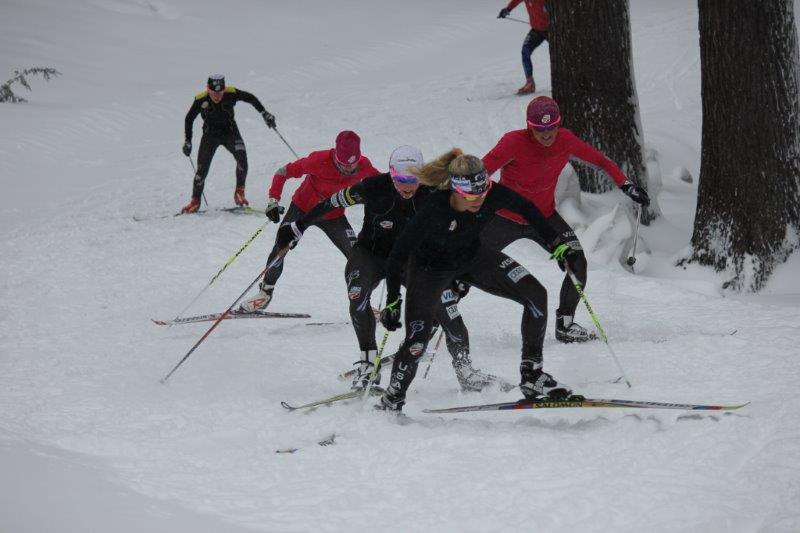
Kikkan Randall leads a train of women during intervals. Photo: Dan Simoneau.
(Photo: Dan Simoneau)
Simi Hamilton. Photo: Dan Simoneau.
Caitlin Patterson up a climb. Photo: Dan Simoneau.
Sophie Caldwell. Photo: Dan Simoneau.
Liz Stephen. Photo: Dan Simoneau.
Kikkan Randall. Photo: Dan Simoneau.
Jessie Diggins. Photo: Dan Simoneau.
Diggins, Randall, Holly Brooks and Stephen. Photo: Dan Simoneau.
Sprinting for a preem. Photo: Dan Simoneau
Jessie Diggins, Holly Brooks, Kikkan Randall skiing at Mt. Bachelor on Wednesday during an interval workout. (Photo: Dan Simoneau)
Tyler Kornfield leads up the hill. Photo: Dan Simoneau.
Simi Hamilton. Photo: Dan Simoneau.
New snow greeted athletes at Mt. Bachelor on Wednesday. Photo: Dan Simoneau.
A Mt. Bachelor Ski Education Foundation athlete trains. Photo: Dan Simoneau.
Bend Training Camp 2013
Liz Stephen, climbing. Photo: Dan Simoneau.
Holly Brooks leading. Photo: Dan Simoneau.
Hamilton on a climb. Photo: Dan Simoneau.
Erik Bjornsen and Andy Newell push the pace. Photo: Dan Simoneau.
The U.S. Ski Team’s annual May training camp began in earnest this week in Bend, Ore. A few inches of fresh snow greeted skiers at Mt. Bachelor on Wednesday morning, just in time for the group’s first interval session: a set of 6 x 4-6 minute L3 freestyle intervals with intermediate sprints.
“We’ll put a little sprint halfway through the interaval, and that’s to mimic mass start racing and preems and time bonues on the World Cup,” said U.S. sprint veteran Andy Newell. “We try to do it pretty controlled today, but skied in a pretty good group.”
The USST is joined at Mt. Bachelor this week by the National Training Group, the Canadian National Ski Team, the U.S. Biathlon team and U.S. Paralympic athletes. With so many high-caliber skiers training on the same six- to seven-kilometer loop, Newell says the workouts interesting.
“I think tomorrow we have a three-hour one on the schedule,” he said. “We have the Canadians here, the U.S. biathles are here, so there’s so many people out we can catch up with Tim [Burke] and Lowell [Bailey] an ski a lap with them. It’s pretty fun skiing with that many people around.”
Though the workout was the first group interval session all spring for many skiers, Newell noted the pace was pretty controlled.
“We’re pretty used to training with one another so it’s not that competitive,” he said. “Maybe the preems we definitely try to race each other, to try to ge across the preem line, but as experienced skiers we know that there’s not a whole lot of stock in being in great shape in May.”
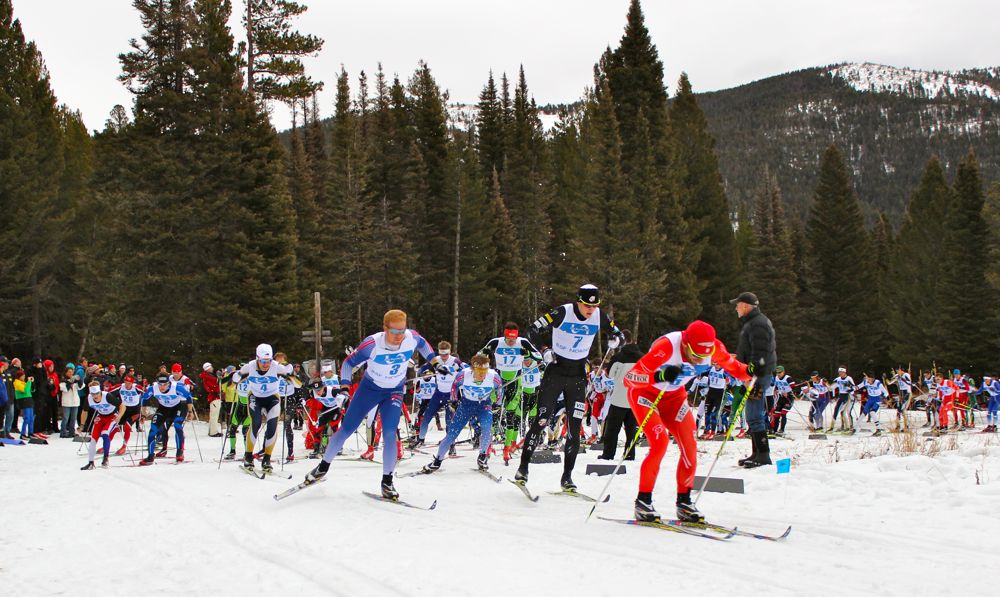
The men’s SuperTour field leaves the starting line in Bozeman, Mont., December 2012.
The annual U.S. Ski & Snowboard Association Congress concluded in Park City, Utah, last weekend, bringing a few changes to the American race calendar and rulebook for the 2013-2014 season. USSA Nordic Manager Joey Caterinichio called the outcomes from the meetings the result of a productive three days — “one of our better congresses” — with country-wide participation from coaches of all competitive levels.
“I had a lot of compliments from coaches,” Caterinichio said. “They said there’s been times they wanted to be gone after the second day, but they felt it was so productive that every single one of them stayed the whole meeting. It was just a really productive meeting, which is hard to do sometimes.”
One of the coaches in attendance was Brian Tate, director of the Steamboat Springs Winter Sports Club in Steamboat Springs, Colo. Tate sits on the Junior National Oversight Committee and he agreed that it was a constructive Congress.
“As a club director I make the effort to attend the USSA Congress to hear the plans and strategy our sport’s governing body and national team have in store for the next year and beyond,” Tate said.
“As a club coach, I do not have a ton of contact with the U.S. Ski Team coaching staff, so the Congress is an opportunity to hear the state of affairs, so to speak. They do a good job highlighting the past season and shed light onto the coming season.”
Revamped National Race Calendar
The biggest item on the agenda last week was the SuperTour calendar, which has been reworked to make more sense “athletically and developmentally.” The schedule now breaks down into two-week racing blocks that alternate with breaks to allow athletes to go home and recover or race regionally.
The geographic distribution of races is also designed to be more even amongst regions, so that athletes within each have equal opportunity to compete against higher caliber skiers. The calendar is arranged two years out to allow coaches more time to prepare their travel schedules.
“We spent a long time going over the philosophy of what we want the calendar to look like in the future,” Caterinichio said. “The whole nation had input on this calendar. It seems small, but it’s huge.”
Before this year, Caterinichio says the SuperTour was designed from the venue backwards; the shape of the calendar depended on who wanted to host a race at a given time. Now that coaches have agreed on a basic schedule that makes sense for them and there are more race organizers willing to host events around the country, the process has been allowed to reverse; Caterinichio approached venues to fill in specific dates on the SuperTour and build a domestic race calendar that makes sense for the athletes competing in it.
“For athletes and professional teams using the SuperTour schedule as our domestic racing series to get to the World Cup to continue racing, the current calendar does not make sense, athletically, to go with timing rest and getting our top athletes together in one spot,” Caterinichio said. “So we needed to build in some breaks.”
The rest periods were designed to both allow top athletes a travel break and to strengthen regional races by giving local junior skiers the chance to face tougher competition against the top athletes that will not be able to return home.
“Now we’ve got a good plan for the national calendar down to the regional calendars,” Caterinichio said. “Top skiers can race regionally and I think it will help everybody. It will help college and junior racers and not only keep their regions strong but also…strengthen the nation as a whole.”
Practically speaking, this means that several mainstays of the SuperTour had to either change their dates to fit the new design or be left off completely. The Madison, Wisc., sprints now fall a week later, for example, while Aspen, Colo., and the Tour de Twin Cities are no longer part of the tour.
2013-2014 Calendar Draft:
November 29-Dec. 1 West Yellowstone, Mont.
December 7-8 Bozeman, Mont.
January 4-10 U.S. Nationals, Soldier Hollow, Utah
January 17-19 Regional
January 26 Regional
February 1-2 Regional
February 8-9 Madison, Wisc.
February 15-16 Battle Creek, St. Paul, Minn.
February 22 American Birkebiener, Hayward, Wisc.
March 23-29 SuperTour Finals, TBA (Leading bid from Anchorage, Alaska. Sun Valley and some Eastern sites as “backup”)
2014-2015 Calendar Draft:
November 29-Dec. 1 West
December 7-8 West
January 3-9 U.S. Nationals, TBA (Leading bid from Houghton, Mich.)
January 17-19 Regional
January 25-26 Regional
February 1-2 East (Leading bid from Craftsbury, Vt.)
February 8-9 East
February 15-16 Madison, Wisc. (SuperTour prize money, no points)
February 23 American Birkebeiner
March 23-29 SuperTour Finals, TBA (Bid from Anchorage, AK, if not the 2014 host)
SuperTour Finals to Include Club Relay, Two National Championships
One of the recurring discussions at the USSA Congress every year is the timing of U.S. Nationals, and whether it makes sense to have a championship in January when the nation’s best athletes are racing in Europe. Last week the Congress decided to keep January nationals as is, but added a second championship race to SuperTour Finals in the spring, when World Cup athletes are back in the U.S.
As a result, the season-ending race series will not be a mini-tour next year, though Caterinichio says the format change can be revisited again in 2014. That means not more hill climb, and the series will be split into two SuperTour Finals races, a sprint and an interval start, and two national championships.
To complement the final the 30/50 k Championship on the final two days of the series, a club relay will be the second championship race on the schedule. It will include two classic legs and two freestyle legs, and to keep the relay competitive between clubs, the relay will be mixed — two men and two women. It has been proposed that only clubs teams be eligible for the championship, but that unofficial mixed teams will be welcome to race.
New Junior Age Group Nomenclature
In the junior skiing category, the most significant change came in the age-class nomenclature. The “J” age groups have been eliminated in favor of a “U” system, which is more common across junior sports. OJs are now U20s, J1s are U18s, J2s are U16s, and so on.
The Junior National Championships will take place in 2014 at Trapps Family Lodge in Stowe, Vt., and the schedule of races is under review. JNs tried out a new competition schedule this year in Fairbanks but there is a proposal to return to the original event order, beginning with the interval start and ending with the relay.
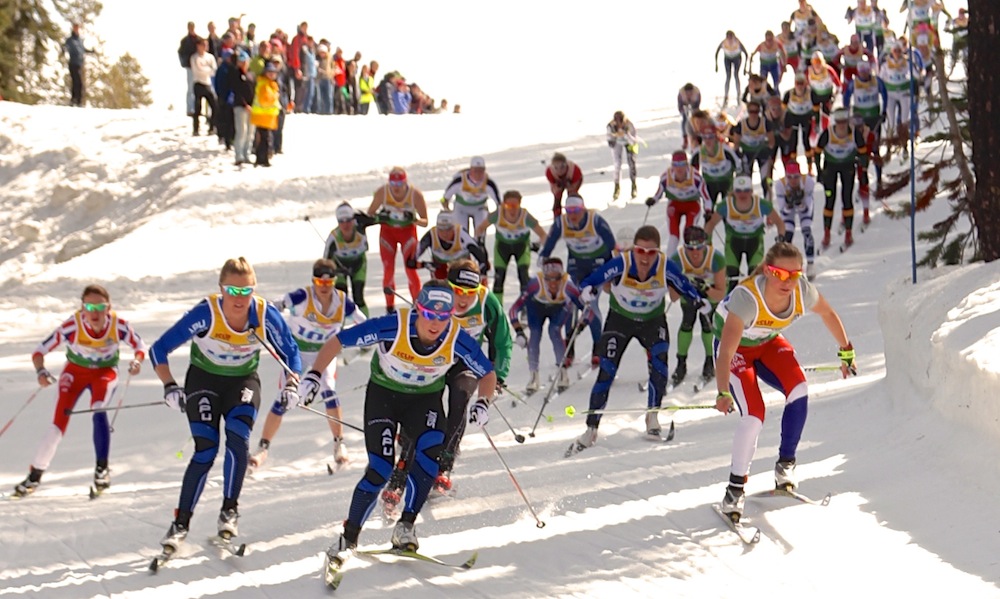
Sadie Bjornsen, Kikkan Randall, and Jessie Diggins, leading the pack at 2013 SuperTour Finals this spring. (Photo: Ryan Scott)
We probably haven’t heard the last of athletes joining new teams for the 2013-2014 season, but already there have been a number of notable acquisitions at the elite club level. The Stratton Mountain School T2 team gained Simi Hamilton from Sun Valley, Annie Pokorny from Middlebury, and Ben Saxton as a post-graduate from F.A.S.T. Performance Training. SVSEF, in turn, will soon bring on Miles Havlick from the University of Utah to join Matt Gelso and Mikey Sinnott.
More new developments:
The Craftsbury Green Racing Project, home to Ida Sargent and Susan Dunklee, announced a few additions and departures for next year. Liz Guiney (University of New Hampshire), Andrew Dougherty (Denver University) and Peter Hegman (University of Vermont) have signed on as new or soon-to-be college graduates, Clare Egan has shifted her focus to biathlon, while Tim Reynolds and Dylan McGuffin were not on the roster.
In addition to Havlick, the Sun Valley Ski Education Foundation elite team will include new members in Rose Kemp (University of Utah) and Mary Rose (University of Colorado), according to an email from head coach Colin Rodgers.
The Alaska Pacific University Nordic Ski Club, the most dominant domestic squad many years running, has three new men in its training group. Head coach Erik Flora reported that Tyler Kornfield (University of Alaska, Fairbanks) and Lex Treinan (UAF) will join Erik Bjornsen, Reese Hanneman next season. The women’s roster remained relatively constant; Kikkan Randall, Sadie Bjornsen, Holly Brooks and Rosie Brennan again headline the team. Brent Knight and Mark Iverson, Flora said, are retiring from the group.
Sam Tarling (Dartmouth), who announced this spring his plans to continue skiing after graduation, is presently finalizing his team plans. He wrote in an email that he hopes to know who he’ll be skiing for by next week.
New teams mean different things depending on the caliber of athlete. Hamilton’s move to Vermont was mainly for training purposes, as he spends most of the race season in Europe with the U.S. Ski Team, but others will have more of an impact on the domestic circuit. So far, it looks like the SuperTour can expect a sizable incoming class next season.
Noah Hoffman competing in the 50 k classic at the 2013 World Championships.
Noah Hoffman ran outside for 20 minutes on Wednesday. On Thursday, he hiked for four hours on a treadmill at a constant 15% grade. If that sounds like unconventional ski training, that’s because Hoffman, the top-ranked distance skier in the U.S., is now in the recovery phase for surgery he underwent on his left shoulder this spring. It’s the second time in three years he’s gone under the knife to prevent recurring shoulder dislocations, this time with the goal to eliminate the problem entirely.
Wednesday was Hoffman’s first day of running outside since mid-winter; on Friday he’ll be able to run for 30 minutes, and then 45.
“It’s tedious,” Hoffman admitted on the phone from Park City, Utah, where he does most of his summer training.
Hoffman completed the best season of his life last winter, which included a 15th place in the 15 k individual freestyle at World Championships. With the Olympics on the calendar in 2014 it may seem like the worst possible summer to be held back by surgery recovery, but Hoffman says hasn’t been held back at all. In fact, he’s already put in more training time this spring than ever before, including last spring when he was healthy.
“Being able to do [the surgery] in the spring allows me to do it without any setback,” he said.
Indoor training has given him more control over his workouts, which Hoffman considers a good thing for this time of year.
“One thing I would say about training indoors is, it’s definitely more consistent training, which I think is really good for base fitness,” he said. “I walked uphill today at four miles per hour at 15% grade, and added a couple micro pace-changes. It’s incredibly consistent. So for base fitness, I think it is really high level training.”
Though he considers his training unencumbered, Hoffman’s workout options are limited. He tried hiking outside in the weeks immediately after surgery but found the available terrain wasn’t challenging enough to elevate his heart rate. Since entering a more structured training period he has committed to working out inside the U.S. Ski and Snowboard Association’s Center of Excellence, where his physical therapy, lower-body strength and aerobic workouts can take place under one roof until he’s cleared for more activity.
Hoffman reintroduced running this week, and has until the twelve-week post-surgery appointment with his doctor to know when he can start rollerskiing and biking. He won’t attend the U.S. Ski Team training camp in Bend, Ore., next week but hopes to be allowed to ski on snow by the end of July.
So, does hiking on a treadmill for four hours — “a new personal record for longest consecutive indoor workout,” he wrote on his blog — get boring?
“I’m not worried about entertainment value; I’m going to do what’s planned out,” Hoffman said. “It’s not about having fun; I have fun when I’m not training.”
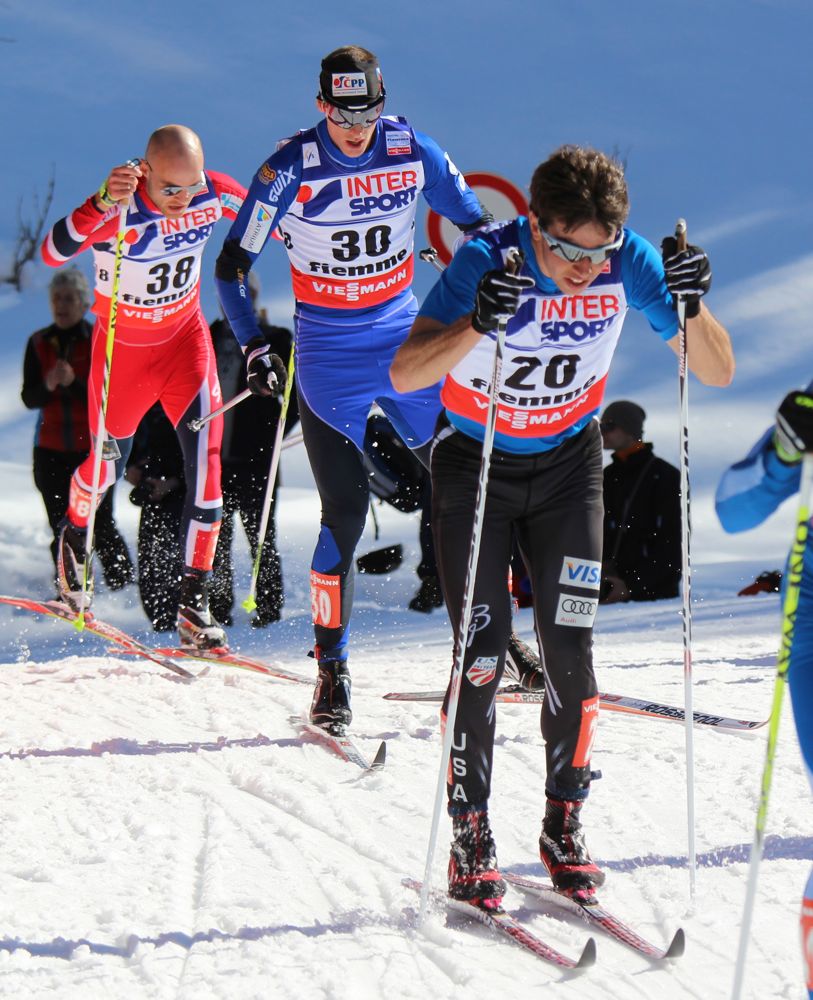
That said, Hoffman does allow himself TV to alleviate the monotony of the gym — he’s started watching ski races on an iPad while he hikes on the treadmill. During his recent four-hour session he watched the entire 50 k from World Championships this February, a two-hour race, and parts of the men’s and women’s classic sprints from Val di Fiemme.
“It was entertaining,” Hoffman said. “I hadn’t seen exactly what [Johan] Olsson did in that 50 k and of course it’s astoundingly impressive. It was a fun race to watch not having seen any video from that race.”
While his shoulder heals, Hoffman’s summer is still about progress — he doesn’t want to simply main fitness he had last season.
“It’s not just about getting back to where I was, but beyond where I was,” he said. “I’m going to use this process and physical therapy to add strength to my upper body.”
Technique development has been a major component of Hoffman’s training in the past, but in the face of limited ski-specific sessions at the moment he has broadened his focus to include upper-body strength as soon as he can lift weights again. He has four technique blocks planned at the end of the summer and fall, but independently of surgery Hoffman decided that strength and power is another component of his skiing he can improve.
“The technique is a focus, but I would say that it’s become clear to us that the strength and power deficiency, especially upper-body, has been a bigger limiting factor last season than my technique alone was,” Hoffman said. “I’m going to be able to make a lot of gains just by adding upper body strength and power, and I’m excited to work on technique again as soon as I’m able to.”
For the moment Hoffman is limited to 10-pound curls with his left arm, which has atrophied to a fraction of the size of his right arm since surgery. But his doctor adjusted his physical therapy protocol to let him build back strength more quickly than he did two years ago. Mobility and range-of-motion, which came before strength last time around in his physical therapy, is set to return more naturally.
“With strength and power being my big off-season goals, independent of the surgery, I’m really happy with the strength as a recovery tool,” Hoffman said.
Long-term, Hoffman views surgery recovery as a necessary part of the process in pursuit of his goal to eventually reach the top of the sport. He considers his improvement last season as step in the right direction, but is by no means entirely satisfied.
“It’s never a smooth, continual uphill process, that’s for sure,” he said in April. “I achieved some of my goals but not others this year; I guess I shoot pretty high. [A top-15 at World Championships] is just, to me, one step beyond being second at U23s. Those people that were in the top-10 with me [at U23s] have excelled as well, and many have had significantly better results than I’ve had since that race.”
With the Olympics on the horizon Hoffman is focused on making another step forward in the months ahead.
“The Olympics are big in the U.S., and big for any skier’s career, but I believe it would be a shock to win an Olympic medal for me next year,” he said. “I have other very lofty goals that I hope to achieve, and only one of them, to be honest, has to do with the Olympics. I want to continue improving next year and continue striving towards my goal and continue reaching the top of the sport. One of them is to win an Olympic medal, but I don’t think that’s going to happen in Russia; more in South Korea [in 2018].”
Trail running in the Sawtooth Mountains north of Sun Valley, Idaho. Photo: Miles Havlick.
Welcome to Wednesday Workout, the newest workout series on FasterSkier. During the offseason, we’ll feature components of summer training programs from top individuals and teams throughout the U.S. and Canada at the junior, college and elite club levels. If you ever have a workout suggestion or training question, send them in to info[at]fasterskier.com.
May training season is in full swing, and he’s logging the hours on foot, on his bike and on rollerskis.
“I’ve been rollerskiing a little bit; my hands are still getting used to that so I ride my bike a fair amount this time of year,” Havlick said. “Mountain and road [biking] is a great way to get in the hours and is a bit more tolerable when it’s really hot like it is.
“I like to change up my workouts a lot to keep it interesting; I don’t want to get in a routeine of doing the same stuff all the time.”
Miles Havlick winning the 20 k freestyle at NCAA Championships in March. (Photo: flyingpointroad.com)
In addition to long hours on wheels, one of the staples in his summer training program is on foot: a point-to-point L3 trail run near his house in Salt Lake City. Though simple, the workout requires focused execution.
The Workout:
30 min warm-up
50-60 min L3
30 min warm-down
The session is doubly productive: like any L3 threshold workout it improves VO2 max, but it can also serve as an informal periodic test if repeated throughout the summer. Havlick does this workout from the same starting point about every two weeks on a trail that has varied terrain: with rolling hills, flats and gradual down hills.
“You can mark where you finish, or make a mental note of it, and see where you improve along the way,” Havlick says. “It’s almost like a time trial but less formal, and usually it’s a good measure of how your fitness is improving throughout the summer.”
He emphasized the importance keeping the heart rate in L3, easing back on the climbs and picking up speed on descents as necessary — which also makes the session a good pacing workout.
“There are different goals for every workout session,” Havlick explains. “Some days you go easy and just do it to get the blood moving, to recover or for a long OD. L3 workout days, L4 workouts and time trials — stuff like that — if you go hard all the time you’ll start to decline in performance. You want to improve certain aspects. L3 work does a lot with improving your VO2 max and your overall fitness, so that’s the goal of this workout.”
To change things up, Havlick will sometimes adjust the way he attacks the hills and flats to see how it affects where he finishes, all the while staying close to L3.
“I run the flats a little harder some days and push the hills harder other days, and see how it affects the finishing position,” he said. “It’s kind of interesting; it kind of makes it like a ski race, too.”
Though the workout looks simple on paper, know that an hour at L3 is not to be undertaken lightly.
“It’s a pretty hard workout, so I’m pretty cooked after that,” Havlick says.
The Bogus Basin Nordic Team (BBNT) in Boise, ID is the club program serving youth skiers age 6-19 in Idaho’s Treasure Valley. Currently, the team consists of around 10 high-school, 20 middle-school and up to 30 elementary aged skiers divided into 4 training groups. Boise has several times been selected as a Top Ten city in which to live, work and play. Boise has a nationally recognized outdoors community with a focus on whitewater and cycling but also a large Nordic and alpine skiing contingent with Bogus Basin ski area just 16 miles from downtown. There is an active and young population in town with several colleges and universities as well as a vibrant downtown. To learn more about BBNT please check out www.bogusbasinnordicteam.com
BBNT is seeking to hire a Part-time Head Coach for the middle school Comp-Devo Team/Assistant Coach for the high school Comp Team. Position requires availability for practice 4-6 days week and assistance with other aspects of running the team which can be flexibly scheduled around other commitments. Additionally there are 5-6 overnight trips scheduled each year in which the assistant coach would be expected to take part.
The position is part time (15-25 hours/week) so candidates would be encouraged to have a second part time job or take classes at Boise State University if interested.
Duties include:
Conduct safe, fun and developmentally appropriate practices for Comp and Comp-Devo teams.
Develop and execute a training plan for the Comp-Devo team with assistance from BBNT Program Director.
Safely drive vans to Bogus Basin and out of town trips.
Work with and assist Rec Team or Comp Team coaches if schedules overlap.
Work with and manage parent volunteers and assistant coaches who will assist in practice and at races.
Communicate with athletes and families by email, website, and phone about schedule and upcoming events (Program Director will assist in these duties when applicable).
Attend out of town races and overnight trips with the Comp-Devo team.
Assist in hosting races at Bogus Basin.
Assist in fundraisers and functions over the course of the season.
Complete the USSA Level 100 coaches certification program (paid for by BBNT).
Ideal candidates will be skiers with experience at the Junior National or Collegiate level with experience working with middle and high school students. Previous coaching experience is desired but not required.
Contract runs from June 1st 2013- April 1st 2014 but the start date is somewhat negotiable. The salary is $15,000 over 10 months plus a Bogus Basin Alpine and Nordic Season Pass and a moving stipend of $500-1000.
Please contact Head Coach/Program Director Nick Crawford at ncrawfo2@gmail.com with any questions or for more information.
If interested in applying please submit the following to Nick Crawford, ncrawfo2@gmail.com
Resume outlining skiing and life background
Names, contact information and relation to you for 3 references (at least one ski related)
Cover letter, supplementing your resume, highlighting why you want to coach junior skiing and what skills and experiences you have that make you an ideal candidate.
The position is open until filled but review of applications will begin May 24th, 2013.
The men’s 20 k at 2013 NCAA Championships. Photo: Steve Fuller/flyingpointroad.com.
This spring, the U.S. Ski Team made a small but notable adjustment to the selection criteria for one of its development groups. For the first time ever, the U24s in this year’s National Training Group (NTG) will include podium finishers from NCAA Championships in addition to athletes who qualified based on certain SuperTour, U.S. Nationals and international results.
The change officially opens the doors of the national team’s pipeline to skiers in full-time college programs, a shift in the official stance on where collegiate skiing fits into its development system. According to USST head coach Chris Grover, the addition of an NCAA Championship top-three to the NTG criteria is meant to include the high-level college athletes into its pipeline that haven’t been there before: the ones who don’t compete in many races outside the college circuit.
“A lot of those NCAA skiers are not participating in a full SuperTour schedule, or much of one, and some of them aren’t even participating in any spring nationals,” Grover said. “So we want to have another pathway for athletes.”
The new criterion was added in the same year that the USST decided to temporarily shelve its Development (D-) Team. Other programs designed to identify up-and-coming U.S. skiers remain, including the NTG, the national J2 camp, and the National and Regional Elite Group training camps.
In some ways, the addition of an NCAA result to the NTG selection process doesn’t change much. NCAA athletes have not been excluded from the group in the past; rather, they earned invitations through extracurricular results at national-caliber events or participation in Junior and U23 World Championships.
But as Grover pointed out, there are sometimes a few top college skiers who don’t attend those events. And the 2013-2014 nominees to the USST include six skiers who have spent time racing in the NCAA; Holly Brooks, Sophie Caldwell, Ida Sargent, Simi Hamilton, Sadie Bjornsen and Erik Bjornsen.
Several athletes have recently spoken about college skiing’s role in their athletic development. Annie Pokorny, who decided to move on to professional skiing this spring, praised Middlebury College for its part in her recent progress. Sophie Caldwell, in discussing her nomination to the U.S. Ski Team last week, credited her four years at Dartmouth College with keeping her fit and excited about the sport by the time she graduated. Her former teammate Sam Tarling, who will graduate Dartmouth in June, wrote on the National Nordic Foundation website in March that he made the transatlantic trip to OPA Cup Finals after NCAA Championships, along with Montana State University’s David Norris, in part to prove that it could be done — that college and international racing were not “mutually exclusive,” as he writes of being told throughout his career.
“It’s actually quite sad how many times coaches have told me that competing internationally and competing in college cannot work,” Tarling said.
The USST’s addition of an NCAA podium to its NTG criteria is a notable change, but not everyone looks at it as entirely productive.
Bruce Cranmer, head nordic coach of the recently crowned 2013 NCAA Champions at the University of Colorado, had conflicting opinions about one of his own athletes, 15 k freestyle champion Joanne Reid, being invited to the NTG.
“I think that’s great that [the USST is] interested in trying to recognize and potentially help college skiing that way,” Cranmer said. “But there’s not much that you really get for it. It’s like a tiny carrot out there… It’s like, ‘OK, I get to go to camps, which I might not be able to go to anyway, and might get a jacket and ski suit, and I come up with $10,000 or whatever to do all this.
“So I think while in some ways it’s nice, I don’t feel its doing all that much,” he continued. “From my perspective and from an athlete’s perspective that’s in college, why would I do something where I have to raise all this money? I get tremendous support at the collegiate level.”
For junior skiers with top results, that support is most evident in the form of potential college scholarships. But the USST has interest in those same athletes, and in the last two years several juniors confirmed having received letters from USST recognizing their potential and urging them to consider the college decision carefully; these athletes did not want to speak publicly about the situation.
In a phone interview last fall, USST coach Matt Whitcomb posited that there is no right way for skiers to approach the college decision, but suggested that certain athletes consider other post-graduate (PG) options before committing to a four-year NCAA program.
“There’s no blanket statement that can apply to everyone and cover this issue effectively so that it matches everybody’s needs,” Whitcomb said last October. “We have a great asset in collegiate ski teams here in the U.S. We also have a great asset in our PG programs, elite clubs and national team. When high school seniors are graduating, [we] just look at how they’ve done in that past season. And if, as an OJ they’re on the podium [at Junior Nationals]…or as a J1 they’re top-10 or better, then I recommend pretty highly that they take one or two PG years.”
Whitcomb believes this allows skiers to decide whether a full-time approach to skiing is a positive thing while giving themselves additional time to become better athletes.
“For everybody I think it’s important to keep your undergraduate degree in the plans, but I don’t think it has to happen in those four years immediately following high school,” Whitcomb said. “If the athlete going to college is a more mature athlete, the college gets a faster product and the athlete is better able to handle the pressure of academics and athletes combined. I think it’s a win-win for everybody.
“That said, the athlete may improve dramatically in their PG years and decide that maybe national team skiing is not for them, and want to go to college and try to progress as much as they can there,” he added. “We’re certainly seeing some athletes do quite well in these collegiate programs; I’m excited the way Sophie Caldwell’s been looking this year. There’s no one way to do it.”
The national team has named college athletes to its team in the past, including Alexa Turzian and Matt Gelso while they were at CU and Rosie Brennan while she attended Dartmouth. But USST coaches say they’ve learned from those cases that they need to require a higher level of dedication from its national team members in terms of time, and college skiers have too many conflicting obligations.
“It’s really difficult for an athlete that’s also attending college to meet the requirements we set for our national team athletes,” Whitcomb said.
That difficulty has gotten more challenging as the national team has increased its presence and success in Europe, he continued.
“Even eight years ago, [Andy] Newell was trying to figure out which period of World Cup racing he wanted to do that next year,” Whitcomb said. “Now we have B-team athletes trying to figure out which couple of World Cup weekends to skip so [they] can train and recover and race fast from start to finish.”
An invitation to the National Training Group is not a national team nomination, but it is designed to facilitate the jump between the two. By including athletes who podium at NCAA Championships on the list of skiers it wants to help improve, the national team has broadened the options available to athletes who wish to take part in its development pipeline.
And as Pokorny discussed last week about her departure from Middlebury, navigating those options is a very personal process.
“I think there’s a lot of negative stigma around leaving school,” she said. “It comes from this idea that kids who leave school are somehow brainwashed or counseled into it by someone else. But this is a decision I made on my own.”
She also echoed Whitcomb in noting there was no single pathway right for everyone.
“There’s no right or wrong way to do it as long as you’re confident in what you’re doing and believe in your training and believe in your choices,” she said.
Simi Hamilton (USA) competing in the Quebec City team sprint in December.
Last winter was a difficult one for Simi Hamilton. After a 2012 season filled with multiple appearances in the heats on the World Cup, including two-top tens, 2013 held the promise of further progress for the 25-year-old as a world-class sprinter. He certainly showed signs of taking that bigger step forward once the season got going — he posted an impressive split in the team sprint in Sochi, Russia, and had a top-five qualifier in the Davos, Switzerland, classic sprint directly before World Championships.
But after several bouts with respiratory illness throughout the year, including a cold right before going to Val di Fiemme, Hamilton was left feeling largely disappointed with his season.
“To fall victim to a chest cold two days before the classic technique sprint at World Champs was like a dagger in my heart,” he wrote in the Aspen Times in February. “So much preparation, so much investment, so many days of pushing my body and mind to their absolute limits; but seemingly all for nothing.”
Hamilton’s last race in the books was in the Drammen, Norway, where he was 59th in the sprint right before World Cup Finals. Since returning to the U.S. the spring has been a season of change for him. He skipped SuperTour Finals in April and is currently recovering from tonsil surgery, which he hopes will resolve his issues with sickness in the future. He recently found out he would be back on the U.S. Ski Team B-team next season after a year on the A-team, a development he says he saw coming after falling out of the Red Group.
Andy Newell (USA) sprinting in Drammen, Norway, this winter. Hamilton says his decision to join the SMS T2 team was influenced in large part by the opportunity it presents him to train with Newell daily. Photo: Fischer/Nordic Focus.
And on Monday, the Stratton Mountain School (SMS) T2 team announced that Hamilton is one of two new additions to its elite team roster, the other being Annie Pokorny, which makes the southern Vermont program one of the most stacked men’s programs in the country for the coming year. In leaving his domestic team of the past few years at the Sun Valley Ski Education Foundation, Hamilton joins fellow USST sprinter Andy Newell at SMS T2 along with Skyler Davis and Eric Packer. Nineteen-year-old Ben Saxton, who raced for F.A.S.T. Performance Training last season, is also joining the training group as a post-graduate athlete.
For Hamilton, the move back east is a natural one. In a phone interview from his home in Aspen, Colo., on Tuesday afternoon, he said SMS T2 will be an optimal training environment for the summer and fall leading into the 2014 Winter Olympics. Pre-Sochi, Hamilton wants to be training as much as he can with Newell, and the Stratton group presents him with the ideal opportunity to do so.
“I think the biggest thing for me right now, going into an Olympic year, are being able to train with Newell and have him push me on a daily basis as well as push him during key workouts, and then also to train at low altitude and really focus on improving my quickness and speed,” Hamilton said.
On a personal level, Hamilton added that a “big factor” in his decision to return to Vermont, where he attended Middlebury College until 2009, was that it would bring him closer to longtime girlfriend Kate Barton, who currently coaches at Burke Mountain Academy.
“That’ll be really good for both of us after a few years of seeing each other seldom throughout the year,” Hamilton said.
From SMS T2 head coach Gus Kaeding’s perspective, Hamilton was a no-brainer addition to his team. Newell just completed one of the best seasons of his career — he ended up as the fifth-ranked sprinter on the World Cup and made a step forward in his distance skiing, as well. Kaeding thinks the inclusion of Hamilton in a training group that also contains Davis, Packer and now Saxton will be a beneficial development for each of them.
“It’s hard to ignore that Andy had a good year last year, and I attribute a lot of that to being in a pretty stable situation,” Kaeding said. “I think from my point of view, adding Simi to the group will only enhance that. Obviously he’s a pretty speedy guy and can help Andy and Skyler push those speeds to another level, and the piece that got me salivating is [Hamilton is] an excellent distance skier, too. He didn’t have a ton of opportunity this year but he can have good results and help push Andy to another level there. And obviously that’s reciprocated; having those guys pushing each other is exciting to think about.”
Leaving SVSEF was a difficult choice for Hamilton, but he believes the move will be beneficial for him overall.
Hamilton racing for Sun Valley in 2011 at SuperTour Finals.
“It was a really hard decision for me,” he said. “Sun Valley and Rick [Kapala] and Colin [Rodgers] — they’ve really believed in me over the years and have become really a second family to me. I haven’t been out there the last couple of years but they’ve been by my side and supported me. But at this point it just came down to really needing to train alongside a teammate like Newell and the other guys on the Stratton team, so I can really be pushed on a daily basis and also contribute as well.”
Aside from the training partners Stratton provides him, Hamilton also sees Vermont as the ideal place to work on his speed and quickness at sea level while adding more rollerskiing into his off-season training than there has been in the past, which was another factor in his decision to move there.
“One of the biggest components that’s been missing in my training is a lot of rollerskiing,” Hamilton said. “I think living so close to New York State and having such good roads around Stratton will be a huge advantage to get out on good rollerski terrain and just focus on the skiing specifics I need to be focusing on.”
Other than location and the amount of rollerskiing in his training, Kaeding doesn’t plan to revolutionize Hamilton’s current program. USST coaches Jason Cork and Chris Grover will continue to write most of Hamilton’s plan, he said, while Kaeding only expects to “add a few things here, add a few stimuli there.”
“My job is putting together a good group that can push each other and learn from each other and then stepping back as much as possible,” Kaeding explained. “Let them learn on their own and figure things out.”
Hamilton will travel to Stratton after he attends the upcoming USST training camp in Bend, Ore., this month and goes to Park City, Utah, for physical testing at the Center of Excellence. When he arrives in Vermont in early June, his goal is to get into “a good training rhythm out there with the whole crew” and spend most of the summer there.
When Hamilton adds up all the positives of joining SMS T2 at this particular time, he’s excited about the approaching season.
“I’m excited and honored to be starting a new relationship out east with the Stratton crew and their sponsors and supporters,” he said. “I think it’ll be a really good thing. I’m really psyched with all of that.”
Annie Pokorny winning an EISA race this winter. Photo: Cory Ransom.
This month, 20-year-old Annie Pokorny will embark on a path many skiers have walked before her in making the transition from college to professional skiing. The Middlebury College skier is one of the newest members of the Stratton Mountain School T2 Team, which officially announced its 2013-2014 roster Monday evening, and she will begin training with new teammates Jessie Diggins, Erika Flowers and Sophie Caldwell later this month.
Spring is generally a time of transition and new team announcements in the ski world. Last week the Craftsbury Green Racing Project announced it added three new athletes to its roster, all of them new college graduates.
But the unusual component of Pokorny’s move has to do with its timing. Rather than wait to begin a professional career until after she graduates and uses up her NCAA eligibility, she is disrupting her college career at the halfway mark — and at the height of an Olympic quadrennial, no less. It is a move resulting from no small amount of deliberation, but is one that Pokorny is enthusiastic about.
“I think that I have been presented with a very unique opportunity, and I’ve never been one to turn those down,” Pokorny said in a recent phone interview from Vermont. “I’m excited to go for it and to take a chance. It’s exciting, it’s new — it’s going to be fun.”
The factors that contributed to Pokorny’s move from Middlebury to SMS T2 are unique to her, but she believes many of her peers find themselves weighing the tradeoffs between college and full-time skiing at some point in their development, too, whether it’s during the college application process or later. College skiing is the subject of persistent discussion within the U.S. ski community, and Pokorny believes the choice to go to — or remain in — school is ultimately specific to the individual. In her own case, she wanted to strike while the iron was hot.
“I’m really excited to join the Stratton group; they’ve got a really strong culture there, some really good girls and great coaches, and I wasn’t really sure if that opportunity would be there in two years,” Pokorny said. “There was a lot of deliberation that went into this one, as you can imagine.”
Age and results played big roles in her decision-making process; Pokorny was a first-year U23 as a sophomore last season, which she considers “old for school.” Rather than wait until graduation to begin training full time at the age of 22, she wanted to give herself every development opportunity now, as she starts to come into her own.
Pokorny racing at U23 World Championships, where she was 29th in the 10 k freestyle and the 15 k skiathlon. Photo: Gus Kaeding.
The Spokane, Wash., native and former Sun Valley skier just wrapped up a breakthrough sophomore season at Middlebury in which she scored two top-10s at U.S. Nationals and logged her first international races at U23 World Championships. Pokorny credits Middlebury with much of her athletic progress in the last two years, but decided as the year went on that skiing was what she wanted to do, and pursuing it full-time was what she needed to make another step forward.
“I am very grateful that I went to college,” she said. “I feel that it has done so much for me, both as a skier and as a person, and I’m not sure that could have been replicated elsewhere. The Middlebury program, Andrew Gardner and Patty Ross — I have no doubt that they’ve made me a better skier. And there’s also no doubt that if I stayed here, I have the utmost confidence in Andrew Johnson and what he’s going to do to this program. It’s fairly bittersweet for me to leave, because I’d like to participate in that; I think he’s going to do great things here. But it was also a very personal decision that I made before we knew Andrew Johnson was coming here, and one that I’m confident in and am going to stick to.”
Last December, Pokorny first entertained the idea of moving on from Middlebury ahead of schedule after watching some of the world’s best athletes compete in Quebec City. She watched the World Cup city sprints there with her college teammates and it was her first up-close exposure to skiing at the highest level.
“Just seeing that level of competition and seeing how powerful that kind of competition can be was really mind-changing for me,” Pokorny said. “As a result of my seeing that, I think my skiing improved.”
Less than a month after her experience in Canada, Pokorny finished fourth in the 10 k freestyle at U.S. Nationals, fewer than three seconds off the podium. She had been 47th in the same event the year before.
Pokorny had already established herself as a freshman, placing ninth in the 15 k classic mass start at 2012 NCAA Championships, but this was a bigger step forward in 2013.
Pokorny en route to a fourth-place finish in the 10 k freestyle at U.S. Nationals this January.
Pokorny’s performances at nationals earned her a trip to U23 World Championships in Liberec, Czech Republic, where she notched two top-30s at her first international competitions. Upon returning to the U.S. she promptly claimed her first Eastern Intercollegiate Ski Association (EISA) win in Stowe, Vt., and went on to collect five podiums on her way to qualifying for NCAAs as second-ranked eastern skier. She crashed in both races at the championships and was forced to drop out of the mass start, but overall Pokorny took a big step forward this season.
The good results were encouraging, but it was still January when Pokorny experienced another attitude-changing moment. During her first race in Liberec, a 10 k freestyle, the race-leader blew by her on the final climb. The moment reminded her of watching the Quebec World Cups, and instead of finding the experience discouraging Pokorny drew inspiration from it.
“When I say she passed me I mean she really passed me,” Pokorny said. “It was like I was in slow motion. And I remember just thinking, ‘Wow. I’m in the same race as that kind of skier.’ And that was the coolest thing that I had experienced in a really long time. It kind of brought me back to that moment in December, when I saw firsthand what World Cup skiing was like. And I think from there it was over — it was something I really wanted to do.”
Her decision to leave school partway through may be rare, but it is one that Pokorny has carefully considered over the past few months. She consulted with several coaches about her options and ultimately came to a final decision on her own. She believes a critical piece of her approach to the sport moving forward will be that she decided to pursue it independently of her results.
“I think making that decision before I had any races this year was pretty pivotal, because it wasn’t as a result of any good result,” Pokorny said. “It was something that I had already chosen on my own, separate from numerical results… I think regardless I would have taken some time, because I really do enjoy skiing and want to spend more time doing it.”
Pokorny sought advice from a number of coaches, including Gardner and SMS T2 head coach Gus Kaeding, and she had brief discussions with U.S. Ski Team coaches Matt Whitcomb and Bryan Fish. In each conversation, she says, she appreciated that no one tried to influence her decision.
“Andrew [Gardner] was really supportive,” Pokorny said. “I think he, as a college coach, really believes in what college skiing can do, and he also knew me as an individual athlete… What he encouraged for me most was in deliberation and being confident in my decision, and really owning my decision and having it be mine. He was not going to sway me in either direction, which I really appreciate, because I think having that kind of autonomy will help going into this.”
Pokorny emphatically believes her two years at Middlebury have been integral to her progress this year, and believes she would decide to attend college again if she were to go back in time.
“I think what was really important for those kind of results to happen this year … is that I went to college,” Pokorny said. “There is so much to be learned freshman year of college. You’re forced to handle this huge transition of academic stresses and still keep cool on race day. And I think that kind of preparation really will help me going into more serious racing.
“The collegiate field is very competitive,” she continued. “If you don’t show up with your game face on every Friday morning you don’t have a chance at a top-10. There aren’t any flukes in college racing… I definitely don’t think the college racing circuit gets the credit that it deserves, because it’s definitely competitive and definitely makes better skiers.”
After finals are over Pokorny will head south to Stratton to begin the next phase of her career. Though she won’t be returning to Middlebury next fall she plans to continue taking part-time classes elsewhere and gradually work towards a degree. She has yet to finish finals this spring but she’s already started reaching out to potential sponsors to help support her training and racing next year.
“I was just talking about owning my decisions, really owning my skiing — now I’m looking at places for support and sponsorships,” Pokorny said. “That’s been really fun, trying to find businesses I believe in and working with them, making connections. That’s the first major difference between college and full-time training, is funding yourself.”
Pokorny doesn’t think there’s any cookie-cutter way to approach college and skiing, but she abides by the belief that carrying ownership into any decision it is the first step in making it work. She wants to continue getting faster and get back to Europe next winter, and to get there she is wholly invested in her new living and training environment.
“Sophie Caldwell is an excellent example, or Rosie Brennan or Holly Brooks. There are so many women who’ve gone to college and do incredibly well after school,” Pokorny said. “I think it’s very much a personal choice, and there’s no right or wrong way to do it as long as you’re confident in what you’re doing and believe in your training and believe in your choices.”
As to whether the approaching Winter Olympics affected her decision to go pro this particular spring, she was modest about her expectations.
“I think that to be a female ski racer in the U.S. right now is really exciting,” Pokorny said. “It’s also very challenging. Just because I’m leaving school [it will] not auto-qualify me for the U.S. team. But that’s also what really fires me up. I think the group in the U.S. is really competitive right now… I’m not sure one year will boost me into that spot but I’m hopeful to make it there someday.
“There’s so much good energy with the team competing internationally and in the U.S., and I think now’s just a great time to be a full-time female skier. I’d like to take advantage of it while I can.”
Female International Skier of the Year: Marit Bjørgen (NOR)
By many measures, Poland’s Justyna Kowalczyk could be considered the best female skier in the world in 2012-2013. She amassed over 500 more points than Marit Bjørgen over the course of the season-long quest for the overall World Cup title, won the Tour de Ski for the fourth year running and didn’t even have to start the very last race of the year in order to receive her crystal globe.
Bjørgen en route to winning the classic sprint.
Bjørgen, on the other hand, showed signs of fallibility this year. A heart arrhythmia scare early on took her out of the Tour de Ski, setting her far back in the overall standings before the season was half over, and there were a few other races she didn’t start in the lead up to World Championships. It was an unusual show of imperfection for a veteran who first stood atop a World Championships podium at the age of 22 and hasn’t stopped much since. The usually smiling and confident Norwegian star later admitted to breaking down minutes before scratching from a race in Davos. Prior to late February it was reasonable to predict that 2013 would just not be Bjørgen’s year.
She then proceeded to stomp all over everyone in Val di Fiemme, only missed gold to teammate Therese Johaug in the 10 k freestyle, and ultimately tallied her twelfth career World Championships victory by the time she left Italy. Bjørgen didn’t disappear afterwards, either, winning the World Cup Finals mini-tour by nearly a minute to finish off her season.
In our minds, Bjørgen’s comeback from health trouble and ability to show up at the biggest event of the year in top form makes her the undisputed Skier of the Year. When it came time to fight for the real medals Kowalczyk was no match for her Norwegian rival. It may seem fairly predictable to pick the biggest name in women’s skiing as our international award-winner, but in this particular season the title was hard-won.
Male International Skier of the Year: Petter Northug, Jr. (NOR)
The men’s contest for International Skier of the Year was even less clear-cut than the women’s. Norway’s Petter Northug, Jr., ultimately won the overall World Cup title, reclaiming it for first time since he earned his inaugural title in 2010, but Northug was far from dominant. Despite announcing it was his mission to claim his first Tour de Ski title in 2013, he faltered in the second half to wind up fourth in the final standings. Russian powerhouse Alexander Legkov, on the other had, put on an impressive show to propel himself into first in the final climb, defeating defending champion Dario Cologna (SUI) and holding off Maxim Vylegzhanin (RUS) and Northug in the final stage of the most grueling event of the year.
Northug during the men’s 4×10 k relay at World Championships.
Nor was Northug dominant at World Championships. He put together two impressive victories as Norway’s anchor leg in the 4×10 k relay and the individual 15 k freestyle, but these performances only tied him with Nikita Kriukov (RUS) as the most prolific gold-medalist at the event (Kriukov won both the individual sprint and the team sprint with Alexei Petukhov). What makes Northug’s showing in Val di Fiemme more slightly more noteworthy, however, is that he earned his gold medals in two completely different ways. In the 15 k, it took everything he had to overtake Johan Olsson (SWE) and finish with an 11-second win — he literally fell across the line. And in the relay, Northug delivered one of those entertaining sprint finishes that people love to hate him for, reminding everyone that when he’s on, he does what he pleases. Haters gonna hate.
The performances that truly put Northug ahead of the field as the best skier in the world this year came in the final few months of the season. The battle between Legkov, Cologna and Northug that first heated up in the Tour de Ski repeated itself at World Cup Finals, where each of them stood a reasonable chance at claiming the overall crystal globe. In March, Northug found whatever he had been missing in January to clinch the mini-tour victory and the overall title in an exciting finale. And for that, he his our International Skier of the Year in 2013.
Matt Whitcomb, the U.S. Ski Team women’s coach, after the team sprint ceremony at World Championships in which Kikkan Randall and Jessie Diggins won gold.
Matt Whitcomb, Women’s Coach, U.S. Ski Team
Results are by no means the full measure of a coach, but they are the simplest way for one to stand out above the rest. And in 2013, Matt Whitcomb was that outlier. The group he leads, the women of the U.S. Ski Team, just tallied its best season ever with few interruptions: a podium in a relay on opening weekend, a team sprint win in front of a close-to home crowd in December, World Championships gold in the same event in February and a World Cup sprint champion for the second year running. At the end of the season each of the six women on his team had cracked the top-10 in a World Cup. The U.S. women had the fifth-best sub-score in the Nation’s Cup rankings and they were only a few more top-15s away from landing in the top three, finishing 61 points behind Sweden and 69 points behind Russia.
Whitcomb giving instruction during a speed workout at World Championships.
Those kinds of results have been in the works for a long time — World Champions are not made overnight. Whitcomb became head coach of this group two years ago after joining the national team coaching staff in the spring of 2006. At the time, Kikkan Randall had just finished the year 59th on the overall World Cup, the highest for an American woman, and cracked the top-30 only twice. Now the USST often faces the problem of which athletes to start in a race, because so many of them are capable of being in the points or higher.
Whitcomb would be the first to point out that progress of the American women, as a whole, cannot be attributed to any single coach or team over the last few years. He would point to the development work of clubs and elite programs throughout the country, and the USST’s collaboration with them, as a huge factor in his success. Even within the national team staff, responsibilities are more often shared between Whitcomb, head coach Chris Grover and men’s coach Jason Cork than they are discretely divided. On race day, coaches and ski technicians alike line the course with spare poles, feeds and radios.
But that collaborative spirit comes from somewhere, and Whitcomb has undoubtedly played an enormous role in fostering the women’s team chemistry that has, in turn, fueled them to so much of their success. It’s not every national squad that can have six choices for its World Championships relay roster, make the difficult call of which four to field, and still have the two women on the sidelines show up for the race decked out in red, white and blue to scream for their teammates at the top of their lungs. If Whitcomb keeps leading the American women on their current trajectory, the world better watch out in 2014.
Honorable Mention:
Erik Flora, Head Coach, Alaska Pacific University Nordic Ski Club
Erik Flora (r) conferring with his athletes at World Championships this February.
If Whitcomb is charting new territory for the U.S. at the international level, Erik Flora is doing the same domestically. That’s not to say that Flora isn’t also doing great things on the World Cup; his role in making Randall into the best sprinter in the world has been well documented, and this year he sent four athletes to World Championships, more than any other single program in the U.S.
But Flora’s success at home is equally staggering. Year in and year out, APU sweeps the board when it comes to season-long success on the SuperTour. Three of Flora’s athletes won national titles for the first time in their careers this January. In the final NNF Cup standings this March, which like the Nation’s Cup can be taken as a broad measure of a year’s worth of results, APU stood at the top with roughly double the points of the next-closest team.
Beyond results, APU acts like a team that produces those kinds of numbers. Or maybe their success is in part due to their professionalism. Either way, rarely do you see an APU athlete preview a course or warm up by him or herself. They have the numbers to break into groups to practice drafting for a sprint and look intimidating doing it, all wearing the exact same blue and black. The APU machine is a well-oiled one, and Flora’s work in directing it is worthy of recognition.
Snow biking across Eklutna Lake in Alaska. Photo: Jim Jager.
Whether there’s still two feet of snow out your front door or it’s 70 degrees and sunny, chances are your new year of training begins on or around May 1. To help motivate you to get out and start working hard again, four skiers share how they’re mentally and physically gearing up for the 2013-2014 season.
Since the season essentially ran two weeks later this year, I’ve pushed my official start to the new training year back a couple weeks to start around May 13th.
I like to approach the new training season with a fresh mental approach. Over the last several years we’ve kicked off the first week of the training year with a start-up camp. The camp included double sessions most days, some crust skiing, some intervals and the start back into the weight room.
While this was a fun way to really kick off the new year, I’m taking a different approach this season. I plan to gradually build back into the training routine over the next two weeks and then make that first official week less like a camp and more of a normal training week. Because of the injuries I had last year, I am going to be more cautious about jumping right into activities that I haven’t done for a while.
So, I anticipate that first training session to be an easy distance workout in the a.m. and probably a slightly shorter easy distance session in the p.m.
Probably biking or trail running. Goals for the session are just to reacquaint the body with a moderate training duration, monitor the body and just be excited to be on the path for a new season!
I am usually excited and feel pretty good those first few sessions. I’m always amazed with how quickly into my recovery break post-season that I start getting excited to train!
Kris Freeman kayaking in last year’s Pole Pedal Paddle.
Kris Freeman (Maine Winter Sports Center):
Depending on the amount of remaining snow at Waterville I will either skin and tele for a few hours in the a.m. with an hour kayak in the afternoon or go for one sixty mile bike ride. I plan to keep specificity very low initially.
Holly Brooks (Alaska Pacific University/USST):
Since I didn’t go to Super Tour Finals I’m feeling rested and ready to go. I know that some other people are taking another week or two since the season went so late. I’ve had a good month of “following my body” and doing whatever I feel like.
Holly Brooks glacier touring with her husband, Rob Whitney. Courtesy photo.
Ironically enough, in Alaska that means a fair amount of skiing. Luckily I’ve been out on touring fish scales, back country ski, downhill skis, and crust skis for the most part. We aren’t quite in the “planting the garden and road biking phase” here in Alaska! Yesterday I got back in the weight room for the first time in about six weeks. In the afternoon I went running on the Turnagain Arm Trail – one of the first places in AK to “dry out.” This morning (April 30) I’m taking my rock skis out to the Hillside trails — NSAA is still grooming! This afternoon I’m either going to take my mountain bike on the dusty streets or might opt to hop on my trainer. For the first couple of weeks I’m going to continue cross training and ease into the season.
Historically I like to hit the training a bit too hard, too early. I’m trying to be okay with not being in incredible shape. One of my goals for the season is to train really hard at the right times rather than all the time. I’m going to be more serious about my recovery weeks, more aggressive with my rest, and more periodized with my plan. It’s easy to get into a “more is better” mindset but I think that we witnessed (with Kikkan) that that’s not always true. I don’t depart for Bend, Ore., until May 19th so I’ll train here at home until then. I still have a couple of adventure ski trips that I want to get in. I would also really like to ride my road bike from Girdwood to Seward and then take the train home.
Sylvan Ellefson (Ski and Snowboard Club Vail/Team HomeGrown):
Sylvan Ellefson running in Canmore, Alberta, last fall. (SMS courtesy photo)
It still feels like I just left Truckee and here I am starting my “training season” tomorrow.
My plan tomorrow is to start it off easy with an hour run with an after school program I started at my old elementary school called “Fit’N’Fast Boys.”
We will talk about how running and being active can also benefit your stress level and overall happiness, stretch, and then hopefully crush a four-mile run. We’ll see how it goes!
In contrast to last year’s official silence from both athletes and coaches before the U.S. Ski Team announced their national team nominations, details had trickled out in advance of Monday’s press release by the team. Kris Freeman announced last Monday that he had not been renamed to the 2013-2014 squad after 10 years on the roster. It took another week for the nominations to be approved by the higher-ups at the U.S. Ski and Snowboard Association and be formally released to the public, by which time it became clear that Skyler Davis and Tad Elliott had not been renominated to the team, either.
In all there were seven women and four men named to the team. The nominations include is a sizeable A-team, five out of six of whom are women. World Champions Kikkan Randall and Jessie Diggins headlined the roster along with the fifth-ranked sprinter on last year’s World Cup, Andy Newell. Red Group athletes Holly Brooks, Ida Sargent and Liz Stephen were also named to the top tier.
The B-team saw two major additions: Erik Bjornsen, who moved up from the development squad, and rookie Sophie Caldwell. They joined Sadie Bjornsen and Noah Hoffman, whose statuses remained constant from last season, and Simi Hamilton, who dropped down from the A-team after a season plagued by frequent illness. None of the nominations were entirely unexpected; the noticeable changes were the elimination of the D-team and the non-renomination of three men that had been on last season’s squad.
Missing from the news so far had been the team’s reasoning behind the decisions. USST head coach Chris Grover initially declined to discuss specifics last week, as nominations were not official at the time and he wanted to give individuals that were left off the team time to adjust to their new situations. In the meantime, however, information came out anyway, leaving room for plenty of speculation in the absence of explanation from the coaches.
US Ski Team head coach Chris Grover in 2011.
“In broad terms, it’s obviously a really exciting time in U.S. skiing,” Grover said last week, before nominations were public. “We have lots of young men and women that are progressing really rapidly, and unfortunately with the national team we can only provide support for a very select few.”
On Thursday, three days after the team was named, Grover agreed to answer more specific questions. The major point he made was that he and fellow national team coaches Matt Whitcomb and Jason Cork made all decisions based on athlete performance, just as they always do.
“This is a performance organization and at the end of the day the athletes have to be judged on their performances,” Grover said.
At the center of the team selection process are the objective criteria published on the USST website that specify what performance level grants automatic nomination the following season:
1. A top-50 in the final World Cup Overall rankings,
2. A top-30 in either sprint or distance World Cup rankings, or in the FIS points lists,
3. A podium at Junior or U23 World Championships.
Additional athletes can be selected to the team “using coaches’ discretion based upon factors other than the objective criteria.”
Of the eleven athletes nominated for 2013-2014, seven meet the objective standards. More than anything else in the selection process, Grover said, those criteria were at the heart of the coaches’ decisions this spring. The cross-country program’s operating budget — which he would not reveal — played no role in who was named to the top two tiers.
“The budgetary challenges have a lot to do with how we can fund the team, but nothing for A- and B-team,” Grover said.
“I feel like we’re getting more and more from U.S. Skiing every year, and I really feel like we have the support of Luke [Bodensteiner] and Bill [Marolt] behind us. They absolutely believe in what we’re doing. They’re trying to send as much our way as they can.”
The budgetary challenges within the national governing body, Grover continued, ultimately stem from the addition of more sports under its umbrella in recent years, and the fact that many if its athletes have been so successful and need further high-level funding. Women’s ski jumping was added as an Olympic sport for 2014, for example, and this winter Sarah Hendrickson became World Champion. Athletes like her across the USSA’s athletic spectrum require continued support per its stated vision: “to make the United States of America the best in the world in Olympic skiing and snowboarding.”
“Slopestyle, halfpipe skiing — all these new sports need to be funded and all these traditional sports that have been around the last couple of Olympic cycles are having success,” Grover said. “We have to go into the same pool of funding… So I understand the hard position that my bosses are in, trying to figure it out.”
Targeting a specific team size was also not a factor in the nomination process. If four men on the team seems like a small number, that’s because four is how many athletes Grover feels are performing at a level befitting of the national team.
“It has nothing to do with the size of the men’s or women’s team. The makeup of our team is 100% having to do with performance,” he said. “We don’t ever want to be in a situation where the goal is to name a certain number of men or women, because that doesn’t take into account ability or performance at the time. It has everything to do with who’s on track right now, and that just happens to be seven women and four men, from our perspective.”
The Non-Renominations
Freeman, Davis nor Elliott reached the objective criteria thresholds last season. On the final distance list Freeman was 52nd and Elliott was 102nd, while Davis ranked 92nd on the final sprint list. All three athletes didn’t reach those markers for the last two seasons, in fact, but were renominated in 2012-2013 based on discretion.
Kris Freeman during the 2013 World Championships relay.
The national team didn’t grant the same leeway two years in a row. Grover says age and experience are taken into account when he determines whether the USST will continue to support an athlete outside the objective criteria for another year, and Freeman, Elliott and Davis did not meet those expectations this time around.
“The standard, therefore, that someone like Kris needed to accomplish is different from what a younger athlete needs to have in terms of results,” Grover said.
This sliding standard is partly how 25-year-old Hamilton, who had an off year with recurring illness and did not make the objective criteria either, is still on the team, albeit back at the B-level.
“Kris, he’s a veteran athlete,” Grover said. “He’s been on the team for a long time and with our veterans, we need veteran results. And unfortunately, Kris was not able to make the objective criteria the past two years. In Kris’s case, he’s got a tougher road than every other athlete out there in terms of managing his diabetes, so we for sure really respect how hard it is for Kris. But at the end of the day we just needed more.”
As younger athletes than Freeman, Elliott and Davis faced slightly different expectations. Grover noted they each took steps forward in certain ways in 2013, but ultimately their results just weren’t there.
“If an athlete has an off year we try to take that into account, so unfortunately — and Tad also made a step forward this year — but it hasn’t shown really in his results,” Grover said. “I think eventually it will, but right now it’s not possible to show his results are where they need to be.”
Davis’ situation was more unique still. As a D-team athlete the team’s expectations for him were more progress-related, and Grover said the 21-year-old’s gains this season, while present, were not significant enough.
“Skyler also made a nice step forward this year, but when you look at his results, he did great in Canmore, but unfortunately was not able to put together other top results,” Grover said. “He just hasn’t been able to demonstrate that he’s rapidly progressing. I think if he sticks with it the results will show, because he’s an extremely talented young athlete.”
Freeman, Elliott and Davis will no longer have the USST’s year-round support, but they each plan to continue training with their respective clubs. If summer training goes well, they may still get World Cup starts throughout the season where it seems appropriate; Grover has discussed the possibility with each of them.
“We talked about that [with Freeman] right from our first conversation,” Grover said. “We talked about the fact that if he has a great summer and fall of training we probably would start him, because he’s one of our best distance skiers. So I can see wanting to start him in quite a few races if it works for him. We had similar conversations with Tad and Skyler… We’ll be keeping an eye on everybody and when opportunities arise at the right time, we’ll take advantage of those opportunities.”
Grover noted that he believes Freeman, especially, could easily still qualify for the Olympics if he sustains his current level of skiing. At the end of the season Freeman was the second-ranked distance skier in the U.S. by FIS points, behind Noah Hoffman.
“If you look at the selection criteria for the Games, if he is able to maintain his performance level he’ll make that standard,” Grover said. “He easily made it for World Championships and it’s a similar selection criteria for the Games.”
D-Team Shelved, For Now
While Grover says finances did not restrict the size of the A- and B-teams, money did factor into the existence of the D-team this year, which in turn played a role in Davis’ situation. Davis and Bjornsen were the first participants in the development tier on the national team for the past two seasons. Bjornsen was moved up to the B-team this year, and for 2013-2014 the development level was shelved indeterminately in the absence of enough resources to support it the way Grover would like to.
“I’ve gone back and forth,” Grover said. “The hard thing about the D-team is that, in my mind, the D-team should be either zero or 20 athletes, because there are 20 young men and women that are on the path for future success in the U.S. for sure, if not more. And the problem is being able to identify who they really are at that age and for us, with limited resources, being able to support them in a way that makes sense.”
Grover and his staff decided that since the USST doesn’t have the funding to support every athlete it would like to on a development team, it was better not to have a D-team at all and to let the clubs and programs throughout the country continue doing the work of developing up-and-coming skiers.
“The real development work with younger athletes is not being done at the national level, it’s being done at the club level,” Grover said. “So to have a D-team has been a little problematic for us in making sure we have the right athletes on there. I think it’s too soon to tell. We don’t have enough money to support a large group the way it should be supported to make a difference, so that’s where we’ll rely on our club partners.”
The elimination of the D-team is not necessarily permanent, Grover continued, “I’d say for right now it’s just a practical place for us to be.”
The Future
Though the national team looks more bare bones than it has in the past, the concentration of talent within its eleven nominated athletes is undeniably high. Two World Champions, a two-time World Cup sprint champion and five Americans total in the Red Group.
“We’re getting better and better,” Grover said. “Four years ago our rank in the Nation’s Cup was 15, three years ago it was twelve, two years ago it was eight, and this year it was sixth — which is a broad measure of how all your athletes are doing in terms of World Cup competition.”
In some ways, the team’s broad international success only makes it harder to get on it. For the athletes left off in the coming year, Grover was hopeful they would make the most of the situation.
“Sometimes you fall off the path a little bit and that’s just part of sport,” Grover said. “What you do to get back on it and how is part of the process, and I hope to see any athlete we’re not able to renominate turn it around and step back up.”
Torin Koos (Bridger Ski Foundation/Rossignol) and Rosie Brennan (Alaska Pacific University) are our Continental Skiers of the Year.
Torin Koos (USA/Bridger Ski Foundation)
When it came time to naming the top domestic-level athlete of 2012-2013, Torin Koos was the clear winner, with few close challengers. As the winner of both the classic sprint and 30 k classic at U.S. Nationals and the SuperTour leader going into the last quarter of the season, Koos was the standout skier on the U.S. circuit in both distance and sprint races.
Torin Koos (Bridger Ski Foundation/Rossignol) leading the 50 k freestyle mass start at 2013 Canadian Nationals in Whistler, B.C. Koos won the race by 0.4 seconds over Brent McMurtry (AWCA). (Photo: Martin Kaiser)
Beyond the U.S. field, Koos was the only American continental cup starter who could translate his World Cup opportunity into distance and sprint points this season — and in Drammen, he was the top American finisher in the classic sprint, placing 18th.
“It’s always a good feeling to finally get a chance again to race the World Cup, and to come through and demonstrate that you are at a world-class level,” Koos said at the time.
He was sick at the end of the season and his top finish in Truckee was seventh (fifth American) in the 50 k Championship, but overall there were few in the U.S. that could keep up with Koos when he was on form. Sun Valley’s Mike Sinnott and APU’s Erik Bjornsen surpassed him in the SuperTour standings at the end of the season, but that was partly because Koos was in Europe for the Aspen and Midwest races.
We would be remiss not to mention that Koos’ results amounted to a pretty redemptive year. Davos, Switzerland, was his first time back on the World Cup in three seasons. Illness in December prompted him to give up his spot in the Quebec City and Canmore sprints to the next guy on the list. The year before, Koos’ disqualification from the U.S. Nationals classic sprint lost him 60 valuable points that could have otherwise gone towards sending him back to Europe much earlier. His exclusion from the World Championships squad this February probably left his 2013 feeling a little incomplete, but Koos was still far and away the most impressive skier on the domestic circuit and for that he is our Continental Skier of the Year.
Rosie Brennan (USA/Alaska Pacific University)
Brennan starting her 2012-2013 season with a win in the 9 k freestyle in West Yellowstone. Photo: Swix Sport.
Rosie Brennan’s skiing began showing signs of advancing to the next level at the end of last year, her first winter out of college, when she finished second in the 10 k classic at SuperTour Tour Finals in Craftsbury, Vt., against a quality field.
“It’s been very up and down trying to figure things out, and I finally feel like I’m coming around now,” she said in Craftsbury.
Fast-forward to eight months later, when she showed up at the season opener in West Yellowstone, Mont., to win her first career SuperTour on day one to kick off an incredibly successful 2013 domestic campaign.
“I guess I must’ve figured something out this summer,” Brennan laughed after the 9 k.
The former U.S. Ski Team member went on to have the year of her life: she won her first national championship in the 10 k skate in January, rose to the top of the SuperTour standings with seven wins by February, got her first European World Cup starts at the end of the season, and came back home to finish on the podium in the 30 k Championship — all while fighting through a nagging back injury. At season’s end, she was still 147 up to teammate Sadie Bjornsen in the domestic points and will be returning to the World Cup next fall as the Continental Cup leader.
It may be an obvious choice to pick Brennan as our domestic-level skier of the year, but the honor is well-deserved.
Honorable Mention:
Graham Nishikawa (CNST/Alberta World Cup Academy), 29, has been competing on the World Cup since 2005, but in December he cracked into the top-15 for the first time in the 30 k skiathlon at home in Canmore, Alberta. He was consistent on the NorAm circuit and was the points leader by early February, and he was brought over to Europe to compete for the Canadian World Championships team for the first time in his career. We place Koos’ season above Nishikawa’s only because the American turned in more performances in the points against a World Cup field.
Graham’s sister, Emily Nishikawa (CNST/Alberta World Cup Academy), was equally impressive amongst the Canadian women. The 24-year-old won four NorAms this season and podiumed a total of seven times, a record that none of her competitors came close to matching. February brought her World Championships debut, as well, and though she may have struggled in Italy she went on to put together a series of decent results at World Cup Finals and expand upon her international experience.