Author: Pasha Kahn

  • Diggins 10th in Stage 6 of TdS, Best Classic Result Ever, Stephen 21st, Hoffman Hungry for Hill Climb

    Diggins 10th in Stage 6 of TdS, Best Classic Result Ever, Stephen 21st, Hoffman Hungry for Hill Climb

    Saturday’s Tour de Ski stage 6 individual classic race saw Jessie Diggins notch her best ever classic race. Diggins came in 10th, while Liz Stephen finished a solid 21st, and Noah Hoffman in 47th had an off day.  The race, 10 k for the men, 5 k for the women, in Val di Fiemme, Italy was a challenging affair coming at the end of a long series of races. The long race yesterday saw Stephen finish 12th, Diggins 13th, and Hoffman ski his way up to 27th.  At this point in the Tour, exhaustion is inevitable. Hoffman and Stephen reported feeling some fatigue, while Diggins, on the other hand, said that she felt “pretty good energy-wise, by some miracle.”

    It was a difficult day condition-wise as well.  The air temperature in Val di Fiemme hung around the freezing point, and a slow drizzle fell steadily throughout the day.  Despite the adverse weather, Whitcomb felt that the US team had mastered the conditions from a technical standpoint. “The ladies, for instance, had really good skis and one of them was on zeros and one was on klister.  Jessie was on klister, Liz went with the hairies.  You are trading a little kick for a little speed in each instance.  I guess whatever the athlete is comfortable with before the start.  You test a whole quiver of them and take the best.”

    Diggins was pleased with her skis, as was Stephen.  Diggins said of the conditions in Val di Fiemme, “It was raining the entire day, and it was really grey and foggy and the tracks were really wet.  Most of the time they were pretty hard and almost glaze-y from the rain.  But it happened that the kick was pretty straightforward; it was either zeros or klister, and I went on klister and my skis were really good—the techs nailed it.  I had pretty good kick, and exceptionally awesome glide.  The tracks were soaked and mostly hard and fairly fast, and my Salomon’s were running great, thanks to our crew.”
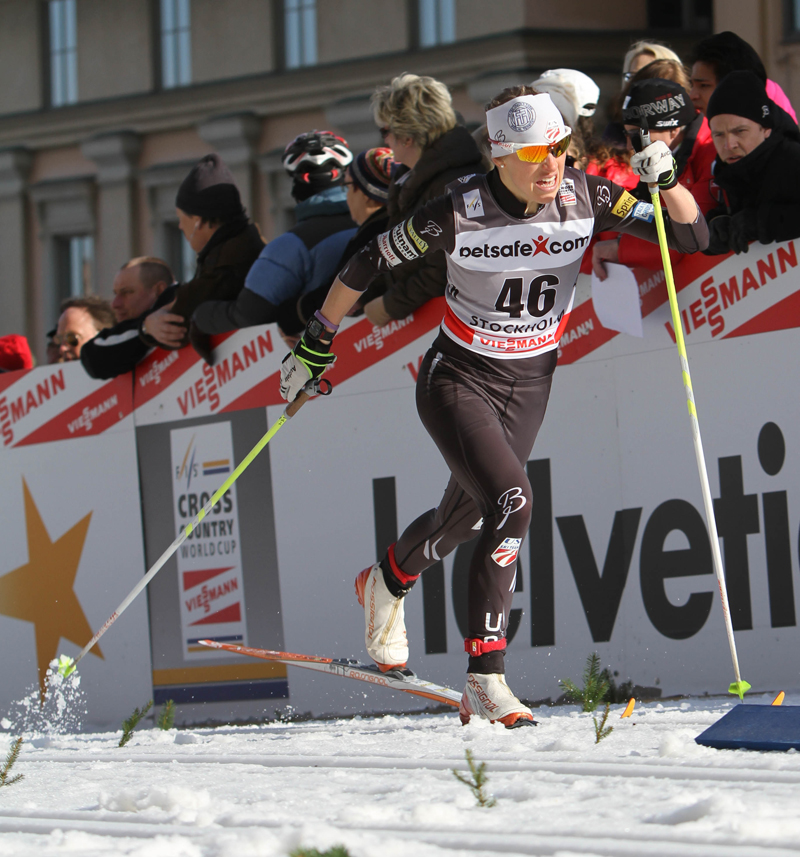
    Liz Stephen (USA)
    Liz Stephen (USA) racing in the Royal Palace Sprint in Stockholm, Sweden in 2012.

    Stephen said in an email to FasterSkier, “My pre-race plan was to pick the right skis for the day and go like hell.  I think I tested more skis today than I ever have before on the day of the race, with 3 pairs of zeros, one pair of handmade harries, and 4 pairs of klister skis.  Huge thanks goes out to my Tech, Oleg, and to the other members of the staff who made today so smooth and easy, AKA: Cory Wubbles,  Matt Whitcomb, and Jason Cork. Those guys were soaked all day long and never complained or slowed down for a second and gave us great skis to boot.”

    Diggins said of her race plan, “I just thought about going out as hard as I could, and to try and ski as smooth as I could, and stay on top of my poles.” Diggins was the first starter for US women, in bib 13, and her splits throughout her race put her in second place behind Japan’s Masako Ishida.  For Diggins, though, split times were not a part of her race strategy.  “I didn’t ask for splits out there today because I knew I had a pacing strategy and would be going as hard as I could,” Diggins said by email, “so I asked the coaches to yell out technique and encouragement, which definitely helped a lot!”

    This was Diggins’ best performance in a distance classic race on the World Cup.  “I was really psyched on the race today because it was my best classic race on the World Cup by far, and a great confidence booster for me as classic skiing is still something I’m trying to figure out,” she said.

    Whitcomb, however, was not surprised with her result. “She has been very competitive in classic before,” he said. “She likes a nice strong mule kick, and she got that today and she was able to do really good things with it.  She is in awesome shape and was rested pretty well, ready to go.  So today wasn’t a big surprise; it was certainly really exciting for us to see her get tenth.” He added further that “Jessie is just in a different place this year, she is doing a great job with recovery, putting together really sharp performances, and she is seeing big progress in both sprint and distance races.”
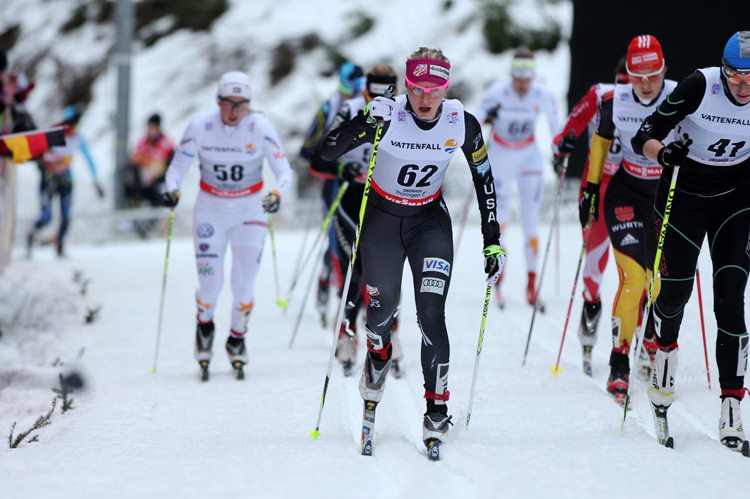
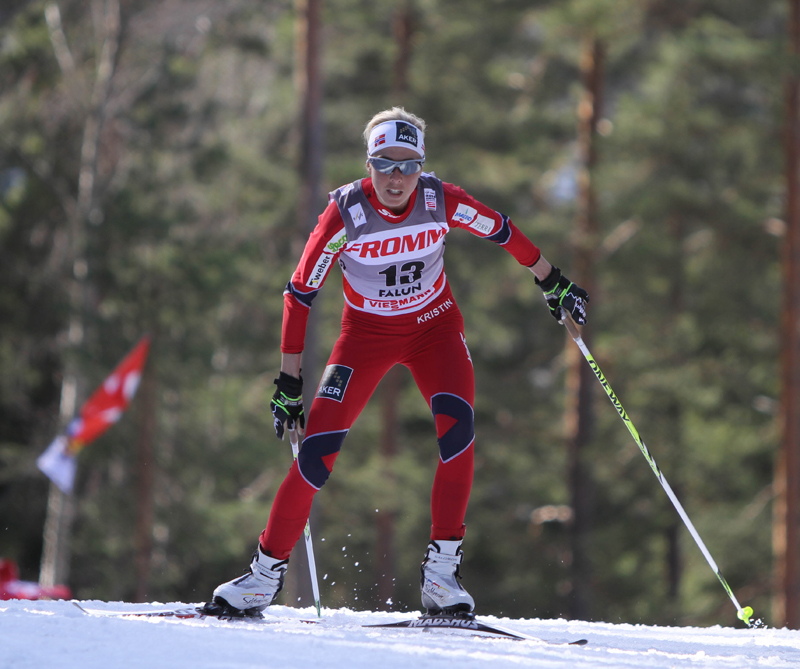
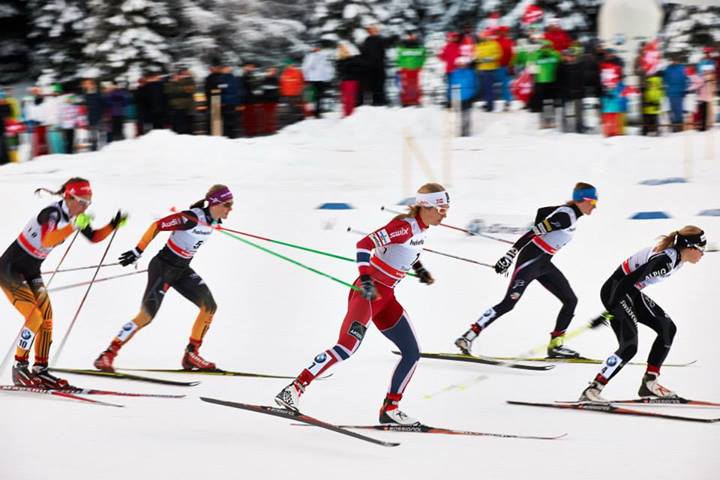
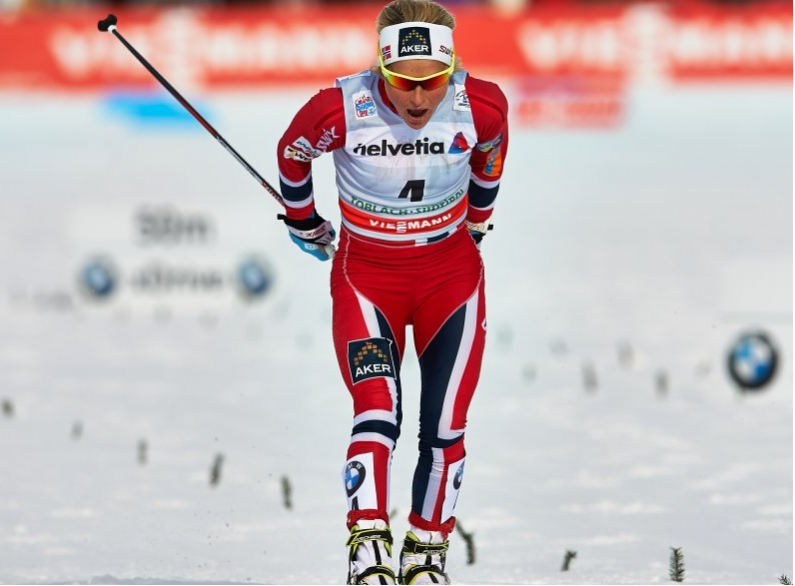
    Diggins striding through the pack in the pursuit. Photo: Marcel Hilger.
    Diggins striding. Photo: Marcel Hilger.

    Stephen started two bibs behind Diggins in 15th.  Her post-race splits show that she made a big effort in the two kilometers between the 1.3 k and 3.3 k intervals.  Stephen, in 23rd at the first time check, moved up to 17th at 3.3k, before tiring a bit to finish in 21st.

    Stephen said of her race that she “definitely got a bit fatigued towards the end of the course, but I pushed hard, skied the best I could and am happy with the result and where it places me for tomorrow’s hill climb.”

    About Noah’s race, Whitcomb said, “He admitted that he couldn’t get out of a 30 k pace.  He said that he just felt beat up while we were warming up—it just wasn’t his day.  The Tour is great in that you have seven shots and you can do really well in the tour with a few ‘uninspired races’, as he said.  Today was that, but tomorrow we have every reason to think he will do exactly what he did yesterday in Toblach.  I’m feeling pretty excited to see the Hoff tear it up tomorrow.  He is skating exceptionally well, and I see no reason for concern or any reason to look into today’s race other than to just put it behind us and start getting the skate skis ready.  He is in the ice tub right now.”

    Six races, eight days, and three countries later, the Tour wears on the body.  Whitcomb had this to say of fatigue: “Everybody responds a little bit differently each day of the Tour.  Hoff certainly put in a Herculean effort yesterday and for him to be tired makes perfect sense.  I think he is going to recover quickly relative to the field.  You enter the last stage hoping to be less tired than everybody else.  Everybody is absolutely exhausted and it is just a matter of keeping things in perspective and doing your best on each stage.  I think Hoff can tear it up tomorrow.”
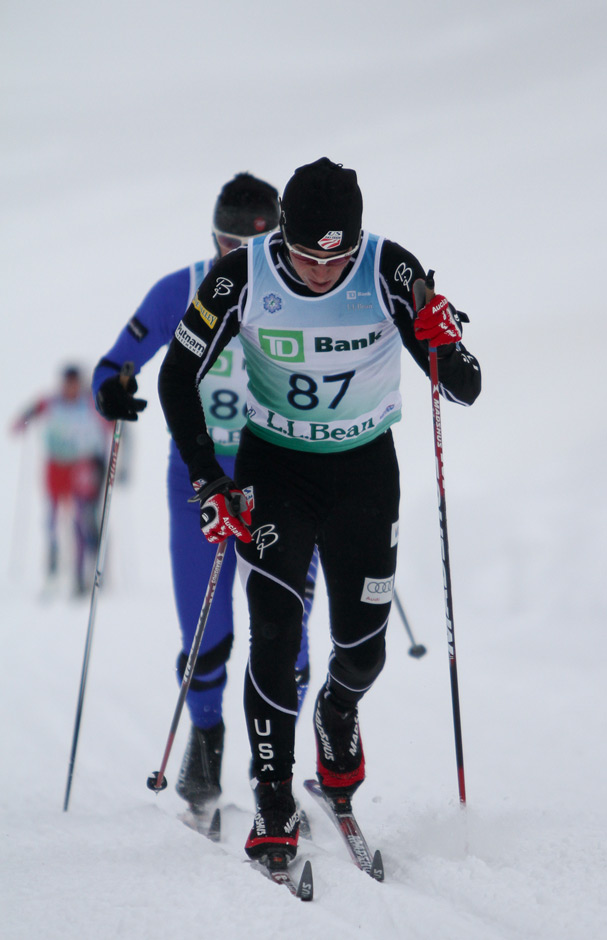
    Noah Hoffman representing the US Ski Team took second.
    Noah Hoffman

    Whitcomb did not think that skis played a part in a tough day for Hoffman, “I think Noah had competitive skis today.  It was just tricky skiing out there—you saw a lot of guys slipping around.  I can’t say it was exactly a 50/50 mix of klister and hairies, but I spent a lot of time looking at skis at the finish and there were guys in the top-five on a little bit of both.  I think Noah would agree that the limiting factor today was not skis.  It was just a combination of being tired and having to ski tired through difficult conditions. It is a tough combo.”

    Whitcomb and his three American athletes are looking forward to Sunday’s climb up the Alpe Cermis. “Out of the three athletes we have starting tomorrow,” Whitcomb said, “they have all had really excellent hill climbs. I would guess that all of them should expect to have really strong climbs and there is no doubt that this is Liz’s marquee event and she is positioned well and ready to rock.”

    Stephen’s strategy tomorrow is pretty straightforward, “I am hoping to ski the flats with Anna Haag and carry good speed to the bottom of the climb and then put my head down and hammer,” she said.

    Diggins, for her part, said she is “excited for tomorrow’s climb, mostly because of the feeling you get once you’re standing at the top.  It’s this rush of emotion when you realized that you just finished an impossibly, insanely hard climb at the end of a long series of races, and it was crazy hard but you did it.”

    The Tour de Ski continues Sunday with the final stage, a 9 kilometer freestyle pursuit to the summit of the Alpe Cermis.



  • Johaug Dominates 5 K Classic, Jacobsen’s Lead Narrows

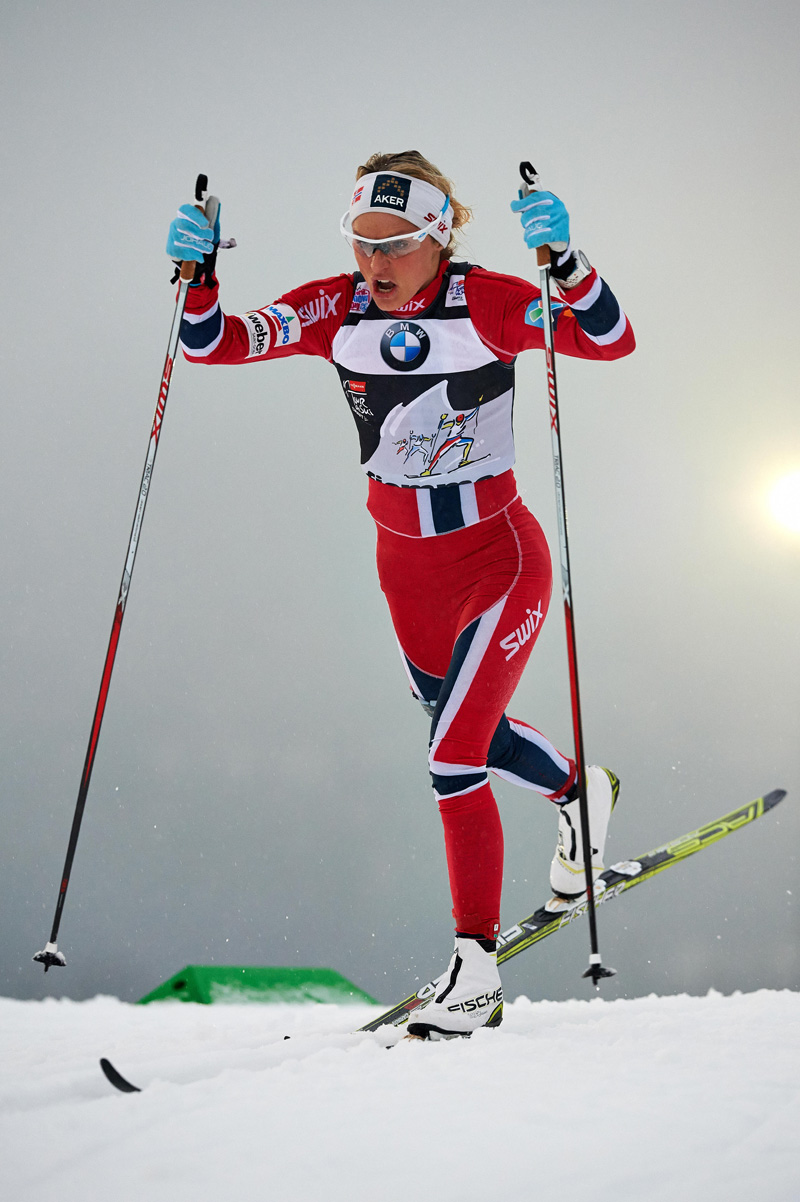
    Johaug Dominates 5 K Classic, Jacobsen’s Lead Narrows

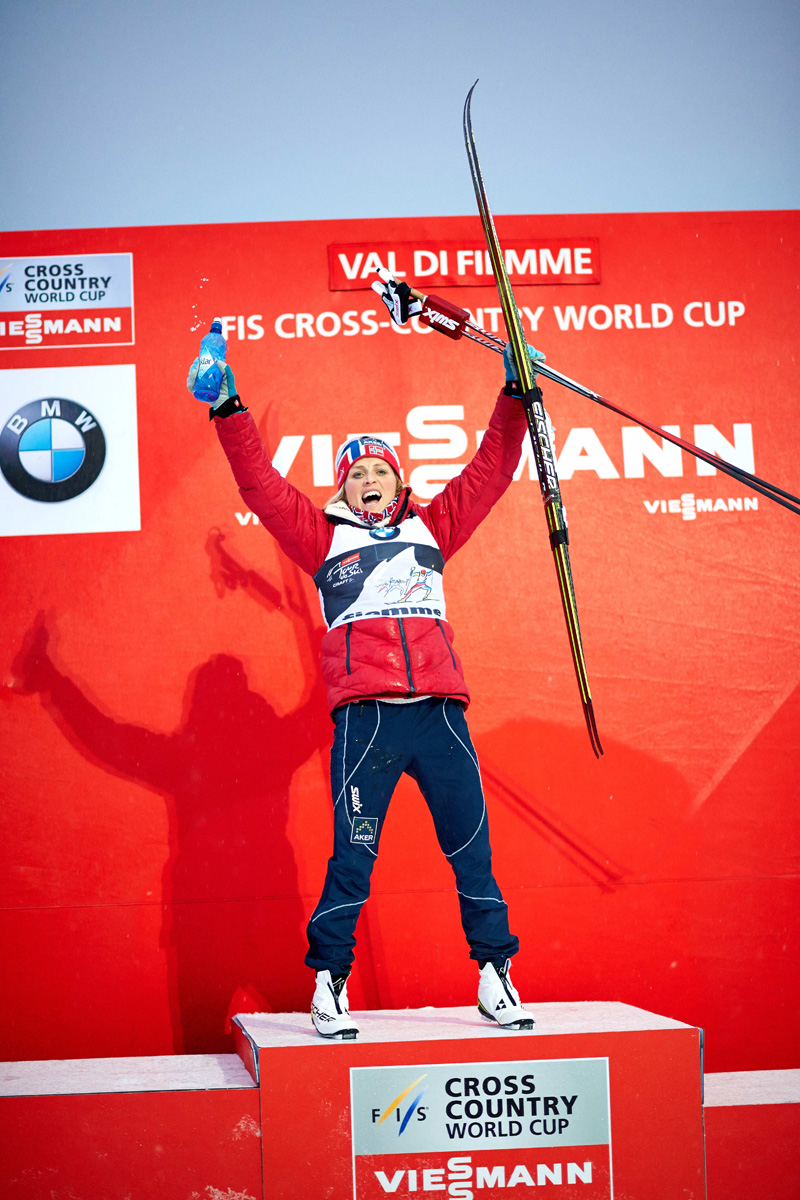
    Photo: Fischer / Nordic Focus.
    Photo: Fischer / Nordic Focus.

    Therese Johaug, second overall in the Tour de Ski, skied a dominating race that was far and away faster than any of her competitors. Johaug’s performance went a long way toward her goal of being the first to the summit of the Alpe Cermis on Sunday.

    Saturday’s event was a 5 k classic individual start race, held in Val di Fiemme, Italy, under drizzling skies that hovered around freezing.

    Japan’s Masako Ishida was the early pace setter, recording fast splits through all the interval timing stations.  Starting fifth, she passed through the first timing station at 1.3 k in 4:14.3.

    USA’s Jessie Diggins, starting thirteenth, was just over Ishida’s time at 1.3 k, trailing the early leader’s time by 1.4 seconds.  Liz Stephen of the US, who started fifteenth, trailed Diggins’ time through the first interval by 7 seconds.

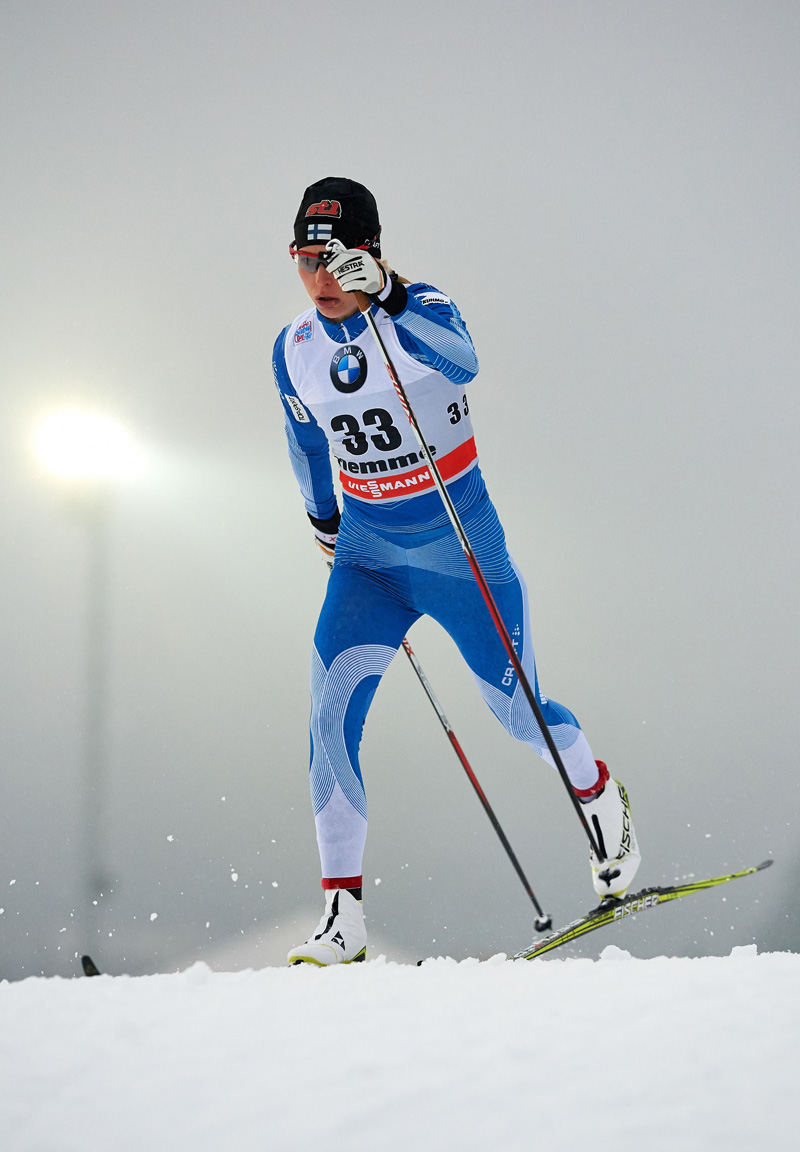
    Finland’s Aino-Kaisa Saarinen started in bib 21, and set the new pace to beat at 1.3 k at 4:12.  Her teammate, Kerttu Niskanen, then came through the first interval a second behind Saarinen.  Saarinen’s time would be beaten shortly thereafter by yet another Finn, Anne Kyllönen, who skied past the first timing point 3.3 seconds ahead of Saarinen.  The Finns now held the top three positions.

    Photo: Fischer / Nordic Focus.
    Photo: Fischer / Nordic Focus.

    Johaug, wearing the black sprint leader’s bib, started in 36th, two places ahead of the final red group skier, and Tour leader Astrid Jacobsen of Norway.

    Johaug wasted no time in setting a fast pace on a slow day.  Using her quick tempo and fast skis to her advantage on the hills of Val di Fiemme, she undercut Kyllönen’s time at 1.3 k by 3.2 seconds to set the leading pace.

    If Jacobsen had hopes of winning the day, she knew she was in trouble early on.  Placing third at 1.3 k, she was 5.1 seconds off of Johaug’s pace and did not appear to be climbing as well as her teammate.

    The second timing interval, at 3.3 k, was held early by Ishida. Diggins, 8.1 seconds behind, was unable to break it.  The Finnish women again took over the race as they passed the station, with Kyllönen, Saarinen, and Niskanen separated by just 1.6 seconds.

    The Finnish times looked favorable until Johaug skied through, slashing Kyllönen’s time by 11.1 seconds.  All eyes awaited Jacobsen’s arrival at the interval station, which confirmed that she was losing a lot of time to her compatriot.  At 3.3 k, Jacobsen was 13.7 seconds behind her teammate, sitting in 5th place behind Johaug and the three Finns.  Cameras showed a Norwegian coach instructing Jacobsen extensively as she labored up a climb.

    Whatever was said must have a had an effect.  Jacobsen, knowing that she was at risk of losing her entire 43 second advantage to Johaug through lost time and the fifteen bonus seconds Johaug would surely collect for winning, began to really battle through the final kilometer and half.

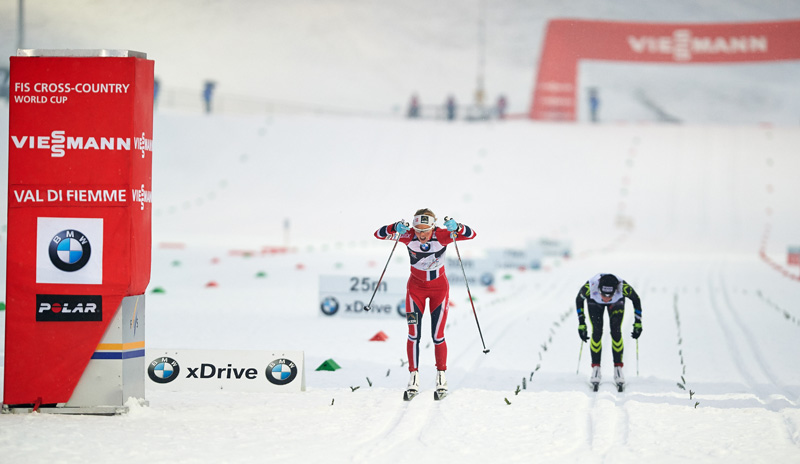
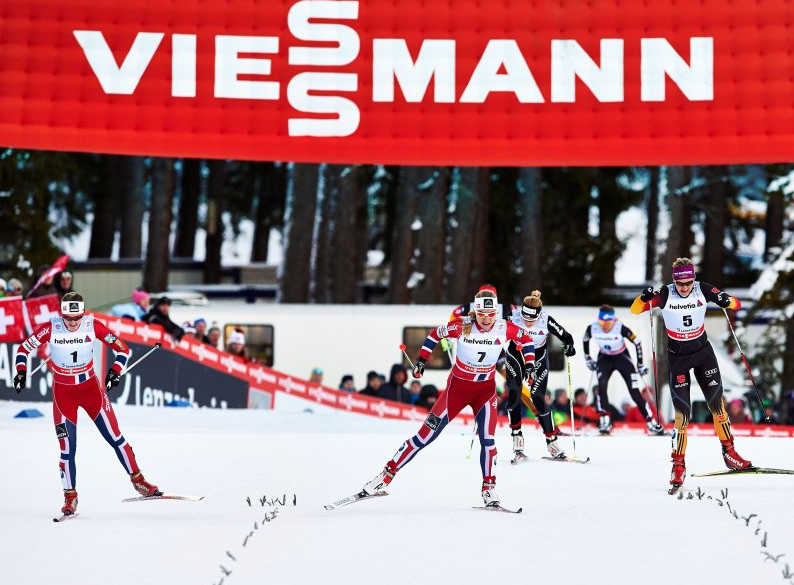
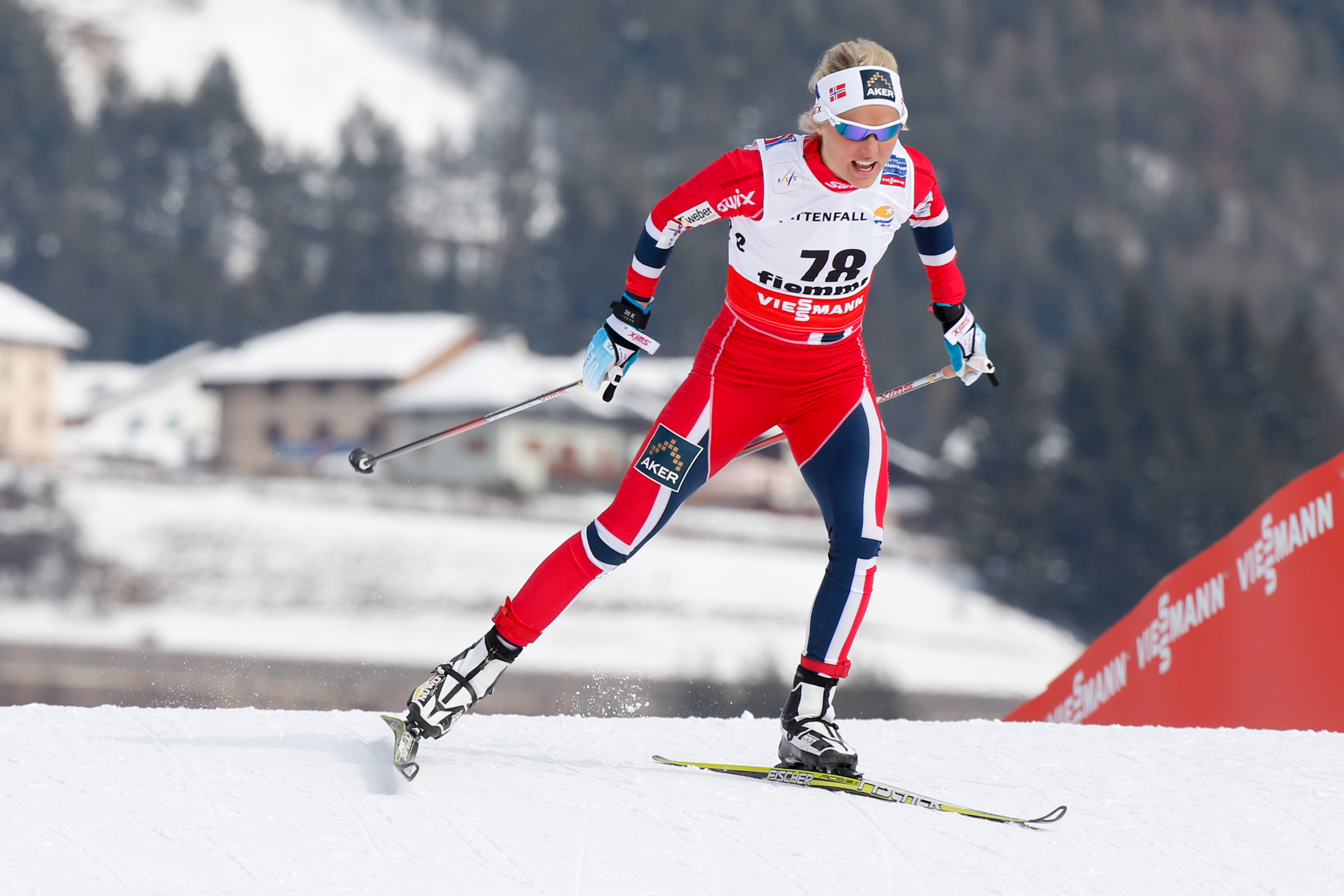
    Johaug, meanwhile, tracked a skier at the edge of the finishing lanes, and tore through the finish line to set the winning time of 13:58.4, some 19.2 seconds ahead of then second place Kyllönen.

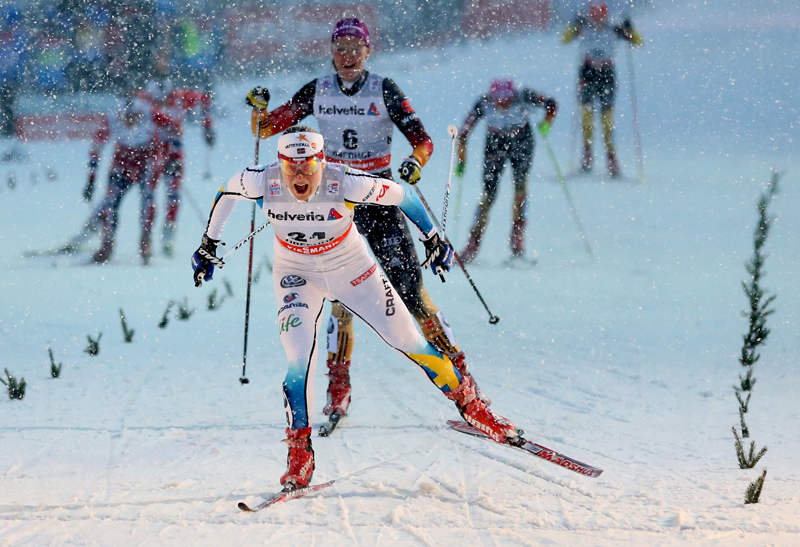
    Johaug's finish.  Photo: Fischer / Nordic Focus.
    Johaug’s finish. Photo: Fischer / Nordic Focus.

    Jacobsen arrived at the finish not long after, powerfully double poling her way across the line.  Her late effort had paid off—she had stanched her time hemorrhage to just 1.2 seconds to Johaug over the last 1.2 k of the race, and most importantly, finished second, outskiing the Finnish contingent that had tired.  Jacobsen seemed pleased with her result as she crossed the finish line and looked at the timing board, she raised her arm happily before succumbing to exhaustion.  Her rally at the end was key to her chances tomorrow as she won a further 10 second bonus that preserved some distance between her and Johaug.

    Jacobsen had another reason to celebrate: she won back the black sprint leader’s jersey, and no matter where she ends up on the Alpe Cermis, she is guaranteed to keep it.

    Diggins had another great day of skiing, finishing in 10th,  her best classic race ever in the World Cup, 30.3 seconds out of first. Liz Stephen was 21st, 52.4 seconds back.  Holly Brooks left the Tour and did not start.

    Johaug’s victory, her first of this year’s Tour de Ski, puts her in a good position heading into Sunday’s final stage up the Alpe Cermis.  Still in second overall behind Jacobsen, Johaug’s effort shaved 14.9 seconds off of her teammate’s advantage.  Johaug will start Sunday’s race just 23.8 seconds behind her teammate.

    Speaking to FIS after the race, Johaug said,  “It was a great day for me. I have been in a very good shape. My skis were just flying, I had the best skis I can ever remember. My plan was to go full speed from the beginning. I like competing in difficult weather conditions. I will try to recover well to be ready for tomorrow’s Final Climb.”

    Jacobsen, for her part, said to Dagbladet, “I fought myself to the second place on sheer will. I did it because I wanted this more than the others.”

    Photo: Fischer / Nordic Focus.
    Kyllönen.  Photo: Fischer / Nordic Focus.

    Kyllönen was once again third, the same position she holds overall.  She will start Sunday’s stage 1:31 behind Jacobsen.  It was another fantastic day for the Finnish women who went 3, 4, 5 and 7.  Finnish newspaper Helsingen Sanomat reported that Kyllönen has told her teammates that she hopes they will, “stream by to do some work.” Krista Lähteenmäki, who has twice in the past finished fourth in the Tour, told the newspaper that she dreads the final climb.  “Every time, I have been really tired and thought in the morning that I can not go skiing.  I have no idea what is coming tomorrow.”

    The Alpe Cermis will now be especially difficult for Jacobsen as Johaug will be starting close enough to her to keep her in eye contact on the climb, if she doesn’t catch Jacobsen before then.  “It was important to take the second today” Jacobsen said to Dagbladet, “Now I have her back from the start. I just have to go steadily throughout the race.”

    Jacobsen has downplayed her chances of winning the Tour since she took possession of the leader’s bib.  “Last year I lost 1:30 up the last hill, so any logical sense tells me that 24 seconds is not enough,” she conceded after the race.  But she added to FIS, “I feel I am in very good shape and I can compete with almost everybody. I do not think much about the overall result in the Tour de Ski. It’s already a great achievement for me to be in the leading position before the final stage.”

    Johaug, for her part, isn’t willing to take a victory for granted yet.  “Astrid has shown that she is in great shape so far, so nothing is settled,” Johaug said. “But all indications are that it will be a Norwegian victory for the first time tomorrow, and we on the girls team are very happy,” she reported, smiling.

    With Norway in an advantageous position to go 1st and 2nd tomorrow, Norwegian National Team Coach Egil Kristiansen is also hungrily looking at the possibilities of Heidi Weng, currently in 6th and just over half a minute behind Kyllönen, to move up to third and make the Tour a Norwegian treble.

    “We have to work for it, but it should be our goose,” he said.

    The Tour continues Sunday with the final stage, a 9 k freestyle pursuit race that finishes at the summit of the Alpe Cermis.
     Results

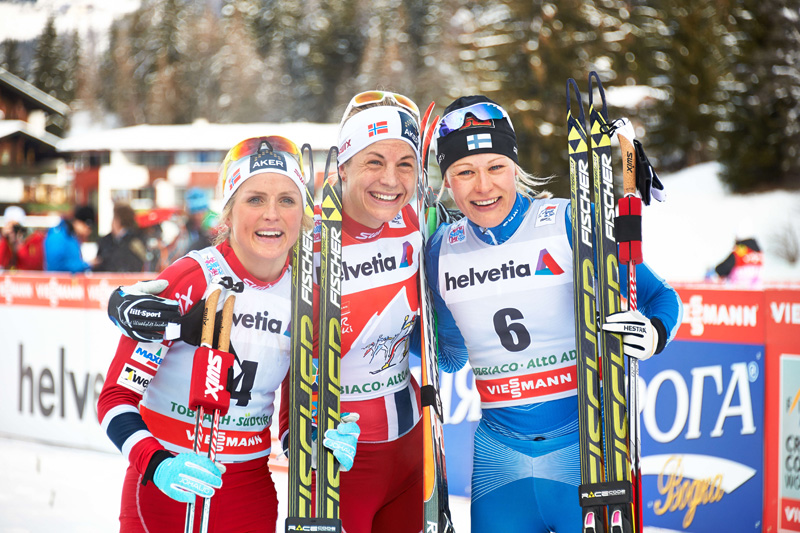
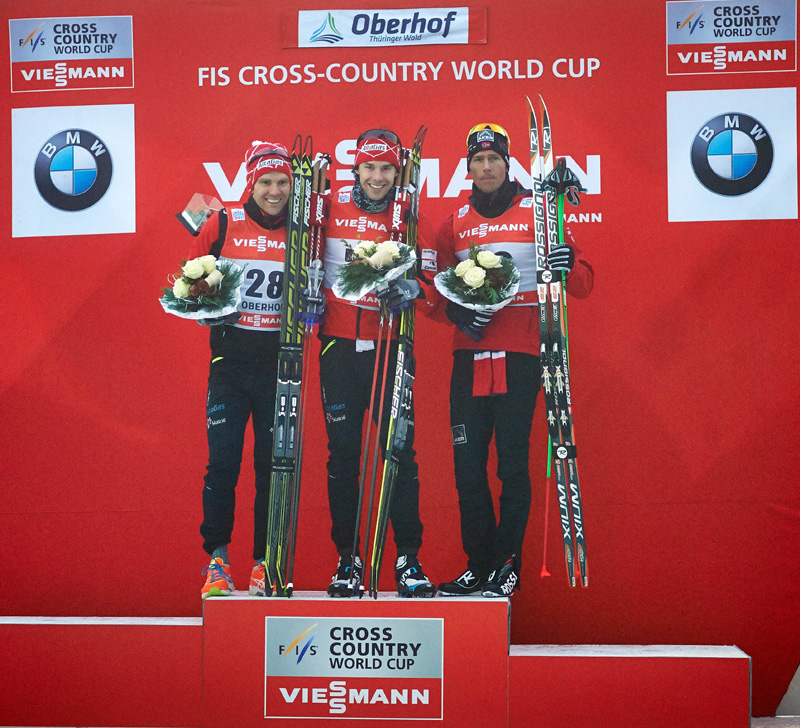
    Same podium as Friday, just in a different order.  Photo: Fischer/Nordic Focus
    Same podium as Friday, just in a different order. Photo: Fischer/Nordic Focus
  • Jacobsen Wins 15 k Pursuit, Stephen and Diggins 12th and 13th

    Jacobsen Wins 15 k Pursuit, Stephen and Diggins 12th and 13th

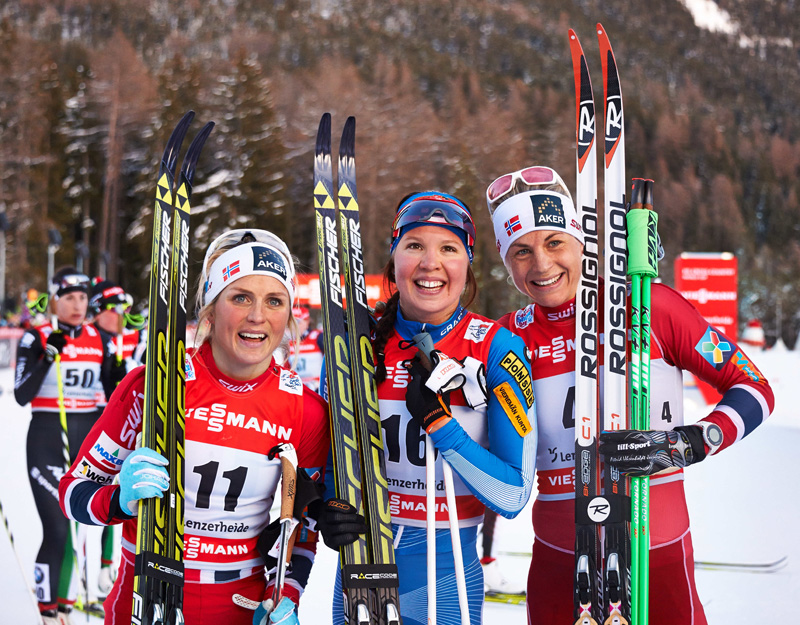
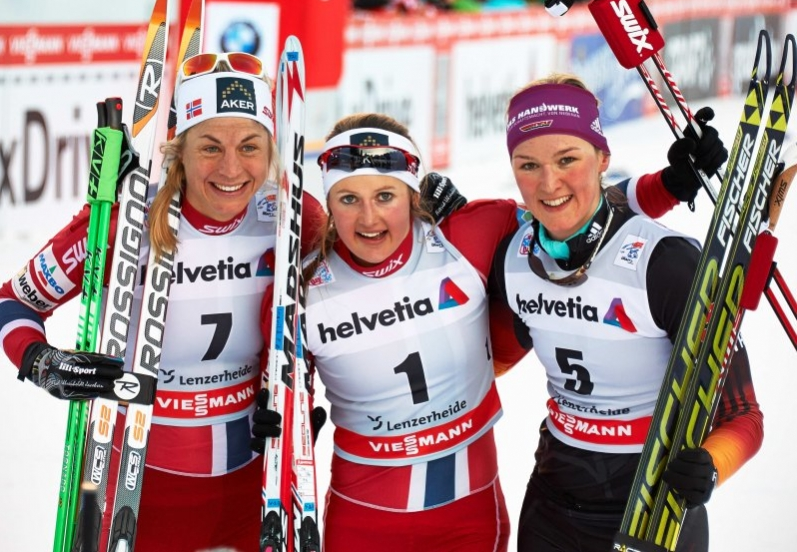
    The women's 10 k classic mass start podium at Stage 4 of the Tour de Ski: winner Kerttu Niskanen (c) of Finland, and Norway's Astrid Uhrenholdt Jacobsen (r) in second and Therese Johaug in third. (Photo: Fischer/Nordic Focus)
    The women’s 10 k classic mass start podium at Stage 4 of the Tour de Ski: winner Kerttu Niskanen (c) of Finland, and Norway’s Astrid Uhrenholdt Jacobsen (r) in second and Therese Johaug in third. (Photo: Fischer/Nordic Focus)

    Astrid Jacobsen of Norway, the Tour leader in the red bib, won Friday’s 15 k freestyle pursuit race to maintain her lead over teammate Therese Johaug.  Leading the race, Jacobsen started with a 44 second advantage over Johaug who was followed 37 seconds later by Kerttu Niskanen of Finland, holder of the black sprint leaders bib.

    The course, a 5 kilometer loop that climbed long and gradually out of the stadium through the pine forests outside Toblach, was wide and hard packed, and most of all difficult, with little rest along the way.

    For Jacobsen, her hopes of winning the Tour de Ski rested on her ability to maintain her lead over Johaug.  With the withdrawal of Marit Bjørgen from the Tour, Johaug, with her impressive climbing ability, has become the favorite to win the 7 stage event.

    Behind Johaug came Aino-Kaisa Saarinen of Finland, and Heidi Weng of Norway, 1:09 behind Jacobsen.

    Further back, Norway’s Kristin Stoermer Steira led a large group of chasing skiers 2:26 behind Jacobsen.  Anna Haag of Sweden was four seconds behind Steira, followed by Jessie Diggins of the U.S. at the same time and her teammate Liz Stephen, two seconds later.  Holly Brooks of the US started in 42nd, 3:43 behind Jacobsen.

    The race started fast with Jacobsen reaching the first split at 1.8 k in 4:38.  By the time Johaug had reached the marker, she had passed Niskanen, and had shaved a second and a half off of Jacobsen’s lead.  Ten minutes into the race, as the course began to wind its way out of the forests and back toward the stadium for the second lap, Johaug appeared to have clawed back a further two and half seconds on Jacobsen.

    Johaug Finishing.  Photo: Fischer/Nordic Focus
    Johaug Finishing. Photo: Fischer/Nordic Focus

    As the skiers passed through the sunny stadium and back into the forest, the split time at 5.7 k confirmed that Johaug was now 39.8 seconds behind Jacobsen.  Behind her by 23 seconds was Niskanen, who was close to being caught by her teammate Anne Kyllönen, just five seconds behind.

    The course began to climb up the hills and at 6.8 k, Jacobsen’s lead had shrunk a second further, to 38.6 seconds.  Behind Johaug, however, Niskanen and Kyllönen, now skiing together, were falling a few more seconds behind the leader’s pace.

    The largest chasing pack was led up the climb by Diggins, who was skiing in 11th place ahead of Germany’s Katrin Zeller, Haag, and Stephen.  As the climb neared the crest, Steira took the lead from Diggins.

    The 10.7 k split confirmed that it was going to be a difficult day for Johaug to make time on Jacobsen.  As they skied through the stadium to start their third and final lap, Johaug was 40.5 seconds behind the leader, with Kyllönen and Niskanen slipping back further to 1:21 behind Jacobsen.

    The large chasing group that Stephen led into the stadium was taken over once again by Steira on the climb, with Sweden’s Sara Lindborg and Diggins chasing.

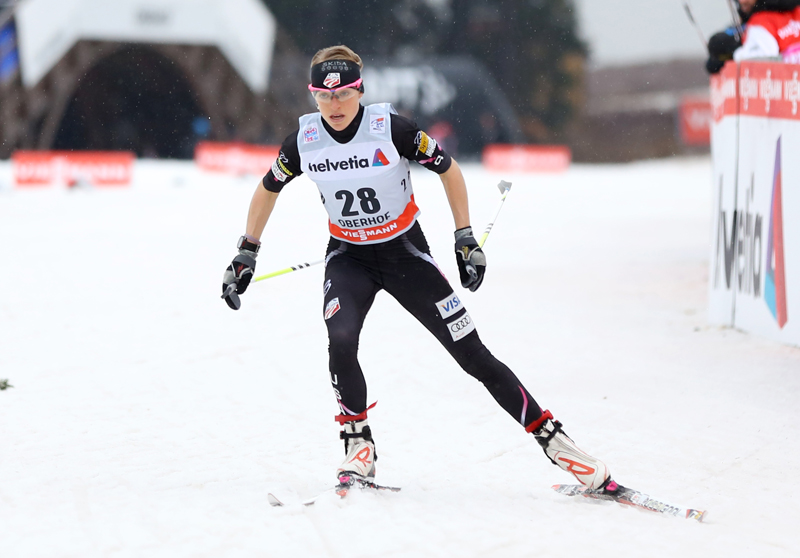
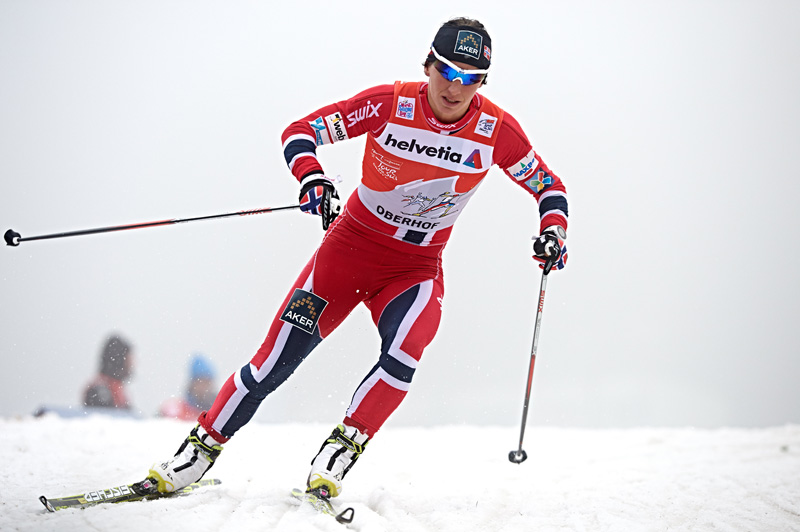
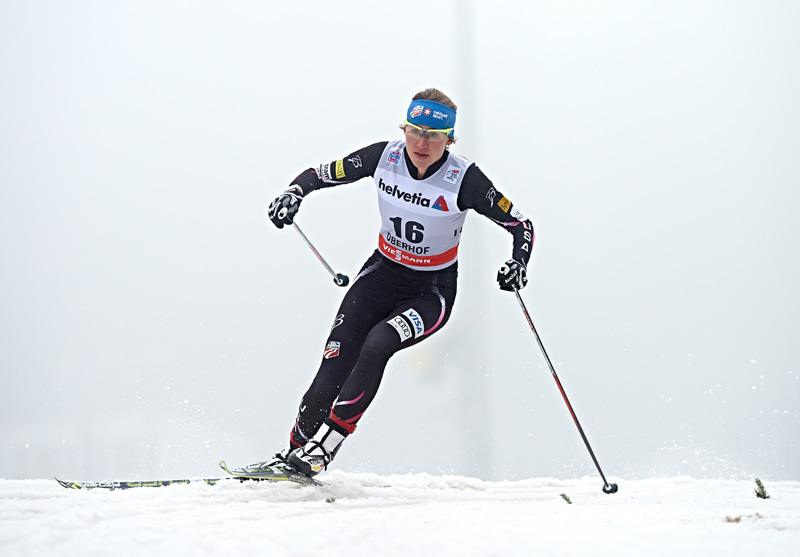
    Liz Stephen (U.S. Ski Team) on her way to 34th in Saturday's 3 k freestyle prologue at the first stage of the Tour de Ski in Oberhof, Germany. (Photo: Marcel Hilger)
    Liz Stephen (U.S. Ski Team)  (Photo: Marcel Hilger)

    11.8 k into the pursuit found Johaug, battling hard, losing time on Jacobsen, who now led by 42.2 seconds.

    Steira came through in 10th place with Stephen close on her skis and six other skiers following.  Diggins was three places behind Stephen and trailing by six seconds.

    In the final kilometers, Johaug skied aggressively. It appeared to be paying off some 1.5 kilometers before the finish where her splits indicated that she was 34.6 seconds behind.  Jacobsen, however, had a strong finish, and she briefly raised her arms in celebration after she crossed the finish line before immediately collapsing.  Her effort had paid off; Johaug completed her race 38.7 seconds later, and with Jacobsen’s hard won bonus seconds, she finished the day with a lead of 43.7 seconds.

    Kyllönen was third and Lindborg, skiing the fastest time of the day in 37:16, moved from 24th to 10th.  The race for 11th was close between Stephen and Steira, with the Norwegian just edging out Stephen by four tenths of a second.  Diggins was next, in 13th, 3.3 seconds behind Stephen.

    Kristin Stoermer Steira (NOR)
    Kristin Stoermer Steira (NOR)

    Jacobsen, speaking to FIS after the race said, “It was a tough competition. I was little bit tired after the first lap; the course is quite hard in Toblach. I was happy there was a feeding station. I felt better in second half of the race. I am happy that my shape has been so good. It is a good sign for the Games, which are the biggest goal for me. I still think that Therese (Johaug) is the biggest favorite for the overall victory in the Tour de Ski. She has been always very strong on the Final Climb.”

    Jacobsen told Norwegian Newspaper Dagbladet that she did not anticipate still being at the Tour, let alone contending for the title. “I was only going down to a couple of classic races, and then going home” she said of her Tour plan.  “I have just brought a racing Suit and warmup suit, so I had to wash some clothes yesterday” she said, smiling.

    Last year Jacobsen lost a minute and a half to Johaug on the final climb up the Alpe Cermis. “That, I choose not to think anything about.  I lost 1:30 last year, an advantage I am guaranteed not to get this year. If I do go out first on Sunday, I will be only be thinking that I want her to get going fast to catch up.”
    Johaug for her part is hungry to recover some more time in tomorrow’s 5 k classic race. “I feel I have a good chance before the final weekend” she told Dagbladet, “But it’s a race tomorrow where there is the opportunity to both retrieve and lose seconds.  It is very difficult to say how close I have to be to have a chance, but if I manage to keep under a minute, I might have some opportunities.”

    Kyllönen and Niskanen.  Photo: Fischer/Nordic Focus
    Kyllönen and Niskanen. Photo: Fischer/Nordic Focus

    It was a great day for Finland as well, with four women in the top 10.  Kyllönen told Finnish newspaper Helsingen Sanomat, “It is always great to be among the three, and, above all, to get success.” Kyllönen is in third place overall, 1:22 behind Jacobsen.  Of her chances of winning the Tour she said, “If they [Jacobsen and Johaug] stay healthy, they are difficult to be overcome, but the game is still open.”

    The Tour continues to thin out as skiers leave to rest and train ahead of the Sochi Olympics in February.  Notable withdrawals ahead of stage 5 included Østberg, Herrmann, Hanna Erikson (SWE), Sophie Caldwell (USA), Vibeke Skofterud (NOR) and Daria Gaiazova (CAN).


    The Tour de Ski continues on Saturday with a 5 k classic race.

  • Østberg Wins Stage 3 in Lenzerheide to Seize Leader’s Bib; Caldwell Notches Career-Best 6th

    Østberg Wins Stage 3 in Lenzerheide to Seize Leader’s Bib; Caldwell Notches Career-Best 6th

    The Women's Podium Stage 3 in Lenzerheide.  Astrid Jacobsen (NOR), Ingvild Flugstad Østberg (NOR), Denise Herrmann (GER).  Photo: Fischer/Nordic Focus
    The Women’s Podium Stage 3 in Lenzerheide. Astrid Jacobsen (NOR), Ingvild Flugstad Østberg (NOR), Denise Herrmann (GER). Photo: Fischer/Nordic Focus

    Ingvild Flugstad Østberg outshone her fellow Norwegians in Tuesday’s freestyle sprint race in stage 3 of the Tour de Ski.  Setting the fastest qualifying time around the 1.5 k course, she continually proved her speed throughout the day to seize the coveted red leaders bib of the Tour.

    Stage 3 in Lenzerheide, Switzerland, was a repeat of last Sunday’s race format in Oberhof, Germany.  Unlike Oberhof, however, the course was firm and wide, quite different from last Sunday’s slushy and narrow trails in Germany.  Temperatures were warm at 39 degrees Fahrenheit, but the snow was cool and compact.  The course consisted of two 750 meter loops around the open stadium with one relatively gradual climb that steepened at the end and a descent back to the stadium, where a long final straightaway to the line allowed plenty of space for moves to be made in the final approach to finish.

    The women’s quarterfinals kicked off with Østberg of Norway, in bib number one as the fastest qualifier, easily leading the heat to win the heat with Germany’s Hanna Kolb in second.

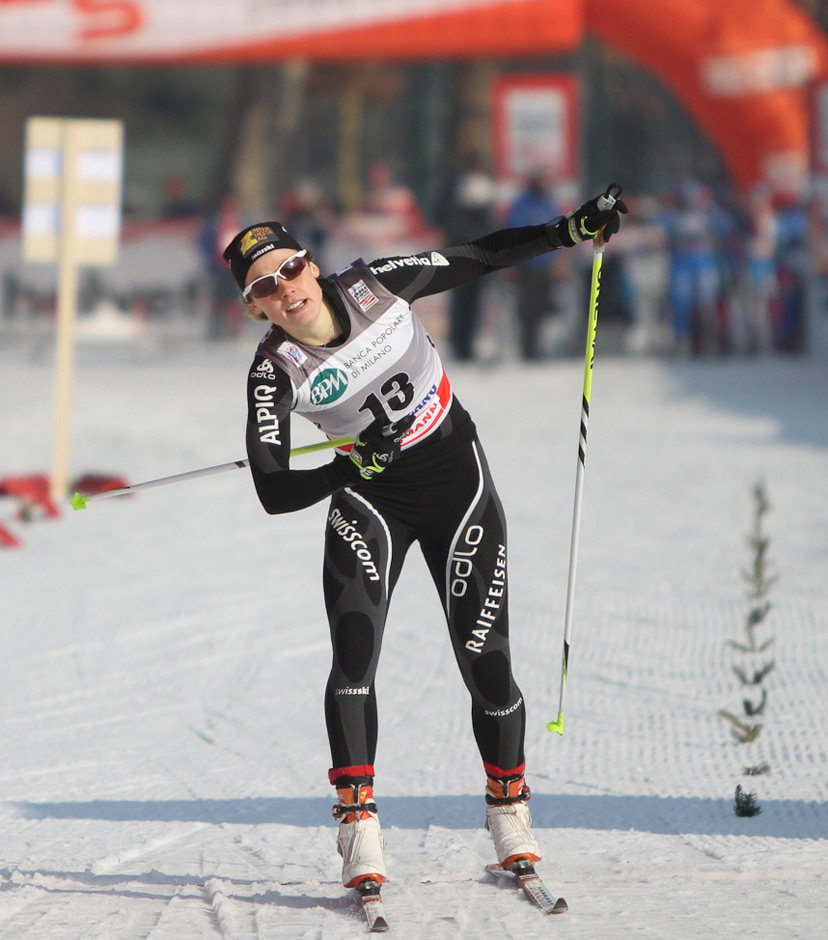
    Van der Graaff lunging for the line at the 2012 Milan city sprints.
    Van der Graaff lunging for the line at the 2012 Milan city sprints.

    The second heat featured local favorite Laurien Van Der Graaf of Switzerland leading the first lap of the race until the Norwegian duo of Astrid Jacobsen and Heidi Weng pushed ahead on the final climb.  Van Der Graaf had the strongest finish, however, and took the race back from the Norwegians at the last moment, with Weng in second and Jacobsen in third.  It was quick heat with Jacobsen taking a lucky loser spot in the quarterfinal.

    The third heat featured US skier Jessie Diggins.  Getting a slow start, she wasn’t able to make a move in a race that was dominated by Germany’s Denise Herrmann, who won it well ahead of France’s Aurore Jean in second.

    Heat four saw Italy’s 21 year old Greta Laurent lead the group from start to finish with America’s Sophie Caldwell skiing carefully behind her to finish second.  Caldwell made a strong effort at the finish to pass Laurent, but finished just .06 seconds behind her.

    The final quarterfinal heat was something of a group of death with Norway’s Marit Bjørgen, Slovenia’s Alenka Cebasek, Sunday’s sprint winner Hanna Erikson of Sweden, and the always quick Gaia Vuerich of Italy.  The Germans Katrin Zeller and  Stefanie Boehler rounded out the group.

    FIS world cup cross-country, tour de ski, individual sprint, Oberhof (GER)Vuerich was the early leader, with Erikson hanging in behind her.  Cebasek took over the front of the heat on the first downhill, before Erikson slipped past her and led the climb on the second lap with Vuerich following to finish in that order.  Bjørgen was unable to keep up with the pace on the second lap and fell well behind.  Starting the day as the leader of the Tour de Ski, Bjørgen appeared very disappointed, fighting off tears as she left the stadium.

    The first semifinal began with Van Der Graaf taking the lead until the second lap, when Østberg skied ahead of her as they rounded the corner into the stadium.  As the course began it’s second climb up the hill, Jacobsen took over the lead, with Østberg following and Van Der Graaf in third.  As the racers came down the final hill and into the stadium it appeared to be Jacobsen’s race, but tiring at the end, she was passed by a hard charging Østberg and Van Der Graaf, with Jacobsen finishing in third and Kolb in fourth.  Luckily for Jacobsen and Kolb the heat was fast, and they both moved on to the final in lucky loser positions.

    The second semifinal was led early on by Finland’s Anne Kylloenen, a lucky loser, with Vuerich, Erikson, and Caldwell behind her.  On the second lap, Caldwell made a push for the front on the climb and found herself in second place as the heat tucked down the last hill.  Caldwell’s skis were clearly fast as she steadily gained ground on Kylloenen, finally overtaking her at the bottom of the hill as they rounded the corner into the stadium.  Caldwell skied into the finish to win her semifinal heat with Herrmann overtaking Kylloenen at the end for second, and the Finn in third.

    Sophie Caldwell racing to ninth in Davos (Photo: Fischer/Nordic Focus)
    Sophie Caldwell racing to ninth in Davos (Photo: Fischer/Nordic Focus)

    In the women’s final heat Østberg made a move right from the gun, taking the lead for the first lap with fellow teammate Jacobsen skiing right in behind her.  On the start of the second lap Jacobsen moved ahead of Østberg and Van Der Graaf, with Herrmann and Caldwell following.  On the final downhill it appeared that Jacobsen had successfully managed to stretch the race out with her charge up the last climb, as each skier had a sizeable gap between each other on the descent.

    The race was not yet decided though, and on the finally straightaway it became close again with Østberg battling her way ahead and a late sprint from Herrmann brought her up the front as well.  Østberg’s power at the end proved to be just enough to win the day, nicking her teammate Jacobsen by a toe to win with a time of 2:58.  Jacobsen was second, .10 seconds behind, with Herrmann third, .80 seconds behind Østberg.  Van Der Graaf, Kolb, and Caldwell finished the final in that order.

    Ingvild Flugstad Østberg wins in Lenzerheide.  Photo: Fischer/Nordic Focus
    Ingvild Flugstad Østberg wins in Lenzerheide. Photo: Fischer/Nordic Focus

    It was a big day for Østberg, she notched her first ever World Cup win while also taking the leader’s bib in the Tour de Ski and second place for the sprint competition.  She appeared thrilled with her victory and told FIS after the race, “I felt really good and strong the whole day. I am so surprised and happy to win and to be the Tour leader.”

    Østberg told Norwegian newspaper Dagbladet that she has no intention of getting an early bedtime tonight ahead of tomorrow’s 10 k classic race. “It’s probably someone who settles before midnight tonight, but it will at least not be me. I have always been up to midnight on New Year ‘s Eve and there will be no exception tonight.  I should use it to digest everything that happened today” she said.

    The result has been a long time in the making for Østberg, who excelled as a Junior but has been slow to find success on the World Cup level, at least by Norwegian standards as she has been overshadowed by her illustrious teammates.

    “I have been patient and developed every year. I managed to improve my performance every winter, but it may not have always been easy to see, for there have always been some Norwegian who has been better than me” She told Dagbladet.

    Herrmann, finishing in third, is now the Tour de Ski sprint leader, and she told German TV broadcaster ZDF after the race, surprised, “Wow, that was enough for the podium again.”

    (Photo: Fischer/Nordic Focus)
    (Photo: Fischer/Nordic Focus)

    Sophie Caldwell delivered another breakthrough performance today, reaching the final heat of a World Cup sprint for the first time after winning her semifinal heat, an achievement deemed huge by Head US National Team Coach Chris Grover.  She finished sixth in the final heat and Grover explained that exhaustion played its part. “In the final she just ran out of steam, she skied great all day, skied technically well, she made smart moves out there, she just ran out of gas in the A final, and that’s just because she’s a little bit younger and still developing. She’s going to be a big name for the future.”

    Caldwell discussed her race in an email with FasterSkier, highlighting her growing confidence and experience. “I’m getting more and more confident in my qualifiers, especially skating, and that feels really good…knowing that I can qualify if I have a decent day is definitely a boost of confidence.”  She has also become savvier tactically. “In Oberhof I learned that I can conserve a lot of energy by following and leading usually isn’t the best strategy for me at this point. In both my quarter and semi, I settled into second place in the inside lane and tried to hold my own.

    “I felt awesome in my semifinal, I don’t know what got into me there! I had talked a bunch of strategy with the coaches, especially about positioning with that final corner. I thought that I might be able to pick up a place or two by pushing not only over the top of the hill, but a little ways down the hill. I believe I was in 2nd over the top, and I pushed hard and my plan worked! I came into the corner first, so I was able to guard the inside and pick my lane into the finish.”

    As for the final heat she said, “I’d like to say I made a tactical error out there, but I simply just got tired. I actually had one pretty decent move that put me into a good position coming around the lap, but then it was downhill (figuratively) and uphill (literally) after that.” Caldwell added that, ” I don’t think I could wipe the smile off my face after the final, even after I was exhausted and got a very solid last place.”

    Like many of the other sprinters on the Tour, tomorrow will be Caldwell’s last race.  “I’m going to race tomorrow and apparently I’m sitting in 6th for the Tour now, so that will be pretty cool to be on the front line for the mass start! I’m going to drop out of the Tour after tomorrow and rest up and spend some time with my family for a few days. After that, it’s back to the World Cup for a little eastern European section and then we’ll start to gear up for Sochi!”

    Likewise, tomorrow’s classic race will be Østberg’s last day on the Tour de Ski before she heads home to rest and train for the World Cup races in Nove Mesto on January 11th and 12th.  In any case she is not optimistic about holding onto her leaders bib, saying,  “I am realistic enough to see that I will probably lose the jersey tomorrow. I just hope it turns to a different Norwegian girl” she told NRK.

    Norwegian National Team Coach Egil Kristiansen defended the decision to send Østberg, and possibly Jacobsen as well, home after tomorrows race despite Østberg being in the leaders bib.  “She is good enough to win the Olympic gold now. We must not lose focus on what’s most important this season” said Kristiansen.

    Jacobsen is in fourth place overall, and second in the sprint category for the Tour de Ski, and Kristiansen says he has found himself in a difficult position with whether to let her  continue the Tour after tomorrow.  “The plan was that she should go [home] after the race tomorrow, but…Astrid is one that can stand on the podium here, we need to discuss what is most natural to do.”

    For her part, Jacobsen seems eager to continue racing, but averse to openly challenging her coach’s decision in the Norwegian media. “What I think is that I’m happy to be in great shape” she said. “It is up to the boss if I can continue or not.”

    Bjørgen was dealt a setback today as she looks to gain as much time on her teammate Theresa Johaug as she can before the final stage and its climb up the Alpe de Cermis that favors Johaug’s smaller frame and high tempo.  Norwegian broadcaster NRK deemed it a “Sprint Fiasco” for Bjørgen.  When asked if she thought this affected her Tour chances, she responded simply, “No.” But her tears after her quarterfinal heat indicated her disappointment.  Gro Eide, a spokesman for the Norwegian National Team announced, “It’s nothing serious, but Bjørgen is struggling with stomach trouble.”

    Results


  • Sweden’s Hanna Erikson Impressive in First World Cup Victory

    Sweden’s Hanna Erikson Impressive in First World Cup Victory

    Hanna Erikson (SWE) out sprints Denise Hermann (GER) for the win in Sunday's freestyle sprint. (Photo: Marcel Hilger)
    Hanna Erikson (SWE) out sprints Denise Hermann (GER) for the win in Sunday’s freestyle sprint. (Photo: Marcel Hilger)

    Hanna Erikson won her first World Cup race on Sunday in impressive fashion, demonstrated both her strength and tactical acumen. The 23-year-old Swede honed her strategy early on in the day, perfecting the art of a strong, late challenge to finish line.

    In the first of the women’s quarterfinal heats began with Norway’s Ingvild Flugstad Østberg firmly controlling her race from start to finish, after she won the qualifier by 0.27 seconds in 3:08.6. The second heat featured a similar performance from Norway’s Marit Bjørgen, though she was nearly caught at the line by Erikson, a strategy the Swede would use successfully in her last two heats.

    In the third quarterfinal, American Sophie Caldwell found herself on the start line with five Germans: Herrmann, Lucia Anger, Katrin Zeller, Sandra Ringwald, and Claudia Nystad. Caldwell took the lead out of the stadium and through the narrowing trail until a tight right hand corner caused her to slip back to fourth position. Herrmann then took the lead and led all the way to the finish.

    Sophie Cladwell (U.S. Ski Team) racing in the qualification rounds. She now sits in 13th in the overall Tour rankings. (Photo: Fisher/Nordic Focus)
    Sophie Cladwell (U.S. Ski Team) racing in the qualification rounds. She now sits in 13th in the overall Tour rankings. (Photo: Fisher/Nordic Focus)

    Caldwell became a bit unbalanced on her skis as she made a bid to move up on the last climb and lost her position, finishing in fifth. Anger and Zeller finished second and third.

    The fourth quarterfinal saw Finland’s Anne Kyllonen lead from the gun with Italy’s Gaia Vuerich and Germany’s Nicole Fessel close behind her, and Norway’s Astrid Jacobsen hanging on in fourth.  That positioning remained unchanged until late in the heat when Vuerich attacked to take the lead, winning the group. The race between Fessel and Kyllonen was very close, with Fessel taking second over the Finn by a mere two-hundredths of a second.

    In the fifth and final quarterfinal heat, American Jessie Diggins was the quickest off the starting line and she skied powerfully out of the stadium.  At the start of the climb Diggins lead was challenged by France’s Aurore Jean. Diggins managed to hold off Jean’s attack on the first climb but on the slight decline between the first and second climbs, Jean overtook her.  Diggins, skiing on the inside lane up the last hill, was cut off as the climb turned right, and she was forced to the back of the pack.

    In the final meters, with a late-charging Alenka Cebasek of Slovenia moving past Jean, Jean caught the Slovenian’s ski, bringing them both down just before the finish line and handing the victory to Poland’s Sylwia Jaskowiec.  Therese Johaug finished in second, Aino-Kaisa Saarinen in third, and Jessie Diggins in fourth.

    The first women’s semifinal was dominated early on by the Norwegian duo of Østberg and Bjørgen, leading in that order.  In the falling snow, Bjørgen took over the race and did her best to break up the pack with her climbing strength. Erikson would not be dropped, however, and she stayed right on Bjørgen’s skis.  In the stadium, Erikson took the lead to easily outsprint Bjørgen for the win, demonstrating her powerful skiing in the challenging Oberhof snow.
    The second semifinal heat was led by Hermann, with Vuerich right behind her until she broke a pole, forcing her to the back of the pack while she looked for a spare pole.  Fessel made a move to the front of the race and led the climb with Herrmann behind her and Johaug creeping up on the inside track and Kyllonen looking for a way through.  Coming into the stadium Hermann gained the lead back from Fessel to win the heat.  Fessel was second and Johaug third.

    Therese Johaug on her way to capturing gold in the 10 k freestyle individual start at 2013 World Championships in Val di Fiemme, Italy. The Norwegian beat teammate Marit Bjørgen by 10.2 seconds for the win. (Photo: Fiemme2013)
    Therese Johaug on her way to capturing gold in the 10 k freestyle individual start at 2013 World Championships in Val di Fiemme, Italy. (Photo: Fiemme2013)

    The women’s final of Anger, Bjørgen, Herrmann, Fessel, Østberg, and Erikson began much like the first semifinal, with Østberg taking the lead and Erikson and Bjørgen in pursuit.

    This time though, Erikson didn’t wait to make a move.  As soon as the gradient increased, Erikson took the lead from Østberg and the race was on.  Herrmann followed her attack on the inside lane, and on the final climb she found herself ahead of the Swede and leading the race into the stadium.

    Herrmann faced falling snow being blown into her by a strong headwind, and Erikson closed in behind her, waiting for the last two hundred meters where she turned on an impressive show of strength to overpower Herrmann to win the second stage of the Tour de Ski by 0.79 seconds in 3:25.69.

    Østberg was third (+4.32), Fessel fourth (+4.4), Bjørgen fifth (+4.8), and Anger sixth (+9.34).

    It was Erikson’s first World Cup victory and she was pleased with how it turned out.

    “It’s the first victory in my career,” she told FIS. “I felt better and better in each heat. I tried to ski tactically well, to control my position.”

    Bjørgen held onto her overall and sprint leaders’ bibs.
    “I’m happy about my performance today,” she told FIS. “In the final I did not ski so well; I fought for the third place but it did not work. It’s good I collected some bonus seconds but there are many left in the Tour.”
    The Tour de Ski continues on Tuesday with another freestyle sprint in Lenzerheide, Switzerland.

    Results

  • Halfvarsson Wins First World Cup in Stage 2 of Tour de Ski

    Halfvarsson Wins First World Cup in Stage 2 of Tour de Ski

    Calle Halvarsson winner of Stage 2 in the Tour de Ski, photo credited to Fischer/Nordic Focus
    Calle Halfvarsson winner of Stage 2 in the Tour de Ski (Photo: Fischer/Nordic Focus)

    Headwinds and a thick falling snow couldn’t stop Sweden’s Calle Halfvarsson from skiing away from the field to win his first World Cup race and Stage 2 of the Tour de Ski today in Oberhof, Germany.  The 1.5 k sprint course was narrow and relatively flat, features that kept the racing close and entanglements frequent.  Success found skiers like Halfvarsson who stayed out of trouble and who had a strong finishing kick.

    The opening heat to the men’s quarterfinals promised to be an interesting contest, with Alex Harvey and Devon Kershaw starting together and expectations high after their success yesterday on the same course.  Josef Wenzl of Germany was the first off the line, and appeared to be a reluctant leader. Kershaw, skiing aggressively from the gun, briefly took over the lead before Wenzl recaptured it as the group ascended the first climb.

    Wenzl kept the lead throughout the heat, with Harvey behind him and Kershaw threatening on the outside.  As the group approached the finish line, Harvey jumped out from behind Wenzl into the far lane with Maciej Storega of Poland behind Harvey and Kershaw trailing Wenzl.

    Wenzl, Oberhof.   Photo credit Fischer/Nordic Focus
    Wenzl (Photo: Fischer/Nordic Focus)

    Wenzl easily crossed the line in first, and Storega took advantage of a slight gap between Harvey and Wenzl to lunge between the lanes to nip Kershaw for third place.

    In heat two, Germany’s Sebastian Eisenlauer was the early leader. Eisenlauer led until Russia’s Alexander Legkov overtook him on the final climb into the stadium. Duvillard of France looked to make up ground late in the climb but caught a ski, sending him down and out of the race.

    Skiing powerfully into the finish, Legkov won the heat with Eisenlauer in second.

    Heat three saw Carl Quickland of Sweden fall just off the starting line, and he spent the remainder of the race catching up.  Norway’s Petter Northug and Russia’s Evgeniy Belov jostled around an early corner, with Belov at one point skiing with one ski between Northug’s legs.  Norway’s Martin Johnsrud Sundby led before Halfvarsson took over on the first climb and proceeded to stretch the group out.

    Northug battled furiously to stay with Halfvarsson as he skied away from him and Sundby into the stadium.  Halvarsson finished the heat in first with Northug in second and Sundby and Belov in the third and fourth respectively.  The fast pace set by Halfvarsson was quick enough to give Sundby and Belov the coveted lucky loser positions in the semifinals.

    Heat Start, Oberhof. (Photo: Fischer/Nordic Focus)
    Heat Start, Oberhof. (Photo: Fischer/Nordic Focus)

    Heat four was lead out of the gates by Tim Tscharnke of Germany, with Andy Newell staying just behind him in second.  Newell’s careful positioning through the race kept him in second position leading into the finishing stretch, where he stepped out into the far lane to out sprint Tscharnke.  Newell, however, was foiled by a clever Jens Eriksson who pipped Newell at the last moment with a late surge in the near lane to win the heat with Newell in second.

    Heat five was led by the Norwegian Finn Haagen Krogh, who seemed to be commanding the race until he caught a ski edge and was turned sideways, sending him to the back of the pack.  He did his best to battle back but when he could not make up the lost ground, he pulled up and skied into the stadium frustrated. Federico Pellegrino of Italy took the heat followed by Ales Rayzm of the Czech Republic.

    In the first semifinal heat, Wenzl had a false start, looking for another quick opening. On the restart Eisenlauer took the lead with Northug and Harvey behind the German.  As the group started the first climb and passed under a bridge, it appeared that Legkov stepped on Harvey’s ski on the choppy climb, bringing the Canadian down.  Harvey quickly regained himself and did his best to make up lost ground.

    Alex Harvey, Oberhof.  Photo credit Fischer/Nordic Focus
    Alex Harvey (Photo: Fischer/Nordic Focus)

    Squeezing himself past Wenzl, Northug took the lead into the stadium.  Wenzl, though, had more energy at the end and bested Northug on the outside lane, with Sundby finishing in third.

    The second Semifinal saw Pellegrino take pole position out of the gate with Halfvarsson and Eriksson lingering behind and Newell skiing mid-pack.  Newell, looking to make a move, was caught out in the tricky final climb into the stadium, and found himself in fifth position and out of contesting the heat.

    In the final meters, Eriksson jumped into the outside lane to try and out sprint Pellegrino, while Halfvarsson repeated Eriksson’s quarterfinal strategy and took the inside lane to win the heat. Pellegrino held off Eriksson for second.

    The temperamental weather of Oberhof changed at the start of the men’s final with a thick snowfall descending as Sundby, Pellegrino, Northug, Halfvarsson, Wenzl, and Eriksson took the line. Northug false started and the racers were brought back to the line.

    On the restart Halfvarsson took over the race as the group approached the first climb, and once the ascent began Halfvarsson went to work on trying to open up a gap between himself and his competitors.  On the second climb he managed to break apart the heat, with Pelegrino following his skis and Sundby battling to catch up.

    Halfvarsson skied into the stadium facing falling snow and a headwind to win the race in a commanding fashion.  Pellegrino took second, while Sundby finished in third place for the third time today in his best ever sprint performance.

    Jens Eriksson was fourth, a personal best, while Wenzl was fifth, and Northug sixth.

    Calle Halfvarsson told FIS after the race, “I felt strong today and I pushed hard on the big hill each round. It’s my first victory and podium at the same time as an individual. The result is very important for my confidence for the upcoming competitions and also for the Olympics.”

    Harvey’s 11th place was good enough to keep him in the leader’s bib as the Tour de Ski continues on Tuesday freestyle sprint in Lenzerheide, Switzerland.  “I am happy with my qualification,” he told FIS. “It’s great I kept the leader’s bib after the first two stages.”

    Results

    Martin Johnsrud Sundby, photo credited to Fischer/ Nordic Focus
    Martin Johnsrud Sundby (Photo: Fischer/ Nordic Focus)
  • Canada’s Harvey, Kershaw Notch Historic 1-2 Finish in First Race of Tour de Ski

    Canada’s Harvey, Kershaw Notch Historic 1-2 Finish in First Race of Tour de Ski

    Alex Harvey racing to first in the men's 4.5 k freestyle prologue on Saturday, the first of seven stages in the 2013/2014 Tour de Ski. His teammate Devon Kershaw (not shown) placed second to make for a historic 1-2 finish for Canada. (Photo: Fischer/Nordic Focus)
    Alex Harvey racing to first in the men’s 4.5 k freestyle prologue on Saturday, the first of seven stages in the 2013/2014 Tour de Ski. His teammate Devon Kershaw (not shown) placed second to make for a historic 1-2 finish for Canada. (Photo: Fischer/Nordic Focus)

    Alex Harvey and Devon Kershaw topped the podium Saturday in the 4.5-kilometer freestyle prologue in Oberhof, Germany, the first of seven stages in the nine-day Tour de Ski.

    Dogged by a slower start to their season than they would have liked, the Canadians announced that they are back on form after weathering drizzly conditions to achieve their nation’s first 1-2 finish in an elite international event.

    Canadian Alex Harvey celebrates his second career individual World Cup stage win on Saturday after taking first in the 4.5 k freestyle prologue on the first day of the 2013/2014 Tour de Ski. Harvey captured the leader's bib just 4 seconds ahead of teammate Devon Kershaw in second. (Photo: Fischer/Nordic Focus)
    Canadian Alex Harvey celebrates his second career individual World Cup stage win on Saturday after taking first in the 4.5 k freestyle prologue on the first day of the 2013/2014 Tour de Ski. Harvey captured the leader’s bib just 4 seconds ahead of teammate Devon Kershaw in second. (Photo: Fischer/Nordic Focus)

    With the air temperature around 2 degrees Celsius (36 Fahrenheit), and three laps of a 1.5 k loop on dirty manmade snow, the race was not so much topographically difficult as it was technically challenging to find the best snow and maintain technique.

    During his warmup, Harvey focused on finding the fastest path through the slush.

    “When I skied the course before the race that’s all I did, we just skied a couple laps looking for the hard, firm snow, the clean snow, too,” he said on the phone after winning Saturday’s race for his first individual top 10 of the season. The last time the 25-year-old Harvey won a World Cup event was in the 3.3 k freestyle prologue at 2012 World Cup Finals in Falun, Sweden.

    On Saturday, he won it by 4.1 seconds over Kershaw, his teammate and friend, in 9:03.4. A late starter, Norway’s Chris Jespersen couldn’t come close enough and placed third, 10.6 seconds behind Harvey.

    There were initially concerns that the course might slow as the race progressed, but instead, pacing proved crucial, and the early pace setters faded on their final lap.

    Jens Ericksson of Sweden was an early leader, setting the splits and fastest-finishing time until Austria’s Bernhard Tritscher came through 2.3 k three-tenths of a second faster. However, Tritscher could not maintain that pace and ended up 27th. Kershaw’s 2.3 k time ranked ninth. Hammering hard late in the race, Kershaw swept into the finish in first place, ousting Ericksson from the top spot by 11.4 seconds. Kershaw’s finishing kick was strong enough that he gained five seconds on the Swede in the last 700 meters.

    “I really wanted to ski into the race, even though it’s a prologue, that’s not usually my style,” Kershaw said. “When I’m on the podium on the World Cup I’m usually very aggressive and attacking, but it’s just been so hard to believe in myself lately that I just had to ski into it.”

    A couple minutes in, Kershaw quickly realized that he could go faster.

    “Like ‘Nope, the body is actually there and I have to actually take this chance and go for it’ because you don’t get those kinds of feelings racing every day,” he said. “From there I just attacked, and when I went across the line in first I was surprised, but I think the most surprising thing was I didn’t think it would hold for anything, I thought it would be a great race for me, maybe top 10 or something, but to finish the day second and have only Alex beat me was a real shocker for me.”

    After Kershaw, France’s Robin Duvillard crossed the line, visibly frustrated as he looked at the clock and saw his time was 9.7 seconds slower than Kershaw’s to put him in second for the moment. The likes of Germany’s Axel Teichmann (who ended up 33rd) and Sweden’s Anders Södergren (24th) also could not come close to matching Kershaw’s time.

    Throughout the race, a fog continued to steadily descend on the Oberhof track, as soaked spectators tried to make out the action and view the stadium TV screen through the mist. The slushy snow was difficult on ski poles as well, with Norway’s Tord Asle Gjerdalen breaking a pole and then missing the hand off of a spare, which cost him seconds and ultimately put him in 58th of 106 finishers.

    Harvey started the race under control and steadily sped up. He nearly tangled with Germany’s Tobias Angerer, who started just as he came through the stadium on his second lap, but the incident didn’t throw him off.

    At 2.3 k, Harvey was 3.8 seconds down on Tritscher’s time, and in the running in a tightly grouped race.

    “I was getting splits off of the guy that started ahead of me, so I knew I was just one or two seconds off the pace early on,”  Harvey said. “I knew at one point starting my last lap, I was like one second or maybe equal to Devon according to [coach Justin Wadsworth’s] splits and then I just went hard on the last lap.”

    That was his strategy: conserve to have enough to go all-out for the last 1.5 k.

    “It’s a really flat prologue, but I think it makes it really hard because there’s no recovery at all,” he explained. “I wanted good juice for the last lap, and I think it paid off. ”

    The difficult snow also brought out a number of different technical styles for dealing with the conditions, many of them rough and at a high tempo. Harvey looked to be skiing smooth with a lot of glide, much like Kershaw had skied, and his final lap powered him into first, four seconds ahead of Kershaw.

    Some skiers complained about the conditions in Oberhof with Norway’s Martin Johnsrud Sundby telling NRK before the race that it was a “parody” of cross-country skiing. Harvey, on the other hand, found the conditions this year better than last year’s prologue at the same venue.

    “Last year it was so sugary in the stadium, and this year it was still sugary but not as deep,” Harvey said. “I actually think the rain kept it more stable. For me, I was gliding the same or just a bit more because I was pushing more at the end.”

    After Harvey finished, no late starters could threaten his lead. Russia’s Illia Chernousov started 66th and finished third before Jespersen, continuing his impressive form, bested him by 3.2 seconds.

    A Norwegian favorite, Petter Northug started late in the race with a explosive exit out of the start and a fast early pace. At 2.3 k he was 0.8 seconds ahead of Harvey’s split and appeared to be a threat. It was not his day though, and the Norwegian looked visibly tired as he finished 23.6 seconds behind Harvey in 24th.

    Besides Harvey and Kershaw’s historic finish, Canadian Ivan Babikov posted his best prologue finish of 26th (+24.8).

    Andy Newell led the American in 20th, Simi Hamilton was 42nd, and Noah Hoffman 82nd for the U.S. Ski Team.

    Harvey called his victory a surprise.

    “I wanted top five … I was sixth last year,” he said. “I’ve been good in prologues in the past so I was hoping for top five, maybe podium but the win was a bit of a surprise for sure.”

    Devon Kershaw racing to second, his first top 30 of the season, in the opening stage of the Tour de Ski -- the 4.5 k freestyle prologue -- in Oberhof, Germany. Kershaw placed second to teammate Alex Harvey in a historic 1-2 finish for Canada. (Photo: Fischer/Nordic Focus)
    Devon Kershaw racing to second, his first top 30 of the season, in the opening stage of the Tour de Ski — the 4.5 k freestyle prologue — in Oberhof, Germany. Kershaw placed second to teammate Alex Harvey in a historic 1-2 finish for Canada. (Photo: Fischer/Nordic Focus)

    For Kershaw, placing second in the first race of his eighth Tour de Ski was important to his self belief. In 2011, he won four medals at the Tour, but had yet to crack the top 30 this season.

    “My confidence has been really shaken this year,” Kershaw said. “I know I’ve done great training and great preparations, but the feeling while racing just hasn’t been there. So today, even though I’ve been feeling really great all week, I was having a hard time trusting those feelings. It was like really, ‘Do I really feel good? I haven’t felt good in awhile so I hope so.’ ”

    He’s written some of his results off to “really, really hard” training, but he didn’t expect to be so far off the pace in and back from the leaders in each of his Period 1 races.

    “That’s been really hard on me mentally, to be honest,” he said. “Last year was a tough season for me and I know I did great preparations all year in the off season, so it’s just really hard to be patient and stay believing in myself. But this week something clicked after [the World Cup in] Asiago.”

    There, Kershaw came as close to making the points as he has all season, placing 33rd in the classic sprint.

    For Kershaw, Saturday’s race was something of a moment of truth.

    “I felt good in the warm up and [thought] if I don’t have these good feelings in the race, then I’m totally lost and I don’t understand cross-country ski racing anymore,” he said. “Then the race happened and those good feelings remained.”

    Canada’s head coach, Wadsworth has been confident that these results were on their way throughout the first period of World Cup racing.

    “You’re always surprised to go one, two, even when things are going really well,” Wadsworth said. “It was a bit of a surprise for sure, but I knew after the first workout the guys did in Davos and they all said they felt good, that everything was leading in the right direction.  We know where the fitness was and it’s starting to show now in the results.”

    For the Canadian team, their standout results in the prologue are nothing new. At World Cup Finals in 2012, Harvey and Kershaw placed first and third.

    Harvey said the prologue’s format suits them.

    “We’re good at distance and sprinting and the prologue is right in between there,” Harvey said. “But I also think that with the prologue, you get super filled with lactate and you need to hold onto your technique, and I think we worked really hard in the summer on technique and things like that and pacing, too. We really work on building in interval sessions, we do the last two or three really fast. I think in the prologue that’s what you want, to have the last kilometer or two really fast, so I think that can explain that.”

    Wadsworth also praised the work of the team’s wax technicians.

    “Our skis were really good,” he said. “Our wax technicians did an amazing job with the skis so that helped for sure.”

    He also tried to lessen the emphasis on results in a pre-race team meeting Friday night.

    “I told the athletes to do two things: one is to do a really good process, and that means thinking about the warmup, technique, everything, the same stuff you do when you’re doing a hard workout,” Wadsworth said. “The second thing is to just really fight no matter what, I don’t care if you guys get 80th tomorrow, if you show me you warmed up well and did everything and you can fight, then we’ll be satisfied. I really wanted to pull the thinking away from the results.”

    For Kershaw, the Tour remains a “day-by-day thing,” he said. “It is all for Sochi, even though I had a great start today that’s wonderful and it’s actually really nice for my head, but it is prep for Sochi. Justin and I decided after having a bit of a tough start that we’ll re-evaluate midway through the Tour whether we keep going or not. I love the Tour though, it’s my favorite race, and all the events are good for me, if I’m in shape and I’m in shape today, but we’ll see what tomorrow brings.”

    In other news, Kershaw arrived in Oberhof with much less hair than he had in Asiago.

    “I had a couple days in Davos were the temperatures were warm, and it just got in my eyes on an intensity session on Christmas and was just all round unruly,” he said. “So I went to the massage therapist we have here, Scott Edmunds, and I was like, ‘Man can you help me cut this a little shorter?’ One thing led to another, and the next thing you know it’s all gone. I’ll tell you right now, it felt so good today racing without having hair jamming in my eyes. Sometimes you do have to change it up.”

    The Tour continues Sunday with a 1.5 k freestyle sprint on the same course as the prologue.  Harvey’s Tour is now aided by his possession of the leader’s bib and a 15-second time bonus, but he has no intention of contesting the title in the final climb up Alpe Cermis in Val di Fiemme, Italy, next weekend. His back can’t take it, and even if it can, he’s usually cautious about it.

    Alex Harvey (c) atop the podium with teammate Devon Kershaw (l) and Norway's Chris Jespersen (r). (Photo: Fischer/Nordic Focus)
    Alex Harvey (c) atop the podium with teammate Devon Kershaw (l) and Norway’s Chris Jespersen (r). (Photo: Fischer/Nordic Focus)

    “I’m not planning on finishing,” Harvey said. “Just like last year I’m planning to do everything but the last climb, but for tomorrow I’m hoping to have another solid day.  Top five, top ten, the shape is good and it’s going to be the exact same course, so I’m hoping to fight up there. But it’s sprinting so anything can happen.”

    Also of note: Canada’s fourth man, Lenny Valjas is on his way back to Canada on Sunday to rehab his knee after surgery this summer.

    “The knee hasn’t been great lately, and with the first three stages being skating, that puts a lot of stress on his knee and we just felt that it’s really better for him to go back to Canada and start the rehab process again,” Wadsworth said. “He was getting to the point in Kuusamo [Finland] were it was pretty good, but since then his leg has started to atrophy a bit, and we need to get him back on track.

    “Once we saw the schedule with the Tour, all things pointed for him to go back to Canada and work with our trainers there and really try and get him ready for Sochi.  The guy’s an amazing talent, and it’s not like he hasn’t been doing anything, he’s been racing and training, he just really needs to get his leg back where it should be. We got him out on the first reasonably priced flight, so he’s going to head back tomorrow.”

    — Alex Matthews contributed reporting

    Results

  • Vylegzhanin Bests Northug For Russian Relay Win

    Vylegzhanin Bests Northug For Russian Relay Win

    Maxim Vylegzhanin bringing it home for Russia in the Lillehammer World Cup 4 x 7.5 k relay, as his teammates prepare to congratulate him at the finish. Vylegzhanin outlasted Norwegians Finn Haagen Krogh and Petter Northug for the victory for Russia I on Sunday.
    Maxim Vylegzhanin bringing it home for Russia at the Lillehammer World Cup 4 x 7.5 k relay, as his teammates prepare to congratulate him at the finish. Vylegzhanin outlasted Norwegians Finn Haagen Krogh and Petter Northug for the victory for Russia I on Sunday. Krogh took second, and Northug was third.

    Under snowy skies and on Norwegian terrain, Maxim Vylegzhanin and the Russian relay team seized victory in the men’s 4 x 7.5-kilometer relay Sunday in Lillehammer, greatly raising their team’s expectations ahead of the Sochi Winter Games.

    As the lone relay ahead of the much-anticipated Olympic contest, the event was an important test of the teams’ relative strengths, and an opportunity to try out relay orders. If Lillehammer made anything clear, it’s that the men’s relay is now dominated by a new Norway/Russia rivalry.

    The race began at noon with heavily falling snow, the tracks set deep in the powder and the steeper hills rutted and choppy enough to force the athletes into a wide, loping herringbone.  Eldar Rønning, skiing for Norway’s second of four teams, took the lead early and set a fast pace aimed at breaking up the pack.  In the heavy snow it didn’t take long to break apart the field.

    Norway I nearly fell off the back early on when Pål Golberg became tangled with another skier on a descent, knocking him off balance and forcing him to ski on only his left foot for much of the way down the powdery slope. Somehow, though, he managed to stay on his feet.  This impressive bit of skiing allowed Golberg, Saturday’s 15 k classic winner, to chase his way back up to the lead group.

    Coming through the stadium on the first of two 3.75-k laps, Russia I, led by Dmitriy Japarov, took the lead from Norway II’s Rønning and continued to push the pace. By 4.9 k the lead group was made up of Japarov, Rønning, Daniel Richardsson of Sweden, Jean Marc Gaillard of France, Stanislav Volzhentsev of Russia II, Tim Tscharnke of Germany, and Norway I, III, and IV.

    At the end of the first leg, Rønning charged into the stadium to hand off first to Chris Andre Jespersen, who was closely followed by Russia I and II, with Alexander Bessmertynkh and Alexander Utkin respectively. With Jespersen leading, the Norwegian teams would prove their classic skiing chops and their first three teams moved to the top of the field, only Bessmertynkh could hold the collective pace of Jespersen, Tønseth (NOR I), and Simen Haakon Oestensen (NOR III).

    At the handoff of the third leg and transition into skating, Tønseth tagged Martin Sundby first for Norway I, Alexander Legkov took over for Russia I just 0.2 seconds back in second, and Jespersen came through in third to send Sjur Røthe off for Norway II.

    After hungrily looking at the stadium screen as he watched his teammate Bessmertnkh approaching, Legkov took the lead from Sundby up the first climb, and wasted no time in trying to put the rest of the field under pressure.

    Legkov finally began to slow at the end of the first lap, and he relinquished the lead to Sundby as they passed through the stadium. Legkov did not spend long resting behind him, however.  As soon as the skiers left the stadium and began to climb up Lillehammer’s long hills, the Russian retook the lead and dialed up the pace once more.  This time, only Sundby and Røthe could stay with him; the rest of the field began to lose time to the Russian’s aggressive skiing.

    Maxim Vylegzhanin leads Norway's Petter Northug (NOR I), Finn Haagen Krogh (NOR II) and Tord Asle Gjerdalen (NOR III) in the final leg of Sunday's Lillehammer World Cup 4 x 7.5 k relay. Vylegzhanin dropped the Norwegians to give Russia the victory.
    Maxim Vylegzhanin leads Norway’s Petter Northug (NOR I), Finn Haagen Krogh (NOR II) and Tord Asle Gjerdalen (NOR III) in the final leg of Sunday’s Lillehammer World Cup 4 x 7.5 k relay. Vylegzhanin dropped the Norwegians to give Russia the victory.

    On the final leg, Finn Haagen Krogh of Norway II, Vylegzhanin of Russia I, and the ever-confident Petter Northug of Norway I left the stadium together. By default, Krogh was left to lead the three. Vylegzhanin skied comfortably behind him in second and Northug stayed carefully behind the Russian.  For the first 6 k, Krogh’s lead was never challenged by either skier, and no one seemed to have any trouble keeping up with his steady tempo.

    The leader’s lack of swiftness was evident by a steadily encroaching field behind them, led by a hard-charging Tord Asle Gjerdalen of Norway III. Eighteen seconds behind Krogh at the start, Gjerdalen set off immediately on his leg to rejoin them, and in the last lap found himself back in the fold behind Northug.  Marcus Hellner also could be seen taking a hard turn for Sweden in a bid to catch up.  At 6 k, he was only 8 seconds behind Vylegzhanin, who had now taken over the lead.

    The Russian had plans for an early burst of speed and leading 1.5 k from the finish, Vylegzhanin took the leaders down a slope, already charging into the final hill before the long entrance into the stadium.  He quickly secured a sizeable gap on the Norwegians who appeared unprepared for Vylegzhanin’s early move. Northug, in particular, looked sluggish as he tried to respond to Vylegzhanin’s break.

    With Northug battling to catch up and Krogh hanging with him, Vylegzhanin’s sprint never wavered as he came barreling into the finish. Finally, at the end when Northug saw it was beyond him to win the day, he stood up, allowing Krogh’s lunging foot to take second for Norway II.

    Northug, who has been sick this fall, told NRK that today he “had no punch.”

    “In Russia we take them,” he added, according to a translation. “Clearly, it is one of the great dreams, to beat Russia at home. Then we rub it in.”

    Northug chose to downplay the importance of this race. “It is more important with the Olympic relay,” he said. “It is what the people will remember for years here, not how the Lillehammer relay went.”

    Norwegian National Team Coach Trond Nystad was more circumspect in his comments.  “Today we lost to a better team,” he told NRK. “With an optimal team settup  I think we should cope with Russia in the Olympics.”

    To Norwegian newspaper Dagbladet, Nystad conceded that his skiers had made some missteps in their strategy.

    “At the end we are a little inexperienced—we let him go on top there, and [were] unable to slide him [Northug] in at the end. We must take [that] with us.”

    The Russian team was quite excited with their victory. Legkov in particular looked very pleased, triumphantly pointing his finger up to indicate No. 1.

    “It is a great day and great victory for us,” Legkov told FIS. “This season is the most important and I am happy we showed such a great performance in the relay today. Maxim did a great move towards the end. I hope in Sochi we will perform in the same way.”

    The race demonstrated the strength of the Russian team, as well as the depth of the Norwegian team, which went second, third, fourth, and eighth on Sunday.

    Some Norwegian skiers were more philosophical about the relay.

    “The race showed that everything has to work out for the team to win and anything can happen, even with Petter Northug on the team,” Golberg said.

    “We had good fun to challenge Norway I!” Røthe added. “The Russian team was very strong and showed that they’ll be tough to beat on the home snow!”

    The Canadian and the U.S. men’s teams had a difficult day, finishing 14th and 17th respectively.  Canada finished 3:02 behind Russia and the U.S. was 3:48 out of first.

    Results

  • Bauer Paces His Way To Victory in Kuusamo

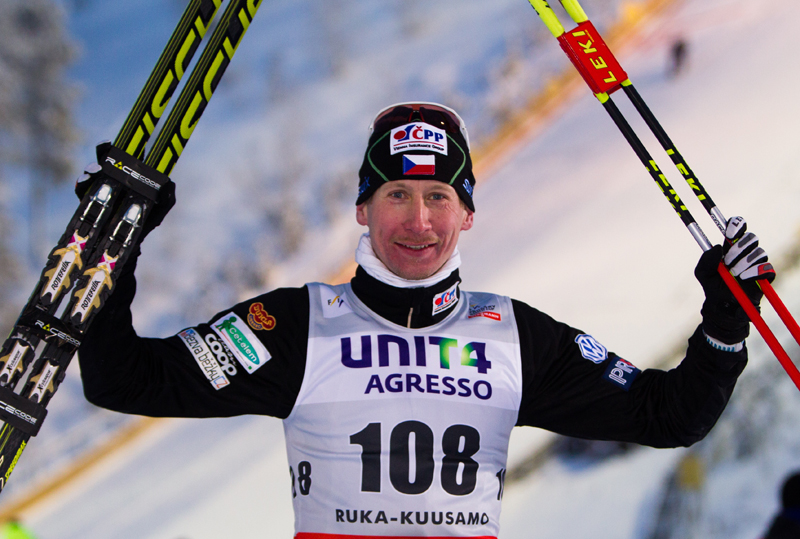
    Lukas Bauer (CZE) celebrates his win.  Photo: Fischer / Nordic Focus.
    Lukas Bauer (CZE) celebrates his win. Photo: Fischer / Nordic Focus.

    Lukas Bauer’s (CZE) masterfully paced race ousted Eldar Roenning (NOR) from the victors chair today in Kuusamo, Finland, allowing the veteran Czech to claim his first victory since 2010. Bauer’s pace in the 10k classic race saw his split times trailing throughout the first 8k to both Roenning and Dmitriy Japarov (RUS), before accelerating in the final kilometers to best Roenning’s time by just 2.4 seconds.

    Japarov took third, 5.7 seconds behind Bauer and just over three behind the Norwegian.

    Martin Johnsrud Sundby (NOR) was the early leader.  Photo: Fischer / Nordic Focus.
    Martin Johnsrud Sundby (NOR) was the early leader. Photo: Fischer / Nordic Focus.

    Martin Sundby (NOR) was the early leader followed, surprisingly, by the sprinter Pål Golberg (NOR), who ultimately placed an impressive 4th. But once Roenning hit the course, all else would trail until Japarov started. It appeared to be the Norwegian’s day as he looked comfortable on the climbs and gradually opened a gap.

    The Russian went out hard and fast, taking 10 seconds off of Roenning’s time at 3.1k. At 6.4k he increased his lead by another second. That was the high water mark for Japarov however, and he began to pay the price for his early breakneck pace.

    At the 8k split Japarov’s lead was down to 5 seconds. His energy continued to fade over the last kilometers, and visibly exhausted, he labored up the final climb to the stadium.

    Unable to maintain his lead, he finished 3.3 seconds behind Roenning.

    “I’m a bit disappointed with today’s result,” the Russian told FIS. “I was hoping for victory. On the other hand…It’s very nice to start the season with a podium. I hope I can do such result again.”

    Bauer, his splits steadily trailing throughout the race, did not appear to be a threat for the win. until 2k from the finish he turned up his pace considerably, charging up the final climb and sprinting into the stadium to snatch victory away from fellow classic specialist Roenning.

    After the race Bauer told FIS, “I have extreme experience from Kuusamo, it’s been either successful or disaster, nothing in between. It’s nice I could enjoy a great day. Yesterday’s sprint was a disaster for me, 104th place was not good. I did not feel the best today but the snow conditions fit me very well.”

    Roenning, speaking to Norwegian broadcaster NRK, said that he is “a little bitter that he [Bauer] hung on me in the first round. He got a good ending, but I’m pleased with second place. I go fast from start to finish.”

    Coming through the lap after the first 3.1km loop, Roenning found Bauer headed out of the start. The Czech caught a ride from Roenning, much to his advantage.

    Although Bauer seized his advantage in the final 2k, Roenning felt he did well at the end of the course telling FIS “I felt quite good and had a fast 2.0 km before the finish. It was an exciting competition. I have not been in the yellow bib for almost seven years. Tomorrow is skating and I have no hopes to be in top 10.”

    Three North Americans finished in the top 30. With Ivan Babikov in 21st, Noah Hoffman in 28th, and Alex Harvey in 30th.

    Complete Results

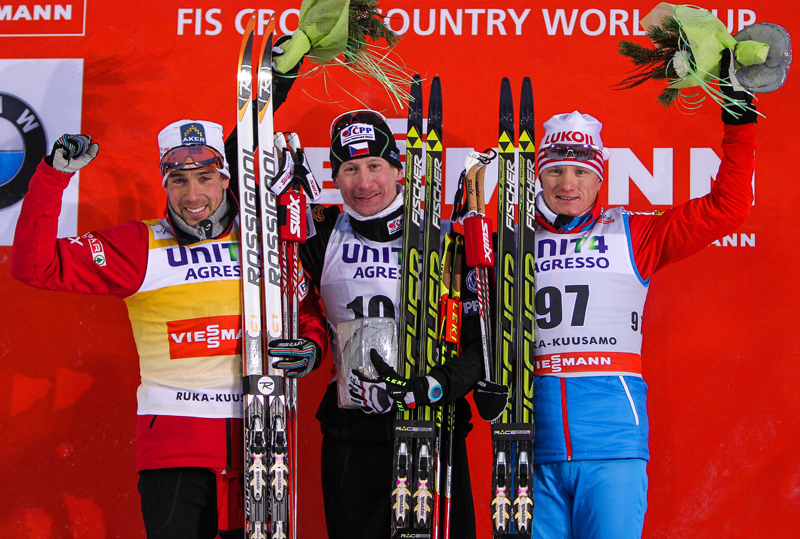
    The men's podium in Kuusamo, Finland (FIN): (l-r) Eldar Roenning (NOR),  Lukas Bauer (CZE) and Dmitriy Japarov (RUS).  Photo: Fischer / Nordic Focus.
    The men’s podium in Kuusamo, Finland (FIN): (l-r) Eldar Roenning (NOR), Lukas Bauer (CZE)
    and Dmitriy Japarov (RUS). Photo: Fischer / Nordic Focus.
  • Newell Lone North American in Kuusamo Heats

    For the North American men, it was a challenging day in qualifying as the World Cup season got under way in Finland, with only  Andy Newell (USA) cracking the top-30 in the classic sprint.

    Newell, who ranked 5th in the Sprint Cup last season, was a solid 23rd in the opening round, but was unable to advance out of the quarterfinals.

    In the fifth and final quarter, Newell skied started toward the back of the heat with Dario Cologna’s brother Gianluca, before making a late charge in the stadium — all part of his plan, he told FasterSkier.

    “In the past I’ve tried to get out here in the front to really make sure I have an open lane at the uphill, but this year it was my tactic to hang back a tiny bit and really charge up the last hill,” Newell explained. “But I just got stuck in traffic a little bit and wasn’t able to make a big enough move.”

    He found the pace fast, but “comfortable,” and overall he felt good.

    And while he did not move on any further, he finished the day unconcerned.

    “It’s the first classic sprint of the year on kind of a unique course, so I don’t put a ton of stock in this race, I’m still feeling good so we’re confident about things to come,” Newell said.

    He placed 27th last year in this event, his worst result of the season.

    “I couldn’t pick anyone off in a tight race up the big hill, which kinda sucks because I could tell the heat was pretty fast,” Newell said. “The skis felt like they were kicking good on the uphill for sure, but I just didn’t have the finish in me.”

    Simi Hamilton was 36th,  Michael Sinnott 73rd,  Kris Freeman 100th, and Noah Hofman 105th for the Americans. Hamilton was .7 seconds out of the heats.

    Alex Harvey led the Canadians in 37th, with Len Valjas just behind in 38th. Devon Kershaw was 78th, Jesse Cockney 79th,  and Ivan Babikov 102nd to round out the day for the Canucks.

    The Ruka mini tour continues tomorrow with a 10 kilometer classic race for the men.  Newell said he will “start tomorrow for sure, and try and get a good 10k in.”

    His expectations are low for the distance race and sees it as a “great opportunity to race yourself into the shape you need to be in.”

    Newell said conditions are excellent in Kuusamo: hard tracks, hard wax, and overnight temperatures dropping to -20.