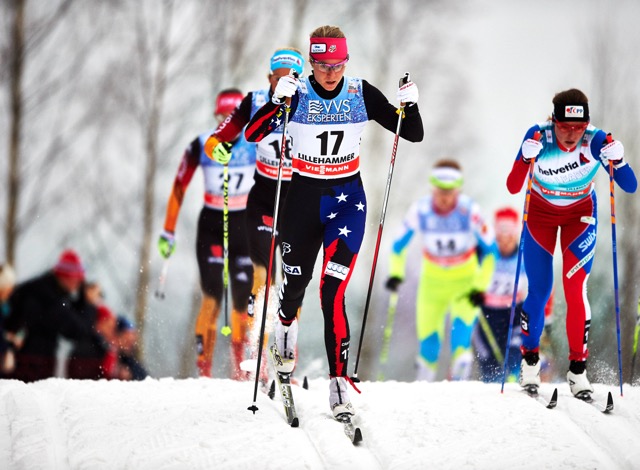
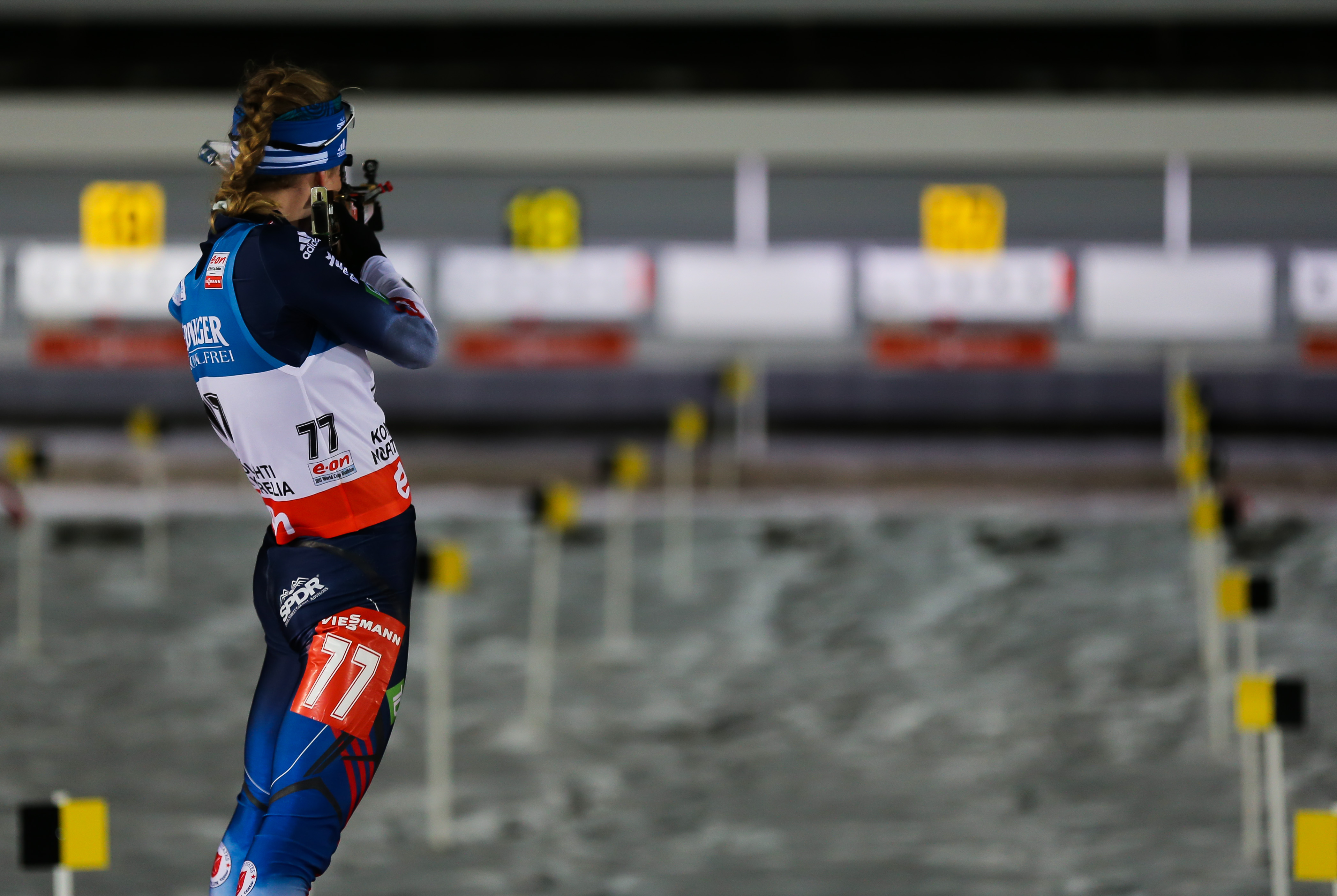
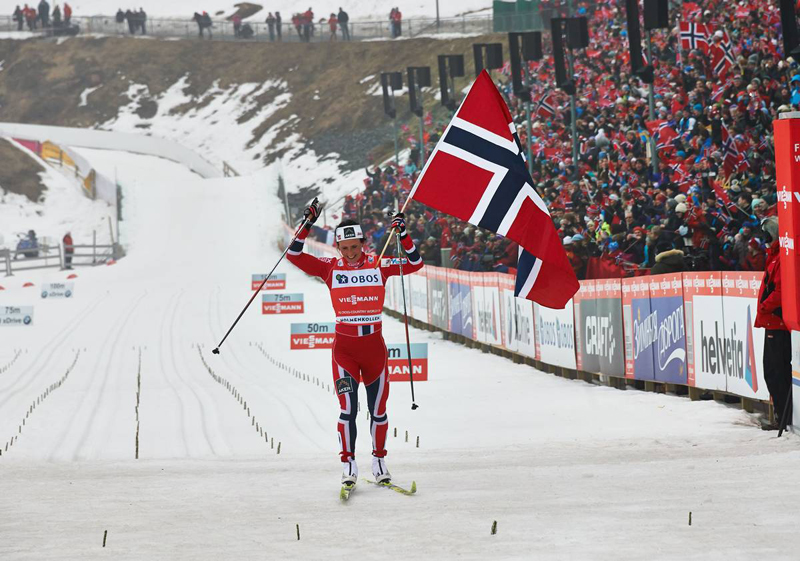
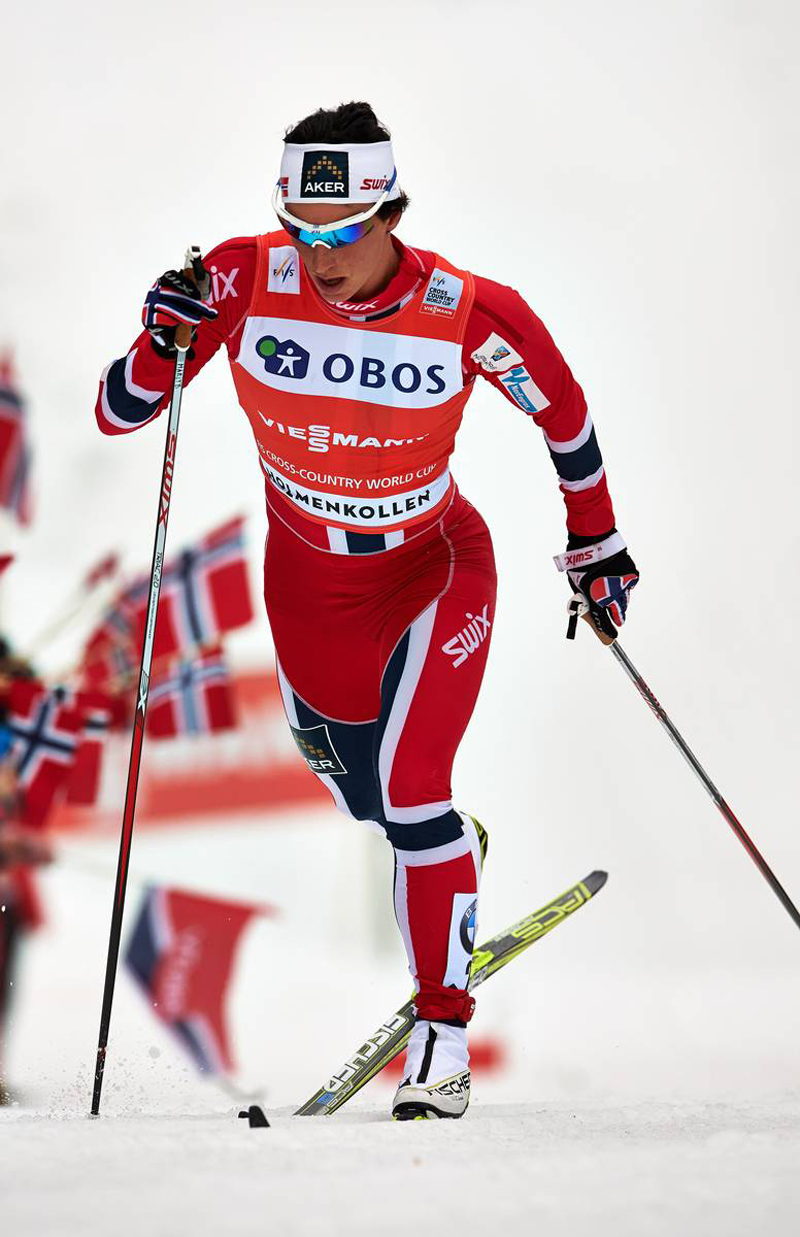
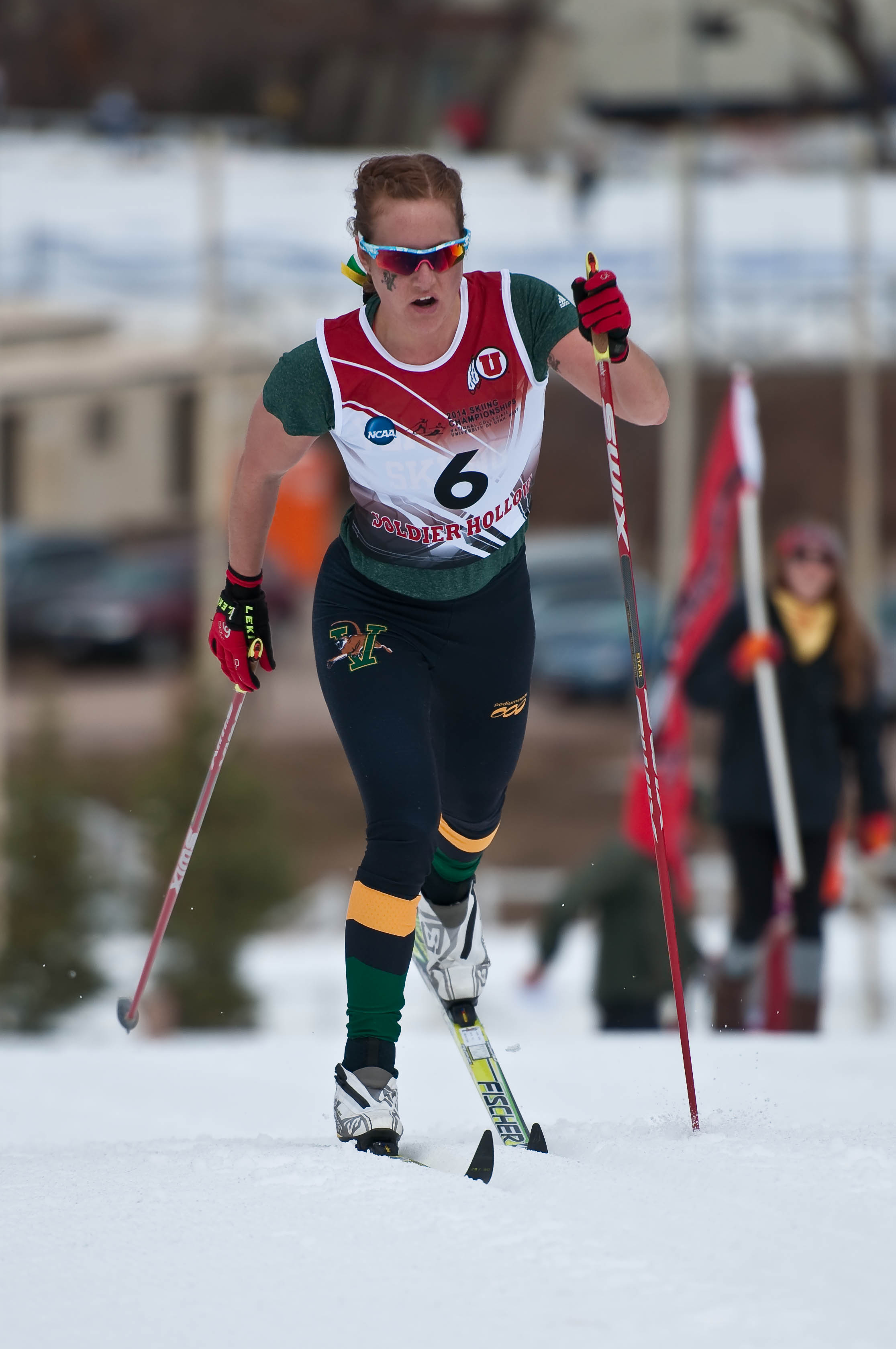
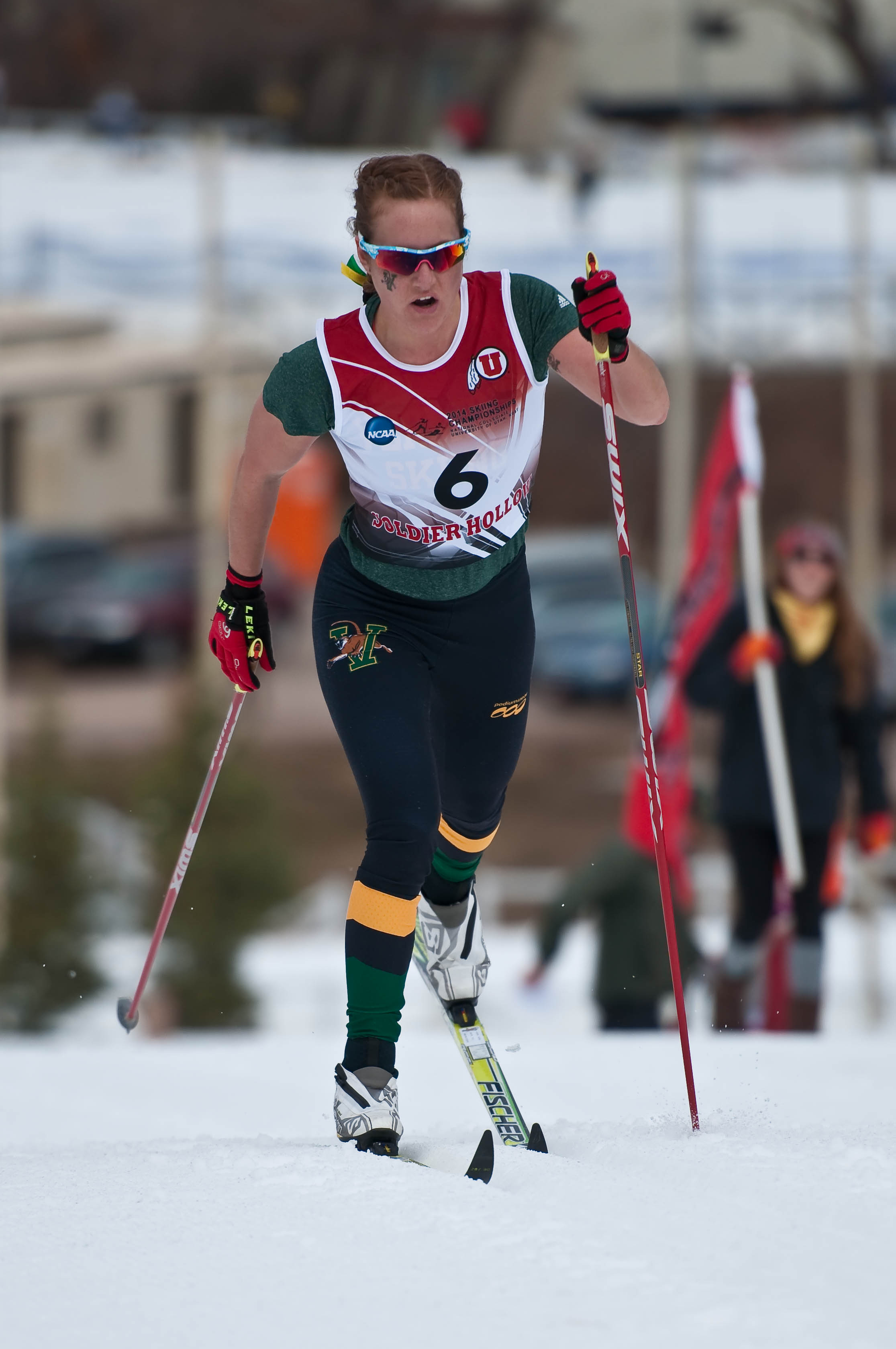
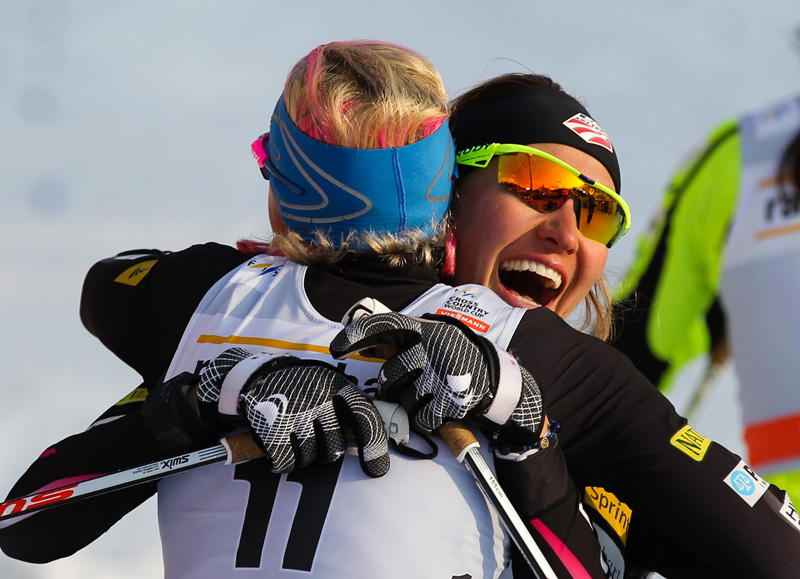
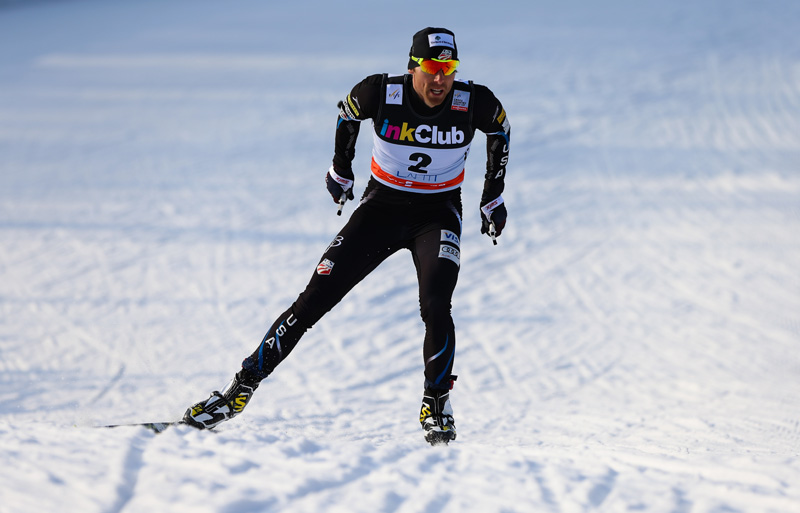
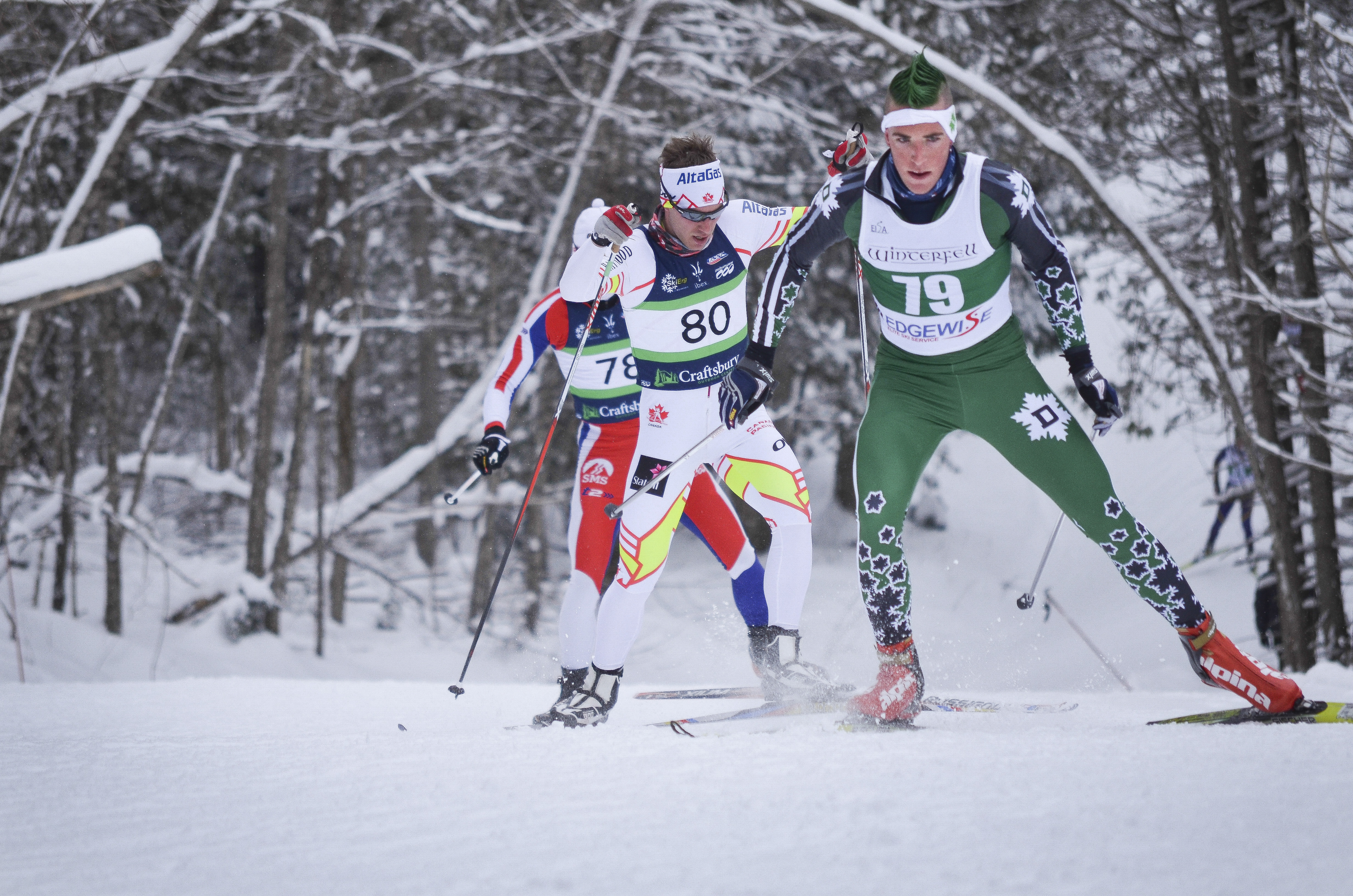
Sadie Bjornsen leads a group on her way to 18th in Sunday’s 10 k pursuit in Lillehammer. (Photo: Fischer/NordicFocus)
The Americans faced especially challenging competitors Sunday as the weekend’s World Cup mini tour wrapped up in Lillehammer, Norway. Under overcast skies and on firm tracks Norwegians dominated the on their “home” course, sweeping the top five spots in the men’s 15-kilometer classic pursuit and the first four spots in the women’s 10 k classic pursuit.
While the competition was tough, the U.S. Ski Team achieved victories of its own. This was especially true with Erik and Sadie Bjornsen, the American siblings who led their teammates in each of their respective races.
Erik Bjornsen started in 53rd place before reeling in 14 positions on an exciting course jam-packed with competitors, advancing to 39th place.
“It was really great, it was really fun,” Bjornsen said in a post-race phone interview. “It felt like a mass start. I was just skiing with guys the whole time… I went off with a decent group, and you could tell that everyone was just trying to chase that guy that was right in front of them.”
Meanwhile, Sadie Bjornsen gave the U.S. its best result of the day, starting in 17th before slipping one spot to 18th place in a tough field. Bjornsen was “in the mix,” according to U.S. Ski Team Head Coach Chris Grover, at times picking up spots, and at other times slipping. Bjornsen said that she had to recover from a “mini-explosion” after spending a kilometer skiing with Polish superstar Justyna Kowalczyk, who advanced 20 positions during the race.
Grover was very pleased with the both Bjornsens’ performance today and said that he was especially excited to see Sadie’s development and potential for the rest of the season.
“I think that the exciting thing for her right now is that she’s able to demonstrate that she’s just got all the skills – she’s skating well, she’s classicing well, she can sprint, she can race distance races – and that’s obviously why she put together a good tour here. But the more exciting thing is that I know she feels like she’s not in top form at all. So I think that really bodes well for later in the season,” he said in a post-race interview.
“I think that the exciting thing for her right now is that she’s able to demonstrate that she’s just got all the skills … But the more exciting thing is that I know she feels like she’s not in top form at all.” — U.S. Ski Team Head Coach Chris Grover, about Sadie Bjornsen
But the Bjornsens weren’t the only Americans to have strong results.
Liz Stephen started in 35th position and advanced to 29th during the race.
“She felt like she had really good skis and she was able to pick off a lot of people, especially on the big uphill, and she really felt like it was one of her better classic races that she’s had,” Grover said of Stephen’s race.
“I am happy with being able to finish the mini tour being in the points both distance days (for on the day results) and just sneaking in the overall points too,” Stephen wrote in an email.
Stephen wrote that as the tour progressed, she inched closer to her racing shape with each race. The weekend also gave her insight into changes she could make in future races.
“I have some serious work to do with conquering my downhill abilities and that is going to be a very necessary project to take on throughout the rest of the winter and certainly next training year,” she wrote.
One thing working in the favor of the American was their fast skis.
“I was a little worried when I was testing them,” Erik Bjornsen said of his skis, “because they had really good kick – I was kicking up every hill. I was worried it was gonna be a little slow but then when I got to the downhill it almost seemed like I had some of the fastest skis out there.”
Otherwise, it was a tough day for the Americans. Jessie Diggins fell from 21st to 44th. Diggins felt strong, according to Grover, but she couldn’t pull her technique together, and did not feel like she was skiing well.
“She was definitely dissatisfied with her event,” Grover said.
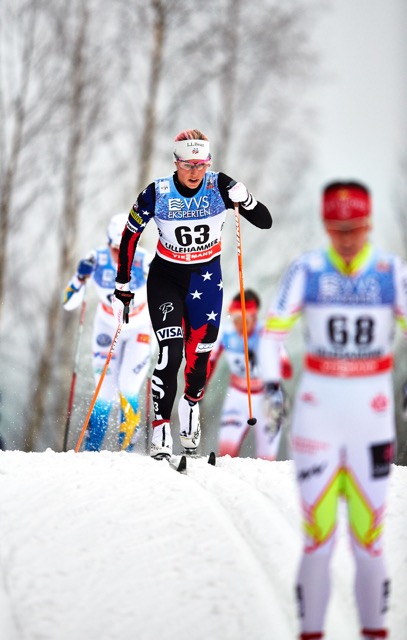
Kikkan Randall advanced from 63rd to 58th in what has been one of the toughest periods in recent memory for the American star. Randall has repeatedly said that she’s having trouble shifting into gear for racing this season.
“It was nice to start in a pack of skiers and have lots of people to ski with today,” Randall wrote in an email. “I got to put in another hard effort to bring me closer towards better race shape. I had some strong sections out there, especially climbing, and moved up a few places.”
“Kikkan was at times out there feeling good,” Grover said, “and she said that she’s starting to come into a little bit of race fitness, but that it’s just not there yet.”
Caitlin Gregg fell three spots from 65th to 68th, and Sophie Caldwell, who is still in the process of recovering from a broken elbow, used the race as a training exercise but still managed to advance from 84th to 71st.
“I felt pretty good the first 4 k, but then I faded quite a lot,” Caldwell wrote in an email. “My upper body got pretty tired and then the rest of it followed! I didn’t get to ski with a ton of people, but I just focused on hanging on and trying to keep my technique together once I started to get tired.”
Caldwell explained that the results she achieved this weekend were not ideal, but that she wasn’t expecting to drastically improve until she’s spent more time on snow and strengthen her upper body
Then, she wrote, it’s just a matter of “remembering how to race.”
The men’s team fielded two skiers Sunday – Bjornsen and Reese Hanneman – as both Simi Hamilton and Andy Newell sat out the race to rest for the upcoming classic sprint on Davos, Switzerland. In addition, Ida Sargent did not start for the women.
The lack of participation was especially felt after distance specialist Noah Hoffman broke his leg a week ago in Kuusamo, Finland, after a bad crash.
“It’s a huge bummer to have Noah have to go home, to be in that position,” Erik Bjornsen said of his teammate. “I mean, that kid is so strong, and has really strong work ethics; I really think he’ll bounce back pretty fast – a lot faster than people are expecting.
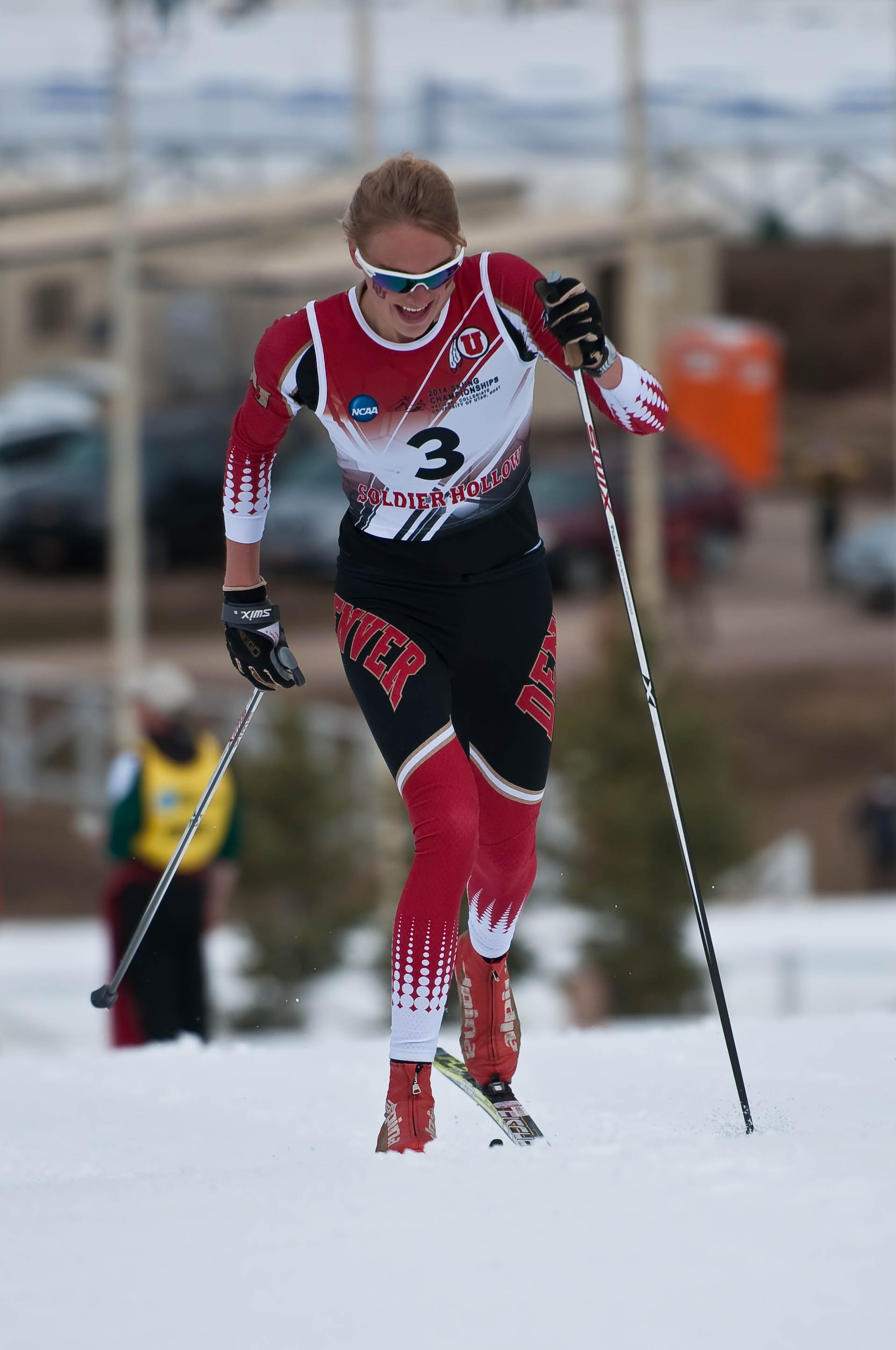
Kikkan Randall on her way to 58th in Sunday’s 10 k classic pursuit in Lillehammer. (Photo: Fischer/Nordic Focus)
Despite the lack of the USST’s distance leader, Bjornsen said that he had plenty to learn from Newell and Hamilton in both distance and sprint races.
“It’s sweet to have Andy and Simi over here, because I can learn a ton from those guys – the distance races that they jump in they’re always super competitive. It’s still a great team, but we’re all missing Noah, that’s for sure.”
“It’s a long season.”
The attitude among the Americans seems to be one of looking forward.
Hanneman, the only other American man to race today, who finished a disappointing 92nd – last place, shared his perspective on the early-season races and what they meant.
“To be fair, these are the most competitive fields in existence.” Hanneman wrote in an email. “Unlike the Olympics or World Championships, the best countries all have an insane number of guys racing, due to it being a mini-tour, Nations Group spots, etc. And by definition these guys are in good form; they’re here racing because they just earned their spots in the various season openers. This explains some of it.”
Hanneman’s frustration with his results is palpable, suggesting that he may have over-trained during the summer and fall in anticipation of his first season starting on the World Cup.
“I don’t think I have any crazy expectations; I’m not expecting to hit a home run and throw up absolutely crazy results. I just want to perform to my capability. To be honest, I am really struggling. When you are suffering physically, you start to suffer mentally. I am not performing even close to what I am capable of,” he wrote.
Grover, when asked what his take-away was from the weekend as a whole, echoed a similar sentiment.
“Well, it’s challenging when you know that you’re not going to come into the season in top form as a team, and that’s part of your plan. It’s been part of our plan to target really skiing well in the middle of the season, and it’s hard to keep reminding yourself that that’s the plan when the results that you know are possible from a group like this aren’t possible right now.
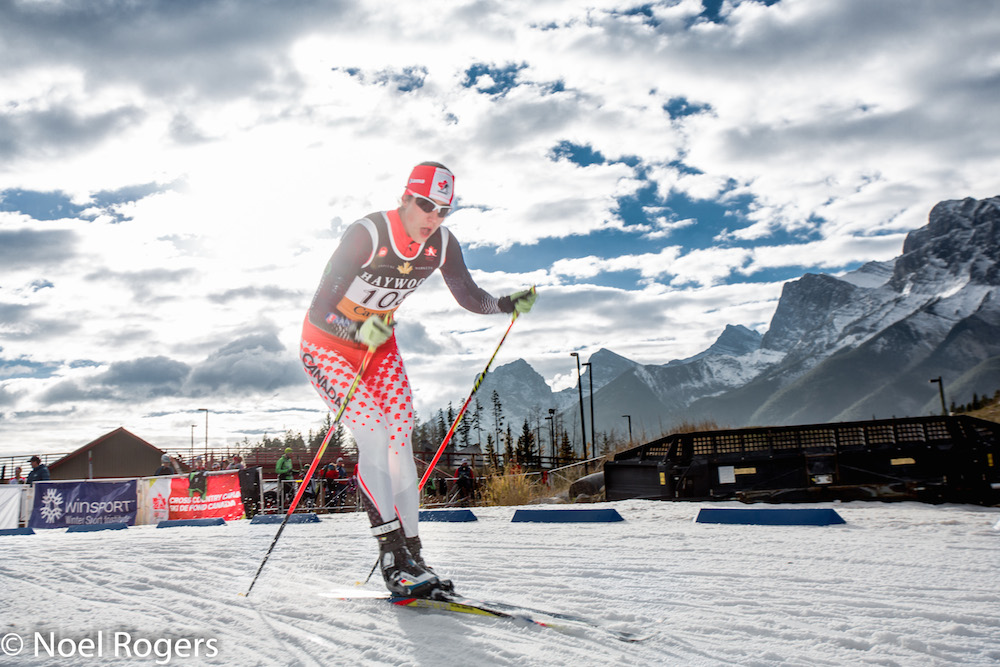
Rosanna Crawford racing in Canmore, Alberta, in October 2014. Crawford was the top Canadian woman in Ostersund, Sweden, today. (Photo: Noel Rogers/Bow Valley Photography)
It was a rough day, literally and metaphorically, for the biathletes competing Saturday in Östersund, Sweden. Artificial snow, saved snow and shoveled snow made for a treacherous course, though winds were calm.
Two Canadians broke through the bumpy conditions to have strong races in the IBU World Cup men’s 10-kilometer and women’s 7.5 k sprint — Nathan Smith and Rosanna Crawford finished ninth and 12th, respectively. The rest of the Canadian team did not fare as well, with no other skiers finishing in the top-60 to advance to Sunday’s pursuits.
Smith shot clean to earn his ninth-place finish, while the next Canadian man to finish was Marc André Bédard in 61st (+2:39.1) who missed one target in standing, and Brendan Green (+2:42.1), who missed one in prone and two in standing. This is only Smith’s fourth career top 10, and Canada’s first top 10 of the season.
“Obviously, I’m really happy with the result,” Smith told FasterSkier. “A top 10? I don’t have that many of those, yet.”
For the Canadian women, Crawford was happy with her race, finishing in 12th place (+1:10.3), in spite of missing a target in both prone and standing. But the women’s side was similarly disappointing, with Zina Kocher as the next Canadian woman in 66th place (+2:34.9, +4), and uncharacteristically bad shooting plaguing both Megan Heinicke, who finished 82nd (+3:23.6, +2) and Audrey Vaillancourt, who finished 88th (+3:31.7, +3).
An email to head coach Mattias Ahrens went unanswered as of this writing.
Scott Perras did not start due to a cold: “It’s really too bad,” he wrote in an email. “I am normally pretty healthy throughout the race season. This is my first DNS at any level of racing and I don’t much care for it.”
Smith’s strong result can be credited due to what he called “one of [his] best shooting races ever,” having the 10th-fastest shooting time of the day (+2.9) with no misses.
“After the individual I was pretty disappointed with my standing shooting,” he said. “So I took a day off of shooting and then yesterday I really focused on having really high quality in training, and the same with today during the race. I just tried to be very disciplined, I guess I could say. And it really paid off.”
“It’s not the best that I’ve been on skis in the last year and a half,” he added, “but it’s good still. Just not my best.”
For her part, Crawford was somewhat disappointed in her shooting, and in fact appeared to be having a pretty ho-hum race after the 2nd lap, being in 27th place. But on that final lap, she turned it up, delivering the 7th-fastest course time and moving herself into 12th place.
“This is kind of funny,” Crawford laughed. “I’ve always been kind of the opposite – a really strong starter and then have struggled with finishing loops, but Zina Kocher and I got to train together a lot this year and that’s always been her strength, so being able to work with her all summer long I think has been very beneficial to me to getting that finishing speed.”
Though course conditions were poor, neither Smith nor Crawford complained. Smith benefited from being an early starter, before course conditions deteriorated too much. He highlighted some of the downhill corners as being particularly treacherous.
“They shoveled [the corners], so I didn’t really know what to expect,” he said. “They were okay because you just sort of bounce over the bumps. But then, as each lap went on, the ruts got deeper. I’m sure that, for the last starters, it was pretty scary on those corners.”
Crawford thought that the poor course conditions matched her strengths.
“I’ve always been pretty strong on downhills, so I think that’s a huge advantage for me on a course like this,” she said. In fact, relative to other skiers, course conditions probably helped her out. “It didn’t hurt me, for sure.”
As for her shooting, Crawford made no excuses:
“It was pretty calm on the range, so it was definitely all me. A little bit more focus can go a long way.”
Though Crawford had told FasterSkier that she was hoping for top-10, she was far from disappointed with her finish.
“I’m not expecting to be in the top-10 every single race,” she said. “If I’m consistently in the top-25/top-15 area that’ll make me happy,” adding that she’d still like to get more top-10 finishes this year than she did last year.
“And for sure to be on the podium at least once this year,” she added.
After such a grab bag of results feelings on the the time are pretty mixed.
“Obviously some of us have had great races,” Smith said. “But I’m sure Brendan and Marco, and the other girls, are pretty disappointed about not making the pursuit.”
Smith and Crawford are looking forward to tomorrow’s pursuit with differing baselines for what to expect. Smith is looking forward to what he regards as his best format, while Crawford is apprehensive about what she regards as a weakness.
“It’s a shooting race,” Smith said. “I think shooting speed is more important, which is probably my biggest strength. I can take advantage of that as long as I hit most of the targets.”
Crawford echoed that assessment, but a bit more apprehensively.
“Pursuits were a bit of a weakness for me last year, shooting wise,” she wrote in response to follow-up questions. She hopes to simply hold her position and stay in the top 15, but that she’ll be happy if she is able to follow her range plan and “stay focused on myself and not get caught up in what’s going on around me.”
“We came into it with the idea of making a really cool video about a race that had never been filmed well before,” Anchorage native Max Romey said in a Skype interview.
Eric Strabel is chased by Wylie Mangelsdorf during the 2013 Mt. Marathon race. (Photo: Todd List Photography)
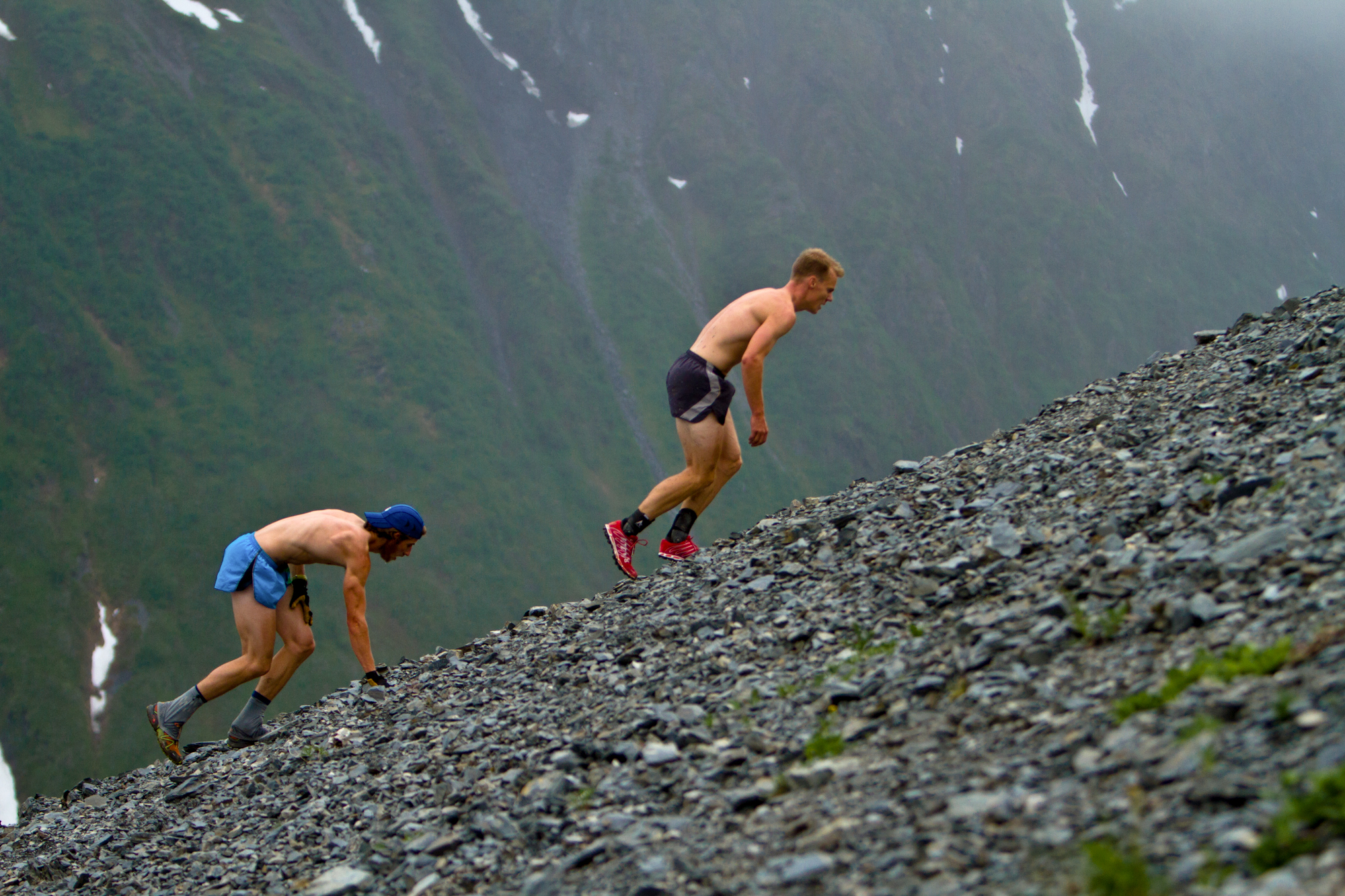
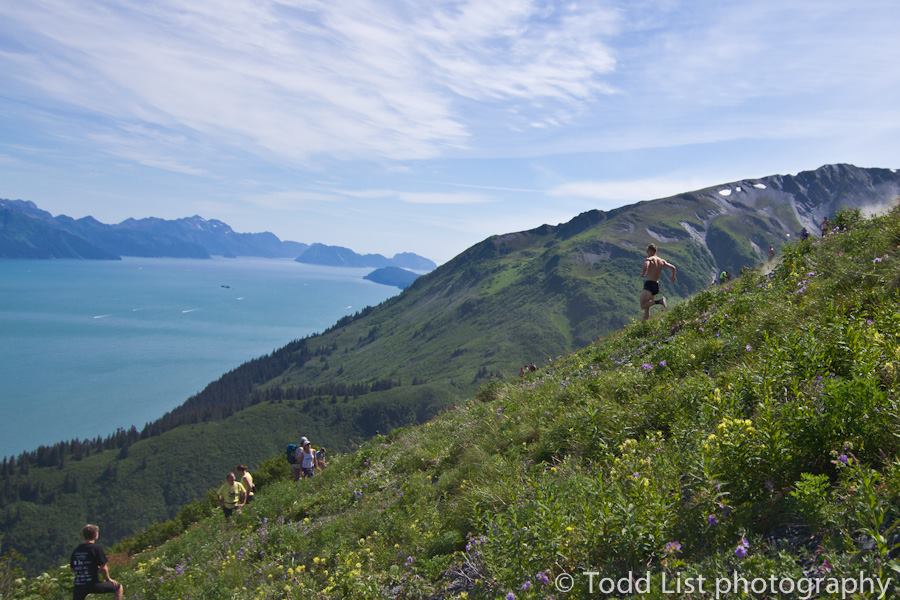
The up-and-down race is just a little over five kilometers total, but starts at sea level in Seward and reaches halfway at the top of the mountain 3,022 feet above sea level. From there, racers begin a headlong plunge back into town. It is not uncommon for racers to finish muddy and bloody.
In Sept. 2013, Romey published a 43-minute-long video called “A New Mt. Marathon Record,” his largest-scale production that generated more than 27,000 views on YouTube.
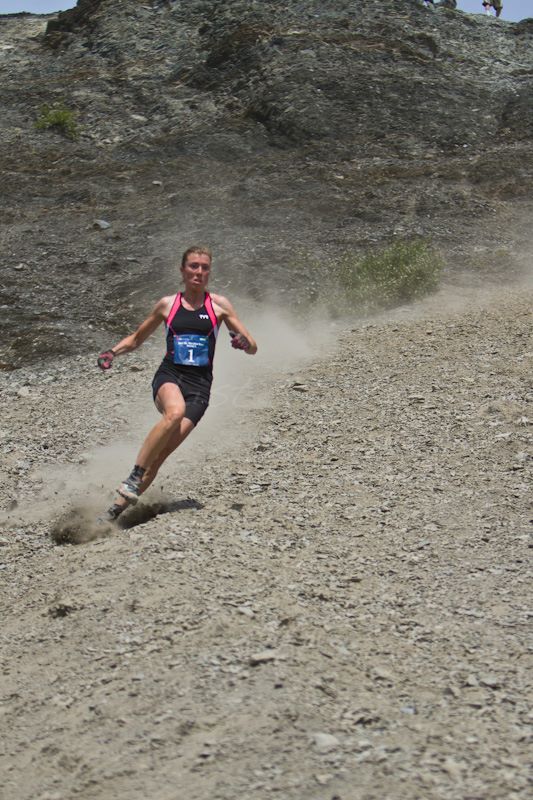
Christy Marvin descends during the 2014 Mt. Marathon race. During the descent she made up over two minutes on winner Holly Brooks, to finish only three seconds behind. (Photo: Todd List Photography)
Together with Natalie Fedak, his freshman-dorm resident advisor at WWU, Romey has been working on his latest project, a 20- to 30-minute documentary of the 2014 race. The film, 3022 ft., will include pre- and post-race interviews with the athletes, as well as plenty of race-day footage.
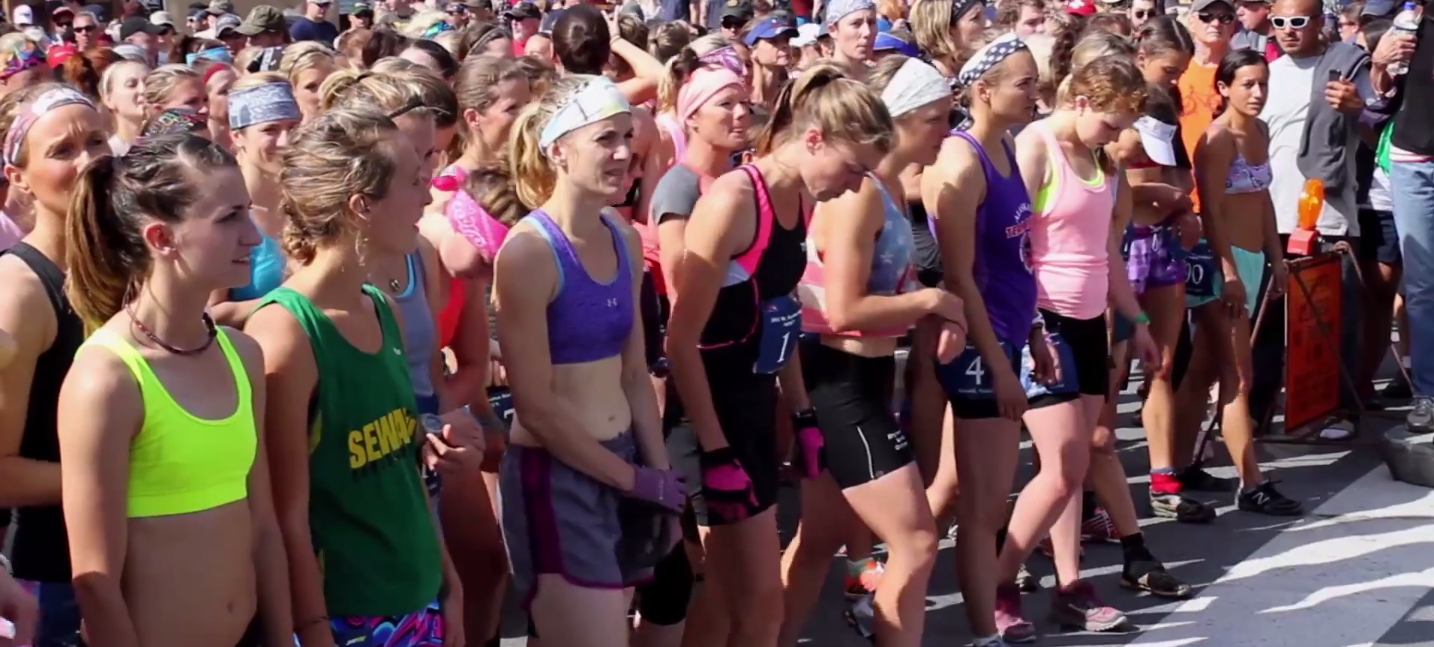
Mt. Marathon is Alaska’s oldest race, first formally organized in 1915 and based on a running bet from several years prior. It is also among Alaska’s most competitive races, with a lottery to get into the race and the state’s best athletes vying for the top spots.
“To give you an idea of how competitive Mount Marathon is, Salomon-sponsored Rickey Gates finished just seconds behind Kilian Jornet at September’s The Rut Vertical K, but placed fourth at Mount Marathon [in 2014],” Saari said. “In 2013, Rickey broke the Mount Marathon course record, but didn’t win the race, as [Alaska Pacific University nordic coach] Eric Strabel was even faster.”
Also from APU, Holly Brooks, a former U.S. Ski Team member who competed at the 2014 Winter Olympics, won her second Mt. Marathon title this past July. Brooks dominated the uphill portion, reaching the top 2 minutes and 5 seconds before Christy Marvin in second. But Marvin is a ferocious downhiller, and by the time she crossed the finish line she was just three seconds behind Brooks.
“The race was insane – probably the most exciting women’s race ever,” Romey recalled of the 2014 edition. “Just knowing what was behind it, and it was closest ever, and we filmed everything, and we were lucky enough that it turned out super-suspenseful and exciting. The part I’m really excited about sharing is the stories behind it.”
The 6-foot-4, energetic junior is pursuing an interdisciplinary degree in cultural diversity, environmental science and film that entails “basically filming a bunch of other cool stuff,” he said.
A two-time Alaska state champion from Service High (in the 3,200 meters and 1,600 meters in 2012), Romey is a varsity runner at WWU and started making films about running when he was injured his freshman year of college. During that time he devoted his energy to filming the team’s practices and races.
Last November, he published a 3:45-minute video about his cross-country team leading up to the 2013 NCAA Division II national championships.
In 3022ft., Romey explores the backstories of the Mt. Marathon’s main characters, from record-holder Strabel to young phenom Allie Ostrander.
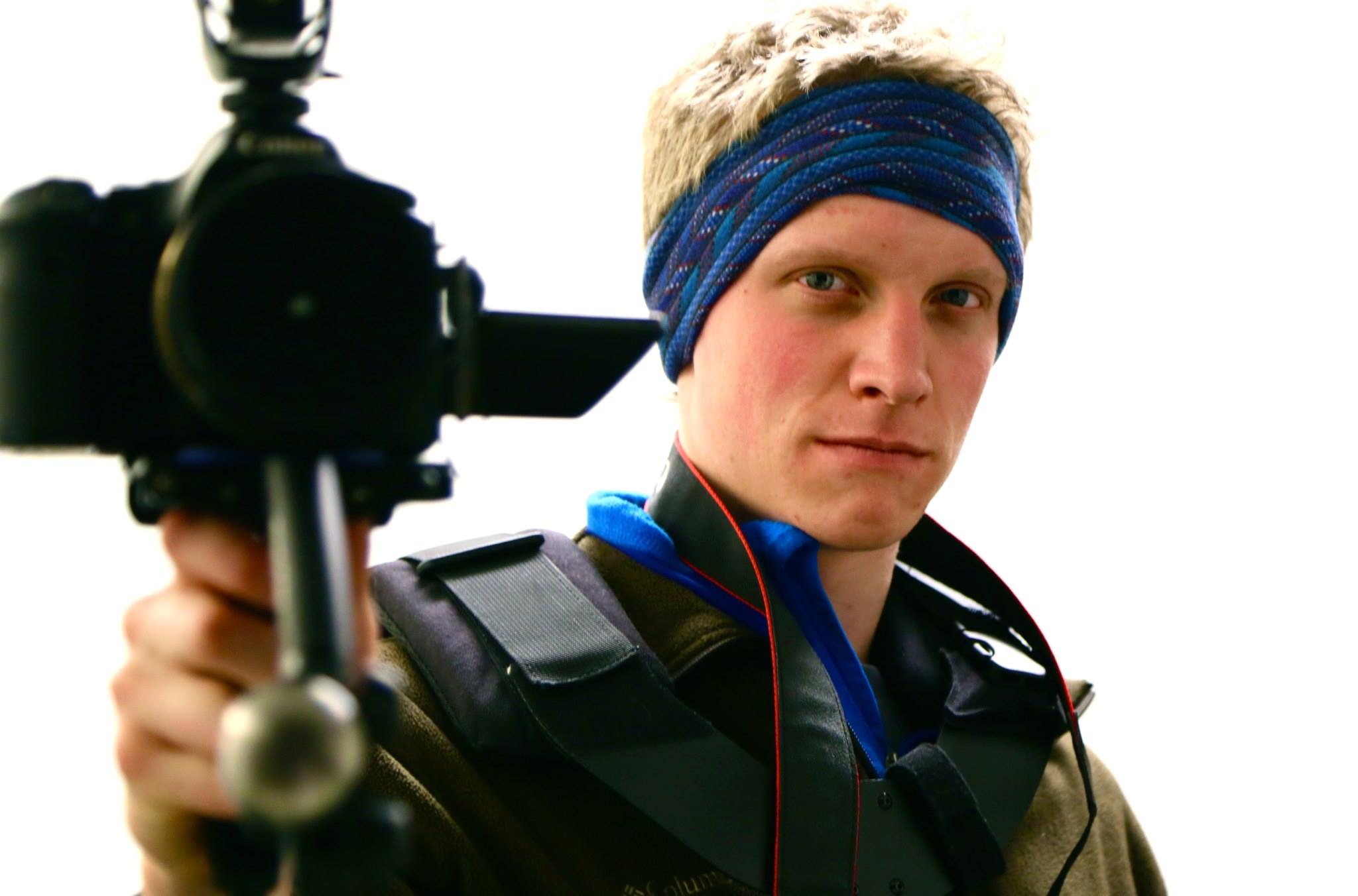
Max Romey with his camera (Photo: Natalie Fedak)
However, it was the race’s women that captured Romey’s attention, and he has his work cut out condensing hours of interviews with Brooks, Marvin, Najeeby Quin, and Denali Foldager, among others, into a relatively short film.
“We got a lot of these interviews and the story that we ended up following was one of predominantly really strong women in this sport,” Romey explained. “But the part I’m really excited about sharing is the stories behind it, you know, like the stakes of why Holly is going into this race, why she’s racing against Najeeby and Christy and Denali and all these other really strong women who don’t get the recognition that the men’s race gets … [The women] are working just as hard as the men, they’re just doing it for eight more minutes.”
“The race was insane – probably the most exciting women’s race ever.” — Max Romey, 20-year-old filmmaker from Western Washington University
“It’s not a video about women being awesome, it’s an awesome video, and naturally women are in it,” Romey states on his 3022ft. fundraising website. His campaign ended Oct. 31. (Photo: Indiegogo/3022 ft: A Mount Marathon Story)
Romey’s goal is to release a video that is partly about the emotional drama of racing — the preparation, the emotional hurdles, the fear of the treacherous downhills — and partly about the beauty and excitement of the race itself, with tight shots of runners barreling down the loose mountainside matched with panoramic shots above the picturesque seaside town of Seward on Alaska’s Kenai Peninsula.
Before the 2014 race even started, however, Romey encountered an unexpected obstacle. He asked permission to fly his drone — a tiny, remote control helicopter equipped with a camera — and was denied.
“I asked Seward and Seward asked the FAA and then the town of Seward said ‘no,’ ” he recalled. “[This] hurt me to hear because so many people do it and just don’t ask, but I was the one that asked permission, and now I’m the one that is being told no.”
Eric Strabel descends from the highpoint of Mt. Marathon in 2014. (Photo: Todd List Photography)
Romey scrambled for a solution, and so to get the footage for the video, he positioned 12 photographers with video cameras all over the race course — 20 cameras, in all.
“I pulled every string I had just to make sure I had everything captured,” he said. “Or tried to have everything captured; we missed some stuff even with 20 cameras going.”
What Romey was left with was over a terabyte (1,000 GB) of footage, including many hours — “many more than I need,” he said — of interview footage. Romey said that, on race day, he ran or hiked nearly nine miles to film a three-mile race. Has he run Mt. Marathon?
“My coach at Western says I’m not allowed to, just because it’s a leg breaker,” he said.
On Oct. 2, Romey released the trailer for the video and started a one-month crowdsourcing campaign to help fund the production of the video, estimated at $45,000. As of Oct. 31, he’d raised $8,589, or 19 percent, of that goal. But that wouldn’t stop him from finishing it.
“The only thing that puts our schedule at risk is if we don’t get enough money to hire the people who would make the post-production phase shorter and the final product better,” he explained on his fundraising site. “We don’t want to rush this film; we have a production schedule that allows for revision, critique and refining, but at a pace that demands several hours of work each day.
“If worst comes to worst and we are forced to extend our schedule, we will still finish the film,” he added. “But extending the schedule means slowing the distribution of our film to you, our supporters, as well as risking film festival entries if we miss the deadlines.”
While the campaign ended, there were still options to support Romey on his website: 3022ft.com. And when it comes to the thought of releasing his final film, Romey bubbles over with excitement.
“All this footage is in a hard drive, and I just can’t wait to pack it into 25 minutes and share it with everybody,” he said. “It’s like having this secret and I’m just waiting to tell it.”
On Oct. 27, Romey published his latest project, “Alaskan Recess,” a 2:30-minute trail-running video with the tagline, “If trails are nature’s playground, then recess never has to end.” He also used his drone to film and follow Brooks during an “all uphill” rollerski/trail run up Hatcher Pass.
“This kid’s going somewhere,” Brooks said in an October interview. “We were talking about the eventual premiere of the Mount Marathon documentary and we’re talking about it at a brewery, and he [wasn’t] even old enough to drink … He’s one of the most organized and hard working people I know.”
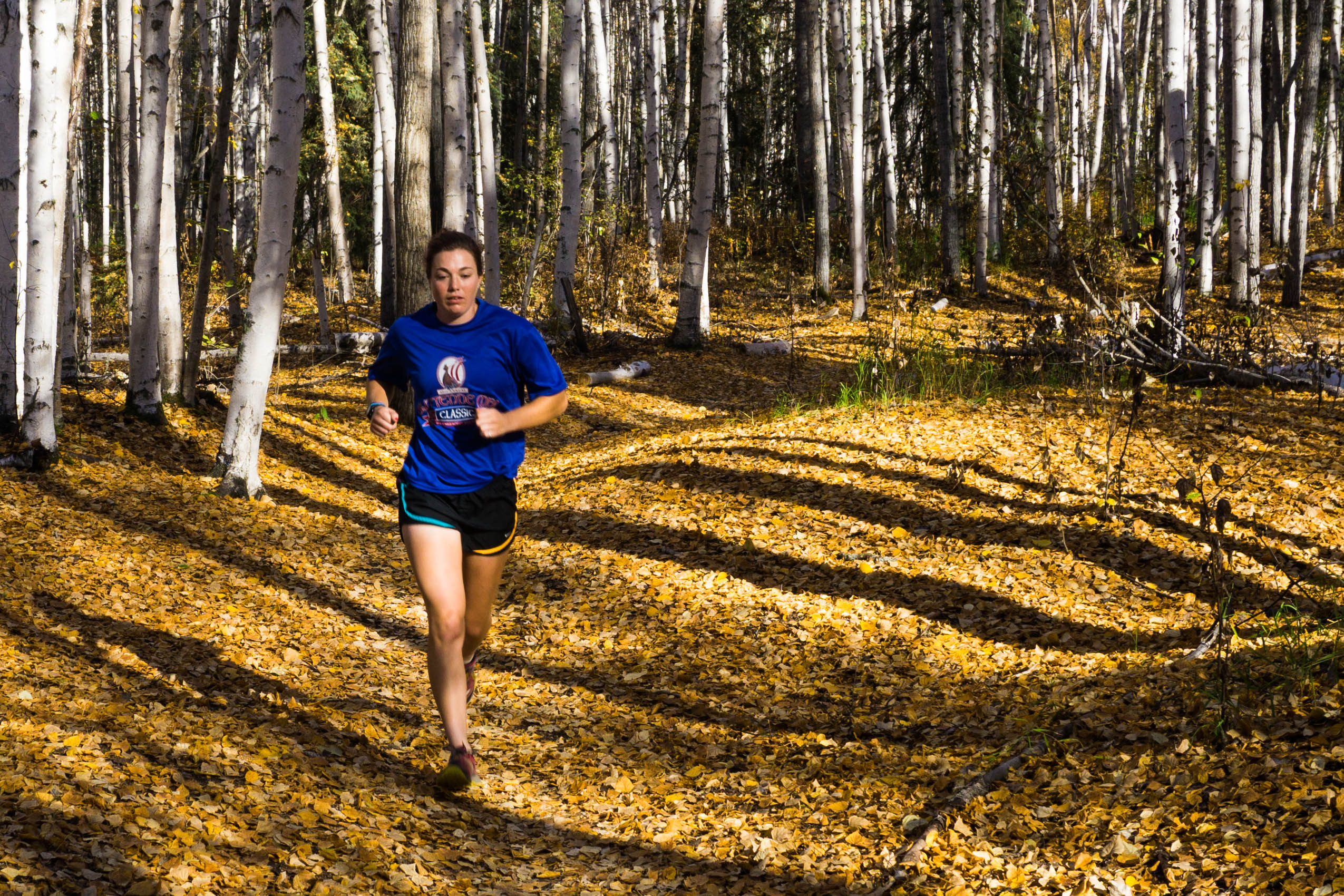
Nichole Bathe on a training run at the UAF campus earlier this month.
This ‘Pros of Tomorrow’ series, brought to you by the generous support of Fischer Sports, aims to highlight some of the most notable up-and-coming athletes around the world, not necessarily Fischer-sponsored skiers. If you have an idea for a top-notch skier you’d like to read more about, please email info@fasterskier.com with the subject line: Pros of Tomorrow. We’re also looking for stories about intriguing juniors, collegiate skiers, or lesser-known athletes; please email us with names — subject line: From the Pack.
***
FAIRBANKS, Alaska — Heads turned when the first American across the line in the women’s 5-kilometer classic race at the 2014 NCAA Skiing Championships in March was an 18-year-old freshmen from the University of Alaska Fairbanks (UAF).
Nichole Bathe took fourth overall in the race, following her win at Midwest Conference Regionals, also in the 5 k classic. Earlier in the season in January, she placed third among seniors at U.S. Cross Country Championships (U.S. nationals) in the classic sprint for her first national podium. A classic specialist, she was 11th in the skate sprint at nationals and 12th in the 15 k skate at NCAAs.
Now 19, Bathe is beginning her sophomore year at UAF. The Madison, Wisc., native chose to attend school at UAF because Alaska is so close, but yet oh-so-far away, from her hometown.
“I was looking at a couple of different schools, but I liked the fact that UAF was in the Central Conference,” she explained at a coffee shop in Fairbanks. “And I knew [UAF Head Coach Scott Jerome] before I came up here and I liked him, and I liked his coaching style, so that was mainly why I came.
“In the end I decided that I didn’t want to be that close to home, I wanted to try something new and get out, but I wanted to be a part of the Central Conference,” she added. “I think it’s a nice conference to be in just because there are lots of people and I get to go back to the Midwest when racing. So I get to see my parents on race weekends, which is always nice. I also get to ski on courses that I skied on as a junior, so I know the courses pretty well.”
Growing up skiing under Central Cross Country (CXC), Bathe remains an athlete there as part of its regional elite group.
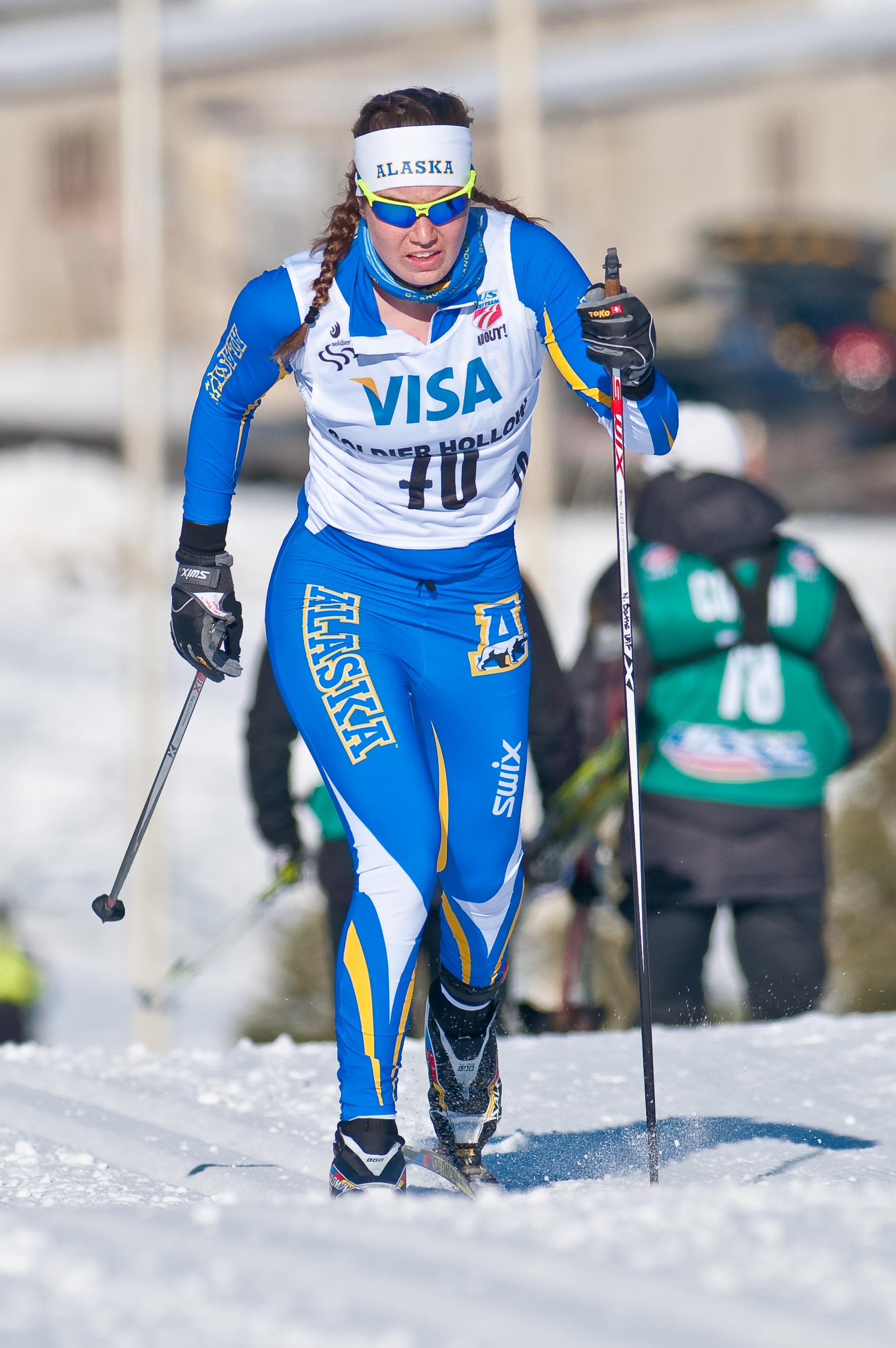
Nichole Bathe sprinting to 3rd place at the 2014 U.S. Cross Country Championships at Soldier Hollow in Midway, Utah. (Photo: Bert Boyer/http://bertboyer.zenfolio.com/)
“When we took Nichole on, we knew that she was good,” UAF Coach Scott Jerome said in his office. “We had seen her results at Junior Nationals, especially up close and personal [when Junior Nationals were] here in Fairbanks, where she got a top-five finish in the classic race – I think it was third place. And so we knew she was good.”
He pointed to assistant coach Christina Turman, who was in the room for most of the interview.
“I don’t think [either of us] would have predicted she would be top-5 at NCAAs her first year, but certainly we knew that she had the determination, training background and work ethic that we were looking for,” he said.
With three seniors, UAF has a young team this year with a large influx of new skiers. Bathe in her second year will likely be one of a small group of experienced collegiate skiers that her teammates will look up to.
Jerome sees lots of potential in Bathe, with some focus on her weaker areas.
“Strength for Nichole was a big factor last year,” he said. “She was physically weak in some areas, and when she got in the weight room consistently results really took off.
“Part of the problem is that when she gets tired her technique really falls apart,” he added. “I think the strength component is really important for her because she has to be strong enough that when she gets tired she has to hold it together — whether it’s the final climb or the final 2 k of a race, she has to hold it together.”
Jerome touched on a couple technique issues that need smoothing over, some of which amount to the growing pains of moving into a higher level of competition.
“Really working on glide is important,” he said. “When you’re a junior and you’re a little bigger than the others you can kinda fake it, but now everybody’s development has gotten to the same point and so you can’t fake it anymore.”
Above all else, though, Jerome stressed that whatever they were doing with Bathe’s training appeared to be working.
“We don’t want any big changes to the training plan — it’s been working, and you don’t want to change something that’s working,” he said. “Maybe tweak it here and there. Christina Turman has done a fantastic job working with Nichole and working with her on her technique. They’ve really formed a very strong coach/athlete relationship, it’s worked really well, and Christina has laid out a really good training program that Nichole has responded really well to.”
“If it ain’t broke don’t fix it, and so far so good,” he added.
“If it ain’t broke don’t fix it, and so far so good.” — Scott Jerome, University of Alaska Fairbanks Head Nordic Coach, on sophomore Nichole Bathe
Bathe spent the summer training with CXC in the Midwest, mostly trying to build distance and focus on longer intervals. When she wasn’t training, she worked as a bartender at a beer and wine bar.
“We don’t have many liquor laws in Wisconsin,” the 19 year old said with a smile. “I just poured tabs of wine.”
In the winter, school and training keep her busy. She studying for a degree in social work with a minor in justice.
“My goal with the whole thing is to work in the justice system with orphan and foster kids and replacing them into homes,” Bathe said.
Every college skier knows that it is difficult to balance the time requirements of training — especially in Alaska where so much travel is required — with school. This is not lost on Bathe, and provides a rare insight into where she thinks skiing might take her after graduation.
“I think Sophie Caldwell is a very important person to look up to if you’re a college skier because she did go through college,” she said of the U.S. Ski Team member and 2014 Olympian, who graduated from Dartmouth in 2013. “It shows that it is possible to go through four years of schooling and then come out at the end and still be able to race World Cups and race them well, like she does. I think she’s actually been really helpful for skiers who are in college currently and helping us to realize that we can still keep doing it out of college.”
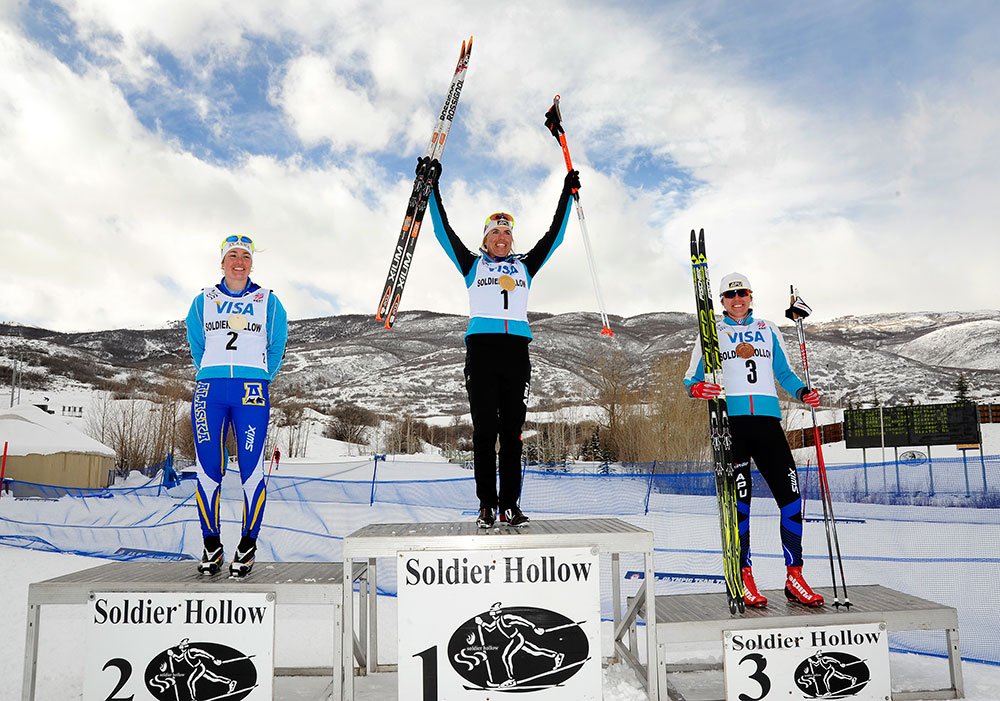
The U.S. women’s classic sprint podium with Rosie Brennan (APU) as the top American (second overall), Nichole Bathe of the University of Alaska-Fairbanks (l) in second, and Becca Rorabaugh (APU) in third. (Photo: Tom Kelly/U.S. Ski Team)
Apart from hinting that Bathe considers a ski career after college to be a possibility, she limited her speculation to the upcoming season.
“Doing better at NCAAs than I did last year is a goal, and [so is] making the World Juniors trip again,” she said.
At last season’s Junior World Championships in Val di Fiemme, Italy, she had a personal-best 26th in the 5 k classic.
“When I get there I’ll know what to expect, instead of going in like a newbie like I was last year,” she added. “So I’d definitely like to do better there than I did last year.”
The 2015 World Junior Championships will be held in Almaty,Kazakhstan.
“I haven’t really looked too far ahead of any of that,” Bathe shrugged. “I just like to play it year-by-year and see how it goes.”
As for the transition to life in Alaska, Bathe has only glowing things to say.
“I love Alaska. I mean, there’s no place like Alaska,” she said. “Even just driving through Alaska you get to see a lot of stuff. … We get to pick berries, and we have lots of fun in the spring … We go snow-machining and downhill skiing and it’s fun.”
UAF sophomore Nichole Bathe on a training run at the UAF campus earlier this month.
UAF sophomore Nichole Bathe on a training run at the UAF campus earlier this month.
This series is brought to you by the generous support of Fischer. Visit them online at fischersports.com.
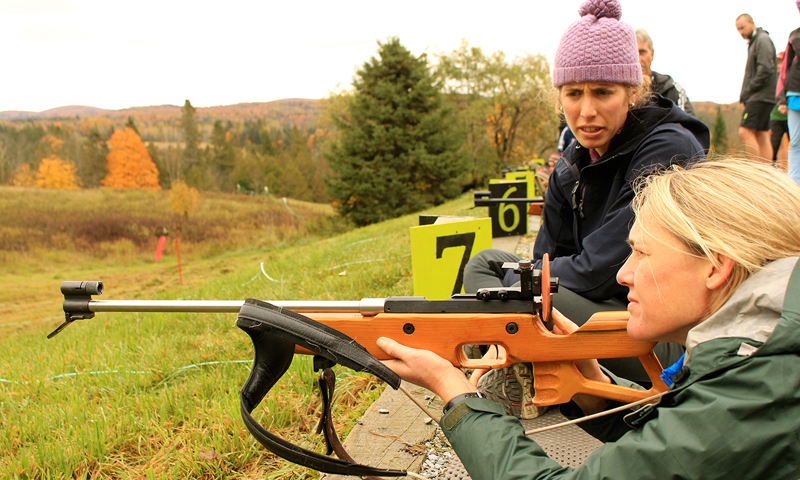
U.S. Biathlon National Team member Susan Dunklee (top) instructs at the Craftsbury Outdoor Center last September in Craftsbury, Vt.
For the last five years, there has been an ammunition shortage in the U.S. The shortage is most acute in inexpensive rimfire-type ammunition, particularly .22-caliber, which is preferred by competitive and recreational shooters.
Though a careless web search can send you down a rabbit-hole of internet-forum conspiracy theories, the National Rifle Association (NRA) studied the problem and determined that the shortage was being caused by increased demand in the civilian market. President Barack Obama’s election in 2008 has created a lasting sense that gun and sales will be restricted, which has resulted in a five-year-long buying frenzy.
Steve Hornady, president of Hornady Ammunition, one of the nation’s leading ammunition manufacturers, explained the cause of the shortage to the NRA. “We’re working as hard as we can to get as much out as possible,” he said, according to Forbes.com. “People walk into the store, they don’t see as much as they want so they take everything they can get. The next guy who comes in can’t get anything, so he panics … ”
The .22 Long Rifle rimfire cartridge, the most common in the world. (Photo: Wikimedia Commons)
The .22 long rifle (.22lr) bullet has long been the bullet of choice for target and competition shooting due to accuracy, low recoil, and low cost. With retail shelves nation-wide empty, how have American biathlon clubs responded?
“Our club has been affected by ammunition shortages,” explained Zach Hall, head coach at AK Biathlon. “A large bulk order put in last year still hasn’t been produced by Federal, leaving many biathletes scrambling to find other sources of .22lr. Mostly, families with small stores of ammunition have resorted to sharing with those in need, and everyone is going out of their way to purchase more when they travel to the lower 48.”
But the shortage is not restricted to Alaska.
“The junior program isn’t being affected yet, but some of our masters are having to conserve ammo,” explained Eric Tremble of the Ethan Allen Biathlon Club in Jericho, VT, in an email. “We buy our ammo directly from Federal/CCI through their youth direct sale program where Federal sells ammunition directly to clubs to be used exclusively for youth shooting. It’s a great program except that it’s only offered when Federal has surplus.
“Because of the infrequency of the offers, we were proactive and bought the maximum allowed amount whenever we could. I put in big orders in 2011 and 2012, and we’ve been using that ever since. At one point I had an entire bookshelf filled with ammo, but now it’s down to three cases. Those three cases will get us through the rest of this summer and next winter. I’m hoping that Federal will be able to offer the youth program again before we run out.”
“Our club has been affected by ammunition shortages. … Mostly, families with small stores of ammunition have resorted to sharing with those in need, and everyone is going out of their way to purchase more when they travel to the lower 48.” — Zach Hall, AK Biathlon Head Coach
Seth Hubbard, of the Maine Winter Sports Center, encountered shortages in the past, but has enough ammo for the time being.
“The biggest thing that I am doing is that I am spending more time working on sourcing the ammo that we need as well as keeping an eye on our inventory as we move through training,” he wrote.
The shortage has been most account in the cheapest bullets, which are most popular with recreational shooters. However, even competitive biathletes use the cheaper ammo during training.
“The quality of ammo hasn’t been affected, though lower grade (cheaper) target ammo is more difficult to locate, especially in bulk,” Hall continued. “With .22 ammo being less prevalent it has been necessary to include more dry-fire drills as a precursor to live-fire training. Also, we have several high-tech laser rifles that have substantially expanded our training opportunities and reduced our direct reliance on ammo. We use the laser rifles to teach athletes a new concept and only when they have achieved a level of mastery over fundamentals do we add live ammo to the progression.”
For Hall’s team, however, the need resort to the laser rifles has been a bit of a silver lining.
“[The laser systems] allow for real-time monitoring and playback of aiming, shot placement, breathing, and follow through,” Hall explained. “As a coach I can diagnose issues on a laser rifle after only a few shots because I can see details of what’s happening during the whole shot process. With live ammunition some of that info is more difficult or impossible to discern without shooting through hundreds or even thousands of rounds.”
“Another benefit to the laser rifles is that I can use the system to teach young kids or athletes who may initially be apprehensive about the loud noise of a gun or anticipated kick,” Hall added. “Once they’ve learned the basics of shooting then we can introduce them to live-fire shooting and the transition is usually really comfortable and low stress.”
Like AK Biathlon, the Maine Winter Sports Center has encountered a shortage in the cheaper types of ammunition.
“The biggest shortage that I have encountered and heard other coaches dealing with has been on the lower-grade ammo that younger athletes may be using,” Hubbard wrote in an email. “This is the grade of ammo that you will see more commonly at your local sporting shop, when it is available. This ammo is very very hard to come by and I am sure that it is causing greater shortages with clubs and athletes, depending on how individuals are purchasing their ammo there can be long waits.”
But, as with all nordic sports, the coaches become personally invested in their athlete’s performance:
“We’ve also been using up my personal supply from when I was racing in the ’90s,” Tremble added.
Nick Treinen works to keep up with the kids in Shishmaref. (Photo: Brice Habeger, Piksik)
“It’s not about skiing,” Shungnak School Principal Roger Franklin wrote in an email to FasterSkier. “It’s much more, and it’s saving lives daily.”
Just don’t tell the kids that. The hundreds of them skiing and laughing and jumping and falling down might think you were crazy.
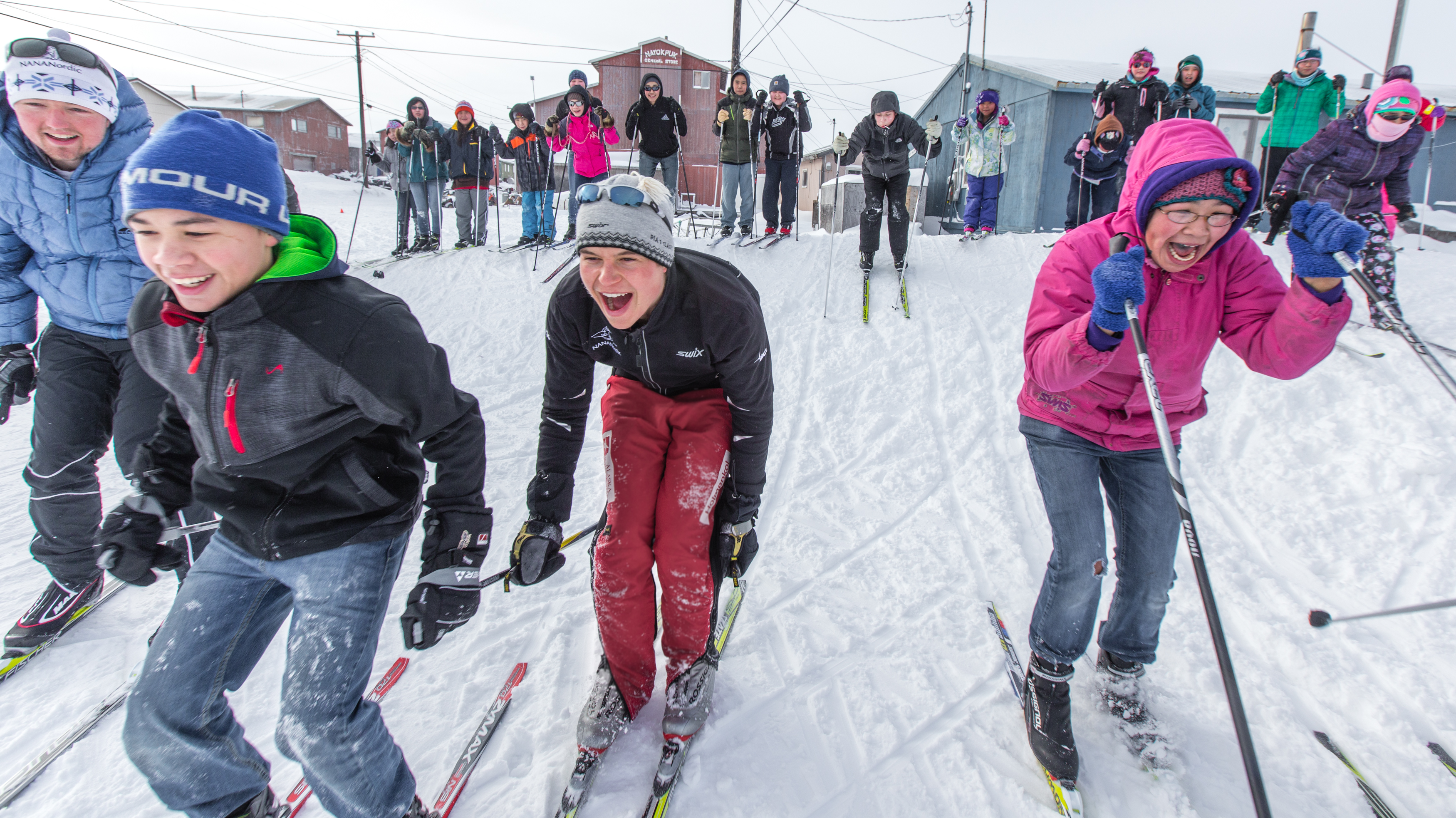
The Shungnak School is 150 miles east of Kotzebue on the Kobuk River. Shungnak is one of 27 communities that received ski instruction through Skiku, known in the Northwest Arctic region as NANANordic. The program brings world-class ski racers, elite high-school racers, and community coaches to rural Alaskan schools each spring, along with ski equipment and enthusiasm for teaching the students to ski.
NANANordic was covered by FasterSkier in 2012, the program’s first year, and in 2013 with the addition of biathlon to the program. FasterSkier also compiled links to videos made about the program in 2013 and 2014.
“NANANordic has bought a positive trend to this region and our little village,” Franklin continued. “This program helped our kids find different ways to find a positive outlet than a negative one. It has given our students a chance to live a healthier life style and much more. It also has a component for family time spent skiing and understanding their kids’ struggles in life. It also has helped our students to stop thinking about suicides and other harmful things.”
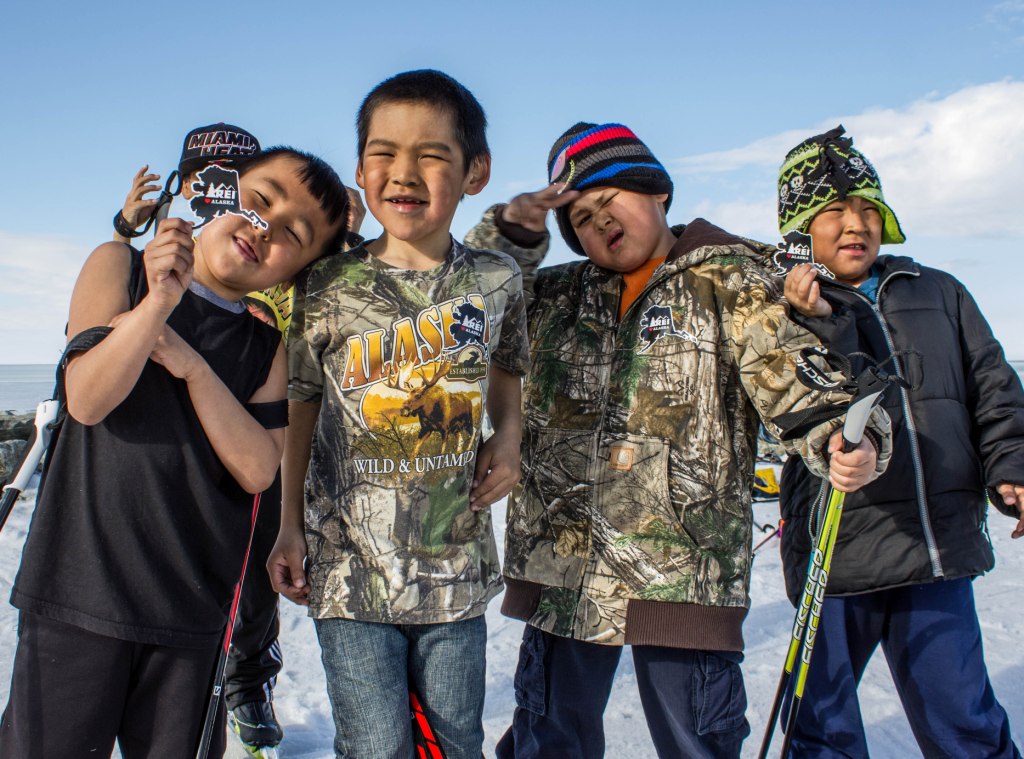
Kids in Kivalina. (Photo: Reese Hanneman/Skiku)
The statistics on rural Alaska are heartbreaking: rates of alcoholism, sexual violence and teen suicide are many times the national averages. In many areas the rates are so high that it constitutes a public-health emergency. So when Franklin says that NANANordic/Skiku is “saving lives daily,” it’s not merely hyperbole.
History
The program was started in 2012 by Lars Flora (a former elite racer and brother of Alaska Pacific University Head Coach Erik Flora), with the help of Robin Kornfield (who works for NANA Development Corporation), and Scott Warren, an educator with the Northwest Arctic Borough School District.
That first year, NANANordic visited four villages — Kiana, Noorvik, Selawik and Kotzebue — in the NANA region in northwest Alaska. The following year it expanded to all 11 villages in the Northwest Arctic plus Anaktuvuk Pass, located in the Brooks Range, Alaska’s northernmost mountain range.
As NANANordic grew and expanded into other regions, with the door open to further expansion, they needed a name that would be inclusive of the entire state. The directors settled on Skiku, a play on the word “siku,” the Iñupiaq word for ice. Within the NANA region the program is still called NANANordic, but for the sake of clarity both will be referred to as Skiku in this article.
As NANANordic grew and expanded into other regions, with the door open to further expansion, they needed a name that would be inclusive of the entire state. The directors settled on Skiku, a play on the word “siku,” the Iñupiaq word for ice.
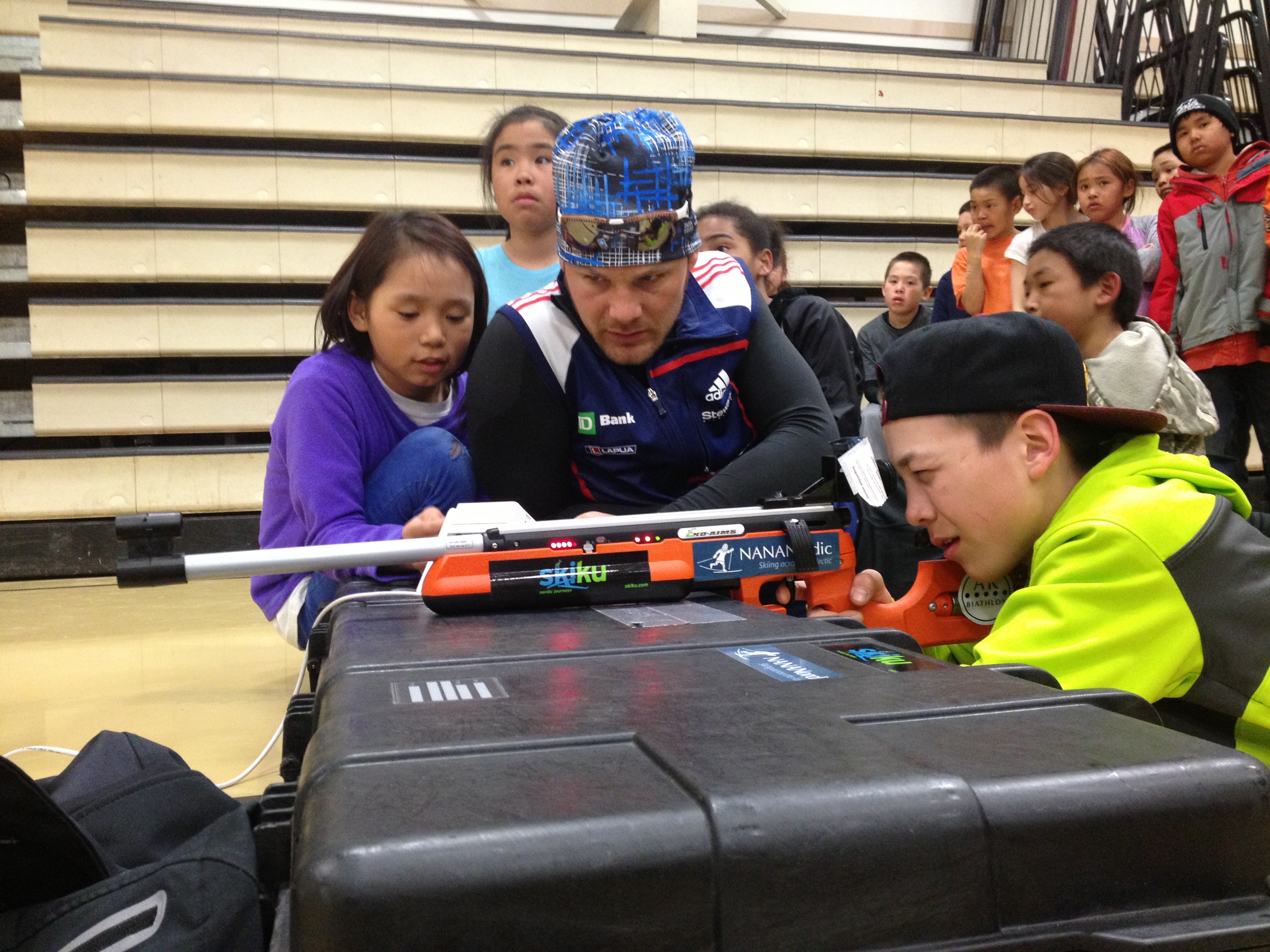
This year, Flora and a veritable army of volunteer coaches — 80 in all — helped to bring skiing to over 3,000 kids, spending a week in each village, with many students skiing during school and again afterwards. The program has also begun a push to bring biathlon to village schools — a logical sport for the students, given the strong tradition of hunting in rural Alaska. They founded AK Biathlon as a sister organization to Skiku, brought on Zach Hall as the coach, and were able to purchase four infrared rifles to use with the kids.
Zach Hall teaches shooting skills at an indoor range in Kotzebue. “Biathlon is a huge component of the program that makes cold days manageable since we stay inside shooting biathlon infrared systems,” Flora says. (Photo: Skiku)
Future of the Program
After the 2013 season, Flora became the full-time director of Skiku, allowing him to push the expansion of Skiku into more than twice as many communities in 2014. Such rapid expansion is complicated for a small nonprofit, and Flora plans to expand more in 2015, looking to Bethel, in the Yukon-Kuskokwim region in southwestern Alaska.
“A lot of activity directors across the state are a little worried about our expanding to so many places,” Flora said. “What [they’re worried about] is that you put the focus on teaching kids how to ski, and then what happens is that your websites aren’t polished. We could easily pull back and keep it at 27 for next year and make sure we have everything perfect in the office, but among everyone involved we just want to keep going getting the program into more places.”
When asked about his priorities for future funding, Flora said that, in addition to expanding into more areas, he’d like to find a way to keep coaches in the communities longer.
“In the very rough draft we made up, we put [next year’s volunteers] at about 110,” Flora said. “But the time spent in villages is a key piece. You can’t just dump ski equipment at a school and think that the teachers or the admin will run a ski program for you. It’s been done before, and what we’ve learned is that a lot of those kids don’t really know how to ski. At the end of the day we want to make sure that they actually learn how to ski at the places we go.”
Community Support
Photographer Brendan Smith joined the program in 2012 and 2013 as part of Healthy Portraits, an initiative by the Alaska Native Tribal Health Consortium, a native-owned public health consortium. Healthy Portraits focuses on success stories stories in rural Alaska, celebrating those who are taking steps to improve themselves and their communities. Smith produced a video about his involvement with NANANordic.
27 Villages Visited in 2014:
Barrow, Kotzebue, Kiana, Ambler, Anaktuvuk Pass, Noorvik, Shungnak, Deering, Noatak, Atqasuk, Kaktovik, Nuiqsut, Kobuk, Kivalina, Selawik, Buckland, Aniak, Sleetmute, Stony River, Crooked Creek, Nome, Shishmaref, Koyuk, Gambell, White Mountain, Unalakleet, and Pathway Home in Anchorage
The observations of the volunteers support the idea that the kids are enthusiastic about picking up the sport.
“I guess the part that has surprised me the most how quickly the kids have learned to ski,” Alaska Pacific University (APU) coach Charlie Renfro wrote in an email about his experiences. “I take a lot of video footage of the kids each year and this year was crazy. Kids are V2-ing and hitting jumps and just making it look easy. All with pretty minimal time on skis. They aren’t afraid to fall, they aren’t afraid to look silly, they aren’t really afraid of anything. I think that is such an awesome way to learn. As a result they are getting pretty proficient quickly and they all really seem to like it, which makes it super-fun for all of the coaches. The kids can feel themselves improving too, and, I think that is a big motivator.
“The NANA/Kobuk River Region is so vast and beautiful,” Renfro continued. “That, combined with the incredible people and of course the awesome interactions with the kids, has kept me coming back year after year.”
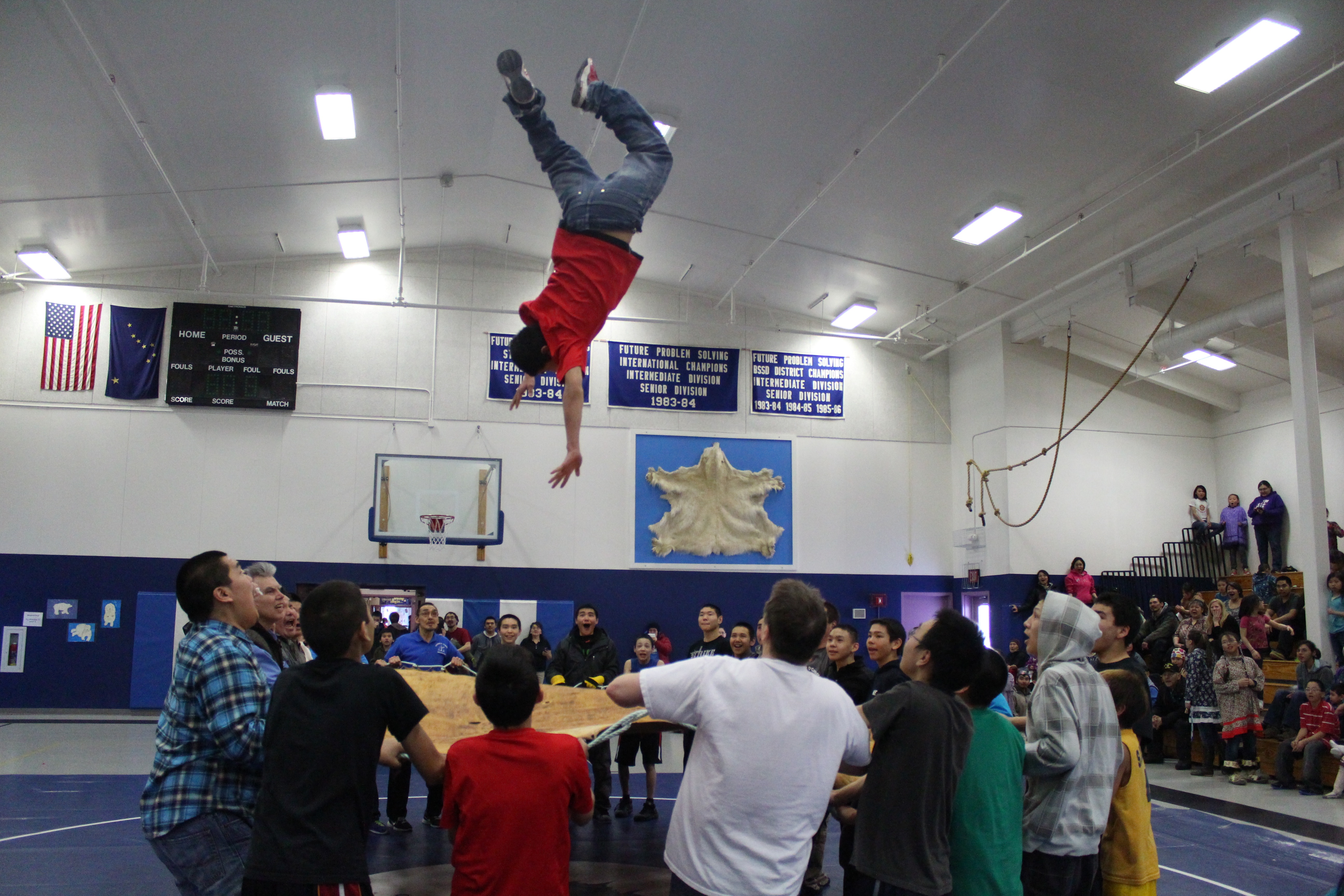
A student is thrown into the air as part of the traditional blanket toss — using a walrus hide — in the school gym in Gambell. (Photo: Skiku)
Renfro was not alone in his enthusiasm for the program. Husband and wife Brian and Caitlin Gregg of Team Gregg/Madshus participated this year for the first time.
“The whole experience was amazing,” Caitlin Gregg wrote in an email. “I really liked learning about the strong cultural history that the villages retain and teach all the youth. I left the NANANordic trip with so much excitement. The energy of the kids was amazing and I can’t believe how excited the towns were for us to be there! I look forward to spending even more time with the program next spring!”
APU Elite Team member Lex Treinen participated in NANANordic this year as an envoy of a club called club called K’enaanee Kkaazoot — a similar program started by former University of Alaska Fairbanks skier Heidi Rader in 2011.
“She had been doing gardening workshops in the villages on behalf of UAF’s Cooperative Extension Service and Tanana Chiefs Conference (the Interior non-profit native organization) and had always brought her skis,” Treinen explained in an email. “She saw that the kids were always interested. So I got to be part of the first K’enaanee trip in spring of 2012 and we went to Fort Yukon, Venetie, and Arctic Village. The next year we did a three-day trip to Ruby.
“This year Heidi decided to work through NANANordic,” Treinen continued. “Since they were expanding to regions outside of the NANA region, and got a grant that she could give to UAF students.”
Treinen went to the village of Nuiqsut, a village founded in 1974 in response to oil development on the North Slope. Treinen wrote about his experiences in UAF’s student newspaper, the SunStar.
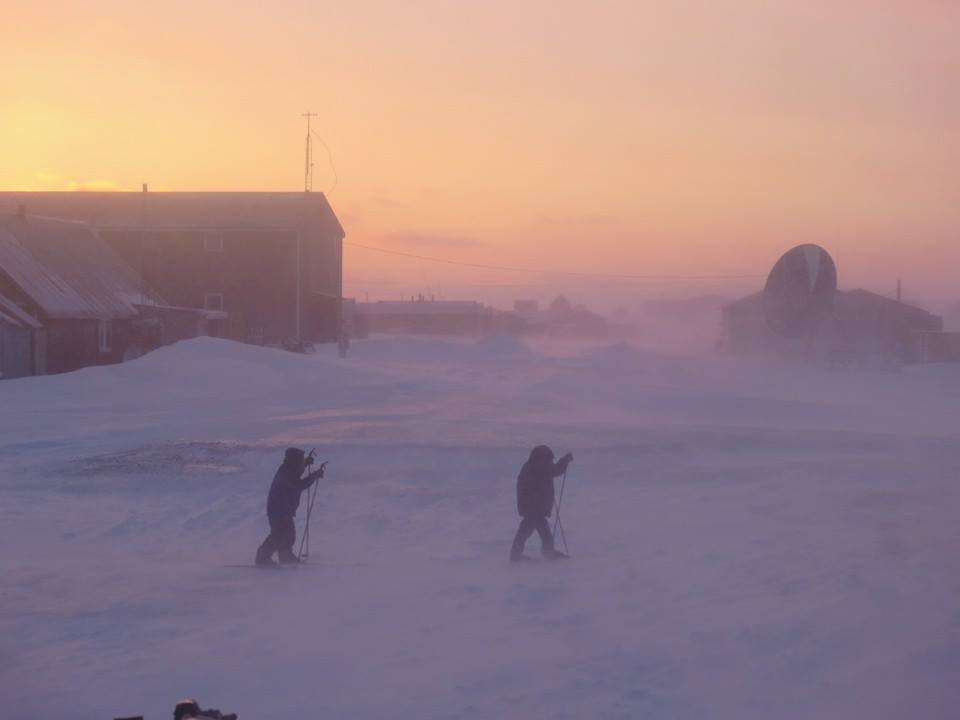
Kids brave a ground blizzard, caused by high winds, in Gambell. Gambell is on St. Lawrence Island, in the Bering Sea. (Photo: Skiku)
A Rewarding Experience
All those interviewed for this story had positive things to say about the innate ability and enthusiasm of the students for skiing in a region typically dominated by basketball and snowmobiles. The volunteers couldn’t help but be caught up in the excitement, many getting so much more from the experience than just the typical rewards of coaching.
Even Flora, who has been Nordic skiing nearly his whole life, feels the experience has changed him. In 2012 he had just finished a tough season of racing and immediately began NANANordic’s debut season.
“It was the perfect transition out of ski racing,” he wrote in an email. “It kept me involved with the ski world but opened my eyes to this amazing world that had nothing to do with ski racing. There was this deep rich Alaska Native culture that we got thrown into the first year and the NANA values started influencing our ski program in more ways than I can express.
“Basically this whole program has brought me back to my childhood memories of chasing around my two older brothers on skis and going on family ski trips,” Flora remembers. “I was so fixated on performance the last few years of my career, my performance started influencing my choices and decisions in a negative way. … My perspective on sport has changed. As a ski community we can learn a tremendous amount from villages in Alaska that can help us grow as teams, communities, and individuals. Skiku is as much about teaching kids how to ski as it is about our volunteers learning about a new culture, which can impact our own goals and dreams in life. ”
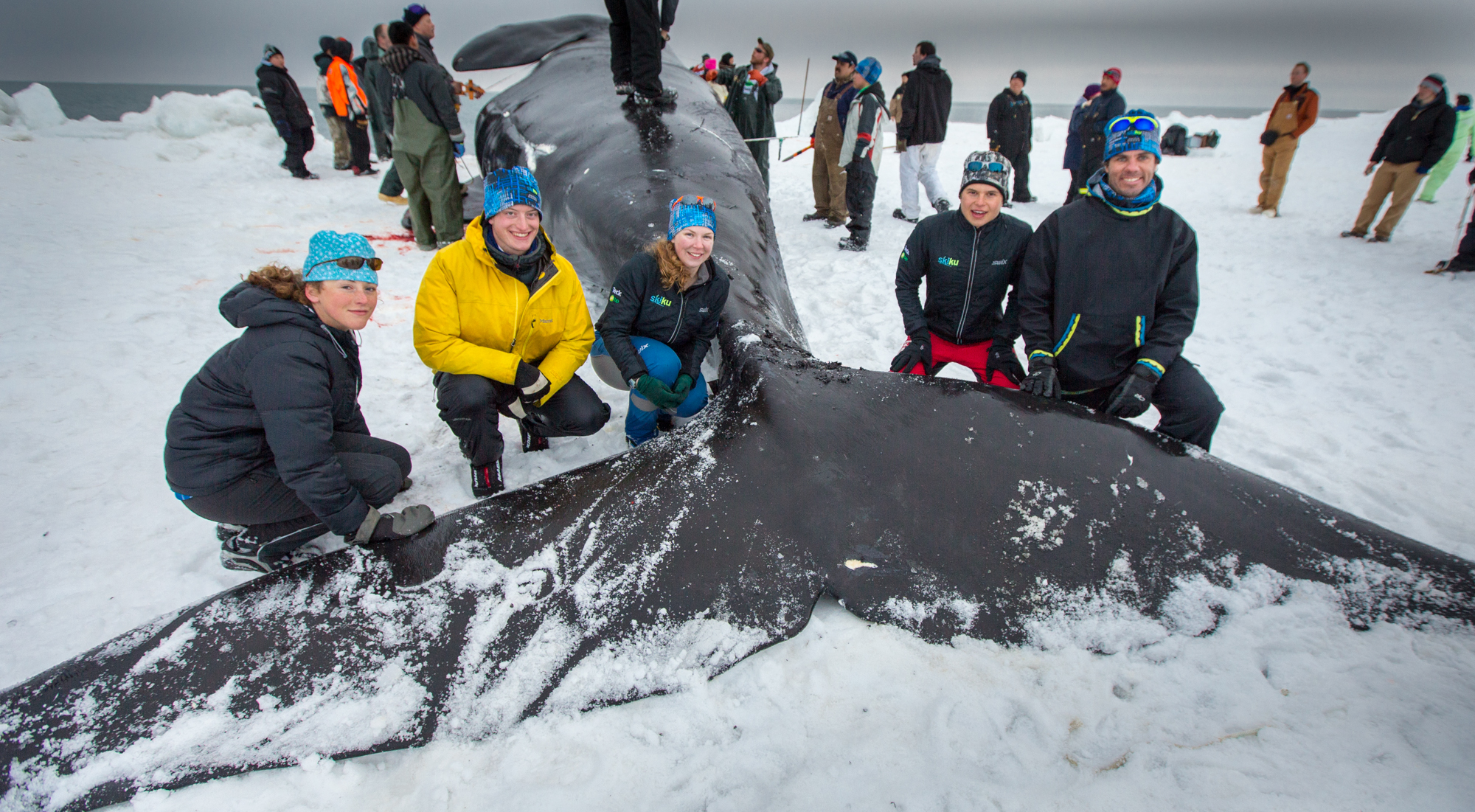
The Skiku Crew and a bowhead whale that was taken during the traditional spring whale hunt in Barrow. (Photo: Brice Habeger, Piksik)
2014 Volunteers: Aimee Demientieff, Alice Knapp, Allison Phillips, Amanda Del Frate, Ana Jager, Andrew Kastning, Andrew Dougherty, Anna Rix, Annie Connelly, Bailey Arend, Bre Donovan, Brian Gregg, Caitlin Gregg, Caitlin Patterson, Carlin Rauch, Carly Craig, Catie Bursch, Celia Haering, Charles Renfro, Conner Truskowski, Dana Tower,Dave Stamp, David Apperson, Deland Anderson, Donny Donovan, Dylan Watts, Emily Decker, Eric Packer, Erik Bjornsen, Fischer Heimburger, Frances Pillifant, Galen Flint, Gigi Banas, Greg Jernstrom, Greta Anderson, Ian White, Jaime Bronga, Jan Spurkland, Janey Hoefler, Jarrid Huckfeldt, Jasmine Neeno, Jeffery Fox, Jim Oksotaruk, John Farr, Jonas Loeffler, Josh Smullin, Julie Truskowski, Kathleen Rehm, Keri Hull, Lars Flora, Laura Pillifant, Lauren Fritz, Lauren Hess, Lex Treinen, Libby Kugel, Marie Steringer, Marine Dusser, Megan Spurkland, Michael Sinnott, Molly Schouweiler, Nancy Hanneman, Nick Treinen, Odin Brudie, Paul Kovacs, Peter Madsen Kling, Rachelle Kanady, Reese Hanneman, Robert Rosser, Rosie Brennan, Ryan Terry, Sadie Fox, Samuel Dougherty, Sara Studebaker, Sikulik Johnson, Tamra Kornfield, Taryn Hunt Smith, Tully LaBelle-Hamer, Tyler Kornfield, Will Mans, Zach Hall
FasterSkier staff regularly report on the world’s fastest skiers on the world’s fastest courses. As a reporter, I’m not an exception, but when I strap a pair of skis onto my own feet, I prefer to go as far as I can, going as slow as I need to go in order to, hopefully, get there.
Ultra-racing has been experiencing exceptional growth in popularity in recent years, and, for once, this is a national trend that Alaska is actually keeping up with. Behind the incredible skiers at Alaska Pacific University lie a lot of skiers like me, a 31-year-old competitive also-ran, along with people that didn’t start skiing until later in life, and a few truly-talented ski racers mixed in there. And we’ve fueled an exceptional growth in wilderness ultra-races statewide, with new races popping up at the rate of a couple per year.
The Susitna 100
I was in Argentina on a climbing trip for a big chunk of the winter, so when I returned to my hometown of Fairbanks on Feb. 5 I had to scramble to arrange some ski fitness for the Susitna 100, which was to be held just 10 days later.
The race was in Big Lake, Alaska, a small town near Wasilla about 50 miles north of Anchorage. It had been a lousy winter in Southcentral Alaska with exceptionally low snow cover. The course was nearly all ice. Most of these winter ultras are multi-sport races, with separate categories for skiers, bikers and runners. The bikers were discussing using studded tires; the runners were discussing using cleated shoes; the skiers were flabbergasted — we didn’t know what to do.
A fairly typical section of the Susitna 100 course. The yellow stuff is solid ice.
“A hundred miles is a LONG way to double-pole,” I whined emphatically. “And I can’t skate that far – not with how little skiing I’ve done this winter!”
In the end, I went with a regular pair of classic-racing skis that I used grip tape on for kick. I applied the grip tape very carefully, as I had been warned was important.
It didn’t matter, because even grip tape won’t kick on ice. And even if it did, that didn’t matter either, because within a few miles the grip tape had completely rubbed off, and I skated the remaining 95 miles on my classic skis.
The Susitna 100 course is a giant loop, starting on a path very similar to the famous Iditarod sled-dog race. The other racers and I ground our way across features with names such as the Dismal Swamp, the Big Swamp, and large sections of the frozen Susitna River. A swamp, in the winter, is effectively just a vast, open plain.
“I think I could make a noose out of the waist strap on my pack,” I told one of the other racers as we crossed the five miles of swamp, “But none of these trees could support my weight.”
Crossing the Dismal Swamp during the Susitna 100.
And we were supported along the way by cheerful volunteers, even as we the racers became less and less cheerful.
The multi-sport nature of the races means that people on the trail can have quite different experiences. Fatbikes have been enjoying a recent explosion in popularity, and snow-starved Southcentral Alaska has been fueling the explosion. It was a banner year for the cyclists, with the overall winner, Carey Grumelot, blasting the 100-mile course in 8:27. (The Susitna 100 has been around for quite a few years, but this was a new course this year. Though any time would be technically a course record, the courses are comparable and this would hold up as a course record.)
The top skier, Matias Saari, more than doubled that, finishing in 17 hours, 21 minutes. I finished in 18:02 and was utterly destroyed at the finish line. The top runner, local superstar Dave Johnston, finished in 18:22, which, I hasten to point out, was behind me. Not much behind me, but behind me all the same.
The Wilderness Classic
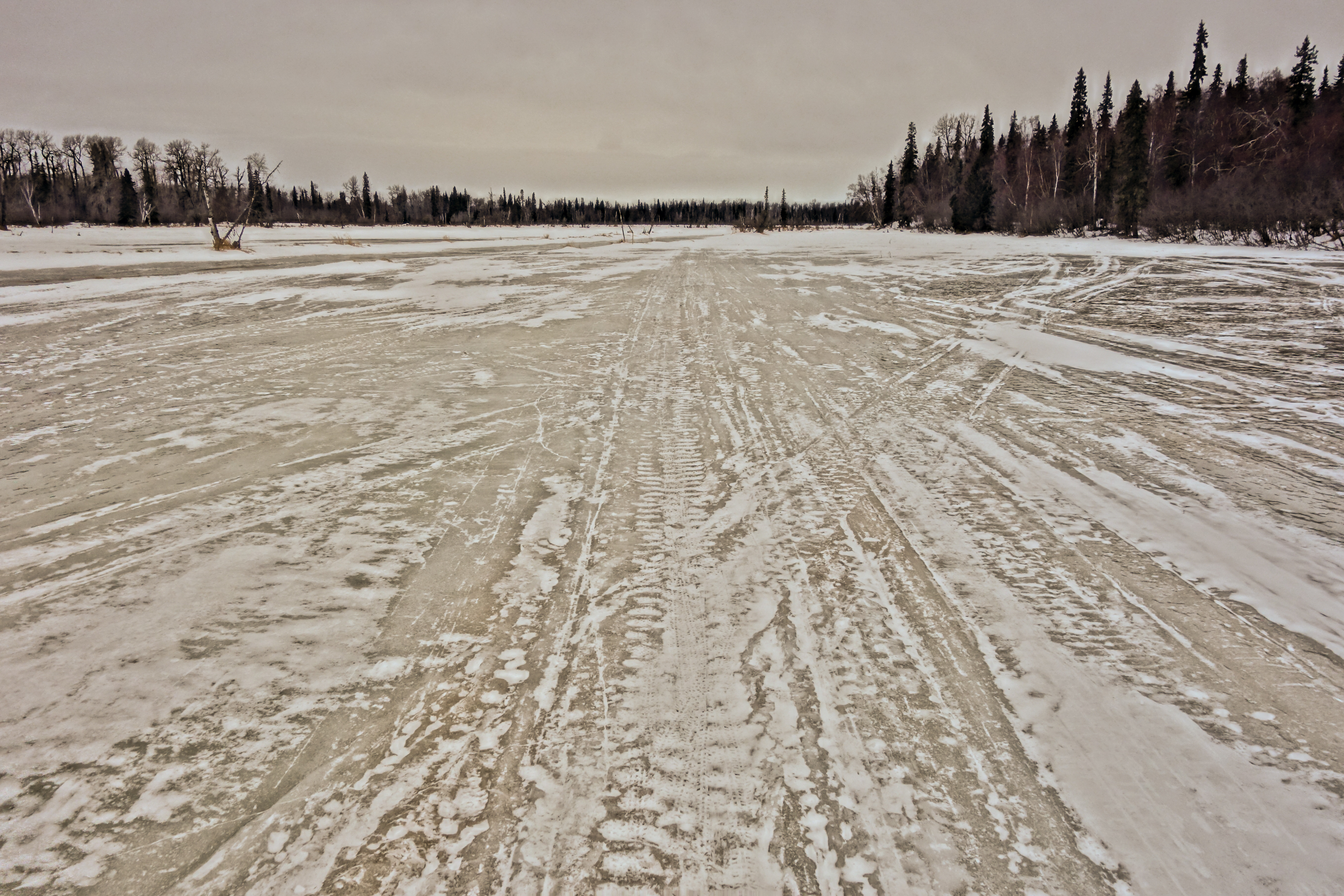
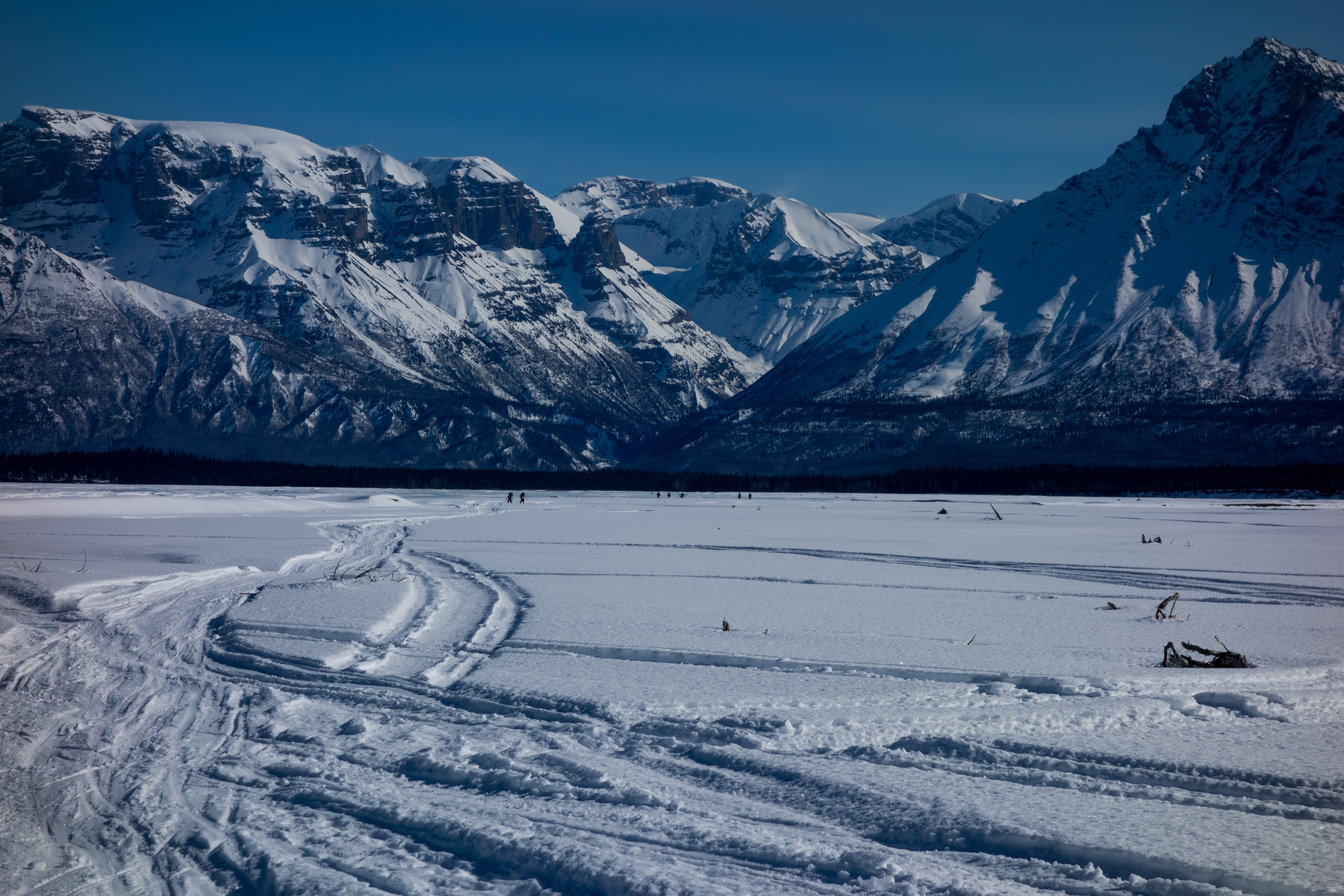
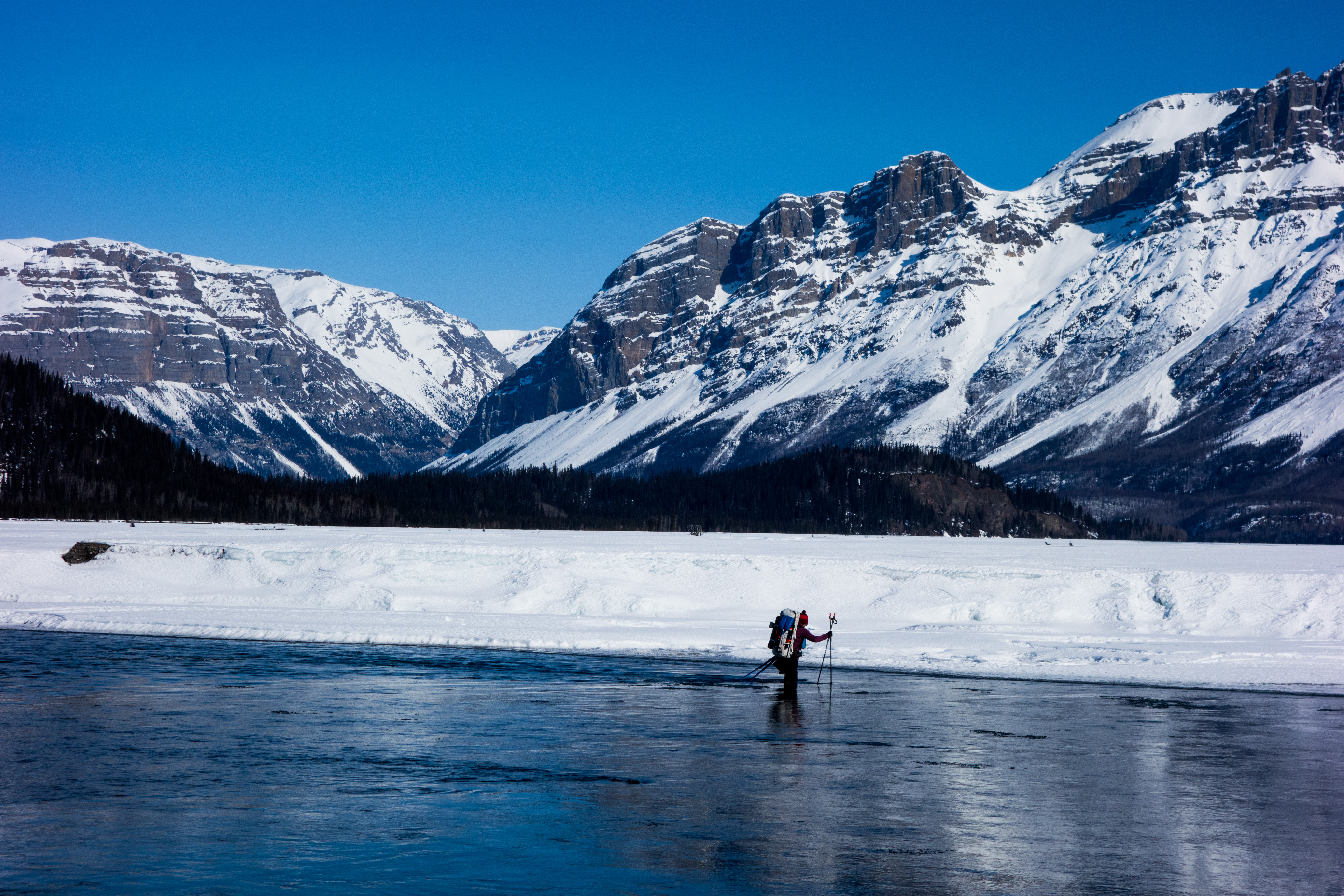
Skiers on the Nizina River outside of McCarthy on Day 1 of the AMWSC.
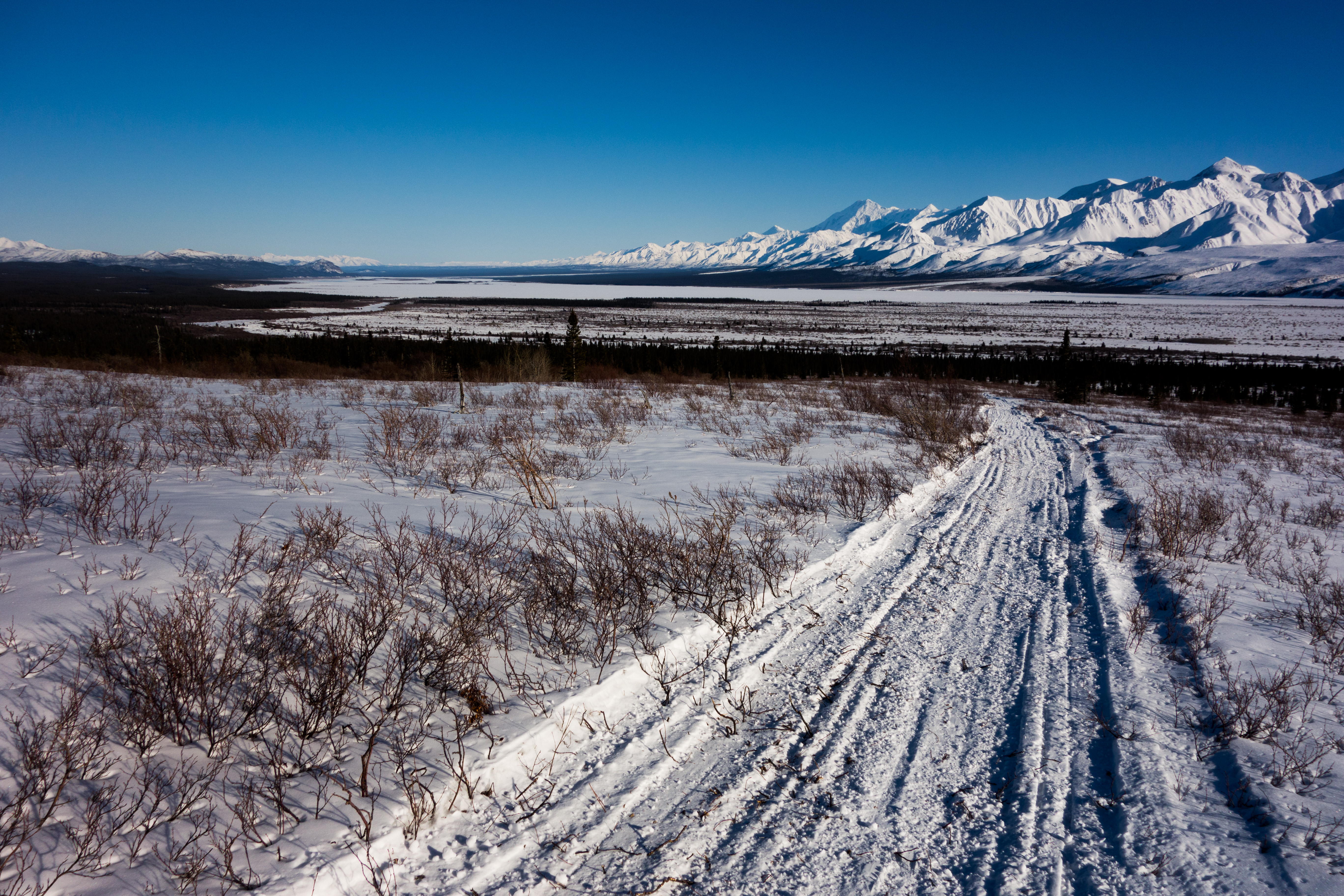
The Alaska Mountain Wilderness Ski Classic is unique. It’s a point-to-point race, through the wilderness, with no set course. It’s like the famous ‘adventure race’ format, except that none of the difficulties are contrived. The winter version of this race (there is also an unaffiliated summer version) changes course every three years.
I had been wanting to do this race since I was a teenager, but first I couldn’t get out of my college classes, and then when I got a little older and a little smarter I realized that I wasn’t tough enough for it. Last year I didn’t do it for no good reason, and as soon as I saw the photos afterward I knew that I had made a mistake. This year, finally, I entered.
The Nizina RiverA racer in the AMWSC crosses the Nizina River on the first day.
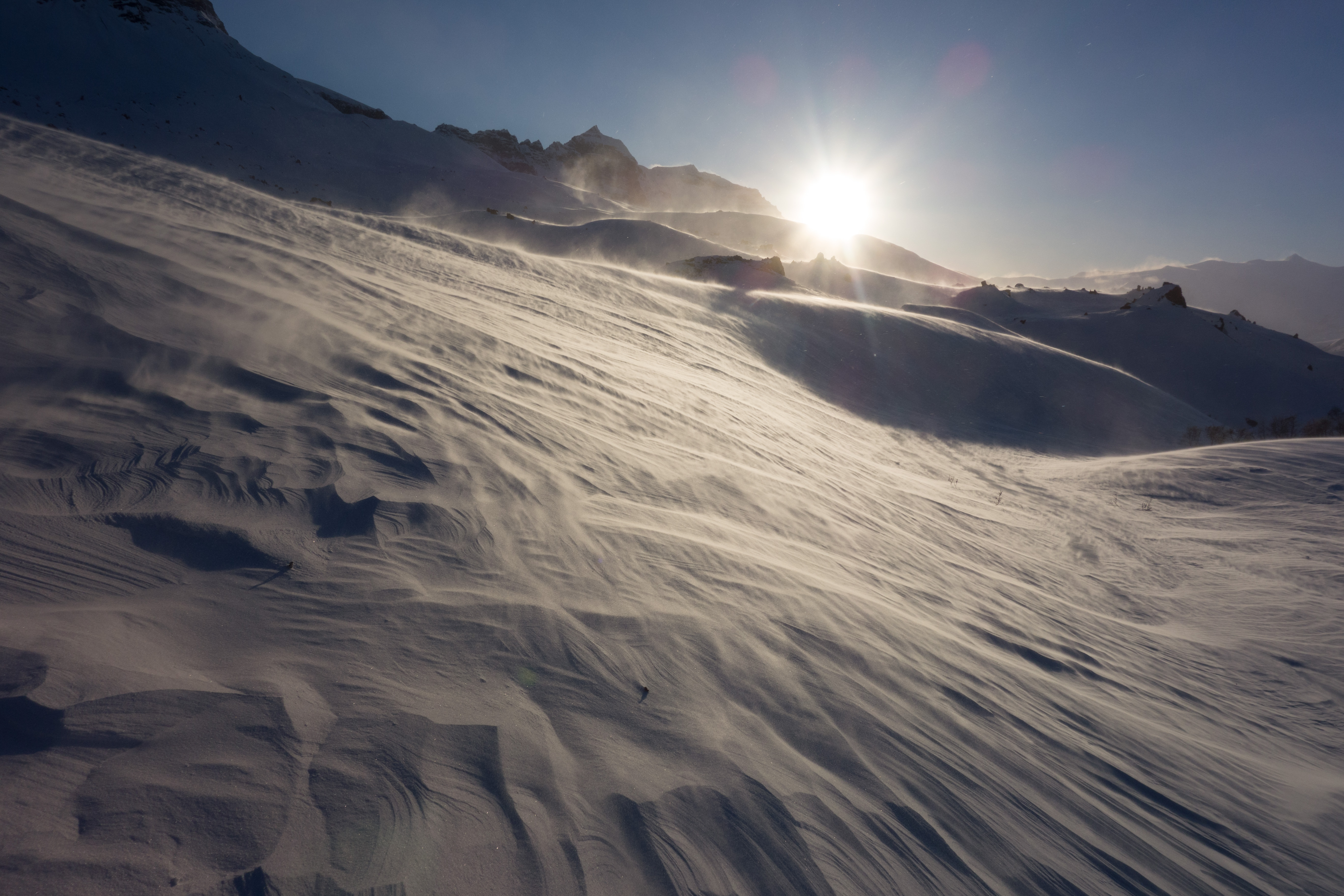
Wind, snow and sun in the upper Skolai Creek drainage.
I made it for three days and about 90 miles from March 23-25, sharing the journey mostly with a quiet guy named Miles. I learned quite a bit about Miles from his best friend after he and I had parted ways, and it seems like there was a lot he didn’t say – like that he is a world-class extreme skier (five consecutive top-five finishes at the World Extreme Ski Championships in Valdez) and that his dad Marty Raney is the star of a reality show.
The whole second day was spent skiing through a wind storm. We woke up in the wind and fell asleep in the wind. Miles and I traded leads up Skolai Creek throughout the day. Strong winds can be an intimidating thing, but my trip to Argentina had been in a particularly windy place. I was jaded and approached the day with the sort of fatalistic attitude that a whipping boy might develop.
As day wore into evening, we toured into the blowing snow across the blank expanse of Upper Skolai Creek. It seemed to me a bit like a KKK rally – nothing but all-white hatred and violence.
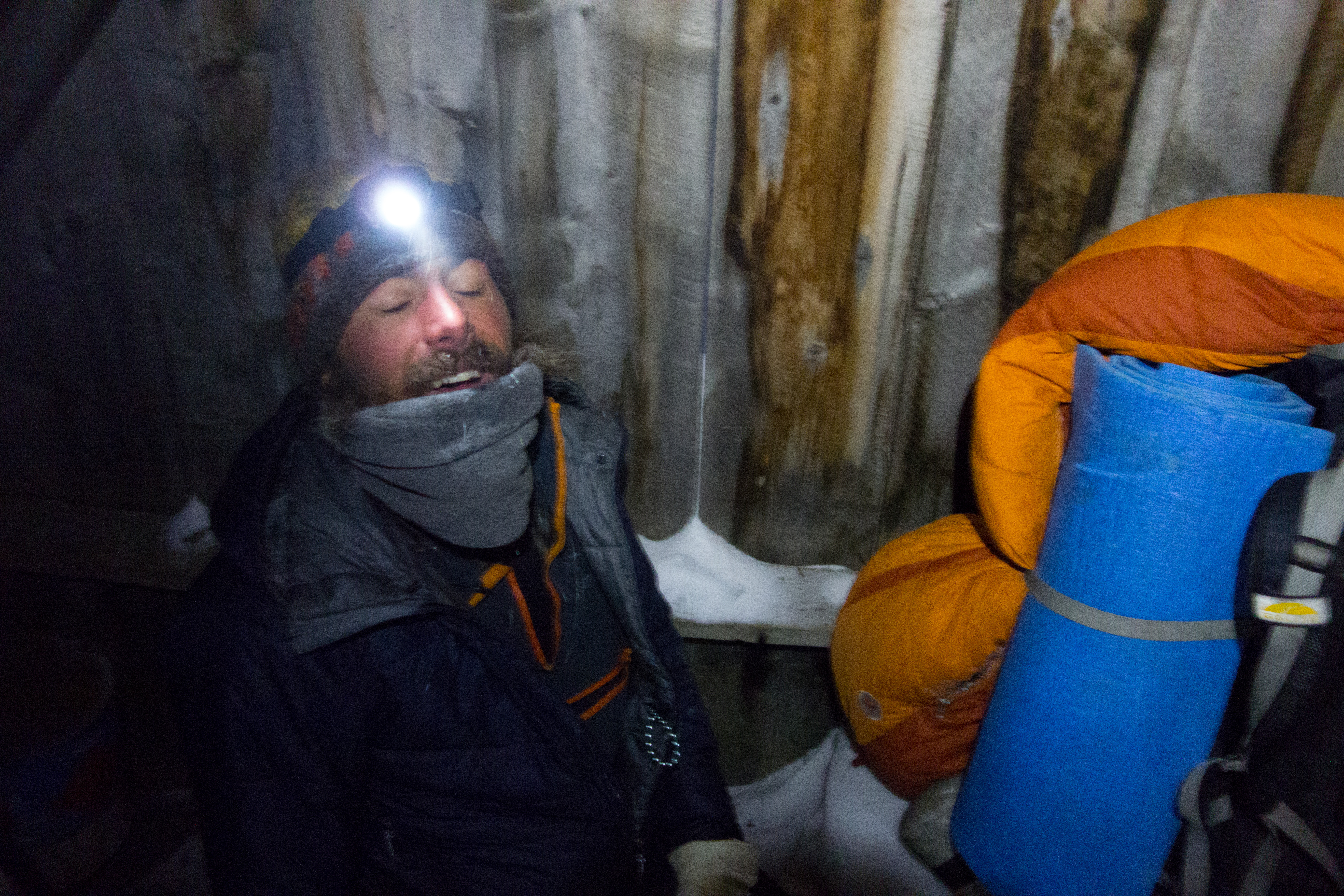
Miles Raney laughs in relief at having stumbled into a cabin during the wind storm in Skolai Creek.
Miles was ahead of me, and as darkness began to press down, I raced to catch him. I knew he didn’t have a tent, and I knew I wanted help setting mine up in the wind. I saw the possibility to cut a deal.
“DO YOU WANT TO CAMP?” I shouted through the wind.
“I WAS LOOKING AT THE MORAINE UP THERE.” Miles replied, obviously referring to the task of finding shelter and hoping to find some at the jumbled moraine of the Russell Glacier.
“IT COULD BE EVEN WINDIER UP THERE. WHAT ABOUT THESE WILLOWS WE JUST SKIED THROUGH?”
“THAT SUCKS.”
I shrugged.
“HOW ABOUT OVER THERE AT THE BASE OF THOSE PEAKS?”
Without a word, I headed where he pointed. As I closed in on a clump of willows, I saw a large rock in the dim light of the evening (I was actually still wearing my sunglasses to protect my eyes from the blowing snow).
Suddenly, the rock took a defined shape.
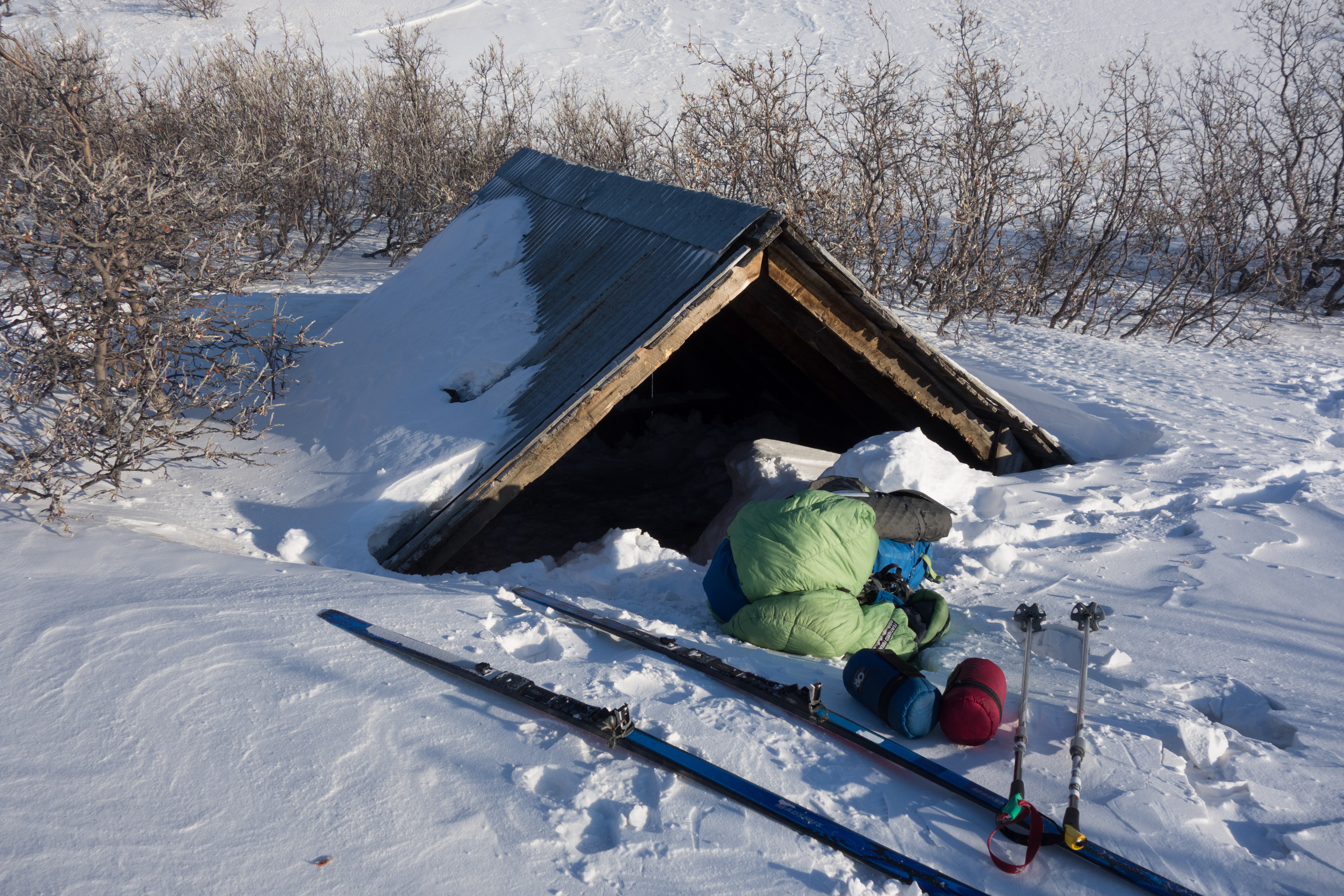
“WHOOOOO HOO!” I shouted back to Miles. What emerged from the snow was unmistakably a roof.
The cabin that made our night as seen the following morning.
It wasn’t much of a cabin, just three low walls and a roof, but until that moment I had been trying to figure how I was going to get the tent out of the bottom of my pack without all the other contents of my pack blowing away.
We slept nine hours that night.
The following day was just an upwind battle down the Russell Moraine, into the White River Valley and then over Solo Pass.
My boots, which are pieces of junk, were soaked nearly the entire race from a combination of sweat and melting snow seeping into the boots. Once the temperature dropped in the evening, my boots would begin to freeze. For example, on the second night, I was alarmed to discover that my sock was frozen to the inside of my boot. When I pulled my boot off, the sock stayed. A separate problem was that my toes were becoming numb from being crammed into the ill-fitting and soaked boots. Though my toes weren’t (especially) cold, the realization that the freezing point was so close to my insensible toes was pretty alarming. I had carried on, remaining vigilant as to the temperature of my feet.
On the third night Miles and I skied late into the night, intent on arriving at a public use cabin in the tiny “town” of Chisana (say “shoe-shanna”).
The Russell Moraine. Day 3 of the AMWSC
As I skied my feet had become soaked and painfully wrinkled, and I realized that I was cruising for blisters and trench foot.
Skiing out of the bottom of the Russell Moraine
I stopped to change socks.
The daytime high temperatures on top of the pass had been above freezing. But interior Alaska is known for strong temperature inversions, and the overnight low at the valley bottom was -18 degrees Fahrenheit. By the time I put my boots back on, they had frozen solid.
Stomping swollen, blistered feet back into frozen boots is a joy that every skier should experience at some time in their life. Frozen boots don’t bend, which means that, in order to stride, your foot is forced to move independently of the boot. If you’ve already got heel blisters, this is not an appealing option. Though I was able to skate without too much pain, pushing the metal-edged skis across the cold, squeaky snow in the middle of the night with a pack on was an effort I could only manage for moments at a time. Instead, I mostly did a quarter-mile-per-hour shuffle. Eventually, I found Miles laying in his sleeping bag in the middle of the trail.
“We’re only a mile from Chisana.” I said.
Looking down into White River from the Freight Trail over Solo Pass, connecting White River to Chisana.Skiing across the White River Valley.
“Oh?”
We debated the merits of continuing on or just crashing there (it was now very late at night). I needed a wood stove to warm and dry my boots if I was to have any hope of finishing the race. Plus, I knew that my +30F bag was not going to offer me a warm and pleasant night of sleep in temperatures that appeared to be dipping into the double-digit negatives. It was cold, and Miles agreed that a wood stove sounded good. He climbed out of his sleeping bag and we continued down the trail.
We were assured that the public-use cabin in Chisana would be easy to find. Long story short, it was not, and I regretted each and every painful footstep that I spent touring around looking for it. Miles found a cabin that was open, although it had signs up that very clearly threatened death upon anyone caught trespassing (an almost-endearing Alaskan tradition). We trespassed.
The freight trail that connects White River to Chisana.
The cabin was open because the door had been knocked in by a bear. If you’ve never seen a cabin that has been trashed by a bear, the mess that they make is both gratuitous and truly astounding. Nothing with the slightest odor of food is left in place, and, as a testament to their strength, I’ve seen full-sized refrigerators tossed across the room in what would appear to have been an off-hand gesture. They often rip the walls open for no obvious reason.
Following the bears come the mice, and following the mice come the ermine. The squirrels come and make nests out of the insulation in the walls. And following all of these comes a layer of feces covering everything. My moral dilemma about trespassing on private property was becalmed by the realization that we really couldn’t make things any worse.
The inside of the trashed cabin.
Miles sacked out almost immediately on the bed. There was a wood stove, but hardly any point in building a fire since the cabin door had been torn off. I found a cushion in the loft, a sleeping bag I could pull on over my own, and a not-too-filthy spot. I dove into my bag wearing all of my clothes. I stuck my frozen boots into my sleeping bag with me. It was nearly 5 a.m.
Around 8:30, sunlight and the sound of Miles moving woke me up. I was surprised to realize, that in spite of pounding nearly a liter of water before bed, I didn’t have to pee. This thought was then immediately interrupted by the overwhelming need to pee.
My boots were still frozen solid after a short night in my bag with me. I grunted in pain as I jammed my feet into them. I rushed to throw my leg over the ladder to descend from the loft and escape outdoors to relieve myself, and in the process felt about a half a cup of urine run down my leg. I had hit rock bottom.
The previous night I’d had to pour boiling water on my bindings to get my boots out. My bindings were now frozen solid. By this time, I realized I had very few workable options with respect to my boots. Even if I succeeded in thawing them out, I could not keep them dry. If they froze on my feet again, which they surely would that coming evening, I would basically have to camp wherever I happened to be when they froze. Then I would have to stay in my tent until my boots were thawed enough to move again. In other words, I needed to ski far fewer hours per day. With 90 miles of wilderness between me and the finish, this was a bad option.
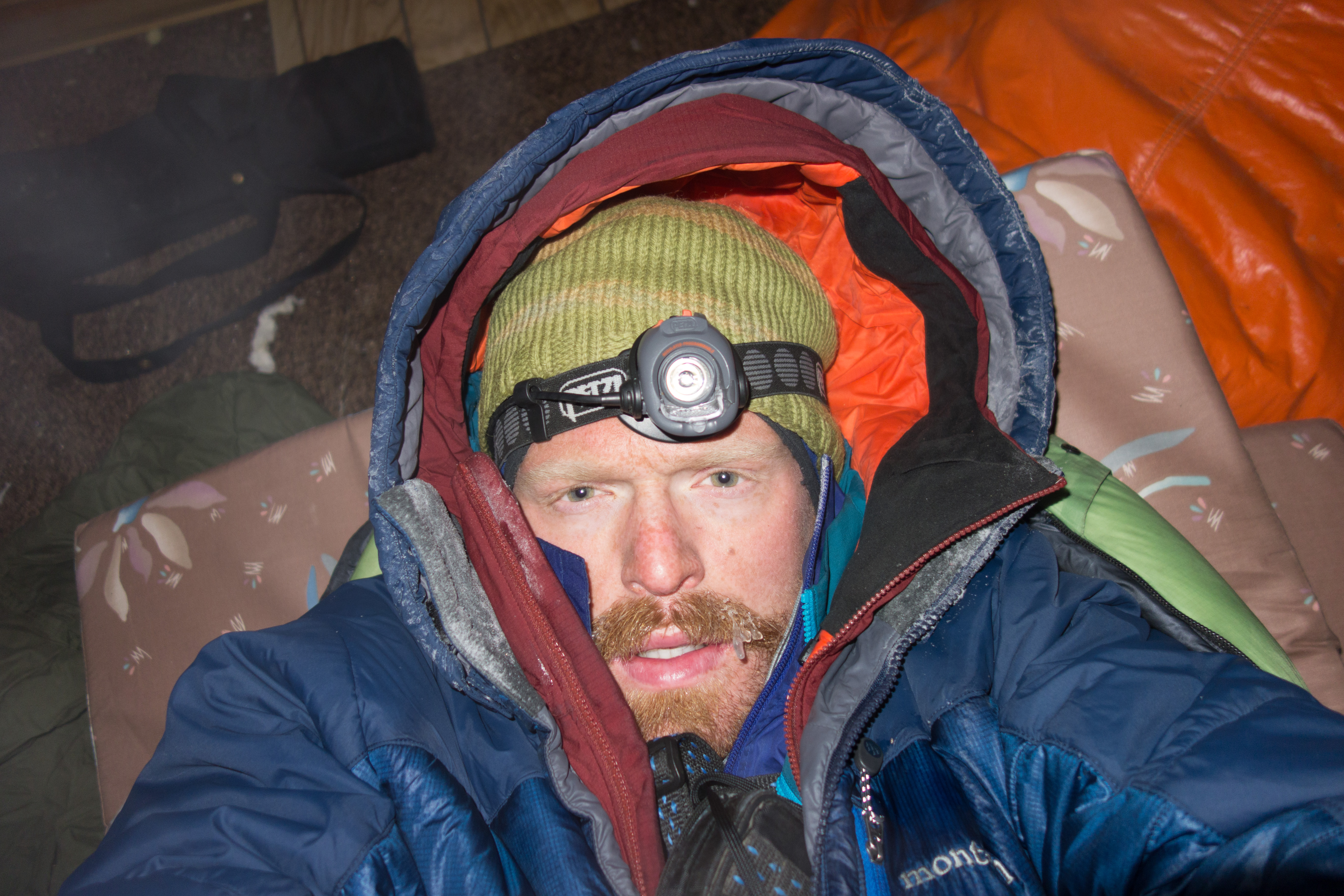
A selfie as I prepare to go to sleep in the bear-trashed cabin in Chisana.
Add the looming danger of frostbite or the chance of long-term numbness in my toes from trench foot (something I’d done before under more-innocent circumstances), and I knew I could do lasting damage to my feet.
There was an occupied-looking cabin across the airstrip that ran through the roadless town. Miles and I skied over there either to ask whether we could borrow their heat or, if not, where the public-use cabin was.
Even though it was only about 200 yards away, Miles beat me there by about 10 minutes. I was merely standing on top of my skis, rather than clipped in, since my boots and bindings were frozen to unworkability.
Miles introduced himself to the residents, and Adam, who was soon to be one of my favorite new friends, came out to see me shuffle over.
“There are pancakes and coffee inside,” he shouted at me as I made agonizingly-slow progress through the morning sunlight.
In that moment, I dropped out of the race.
After I ate all of Adam and Samantha’s pancakes and drank all of their coffee, I allowed myself to be chauffeured on a snowmobile over to the public-use cabin, which was indeed tucked away in an obscure spot. Adam and Samantha, it should be noted, are two of the nicest people I’ve ever met, and did innumerable favors for me and the other racers in the course of two days. Miles, a true hardperson, turned down the food (it is against the rules to accept outside help), but did stand by the fire for a few minutes to warm and thaw his own boots. He’d had less than four hours of sleep that night, and after less than a half hour warming his boots in Adam and Samantha’s house, he continued on down the trail.
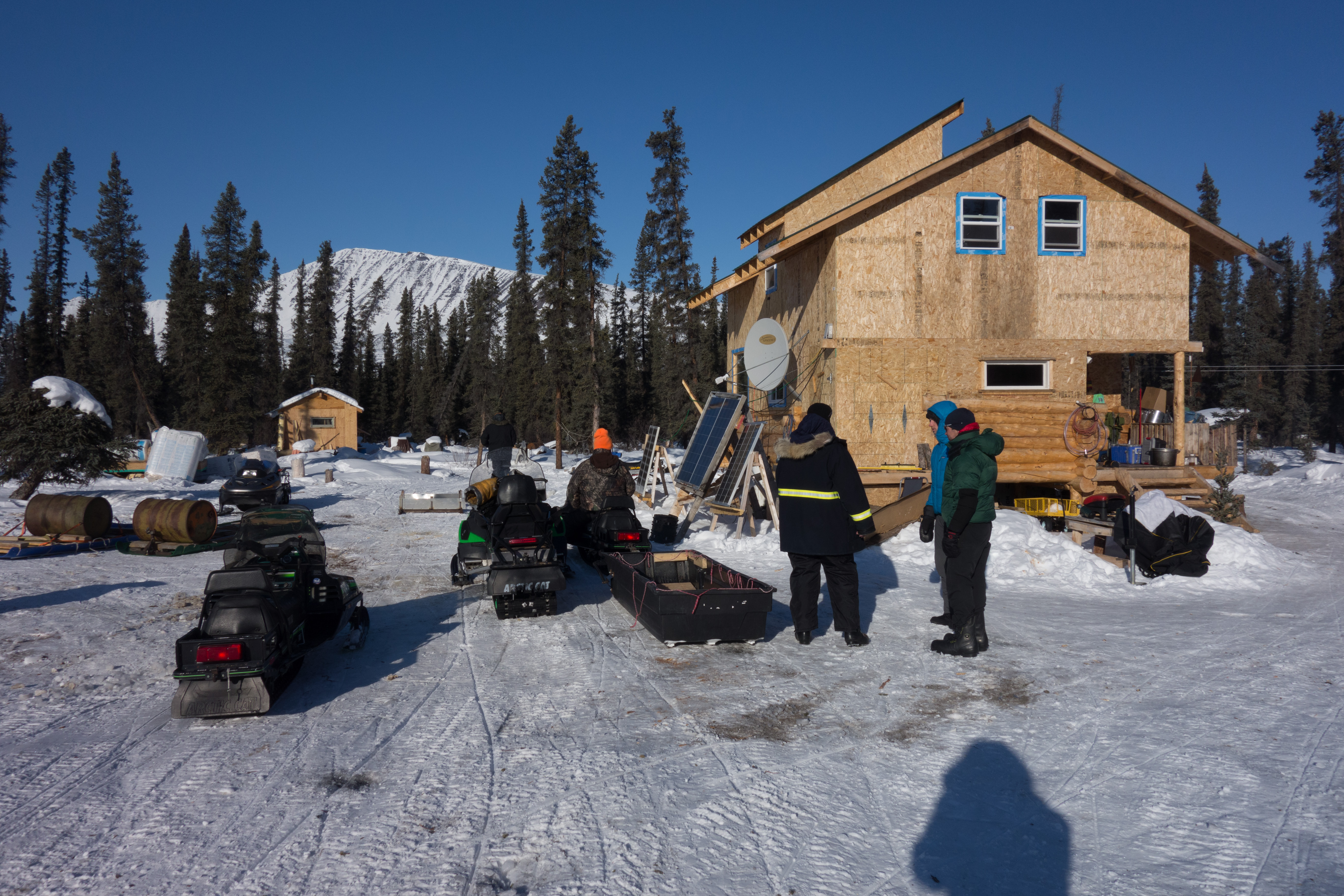
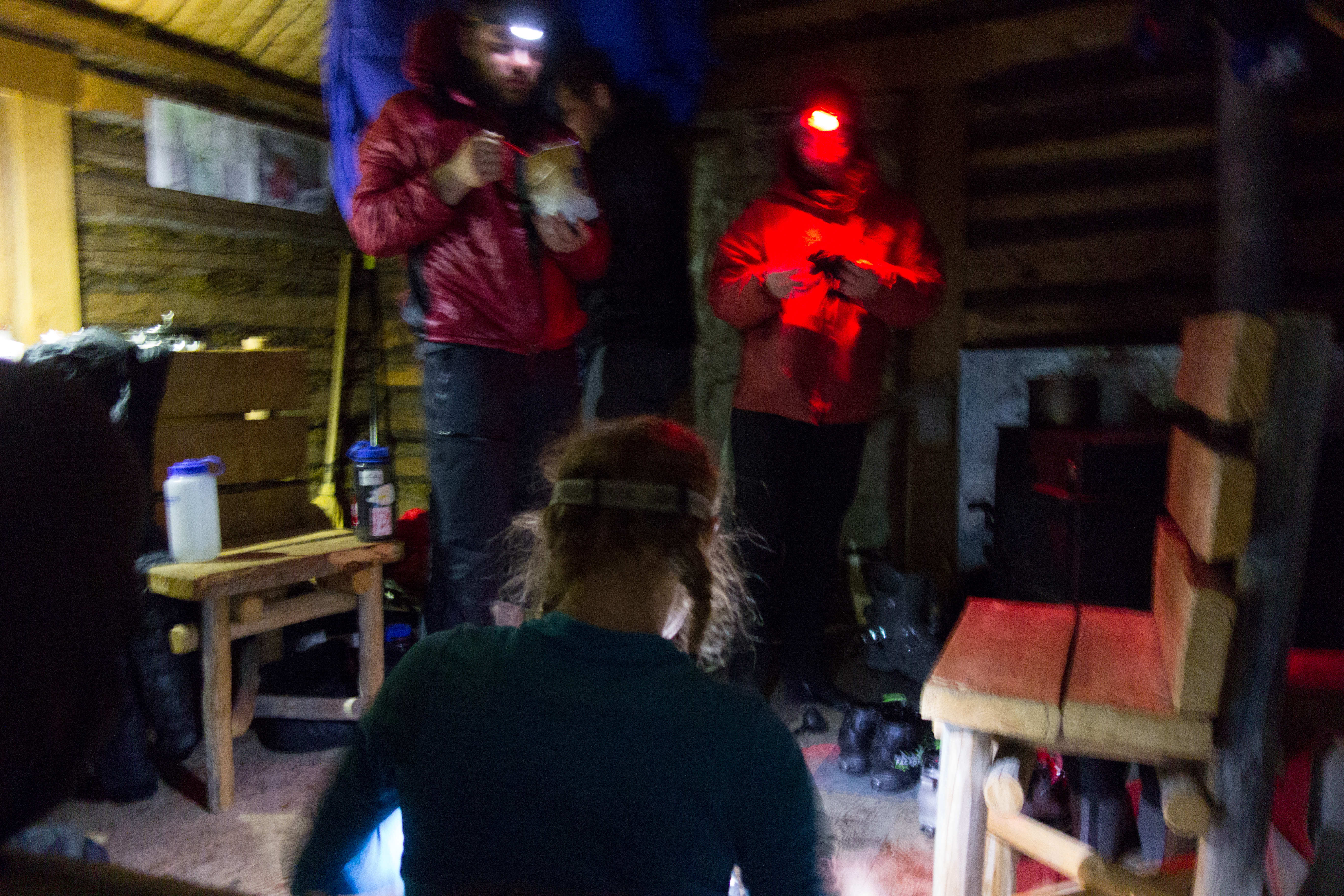
Adam and Samantha’s cabin in the “town” of Chisana.The gang in the public use cabin in Chisana.
Miles and I had been in the front of the pack that followed the Skolai Creek route. Other racers trickled in throughout the day, until there were 10 of us staying in the two public-use cabins. Three of us, excluding Miles, decided to withdraw from the race due to battered feet. Racers can accept help from other racers, and, given the “we’re all in this together” attitude towards the event, there was a party of redistribution as folks that were scratching gave extra food, fuel, batteries, band-aids, and other miscellaneous items to those that were continuing.
The damage that can be wrought by a frozen boot that no-longer breaks where it should. Photo and toe: Seth Adams
Angry feet from being crammed into wet boots. Photo: Seth Adams
The back of the author’s right heel. Photo and heel: Seth Adams
The next day, myself and the two other bailers got in a Cessna 185 and flew to Tok.
Two-and-half days later, Miles crossed the finish line as the first finisher from the Skolai route, less than an hour behind the top finishers, Team Brad Marden and Josh Mumm who finished first, followed closely by Team Andrew Cyr and Danny Powers, all of whom did shorter but more technical high-alpine routes (solo travelers cannot do the glacier routes, as crevasse falls are a real danger).
As I sat in the Cessna, wearing a borrowed pair of down booties, and flew over the empty expanse of the Wrangell Mountains, I couldn’t sit still. My feet were wrecked and my boot choice was a disaster, but the rest of me was in fine shape.
It was Thursday, and the White Mountains 100 started on Sunday. I had won a lottery spot for that race, but assumed that I would scratch since I would be wrecked after finishing the Classic. Scratching from the Classic was a bitter pill to swallow, but I began to think that the White Mountains 100 would make a nice consolation prize, indeed.
Adam and Samantha wave goodbye as I board 40-Mile Air’s Cessna 185 en route to Tok.
The White Mountains 100
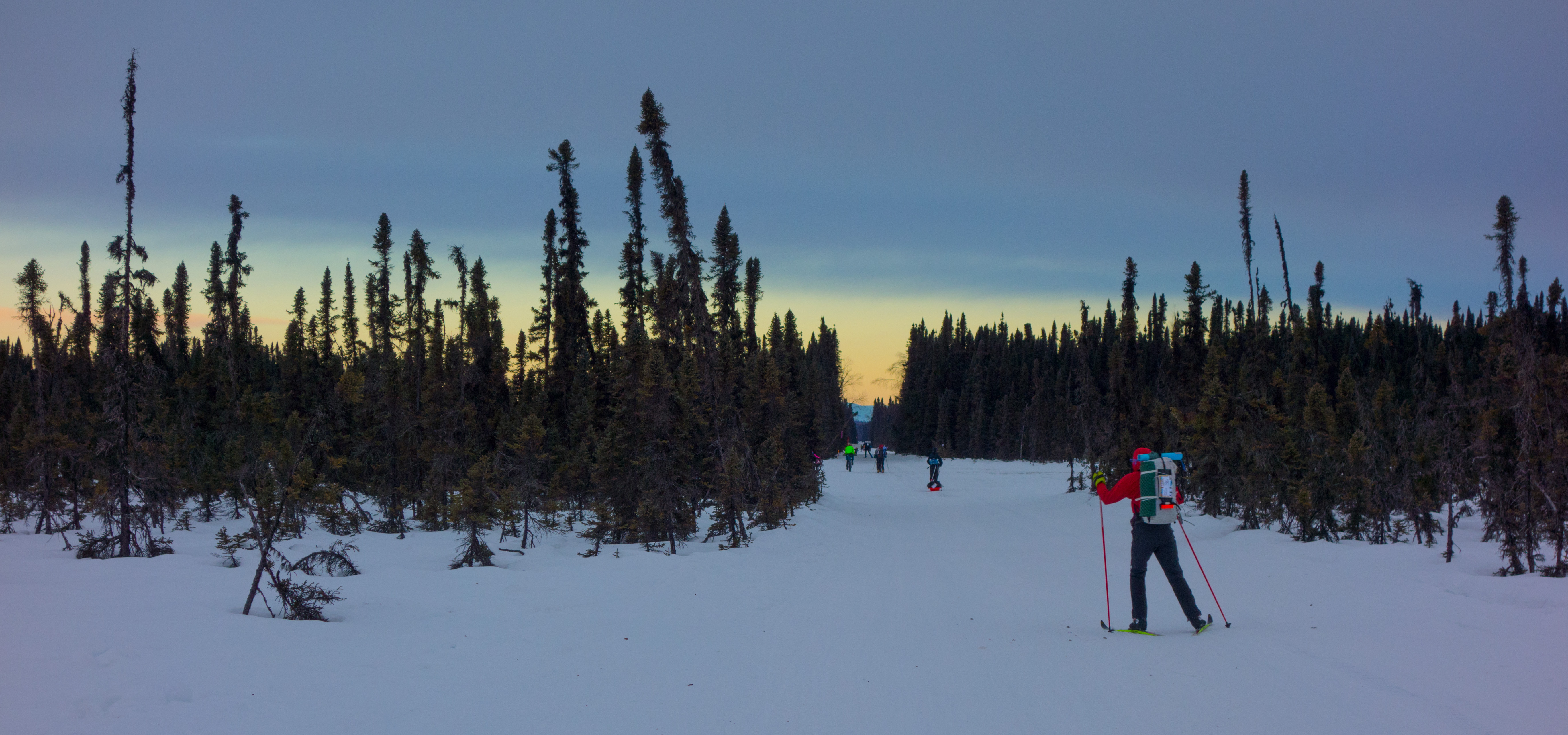
Black spruce along the trail. Admittedly, I took this photo during a training ski in spring 2013 – my race-day photos weren’t that good.Black spruce along the trail. Admittedly, I took this photo during a training ski in spring 2013 – my race-day photos weren’t that good.
Immediately after its debut five years ago, “the Whites” gained a reputation as being not only Alaska’s premier 100 miler, but really as good of a race as anyone could imagine doing. The 100-mile loop is truly remote, traveling semi-groomed trails through the beautiful White Mountains National Recreation Area. The organization of the race, under the increasingly-reluctant direction of Ed Plumb, is like an honors thesis in race organization: hot meals, warm cabins as checkpoints, hot or cold water, medical care and happy volunteers even in the most remote corner of the course make it a truly pleasant experience.
Having been a pretty dry March, the lightly-maintained trail had gotten wider than usual by the March 29 start. Last year I used classic equipment for the course, which proved to be the right choice, as it was pretty cold and everyone on skate skis had suffered in the slow conditions. This year, the course was wide and the forecast was for pleasantly warm weather. That, combined with the still-raw blisters on the backs of my heels, made me figure skating to be a much safer bet. I grabbed skate skis, combi boots, and slightly shorter-than-normal skate poles.
Unlike the Classic, the Whites proved to be a pretty uneventful race. I’m not a guy with a strong competitive streak, so in order to save energy early in the race I mostly popped my skis off and walked up all the steeper hills (for whatever reason, the trail tends to be a bit narrower on the hills, too).
I arrived at the halfway mark in the race, the beautiful Cache Mountain Divide, at about 2 in the afternoon. I took a break at the next checkpoint, Windy Gap, and then covered the next 20 miles to Borealis (these are the names of the reservable cabins in the rec area that serve as race checkpoints) in only 2.5 hours, arriving with the glorious evening sun still trickling through the trees. Given that the previous year I had arrived here at one in the morning in a snow storm, I could hardly believe how quickly the race was going.
Skiing up into the Divide. This photo was taken during the race.
Arriving at the Cache Mountain Divide on race day.
Looking towards the Cache Mountain Divide. Not a race-day photo.
A race-day photo from where the nice snowing trail enters a section of glare ice known as the Ice Lakes.
The final 20 miles are always tougher than the previous 80 put together, and this year was no exception. I battled my way to the finish line with a sense of utter futility.
“We’re almost there,” my friend Sam Herreid said as he ambled past me.
“No we’re not!” I wailed in response. “We have like five more miles!”
I finished in fourth place at exactly midnight, in exactly 16 hours. Given that the previous year I had finished in second place in nearly 23 hours, one can see what a difference conditions make.
Here I Make a Plea/Call to Action
The Whites, like the Susitna 100, is a multisport race. All of the other divisions set course records: Josh Chelf knocked almost 2.5 hours off of the bicycle record, finishing in less than 8 hours. On the women’s side, Amber Bethe broke the record set by the unbeatable Heather Best (she didn’t race this year) by finishing in 10.5 hours. Colorado visitor Joe Grant smashed more than 12 hours off of Laura McDonough’s running record, finishing in slightly more than 17 hours (likely the second-fastest 100-miler ever run in Alaska, and maybe the fastest 100-miler ever run on snow, anywhere).
For her part, McDonough beat her own record by around four hours, establishing a new women’s record. Just to keep it weird, my friend Elliot Wilson rode the damned race on a unicycle, finishing in just over 18.5 hours, in all likelihood setting a world record (if anyone has heard of this being done before, let me know).
Not a race-day photo, but this is one of the most scenic sections of trail, where you pass by the Limestone Jags.
The skiers? We didn’t come near the old records. What this means is that no one fast showed up. The men’s and women’s winners, Max Kaufman and Laura Gutierrez, respectively, are friends of mine and hopefully they’ll stay that way even after they read this. But with only 11 skiers out of 65 racers, one can only conclude that the skier turnout was a bit pathetic.
The men’s ski record is held by someone likely familiar to FasterSkier readers: Rob Whitney. At an astonishing 11.2 hours, this is a record that will put up a fight. I don’t expect the APU ski team to blow off the World Cup Finals to train for a 100-mile race through the sticks, but Alaska is filled with exceptionally talented retired racers, and they should be entering these ultra-distance races and pulling skiing out of its current slump. You know who you are, and if you don’t, I expect your friends to forward you this link in an effort to shame you.
And if you’re not from Alaska? I’ve traveled a lot, and I’ve come to the conclusion that there is no where in the world that I would rather be during the month of March than Fairbanks, Alaska. That might sound like hyperbole or the setup for a joke, but no, really, it’s true. With more sunshine than anywhere in North America and daytime temperatures that usually hover just below freezing, you can’t ask for better. So skiers? Step it up. For the love of Pete, please bump jokers like me out of the top 10.
You Too.
A lot of people’s response to the idea of entering a 100-mile race is “no way I could do that.” But you’d be surprised – it’s far more doable than it seems (after all, even I can do it). If you’re tired, but not dead, after a 25-mile ski, then a 100-mile race is probably within your abilities. Just spend some time learning your body and learning what food and pace work for you, and then the leap is much smaller than you think.
A few internet searches will turn up the races nearest you, and I think you’ll find that long races are a great format and have a fun crowd of participants, where all the other racers immediately become automatic friends. So wax up your skis and prepare to go slow!
Another non-race day photo from the Wickersham Creek area, which is near the end of the race.
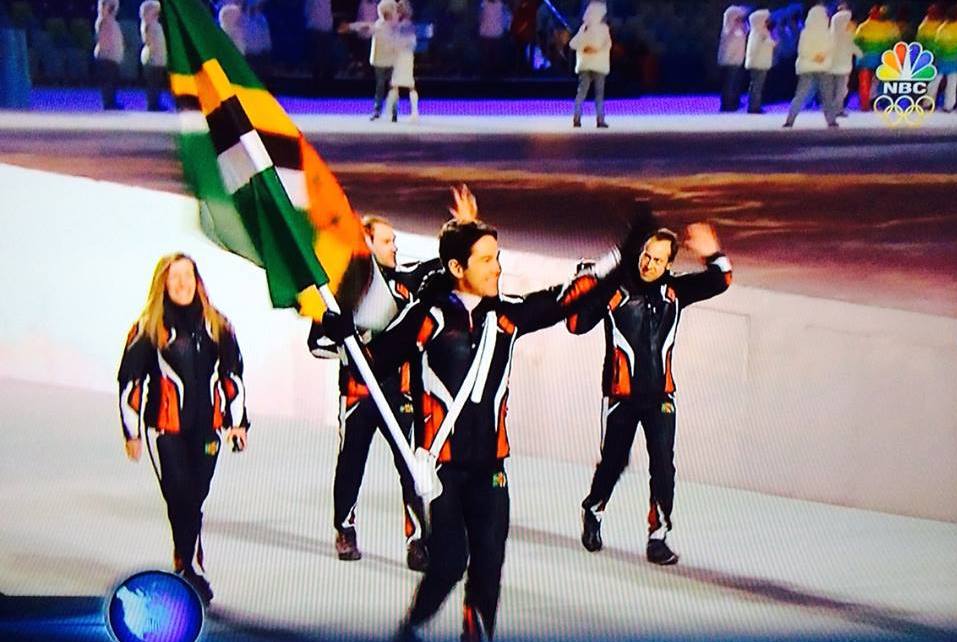
Team Dominica nordic skiers, the oldest Olympians at the 2014 Winter Games, Gary di Silvestri (with flag) and his wife Angelica Morrone (l), and coach J.D. Downing (r) at the Opening Ceremony in Sochi, Russia.
After the Olympics in late February, FasterSkier published a news blog about an American couple, Gary di Silvestri and Angelica Morrone, that represented the island nation of Dominca as cross-country skiers at the Sochi Winter Games. The post was based on allegations and reports that the couple pulled a fast one in order to get to the Games, and once there, did not compete.
We then reached out to their coach, J.D. Downing, who founded the XC Oregon nordic team in Bend, Ore., and is a well-known figure in the US master’s circuit, for his take. Downing’s frustration with the negative coverage his athletes received was apparent. What follows is an article based mainly on excerpts from his thorough response.
(Note: In the interest of writing the most-straightforward article, only Downing’s statements that pertained to the FasterSkier’s news blog were included in this article. In his original email, Downing addressed the issue of taking advantage of a loophole in the rules. A few more excerpts from Downing’s email that are relevant to the first comment on this article have been added under the heading ‘What Exactly is the Problem Here?’)
***
“You have two people that have fallen madly in love with cross-country skiing and the combination of their unbridled enthusiasm and personal resources has spread proven positive benefits far and wide in the worldwide XC ski community.” — J.D. Downing, XC Oregon head coach and Dominca Olympic coach
“I first had the pleasure to work with Gary and Angelica at the 2005 Oregon Spring Camp,” J.D. Downing wrote in an email. “Shortly after that camp they became supporters of the XC Oregon non-profit under our Friends of XC Oregon program. Gary and Angelica have been two of our many generous donors over the past eight fiscal years.
“Within the Friends of XC Oregon program, all donors to XC Oregon receive as benefits access to our XC Oregon workouts, camps, and training programs,” he continued. “So in that way I have coached Gary and Angelica for the past eight years. Beginning spring 2013 we mutually increased my time demands beyond the Friends of XC Oregon program to match the pressing requirements for Olympic qualification and the Games itself.”
What distinguishes di Silvestri and Morrone from the other wealthy donors Downing coaches was that they were attempting to qualify for the Sochi Olympics under the flag of the tiny Caribbean nation of Dominica. Forty-eight and 47 years old, respectively, at the time of the Olympics, Morrone and di Silvestri weren’t quite at the level for qualifying for the U.S. Olympic team, or, for that matter, the Italian Olympic team, as Morrone is Italian-born. (Di Silvestri is from Staten Island and the couple lives in Montana.)
The Rules
There are two separate issues on the table — what anyone chooses to think of Morrone and di Silvestri, and what anyone chooses to think of the rules they followed. Downing wrote that criticism of the rules was being improperly directed at his athletes:
“If it’s a matter of short versus long-term citizenship that bugs people, then feel free to take appropriate steps with your IOC representatives to suggest an international rule change that requires a certain period of time of holding citizenship before you can represent a country at the Olympics.
“If you have a problem with how specific nations legally grant citizenship, take it up with national leaders worldwide for the next Olympics. You know, the people that actually write and enforce laws in various countries.
“If you have a problem with how specific nations set their national Olympic participation criteria, again, please speak with the specific national leaders in question.”
Morrone and di Silvestri qualified according to the “B Standard” — nations that do not have any “A-Standard” athletes can still send one male and one female representative of each sport. However, the B-Standard qualification must still be met, which is a maximum of 300 International Ski Federation (FIS) points in order to enter the mid-distance classical races. Dominica had never previously fielded a team at the Winter Olympics, and their B-Standard cross-country ski spots were open.
“Now there’s been plenty of commentary and opinion about the level of skiing required to meet the Olympic B standard,” Downing continued. “I am perfectly OK with that conversation and if anyone is really bent out of shape about that standard then I’d encourage writing to your FIS and IOC representatives to voice your views. For example, you can argue for lowering the Olympic B standard to an average of 250 or even 200 FIS points. If a tougher ‘standard’ of the Games is your mission, those official entities are the right parties to lobby.
“But please understand just who you impact versus how little you accomplish by lowering the 300 FIS point average. The list of nationalities eliminated largely would be smaller, poorer, and/or snow-challenged. [The resulting pool of athletes will closely resemble] a typical World Cup race. So you’ll successfully make the Winter Olympics far less inclusive while changing nothing in terms of the overall pros and cons of the Olympic movement.”
How It Really Went in Sochi
The Deadspin article quoted in the article by FasterSkier had a great deal of personal criticism for the couple. Downing’s irritation with the negative coverage was apparent, beginning with the coverage of their Olympic experience:
“[That their Olympic experience was an] un-mitigated disaster is completely true. I take issue with how this Olympic experience was presented. Deadspin clearly painted the health of the athletes with a wide brush of suspicion, derision, mocking, and doubt. FasterSkier itself doesn’t exactly leave readers with an accurate portrayal by claiming Angelica just had a ‘broken nose’ and the sarcasm of Gary ‘didn’t get the memo’ on potentially tainted water.”
Downing described their untimely predicaments:
“On Saturday, February 8 Gary woke up with severe abdominal cramps so severe he could not walk nor even stand for more than a few seconds. […] Ultimately he was diagnosed […] as having a serious bacterial gastroenteritis infection. Our best guess was the water in our lodging as the culprit. The symptoms came and went for over a week. In the best of times he could ski, but felt very weak. At the worst, he was back to the day one misery and barely able to walk or stand.
“That very same morning of Saturday, February 8, Angelica and I were skiing on the race courses before the women’s skiathlon and she had a high speed crash into the fence on the exact same downhill corner of the ‘Red’ course that caused so many problems for many athletes in the early portion of the Games. In fact, the exact location of her crash was precisely where Anders Gloeersen hit the bottom of the same fence in the men’s sprint final and where Marcus Hellner and Sergey Ustiugov collided in the same race.
“Although the fence you could see on TV footage was padded, the padding ended just shy of the top metal cross bar (it’s a permanent fence). In her crash, Angelica hit her face right on that exposed cross bar which resulted in a heavy craniofacial injury with multiple fragmental open fractures. Most serious initially was the penetrated open crania-cerebral injury where surgeons were worried that bone fragments might enter her brain. She was transported by ambulance [and] quickly admitted to the Intensive Care Unit, and subsequently underwent four surgeries between the evening of February 8 and lasting until February 24.”
“The medical record regarding this crash provided by the hospital is comprehensive and without dispute. Yet the Deadspin writer actually goes out out of his way to characterize Angelica’s injuries as trivial and Gary’s infection as imagined — and in a bizarre twist insinuates they made it all up for some unspecified reason. Thus he was such a great ‘reporter’ that he supposedly uncovers pointless dirt dating back 30 years ago [including tax-evasion accusations in the Deadspin article], but he couldn’t be bothered to actually get an accurate account of one of the worst injuries to take place at the 2014 Winter Olympics? Even the accounts of Angelica having a ‘broken nose’ are horrifically incomplete in painting the true picture here. […] If you have just a broken nose, it’s painful, but rarely a serious medical emergency. Angelica’s injuries were Intensive Care Unit for the better part of a week serious. Four surgeries serious. In the hospital almost the entire Winter Olympics serious. But apparently not serious enough for accurate reporting. As I’ve already pointed out, the writer never bothered fact checking the medical realities drawing his credibility in all regards into total question.”
And as for di Silvestre’s illness?
“For Gary, his Olympic routine consisted of daily trips to the hospital to be with Angelica and dealing with the ups/downs of his bacterial infection. The morning of the men’s 15k (Friday, February 14) the abdominal cramps brought on by his infection returned with a vengeance. Even after the Endurance Village clinic treated him with every cramp-relieving medicine at their disposal, he was barely able to walk from the village shuttle to our wax cabin. […] it was literally everything Gary could do to make it around the stadium in a vain hope that Angelica could at least see him start (from her hospital bed). [The assertion that he made it] 300 meters is about right and yes, he collapsed off the track (so as not to impede other skiers in any way) before I could run around the stadium to assist him off the field of play.”
“To top off Gary’s erstwhile Olympic start, his race skis were stolen that afternoon from a credential-only ‘secure area,’ ” Downing added.
“Accountability in any writing matters. The original Deadspin account openly challenges Angelica was ever severely hurt or that Gary was ever seriously ill. Right there I don’t need any more proof that the writer in question wasn’t interested in honest and factual reporting. I know what happened to these people because I was there every second. The writer didn’t ask me. He didn’t ask the Dominica National Olympic Committee. He didn’t ask the IOC. The medical issues that confronted both Angelica and Gary were not insignificant sidebars. Any writer and any resource that doesn’t can’t get very basic medical facts straight simply cannot be trusted with anything that was alleged.”
‘What Exactly is the Problem Here?’
“It is a fact that Gary and Angelica were hardly the only athletes in Sochi with multiple past or present passports in their name. Multiple examples exist in both XC and biathlon. In several cases the athletes very openly switched national affiliation purely for athletic reasons. In many cases the athletic reasons involved a measure of direct financial gain to the athlete which is most certainly NOT the case for Gary or Angelica.
“I’m fascinated the vitriol leveled at Gary and Angelica that conveniently ignores the situations where many other athletes (including multiple medalists) gained citizenship for various nations with the clear and often admitted motive of, ‘I’ll get better support or simply have access to the Olympics if I switch to such-and-such country’. I know of no example where any athlete in these many other situations was then subject to the character assassination that Gary and Angelica have been through.
“Try as anyone might, no valid argument can be made that Gary or Angelica bumped someone else out of the Olympics. There was never going to be a Dominica Winter Olympic Team at all if they didn’t make it. They didn’t take a dime from the Dominica NOC. They covered every Olympic and National Ski Federation expense and would have happily covered more if ever required by FIS, the IOC, or Sochi organizers. The IOC and the Sochi O.C. were openly delighted they were there representing Dominica. So please tell me — what exactly is the problem here?
“Finally, I can guarantee the world that if there was any other Dominican citizen that really had a serious plan for making the 2018 Winter Olympics — Gary and Angelica would be the first in line to offer support. How many ‘legitimate’ athletes from other nations can say the same?”
Good People
Throughout Downing’s email he paints di Silvestre and Morrone as kind, generous, and hard-working.
“Both Gary and Angelica would have to be among the most impressive examples I’ve ever come across of near-total devotion to a sport. Any age. Any ability. Their work ethic is literally off the charts. More often than not I needed to warn them about working too hard or too much, which is often the case with the most motivated skiers of any age.
“Over eight years I honestly cannot think of anyone that got to know Gary and Angelica that has not expressed enjoying the positive energy that comes with being around them. But I can document a very long list of clubs, athletes, events, associations, fundraising campaigns, ski retailers, ski industry companies, websites (yes, including FasterSkier) that have all benefited from contributions, expenditures, participation, etc. by Gary and Angelica’s love of cross-country skiing.
“XC Oregon can document an extensive list of athletes, ski programs, and other worthwhile causes that our program has impacted and supported over the past eight years around the XC world. These positive efforts would not have been possible without the support of donors such as Gary and Angelica.
“In sum you have two people that have fallen madly in love with cross-country skiing and the combination of their unbridled enthusiasm and personal resources has spread proven positive benefits far and wide in the worldwide XC ski community.”
Today’s Sprint Podium in Falun, Sweden at the World Cup Finals. Ingvild Flugstad Ostberg (NOR, Marit Bjorgen (NOR), Stina Nilsson (SWE) (l-r) (Photo: Fischer/Nordic Focus)
It’s a race of “threes” between three Norwegians in the World Cup Finals this weekend in Falun, Sweden, and it’s hard to know which is closer: Marit Bjørgen’s race today where she edged her teammate Ingvild Flugstad Østberg by just under three-tenths of a second in the classic sprint, or her race for the overall World Cup Championship, where she now trails teammate Therese Johaug by only three points.
The outcome of the overall point race will have to wait until the end of the weekend, but the sprints are all wrapped up – Østberg led out of the start with Sweden’s Stina Nilsson and Bjørgen in hot pursuit. By the top of the first big hill the race had split into two groups: the Norwegians and Nilsson battling it out for their order on the podium, and Americans Kikkan Randall and Sophie Caldwell racing Finland’s Krista Lahteenmaki for fourth place.
The front group had a tough fight in the rollers after the big hill: Bjørgen made a move on Østberg, with Østberg double-poling hard to catch up. They were neck and neck, but Bjørgen held her small lead into the finish, besting her teammate by 0.29 seconds. Nilsson crossed in third (+1.39), Randall fourth (+6.84), Lahteenmaki fifth (+8.49) and Caldwell sixth (+9.86). This was Randall’s second-best World Cup classic sprint finish, following a second-place finish in Kuusamo earlier this season, and she also officially won her third-consecutive Sprint Globe, although she already had that locked-up in the points after last week’s racing in Drammen, Norway. For Caldwell’s part, this was “by far” her best ever classic sprint finish and her first time advancing beyond the quarterfinals in a World Cup classic sprint.
Norway’s Marit Bjorgen celebrates after winning the sprint at the World Cup Finals in Falun, Sweden. (Photo: Fischer/Nordic Focus)
“Neither Sophie nor I got a very fast start and were chasing the pack right off the bat,” Randall wrote in an email. “[This is] something we need to work on for sure. But once we got onto the climb we worked our way solidly into the chase pack behind the top three. Each time up the steep climb I felt like I wasn’t able to nail the technique well enough to use all my power. I was able to carry my speed off the downhill well but there was too much of a gap up to the top three for any draft. I just hammered as hard as I could the rest of the way.”
“It was exciting [to be in the final],” Caldwell said, “because I’d never even been in the semifinal of a classic sprint. My strength is classic sprinting is probably striding over double poling, so I was psyched to see a course with some good striding hills in it. The only problem with that is that it’s a really hard course, so by the time the final came around I was pretty exhausted.”
Each of the top four women, Østberg, Bjørgen, Nilsson and Randall, won their quarterfinal heats. Randall was third in her semifinal, behind Bjørgen and Nilsson, but moved on to the finals as a lucky loser along with Lahteenmaki, who was in the same semifinal heat. Caldwell was second in her heat behind Østberg, managing to edge German sprint powerhouse and overall sprint points runner-up Denise Herrmann.
U.S. Women’s coach Matt Whitcomb weighed in on his athlete’s performance.
“Sophie was a little tired in the final and Kikkan couldn’t find the climbing gear today, but Kikkan was one of the best in the field from the top of the course to the finish line, which included some descending and cornering and fast paced double poling.”
“We had exceptional skis out there, both kick and glide,” he continued, “and Kikkan just thought she couldn’t find that peak striding gear today, which some times she can and sometimes she can’t, and today that was a challenge.”
Which isn’t to say he was disappointed.
“To put four girls in the heats at World Cup finals is a big accomplishment. [The Falun sprints] have traditionally been a pretty big day for the women’s team and it was again today, with I guess four in the top 20 and two girls in the finals. It was pretty exciting to have Sadie, Sophie and Kikkan go 1, 2, 3 in their quarterfinal heat. But overall just such a tremendous end to a really successful year for Kikkan; grabbing the third consecutive sprint globe is such a big accomplishment and to finish it with a fourth place in a classic sprint is really big. I’m so proud of Kikkan and Sophie and the whole team – it’s a team accomplishment.”
The Unlucky Quarterfinal
American Sadie Bjornsen had a bit of bad luck when she found herself seeded in the same quarterfinal as her two teammates, Randall and Caldwell. In that quarterfinal Randall took first, Caldwell second and Bjornsen third.
“It’s always unfortunate when you get more than two [of us] in the same heat, because only two people move on” Caldwell said of their quarterfinal. “Our goal was just to finish top three in our heat and hope it was fast enough to be lucky loser. Unfortunately, some of the other heats were faster, so Sades [Bjornsen] didn’t get to move on.”
“It was really tough,” Caldwell continued, “because she had an amazing qualifier (she qualified fifth), her fitness if definitely there, she’s an amazing classic sprinter and she led basically the whole heat, but we just sneaked by her in the final.”
For her part, Bjornsen’s strategy had been to go for broke.
“I went out there with no strategy in mind, other than to look for openings… and that found me in the front most of the race,” she wrote in an email. “I had a good start, felt strong on all the climbs, but just didn’t have the extra gas at the end. I think it was challenging to race from the front with so much drafting out there, but again, you have to learn from every race.”
“That’s part of ski racing,” Caldwell said of her friend and teammate’s race. “She was there congratulating us after and happy for us and being a great teammate. Even though it was tough that she didn’t move on, I think she was happy for us.”
Ida Sargent also made the quarterfinals, where she finished fifth in her heat for 20th overall. During her quarterfinal she allowed a gap to open between her position in fourth and third place coming into the technical downhill.
“She missed the draft,” explained Whitcomb. “That was pretty critical if she wanted to advance to the semifinal. So she was disappointed but she was skiing fast, she’s in good shape and we’ll look forward to the pursuit tomorrow.”
A Points Race for Randall
Some other dramas will play out this weekend in the points races. Bjørgen and Johaug are just three points apart in the competition for the overall World Cup title with 1295 and 1292 points each, respectively. Astrid Jacobsen has a solid grip on third place with 974 points, but Randall is in a close race with Norway’s Heidi Weng for fourth; Weng has 791 points and Randall, with 790, is only one point behind, making Randall the top non-Norwegian in the world.
Good Day for U.S. Women
Seven American women started and four qualified (Randall, Caldwell, Bjornsen and Ida Sargent, who finished in 20th after her quarterfinal), with Jessie Diggins less than two seconds and four places out of the qualifying time.
“I was actually pretty satisfied with my race,” Diggins wrote in an email. “This is my first race and chance to do anything really hard since I got sick after the Olympics, so it felt really good just to be racing again.”
“Classic sprinting has never really been my thing,” she continued, “but it’s also nice to have some big goals to work on for next year – I’m still looking forward to qualifying in a classic sprint!”
Distance skiers Liz Stephen and Caitlin Gregg rounded out the American squad, finishing 44th and 48th, respectively.
A former U.S. national team skier, Gregg didn’t hold back in her praise for her teammates.
“I am continuously impressed by how well our USA girls are skiing,” she said. “We had four qualify and Diggs [Diggins] was right there as well, and then two moved onto the final! It’s incredible to be in this positive atmosphere!”
Tim Burke crests a hill in today’s 10 k sprint in Kontiolahti, Finland. (Photo: US Biathlon/NordicFocus)
The winds were calm and the course was wet today in Kontiolahti, Finland, for the IBU World Cup. With unseasonably warm temperatures officials had to heavily salt the course, which provided for firm if wet conditions. Perfect shooting and the stamina to continue skiing strong as the course deteriorated would be necessary to win the day, and Norwegian Johannes Thingnes Bø delivered, shooting clean and skiing the course in 23:33.2. The perpetually-on-the-podium Frenchman Martin Fourcade was second 7.1 seconds later after also shooting clean, edging Germany’s Arnd Peiffer (+7.2), who barely missed overtaking Fourcade after a receiving one penalty in prone. Peiffer was the only finisher in the top ten to receive a penalty, and one of only two in the top 15.
Russia’s Dmitry Malyshko was fourth (0+0), Norway’s Ole Einar Björndalen was fifth (0+0), and Czech Ondrej Moravec was sixth (0+0).
Canada’s Nathan Smith was the top North American, finishing 21st in 24:38.6 (0+1), followed by teammate Brendan Green in 26th (1+0).
Green was happy with his race, writing in an email that though he felt “a bit flat” initially, he “managed to ski a fast last loop to move up quite a few places to end the day with a fairly solid result. [I’m] not sure what was up physically but it seemed like it took the body a while to get going today. We’re at the tail end of a long season so at this point I’m trying my best to finish out the season with strong and consistent results.”
American Lowell Bailey (1+1) squeaked into the top 30, tying for 29th with Switzerland’s Serafin Wiestner (0+0), followed by fellow American Tim Burke in 35th (0+1).
Burke was surprised by what he regarded as a poor finish.
“I was pretty happy with my performance today and I expected a good placing, but the results said otherwise,” he wrote in an email. “I felt good on the skis and with one penalty I expected to be close to the top ten but I was far back from this. I’m not really sure what happened and where I lost so much time. I am just happy that we don’t have a pursuit based off this race!”
Rounding out North American racers were American Leif Nordgren in 55th (0+2) and Canadian Scott Gow in 59th (2+0).
Competition continues on Saturday with another sprint.
Hannah Dreissigacker shoots to a best-ever World Cup 28th-place finish. (Photo: USBA/Nordic Focus)
There was a gentle breeze and it was unseasonably warm when the women started racing this morning in Kontiolahti, Finland. The well-salted course was firm but very wet, with standing puddles in the snow that racers had to ski around. That didn’t stop Canada from putting three women in the top-30, including two in the top-15, and the US from putting two women in the top 30. Canada’s Megan Heinicke and the United State’s Hannah Dreissigacker were 15th and 28th, respectively, both posting best-ever World Cup finishes.
Finnish hometown-girl Kaisa Makarainen took first place in spite of one penalty in standing, out-skiing her competition and finishing in a total time of 20:36.3 on the 7.5-kilometer course. Russia’s Olga Zaitseva was second (+6.1) and another Finn, Mari Laukkanen was third (+22.7). Both women shot clean. Tora Berger of Norway was fourth (0+1), Russia’s Olga Vilukhina was fifth (0+0) and the Czech Republic’s Veronika Vitkova was sixth (0+0).
The Canadian squad showed strong depth, placing three women in the top-30 with two in the top-15. Rosanna Crawford was the top North American woman, finishing 1:05.8 off the pace to take 13th, with one penalty in prone. Heinicke was 15th (1+0) and Zina Kocher was 23rd (1+1).
Heinicke was relieved to have all the parts of her training line up on the same day, having just beaten a lingering post-Olympic cold and having not had her best shooting in a number of recent races.
“It was so much fun to feel strong again!” she wrote in an email. “I always tell myself that if I race like I train – just get out there, enjoy it and do my job – and everything will be fine, and that is what I was able to do today. My general feeling is: Thank goodness I finally pulled it together!”
Kocher was pleased with her performance, but had a bit of bad luck.
“Unfortunately I had the worst luck with the wind and had to wait for the gust to die because it was too strong. I hit four out of five prone but it wasted a lot of time.”
Though they didn’t rival their Canadian counterparts in the standings, the US team had two breakout performances: Dreissigacker’s best-ever World Cup finish in spite of one penalty in prone, and Susan Dunklee, just behind Dreissigacker in 29th, using her post-Olympic fitness to post her fastest-ever splits. Unfortunately, she was foiled by “extra mistakes” in the shooting, causing her to earn a penalty in prone and three in standing.
“I have been working on being more assertive in the aiming process by trying to use the bolting motion to land on the next target,” she explained in an email. “Unfortunately today I didn’t give myself time to fully settle the barrel on the target before taking the shot. It is a small detail to fix, but one that caused a some extra mistakes.”
Dunklee posted the second fastest course time, behind only winner Makarainen.
American finishers were rounded out by Annelies Cook in 75th (1+4) and Sara Studebaker in 80th (3+3).
World Cup competition continues Saturday with another sprint.
Norway’s Marit Bjørgen celebrates after winning the 30 k classic in Holmenkollen on Sunday. (Photo: Fischer/Nordic Focus)
Norway’s Marit Bjørgen crushed the field in the women’s World Cup 30-kilometer classic on Sunday in Holmenkollen, Norway, beating teammate Therese Johaug by nearly two minutes. Bjørgen is the first woman to win four Holmenkollen 30 k’s and Sunday also marks her 100th World Cup podium.
Bjørgen finished in 1:20:55.7 hours, and Johaug placed second, 1:41.2 behind. Finland’s Kerttu Niskanen took third (+2:25.8). Sweden’s Charlotte Kalla of Sweden finished fourth (+2:46.6), Finland’s Aino-Kaisa Saarinen was fifth (+3:08.9), and Sweden’s Emma Wiken, placed sixth (+3:17.8), completing a Scandanavian sweep of the top six. Kalla held third place early in the race before being passed by Niskanen. Wiken briefly held fifth place ahead of Saarinen around the 22 k marker, but by 27.5 k Saarinen had taken it back and held on until the finish.
“I felt much better than last week,” the 25-year old Johaug told FIS of her race. “I am happy to be second today. Marit was much stronger than me, I did not have chance.”
Marit Bjørgen on her way to winning the 30 k classic in Holmenkollen today. (Photo: Fischer/Nordic Focus)
Kikkan Randall was the top American in 12th (+4:17.4), followed shortly after by Sadie Bjornsen in 14th (+4:27.8). Rounding out Americans were Liz Stephen in 32nd, Sophie Caldwell in 35th, Caitlin Gregg in 39th and Ida Sargent in 42nd. No Canadian women started.
Johaug, the current World Cup points leader, had the #1 bib. However, by 2.7 k Bjørgen had pulled into the lead, then gave the lead back to Johaug for a few kilometers before returning to the front. Both Bjørgen, Johaug and the Swedish Kalla opted to change skis after the second lap, while the Finns used the same skis for the entire race. Bjørgen’s skis consistently worked well for her, but Johaug struggled fell behind after the 10 k mark before switching at 13.3 k.
“I was struggling with grip skiing up to Frognerseteren,” Johaug told FIS. “I tried to focus on myself when Marit went away. I was little bit worried that Kerttu and Charlotte are coming from behind to catch me.”
Bjørgen held a steadily growing lead all the way to the finish. Her lead was such that at the last feed station she was handed a very large Norwegian flag which she waved all the way into the stadium. A tired-looking Johaug finished shortly after, and she and her victorious teammate embraced.
“It’s good news for us older skiers that it just keeps getting better with age,” the 31-year old Randall said of the 33-year old Bjørgen.
This brings Bjørgen to a 39-point deficit to Johaug in the World Cup overall standings. With 300 points to be doled out in next week’s World Cup Finals in Sweden, the final outcome is anyone’s guess.
Jacobsen takes a nasty spill
A bad crash by Norwegian Astrid Uhrenholdt Jacobsen around the 7.2 k mark dampened the mood in Norway, with Jacobsen suffing a concussion and substantial bruising after veering off the trail on a downhill and colliding into with a padded post. Her injuries were sufficient to require hospitalization. She apparently slipped while going fast into a corner and slid underneath the course fencing, where she hit the post. This is one more blow in what has been a tough season for Jacobsen, including the sudden death of her brother just before the start of the Sochi Olympics.
Randall told NRK that she was skiing near Jacobsen at the time of her crash. She said that they both charged into a corner that most of the competition was snowplowing into, but that “it all went wrong for her.”
The women’s podium in today’s 5 k classic at the 2014 NCAA Championships in Soldier Hollow. In first is Anja Gruber (UVM), second is Sylvia Nordskar (DU) and third is Eva Severrus (UNM). (Photo: Bert Boyer) All proceeds from photo sales will be directly donated to NNF.
FasterSkier’s coverage is made possible through the generous support of Madshus.
Anja Gruber didn’t surprise anyone but herself when she claimed the top spot in today’s 5-kilometer classic NCAA Championships at Soldier Hollow, Utah, hosted by the University of Utah. The humble 22-year old junior at the University of Vermont (UVM) repeated her victory from last year by skiing the course in 13:38.4.
Conditions on the course were fickle, with only bare ground to be seen around the course, which was composed entirely of artificial snow. Temperatures were in the 50’s, with many skiers racing in shorts and short sleeves. That didn’t put a damper on Gruber’s enthusiasm, however.
Anja Gruber (UVM) skis her way to the win in the 5 k classic at the 2014 NCAA Championships. (Photo: Bert Boyer) All proceeds from photo sales will be directly donated to NNF.
“It’s pretty exciting,” she said, without a trace of her native German accent. “After last year I wouldn’t have expected that I could do this again. I knew I was in good shape and I knew my classic skiing was pretty good, and I like this course and I knew that if my skis are good and I have a good day I can have a good race. But having a good race and winning are two different things, so it’s really really exciting.”
Her performance allowed her to best 20-year old Sylvia Thorson Nordskar (+9.3), originally from Norway and a freshman at the University of Denver (DU), and 21-year old Eva Severrus (+22.6), originally from Slovenia and a freshmen at the University of New Mexico (UNM). Nichole Bathe, an 18-year old freshman at the University of Alaska Fairbanks (UAF) finished fourth (+29.3). Bathe is originally from Madison, Wisconsin.
Nordskar said she wasn’t feeling that well, coming off of illness.
“It was an okay race but not perfect because I’ve been sick for two weeks, and in those conditions I did a good race and I’m very happy with a podium,” she said. Her team is also in the lead, something that Nordskar could hardly be happier about.
“I think both the [DU] guys and girls won today, so that is so cool! So fun! I really enjoy skiing here – we are a team and we have so much fun together.”
Severrus only arrived at UNM in the beginning of 2014, and has obviously already made her mark in the ski program there. It has also made its mark on her.
“Awesome result, awesome season behind me. I’m real happy with these results,” she said. The race was an interval start, and she skied the course alone.
“Hammering all the time.” She said.
Gruber’s race strategy was a bit more nuanced, but even after the race she seemed a little unsure of what she did.
“I though that it was going to be a really fine line between pushing it too hard on that first hill and being too cautious. I tried to go out pretty hard but maybe not that hard,” she said, her tone indicating equivocation. “I guess it worked.”
Sylvia Nordskar (DU) skis her way into 2nd place in the 5 k classic at the 2014 NCAA Championships. (Photo: Bert Boyer) All proceeds from photo sales will be directly donated to NNF.
“Honestly, I felt really good,” she added, “which doesn’t happen so often, and so it’s really exciting [when it does]. I caught the girl in front me pretty fast, so I was like ‘whoa whoa whoa, watch out,’ but then you get a whole lot of rest [on the downhill] and I was being pretty careful [so I just decided to keep going].”
Asked about her plans for Saturday, Gruber aimed high.
“I think we didn’t have the best day as a team [today], and I think we’re gonna want some redemption for that. I know we’ve had really good skate races as a team and I think it’s the most exciting thing to race with my two favorite teammates.”
Nordskar, for her part, felt the same as Gruber. But in classically Norwegian fashion, she was direct:
“I want to win!” She blurted, but quickly adopted a more cautious tone. “But first I have to be healthy, and relax now. I’m glad there’s no race tomorrow so we have one day. But just to go and have fun and hopefully we have three girls in the front.”
U.S. teammate Kikkan Randall (l) and Sophie Caldwell (r) celebrate the first U.S. double podium in last Saturday’s World Cup skate sprint in Lahti, Finland. (Photo: Fischer/Nordic Focus)
It could have been a disappointing day for American Kikkan Randall.
She was in the semi-finals of the World Cup Drammen City Sprints in Norway. Her skis were lightning quick – her best high-pocket klister skis were giving her perfect kick on the uphills, but she was still able to “glide through the pack on the downhills.”
And move through the pack she did. She started conservatively, fifth out of six in her heat. Then on the main downhill of the 1.3-kilometer course she reached speeds of nearly 50 k/hour, advancing through the pack. The enormous power which has made her a feared competitor in international skiing moved her into second-place on the uphill that followed.
The all-out striding sprint up to the finish looked like it was being played in fast-forward as skis clattered across the snow. Norway’s Ingvlid Flugstad Østberg was in front. Randall in second. But Sweden’s Stina Nilsson was moving, unbelievably, faster than Randall. There is a final, short, steep uphill to the finish. Ostberg crossed first. Randall lunged, but Nilsson lunged more, crossing the line a heart-breaking two-hundredths of a second ahead of Randall, eliminating her from the finals.
“Less than a toenail in front,” as the Eurosport announcer put it.
“Definitely frustrating!” Randall said.
But that was the last of the bad news for Randall.
“Within a couple of minutes I had walked inside to change into a dry shirt, and someone came running in and said ‘you won the Sprint Globe!’ I just said ‘What? What are you talking about?’”
No mistake. The points had been calculated. Since the World Cup final sprint in Falun, Sweden are part of a mini-tour, they only award half points. This meant that no matter how the final sprint turns out, her closest competitor, Germany’s Denise Herrmann, could not make up the difference. Randall’s lead was unimpeachable. She would take her third-straight Sprint Cup Championship home with her to Anchorage.
“but… that’s sprinting, man”
“Racing in Drammen is always really exciting because you’re in the middle of a city, you’ve got tons and tons of fans out there and all the fans know who you are, so it’s a great atmosphere,” Randall said. “Today I knew it was important to fight for the Sprint Overall so I was definitely anxious coming into the race, but I felt really strong and my skis were good so it was a great day to get in there and mix it up.”
Randall definitely looked like a contender throughout the race. Her powerful double-poling made passing some of the fastest women in the world look easy.
“I definitely knew that it was close [at the finish]. I could feel that we were all kind of neck-and-neck. Ingveld [Østberg] was just a half a stride ahead of us and then I could tell someone was coming. So I was just trying to give everything I could to the line, and just that last little pitch before the finish is always kind of funky, so I tried to lunge the best I could, but… that’s sprinting, man – it’s always really exciting all the way to the line, you just gotta keep giving it all the way.”
Randall and Nilsson had to wait on the outcome of the photo finish to learn who would advance to the next round. It wasn’t until after the end of the next heat that Randall found out that she would not advance to the finals, and would end up in seventh place, the top spot for a non-finalist.
“I knew it was close,” she said. “Too close to call.”
“I had a great quarter-final and actually a great semi-final too, just unfortunately was 0.02 seconds too short to make the final. That was kind of a bummer because I felt like I was getting stronger every round,” she continued. “I was feeling really good and I wanted the chance to go one more time around. And then watching how the final played out… I mean, the girls that I was right there with were on the podium so it would have been great to try to go for another classic podium. I think I definitely had that within my reach today so it was a bummer to miss out by such a close margin.”
“you’re grumpy and a little bit frustrated but that good news makes it a little bit better.”
Missing the sprint final in Drammen by such a tiny margin was a bitter pill to swallow. Such tiny discrepancies in sprint racing are psychologically difficult for the athletes.
“You know, a margin like that is the difference between a slightly better foot lunge – small things, like that,” said U.S. Ski Team Coach Matt Whitcomb. “So it’s really easy to think back as an athlete on what could have been a little bit different. But clinching the third-straight globe certainly swallowed-up that distraction.”
How did the Sprint Globe factor into Randall’s own goals for the season?
“This year was really focused around the Olympics, so the Sprint Cup was kind of a secondary goal, but it was something that I still very much wanted to fight for,” she said.
Randall is fresh off of a disappointing Sochi Olympics, where she was widely-seen as a favorite for a sprint medal, but was eliminated in a quarterfinal stacked with tough competitors. But last weekend in Lahti, Finland, she proved that she was still a force to be reckoned with, taking the top spot in the skate sprint, her forte.
Randall has proven that she’s the toughest sprinter in the world three years in a row. So what happened at the Olympics?
“I think certainly my form was not where I wanted at the Olympics,” she said. “I already have a different feeling [in my body]. I think coming back down from altitude certainly helped. You know, we spent a lot of time at altitude getting ready for Sochi and I think that maybe we didn’t get the balance quite right, and so I didn’t have quite the right capacity that I wanted up there.”
“But I also know that I’ve done a lot of racing now,” she continued. “I’ve raced four races at the Olympics, two last weekend, and I think that has just kind of sharpened me again. It’s always a bummer when the Olympics has already come and gone but it’s great to feel like I’m ending the season on a high note, and I’m looking forward to fighting it out in a few more races.”
How does Randall’s third-straight Globe resonate for U.S. skiing in general?
“It’s really, really big,” Whitcomb said. “The first one was record setting and proclaimed that we’d arrive at least with one great athlete. Now it’s saying ‘we’ve arrived, and we’re here to stay.’”
Andy Newell of the U.S. Ski Team skied to a 23rd place in Saturday’s qualification round of the 1.5 k freestyle sprint in Lahti, Finland. After losing both a ski and a pole in his quarterfinal, he finished 25th. (Photo: Fisher/NordicFocus)
Another strong field of Americans took to the trails in Lahti, Finland today for the women’s and men’s World Cup 10 and 15-kilometer skate races. Conditions on the course were tricky, with loose, sugary snow over ice, with the added complication fresh snow falling during the women’s race.
The top three spots in the women’s race were taken by Norway’s Marit Bjørgen in 25:05.3, followed by Sweden’s Charlotte Kalla (+26.9) and Norwegian Therese Johaug in third (+27.6). The men’s race was won Norwegian powerhouse Martin Sundby in 33:05.5, with Daniel Richardsson of Sweden taking second (+10.7) and Russian standout Alexander Legkov taking third (+11.2).
The US’s top performance was turned in by Kikkan Randall, who finished 21st in 26:41.6 (+1:36.3), with legs still somewhat tired from her win in Saturday’s sprint. Distance-specialist Noah Hoffman sat out Saturday’s sprint, and used his fresh legs to get the top-US men’s spot and the second-best finish for an American, skating his way to 24th place in 34:37.8 (+1:32.3).
Liz Stephen was the second American in the women’s race, taking 32nd place (+1:53.7), followed by Holly Brooks in 44th (+2:25.5), Caitlin Gregg (+2:30.5) in 46th and Jennie Bender in 76th (+7:16.8). Ida Sargent did not start.
Erik Bjornsen was the second American in the men’s race, coming in 51st place 2:33.9 behind Sundby. Bjornsen was not happy with today’s race, saying that after skiing so much at high altitude in Sochi he was not accustomed to the low altitude of the Lahti venue. He wrote in an email that he finished the race “not tired,” and that he needed to push harder, particularly in the first 5 k. Reese Hanneman, making his debut on the European World Cup circuit, was 73rd (+3:19.5), and Sylvan Ellefson was 79th (+3:30.7).
The American skiers are preparing the continuation of a busy travel schedule, with the next a World Cup sprint in Drammen, Norway on Wednesday and men’s and women’s 50 and 30 k races on the weekend in Oslo. World Cup Finals are the following weekend in Falun, Sweden. Randall is excited for “that time of year where we just race and recover now.” Bjornsen thinks that he is in good shape and believes that he can improve his results in upcoming weeks of racing, and then will return to Anchorage for SuperTour Finals at the end of March.
Matt Liebsch (Team Strong Heart/Team Birkie) skiing to the finish in 2011. Photo: Flying Point Road.
It’s difficult to pigeon-hole cross country ski racers into making predictions.
Of those asked, University of Vermont standout Scott Patterson was the most forthcoming about his prediction for the outcome of the 50-kilometer 41st American Birkebeiner this weekend, one of the premier ski marathons in North America and part of the Worldloppet series. He admitted that while he was rooting for his sister, Caitlin Patterson of the Craftsbury Green Racing Project (CGRP), he thought that the other Caitlin – defending champ Caitlin Gregg of Team Gregg – was the favorite.
“Caitlin Gregg has shown she is above the field in domestic skate races this year. With that, and intimate knowledge of the course, she will be hard to beat,” he wrote in an email.
“Hopefully my sister will surprise me,” he added.
But then again, it was easier for Scott Patterson to make predictions, since he won’t be racing, as the collegiate schedule conflicts with the Birkebeiner. Plus, as a college skier, “the large prize money appeal is moot since I can’t accept it. Instead I will test out my 50 k skills later on at [SuperTour Finals] in Anchorage.”
For her part, Gregg was reluctant to say.
“I have no idea how the race will unfold until it does,” she wrote in an email. “I will say I am excited to ski on the Birkie trails again, though,” she added, including a smiley emoticon in her email.
Though Scott Patterson and Gregg seemed to agree on a favorite in the women’s race, there was no such agreement on the men’s race: Patterson picked Sun Valley’s Matt Gelso or Team Homegrown’s Sylvan Ellefson for a strong showing, giving Ellefson the edge if it comes to a sprint.
For what it’s worth, Ellefson, fresh from the Battle Creek SuperTour, would have liked to agree, but couldn’t quite.
“I would like to bet on myself for the win, but seeing as my best finish is 10th, my goal for the Birkie is only to better that result,” he wrote in an email. “It is rumored that many Europeans will also be joining us which always keeps the excitement factor high in the elite wave. I know the Europeans coming over are quite strong, but I’ll put my money on an American to win.”
It is more than just rumors suggesting that some strong Europeans will be in the field. Former World Champion Martin Koukal of the Czech Republic will be there, as will Italy’s Fabio Santos, among others.
Gregg, on the other hand, made it clear that she was playing favorites.
The Birkie is not only about the prize money. Photo: Darlene Prois
“All I can say is that I hope Matt Liebsch has an awesome race! I will always pick Matt to win!”
Liebsch returned the favor and picked Gregg for the win, though he said that on the men’s side it was a toss-up of “any one of about 10 dudes,” adding that he liked his own chances. Gelso, in an email, largely agreed with Liebsch, but added that there were “15 guys that have a legitimate shot for the win, and another 10 who have an outside shot.”
“But,” he added, “someone is going to win and I will be doing my best to be that someone.”
No matter the predictions, the excitement among the racers is palpable.
“I am really looking forward to this giant ‘family reunion’ of Cross Country Skiing,” Gregg said.
Indeed, the Birkie is the premier loppet in North America, with over 13,000 skiers competing in the different events. And, thanks to a winner’s purse of $7,500 and cash prizes down to $1,000 for sixth place in the marquee event, the 50 k skate, some of the world’s top marathon skiers will be in the mix.
“I am so excited about the Fast and Female Event on Sunday!” Gregg wrote in an email. “We are going to have an awesome turnout! Hopefully 70+ gals!!! I think the best part about Fast and Female is that no matter how tired or sore you are, it all seems to fade away when you start seeing so many little smiling faces!”
When asked if she thought that any of the youngsters might beat her in a sprint after her big race the day before, she said that “Birkie or no Birkie, I bet there are a few speed demons out there who could get me in a sprint.”
Patrick Caldwell leads a group of skier’s in Friday’s 10-kilometer freestyle race in Craftsbury, Vermont, as part of the USSA SuperTour. Photo courtesy John Lazenby / lazenbyphoto.com
Craftsbury, Vermont hosted the USSA SuperTour this weekend under blue skies and on top of firm tracks, with racers calling it “the best conditions of the year.” The three days of racing comprised women’s and men’s 5 and 10-kilometer freestyle races (respectively) on Friday, a 15/20 k classic on Saturday, and Sunday Sprints.
Friday’s Interval-Start Skate
On Friday Caitlin Gregg showed that she is a dominant skate skier, starting hard and holding it through to the finish in the 5 k, finishing first in 13:50.8. Caitlin Patterson (+42.9) found herself in a race for second with Erika Flowers, who took third just 1.6 seconds behind Patterson (+44.5).
“I haven’t felt quite as good this weekend as I had hoped to going into it,” Patterson wrote in an email. “Caitlin Gregg started only 15 seconds behind me and caught me within 1.5 k, proceeding to drop me by about 2 k into the race. She was skiing with very high tempo and extremely well. Her final time was 43 seconds faster than mine, which is a painfully large margin for a 5 k. I struggled to hang on and make it to the finish, and I consider myself pretty lucky that I found just enough energy to hold off the other girls who were just seconds behind in the final results.”
Flowers was happy with her race, and was excited by the extra competition offered by Gregg’s presence on the course.
“I just tried to focus on really accelerating throughout the 5 k loop, skiing smooth and then hammering the tops of the bigger climbs. I had no idea how my time was when I finished since most of the faster girls were behind me, but I felt good and was excited to be on the podium! Caitlin Gregg still had a runaway win but its great for the rest of us to have someone challenging us and helping us get to that next level.”
Scott Patterson (Caitlin Patterson’s brother) took first in the men’s 10 k, leveraging his familiarity with the course for all it was worth.
“Sections out in the depths of the course determine the placing, and I know exactly which parts and how to ski them to win the race” he wrote in an email. “I was also focusing a bit on some of the things that I recognized as potential areas for improvement during [the U23 World Championships in Italy]. By combining all of that on a course that I like and know how to ski well, I think I made it pretty tough to post better splits than I did.”
Indeed, it proved too tough for any of the other racers to post faster splits him, and he won the race with a time of 24:54.2. Raphael Couturier skied his way into second 27.2 seconds later, and Dartmouth College freshman Patrick Caldwell took third (+49.6).
Caldwell said that this weekend was about “being with the team and getting [his] feet back under [him] after travel.” Indeed, it was his only race of the weekend, as he wanted to focus on recovery.
Gregg and Scott Patterson were asked on Friday to make a prediction for Saturday’s interval-start classic race; Gregg picked Anya Gruber as the winner, singling her out as an “amazing classic skier.” Patterson, on the other hand, picked himself.
“I don’t like publically predicting places of races that I am in, but I am feeling pretty confident,” he wrote in an email.
His confidence was well placed, as he handily won his second-straight race. Gregg, for her part, ended-up besting Gruber, but she could not out ski Rosie Brennan, who won the 15 k race in 47:55.8. Gregg was 19.2 seconds back, while Gruber took third (+58.2).
Gregg was graceful about her missed prediction, however, writing that “I felt like I skied one of my best classic races ever today, my skis were great again, my energy was great and I even felt strong double poling! Rosie skied a fantastic race and I am very impressed! She is tough and talented!”
Brennan was uncertain about her pacing for the race, but she seemed to make it work.
“I wasn’t sure how to pace given that we don’t do individual 15km very often, if ever. But the skiing in Craftsbury is amazing right now, perfect, soft, cold snow so I figured that if I just enjoyed the skiing and kept moving things would work themselves out. After the first lap, I was getting splits off of Caitlin Gregg that we were tied and throughout the 2nd lap my splits were varying between being up a little, down a little, and tied. I knew it was going to come down to the end, so I just went for it the last lap and things turned out well. I was excited with how I skied because I have not been pacing myself well this season and I finally felt like I nailed it. I have also struggled in classic, but with the tracks as they were today, it was impossible to not just love classic skiing.”
Scott Patterson’s time-to-beat in the 20 k was 55:21.9, while Reese Hanneman battled his way to second (+22.9) and Welly Ramsey was third (+55.5).
Hanneman’s Saturday performance was redemption from a disastrous ski on Friday, where he finished 78th.
“I’ve been at home in Alaska since Nationals, training quite a bit, and I am feeling super tired,” he wrote in an email on Saturday. “I figured I would be pretty flat yesterday, but did not anticipate it would be that bad.”
But that wasn’t all:
“I also realized today that I raced yesterday’s skate race with my classic poles, which would explain why my back was killing me, and why I had multiple coaches tell me my technique looked horrible.”
He was able to pull himself together for Saturday’s race, though.
“I just tried not to think about yesterday too much, and just went out and […] just tried to do my thing. It was nice to have the right poles today too!”
Sunday’s Sprints
On Sunday racing wrapped up with sprinting, bringing exciting spectator action, in spite of reduced competition – the sprints were not an NCAA event, so many of the collegiate skiers did not participate. Third-place Caitlin Patterson summed up Sunday’s racing:
“Today was an exciting day of racing in Craftsbury,” she said in an email on Sunday, “after two individual start races, it was certainly fun to have a sprint and give the spectators head-to-head racing to watch. I think many of the competitors, myself included, were starting to feel the physical toll of the past few days of racing, but there was some pretty high speed skiing out there anyway.”
Caitlin Gregg returned to the top of the podium, followed by Jennie Bender and Caitlin Patterson. A surprise entrant into the top six was 18-year old Gatineau, Quebec native Sophie Carrier-Laforte, who finished 5th after making it into the finals.
“I don’t think I knew who she was before this weekend,” Caitlin Patterson said of her young rival, “but she certainly has some impressive sprint speed. It was great to have someone unexpected to challenge the rest of us US SuperTour skiers. The men had even more challengers, with quite a few fast Canadians down here for the weekend.”
None of those Canadians were able to get on the podium, however, as Sam Naney took the top spot in the sprint in a big victory for him, Dakota Blackhorse-Von Jess took second, and Reese Hanneman took third.
“I was pretty tired from the previous hard training and two consecutive distance races,” Hanneman wrote in an email. “But I was content with the qualifier, and then felt okay in the heats. I tried to break away in the final on the big climb, but couldn’t get enough of a gap and then Sam and Dak took it into the line a little faster than me.”
Looking Forward
Many of the racers said that these races were an exciting way to continue their preparation for the remainder of the spring racing season, particularly the remainder of the SuperTour races.
The SuperTour circuit continues next weekend in St. Paul, Minnesota.
The Canadian Olympic Cross-Country Team at a press conference on Thursday in Sochi, Russia.
SOCHI, Russia — “Without a core group of friends like this, at the ripe old age of 31, I probably wouldn’t be sitting here.”
Devon Kershaw spoke for himself at the press conference held by the Canadian Ski Team in Sochi today, but you wouldn’t know it. Whether they’re leaning on each other as friends, or grabbing onto the coattails of the older racers and trying to hang on, the Canadians depend on one another.
“It’s called the World Cup circuit, but really it all happens in Europe and Scandinavia” said Alex Harvey, a 25 year old beginning his second Olympics. “We spend so much time on the road in hotel rooms – Christmas, New Year’s, and most people’s birthdays. Our teammates are more than just teammates, we’re a second family.”
“What some people don’t understand is that when we pack up in November, we don’t go home until late March or early April,” Kershaw added. “I spend close to 200 days on the road every single year. To share that with good friends, it’s hard to even describe how important that is for longevity and high performance.”
For the Olympic veterans, drawing on the experience of an Olympics at home – Canada’s best Olympic performance ever – has been invaluable.
“Canadians know so much more about the winter sports because of 2010,” said three-time Olympic veteran Chandra Crawford, 30. “We had all of these resources […] because of that big push to have the most successful Olympics ever, which was a big boost for our team. I feel really excited to be at my third games, and see the full circle of having been the rookie on the team and now getting to connect it to the next generation.”
Canada’s veteran skiers have certainly had their work cut out for them. From the late 1980’s until the 2006 Olympics in Torino, Italy, Canada didn’t put a single man on the podium in a major international race.
“It was quite the drought,” said Kershaw of that time. “People would say, ‘oh, so you’re going to go to the Olympics and that will be fun, and then you’re going to go to school and do something else because no Canadian men can do well in cross country skiing.’ It took a lot of stubbornness to keep going. And self-belief. We’ve always had a really really great core group of men, and I’ve been really fortunate for that.”
“But it’s been a really inspiring ten years – wow, it’s amazing how fast it’s gone by,” he continued. “It took a lot of hard work and dedication and a group of really like-minded individuals together who just wouldn’t take no for an answer.”
“Devon has [blazed a trail],” the Harvey said of his older teammate. “I’m really lucky because when I came onboard the team the team was already always in the top 30 – there were guys who got on the podium once or twice a year. So it was just natural. I could have a different approach even for my first World Cup. Rather than fighting for top 50, I was trying to be in the top 10. But mostly I think just mentally for me, the fact that George Grey, who is retired now, and Ivan [Babikov] and Devon have been on the podium a couple times before, I thought it was possible for me, also, to be on the podium, even though I was a first or second-year senior.”
“This is only my third day of Olympic experience,” said Heidi Widmer, 22, “but […] I have Chandra [Crawford] in the room and also Beckie Scott […] showing me the way, so I just have to do my best to keep up.”
For Canadians skiers Ivan Babikov and Dasha Gaiazova, these Olympics have extra meaning: both are Russian born, and veterans of the 2010 Olympics in Vancouver. Babikov was born in Kozhva Komi Republic and competed for the Russian National Team in his first Olympics in 2006, gaining full Canadian citizenship in 2007. Gaiazova was born in Moscow, and immigrated to Montreal in 1999 with her family.
“I feel really special about this,” Babikov said. “Two Olympics in a row and both in my home countries. I don’t know if many athletes have done this before. Of course I’m really excited to be here. I’m enjoying every day of it.“
“This will be my third Olympic Games,” he continued, “and in terms of comparison, I just don’t think you can compare Olympic Games to each other. Every one is different and they have their own best sides and their down sides. But Vancouver was great, the greatest Olympic Games. Sochi, for now, I think all of us feel really welcome here and everything has been so great so far.”
“It is obviously really different to compete in Russia than in Canada,” Kershaw said of his own perspective. “But the Olympics in themselves are always a big deal, and when you get off the plane you always know that you’re at a big event. Those big giant rings are just slapping you in the face as you get out of the airport.”
Yet, even for an experienced international racer like Kershaw, the Canadians don’t miss a chance to learn from each other.
“I think it has been really really fun for me personally to share the journey to Russia with Ivan and Dasha,” he said. “Kind of getting the straight goods on how it’s going to go and everything. And also just seeing how excited they are. Having shared that home Olympics with them in Vancouver and then seeing them do it again now, it’s making it a really, really cool experience.”
As the Canadians work together to get the most out of these Sochi Olympics that their bodies can give, they know that they’ll have each other no matter how it comes out.
“You share in all the victories together, and we help each other through the defeats and the hard times together,” Kershaw said, speaking, it would seem, for the whole team.
If the junior women are a harbinger of things to come, then, with three women in the top 30, Canada’s future looks bright. Canada’s best result in Wednesday’s Junior and U23 World Championships was delivered by Katherine Stewart-Jones, who finished 15th in the junior women’s 1.2-kilometer sprint. She was followed by Dahria Beatty, who finished 20th, and Sophie Carrier-Laforte, who finished 28th.
All three women advanced to the quarterfinals. The fourth Canadian junior, Anne-Marie Comeau, was 52nd.
“I was super excited with how things turned out today,” Stewart-Jones wrote in an email. In spite of a rough start to the quarterfinal, she moved into second place over the top of an uphill, saying that she “managed to squeeze in the side.”
But bad luck struck again, and she was passed by two skiers on an uphill after taking a corner too wide. But the race was not over.
“The German girl fell right in front of me, and, after losing my balance, I was able to stay on my feet and pass her.” Stewart-Jones poured the power into what she described as “really good” skis. “I free skated the last flat and almost caught up to the second girl. I was about one second from the lucky loser spot.”
In spite of alternating good and bad luck, Stewart-Jones was delighted with her performance.
“I was still extremely excited about today. I did not expect to make top 15, but I am satisfied for sure!”
Continuing the strong performances of Canadian women, U23 Heidi Widmer delivered a solid performance on the 1.2 k course, making the quarterfinals and finishing 19th. Teammates Olivia Bouffard-Nesbitt placed 34th and Cendrine Brown was 36th in the qualification round.
The top Canadian U23 man was Andy Shields, who finished 39th in the qualification round on a 1.5 k course, followed by Knute Johnsgaard in 42nd, Patrick Stewart-Jones (older brother to Katherine Stewart-Jones) in 50th, and Sebastien Townsend in 53rd.
“Conditions were rock hard which is not good for me,” Shields wrote in an email. “If it was mushy I would have qualified.”
Foster Agnus was the top junior man, finishing 45th in the qualification round, with Scott Hill and Ricardo Izquierdo-Bernier coming in 50th and 51st, respectively. Benjamin Wilkinson-Zan was 64th.
The Canadians have all been in Europe for nearly two weeks getting acclimatized to the different time-zone and to life in Europe. The transition to life in Europe has been easy for the young skiers, according to Shields.
“The event organizers here are very experienced which make it easier for us athletes because there were no extracurricular hassles to deal while we’ve been here.”
Looking forward, Katherine Stewart-Jones was excited about what her team of young women might have to offer this rest of this week.
“I am excited about the team relay because I think we have a strong group of junior girls this year and I can’t wait to see how we will do!”
But her attitude is far from wait-and-see:
“With such a strong field, I am going to be thinking: every second counts!”
Bryan Fletcher (U.S. Nordic Combined) jumping to ninth on Day 2 of the Nordic Combined World Cup Triple in Seefeld, Austria. Fletcher improved to sixth in the 10 k. (Photo: Fast Big Dog)
Billed as the premier nordic-combined event of the season, the first-ever Nordic Combined Triple ended up being a perfect platform for American Bryan Fletcher to produce his best results of the season. From Jan. 17-19 in Seefeld, Austria, there were three consecutive days of competition with a total of four competition jumps and three races of 5-, 10- and 15-kilometers on Friday, Saturday, and Sunday, respectively.
“Simply put, I was happy with all three of my races this weekend,” Fletcher wrote in an email after he ended up a season-best fifth overall. “Each day I improved a bit and ended with perhaps my best performance on Sunday!”
Bryan Fletcher at last year’s World Championships in Predazzo, Italy.
He has plenty of reason to be happy, skiing his way to a season-best sixth in Friday’s opening prologue, ranking 11th in the jump and skiing the 16th -fastest 5 k to finish 25.2 seconds behind German winner Eric Frenzel, who won all three races for the Triple title.
Fletcher repeated his performance on Saturday, with the ninth-best jump and 10th-fastest 10 k time to place sixth (+57.4 behind Frenzel), and then improved one spot in Sunday’s pursuit-style competition to finish the weekend in fifth (+47.6), after the seventh-best jump and seventh-fastest 15 k.
It has been a season of steady improvement for Fletcher, with this weekend’s results in Seefeld putting him into 11th place in the overall World Cup standings, tied with Lukas Klapfer of Austria, which makes Fletcher the top-ranked North American.
Fellow U.S. Ski Team member Bill Demong also had a strong weekend, finishing a season-best eighth (+27.0) on Friday with a 17th ranked jump and a 12th-fastest ski, despite breaking a pole in the 5 k. On Saturday, Demong ended up 12th (+1:39.6), with the 20th -best jump and eighth-fastest ski. On Sunday, he wrapped up the Triple in 11th , after jumping to 22nd and starting the 15 k race 3:42 minutes back. Demong skied the third-fastest time of the day, making up nearly two minutes to finish 1:54.7 back from Frenzel. Demong’s strong results come despite some bad luck, with Friday’s broken pole “costing him a podium opportunity,” and a “not great” jump on Sunday putting him farther behind for the race.
“Even though I had my best race of the year on Sunday I was only able to move up to 11th place,” Demong wrote in an email. “I like that [the distances] changed every day but certainly my strength is in longer distances,” he continued. “It was awesome to do 15 k again, though!”
Billy Demong at 2013 World Championships in Predazzo, Italy.
The weekend’s results put Demong into 22nd in the overall World Cup standings, tied with Austria’s Mario Stecher.
Frenzel won each race of the weekend and finished in first overall, extending his lead in the overall World Cup standings. Haavard Klemetsen of Norway finished second (+21.2) in the Triple and fellow Norwegian Magnus Moan placed third (+29.1).
Both Fletcher and Demong were pleased with the new race format.
“I like that it is different, it adds pressure with the mini-tour format I hope they continue offering new events like this,” Demong wrote, while Fletcher called it a “nice change of pace from our normal schedule.”
Both skiers also felt that the increased importance of skiing, due to the longer distances, catered to their strengths.
“The distance increase each day made the competitions progressively harder and allowed the stinger skiers to show their strength” Fletcher wrote in an email. “Each day it was easy for me to improve. Our training is concrete and so each day I felt better than the previous day.”
When asked how Seefeld’s results will translate to the coming Olympics in Sochi, Russia, both skiers became a bit more circumspect.
“I don’t think this weekend’s results are anything suggestive,” Fletcher wrote. “The Olympics are a different animal and anything can happen.”
Demong is cautiously optimistic, saying that preparations were going well. “I’ve had my best jumps in years, maybe ever, but I need to get it out in competition for sure. Cross country is going well and I’m looking forward to putting on the finishing touches and peaking!”
Both skiers are training in Park City, Utah, and will head to Germany shortly before the Olympics to train and break up the travel. They will focus on speed work to train and create a fitness peak just in time for the Olympics. They head to Sochi on Feb. 6th. Both men are optimistic, but Fletcher is the more cautious of the two.
“I think that the best is yet to come,” Demong wrote, “I like that, while I’m not the favorite, I’m on everyone’s radar.”
“We will just have to see what happens when we get there,” Fletcher wrote.
Americans Taylor Fletcher and Brett Denney competed on the first day of the Seefeld Triple, finishing in 56th (+1:54.5) and 63rd (+2:37.1), respectively, just outside the top 50 required to advance to Day 2.