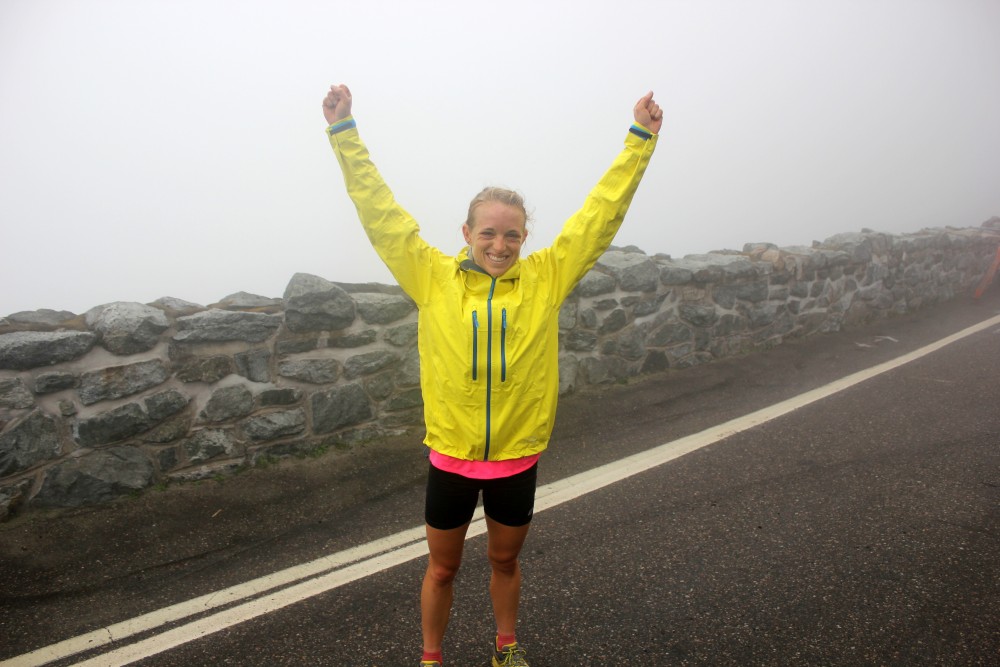
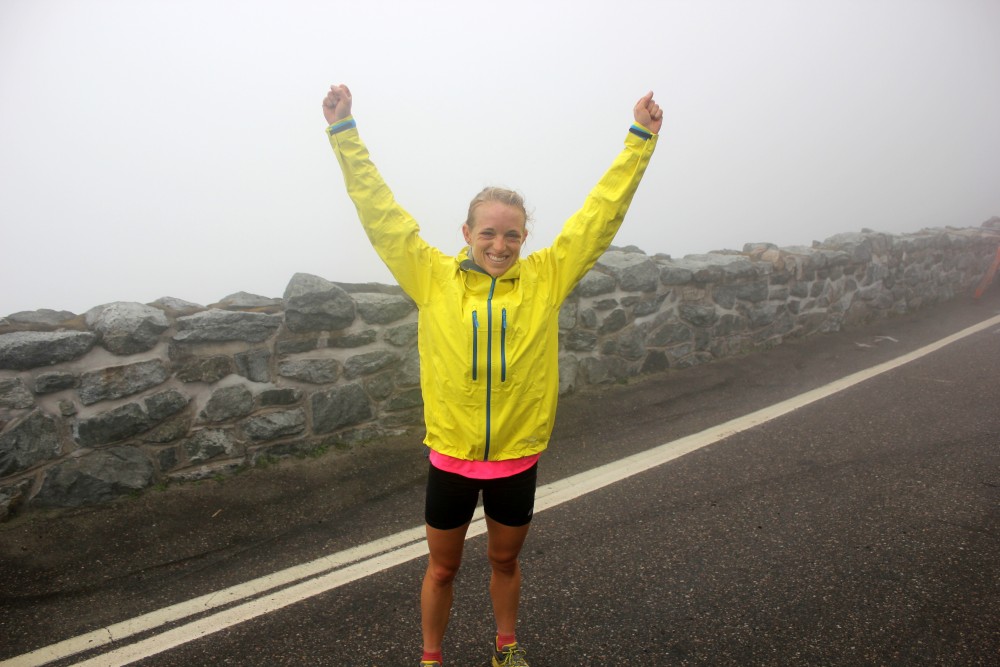
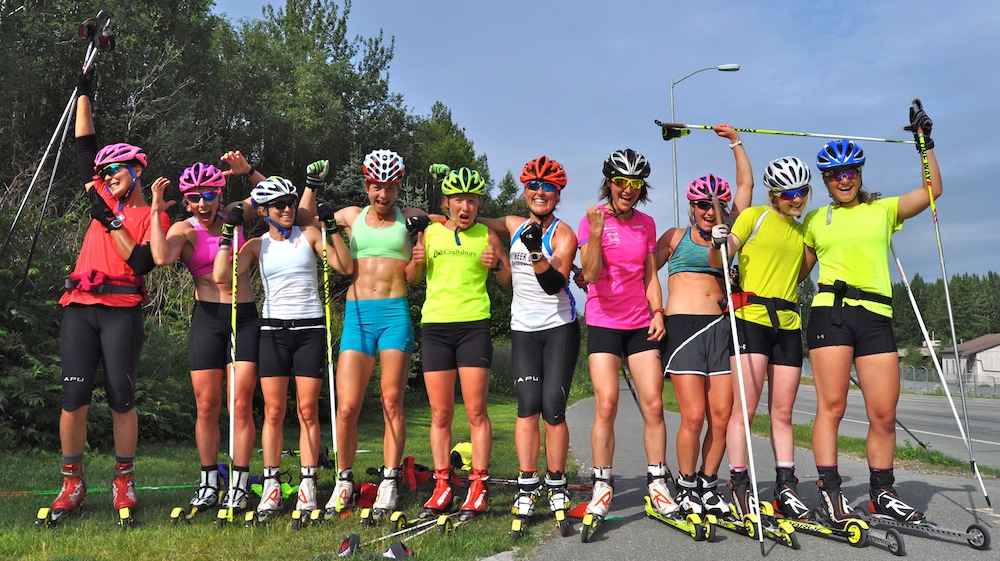
Liz Stephen celebrating her win and new course record at the 2014 Climb to the Castle. Stephen has the most women’s wins in 10 years of the Climb, winning five of those races, and also holds the women’s course record.
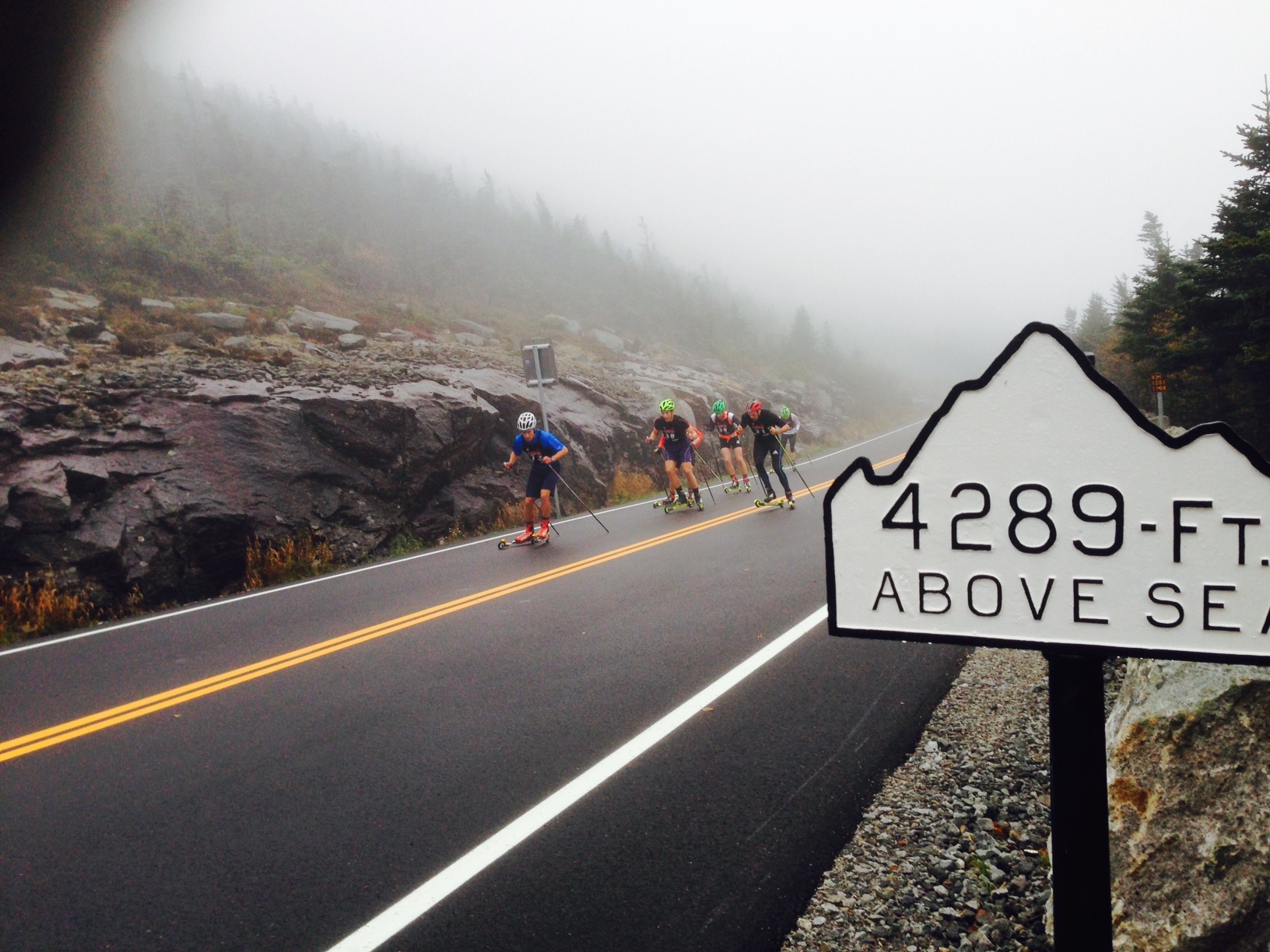
For the last decade, the Climb to the Castle has been a fall staple in northeastern New York. It’s been a circled on the calendars of the U.S. Ski Team and US Biathlon national team almost every year since its inception and attracts 75 to 100 no-joke skiers to Wilmington (near Lake Placid, N.Y.) each year.
Following the 10th annual rollerski race up Whiteface Mountain’s toll road, a five-mile grind with an average 8 percent grade, we thought it would be worth looking at course records and some of the climb’s legendary winners.
***
Most wins: Liz Stephen (5), Duncan Douglas (3)
Course records: Duncan Douglas (34:56.6) 2007, Liz Stephen (41:50) 2014
***
Paddy Caldwell (black shirt, yellow helmet) of the U.S. Ski Team D-team and SMST2 Team chases Rogan Brown (l) around mile four at the 2015 Climb to the Castle. Caldwell won the race, followed by biathletes Russell Currier and Tim Burke in second and third, respectively. Brown (SVSEF) placed fourth and Kyle Bratrud (CXC) was fifth. (Photo: Tim Cowan)
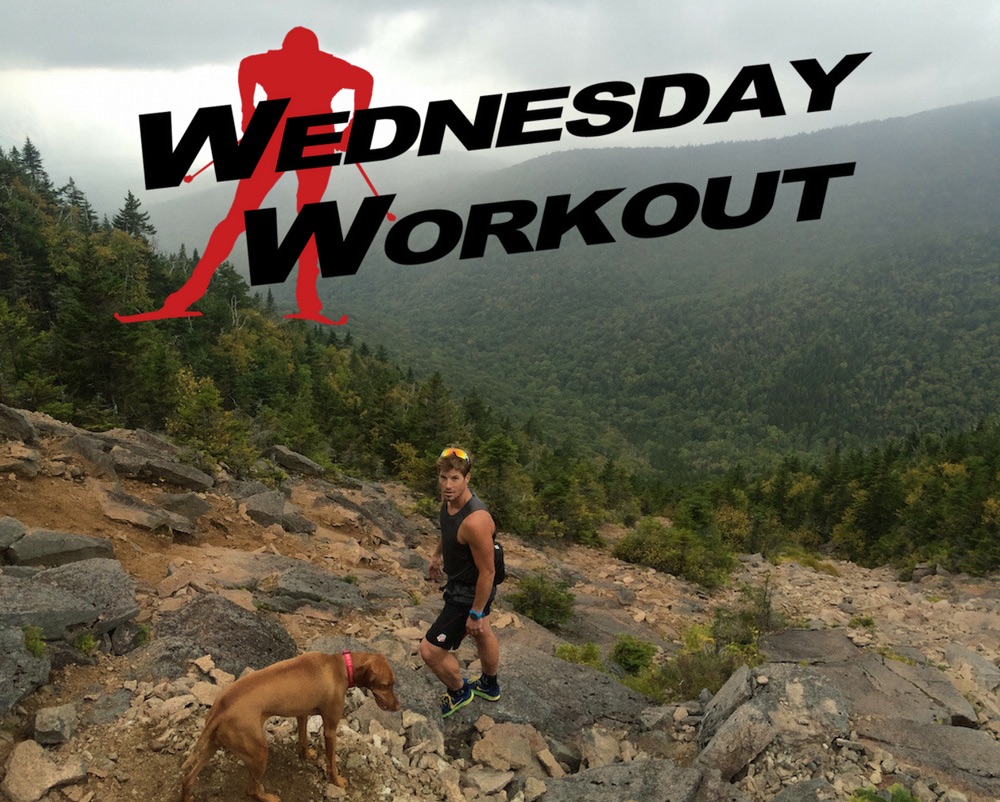
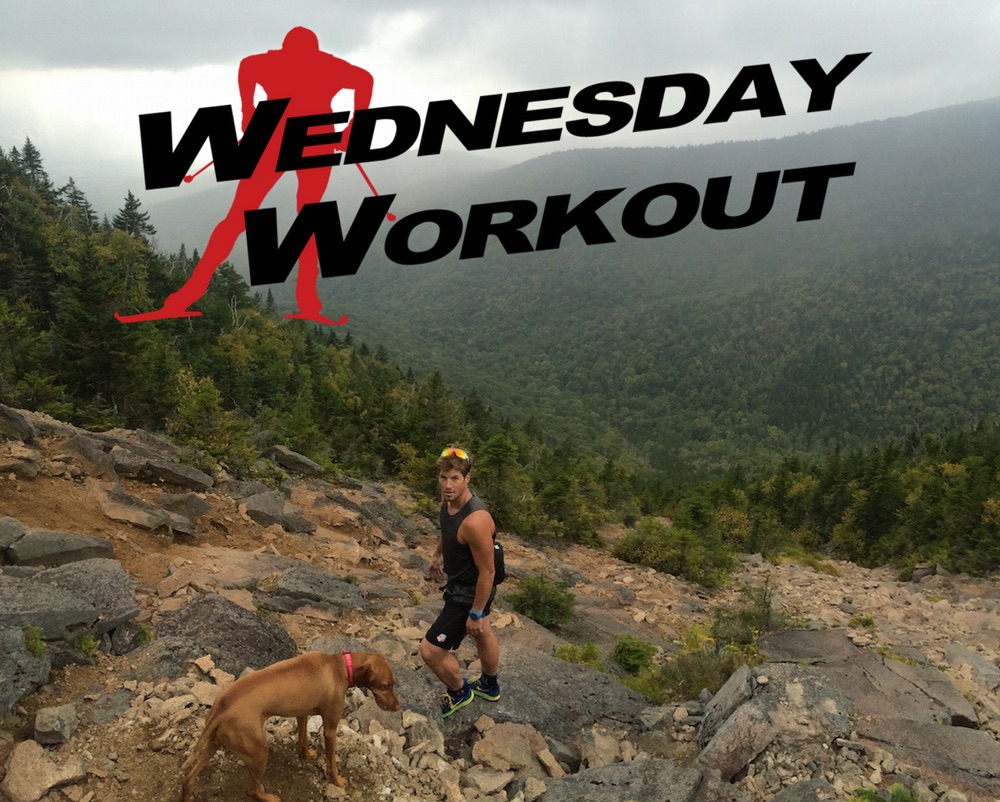
Kris Freeman and his dog She-Ra (along with Tad Elliott, not shown) racing the rain up to the top of North Slide on Mt. Tripyramid in Waterville Valley, N.H., on Sept. 14. (Photo: Tad Elliott)
This week’s workout tale comes from Tad Elliott, of Durango, Colo. Elliott, 28, has spent the last two and a half months in New England training with his coach Zach Caldwell. Elliott spent the better part of this month in New Hampshire with his former teammate on the U.S. Ski Team, Kris Freeman, who trains out of Waterville Valley, N.H. Caldwell lives in Putney, Vt., along with his uncle, John Caldwell. Here is an account of Elliott’s three-hour hike with Freeman, a.k.a. “Bird”, which they did last Wednesday.
***
I have been out East for 10 weeks training in Putney, Vt., getting ready for winter and Bird camp. Bird camp is held every September and is hard — really hard.
John Caldwell swings by Zach’s house every few days to have coffee and check in on how things are going. When he learned I was going up to Waterville to train with Kris, he said there was one workout that had to be done.
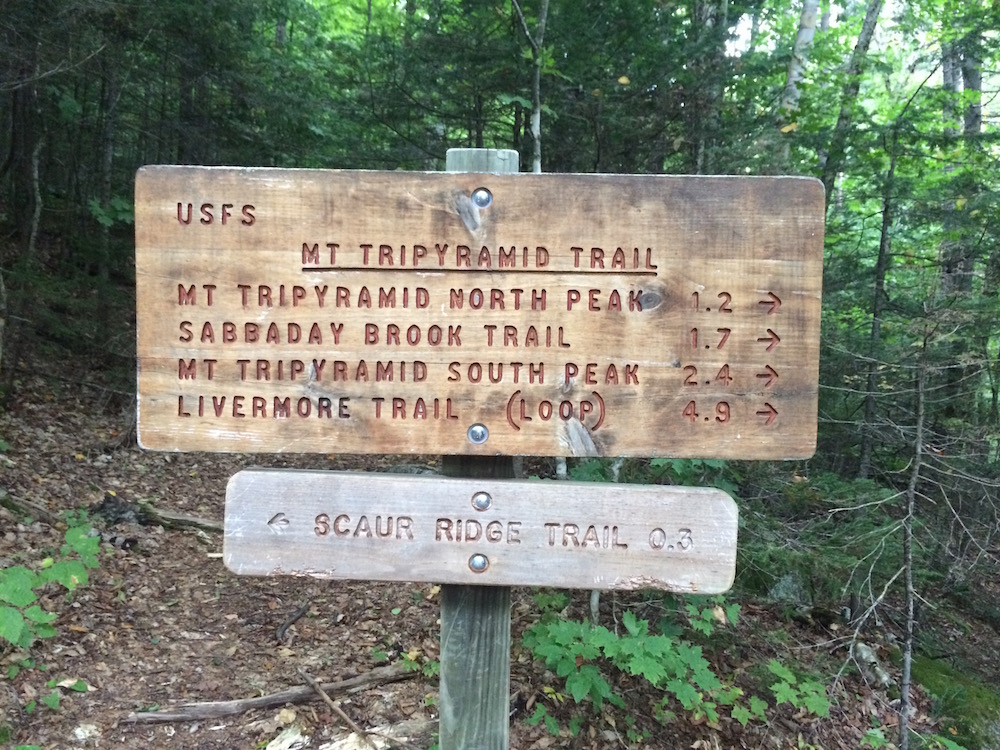
The Mt. Tripyramid trailhead: let the adventure begin (Photo: Tad Elliott)
The Workout: Tripyramids (or a Three-Hour Hike)
John Caldwell coached the U.S. Ski Team and they used to have training camps in Waterville Valley. JC told me that the best workout I could do is an OD hike going over Mount Tripyramid [a mountain with three distinct peaks along a mile-long summit ridge, some 4,160-feet tall in the White Mountains’ Sandwich Range]. The trailhead is a 20-minute drive from Kris’s front door. It’s an 11-mile hike going up the North Slide, to North Pyramid, over Middle Pyramid, up South Pyramid, and down South Slide.
On top of the hike, Kris needed some extra training. He double poled 20 miles up to the mountains. I loaded up She-Ra, Kris’s dog, and we met him at the trailhead. North Slide is a steep rock face, and rainstorms made the rocks slick and added to adventure of the Tripyramids. The rain, the scary trail that you aren’t sure is supposed to be a trail, is all part of climbing mountains in the East.
Just as we were starting up the North Slide, a hornet stung me. The rain, bugs and rocks are unique to the East and what make hiking mountains here so special. The views from the top were spectacular watching the thunder clouds roll in. The Caldwells got a kick out of this soft Colorado boy’s experience hiking some East Coast mountains.
The rain, the scary trail that you aren’t sure is supposed to be a trail, is all part of climbing mountains in the East.
The workout was a 2-hour, 50-minute run/hike, and a 4:20 workout for Kris. As John said there is plenty of time for beating yourself up rollerskiing and getting ready for the winter. Sometimes you need a good OD, have some fun with friends and enjoy hiking in the mountains. Also where else can you bag three peaks in three hours?
“Kris was making fun of me for how much I complained about my arm stinging and how red it got,” Elliott wrote of their 11-mile hike up Mt. Tripyramid in Waterville Valley, N.H. (Photo: Tad Elliott)
Kris Freeman halfway up North Slide on Mt. Tripyramid in Waterville Valley, N.H. (Photo: Tad Elliott)
***
In a follow-up up email, Elliott explained the focus of their OD hike turned into a bit of a scramble to reach the summit. “The goals hiking are always to make it to the top and enjoy the scenery,” he wrote. “The training benefit just comes from going uphill and doing something that is different and long. The pace was easy and manageable. We wanted to make sure the dog was OK and could make it up the steeper sections.”
How often does Elliott, also a former USA Cycling Team member, hike or trail run when he’s home? About once every two weeks. Hiking in the Rockies is an altogether different experience than hiking in the East, as he reiterated that Eastern trails are steeper, rockier and always seem to be damp and slick.
“Hiking in the Rockies is usually, you choose one mountain and go up that and it is a long hike into the base, then a huge hike up a massive peak. A lot more exposure, and you are going slow because the air is so thin,” Elliott wrote. “The experience out here was great. The views were awesome, and Kris was pointing out all the mountains nearby and future runs that we could go do.
“This was a easy day for us out here at Bird camp,” he continued. “Maybe it felt easy because we had fun. We wanted to give our hands and shoulders a break from the pounding on the pavement. Kris is one of the best at training in the world. A standard morning ski is now 40 miles. There is a run or strength every afternoon. I am feeling great. I have some boat time coming up in a week with my family in Annapolis. Recovery from Bird camp will be important.”
Elliott has been in New England since July 11 and plans to leave for Maryland on Sept. 26. Sidelined with Epstein–Barr virus two years ago, the former U.S. national-team distance skier explained that his health has been “pretty good” this summer, with some issues in the spring and mid-summer, “but it seems to keep getting better and better slowly.” He plans to compete in most of the U.S. SuperTour races this fall, including nationals.
(Holly Brooks, a former U.S. Ski Team member, two-time Olympian and Anchorage local, sent FasterSkier a copy of the following letter of support, addressed to the University of Alaska President Jim Johnsen, and granted permission to post.)
***
Dear President Johnsen,
My name is Holly Brooks and I am one of Alaska’s Olympic Cross Country skiers. I am writing this on behalf of several of our local Olympians, who have agreed to sign their names below, and encourage you to take the time to read this letter and gain an understanding of how much we care about the health of our ski community. We are aware that the fiscal situation facing the University is challenging and that difficult and unpopular decisions will have to be made, but we urge you to continue funding the most “Alaskan” sport UA has, ski racing. From what we understand, men’s and women’s skiing seem to be one of the few “unprotected sports” under your leadership. Thus, the purpose of this letter is to “raise our hand” in support of the University of Alaska ski team.
Alaska has a strong skiing background. UAA’s NCAA program is an integral part of the heart and soul of a sport that is a natural fit for our great state. Nordic and alpine skiing are wildly popular recreational sports in Anchorage and the collegiate teams serve as examples or “pedestals” of what many Anchorage citizens aspire to in their own athletics. Anchorage hosts the largest high school ski race in the entire country, the Lynx Loppet. Many youth in Anchorage including the Junior Nordic Program and the ASD high school programs look forward to seeing UAA skiers zip by them on the trails, serving as a “real-life” example of fitness and/or technique. What other sports can recreational or developing athletes literally jump in behind collegiate athletes and hang on for the ride?
The UAA ski team also has a long history of community service and activism. Last spring the UAA Ski Team hosted the Turnagain Arm trail race, a perennial favorite for Anchorage Trail runners. This spring the athletes and coaches volunteered their time for a program called Skiku teaching nordic skiing in remote Alaskan villages one week at a time with the goal of instilling healthy, active lifestyles. Every fall, UAA skiing athletes have volunteered for a program Sadie, Kikkan and I help host called Fast and Female – a youth empowerment through sport program that attracts 300 of Anchorage’s girls ages 9-17. At this event, adolescent girls get to meet their athletic role models including your UAA college skiers!
Skiing in particular is an amazing sport because once athletes “retire” from competing at a high level they keep skiing 9 times out of 10. Skiing is a lifelong sport. For this community it means those people are giving back as coaches and role models. I sincerely believe that a community is only as strong as it’s members and a community of people who give back are what creates economic, social & emotional stability. In these pressing times our community is our most valuable asset.
Last but not least, skiing is a sport occurring in the winter. While we haven’t had great snow lately, winter is historically a time when Alaskans opt to stay indoors. Drinking, domestic violence, and levels of depression are elevated. Because of these reasons and SAAD (Seasonal affective disorder) we believe it is imperative to support activities that promote health and wellness during our coldest and darkest months. Skiing does that and the UAA’s ski teams serve as a vehicle. Your team provides healthy heroes and role models and without that, I believe Alaskan skiing would take a large hit.
So please, I know we’re in a budget crisis but I hope that you decide to retain skiing as a UAA NCAA Division II sport. If you have any further questions or would like to speak with me, I’m all ears. Thanks for your time.
Sincerely,
Holly Brooks
2010 Vancouver & 2014 Sochi Cross Country Skiing Olympian
Kikkan Randall
2002 Salt Lake City, 2006 Torino, 2010 Vancouver, and 2014 Sochi Cross Country Skiing Olympian
Tommy Moe
1992 Albertville, 1994 Lillehammer, and 1998 Nagano Alpine Skiing Olympian
Megan Gerety
1994 Lillehammer Alpine Skiing Olympian
Lars Flora
2002 Salt Lake City, and 2006 Torino Cross Country Skiing Olympian (member of 98/99 UAA Ski Team)
Sadie Bjornsen
2014 Sochi Cross Country Skiing Olympian (member of 2008/9 UAA Ski Team)
Erik Bjornsen
2014 Sochi Cross Country Skiing Olympian (member of 2010/11 UAA Ski Team)
James Southam
2006 Torino, and 2010 Vancouver Cross Country Skiing Olympian
Adam Verrier
1994 Lillehammer Cross Country Skiing Olympian, UAA Volunteer Coach since 2009
Sara Studebaker-Hall
2010 Vancouver, and 2014 Sochi Biathlon Olympian
Anna Berecz
2010 Vancouver and 2014 Sochi Alpine Olympian for Hungary (Graduated UAA in 2015)
Rachel Steer
2002 Salt Lake City, and 2006 Torino Biathlon Olympian (Graduated UAA in 2007)
Alex Wilson
1998 Nagano Freestyle Olympian (Teaching Certificate from UAA in 2013)
(Aspen, CO – September 16, 2016) Aspen Valley Ski & Snowboard Club is excited to announce that August Teague will be joining their program as Nordic Program Director. August’s qualifications were unmatched for the program’s needs; he has an impressive 14-year coaching history, helping athletes of all levels achieve their goals while developing a passion for Nordic skiing. August led the Nordic programs at both Whitman College and University of Nevada, Reno, before becoming the Director of Skiing at the University of Nevada, Reno. He then spent 4 years with the Australian Ski Team, leading them through two World Championships and one Olympic cycle. Most recently, August has run his own junior club in Truckee, CA.
August is no stranger to Aspen or AVSC: his passion for Nordic skiing was cultivated at the club. From AVSC, he went on to ski for Colorado Rocky Mountain School and eventually the University of Denver. He’s thrilled to return to the Roaring Fork Valley and share his expertise with a club that was so integral to his own growth as an athlete, and later, a coach. AVSC’s Executive Director, Mark Godomsky, is excited to welcome August to the team, sharing his confidence that “August will be an outstanding leader and foster a supportive, competitive, and fun environment for our Nordic athletes.”
Ski-Lines.com is hiring sales reps to help grow its e-commerce marketplace! This job is perfect for a motivated individual looking to earn extra money on the side of school, full-time ski training, or even a regular full-time job.
Ski-Lines has launched an e-commerce marketplace geared specifically for specialty ski retail stores with established brick-and-mortar locations. Before we begin promoting the marketplace too much, however, we need to let all the retailers know that we exist, and help them create accounts and upload their products!
We have a simple and powerful platform, which provides merchants with all the tools they need to run a successful e-commerce store. Our merchants can manage their listed inventory, track their orders, handle returns, sell in both U.S. and Canadian dollars, and have their funds deposited directly into their bank account at the end of each day. We provide an advanced geolocation technology in order to list products for sale nearest the consumer, and we are partnering with one of the most sophisticated digital marketing firms in North America to ensure a wide array of consumers engage with the platform (If you are a merchant, submit your application here to start selling on Ski-Lines).
For more information, such as compensation and expected commitment level, email mark@ski-lines.com.
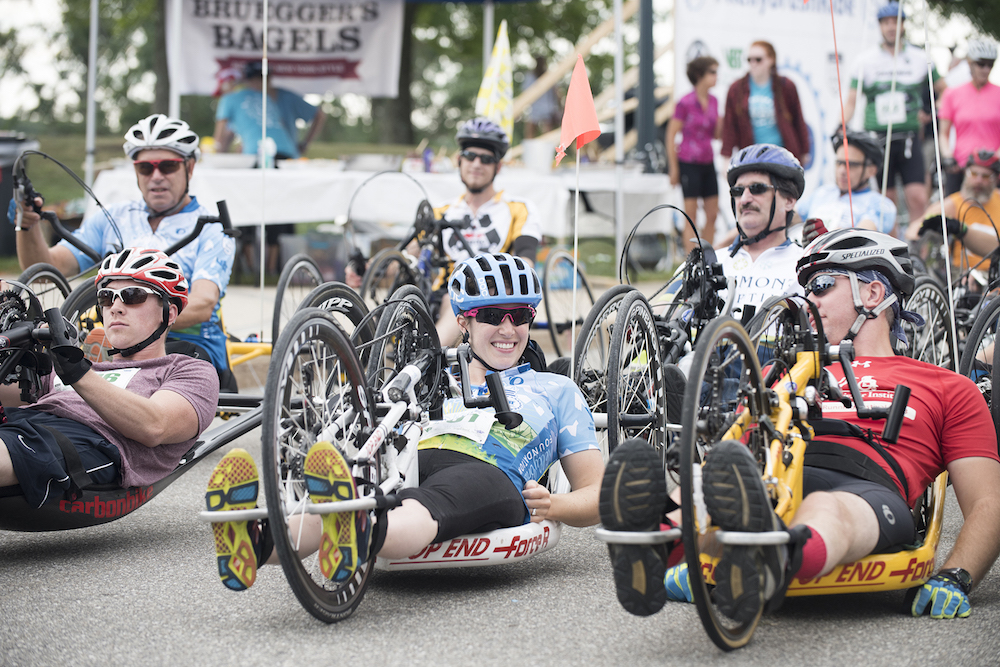
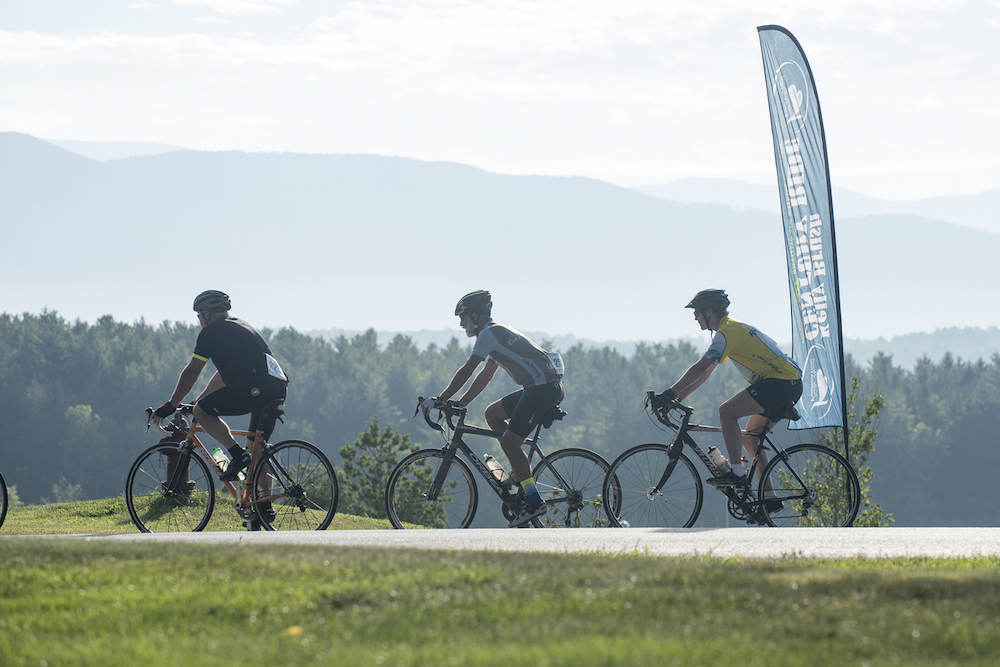
Handcyclists, led by Kelly Brush, at the start of the 11th Annual Kelly Brush Ride powered by VBT Bicycling and Walking Vacations on 9-10-16 in Middlebury, Vermont. The annual ride through the Champlain Valley drew more than 700 cyclists and 30 handcyclists and raised more than $400,000 for adaptive sports and ski racing safety. (Image: Caleb Kenna)
11th Annual Event Supports Adaptive Sports, Ski Racing Safety
SOUTH BURLINGTON, Vt. (Sept. 15, 2016)—Fundraising for the 11th Annual Kelly Brush Ride powered by VBT Bicycling and Walking Vacations surpassed $400,000. The ride supports the Kelly Brush Foundation’s mission to empower those living with paralysis through sport and recreation and to improve ski racing safety.
More than 700 cyclists and 30 handcyclists, along with more than 100 volunteers participated in the event that was held on September 10 in Middlebury, Vermont. The total amount raised was $425,000.
“This year’s Kelly Brush Ride was a huge success both in how much fun was had by all riders and the record amount we raised to enable the Kelly Brush Foundation to do even more to improve the quality of life for those with paralysis and allow us to continue to raise the bar when it comes to safety in ski racing, “ said Zeke Davisson, executive director of the Kelly Brush Foundation.
Cyclists rolling in Middlebury, Vermont, on the 11th Annual Kelly Brush Ride powered by VBT Bicycling and Walking Vacations on 9-10-16. The annual ride, which starts and finishes in Middlebury and winds through the Champlain Valley, drew more than 700 cyclists and 30 handcyclists. The event raised more than $400,000 for adaptive sports and ski racing safety. (Image: Caleb Kenna)
The ride was made even more inspiring by the impressive effort of handcyclists Geoff Krill of Woodstock, New Hampshire, and Mike Wade of Silver Lake, New Hampshire, who completed the entire 100-mile route.
Funds raised from the event go towards improving the quality of life for those with paralysis through grants for adaptive sports gear and helps to improve ski racing safety with equipment such as netting to line race courses. With the ride as its signature fundraising event, the Kelly Brush Foundation has raised more than $3 million, purchased more than 300 pieces of adaptive sports equipment and helped keep thousands of ski racers safe with hundreds of miles of safety netting, trail widening projects and awareness about ski racing safety.
The ride was started by the Middlebury College Ski Team in 2006 as a way to buy an adaptive monoski and handcycle for team member Kelly Brush, who was paralyzed as the result of a ski racing crash. The next year the ride was opened to the public, with proceeds used to support the foundation’s mission. The Kelly Brush Ride powered by VBT Bicycling and Walking Vacations is made possible thanks to the generosity of many participants, volunteers and sponsors including: VBT Bicycling and Walking Vacations, Shearer Audi, Sugarbush Resort, SkiRack, Saatchi & Saatchi, World Cup Supply, Murphy Realty Company and many other generous sponsors.
About the Kelly Brush Foundation: The Kelly Brush Foundation is a 501(c)(3) nonprofit organization dedicated empowering those with paralysis through ownership of adaptive sports equipment and improving safety in the sport of ski racing. The foundation has raised more than $3 million, helping to purchase more than 300 pieces of adaptive sports equipment and keep thousands of ski racers safe with hundreds of miles of safety netting, trail widening projects and awareness about ski racing safety. Kelly Brush, together with her family, started the foundation in 2006 after she sustained a severe spinal cord injury while racing in NCAA Div. 1 competition as a member of the Middlebury College Ski Team in Vermont. The Kelly Brush Foundation affirms Kelly’s ongoing commitment to live life on her own terms and better the lives of others living with paralysis. www.kellybrushfoundation.org
About VBT Bicycling and Walking Vacations: VBT offers deluxe, small group bicycling and walking tours worldwide, including destinations throughout Europe, Costa Rica, New Zealand, Vietnam, Peru, Chile, South Africa and the United States. Each trip includes all accommodations, many meals, two expert local Trip Leaders, unique sightseeing and cultural activities and on-tour vehicle support. Unlike other companies, VBT also includes roundtrip international airfare from over 30 U.S. cities and select Canadian cities for all overseas vacations. In 2015, VBT was rated by the readers of Travel + Leisure magazine among the “World’s Best Tour Operators” for the sixth consecutive year.
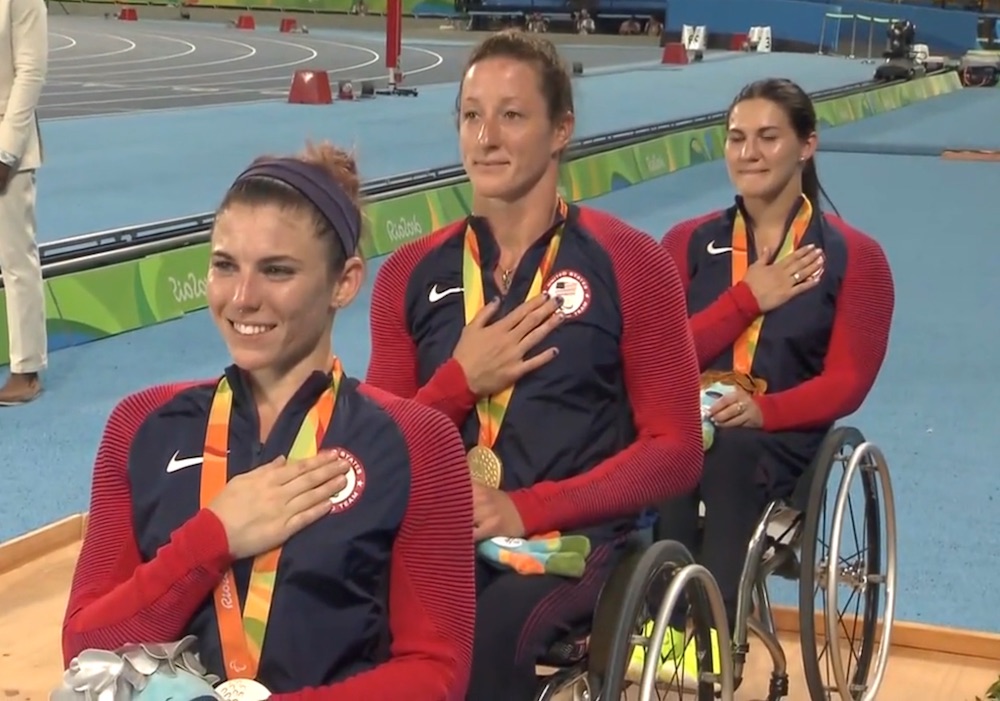
Tatyana McFadden (c) led a U.S. sweep of the women’s 1500-meter T53/54 podium in wheelchair track racing at the 2016 Summer Paralympics on Wednesday in Rio de Janeiro, Brazil. Less than two-tenths of a second behind her, Amanda McGrory (l) and Chelsea McClammer (r) placed second and third, respectively. (Photo: U.S. Paralympics Highlights from Rio Day 6 video)
Note: This article has been updated to include results from Thursday’s road cycling and evening track races, as well as Tatyana McFadden’s selection as recipient of the Whang Youn Dai Achievement Award.
On Tuesday and Wednesday in Rio de Janeiro, Brazil, two Paralympians who also dabble in skiing racked up medals at the Paralympic Games — with Tatyana McFadden winning the women’s 1500 T53/54 track event and Alicia Brelsford Dana placing second in the road-cycling time trial.
McFadden, 27, of Clarksville, Md., rocketed to her third medal in three races in Rio, leading what the U.S. Olympic Committee (USOC) dubbed a “Mc-sweep” in her event, ahead of fellow Americans Amanda McGrory (+0.11) and Chelsea McClammer (+0.17). It was the first U.S. track-and-field podium sweep at these Games, and McFadden led from the start to capture a Paralympic record of 3:22.50.
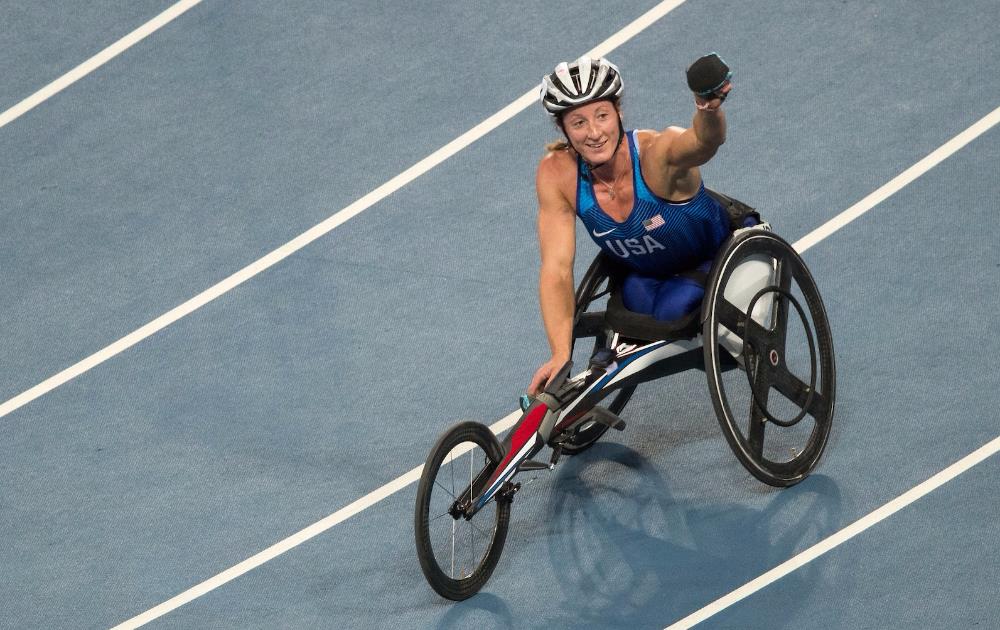
Tatyana McFadden celebrates winning the women’s T54 5000m final at the Olympic Stadium at the Paralympics in Rio de Janeiro, Brazil. (Photo: Simon Bruty for OIS/IOC)
This marks her 13th Paralympic medal in track and field. She also has a silver in sit-skiing at the 2014 Winter Games.
“It’s amazing,” McFadden said, according to a USOC press release. “It’s the first time, I think, in history or in a long, long time since we’ve gotten an American sweep in the 1500 and it happens to be the girls, so it’s really cool.”
“We went into this morning with a pretty good plan and decided we were going to go for it,” McGrory said. “We raced together, we raced smart and we pulled it off.”
(Update: Two days after her latest gold, McFadden was selected to receive another honorary gold medal as one of two recipients of the Whang Youn Dai Achievement Award. According to a International Paralympic Committee (IPC) press release, an independent panel of judges comprised of IPC Governing Board members selected the winners on Thursday — McFadden and Syria’s Ibrahim Al Hussein, a swimmer who is competing independently in Rio. They will each receive a pure gold medal, weighing 75 grams, at the Closing Ceremony.
The panel chose McFadden and Hussein for best exemplifying “the spirit of the Paralympic Games and the Paralympic values.” Seventeen participating countries nominated 21 athletes, and the IPC narrowed the list down to six athletes. McFadden was the only North American among the six finalists.)
On Thursday night, the “Mc-trio” (as the USOC called them) of McFadden, McClammer and McGrory — teammates at the University of Illinois Urbana-Champaign — swept the podium again in the women’s 5000-meter T53/54. McFadden made her move on the final lap to notch her third gold in four individual races in Rio, winning in 11:54:07. McClammer edged McGrory by one-hundredth of a second for silver (+0.26) and McGrory took bronze (+0.27).
“We train together, so we work really, really well together,” McFadden said, according to a USOC press release. “There’s no one I want more on the podium than my teammates. I think the whole world was looking at us and we were looking at them and we said ‘hey, we’re going to work together’. We’re stronger that way and it definitely showed today.”
Two hours later, McFadden and McClammer raced the 4×400 T53/54 relay with McFadden’s younger sister Hannah McFadden and Cheri Madsen. They crossed the line second behind the People’s Republic of China, which smashed the world record of 3:40.66 with a time of 3:32.11. However, according to the final results, the Americans were disqualified (along with Turkey) and relegated to fourth (while Turkey was listed as third). Australia, which had a season-best time of 3:46.63, took silver, and according to the results, no bronze was awarded.
On Wednesday, the seventh day of the Paralympics and first day of road cycling, Dana, of Putney, Vt., notched silver in the H1-2-3 time trial with a time of 33:57.48, less than 13 seconds behind the winner, Karen Darke of Great Britain.
Four years ago at the Paralympics in London, Dana, now 47, placed fifth in the same event. At 2015 World Championships, she took silver in both the time trial and road race. In 2014, she was a world champion in the time trial.
In all, the U.S. cycling team racked up nine medals on Wednesday (one gold, five silver and three bronze). Oksana Masters finished fifth in the women’s H4-5 time trial with a time of 33:49.7, about 47 seconds off the podium and 2:14.24 behind the winner, Dorothee Vieth of Germany.
On her official Facebook page, Masters, 27, of Louisville, Ky., also a silver medalist in Sochi and a bronze medalist in doubles rowing at the 2012 London Paralympics, summed up her race on Wednesday: “I Finished 5th today in my combined H4-5 category for the TT. Just like skiing I like courses that have climbs in it. Today was the opposite. Flat as a pancake course with high winds which favors bigger people. I gave it everything I had, plus some blood and it was not enough to bring home a medal for team USA. Tomorrow is a new Day and another chance to race and leave everything on the course. It is a Road Race which will be a mass start. I am feeling hopeful for this race. It is my favorite event. I Can’t wait to throw it down tomorrow. I will be racing around noon rio time tomorrow.”
On Thursday, Masters placed fourth in the women’s H5 road race. She is one of two Americans at the Games who has competed in the last three Paralympics in three different sports.
Germany’s Andrea Eskau — a skier and Winter Paralympic medalist in both biathlon and cross-country in Sochi — won the event in 1:37:07. She finished 2 seconds ahead of the Netherlands’ Laura De Vaan and Jennette Jansen, who placed second and third, respectively. Masters was listed with the same time just 2 seconds back in fourth.
“I’m bummed I finished fourth today and came up a little short, but I’m super happy because I feel like I’ve learned so much from this race alone,” Masters said, according to a USOC press release. “I am just so shocked that I am even here competing in my third Paralympic Games in a row.”
Dana also placed fourth in Thursday in the women’s H1-2-3 road race. With a time of 1:16:01, she was 3 seconds off the podium and 5 seconds behind German winner Christiane Reppe (1:15:56). South Korea’s Do-Yeon Lee finished second and Italy’s Francesca Porcellato was third.
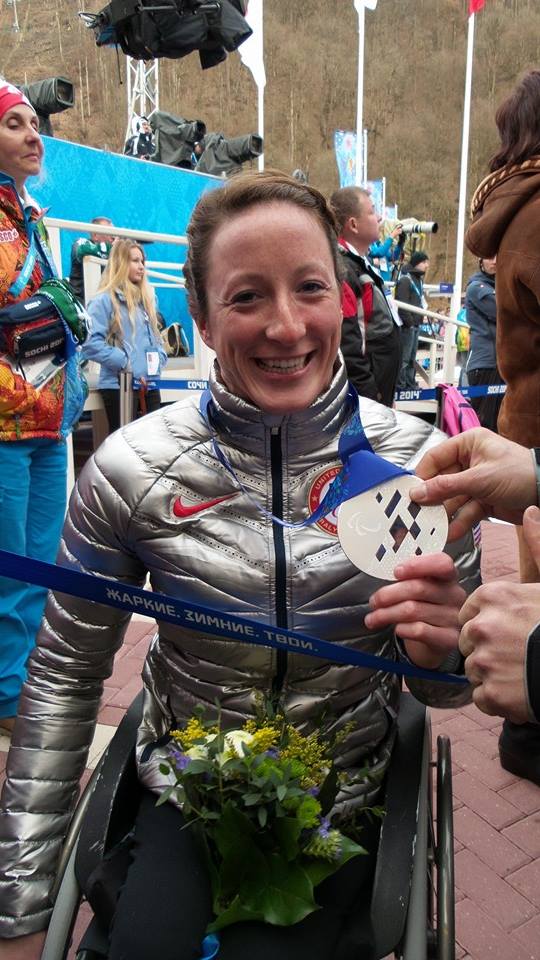
U.S. Paralympian Tatyana McFadden with her 2014 sprint silver medal at her first winter games in Sochi, Russia. McFadden is competing in her fifth Paralympics this month in Rio de Janeiro, Brazil. (Photo: BethAnn Chamberlain/U.S. Paralympics Nordic)
In the first three days of the 2016 Summer Paralympic Games in Rio de Janeiro, Brazil, Tatyana McFadden, a seasoned wheelchair racer with 11 Paralympic medals to her name coming into the Games, took silver and gold in her first two races.
McFadden, 27, of Clarksville, Md., has competed in four Summer Paralympics and a Winter Paralympics in 2014 in Russia — her birthplace. She was born with spina bifida and adopted around age 6, then moved to Maryland, where she developed strength and discovered her athleticism in swimming, gymnastics, wheelchair basketball, sled hockey, and track and field. Sit-skiing came later while she was studying at the University of Illinois, and shortly after taking up the sport, McFadden earned silver in the 2014 Paralympics sprint in Sochi.
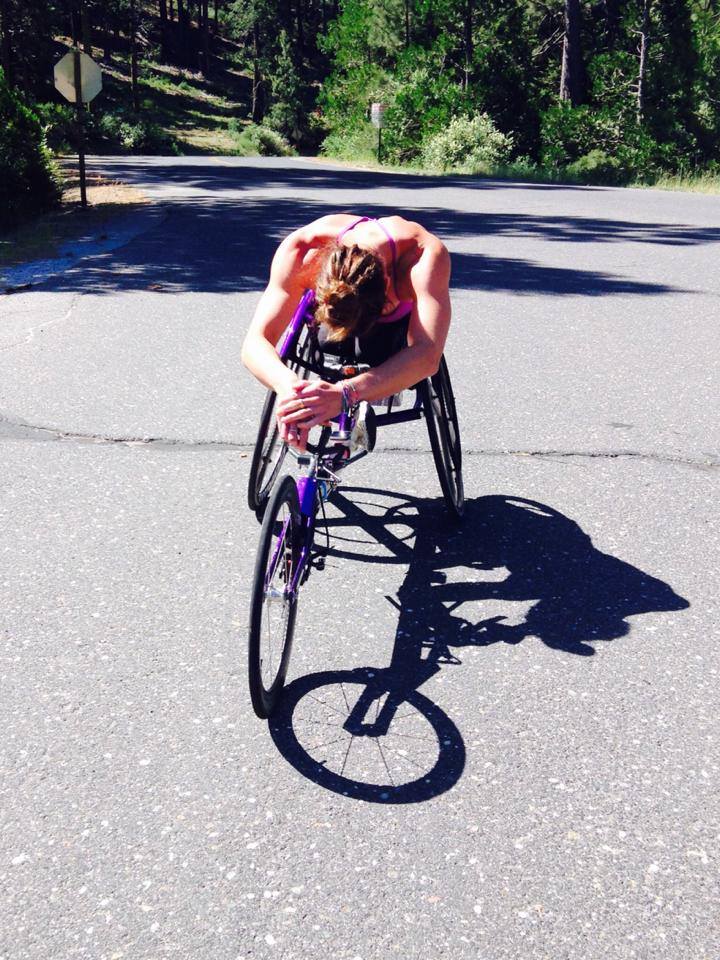
Tatyana McFadden training in July 2014 for U.S. nationals in wheelchair racing, her summer sport, of which she’s a three-time Paralympic and 10-time World Championship gold medalist in track and field. (Photo: U.S. Paralympics Nordic/Facebook)
This past Friday, Sept. 9, on the opening day of the Rio Paralympics, McFadden captured the first medal of the Games for U.S. women’s track and field. The world-record holder in the women’s 100 T54 event, McFadden placed second, 0.13 seconds behind the defending Paralympic and world champion, Wenjun Liu of China, who won in 16.0.
McFadden’s younger sister, 20-year-old Hannah McFadden, placed fourth (+0.34) while a third American, Cheri Becerra-Madsen, coming off a 16-year Paralympic hiatus, was fifth (+0.4). According to a U.S. Olympic Committee (USOC) press release, McFadden entered Rio aiming for seven gold medals to add to her collection of three from London 2012.
She would have to wait for her first one.
“To get the first medal for the U.S. women is amazing,” McFadden said in a USOC press release on Friday. “This is one of my hardest events. I’ve really had a rollercoaster ride with the 100 meters. In Beijing, I got sixth; In London, I got third and today I got silver. I’m really quite happy and am just looking forward to my next event.”
On Sunday, Sept. 11, she defended her Paralympic title in the women’s 400 T54, winning in 53.30 seconds. Becerra-Madsen joined her on the podium in second (+1.2).
Fifteen years after the Sept. 11 tragedies, McFadden dedicated her win to the victims, families and first responders of that day.
“Today I won with my heart,” she told the USOC. “I ran for America. It’s September 11 so I ran for the folks back at home; thoughts and prayers for those affected. I honor my country today with a gold medal.”
Several summer/winter cross-over Paralympians are competing in these Games. Oksana Masters, one of two U.S. Paralympians in their third Paralympic sport, is competing in road cycling, which begins on Wednesday.
Climb to the top of Whiteface, New York’s 5th highest peak for a 360-degree panoramic view of the Adirondacks, New England and Canada
WILMINGTON, NY – The New York Ski Educational Foundation and the Olympic Regional Development Authority invite athletes to the NYSEF Whiteface Climb to the Castle Rollerski Race on Sunday, September 18at 8 AM. The course starts at the Whiteface Toll Booth, climbing for 5 miles with an average 8% grade up the Whiteface Memorial Highway to the castle on the summit of Whiteface Mountain, New York’s 5th highest peak with an elevation of 4,867 ft. The race is freestyle technique and athletes will be greeted at the finish with a 360-degree panoramic view of the Adirondacks, New England and Canada.
The University of Vermont (UVM) in Burlington, Vt., is in search of an assistant nordic ski coach to assist the head coach in performing the duties of managing the intercollegiate sport of skiing within the education mission of the University. Share in the responsibility of educating student-athletes to the value of sport as it becomes increasingly valuable in today’s society. Take directives from the head coach for all aspects of the competitive NCAA Division I program that relies on recruiting scholarship and non-scholarship student-athletes. Provide leadership and positive expertise in the teaching and tactical aspects of the sport. Demonstrate commitment to issues of social justice and diversity.
Please go to the following link for job details and application instructions:
The Winter Park Competition Center is looking for an assistant nordic coach and part-time coaches for the 2016-2017 season. The positions will be for the winter (4-5 months) with various time commitments depending on the availability and qualifications of the applicant. Interested applicants should contact Jessica Jortberg at jjortberg@winterparkresort.com
Responsibilities may include but are not limited to attending and participating in dryland training (running, rollerskiing, strength and conditioning training, etc.), attending races throughout the winter, applying ski wax, and designing workouts and training plans.
Norway’s Astrid Jacobsen (r) leads Liz Stephen (U.S. Ski Team), Switzerland Bettina Gruber, and U.S. Ski Team members Jessie Diggins, Holly Brooks and Ida Sargent during threshold intervals at the 2013 North American Women’s Training Alliance (NAWTA) camp in Anchorage, Alaska. (Photo: Matt Whitcomb)
For this week’s workout, we bring you one of the best threshold workouts U.S. Ski Team Women’s Coach Matt Whitcomb said he’s ever seen — back in 2013. That’s not to say this workout is outdated, and the kind of training environment nearly a dozen top-level athletes created at the 2013 North American Women’s Training Alliance (NAWTA) camp in Anchorage, Alaska, was one other teams and clubs can try to emulate. All it takes is a quality all-around effort and well-thought-out terrain choices. Read original article here.
***
[circa July 2013]
The third-annual North American Women’s Training Alliance (NAWTA) camp began this week in Anchorage, Alaska, and on Tuesday morning they completed a threshold workout that ended with a lot of high-fives in the van and left U.S. Ski Team women’s coach Matt Whitcomb pretty happy.
“Today’s threshold workout was the best threshold workout I’ve seen out of this group of women since I’ve been working with the team,” he said on the phone, as the group began their afternoon strength session.
Kikkan Randall, Jessie Diggins, Liz Stephen & Co., are joined at this camp by Alaska Pacific University skiers, National Training Group athletes, and decorated Norwegian Astrid Jacobsen, Switzerland’s Bettina Gruber and Canada’s Chandra Crawford. The workout is one that Whitcomb and APU head coach Erik Flora have repeated over the last few years in order to work specifically on high-speed skiing in the middle of a threshold session.
The keys to accomplishing this goal are two-fold: the choice of terrain, and the presence of a group to ski with. It was his team’s skilled pack skiing that Whitcomb thinks set Tuesday’s session apart from the rest, but the rolling hills are a critical ingredient to the goal of the entire workout.
“It’s not so much emphasizing going harder, it just emphasizes patterning your muscles, neurally, to fire faster,” Whitcomb explains. “I think a lot of times, certainly my tendency as been to prescribe intervals that are a bit too slow. We might be nailing the percentage of your max heart rate and the proper lactate right on the money, but the pace is just too slow — you’re going uphill, uphill, uphill, and a lot of times when we find hard terrain we go hit intervals there.”
To encourage speed variation while staying within threshold, the workout should be done on a stretch of pavement that includes gradual uphills, flats and gradual downhills, which “systematically [builds] some pace development intervals into your session,” Whitcomb says.
“It doesn’t need to be incredibly hard — today was roughly threshold and above during bursts of speed — but it was about the terrain that helped push the pace for us.”
The Workout:
20-30 minute warm up*
4-6 x 7-10 minute L3 intervals (3 minutes rest) on fast terrain that incorporates gradual uphills, flats and gradual downhills. Most interval sessions use hard and grinding terrain, great for building capacity but not so great for higher pace development. The key to this workout is in the choice of terrain.
20-30 minute cool down*
*Do a warm up and cool down that allows you to focus on the intervals. “Sometimes a mistake can be made where people are going after volume in addition to high intensity on interval days,” Whitcomb says.
Don’t do try to multi-task for this workout. “Warm up only the minimum that your body requires,” he continued. “You want to make sure your muscles are ready to go, and build into the intervals if you have to — you don’t want to pull any muscles or get injured — but a 45 minute warm up is too long, as is a 45 minute cool down. Keep them concise and focus more on the on-time.”
Frequency:
Every two to three weeks in the summer, with increasing frequency to every 10 days as fall approaches. “A workout like this is in addition to L4 intervals, time trials, speeds, ODs,” Whitcomb said. “It’s just another small component, another ingredient to throw in the bag and mix it up.”
Variations:
Shorter recovery time as the season goes on, or longer recovery when at altitude — “just to make sure the on-time is what’s being emphasized,” Whitcomb says.
Pre-determined sprint preems that accomplishes a similar break from straight threshold, forcing athletes to go from threshold, into race pace, then back into threshold when they cross certain preem markers in the interval.
On Tuesday, the women did this session on a stretch of bike path in Anchorage’s Kincaid Park. They chose a section of rolling terrain that was about 7-10 minutes long going either way. The group started their first interval in one direction, which took about nine minutes, took their three-minute recovery, and then skied back the other way to the start, which took about seven minutes.
The 2013 North American Women’s Training Alliance group after a well-executed workout in Anchorage, Alaska. (L to R) Kate Fitzgerald, Kikkan Randall, Liz Stephen, Astrid Jacobsen (NOR), Ida Sargent, Holly Brooks, Bettina Gruber (SUI), Jessie Diggins, Emily Hannah, Annika Miller. (Photo: Matt Whitcomb)
From a coaching perspective, this workout shows Whitcomb things that don’t surface in regular threshold intervals.
“I think when we started doing this it taught us that the speed didn’t really change as much as we thought it would when the terrain asked for higher speed,” he said. “You try and go faster and your muscles simply didn’t want to move faster. It wasn’t a matter of being at your max heart rate, people were well within threshold, but they just didn’t want to fire those muscles faster. But the body fortunately adapts pretty quickly to a group session like this and you see pretty notable progress in your speed in just a few weeks.”
So what made Whitcomb call Tuesday’s workout, in particular, the best threshold session he’s ever seen from his team?
In addition to their raw speed — “they were really flying” — Whitcomb noticed they skied better together within the pack than they have before.
“Everyone spent some time leading, some time sandwiched cycling in the spin wash in the middle of the pack, and it was really unlike this group perhaps in the past — you know, you establish a pecking order and somebody’s out there hammering off the front all day, maybe somebody switches out if they get tired, somebody is flying off the back all day because they’re struggling,” he said.
“And today instead it was much more this series of incessant attacks at the front where you’d recover a little bit, spend some time in threshold in the pack, and then you’d work your way to the front and use your good feelings and your recovered state to push the pack and pull everybody along at a faster rate. It looked more like watching a cycling race today, to be honest, and that’s kind of a new thing particularly in girls skiing, I think. The mass starts [sometimes] just getting strung out from 100 m into the race, and I think we’re moving in the direction of more pack skiing. And as we can improve our skills within the pack were going to be better suited for those days when the women’s pack does stay together.”
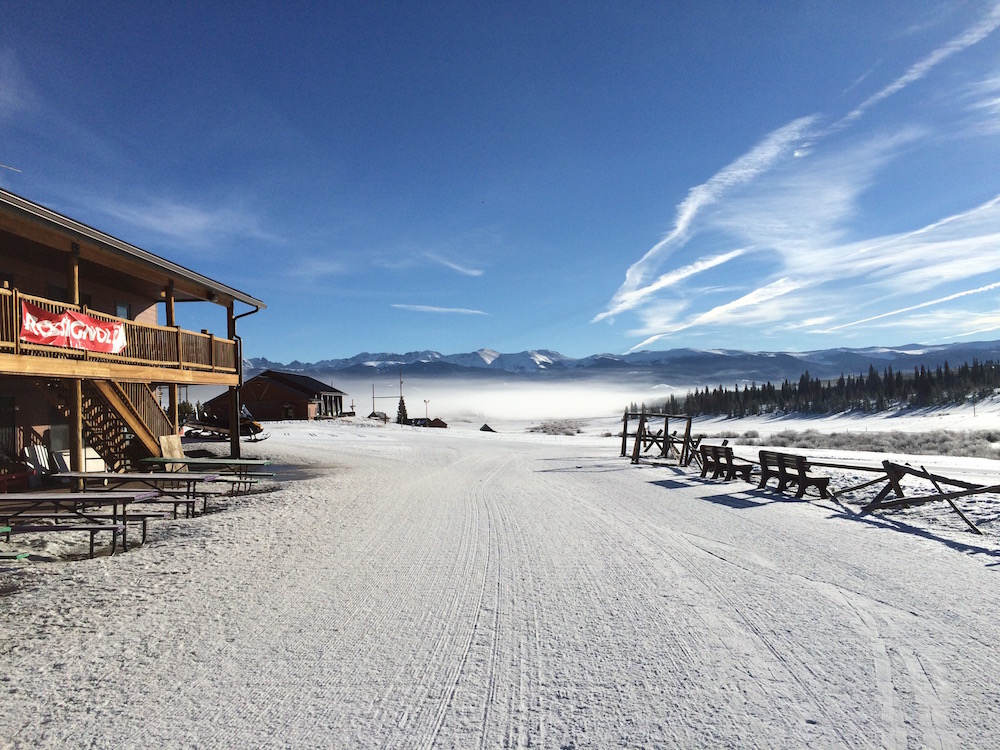
The view from just outside the nordic center at Snow Mountain Ranch in Granby, Colo. (Photo: Alex Kochon/FasterSkier)
(Press release)
Snow Mountain Ranch is hiring Nordic Center Employees and Volunteers to work as instructors and rental staff, along with Snowmobile Grooming Operators. While at SMR enjoy skiing on 100+km of trails, daily ski breaks, and discounts on ski gear. Snow Mountain Ranch also provides housing and meals to employees and volunteers for free. Opportunities range from 3 weeks to 8 months; work in the Nordic Center will begin November 15 and run through April 15, 2017. For more information about working at the Nordic Center or any of our other seasonal employment or volunteer opportunities, visit: snowmountainranch.org/employment/
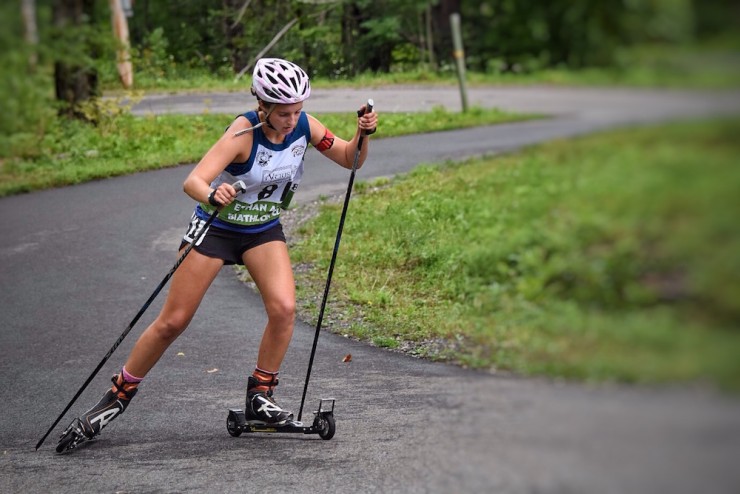
Brendan Cyr during the men’s sprint at the 2016 US Biathlon National Rollerski Championships on Aug. 13 in Jericho, Vt. (Photo: Katrina Howe)
Alex Howe during the men’s sprint at the 2016 US Biathlon National Rollerski Championships on Aug. 13 in Jericho, Vt. (Photo: Katrina Howe)
Lowell Bailey (l) chasing Jake Brown during the men’s sprint at the 2016 US Biathlon National Rollerski Championships on Aug. 13 in Jericho, Vt. (Photo: Katrina Howe)
Tim Burke during the men’s sprint at the 2016 US Biathlon National Rollerski Championships on Aug. 13 in Jericho, Vt. (Photo: Katrina Howe)
Paul Schommer during the men’s sprint at the 2016 US Biathlon National Rollerski Championships on Aug. 13 in Jericho, Vt. (Photo: Katrina Howe)
Lowell Bailey during the men’s sprint at the 2016 US Biathlon National Rollerski Championships on Aug. 13 in Jericho, Vt. (Photo: Katrina Howe)
Kaitlynn Miller during the women’s sprint at the 2016 US Biathlon National Rollerski Championships on Aug. 13 in Jericho, Vt. (Photo: Katrina Howe)
Sweden’s Anna Hedstrom in the junior women’s sprint at the 2016 US Biathlon National Rollerski Championships on Aug. 13 in Jericho, Vt. (Photo: Katrina Howe)
Emily Dreissigacker during the women’s sprint at the 2016 US Biathlon National Rollerski Championships on Aug. 13 in Jericho, Vt. (Photo: Katrina Howe)
Chloe Levins during the youth women’s sprint at the 2016 US Biathlon National Rollerski Championships on Aug. 13 in Jericho, Vt. (Photo: Katrina Howe)
Chloe Levins during the youth women’s sprint at the 2016 US Biathlon National Rollerski Championships on Aug. 13 in Jericho, Vt. (Photo: Katrina Howe)
Chloe Levins during the youth women’s sprint at the 2016 US Biathlon National Rollerski Championships on Aug. 13 in Jericho, Vt. (Photo: Katrina Howe)
Erik Gorman during the men’s sprint at the 2016 US Biathlon National Rollerski Championships on Aug. 13 in Jericho, Vt. (Photo: Katrina Howe)
Kamran Husain in the junior men’s sprint at 2016 US Biathlon National Rollerski Championships on Aug. 13 in Jericho, Vt. (Photo: Katrina Howe)
Tadhg Nakada (National Guard Biathlon) during the men’s sprint at the 2016 US Biathlon National Rollerski Championships on Aug. 13 in Jericho, Vt. (Photo: Katrina Howe)
Joanne Firesteel Reid during the women’s mass start at the 2016 US Biathlon National Rollerski Championships on Aug. 14 in Jericho, Vt. Reid earned a World Cup nod thanks to her performances. (Photo: Katrina Howe)
Susan Dunklee on her way to victory in the women’s mass start at the 2016 US Biathlon National Rollerski Championships in Jericho, Vt. (Photo: Katrina Howe)
Susan Dunklee during the women’s mass start at the 2016 US Biathlon National Rollerski Championships on Aug. 14 in Jericho, Vt. (Photo: Katrina Howe)
Clare Egan during the women’s mass start at the 2016 US Biathlon National Rollerski Championships on Aug. 14 in Jericho, Vt. (Photo: Katrina Howe)
Kelsey Dickinson during the women’s mass start at the 2016 US Biathlon National Rollerski Championships on Aug. 14 in Jericho, Vt. (Photo: Katrina Howe)
Kelsey Dickinson during the women’s mass start at the 2016 US Biathlon National Rollerski Championships on Aug. 14 in Jericho, Vt. (Photo: Katrina Howe)
Kelsey Dickinson during the women’s mass start at the 2016 US Biathlon National Rollerski Championships on Aug. 14 in Jericho, Vt. (Photo: Katrina Howe)
Maddie Phaneuf during the women’s mass start at the 2016 US Biathlon National Rollerski Championships on Aug. 14 in Jericho, Vt. (Photo: Katrina Howe)
Maddie Phaneuf during the women’s mass start at the 2016 US Biathlon National Rollerski Championships on Aug. 14 in Jericho, Vt. (Photo: Katrina Howe)
Hallie Grossman during the women’s mass start at the 2016 US Biathlon National Rollerski Championships on Aug. 14 in Jericho, Vt. (Photo: Katrina Howe)
Emily Dreissigacker during the women’s mass start at the 2016 US Biathlon National Rollerski Championships on Aug. 14 in Jericho, Vt. (Photo: Katrina Howe)
Emily Dreissigacker during the women’s mass start at the 2016 US Biathlon National Rollerski Championships on Aug. 14 in Jericho, Vt. (Photo: Katrina Howe)
Emily Dreissigacker during the women’s mass start at the 2016 US Biathlon National Rollerski Championships on Aug. 14 in Jericho, Vt. (Photo: Katrina Howe)
Sweden’s Nicolina Lindqvist during the junior women’s pursuit start at the 2016 US Biathlon National Rollerski Championships on Aug. 14 in Jericho, Vt. (Photo: Katrina Howe)
Sweden’s Nicolina Lindqvist during the junior women’s pursuit start at the 2016 US Biathlon National Rollerski Championships on Aug. 14 in Jericho, Vt. (Photo: Katrina Howe)
Sweden’s Elvira Oberg during the youth women’s pursuit start at the 2016 US Biathlon National Rollerski Championships on Aug. 14 in Jericho, Vt. (Photo: Katrina Howe)
Junior women race at the 2016 USBA Rollerski Nationals in Jericho, Vt.
Sweden’s Tilda Johannson (l) and Frederique-Karia Perusse during the youth women’s pursuit start at the 2016 US Biathlon National Rollerski Championships on Aug. 14 in Jericho, Vt. (Photo: Katrina Howe)
Tilda Johannson during the youth women’s pursuit start at the 2016 US Biathlon National Rollerski Championships on Aug. 14 in Jericho, Vt. (Photo: Katrina Howe)
Chloe Levins during the youth women’s pursuit start at the 2016 US Biathlon National Rollerski Championships on Aug. 14 in Jericho, Vt. (Photo: Katrina Howe)
Chloe Levins during the youth women’s pursuit start at the 2016 US Biathlon National Rollerski Championships on Aug. 14 in Jericho, Vt. (Photo: Katrina Howe)
Eliza Thomas during the youth women’s pursuit start at the 2016 US Biathlon National Rollerski Championships on Aug. 14 in Jericho, Vt. (Photo: Katrina Howe)
Eliza Thomas during the youth women’s pursuit start at the 2016 US Biathlon National Rollerski Championships on Aug. 14 in Jericho, Vt. (Photo: Katrina Howe)
Siena Ellingson during the junior women’s pursuit start at the 2016 US Biathlon National Rollerski Championships on Aug. 14 in Jericho, Vt. (Photo: Katrina Howe)
Amanda Kautzer during the youth women’s pursuit start at the 2016 US Biathlon National Rollerski Championships on Aug. 14 in Jericho, Vt. (Photo: Katrina Howe)
Sarah Beaulieu during the youth women’s pursuit start at the 2016 US Biathlon National Rollerski Championships on Aug. 14 in Jericho, Vt. (Photo: Katrina Howe)
Sarah Beaulieu during the youth women’s pursuit start at the 2016 US Biathlon National Rollerski Championships on Aug. 14 in Jericho, Vt. (Photo: Katrina Howe)
Sarah Beaulieu during the youth women’s pursuit start at the 2016 US Biathlon National Rollerski Championships on Aug. 14 in Jericho, Vt. (Photo: Katrina Howe)
Naomi Hernandez during the women’s pursuit start at the 2016 US Biathlon National Rollerski Championships on Aug. 14 in Jericho, Vt. (Photo: Katrina Howe)
Joanne-Firesteel Reid (l) cheers on Alex Howe during the men’s mass start at the 2016 US Biathlon National Rollerski Championships on Aug. 14 in Jericho, Vt. (Photo: Katrina Howe)
Lowell Bailey during the men’s mass start at the 2016 US Biathlon National Rollerski Championships on Aug. 14 in Jericho, Vt. (Photo: Katrina Howe)
Tim Burke during the men’s mass start at the 2016 US Biathlon National Rollerski Championships on Aug. 14 in Jericho, Vt. (Photo: Katrina Howe)
Russell Currier during the men’s mass start at the 2016 US Biathlon National Rollerski Championships on Aug. 14 in Jericho, Vt. (Photo: Katrina Howe)
Jake Brown during the men’s mass start at the 2016 US Biathlon National Rollerski Championships on Aug. 14 in Jericho, Vt. (Photo: Katrina Howe)
Paul Schommer during the men’s mass start at the 2016 US Biathlon National Rollerski Championships on Aug. 14 in Jericho, Vt. (Photo: Katrina Howe)
Brendan Cyr during the junior men’s pursuit start at the 2016 US Biathlon National Rollerski Championships on Aug. 14 in Jericho, Vt. (Photo: Katrina Howe)
Peter Carroll during the junior men’s pursuit at the 2016 US Biathlon National Rollerski Championships on Aug. 14 in Jericho, Vt. (Photo: Katrina Howe)
Cody Johnson (l) and Brendan Cyr during the junior men’s pursuit start at the 2016 US Biathlon National Rollerski Championships on Aug. 14 in Jericho, Vt. (Photo: Katrina Howe)
Cody Johnson (l) and Brendan Cyr during the junior men’s pursuit start at the 2016 US Biathlon National Rollerski Championships on Aug. 14 in Jericho, Vt. (Photo: Katrina Howe)
Cody Johnson during the junior men’s pursuit start at the 2016 US Biathlon National Rollerski Championships on Aug. 14 in Jericho, Vt. (Photo: Katrina Howe)
Brendan Cyr during the junior men’s pursuit start at the 2016 US Biathlon National Rollerski Championships on Aug. 14 in Jericho, Vt. (Photo: Katrina Howe)
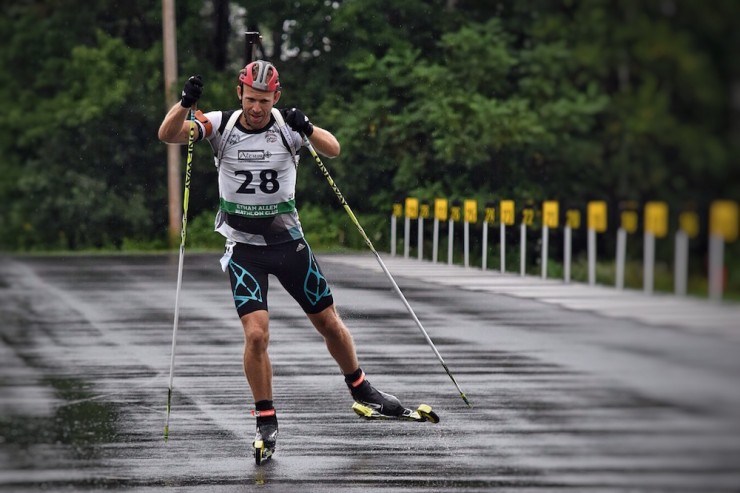
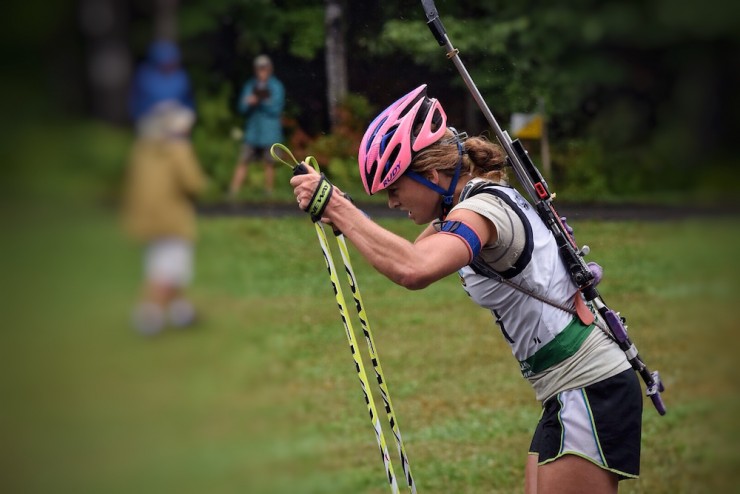
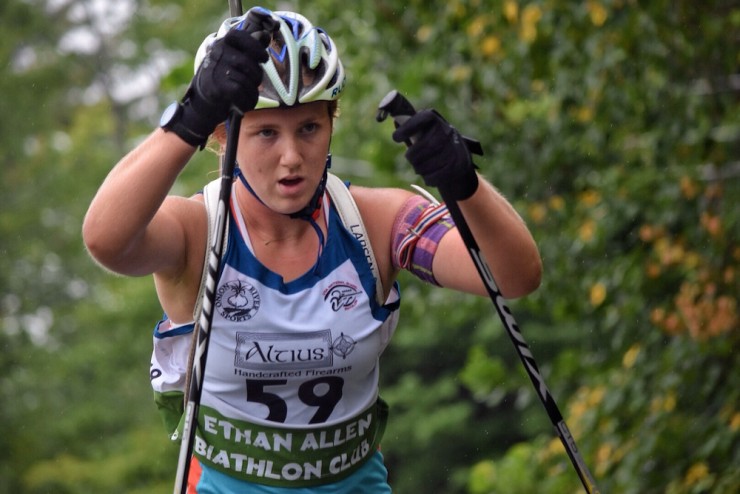
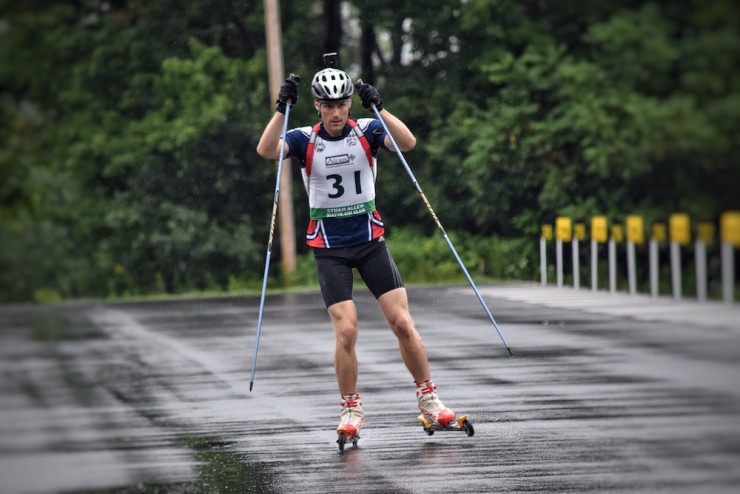
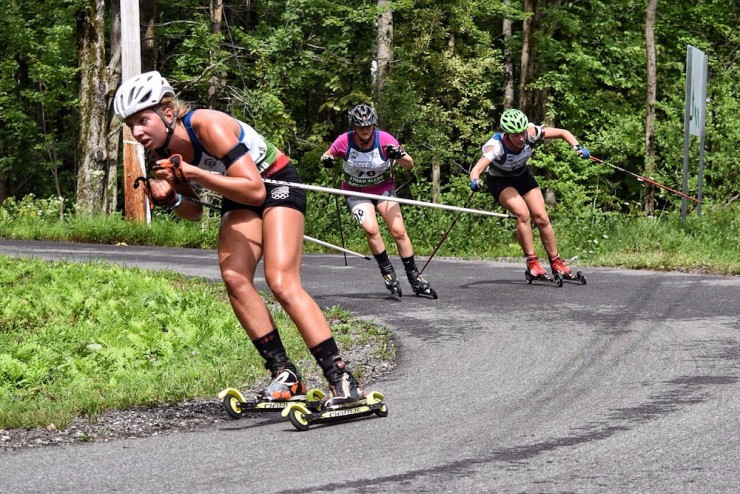
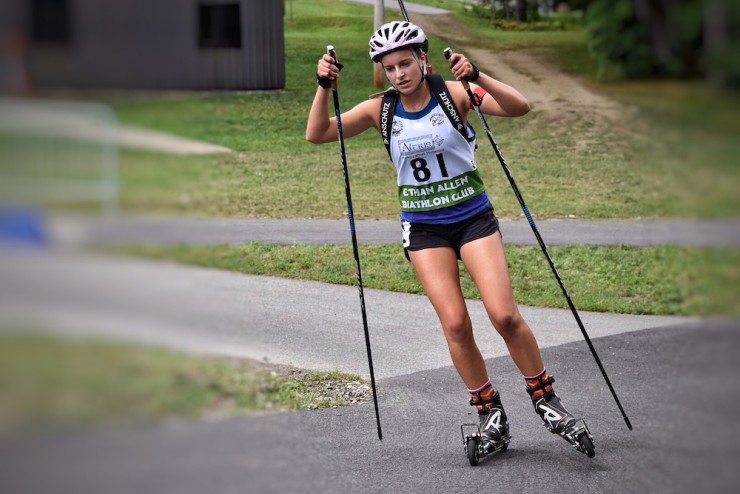
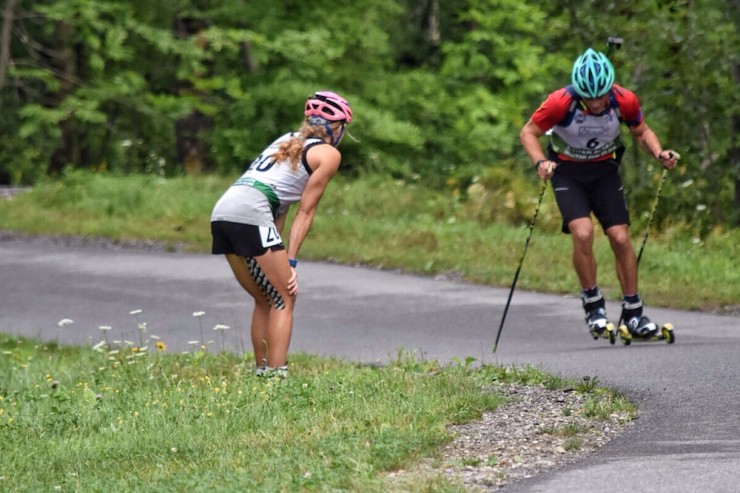
A select group of top U.S. biathletes and more than 60 juniors made the trek to the military base in Jericho, Vt., for the 2016 US Biathlon National Rollerski Championships and North American Rollerski Biathlon Championships last weekend, weathering hot and humid temperatures over two days of racing.
US Biathlon Chief of Sport Bernd Eisenbichler wrote in an email that he was pleased with the turnout at the Ethan Allen Firing Range, especially among the younger athletes. On Sunday, 15 men raced the elite mass start, and 10 women raced the women’s mass start. The rest of the field competed in pursuits, separated into various age categories for ages 14 and up.
“Tim and Lowell showed a high level … and showed that they are overall well ahead of everybody else,” he wrote. “Shooting was challenging for them as well as for everybody else through the weather conditions, as when you stopped the whole body felt like [it was going] to explode…but both had also some very good stages!”
He added that Dunklee was skiing at a high level, but struggled on the range a bit in the sprint (with four penalties) because of the weather and a few adjustments she was working on.
“The mass start was better in that regard,” Eisenbichler wrote.
In terms of developing male skiers, he pointed out Jake Brown, a former Northern Michigan University skier who started biathlon this past June, and Paul Schommer, who picked up the sport two summers ago. In the mass start, Brown placed third and Schommer was fourth.
“They worked hard to get where they are right now,” Eisenbichler wrote. “Still a lot to work on, but on the right way.”
Max Durtschi and Alex Howe were sick leading up to the races, which affected their results, he added. Absent from Jericho were national-team members Leif Nordgren and Sean Doherty, who are in Europe for a seven-week camp. They’re currently in Östersund, Sweden, and will meet up with the rest of the team in Ruhpolding, Germany, on Aug. 22 for a three-week camp in Ruhpolding and Oberhof, Germany.
On the women’s side, Eisenbichler highlighted Clare Egan (second in the mass start and third in the sprint) and Joanne Reid (second in the sprint and third in the mass start).
“Joanne had very good shooting in the Sprint and both days [skiing] was solid and showed that she made very good progress in [biathlon],” he said of Reid, who’s entering her second year of biathlon. “With good focused work and more daily based coaching in the fall (she had to spend some periods back in Colorado for some studies in the spring), [she] will be on the right path for the start of the season.”
Several cross-country skiers came out as well, including Hallie Grossman, Liz Guiney and Kaitlynn Miller. “We hope that a few of them will pursue [biathlon] intensively in the future,” Eisenbichler said.
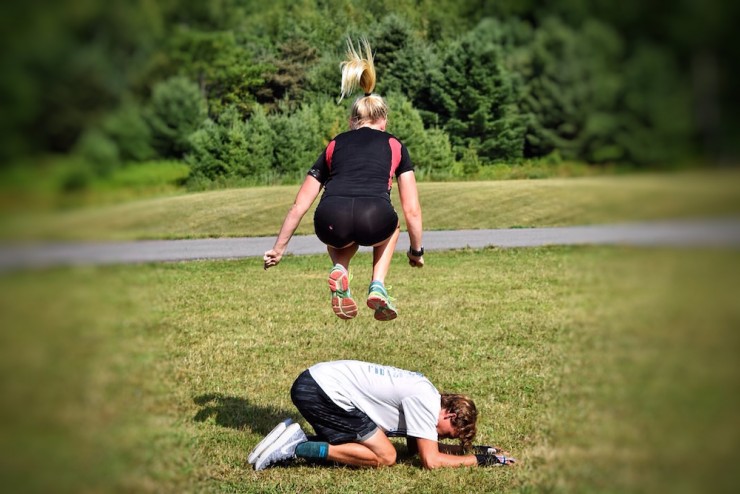
Sweden’s Nicolina Lindquist jumping over Jake Pearson, of Cody, Wyo., during a strength workout at the USBA development camp last week in Jericho, Vt.(Photo: Katrina Howe)
(Photo: Katrina Howe)
Paul Schommer (l) and Jake Brown doing high-five partner burpees during a strength workout at the U.S. Biathlon development camp in Jericho, Vermont. (Photo: Katrina Howe)
According to Green Mountain Valley School coach Katrina Howe, the standing athlete is trying to stabilize/stand while their partner crawls around their waste as many times as possible in a 40-second period. “Hilarious to watch and a great get-to-know-you (in a hurry!) exercise,” Howe wrote. (Photo: Katrina Howe)
(Photo: Katrina Howe)
(Photo: Katrina Howe)
Last week, more than 100 athletes from the U.S., Canada and Sweden came out for the US Biathlon Association’s (USBA) annual development camp in Jericho, Vt. It was one of US Biathlon’s largest and best-attended camps yet, according to national-team assistant coach Erik Lewish.
“The camp is a great experience for biathletes from all over North America to get together for a week of training and educational sessions that culminate with the North American Summer Biathlon Championships at the end of the week on Saturday and Sunday,” Lewish wrote in an email.
Those championships took place last weekend on Aug. 13-14.
In the week leading up to the races, the U.S. Anti-Doping Agency (USADA) visited the camp to present on True Sport “and what to expect when one makes it to a high enough level that they are in the registered testing pool,” Lewish explained. “Our Head Development coach Jean Paquet took the athletes on a course scan of the roller loop and talked about ski technique and how to really ‘attack’ a course. Andrea Burke (formerly Henkel) gave a great motivational/inspirational presentation about her time as an athlete. Overall it is a great chance for the athletes to learn about the sport and hone their individual skills before competing in the continental championships.”
The Monday before the championships, camp participants did an eight-station strength workout that involved some partnering up.
Lewish explained that the workout was jointly created by himself, Paquet and Kari Korpela, the biathlon coach for the Sollefteå Skidgymnasium in Sweden.
“The whole workout took about 1.5 hours from warm up to cool down,” Lewish wrote. “This was the second session of the day, after a long, easy roller ski in the morning.”
The Workout: Biathlon Strength Stations (and Shooting)
Warmup: 15-20 minutes of running
First 20-Minute Set:
– 40 seconds of each station/exercise followed by 1 single shot on the range, then 40 seconds of the next station/exercise
Second Set:
– Reload rifle magazine and do some longer bouts: 4 minutes of 40 seconds on/20 off at a station, then move onto the next exercise. After 4 minutes, take 5 shots on the range and return to next station. Repeat for a total of four shooting bouts (shooting order: prone, prone, standing, standing).
The Stations:
1. TRX leg crunches: Start in a pushup position with your feet in the straps of a TRX Suspension Trainer. Lift your hips and pull your knees into your chest.
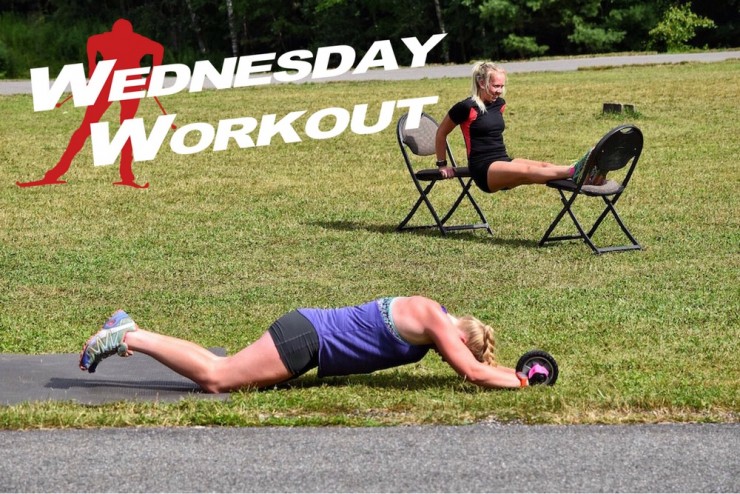
2. Ab Roller: Start on your knees and roll out as far as you can while bracing your core, pause at the farthest point and then return to the starting position.
3. V-Sits: Start lying down flat with your hands above your head. Bring your legs and torso up together and touch your toes at the top.
4. Partner Burpees: Standard burpee done in sync with a partner. High five at the top of the jump for added fun!
5. Under-Overs: One person jumps over and crawls under the other person.
6. Human Rock Climbing: One person starts on the back of the other and tries to climb 360 degrees around the other person without touching the ground.
7. Tricep Dips: Sit on a chair, holding the edge with both hands, knuckles pointing forward. Straighten your arms to raise your body and extend legs straight out with heels on the ground (or on another ch. Bend at your elbows to lower your entire body while keeping your legs straight. Hold at the bottom for a moment without touching ground.
8. Single-Leg Plyo-Jumps: Jumps done side-side to mimic skate skiing with a small hop in between before transferring to the other side.
The Stratton Mountain School Elite Team is hosting 2 clinics
Sunday August 21 at Stratton Mountain School
Sunday September 25 in Hanover, NH
Come rub shoulders with Olympic athletes and celebrate cross-country skiing!
Both clinics start with instruction and training and end with a video presentation and a question and answer period with the team. Everyone should bring running clothes, bounding poles and a change of clothes.
Clinics will run from 2:30-4:30 pm. There is no charge for the clinics. The team mission statement is “International Excellence, Local Inspiration” and this is our way of giving back to the community that supports us.
For more information on the Stratton clinic, contact Sverre: scaldwell@gosms.org
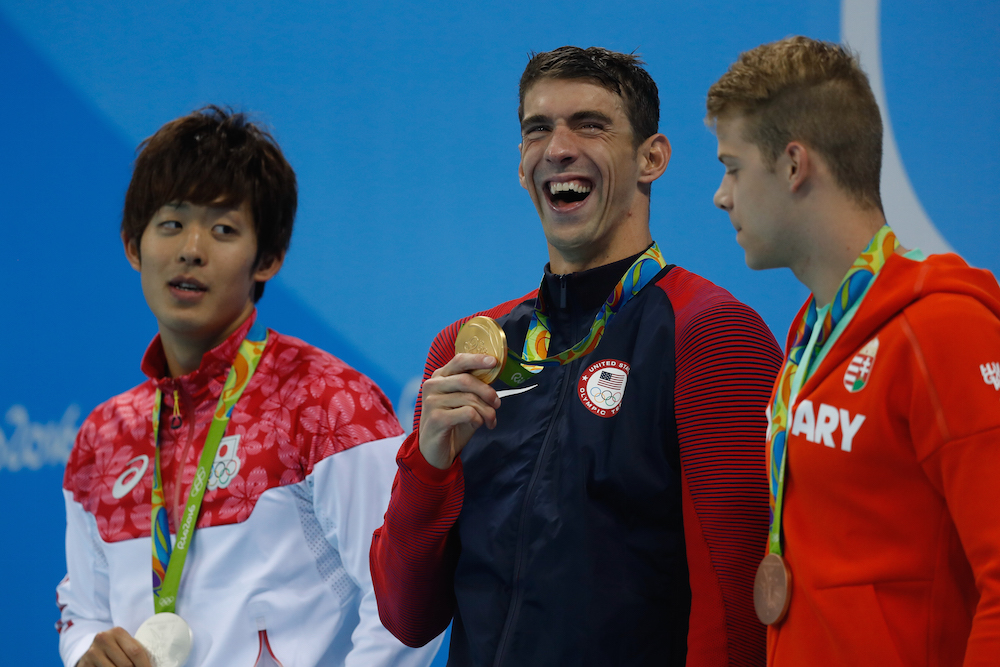
American Michael Phelps after winning his 20th Olympic gold medal in the 200-meter butterfly stroke. (Photo: Wikimedia Commons/Fernando Frazão/Agency Brazil)
Note: This Olympic roundup has been updated to include the results of Czech skier Eva Vrabcová-Nývltová (who placed 26th in the Rio Olympics marathon on Sunday) and Kristina Valjas, Lenny Valjas’s sister (who finished ninth in the Olympic beach volleyball tournament on Saturday).
Vrabcová-Nývltová 26th in Marathon
In her first Summer Olympics, Czech World Cup skier Eva Vrabcová Nývltová placed 26th in the women’s marathon on Sunday in Rio de Janeiro, Brazil, finishing in 2 hours, 33 minutes and 51 seconds (9:47 behind the winner). Kenya’s Jemima Sumgong won it in 2:24:04, outlasting Bahrain’s Eunice Jepkirui Kirwa by 9 seconds, while Ethiopia’s Mare Dibaba took bronze in 2:24:30.
Three Americans placed in the top 10: Shalane Flanagan (6th), Desiree Linden (7th) and Amy Cragg (9th).
Valjas Represents Canada in Beach Volleyball
There’s Olympic blood in the Valjas family. This summer, Kristina Valjas, the older sister of Canadian national-team cross-country skier Lenny Valjas, qualified for her first Olympics in beach volleyball in Rio. And on Saturday, Aug. 13, her run with teammate Jamie Broder ended with a match against another Canadian team, Sarah Pavan and Heather Bansley.
After what was dubbed the ‘Clash of Canadians’, Pavan and Bansley advanced to the quarterfinals with a 2-0 win (21-16, 21-11) over Valjas and Broder. Valjas and Broder went 2-1 in the preliminary round and end up ninth in the Olympic tournament overall.
At 6-foot-2, Valjas is two years older and a few inches shorter than her 6-6, 27 year old brother. Pavan, her competitor on Saturday, is 6-5 and outreached Valjas.
Michael Phelps is an inspiration to Martin Fourcade. That’s what the 10-time world champion, two-time Olympic gold medalist, and five-time defending overall International Biathlon Union (IBU) World Cup champion told Le Parisian this week. Fourcade, 27, said he is hooked on watching Olympic swimming and has “tremendous admiration” for the 31-year-old Phelps, the most decorated Olympian of all time with 26 medals, 22 of which are gold. What does he like most about him? His story of renewal. “It’s impressive,” Fourcade said, adding that he likes Phelps’ jovial demeanor.
Former Canadian national cross-country skier Tara Whitten, of Calgary, placed seventh in the women’s Olympic cycling time trial on Wednesday in Rio de Janeiro, Brazil. Whitten finished the 29.8-kilometer course in 45:1.16, 34.74 seconds behind winner American Kristin Armstrong (who won her third-straight Olympic time trial).
“A medal was the goal but I’m extremely proud of my 7th place finish yesterday,” Whitten tweeted.
Whitney’s compatriot, Karol-Ann Canuel of Gatineau, Que., placed 13th.
“When I crossed the finish line, I realized that [Whitten] was tentatively in first place, and that I was third,” Canuel told the Canadian Press. “She cut about one minute to my time, so I said to myself: ‘Wow, Tara might make an upset.’ I think she was happy with her performance and she was feeling great. Good for her.”
Whitten, 36, is a three-time world champion and two-time Olympian in cycling. At the 2012 London Games, she helped the Canadian team to bronze in the women’s team pursuit and placed fourth in the omnium (a multiple-race track cycling event). Earlier this year in March, she was injured while inspecting the road course in Rio when her bike collided with the back of a bus. She was knocked unconscious and broke a bone at the base of her scull, according to a University of Alberta article. Despite her training interruption and subsequent delay in being named to the Canadian Olympic team, Whitten made the cut and returned to Rio.
Before her career as a cyclist, Whitten was a national-team skier and silver medalist at the 2003 Nordic U23 World Championships. She reached the 2005 Nordic World Championships, but missed qualifying for the 2006 Winter Olympics the following year. In 2007 at the age of 27, she became a competitive cyclist and captured her first world championship medal in 2009. This past June, she earned her PhD in neuroscience from the University of Alberta. According to the Canadian Olympic Team website, she’ll be looking for a post-doctoral position after the Rio Games.
Nordic Nations Lead Medals Per Capita
Check out MedalsPerCapita.com, and you’ll likely notice a trend: three of the top five countries are Nordic countries. Computer scientist Craig Nevill-Manning has tracked and ranked the world’s nations by how many medals they’ve won per capita since 1896, and Finland and Sweden are at the top with 17,904 and 19,649 people per medal, respectfully. Denmark is fourth (after Hungary) with 31,176. Norway is just outside the top five with 33,595 people per medal. When ranked by gold medals specifically, Norway ranks fifth, with Finland and Sweden are first and third, respectively.
“The main reason the Nordic nations have been so successful in the Olympics is the same reason many argue they’re successful in other domains: They’re tiny countries,” Business Insider reporter Chris Weller explains. “One gold medal translates to a much greater medal-per-capita count in Finland (population: 5.4 million) than it does in the US (population: 313 million).
“To put the domination in perspective: In order to match Finland’s medals per capita, the US would need to have earned an additional 15,000 medals throughout its Olympic history — a mind-boggling, if impossible achievement given that Medals Per Capita totals its current medal count at 2,401.”
But population aside, Nordic countries have a history of being extremely successful at the Olympics. Business Insider points out that Finland, with just 1.6 percent of the U.S. population, has earned 12.5 percent of the U.S.’s total medal count. “That over-representation is likely a testament to the snowy Northern European countries’ strength in winter sports,” Weller writes. “They do their best in cross-country skiing, ski jumping, and speed skating.”
At the Rio Games, Denmark is currently 13th in the medals-per-capita count, Sweden is 15th, and Norway is 22nd. Finland has yet to place. Among other skiing nations, Slovenia is first, Kazakhstan is 10th, Slovakia 11th, and Switzerland 12th.
Saint Michael’s College, a small liberal arts college in Colchester, Vt., is looking for an Asst. Coach for this Nordic season. We compete on the highly competitive EISA Carnival circuit. Looking for help starting late fall through the end of February. It is a part-time stipend position with flexible hours and includes a free class each semester. Waxing experience required. Must love long van rides in the snow and the sweet smell of Chola in the morning! Please contact Molly Peters for more information or to submit your resume: Mpeters2@smcvt.edu
We’ve all been there. A bad race, bad moment, or maybe it was a really good race with really bad photo timing. Whatever the case may be, we asked for your best worst-looking submissions and here are the best of the lot! (Photos appear in no particular order.)
Winners: Eli Brown’s zombie apocalypse and Hallie Grossman’s bloody nose
“Nordic Zombie Apocalypse”
in below-zero blizzard conditions at the 50 k Noquemanon in 2014 in Marquette, Mich. (Photo: Frances Upton)
How can you beat this photo of Hallie in a 5 k junior mass start at 2013 Senior U.S. nationals at Soldier Hollow in Midway, Utah?
Farnum 5.5-mile trail race last September in Lebanon, N.H.
“Stadium sprint” in the 2016 NENSA Eastern High School Championship classic sprint.
2011 EISA Championships: “#nocaptionnecessary”
at the Dartmouth Carnival (Photo: Gil Talbot)
At the Mount Kearsarge Rollerski Race: “Where is the top of this friggen mountain!?”
Johanna Talihärm competing at the 2014 Olympics, where she finished 48th in the sprint.
BKL Festival in March 2012 at Great Glen, N.H.
2013 Marcialonga:
“Finally, it’s over…can I make it to the bag drop? “
The Loppet Foundation in Minneapolis is looking to fill the positions of Adventure Center Director, Marketing & Communications Manager and Sponsorship Sales Manager. More information below:
The Loppet Foundation is seeking applicants for a new and exciting position. The Foundation is expanding its partnership with the Minneapolis Park & Recreation Board (MPRB) by creating an Adventure Center in Theodore Wirth Park.
The Adventure Center Director runs the partnership efforts between the MPRB and the Loppet Foundation in the Adventure Center area: on the trails that the Loppet Foundation is responsible for, and in and around the Adventure Center building.
Primary Directive: To create and run a national class center for year-round outdoor activities that helps the Loppet Foundation, the MPRB, the North Minneapolis community, and the broader public enjoy year-round outdoor activities.
The Adventure Center Director stewards the Adventure Center and the relationship with the MPRB in order to create a place that is a home base for outdoor activity for the Minneapolis area generally, but that also is home base for Loppet events and programs and allows the Foundation to achieve its broader mission and advance the organization’s strategic plan
The Adventure Center Director is responsible for:
Helping to create and maintain the brand of the Adventure Center
Creating and managing an environmental education curriculum and program
Hiring and managing staff in order to achieve the broader goals of the Center and the
Foundation
Maintaining trails for cross country skiing, mountain biking and cross country skiing,
mountain biking, cyclocross, and trail running racing
Managing the Adventure Center budget
Maintaining strong relationships with the MPRB and its staff
Creating reports for the executive director, the board of directors and for the MPRB
Establishing policies on trail use by high schools and other user groups that allow for a
balance between daily users and teams and groups
Working with the Loppet Foundation’s database manager in order to ensure that
Adventure Center patron data is treated appropriately
Coordinating with the Loppet Foundation’s Executive Director, Events Director,
Adventures Director, Advancement Director and Head Coach to ensure that all programs
run smoothly at the Center
Syncing Adventure Center operations with Loppet Foundation activities more broadly
Managing relationships with the Adventure Center’s concessionaires and vendors
Finding and maintaining relationships with other partners in the community
The Adventure Center Director reports to the Executive Director.
The ideal candidate will be a leader with a passion for year round outdoor activity and will understand branding around the outdoor active lifestyle. S/he will have an entrepreneurial spirit, and a proven track record in managing facilities, supervising staff, and running outdoor programming. The ideal candidate will have excellent written communication and interpersonal skills, and will have a proven record of valuing and developing diversity.
Salary is competitive and dependent upon experience.
Send cover letter and resume via email to Allie Wilde at wilde@loppet.org.
The Loppet Foundation is seeking a Marketing and Communications Manager to work full time with all aspects of the Loppet Foundation organization to coordinate marketing initiatives and public relations efforts to promote and develop the Loppet’s brand. S/he is responsible for developing, planning and leading the Loppet Foundation’s annual marketing and communications plan by projecting the mission, generating event and program participation, and celebrating the successes of the organization and individuals in the Loppet community.
The Marketing and Communications Manager drafts and updates copy for marketing collateral, monthly email newsletters, event email communications, the website(s), event recaps, and news articles. S/he captures and conveys the Loppet through creative written stories that are utilized on a variety of channels (website, newsletters, emails, social media).
S/he works with the Graphic Designer to produce collateral pieces such as the biannual printed newsletter, annual results publication, event spectator guides, and City of Lakes Loppet brochure. S/he serves as the main administrator for the Loppet Foundation’s social media channels: Twitter, Facebook, Instagram, and works with all departments to ensure equal messaging is being broadcasted across those channels.
The Marketing and Communications Manager supports media relations efforts, writing and distributing press releases.
The Marketing and Communications Manager directs the sponsorship renewal process for the Loppet Foundation. S/he also assists the Sponsorship Sales Manager with sponsorship related functions such as sponsor relations and retention, aiding with sponsor activation at events, meeting contractual agreements, and managing sponsorship opportunities in Salesforce.
The Marketing and Communications Manager works onsite for all major Loppet events including the City of Lakes Loppet Ski Festival, the City Trails Loppet, the UCare Tri-Loppet, the Surly Trail Loppet and the Pre-Loppet as well as evening events as needed (sponsorship dinner, volunteer dinner, Hoigaard’s Challenge banquet, the Annual Meeting, etc.)
The Marketing & Communications Manager works with all aspects of the organization. The ideal candidate will understand the Loppet’s outdoor active brand and appreciate the outdoors. Strong candidates will have a background in communications and marketing. The Loppet seeks proactive employees who are self-starters and can work with a fast paced team.
Salary is competitive and dependent upon experience.
Send cover letter and resume via email to Allie Wilde at wilde@loppet.org.
The Sponsorship Sales Manager drives the sponsorship efforts at the organization in order to meet the Foundation’s aggressive annual sponsorship sales goals.
The Sponsorship Sales Manager leads the outreach and sales efforts to attract new sponsors and re-sign existing sponsors. Under the direction of the Events Director, the Sponsorship Sales Manager will work toward an aggressive cash and in-kind sponsorship goal each fiscal year. The goal is to increase sponsorship with an across-the-organization balance that includes a mix of long-term sponsorships, sponsors that align with the organization’s mission, and in-kind sponsorships that reduce costs or enhance the organization.
The Sponsorship Sales Manager helps manage and maintain strong relationships with the top-level sponsors of the Loppet Foundation. The Sponsorship Sales Manager creates, manages and updates sponsorship opportunities in records in Salesforce and manages monthly sponsorship committee meetings in order to use Board, Member and volunteer contacts to generate sponsorship leads, meetings and sales.
The Foundation is more interested in finding a talented and aggressive sales manager than someone who sits at a desk from 95 each day. Accordingly, this position can have flexible hours, but the position requires a self-starter who can manage their time and meet their goals independently.
The ideal candidate will have excellent interpersonal skills. They will personally convey the Loppet’s brand either through enthusiasm for an outdoor, active lifestyle, through a personal love for the outdoors, or both. The best candidates will be proactive and not afraid of rejection.
Salary is competitive and dependent upon experience.
Send cover letter and resume via email to Allie Wilde at wilde@loppet.org.