Brighton High School (Rochester, NY) on the snowy southern shore of Lake Ontario is seeking applicants for the position of Varsity Nordic Coach beginning the 2016-2017 season.
This is a well developed program with strong support of the Athletic Director and his office as well as enthusiastic parent volunteers and a feeder junior high program. Groomed trails at nearby county park and Bristol Nordic Center, provide an excellent training venues
Interested applicants should contact Dylan Pudiak (dylanpudiak@gmail.com) for information about the team (a job change has forced Dylan to move) and / or directly apply to the Brighton Central School District Athletic Department:
Fritz Kilian, Athletic Director
Brighton Central School District
2035 Monroe Avenue, Rochester NY 14618, USA
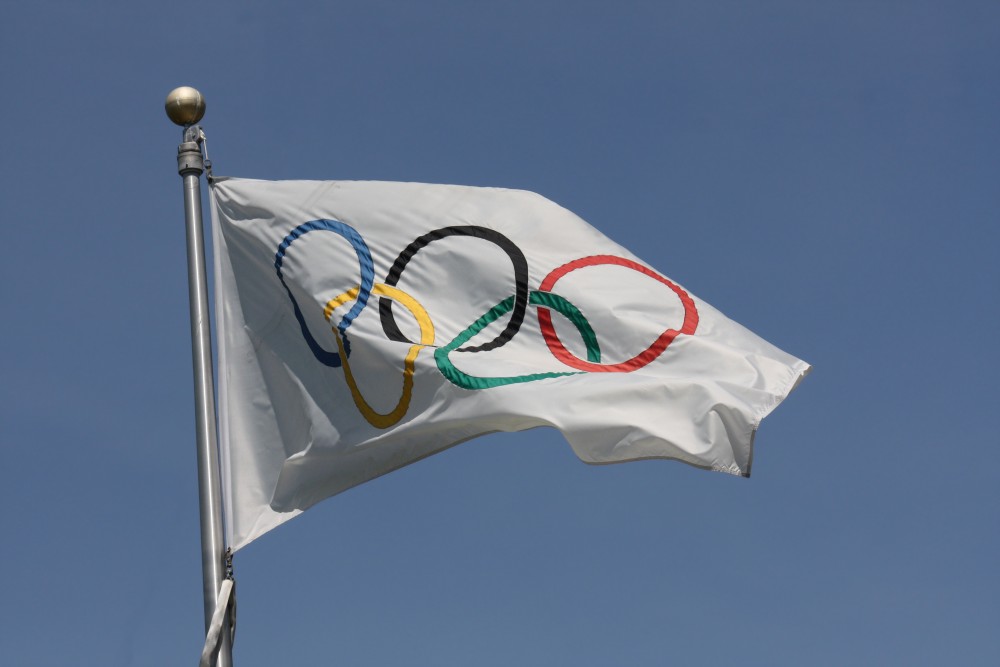
Early next month, the Olympic flag will fly at the upcoming 2016 Summer Olympics in Rio de Janiero, Brazil, but what message is its governing body, the International Olympic Committee, sending in its most recent decision regarding Russia? (Photo: Wikimedia Commons)
Note: The following is an editorial from FasterSkier’s editorial board, consisting of its editors, and is not meant to reflect the opinions of our broader staff.
***
On Sunday, the International Olympic Committee (IOC) Executive Board decided against an all-out ban on Russian athletes at the 2016 Summer Olympics, which start Aug. 5 in Rio de Janeiro, Brazil.
Instead, the IOC asked each individual sports federation (IF) to do a rigorous review of the Russian entries for Rio and determine whether they have undergone sufficient drug testing to be deemed “clean” and cleared to compete.
The IFs have been left just 12 days and no guidance for how to do this.
The decision was the culmination of a long process – just how long depends on who you ask.
Perhaps the process began in 2010, when whistleblower Vitaly Stepanov initially contacted the World Anti-Doping Agency (WADA) with information about systematic doping in Russia.
Or perhaps the process began in December 2014, when German documentarian Hajo Seppelt finally broadcast Stepanov’s information to the public on ARD. It was quickly seen around the world.
Later, WADA commissioned several independent reports, the first of which revealed extensive systematic doping in track and field. The first report, led by former WADA President Dick Pound, dropped in November 2015. Maybe the process began then.
Instead of enacting such a ban, the IOC Executive Board delivered a confusing, unclear decision where Russian athletes may participate after meeting supposedly stringent criteria which are not defined; where Russians with past doping violations are treated differently than those from other countries; and where Russian athletes in different sports may be treated completely differently from one another.
The result will be neither fair to clean athletes who were affected by the Russian government’s manipulation of hundreds of positive doping samples over the last five years, nor to Russian athletes themselves.
Some have noticed. Canadian biathlete and two-time Olympian Brendan Green was one of many sharing this image:
With this in mind, here are some questions for IOC President Thomas Bach and his Executive Board.
1) Do you listen to athletes?
A group of influential athlete representatives held a press conference after McLaren’s last Monday. Among them were Canadian cross-country skier Beckie Scott, the chair of the WADA Athlete Committee, and IOC Athletes’ Commission chair Adam Pengilly.
The group advocated for an unequivocal ban on Russian athletes in both Rio and PyeongChang. Before the McLaren report had even dropped, Pengilly explained, they had circulated a letter stating those aims. The letter was endorsed by athlete representatives from more than 20 different sports federations. Clearly, there was widespread support for such a position.
After the McLaren report came out, that position was solidified.
“We would like to highlight our belief that WADA must allow Professor McLaren and his team to continue their investigation, that Russia should be banned from the Rio Olympics, Paralympics, and other international events, and that International Federations must enact sanctions so as to protect clean sport,” the WADA Athlete Committee said in a statement.
It has been clear for quite some time that the Olympics are not about the needs or wishes of the athletes, but that was underlined by the Executive Board’s decision.
“I believe that the Russian federation has mocked the Olympic movement and I worry about the future of clean sport, I worry about the future for clean athletes, the Olympic movement and the Olympic Games,” Pengilly said told the BBC, where he later said he was “embarrassed” by the Executive Board’s decision. “Some have suggested the IOC has passed the buck and I’d have to agree. There’s been an abdication of responsibility here.”
Fellow IOC Athletes’ Commission member Hayley Wickenheiser, the Canadian four-time gold medalist in ice hockey, had this to say:
2) Do you listen to WADA?
For years – literally – WADA obfuscated, ignored whistleblowers and failed to take action when provided with compelling evidence of doping in Russia.
But in the last few weeks, it appeared that WADA had grown a backbone. After the McLaren report was delivered, the WADA Executive Committee published a list of seven recommendations.
The very first one: “The International Olympic Committee (IOC) and the International Paralympic Committee (IPC) to consider, under their respective Charters, to decline entries, for Rio 2016, of all athletes submitted by the Russian Olympic Committee (ROC) and the Russian Paralympic Committee.”
WADA also suggested that Russian government officials be banned from attending Rio.
That might be the main recommendation that the IOC actually upheld: in their decision they wrote that “Nobody implicated [in the McLaren report], be it an athlete, an official, or an NF, may be accepted for entry or accreditation for the Olympic Games.”
In the McLaren report, Russian Minister of Sport Vitaly Mutko is named as having interfered with at least one positive doping case. Russian President Vladimir Putin’s name is mentioned in the report as having personally appointed a Deputy Minister of Sport who helped hide positive tests.
Will either be banned from Rio? Is that under the purview of any international federation, or only the IOC? Will President Bach sign deny those credentials himself?
Otherwise, WADA – a body which is partially funded by the IOC, but did not have the power to enact a ban on Russian athletes itself – was left in the cold.
“WADA is disappointed that the IOC did not heed WADA’s Executive Committee recommendations that were based on the outcomes of the McLaren Investigation and would have ensured a straight-forward, strong and harmonized approach,” said WADA President Sir Craig Reedie. “The McLaren Report exposed, beyond a reasonable doubt, a state-run doping program in Russia that seriously undermines the principles of clean sport embodied within the World Anti-Doping Code.”
3) What do you mean by “reliable adequate international tests”?
The IOC clearly wanted the process to approve Russian athletes for the Rio Games to be onerous, or at least to seem that way.
Long jumper Darya Klishina will be the only Russian track and field athlete competing in Rio this August. The IAAF cleared her because she lives in Florida and has thus been outside the Russian system. Other federations have clearly not been so strict in making their decisions. (Photo: Wikimedia Commons)
“Under these exceptional circumstances, Russian athletes in any of the 28 Olympic summer sports have to assume the consequences of what amounts to a collective responsibility in order to protect the credibility of the Olympic competitions, and the “presumption of innocence” cannot be applied to them,” the IOC wrote in the preamble to its decision.
And so the board mandated that all athletes be subjected to review by their relevant IFs.
“The absence of a positive national anti-doping test cannot be considered sufficient by the IFs….The IFs should carry out an individual analysis of each athlete’s anti-doping record, taking into account only reliable adequate international tests, and the specificities of the athlete’s sport and its rules, in order to ensure a level playing field.”
Yet there is no definition of reliable – which testing agencies does this include? And there is no definition of adequate – how many tests, over what period of time?
Russian Olympic Committee member Alexander Zhukov was invited to give a presentation to the IOC Executive Board. In it, he asserted that since the first WADA report Russian athletes have been repeatedly tested by international anti-doping agencies and, according to the IOC press release, “the vast majority of the results were negative.”
Yet, the main agency tasked with these tests, UK Antidoping, reported via WADA in June that 16 percent of scheduled tests could not be collected from athletes; a further 736 tests were canceled or declined; and that doping control officers were sometimes harassed and intimidated when they tried to collect samples.
Is this international testing reliable and adequate?
4) Is this fair to Russian athletes?
Without a definition of what constitutes reliable and adequate testing, outcomes for various sports are already vastly different.
The International Association of Athletics Federations (IAAF) has banned all but two Russian track and field athletes from the Games. (The IOC went on to actually kick out one of those two, Yuliya Stepanova, a whistleblower who helped bring the entire scandal to light. Nice.)
In the past weeks Bach has talked extensively about the need to balance collective punishment for government action against individual justice. He has said that clean Russian athletes who had nothing to do with the scandal should not be punished. But it seems clear now that in some sports they will be, whereas in other sports they will not (or their doping teammates might even be able to compete alongside, or instead of, them).
5) Is this what zero tolerance means?
One of the IOC guidelines states that any Russian athlete who has served a doping ban cannot compete in Rio.
One can almost see the logic: with many tests manipulated, the chances are higher that those athletes could have had a second positive test. If true, this should have led to a second and potentially longer ban which they would still be serving.
But maybe not — what if they did reform and are now clean? The provision sends an extremely confusing message: past dopers from some countries are allowed a second chance, but there’s no redemption if you’re from Russia. How is that zero tolerance, much less fair?
When Justin Gatlin and Tyson Gay (American sprinters previously banned for doping) likely medal in the men’s 100 meters, how will a Russian track and field athlete feel? Probably that it’s absolutely fine to dope – as long as you’re not from Russia.
West Irondequoit High School (Rochester, NY) on the snowy southern shore of Lake Ontario is seeking applicants for the position of Varsity Nordic Coach beginning the 2016-2017 season.
Well developed program supported by a highly organized Assistant Coach, parent volunteers and feeder junior high program. Strong support of Athletic Director, his office, and IHS Nordic alumni network. Groomed trails at nearby county park provide an excellent training venue.
Interested applicants should contact Assistant Coach Ann Burns at: annburns199@gmail.com
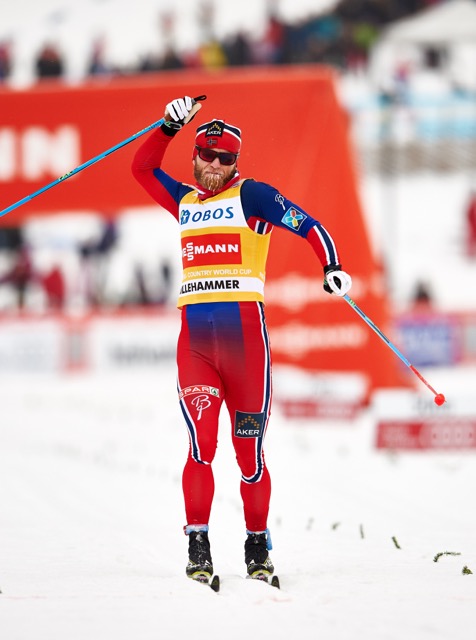
Martin Johnsrud Sundby (Norway) after winning the men’s 15 k classic pursuit for the overall Lillehammer mini-tour title in December 2014 in Norway, following the Davos World Cup. (Photo: Fischer/NordicFocus)
Norway’s Martin Johnsrud Sundby has been stripped of his 2015 Tour de Ski and 2014/2015 overall World Cup titles after the Court of Arbitration for Sport (CAS) upheld an appeal by the World Anti-Doping Agency (WADA) against him and the International Ski Federation (FIS).
The reigning three-time overall World Cup champion, Sundby, 31, was penalized for twice exceeding the amount of salbutamol, also known as albuterol and a “standard therapy against asthma symptoms,” according to a FIS press release, allowed in an athlete’s system and not possessing the necessary medical exemption when he was tested.
Based on WADA rules, the maximum amount that is allowed to be inhaled is 1600 micrograms over 24 hours. Sundby’s samples taken Dec. 13, 2014 after the 15-kilometer classic in Davos, Switzerland, and Jan. 8, 2015 after the 25 k freestyle pursuit at the Tour de Ski in Toblach, Italy, and analyzed by a WADA accredited laboratory exceeded those limits.
“While the medication is normally applied by a handheld metric dose inhaler (MDI), the athlete used a nebulizer to administer the prescribed salbutamol for the treatment of his asthma, which requires a higher labelled dosage than the MDI and thereby exceeded the allowed maximum dose,” FIS stated in its press release on Wednesday. “The FIS Doping Panel had therefore found that the athlete had not committed an anti-doping rule violation when he used a nebulizer as a legitimate means to administer salbutamol instead of a metric dose inhaler (MDI).
“The CAS found however that the epithet ‘inhaled’ was meant to distinguish inhalation from other mechanics of inhalation like ingestion or injection and did not refer to the stage of administration (e.g. the amount that comes out of the device or which was eventually delivered to the athlete’s mouth or lungs),” the release continued. “The allowed dose must be understood as the dose prescribed by the doctor, i.e. the ‘labelled’ or ‘nominal’ dose. Any higher dose, e.g. because of the need to use a nebulizer, requires a Therapeutic Use Exemption (TUE). When the tests were conducted in December 2014 and January 2015, the athlete was not in possession of a TUE and therefore found guilty of an anti-doping rule violation.”
WADA appealed the FIS Doping Panel’s decision, made Sept. 4, 2015, which defended Sundby. The CAS upheld WADA’s appeal and, effective July 11, 2016, sanctioned Sundby for two months. FIS announced this decision in its press release.
“I was at the store when the team doctor called. I was told that I had been over the limit twice,” Sundby said at a press conference as reported by NRK, according to a direct translation. “There and then it felt like the sky came crashing down. I could not believe it. I have never ever used an asthmatic dose that hasn’t been prescribed.”
“It felt like the sky came crashing down. I could not believe it. I have never ever used an asthmatic dose that hasn’t been prescribed.” — Martin Johnsrud Sundby
According to FIS, while CAS “acknowledged in the athlete’s favour that he had not intentionally broken the rules, that has a medical condition requiring the administration of salbutamol and that he had used salbutamol by nebulizer as prescribed by his team doctor, as he had done so before without any problems,” they also noted that anti-doping rules must be strictly adhered to and “that the prescription of the team doctor as to the use of the nebulizer to administer salbutamol outside of a hospital was arguably questionable from a medical point of view as well as the fact that the athlete and his team doctor had not made any enquiry of WADA, FIS or the manufacturer whether inhalation by a nebulizer would still require a TUE under the revised anti-doping rules.”
Sundby’s win on Dec. 13, 2014 in Davos (where he edged his teammate Didrik Tønseth by 6.6 seconds) and third-place finish in the Toblach 25 k (behind teammate Petter Northug and Sweden’s Calle Halfvarsson, respectively) have been nulled. In addition to being disqualified from those races, Sundby is no longer listed as the overall champion of the 2015 Tour de Ski, after he initially won the final hill climb by 34.5 seconds over Northug in Val di Fiemme, Italy. Northug is now listed as the winner and Sundby is not on the final results. Sundby is also no longer the 2014/2015 overall World Cup champion, Switzerland’s Dario Cologna is.
In a separate press release, FIS announced the recalculated results and standings from 2014/2015:
“The impact on the 2014/15 FIS Cross Country Cup World Cup standings and FIS Tour de Ski standings are as follows:
– Sundby forfeits the 143 points he earned for the two races where he has been disqualified – 100 World Cup points for the victory in Davos and 43 points for his third place finish in Toblach.
– With the Sundby disqualification on the 13th December 2014, the podium for the 15 km classic in Davos (SUI) is now as follows: 1. Didrik Toenseth (NOR); 2. Dario Cologna (SUI); 3. Sjur Roethe (NOR).
– With the Sundby disqualification at the 8th January 2015 in the 25 km pursuit in Toblach (ITA), the podium for that race is now as follows: 1. Petter Northug JR. (NOR); 2. Calle Halfvarsson (SWE); 3. Evgeniy Belov (RUS).
– In accordance with the Tour de Ski regulations, Sundby also forfeits his overall 2015 Tour de Ski victory and 400 World Cup points he earned for it as well as prize money of CHF 108’000. The new standings for the 2015 Tour de Ski are as follows: 1) Petter Northug JR. (NOR); 2. Evgeniy Belov (RUS); 3. Calle Halfvarsson (SWE).
– The breakdown of prize money from the Tour de Ski 2015 that Sundby has to return for redistribution to the newly ranked athletes is as follows: CHF 90,000 or first place in the Tour de Ski, CHF 2,000 from the third place of the Tour de Ski sprint standings and the World Cup earnings for the two races, CHF 15,000 for the victory in Davos and CHF 1,000 for the third place finish in Toblach.
– Additionally, Sundby forfeits the World Cup points and prize money from the remaining Tour de Ski races after Toblach, namely the last two stages in Val di Fiemme in which he finished 8th and 3rd. This amounts to a further 73 World Cup points and CHF 1,000 in prize money.
– The final 2014/15 FIS Cross Country World Cup standings have also been recalculated and are as follows: 1. Dario Cologna (SUI) – 1103 points; Petter Northug JR. (NOR) – 1047 points; Finn Haagen Krogh (NOR) – 897 points. Sundby moves down to sixth place in the overall World Cup standings with 748 points and forfeits CHF 22,275 in the overall World Cup prize money standings.
– In total, Sundby forfeits 616 World Cup points for the 2014/15 season and CHF 131,275 in prize money. This includes all races directly and indirectly affected by the CAS decision.”
“I was sure that the case would be dropped quite fast, but then it turned out that WADA didn’t understand the rules in the same way as the whole Norwegian medical team,” he continued. “When WADA appealed, I thought it was a formality. I went into the 2015/2016-season knowing I was innocent, and also that I was acquitted. I think the verdict is totally unreasonable. I have to live with it, and I will stay strong knowing I have done nothing wrong.”
“FIS fully shares the view of the CAS that Martin Johnsrud Sundby is not to be considered as an intentional doping offender but that his sanctions result from the strict application of the anti-doping rules and the WADA Prohibited List as a consequence of his reliance on questionable medical advice to administer salbutamol outside a hospital,” FIS concluded.
“I am pleased that the Norwegian Ski Association so firmly takes responsibility for what happened, and that they so firmly emphasize that I personally have not tried to do anything illegal in this case,” Sundby said in the team press release, according to a direct translation. “Of course, I understand that this case is of public interest, and that’s why I come to this press conference and reply to media inquiries. However, I ask for understanding that I will return to the two most important things in my life after this: my closest family and my career as a ski racer.
“The situation I am in currently is any athlete’s nightmare. I’ve always competed clean. I hope and believe this case will not have further consequences for my future career or my preparation for the upcoming season.”
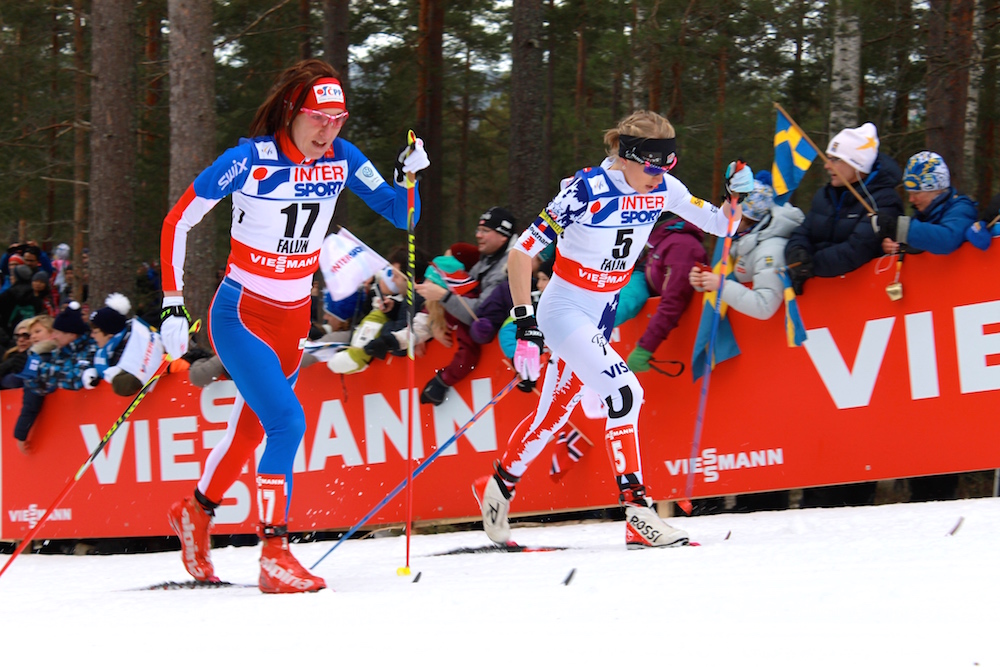
Eva Vrabcová-Nývltová (l) of the Czech Republic racing alongside Liz Stephen (U.S. Ski Team) in the women’s 30 k classic mass start at 2015 World Championships in Falun, Sweden. Vrabcová-Nývltová placed ninth for a career best at World Championships and went on to place 10th in the skiathlon in Falun. Stephen finished 11th in both races.
Winter Olympians can shine in the summer — just ask Czech cross-country skier Eva Vrabcová-Nývltová, who’s headed to the upcoming Summer Olympics in Rio de Janeiro, Brazil.
On Sunday, the 30-year-old three-time Winter Olympian placed eighth in the women’s half marathon at 2016 European Athletics Championships in Amsterdam, finishing in 1 hour, 12 minutes and 1 second. She came within a minute of her personal record, which she set in the Prague Half Marathon in April. In May, she ran a 2:30:10 in the Prague Marathon, which qualified her for the Rio Olympics and solidified her plan to step back from skiing for at least a season to focus on running.
“The overwhelming satisfaction, I sort of wanted to be closer to a personal record, but the experience to run the race with only women is great,” Vrabcová-Nývltová told the Brněnský Deník newspaper on Sunday, according to a loose translation.
Portugal’s Sara Moreira won the race in 1:10:19, followed by Italy’s Veronica Inglese in second (1:10:35) and Jessica Augusto, also from Portugal, in third (1:10:55). Behind the medalists, Vrabcová held onto the top 10 within a larger chase group.
Eva Vrabcová-Nývltová is taking a break from skiing and sitting out the 2016/2017 season to focus on running. She qualified for the 2016 Summer Olympics at the Prague Marathon in May and plans to race the marathon in Rio de Janeiro, Brazil, in August. (Photo: Czech Ski Association/FIS)
“I think this race definitely met my expectations before Rio,” Vrabcová-Nývltová said.
She plans to race the marathon on Aug. 21 at the 2016 Olympics, which will be her first Summer Olympics.
A World Cup cross-country skier since 2005, she has a personal-best Olympic result of fifth in the 30-kilometer freestyle mass start at the 2014 Winter Games in Sochi, Russia.
Reflecting on Sunday’s half marathon, she said her finishing kick needed some fine tuning.
“My final acceleration [is] a bit lacking. We still have a lot of work ahead,” she said. “We can see where the reserves are, and we have enough time … I evaluate it positively.”
Vrabcová-Nývltová has not competed in an international ski race since November 2015. In an interview with iSport.cz she said she’s “starting to enjoy life,” which includes her husband, training and most recently, college after being accepted to a university. While she might jump into a ski race or two this winter, she said they’ll likely be based in the Czech Republic as she plans to stay home for the holidays.
“It’s great challenge and motivation, therefore I decided to focus fully on athletics. I agreed with the Czech Ski Association that I am going to skip next season,” Vrabcová-Nývltová said, according to FIS.
Asked how the running atmosphere compares to skiing, she told iSport, according to a rough translation, “It can not be compared, because I was so excited. Czech running is a higher level, but the people are fantastic … Holmenkollen and Falun are also super, but mostly cheers northern [countries]. Here the atmosphere in the Czech team [is something] else and I’m very happy that I can be here.”
CALGARY, Alberta — On July 1st, Lifesport Calgary Inc., a specialty Cross Country Ski and Biking retailer, transitioned to a new ownership group. At this time, the store will remain at 1110 Gladstone Rd NW, Calgary, AB T2N 3E7 (P) 403.270.4501.
Lifesport was founded in 1987 by Norm Person and has been at its existing location for the past 15 years. Norm was committed to providing excellent service, and enthusiastically supporting local athletes in cross country skiing and biking. More recently, he added disc golf discs and accessories, to support enthusiasts of the sport. Norm carved out a niche in Calgary, and had many loyal customers. The new ownership group would like to acknowledge Norm’s achievements and thank him for establishing a solid foundation for the continuation of Lifesport.
The new ownership group consists of Kit Richmond, Rick Giberson, and Peter Krohn. All three are excited to continue Lifesport’s tradition of excellence! Together they bring the expertise that will ensure Lifesport clients receive excellent service and access to professional products.
Kit is an avid x-c skier, formerly racing as a collegiate athlete and on Canada’s national development team. He has extensive racing and coaching experience and an in-depth knowledge of the x-c ski market.
Rick is a former elite level racer on Canada’s Mountain Biking circuit. He brings over 20 years of experience servicing bikes, including being a lead technician at the Trans Rockies event.
Peter is an avid cyclist, who has operated a bike courier business since 2004; and has been a bike courier since 1991. He adds a broad-based knowledge of road cycling to Lifesport’s expertise.
About Lifesport Calgary: Lifesport Calgary, (http://lifesport-calgary.com/) is a specialty retailer offering a wide array of Cross-Country skis, Bikes, and Disc Golf products and accessories. In addition, Lifesport provides fast turn-around, inhouse Bike and Cross country ski service. The company was founded in 1987 by Norm Person and has transitioned to a new ownership, under Kit Richmond, Rick Giberson, and Pete Krohn.
Michigan Tech is seeking a Nordic Graduate Assistant Coach. Michigan Tech is looking for someone with NCAA Skiing experience that is interested in coaching cross country skiing at the NCAA level.
Candidates should be qualified, experienced and highly motivated to assist with NCAA Ski coaching, including among other duties: supervising student-athletes, implementing training programs, analysis of technique, preparing student-athletes for competition, race day ski service, working on NCAA compliance matters, recruiting, other office duties, etc.
Compensation: tuition waivers and a stipend.
Michigan Tech has an MBA program and a Masters program in Kinesiology/Exercise Science, along with many other highly respected graduate programs in STEM subjects. (We would also be willing to work with an undergrad who has exhausted eligibility and needs more time to finish their undergraduate degree.) Most of our graduate programs are looking for at least a 3.0 undergrad GPA.
If you are interested in this position, please send a cover letter, resume and references to Joe Haggenmiller, jjhaggen@mtu.edu, expressing your interest. Michigan Technological University is an equal opportunity/affirmative action employer and educator.
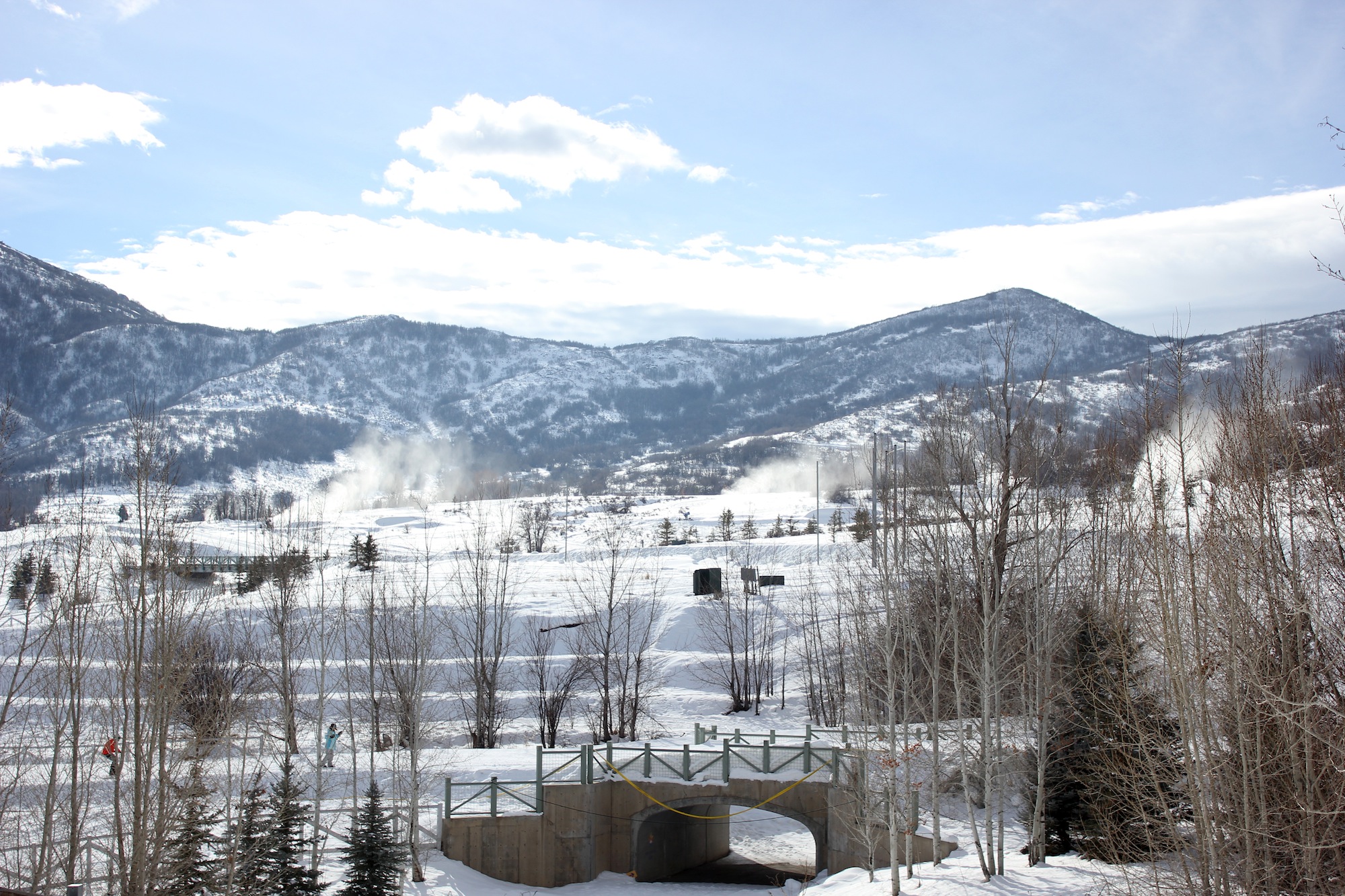
Snowmakers in action at Soldier Hollow in January 2014. The 2002 Olympic venue in Midway, Utah, last hosted the U.S. senior national championships in 2014 (as well as the year before in 2013) before Houghton, Mich., hosted in 2015 and 2016. Nationals are returning to SoHo this coming January.
PARK CITY, UT – Top cross country athletes from across America will participate in 16 races at seven different stops as part of the U.S. Ski and Snowboard Association’s (USSA) annual USSA SuperTour. The 2016-17 tour kicks off in December in Bozeman, MT.
The SuperTour is a series of International Ski Federation (FIS) sanctioned cross country ski races taking place across America, produced by the USSA, together with its divisions and clubs. The Tour is a vital piece of the USSA’s development program, providing top level racing at key cross country centers around the nation. It’s a proving ground for club athletes with aspirations of making it to the U.S. Ski Team and competing on the FIS World Cup tour and in the Olympic Winter Games. Caitlin Patterson (Craftsbury, VT; Craftsbury Green Racing Project) and Eric Packer (Anchorage, AK; Alaska Pacific University) took the season long titles in 2015-16.
“The USSA has had great support from its clubs and divisions in putting together this year’s calendar,” said USSA Nordic Domestic Program Director Robert Lazzaroni. “We’ve rotated a few sites this year and will continue to move around in the future to get the SuperTour to new places. Moving the event around helps stimulate top-level racing in America.”
Period 1 includes stops in Bozeman, Mont., and Silver Star (Sovereign Lake), British Columbia. The decision was made at USSA Congress to start the series one week later than previous years and to combine with Canada to increase the field.
Period 2 will open in January with the L.L.Bean U.S. Cross Country Championships at Soldier Hollow in Midway, Utah. Soldier Hollow is also a site for the 2017 FIS Nordic Junior and U23 World Ski Championships. Athletes will then continue on to Truckee, Calif., for races on the Auburn trail system.
The third period will feature two stops in the midwest. Athletes will race on a new homologated trail in Ishpeming, Mich., before participating in America’s largest cross country race, the Slumberland American Birkebeiner, on Feb. 25 in Hayward, Wis. The series wraps up with the SuperTour Finals Mar. 27- April. 2 in Fairbanks, Alaska. Finals will also double as the L.L.Bean U.S. Championships for long distance and freestyle sprint.
“The divisions, venues, technical delegates and homologation inspectors have been working hard to develop new venues and evolve current courses to strengthen the SuperTour,” stated USSA Cross Country Development Coach Bryan Fish. “We are making strides to include junior and collegiate racing within the SuperTour to enhance head-to-head racing with juniors, college athletes and our top World Cup competitors. Our collaboration with Cross Country Canada will also better prepare athletes for international competition. It’s an exciting year for cross country in the United States, and we’ll get to showcase this to the world during Junior World Championships.”
Athletes will also vie for for points across the tour to earn Continental Cup leader starts and World Cup starts. There will also be spots available for the 2017 FIS Nordic World Ski Championships Feb. 22 – March 5 in Lahti, Finland. Those spots will be awarded after the conclusion of the U.S. Cross Country Championships in January.
(*Note: U.S. championships also include a freestyle sprint qualifier, which serves as a qualifier for 2017 World Championships but will not be scored as a U.S. nationals or SuperTour event)
Jan. 21-22, 2017
Truckee, CA
Men: Sprint CL, 10 km Free
Women: Sprint CL, 5 km Free
Period 3
Feb. 17-19, 2017
Ishpeming, MI
Men: Sprint Free, 10 km CL
Women: Sprint Free, 5 km CL
Feb. 25, 2017
American Birkebeiner
Hayward, WI
Men’s and women’s 50 km Free
Period 4
Mar. 27-April 2, 2017
SuperTour Finals
Fairbanks, AK
Men: 24 km Skiathlon, Sprint Free, Relay, 50 km Free
Women: 14 km Skiathlon, Sprint Free, Relay, 30 km Free
Babikov and Louis Bouchard to lead Canada’s World Cup athletes
CANMORE, Alta. — Ivan Babikov has officially closed the book on his successful cross-country skiing journey as an athlete, but is ready to write the first chapter of his new career as a coach with the National Ski Team, Cross Country Ski de Fond Canada announced on Friday.
The three-time Olympian will play a critical role with Louis Bouchard to help put the maple leaf back on the international podium while leading the World Cup Team on the tracks to the 2018 Olympic Winter Games and well beyond.
“Ivan was a tireless athlete who was known for his relentless pursuit of excellence throughout his 10 years on the Canadian National Ski Team. I expect the same drive and determination from him in his coaching career,” said Tom Holland, high-performance director, Cross-Country Ski de Fond Canada. “Trust and chemistry are key ingredients to any successful team. Ivan has always been one of the most respected athletes in our program. He brings tremendous experience and insight on what it takes to succeed on the World Cup. I believe that working alongside Louis (Bouchard), Ivan will be an extremely valuable tool to the success of our Team well into the future.”
Bouchard, who has been a World Cup Team coach over the lastsix years, will take the lead coaching role for the World Cup squad leading to PyeongChang 2018. Bouchard will also continue his role as head coach of Alex Harvey and the Pierre Harvey Training Centre in Quebec. Babikov will work specifically with Devon Kershaw and the men’s World Cup level athletes based in Canmore, Alta., while also serving as B-Team coach. He will also provide coaching support to the athletes in the Alberta World Cup Academy based at the Canmore Nordic Centre.
“I’m extremely excited. Coaching is something I have always targeted as a goal of mine when I was ready to stop competing,” said Babikov, who completed a high-level coaching diploma from a university in his hometown of Syktyvkar, Russia, before he immigrated to Canada. “It is my goal to share what I’ve learned and experienced throughout my career to help the younger athletes develop, and the top guys achieve excellence. I really care so much about all of the Canadian athletes – from the development to elite level – and the success of this program. I hope I can play a small role in this team of highly-dedicated coaches to help all of the athletes achieve their dreams.”
Canada’s cross-country ski athletes will continue to benefit from a national program structure, which will see a strong pool of coaches from across the country integrated into supporting World Cup coaching duties, while further strengthening the high-performance culture into the development team athletes.
Bouchard and Babikov will guide a talented group of four active coaches across the country whose focus will be on developing the next generation of Olympians from coast-to-coast. Charles Castonguay will also offer support on the World Cup, while coaching at the Pierre Harvey Training Centre.
A trio of coaches will focus on the developing women’s program. Chris Jeffries will take on the responsibility of National Ski Team Women’s Team coach, while serving as the high-performance program director of the Alberta World Cup Academy. Kathy Davies will be the technique coach for the Women’s Team, while Lisa Patterson will be the team coordinator.
“If we truly want to put Canada’s cross-country ski athletes on the Olympic podium in 2018, 2022 and beyond, then it is critical to put the Canadian system in the hands of coaches that are living and embedded in our training centres across the country,” said Holland. “A Canadian-based program brings greater stability and synergies in coaching philosophy and sport science approaches – and, ultimately, a stronger platform to breed medal-winning performances from our current- and next-generation high-performance athletes.”
Each of the coaches on both the National Ski Team will continue to report to Tom Holland who has been part of the national program since 1996 as a volunteer, and full-time with the team in 2006. Holland will play a critical role in creating a coaching environment that is seamless and integrated.
A career highlighted by a fourth-place finish at the 2013 World Championships, Babikov’s best result at the Olympics was a fifth-place result in the pursuit race at the 2010 Games in Vancouver-Whistler. He had one victory on the final stage of the Tour de Ski in 2009 to go along with two other World Cup podium finishes and three, fourth-place finishes and a handful of top-10’s on the World Cup. Babikov skis into the next stage of his life after rattling off three, top-15 finishes at the prestigious Ski Tour of Canada last March.
“Transition is never easy and I think it will be tough for me at first to be on the sidelines knowing I won’t be skiing, but I really can’t think of a better way for me to go out than having a really strong finish to the World Cup season on home snow at the Ski Tour of Canada and working with a group of athletes that have been family for me since coming to Canada,” said Babikov. “Coaching has always been in my blood. Throughout my career, I have always enjoyed spending time helping younger athletes. Realizing the end was near over the last year, I started providing more advice than normal to my teammates as well, which I think helped the guys with their preparation so I’m excited for this next challenge.”
Babikov immigrated to Toronto with his mother in the hopes of pursuing his ski career with the Canadian program in the spring of 2003. He moved to Canmore, Alta. that fall where he began racing domestically. Babikov dominated the domestic race circuit while wearing a Canadian National Ski Team uniform, but under a Russian FIS license – as part of a Canada/Russia agreement. He represented Russia at the 2006 Olympic Winter Games before competing for Canada at the 2010 and 2014 Games. He finally received his Canadian citizenship in 2007 and became a full Canadian National Ski Team member in 2009, living in Canmore with his wife and two children.
Babikov and Bouchard will lead the Canadian squad through their first training camp of the season this weekend in Mt. Tremblant, Que.
Join the dynamic team at a non-profit that has been part of the fabric of the community for 80 years. The Aspen Valley Ski & Snowboard Club (AVSC) has an exciting opening – Administration Manager. Join the team of great people at AVSC, and make a difference in the lives of our valley’s youth.
We are looking for an energetic detail-oriented individual with a focus on customer service and a facility with databases. Experience as a Ski/Snowboard Pro is a plus. This is a full-time, year-round position with benefits and the opportunity to advance.
Salary will depend upon experience. Please e-mail cover letter and resume to MGODOMSKY@TEAMAVSC.ORG
One thing we can say about most dads: they tell it like it is and they tell it to you straight. Just like we did for our moms on Mother’s Day, we wanted to honor all of the fathers out there on Father’s Day, and we asked top North American national-team members to share a photo and answer one of the following questions:
What was the best piece of advice your dad ever gave you?
What was the biggest lesson you learned from your dad?
Ian, and dad, Mike Torchia at an inline skate race on Madeline Island, Wisconsin, in 2016. Torchia wrote on his dad’s advice at the time: “‘You know what happens to hot dogs, Ian? They get eaten!’ – Mike Torchia
While my dad (affectionately called Sir) has given countless gems of advice, the above is one that I remember the most as he has always emphasized humility in the face of success.” (Courtesy Photo)
“My dad taught me the most basic and important lessons for a kid athlete and that was how to race and pace. He helped organize the first road races in Bennington and would run the 5k with me before heading out on the 10k race for himself. He taught me how to relax on the downhills and try to kick it in to the finish as hard as I could… I distinctly remember learning those two important things from running with my dad.”
“My mom teaches me lessons through words (she is going to school to be a counselor), whereas my dad has always taught me lessons through actions. I’ve observed these actions throughout the years with the intent to grow into somebody similar. His positivity, sense of humor, and ability to make people feel at home are things I hope have worn off on me. The biggest thing my dad has taught me is how to follow my gut feeling through the decision making process. He never tries to control or alter the decisions I’m going to make. Instead, he has allowed me to reap the rewards or consequences from these decisions on my own. And from there, I learn. Happy Fathers Day Hans. Love you!”
“When I want advice, the first person I call is my dad because he is very honest and always puts things into perspective. There is one piece of advice in particular that really stuck with me. I must have been really nervous about an upcoming race and was talking about the criteria I needed to make in order to qualify for a certain event. He reminded me that there was no point in getting worked up about criteria because it is something that I can’t control. He simply told me: ‘When you ski fast, good things happen.’ It made me realize how simple it was. I had worked hard to get to where I was, all I could do was go as hard as I possibly could, the rest is out of my control. I often think about that when I am nervous before important events. I am so glad that I can always rely on my dad to give me down to earth advice. Thank you dad and happy father’s day (and birthday)!”
“The best advice my dad has ever given me is reminding me that I tend to ski the fastest when I’m happy and enjoying myself. One of the times he reminded me of this was when I was at the Olympics and it forced me to step back and soak in the incredible experience I was having. When he said it, he was obviously applying it to skiing, but I think it’s a pretty simple piece of advice that you can apply to most parts of life. It’s easier to succeed in something that you’re passionate and happy about whether that’s a sport, friendship, or class. I think it’s easy for my dad to give advice like that because he’s one of the most kind and happy people I know and he likes to keep things pretty simple. I’ve always admired him for those reasons and would be happy to take advice from him any day :)”
“While I never actually went cross country skiing with my Dad, he was incredibly influential in his love for the outdoors and ability to truly enjoy life. My dad taught me to alpine ski and mountain bike, both were activities in which he challenged me and was always up for a race. I don’t know if my mom will ever get over just how much I ski like him. My dad had a great ability to do things in a big way in order to maximize the enjoyment out of each adventure and he did so with incredible passion. I can’t say I have fully learned this yet, but his spirit and enjoyment of life certainly are in me and I think often about how to embrace this a little more each day. At the very least, I have learned to be very passionate about the things I love. My favorite place in the world is the Southern Utah desert and I think my love for the desert stems entirely from family fun, particularly with my Dad.”
“The biggest lesson I learned from my Dad was to never do anything halfway. Whatever you decide to do, give it your best effort and be present. Whenever I see my Dad engaged in a project, whether that’s yard work, making dinner, going for a ski or going to work for the day, he’s fully committed to what he’s doing. He never does anything part-way, and that’s the way I want to live my life, too!
My Dad is also the gutsiest and toughest racer I know. I cheered him on in marathons when I was little and I’d like to think that when I have my best races where I hang in there with the pack, I’m racing like him.”
Little Jessie Diggins running alongside and cheering for her dad at a road race
“When I was younger I used to always want to quit different sports or activities that I was involved with. One of those sports was biathlon. I definitely didn’t give biathlon a good chance yet, but what I knew was that it was hard and I was bad at it. ‘I want to quit…I’m always coming in last!’ probably came out of my mouth about a dozen times when I began biathlon, but my dad saw something in me that I didn’t see yet. He knew I needed to give it another shot and stick with it, and I’m thankful he didn’t let me give up on it when I was a stubborn teenager. As a result, I slowly saw some improvement and was enjoying it more…quickly forgetting that I wanted to quit only months before. It’s funny to look back on, especially now that biathlon is such a huge part of my life. My dad has continued to support me to this day, and is always the first person that I talk to (along with my mom) after my races, if I’m having a hard time, or just to catch up. I’m excited to see where biathlon takes me, knowing that he’ll be by my side during the entire journey. Love you dad, hope you have a great Father’s Day!”
US Biathlon’s Maddie Phaneuf (c) with her parents after her fourth-place finish at 2014 Youth/Junior World Championships in Presque Isle, Maine.
“In his soccer coaching days, something that my dad always said that stuck with me is ‘Practice doesn’t make perfect, perfect practice makes perfect’, and that taught me to always practice with intent. But the biggest lesson my dad taught me without having to say a word was to find the fun in everything I do. Thanks dad!”
“The biggest lesson I learned from my dad is to enjoy life’s beauty.”
“Being the king of practical jokes, quick wit, and somewhat embellished stories, my father taught me to never take life too seriously. He manages to find humour in any situation, no matter what the mood is. He has always been at the sidelines of races and practices with off-beat cheers and goofy hats. Even now with majority of races overseas, he religiously watches every race live and follows it up with an email commenting on an obscure element of the race such as my earrings. From day one he has been there, encouraging my dreams and making me laugh. Thanks for being so awesome, Dad!”
“My dad has played a major role in my life in so many ways. He is the one who introduced me to the outdoor and sporting world when I was young. From building small ski ramps in the backyard to taking me backcountry skiing. I have so many amazing memories of my dad and what he has taught me it is hard to nail one thing down as the best advice or lesson that he has shared with me. All of the things I have learned seem to relate to a couple key things. Find something you enjoy doing, decide what your level of commitment is going to be and then do it right. I am very grateful that my dad was never one to pressure me in the sporting world but rather support me and help me figure it out. There are so many different avenues one can choose especially in a town like Steamboat where you can participate in almost any sport. With my dad’s help I was able to find the sport I love and figure out how much I really was willing to put into my career. That stage is still panning out but without my dad’s support in everything I tried I would not have learned to love the sporting world. So thank you dad! Love ya!”
“The wisest and most sincere thing that my dad taught me was to be myself. Whether it was going out for a 5-hour mountain bike ride because you felt like it, doing skate intervals until you threw up because you wanted to beat your competition at the next JNQ, or just acting totally goofy while on a desert camping trip, being yourself and knowing what you truly wanted to do and be in the moment of now was the most valuable thing that my dad, or anyone for that matter, has ever taught me. Happy Father’s Day to all of the amazing dads out there! None of us would be where we are now without you, literally and figuratively.”
“The biggest lessons I’ve learned from my dad are to be tough and love what I’m doing. He taught me to hang tough, finding the strength to believe in myself and not give up when the going gets hard. He also always reminded me to have fun and if I wasn’t enjoying or passionate about what I was doing then it was time to do something else. This advice has given me the strength and work ethic to follow my dreams and have a blast doing it.”
“My dad has always had a love for sports, especially skiing. Growing up both my parents encouraged me to do many activities. They were always driving me from practise to practise but skiing was something that my dad and I did together. Over the years skiing became one of my favourite sports. Growing up some of the best advice my dad ever gave me was to make sure the things you are passionate about play and important role in your life, and that real jobs are overrated. He always encouraged me to pursue my goals and supported my racing and training with pride. After high school when I was trying to decide what my future would hold, my dad’s advice and philosophy on life, If I can do what I love as my ‘job’ why wouldn’t I. My dad has been there every step of the way, through my best times and the hard ones. I am so happy to have to chance to be home in Whitehorse this Father’s Day to spend it with my dad. No skiing together at this time of year but we have already been out trail running together in the one day I’ve been home. Happy Father’s Day dad and thank you for sharing your love for skiing with me, I love you! And a very Happy Father’s day to all the dads out there!”
“My Dad has literally supported me in biathlon since day 1 whether it was helping run kid’s practices on the weekends, cheering me on at the Olympics or proofreading website updates! I can’t name a single best advice, but I think the most powerful thing my Dad has given me is honesty. It sounds cliché I know! But really, no matter how well a race or training session went (or anything in life for that matter) my Dad was always positive but honest: he is the person I trust to give me advice or feedback that isn’t sugar coated. My Dad has this way of analyzing things that always leave me feeling more motivated and determined. The skill of being honest with myself, keeping my sport in perspective and not beating myself up when things don’t go as I want has come in a huge part from my Dad – and I doubt I would still be a biathlete without it!
As for my Grandpa, as soon as I think of him and sport I can hear him smiling snd saying ‘Go get’em Kid’….he must of said this to me thousands of times at uncountable races!
I am a lucky girl!”
“The biggest lesson my dad has taught me is the importance of confidence in racing. Whether it was by coming with me to the start pen to help me get my ‘game face’ on or by giving me pre-race pep talks, he showed me that a huge part of being a successful athlete is having confidence in your own abilities.”
” ‘Don’t forget to have fun, Susan.’ Those are often my father’s parting words to me as I leave for competitions. As a former USST member and a 2 time xc skiing Olympian, my father always understood that a passion for the sport must be the foundation to build on, no matter what level is ultimately reached.
When I was a kid, my dad always wanted to make sure I was enjoying skiing and doing it for the right reasons. I’ve always been competitive, sometimes to my own detriment. Dad held me back from intense training environments during my junior high years so that I wouldn’t burn myself out. In high school, he encouraged me to invent games for my teammates and to turn interval workouts into fun relays. I am thankful he led me in that direction, otherwise I would not be competing today.
As I got older and reached a more elite level, he has given me all sorts of wonderful advice. Immediately upon graduating from college, I was uncertain whether I should accept an invitation to move to Lake Placid to try a complete unknown, biathlon. My dad pointed out: ‘If you don’t try this, you are always going to wonder, ‘What if?’ ‘ He knows me well.
Some of his other advice that I have taken to heart:
1. ‘If you are going to be a full-time ski racer, you have to want to be the best in the world. I don’t know if you have that hunger in you — it is something you are going to have to figure out for yourself.’
2. ‘The Euros put their pants on in the morning the same way you and I do — one leg at a time.’
3. ‘I know you want to make an Olympic team, but the real question is, what is your goal once you get there?’
“My Dad always told me ‘do as your dad says, not as he does’… wise words from the Wizard of the North himself.”
“I wouldn’t be writing into Fasterskier if my Dad hadn’t taught me how to ski at a young age. Unfortunately, I can’t remember as far back as my first days on skis, but I do have many memories of him teaching other friends and family various forms of skiing. In this, he taught me that there’s tremendous satisfaction in sharing your passions. In fact, although my dad has never strapped on a pair of jumping skis, he has helped many younger kids progress at the local ski club, and he’s been the Central Division Nordic Combined Representative for years. He’s demonstrates a selflessness that is inspiring for me to try to live up to.”
“My dad has taught me that nature offers so many great adventures and that you always have to remember to have fun and really enjoy what you are doing :)”
“My dad always tells me to think before I speak. I have not fully figured that one out yet, but it is really good advice! Happy Father’s Day pops!”
Bryan Fletcher: “The biggest lesson I ever learned from my dad was not only how to ski but how to enjoy every single day on skis. He definitely showed me how to work hard so you can play harder. Both of the attributes have led me to the competitor I am today! Happy Fathers Day Dad!”
Taylor Fletcher: “My Father (Tim Fletcher) was huge in myself and my brother’s development as skiers. Growing up, my dad was ski patrol on Mt Werner and Howelson Hill. He was the person that taught us to ski beginning at a very young age, but I can’t remember if I started skiing early or walking late. We would go up there any chance we got to ski with him and chase him around the trees and down the slopes. Every weekend that he was working he would try to be at Howelson hill so he could patrol while we had jumping competitions. I can’t even think how many jumps my father has seen me take over the years, from watching at the base of the jumps to finding those hacked streams online to watch us compete in the middle of the night. Over the years, one thing has always stayed the same, and that is his love us and watching us compete. The biggest thing I have learned from my dad, he perseverance and hard work. I have never met a person that works as hard as he does during the summer and winter every year. I have been able to apply that to my training career as he always told me that no one is going to do my training for me!
Happy Fathers Day DAD!”
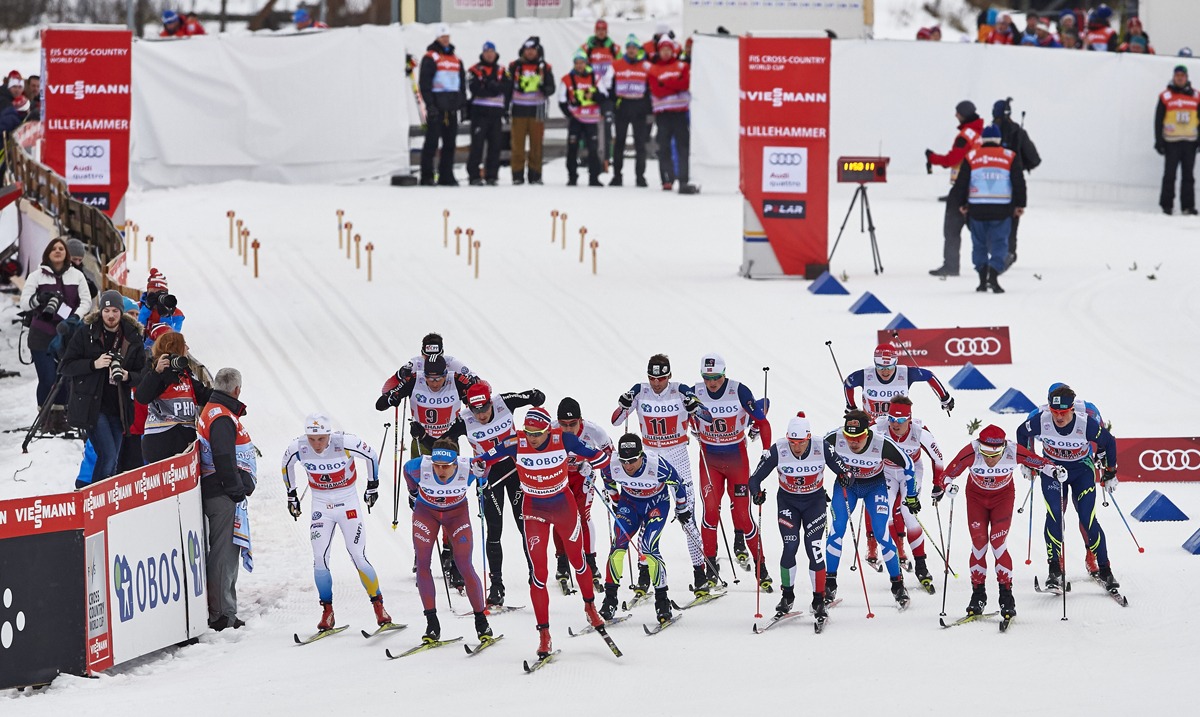
The start of the men’s 4 x 10 relay at last year’s World Cup in Lillehammer, Norway. While Lillehammer will host the first mini tour of the season this year, there won’t be any relays there. (Photo: Fischer/NordicFocus)
The first mini tour of the 2016/2017 International Ski Federation (FIS) Cross-Country World Cup season will be held in Lillehammer, Norway, Dec. 2-4, but don’t fret, Ruka in Kuusamo, Finland, remains the season opener Nov. 26-27.
FIS recently approved its schedule for the upcoming World Cup season, with the usual classic openers in Ruka (two races as opposed to sometimes three), followed by a three-day mini tour in Lillehammer (classic sprint, 5/10-kilometer freestyle and 10/15 k classic pursuit).
The circuit then moves to Davos, Switzerland, another staple for December races, for its famous 15/30 k freestyle individual races followed by a freestyle sprint Dec. 10-11. La Clusaz, France, hosts the next World Cup Dec. 17-18 (skiathlon and a relay) to wrap up Period I.
Period II kicks off with the 11th annual Tour de Ski, starting in Dario Cologna’s hometown of Val Müstair, Switzerland (skate sprint and 5/10 k classic mass start Dec. 31-Jan. 1). Athletes have one travel day before the Tour resumes with two stages in Oberstdorf, Germany (10/20 k skiathlon, 10/15 k freestyle pursuit), followed by another rest day and the final three stages in Italy (Toblach 5/10 k freestyle and Val di Fiemme’s 10/15 k classic mass start and final climb).
After that, the regular World Cup season picks up again back in Toblach with two days of skate races (sprint and team sprint) Jan. 14-15. Then, it’s onto a brand-new venue on the World Cup as Ulricehamn (near Gothenburg), Sweden, hosts the 10/15 k classic and a relay Jan. 21-22. Skiers stay in Sweden for the next weekend of racing in Falun, with a skate sprint and 15/30 k freestyle mass start Jan. 28-29.
The first weekend of February marks the pre-Olympic World Cup (i.e. venue and course preview) in PyeongChang, South Korea, with three races Feb. 3-5 (classic sprint, skiathlon and freestyle team sprint).
By the Numbers: Race lineup for 2016/2017 World Cup season (excludes World Championships) – Classic sprints (5) – Freestyle sprints (5) – 10/15 k classic individual races (5) – Skiathlons (3) – Freestyle pursuit (3 including hill climb)
– Team sprint (2, both skate)
– Relays (2)
Period III entails just one World Cup before World Championships, and it’s being held in Otepää, Estonia, Feb. 18-19 (skate sprint and 10/15 k classic).
The 2017 World Championships will take place in Lahti, Finland, Feb. 21-March 5.
Period IV will be held entirely in Norway, with the Drammen classic city sprint on March 8 followed by the Holmenkollen men’s 50 k classic on March 11 and women’s 30 k classic on March 12.
World Cup Finals are being held in Tuymen, Russia, with four races March 16-19 (3/5 k freestyle prologue, classic sprint, 10/15 k classic mass start, and 10/15 k freestyle pursuit).
In addition to releasing its calendar, FIS Cross-Country outlined its most-important decisions made at its 50th Congress earlier this month in Cancun, Mexico.
For starters, juries across the sport may designate and mark zones where double poling is not allowed “in order to preserve the classic technique,” but “as a consensus, it was agreed that this rule will not be applied at the World Cup, World Ski Championships and Junior World Ski Championships level.” In other words, this is going to be tested at lower levels of racing.
There’s also a new age requirement for all FIS competitions: athletes must be at least 16 years old before the end of the calendar year (Jan. 1-Dec. 31).
FIS points will be doled out at all FIS long-distance events (i.e. marathons) spanning 50 k or more (or 42 k if they’re at an elevation of at least 1,500 meters, roughly 5,000 feet) to encourage higher levels of participation.
And an equal quota of eight men and eight women per nation at U23 World Championships has been approved (note that four of each gender are allowed to start per race).
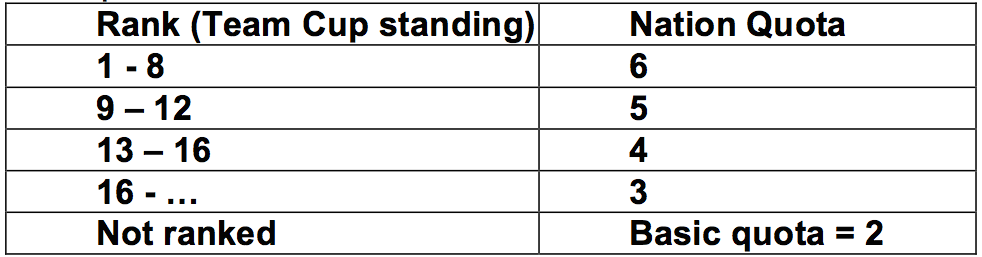
On the World Cup, the start quota for competitions has been reined in, reducing the number of athletes each nation is allowed to enter per race to 15 (and 10 for the Tour de Ski). For team sprints and relays, all nations are allowed to enter up to two teams.
In addition to each nation’s calculated start quota (awarded based on team standing from the previous season; see below), the defending overall World Cup champions (Martin Johnsrud Sundby and Therese Johaug) don’t count toward their nation’s quota, and last year’s overall Continental Cup winners earn Period I World Cup start rights for this season. National group quota remains unchanged (i.e. when a nation hosts a World Cup) at 10 athletes.
The FIS Cross-Country World Cup’s basic start quota “nation quota,” which is calculated according to the Team Cup standing from the previous season
In terms of format, the heat selection tested in individual sprints (the 30 qualifying athletes per gender can choose their quarterfinal heat) has been approved and will be used at the World Cup, World Championships and Olympics.
In regular-season team sprints, the top-four teams from each semifinal will now automatically advance to the final, and the remaining seven teams can qualify based on time. But at World Championships, the qualifying system is as it was before — with two teams from each semifinal automatically advancing and the next six-fastest teams qualifying as well (putting the pressure on to finish first or second).
Interval starts will be mostly conducted the same, except in men’s races, 40 athletes will start in front of the seeded group (instead of 30) and the top-15 athletes can chose their start bib in that order (first to 15th).
The College of St. Scholastica, an NCAA Division III institution located in Duluth, Minnesota, invites applications for the position of Nordic Skiing Head Coach. This is a full-time, 12-month per year position. The Head Coach is expected to oversee the planning, development and management of the Nordic Skiing program. The coach plays the pivotal leadership role within the program and must be successful in engaging a wide diversity of internal and external community members to advance the collective goals of the program within the larger framework of advancing the College’s Catholic Benedictine heritage, values, and strategic priority of becoming a more diverse and inclusive campus community.
Duties include, but are not limited to: recruitment and retention of student-athletes, coaching, monitoring of academic progress and personal development of our student-athletes, and administering the program’s budget while demonstrating prudent resource management.
The position requires a bachelor’s degree, knowledge of the rules, techniques and culture of Nordic skiing, strong leadership skills, and the ability to travel.
For more information and to apply, visit www.csshrjobs.com. The College of St. Scholastica is an equal opportunity employer committed to creating an educational and work environment that is rich in diversity, inclusive and supportive of all students, faculty and staff. Individuals from diverse racial, ethnic, and cultural backgrounds and persons with disabilities are strongly encouraged to apply. While there is no religious requirement, we are interested in individuals who value and support the rich Catholic Benedictine heritage of the College of St. Scholastica.
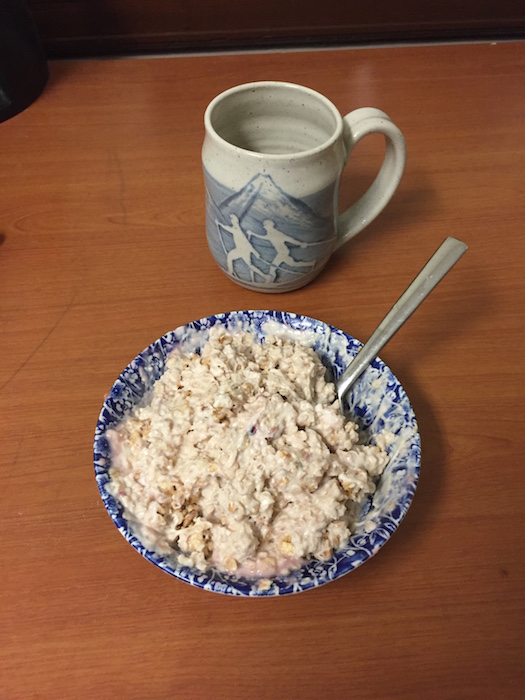
For the second installment of “What Elite Skiers Eat for Breakfast“, we asked Stratton Mountain School (SMS) athletes to share a photo of a typical breakfast for a weekday training day and describe what they eat. Here’s what they told us:
“When I have time, I like to make breakfast burritos filled with rice, eggs, Cabot cheese, baby spinach, and top it all with bbq sauce. It’s a good way to get a lot of carbs, and depending on the number of eggs a fair amount of protein as well. I know that bbq sauce isn’t for everyone but I would highly recommend introducing it to your breakfast lineup.”
“Big bowl of plain greek yogurt topped with banana and a mix of berries or other fresh fruit plus granola (my favorites are Elizabeth’s pumpkin fig and Ezekiel cinnamon raisin) and cinnamon. I always finish with a side of peanut butter toast (crunchy peanut butter!) topped with hemp seeds and a big french press for coffee plus some water if I am being a good athlete :)”
“I definitely try and keep things interesting (there is nothing worse than a breakfast burn out) but one of my favorites is some high protein homemade pancakes topped with all the fruit in the fridge (as local as I can find it) and a big scoop of Greek yogurt. And coffee — lots of coffee.”
“This is a smoothie bowl (mango, strawberry banana with yogurt) topped with granola, sliced banana, yogurt drizzle and honey drizzle.”
“I like a strong black coffee in my owl mug (the mug is an important part of my breakfast routine) and oats with berries, yogurt, nuts and honey.”
“English muffins with peanut butter, banana, and honey is a standard go to.”
“Then I typically mix it up with some kind of cereal and yogurt. If I can use home made gernola, that’s the best. On rest days when we have more time I’m the go-to pancake guy at the SMS house.”
“My breakfast varies depending on the day and what we have for food in our kitchen, but one of my favorite easy breakfasts is buttered toast, scrambled eggs, cheese, avocado, and salt!”
“First: Coffee. Then a large bowl (or two) of: steel cut oats, greek yogurt, crunchy peanut butter, homemade raspberry jam, cereal of choice (usually granola or Kashi) – when available add blueberries and/or banana.”
“My go-to breakfast would be plain greek yogurt with granola and lots of fruit such as blueberries, raspberries, strawberries, bananas and pineapple. I also like to add a touch of honey :)”
“I’m not too much of a breakfast guy if I’m training early. I definitely don’t enjoy the feeling of having a stomach full of eggs and bacon when I head out for a hard interval session or long OD. Most of the time, I just make myself a bowl of granola with Greek yogurt, almond milk, and some fresh fruit (usually either blueberries, strawberries, or a banana). Most days I’ll drink 2 cups of black coffee, but on days when I’m training a bit later in the day I’ll make some green tea. And I usually compliment everything with a glass of orange juice.” On off days, he sleeps in a bit and might make eggs, pancakes or waffles. While with his girlfriend and teammate Sophie Caldwell in her hometown of Peru, Vt., they’ll head to the local general store, “JJ Hapgood’s, for a breakfast sandwich (English muffin with an egg, local bacon, and local cheddar) and a cup of coffee.”
Which elite nordic team (in the U.S., Canada or elsewhere) would you like to hear from next for our breakfast series? Leave your recommendations in the comments section below!
MetroBoston’s Leo J Martin Ski Track (LJM), managed by the MA Department of Conservation and Recreation (DCR), seeks a Director of Ski Operations.
The position is a 6-month seasonal position, with potential future opportunities for year-round employment.
The LJM Director of Ski Operations will plan, coordinate, and direct the operations of the cross country ski track including snowmaking, grooming, race course set-up, coordination with user groups, marketing and community outreach, and special events.
Located just outside Boston in the suburb of Weston, MA, LJM is one of the busiest cross country ski areas in the country. The facility is home to: Cambridge Sports Union (CSU); Harvard’s ski team; the largest youth ski program in New England (Eastern Mass Bill Koch); Boston youth programs through Youth Enrichment Services (YES) and the Boys & Girls Club; adaptive ski programs; and more than a dozen high school cross country ski teams.
LJMs 15km trail system has long featured extensive snowmaking as well as lighting for night-time skiing. Over the past year substantial, additional investments have been made in snowmaking, grooming, and lighting.
Potential applicants or those seeking more information on this job listing should contact Barry Kitch at foljms@gmail.com.
Currently the Nordic program has 45 skiers ranging from enthusiastic beginners to elite competitors, supported by assistant coaches and parent volunteers. It includes boys and girls varsity, JV, and middle school teams. Varsity practices run 3:20 to 5:30 M-F typically with additional Saturday morning practices. The successful head coach will have a strong Nordic skiing background; an ability to lead, teach, delegate, and communicate; and enthusiasm for young people and the sport. The team competes in the IMAC conference and practices at various East Metro and Metro locations. The varsity typically holds a late December training camp and competes in the Mesabi East, Section, and State Meets. The season runs from early November through mid-February.
Qualifications/Requirements
Ability to communicate with Middle and High School aged boys and girls as well as parents and Athletic Department Administration
Comprehensive knowledge of Nordic Skiing
Coaching and/or racing experience preferred
Experience/familiarity with IMAC and MSHSL rules and commitment to youth sports preferred
Willingness and ability to communicate with Athletic Department staff and fellow coaches
Must meet all the MSHSL coaching requirements and a CPR/AED Certification strongly preferred
COLORADO SPRINGS, Colo. (June 1) — Seven athletes, including five U.S. Paralympians, were announced to the 2016-2017 U.S. Paralympics Nordic Skiing National Team by U.S. Paralympics, a division of the United States Olympic Committee.
“The high quality of our national team this season is very encouraging,” said Paralympic Nordic Skiing head coach Eileen Carey. “All of our athletes have shown themselves to be competitive as they continually challenge for medals on the international stage.”
Headlining the team is two-time Paralympic medalist Oksana Masters (Louisville, Kentucky) who comes off a perfect 2015-16 campaign in cross-country competition. She went undefeated in sprint, middle and long distances to claim her second consecutive overall world cup globe for the women’s sitting class at the IPC Cross-Country Skiing World Cup Finals in Vuokatti, Finland in March. She also amassed the most world cup cross-country points throughout the season than any other female on the world cup circuit.
The roster also includes three military veterans: Sean Halsted (Rathdrum, Idaho), ret., Air Force, Bryan Price (Belton, Missouri), ret. Army and Paralympic medalist Andy Soule (Pearland, Texas), ret. Army.
Making their national team debut are two newcomers Joy Rondeau (Granby, Colorado) and Mia Zutter (Sun Prairie, Wisconsin). Both competed in their first international competitions at the world cup in Finsterau, Germany which will play host to the 2016 IPC Nordic Skiing World Championships.
Team USA finished the 2015-16 strong with nine medals in the final two world cups, including three gold medals at the World Cup Finals. The team will face an important year in preparation for the 2018 Paralympic Winter Games. Before the world championships in February, the team will travel to world cups in Finland, Ukraine and Japan as well as South Korea for the PyeongChang Test Event.
2016-2017 U.S. Paralympics Nordic Skiing National Teams
*Denotes 2014 U.S. Paralympian # Denotes retired U.S. Military
A Team
*Oksana Masters (Louisville, Kentucky), sit ski
*#Andy Soule (Pearland, Texas/Army), sit ski
B Team
*Jake Adicoff (Sun Valley, Idaho), visually impaired
Development Team
*#Sean Halsted (Rathdrum, Idaho/Air Force), sit ski
This summer APU is hosting a masters on-snow ski camp at the Thomas Training Center on Eagle Glacier. Come experience glacier training, just as APU’s Elite team and Olympians Kikkan Randall, Holly Brooks, Erik and Sadie Bjornsen make their seasons.
“Skiers are made in the Summer”
The camp is coached by Erik Flora, Dylan Watts, and Galen Johnston. Coaching staff has experience at nearly all ages and levels, from recreational to Olympic and World Championship level. Camp will be from July 27 to the morning of July 30, including 4-5 ski sessions.
Camp includes classic and skate techniques. There is opportunity to ski a lot with the glacier house only 2-3 minute walk from skiing, plus take part in technique discussion and video review. Includes skiing, coaching, housing, and food. Space is limited. Cost is $825 plus helicopter.
We asked for your best Memorial Day weekend photos and ended up with a couple good laughs. Check out the gallery below, which is a combination of reader and staff submissions, and if you have one you’d like to add, email info@fasterskier.com with the subject line: MDW.
“Here at the Mt. Washington Auto Road, which goes to the top of Mt. Washington, the highest peak in the Northeast at 6,288 feet, on Saturday of MDW we have Alton Weagle Day. It is an event remembering Alton Weagle, a man who loved Mt. Washington and climbed it in several unique ways, including pushing a wheelbarrow with 100 lbs of sugar up to the top. Leading up to Alton Weagle Day, people are encouraged to contact our General Manager with their idea for a unique attempt up the Auto Road. In past years, I have rollerskiied (classic) and nordic walked up the Road for Alton Weagle Day. Olympic Biathlete Sean Doherty rollerskied skate several years ago. This year I went ‘bear-back’.” (Photo: Meg Skidmore)
Taking the baby for a “ski” post interval session. Shout out to all of the Roller Ski Texas athletes!!! Roller ski season is yearlong here, ya’ll!
Jennifer: “I rode like an animal on my mountain bike today.”
Horse: “…So?…”
Nice run up Mt. Megunticook. This Midwesterner enjoyed the challenge. Not often you get to start a run at sea level.
Skiing with his kids and Dan Simoneau (r) on Memorial Day at Mt. Bachelor in Bend, Ore.
“My brother and I are in the midst of bikepacking and camping across Switzerland, then soon into Italy, Slovenia, and Croatia. Eating delicious food, making some new friends with the mountain cos and their bells, and getting a good workout in up and down across the Alps.”
Monday on the Sanctuary River in Denali National Park, Alaska.
“Memorial Day weekend, I went to Lake Placid. Saturday, I ran the Patch Sprint, 12.7-mile point-to-point trail race. It goes over four mountains, each one harder than the previous one, finishing on Pok-o-moonshine, with 1000 feet of vertical in 1.2 miles. Sunday and Monday my buddy and I rollerskied Bear Cub Ln in LP. A great weekend, even though it was hot and humid.”
Gavin, Audrey, and Bridget Kentch play in a city park in Anchorage, Alaska, on Monday.
Ran Memorial Day Mile with friends and her almost 1-year-old in Glens Falls, N.Y. Got beat by at least one dude with a stroller.
It’s not Memorial Day in Switzerland, so Chelsea was in the lab at the Swiss Federal Institute of Aquatic Science and Technology (Eawag) working on her PhD.