You can find the introduction to this three-part series on the development of the Chinese ski program here.
Creating a Generation of Skiers
China, pursuing Olympic medals on home snow, signed deals in 2018 to train Chinese skiers in Norway and Finland. The first hurdle would be filling these programs with potential skiers.
To that end, a talent building program was initiated and young professional athletes in the second tier of rowing, kayaking, and running were assessed. Favorable candidates were given the opportunity to switch to cross country skiing, and with it a chance at making the 2022 Beijing Olympics.
The search was also on for hidden talents, and the public was invited to join the pool of athletes being considered for intensive training as cross country skiers.
When Kristian Bjune Sveen arrived in Xinjiang Province in 2017 he thought he was going to an interview. Instead, he found 100 candidates lined up to be tested for the Swix China team he was hired to create. Next it was onto schools, where Sveen would find his diamonds in the rough.
Also traveling to China to find skiers was Tor-Arne Hetland, coach of the Meråker contingent, who was invited to Beijing in the fall of 2018 to identify future skiers. He told the South China Morning Post that he was asked to seek out “athletes that could run well and had strong physical endurance.”
Zhang Yuanyuan was one such athlete. The eighteen year old kayaker from Sichuan Province had never seen snow and yet was selected to move to Norway to train for biathlon.
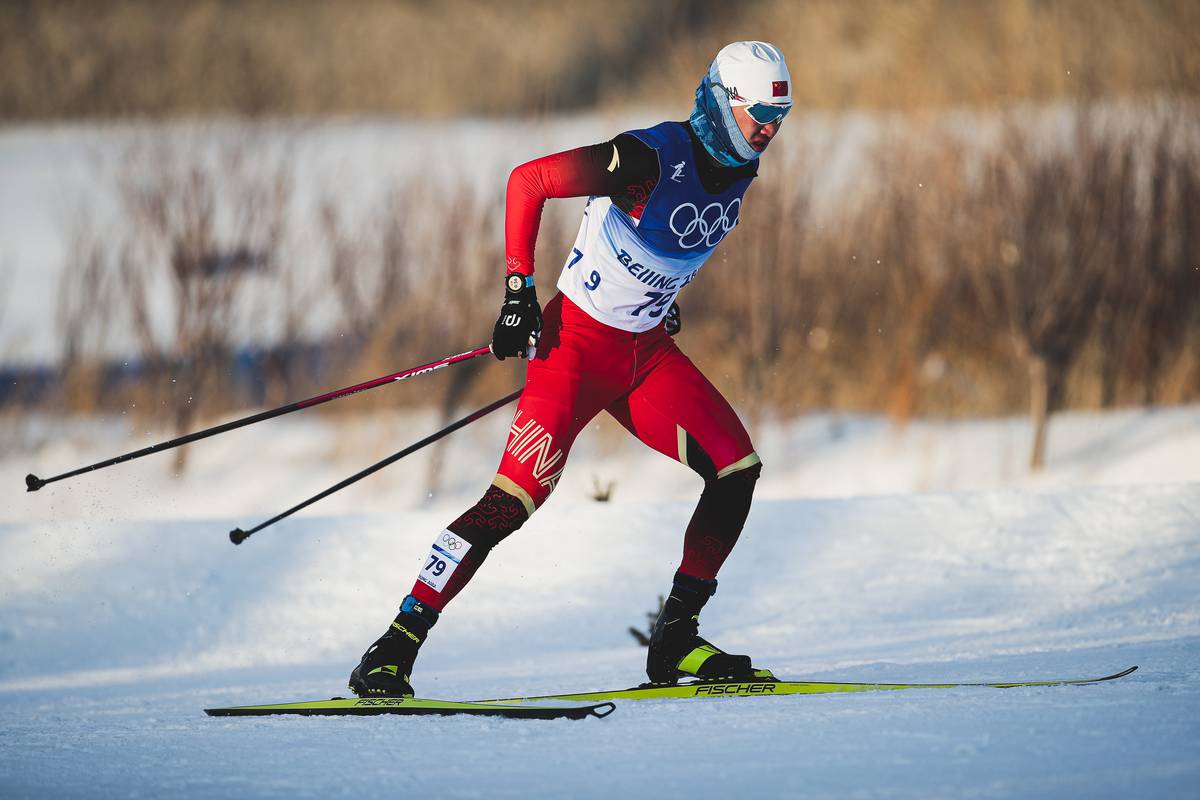
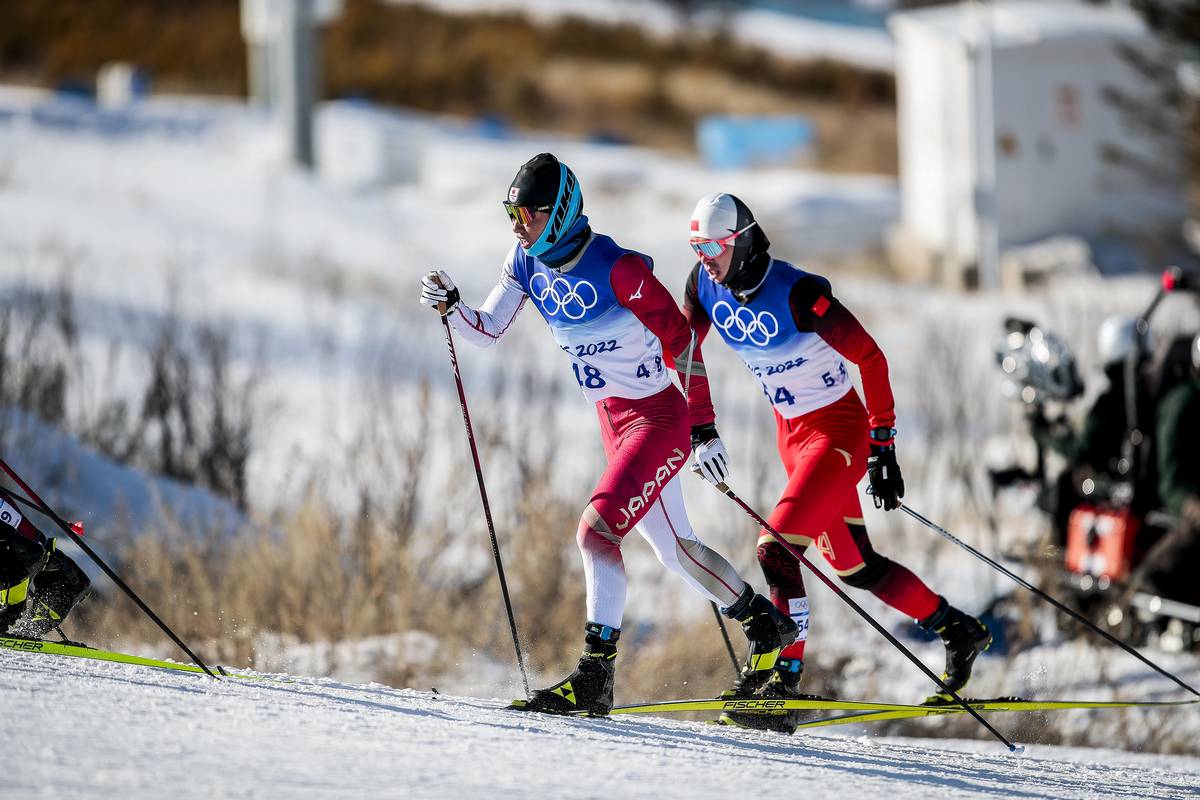
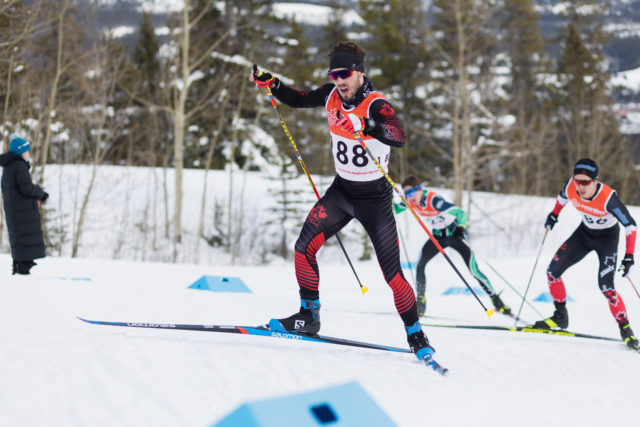
Rongsheng Liu (CHN) races the freestyle sprint qualifier during the 2022 Beijing Olympic Winter Games. (Photo: NordicFocus)
Throughout the Chinese endurance world, promising athletes were funneled into skiing. One such athlete was Yeersen Shiwohen. An ultrarunner, he won a 168k marathon and impressed a businessman who introduced him to the local sports management. Despite having never skied before, and believing that it was “impossible” to ski uphill, Shiwohen was soon on his way to Finland to become part of China’s skiing generation.
The new skiers were enticed with more than Olympic glory, they were also offered competitive salaries. Veikko Halonen, the CEO of Vuokatti Sport said to Yle, “With that money, the whole family will probably live in their home country. Motivation is high, even though they do not know when they will be able to visit home.”
Shiwohen was one of 134 Chinese athletes sent in 2018 to Vuokatti to learn skiing. Of them, only twenty had ever skied before. Many were from subtropical Shanghai. The government officials in charge of identifying talents back in China had only a loose understanding of the qualities they should be looking for, and believing that upper body strength was paramount, leaned heavily on selecting rowers.
From the start, the Chinese project in Vuokatti—called “Zero to Hero”—was enormously ambitious. One of China’s primary snow sports coaches, Glenn Lindholm of Finland, recounted to Swiss news outlet Tages-Anzeiger that in the beginning, “It was difficult for them to just stand on cross-country skis.”
In Norway, apart from the Trondheim group, the situation was much the same. “The first time I saw them on rollerskis, I thought ‘this is not possible,’ Anita Moen told NRK of the early days at the Trysil camp.
“I was skeptical, scared,” said Moen in the report. “They struggled to control the speed. There were abrasions on the legs and arms even though we used protective equipment.”
In Vuokatti, coaches chafed at the insistence of Chinese officials that the skiers be outfitted with the finest equipment on the market, which only made their work harder. “Only the best is good enough for the project,” Lindholm said. “Money doesn’t matter.”
The Philip Boit Connection
The Chinese skiing project recalled an earlier effort in the mid-90s by Nike to introduce elite Kenyan runners to cross country skiing prior to the 1998 Nagano Olympics.
At its core, the idea was little more than a marketing gimmick dreamed up by Nike executives in Portland, Oregon as a means to help promote their venture into winter wear. As Mark Bossardet, then Nike’s Director of Global Athletics put it to the New York Times, “We were sitting around the office one day and we said, ‘What if we took Kenyan runners and transferred their skills to cross country skiing?’”
Philip Boit at the time was trying to make it in the ultra competitive Kenyan running scene and believing that “cross country” must have something to do with running, he signed up.
Before long, he was on a plane to Finland with a compatriot. Boit did not consider his task to be a marketing ploy, and he took his ski training seriously. He would end up spending the next two years there training for Nagano, supported by Nike.
Ultimately, the Nike project was an experiment: If you take a talented Kenyan runner and give him a coach and two years in Finland to learn skiing, what will happen?
The result proved that two years was not enough. In the 10 k classic at Nagano, Boit finished last, some twenty minutes behind Bjørn Dælhe. Though Boit was a talented runner—he could run 1,500m in 3:46.5—that prowess proved not to be a predictor of success. As Bossardet conceded, “As it turned out, the most important aspect is technique.”
The Study
Unlike the anecdotal knowledge from the Nike experiment, the large and well funded Team China project in Meråker offered a unique opportunity for research: that of talent transfer from other sports to nordic skiing. The study was conducted by the Norwegian Institute of Science and technology (NTNU), and researchers included Øyvind Sandbakk and Rune Talsnes. It was the first systematic and scientific study of talent transfer ever written about, in any sport.
The researchers followed the journey of 24 Chinese athletes aged between 17 and 21 years old that had been selected from a pool of middle distance runners, rowers, and kayakers.
After a few months of introductory ski lessons, the athletes were subjected to a battery of tests in the beginning, middle, and end of a six month period of time. VO2max, double poling power, and rollerskiing efficiency on a treadmill, were among the many tests used to assess the athletes.
The end result was clear: the runners improved far more than the rowers, and the men improved more than the women.
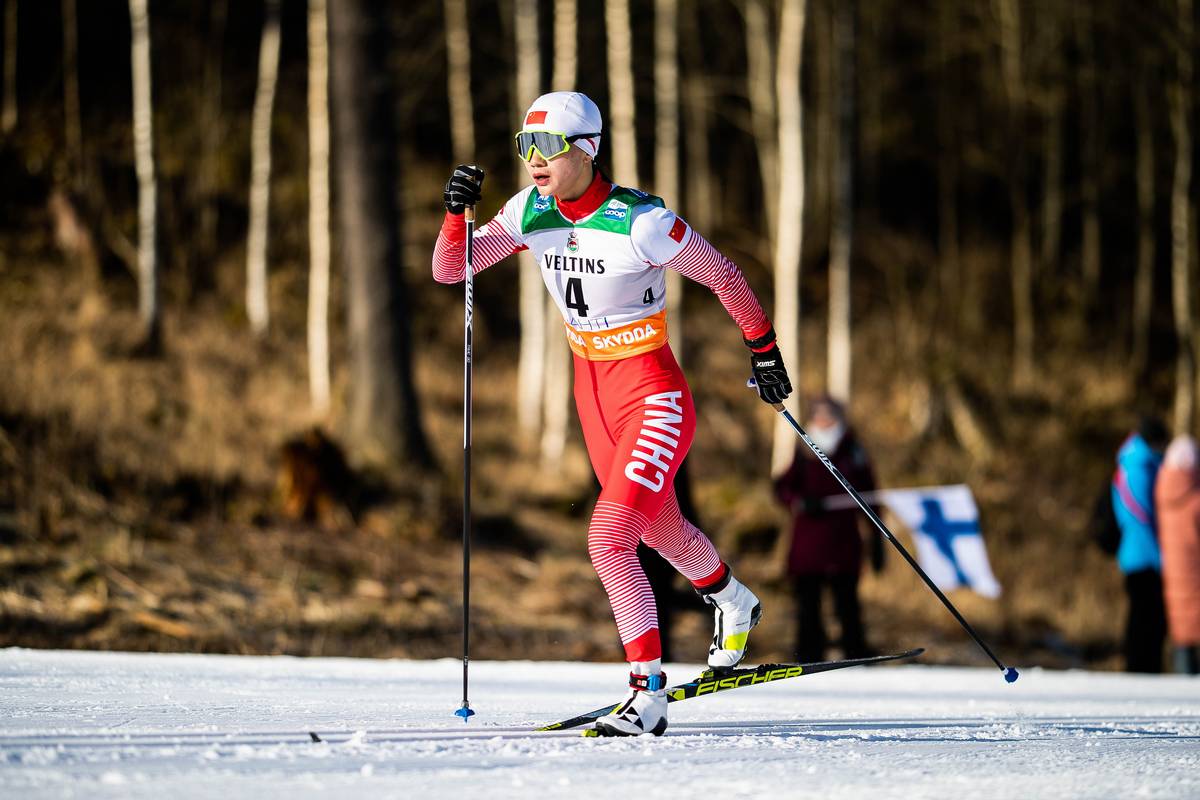
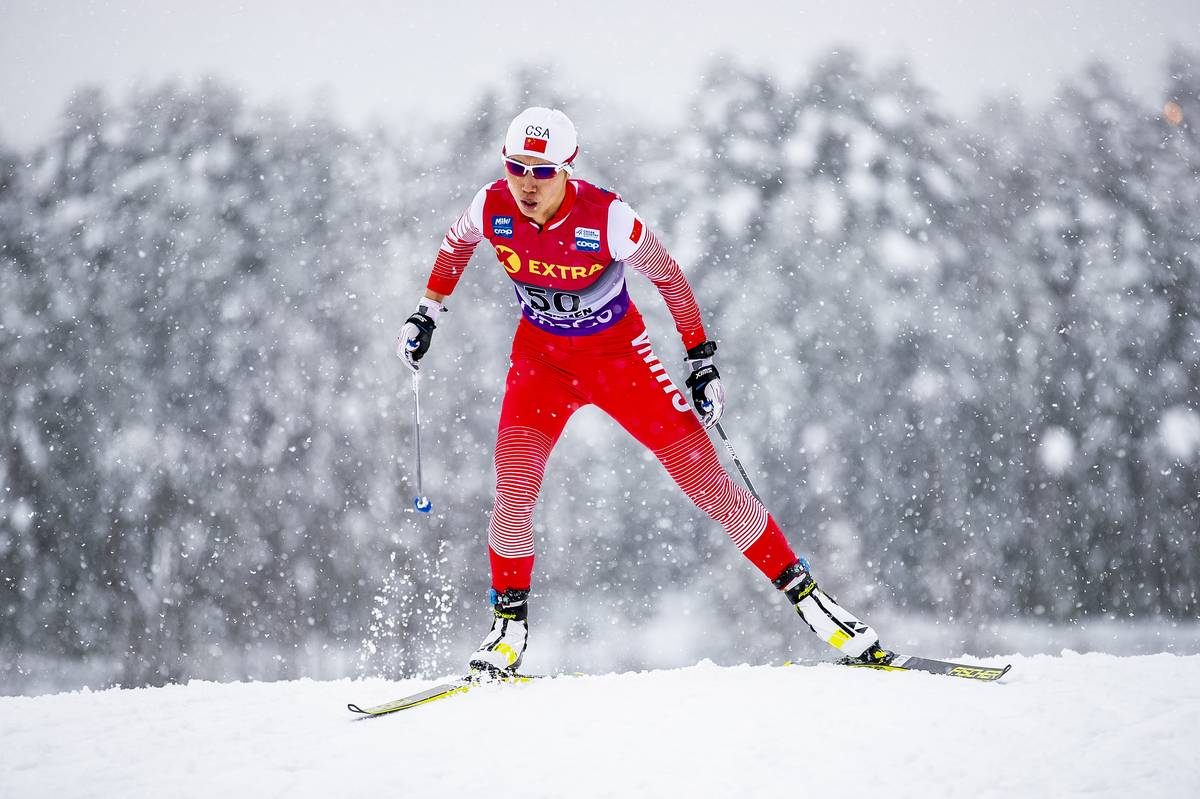
Chunxue Chi (CHN) races a February, 2020 World Cup 10 k classic in Lahti, FIN. (Photo: NordicFocus)
The runners did best, it was surmised, because they adapted more easily to the endurance training and were injured less often. While the physiology tests told a clear story of improving strength, capacity, and efficiency, they obscured the point of the whole endeavor: how fast they could ski.
In an email to FasterSkier, Talsnes confirmed the validity of using specific markers to assess the progress of the new skiers as athletes, writing, “I would say most of the performance and physiological indices that were assessed in the monitoring of these athletes are valid indicators of [cross country] skiing performance. In fact, we have recently published a study on the validity of such tests in a group of Norwegian junior/senior [cross country] skiers.”
Because the study was conducted over the winter months, Talsnes wrote that a rollerskiing time trial was not possible, and that a ski event would have been subject to shifting conditions.
The study also assessed the coaches’ perspectives. With their names removed for anonymity, the researchers managed to gather some interesting insights.
There was general consensus among the coaches that those who were self motivated did best. The Chinese athletes did improve remarkably, both in Meråker and elsewhere.
In Trysil, Anita Moen was impressed with the results, telling NRK “I did not think it would be possible to get [the athletes] to learn the technique. And that they should ski fast already for the winter. It was such a short time. But there I was wrong.”
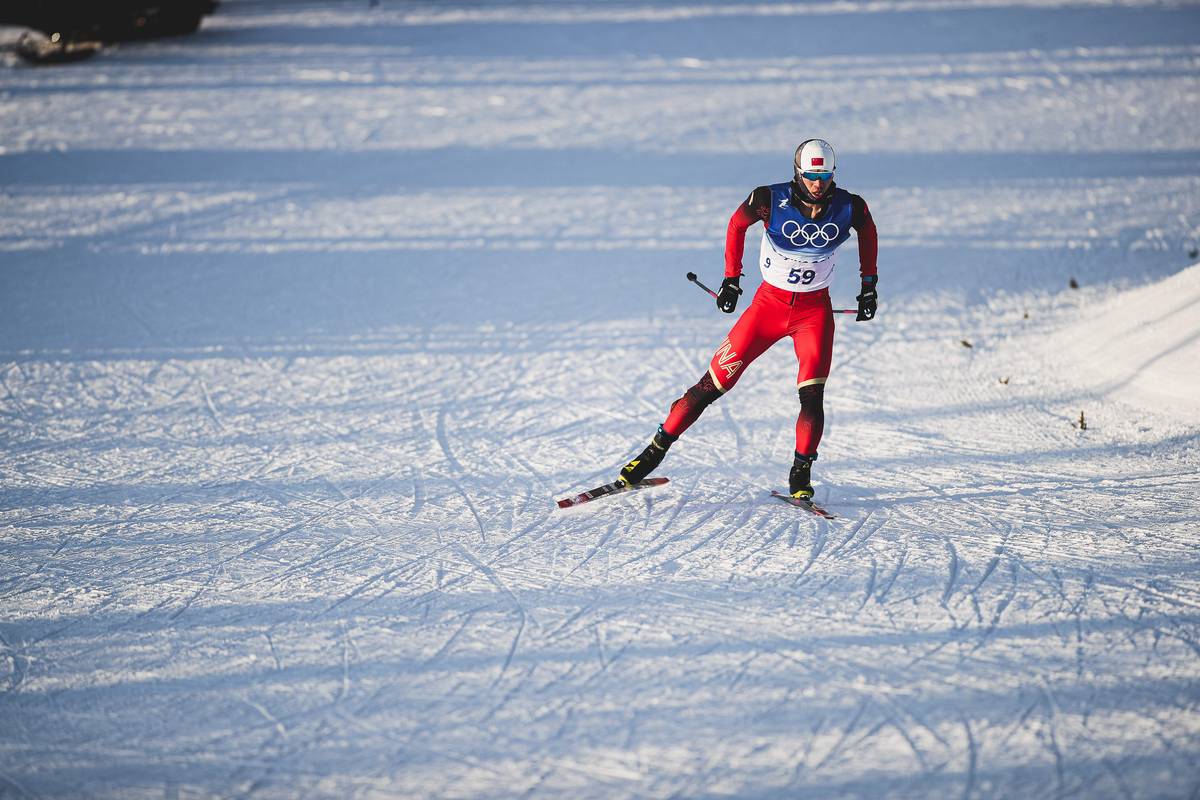
China’s Jincai Shang races the freestyle sprint qualifier during the 2022 Beijing Olympic Winter Games. (Photo: NordicFocus)
Yet as much as the athletes improved, they were still not at a level to compete on the biggest stage. As a coach said in the NTNU study , “Many of them have physical capacities better than their Norwegian peers in cross country skiing, without this reflecting… in a competition. It’s the ski feeling, how to go on skis. They still miss this feeling.”
To the researchers, the coaches expressed their skepticism that the project would bear fruit. “…regarding talent transfer and [nordic] skiing, it’s something I wouldn’t recommend.”
They also felt that their efforts were hampered by expectations of speedy results, a lack of control over selecting athletes, and uncertainty over how long the program would last.
“This was a short time period with [cross country] ski-specific training,” Talsnes wrote, “and although the most responding athletes had large development in sport-specific performance, there is a long way to a World Cup and Olympic level. However, I think it might work with the right potential [athletes] and a sufficient time perspective.”
Although there were questions about whether the athletes would be ready by Beijing, results have ultimately proved a degree of success for the Meråker program. “Interestingly,” wrote Talsnes, “the best Chinese athlete during [the] skiathlon for men in the Olympics was a part of this project. He [Liu Rongsheng] first started skiing in February 2019 and is a previous runner. He became 38th and actually beat Klæbo which I think is a bit funny…”
***
In Vuokatti, the athletes came with an entourage of Chinese staff: fifteen coaches, along with translators and government minders. The contingent was so large that a “Chinese village” was created, replete with a restaurant.
Occasionally, there were culture clashes, though the misunderstandings were mainly between the Norwegian and Finnish coaches and Chinese officials.
Tor-Arne Hetland outlined an episode of discord between himself and Chinese officials when he vetoed a requested 10k time trial to compare his athletes with those in China for placement on the elite team. “It was nonsense!” Hetland told the South China Morning Post. “The snow would have been different from place to place, and they would be [skiing] on completely different tracks.”
A larger controversy at the Meråker public library overshadowed coaching disagreements, and brought the fragility of ski diplomacy to the fore.
Meråker is a small municipality with a population of just over 1000 residents in the Trøndeleg region east of Trondheim. To ease the stay of the around 40 Chinese athletes, the library had a shipment of books in Mandarin sent from the Oslo public library system.
Included in the titles sent were a few on subjects that were banned in China, including one on the Falun Gong — an outlawed Chinese religious movement. Chinese officials with the team repeatedly insisted that the books be removed. Anne Marken, the librarian in Meråker told Andresseavisen “They have said that if any of the Chinese skiers are taken with these books, they are afraid that they risk a labor camp or prison in China.”
Marken refused. The matter made headlines in Norway and helped to reignite the public debate over whether Norway was complicit in human rights abuses in China. Beyond the squabble over a few forbidden books in Meråker was the larger shadow that the salmon-for-skiing agreement had cast.
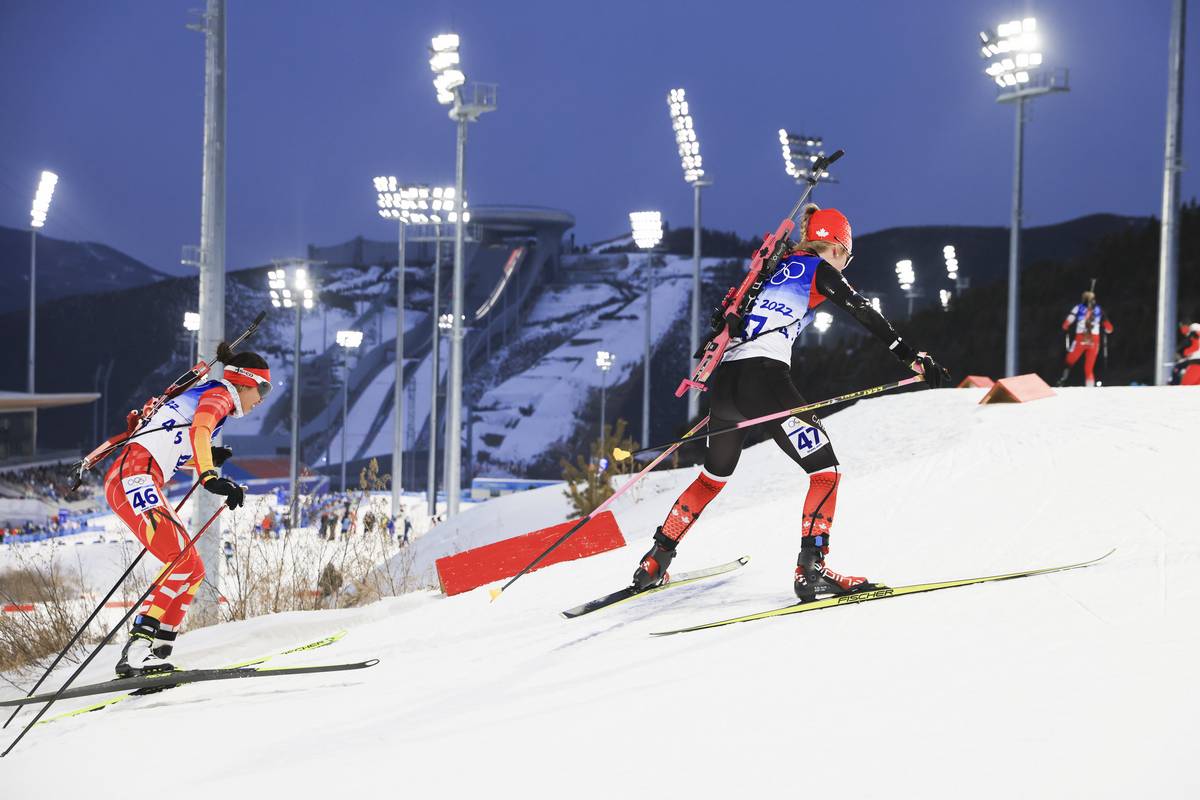
Chinese biathloete Yuanmeng Chu follows Canada’s Emma Lunder (CAN) during the women’s sprint competition on February 11th. (Photo: NordicFocus)
The philosophical differences between Norwegian and Finnish coaches and those of China stemmed in part from China’s contrasting sporting model that was built in the image of the Soviet system and has retained much of its flavor—a focus on authoritarian, sport specific development that begins at an early age.
Much like the Russian ski team, which is separated into four separate training groups, the Chinese Ski Team was equally diffused. Confusingly, there were two separate entities competing with each other to create skiers. The Winter Sports Group had the Chinese Ski Association under its umbrella, and oversaw some of the more elite programs. Competing with the Chinese Ski Association was Team China, which was unrelated other than that its funding also came from the State.
To further muddy the waters, Taiwan and Hong Kong have their own ski associations, and teams. Both compete as separate nations in the Olympics despite being, by varying degrees, part of the same country.
It was Team China that signed most of the contracts to train new skiers. The result was that hundreds of skiers, ranging from barely able to ski, to competing on the World Cup, were all somewhat on the national team.
“I do not know how many teams the Chinese have called ‘national team’,” said Bernhard Rønning who ran the Trondheim based group. He clarified to Aftenposten, “We are the ones… going to the World Cup.”
Chinese sporting officials did not take an entirely hands off approach when their athletes were abroad. At the end of every week, Lindholm was required to send a report back to Beijing outlining the progress of the skiers. As a result, much focus was placed on physiological tests. “We could work more efficiently if we were only allowed to,” said Lindholm.
ZHANGJIAKOU, CHINA — Russia, and its flag, are officially barred from the 2022 Olympics in Beijing, a ruling that stems from continuing doping violations following a massive, state-sponsored scandal at the 2014 Games in Sochi that included cross-country skiers.
But other Russian cross-country skiers are still competing here, under the flag of their country’s Olympic committee.
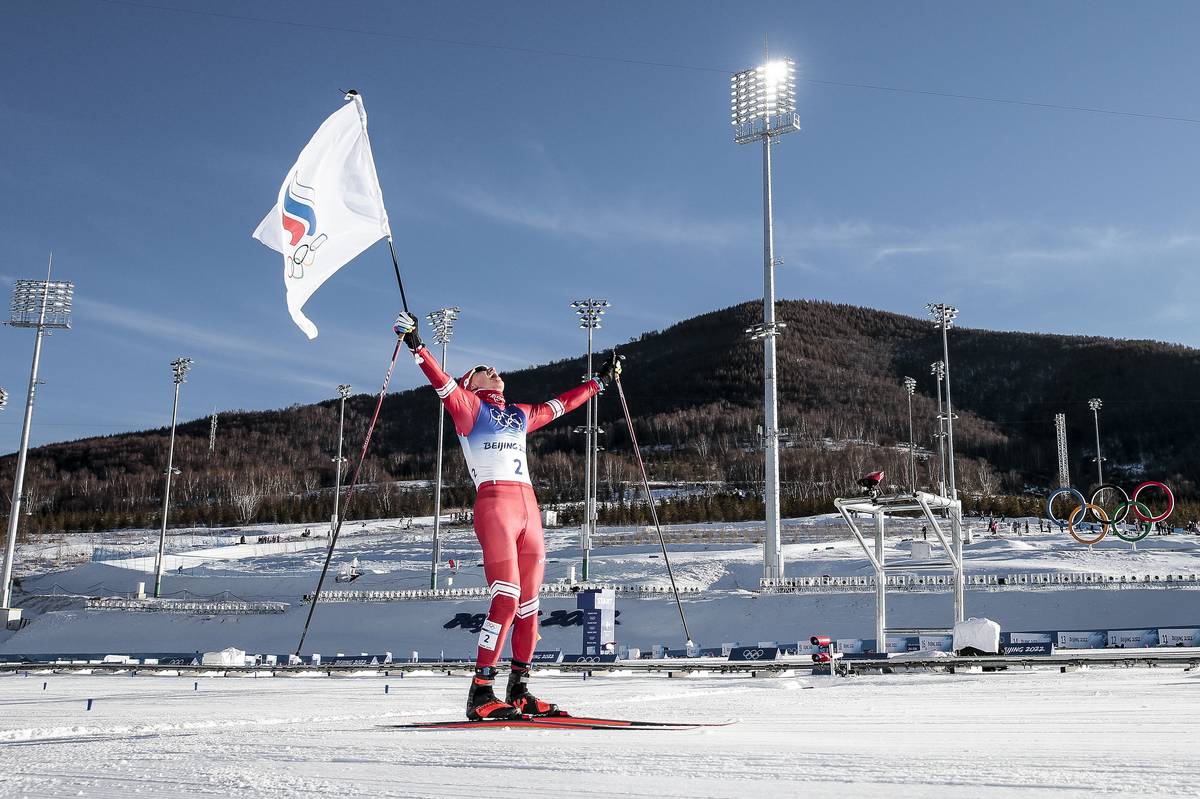
And on Sunday, in their first race of the Games, Russian men took the top two places. Star Alexander Bolshunov was so far ahead that he slowed to wave a Russian Olympic Committee flag before the finish line, and still beat third-placed Iivo Niskanen of Finland by two minutes.
Alexander Bolshunov celebrates a dominant victory, earning his first Olympic gold medal at the men’s 30 k skiathlon. (Photo: NordicFocus)
In spite of the huge winning margin, U.S. Ski Team Head Coach Matt Whitcomb said he wasn’t skeptical.
“We were all cheering for him in the coaching zone. And I don’t think all of us coaches, if we suspected any foul play, would be clapping for him,” Whitcomb said in an interview after the race. “I trust the World Anti-Doping Agency for helping keep the sport clean. I really do feel like overall, cross-country skiing is quite clean these days, compared to where we’ve come from.”
But other veteran American observers couldn’t watch Bolshunov and second-placed Denis Spitsov without asking questions. And the fact that Bolshunov will take home a gold medal when his country is still under international sanctions for doping-related offenses underscores the need for tougher penalties, critics said.
“I watched that race, and I was sad. Not because I’m 100% convinced that Bolshunov’s guilty, but because I watched it and I had a lot of doubt,” said Kris Freeman, a retired American cross-country skier who competed at the 2014 Games. “I’m angry at all the corrupt sporting bodies out there that let Russia come to these Games. They shouldn’t be there.”
Freeman’s comments came a few days before Russian media reported that a star women’s figure skater, Kamila Valieva, had tested positive for a banned drug before the Beijing Games started. A Kremlin spokesman said wait Wednesday said he was waiting for an explanation from the International Olympic Committee or Russian sports officials.
Another time, another team
Bolshunov is a decorated athlete who’s never failed a drug test. At a post-race news conference, asked by FasterSkier/the Daily News about the suspicions surrounding his performance, he emphatically rejected them.
Bolshunov said Russian athletes are under intense scrutiny, with drug testing “almost every day,” and have to constantly report their whereabouts to testing agencies.
“This should have nothing to do with sports. We have clean sportsmen, clean athletes here at the Olympics,” Bolshunov said, calling the question “irrelevant.” He added: “After you see how we train, I believe that you and your audience will never have these questions again.”
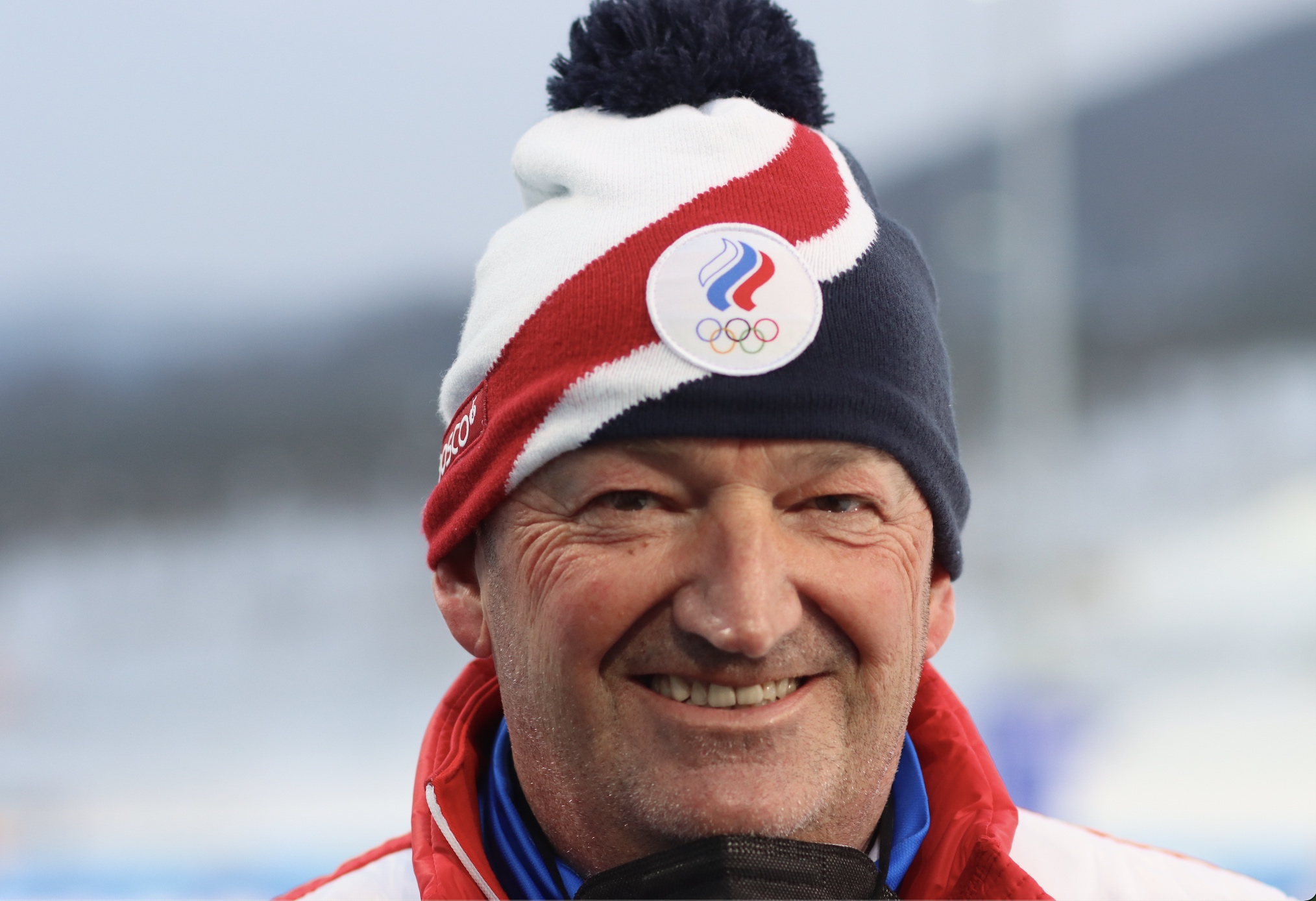
Markus Cramer, a coach of the Russian national ski team, poses for a photo at the stadium at the cross-country ski venue in Zhangjiakou, China. (Photo: Nat Herz/FasterSkier-ADN)
In a subsequent interview, Markus Cramer, a German coach who works for the Russians, said he’s “100% sure” there’s no doping on his team. He’s been affiliated with the team for seven years, and if doping was happening, he would have been able to tell.
“It’s totally another time now, and another team, and other athletes,” he said.
Reactions inside Russia, meanwhile, underscored how differently followers of the sport there viewed Bolshunov’s result. They also hinted at the ongoing geopolitical tensions between Russia and the U.S.
Russian politicians and sports commentators sharply dismissed any doubts, with one saying that the Anchorage Daily News/FasterSkier reporter who questioned Bolshunov was a “provocateur” and should have his Olympic press credential revoked.
“He could also ask what (Bolshunov) thinks about the alleged movements of military personnel,” sports journalist Dmitry Guberniev was quoted as saying, referring to the controversy about Russian troops massing near the Ukrainian border.
Scandinavian journalists at the post-race news conference said followers of cross-country skiing in those nations are less inclined to doubt the current generation of Russian athletes after growing more familiar with them.
The Russian team, in an effort to build trust after the Sochi scandal, invited Norwegian media to a training camp near Lillehammer a few years ago, Cramer said.
“Especially with the Norwegian media, we have a good contact,” he added. “And I think they understand, most of them.”
Cramer noted that no similar questions were lobbed at Norwegian superstar Therese Johaug, after she won the women’s opening cross-country event in similarly dominating fashion.
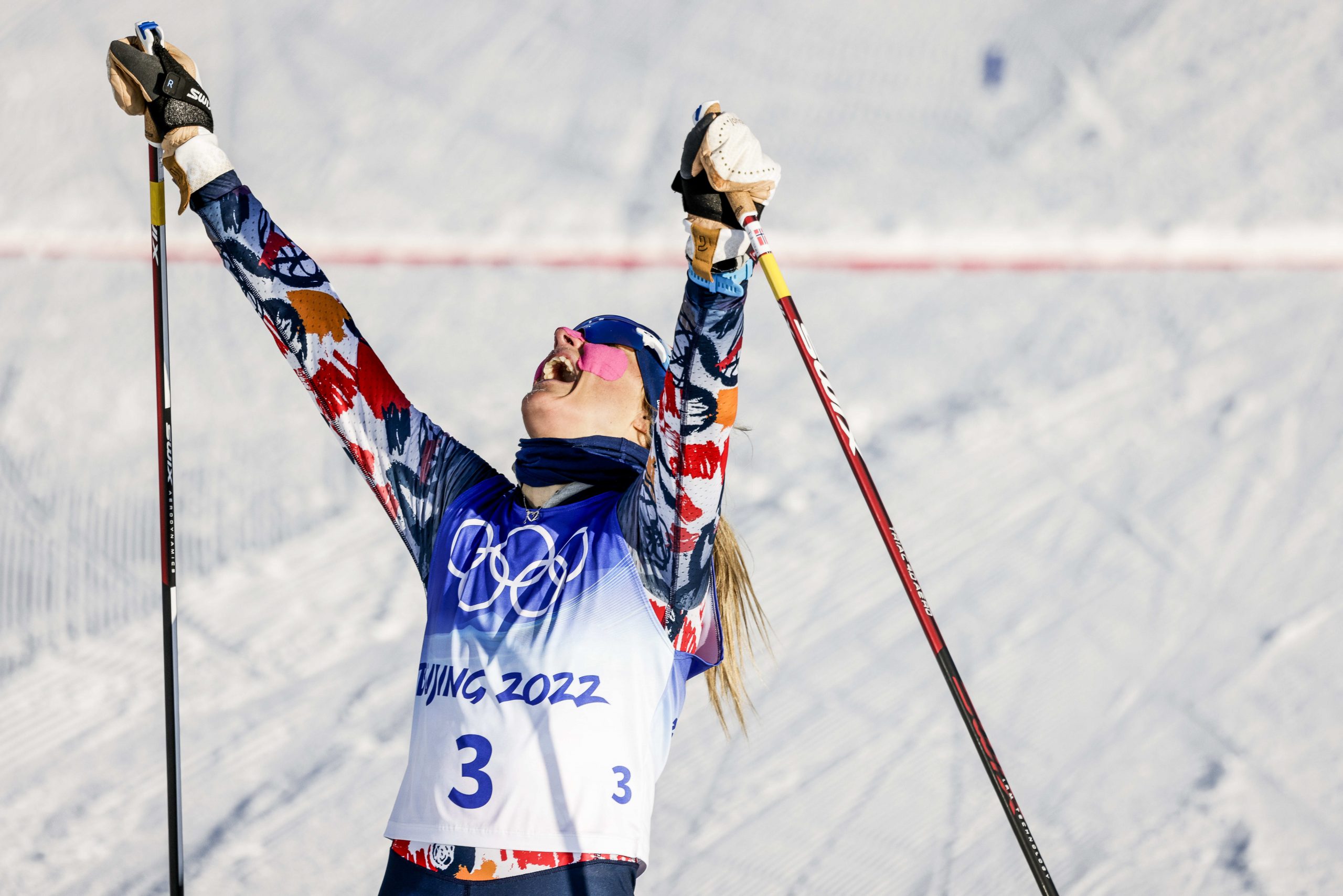
Celebration for Therese Johaug (NOR) as she takes her first ever individual Olympic gold medal in the women’s 15 k skiathlon. (Photo: NordicFocus)
Johaug missed the 2018 Games while serving an 18-month ban for using an anabolic steroid, clostebol. She said she accidentally took it while trying to treat a sunburn with lip balm — which turned out to have a “doping” warning label on the package.
At a news conference Thursday after winning her second race of the Games, Johaug said she’d finished her ban and had been training “so hard, so much.”
“People can (say) what they want, but I don’t care,” she said. “I know who I am and what I’m doing.”
Questions of accountability
Bolshunov’s result Sunday did not surprise followers of the sport, even if the size of his winning margin made an impression.
He’s also topped the overall rankings of the World Cup circuit — generally accepted as a barometer for the globe’s best all-around skier — for the past two winters. And he’s known to his peers for his work ethic and impeccable technique.
“The thing about Bolshunov is he’s a beautiful skier,” said Freeman, the retired American racer. “And I have no doubt that he works his ass off.”
One of the questions about Bolshunov’s performance is how much he should be held accountable for transgressions committed by others at a time when he was 17 years old.
Alexander Bolshunov (ROC) puts together a dominant performance in the men’s 30 k skiathlon. (Photo: NordicFocus)
Noah Hoffman, another retired American skier and anti-doping advocate, said he gives Bolshunov the benefit of the doubt.
“You can’t prove that you’re clean,” Hoffman said. “And so I refuse to assume that anybody is doping without evidence.”
On the other hand, Hoffman remains frustrated by the absence of stiffer penalties against the entire Russian team in the aftermath of the 2014 scandal.
“To the extent that a flag is making us question an athlete, that’s tragic,” he said. “And it’s because we haven’t put in place adequate deterrence to stop state-sponsored doping.”
A year ago, a European appeals court halved Russia’s four-year ban from global sports originally imposed by the World Anti-Doping Agency, or WADA, in a ruling blasted by some anti-doping advocates.
That proposed four-year penalty was not in direct response to the Sochi scheme. Instead, it was imposed after subsequent accusations by WADA that Russia had covered up positive tests in data that the nation was required to disclose in the wake of the 2014 scandal.
The result is that Russian athletes are still competing in Beijing — as they did at last year’s Games in Tokyo and in 2018 in Pyeonchang — even as Russian leaders can complain that they’re being unfairly targeted, said Hoffman.
“In both Pyeongchang and here in Beijing, they get to claim to be the victims of a Western plot while still celebrating the success of their athletes,” Hoffman said. “This is like everything Putin dreams of.”
A “big political game”
Bolshunov’s personal coach is Yuri Borodavko, who works with several other star Russian athletes.
In 2010, Russian Ski Federation leaders suspended Borodavko from working with the country’s national team for two years after Evgeny Dementiev, a skier he worked with, tested positive for blood-boosting drugs.
Today, Borodavko has a good reputation in Russia, and most fans see him and his athletes as “absolutely clean,” said Artem Kuznetsov, a journalist with the government-owned Russian news agency Tass.
Bolshunov and his teammates would be “crazy to try to cheat right now,” given the intense scrutiny on them, Kuznetsov added.
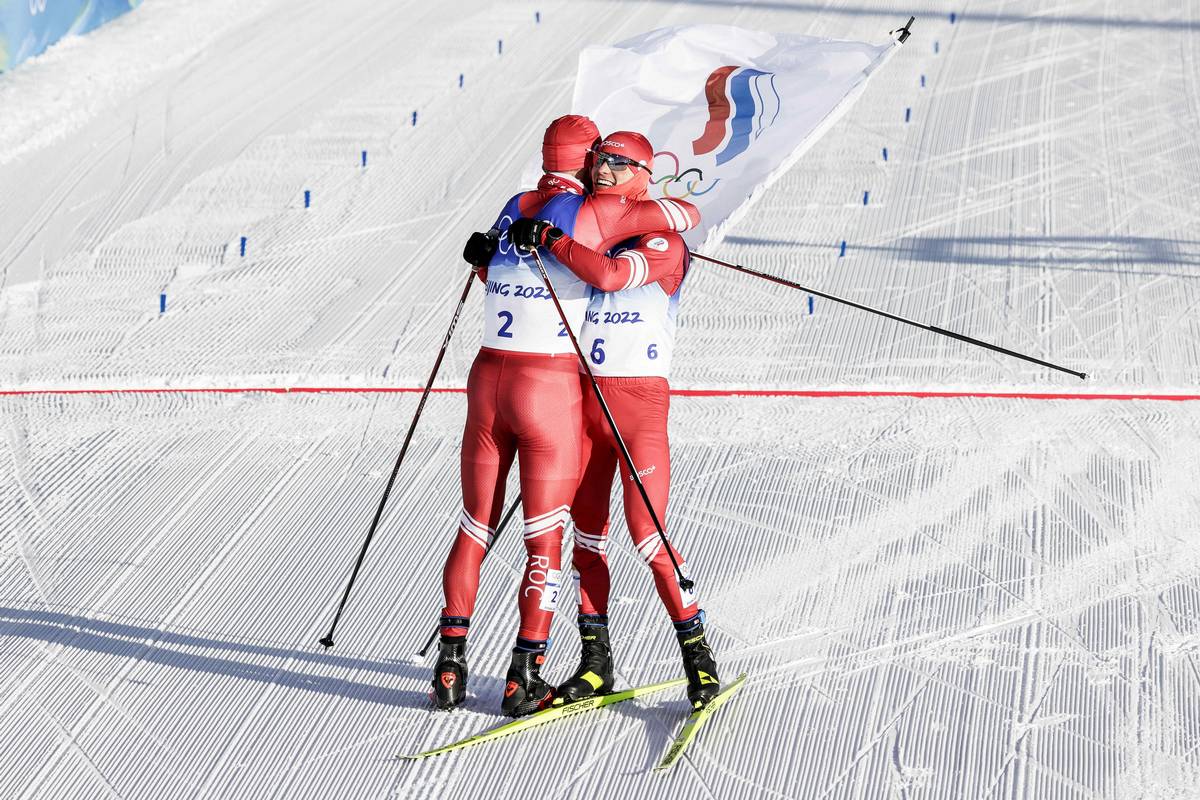
Olympic champion Alexander Bolshunov welcomes his teammate Denis Spitsov (right) to the finish of the men’s 30 k skiathlon, going one-two for the Russian Olympic Committee. (Photo: NordicFocus)
Freeman said he doesn’t lend too much credibility to Bolshunov’s history of negative tests: Lance Armstrong, he pointed out, never failed a drug test, either.
He said he was especially offended by the way Bolshunov celebrated Sunday’s win with the Russian Olympic Committee flag, and by his “defiant” response to the questions about him.
“I think he should be more aware of where his country is coming from — what they have been caught red-handed doing — and understand where the questions were coming from,” Freeman said. “Coming at it defiantly like that just makes you seem like a villain.”
Cramer, the Russian team coach, said Bolshunov is a young athlete who doesn’t understand why, given his clean personal record, he’s facing questions.
He also said Bolshunov has been criticized in the past for looking too serious when he crosses the finish line.
“What can he do?” Cramer said. He added: “We have a lot of (doping) controls. So, when he is not clean, of course, we will see.”
China’s Degen Chen races the men’s 30-kilometer skiathlon which opened the 2022 Beijing Olympic Winter Games. (Photo: NordicFocus)
Salmon for Skiing
Over the last four years China has undertaken perhaps the grandest experiment in cross country skiing history: can hundreds of athletes cherry picked from other sports and given seemingly unlimited resources be turned into Olympic medalists in nordic events?
Chinese athletes have never medaled in any of the nordic disciplines, and their teams head into the Olympics as the darkest of dark horses. Success, in the form of medals, is key to their aims of climbing up the medal table and becoming the protagonists of their own winter Games.
The Chinese nordic programs have aimed to rapidly become competitive with the best in the world. The urgency of the task was made clear at the 2018 PyeongChang Olympics where China finished fourteenth in the medal count, capturing a single gold medal, and just nine in total.
Despite this history, not everyone is dismissive of their chances.
“I said four years ago that I predict these guys will medal in Beijing,” said US biathlete Clare Egan in a call, “because I know that medals are important to China and that they basically will put any resources possible into making things happen like that. So nothing would surprise me.”
Even so, Egan conceded that, “It’s going to be hard for them, because they aren’t fast enough.”
The project of building a culture of skiing in China began in 2015 when Beijing was awarded the 2022 Winter Games. The government spurred into action: it would make 120 million of its citizens into recreational skiers by building 800 new ski areas, among them the world’s largest indoor center in Harbin that cost $4.5 billion.
Cross country skiing also benefited from the investment rush, with an 1.3 k indoor ski tunnel built in Beishan, a joint Finnish-China project that cost $148 million. Another cross country ski tunnel is planned to be placed inside an unused coal mine shaft on the outskirts of Beijing. Liu Bo, a former ski coach, told Reuters in 2018 that he was investing $318 million in the project.
Bo explained in the interview that the goal for Chinese skiing, aimed at the Olympics, was clear: “China spends big money setting up the stage, and the performers are all foreigners,” said Bo. “President Xi will not allow this to happen.We have to be the leading actor in 2022.”
Xin Li (CHN) races a freestyle sprint qualifier in Konnerud, NOR in March, 2020. (Photo: NordicFocus)
While the ski resort boom was mainly aimed at creating a ski culture in China, taking on a starring role in Beijing meant that expertise would be needed from abroad. For guidance, officials looked to the top of the medal table: Norway.
Initially, it was impossible for China to work with Norway. When the Olympics were awarded to Beijing in 2015 the two countries were still embroiled in a diplomatic crisis that had severed official contact between the nations and frozen trade negotiations. The rupture occurred in 2010 when the Nobel Peace Prize was awarded in Oslo to Li Xiaobo, a Chinese human rights activist who was then imprisoned in China. At the Nobel ceremony, Xiaobo was evocatively symbolized by an empty chair on the stage.
In response, China all but severed diplomatic ties with Norway, despite the government’s lack of control over the Nobel committee. Two months later China halted the importation of fresh Norwegian salmon – a significant industry – over what was generally regarded as a politically motivated concern over a fish-borne virus.
The ban, as well as other restrictions, are believed to have cost Norway between $780 million to $1.3 billion between 2010 and 2017. At the time of the contentious Nobel ceremony, Norway had enjoyed a virtual monopoly over the Chinese salmon market, and the country’s fisheries had to watch as Chinese demand for salmon increased by thirty percent, while their share plummeted by two thirds.
Years of cautious steps by the Norwegian government followed, including its first ever refusal to meet with the Dalai Lama during his 2014 visit to Norway. Norway’s socialist left party leader Audun Lysbakken criticized this move in The Guardian, saying, “We can’t be dictated to by China in the sense of exchanging human rights for salmon.”
That fall, Oslo – the favorite for the 2022 Games – dropped out, paving the way for Beijing to win the bid the following summer. With the Games in hand, the calculus changed, and the rift with Norway became an awkward obstacle to their objectives.
A subtle indication of rapprochement came in an unusual way: Gerhard Heiberg, a Norwegian businessman headed the IOC’s Marketing Commission, and was offered a meeting on a 2016 trip to Beijing with the Chinese Minister of Sport, Gou Zhongwen.
The minister marveled at Norway’s success in skiing, Heiberg recounted to NRK, “He said that those at the top in China had agreed that they would like an agreement with Norway on a sports collaboration. And from the Chinese side, there was a desire to use Norwegian leaders, coaches, universities and so on who worked with winter sports.”
Heiberg recognized the moment. “I saw that here we have a fantastic opportunity to approach China.” Not wanting to waste the favorable winds, Heiberg left the meeting and “went straight to [Ambassador] Svein Sæther. And he lit positively on all the plugs.”
With some quiet maneuvering, relations thawed, and Norway and China signed a bilateral agreement to resume diplomatic relations in December 2016. The agreement conceded that Norway would not challenge China on its “core interests and major concerns” — a diplomatic term for avoiding involvement in sensitive issues, including human rights.
Dinigeer Yilamujiang (CHN) races a 10 k freestyle in Falun, Sweden in January, 2021. (Photo: NordicFocus)
That winter the Norwegian Ski Association was asked to help look for coaches to work in China and offered salaries of 1.1 million kroner (equivalent to $120,000) per year. China also wanted to send its athletes to Norway, but to do so, it would need to put to rest their feud.
In April 2017, Norwegian Prime Minister Erna Solberg visited Beijing, officially ending the freeze. Solberg reestablished the relationship in part by signing an agreement with China to support their sporting endeavors, particularly in nordic sports, through to the Beijing Olympics. The agreement would provide China with Norwegian ski coaches, training opportunities, as well as sporting development and snow making expertise. In return, Norway received the opportunity to optimize“Norwegian preparations for the Olympics.”
This deft piece of ski diplomacy helped to seal a seafood trade agreement with China the following month that planned to see Norway export $1.4 billion worth of salmon alone to China by 2025. The long awaited reentry to the Chinese market had arrived, and if there were any lingering questions about human rights, Per Sandberg, Norway’s Minister of Fisheries wasn’t having it. He told Aftenposten that “Norway addresses human rights in very many contexts… this time it’s fish.”
Ski diplomacy started with Stolberg’s agreement with China, and was reaffirmed the following year when King Harald visited China, signifying the complete normalization of relations while taking in a rollerskiing race at Beijing’s Olympic Park.
Despite the apparent connection between the sporting pact and the trade deals, the Norwegian Prime Minister denied the two items were related. In any case, the agreement caught the Norwegian Sports Confederation by surprise. Oddvar Jenssen, the former VP of the organization, said in an interview with Aftenposten that the decision “…came terribly fast, and a lot was in place before we knew anything. When the agreement came up, we had no choice.”
Misgivings aside, for Norwegian ski coaches, wax techs, and sport scientists, the Chinese agreement would turn into a major employment opportunity, with around 40 coaches and techs working for Chinese training groups, and around 60 more occasionally hired for short stints. No longer were the job opportunities going to be contingent on moving to China, the athletes would now be coming to Norway.
Arrival in Norway
The sporting agreement between Norway and China took on new force after China’s dismal performance in the 2018 Olympics. Afterward, the Chinese Ministry of Sport went looking for coaching help abroad. Many nations vied for contracts, but Norway was the first stop for Gou Zhongwen.
In May of 2018, Zhongwen met with Johannes Klæbo on his tour of Trøndelag – the region that has won more Olympic medals than any other – and solidified the agreement to bring athletes to Norway.
In July, ten of China’s core World Cup athletes arrived in Trondheim, Norway to begin training for the World Cup with former Montana State University skier Bernhard Rønning.
It was the prelude to an influx of more than 200 young Chinese athletes to Norway in the late summer and fall of 2018.
In addition to the Trondheim group, another was set up in Meråker, under the leadership of former Canadian National Team Coach Tor-Arne Hetland. In Lillehammer a group was led by Kristen Størmer Steira (wife of FasterSkier podcaster Devon Kershaw) and finally one in Trysil led by the mother/daughter combo of Anita Moen and Karoline Moen Guidon.
Anita Moen’s experience illustrates the slapdash nature of the project. In mid July of 2018 she was on vacationing on a beach when her phone rang. It was an offer to coach Chinese skiers until the 2022 Games.
“It was only two weeks until they were to arrive,” Moen told NRK “… I did not quite know who was coming, but I was told they had never skied before, never seen snow.”
Jincai Shang (CHN) races a classic sprint qualifier in Trondheim, NOR during Ski Tour 2020. (Photo: NordicFocus)
While China mobilized to send loads of athletes to Norway, their plans didn’t stop there. After Minister Zhongwen left Norway, he flew with his entourage directly to Finland. Waiting for him at the airport was Veiko Hallonen, the CEO of the Vuokatti Sports College.
Vuokatti offered excellent training opportunities: a long winter, a ski tunnel, knowledgeable coaches, and sophisticated technology that impressed the officials. Perhaps Zhongwen was also mindful of the warmer diplomatic climes in Finland. Ni Huizong, the Director of the Winter Sports Administrative Center told Yle, “Relations between Finland and China have a long and warm history.”
Chinese athletes had been training in Vuokatti since 2016, but the agreement established a permanent Chinese presence at the Vuokatti center and increased the total number of athletes that would stay in Finland.
The head cross country coach in Vuokatti at that time was Glenn Lindholm, who met with the Chinese delegation and was asked directly whether four years were enough to turn novices into Olympic champions. Lindholm’s response was neither yes nor no.
Lindholm must have understood the unlikely prospect of delivering medals by the next Olympics. Still, the project may have seemed crazy enough to work. Vuokatti was about to get more than 130 hand picked Chinese athletes, an almost unlimited pot of money to work with, and just under four years to produce a medalist.
It was audacious, and too bold to resist. As Lindholm and others would learn, realism, a pandemic, and decisions made in the halls of power of Beijing would frustrate their plans.
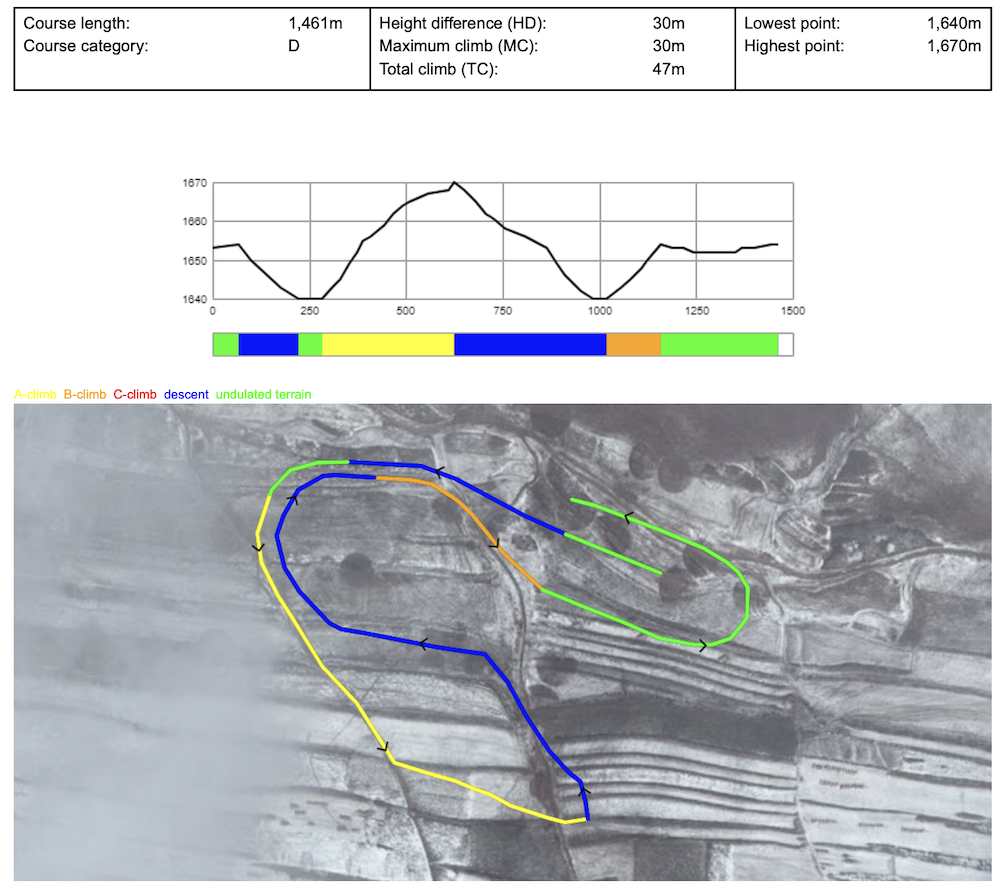
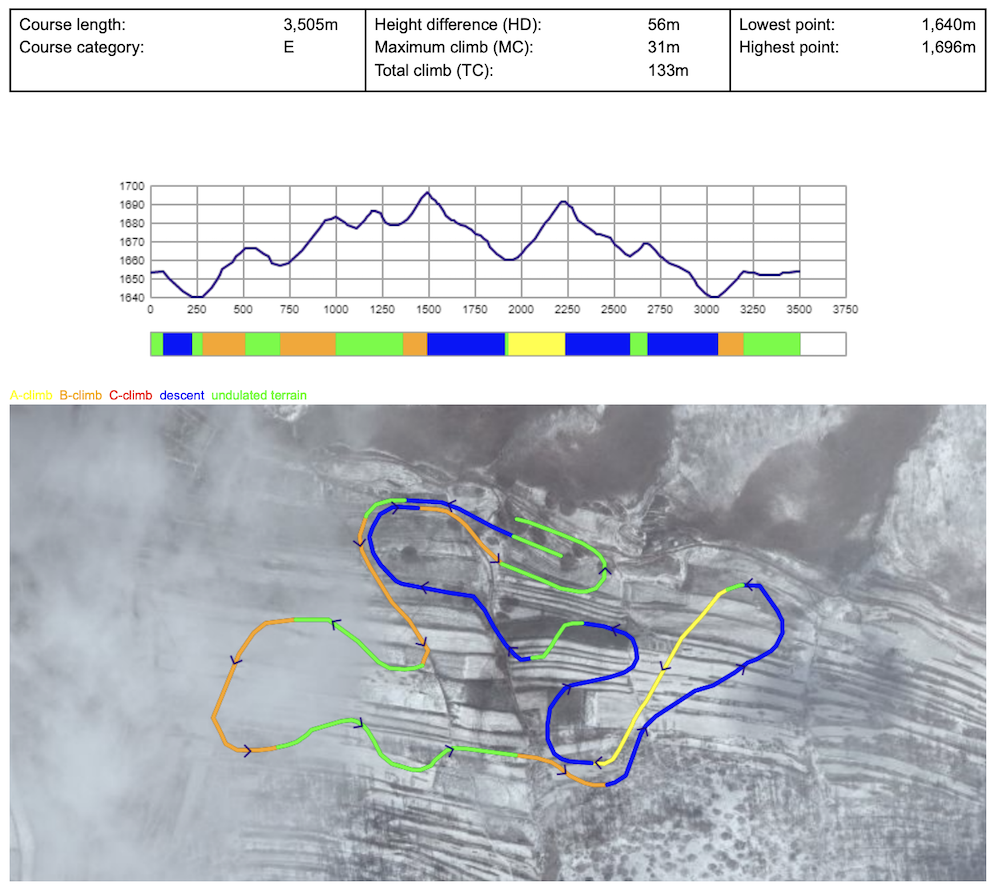
Zhangjiakou 5 k course. The final uphill is the topmost orange course segment on this map. (Screenshot from FIS homologation certificate)
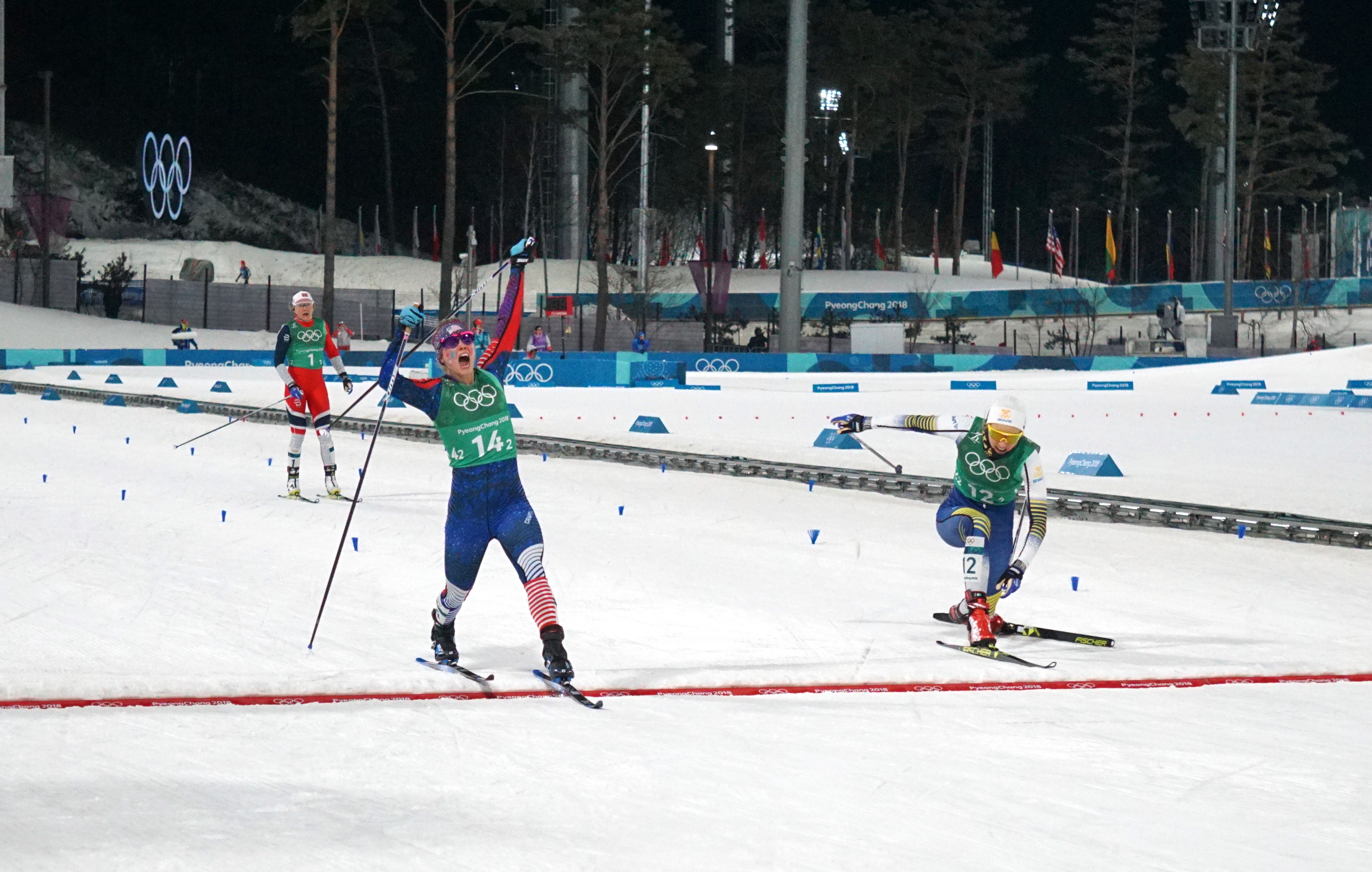
Take a moment to visualize some iconic head-to-head finishes from recent global championships: Klæbo vs. Bolshunov in the 50 k, Oberstdorf, 2021; Nilsson vs. Johaug in the relay, Seefeld, 2019; Schumacher vs. Terentev in the relay, Lahti, 2019; Diggins vs. history in, well, you know, PyeongChang, 2018.
What do these races have in common, besides drama, high-level skiing, and triumph and tragedy in equal measure? All of them feature a final downhill back into the stadium.
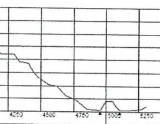
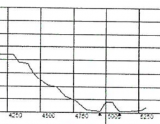
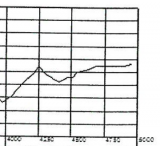
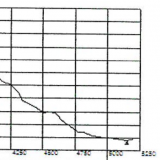
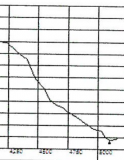
Photo: screenshot from homologation certificate. Each box is 250 meters long, on the horizontal axis, and 10 meters tall, on the vertical axis.
The Zhangjiakou courses that will be used for all distance races, by contrast, starting tonight with the women’s skiathlon, do not have such an approach to the stadium. Instead, here is a course profile of the final kilometer of all the distance courses at Kuyangshu Nordic Center and Biathlon Center in Zhangjiakou, China:
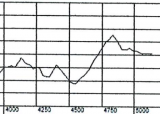
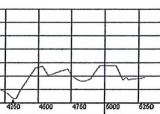
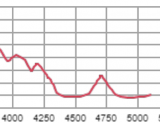
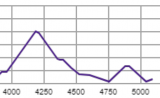
Specifically, note that there is an uphill in this final kilometer. There is a B-Climb with a 14-meter gain, starting roughly 440 meters from the finish, then an effectively flat approach through a hairpin turn and into the finishing strait.
While it is tough to make sweeping statements about what “most” courses “typically” do, a review of homologation certificates and course profiles suggests that Zhangjiakou will present the first global championship (that is, Olympics or World Ski Championships) with a comparable profile for the final kilometer since Sochi in 2014, and the first championship without a downhill into the stadium in at least 11 years. This conclusion is based on a somewhat unscientific survey of the final kilometer of the “main” five-kilometer course at all global championship venues since Holmenkollen in 2011. (Course profiles and methodology may be found at the bottom of this article.)
Here’s a look back, including the final kilometer, at the 30k men’s skiathlon during the PyeongChang Olympics in 2018. Spoiler alert, it was won by Simen Hegstad Krüger, who is currently quarantined after contracting COVID-19 last week, leaving him unable to travel to Beijing to defend his title.
So does this this final uphill matter? If you’ll forgive the lawyer answer, it depends.
On the one hand, if athletes are skiing together in the final kilometer of a race, a course with an uphill approach to the finish may play out differently than one with a downhill approach. Everything else being equal, you might expect a pure climber to have an edge on the final stretch of the Zhangjiakou courses, while this profile could negate the advantage of greater mass that a larger skier would use to gain more speed coming off a final downhill.
On the other hand, the shortest mass-start race at these Games is the 15 k skiathlon (honorable mention: the women’s relay, which is 4 x 5 kilometers and could very well feature a final leg that is much more of a head-to-head 5 k, not to mention that the sprint/team sprint course also has this profile for its final 500 meters). So there exist roughly 14.5 kilometers in which athletes may make a move before this final uphill. More broadly, while this article chose to focus on the final kilometer of each distance course as an arbitrary cutoff for purposes of taking analogous screenshots of course profiles (that is, while clearly the entire course is relevant for how the final kilometer skis, I had to set my parameters somewhere), note that the 800 meters immediately preceding the final Zhangjiakou uphill are nearly all downhill, with a substantial drop of roughly 50 vertical meters, so heavier skiers or better descenders could gain an insurmountable advantage on the flyweight athletes before this climb.
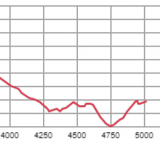
Here is the elevation profile for the entire 5 k course in Zhangjiakou, same scale as above. There is a pretty long downhill before that final B-Climb. (photo: screenshot from homologation certificate)
And more broadly still, it may be misleadingly reductive to focus on only the final half-kilometer of a 15-, 30-, or 50-kilometer mass-start race, when we’re talking about the world’s best athletes here, and they will all have a plan to use preceding sections of the course to their advantage, lessening if not obviating the implications of this one final uphill.
One commentator consulted by FasterSkier, Lex Treinen, took an “all of the above” approach when asked for his analysis of the implications of this course profile. Treinen is a former pro skier for APU who reached a national championship podium and multiple SuperTour podia during his racing career, was top American in the 2015 Birkie, and has provided commentary for both domestic and World Cup races, but now describes himself as a “substitute Polar Cubs coach [for the Anchorage Junior Nordic League youth skiing program] and amateur watercolorist.” (Treinen also has a day job as a reporter for Alaska Public Media; disclosure, he was a colleague of FasterSkier reporter Nat Herz until about a month ago.)
Lex Treinen (APU) on his way down to the finish, where he placed sixth in the men’s 30 k freestyle mass start at 2014 U.S. nationals at Soldier Hollow. (Photo: Bert Boyer)
“It’s gonna be a tactical finish but not a crapshoot,” Treinen wrote to FasterSkier earlier this week. “There’s something for everyone in the last kilometer – a descent to bunch the group up, a kicker of an uphill for the fitness freaks, and then a grind for the drag racers into the finish chute.
“It’s hard to say what sort of racers it would favor,” Treinen continued. “I think there will be a lot of different ways you’ll see the last 500 meters play out, come-from-behinds, scuffles in the downhill, and grinders who wear out the field in the last stretch.”
So, well, it depends.
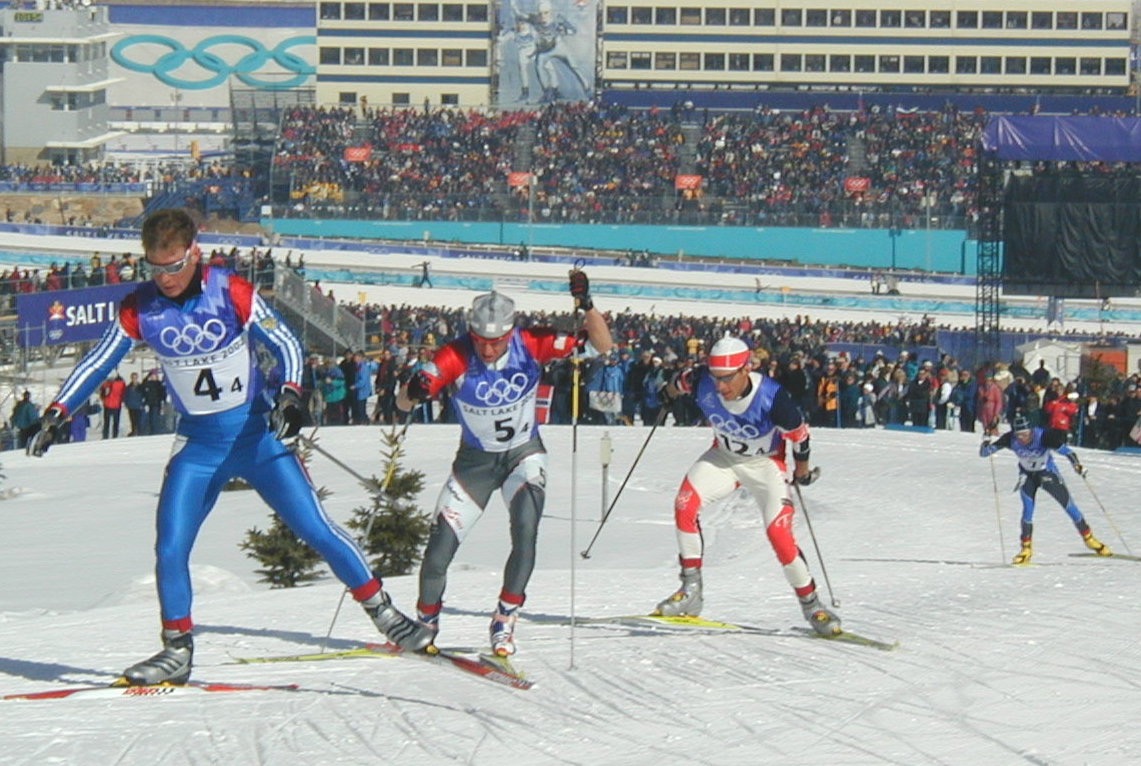
Thomas Alsgaard of Norway leads Cristian Zorzi of Italy into the final downhill into the stadium in the men’s 4 x 10 k relay at the 2002 Winter Olympics at Soldier Hollow. (Photo: Cory Smith)
Another expert, course designer John Aalberg, acknowledges the differences between the approach to the finish in Zhangjiakou and that in Soldier Hollow, which he also designed: “I was able to design an even better finish for these 2022 courses, with both a long uphill (similar to Hermod’s Hill), an exciting downhill right above the stadium, and a small uphill coming into the stadium (the high speed coming into the Soldier Hollow stadium is not optimal),” Aalberg wrote to FasterSkier. Aalberg also described the final downhill in Zhangjiakou as featuring a “‘velodrome’ downhill corner.”
Bottom line – and apologies for the joyful indeterminacy here – these courses have never hosted a FIS race before; no one knows for sure how they will ski under race conditions. Again, it depends. But as a spectator watching at home, you should get ready for two weeks’ worth of athletes coming off a final uphill into the stadium. And if you’ve ever raced at Birch Hill in Fairbanks (19-meter climb starting 360 meters out), Government Peak in Palmer (19-meter climb starting 270 meters out), or Craftsbury in Vermont (17-meter climb starting 730 meters out), brace yourself for some flashbacks.
View of the final climb leading back up to the stadium, Government Peak Recreation Area, Palmer, Alaska, November 1, 2018. (Photo: Gavin Kentch)
Methodology and footnotes
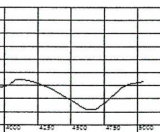
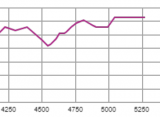
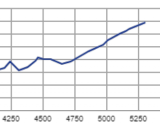
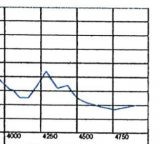
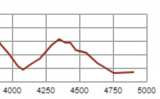
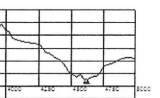
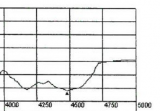
Immediately below are thumbnails of the final kilometer of the 5-kilometer distance course for all global championships since Holmenkollen in 2011. Below that are comparable thumbnails from all domestic championship venues (U.S. Nationals or Spring Series) from this country in the past decade that have homologation certificates currently available. All images are screenshots from the course profile contained in the official homologation certificate, which may be found here. They have been arranged in a wholly holistic manner, according to my sense of which ones would ski most like the Zhangjiakou distance course, sorted by descending order of similarity. Your sense of this may certainly differ.
This is an unscientific endeavor that is more art than science. Indeed, note that each venue has multiple different homologated courses; a 10-kilometer race may be three laps of a 3.3 k course, for example, while a 50-kilometer race is often six laps of an 8.3 k course, neither of which uses the 5 k course at all. I chose the 5 k course distance as a common denominator that all venues in this survey have. I think it is likely that most distance courses will typically have the same final-kilometer approach to the stadium, no matter the overall distance of the course, but this is not always the case, cf. the mass start vs. interval start 5 k homologated courses at Birch Hill in Fairbanks, which follow different routes to the same finish line in the same stadium at the same venue for two courses of the same length, and so have different elevation profiles.
I also acknowledge that the homologation certificates currently available may differ from the course used at the time of a given championship. Historical homologation certificates are not generally available on the FIS site. Again, these are presented as examples for comparison, not as gospel truth.
As one final caveat, I am painfully aware of the risk of confirmation bias here. I train and race in Alaska… and I ranked a Fairbanks course first among domestic courses. That’s convenient. (I really think it’s a tossup between Birch Hill and Craftsbury South; I slotted the Birch Hill mass start course ahead because the final uphill there starts closer to the finish, but reasonable people may clearly differ.) I have raced at one European venue in my life… and would you look at that, Beitostølen has a 15-meter climb back to the stadium, better list it as an honorable mention course.
Bottom line, I would be very open to being told why your home course is in fact a better analog for Zhangjiakou; there are hundreds of courses in the global homologation database, and I did not survey most of them. Please take this article as an illustrative sampling of what’s out there rather than as a comprehensive roundup, and feel free to suggest better matches in the comments. And enjoy the races.
Therese Johaug (NOR), followed by Katharina Hennig (GER), crests the final uphill into the stadium, Ruka mini-tour, earlier this World Cup season. (Photo: NordicFocus)
Global championship courses
Zhangjiakou (2022 OWG)
Sochi 5 k left (2014 OWG)
Holmenkollen (2011 WSC)
Oberstdorf (2021 WSC)
Seefeld (2019 WSC)
Pyeongchang (2018 OWG)
Val di Fiemme (2013 WSC)
Lahti blue (2017 WSC)
Falun blue (2015 WSC)
Falun red (2015 WSC)
Lahti red (2017 WSC)
Domestic championship courses
Zhangjiakou (2022 OWG)
Birch Hill 5k mass start
Craftsbury 5k south
Birch Hill 5k interval start
Houghton 5k B
Kincaid JNs 5k
Soldier Hollow Olympic 5k
Sun Valley 5k
Truckee 5k B
Sun Valley 5k
Truckee 5k A
Honorable mention
Zhangjiakou
Rikert Nordic Center, Vermont (hat tip Bill McKibben)
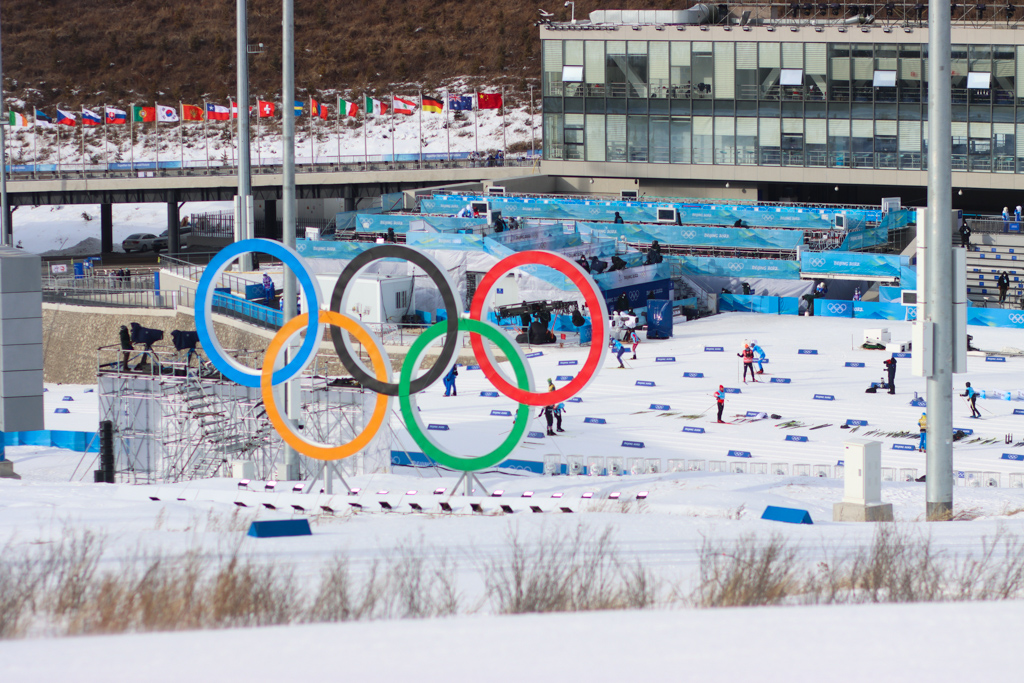
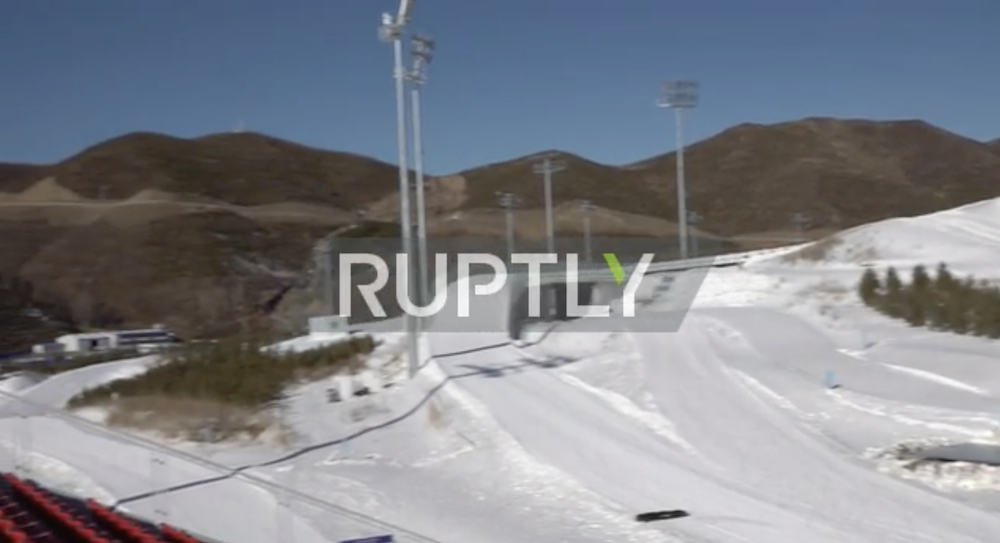
A view of the stadium Friday, February 4, 2022 at the Zhangjiakou National Cross-Country Skiing Center. (Nat Herz/FasterSkier-ADN)
ZHANGJIAKOU, CHINA — After months of headlines about coronavirus tests, travel logistics and geopolitics, Beijing’s Olympic cross-country skiing venue, on the eve of its first competition Saturday, has emphatically changed the subject.
To the winds of Zhangjiakou.
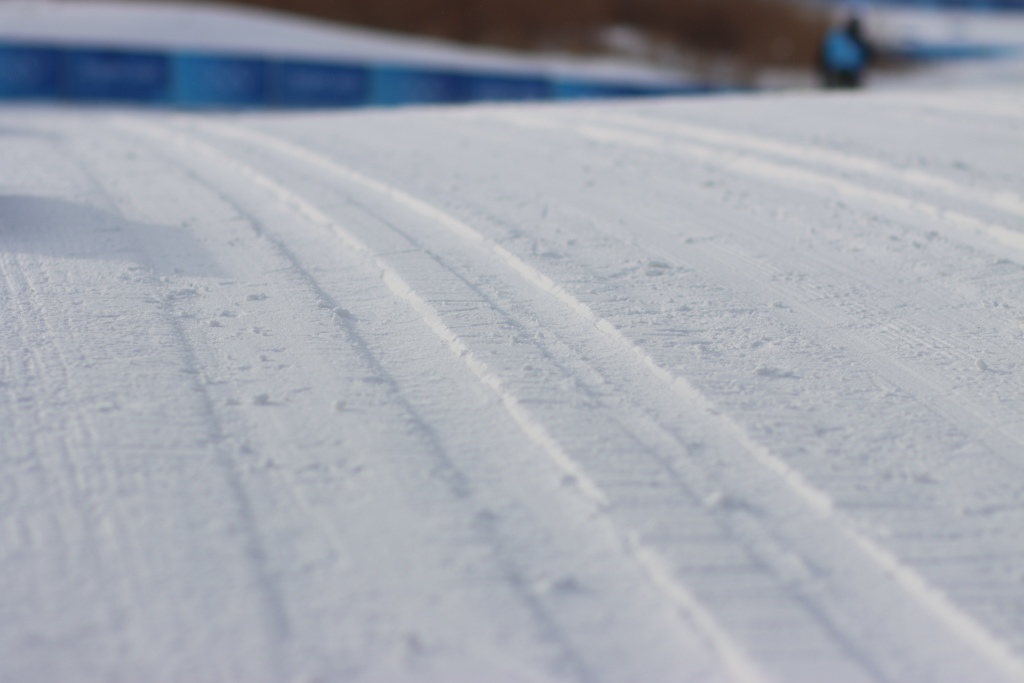
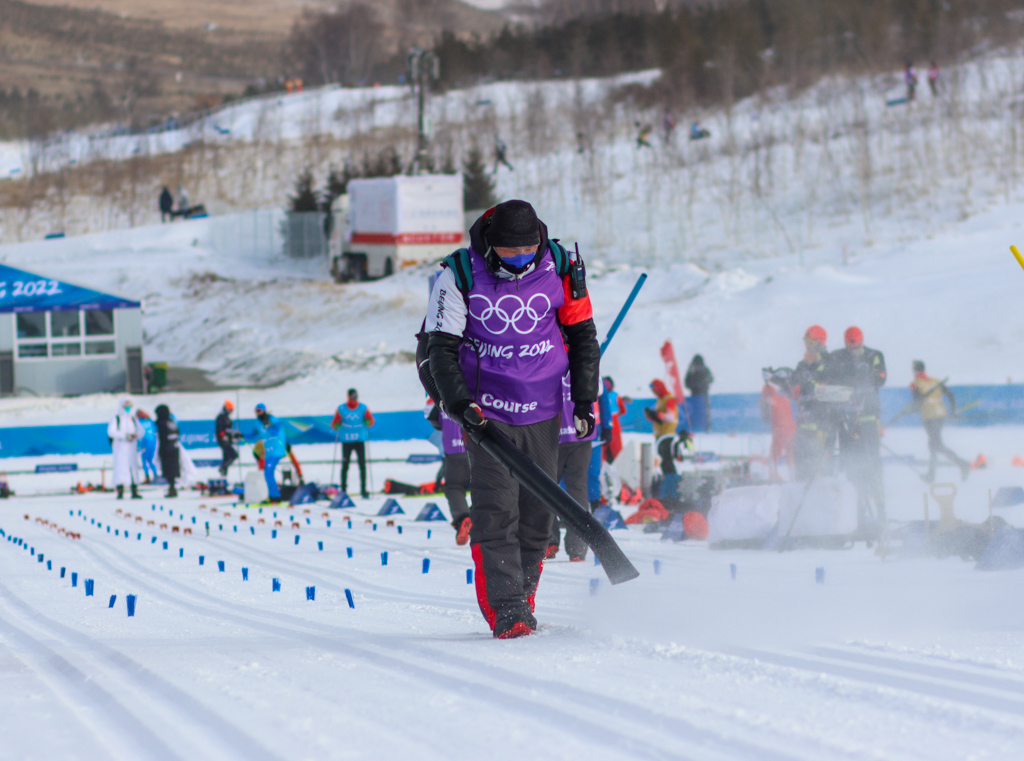
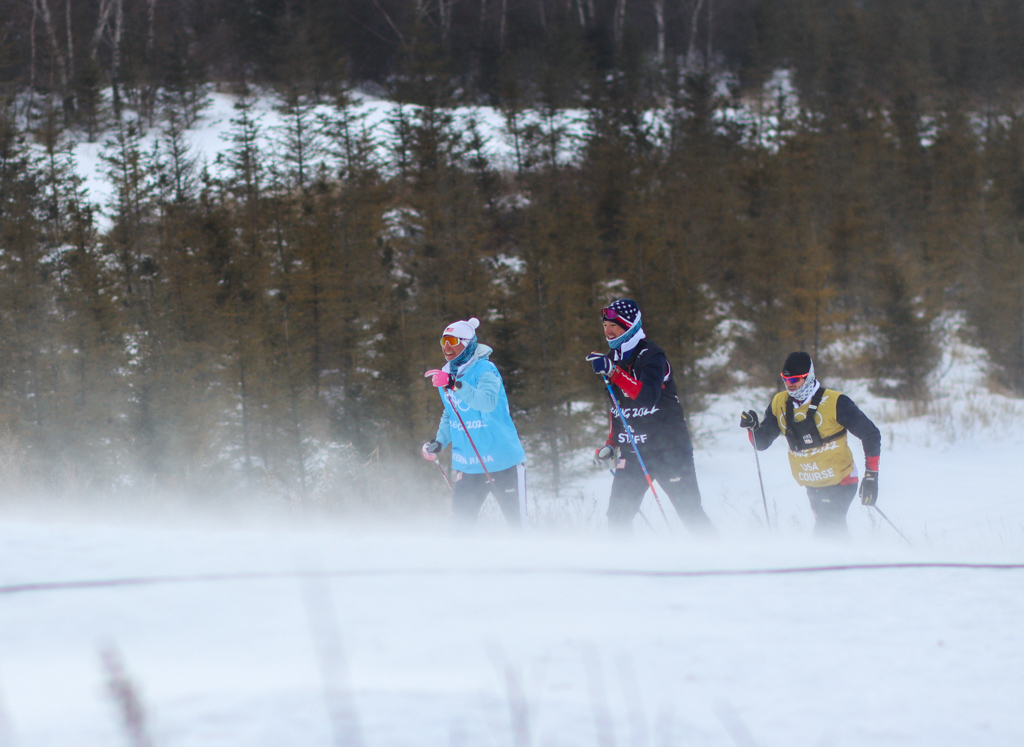
Icy gusts billowed athletes’ training bibs, filled the resort town’s immaculately groomed ski tracks with dry, squeaky powder and generally consumed everyone’s attention Friday — from the team members who shielded their faces with buffs and layers of tape to the course workers who used leaf blowers in an effort to restore a section of the course to presentable shape.
Windblown snow fills ski tracks Friday, February 4, 2022 at the Zhangjiakou National Cross-Country Skiing Center. (Nat Herz/FasterSkier-ADN)A course crew member attempts to clear windblown snow out of the ski tracks Friday, February 4, 2022 at the Zhangjiakou National Cross-Country Skiing Center. (Nat Herz/FasterSkier-ADN)
“This makes Fairbanks seem nice,” a slightly defeated sounding Luke Jager, the Alaska-born American sprint racer, said in a message after braving Zhangjiakou’s trails Friday, amid 25 mph gusts and a high of 5 degrees. “It’s kind of brutal though: All the spots on the sprint course where you want to carry speed into the climb, you just get blasted with wind and come to a halt.”
Athletes’ early impressions of the Beijing Winter Olympics have centered on China’s intense coronavirus mitigation measures, from daily testing to volunteers wrapped in layers of personal protective equipment.
But finally, after dodging the hyper-contagious omicron variant in the lead-up to the Games, athletes and coaches are finally able to narrow their focus on competitions — thanks in part to those protective measures.
American cross-country skier Julia Kern trains with U.S. team staff members Eli Brown, center, and Andrew Morehouse on Friday, February 4, 2022 at the Zhangjiakou National Cross-Country Skiing Center. (Nat Herz/FasterSkier-ADN)
That’s the thing about the Beijing Olympic bubble: Once you’re inside it, it’s a much more comfortable place for an elite athlete to be during a pandemic than outside.
“I would say China’s policy on COVID matches our team policy on COVID,” said Matt Whitcomb, one of the U.S. Ski Team coaches. “Even though athletes made the team, we weren’t sure they were actually going to make it to the Olympics.”
Positive tests sidelined other contenders ranging from Norwegian cross-country skiing stars to star U.S. bobsledder Elana Meyers Taylor to Alaska-based figure skater Keegan Messing.
American cross-country skier Hailey Swirbul tries to stay warm during a race preparation training session Friday, February 4, 2022 at the Zhangjiakou National Cross-Country Skiing Center. (Nat Herz/FasterSkier-ADN)
But the entire U.S. nordic skiing squad has made it to Zhangjiakou, in the mountains some 100 miles northwest of Beijing, unscathed so far.
And while athletes and coaches said they’re still being vigilant, each day without news of many positives inside the Olympic bubble lends to the sense of security.
“Since we’ve all gotten here and settled in, we’re like, ‘All right, we made it.’ We’re still testing negative. We haven’t heard of people testing positive. So I think we’re feeling pretty good about it — and not thinking about it quite so much,” said Gus Schumacher, another Alaskan competing at the Games. “I think this is probably the COVID-safest I’ve been in a long time.”
American cross-country skier Gus Schumacher trains Friday, February 4, 2022 at the Zhangjiakou National Cross-Country Skiing Center. (Nat Herz/FasterSkier-ADN)
That’s allowed athletes to think, and talk, about other things — namely the conditions on Zhangjiakou’s courses in advance of the Olympics’ first cross-country ski races.
Women will race 15 kilometers Saturday afternoon in the pursuit format, with the first half in classical technique and the second half skating. Men race the same format Sunday, skiing 30 kilometers.
Athletes spent Friday testing skis, practicing the changeover in gear — which happens while the clock is running — and fine-tuning both their bodies and cold-weather coping techniques.
Olympic team staff test skis and wax Friday, February 4, 2022 at the Zhangjiakou National Cross-Country Skiing Center. (Nat Herz/FasterSkier-ADN)American cross-country skier Gus Schumacher trains Friday, February 4, 2022 at the Zhangjiakou National Cross-Country Skiing Center. (Nat Herz/FasterSkier-ADN)
“Trying to figure out how to keep our faces warm,” Jager said.
Schumacher skied with patriotic red and blue patches of tape on his cheeks, plus a striped red and white neck warmer. Other athletes trained wearing masks designed to shield their lungs from the cold air. Norwegian superstar Therese Johaug at one point skied through the stadium area with her neck warmer pulled over her mouth.
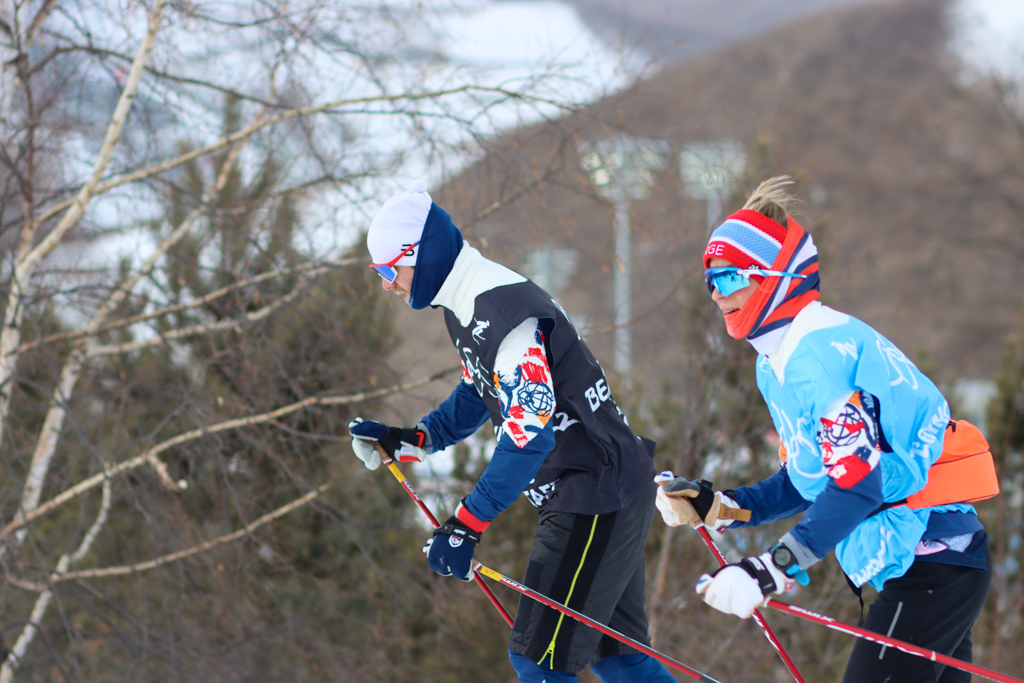
Norwegian superstar cross-country skier Therese Johaug stretched a neck warmer over her face to stay warm Friday, February 4, 2022 at the Zhangjiakou National Cross-Country Skiing Center. (Nat Herz/FasterSkier-ADN)Therese Johaug and her technician endure wind and cold as they prepare for the upcoming skiathlon. (Nat Herz/FasterSkier-ADN)
“Everybody has really fine-tuned what long underwear tops they’re going to need to wear, heated socks, heated vests for training,” Whitcomb said. “What puts the cold into an extreme sort of level is just the incessant wind — and it is really bitter. There’s one or two spots on the course where you can find a little respite from the wind, and it feels like the tropics when you step into it.”
Beyond devising ways to keep their bodies warm, athletes were also scheming with coaches about the fastest way to navigate Zhangjiakou’s wide, challenging trails, given the challenge of the windblown snow filling the tracks.
Skiing outside the tracks appears to be faster. But doing so invites the potential for disqualification, as athletes are required to follow strict rules about cornering when using the classic technique, Whitcomb said.
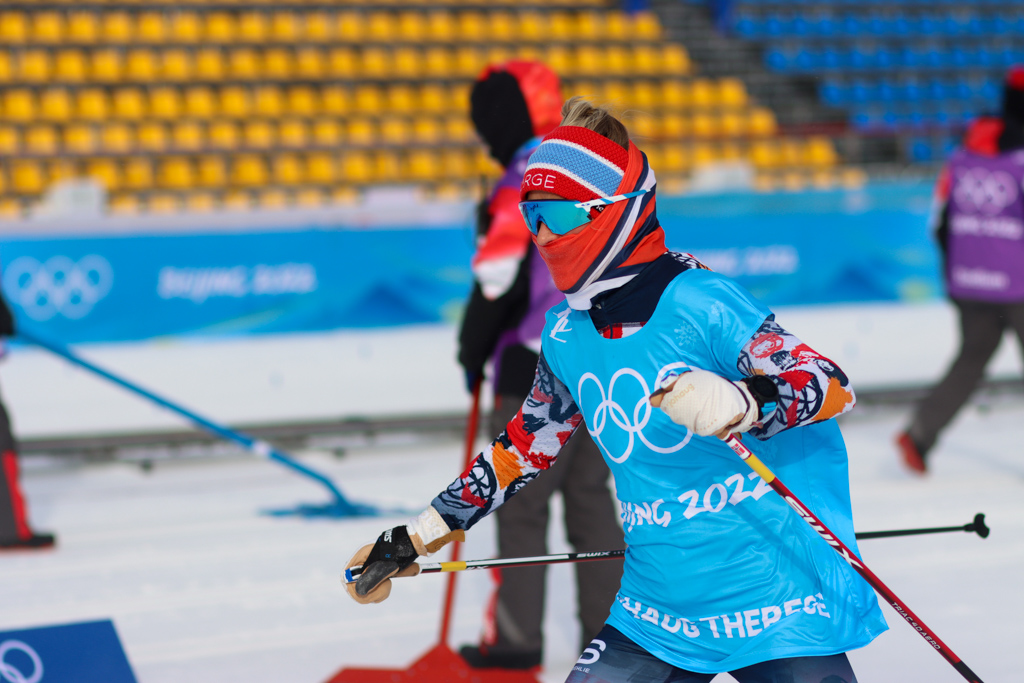
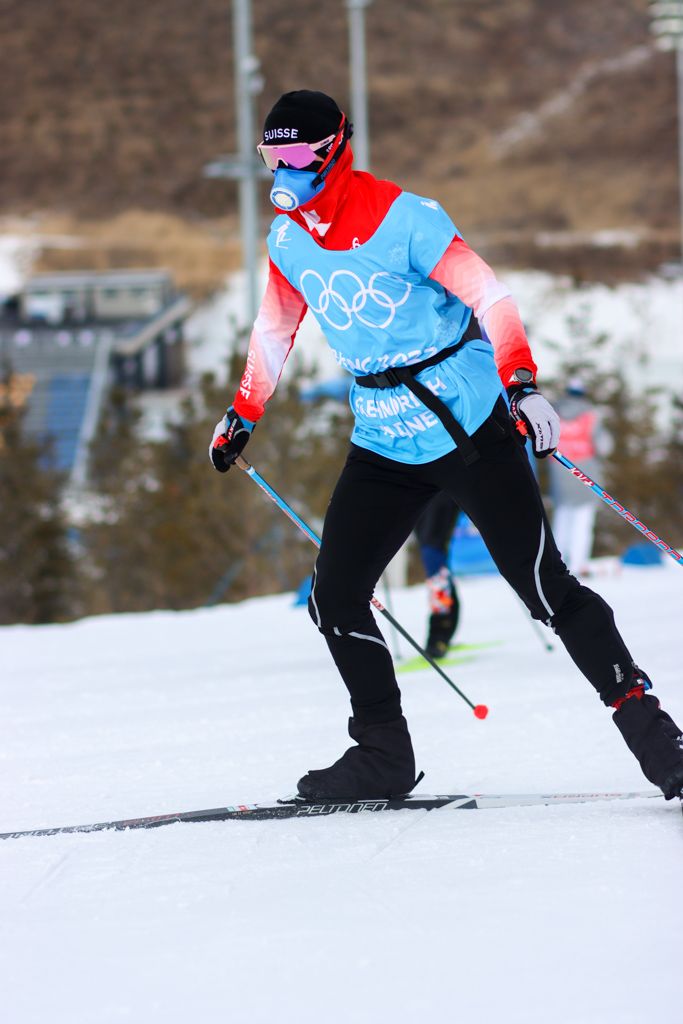
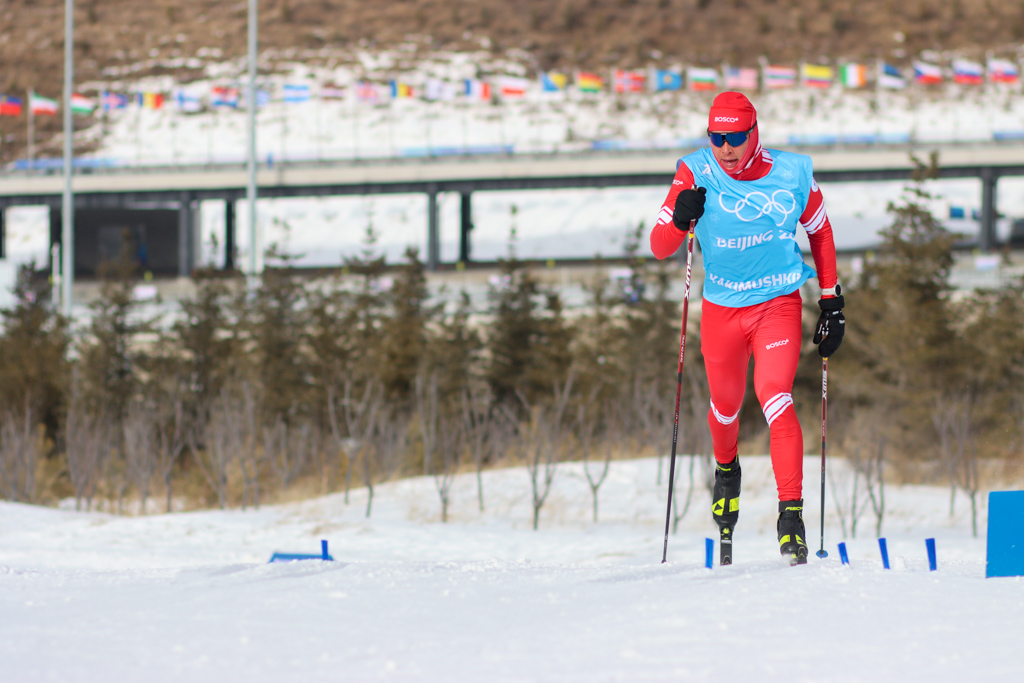
Swiss skier Nadine Faehndrich trains in a mask Friday, February 4, 2022 at the Zhangjiakou National Cross-Country Skiing Center. (Nat Herz/FasterSkier-ADN)Russian skier Ivan Yakimushkin trains Friday, February 4, 2022 at the Zhangjiakou National Cross-Country Skiing Center. (Nat Herz/FasterSkier-ADN)
Aside from the cold, though, athletes and coaches said they’ve had a warm welcome to China. The food is good, the logistics are uncomplicated and the Chinese volunteers have been warm.
“They’re doing an amazing job,” Jager said. “Everyone’s super friendly, and everything is pretty seamless.”
The coronavirus prevention measures also make sense, Schumacher said, given China’s low rates of illness and the much higher rates in countries that athletes, coaches and journalists are traveling from.
“It honestly seems like China’s probably one of the few places that can really pull this off well, right now,” he said.
American cross-country skier Jessie Diggins smiles during a training session Friday, February 4, 2022 at the Zhangjiakou National Cross-Country Skiing Center. (Nat Herz/FasterSkier-ADN)
Two-time Olympian Noah Hoffman’s life is busier now than it ever was during his 10-year U.S. Nordic ski team career. The soon-to-be Brown graduate — he’ll have an economics degree by May — has thrown himself into athlete activism since his retirement in 2018.
Hoffman started in the anti-doping world before becoming a founding athlete board member of Global Athlete, an organization which seeks to hold sport governing bodies such as the International Olympic Committee (IOC) and International Ski Federation (FIS) accountable. In striving to increase athlete voice and give his former peers a proper seat at the table, he finds himself at the fore of another Olympics.
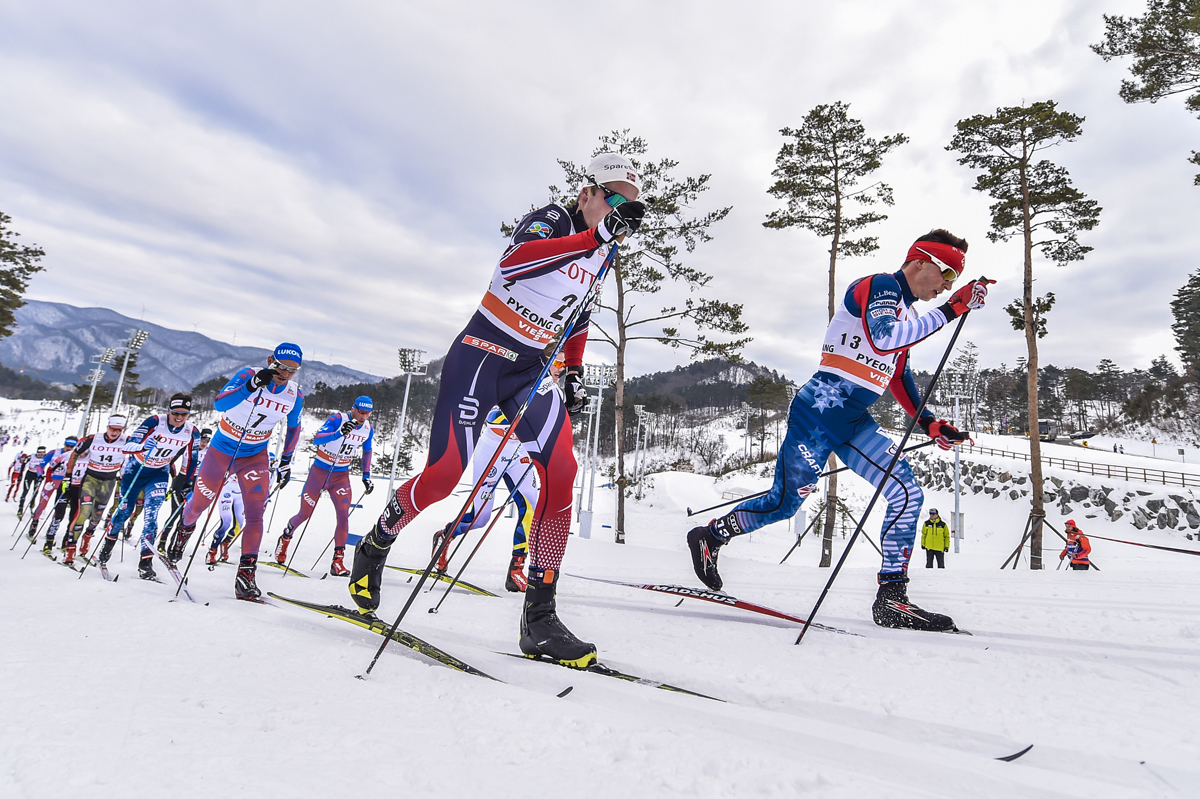
Noah Hoffman (bib 13) races in a pre-Olympic World Cup in Pyeongchang, Korea in April, 2017. (Photo: NordicFocus)
At a Human Rights Watch roundtable discussion last week, he spoke out against the IOC’s lack of accountability regarding the Beijing Games. (See video embedded below.) The oppression of Uyghur Muslims in the Xinjiang region, as well as the communist government’s actions in Tibet and Hong Kong, its general intolerance of dissent and the recent plight of Peng Shuai all fueled a diplomatic boycott of the Games by the United States government. The IOC has not stated whether it will protect athletes who speak out against human rights abuses, leaving them at the whim of the Chinese state. Canada, Britain and other nations have joined in the diplomatic boycott as well.
“Rule 50 and its restraint of free speech on athletes aligns uncommonly well with the CCP’s social repression and athletes should be enraged that both their host, and their governing body, seek to limit their voice,” human rights activist and lawyer Craig Foster told the South China Morning Post.
“Chinese government officials and diplomats have confirmed that athletes are being silenced and threatened with Draconian penalties in Beijing simply if they speak out against genocide.”
“Chinese law, when it comes to what kind of speech is permitted, especially speech that is critical of the Chinese state, is very opaque. It’s not clear at all what kind of speech she’s talking about,” he said.
For that reason, Hoffman is going against his nature, advising athletes — many of whom are friends and former teammates — to remain silent.
To read the full story, follow this link to the Vail Daily News.
Full roundtable discussion. Hoffman is interviewed at approximately 8:00 and 43:30.
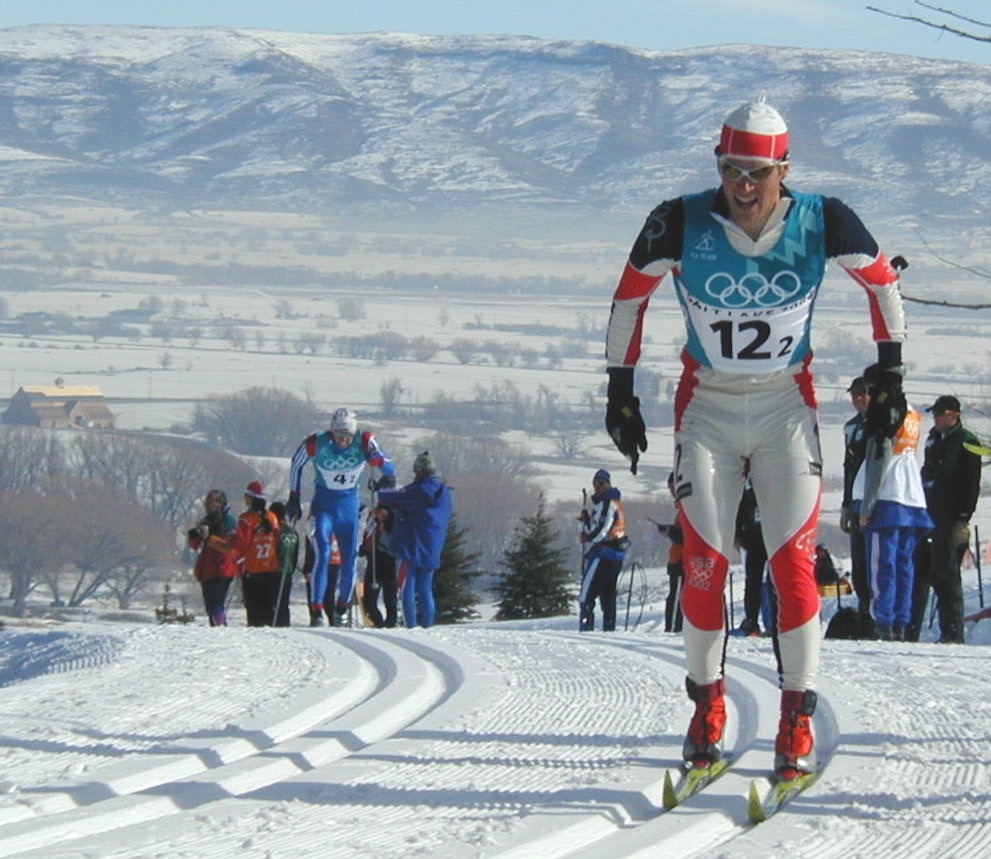
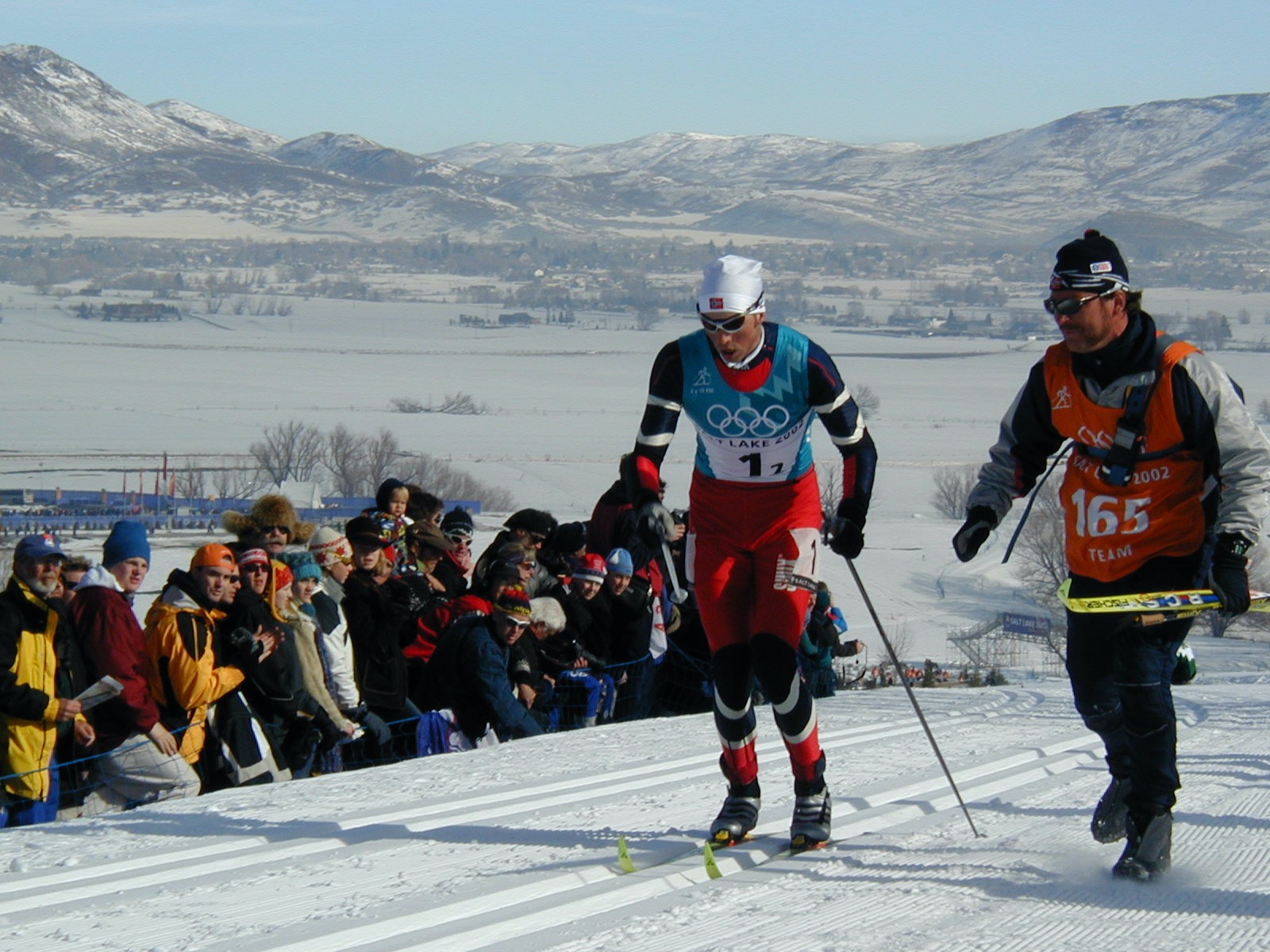
A 21-year-old Kris Freeman skis leg two of the men’s relay for the U.S. at the 2002 Winter Olympics at Soldier Hollow. (photo: Cory Smith)
This humble website went live twenty years ago today. (How long ago was that? Pretty long, judging from this recent Buzzfeed listicle.) As a later retrospective on this site would explain, “FasterSkier was founded in January 2002 by Torbjœrn Karlsen, Cory Smith and Erik Stange. FasterSkier.com was launched on February 1, 2002 and quickly grew to become one of the most trusted sources for Cross-Country skiing information in the United States … .”
The ur-articles from February 1, 2002, have sadly been lost to the ravages of time; the switch to the “modern” CMS interface has not been kind to content from the site’s first year. Early coverage presumably included a “Hello, World!” introduction, while the substantive focus was likely on the 2002 Winter Olympics, which began in Salt Lake City one week later.
Happily enough, the site’s Olympics coverage is preserved in its entirety, thanks to the intercession of the Internet Archive’s Wayback Machine. You can find a roundup of all 2002 Olympics coverage here, and a link to all compiled Olympic race reports here.
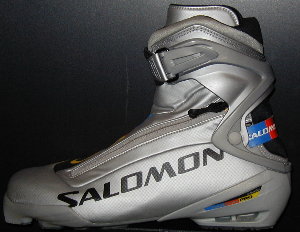
Coming soon to a store near you! Salomon Carbon Pro skate boot (photo: Cory Smith)
The articles are, collectively, a heck of a period piece, and are worth your time, particularly if you have been reading this site for years and would like to see how far the technology has come. You may also be interested in the gear reviews, of, for example, the new, all-gray Salomon Carbon Pro. “I think that they are a real improvement over the Pilot Racing Skate 9,” our reviewer wrote, in a comparison to the product better and more universally known as “bumblebee boots.”
It was tough to choose just one article from an embarrassment of historical riches to reprint for today, but this piece, a race recap of the men’s 4 x 10-kilometer relay, feels appropriate. Thomas Alsgaard; Cristian Zorzi; Anders Aukland; John Bauer; Kris Freeman. This was a long time ago.
(The writeup of the women’s relay, from four days later, may be found here; it ends, “The Americans finished a disappointing 13th,” and says little more than that about the American team composed of Wendy Wagner, Nina Kemppel, Barbara Jones, and Aelin Peterson.)
This article was written by site co-founder Cory Smith, and was originally published on February 17, 2002. Photos and captions, both also by Smith, are reprinted as they originally appeared. A few bonus race photos are appended at the bottom, thanks to Smith’s impressive archives.
A Norwegian athlete skis in the men’s relay at the 2002 Winter Olympics at Soldier Hollow. (photo: Cory Smith)
Norway Beats Italy in Sprint to Finish (again), US Men’s Relay Team Posts Best Result Ever
By Cory Smith
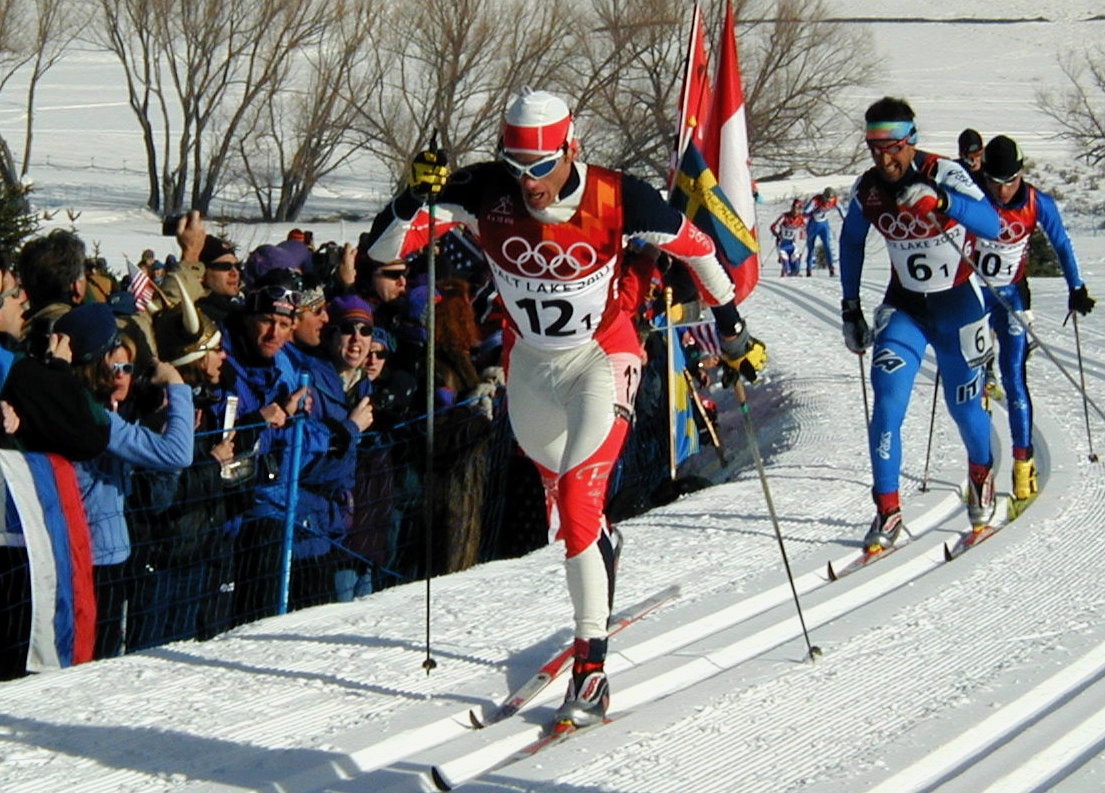
By the length of one ski, Thomas Alsgaard brought order back to the cross country ski world. In today’s Men’s Cross Country 4 x 10K Relay race, the Norwegian team proved that even without an individual gold medalist in these games, they are still the best team in the world. Thomas Alsgaard outsprinted Cristian Zorzi in the final 100 meters to take home the gold for Norway.
John Bauer (USA, bib 12) and Anders Aukland (NOR, bib 9) follow Belarus’s Roman Virolainen in the men’s relay at the 2002 Winter Olympics at Soldier Hollow. (photo: Cory Smith)
In a week that has seen more men’s gold medals for Estonia and Spain* than for Norway, and even a Canadian woman winning a medal, Sunday’s race was also extremely memorable, but with a more familiar outcome. The entire country of Norway was able to breathe a sigh of relief after their relay team put them back on top of the nordic world.
Meanwhile, the US men’s team, in the top five for most of the race, posted their top Olympic relay result by finishing a very impressive 5th. All four US skiers skied very fast and very smart to come within seconds of a medal for the first time ever.
Norway showed their dominance of the classic technique right from the start. After letting Belarus’s Roman Virolainen lead for much of the first lap, Norway’s Anders Aukland took control on his second 5K loop and opened a 10 second lead. Meanwhile, John Bauer, after a slow start that had him in last place out of the stadium, had moved up to the front of the pack and was actually leading the chase of Aukland. Bauer lost a few places gliding through the stadium, but he finished his excellent scramble leg in 5th place, right with Italy, Kazahkstan, and Germany, only 13 seconds off the lead.
Kris Freeman (bib 12) stays right with the lead pack. (photo: Cory Smith)
On the second leg, Norway’s Frode Estil build the lead up to a maximum of 24 seconds while Kris Freeman (USA) jumped in behind Germany, Italy and Kazahkstan in the pursuing pack. As the leg went on, Estonia’s Andrus Veerpalu bridged up to the pursuing pack, as did Russia’s Mikhail Ivanov and Austria’s Mikhail Botvinov. This pack of six strong skiers started to cut into Estil’s lead, but as the leg came to an end, the pack began to break up. At the end of the second leg, Norway had an 11 second lead over Russia and Estonia. Kris Freeman skied an amazing strong race to stay in the thick of it, coming in right behind Italy’s Giorgio di Centa, in 5th place only 25 seconds off the lead. Halfway through the relay and the US men were only 14 seconds from a medal!
Pietro Piller Cottrer (ITA) charges towards the lead with Tobias Angerer (GER) in tow. (photo: Cory Smith)
The clear standout on the third leg was Italy’s Pietro Piller Cottrer. He started his leg in 4th place, then quickly passed the Russian and the Estonian and after about 5K, he was right with Norway’s Kristen Skjeldal fighting for the lead. The two of them skied together the rest of the leg, setting up yet another epic final duel between Italy and Norway. Justin Wadsworth looked to finally be over the head cold that had hindered him all week. He was smart enough to not try to stay with Piller Cottrer, but instead skied a very solid leg all on his own, until he was caught by Austria’s Gerhard Urain, whom he latched onto and followed until blowing by him near the end of the leg to finish in 5th place. In between the leaders and Wadsworth, Germany and Estonia came in together in 3rd and 4th.
Alsgaard leads Zorzi into the stadium to sprint for all the marbles. (photo: Cory Smith)
On the final leg, it became obvious that Alsgaard’s strategy was to try and shake Italy’s Zorzi, one of the best sprinters in the world, early. Alsgaard led most of the leg, but Zorzi held tight. Meanwhile, Germany’s Rene Sommerfeldt had pulled away from Estonia to assure a bronze medal. Carl Swenson jumped in behind Russia’s Nikolaj Bolchakov and Austria’s Christian Hoffman and they quickly passed the Estonian team. With the top three significantly ahead, Swenson was skiing strong and relaxed, as is his trademark, and was clearly gearing up for the finish. Along the way, they dropped the Russian, setting up a duel between Hoffman, who outsprinted Alsgaard in the 1999 Relay to win the World Championship, and Swenson.
Speaking of duels, Alsgaard and Zorzi were putting on a tactical clinic. Going up the last big climb at 9K, Alsgaard had the lead and tried on a couple of occasions to put on a kick and lose the Italian. But Zorzi held tight and made a pass just before the top of the hill. Just before the downhill, Zorzi dropped into a tuck and slowed way down, obviously trying to get Alsgaard to pass, so that he could draft.
Alsgaard wanted nothing to do with that plan and instead of passing, he pushed on the back of Zorzi’s ski with his pole to speed him up. Then Zorzi pulled over and nearly stopped. Alsgaard did the same. They were a kilometer from the finish and they were standing still arguing about who was going to lead!
Alsgaard eventually took the lead reluctantly. They went stride for stride up the short hill by the stadium and then dropped down to prepare for the sprint. On the gradual downhill, Zorzi freeskated hard to take the lead, and had about 5 meters on Alsgaard as they rounded the turn. Alsgaard then kicked it in and began gaining on Zorzi. With 50 meters to go, they were dead even, but it was clear that Alsgaard had greater speed. Alsgaard got a slight lead and held it. It was a very close finish, but there was no doubt that Norway had won.
Carl Swenson and Christian Hoffman pass the Russian team. (photo: Cory Smith)
Germany’s Sommerfeldt finished all alone in a surprising 3rd, and was mobbed by his bronze-winning teammates as he crossed the line. The battle was now for 4th. Swenson was up against formidable competition in Hoffman, but if any American could outsprint him, it would be Swenson and that’s why he was in the anchor position. Hoffman had the lead around the corner and they went toe to toe down the line.
For a moment it looked like Swenson would catch him, but there just wasn’t enough distance left. Another 20 meters and he would have had it. But instead Austria took 4th and the US maintained its 5th place on all four legs to post its best relay result ever.
The US skiers skied very, very well, both physically and tactically. But none of them skied unbelievably well, they all simply skied strong like they have all week. What I am trying to say is that this was no fluke. They finished right where they belong. They have been one of the top five teams on these trails all week and today they certified that. What is even more amazing is that there were two other American skiers, Pat Weaver and Andrew Johnson, who could have filled in and skied just as well. The US now has at least six World Class skiers. Don’t look now, but the United States is a force to be reckoned with.
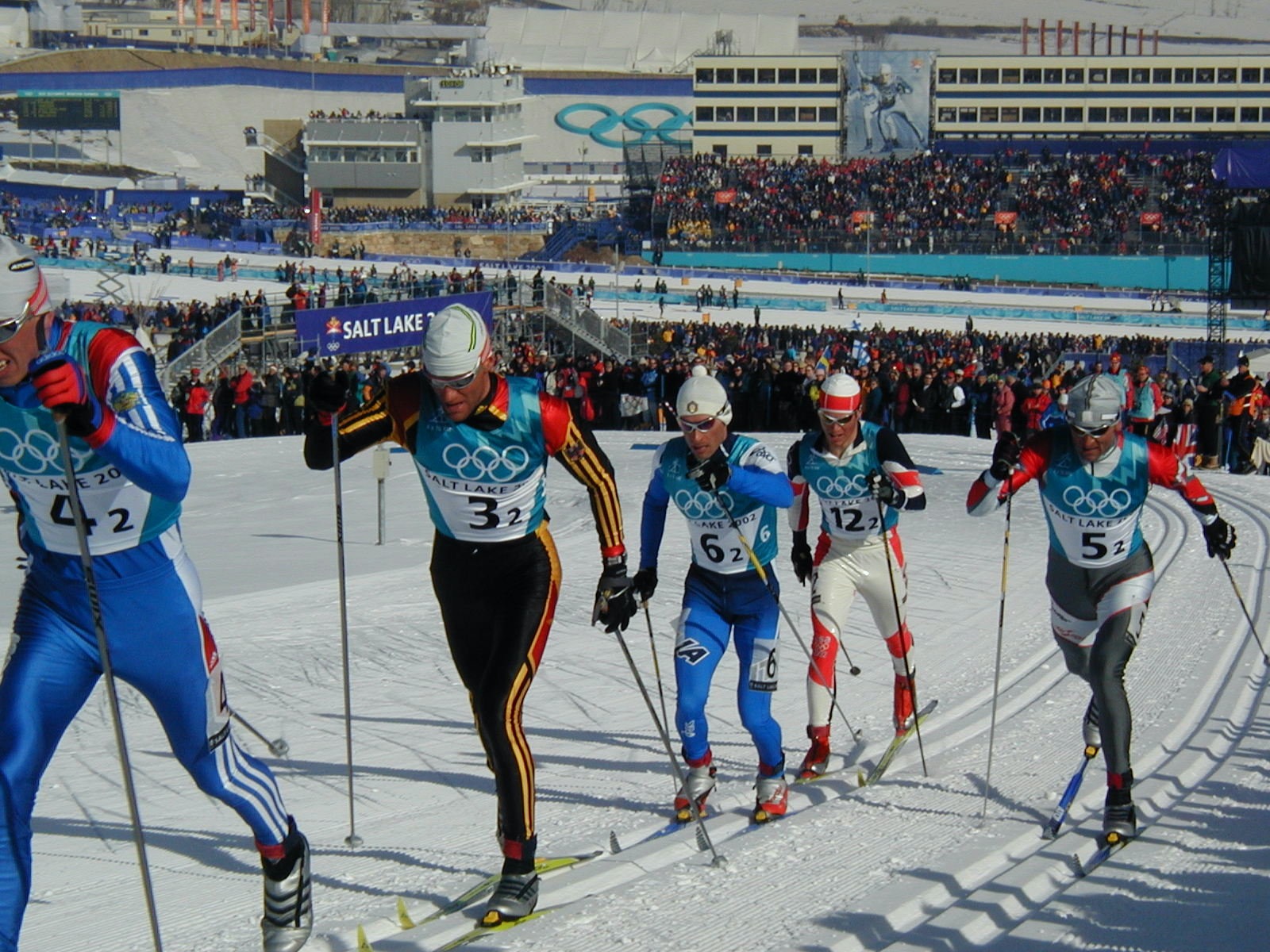
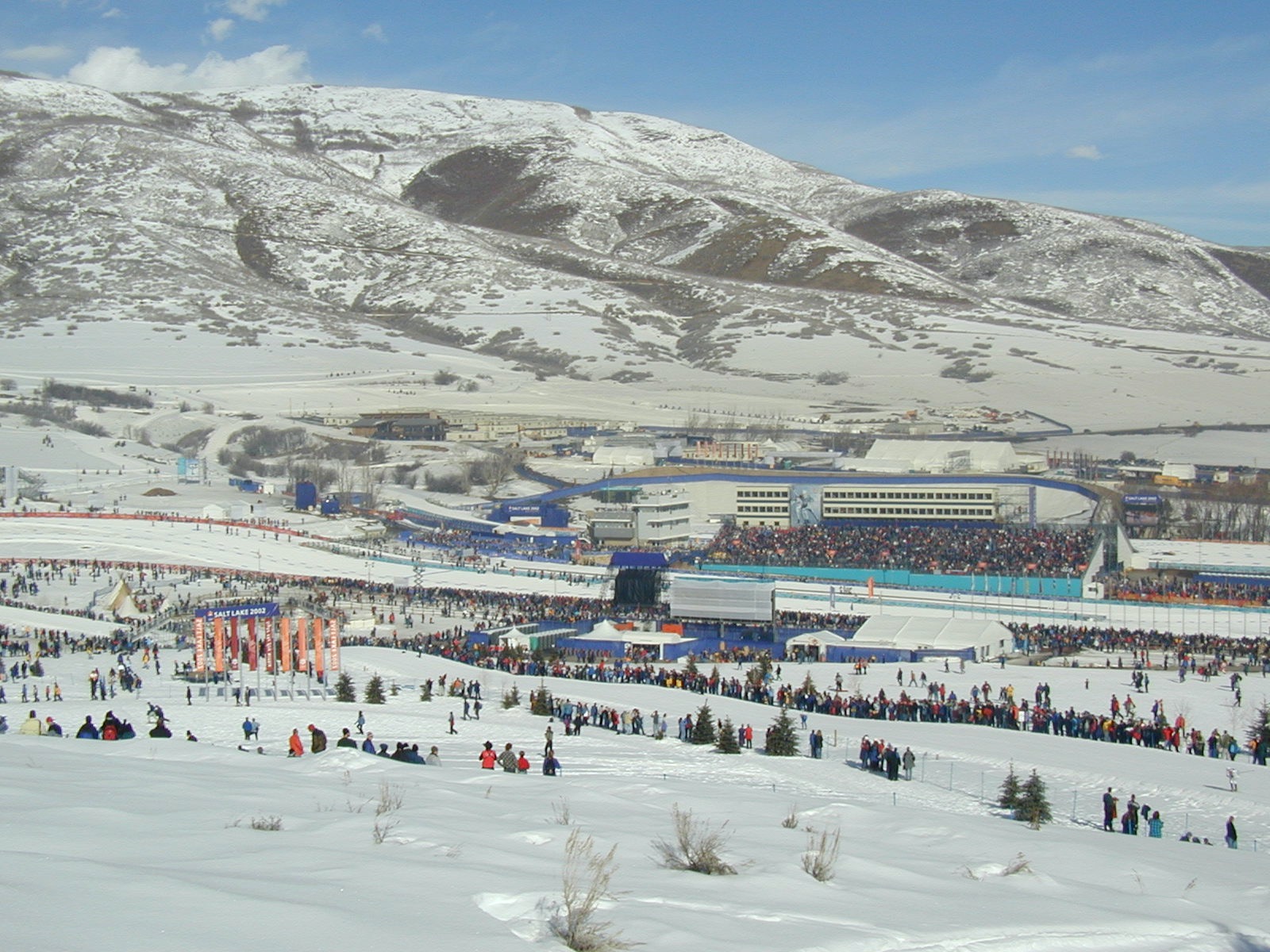
20,000 people cheer wildly at Soldier Hollow. (photo: Cory Smith)
Just as amazing as the race itself, was the crowd. Soldier Hollow was sold out for the first time ever, with 20,000 people watching a cross country ski race in this country for the first time ever. The crowd was loud and energetic. It was a sight that warmed the hearts of all Nordic die-hards on hand. Today, our little sport took a huge step forward in many ways.
[* Modern-day footnote: This statement, while accurate at the time, was ultimately belied by history, as the three gold medals that Johann Mühlegg won for Spain at these Olympics (in the 30-kilometer skate, 50-kilometer classic, and 2 x 10-kilometer pursuit) were subsequently rescinded following his disqualification for a positive darbepoetin test.]
Some additional photos from this race:
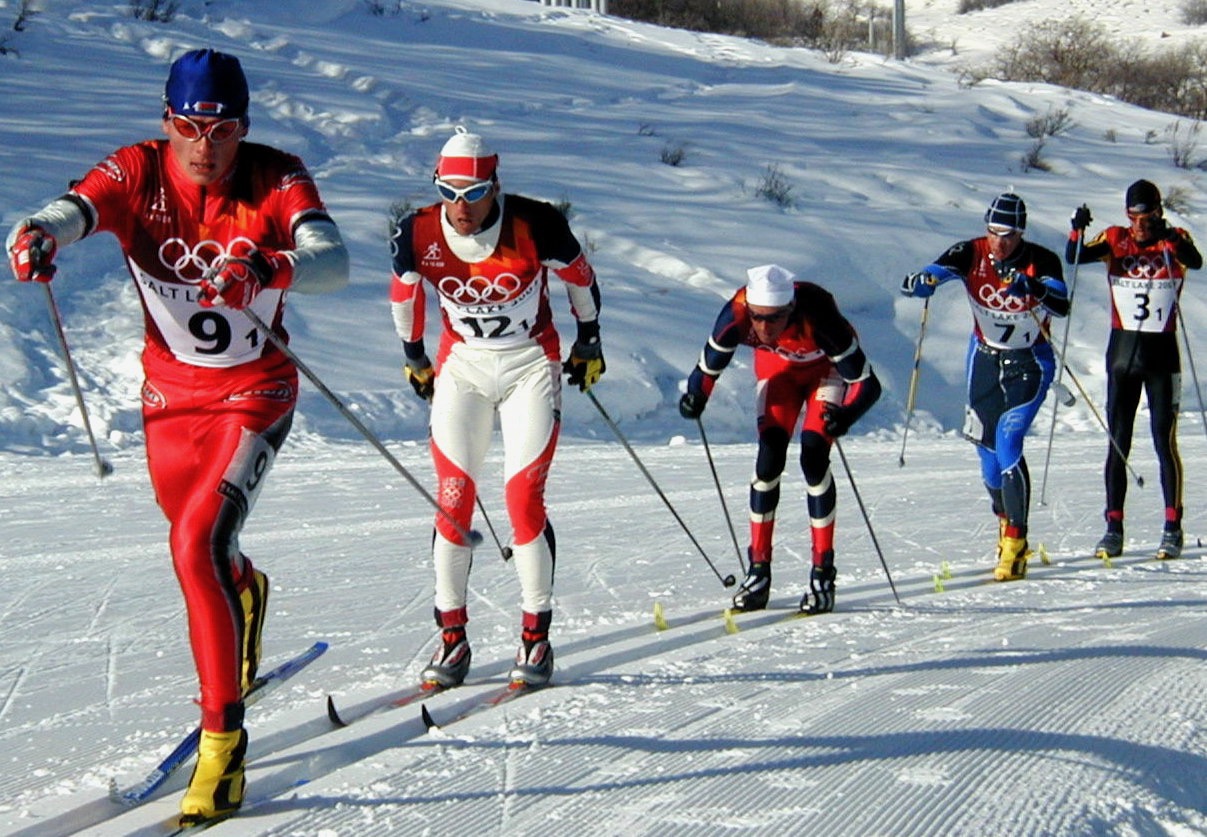
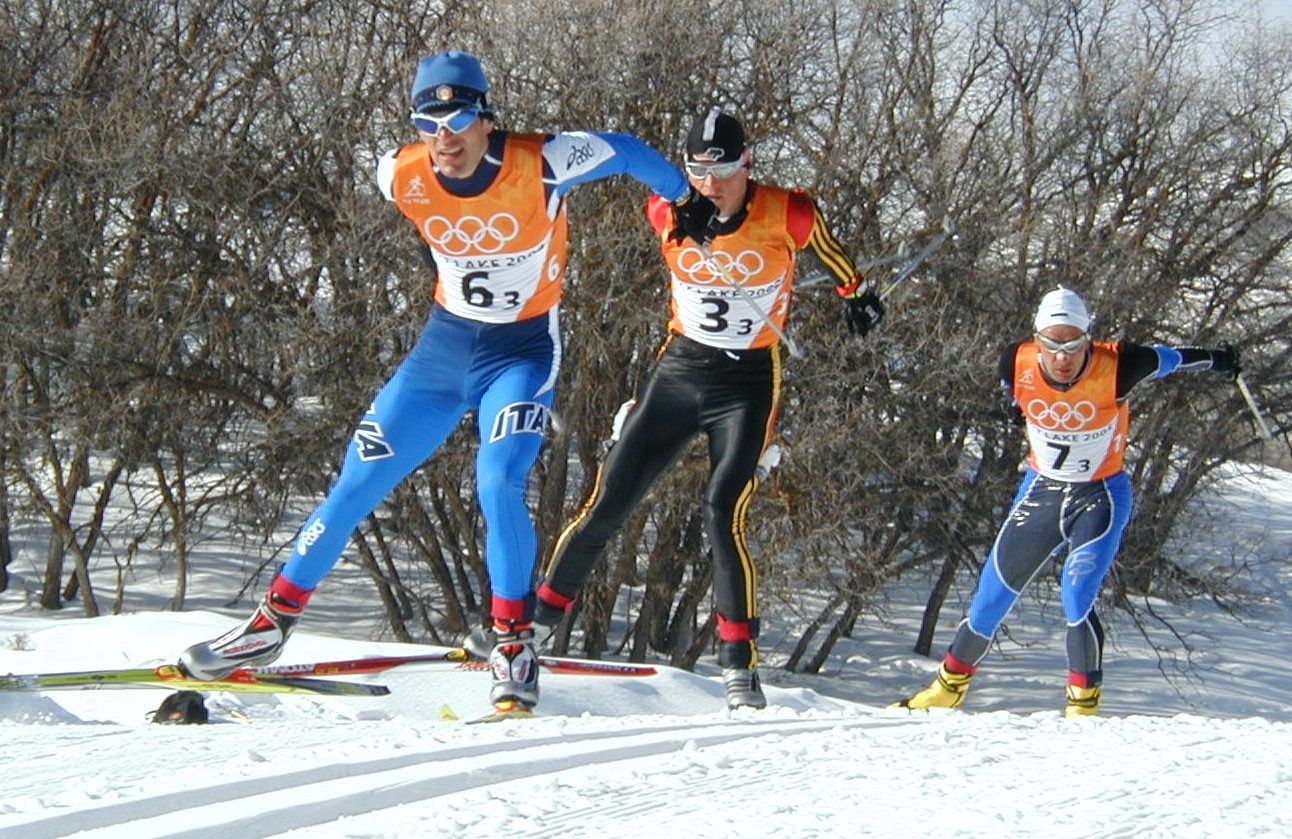
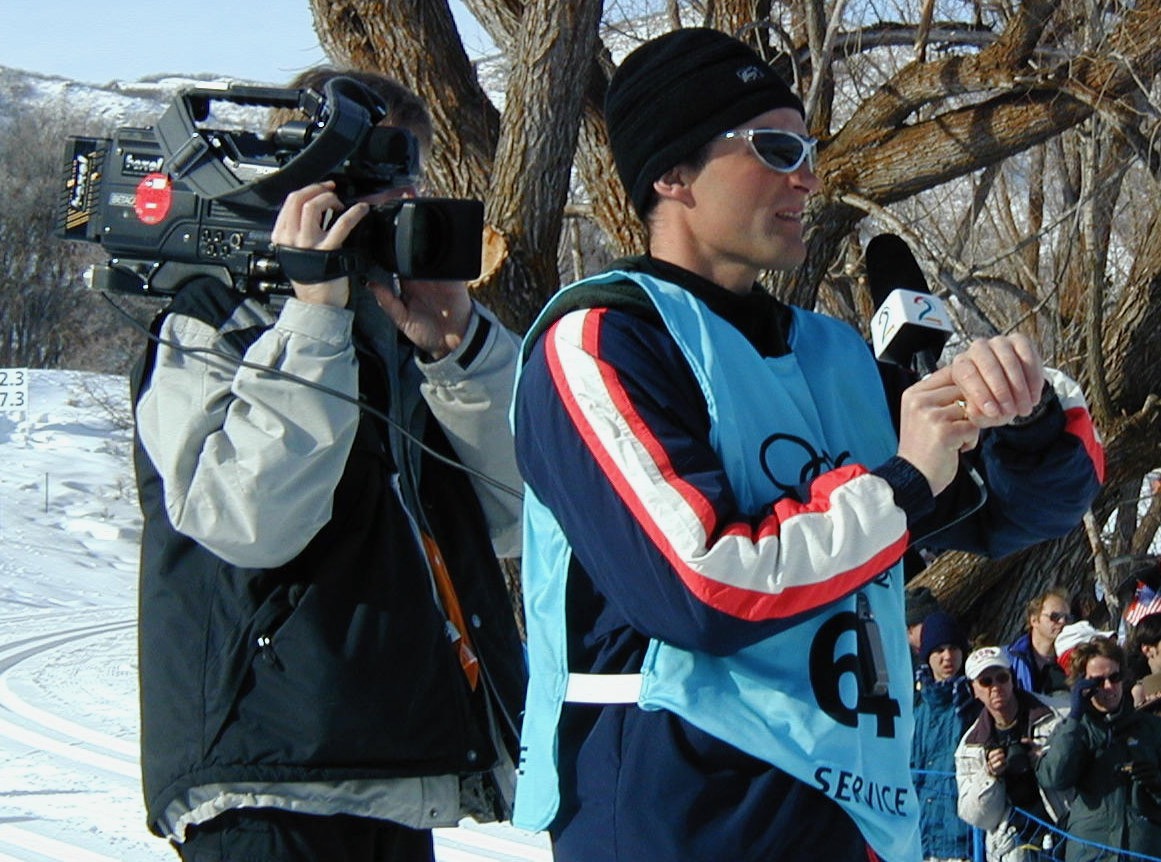
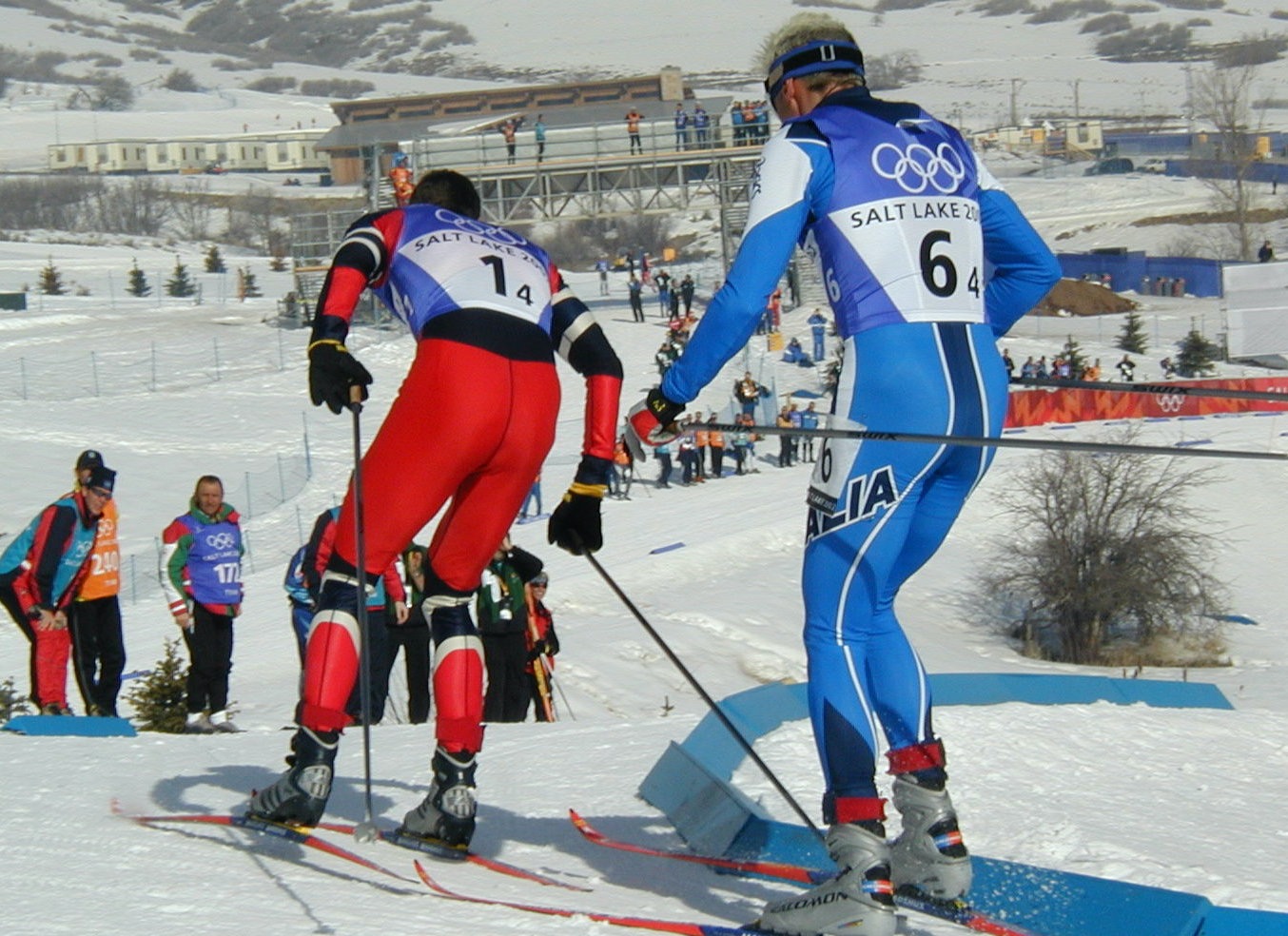
Vegard Ulvang serves as a commentator for Norwegian television at the 2002 Winter Olympics at Soldier Hollow. (photo: Cory Smith)Thomas Alsgaard leads Cristian Zorzi in the men’s relay at the 2002 Winter Olympics at Soldier Hollow. (photo: Cory Smith)Justin Wadsworth skis leg three of the men’s relay for the U.S. at the 2002 Winter Olympics at Soldier Hollow. (photo: Cory Smith)John Bauer skis leg one of the men’s relay for the U.S. at the 2002 Winter Olympics at Soldier Hollow, slightly ahead of Fabio Maj of Italy (bib 6) and Andrei Golovko of Kazakhstan (bib 10). (photo: Cory Smith)
Oksana Masters crosses the finish line of a race in Lillehammer, Norway. (Photo: Alex Livesey/Getty Images)
By Kristen Gowdy | Jan. 31, 2022, 6:02 p.m. (ET)
COLORADO SPRINGS, COLORADO – Following a stellar world championships performance that saw Team USA earn 13 medals in Para Nordic disciplines, U.S. Paralympics Nordic Skiing today announced the six women, seven men and one guide who have been nominated to compete at the Paralympic Games Beijing 2022 in March.
Veteran athletes will lead the way in Beijing as Team USA looks to build on the 16 Paralympic medals won at the Paralympic Games PyeongChang 2018. Headlined by multi-time Paralympic medalists Oksana Masters (Louisville, Kentucky), Kendall Gretsch (Downers Grove, Illinois) and Dan Cnossen (Topeka, Kansas), the athletes nominated to the 2022 team sport a combined career total of 21 Paralympic medals. Of the 14 athletes, nine have previous Paralympic experience while five athletes will make their Paralympic debut.
“We have many athletes who thrive in these high-stakes competitions, who know what it means to represent Team USA as a Paralympian,” Eileen Carey, director of U.S. Paralympics Nordic Skiing, said. “We are looking to them, as well as our experienced coaching staff, to lead the newer athletes into Beijing 2022. We are motivated by the combination of experience and the high quality of our Paralympic rookies as a testament to the growth and bright future of our program; their success this Paralympic quad has shown us that we can reach new heights in March.”
A 10-time Paralympic medalist and recently crowned 10-time world champion, Masters is set to make her sixth Paralympic appearance. After winning double gold in Para-cycling at the Paralympic Games Tokyo 2020, Masters has continued her success on the snow, earning a medal in every world cup competition in which she has competed, as well as five medals at the recent Lillehammer 2021 World Para Snow Sports Championships. In Lillehammer, the multi-sport phenom earned her ninth and 10th career world championship titles and will look to put an exclamation point on her already historic 2021-22 season on the world’s biggest stage.
Gretsch, who is putting together a world-class resumé herself this season, also won gold in Tokyo in paratriathlon. She led Team USA in Lillehammer with three world championship titles and also added a silver as she looks to repeat the double gold she won in PyeongChang. The 13-time world championship medalist is headed into Beijing as a heavy favorite in the biathlon discipline, having won both titles in the Para biathlon events in which she competed in Lillehammer.
A six-time Paralympic medalist and retired Navy SEAL, Cnossen earns his third Paralympic team nomination in 2022. All six of Cnossen’s Paralympic medals came in PyeongChang, where he dominated in both cross-country skiing and biathlon. Cnossen is at his best on the Paralympic stage, where he will look to repeat his success come March.
Paralympic silver medalist Jake Adicoff (Sun Valley, Idaho) will team up with longtime friend and guide Sam Wood (Harpswell, Maine) to lead the U.S. in the men’s visually impaired class for his third Paralympic appearance. After taking several years off following his podium performance in PyeongChang, Adicoff accepted an invitation to join the team for a training camp last February, and hasn’t faltered since. He and Wood enter Beijing as one of the top podium contenders in the men’s visually impaired field. The duo have been putting together Adicoff’s best racing of his career, having recently combined for three medals – one of each color – in Lillehammer.
Paralympians Aaron Pike (Park Rapids, Minnesota) and Josh Sweeney (Glendale, Arizona) round out the men’s sitting class for Team USA. Pike, who recently won his second career world championship medal, a silver in the men’s individual biathlon, makes his sixth career Paralympic team. Also a prolific wheelchair racer and marathoner, Pike is peaking at the right time, having been in the podium mix in nearly all of his races this season. He is seeking his first career Paralympic medal in Beijing.
Sweeney, meanwhile, makes his first Paralympic team in Para Nordic skiing, having transitioned to the sport following a 2014 Paralympic gold medal appearance in sled hockey. The 2014 Pat Tillman Award for Service winner and retired U.S. Marine Corps Sergeant picked up skiing through the Challenged Athletes Foundation.
The final sit skiers on the 2022 roster, Erin Martin (Seattle, Washington) and Lera Doederlein (San Diego, California) are set for their Paralympic debuts. A former rock climber, Martin found Para Nordic skiing after sustaining a T4 spinal cord injury while climbing. She is also a registered nurse care manager who has served during the COVID-19 pandemic. Doederlein, meanwhile, also competes in sled hockey and Para-cycling. At just 18 years old, Doederlein, who was adopted from Russia, has found a mentor in the Ukraine-born Masters.
Standing skiers Grace Miller (Palmer, Alaska), Ruslan Reiter (Manchester, Maine) and Dani Aravich (Boise, Idaho) also bring Paralympic experience to the team. Miller and Reiter competed in PyeongChang, where Reiter’s best finish was seventh in the cross-country mixed relay, while Miller finished 10th in the 15-kilometer cross-country skiing race. Aravich made her Paralympic debut as a track and field athlete in Tokyo and along with Masters, Gretsch and Pike, will compete in her second Paralympic Games in six months.
Making their first Paralympic appearances and rounding out Team USA’s roster is standing skier Drew Shea (Vienna, Virginia), and visually impaired athlete Max Nelson (Mahtomedi, Minnesota).
Relatively new to Para Nordic skiing, Shea recently moved to Bozeman, Montana, to pursue the sport competitively with Crosscut Mountain Sports Center, his club team. A rising star in the sport, the 17-year-old Nelson made history as a high school junior last year when he became the first visually impaired Nordic skier to win an individual conference title in Minnesota.
The Paralympic Games begin on March 4, and Para Nordic skiing competition kicks off on March 5. Following record-breaking coverage of the Tokyo Paralympic Games, NBC has announced a historic broadcast schedule for its Winter Paralympic programming, which features more than 230 hours of coverage across NBC, Peacock, USA Network, the Olympic Channel, NBCOlympics.com and the NBC Sports App. NBC’s scheduled programming also includes the first-ever Winter Paralympic Games primetime coverage.
For media requests and photo inquiries, please contact Kristen Gowdy at Kristen.Gowdy@usopc.org.
2022 U.S. Paralympics Nordic Skiing Paralympic Team
Women:
Dani Aravich, women’s standing
Lera Doederlein, women’s sitting
Kendall Gretsch, women’s sitting
Erin Martin, women’s sitting
Oksana Masters, women’s sitting
Grace Miller, women’s standing
Men:
Jake Adicoff (with guide Sam Wood), men’s visually impaired
The Planica World Cup cancellations this month brought the skiing world to the perilous edge of what it feared most, but hoped wouldn’t happen – the central focus of this ski season, and the sport’s biggest moment, the Olympics – affected by the Omicron COVID-19 variant. Over the last week in the Italian Alps, the sport went over that edge. This Olympics, as with everything in the world right now, will have to deal with the frustration, confusion, and all around uncertainty that’s de rigueur during this pandemic.
On January 23rd, NRK first reported that Norwegian national team sprint coach Arild Monsen had tested positive while at the team’s pre-Olympic camp in Seiser Alm, Italy. That set into motion a close contact, self-isolation, and testing regime with the stakes very clear – if athletes tested positive, suddenly the Olympics would be up in the air.
Aided by a win in the final hill climb, Heidi Weng took third place in the 2021/22 Tour de Ski overall standings. (Photo: NordicFocus)
On Tuesday the 25th, despite the best efforts of the team, Heidi Weng and Anne Kjersti Kalvå tested positive for COVID. Close contact tracing led to an announcement from the Norwegian Ski Federation that the scheduled charter flights for the Norwegian Men’s Team on today were canceled.
The story has since followed two lines of development. First, new cases that are still emerging from the outbreak at the Norwegian National camp in Italy, and second, the Norwegian Ski Federation’s plans to get athletes to Beijing in time for their first competition on February 5th.
On the former the latest update, as reported again by NRK today, is that Simen Hegstad Krüger has tested positive for COVID. Krüger’s test is the first within 10 days of the start of Olympic competition, meaning that the 2018 gold medalist of 30-kilometer skiathlon will not get the chance to defend his title. The news has hit the Norwegian team hard. In a statement to NRK, teammate Hans Christer Holund said “It’s terribly sad. A lot of hard work is behind getting to the Olympics, then it goes in the sink, and it is very sad for Simen.”
Simen Hegstad Krüger had a commanding win in the 15-kilometer skate in Davos in December, 2021. (Photo: NordicFocus)
As to travel plans, The Norwegian Ski Federation announced its updated plan to get their athletes to Ziangjiakou just hours ago. The men’s team will now fly direct from Verona, Italy to Beijing on a chartered flight on January 30th. The women’s team will follow suit out of Zurich, Switzerland on February 1st. That cuts out a trip back to Norway that was planned for the National Team before flying to Beijing. It also assumes no new infections in either the men’s or women’s teams. In NRK’s report, Espen Bjervig, National Team Manager, explained that the plan reflects “so many unknown factors. You never know what will turn up around the next turn. But you just have to cut through.”
Bjervig also pointed out that the plan is designed to move along with the COVID situation that is now underway in the Norwegian camp. “Fortunately, it is flexible with the girls. There are charter flights every day from Zurich between February 1st and 4th. The scheme for the boys presupposes that no infection appears.”
It is a big assumption, but one that allows there to be hope that for the individual athletes, and for ski fans alike, these Olympic games may be the exciting showcase of the world’s best skiers – many of whom are from Norway – that we have all looked forward to watching together.
A whiter version of Beijing 2022 than athletes and fans might actually encounter.
The following opinion article was originally published on FasterSkier on June 20, 2015. It was written by Chelsea Little, who contributed sterling ski reporting to this site for nearly a decade before ultimately retiring from nordic ski journalism, though not from nordic skiing. She is currently an Assistant Professor of Environmental Science at Simon Fraser University outside of Vancouver, B.C., where her research interests focus on community and meta-ecosystem ecology.
The article was published roughly a month before the IOC, as expected, selected Beijing as the host of the 2022 Winter Olympics. Although it was originally published over six years ago, much of its criticism proved prescient.
For example, the first two problems that Little noted were “snow” and “water.” Here is a photo from the cross-country venue at Zhangjiakou taken on January 19 of this year. Bare hillsides are visible in the background. The endemic issues with the use of limited available water for snowmaking, as analyzed by someone who at the time had three scientific degrees (Little would earn her Ph.D. in Ecology four years later), seem unlikely to have substantially improved.
As for air quality, as of the writing of this intro (Friday afternoon in Anchorage, Saturday afternoon in Zhangjiakou), air quality at the venue was an “unhealthy” 161 micrograms per cubic meter of PM2.5 particulates, though that can clearly change from day to day and it is unclear where this reading was taken relative to the precise location of the ski trails. The longstanding seasonal weather patterns that can bring in pollutants from elsewhere seem to still be an issue, as was discussed roughly a week ago.
The physical distances between clusters have remained unchanged, though a pandemic-induced near-total lack of spectators means that this may be less of an issue in practice: It may indeed take longer than anticipated to travel between venues, but virtually no fans will be attempting to do so.
And finally, what about human rights? This recent op-ed from the Washington Post, headline: “The Beijing Olympics has become an exercise in genocide denial,” expresses the view that things have not improved since Little’s article six years ago. (If you prefer your political opinions from a news site somewhat to the right of the Post, here’s a Laura Ingraham segment on Fox News, also from last week: “Ingraham encourages Americans to boycott watching Beijing Olympics over China’s human rights violations.”) Or here’s The Guardian: “Protesting Winter Olympics athletes ‘face punishment’, suggests Beijing official.” Or here’s Politico: “‘Checking a box’: Biden’s Beijing diplomatic boycott flop,” in an article quoting one Noah Hoffman.
As Little wrote six-plus years ago, “The goal of Olympism is to place sport at the service of the harmonious development of humankind, with a view to promoting a peaceful society concerned with the preservation of human dignity,” citing the second point of the Olympic Charter. She was at the time dubious that awarding the Olympics to China would support these goals.
Screenshot of Zhangjiakou AQI on Jan. 21, 2022.
Six Big Problems with the Beijing 2022 Olympic Bid (June 2015): by Chelsea Little
In just over a month, the International Olympic Committee members will vote in Kuala Lumpur, Malaysia, on the site of the 2022 Winter Olympics. Their two choices: Almaty, Kazakhstan, and Beijing, China.
Only these two candidates remain after other bids from regions like Bavaria, Germany (centered in Munich), Graubunden, Switzerland (centered in Davos and St Moritz), Stockholm, Sweden, and Oslo, Norway, were felled by referendums.
That’s not a good sign for the IOC. Both bids have some problematic features, and are almost certainly not the ideal locations the organization was looking for.
While there are problems with the Almaty bid, to almost any reasonable person there appear to be far more, and more serious, problems with Beijing. Despite all of this, Beijing is the frontrunner.
That’s because it has the force of the Chinese government behind it. The IOC knows that the Chinese can deliver a Games. A Beijing Olympics would happen, without any major cost to the IOC except for bad publicity and a continued slide down from any moral high ground they might have left.
The Almaty bid closed part of its gap at the candidate city presentations in Lausanne, Switzerland, last week. But in the event that Beijing still comes out on top when voting is over, here’s an overview of six major issues that the Olympics would face – and examples of some of the misrepresentation and lies the bid committee says publicly when questions are brought up.
First, there’s the snow. As skiers, it is probably one of our main concerns. Will there be enough? Where will it come from? Zhangjiakou boasts about a meter, total, of snowfall each year.
The answer is, snow will come from water. But that leads to another question. What effect will that have on the regional water dynamics of a drought-prone region?
Then there’s air quality. It’s known to be terrible in Beijing. But organizers assert that air quality is great at the mountain venues. The problem is, that’s just not true.
Next up, how will spectators get to the mountain venues? At almost 200 k north of Beijing, travel times could be long. The bid committee touts a high-speed train connecting the clusters, but it’s becoming clear that this won’t solve all problems and could even be dangerous.
After the 2008 Olympics, it was clear that China followed through on few of their promises to improve human rights. Is there any reason to think that this time around will be different?
And finally, thinking long-term, what is the point of hosting a Games where winter sports are not popular and where snowmaking is so disruptive? Will the venues be used in the future?
The site of the alpine skiing and sliding sports for Beijing 2022, photographed in January 2015 for the IOC Evaluation Commission report.
Snow:
Quite honestly, there isn’t much.
The weather is cold and it’s enough to blow snow, however, at least for alpine skiing. The Chongli area outside of Zhangjiakou has four alpine ski resorts which host, according to the bid committee, 1.5 million visitors annually. Nordic facilities have not yet been built.
On the ground, the area isn’t always teeming with skiers.
“The chairlifts are somewhat slow, but queues are rare and the slopes are mostly empty,” a review of the Wanlong resort, one of the biggest in the area, notes.
By comparison, the state of Vermont gets about 4.5 million ski visits per year, although that is based on ticket sales and it is unclear whether the Chongli numbers are from all tourists or just those who buy a lift ticket.
Looking at meteorological data, it’s hard to imagine the region becoming a real winter sports mecca without snowmaking.
“The total annual snowfall here can reach more than one meter,” Liu Jianjun of Chongli’s weather bureau told the press.
One meter!?
And yet:
“We have a 20-year history of hosting skiing events… Each year there is a 25% increase in the population taking part in skiing in Zhangjiakou,” Hou Lang, the mayor of the city, said in a press conference in Lausanne. “The temperature, wind speed, and mountain situations are ideal for hosting a Games.”
The bid committee’s strategy is to make and hoard snow. Already, resorts feature snow on the trails but brown forests and dry, frozen ground beside them.
“In addition to natural snowfall we have a very comprehensive plan to ensure the quality and quantity of snow,” Zhang Li, the venue manager, said in the press conference. “This plan is based on the combination of appropriate temperature, abundant water supply, and reliable existing snowmaking facilities.”
The IOC Evaluation Commission noted in their report that the resorts are already situated on the highest mountains in the region, so there would be no way to haul in snow from other locations. And as was shown in Vancouver 2010, temperatures can unpredictably rise during warm snaps and prevent snowmaking.
During discussions about the two candidate cities, experts reportedly testified that a 50-50 mix of manmade and natural snow was ideal, and that this was attainable with the Beijing bid. Two problems: most athletes would argue that actually a zero-manmade, all-natural snow base would be ideal, and secondly, it’s not clear that 50% natural is even realistic.
Siting an Olympic Games in a place with essentially zero natural snow seems like a big risk. Yet the IOC does not seem overly worried with this issue compared to others.
Water:
On top of all of that, it appears that the bid committee does not fully understand just how big an undertaking it would be to make all of that snow. 16 million cubic feet of snow were reportedly stockpiled before the 2014 Sochi Olympics, where there was more natural snow to use as a base anyway.
It took over 140 gallons of water to make just one of those cubic meters of snow.
“The Commission considers Beijing 2022 has underestimated the amount of water that would be needed for snowmaking for the Games,” the Evaluation Commission wrote.
Zhangjiakou is in a notoriously arid region. There simply isn’t a lot of water available: just 383 millimeters per year, or 15 inches. The winter is the dry season, and Zhangjiakou receives less than five millimeters per month then.
The New York Times reported earlier this year that the region is home to water conflicts, which those in the western U.S. might find familiar.
The small amount of water available is often sent south to Beijing, a major city which has priority over rural areas. It is now being used for snowmaking as well, and should Beijing win the 2022 bid the amount needed for snowmaking will only increase.
“The total amount of water used for the entire Games duration for snowmaking represents only 1% of annual available water supply in this area,” Zhang Li said in the press conference.
However, the Evaluation Committee had already made clear that they believed this estimate was incorrect. And in a region with barely any water, one percent can still make a big difference – just ask California.
Because of China’s controlling government and human rights problems, those suffering from further declines in water resources would certainly be the least affluent residents of the Zhangjiakou region. Pouring more effort into snowmaking would represent a further shift to focusing on an affluence tourist market instead of local dynamics.
Yet the bid committee insists that there’s nothing to worry about.
“To ensure an abundant the water supply, we have three sources of water,” Zhang Li said in the press conference. “One is the surface runoff which has been the sole source for the existing resorts for the last 20 years. The second source is large capacity reservoirs in 6 kilometers of the venues. The third source is that we will benefit from the already almost-completed National Water Transport plan, which is transferring an enormous amount of water from southern China to the north.”
That transport plan has reportedly cost as much as $80 billion, although detailed estimates are hard to pin down.
The bid committee also plans to recapture snowmelt and use it to blow more snow, but the Evaluation Commission wrote that the ability to do this had been greatly overestimated.
Air pollution in Tiananmen Square, Beijing, in 2013. (Photo: Michael Davis-Burchat, flickr)
Air Quality:
Beijing currently faces some of the worst air quality in the world. During the 2014 Beijing marathon, particulate pollution was at 400 micrograms per cubic meter; the World Health Organization’s maximum for healthy outdoor activity is 25. Most participants wore masks and many did not finish the race.
“In Beijing, the ice sports will all be in indoor venues,” Wang Anshun, the mayor of Beijing and the head of the bid committee, helpfully noted in a press conference.
Beijing is in the midst of a five-year action plan to clean up air quality, which is costing about $130 billion and features 84 specific action points.
“At present, the action plan is already achieving excellent results,” Wang said. “Major pollutants in this period have dropped by 17.7 percent as compared to last year.”
After the plan ends in 2017, there are already plans in the works for another five-year agenda leading up to the 2022 Games.
In fact, the bid committee used the prospect of improving air quality in a not-so-subtle attempt to guilt people into supporting the bid.
“This also will be a form of permanent legacy that will benefit the local people of the city and the region,” Wang noted.
In other words: how could you turn this bid down when it will improve quality of life for millions of people, and make the air that they breathe no longer able to kill them?
However, it’s worth noting that an IOC mandate to fix pollution problems has not always in the past led to pristine conditions. Air quality was still a problem at the 2008 Summer Olympics in Beijing, even after much-publicized attempts to solve it by closing factories limiting the amount of vehicles in use. While vast improvements were made, pollution was still worse than in all but the most polluted U.S. cities and about six times higher than at the 1996 Atlanta Olympics.
Immediately after the 2008 Olympics, air quality worsened again, now to those levels seen during the 2014 Beijing Marathon. Improving air quality during the Games did not have lasting effects.
Another case of the IOC struggling to mandate pollution cleanup is in Rio de Janeiro, Brazil. Just a year before the 2016 summer Games, organizers are still struggling to clean up the water in the city. Last summer the IOC brushed off concerns, saying there was still time to clean up, but they now seem more alarmed, and at the recent Executive Board meetings in Lausanne demanded to see progress by the end of July.
Part of the Rio bid was a promise to reduce the flow of raw sewage into the sailing venue by 80%, but officials now acknowledge that will never happen. (More alarmingly, they say that the failure to clean up is irrelevant because the sewage poses no health risks to sailors.)
In other words, if the host city promises in a bid to clean up, the IOC has no real way to hold them to that promise. Statements by the bid committee about air quality do not mean that athletes won’t see significant health risks when they arrive in Beijing in 2022.
Finally, the bid committee says that at the two mountain clusters, air quality is ideal. However, while Zhangjiakou does have the best air quality in its region, it is still not good. In the next two days, for example, air quality is forecasted to dip into the “unhealthy” zone, with the definition “Everyone may begin to experience health effects; members of sensitive groups may experience more serious health effects.”
And local regulations cannot completely solve air pollution problems, anyway.
“Increased energy demand in winter coupled with seasonal weather patterns that can bring pollutants from other regions could create air quality issues across the Games zones,” the Evaluation Commission wrote.
Distances Between Clusters:
The Beijing bid will feature three clusters for sports: arena ice sports will be held in Beijing; nordic sports, freestyle skiing, and snowboarding in Zhangjiakou; and alpine skiing and sliding sports in Yanqing.
The bid committee promoted this three-zone idea as a benefit to athletes, who will not have to travel far to reach their venues or deal with the more general hubbub of a compact Olympic Games.
“To ensure the athlete experience, I know from my experience as an athlete that the most important thing is the performance in the Olympics,” said Yang Yang, a gold medalist in short-track speedskating and now an IOC member. “So to minimize the travel times would bring much benefit to the athletes. Having three zones will help the athletes with short distance to travel from the venues to the villages. It will be about 15 minutes, which is a very good benefit to the athletes.”
Aside from athletes, travel times for spectators could be quite long. The bid committee has proposed building a high-speed train system which it says would cut the time needed to travel roughly 200 k from Beijing to Zhangjiakou to 50 minutes.
There’s several problems with this. First of all, the bid committee left the expenses associated with building the network off the books, claiming that it would have built the railway anyway. That’s false, and cut the bid’s budget down to better compete against Almaty. Officials still refuse to reveal the actual cost of the railway.
Secondly, only when pushed did officials admit that actually, it would take longer than 50 minutes to travel between the venues. They admitted that 10 minutes should be added for waiting times to board the trains.
IOC members pointed out that that’s not all; after all, they have to get from hotels to the train stations, and then from the stations to the venues. Members complained that it would likely take them 90 minutes.
And for regular spectators who don’t receive the special treatment of IOC members, it’s likely to be a lot longer. This, along with the lack of a snow sports culture in China, contributes to the strong possibility to sports in the mountains facing empty stadiums. That doesn’t exactly make for the best athlete experience.
Already in 2014 in Sochi, Russia – a country where cross-country skiing and biathlon are successful and popular – seats were empty in the stadiums. This was likely due in part to the sale of multi-sport ticket bundles. A non-ski fan might go check out a sport they had a ticket to if it’s close; if it takes hours of travel each way, they might decide to stay in Beijing.
Lastly, with well-documented catastrophic train disasters and high levels of corruption hindering safety measures in China’s railway construction (you can find an incredible piece from The New Yorkerhere), does anyone really want to be on a high-speed train system where a crash, or even just a decrease in speed, by a train that departed just five minutes earlier could lead to a pile-up?
Human Rights:
One of the biggest problems will provide nothing more than a repeat show from the 2008 Olympics. When Beijing won the bid for the 2008 Games, China boldly proclaimed that this was an opportunity for the country to improve their human rights record before they showed off to the world.
That certainly did not happen.
Hundreds of thousands of residents were evicted in the leadup to the 2008 summer Games in order to build new stadiums and infrastructure. The 2022 Games will use some of that infrastructure, so evictions should not be as numerous. But the Evaluation Commission report still estimates that thousands of people will have to be relocated.
And relocation is not something that China handles well. Houses were demolished and when residents tried to protest their evictions or appeal through the legal process, they were arrested, jailed, and sometimes beaten. Citizens have no choice in the matter, and are not provided the means necessary to re-make their life somewhere else.
“Compensation rates have rarely enabled affected people to relocate while retaining the same standard of living,” the Geneva-based charity Centre on Housing Rights and Evictions noted in a 2008 report. “Instead, residents have been forced to move further from sources of employment, community networks, and decent schools and health care facilities.”
Journalists who covered these issues did not fare well, with dozens of members of the media detained in the leadup to Beijing 2008. The Foreign Correspondents Club of China reported that 40% of foreign journalists covering the 2008 Games had experienced some sort of governmental interference, and that since then, conditions for foreign journalists have declined substantially.
Even while reporting on the bid for the 2022 Games there have been incidents. When two foreign journalists tried to visit the site of the mountain cluster and interview locals, government “minders” scared people away from speaking to them and inhibited them from visiting parts of the sites.
Protestors shouting “Beijing Lies, Tibet Dies” and “No More Bloody Games” appeared outside the hotel hosting the candidate city presentations. Later, another activist snuck into the Beijing presentation room. After unfurling a banner and chanting, he was forcibly removed.
Those outside the media fared much worse. Before the 2008 Games, citizens who spoke to foreign media were sometimes beaten by police in retaliation. According to Human Rights Watch, Chinese who spoke out on a variety of issues, from human rights to the environment or corruption, were often arrested. In some cases activists were kept in prison for longer than the actual term they were sentenced to.
Then there’s the athletes. According to The Guardian, China forbid athletes with any history of dissidence or activism from participating in the 2008 Olympic or Paralympic Games. For instance, Fang Zheng, whose legs were crushed by a tank in Tiananmen Square in the 1989 massacre, was not allowed to compete despite having two national records in the discus.
There’s many other human rights issues in the country. Tibetan activists, for instance, infiltrated the candidate city presentation room in Lausanne last week to stage a protest of China’s occupation of the region. Before 2008, the Olympics were seen as providing a platform for Tibetans to speak out about their oppression. But nothing changed for the better.
If the 2022 bid is successful, that means seven more years of Free Tibet protests. That’s seven more years of the world being reminded that the IOC has chosen to host the largest, most lucrative sporting event in the world in a country that does not support the basic tenets of the Olympic movement.
“The goal of Olympism is to place sport at the service of the harmonious development of humankind, with a view to promoting a peaceful society concerned with the preservation of human dignity,” the second point of the Olympic Charter reads.
Legacy:
One of the main points of the Beijing bid is that should they win, they will bring winter sports to “hundreds of millions” of people and provide a lasting legacy. This is how the bid committee appeals to IOC President Thomas Bach’s “Olympic Agenda 2020” plan.
Frankly, this seems unlikely. Even in countries which already have a strong winter sports culture, building new venues in places which are only moderately accessible to the general population has rarely been successful in building lasting legacies.
Let’s look back at Sochi, 2014. The snow and sliding sports venues will certainly never be used again for World Cup competition, and it’s not clear that they are seeing significant use from Russian athletes either. $51 billion were spent to build this Olympics and the mountain cluster is eerily empty. Resorts were operating at losses and renting luxury rooms for as little as $17 pernight.
What about Vancouver, four years earlier? Canada has strong nordic, alpine, and freestyle ski programs. But the cross-country and biathlon teams no longer base training groups in the Callaghan Valley, a venue which sees little traffic. Canadian ski jumping and nordic combined struggle to even remain funded. Whistler Sport Legacies has more costs than profits, although some venues, such as the luge and bobsled runs, see a lot of use.
British Columbia and the Canadian Rockies have plenty of alpine skiing opportunities, which is perhaps the reason that the Whistler Creekside venue, which hosted alpine racing for the Olympics, has not seen any FIS-level competition since 2010. Lake Louise, Alberta, beckons instead.
Pragelato, the site of nordic racing at the 2006 Torino Games, has not hosted a FIS-sanctioned cross-country ski race since the World University Games 2007. The luge track has been dismantled for economic reasons, but the hockey and speedskating arenas have hosted other sports events as well as plenty of concerts.
Sestriere, where the alpine racing was held, is still a popular venue for Europeans, but hasn’t hosted a World Cup since 2009. And unlike most other snow sports venues used in 2006-2014, Sestriere was already a high-profile destination for both tourists and elite racers; the Olympics likely did not significantly affect its future.
So even in countries where there are plenty of winter athletes, developing new venues for the Olympics hasn’t contributed much to sports programs. Reaching fans is a different story, but there’s still not much evidence that hosting an Olympics seriously shifts the support for winter sports within a country long-term, aside from a brief flush of enthusiasm surrounding the Games itself.
And considering the high water cost of running the snow sports venues, it’s not clear that they would even be maintained in the long run, especially as climate change progresses.
The bottom line, and the Almaty comparison:
Almaty faces some of the same issues that Beijing does.
Air quality is not great in the city, although it is of course nowhere near as bad as Beijing. Kazakhstan is not a model for human rights, and there is expected to be significant corruption should Almaty win the lucrative bid.
But on many points, Almaty comes out clearly ahead. For instance, many stadiums are already built and being used by both Kazakh athletes and to host international competitions like the 2011 Asian Winter Games or the upcoming 2017 World University Games. Almaty has snow, and it has winter athletes; it’s much more likely that the Games would have a lasting legacy improving sports opportunities for residents.
It is also a compact Games, with everything close together, and a relatively cheap one.
What Almaty lacks is the slick, powerful, marketing machine that Beijing has already put into place. Should Beijing win, it will be a clear message that money, financial stability, and glossy PR lines matter more to IOC members than the actual tenets of the Olympic charter.
PARK CITY, UTAH (January 19, 2022) — USA Nordic Sport announced today its nominations for the U.S. Olympic Nordic Combined Team that will represent Team USA at the Olympic Winter Games Beijing 2022. Nominations are to be confirmed by the United States Olympic & Paralympic Committee when it formally announces the U.S. Olympic Team.
Athletes to Watch
The team will be headlined by three-time Olympian Taylor Fletcher, who looks for his first Olympic podium. Fletcher’s top finishes at the Olympics include a sixth-place finish in the Team Large Hill/4x5km competition at the Sochi Games in 2014, along with a 20th place finish in the Large Hill/10km Individual competition and a 33rd place finish in the Normal Hill/10km in Sochi. Fletcher will be joined by Ben Loomis, a one-time Olympian who will also be looking for his first Olympic podium. At the Pyeongchang Olympics in 2018, Loomis carded a 10th place finish in the Team Large Hill/4x5km competition, 40th in the Large Hill/10km Individual competition and 41st in the Normal Hill/10km Individual competition.
Taylor Fletcher competes in Val di Fiemme in January, 2022. (Photo: NordicFocus)
Selection Process
The selection process for nordic combined includes results from both domestic and international competitions. The first spot on the U.S. Olympic Nordic Combined Team is decided by the winner of the Olympic Trials event in Lake Placid, New York on December 25, 2022. Additional spots were selected based on athletes’ results at both the FIS World Cup and Continental Cup levels during this winter’s qualification period.
Olympic Competition Schedule Nordic Combined has an action-packed schedule at the 2022 Games. The first of three medal events kick off on Wednesday, February 9, with the Individual Gunderson Normal Hill/10km competition, followed by the Individual Gunderson Large Hill/10km on Tuesday, February 15. The final event –Team Gunderson Large Hill/4x5km – is scheduled for Thursday, February 17.
2022 U.S. OLYMPIC NORDIC COMBINED TEAM
(Name; hometown, birthday; club; past Olympics)
Taylor Fletcher, Steamboat Springs, Colorado;5/11/90; Steamboat Springs Winter Sports Club(Olympics: 2010, 2014, 2018)
Ben Loomis,Eau Claire, Wisconsin; 6/9/98; Flying Eagles Ski Club (Olympics: 2018)
Jasper Good,Steamboat Springs, Colorado; 5/10/96; Steamboat Springs Winter Sports Club (Olympics: 2018)
*Jared Shumate, Park City, Utah; 3/6/99; Park City Ski and Snowboard
*Stephen Schumann, Park City, Utah; 3/14/00; Park City Ski and Snowboard
*Denotes first-time Olympian
WatchTeam USA compete on the networks ofNBCthroughoutthe Olympics, February 4-20, 2022.
Ben Loomis competes in a World Cup in Val di Fiemme, Italy in January, 2022. (Photo: NordicFocus)
Taylor Fletcher
“Getting named to my fourth Olympic team after winning the Olympic Trials is a big motivation for me. As the veteran athlete of the U.S. Nordic Combined Olympic Team, I want to make the most of this Olympics with my best results. Knowing that my spot is secure will allow me to focus on training and competition to make sure I am in the best form going into Beijing 2022. The Olympics are always a big focus and have been since I started the sport many many years ago. I feel confident I can go there and have my best results yet. We will have a young team but a team for the future, which is very exciting. Look out for nordic combined in the coming weeks!”
Ben Loomis
“I am extremely proud to have been named to the 2022 Olympic Team. It will be a true honor to represent both USANordic and the U.S. Army World Class Athlete Program in Beijing. Amongst the current state of COVID-19, it will be great to bring the world together in a safe manner and showcase what the Olympics are all about. I couldn’t be more excited to have a team of both experienced Olympians and athletes heading to their first games alongside me in Beijing.”
Jasper Good
“I am incredibly honored and excited to be named to the 2022 U.S. Olympic Team. Representing Team USA at this Games means even more to me as a member of the U.S. Army World Class Athlete Program (WCAP). The support and camaraderie I have gained from WCAP have helped me reach new levels. It will be an honor to represent the U.S. with this added factor. I am really excited about how much progression our team has made and can’t wait to perform with my team in Beijing!”
Jared Shumate
“I am honored to be selected to represent the USA at the 2022 Olympics. It has been a goal of mine since I was a kid to compete at the Olympics, and I am overjoyed to officially be selected to my first Olympic team. I feel like I have made some big steps forward in the last few months, including scoring my first World Cup points in Predazzo, Italy, which qualified me for the team, and I am looking forward to keeping the momentum going into Beijing! I’m excited to compete with the rest of my teammates at the highest level of sport and am looking forward to experiencing my first Olympic Games, even though COVID is making these games a bit different than previous years. In the weeks leading up to the Olympics, the goal is to stay healthy and train hard!”
Stephen Schumann
“I’m beyond excited for the opportunity to represent the USA at the upcoming Olympics in Beijing. It has been a dream of mine to compete at the Olympics since I first stepped on a ski jump at 5 years old. To think that the dream I had as a little kid is coming true 16 years later is surreal, and the fact that I get to do it with some of my best friends makes it so much better. I could not be more excited! Thank you so much to everyone who has believed in me and helped me get to this point through all the setbacks and hard times; it wouldn’t have been possible without you. Now, time to buckle down and polish things up before heading to Beijing!”
Jasper Good jumps in a December, 2021 World Cup competition in Lillehammer, Norway. (Photo: NordicFocus)
COACH QUOTES:
Nick Hendrickson – Men’s Nordic Combined Team Director
“With the nomination of our 2022 Olympic Team, I am extremely excited to have every one of these athletes selected to represent the USA in Beijing. I am proud of each individual for their accomplishments throughout the qualification process, but I am most proud of the teamwork that has been invested behind the scenes to raise our competition level. Collectively, our team is composed of four-time Olympic veterans, two-time Olympians, as well as first-timers; we have a lot of both experience and opportunity in this group of talented guys. The team momentum that we have at the moment is contagious and we can’t wait to keep it rolling into Beijing!”
###
About USANordic USANordic is the national leadership organization for Nordic combined and ski jumping in the United States, providing support and guidance to the nations’ clubs and coaches while overseeing the national elite teams. More information can be found at usanordic.org or its social media channels @usanordic.
FOR MORE INFORMATION CONTACT:
Riley Elliott Nordic Combined/Ski Jumping Olympic Press Officer riley@usanordic.org
The season’s biggest races start in less than a month at a venue that is by all accounts well-designed, but also has yet to host an official FIS race. Here’s some of what is currently known about the National Cross-Country Skiing Centre in Zhangjiakou, 100-plus miles northwest of Beijing in the Hebei province of China.
The Courses
The races will be held at altitude. The stadium is located at an elevation of roughly 1,650 meters above sea level (appr. 5,400 feet), according to the homologation certificates, and the 8.3 k loop reaches an elevation of 1,721 meters. The last comparable global championship was the 2002 Winter Olympics in Salt Lake City, Utah, where the stadium in nearby Soldier Hollow is between those two heights. It is not coincidence that the presumptive American Olympic team is spending this month in some or all of Seefeld, AUT, Livigno, ITA or Park City, UT to log more time at altitude in advance of the Games.
You can find full homologation certificates for all of the Zhangjiakou courses here. Here are excerpts from some of the course profiles. Note the color key, which indicates that an A-Climb is highlighted in yellow, a B-Climb in orange, descents in blue, and undulating terrain in green.
Zhangjiakou sprint course. (screenshot from FIS homologation certificate)Zhangjiakou 3.3 k course. (screenshot from FIS homologation certificate)Zhangjiakou 5 k course. (screenshot from FIS homologation certificate)Zhangjiakou 8.3 k course. (screenshot from FIS homologation certificate)
Going off of simple math alone, the sprint course features a maximum climb of 30 meters, the same as the sprint course in Falun, SWE. The distance courses feature roughly 39 meters of climbing per kilometer, at the high end of the allowable homologation range but very much in line with other championship courses. You can consult the homologation certificates for a more nuanced look at overall gradient, course flow, and associated statistics.
More holistically, the 14-meter climb back up to the stadium, in the final half-kilometer of all courses, is notable, at least in contrast to venues that feature a downhill into the stadium. A follow-up article in the next few weeks will compare this aspect of the Zhangjiakou courses to other recent championship courses.
Intriguingly, rumor has it that the warmup track at the venue is underground. This is perhaps less noteworthy in track and field, where major international stadia often have a small warmup track near the athletes’ call room, near bathrooms and out of view of spectators. It seems more notable when it appears to describe a ski tunnel–like environment.
Conditions
It is widely expected to be cold and dry. This was presaged in a research paper in the Journal of Science in Sport and Exerciseblurbed on this site last May, which was summarized as stating, “The Beijing venue has a very high probability of temperatures near the lower limit permitted for FIS races (-20C). Combining cold with higher elevation and low humidity results in suggested pacing adjustments to ensure good lung function at the end of races.” Matt Whitcomb, in discussing the Period 1 races held near this temperature limit early in this World Cup season, similarly referred to these races as being good prep for the Olympics.
Screenshot image of Olympic venue in late December 2021, taken from video published on news site ruptly.tv. (original video)
Expect entirely manmade snow throughout the venue; natural snowfall in the region is negligible, and two weeks ago the ground was bare everywhere outside the ski trails and stadium (see background of photo above, or background of this Instagram post). A comparable preview article published two weeks ago on SkiRacing.com and discussing the alpine venue at Xiaohaituo Mountain (A+ title: “What to expect when you’re inspecting”) unpacks some implications of this for waxing and ski performance. This is not to say that precisely the same conditions will be present in Zhangjiakou, dozens of miles away at a different venue, but rather to flag some relevant issues to consider here.
For the alpine runs, for example, that author foresaw “average annual snowfall of 5cm/2 inches, high winds, very low temperatures, sunny days and clear nights,” all of which also describes likely conditions in Zhangjiakou. She also noted the possibility of “sand blowing in from Mongolia and debris from the massive earthmoving during trail construction” being present in the snow. She described one wax manufacturer formulating a “special series of Beijing waxes for extreme cold temperatures, extremely aggressive snow and massive daily temperature swings due to sun exposure.” This is all likely broadly applicable to conditions at Zhangjiakou as well.
What about the waxing
To paint in very broad strokes here on a potentially touchy subject, the American skiers appear to have had “good” skis for some races in Pyeongchang, but, shall we say, “not as good” skis for some races in Seefeld and Oberstdorf. Given that euphemistic use of “not as good,” keep in mind as you read this section the norms that generally govern reporting on or public statements about the efficacy of wax jobs in this country: By the time an athlete is expressing polite concern about her wax job to the American press, it is probably the case that her skis were, objectively speaking, noticeably worse than other athletes’.
You may have seen this photo before: Jessie Diggins (14) edges Sweden’s Stina Nilsson (r) for gold, while Norway’s Maiken Caspersen Falla (l) races to bronze, in the women’s freestyle team sprint final at the 2018 Olympics in Pyeongchang, South Korea. (Photo: Noah Hoffman)
Regarding Pyeongchang, the 2018 Winter Olympics, if you’re reading this website you are probably familiar with a certain highlight that ends with Chad Salmela’s epochal cri de cœur (“Here comes Diggins!”). But rewind 56 seconds, to the descent off the top of the final downhill coming into the stadium, and you will see Diggins rocket into contention midway though the downhill. Her skis were, it appears from this video, at worst “competitive,” and at best “fastest in the field.” The air temperature for this race was -5.4 C and the snow temp was -10.1 C, according to the official results.
Regarding Seefeld, the 2019 World Championships, Sadie Maubet Bjornsen told this website, following the 30-kilometer freestyle at the end of two weeks of racing, that while she generally felt good on course, “It’s just so hard because you can’t control what you have on your feet a lot of the time.” She added, “At this level you have to have your skis at a level that can compete if you’re going to fight for a medal or even top 10, top 20. And there were some races this week that that was not the case.” Air temp for this race was +5.6 C and the snow temp was -0.3 C, according to the official results. (Disclosure: In this same article, teammate Jessie Diggins said, of the same race in the same conditions, “I had the best skis in the world.”)
Jessie Diggins races in the skiathlon in Oberstdorf, February 2021. (photo: Modica/NordicFocus)
Finally, regarding Oberstdorf, the 2021 World Championships, the ever-upbeat Diggins contemporaneously told this website, following a rough day in the skiathlon for the entire American women’s team, “I think that is so promising to see how well [my teammates] skied given the disadvantage that we had today. I think, to me, that is really impressive because it is easy to put together a good race when you have the fastest wax in the field. It is harder to just never give up and keep fighting [in less advantageous conditions], and to me, that is so much more impressive.” Air temp for this race was +3.2 C and the snow temp was -0.6 C.
Writing several months later in the Boulder Nordic Sport catalog (page 6 of this PDF), U.S. Ski Team coach and wax tech Jason Cork spoke more bluntly when discussing this race and the championships more broadly: “I thought Jessie should medal in the 10km, and she missed the bronze by 5.1 seconds. I thought she could medal in the skiathlon; I’ve never been more sick and angrier about screwing up skis as I did that afternoon. We’d hoped to finally get the women the championship relay podium they’ve been chasing since 2013, and we weren’t able to deliver skis competitive enough to make it a reality. It was warm and soft, course access was severely limited, we got outsmarted and outgunned. We stood in the way of a lot of dreams in Oberstdorf.”
Zach Caldwell, for his part, has voiced the opinion that the Americans’ relative lack of tech resources, specifically the lack of an on-site stonegrinder and a centralized grind system, has harmed them in the last two championships held in warm and sloppy conditions. If some of these premises are correct, then forecast waxing conditions in Zhangjiakou that are far more akin to those in Pyeongchang than to those in Seefeld or Oberstdorf could be beneficial for the American tech team. (Find more insights into the challenges ski technicians will likely face during the Games in the latest episode of The Devon Kershaw Show, featuring Caldwell. Spoiler alert: These dynamics are in fact a whole lot more complicated than just “cold = easy, warm = difficult,” and Caldwell knows a heck of a lot more about this area than this reporter, so you should probably listen to him.)
The first cross-country race in this year’s 2022 Winter Olympic Games will be the women’s skiathlon, held on February 5.
CANMORE (January 13, 2022) – Nordiq Canada and the Canadian Olympic Committee have announced the four women and three men who will form Canada’s cross-country skiing team nominated to compete at Beijing 2022. Two Olympic veterans will lead a new generation of cross-country skiers loaded with potential into the 2022 Olympic Winter Games.
The athletes nominated are:
Dahria Beatty (Whitehorse, Yukon)
Cendrine Browne (Saint-Jérôme, Que.)
Antoine Cyr (Gatineau, Que.)
Laura Leclair (Chelsea, Que.)
Olivier Léveillé (Sherbrooke, Que.)
Graham Ritchie (Parry Sound, Ont.)
Katherine Stewart-Jones (Chelsea, Que.)
Erik Braten (Oslo, Norway) has been nominated as the national coach.
The seven athletes qualified for Team Canada based on meeting the criteria outlined in Nordiq Canada’s Internal Nomination Procedures for the 2022 Olympic Winter Games. Those who did not pre-qualify through their performance on the World Cup circuit earned their spots through results at the Cross Country Ski Trials, held January 6-11 in Canmore, Alta.
“This is a talented group of athletes who are coming into these Games replete with veteran leadership and first time Olympic team members who are confident and driven to deliver results on the ultimate sporting stage,” said Stéphane Barrette, Chief Executive Officer, Nordiq Canada. “This group has represented Canada at all levels of the sport internationally and are now anxious to demonstrate their potential at the Olympic Games, which will serve as the ultimate benchmark in their continued development. I have complete confidence they will be fully prepared to achieve our team goals and their personal goals.”
Cendrine Browne and Dahria Beatty will each make their second straight Olympic appearance where they will be joined by longtime World Cup teammate, Katherine Stewart-Jones, to lead a promising group of young athletes. The trio of Canadian women have been steadily progressing up the international rankings over the last quadrennial.
“I’m really excited to be heading to my first Olympics. It is something I’ve always wanted to accomplish, and it is crazy that it is finally here,” said Katherine Stewart-Jones, who was the lone woman to pre-qualify for nomination prior to Nordiq Canada’s Olympic Trials. “I’m very excited about our whole team. We’ve made a lot of progress over the last few years, and I’m looking forward to showing the world what we can do.”
Laura Leclair, who will also make her Olympic debut, rounds out the Canadian women’s team after coming off a strong Trials where she won the freestyle sprint race.
All three Canadian men – Antoine Cyr, Graham Ritchie and Olivier Léveillé – earned their Olympic spots based on strong results on the World Cup circuit over the last two years. The 23-year-old Cyr had two top-12 finishes on the circuit this year. Ritchie, also 23, locked up his spot with a top-20 and a top-30 result, including a career-best 17th-place finish on the World Cup circuit the past two seasons. Cyr and Ritchie teamed up to finish seventh in the team sprint at the 2021 FIS Nordic World Ski Championships.
“Today is a dream come true and my whole focus now is on getting ready for the Olympics,” said Cyr. “I have worked very hard and kept believing. I’m super happy. Hopefully, I can represent the maple leaf well by throwing down some good races.”
Léveillé, a rookie on the senior circuit, is the youngest member of the Canadian squad at 20 years old. The two-time medallist at the FIS World Junior Ski Championships punched his Olympic ticket with a 17th-place finish on the World Cup circuit earlier this season.
Due to the increased risks associated with the ongoing pandemic, Nordiq Canada also nominated four alternates (two women and two men): Rémi Drolet (Rossland, B.C.); Russell Kennedy (Canmore, Alta.); Olivia Bouffard Nesbitt (Morin Heights, Que.); Jasmine Drolet (Rossland, B.C.)
Team Canada has won three Olympic cross-country skiing medals: Beckie Scott (Gold – Salt Lake City 2002); Chandra Crawford (Gold – Turin 2006); and Beckie Scott and Sara Renner (Silver – Turin 2006).
“Welcome to Team Canada!” said Catriona Le May Doan, Team Canada’s Beijing 2022 Chef de Mission. “The men and women who make up the cross country team are an inspiration to all of us. Their grit, determination and sheer training volume is incredible, and this team is no different. With trailblazers like Beckie Scott and Alex Harvey, Canadian cross-country skiers have continued to challenge on the international circuit, and we will be cheering these athletes on as they wear the maple leaf in Beijing.”
Cross-country skiing events will take place February 5 to February 20 (Day 2 to 16) at the Zhangjiakou Cross Country Centre.
Prior to being named to Team Canada, all nominations are subject to approval by the Canadian Olympic Committee’s Team Selection Committee following its receipt of nominations by all National Sport Organizations.
The latest Team Canada Beijing 2022 roster can be found here and the qualification tracker can be found here.
MEDIA CONTACTS:
Chris Dornan, Communications Advisor
Nordiq Canada
C: 403-620-8731
E: hpprchris@shaw.ca
Tara MacBournie
Team Canada’s Cross Country Skiing Media Attaché
C: 647-522-8328
E: tmacbournie@olympic.ca
Josh Su,
Team Canada’s Press Operations Lead
C: 647-464-4060
E: jsu@olympic.ca
Here’s a quick and non-exhaustive look at some recent news in the world of nordic sports.
World Cup Cancellation in Les Rousses, FRA and Planica, SLO
Earlier this week, the FIS announced the cancellation of the final World Cup stop before the 2022 Olympic Games in Beijing, which were scheduled for the 21st to 23rd of January in Planica, Slovenia. This news arrives a week after the cancellation of the Les Rousses, France mini tour, which would have taken place this upcoming weekend. Both cancellations were made based on rising numbers of coronavirus infections with the omicron variant.
“Due the current acute development of the pandemic in Slovenia, the safety of stakeholders involved at those large scale events could not be guaranteed,” the FIS wrote in the media release.
Julia Kern tags Sophie Caldwell Hamilton during a December, 2019 team sprint in Planica, Slovenia. (Photo: NordicFocus)
Of the event stakeholders, athletes in particular would be at heightened risk of a COVID-19 infection that could jeopardize their ability to participate in the upcoming Olympic Games. Surrounding travel to Beijing/Zhangjiakou and admission into the Olympic venue “bubble”, strict coronavirus testing and management protocols will be enforced. Should an athlete test positive within a critical window before travel, they may be unable to attend the Games regardless of the severity of their illness.
FasterSkier will cover the topic of athlete safety and COVID-19 risk mitigation separately; stay tuned.
Canadian Olympic Trials Wrap Up in Canmore, AB
The Canadian Olympic trials were held over the last week at the Canmore Nordic Centre Provincial Park in Canmore, Alberta. The event schedule, which mirrored the U.S. Cross Country Championships in Soldier Hollow, included a freestyle sprint, an individual start 10/15-kilometer classic, 15/30k individual start skate, and finished with a classic sprint. These competitions directly influence the selection of Nordiq Canada’s Olympic team.
FasterSkier will provide full coverage of these events in the coming week, but here’s a quick recap of results.
Jan 6th Freestyle Sprint:
Laura LeClaire won the women’s freestyle sprint, narrowly beating Cendrine Browne who took second. A few meters behind, Olivia Bouffard-Nesbitt crossed the finish line in third.
In another close finish on the men’s side, Antoine Cyr took the win ahead of Russell Kennedy, with Pierre Grall-Johnson in third.
Phillipe Boucher races the 30k skate during the 2022 Canadian Olympic Trials in Canmore, Alberta. (Photo: NordiqCanada/Nathanial Mah)
Jan 8th 10/15k Classic:
In the classic distance event, Cyr doubled up on his victory, taking the 15k classic win in 41:12.0. Rémi Drolet skied the second fastest time on the course (+26.0), with Russell Kennedy rounding out the men’s podium in third (+36.8).
For the women, Katherine Stewart-Jones took the women’s 10k classic win in 34:29.6, with Dahria Beatty 0.5 seconds off her mark in second place. Browne was third on the day (+20.6) to finalize the women’s podium.
In the following day’s distance skate race, the women’s podium looked quite similar to the distance classic podium. Stewart-Jones again took the win in 39:47.4, this time with Browne in second (+18.7), and Beatty in third (+42.0).
On the men’s side, Kennedy advanced to the top spot of the podium, winning the 30k skate by a significant margin in 1:11:54.4. Phillipe Boucher was next to the line in second (+1:35.9), with Cyr in third (+3:34.2) following another sizable gap.
A scene from the women’s classic sprint during 2022 Canadian Olympic Trials in Canmore, Alberta. (Photo: NordiqCanada/Nathanial Mah)
Jan 11th Classic Sprint:
On the final day of racing, Xavier McKeever earned his first podium of the week. After setting the fastest time in qualification, McKeever made his way through the heats to win the event in 2:55:50. Cyr took the second spot for men (+0.97), with Drolet racing onto his second classic podium of the week in third (+3.86).
For the women, Bouffard-Nesbitt again found herself on the sprint podium, smashing the women’s final in 3:22.46, and winning by a large margin over second place Stewart-Jones (+4.78). Third place was Laurence Dumais (+7.82), to close out the women’s podium.
Media releases and more information can be found at NordiqCanada.ca.
US Biathlon Olympic Team Naming
On January 9th, U.S. Biathlon announced final selections for the 2022 Olympic Team, which includes four men and four women.
In alphabetical order, the team includes: Jake Brown (St. Paul, Minn./Craftsbury Green Racing Project & USBA), Sean Doherty (Center Conway, N.H./National Guard Biathlon & USBA), Susan Dunklee (Craftsbury, Vt./Craftsbury Green Racing Project & USBA), Clare Egan (Cape Elizabeth, Maine/Craftsbury Green Racing Project & USBA), Deedra Irwin (Pulaski, Wis./National Guard Biathlon & USBA), Joanne Reid (Grand Junction, Colo.), and Paul Schommer (Appleton, Wis./Team Crosscut & USBA).
Susan Dunklee (bib 25) and Clare Egan (bib 28) after the women’s pursuit in Ruhpolding on January 20th, 2020. (Photo: NordicFocus)
Cross-country team naming is scheduled for Tuesday January 18th, with an update on the final U.S. men’s quota on Thursday the 20th.
The FIS Confirms Illegal Fluoro Use at Scandinavian Cup Races in Falun, SWE
The Norwegian news outlet NRK reported Monday that Pierre Mignerey, FIS Cross Country Race Director, confirmed suspicions that C8 fluorocarbons had been used in competition during the weekend of Scandinavian Cup races in Falun, Sweden between January 7th-9th. These products have been banned from use and sale in the EU due to their environmental and human health risks; the chemical compounds contained in these perfluorinated waxes do not break down over time and are known carcinogens.
With the aforementioned cancellation of upcoming World Cup events, this weekend of racing in Falun saw a competitive field, including names like Swedish sprint-phenoms Maja Dahlqvist and Jonna Sundling, and Norwegian standouts Håvard Solås Taugbøl and Sindre Bjørnestad Skar.
“I read an email this morning from the Chief Justice. It was a report about what happened in Falun and which must be discussed at the highest level,” Mignerey told NRK. “The report states that there were rumors and that the rumors were confirmed. Some have admitted that they used C8 products. But why they did it and how, it is not stated in the report.”
Mignerey declined further comment as to who had been accused or confirmed of cheating, and the extent of the allegations that had been made.
FIS Race Director Pierre Mignerey measures the temperature on course during the 2021 opening World Cup weekend in Ruka, FIN. (Photo: NordicFocus)
At this time, there is no method of testing for these substances during competition. A trust-based agreement has been signed by each national federation stating that their team will not use illegal products, however, violations such as what took place in Falun feed suspicions as to whether teams are adhering to the agreement.
“Everyone has signed the letter and said that they will not use it in FIS competitions,” said Mignerey in the NRK report. “The problem is that there is nothing about the use of such fluorine products in the competition rules and thus the rules are not formally broken. The jury on the spot can not do anything about the case… But it is not fair behavior. This must be raised to the FIS council or FIS court, if we want to do something about it.”
A comment from both Taugbøl and Skar was included in the NRK article. Both stated that they had not heard rumors of this cheating or volunteered their own concerns.
“I have not heard anything,” said Taugbøl through translation. “But both me and Sindre probably agreed on Saturday that we did not have completely optimal skis. But nothing more than noticing that others had better skis. It is not possible to speculate whether it was illegal fluoride. There will be ski differences anyway.”
“I have not heard anything either,” seconeed Skar. “I went to two races this weekend where I experienced that I did not have fast enough skis both days. That’s the only thing I can say about it. But I have neither suspected nor heard anything.”
Rosie Brennan charges over the line to finish 6th in a cold individual start classic race in Ruka, meeting the objective standard for Olympic qualification for the first of several times this season. (Photo: NordicFocus)
It’s always tough to make the Olympic team. It got tougher this year, due to smaller quotas for all nations interacting with some math that is disadvantageous to the American men.
If you just want the executive summary of this article, here it is: The maximum team size, for any nation’s nordic team for the 2022 Olympic Winter Games, is eight athletes per gender. If the Games started tomorrow, the Americans would be able to send a total of eight women to Beijing, up to five of them sprinters. They would only be able to send five men, no more than four of them sprinters; it seems likely, but not guaranteed, that the latter figure will soon increase to six men total, with the same four-sprinter maximum. The eight-athlete quota for the American women will not decrease.
You would be justified in closing this tab now and heading off to start drafting form charts for the American Olympic squad and arguments for your favorite athletes. If you’d like an explanation behind the math, a brief history lesson, and/or some parameters for your speculation, then read on.
Jessie Diggins celebrates with fans after finishing in Lillehammer, where her podium finish in the skate sprint gave her the objective standard for Olympic qualification for the first of several times this season. (Photo: Modica/NordicFocus)
The quota system: Theory and practice
The system under which different nations may send different numbers of cross-country athletes to the 2022 Olympics is controlled by a dense, but logical, document promulgated by FIS, which may be found here. It has been interpreted in graphical form in this somewhat more user-friendly Wikipedia article.
Briefly put, the qualification system assigns one quota spot to any nation with at least one athlete racing at least year’s World Champs who met a minimum standard of international competitiveness. It then assigns the next tranche of quota spots in a manner consistent with how well a nation’s athletes did on the World Cup last year. Finally, remaining quota spots are allocated, in an iterative distribution, in a manner that similarly rewards nations with better performance in last year’s World Cup season.
The process proceeds independently for each gender, even within the same country, which is why the American women currently have the full eight spots, and the American men only five: The women ranked higher than the men in last year’s World Cup standings, which inures to their benefit in this year’s Olympic quota “standings.”
Step one: Each nation (or, most precisely, each National Olympic Committee, or NOC) that had at least one athlete notch a result below a specified FIS-point cutoff in at least one race at 2021 World Championships or U23 Championships gets one quota spot for this year’s Olympics. This standard is 300 FIS points, for men, or 330 FIS points, for women.
As a reminder, lower FIS scores indicate a more competitive race, and the lower an athlete’s FIS points the better their ranking relative to another athlete. For example, Jessie Diggins scored 8.17 FIS points for her second-place finish in the 10k skate in Davos, while winner Therese Johaug (NOR) scored 0.0.
Going back to the 300/330 standard, this is not a particularly rigorous standard to meet; this reporter could likely have obtained a result worth less than 300 points at the 2021 World Championships.* At the December 5th SuperTour in Duluth, MN, all but two athletes in the men’s 10k skate race earned fewer than 300 FIS points, despite finishing as much as +8:36 behind winner Zak Ketterson. The two athletes who earned over 300 points hailed from Israel and Venezuela, and were born in the 1970s; each finished more than 20 minutes behind the winner.
With that perspective, each of the professional athletes on the U.S. Ski Team has more than met this standard, to put it mildly. Log one quota spot each for the American men and women.
Ben Ogden (far right) racing in a heat of the classic sprint at World Championships in Oberstdorf this February. His 11th place in qualification, slightly over eight seconds back from Klæbo, was worth 53.98 FIS sprint points. (photo: Modica/NordicFocus)
Step two: Each country gets an additional number of quota spots based on where its athletes ranked for their cumulative overall performance in last year’s World Cup (“Nation Ranking for OWG”). The American women were third in these standings last year; the American men were ninth.
Nations ranked 1–5 on this list get an additional four quota spots in step two; nations ranked 6–10 get three. So that’s now up to five spots for the women (1 + 4), and four for the men (1 + 3).
(Also in step two, nations ranked 11–20 get two quota spots, then nations ranked 21–30 for men, and 21–33 for women, get one quota spot.)
Step three: Now it gets slightly complicated. Take those spots previously allocated in steps one and two. Subtract that from the total of 148 quota spots per gender (less a guaranteed minimum of four per gender for the host country, China, as necessary). Allocate the remainder according to the following metric (screenshot from FIS quota document):
So, for example, the third-ranked American women got one quota spot in Round 1 (up to six total), then another in Round 2 (seven total), and another in Round 3 (eight total, the maximum possible).
The men were ranked ninth, so they got nothing in Round 1. They received an additional quota spot in Round 2, bringing them up to five total (1 + 3 + 1). And that’s… all for the time being. If the Olympics started tomorrow, the American women would have eight quota spots, and the American men would have five. Sorry, 165 out of 170 Olympics-eligible American men.
Step four: Not all nations fill all their start spots. The Americans in 2014 are one example of this, as discussed in the history section below. If a nation declines to fill all its quota spots, or wants to but is unable to do so with qualifying athletes (e.g., an athlete has more than 300 FIS points on the January 17, 2022, distance list, or incurs an anti-doping violation), then unused quota places will be reallocated to the next eligible nations, in accordance with the distribution list at the bottom of this page. The American men are currently first in line to receive the next spot that becomes available in the reallocation process. If substantial reshuffling occurs, the American men also have spot no. 16 on the reallocation list, which would bring them up to seven quota spots total.
Timing: FIS informs National Olympic Committees of their final quota numbers on January 17. NOCs must confirm how many allocated quota places they will use on January 17 or 18.
Over the next two days, January 19 and 20, a certain amount of expedient reshuffling occurs: “FIS to reallocate all unused quota places and NOCs to confirm within 12 hours,” the FIS quota document states.
Entries are due to Olympic race organizers on January 24. The first cross-country race at this year’s Olympics is the women’s skiathlon on February 5.
Canada’s Rémi Drolet skis to 39th in the World Championships 15k/15k skiathlon in Oberstdorf, Germany. (Photo: NordicFocus)
What about Canada?
Our neighbours to the east, if you live in Alaska, or to the north, if you live in the Lower 48, currently have four quota spots for women and three for men. They are currently in sixth position on the reallocation list, for the women, and fourth, for the men, for any new spots that become available. Canadian ski fans will be hoping to receive at least a quota spot for a fourth male athlete in Beijing so that they can field a relay team.
Some historical comparisons
The baseline quota size, and the number of athletes the U.S. Ski Team has taken relative to this quota, have varied over the years. Across the last three Olympiads, for example:
In 2014 (Sochi), the quota was 17 athletes. The U.S. Ski Team did not fill this quota, instead taking seven men and seven women, citing visa restrictions that limited the amount of staff available and a desire to take only competitive athletes to the Olympics. The Americans’ three unused quota spots were reallocated to other nations.
In 2010 (Whistler), the American quota was initially seven athletes at the start of the 2009/2010 World Cup season, but was later expanded to eight, then ten, and ultimately to 11 athletes in the months leading up to the Olympics. A 22-year-old sprinter named Simi Hamilton was the 11th and final American athlete taken.
APU’s Tyler Kornfield (126) leads his APU teammate Eric Packer (118) to the line in the men’s 30 k classic mass start at 2018 U.S. Cross Country Championships in Anchorage, Alaska. Packer probably missed objective qualification to the Olympics by the difference between first and second in this race, 0.8 seconds over 30 kilometers. (photo: Gavin Kentch)
Team naming tends to evoke impassioned responses within the relatively insular American nordic skiing community, where many fans of the sport have a direct connection to athletes who were or were not named to the team, and where Olympian status is often widely valued above all else.
Ask supporters of, say, Eric Packer their thoughts on his not being named to the team in 2018, arguably due to Annie Hart being named instead. However, a spot on a team does not guarantee starting in an Olympic event. As Hart was selected as a sprinter on one of the world’s deepest sprint teams, she attended the first few days of the Pyeongchang Games, then flew home without starting any of the races. Meanwhile, the American men started two athletes primarily known as sprinters, Andy Newell and Reese Hanneman, in the 4 x 10-kilometer relay, and a third, Tyler Kornfield, in the 15 k and 50 k.
Or ask supporters of Sylvan Ellefson/Matt Liebsch/Caitlin Gregg/Kate Fitzgerald/take your pick if they think “their” athlete should have filled one of those last three spots in Sochi instead of being left home. They’ll probably have thoughts on this. Indeed, the 31 reader comments preserved on the bottom of this 2014 FasterSkier article give a sense for the depth of this sentiment among American ski fans.
Instagram screenshot from @crosscountryskimemes earlier this week.
Some guidelines for speculation
Step one of team naming, discussed at length above, is how many spots are available to fill. Step two, previewed here, is which athletes are taken to fill those spots, and what criteria are used to choose them.
With regard to step two, the first version of the U.S. Olympic team will not be named until January 17 or 18, 2022, and is potentially subject to revision depending on results of the reallocation process, so take this entire section with a grain of salt. Also keep in mind that there are multiple World Cup races yet to come.
Nonetheless it is possible to say, with reference to the selection criteria, that if the American Olympic team were named as of Monday of this week (December 27, one day before the start of the Tour de Ski), Rosie Brennan and Jessie Diggins would certainly be on it: Both have met the objective standard of qualification via a top-8 result in specified races. Julia Kern, Hailey Swirbul, Hannah Halvorsen, and Sophia Laukli would likely be on the team, for the women, and JC Schoonmaker, Ben Ogden, Kevin Bolger, Luke Jager, and Gus Schumacher, for the men: All are currently* (*as of December 27, before the Tour de Ski races began) in the top-50 sprint or distance World Cup standings, under a slightly modified USSS scoring list that discards points earned in relays, team sprints, or Dresden in accordance with the “excluded points” language of the criteria document.
Julia Kern (USA) follows Coletta Rydzek (GER) in the semi-final rounds in the Lenzerheide sprint, en route to a fourth-place finish in the final that gave her the objective standard for Olympic qualification. (Photo: NordicFocus)
Again, these standings are very much subject to change between now and January 17; this is just a snapshot from the start of this week. [One update: For example, Kern met the objective qualification standard with her fourth-place finish in Tuesday’s skate sprint in Lenzerheide.] There will be three scoring distance races during the Tour de Ski (the final climb does not count), and two more at the January World Cup weekend in Les Rousses, France, before Olympic selections are made. Plus some sprints. Not all athletes will contest all races. These things are definitely subject to change.
High-performing athletes from next week’s U.S. Nationals races, and other athletes not otherwise captured by the criteria, may also be named to the team, depending upon overall team size, quota spots available, and the exercise of discretion. Domestic athletes relying on their performance at U.S. Nationals for potential team naming are on the bottom of the totem pole for Olympic selection, in the sense that this selection method is number four out of four, and comes into play only “Should there be any remaining quota slot(s) after Selection Methods Nos. 1-3 above have been applied … .”
Turning to the Olympic races themselves, which could bear on the makeup for discretionary selections to fill any remaining quota spots, there are three pure distance events in Beijing: the 10/15 k interval-start classic, the 15/30 k mass start skiathlon, and the 30/50 k mass start freestyle. There is one pure sprint event, the, well, skate sprint.
The classic team sprint has “sprint” in its name, but it is seeded based on either an athlete’s sprint or distance points, depending on which is better. This seems telling, and U.S. global championship medalists in this event include the skilled generalists Diggins and Sadie Maubet Bjornsen, plus late-career Kikkan Randall was a top-10 World Cup distance skier, so, ¯\_(ツ)_/¯.
JC Schoonmaker leads the Americans in qualifying for the second weekend in a row, qualifying in 15th in Lillehammer earlier this season. (Photo: NordicFocus)
The men’s relay, 4 x 10 k, certainly feels like a distance event, but the women’s relay is only 4 x 5 k, so maybe it’s a little less so. But putting a pure sprinter on the scramble leg in Pyeongchang didn’t lead to a medal on the day (though it still was the American women’s best Olympic finish in the relay), so maybe it’s a distance event after all? But maybe also the U.S. men are stronger in sprint than in distance right now, as witness the four athletes listed above who would qualify off of the sprint rankings (Schoonmaker, Ogden, Bolger, and Jager), versus only one for distance (Schumacher), so it looks like there’s going to be some “sprinters” on that men’s relay team regardless of how you classify it?
Bottom line, the U.S. has four start spots per race, six races over two weeks, a total of 24 start spots per gender. Bringing eight women, and assuming for the moment equal distribution, yields three starts per athlete. (This ignores the fact that someone like Diggins could, and likely will, start all six races and be a contender in each.) Bringing six men, mutatis mutandis, yields four starts per athlete, which is a higher workload.
The American women’s best distance skiers, Brennan and Diggins, are currently also their best sprinters. There may be less overlap for the men, though with an exquisitely young team athletes’ strengths are still being refined from week to week as their cumulative World Cup experience swiftly accrues. Do you strive for four starters in every race, across all races and genders, or do you aim to maximize your chances of medaling by putting more contenders in fewer races, potentially leaving some start spots unfilled as athletes tire over a high-stress two-week race period. You have only six athletes to pull this off for the men, maybe as few as five, and most of them may be only 21 years old. Start your speculation now.
* This isn’t just a throwaway remark. I’m typically around 25% back from World Cup skier Scott Patterson in local skate races. 25 percent back from Patterson in the 15 k skate in Oberstdorf would have yielded a time of 45:13.4 – dead last, unsurprisingly for a random 39-year-old in a global championship race, but also good for 270 FIS points. My point is not that I’m a particularly good skier – I’m not; ask me about fighting to avoid DFL in local Junior Nationals qualifying races – but rather that this is not a particularly stringent standard relative to what is generally viewed as the pinnacle of human athletic achievement.
For comparison’s sake, the infamous Dominican Olympic nordic skiers Gary di Silvestri and Angelica Morrone likewise notched sub–300 FIS point results in the run-up to the 2014 Olympics. Their ski results in Sochi were treated here; their coach, J.D. Downing, shared his side of the story here. Neither athlete finished a race in Sochi.
It’s been a while. This country’s last races on the SuperTour, the highest level of domestic competition, occurred in Cable, Wisconsin, in February 2020 in connection with that year’s American Birkebeiner. Classic sprints were held on the Wednesday before Birkie weekend. (SuperTour points were likely also awarded for the Birkie marathon races a few days later.) Gus Schumacher won the men’s final; Nichole Bathe and Kaitlynn Miller were on the podium for the women. Schumacher is now a full-time World Cup skier, and one of the top U23 athletes in the world; Bathe, who hails from Great Britain, hasn’t raced in this country since; Miller has been retired for a year and a half.
Those races were, measured literally and chronologically, roughly 21 months ago. Depending upon how the pandemic has treated you, it may feel more like 21 years. Multiple high-level FIS races were held in this country last season, but equally as many were cancelled; there’s a lot of red on this schedule, and last year’s domestic racing preview was presciently entitled, “Fluoros, FIS Races, and Foiled Plans.” While races in Anchorage or Soldier Hollow, among others, drew strong regional fields, and NCAA Championships in New Hampshire featured college skiers from most but not all of the country, there has not been a FIS race with a truly nationwide field in this country for two seasons now.
Local racing: Scott Patterson racing in Anchorage in April 2021. (Photo: Laarni Power)
That changes this weekend. The start list for the first race in Duluth shows athletes hailing from all six main American pro ski clubs. Plus the University of Utah. Plus Canada. Plus basically every college team, high school team, or club within a few hours’ drive. Organizers report roughly 380 athletes total registered across all classes. They’ll race a skate sprint on Saturday, and an interval-start 5/10-kilometer skate race on Sunday. Racing continues in Cable the following weekend, before taking a three-week break until U.S. Nationals, at Soldier Hollow the first week in January.
Here’s a simple version of the eight race weekends (counting both U.S. Nationals and Spring Series as a “weekend”) comprising this year’s SuperTour schedule. When multiple distances are listed, the women race the first, shorter distance, and the men the second, longer distance:
Dec. 4–5, Duluth: skate sprint; 5/10 k interval start skate
Dec. 10–12, Cable: 15 k mass start skate; classic sprint; 10/15 k interval start classic
Jan. 2–7, Soldier Hollow (U.S. Nationals): skate sprint; 20/30 k mass start skate; 10/15 k interval start classic; classic sprint
Jan. 15–16, Sun Valley: 5/10 k interval start skate; 10/15 k mass start classic
Jan. 29–30, Lake Placid: classic sprint; 10 k mass start skate
Feb. 4–6, Craftsbury: skate sprint; 10 k interval start classic; 7.5 k skate pursuit
[Feb. 5–20, 2022 Winter Olympics, Beijing]
Feb. 26, Cable–Hayward: American Birkebeiner, 52 k mass start skate marathon
March 20–27, Whistler (Canadian Nationals and SuperTour Finals): skate and classic interval start, distance TBD; classic sprint; skate team sprint; 42 k mass start skate
Domestic racing: The women’s 20 k skate podium at the 2019 U.S. Cross-Country Nationals at Craftsbury, VT. From left to right, Jessica Yeaton (APU/Australian National Team) in third, Caitlin Patterson (CGRP) first, and Rosie Frankowski (APU) second. (Photo: John Lazenby)
Two things to note about the race schedule in this Olympic year. For one, the January Sun Valley race weekend will, if current plans hold, be the swan song for the licit use of fluorinated ski wax in FIS nordic races in this country. The Monday after those races, the qualification window for the 2022 U.S. Olympic Team will have closed, and, USSS Cross Country Program Director Chris Grover wrote this fall, “fluorocarbon waxes will be banned at all FIS Cross Country races in the USA.” Grover added, “testing will often support that ban.”
So if you’re racing or teching in Sun Valley next month, smoke ’em while you got ’em (but use a respirator, work in a ventilated space, and turn your iron down if your fluoros are actually smoking).
Second, you may have heard that this is an Olympic year. So will winning all the Midwestern races in December guarantee a non–World Cup athlete selection to the American squad for Beijing?
Well, not exactly. The selection criteria for the 2022 Winter Olympics team generally prioritize World Cup performance over domestic SuperTour performance. And when it comes to domestic racing, they explicitly prioritize performance at next month’s U.S. Nationals over any other December or January race occurring within the Olympic qualifying window.
In practice, under a system that (a) counts an athlete’s two best SuperTour finishes in a single discipline (sprint or distance) between the start of the season and January 16 and (b) awards significant bonus SuperTour points for podium finishes at U.S. Nationals, an athlete who finishes first and fourth in Soldier Hollow (same discipline) would have more SuperTour points than an athlete who wins every single race in Duluth, Cable, and Sun Valley. Second and third at U.S. Nationals also ranks an athlete ahead of two firsts in non-Nationals races.
That said, the hypothetical athlete who dominated everywhere other than Soldier Hollow would likely have a strong case for discretionary selection to the Olympic team, and would be assured (“will be selected”) start rights to multiple World Cup races in the 2021/2022 season as the domestic SuperTour leader at various relevant points in time.
Caitlin Gregg destroys the field in the 20k freestyle at 2014 US National Championships in Soldier Hollow.
This math, and the implications of bonus points for podium performances at U.S. Nationals, have been in place for some time. In September 2016, a green FasterSkier reporter named Gavin Kentch wrote, “American cross-country skiing does not have a trials system,” in the sense that everyone shows up at one race on one day, top x athletes across the line make the team – think the U.S. Olympic Trials for swimming or track and field, say, or, for ski fans of a certain age, the one-day Gold Cup pursuit race at Soldier Hollow in December 2001 that qualified the winner for the Salt Lake City games two months later. To which an older athlete named Kris Freeman wrote, in a Facebook comment preserved here, “the allocation of bonus points to Nationals essentially makes the remainder of the SuperTours irrelevant. Nationals is now World Champ and Olympic Trials, which is fine, but let’s call them what they are.”
This reporter was technically correct, but in terms of athlete experiences and the implications of the domestic race season, Freeman, who at the time had been selected to 12 senior U.S. Olympic or World Championships teams and knew what he was talking about, was probably more practically correct. The math remains unchanged this season.
Results and logistics
How to find results from and otherwise track this season’s races? Good question. Hopefully this site, the main USSS SuperTour page, will have links to results (clicking through to each individual SuperTour sub-page should get you there), but no guarantees. Searching on Facebook for the ski club hosting each race weekend may be your best bet if the USSS site is unavailing. In general, MyRaceResults most frequently has start lists, detailed results, and live timing for most races in this country, augmented by some or all of Superior Timing for, generally, the Midwest, Bullitt Timing for the Northeast, and Zone4 for Canada.
Race organizers of this weekend’s stop in Duluth advised FasterSkier late Wednesday that entry lists will be available at Superior Timing on Thursday. Results should be findable here throughout the weekend.
In practice, FasterSkier will keep you abreast of each SuperTour stop, with a brief recap including results and quotes from some of the top athletes appearing on Monday or Tuesday of the following week.
Domestic racing: From left, Simi Hamilton (SMS club suit), Erik Bjornsen (APU suit), and Gus Schumacher (USST suit, but Alaska Winter Stars headband) make up the podium for the men’s 15-k mass start classic during 2019 SuperTour Finals in Presque Isle, Maine. (Photo: U.S. Ski & Snowboard – Reese Brown)
Who’s racing
We have recently previewed six prominent American domestic ski clubs. These clubs, to be sure, are not going to make up 100% of the entrants in this season’s SuperTour races, and U.S. Nationals will draw skiers even more broadly from across the country, including junior athletes from a wide range of clubs. But if you’d like to review six hotbeds for professional domestic skiing, take a look back at the following team previews:
Want to know how to follow all the action this weekend, domestically and abroad? We’ve got you covered. Times for World Cup races are listed in local time and Eastern Standard Time, to help you calculate the time change.
(We will of course publish articles on the races after they finish; this is just to help you get your fix of live coverage.)
Broadcast links for the World Cup races are as follows. Both of these require a subscription, sorry.
Saturday, December 4: skate sprints. 9:30 a.m. local time (qualifiers), 12 p.m. (senior heats), 1:45 p.m. (U18/U20 heats), 3:20 p.m. (U16 heats). Duluth is in the Central Time Zone, so add one hour for the East Coast or subtract three hours for Alaska.
Sunday, December 5: 5/10 k skate. 10 a.m. local time, women and U16 boys; 12:30 p.m. local time, U18 and up men.
Streaming? Sounds like it. Race organizersstate, “Races will be live streamed by CXC and will have live announcements.” Try checking here or here over the weekend for broadcast options.
This is not the FasterSkier newsroom; this is the New York Times newsroom in 1942. In practice, all of us at FasterSkier work at our own homes; most of us have never met in person; and none of us has a Hitler mustache. Also, the managing editor of the NYT in 1942 was not a woman. (photo: Wikimedia Commons/public domain)
Written in collaboration by Gavin Kentch and Rachel Bachman Perkins.
We’re excited to announce some additions and changes to the FasterSkier staff as we approach the next World Cup season. Read on for more.
First, after many quality years on the team, Jason Albert has moved on from the managing editor position. He now writes about wider skis, higher elevations, and deeper snow as the editor over at WildSnow, a backcountry ski publication; we wish him well.
Rachel Bachman Perkins and her daughter following an early-March 15k skate on Grand Mesa in southwestern Colorado.
Rachel Bachman Perkins, who spent the last three years covering World Cup races as well as domestic athletes, nutrition, and physiology, has now transitioned into the role of managing editor. In addition to editing and continuing to write about a variety of topics, Rachel is climbing the audio learning curve as the host of the Nordic Nation Podcast. She hopes to still squeeze in some of her own skiing and racing from time to time also.
Ella Hall returns to FasterSkier for another season of quality reporting.
Ella Hall, an American living in France, continues to be our European-based World Cup reporter. Ella is a Dartmouth Grad who grew up in the Methow Valley with deep family roots in the sport. She now lives (and skis) in Lyon, FRA where she also teaches English at a nearby university.
Joining the reporting squad are Ben Theyerl and Ian Tovell, both based in this country, who will handle World Cup reporting duties alongside Ella and Rachel.
Ben Theyerl joins the FasterSkier race reporting team. (Photo: Jeff Endler)
Ben is a third-generation nordie from Eau Claire, WI and recent graduate from Colby College in Maine. He first wrote for FasterSkier in August, 2020 when he submitted an essay on the pervasive whiteness in cross-country skiing. Currently living in Crested Butte, Colorado, where he is an assistant coach for the local nordic team, Ben likes to mix his passions of writing, politics, and skiing, and we’re very excited to have him on board.
Our eastern correspondent, Ian Tovell, has also supported FasterSkier in the past, working as an intern in 2016-2017. Ian brings a well-rounded endurance background, from being a regular at the Birkie, to trail running, to triathlon. He has stayed engaged in the cross-country ski community over the years as the coach of a local high school in Maine and a board member for New England Nordic Ski Association (NENSA). Welcome to the team, Ian!
Gavin Kentch course-side at a frigid Kincaid Park, U.S. Nationals, January 2018. (photo: Gabby Naranja)
Gavin Kentch, in Alaska, will continue contributing mid-week features, and other articles complementing our World Cup coverage. Gerry Furseth, in Canada, will continue covering all things Canadian. Ned Dowling, a physical therapist based in Utah who recently concluded a several-part “Building a Better Skier” series on biomechanics and ski technique, will be hosting an “Ask the PT” column that we are really looking forward to. You may see the work of additional freelance writers peppered in as well.
Finally, we are thrilled to welcome back Nat Herz, who previously wrote for this site from 2009–2014 before going to journalism school and writing for the Anchorage Daily News. After several years with Alaska Public Media, where he covered government, politics, and the environment, Nat will soon be returning to the Anchorage Daily News.
Back for more, Nat Herz returns to FasterSkier as the co-host of the Devon Kershaw Show, and our Olympic correspondent in Beijing.
Nat has taken over hosting the Devon Kershaw Show podcast, and will provide boots-on-the-ground coverage from Beijing this February.
Retired World Cup skier and aspiring doctor Devon Kershaw will continue sharing his unfiltered thoughts on high-level racing and various FIS foibles from his current home in Norway.
This is more of what things look like for us: Alex Kochon interviewing Jessie Diggins at 2016 Spring Series in Craftsbury, Vt. (Photo: John Lazenby/lazenbyphoto.com)
We’re all excited to bring you robust coverage during the season ahead. We’re keeping the coverage of every World Cup race that has long been the site’s hallmark, but we hope to take you beyond the results to better understand the events, athletes, and what has led American ski racing to its current level.
FasterSkier will augment race coverage with additional articles and resources to keep our cross-country ski community engaged and informed at all levels. You can expect this to include articles on training, nutrition, popular racing, and travel.
You’ll notice that we’ve published substantially more preseason news this year than in the last few years, and have strengthened our coverage of domestic racing. We’ve also moved from two World Cup reporters in 2019/2020 to four this year, which should bring you a wider range of perspectives while keeping our staff fresh enough to provide engaging non–World Cup articles all season long.
We believe in what we’re doing here at FasterSkier. We believe in the importance of covering American skiing, and we are psyched for what is to come. Thank you for following along, and don’t hesitate to reach out to info@fasterskier.com with questions, ideas, or constructive feedback.
Media descend in the finish zone following the men’s 30 k classic at Kincaid Park, U.S. Nationals, January 2018, in the rare American ski race with multiple photographers in the finish area. Tyler Kornfield (left) and Eric Packer are the athletes in front, with Noah Hoffman (red hat) and Scott Patterson (bib 101) in the background. (photo: Gavin Kentch)
We have a quick update to the information we published last week regarding cross country broadcast schedules from Tom Horrocks, Communications Manager for the Davis U.S. Cross Country Ski Team. After finalizing schedules, NBC will have all World Cup events available for streaming through their PeacockTV platform.
As mentioned in the first post, there is also a new streaming platform, Ski and Snowboard Live, which is owned by the production company InFront. This platform will have all World Cup events available, except those taking place in Austria and Switzerland. These broadcasts will have English commentary, whereas NBC typically will not have commentary.
The 2021 West Yellowstone Ski Festrival has been cancelled due to lack of snow. (Photo: Instagram @yellowstoneskifestival)
West Yellowstone Ski Festival Cancelled:
It has been a dry start to the winter across much of the West. Ski, Run, Bike Montana announced yesterday that the annual West Yellowstone Thanksgiving ski festival on the Rendezvous Ski Trails has been cancelled due to lack of snow. This cancellation includes the FIS races scheduled on the 27th. Typically, elite athletes use this race as a tune-up before the SuperTour begins the first weekend of December, this year in Duluth, MN.
To those who have already registered for clinics, passes, or events, expect an email from organizers. Additional updates can be found on Facebook and Instagram.
Spending Thanksgiving in West Yellowstone has also become an annual tradition for many club skiers and cross country ski enthusiasts looking to kick off their season with a week of sliding on well-groomed snow. Let’s hope this, the first cancellation in 32 years of the event, is an anomaly.
Kevin Bolger took second in the freestyle sprint in Gällivare, Sweden. (Photo: www.fis-ski.com)
FIS Races in Sweden and Norway:
Piggybacking on Devon Kershaw’s discussion of opening FIS races in Scandinavia and Finland, we’ll take a look at results from two primary events this weekend, first in Gällivare, Sweden and second in Beitostølen, Norway.
Perhaps the most important result to highlight took place in the men’s freestyle sprint on November 19th. After placing 14th in the qualifier, Kevin Bolger raced his way onto the podium for a second place finish behind Johan Haggström (SWE). Marcus Grate (SWE) took third. Bolger also raced the 15k classic on the 20th where he finished 37th (+2:23).
Kevin Bolger took second in the freestyle sprint in Gällivare, Sweden. (Photo: Instagram @kevinbolger)
Bolger spent much of his summer training in Sweden alongside his partner, top Swedish athlete Maja Dahlqvist. Bolger will join the U.S. Ski Team for the opening World Cup races this weekend in Ruka, Finland.
(Find full results from the races in Gällivarehere.)
Moving on to Beitostølen where most of the Norwegian National Team showed up to throw down, vying for World Cup starts and foreshadowing their readiness to contend. Though other top international racers were in the field, Norway swept all four podiums.
For the women — no surprises here — Therese Johaug won both the 10k classic and skate distance races by a significant margin. Teammate Heidi Weng took the second spot on the podium both days, finishing 43 seconds back in the classic and 35 seconds back in the skate. Silje Theodorsen was third in classic (+1:18.9) and Ragnhild Haga was third in skate (+45.1).
Also posting strong results for USA, Sophia Laukli of the U.S. Cross Country D-Team placed 7th in the 10k skate (+1:24.0). Laukli caught a ride on Weng’s tails, which she credits for her strong result. We just noticed how well she was able to match the Norwegian. Laukli also placed 15th in the 10k classic (+2:28.3).
Sophia Laukli raced to 7th place in the 10k skate in Beitostølen. (Photo: Instagram @sophialaukli)
On the men’s side, racing was a bit tighter. In the 15k classic, Hans Christer Holund took the win ahead of Emil Iversen (+17.3) and Håvard Moseby (+24.5). In the 15k freestyle stage, Harald Østberg Amundsen, who took third (despite a late crash) in the event at his first senior World Championships last year, edged out Sjur Røthe who finished 2.4 seconds back. Emil Iversen, on back-to-back podiums, was third (+13.4).
Harald Østberg Amundsen skis his way onto the podium in his first senior World Championships. (Photo: NordicFocus)
(Find full results from the races in Beitostølenhere.)
The World Cup kicks off on Friday November 26th with a men’s and women’s classic sprint.
CSS assistant coach Kristen Bourne was awarded the Women’s Sports Foundation VanDerveer Fellowship for the advancement of women in coaching. (Photo: Maria Stuber)
Kicking off her second year as assistant coach at the College of St. Scholastica (CSS) in Duluth, MN, Kristen Bourne was recently named one of ten recipients of the Women’s Sports Foundation VanDerveer Fellowship. The program, named for revered Stanford University Basketball coach, Tara VanDerveer, aims to increase representation of women in coaching at the collegiate level through the development of the rising generation. This is the first time that the award has been granted to a cross country ski program.
According to the WSF, “this pioneering program provides grants, paid fellowships and mentorships for aspiring female coaches. Emphasizing hands-on training for female coaches in all collegiate sports, from basketball and volleyball to water polo and fencing, it is a salute to the extraordinary compassion, optimism and leadership that its namesake has shown over the years.”
Along with opportunities to collaborate with coaches across a variety of sports nationwide, the program offers institutions $15,000 to use in support of their fellow, along with $2,500 that goes directly to fellow to put toward additional professional development opportunities. FasterSkier connected with Bourne to learn more about the fellowship, her path to coaching, and how this opportunity will support her growth and long term goals in cross country ski coaching.
Originally from Lake Elmo, MN, on the eastern side of Minneapolis, Bourne attended Northern Michigan University (NMU), where she graduated with a degree in Sport Science in May, 2018. While racing for NMU, Bourne raced on four NCAA championship teams, and was a member of the 2015 U.S. World Junior Championships team and the 2016 U23 World Championships team. Post-college, she headed to Norway to train with Lyn Ski and Team Obos in Oslo, while competing in numerous FIS races throughout the country.
CSS assistant coach Kristen Bourne spent time in Norway after college training with Lyn Ski / Team Obos. Bourne is pictured here racing in a Norwegian Cup race in Gålå. (Photo: Martin Riseth)
Bourne returned to the US in December, 2019 to finish her racing career at the 2020 U.S. National Championships in Houghton, MI. It was there that she met Maria Stuber, head coach at CSS and the founder of the Women Ski Coaches Association (WSCA), who recognized Bourne’s potential as a coach and recruited her to the CSS program.
“I was just deciding that my ski career was about done and trying to figure out what to do next,” Bourne explained in a call. “I was at U.S. Nationals, I was leaving a parking lot, and Maria drove up and essentially slammed on the brakes, and yelled out the window, ‘Hey! My name is Maria. I heard that you’re interested in potentially coaching. You’re gonna get an email from me sometime soon.’”
Bourne went on to explain that Stuber emailed her the next week asking if she would be interested in joining her as the assistant coach at CSS. Tying the fellowship opportunity into the offer, Stuber knew about the VanDerveer grant and would help oversee the school’s application on Bourne’s behalf. CSS was not chosen after the first year of application, but they were selected this year on the second attempt.
Bourne explained how receiving the VanDerveer fellowship allows her to pursue a number of development opportunities beyond her role at CSS.
“Right now I have a few things in mind that I’m going to put that money towards. I would really like to go to the NCAA Women Coaches Academy, which happens every May. They have a bunch of super awesome female speakers and head coaches that all talk, and it seems really valuable. I think Maria did it a few years ago. Then the other professional development opportunity would be: I’m currently working on a trip over to the World Cup this winter.”
Though her education and wealth of experience lends itself well to coaching, Bourne did not always see this as a path she would choose.
“People were always telling me that I would probably end up being a coach, and I didn’t want to do what everyone thought,” she laughed. “And then, you come to this realization: I love the sport, and I want to learn more about it, and I’m really passionate about it. I can take my personal experiences from being in Norway and seeing how they work over there, I can apply what I learned there, and through college, my own [time as an athlete]… Right now I’m also working on my master’s in exercise physiology. So being able to take all of that experience and knowledge and be able to apply it as a coach, I think it’s kind of a no brainer.”
Though improvement is trending, women remain underrepresented in leadership roles in the ski community. According to the 2020-2021 Women in College Coaching Report Card issued by the Tucker Center for Research on Girls & Women in Sport, only two of nine NCAA Division 1 cross country ski coaches are women.
A few of the female coaches represented at the 2021 NCAA championships. From left to right, Maria Stuber, Kristen Bourne, Kristen Monahan-Smith of Michigan Tech, and Tracy Cote of Colby College. (Courtesy photo)
Stepping into this realm without significant experience in coaching, Bourne spoke to the importance of having a strong mentor and role model in Stuber, who has helped her realize her potential in the role.
“The other [factor influencing my transition into coaching] has been working for Maria. She has just taken me on and put me under her wing, and really gets me to do things that I wouldn’t normally do. It has boosted my confidence in myself knowing that I can do this and that this is what I want to do for the rest of my life. That was a huge piece of it, too.”
Expanding on Stuber’s formal role as a mentor for the VanDerveer Fellowship, Bourne explained that both she and Stuber will have the opportunity to connect with the other fellows and mentors involved in the program, which spans a variety of sports from basketball to water polo to track & field. This collaboration allows the women to discuss their successes and challenges in their respective sports, and learn from each other’s experiences.
In a 2019 presentation at the U.S. Ski & Snowboard annual meeting on the importance of women in coaching, Dr. Nicole LaVoi of the previously mentioned Tucker Center explained the importance of women in leadership roles to inspire the next generation of coaches and improve the experience of developing female coaches.
“When you see women being successful, it inspires people,” LaVoi said. “‘Oh, I could do that. That seems cool, she seems cool, I want to do that.’ And in they come. It’s the same thing with women in positions of leadership.”
Bourne emphasized that this concept rings true for her in working with Stuber, who has stoked her fire to become an example for future women in the sport.
“She said so many times that the Women’s Ski Coaches Association and empowering women — this is her passion. I just feel so honored that I get to be right alongside her. She’s so powerful, and she has such a strong impact, and she’s doing this incredible thing that I think quite a few people are scared to do. She just says, ‘No, I’m doing it. We’re gonna change some things here.’ And I think that’s just — it’s pretty dang cool.”
Looking to the future and the role she hopes to play, Bourne aspires to be a head coach at or above the college level. She enjoys the environment of collegiate programs, but remains open-minded. Reflecting on the dearth of female coaches in her own athletic experience, she concluded with her intention to be part of the solution in the slow progression toward gender equity in sport leadership.
“When coming to the decision of becoming a coach, there is this thought of, ‘Well, I’ve never really experienced anyone like me in that position before. Can I do that? Can I have the same impact on a team as a man would? But really it’s [lack of] representation. There’s also the concept that women are proven to improve work environments — having more women is better. And being able to support female athletes — and being able to support male athletes — with a different perspective is super important. There’s a lot of pieces — it’s a huge question. I just hope I can be a role model for more women coming up who want to get into coaching and stay in the sport.”
The CSS Assistant Coaches: Kristen Bourne (left) and Joshua Tesch (right). Stuber explained that Tesch has bee coaching at CSS for 15 years and has been a mentor for both herself and Bourne. (Photo: Maria Stuber)