Category: XCFeeds

A collection of live feeds from cross-country ski blogs around the web.
  • WJC/U23 Assessment USA and CAN

    This week is going to be pretty heavy on the WJC/U23 graphs, I suppose, as we wait for the World Cup racing to start up again.

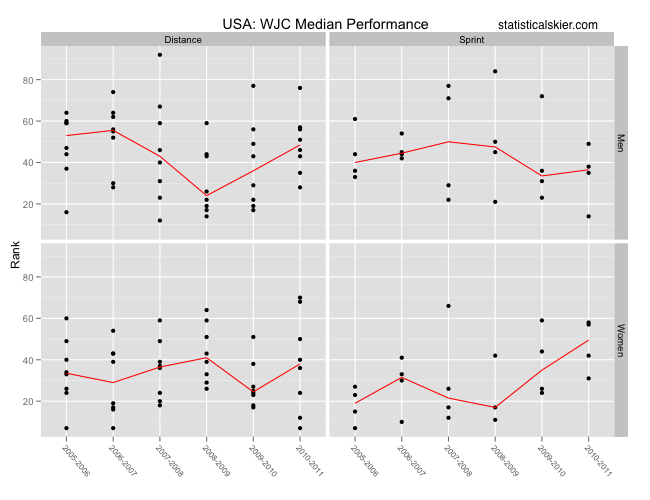
    One of the things that has struck me while writing this blog is how much importance and meaning is placed on WJC/U23s compared with how little data they provide in a given year. What I mean is that if we think of a ski race as a measurement of performance, WJCs provides only 2-4 “measurements” for each athlete. That doesn’t add up to a ton of data, given how variable skiers can be, even when they are racing well. That said, they are what they are: a World Championships, so assessments are inevitable. Let’s see what we can see.

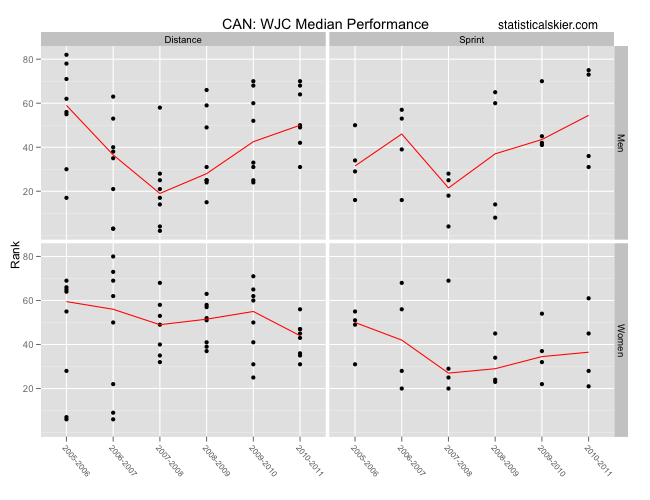
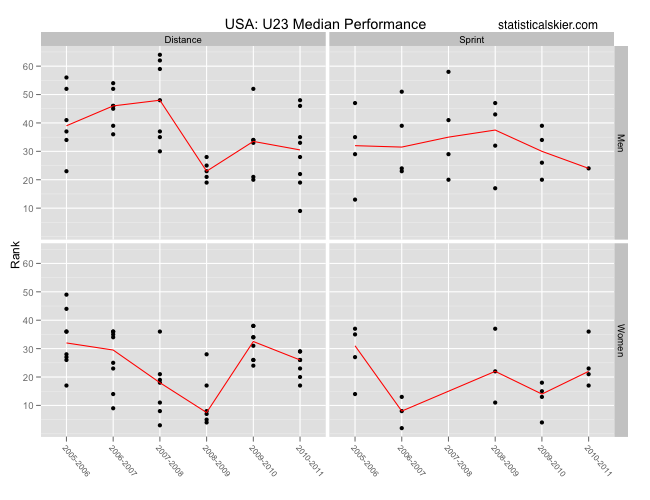
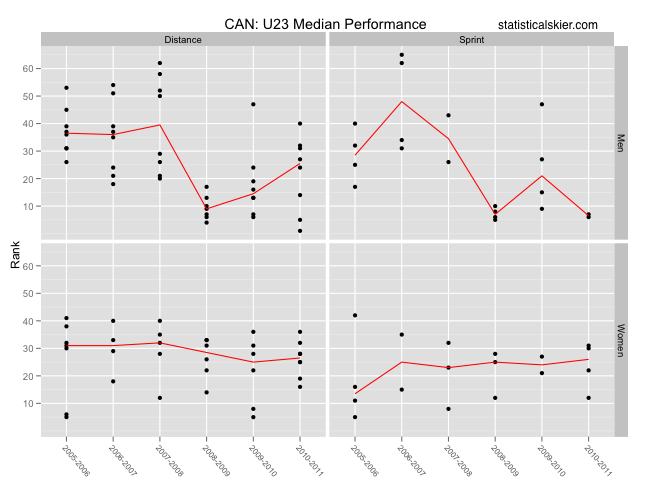
    Each below graph summarizes the performance of either the USA or CAN in either WJCs or U23s over the past six seasons. I feel like the quality of the WJC (and to a lesser degree the U23) fields are at least reasonably stable over this time period, so I’m only going to look at finishing rank. They show each individual result along with the median result for each year in red. We’ll get our feet wet with the WJC graph for the US:

    This should give you a good sense for how, with so little data within each year, that simple summaries like the median don’t always reflect everything we’d like them to about the data. The two clearest trends here are in men’s distance and women’s sprint, with some steady drop-offs in the median over the past three seasons. The US women did have some strong sprint results this year compared to the recent past; they just also had some bad ones as well.

    The Canadian men have also seen some worsening performances over the last several years, partly due to the fact that the second coming of Alex Harvey hasn’t quite manifested itself yet. The women’s crew, on the other hand, seems to have been chugging away quite consistently.

    The US women have seen things slide back a bit with folks like Morgan Arritola, Liz Stephen moving on to the World Cup scene. Other than Noah Hoffman’s “ok” race netting him a 9th this year, things looked about the same for the men’s distance squad.

    The Canadian women have been quite consistent in the distance races, with their best result bouncing up and down between 5th-15th from year to year. The men have had some considerably better sprint results over the past three years,which is nice to see. And interestingly, Alex Harvey swooping in to win the last race wasn’t enough to counter balance a fair number of somewhat worse results from other Canadian men.

    I’ll have another post or two with similar graphs for several European nations later today and/or tomorrow.

    Related posts:

    1. <Post-WJC/U23 Development: Canada
    2. <Post-WJC/U23 Development: Germany
    3. <WJC/U23 Preview: USA and CAN


  • Skinnyski Series Update

    We are 4 races into the 7 race Minnesota Skinnyski Series, so I thought I would give an update on where Vakava Racing stands at this point.

    Team Competition:
    Where did all the teams go!?! Do Vakava and Peter’s Cheaters have such a dominant rivalry that we scared off all other competitors? I know that Muven–Gruven has been taking this year easy, but I expected them to at least enter a team. Gear West had also expressed interest in entering a team at the beginning of the year, but they are also absent. Even skinnyski.com didn’t bother entering a team in the skinnyski series! And so we are left with only 3 teams, and with 3 races to go each team seems to have separated itself pretty decisively, almost to the point where it may not even matter how many skiers from each team show up to the Finlandia (like it usually does). This is supposed to be the most exciting category of the skinnyski series (see this recap from November, or this story from the series website). Heck, the skinnyski series trophy even has its own facebook page – and it currently has more friends than there are people competing for the teams in the competition! Boo to everyone who didn’t even try to field a team.

    Team standings after 4 races:
    Vakava/FinnSisu 2331
    Peter’s Cheaters 1841
    Hoigaards/Breadsmith 1254

    Overall competition:
    Men: Vakava coach Dave Christopherson is eligible to win the overall title again, and since he is probably the fastest 60 year old in the country, this competition is not even a fair fight for the rest of the field. After age adjusting his times Dave has been the fastest skier in each race by 4:25, 3:18, 1:56 (by far the closest anyone has been this year – fellow Vakava skier Dave Bridges), and 4:04. This competition is over assuming Dave skis any of the other races in the series. Other Vakava skiers: Eugene in 5th.
    Women: The women’s overall competition is a Vakava party at the top. Vakava skiers currently hold 3 of the top 4 places, and Cheryl’s lead looks almost as safe as Dave’s, since she has been the age-graded champion at 3 of 4 races. Fellow Vakava skier Angie is within striking distance, but she will probably come up agonizing short. Kathleen is 4th, Katy is 11th.

    Skier of the year:
    This is the “most improved” competition. Vakava is doing well here too: Dave is in 2nd, Cheryl is in 3rd, Kathleen is in 7th, Angie is in 13th. So far nobody is pulling ahead in this competition, and it is more a representation of who has skied the most races. This category will shake out quite a bit more in the next 3 races. Non-Vakava skier Jason Delebroux is looking good with 3 races completed, and Elaine Nelson and Sam Oftedahl are looking good with 2 races completed. If these skiers compete in more races they could pull ahead of current leader Richard Anderson, who will get bonus points if he completes all the races, but his lead is more about quantity than quality so far.

    Age group competitions:
    Vakava skiers currently leading their age groups: Kathleen, Angie, Cheryl, Eugene, Dave C.
    Vakava skiers in 2nd: Katy, Mary Beth, Nate, Mark.
    Vakava skiers in 3rd: Carolyn, Dave B.

    Go team!

  • Skinnyski Series Update

    We are 4 races into the 7 race Minnesota Skinnyski Series, so I thought I would give an update on where Vakava Racing stands at this point.

    Team Competition:
    Where did all the teams go!?! Do Vakava and Peter’s Cheaters have such a dominant rivalry that we scared off all other competitors? I know that Muven–Gruven has been taking this year easy, but I expected them to at least enter a team. Gear West had also expressed interest in entering a team at the beginning of the year, but they are also absent. Even skinnyski.com didn’t bother entering a team in the skinnyski series! And so we are left with only 3 teams, and with 3 races to go each team seems to have separated itself pretty decisively, almost to the point where it may not even matter how many skiers from each team show up to the Finlandia (like it usually does). This is supposed to be the most exciting category of the skinnyski series (see this recap from November, or this story from the series website). Heck, the skinnyski series trophy even has its own facebook page – and it currently has more friends than there are people competing for the teams in the competition! Boo to everyone who didn’t even try to field a team.

    Team standings after 4 races:
    Vakava/FinnSisu 2331
    Peter’s Cheaters 1841
    Hoigaards/Breadsmith 1254

    Overall competition:
    Men: Vakava coach Dave Christopherson is eligible to win the overall title again, and since he is probably the fastest 60 year old in the country, this competition is not even a fair fight for the rest of the field. After age adjusting his times Dave has been the fastest skier in each race by 4:25, 3:18, 1:56 (by far the closest anyone has been this year – fellow Vakava skier Dave Bridges), and 4:04. This competition is over assuming Dave skis any of the other races in the series. Other Vakava skiers: Eugene in 5th.
    Women: The women’s overall competition is a Vakava party at the top. Vakava skiers currently hold 3 of the top 4 places, and Cheryl’s lead looks almost as safe as Dave’s, since she has been the age-graded champion at 3 of 4 races. Fellow Vakava skier Angie is within striking distance, but she will probably come up agonizing short. Kathleen is 4th, Katy is 11th.

    Skier of the year:
    This is the “most improved” competition. Vakava is doing well here too: Dave is in 2nd, Cheryl is in 3rd, Kathleen is in 7th, Angie is in 13th. So far nobody is pulling ahead in this competition, and it is more a representation of who has skied the most races. This category will shake out quite a bit more in the next 3 races. Non-Vakava skier Jason Delebroux is looking good with 3 races completed, and Elaine Nelson and Sam Oftedahl are looking good with 2 races completed. If these skiers compete in more races they could pull ahead of current leader Richard Anderson, who will get bonus points if he completes all the races, but his lead is more about quantity than quality so far.

    Age group competitions:
    Vakava skiers currently leading their age groups: Kathleen, Angie, Cheryl, Eugene, Dave C.
    Vakava skiers in 2nd: Katy, Mary Beth, Nate, Mark.
    Vakava skiers in 3rd: Carolyn, Dave B.

    Go team!

  • Skinnyski Series Update

    We are 4 races into the 7 race Minnesota Skinnyski Series, so I thought I would give an update on where Vakava Racing stands at this point.

    Team Competition:
    Where did all the teams go!?! Do Vakava and Peter’s Cheaters have such a dominant rivalry that we scared off all other competitors? I know that Muven–Gruven has been taking this year easy, but I expected them to at least enter a team. Gear West had also expressed interest in entering a team at the beginning of the year, but they are also absent. Even skinnyski.com didn’t bother entering a team in the skinnyski series! And so we are left with only 3 teams, and with 3 races to go each team seems to have separated itself pretty decisively, almost to the point where it may not even matter how many skiers from each team show up to the Finlandia (like it usually does). This is supposed to be the most exciting category of the skinnyski series (see this recap from November, or this story from the series website). Heck, the skinnyski series trophy even has its own facebook page – and it currently has more friends than there are people competing for the teams in the competition! Boo to everyone who didn’t even try to field a team.

    Team standings after 4 races:
    Vakava/FinnSisu 2331
    Peter’s Cheaters 1841
    Hoigaards/Breadsmith 1254

    Overall competition:
    Men: Vakava coach Dave Christopherson is eligible to win the overall title again, and since he is probably the fastest 60 year old in the country, this competition is not even a fair fight for the rest of the field. After age adjusting his times Dave has been the fastest skier in each race by 4:25, 3:18, 1:56 (by far the closest anyone has been this year – fellow Vakava skier Dave Bridges), and 4:04. This competition is over assuming Dave skis any of the other races in the series. Other Vakava skiers: Eugene in 5th.
    Women: The women’s overall competition is a Vakava party at the top. Vakava skiers currently hold 3 of the top 4 places, and Cheryl’s lead looks almost as safe as Dave’s, since she has been the age-graded champion at 3 of 4 races. Fellow Vakava skier Angie is within striking distance, but she will probably come up agonizing short. Kathleen is 4th, Katy is 11th.

    Skier of the year:
    This is the “most improved” competition. Vakava is doing well here too: Dave is in 2nd, Cheryl is in 3rd, Kathleen is in 7th, Angie is in 13th. So far nobody is pulling ahead in this competition, and it is more a representation of who has skied the most races. This category will shake out quite a bit more in the next 3 races. Non-Vakava skier Jason Delebroux is looking good with 3 races completed, and Elaine Nelson and Sam Oftedahl are looking good with 2 races completed. If these skiers compete in more races they could pull ahead of current leader Richard Anderson, who will get bonus points if he completes all the races, but his lead is more about quantity than quality so far.

    Age group competitions:
    Vakava skiers currently leading their age groups: Kathleen, Angie, Cheryl, Eugene, Dave C.
    Vakava skiers in 2nd: Katy, Mary Beth, Nate, Mark.
    Vakava skiers in 3rd: Carolyn, Dave B.

    Go team!

  • Weighing in on wing wedges

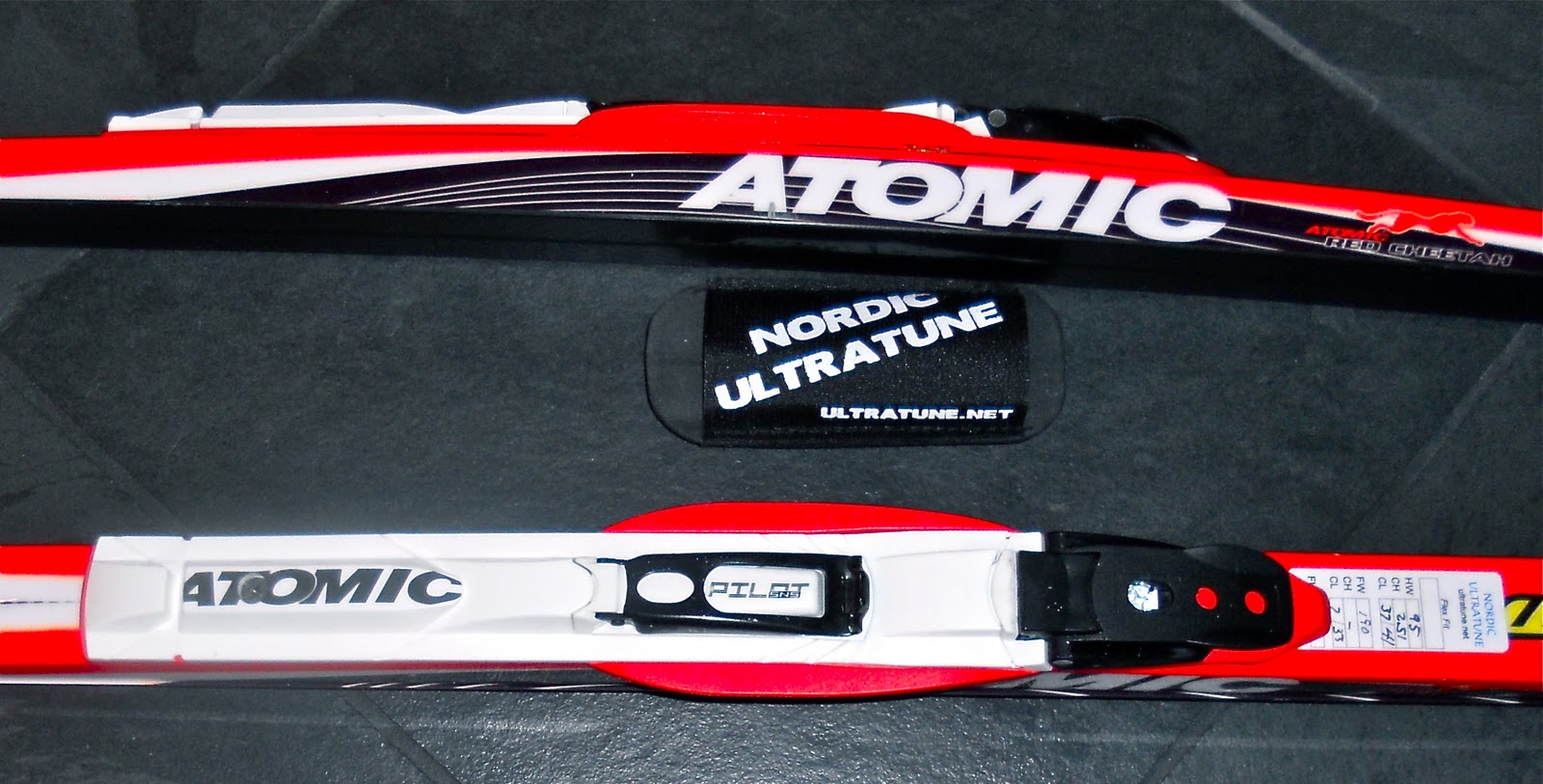
    There has been a bit of buzz about the 60mm wedges that can be used with Pilot bindings.    Here’s some info and pics.

    Wings provide a wider base of support under the forefoot.

    The “wing wedges” have been seen on the World Cup for the past 3 seasons.    I first saw them on Atomic skis while working at the World Cup events during the winter of 2008/2009.      There has been plenty of experimenting and tweaking in the past couple of years to give the manufacturer confidence that they have some merit.    And finally they make it to the consumer so that anyone can give it a try.

    The intent of the wings or outriggers is to provide an extended platform under the forefoot, providing better control of the ski.     This has been the premise of the NNN binding design since 1998 when they introduced their wide platform R3 skate binding, and it has shown over the past decade that it’s a good idea.    

    The wing wedges provide a space for the Pilot binding to sit down in a channel so that the wings are at the same surface level as the foot platform of the Pilot binding.   Because of the inset dimensions, the wedges work very, very nicely with the Pilot but are not compatible with any other version of Salomon binding.   It’s not intended for use with the Profil, ProPulse, or Pilot Classic binding.

    The wings – the lateral support extensions – seem pretty obvious and intuitive in their benefit, yet the idea of the wedge that lifts the toes by 5mm seems less clear-cut.        While some marketing articles claim that the ski will spurt forward like a wet bar of soap ( ?? ) if you simply add this wedge, I find that the effect is subtle.     It has 5mm lift over a length of 300mm.    Sharpen your pencil:  that’s about a 1 degree angle.

    How much toe lift?   The wedge is about a 1 degree angle.   

    With the toe lifting wedge, I think there is some initial accentuation of the sensitivity to fore/aft foot pressure on the ski.   But competent skate skiers will adapt quickly and really won’t notice much difference in feel after a few days on the skis.      The wedge component of the setup seems to have received a mixed reception – whether it helps or doesn’t – but the consensus is that at least is doesn’t harm performance.

    My opinion after testing skis with the wing-wedge, and without them, is that the wings definitely improve the feel of the skis.     The wedge (toe lift) aspect, to me, is somewhat inconsequential.

    The wing wedges are not an expensive item, they’re less than $20/pr and include longer screws to replace the front-end screws on the Pilot binding.     If you’re retrofitting skis, the change-over is simple and quick and doesn’t require any drilling – you can use the same holes as long as you don’t mess anything up when removing the bindings.    

    At the relatively modest price, and with such minimal impact on the ski setup, it’s something that anyone could try themselves and make their own decision on whether wing wedges are a benefit or not.

  • Weighing in on wing wedges

    There has been a bit of buzz about the 60mm wedges that can be used with Pilot bindings.    Here’s some info and pics.

    Wings provide a wider base of support under the forefoot.

    The “wing wedges” have been seen on the World Cup for the past 3 seasons.    I first saw them on Atomic skis while working at the World Cup events during the winter of 2008/2009.      There has been plenty of experimenting and tweaking in the past couple of years to give the manufacturer confidence that they have some merit.    And finally they make it to the consumer so that anyone can give it a try.

    The intent of the wings or outriggers is to provide an extended platform under the forefoot, providing better control of the ski.     This has been the premise of the NNN binding design since 1998 when they introduced their wide platform R3 skate binding, and it has shown over the past decade that it’s a good idea.    

    The wing wedges provide a space for the Pilot binding to sit down in a channel so that the wings are at the same surface level as the foot platform of the Pilot binding.   Because of the inset dimensions, the wedges work very, very nicely with the Pilot but are not compatible with any other version of Salomon binding.   It’s not intended for use with the Profil, ProPulse, or Pilot Classic binding.

    The wings – the lateral support extensions – seem pretty obvious and intuitive in their benefit, yet the idea of the wedge that lifts the toes by 5mm seems less clear-cut.        While some marketing articles claim that the ski will spurt forward like a wet bar of soap ( ?? ) if you simply add this wedge, I find that the effect is subtle.     It has 5mm lift over a length of 300mm.    Sharpen your pencil:  that’s about a 1 degree angle.

    How much toe lift?   The wedge is about a 1 degree angle.   

    With the toe lifting wedge, I think there is some initial accentuation of the sensitivity to fore/aft foot pressure on the ski.   But competent skate skiers will adapt quickly and really won’t notice much difference in feel after a few days on the skis.      The wedge component of the setup seems to have received a mixed reception – whether it helps or doesn’t – but the consensus is that at least is doesn’t harm performance.

    My opinion after testing skis with the wing-wedge, and without them, is that the wings definitely improve the feel of the skis.     The wedge (toe lift) aspect, to me, is somewhat inconsequential.

    The wing wedges are not an expensive item, they’re less than $20/pr and include longer screws to replace the front-end screws on the Pilot binding.     If you’re retrofitting skis, the change-over is simple and quick and doesn’t require any drilling – you can use the same holes as long as you don’t mess anything up when removing the bindings.    

    At the relatively modest price, and with such minimal impact on the ski setup, it’s something that anyone could try themselves and make their own decision on whether wing wedges are a benefit or not.

  • Weighing in on wing wedges

    There has been a bit of buzz about the 60mm wedges that can be used with Pilot bindings.    Here’s some info and pics.

    Wings provide a wider base of support under the forefoot.

    The “wing wedges” have been seen on the World Cup for the past 3 seasons.    I first saw them on Atomic skis while working at the World Cup events during the winter of 2008/2009.      There has been plenty of experimenting and tweaking in the past couple of years to give the manufacturer confidence that they have some merit.    And finally they make it to the consumer so that anyone can give it a try.

    The intent of the wings or outriggers is to provide an extended platform under the forefoot, providing better control of the ski.     This has been the premise of the NNN binding design since 1998 when they introduced their wide platform R3 skate binding, and it has shown over the past decade that it’s a good idea.    

    The wing wedges provide a space for the Pilot binding to sit down in a channel so that the wings are at the same surface level as the foot platform of the Pilot binding.   Because of the inset dimensions, the wedges work very, very nicely with the Pilot but are not compatible with any other version of Salomon binding.   It’s not intended for use with the Profil, ProPulse, or Pilot Classic binding.

    The wings – the lateral support extensions – seem pretty obvious and intuitive in their benefit, yet the idea of the wedge that lifts the toes by 5mm seems less clear-cut.        While some marketing articles claim that the ski will spurt forward like a wet bar of soap ( ?? ) if you simply add this wedge, I find that the effect is subtle.     It has 5mm lift over a length of 300mm.    Sharpen your pencil:  that’s about a 1 degree angle.

    How much toe lift?   The wedge is about a 1 degree angle.   

    With the toe lifting wedge, I think there is some initial accentuation of the sensitivity to fore/aft foot pressure on the ski.   But competent skate skiers will adapt quickly and really won’t notice much difference in feel after a few days on the skis.      The wedge component of the setup seems to have received a mixed reception – whether it helps or doesn’t – but the consensus is that at least is doesn’t harm performance.

    My opinion after testing skis with the wing-wedge, and without them, is that the wings definitely improve the feel of the skis.     The wedge (toe lift) aspect, to me, is somewhat inconsequential.

    The wing wedges are not an expensive item, they’re less than $20/pr and include longer screws to replace the front-end screws on the Pilot binding.     If you’re retrofitting skis, the change-over is simple and quick and doesn’t require any drilling – you can use the same holes as long as you don’t mess anything up when removing the bindings.    

    At the relatively modest price, and with such minimal impact on the ski setup, it’s something that anyone could try themselves and make their own decision on whether wing wedges are a benefit or not.

  • Weighing in on wing wedges

    There has been a bit of buzz about the 60mm wedges that can be used with Pilot bindings.    Here’s some info and pics.

    Wings provide a wider base of support under the forefoot.

    The “wing wedges” have been seen on the World Cup for the past 3 seasons.    I first saw them on Atomic skis while working at the World Cup events during the winter of 2008/2009.      There has been plenty of experimenting and tweaking in the past couple of years to give the manufacturer confidence that they have some merit.    And finally they make it to the consumer so that anyone can give it a try.

    The intent of the wings or outriggers is to provide an extended platform under the forefoot, providing better control of the ski.     This has been the premise of the NNN binding design since 1998 when they introduced their wide platform R3 skate binding, and it has shown over the past decade that it’s a good idea.    

    The wing wedges provide a space for the Pilot binding to sit down in a channel so that the wings are at the same surface level as the foot platform of the Pilot binding.   Because of the inset dimensions, the wedges work very, very nicely with the Pilot but are not compatible with any other version of Salomon binding.   It’s not intended for use with the Profil, ProPulse, or Pilot Classic binding.

    The wings – the lateral support extensions – seem pretty obvious and intuitive in their benefit, yet the idea of the wedge that lifts the toes by 5mm seems less clear-cut.        While some marketing articles claim that the ski will spurt forward like a wet bar of soap ( ?? ) if you simply add this wedge, I find that the effect is subtle.     It has 5mm lift over a length of 300mm.    Sharpen your pencil:  that’s about a 1 degree angle.

    How much toe lift?   The wedge is about a 1 degree angle.   

    With the toe lifting wedge, I think there is some initial accentuation of the sensitivity to fore/aft foot pressure on the ski.   But competent skate skiers will adapt quickly and really won’t notice much difference in feel after a few days on the skis.      The wedge component of the setup seems to have received a mixed reception – whether it helps or doesn’t – but the consensus is that at least is doesn’t harm performance.

    My opinion after testing skis with the wing-wedge, and without them, is that the wings definitely improve the feel of the skis.     The wedge (toe lift) aspect, to me, is somewhat inconsequential.

    The wing wedges are not an expensive item, they’re less than $20/pr and include longer screws to replace the front-end screws on the Pilot binding.     If you’re retrofitting skis, the change-over is simple and quick and doesn’t require any drilling – you can use the same holes as long as you don’t mess anything up when removing the bindings.    

    At the relatively modest price, and with such minimal impact on the ski setup, it’s something that anyone could try themselves and make their own decision on whether wing wedges are a benefit or not.

  • What Happens To Successful World Junior Racers?

    This post appeared on FasterSkier several months ago, but I never posted it here, I don’t think. With World Juniors and U23s wrapping up, it seemed relevant. I edited the text slightly so it will differ somewhat from the original version. These graphs do not include this year’s WJC results or any results from the 2010-2011 season.

    Identifying talent in endurance athletics at a young age can be a challenging task.  My goal here is to give you a sense of what different levels of success at WJC/U23s might indicate and how much variability there is between athletes in this respect.

    Our basic tool will be a graph of FIS points versus age for distance results, broken down by their best result (finishing place) at WJC/U23s.  This gives us a total of eight panels representing the men and women who’s best results were between 1-5, 6-10, etc.

    If you’re in the 1-5 group, that means your best result at any WJC/U23′s was between 1st and 5th.  For each group, I’ve plotted their FIS points (in distance races) versus age.  Each dot represents one race by one athlete.  The blue trend lines are for everyone in that panel.  The red lines are for only the American’s in that panel.

    If an athlete’s name appears next to one of the red lines, that means they are the only American appearing in that panel.  Otherwise, the trend lines are averaging over multiple athletes.  These graphs are fairly large, so you might want to click on them for a larger version.
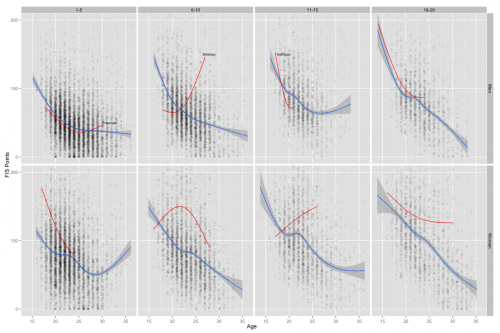
    There’s a lot of interesting stuff going on here.  Let’s ignore the Americans for a moment and just look at the blue trend lines.  We’d expect the 1-5 group to have the most future success overall, and that is the case.  (More dots near the bottom.)  As we move right to the 6-10, 11-15 and 16-20 groups the cloud of points mostly creeps upwards, but less so by the time we’re comparing the 11-15 and 16-20 groups, suggesting that there’s a bigger difference between a top 5 and a top 10 than between a top 15 and a top 20 result.

    We might also expect the trend lines in the groups to flatten sooner and at a higher level as we move rightward.  This would correspond to skiers who see less success at WJC/U23s not improving as much or leaving the sport earlier, or both.  This kind of happens, but with some weird caveats.  The men seem to follow this pattern until we get to the 16-20 group.  Why do the 16-20 athletes continue to improve past age 23 where the 11-15 athletes don’t?  The answer is likely our old friend, selection bias.

    Success in ski racing serves as kind of a signaling mechanism as to whether you should continue racing.  Skiers who’s top WJC/U23 result is between 16-20 are more likely to stop pursuing an international racing career as their results have signaled that they won’t be successful.  The only ones who do continue are the ones who beat the odds and see some measure of success.

    Another interesting aspect of these data is the evident plateau effect between ages 20-23.  Notice how many of the blue trend lines flatten out suddenly at these ages.  More so with the women, but we see it in the 11-15 and 16-20 groups for the men as well.  What might be causing this?  My best guess is that it’s another artifact of selection bias.

    My guess would be that the ages 20-23 are crucial for deciding whether you’re going to be a successful international ski racer.  Athletes steadily improve up to that point and then have a decision to make.  Do I continue racing or hang up my skis and go to school, get a job, get married, have kids, etc.?  The plateau in the trend lines may come from those athletes that stop improving between those ages.  These athletes are likely to stop pursuing a serious racing career (or at least many of them do).  The ones who continue are, by necessity, the skiers who end up achieving some measure of success.

    That’s why we often see this dramatic improvement from ages 16-20, a plateau from 20-23, and then continued improvement from 24 on.  It’s important to realize that this doesn’t mean that if you somehow push through ages 20-23 regardless of how much success you’re having, that somehow you’ll magically get faster simply by passing the age of 23.  The trend lines simply reflect the individual decisions different athletes are making about their likely future success.  I’d guess that a similar plateau effect is happening in the men’s 1-5 and 6-10 panels, but we don’t see it because it’s happening to a much smaller fraction of the athletes, so the trend line isn’t picking it up.

    Now let’s look at what’s going on with the Americans.  Kris Freeman, Rob Whitney and Noah Hoffman are the only Americans in the men’s 1-5, 6-10 and 11-15 panels, respectively.  Each of the other red trend lines are based upon multiple athletes.  For example, the red trend line in the women’s 1-5 panel is based upon Liz Stephen and Morgan Arritola.  The truly bizarre looking red trend line in the women’s 6-10 panel is based upon Kikkan Randall, Nicole DeYong, Taz Mannix and Kristina Trygstad-Saari.  Both Randall and DeYong have significantly improved their distance results of late, which accounts for the line bending down suddenly past age 25.

    Kris Freeman has been more or less “typical” for those athletes achieving a top result at WJC/U23s.  Rob Whitney had a very promising beginning, relative to his peers, but encountered some serious difficulties around age 22-23.  Noah Hoffman seems to be tracking the trend for his peers, or perhaps a bit better.

    The most important thing I want to emphasize in these data is how variable they are.  Generally speaking, of course, it’s better to have good results (not just at WJCs, all the time!).  But if anything, this graph indicates just how crude a predictor WJC/U23s can be for future success on the World Cup.  There are plenty of athletes who’ve landed top results at WJCs but haven’t gone on to do much else.  Conversely, there are plenty of skiers who never cracked the top 15 at WJCs but ended up having a very long and successful career.  There are, as in the rest of life, many different paths to success.

    Related posts:

    1. <Skiing Performance and Age
    2. <Post-WJC/U23 Development: Canada
    3. <Post-WJC/U23 Development: Germany


  • USA!

    Zach and I after he had a great race in Lake Placid on Sunday. (photo: Mary Boschen)

    At long last, I arrived back in the US last Monday to spend a week training and re-grouping before heading to Northern Maine for World Cups 7 and 8. Lake Placid has been having a great winter, so the training was fantastic. There was even a NorAm Cup Saturday and Sunday for which I played the role of “official” cheerleader. It was great to see so many competitors out and some great racing by Canadians and Americans alike.

    On Monday, the group of World Cup athletes based in Lake Placid (Tim Burke, Lowell Bailey, Haley Johnson, Laura Spector and me) took a charter flight to Portland, Maine for a press conference at Anthem, a major sponsor and supporter of the Maine World Cup races. We then flew up to Presque Isle and got settled in our hotel for the week. It was a great event, and certainly much more relaxing and fun than a 9 hour drive! A major plus was the clear weather, making for two gorgeous flights over the northeast.

    Haley and I getting ready to head to Portland! (Thanks to Laura Spector for the plane pictures!)

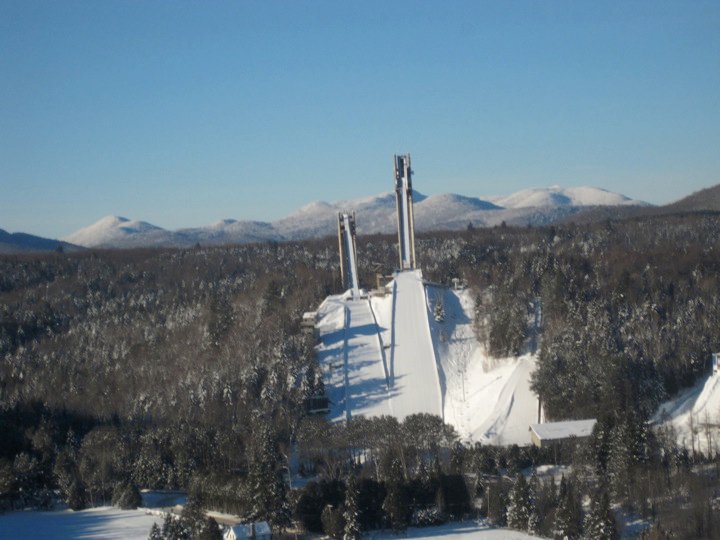
    The LP jumps just after take-off.


    Mt. Katahdin from the air, as we flew to Presque Isle.

    The frigid weather predicted for this week seems to be mellowing a bit. It’s still going to be cold, but at least legal racing temps…a good practice for World Champs in Siberia! Whatever the weather, it’s going to be a fun couple of weeks up here at our “home” World Cups. The lack of travel makes it relaxing, and also will many plenty of fans yelling for Team USA. I’m looking forward to it!

    Team USA women getting the star treatment!
  • USA!

    Zach and I after he had a great race in Lake Placid on Sunday. (photo: Mary Boschen)

    At long last, I arrived back in the US last Monday to spend a week training and re-grouping before heading to Northern Maine for World Cups 7 and 8. Lake Placid has been having a great winter, so the training was fantastic. There was even a NorAm Cup Saturday and Sunday for which I played the role of “official” cheerleader. It was great to see so many competitors out and some great racing by Canadians and Americans alike.

    On Monday, the group of World Cup athletes based in Lake Placid (Tim Burke, Lowell Bailey, Haley Johnson, Laura Spector and me) took a charter flight to Portland, Maine for a press conference at Anthem, a major sponsor and supporter of the Maine World Cup races. We then flew up to Presque Isle and got settled in our hotel for the week. It was a great event, and certainly much more relaxing and fun than a 9 hour drive! A major plus was the clear weather, making for two gorgeous flights over the northeast.

    Haley and I getting ready to head to Portland! (Thanks to Laura Spector for the plane pictures!)

    The LP jumps just after take-off.


    Mt. Katahdin from the air, as we flew to Presque Isle.

    The frigid weather predicted for this week seems to be mellowing a bit. It’s still going to be cold, but at least legal racing temps…a good practice for World Champs in Siberia! Whatever the weather, it’s going to be a fun couple of weeks up here at our “home” World Cups. The lack of travel makes it relaxing, and also will many plenty of fans yelling for Team USA. I’m looking forward to it!

    Team USA women getting the star treatment!
  • USA!

    Zach and I after he had a great race in Lake Placid on Sunday. (photo: Mary Boschen)

    At long last, I arrived back in the US last Monday to spend a week training and re-grouping before heading to Northern Maine for World Cups 7 and 8. Lake Placid has been having a great winter, so the training was fantastic. There was even a NorAm Cup Saturday and Sunday for which I played the role of “official” cheerleader. It was great to see so many competitors out and some great racing by Canadians and Americans alike.

    On Monday, the group of World Cup athletes based in Lake Placid (Tim Burke, Lowell Bailey, Haley Johnson, Laura Spector and me) took a charter flight to Portland, Maine for a press conference at Anthem, a major sponsor and supporter of the Maine World Cup races. We then flew up to Presque Isle and got settled in our hotel for the week. It was a great event, and certainly much more relaxing and fun than a 9 hour drive! A major plus was the clear weather, making for two gorgeous flights over the northeast.

    Haley and I getting ready to head to Portland! (Thanks to Laura Spector for the plane pictures!)

    The LP jumps just after take-off.


    Mt. Katahdin from the air, as we flew to Presque Isle.

    The frigid weather predicted for this week seems to be mellowing a bit. It’s still going to be cold, but at least legal racing temps…a good practice for World Champs in Siberia! Whatever the weather, it’s going to be a fun couple of weeks up here at our “home” World Cups. The lack of travel makes it relaxing, and also will many plenty of fans yelling for Team USA. I’m looking forward to it!

    Team USA women getting the star treatment!
  • USA!

    Zach and I after he had a great race in Lake Placid on Sunday. (photo: Mary Boschen)

    At long last, I arrived back in the US last Monday to spend a week training and re-grouping before heading to Northern Maine for World Cups 7 and 8. Lake Placid has been having a great winter, so the training was fantastic. There was even a NorAm Cup Saturday and Sunday for which I played the role of “official” cheerleader. It was great to see so many competitors out and some great racing by Canadians and Americans alike.

    On Monday, the group of World Cup athletes based in Lake Placid (Tim Burke, Lowell Bailey, Haley Johnson, Laura Spector and me) took a charter flight to Portland, Maine for a press conference at Anthem, a major sponsor and supporter of the Maine World Cup races. We then flew up to Presque Isle and got settled in our hotel for the week. It was a great event, and certainly much more relaxing and fun than a 9 hour drive! A major plus was the clear weather, making for two gorgeous flights over the northeast.

    Haley and I getting ready to head to Portland! (Thanks to Laura Spector for the plane pictures!)

    The LP jumps just after take-off.


    Mt. Katahdin from the air, as we flew to Presque Isle.

    The frigid weather predicted for this week seems to be mellowing a bit. It’s still going to be cold, but at least legal racing temps…a good practice for World Champs in Siberia! Whatever the weather, it’s going to be a fun couple of weeks up here at our “home” World Cups. The lack of travel makes it relaxing, and also will many plenty of fans yelling for Team USA. I’m looking forward to it!

    Team USA women getting the star treatment!
  • 100 Miles of Caribou Hills

    An overnight ski of the 100 mile Tustumena 200 sled dog race trail in the Caribou Hills area of the Kenai Peninsula in Alaska.

  • TT pix


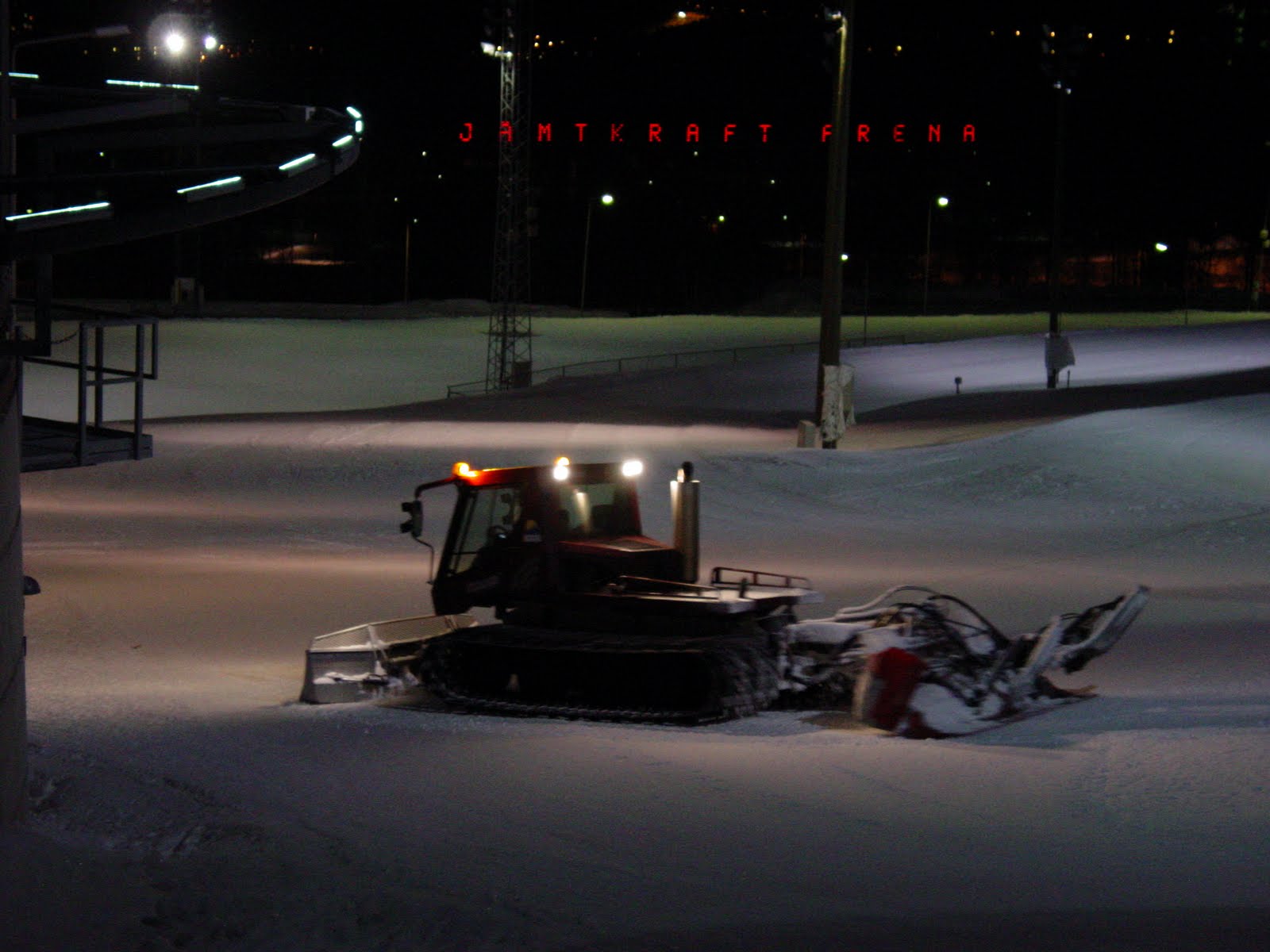
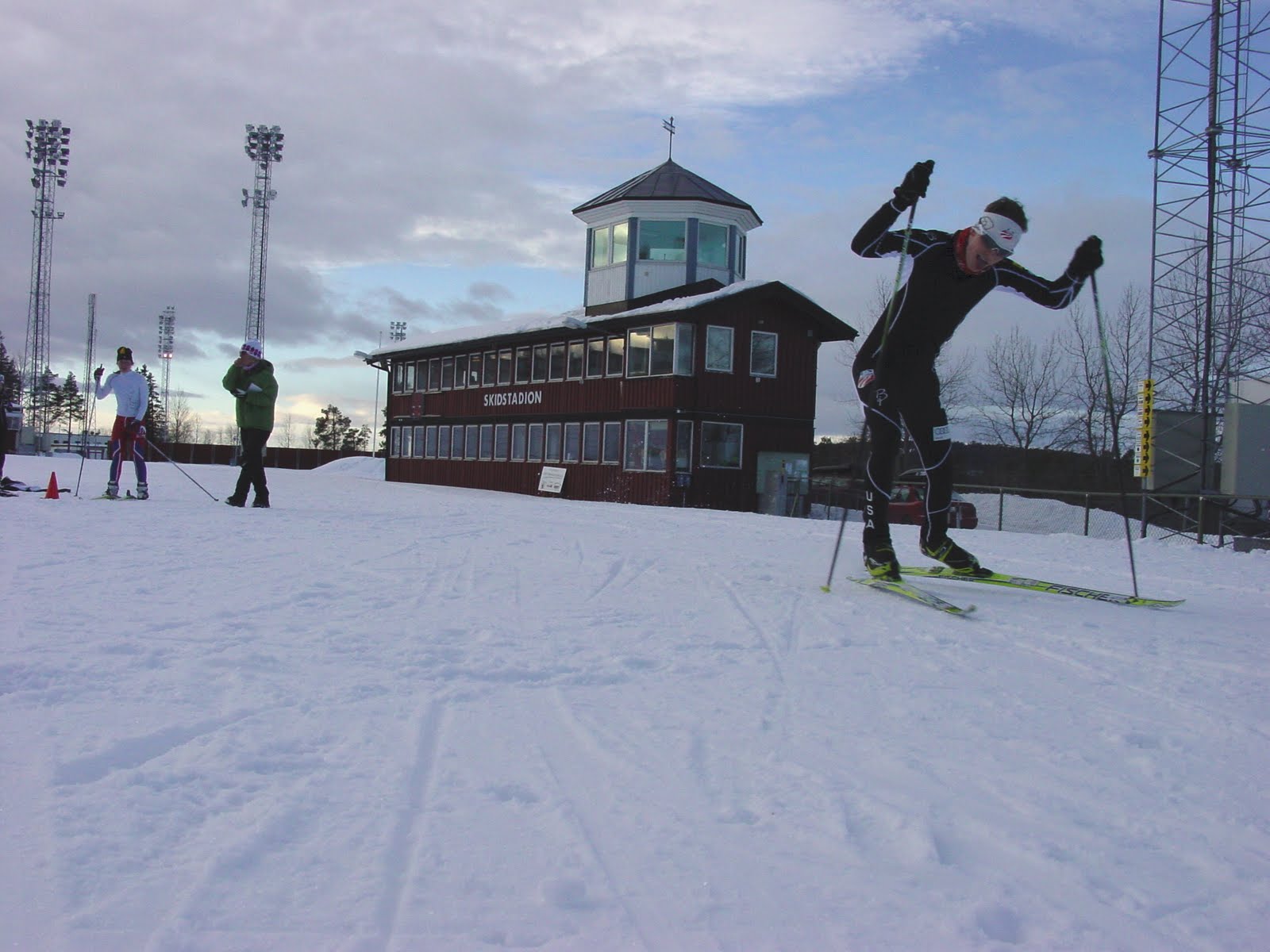
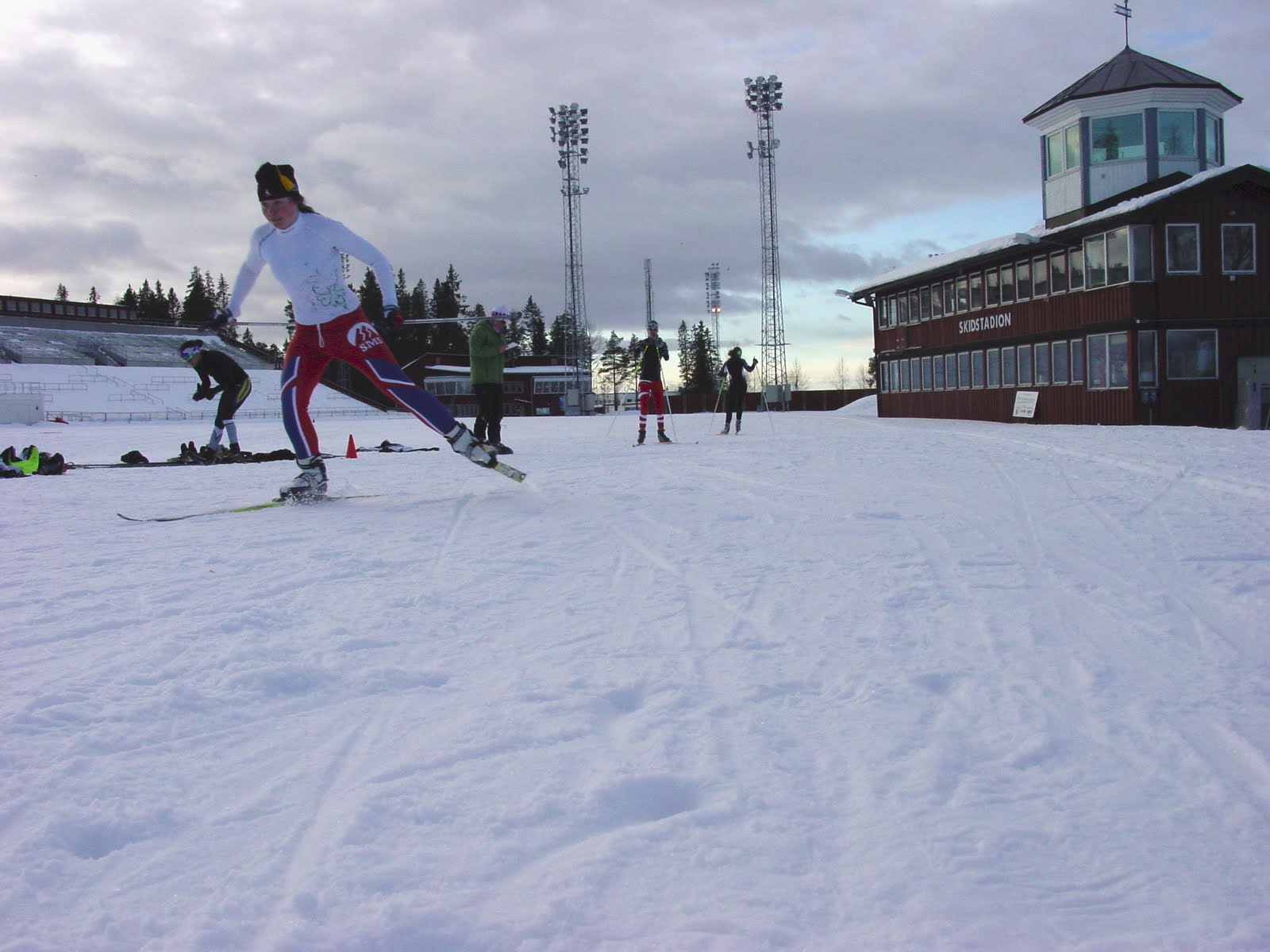
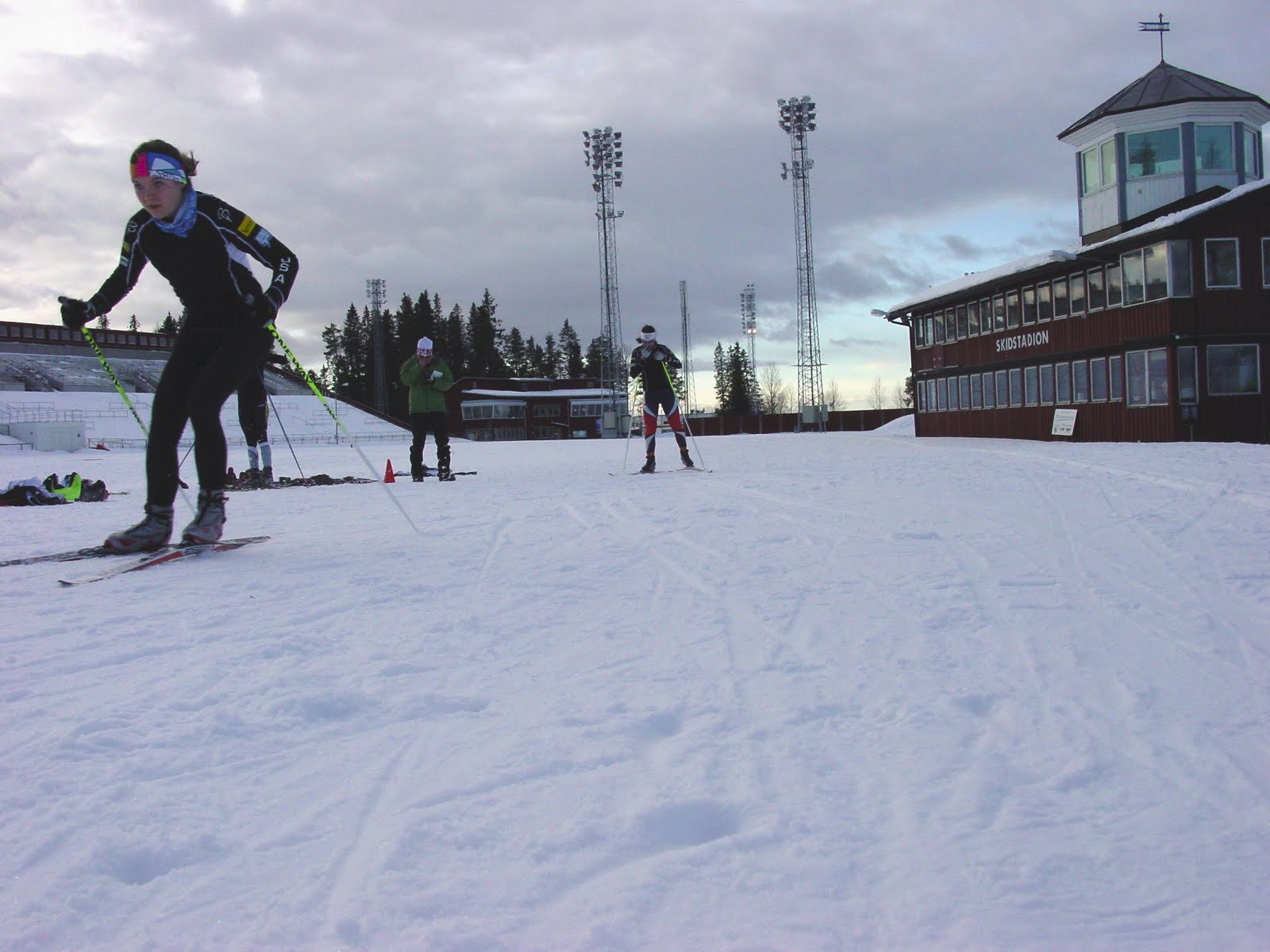
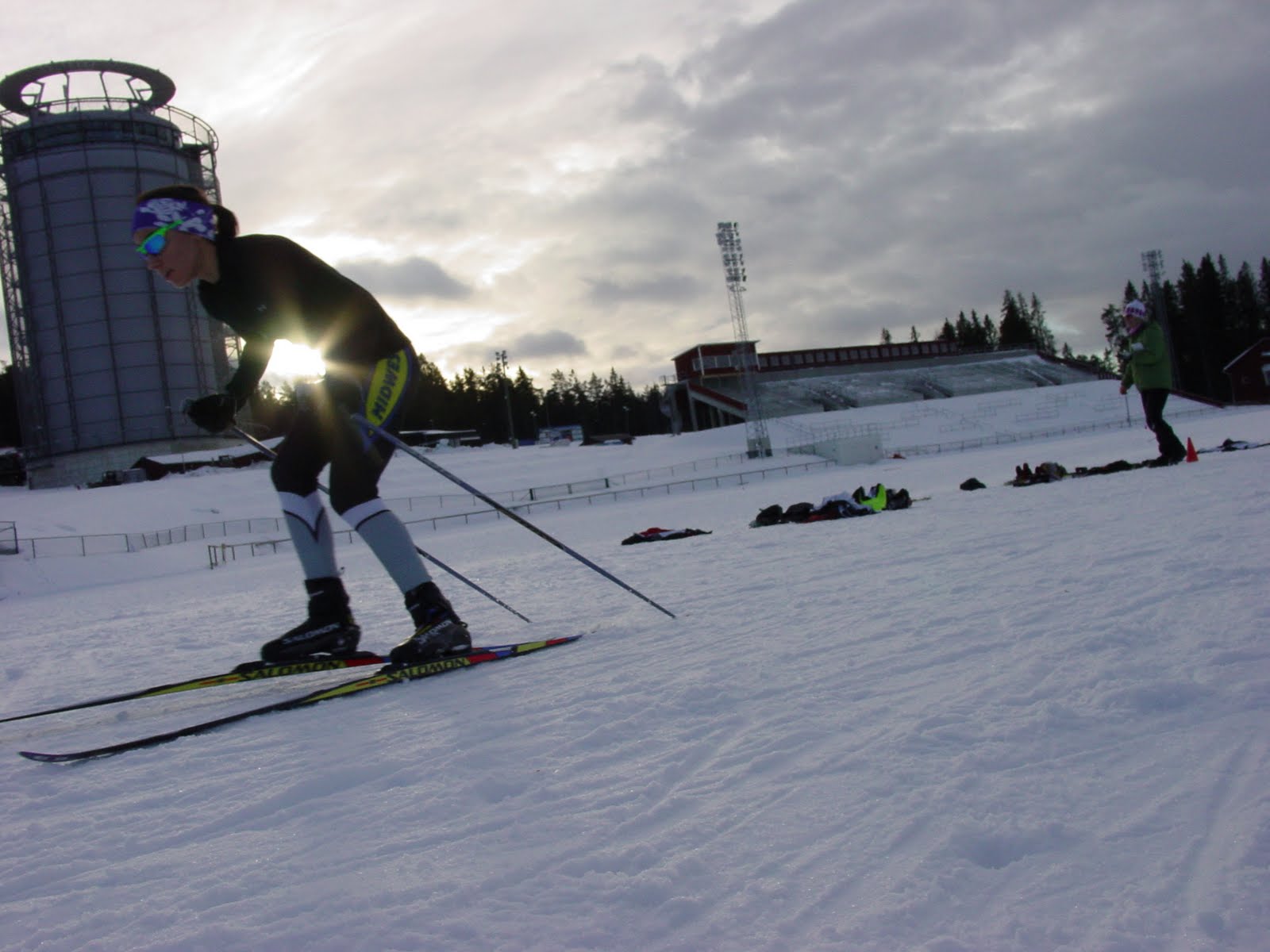
    The PB out laying some cord at about 7 yesterday morning. They have a really cool map online here (which I of course found yesterday after the ski when we were about to leave) which uses a GPS to track where the groomer currently is and shows how recently it has been there — pretty darn cool.

    Mattizzle

    Stella gives Ö-sund two thumbs up.

    Artsy photo featuring Forrest’s foot

    Mamrol rolling

    Dylan

    Cam crushing

    Marion

    Sharmila shredding

    Annie lapping through

    Ms. Woods again

    Peter lunges for the finish

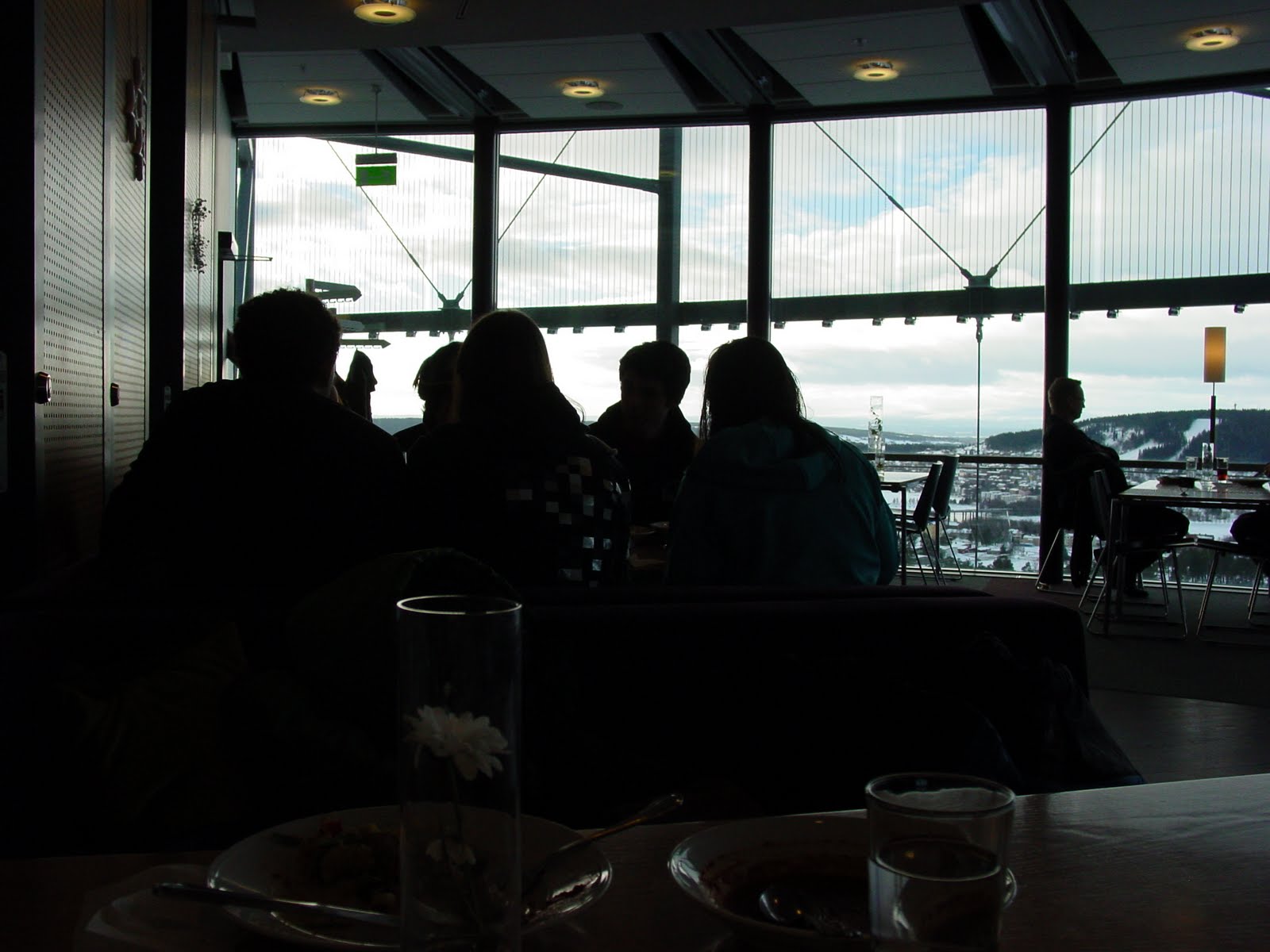
    Lunch on top of the city. Tasty buffet for about ~$12 per person or something super cheap for a place that could be charging twice or three times that.

    Ostersund, with the Biathlon stadium to the lower right, the wax cabins below, then Ostersund and Frösön (where the airport is) on the island across the big lake (fittingly named Storsjon, or “big lake” – the Swedes are a practical people).

    Missed a few on the pics – some were too quick.

    Time to grab some frukost, get packing and hit the road to Ö-vik.

  • TT pix


    The PB out laying some cord at about 7 yesterday morning. They have a really cool map online here (which I of course found yesterday after the ski when we were about to leave) which uses a GPS to track where the groomer currently is and shows how recently it has been there — pretty darn cool.

    Mattizzle

    Stella gives Ö-sund two thumbs up.

    Artsy photo featuring Forrest’s foot

    Mamrol rolling

    Dylan

    Cam crushing

    Marion

    Sharmila shredding

    Annie lapping through

    Ms. Woods again

    Peter lunges for the finish

    Lunch on top of the city. Tasty buffet for about ~$12 per person or something super cheap for a place that could be charging twice or three times that.

    Ostersund, with the Biathlon stadium to the lower right, the wax cabins below, then Ostersund and Frösön (where the airport is) on the island across the big lake (fittingly named Storsjon, or “big lake” – the Swedes are a practical people).

    Missed a few on the pics – some were too quick.

    Time to grab some frukost, get packing and hit the road to Ö-vik.

  • Mini-Tours Rock!

    This weekend a couple of us went up to Orford, Quebec for a NorAm mini-tour and it was tons of fun. If you’re not familiar with the concept of a mini-tour, think of it as kind of like a three-day stage race in biking. The difference is that on the last day, everyone starts in a pursuit format with the time gaps based on your times from the first two races, and the first skier to the finish line wins the whole weekend. I was excited for the pursuit because I haven’t done a mass start all year (well, I did the one at the Eastern Cup, but I dropped out after 2k, so that doesn’t really count does it?) and I was really psyched for some head-to-head competition.

    Perhaps my favorite part of the whole weekend was listening to Matt parrot various French words and phrases in an awesome accent. “Bienvenue!” “Bonjour!” “D’accord!” When I heard actual French-speakers talk, I could no longer take them seriously. Matt has a real talent for accents (example: his Midwestern one) but I didn’t realize that it extended into foreign languages.

    Anyway, it was just Ollie, Tim, Matt, Alex and I, and then Ollie got sick and couldn’t join us on Saturday and Sunday, which was a bummer. We were flying solo without Pepa or any sort of wax support, but it worked out totally fine and we all had good skis – even though the boys and I put completely different things on our skis for both of the classic races! It was actually nice to realize that I am grown-up enough to go to a race and do all of the testing and prep work on my own without getting too stressed out or running out of time to warm up (more on that later).

    Friday and Saturday went okay for me – I was tenth both days, and felt like I skied pretty well on Saturday in particular. But I feel like I’ve kind of been in a rut lately; it took me a long time to get back into racing shape after being sick for a while in December, and while I have been very consistent all season, it’s been consistently mediocre! That isn’t really our goal around here so I’ve been hoping to have a good race that broke the cycle.

    On Sunday, I think I might have had that race. For the women, it was a 15k pursuit, consisting of three loops on a fast but difficult 5k course. There was a kind of flat rolling section between 0.5k and 1.5k, and then a loooooong multi-pitch climb for about a kilometer, followed by some shorter hills and more rolling terrain back through the lap.

    I started six seconds behind Sheila Kealey from XC Ottawa, and ten and fifteen seconds ahead of two other skiers. Part of the beauty of racing in Canada is that you really know nothing about most of the people you are competing against, so you have to kind of just ski your race and see how it all shakes out. Anyway, I started off thinking I could catch Sheila; part of the reason I thought this was that she’s only five years younger than my mother. So I took off pretty hard, trying to bridge the gap so I could have someone to ski with.

    This turned out to be completely misguided. I never caught her and after a few kilometers of maintaining the gap, she simply skied away from me. It turns out that Sheila is a fast lady- she had the 5th-fastest time on the day! Wow.

    At this point, I panicked for a second. I was sure that I was being dropped because I’d gone out too fast, not because she was speeding up. But then I realized that the pack behind me, which had grown to three or four women, was always ten or fifteen seconds behind me and not gaining ground. So I couldn’t be slowing down that much.

    Anyway, you are doubtless getting bored hearing about my race, but basically it went really well. I felt like I skied well and this was the perfect skate course for me, with manageable climbs that I could really attack. It was really fun to feel like I was going for it after a couple weeks of races where I was definitely not on the offensive as much as you should be. I think this was the best I’ve ever skated in my life. So that’s nice.

    And at the end of the day, I decided that I want to be as fast as Sheila Kealy when I “grow up.” So it’s a good thing that I felt like I was fairly competent at waxing my own skis and all that good stuff. Green Racing Project: preparing post-college skiers for masters glory!

    Here’s a picture I took of Tim on the podium on Friday. He’s laughing because Matt said something funny.

    DSC03484

  • The Wohnwagen adventure

    Being a biathlete has brought me more opportunity then I have ever imagined in my life. I have been able to travel places I never would have imaged and made some great friends from all over the world. This winter a new adventure came to life while looking for races to do mid-season. Myself and a couple good friends of mine were all looking for new opportunity through the month of February. Looking for great competition and some challenging events to help boost my racing level up a notch or two, we decided on traveling to Germany to battle it out in a couple German cups here. While looking to make this trip as economical as possible, we decided upon traveling and living in an RV, wohnwagen, for our duration here. As I stated earlier, biathlon has brought so many different adventures to my life. You never know where you might find yourself year to year or even month to month.
    Our first stop in our Wohnwagen adventure is to Oberhof, a biathlon hotspot. Here is a quick overview of life here in Oberhof.
    Oberhof in a smaller size town about three hours North West of Munich. It seems similar to Lake Placid, NY because it is home to many winter sports including bobsled, alpine skiing, Nordic and of course biathlon. It was actually the first stop on the Tour de ski this year. It was home of the 2004 World Championships for biathlon and hosts a biathlon world cup every year in January. It opened its own ski tunnel a couple summers ago just down the road, so not only do you have skiing all winter long but through the summer now too. The venue is home to one of the largest stadiums, which is packed full through the World Cup with somewhere around 30,000 people for every race. The World cup venue is only one of about five or six different biathlon ranges you can find here. One of which is indoors with huge doors that allow you to rollerski in and out of. This range also provides a video screen of your target next to every point, allowing you to look at your shots with a quick glance after every shot. Home to many German National team athletes, Oberhof is defiantly not a bad place to be a biathlete.
    Nestled in the Thuringer Forest, with Nordic trails headed in every direction, this small German villages has a great Nordic population of all different abilities. The towering pine forests surrounding the area are all heavily weighted down with heavy white snow and makes for beautiful skiing. And it’s often foggy weather has earned this place a nice name of Foghof.
    Our races start this weekend with an individual race. I am new to the German Cup scene, so I am excited to get things underway with Saturday’s individual race. No matter the fog, wind or crazy hilly race course, I am just happy to be here and to have a race bib on.
    More stories still to come…..stop by again soon,

    BethAnn