Category: Strength

Articles on strength training.
  • Wednesday Workout: Level 3 Running Loops with Nakkertok

    Wednesday Workout: Level 3 Running Loops with Nakkertok

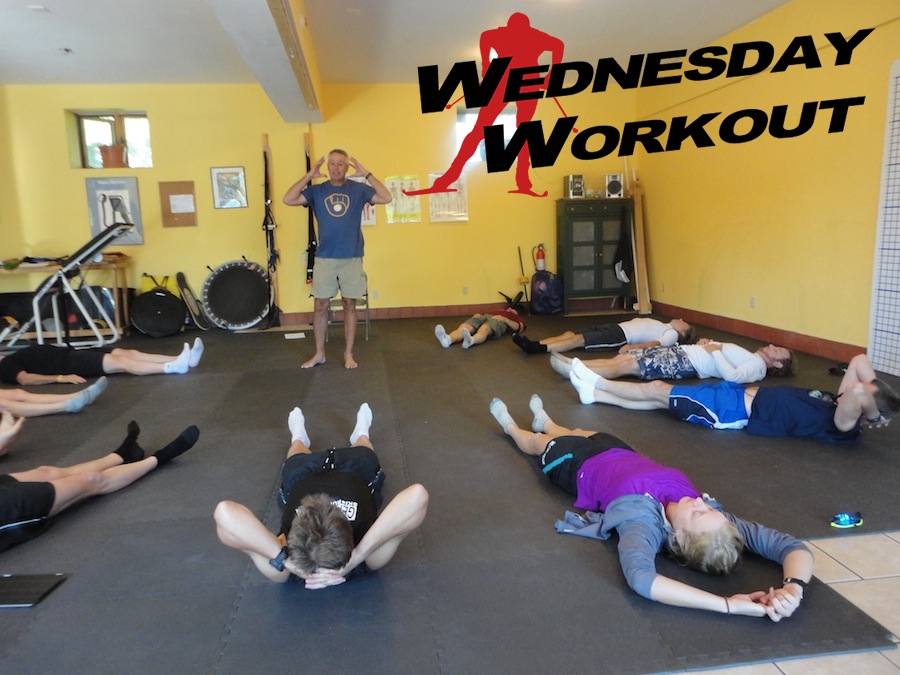
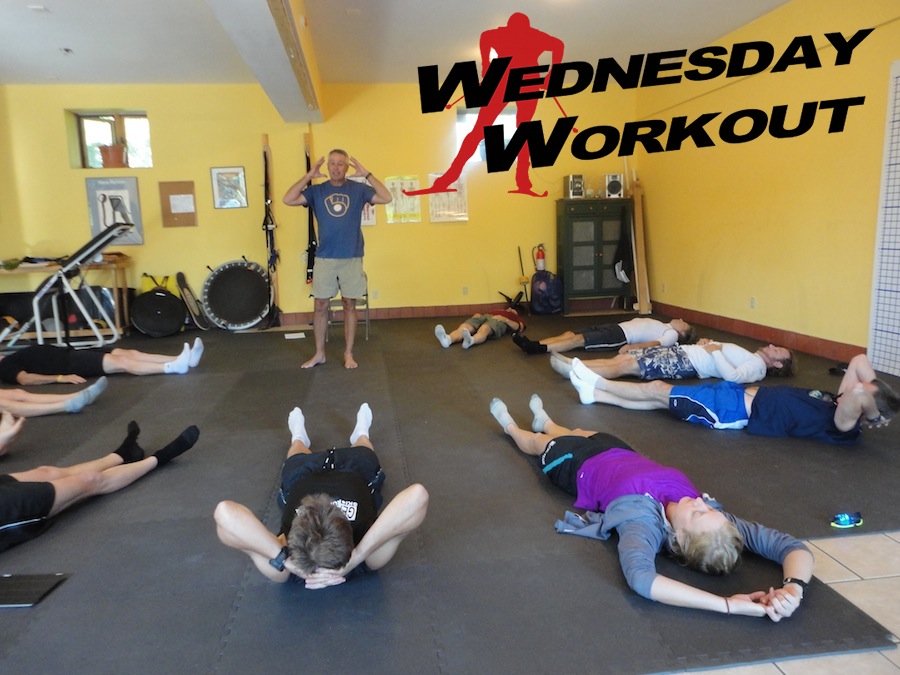
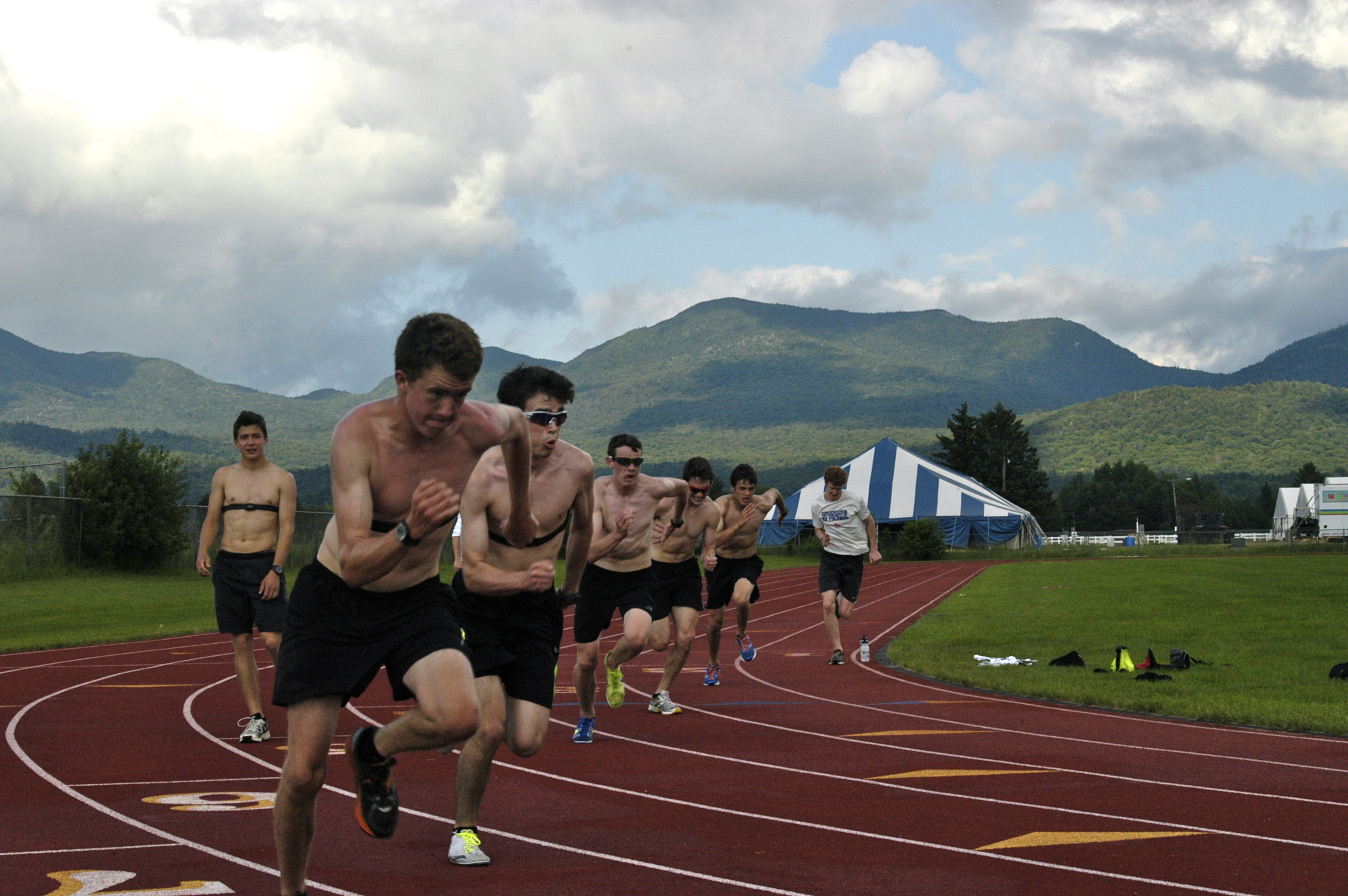
    Nakkertok skiers hard at work during a recent track workout. From left to right: Isaac Alexander-Cook, Kyle Curry (St. Lawrence University), Cary Pomeroy, Phil Marshall, Brendon Howard, Symon Stowe, and Patrick Van Walraven. (Photo: Jesse Williams)
    Nakkertok skiers hard at work during a recent track workout. From left to right:
    Isaac Alexander-Cook, Kyle Curry (St. Lawrence University), Cary Pomeroy, Phil Marshall, Brendon Howard, Symon Stowe, and Patrick Van Walraven.
    (Photo: Jesse Williams)

    Welcome to Wednesday Workout, where we provide and break down training ideas on a weekly basis. This week, Kieran Jones, head coach of the Nakkertok Ski Club in Ottawa and former FasterSkier reporter, gives some advice for developing a strong baseline and widening the range between easy and max efforts.

    ***

    Skiers like pain. Skiers like feeling exhausted. Regardless of whether you’re a 10 year old girl, a 55-year-old master-blaster, or an Olympic champion, if you’re a skier, you love feeling the hurt.

    But sometimes, to get to the hurt, you need to lay out a strong baseline. And to do that, you have to think beyond “I want to hurt.”

    Nakkertok has approximately 50 athletes in the two programs I directly coach, with almost all of them falling in the 15- to 20 year-old age range. As a coach of these Junior athletes, my major goal is to expand their physical literacy to the point where there is a range beyond “slow” and “all-out.”
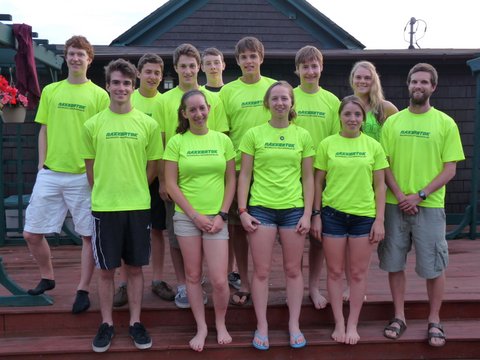
    2013/2014 Nakkertok Nordic Team (Courtesy photo)
    2013/2014 Nakkertok Nordic Team (Courtesy photo)

    The Workout: Cue Level 3 Running Threshold Loops

    • Easy 15-minute warmup jog, followed by dynamic warmup exercises, including 5 x 6-second acceleration sprints for range of motion
    • 4 x 10 minutes on rolling terrain, with 3 minutes recovery between each rep
    • Easy 15 minute cool-down jog

    The major goal of the workout is to ensure that athletes are running at the correct speed and effort level. Depending on your available metrics, you can control it a number of ways. If you’re using heart rate zones based off a maximum heart rate, I recommend 82-88 percent of your max.  If you’re using a lactate monitor, target lactate readings of 3-5 mmols. If you’re running based on ‘feel’, aim an 8 out of 10. Finally, if you’re running based on pure effort level, think of a pace you can sustain for around 50-60 minutes.

    The first step is to mark out a clear loop over rolling terrain. I like to make the loop so that the faster athletes do a little more than 1 loop, and the slower athletes do a little less than one loop, so that whole group can start each rep together.

    Generally I don’t get too bent out of shape about the number or grade of uphills, but it’s important to consider the level of runner you have. I try to avoid loops with hills I know will crush the groups’ legs on the first interval.

    The greatest thing about the loop is that no matter what you have a number of metrics you can record as a coach. If you’re high-tech enough to own a lactate monitor, you can set up a lactate-test station, and take samples as people come off the loop. If your athletes have heart rate monitors, you can record max values for each rep. If you only have a stopwatch, you can record times for the loops for each athlete. Or if you have nothing but the shirt on your back, you can drop that shirt where you end on the first rep.

    For pacing, emphasizing that the first rep should feel quite easy is important. If an athlete is breathing hard, or glancing at their watch every 5 seconds thinking “oh god, please let this end” on the first or second rep, chances are they are going too hard. If by the third interval they aren’t able to hit the same time or finish point, then you know they’ve gone out of the gate too fast.

    If you’re measuring heart rates, I like to see a consistent increase without a huge jump or drop off. For example, recording a max heart rate at the end of each interval, I want to see the following: Rep 1: 165, Rep 2: 170, Rep 3: 172, Rep 4: 174.

    The above athlete will finish the workout without collapsing on the ground due to the feeling of “concrete block” legs, be able to do an easy cool down, have a nap, and be ready to roll again by 3 PM for the afternoon workout.

    The part B of this workout is something athletes love. We often return to the same spot six or eight weeks later, and repeat the workout. The athletes have recorded the time or distance they were able to travel the first time, and then are able to see themselves beat that mark working at a lower effort level or heart rate. As the workout is running, you remove the variable of rollerski speed, broken pole tips, or traffic that can often throw off data collection in a rollerski workout. Not all athletes can make it to World Juniors, or win a medal at Canadian Nationals – but all athletes want to see that the work they are doing is resulting in improvement.

    My favourite part about this workout is that it forces athletes to think about controlling their speed and effort. If you’re a highly motivated skier (see: every skier ever) it’s quite easy to go out and hammer at your max. But it’s harder to rein yourself in, and work in the right range.

  • Wednesday Workout: Dreissigacker’s ‘Bread and Butter’

    Wednesday Workout: Dreissigacker’s ‘Bread and Butter’

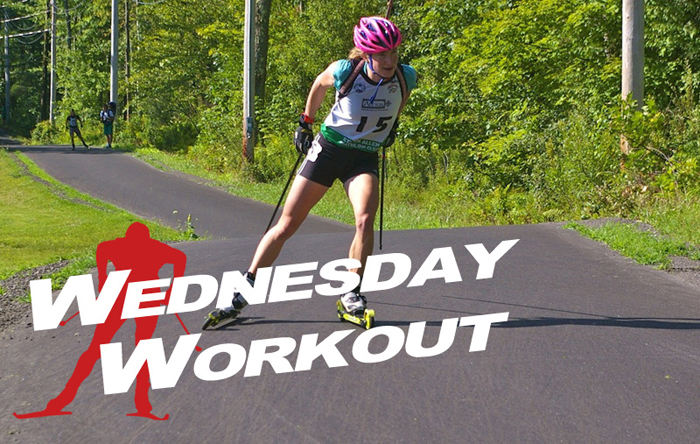
    Hannah Dreissigacker (Craftsbury Green Racing Project/US Biathlon) closing in on a 31-second win in the 7.5 k sprint on Aug. 10 at North American Biathlon Rollerski Championships in Jericho, Vt.
    Hannah Dreissigacker (Craftsbury Green Racing Project/US Biathlon) closing in on a 31-second win in the 7.5 k sprint on Aug. 10 at North American Biathlon Rollerski Championships in Jericho, Vt.

    Welcome to Wednesday Workout, where we provide and break down training ideas on a weekly basis. This week, Hannah Dreissigacker, a 26-year-old member of the Craftsbury Green Racing Project who made the US Biathlon A-team this year, talks about how she’s made strides in her sport — specifically in shooting — and why combo workouts are some of the best ones biathletes can do.

    ***

    As I’ve transitioned from being a Nordic skier who dabbled in Biathlon to what I like to call a “real biathlete,” it has been a constant learning process.  One of the biggest obstacles I had to overcome was my own hope that if I just trained with my Nordic teammates most of the time, and then worked on shooting as much as I could on the side, that would transfer to good biathlon performance.  Unfortunately, that sort of training only gets you so far in biathlon.

    So although I know that most of you FasterSkier readers are not biathletes, this “Wednesday Workout” will be a little peak into what its like to really train specifically for biathlon.  This workout could also be done without shooting—each shooting stop only takes about 30 seconds, but it’s really designed to be about both the physical and shooting-specific training.

    Shooting with intensity is what it’s all about.  From the point of view of getting better at shooting in a race-like situation, it would be good to shoot with a high heart rate all the time.  But since you can’t do intensity every single day, it’s really important to take advantage of the days that you are doing intensity by turning the interval workout into what we call “combos” in biathlon.  Since you stop between intervals anyways, you might as well be shooting during that time!  And even if the goal is a continuous intensity workout, a 30-second stop to shoot does not have much effect.

    This is the workout that I feel has been my “bread and butter” this summer—I’ve done it more times than I can count and I think that doing it consistently has helped improve both my fitness and shooting skills.

    Zero the rifle (shooting on a paper target to make sure that my group of 5 shots is centered in the middle of the target).

    20-30 minute warmup.  I like to warm up nice and easy.

    8 x 10-15 second “impulses,” also known as pickups.  After each impulse, I quickly put my rifle on my back and shoot while my heart rate is still high and my body a bit jittery from the short speed.  This is great practice for trying to calm myself down, and also for shooting with a pounding pulse.  I try to use a mix of techniques for the impulses, to spread the love.  A minute or two of easy skiing between each impulse is good.

    6 x 5-7 minutes Level 3 intervals.  I really like the new rollerski loop in Lake Placid for this because it’s a real ski course with variations in terrain, a few technical downhill turns, and some hard uphills.  This gives the Level 3 training a lot of variety.  On the uphills, I have to hold back a bit and focus on relaxed technique and good glide.  But on the transitions and flatter parts I can really push and go for lots of power.   I like to end each interval on an uphill approach to the shooting range, so that my heart rate will be high when I come in to shoot.  And despite being tired, or hot, or sweaty or thirsty, I try to just focus on shooting quickly, efficiently, and normally every time I come in. I think about my breathing and about pulling the trigger gently.  Then after that I can get a drink and take a short break while I put my rifle on the rack again.  After successive intervals, I usually alternate prone and standing shooting.  And I also try to put a little pressure on myself when I come in to shoot—I imagine that I’m in a race, and think about how well I need to shoot to do well, or how many or few misses I’ve made so far in the day.

    20-30 minutes continuous Level 3 skiing on the road, usually going for a total time of 1 hour of Level 3 work.  Occasionally we’ll do more L3 with shooting, and so we’ll skip the road part, but often we finish the workout out on the roads.  For one, this gives us some time to just ski continuously without shooting.  But it also generally gives us faster, flatter terrain.  It feels very different both physically and mentally to ski L3 continuously on a flat road than it does to be going up and down big hills all the time.

    Short cooldown.  This workout can get long, so I keep my cooldown short and easy.

  • Wednesday Workout: Keeping It Fun with Non-Ski Specific Training

    Wednesday Workout: Keeping It Fun with Non-Ski Specific Training

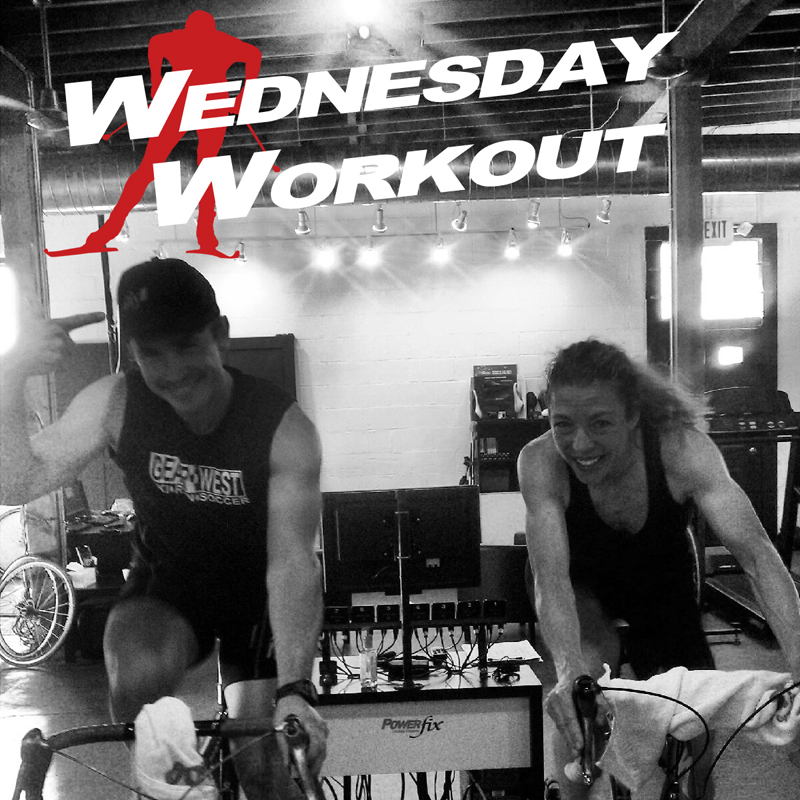
    Matt Liebsch (l) gives a plug to The Fix Studio by pointing to its logo on his hat during a CompuTrainer workout with Lynne Cecil, 1990 American Birkebeiner champion and his co-worker at Gear West in Long Lake, Minn. (Courtesy photo)
    Matt Liebsch (l) gives a plug to The Fix Studio by pointing to its logo on his hat during a CompuTrainer workout with Lynne Cecil, 1990 American Birkebeiner champion and his co-worker at Gear West in Long Lake, Minn. (Courtesy photo)

    Welcome to Wednesday Workout, the newest workout series on FasterSkier. This week, Matt Liebsch, an independent skier sponsored by Borton Volvo and director of race services at Gear West in Long Lake, Minn., talks about balance — with work and training, ski-specific and cross training.

    ***

    By Matt Liebsch

    Last summer I roller skied my brains out.  Coming back from a bike accident/concussion and a very bad ankle sprain, running was not an option and I was gun shy about getting on a bike.

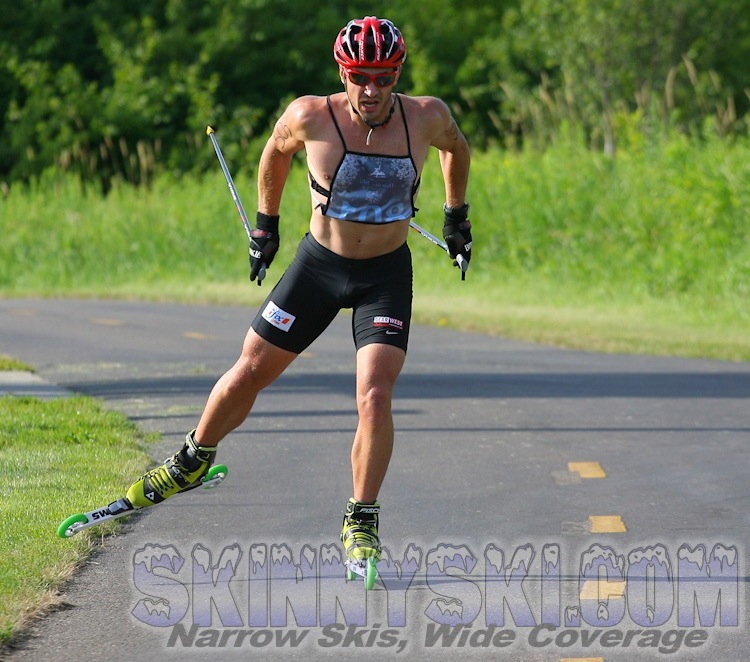
    Matt Liebsch en route to winning the 2013 Ringer Roll 10 k freestyle rollerski race by nearly a minute and a half on Aug. 2 in Maple Plain, Minn. (Photo: SkinnySki.com)
    Matt Liebsch on his way to winning the 2013 Ringer Roll 10 k freestyle rollerski race by nearly a minute and a half on Aug. 2 in Maple Plain, Minn. (Photo: SkinnySki.com)

    I think all the ski-specific summer/fall roller ski training is great but it is important to keep training fun and diverse at times. This way, once late fall and winter arrive, I can be mentally fresh for 100-percent, laser-guided focus on ski training and racing.

    To keep things fresh, this summer I have been doing a 2.5-mile, open-water swim every Wednesday. Our Gear West group swims to an island and back in Lake Minnetonka. I love swimming because it is low impact, involves a catch, pull, reach and rhythmic breathing.

    We start at 6 a.m. on Wednesday. It is an early start to the day but we do this to avoid boat traffic. On the way out to the island I try to swim relaxed (I don’t have to try very hard, I am still half asleep) and on the way back I will push the pace a bit to 1:30 minutes/100-meters if I feel good.

    After swimming for an hour and 15+ we will grab a quick coffee. If it is a volume week I may run, bike or roller ski after swimming for up to an additional two hours. Generally I get home in just enough time to make myself an omelet and then blast off to work so I can open the doors are Gear West by 10 a.m.  No time for naps or massages.

     I love swimming because it is low impact, involves a catch, pull, reach and rhythmic breathing.

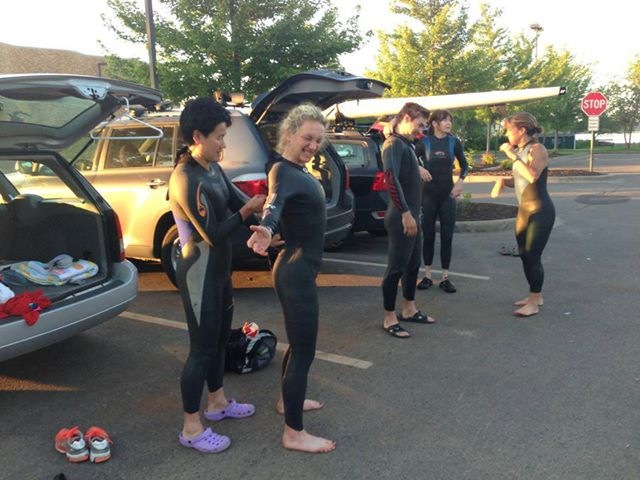
    Caitlin Gregg (second from left) and some others get ready to swim in Lake Minnetonka near Minnesota's Twin Cities. According to Matt Liebsch, who does the swim weekly, her husband Brian Gregg said it's one of the hardest workouts he's ever done. (Photo: Matt Liebsch)
    Caitlin Gregg (second from left) and others get ready for an open-water swim in Lake Minnetonka near Minnesota’s Twin Cities. According to Matt Liebsch, who swims there weekly, Gregg’s husband Brian said it’s one of the hardest workouts he’s ever done. (Photo: Matt Liebsch)

    Another mode of non-ski specific workload that I have introduced more frequently this year is cycling class. I have been doing CompuTrainer class at The Fix Studio once a week.

    The benefit of doing intensity on a CompuTrainer system is that I can easily track power, training stress score and I can even see my pedal-stroke power profile.  Another benefit is reduction in injury. It’s amazing how hard I can push myself at class on a CompuTrainer system with almost zero risk of injury.

    I’ve noticed with the extra intensity on the bike my legs are rock-solid while skate skiing. My arms and abs are still strong from all the double poling and strength training but my legs have achieved a new level of skate specific fitness. I can only attribute this to the short focused cycling classes at The Fix Studio.

    A typical cycling class at The Fix Studio includes intensity structured around your FTP, “Functional Threshold Power.” In cycling, everything is based off your power output.  Being able to see power on the bike makes me wish it could be measured in skiing.

    In skiing, all we have to measure work is speed (affected by roller ski speed, snow speed, weather, etc), heart rate (variable on a number of factors), lactate (also variable) and perceived exertion.  Luckily the highly trained athlete knows their zones very well.

    At class, we usually do a 10-minute warmup, 40 minutes of structured intensity, and a short cooldown.  I generally like to ride outside before or after class to add a bit of volume.

  • What Drives Muscle Tightness: Tips for Improving Long-Term Performance

    What Drives Muscle Tightness: Tips for Improving Long-Term Performance

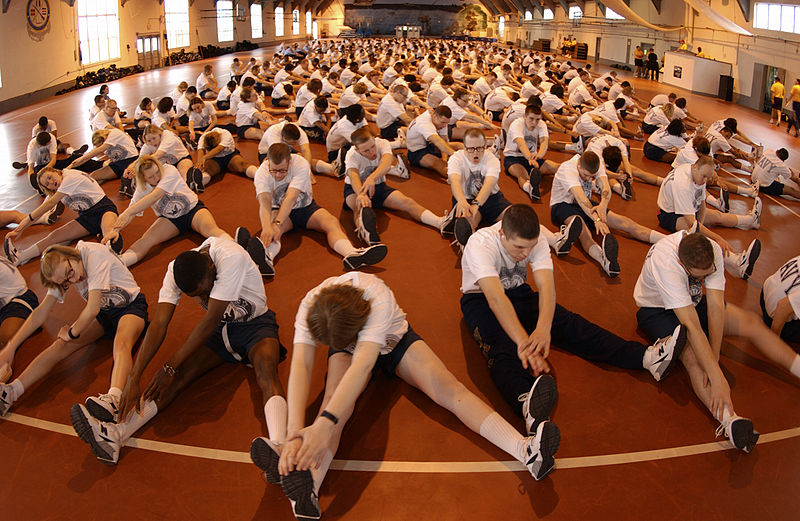
    If we could all just stretch a little more effectively, it would go a long way. (Photo: US Navy recruits/Wiki Commons)
    If we could all just stretch a little more effectively, it would go a long way. (Photo: US Navy recruits/Wiki Commons)

    Many of us have realized minimal gains with static stretching. For many it seems to be the training element we shove off to the end of the list even though we know it is important. Maybe we do this because for all the time we spend, we don’t get much positive reinforcement?

    Static stretching tends to yield short-term changes in muscle lengths. Ever notice about 10 to 15 minutes into your workout you feel tight again? It is because we have not addressed the root issue of what is driving the muscle tightness. We may get a few degrees more range of motion, but it is short lived.

    Why are the hamstrings and calves tight to begin with? For a long time, I thought it was due to those muscles being worked more, shortened due to growth spurts or inconsistent flexibility routines. Then I learned that this was only a part of the picture. Yes, these muscles were working extra, but because others were not. The main reason for the tightness had nothing to do with the muscle length, but the muscles that keep them tight are more active or “turned on” when they are not supposed to be, which will keep them tight. Essentially the muscles that are abnormally tight are working extra and always turned on.

    In my last article, ‘The Freedom of Movement,’ I discussed the importance of mobility and stability. Physical therapists, doctors and trainers have different theories on which element is best to address first. To a certain degree as we still develop our diagnostic tools, it will continue to be a chicken-and-egg conundrum. Since everyone’s body reacts differently, the best approach is to try a different method of improving flexibility and re-test your mobility or stability to see if it has an effect.

    Since we need to look at the muscles as an interrelated system, we should use mobility techniques as such as well (i.e. not stretch one isolated muscle group, but address the whole system). We address the system by turning on the muscles that are not activated (but are supposed to be), while at the same time lengthening the target muscle group we are hitting.

    Since no muscle group works with out interacting with other muscle groups, I like to think of targeting an area versus a specific muscle group. For example, instead of stretching just hamstrings, I like to think of stretching the hip, calf and foot muscles, all of which are involved with the hamstrings. Often, we may think our hamstrings are tight when it’s really our hip flexors and weak core driving the movement restrictions.

    How to Stretch

    Since our bodies work best fully mobile, we ideally want to exercise after improving our mobility.

    A good sequence is:

    • Foam roll to release trigger points
    • Hit your primary trouble spot with a mobility exercise sequence, for example, a toe touch (as detailed below)
    • Then move into your workout.

    This will take 10 to 15 minutes, but you will feel like a different athlete for most of your workout.

    Since many skiers tend to have tight hips, and especially those that use cycling as their core form of endurance base building – the body position in cycling tends to shorten hip flexors – I will use the hips as a starting-point example. Please keep in mind this is one example of multiple ways to address this.

    What will work most effectively to keep these changes in is flexibility coupled with strength exercises that teach and reinforce this improved muscle firing pattern. After a short time, the additional strength exercises will make the improvements in flexibility long term (for days/weeks), versus for 20 to 30 minutes.

    What works best for each person will again be driven by what you learn in your evaluation or FMS screening. For making long-term changes in your flexibility muscle release helps for a short duration, but will only elicit a change for a short while, unless we continue to work on fixing the system. The exercises below are based off the work of physical therapist and author Gray Cook.

    Hip Mobility

    Toe-touch demonstration
    Figure 1: Toe-touch demonstration

    Toe-touch example:

    Goal: Release tight hamstrings and hip flexors as a system.

    1. Start by doing a toe touch to see your existing range of motion.
    2. Foam roll back and forth 15-20 times: hamstrings, hip flexors, calves, abductors (outside leg muscles), adductors (inside leg muscles), and glutes. (For some folks, try rolling out your foot with a golf ball)
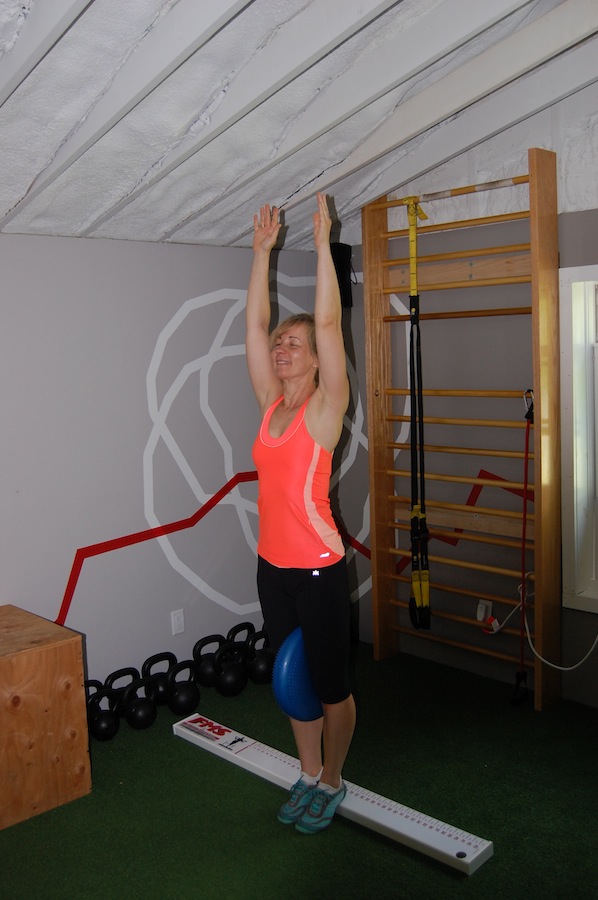
    3. Start with toes up (figure 1) on a 2-inch board and a towel roll between knees, reach up, inhale, then reach down. When you hit resistance, pinch your knees together and stretch more (figure 2). Bend knees if you still cannot touch your toes. Repeat 6-10 times.
    4. Start with heels on a 2-inch board and a towel roll between knees, reach up, inhale, then reach down (figure 3). When you hit resistance, pinch your knees together and stretch more. Repeat 6-10 times.
    Figure 2: Toe touch
    Figure 2: Toe touch
    Figure 3: Toe touch
    Figure 3: Toe touch

    Hip Flexor:

    Goal: Release tight hip flexors as a system.

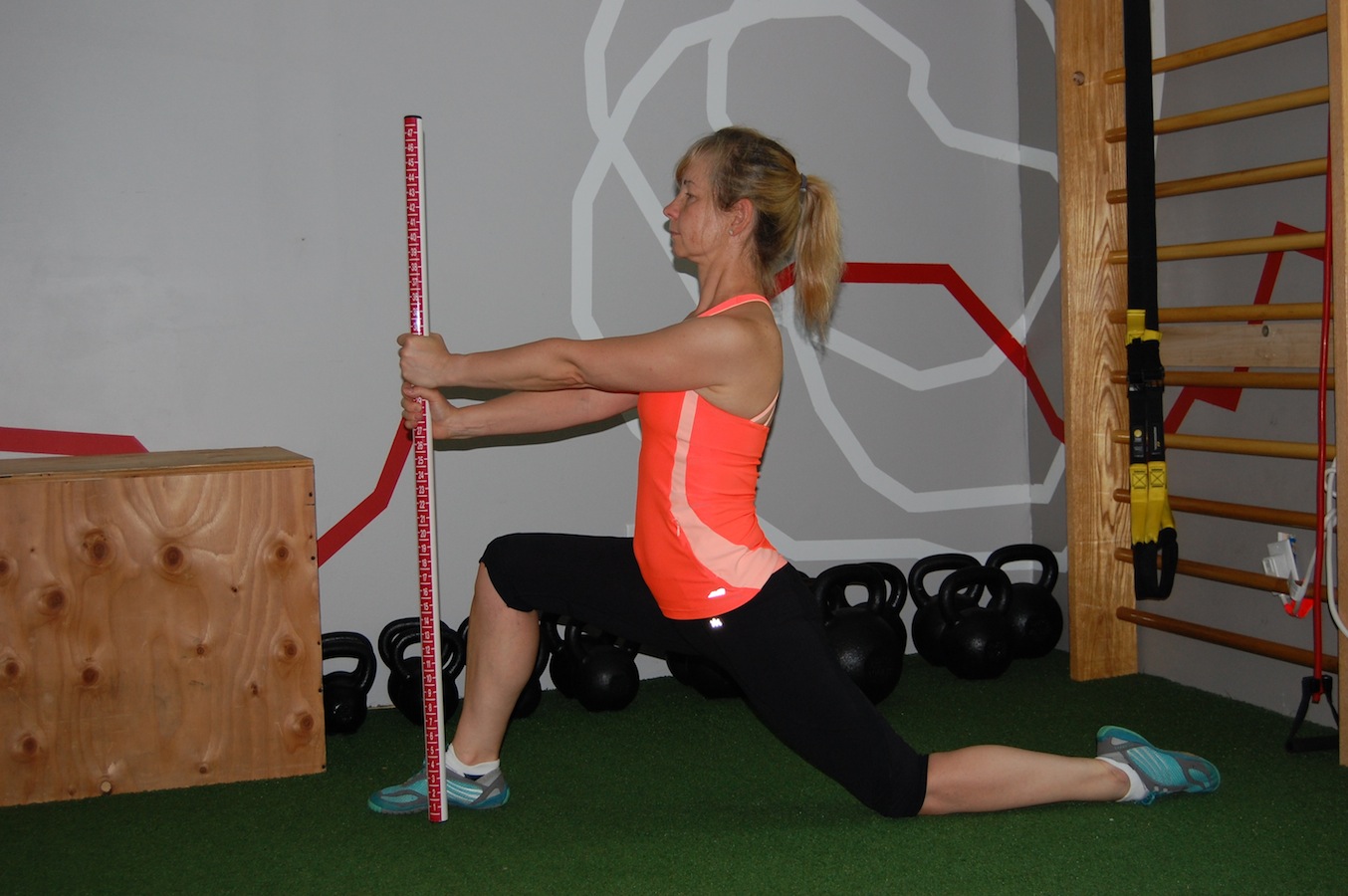
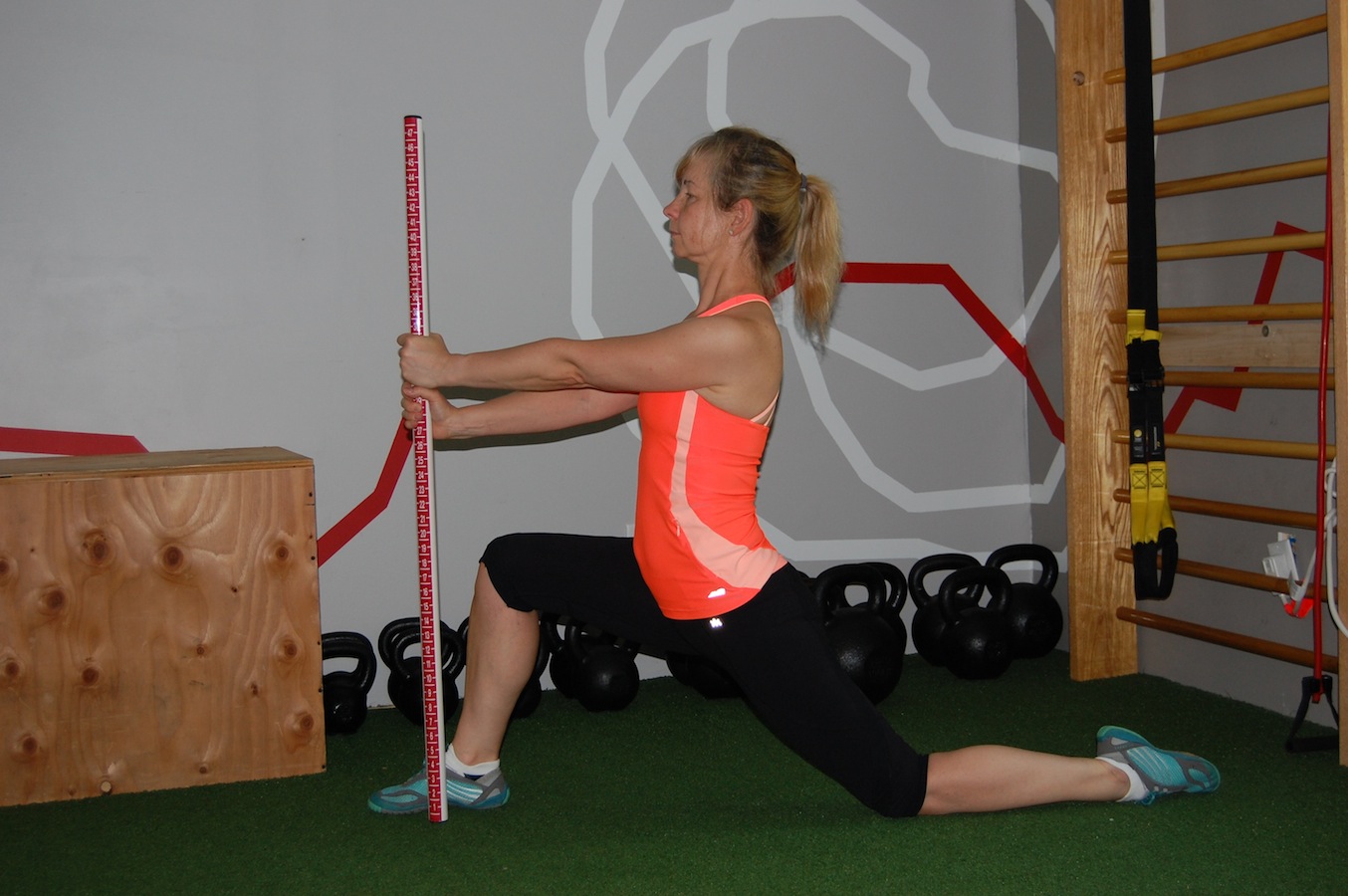
    Figure 4: Hip flexor release
    Figure 4: Hip flexor release
    1. Foam roll back and forth 15-20 times: hamstrings, hip flexors, calves, abductors (outside leg muscles), adductors (inside leg muscles), and glutes. If you did this for other exercises, no need to repeat.
    2. Position yourself as in figure 4. Press hips downward into the ground
    3. When you hit resistance, press the dowel into the ground with straight arms, keeping back straight, exhale. This will release the hip flexor further by engaging the core.
    4.  Repeat 2-3 times. Switch legs, repeat.


    Ankle Mobility

    Ankle mobility is important for correct running mechanics. Without the nominal 30 degrees of ankle dorsiflexion (the range of motion in the ankle when the toes are flexed up), one will tend to “over stride” or “block out” (strike the ground too far ahead of their center of gravity) when running.

    This can lead to a host of problems do to the repeated jarring and deceleration of the bodyweight when running. It can lead to shin splints and knee and hip injuries. Lack of mobility in these muscles can also cause Achilles tightness and over-active muscles involved in stabilizing the body, perhaps even contribute significantly to compartment syndrome, which can be caused by over-active muscle tissue that swells within it’s muscle sheath (like a piece of wet spaghetti swelling in a straw).

    As I explained in my previous article, if mobility cannot happen in the joint and muscles that were meant to handle these forces, it is transferred to adjacent muscles and joints that were not designed to mange these forces, and injury occurs.

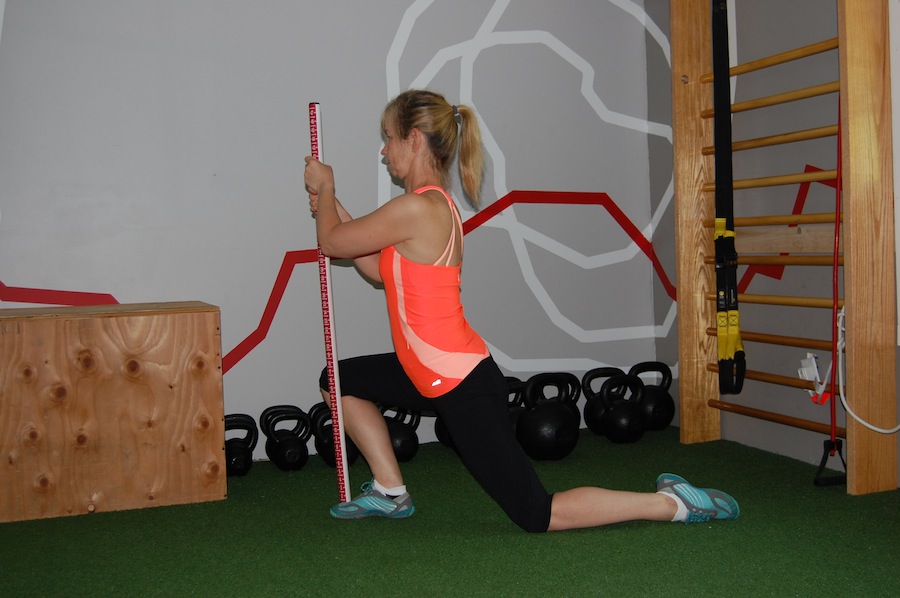
    Figure 5: Ankle release
    Figure 5: Ankle release

    Ankle release:

    Goal: Increase ankle mobility by stretching inter-related muscle groups.

    1. Foam roll back and forth 15 to 20 times: hamstrings, hip flexors and calves. Roll out foot, calf and anterior tibialis (front of shin) muscles. If you did this for other exercises, no need to repeat.
    2. Position yourself as in as in figure 5, dowel on the outside of your little toe, knee on the outside of the dowel, press ankle forward with heel flat. When you hit resistance, press the dowel into the ground with straight arms, keeping back straight, also press opposite knee down into the ground, exhale. Hold for 4-6 seconds.
    3. Repeat 6-8 times. Switch legs, repeat.

    After you have done these, re-test your toe-touch, move around and see how your body feels with the improved flexibility.

    Having good mobility though out your body is important for movement efficiency, not only injury resistance. You may not be getting injured do to some flexibility deficiencies but you may move with less efficiency, and who does not want to be a little (or a lot) faster?

  • Wednesday Workout: The Rest of the Work, Giving 110 Percent

    Wednesday Workout: The Rest of the Work, Giving 110 Percent

    Jay Tapper, who runs stretching programs for a company called ActivEdge, leads a masters group through some floor exercises and core work last fall. (Photo: Bill Pierce)
    Jay Tapper, who runs stretching programs for a company called ActivEdge, leads a masters group through some floor exercises and core work last fall. (Photo: Bill Pierce)

    By Bill Pierce

    Welcome to Wednesday Workout, the newest workout series on FasterSkier. This week, Central Cross Country (CXC) Elite Team coach Bill Pierce talks about going the extra 10 percent by being diligent about flexibility, recovery and agility. 

    ***

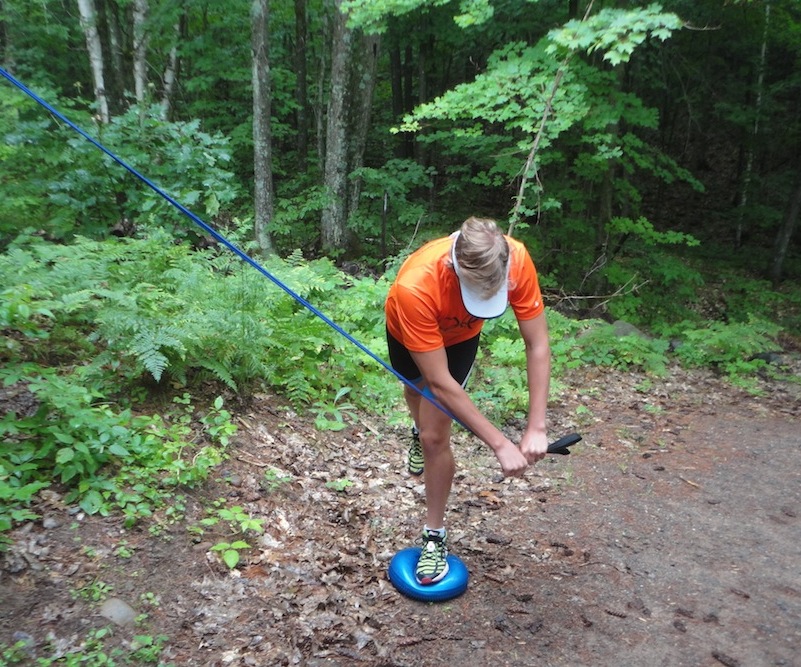
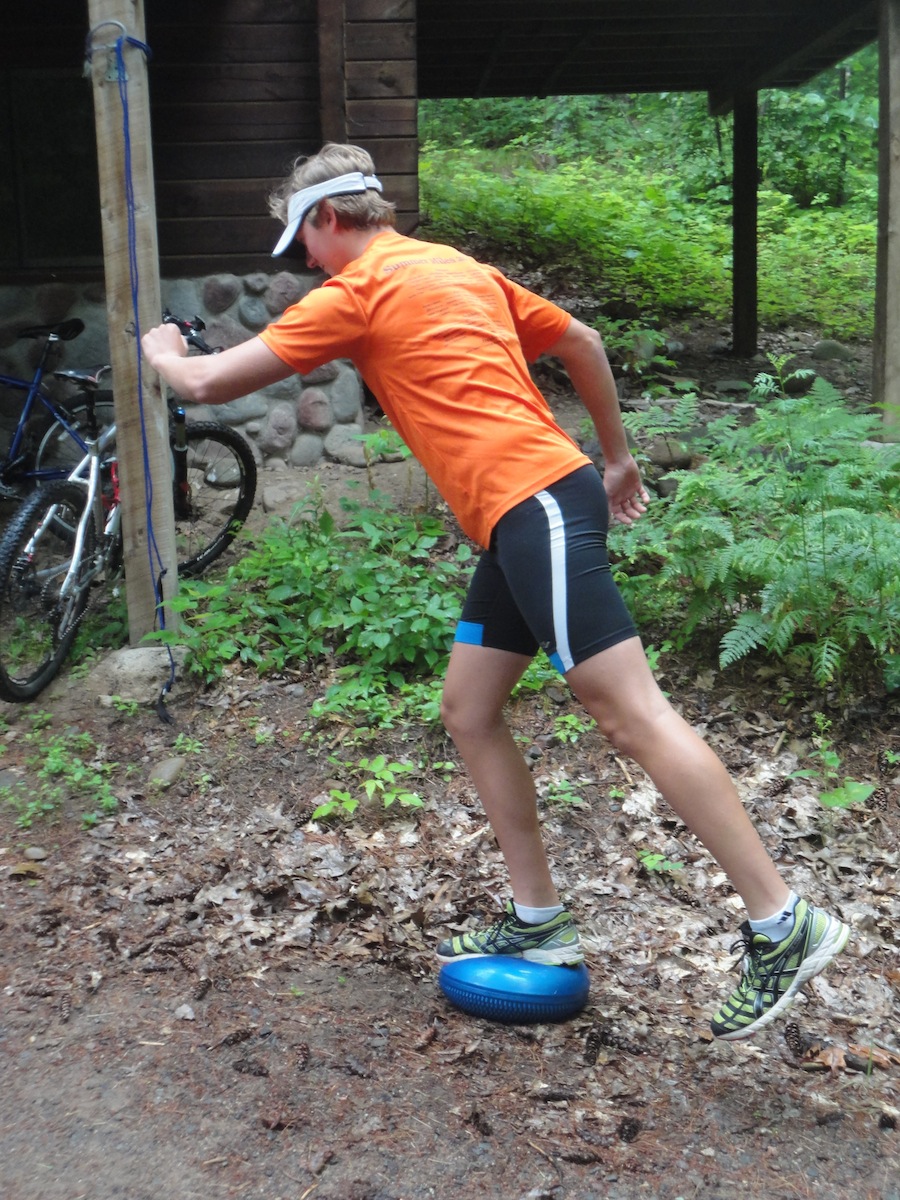
    A cross-over bungee pull: a simple leg and arm pendulum swinging and the other. While standing on the pillow, pull 90 degrees, twisting the shoulders and core but not the hips. This fires the glutes and the IT band for leg alignment and stabilization during the glide phase. Development of the glute is especially important in having a stable and aligned leg during the loading of the glide phase. (Photo: Bill Pierce)
    A cross-over bungee pull: a simple leg and arm pendulum swinging and the other. While standing on the pillow, pull 90 degrees, twisting the shoulders and core but not the hips. This fires the glutes and the IT band for leg alignment and stabilization during the glide phase. Development of the glute is especially important in having a stable and aligned leg during the loading of the glide phase. (Photo: Bill Pierce)

    I can think of quite a few workouts that I could call my favorites but I thought that I would contribute some work ideas that I have been focusing on as a coach with athletes and the team this season. When it comes to the workouts in our resume of experience, we are either working on endurance, intensity, or strength.

    When we add up all the time and ratios of this work it should be 100%. I tell athletes that if we are to be the best, you have to give 110%, all the time.  So, what do I think the other 10% is? Flexibility, physical recovery, and agility.

    At the beginning of the month Mikey Sinnott penned an article on stretching. It was spot on! Best advice was “make it a routine”, like brushing your teeth. We talk about it at clinics, camps, and workout sessions, but we just don’t do it on a consistent daily basis.

    While full-body stretching from extremities to core should be worked on, at the very least skiers should focus on stretching the body zones of power application; shoulders and chest, core, and hips/glutes/quads/hamstrings are the three areas that if ignored will very quickly tighten. Eventually a decrease in performance and an increase injuries will happen.  Bottom line, stretching will enhance your performance and keep you less prone to injury, ask Mikey!

    Shoulders and chest, core, and hips/glutes/quads/hamstrings are the three areas that if ignored will very quickly tighten.

    The second piece of the extra 10% is physical recovery. Foam rolling, stick massage, icing/baths, and sauna are just a few of the options for speeding recovery that athletes should be using. Foam rolling and massage are not options. Every athlete from juniors, collegiate, seniors, and masters should own and travel with a foam roller.

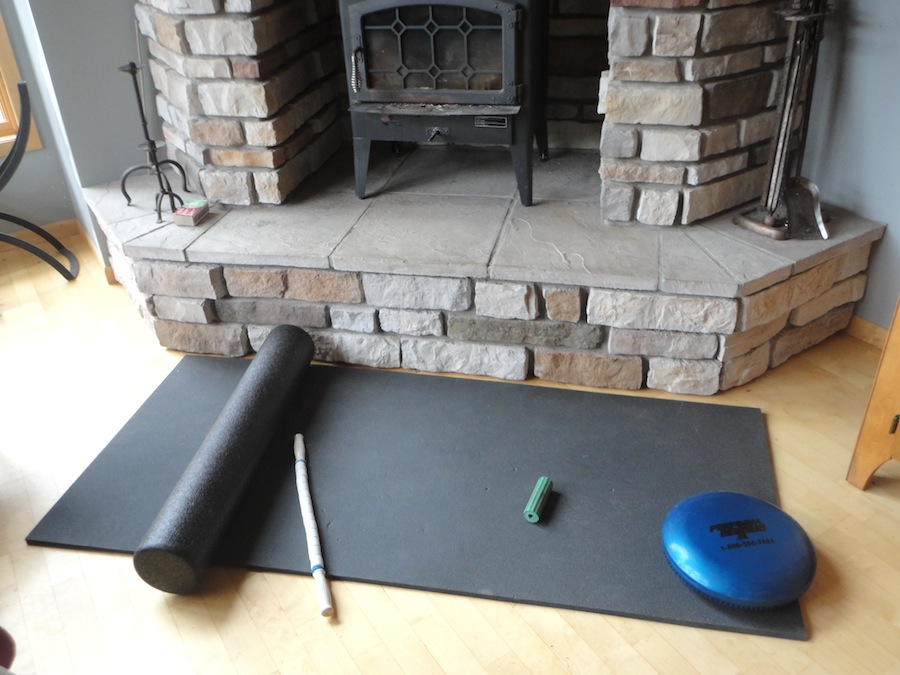
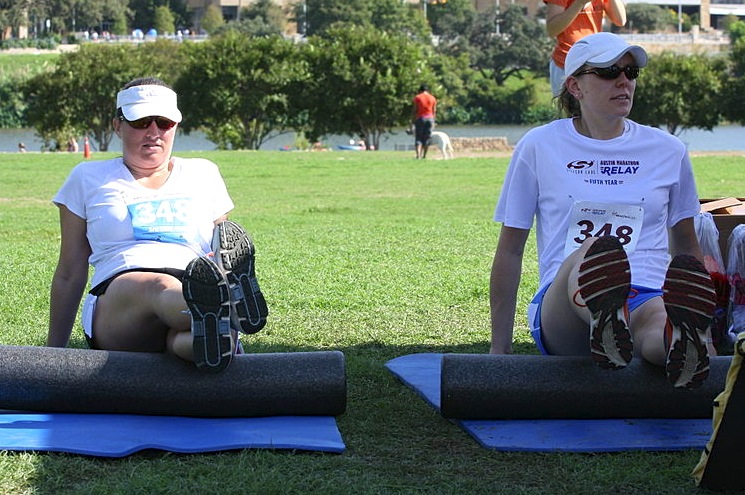
    Tools for success: a mat, foam roller (l), dowel, small ribbed roller (great for the bottom of the foot and helping prevent plantar fasciitis issues) and balance pillow (r). (Photo: Bill Pierce)
    Tools for success: a mat, foam roller (l), dowel, small ribbed roller (great for the bottom of the foot and helping prevent plantar fasciitis issues) and balance pillow (r). (Photo: Bill Pierce)

    While stretching is the first component to a post-workout routine, rolling should be the second. Self-massage or myofascial release (tissue work via gentle pressure or stretching) will help knead out trigger points, further stretch and massage the muscle, and increase circulation to the muscle to speed the recovery process. Again, developing the routine and habit of rolling the specific muscle groups used in a workout will speed your recovery and enhance your performance down the line.

    And the last piece of the extra 10% is agility. Being agile on skis is all about our balance skill. In order to possess that skill, we must train the muscle groups and movement patterns that help us achieve balance.  The more we work at it from the strength room to the trail, the quicker we learn it.

    A balancing exercise on what Bill Pierce calls the balance or air pillow.
    A balancing exercise on what Bill Pierce calls the balance or air pillow.

    One of the tools I have been using the past half dozen years is the balance (air) pillow, or the Bosu.  Athletes start by learning how to first stand and “swing out” on a pillow. Swinging out is nothing more than a pendulum motion of the arms and legs for warm up and movement pattern development. Push ups, squats and toe touches can all be exercises done off of unstable bearing in order to enhance the development of balance.

    Eventually, we incorporate many of their strength exercises onto a pillow so that they can simulate the instability of snow conditions in the power application phase of ski technique. Quiet a few of the exercises that we incorporate or design into a routine help develop the ability to quiet the core and stabilize the leg. While some athletes may have a better understanding of body awareness, it is mostly a learned and trained skill. You still have to do the work.

    So when you find yourself looking for that extra edge and advantage when you step to the line this winter, ask yourself, “Are you giving 110% everyday?” It’s never too late to start!

    Related: Foam Rolling – How To Start and Finish That Workout Right

  • Foam Rolling: How To Start and Finish That Workout Right

    Foam Rolling: How To Start and Finish That Workout Right

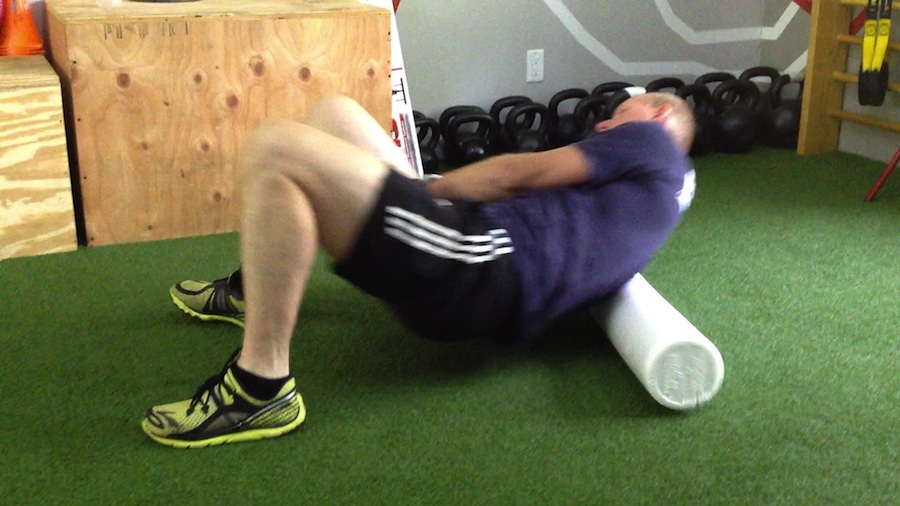
    Author Stuart Kremzner demonstrates one way to use a foam roller to work out the kinks along the spine and back.
    Author Stuart Kremzner demonstrates one way to use a foam roller to work out the kinks along the spine and back.

    Editor’s Note: Wednesday Workout fans, you’re in luck! The following article complements Bill Pierce’s recommendations for stretching, agility and self-massage. Not exactly sure how to use a foam roller? Stuart Kremzner, exercise physiologist, owner of E3 Sports Performance, nordic skier and coach, explains.  

    ***

    Many of us have been to training centers and weight rooms and seen the foam rollers in the corners. Maybe even seen someone using it moving around on it and usually grimacing, puffing, and cursing it.  Foam rollers are a tool to be used in preparation for exercise to limber us up. You will find after foam rolling, you will usually have an increased range of motion, and your muscles will feel suppler.

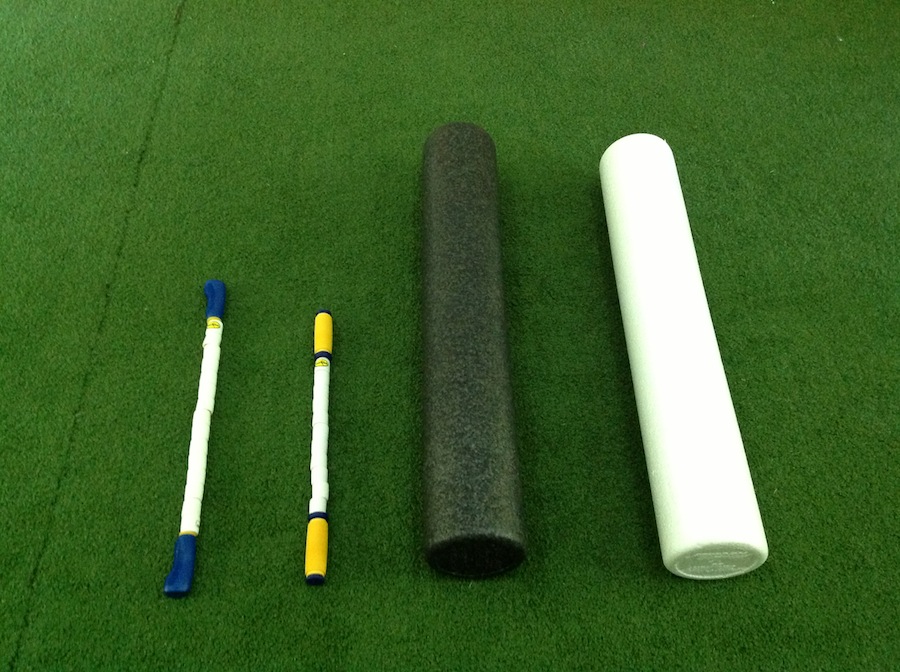
    Stick rollers (l) and foam rollers.
    Stick rollers (l) and foam rollers.

    The purpose of foam rolling is to achieve the same outcomes as from tissue massage or other physical therapy techniques such as manual therapy or active release therapy (or the more scientific term myofascial release), just without the masseuse or therapist working on you.

    The goal is to loosen up those tight muscles and trigger points (“small areas of muscle that act differently … this increases tension throughout the entire muscle and can cause pain in another area of the body,” according to physical therapist and author Gray Cook).

    We all know what tight muscles feel like. Rolling can release these areas of tightness just like massage will, and can give you some short-term improvements in muscle range of motion. Rolling out can also help with recovery after a workout. Like many of the warm-up and warm-down tools you need to try it to see if it works well for you and if you feel better in your workouts when utilized. Like with most training methods you will have responders and non-responders. My experience has been most athletes benefit from this as part of their warm-up and warm-down routine.

    Foam rolling can help ease sore muscles after a race and aid in recovery after a workout. (Photo: Wiki Commons)
    Foam rolling can help ease sore muscles after a race and aid in recovery after a workout. (Photo: Wiki Commons)

    How to use it?

    Rolling out is best done as the first and last step in a workout. For general loosening up roll over one muscle group back and forth 10-15 times. If you find a knot or trigger point roll over that area in shorter, lighter strokes until it releases or feels less tender.

    Stick vs. Foam Rollers:

    • Sticks: smaller muscle groups (i.e. back, arms, front of shin)
    • Foam: larger muscle groups (i.e. lower body, legs, back).Start with basic low- to mid-density foam roller before trying a harder or textured one.

    There are a variety of rolling devices. Fifteen years ago there were about two – now any fitness catalog will present a mind-numbing variety; it is like trying to buy shampoo in Wal-Mart!

    The primary two are the stick rollers and foam rollers. Sticks are best for work on harder to get areas, and smaller muscle groups (back, arms, front of the shin).  The foam roller pretty much does the same thing but you move your body over it versus rolling the stick over your muscles. Since a foam roller is wider it can hit a bigger area.

    I find sticks are best when you have less time to roll out and are also more portable, so you can pack it for a race so you are not trying to roll out in an icy or sandy parking lot.  That said, the foam roller will feel great for those larger muscle groups, primarily in the lower body and back (where you can’t reach with a stick by yourself). After a while you will find both come in handy.

    Rollers also come in various densities and textures, start simple with a basic low- to mid-density foam roller and then once you get used to it try a harder or textured roller.

    It’s a great way to start and finish your workouts as part of your warm-up and warm-down routine.

  • Wednesday Workout: The Art of Tapering

    Wednesday Workout: The Art of Tapering

    One of Zach Caldwell's athletes, Kris Freeman (l) leads Maine Winter Sports Center teammate Welly Ramsey during a recent century-ride workout in Maine. With the Olympics in February, Freeman won't be tapering for a while, but Caldwell stressed the importance of rest days. (Photo: Will Sweetser)
    One of Zach Caldwell’s athletes, Kris Freeman (l) leads Maine Winter Sports Center teammate Welly Ramsey during a recent century-ride workout in Maine. With the Olympics in February, Freeman won’t be tapering for a while, but Caldwell stressed the importance of rest days. (Photo: Will Sweetser)

    Months of training have culminated to this. You’ve worked hard, darn it, and now you’re ready for a little R & R, that taper period (reduced training load) before your big race.

    Many people rely on the conventional wisdom that a week of taking it easy with light workouts and a rest day or two the week before should get you into fighting shape when that weekend event rolls around. But is it really that simple? Not really, otherwise, we’d be PR-ing all over the place.

    So what’s the secret? Because we’re all individuals, with individualized training methods and different bodies capable of different workloads, we’ve got to take the time to listen to ourselves – rather than follow some clipping out of a magazine.

    That said, athletes training for an endurance event (i.e. the Lake Placid Ironman on Sunday, or the Birkie next February) should take a close look at what they’re doing the week before. No need to continue those multiple-hour efforts; make time to kick back, watch your nutrition, and get plenty of rest.

    Worried about losing it all or even a little before the big day? When it comes to speed and strength, if you’ve been building those up for a while, it’s not going to disappear overnight.

    “The two big advantages of a fitness component that takes a long time to build are that it takes a long time to lose, and that it is easy to maintain with a reduced workload,” according to Alan Woodward’s article on triathlete.com, How to Taper for an Ironman. “It is for these reasons that sprinters can reduce their training a long way out from a race without seeing a decline in performance. In fact they experienced increased performance as their muscles achieve a highly anabolic and recovered state during the taper.”

    But what about endurance athletes – those people doing distance triathlons, running ultras or skiing marathons? Woodward said the ability to sustain energy or race intensity over a longer period of time actually comes faster in training, and therefore can be lost quicker. He recommends a week taper for these athletes rather than three easy weeks.

    “We know from experience that we start to see a decline in endurance ability within seven to 10 days,” he wrote. “The endurance part of training must be maintained until seven to 10 days out from race day.

    “In the last few weeks before a race you need to structure your training to maximize endurance and maintain strength and speed gains,” he added. “You don’t need to hammer out long sessions every day to develop peak endurance; a weekly long ride and long run are enough, nor do you need to perform a large amount of speed and strength training to maintain the speed and strength you developed earlier in the training cycle.”

    Easy enough. But it’s not foolproof. Zach Caldwell, personal ski coach and owner/operator of Caldwell Sport in Putney, Vt., wrote in an email that it’s difficult to prescribe a one-size-fits-all taper method because of all the variables involved, but one of the biggest issues for non-professional racers is finding time to chill out.

    “It’s one thing for [U.S. Ski Team member] Noah [Hoffman] to add an hour and half nap every day, or taper back the training. But anybody with a real job, or even school, has a much bigger task balancing life-energy demands with training and racing energy demands,” Caldwell wrote. “Finding balance for training usually isn’t that hard, but making enough room for a peaking effort can be REALLY difficult.”

    Caldwell wrote the following on peaking and the process of finding that maximal energy state (and thus performance) on race day:

    “Great performances in ski racing are generally characterized by really high energy. Energy states can vary a great deal week to week and even day to day. A 95-percent energy performance from a 90-percent fit athlete will beat an 80-percent energy performance from a 99-percent fit athlete. On the day of the race I’ll pick peak energy over peak fitness every time.

    The problem is that a “high-energy” state is really hard to define in any kind of physiological terms. As soon as we acknowledge energy state as an important consideration, and organize training and tapering efforts around bringing peak energy to a race day, we’re pretty much off the reservation when it comes to working with traditional concepts in physiology.

    An outline of the steps we take to prepare for high-energy performances looks something like this:

    1. Practice – Organize training so that you practice recovery frequently. To manage energy during a racing season with frequent races, training and travel, you need to be able to take advantage of brief recovery periods. You don’t want to get into a situation where you need a week of rest in order to be fast. So, in training, we generally plan to assess recovery at least once or twice a week by building easy days into the schedule.

    2. Understanding – It’s important for a racer to know how long it will take to recover from hard training. That will depend a lot on the overall load and energy state. In general, hard training will make you weaker for a little while, and then you’ll recover, compensate, and be stronger. How long will it take you to realize the benefit of hard training? If you do a set of intervals, when do you expect to be faster because of those intervals? During the training season, a lot of the hard work that gets done can be “hay in the barn” – you don’t need to get an immediate benefit. But during the race season you want to structure your efforts so that you realize the benefit quickly.

    3. Train-Up – We seldom see great race efforts when the racer is trying to rest into racing shape. The best results come when a light intensity session soon before a race actually provides a performance boost. Kris Freeman’s best races have come when he’s been well rested coming into a race, and then done about a 15-minute threshold “activation” session the day before the race. Often he’ll simply take a lap of a 5 k race course. If he’s got good enough energy to benefit from that session within 24 hours, then he’ll make a pretty good race. If he needs recovery instead, then we’ve got no reason for optimism. Great race performances come when you’re in a good place to “train-up” to a peak effort.

    4. Manage – Ensuring peak energy means managing recovery and expenditure. Obviously you need to take some rest – reduce the training load. But it’s also important to remember that the energy you use for racing is the same as the energy you use for everything else. At World Championships in Val di Fiemme, Noah Hoffman had a sub-par and very disappointing performance in his first race – the 30 k skiathlon. After that opening 30 k, he focused on the details of energy management – he took an hour and a half nap every day, he turned his computer off by nine p.m. every night, and he made sure he was in bed with the lights out by 10 p.m. Four days after the 30 k, he was 15th in the 15 k skate – certainly one of his most impressive races to date.”

    — Zach Caldwell | CaldwellSport.com

    For more on tapering and how it affects the body, check out Margaret Waechter’s article in the Master Skier.

  • Wednesday Workout: Sustained Level 3 Efforts with The Man, The Myth, Eric Strabel

    Wednesday Workout: Sustained Level 3 Efforts with The Man, The Myth, Eric Strabel

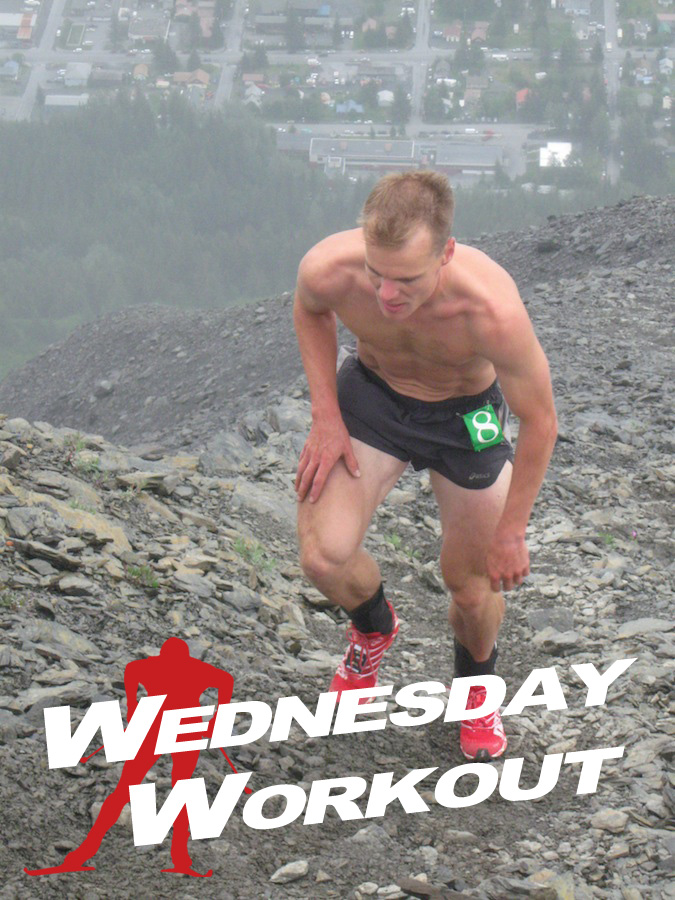
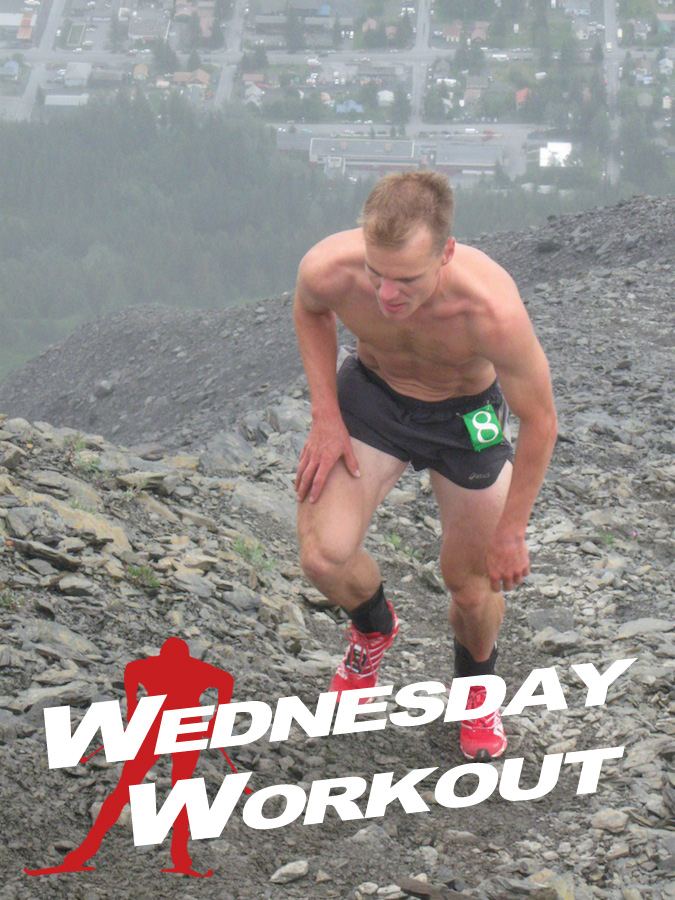
    Eric Strabel keeping it under control while pushing his limits in the 2013 Mount Marathon Race on July 4 in Seward, Alaska. An APU nordic coach, Strabel set a course record for the first time in 32 years. (Photo: Dave Blanchet)
    Eric Strabel keeping it under control while pushing his limits in the 2013 Mount Marathon Race on July 4 in Seward, Alaska. An APU nordic coach, Strabel set a course record for the first time in 32 years. (Photo: Dave Blanchet)

    Editor’s Note: On July 4, Alaska Pacific University (APU) coach Eric Strabel shocked Alaska in officially clocking the fastest time up and down the 3,022-foot Mount Marathon. He finished 26 seconds faster than Olympic nordic skier Bill Spencer, who set the previous best 32 years ago. Strabel’s course record was no fluke; the 31-year-old APU university-team coach and elite-team assistant has been working at this for the last 12 months. His secret? Sustained hour-long Level 3 efforts. How does this relate to skiing? He thinks it’s how World Cup races are won.

    “There are many promising young skiers talented with enough speed and power to be competitive at sprinting, but if they train assertively for longer efforts, they can eventually become the best in the world in distance races.” — Eric Strabel, in an email to FasterSkier

    ***

    This is the approach that I used to design the workout that I used often months before I wanted to be at my best racing-fitness level.

    The most important consideration, and criteria for designing this workout (and any workout), was that it had to suit a particular need, much like a mechanic has specialized tools to fit a certain job. The need was to correct a significant weakness, which was that my muscular strength would breakdown too soon at race pace.

    In previous years’ races, I’d hit a certain point mid-ascent and my muscles would be broken down so much that I couldn’t drive my aerobic capacity at the same rate. My breathing would slow down and my heart rate would come down, but I certainly could not continue at the same speed. Sometimes I could dig down and reach into more fast-twitch fibers towards the very end of races and finish strong, but I had lost far too much over the middle portion for any closing speed to overcome.

    Strabel’s 2013 Races
    (part of the Alaska Mountain Runners Grand Prix):

    • 1st: Kal’s Knoya Ridge Run (5.6 k, 2900-ft elevation gain), May 23
    • 2nd: Government Peak Climb (2.75 miles, 3500′ vertical), June 1
    • 2nd: Robert Spurr Memorial Hill Climb (3 miles, 3300′ vertical), June 12
    • 1st: Mount Marathon Race (3 miles, 3,022′ vertical), July 4
    • Next up: Matanuska Peak Challenge (14 miles, 9100′ vertical) Aug. 3

    You can call it endurance strength, muscle durability, slow-twitch fiber resistance to fatigue, or whatever, I knew it was a muscular endurance limitation and I just had to get it to not breakdown so quickly.

    This is similar to cross country ski racing, and especially on FIS homologated courses with lots of sustained climbing. The ability to be strong and powerful for dozens of minutes — and not breakdown muscularly — is extremely important. It would not matter how high of a VO2max an athlete has if the muscles cannot continue to develop high tension for the entire length of the race.

    So now that I knew what the limiting factor was, I had to design a challenge to target that specific weakness, get the most bang for the buck, and not compromise other things too much. The activity and technique was easy: as similar to the race as possible — Steep.

    If I had a mountain ascent long enough with good footing conditions, I would use that but more often, I used a Nordic Track X7i Incline Trainer (just a steep treadmill) that went up to 40% grade. The intensity was not as obvious though. It had to be fast enough to move similarly to race type movements but easy enough that the work could be performed very aerobically so that I could push the muscles beyond the right endurance limit. So I settled on a range that is similar to what we skiers call Level 3, or between marathon and 15k race pace, or roughly 80-88% of max heart rate.

    For the format of the workout, I could not think of a good enough reason to use intervals. I thought, if I’m working under that theoretical level called ‘threshold’, why should I need to pause the work to come back down, and especially if I wouldn’t be able to rest during the competition? Note: you could make a good argument to use short rest intervals to accomplish the same goal. And I would not worry if it takes 10 minutes to roller ski back down to the bottom of a 15 minute climb. And really, it does not need to be up a climb at all — simply over the terrain that you are wishing to improve on.

    With those considerations, the workout that I found to challenge my body in the right way was as follows:

    The workout: Sustained Level 3 efforts

    • Warm up: To make a low L3 effort semi-comfortable, I found 20-30 minutes of warming up, progressing from very easy L1 up to L2, to be adequate.
    • First 5-10 minutes: The beginning of the L3 effort is a conservative pace to allow a progressive effort.
    • After 10-20 minutes, an assessment can be made from body’s feedback of what pace it can be ‘talked into’ being comfortable. This requires knowing your body well. One question that I could ask myself was, “how fast can you go easily?” I used a heart rate monitor and I became familiar enough with it to know that if I was in the low 80’s % of max heart rate at 10-15 minutes in, I could hold the same pace for about an hour without going over about 88% of max heart rate. I found that if I pushed close to or above 90%, it wasn’t long before I would need to stop.
    • Judge a good finishing point.  For me, it was about 60 minutes after starting the conservative L3 pace. I judged this to be a good point because that was just about 5-10 minutes longer than my comfort zone allowed, which was challenging but still ‘kept me wanting’ and so I’d come back and do it again 3-4 days later.

    I could feel the benefits of this type of workout almost immediately. Most notably, the point in time that it became challenging to maintain the pace was delayed, and if I didn’t account for this by using a very slightly better pace by halfway, I’d get over an hour before reaching that point. And it was after about 10 of these workouts (~5 weeks) that I noticed that my pace for this 60 minute effort was right about what I had used for L4 intervals the previous year. So it was obvious that I was delaying that point of breaking down at the old race pace if I could breeze through it for an hour.

    And when it came time to focus on higher intensities in the last couple of months before important races, I was pleasantly surprised that I had built a huge reserve to train at race intensity. I could perform more hard 6 minute L4 intervals than previously and I could perform the next L4 interval workout sooner. My body was strong enough that I could get a lot more out of the aerobic capacity training for cross-country skin. The sustained hour-long Level 3 efforts certainly was the right tool for the job.

  • Freedom of Movement: Insights Into Improved Mobility, Motor Efficiency and Faster Skiing

    Freedom of Movement: Insights Into Improved Mobility, Motor Efficiency and Faster Skiing

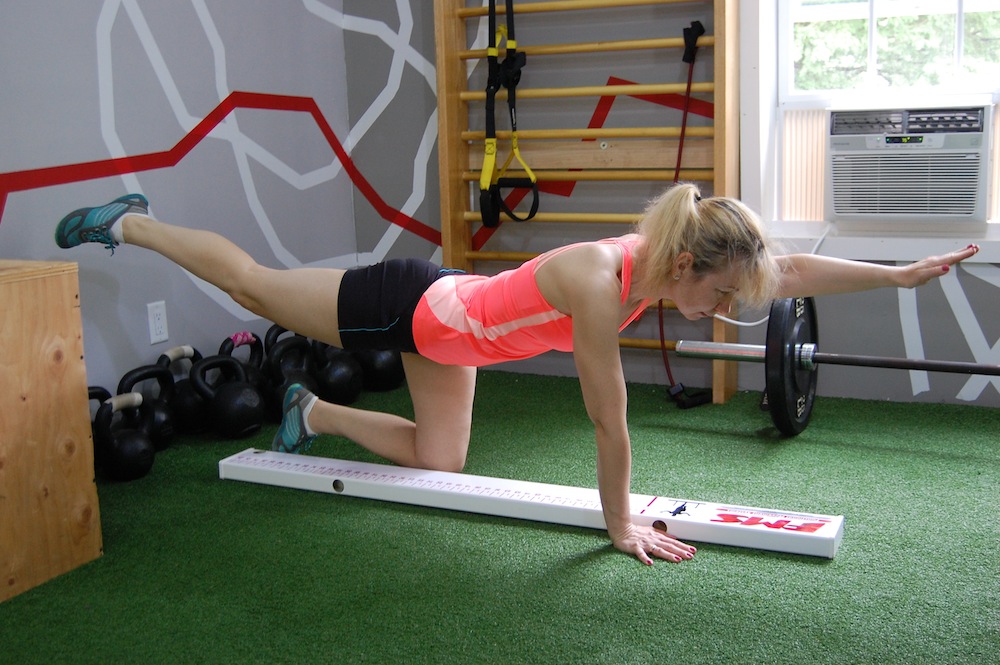
    Functional Movement Screens, an example of which is shown, can help skiers evaluate mobility, stability and optimal muscle function. Above, rotary stability examines core stabilization.
    Functional Movement Screens, an example of which is shown, can help evaluate an athlete’s mobility, stability and optimal muscle function. Above, rotary stability shows one’s ability to stabilize their core.

    This is the time of year nordic skiers are excited to really ramp up the hours and build that summer base. It’s also the time that in our excitement to do so, we get some kind of injury or aches and pains that slow this process down.

    Years ago for me, it was an IT band, then shoulder, then Achilles. Many look at this as part of the process of being an athlete, each of the injuries due to too much too soon, just random pains and strains, right? Wrong!

    In the seemingly randomness there is a pattern, it is just not apparent unless one understands the body’s movement patterns and what drives injury risk through muscle and mobility imbalances. Just because one is not injured does not mean an imbalance will not catch up to them at some point, be it with increased training volume, intensity or a different movement pattern, such as a change in technique or activity (switching form biking to running).

    For many of us addressing imbalances will lead to improved movement efficiency, which will directly impact race times. Once the dysfunction is determined the imbalance can be fixed with an individualized strength, and mobility program. Hence these injuries are very preventable.

    The muscles and joints getting injured are the ones that are usually working the hardest and pulling the weight of neighbors not doing their job. It’s kind of like that group science project where one or two members do the majority of the work and the others coast along. After a while, the one working hard either gets irritated or burnt out.

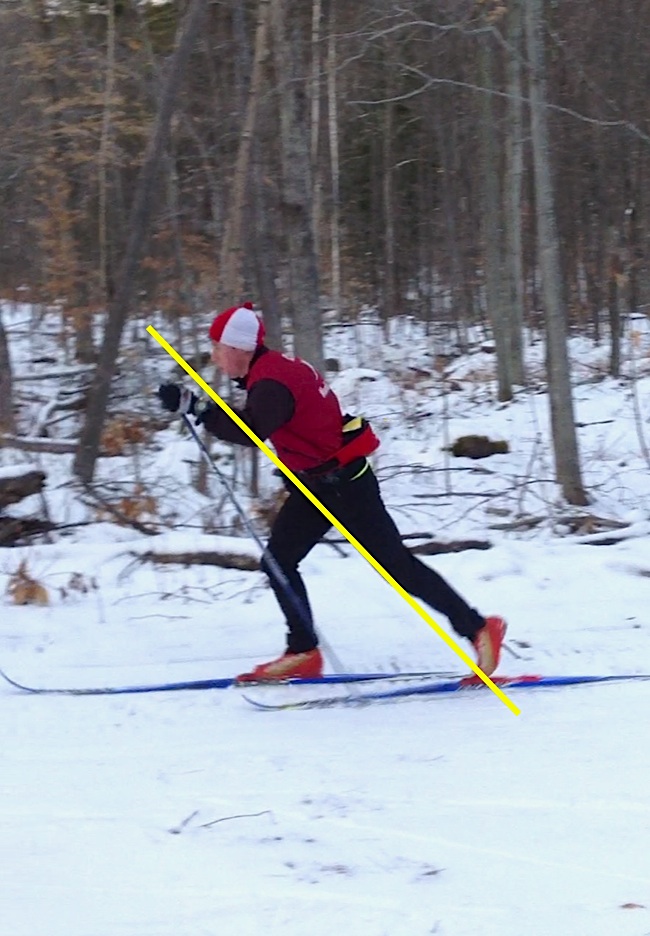
    Body lean is a combination of leaning from the ankle (ideally with the hips forward) so gravity is helping propel your body forward.  For runners and skiers if they maintain a 3- to 5-degree body lean, it allows them to apply more power (whether with kick or pushing off for running or skating) for each stride.  For example among elite female runners body lean is one of the most important factors in their running stride efficiency. Only 5-10% of  female runners have it.
    Body lean is a combination of leaning from the ankle (ideally with the hips forward) so gravity is helping propel your body forward. For runners and skiers, if they maintain a 3- to 5-degree body lean, it allows them to apply more power with each stride (whether kicking or pushing off while running or skating). For example, body lean is one of the most important factors in the running stride efficiency of elite female runners. Only 5 to 10 percent of female runners have it, according to Kremzner.

    Now imagine this happening for the full semester. That is what happens to your body. A good example is low-back pain when you do your first long classic ski. Those muscles are working extra hard to keep your pelvis balanced and in position; that is also your abdominals’ job. If they are just along for the ride, guess what happens? Add tight hamstrings or hip flexors and it just accelerates the process.

    For years we did stretches, back extensions and sit-ups and usually it didn’t fix much. Why? It never really addressed the root problem of mobility and stability imbalances.

    The body’s musculoskeletal system (kinetic chain) mobility and stability are an interdependent foundation of all other aspects of fitness; one balances the other like a seesaw. When not fully developed (and this is the case in many elite athletes), we see injuries, technique deficits and minimal gains from higher-level fitness elements like strength, power, and speed. Physical therapist and author Gray Cook talks of mobility as the freedom of movement of multiple muscles and joints, then stability as “the ability to control force.”

    As a coach, I’d be frustrated when given skier couldn’t grasp a certain aspect of technique, be it body lean angle (see accompanying photo) in skiing or lifting the knees when sprinting. But the athlete’s body won’t let them move that way due to mobility, stability or asymmetrical deficits.

    For example, a restriction in ankle mobility will limit the amount of lean angle in running and skiing. Tight hip flexors/hamstrings or a weak core will limit the amount of pelvic rotation one can have or maintain (i.e. the butt pushing back).

    Many of us have also coached athletes who are strong, but after many hours of work they did not develop to expectation. This, too, is a symptom of a mobility/stability deficit, as any higher-level development will not be optimized with an unstable foundation.

    A simple system exists to evaluate and address this: the Functional Movement Screen. Many of us have heard of Cook’s book Athletic Body in Balance, a hidden gem in its implications for developing athletes by addressing these kinetic-chain imbalances. Once we diagnose and fix kinetic-chain deficits, like core instability, where an athlete has difficulty balancing on one leg, or stabilizing upper and lower body, we can progress athletes much faster.

    From the time we are born, our body’s musculoskeletal and nervous systems start compensating and adapting to environmental stresses, such as repetitive movement, bad posture from sitting at a computer for hours a day, or injuring an ankle so we lose ankle mobility. The body mostly adapts in a positive manner, however as we mature our bodies are exposed to a host of repetitive stresses (and sometimes traumas) that can cumulatively cause restrictions/imbalances in our body’s movement, stability, and strength. This will cause inefficiencies in movement and power application.

    With movement restrictions, no matter how hard we try, we cannot achieve an efficient body position. This compensated body position will not allow us to ski efficiently. This can be very frustrating to beginning and advanced skiers alike, and very perplexing to a coach. Why can’t this skier push his or her hips forward to get in a good body position? Why are they hunched or struggling with balance?

    Coaches have skiers stretch, strengthen and do planks for minutes on end, yet problems persist. In order to more effectively address this, we need to think about, evaluate and train the musculoskeletal system as an interrelated system.

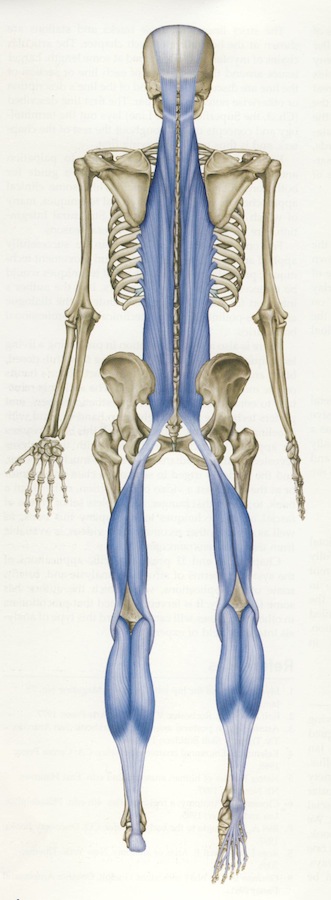
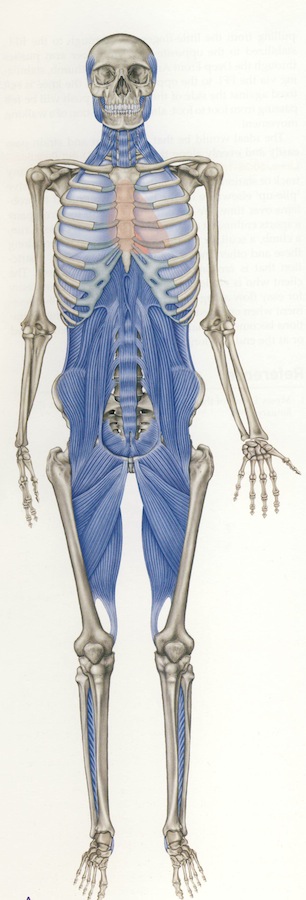
    In the following model, refined by Cook and Thomas Myers, the muscles are thought of as a series of myofascial slings (a network of muscles) that extend the full length of the body. Hence what aches you have in your back can be driven by tightness in your foot or shoulder, as they are connected through the same muscular networks, or myofascial slings.

    Superficial back line (Credit: Thomas W. Meyers/Anatomy Trains)
    Superficial back line (Credit: Thomas W. Myers/Anatomy Trains)
    Deep front line (Credit: Thomas W. Meyers/Anatomy Trains)
    Deep front line (Credit: Thomas W. Myers/Anatomy Trains)

    Your skeletal system works in tandem with this system. Its stacked joints alternate their roles between stability and mobility.

    Michael Boyle explains this in depth in his article “The Joint-by-Joint Approach to Training.” The ankle is a mobile joint, knee a stable joint, hip is mobile, lumbar (lower) spine is stable, and Thoracic (middle) spine is mobile.

    What usually happens if you lose ankle mobility due to multiple injuries or tight muscles? Movement has to happen somewhere so it gets transferred to an adjacent joint, usually the knee, which is meant to be a stable joint. The knee isn’t designed to be mobile so it gets sore or even much worse, injured (such as tearing an ACL, IT band, etc.).

    Trying to fix a single problem, for example hip tightness or knee pain, will not be as effective as addressing the whole system. One muscle group does not work in isolation, nor should we train it in such a manner. In order to achieve proper body position when skiing, we first need to address movement restrictions to allow it to move freely and efficiently. Cook has taken this concept to a user-friendly level and developed a system of evaluation and corrective exercises.

    For example, think about how many hours per day students and adults are seated. This seemingly benign activity will cause a variety of mobility and altered muscle firing pattern dysfunctions, such as tightened hip flexors and altered glute/hamstring functioning (glute amnesia).

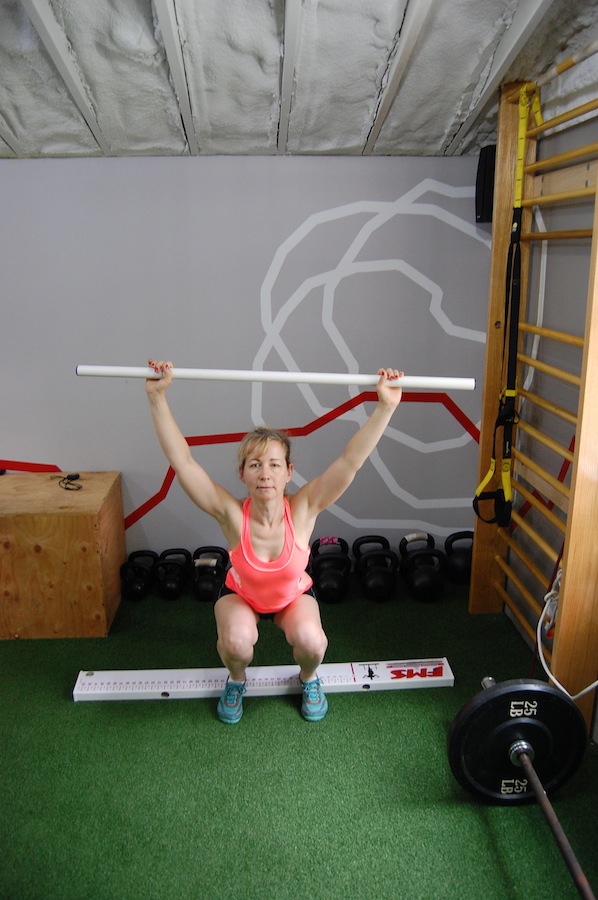
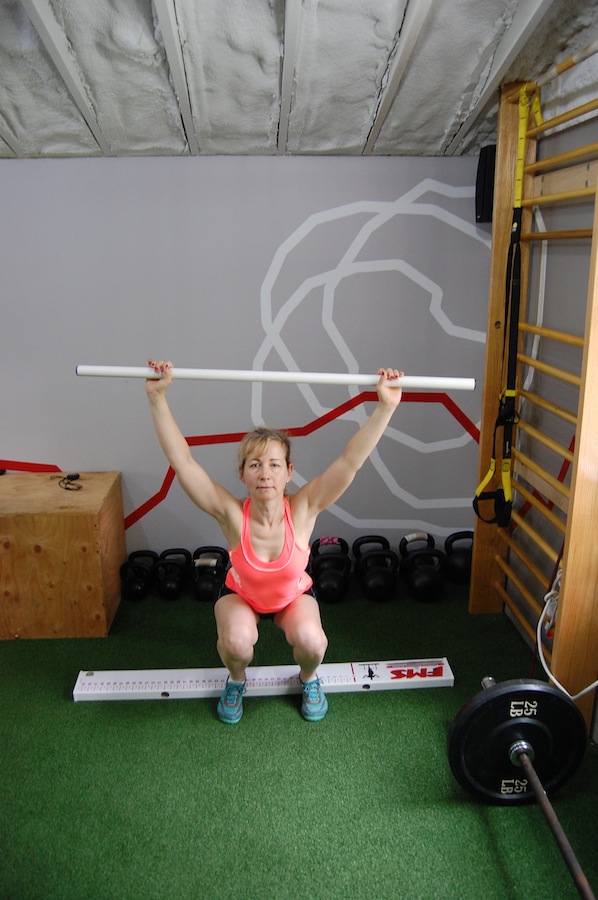
    One of the seven FMS screens, the overhead squat evaluates total body mobility and stability patterns.
    One of the seven FMS screens, the overhead squat evaluates total body mobility and stability patterns.

    How does this affect a skier? From running studies we know that for each degree of anterior hip rotation we gain 2 ½ centimeters of stride length. It is common with tight hip flexors to have a 5- to 10-degree deficit; think about the impact an improvement of this could have on one’s overall race pace.

    In addition, if the glutes are turned off, the hamstrings are putting energy doing their neighbor’s job (and producing less power for locomotion), plus the knee is less stable and someone is going to be unhappy (i.e. knee or back pain, hamstring pulls).

    As skiers, we strive for movement efficiency and optimal power production. To achieve this we need to evaluate skier’s mobility, stability and optimal muscle function. This is best achieved through an advanced Functional Movement Screen (FMS) or a very well done kinetic-chain physical therapy evaluation.

    The basic FMS is excellent for picking up on major deficiencies, but well trained athletes have learned how to “cheat” very well. They need additional sub-tests to determine deficiencies, but this process has gained much-needed recognition and is used with many elite sports teams. The best option is to find a sports trainer or physical therapist who has a FMSII certification.

    The athlete’s early season is an ideal time to have an evaluation done, this way corrective exercises can be applied in the preparatory phase of training and full movement restored prior to big summer volume phases.

    So get all those muscles working together for better performance. Your body will thank you for it in the first races in the fall and winter!

  • Wednesday Workout: Functional Strength with the Cambridge Sports Union

    Wednesday Workout: Functional Strength with the Cambridge Sports Union

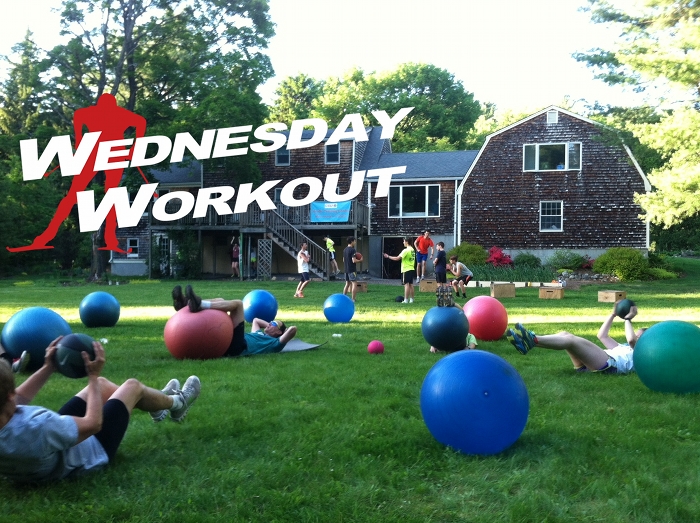
    For CSU's functional strength workout, all you need is an exercise ball, a medicine ball and stopwatch. (Courtesy photo.)
    For CSU’s functional strength workout, you need an exercise ball, a medicine ball, a bench, a pull-up bar and a stopwatch. (Courtesy photo.)

    Skiing is an upper-body sport. It doesn’t pay just to have a strong engine; if you want to win sprint finishes you’d better have a strong double-pole, too.

    As Cambridge Sports Union head coach Rob Bradlee puts it, “it’s not running on skis. When I was a lad, if you were a good runner you could jump on the skis and run with wooden skis and bamboo poles. You didn’t get much out of your arms then, but not anymore.”

    To properly build complete body strength in his athletes, Bradlee develops both their specific strength and something he calls functional strength. The workload he recommends for each age group varies (Olympic lifting is for more mature athletes only) but the principles are the same: strong skiers are fast skiers.

    He can back his program up with results, too: at this year’s Junior Nationals in Fairbanks, Alaska, CSU ranked fourth amongst junior clubs throughout the country and he had multiple individual top-10s across age groups.

    The key to those results, Bradlee says, was strength.

    Which brings us to today’s Wednesday Workout, one of the two “functional strength,” workouts his athletes do twice a week in the summer and fall. On Monday and Friday nights, Bradlee’s athletes do circuits of full-body exercises mostly with body weight — “pull-ups, push-ups, squats, step-ups, those types of things,” he says.

    There was a popular article in the New York Times recently called “The Scientific 7-Minute Workout,” which Bradlee says is a good, simple starting point for building all-around strength.

    “[It] was wonderful,” he said. “It’s a pretty good description of what you can do.”

    To complement the twice-a-week functional strength workouts during the summer, Bradlee also has his athletes do specific strength on their own time once or twice a week — namely, double-poling on an erg or on rollerskis with added resistance.

    “Skiing is a whole-body movement requiring dynamic balance with decisive, explosive application of power from arms, legs, and core in a completely coordinated fashion,” he writes in the workout instructions. “To ski fast the athlete must gain strength performing the exact motions of skiing in a manner as close to actual skiing condition as possible.”

    Specific strength is a topic for another day, however. For now, here one of CSU’s functional strength workouts. It may look like a long list, but you only have to do each set of exercises once unless otherwise noted.

    “We do a much bigger variety of exercises with fewer sets than other programs,” Bradlee says. “Why? Because Coach Bradlee is easily bored and hates doing strength work so the idea of, say, having six exercises and doing three sets is horrifying to me even though I know it’s the accepted wisdom for strength. Seems to work out alright.”


    Equipment: medicine ball, exercise ball, step-up box or bench, bar for pull-ups

    Group Warm-Up

    • 15 x Wood chop with medicine ball
    • 15 x Rotation with medicine ball
    • 10-20 meters: High knee skip
    • 10-20 meters: High knee run
    • 10 x Heel up walk with straight leg dead lift
    • 5-10 x Lunge walk
    • 5-10 x Inchworm
    • 10 x Burpees

    Balance

    • 30 secs each leg: quiet balance
    • 30 secs each leg: balance with arm waving and eyes shut
    • 15+ each leg: balance with leg swing
    • Play catch with knee on ball

    Core Stability, Hip Stability and Mobility

    • 1 minute: Front bridge
    • 1 minute: Side bridge
    • 1 minute each: Back bridge (1 leg back, alternate march, 15 x ham curls)
    • 15 x Cook Hip Lift (4 inch lift, 6 inch lift, on medicine ball)
    • 15 x Bent Leg abduction
    • 15 x Straight Leg

    Plyometric (Explosive speed) Drills (AMAP = As Many As Possible)

    Pick 2 medicine ball throws:

    • AMAP: seated throw
    • 15 per side: Canadians
    • 5-10 x high squat throw
    • 10-15 x Superman throw

    Pick 2 leg plyos:

    • 2 x 30 skate jesters with light medicine ball
    • 2 x 8+ frog jumps
    • 2 x 8+ classic one-leg hops
    • Max to 1 min: box jumps

    Strength (2 sets of each)

    • AMAP: Pull-ups (assisted or unassisted)
    • AMAP: Hanging leg-lifts to waist height
    • AMAP: Push-ups on ball
    • AMAP: Inverted Row

    Legs (2 sets of each)

    • 15 x Podium
    • 10+ each leg: Pitcher squat
    • 10+ each leg: Lunge
    • 10+ each leg: Toe Raise

    Core (2 sets of each)

    • 10+ x V-sits
    • 10+ x Dog salutes
    • 10+ x Russian twist
    • 10+ x Reverse crunch
  • This Month in Journals: Youth Olympic Games in Focus; Norwegian Students Get Slower

    This Month in Journals: Youth Olympic Games in Focus; Norwegian Students Get Slower

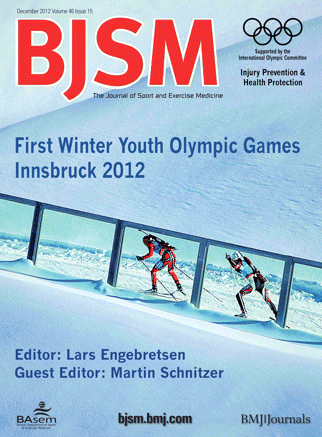
    The cover of a recent edition of the British Journal of Sports Medicine, which was dedicated to issues arising from last season’s Youth Olympic Games in Innsbruck, Austria.

    Welcome back to our almost-monthly series, this month in journals! One of the most visible developments in the last month has been that the British Journal of Sports Medicine devoted an entire issue to the 2012 Youth Olympic Games in Innsbruck, Austria. This was the result of the journal’s partnership with the International Olympic Committee’s medical commission. The cover featured biathletes skiing up a hill.

    Inside, an editorial explained how the organizing committee is taking an academic approach to examining long-term legacies for athletes and others involved in the event, which is especially important as the Youth Olympic Games is a new series and can be adapted and improved in the future. Specific articles examined how relative age, quality of life, coaching behavior, and parental involvement affected competition.

    Most of the health-related research concerned either alpine skiing or snowboarding. However, the journal also published a large-scale review of health services at the Games, which is important because there has been little study of how to deliver medical care at youth sports events of this size, compared to assessing adult athletes.

    “As injury risk and patterns of young elite athletes may vary from their older professional counterparts, injury surveillance of young elite athletes is needed to gain knowledge about the injury risk among this highly competitive population,” the University of Innsbruck team wrote.

    They found, using the IOC’s injury surveillance system and other techniques, that 11 percent of athletes had an injury of some sort during the Games, while nine percent got sick. Of injuries, 60 percent occurred in competition and 40 percent in training. Most injuries occurred in alpine skiing, snowboarding, ski cross, and hockey; six percent of cross country skiers, six percent of nordic combined skiers, and one percent of biathletes reported an injury.

    Nordic skiers were not so lucky in the illness department, with ten percent reportedly getting sick. The overwhelming majority of these cases were respiratory illnesses.

    Recommendations included efforts to remove stress and competitive anxiety for young athletes, with the hypothesis that these mental and emotional challenges create an environment where injuries are more likely. The team also asked whether young athletes were as well-equipped to handle multiple high-pressure competitions in a short time span. Finally, they noticed that girls were almost twice as likely as boys to get sick and recommended gender-specific strategies to keep young athletes healthy and competing.

    * Elsewhere in news about youth, a Norwegian study in The Scandinavian Journal of Medicine and Science in Sports found that high school students are less fit that they used to be. Using nearly 5,000 test results from 3,000 meter running tests (something intimately familiar to nordic skiers…) collected over 40 years at two high schools, researchers in Stavanger, Norway, found that boys’ running times have increased by 10 percent and girls’ by six percent.

    However, all hope is not lost for Norway. The fastest runners are not much slower than they were in the late 1960’s; it’s the slowest decile of runners that has lost the most ground. The authors correlated their findings to other studies showing the similar patterns across Europe, as well as to rising BMI and lower levels of physical activity in some segments of the population.

    “The aerobic fitness decline for the least aerobically fit pupils is comprehensive and is alarming as physical activity and aerobic fitness are inversely associated with metabolic risk and low aerobic exercise capacity is a strong predictor of mortality in adults,” the team wrote. “This increasing gap in aerobic fitness among pupils can result in a larger class distinction in physical fitness and health.”

    * There has been debate for years about whether stretching before exercise improves performance, and if so, what kind of stretching. This month in the same journal, a team led by Dr. Fabio Esposito from the University of Milan tackled a common target in the debates, static stretching, and used it to assess cycling performance. The team noted that most previous studies had used running, but cycling recruited different muscles and even different types of muscle fibers, and that the impact of stretching might be activity-specific.

    Using nine men as subjects, the team administered VO2Max tests and 85-percent effort tests with and without passive stretching. The stretching protocol focused on lower-body muscles and consisted of several rounds of 45-second stretches, using a force (for instance, the assistance of another person) to stretch the muscle to the point of discomfort before allowing 15 seconds of recovery.

    The team found that athletes were more flexible after stretching, but that stretching did not affect their VO2Max outcomes. However, the men took less time to reach exhaustion in the 85-percent trials after stretching than they did without stretching – by a whopping 26 percent. Cycling efficiency decreased over the course of the test for both conditions, but more markedly after stretching.

    “These results are compatible with stretching-induced alterations of the motor unit recruitment pattern and utilization, and with changes in muscle–tendon unit mechanical and viscoelastic characteristics, leading to a less efficient system,” the authors concluded. “From a practical point of view, these findings suggest that care must be taken in administering stretching immediately before an endurance task… stretching can affect not only maximum strength but also heavy-intensity aerobic exercise.”

    * In a study that examined the same general topic – use of different types of muscles and how they affect exhaustion – a team based out of Salt Lake City and Verona, Italy, examined the tolerance level for fatigue when using small muscled versus large muscle groups. In Acta Physiologica, they compared biking to knee extensions, and found that subjects could perform knee-extension exercises for longer than biking before becoming exhausted.

    Wait, you might say – that’s clearly because extending your knee is easier than biking. That’s true, to an extent. The team also found, however, greater changes to the muscles’ ability to contract following the knee extension sessions, and using stimulation of the femoral nerve saw that the muscles were actually more fatigued.

    The implication, they wrote, was that using small muscle mass exercises, an athlete can achieve a higher workload and level of fatigue before the body’s tolerance limit is reached – the sensory system doesn’t pick up on the fact that it is tired. To get muscles to adapt to exercise, it may be beneficial to sometimes work on muscle-specific activities, not only on doing the entire activity for which you are training.

    Previous additions of This Month in Journals: SeptemberOctober

  • This Month in Journals: Does Compartment Syndrome Diagnosis Method Lead to Unnecessary Surgeries?

    This Month in Journals: Does Compartment Syndrome Diagnosis Method Lead to Unnecessary Surgeries?

    FasterSkier is starting a once-a-month series looking at new research in the field of sports science. Periodically, we’ll flip through some of the world’s best peer-reviewed medical journals and summarize, in plain English, studies that we think will be of interest to skiers. Here’s our second installment; you can check out the first here.

    * Compartment syndrome, the compression of muscles with in a myofascial “compartment,” is prevalent though it has become in cross-country skiing, but is not a well-understood disease. Drs. Andrew Roberts and Andrew Franklyn-Miller of Surrey, England, admit as much in a recent paper in the Scandinavian Journal of Medicine and Science in Sports.

    The pathophysiology of the condition is poorly understood, and the criteria used to make the diagnosis are based on small sample sizes of symptomatic patients,” they write.

    Chronic exertional compartment syndrome, or CECS, can’t be diagnosed just by MRI’s or other non-invasive means. Instead, doctors typically cut a slit in the skin and insert a catheter (in some cases a fluid-filled needle) into the muscle, then ask the patient to exercise on a treadmill or bike and measure how the pressure in the muscle changes from rest to exercise.

    CECS also usually can’t be cured simply by resting or doing physiotherapy. Typically, skiers (and other athletes) with bad cases of CECS have surgery to remove the fascia, or coating, around the affected muscles in their calves or shins so that they can expand without causing pain.

    Nobody wants to have surgery that they don’t need, so it’s troubling that there doesn’t seem to be a quick and easy diagnosis. Drs. Roberts and Franklyn-Miller examined the use of intramuscular pressures to assess the technique’s accuracy. Even before starting their literature review, they knew that some of the studies which were used to set the cutoff values defining CECS had failed to use a control group of healthy subjects.

    So, the pair set out in search of studies that would give them some baseline information. And what they found was troubling: when researchers actually look at intramuscular pressure in healthy people, the values are sometimes above the cutoff currently used to diagnose CECS.

    “If a measured [intramuscular pressure] is above the criteria, clinicians can not have confidence as to whether the subject belongs to the upper end of the distribution curve for healthy subjects or at the lower end of the curve for subjects with CECS,” the authors wrote.

    Furthermore, they found that factors such as how deep the catheter was inserted and its position in the muscle, as well as which activity the patient was doing and even shoe shape contributed to variation in measurements of intramuscular pressure. The authors called the intramuscular pressure method “flawed” and wrote that they would not recommend it as a mode of diagnosis.

    “The [intramuscular pressure] at all the gold-standard time points has shown to be dependent on variables other than the presence or absence of CECS, and considerable overlap exists in the available literature between normal and symptomatic subjects in IMP measurement,” Robers and Franklyn-Miller wrote. “The current diagnostic criteria certainly cannot be applied with reliable certainty… These flaws could potentially lead to false positives and subsequent fasciotomy where it is not indicated.”

    Among other things, the authors suggested that rest and conservative treatments be tried before jumping to surgery. For instance, the fact that shoe shape and construction could determine intramuscular pressure dictates that athletes might want to change their footwear – several times – before going under the knife and losing weeks or months of training. The takeaway message for skiers is not to jump to conclusions when their calves and shins start hurting – and that if pain isn’t severe, having high measured intramuscular pressure doesn’t mean that it’s compartment syndrome.

    * In Acta Physiologica, both an editorial by Dr. Timothy Carroll of the University of Queensland and a paper by researchers from Deakin University in Melbourne argue that a large part of an athlete’s improvement in strength can be tied to adaptations in their brains, not just the muscles themselves.

    The Deakin team, led by Dr. Dawson Kidgell and his graduate student Ashleigh Weier, began from the pattern that athletes generally see improvements in strength very early on in a training program, before their muscles actually get significantly bigger. To examine whether the improvements might be all in their heads, the team used transcranial magnetic stimulation: they sent of magnetic pulses through a subjects head, which then gave them information about synaptic activity and possible inhibitions.

    Briefly, the magnetic pulse technique has been used many times before to examine how the brain controls performance of many tasks, including strength training – where results have been conflicting and inconclusive. The Deakin team took a slightly different approach of comparing single-pulse with paired-pulse stimulations.

    After four weeks of training, university students improved their squats significantly but did not develop thicker muscles compared to a control group. More importantly, the study showed an adaptation to training: the students who had been training showed changes in the motor cortex that led them to perform better.

    The editorial further hypothesized that, compared to other studies, the more complex a task is, the larger the magnitude of change in the cortex will be. Because the maximum-load squats were both taxing and required very specific technique combining multiple muscle and joint movements, the brain changed more to facilitate the difficult task.

    “It seems likely that repetitive muscle actions against high loads alter motor cortical connectivity to facilitate the specific patterns of muscle activity required to produce maximal force in the training context,” Carroll wrote.

    Training: maybe it really is mind over matter….

    * The International Olympic Committee published its consensus statement on thermoregulation and altitude adjustment this month in the British Journal of Sports Medicine. In short, the IOC wants to make sure that environmental conditions don’t adversely affect the health of its athletes. As examples of some conditions they want to control, they listed heat, cold, wind, altitude, and humidity.

    The group, anchored by Dr. Lars Engebretsen of the University of Oslo, noted that it was difficult to set hard-and-fast criteria for conditions given that each sport – summer to winter, from land to water – encountered different challenges.

    In terms of challenges relevant to nordic sports, the IOC started by writing off hypothermia: “And while some Nordic skiing and biathlon events require 2 h to complete, metabolic heat production during these activities is even higher, often reaching 13–18 METS (1250–1800 W)… these very high-metabolic rates will offset heat loss and prevent athletes from developing hypothermia during competition in conditions typifying the past three winter Olympics, and probably even with much more extreme cold conditions.”

    It’s worth noting, however, that the group used as its guidelines only the temperatures from the last three winter Olympics – including, for example, the rather warm Vancouver edition. They wrote that air temperature would have to be below -4° F – the technical cutoff for FIS-sanctioned races – for nordic athletes to get frostbite, and suggested that it was more a concern to worry about coaches, volunteers, and support staff.

    The group went on to note the prevalence of exercise-induced asthma and bronchial hyper-responsiveness in elite skiers and swimmers.  “Furthermore,” the authors wrote, “participation in competitive cross-country skiing over a winter season markedly enhanced airway infl ammation in bronchial biopsies in young skiers with and without asthma.”

    What to do? The IOC helpfully recommends recording temperature and wind speed at events and telling athletes to wear warm, windblocking clothes when training. and notes that inhaled steroids can treat asthma without being performance-enhancing and warned against over-using beta-2 agonists (read more about that issue in our piece from last week).

    While the consensus statement itself was based on many previously published studies and revealed little that was new or exciting, it did provide a pulling-together of the IOC’s thoughts on many medical issues. And perhaps the group failed to make any bold statements because they are waiting on more results from researchers around the world: the piece closed with a call for more work to be done.

    “We urge the Commission and Federations leaders to assertively and openly press further in their pursuit to better appreciate, closely monitor and appropriately respond to the health and safety challenges in all sport venues, so every Olympic and international-level athlete is adequately protected and thus given the opportunity to demonstrate optimal athletic performance,” the group wrote.

  • National J2 Talent Camp Strength Results Posted

    On Day 2 of the USSA National J2 Talent Camp in Craftsbury, Vt., several top 14- and 15-year-old racers participated in strength tests on Sunday. The National Nordic Foundation posted results, which can be found by clicking the links below.

    BOYS:  http://nccsef.org/news/?p=3518

    GIRLS: http://nccsef.org/news/?p=3513

  • From East to West, REG Camps a Success

    From East to West, REG Camps a Success

    Dozens of junior skiers raced up Agony Hill on June 25 in Salt Lake City as part of the Western REG Camp. (Photo by Dan Simoneau/MBSEF Nordic)

    The Western Regional Elite Group (REG) Camp kicked off in earnest at 6 a.m. Monday, June 25, with a trail-run time trial up Agony Hill. On the training schedule, instructions read: “Bring your ‘A’ game.”

    Dozens of teenage athletes tackled the 1,200-foot, 0.9-mile climb in Salt Lake City, tucked behind the University of Utah and often used as a measuring stick for pain tolerance. By the afternoon, the group was back in Park City – the home base of the weeklong camp – for core and strength exercises with U.S. Ski Team assistant coach Jason Cork.

    Throughout the seven-day camp, 36 athletes from five divisions (Rocky Mountain, Intermountain, High Plains, Pacific Northwest and Far West) worked with 10 coaches for a total of 20 training hours. They hiked, ran, rollerskied, lifted, played volleyball and went to a waterslide park.

    A junior racer at the Eastern REG Camp in Craftsbury charges up Elmore Hill in Elmore, Vt., on June 27. (Photo by Liz Kantack/SMS Nordic)

    Meanwhile 2,300 miles east in Craftsbury, Vt., the New England Nordic Ski Association (NENSA) hosted a the Eastern REG Camp, with a total of 33 skiers (19 J1s and OJs in the elite group and 14 in the J2 camp).

    They also raced uphill, ran and rollerskied last week. They worked on strength and agility, hill bounding and intervals, and attended presentations at night.

    Several U.S. Ski Team (USST) members from around the country made it to the camps as well. Out West, elite juniors chased Simi Hamilton, Noah Hoffman and Tad Elliott up Big Cottonwood Canyon during an over-distance classic rollerski. Miles Havlick, an NCAA champion and Ski Racing Magazine’s two-time Collegiate Skier of the Year, also joined them on the 3 ½-hour trek to the top of Guardsman Pass.

    In Craftsbury, national-team skiers Andy Newell, Ida Sargent and Skyler Davis participated, along with elite skiers from the Craftsbury Green Racing Program and Stratton Mountain School.

    FasterSkier caught up with Western REG director Mike Elliott and Eastern REG coordinator Janice Sibilia via email for details on last week’s camps.


    Western REG

    Where: Park City, Utah (Canyons Ski Resort townhomes)

    Coaches making their way to the top of Agony Hill in Salt Lake City on June 25 for the Western REG Camp time trial. (Photo by Dan Simoneau)

    When: June 24-July 1

    Weather: Hot (most workouts started at 7 a.m., with the exception of Agony Hill, so they were able to complete each)

    Workouts: Four intense training sessions (including rollerski time trials at Soldier Hollow, Canadian strength tests at the USSA Center of Excellence); two over-distance rollerskis

    Extras: Several presentations, including Tad Elliott’s talk about goals

    Highlights: “The USST was a tremendous amount of help,” Elliott wrote. “We had Jason Cork at every training session.  We had USST members Simi Hamilton, Tad Elliott, and Noah Hoffman joining us on the over distance days and a time trial day. Miles Havlick with the University of Utah and a NCAA winner last year skied with us on Big Cottonwood Canyon.

    “We had a couple of days of Strength with Alex and Michael in the Center of Excellence that they were awesome.  Great information and some light hearted teasing.  Alex strongly recommends NO spandex on Dudes in the Strength Training at the COE.”

    Western REG campers during a 3 1/2-hour classic rollerski up Big Cottonwood Canyon to the top of Guardsman Pass near Park City, Utah. U.S. Ski Team members Simi Hamilton, Tad Elliott and Noah Hoffman joined the juniors for the workout. (Photo by Dan Simoneau)

    Additional comments: Elliott was impressed by the amount of “highly motivated and very talented skiers,” which consistently showed up early with all of their equipment before workouts. They didn’t have to wait on stragglers, and some days the vans departed ahead of schedule.

    “All of the skiers showed up in fairly good condition and had been training for a couple of months before the REG,” Elliot wrote. “When the skiers introduced themselves we learned … that one is going to Harvard, two to Dartmouth, one to Middlebury, one to Colorado University, three are taking a Post Graduate year to train specifically for cross-country skiing.

    Juniors learn the meaning of “rest and recovery” at the weeklong Western REG Camp in Park City, Utah. (Photo by Dan Simoneau)

    The J2s did extremely well throughout the week, he continued. Two local juniors from the Wasatch Nordic Ski Club and Park City Nordic joined them at Agony Hill and for the two over-distance days.

    “The classic roller ski up Big Cottonwood canyon to the top of Guardsmen Pass was the last training session and it was long and steep.  Camp attendees got to observe what year round training is like at the next level by being able to roller ski with Simi Hamilton, Tad Elliott, Noah Hoffman, and Miles Havlick. Even with all the training, the skiers reported that they were having fun.”


    Eastern REG

    Where: Craftsbury, Vt. (Craftsbury Outdoor Center at Hosmer Point)

    When: June 24-July 1

    Weather: Rainy at first, then hot (especially during the final workout, Saturday’s rollerski-run combo)

    Skyler Davis (l) setting the pace during an interval double-pole session at the Eastern REG Camp June 24-July 1 in Craftsbury, Vt. (Photo by Liz Kantack)

    Workouts: 11 in seven days, six of which were intensity or speed.

    Three testing phases (rollerski agility, strength and Elmore Uphill run (on which Nils Koons set a course record), to determine which skiers would be invite to the National Elite Group camp in September in Lake Placid, N.Y.)

    There were also two interval sessions consisting of DP intervals and hill bounding, recovery runs, rollerski sessions and one over-distance combo run/rollerski.

    Extras: Presentations by Sargent, Newell, U.S. Ski Team assistant coach Bryan Fish and Burke Mountain Academy coach Kate Barton on the J1 Scando/U18 trip last winter.

    Highlights: “The camp went very well,” Sibilia wrote. “It was hard, but gave the athletes lots of head-to-head time. They also had the opportunity to jump in with Olympian Andy Newell, and [other] USST members … Ida Sargent, and Skyler Davis. Most members of the CGRP and newly formed Stratton Elite team also joined us. For the uphill run we had the [Green Mountain Valley School] join in the fun! There was also an Olympic Day celebration that some of the REG athletes took part in, and a competitive game of mini golf!”

    Craftsbury’s own Hannah Dreissigacker, who was recently named to the US Biathlon team, racing up Elmore Hill in Vermont at the Eastern REG Camp last week. (Photo by Liz Kantack)

    Additional comments: “Everyone came to camp prepared, and absorbed the training well,” Sibilia continued. “The clubs are doing a really good job of keeping the training focused and the motivation up. Regional coaches came in to help run the camp, as did the folks from Craftsbury and Hosmer Point. The energy level was high!”

    On the NENSA website, Sibilia wrote that the athletes had been mindful throughout the week with details concerning nutrition, hydration and recovery.

    “They are getting more dialed in to this every time this camp is run,” she wrote. “I witnessed campers taking advantage of the rainer first days by settling into the cabins with their feet propped up for recovery. Without access to internet and cell phones, rest came easier!”

    Eastern REG Camp juniors during the rollerski portion of a combo over-distance workout near Craftsbury, Vt., on June 30. (Photo by Liz Kantack)

    Can’t get enough of these photos? Neither could we. See more on the MBSEF (for Western REG) and SMS (Eastern REG) Facebook pages.

  • U.S. Biathletes Leave Their Rifles At Home and Get Ski-Specific in Bend – With Photo Gallery

    U.S. Biathletes Leave Their Rifles At Home and Get Ski-Specific in Bend – With Photo Gallery

    U.S. biathlete Annelies Cook speeds up a hill at Mount Bachelor in Bend, Oregon.

    BEND, Oregon – Even though the U.S. biathlon national team did not compete in the Pole Pedal Paddle on Saturday morning like their skiing counterparts, the athletes still didn’t get to sleep in for their weekend.

    After all, this is training camp.

    Instead, they headed up to Mount Bachelor to do intervals, and had to start early so that they could be off the race trails before the five-sport extravaganza began.

    “Early in the morning it’s a little tricky because it’s a little bit icy, but it takes half an hour to warm up and then it’s awesome,” Sara Studebaker said after finishing up her last interval. “And they have so much snow, and the grooming has been really good. It’s really great.”

    It’s the first time the current crop of biathletes have had an official camp in Bend, and only the cream of the crop are in attendance; eight “A” team athletes were invited, but Jay Hakkinen is at home in Germany and Leif Nordgren is recovering from surgery. That left Studebaker, Annelies Cook, and Susan Dunklee for the women and Tim Burke, Lowell Bailey, and Russell Currier for the men. Dunklee said that the Bend camp was an additional carrot for reaching “A” team status: not only was it a beautiful location, but the small number of athletes meant more individual attention from coaches.

    And, of course, it’s a chance to get on snow. While the team hasn’t traditionally done an on-snow camp in the spring, women’s coach Jonne Kahkonen said the athletes were handling it well.

    “We’ve been skiing a lot, pretty late on snow, so the transition was not so hard,” he told FasterSkier.

    He added that even the venue’s altitude – the nordic center sits around 6,000 feet – didn’t have a major effect on the team’s training.

    “I’ve been surprised – even myself, and I’m not in the shape that the athletes are,” Kahkonen said. “It’s weird, sometimes there are places where the altitude doesn’t really get you, and that’s exactly what the athletes say now. They don’t really feel it and maybe it’s just that they have more training done, and more background. The conditions are great, so that helps a lot.”

    Another new development for the team: for the first time, they are attending a camp without even bringing their rifles. While Mount Bachelor does have a shooting range, it is rarely used and the team decided to focus on skiing instead.

    “It’s awesome,” Studebaker said of the change. “It was so great, we were like, ‘Oh, we can put as much stuff as we want in our bags!’ It’s so easy to travel without rifles. And to have a camp where you’re just thinking about training is great. I think it’s really necessary every once in a while.”

    Kahkonen said that the team is considering the idea of periodizing some of its training into skiing and shooting camps. Before coming here to Bend, the team had done a camp in Lake Placid that focused primarily on shooting. Kahkonen had done something similar in his previous job with the Finnish national team, and was excited to see the idea introduced in the U.S.

    “In my two years we’ve always had biathlon camps, but I think the athletes are liking it,” he said. “They can just focus on one thing at a time. And after this camp they get a break, it’s an off week, but then it’s biathlon training. So now, ideally, all the basics are done for shooting, and the basics will be done for the skiing, and they’ll start putting it together.”

    On Saturday, the athletes did a roughly 12-minute warmup alternating fast pieces with easy skiing before launching into a set of five-minute level four intervals. Even though it’s May, the team has already been hard at work with intensity sessions.

    “We do a couple of sessions already, per week,” Kahkonen said. “We do a lot of volume, so if you look at the percentages it’s still quite low. And that’s the focus also – over the course of the year there’s less volume and more quality.”

    By the time she finished her last interval, Studebaker was appropriately tired. Despite Kahkonen’s earlier assertion, she said that the altitude did make things a tad tougher.

    “It’s definitely hard,” she said. “I come from the West, so I know what it feels like to be at altitude, but it’s an adjustment. I was up in Alaska before our training season started, and then Lake Placid, so here it’s really high [in comparison].

    “But it’s great to be on snow.”


  • Pro Workout: Gym Time with Andy Newell

    Pro Workout: Gym Time with Andy Newell

    tricep pulldown
    U.S. Ski Team veteran Andy Newell demonstrates a tricep pulldown on a cable machine in Davos, Switzerland, in late November. Courtesy photo.

    Once again, we’re shaking up the Pro Workout series by giving busy skiers a chance to add some simple weight training (simple in principle, harder in practice) to their fitness regimens. This is the second “quick” workout in a series about gym exercises. We started with Canadian Senior World Cup team member Perianne Jones, and now it’s on to U.S. Ski Team veteran Andy Newell (with the help of Simi Hamilton as a model).

    ***

    With the Tour de Ski consuming his life for the better part of the next two weeks, Andy Newell will likely lay off strength training for a while. But before the first period of the World Cup ended and the 11-day Tour began, Newell wrote in an email that he was hitting the gym hard in Europe — even if the facilities weren’t ideal on the road.

    In late November, Newell wrote from Davos, Switzerland, that he was lifting a few times a week to build a power base for the rest of the season. Doing so could be challenging, especially with races every weekend.

    chin up
    Newell does a weighted chin up in a gym in Davos, Switzerland. Courtesy photo

    “We try to pick and choose the days when we do strength so we’re not too sore for the weekends,” Newell wrote. “I will usually keep up with a pretty tough strength plan up until around Christmas time when we will switch over to more of a maintenance routine for the rest of the winter.”

    For those still waiting to get on snow or experience their first real ski of the season, Newell’s training tips could be perfect for this time of year. A barren and brown landscape makes it easier to work out indoors, even if it is in a dark and dingy gym.

    Newell provided a few examples of his power-based strength plan for the first part of the season. (Note: Weights are based on Newell, an Olympic cross-country skier. Proceed with caution and rational adjustments).

    1. Loosen up: “I start each session with a warm up and some mobility stuff to strengthen the hips and external rotation of the shoulders,” Newell wrote.

    Also known as a dynamic warm up, this usually takes 5-10 minutes and involves stretching to avoid injury. The idea is to get the blood moving to the joints, so try movements like arm circles, leg swings, knee hugs and squats without weight. Spine positioning and posture is also important to practice and maintain when lifting.

    2. Power cleans: Newell does 3 sets of 3 cleans with 145-165 pounds on a weighted barbell (start with medium and progress toward heavier weight).

    With feet hip-width apart, bend the knees slightly and pick bar off the ground like you would for a deadlift. Pull the bar up in one, fast movement and carefully catch/cushion it on your shoulders (by the collarbone). Slowly return bar to to ground. That’s one clean.

    “It’s better to go a little lighter so that they are explosive,” Newell wrote. “Rest as much as you need.” He rests for about two minutes between sets.

    Simi Hamilton (USST) demonstrates a weighted-squat jump with a barbell. Courtesy photo.

    3. Weighted-squat jump super set with body-weight squat jumps: This sounds intense, but Newell broke it down:

    – Three weighted jumps with 60 pounds on a barbell, or with two 30-pound dumbbells.

    – Then 5 body-weight jumps.

    – Rest two minutes. Repeat three times.

    4. Ski bounds: 4 sets of 20 explosive bounds, classic or skate technique.

    Newell recommended doing these in an open gym or outside if the ground isn’t too uneven. Try to be quick off the ground (think big air and lots of hang time), and rest a few minutes between each set.

    5. Weighted pull up super set with medicine ball throw:

    – Three pull ups with 90 pounds (attached to Newell’s waist)

    – Then 8 explosive double-pole ball throws into the ground.

    – Rest two minutes. Repeat three times.

    If you’re new to pull ups, attempt one without weight. Use two hands to throw medicine ball downward with such force that it bounces back up to you.

    Newell starting a tricep pulldown on a cable machine.

    6. Dumbbell tricep or a cable pulldown:

    This works the triceps. Newell recommended heavier weight for 3 sets of 5.

    Ensure good posture by doing this standing exercise near a mirror. Elbows should remain near your ribcage once bar or dumbbells are in place at about chest level.

    (See photo at right).

    7. Core work: Newell finishes each workout with at least three abdominal/back strengthening exercises. His usually depend on what gym tools are available. Here are a few examples.

    Weighted planks: With 45 pounds on his back, he holds the plank position for 45 seconds. Rest, repeat.

    Hanging leg lifts: 3 sets of 10. Dangling from a pull-up bar, hinge at the waist and bring straight legs up together until they are parallel with the ground for 3 sets of 10.

    Weighted back extension: 3 sets of 12. Usually on some kind of back-extension machine, like a roman chair. Hold a plate weight against chest with crossed arms.

    Sit-up medicine ball throws: With a partner, who should be standing the whole time.

    ***

    Of course, athletes like Newell often have to adapt. If a fitness center doesn’t have your favorite machine, do what the U.S. Ski Team would do:

    “Sometimes we do weighted pull ups with weights piled in a backpack,” Newell wrote. “Or explosive push ups if there is not much equipment to use. Definitely have to be creative sometimes. I’ve actually seen the girls squat each other before when there’s been no weights around.”


  • Working Out with Perianne Jones

    Working Out with Perianne Jones

    Note: This is the first of a new series about working out with high-performance athletes. The idea is to shed light on the daily routine of someone dedicated to training and share a regular Joe’s story of trying to keep up. 

    ALMONTE, Ontario — Upon my early arrival in Almonte, I decided to explore the hometown of Canadian Cross Country Ski Team member Perianne Jones.

    A few lefthand turns and I had completed the grand tour of the town about 50 kilometers outside of Ottawa. Apparently, the man who invented basketball, James Naismith, grew up there, and I was a week late for the town’s celebrated puppet parade. With a population of about 4,500, Almonte had a lot going on.

    Well, not a ton, but enough.

    With 25 minutes to spare before meeting Jones, I chose to conserve my energy for the day’s events – a double workout with the 2010 Olympian – and drove straight to her home.

    Perianne Jones of the Canadian Cross Country Ski Team sips water at a turnaround point while rollerskiing near her hometown of Almonte, Ontario, on August 15.

    In front of her family’s log cabin at the end of the street, I found the 26-year-old dressed and ready to go. With muscles bulging as she moved broken tree limbs aside, I knew she was the person I was looking for.

    I wheeled around to park and Jones waved. I guess I met her expectations, too. She invited me into her home, and by 10 a.m. sharp, without any obvious concern for promptness, we were out on the road.

    A member of Canada’s Senior World Cup Team, Jones started her classic rollerski with a smooth kick double pole up a gradual climb to the main road. With a sense of what was coming, I ambled along on my road bike.

    We chatted throughout the nearly 13-mile workout while Jones and a friend of mine rollerskied at a pace I gauged as moderate. In reality, the 1-½ hour session was part of Jones’ recovery: a 10-day vacation from training full time.

    I had caught her in a rare appearance back home. Aside from living in Canmore, Alberta, for the last eight years, she had spent much of the summer skiing on glaciers and training as far west as Hawaii.

    After several weeks of intense high-altitude work – first in Maui at 10,000 feet with the Canadian national team and then on Alaska’s Eagle Glacier with about 20 women – Jones flew to Ontario. For almost a week, she stayed at a friends’ lake cabin west of Ottawa, mostly reading and resting up.

    “When I was at the cottage, I was sleeping 11 or 12 hours a night,” she said. “So it was pretty good for my recovery.”

    The night before we met in Almonte, she said she hadn’t slept much. Too much garlic at a local garlic festival the day before was likely to blame, she joked.

    “I feel like I’m ready to get back into normal training,” she said during lunch at an Almonte café. “Maybe it wasn’t the garlic. Maybe it was that I haven’t trained in a long time – like seriously – so that’s why I wasn’t sleeping. You just get kind of antsy and want to get back into it.”

    Back home rollerskiing on relatively flat country roads, she didn’t seem too bored. A group of women and children near her high school provided some distraction, stopping to watch as she passed by.

    Rollerskiing wasn’t overly common in Almonte, Jones explained. But it was evident they were more interested in her than the rollers.

    Just across the town line into Blakeney, an assortment of emus and goats stood attentively near the side of the road. Even they couldn’t take their eyes off Jones.

    On the way back, we took a water break in front of the farm.  I stood a street’s width away from the fence-pecking birds while Jones got up close. Not a way I’d want to lose a finger, I thought, but she wasn’t worried.

    Perianne Jones checks out a farm scene of goats and emus during a morning rollerski in Blakeney, Ontario, on Aug. 15.

    The 5-foot-7 ½ Jones wasn’t easily intimidated. When she joined the Canadian national team in Canmore in 2003, she couldn’t do a pull-up. Hours after our morning workout, she proved she overcame that.

    Shortly before 4 p.m., Jones found a couple of commuter bikes in her yard and suggested we ride to her hometown gym. As she led the way, I noted our speed during the mostly uphill ride – 15.5 miles per hour – and she was on a one-speed bike.

    Why would I expect anything different? A few miles away at Almonte Fitness Centre, Jones quietly entered the no-frills gym and moved toward a back room. There, she warmed up with plyometrics and hurdle jumps, and I mimicked her moves for the experience.

    In the mirror, she looked like a track star. I looked like a lumbering fool.

    Ten minutes later, we moved to the main floor where a few muscular men took little note of us. It didn’t matter that Jones was doing hang cleans and stepping up on a teetering box with 135 pounds on her back; I had to help her get it up there.

    I asked if she had others spot her when she was alone. Not unless other women were there, she replied. The day I was there, the only other female in the room stole the cable machine Jones was using.

    Elsewhere, Jones said she received plenty of attention. Her local ski club, Nakkertok, welcomed her annual appearances. But in the male-dominated gym, her chin-ups with 45 extra pounds drew few looks.

    That was the exercise she was most proud of.

    “When I moved out to Canmore, we used to have the strength test where we did a minute of everything, and I’d get to the chin-up part and I’d just hang there,” she said. “It was impossible.”

    She and teammate Amanda Ammar resolved to complete the test, so they integrated pull-ups into their daily routine.

    “We’d go for a run and hit up the chin-up bar,” Jones said. “We started by just going down and eventually we got a lot better. It’s pretty fun.”

    Once she could lift herself, she hung additional weight from a chain around her waist. She finished each heavier set with a quick, aggressive chin-up – the exclamation point on her achievement.

    Initially a runner who began lifting later on, Jones said she enjoyed strength training. Her best performances came in Canmore with her strength coach and the teammates she trained with most: Chandra Crawford, Devon Kershaw and Ivan Babikov.

    “I’m glad I’m not in the gym more than two days a week, but it’s nice,” she said. “It’s always fun doing strength because you can see your improvements. … Whether or not that makes you a better skier I don’t know, … (but) it’s always encouraging.”

    Perianne Jones adds weight before doing chin-ups at Almonte Fitness Centre in Almonte, Ontario, on Aug. 15.

    Clearly, all her pull-ups, tricep cable thrusts and core work paid off. Last winter, the sprinter won several Nor-Am Cup golds and finished sixth in the World Championships team sprint with teammate Dasha Gaiazova. At the 2010 Olympics, Jones was 41st in the classic sprint and helped Canada’s 4 x 5 k relay place 15th.

    This year, she’s gearing up for the World Cup, including some opening races Nov. 19-20 in Norway and a classic sprint in Finland the following weekend.

    With a little less volume and some more intensity in her personalized regimen, Jones said she felt well rested. In Canmore, she would continue rollerskiing most days, run about four days a week, and hike and mountain bike when she could.

    On Aug. 28, she planned to run her once-a-year road race at the Calgary Women’s 5 k.

    “We’re pretty lucky as skiers because we can do so much for training,” Jones said, reflecting on her hula-hooping phase that helped pass time between races.

    “We have so many options,” she added. “If you were a swimmer, every day is in the pool, then I would probably be cranky.”

  • Where Ski Cultures Merge

    Where Ski Cultures Merge

    BEND, Ore. – Kristina Strandberg moved to Bend from Sweden. Evelyn Dong moved to Bend from the East Coast. And Chisa Obayashi just recently transplanted herself in Bend all the way from Hokkaido in Japan. They all have been training with the XC Oregon program director and coach John “JD” Downing.

    “The three of them are in pretty identical positions, in three different ways. Evelyn is just on the cusp of a breakthrough, Chisa is on the cusp of making the Japanese national team, and Kristina has raced on the Swedish World Cup team,” Downing said.

    Perfect match

    Obayashi, 25, first came to Bend in June, but the initial set-up happened earlier this spring.

    “I tried the SuperTour in the spring, and Peter Hale, the racing manager for Madshus USA, introduced me to some club teams in the USA. I chose Bend and XC Oregon, and JD accepted me,” Obayashi recalled.

    Downing was excited to welcome Obayashi to Bend and explained that the chemistry with the women on the team could not have been better.

    “Chisa and Kristina really hit it off and trained together daily. The design of our program is perfect for that,” he said.

    Kristina Strandberg during a dryland workout in Bend, Ore. (Photo: The Center)

    Independent and flexible

    “Our program is pretty much perfect for Chisa in that it is so athlete-driven. It lets the athletes dictate how they train, and because the program is so athlete-based, I as the director didn’t really do much for Chisa on a regular basis besides making sure the logistics were covered and match her up with training partners,” Downing said.

    Downing explained that self-reliance has been part of his coaching philosophy since the XC Oregon program was established 12 years ago, and that the independence helps athletes excel.

    “Chisa could easily have flourished in a more structured training environment as well, but I think she really benefitted from seeing how independently athletes train here and how they can take advantage of the support when it’s there,” Downing said. “Bend is an amazing place to train, and one of the best places in the world for skiers.”

    On her first visit, Obayashi stayed for three weeks. She arrived just as the snow season was transitioning into dryland. She didn’t mind at all, as Bend has plenty to offer no matter what the time of year.

    “I really like Bend. Bend is a great place for training. It has the best weather, and it has some really nice roller ski courses and big mountains,” Obayashi said. She ended up training a lot with Strandberg – much more than Strandberg had imagined to start with.

    “She is pretty much a self-coached athlete, and after one of her first camp workouts, she wondered what I was doing the next week. So I sent her my training plan for the week and I figured she could pick out which workouts she wanted to join me for. But then she just said that the plan looked great and did all of it with me,” Strandberg said with a laugh.

    In love with Bend

    In fact, Bend was such an amazing place for Obayashi this spring that she e-mailed Strandberg from a New Zealand training camp this summer and wondered if she couldn’t come and stay with her for, say, four weeks this September.

    Chisa Obayashi teaches Lars Flora how to make sushi from scratch. (Photo: Kristina Strandberg)

    “You always start to wonder when someone comes to stay with you for several weeks, how on earth that is going to go. We don’t exactly have the largest house in town. But she is the easiest house guest ever. She immediately told us she likes housework and likes to cook, and she did a lot of both,” Strandberg said, mentioning that homemade sushi and Japanese specialties often landed on her dining table.

    Mutual benefits and lasting impressions

    “Kristina and Evelyn taught me some training methods and ways to weight train,” Obayashi said. “They are very strong and have very strong spirits. I have a lot of respect for them, and want to train to become as strong as they are.”

    While Strandberg and Dong might have taught Obayashi a lot about their training methods and sent her home with some new tricks – most importantly, more focus on heavy strength training – Obayashi certainly left her impression on the Bend girls too.

    “Skiing with Chisa was valuable, because she has perfect technique every minute she is out there,” said Dong. “She is never sloppy, even when we’re just going easy. You can tell she puts a lot of hours into perfecting every detail. That’s probably the thing that stuck out the most and hopefully will stick with me the most,” Dong noted.

    Obayashi inspired Strandberg and Dong in ways that go far beyond the trails.

    “She is incredibly polite and expressed such gratitude whenever she got help. She was always nice and kept her stuff in meticulous order. Even on training camps when things start to go everywhere for all of us, Chisa kept her stuff neat and packed away,” Strandberg said.

    Now what?

    For the upcoming season, the three skiers are in very similar positions. They all have to prove their potential to earn spots on their respective teams, and they all dream big.

    Strandberg, 35, will try to make the Swedish World Cup team again this season, but she knows it will be hard.

    “It’s a very hard team to get onto at this point, and it will be more interesting for the coaches to pick a 20-year-old than a 35-year-old, everything else being equal,” Strandberg explained. “But I will race hard and do my best, and if I make it, it would be fantastic.”

    Obayashi will go to Muonio, Finland, with the elite ski team from Japan. “I want to get a chance to race at the World Championships in Oslo and get a good result,” she said.

    However, to make it to Oslo, Obayashi will need to have all the stars aligned for her.

    “She has to ski really well to make it to the World Cup,” Strandberg said. “She’s a distance racer, but she hopes to make it to the World Championships this year. It would be amazing if she did.”

    Dong, 25, also has her eyes on Oslo.

    “My goals for the season? I’m aiming big. I want to go to the World Champs and make top 30,” she said.

  • Pro Workout: Goldsack Weighs In

    Pro Workout: Goldsack Weighs In

    Drew Goldsack may be a recent addition to the Alberta World Cup Academy but he’s not stranger to hard training. After 8 years on the Canadian National Team, Goldsack joined the Alberta World Cup Academy, a recently instated Canadian Training Centre and he’s enjoying every minute of it. Being on the AWCA has reunited him with former National Ski Team coach Mike Cavaliere and former teammate Chris Jeffries. “Working with The Alberta World Cup Academy this year has been a great change of pace for me and has brought a new source of energy and enthusiasm to my training for the coming season,” said Goldsack of his new team.

    Drew Goldsack racing in the 2010 Vancouver Olympic Games.

    As a sprinter, Goldsack enjoys a good hard session in the gym. “Strength is important for any skier, especially for sprinters,” said Goldsack. He likes them because he finds it easy to see improvements and a good way to test his absolute limits. He was introduced to power lifting by NST strength coach Matt Jordan and is currently working with his AWCA strength coach Rob Sofer, as well as head coach Mike Cavaliere. Right now, Goldsack and the AWCA are in a power phase of their strength sessions.

    The workout typically starts with a short run including some agility and balance work, followed by 15-20 minutes of dynamic stretching, light core strength and jumps/hops.

    When doing a hard session in the gym, Goldsack does a warm-up set of each exercise with 30% of the weight he’ll be lifting. He does 3 sets of 4-8 reps, lifting max weight. The focus is on the speed of movement for the concentric, or explosive contracting phase of the muscles and the transition between the concentric and eccentric, or decelerating motions.

    Goldsack’s program includes exercises such Olympic lifts, barbell snatches and barbell split snatches. “These exercises require a lot of technique to be effective and are a great leg, core and arm workout if done properly,” said Goldsack.

    These are followed up by squats, chin-ups, bench press, push ups and seated rowing.

    These workouts will develop speed and power. They link upper and lower body strength so explosive power can be delivered efficiently through the arms and legs. For skiing, this means better speed, more power on uphills and allows the skier the ability to accelerate quickly.

    Goldsack does these types of power sessions twice a week late in the summer and through the fall with adjustments depending on volume and intensity of his otherworkouts for the week. Each workout focuses on either upper or lower body, but usually both are used.

    He’ll be focusing on the skate sprint at the World Championships and trying to get back into regular starts on the World Cup.

    “I’m taking things year by year now but my main goal is to get back to a level of racing even higher than where I was at before my injury,” said Goldsack.

  • How General Strength Makes Specific Strength Easier

    How General Strength Makes Specific Strength Easier

    Jessie Diggins recently graduated from Stillwater High School in Minnesota, where she earned three individual state championship titles, among other impressive national and international results.  Diggins skis for CXC Team Vertical Limit.

    Diggins pumps out dips (Photo: CXC)

    One might wonder why an endurance athlete like a skier or runner would ever bother lifting weights. Isn’t specific strength enough? Shouldn’t skating without poles, single-sticking and double-poling build all the muscles a skier would need? The truth is, general strength does more for an athlete than give them killer beach muscles.

    The simple answer is that the stronger all your muscles are, the more specific strength you are capable of doing. If you have stronger arm muscles, you will be able to double-pole farther. Another incentive for general strength is that it balances and stabilizes your muscles while you do specific strength. You won’t get very far if you only develop ski-specific muscles.

    However, there is more to strength training than lifting as much as you can every day; periodization, or dividing strength training into separate phases to accomplish different goals, is key to improving strength for a specific sport.

    Lifting weights is important to skiers because whether you are a sprinter who needs explosive power, or a distance racer who needs a lot of muscular endurance, the bottom line is that you need to be strong all over. General strength is necessary for building specific strength in the same way that distance skis are necessary for intervals. You can’t do intervals until you’ve gotten base training, and the same is true with strength.

    I spoke with Jason Cork, head coach of the CXC Team Vertical Limit, for his perspective on why general strength is necessary before improving ski-specific strength. He said that athletes have many basic muscles, like your quads, which provide a basis for strengthening the smaller, more ski-specific muscles. If you don’t have a good base, you won’t be able to develop much power, so before you start getting too specific, you need to be strong enough to do the exercises well, and with good technique.

    One way to get maximize the benefits of general strength training is to break it up into periods. In the spring, athletes need to get their feet back under them after the race season, and thus skiers on CXC start with a general strength phase. This allows athletes to build a base and get the basic moves down with good technique.

    From there, skiers move on to max strength: more focus on heavier weights with fewer reps, which then leads into the power-velocity phase. Then athletes begin getting more ski-specific, with max power and ski-specific power-velocity phases. During race season, skiers use the weight room to maintain the power they’ve already developed.

    Endurance athletes are often worried that too much strength might slow them down by making them too bulky or hindering their agility. This is not the case, as long as a strength program is designed to coexist with endurance training.  With the help of CXC Team Vertical Limit coaches and specialists, CXC Academy has created a sample training plan that addresses all of these concerns.  When you combine specific strength with general strength, and adapt them both to endurance sports you have a perfect balance.

    Finding the key to improved skiing can often be found in strength-based exercises.  As long as you maintain a balance between strength and endurance training, general strength can be an asset, and improve performance.