Category: Workouts

  • Wednesday Workout: The Pressure is Off Approach to Your First World Cup

    Wednesday Workout: The Pressure is Off Approach to Your First World Cup

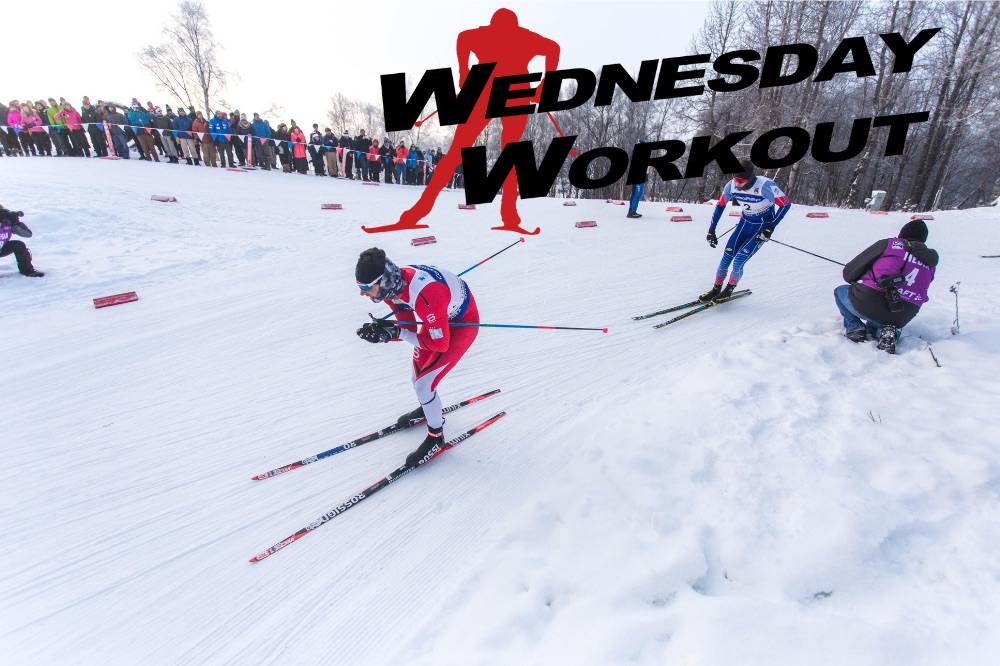
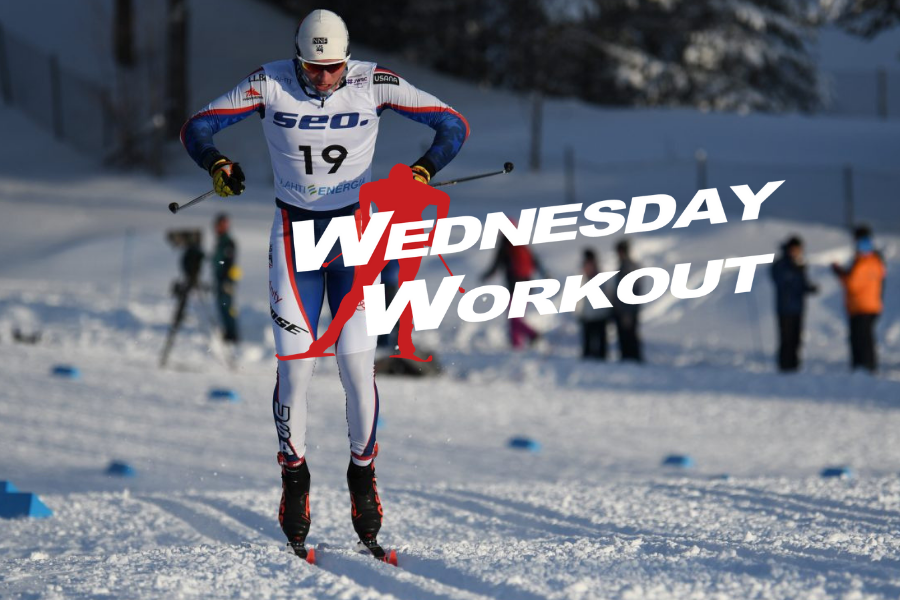
    Gus Schumacher during the 1.6 k classic sprint qualifier at Junior World Ski Championships in Lahti, Finland. (Photo: Doug Stephen)

    At eighteen-years-old, Gus Schumacher remains composed in what is a pressure cooker of endurance sport. There he was last week on his home tracks of Kincaid Park in Anchorage, AK., claiming four first place medals and providing locals a deep-well of pride. If in fact this young man is stressed before or during a race, it’d be hard to notice. And maybe part of that demeanor has to do with his preparedness. Schumacher is prepared. 

    FasterSkier spoke to Schumacher on Tuesday, a day after he arrived in Québec City for his first career World Cup. The races begin Friday with a skate sprint.

    This Wednesday Workout is less a specific workout idea, and more a look at how one athlete is approaching their initial exposure to the sport’s big-tent-circus. Rather than stress about the possible unknowns he’ll begin experiencing on Friday, Schumacher has attempted to make pre-World Cup life this week as normal as possible.

    On changing time Zones (four to be precise as Schumacher flew from Anchorage to Québec).

    For me it is really easy because often times travel takes a lot out of me. We traveled over night so I didn’t sleep that well on the plane. So when I got here, I went on a little run and did some light core to feel like I was not in travel mode anymore. I went to sleep and slept for eleven hours and woke up Tuesday morning feeling really good.

    On brining his own wax tech (non-World Cup regulars provide their own wax tech).

    Jan [Buron], my primary coach is with me mostly because I needed my own tech. But it is cool for him to be able to come too. To have an athlete under him doing a World Cup race. For me anyway, that is how it is going. Obviously, all the coaches are helping the team but he is my main coach and tech. It will be make it simple. He knows my skis pretty well. I am used to how he waxes and stuff like that.

    On maintaining race fitness (coming into World Cup finals) not in Europe but at home in Alaska.

    I hadn’t race a whole lot since the mid-season. I had done a fair amount of training. Those races at Junior Nationals were actually perfect for me to get back into my primed racing shape. So I thought it was helpful to go really hard in all of those and get that super high effort – the ability to push really hard again. If you just train for a while, you sort of lose that. Those races were perfect to go hard in. They set me up really nicely.

    On maintaining the engine this week.

    Monday post-flight: Light jog and core.

    Tuesday: Tuesday morning I did an easy ski to get an understanding of the course. And I will do afternoon jogs, just for some activity.

    Wednesday: I think I am going to do some intervals, sort of race prep tomorrow.

    Thursday: I’ll take it easier Thursday, maybe some speeds on the sprint course to again get an idea of how things will flow.

    Friday: And then…the sprint race.

    On staying calm and maintaining perspective.

    Mentally it is easier to race if you have less expectations. As a junior I always liked it when they paired U12 and U14. I could race as fast as I could, If I did badly it was against U14s…and if I did well, I beat the U14s. I don’t know, I am still visualizing and thinking about how I am going to race so I can race my best. It is a little easier than when you think, like World Juniors that is your shot to really do it. You have to have a good results at some point. You can tell yourself you do not need to do that well, there are other races. You really do want to do your best and that is for sure harder. And it still helps to visualize and think about what you are going to do on the day instead of exactly how you are going to warm up, instead of thinking exactly about your results goals.

    On choosing to accept his World Cup start.

    When I talked to Jan, he thought I should do it no matter what I guess. But I definitely talked to Gus Kaeding a little bit, we have been pretty careful about the approach to these types of races and there was a possibility for some other starts earlier in the season, European starts earlier in the year. But, I think I am trying to tread lightly to the approach to this. The biggest deal is not putting too much pressure on myself here.

    minocycline

    There are always doubts a little bit. There are fast kids in Norway that don’t start. That is how Norway does it. It is hard to say exactly it is hard in the U.S. because we don’t have a large experience with it. There is not the same volume of high quality skiers that come through like Norway. But, I think, not putting too much pressure on yourself. You have got to start at some point and If I get beaten badly, I think that is probably the biggest downside of doing it maybe. Is being discouraged from that. I don’t know. I am not super worried about it, racing at my level has gone fairly well, I know the people that are at my level are not so far ahead of me.

    I don’t know, if I do poorly here, I don’t think it matters too much.

    I think it is a cool opportunity to do and I think it is important to get this high level racing even if I do badly, and things don’t go my way. I think having done it, I guess I will know more in six days..I think afterwards I will know more and have a better grasp of what I need to do to really thrive on this stage. I think it is a good opportunity for me and I am excited to see what happens and have some fun.
     

  • Wednesday Workout: Race Prep with UNM’s Kornelius Grov

    Wednesday Workout: Race Prep with UNM’s Kornelius Grov

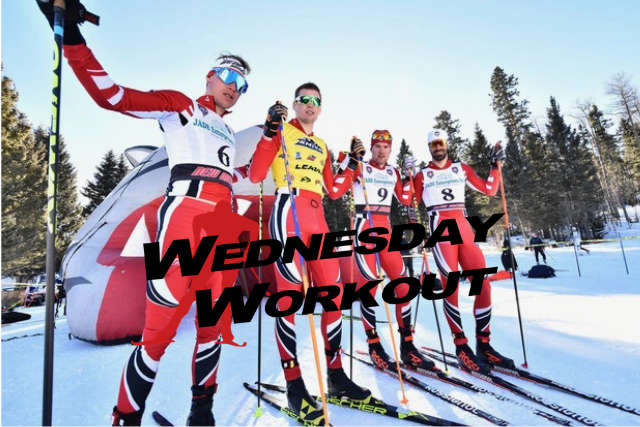
    University of New Mexico’s Men’s Team, from left to right, Ben Berend, Kornelius Groev, Johan Eirik and Ricardo Izquierdo-Bernier (Photo: Ben Berend)

    For this week’s Wednesday Workout, FasterSkier talked to University of New Mexico (UNM) racer Ben Berend about how his teammate, Kornelius Groev, the fastest skate skier on the RMISA circuit this season, gets ready for a race weekend. We are already over halfway through the collegiate race season and Groev has established himself as a favorite for NCAA Championships, which take place at the University of Vermont in early March. Groev has won every single skate race on the RMISA college circuit this season. Groev is twenty-two years old and hails from Norway. Free online slots on a special site, https://reallybestslots.com/ many game providers with the ability to play a demo version or try to catch your luck and play for real money.

    Here’s Berend with this week’s Wednesday Workout:

    “By February the work has already been put in and many of us know if we are slow, fast, or not fast enough; the thing is, in February you are what you are. Kornelius Groev, he is FAST. So this week we are going to share some pre-race intervals from the fastest guy around, Kornelius Groev, known to his teammates as Big Fudge, Kelly Slater, or Korn Dog.

    The workout:

    2 x 6-8 minutes Level 3 (3-minute rest in between)

    4 x 4 minutes Level 4 (2.5-minute rest in between)


    The idea here is to get a solid amount of time in Level 3 to start the workout. Please, don’t spend any time in Level 4 during the first two intervals… please. All of us can keep up with Kornelius during these L 3 intervals.

    After two really solid L3’s, Kornelius moves onto the second part of the interval session- 4 x 4 minutes L4. If this was a movie, here is the part where All Along the Watchtower by Jimmy Hendrix starts playing. Korn Dog goes really fast, nobody can keep up. Do you catch the drift? Very controlled in L3, almost conservatively so, then go HARD during the L4 section.

    Kornelius Grov (UNM) skating to another victory in Red River, New Mexico (Photo: Ben Berend).

    These intervals work well in between race weekends as a way to help the body stay awake without overdoing anything. Many of us have started to use these intervals as well, hoping to magically turn into Kornelius overnight.  We do a lot of these sessions on rollerskis, because we live in Albuquerque, New Mexico where it is 50 ℉ for the majority of the winter. So, if you are like us and don’t have access to snow on a race week don’t stress out; rollerskiing and running work as well. One thing we have all learned here at UNM, lack of snow doesn’t factor into results.”

    Workout written by: Ben Berend

  • Wednesday Workout: Cold Weather Resource for Insiders and Outsiders

    Wednesday Workout: Cold Weather Resource for Insiders and Outsiders

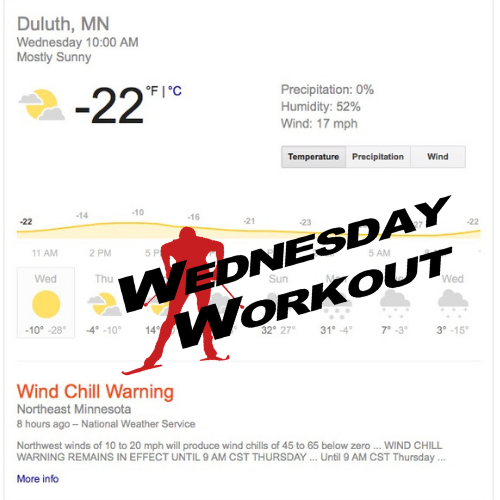
    If you find yourself this morning in a part of the world where it’s truly cold, we feel for you. If you get outside and ski today, say in the Midwest (we’re thinking of you Duluth), the snow might be sandpaper slow, but the upside, there will be no snow melt. The trail conditions will hold until the next banana belt puff of air blows through.

    Here at FasterSkier, we scanned the archives to bring you some cold-related resources. This may not be the type of Wednesday Workout you expected. If it’s not: be careful in the sub-arctic cold, but by all means, head out and kill the 30 x 30’s or the pre-Birkie 4 x 4 threshold efforts.

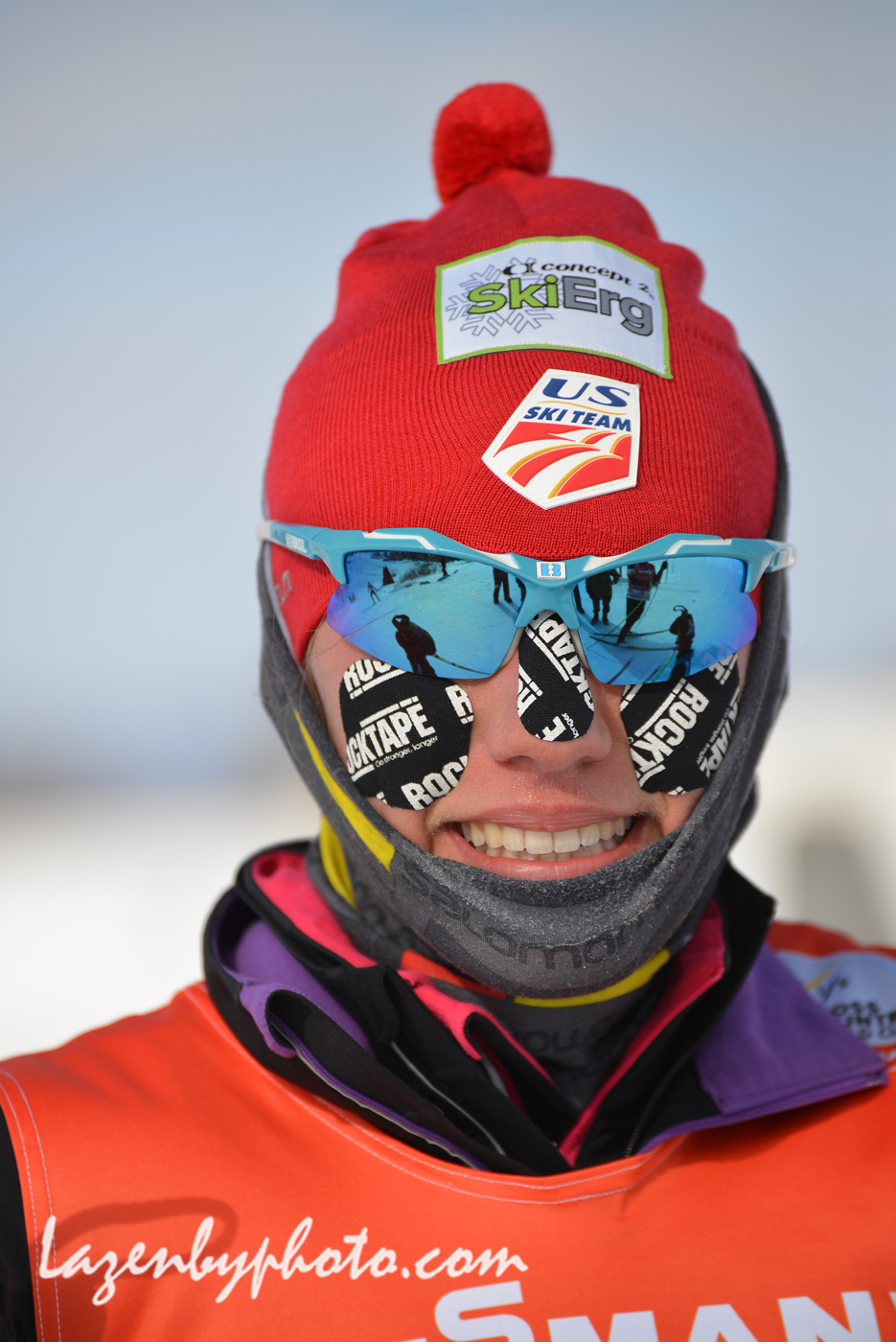
    Kaitlynn Miller (Craftsbury Green Racing Project) on a cold training day in Quebec City on Thursday before the third stage of the Ski Tour Canada. (Photo: John Lazenby/Lazenbyphoto.com)

    By the way, not so fast Houghton. By comparison, maybe it’s time for beach towels in the UP. Duluth’s cold is real-deal-cold at -22 Fahrenheit at the time we pressed “publish”. 


    First on the resource list is this brief piece on cold-related injuries. This comes complete with grim photos to deter those from heading out with improper protection.

    The saying goes: “Hydrate or die.” So true. But remaining hydrated in cold air can be a puzzle for some.

    For those of you keen on reading up on respiratory issues and the cold, here’s an interview written by Chelsea Little. The article below features Michael Kennedy, PhD Associate Professor of Kinesiology, Sport, and Recreation at the University of Alberta.

    If you’re ambitious, here’s a link to Dr. Kennedy’s 2017 research on cold air and athletes:

    If you’re looking to log a rest day, and have already written the following into the notes section of your log, “Too Cold to Exercise”, the New York Times (NYT) published a piece back in 2008 that still resonates. And the title of the article may have you rummaging for those hand and toe warmers, face tape, and respiratory heat exchanger

    Don’t leave the NYT so fast. Knowing much of the country would be blanketed in frigid air today, they published a short resource for combating cabin fever. 

    Yes, we agree, it is downright cold out there. We’d say under a certain temperature, cold is simply cold, no matter what the thermometer reads. Editors at Scientific American ran a piece yesterday titled, “The Coldest Place on Earth”. They may disagree with the assertion that under a certain benchmark (its personal for each skier) cold is cold.

    They aptly end yesterday’s piece with this sentence: “So take heart if you’re experiencing a polar cold, it will get warmer again, and it could be much worse.”

    Stay warm out there. Cold-related injuries are no joke. 

  • Wednesday Workout: What’s the Prescription for “Flooding” Legs?

    Wednesday Workout: What’s the Prescription for “Flooding” Legs?

    Now retired from competition, Dakota Blackhorse-von Jess (bib 1) skates away as he earned his second national title at the 2015 U.S. Cross Country Championships 1.5 k freestyle sprint in Houghton, Mich. You don’t need to look too closely to see Blackhorse-von Jess is a skier with flood-proof quads in the sprints.

    2014 is when a relatively green Patrick O’Brien took charge of the Stratton Mountain School’s elite team, otherwise known as SMS T2. In a relatively short time, by way of juggling athletes, wax-teching, training plan writing, and life-living O’Brien has become a problem-solving resource. Jack of many trades, and very much an emerging master of elite level coaching, FasterSkier tossed a general question out to O’Brien for our Wednesday Workout series: what are some workouts for an athlete experiencing “flooding” in their legs when laying down big efforts?

    Here’s O’Brien’s response:

    So if I understand the question correctly, the goal here is to do some workouts that will help an athlete keep from “flooding out” during a skate race, correct? Not sure if we are talking distance or sprint so I will answer both to the best of my ability.

    I think we are all aware of what the sensation of “flooding” feels like. The workload is high, we are pushing along fine in a race until finally we feel toxic and the motions break down, velocity drops and we either have to slow down or worse still, totally lock up. This has probably happened to just about everyone at some point in their racing career. At the surface, the issue and solution are relatively simple. Blood lactate is rising and being produced from anaerobic energy pathways faster than it can be cleared and turned back into fuel by the body and working muscles. Skiing is by nature a power endurance based sport. We rely upon both aerobic and anaerobic energy pathways to fuel the motions in a ski race. Depending on the race distance, course profile, elevation, athlete physiology, that balance is always shifting. The longer the duration of work and race distance, the more we rely on aerobic energy pathways, the shorter the duration of exercise and more intense, the more we are relying on anaerobic energy pathways.

    So at a very simple level, we are utilizing aerobic energy production more in marathons and 50km races and anaerobic pathways for shorter events such as sprint events. Now the caveat is we are always using both, and we need to tune up both systems to execute good race efforts. We need a big aerobic base to carry our fitness for distance races but also need to be able to recruit anaerobic power when punching it over hills, through transitions, and in the finishing stretches of a race. You need to be able to produce lactate and tolerate and clear it quickly both for distance and sprint races,

    Everyone naturally has different physiologies. Different size “motors” (call it V02 Max, but basically how big of an engine they have). Different ratios of fast twitch to slow twitch muscle fibers (are they a natural sprinter or more inclined to distance), different size frames and builds. Additionally, everyone has different technical skills and proficiency in skiing that are tied in with all of this. Our goal in training is to raise all of these capacities up, and ideally do so in a balanced fashion. You need a big aerobic base to support an anaerobic system and power and the ability to apply force correctly to maximize velocity and do it efficiently.

    Now let’s circle the wagon back around to the original problematic scenario: someone struggling with sensations of “flooding out” in racing. It could be caused by an imbalance in any of these capacities, or. simply because of an athlete’s natural physiology.

    Someone with a naturally strong anaerobic system, good strength, and technique solid enough to produce this power is going to “flood” more easily than someone who is more aerobic and cannot produce the same amount of power.

    For someone like this they still need to train and refine their strengths (they sound like they could be a good sprint racer!) but they also probably need to train their weakness. They need to build enough of an aerobic base so the body can support these other energy systemsEasiersy aerobic training and well-paced L-3 threshold training during the preparation and competition season will help them make their hard training harder and more repeatable. We do a fair amount of threshold intervals because it allows athletes to rely almost exclusively on aerobic energy pathways while still ingraining good technical motions and allowing them to become more efficient at this speed.

    You can structure threshold intervals many different ways but for those without access to either a Heart Rate or blood lactate monitor, I tend to find longer intervals allow athletes you to find your natural “threshold”. It should be medium-hard, breathing well but not building an O2 debt or hanging on your poles at the finish. 4-5 x 10 minutes on time with 3 minutes recovery is a good starting place. You should be controlled enough during the interval that you should feel ready to begin again before the end of the recovery period. You should get tired and fatigued from the duration of the work, not the absolute intensity of it.

    Now, the flip side to this could be an athlete that has a very well developed aerobic system but lacks either the anaerobic system to tolerate and clear lactate, lacks the muscular endurance for sustaining a full race effort, or has a technical weakness that is magnified during these race efforts. Basically, they start a race, and at some point, they can not maintain the workload and velocity to continue at this pace — they have to slow down.

    For an athlete like this, doing some anaerobic power work is a great place to improve their racing. Here’s a classic:  30-30 intervals. We format them a number of different ways but the idea is as follows: 30 seconds of skiing at or above race velocity followed by 30 seconds of easy recover skiing. Vary your “on time” depending on fitness and energy level and repeat as long as the motions and workload allow. We typically start conservatively, doing 2-3 sets of 8-10 minutes of on time. As athletes build fitness and capacity they can either increase the ground speed and intensity of the on time or increase the duration of the interval.

    This workout is so effective because it trains a number of different systems. It taxes the neuromuscular system by challenging them to ski a pace close to, or faster than race pace. In this way, they become more technically proficient and comfortable moving fast. It recruits anaerobic pathways by demanding high power output and subsequently the production of lactate while also allowing them to tolerate and clear this lactate while building in recovery time to keep the overall cost of the session manageable. Workouts like these should help athletes feel like they can repeatedly “redline” their tachometer while not blowing their car engine.

    So my long convoluted answer is that it is difficult to prescribe one workout or even a progression of workouts to fix an athlete who tends to “flood” during races because there are so many possible causes. They should evaluate their strengths and weaknesses as an athlete and racer and see if there is an imbalance and try to execute workouts that will help with this. You need to train your weaknesses as much as your strengths. If they can go really fast but tend to blow up, my recommendation would be to try to prop up the aerobic system by adding some sustainability to their racing.

    Start your workouts nice and controlled so that carries over to your racing. More easy distance and threshold intervals will help with this. If an athlete feels like they have good fitness but they go over the line once in a race and blow up or lock up, doing more anaerobic power work could be a good solution to making those big digs in a race environment more sustainable and repeatable. You need to be able to recruit the anaerobic system, build lactate, tolerate it, and on the recovery sections of the course clear it quickly so you can repeat again on the next working section. Incorporating some 30-30 intensity sessions could be a good starting place.

    So many variables — this is what makes the sport an evolving puzzle!


    Puzzle master Patrick O’Brien at the 2018 SuperTour Finals in Craftsbury, Vermont. (Photo: Matt Whitcomb)
  • Wednesday Workout: A Flashback to 2016 and Midweek Race Prep with the U.S. Ski Team

    Wednesday Workout: A Flashback to 2016 and Midweek Race Prep with the U.S. Ski Team

    The U.S. Ski Team’s Sadie Bjornsen during the 2018 World Cup 10 k pursuit in Lillehammer, Norway. (Photo: Fischer/Nordic Focus)

    We hear a lot about the details of a cross-country ski racer’s day on race day, but what about those four or five days in between? What do World Cup racers do then, in the middle of the week? FasterSkier Norwegian contributor Aleks Tangen ventured to Lillehammer back in late November 2016 to find out. 

    ***

    LILLEHAMMER, Norway — FasterSkier spoke with Bjornsen, Jessie Diggins, Andy Newell and U.S. Ski Team Coach Matt Whitcomb to see how they prepared for Lillehammer and in particular, the mini tour. Back in 2016, the three-day series consisted of a classic sprint on Friday, 5- and 10-kilometer freestyle races on Saturday and 10/15 k classic pursuits on Sunday.

    Whitcomb explained that on Wednesdays, in this case, two days before a race, it’s common for the athletes to do 90 to 120 minutes of light skiing in the morning and a strength session in the afternoon.

    “Some might do an easy jog instead,” Whitcomb said. “On a normal week, our strength session falls on a Wednesday. That gives us two full days of recovery before the races. Usually, this is also our intensity day and we like doing strength in the afternoon of those. However, in an instance such as this one, where we’re going from a World Cup weekend into a mini tour, we have limited time to recover and for most of our team that means that they will have to pass on mid-week interval session in place for something speed-oriented.”

    On Wednesdays, in this case two days before a race, it’s common for [U.S. Ski Team] athletes to do 90 to 120 minutes of light skiing in the morning and a strength session in afternoon.

    Bjornsen, who placed 17th in the 2016 Ruka 10 k classic, did just that. She said this week that she thinks it’s possible to improve upon that performance and that she is looking for more.

    “Two weeks ago, I was not even sure that I was going to be here…,” she said, referring to bone spurs in her feet that impeded her World Cup lead-up. “Each time I ski, it’s going to become more familiar and hopefully better.”

    This week, Bjornsen opted for a distance ski with some speed.

    “I find it really special that we can ski on the non-race courses, because we’re always dealing with the lack of snow and then we’re left with a 3.5 k, exceptionally hard, groomed course,” she explained. “It’s something that can contribute to built up fatigue.”

    She also did speed work on the course to familiarize herself with the transitions and plan where to change gears.

    Jessie Diggins during the 2e018 10 k skate in Davos, Switzerland. Diggins placed fifth for her best result for the season. (Photo: Reese Brown/U.S. Ski Team)

    Her teammate Diggins chose a similar kind of workout on the trail leading to Sjusjøen, for 90 minutes of easy skiing.

    Asked on Wednesday what goes through her mind during a training session two days before a race, Diggins said it doesn’t have much to do with the race itself.

    “I don’t think about the race really, I just try to stay relaxed and do what I’m supposed to do,” she said. “In the middle of two race weekends, you want to stay relaxed, but also improve your conditioning, so I did five minutes at L3 [Level 3 intensity] and 4 x 4 [minutes] at low level on Tuesday in order to have time to recover from traveling and in time for the race.”

    In terms of how she balances recovery and improves conditioning at the same time, she said, “That’s a good question. I think it’s really about listening to your body and paying attention to the signals it’s sending you. If you don’t feel good in the morning then maybe you should take it easy and vice versa. And you should always communicate with your coaches, but I really think that first and foremost, it’s important to pay attention to your mind before schedule.”

    Diggins said her schedule amounts to roughly 750 training hours a year, but she warned against looking too far into those numbers.

    “I don’t like to think about the numbers, really, I feel like that’s not the right thing to do,” she said. “It’s what you do in those hours that matter. It’s more about quality than quantity, and I feel like focusing on the numbers sends the wrong message to for example young athletes.”

    Asked what she would say to young athletes considering increasing their volume, Diggins said they should be “very careful about increasing hours. Don’t just throw on hours for the sake of more, think about what the hours contains and go from there.”

    According to Whitcomb, Diggins “is in a great state of fitness. … She’s just a really hard worker who does what she needs to do during workouts. She has also gotten to a point where she absorbs her training really well,” he explained.

    Andy Newell (U.S. Ski Team) racing in the quarterfinals of the 2017 World Cup men’s freestyle sprint in Davos, Switzerland. He finished fifth in the heat for 21st overall. (Photo: Reese Brown/U.S. Ski & Snowboard)

    Newell met with FasterSkier on the Thursday before the race to talk about his preparations. Normally he would do some form of threshold training “like 3 x 8 minutes and some shorter speeds, just to get a feel for the track,” but this Wednesday, things didn’t turn out quite the way he had hoped. Newell skipped training to treat a cold that had been brewing since last Thursday.

    “I might have gotten sick from traveling” he said.

    If he had been training, his race-prep day would have likely included an hour of skiing, with ski testing (maybe four or five pairs) for the first 45 minutes.

    “Once I find a good pair, we usually get together as a team and ski the lap, once at 70 percent of max and once at 90 percent.” Newell said of previewing the course.

    When asked about how he balances recovery and fitness, Newell’s answer was similar to that of Diggins and Bjornsen. He said it’s about feeling good before the races, and since the races are like hard workouts, what matters in the time in between is to recover well enough in order to feel good when you’re on the starting line.

    “Some people come out of, for example, the Tour de Ski super-fit and that’s the kind of magical balance we’re striving for, where we can be in a state of fitness where we can absorb the benefit of the races,” he said. “For me, that means to maintain threshold base and focus on short bursts of speed during the races.”

    And how does nutrition factor into this equation, especially considering you’re in a different country every week?

    “I normally don’t have any problems with it, the foods really good here and there is so much to choose from,” Newell said. “I might supplement with multivitamin or fish oil, especially in places like Kuusamo.”

    Speaking specifically about Lillehammer, Newell said he loves the course, calling it “perfect”, “very challenging but very skiable, unlike Kuusamo, which are not that fun. Lillehammer’s [courses] are very enjoyable.”

    This season, Newell explained that his biggest goal is “to stay strong and healthy.”

    “I am trying to be careful with the cold I have now. I know I can be among the strongest in the world and I try not to think about place, but instead feeling strong and take one race at the time,” he said.

  • Wednesday Workout: Getting Out With Kids in Tow

    Wednesday Workout: Getting Out With Kids in Tow

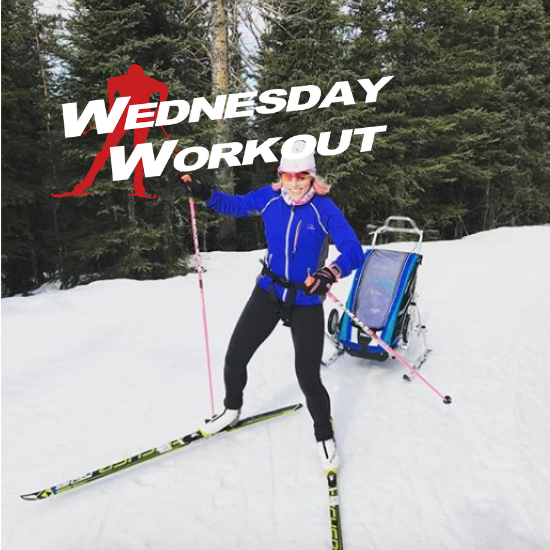
    Mom. Wife. Kikkan. Fighter. Kid-tower. Gold medalist. All of the above. Kikkan Randall tows Breck. (Photo: Kikkan Randall collection)

    This week’s workout comes from contributing reporter Rachel Perkins, a former USCSA National Champion turned dedicated citizen racer and now a new mom to a baby girl born in October. Here Rachel shares tips from her own experience as well as the wisdom of local chariot pulling veterans. This article is an introduction to an upcoming series highlighting the pregnancy and postpartum experiences of skiers including Kikkan Randall, Holly Brooks, and Caitlin Gregg as they ski their first tracks as a new parent.


    Whether you are a professional athlete, dedicated age-grouper, or just enjoy a tour on your cross-country skis, balancing exercise and family is a challenge for most active parents. Luckily, there are ways to marry the two, especially while your child is easily portable. Anyone who has towed a child of any size uphill can attest that skiing with a pulk or chariot is not for the faint of heart (or legs)!

    I found out I was pregnant a few days after skiing 50-kilometers in a charity skiathlon where I felt remarkably flat. About two weeks prior, I raced a team sprint with my husband and felt super strong. I was confused why a long but easy tour felt so taxing. Had my skis been slowed by dirt collected from the eternal “early-season conditions” that plagued Colorado in its low-slow year last season? Were they desperately in need of wax? Better to blame the skis than the body. 

    I was incredibly fortunate to have a healthy and active pregnancy. I spent the summer trail running, hiking in the mountains, and swimming laps, and I rollerskied until the week before I went into labor. Once my little girl was born and my body had time to heal, I was eager to get out in the newly fallen snow. And, after nine months of bouncing around in my belly, my baby is quickly lulled to sleep by motion. Laps at our local ski area with the chariot are a golden ticket for mutual happiness.

    buy skelaxin online

    With the infant sling installed in our Thule Cheetah XT, think modernized-pulk, it is possible to begin skiing with our baby almost right away. And by the time she outgrows the child seat, we hope that she will be propelling herself down the trails.

    Here are the answers to a few commonly asked questions to help make your workout enjoyable for everyone involved.

    Can you ski normally with a chariot?

    When you first start to tow a ski chariot, it might feel like you have never been on skis before, as the weight you are propelling is distributed much differently than it is when you ski on your own. However, with some practice, you will forget there is anything behind you. At least on the flat sections. … Regardless, since the chariot will keep your little one secure and warm, it is well worth the added weight.

    Whether you are skating or classic skiing, it is important to keep your hips forward so that your own center of gravity is just in front of you, aiding forward momentum and power delivery. Having your hips too far back will be especially noticeable on uphills. The hip belt can actually be a good technique cue; keep your eyes up the trail and be mindful of keeping your hips tucked under you, and skiing will begin to feel more natural.  

    If you are classic skiing, err on the side of more kick as you have more weight to propel with the little one tagging along. Fish-scales or skin skis are a foolproof way to go. The weight of the chariot will make up for any losses in speed on downhills, not that you’ll be trying to set any records.

    Some cautionary advice in physics: with the chariot trailing behind you, it is essential to brake early and make wide turns. Remember that the force of the chariot behind you will push tangent to the curve that you are rounding, meaning it will try to push you off the trail. Having your speed in check and a wide radius helps keep everyone safe and upright.

    How do I keep my baby warm?

    Only one of you is working hard, so it is important to make sure your little one is well-bundled for the outing. For infants, insulated layers that can’t unintentionally be kicked off are key, like a fleece or down bunting suit. It can also be helpful to tuck the baby in with a blanket or a puffy jacket.

    A well-bundled baby fast asleep on the trail. (Photo: Rachel Perkins)

    When using the infant sling, keep in mind the dead space between the sling and the child seat below. Unless this space is filled with insulation, it is a bit like sleeping on the frozen ground with a blanket on top of you; probably not the most comfortable experience. Tucking another blanket or a down jacket into the space can help keep your baby better protected from the cold.  

    How do you tell they are warm enough? A good way to see whether your baby is warm enough (or too warm) is to stick a finger behind their neck or down the back of their clothes. If the baby feels warm, but not sweaty, they should be comfortable.

    What if my kid hates the chariot?

    It may not be the best idea to embark on a two-hour ski as your child’s first rodeo. Start with a short outing and gradually increase the length of the ski. This will also help you build up your towing stamina!

    Out for a ski on a bluebird day. (Photo: Rachel Perkins)

    If your kiddo is hungry or bored, your ski might end quickly. Don’t forget to pack snacks, water, and maybe a toy or book to keep everyone entertained and well fueled. The interior is easy to clean, so don’t worry about the sticky peanut butter and jelly messes.

    If you are skiing with a baby, try to time the outing with a nap. For a young baby, it may be helpful to get them soothed and calm before starting the ski. I have found that the portable sound machine we use for my little one’s naps at home also works wonders in the chariot. Once we are moving, she drifts quickly off to sleep.

  • Wednesday Workout: Core Nordic Exercises with Stuart Kremzner

    Wednesday Workout: Core Nordic Exercises with Stuart Kremzner

    More Core with Stuart Kremzner.

    The following strength and performance tips come from one of our resident experts, Stuart Kremzner, MS, CSCS, FMSII, OS, RN, an exercise physiologist who has coached and raced in nordic skiing for over 20 years. Kremzner has trained/consulted with college athletic programs, elite teams, and athletes with the goal of improving athletic performance and injury prevention. When not working, he is running and skiing on the trails in New Hampshire or writing wax tips for the TOKO Tech Team. Kremzner can be found at e3sportsperformance.com.  

    ***

    In my recent article, “Back to Basics: How to ‘Reset’ for Nordic Performance”, I  discussed how to prime our nervous system and core muscles in an optimized firing pattern. This article will delve into how to strengthen the core muscles now that they are more active and firing in an improved pattern. The goal of these exercises is to strengthen the core muscles in a reflexive dynamic pattern. The primary muscles targeted are the deep pelvic floor, transverse abdominal and gluteus medius muscles. Many other muscles are still very active as well.

    Additionally, we learned how the reflexive core discussed in Original Strength is driven by three pillars: Vestibular stimulation, midline crossing or contralateral movement and diaphragmatic breathing. If what you are doing doesn’t satisfy these criteria then it is not reflex driven as far as the core is concerned,  (Shropshire, 2018). The exercises below encompass these criteria.

    When we read fitness books, articles or see YouTube videos about core training, it can be overwhelming and spark the questions– what do I need to do? What is most relevant for improving my Nordic skiing performance?

    This is where having an assessment by a trainer certified in Original Strength or Functional Movement Systems will pay off in dividends, as the exercises will be targeted for you, versus a general starting point that is presented below. That said these are exercises that address the majority of deficits in a wide range of athletes from 10-year-old soccer players to skiers on the national team.     

    Consider the exercises below as a starting point, this is one of many potential good core exercise sets. Every athlete’s needs are different. If your reflexive core is already well developed then progress the exercises. Essentially, to keep developing and stimulating an adaptation you need to challenge yourself. Start with the basic exercises below. If you can do three sets of 10-12 repetitions with excellent technique then progress the exercise to a point where on your 8th-10th repetition your perfect body position, technique or muscles fail.  This is the point of ideal adaptation for you.

    Many of the exercises below are based on the Original Strength system of training. To learn more and really develop the knowledge to challenge yourself, I would recommend getting one of Original Strength’s books or check out more of their website videos.   

    Core Exercise Routine

    Start with rolling out and doing some myofascial release. Then move into resetting and activating your nervous system with the Original Strength activation/warm-up discussed in last week’s article, this will prime your nervous system and accelerate your adaptation to the core exercises.  

    Myofascial release. (Photo: Stuart Kremzner collection)

    Important Points:

    -These exercises can be done as an individual workout or added into an existing strength routine.  

    -For rapid adaptation, you should do these every day, or at a minimum 3 times a week.  

    -Maintain a good body position, continue to diaphragm breathe with good depth and rhythm.   

    -Execute the exercise with perfect technique. Remember 1-2 seconds with perfect technique is far more effective than compensated movement patterns (twisting,  breaking position, holding your breath). This compensated movement will keep reinforcing a dysfunctional motor program and feeding into the same problem.

    -As with the reset exercises described last week, continue to diaphragm breathe. Belly breathe deeply in and out through your nose. Your exhale should be 2x as long as your inhale. The tongue should be pressing on the roof of your mouth just behind your teeth.  On the inhale push your belly button up as much as possible. The belly should always rise before shoulders. 

    -To advance these exercises, you can add load, (gravity or weight), pushing or pulling a load, create a less stable platform, or distraction (resistance pulling you in another direction, with a band or opposite limb movement).

    For example to progress dead bugs, add a weight to the hand or ankle, or flip around and convert the exercise to a super dog. To progress super dog, put a dynadisk under the weight bearing hand or knee, then both. Then you can further progress the activity with knees off the ground about 1-2 cm.  

    The Workout

    EXERCISES

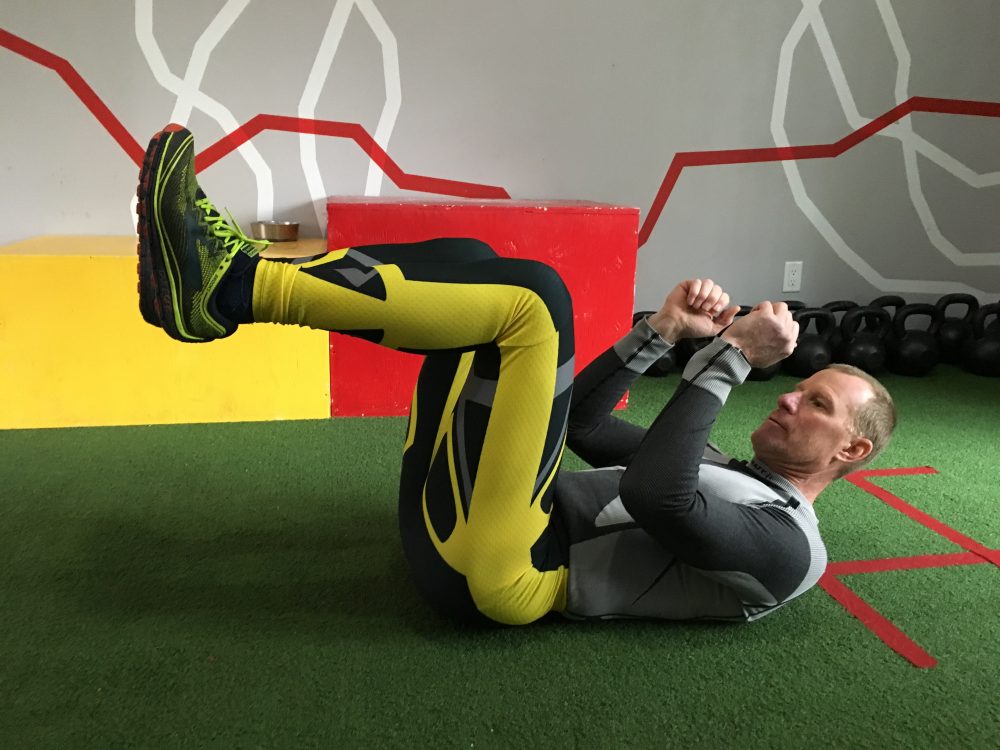
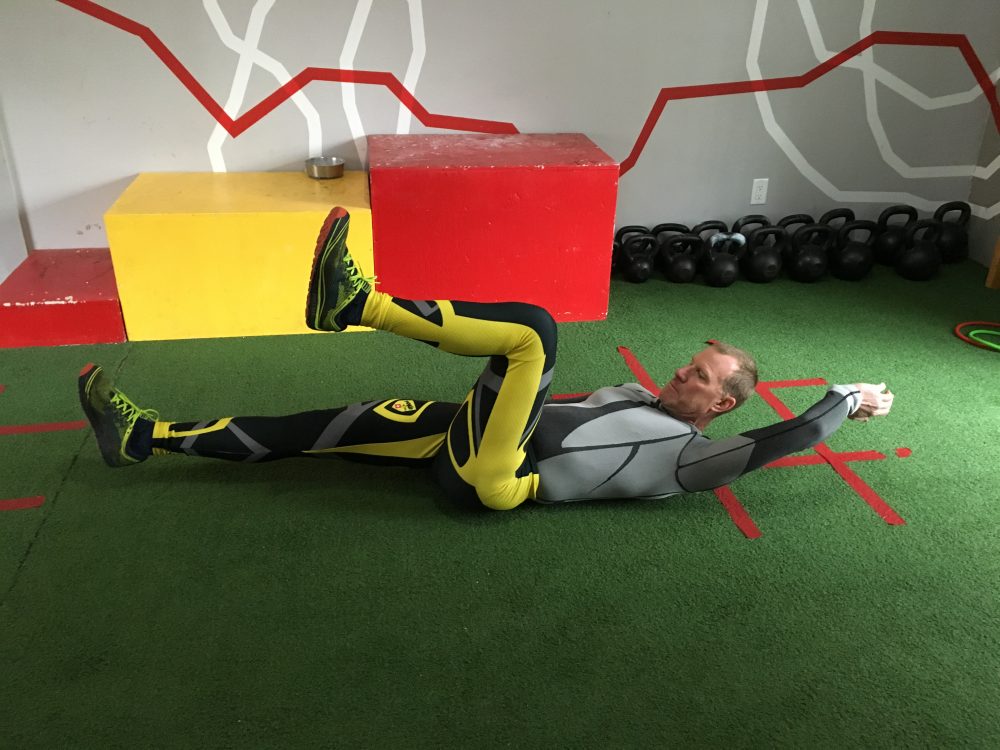
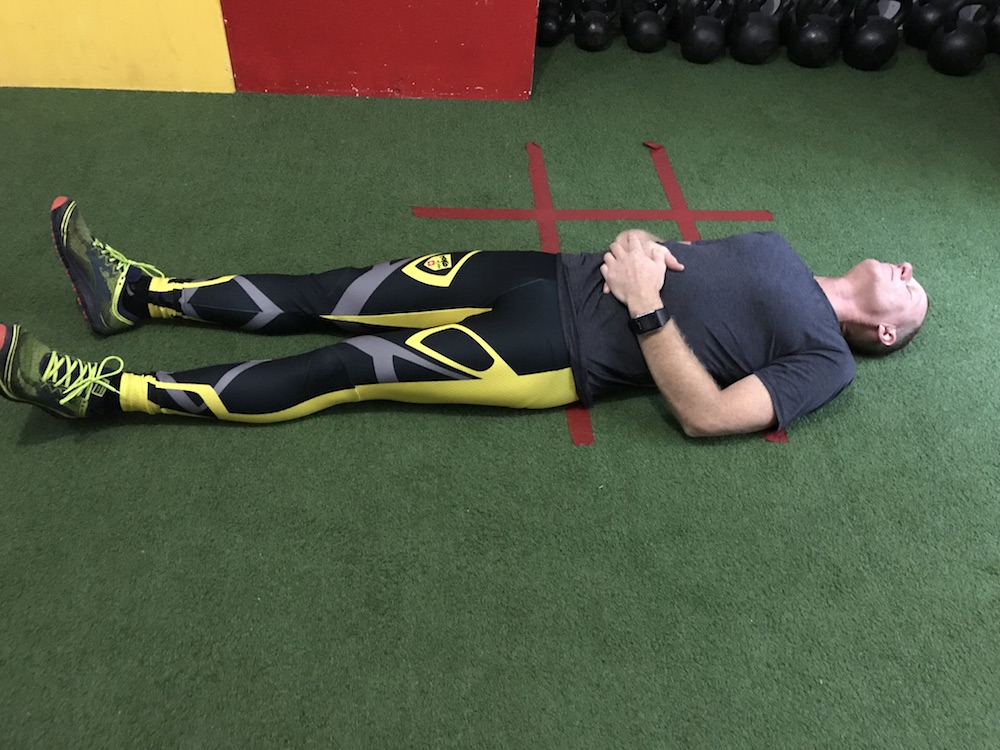
    Dead Bugs- Lay on your back.  Starting position arms and legs extended, 90 degrees to the ground.  Elevate head, extend leg and opposite arm position just above the ground but not touching, hold 5-10 seconds (or to fatigue), return to start position, repeat opposite side.

    Deadbug start. (Photo: Stuart Kremzner collection)


    Dead bug finish. (Photo: Stuart Kremzner collection)


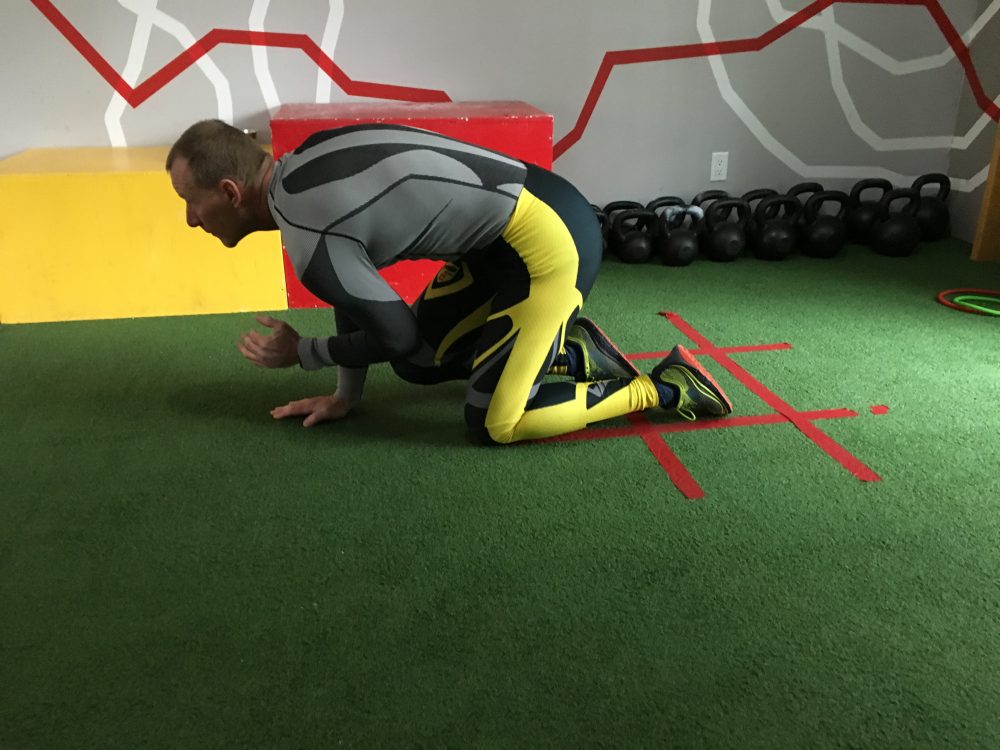
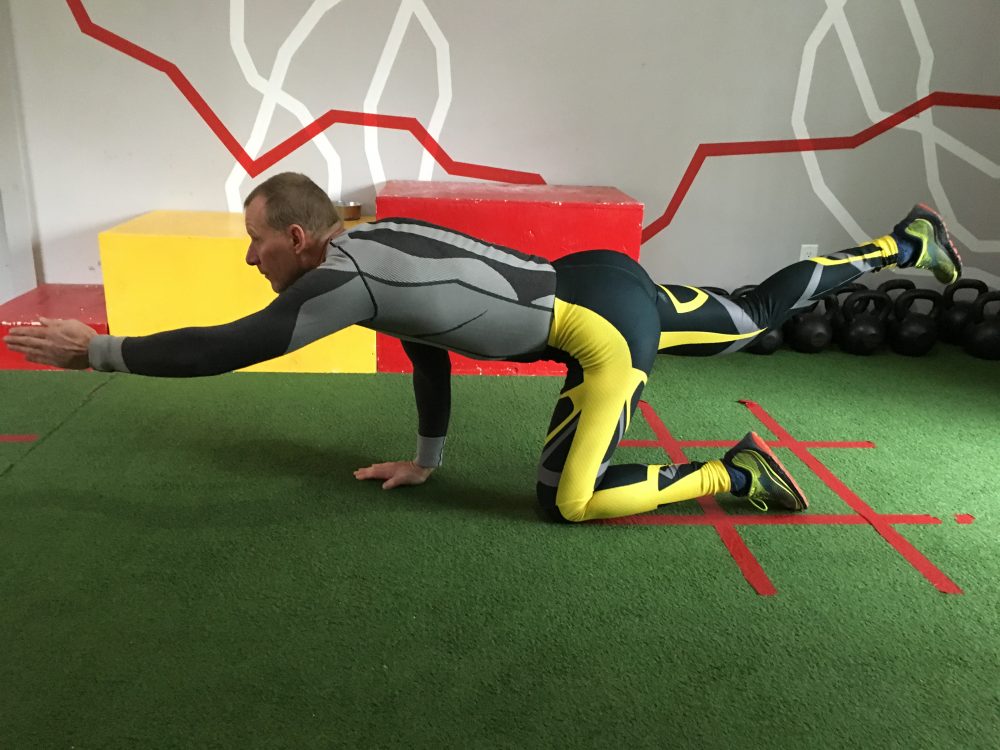
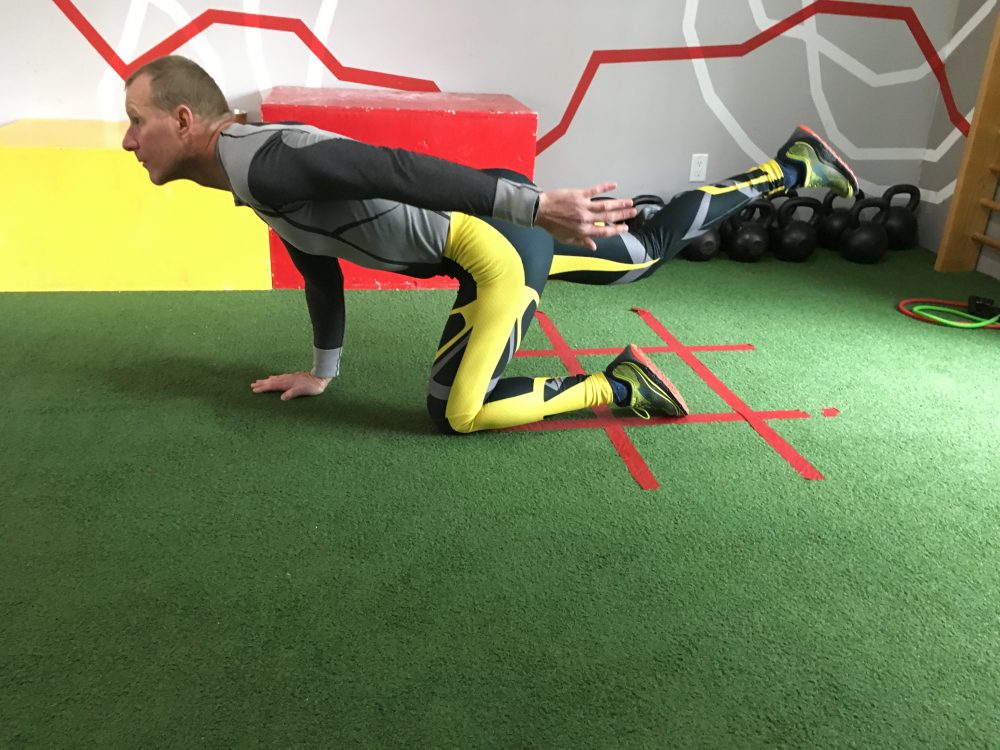
    Bird Dogs/Speed Skaters– Begin on all fours, hands under shoulders, knees under hips, with a neutral spine. Brace your midsection and extend your opposite arm and leg. Hold for 2-10 seconds. Concentrate on contracting your glutes without extending your back.  Keep your head up throughout the exercise. Repeat opposite side. To progress, add load, or try the quadraped lift off with hip extension as presented in Gus Kaeding’s 8/31 Wednesday workout article.

    Bird dog start. (Photo: Stuart Kremzner collection)


    Bird dog finish. (Photo: Stuart Kremzner collection)


    Speed Skater. (Photo: Stuart Kremzner collection)


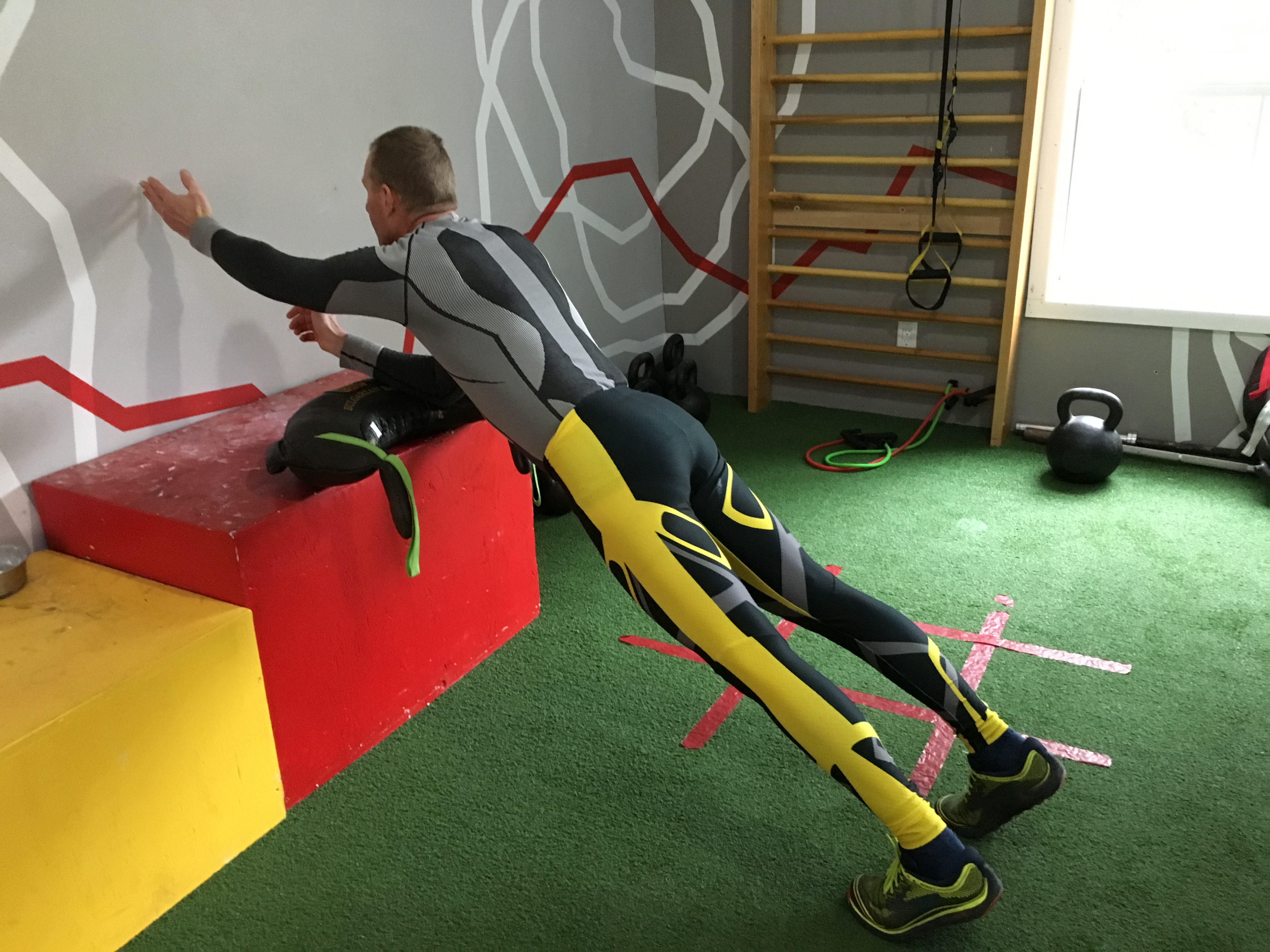
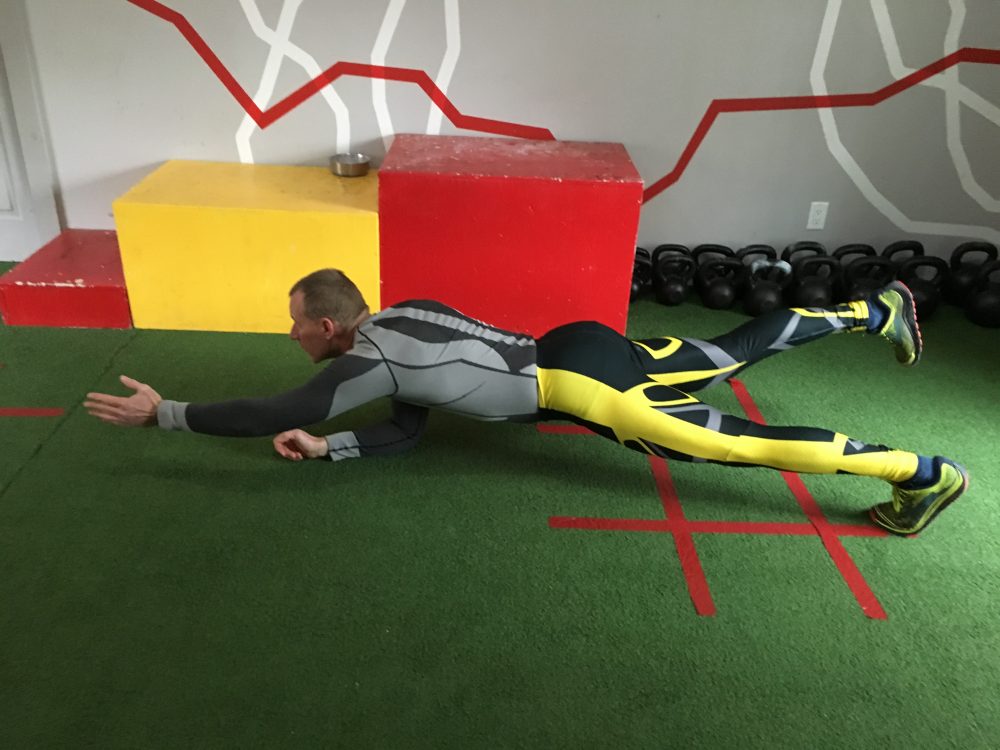
    Incline Dynamic Plank- Start with an elevation of 24”-28”,  have elbows on the box, and body extended with hips pressed forward, contract glutes to help with this.  It is important to keep the torso, hips, and legs extended, and level with no twisting or compensation. Extend an arm and hold to fatigue for 2-10 seconds, then another arm, then each leg.  Repeat 2-3 times. Remember, perfect body position is the key, twisting, or pushing your butt back just to get 10 seconds does not achieve the goal of the exercise. You will just end up skiing with the same compensated pattern come snow time.  

    Beginner Plank. (Photo: Stuart Kremzner collection)

    To progress exercises- increase time first to 10 seconds, then decrease incline to lower box, then lift arm and leg, increase the time to 10 seconds, and decrease incline to flat. Once flat, you can add load, distraction, or instability.

    Advanced plank. (Photo: Stuart Kremzner collection)

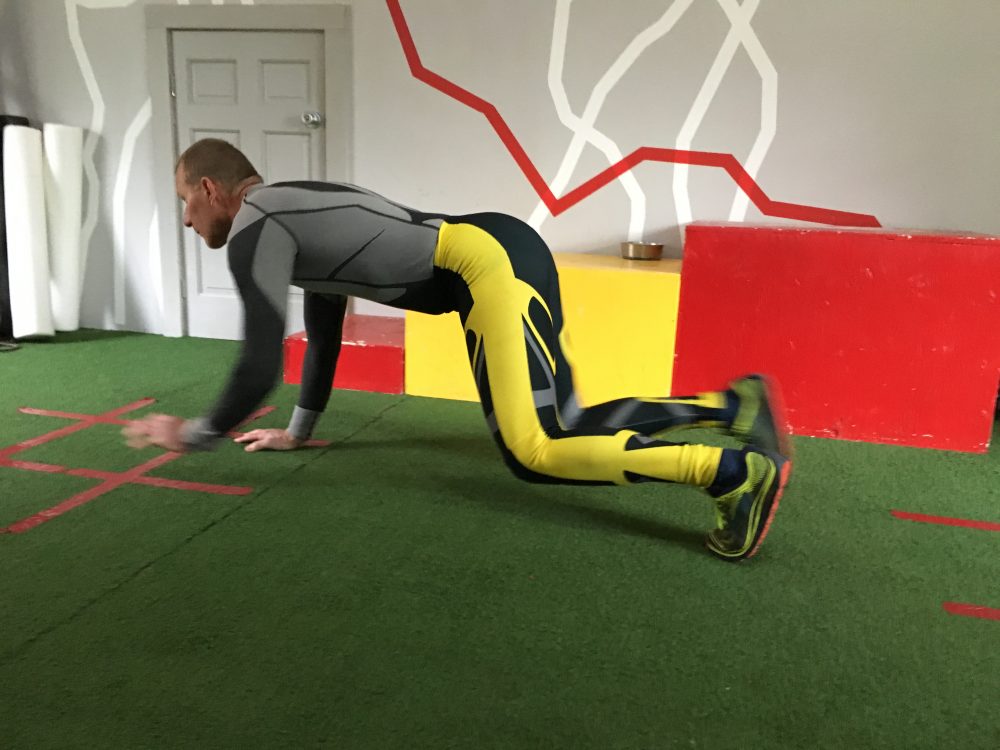
    Baby and Elevated Forward and Lateral Crawls– These are baby crawls with more resistance. Focus on keeping a neutral spine and head up. To increase load, advance to Leopard Crawls by elevating knees 1-3 cm off the ground. Keep the same rhythm and technique as baby crawls.

    Elevated crawls. (Photo: Stuart Kremzner collection)


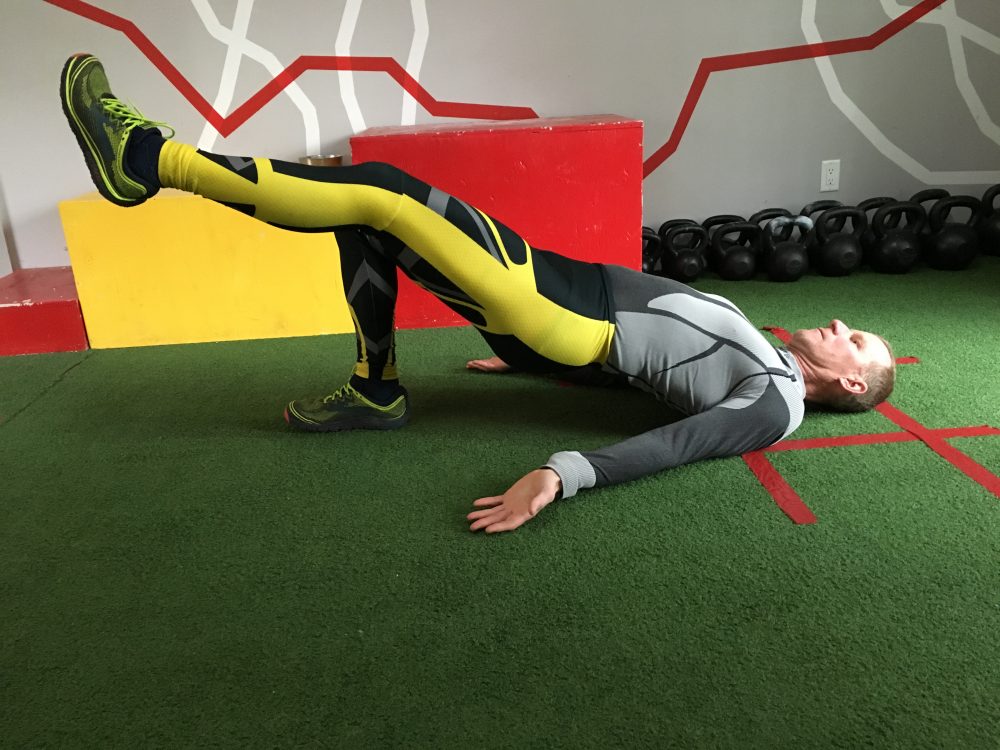
    Static Single Leg Glute Bridge- Lay on your back, draw one heel up 6” from buttock, lift hips up with opposite leg extended. Hold 2-10 seconds. To advance exercise, cross arms across chest, use distraction or increased load on opposite leg.

    HS bridge. (Photo: Stuart Kremzner collection)


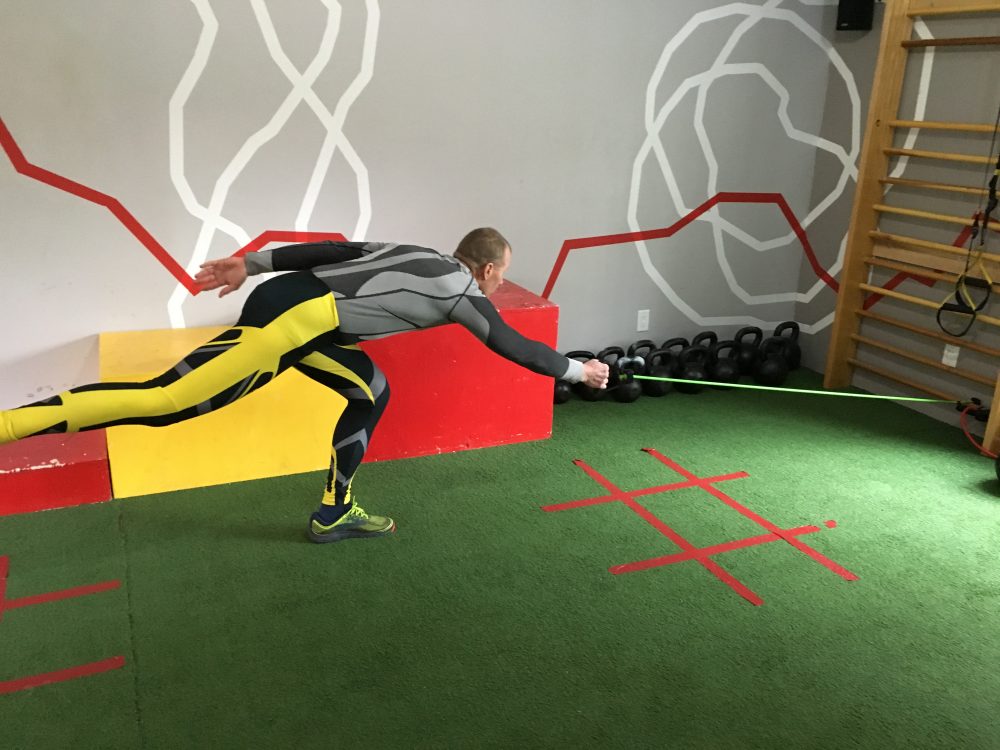
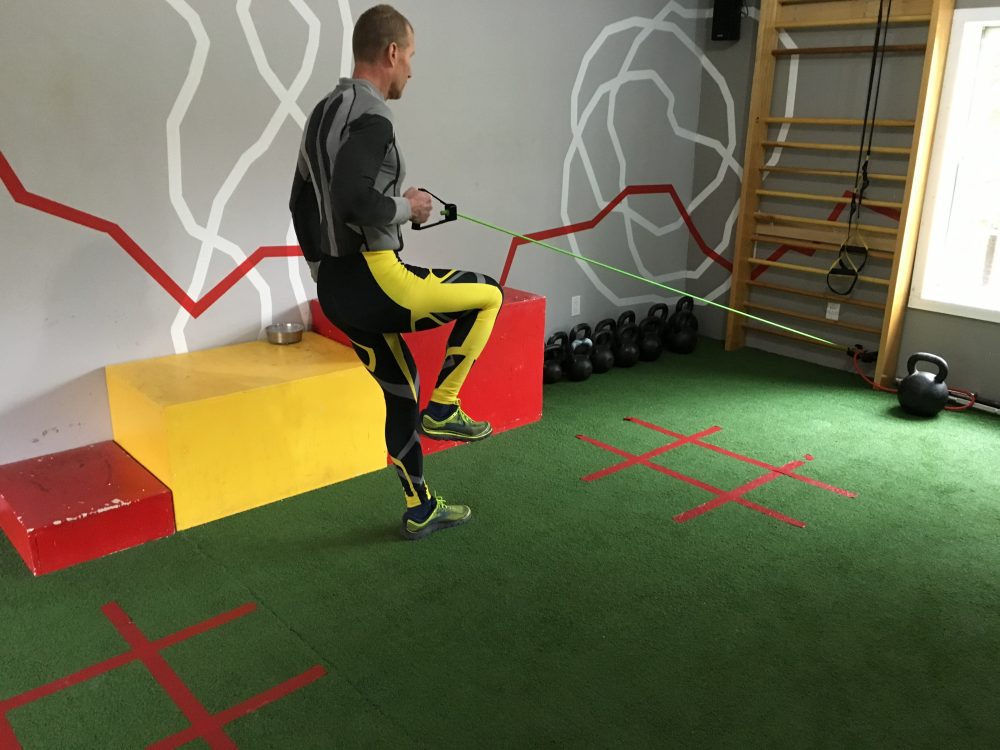
    Glute Pulls– This exercise was developed by Mark Shropshire. This is a more advanced method of strengthening the glute-hamstring complex. Have a resistance band or chain with minimal initial load-but with some resistance-attached to a fixed sturdy object. Hold resistance band in right hand, and standing on right leg while extending down and forward, towards the ground, hinge at hips while bending knee, extend left leg, hold, then return upright while lifting the right knee and pulling back with the right arm. Switch sides, repeat.

    Glute pull. (Photo: Stuart Kremzner collection)


    Glute pull finish. (Photo: Stuart Kremzner collection)
  • Wednesday Workout: Simi Hamilton’s 10’000 Foot View of Fun

    Wednesday Workout: Simi Hamilton’s 10’000 Foot View of Fun


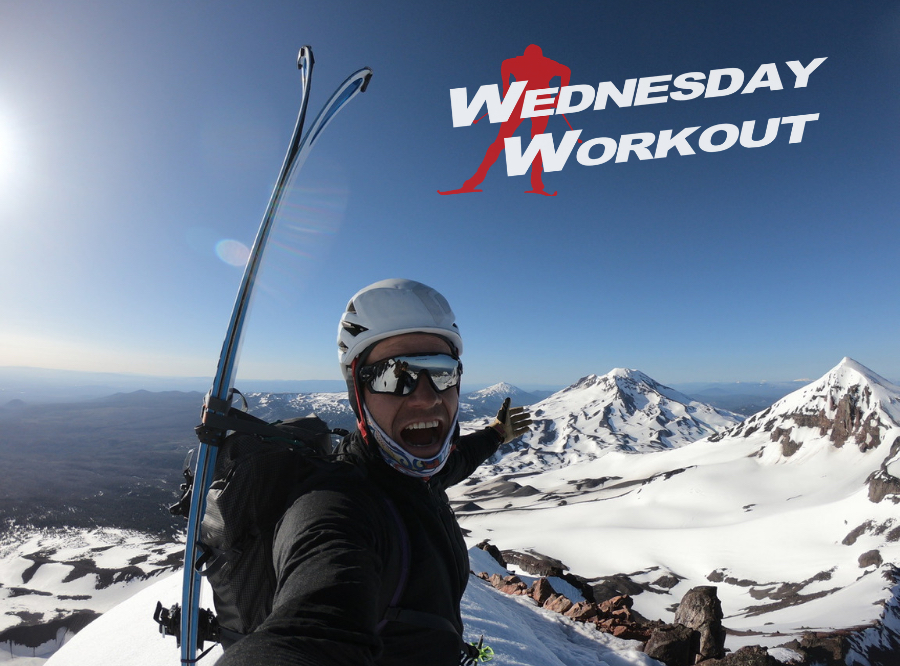
    Simi Hamilton on a solo ski-mountaineering adventure to Oregon’s North Sister. The photo was shot before Hamilton skied down and tagged the summit of the Middle Sister (rightmost peak) this May. (Photo: Simi Hamilton)

    This post in our long-running Wednesday Workout series takes the 10,000-foot view — almost literally. The nuts and bolts of it are this: we’re posting Simi Hamilton’s training log from Monday, April, 3oth thru Saturday, June 9th.

    Hamilton needs no introduction to FasterSkier readers. In any case, here are Hamilton’s basics. Thirty-one-year-old sprint specialist who popped a 12th last season in Seefeld, Austria in a loaded 15-kilometer mass start freestyle. The seventeenth ranked sprinter on the World Cup. Member of the U.S. Ski Team. Fond of thin air, like any good kid from Aspen, Colorado.

    On his International Ski Federation (FIS) profile page, two small dashes “–” leave a void describing Hamilton’s hobbies. Let’s assume this was an oversight, with too little room to honor what Hamilton sees as more than a hobby.

    He is an athlete clearly satisfied with skiing fast as he’s been a top-ranked World Cup sprinter since 2012. But if you follow Hamilton on social media or the Stratton Mountain School blog, there’s the occasional glimpse into Hamilton’s “hobbies”. If it’s an outdoor activity involving larger than normal size mountains, moving fast and light, pushing what even fit athletes would consider sustainable aerobic thresholds, Hamilton is home.

    Simi Hamilton (left) with Akeo Maifeld-Carucci (right) on the southeast ridge of Mt. Jefferson.

    Why present a broad-in-scope training log snapshot for a Wednesday Workout? By now, we are guessing most cross-country skiers are seeking snow. They have logged hundreds of hours. There’s been the OD, the L1-L5, the 30 x 30s, the 4 x 4 min. And we are also hoping there’s been plenty of “hobby” time.

    If there’s something to learn from Hamilton’s logs, it’s to have fun. 
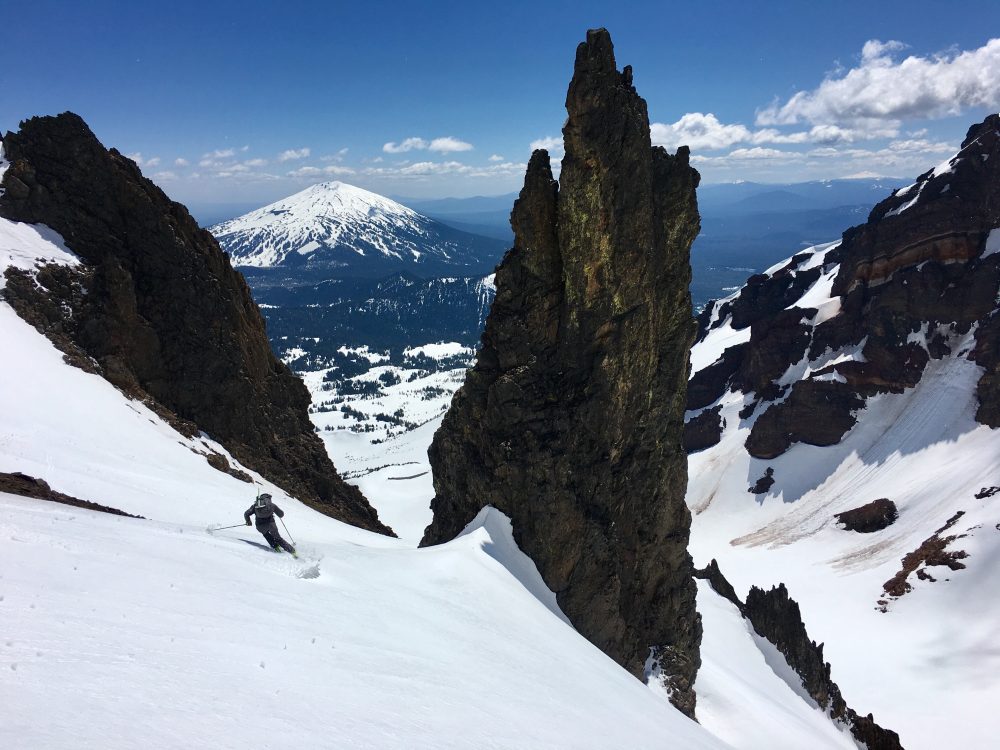
    Simi Hamilton harvesting corn snow on Broken Top near Bend, Ore. (Photo: Linden Mallory)


    ***

    The Training Logs:

    “That first week in May probably looks a little weak, and it was,” Hamilton emailed, explaining he had been relaxing on a river trip in early May. “I’m usually on my bike a bit more in May, but Matt [Whitcomb] and [Chris] Grover have tried to steer me more towards skiing while in Bend the last few years.”

    Technically speaking, skiing has many forms. Maybe skiing in the mountains is what his coaches had in mind.

    buy zyrtec

    If you’re reading this now and you’re wearing a race bib at some point this season, we hope you’re having fun. We hope you’ve had fun. We hope you’ve logged some full-blown adventure days. 
     

    Simi Hamilton’s training log week of 4/30-5/6.

    PDF Version of 4/30-5/6

    Simi Hamilton’s training log week of 5/7-5/13.

    PDF Version of 5/7-5/13

    Simi Hamilton’s training log week of 5/14-5/20.

    PDF Version of 5/14-5/20

    Simi Hamilton’s training log week of 5/21-5/26.

    PDF Version of 5/21-5/5/26

    Simi Hamilton’s training log week of 5/28-6/3.

    PDF Version of 5/28-6/3

    Simi Hamilton’s training log week of 6/4-6/9.

    PDF Version of 6/4-6/9

  • Wednesday Workout: Beach Skiing with the Bowdoin Nordic Team

    Wednesday Workout: Beach Skiing with the Bowdoin Nordic Team

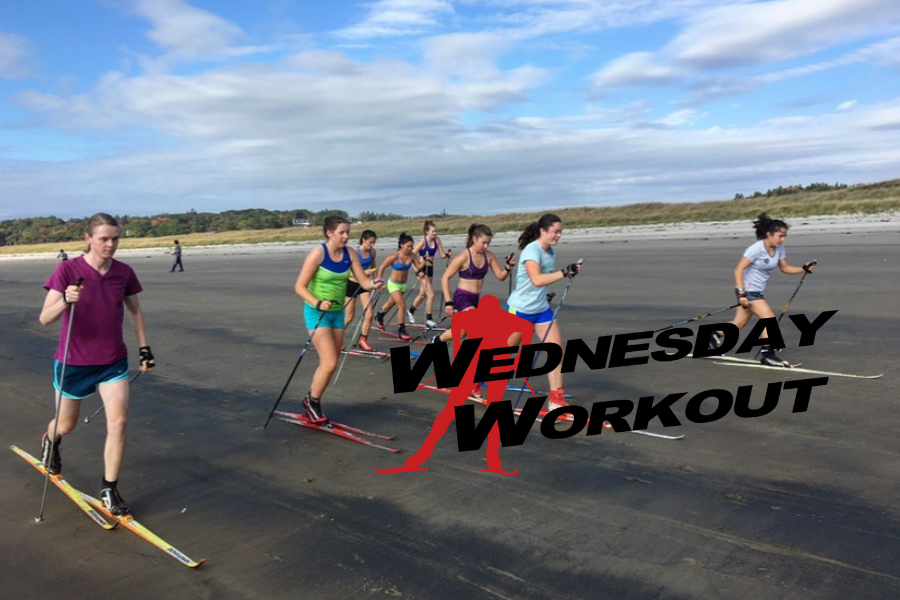
    Maine is Beach Skiing Paradise for Bowdoin College’s Ski Team. (Photo: Nathan Alsobrook)

    The workout this week comes from the head coach of the rising Bowdoin Ski Team, Nate Alsobrook. While it can certainly be beneficial to train at altitude or in the mountains, Alsobrook shows that the unexpected beaches of the Maine Coast can be equally well suited for preparation. This workout highlights looking outside the box to take advantage of the terrain you have access to. 

    In our program, we are always looking for creative ways to use our surroundings for fun and productive training.  We don’t have a ton of mountains on the Maine Coast, but we have some gorgeous beaches – perfect for sand skiing intervals. Sand skiing feels surprisingly realistic – like skiing up a fairly steep hill.  On a flat beach with fine, damp sand (ideally when the tide’s going out) you can also get some decent glide.  It’s definitely a grind, so it’s best for high-intensity intervals.

    Skiing on sand takes some getting used to; it’s easy to break into a run or bound, but with some focus, you can ski with proper technique (striding only – good luck trying to skate or double pole).  Wet sand is surprisingly gentle on the bases, but even so, you’ll want to use your rock skis.  Any skis will do, even skaters – you’ll have no trouble getting kick!

    The team does this workout 2 or 3 times in the fall as a nice change of pace from running and rollerskiing.  It’s particularly useful in the lead-up to our on-snow Thanksgiving Camp – it helps our athletes get a feel for sliding on long skis before getting back on snow.

    buy indocin online

    Here’s an overview of the workout:

    • 20 minute warm up run.
    Our favorite beach is only accessible by a 2 mile run through the woods, which makes for a perfect warm up – skis in one hand, poles in the other, and boots in a backpack.

    • 1 x 3 minutes at a low threshold pace to complete the warmup and get a feel for the sand.
    • 4 – 5 x 3 – 4 minute intervals at 5k effort (90%+ of max HR).  Equal recovery time between intervals.
    • Jump in the ocean for a quick recovery swim, then pack up and jog 2o minutes back out.

    Happy skiing!

  • Back to Basics: How to ‘Reset’ for Nordic Performance

    Back to Basics: How to ‘Reset’ for Nordic Performance

    Author Stuart Kremzner demonstrates diaphragmatic breathing, the baseline exercise for reseting the neuromuscular system and optimizing strength in sports like nordic skiing. (Courtesy photo)

    The following strength and performance tips come from one of our resident experts, Stuart Kremzner, MS, CSCS, FMSII, OS, RN, an exercise physiologist who has coached and raced in nordic skiing for over 20 years. Kremzner has trained/consulted with college athletic programs, elite teams, and athletes with the goal of improving athletic performance and injury prevention. When not working, he is running and skiing on the trails in New Hampshire or writing wax tips for the TOKO Tech Team. Kremzner can be found at e3sportsperformance.com.  
    ***

    Like most coaches, I have been on the eternal quest to get the most out of an athlete’s performance. Not all of us are born with VO2maxes in the 80’s so we need to do lots of tuning to get the most out of our motors. When a skier comes by on the course, I do the quick checklist of what is holding this skier back. More often than not, I see the inability to maintain an efficient body position, transfer weight and balance as the limiting factors. The fundamental commonality between all these elements is reactive core strength. This element is one of the most important for technical efficiency for all skiers.

    Author and exercise physiologist Stuart Kremzner putting his “Original Strength” to the test. (Courtesy photo)

    Many skiers from beginner to elite can improve. Beginners often lack the balance; elite skiers can have compensated movement patterns from over-specialization or injuries. Most people right now are thinking, “I can do a plank for 2 minutes and I still have trouble balancing.” A four-point plank is static core, i.e. not reflex driven, and not effective training for dynamic balance. Core strength exercises must be dynamic to transfer over to be effective for sports performance. Most important, we need to prime our nervous system prior to the core exercises to get the most out of them.   Without this step we are addressing only half the problem.

    In 2003, physical therapist Gray Cook introduced and expanded the importance of mobility and stability in the performance hierarchy. Without this solid foundation of the ability to control movement and have a full range of movement, everything else we add on for fitness and performance development will not be optimal. Cook touched on an area of primitive patterns that has gotten much greater recognition. Tim Anderson and Geoff Neupert expanded on the concept in their book, Pressing Reset: Original Strength Reloaded. In it they describe the concept of “Resets” patterned after the neuro developmental movement sequence – the sequence of movement that infants use to develop enough core stability to stand on two feet and walk.

    In Original Strength Performance: The Next Level, the concept was applied to the performance realm. The authors learned that resetting the nervous system prior to dynamic core exercises yielded exceptional results in redeveloping and maintaining efficient core strength and movement patterns.   Resets are like wiping your hard drive for your neuromuscular system. If we don’t erase the dysfunctional pattern, it will continue to delay development.

    Neurophysiologically, we are born with a blueprint for optimal, efficient movement patterns, and our foundational core is developed through a sequence of breathing, head movement, rolling, and crawling.  After about 4-6 years, if we don’t use our core we start to lose it, we are seeing this more and more given lifestyle changes. How many of the kids we coach are doing manual labor these days and spending hours outside running and playing? Our movement pattern’s base-level functioning is dictated by the dominant motor programs we use. Our bodies were designed to be up and mobile 8-10 hours a day. Put us in a chair for 6 hours a day (like with school kids) or a desk-jockey job, and we have global changes in the detuning and functioning of our neuromuscular system. Primary core muscles develop dysfunctional firing patterns and weaken. Hip flexors shorten, and posture changes (we get more stooped). Core muscles stop firing optimally in their original motor program; they are not turning on at the right time or not at all. This leads to altered/decreased muscle-firing sequences, compensated movement patterns, power leaks, injuries, and for may of us, decreased athletic performance.

    Resets are like wiping your hard drive for your neuromuscular system. If we don’t erase the dysfunctional pattern, it will continue to delay development.

    For years as coaches and physiologists, we have been focused on more speed, power, strength and endurance. However, all this work is not optimized if we don’t have the fundamental ability to generate power, transfer it effectively between joints then into the ground, and have optimal mobility to use the full length of all of our muscle fibers effectively.

    Reflexive core strength is the foundation of efficient all movement patterns. Hip stabilization and coordinating segmented movements between the upper and lower body is primarily mediated/controlled by our deep pelvic floor and transverse abdominal muscles.  The key is to keep the core exercises dynamic and reflexive (as reflexes drive the optimal functioning of the deep reflexive core). Good skiing technique does not consist of doing static planking for 5 minutes.  The exercise needs to be dynamic, hence you need to lift an arm, leg, or both (with proper body alignment) to keep the a plank reflexive. It is important to use perfect technique. It is far more effective to use perfect technique for 3 seconds vs. poor technique for 30 seconds (this just keeps reinforcing the dysfunctional muscle firing pattern!)

    What follows are some ideas and the very basic science behind activating and training your reflexive core. Think of this as your “quick start” guide. For individualized/targeted training you need to have a good evaluation with an Original Strength certified coach who can develop a program that is most effective for you. At the very least this will  help get you started. These exercises were developed by  Anderson and Neupert of Original Strength.

    Before and after each exercise, grab a 10-20 kilogram weight and do a deep squat, then a toe touch. Pay attention to how it feels, range of motion and “snap” you have going down and coming up.

    To start, you need to reset and “overwrite” the dysfunctional movement programs in your nervous system.  These exercises are called “resets”.

    “Resets are the ABC’s of movement. When you can put all the letters together you can begin to make words, then before you know it you can make sentences.  Sentences become paragraphs and eventually master pieces of literature! Movement is a lot like this – it starts out simple and messy and through practice becomes a thing of beauty.  It starts with the resets of Original Strength.” (Shropshire, 2018)

    This is achieved through systematically activating the muscle firing patterns as we developed them when we were infants/toddlers. These recruitment patterns originate in the more primitive part of our brain (brainstem, medulla oblongata pons, cerebrum); this is the foundational center of our most basic movement patterns. Through aging, injury and dysfunctional pattern overrides (sitting 8 hours a day), these fundamental patterns are overridden by altered muscle firing patterns that are not efficient.

    The fundamental resets are diaphragmatic breathing, head nods, rolling, rocking and crawling. Each exercise has a video link to view excellent technique. If your squat or toe touch feels better and you can move with more depth and ease, that is a good reset for you.

    It all starts with diaphragmatic breathing.  Diaphragmatic breathing is critical to resetting and activating your core.  The diaphragm, along with the transverse abdominis and pelvic floor, form the basic reflexive core. Intentional breathing using the diaphragm activates the other muscles of the reflexive core via neural and fascial connections – hence it is the gateway into the reflexive core.  Head nods and rolling help reset and stimulate your ocular-vestibular system, which is integrally related to developing proprioception and balance.

    1. Diaphragmatic breathing (restores muscle proprioceptive reactivity, also shifts CNS from sympathetic to parasympathetic): Lay on stomach (or back), forehead resting on flat hands, legs extended. Belly breathe deeply in and out through your nose. Your exhale should be twice as long as your inhale. Tongue should be pressing on the roof of your mouth just behind your teeth. On the inhale, push your belly button into the ground and push it up as much as possible. Belly should always rise before shoulders. Breathe for about 2-3 mins, then flip over on your back and hold your knees up with hands and keep focusing on deep breathing for another 1-2 minutes.  Video  (The key with all these exercises is to maintain the same tempo and depth of diaphragmatic breathing.)
    2. Head nods: Lay on back with arms at 45-degree angles, palms up, legs extended.  Have eyes look back, extend neck and head rotating to point where forehead is touching floor, then roll eyes down flex neck forward to look between heels.  Repeat 10 times (keep same breathing depth and rhythm).  Video
    3. Rolling: There are many types of rolling variations, different type of rolls are more effective for improving various movement patterns. Start with Egg Rolls then move to segmental rolling.
      • Egg Rolls: Rotate eyes, head body. Use eyes then head to initiate roll use as little energy as possible, should feel relaxed and easy, keep rotating head all the way though for complete range of motion.  Video
      • Segmental Rolling: Video
    4. Rocking: On hands and knees, keep head/neck extended, rock back and flex neck. Keep back in level alignment and elbows locked out with body/neck extension and flexion. Rock slowly forward and backward, maintaining breathing pattern. Video 1 | Video 2

      “Rocking”, a basic movement for reseting the neuromuscular system.
    5. Baby Crawls (3 x 30 meters): Keep head up, diaphragm breathe as you move, lift hand and opposite knee off ground as you move forward. Pay attention to keeping hips level. Once you can do this perfectly progress to keeping knees off the ground (about 2-3 cm, no more).  Video

      It’s not juvenile: baby crawls can help “reset” the neuromuscular system.

    How to apply these exercises:  

    The resets are the ideal warmup prior to your workouts. When these exercises are complexed with individualized core strength and strength exercises, overall strength and balance will be further improved. Future articles will discuss some great core and strength exercises focused towards developing an improved strength foundation for nordic.

  • Wednesday Workout: Sizzling Hot 30/30’s with BSF’s Nick Michaud

    Wednesday Workout: Sizzling Hot 30/30’s with BSF’s Nick Michaud

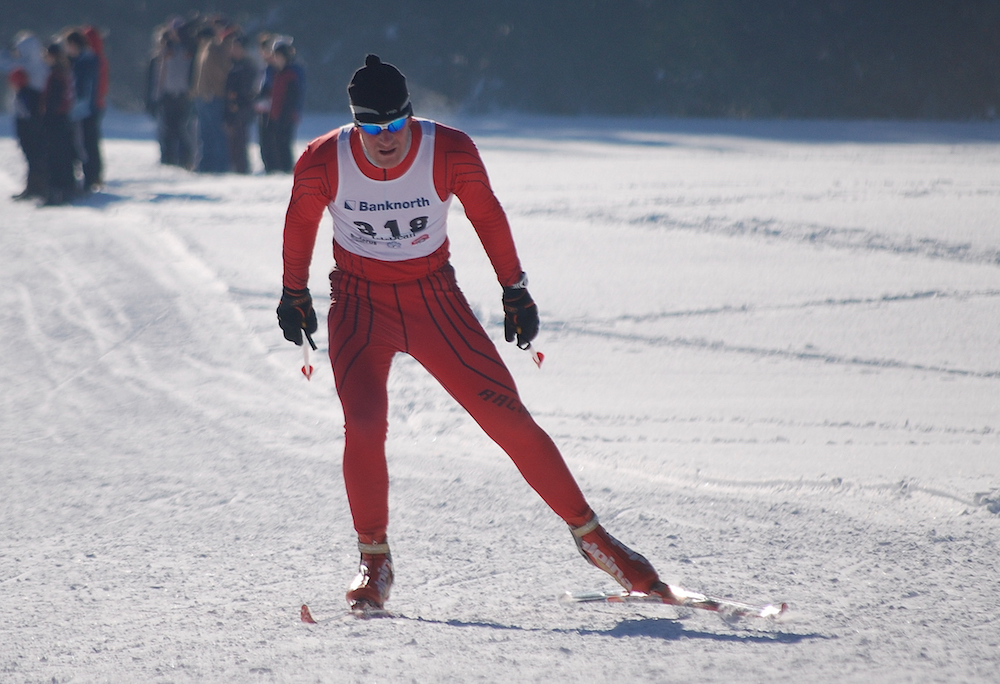
    BSF’s Nick Michaud (red suit) at last season’s Senior National Championships in Anchorage, Alaska. Michaud qualified 4th. (Photo: Gilbert Michaud)

    This Wednesday Workout was provided by twenty-six-year-old Bridger Ski Foundation (BSF) skier Nick Michaud. Bates College educated and raised plumb-line north in Fort Kent Maine, Michaud has emerged as a sprinter to watch on the SuperTour. He’s a gritty, salt-of-the-earth athlete who barely missed a nomination to the 2018 Olympic Team.

    Michaud offered FasterSkier a menu of options for the 30/30 workout — 30 seconds on 30 seconds off. From junior athletes to masters in M8 and beyond, Michaud has you covered with these training session variants.

    Let the gains begin.

    Backstory of the Sizzling Hot 30/30’s from Michaud:

    “Short, explosive movements are like bacon for me. I’m thrilled to eat bacon anytime, anywhere, with anyone. With vegetables, grains, and most foods that are really important for function, it can feel like a chore. That’s what a lot of nordic ski training feels like for me. My body, my mind, would prefer to just do speed work, lift heavy weight, and play basketball — and eat bacon. But in order to meet my performance goals, I have to eat vegetables and grains: aerobic base, lactate threshold, energy management, mindfulness and so much more. For these reasons, I love 30/30s.

    30/30 home terrain for BSF’s Nick Michaud in Bozeman, Montana. (Photo: Max Lachance)

    The execution is very simple: 30 seconds “on”, 30 seconds “off”. The effort and duration can be customized for the purpose of the workout. There should always be a purpose!. For athletes with periodized training plans, 30/30s can be used in different cycles of training to meet different goals. For a more casual athlete, 30/30s can simply be an extremely fun way to get in some higher intensity training.  

    Dragan Danevski, BSF nordic program director, began using 30/30s eight years ago. There was a study in Europe focusing on track and field and how to improve efficiency of running economy, improve aerobic capacity, and reduce the recovery time in a 30/30 workout. The original study tracked mainly 1500m and 3000m runners. Danevski adjusted the workout for skiers here at BSF.

    Danevski said BSF has used 30 by 30s for a few different goals: improving skier’s economy, stimulate good technique, and shortening recovery time for lactate clearance. Originally it was for improving threshold.  For his skiers, Danevski saw the potential to improve anaerobic capacity.

    Throughout summer Danevski follows the study and uses 30/30s to improve threshold.

    For the following age groups, the coach prescribes one 25-30 minute block of 30/30s for U16 and U18s. U20s go for a 30-35 a minute block of 30/30s. Some older skiers are ready for a 45 minute 30/30 session.

    Danevski said these 30/30 training days need to be disciplined by monitoring heart rate.

    tizanidine buy online, buy baclofen online, zanaflex online

    In the past, the 30/30 workouts were used only during intensity blocks. Recently, we’ve started using it throughout the whole training year: on skis, foot, and rollerskis.

    Psychologically, Danevski said the 30/30 is a more tolerable intensity session, especially for kids, since they can focus on high-quality efforts for 30 seconds each time. It’s easier to focus.

    As we transition into fall here at BSF, we also use 30/30s to improve anaerobic capacity. One basic example we use are three to six sets of a 15-minute long 30/30s — with appropriate rest between each set.

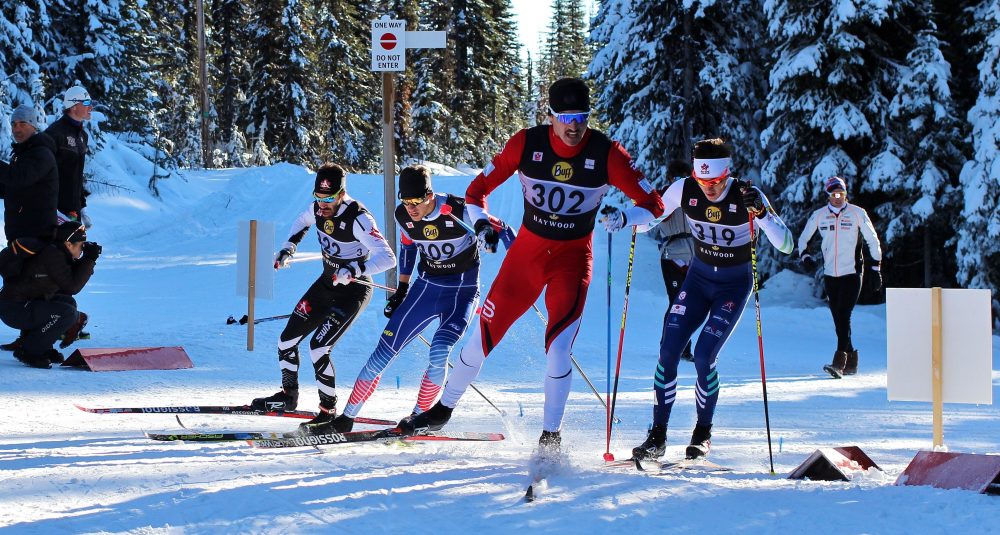
    Nick Michaud (BSF) in bib 302 putting those 30/30s to good use at the Sovereign Lake NorAm in 2017. Michaud was the second fastest qualifier. (Photo: Forrest Mahlen)


    The 30/30 Workout Menu Starting with Michaud’s Favorite Variation:

    Nick Michaud: 3 x 5 minutes, sprint pace. So we are all clear, this means a five minute long  30/30 excecuted three seperate times. During each five minute period, that’s a total of 2.5 minutes “on”, and 2.5 minutes “off”. For the entire session, the athlete is “on” for 7.5 minutes, or half the total elasped time. I rest for five minutes between each set.

    Notes: I use this two days before a sprint race, increasing my effort each set. It’s a great way to get a feel for speed, technique, and effort in all areas of the course. I take five minute breaks between sets. I leave the venue with a good understanding of the course and excited to move fast on it two days later. Using this training sessions at different points of the year is a great way to practice understanding the critical difference between effort and ski speed — which I think is crucial.

    Favorite 30/30 Variations from Others:

    Gary Colliander, US Paralympic Biathlon Coach: 4-8 x 6 minutes. Number of blocks depends on L3 or L4.

    Notes from Colliander: “Focus on quality of movement through the interval and a slightly higher turnover. With the short ‘on’ time I think you can hold the technique together better and because there is a short rest you can potentially push the pace and thus the level a bit. They’re still very tough, but that short rest just seems to offer bit of recovery while allowing the heart rate to remain high.

    Another way to look at the short 30 second rest is like it’s a downhill. Anytime you get a downhill it’s a chance to grab some O2 and recover although for a very short bit. But it always feels good when you come out of that tuck.”

    Lina Hultin, Bridger Ski Foundation Development/Competitive Team Coach: 5×6 minutes.

    Notes from Hultin: “What I like with 30/30s and 45/15s is that it allows the athletes to ski more efficiently. Since you have that shorter break, you tend to have better and more efficient technique since athletes ‘dare’ to push it a little harder when they know they will have a shorter break. Good technique requires strength and power and the shorter interval allows athletes to keep good technique for a longer time.

    The closer you get to the season you can dare to let go of that shorter break and hopefully you can maintain that good efficiency in you technique in a continuous time trial or longer intervals.”

    Akeo Maifeld Carucci: Craftsbury Green Racing Project Athlete: 2-4  x 10-15 minutes at L4+.

    Notes: “Terrain wise, I like small rolling terrain or maybe gradual uphill with some bumps. I believe in keeping it between L1 and recovery pace during the rest phase, but it is important that it keeps moving at the least.”

    Seth Hubbard, Bridger Biathlon Club Head Coach: 15/15s for sets of 4-8 minutes at race pace +

    Notes:This workout is altered depending on an athlete’s age and their work on pacing, and ability to surge and recover.”

    Will Sweetser: Nordic Programs Director at Sugar Bowl Ski Team and Academy: 15 sec/15 sec 6-12 minutes.

    Notes: “I use 6-12 minute repeats with ‘on time’ at either L3+ or goal pace for races 8 minutes and longer. First used this coaching runners in the mid 90’s. Have since had good success with younger athletes developing pace sense.

    Used the 15/15 to help take an athlete’s 3,000 meter time from 11:38 to 10:10 in 5 weeks. The next year this athlete brought their time down to 9:27 using 15/15 session of 2 x 3000m about once every 10 days.”


  • Wednesday Workout: Using Poles on the Ups with Caitlin Patterson

    Wednesday Workout: Using Poles on the Ups with Caitlin Patterson

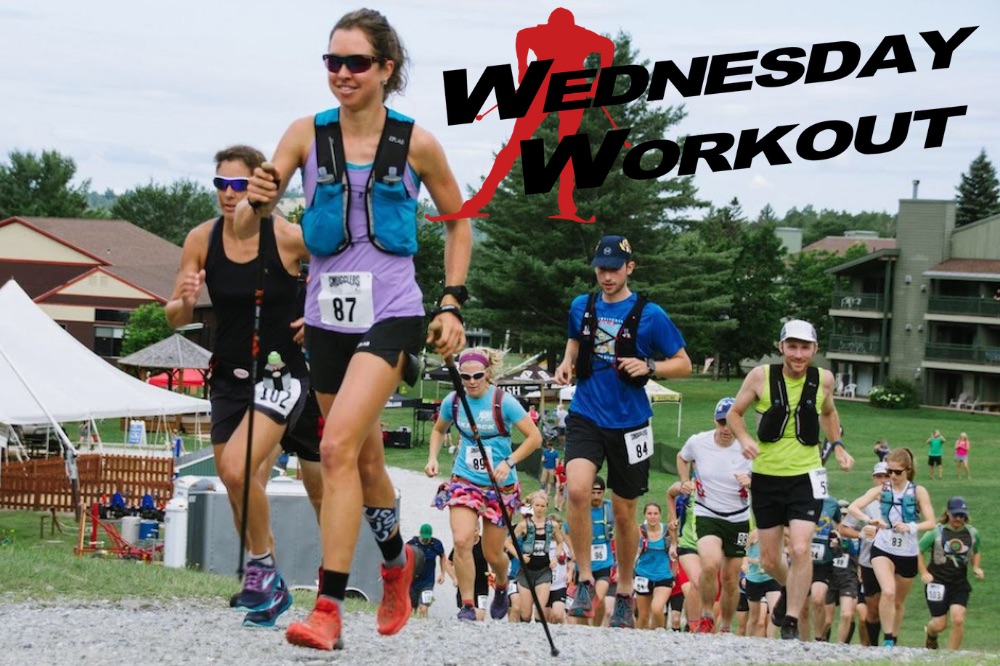
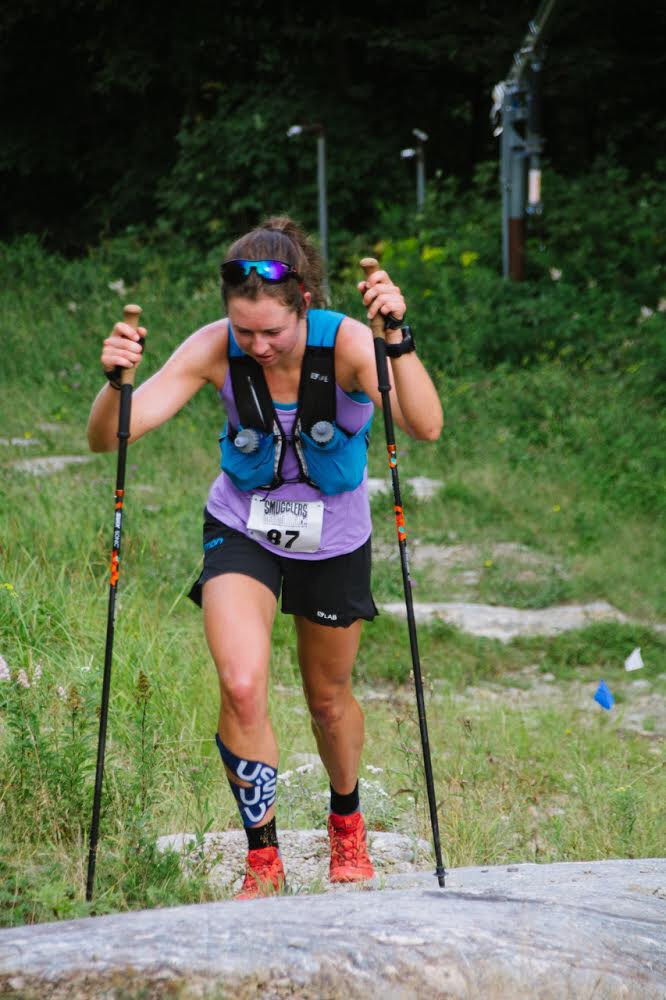
    Caitlin Patterson (front) racing the 25 k Smugglers’ Mountain Race in Jeffersonville, Vermont, in August. (Photo: Pennie Rand)

    This week’s workout comes from Caitlin Patterson, a Craftsbury Green Racing Project (CGRP) skier and 2018 Winter Olympian. We asked the 28-year-old Patterson, an accomplished mountain runner as well, about training and racing with poles while hiking or running. When and what type of terrain does she typically use them for, and what kind of workout would she recommend with poles? 

    ***

    It may come as no surprise that many of Caitlin Patterson’s dryland workouts incorporate poles. Even with a nomination to the 2017 USA Track and Field Mountain Running World Championships Team, Patterson’s mentality remains, “I am skier and I train to be a skier.”

    With skiing as her primary sport (she competed at the 2018 Winter Olympics in South Korea), Patterson has also found herself as a top contender in domestic mountain running races.

    Caitlin Patterson racing the 25 k Smugglers’ Mountain Race in Vermont in August. (Photo: Pennie Rand)

    This summer, she raced in California’s 2018 Broken Arrow Skyrace series. In the Vertical Kilometer (VK) 5-kilometer race, with 3,100 feet of elevation gain, Patterson placed third among women, behind 2010 Olympic skier Morgan Arritola in first and professional ultra runner Hillary Allen in second. Patterson also raced the Broken Arrow 26 k and finished second to Daniella Moreno, of the U.S. Distance Mountain Running Team.

    Born in McCall, Idaho, and later raised in Anchorage, Alaska, Patterson acknowledges that much of her success in both mountain running and skiing stems from knowing when and how to put her poles to good use. (In both Broken Arrow Skyraces, she was permitted and opted to use poles.)

    When to put poles to use?

    The straightforward answer to this question is on the ups. During distance workouts, Patterson rarely takes the time to pole plant while descending downhill. Her reason is that doing so may actually inhibit her turnover, slowing the pace and her momentum.

    “I find that when you try to pole on a downhill, you often brake or brace more,” she explained. “So I put them away or hold them in my hands on a downhill.”

    Once she reaches a climb, regardless of grade, she puts her poles and arms to work.

    “From the most gradual uphill to the steeper uphill for a distance workout, I’ll use them,” she said.

    When it comes to intervals on foot, Patterson almost always usespoles. Much of this is due to the training philosophy of her coach at Craftsbury, Pepa Miloucheva.

    “In all my years here on the team, I haven’t ever done just pure running intervals,” said Patterson, now in her sixth year with CGRP. “That’s sort of more related to Pepa. She just doesn’t really care for them. She really cares more for running with poles or rollerski intervals.”

    Beyond the type of workout (distance or interval), Patterson also looks at the workout’s expected elevation gain and terrain when she decides whether or not to use poles.

    A workout with “sustained climbs”, such as a long run to the top of a mountain peak, warrants using poles for Patterson. She added that it “also depends on the footing or the microscale of the terrain/type of trail that you’re on.”

    Trails with large, chunky rocks may not be conducive to proper pole planting. The same goes for terrain with surfaces that make poling more work and climbing less efficient. Patterson explained that her younger brother, Scott Patterson, a member of the U.S. Ski Team, has yet to use poles in a mountain running race.

    “I was trying really hard to convince Scott to use [poles] for the Rut, a [mountain running] race in Montana,” she said. “He decided not to use them because, with that race, it is so rocky up high. You can’t plant poles on pure slabs of rock.”

    So what’s the most optimal poling workout? Long-distance or interval? Technique-oriented or threshold?

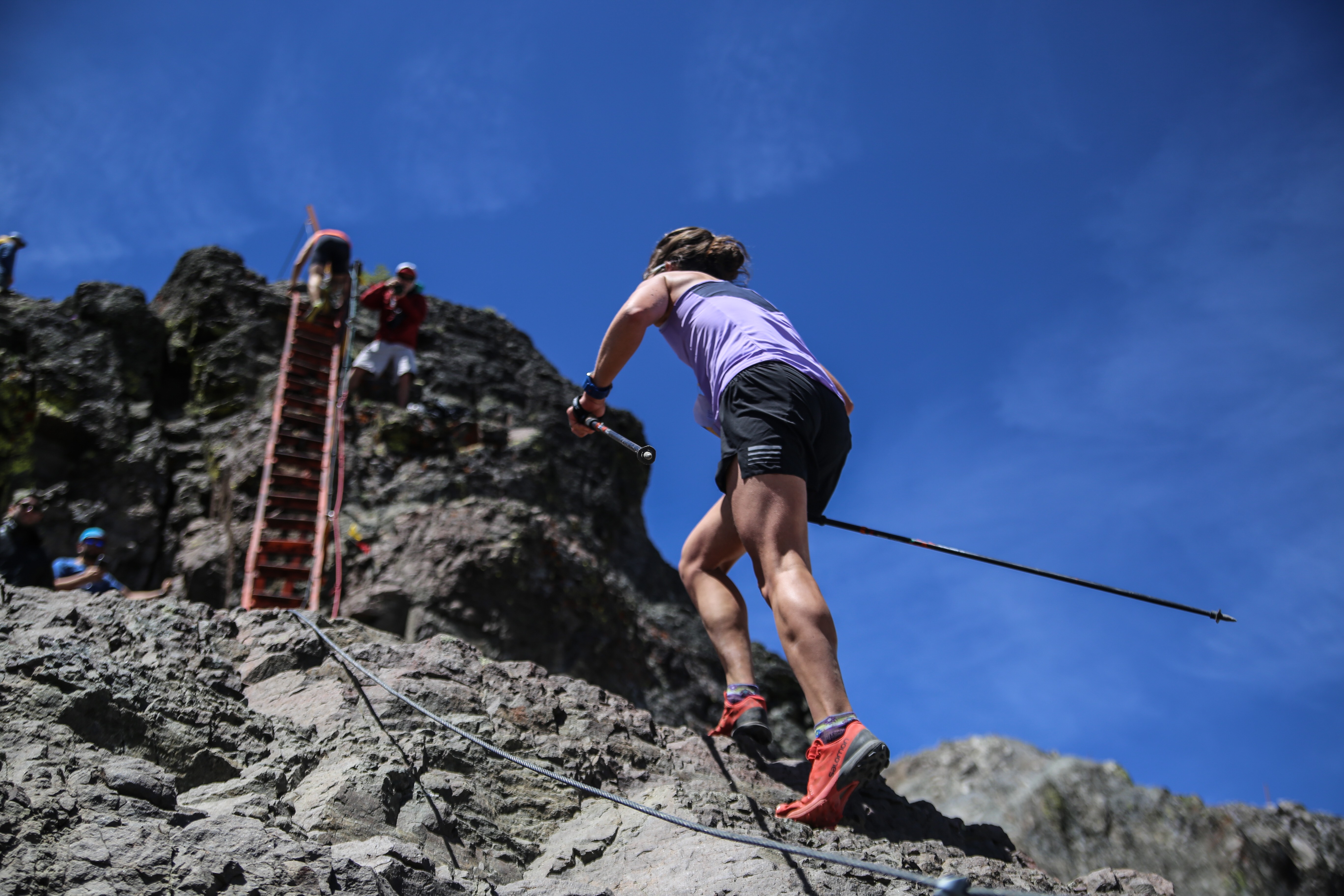
    Caitlin Patterson racing at the Broken Arrow Skyrace in California. (Photo: Martina Valmassoi/Salomon)

    Incorporating poles into workouts can come in a multitude of varieties, but Patterson’s favorite comes in the form of racing.

    “What I would recommend is to go find a local mountain race, double check that you can use poles for it, and race,” she said.

    She recommended a race distance between 10 to 25 k with plenty of elevation gain.

    One of the biggest reasons she favors poles in mountain running races is for experimental purposes. Races offer the opportunity to test how using poles might give an advantage over not using poles.

    buy ventolin inhaler online

    “In these races I’ve done in the past few years, when I was able to use my poles, particularly as a woman racing with the men, I’ll be like, ‘OK, I’m running along on the flats and darn that guy is running faster than me, so I pick up my poles and I just run along and then I’m keeping up,” Patterson explained. “Then I get to a steep spot and I’m like, ‘Huh, I think I’ll start using my poles now,’ and once I use them, I pass the guy next to me or something.’”

    Mountain running races don’t always find Patterson with poles in hand. Using poles on gradual terrain may end up slowing down one’s tempo, she explained, causing the racing to slow down.

    “I’ve found that poles are most useful when you can use them on really steep stuff to save your legs,” she said.

    “No matter what you’re doing with the poles, keep your core strong and your arms strong,” Patterson said of her number-one recommendation for skiers looking to do the workout.

    “I’m thinking more about more overall body efficiency than skiing technique,” she continued. “No matter what technique you do you should always keep your core strong and keep your arms strong and going parallel with your motion.”

    Caitlin Patterson (front) leads CGRP teammates Kaitlynn Miller and Akeo Maifeld-Carrucci while running with poles in Craftsbury, Vt. (Courtesy photo)

    The Workout:

    Type: Mountain Running Race with Poles

    Terrain: Preferably mountain slope with continuous uphill or mountain running race course

    Warm up: Easy 20-minute jog with two to three leg speeds

    Race: 10-26 k threshold effort
    Pole during the climbs and focus on keeping core tight

    Cool down: 15-20 minutes

  • Wednesday Workout: ‘Trailheading’ with Team Gregg

    Wednesday Workout: ‘Trailheading’ with Team Gregg

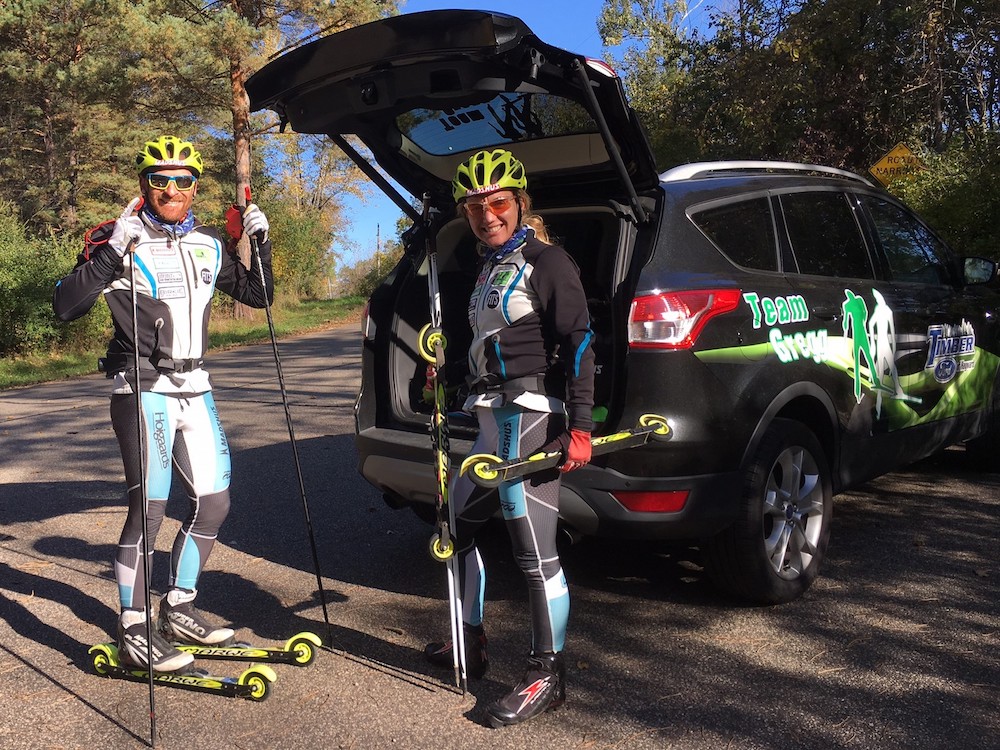
    Team Gregg, Brian and Caitlin Gregg, out for an easy recovery ski together. (Courtesy photo)

    This week, we’re featuring a workout from the training logs of Team Gregg. These days, husband and wife Brian and Caitlin Gregg are adjusting to life, training and bodily changes as Caitlin is pregnant with their first child (a girl), due in early February. Read the full story here.

    Caitlin sent us the following “trailheading” workout, in reference to starting and ending a workout with someone else, which is how they often train together.

    ***

    One of the challenges in training and racing is that it is often challenging to find training partners at the same speed and ability as yourself.  I would argue that the best training partner is one who is just slightly faster than you.  Brian and I have been blessed with opportunity to be a married couple who have both competed in the Olympics.

    ethings.org

    Here are a few ways we get creative to maximize our workouts and fun:

    • Every training partner can offer something and we enjoy large training groups.  If you don’t have a training group, take it upon yourself to organize one.  Utilize a loop so that the group can kind of stay together.  If you are really searching, our neighbor’s house is for sale and you can join one of the many each cross-country ski groups in the Twin Cities.    
    • Utilize different ski speeds as equalizers.  On snow, put the slower person on the fast Redlines.  If you are rollerskiing, give the person who is in the best race shape the slow, soft wheels.  Using various rollerski wheels is a great way to prepare yourself for various snow conditions.
    Brian and Caitlin Gregg enjoying the fruits (and added weight) of their workout during a hike this summer. Brian carried the watermelon in a backpack to slow him down. (Courtesy photo)
    • Another tool we use is a weight vest.  For intervals, Brian will wear a weight vest and we can ski side by side pushing each other.  This summer, I had Brian carry a watermelon during a hike so that we could relate, plus it was delicious.
    • In preparation for the 2015 World Championships, at 9,000 feet in Colorado we would Jetstream bloc my skis so that I could be skiing at speeds more similar to sea level.  Plus, Brian and I could do intervals together.  
    • Although Brian and I might have the same duration for an interval, he will start behind me with the goal of trying to catch me by the end while my goal is to try and hold him off.  This also works really well for speed sessions. 

    Sample Workout: Team Gregg Husband/ Wife Intervals

    We have a great hill in Afton, Minnesota, that Brian and I try and get out to about once a week in the fall. It’s steep and long (for the Midwest) but you can also safely ski down between repeats.

    Warmup: Ski easy for 30 minutes with 15- to 20-second pickups. We usually start our warmup at the same time, but gradually over the 30 minutes, we separate and meet up again to do some pickups. We then do a set of pickups where Brian starts behind me and we try to finish the pickups together.

    Intervals: The workout is usually 5-8 x 4-5 minutes (with 3-4 minutes recovery) depending on how we are feeling and what our goal for week is. Brian will either put slower wheels on or wear a weight vest for the session. I will either put faster skis on or start a little before him.

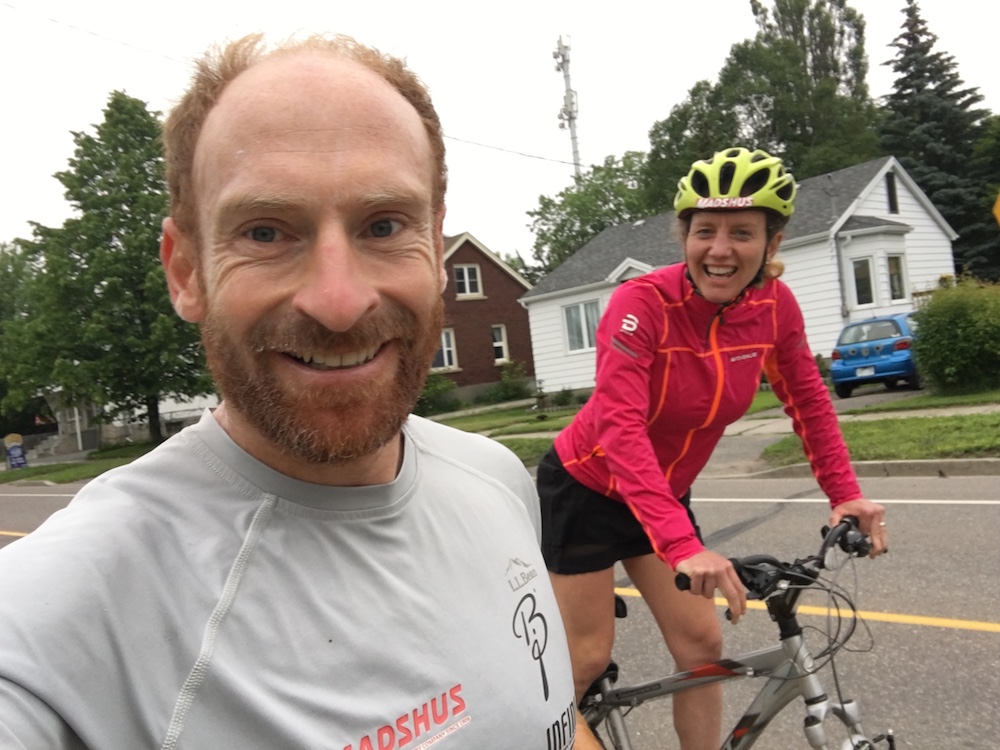
    Brian Gregg snaps a selfie during a workout with his wife, Caitlin. (Courtesy photo)

    The Game (Goal): If it’s just the two of us, we try and make the intervals more fun and exciting by challenging each other to get to the top first, but also try to maintain or drop our times from the start of the session to the end. For example, getting to the top first on the first interval but then falling back or skiing slower each subsequent interval isn’t the goal.We focus on negative splitting each interval in the set, which requires good discipline early on.

    Cool down: We usually ski the cool down together and reflect on the session. Since we are out there together, we don’t always have feedback the way someone watching or filming the entire session from the sidelines would, but we can still be observant of how the other person is moving and offer some technique cues.

    After the session: It’s been incredibly fun to travel the world training and racing together as a married couple. We are extremely lucky that we have both been able to follow our dreams. There are still added challenges to this approach, though… One of the hardest parts of finishing a hard race or interval session together is that we are both exhausted at the same time, which means that there has to be some way of deciding who is going to cook or do the dishes at the end of the night. This is where we put high stakes on who executes a workout better or has a better result at a race. The winner gets to relax on the couch while the loser has to wash and dry! Just kidding; we do the dishes together 😉

    Brian and Caitlin Gregg (Team Gregg) out for a rollerski. (Courtesy photo)
  • Throwback Workout: Marathon Prep with Holly Brooks

    Throwback Workout: Marathon Prep with Holly Brooks

    Holly Brooks skiing up “Wall Street” near the top of Spencer Loop-Hillside trails in Anchorage, Alaska, in the winter of 2014. (Courtesy photo)

    For this week’s workout, we go back in time four years ago to when former U.S. Ski Team member and two-time Olympian Holly Brooks was prepping for a season of international ski marathons in 2014/2015. Now retired from pro skiing and with her own coaching, counseling and consulting business, Brooks, 36, recently ran a sub 3:12-hour marathon (her first on pavement) to celebrate her twins’ first birthday. In that race last month, the Anchorage RunFest marathon in Anchorage, she won her age group and was the second woman overall. How’s that for inspiration?

    ***

    [Written by Holly Brooks, circa Oct. 2014]

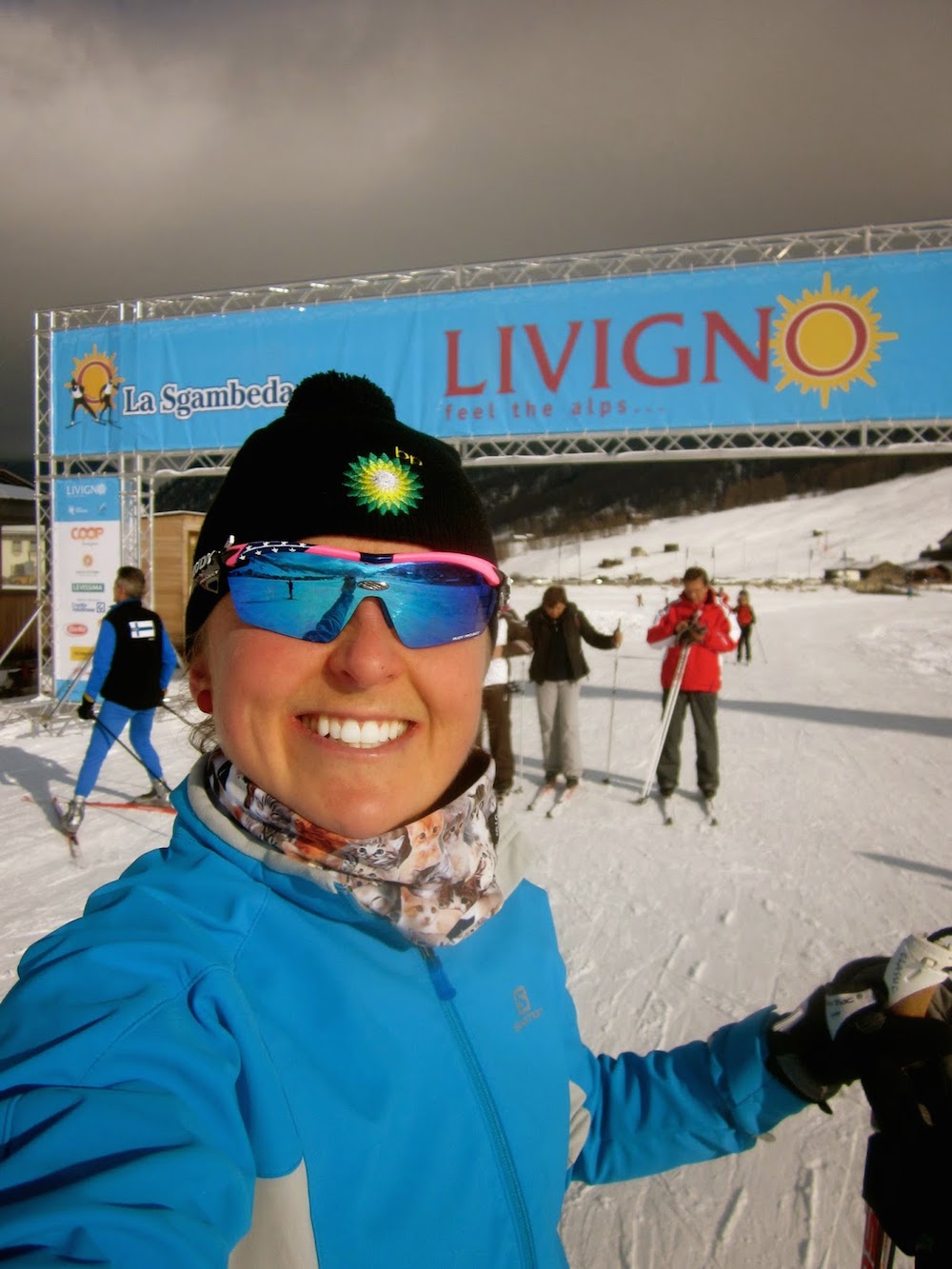
    Holly Brooks at La Sgambeda in Livigno, Italy, in December 2014. (Courtesy photo)

    “This season I’m preparing to compete in the FIS World Loppet Marathon Cup.  I will compete in eight races as short as 42k (La Sgambeda – Italy & Engadin – Switzerland) and as long as 70k (Marcialonga – Italy). This is a notable change from the World Cup circuit which includes lots of sprints, prologues, and 10ks.  The regular Wold Cup has one 30k per year (Holmenkollen) and a second 30k at Championships. Consequently, I don’t have a ton of marathon experience and I’ve certainly never kicked off the season with a 2 hour race!

    One of my go-to workouts is quick and simple: Over & Under, L3 pace workout with surges.

    The purpose of this workout is raise aerobic threshold and build the capacity to respond to surges in speed. All of the marathons I will compete in this year are mass start format. Thus, I need to be comfortable going fast and going fast for long period of time. Often these races come down to a break in the middle (when someone sprints to break the pack) or they may end up in a 10-30 person sprint at the end for the victory. The ability to make or respond to a surge is critical for this style of racing. Hence the “over (speeds) and under (L3) title to this workout.

    How it’s done: 

    • Warm up easy (25 – 40 minutes) and make the warm up progressive. Keep the pace low & save your juice for the interval!  This workout can be done on snow, roller skis, or even foot with poles – choose your method based on what you’ve got.
    • 1 hour L3, threshold, or “fast distance” pace.  The idea is to keep the majority of the workout aerobic… think 30-50k race pace. Well above distance pace and below hard race pace. Pick some technique goals to focus on for the session. One thing I like to think about early season are transitions. There is lots of time to be gained or lost in the twists and turns of ski courses. After a summer of roller skiing on street terrain actual ski courses are more dynamic and complicated. Don’t be complacent!
    • Adding intermittent speeds ranging from 10-30 seconds are a fun way to mix up this workout and good practice for mass start formats. The best way to do this is with other people, taking turns “attacking” the group at choice places. (Rather than the predictability of a speed every five minutes keep the format open.) In a race you never know when some one’s going to make a move – you just need to be ready to respond. It’s fun to replicate that in this workout if you have a comparable training group.
    • Fun additions – wax your skis (if you’re skiing!) …. cause good boards for a good workout make a difference. Wear a race suit – because you’ll feel faster, I promise. There is nothing worse than attempting a fast high quality workout in old, baggy fleece! Bring a snack – good recovery foods are key and near the end of this workout your stomach may start to grumble.

    Today I skied 20k in this format and next week I’ll ski a 30k pace workout. We’ve had snow skiing in Anchorage for about a week now and it’s good to make the transition from fall training to full on, winter snow-skiing gradually. (Tired shins & balancing muscles!)  I’m not doing any 2-hour/50k threshold workouts because the recovery time takes too long to maintain a productive training load.

    buy celebrex online, buy ibuprofen online

    Yesterday morning [on Oct. 28], the APU team drove south to Girdwood to take advantage of near World Cup conditions on their 5k loop.  The trails are wide enough for 2.5 skaters, groomed immaculately, and are homologated for high level competition. (Meaning they are hard and have hills!) Thanks so much to the Girdwood Nordic Ski Club for putting so much time and energy into their trail system. Access to snow and good trails is huge for those of us that have important early season races!”

  • Wednesday Workout: Bog Running Intervals with Swedish Juniors

    Wednesday Workout: Bog Running Intervals with Swedish Juniors

    Swedish juniors from the Järpen Skidgymnasium climbing Grovfjellet during a distance run in Åre, Sweden, the day after bog-running intervals. (Photo: Alasdair Tutt)

    Today’s workout comes from Alasdair Tutt, head coach and program director at the Nordic Ski Club of Fairbanks/Fairbanks Cross Country (NSCF-FXC) in Fairbanks, Alaska, who recently attended a training camp with Swedish skiers (ages 15-19) at the Åre Ski Gymnasium in Järpen, Sweden. Have a workout of your own (or your club’s) that you’d like to share? Send submissions to info@fasterskier.com with the subject line “Wednesday Workout”.

    ***

    On a recent trip to Sweden for study, I was fortunate enough to attend a training camp with Järpen Skidgymnasium, which is an RIG ski program supported by the Swedish Ski Federation for their top junior skiers. There are five RIG “Kingdoms Sports Schools” aimed at future international level skiers and 12 NIU “National Sport Education” programs aimed at national level skiers in Sweden for cross-country skiing.

    Järpen Skidgymnasium nordic coaches Martin Persson (second from l) and Kicki Fransson (r) observe a bog-running workout as athletes warm up near Åre, Sweden. (Photo: Alasdair Tutt)

    The training camp was cross discipline with 70 athletes from cross-country, alpine and freestyle in attendance as a bit of a team-building experience after the first week of school. All athletes did the following swamp-running workout with varying “on” time depending on age and sport. You might be a bit surprised that some of the alpine/freestyle athletes got through the entire set with good speed and form.

    buy clomid online

    In addition, the athletes completed a strength, obstacle and mobility circuit, and a 2-3 hour long distance tour on the final day – running for the cross country athletes and cycling for the others. As part of the school orientation, groups of 7-10 students and coaches also produced an anti-bullying short film. A lot of effort went into the production of these, with some drone footage and high quality of execution.

    Bog Running Intervals:

    Warmup jog to the bog: About 10 minutes at Level 1 and 5 minutes at Level 2,  running around the loop to get orientated.

    Interval set:

    • Pyramid: 1, 2, 3, 4, 3, 2, 1*, 2, 3 minutes of “on” time in Level 4-5, with half recovery time except the 1-minute intervals, which had 1-minute off afterwards.
    • Running or running with poles for the “on” time and walking or slow jogging between intervals.
    • *Athletes had the option of stopping after the first pyramid for first-year students and alpine/freestyle, or doing the additional 5 minutes of intervals.

    Cool down: A game of bog soccer by year level (1-4) with 2 x 5 min. halves, an easy jog back to camp and some gentle mobility.

    Alternative: Some athletes who couldn’t run did a strength circuit for the session.

    Total time: About an hour and a half, which struck me as incredibly time-efficient.

    According to the athletes, they perform a bog-running interval session maybe once every month or two during the warmer months, mostly for something different, but lots of distance runs tend to end up traversing such terrain. The biggest surprise for me was just how fast some athletes were moving in the difficult terrain, running 5-5:30min/mile pace with poles in shin-deep bogs, but then walking significant portions of the 22-kilometer distance workout we did the next day. Really, it just reinforces the polarization of training that they have built into their culture, and it’s something I think we still need to work on, especially in distance training, with my program in the U.S.

  • Wednesday Workout: Live High, Train Low in (Smoky) Sunny California

    Wednesday Workout: Live High, Train Low in (Smoky) Sunny California

    Kili Lehmkuhl (l) and Lilly Murnane of the Auburn Ski Club Training Center striding on Iowa Hill Road near Colfax, California, on Aug. 26. (Photo: Gus Johnson)

    This Wednesday Workout came to us just over a week ago from Gus Johnson, nordic program director and head coach at the Auburn Ski Club Training Center (ASC-TC) on Donner Summit in California. Have a workout of your own (or one of your club’s) that you’d like to share? Send submissions to info@fasterskier.com with the subject line “Wednesday Workout”.

    ***

    August proved to be smoke season in California for the Auburn Ski Club Training Center athletes, but a few days of clear air has given us the opportunity to put in some late summer intensity. Like many athletes across the west, ASC-TC athletes have had to adjust their training to be flexible with the wind and smoke patterns this summer. When the smoke outside became unhealthy, workouts consisted mainly of focusing on technique and shorter sessions, or finding alternatives for indoor training.

    buy alesse online, buy provera online

    Auburn Ski Club Training Center is located on Donner Summit at 7,200 feet above sea level, but has easy access (within one-hour drive) to rollerski locations at elevations around 1,000 feet. This week, with a change in the weather and the sunny skies California is famous for, the Auburn Ski Club Training Center Comp Team headed down to Colfax, California, to rollerski Iowa Hill Road for some Level 4-5 (L4-L5) intervals.

    Max Roske of the Auburn Ski Club Training Center striding on Iowa Hill Road near Colfax, California, on Aug. 26. (Photo: Gus Johnson)

    With Junior Nationals at sea level this year in Anchorage, our altitude athletes are looking for ways to inject some pace into their normal ski preparations. Our team typically plans at least one week-long training camp on the California coast, and several mini camps at low altitude for hard rollerski intervals and speed sessions. We’re lucky to be able to hop in the car on short notice and find cheap campgrounds to stay at for low-altitude over the weekends. It spices things up whenever we feel things getting stale at home in the mountains.

    The base of Iowa Hill Road starts around 1,000-feet elevation in the river gorge of the North Fork of the American River and climbs up to Colfax at 2,100 feet. We find the session to be both a test of mental toughness and a great opportunity to challenge our fast-twitch muscles.

    The workout:

    Blackberry picking doubles as a warmup for Auburn Ski Club Training Center athletes in California. (Photo: Gus Johnson)
    • Warmup (on foot): 10-15 minutes of easy jogging (hunt for blackberries)
      – 5 minutes of dynamic warmup (A-skips, B-skips, agility ladders, and dynamic stretching)
    • Change into the rollerski gear
      – 4-6 short speeds, starts, and lunges, each about 8-seconds long
      – 4 x 1-minute classic rollerski intervals (L4+) uphill with 1-minute recovery, followed by 2 x 5 minutes with 3-minute recovery, and another set of 4 x 1 minute intervals.
    • Cool down

    ***

    Auburn Ski Club Training Center skiers warm up on Iowa Hill Road near Colfax, California, on Aug. 26. (Photo: Gus Johnson)

    About the Auburn Ski Club Training Center:

    The ASC Training Center is a premier training and racing venue in the western U.S. with programming for all ages and ability levels across four ski and snowboard disciplines (alpine, cross country, biathlon, and snowboard). Our institution’s roots go back to the club’s founding in 1928 (we were instrumental in the development of ski culture and ski tourism in California), and that legacy continues today with a bid to host the 2020 xc junior national chamionships. We have hosted the XC Junior Nationals four times to date, the US Ski and Snowboard Supertours twice, as well as the NCAA National Championships and the US Biathlon Nationals.  Whether it is as a  training and racing venue for the region or as a part of our programming, it is safe to say ASC-TC plays a significant role in the development of all Far West Nordic skiers

    The ASC-TC Competition team is made up of athletes from all across the greater Northern California and Nevada region and is for athletes ages 14-19. The majority of Comp Team athletes live and train near the Truckee and Tahoe area, but some athletes are based out of the sierra foothills (Grass Valley, Colfax, Nevada City, and Auburn) and even some as far away from snow as the Bay Area will come up and ski with the team on weekends or gain race support at events. Our programming is year-round and strives for flexibility to support both elite junior racing as well as participation for athletes whom skiing is only one of their many passions.

  • U.S. Part of Collaboration at Largest International Junior Camp (with Video)

    U.S. Part of Collaboration at Largest International Junior Camp (with Video)

    Earlier this month from Aug. 2-8, nine top American junior athletes had the opportunity to participate in the largest International Junior Camp to date. In total, 146 athletes and 37 coaches from nearly 20 nations gathered in Sjusjøen, Norway, for a week of training and collaboration. The camp offered athletes the opportunity to gain confidence by training with the best junior skiers in the world against whom they will soon be competing, and to learn from the prestigious Norwegian development team training methods.

    To make the trip, athletes needed to be born in either 1999 or 2000 and have the lowest ranking on the FIS Distance and/or Sprint World Ranking list. The U.S. sent Gus Schumacher, Ti Donaldson, Noel Keeffe, Ben Ogden, and Wyatt Gebhart on the men’s side, and for the women, Sofia Shomento, Mae Chalmers, Abby Jarzin, and Molly Gellert. Two coaches joined the group: Bryan Fish, cross country sport development manager at U.S. Ski & Snowboard, and Maria Stuber, head coach at the College of St. Scholastica, and the National Nordic Foundation (NNF) partially subsidized the trip.

    2018 International Junior Camp attendees: 
    – Armenia
    – Austria
    – Bosnia/Herzegovina
    – Belarus
    – Canada
    – China
    – Czech Republic
    – Estonia
    – Italy
    – Finland
    – Japan
    – Korea
    – Latvia
    – Norway
    – Slovenia
    – Slovakia
    – Spain
    – Sweden
    – U.S.

    The format of the camp was similar to what U.S. juniors might experience at an elite national camp; a large emphasis on volume (18-25 training hours), with some intensity, technique and strength mixed in. For most workouts, all the athletes trained together as one large group, only dividing into smaller groups for time trials or activities held in spaces that could not hold the nearly 200 attendees.

    The camp opened with back-to-back time trials, beginning with a classic sprint event featuring “King’s Court” style heats, meaning that from each heat, the top skier moved up in the seeds and the last skier moved down. Each skier competed in four rounds of sprints plus the qualifier, one round more than in a typical sprint. The most notable result for the U.S. was a victory for Schumacher in the men’s final, and on the women’s side, an eighth-place finish for Gellert.

    In the 10- and 15-kilometer distance races, the Americans continued to show their strength with another win for Schumacher and another eighth-place finish for Gellert.

    “Local hero – Joergen Lippert from Lillehammer joined in on the 15 km freestyle race,” Fish explained. “This was a great measuring stick for the men since Joergen medaled in all four races last year at Junior Worlds (2018 Junior Worlds – 1 gold, 1 silver, and 2 bronze). At the 5km split, Lippert was leading, Ben Ogden was 2nd and Gus Schumacher 6th. Haavard Moseby took the lead after 10km. At 12km Haavard and Gus were tied, then Gus surged to edge Haavard for the second day in a row.”

    Molly Gellert striding in the sprint heats at the 2018 International Junior Camp in Sjusjøen, Norway. (Photo: Maria Stuber)

    To take advantage of the unique terrain on the plateau around Sjusjøen, the group also participated in a 3 1/2- to 5-hour run crossing through several bogs, and a set of Level 4 bog intervals, which was reported to be the hardest workout of the entire camp. These 3-5 minute intervals were run in mud up to or above athletes knees, making it a full-body challenge to move forward through the course.

    “Running through that stuff as hard as you can is incredibly hard,” Stuber told FasterSkier. “People were breathing at the end of those intervals harder than you ever hear, besides maybe the best athletes in the world in a 5- to 10-kilometer distance kind of race.”

    Another highlight was getting to meet and hear from Olympic gold medalists Johannes Høsflot Klæbo, Ragnild Haga, and Astrid Uhrenholdt Jacobsen, who shared insight into the aspects of their training and development they felt have led to their success.

    The U.S. coaches contributed to the camp by leading an agility workout, as this has been creatively emphasized in their own programs with positive results. Fish reportedly traveled with his own set of cones and plenty of sidewalk chalk to ensure they could set up a high-quality course.

    “It was really fun to have the rest of the world interested in what we’re doing with agility,” said Stuber.

    Ben Ogden (second from r) in the middle of a bog interval at the 2018 International Junior Camp in Sjusjøen, Norway. (Photo: Maria Stuber)

    Apart from the training benefits, the U.S. development program considered the experience of collaborating with top athletes in this age group to be invaluable, as it showed how hard their international competition is working.

    “In the U.S. when you’re a top athlete you feel like you’re working pretty darn hard, and this kind of shows them that, yeah, they’re working hard, but the kids that they want to be competing against are also working really hard,” Stuber said.

    She added that the U.S. athletes were well-prepared for the camp, as all performed very well throughout the week despite the demanding training schedule.

    “We fit in, we go there and see that we’re doing the right things, and we bring these kids back with the confidence that they can do this and the motivation to keep at it and work harder,” Stuber said.

    It was noteworthy to the coaches that the U.S. is finally recognized as a nation that can train and compete with the best athletes in the world — a testament to the growth and success of the U.S. Ski Team at all levels over the last ten years.

    skelaxin online, ortho tri-cyclen online

    “Going into this, I was expecting to just be learning a ton and less of a contributor,” Stuber said. “It was really cool to get there and feel like the U.S. was very much a country where people wanted to know what we were doing. Norway is clearly ahead, but otherwise, I think the U.S. had to say as much as any other place, which was a really eye-opening surprise for me.”

    This is the third time that the U.S. has attended Norway’s International Junior Camp (also in 2015 and 2016), and American juniors will continue to make the trip biennially to maintain collaboration with other countries in the coming years. According to the U.S. coaches, because of the cost of the camp and the fact that it is similar each year, they plan to only attend every other year so they have a “fresh” group of athletes each time.

    Americans during a muddy training session at the 2018 International Junior Camp earlier this month in Sjusjøen, Norway. (Front row, l to r) Abby Jarzin, Mae Chalmers, Sophie Shomento, Molly Gellert, and Noel Keeffe. (Back row, l to r) Ben Ogden, Wyatt Gebhart, Ty Donaldson, Gus Schumacher. (Photo: Maria Stuber)
  • Wednesday Workout: Optimal Recovery with Dr. Zuzana Rogers

    Wednesday Workout: Optimal Recovery with Dr. Zuzana Rogers

    U.S. Ski Team physical therapist Zuzana Rogers with athlete Erik Bjornsen at the 2018 Winter Olympics in PyeongChang, South Korea. (Courtesy photo)

    The following Wednesday Workout comes from Dr. Zuzana Rogers, PT, ScD, SCS, COMT, of Anchorage, Alaska. Rogers has been the go-to physical therapist for the U.S. Cross Country Ski Team since 2013 and Alaska Pacific University (APU) Nordic team since 2011. 

    ***

    You are probably training hard…but is your recovery optimal?

    As you transition from summer to fall training and the intensity increases, you may start noticing certain tweaks that are happening to your body and the fatigue sets in. But you want to train more than your competitors… Intense training is only a part of the picture. As you get better and training at the edge of human capabilities, what will set you apart for your competition is appropriate recovery. Your body gets stronger and more fit AFTER THE WORKOUT, when it is able to absorb the load you just put it through.

    During the past years, literature has been all over the place when recommending the most effective method of recovery after an intense exercise. Recent systematic analysis (Dupuy et al. 2018) places active recovery, massage, compression garments, cold water immersion, contrast water therapy, and cryotherapy as effective methods in reducing exercise-induced DOMS (delayed onset muscle soreness) and fatigue.

    So let’s look at them one by one:

    1. Active recovery:

    Considered a pretty good method to recover after exercise, it helps to clear CK (creatine kinase) after approximately seven minutes of low-intensity exercise, such as a jog or a spin. It does not seem to make you feel less fatigued, but the physiological benefits are there. The effect of active recovery may be explained through enhanced blood flow in muscle tissue, which facilitates the removal of metabolic waste, and may contribute to a reduction in muscle lesions and pain.

    buy ortho tri-cyclen online, buy yaz

    How about stretching? If done aggressively, stretching has no positive impact on DOMS. Moreover, some results at <6 h after exercise indicated that aggressive stretching might even produce DOMS. However, if done with the right goal in mind, it can improve the functional range of motion of your joints and optimize the length of the muscles. The muscles work the best when used in their optimal range (this is sport-specific). Overstretched muscles become less efficient in their contractibility, therefore the performance goes down.

    Here are my favorite mobility exercises, done to improve crucial areas of restrictions found in cross-country skiers and runners:

    Hip flexor stretch to improve hip extension, connected with balance in a ½ kneeling position. Try to get your feet to cover a single line. Hold 20 seconds each side.
    Piriformis stretch: cross your knees, grab your ankles. Hold 20 seconds each side.
    Quadriceps stretch with added thoracic rotation; the Bretzel. Hold 20 seconds each side.
    The Twist: hip mobility and thoracic mobility. Use your core to get into the position and sit tall! Hold 20 seconds.
    Gastrocnemius stretch: an old favorite to improve ankle mobility. Make sure your feet are pointing straight forward! Hold 20 seconds. You can also flex your knee.

    2. Massage therapy:  

    Massage is a very traditional way to improve recovery after physical exercise both in sports and rehabilitation contexts. It seems to be the most effective method for reducing DOMS and perceived fatigue. It appears to be effective in reducing micro-inflammation of the muscle by decreasing intramuscular edema after exercise. A 20- to 30-minute massage that is performed immediately following or up to two hours after exercise has been shown to effectively reduce DOMS for 24 hours after exercise. It also reduces circulating Cortisol (stress hormone) and increases blood concentration of beta-endorphins (it makes you feel good!).

    3. Compression garments:

    They are shown to also reduce DOMS when worn after exercise, but to lesser effect than massage therapy. The use of compression garments during exercise as means of preventing DOMS and injuries is still up in the air.

    4. Cold water immersion:

    Overall fatigue after high intensity training and competition can be improved through the use of cold water immersion (cold water bath). Exposure of 11–15°C over 11–15 min was considered to be the optimal circumstance to obtain a positive impact after exercise to reduce DOMS, but this all depends on the type of exercise and its intensity. Both the level of immersion and the cold temperature of the water may reduce the formation of edema and pain sensation after exhaustive physical exercise.

    5. Whole-body cryotherapy:

    So far, the evidence in longer term DOMS reduction and post-workout recovery is limited. Cryochambers are cumbersome and costly.

    Of course, we cannot forget appropriate rehydration, refuel, nutrition and sleep, but that may be a topic for another piece.

    In general, if you are not injured, your training and recovery is straightforward.

    Happy training and recovering!

    Source:

    Dupuy O, Douzi W, Theurot D, Bosquet L, Dugué B. An Evidence-Based Approach for Choosing Post-exercise Recovery Techniques to Reduce Markers of Muscle Damage, Soreness, Fatigue, and Inflammation: A Systematic Review With Meta-Analysis. Frontiers in Physiology. 2018;9:403. doi:10.3389/fphys.2018.00403.

  • Wednesday Workout: Hiking and Cold-Water Plunging with the Mooney Sisters

    Wednesday Workout: Hiking and Cold-Water Plunging with the Mooney Sisters

    Mooney siblings (from left to right) Scott, Heather and Brooke after jumping into Lake 22 just outside of Seattle, Washington, following Brooke’s graduation from the University of Washington in June. “With two siblings peer pressure works wonders, not going to be the wimpy one who doesn’t jump in!” Heather wrote. (Courtesy photo)

    Today’s Wednesday Workout is brought to you by the Mooney sisters, Heather, 24, and Brooke, 22, who grew up skiing in Peru, Vermont. Brooke is currently training with USRowing out of Princeton, New Jersey, while Heather is still skiing competitively and living in Bozeman, Montana. We interviewed the Mooney sisters earlier this summer; read the complete article here.

    ***

    The following workout is a family hike that focuses on easy distance and mental recovery. The Mooney sisters emphasized the importance of taking a plunge in “a cold body of water” at some point, either during or post-hike. Again, plunging into a cold body of water is key to the workout.

    Jumping into a glacial mountain lake may not seem very pleasant — one look at their brother Scott’s face in the above photo above tells it all all — however, the momentary chill is actually said to benefit both the body and psyche (think of the Finns).

    Research shows that exposing the body to cold water, even in the form of a shower, can bring about positive physiological and psychological effects by increasing blood flow to the brain and extremities.

    buy asthma inhalers online, yasmin online, ortho tri-cyclen


    “Besides the recovery aspect, plunging in cold water is proven to make you happier! (Thanks Mom for encouraging this from a young age),” Brooke and Heather wrote in a joint email to Fasterskier.

    So bring on the rugged slopes and ice-capped waters. The frigid never stopped nordic skiers before.

    The Workout: Easy distance family hike

    Terrain: Mountainous

    “Either a favorite mountain at home, or a thoughtfully selected new location from travel guide Mom (such as Lake 22 at Brooke’s graduation in Seattle a few weeks ago),” the siblings wrote in June. “Ideally somewhere with a nice view, or natural feature, with a lake or river for jumping in afterwards.”

    Length of workout: As long or as short as desired

    Purpose:Goals are to enjoy being outside with your family, or friends, or dog, or neighbor. Attention should be focused on appreciating nature and great company and how fortunate you are to have close friends/family to enjoy being outside with!” they wrote. “Attention should be specifically not focused on heart rate, duration, distance, or Strava segments (except for in the one instance when we went to our cousin’s wedding in Atlanta, found the biggest hill around via Strava, and naturally decided we needed to try and get the KOM, but it was still a family adventure).”

    No. 1 Suggestion: “Trust that the less you think of it as ‘training’ the better it will be for you!” 

  • Wednesday Workout: L3 Ski Walking Up Stratton Mountain

    Wednesday Workout: L3 Ski Walking Up Stratton Mountain

    Paddy Caldwell (l) of the Stratton Mountain School T2 Team leads the way during a summer ski-walking workout up Stratton Mountain in souther Vermont. (Photo: Patrick O’Brien)

    For this week’s workout, we feature the Stratton Mountain School T2 Team, also known as the Elite Team, out of Stratton, Vermont. The team’s full-time athletes live near the base of the alpine resort and take advantage of the following Level 3 (L3) ski-walking workout right out their front door.

    In an email, coach Patrick O’Brien explained why they often repeat this workout during the summer: “We can safely have a large number of people training together (no worries about cars like on an open road) and the younger athletes get lots of contact and can hop in behind the senior athletes for a portion of their intervals,” he wrote. “The dirt work road up the Stratton Mountain Resort has good footing and lots of vertical for good steady state training.”

    ***

    The workout: Level 3 Mountain Ski Walking

    Need: A mountain with enough vertical to fit in 6-7 intervals of ski walking (lasting 7 minutes apiece). A good pair of trail shoes, bounding poles (about 10 centimeters shorter than one’s classic pole length), and a drink belt with sports drink and some food.

    Warmup: Light 15-minute jog around the base. “Then we have our T2 team go through their ‘power warmup’ and lead the younger athletes through this progression,” O’Brien explained. “The goal with this program that US Ski and Snowboard strength coach Tschana Schiller has devised is to get our muscles sequencing and firing well before our intensity session so we are really working on explosive movements while we are most fresh versus trying to incorporate this to a late afternoon gym session. This improves our ability to generate power and is a really effective way to warm up! It usually starts with some mobility exercises, then foot drills and culminates with explosive plyometric jumps and bounds.”

    Jessie Diggins (neon orange shorts) helps lead her Stratton Mountain School teammates through A-skip drills during a “power warmup” at the base of Stratton Mountain. (Photo: Patrick O’Brien)

    Threshold component: 30-60 minutes, depending on how hard the week is/what kind of volume you’re aiming for in a given training block.

    “Older athletes tend to do more, younger development athletes do a little less as they don’t need the same amount of stimulus,” O’Brien wrote.

    • Ski-walking intervals: 7 minutes of “on” time followed by 3 minutes of recovery. Repeat six to seven times. Option to add faster, flatter running intervals at the top if needed.
    Jessie Diggins (front) and Sophie Caldwell (third from r) lead fellow Stratton skiers during a ski-walking workout up Stratton Mountain in southern Vermont. (Photo: Patrick O’Brien)

    Tips:

    • Keep the group together: “We usually have the younger devo athletes start farther up the workroad and jog their recovery in place. The T2 team starts lower down and runs downhill on their recovery,” he noted. “This way the groups keep leapfrogging and the younger athletes can always tag along for a portion of their interval and follow the faster senior athletes and learn from their motions.”
    • Aim for “good, crisp ski-walking motions,” generating power from both lower and upper body: These aren’t as hard as all-out bounding intervals, O’Brien explained, “but we still want athletes to have a degree of impulse to their motions and not just walk up hill with poles on.” Stratton’s work road has some flatter grades, which allows athletes to “incorporate a lower energy bound on these sections and skiwalk on the steeper terrain,” if they choose. “Properly executed this workout looks pretty tame. Nothing flashy, no labored breathing or collapsing at the end of each interval. It is strenuous but not exhausting.”
    • Pace yourself. It should feel hard but sustainable: “With these longer steady state intervals it’s pretty easy to feel out that threshold line as there is no recovery during the intervals,” he noted. “Go too hard and you will feel it in your legs and lungs! We have people monitor heart rates and take blood lactates regularly but all of these are checks are for collecting background information. Ultimately what we want is for people to have a good sense of pacing and be able to ‘feel it out’ without needing the external feedback of a watch or lactate strip. Usually after a time or two doing this workout people have this pretty well dialed!”

    Cool down: Jog back to base area, “or better yet download on the gondola when it is running on the weekend to save their legs from the impact of 1500 feet of decent!” O’Brien wrote.

    Total workout time: 1:45 to 2:15 hours

    ***

    Stratton’s 2018/2019 elite team includes seven returners (six of which are on the U.S. Ski Team) and four newcomers. Returning are Ben Saxton and USST members Simi Hamilton, Paddy Caldwell, Jessie Diggins, Sophie Caldwell, Julia Kern, and Katharine Ogden. According to an SMS blog post from late May, Paddy Caldwell was finishing up his studies at Dartmouth College, and Saxton, Kern and Ogden are taking classes there as well.

    “We work closely with the Dartmouth coaches and fully support these athletes’ choices of when to attend school and when to be with us,” the post by Sverre Caldwell stated. “Paddy is finishing his last term at Dartmouth and he will join Simi, Jessie and Sophie as a full time SMST2 and USST member.”

    New to the team are Kyle Bratrud (formerly of the CXC Team), Kelsey Phinney (formerly of the Sun Valley Ski Education Foundation), Alayna Sonnesyn (University of Vermont graduate), and Ben Ogden (of the Stratton Mountain School).