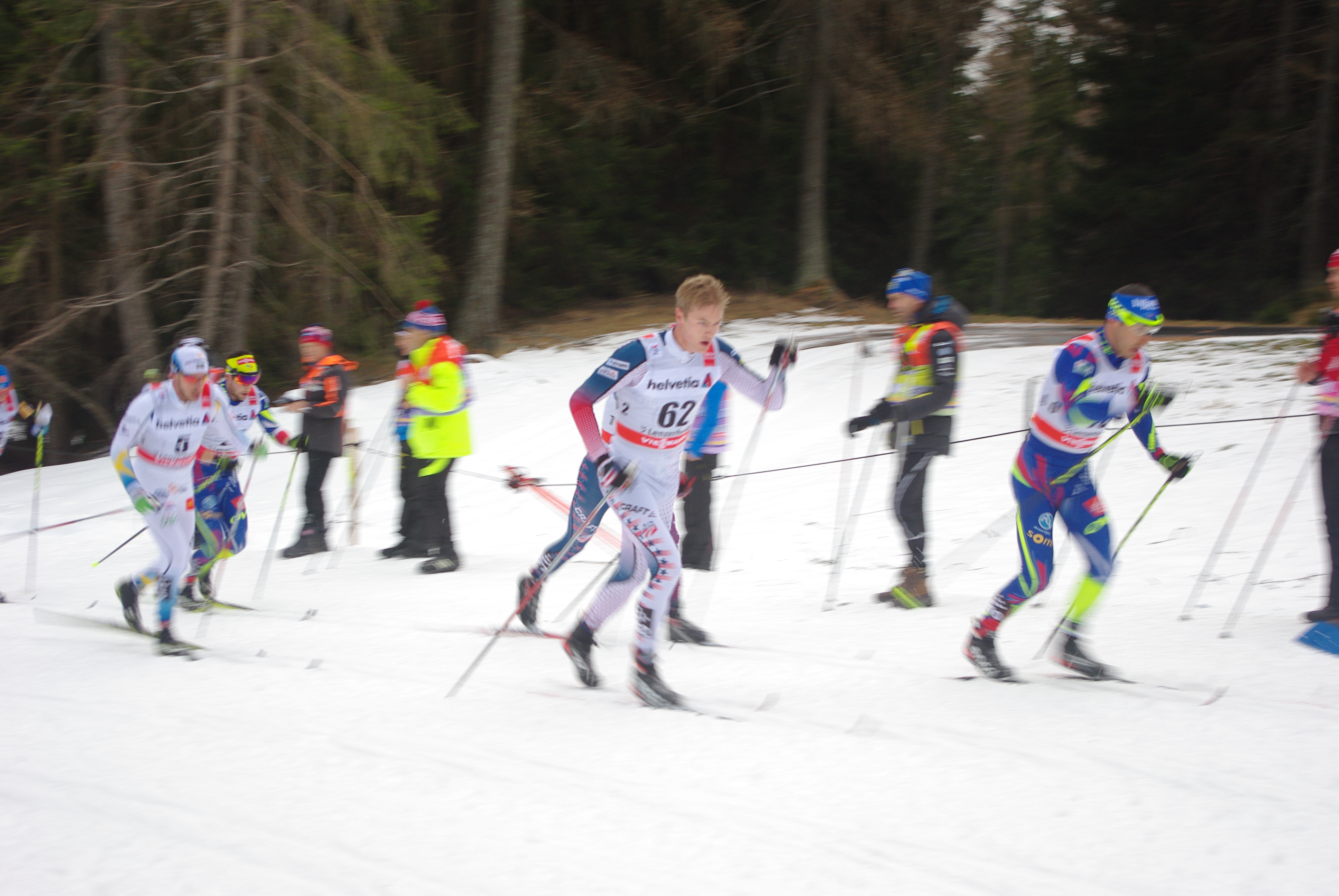
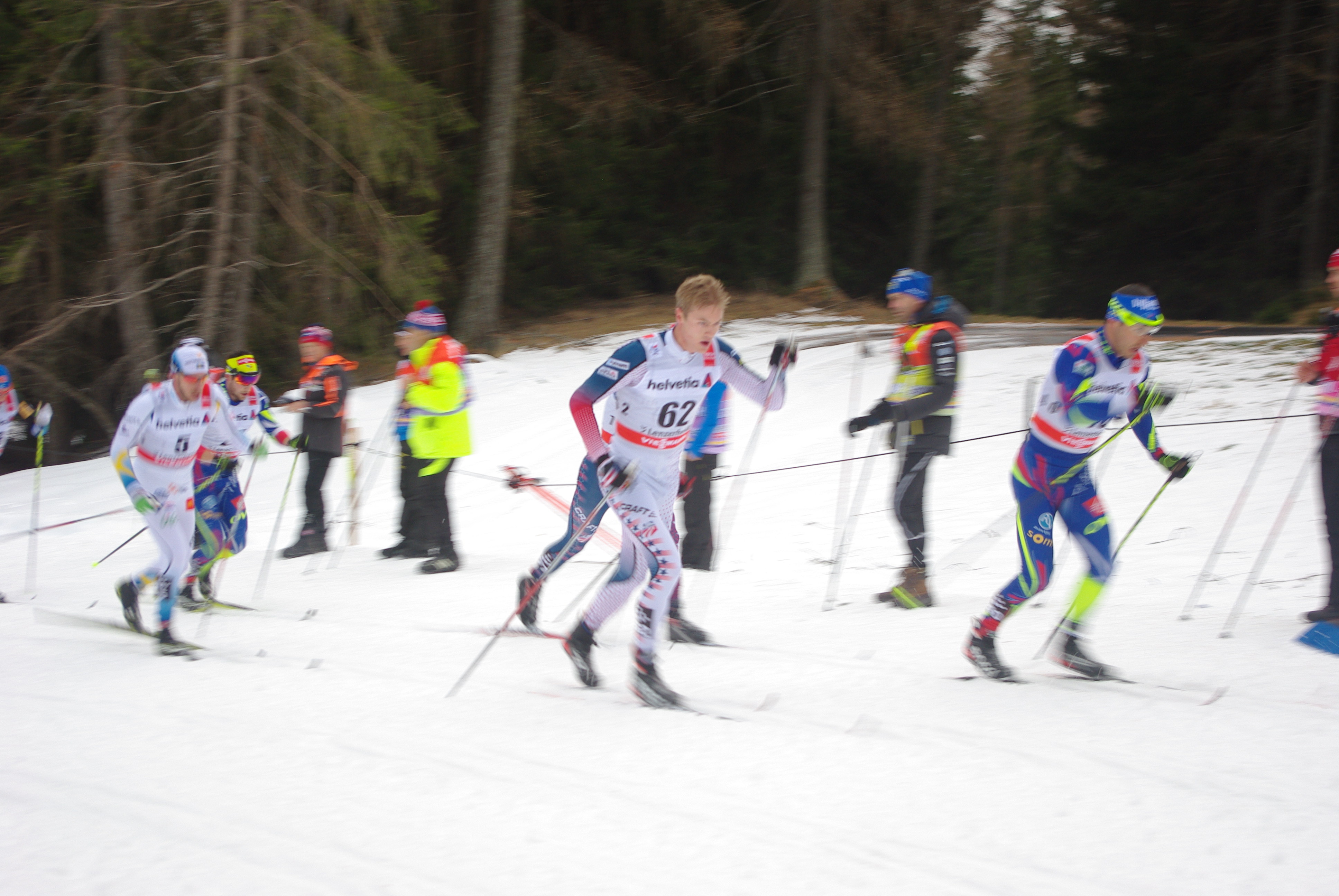
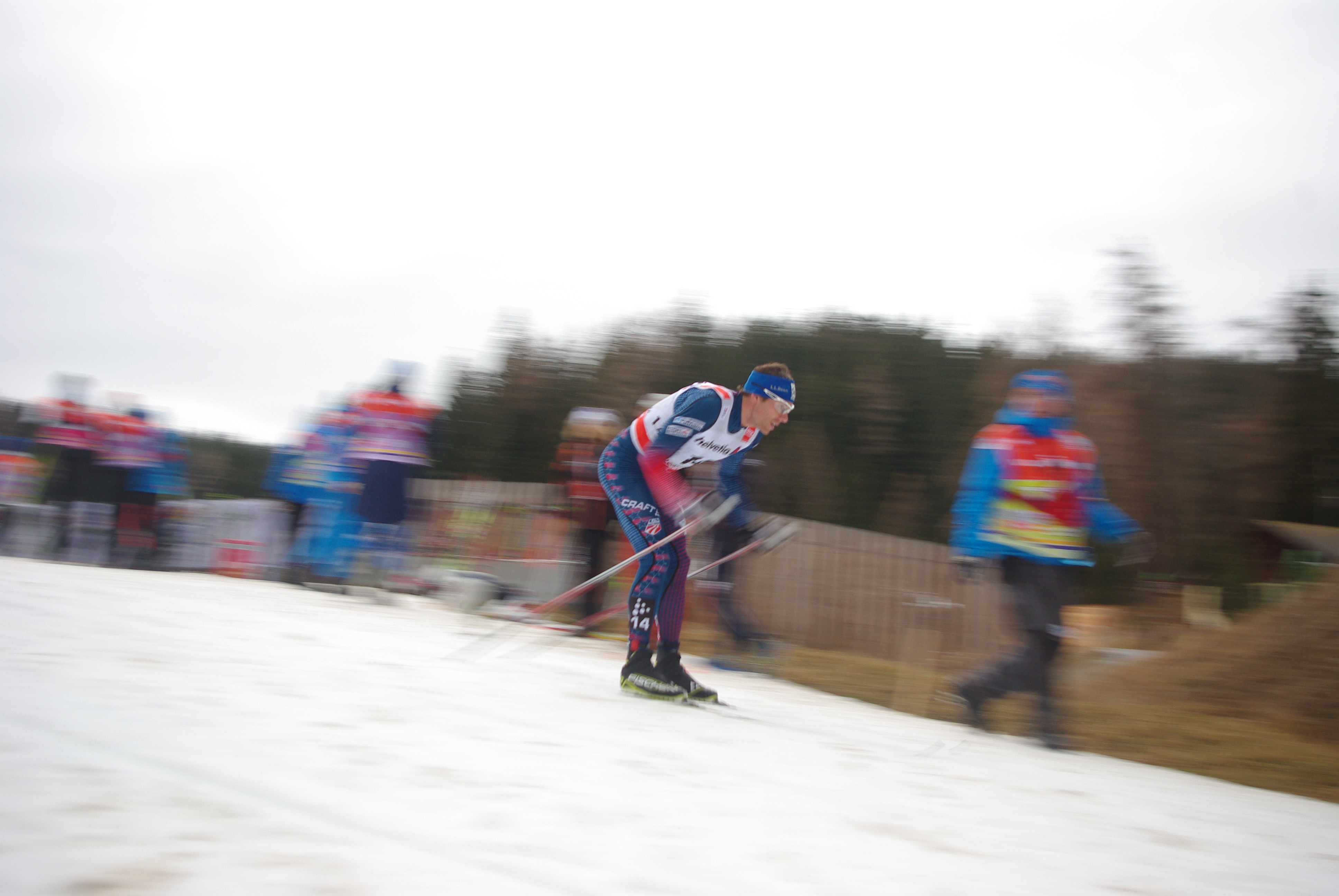
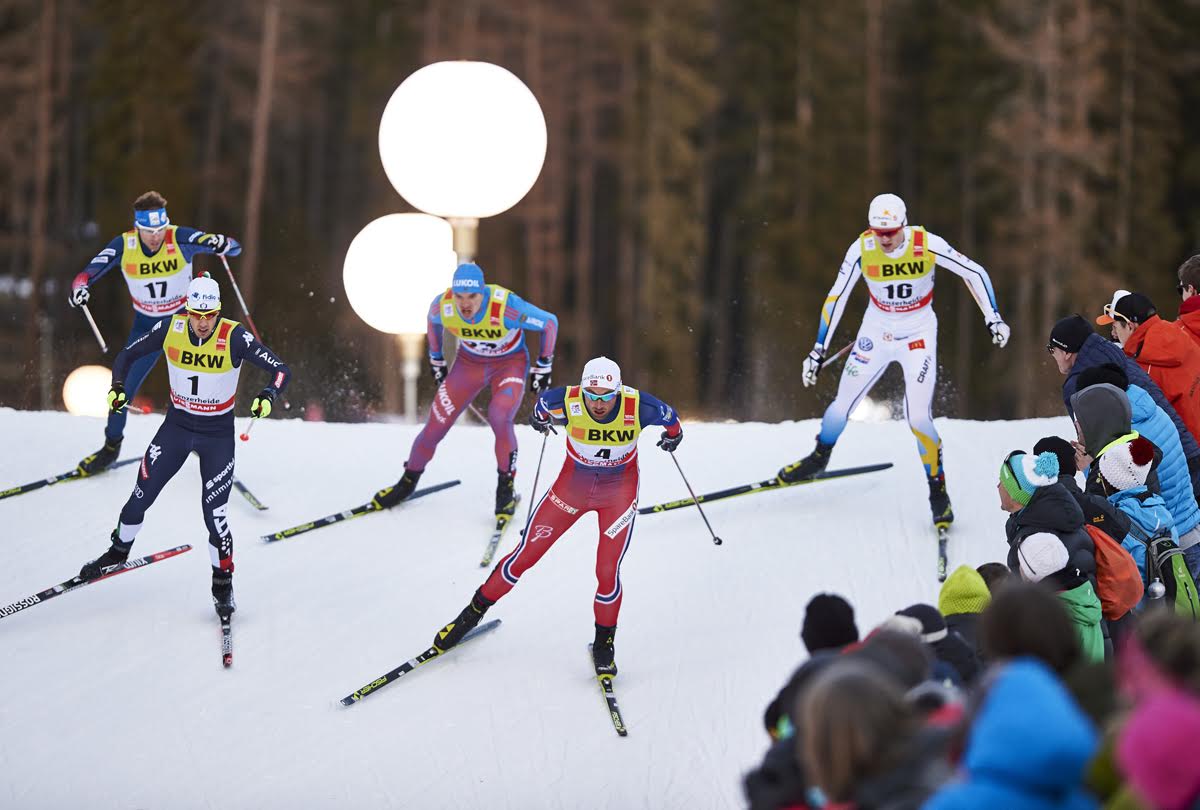
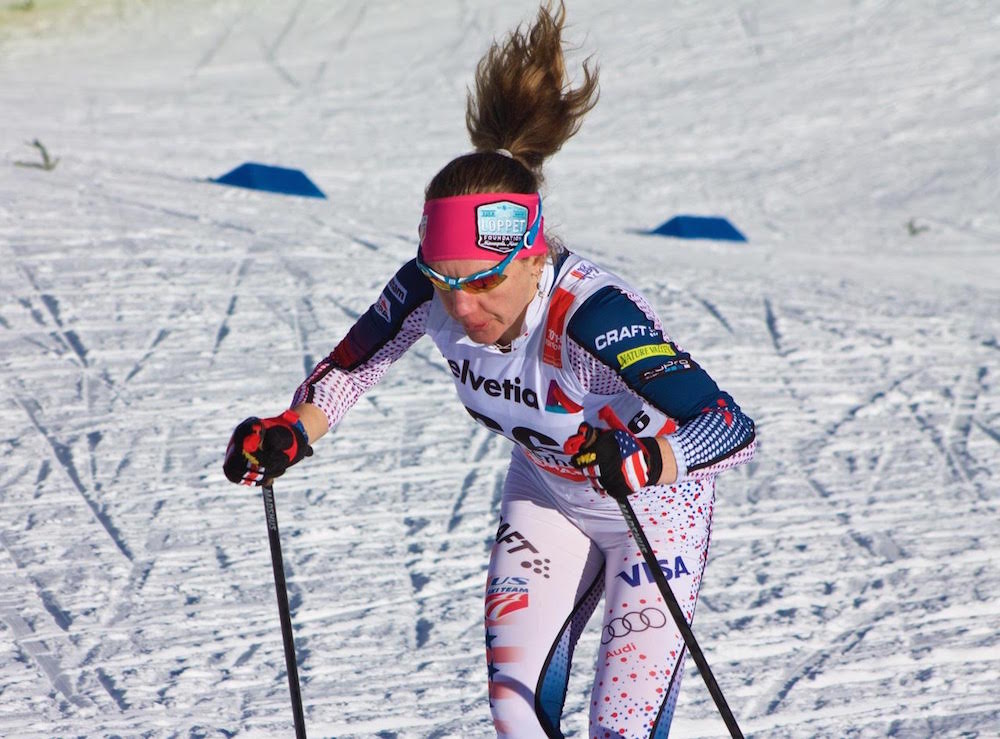
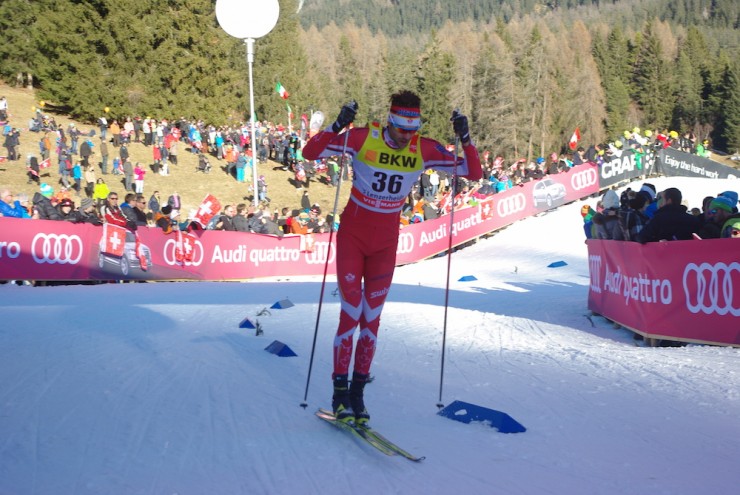
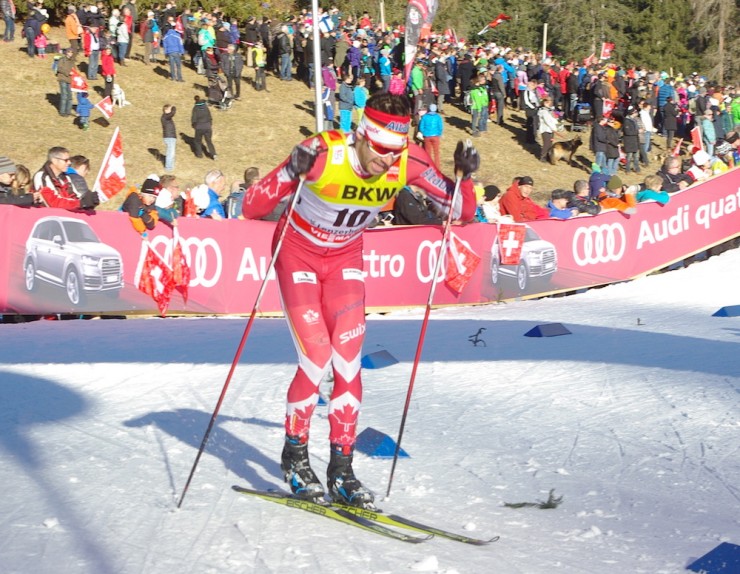
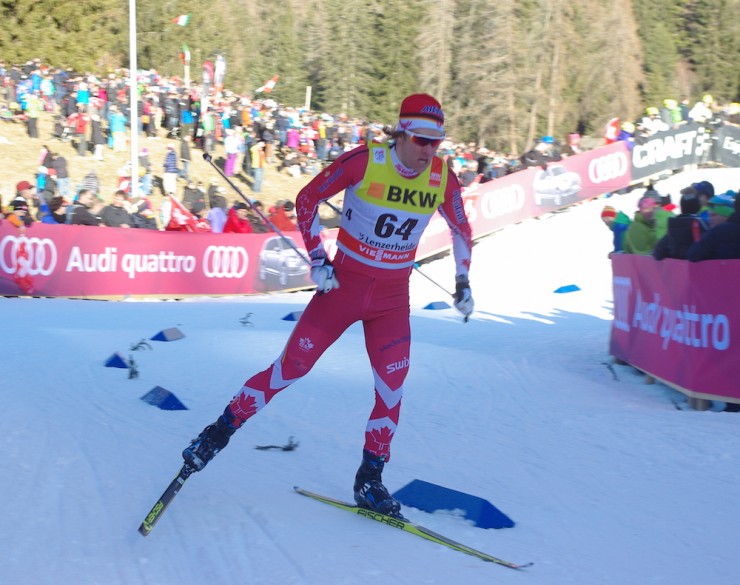
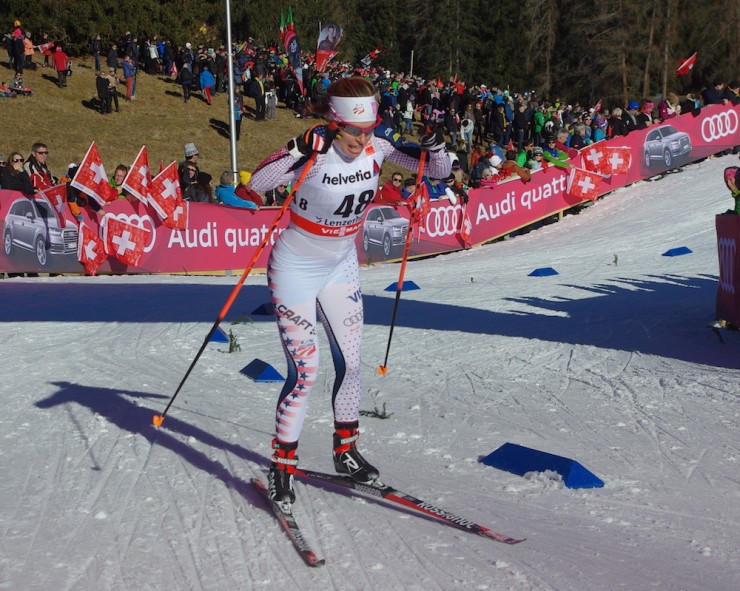
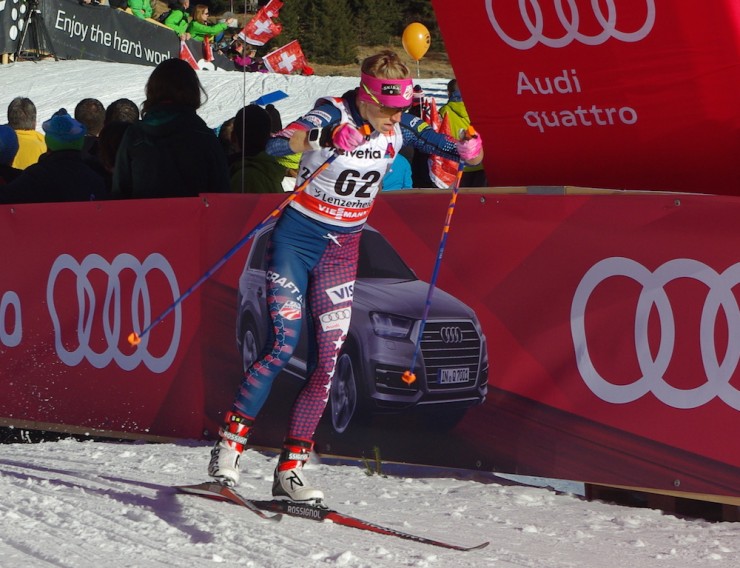
American Erik Bjornsen (62) in the mix halfway through the men’s 30 k classic mass start at the second stage of the Tour de Ski in Lenzerheide, Switzerland.
LENZERHEIDE, Switzerland — After a sprint qualifier which Erik Bjornsen called “really bad” and Noah Hoffman wrote off almost completely as something to “get ready” for the rest of the Tour de Ski, the U.S. Ski Team pair was thrilled to each notch top-30 finishes in the 30-kilometer classic mass start on Saturday.
“As far as this goes, it’s a good race for me, a step in the right direction for the season, and there’s six more stages to go in this Tour and I’m psyched,” Hoffman said after finishing 23rd, 2:22.4 behind winner Martin Johnsrud Sundby of Norway. “You know, we’re both going to move up and finish this thing in the top 30.”
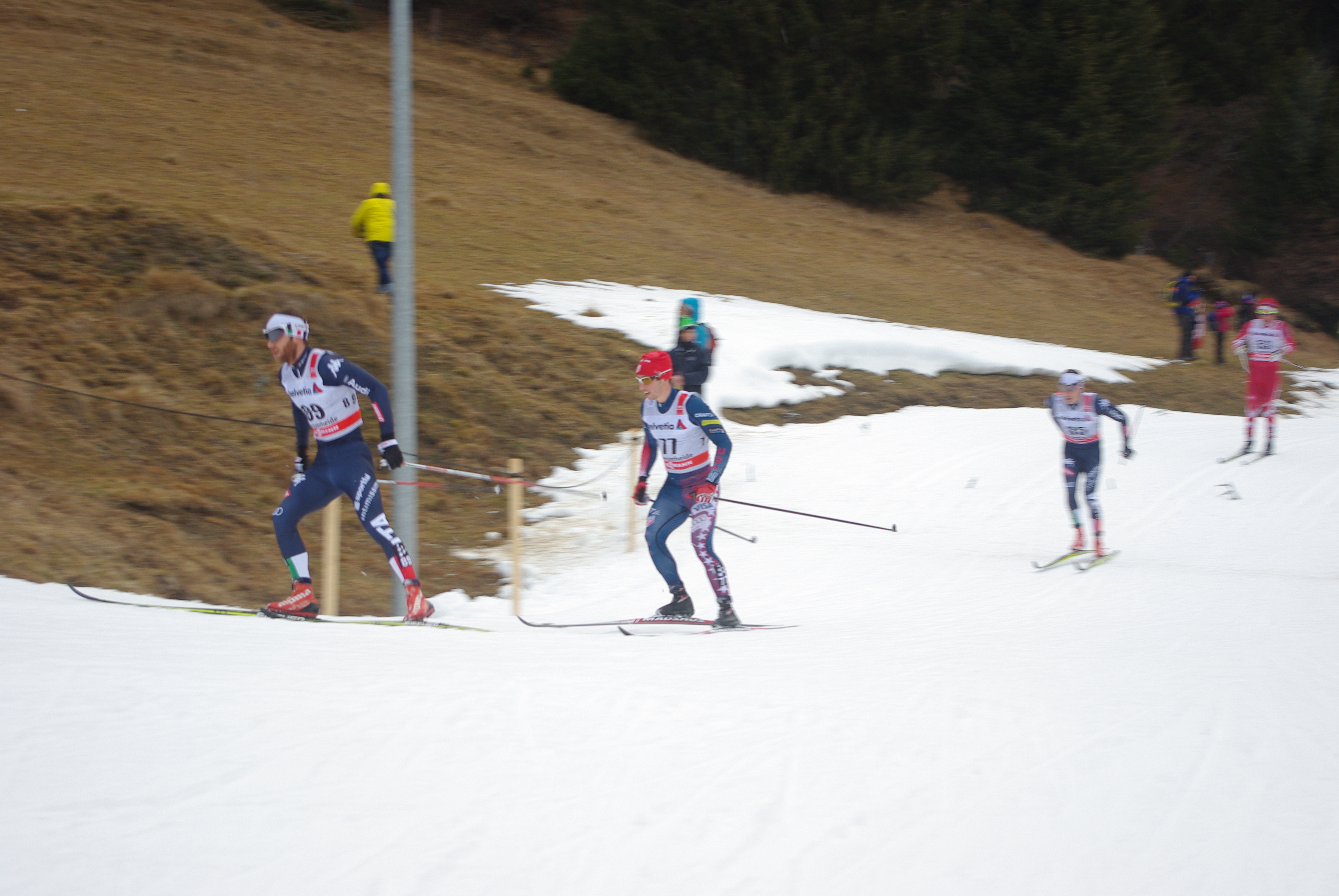
It was Hoffman’s best result of the season; he had finished 25th in the World Cup 30 k skiathlon in Lillehammer, Norway, in December. After starting the mass start near the back in bib 77, Hoffman worked his way through the field and was into the top 30 by the halfway point.
“I just need to go out and not be frantic, and not try to make up all the positions in the first few kilometers,” he explained. “I think I did a good job of that.”
Noah Hoffman (USA, center) taking a corner.
Even more than having strong races, the duo was proud to come one step closer to earning another quota spot for World Cup distance races next season. At the moment, the U.S. team only can start three men, plus the Continental Cup leader.
With Bjornsen finishing in 30th place and getting his first World Cup points of the season, the U.S. now only needs one more man to score a point in a distance race to get up to four starting spots.
“I’m super psyched for Bjornsen,” Hoffman said. “We need one more person to score points for next year, and I’m confident that we can do it.[Alaska Pacific University’s] Scott Patterson’s coming over, or [Andy] Newell or Simi [Hamilton] is gonna get it done.”
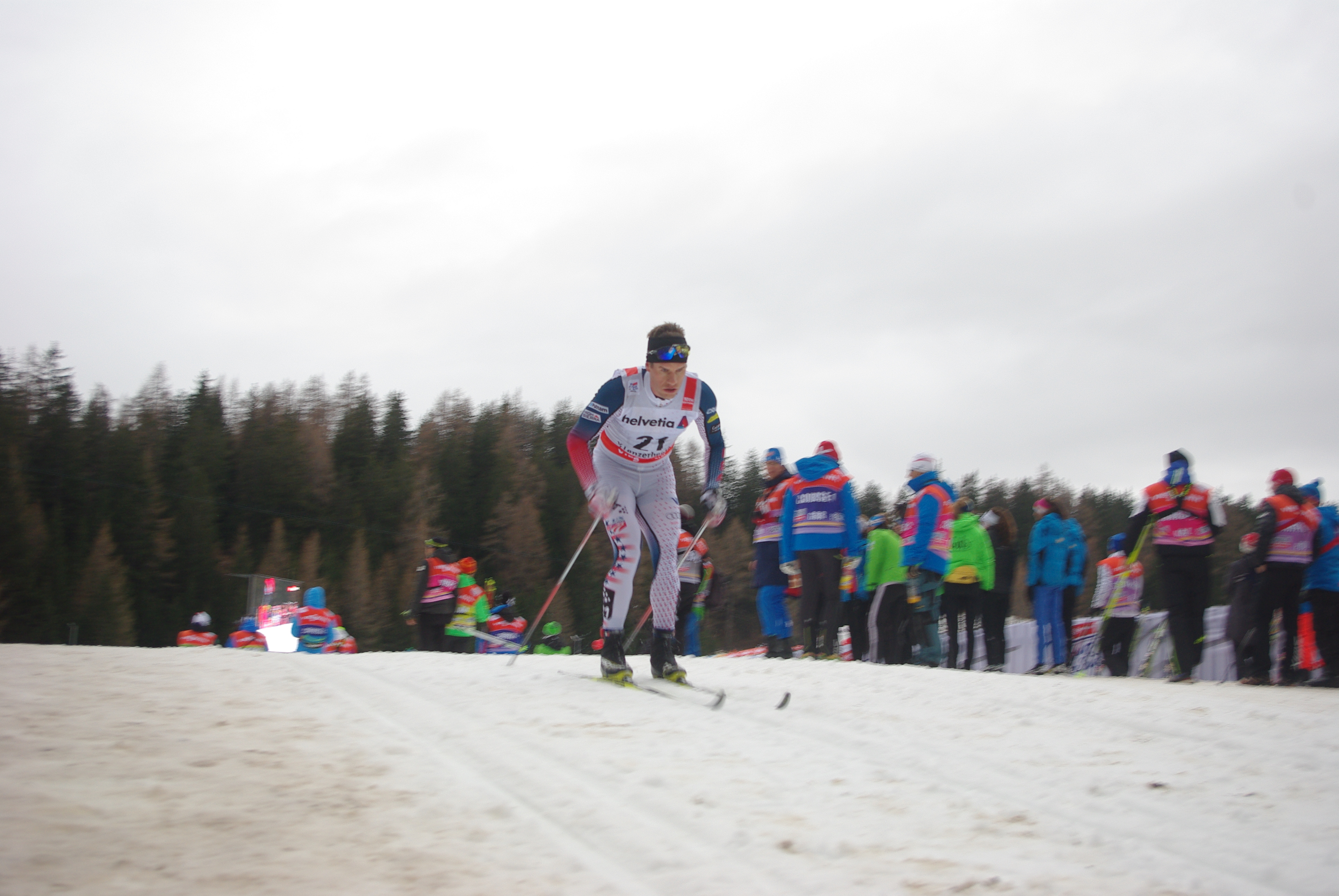
In this 30 k, Hamilton finished 69th (+7:47.5) and Newell 76th (+9:10.8).
But not every distance race is as grueling as a 30 k classic in the mixed rain and snow.
Simi Hamilton pushing through in the 30 k classic.
The bad weather, which left some athletes slipping, sticking and falling, didn’t hinder Bjornsen and Hoffman, however.
“I think there was just some variable conditions out there, so some spots I had some of the better skis out of the group I was skiing with, and other spots, you had to work it,” he explained. “We definitely had skis in the mix today, so it was good.”
And once he began getting splits that he could move into the top 30, Bjornsen found the extra gears needed to pick up his pace.
“That top 30 means a lot to all of us, so I started going for it,” Bjornsen said. “I was able to get it in the last half kilometer.”
Hoffman is now ranked 25th in the Tour de Ski and will start Sunday’s 10 k freestyle pursuit 4:33.5 behind Sundby, while Bjornsen is ranked 33rd and will start 5:31.4 back.
Andy Newell recovers on a downhill during the men’s 30 k classic mass start on Saturday at the second stage of the Tour de Ski in Lenzerheide, Switzerland.
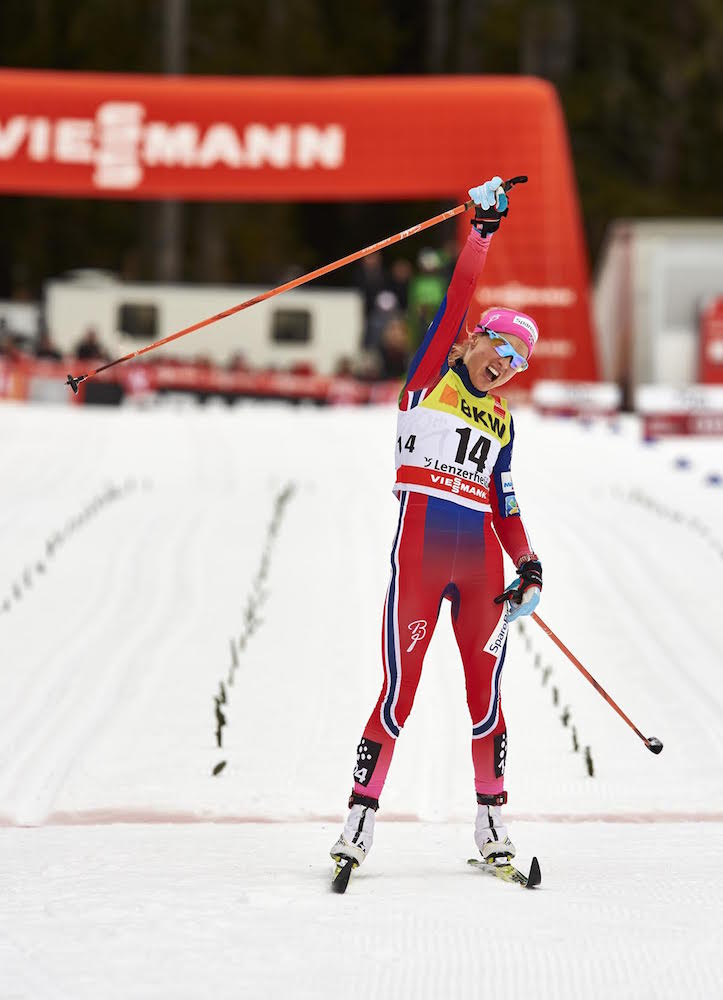
Norway’s Therese Johaug celebrates at the finish of Saturday’s 15 k classic mass start in Lenzerheide, Switzerland. She won the race by nearly 38 seconds to take the lead in the Tour de Ski after the second stage. (Photo: Fischer/NordicFocus)
Eight-hundred meters into Saturday’s 15-kilometer classic mass start — the second stage of the Tour de Ski — it was all over. Therese Johaug, the Norwegian World Cup leader who’s won every distance race this season, had already put five seconds between herself from the rest of the 65-athlete women’s field. Several teammates fought to hang on behind her, with Heidi Weng skiing in second, Sweden’s Charlotte Kalla in third (+5.7), Astrid Uhrenholdt Jacobsen in fourth (+6.6), and Ingvild Flugstad Østberg in fifth (+7.3).
Jessie Diggins positioned herself in sixth by 0.8 k, less than a second behind Østberg, and another American, Sadie Bjornsen skied another 2.5 seconds back in 10th.
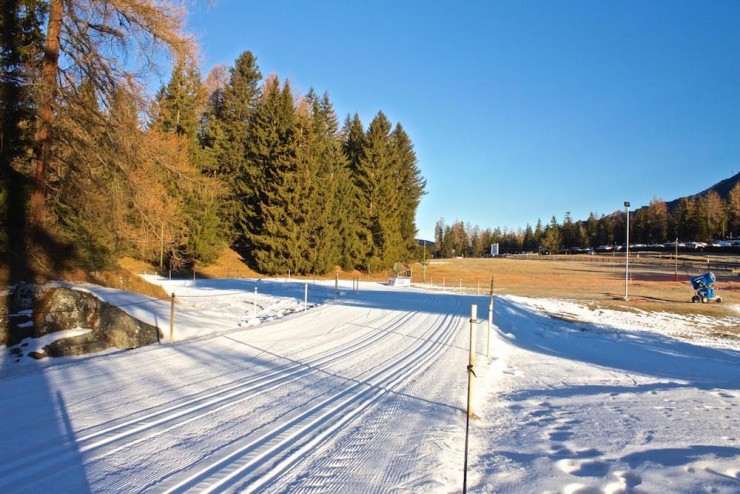
But that was less than a kilometer into the four-lap mass start in Lenzerheide, Switzerland: a classic distance race on a thin strip of snow amid a brown field, in temperatures just above freezing.
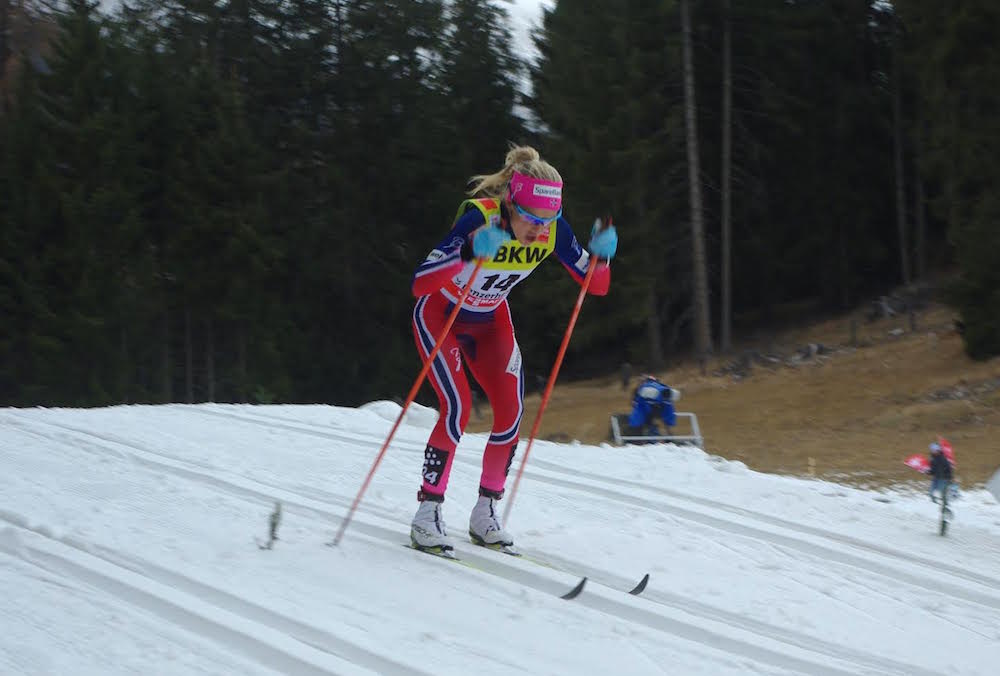
Norway’s Therese Johaug broke away early to win the women’s 15 k classic mass start at the second stage of the Tour de Ski on Saturday in Lenzerheide, Switzerland.
Around 2 k, Johaug had nearly 13 seconds to play with. The order remained the same behind her, except Sweden’s Stina Nilsson crept into sixth, 22 seconds back. Diggins stuck in ninth (+25.8) and Bjornsen in 14th (+30.9).
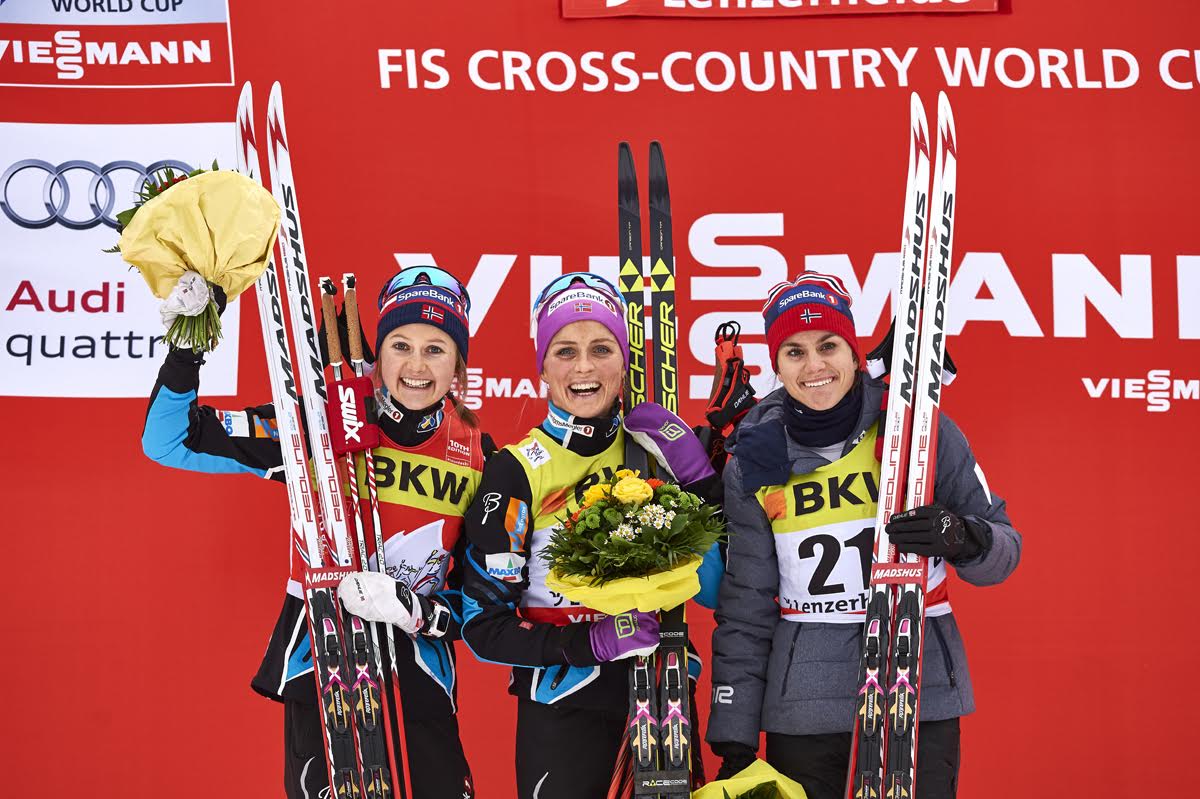
The rest of the race continued to be all about Johaug, as the 27 year old raced to a 37.9-second victory over Østberg in 41:26.4, and took the overall lead in the Tour de Ski by 4.5 seconds (thanks to 30 bonus seconds she captured at the 5.8 k and 9.6 k checkpoints).
“The plan was not to get a gap so early,” Johaug explained in a post-race press conference.
But she felt good, so she decided to go for it.
“When I have this gap in the front of the girls, I had to do my own race,” she said. “I had to focus on the technique and my job. I am sure I have perfect skis and the body was really good. It was a good feeling here.”
Fifteenth in Friday’s skate sprint at the first stage of the Tour, Johaug had 44.4 seconds to overcome in order to catch Østberg as the leader. Another Norwegian, Maiken Caspersen Falla had won the sprint, but decided not to continue the Tour in order to prepare for other World Cups later in January.
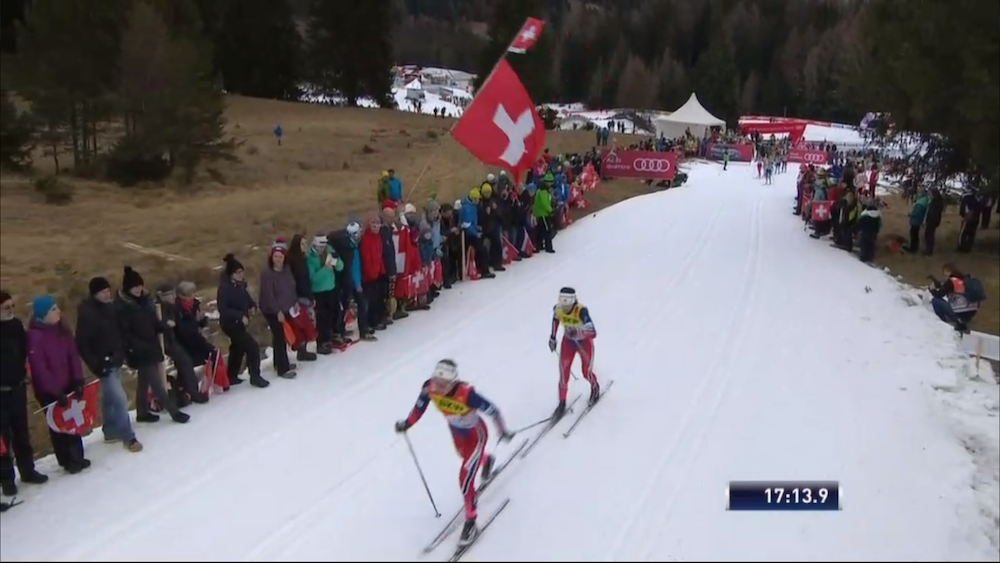
Ingvild Flugstad Østberg leads Norwegian teammate Heidi Weng about a third of the way through Saturday’s 15 k classic mass start, Stage 2 of the Tour de Ski in Lenzerheide, Switzerland.
That put Østberg, who had been second in Stage 1, in the lead heading into Saturday’s distance race.
Best known as a sprinter, Østberg hammered the last five kilometers to drop Weng (whom she skied in second and third with in pursuit of Johaug for about seven kilometers) around 10 k and minimize the distance back to Johaug. With about a kilometer to go, Østberg trailed Johaug by 42 seconds. Østberg recovered 4 seconds on that final kilometer.
“It was a great day for me, maybe my best 15 k ever, so surprised I’m not [farther] behind Therese,” Østberg said in the press conference.
When Johaug was asked if this was her ideal start to the Tour, she replied, ‘Yes.’
“I’ve got the perfect start,” Johaug told VG. “I have never gone with the [Tour leader’s] red jersey until the nine years I have gone, so I am very pleased to have with me 45 bonus seconds today, plus the difference to the others. So I’m very, very happy.”
The Norwegian women swept the 15 k classic mass start podium at Stage 2 of the Tour de Ski on Saturday in Lenzerheide, Switzerland, with winner Therese Johaug (c), Ingvild Flugstad Østberg (l) in second, and Heidi Weng in third. (Photo: Fischer/NordicFocus)
Weng finished third, 38.3 seconds after Østberg and 1:16.2 behind Johaug. It was another 16.5 seconds to fourth, with Anne Kyllönen edging her Finnish teammate Kerttu Niskanen by 0.2 seconds. Kalla crossed the line 0.7 seconds later in sixth. Finland had four in the top 10 with Laura Mononen 2:19.3 back in seventh and Krista Parmakoski 2:30.7 behind in 10th.
“The last lap, I was very stiff,” Weng recalled in the press conference. She now ranks third in the overall Tour standings, 1:45.2 behind Johaug. “I was very slow so it was very hard. I think that the other girls come back, will take me to the end, but I still take the third place so I was very happy.”
Part of a seven-skier chase pack behind Østberg and Weng until about a kilometer before the halfway point, when the group started to faction off behind the leaders, Jacobsen missed the top 10 by 11.5 seconds in 11th (+2:42.2) and lay on the ground after the finish for a long time. Several teammates and competitors, including the U.S. women checked on her, but Jacobsen needed help from medical staff to get her back on her feet.
“I just talked to Astrid, and the intention is that she’ll race tomorrow,” Norway’s national-team doctor Fredrik Bendiksen told NRK, according to a translation.
Sunday’s race, Stage 3, is a 5 k freestyle pursuit for the women and the final race in Lenzerheide.
Women’s coach Egil Kristiansen expressed concern about Jacobsen.
“I do not know what it is, but it is not quite good,” he told NRK. “I guess it might have something to do with the breath. She has had no cases of it before.”
As for the 5 k, Johaug wasn’t sure the distance was long enough to her liking.
“Oy, It is really short race,” she said in the press conference. “Ingrid starts only 5 seconds behind me, so I know it’s gonna be tough, but I will do my job and focus on my stuff, and, yeah, then we see how it goes.”
Østberg saw it from a different viewpoint. Five seconds to Johaug was still a lot to overcome, she said.
“I’m not quite sure if I’m going to try to keep up to Therese or just focus on my own race,” she said. “My plan today was to focus on my own race and stay calm, that’s been a really good plan for me this season in distance races, so I guess I have to do the same tomorrow. But for sure, it would be fun if I could keep up with Therese. She’s really strong in distance races … so it will be a hard fight tomorrow.”
Stay tuned for another report on the U.S. women, with Diggins and Bjornsen leading their team in 12th (+2:44.7) and 13th (+2:45.3), respectively, on Saturday. Bjornsen currently ranks eighth in the Tour (+3:02.8), and Diggins ninth (+3:05).
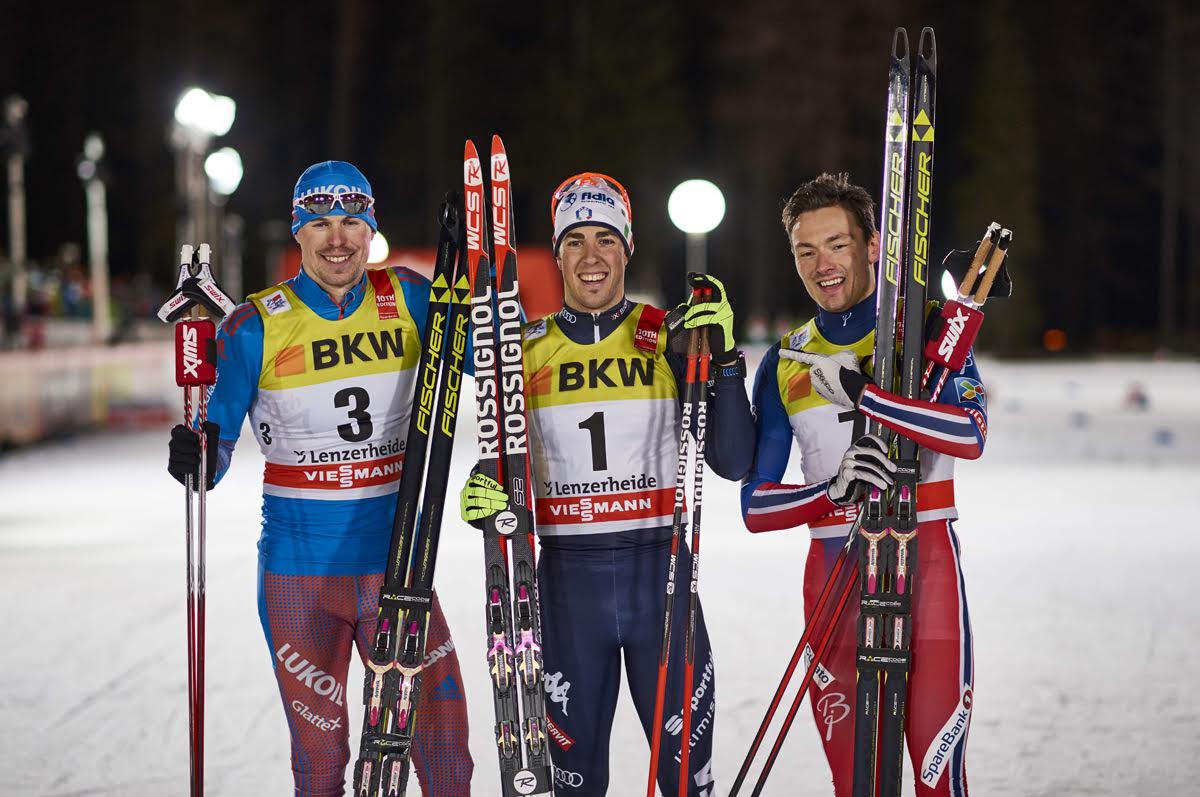
With his third-consecutive World Cup win, Federico Pellegrino (c) became Italy’s most successful sprinter of all time on Friday. He won the 1.5 k freestyle sprint, the first stage of the 2016 Tour de Ski, ahead of Russian runner-up Sergey Ustiugov (l) and Norway’s Finn Hågen Krogh (r) in Lenzerheide, Switzerland. (Photo: Fischer/NordicFocus)
It’s a new year, yet some things remain the same. Jan. 1 marked the opening stage of the 2016 Tour de Ski, a 1.5-kilometer freestyle sprint in Lenzerheide, Switzerland. It also marked the third World Cup sprint victory in a row for Italy’s Federico Pellegrino.
The 25-year-old Pellegrino dominated the day. He qualified first with a time of 2:45.92. Across the official results sheet, a pattern of 1’s next to Pellegrino’s name tells the story; the only aberration on his way to the win, a second place in his semifinal by a margin of 0.11 seconds.
Under a nighttime sky illuminated by what looked like modernist street lamps, Pellegrino won the final in 2:43.14. He out sprinted Russian Sergey Ustiugov who placed second (+0.40). Norway’s Finn Hågen Krogh skied to third (+1.25).
Not considered a sprint specialist, but certainly considered the favorite for this year’s 10th edition of the Tour de Ski, Norwegian Martin Johnsrud Sundby placed fourth (+10.09). In fifth was Sweden’s Emil Jönsson (+12.270, followed by Swiss veteran and three-time Tour de Ski champion, Dario Cologna in sixth (+59.01).
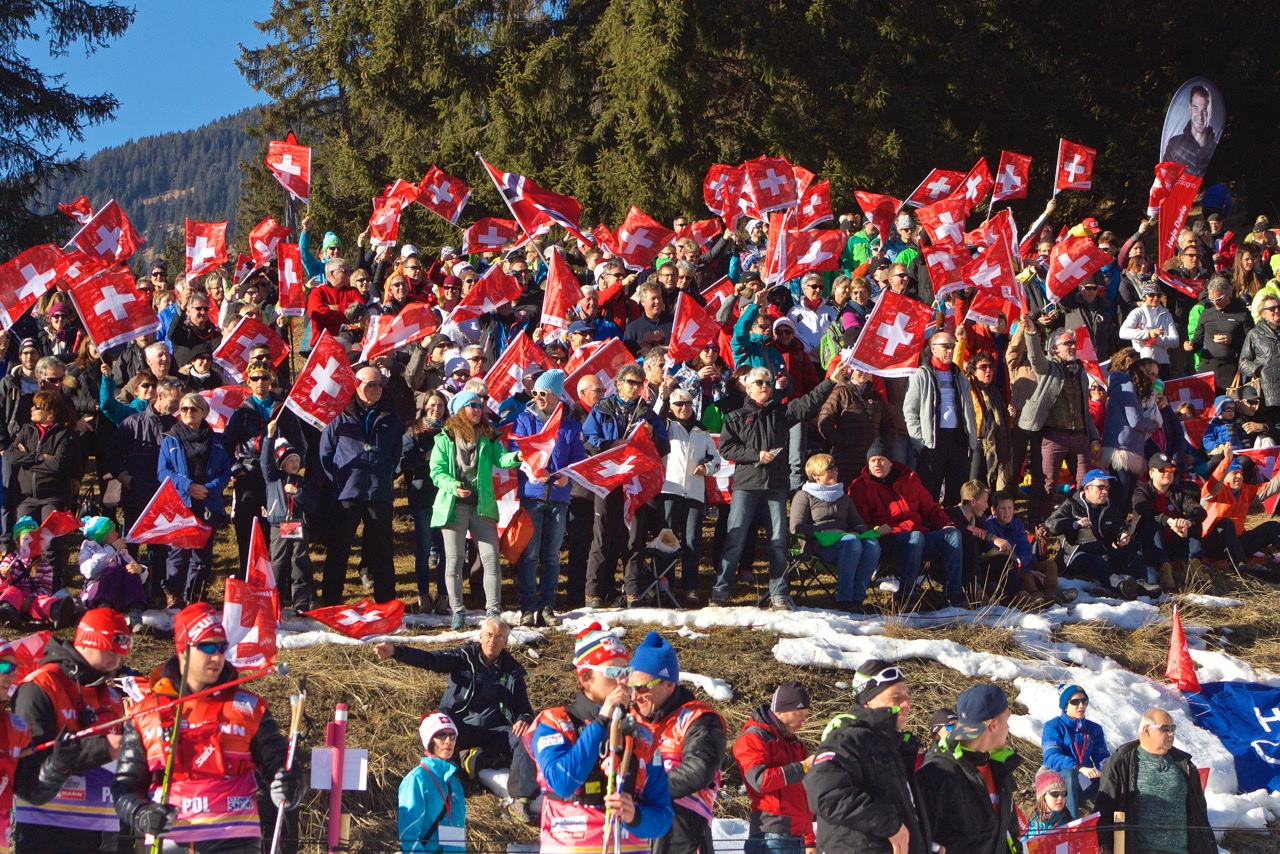
Swiss fans were out in force in Lenzerheide, Switzerland, cheering raucously for their homegrown athletes, especially three-time Tour de Ski champion Dario Cologna, who made the final and placed sixth after falling. (Photo: JoJo Baldus)
Cologna is a good place to start this sprint final’s tale. It was a partisan crowd. And when Cologna’s name was announced as he stepped forward in his lane, the crowd became electric — it was a sea of waving red and white Swiss flags.
From the gun, Ustiugov led out with a scrum of V2ing skiers trailing close behind. After a series of short roll-overs, Cologna slotted into second and eventually dropped into third.
Just over a minute into the race, when it was clear Ustiugov was making a powerful move on the flats, Cologna became tangled with himself, and fell. That left only five skiers, with a clear separation of Ustiugov, Krogh and Pellegrino developing with Sundby dangling off the back.
Then, just over two minutes in, it was a three-person race with Pellegrino taking the lead, accelerating around a turn with what appeared to be the slickest skis in the field. He crossed the line with a cursory foot outstretched, as if the results were in question.
The second men’s quarterfinal, with Italy’s Federico Pellegrino (1) and Norway’s Petter Northug (4) leading, followed by American Andy Newell (17), Russia’s Andrey Larkov (c) and Sweden’s Oskar Svensson (r) at the Tour de Ski freestyle sprint in Lenzerheide, Switzerland. (Photo: Fischer/NordicFocus)
The only blip in Pellegrino’s day — second place in his semifinal — proved a valuable learning opportunity. In the post-race press conference, he admitted his tactics would need to change after his semifinal.
“I learned how to play in the final, so I didn’t make the same mistake,” he said. “I knew that if I arrived in the final 100 meters in the front of the race, I should win. It’s what I made, and so I happy for having do it.”
As a sprint aficionado, and now the winningest Italian World Cup sprinter, with six wins total, (Italian Cristian Zorzi won five World Cup sprints), Pellegrino is still undecided about finishing out the Tour.
“Tomorrow, we have a 30 k. I just have to pay attention to not make a big bonk, and save some energies for [the classic sprint in] Oberstdorf, but I want to be good,” he said. “Maybe in the last five kilometers, I will push as hard as I can, but before, I have to be patient, and quiet and wait. Then we are 10 k in skate, I want to have good sensations in this distance. Then in Oberstdorf, we will have a classic race. We have, I think, two very hard uphills, and in classic, this is my bread. I want to be good there, too.”
Italy’s Federico Pellegrino racing to first in the freestyle sprint qualifier at the first stage of the 2016 Tour de Ski in Lenzerheide, Switzerland. He went on to win the final for his third consecutive World Cup sprint victory.
He’s now shooting for an unprecedented four-consecutive World Cup freestyle sprint victories. With another World Cup win, he’ll become Italy’s winning-most World Cup skier.
“I don’t know if I will finish the Tour de Ski, because then we have [the World Cup weekend in] Planica [Slovenia], and I want to make history and win the fourth sprint skate in a row. I am undecided on my goals,” he said.
Ustiugov avenged his lack of prime results this season with his first podium of the year. Through a translator at the press conference, he showed respect for Pellegrino.
“I tried everything in the final, but Frederico was actually faster than me in the end. Next time, I will try again,” Ustiugov said.
Krogh in third seemed content after the race, nodding to the first- and second-place finishers as simply better on this day.
“The two guys who are one-two today are faster than me, nothing to do about that, so I am very happy with third place,” Krogh said.
As for the Swiss favorite, Cologna, even he surpassed his sprinting expectations — his goal was to make the semis. “Of course I would have liked to get on the podium, but I’m more than satisfied,” Cologna told Swiss TV broadcaster SRF 2. “The semifinal was the goal in order to get a few bonus seconds. Now I could show a good race in the final, prove that I’m in shape. That was a good start to the Tour.”
As a potent threat to Sundby’s overall Tour aspirations, Cologna has set himself up well for Saturday’s 30 k classic mass start, but he has no illusions about overturning the Distance World Cup hierarchy, which Sundby reigns.
“I think it will be a very hard race. The loop has a lot of vertical meters, eight times,” Cologna said. “Sundby will create a lot of pressure early on, and I don’t think it will end with a mass sprint. So you have to save strength whenever possible on the loop, always run a smart race, and hopefully stay in contact with the top until the final.”
The overall Tour standings reveal a tight grouping after the first stage — Pellegrino in first, Ustiugov in second (+6.6), and Krogh in third (+11.6).
But heading into the first distance race, some notable names fared well after a day of freestyle sprints. Sundby is placed fourth, 15.3 seconds out of first, followed by Jönsson, (+20.5), while just over a second back lurks Cologna, with Norway’s Petter Northug Jr., in seventh, 23.1 seconds out. (Note: Saturday’s race is a mass start, but overall time back is cumulative throughout the Tour.)
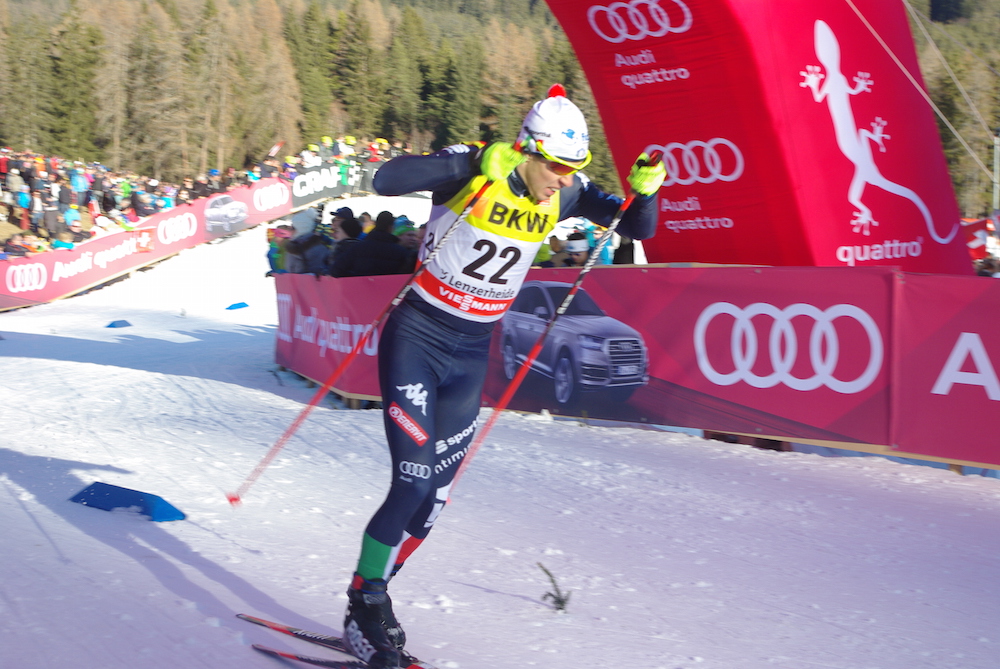
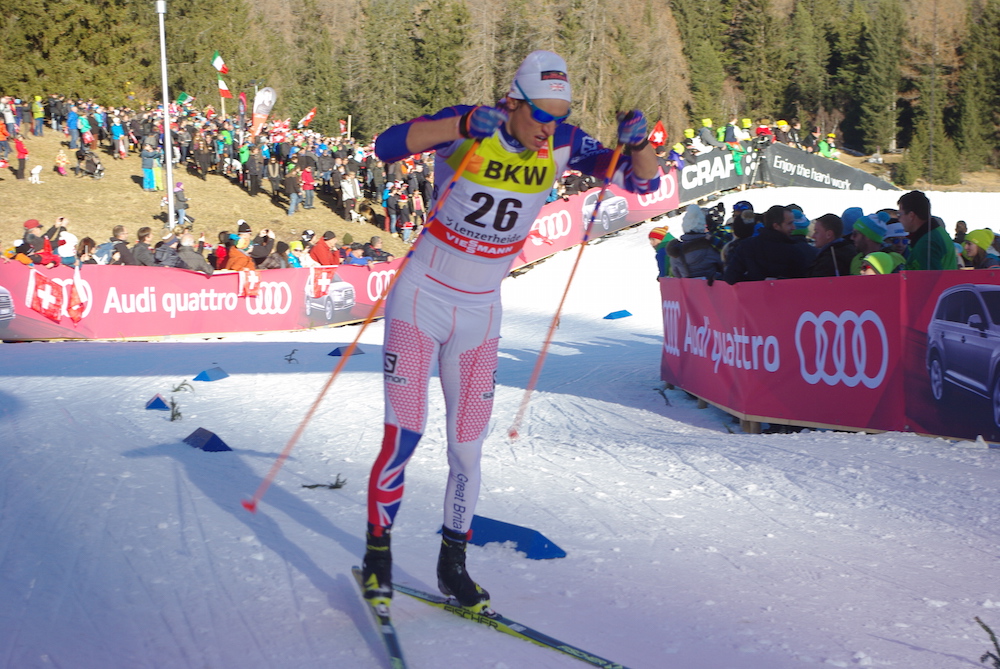
Andrew Young of Great Britain qualified second in the first stage of the 2016 Tour de Ski on Friday in Lenzerheide, Switzerland. He went on to place 30th overall after colliding with an inflatable archway in his quarterfinal.
For the British, a potential storyline piggy backing on Andrew Young’s third-place sprint podium in Toblach, was derailed in the fifth quarterfinal. Young began race day with a qualifier to be proud of: he qualified second overall, two seconds behind the day’s winner, Pellegrino.
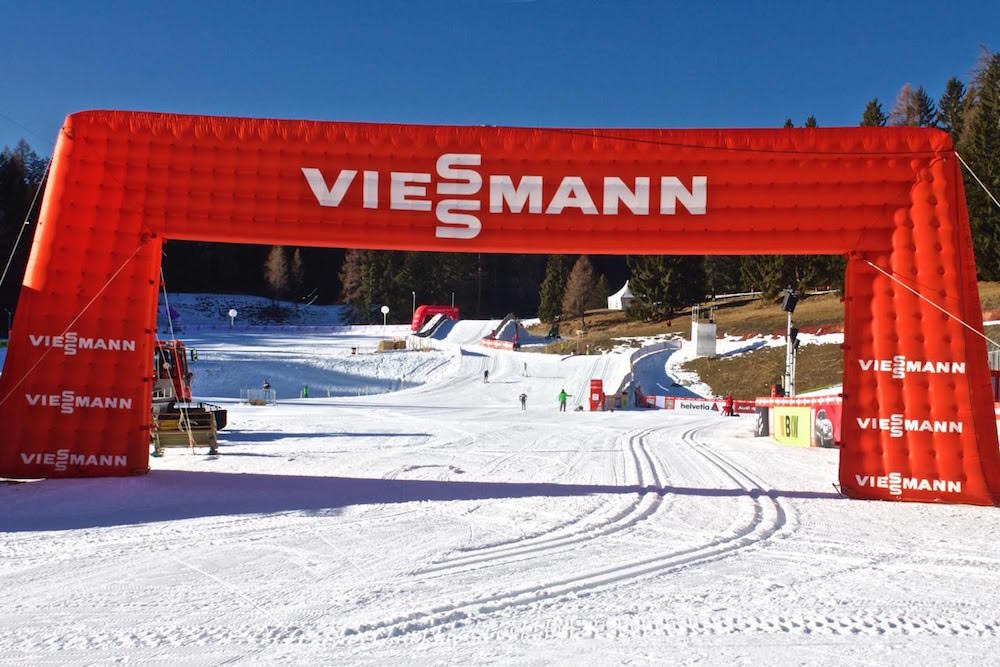
Skiing close to the front, and with no sign of fatigue, approximately 38 seconds into the fifth quarterfinal and moments after skiing under an inflated Audi archway, Young fell to ground — he had been skiing inches from the barrier when he tumbled.
After the race, Young and his coach/father, Roy Young, reviewed the heat’s video with the race jury. Afterwards, the jury ruled in Young’s favor that a course obstacle did impede the skier.
In an email, Roy Young said the TV review showed “a rope dangling from Audi arch caught his arm. This spun him under the advert at side of track where he got stuck. Effectively out of the race bye time he was freed & with bruised arm he decided to stop & tell officials what had happened. For stopping I think they have ranked him 30th rather than last in his quarter. (About to check the rules, but it all seems unfair. ) But we go on and get ready for tomorrow – better go and win then. :)”
The Tour de Ski continues Saturday with 15/30 k classic mass starts.
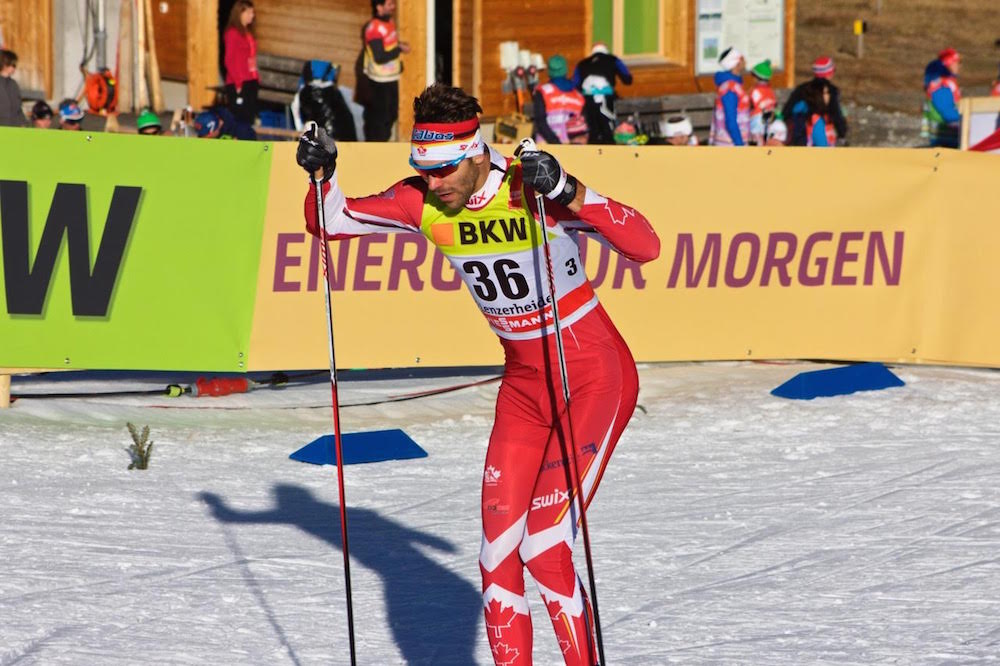
Lenny Valjas (Canadian World Cup Team) missed qualifying by 0.01 seconds in 31st in Friday’s 1.5 k freestyle sprint qualifier at the first stage of the 2016 Tour de Ski in Lenzerheide, Switzerland. (Photo: JoJo Baldus)
In a World Cup sprint, 31st has a little extra bite. Ask Len Valjas. He’s been in that position twice in the last three freestyle sprints.
On Friday, the Canadian World Cup Team sprinter finished one-hundredth of a second behind 30th, which would have qualified him for the heats in the 1.5-kilometer skate sprint, the first stage of the Tour de Ski in Lenzerheide, Switzerland.
Just over two weeks ago at another Swiss race site in Davos, Valjas ended up 31st, four-hundredths of a second out of the top 30, in the first World Cup skate sprint of the season.
Back then, the 27-year-old Canadian clocked in 4.64 seconds behind the winner. On Friday, he was 6.86 seconds back from qualifying winner Federico Pellegrino, the Italian who went on to rack up his third-straight World Cup sprint victory.
“It’s two races that could have gone way better…,” Valjas told FasterSkier after Friday’s qualifier. “It’s almost harder than being far back when you can just accept that you sucked today. But 1/100th, that’s the difference between having a potentially sweet day here ’cause I love the heats. Qualifying is always hard for me; I’m just disappointed. I couldn’t see what I could have done today.
“It just shows I’m not exactly at the level I was, like, it used to be easy,” he added. “I know I’d be between 25th and 20th on any given day and now I’m between 25 and 35, so I need to get a little bit stronger and fitter so I don’t have this disappointment.”
Leading up to this World Cup season, all had gone according to plan, Valjas explained.
“I’m healthy, just need to get a little bit snap back, just a few parts of my skiing I just need to figure out,” he said, adding that he plans to race the Tour through the fourth stage, a classic sprint in Obertsdorf, Germany.
Just 0.15 seconds back from Valjas’s time, his teammate Alex Harvey placed 33rd (+7.01). Devon Kershaw was 9.72 seconds back from the qualifying winner in 60th, and Ivan Babikov finished 92nd (+18.92) of 100 men in the opening stage.
Two of four American men fared better, with Simi Hamilton and Andy Newell qualifying in 13th and 17th, respectively. Erik Bjornsen did not advance in 69th (+12.61) and Noah Hoffman was 85th (+16.44) in the qualifier.
Bjornsen called his qualifier “really bad,” while Hoffman, a distance skier, said he felt good.
“A tour with six distance stages and two sprints is a great tour for me,” Hoffman told FasterSkier. “Today is just something to get ready for tomorrow.”
Saturday’s second stage of the Tour holds a women’s 15 k and men’s 30 k classic mass start. Hoffman called the course “awesome” and especially opportunistic for him with a longer hill than previously used at the Tour two years ago.
“The weather should be a little interesting. It’s going to be a little mix of rain and snow and sun,” Hoffman said. “Obviously I was frustrated with Period 1, but I feel like I am ready to go. I will continue to take care of the things I can control, and hopefully it will come around.”
In the women’s 1.5 k qualifier, four of seven U.S. women qualified. Sophie Caldwell led the team in second, 2.98 seconds behind the qualifying winner Ingvild Flugstad Østberg of Norway. Sadie Bjornsen qualified ninth, Jessie Diggins was 14th and Ida Sargent 26th.
Rosie Brennan placed 47th, 3.44 seconds out of 30th and 13.03 seconds back from Østberg. Also for the U.S. Ski Team, Caitlin Gregg was 49th (+13.29) and Liz Stephen 68th (+19.24) of 71 finishers.
“This is straight-up my favorite race series of the year and time of year, and mentally I’m psyched to get going.” — Liz Stephen after Stage 1 of the 2016 Tour de Ski
Brennan explained that she’s mostly focused on classic races, and aims to complete the Tour.
“I would like to feel like I skied well to the end, not just like, ragged across the line,” she said.
Caitlin Gregg (U.S. Ski Team) finished 49th in the Tour de Ski freestyle sprint qualifier on Friday in Lenzerheide, Switzerland. (Photo: JoJo Baldus)
For Gregg, also programmed to finish the Tour, it was her first skate sprint in almost a year (since placing second to Brennan at 2015 U.S. nationals in Houghton, Mich.).
“It’s one thing to do a skate sprint at U.S. nationals and it’s one thing to do a skate sprint on the World Cup,” Gregg observed. “All said and done, I was like three seconds out of qualifying. It’s kind of a ways, still also … definitely as close as I’ve ever been. I think I felt great … I kind of wish the skate sprint was in the middle of the whole series.”
Looking ahead, she’s most excited for the 5 k races and the hill climb, which she has never done before on the World Cup.
“Just the whole thing, I think, it kind of suits when I am feeling good and I can kind of build throughout the series,” Gregg said. “The goal coming in was to be … maybe a little bit undertrained. I took a number of days off over the Christmas break, probably a total of four out of the 10 to kind of to reset, recharge the batteries and then come into this and be able to build instead of trying to hold on.”
For Stephen, who ended up fifth in the overall standings last year for the best-ever finish by an American in the Tour de Ski, it was just a matter of getting started.
“I feel like I’m in a good position, shape-wise for the rest of the Tour,” she said. “I mean, this is straight-up my favorite race series of the year and time of year, and mentally I’m psyched to get going. Tomorrow’s 15 k should be really awesome here.”
For that race, Stephen explained she’ll try to get toward the front of the pack within the first 2 k to avoid the “bottlenecking” effect on what she called a “steep kicker” shortly after the start.
“My plan is to get as good a start as I can possibly get and try not to get on the back end of that bottleneck,” she said. “Which generally tends to make you chase the rest of the race…”
U.S. women’s coach Matt Whitcomb was thrilled with the team’s start.
“This is a team that’s on the roll right now. I’m excited to see these four girls who did well sprinting today mix it up in the classic race, but I’m also excited to see Rosie and Liz and Caitlin get things going,” he said. “I’m excited to see our distance skiers start to mix it up too. Tomorrow is going to be a big day to hit the skis and I think our team is 100 percent ready to go.”
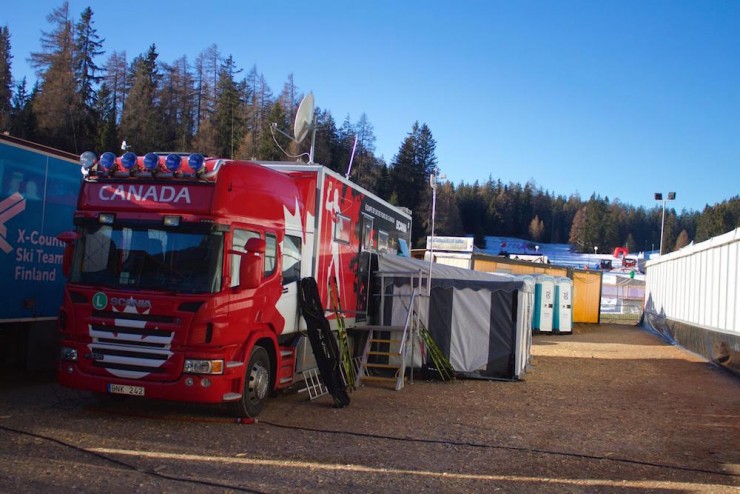
The Canadian “tour bus”, a.k.a. wax truck, parked in Lenzerheide, Switzerland, as seen two days before the 2016 Tour de Ski begins (pictured on Wednesday, Dec. 30, 2015.)(Photo: JoJo Baldus)
(Photo: JoJo Baldus)
(Photo: JoJo Baldus)
For the 10th straight year, the World Cup is going on a major tour. The 2016 edition of the Tour de Ski starts Friday, with eight races in 10 days. Racers will compete in three countries and four different venues, and if they complete the tour, they will have done five skate races (including two sprints), three mass starts and two pursuits — ending with a final 9-kilometer hill climb.
While it’s a lot to keep track of from a viewing standpoint, think of what the athletes, their teams and even the organizers have ahead of them. FasterSkier will be on site to report from two of three stops on the tour (in Lenzerheide, Switzerland, and Obertsdorf, Germany), and NBC plans to stream the races live from NBC Live Extra (subscribe and watch online) and broadcast on TV via the Universal HD channel (4:30 Eastern time Friday for the opening stage in Lenzerheide).
Follow FasterSkier’s live updates during the races on Twitter and check our home page for comprehensive reports.
The races: (all start times converted to Eastern time)
Saturday, Jan. 9 (Val di Fiemme, Italy): 10/15 k classic mass start (6:30/8:30 a.m. ET)
Sunday, Jan. 10 (Val di Fiemme, Italy): 9 k freestyle pursuit (hill climb) (8/9:40 a.m. ET)
The players:
Last season’s winners: Marit Bjørgen, Martin Johnsrud Sundby (both of Norway).
Bjørgen is out this year as she gave birth to her first child (a boy!) on Dec. 26. Sundby has won the Tour de Ski (TdS) twice and last year’s runner-up Therese Johaug, who currently leads the World Cup overall standings (along with Sundby) won the TdS in 2014.
Wondering which skiers will be doing the 2016 Tour? We’ve compiled a list of several (but not all) national-team rosters below:
U.S.A.
Women:
Liz Stephen
Rosie Brennan
Caitlin Gregg
Jessie Diggins
Sadie Bjornsen
Sophie Caldwell*
Ida Sargent*
Men:
Noah Hoffman
Erik Bjornsen
Simi Hamilton*
Andy Newell*
*Will likely end Tour after second Obertsdorf race (fifth stage on Jan. 6) or after Toblach race in order to prepare for World Cup in Planica, Slovenia (Jan. 16-17), according to U.S. Ski Team Head Coach Chris Grover.
Canada:
Ivan Babikov
Alex Harvey
Devon Kershaw
Len Valjas*
*Plans to end Tour after Obertsdorf, according to Canadian National Team Head Coach Justin Wadsworth
Graeme Killick, who was originally slated to race in the entire Tour, recently withdrew due to illness, according to a Cross Country Canada press release. Kershaw is competing in his 10th Tour de Ski.
In the first stage of the inaugural Tour de Ski in 2006, Kershaw reached the podium (in second in Munich, Germany). At the 2011 stage in Toblach, Italy, Kershaw won his first-ever World Cup.
“The Tour de Ski is a competition that’s so near and dear to my heart. I can’t believe that this is my 10th Tour de Ski start,” he said in the press release. “To have so many disciplines and distances all combined together to find the best overall skier over a 10-day period makes the Tour de Ski unique.”
Meanwhile, five Canadian women and three men will race the OPA Cup Jan. 8-10 in Planica, Slovenia, as part of the U25 B-Tour. Those athletes include World Cup skiers Emily Nishikawa and Jess Cockney, NorAm leader Dahria Beatty, Katherine Stewart-Jones, Maya MacIsaac-Jones, Cendrine Browne, Knute Johnsgaard, and Andy Shields.
Norway:
Women:
Maiken Caspersen Falla
Therese Johaug
Heidi Weng
Ingvild Flugstad Østberg
Astrid Uhrenholdt Jacobsen
Kari Øyre Slind
Ragnhild Haga
Men:
Martin Johnsrud Sundby
Petter Northug
Niklas Dyrhaug
Didrik Tønseth
Anders Gløersen
Finn Hågen Krogh
Hans Christer Holund
Sjur Røthe
Emil Iversen
Sondre Turvoll Fossli
Norwegian National Team Director Vidar Løfshus on selecting 17 athletes (10 men and seven women) to the Tour de Ski team: “It has been a very challenging process to select the team. We have probably never had a team with this many skiers who have a potential to podium in the overall Tour de Ski. At the same time, we have given special consideration to those who have a chance at winning the overall World Cups, and accordingly, there are several well qualified skiers who were not named to the team this time.
“Skiers such as Maiken Caspersen Falla and Sondre Turvoll Fossli are not intending to complete the entire Tour. As mentioned, the bar for making the team has been incredibly high. We have considered skiers with top-10 World Cup finishes within reach, and skiers who have a shot at winning one of the overall World Cups, which means that there is a discrepancy between the number of male and female team members.
“It is particularly exciting that Emil Iversen from the national development team and Kari Øyre Slind from the regional development project Team Veidekke Trøndelag have performed at such a level that they are qualified for the 2016 Tour de Ski squad. Both are rookies to the Tour de Ski.”
Fessel is a question mark, after suffering a cold over the holidays with the team manager Andreas Schlütter telling Germany’s DSV, “We hope she can go into the opening race on New Year’s Day.”
“Unfortunately I caught a cold just before the season highlight,” Fessel said. “Until Wednesday before Christmas I was able to train well in Toblach, then first signs of a cold manifested with a sore throat. My plan was to prepare intensively for the Tour in the past week. Instead I had to abstain from training for a whole week.”
In a non-World Championships season, Fessel explained the Tour is the highlight, especially with two stages at home in Germany.
“Those are my most important competitions this year. I wanted to show the best possible performance in front of family and friends,” she said. “Instead I now have to hope that I will be fit in time and able to start.”