Tag: Antholz

  • Russia’s Shipulin Prevails Again, Edges Germany for Relay Win; U.S. Ties Season Best

    Russia’s Shipulin Prevails Again, Edges Germany for Relay Win; U.S. Ties Season Best

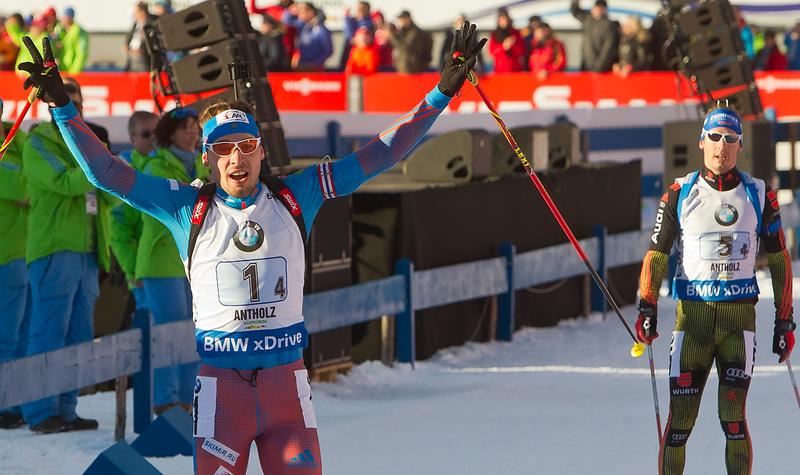
    Russia's Anton Shipulin (l) celebrates after holding off Germany's Simon Schempp to anchor Russia to the men's relay victory on Sunday at the IBU World Cup in Antholz, Italy. Shipulin outlasted Schempp by 1 second for the win. (Photo: IBU/Rene Miko)
    Russia’s Anton Shipulin (l) celebrates after holding off Germany’s Simon Schempp (r) to anchor Russia to the men’s relay victory on Sunday at the IBU World Cup in Antholz, Italy. Shipulin outlasted Schempp by 1 second for the win. (Photo: IBU/Rene Miko)

    Russia’s Anton Shipulin and Germany’s Simon Schempp have met multiple times on the final loop of an International Biathlon Union (IBU) World Cup race and duked it out for first, both in individual races as well as relays. In fact, they did so in Saturday’s pursuit in Antholz, Italy, where Shipulin prevailed by 10 seconds to claim his first victory of the season.

    On Sunday in the men’s 4 x 7.5-kilometer relay in the same packed arena with over 20,000 biathlon fans, Shipulin did it again to anchor a Russian team — with Maxim Tsvetkov, Evgeny Garanichev and Dmitry Malyshko — to first in 1:12:24.8, with no penalties and seven spare rounds.

    The German team, with Erik Lesser, Benedikt Doll, Arnd Peiffer, and Schempp, finished just 1 second behind, with one penalty but just four spares.

    “It has become sort of a tradition with me and Simon together on the last shooting range and then on the last lap,” Shipulin commented in the post-race press conference through a translator. “Honestly Simon becomes stronger and stronger every time, but today I would say I didn’t beat him physically, it was more about tactics. It is not a very long finish lane here, so I just made it tactically better to not give him a chance.”

    “Being on the podium shows that we are in good shape,” Malyshko said through a translator. “We will try our best at the World Championships [in Oslo in March] to show everybody that we are even stronger than in the World Cups.”

    “We trust in Anton, and Anton believes in the team,” one of Shipulin’s teammates added in an interview with the IBU.

    Schempp was not pleased with a situation that happened when he and Shipulin came into the arena, having to pass a lapped athlete from Japan just before the last turn, with Shipulin overtaking on the right but Schempp getting slightly blocked.

    “The lapped athlete ran in the middle of the track. The whole audience was yelling for him to go to the side. I don’t know, maybe he is deaf on his ears, or whatever he is doing,” Schempp told German broadcaster ARD. “With all the peace of mind he is running right between us, and that must not happen.”

    Asked if he thought a protest with the IBU would be an option, Schempp replied: “Nah, surely that would not go through. That result stands.”

    “I gave everything I had, it was a neat relay, and we were rewarded with the second place,” he added. “The Russians were very, very strong, especially Anton in the finish. We can live with that. It was a clear step forward in the relays [the German men’s first relay podium of the season]. Of course the end is a little annoying, but we can be satisfied.”

    The head coaches for German and Russia, Mark Kirchner and Ricco Gross, respectively, hugged and congratulated each other in the coaching zone after the race. Both 45 years old, they are former German teammates and won gold together in the men’s relay at the 1994 Olympics in Lillehammer, Norway. More recently, they were also colleagues, with Kirchner coaching the German men’s team and Gross being an assistant for the women at the 2014 Olympics, before Gross took an offer last summer to lead the Russian men’s team (after being “demoted” to the IBU Cup by the German Ski Federation).

    “It’s difficult to even pick the six best athletes for the World Cup,” Gross had told German newspaper FAZ in an interview published on Friday, just before Shipulin’s sprint victory. “I was extremely surprised in September when I watched the Russian championships for the first time, with more than 100 athletes. There is a giant talent pool … My target is the Olympic Games in 2018.”

    Norway opted to rest its usual starters Tarjei Bø and Emil Hegle Svendsen for the relay on Sunday, instead starting veteran Ole Einar Bjørndalen, Lars Helge Birkeland, Johannes Thingnes Bø, and Erlend Bjøntegaard.

    “They married and went on vacation,” Johannes Bø joked during the press conference when asked about the absence of his brother Tarjei and Svendsen.

    Thus it fell to the relatively inexperienced Bjøntegaard to anchor the team. Bø tagged  him with a 29.2-second lead over Russia, and 33.5 seconds ahead of Germany, with Shipulin and Schempp chasing after him.

    “Now it’s becoming really exciting. I wouldn’t like to be in the shoes of Bjøntegaard right now,” Germany’s third-leg Arnd Peiffer said during an interview with ARD while the race was still going on. “I think he has a lot of stress now, and I am curious what happens.”

    But facing this big challenge, Bjøntegaard did a good job skiing a fast first loop to return to the range still in first and only needing two spares in his prone shooting. Yet this still reduced his lead to 6.8 seconds over Schempp, who had shot clean, and 14.9 seconds to Shipulin, who required one spare.

    In the final standing shooting, the Norwegian needed two more spare rounds, while Shipulin and Schempp both remained clean and left the range just 0.5 seconds apart. They skied together until the finishing sprint, with Bjøntegaard securing the third place on the podium, 22.9 seconds after Russia, but securely ahead of the rest of the field.

    “With Emil and Tarjei, two of our best athletes were not in the relay,” Johannes Thingnes Bø said during the press conference. “I was hoping that we could make the podium, and we did. A perfect race for everyone on the team. Erlend and Lars Helge were called up last minute, but they were relaxed, and third place is good. It’s not easy for Erlend to go out with Schempp and Shipulin.”

    Behind Norway, Austria, with Sven Grossegger, Julian Eberhard, Simon Eder, and Dominik Landertinger, finished fourth (+1:01.7), with one penalty and 11 spare rounds.

    “Better shooting,” Simon Eder told the IBU in a video interview when questioned what it would have taken to reach the podium. “We always have the extra [penalty] loop. It’s not easy, it happens so fast. But we hope to manage it at the World Champs without it.”

    “The running shape is very good in the Austrian team,” Landertinger added. “And if the shooting is a little bit better we can make the podium.”

    France, starting without World Cup leader Martin Fourcade with a lineup of his older brother Simon Fourcade, Quentin Fillion Maillet, Simon Desthieux, and Jean Guillaume Beatrix, placed fifth (+1:39.3), with no penalties and 11 spares.

    U.S. Ties Season-Best 6th; Canada 11th
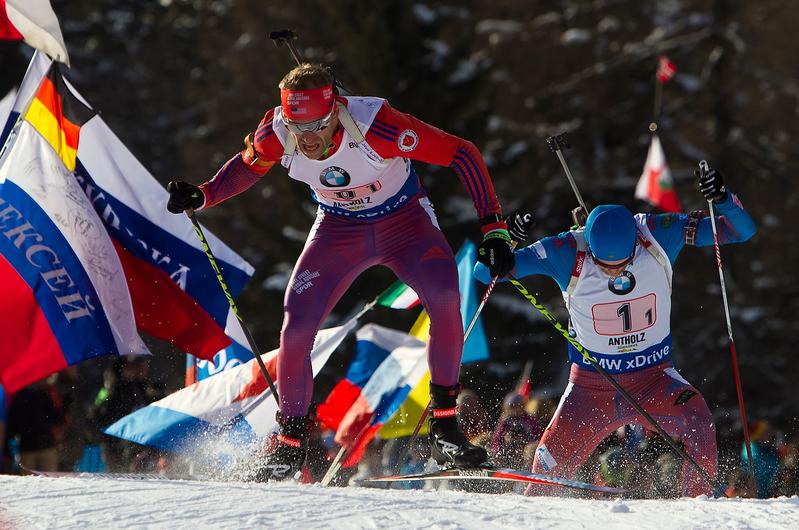
    Lowell Bailey (US Biathlon leads Russia's Maxim Tsvetkov during the first leg of the men's 4 x 7.5 k IBU World Cup relay on Sunday in Antholz, Italy. Russia went on to win and the U.S. finished 1:43.7 minutes back in sixth, tying a season-best team result. (Photo: IBU)
    Lowell Bailey (US Biathlon leads Russia’s Maxim Tsvetkov during the first leg of the men’s 4 x 7.5 k IBU World Cup relay on Sunday in Antholz, Italy. Russia went on to win and the U.S. finished 1:43.7 minutes back in sixth, tying a season-best team result. (Photo: IBU)

    On the last leg, Beatrix narrowly won out a race against American Sean Doherty, who crossed the finish less than five seconds later in sixth place, 1:43.7 behind the winners. The U.S. ended up with one penalty and 13 spares, and tied its season-best result after having achieved sixth in the relay a week ago in Ruhpolding, Germany.

    The Americans started the race in bib 6 with their now-usual lineup of Lowell Bailey, Tim Burke, Leif Nordgren, and Doherty, the same starters they had used at the World Championships in Kontiolahti, Finland, where the U.S. placed 14th in the men’s relay.

    Bailey briefly took the lead on the loop out of the arena, before two misses in his prone shooting stage required spare rounds and set him back to 15th, but still within 15.5 seconds out of the lead. With another spare in his standing stage, he still moved up five positions, and with the second-fastest, first-leg course time on his final loop, he tagged off in seventh, 20.8 seconds behind Germany’s Lesser.

    Burke held that position throughout his first loop, but two misses in the prone stage set him back. In the standing shooting, he used all three spare rounds to avoid the penalty lap, falling back to 14th before he made up ground again with a fast last loop (third-best course time) to tag Nordgren in ninth (+1:04.3).

    “Today proved that last week was not a fluke,” Burke said in a US Biathlon press release. “We are happy to be right in the mix with the ‘big’ biathlon nations but we still know that we are capable of more.”

    “I got the tag from Tim right with the Czech Republic,” Nordgren wrote in an email to FasterSkier. “For all of the first loop I just focused on staying nice and relaxed, trying to conserve as much energy as possible. Prone I wanted to be pretty aggressive and it worked out well.”

    After a clean prone shooting, Nordgren left the range in seventh place, virtually tied with a few other teams.

    “The second loop I left the range with Eder from Austria, again I was just tucked in with him saving energy,” Nordgren recalled. “Although I had super great skis today, so eventually on the downhill I put in a good transition and was pushing towards the French team in front of us.”

    After using two spare rounds in his standing stage, Nordgren still managed to move up to sixth place as some other teams, such as Italy and Switzerland, struggled on this leg, and handed off 1:04.5 minutes behind the leaders — about the same gap he had when he started.
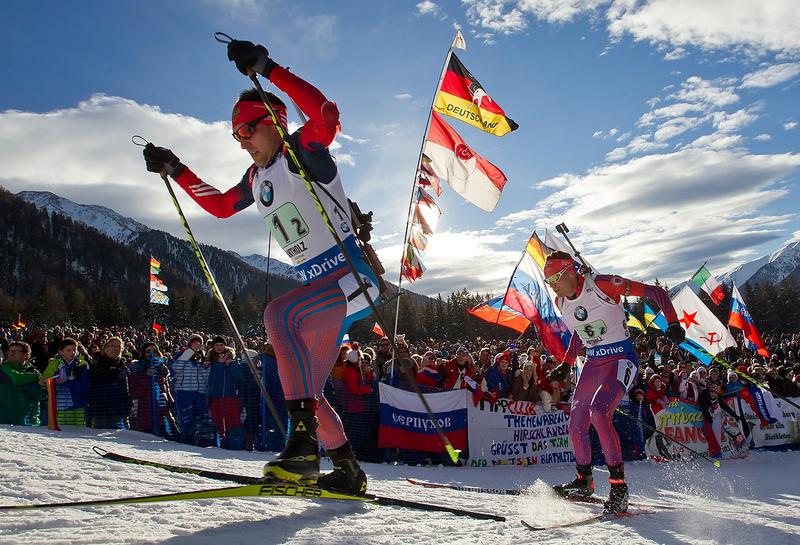
    Russia's Evgeniy Garanichev (l) leads Tim Burke (US Biathlon) during the second leg of the men's 4 x 7.5 k IBU World Cup relay in Antholz, Italy. (Photo: IBU/Rene Miko)
    Russia’s Evgeniy Garanichev (l) leads Tim Burke (US Biathlon) during the second leg of the men’s 4 x 7.5 k IBU World Cup relay in Antholz, Italy. (Photo: IBU/Rene Miko)

    “Standing was the only disappointing part about my race today, it was a bummer to have two mistakes, but I didn’t lose any places and I was quick with the extras,” Nordgren wrote. “I was surprised on the third loop, I actually had some energy to push. Eventually France passed me and got a small gap I couldn’t close.”

    Doherty kept the team in sixth on his first loop and through the first prone shooting, which he cleaned, reducing his gap to first by about ten seconds.

    “The conditions today were ideal,” Doherty wrote in an email. “The course was in great shape and there was no wind. The altitude here adds to the difficulty, but I also pushed hard on the second loop and I did not really hold it together on the range as I wish I could have.”

    By the final standing shooting he had moved to fifth, and was on the range behind Austria, with France nearby and Slovakia further behind. Austria’s Landertinger shot clean and finished first, while Doherty caused a penalty lap. But he only lost one position and still had France’s Beatrix in sight who had needed three spares.

    Doherty skied a fast final loop, almost closing a 20-second gap again, finishing sixth, 4.4 seconds behind France in fifth and 1:43.7 behind Russia.

    “I am a little bummed to have had that penalty because I was excited to fight for 5th. But overall 6th was secure,” Doherty wrote.

    “I am happy with another strong result,” Doherty added in the US Biathlon press release. “We were in the mix the whole time and even though I did not shoot my best the team did well. We are all looking forward to the next relay.”

    “As a team I think we’re happy with this race, but it was nowhere near a perfect race for us,” Nordgren wrote. “We still have more to give and will be looking for more in the relays to come.”

    Canada in bib 7 chose a lineup of Christian Gow, Nathan Smith, Macx Davies, and Scott Gow. Brendan Green had to sit out the relay because of back issues following his collision in Saturday’s pursuit, “which did not improve until race time,” according to Biathlon Canada head coach Matthias Ahrens. “We had to put Scott Gow in his place,” Ahrens wrote in an email.

    Younger brother Christian Gow jumped out to the lead after cleaning the initial prone stage, but on the next loop he lost some ground, crossing the next timing point in 11th, just 10 seconds out of first. After he required two spare rounds in his standing stage, Christian lost additional time to the leaders, but kept his position in the field, tagging off to Smith in 11th (+1:08.3).

    Smith, currently the highest-ranked Canadian in the overall World Cup, cleaned both stages for his first 100-percent shooting in a race this season. Reflecting on his race in an email, he said his ski shape was off — and it has been for the last couple days. Unable to move up in the field, he tagged Davies in 11th (+1:07.7).

    “I wanted to make up some spots and get our team up to the top 10. I knew it would mean some really good shooting,” Smith wrote in an email. “I’m really happy to finally have my first clean of the winter, especially after poor shooting in the other two races this weekend. On the other hand my skiing hasn’t been where it should for the last two weeks. I’m not sure why, I went from my best ski shape to my worst ski shape in literally 3 days. I have been struggling with back pain after a hard downhill crash in the Ruhpolding 20 km.”

    Davies went on to clean his prone stage and move into 10th, reducing the gap to the leaders to 41 seconds. In standing, he needed all three spares, which caused him to lose some time. Overall Davies skied the second-best course time of his leg (only behind Norway’s Bø), and handed off to Scott Gow in 10th place (+1:39.0).

    On the anchor leg, Scott needed two spares in his prone stage and one in standing, with Estonia’s anchor Ermits Kalev still passing him on the final loop. The Canadian crossed the finish in 11th, 5.7 seconds behind Estonia and 2:28.9 minutes behind Russia.

    Combined, the team had no penalty and required just eight spares. But 11th wasn’t exactly close to their season best: the Canadians finished sixth in Hochfilzen, Austria and 10th last week in Ruhpolding.

    “There were some good aspects of our relay: Christian’s first prone was amazing, my shooting, and Macx’s skiing,” Smith wrote. “Overall though I would say unfortunately it was not a good relay. A good race for us is top 6. The potential for a medal is there if everyone can put together their best race on the same day. Easier said than done.”

    The Biathlon World Cup resumes in two weeks on Canada’s home turf in Canmore, Alberta, with sprints on Thursday, Feb. 4 and Friday, Feb. 5, followed by mass starts on Saturday, Feb. 6, and single-mixed (1 woman, 1 man) and mixed (2 women, 2 men) relays on Sunday, Feb. 7.

    “I’m going to North America in a good mood,” Germany’s Peiffer said at the press conference. “The last three weeks were really exhausting. Now I had a good week here in Antholz, and I am looking forward to go to Canmore. I have never been there before. Maybe not as many [spectators] as in Ruhpolding or Antholz, but it’s nice to see a new place for biathlon.”

    “I will be in Romania for my last Junior World Championships,” Sean Doherty, 20, wrote, which will take place in Cheile Gradistei (Brasov, Romania) from Jan. 27 to Feb. 2. “So I will only be attending the Presque Isle World Cup [after Canmore].”

    Results

  • France Dominates Women’s Antholz Relay; Canada 13th; U.S. 17th 

    France Dominates Women’s Antholz Relay; Canada 13th; U.S. 17th 

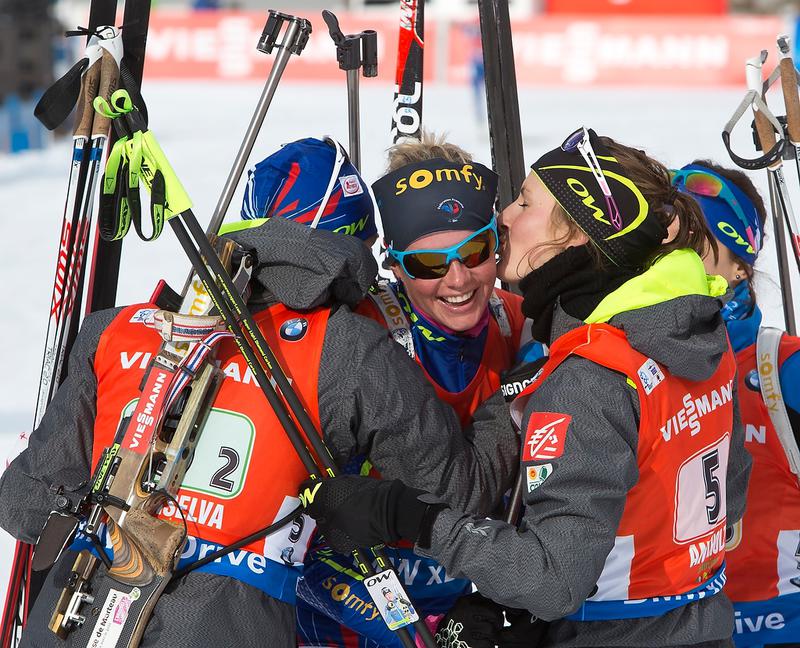
    The French women's 4 x 6 k relay team, including Justine Braisaz, Anaïs Bescond and Anaïs Chevalier, hugs and kisses anchor Marie Dorin Habert at the finish, after Habert secured their IBU World Cup victory by 17 seconds over the Czech Republic on Sunday in Antholz, Italy. (Photo: IBU)
    The French women’s 4 x 6 k relay team, including Justine Braisaz, Anaïs Bescond and Anaïs Chevalier, hugs and kisses anchor Marie Dorin Habert at the finish, after Habert secured their IBU World Cup victory by 17 seconds over the Czech Republic on Sunday in Antholz, Italy. (Photo: IBU/Rene Miko)

    After Ukraine, Germany and Italy occupied the podium in the first two International Biathlon Union (IBU) World Cup women’s relays of the season, on Sunday it was time for three other nations to shine in front of more than 20,000 fans in a packed arena in Antholz, Italy.

    On a beautiful day with blue skies, almost no wind, and surrounded by the spectacular mountain scenery of the South Tyrolean Alps, the French team with Justine Braisaz, Anaïs Bescond, Anaïs Chevalier, and Marie Dorin Habert shot well and skied fast to stay near the top throughout the 4 x 6-kilometer relay. Habert as the anchor received the tag with a 10.6-second buffer to Russia in second, then closed out the race with clean shooting in both stages, eliminating any chance of other teams challenging her.

    After she crossed the finish line in first for France with a time of 1:07.53.5, her teammates hugged her enthusiastically. Overall the French women shot no penalties and required just eight spare rounds.

    “It was a very nice race for the team,” starter Braisaz said during the post-race press conference. “I was a bit [too] excited on my first shoot. But it was a good experience to start the relay. And I am very happy today.”
    “A very happy end to my week,” her teammate Bescond told the media. “Today I felt very good on my skis. I think all of the team made a very good job.”

    “I am very tired, especially this week,” Habert said, reflecting on her season and the race. “It’s a very good thing to finish in the first position.”

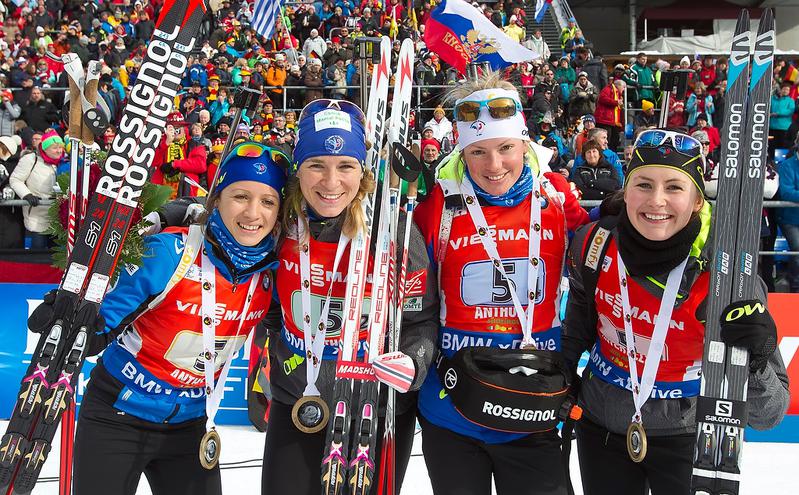
    The French women's relay after winning Sunday's 4 x 6 k IBU World Cup relay in Antholz, Italy. With Justine Braisaz, Anaïs Bescond, Anaïs Chevalier, and anchor Marie Dorin Habert (second from r). (Photo:  IBU/Rene Miko)
    The French women’s relay after winning Sunday’s 4 x 6 k IBU World Cup relay in Antholz, Italy. With Justine Braisaz (l), Anaïs Bescond (second from l), Anaïs Chevalier (r), and anchor Marie Dorin Habert (second from r). (Photo: IBU/Rene Miko)

    “This is the first time we tried our relay for the World Championships [in Oslo], so it’s important to [get] a good position to see that this formation of the relay is functioning,” she later said in another interview with the IBU.

    On the last loop, the Czech Republic, Russia and Italy battled for the positions on the podium, with Veronika Vitková able to create a small gap to secure second place for the Czech team, 17.2 seconds behind France.

    Initially, the outlook didn’t look good for the Czech Republic, after second-leg Lucie Charvátová skied two penalty laps and slipped to 12th at the exchange. Later she could be seen in the finish pen with tears in her eyes, while being consoled by team staff.

    “After my leg I didn’t think [it would be possible to come back], because I was such a bad shooter in each relay I started this year. So I was afraid, afraid all race, all year,” Charvátová, 22, said during the press conference. “I am so under pressure. So I am very happy, because those other girls are the best.”

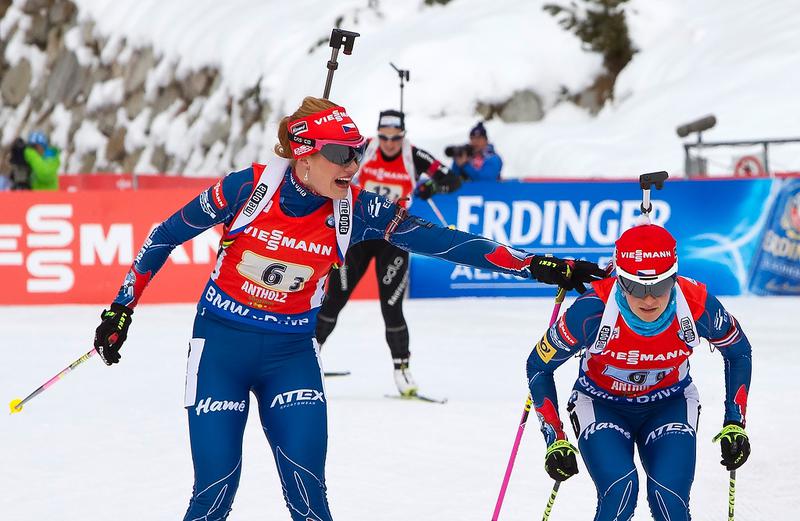
    Gabriela Soukalová (l) tags Czech teammate Veronika Vitková in fourth during the final exchange in the IBU World Cup women's 4 x 6 k relay. The Czech Republic team went on to finish second with just two spares from Vitkova. (Photo: IBU/Rene Miko)
    Gabriela Soukalová (l) tags Czech teammate Veronika Vitková in fourth during the final exchange in the IBU World Cup women’s 4 x 6 k relay. The Czech Republic team went on to finish second with just two spares from Vitkova. (Photo: IBU/Rene Miko)

    Her veteran teammates, World Cup leader Gabriela Soukalová and Vitková turned the race around with solid shooting and fast skiing, recording the best and fourth-best course times on their legs, respectively, to capture second. Overall, the team incurred two penalties and required seven spare rounds. It was the best performance for the Czech relay team this season, after two sixth-place finishes before.

    “It’s very surprising,” starter Eva Puscarciokova said during the press conference. “I am very happy today, because it was very hard after my race in Ruhpolding [Germany] when I went to the penalty loop.”

    Third place on the podium went to the Russian team with Ekaterina Shumilova, Anastasia Zagoruiko (who replaced Daria Virolaynen from the last relay in Ruhpolding), Ekaterina Yurlova, and Olga Podchufarova, finishing 21.2 seconds back, with no penalties and 10 spare rounds.

    Yurlova, Saturday’s pursuit winner, lifted her team from sixth to second, skiing fast — with the second-best course time of the third-leg skiers — and only needing two spares.

    “I am really happy about my leg, and especially about my standing [shooting],” Yurlova said at the press conference. “Because I am really, really tired after two competitions before. And now I was really afraid about my standing. It was all shaking, but I am really happy that I could do it clean. Overall I am really satisfied about this World Cup.”

    In the finishing stretch, Italy’s anchor, Dorothea Wierer, and Russia’s Podchufarova (who had beaten Wierer in the sprint last Friday) fought for third, as they had done earlier this season at the end of the relay in Ruhpolding, Germany, where Italy came out ahead. But this time, Podchufarova prevailed, to the huge excitement of her teammates who immediately ran into the finish area and piled onto her. Wierer crossed the line just 0.5 seconds behind (+21.7), after having made up nearly 15 seconds after the final shooting.

    “My only thought was to come into the finish in the third position,” Podchufarova said in the press conference. “I didn’t know at first that [Wierer] was behind me, only when I came into the stadium I saw it on the monitor. Then I tried my best to get the third place for the team.”

    “I wanted to go on the podium, but I was too [many] seconds behind,” Wierer said in a post-race interview with the IBU. “On the finish line I couldn’t anymore, because I was flushed pushing from the first loop, and in the final I had no more energy.

    “It was a really nice [weekend], but I am a little disappointed today,” she added with a laugh. “You want always more and more, that is the problem.”

    Norway, with Kaia Wøien Nicolaisen, Fanny Horn Birkeland, Marte Olsbu and Tiril Eckhoff, had been in third position behind France and Russia coming into the last shooting, but Eckhoff — a fast skier who has struggled with her shooting all season, hitting 68 percent of her standing targets — again had problems and ended up skiing a penalty lap. She finished fifth for Norway, 47.1 seconds back from France, with a team total of one penalty and 10 spares.

    “I had the opportunity and screwed it up. This was real sh*t. This was not the way I wanted to end [my] last World Cup race before the World Championships,” Eckhoff told Norwegian broadcaster NRK after the race, noting she and her coaches were aware of some technical corrections she still plans to implement.

    Ahead of the upcoming World Championships on their home turf in Oslo, the Norwegian women have yet to reach the podium since earning bronze in the relay at the 2014 Olympics.

    Arguably the biggest surprise of the day was Sweden, with Emma Nilsson, Mona Brorsson, Ingela Andersson, and Linn Persson, in sixth place (+50.5) just 3.4 seconds behind Norway, with no penalties and seven spare rounds.

    After the race, the Swedish women claimed they knew they were on a very good trajectory this season.
    “We expected it,” Brorsson said during in a group interview with the IBU.

    “We really thought we had a chance to be top six,” Andersson added.

    They credited their coach, Wolfgang Pichler, for their improved performance, after he helped several Swedish biathletes, such as Magdalena Forsberg, Helena Ekholm and Anna Carin Olofsson (now Zidek) reach Olympic and World Championship medals, before returning last summer after a stint with the Russian biathlon team.

    “I think that’s the big difference this year,” said Brorsson. “He always finds a way to motivate you. On the track, he is incredible. He knows what he is doing.”

    Ukraine, winner of the last relay in Ruhpolding and usually a team with very solid shooting performances, had some difficulties on the range on Sunday and finished ninth (+1:45.5). The team with Iryna Varvynets, Valj Semerenko, Olga Abramova (replacing Juliya Dzhyma) and Olena Pidhrushna stayed near the front for most of the race and Semerenko even exchanged in the lead. But Abramova needed five spares, and anchor Pidhrushna had to ski a penalty lap, setting them farther back (12 spares overall).

    Similarly, Germany had been in second place for both relays this season. On Sunday, with their regular anchor Laura Dahlmeier taking a break after a respiratory infection, the team struggled almost right out of the gate. Starter Karolin Horchler required five spare rounds and only narrowly avoided the penalty lap in her prone stage, leaving in last position at that time. She tagged off already a minute behind the best in 15th, before Miriam Gössner and Vanessa Hinz moved up a bit, but each incurred a penalty to slow down the chase. Anchor Franziska Hildebrand still managed to improve her team two positions on her leg, ultimately finishing 10th (+1:51.8).

    “I don’t know why, but my legs felt like a sewing machine today in standing, that hasn’t happened to me in a long time,” Gössner told German TV broadcaster ARD in an interview while the race was still going on. “I stood there, and already from the first shot my legs were shaking so much that I really didn’t have myself under control anymore. Even though I went slowly on the prior loop. I tried to fight and prevent the penalty lap, but unfortunately I did not succeed.”

    “My race was all right. All in all I am satisfied,” Hildebrand told ARD. “We somehow struggled a bit in Antholz. Next time it hopefully will be better again for us. There are weekends where not everything works out, and this was one of those.”

    Switzerland, with Saturday’s pursuit runner-up Selina Gasparin, started the relay very strong, with Gasparin tagging off in the lead, and her younger sister Aita Gasparin keeping the team in contention in fourth. Then two less-experienced skiers closed for Switzerland, with Irene Cadurisch tagging off in fifth place, before anchor Ladina Meier-Ruge faded a bit and lost two minutes to the front. They finished 12th with nine spares, one place ahead of Canada.

    Canada 13th, U.S. 17th

    After achieving her first-career top 20 in Saturday’s pursuit, Canada’s Julia Ransom had said her team was “fired up” for the relay, and that they were eager to reach the top six after feeling they had come close in ninth a week ago in Ruhpolding.

    Unfortunately on Sunday, the performance on the shooting range did not allow that to happen for the Canadian team with Ransom, Rosanna Crawford, Megan Tandy, and Zina Kocher.

    Starting as the scramble leg, Ransom missed two targets in her first prone stage, then required all three spares to clean them, narrowly avoiding the penalty but only leaving the range again in 18th position, already 41 seconds back.

    After skiing a fast second loop (with the third-best course time, seventh-best overall) and a clean standing shooting, she moved the team back up significantly and tagged Crawford in ninth place, 32.2 seconds behind the top.

    Crawford had two solid shooting performances, requiring one spare round in her prone stage and two in standing. Skiing the 11th-fastest second-leg course time, she brought her team close to the top six in seventh place, just 32.5 seconds out of first.

    Tandy skied a very fast first loop (fourth-best), and came through her prone stage with two spare rounds, leaving still in 10th position. After a slower loop, she then struggled in her standing position, and was unable to avoid the penalty lap (0+2, 1+3), losing a minute to the top. She tagged off in 13th place (+1:58.7).

    Kocher as the team’s anchor initially held 13th and had a solid first prone shooting with one spare round, but lost another minute on the next loop. In the final standing, similar to Tandy, she also ran out of spares and had to ski a penalty lap, leaving the range in 14th and more than four minutes behind the leaders. On the final loop she was able to pass Bulgaria’s anchor Daniela Kadeva, finishing 13th for Canada (+4:12.2 minutes) with two penalties and 15 spare rounds.

    In an email, Biathlon Canada’s head coach Matthias Ahrens explained that the team was packing up Sunday afternoon, driving to Munich, Germany, then flying back to Canada early Monday morning. The Canadian athletes could not be reached for immediate comment.

    “Women’s race started excellent with Julia and Rosanna, then unfortunately Megan and Zina could not match that Performance,” Ahrens briefly noted about the women’s result before leaving Antholz.

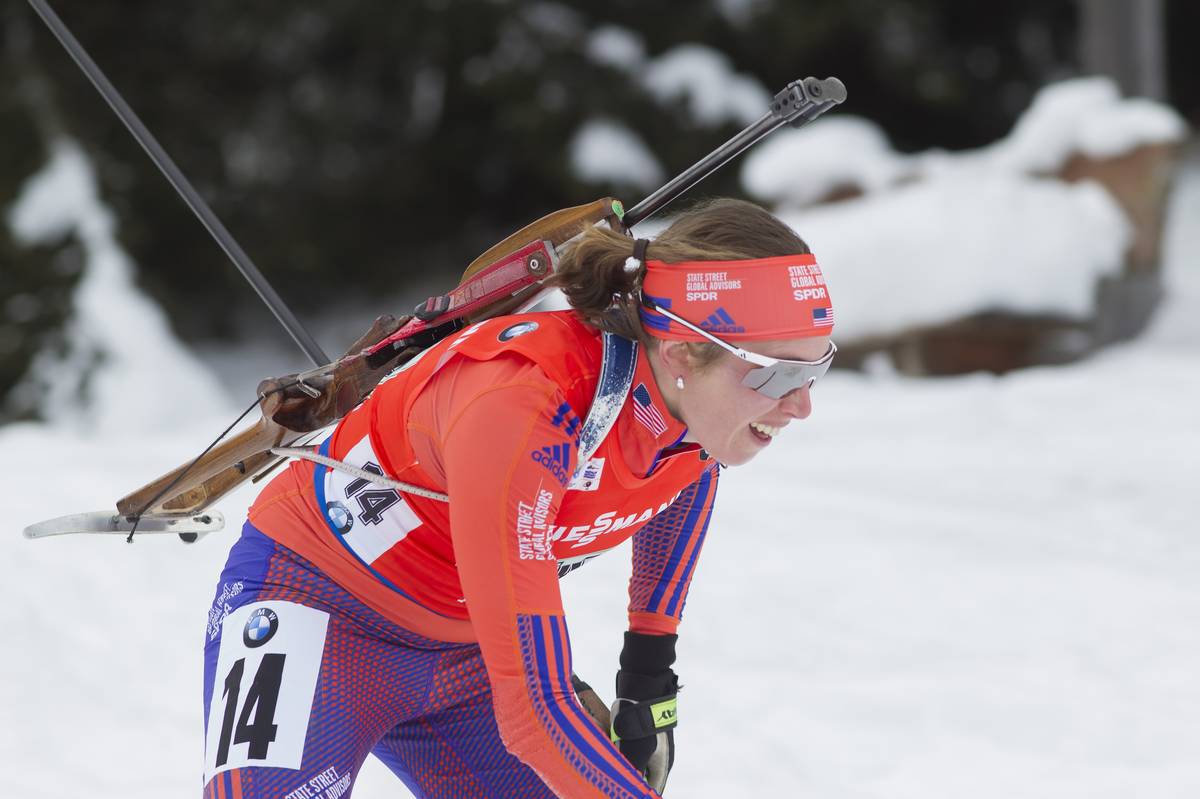
    Susan Dunklee (US Biathlon) used a total of four spares between two stages in the women's 4 x 6 IBU World Cup relay, handing off in 14th. (Photo: USBA/NordicFocus)
    Susan Dunklee (US Biathlon) used a total of four spares between two stages in the women’s 4 x 6 IBU World Cup relay, handing off in 14th. (Photo: USBA/NordicFocus)

    The U.S., with Clare Egan, Susan Dunklee, Annelies Cook, and Joanne Reid, adapted its lineup order a bit again on Sunday compared to the first two relays, with Egan starting and Cook moving to the third leg.

    “Today I got my first mass-start experience at the World Cup level,” Egan wrote in an email. “It reminded me of how much I thrive on head-to-head racing. The decision was made with the intent of giving me that head-to-head experience, both because it will be useful in the future for pursuits and mass starts, and because I think my coaches thought I would like it.”

    She skied at a steady pace in the middle of the field, and required just one spare in each of her shooting stages.

    “The altitude is a challenge here, for the skiing of course but also for recovering before the shooting,” Egan wrote of the biathlon trails situated some 2,000 meters (6,500 feet) above sea level. “The range approach does not provide rest, so I have been making rest for myself by skiing into the range extra easily.”

    “There was a light wind but it was constant, so with the correct sight adjustments the wind was not a factor,” Egan explained. “I had super fast skis and put them to good use passing people on course, but then despite using only one spare round per stage, I still lost places on the range to faster shooters.”

    On the last loop, Egan sped up her pace and skied the sixth-fastest course time of her leg, catching six other teams in front of her to hand off in 12th place (+53.9)

    “The highlight for me was on the last lap when I passed Team Germany,” she wrote.

    After receiving the tag from Egan, Dunklee set out fast with the best course time on her first loop, but then required three spare rounds in her prone shooting. After skiing her second loop at a slightly lower pace, she managed to miss only one target in standing. She slipped two spots to tag off in 14th (+1:10.1), with the third-best course time overall.

    Cook was initially able to hold that position, despite requiring two spares in her prone. Then in standing, she used all three spares and had to ski a penalty lap. That set her back to 18th place, more than three minutes behind the leaders. She tagged off still in that position (+3:36.7).

    In the second World Cup weekend of her career, Reid, 23, skied as the U.S. anchor for the second time. She posted the ninth-best course time on her first loop and managed to shoot clean in prone, but then was lapped by the top teams after another penalty in her standing. That kept Reid from skiing her last loop and ended the race for the U.S. in 17th place with two penalties and 14 spares. Estonia and Romania behind them were lapped as well.

    Next Stop: Canmore/Canada

    The IBU World Cup picks back up again in two weeks in Canmore, Alberta, with sprints on Thursday, Feb. 4 and Friday, Feb. 5, followed by mass starts on Saturday, Feb. 6, and single-mixed relay (1 woman, 1 man) and mixed relay (2 women, 2 men) relays on Sunday, Feb. 7.

    Several strong athletes will not make the trip overseas, notably several members of the Norwegian team, such as Eckhoff and Synnøve Solemdal, citing a focus on instead preparing for the upcoming World Championships.

    Sitting in second in the overall World Cup standings, Habert plans to be there to fight for more points: “Just five days to recover, and then we will fly to Canmore,” she said at the press conference.

    “We are still in discussion with the coaches about the best approach,” Germany’s Hildebrand told ARD. “In order to stand nicely relaxed and regenerated at the start in Oslo.”

    Note: The U.S. men placed sixth in the men’s 4 x 7.5 k relay to match a season best, despite using 13 spares and skiing a penalty lap, with Lowell Bailey, Tim Burke, Leif Nordgren, and Sean Doherty. Canada’s men, with Christian Gow, Nathan Smith, Macx Davies, and Scott Gow, placed 11th with eight spares and no penalties.

    Stay tuned for a complete report on the men’s race.

    Results

  • Shipulin Patient in Antholz Pursuit Win, Burke 22nd; Crash Keeps Green from Top 30

    Shipulin Patient in Antholz Pursuit Win, Burke 22nd; Crash Keeps Green from Top 30

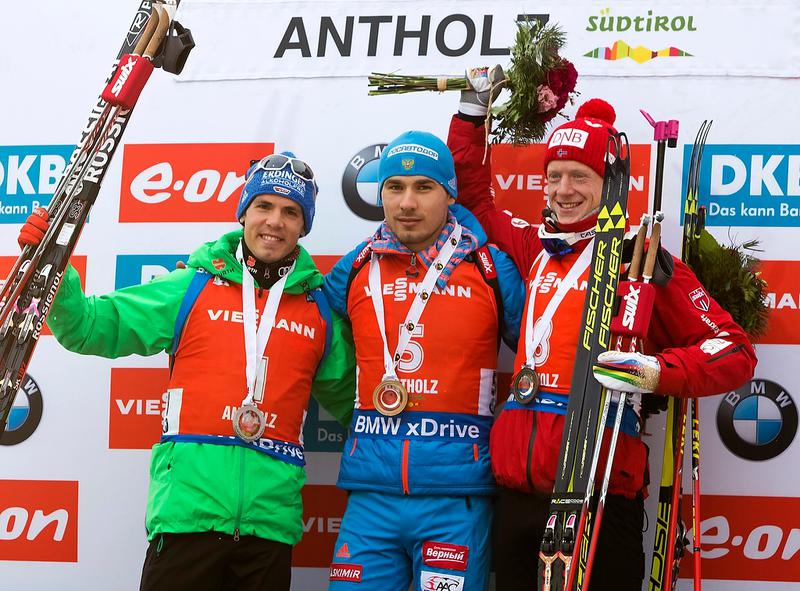
    Anton Shipulin of Russia (center) won his first World Cup of the season in Antholz, with Simon Schempp of Germany (left) second and Johannes Bø of Norway third. (Photo: IBU/Rene Miko)
    Anton Shipulin of Russia (center) won his first World Cup of the season in Antholz, with Simon Schempp of Germany (left) second and Johannes Bø of Norway third. (Photo: IBU/Rene Miko)

    Just 90 minutes after Katja Yurlova gave Russia their second biathlon victory of the weekend, Anton Shipulin made it three with a 10.3-second win in the men’s 12.5 k pursuit.

    Shipulin had won seven times before on the World Cup, but not yet this season. His goal for the year was to win the World Cup Total Score (he was second last season) as well as a World Championship.

    “It is a long time that I have been waiting for that victory,” Shipulin said through a translator in an interview with IBU media. “I hope that this victory will add to my self-confidence. Maybe it’s good that it happened with not so much time until the World Championships in Oslo.”

    And even on the trails, it took Shipulin a lot of waiting before he moved into first place. Starting in bib five, he had a penalty in the second stage and lurked in second and third place.

    In the final stage he also missed a shot, but so did Simon Schempp of Germany, who came in with Shipulin but also shot more slowly. When Simon Eder of Austria, who was in third at the time, also missed, it came down to who was out of the penalty loop fastest.

    That was Shipulin, who left with a 6.7-lead. He extended it on the trails. Schempp not only shot slower, but couldn’t match Shipulin’s speed and was left to ski to second on his own.

    “My impression was that Anton had shot zero,” Schempp told German broadcaster ARD about the final stage. “And then somehow I lost concentration, and the [last] shot was immediately gone. I just tried to keep the second place. I knew Anton would probably be stronger on the final loop, because he didn’t want to go in front on the fourth loop and didn’t want to trade off [leading] with me. So he saved a bit of strength, also for the last shooting. But I think he deserved to win, because he has often been within the front. And if I can still reach the second place I am absolutely satisfied.”

    Shipulin is a new father; his son was born on December 15.

    “I think whatever good I do, it is for my son and my family,” he said, cracking a smile in his IBU interview.

    While Eder was stuck in the penalty loop, two of the most dangerous skiers on the circuit cleaned the stage: Johannes Thingnes Bø of Norway and Martin Fourcade of France. They headed out on course 10 seconds ahead of Eder and quickly widened the gap; Arnd Peiffer of Germany also passed him to take over fifth.

    Between Bø and Fourcade, the fight was intense.

    “After standing it was too far up to Simon [Schempp], and there was nobody behind me and Martin so I knew it was a fight for third and fourth place,” Bø said in the press conference. “He’s a very strong athlete, but I think I felt stronger than him today.”

    Fourcade had shot clean to move up all the way from 28th, fulfilling a weeks-long goal to shoot clean.

    But the effort required to move through the field took a lot out of him.

    “It was good, but we did not have the same competition,” Fourcade told Norwegian broadcaster NRK. “Johannes was eighth and I was number 28 from the start, and had to fight to catch the big gap. I think he had more energy than me at the end.”

    Bø had the second-fastest ski time of the day, and was thrilled with his speed.

    “It’s funny how things turn around,” he told NRK. “I was banging and banging before Christmas. Now I just keep getting better for each race. I had an insanely good ski weekend.”

    Tim Burke was the top American, finishing 22nd with four penalties (+2:01.7).

    “The shooting conditions were a little challenging today with shifting winds, but my penalties were definitely my fault,” he wrote in an email. “I felt solid on the range, but it was just one of those days when the close shots don’t fall. I felt strong on the course today and I had competitive skis, I just needed a few more hits. This was another one of those races for me that was solid, but not really what I was hoping for. I am still waiting for that race when everything comes together on the same day.”

    Teammates Lowell Bailey and Leif Nordgren finished 28th (+2:11.0) and 48th (+4:00.6) with three and two penalties, respectively.

    “I started a little slow and struggled to keep pace with the rest of the guys I was around on the first loop,” Bailey, who started 22nd, wrote in an email. “But then, the rest of the race improved from there, with my last loop feeling the best. It wasn’t my best day on the range, but not my worst. It just didn’t feel perfectly in sync during the shooting. Part of that is definitely the altitude. With less oxygen, the breathing cadence between shots becomes more difficult and it’s a bit more challenging to hold on the target. That being said, I can be better.”

    Sean Doherty did not start, although he was qualified for the pursuit.

    “Sean is focusing more on prepping for World Juniors, which start next week,” Burke explained. “He is healthy and we will be starting the relay tomorrow.”

    For Canada, Brendan Green finished 31st (+2:18.4) and Nathan Smith 43rd (+3:14.9).

    Things were setting up to be much better for Green, but it didn’t pan out.

    “Unfortunately with just under 1km to go while skiing in 21st place I was involved in a crash with [Austria’s Julian] Eberhard coming out of the S-turn downhill in the meadow,” he wrote in an email. “He took and aggressive line with myself right beside him, crashed, and I got caught up and crashed into him. When the snow settled I was laying on my back looking up the hill just in time to see a pack of 10 guys whiz by me on either side. It was frustrating and unnecessary, but that sort of thing just happens once in a while and you have to roll with it. His stock snapped into two pieces and I got away with only a broken butt hook which was lucky. Crashing caused me to miss out on some valuable points, but I’ll chase those points back later in the season.”

    Despite the disappointment, Green was actually very happy with his race.

    “Today’s race was going really well, certainly one of my better of the season,” he explained. “The range here in Antholz I find can be tricky, so to finish today with only 1 penalty was really good… I think in general I’m starting to find my stride this season which is a relief. My racing is starting to feel stronger and I hope I can continue with consistent and strong form throughout the rest of the season.”

    Results

  • Perfect on the Range, Ransom Makes Her Top-20 Breakthrough in Antholz Pursuit

    Perfect on the Range, Ransom Makes Her Top-20 Breakthrough in Antholz Pursuit

    Julia Ransom (in black and red suit) helping the Canadian team to ninth place in the women's relay in Ruhpolding, Germany, last week. (Photo: Biathlon Canada/Matthias Ahrens)
    Julia Ransom (in black and red suit) helping the Canadian team to ninth place in the women’s relay in Ruhpolding, Germany, last week. (Photo: Biathlon Canada/Matthias Ahrens)

    A lot of people on the Canadian biathlon team thought that Julia Ransom was going to have a breakthrough this year.

    But few, including the 22-year-old herself, seemed to have thought that it would be this big, or happen this fast.

    After shooting a perfect 20-for-20 in the 10 k pursuit in Antholz, Italy, Ransom was one of the biggest movers on the day, skiing from 46th up to 19th. She crossed the line 1:30.8 behind race winner Katja Yurlova of Russia.

    “Top 20 is just… that was a pretty big stretch goal for me this year,” she said in an interview after her race. “Going into the season I wanted to get points, wanted to get my first-ever World Cup point [from being in the top 40], and then it happened. And then I thought last week ‘yeah, top 20 would be sweet. We should open some champagne for the top 20. That’s a champagne race.’ So then it happened. Woah that’s crazy.”

    Those World Cup points came early in the year, in the sprints and pursuits in Östersund, Sweden, and then in the sprint in Pokljuka, Slovenia, all before the Christmas break.

    Until Saturday, Ransom hadn’t broken into the top 30, much less the top 20.

    It’s her first full year on the World Cup circuit. World Cup and World Championships starts in 2014-2015 gave her experience, which she’s happy to draw on now.

    Ransom at 2015 World Championships in Kontiolahti, Finland. (Photo: Biathlon Canada/NordicFocus)
    Ransom at 2015 World Championships in Kontiolahti, Finland. (Photo: Biathlon Canada/NordicFocus)

    “I like to just be out there and have fun, and that’s no different than last year,” she said. “But it’s definitely nice to be skiing a little quicker. Making pursuits is also quite nice. So in that sense, yeah, that’s different, but I guess mentality towards racing is the same. Trying to do my best, but also enjoying the mountains, the spectators, and the energy and all of that in all the venues.”

    So what, besides knowing what to expect, allowed Ransom to jump into the top 20?

    In the past few days, she had gotten some good advice from teammates and coaches.

    “In the Ruhpolding relay when it took me three spares to hit one target, I felt kind of shaken up,” Ransom said. “After the sprint when I was cooling down with Rosanna [Crawford], I was just like, ‘what do you do, how do you do it?’ And she kind of helped me out with a few things. She has definitely provided a lot of mentoring.”

    Crawford wasn’t happy with her own race in the Antholz pursuit, where she missed six shots and finished 44th.

    But she was thrilled to see Ransom succeed.

    “It’s been really exciting to watch Julia, she is such a strong athlete and has really impressed me with her ski speed,” Crawford wrote in an email. “I knew that she was capable of a result like this, she just needed the shooting and skiing to come together at the same time and that was today! We had a chat about what I find works for me when I am shooting well and talked about what might help her in the range.”

    The second key to success, apparently, came from a simple suggestion from National Team Coach Roddy Ward.

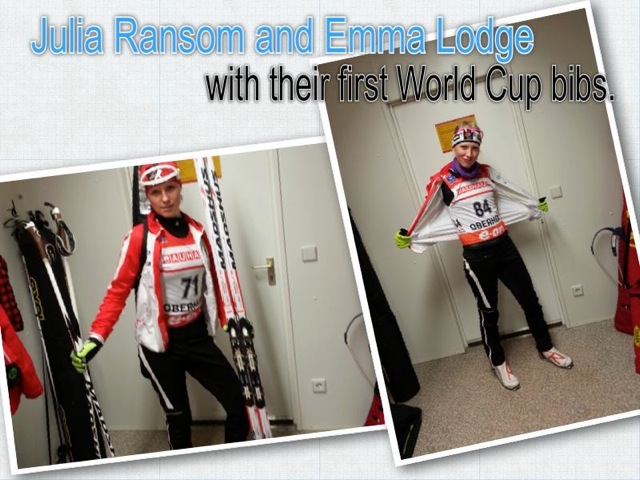
    She's come a long way:  Ransom and teammate Emma Lodge with their first World Cup bibs back in January 2014. (Photo: Roddy Ward/Eat Sleep Train)
    She’s come a long way: Ransom and teammate Emma Lodge with their first World Cup bibs back in January 2014. (Photo: Roddy Ward/Eat Sleep Train)

    “Julia is a big time coffee fan,” Ward explained in an email. “After a sub-par practice yesterday (not focused enough) I found out she only had one cup of coffee that morning. In our pre-race meeting last night I advised she drink two today, as she did before the Sprint [where she shot 9 out of 10). I think we found the sweet spot for pre-race coffee intake.”

    Ransom confirmed: it was a welcome suggestion.

    With that renewed focus, she was one of only two athletes in the field to shoot a perfect race.

    “It was a little windy, for sure,” Ransom said of conditions on the range. “I made wind corrections in both of my prone bouts. And I mean, I remember Antholz last year was crazy windy. So to just have a few clicks here and there was pretty good. I think a lot of the time the altitude can affect a lot of people because you don’t quite recover as well as soon as you come into the range.”

    It was touch and go: the last shot was a split bullet, meaning that it hit the edge of the target with part of the bullet hitting the target and part the frame around it. But despite that, the target turned white and Ransom could head off to the trails without ever seeing the penalty loop.

    “Cleaning 20/20 takes a great deal of focus and concentration,” Ward wrote. “She has been working on this a lot and its cool to see it pay off for her. I cheered quite loudly after her final shot was a hit… [a split] can go either way but you just need the target to go down! Doesn’t need to hit the middle…”

    With Saturday’s result, the best 10 World Cup results of Ransom’s career have all come this season. She credits her teammates for a lot of the improvements.

    “This year has been going really well, and I think a lot of it has to do training with some of the best guys in the world on this team,” she explained. “With Rosanna of course, and Nathan, and we’ve got a great group of girls, and we are all gelling, and trying to push each other and to create a good atmosphere. So I think that and the summer has really paid off this year.”

    But Ward, who is Ransom’s main coach, said that she should be giving herself some credit too.

    “Julia has worked very hard all training year,” Ward wrote. “I started to feel around August that it was paying off. She made a big jump this fall. I am still surprised by this result. This was beyond any of my expectations. She is a great athlete to coach, she is so driven and has a fantastic worth ethic. She also has a very good head on her shoulders… She has been quite consistent this season, which is impressive for a young athlete.”

    Crawford agreed, saying that Ransom brings more than speed and straight shooting to the team.

    “It’s been great having someone like Julia on the team,” she wrote. “She always looks at the positive side of things, which I have a hard time doing, and it’s been rubbing off on me.”

    Up next for Ransom and her teammates is the 4 x 6 k relay on Sunday. In Ruhpolding they finished ninth and were close to the top six, and they hope to improve on that result.

    “I absolutely love relays,” Ransom said. “It’s a time for all the girls to get together, kind of get fired up about everyone’s performances. It takes the selfishness out of racing a little bit, which I like. I like the team aspect. And we were so close to top six last relay, that I think it’s definitely doable. Definitely doable.”

    “I think this will give our team a boost going into tomorrow’s relay,” Crawford added. “When someone has a [personal best] it really brings an exciting vibe to the team!”

    And after that it’s home to Canmore for World Cups on the team’s home turf.

    Ransom said she doesn’t have any specific results goals to thrill the Canadian crowd with, but she hopes she can get the community pumped up.

    “Oh man, I am so excited to go back home,” she said. “I obviously want to perform at my best, and make the home-crowd excited to cheer for all the Canadians. Of course everyone is doing really well this year. And it’s just exciting to be home, and in your bed, with your friends, and get to see my boyfriend and my family. So that’s really exciting.”

    And about that champagne to celebrate the top 20?

    “We will find out,” Ransom laughed.

    Results

  • First Regular-Season Win For Yurlova, While Gasparin Gets Her Post-Baby Podium

    First Regular-Season Win For Yurlova, While Gasparin Gets Her Post-Baby Podium

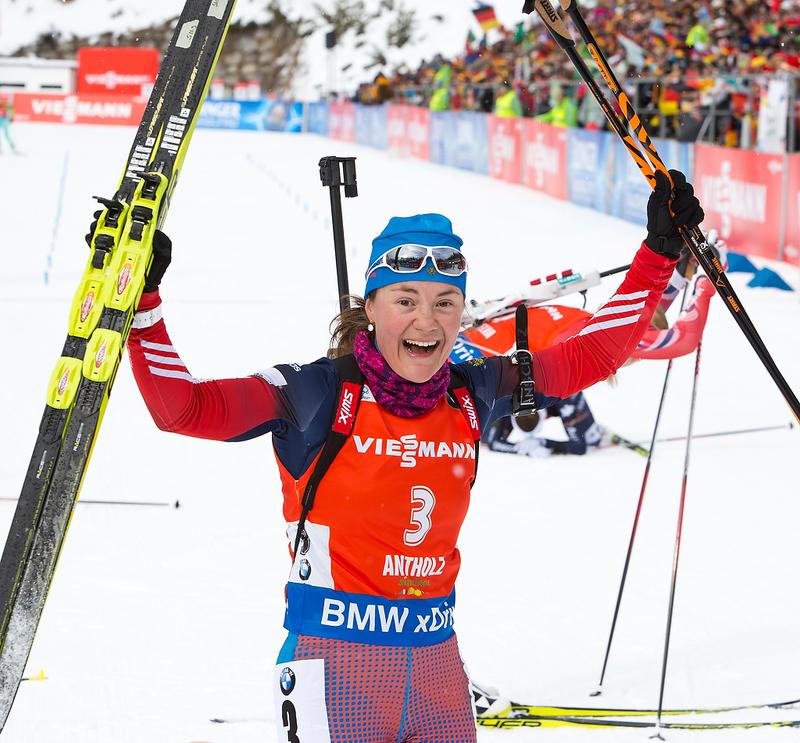
    Katja Yurlova of Russia, a 2015 World Champion, got her first World Cup win on Saturday with clutch shooting in the Antholz 10 k pursuit. (Photo: IBU/Rene Miko)
    Katja Yurlova of Russia, a 2015 World Champion, got her first World Cup win on Saturday with clutch shooting in the Antholz 10 k pursuit. (Photo: IBU/Rene Miko)

    On Thursday, Russia’s Olga Podchufarova picked up her first World Cup win in the 7.5 k sprint in Antholz, Italy.

    On Saturday she led into the final stage of the 10 k pursuit, but fell apart on the range, missing three shots in the final bout.

    There to pick up the pieces was teammate Ekaterina Yurlova, who shot a near-perfect race. She started third after joining Podchufarova on the sprint podium, then missed one shot in the first stage. But after that she hit target after target, picking up places along the way until she left the range the last time in first place.

    “The last shooting was so unbelievable for me,” Yurlova told IBU news. “There was a strong wind, but my amunitions were just flying into the target! When I shot clean, I saw that Doro [Wierer] and Olga [Podchufarova] were in the penalty loop, I told myself that this was my chance…. so I just took all my power and did it.”

    Yurlova thrilled at the finish. (Photo: IBU/Rene Miko)
    Yurlova thrilled at the finish. (Photo: IBU/Rene Miko)

    There could be more surprising athletes to see atop the podium; Yurlova was the World Champion in the 15 k individual in 2015.

    But this was actually her first regular-season victory, something that had eluded her so far.

    “I didn’t think I would be again on the podium,” Yurlova said in the post-race press conference. “I didn’t prepare for the podium. I was thinking just that I need to do my job good, good skiing, good shooting, that’s enough.”

    Joining her was another woman who didn’t expect to be there – yet whose name didn’t cause surprise, either. Selina Gasparin of Switzerland is a World Cup winner who also won her country’s first Olympic biathlon medal, in Sochi in 2014.

    But while Yurlova was winning World Championships last season, Gasparin was sitting out. She took a year off to have her first child.

    After returning this season she had been yet to hit the podium, and after finishing 16th in the sprint it didn’t seem likely in the pursuit either. Yet Gasparin had only a single penalty, like Yurlova’s coming in the first stage, and skied the second-fastest course time of the day, moving up to second place by passing Wierer in the final few hundred meters.

    “This has been a mega-beautiful race,” Gasparin told Swiss broadcaster SRF. “In the beginning I shot a miss and thought ‘oh no, not again.’ In a pursuit I am usually behind. And I was pretty annoyed by the miss, because I lost contact [to the top]… And then in standing I though to myself ‘no matter how long I stand here, I just have to hit.’ And yeah, I didn’t really know where I was with regards to split times. Thank God I didn’t know during the last shooting that it could be enough for the podium when they shot misses.”

    Selina Gasparin of Switzerland was thrilled to be back on the podium. (Photo: IBU/Rene Miko)
    Selina Gasparin of Switzerland was thrilled to be back on the podium. (Photo: IBU/Rene Miko)

    She finished twelve seconds behind Yurlova and six ahead of Wierer, who had led early in the race before accumulating two penalties in the third stage and one in the fourth.

    “I started good but two mistakes was too much,” Wierer said in the press conference. “In the last standing, I tried to shot fast and zero and it did not work.”

    For Gasparin, shooting well under pressure and edging Wierer at the finish was a particularly meaningful way to get her first post-baby podium.

    “This second place is as valuable as my victories in sprint [in Annecy, France, and Hochfilzen, Austria, during the 2013-14 season],” Gasparin told Swiss media. “In the pursuit you have to get the result in a fight woman versus woman. There it’s important to keep your nerves in check.”

    Tiril Eckhoff of Norway placed fourth (+48.0) and Krystyna Guzik of Poland fifth (+51.9) after starting 20th and 26th, respectively. Skiing fast, they moved up despite three misses by Eckhoff and two by Guzik.

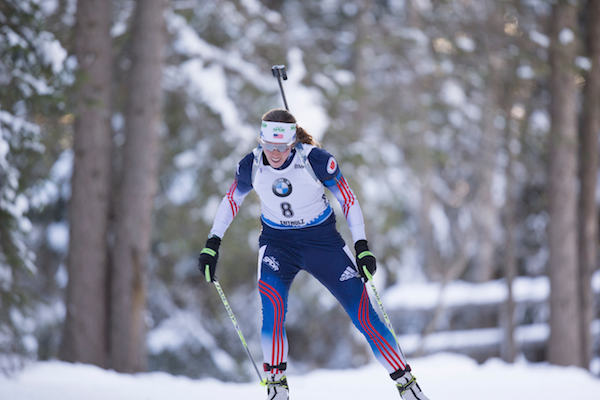
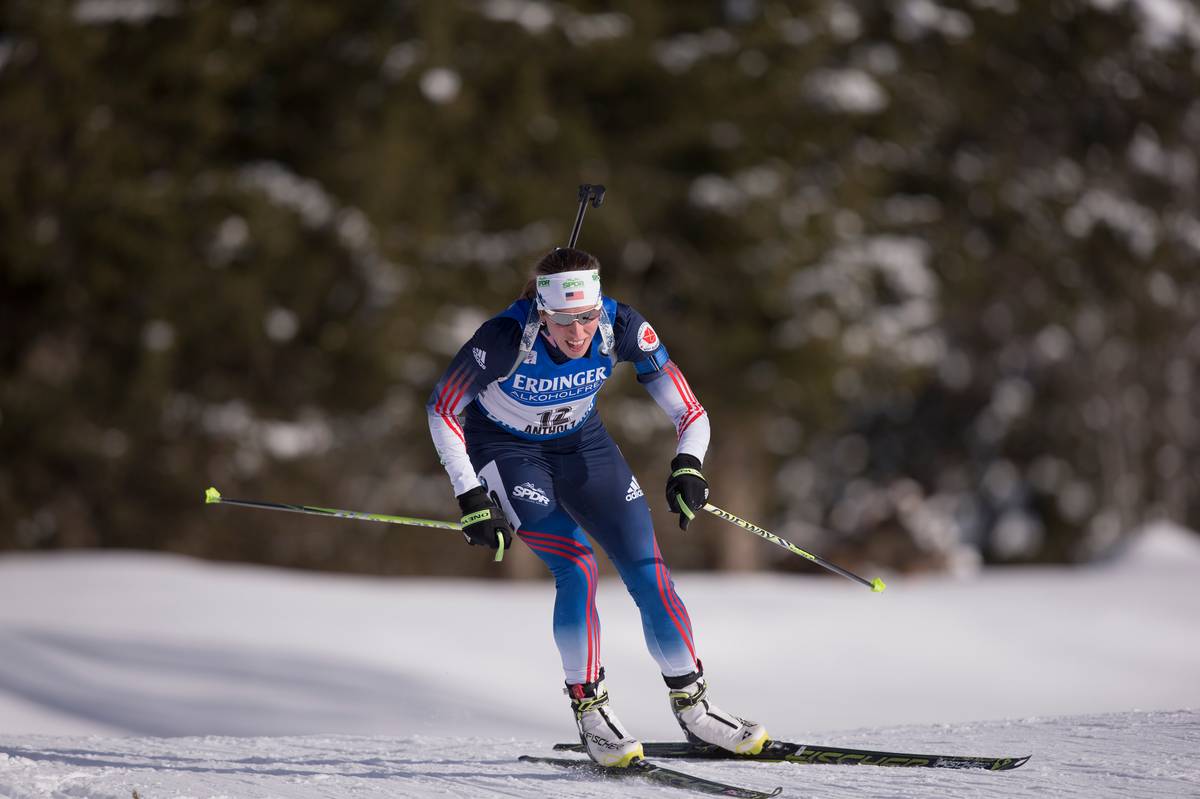
    Susan Dunklee, the lone American in the pursuit, finished 17th, also moving up considerably after earning bib 37 in the sprint. She had the fourth-fastest ski time in the field.

    “The race felt great!” Dunklee wrote in an email. “I had little expectation or pressure going into it. I wasn’t starting very high up and didn’t expect my skiing to bounce back so quickly. It felt so flat in the sprint and I’m not entirely sure why. Today felt more like the Antholz form I remember from the past. Having this strong performance will definitely boost my confidence going into the break.”

    Dunklee missed two shots in the first stage, as well as one in the third. After the first stage she had dropped even lower than her bib number despite initially making up ground on skis.

    “There were some big gusts on the range including one during my first prone that sent my first two shots wide,” she wrote. “The wind also dumped big clumps of snow on course from the trees. Today it was important to keep your sight covers closed between shootings.”

    After cleaning her last stage, Dunklee left the range in 25th. But she wasn’t done yet. She skied the third-fastest closing loop – less than two seconds slower than Gasparin. She used her spot next to 2015 World Cup Total Score winner Kaisa Makarainen of Finland to her advantage.

    “The highlight of the race was my last loop,” Dunklee wrote. “I left the range right behind a giant pack and patiently picked them off one by one following behind Kaisa. Then I remembered Kaisa’s been sick and not at the top of her form, so I passed her too. I really like the way the 2 km flows towards the end with its hard climbing attacks and recovery; it suits my strengths well.”

    The second period of World Cup racing will conclude on Sunday with relays for both men and women.

    Stay tuned for a report on the Canadian results.

    Results

  • Schempp Masters Antholz Again; Burke 17th Despite Ski Selection Woes

    Schempp Masters Antholz Again; Burke 17th Despite Ski Selection Woes

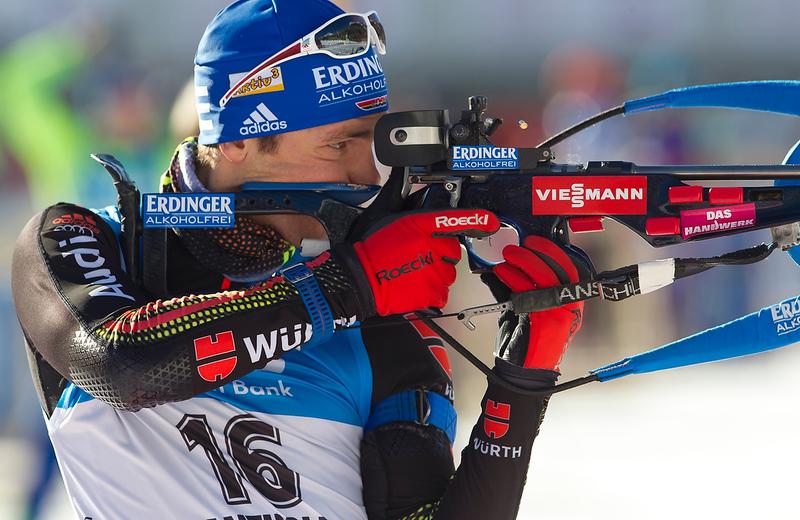
    Simon Schempp of Germany shooting his way to a sprint win in Antholz, Italy, in Friday's 10 k competition. (Photo: IBU/Rene Miko)
    Simon Schempp of Germany shooting his way to a sprint win in Antholz, Italy, in Friday’s 10 k competition. (Photo: IBU/Rene Miko)

    It’s easy to get excited when you’re returning to a place that’s been good to you.

    Just ask Simon Schempp, who won his first two biathlon World Cups in Antholz, Italy, in 2014. Then he won two more in 2015, again the sprint and the pursuit.

    In Antholz on Friday, the German went for the sprint hat trick, shooting a perfect score and besting Russia’s Maxim Tsvetkov by 5.8 seconds over the 10 kilometer race.

    “What more could you want?” Schempp asked in an interview with Germany’s ARD broadcaster. “With such an audience- there are a number of people here who I know, including my parents. Bluebird sky, no wind on the shooting range, absolutely fair conditions on the course from the first to the last starter, that’s as good as it gets.”

    A relatively early starter, with bib 16, Schempp endured some scares. In bib 28, Tarjei Bø of Norway left the range clean and with a 12.5 second deficit to make up. He began to close it, but ultimately couldn’t.

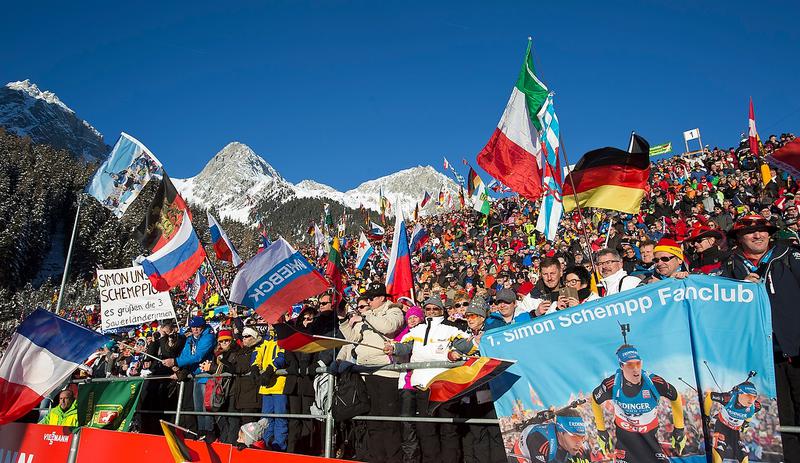
    Simon Schempp fans out in force in sunny Antholz. (Photo: IBU/Rene Miko)
    Simon Schempp fans out in force in sunny Antholz. (Photo: IBU/Rene Miko)

    Tsvetkov left the range with an even smaller gap – just 1.6 seconds behind Schempp in the timing. But he couldn’t cover the ground as quickly and ended up second, bumping Bø to third.

    “The level is so big, in every sprint you have to work perfect to get the victory,” Schempp told the IBU.

    24-year-old Tsvetkov, a two-time World Youth and two-time World Junior Champion, earned his first individual podium.

    “It is really hard to describe the feelings, but in one word: happy,” he said in the post-race press conference. “Actually I felt very good on the first loop and was pretty calm on the shooting range, so it was pretty easy to shoot clean today.”

    Tsvetkov made his first flower ceremony the week before in Ruhpolding, Germany, where he finished fifth in the 20 k individual. That earned him a spot on the Russian relay team, a big honor on the competitive Russian team.

    But in the relay he used three spare rounds, half of the team’s total, and under his watch the team dropped from third to fourth. Even though they eventually claimed second place, Tsvetkov was criticized in the media and his performance was used to argue that young racers shouldn’t be put on relay teams.

    Second place might prove some doubters wrong, and Tsvetkov credits a certain German with turning things around for him.

    Tim Burke en route to 17th place; he had a single penalty and was happy with his performance, but was slowed by picking the wrong skis. (Photo: USBA/NordicFocus)
    Tim Burke en route to 17th place; he had a single penalty and was happy with his performance, but was slowed by picking the wrong skis. (Photo: USBA/NordicFocus)

    “After Ricco Gross came to the team, there was a different approach to training,” Tsvetkov said in an interview with Sport-Express. “The first half of the season Ricco constantly supported me, soothed me, said that there is no reason to worry, you just need to safely train and prepare for performances. And race like in training. When in Hochfilzen, I showed good results in the pursuit, then it somehow just became fundamentally easier. Still, it’s a big deal when the coach supports you like that.”

    After Bø, Jean Guillaume Beatrix of France finished fourth, +12.1, also with clean shooting. Anton Shipulin of Russia made it into the top five despite a penalty, finishing +13.6 with the fourth-fastest ski time of the day.

    So the big question for the field is whether Schempp can also win his third Antholz pursuit on Saturday. Tsvetkov and others hope they can stop the streak.

    “I just looked at the gaps, and it’s all very close together,” Schempp told ARD. “The spectators can look forward to a really exciting competition.”

    Tim Burke of the United States finished 17th with a single penalty and will start the 12.5 k pursuit on Saturday 49.6 seconds behind Schempp.

    “I am really happy with my performance today, even though the result was not what I was hoping for,” Burke wrote in an email. “I feel like I had a good race plan and besides the one penalty, I was able to carry it through. This was one of my best performances in a sprint race, although the result does not reflect that. Unfortunately I made a poor choice during my ski test today and I feel like this cost me a lot. With the field so close right now, everything has to be perfect.”

    Last week Burke had said that Antholz was one of his favorite venues and he was looking forward to good results. After a large volume of racing for the whole field in Ruhpolding, he’s recharged and ready for the pursuit once he sorts out his ski choice.

    “I came out of the Ruhpolding races feeling pretty good,” Burke wrote. “Since I did not get into the Mass Start races there, I was able to recover and get in some good training. I feel like that should benefit me here, now I just need to take advantage of it! I am not starting too far back for the pursuit, so I think this will be a great opportunity for a good result with a solid performance.”

    All four American men qualified for the pursuit, with Lowell Bailey finishing 32nd (two penalties, +1:15.4), Leif Nordgren 43rd (one penalty, +1:30.2), and Sean Doherty 49th (one penalty, +1:40.5).

    The top Canadian was Brendan Green, who finished 45th (+1:32.2) with two penalties. He will be joined in the pursuit by teammate Nathan Smith, who had three penalties and finished 58th (+1:50.5) to snag one of the last spots.

    Macx Davies finished 69th (two penalties, +2:15.1), Christian Gow 86th (one penalty, +2:35.5), and Scott Gow 94th (four penalties, +3:05.1).

    Results

  • Podchufarova Cleans Antholz Sprint for First-Career Win; Two Russians on the Podium

    Podchufarova Cleans Antholz Sprint for First-Career Win; Two Russians on the Podium

    Russian Olga Podchufarova shoots 10 out of 10 in Thursday's 7.5-kilometer sprint in Antholz, Italy. (Photo: IBU/Rene Miko)
    Russian Olga Podchufarova hit 10 out of 10 targets in Thursday’s 7.5-kilometer sprint in Antholz, Italy, to take her first World Cup win. (Photo: IBU/Rene Miko)

    Olga Podchufarova stood atop the International Biathlon Union (IBU) World Cup podium on Thursday in Antholz, Italy, for the first time in her career. The 23-year-old Russian biathlete shot clean in the 7.5-kilometer sprint to claim her first-ever win in 21:01.9, saying that it was something that she has been looking for all season.

    “I understood [this year] that I became stronger, not only physically, but mentally,” she said in an English interview with Eurosport. “And I understood that I was ready for better results than previous year.”

    The 17th starter, she established a pace and finishing time no one else could match. Overall, her course time ranked ninth, and she was one of five women in the top 20 (and two in the top three) to shoot clean. For Podchufarova, it was her second-career IBU World Cup podium; earlier this season she placed third in the mass start in Pokljuka, Slovenia.

    After starting immediately behind her in bib 18, Italy’s Dorothea Wierer took second in front of an enthusiastic crowd, finishing 8 seconds off Podchufarova’s time with one miss in standing. She was happy with her performance, saying that racing in Italy is stressful due to increased press coverage and pressure.

    “Of course it hurts when you make one [penalty] … I was good on skis today…,” Wierer said in a post-race interview, implying that she knew that that one penalty was what kept her from the top spot on the podium. “I was also happy that I missed only one because I was shaking so much in standing. I am happy with this,” she concluded with a laugh.

    The third spot on the podium went to another Russian, Ekaterina Yurlova (+22.1), who started 40th and shot clean to land in the top three. She bumped France’s Anais Bescond, in bib 23, to fourth (+24.7), after Bescond had a single prone penalty. When a Eurosport announcer asked Bescond if she was the “queen of fourth place” after her third fourth-place finish this year, she laughingly agreed, noting that fourth is “better than fifth, or 30th, or 60th.”

    Canada’s Rosanna Crawford was the top North American in 33rd (+1:24.6) after cleaning prone but missing one in standing. American Susan Dunklee was not far behind in 37th (+1:30.1) with one miss in each stage. Neither of the two women were very pleased with their results:

    “Even though I train and live at altitude, I don’t seem to be able to race at it very well!” Crawford wrote in an email, referring to Antholz’ relatively high elevation of 1600 meters (5200 feet). “I’ve always had a hard time with ski speed here and today was no exception. My first two laps were ok, but I lost a lot of time on my final 2.5km loop.”

    Russian Olga Podchufarova celebrates her win in Thursday's 7.5-kilometer sprint in Antholz, Italy. (Photo: IBU/Rene Miko)
    Russian Olga Podchufarova celebrates her win in Thursday’s IBU World Cup 7.5-kilometer sprint in Antholz, Italy. (Photo: IBU/Rene Miko)

    “I love racing here,” Dunklee wrote in an email. “It’s a place where I have often done well.  I usually start to come alive towards the end of the trimester when everyone else is starting to struggle, but today I was the one struggling.  My skiing felt extremely flat and I couldn’t hold my normal pace.”

    “It was a nice sunny Italian day,” Crawford added. “No wind and fair conditions. It’s a hard course here with not a lot of rest, you always have to be working.

    “Shooting has been solid this year and I was confident going into the race,” she continued. “I took a couple extra breaths before my first prone shot but still was able to hit them relatively quickly. Girls really slow down it seems here, because of the altitude, but I practiced the range entry quite a few times in the two days leading into the race and was confident I could keep my normal range rhythm. My standing miss was disappointing, I just hadn’t quite moved onto the target when I pulled the trigger.”

    “Antholz brought out its best today: sunshine, hard packed conditions, and an animated crowd of spectators,” Dunklee concluded. “I’m going to put this one behind me and enjoy the challenge of pack racing in the pursuit.”

    The top-60 finishers in Thursday’s sprint qualify for the pursuit on Saturday. Crawford and Dunklee will be joined in that race by Canadian Julia Ransom, who finished in 46th (+1:47.2) on Thursday, who shot 9-for-10 with one standing penalty.

    Also in Thursday’s sprint, Canadian Zina Kocher finished 66th (+2:29.0) with three penalties (2+1), American Clare Egan was 67th (+2:31.8) after a clean prone but three standing penalties, Canadian Megan Tandy in 72nd (+2:49.1) with three misses as well (1+2). Also for the U.S., Joanne Reid, in her second World Cup weekend, placed 74th (+2:51.1) with three standing misses (0+3) and Annelies Cook in 75th (+2:51.4) shot 70 percent as well (2+1).

    Results | Pursuit start list

  • Germany Takes Win in Wind-Dominated Antholz Team Relay, Canada 10th, US 12th

    Germany Takes Win in Wind-Dominated Antholz Team Relay, Canada 10th, US 12th

    Germany celebrates their victory in Sunday's 4x6-kilometer relay. (Photo: IBU/Christian Manzoni)
    Germany celebrates their victory in Sunday’s 4×6-kilometer relay. (Photo: IBU/Christian Manzoni)

    It would have been oddly quiet on the firing range, given that there were ten women lined up and ready to fire, if it had not been for the howling of the wind.

    The dominant theme of the final day of World Cup competition in Antholz, Italy, Sunday was wind. Wind, and lots of it. Three weeks of back-to-back World Cup racing concluded this weekend, capped off with the 4 x 6 k women’s relay. While the men’s competition was plagued by a cold wind, the women’s competition was defined by it, as the wind whipped down the valley during the second leg.

    The Czech Republic, which eventually finished second, was the only team in the entire field to escape without a penalty loop; Russia, placing fourth, was the only team with less than 10 spare rounds. Far more common was a tally of two or three penalty loops and 13-16 spares.

    At the first handoff, the Czech Republic had the lead, the United States was in second after Susan Dunklee’s phenomenal first leg, and Poland was in third.

    “I had some wind in standing,” Dunklee wrote in an email, “but luckily most of the people around me struggled too.”

    Shooters struggle to fire in the howling wind. (Photo: IBU/Christian Manzoni)
    Shooters struggle to fire in the howling wind. (Photo: IBU/Christian Manzoni)

    On the second leg, however, the wind picked up.

    During the second shooting stage, ten teams were standing on the mats, and the leader still hadn’t finished firing as all the women waited for the wind to die down. Snow swirled and flags whipped, but no bullets were fired. Gabriela Soukalova, of the Czech Republic, was the first into and out of the range, and her range time was 2:14. In contrast, her time on the previous round – before the wind picked up – was exactly one minute, including loading and shooting a spare round.

    After Soukalova finally shot her third spare bullet and knocked over the final target the incentive to speed up firing returned. U.S. biathlete Hannah Dreissigacker, who had been in second place at the start of the standing leg, skied away with three targets left up. By the end of the leg, the U.S. had slipped to 12th.

    By the exchange, Czech still had the lead, followed closely by Russia, then Ukraine, then Germany, then Italy.

    The third leg was a grab bag of leads and exchanges, as one skier took the lead in prone only to lose it in standing. Tears streamed down the competitors’ cheeks as the wind and snow battered their eyes.

    By the end of the third leg, Ekaterina Shumilova of Russia was in first, but barely. Germany’s Luise Kummer and Ukraine’s Olga Abramova were not far behind. And the bottlenecks at the last shooting had compressed the top ten teams to within 1:15, whereas they had been spread out over 2:34 after the prone stage – the wind had actually calmed as later competitors came onto the range, whereas the leaders had taken longer to shoot. At the tag, it was Russia, Germany and then Ukraine.

    But nobody counted on Germany’s Laura Dahlmeier.

    Germany's Luise Kummer. (Photo: IBU/Christian Manzoni)
    Germany’s Luise Kummer. (Photo: IBU/Christian Manzoni)

    Dahlmeier, Germany’s anchor leg, ignored the swirling gusts of wind and coolly shot the five targets, leaving the standing leg 23 seconds ahead of Russia’s Ekaterina Glazyrina. After Dahlmeier cleaned standing, it was clear that she would ski away with the win.

    Veronika Vitkova of the Czech Republic skied out in second, with Valj Semerenko and Glazyrina leaving the range at nearly the same moment, leaving the final 2 k ski as the battleground for the final spot on the podium. It was a battle won by Vikova.

    The North Americans

    “I had a great ‘open body’ feeling today on skis and during the last lap went into chase mode with little regard for pacing,” American Susan Dunklee wrote in an email. “It felt great to reel people in.”

    Dunklee indeed had a strong final, passing four skiers and posting the fastest lap time for that leg. She tagged Hannah Dreissigacker into second place.

    “The wind was unpredictable and hurricane-like at times, and then perfectly still,” Dunlee wrote in an email. “So shooting was a lottery Hannah and [anchor leg Clare Egan] had some bad luck with the timing of the strongest gusts.”

    It was Egan’s first appearance on the World Cup – a difficult debut.

    “Clare faced some incredibly difficult conditions in her first World Cup, but handled them admirably,” Dunklee continued. “She has a lot of potential and I can’t wait to see what she does once she starts to feel comfortable at this level.”

    Annelies Cook skied the third leg, missing some shots but avoided the penalty loop. Cook tagged Egan to bring in the team in. Egan tried to take the day like any other.

    “My goals for the day were to do my job well, just like any other day of training,” she wrote in an email. “Of course when I set my poles down on the shooting mat for the prone stage and they almost got blown away by gusting winds, I had to slightly adjust the ‘just like any other day of training’ part of my strategy.”

    But her first time on the World Cup, and she had to modify her plans.

    “I started shooting prone the same way I always do, in a rhythmic cadence that alternates breathing and pulling the trigger, but after missing the first three shots I took a different approach, waiting with the trigger half-pulled for any tiny break in the wind. That worked for me and I hit my last two targets and then all three spares, so I avoided going in the penalty loop.

    “The wind was also a factor on the open parts of the course where snow had blown over the trail making it super slow, and there were strong headwinds. I was trying to channel Lindsey Vonn with a super strong tuck with my elbows in front of my knees at one point.”

    The Canadian women placed tenth overall. Led by Megan Heinicke, the team consisted of Julia Ransom, Rosanna Crawford and Audrey Vaillancourt. It was this group’s first time doing a relay together, and they are optimistic:

    “I think we can all be proud of our efforts today!” Ransom said, according to a press release from Biathlon Canada. “The wind was quite tricky with huge gusts coming from every direction.

    “This was the first time us four girls have been a relay team together. This is a great starting block and I believe good things are going to come from this team!”

    Results

  • Norway Takes Men’s Team Relay In Antholz; U.S. Eighth and Canada Ninth

    Norway Takes Men’s Team Relay In Antholz; U.S. Eighth and Canada Ninth

    The Norwegian men celebrate after winning the 7.5 k team relay in Antholz Sunday. (Photo: IBU/ChristianManzoni)
    The Norwegian men celebrate after winning the 7.5 k team relay in Antholz Sunday. (Photo: IBU/ChristianManzoni)

    A spell of nice weather in Antholz, Italy broke Sunday with a cold wind blowing across the team relay competition to conclude an extremely busy month of IBU World Cup action.

    As competitors overcame the packed schedule, the thin air of the South Tyrol mountains wasn’t done with them yet, as a steady breeze made shooting a toss-up. The 7.5-kilometer course was composed of three laps of skiing and two rounds of shooting for each of the four competitors.

    Norway took the men’s relay victory, with only five spare rounds used by the four men in 16 rounds of shooting. Germany was close behind, in second (+16.4), with seven spares used. France, who was missing their ringer, Martin Fourcade, took third (+42.0) also with five spares used.

    Both the United States and Canada made the top-10, with the U.S. in eighth (+3:28.9) after three misses in prone and 17 in standing. Canada finished in ninth (+3:36.1) with one miss in prone and 15 in standing.

    Germany took the lead early on, with Erik Lesser shooting clean and taking first, barely holding France’s Simon Fourcade to second place after also shooting clean. Norway’s Ole Einar Björndalen missed one shot in standing to bring Norway in in third.

    Germany Arnd Peiffer. (Photo: IBU/ChristianManzoni)
    Germany Arnd Peiffer. (Photo: IBU/ChristianManzoni)

    On the second leg France briefly pulled into the lead as Quentin Fillon Maillet out-skied and out-shot Germany’s Daniel Boehm. The lead did not last, as Norway’s Johannes Thingnes Bø had a remarkable third leg, cleaning and bringing Norway from third to first place. Germany’s Arnd Peiffer was hot on his heels, only a half-second behind after only missing one in standing. France’s Simon Destheiux struggled on the range and course during his second and third laps, and moved France back to third place.

    Meanwhile, Norway’s Emil Hegle Svendsen took the tag just moments ahead of Germany’s Simon Schempp, and opened his lead with perfect shooting, allowing Norway to take the win. France finished nearly half-a-minute back, battling with Austria’s Simon Eder, who took fourth (+49.8) with seven spare rounds used by the team. Russia took fifth (+58.5), with six spare rounds used.

    For the Americans, Lowell Bailey started and stayed ahead of Canada’s Christian Gow. However, Gow used only one spare in each shooting stage compared to Bailey’s three, putting Canada in ninth and the US in tenth. On the second leg, American Sean Doherty moved the U.S. into eighth, while a long time spent shooting by Brendan Green moved Canada to tenth. Tim Burke kept the U.S. in eighth in spite of struggling with shooting in the second round, using all of his spares in standing and prone. Canada’s Scott Gow moved Canada back to ninth on the third leg. Leif Nordgren skied the final leg for the U.S., with Nathan Smith finishing for Canada. On the first lap Smith pulled ahead of Nordgren, but Nordgren was able to pass Smith back to take eight place, eight seconds ahead of Canada.

    The teams will get a break until World Cup resumes in Nove Mesto on February 6th.

    Results

  • Dunklee Returns To Antholz Flower Ceremony: ‘There was so much excitement, it was pretty special’

    Dunklee Returns To Antholz Flower Ceremony: ‘There was so much excitement, it was pretty special’

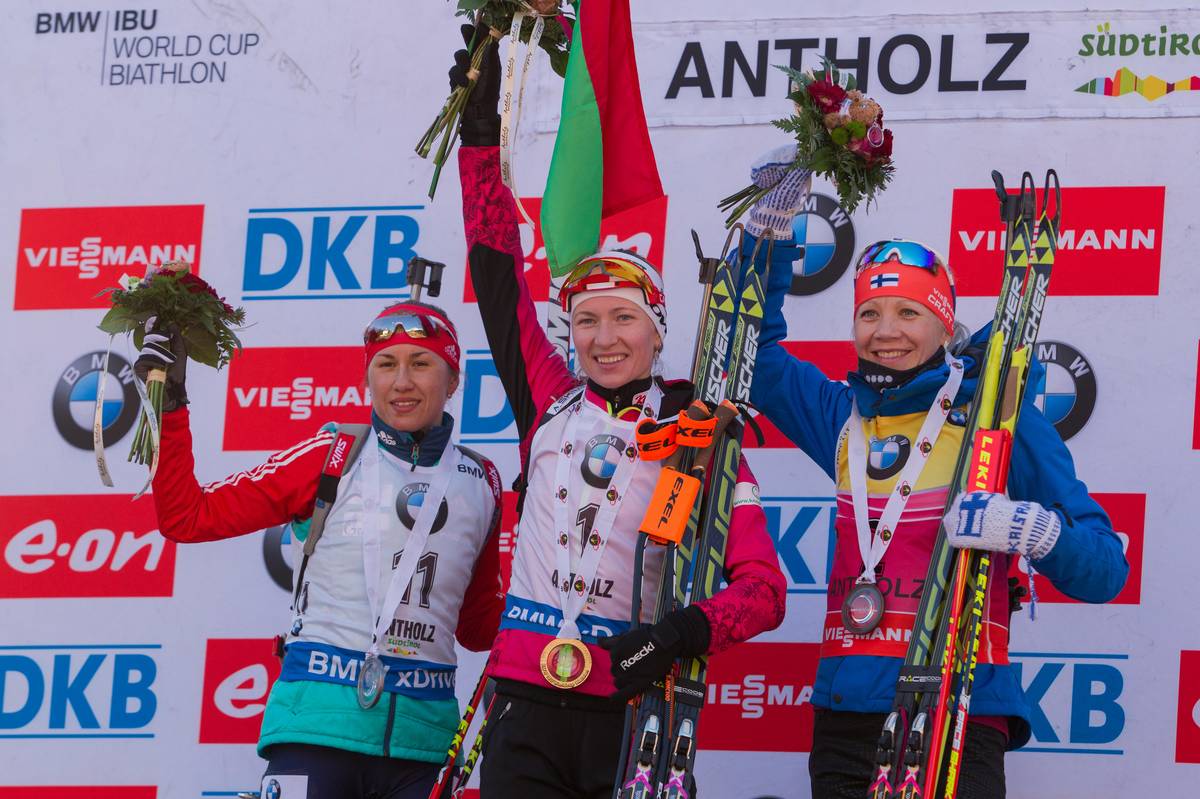
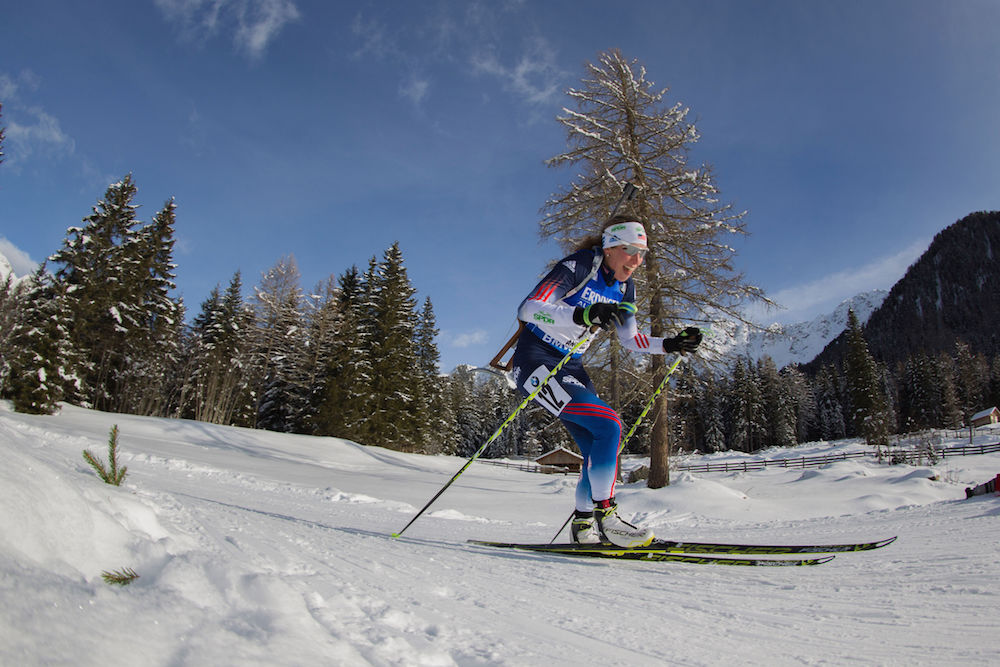
    Susan Dunklee celebrating as she crossed the finish line in Antholz, Italy, on Saturday in sixth place in the IBU World Cup pursuit. (Photo: USBA/NordicFocus)
    Susan Dunklee celebrating as she crossed the finish line in Antholz, Italy, on Saturday in sixth place in the IBU World Cup pursuit. (Photo: USBA/NordicFocus)

    Starting Saturday’s IBU World Cup pursuit in bib eight, American biathlete Susan Dunklee knew that an even better result was possible. She was racing in Antholz, Italy, a place that had “good vibes” for her: in 2012 it was where she scored her first top-20, and in 2014 she finished fourth in the sprint, getting to the flower ceremony for the first time in World Cup racing.

    She just had to focus.

    “I pretty much wanted to do what I had done yesterday, which had worked out pretty well,” Dunklee said in a phone interview on Saturday. “Focusing on the process of everything I needed to do to make a good biathlon performance, and not worry too much about what people around me were doing. Trusting that if I did all of my tasks well, it was going to turn out well. That was a lot about shooting, especially with the elevation.”

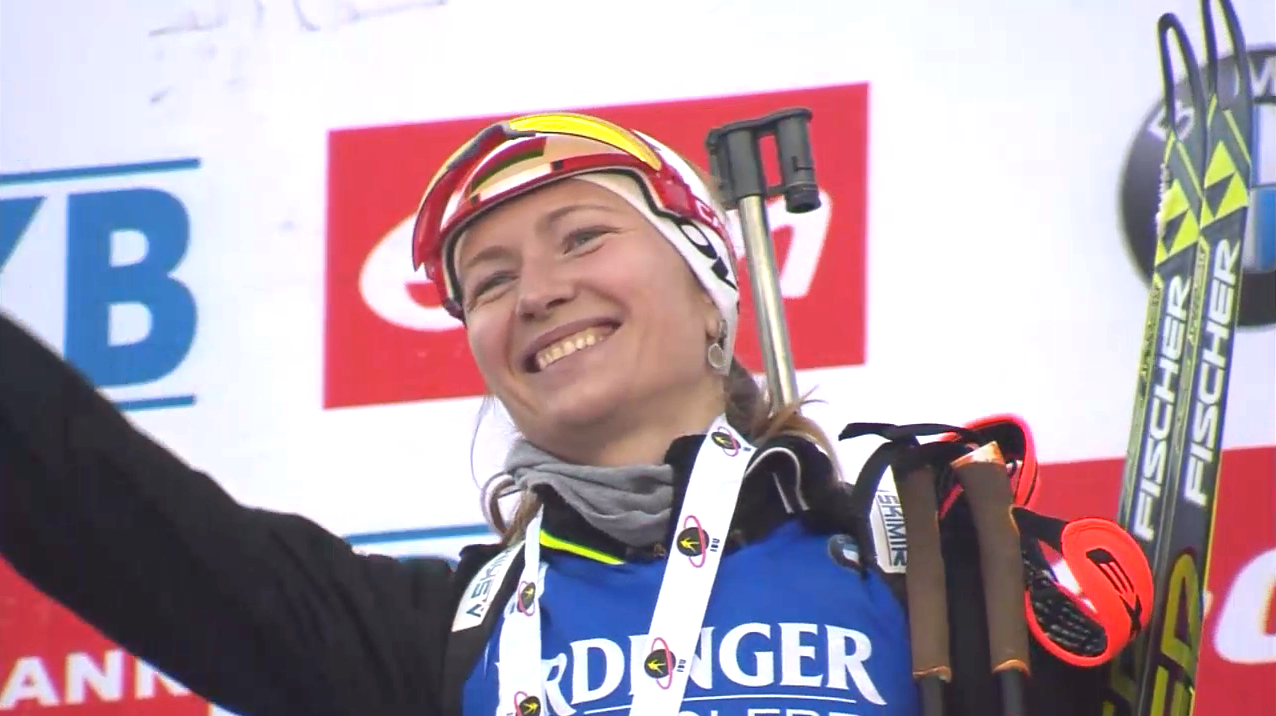
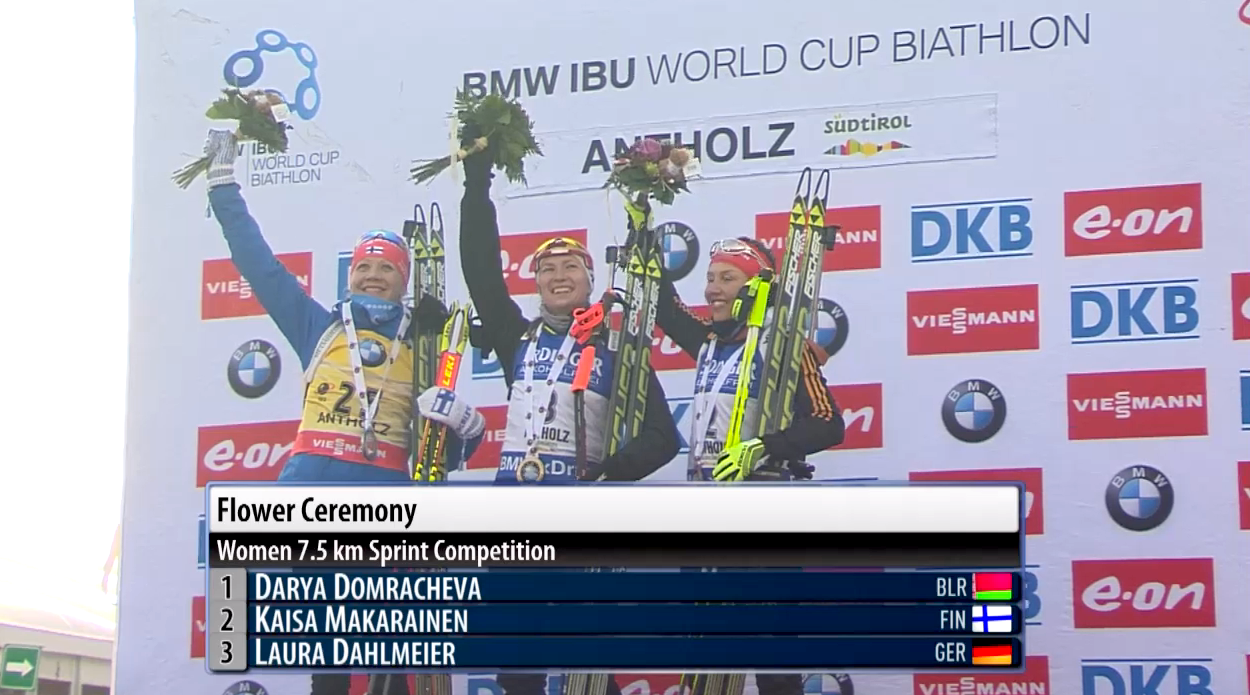
    Darya Domracheva of Belarus ran away with the race, winning by 1:21. (Photo: Fischer/NordicFocus)
    Darya Domracheva of Belarus ran away with the race, winning by 1:21. (Photo: Fischer/NordicFocus)

    Shooting carefully, she missed just a single target over for stages for her best shooting of the season “by far”. By the time she left the range after the last bout, she was in sixth place – just seconds behind Kaisa Makarainen of Finland and Marie Dorin Habert of France, who were fighting for fourth (Makarainen would go one step further, turning in an incredible last loop to catch third place; Darya Domracheva of Belarus won the race by over a minute, and Daria Virolaynen of Russia placed second).

    It was obvious to the team staff what Dunklee, one of the fastest skiers on the circuit, should do. She should go with Makarainen, who is the fastest.

    “Tactically, Bernd [Eisenbichler, the High Performance Director] told me as I was leaving the stadium to get behind Kaisa and pass Marie Dorin,” Dunklee said. “But I didn’t have it in me. It would have been really smart to do that if I could have. But I got dropped by those two. And by the time Kaisa finally dropped Marie Dorin, it was too late for me to catch her.”

    Instead, Dunklee held on for a solid sixth-place finish, and got back in the Antholz flower ceremony.

    It’s the best result by a U.S. biathlete so far this eason.

    “Pretty special,” she said of the feeling of stepping onto the ceremony stage. “It’s definitely something I don’t take for granted. And we have some USBA board members here, so that was pretty special. There was so much excitement from the staff, and from my teammates. It was a really good community feeling with support. It’s great.”

    Franziska Hildebrand of Germany (left) got passed by Kaisa Makarainen in the final meters of the 10 k competition; Marie Dorin Habert of France and Susan Dunklee of the United States couldn't quite pull it off and finished fifth and sixth. (Photo: USBA/NordicFocus)
    Franziska Hildebrand of Germany (left) got passed by Kaisa Makarainen in the final meters of the 10 k competition; Marie Dorin Habert of France and Susan Dunklee of the United States couldn’t quite pull it off and finished fifth and sixth. (Photo: USBA/NordicFocus)

    She was initially disappointed to get dropped by Makarainen and Dorin Habert, but with a little perspective realized that she had still turned in a good ski performance. Dunklee had the fifth-best course time of the day; Makarainen had the first and Dorin Habert – who, incredibly, is coming back to the circuit after giving birth to her first child in September – had the fastest and second-fastest times.

    “Later I found out they had the fastest times of the day,” Dunklee explained. “I felt bad about it for a while, but now that I know that I feel a little better about myself.”

    But the shooting might have been the most satisfying part.

    “I think my favorite was cleaning standing,” she said. “It’s so much harder to clean the last stage than it is to clean all the other stages. Especially if you’re in a good position. You start thinking, man, what will happen if I do this? Shit, it’s going to be a good opportunity. If you start asking that question or you stress out, you do something different. It only takes a tiny little different thing to throw everything off. Today I felt like I really focused on the process of what I was doing. It was a good success.

    “After I left the range I was like, okay, now where am I, and you worry about it then.”

    Dunklee at the flower ceremony. (Photo: USBA/NordicFocus)
    Dunklee at the flower ceremony. (Photo: USBA/NordicFocus)

    Teammate Hannah Dreissigacker started the pursuit in an opposite place: 60th, the last woman to make the cut. But she was excited, and turned that excitement into a big jump on the results sheet. With four penalties, Dreissigacker finished 42nd.

    “I was just psyched to be racing,” she said. “I love Antholz, there’s so much sun and great fans and it’s just great to be racing here. It’s a beautiful place. I just wanted to move up. Which is really all I could do. And to get another chance to ski with people and shoot. I was pretty happy with how things went yesterday. I felt like I had shot fast, and that’s the way I wanted to do it.”

    Dreissigacker had the 38th-fastest ski time, and wasn’t too surprised to move up despite the four penalties.

    “I had one miss on each loop, which is obviously not the best, but 80% shooting is okay for me,” she said. ”I figure if you have one, you’ll stay about the same. But when you’re in the back, you’re with people who are shooting badly and skiing slow.”

    The highlight of her day was going neck and neck with Germany’s Miriam Gössner on the final loop. Gössner, a former World Cup winner who also competed in cross country skiing in the 2010 Olympics, is just returning to the World Cup after two injury-filled seasons.

    “I was leaving the penalty loop [the last time], and I heard someone yell at me from behind me to get out of the way,” Dreissigacker said. “Okay. You’re being kind of aggressive, we’re just going through the stadium. It turned out to me Miriam, so I was like, all right. I’m just going to try to stay with her. I stayed with her that whole lap and thought, this isn’t so difficult, so I’m just going to beat her. So I went past her on the last uphill and I did. It was pretty fun.”

    For Canada, Rosanna Crawford finished 26th and Megan Heinicke 29th. The pair had one and two penalties, respectively.

    “So close to that 20/20 shooting!” Crawford posted on her Facebook page. “Missed my middle shot on my last standing bout! But super happy with 19/20 and 26th place. I’ll save that 20/20 when I feel good skiing again!! Megan had another good pursuit moving from 40th to 29th, two Canadians in top 30, not too shabby!”

    Results

    American biathlete Susan Dunklee on course in the 10 k pursuit in Antholz, Italy, where she had the fifth-fastest course time and finished sixth. (Photo: USBA/NordicFocus)
    American biathlete Susan Dunklee on course in the 10 k pursuit in Antholz, Italy, where she had the fifth-fastest course time and finished sixth. (Photo: USBA/NordicFocus)
    Darya Domracheva (Belarus, center) won the 10 k pursuit in Antholz, Italy, by a landslide over Daria Virolaynen (Russia, left) and Kaisa Makarainen (Finland, right). (Photo: Fischer/NordicFocus)
    Darya Domracheva (Belarus, center) won the 10 k pursuit in Antholz, Italy, by a landslide over Daria Virolaynen (Russia, left) and Kaisa Makarainen (Finland, right). (Photo: Fischer/NordicFocus)
  • New Favorite Schempp Stays Golden, Wins Another Sprint Finish in Antholz; Green 18th

    New Favorite Schempp Stays Golden, Wins Another Sprint Finish in Antholz; Green 18th

    Germany's Simon Schempp on the podium after his win in the men's 10 k sprint on Thursday in Antholz, Italy.
    Germany’s Simon Schempp on the podium after his win in the men’s 10 k sprint on Thursday in Antholz, Italy. On Saturday he repeated, sprinting to victory in the 12.5 k pursuit.

    Fans in Antholz, Italy, saw what is becoming a familiar scene on Saturday: German biathlete Simon Schempp winning a tight-packed group sprint to the finish and another World Cup victory. This time it was in the 12.5 k pursuit.

    With the win – his third individual victory in a row after Friday’s sprint and the previous weekend’s 15 k mass start on home turf in Ruhpolding, Germany – the 26-year-old surged into second place in the overall World Cup standings. That is a circumstance that probably few people saw coming.

    It’s not that Schempp wasn’t good before. A former World Junior Championships medalist, he won his first two World Cups in Antholz last season, then anchored Germany’s silver-medal relay team at the 2014 Olympics in Sochi, Russia. But last season was dominated from start to finish by France’s Martin Fourcade. Around him orbited a series of Norwegians to fill the podium.

    For the last two weeks, Schempp has been practically unbeatable. He finished second in the Ruhpolding sprint before winning the pursuit, and also anchored Germany’s relay team which skied to an exciting win. Then came Antholz. Schempp mastered the sprint, winning by 14.4 seconds, before dusting some of the best skiers in biathlon in a finishing sprint in the pursuit.

    Simon Eder of Austria finished just 0.1 seconds behind him after leading into the stadium; Evgeniy Garanichev of Russia was one more second behind after pulling the four-man group most of the way around the 2.5 k loop, and Ole Einar Bjørndalen, the winningest man in biathlon, either tired or just gave up in the final meters to finish fourth, 1.9 seconds behind Schempp.

    The German had made errors early, missing a shot in each of his prone stages. Chalk it up, perhaps, to nerves.

    “I was really nervous, because I was not so often in the first position before the pursuit,” he told the IBU’s Jerry Kokesh. “It’s a special competition for me.”

    That allowed a group of Garanichev, Benjamin Weger of Switzerland, and Brendan Green of Canada to lead the race. But later on, those athletes made shooting errors of their own, while Schempp cleaned his standing targets. He was never farther back than fifth, but made up a deficit of 23 seconds to get back to the front of the race.

    From there, boosted by the confidence of the last few days, he owned it. The final four men came into the last stage together, and remarkably, all of them cleaned. The final 2.5 k became a horse race and Schempp came out on top.

    “I felt great today on the skis, and I had a lot of self-confidence on the shooting range,” Schempp said. “It’s like a miracle. The last four competitions are crazy for me. I was always on the podium and now the third victory in a row. Yeah, it’s crazy.”

    Behind the leaders, two men moved up with perfect shooting: Fourcade, who had a disastrous (for him) sprint and finished 25th, and Erik Lesser of Germany, who had placed 19th in the sprint. Both gradually worked their way through the field. Fourcade pushed hard on the last lap, hoping to close a 25-second gap to the leaders or at least catch one of them if they tired; he made up ground, but ultimately relaxed by the finish when he realized it wasn’t to be. A minute and 20 seconds deficit from the sprint was just too much to make up with relatively few errors by the leaders.

    “My sprint was awful,” he told the IBU. “I don’t know what happened, I felt empty. Today I’m so satisfied about my competition. [The sprint] was my third competition out of the top 20, and I can say that I had a bit lost confidence. And confidence is something really important for sport. It was hard to be back in the competition this morning without knowing my level. That’s why today is like a victory for me – I found back my confidence.”

    Fourcade finished +31.9 and Lesser +45.6.

    After being in the thick of things early, Canada’s Brendan Green saw his perfect shooting streak come to an end in the second stage of the pursuit. Along with Weger, he dropped out of the lead pack.

    Missing two shots in each the second and third stages, Green was back in 23rd place. But he cleaned the final standing stage to turn things around and climbed back up to 18th, +1:58.2.

    His teammate Christian Gow, in just the fourth World Cup start of his career and the first pursuit, skied from 52nd up to 46th. With two penalties, he finished +4:23.4.

    Americans Lowell Bailey and Tim Burke missed five shots apiece, and finished 31st (+2:49.5) and 40th (+3:41.9).

    Results

  • Sunny Skies, Thin Air in Antholz Brings Out Season-Best Eighth for Dunklee, Win for Domracheva

    Sunny Skies, Thin Air in Antholz Brings Out Season-Best Eighth for Dunklee, Win for Domracheva

    Susan Dunklee racing to a season-best eighth in Friday's 7.5 k sprint at the IBU World Cup in Antholz, Italy. (Photo: Fischer/NordicFocus)
    Susan Dunklee (US Biathlon) racing to a season-best eighth in Friday’s 7.5 k sprint at the IBU World Cup in Antholz, Italy. (Photo: Fischer/NordicFocus)

    There’s something in the air, or a lack thereof, in Antholz, Italy. Maybe it’s the fact that the biathlon venue is nearly 2,000 meters, about 6,500 feet, above sea level. The combination of a lack of oxygen and its proximity to the sun and mountains seems to work wonders for some athletes.

    On Friday, Susan Dunklee was one of 95 women in the IBU World Cup 7.5-kilometer sprint that found her way into the top 10 in Antholz.

    The American’s eighth-place result — her season best — came a year after she placed fourth in the Antholz sprint for what was then her career best.

    “Antholz has always been a wonderful place for me and a good place to recover from a mentally tough start to the year,” Dunklee explained in an email after Friday’s race, in which she finished 1:10.3 back from Belarusian winner Darya Domracheva, who posted the fastest time in 19:57.8. “I thrive with Italian sunshine, mountains, food, and snow.”

    Susan Dunklee races to an eighth-place finish in the women's sprint at the IBU World Cup in Antholz, Italy. (Photo: USBA/NordicFocus)
    Susan Dunklee races to an eighth-place finish in the women’s sprint at the IBU World Cup in Antholz, Italy. (Photo: USBA/NordicFocus)

    Before the start, Dunklee recalled what worked for her there last year, “Skiing BIG with a stretched-out efficient V2 alternate, holding back in key places on the loop to feel okay for the range, and taking several extra breaths before shooting,” she wrote. “The high elevation here is an added stress and it helps to have a plan for how to deal with it.”

    The 12th starter on a bluebird afternoon, Dunklee cleaned her first shooting to leave the range in fourth, 6.2 seconds behind Domracheva, the race leader at the time. Dunklee went on to miss one shot in the middle of her standing stage, which she explained landed high.

    “The follow-though looked a little off,” she reflected. “Usually the field makes extra shooting mistakes here because of the elevation, so I suspected I could have a great race with one miss.”

    She was right. Dunklee headed out of the penalty loop and into her last lap still in fourth, 52 seconds behind Domracheva, who cleaned both stages. While the American held fourth position through the finish, she was later bumped four spots by Italy’s Karin Oberhofer (who placed fifth),  Finnish runner-up Kaisa Mäkäräinen, Nadezhda Skardino of Belarus (who ended up seventh), Germany’s Franziska Hildebrand (who placed sixth), respectively.

    With the 10th-fastest course time, Dunklee ranked 73rd on the range in terms of time spent there, which was all part of her plan. In order to shoot well, she had to hold back on both the race course and take her time shooting, she explained.

    In doing so, she finished 19.9 seconds off the podium and 0.7 seconds ahead of ninth, which Germany’s Franziska Preuss and Poland’s Weronika Nowakowsak-Ziemniak tied for. Dunklee will start Saturday’s 10 k pursuit with Skardino, 1:10 behind Domracheva and 1 second ahead of Preuss and Nowakowsak-Ziemniak.

    “Historically I find my stride for the season in Antholz, so I’m hopeful I can build on this like in past years,” Dunklee said of her season best. “But I know that I must continue to find the fun in each race experience if I want to sustain myself at this level.”

    Domracheva Fast-and-Flawless for First 

    Darya Domracheva (Belarus) atop the IBU World Cup podium for the 21st time in her career after winning Friday's 7.5 k sprint in Antholz, Italy.
    Darya Domracheva (Belarus) atop the IBU World Cup podium for the 21st time in her career after winning Friday’s 7.5 k sprint in Antholz, Italy.

    An even earlier starter, Domracheva in bib 3 pushed herself to the brink with the fastest-course time and yet managed to be one of four women in the top 10 who cleaned both stages (along with Germany’s Laura Dahlmeier in third, Slovakia’s Jana Gerekova in fourth, and Skardino in seventh).

    Her time wasn’t always the fastest. Later in the race, three women topped her through the first stage with clean shooting as well. Mäkäräinen was on track to give Domracheva a run, besting her time after the first shooting by 7.6 seconds. Ukraine’s Valj Semerenko ranked second after prone, 4.3 seconds behind Mäkäräinen, and Oberhofer cleaned to clock through in third, 6.6 seconds back.

    Mäkäräinen remained in control heading into the stadium for the second-and-final stage, with a 6.4-second lead over Domracheva. However, she missed her first standing shot and the penalty lap cost her as she left the range in second, 20 seconds behind Domracheva.

    “I missed my first in standing,” Mäkäräinen later told Domracheva as they chatted before the flower ceremony. “After that it was like fighting. It’s always bad when you miss your first.”

    Domracheva nodded her head. Sometimes you missed; sometimes you didn’t. Fortunately for her, she fell into the latter category with her 21st World Cup win on Friday.

    “Shooting clean this week and last week in the sprint is very good. I have not done anything different, but it is working,” Domracheva told the IBU. “I think the sun and good conditions help. It was an amazing feeling when I realized I was winning. But I did not want to celebrate too early.”

    Upon finishing,sShe collapsed to her knees and awaited her fate. Mäkäräinen came within 26.9 seconds of her — the closest anyone would rival Domracheva all day. The overall IBU World Cup leader by 52 points over Domracheva, Mäkäräinen placed second, and Dahlmeier, the second starter, held on for third (+50.4) with clean shooting.

    The women's sprint podium in Antholz, Italy, with winner Darya Domracheva (c), runner-up Kaisa Makarainen (l) and Laura Dahlmeier in third.
    The women’s sprint podium in Antholz, Italy, with winner Darya Domracheva (c), runner-up Kaisa Mäkäräinen (l) and Laura Dahlmeier in third.

    Gerekova started fifth and also nailed all 10 shots to put herself in fourth (+55.2). Oberhofer missed one standing but had the third-fastest course time (after Domracheva and Mäkäräinen, respectively) to place fifth (+57.5).

    Mäkäräinen told the IBU after the race that she was “very happy” with her result after having a difficult time in three previous sprints.

    “Every competition is different and maybe it is a miss by only 1 millimeter, but sometimes, the small things matter,” she said.

    Leading three Germans in the top nine, Dahlmeier was especially excited for her first-career podium, jumping up and down before and during the flower ceremony.

    “Today was a big surprise, but it was a perfect race,” she said. “I felt good on the tracks … Our team is very young and doing well right now; we have a very good team atmosphere.”

    Domracheva will start Saturday’s pursuit with a 27-second head start on Mäkäräinen. Dahlmeier will go out third, 50 seconds back, followed by Gerekova (+55.0), Oberhofer (+58.0) and Hildebrand (+1:01) before Skardino and Dunklee.

    Crawford 29th in First Race Back Since Oberhof

    Four North Americans (two Americans and two Canadians) made the top 60 to qualify for the pursuit. In her first race back in 12 days, Crawford placed 29th with a single prone miss, finishing 1:48.1 behind Domracheva.

    Canada's Rosanna Crawford clocked the tenth-fastest course time on Dec. 18 to finish fourth in the 7.5 k sprint in Pokljuka, Slovenia. Photo: Christian Manzoni/NordicFocus.com.
    Canada’s Rosanna Crawford en route to fourth on Dec. 18 in the IBU World Cup 7.5 k sprint in Pokljuka, Slovenia. (Photo: Christian Manzoni/NordicFocus)

    After a cold caused her to miss the entire last World Cup stop in Ruhpolding, Germany, and kept her from training for seven days (and shooting/skiing for eight), Crawford hoped for a top 40 and perfect shooting, like her boyfriend Brendan Green had done in four-straight races. On Thursday, with a 50-for-50 shooting streak, he posted a career-best fifth.

    “My goal was a top 40 to keep on making points and still looking for that illusive 100% shooting in a non-relay race!” Crawford wrote in an email. “I’ll have to get a few pointers from Brendan!

    “We started things off really slow not wanting to relapse back into the cold, but the sunshine and good Italian food helped get me back to normal,” she explained. “I still have a cough that I’m sure will hang around for a while.”

    Crawford on Green’s Career-Best Fifth on Thursday:

    “It was so exciting watching Brendan’s race yesterday! I’ve know he’s had the potential to be up at the front and to see him get his first flower ceremony was really exciting! We’ve had some great results this year from a number of athletes and it’s been great to build off one another! It’s now a battle between Brendan and I of who’s going to get the first podium!!”

    The 41st starter, Crawford’s time ranked 30th before the first stage. There, she missed her first shot to drop to 61st.

    “I’ve struggled with prone shooting here in the past and knew that I needed to be slow and precise to hit the target,” she wrote. “Even though we live at 1400m in Canmore it’s hard to shoot at 1600m! I missed my first shot and then took two breaths between the next four to make sure I would hit them. It was by far the slowest I’ve ever shot prone but I am happy to only had one miss!”

    Crawford knocked down her remaining targets to recover to 31st after the second stage and finish 29th. Her course time ranked 34th and she her range time was 66th.

    During her last lap, Crawford heard she was in 20th, about four seconds from 16th.

    “The finishing stretch is pretty tough here, long and flat and I was happy to be able to have a good push to the line,” she wrote.

    On Saturday, she’ll start 1:48 back with Ukraine’s Juliya Dzhyma.

    “I think this will be my first pursuit here, so I’m really looking forward to it,” Crawford wrote. “With some good shooting I hope to stay in the top 30 and then I’ll have a week of training before the next world cups to hopefully get back to where I was before Christmas!”

    Annelies Cook during the women's 7.5 k sprint in Antholz, Italy. She placed 67th. (Photo: USBA/NordicFocus)
    Annelies Cook during the women’s 7.5 k sprint in Antholz, Italy. She placed 67th. (Photo: USBA/NordicFocus)

    Her teammate, Megan Heinicke placed 40th in the sprint, 2:07 back from Domracheva, with one miss in prone and another in standing. Heinicke’s shooting was faster — with the 19th-fastest range time — and she posted the 36th-fastest course time.

    For the U.S., Hannah Dreissigacker made the pursuit by one-tenth of a second 60th (+2:44.3), with three penalties, one prone and two standing. She had the 16th-fastest range time and was 48th fastest on course.

    Also for the U.S., Annelies Cook placed 67th (+3:01.5) with two standing penalties, and Maddie Phaneuf of the Maine Winter Sports Center was 93rd (+4:13) with three misses (1+2) in her first World Cup sprint.

    Canada’s Julia Ransom placed 76th (+3:19.2) with three penalties (2+1), Audrey Vaillancourt was 83rd (+3:38.3) with a single standing miss.

    Results

  • Cook and Imrie Talk Fog and Frustration after Mid-Race Cancellation

    Cook and Imrie Talk Fog and Frustration after Mid-Race Cancellation

    Mid-shooting, officials tell the women to stop.
    Mid-shooting, officials tell the women to stop.

    For the North Americans, Sunday’s 4 x 6 k women’s biathlon relay started off well in Antholz, Italy.

    Susan Dunklee of the United States left her standing stage on the scramble leg in second place. Rosanna Crawford was eighth, just 12 seconds from the lead. Dunklee handed off to Annelies Cook, who was in fifth when she came to her own standing stage; Megan Imrie, who had taken over for Crawford, was in eighth.

    But all at once, the fog that had been lingering on the flanks of the surrounding mountains tumbled down into the Antholz stadium, obscuring everything. The first time the competitors noticed it was about a kilometer from the stadium, when all of a sudden they were skiing through thick, thick fog.

    Then they arrived on the range.

    “My first coping strategy was to shoot as fast as possible, as the targets would barely be visible,” said Megan Imrie.

    Her idea: if she was going to miss a lot of targets anyway, might as well get it over with.

    Ekaterina Shumilova of Russia was the first woman to arrive. She got into position, looked through her rifle’s sight, and then looked up, double checking the targets. She looked through her sight again. She looked up and looked straight down the range, trying to discern where the targets were.

    Meanwhile, Anais Bescond of France and Andrea Henkel of Germany skied into the range, then Elisa Gasparin of Switzerland. Cook and Teja Gregorin of Slovenia arrived next.

    “There was no chance to see the targets,” Cook wrote in an e-mail.

    Henkel was the first to get a shot off. It was a miss.

    Inernational Biathlon Union officials canceled the race, telling the women not to try to shoot.

    “When I arrived in the range a minute later, everyone was standing on their shooting mats, and the officials were telling us not to shoot,” Imrie explained. “But it was a good decision at the time. There were no targets to speak of, we were staring into a white cloud. There was nothing to aim at.”

    For the Canadian women, it was a tough pill to swallow. Earlier this season in Annency, France, they had had a career-best finish: fourth place. All of a sudden they knew what was possible, and were in a position where they just might realize such a finish again.

    “I was just itching to finish the race,” Imrie said. “Rosanna had done a great job, our skis were blistering fast, and my teammates were chomping at the bit. Our entire team has had a much different lead up to these races than the European’s. We are rested and fit, so it was a huge disappointment to have yet another race cancelled.”

    Another frustration for the Canadians was that Audrey Vaillancourt had traveled to Antholz from Ruhpolding, Germany, where she was competing on the IBU Cup. Megan Heinicke was sick, so Vaillancourt was to replace her after finishing 31st in the IBU Cup sprint on Saturday. But Vaillancourt turned out to have skipped the IBU Cup pursuit for nothing, as she never even raced in the relay.

    “It’s at least reassuring to be feeling strong,” Imrie said. “Now the next task is to carry it into Sochi.”

    The women’s pursuit in Östersund, Sweden, was also canceled earlier this season, that time for very high winds. In all, the women’s World Cup season has been significantly disrupted already. While the men’s race was also canceled in Sweden, in Antholz on Sunday the men were able to start their relay with a 30-minute delay after the fog cleared and turned to snow. It wasn’t necessarily fun conditions for them, but racing was at least possible.

    Cook agreed with Imrie’s sentiments.

    “That was a bummer,” she wrote of the cancellation. “It was good for me to end on a positive note anyways, but of course I would have liked to finish my race and also cheer my teammates on.”

    Cook, who has been plagued by shooting trouble in individual races, had raced a strong leg so far: she had left prone in seventh but skied her way up to fifth.

    “I was with a group of strong skiers like Andrea [Henkel],” she wrote. “It was great for me to feel like I was skiing with them but feeling really relaxed. It’s been a tough season so far and that was really good for my confidence.”

    Despite the frustration of not being able to finish, Cook was able to find some humor and fun in the situation.

    “It was a pretty funny day,” she wrote. “I always kind of like it when conditions are crazy because everyone relaxes a bit and remembers that biathlon is just a game.”

  • Canadian Men Sixth Despite Shooting Errors in Chaotic Relay Snowstorm; France and Fourcade Prevail

    Canadian Men Sixth Despite Shooting Errors in Chaotic Relay Snowstorm; France and Fourcade Prevail

    Martin Fourcade (FRA) racing earlier this season in Hochfilzen, Austria. Today he turned in a strong anchor performance to help the French men to a World Cup relay win.
    Martin Fourcade (FRA) racing earlier this season in Hochfilzen, Austria. Today he turned in a strong anchor performance to help the French men to a World Cup relay win.

    Weather in the mountains is unpredictable, and that certainly affected the World Cup biathlon field in Antholz, Italy, today.

    At 11:45 in the morning, the women’s relay field set off, in unassuming weather; by the time the second-leg skiers had come into the range for standing, a massive fog had rolled in that made it impossible to see the targets. The race was cancelled, mid-go.

    A few hours later, the men’s relay was delayed for 30 minutes and eventually started at 2:45 in the afternoon.

    “First the zero was delayed because fog similar to what the girls faced rolled in,” Canada’s Scott Perras explained. “They knew the race had to start by 3 otherwise they would run out of day light, and Antholz is not like some of the other tracks that have night races. There are no lights on the course.”

    It began raining when the men were zeroing – then it began to snow. Canada had as strong a start as anyone, with Jean Philippe Le Guellec cleaning all ten targets with no spare rounds. He left his standing stage in first place, but was overtaken by Germany, Norway, and France and tagged off in fourth place.

    “My training block over Christmas had been cut short with the extreme colds out east,” Le Guellec explained in an e-mail. “As such, top race form wasn’t the priority for today and I definitely felt it on the last lap! Talk about red lining an engine… That was pure suffering.”

    Le Guellec hopes that treating the race like training will allow him to tag off still in first if he’s in the same position in the Olympics.

    “Peak form will be the goal for Sochi and if I have the luxury and honor to lead a lap, I’m sure hoping that my form will carry me to the wire then,” he wrote.

    By the time the second-leg skiers like Perras took over up, thick flakes were falling all around them, slowing the track and obscuring targets. The difficult skiing took a double toll on the range.

    “It was not easy shooting today,” Norway’s Henrik L’Abee-Lund told NRK television. “My legs were like jello.”

    Andreas Birnbacher of Germany was in the lead coming into the standing stage, but used all of his spare rounds trying to knock down two pesky targets and still ended up skiing a penalty loop. L’Abee-Lund used two spare rounds and Perras all three.

    “I missed my targets in standing because I was little excited and the shooting seemed more solid than I expected, so I put three shots quickly too high,” Perras said. “From there I just told myself to calm down and make sure I have stopped on the target before pulling the trigger.”

    L’Abee-Lund moved into second behind Alexis Boeuf of France, the only one of the first group of racers to shoot clean. Despite using all three spare rounds, Perras escaped still in third position. It would have been surprising if he had been paying attention to his competitors, which he luckily was not.

    “Honestly I was pretty focused on myself in the range,” he said. “I was aware that the others were missing when I was shooting, but there is no way to know if they would have penalty loops or not. There was pressure but we are getting more and more used to this situation which is great!”

    As the skiers hit the trails, where snow was piling up in serious fashion, Boeuf looked especially beleaguered. He’d had the second-fastest first loop and the fastest second loop, but his final loop was just the 16th-fastest, more than 55 seconds slower over 2.5 k than Bjorn Ferry of Sweden, who had the fastest split. Known more as a shooter, Ferry was indeed perfect on the range, but was also the strongest skier and moved Sweden from 14th into fifth place.

    “The start of my race was very good, but I had a big problem on my last lap,” Boeuf said in the press conference. “I hope it will be better in Sochi, we will see. Today it was just a personal problem.”

    L’Abee-Lund blew by Boeuf to a 35-second lead by the handoff just 2.5 k later. Meanwhile, Perras tried to hold off Birnbacher, who finished up his penalty loop and made a move towards the front. He eventually passed Perras, who stuck with him until the exchange.

    “On my last lap I had a big smile at first, not because I was happy with my shooting but the relief from hitting that last shot felt exhilarating,” Perras said. “I was happy to still be in the game I didn’t think too much about what place I was in. I didn’t know hat Birnbacher was coming but I could not have done much more. I was gassed from skiing the first two laps on my own and trying to catch the leaders. When he went in front I just focused on keeping up.”

    The penalties continued to come fast and strong; on the third leg, Martin Eng took Norway out of the running with two penalty loops. On the fourth leg, Nathan Smith took two penalty loops of his own for Canada.

    Instead, at the front, it was France and Sweden who battled it out on the anchor leg, with both Martin Fourcade and Carl Johan Bergman shooting perfectly.

    “It was a really good fight,” Fourcade told the IBU in a video interview with the rest of the French team. “I wanted to drop him before the last loop, but Carl Johan was really strong on the shooting range, so I had to push really hard on the last loop.”

    Bergman didn’t get demolished by the powerful Frenchman (who said that “my legs and my skis weren’t the best of the year today”), but he couldn’t overtake him either. France took a 2.6-second win in the relay.

    Germany finished third, +38.8, and Norway fourth, +1:34.6. The Norwegian team was a “B” squad, as was the Russian team; the best racers from both countries are sitting out to prep for the Olympics.

    “I’m just happy to have done well today, but you can’t forget that two of the best teams in the world (Norway and Russia) were not here,” Martin Fourcade told French newspaper L’Equipe. “The important thing, that will be in two weeks in Sochi. We will fight for the gold.”

    Canada finished sixth, a best in the careers of any of the men involved. The team had been in fourth place at each of the first three handoffs (by Le Guellec, Perras, and Brendan Green) before dropping to sixth with Smith’s shooting woes.

    “I think in general we are happy with today,” Perras said. “We had never made a prize ceremony and our previous best was a 7th place. So far this year we have been 9th, 8th and 6th so we are happy with the trend. I think the biggest thing we will take away from today is that we prevailed despite all the chaos, and we put a little more high pressure experience in the bank.”

    Le Guellec agreed.

    “Considering a lot of spares, two penalty loops and that our skis weren’t great either: it’s an amazing result,” he said. “This is by far the best battle laid out by the team yet… this is a new level (girls and boys). You can tell everyone has worked very hard in the summer to bettering themselves and it has hugely paid off. I don’t think anyone was expecting such strong performance though! Again: fuel going into Sochi.”

    The U.S. did not field a team.

    Results


  • Olympic Qualification Complete, A Successful Weekend Back on the World Cup for Russell Currier

    Olympic Qualification Complete, A Successful Weekend Back on the World Cup for Russell Currier

    Russell Currier out on course. Photo: USBA/NordicFocus.
    Russell Currier out on course. Photo: USBA/NordicFocus.

    After qualifying for the U.S. Olympic team, Russell Currier (national team/Maine Winter Sports Center) headed back to the World Cup for the first time this season, after his fall races did not qualify him to make a trip to Europe. A World Cup regular for the last few seasons, it was his only chance to compete against the sport’s top competition before going to Sochi for the Games.

    The races in Antholz, Italy, this weekend came after a four-race series on the IBU Cup, which were used as selection trials by the U.S. team.

    “The week of Olympic trials were pretty stressful,” Currier wrote in an e-mail. “Racing under stress still works, but at minimum range times tend to suffer. Worst case, the hit percentages go down and you don’t make the team. After making it through alive the stress level dropped. I wanted to see if the lack of pressure would help or not. Ski speed was still good if not faster, and shooting has more potential now.”

    In the 10 k sprint on Friday, Currier placed 60th despite four penalties. That was thanks to the 17th-best ski time of the day, which he found a bit surprising.

    “The overall feeling after this weekend is alright,” he wrote. “There was nothing special about the sprint or pursuit, but both races were solid. I was a little surprised with the ski speed in the sprint. The conditions were not my strong point and I didn’t know what to expect being back on the World Cup. So I stoked with a top 20 loop time.”

    That qualified him for Saturday’s 12.5 k pursuit, where he was the last starter. Currier missed four shots again, but with twice as many shooting bouts, that meant a major improvement in accuracy. He gained two spots to finish 47th (10 men did not start and one did not finish).

    “The pursuit was a better day on the shooting side,” Currier wrote. “Skiing was fine, but if you’re not in a good train it’s hard to do anything fast. I was bib 60 and alone for most of the race. Shooting was one step closer to the World Cup level that it needs to be. Not great, but better than the sprint.”

    All in all, he said it was a fine weekend of racing for his last start before the Olympics. With Leif Nordgren and Sean Doherty both sick, the U.S. does not have enough healthy skiers to make a relay team for Sunday’s race, which is the last of this period of competition.

    “There isn’t much to complain about right now,” he wrote. “It still feels great just to be on the World Cup atmosphere and to be preparing for Sochi!”

    sprint & pursuit results – main race report

  • As Olympics Draw Near, Veteran Henkel Tops Biathlon Field Again; Dunklee 23rd in Antholz

    As Olympics Draw Near, Veteran Henkel Tops Biathlon Field Again; Dunklee 23rd in Antholz

    IBU world cup biathlon, pursuit women, Antholz (ITA)
    Andrea Henkel of Germany leads Norway’s Tora Berger and Susan Dunklee of the United States in today’s 10 k pursuit in Antholz, Italy. Photo: USBA/NordicFocus.com.

    Looking at the finish pen of the women’s 10 k biathlon pursuit in Antholz, Italy, today, you could be forgiven for thinking that a battle might have occurred.

    World Cup athletes staggered across the finish line, some nearly falling before their final time was clocked. Their ski technique, usually the best in the world, looked shortened and powerless; sprint finishes happened in slow motion. Exhausted athletes lay in the snow for minutes trying to recover some energy.

    “Every loop was pretty hard, and not just the last one,” winner Andrea Henkel of Germany said in the post-race press conference.

    At 2,000 meters of elevation – about 6.500 feet – Antholz is the first time most the World Cup field has encountered significant elevation in weeks. Coming in the third week of intensive racing in a row, that was particularly punishing.

    “I think the elevation got to everyone, and it was harder than usual,” American biathlete Susan Dunklee said in a phone interview. “Coming into standing, everyone’s legs were shaking a little bit. It was tough.”

    Henkel, a 15-year veteran of the German national team, did exactly what she needed to do to win after starting the pursuit in bib two, 6.7 seconds behind Anais Bescond of France.

    Calm and collected, Henkel cleaned each of her four stages, always taking a few seconds longer than her closest competitors to ensure accuracy. Darya Domracheva of Belarus, who had a sizeable lead coming into the first standing stage, missed two shots in each of the last two stages.

    “I took my time in shooting and I got lucky that the others did not hit as many targets as I did,” Henkel said. “It all just worked out for me.”

    She was clean again and again, as the group of skiers around her gradually shrank down. By the time she left the last stage, she had a ten-second lead on Nadezhda Skardino, also of Belarus.

    It was a nailbiter of a final two kilometers, with Skardino edging closer and closer to Henkel. The 36-year-old German grimaced in pain as she pushed with everything she had. With 900 meters to go, Skardino had closed the gap to five seconds.

    “I knew Skardino might come closer,” Henkel said. “I thought if I still had the lead at the Huberalm, then I had a chance.”

    Dunklee fighting through a painful ten kilometers at elevation. Photo: USBA/NordicFocus.com.
    Dunklee fighting through a painful ten kilometers at elevation. Photo: USBA/NordicFocus.com.

    She did: Skardino made contact coming into the stadium, but was unable to do any more than shadow Henkel to the finish line. Completely exhausted, Henkel managed to raise her fists in victory as she crossed with a 1.6-second advantage.

    “Of course I wanted to win, but Andrea was strong and I am happy to be second,” Skardino said in the press conference. “It was a hard competition today but my skis were good and I felt really good so this race was easier than some other times.”

    Tiril Eckhoff of Norway seemed to be headed to the second podium of her career when she left the final stage in third place, with 11 seconds of time on Domracheva, who was in fourth. But Norwegian teammate Tora Berger had no mercy and charged after the leaders, passing Domracheva immediately and overtaking Eckhoff in a finishing lane sprint. In her push for the yellow overall leader’s bib, she was uninterested in allowing her younger teammate to have any part of the glory.

    “I didn’t realize that it was Tiril that I was fighting against,” Berger told Norwegian broadcaster NRK. “I just did what I had to do, because I wanted the podium.”

    But the NRK commentators were having no part of it, calling her “relentless” and saying she doesn’t treat her teammates well on the trails.

    For her part, Eckhoff was gracious

    “I heard that she was coming, so it was very painful to get the seconds taken away from my lead,” she told NRK. “I tried my hardest, but the older athletes are still the best…. it was close. One day I will get there.”

    Domracheva finished fifth and Teja Gregorin of Slovenia sixth. The breakout performance of the day came from Chaoqing Song of China, who finished tenth; it was just the second top-ten of her career and her best result since 2010.

    Dunklee, who started the pursuit in fourth position just behind Domracheva and Henkel, finished 23rd. She cleaned the first stage but collected one penalty in the second prone, three in the first standing, and one more in the final standing.

    “One poor standing stage cost me a lot of places and suddenly felt very tired on the skis on loop four and lost a lot of places there,” she said.

    Early on, Dunklee had been skiing with Henkel in a top-five position.

    “It was comfortable, and things were going according to plan,” she said of her first-ever pursuit start in such a strong position.

    And it was a comfort to be skiing with Henkel, the girlfriend of Dunklee’s teammate Tim Burke.

    “Andrea comes and trains with us in the U.S. sometimes, so I know that my ski speed can be right up there with hers,” she said. “I consciously choose to catch a ride with her at the start of the race. We have very different ski styles but it is still relaxing to let someone else lead and I trusted she would choose a smart pace.”

    Even if the pair separated after Dunklee’s shooting woes began – they were compounded by a broken pole and losing some ammunition clips, which she estimated cost her about eight seconds on the range when an official had to bring her replacements – Dunklee found the German veteran’s win very motivating.

    “I know how hard she works, and for how long, so I was so happy to see her on top today,” Dunklee said. “And because I know I can ski her pace on a good day, that’s a good feeling too.”

    Next time, Dunklee hopes to be more “calm and in control” throughout the whole race, just like she said Henkel was today.

    “I have some of the parts, but the whole thing didn’t come together,” Dunklee said. “Each time you do this it gets easier, so I think when I’m in this position next time it will be even better.”

    Megan Heinicke, the lone Canadian to qualify for the 60-woman pursuit, did not start the race. Sara Studebaker, the other American who made the cut, finished 48th with four penalties, one in each shooting bout.

    Results

  • Burke, Bailey Top-20 in Antholz: North American Roundup & Photo Gallery

    Burke, Bailey Top-20 in Antholz: North American Roundup & Photo Gallery

    Lowell Bailey (USA) on the range in Antholz today. For more photos, scroll to the bottom of the article. Photo: USBA/NordicFocus.
    Lowell Bailey (USA) on the range in Antholz today. For more photos, scroll to the bottom of the article. Photo: USBA/NordicFocus.

    In today’s 10 / 12.5 k pursuit races in Antholz, Italy, Tim Burke and Lowell Bailey led the way for North Americans by finishing 14th and 16th. For Bailey, it was a slight slip in the standings after placing seventh in the sprint.

    Burke, however, had the third-fastest ski time of the day and had moved up from starting 45th. The beginning of his race was particularly quick: he skied the fifth-fastest first-loop time and then the fastest second-loop time, while cleaning both prone stages. After prone, he was sitting in 19th place.

    “I did not plan on starting so hard today but I just felt really good right from the start,” Burke wrote in an e-mail to FasterSkier. “I also don’t mind pushing a little more into the red zone before prone shooting but I prefer to back off a little more before my standing shooting. All of the sudden on my third loop I really started to go under and I thought I was in big trouble so I backed off quite a bit. Luckily, I seemed to bounce back for the 4th and 5th loops.”

    Bailey, too, started strong and went 0-1 in the first two stages. Thanks to his good shooting he could stick with a group that was chasing wire-to-wire leader Anton Shipulin of Russia; Bailey sat in fifth after the first stage and ninth after the second, and skied with Martin Fourcade, Emil Hegle Svendsen, and Evgeniy Garanichev, among others.

    “I felt great from the start of the race and it was fun to be up in the top group,” he told FasterSkier. “I was really just focusing on my own race and not really trying to get caught up jockeying for position. That being said, it is always easier to stay with a group and after missing one in the second prone, I lost contact with that lead pack and fell back a bit.”

    Meanwhile, Burke gave a picture of what it was like to start far in the back and work his way through the field.

    “Most of the time I was moving through the groups today but I would always try to use the draft a little to get a break and then make a move for the next group,” he wrote. “The course here suits my style very well. I can V2 almost the entire course and this is definitely my strongest technique.”

    Leif Nordgren also started the pursuit for the U.S., and moved two spots from 40th up to 38th.

    For Canada, Jean Philippe Le Guellec had a similar strategy to Burke’s after starting 58th. With four penalties he didn’t have quite the luck of the American, but nonetheless turned in an impressive performance and climbed up to 39th.

    “Starting in the back is not as tactical as other areas of the field, the idea is to keep up or pass skiing, and shoot as few penalties as possible: especially in prone,” he told FasterSkier.

    Mission accomplished on that front: cleaning the very first stage and skiing the 13th-fastest opening lap immediately moved Le Guellec up to 38th, where he hovered for the rest of the race.

    “I had a good view of how the race was taking shape during the whole thing and noticed it was already wide open after the prone,” he said. “I was slipping in and out of the 30’s, so I knew I wouldn’t be knocked down too far despite penalties in standing. Although I would have preferred less!”

    While the Antholz courses seem to suit Burke and Bailey particularly well, they are a bit more challenging for Le Guellec.

    “The course here and my style of skiing are an explosive mix for my back,” he reported. “It really tightens up and makes skiing and shooting standing quite a challenge… so, in a way, I was happy leaving the range with as little as three penalties in two bouts. I felt it could easily have been worse! I’ll have to get it worked pretty good tonight so it’s in okay shape tomorrow for the relay.”

    Teammate Scott Perras was also a big mover, starting last in 60th place but jumping all the way up to 43rd. But Perras struggled out of the gate, missing two shots in the first prone stage. After that he took a penalty per stage and gradually climbed his way out of the back of the field.

    Both the American and Canadian men are looking not only to the relay on Sunday, but also towards World Championships. While Le Guellec hasn’t repeated his sprint success from the first week of racing in Ostersund, Sweden, where he won his first career World Cup, he believes he can take another victory and that things are shaping up well for the championships, which start in less than three weeks.

    “This is the most solid I’v been in a while, which is refreshing,” he said. “The results don’t show it so positively, but I’ve been in the mix for top 10’s in pretty much every sprint after Christmas. Shooting has obviously been the issue, not that it was bad, but there is no room for mistakes. Once you’ve committed one, you’re rapidly getting bumped down the list. So I’m confident heading into training pre-World Champs.”

    The U.S. plan is to take a short break after Sunday’s relay – it has been an intense three-week block of racing – and then focus for the Championships, which will be held in Nove Mesto, Czech Republic.

    “All athletes have individual free time and the World Championships camp starts then January 28th here in Antholz,” U.S. High Performance Director Bernd Eisenbichler explained. “Most athletes stay for the full three weeks now in altitude right next to the venue, and then we drive February 3rd over to Nove Mesto. We will not do crazy new things now in preparing for these World Championships , but work on individual specific needs and execute the work.”

    Finally, some notes on the women’s race, where Annelies Cook led North Americans in 37th. Unlike the men’s race, where most of the field shot well (with a few notable exceptions like German star Arnd Peiffer, who missed a whopping nine shots; in fact with the exception of Florian Graf’s four penalties, all of the German men had to ski at least six penalty loops), the women struggled in standing.

    The wind flags were calmly fluttering, and yet only four women were able to knock down all ten standing targets. Sara Studebaker, who finished 39th, confirmed that there was “no crazy wind” in the Antholz stadium.

    “This range is a tough one – you can definitely come in too hot, especially for standing which can mean a lot of penalties,” she explained in an e-mail. “The altitude tricks people a little, since you can’t go quite as hard as normal… you really feel it skiing and have to make some adjustments in shooting. For example, I’ve been using a two breath cadence here, when normally I use one.”

    As for her own performance, Studebaker was happy with the end of it, when she cleaned the last standing stage and took off onto the trails.

    “I have to give Hannah [Dreissigacker] props for her cheering, because until I got to where she was on my last loop, I had no idea where I was [in the field],” Studebaker said. “She told me I was in 42 and I could see the two girls ahead of me, so I was able to turn it on with enough time to catch them and get into the points.”

    Susan Dunklee placed 44th for the U.S., and Zina Kocher and Audrey Vaillancourt 45th and 49th for Canada.

  • Start First, Finish First: Shipulin Won’t Relinquish Lead for Even a Second in Antholz

    Start First, Finish First: Shipulin Won’t Relinquish Lead for Even a Second in Antholz

    Martin Fourcade (FRA), Lowell Bailey (USA), and Evgeniy Garanichev (RUS) in hot pursuit of the uncatchable Anton Shipulin during today's pursuit race in Antholz, Italy. Photo: USBA/NordicFocus.
    Martin Fourcade (FRA), Lowell Bailey (USA), and Evgeniy Garanichev (RUS) in hot pursuit of the uncatchable Anton Shipulin during today’s pursuit race in Antholz, Italy. Photo: USBA/NordicFocus.

    After winning Friday’s 10 k sprint, Anton Shipulin of Russia didn’t start today’s 12.5 k pursuit in Antholz, Italy, with the widest of margins.

    Sure, he was first out of the gate, but a group of formidable competitors was close behind: Emil Hegle Svendsen of Norway just 13 seconds back, Jakov Fak of Slovenia another seven behind.

    And yet, Shipulin simply focused, planned on winning, and never rescinded his lead for even a second.

    “I prepared myself for victory today even though it was a strong field,” he said in a press conference. “I am happy that I managed to win.”

    It wasn’t a sure thing. Twice, with the likes of Fak, Martin Fourcade of France, Svendsen, and other nipping at his heels, he collected penalties on the range. In the second prone stage, he missed a shot just as the chasers were entering the range. But clean shooting by several men still left them with a 20 second disadvantage.

    Shipulin skied onto the range for his third stage, and first in standing, with a smaller lead. Fak and Friedrich Pinter of Austria hit the mats next to him as he was still shooting. And again, Shipulin missed a shot – creating an opportunity for not only those two, but also men a bit further back.

    But both Fak and Pinter took two penalties, and the first racers to clean, Fourcade and Daniel Mesotitsch of Austria, were well over ten seconds back.

    It was not a gap that Fourcade could close, and so with a clean fourth stage Shipulin skated to an easy victory.

    “I saved power for a tough fight on the last lap, but it did not come,” Shipulin told the Russian Biathlon Union press service. “The errors that I had were psychological. Now it is time to think about what to work on for the World Championships; I’ll try to fix some of the bugs.”

    Behind him, though, the fight really was taking place. Mesotitsch left the range 24.6 seconds behind, followed by Jakov Fak 31.8 seconds back and Martin Fourcade 36.1 seconds back. Up until that point Fak had been the slowest skier of the three – a drop in split times partially attributed to a fall on the second lap – and based on Fourcade’s dominating three-win performance in Ruhpolding the weekend before, anything could happen.

    But instead of Mesotitsch skiing away or Fourcade putting on a spectacular run to take second place, it was Fak who put on the afterburners. He caught Mesotitsch after about a kilometer and skied right past, determined not to slow down for a second or to allow Fourcade a taste of the podium. Mesotitsch held on for dear life as the Slovenian blasted through the open fields towards the stadium.

    “When you see the chance of a podium something happens in your head,” Fak said of his late burst in a press conference. “I did not want to give up and I tried to catch Daniel as fast as I could.”

    Fourcade, meanwhile, faded with only the 28th-fastest last-loop time. That kept Mesotitsch on the podium by a comfortable margin. Svendsen made it into fifth place after four penalties; Fak and Mesotitsch had one each and Fourcade two, allowing them a bit of comfort that was denied to the Norwegian.

    The success was notable for both Fak and Mesotitsch. For Fak – who we interviewed earlier this month – it is the sixth podium in a season that has included his first two World Cup wins.

    “After so much success so far, I might have to change my goals for the season,” he said in a press conference.

    For Mesotitsch, the podium boosts his resume as the Austrian team, which had such a disappointing 2012, rebounds with strong performances for virtually every member.

    “I hoped for two top ten results here and made it,” he said of Antholz. “Now it is up to the coaches if I will go to the World Championships.”

    While Austria seems likely to be in the mix for Sunday’s relay, the host nation should be as well. In the pursuit, the host nation accomplished the feat of placing four men in the top 20, even though only one started there. Dominik Windisch dropped from bib 12 down to 20th, but his teammates provided plenty of excitement for their fans. Lukas Hofer skied from 23rd to 13th; Christian De Lorenzi from 26th to 15th; and Christian Martinelli from from 41st to 17th.

    Stay tuned for a report on the North American men, who were led by Tim Burke in 14th place.

    Results


  • Berger Stunning in Last-Minute Antholz Victory, Proves Leader’s Bib Isn’t Going Anywhere Soon

    Berger Stunning in Last-Minute Antholz Victory, Proves Leader’s Bib Isn’t Going Anywhere Soon

    Tora Berger (Norway) celebrating a victory earlier this season in Ostersund, Sweden. Photo: Fischer/NordicFocus.
    Tora Berger (Norway) celebrating a victory earlier this season in Ostersund, Sweden. Photo: Fischer/NordicFocus.

    After climbing so high and winning her first World Cup in two years on Thursday, Anastasiya Kuzmina of Slovakia probably felt that a weight was lifted off her shoulders – but another was squarely placed on them, as she started Saturday’s pursuit in Antholz-Anterselva, Italy, with the lead and tried to hold onto it.

    After a penalty in the first stage she left the range with a few seconds on Kaisa Makarainen, and managed to hang on when the Finn caught her out on the two-kilometer loop. But from there, Kuzmina’s hopes of another podium – let alone a win – disintegrated, as she picked up three penalties in the next prone stage and then one and two in the standing stages.

    Instead, it was Makarainen and Olena Pidhrushna of Ukraine who took their turns at the front of the field. With nobody shooting clean through four stages, Pidhrushna’s single penalty tied her for the best shooting in the field. Makarainen didn’t do so well, but skied the third-fastest time over the 10 k course and was consistently leading or near the front.

    Pidhrushna left the third stage with a ten second lead over Makarainen and Teja Gregorin of Slovenia. But the pair worked together and gradually cut away second after second from the Ukrainian’s time and by the time they hit the range, Pidhrushna only had a slight advantage – she was maybe one or two shots ahead of the others as they all began shooting at their targets.

    After Pidhrushna missed a target, it seemed like there was an opportunity for Makarainen or for Gregorin, who was ranked as high as sixth in the World Cup total score earlier this season but has never won a World Cup.

    Instead, Makarainen accumulated two penalties, bringing her total to four for the competition, and Gregorin three.

    “I was mentally ready to be first, but when my legs started shaking, there was nothing I could do,” Makarainen said after the race.

    It was Tora Berger who shone, after starting in 14th position after an uncharacteristically bad sprint and had moved into sixth place on the previous loop despite two penalties already in the race. Cleaning her targets at her trademark quick place, Berger hit the trails just before Pidhrushna finished her penalty loop.

    It was surprising to see so many misses from the top competitors while the wind flags were barely fluttering in the Antholz stadium, but indeed most of the field seemed to struggle with standing today.

    Not Berger.

    I was as surprised as everyone else when I first went out after the last shooting,” she told Norwegian broadcaster NRK.

    From there, it was game over, at least for the win. The Norwegian immediately put a sizeable gap on Pidhrushna, and attacked the final loop with a ferocity that was at times difficult to comprehend.

    “I am more happy than disappointed with second place,” Pidhrushna said in a press conference. “It is still a good result. When I came out of the last shooting with Tora, I knew I was fighting for second place.”

    Olga Vilukhina of Russia had left the range in third place, eight seconds behind Berger, and seemed like a lock for the podium. But she was being chased by Makarainen, who was another 15 seconds back but furious about her penalties, and Nadine Horchler of Germany, just three seconds behind the Russian.

    Like Berger, Horchler attacked early in the loop and then passed and dropped Vilukhina. Makarainen, too, soon caught up as the Russian faltered on the trails.

    Horchler seemed to be headed for the first podium of her career, but she had made a novice mistake of using her speed too far from the finish line. As the women swept through a large, open field, into the Antholz sunshine and towards the stadium, Makarainen – with Vilukhina in tow – swept past her, the German fading out the back.

    It was Makarainen who emerged into the finish stretch in third place, after having mounted an improbably comeback from the last stage.

    “I was surprised myself with my last loop; I was over 10 seconds back,” she said. “But on the last hill, I saw them, and found a small place very close to the coaches and got ahead…. I am really tired now.”

    That was nothing compared to Berger, though. The sprint had brought up many ideas about the World Cup leader: maybe, as the season wore on, her lead in the standings would diminish. The results seemed like a break for Darya Domracheva, last year’s overall runner-up who finished third and finally scored some points against Berger. But Miriam Gossner of Germany, currently in second, hadn’t scored any points or qualified for the pursuit, a break for the current leader.

    Today, Berger proved beyond a doubt that she should never be counted out, and that she was perfectly capable of following up a mediocre performance with a brilliant one.

    “I really did not expect to win when I got up this morning,” she said in a press conference. “After a penalty in the second shooting, I thought there was no possibility to win… Then I saw the possibility to win I tried to go as fast as possible.”

    In fact, her whole team reminded the world that it’s not just the Norwegian men who are so variably excellent: Ann-Kristin Flatland, in her second weekend back on the World Cup after having a baby last year, raced from 20th place up to sixth in the pursuit despite two penalties, and Synnøve Solemdal moved from 30th to ninth with the same tally.

    Berger had been planning to sit out Sunday’s relay, but with the whole team doing so well, she might be called upon to anchor after all.

    “We have a good chance to win, so now I may have to be in the relay,” she said.

    After a strong sprint race, Annelies Cook was undone by seven penalties and dropped from 18th to 38th in the pursuit. Her American teammates Sara Studebaker and Susan Dunklee moved up slightly: Studebaker from 46th to 39th with four penalties and Dunklee from 49th to 45th with seven.

    Zina Kocher and Audrey Vaillancourt of Canada placed 45th and 49th.

    Results


  • Bailey Seventh in Antholz Sprint, Happy to See Improvement From Ruhpolding “Low Point”

    Bailey Seventh in Antholz Sprint, Happy to See Improvement From Ruhpolding “Low Point”

    Lowell Bailey on his way to 7th place in Antholz. Photo: Nordic Focus/USBA.
    Lowell Bailey on his way to 7th place in Antholz, Italy, on Friday. Photo: Nordic Focus/USBA.

    After last weekend’s sprint in Ruhpolding, Germany, Lowell Bailey was left feeling deflated – despite having hit all ten of his targets.

    “I’ll just say that I’m pretty disappointed with my performance,” the American told FasterSkier the day after finishing 26th with the 44th-fastest ski time. “I’m not where I want to be with my ski shape and I will do everything I can from now until World Champs to try and improve on the tracks.”

    What a difference a week makes: in Antholz, Italy, on Friday, Bailey was back in the top ten, shooting clean again but this time placing seventh to lead the U.S. team in the 10 k sprint.

    Bailey. Photo: Nordic Focus/USBA.
    Bailey. Photo: Nordic Focus/USBA.

    “I felt alot better skiing today and the shooting felt composed and in control,” Bailey said after this performance. “I was definitely frustrated with the results from last week in Ruhpolding and I’m happy to see my ski speed improve from that low point.”

    He will start Saturday’s pursuit 40 seconds behind race winner Anton Shipulin of Russia; 20 seconds from third place, Jakov Fak of Slovenia (the two were separated by Emil Hegle Svendsen of Norway); and within four seconds of Evgeniy Garanichev of Russia and World Cup leader Martin Fourcade of France, who placed fifth and sixth. Andreas Birnbacher of Germany was fourth.

    But not only will he be chasing, he’ll be chased. Daniel Mesotitsch and Frederic Pinter of Austria start two and seven seconds behind Bailey, and will likely work together to move up in the pursuit.

    “Really looking forward to tomorrow!” Bailey exclaimed in a U.S. Biathlon Association press release.

    He’ll be joined in the pursuit by Leif Nordgren, who placed 40th, and Tim Burke, who placed 45th.

    Leif Nordgren. Photo: Nordic Focus/Fischer.
    Leif Nordgren. Photo: Nordic Focus/Fischer.

    For Nordgren, who had five penalties in the Ruhpolding sprint, after skiing an excellent relay leg earlier in the series, today was a chance for redemption. His two penalties in prone were a thorn in his side, but he cleaned standing and snuck into the points anyway.

    “I was pretty happy with my race today, a little disappointed with prone, seems I can’t quite figure out the problems there, but I will eventually,” he wrote in an e-mail. “I was for sure pretty bummed after the sprint last week. But I laughed it off real quick and forgot about it right away. Didn’t even think twice about it!”

    Both he and Bailey said they were enjoying Antholz; one nice feature is the sun, which is important after trips to “Rainpolding” and foggy Oberhof.

    “I’m happy to be in Antholz for sure, I think yesterday and today were the first times I’ve seen the sun this whole year,” Nordgren reported. “The trimester is coming to an end and I’ve had a good one so I’m pretty happy.”

    For Bailey, though, Antholz holds the promise of good racing. He likes the courses and believes they suit his skiing style.

    “Antholz is one of my favorite venues because it has a ton of transitions and a lot of place where you can pickup time (or lose it) depending on your tactics,” Bailey wrote.

    The 5,000 feet of altitude? That didn’t faze him, despite the fact that the national team has few training camps at elevation.

    “We have tried to focus mostly on the training program and not on trying to target specific altitude training cycles,” he wrote. “The advantage of not going to altitude is that you can train more without getting as much fatigue as if you were up high.  o, with Antholz, we just try to treat it like any other World Cup. We prepare the week leading in, and make sure we have the best game plan possible. You do feel the altitude up here, but it’s not ridiculously high so it’s manageable.”

    Russell Currier placed 85th with four penalties and Jay Hakkinen 94th, also with four, to round out the U.S. squad.

    Jean Philippe Le Guellec and Scott Perras just made the cutoff for the pursuit, placing 58th and 60th for Canada, each with three penalties. Scott Gow narrowly missed it, shooting the same to place 67th.

    Results