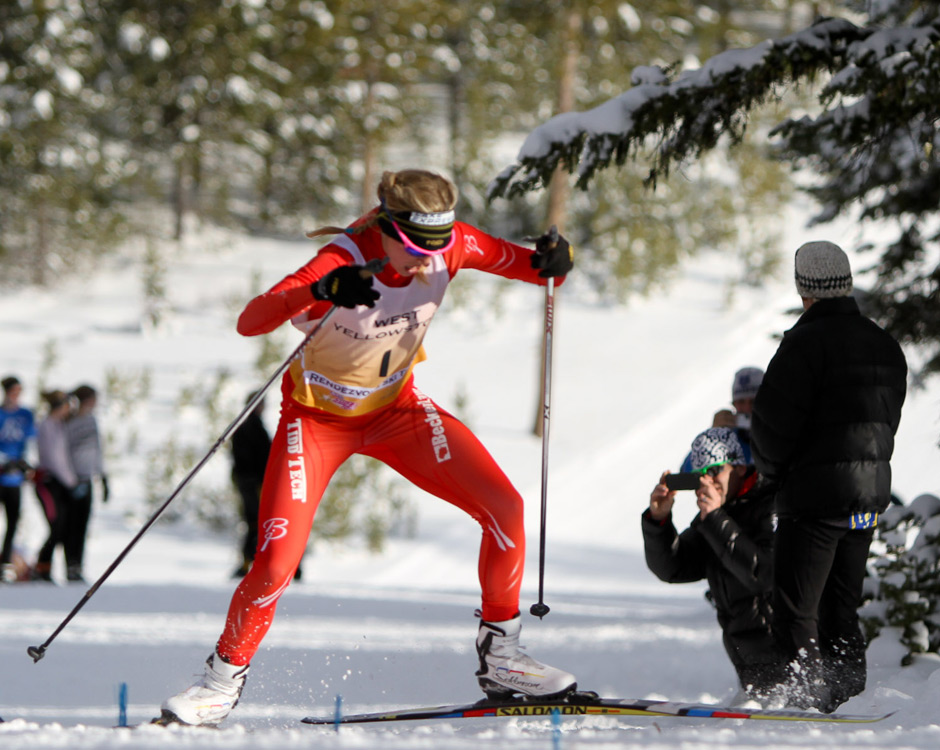
Fans cheering at the SuperTour Sprint Showdown last November in West Yellowstone, Mont. Full sprints are back on the schedule in both West Yellowstone and Bozeman this fall, which has both venues working towards making courses that meet FIS homologation requirements.
After a few years of experimentation with the controversial sprint qualifiers, the format is on its way out of the national calendar. Two venues that held early-season SuperTour sprint qualifiers last season are holding full heats this November, and are currently completing trail work to ensure their courses meet International Ski Federation (FIS) homologation standards. The Rendezvous Ski Trails in West Yellowstone and Bohart Ranch in Bozeman, Mont., expect their sprint courses to be ready for the start of winter.
In West Yellowstone, the inclusion of a freestyle sprint in the festival means the elimination of the double qualifier SuperTour Sprint Showdown.
“Everybody realized that, I think, it’s run its course,” former race director Dan Cantrell said of the double qualifier in June. “In the ski community there’s obviously a push to get our domestic racers more experience in the heats. They’re more fun to race in for the skiers and they need the experience, especially if the SuperTours are a representation of the World Cup [and] we’re qualifying people to send there. So from our end, we’re figuring out what we can do to make that happen.”
As of June the full schedule had yet to be finalized, but Cantrell said it would likely feature an additional non-FIS sanctioned distance race on Wednesday, the freestyle sprint on Friday and a 10/15 k individual freestyle on Saturday.
The Rendezvous Ski Trails obtained preliminary homologation approval early this summer from John Aalberg, the North American FIS homologation coordinator. Its orange 1.5 k course meets the total climb and independent climb requirements for a freestyle sprint course; the trail only needs widening in a few spots to meet the nine-meter specification.
“It’s relatively minor,” Cantrell said of the necessary trail work. “We’re only looking at about two sections of 100 yards apiece that need widening, and only by five to six feet.”
The trails could only homologate a freestyle sprint course; Cantrell said the Rendezvous doesn’t have the available terrain to create a classic sprint course, which requires climbs of specific size in order to necessitate striding.
In Bozeman, Bohart Ranch is currently working on homologating a classic sprint course. Bridger Ski Foundation director Dragan Danevski says the hills are being improved and the total course will be 150-200 meters longer to make it a complete 1.5 k.
“We are working on finishing the homologation this fall [to] have it FIS certified,” Danevski said. “This summer we have also been working to improve the start and finish area and made improvements on the distance course. When we complete all of that we will put up course maps on the BSF website.”
In addition to a classic sprint, Bozeman has a 10/15 k classic mass start on its schedule.
All together, the four SuperTour races in Montana during Period 1 will be the last opportunity athletes not already on the World Cup have to earn start rights to the Canadian World Cups from December 8 – 16. The U.S. benefits from a larger Nation’s Group quota for both the Quebec and Canmore races and can bring five additional men and women. Outside World Cup performance, additional athletes are selected from the leaders of the respective distance and sprint USSA SuperTour standings on December 3.
Torin Koos of the Bridger Ski Foundation elite team races to a fifth-place finish in the 30 k classic mass start at the 2012 U.S. nationals in Rumford, Maine. (Photo: Flying Point Road / flyingpointroad.com)
Note: This one of several previews in a quick-and-dirty series on U.S. elite teams. We asked coaches to send their 2012/2013 rosters and tell us what’s new for the coming season. We will be publishing additional reports over the next few weeks. Teams are presented in no particular order.
Team: Bridger Ski Foundation (BSF) Nordic Elite Team
Coaches: Dragan Danevski (program director/head coach), Tim Baucom (assistant coach/service tech), Andrew Morehouse (service tech)
Leif Zimmermann (BSF) during a NorAm classic-sprint qualifier at the Sovereign Lake Nordic Centre near Silver Star, British Columbia. (Jesse Winter Photography/ jessewinterphotography.com)
Who’s new: Kesselheim (A native of Bozeman, Mont., and former BSF junior who will be redshirting his sophomore year at Montana State University in an effort to make the 2013 World Junior Championships)
Who’s missing: None
Top results last season: A three-time Olympian, Koos landed on the SuperTour podium early last winter, placing second in both the classic and skate sprints in West Yellowstone, Mont. At U.S. nationals in January, he defended his sprint title in the skate race and was fifth in the 30 k classic mass start. Koos then flew to Norway to live and train for three months with the Strindheim Idrettslag ski club in Trondheim. This year, he’s focused on making the World Cup races in Canada and World Championships in Italy.
Zimmermann started last season with a SuperTour victory in the 15 k freestyle at West Yellowstone and landed several other top-10 results early on in the domestic circuit. The 2006 Olympian and four-time national champ was fifth at two NorAms (15 k classic and 15 k skate) last year, and won the Owl Creek Chase 21 k skate race in Aspen, Colo., and Winter Teva Mountain Games 10 k skate in Vail, Colo.
Kesselheim returns to Bridger after his freshman year at MSU, where he consistently placed in the top 15 at Rocky Mountain Intercollegiate Ski Association (RMISA) races. He qualified for NCAA Championships as MSU’s fourth man, was a three-time All-American and placed third at 2012 Junior Nationals in the OJ relay.
Coach’s comment: The elite team may be in various parts of the country and world – Koos is in Salt Lake City working toward his Master’s degree and Zimmermann recently spent two weeks in Peru leading a running trip up the Inca Trail – but they unite when needed. Koos joined the group in June during a 10-day on-snow camp in Bend, Ore., and he’ll return to Bozeman for several training blocks, according to coach Tim Baucom.
Torin Koos working out at a Bridger Ski Foundation training camp in Bend, Ore., in June. (BSF photo)
In an email, Baucom pointed out that Koos was recovering from shoulder surgery this time last year, unable to rollerski with poles and work on his upper body until the end of the summer.
“Right now he is well ahead of where he was last year, and we expect him to not only contend all major sprint events, but the distance events as well,” Baucom wrote. “Leif has been a major presence on the SuperTour for many years and if he stays healthy we expect to see him contending for the SuperTour distance title.”
The main focus for both Koos, who turns 32 next week, and Zimmerman, 28, will be the Canadian World Cups and 2013 World Championships, he added.
“For Sawyer, gaining experience at the national level is crucial for his development,” Baucom wrote. “He will still be a junior, and World Junior Championships are definitely a major goal.”
In late July, BSF heads north for a dryland camp in Canmore, Alberta.
American biathlete Casey Smith at 2011 World Youth and Junior Championships in Nove Mesto, Czech Republic. Smith, one of the top U.S. juniors, is a student at Montana State University. Photo: Judy Geer.
Note: This is the last piece in a three-part series following several groups of biathletes as they negotiate the college question. Part one featured five top juniors who took a detour through college before returning to the international stage, whilepart two looked at USBA’s 2007-2010 Development Team.
In November, 2011, Casey Smith was named Junior Biathlete of the Year for 2011 by the United States Biathlon Association (USBA). In a European country, that might mean a pat on the back from a coach at practice, perhaps an honorary celebration thrown by an athlete’s club, or maybe an added bargaining chip in sponsorship negotiations.
Smith, though, barely even has a club. The Winthrop, Washington, native, who turned 20 in February, was in the midst of his sophomore year at the Montana State University (MSU), where he jumps in time trials with the college’s ski team and otherwise trains primarily by himself. There is no coach, and “practice” doesn’t seem like the right word for a solo rollerski.
“[The award] helped me do some more fundraising, I guess, because it adds something else to your resume,” Smith told FasterSkier in an interview this spring.
That fundraising, along with lots of planning and motivation, helped Smith get to Europe three times during the 2011-2012 season. Once there, Smith is finally part of a team – Team USA.
“There’s lots of support from USBA and the coaches,” he said.
First, Smith raced in the junior division of Open European Championships in Brezno, Slovakia, where his best finish was 15th in the individual. A few weeks later he competed as a junior for the first time at World Youth and Junior Championships (he had twice represented the U.S. as a youth), notching a top finish of 31st. At the end of the season, Smith made one more trip for Swedish National Championships and to do an exchange at the National Sports Academy in Ostersund.
“The kids there were surprised that [some of us] don’t really have teams that we train with regularly,” Smith said after talking with the Swedes. “They definitely have a lot more opportunities. They had three biathlon coaches, so for one thing they have coaches to work with at the range every day.”
Not only does Smith not have a coach to work with in Bozeman, but he estimates that only about half of the targets at Bohart Ranch’s range are actually functional (a local masters group, headed by Madshus rep Peter Hale, is helping fix it up). In 2012 he did, however, have more company than before: World Junior teammates Sam Dougherty and Kelly Kjorlien enrolled at MSU and trained through their freshman year The three traveled together to this year’s Championships in Kontiolahti, Finland.
“I like it here in the West, and I think I’m doing okay with what I’m working with,” Smith said. “I have a couple of coaches that I work with here in Washington, for my training plan and my skiing technique, so that helps a lot.”
Smith plans to continue training at MSU for another season, his last as a junior. Once a senior, he hopes to make the national team outright, although he admits it might take a few years. Still, he thinks he can do it.
But even if Smith’s training is working, it’s certainly not the ideal situation – and the lack of options available to even juniors identified as the very best highlight a struggles both USBA and the athletes themselves face in trying to develop internationally-successful seniors.
Kids These Days
While not going to college may once have been the norm for American juniors, times have changed. USBA no longer supports a development team, meaning that the transition to senior status can be tough. And the junior national team is no longer well-funded, either.
“There’s a few camps that I can go to,” Smith said of what he earned by being named to the junior national team. “But you don’t have to be on the junior national team to do that. That’s about it, really. There’s not a whole lot of benefits, I don’t think, other than that you’re named to the team.”
He is not, for example, has provided with either funding or coaching. The team has a Midwestern Regional Coach, Vladimir Cervenka, who is based out of Grand Rapids, Minnesota. It also has an Eastern Regional Coach in Olympic gold medlaist Algis Shalna, who lives in Burlington, Vermont. There is no Western Regional Coach to provide support for Smith either at home in Washington or at school in Bozeman, or for anyone in the Rockies or Alaska.
Cook, who spent several years at the University of Utah. Photo: NordicFocus/USBA.
And there’s no suggestion that juniors to move to a central location to train together, as has sometimes been the case in the past. For instance, current senior national team member Annelies Cook remembers making her own decision about college. She said she had a lot of options.
“I went through this process of, am I going to go to college?” she told FasterSkier last fall. “Do I do a postgrad at some place like the Green Mountain Valley School? I decided that it would be pretty cool to go be with the junior biathlon team in Duluth. They had started a new thing where they split the men and the women up, so there was a group of us [girls] who ended up moving out to Duluth to train.”
These days, there’s no residential program in Duluth, and there’s also not a biathlon coach at Green Mountain Valley School. The only real program accepting postgraduate biathletes is the Maine Winter Sports Center.
As a result, a large number of top juniors from the past few years’ World Youth and Junior Championships teams have chosen the college route: Ethan Dreissigacker, Hilary McNamee, and Carly Wynn are at Dartmouth College, Addie Byrne is at Harvard, Meagan Toussaint skied for the University of Maine Presque Isle, and Brynden Manbeck for Saint Scholastica, to name a few, in addition to the crew in Bozeman.
“I never really considered deferring from college to focus on biathlon, frankly because I didn’t think there was enough competition in the U.S. to make it worth focusing just on biathlon,” said Dreissigacker, who has competed in several more World Junior Championships as a college student. “I was mostly just planning on skiing in college. The great thing about biathlon is that it is skiing – you just get to shoot also! So it never made sense to me that one might be required to ‘not focus on skiing’ in order to focus on biathlon.”
Dreissigacker did take a winter term off of Dartmouth, but it wasn’t to race in the U.S. – he spent a large chunk of that season traveling in Europe, competing against superior athletes and gaining experience. With Smith’s three trips across the Atlantic this past season, the Montana-based junior has a similar goal.
“If you want good competition for biathlon, there’s not really any in the U.S.,” Smith said. “There’s two or three other good kids that you’ll go race against at a NorAm, but they’re the same ones every time, and you can pretty much know where you’re going to place. But you go over to Europe and there’s fifty kids, and five seconds can be a couple of places, rather than a minute at some of the races over here. I’ve tried to get over to Europe and do as many races as I can.”
Why Not Skip Class?
But not all of Dreissigacker and Smith’s compatriots see college as the best springboard for their flight to Europe. Despite the lack of resources, a number of athletes have found a way to dedicate themselves to biathlon.
They are following in the steps of recent Olympians Jay Hakkinen, Jeremy Teela, and Tim Burke, who between them have several World Cup podiums, dozens of top-tens, and Burke’s stint in the yellow leader’s bib in December 2009. Tracy and Lanny Barnes followed similar paths, with Lanny placing 23rd at the 2010 Vancouver Games for the best Olympic result ever by an American woman.
“I’m of the mindset that if you want to be a world-class biathlete or skier, it pays to put school on the side for at least a little while,” 23-year-old national team member Leif Nordgren told FasterSkier in the fall.
He’s one of a group of young biathletes who went full bore through their junior years and into the senior ranks. That includes Wynn Roberts, who made the 2010 Olympics at age 21; Roberts has since lost national team status and is now supported through the National Guard. It also includes 24-year-old Russell Currier, who has raced for the Maine Winter Sports Center throughout his career. In 2012, Currier had two sixth-place finishes on the World Cup, and has since joined Nordgren on USBA’s “A” team.
It was a surprising path for Nordgren, who didn’t make the first World Youth and Junior Championships squad until his senior year of high school. He had been touring colleges and planning to ski race, but after the trip to Martell, Italy, he decided to focus on biathlon full-time for a year and see what happened.
Nordgren (L) with Lars Berger of Norway at 2011 World Championships. Photo: NordicFocus/USBA.
“At first my parents were shocked that I’d even consider skipping school,” he said. “I started training with the junior national team all summer, thinking I was just going for a year. That winter I won a bronze medal at Junior World Championships in Ruhpolding, Germany, and I figured that I could actually be good at biathlon if I continued.”
Nordgren received a few World Cup starts in each of the next two seasons, and then had his first full season on the circuit in 2011. He doesn’t think that he could have made it to the sport’s top level so fast, scored World Cup points that season, or had his three top-30 finishes at World Championships if he had gone to college.
“I guarantee that both skiing and school would have suffered,” he said. “Now, I can put all my energy into being a world class biathlete. The ages from 17 to 25 are some of the most important ones for physiological development.”
Fellow Minnesotan Raleigh Goessling hasn’t made it to the World Cup yet, but he agreed with Nordgren that delaying college had made a difference in his career.
“I realized that I was very motivated to train for biathlon and not motivated to attend class,” he said of his senior year in high school. “If I went directly to school, I would have compromised my academic performance and college experience. I know this isn’t the case for everyone, but I’m very happy with my decision. During my two postgraduate years at the Maine Winter Sports Center I learned a lot about what it means to be an athlete, how to function independently, and how to conduct myself professionally.”
A College Coach’s Dream
Each of the more than a dozen biathletes contacted by FasterSkier for this series – some of whom don’t have degrees, others who went straight to college, and still others who postponed school for several years but now have diplomas – said, like Goessling, that they knew they had made the right choice.
They suggested that it was an individual choice, and that different athletes need different environments to succeed. With only a minority of top juniors taking postgraduate years to focus on biathlon (Goessling was joined by Ben Greenwald and Andrea Mayo), more and more biathletes seem to be comfortable with the challenges of combining education and athletics – parly because the vast majority of teams available to older junior skiers and biathletes are associated with colleges.
“Now with the lack of support at the national level, it might become more of an important question,” former University of Utah coach Eli Brown said in an interview. “There’s a huge resource in college skiing. It’s always a drive of mine to stick that almost, but not quite, perfect puzzle piece into the development pipeline.”
Ethan Dreissigacker racing at 2012 World Youth and Junior Championships. Photo: Judy Geer.
College coaches have in many cases welcomed biathletes with open arms; Brown, who coached Annelies Cook during her college years, was speaking about nordic sports in general, not only nordic skiing. Part of Brown’s enthusiasm came from a certain amount of selfishness. He wanted to recruit the fastest team that he could, and adding a high-level biathlete to his roster helped with that goal.
“I knew Annelies, I’d seen her ski,” he said. “I’d been around biathlon [at the] Maine Winter Sports Center and I knew her attitude and work ethic would rub off on the group. She’s literally – well not literally, I guess, because of NCAA rules, but unofficially – a professional athlete, and brought that lifestyle to the whole group, which I think raises the level a little bit.”
Former University of Vermont coach Al Serrano said the same thing of Lowell Bailey, who earned two NCAA podiums during his time as a college skier: “He is a huge asset to any team and a coach’s dream.” And Dartmouth coach Cami Thompson, who worked with Olympians Carolyn Bramante and Laura Spector, had the same sentiment, despite the fact that the pair focused on biathlon during the winters; Bramante raced one full season of carnivals, while Spector did just half a season (in her first race, she was third).
“The pros are that when you have a high-level athlete, anytime they’re training with your team it’s a good thing, whether it’s how they ski technically or that they’re pushing your team in workouts, or just that they’re thinking outside of what we’re normally doing,” Thompson said. “It gets people thinking about what else is out there in skiing.
“And from the con side I’m not even really sure there’s really that much of a con.”
Embracing the Challenge
But as longtime observers of cyclical changes in development funding, coaches have a different perspective on how their programs can help athletes into their 20’s, and see that college can be a benefit for the athletes, not just for the teams. Serrano, for example, discussed how Bailey had been able to forget about the long-term pressures associated with the Olympic cycle and focus on smaller, incremental goals and having fun with his sport.
“Mix it up for a little while,” Brown agreed. “As we all know it’s a game of attrition. If you can still be doing it when you’re 30, you’re probably going to be doing all right. There’s a value to having balance in your life, being part of a team, training hard, and using [a college team] as a stepping stone.”
And just as elite biathletes can be assets to a college team, there is plenty the shooters can learn from their skiing teammates as well; the exchange goes both ways, and both Cook and 2006 Olympian Carolyn Bramante said that they had gone to school with the deliberate intention of gaining ski speed.
“I didn’t think that I was a fast skier,” Cook said looking back at her 2006 decision to go to Utah. “I felt like shooting was my strength, and I thought, well maybe if I just ski for a while, I will become a better skier, and then I can come back and be a better biathlete all around.”
It worked, and she suggested that biathletes should have no qualms about picking a fast college ski team and trying to learn as much as they could.
Kelly Kjorlien, now at MSU, representing the U.S. last season. Photo: Judy Geer.
“I know there’s the whole European/American college debate, but the way that it affected me was really positive,” she said. “I had experienced athletes to train with and they were good, and fast, and I had someone to chase and really good people around me to watch and learn from. So I’ve benefitted a lot from that.”
Coaches and athletes alike admit that the college route can be tough. For instance, only a few universities have access to a range, and in many places shooting practice requires a long drive.
“The biggest challenge is getting in combo workouts, with shooting and skiing,” Dreissigacker said. “There’s a place to shoot and a place to ski, but there’s no place in the Hanover area to do both together. There is a great biathlon venue in Jericho, Vermont that’s about 80 minutes away, so I can train there occasionally on weekends.”
In Bozeman, the trio of racers has to drive 16 miles to the range, which Dougherty said adds a lot to the time commitment of a normal college skier. Both athletes said that UVM would probably be the best location to be a biathlete – and regional coach Algis Shalna does work with a number of college-aged athletes there – but it’s difficult to sync with the varsity team, which is small and focused on winning races.
“Their ski team doesn’t seem to have the flexibility that we have at Dartmouth,” Dreissigacker said. “I think that maintaining a flexible connection with skiing is key for developing biathletes in the U.S., because in order to compete with the Europeans in biathlon you have to have to be one of the faster skiers in the U.S. as well. Luckily I get great support from [Dartmouth coach] Ruff Patterson and Algis Shalna, and both are flexible enough to let me work with the other.”
With so few biathlon races on the calendar, travel to competition can be even more arduous, especially during an academic term. Biathletes even describe the question of whether a campus is gun-friendly or has easily available off-campus housing as considerations. And, of course, there’s the lack of institutional support for biathlon.
But the benefits, such as scholarship money, may equal or outweigh those costs – if an athlete is prepared to work hard and plan carefully.
“You can definitely be competitive [as an American], you just have to be self-motivated,” Smith said of his current situation. “There are more people [in European programs], especially in the youth category, so the athlete doesn’t have to have as much self-discipline to go out and train on their own every day… they just have to show up.”
That discipline, he said, can be an advantage.
“I think in the long run, if you can keep going and keep up your motivation, it will make you a better athlete in the end.”
After years as a careful observer of the sport, Brown agreed.
“We operate in sports where there’s not much depth at all, especially compared to Europe,” he said. “In the U.S., [biathlon] results are separated by minutes. I think it was a really smart move by Lowell and Annelies to get in a place where they can really be pushed.”
Is Montana The New Biathlon Mecca?
Recently, it seems that another option is emerging for biathletes who are leaving high school: already at three, the Bozeman biathlon scene appears to expect more growth. Althogh elite nordic athletes have flocked to Bozeman for years, it’s still a surprising place for a biathlon boom. Bohart’s ten-point range is only open two days a week at this point, and the always-available two-point range is squirreled away in the “back forty,” according to Smith.
But a number of biathletes already had connections to the area, and others are making some. Corinne Malcolm, who spent two years at MSU before beginning biathlon and making it onto the national team, is reportedly considering a returning to Bozeman in some capacity. 2010 Olympian Laura Spector is taking organic chemistry there this summer. And the group has a fledgling website, Biathlon Elite, which lists Kyle Rutar of Casper, Wyoming, and Erik Rupert of Duluth, Minnesota, as team members.
It’s a bid to market themselves and snag some more resources – perhaps club funding from the university, to start with – and if they succeed, it will be an significant development in the short history of collegiate biathlon.
Sam Dougherty shooting in the youth men's individual race at 2011 World Junior Championships. Photo: Judy Geer.
But even if it doesn’t, the athletes know that they are lucky to have training partners, something that most of their predecessors who went to college lacked. Even at Dartmouth, Dreissigacker is currently the only one pursuing biathlon seriously, despite the presence of McNamee and Wynn.
“We don’t have a local shooting coach per se, but we try and stay in close contact with our hometown and national coaches for advice,” Dougherty said of the Montana group. “Both Casey and Kelly have been on the national and international biathlon circuit much longer than I have, and it’s great to be able to learn from them and apply their knowledge and experience to my biathlon training.”
Smith appreciates the company: “It is way better than the [first] year, because there’s people to go shooting with, and it’s easier to motivate yourself when you have others,” he said.
Both Smith and Dougherty touted the involvement of Hale, the Madshus representative, who spent five years on the U.S. biathlon team when he was himself a competitor. Hale’s main role in the scene is to organize a masters group in Bozeman, but he has also helped galvanize support for range improvements.
“Mr. Hale has been really great to us, and wants us to get the most out of biathlon while we’re here,” Dougherty said. “We feel like there are a lot of people here in our corner, which makes everything much more pleasant and feasible.”
What Does the Future Hold?
Several of the country’s most promising biathletes – Sean Doherty, Anna Kubek, and Tara Geraghty-Moats – are actually still youths, meaning that they don’t have to make the college decision quite yet. But when they do, will they have any more options than today’s juniors?
Maybe, or maybe not. Given current conditions in the biathlon world, today’s youth competitors may find themselves at UVM, Dartmouth, the growing MSU training group, or somewhere that offers scholarship money. The other options are limited to the Maine Winter Sports Center and going it alone.
“I feel like the junior programs are a little bit weak around the country right now, and that’s a major problem,” said Cook. “How do you develop young biathletes and how do you keep them interested, and how do you give them a coach and a place to live? I definitely think that’s a reason for biathletes to turn to college.”
Geraghty-Moats, who focused on nordic combined as a younger athlete and has been homeschooled for most of her career, isn’t on a standard path, but she thinks that college may factor in at some point.
Geraghty-Moats on the range at Swedish Nationals. Photo courtesy of Per Nilsson.
“At the moment I’m working on getting my Associate’s Degree at Community College of Vermont,” she said. “It’s possible I’ll transfer those credits and do my last two years of college years at UVM. “But for next winter I plan on keeping biathlon as my main focus. I’ve gone from never having shot a rifle to being 18th at World Juniors in not quite two years. I’m big on short term goals and taking things one step at a time – I’ll figure out how I can gracefully transition from being a junior a to a senior in a few years.”
For young biathletes who choose the college route, there may be another powerful ally in their corner: USBA President and CEO Max Cobb, a Dartmouth graduate himself who said that being a student-athlete was a formative experience. While acknowledging that his organization isn’t doing the best job with development – with their small budget, the team has chosen to focus on high performance – he said he hoped to make college an easier option for biathletes who want a degree.
“Being able to pursue sport and college together is fantastic,” Cobb told FasterSkier. “I think that’s a great opportunity for every young, talented athlete that’s coming along, and the important thing is to try to find that balance, to have your eyes wide open as to how your commitment to college academics does or does not affect your Olympic aspirations… The question for us is, how do we make the next Lowell Baileys better in terms of the kinds of training they can keep up with while they’re studying? It’s a long-term push for us. It’s not something we’re going to solve in the next six months.”
And in the end, doing so would give his athletes more long-term career options. Today’s juniors mostly say that they are committed to getting an education – “if I took time off from college, it would be too hard for me to return and finish my degree, which is very important to me,” Dougherty said – which USBA understands. Cobb pointed out that the average medalist at the 2006 Olympics was 32 years old, and most people don’t want to start college after they retire in their mid-30’s.
“That a college education is widely known to be a really important part of one’s preparation for life, whether you’re a full-time athlete on a track to make the Olympic team or not,” he said.
USBA’s commitment to that talking point will likely be tested in the next two years. Spector, who after competing in the Vancouver Olympics went on to have a breakthrough season in 2011 and collect her first World Cup top-20, has said that she “plans to not ever in the future be just solely an athlete.” Though still a member of the national team, she will not attend any camps this summer, and has not decided the extent of her involvement the rest of the year; the women’s coach, Jonne Kahkonen, has expressed frustration with the inability to work with Spector when she is outside the national team system.
But in the end, say some, if athletes are talented and motivated, all roads just might lead to Rome.
“The big question you have to go back to is to compare Lowell and Tim [Burke], in terms of development and making that choice or not making that choice, and then compare Andy Newell and Torin Koos,” said Brown. “They’re almost the same athlete in the end, totally different path. It’s hard to really quantify if those decisions were negative or positive in terms of just results.”
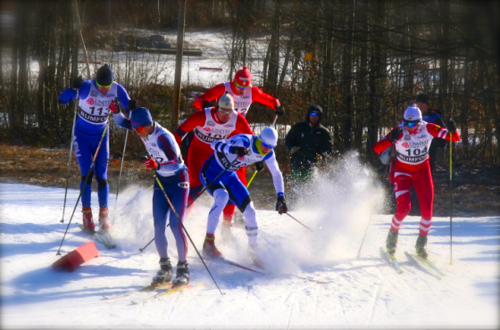
Athletes collide during sprint heats at U.S. Nationals in Rumford, Maine, 2012.
A sprint qualifier can be defined as the preliminary stage of a sprint race in nordic skiing. In a race against the clock, competitors leave the starting gate at intervals and go as hard as they can for anywhere between 1 and 1.8 kilometers. The top 30 in most internationally sanctioned competitions, and sometimes a lesser number in other events, move onto the quarterfinals to face off against five other athletes at a time for the right to advance to the next round.
Sprint races progress in this manner all over the world; on the World Cup, in Continental Cups, in the collegiate circuit, and sometimes at small-scale high school races.
In the winter of 2009, the term “sprint qualifier” took on another meaning. The U.S. Ski and Snowboard Association (USSA) introduced a sprint race to the SuperTour that was truncated at the qualifying round; medals were awarded to skiers who clocked the fastest qualifying times, and the athletes’ entire day was done in a matter of two to four minutes. No longer just a prologue, the qualifier became a race all its own.
At the time, the trial run was met with mixed reviews. Athletes felt robbed of the chance to develop head-to-head sprint skills. Coaches acknowledged the challenges the organizers faced in putting on full heats, but agreed that the format was not ideal. Canadians who occasionally dabbled in the SuperTour simply didn’t understand it.
Qualifier-only sprints started with a trial run in West Yellowstone, Mont. that first winter, but have since spread to three other stops on the SuperTour in 2012. What began as confusion is now ranting fury — some still fail to understand why the experimental format was deemed a success and allowed to proliferate.
To begin to answer that question, we start with that first time qualifier-only sprints were held in the U.S.
When the format was first conceived of prior to the 2009-2010 season, then-USSA Nordic Director John Farra intended for it to do two things. First and foremost, the decision to leave out the heats from the West Yellowstone sprint was a philosophical one. Farra believed it to be the right move for U.S. skiing at the time, and today stands by his decision.
“We still don’t have enough Americans, in my personal opinion, who can qualify, period,” said Farra, who has since left USSA to become the High Performance Director for Paralympic skiing, in a phone interview in December. “That’s a problem. For me, at this point in our development, there’s an argument for getting athletes in more races where they’re just throwing down… I think it works on a gear all Americans need to keep working on.”
Secondly, it put an additional sprint race back on the calendar in the first period of the SuperTour where, at the time, there was only one in Bozeman, MT. It would not be the first time sprint races were held in West Yellowstone. Regular sprints, complete with heats, were held on the Rendezvous trails up until 2007, but according to Farra, coaches complained that the trails were too narrow and the altitude too punishing for a full sprint day.
One of the jobs of the Nordic Director is to select skiers at the end of the Period 1 to send to the World Cup. With an additional sprint thrown into the mix, Farra’s theory was that the overall points leader would have to be a decent sprinter and distance skier to earn those coveted European start rights.
Rankings of the best distance skiers and sprinters on the domestic circuit are often very similar, however. For example, at the end of Period 1 this winter, the women’s SuperTour sprint leader, distance leader, and overall leader were all one person: Jessie Diggins (CXC/USST).
On the men’s side, overall leader Mike Sinnott (SVSEF) had two top-5 distance results along with his two sprint wins and one second.
The sprint qualifier has also been accused of having another motive. It was introduced in the season leading up to the 2010 Vancouver Olympics, and it’s been suggested that the qualifier, in squeezing another race into a short time frame, was a grab for better FIS points to boost the U.S. quota for the Games.
Farra said this was never the case. Points are always based off the qualifier, so heats would have no effect on FIS points either way. Additionally, as Farra pointed out, “you can only ‘boost’ the points if you have a quality field in the race.”
Jessie Diggins competing in the qualifier-only skate sprint in West Yellowstone, Mont., in November 2011.
With his idea for a modified sprint in mind, Farra went to the West Yellowstone Chief of Competition at the time, Sara Hoovler, with the proposal.
From the organizer’s perspective, the introduction of an additional race in West Yellowstone brought with it organizational and financial burdens, which became the main point of negotiation.
“As an organizing committee we were pretty maxed out,” said Hoovler, who is now a school teacher in the area. “We couldn’t put on another full-scale race.”
When Farra brought the proposal to the organizers, they agreed to try out the additional sprint as long as it didn’t come with a significant extra cost—specifically, as long as it didn’t require coming up with the additional prize money. At $3,900 per race, prize money is one of the single most expensive components of hosting a SuperTour.
“Purses for these races can sink the entire event,” said Dan Cantrell, Hoovler’s successor as the West Yellowstone race director.
He estimates that between all the major costs involved with putting on the SuperTour every year—notably prize money and gas for grooming—the event runs the Yellowstone Ski Festival around $20,000. When the weather is especially uncooperative, the number goes up as tents and space heaters are brought in, or the Pisten Bully has go over the course multiple times.
With the introduction of homologation standards this year, any argument for heats became moot—the venue simply doesn’t have the terrain to meet the standards on a traditional sprint loop. For the race to count as a SuperTour complete with FIS points, there needed to be a certain amount of total climbing.
The only sprint course West Yellowstone could come up with that met the standards is a point-to-point 1.5 k, which ruled out the possibility for heats. For timing and officiating purposes, heats have to start and end in the same stadium.
“We were able to FIS homologate West for a sprint qualifier only. That’s a big deal, otherwise we don’t sprint there,” said Farra.
The other option would be to hold the fall SuperTours at locations that could homologate a sprint loop, but choices are limited by the reliability of snow anywhere else in the country in late November, and the number of venues willing to take on a SuperTour.
With the advent of homologation standards looming for 2011, Cantrell also had to account for the cost of the trail work necessary to get the courses up to standard. In addition to sitting on National Forest land, the Rendezvous Ski Trails occupy endangered grizzly bear habitat. Every time the ski trails are modified, the Forest Service requires an environmental impact assessment.
“To put it in perspective, the improvements from this year, with the connectors and homologation, was about a three year process,” said Cantrell. “We had a bulldozer out there two weeks before Thanksgiving.”
With these demands on the race organizers in mind, Farra was loath to push West Yellowstone to take on significant extra cost in adding a sprint qualifier to the schedule.
“We weren’t prepared to make the organizer come up with the prize money,” said Farra.
Since USSA strategically thought it was important to hold a sprint in Yellowstone, the organizers were excused from the obligation to hand out the prize money for sprint qualifiers. The exception is laid out in the USSA Rulebook—none of the sprint qualifiers on the SuperTour schedule this year award the usual purses to the top six finishers.
Since 2009, Yellowstone’s sprint qualifier has become two. In the second and third years of its existence, the opening day of the SuperTour was a double-header. The “SuperTour Sprint Showdown” starts with a skate sprint qualifier, and ends one hour later with a classic sprint. Each of the two races is an opportunity to earn points, but the single winner of the Showdown and recipient of the $250 purse is calculated from the combined times.
The first running of the Showdown at West Yellowstone, on the whole, was a success in the eyes of the organizers and USSA. There were a few kinks to work out—the flow of athletes from the finish back to the start was congested, and cold weather made the trek an uncomfortable one for athletes still just in spandex—but overall, organizers felt good about the trial run.
For her part, Hoovler thought the number of participants in the sprint qualifiers as reason to look positively at the outcome.
“We saw a lot of junior skiers, just getting some race experience, and also master skiers that weren’t competing for FIS points but challenging themselves,” she said. “I was very shocked at the amount of racers that participated.”
When West Yellowstone still had sprint heats in 2007, 42 women and 51 men participated. In 2009, 61 women and 67 competed in the qualifier-only version. In 2011, more athletes competed in the freestyle sprint than the classic, but the totals in the freestyle qualifier were 60 women and 92 men.
Amongst elite skiers, the sprint qualifier was met with some complaints about the absence of heats. Despite this feedback during the season, Farra said the format wasn’t a major issue at the spring USSA meetings, and he saw no reason not to keep experimenting with it.
“This is not a new topic,” Farra emphasized. “There’s been at least two springs for people to say, ‘Hey, this is ridiculous.’ I don’t remember there being significant discussion about that.”
The release of the 2011-2012 SuperTour calendar saw the addition of sprint qualifiers to three new venues: in Bozeman, Mont. one week after West Yellowstone; in night-sprint form at the Tour de Twin Cities, which took place just two weeks ago in Minneapolis, Minn.; and as a prologue to the upcoming 5/10 k classic on day one of the Owl Creek Chase in Aspen, Colo.
In the negotiating phase of calendar planning prior this season, Farra proposed the addition of sprint qualifiers to each of the new hosts. As with West Yellowstone, at each location, the investment that new homologation standards required already had organizers strapped for cash and volunteer power.
Austin Weiss, the Race Director for the Aspen SuperTour and Owl Creek Chase, agreed to add the sprint qualifier to the schedule on February 11 in order to make the entire weekend a more attractive package to racers. Weiss said the Aspen organizing committee was never asked if they could hold a full sprint with heats. He indicated that it would be a challenge, as heats require a separate day of racing, but didn’t rule it out as a possibility in the future.
“Logistically, everything is possible,” said Weiss. “It’s biting off a bit much—it’s not out of the question, but it’s something that the organizing committee would have to consider.
“The other benefit of a sprint qualifier is that it doesn’t require that much more work on the part of organizers.”
The race director in Minneapolis had a similar view.
John Munger, the director of the City of Lakes foundation, which hosted the first three races of the Tour de Twin Cities, pointed to the challenge of putting on a number of high-profile events within a short timeframe.
“It takes a long time to do sprints and lots of volunteer power,” Munger said in a phone interview. “We’re doing the Mayor’s Challenge, the IPC Paralympic World Cup, and the City of Lakes Loppet all within about two weeks.”
This is the compromise Farra sought to strike as he set about adding more sprints to the SuperTour last spring: give skiers more opportunity to develop their sprinting ability without pushing organizers to the point where they wouldn’t hold sprints at all. Just as in West Yellowstone, he saw qualifiers as the best solution.
“It’s a fine dance between what athletes and coaches want, and what we think organizers can do,” said Farra.
The financial burden of the additional race was also lessened at the new sprint venues. As with the two independent sprints in West Yellowstone, none of the three new sprint qualifiers come with the normal win payout, which adds up to $3,900 between both men and women (1st – $750, 2nd – $500, 3rd – $250, 4th – $200, 5th – $150, 6th – $100).
“Imagine if you push Bozeman, and we say, ‘Come up with four grand,’ and they say, ‘Sorry, can’t do it.’”
According to Dragan Danevski, director of the Bridger Ski Foundation, the additional prize money would have been more than they could afford, and was a point of negotiation when Farra asked them to hold a sprint qualifier in the spring.
“It would be nice if we could have $100,000 in prize money, but I said, ‘Look, in this economy, in this situation, we are lucky to have SuperTour races even with [some] money,’ sad Danevski in December.
“I had to make the decision that we would no be able to do three races and have prize money for three.”
The financial compromise has not gone unnoticed by the athletes, particularly those who have repeatedly placed in the top six in the SuperTour sprints thus far.
“I don’t understand it,” said Mike Sinnott (SVSEF), who was first and second in the two sprints in West Yellowstone and won the freestyle sprint the next week in Bozeman.
“It’s unprofessional in my opinion.”
In Sinnott’s view, the $250 check he won as the Sprint Showdown champion in West Yellowstone should have been a bonus.
“I think it’s pretty clear in the rules that you get $750 for a win,” he said.
Caitlin Gregg (CXC) has similarly excelled in sprinting this winter. She began with a fourth and first in West Yellowstone, a second-place in Bozeman, and a third in Minneapolis. Like Sinnott, she believes the sprint qualifiers should have prize money.
“If any race requires a registration fee and awards points…there needs to be prize money,” Gregg wrote in an email in December. While she understands that qualifier-only sprints, as a format, are easier on race volunteers than full heats, she believes that leaving out their prize money altogether undermines sprinting development in the U.S.
“It seems as though there was once a push to hold more sprints and team sprints on the circuit and suddenly (ironically coinciding with some of the best results ever for U.S. skiing, which came from sprints and team sprints internationally), the U.S. has decided to reduce the opportunities domestically for sprinters to develop,” said Gregg.
“Without prize money, sprint specialists or those who are competitive in both distance and sprint races would be loosing a large percentage of potential earnings that could allow them to continue competing on the SuperTour domestic circuit.”
As a solution, she proposed getting a title sponsor to help fund the SuperTour purses in the future.
If USSA is adamant about adding more sprints to the SuperTour, and has found race committees unable to produce the extra prize money, would USSA ever contribute their own cash to the pot to make up for it?
Given the state of its budget, “No way would USSA pay,” said Farra. “The SuperTour has never been funded by USSA… Given the state of the union at USSA, it’s highly doubtful that any prize money will come from them.”
Farra empathizes with the opinion of the athletes, but notes that contesting the sprints are still worth something.
“While I agree—I would be disappointed not to benefit from that prize money— World Cup qualifying is still up for grabs,” he said.
But for many athletes on the SuperTour, not even that is enough. Without heats, some don’t feel sprint qualifiers to be a valuable format.
Pat O’Brien (CGRP), who placed second in the night sprint qualifier two weeks ago in Minneapolis, believes the heats are critical to developing competitive sprinters.
“While I agree that it is important for US skiers to be able to qualify well (and make the heats), the real test to me is how well an athlete skis rounds,” said O’Brien. “It doesn’t matter how fast you are in the qualifier if you can’t move out of the quarters. Skiing well in a group is a skill that you only can develop through practice.”
“Cutting full sprints out of the schedule and replacing them with just qualifiers undermines this development.”
His teammate Tim Reynolds (CGRP) suggested an alternative format for heats that would be less demanding on organizers, and in cases like Minneapolis where there were fewer numbers, make more sense.
“You don’t have to take 30 onto the heats… I think you can adapt the format to the field size,” said Reynolds, pointing to the Madison, Wisconsin SuperTour as an example. In the past, the Madison event has taken on eight skiers from the qualifier on to the heats, which reduces the number of rounds to two semis and one final.
“Heats are a valuable experience,” said Reynolds.
If dissatisfaction with sprint qualifiers is as widespread as the vocal skiers would make it seem, then Farra agrees that USSA should go back to the drawing board.
“It’s part of being progressive,” said Farra. “How we’ll be a better ski nation is being open-minded to trying different things.”
“My memory is that we are still testing this concept. Until coaches come back in the spring and say, ‘This doesn’t work, we need to stop’—until that happens, we’re still testing it.”
If athletes really want to see qualifiers scaled back next year, Farra encourages them to go to the USSA spring meetings, or make sure their views will be represented at them.
“The USSA Congress really does work,” he said. “It’s amazing how many coaches go out of their way in the spring and engage in dialogue when they don’t want to be thinking about skiing.
“Athletes need to be able to remind their coaches, ‘This is what we’d like to see; this is how the SuperTour could be improved… Everybody is working their butts off, but it’s only going to get better if people bring their ideas forward.”
Ellefson and Bjornsen coming into the finish in the Bozeman 15 k classic. Photo: Shayla Swanson.
Sylvan Ellefson (SSCV/Team Homegrown) took home his second winner’s check of the weekend with his victory on Sunday in the Bozeman, MT 15 k classic. He bested the rest of the field by a significant margin; Erik Bjornsen (APU/USST) was his closest competitor at 30.8 seconds back. Montana State University’s David Norris rounded out the men’s podium in third (+40.6).
Asked if he could sense a win as he warmed up on Sunday morning before his start, Ellefson said, “Yeah, I think so…I felt really good doing a little intensity before the race. I felt pretty calm; just kind of ready to hit that four-loop course pretty hard.”
Ellefson started 30 seconds behind Bjornsen, the eventual runner-up, who he caught up to at the beginning of the third lap. Ellefson said he and Bjornsen worked together for the remainder of the race.
“I skied behind him for the majority of that lap,” said Ellefson. “For the fourth lap I jumped in front of him, and he stayed right on my tail. It was good for both of us; when I have someone skiing on my butt it makes me go faster.”
The thin snow cover was a concern heading into the men’s and women’s classic races on Sunday morning at Bohart Ranch. Even though it snowed four inches in Bozeman the night before, the venue itself got one measly additional inch. Despite the conditions, Ellefson felt that the course held up decently well.
“It was another pretty impressive performance from the Bohart volunteers,” he said. “When you see more grass than snow on the surrounding hillsides, you wouldn’t expect such a high-quality classic track.”
Sunday’s classic race was the final competition of the first period of the SuperTour. The overall points leader after seven races—four in West Yellowstone, MT and three in Bozeman—earns World Cup start rights for the first two weekends of Period 2 in Europe, which includes city sprints in Milan, Italy, and both a 15 k and team sprint in Otepaa, Estonia the following weekend.
Mike Sinnott (SVSEF). Photo: Shayla Swanson.
Mike Sinnott (SVSEF), the SuperTour leader from the get-go at the West Yellowstone opener, finished seventh (+1:03.1) on Sunday to hold onto the bib, and is finally letting himself get excited to race in Europe.
On Sunday evening, Sinnott said he had just begun working out the details for his trip to Europe—“I didn’t want to get ahead of myself,” he said. He’s been coming down with a cold recently, but knew he had to score at least three points (18th place) in the classic race in order to secure his place on the World Cup start line on January 14.
“I knew I had to get a start in so I didn’t blow it on the last day,” he said. “I didn’t have a lot of energy, and felt stuck in second gear the whole race. But it’s a solid result give the low energy.”
Ellefson was 28 points behind Sinnott going into Sunday’s classic race, and at the end of the 15 k Sinnott ended up with a 160 – 148 point lead.
“I’m pretty psyched Mikey got those start rights,” Ellefson said of his competitor. “He really deserves those…but that doesn’t mean I’m not going to be gunning for him at Nationals.”
The SuperTour doesn’t start up again until U.S. Nationals in Rumford, ME after the New Year. Much of the field will soon be on its way to Silver Star for next weekend’s NorAms in Vernon, BC.
Jessie Diggins (CXC/USST) continued her early season dominance in the 10 k classic in Bozeman, MT on Sunday. Her 35.7-second victory over Maria Graefnings (University of Utah) was her third-straight win of the weekend. Kate Fitzgerald of APU finished third (+1:06.7).
“I really had a lot of fun today,” said Diggins. “Sometimes when people say ‘have fun out there’ I think it’s more likely that the race is going to hurt like crazy. But today’s race really was fun.”
In contrast to Saturday’s 5 k skate, which she won by a slim 1.3-second margin over teammate Caitlin Gregg (CXC), Diggins logged a more dominant result in the 10 k classic, winning by over half a minute.
The young USST rookie has been working hard on specific goals in each of these early SuperTours. In West Yellowstone, those included practicing the race-day process and acquainting herself with longer distance pacing.
“Today I was working on pacing—trying to take it out a little more smoothly, and focusing on skiing with long, strong strides, instead of short and choppy,” she said. Diggins added that she was excited that many of her fellow CXC teammates raced well on Sunday; Gregg was fourth and Jennie Bender was sixth.
The women’s 10 k followed closely on the heels of the conclusion of the men’s 15 k classic the same morning. Concern for the durability of tracks and the snow cover was well-founded, but according to Diggins she needn’t have been worried.
“At first I was kind of nervous—there’s a bunch of sharp corners and I though, ‘Oh, man. It’s going to scrape all the wax off,’” she said. “But I guess there were a lot of layers of just the right kick; my skis worked out really well.”
Diggins held a commanding 36-point lead in the overall SuperTour standings heading into Sunday’s race. She’s now widened that gap to 48 points. Like Mike Sinnott, the men’s leader, this grants her World Cup start rights in Europe. But the B-Team member of the U.S. Ski Team (USST) was already planning on heading to Italy directly after finishing U.S. Nationals in January. Despite her early season success, she won’t be joining the USST any earlier than planned.
Speaking of the U.S., Diggins said she was most definitely motivated this weekend by news of her teammates doing so well in the Dusseldorf city sprints.
“It’s been a wonderful way to wake up every morning,” she said of getting news of Kikkan Randall’s win on Saturday and the team sprint duo of Randall and Sadie Bjornsen claiming silver on Sunday in Germany.
She described following their success from afar as particularly encouraging given that she trained with the U.S. women during the summer.
“You hear about Kikkan and Sadie, and it makes you want to get out there and race your hardest,” she said. “They trained really hard this summer—I got to see them at camps, and they deserve every single bit of their celebration tonight.”
Along with the rest of CXC, and most other teams on the SuperTour, Diggins is heading to Silver Star in Vernon, BC on Monday, where the first NorAm will be contested.
“I think it will be good competition,” said Diggins, looking forward to mixing it up in Canada. “Everyone is fit and ready.”