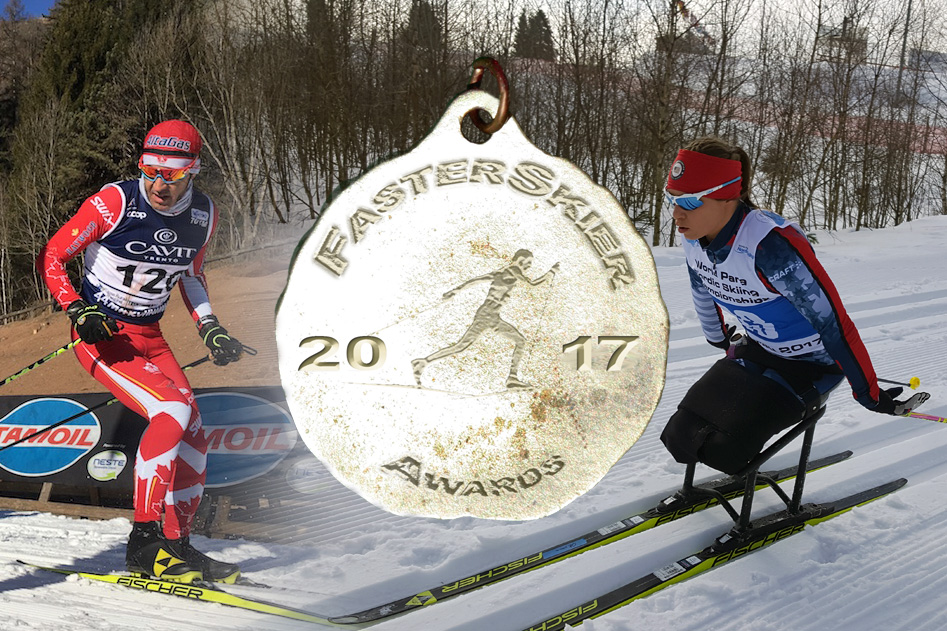
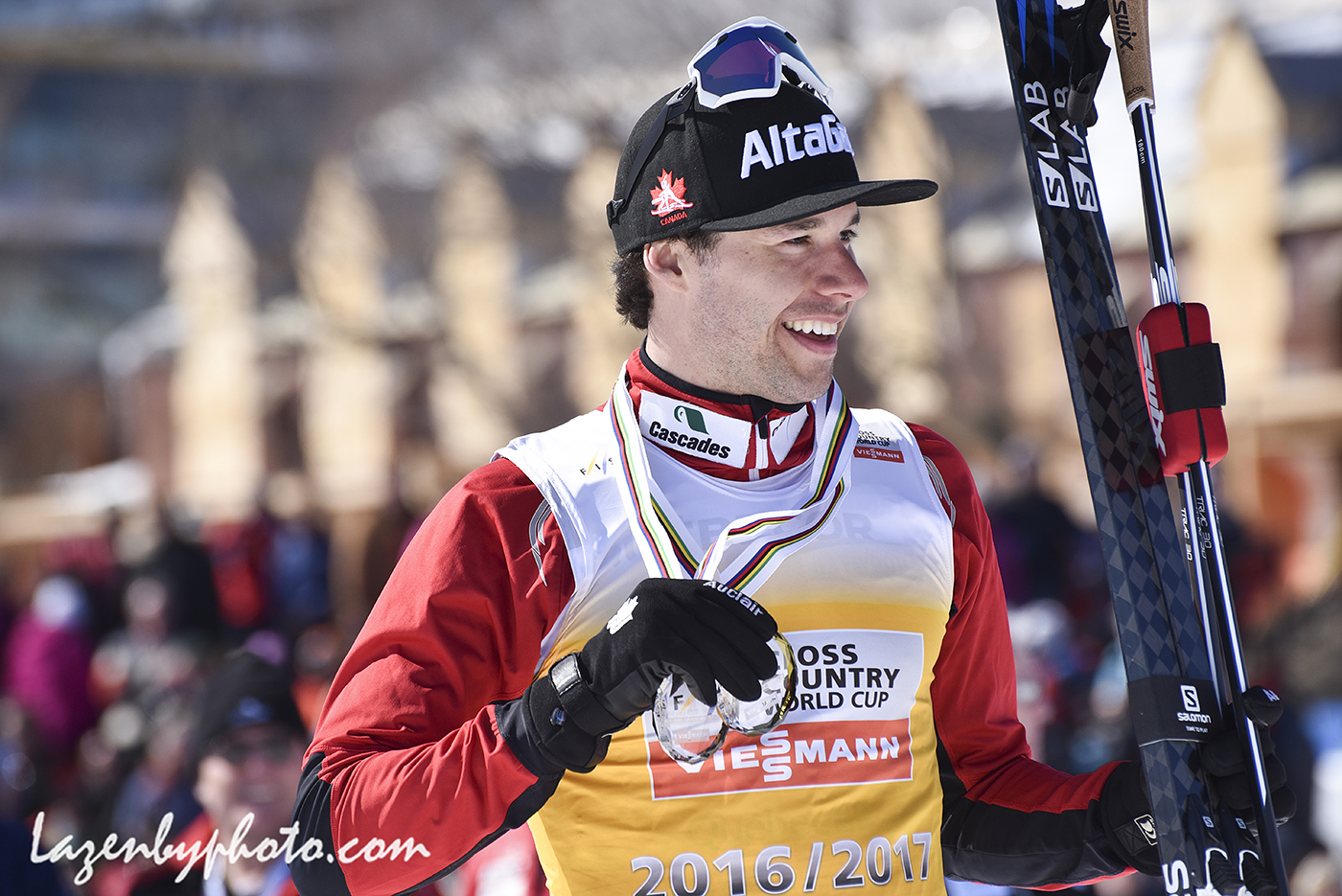
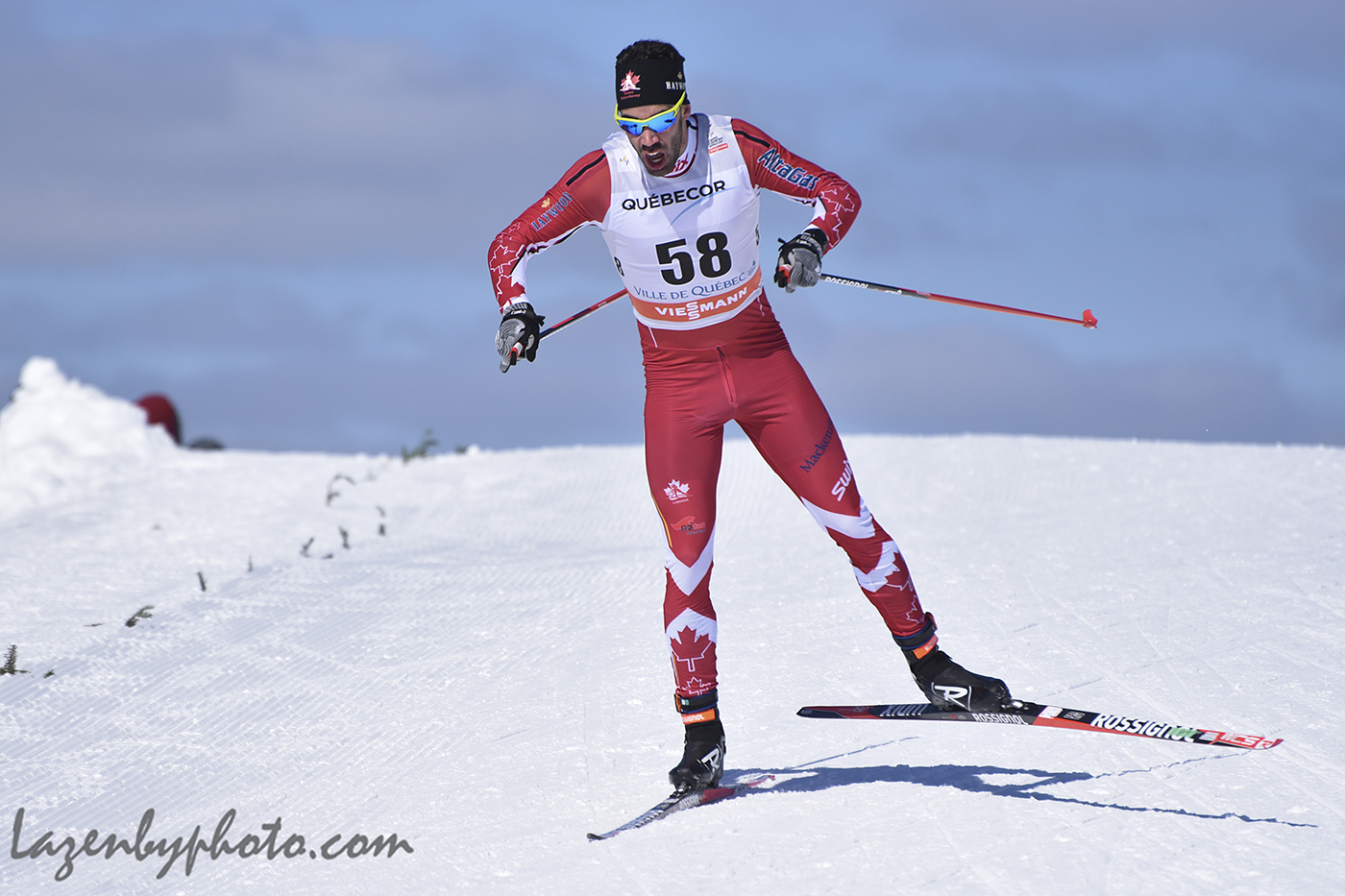
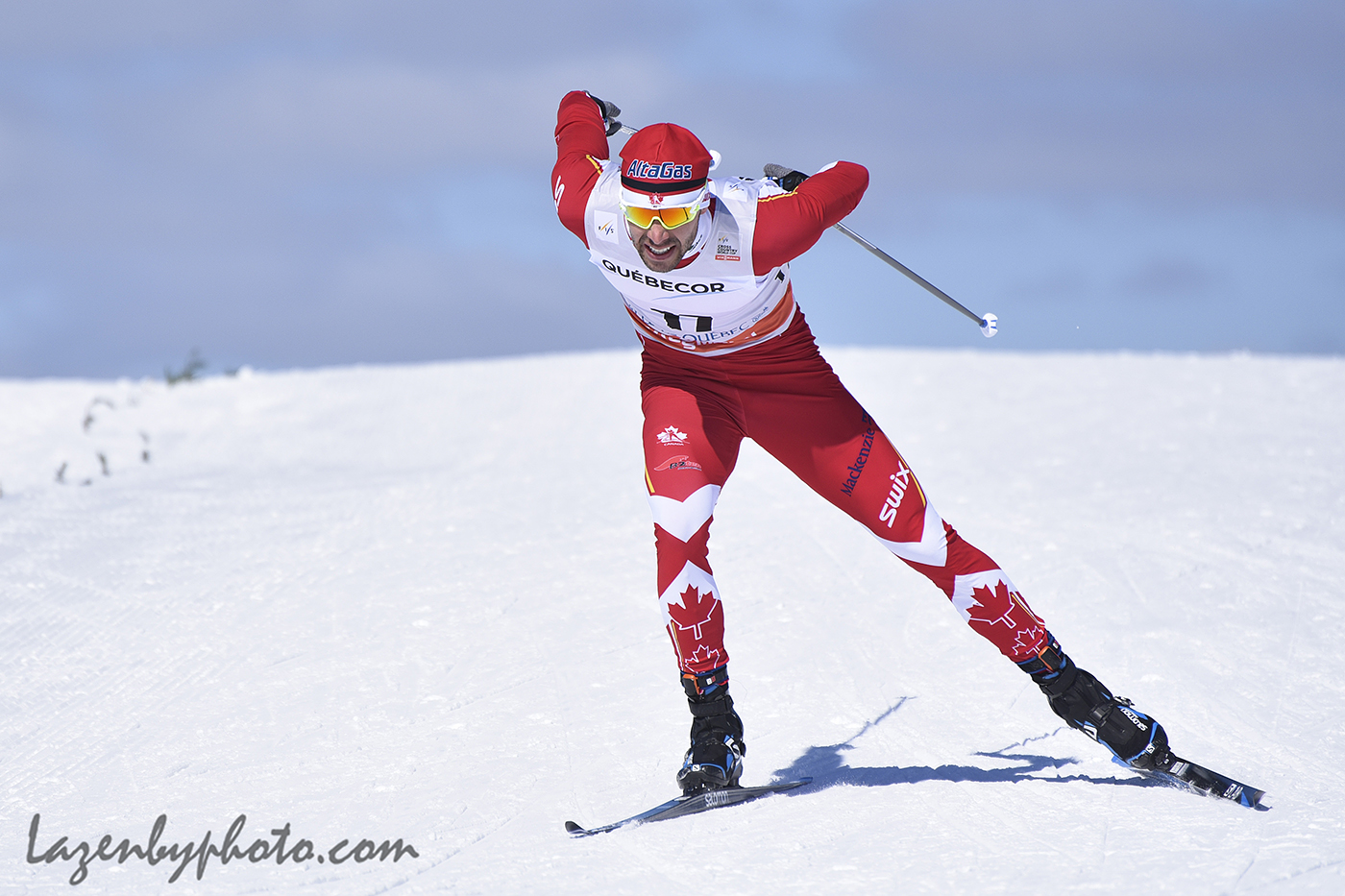
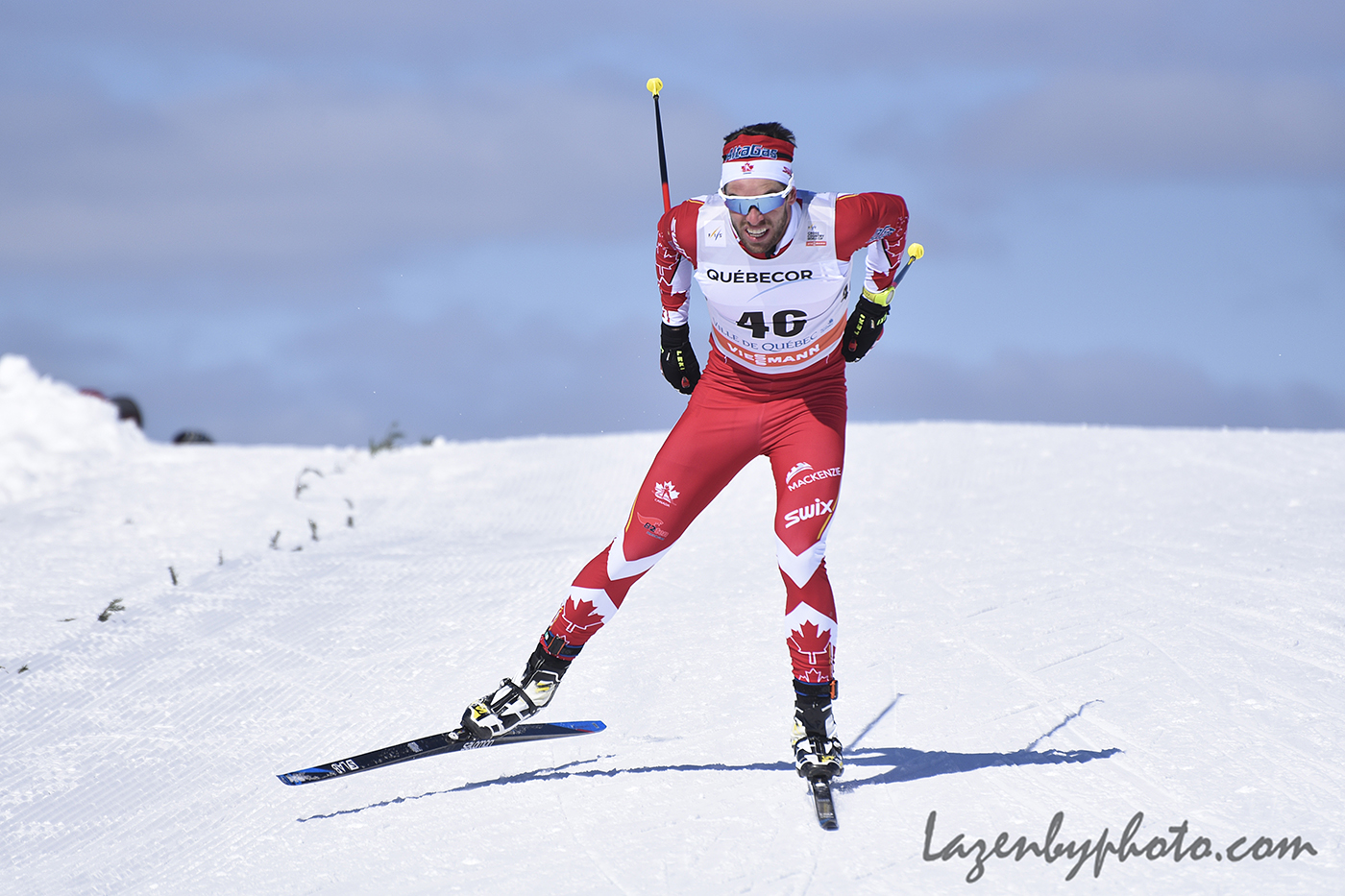
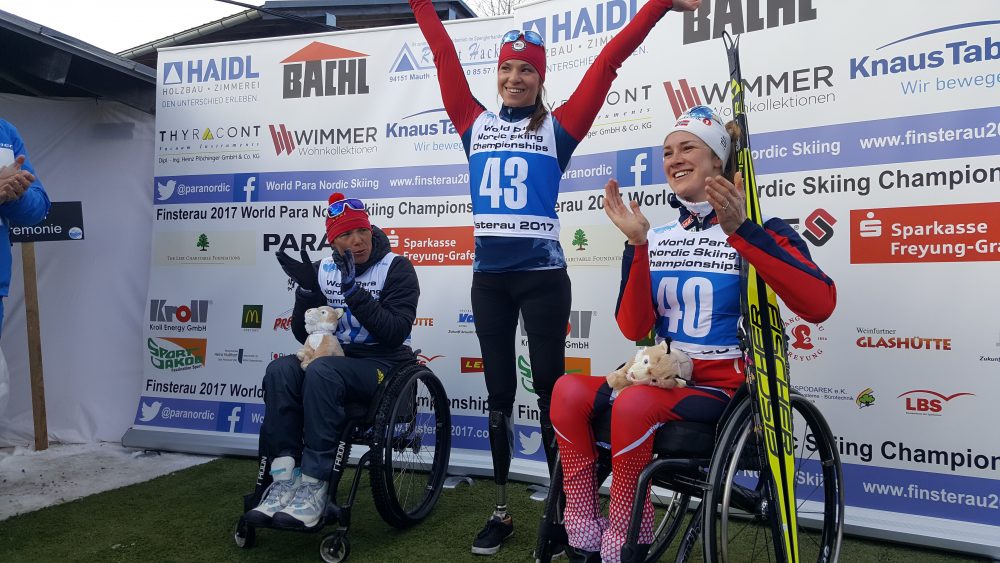
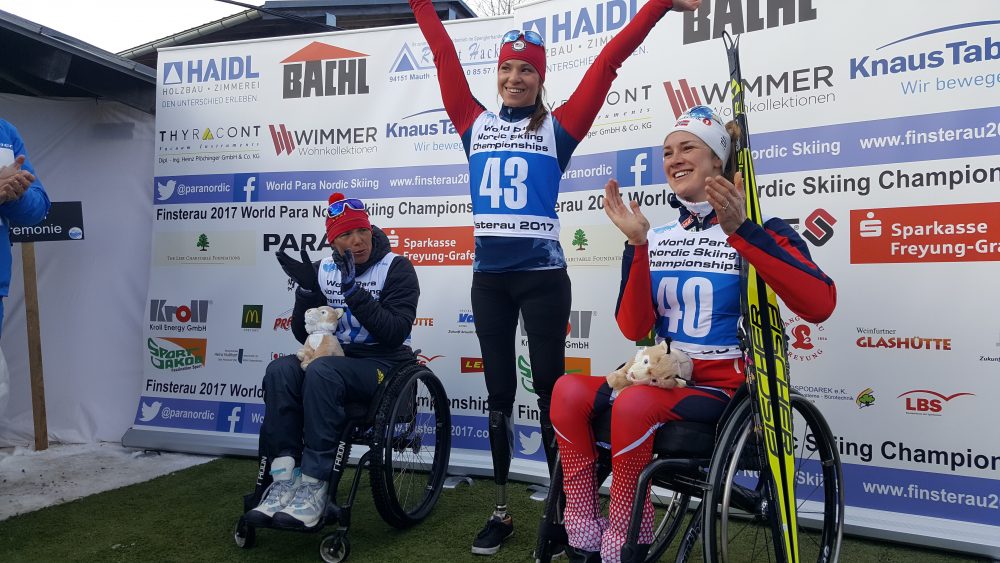
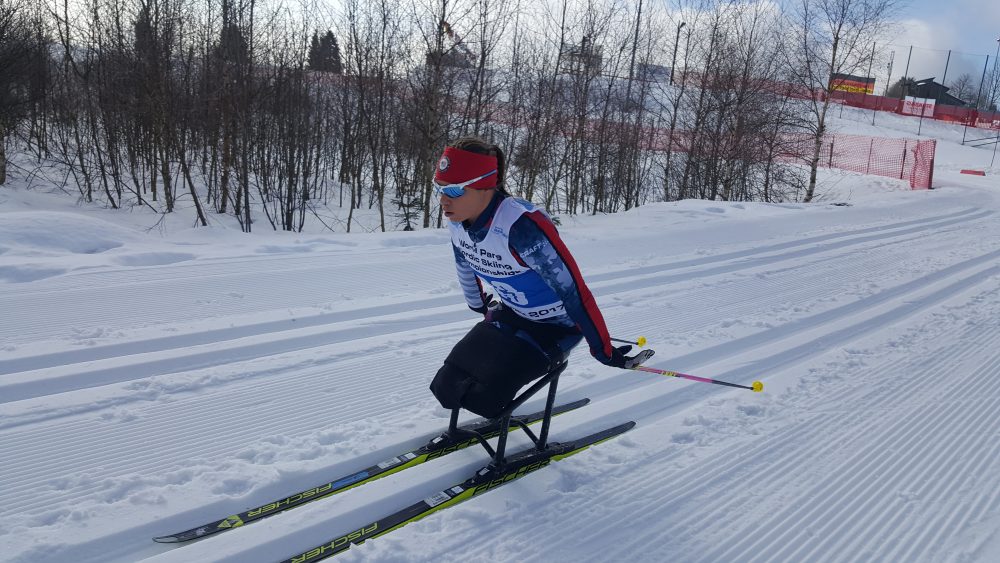
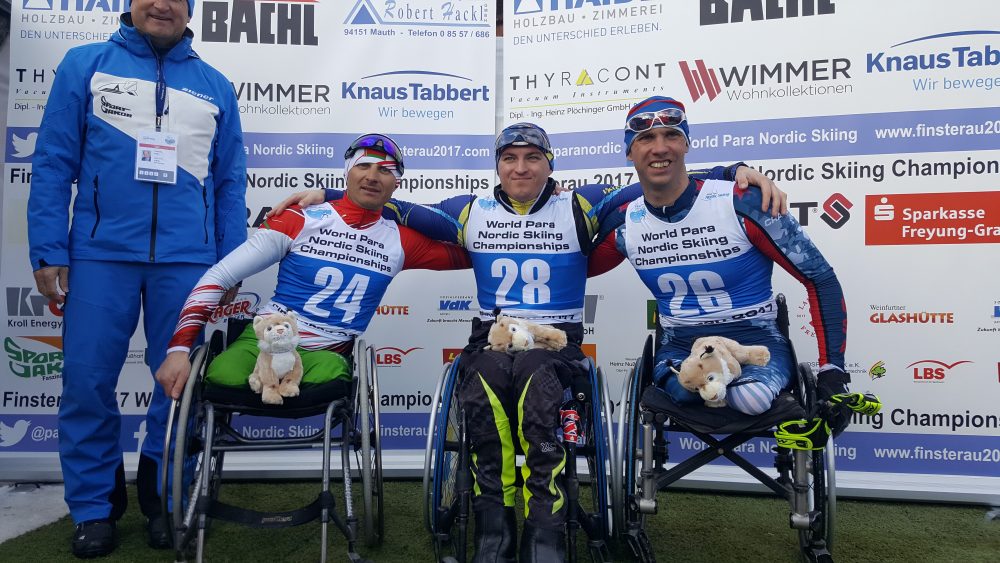
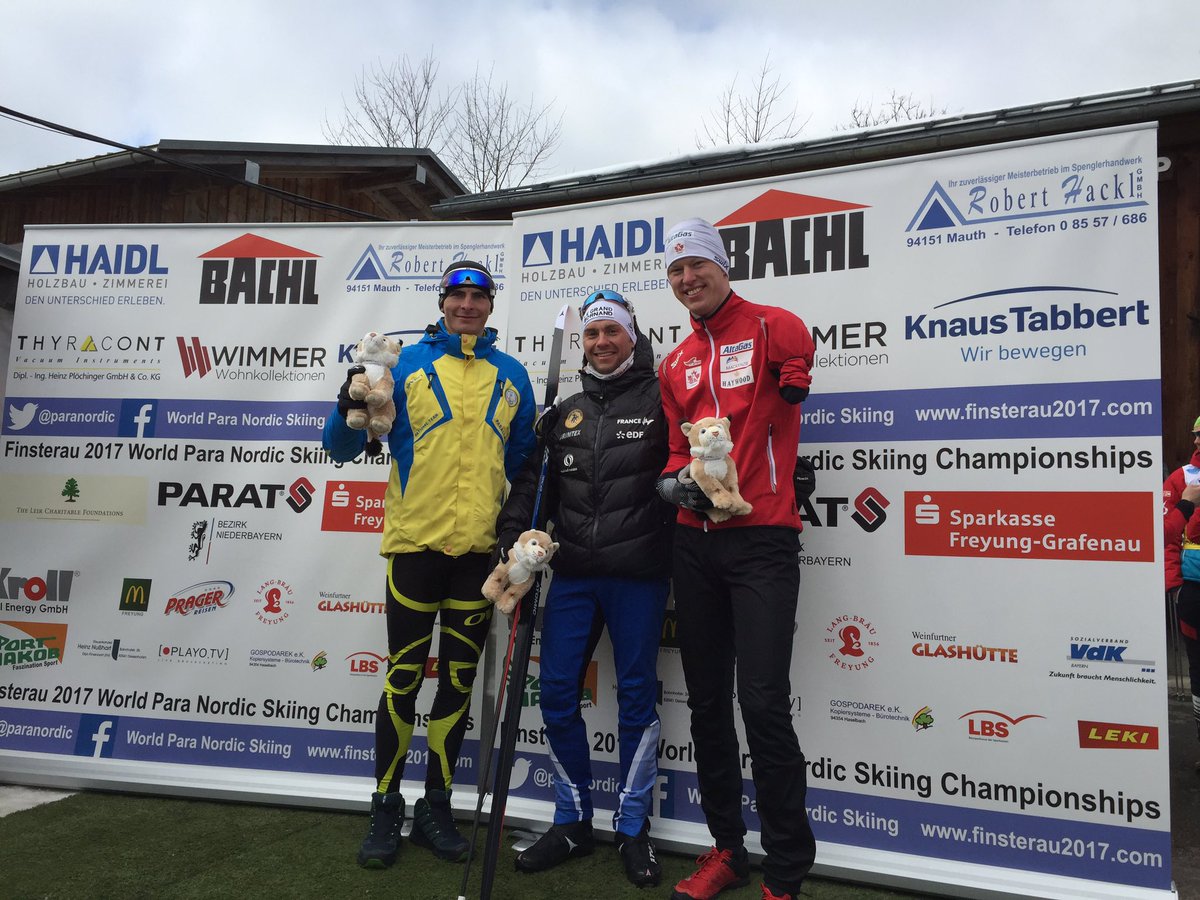
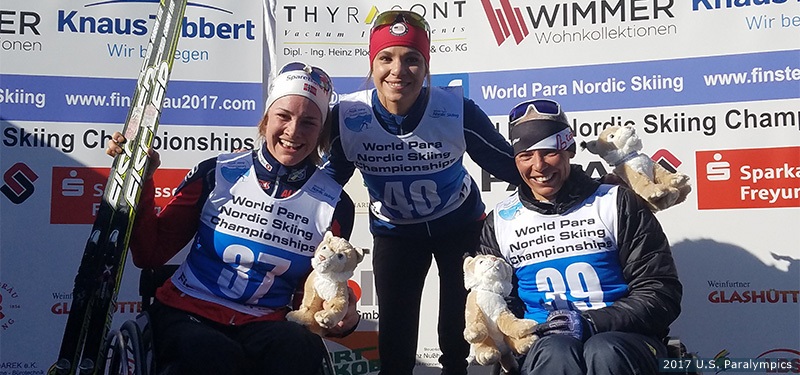
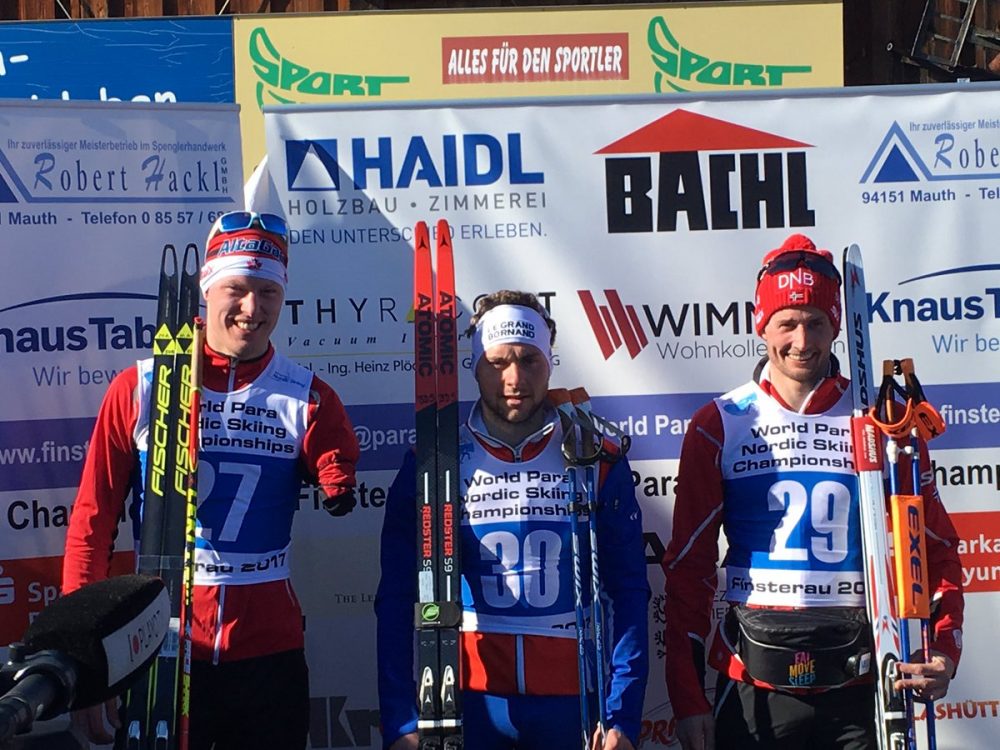
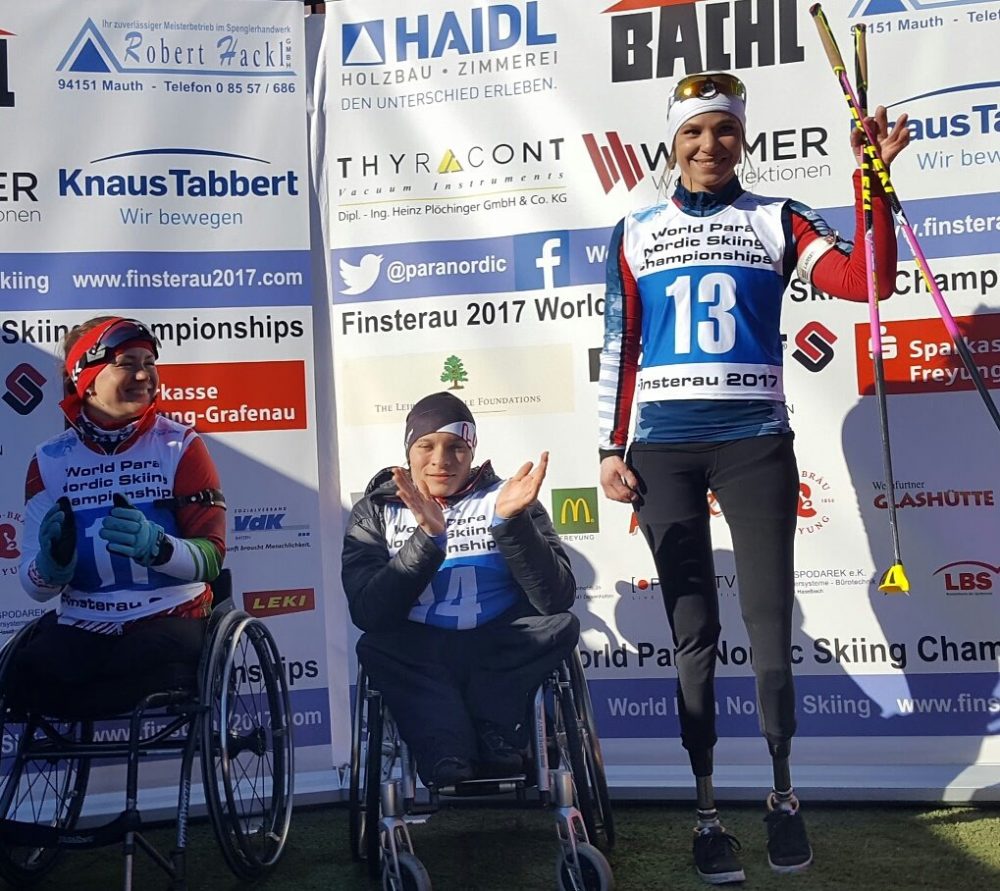
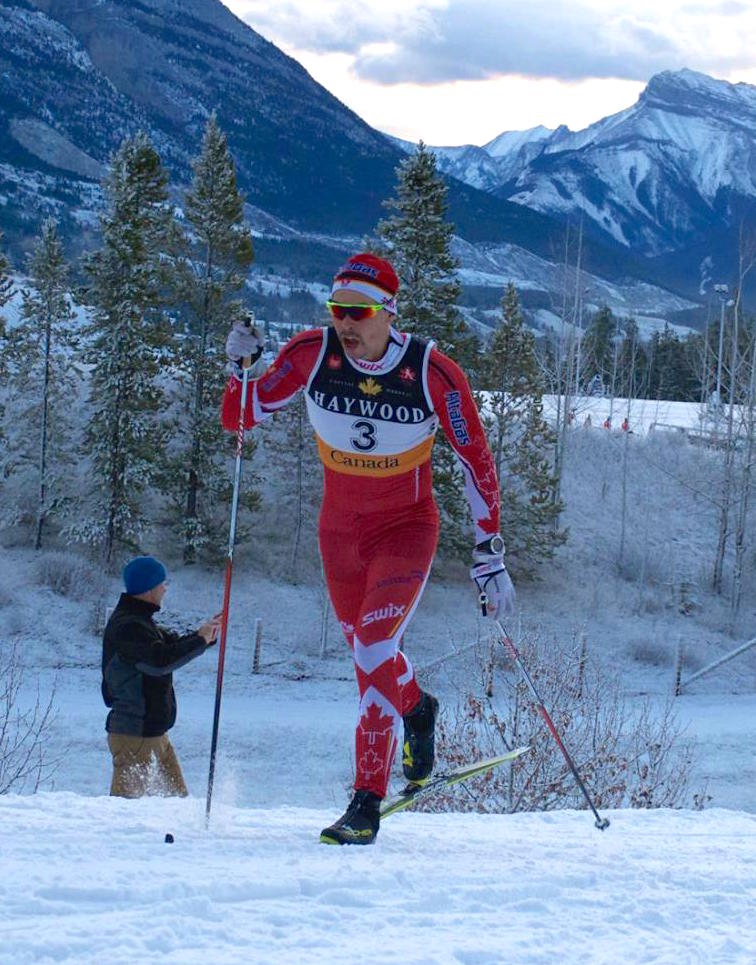
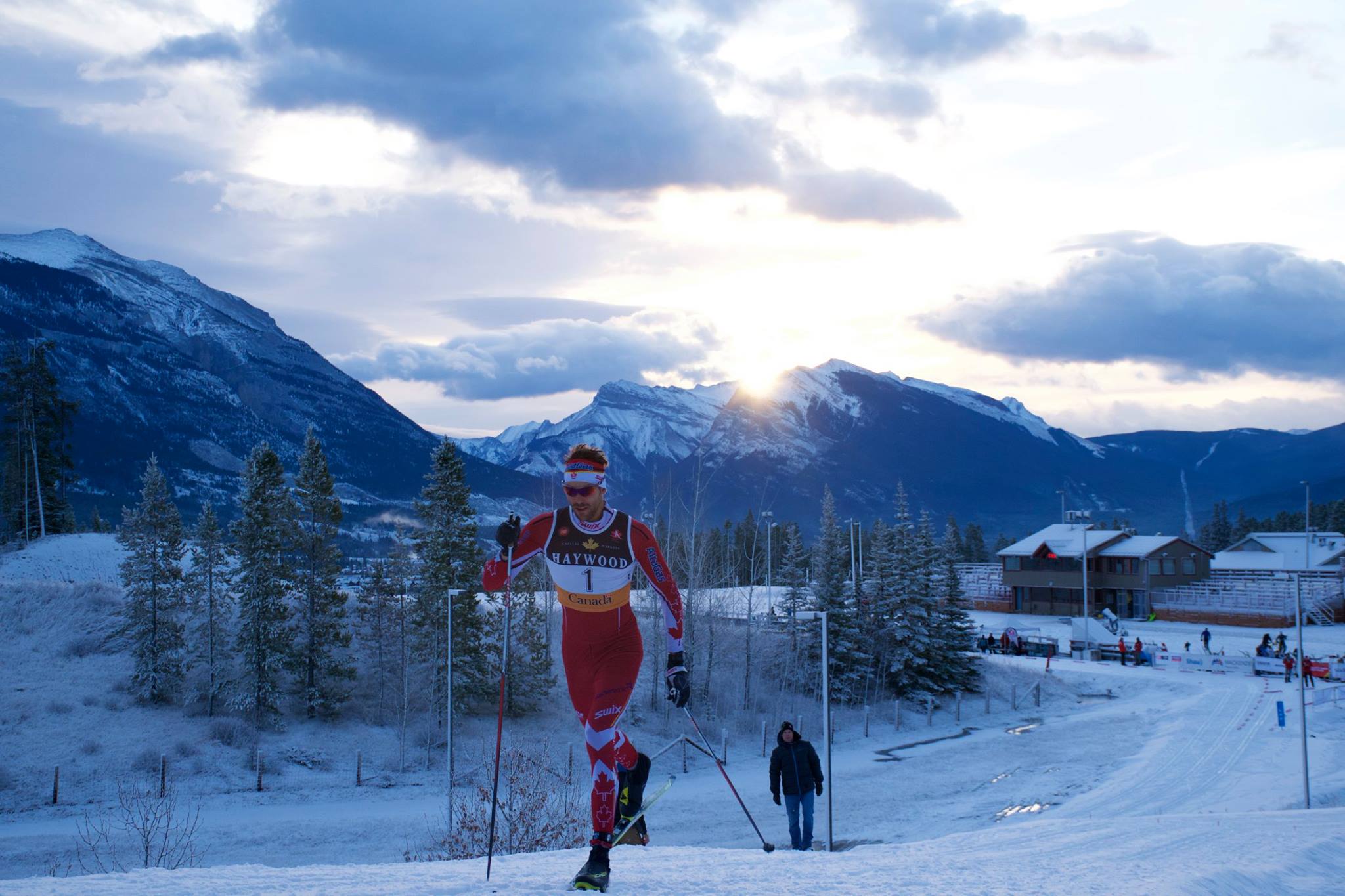
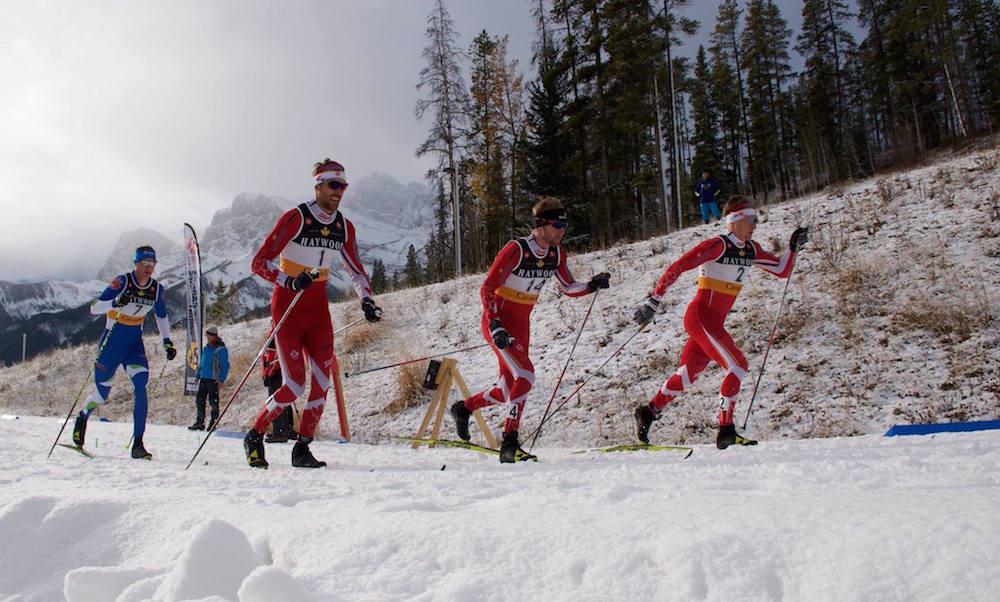
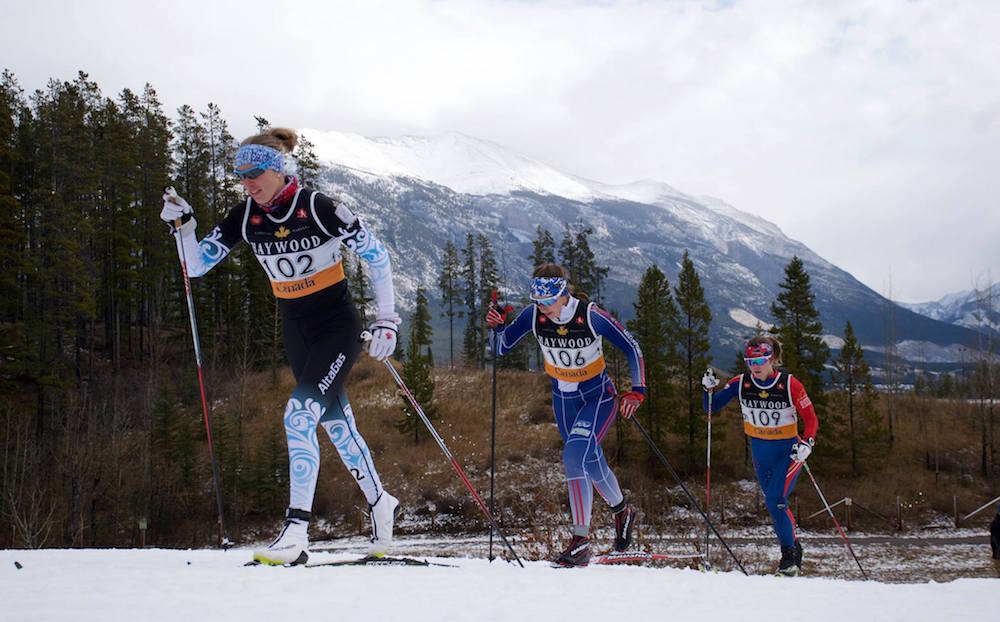
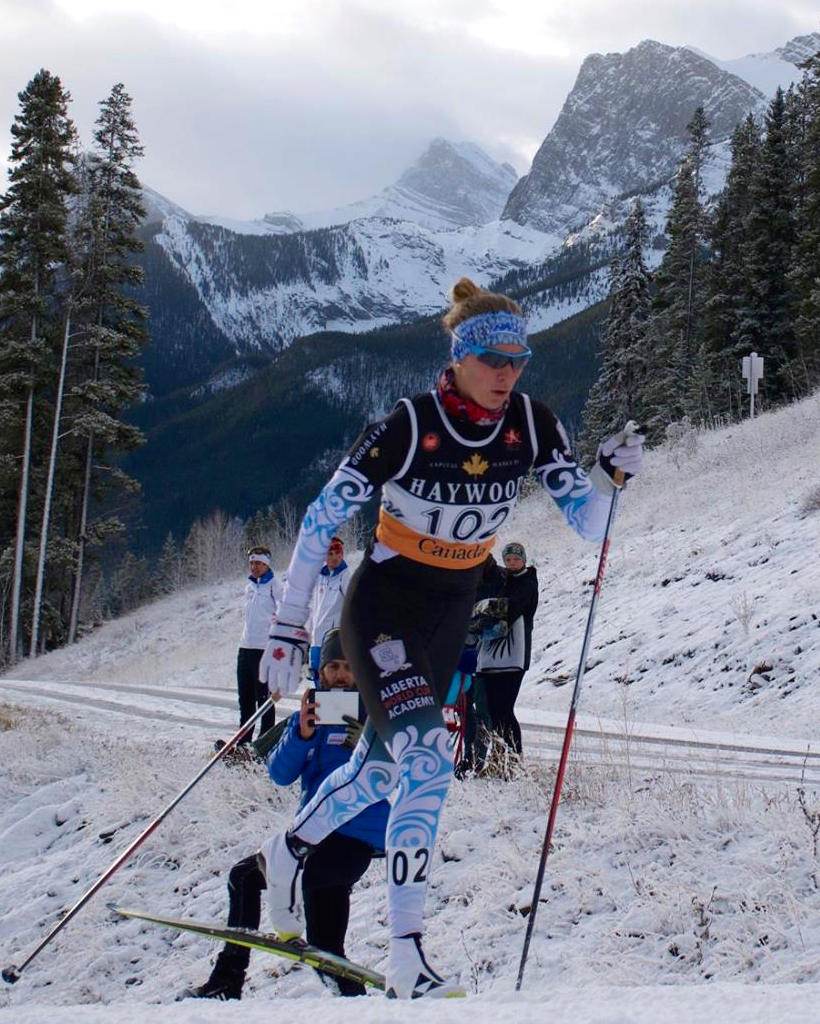
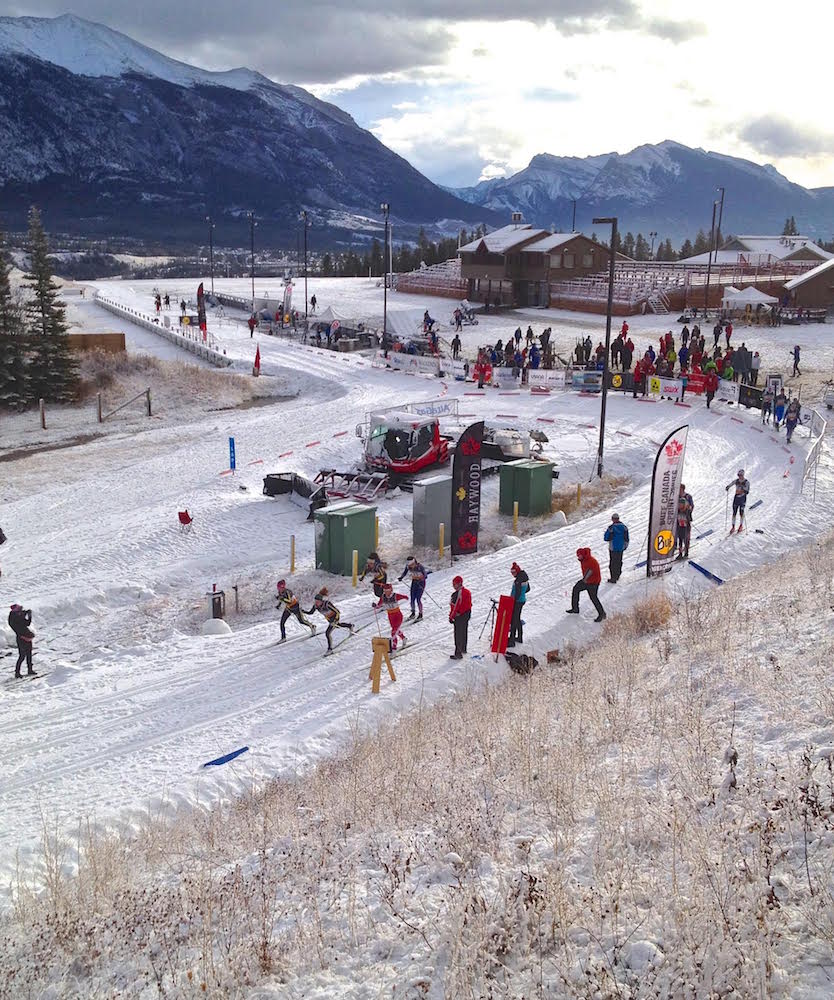
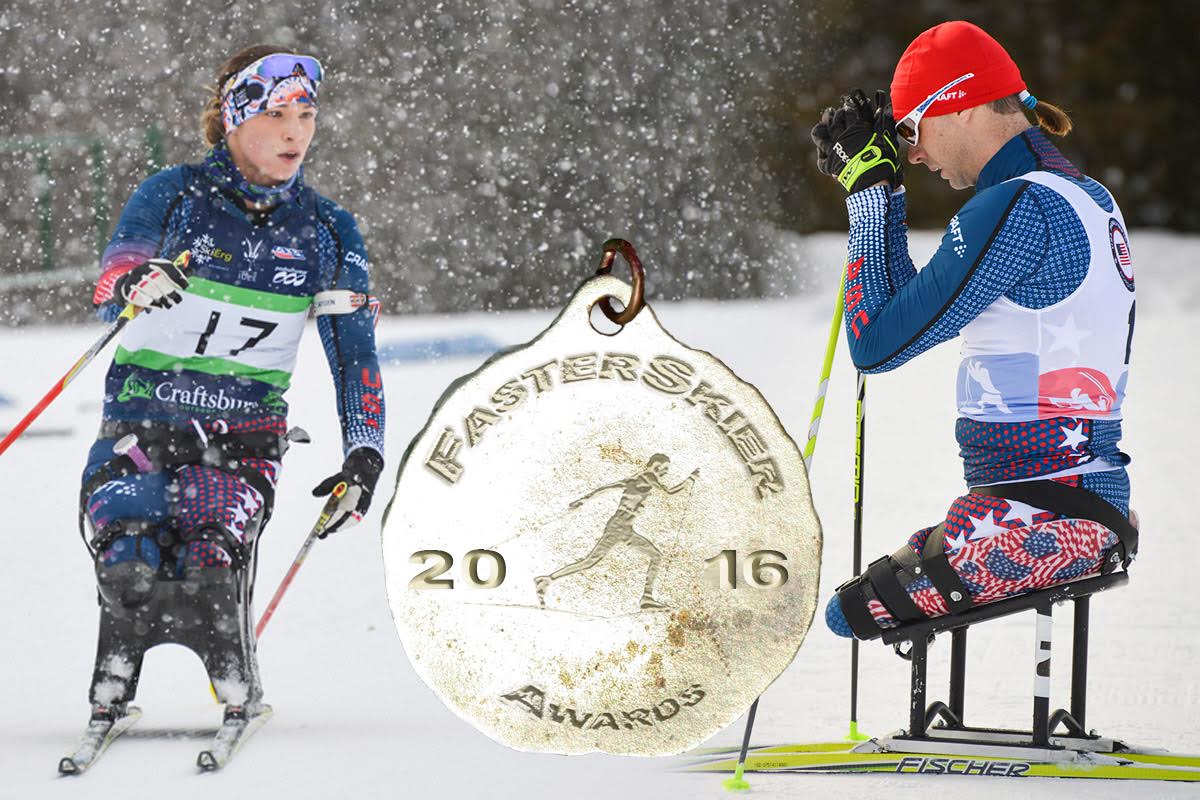
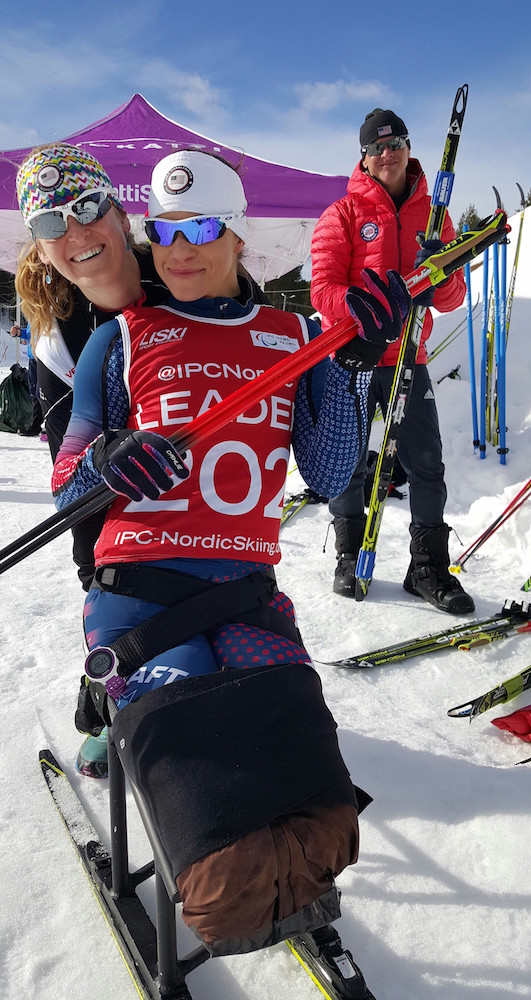
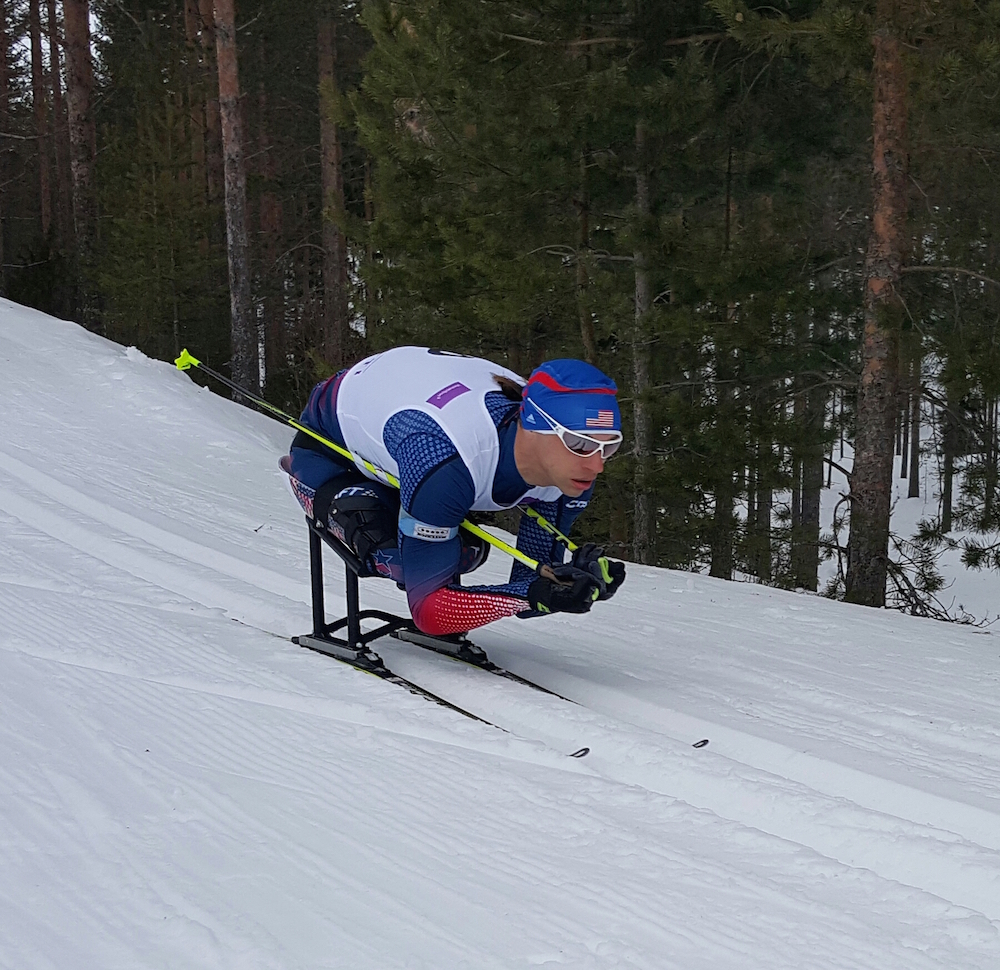
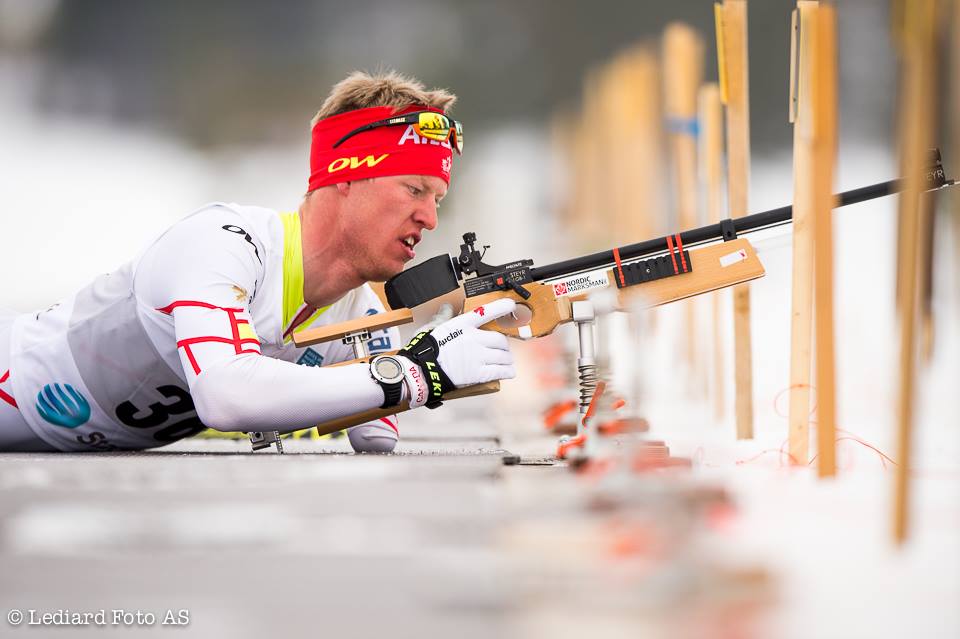
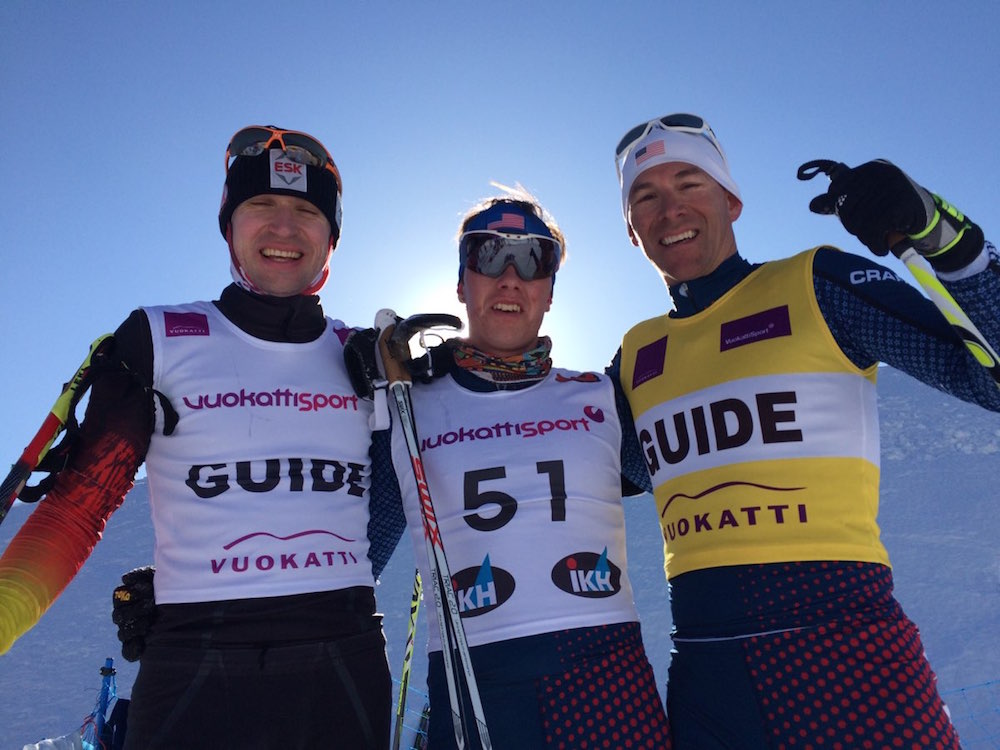
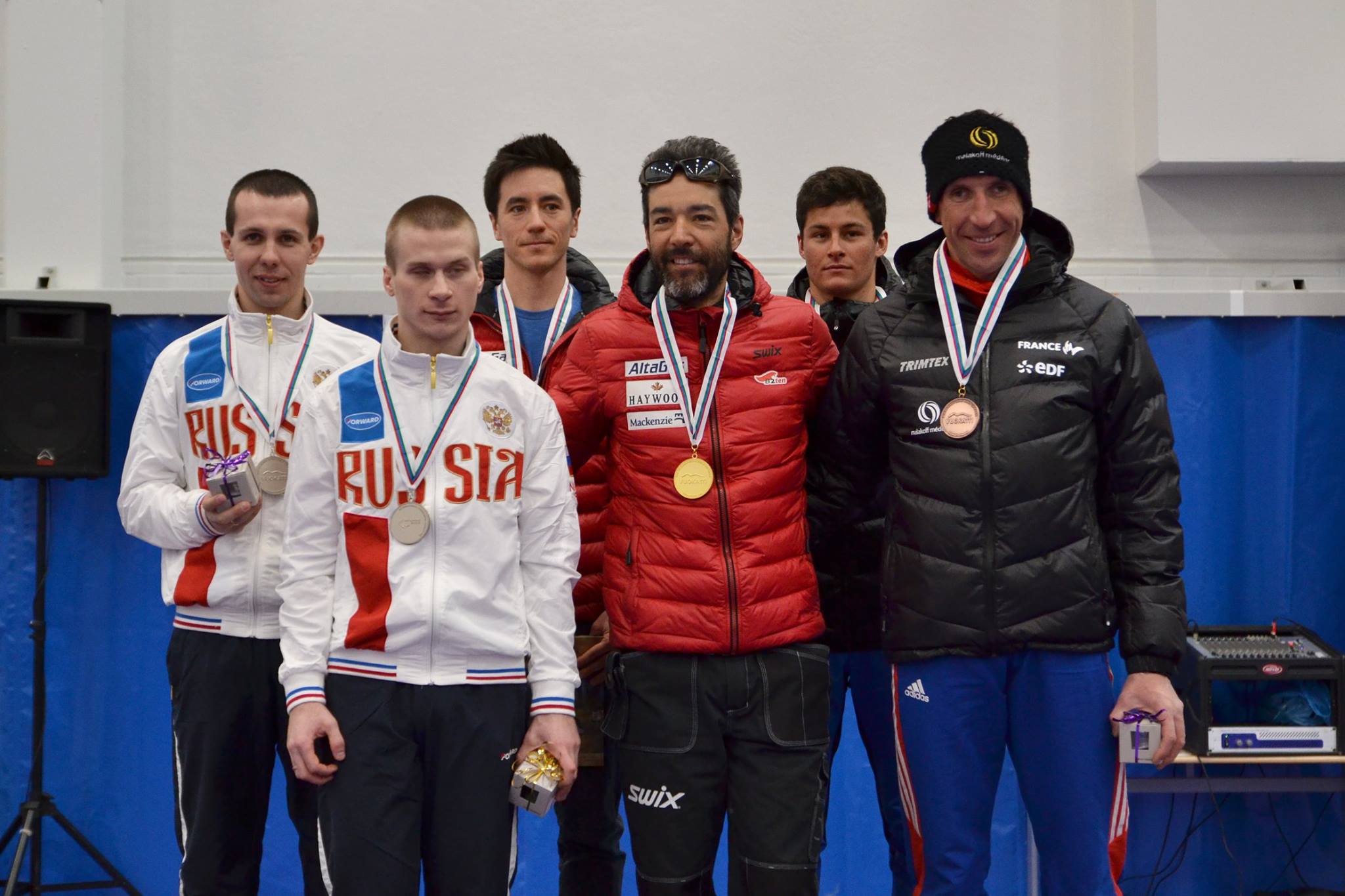
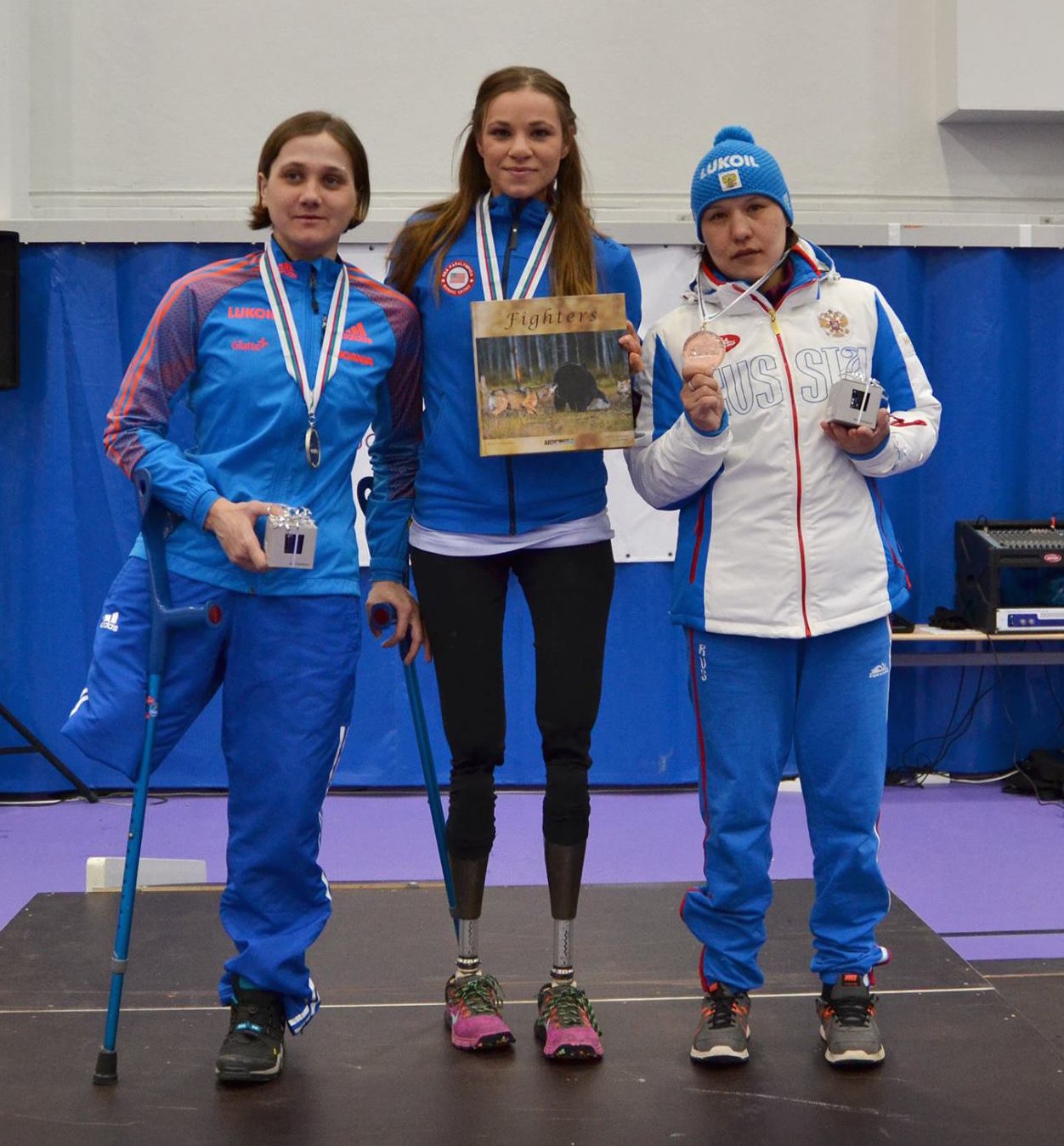
Canada’s Brian McKeever (Photo: Graham Longford) and American Oksana Masters (Photo: USOC) are FasterSkier’s Para-Nordic Skiers of the Year.
With the 2016/2017 season officially in the rearview, FasterSkier is excited to unveil its annual award winners for this past winter. Votes stem from the FS staff, scattered across the U.S., Canada, and Europe, and while not scientific, they are intended to reflect a broader sense of the season in review. This set of honors goes to outstanding Para-Nordic skiers on the IPC World Cup circuit.
Six medals in seven days. Four of them gold. Never before had a U.S. athlete taken home four gold medals from a World Para Nordic Skiing Championships, but U.S. Paralympics Nordic A-team member Oksana Masters changed all that.
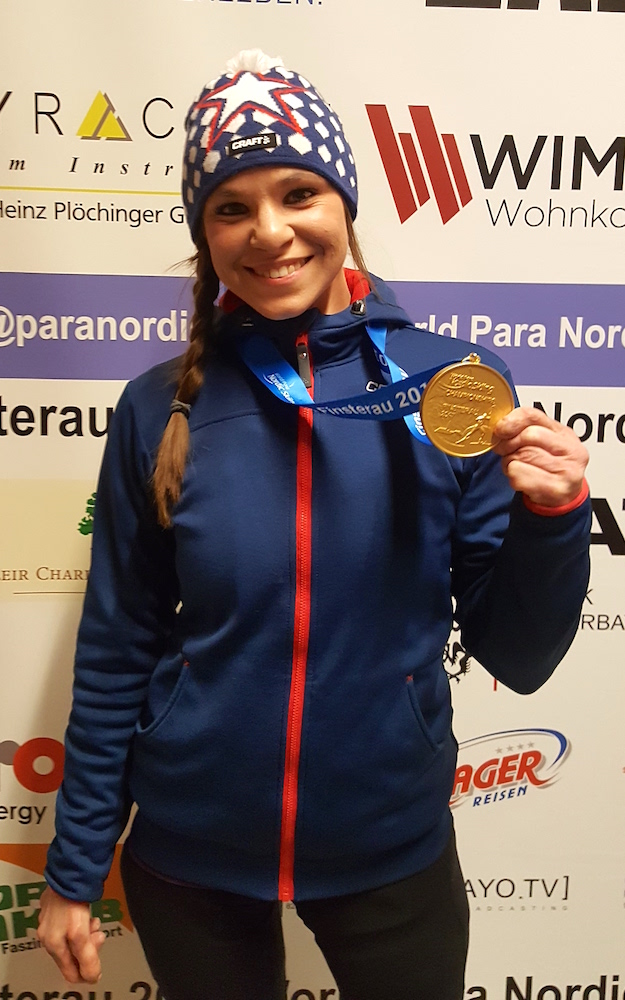
Oksana Masters (U.S. Paralympics Nordic) after winning her first IPC World Championships gold in the women’s cross-country sitting sprint on Sunday, Feb. 12, in Finsterau, Germany. (Photo: John Farra/US Paralympics Nordic)
The 27-year-old sit skier racked up six World Championships medals in Finsterau, Germany, including her second-career biathlon win in the women’s 6 k sprint (her first came earlier this season in the first biathlon race of the year).
“I am completely shocked,” Masters told media outlets after the sprint. “I entered this race with no expectations. I went from not being sure if I was going to be able to race the last two days to winning my first gold medal in biathlon. I’m so excited! I cannot wait to let this all soak in.”
But Masters didn’t just dominate the world champs scene. After ending last season undefeated in every International Paralympic Committee (IPC) World Cup cross-country race she entered, she almost did it again, winning all but one cross-country race this winter (she placed second in the last cross-country race of the season).
“I feel like I had a pretty great season, especially coming off training for a complete other sport that uses a complete opposite motion not too long ago,” Masters said, according to a U.S. Paralympics press release, referring to her handcycling training for the 2016 Summer Olympics.
“I’m really happy with my season and my training,” she added. “I feel extremely hopeful to have to good races in PyeongChang next year.”
Brian McKeever, Canadian Para-Nordic Skiing
At 37, Canada’s Brian McKeever is a team veteran and a world leader in para-nordic skiing. In 2010, he became the first athlete in the world to be named to both Olympic and Paralympic teams. In his three Winter Paralympics, he’s accumulated 13 medals, 10 of them gold.
And this year, after turning his focus to the overseas Ski Classics marathon series, he earned his 18th and 19th IPC World Championships gold, winning both the men’s 10 k and 20 k visually impaired races. Prior to that, he won the season-opening IPC World Cup sprint in Vuokatti, Finland. By the end of the season, he also qualified for and competed in the International Ski Federation (FIS) World Cup Finals in Quebec City, Quebec.
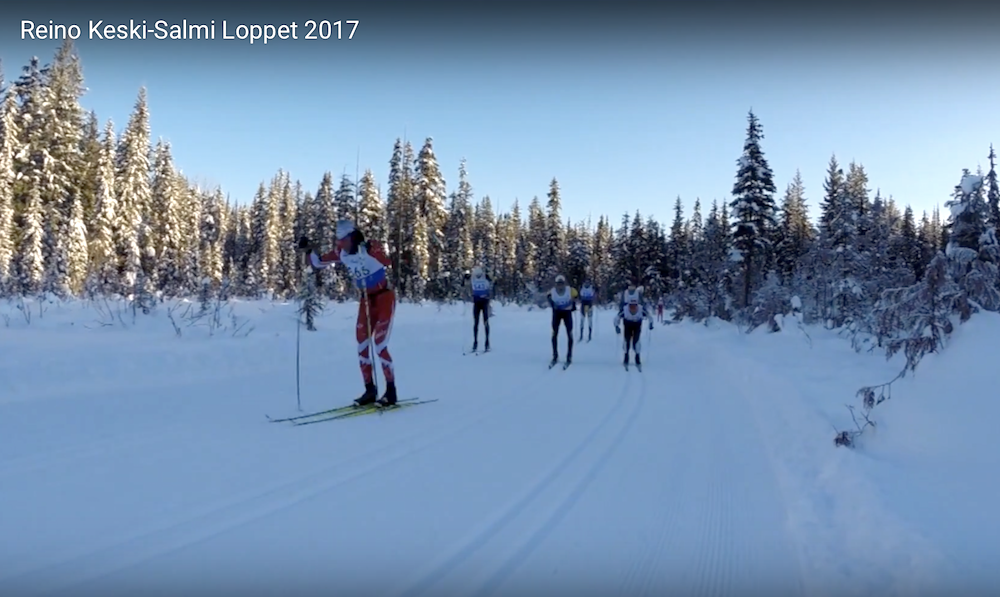
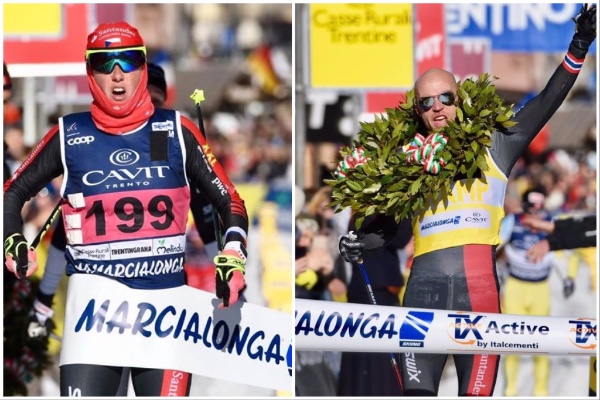
Brian McKeever passing Norway’s Petter Kaarby just before the final climb of the 2017 Marciolonga in Italy. He finished 57th overall. (Photo: Graham Longford)
“I think putting the focus on Ski Classics this year was really interesting. From struggling to hit the top 40 to suddenly to be able to ski with the leaders this year, that was good,” McKeever said after his final race at World Cup Finals.
“I am learning as well in that, and I see the opportunities there with the older guys that are still at the top and that is highly motivating for a guy that is maybe beyond his peak, at least as far as age goes, but I am still having fun and still learning,” he added. “So that is motivating for me, to continually learn something when I am out racing.”
Honorable Mention: Mark Arendz, Canadian Para-Nordic Skiing
Canada’s Mark Arendz, now 27, also opened his World Championships week with a win for his second world title and first podium at a top-level international race (in a non-Paralympic year) in three years after winning the men’s 12.5 k standing biathlon race.
He earned four more world champs medals, including a biathlon sprint gold, a biathlon individual silver, a cross-country bronze, and a relay bronze.
“It has been an incredible season for me, but most noticeably I have brought my shooting back,” Arendz wrote in an email to FasterSkier. “It is now a strength and no longer holding me back. The other huge take away is I now have the confidence in my ski speed to be competitive in any Cross Country race.”
“The highlights from the season for me were World Championships and the 10km Classic in Korea,” Arendz continued. “Worlds were fantastic for me. Five medals from six races; the confidence was there and I was in the best shape of the year. I carried that shape into the test event in Korea. For two out of three laps I was having my best classic race ever. After a little stumble I couldn’t regain my focus, but until then I had the confidence that I could win a Classic race. I will grasp that belief into the training season.”
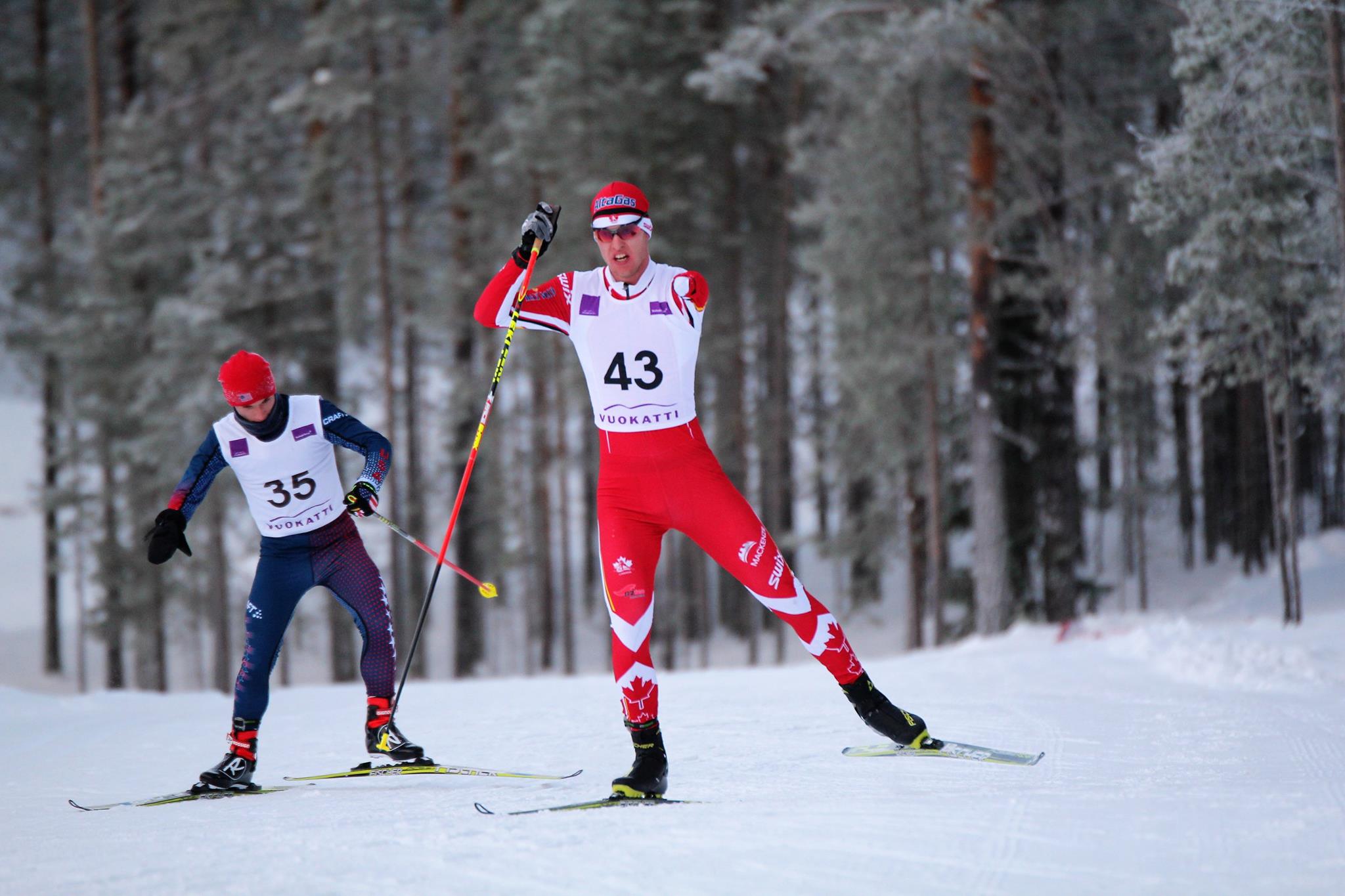
Mark Arendz (43) of the Canadian Para-Nordic Ski Team racing to silver at the IPC World Cup on Dec. 12, in Vuokatti, Finland. (Photo: Canadian Para-Nordic Skiing/Facebook)
Canada’s Alex Harvey with his medals for placing second in the Distance World Cup and third in the Overall World Cup on the last day of World Cup Finals in Quebec City on Sunday, March 19. (Photo: John Lazenby/Lazenbyphoto.com)
After last weekend’s three-day World Cup Finals mini tour drew nearly 60 North American competitors and tens of thousands of spectators to Quebec City, it’s only fitting that we share the quotes from some of the athletes you haven’t heard from yet (and some you have). Here is a collection of some of the most interesting comments from the Canadian World Cup and Nation’s Group skiers at World Cup Finals. There were 30 in total. (Stay tuned for the U.S. notes & quotes version.)
And here are our race reports (with links to results at the bottom of each) from Friday though Sunday, March 17-19:
Canada’s 21-year-old Ricardo Izquierdo-Bernier, of the Pierre Harvey National Training Centre (CNEPH) racing his first World Cup during the men’s freestyle sprint qualifier at World Cup Finals on March 17 in Quebec City. (Photo: John Lazenby/Lazenbyphoto.com)
“I was surprised when I was selected, but I am very happy to be here.” — Ricardo Izquierdo-Bernier (CNEPH)
“I was stressing when they announced that, ‘The national group, maybe you will have the opportunity to qualify for your first World Cup.’ [My coach and I] just kind of put that to the back of our minds and decided that if it happened, it was going to be an incredible icing on the cake part of my race season, and it happened and it was super exciting. I was really just focusing on the process so I am super excited to be here, a little overwhelmed but really excited.” — Annika Richardson (Junior NST/NTDC Thunder Bay)
“I was just happy to be here. Last year I got my concussion in Montreal [during the Ski Tour Canada] so I didn’t actually get to race here so it’s a great place to come and race. I’ve raced here just a couple of times and it’s an incredible feeling to have the crowd behind you. … It’s really great because you don’t get that in Europe. You get lots of fans, but not people who know your name so it’s pretty cool.” — Andrea Dupont (Rocky Mountain Racers)
“I am really really excited to be here. I did the [Ski Tour Canada] last year and this is probably my favourite venue to race at in Canada, being in the city and it’s a beautiful day. Can’t really ask for anything more.” — Annika Hicks (AWCA)
“I didn’t reach my goal of qualifying for the World Championships, but to race at this level this weekend far exceeds all my expectations. I was a forerunner for the Tour of Ski last year, but now I’m actually racing. That makes me really happy!” — Laura Leclair (Junior NST/Chelsea Nordiq)
“It’s the cherry on the sundae. It’s good to go up against the best in the world, and it’s an opportunity to see what you have to work on for the next year, and try your hardest.” — Frédérique Vézina (CNEPH)
On racing in Canada:
“I thought last year was going to be my last chance to race internationally in Canada so I am really thrilled to be here.” — Devon Kershaw (Canadian World Cup Team)
“We are pretty lucky to have the end of the World Cup here in our own house, and it’s really exciting to be able to finish of the season here in Canada and it’s definitely convenient to be able to relax here after we are finished. We have Canadian nationals still, so I guess not complete relaxation … but it’s really fun to be back in Canada.” — Len Valjas (Canadian World Cup Team)
“It’s nice to be back here in Canada racing a World Cup. I think we are pretty lucky to have the opportunity as a group of Canadians, developing skiers, young guys, old guys like me just trying to get up there, but also seeing Alex skiing so well, world champion. I mean, what can you say? It’s awesome. It’s good for our sport right now.” — Brian McKeever (Canadian Para-Nordic Ski Team)
“The atmosphere here is really on par, today especially, with the races we do overseas, and especially being in a city center that we know so well like Quebec, it’s a really good energy.” — Jess Cockney (Canadian World Cup Team), after Saturday’s 15 k classic mass start
“It’s absolute incredible to come back to Quebec after last year and race something that’s familiar to us already, but slightly different because the race course, they change out the race course, which is always exciting. It’s amazing to race in front of Canadians and to have people cheering your name all around the course that actually personally know you, so it’s a pretty incredible experience to come out here and do that. “ — Alannah MacLean (NTDC Thunder Bay)
“It’s been great to finish the season at home. It’s been a really long season, though. I have been overseas way more than I ever have in my life so I think it’s taking a little bit of a toll on the energy, but I am just so excited to be able to race at home here and enjoy this amazing atmosphere.” — Dahria Beatty (National U25 Team/AWCA)
“I was pretty tired after such a long season, and I was really happy to be here and to able to finish the season on such a fun note, to ski a World Cup at home. It’s happened the last two years, but it doesn’t really happen that often, so it’s a unique opportunity. I gave it everything that was left in the tank, and I had a lot of fun.” — Katherine Stewart-Jones (NST U25 Team/NTDC Thunder Bay)
“This is huge for Canada, and I hope FIS can see that it’s really amazing to have races here, and I think the athletes like it, too, so I hope this becomes a staple even after our generation. There’s enough North American skiers that we should have this here every year. We’re winning medals too and Alex is up there in the overall, we deserve to make them travel a little bit. I’d love to see more races here.” — Valjas
On being cheered on by tens of thousands of fans:
“It started in warmup where you kind of would be skiing around and people recognized the National Development team jacket and yell, ‘Go Canada!’ and I was like, OK, just smile and keep going and trying to keep my focus, but it felt incredible to ski around and have everyone cheering for you and rooting for you because you’re Canadian. Definitely had to nail my focus today a bit more than usual because of that, but good practice.” — Richardson
Alex Harvey (Canadian World Cup Team) racing to fourth in the men’s freestyle sprint qualifier on the first day of World Cup Finals, last Friday, March 17, in Quebec City. He went on to win the final. (Photo: John Lazenby/Lazenbyphoto.com)
“Sometimes they’re cheering really loud and you know it’s actually not for you, it’s just the commentator mentioned Alex but then you’re just like, I’ll take it. I’ll pretend they’re cheering for me.” — Valjas
“It’s a beautiful day in Quebec and the crowds are pretty amazing. It just kind of keeps the intensity high the whole time so it’s a fun place to race.” — Dupont, after Sunday’s 10 k freestyle pursuit
“It was another absolutely beautiful day out here, lots of home crowd cheering us on, so it was a really perfect day at the races.” — Knute Johnsgaard (NST U25 Team/AWCA), after Sunday’s 15 k freestyle pursuit
“Today was not the greatest day in my skiing career, however, it was pretty amazing because the crowd was cheering me on the whole way.” — Julien Locke (NST U25 Team/AWCA), after Saturday’s 15 k classic mass start
“It’s funny that people recognize me and know my name. It’s heart warming to have all the public support me and the Canadian team. … It was really an amazing weekend, the atmosphere, the crowd, the conditions, everything was on point. I couldn’t of hoped for a better way to end the season.” — Cendrine Browne (NST U25 Team/CNEPH)
On making the jump to the World Cup:
“It was amazing. The first day it was a lot to take in with the crowd and such a high-level race and having such high-level skiers around, but then Saturday I was more used to it and I was able to really focus on my race and put in a good effort.” — Katie Weaver (Junior NST/Hollyburn)
“You’ve got a lot of fast guys, and you’re kind of going from being one of the faster guys to obviously to one of the slowest guys around, and that’s a cool feeling, actually.” — Gareth Williams (Junior NST/Telemark)
“It’s always intimidating, but once you’re on the starting line, it’s mostly exciting. I’m not expecting to lead the pack anytime soon, so all I can do is try giving my max effort.” — Sophie Carrier-Laforte (CNEPH)
“This was my first. I qualified for a couple in the winter but because of U23 [World Championships] I wasn’t able to take advantage of it.” — Evan Palmer-Charrette (NTDC Thunder Bay)
“This was my fifth [World Cup race]. I still feel like there’s a lot of work I can do to be more competitive in this field, but I think I’m getting more and more comfortable with it in general.” — Sadie White (NTDC Thunder Bay)
“I don’t think I’m at this level of competition yet, but I think it’s so fun to be here and see how the fastest people in the world race.” — Mia Serratore (NTDC Thunder Bay), at the end of her first World Cup weekend
“I mean, they’re so fast out there, but I love it because I get to see what level I need to get to. Racing in Quebec, it’s so fun. The crowd’s just crazy. It’s so good.” — Joey Foster (Team Hardwood), at the end of his first World Cup weekend
Russell Kennedy (Canmore Nordic/Team R.A.D.) racing to 36th in the men’s skate sprint qualifier at World Cup Finals in Quebec City on March 17. (Photo: John Lazenby/Lazenbyphoto.com)
On five Canadian men qualifying for the sprint heats in the top 30 (a first for Canada in a World Cup):
“I am really pumped for everyone and I think it’s really good for the sport to see that many people up there. We have been sprinting really well in a lot of races and have a lot of good sprinters so it’s good to see everyone get up there and do well. Hopefully they can carry it out in the heats and get a couple of those closer to the podiums.” — Russell Kennedy (Canmore Nordic/Team R.A.D.)
On sprinting:
“It’s about 89.5 k too short for me these days.” — Brian McKeever (Canadian Para-Nordic Ski Team), who also specializes in marathons
On conditions:
“The snow is perfect conditions. The snow is cold, but the sun is warm, and the track is holding up great, so good Canadian conditions.” — Beatty, after Friday’s sprint
“I guess it’s pretty tricky to get grip with hard wax in this stuff, and I think klister would’ve been too slow so I had a lot of speed on my skis but my grip was definitely lacking a bit in the sun. In the shade it was pretty good, but it was a lot of upper body today, which I think was the way to go anyways.” — Andy Shields (Lappe Nordic), after Saturday’s 15 k classic mass start
“The skis showed good grip. The technicians delivered today. The issue was more the skier!” — Carrier-Laforte, after Saturday’s 10 k classic mass start
“The snow was fine. It didn’t really even get that mushy on the course and the downhills were pretty glazed actually. It stayed nice and firm. My skis were just amazing today. I was drafting people and shooting by them no problem. It was really good, really competitive skis.” — Foster, after Sunday’s 15 k freestyle pursuit
On the course:
“It’s tough because there’s a lot of flats, so you’re always working, whether it’s gradually downhill or gradually uphill. It’s good. It’s a challenging course in its own way. It’s not your typical World Cup where you have a huge climb and then a big rest after that, you’re just working stead, so it hurts. It’s a different kind of tough.” — Valjas
On sunscreen:
“Today is the first day that warranted the sunscreen, but I put the zinc on every day. Gotta protect yourself.” — Cockney
On goals for World Cup Finals:
“My goals were just to ski relaxed and push my body as hard as I can. I’ve really been injured this entire season so I haven’t done really that much racing at all. I was able to get enough racing in to qualify for this World Cup, which was something that I didn’t think was going to be possible at the beginning fo the season when I got injured, but to be here and not be 100 percent, but to be able to race in this environment is something that keeps me in the sport.” — MacLean (who herniated a disk)
“I really want to push as hard as I can for each race. I think that is something that sometimes it is difficult to do in Canada on the NorAm circuit because maybe if you’re not having a good race, you could pull back a little bit and save yourself for the next day and come in seventh instead of fifth, but here, I will still probably be in the back of the field, but I really want to push and feel good every time I cross the finish line that I gave it my all and kept pushing.” –– Richardson
Cendrine Browne, of the Canadian U25 Team and CNEPH, after finishing 41st in the women’s 10 k classic mass start on Saturday at World Cup Finals in Québec City. (Photo: John Lazenby/Lazenbyphoto.com)
On digging deep:
“Somehow I found a bit of fight. I didn’t really do much of a warmup today. I opted for a conserving energy strategy and I think it worked well. We’ve done so much racing that my body didn’t really need a warmup to get going so I did as little as possible before the racing to save everything I had for this last effort.” — Beatty
“It’s been a lot of racing this week. I was down in Lake Placid doing U.S. Junior Nationals and then I came here and now we’re off to Canadian Nationals for another three races. It’ll be a lot of racing, but that’s what I love to do.” — Weaver
“[After] yesterday’s race, I wasn’t going to start today and then the physio said, ‘If I’m treating you, you’re going to start.’ And I was like, ‘OK, Let’s do this!’ And she actually fixed me and today was much better.” — Valjas, on his upper-back injury, after Sunday’s 15 k freestyle pursuit
“I felt really really good, but I’m just having so many problems with my shins and my calves this season so it just makes it really difficult to ski properly.” — Serratore
On Quebec City:
“Quebec City, as far as Canada goes, is probably the closest thing to Europe, but it’s still the same country, same food.” — Palmer-Charrette
On their season overall:
Devon Kershaw leads Canadian teammate Graeme Killick in the men’s 15 k classic mass start at World Cup Finals on March 18 in Quebec City. (Photo: John Lazenby/Lazenbyphoto.com)
“It has been a really good season. It has been my most consistent season to date, so I have been really happy with it, have had some really good races and I just think especially in sprinting, my bad races are way better than they have been in the past. The fluctuation is smaller so I am showing good signs for next year.” — Beatty
“I think the season for me was a little disappointing. I had some signs of the training paying off, but I think overall I might have overdone it through the summer in sections and from that I struggled with some sickness through a lot of the season. I think some races were OK for me and I’ll take that and try to fix some things for next year over the summer and see what I can do. I mean, today was a good reminder that skate is not there and I really need to work on it for next year.” — Graeme Killick (Canadian World Cup Team), after 15 k skate pursuit
On season highlights:
“It’s got to be those two relay medals, especially the 4 x 7.5 k, that was so cool because my whole career we’ve tried to get a medal there and I was honored to be the anchor and that was a huge moment in my career to be able to pull that off and secure a medal for the men’s relay was just awesome. And of course, the first win for me with Alex was also just as special. It’s been a good year. Lots of highs, some lows, and I’m ready for next year.” — Valjas, on historic third-place finish with men’s relay at World Cup in Ulricehamn, Sweden, and World Cup freestyle team sprint win with teammate Alex Harvey in Toblach, Italy
Emily Nishikawa (Canadian World Cup Team) racing to 38th on the final day of 2017 World Cup Finals on Sunday in Quebec City, the women’s 10 k freestyle pursuit. (Photo: John Lazenby/Lazenbyphoto.com)
“I think the relay in Lahti for us, it was one of our best women’s results since 2001 or something like that, so 16 years.” — Emily Nishikawa (Canadian World Cup Team), on the Canadian women’s team’s 10th place in the 4 x 5 k relay at 2017 Nordic World Championships
“For me, it would be Davos. I was really happy with my form there, and I think I never felt that good in a skate race. I like altitude, too, so that course kind of suits me. That was my best individual start ever so it’s good to have one of those. I was really happy with that day.” — Killick, referring to his 21st place in the World Cup 30 k freestyle individual start on Dec. 10 in Davos, Switzerland
“That’s hard to call. Probably the highlight of my season was my 26th was La Clusaz, getting my first distance top 30. That was something I wasn’t really sure I’d be able to bridge this season and to be able to ski into the top 30 in distance as well as sprint this year wasp pretty amazing so that was a big step for me forward in coming years.” — Beatty, on her 26th place in the World Cup 10 k freestyle mass start on Dec. 17 in La Clusaz, France
“Maybe this, watching Harv do well. The Holmenkollen was an amazing experience. It was hard and not my best finish ever, but it was a really, really cool experience and I can’t say enough how awesome it was.” — Kennedy, who placed 47th in the 50 k classic mass start at Holmenkollen in Oslo, Norway, on March 11
On the upcoming training season:
“I’m pretty relieved that this season’s over and really excited to kind of get a fresh start on next year and just take some time to reflect on this past season and look at the things that went well and things that I could improve on and hopefully use those as building blocks for next year’s training.” — Johnsgaard
“This summer, I’ll put in practice what I learned from my World cup experience. I’ll really focus on technique and work on my tempo. The only way to improve is to keep racing against the best.” — Browne
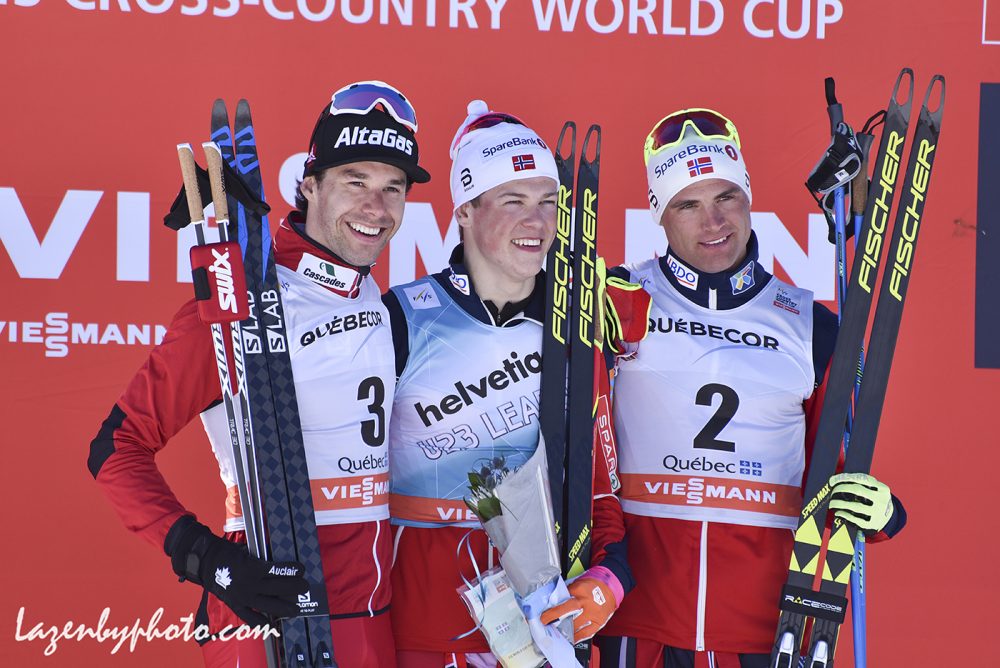
Left to right: Canada’s Alex Harvey alongside Norwegians Johannes Høsflot Klæbo and Niklas Dyrhaug on the men’s 15 k freestyle pursuit podium at World Cup Finals on Sunday in Quebec City. (Photo: John Lazenby/Lazenbyphoto.com)
Canada’s Alex Harvey has had one heck of a season.
In January, he reached the top of a World Cup podium for the first time in three years. The following weekend, he helped Canada to its first-ever relay podium and two weeks before that, won the men’s team sprint in Toblach, Italy, with his teammate Len Valjas. A little more than a month later, he earned his first individual World Championships gold.
The 28-year-old Harvey kept the ball rolling through the World Cup Finals in Quebec City this past Friday, winning the opening freestyle sprint before a roaring home crowd. The next day, he placed fourth in the 15-kilometer classic mass start.
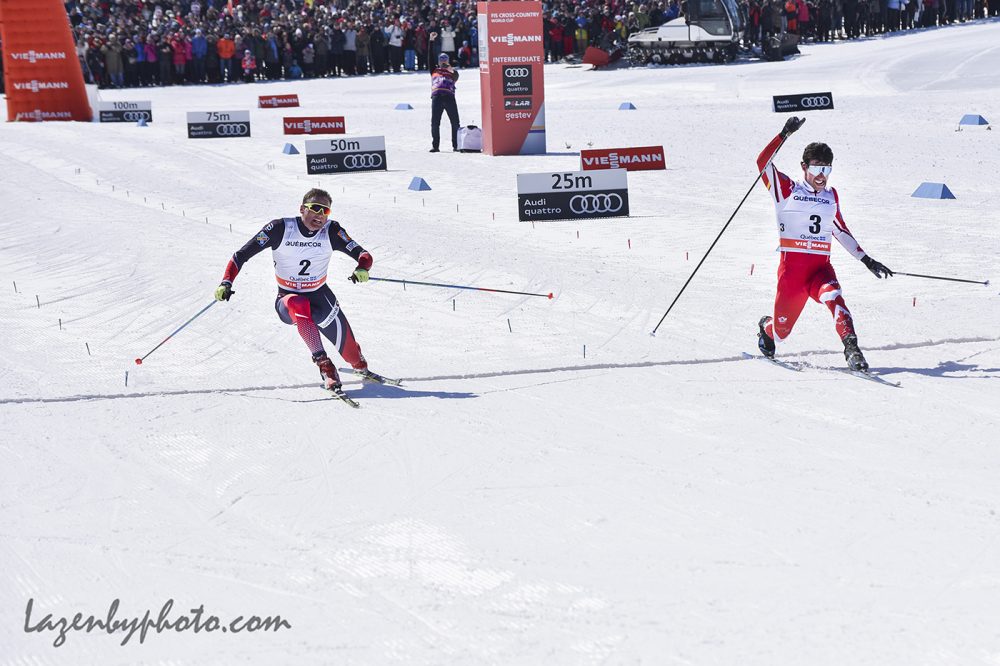
To top it all off, he finished second in Sunday’s 15 k pursuit — less than one-hundredth of a second short of first after a photo finish with Norway’s Johannes Høsflot Klæbo — to secure not only another World Cup podium, but also third in the Overall World Cup standings and second in the Distance World Cup.
Norwegian Johannes Høsflot Klæbo leading the men’s 15 k freestyle pursuit at World Cup Finals on Sunday in Quebec City. (Photo: John Lazenby/Lazenbyphoto.com)
“It went more than perfectly,” Harvey said of his season to a group of reporters in French. “A gold at the Worlds, some World Cup victories, a second place overall all makes this by far the best season in my career.”
Harvey started the pursuit in third, 23 seconds behind the first starter, Klæbo, and one second behind another Norwegian, Niklas Dyrhaug. Though Harvey managed to catch Dyrhaug just before the 2 k mark, he admitted his real worry was not ahead of him, but behind. Norway’s Finn Hågen Krogh started 9 seconds after Harvey, and a kilometer after Harvey found Dyrhaug, Krogh was skiing three seconds behind.
“I didn’t know whether Finn Hågen would come back, which could of change entirely how the race played out, since he and Klæbo are sprint specialists,” Harvey said. “They could of worked together and bump me to fourth position, but I was glad the pace I was imposing in the beginning was enough for a spot on the podium.”
However, Harvey’s pace proved too fast for Krogh, who gave up the chase after the first lap at 3.75 k and let the chase group catch him on the first climb out of the stadium.
“I just blew up, so when there was no podium to race for, that was my only goal today,” Krogh told FasterSkier of his in-it-to-win-it mentality.
But more than let the chase pack absorb him, he skied the rest of the race just to finish and ended up 70th out of 73, and last place for time of day.
“I was tired at the end today,” he said. “I had a tough day. No power left today.”
Meanwhile, by 5 k, Harvey had pulled himself and Dyrhaug all the way up to Klæbo.
“From the start, I was closing on Klæbo, and I knew early on that a podium was in reach,” Harvey explained. “It’s a rare feeling of excitement to have during a race. Usually, only the last hundred metres will tell the story. After a lap and a half, when I realized Finn Hågen was dropped, I knew the podium was mine.”
That place on the podium, however, remained to be determined. With the Canadian doing all of the pulling up to Klæbo, he’d have to dig deep to find the speed for a sprint to the finish.
“I had my tactic, Johannes had his tactic, and I think Alex had his tactic,” Dyrhaug told FasterSkier. “It was a fair race, the only thing was, I couldn’t help Alex catch Johannes, that was Alex’s job as a Canadian. If I had gone on the front to help Alex catch Johannes, I would get in a lot of trouble with the Norwegian staff, but Alex was strong, and we caught up.”
Canada’s Alex Harvey leads Norwegian Niklas Dyrhaug during the men’s 15 k freestyle pursuit at World Cup Finals on Sunday in Quebec City. (Photo: John Lazenby/Lazenbyphoto.com)
The catch, from Klæbo’s perspective, was not unexpected. Realizing that the two had already put close to ten seconds into him by the 2 k mark and showed no signs of slowing down, Klæbo changed tactics.
“My first plan was to go from the start, but after Lap 1, I knew [Harvey and Dyrhaug] were coming pretty fast so I just had to focus on waiting for them and holding on to them,” Klæbo said.
With Klæbo now part of their train, the three began to take turns up front, Harvey going first, followed by Dyrhaug and Harvey again. The trio were met by no other competitors –only a loose dog as they headed into their fourth and final lap.
“I was looking towards the crowd for someone to pick him up.” Harvey said. “We all saw him. I think we were just hoping not to come across him in the final sprint.”
— NBC Olympics & Paralympics (@NBCOlympics) March 20, 2017
Luckily, the canine caused no problems for the racers and they all remained together during the final lap. At the top of a long descent into and out of the stadium, about a kilometer or so before the finish, all three racers suddenly backed off the pace and stood up. No one wanted to lead.
“Nobody wanted to stay first on the downhill because you can be attacked from behind,” Dyrhaug recalled. “We all knew the fight was about us three, and nobody wanted to go first.”
Finally, Klæbo accelerated in an attempt to catch the other two off guard. They shadowed him closely, and squared off for the second-to-last climb, where Dyrhaug made his move.
“Johannes made a sprint, and then we sat behind. and I tried it here again, so there were a lot of attacks in the last lap,” Dyrhaug said. “It was an exciting race to be a part of. It was a cool fight with Alex and Johannes.”
With 100 meters to go, Harvey cornered to the outside left, while Dyrhaug took the center and Klæbo the right. All three went pole for pole, lunging for the line with Klæbo emerging as the ultimate winner in a time of 32:44.5 minutes.
Harvey finished second, listed with the same time as Klæbo, and Dryhaug third, 0.1 seconds back.
“I lunged with everything I had,” Harvey told reporters in English. “I knew I was going to be second or first, but I had no idea.
“Klæbo is the best sprinter in the world,” he continued. “He has got the [Sprint] Crystal Globe at home already. He’s got a medal from world champs in the sprint.”
“It’s unbelievable to be able to win here in Quebec and to cross the finish line first,” Klæbo said. “My first plan was to go from the start, but after one lap, I knew they were coming pretty fast so I just had to focus on waiting on them and holding on to them because they were going pretty fast. …
“It is my first time in that situation,” he added of starting first in a pursuit. “And it is very easy to be go a little bit too fast, then it’s over, so I think I was tactically smart today so I am really happy to cross the finish line first.
“It’s a lot of people who cheered us forward in the tracks, so it’s amazing to go with Harvey and hear the voices and all the loud voice on the uphills there,” Klæbo continued.
“We have had many highlights [this season]” Harvey’s coach and Canadian co-World Cup coach Louis Bouchard told FasterSkier. “But … we are from Quebec so it’s normal for us to say the highlight is Quebec, because I am from here. I know everyone here. I know the spectators. I hope brings more younger athletes you know for the next generation.”
Canada’s Alex Harvey (r) lunging for first with Norway’s Johannes Høsflot Klæbo (not shown) and Niklas Dyrhaug (l). Harvey placed second and Dyrhaug third in the men’s 15 k freestyle pursuit at World Cup Finals on Sunday in Quebec City. (Photo: John Lazenby/Lazenbyphoto.com)
Led by Bjornsen in 11th, Four Americans in Top 30 for Time of Day
Also on Sunday, Erik Bjornsen of the U.S. Ski Team finished 25th (+2:19.1) and posted the 11th-fastest time of day, with 11th marking his best World Cup result to date.
“This is my first [mini] tour in the top 30, and that was my goal for this year was to finish one of the tours in the top 30, and I am really happy to knock that off.” Bjornsen said. “And I mean 11th on TOD [time of day], that is crazy. That is definitely my best result so I am psyched.”
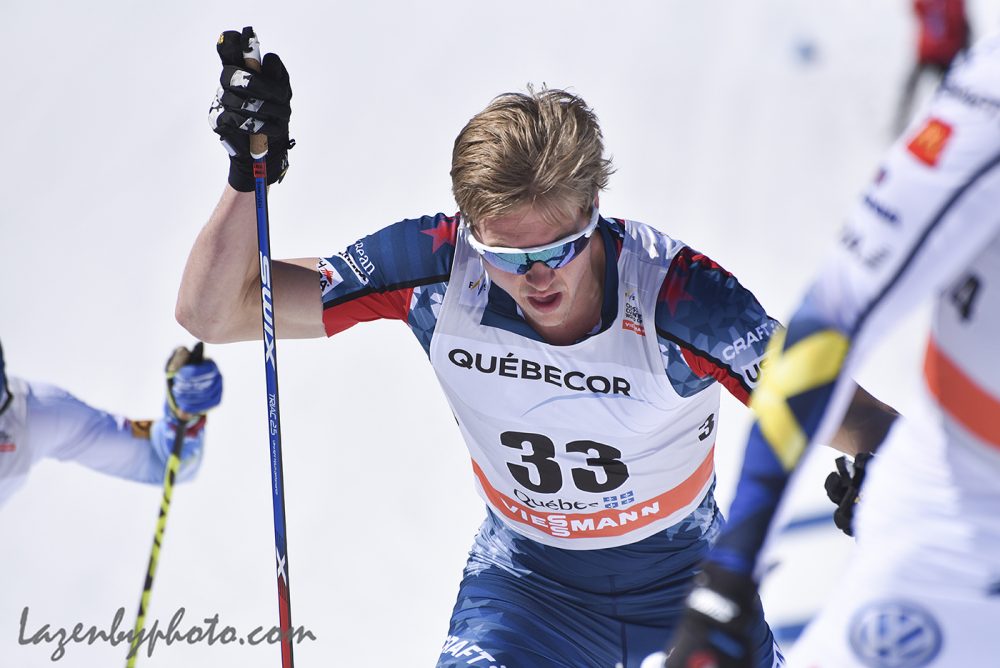
U.S. Ski Team member Erik Bjornsen (33) racing to the 11th fastest time of day in the men’s 15 k freestyle pursuit at World Cup Finals on Sunday in Quebec City, for his career-best World Cup result. He finished 25th overall. (Photo: John Lazenby/Lazenbyphoto.com)
Bjornsen started 33rd and managed to catch and ski with Finland’s Matti Heikkinen, Canada’s Devon Kershaw, Germany’s Thomas Bing, France’s Jean-Marc Gaillard and Great Britain’s Andrew Young.
“It was hard, I was really worried I was working too hard to catch that group in the first 2 to 3 k,” Bjornsen said. “Luckily I just felt like I was recovering really well and sticking in the draft was really helpful. So it all worked out for me today.”
From Quebec, Bjornsen was bound for Anchorage, Alaska, where he trains with Alaska Pacific University (APU). Next week, he planned to compete at U.S. SuperTour Finals in Fairbanks.
“Excited to go home to sleep in my bed for the first time in four months,” he said.
Along with Bjornsen, four other Americans finished in the top 30 for time of day, with Paddy Caldwell in 25th, David Norris 27th, and Scott Patterson 30th.
Paddy Caldwell (U.S. Ski Team D-team/SMS) racing to 46th overall and 25th for time of day in the men’s 15 k freestyle pursuit at World Cup Finals in Quebec City. (Photo: John Lazenby/Lazenbyphoto.com)
Patterson was the first American across the line after Bjornsen, finishing in 41st (+3:45.6) after starting 46th. Norris was next, finishing 43rd (+4:15.9) after starting 55th. Caldwell came in 46th (+4:25.6) after starting 58th.
“That was one of the goals for the day so I am psyched about that,” Caldwell said of his time of day result. “I was working with David and Scott for most of the race and two other guys, so that was really fun, and fun to work as group and try to put down a fast time.”
Caldwell further explained that a great portion of his performance came from the way he approached the wave mass start.
“I was thankful I was sort of on the edge of the chevron right out of the gun. I just went hard as I could to try to get in front of that pack,” Caldwell said. “That actually ended up being a really good move to being towards the front of our chase pack and you know we just went from there.”
Also for the U.S., Andy Newell placed 44th overall (+4:23.0), Simi Hamilton 45th (+4:23.4), Matt Gelso 49th (+4:32.3), Noah Hoffman 52nd (+5:03.8), John Hegman 57th (+5:45.9), Brian Gregg 58th (+5:55.9), Ben Lustgarten 59th (+6:04.0) and Cole Morgan 65th (39:42.7).
“I started three people in front of the waves,” said Newell, who started 44th and finished in that position. “So I knew they were going to catch me, but that was fun because I got to ski with a lot of U.S. competitors. … Simi and I skied a lot together and Brian Gregg and you know it was fun to finish it off in the sun with some teammates.”
After Harvey, the next Canadian across the line was Devon Kershaw, who finished in 26th (+2:21.4) and posted the 19th-fastest time of day.
Canada’s Devon Kershaw racing to 26th in Sunday’s 15 k freestyle pursuit at World Cup Finals in Quebec City. He was 19th for time of day. (Photo: John Lazenby/Lazenbyphoto.com)
“It’s just kind of like a fitting ending to a kind of a tough season,” Kershaw said. “[I’ve been] just missing that top top gear a lot of the season and I think in all of the tours, I was [27th] in Lillehammer, 25th in Tour de Ski, and I think I was 26th [today]. I am constantly not amazing, but you know, at the same time it’s nice to make a few positions and [in] this beautiful atmosphere.”
Kershaw, who finished the 2011/2012 season in second in both the Overall and Distance World Cup, couldn’t have been more happy for his teammate and friend’s successful end to the season.
“He is one of my best friends and to see his development here and through the years, I have been saying this since he was a 1st year senior … I have never seen an athlete and work ethic like Alex,” Kershaw said. “To see the people of Quebec come out and support their hometown hero is couldn’t be happier for him.”
Among the Canadians, Graeme Killick finished 42nd (+3:45.9), Knute Johnsgaard 53rd (+5:09.6), Len Valjas 54th (+5:20.2), Evan Palmer-Charrette 60th (+6:11.4), Bob Thompson 61st (+6:12.8), Brian McKeever 62nd (+6:30.8), Joey Foster 64th (+6:39.9), Andy Shields 66th (+6:59.4), Russell Kennedy 67th (+7:06.0), Jess Cockney 68th (+7:17.2), Gareth Williams 71st (+9:21.6), Ricardo Izquierdo-Bernier 72nd (+10:22.7), and Julien Locke 73rd (+11:15.1).
–François Léger Dionne, Alex Kochon, Gerry Furseth, Ian Tovell, and Jake Ellis contributed
Canada’s Alex Harvey celebrates his second-place finish (and two overall World Cup medals, in the Distance World Cup and Overall World Cup) after the men’s 15 k freestyle pursuit at World Cup Finals on Sunday in Quebec City. (Photo: Gestev)
Alex Harvey racing in the men’s 15 k freestyle pursuit at Stage 4 of the Ski Tour Canada last year in Quebec City. (Photo: FlyingPointRoad.com/NNF)
For the second-straight year, the World Cup’s season-ending races will be held in Canada, with Québec City hosting 2017 World Cup Finals, this Friday through Sunday. Canada initially announced a roster of 30 (15 women, 15 men) for the three-day mini tour, and the U.S. selected 27 (15 women and 12 men), with both countries maximizing their Nation’s Group “home” quota for the event in downtown Québec City.
Note: On Tuesday, Cross Country Canada (CCC) announced it would be releasing a revised roster “due to some CPL points errors in calculations,” according to a press release. On Thursday, FasterSkier confirmed that the list included the same 15 women and 15 men that were originally published on FasterSkier.
And on Wednesday, Quebec organizers announced that the times of each race would be moved back an hour “upon FIS recommendation” to satisfy international broadcast schedules. The updated times are listed below.
2017 World Cup Finals race schedule (updated Wednesday):
(All times Eastern Daylight Time)
Friday, March 17: Freestyle sprint (qualifier starts at 11:45 a.m.; heats at 2:15 p.m.)
(Note: Jenn Jackson of Lappe Nordic declined her spot)
Men:
Alex Harvey (World Cup A-team)
Devon Kershaw (World Cup A-team)
Len Valjas (World Cup A-team)
Jess Cockney (World Cup B-team)
Graeme Killick (World Cup B-team)
Knute Johnsgaard (NST U25 Team/AWCA)
Russell Kennedy (Canmore Nordic/Team R.A.D.)
Gareth Williams (Junior NST/Telemark)
Andy Shields (Lappe Nordic)
Bob Thompson (NTDC Thunder Bay)
Joey Foster (Team Hardwood)
Julien Locke (NST U25 Team/AWCA)
Evan Palmer-Charrette (NTDC Thunder Bay)
Brian McKeever (Canadian Para-Nordic Ski Team)
Ricardo Izquierdo-Bernier (CNEPH)
USA
Women:
Kikkan Randall (U.S. Ski Team A-team/APU)
Sadie Bjornsen (USST A-team/APU)
Liz Stephen (USST A-team)
Caitlin Patterson (CGRP)
Rosie Brennan (USST B-team/APU)
Erika Flowers (SMS Elite)
Jennie Bender (BSF)
Julia Kern (USST D-team/SMS Elite)
Liz Guiney (CGRP)
Kaitlynn Miller (CGRP)
Chelsea Holmes (APU)
Becca Rorabaugh (APU)
Jessie Diggins (USST A-team/SMS Elite)
Sophie Caldwell (USST A-team/SMS Elite)
Ida Sargent (USST A-team/CGRP)
(Note: Katharine Ogden, of the SMS Elite Team and U.S. Ski Team D-team, declined her spot due to “ongoing stomach issues,” according to U.S. head coach Chris Grover. Guiney was the first alternate as she was next on the SuperTour list.)
Men:
Andy Newell (USST A-team/SMS Elite)
Noah Hoffman (USST B-team/Ski Club Vail)
Erik Bjornsen (USST B-team/APU)
Matt Gelso (SVSEF)
David Norris (APU)
Ben Lustgarten (CGRP)
Cole Morgan (SVSEF)
Patrick Caldwell (USST D-team/SMS Elite)
Jack Hegman (SVSEF)
Brian Gregg (Team Gregg/Loppet Nordic Racing)
Scott Patterson (APU)
Simi Hamilton (USST A-team/SMS Elite)
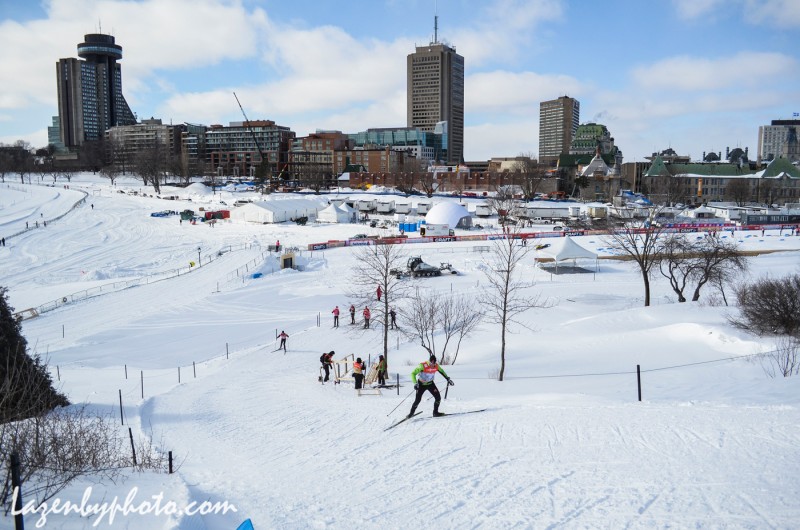
A view from the steep hill on the sprint course with the stadium area in background, as seen during training last year in Quebec City, one day before the third stage of the 2016 Ski Tour Canada. (Photo: John Lazenby/Lazenbyphoto.com)
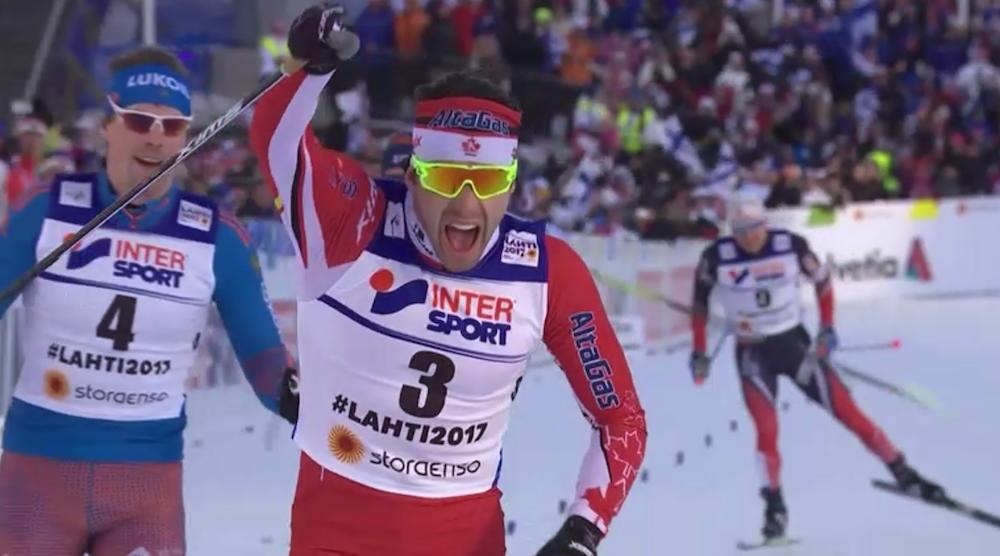
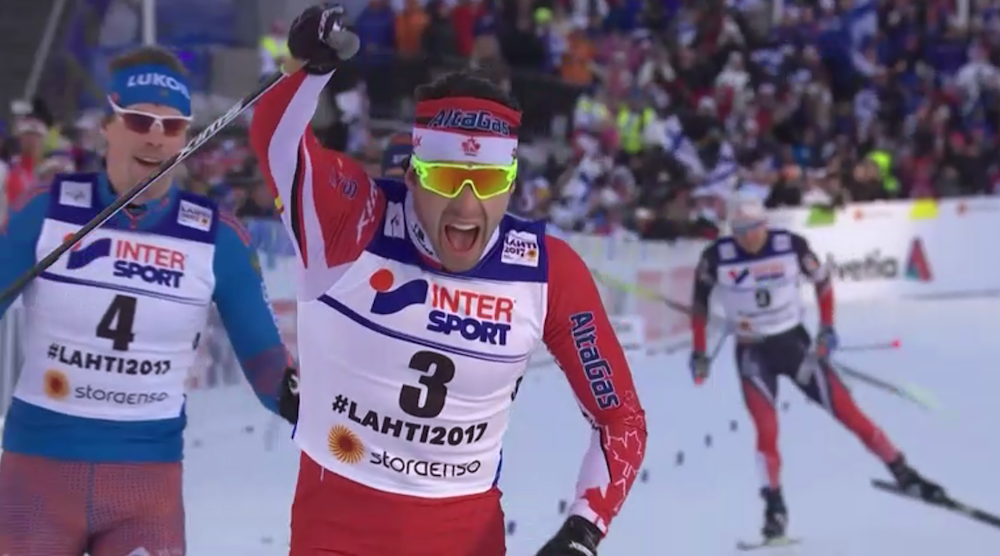
Canada’s Alex Harvey (3) celebrates his win in the men’s 50 k freestyle mass start, his first individual gold medal at a World Championships, on Sunday at 2017 Nordic World Championships in Lahti, Finland. He beat Russia’s Sergey Ustiugov (l) by 0.6 seconds while Norway’s Sjur Røthe (9) can be seen coming in for sixth place, behind (not pictured) Finland’s Matti Heikkinen, Great Britain’s Andrew Musgrave and Norway’s Martin Johnsurd Sundby, respectively. (Photo: NBC Sports screenshot)
FIS Nordic World Championships (Lahti, Finland): Men’s 50 k freestyle mass start
After a week of missing out on the medals at 2017 Nordic World Championships, Canada’s Alex Harvey, a four-time World Championships medalist from 2011, 2013 and 2015, achieved his first individual gold medal in the final race of this year’s World Championships in Lahti, Finland.
Harvey, 28, won the men’s 50-kilometer freestyle mass start in a drag race to the finish. Entering the final descent into the stadium with Norway’s Martin Johnsrud Sundby and Russia’s Sergey Ustiugov, Harvey rode his fast skis past both of them then had the most finishing kick in the final straightaway for a 0.6-second victory. He finished in 1:46.28.9 hours, while Ustiugov followed him across the line in second and Finland’s Matti Heikkinen from behind for third (+1.4), after passing Sundby around the outside of the last corner.
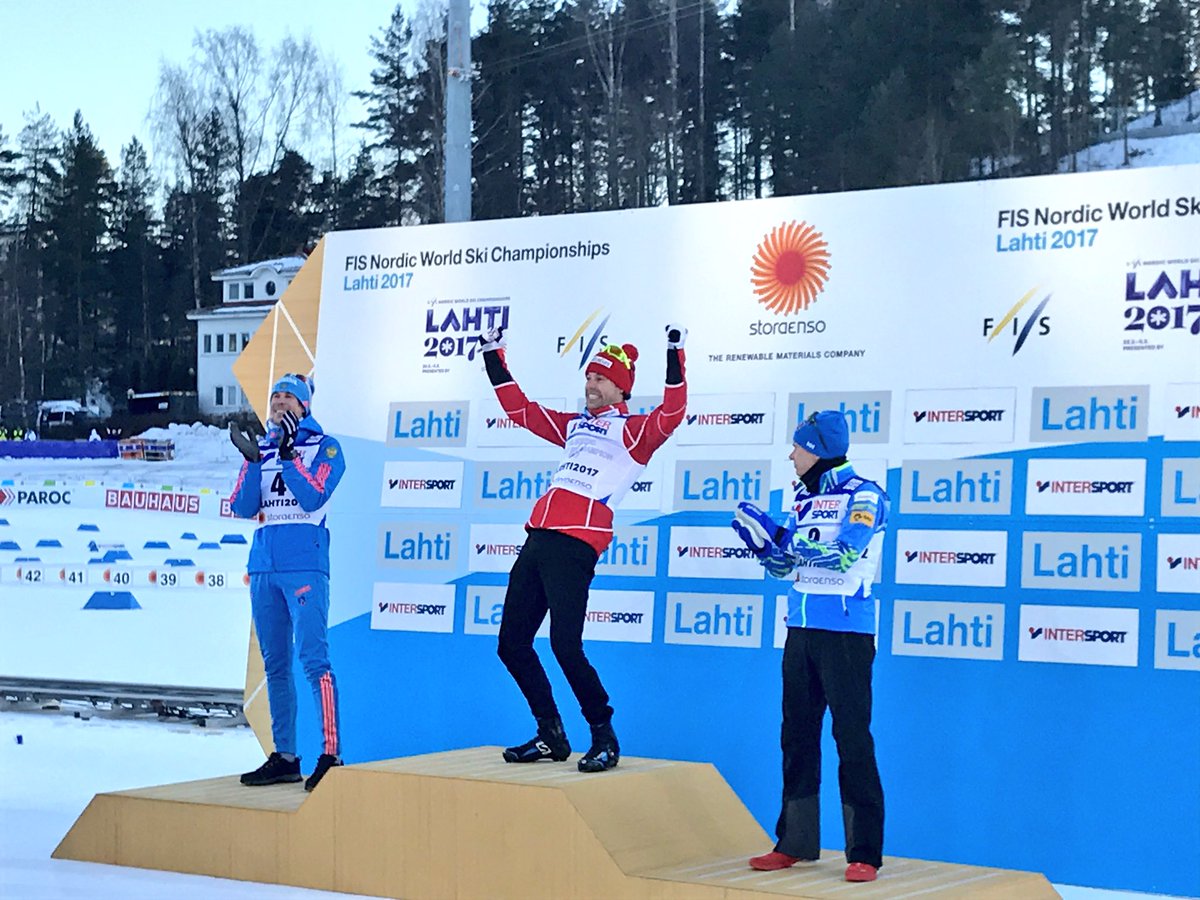
Canada’s Alex Harvey (c) celebrates gold in the men’s 50 k freestyle mass start on Sunday at 2017 Nordic World Championships in Lahti, Finland, with Russia’s Sergey Ustiugov (l) and Finland’ Matti Heikkinen (r) joining him on the podium in second and third, respectively. (Photo: Cross Country Canada/Twitter)
Sundby appeared to miss a pole plant soon after Heikkinen passed him and let off the pace a few meters before the finish. That’s where Great Britain’s Andrew Musgrave continued to accelerate and took fourth place, 2.9 seconds behind Harvey and 0.1 seconds ahead of Sundby in fifth. Norway’s Sjur Røthe followed another 0.4 seconds back in sixth, Switzerland’s Dario Cologna was seventh (+8.9), Norway’s Petter Northug eighth (+12.3), France’s Maurice Manificat ninth (+13.4), and Norway’s Hans Christer Holund 10th (+14.3).
“I had really good skis,” Harvey said in a post-race interview with FIS. “I knew if I came into the corner in second place, that was the optimal position. So I was able to fight hard and hit that last corner in second and slingshot by Martin along the flat and then that was good after that.”
“This is the best race of my life, for sure,” he added. “So I’m really happy.”
Tad Elliott (Ski Club Vail) led the Americans in 27th (+3:16.8). Noah Hoffman (U.S. Ski Team) finished 50th (+8:53.1) and Kyle Bratrud (CXC Team) did not finish.
Canada started four men, with Devon Kershaw finishing 38th (+5:45.5), Graeme Killick 43rd (+7:04), and Knute Johnsgaard in 55th (+12:03.3).
For Harvey, the medal is his fifth at three World Championships and his first individual gold after winning the classic team sprint with Kershaw in 2011.
IBU World Cup (PyeongChang, South Korea): Men’s and women’s relays
Between the men’s and women’s relays on Sunday at the International Biathlon Union (IBU) World Cup in PyeongChang, South Korea, Canada had two teams in the top eighth, with its men’s team finishing seventh in the 4 x 7.5 k and women’s team eighth in the 4 x 6 k. Behind them, the U.S. men finished 10th and U.S. women 14th.
France won the men’s relay by 33.8 seconds over Austria, using a total of 10 spare rounds but avoiding the penalty lap. Martin Fourcade anchored France to the win in 1:12:09.5 hours, after Jean-Guillaume Béatrix initially tagged them in first, his older brother Simon Fourcade raced them into second with near-perfect shooting (using just one spare to clean), and Simon Desthieux picked off one more place to give Fourcade a 16-second lead for the final leg.
Austria achieved second place with Lorenz Wäger, Simon Eder, Julian Eberhard, and Dominik Landertinger combining for zero penalties and nine spares.
Norway finished third (+45.4) with Vetle Sjåstad Christiansen, Ole Einar Bjørndalen, Vegard Gjermundshaug, and Henrik L’Abée-Lund. They had one penalty on Gjermundshaug’s third leg, and used a total of eight spares.
Canada’s Christian Gow, Scott Gow, Nathan Smith, and Brendan Green finished seventh (+3:03.1) with zero penalties and nine spares. After Christian tagged his older brother Scott in ninth, Scott raced them into sixth place before Smith slipped four places to 10th at the final exchange. On the final leg, Green raced them into seventh, requiring two spares to clean.
The Americans finished about nine seconds later in 10th (+3:12.8) with Lowell Bailey, Leif Nordgren, Paul Schommer, and Sean Doherty combining for zero penalties and nine spares, just like Canada. Bailey had originally put them in second at the first exchange, Nordgren dropped to seventh, then Schommer to 13th, before Doherty finally brought them back to 10th out of 24 teams.
In the women’s relay, Germany pulled off a 22.8-second win over Norway, with one penalty and eight spares. Nadine Horchler put Germany in third at the first exchange, then Maren Hammerschmidt raced them into first by the race’s halfway point. From there, Denise Herrmann, a former cross-country World Cup regular, had to ski a penalty lap and tagged off in second, 13.5 seconds out of first. With teammate Laura Dahlmeier sitting out the relay, Franziska Hildebrand anchored Germany to the win in 1:07:35.6 after she used just one spare to clean.
Norway placed second with Kaia Wøien Nicolaisen, Hilde Fenne, Tiril Eckhoff, and Marte Olsbu accumulating one penalty and 11 spares. Olsbu beat out the Czech Republic’s Gabriela Koukalová by one-tenth of a second at the finish, as the Czechs placed for third (+22.9), with Jessica Jislová, Eva Puskarčíková, Lucie Charvátová, and Koukalová (with a total of one penalty and nine spares).
Canada took eighth (+1:34) with Rosanna Crawford, Julia Ransom, Megan Tandy, and Emma Lunder. Crawford tagged in second at the first exchange, Ransom slipped one place to third, Tandy lost another place to tag in fourth, and Lunder ultimately anchored them to eighth.
The U.S., with Clare Egan, Susan Dunklee, Joanne Reid, and Maddie Phaneuf, finished 14th (+3:08.3) with one penalty and 10 spares. After Egan had a penalty on the first leg, Dunklee skied the fastest second leg to move the team from 19th to 14th, then Reid put them in 11th by the final exchange. Twenty-one teams competed in the women’s race.
Ski Classics 90 k Vasaloppet (Sälen to Mora, Sweden)
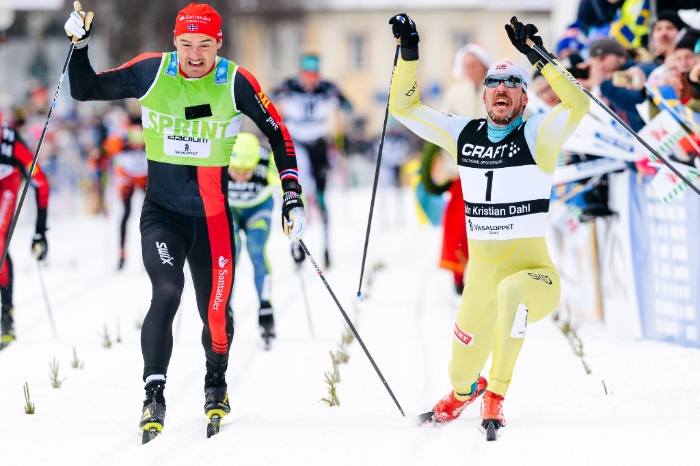
John Kristian Dahl (r) of Team United Bakeries outlunges Ski Classics sprint leader Andreas Nygaard (r) of Team Santander for the win in Sunday’s 90 k Vasaloppet in Mora, Sweden. (Photo: Visma Ski Classics)
[UPDATED] In Sunday’s 93rd annual 90-kilometer Vasaloppet from Sälen to Mora, Sweden, the ninth event of the Ski Classics series, John Kristian Dahl (Team United Bakeries) outlasted Andreas Nygaard (Team Santander) by one-tenth of a second for the win in 3:57:18.1 hours. The race came down to a five-way fight for first, with Stian Hoelgaard (Team Leaseplan) finishing 0.6 seconds back in third. The top 15 men were all within 21.7 seconds of the podium, and Brian McKeever, a member of Canada’s Para Nordic Ski Team, placed 20th (+2:31.1).
“It has been a fight all day,” Dahl said, according to a Ski Classics press release. Three days ago, he had been unsure about starting the Vasaloppet following a back injury. “I was tired already after 30 k and had to let go of the lead group, but I fought my way back taking it step by step and hill by hill.”
In the women’s race, Britta Johansson Norgren (Lager 157 Ski Team) broke away from the field to win by 1:37.9 minutes in 4:19.43.4.
Astrid Øyre Slind (Team United Bakeries) finished second, and Sara Lindborg (Team Serneke) placed third, 9 minutes and 4.2 seconds behind Norgren. Kateřina Smutná (Team Santander) dropped out of the race about halfway through.
“I am very tired but also so happy to win today,” Norgren said, according to the press release. “It felt pretty easy until Oxberg [Sweden] with 30 k to go, but then it got really tough and I had to fight all the way to the finish.”
It was Norgren’s first Vasaloppet win after placing second the last three years. She increased her lead in the overall Ski Classics to 215 points over Smutná, while Tord Asle Gjerdalen continues to lead the men’s overall standings ahead of his Santander teammate Nygaard, who is 349 points behind in second place. Gjerdalen did not race Sunday’s Vasaloppet.
U.S. Paralympic skier Oksana Masters (c) along with Germany’s Anja Wicker (l) and Belarus’s Lidziya Hrafeyeva on the podium for the women’s 6-kilometer biathlon event on Saturday at the 2017 International Paralympic Committee (IPC) Nordic Skiing World Championships in Finsterau, Germany. (Photo: John Farra)
The 2017 International Paralympic Committee (IPC) Nordic Skiing World Championships concluded this past weekend Feb. 18-19 in Finsterau, Germany with a biathlon sprint and a middle-distance cross-country event. Claiming their second gold medals of the week were Oksana Masters, of the U.S., and Canada’s Mark Arendz. Race recap and results below.
***
The U.S. Paralympics Nordic Team’s Oksana Masters is plenty used to winning cross-country events. She ended last season undefeated in every cross-country race and earned World Championships titles in both the sprint and long-distance events earlier in the championships in Finsterau.
But in biathlon, the 27 year old had yet to win a gold. However, that didn’t stop her from racing to a World Championships title in the women’s 6-kilometer sitting biathlon sprint on Saturday.
“I am completely shocked,” Masters said to media outlets. “I entered this race with no expectations. I went from not being sure if I was going to be able to race the last two days to winning my first gold medal in biathlon. I’m so excited! I cannot wait to let this all soak in and race as hard as I can for one more race. It has been an amazing experience.”
Despite feeling ill and not deciding until after her warmup on Saturday that she would indeed enter the race, Masters won in a time of 20:56.2 minutes, with two penalties (1+1). Finishing behind her in second was Germany’s Anja Wicker, who completed the course in 21:21.0 after one miss (1+0). In third after three misses (1+2) was Lidziya Hrafeyeva of Belarus, who finished in 21:48.0.
Ukraine’s Maksym Yarovyi won the men’s 7 k sitting biathlon sprint, finishing in 21:36.1 after just one penalty (1+0). Shooting clean and placing second on the day was Yarovyi’s Ukrainian teammate, Taras Rad (21:48.9). German skier Martin Fleig finished in third in 21:48.9 after also hitting all of his targets as well.
Just missing the podium for the second time this week was American Andy Soule in fourth. Soule missed one shot (0+1) and finished in 22:59.1. Behind him in fifth was his U.S. teammate Aaron Pike, who finished in 23:06.5 after shooting clean.
Two Canadians also competed in the event, with Derek Zaplotinsky finishing 10th in 24:29.4 after shooting clean, and Cameron Collin placed 12th in 25:13.1 after three misses (2+1).
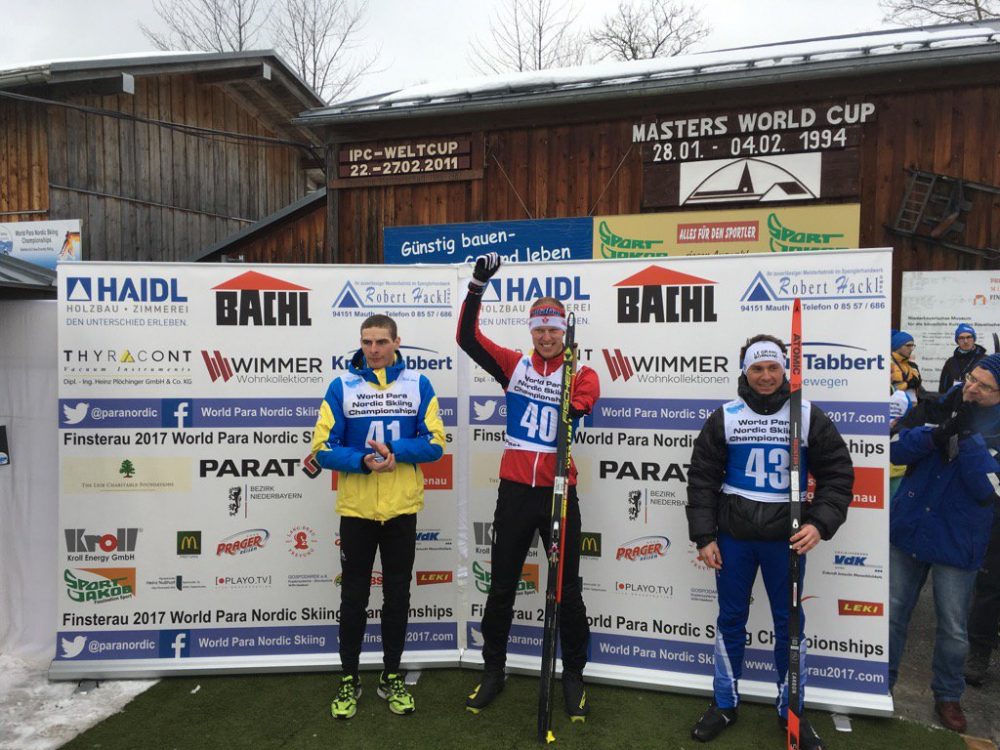
Canada’s Mark Arendz (c) celebrates his second World Championships gold alongside France’s Benjamin Daviet (r) and Ukraine’s Ihor Reptyukh on the podium for the men’s 7.5-kilometer standing biathlon event on Saturday, Feb. 18, at the 2017 IPC Nordic Skiing World Championships in Finsterau, Germany. (Photo: Robin McKeever/Twitter)
If Canada’s Mark Arendz had any regret about his missed shot at gold last Thursday, he found redemption in Saturday’s 7.5 k standing biathlon sprint.
“I refocused on a new day, new race,” Arendz wrote in an email to FasterSkier of his approach to Saturday’s competition following Thursday’s silver place finish. “I knew the margin of error would be small in such a tight race. Going into the race my biggest was on recovery and preparation for Saturday’s race. The body felt great before, during and after the race. I was excited to have that feeling of renewed energy back in the legs.”
Arendz shot 100 percent and raced to first place, earning his second gold medal for the week in a time of 18:30.0.
I didn’t make any changes to my shooting,” Arendz added. “I considered it but in end went with what has been successful and working for me.”
Finishing behind Arendz in a time of 18:32.6 and also shooting clean, was Ukraine’s Ihor Reptyukh in second place. Bronze went to France’s Benjamin Daviet, who clocked in at 18:57.2 after just one miss (0+1).
In the women’s standing 6 k biathlon sprint, Ukraine once again claimed the win, with Liudmyla Liashenko emerging victorious with clean shooting in 18:25.0. Her teammate Oleksandra Kononova placed second (19:15.2) with two misses (2+0). Shooting clean for the final podium spot in third (19:24.1) was Iryna Bui, also of Ukraine.
Canadians Emily Young and Brittany Hudak claimed eighth and 10th respectively. Young completed the course in 21:11.0 with one miss (0+1), while Hudak clocked in at 22:30.9 with two misses (2+0).
In the women’s 6 k visually impaired biathlon sprint, Ukraine was again victorious with Oksana Shyshkova claiming first in 20:15.7 after three missed shots.
Second place went to Germany’s Clara Klug, who completed the course in 20:38.8 after shooting 100 percent.
“It’s just overwhelming,” Klug said, according to an IPC press release. “I said I wanted to win three Filus (the mascot of this event) and now I’ve got three. I love it here in Finsterau. A big thank you to the team and my guide Martin Hartl, who yells a lot at me on the course but it really helps!”
Ukraine put two on the podium with Olga Prylutska taking third in 21:42.3 with three misses (1+2).
Marking the fourth win for Ukraine on the day was Anatolii Kovalevskyi, taking gold in the men’s 7.5 k visually impaired biathlon sprint. Kovalevskyi completed the course in a time of 19:55.9 for the win, missing just one shot (1+0).
Belarus’s Vasili Shaptsiaboi earned silver, finishing in 20:15.4 after two misses (2+0). Rounding out the podium and taking bronze was France’s Anthony Chalencon, who clocked in at 20:37.2 after one missed shot (0+1).
Canada’s Brian McKeever (third from r) with his guide Graham Nishikawa (third from left) after winning his second medal of 2017 IPC World Championships and 18th career World Championships gold on Feb. 16 in Finsterau, Germany. He racked up another individual gold on Sunday, Feb. 19, in the men’s 10 k visually impaired race to end the championships. (Photo: Robin McKeever/Twitter)
Day 7
With seven races over the course of nine days and only two days off, the IPC World Championships competitions were bound to test even the most accomplished of IPC athletes, including Canada’s Brian McKeever.
“We had four races in five days so it was a lot about survival today,” McKeever said after Sunday’s race, according to a Canadian Para-Nordic Skiing press release.
McKeever didn’t just survive the final race, he won it. The 37-year-old 18-time World Champion racked up his 19th career gold in the men’s 10 k visually impaired cross-country race in 22:15.1, besting both Thomas Clarion of France and Yury Holub of Belarus.
“Our performances are showing that things are moving back in the right direction after being sick around Christmas. [My guide] Graham is in incredible shape right now, and a step above me which is important for us,” McKeever said.
Clarion ended the day in second, finishing in a time of 22:45.6, while Holub took third in a time of 22:48.1.
For the second day in a row, Shyshkova earned gold, winning the women’s 7.5 k visually impaired event in 20:23.2. Claiming silver was Sviatlana Sakhanenka of Belarus in 21:05.9, while bronze went to Austria’s Carina Edlinger in a time of 21:11.5.
American Oksana Masters racing to her fifth medal, fourth gold of 2017 IPC World Championships, in the women’s 7.5-kilometer sitting cross-country event on Feb. 19 in Finsterau, Germany. (Photo: John Farra)
Continuing her dominance in the women’s sitting field, Masters claimed her fifth individual medal, fourth gold, on Sunday, winning the women’s 7 k sitting cross-country event in a time of 14:15.5.
Finishing behind Masters in a time of 14:30.5 for the silver medal was Germany’s Andrea Eskau. Norwegian Birgit Skarstein rounded out the podium in third, clocking in at 14:42.4.
Finding the podium once again after two fourth place finishes was Soule, who earned bronze in the men’s 7 k sitting cross-country event. Soule’s time of 20:10.4 landed him third place, just behind Belarus’s Dzmitry Loban in second (19:53.3) and Ukraine’s Yarovyi in first (19:39.4)
American Andy Soule (r) on the podium with Ukrainian winner Maksym Yarovyi (c) and Belarus’s Dzmitry Loban (l) after the men’s 7-kilometer sitting cross-country race on Feb. 19 at the 2017 IPC Nordic Skiing World Championships in Finsterau, Germany. (Photo: John Farra)
The win was Yarovyi’s second in a row.
“I am really happy because this is my personal best result for gold medals at a World Championships,” Yarovyi said according to an IPC press release. “I can’t express my feelings, I am just really happy.”
Also in the men’s 7 k sitting race, Pike raced to eighth (20:58.1) for eighth place, Canada’s Zaplotinsky placed 12th (21:39.8) and his teammate Sebastien Fortier finished just behind him in 13th (21:43.8).
Adding to his growing medal count, Canada’s Arendz secured his fifth medal of the week in the final men’s 10 k standing cross-country competition, racing to third place in a time of 23:08.9.
Canada’s Mark Arendz (r) capping off 2017 IPC World Championships with his fifth medal and first cross-country bronze in the men’s 10 k standing cross-country event on Feb. 19. In all, Arendz racked up two golds, one silver, and two bronze in Finsterau, Germany. France’s Benjamin Daviet (c) and Ukraine’s Ihor Reptyukh (l) reached the podium for the second-straight day as well, placing first and second, respectively. (Photo: Robin McKeever/Twitter)
“I went into today’s race not sure what would happen given it was my sixth race in nine days. I started strong and kept it going for as long as I could,” Arendz said, according to a team press release. “It was a tight race. I threw everything I had left out there.”
Placing ahead of Arendz in first and second respectively was France’s Daviet and Ukraine’s Reptyukh. Daviet clocked in at 21:52.9 for the win, while Reptyukh finished in 22:22.9 for second place.
In the women’s 7.5 k standing cross-country event, all three top spots went to Ukraine, with Kononova taking gold in 19:30.7. Finishing behind her in 19:46.6 for second place was Liashenko, while third went to Iuliia Batenkova (20:20.3).
Clocking in at 21:30.5 was Canada’s Young in seventh and rounding out the Canadians women’s team was Hudak in 10th, after finishing in 23:31.7.
American Oksana Masters (c) after winning her second-straight cross-country race of 2017 IPC World Championships on Thursday in Finsterau, Germany. She is joined on the podium by Norway’s Birgit Skarstein (l) in second and Germany’s Andrea Eskau in third. (Photo: U.S. Paralympics)
After a rest day, Paralympic athletes returned to the nordic venue in Finsterau, Germany, for Days 3, 4, and 5 of the 2017 International Paralympic Committee (IPC) World Nordic Skiing Championships. Long-distance biathlon races took place Tuesday, cross-country relays on Wednesday and individual cross-country races on Thursday.
***
At the finish of Tuesday’s 15-kilometer individual biathlon race, Canada’s Mark Arendz could only think about one thing: his miss. But later, with his second 2017 World Championships medal, this one silver, around his neck after finishing in 39:21.9 minutes, the miss in his final stage (0+0+0+1) was no longer on his mind.
Left to right: Canada’s Mark Arendz, France’s Benjamin Daviet and Norway’s Nils-Erik Ulset on the podium for the men’s 15 k biathlon standing event held on Tuesday, Feb. 14 at the 2017 IPC World Nordic Skiing Championships in Finsterau, Germany. (Photo: Robin McKeever/Twitter)
“After crossing the finish line, all I could initially think about was the single miss (in shooting), and the fact I let the gold slip through my fingers,” Arendz said, according to a Canadian Para-Nordic Skiing press release. “But I quickly warmed up to the fact that I had won a World Championship silver medal.”
Finishing ahead of Arendz for first place was France’s Benjamin Daviet who also shot 19-for-20 and covered the course in time of 38:33.7.
“I am very happy and honoured. This is great and what I came here for,” Daviet said according to an IPC press release. “I will not celebrate because there are many races ahead. I hope to win more medals in Finsterau.”
Norwegian Nils Erik Ulset claimed the final podium spot, finishing third in a time of 40:26.7 after two penalties (1+0+1+0).
In the women’s 12.5 k standing biathlon event, Ukraine’s Liudmyla Liashenko came away with the win. She missed just one shot (1+0+0+0) and finished in a time of 39:10.0.
“I am really happy. I want to dedicate this triumph to all my family, friends and all who have supported me all along this journey,” Liashenko said according to an IPC press release.
In her first podium appearance, Japan’s Momoko Dekijima claimed second in 42:49.3 after two misses (1+1+0+0). Third place went to Ukraine’s Iryna Bui, who finished in 43:53.1 with three penalties (0+2+0+1).
Canada’s Brittany Hudak raced to fifth with a single miss (0+1+0+0), finishing in 44:14.9.
Racking up another gold medal on his home turf, Germany’s Martin Fleig took the win in the men’s 15 k sitting biathlon race in 44:39.4 with one miss (0+0+1+0).
“I did not expect this,” Fleig said according to an IPC press release. “I had a good feeling in the morning but could not imagine the race would be so perfect. It is unbelievable that now I am a two-time world champion. It is awesome.”
Earning silver behind Fleig was Taras Rad of Ukraine, who had four penalties (2+1+0+1) and finished in 48:01.3. Trygve Steinar Larsen of Norway earned bronze, finishing in 49:07.9 with three penalties (2+0+0+1).
Just missing the podium with a career-best fourth was American Aaron Pike, who finished in 51:10.2 with five penalties (1+0+1+3). Canada’s Derek Zaplotinsky placed just behind Pike in fifth for his personal best, finishing in 53:28.1 with four misses as well (0+1+2+1).
Behind them, American Andy Soule finished in seventh in 54:26.7 with nine penalties (2+2+2+3).
Right to left: American Oksana Masters, Germany’s Anja Wicker and Ukraine’s Lidziya Hrafeyeva on top of the podium for the women’s 12.5 k sitting biathlon event on Tuesday at the 2017 IPC World Nordic Skiing Championships in Finsterau, Germany. (Photo: Oksana Masters/Twitter)
Germany earned another victory at home in the women’s 12.5 k sitting biathlon event, with Anja Wicker returning to the podium, this time in first place.
“I am super happy, my biggest dream came true. I was hoping this would happen, it was a perfect day for me,” Wicker said according to an IPC press release. “Whilst I was still competing, I heard that Martin [Fleig] had already won gold and that motivated me to do the same.”
Wicker finished in 43:07.3 with one miss (0+0+1+0). Behind her in second place was Belarus’s Lidziya Hrafeyeva, who finished in 46:05.2 after three penalties (0+2+1+0).
American Oksana Masters also returned to the podium for her first biathlon medal of the week, finishing in 46:43.7 with four misses (2+2+0+0).
Earning the gold medal in the men’s 15 k visually impaired biathlon race was Vasili Shaptsiaboi of Belarus, who finished in 40:47.3 with just one miss (0+0+0+1). Ukraine took the final two podium spots, with Anatolii Kovalevskyi earning silver in 41:55.2 and one miss (0+1+0+0) and his teammate Vitaliy Lukyanenko finishing just behind him for bronze in 42:21.2, also with one penalty (1+0+0+0).
Ukraine’s Oksana Shyshkova finally found her gold on Tuesday, winning the women’s visually impaired 12.5 k biathlon event after shooting clean and finishing in a time of 38:26.6.
“After winning two silvers in Finsterau, I am happy to finally take gold,” Shyshkova said according to an IPC press release. “Now I have to focus on the next events, do my job, give my best and the results will come as a consequence.”
Silver went to Germany’s Clara Klug in a time of 43:58.2 with two missed shots (0+0+0+2), while Ukraine’s Olga Prylutska earned bronze in a time of 45:16.0 after six misses (1+4+0+1).
Wednesday, the fourth day of racing at the 2017 IPC World Nordic Skiing Championships was marked by mixed and open relays. The U.S. did not field a team, as no standing American athletes are present at this competition series. Canada entered a team in the open relay event.
***
Canada made history on Wednesday earning its first World Championships relay medal with Brian McKeever, Emily Young and Arendz.
McKeever, a visually impaired racer, started first. He tagged off to Young, a standing skier, and Arendz, also in the standing category, and back to McKeever. The quartet finished third in 24:53.4 just 57.5 seconds away from the win.
“It is pretty awesome to have such a great result today with the boys, and finally snag my first World Championship medal,” Young said, according to a team press release.
Young was one of the only women racing amidst the top teams.
“Being one of the only girls out there, it was tough to ski against the men’s field but I gave my best effort, and that was all I could do,” Young said, according to a CCC press release. “I just had to remember to ski my race, and know that I would likely fall behind a bit. I skied the fastest so far on this course. It was a very exciting race and I am very proud of the team.”
The win went to France in a time of 23:55.9, with standing skier Daviet leading the team, followed by visually impaired skier Anthony Chalencon, Daviet again and then standing skier, Thomas Clarion.
Norway took second place, 23.8 seconds behind France, with standing skier Ulset racing the first leg for the team, standing skier Hakon Olsrud taking the second leg, Ulset the third and visually impaired skier Eirik Bye anchoring the team.
In the mixed 4 x 2.5 k relay, it was Ukraine’s team comprised of visually impaired skier Iurii Utkin, who skied the first leg, followed by the three standing skiers Liashenko, Iuliia Batenkova, and Oleksandra Kononova. The Ukrainian team finished in a time of 26:56.5 for the win.
“This is a really good result, we made a huge effort to achieve this,” Ukrainian head coach Andriy Nesterenko said according to an IPC press release.
Sweden earned silver, with standing skier Helene Ripa and visually impaired skier Zebastian Modin racing for the team. The duo completed the event in a time of 27:17.5, just 21 seconds back from first place.
The final mixed relay podium spot went to Belarus, with sit skier Dzmitry Loban leading the first leg, followed by visually impaired racer Sviatlana Sakhanenka. Sit skier Valiantsina Shyts raced the third leg, and visually impaired skier Mikita Ladesau anchored the team to finish in a time of 28:12.3.
Canada’s Brian McKeever (third from r) with his guide Graham Nishikawa (third from left) after winning his second medal of 2017 IPC World Championships and 18th career World Championships gold on Feb. 16 in Finsterau, Germany. (Photo: Robin McKeever/Twitter)
Day 5
Just four days after she earned her first World Championships gold, Masters, of the U.S. Paralympics Nordic A-team, repeated the feat on Thursday, earning her second gold medal of the week.
Masters, 27, raced to first place in the women’s 12 k sitting cross-country event, finishing in 36:01.0. She outlasted Norway’s Birgit Skarstein, who finished second in 36:51.7, as well as Germany’s Andrea Eskau in third (37:00.0).
“I had some nerves going into the race today, but I used them to motivate me,” Masters said, according to a U.S. Paralympics press release. “I felt good and am really happy with how today went.”
In the men’s 15 k sitting cross-country event, Ukraine’s Maksym Yarovyi took the win, finishing in 40:32.4. Eui Hyun Sin of South Korea earned silver, finishing in 40:56.7, while Germany’s Fleig nabbed the the final podium spot in third (41:05.4).
Racing for the U.S., Soule narrowly missed the podium in fourth place, finishing in 41:36.4. Two Canada’s Collin Cameron placed seventh in 42:12.1 and Sebastien Fortier was 10th in 44:29.0.
Germany’s Carina Edlinger claimed gold in the women’s 15 k visually impaired event, ahead of Ukraine’s Shyshkova and Prylutska.Edlinger finished in a time of 55:40.1 for the win, Shyshkova in 57:11.9 and Prylutska in 1:00:01.8.
Racking up his 18th World Championships gold on Thursday was Canada’s 37-year-old McKeever, who won the men’s 20 k visually impaired race in 57:35.4.
“Graham skied really, really well today,” McKeever said of his guide, Graham Nishikawa, according to a team press release. “In fact he put me in an uncomfortable place for a large portion of the race, and I may have done the same for him in spots. There are different sections where we felt really good, and then others poorly. You are just comfortable with certain terrain, but it was really, really hot today and that just makes it tough to be relaxed when it is like that. It is a constant mental battle.”
Finishing behind McKeever in second was Sweden’s Modin in 1:00:24.6. Norway’s Bye claimed the final spot in third (1:00:58.8).
In the women’s 15 k standing cross-country race, Ukraine’s Kononova took the win, completing the course in a time of 51:56.9. Her Ukrainian teammate, Batenkovaearned silver, finishing in 53:38.1, while Liashenko rounded out the all-Ukranian podium in third (53:59.4).
Finishing just off the podium in fourth was Canada’s Young, after completing the course in 54:21.3. Behind her in fifth was her Canadian teammate Hudak, finishing in 55:53.9.
Ukraine earned another gold, this time on the men’s side, with Ihor Reptyukh taking first place in the men’s 20 k standing cross-country event. Reptyukh finished in 58:03.1, while Finland’s lkka Tuomisto placed just behind him in second (58:39.1). Third went to Yoshihiro Nitta (58:51.6).
Canada’s Arendz ended the day in fifth (59:34.4).
“The most exciting part for me is watching these young guys like Brittany and Emily killing it in classic, or watching Collin who has become a superstar over year in just his second year,” McKeever said in the press release. “I’m old has heck, but you see these development guys come in and all you can do is give them the toolbox to achieve success and show them the door, but they have to open it. These guys are and they are nailing it.”
Two days of racing remain for the 2017 IPC World Championships, with biathlon sprints on Saturday and middle-distance cross-country races on Sunday.
Russia’s Petr Sedov en route to his first non-stage World Cup win on Saturday in the PyeongChang World Cup 30 k skiathlon in South Korea. (Photo: Fischer/NordicFocus)
The rough translation of the Korean word “기회” or “gihoe” into English is “opportunity”. And it’s the best way to describe what was on offer Saturday afternoon in PyeongChang, South Korea during the men’s World Cup 30-kilometer skiathlon.
No seeded men on the World Cup contested the race. No Sundby. No Ustiugov. No Harvey. No Hellner. Lot’s of 기회.
For the three skiers finishing in positions 1, 2, and 3, it was a career-first World Cup podium. Russia’s Petr Sedov placed first in 1:18:49.6. Norwegian Daniel Stock finished second 22.5 seconds back with his teammate Mathias Rundgreen third (+42.1).
“I felt very strong today,” Sedov told the International Ski Federation (FIS) after the race. “I have to thank to my coach, service staff and to my family. I am very glad that my first ever World Cup podium is a win.”
To be clear, It was Sedov’s first individual non-relay and non-tour stage World Cup podium. He’s placed second twice in 2010 and first once in 2011 as part of Russian relay teams. Sedov also won a 2012 World Cup stage 15 k skate pursuit in Falun, Sweden.
And to discount the World Cup strength of some others would have been foolish. This was Stock’s sixth World Cup start. Yet he, too, like Sedov, came with realistic podium-hunting background: as recently as Jan. 21, he skied to fifth in the World Cup 15 k skate in Ulricehamn, Sweden. Canada’s Alex Harvey, Norway’s Martin Johnsrud Sundby, Sweden’s Marcus Hellner, and Switzerland’s Dario Cologna were the only athletes ahead of Stock that day.
For Rundgreen, it’s the same: not a World Cup brand name, but bringing with him plenty of real-deal horsepower to shatter the race. He boasts three top-10 World Cup performances, including a first and second as part of Norwegian relay teams.
Rundgreen held off three others for third place, including Sweden’s Gustav Eriksson in fifth (+46.8), Japan’s Keishin Yoshida in sixth (+47.1), and Russia’s Alexander Utkin in seventh (+49.0).
The U.S. had two top 10’s, with the U.S. Ski Team’s Noah Hoffman in eighth (+1:06.2) and Scott Patterson (Alaska Pacific University) a spot behind in ninth (+1:28.4). Matt Gelso (Sun Valley Ski Education Foundation), the only other American starter, placed 19th (+5:00.8).
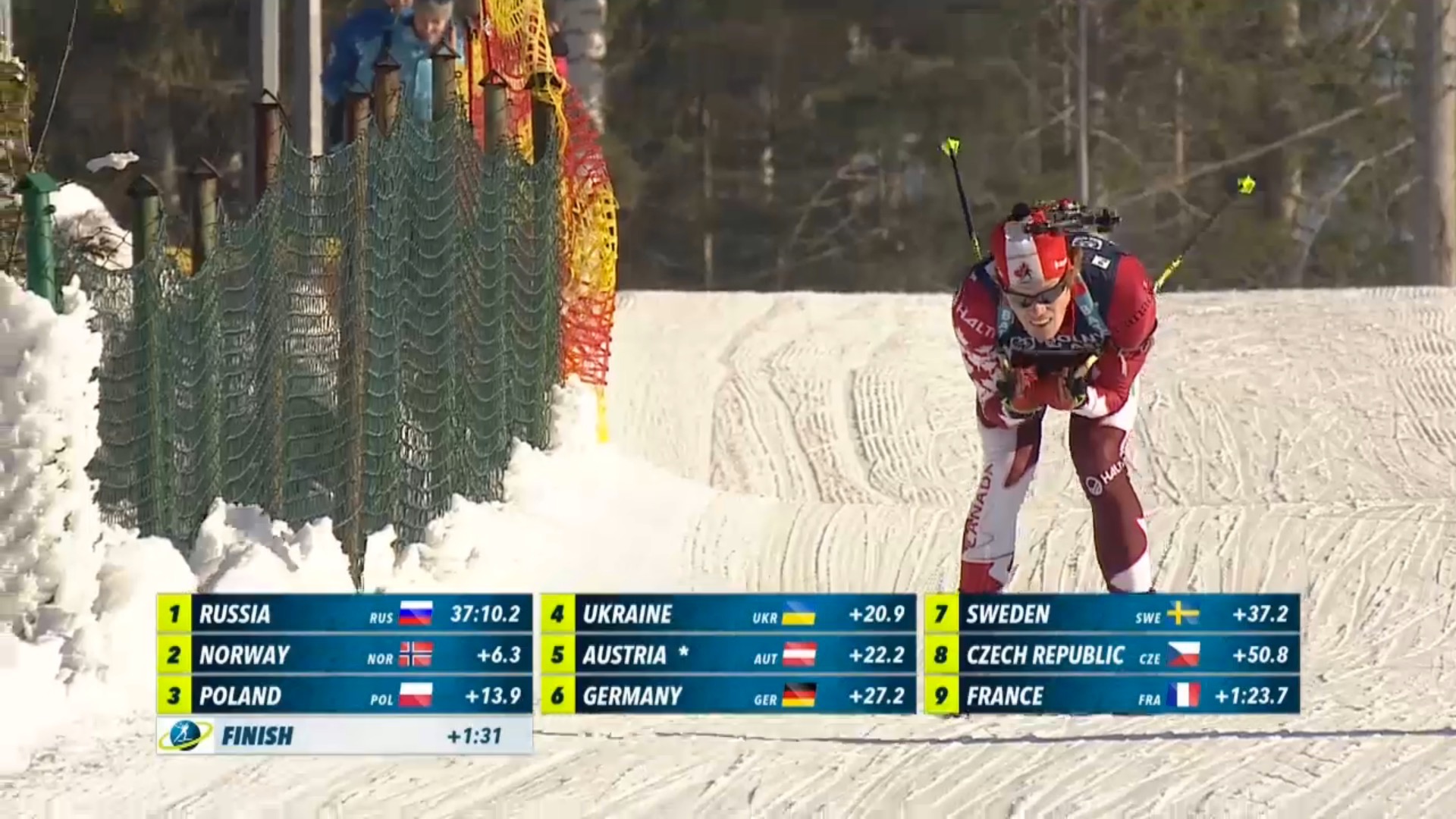
Canada’s Brian McKeever (Canadian Para-Nordic Ski Team) finished 29th (+8:48.9) for his first regular-season World Cup top 30. (McKeever placed 21st in the 15 k skate at 2007 Sapporo World Championships.)
The Classic Leg
“At the beginning of the race the pace was a little bit subdued,” U.S. Ski Team Head Coach Chris Grover said on the phone. “Early on, no one was really charging too much.”
Norway’s Mathias Rundgreen (6) and Americans Matt Gelso (24) and Scott Patterson (10) striding in the pack during Saturday’s 30 k skiathlon in PyeongChang, South Korea. Gelso went on to finish 19th overall while Paterson placed ninth. (Photo: Salomon/Nordic Focus)
Rundgreen controlled the tempo, leading the pack through the 5 k split at 14:16.
“They were going so slow at one point that Noah just took off to the front and made a little surge,” Grover noted.
That came at 6.15 k, and Hoffman won the first of two preems, or bonuses, in the race. Patterson came through in ninth, six seconds later.
At 7.5 k, a line of 21 skiers lapped through the stadium — Hoffman in third, Patterson ninth, four seconds out. Gelso trailed at the tail of that group, nine seconds off.
At 9.9 k, it was a repeat; Hoffman took the second bonus, controlling the pace up front surging and slowing. (Both bonuses amounted to 30 extra World Cup points for Hoffman.) Gelso and Patterson came through about eight seconds later in 14th and 18th, respectively.
“I was feeling pretty good on the classic,” Hoffman explained on the phone.
American Noah Hoffman (r) racing alongside Norway’s Daniel Stock during Saturday’s 30 k skiathlon at the World Cup in PyeongChang, South Korea. (Photo: Fischer/NordicFocus)
It was also an opportune time for U.S. Ski Team sponsors as Hoffman captured the majority of camera time. There was nothing about his skiing that didn’t appear confident. Solid striding, focused effort, and a will to position himself in the lead, or one or two spots back.
But that was his bluff.
“If I had been confident in my ability to win the race I probably would have really chilled on the classic — which I didn’t do,” Hoffman said of his front-of-the-pack classic leg effort. “I was skiing up near the front a lot. I was snagging some of the preems. … I was kind of playing games a little bit, having fun with the pack a little bit which was really fun to do. And maybe you could mistake that for confidence, but I think it was probably the opposite.”
Part of sport is gamesmanship. And part of opportunity is taking bold chances to seize it. The best athletes are not afraid of failure.
“I got stretched a little bit on the last classic lap to the tune of maybe five seconds plus or minus,” Hoffman added.
“My classic leg went pretty well for 2.5 loops,” Patterson wrote in an email. (Each loop was 3.75 k.) “I was hovering around 10th until we hit the longest down hill on the course. There were some surges for bonus points right before and I had a slight gap in front of me in my lane … I also ended up in a lane that had not glazed nearly as much as the primary center track. I probably went from 10th to around 25th. After that the rest of the classic I was spending too much energy to get back up close to the front and I ended coming through a bit off the lead group.”
15 k of Skating
Eleven skiers entered the classic to skate exchange with approximately 10 seconds separating the first from last. Hoffman had a seamless changeover, the second fastest, and left on his skate skis in fourth. Behind him, Patterson left the exchange 16th (+24.0).
Initially Rundgreen led the line of 11 skaters that increasingly spread out. One by one, another dropped, losing a meter or two, then they’d up the tempo to catch back on. Then Sedov would pull with the same effect.
But right there glued on at 17 k was Hoffman. He was in third at 19 k, but had bled nine seconds to Sedov and Stock now in the lead.
At that mark, Patterson had ceded 39 seconds to the Sedov-Stock combo. Gelso had fallen a bit over two minutes behind.
For the remaining distance, Sedov was the skier to beat as he slowly put a gap on Stock.
Hoffman’s group, five skiers deep, could sniff the third podium spot and it became an every-skier-for-themselves effort.
Norway’s Mathias Rundgreen (6) outlunging Russia’s Konstantin Glavatskikh (l) for third in the men’s 30 k skiathlon on Saturday at the PyeongChang World Cup in South Korea. (Photo: Fischer/NordicFocus)
Rundgreen outlunged Russia’s Konstantin Glavatskikh for the final podium spot in a photo finish — they were given the same finishing time of 1:19:31.7.
“It was fun, it was nice to ski back up front,” Hoffman said. “I was doing that a lot in 2012, 2013, 2014 … I was just being involved in the race. So I wanted to do a little bit of that. From that perspective, I think it was good, I was definitely involved in the race throughout.”
Hoffman’s eighth place (+1:06.2) was his best result in a non-stage World Cup since placing eighth in a 2012 skiathlon in Canmore, Alberta. (Hoffman won the time of day in the 15 k pursuit four years ago in Kuusamo, Finland.)
For Patterson, the skate leg competition analysis reveals his strong skiing — most of his skate leg sector times rank in the top 10, with several top-five splits.
“My skate leg was quite good,” Patterson wrote after finishing ninth, one spot behind Hoffman. “Unfortunately I had a bit to move up from the classic. I spent most of the skate chasing the pack that Noah was in. They would accelerate going into some of the bonus points and then I would gain back on the rest of the course. I think I could have been quite good if I was able to latch onto the pack but I never quite made it. Instead I just cruised past everyone who fell off.”
Matt Gelso (SVSEF) racing to 19th in Saturday’s World Cup 30 k skiathlon in PyeongChang, South Korea, for his first World Cup top 20. (Photo: Salomon/Nordic Focus)
Saturday marked the first career World Cup points for Patterson. Gelso, who scored his first points during Friday’s sprints, fell back on the skate leg to finish 19th — still his first World Cup top 20.
McKeever, a visually impaired skier who races without a guide in FIS World Cups, finished 29th to lead Canada, which started three men.
“The strategy was simply to follow,” McKeever emailed. “No point in deluding myself that I’m at the same level as the top guys. They dictate how the race is run. I just try to react. I just try to find decent wheels to follow and a rhythm that suits my style. … It was a tough day given recent shape. I was very sick after US nationals and spent a pretty uncomfortable week in bed. Given that, I’m quite happy with the effort being that it was really all I had.”
Also for Canada, Bob Thompson (NTDC Thunder Bay) placed 32nd (lapped), and Simon Lapointe (CNEPH) did not finish.
The Russian men finishing in unison to take first, second and third in the men’s 30 k skiathlon, the final race of 2017 U23 World Championships at Soldier Hollow in Midway, Utah. Alexander Bolshunov (8) was deemed the winner, Alexey Chervotkin (1) was second, and Denis Spitsov (11) third. (Photo: FlyingPointRoad.com)
FIS Nordic Combined Junior World Championships (Park City and Midway, Utah): Normal hill/5 k
American Ben Loomis (6) leads Norway’s Lars Ivar Skaarset (7) during the third leg of the nordic-combined 4 x 5 k team event on Thursday at 2017 Nordic Junior Worlds at Soldier Hollow in Midway, Utah. Loomis brought the U.S. from ninth to seventh, and his team ultimately finished seventh. (Photo: FlyingPointRoad.com)
[UPDATED] In the individual normal hill/5-kilometer Gundersen on Saturday, the last nordic-combined competition of 2017 Nordic Junior World Championships, American Ben Loomis captured his first top 10 in his third Junior Worlds in ninth place.
Eighteen-year-old Loomis jumped to 10th then picked off one place in the 5 k to finish ninth, 1:22.3 minutes behind the winner, Germany’s Vinzenz Geiger.
Geiger led after the jump and started the ski race 4 seconds ahead of Japan’s Yuto Nakamura in second. Geiger was able to hold off Finland’s hard-charging Arttu Mäkiaho, who raced from ninth to second, by 22.6 seconds. France’s Laurent Muhlethaler raced from fifth to third (+23.9) for the final spot on the podium, while Nakamura slipped to fourth (+42.8).
The U.S. had two in the top 15 with Stephen Schumann in 15th (+1:44.3), up from 20th after the jump. Grant Andrews placed 33rd (+2:40.0) and Tucker Hoefler finished 46th (+3:56.9).
FIS Nordic U23 World Championships (Midway, Utah): 15/30 k skiathlon
It was a Russian affair and a head scratcher for the photo-finish crew at U23 World Championships on Saturday, with three Russians putting enough time on the rest of the field in the men’s 30-kilometer skiathlon that they had time to slow to a stop and inch across the line in unison.
The jury ultimately had to decide who won, awarding it to Alexander Bolshunov in 1:15:31.5 hours, 0.2 seconds ahead of Alexey Chervotkin in second. Denis Spitsov was listed as third (+0.5). France’s Jules Lapierre came closest to the Russians in fourth, finishing 11 seconds later.
The field was considerably strung out by the end of the race, with Switzerland’s Jason Rueesh finishing 14.3 seconds out of first in fifth and Norway’s Gaute Kvaale crossing the line in sixth (+33.0), ahead of France’s Valentin Chauvin in seventh (+49.1), and Andorra’s Irineu Esteve Altimiras in eighth (+56.8).
American Paddy Caldwell (SMS/USST) placed ninth for the second-straight race at U23s, finishing 1:24.4 behind the winner.
The U.S. men had three in the top 15 for their best day of the championships, with John Hegman (SVSEF) placing a 11th (+1:53.5) and Adam Martin (NMU) 15th (+2:23.3) for their best results at U23 Worlds.
Evan Palmer-Charrette (NTDC Thunder Bay) led the Canadian men in 26th (+5:44.6). Alexis Dumas (CNEPH) finished 33rd (+9:02.7) out of 36 finishers. Several North Americans did not finish, including Canada’s Julien Lamoureux and Julien Smith, and American Cal Deline.
In the women’s 15 k skiathlon, Lotta Udnes Weng achieved her first gold of U23 Worlds, holding off Finland’s Johanna Matintalo by 3.8 seconds and crossing the line in 40:50.9 minutes. Russia’s Yana Kirpichenko reached the podium in third (+13.9), fewer than two seconds ahead of Weng’s twin sister, Tiril Udnes Weng in fourth (+15.6).
Dahria Beatty, of the Alberta World Cup Academy and Canadian National U25 Team, led the North Americans in 19th (+2:18.1), and teammate Katherine Stewart-Jones (NTDC Thunder Bay/NST U25 Team) was 21st (+2:29.3) for her best U23 Worlds result.
The Czech Republic’s Petra Hyncicova (University of Colorado-Boulder) followed in 22nd (+2:30.7), and three Canadian women finished in the top 30 with Frederique Vezina (CNEPH) in 29th (+3:36.2). Jenn Jackson did not finish.
Jesse Knori (University of Colorado-Boulder) was the top American in 30th (+3:40.1), Alayna Sonnesyn followed in 31st (+3:42.5), Nichole Bathe (University of Alaska Fairbanks) in 33rd (+4:36.9), and Corey Stock (Bridger Ski Foundation) in 36th (+5:42.1).
Mathilde Petitjean, who races for her native Togo but trains with the Quebec-based CNEPH, finished 38th (+6:04.8) of 38 finishers.
FIS Cross-Country World Cup (PyeongChang, South Korea): 15/30 k skiathlon
The women’s 15 k skiathlon podium at the PyeongChang World Cup in South Korea, with Poland’s Justyna Kowalczyk (c) in first, American Liz Stephen (l) in second, and Japan’s Masako Ishida in third. (Photo: FIS Cross Country/Twitter)
The second day of World Cup racing in PyeongChang, South Korea, took place this Saturday, with a skiathlon event for both genders. The women raced a total of 15 kilometers, the first 7.5 k leg classic and the second 7.5 k leg freestyle. Poland’s Justyna Kowalczyk came away with the women’s win (her first in three years), getting back to her old ways of breaking away from the pack to finish first in 43:54.7 minutes. Liz Stephen of the U.S. Ski Team (USST) claimed second place (+56.0), while Japan’s Masako Ishida took third (+1:14.8).
For Stephen, second matched her best individual result in a from two years ago, when she placed second in a 10 k freestyle in Rybinsk, Russia. This year at the Tour de Ski, Stephen posted the second-fastest time up the final climb in Val di Fiemme, Italy. For Ishida, it was her first podium since 2009.
Caitlin Patterson, racing for the U.S., finished just off the podium with a career-best fourth (+1:21.4) for her first top 20 on the World Cup, and American Liz Guiney placed 13th (2:21.7) for her first top 20 as well. Jessica Yeaton, who trains with Alaska Pacific University and races for Australia, came in 24th (4:58.6).
Two Canadian women competed with Annika Hicks leading the team in 26th (+5:17.8) followed by Sadie White in 29th (+6:54.7) for their first World Cup top 30s.
In the men’s 30 k skiathlon that followed, Russia’s Petr Sedov broke away during the skate leg to take a decisive victory over Norway’s Daniel Stock and Mathias Rundgreen, finishing in 1:18:49.6 hours, 22.5 seconds clear of second place. It was Sedov’s first World Cup win and podium, and the first individual podiums for Stock and Rundgreen as well.
Rundgreen edged Russia’s Konstantin Glavatskikh for the final spot on the podium, with both being listed as 42.1 seconds behind Sedov.
While Rundgreen held off three others for third place, including Sweden’s Gustav Eriksson in fifth (+46.8), Japan’s Keishin Yoshida in sixth (+47.1), and Russia’s Alexander Utkin in seventh (+49.0), American Noah Hoffman kept his distance ahead of the second chase group to finish eighth (+1:06.2) for his best result in a non-World Cup stage since placing eighth in a 2012 skiathlon in Canmore, Alberta. (Hoffman won the time of day in the 15 k pursuit four years ago in Kuusamo, Finland.)
Also for the U.S., Scott Patterson was next across the line in ninth (+1:28.4) for his first World Cup points, and Matt Gelso finished 19th (+5:00.8) for his first top 20.
Brian McKeever of Canada’s Para-Nordic Ski Team was the lone Canadian finisher in 29th (+8:48.9). Bob Thompson was listed as placing 32nd of 37 after being lapped, and Simon Lapointe did not finish.
NorAm Eastern Canadian Championships (Cantley, Quebec): Classic interval start
The NorAm mini tour at the Nakkertok Nordic Centre continued on Saturday with Eastern Canadian Championships with classic individual start races.
In the men’s 15 kilometre, Lappe Nordic’s Andy Shields took a lead in the first lap and held on to win in 39:14.7, just 0.7 seconds ahead of CNEPH’s Ricardo Izquierdo-Bernier. Team R.A.D.’s Russell Kennedy collected his second bronze of the weekend, 24.7 seconds back.
SMS Elite’s Anne Hart won the women’s 10 k in a reversal of Friday’s sprint podium. Hart’s 30:03.3 finish gave her a 9.3 second edge on CNEPH’s Sophie Carrier-Laforte and 20.0 seconds on AWCA’s Maya MacIsaac-Jones.
For the 123 men and 77 women doing the full distance, the weekend is a mini tour. For the younger categories, it is three separate events allowing the kids who couldn’t skip school on Friday to race Saturday and Sunday.
There should be over 700 finishers today with 768 on the start list. The volunteers will have more hours of work even after the open categories have finished.
Results will update continuously as more categories start.
“We are 7 hours behind you in Pacific time (and a day ahead),” U.S. Ski Team Head Coach Chris Grover wrote in an email from South Korea on Monday. But as his email hints, tracking time and day when criss-crossing time zones and arranging a phone call can be befuddling. So another way of stating what Grover wrote is that KST, or Korea Standard Time, is 17 hours ahead of the time at this reporter’s location in Bend, Ore.
The call went down on Monday at 5 p.m. Pacific Standard Time. Just so we’re all straight, that was Tuesday, 10 a.m. KST.
With all that travel, staying rested, staying fast and staying healthy are primary concerns for athletes and coaches traveling on the usually Eurocentric World Cup.
“When you look at the U.S. team it is primarily a European-based team,” Grover said on the phone. Many U.S. athletes have been in Central Europe since mid-November. Maybe there’s a +1 hour difference from Central European Time (CET) when a race is hosted in, say, Finland. Most athletes haven’t had to deal with constant time-change jolts.
As a pre-Olympic World Cup (the 2018 Winter Games will be held in PyeongChang, South Korea), organizers wanted athletes and team support to have an easy transition upon arrival. The races — a classic sprint on Friday, skiathlon on Saturday and freestyle team sprint on Sunday — are being held in the late afternoon or evening; at times compatible with Europe’s television market.
Although the Korean times are atypical for Euro-based World Cups, they do correspond to the “physiological” times dictating when skiers are primed for racing. A 6 p.m. KST race is the equivalent of a 10 a.m. race in France.
“It actually plays well for athletes coming from Europe because they can acclimate less because they can sleep in,” Grover said of how the time-zone change shouldn’t be a dramatic shift for the U.S. team. “They can sleep in for quite a while, get up late, have a late lunch, race, and then have a late dinner and shift their whole normal schedule further back in the day. So I’d say the primary strategy we are employing, but not every athlete can do it, or do it super effectively, but we are trying basically to keep these guys on a European time zone as much as possible while they are over here.”
Yet remaining healthy while traveling and living abroad has been a puzzle for many skiers. On the flight over and while staying in hotels, Grover preaches good hygiene: wash hands and use hand sanitizer when hand washing isn’t convenient. The U.S. also asks that hosting hotels take precautions like disinfecting rooms prior to team’s arrival to help minimize germ exposure. In addition to these precautions, Grover had athletes consult face to face with a U.S. Ski Team (USST) nutritionist when the athletes were in Ulricehamn, Sweden, in mid-February. It was another aspect of monitoring athlete health.
“[The nutritionist was] making sure everybody was doing OK nutritionally, making sure they are doing OK with their body composition,” Grover said. “It is one thing to monitor those things in the U.S. when everybody is in the training mode, it is another things when you move to Europe and all of sudden you are on a different diet pretty much every week and you are competing full time. … So everybody had a good check in there. If people needed a supplement of vitamin D or iron, or what have you, or to improve part of their nutritional program, then we addressed that a couple weeks ago. That’s one way that we are trying to stay healthy.”
Another aspect of the quick-turnaround PyeongChang trip is transporting gear and making good and efficient use of the USST ski techs’ time while on the ground at the future Olympic venue.
“We brought all of our own equipment; we had nothing here,” Grover explained. “This is the first time we have been here during the winter. That was of course one of the challenges is the logistics and the expense of moving all of our necessary gear over here. And all teams are obviously in that same boat.”
The three U.S. coaches (Grover, Matt Whitcomb and Jason Cork) and four techs that made the trip to PyeongChang are there first to prepare athletes and skis for the three-race stop. But it’s also double duty in terms of Olympic prep. The USST staff will remain an extra day, the athletes depart for Europe next Monday, to further advance their venue-specific data set. Grover said this trip will remain the only USST testing trip prior to the 2018 Games.
“We have definitely taken lessons that we have learned from Vancouver [and] from Sochi,” Grover said of the team’s de-emphasis on longer term, on-site testing. “You can definitely over test a bit in a place and kind of get heading in wrong directions that are not so applicable a year later when you have a different composition on the track between, say, manmade and natural snow, for example. … So the testing that we really want to do is important, but it is more on the fundamentals of structure of grinds, of base layers, that sort of thing.”
The U.S. brought six current USST athletes to South Korea: Sophie Caldwell, Ida Sargent, Liz Stephen, Andy Newell, Simi Hamilton, and Noah Hoffman. Grover stated the remaining national-team members opted for a different schedule and did not make the trip.
Matt Gelso and Liz Guiney earned start rights as Period 1 SuperTour leaders. According to Grover, the U.S. team invited two additional athletes as well, Caitlin Patterson (Craftsbury Green Racing Project) and her brother Scott Patterson (Alaska Pacific University).
Neither of the Patterson siblings were selected for the upcoming World Championships in Lahti, Finland. Yet Grover stated he believed both deserved PyeongChang starts — specifically in the skiathlon.
“They both had been sick immediately prior to the nationals and then actually the first part of the nationals as well. Especially in Scott’s particular case,” Grover explained. “But both had been skiing well not only in the early season this year, but also in the late season last year. Caitlin was taking World Cup points distance at the end of last year and at the beginning of this year in Kuusamo as well.”
In Scott’s case, Grover mentioned he remained one of the top U.S. distance skiers behind USST members Erik Bjornsen and Hoffman.
“The next guy that was getting close to perhaps breaking through to the top 30,” Grover said. “We wanted to find an opportunity to give them a distance start and to see what they could do.”
The Canadians have also arrived in Asia. Coach Charles Castonguay, of the Pierre-Harvey National Training Centre, will be leading the team in South Korea, assisted by five Canadian team World Cup techs and Tom Holland, Cross Country Canada’s high-performance director.
Representing Canada in the women’s races will be Annika Hicks (Alberta World Cup Academy) and Sadie White (NTDC Thunder Bay).
On the men’s side, national-team members Len Valjas and Jess Cockney, Para-Nordic Ski Team member Brian McKeever, Bob Thompson (NTDC Thunder Bay), Julian Locke (Alberta World Cup Academy/National U25 Team), and Simon Lapointe (CNEPH) were slated to start Friday’s sprint in South Korea.
In an email, Castonguay explained that team selection was premised on two criteria: 1. World Cup results (such as a top 30, which Len Valjas achieved), and 2. Classic sprint results and distance results from U.S. nationals last month (excluding athletes who were selected for Junior and U23 World Championships).
“Some athletes, who were also selected for senior [World Championships] in Lahti declined PyeongChang, like Knute [Johnsgaard], to get a better preparation for Lahti,” Castonguay wrote. “So we went down the rank list to select people for Korea.”
Racing begins on Friday with the men’s and women’s classic sprints.
The Marcialonga course follows the rivers in Italy’s Fiemme and Fassa valleys for the first 67 kilometres. (Photo: Ian Murray)
Double poling is an increasingly important part of cross-country skiing and it pays to be good at it. If watching World Cup stars double pole short races on television doesn’t have you convinced, take a look at the races you might enter. Most loppets, marathons and citizen races feature flatter courses with a lot of double-poling time. Even in skating, the three main techniques all include slight variations on double poling.
When five Canmore skiers decided to make the 70-kilometer Marcialonga in Italy (part of the Ski Classics marathon series) their major target for this season, they decided to emphasize one technique in their preparation.
“Pretty much the whole elite field will [double pole the Marcialonga without grip wax],” Erik Carleton, a longtime Canadian Para-Nordic Ski Team guide, explained. “It’s all about getting to the last uphill, and then it’s 3 k pretty steep and you just try and survive that.”
Here are three of the workouts that the 38-year-old Carleton and his Canmore-based training partners, including Canadian Para-Nordic veteran Brian McKeever (age 37), his other guide Graham Nishikawa (33), Ian Murray of North Highlands Nordic (38), and Jon Arne Enevoldsen (54), a former Norwegian biathlete who now runs a coaching business, used to prepare. Each of these five athletes had a different mix of goals for the season and shared workouts were just a part of their individual preparation. FasterSkier has suggested variations for those of us who are less than elite.
Workout 1: Go to a local classic loppet/marathon/citizen’s race and don’t bring kick wax.
Erik Carleton leads a group through Bilbo’s Bog at the 2017 Reino Keski-Salmi Loppet at the Larch Hills trails in Salmon Arm, B.C. (Photo: Larch Hills Nordic)
The Canmore crew chose the Reino Keski-Salmi loppet, a 34 k race at the Larch Hills trails in Salmon Arm, B.C., known to locals as the RKS. This event is a typical regional loppet: the long course is relatively flat with a little over 600 metres of climbing, the demographic is dominated by kids and retired people, and most of the 396 finishers were solidly focussed on having fun on snow.
Before the race, Enevoldsen correctly predicted that local skiers with grip wax would easily beat anyone double poling on squeaky -17 Celsius snow. Their goal was not to win, but to get some quality DP training done two weeks before the Marcialonga.
In the end, Larch Hills local Thomas Hardy cruised to victory on grip wax in 1:38:52, just four days after placing 18th at the U.S. nationals 30 k classic mass start at Soldier Hollow in Utah. McKeever and Nishikawa returned from Soldier Hollow ill and didn’t start.
Carleton was feeling the effects of his 15th at Soldier Hollow, finishing the RKS 4:03 minutes behind Hardy. Carleton said afterwards, “It felt good off the start and I tried to push the pace a bit, but then the body was — not today.”
Murray and Enevoldsen were fresher but still treated the RKS as a training workout, finishing at 1:32 and 9:00 respectively to win their age groups.
If it seems wrong to go to a race and not push for the best possible finish, these guys weren’t alone in looking past the result sheet. Retired Canadian national-team member Alysson Marshall returned to her hometown event with her new husband Chris Hamilton to have fun on the trails she grew up on.
Variations:
Choose a race to suit your needs. McKeever and Carleton have double poled 50 k races in the past, but your local weeknight 10 k might be a better fit.
Split a race in two. If you aren’t ready to double pole the full race that fits your calendar, choose a point on the course where you will pretend you have switched to skate skis and double pole to the finish.
Workout 2: Long DP rollerski with race pace at end
(From left to right) Brian Gregg, Jon Arne Enevoldsen, Erik Carleton, and Ian Murray during a double-pole rollerski from Canmore to Banff, Alberta. (Photo: Brian Gregg)
Roughly every two weeks, the crew would get together for a long Zone 1 (Level 1, or easy chat level) double-pole ski followed immediately by 30 to 60 minutes in Zone 3 (loppet race pace).
“The idea is you tire out your body and then try and push it a bit more,” Carleton said, “so that it will give you that endurance double-poling at the end of loppet races.”
For this crew, the long easy session was two to four hours.
While this workout could be done on snow, it was a rollerski favourite because of available trails. “We’ve got this nice legacy trail to Banff and it’s good flat terrain for that,” Carleton said. Few ski areas can provide flat trails suitable for a four hour ski without excessive laps.
Variations:
Adjust the times. Starting out, one hour of Zone 1 followed by 30 minutes of Zone 3 might be hard enough.
Use your legs for the Zone 1 part. If you don’t have enough flat terrain to stay in Zone 1 double poling, stride or skate as needed in the first part of the workout. For the second part, hilly terrain is less of a problem in Zone 3.
Workout 3: 4 x 45-minute intervals
Double pole 45 minutes in Zone 3, followed by four hours of rest between.
Murray came up with this workout after getting good performance gains from doing mountain bike relay races like ’24 Hours of Adrenaline Canmore’ and ‘Golden 24’.
“Some of my friends give me a hard time, saying this is too difficult,” Murray wrote in an email. “But the mountain bike races are far harder.”
Variations:
Don’t do this. While this workout seems unnecessarily hard, it is clearly working for Murray. Maybe we can all think outside the box to build new workouts from races, events, or long backcountry days that produced good results.
(From left to right) Erik Carleton, Jon Arne Enevoldsen and Ian Murray previewing the Marcialonga course. (Courtesy photo)
Conclusions:
So how did these five fare in the Marcialonga after all the preparation?
McKeever was the fastest of the group (and fastest Canadian), finishing the shortened 57 k course in 2:21:32.5 hours, 9:13 minutes behind the winner Tord Asle Gjerdalen for 57th overall. Nishikawa was next, 81st at +12:56, then Murray (86th, +13:37), Carleton (113th, +17:50), and Enevoldsen (160th, +22:14).
Murray was pleased with his personal best at a Ski Classics event, writing “The double pole training has worked out well. I was able to hold a hard effort for the first 50km although I faded a bit in the last 7km.”
Murray’s event highlight: “Being so close to the lead for the first part of the race. Also skiing down the streets of 4 old Italian towns along the 57km track. I didn’t get to soak in that aspect of the race during the event but rather in the pre-skis and post race ski it was fantastic.”
And how much did the double-pole preparation pay off? Considering there were 5761 finishers including many former world cup stars like Gjerdalen, Anders Aukland, Toni Livers, and Østein Pettersen, top 200 is impressive.
Norwegian Anders Host shows off the Team Leaseplan stripes on his way to 29th place. (Photo: Graham Longford)
Graham Nishikawa takes a feed. Note that bib 52 in the background is striding! (Photo: Graham Longford)
Nishikawa entering the stadium in Tesero. If the background looks familiar this is the Val di Fiemme venue used in the Tour de Ski every year. (Photo: Graham Longford)
Brian McKeever jumping in front of Norway’s Petter Kaarby just before the final climb. (Photo: Graham Longford)
Tord Asle Gjerdalen (yellow bib) launching the winning attack on the final climb to Cavalese. (Photo: Graham Longford)
While the attention is on the elite skiers, thousands of people are enjoying the scenery and temporary ski tracks through the many towns on route. (Photo: Graham Longford)
Alleys and byways can be ski trails too. (Photo: Graham Longford)
‘Passeggiata’ is the evening stroll through ‘la citta’, the centre of town. Many of the skiers at the back of the group will stop in a cafe for a drink and a pastry in one of the small towns. (Photo: Graham Longford)
Emil Iversen celebrates his win in the 30 k classic mass start in Falun, Sweden, on Sunday. Norwegian teammate Martin Johnsrud Sundby finished second and Sweden’s Calle Halfvarsson third.
FIS Cross-Country World Cup (Falun, Sweden): 15 / 30 k classic mass start
In the women’s 15-kilometer classic mass start on Sunday, Norway swept the podium with Marit Bjørgen taking the win in a time of 41:28.8 in Falun, Sweden. Crossing just half a second behind her was her teammate, Ingvild Flugstad Østberg in second place. Rounding out the podium was Heidi Weng in third (+8.1).
American Jessie Diggins was the first to cross the line for the U.S. in 10th (+1:37.5). Three other U.S. women finished in the top 30, with Sadie Bjornsen finishing 21st (+2:43.6), Rosie Brennan 24th (+2:57.0), and Liz Stephen in 29th (+3:24.5).
Just outside of scoring World Cup points was American Caitlin Patterson in 32nd (+3:47.6) and Ida Sargent in 34th (+4:02.8). Canada’s Cendrine Browne finished 46th (+5:41.4) and American Liz Guiney 49th (+6:22.6).
After losing the skate sprint yesterday in a photo finish to Italy’s Federico Pellegrino, Emil Iversen ascended to the top step of the podium in the men’s 30 k classic mass start on Sunday in Falun.
The Norwegian was often near the front, but hadn’t tried to lead a breakaway like his teammates Martin Johnsrud Sundby and Sjur Røthe did earlier in the race. In the final two kilometers, Sundby – the overall World Cup leader – put in a sprint to try to drop the field. But Iversen caught up, drafting his veteran teammate into the stadium. In the final up-and-over before the finish line, Iversen made a pass and then accelerated down the finishing stretch to beat Sundby by 1.14 seconds.
“I got motivation from yesterday’s last 20 meters,” Iversen told FIS in a finish-line interview. “So today I fought all the way, and I was really stronger. It is amazing for me to be second yesterday and first today. I’m really proud of that.”
Calle Halfvarsson, who had been falling off the back of the lead pack just a few kilometers earlier, managed to get back to the front and claim third place for Sweden (+1.72 seconds) in a photo finish with Røthe (+1.76 seconds). Niklas Dyrhaug was next (+2.52 seconds) to give the Norwegian men’s team four in the top five.
In his return to the World Cup stage, Norway’s Petter Northug finished 31st (+3:10.6).
Alex Harvey was the lone Canadian on the start line. After skiing near the front of the field for the early part of the race he was dropped by the lead pack in the final kilometers, finishing 15th (+1:17.5).
Erik Bjornsen and Noah Hoffman took 35th and 37th places for the United States, finishing +3:30.8 and +3:59.8, respectively. SuperTour leader Matthew Gelso — familiar with the Falun course after competing in 2015 World Championships — finished 44th (+5:23.6), and Andy Newell placed 53rd (+7:45.3).
IBU Open European Championships (Duszniki-Zdrój, Poland): Single mixed & mixed relay
Russia’s Alexander Loginov (center) is greeted at the finish by his teammates Irina Starykh, Svetlana Sleptsova and Alexey Volkov after anchoring his team to the gold medal in the mixed relay at the 2017 IBU Open European Championships in Duszniki-Zdrój, Poland. (Photo: IBU)
[UPDATED] The Russian victory in the final 2 x 6 + 2 x 7.5-kilometer mixed relay event of the 2017 International Biathlon Union (IBU) Open European Championships in Duszniki-Zdrój, Poland, was only briefly in doubt, when Alexander Loginov skiing the anchor leg required all spares in his prone shooting stage. But with his final shot he managed to also hit that target to avoid the penalty lap, leaving the range with a lead of more than 30 seconds.
Loginov then did not need any spares in the last standing stage, and could take his time on the final loop. Unlike Russia’s Evgeniy Garanichev earlier in the day during the single mixed relay, he also managed to pick up a flag for the final meters of the race, crossing the line in a time of 1:12:26.0 hours.
The Russian team with Irina Starykh, Svetlana Sleptsova, Alexey Volkov and Loginov led from the first exchange and required only six spares with zero penalties.
With this medal, the 28-year-old Volkov became the most successful athlete in history at European Championships, according to an IBU press release, surpassing the retired Polish biathlete Tomasz Sikora. Russia was the most successful team of the 2017 Open European Championships with six gold, four silver, and three bronze medals.
Behind them, a number of teams vied for the positions on the podium. Sweden initially looked like a strong contender exchanging in second place after the women, but fell back with three penalty laps to only finish 10th.
Still six seconds back after the final shooting, Norway’s Fredrik Gjesbakk caught up to and outsprinted Ukraine’s Ruslan Tkalenko in the finishing stretch to claim the silver medal (+36.4) with the bronze left for Ukraine (+37.1).
“I thought that I made sufficient gap to win silver,” Tkalenko told the IBU. “But in the end, on the final downhill before the finish, I was very surprised when the Norwegian guy passed me, I truly did not expect that.”
The Norwegian team with Karoline Erdal, Marion Rønning Huber, Erlend Bjøntegaard, and Gjesbakk needed nine spares and had no penalties.
Ukraine with Anastasiya Merkushina, Yulia Dhzyma, Oleksander Zhyrnyi (who originally started for Russia before making the switch in 2014) and Tkalenko required six spares, and Dhzyma had to ski a penalty lap only temporarily setting the team back.
Bulgaria finished fourth (+1:16.4), with its anchor Vladimir Iliev narrowly beating Czech Republic’s Lukas Kristejn (+1:17.4) in the finishing stretch. Both teams needed 11 spares and had no penalties.
Jakob Ellingson skiing the anchor leg for the U.S. mixed relay at the 2017 IBU Open European Championships in Duszniki-Zdrój, Poland. The U.S. team finished 14th. (Photo: IBU/Eurovisionsports.tv screenshot)
Starting at the back of the field in bib 20, US Biathlon’s Emily Dreissigacker got her team off to a strong start with a clean prone shooting and one spare round in standing, exchanging in 10th, a minute behind the leaders. Hallie Grossman needed one spare in each of her stages, tagging off to the men in 14th position and now 2:39 behind. Max Durtschi also had one miss each in prone and standing, coming into the last exchange still in 14th position, but another minute back. Jakob Ellingson required all three of his spares in his prone shooting stage narrowly avoiding the penalty lap, and one more in his final shooting stage. As the team from Finland was racing over a minute behind the Americans, he was able to keep the 14th position into the finish (+4:47.4), with a team total of nine spares and no penalties overall.
For Biathlon Canada, Erin Yungblut starting in bib 19 shot clean in her prone stage and required two spares in her standing shooting, tagging off in 18th position and more than two minutes back from first. Leilani Tam von Burg stayed clean in her prone shooting stage and needed one spare in standing, moving up two positions to exchange in 16th place, yet more than four minutes behind the leaders. After the exchange to the men, both Matthew Neumann and anchor Carsen Campbell managed to shoot clean in all of their stages, but lost additional time on the course to finish 16th (+6:39.9) ahead of four lapped teams.
Canada had the best shooting result of all 20 teams starting the relay, with just three spares and no penalty.
Russia’s Daria Virolaynen (l) and Evgeniy Garanichev after winning Sunday’s single mixed relay at the 2017 Open European Championships in Duszniki-Zdrój, Poland. (Photo: IBU)
Earlier on Sunday, pretty much the only thing that went wrong for Russia’s Daria Virolaynen and Evgeniy Garanichev in the single mixed relay happened on the last meters of the finishing stretch, with Garanichev gesturing for a Russian flag he wanted to cross the line with. But the handoff was too short and the flag dropped past his outstretched hand to the snow. He glanced back, weighing if his lead was big enough to ski back, but decided it was not worth the risk, instead skiing into the arms of his partner waiting for him behind the line in a time of 37:10.2 minutes.
Russia needed seven spare rounds and incurred zero penalties. Garanichev secured the victory in the final shooting, when he only needed one spare – albeit fumbling a few seconds to insert it – while his direct opponents standing next to him required more time to hit their targets.
“Probably, I took some risk at the last standing,” Garanichev said, according to an IBU press release. “I wanted to shoot fast and clean, but missed with the last shot. But in general, I felt very comfortable; came and worked at the range in my rhythm.”
6.3 seconds behind, Norway with the team of Ingrid Landmark Tandrevold and Vetle Sjåstad Christiansen placed second, with seven spares and zero penalties.
“These are very short loops,” Christiansen commented on the fairly new, single mixed relay format. “You feel the pressure from the crowd and to shoot fast every time.”
The 20-year-old Tandrevold previously earned three bronze medals, including one in the single mixed relay, also with Christiansen, at last year’s Open European Championships in Tyumen, Russia.
To big cheers from their home crowd fans who had come out to the Duszniki Arena in beautiful but cold weather, the Polish husband-and-wife team of Krystyna Guzik and Grzegorz Guzik placed third with just five spares and zero penalties (+13.9), not quite able to keep up with Christiansen on the final loop after leaving the range together within a second.
“It is so nice to win a medal here in Poland,” Krystyna Guzik said. “We were both very disappointed with all of our mistakes in the other competitions. So today, we were relaxed and laughing before the competition, hoping not to have those mistakes again. We did not … and now have a medal.”
It was the first medal for Poland at these championships.
Ukraine with Iryna Varvynets and Andriy Dotsenko finished fourth, also with five spares and zero penalties (+20.9).
Biathlon Canada’s Aidan Millar skiing the final loop of the single mixed relay at the 2017 IBU Open European Championships in Duszniki-Zdrój, Poland. With teammate Sarah Beaudry, Canada finished 13th (Photo: IBU/Eurovisionsports.tv screenshot)
For Biathlon Canada, Sarah Beaudry and Aidan Millar required seven spares during their race and had no penalty, just like the winning Russians and Norwegians, but could not quite keep up with the best teams on the course in the fast-paced race format with short loops somewhat comparable to a team sprint in cross-country.
Beaudry cleaned her first shooting stage and then needed one spare to hit all targets in standing. At the first exchange Canada was 10th, 35.8 seconds behind the then leading team from Poland.
Millar missed one shot in his first prone stage, leaving the range again in ninth position. Then he needed two spares in his standing shooting on the way to exchanging back to Beaudry in 11th (+56.4).
On her second leg, Beaudry had one miss in prone and required two spares in standing, falling back a bit to exchange in 13th (+2:12.0).
On his final leg, Millar was able to shoot clean in both stages, reducing the time gap to the top but not able to make up another position, and finished in 13th place (+1:56.1).
US Biathlon is only represented with two women at the Open European Championships in Poland, and decided to forgo a start in the single mixed relay, instead entering a team in the mixed relay later on Sunday.
Katerina Smutna (left) and Tord Asle Gjerdalen (right) of Team Santander won the 2017 Marcialonga. (Photo: Visma Ski Classics)
Tord Asle Gjerdalen won the Marcialonga, a Worldloppet and Swix Ski Classics marathon for the third time – in a row. This year was on a shortened course, “just” 57 rather than the traditional 70 kilometers.
The Team Santander athlete finished in two hours, eight minutes, and 36 seconds, edging Johan Kjølstad (Team United Bakeries) and Morten Eide Pedersen (Team BN Bank) in a sprint finish by 2.6 and 2.9 seconds, respectively.
Tyler Kornfield and David Norris of Alaska Pacific University finished 43rd (+5:03.8) and 66th (+10:43.1). Canadian Paralympian Brian McKeever finished 57th (+9:13.5) and guide Graham Nishikawa 81st (+12:56.5), followed by Ian Murray in 85th (+13:37.5) and Erik Carleton in 111th (+17:50.2).
In the women’s competition, Katerina Smutna, also of Team Santander, won her third straight Ski Classics competition. She crossed the line in two hours, 22 minutes, and 46.4 seconds. Britta Norgren of Team Lager 157 was second by just 0.8 seconds, and Sara Lindborg (Team Serneke) third, +4:22.2. University of Utah alum Maria Graefnings was tenth, +10:35.8.
The Alberta Cup men’s podium in Sunday’s 8.1 k classic interval start, with winner Kyle Bratrud (c) of CXC Team, NTDC Thunder Bay’s Evan Palmer-Charrette (l) in second and AWCA’s Dominique Moncion-Groulx (r) in third. (Photo: NTDC Thunder Bay/Twitter)
Here’s one that didn’t make Sunday’s Rundown: the Alberta Cup’s opening distance races, which took place Nov. 26-27 in Canmore, Alberta.
***
The Alberta Cup kicked off this past weekend with several big names competing in the distance races at the Canmore Nordic Centre on Saturday and Sunday.
Brian McKeever, Kyle Bratrud, Chelsea Holmes, and Felicia Gesior picked up victories, with the latter three all hailing from the U.S.
In the men’s 13.5 k freestyle interval start, McKeever, of Canada’s Para-Nordic Ski Team, took first in the men’s open race, beating his teammate Graham Nishikawa by 3.6 seconds with a winning time of 30:01.8. A visually impaired skier, McKeever races with Nishikawa as his guide in Paralympic races. But not on Saturday.
Bratrud, of the CXC Team, placed third in the 13.5 k skate, two seconds back from Nishikawa and 5.6 out of first.
David Palmer (Black Jack) was the second Canadian in fourth overall (+20.0), Matthew Hudec, of the Biathlon Alberta Training Centre (BATC), was fifth (+36.3), and Brian Gregg (Team Gregg) took sixth (+50.1). Rounding out the top 10 (of 54 in the open men’s field), Russell Kennedy (Team R.A.D.) placed seventh, Erik Carleton (Canadian Para-Nordic Ski Team) was eighth, Evan Palmer-Charrette (NTDC Thunder Bay) ninth, and Dominique Moncion-Groulx, of theAlberta World Cup Academy (AWCA), 10th.
Holmes, of Alaska Pacific University (APU), won the women’s 8.1 k freestyle on Saturday, finishing nearly 45 seconds ahead of Caitlin Gregg (Team Gregg) in 21:10.7. Biathlon Canada’s Emma Lunder placed third (+52.1) and junior biathlete Megan Bankes (BATC) finished fourth (+1:08.4), ahead of another BATC junior Nadia Moser in fifth (+1:13). Andrea Dupont, of Rocky Mountain Racers (RMR) finished sixth (+1:19.6) and Katherine Stewart-Jones (NTDC Thunder Bay/National U25 Team) was seventh (+1:30.8), while Kathryn Stone (University of Alberta) placed eighth, Annika Richardson (NTDC Thunder Bay) was ninth, and India McIsaac (RMR) 10th out of 33 women in the open category.
On Sunday, CXC posted this photo and caption about its women’s winner Felicia Gesior (l), runner-up Caitlin Gregg (Team Gregg) (c), and Annika Richardson (r) (NTDC Thunder Bay) who placed second in the junior race in the Alberta Cup classic distance race: “Double CXC Team Win! Felicia Gesior double poles to a victory in the women’s classic race. Photo with the other two girls to double pole the race. These girls are STRONG!” (Photo: CXC Skiing Facebook)
On Sunday, Bratrud came out with a 9.9-second win in the men’s 8.1 k classic interval start over Palmer-Charrette. Bratrud won in 19:00.1, Palmer-Charrette was second, and Moncio-Groulx placed third (+29.2).
On his first of of four laps, Moncion-Groulx recorded the fastest lap time of the day.
“I didn’t know if I was in the game, but I was happily surprised when I was third,” Moncion-Groulx said of his finish, according to an AWCA press release. “It’s an improvement, and there are definitely some good guys racing. It’s a good confidence boost.”
Michael Somppi (NTDC Thunder Bay) was fourth (+32.5), Julian Smith (NTDC Thunder Bay) fifth (+45.7), and for the second-straight race, Brian Gregg finished sixth (+53.0). Nishikawa was another two seconds back seventh, Palmer was eighth, Kennedy cracked the top 10 for the second straight day in ninth, as did Carleton in 10th.
McKeever finished 11th, half a second behind Carleton, his other Paralympic guide, out of 26 in the men’s open race. After Sunday’s race, McKeever tweeted, “Vented personal frustration today. Mental error=inability to count laps in today’s race. Realize I’ve put a lot of stress on myself lately.”
In another tweet on Sunday, he wrote, “Congrats to Kyle Bratrud from @cxcskiing and the @NDCTBay boys for laying down the hammer on the field today! Cool to see!”
Also on Sunday, Gesior won the women’s 6.3 k classic and Caitlin Gregg repeated in second. Gesior put down the fastest time in 17:46.8, and Gregg finished 9.3 seconds back, while Olivia Bouffard-Nesbitt (AWCA/National U25 Team) placed third (+13.1).
According to the AWCA press release, Bouffard-Nesbitt is still recovering from a stress fracture and spent three months this summer on crutches. “I know I need to step up to the challenge. I feel the pressure and it’s helping me become a better athlete,” she said.
Stewart-Jones double poled to fourth (+23.3), Holmes placed fifth (+36.0), and Dupont was sixth (+54.1). Alannah Maclean (NTDC Thunder Bay) placed seventh, Emma Camicioli (RMR) was eighth, Delphine Duvernay Tardif (AWCA) ninth, and Ember Large (University of Alberta) 10th out of 18 women in the open field.
Jess Cockney (Canadian World Cup B-team) racing to first in the men’s classic sprint qualifier at Frozen Thunder on Tuesday in Canmore, Alberta. The win should secure his spot with the Canadian national team at World Cup Period 1. (Photo: Jenn Jackson)
Update: Early Thursday, Cross Country Canada (CCC) announced that Jess Cockney has been selected for World Cup Period 1, referencing both his Olympic history and last season’s World Cup top-10 result.
***
For most of the 88 racers at the Canmore Nordic Centre on Tuesday, it was a chance to train with a race bib on. But for some top male sprinters seeking World Cup starts, it was already one of the most decisive days of their season.
The Frozen Thunder classic sprint followed a King’s Court format, a more casual approach that guarantees all racers three heats. After the qualifier, competitors were divided into groups of four based on their finish times, regardless of gender or category. In each heat, the top two moved up one group and the bottom two moved down one group.
As an example, Canadian Para-Nordic standout Mark Arendz qualified 64th and shared his first heat with three junior women. After winning two heats, Arendz reached the final, where he lined up alongside Friday’s female distance winner Chelsea Holmes and two junior men.
The format resulted in a relaxed day for most, with evenly matched heats. As with Friday’s 7.5- and 12-kilometer freestyle interval starts, everyone used the same wax for qualification. The addition of a no-double-pole zone for the qualifications ensured that everyone chose grip.
For the Canadian male sprinters who hadn’t already qualified for World Cup Period 1, the pressure was on. For the winners of the sprint qualifiers on Tuesday and Thursday (with a freestyle sprint qualifier only on Thursday at 9 a.m. Mountain time), they would each be rewarded with one of two remaining World Cup spots.
Len Valjas (Canadian World Cup A-team) racing to second in the men’s classic sprint qualifier on Tuesday at Frozen Thunder in Canmore, Alberta. Valjas is pre-selected for World Cup Period 1. (Photo: Jenn Jackson)
On Tuesday, Jess Cockney of the Canadian World Cup B-team staked his claim, winning the classic-sprint qualifier in 3:51.66, 4.09 seconds ahead of World Cup A-team sprinter Len Valjas. Distance specialist Graeme Killick posted the third-fastest qualifying time, 6.98 seconds back and 0.49 seconds ahead of fourth-place finisher Knute Johnsgaard, completing a top-four sweep for the Canadian national team.
“It’s a huge help to be on snow this early for us and the fact that it’s available in my hometown is incredibly lucky,” Cockney, who trains in Canmore, wrote in an email about the Frozen Thunder trials races.
The other favourites for the remaining World Cup spot finished fifth through seventh: Bob Thompson, of the Thunder Bay National Development Centre (NDC), who was 9.12 seconds behind in fifth; Simon Lapointe, of the Pierre-Harvey Training Centre (CNEPH) in sixth (+9.95), and Julien Locke (U25 Team/Black Jack) in seventh (+10.26).
After Tuesday’s races, Cockney explained that he expected to be chosen for the first World Cup period as a result of his qualifying win.
“I haven’t heard anything official but that was the understanding I had of the criteria,” Cockney wrote.
According to Cross Country Canada’s published criteria, sprint selections for World Cup Period 1 “may be made” based on the race winner or winners in each of the two Frozen Thunder sprints. If unable to select the winners (i.e. pre-selected athletes win), second-place finishers may be chosen. There were other possibilities, in less preferable order, and ultimately, a five-person selection committee will determine who gets to go.
Cockney skipped the heats, explaining that he felt “under the weather a bit [Monday] and I’m trying to make sure I don’t make it any worse.” Killick and Valjas skied two heats before ending their days early due to similar concerns.
In the heats, Locke, a national-team rookie, won all three of his heats to take the overall victory. Brian McKeever of the Para-Nordic Ski Team placed second and John Hegman of the Sun Valley Ski Education Foundation (SVSEF) in Idaho was third.
“I was happy to see my teammate Jess Cockney ski very well and make the criteria,” Locke wrote in an email. “Personally, I had a subpar ski in the qualifier but everything went well in the heats. I felt that I was skiing well technically in the soft snow and I’m satisfied with where the shape is at right now. I am looking forward to the final selection on Thursday.”
Locke was one of several skiers excited by live TV coverage: “For the first time that I have seen in Canada, there had a TV crew on-site broadcasting the races live. Great work Shaw [TV Calgary]!”
Canadian television stations typically edit and delay broadcast of nordic races.
(From left to right) Bob Thompson (NDC Thunder Bay) chases Lenny Valjas (NST A-team), Graeme Killick (AWCA/NST B-team), and Knute Johnsgaard (AWCA/NST U25 Team) during a classic sprint heat at Frozen Thunder in Canmore, Alberta. (Photo: Jenn Jackson)
“These races are a fun way to get into the racing spirit!” McKeever wrote in an email. “Other than that, I don’t put any importance on them seeing as how it’s October and the big races are a long ways off.”
He appreciated the casual-sprint format for training purposes.
“King’s Court is a good way for every starter to get a full set of rounds in a sprint, regardless of qualification time,” he wrote. “It also pits people against others of similar ability which can be fun instead of getting shelled by the top guy/girl in the quarterfinal as happens sometimes. However, it does take a lot of time to get through the series of races and it makes for a lot of fatigue. I think I’m more tired after today than after a long Ski Classics race!”
Fatigue was a common theme among the racers as most are in the middle of a high-volume, on-snow block. Johnsgaard finished sixth in the A-final after qualifying in fourth.
“I feel really good about my race today,” Johnsgaard wrote. “I’m fortunate to already be qualified for Period 1 on the World Cup, so I can focus on the road ahead rather than the races this week. The conditions were slow but everyone was on the same wax, at least for the qualifier so we all suffered together!”
In addition to Johnsgaard, of Canada’s U25 Team and Alberta World Cup Academy (AWCA), pre-selected skiers for the World Cup Period 1 include Valjas, Killick, Alex Harvey, Devon Kershaw, and Andy Shields.
“It’s a great chance for me to practice going fast on snow but to me it’s not nearly as important as to the guys trying to nab the last World Cup spots,” Johnsgaard added.
Killick was also in training mode, but as with most elite athletes, the competitive urge is always there. “I took the qualifier pretty seriously,” Killick wrote. “It’s a good chance to gauge my speed with all the top guys competing for a spot over-seas.”
Pre-selected Beatty Top Female Qualifier; Phinney Wins Final
Dahria Beatty (102) leads Kelsey Phinney (106) and Annika Hicks (109) in the women’s final at the Frozen Thunder classic sprint on Tuesday in Canmore, Alberta. (Photo: Jenn Jackson)
With all of the national-team senior women prequalified for World Cup Period 1, the women’s qualifier and heats had a more relaxed feel, especially for an American like Kelsey Phinney. The Sun Valley skier won her final and explained in an email that she’s enjoying her first visit to Frozen Thunder.
“King’s Court sprinting was really fun! I liked that it allowed the women and men to do heats together, and that it gave the day a relaxed feel,” she wrote. “I’ve done King’s Court sprints in training before, and I like that everyone gets the experience of racing a full round of heats. I was skeptical at first with so many racers, but Zone4 did an incredible job timing and it ran really smoothly. The big difference between regular heats and King’s Court is that your qualification place matters more because there are only a couple heats to move up to get into the A final.”
Phinney qualified 49th in 4:40.40, 4.14 seconds behind Canadian U25 Team member Dahria Beatty, who was the first woman in 44th. Annika Hicks (AWCA) qualified in 47th as the second woman, 1.57 seconds back.
Dahria Beatty (AWCA/NST U25-team) was the fastest woman in the classic sprint qualifier on Tuesday at Frozen Thunder in Canmore, Alberta. (Photo: Jenn Jackson)
In the third heat, the organizers pulled the top women together for their own A-final. There, Phinney beat out Beatty and Hicks.
“I’m happy with today!” Phinney wrote. “I love racing heats, so I’m always happy to get a full day of heat racing with speedy competitors. We’ve put in a big volume week on snow and so it was good to end this block with a fun day of sprinting. I was pleasantly surprised that I felt pretty fast despite being tired from a big week of training. Also there was fresh snow on top of the man made loop, so we had some tricky conditions. It was definitely a good day to work on skiing in tough conditions.”
“My race was alright,” Beatty wrote in an email. “I definitely feel like I am still missing my top speed but that’s what these races are for. They are the perfect opportunity to get tuned up for the race season and remind the body how to move really fast.”
Hicks rounded out the podium with enthusiasm. “I felt strong today and it was a good confidence booster going into the start of the season,” she wrote. “Qualifying second behind Dahria was a huge surprise though! I’m usually not a strong qualifier but felt like I skied really well today.”
Olympic and Paralympic veterans lead next generation of elite skiers into new season
CANMORE, Alta. — Focused on winning medals at all levels, Cross Country Ski de Fond Canada named its 2016-17 National Ski Team loaded with promise for 2018 & 2022 Olympics and Paralympics Games on Tuesday.
Feeding off a successful ending to the inaugural Ski Tour Canada where the squad celebrated countless personal and season-best performances, seven Olympians, including six men and one woman, will lead the charge for the Canucks.
Led by Alex Harvey (St-Férréol-les-Neiges, Que.), who captured two medals last season, a high-powered group of athletes including Len Valjas (Toronto), Ivan Babikov (Canmore, Alta.), and Devon Kershaw (Canmore, Alta.) will form the World Cup A Team. Two other athletes who posted breakthrough performances during the Ski Tour Canada, Jesse Cockney (Canmore, Alta.), and Graeme Killick (Fort McMurray, Alta.), will make up the World Cup B Team with Emily Nishikawa (Whitehorse) leading the Canadian women on the elite squad.
World Cup A Team
Alex Harvey
Len Valjas
Ivan Babikov
Devon Kershaw
World Cup B Team
Jesse Cockney
Graeme Killick
Emily Nishikawa
With a focus on developing the next generation of elite skiers, Cross Country Ski de Fond Canada also selected seven athletes for its Under-25 Team who will split time racing World Cups, international development level races, and Haywood NorAms in Canada. Three athletes who cracked the top-30 on the World Cup last year while racing the Ski Tour Canada will headline this group of seven including Whitehorse skiers Dahria Beatty and Knute Johnsgaard, along with Maya MacIsaac-Jones (Athabasca, Alta.). They will be joined by Olivia Bouffard-Nesbitt (Morin Heights, Que.), Cendrine Browne (St-Jérôme, Que.), Katherine Stewart-Jones (Chelsea, Que.), and Julien Locke (Nelson).
U25 Team
Dahria Beatty
Knute Johnsgaard
Maya MacIsaac-Jones
Olivia Bouffard-Nesbitt
Cendrine Browne
Katherine Stewart-Jones
Julien Locke
The governing body for cross-country skiing in Canada also announced seven athletes who combined to win nine medals last year, will return to the Para-Nordic Ski Team. Athletes include: Brian McKeever (Canmore, Alta.) and his guides Graham Nishikawa (Whitehorse) and Erik Carleton (Canmore, Alta.); Mark Arendz (Hartsville, P.E.I.), Brittany Hudak (Prince Albert) and Paralympic champion, Chris Klebl (Canmore, Alta.). Emily Weekes (North Vancouver), who bolted onto the international para-nordic scene one year ago with multiple podium performances will continue her progression on the Development Team.
Para-Nordic Ski Team
Brian McKeever (guides: Graham Nishikawa, Erik Carleton)
Mark Arendz
Brittany Hudak
Para-Nordic Development Team
Emily Weekes
“We obviously have a great line-up of athletes that combines veteran experience with youthful energy and drive,” said Tom Holland, high-performance director, Cross Country Ski de Fond Canada. “I think our elite athletes proved last year they have what it takes to continue delivering medal-winning performances, while our next generation of athletes are steadily developing and demonstrating a promising future for our program.”
Holland and his high-performance selection team also identified one dozen athletes who will compete on the Junior National Ski Team. Athletes include:
For the second-straight year, Oksana Masters (l) and Andy Soule of the U.S. Paralympics Nordic Program are FasterSkier’s Para-Nordic skiers of the year. (Photos: John Lazenby/Lazenbyphoto.com)
With the 2015/2016 season officially in the rearview, FasterSkier is excited to unveil its annual award winners for this past winter. Votes stem from the FS staff, scattered across the U.S. and Canada, and while not scientific, they are intended to reflect a broader sense of the season in review.
***
Oksana Masters, U.S. Paralympics Nordic
When Oksana Masters ended her season undefeated in every International Paralympic Committee (IPC) World Cup cross-country event, she proved podiums are just as much a performance as they are a process.
Her third year on the U.S. Paralympic Nordic team — after making the switch from rowing to skiing in 2012 — Masters finished the 2015/2016 ski season with 11 cross-country victories in a row and four biathlon podiums. Prior to this year, her top World Cup result was second in the 5 k sitting event at 2015 IPC World Championships.
“Success doesn’t happen overnight nor does it happen on the 1st try. Every time [you] get up [you’re] 1 step closer,” Masters tweeted prior to this year’s IPC World Cup races in PyeongChang, South Korea.
For Masters, it’s important to look beyond the season’s results to see the full story. Her 14 podium finishes (five of which came from U.S. Sit Ski Nationals) were not only products of strong skiing, but staying tuned to her body throughout season training and race recovery.
“Oksana made gains this winter in making smart decisions for her recovery and health, even when it meant backing off from training,” U.S. high-performance coach Eileen Carey wrote in an email to FasterSkier. “She made a few mistakes early in the winter, training through some sickness, but she learned from it and made smarter decisions for the rest of the season. Her performances in cross country races would not have been possible without that adjustment.”
Masters’ winning streak began in Siberia, when she raced to a first place in the women’s 12 k cross-country sitting event. The run continued as she competed at U.S. nationals and the IPC Continental Cup in Craftsbury, Vt., as well as the World Cups in PyeongChang, Finsterau, Germany, and Vuokatti, Finland.
At the end of the season, Masters won her second-straight overall cross-country World Cup by more than 200 points. She was nominated for the USA Olympic Committee’s Female Olympic/Paralympic Athlete of the Month for March, as well as the Allianz Athlete of the Month.
“I am so excited to be nominated as Allianz Athlete of the month for the Paralympics,” she tweeted.
Andy Soule, U.S. Paralympics Nordic
Sprinting, distance, or middle distance, cross-country or biathlon, you name it, Andy Soule is an automatic choice when it comes to all-around athlete.
However, Soule’s podiums proved him as an adept skier in all distances and disciplines. He raced to two third-place finishes at the PyeongChang World Cup in the 1 k sitting sprint and the 5 k middle distance.
He went on to achieve to two second-place finishes in PyeongChang, this time in the 7.5 k biathlon sprint and 12.5 k middle distance event.
He took two more third-place podiums in Finsterau, one in the cross-country sprint and one in the biathlon 7.5 k sprint. He also finished third in the season-opening 12.5 k biathlon pursuit in Siberia.
At nationals in January, he won four out of five races: the men’s biathlon sprint and individual as well as the cross-country sprint and middle distance.
Soule, who has been on the U.S Paralympics Nordic team for the past nine years, pointed out that his performances this year were not without challenge.
“The men’s sit field is very strong in IPC nordic, and I was up against some great skiers every day,” Soule wrote in an email after competing in Finsterau. “I just have to approach each race one at a time, and focus on good procedure, technique, and recovery for the next day.”
At the end of the season, Soule placed fourth in the overall cross-country World Cup, 30 points short of the podium. He was fifth in the overall biathlon World Cup, while Masters placed sixth in the women’s biathlon overall.
Honorable mentions:
Canada’s Emily Weekes placed seventh in the women’s standing cross-country and Brian McKeever finished eighth in the men’s visually impaired, despite competing in a few select races (he won two races, including the inaugural 30 k marathon, at World Cup Finals).
Weekes finished the season in ninth overall in the biathlon World Cup, and yet another Canadian Para-Nordic Ski Team member, Mark Arendz tied for ninth in the men’s standing biathlon.
Oksana Masters (front) and U.S. Paralympics Nordic coach Eileen Carey at 2016 IPC World Cup Finals in Vuokatti, Finland, with wax tech Dave Mark (behind). Masters won the overall cross-country World Cup for the second-straight year. (Photo: U.S. Paralympics Nordic)
When an athlete finishes a World Cup season undefeated, it’s not just a win for the athlete, it’s a win for their teammates as well.
After U.S. Paralympics Nordic sit skier Oksana Masters completed the 2015/2016 International Paralympic Committee (IPC) World Cup race season as the undefeated victor in the cross-country events, from the 1-kilometer sprints to the debut of the 20 k marathon event, her success was seen as one for and from the team.
“Oksana is an amazing athlete and I have been privileged to be a [part] of her cross country skiing career since she started the sport,” her teammate Andy Soule wrote in an email.
“We have both become better skiers by learning from one another and training together,” Soule added. “She is hard-working, motivated, and a joy to be around as a teammate and as a person; and it makes me incredibly happy to see her having the level of success she had had these past couple of years.”
Last week at IPC World Cup Finals in Vuokatti, Finland, Masters raced to three wins in a row, including the cross-country sitting sprint, but she didn’t let it get to her head.
“It [was] the last sprint of the season and I didn’t want to leave anything behind!” Masters, of Louisville, Ky., told Inside the Games.
Throughout the season, nobody came close to the 26-year-old Masters in the cross-country events. According to a U.S. Paralympics press release, nearly eight seconds separated her from her closest competitor in the sprint, and more than 28 seconds separated her from the field in the middle distance 5 k.
“Oksana brought impressive consistency to her racing this season,” U.S. high-performance coach Eileen Carey wrote in an email to FasterSkier. “We had longer travel to our World Cups this season than is typical, so quality recovery was hard to come by at times. Oksana made gains this winter in making smart decisions for her recovery and health, even when it meant backing off from training. She made a few mistakes early in the winter, training through some sickness, but she learned from it and made smarter decisions for the rest of the season. Her performances in cross country races would not have been possible without that adjustment. That self-knowledge will pay off in future seasons.”
Day 1: Canada’s Arendz Fifth, Top 10’s for Weekes and Hudak
The first day of IPC World Cup Finals took place Tuesday, March 15, with a biathlon sprint.
In the women’s 6 k visually impaired biathlon sprint, Ukraine’s Oksana Shyshkova won in a time of 20:55.8 after shooting clean. Also with perfect shooting was Mikhalina Lysova of Russia who finished in second overall. Third place went to Russian skier Elena Remizova after she missed two shots (1+1).
In the women’s 6 k standing biathlon sprint, Oleksandra Kononova of Ukraine placed first in a time of 20:53.2 after two penalties (1+1). Russia’s Anna Milenina finished in second, also with two penalties (2+0). Russian teammate Ekaterina Rumyantseva rounded out the podium in third with three penalties (1+2).
Two Canadians competed in the 6 k standing biathlon sprint, including Emily Weekes and Brittany Hudak. With three misses (0+3), Weekes finished ninth, while teammate Hudak finished just behind her in 10th place with four penalties (2+2).
In the women’s 6 k sitting biathlon sprint, the top two spots went to Russia, with Irina Guliaeva coming in first in 23:31.8, after missing one shot (1+0). Her teammate Nadezhda Fedorova, came in second after shooting clean. Third place went to Germany’s Anja Wicker after she missed one shot (1+0).
Masters finished sixth in a time of 25:47.0 after missing three shots (3+0).
In the men’s 7.5 k visually impaired biathlon sprint, Russia’s Stanislav Chokhlaev emerged victorious, winning the event in a time of 20:36.9 after perfect shooting. Also shooting clean was second place finisher, and Russian teammate Nikolay Polukhin. Third place for the men’s visually impaired event went to Ukraine’s Anatolii Kovalevskyi with one miss (1+0).
U.S. Paralympics Nordic veteran Andy Soule tucking at 2016 IPC World Cup Finals in Vuokatti, Finland. (Photo: U.S. Paralympics Nordic)
American skier Jake Adicoff also competed in the event, racing to 11th after four misses (2+2).
In the men’s 7.5 k standing biathlon sprint, Ukraine’s Ihor Reptyukh, raced to first place in a time of 18:49.5 after perfect shooting. In second place was Vladislav Lekomtsev of Russia with two misses (2+0). France’s Benjamin Daviet rounded out the top three, finishing third with one miss (0+1).
Canada’s Mark Arendz competed in the men’s standing biathlon sprint, racing to fifth place overall with two misses (1+1).
“Going into today I felt I had a lot more. The body felt ready to go, but it didn’t materialize in today’s race,” Arendz said in a Canadian Para Nordic Team press release.. “I was close on the skiing, but I’m still finding myself needing to tweak my shooting. Two misses is two too many for me right now.”
In the men’s 7.5 k sitting biathlon sprint, the top three spots all went to Russia, Grigory Murygin leading the trio in first in 25:23.6 with one miss (1+0). Ivan Golubkov and Roman Petushkov both shot clean and finished second and third, respectively.
Soule was the sole U.S. skier in the event, racing to an 11th place overall after five misses (3+2).
“[I] had a broken pole early in the sprint and I am grateful to team Russia for their display of sportsmanship in offering me one of their spare poles until a coach could get mine to me,” Soule wrote in an email.
Canada’s Derek Zaplotinsky also competed in the event, finishing in 15th overall after shooting the same as Soule.
The second day of racing, Wednesday, March 16, brought athletes out for another biathlon event.
In the women’s 12.5 k sitting biathlon, Russia’s Maria Iovleva took her first victory of the week, finishing first in a time of 53:20.6 with just one miss (0+0+1+0). She led a Russian podium sweep with Guliaeva placing second with three misses (2+0+1+0) and Svetlana Konovalova taking third with two misses (1+0+1+0).
Masters finished seventh, after skiing eight penalty loops (2+0+4+2).
In the women’s 12.5 k visually impaired biathlon, Ukraine’s Shyshkova took her second consecutive title of the week, completing the course in a time of 40:43.0 after one missed shot (1+0+0+0). Finishing in second once again behind Shyshkova was Russia’s Lysova after skiing four penalties (2+1+1+0). Third place went to Vivian Hosch of Germany, who missed three (0+3+0+0).
In the women’s 12.5 k standing biathlon, Ukraine’s Kononova continued her winning streak, taking first place in a time of 43:15.2, after missing two shots (0+0+1+1). Second place went to Russia’s Natalia Bratiuk, with one penalty (0+0+0+1). Rounding out the podium finishers for the day was Russia’s Milenina in third after missing six shots (0+1+2+3).
Weekes finished just off the podium in fourth, with two misses (0+0+0+2).
“Emily led the way for us again today, and showing steady development,” Canadian head coach Robin McKeever, said of Weekes in a team press release. “The classic sprint is a bit of a tough test for Emily, but she faired well today and skied strong.”
In the men’s 15 k visually impaired biathlon, Russia’s Polukhin bested his previous second place finish for first, winning the 15 k in a time of 43:31.3 with perfect shooting. In second place was Russian Nikita Povarov, who also shot clean. Ukrainian skier Iurii Utkin rounded out the podium in third, after two misses (1+1+0+0).
In the men’s 15 k standing biathlon, France’s Daviet raced to the win in 44:12.0 after skiing three penalties (2+0+1+0). Second place went to Ivan Kodlozerov of Russia with one miss (0+0+1+0). Russian teammate Lekomtsev finished third after missing four (0+2+1+1).
Mark Arendz (Canadian Para-Nordic Ski Team) at last year’s 2015 IPC World Cup Finals in Surnadal, Norway. This year in Finland, he placed fifth in the 2016 World Cup Finals biathlon sprint. (Photo: IPC Nordic Skiing/Facebook)
Arendz finished just off the podium in fourth after skiing three penalty loops (0+1+1+1).
In his second victory of the week, Murygin of Russia, raced to first in the men’s 15 k sitting biathlon in 54:18.1 with one penalty (0+1+0+0). Germany’s Martin Fleig finished second after missing four (2+0+2+0). The third podium spot went to Poland’s Kamil Rosiek with two penalties (2+0+0+0).
Soule finished sixth, with seven penalties (4+1+0+2).
“Both biathlon races were difficult shooting races for me. I have struggled in the range somewhat this year and will be working in the of season to return to some solid shooting fundamentals,” Soule wrote. “I am really excited for the mass start 20km marathon race [later that week] … This is a type of race that we do not get to do often and I an looking forward to the challenge.”
Canada’s Derek Zaplotinsky was the second North American to compete in the event, finishing 11th with 12 penalties (2+4+3+3).
Day 3: Masters Wins Sprint; Adicoff, Weekes and Soule All Reach Respective Finals
Thursday marked the third-consecutive day of racing with a 1 k cross-country sprint, where Masters continued her streak to finish the season with her fourth cross-country sprint win in as many races. She won the sprint in 2:12.68, besting Russia’s Iovleva in second and Germany’s Wicker in third.
The women’s 1 k visually impaired cross country sprint went to Lysova of Russia, who won in 3:31.34. Crossing after Lysova in second was her Russian teammate Remizova. Ukraine’s Shyshkova took the final podium spot in placed third overall.
Thursday brought the third-straight win for Ukraine’s Kononova, who won the women’s 1 k standing cross-country sprint in 3:28.44. Crossing behind her in second was her Ukrainian teammate Liudmyla Liashenko. Rounding out the top three was Russia’s Milenina in third.
Weekes advanced to the final where she finished fifth. Her teammate, Hudak finished ninth overall.
Three Russians dominated the men’s 1 k visually impaired cross-country sprint, with Vladimir Udaltcov taking first in 2:52.66. Chokhlaev placed second, while Oleg Ponomarev took third.
Jake Adicoff (c) and his two guides, U.S. Paralympics high-performance coach and director John Farra (r) and Germany’s Florian Grimm. (Photo: U.S. Paralympics Nordic)
Finishing just off the podium after advancing to the final was Adicoff of the U.S. in fourth.
The men’s 1 k standing cross-country sprint saw Russian Lekomtsev stand at the top of the event podium, ahead of Ukraine’s Vovchynskyi in second place. Third place went to Japan’s Yoshihiro Nitta.
Arendz missed advancing to the final by one spot, finishing seventh overall.
Competition in the men’s 1 k sitting cross-country sprint went to Ukrainian athlete Maksym Yarovyi, who crossed the final in first in a time of 1:55.47. Russia’s Golubkov and Aleksandr Davidovich finished second and third, respectively.
Soule advanced to the final, where he placed sixth overall.
Canada’s Chris Klebl advanced to the semifinal, where he placed 12th and Canadian teammate Zaplotinsky finished the day in 14th overall.
Day 4: McKeever, Masters Take Marathon Titles; Klebl Second
After a day of rest, IPC World Cup athletes returned to the Vuokatti ski trails for Saturday’s marathon events.
Masters raced to first place in the women’s 20 k sitting marathon on Saturday, March 19, completing the course in a time of 1:00:57.0.
Two Russians, Guliaeva and Fedorova finished behind Masters in second and third, respectively.
The women’s 30 k visually impaired marathon event went to Remizova of Russia, who won in 1:36:22.6. Her Russian teammate Lysova placed second. Ukraine’s Shyshkova earned her fourth-straight podium of the week, after placing third.
Ukraine’s Kononova rolled to her fourth-straight win of the week in the women’s 30 k standing cross-country marathon. She won in 1:39:09.6, while Sweden’s Helene Ripa finished second and Russia’s Rumyantseva placed third.
Hudak raced to fifth in the women’s 30 k.
Canada’s Brian McKeever (c) and his guide Graham Nishikawa with their gold medals after the men’s visually impaired 30 k at 2016 IPC World Cup Finals Vuokatti, Finland. Russia’s Alexsander Artemov (l) placed second and France’s Thomas Clarion (r) was third. (Photo: IPC Nordic Skiing/Facebook)
Canadian team veteran Brian McKeever took the victory in the men’s 30 k visually impaired cross-country marathon, completing the course in a time of 1:20:43.0. Behind him in second was Russia’s Alexsander Artemov and France’s Thomas Clarion in third.
Adicoff was the second North American in the men’s visually impaired marathon in sixth overall.
After winning Thursday’s standing sprint, Russian Lekomtsev took his second win of the week in the men’s 30 k standing in 1:17:52.8. The next closest competitor was his Russian teammate, Rushan Minnegulov in second. Third place went to France’s Daviet.
Arendz raced to eighth place in the 30 k standing marathon.
In the men’s 20 k sitting, Klebl narrowly out on a victory, placing second behind Maksym Yarovyi of Ukraine. Yarovyi completed the 20 k course in a time of 52:31.0.
Soule was one spot off the podium in fourth, behind Korea’s Eui Hyun Sin in third.
“The 20km was an interesting race,” Soule wrote in an email. “It was formatted as a mass start, which is not how we usually race. Because of the way we adjust times for differing disabilities, it was not actually first across the line wins. While we do not actually train specifically for this distance, the fast conditions and relatively flat course made it run much like a long individual race.”
Day 5: Masters Defends Unbeaten Streak; McKeever Wins Again
Athletes geared up for the final World Cup race of the season on Sunday, March 20, with the men’s and women’s middle-distance cross-country races.
American Oksana Masters (c) on the podium with one of her three gold medals from this year’s IPC World Cup Finals in Vuokatti, Finland. (Photo: IPC Nordic Skiing/Facebook)
Masters displayed her strength with one final win, topping the women’s 5 k sitting cross-country in a time of 17:16.3, for her third win of the week.
Finishing behind Masters in second was Russia’s Fedorova and in third was Guliaeva, also of Russia.
In the women’s 7.5 k visually impaired cross-country, Lysova won in a time of 20:02.0. Second place went to her Russian teammate Remizova and Ukraine’s Olga Prylutska finished behind her in third place overall.
In the women’s 7.5 k standing cross-country, Russia’s Milenina won in 19:59.2. Ukraine’s Kononova finished in second and Russian Rumyantseva placed third.
McKeever secured his second win of the week, finishing first in the men’s 10 k visually impaired cross-country. McKeever completed the 10 k course in 22:31.1. Second place went to France’s Clarion.
“We put in a really good effort today. Nish was on fire for the first five kilometres, and that moved us into a solid position,” McKeever said of his guide, Graham Nishikawa, in a team press release. “We were able to build on that pace, and nobody was able to respond.
Adicoff once again just missed the podium in fourth overall, finishing behind Russia’s Chokhlaev in third.
France’s Daviet took his second win of the week in men’s 10 k standing cross-country. Behind Daviet in second was Russia’s Minnegulov and Ukraine’s Reptyukh finished third.
Arendz placed eighth in the 10 k standing event.
In the final men’s sitting cross-country event, Russia’s Golubkov finished first in a time of 23:47.4. Second place went to Ukraine’s Yarovyi and Korea’s Eui Hyun Sin took third.
Soule led the North Americans in that race in fifth, while Canada’s Klebl and Zaplotinsky finished behind him in 12th and 16th, respectively.
“Overall the event has been a lot of fun,” Soule wrote. “I always enjoy coming to Vuokatti, a place where we have competed on a regular basis for my entire nine-year career.”
Masters Wins World Cup Globe for Second-Straight Year
Overall, Masters won the season-long World Cup title for the second year in a row in the women’s sitting cross-country. She topped the rankings with 760 points, beating out Russia’s Maria Iovleva, who had 545 points, and Russia’s Nadezhda Fedorova, who was third with 526 points.
Andy Soule was 30 points short of the cross-country podium in fourth overall, with 390 points to Russian winner Ivan Golubkov’s 689 points in first.
Emily Weekes placed seventh in the women’s standing cross-country, McKeever was eighth in the men’s visually impaired.
Soule placed fifth overall in the biathlon World Cup men’s sitting, while Masters was sixth in the women’s category. Weekes finished the season in ninth overall in the biathlon World Cup, and Mark Arendz tied for ninth in the men’s standing biathlon.
One of many Alex Harvey cheering sections at the Canadian World Cup in Quebec City, which took place Dec. 7-8, 2012. The World Cup is returning to Quebec City and Canmore, Alberta, for the first time in four years early next month, with Ski Tour Canada stages also planned for Gatineau and Montreal.
The Ski Tour Canada starts on March 1 and we have a good idea of who will be on the start line for the two North American teams. As Canada is hosting the new World Cup tour, both Canada and the U.S. get an increased quota on top of the normal (larger) tour quota.
Canada planned to select 12 women and 14 men, and the U.S. can take up to 13 women and 11 men. With roughly 175 international athletes expected to start the eight-stage tour on March 1 in Gatineau, Quebec, the 50 North Americans will play a big role in the event.
Canada
Canadian World Cup Team members Alex Harvey (17) and Ivan Babikov (8) racing at the last World Cup in Canmore, Alberta, in December 2012.
Canada has chosen not to use discretionary picks and is using an entirely rule-based selection system. To oversimplify it, skiers with top-30 finishes this season on the World Cup are automatically selected, as are the Continental Cup (NorAm) leaders in overall, sprint and distance. The remaining places are chosen using a series of ranked rules using CPL (Canadian Points List) points, which are a variant of the FIS points list. World Cup races, U23 World Championships, and Continental Cup events from November to Feb. 21 all count towards the CPL rankings used.
The provisional selections are based on results up to Feb. 17, changes are possible from Western Canadian Championships this weekend in Prince George, B.C, and U23 World Championships next week in Rasnov, Romania.
The selection rules are a bit complicated and there is a defined selection order, making it difficult to be mathematically certain how much this could change before Feb. 22. More detail is available on the Cross Country Canada (CCC) website. The athlete order below is from CCC, but it doesn’t appear to be ranking order.
For the women, it is fairly likely that only one name will change, but there could be significant shuffling of the selection reasons, including the partially funded spot as NorAm overall leader.
For the men, the selection situation is more fluid, with more changes likely. As of Feb. 18, the provisional selection was:
Name
Affiliation
Selection Reason
Alex Harvey
NST/CNEPH
WC top 30
Devon Kershaw
NST
WC top 30
Ivan Babikov
NST
WC top 30
Lenny Valjas
NST
WC top 30
Graeme Killick
NDST
WC top 30
Kevin Sandau
AWCA
NorAm overall leader
Andy Shields
CNEPH
NorAm distance leader
Julien Locke
Black Jack
NorAm sprint leader
Knute Johnsgaard
NDST/AWCA
CPLS1
Brian McKeever
Para-Nordic ST
CPLD2
Russell Kennedy
Canmore
4C1
Colin Abbott
Whitehorse
4C2
Michael Somppi
NDC Thunder Bay
CPLD1
Jess Cockney
NDST/CNEPH
CPLS2
It is likely that only a few names will change based on the CPL, but there are at least five athletes that could find their way in.
Most of the World Cup team and some of the development team will be doing an elevation camp in the Lake Louise area. Ivan Babikov is doing the American Birkebeiner as final preparation. A number of athletes will race at Westerns this weekend, either to defend their selection, gain selection, or final intensity before STC.
Daria Beatty, Olivia Bouffard-Nesbitt and Kevin Sandau will race the first two days at Westerns and return to Canmore, Alberta, on Sunday. Carrier-Laforte, Jackson, Locke, Maclean, and Vezina all chose to attend U23’s in Romania, with a training stop in Austria on the way. Johnsgaard is choosing to train instead of race as his final preparation, as he did on the European B tour in January.
“The plan is to skip the Lahti World Cups this coming weekend,” Kershaw wrote in an email earlier this week from his home in Canmore. “The plan now is to train at altitude between Lake Louise, Canmore and up at a lodge up above Canmore [Engadine Lodge] for 10 days and then have some days at home here in Canmore before flying back to Ottawa two days before the whole SkiTour Canada begins!”
None of the Canadians planned to race in Lahti this weekend.
USA
The American team used a combination of discretion and criteria to select athletes, with only one spot still open.
Name
Affiliation
Selection Reason
Jessie Diggins
USST/SMST2
Top-30 Sprint and Distance World Cup
Sadie Bjornsen
USST/APU
Top-30 Sprint and Distance World Cup
Sophie Caldwell
USST/SMST2
Top-30 Sprint World Cup
Ida Sargent
USST/CGRP
Top-30 Sprint World Cup
Liz Stephen
USST
Top-30 Distance World Cup
Caitlin Gregg
USST/Team Gregg
Discretion
Anne Hart
SMST2
Discretion
Caitlin Patterson
CGRP
SuperTour Overall Leader
Chelsea Holmes
APU
Distance Leader 2 after Nationals
Katharine Ogden
SMS/USST
Distance Leader 3 after Nationals
Jennie Bender
BSF
Sprint Leader 1 after Nationals
Kaitlynn Miller
CGRP
Sprint Leader 2 after Nationals
Rosie Brennan
USST/APU
Objective Crit. (WC Points Jan. 16-Feb. 21)
U.S. Ski Team Head Coach Chris Grover explained the selections in an email.
“Adam Martin was the 3rd man on the distance list post Nationals but has declined his start spot due to the conflict with NCAAs,” he wrote of the Northern Michigan University junior. “We have left one position open on the men’s side for an outstanding performance at the U23 Champs. If we don’t have that, Matt Liebsch will be the next athlete named via the post-Nationals ST Distance CAN-Selection list. We’ll make a decision on the 25th (last day in Rasnov).”
Name
Affiliation
Selection Reason
Simi Hamilton
USST/SMST2
Top-30 Sprint World Cup
Andy Newell
USST/SMST2
Top-30 Sprint World Cup
Erik Bjornsen
USST/APU
Discretion
Noah Hoffman
USST/SSCV
Discretion
???
Discretion
Eric Packer
APU
SuperTour Overall Leader
Scott Patterson
APU
Distance Leader 1 after Nationals
Brian Gregg
Team Gregg
Distance Leader 2 after Nationals
Reese Hanneman
APU
Sprint Leader 1 after Nationals
Dakota Blackhorse-von Jess
BEA
Sprint Leader 2 after Nationals
Tad Elliott
SSCV
Distance Leader 4 after Nationals
Of the U.S. Ski Team members, Andy Newell, Liz Stephen, Rosie Brennan, and Caitlin Gregg returned to the U.S. early, skipping the Lahti World Cup, to prepare for the tour.
“Many of the sprinters will travel home on Sunday from Helsinki,” Grover explained of the rest of the team in Lahti. “Those doing the skiathlon will travel home on Monday. For the Alaskans, most will go to New England (Craftsbury) rather than going back to AK in a short window.”
Cost Estimates
The Continental Cup (NorAm or SuperTour) leaders have a quota spot, with accommodation and some costs covered by the organizing committee. Red Group members get the same cost reduction and most have additional financial support from their respective national team.
For the rest of the nation’s group skiers, at least in Canada, the costs have been estimated by CCC. Note that this information was published in November and was subject to change. U.S. dollars reflects the conversion rate.
Item
Note
Original currency cost
$ CDN
$ US
Mandatory FIS charter flight, Montreal to Calgary
Athletes will be transported from Quebec City to airport.
895 euro
$1362
$995
FIS food and accommodation
This is 14 days, optional in Canmore only.
125 swiss francs
$173/night
$126/night
Waxing
Canadian team price
$30 CDN/race
$240
$176
Shipping classic skis from Montreal to Canmore
Both Quebec City races are freestyle
$35 CDN
$35
$26
Total for Canmore residents
Only 7 nights food and accom.
$2848
Total for non-Canmore residents
$4059
$2961
Flight to Ottawa
varies by athlete
Flight from Canmore
Or location where the athlete leaves the tour.
varies by athlete
If an athlete drops out of the tour, through elimination, illness or disqualification, they pay their own way home from the last location they raced and will not be refunded for food and accommodation.
Two weeks out from the event, there was still some uncertainty on final costs and support levels for individual Canadian skiers.
“We didn’t receive any information yet,” Browne wrote in an email on Wednesday. “I think it will be pretty expensive though. But if I’m still noram leader after Westerns it’ll be less expensive for me.”
“We got a quote from the CCC administrator yesterday that the Eastern part of the Tour — including accommodation, the charter flight, and all race service fees will be just over $2000,” Jenn Jackson wrote on Friday. “Most people will be staying with friends and family in Canmore to reduce costs, but if not it’ll be about another $1000.”
“The fee does not, however, include the costs of travelling to Ottawa for the start of the Tour or back home from Canmore after – so another several hundred dollars there…” Jackson added.
In an email, Colin Abbott, of Whitehorse, explained that he will skip Westerns despite not knowing for sure whether he had qualified.
“I decided that in order to be rested for the tour I needed to take a break after Easterns,” he wrote. “I will race the tour if I qualify, hopefully I can survive the whole thing! Final costs are likely to be $3000-$4000 but haven’t been finalized yet.“
“My guess is between $2500 to $3000,” Alberta World Cup Academy Head Coach Chris Jeffries wrote of the total cost. “Western athletes in Canmore do not have to stay in the race hotel.”
The women’s leaders in the 15 k classic mass start on Day 3 of Eastern Canadian Championships on Feb. 7 in Cantley, Quebec, with Dahria Beatty (l), Cendrine Browne (c), and Jenn Jackson (r) at the front of the pack. Beatty went on to win by 7.7 seconds over Browne, in the NorAm leader’s bib. (Photo: W. James MacLean)
Though patterns develop and race favorites exist, winning is never a given. At least according to Cendrine Browne, the NorAm leader and overall champion of the women’s 10-kilometer freestyle at Eastern Canadian Championships last Saturday, Feb. 6, at the Nakkertok Nordic Ski Centre, Cantley, QC
“I don’t think you can get used to winning. Winning is great but every day is different,” Browne, a member of Canada’s U23 Development Team and the Pierre-Harvey National Training Centre (CNEPH), wrote in an email.
“I chose to ski on white bases today at everybody’s surprise, but they were really fast,” Browne explained after winning in 27:10.8 minutes.
“I didn’t pace myself, I just went hard all the time and it worked pretty well,” she added. “I felt good mentally and physically, and that helped a lot.”
Finishing 9.1 seconds behind Browne was her biggest NorAm distance rival, fellow U23 Development Team member, Dahria Beatty, of the Alberta World Cup Academy (AWCA).
Beatty and Browne also both recently returned from World Cup races in Europe, where they teamed up with Emily Nishikawa and Maya MacIsaac-Jones in the first World Cup relay for all four women.
Rounding our Saturday’s top three for the women was Olivia Bouffard-Nesbitt, of the U23+ Development Team and Rocky Mountain Racers (RMR), who finished 21.8 seconds off Browne’s winning time.
“I was getting really good splits in the first 5k (being told I was leading) and I was having a lot of fun on course,” Bouffard-Nesbitt wrote in an email. “I faded in the second half of the race, but that can be a consequence of going hard at the start, so I have no regrets.”
Also of RMR, MacIsaac-Jones, who won Friday’s freestyle sprint on the first day of Easterns, was pleased with her fourth-place finish, 43.8 seconds behind Browne.
“My race today was really good — I was 4th, which is my best distance NorAm result this year!” MacIsaac-Jones wrote in an email.
Somppi Dethrones Sandau in 15 k Skate
Also on Saturday, Michael Somppi, of the Thunder Bay National Development Centre (NDC),claimed a decisive win in the men’s 15 k freestyle. Somppi completed the course in a time of 34:45.1, besting second-place finisher Kevin Sandau (AWCA) by 25.3 seconds.
“I’m super happy I was able to get back to feeling like myself in a skate race. I was really pumped to get back onto the top step at the NorAm,” Somppi wrote in an email.
The winner of every NorAm distance race he has competed in this season (with four victories total; he skipped the M.S.A. NorAm), Sandau regarded his next few weeks of race efforts as most important.
“Western’s has always been part of the plan leading up to the Tour,” Sandau wrote in an email, referring to the second set of championships, Feb. 19-21 in Prince George, British Columbia.
“Even with a [Ski Tour Canada] spot locked up now unofficially, I’ll be using it as some final hard efforts before flying out East,” he added.
The Ski Tour Canada, doubling as World Cup Finals, starts March 1 in Gatineau, Quebec, and extends through March 12 with the last four races in Canmore, Alberta.
Noting he was “pumped” to be on the podium on Saturday, Russell Kennedy, of the Canmore Nordic Ski Club, finished third, 31.2 seconds behind Somppi.
“I nailed my pacing. That was huge it really helped me as I made up a lot of time at the end,” Kennedy wrote in an email.
Kennedy also pointed to external sources of motivation during his race, including the man who started just ahead of him, Brian McKeever, of the Canadian Para-Nordic Ski Team.
“It also was good to have Brian there. He was super motivating,” Kennedy wrote.
McKeever, visually impaired, raced to fifth overall, 1:01.9 out of first and 19.6 seconds behind Knute Johnsgaard (AWCA/U23+ Development Team) in fourth.
Though Saturday left her chasing downBrowne,Beatty positioned herself as the woman to beat by the Nakkertok course’s final climb on Sunday in the women’s 15 k classic mass start.
“My plan going into today was to stay in contact until the final climb and leave everything on that final climb,” Beatty wrote in an email on Sunday.
Despite losing contact at one point during her third lap of the 5 k loop, Beatty managed to stick to her plan. Amidst Sunday’s snowfall, the Whitehorse native left everything on the last uphill and came away with the win in 46:54.4.
“I was able to regain contact with Cendrine and my skis were gliding especially well so I was able to carry good speed into the final climb and get a gap before the downhill into the finish,” Beatty wrote.
Browne finished 7.7 seconds later in second place.
“A second place is great but I could have won…My skis were so slow!” Browne wrote in an email.
Finding herself at the back of the lead pack during the downhills, Browne put her focus into Sunday’s course climbs.
“I told myself that if I wanted to win, I would have to give everything I had in the uphills because I couldn’t count on my skis in the downhills,” Browne wrote. “So in the second last uphill, I tried to break away from the pack. It worked. I had a 10-meter gap before the second last downhill.”
However, by the bottom of the hill, Beatty caught back up to Browne.
“As I was going down, Dahria passed me like I was still,” Browne added. “I tried to catch up in the last up hill and fell. So I didn’t catch her. I finished 2nd. I was disappointed. I hate giving excuses but I think I could have won.”
Finishing just 2.0 seconds behind Browne, and 9.7 seconds behind Beatty, was NDC Thunder Bay’s Katherine Stewart-Jones in third place.
“There was a big lead pack for a lot of the race. It was easy to stay relaxed because I had very fast skis,” Stewart-Jones wrote in an email. “I think the race came down to the last couple of hills of the course, whoever had energy left in the tank.”
She pulled some energy from fans on from the trailside.
“It was amazing to see the support from my home club,” Stewart-Jones, who grew up training with Nakkertok, wrote. “There were so many people out there cheering me on!”
After a large crash in the first lap, Bouffard-Nesbitt lost contact with the front group and raced to a 10th overall (+2:01.0).
“I’ve hardly classic skied this winter due to my stress fracture, and I’ve really been struggling in classic races,” Bouffard-Nesbitt wrote in an email.
“As a whole I’m happy with the weekend. I’m going to try to not be too hard on myself for this last classic race,” she added.
Shields Takes All in 20 k Mass Start
The men’s leaders during the 20 k classic mass start on Feb. 7 at Eastern Canadian Championships in Cantley, Quebec, with Andy Shields (r) leading, Brian McKeever (l), Sandau (yellow bib), with Sandau’s AWCA teammate Knute Johnsgaard behind him, and Scott Hill (6) of NDC Thunder Bay right there in the lead pack. (Photo: W. James MacLean)
En route to his third-career NorAm win, Andy Shields (NDC Thunder Bay), came away victorious in the men’s 20 k classic mass start on Sunday.
Shields completed the four-lap race in 52:53.6, besting second place finisher Jesse Cockney (CNEPH/NST) by 12.1 seconds.
“The herringbone sections were coved in deep sugary snow but I felt comfortable on them,” Shields wrote in an email.
With 2 k to go, Shields gapped the field during a herringbone hill and skied comfortably away to first place.
“It never felt like the pace was unmanageable so a ‘thank-you’ to the body for being in good shape today,” Shields wrote.
Cockney confirmed that Shields’ skiing on Sunday was left unrivaled by any other skier on course.
“Andy definitely won with stronger legs today. He was skiing the steep climbs really well and had lots left for the final lap,” Cockney wrote in an email.
After starting in bib 31, Cockney was happy to have maneuvered his way up to the front of the pack.
“I’m quite happy to have moved up from bib 31 to near the front. The distance races here have also been better feelings pushing hard than the rest of the year,” he wrote.
Finishing just 1.3 seconds off of Cockney was Johnsgaard in third, 13.4 seconds behind Shields.
“Kevin and I were leading a lot on the first lap, but there was a bit of fresh snow in the tracks and it was hard to drop the group,” Johnsgaard wrote in an email.
“We’d get a gap on some climbs and then it would come back together on the downhills. The course was basically double pole and then herringbone up steep climbs in ankle deep corn snow,” he added.
According to Johnsgaard, the herringbone sections played to Shields’ strength, but not his own.
“Not exactly my idea of a nice classic course,” Johnsgaard wrote. “Andy had some super herring bone on the last major climb and broke away a bit.”
Sandau, who had been skiing in the front pack with Shields, Johnsgaard and Cockney, crashed, which he wrote cost him “a podium spot.”
Despite his fall and fifth-place finish, 20.4 seconds off of first place, Sandau was satisfied with how he felt during the races.
“The past couple weeks had a really good chunk of volume and I was happy how I felt in both distance days and had some good fight,” Sandau wrote.
Ahead of Sandau in fourth, McKeever was half a second off the podium and 14 seconds behind Shields.
— Gerry Furseth and Alex Kochon contributed reporting
(From left to right) Kevin Sandau, Andy Shields, Brian McKeever, Michael Somppi, and Jess Cockney after the men’s 20 k mass start on Sunday, Feb. 7. Shields won by 12 seconds over Cockney, Knute Johnsgaard (not shown) placed third, McKeever was fourth, Sandau (the NorAm leader) fifth and Somppi eighth on the last day of Eastern Canadian Championships in Cantley, Quebec. (Photo: W. James MacLean)
Cendrine Browne, of the Pierre-Harvey National Training Centre and Canada’s national U23 development team, leading the women’s 10 k freestyle pursuit on Jan. 31 at the Mont Sainte-Anne trails in Quebec. She went on to win by nearly 1 1/2 minutes to take the NorAm leader’s bib. (Photo: CCC)
(Note: This article has been updated to include comments from Andy Shields on his pursuit win.)
The NorAm series continued last weekend with a two-day pursuit in Mont Sainte-Anne, Quebec. While this format hasn’t been used at this level in Canada for three years, the Ski Tour Canada in early March will have two pursuit days.
Cendrine Browne, of the national U23 development team and Pierre-Harvey National Training Centre (CNEPH), won Saturday’s 5-kilometre classic individual start in 14:37.3 to lead a U23 and CNEPH podium sweep. Sophie Carrier-Laforte finished 7.2 seconds back in second, followed by Frédérique Vézina at 30 seconds behind the winner in third.
Browne was the only European B-Tour skier to race this weekend after arriving back from Nove Mesto, Czech Republic (where she represented Canada on the World Cup), five days earlier on Monday, Jan. 25.
“I chose to race because I would have done intensity anyways on Saturday,” Browne wrote in an email. The convenience of racing on her home trails at Mont Sainte-Anne (M.S.A.) added to the appeal.
“I wasn’t sure if I would do Sunday’s race, but I’m in good shape so I’ll do it,” Browne wrote on Saturday. “The Noram points are also interesting if I win.”
Browne did win Sunday’s 10 k freestyle pursuit. With Carrier-Laforte not starting, she started 30 seconds ahead of Vézina and expanded her lead to 1:29.1 with the fastest time of the day in 27:51.3. Browne was ranked fifth going into the weekend and, with the top three in the overall NorAm standings absent, her convincing victory on Sunday will give her the leader’s bib for next weekend.
Vézina started second, with three other racers within 10 seconds of her. While she was happy with Saturday’s classic podium, noting “5km has never been my strong suit,” she was frustrated with her pursuit, in which she placed fifth, 2:29.1 behind Browne. “My skis were so slow that the girls passed me in the first downhill like I was stopped,” Vézina wrote in an email.
Olivia Bouffard-Nesbitt, of Canada’sU23+ Development Team, started sixth and pulled away from Annika Hicks (Canmore), who started fourth, to take second. Crossing the line nearly a minute and a half (1:29.1) after Browne, Bouffard-Nesbitt held off Hicks by 5.9 seconds for the second spot on the podium. Hicks placed third (+1:35).
“I initially wanted to work with someone to try and make time on the leader,” Bouffard-Nesbitt wrote in an email. “After gauging the willingness of the skiers around me to chase Cendrine, I decided that instead I would try to race tactically for second place. I shared the lead with Annika for most of the race as we distanced ourselves from 4th and 5th.”
Also on her hometown trails, Marie Corriveau (CNEPH) improved one place to finish fourth (+2:25.1), 4 seconds ahead of Vézina to repeat as top junior woman on Day 2 at M.S.A.
Thunder Bay National Development Centre swept the podium (top three) in the men’s 10 k classic on Jan. 30 with Bob Thompson in first, Andy Shields in second and Michael Somppi in third. Colin Abbott of the Yukon Elite Squad placed fourth (second from r) and a fourth NDC skier, Evan Palmer-Charrette (r) was fifth. (Photo: Skibec Nordique/Facebook)
NDC Thunder Bay All the Way
On the men’s side, Bob Thompson of the Thunder Bay National Development Centre (NDC) took his first NorAm distance win on Saturday, finishing the 10 k classic individual start in 26:12.2, just 0.3 seconds faster than teammate Andy Shields. Michael Somppi completed the Thunder Bay podium sweep, 14.5 seconds behind Thompson in third.
“[It] feels very good to get my first Distance NorAm win and share the podium with my teammates,” Thompson wrote in an email. “I enjoyed the course: it was challenging with some quick climbs and some longer more gradual climbing sections that you really had to focus to keep your speed up on.”
“The race today was good,” Shields wrote on Saturday. “I felt like I was in shape which is a feeling I’ve been missing up to this point. I could push hard and not pay the price in heavy limbs.”
Shields noted that he and Thompson would start the pursuit together, giving them the opportunity to work cohesively to stay ahead of Somppi, a strong skate skier.
However, on Sunday in the men’s 15 k freestyle pursuit, Somppi quickly caught the two frontrunners.
“Today, tactics were pretty simple,” Somppi wrote in an email. “I went out fast, caught Andy and Bob early. I put myself in a position to contend for the win, but I did not have the energy to make it happen.”
Somppi faded to fourth, posting the seventh-fastest time on the day. Thompson also struggled, eventually outsprinting a group of six to finish ninth.
“Bob led out the first km then I went to the front,” Shields explained in an email after Sunday’s race. “I figured the pace needed to be quite high to maintain the gap to the rest of the field so when I started to lead I picked up the pace. By 2km in I could hear Bob behind me dropping off the pace. I didn’t know at the time but Somppi caught us just as I was pulling away. I skied a nerve-racking 13km out front for the rest of the race with Somppi within 15 seconds of me for most of it. It was pretty stressful, but it ended up being the winning strategy.”
Andy Shields (NDC Thunder Bay) racing to a 45-second win with the fastest time of the day after starting second in the men’s 15 k freestyle pursuit at the NorAm at Mont Sainte-Anne in Quebec on Jan. 31. (Photo: CCC)
Shields held strong and skied uncontested to the win in 37:09.3, the fastest time of the day and 45 seconds ahead of second and third.
After starting the pursuit fifth and seventh, respectively, Evan Palmer-Charette (NDC Thunder Bay) and Brian McKeever, of the Para Nordic World Cup Team, separated themselves from the second chase group to fight for the podium. Palmer-Charette beat McKeever by the slimmest of margins to take second, 45 seconds behind Shields, while McKeever placed third with the same time. Somppi finish 11.1 seconds later in fourth.
McKeever could have been at the International Paralympic Committee (IPC) World Cup in Pyeongchang, South Korea, but according to Cross Country Canada, he opted to try for a Ski Tour Canada selection.
Somppi was disappointed with his energy and his fourth place.
“The trails were super and I enjoyed the skiing here,” he wrote. “I would prefer to be training right now and avoiding racing, however I have to qualify for the Tour and I believe I did enough to stay in contention this weekend.”
Canadian Para-Nordic World Cup skier Brian McKeever (l) and Thunder Bay’s Evan Palmer-Charette (r) in a photo finish for second at the men’s 15 k freestyle pursuit on Jan. 31 at the Mont Sainte-Anne NorAm in Quebec. Palmer-Charette had the edge and McKeever placed third. (Photo: CCC/NDC Thunder Bay Twitter)
***
The NorAm now moves to Gatineau in western Quebec, starting with sprint racing on Friday. Jess Cockney is back from Europe for his first North American races of the season. Of more than 780 registered racers, the only notable absentee is Andrea Dupont, who is slated to race for Canada on the World Cup in Drammen, Norway, this Wednesday as the NorAm leader.