QUEBEC CITY — The last time a Canadian World Cup race was held east of Thunder Bay, Gunde Svan (SWE) stood atop the podium, and Pierre Harvey (CAN) placed 4th.
Twenty-seven years later, the big show of ski racing has returned to the Atlantic coast of Canada and local star Alex Harvey, son of Pierre, will battle for the top-3.
Compared to the 15km classic race held in 1985, the weekend of racing kicking off Friday in Quebec City couldn’t be more different. The technique will be skating, and the formats are relatively new-fangled team sprint and sprint.
It is hard to believe Svan, Harvey or any of the other contestants in Labrador City in ’85 imagined a race held in the front yard of the Quebec Parliament building during active session, on a narrow twisting course, complete with steep bridges, head-to-head competition and a small “jump.”
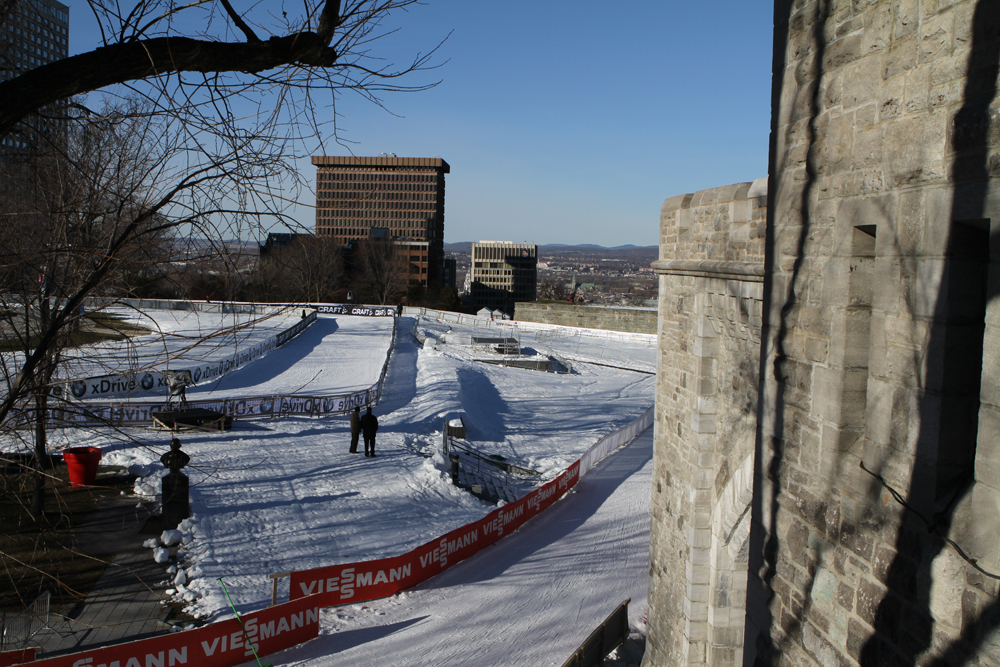
With the 126-year-old Parliament looming above, and the copper roof of the famed Château Frontenac glistening in the afternoon sun, the world’s best cross-country skiers sped around an 860-meter ribbon of snow, testing lines through corners and scouting the best opportunities for passing.
“This is how ski racing is meant to be,” a smiling Erik Flora, head coach of Alaska Pacific University Nordic Ski Club (APUNSC), said as he made his way from the course to the waxing compound.
Flora, on-site to prepare skis for APU athletes selected to race as part of the nation’s group quota, pointed to the challenging, yet navigable corners and the flow as highlights of the course.
But after skiing roughly 100 laps while testing skis, the main attraction is the need to “be good at everything.”
Skiers must to be able to handle just about every type of terrain and course feature to succeed, according to Flora.
And the “jump,” actually an abrupt drop of 30-centimeters, something that has never appeared in a World Cup course?
“I favor it,” Flora said a sentiment echoed by American skiers Andy Newell and Sylvan Ellefson.
Newell, famed for his ability on skis, including a penchant for big air, sees such additions as a personal advantage while Ellefson thinks anything that makes the sport more exciting to watch is positive.
Finnish head coach Magnar Dalen feels differently, envisioning broken skis, crashes and the fact that the drop, and ensuing jolt, is not ideal for skiers with bad backs.
The brainchild of Patrice Drouin, President of Gestev, the firm organizing the event, the feature will appear in both Friday’s team sprint and Saturday’s individual event.
Like most city sprints, passing space is at a premium, but there is room to move. After each sweeping turn, the course opens up, albeit briefly, and Flora sees these stretches as the critical spots.
Skiers will race two laps, and in the team sprint, will alternate with a single teammate for a total of three legs each.
With limited width, Newell cautions that it isn’t good enough to be looking to advance through the field.
“You need to make sure you aren’t getting passed. No one is going to want to be at the back,” he explained, and predicted a constant fight for position.
The longest straight stretch is also the run to the finish, a gradual uphill that should provide plenty of drama at the end of each heat.
Success in such events does not necessarily come to the fastest or the fittest — sometimes it is the luckiest who takes the top prize. Staying out of trouble is not just important, it is essential for a shot at the podium.
American Kikkan Randall, who staged a dramatic comeback in both the Dusseldorf and Milan city sprints last year, will be racing her first skate sprint of the season.
Flora, her coach, sees the course as playing to the defending Sprint Cup Champion’s strengths.
“Kikkan is good in packs and on turns,” Flora said. He also pointed to her impressive power, necessary for accelerating out of the corners.
And the ledge will not faze her. After trying just about every technique possible to clear the small drop, Flora concluded that aggressiveness is the best approach, and he is confident that Randall will not hesitate.
After skiing with her during the morning training session, Flora sees the potential for big results from Randall over the next two days
“I usually know it’s a good sign if I can barely keep up, and I can barely keep up,” he said.
A total of 16 North American teams take to the track on Friday — four each of men and women from Canada and the US.
The lap comes out right in front of the start so the racers will power the gradual finish climb three times.
From the top of the wall.
The penultimate corner.
The view from the start.
With a uniquely European feel, Quebec City helps races from both sides of the Atlantic feel right at home.
Skiers navigate ‘the ledge’ on the backstretch of the 2012 World Cup course in Quebec City. The Canadian city will serve as the third and fourth stops of the Tour du Canada in 2016.
Jean Philippe Le Guellec started Sunday’s 12.5 k pursuit with bib one, a first for Canada. That came on the back of his historic win in the 10 k sprint, which coach Jean Paquet said he’d been waiting for for six years.
ÖSTERSUND, Sweden – How do you go about winning a World Cup?
For career athletes, that’s the goal for years at a time. Maybe they come a little bit closer, maybe one year they fall a bit further back in results. Especially in biathlon, they can come heartbreakingly close, over and over again – all it takes is one missed shot in the final stage to ruin an otherwise podium-worthy performance. So what makes the difference to really succeed at the top?
“My coach Jean [Paquet] was saying, you know man, you’ve got to stop putting pressure on yourself,” Canada’s Jean Philippe Le Guellec told FasterSkier after Saturday’s IBU World Cup sprint race, his first career victory. “He said, the day you’re going to be on the podium is going to be the day you least expect it. Every day you’re – your goal is to be on the podium, at some point. And just coming into standing it was just like, well, position yourself well for the pursuit.”
Saturday was certainly one of those days he didn’t expect it. But his process goals for the 10 k, two-stage race were to stay calm, ski relaxed, and knock down his targets. As Paquet later told FasterSkier, smiling, “I always tell him, you have to start in a good position in the pursuit, to eventually get in a mass start. First place is the best you can be. It’s good to chase, but it’s preferable to be chased.”
Achieving those process goals, Le Guellec said, turned out to be the perfect way to think about his race. It made winning seemingly simple, at least on a day where the weather made strong shooting so important.
“It’s really funny because after the individual I was really bummed,” said Le Guellec, who placed 62nd in the 20 k race on Wednesday. “I felt jetlagged, I didn’t feel good skiing although my ski time was decent. It wasn’t fast, but it was all right… And then with the clean shooting, everything is possible. And ski strong on the last lap. That’s all it is.”
Notably, Le Guellec’s win was made possible by his clean shooting on a gusty day that resulted in many of the sport’s big names racking up multiple penalties. But at the World Cup level, hitting all the targets isn’t usually good enough for victory; there are so many strong competitors that ski speed is absolutely necessary, too. And that’s something that has been coming back for Le Guellec, who contracted mono after the Vancouver Olympics and only began to train at full capacity again this summer.
“For sure, there was a good indication that he was going to do something good,” Paquet told FasterSkier of Le Guellec’s summer training. “The tests were good this summer, with big improvements, physically. And shooting-wise also, but mostly physical. But the year before that was bad, he had mono and he needed to recover from that. So it’s always that you don’t know if he’s going to recover, how long it will take. But this year I definitely had some indications that were better than last year.”
While Paquet was confident in his athlete’s fitness – after coaching him for six years, “I kind of know the guy” – how much better was up for debate. A good summer of training doesn’t automatically mean a World Cup victory, and early season races are even tougher to predict: more or less the entire field comes into the openers in Östersund every year wondering how they will stack up.
“He started off with a good relay [on Sunday], good clean shooting,” Paquet said on Saturday. “The next day was a bit rough on the 20 k, because mostly he felt jetlag and the skiing was not so good. So I didn’t know what to expect today. I was expecting something better, that’s for sure, but a win by 18 seconds, I was not expecting that.”
Neither was Le Guellec, nor the rest of the biathlon community. As he skated around his final lap in the race, the stadium announcer talked about how the Canadian was stunning the field, how unexpected it was to see Le Guellec leading the race.
Yet the competitors and fans seem to forget the trajectory that Le Guellec was on before he got derailed by mono. In Vancouver, he placed sixth in the sprint, 11th in the pursuit, and 13th in the individual. While the sprint was famously marred by weather conditions and the pursuit depended on the sprint, the consistency with his finish in the individual should have indicated that the Canadian was on a trajectory towards a future win – or many.
“For me, I was expecting a medal for six years, and it’s finally happening, so I’m really happy!” Paquet said. “I didn’t know when it was going to happen. But today, with the clean shooting – we’ve been talking about that for a while, that you have to do zeros or maybe one.”
The Aftermath: Sunday’s Pursuit
Starting out number one in a pursuit isn’t an experience that many racers get to have. When asked in the press conference on Saturday what his strategy would be for Sunday’s 12.5 k, four-stage race, Le Guellec laughed: “I’m going to run for my life!”
But all joking aside, he knew that he had to focus on the same process goals that he had in the sprint. Besides the Olympics and Saturday’s win, Le Guellec’s previous best result had been seventh in a World Cup. As he told FasterSkier after the race, he hadn’t been the fastest skier on Saturday, so he knew he wasn’t going to win again just on ski speed. But if he could shoot carefully and not lose too much ground on his skis, he thought he’d be able to get another result that might match his previous career best.
“Just the same thing as today, concentrate on skiing and have fun,” Le Guellec said in the press conference. “I’ll be the hunted instead of the hunter, which has never happened, so it will be to embrace that, I guess. And just to have a blast.”
After finishing 16th with three penalties, Le Guellec felt it was mission accomplished. He wasn’t pleased to miss two shots in the final stage, but he was still smiling as he walked through the finish pen and had his timing chips removed. Part of that confidence came from the fact that he did manage the ski portion of the race well.
“It’s different,” Le Guellec told FasterSkier of going out first. “It’s the first pursuit where I was actually skiing all by myself for two laps, which makes a big difference, especially when you know that the guys behind you are sometimes nearly 30 seconds faster per lap. So to do that, I guess I really had to dig in there for the first two laps, and then after that it – well, it’s wasn’t actually easier to follow these trains, but I held my own.”
That’s definitely true; Le Guellec only dropped to fifth after missing a shot in the second prone stage, and then skied well enough to maintain that position when he cleaned the initial standing stage. It was only on the final stage that he lost ground when he got stuck in the penalty loop.
“It was good racing,” he said. “17 for 20 isn’t bad, but you kind of expect to stay top ten with that shooting, and it’s just not the kind of speed I’m skiing with right now.”
If that doesn’t send a warning to the rest of the circuit, what does? Paquet confirmed that Le Guellec, like the rest of the Canadian team, is focusing on peaking for World Championships; both Zina Kocher and Megan Imrie, for example, said that they were very far from optimal ski shape right now, and still absorbing their fall training load. Pacquet referred to this weekend’s performances as something to build on for World Championships.
And Le Guellec believes that if he finds more success, he’s perfectly capable of managing it. When asked whether the emotional high from Saturday’s win affected him at all coming into the next day’s race, he said no.
“I felt good today,” Le Guellec smiled. “I think my race shows that. I was able to deal with whatever happened yesterday after the race, and it was still a good race. I was able to be focused and aggressive.”
Zina Kocher (CAN) leads Andrea Henkel (GER) up one of the last climbs before the stadium in Saturday’s 7.5 k sprint, where Henkel placed fifth and Kocher tenth.
ÖSTERSUND, Sweden – After watching teammate Jean Philippe Le Guellec win Canada’s first World Cup earlier in the afternoon, Zina Kocher had her work cut out for her to stay on task for her own 7.5 k sprint.
“It was so exciting,” she told FasterSkier. “It took me actually a long time before my race to just calm down, because we were so excited. We watched the flower ceremony, and I was so pumped up that I forgot that I had to focus for my own race. It was incredibly exciting this morning, to watch that.”
But she managed to get her focus back, make it to the start line, and shoot 90 percent in despite some windy conditions, and notch her first top-ten finish of the season: tenth place, 43.6 seconds behind Tora Berger of Norway.
“It was a windy day, and I knew that if I had nine for ten then it could be a good day,” she said at the finish. “I took a long time in shooting to make it happen. But that’s okay, it’s better than skiing an extra 25 seconds around the penalty lap.”
Rosanna Crawford also had a strong race, placing 54th for the fourth-best World Cup result of her career. Often a sharpshooter, Crawford achieved her result despite three misses.
“Great day on the skis today but once again too many mistakes in the range, 3 misses and 54th, but starting the pursuit tomorrow!” she tweeted after the race.
Canada’s third starter in the women’s race, Megan Imrie, was unable to keep the momentum from Le Guellec’s performance, and finished 79th with three penalties, all coming in standing. It was clearly a disappointing result for Imrie, who struggled with the wind in that last shooting stage.
“It was just the standing – it was pretty windy out there,” she told FasterSkier. “My strategy was to get in the range, and get out of the range. So I could have handled one less miss, or two, but I did what I could to just be quick, and I know there were a lot of misses today.”
The silver lining was that she was happy with her skiing.
“It was definitely the best one so far,” she said of the sprint race. “My skiing has still been pretty sluggish from all the training we did this fall, but today’s skiing felt pretty good. We upped the training hours and intensity a lot this year, so I’m kind of waiting for my body to catch up. By the time February rolls around, I should be fine.”
Kocher agreed – it wasn’t one of her fastest skis, but she was confident that she could keep improving.
“It’s a good start,” she said of the races so far. “I’m feeling a little bit tired still from the training this fall. I think the next two weeks my ski speed will feel better. I did [increase my training], just because it’s a pre-Olympic year, so we just wanted to make sure I had a really good base going into the Olympic training year. World Championships is the bigger goal [for this season]. And it’s getting over jetlag, too – this week can be a bit tricky.”
In today’s pursuit, Kocher will start less than 30 seconds out of podium position. She told FasterSkier this fall that one of her goals for the season was to get back on the World Cup podium for the first time since 2006.
In the men’s race, Scott Perras continued his strong opening to this season, placing 45th with two misses. Going into the pursuits, he’s about two penalties out of the top twenty.
“I think it went pretty good,” Perras told FasterSkier after the race. “Two penalties is probably decent in this type of conditions, but that means that there were some opportunities out there. The relay and the individual were both 90 percent shooting, then 80 today, so I was hoping for another 90.”
Perras, an early starter, said that he would like to stay in the points (top 40), which didn’t happen. But he has a good chance to climb up in the pursuit.
Nathan Smith was denied that chance, landing in arguably the worst position after a sprint: 61st place, 1.7 seconds out of the pursuit.
Jean-Phillipe Le Guellec leads Michael Greis of Germany during the individual race at 2012 World Championships in Ruhpolding, Germany.
BEND, Ore. – Jean-Philippe Le Guellec was riding high in 2010 when he finished sixth in the sprint, 11th in the pursuit, and 13th in the individual at the Vancouver Olympics. The Canadian biathlete – then 24 – was motivated and aiming for his first Word Cup podium.
The 2011 season didn’t go quite as expected; he picked up just four top-20 results and late in the year received a diagnosis of mononucleosis, which explained his performance lull. After taking a lot of rest in the spring, Le Guellec was back at it this winter, but wasn’t quite sure what to expect.
His results were variable – for example, at the opening weekend in Oestersund, Sweden, he placed 86th in the sprint and 14th in the individual. By the time the end of the season rolled around, Le Guellec had improved his consistency, finishing 26th, 20th, and 12th in the pre-World Champs weekend in Oslo, Norway, and then placing 14th in the sprint at the Championships themselves.
One weekend later in Russia, he placed eighth in a sprint and said he was feeling good at last.
“I felt pretty strong throughout the race, which is really important,” Le Guellec said at the time. “In the majority of races this winter I find I was struggling to keep up pace in the end.”
So is Le Guellec really back? FasterSkier sat down with him on Wednesday morning in the lodge at Mount Bachelor, where the Canadian team is doing a training camp along with the other North American national teams. The answer seemed to be yes – even though he’d missed doing an interval session with the Americans due to a slight head cold.
FasterSkier: How do you like the skiing here?
Jean-Philippe Le Guellec: It’s nice. We’ve skied in Dachstein, on the glacier in Austria, and when the weather there is bad it’s really bad, but here it’s more mild. At least it’s snowing, it’s not raining, and we got a good freeze last night so today’s ski was actually really good. When we were here earlier it was a lot like Ruhpolding, super deep and slushy, and slow.
FS: So good practice for you guys.
JPLG: Exactly. Who knows what the races will be like next year.
FS: You didn’t talk much about being sick during the season, but how did it affect things?
JPLG: Not a lot of people know. It’s not like we made a lot of noise about it. So for sure, when you’re getting slandered in the news and stuff, you’re thinking, “Well…” But yeah. Last year was definitely pretty rough. And what made it rough was that I didn’t know until just before World Championships. So at that point it was like, cruise for the rest of the season and then go back home and rest.
FS: And was it mono that you had?
JPLG: It was mono and another virus at the same time.
FS: I think Tim Burke had a similar challenge when he had compartment syndrome, and he decided not to talk about it and then wasn’t able to explain why he wasn’t racing as well.
JPLG: Yeah, it’s a lot different than in Europe, where you know every little thing about Michael Greis’s ankle and this Russian’s back. Here we’re pretty much doing our own thing.
FS: Is the illness going to have any long-term effects, or are you back on track?
JPLG: The doctor said mono itself apparently affects physical performances up to 18 months after the virus is out. So that’s a year and a half. But I don’t know to what extent I got the disease. I was able to train, and I was able to race all season. So let’s not blow things out of proportion, either. This season was way better than I expected, even though I was still definitely going uphill.
FS: Has it affected your plans for the upcoming season at all?
JPLG: Not so much. I was able to end the season in pretty good shape. And the season itself had ups and downs, but it was constantly going up. So, no, I’m approaching training this season like I usually would, which is refreshing. I still have a little reserve – like sometimes you wake up in the morning and your heart rate is a little higher, and you wonder. You know what the feeling is when you’re totally dead. But it’s nice to be up and running, unlike last year when I had to wait until basically July.
FS: In terms of it being two years before Sochi, are you doing anything specifically for that?
JPLG: Well, here we’ve worked on ski technique and that’s a really good thing actually. We essentially re-learned how to ski.
FS: That’s nice!
JPLG: Yeah! [laughs] You’re never done learning. We’ve done a bit of modification too with the rifle and shooting positions. And this is going to be locked until Sochi. So in terms of the mono and training, it’s always a bad time and you never want it, but it’s good timing because I had Vancouver, and I’ll probably be fine for Sochi.
FS: What about Brendan Green [who had back surgery three weeks ago]? Is it a bummer not to have him to train with right now?
JPLG: Yeah. I think it’s more of a bummer for Brendan not to be able to train. I saw him in Canmore, and he’s doing kind of well – kind of well considering his situation. He’s coming back. For him, it’s totally different because he’s going to be out for a period of the summer. This is physiological; it’s not just that his system has shut down, it’s that he had surgery and hopefully he’ll be able to get back to 100 percent sometime this season. But to not have him around definitely changes things.
FS: So will it just be you, Nathan Smith and Scott training together a lot this year?
JPLG: Yeah. In the best of worlds, Brendan will be able to come back on the World Cup tour, but realistically, I guess we’ll find out. It will really depend on his recuperation.
FS: Is it good to be here and ski with the U.S. guys and have some new training partners?
JPLG: Yeah. We’re kind of all doing our own little things, you know. And it sucks that I was sick yesterday because I would have loved to do the classic sprints with the cross country guys.
And we actually do some training with the cross country guys from Quebec when we’re in Quebec. So I’ll be seeing some of the national team cross country guys in early June in Montreal.
So even if we’re not doing everything together, it’s cool to see everyone skiing around and observing. It’s still good.
FS: You must be pretty jealous that the cross-country guys are going to race in Quebec City.
JPLG: Yeah, for sure. And I would have loved to be there to see the races too. It kind of sucks that I am going to be out on tour, in a way. It would be so awesome for biathlon to have a World Cup in Quebec, but that won’t be for a little while, if ever.
FS: Do you think there will be one in Canada again?
JPLG: In Canada, why not. We have the places for it. It’s just a lot of transitions going back and forth from Europe to especially out West. And there are places in the East like Presque Isle and Fort Kent.
FS: Do you feel like the success of the cross-country teams has helped you guys out at all, in terms of raising the profile of nordic sports?
JPLG: No. Not at all. But it definitely helps the motivation. To see Alex and Devon take the relay away from the Norwegians in Oslo – I mean, I still remember the moment, and I was totally ecstatic. And then Lenny, who has also been podiuming at the end of the season, just seeing that really is a boost. We’re not any more popular though. Not biathlon.
FS: Is there anything you think that could help you get more numbers in biathlon?
JPLG: Um… we should do what cross country is doing actually. Get on the podium. Get some hype.
FS: Get on it!
JPLG: Well, we’re working on it. We’re getting closer.
Canada's Megan Imrie in the midst of the relay's mass start.
RUHPOLDING, Germany – After a week where not many team members were satisfied with their performances, the Canadian women’s squad crafted a new strategy for the 4 x 6 kilometer relay on Saturday.
In most cases, Megan Imrie and Zina Kocher have skied the first two legs. But not this time: for World Championships, the women wanted to mix things up.
“We just decided to try switching it because usually Megan and Megan and Yolaine are awesome shooters, so we were kind of figuring we’d stay in the game with that,” Kocher told FasterSkier at the finish line.
The plan left Kocher, who has had the best individual results of the team so far this week, to anchor.
Things started out as planned, with scramble leg Imrie using two spare rounds in prone and then quickly cleaning standing and attacking on the final loop to tag off in sixth place.
“Yeah, it was good,” Imrie said. “I did my very best. I had only two spares, so I can say that was good.”
Yolaine Oddou leaving the range.
But from there, things began to fall apart for the Canadians. Like Imrie, second leg Megan Heinicke turned in the twelfth-ranked ski time, but Heinicke used more spare rounds and dropped to eleventh, then twelfth.
“I feel bad, I kind of wrecked our relay here,” a clearly frustrated Heinicke told FasterSkier. “I actually felt good skiing, but it was just too many spares on the range. No penalty loops or anything, but it takes seven or eight seconds to load a spare, so that costs time, and I used four in my race, which is more than I had hoped for.”
When Yolaine Oddou took over, she immediately struggled in prone, using all of her spare rounds and still skiing a penalty loop. She dropped to 16th, but then climbed one spot to 15th after hitting all her standing targets on the first attempt.
Nevertheless, it wasn’t where the team was hoping Kocher would begin her anchor leg.
“Yolaine had a bit of a problem in the prone,” Kocher said. “She has kind of been struggling all week, and it was unfortunate. I’m sure she’s sad about it, and quite frustrated – she’s an awesome shooter. Definitely, we could do better.”
Kocher gained a few spots – the team placed 13th – by using only a single spare over the course of her two shooting stages, which, she pointed out, made the relay her best shoot of the week. She was happy that it could come on a day where her team needed her, but at the same time noted some irony: she needs to achieve a top-16 result in an individual race to resume receiving Athletics Canada funding, and she wouldn’t have minded if she’d shot that well in the individual races.
Overall, Kocher liked racing the final leg.
“My leg was really good,” she said. “I actually haven’t anchored since I was a junior. It was good – I was way more relaxed than when I’m in second. I love being first and second, but it’s more of a tense situation.”
Kocher is the only Canadian woman qualified for Sunday’s mass start so for the others, the relay was the last race of World Championships. Imrie said she milked that fact for all it was worth.
“Walking to the start and hearing all the fans singing along, I was just totally enjoying the music, loving the weather, and everything was great… so it’s a nice way to end it,” she said.
Canada's Megan Imrie (2nd from left) was already attacking on the first hill out of the stadium.
RUHPOLDING, Germany – Two Canadians had high hopes for Sunday’s pursuit: Jean Phillipe Le Guellec was 14th after Saturday’s World Championship sprint, and teammate Zina Kocher 18th. They were poised, it seemed, to have career-best finishes.
Le Guellec had never finished in the top ten at World Championships, but started just 12 seconds outside it on Sunday. Kocher was shooting for a top-16, which would have guaranteed her funding through Athletics Canada for the next season.
Bjorn Ferry (SWE), Le Guellec, and Dominik Landertinger (AUT).
But neither of them hit the mark, and both ended up 26th at the end of the day.
Le Guellec later wrote in an e-mail that he “wasn’t in such a good mood” after his 12.5 k, four-stage race.
“Looking at results, obviously I stumped down quite a bit,” he said. “The race was going ok until the last shooting basically.”
Le Guellec started off strong, cleaning his first stage and moving into the top ten, where he skied with Lowell Bailey of the U.S. and Andreas Birnbacher and Simon Schempp of Germany. Even after missing a shot in the second stage, he dropped no lower than 11th, and was back into ninth after a clean third stage.
But in the last stage, he missed two shots. Le Guellec’s ski speed also didn’t do him any favors – he said after the sprint, too, that he had felt slow – and rather than regaining places on the final loop, he lost them.
“I came out of the penalty loop in 17th,” he explained. “The last lap was no different [than the others], and I got passed by seven guys in the last kilometer of the race. I had nothing in the tank to fight back and dropped to 26th.”
The Canadian, who placed 11th in this event at the 2010 Olympics, was very frustrated with his skiing; his course time was just the 38th-fastest of the day, and with only a single athlete (Roland Lessing of Estonia) cleaning the race, his solid shooting could have gained him more spots.
“My skis were fast once again, but my ski shape was not great, and it’s not like the sprint where I felt not so good but actually did decent,” Le Guellec lamented. “I was getting passed by trains on all laps. With only a day of rest before the individual, I’m hoping my form will be better.”
Kocher (r) and Poland's Krystyna Palka in their first standing bout.
Kocher faced an opposite problem in her 10 k pursuit. Starting 18th, she immediately missed two shots and dropped to 27th.
“Right off the bat, it had me a little bit off my game from the get-go,” she told FasterSkier in an interview at the finish line. “At the beginning I kept it easy, that was kind of my plan, just to draft and come in sure of myself. It didn’t quite work out when I missed two.”
Kocher had discussed earlier the difficulty of dealing with the 16th-place requirement, and she said that after her initial errors, some of the pressure actually disappeared. After cleaning the second stage, she skied in the low twenties, and it seemed that with half the race still remaining, she might reach her goal after all.
“When I was around 20th, I was like, ‘okay, I’m back in the game,’” Kocher said.
But she struggled in standing, missing one and two shots in the two stages, and wound up, just like Le Guellec, in 26th.
“I guess it was just a really hard race,” she said. “On that last standing I was getting pretty shaky. It was pretty hard work skiing today. So it’s not what I wanted, I really wanted 85 or 90% shooting, and that would have put me in that top 16 for sure.”
Now, both racers are left looking forward to the longer, four-stage individual races which will be held Tuesday and Wednesday. His next race would be a challenge, Le Guellec admitted, especially in the deep, soft snow that has characterized the competitions so far.
“The 20 k course is very demanding, and this is without taking conditions into account,” he wrote.
Kocher was more positive, and pointed out that with two top-thirty finishes, she was in good shape to snag a position in the exclusive mass start race.
“I’m psyched for the individual, and now I might have a good chance for the mass start,” she said.
The Rest of the Canucks
Megan Heinicke and Italy's Michela Ponza approaching the range.
Team Canada started the day on Sunday with lots of opportunities – they had put a total of three women and four men in the pursuit out of four possible starters in each race in the sprint. The rest of the team had started much lower down the results sheet, but there potential to move up.
Of the remaining starters, Megan Imrie and Megan Heinicke both gained at least ten places, with Imrie advancing from 51st to 39th and Heinicke from 52nd to 42nd.
Imrie used strong shooting to make her move, only missing a single shot and gradually picking up a few places in each loop. Her racing earned her World Cup points, which are awarded to the top 40, for just the sixth time this season.
Heinicke just barely missed that cutoff, but had a strong race as well, cleaning both prone stages and then missing a single shot in each standing stage.
In the men’s race, Nathan Smith started 45th and after going zero-one in prone had moved up to the low 30s. But in his first standing stage, he had difficulty with the wind and missed three shots, dropping back down further than his starting position. He missed a single shot in the final stage and finished 43rd.
Nathan Smith leading Scott Perras around the penalty loop.
“Even the [stage] where I hit four, it was a hard four to hit,” Smith said of the standing stages. “It wasn’t easy. Maybe I should go a little bit easier into the range – I went a little bit too hard on the last large hill because I was trying to stay with guys.”
Despite the frustration of his shooting, Smith told FasterSkier that he thought his skiing had improved from Saturday, and that it was good to have head-to-head competition and better peers on the trails, compared to the sprint where he was seeded with mostly slower skiers.
“It was fun,” Smith said. “Especially on the flat part, there was some headwind, so it was a lot easier to stay behind someone. I think I only got to do that one lap – sometimes I had to pull the guys. But you could tell that there was a big difference.”
Scott Perras started 50th and ended 54th on the back of six penalties, while Marc-Andre Bedard moved up from 55th to 52nd.
Bedard said the race was “rough, but fun,” and that his four penalties were not enough to gain spots at this level of competition.
“The fastest skiers are already up front,” he explained. “So to climb up from far behind – if you’re top 30, that’s good for moving around, but if you’re in the back, like 50s, to climb up then the others in front have to do very badly, because usually on the World Cup nobody shoots under 80%.”
Like Le Guellec, Bedard said his skiing could use some work – but he wasn’t completely discouraged about his prospects for the individual race.
“The skiing was not so strong, so I really concentrated on my shooting,” he said. “That pace was good for the individual, but a little too slow for the pursuit.”
Canada's third racer, Jean Phillipe Le Guellec, leaving the range.
RUHPOLDING, Germany – After placing sixth in a World Cup mixed relay earlier this season, the Canadian team came into today’s race at World Championships with high hopes. But they couldn’t handle the heat – literally, in this case, as temperatures neared 50 and the snow turned to slush.
“Everything in the sun is pretty soft and mushy,” second-leg racer Zina Kocher told FasterSkier after the race. “It’s actually a pretty hard race, not just because of the snow – I can handle the slush – but it’s really hot. I’m dying right now!”
Instead of the top result they had envisioned, the Canadians found themselves in 18th place at the end of the day.
“It was disappointing,” Kocher sighed. “I think we all wanted a top eight.”
That seemed out of reach for the Canadians right from the start. They were already at a disadvantage after losing Brendan Green to a back injury, but they were still not expecting to be sitting in 19th-place after Megan Imrie’s scramble leg.
“Megan shot pretty well, but I haven’t talked to her, and I think she fell,” Kocher said.
Kocher starting on her leg of the relay, still optimistic about gaining places.
Kocher is currently ranked 23rd in the world, and seemed like a sure bet to pull Canada up through the field. But the usually speedy Alberta native wasn’t as fast today, and after one stage had only gained two places.
Then, in standing, disaster struck. Kocher used all three spare rounds and was still left with three black targets. She had to ski three penalty loops, which is practically unheard of in relay racing. After the race, Kocher explained that the harsh 4 p.m. light, which created a stark contrast between bright sun and dark shadows, had been a challenge in the standing stage.
“In zero I actually had a piece of white paper covering my right eye, and yesterday when I was training I thought that by the time I would race I wouldn’t [need] that,” she said. “But I should have worn it because by the time I came in for standing, I had a really hard time distinguishing the white and the black, so I really struggled.”
Kocher dropped to 20th, and was unable to make up any ground on the final two-kilometer loop.
Despite only using a single spare round, Jean Phillipe Le Guellec was also unable to move up. Anchor leg Nathan Smith gained two spots, but the team still landed about ten places lower on the results sheet than it was hoping.
“Being that there’s no wind, and it’s a downhill [into the range], people are shooting really well,” Kocher said. “We just couldn’t get that gap back… I just tried to go for it, but it really didn’t work out at all, I’m very, very disappointed.”
While Kocher’s difficulty on the range is an easy scapegoat for the team’s poor result, ski times were also slow. Imrie had just the 20th-fastest course time of the 27 scramble skiers, while Kocher – who was justifiably tired from skiing nearly an extra half a kilometer in the penalty loop – and Le Guellec were the 16th-fastest skiers on their legs. Smith’s time was the 12th-best among anchors.
Still, in terms of improving, Kocher’s shooting woes are the most straightforward to fix.
“Definitely I’ll be figuring out something, if it’s sunny again, how to deal with that,” she said. “And just remembering that it’s one race, we still have a few more, and all of our individual races.”
Yoggl celebrates with Slovenia, Germany and Canada after the Team Jumping event in Seefeld Arena
Despite significant recent snowfall, the Youth Olympic Games staff managed to polish the HS 75 meter jump in Seefeld Arena in time for Saturday’s Team Jumping event—the final Nordic event of the Games.
The Canadian Team— consisting of female special jumper Taylor Henrich, male special jumper Dusty Korek and Nordic Combined skier Nathaniel Mah— managed to take advantage of the inconsistent conditions to secure a historic Bronze medal.
The team finished 8.7 points ahead of Finland, and just 11 points ahead of pre-event favorite Japan. Germany— who also handily won the morning’s Mixed Cross-Country/Biathlon Team event— displayed its massive commitment to youth Nordic development by winning Gold in the Team Jumping event with a nearly 30 point lead on Slovenia, who took Silver.
Colton Kissell of Park City UT flies on the HS 75 meter hill during the Team Jumping Event Photo: Andrew Moore
The United States team of Emilee Anderson, William Rhoads and Nordic Combined skier Colton Kissell struggled to find their best form on the hill today, placing 11th in the field of 13 teams.
Based on the results from the Individual competitions held over a week ago, Canada was considered to be a long shot for the podium. However, steady snowfall and unpredictable wind made conditions challenging for many teams. Japan —whose star female jumper Sara Takanashi dominated the Women’s Individual Jumping event by over 27 points— was a strong favorite for Gold.
Yet the grabby conditions on the inrun tracks proved to be a challenge for the Japanese, who are experimenting with very aggressive and low inrun positions. With their weight far forward on their feet before takeoff, the Japanese were depending on the tracks being iced and “free”. With the resulting snowfall playing havoc with her normal position, Takanashi jumped 57 meters on her first jump before posting a 75 meter second round jump.
An Austrian athlete competes in Saturday's Team Jumping Event Photo: Andrew Moore
With the normal jumping powerhouse nations of Japan, Norway and Austria all struggling, Canada seized the opportunity.
Canadian Team Head Coach Max Thompson explained the team’s strategy heading into the event.
“Today was all about consistency,” Thompson told FasterSkier. “It was bad conditions. The athletes were focused. We talked a lot, did immos [technique imitations] last night, immos this morning, and talked about doing nothing special. They kept things simple, basic ski jumping, and it worked.”
The Canadians started out strong, finding themselves ranked second overall after the first of two competitive rounds. A strong second jump by Calgary’s Dusty Korek helped secure Canada’s spot on the podium.
“We came into today confident, but having watched those individual guys who really put out long jumps, we knew we were the underdogs here,” Korek told FasterSkier. “We’re a close team. We’ve grown up together jumping since age six, and we’re sixteen now. We’re definitely close.”
Canadian Coach Max Thompson congratulates Team Germany's Coach following the Team Jumping event in Seefeld
This medal was a historic finish for Canada, who has never medaled in an Olympic Ski Jumping event. Most of all, the team was sure that this medal would help to boost the confidence of up and coming jumpers in Canada.
“As a North American thing, we seem to have this mentality that we’re just not as good as the Europeans,” Thompson explained to FasterSkier.
“These kids—Dusty, Nathaniel and Taylor—have been competing in Springer Tournee competitions in North America, and they’re super competitive fields. It’s great to see that when our athletes come to Europe and compete against Austria, Germany, Finland and Norway, it shows our kids at home that if they’re close to these athletes, they’re close to the best in the world. We can make something happen in Ski Jumping.”
Team Canada, from left to right: Coach Max Thompson, Nathaniel Mah, Taylor Henrich, Dusty Korek, Coach Alex Levichev
And the Canadians certainly showed that today, topping off what was an undeniably successful day for North America, with two podium finishes in Nordic disciplines.
This event concludes the Nordic competitions for the 2012 Winter Youth Olympic Games. The final competitions of the Games will end Sunday, and the Games will conclude with the Closing Ceremonies, held in downtown Innsbruck.
The Canadian team of (R-L) Nathan Smith, Scott Gow, Melanie Shultz, and Claude Godbout finished fourth in an IBU Cup mixed relay in December. Photo courtesy of Melanie Schultz.
When American and Canadian skiers start consistently winning domestic races, they face a choice: do they stay on their home circuits, or head to Europe? And if a trip across the Atlantic is in the cards, where will they race? With limited World Cup quotas and a myriad of regional race circuits, skiers have to not only choose which of the many races they might attend, but also generally organize and fund the trips themselves.
North American biathletes, on the other hand, have an obvious destination when they make the jump to Europe: the IBU Cup, an international circuit one notch below the World Cup, and the namesake of the same governing body, the International Biathlon Union (IBU). This year, the IBU Cup will have eight weekends at seven venues, in addition to the Open European/Under-26 Championships.
The IBU recently said that the circuit is a “second league”, and it has also been called a “mini World Cup”. The IBU Cup has the same rules for athlete qualification and national team promotion and relegation, and while there are fewer fans, everything else about race procedure is the same.
“The IBU Cup is an excellent stepping stone for the World Cup,” Canadian biathlete Melanie Schultz, who recently notched a career-best 11th place finish in an IBU Cup pursuit, told FasterSkier in an interview. “I definitely would not improve as fast if I just raced domestically.”
Canada currently has start quotas of three men and three women, but that’s about to change: the Canucks are climbing up the Nations Cup rankings thanks to a spate of top-ten finishes, and as a result will almost certainly have a larger quota next year. More immediately, and the circuit will spend two weekends in Canmore in February, giving the host country an additional five starts per race.
In a presentation at Forum Nordicum in October, the IBU suggested that they were considering making the North American swing a more permanent feature on the calendar.
FasterSkier caught up with Schultz and teammate Rosanna Crawford, who were promoted to the World Cup based on their IBU Cup performances in Haute Maurienne, France last weekend, to hear how the circuit had affected their development, and how they thought North American biathlon would benefit from hosting more of the races.
While Schultz’s 11th-place finish was not the best seen by the Canadian team this season – three teammates have collected top-ten finishes and another, Nathan Smith, stood on the podium – her trajectory is in many ways exactly what coaches hope for when they send athletes to the IBU Cup.
The 26-year-old started her European racing career back in 2009; in her first two weekends of racing she placed in the mid-60s. When she returned to the circuit six weeks later, she notched her first top-30. This year she’s placed in the 20s or better in several races in fields that are deeper and more competitive since the IBU upped its focus on the circuit.
Schultz said joining the new Biathlon Alberta Training Centre with head coach Richard Boruta, finally diagnosing longtime symptoms as chronic hypoglycemia, and good old-fashioned hard work contributed to her success this season. But her IBU Cup experience has also been a huge motivator.
“It has really opened my eyes to where I am at with racing, where I want to be, and what I can improve on to get there,” Schultz said.
And while it has helped in the general sense, her racing there has given her specific tasks to work on as well.
“[The IBU creates a] detailed analysis of each race, in which everyone’s ski and shooting times are broken down and ranked for each loop,” she explained. “At my first IBU Cup race I realized I was losing 20 seconds in the range for each shooting bout, which added up to 80 seconds in a four-bout race. Since then, I’ve improved my shooting times and now have some of the fastest shooting times on the IBU Cup.”
Recently, some of Schultz’s best performances have come in relays: in December, she shot perfectly as the scramble leg of Canada’s fourth-place mixed relay, and in Haute Maurienne she led all teams into the first handoff of the women’s relay, where Canada again placed fourth.
“The relays really changed my outlook on what I felt I was capable of ski-wise,” Schultz said. “In the mixed relay before Christmas I was able to stay in contact with the top skiers, but I attributed it mostly to fast skis, quick shooting, and short two kilometer loops. Then in the women’s relay I could easily stay with the fastest skiers and even pass them, which made me realize that I have the ability to not just shoot well but also to ski well.”
Relays are never contested at the senior level in North America, so Schultz hadn’t understood “the enthusiasm some nations have.” But after being in podium contention twice, she’s changed her mind. She said that the relays also brought the Canadian team together and earned the country some newfound respect from their competitors.
And finally, they’ve taught Schultz a lot about racing.
“After the women’s relay I started thinking, ‘What am I doing differently with my skiing in relay competitions that is lacking in individual starts?’ I realized I wasn’t fighting against my mind when I was skiing in a pack, I was just completely… in the present moment. I brought this mindset into my sprint and pursuit [in Haute Maurienne] and I think it showed.”
Experiences like these are what coaches hope young biathletes will gain when they spend time on the IBU Cup. 21-year-old Scott Gow, for instance – a top-ten finisher at World Junior Championships – was nominated to the World Cup team for November based on podium finishes in national team trials races. Once there, however, he fizzled, finishing 80th and 101st in the opening races. He was moved to the IBU Cup, where he has steadily improved, finishing as high as fourth.
“The IBU Cups are great for me to develop as a racer and to learn how to be a podium contender,” Schultz said.
Crawford: Competing, Not Participating
Crawford leads Schultz and Yolaine Oddou in the pursuit in Haute Maurienne. Photo courtesy of Melanie Schultz.
Crawford, who finished 8th in the sprint in Haute Maurienne, has had a season more akin to Gow’s than Schulz’s. A 2010 Olympian, Crawford has received quite a few World Cup starts, but has been unable to break into the spotlight. On her best days, she has finished in the high 40s and 50s.
Like Gow, Crawford started on the World Cup in November. While she lasted longer there, she, too, was eventually demoted.
“Before Christmas my skiing had improved quite a bit from last year, but my shooting was what was letting me down,” she told FasterSkier. “I am usually a sharp shooter and three misses in prone in a sprint was very unlike me.”
But even though the World Cup is in her sights, the move to the IBU Cup didn’t upset her.
“I was happy with the decision,” Crawford said. “On the World Cup it is still hard for me to make a pursuit [which takes the top 60 racers from a sprint] if I shoot less than 80 percent, whereas on the IBU Cup even with poor shooting I can still make the pursuit and therefore get more races. On the World Cup sometimes I feel like I am racing to participate, but on the IBU Cup I am racing for the top ten.”
For athletes like Crawford, who have more big-race experience, the IBU Cup serves another purpose. It’s a place to regroup, work out the kinks, and regain confidence before, hopefully, returning to the World Cup.
And because both circuits are organized by the IBU, it’s easy to shuffle athletes back and forth. Canada, the U.S., and nearly every country do so; in some cases, athletes even compete in a race on each circuit in a single weekend.
That means that taking a detour to the IBU Cup isn’t a death sentence for athletes with World Cup aspirations, and also makes it easy for developing athletes to tell how they might fare if they moved up. For instance, Russia’s Ekaterina Glazyrina swept the IBU Cup races in Obertilliach, Austria, then raced on the World Cup in Nove Mesto, Czech Republic and finished sixth in two different races.
“The atmosphere is different because there isn’t as many spectators,” Crawford said of the IBU Cup. “But [it’s also] the same because you are racing against some of the best in the world. These girls could get moved up to the World Cup next week and be in the top ten.”
Crawford said that the deep fields taught her to be aggressive.
“It’s good preparation for being a fighter in the pursuit once you get to the World Cup,” she explained. “Every shot is important and can mean the difference between moving up five spots or falling back ten.”
A Step – Or Several – Above NorAms
And that, both women said, was not true in domestic competition. The reason that the IBU Cup is so valuable to North American biathletes is that races in the U.S. and Canada, the best of which are part of the NorAm circuit, often have small fields with a wide spread in ability levels.
“In Canada when you race a pursuit there isn’t anyone really chasing you, or sometimes there’s no one to chase,” Crawford said. “Here you have 60 strong women around you, pushing you to do your best and never give up. A couple seconds can mean a couple of spots.”
It might seem counterintuitive that there’s nobody for Crawford to chase; teammates Zina Kocher and Megan Imrie have finished in the top 20 on the World Cup this year, and Kocher is currently ranked 29th overall.
But that has nothing to do with NorAms, Crawford said.
“Not that many people do biathlon in Canada, and even less follow through to the senior level,” she explained. “Because our best athletes are off racing in Europe all winter, there isn’t much opportunity to compare your self to the best on the NorAm circuit.”
Schultz agreed with that assessment, and was emphatic that she could not have reached her current level had she stayed in Canada.
“Racing domestically on the NorAm circuit and racing on the IBU Cup is a night and day difference,” she said. “I learn so much each race I do here, and I am able to quickly apply it to my next race. Now, in mid-January, I have done ten IBU Cup races [already] this season.”
As an athlete representative for Canadian biathlon, Schultz has been trying to brainstorm ways to make the NorAm circuit more competitive. One problem is that the U.S. and Canada don’t always plan well enough that top athletes from each country end up at the same races. But even with better communication, the issues of field size and depth are difficult to tackle.
Until there are major changes, athletes will be doing their most important learning on the IBU Cup, like Schultz has.
“The IBU Cup allows athletes to race against over 100 athletes when every second counts for placing, and to experience head-to-head racing in relays and pursuits,” she said. “That’s an important aspect of racing that is missing in North American biathlon races.”
Lately, both the U.S. and Canada have fielded larger teams at more races on the circuit, and expanded their IBU Cup schedule.
“This is the first time I am aware of that Canada has sent a team to the IBU Cup races in early January,” Schultz said. “It was extremely valuable to the athletes, as they can take what they learn each race and immediately apply it in the next race instead of having a break from this level of racing. I think this has really accelerated the development curve.”
The Canadians have also expanded their funding.
“We used to pay the true cost of racing on the IBU Cup, which amounted to $2500-3500 per tour, and many athletes couldn’t afford to go,” Schultz continued. “Now, Biathlon Canada covers the cost of the IBU Cup tours, and provides an amazing support team with two wax techs and one coach. A huge burden has been taken off athletes, so they can focus on racing. This has been a really positive change and has shown in our results.”
A Permanent Swing?
The teammates were enthusiastic about the possibility of having the IBU Cup visit North America more frequently. At a community level, they welcomed the publicity the races would bring to their small sport.
“Being in Canmore, I have seen the positive impact that hosting World Cups and World Youth and Junior Championships for skiing and biathlon has had,” Schultz said. “It has generated excitement around the sports and motivated many young athletes. We don’t grow up watching nordic sports on TV like our European counterparts, so seeing the next level of racing gives young athletes something tangible that they can work towards.”
But just as importantly, this year’s races in Canmore will give more athletes a chance to learn from experience, just as Schultz and Crawford have.
Crawford said that the circuit was already a huge motivation for up-and-coming racers, because not only does it involve a trip to Europe, but good performances are rewarded with promotion to the World Cup. She thought that the added start quotas of a home-turf IBU Cup would energize a whole new group of athletes.
“It would help keep youth and juniors motivated to follow through to the senior level,” said Crawford, addressing one of the biggest problems for Canadian biathlon.
“It would also give second-year juniors and first-year seniors a chance to race with the best and get a taste of what it is like. No matter how many people come out to cheer, racing a pursuit with 60 people is one of the most intense and exciting things in biathlon, and this would give them an opportunity to experience it.”
-Rosanna Crawford will compete in the women’s 10 k World Cup sprint in Antholz-Anterselva, Italy, on Thursday, and then join Schultz, Kocher, and Imrie in a relay on Saturday.
The United States has also had success on the IBU Cup this season, with Tracy Barnes and Russell Currier notching top-ten finishes. Both will also compete in Antholz-Anterselva this weekend.
At a recent NorAm sprint in Rossland, British Columbia, the Albertan had the fastest qualifying time of any junior, covering the course more than eight seconds faster than any of her competitors. She went on to win the junior race, despite the fact that she’s only sixteen – three years younger than the other podium finishers.
And if that isn’t impressive enough, MacIsaac-Jones’ time in the qualifier would have put her seventh in the senior women’s race, sandwiched between 23-year-old Jennie Bender of CXC and 24-year-old Kate Brennan of the Alberta World Cup Academy.
For a skier like MacIsaac-Jones, it’s almost a shame that Canadian race protocols pull junior racers from the senior heats, even if they’re fast enough to compete, and relegate them to a separate race.
Luckily, the Athabasca, Alberta native isn’t lacking for opportunities to push herself. She regularly competes as a senior in distance races, where officials don’t kick here out – at Canadian national championships last year, she finished 11th in the 5 k freestyle.
And soon, she’ll have another chance. MacIsaac-Jones, who is a member of Canada’s junior national team, will represent her country at the inaugural Youth Olympic Games in Innsbruck, Austria in January.
Competing internationally and against much older racers might seem to be a fast track to burnout; in a newspaper interview last year, the then-15-year-old said that she was shooting for 550 hours of training.
But exhaustion doesn’t seem to be a problem for the perky junior, who said in the same interview, “I have so much fun while I’m doing it, and that provides me with plenty of motivation to keep on going!”
FasterSkier interviewed MacIsaac-Jones over e-mail to see how she was preparing for the upcoming Games.
FasterSkier: How long have you been skiing and how did you get started as a kid?
Maya MacIsaac-Jones: I have been skiing since I was 4 years old, when my parents put me on skis at our farm near Athabasca, AB. I skied in the Athabasca Nordic Jackrabbits program for several years. My first race was at the Tawatinaw Loppet, at 5 years old and I have been racing ever since.
FS: What ski club are you a part of now, and how has that community helped you develop as an athlete?
MMJ: I am currently racing with Rocky Mountain Racers, a club based out of Canmore, AB. I have two exceptional coaches, John Jacques and Luke McGurk, who provide me with training plans, camps, technique sessions and race support. Our club has many athletes with whom I train, and who push me to improve. My teammates and the RMR community are extremely supportive and a lot of fun.
I am still involved with my home club, Athabasca Nordic. My daily training is done in Athabasca under the supervision of my parents. I have great support from my family, friends and community.
I would also like to thank my sponsors, Rossignol and One Way for their continued support.
FS: How do you balance skiing with school and your other interests? It takes a lot of time and energy to be a good skier….
MMJ: Balancing school and skiing is sometimes difficult, but if I am efficient with my time I can successfully combine both. Due to training camps and races, I miss a lot of school. However, my teachers have always been very flexible and helpful so I can continue my studies while I am absent.
FS: What have been some of the highlights of your career so far?
MMJ: Racing highlights include a bronze medal in the team relay at the Halifax Canada Winter Games, and medalling twice at Cross-Country Nationals 2011. I enjoy traveling across the country to different races, as well as training at on-snow camps during the summer, in particular at the Haig Glacier.
FS: Have you raced internationally before?
MMJ: No; I am very excited to be able to compare myself to other international skiers my age for the first time!
FS: Have you raced yet this season? How have things started off?
MMJ: So far, I have raced at the Canmore Alberta Cup, the Sovereign Lake NorAm and Rossland NorAm. I am satisfied with my results and I am very happy with the beginning of my racing season. I think that having consistent races these past few weeks has helped me to prepare for the YOG.
FS: Are there any experiences, like competing against older or faster skiers, that you think have prepared you for the Youth Olympic Games?
MMJ: Racing against older and faster skiers has allowed me to learn more about racing strategy and tactics and has motivated me to work harder. RMR has many senior racers with a great deal of race experience such as Andrea Dupont and Dasha Gaiazova; they have helped me to learn a lot about racing and training.
FS: Has it changed your approach to the season to know that you will be on this trip, rather than having to focus on qualifying for it?
MMJ: Yes, it has helped to know that I am on this trip. I do not have to peak for a qualifier; all of my training is designed towards peaking for the YOG. I can use the races at the start of the season as part of my training, so that I can be my fastest in Innsbruck.
FS: Has the recent success of Canadian skiers at the senior level changed your expectations of what you can accomplish? What are your long-term goals?
MMJ: The current success of the Canadian National Team is inspiring. It shows that Canadian skiers are amongst the best in the world. Growing up, Beckie Scott was my hero; she grew up in a small, northern Alberta community and became one of the best cross country skiers in the world. My long term goal is to race on the World Cup circuit with the Canadian National Team.
FS: What are you looking forward to most about the Games?
MMJ: I am really looking forward to competing against the best cross-country skiers in the world that are my age, and experiencing racing in Europe. I am also looking forward to traveling to another country and experiencing a different culture, along with my teammates and friends!
Megan Imrie at World Cup trials this fall. Photo courtesy of Glen Crawford.
Lowell Bailey may be getting a lot of attention these days, but the American biathlete isn’t the only one to have found success in the early days of the 2012 World Cup season.
Quietly, the Canadian women have upped their own profile – and their first two weeks of racing culminated in a ninth-place relay finish in Hochfilzen, Austria, tying the U.S. men’s performance.
Team member Zina Kocher, who has been racing in senior-level international races since 2002, had only ever achieved that result twice, and never beaten it.
“Our ninth in the relay is solid,” she told FasterSkier. “The team is moving up together and there is potential for better performances.”
Kocher has been the star of the Canadian team so far, scoring World Cup points in every race she has entered and finishing as high as 15th in the sprint in Ostersund, Sweden. But she’s had company: Megan Imrie has been in the points, too, and collected three of the top ten performances of her five-year World Cup career.
And that, for Canada, is good news.
“Together Megan and Zina will be the backbone of a solid women’s team,” said Biathlon Canada High Performance Director Chris Lindsay. “We expect a huge improvement on last year’s results both individually and as a team.”
Where Did Canada Go?
While the Canadian program has definitely produced fast women in the past – 1994 Olympic gold medalist Myriam Bedard comes to mind – in last few years the team hasn’t shown much depth.
In 2011, only Kocher and Imrie scored World Cup points (which are doled out to the first 40 finishers), and those were few and far between; neither woman made the top 70 in the overall rankings. In 2010, Kocher was ranked 31st and Heinicke the next closest in 65th. Kocher finished 2009 as the only Canadian who even made the rankings, clocking in at 41st.
“When I was still a junior starting out, the women were stronger than me, and I definitely looked up to them,” Kocher said. “I always observed how they did this and that, and was always trying to keep up to them, trying to be as strong and stronger.”
These days, there haven’t been as many senior athletes to serve as role models, just the same stalwart few who have been racing at a high level since they were very young.
“Our women’s team hasn’t changed that much in a few years, in terms of members,” Imrie said.
Canada has recently brought home several World Junior Championship medals, but it’s been hard to translate those results into a robust, deep team or widespread success at the senior level.
Why?
“Biathlon in Canada isn’t a well-known or easily accessible sport,” Kocher explained. “The depth in programs, coaches, environment, and finances all play a role… Financial reasons are a big cause of athletes quitting early on. And another aspect is talent and development of young athletes with a solid training program.”
Kocher said that for the last few years, Biathlon Canada has not offered financial support to development or junior national team members – which, she said, would be fine if regional training centers and clubs could pick up the slack. In the past this hasn’t been easy, but luckily it’s starting to happen.
“It’s getting better especially in Canmore and Valcartier, and now with the Biathlon Alberta Training Center we are on the right path to developing these programs,” Kocher said.
While the teams are primarily intended for junior athletes, it’s not a coincidence that the senior women have been improving at the same time.
A Changing Team, A Resurgent Zina
For Kocher, the recent results aren’t actually the best she’d produced. The Alberta native has stood on the World Cup podium before, and scored eight top-ten finishes. But after several frustrating seasons and battles with injuries and mononucleosis, she’s feels like she is finally back on track.
“[It’s] definitely not mind-blowing, just a solid start for the women’s team,” Kocher wrote in an e-mail. “For me, my ski speed is there with the top ten, and that is back to the previous performance potential from before I had mononucleosis.”
Her return to form has come on the back of a major change in the Canadian national team: after seven years, Kocher was not re-nominated for the “A” team for this season. She decided it was time for a change and returned to Canmore to train with Richard Boruta, her first coach.
Megan Tandy – who was the top Canadian at the Vancouver Olympics, finishing 36th in the pursuit – has since married coach Ilmar Heinicke, had a baby, moved to Germany, and took his name. Tandy missed most of the 2011 season, and this year declined a team nomination so that she could stay in Europe. That left only Imrie on the “A” team and Rosanna Crawford on the “B” team.
Have the changes affected team chemistry?
“No,” wrote Kocher. “We are a great bunch and there is really no animosity between anyone. We are always laughing… I’d say other teams might be jealous of our hysterical laughing fits!”
While Kocher said that it initially felt “strange” not to be training with her usual national team group, she has enjoyed the switch to the Biathlon Alberta Regional Training Center.
“Even though some of the girls aren’t as close to me in ski speed as Megan and Rosanna, I did have the young guys to chase!” she wrote. “I really enjoy the Alberta team and my teammates there.”
While she’s no longer a member of the national team, she qualified for the World Cup through trials races and Biathlon Canada hasn’t reacted negatively to her decision to leave the team. Lindsay was still informed about Kocher’s training, and he still had the same goals for the star that he’d had when she was part of his squad.
“Zina’s start has been exactly as expected,” he wrote in an e-mail. “She showed strong results in the physical testing over the summer and she is well situated to be among the top ten fastest skiers on the circuit. Her shooting results so far are in line with expectations and the plan has her continuing to improve shooting results for a peak at the World Championships.
“We firmly believe that Zina is capable of making this her overall best season,” Lindsay concluded.
Consistency from Imrie
Imrie might be, too.
While the 25-year-old scored World Cup points twice in both the 2010 and 2011 seasons, she more frequently finished in the 40s and 50s, with the odd shooting disaster dropping her far below that.
The start to her 2012 season hasn’t been perfect – she placed 88th in the sprint in Hochfilzen after missing five shots, and did not make the pursuit – but it has been encouraging.
In Ostersund, she placed 41st in the individual, 33rd in the sprint, and 43rd in the pursuit.
“The season start has been better than in the past, but still I feel like I am capable of so much more,” Imrie said.
Her 2011 campaign was cut short by a rib injury, so she came into the next training year relieved and happy to be skiing again. The injury also provided some forced recovery, she said, which made her better able to handle the training volume. As a more mature athlete, she’s begun to understand how important that is.
“I’ve been a good student,” Imrie said. “I’ve learned how to manage my training workload, but also my rest and recovery. I’ve improved in gauging when I need rest versus when I need to push harder.”
Aside from working with new coaches on shooting and ski technique, Imrie said that her strong start was most likely born from the simple fact that she loves the team.
“I’m training again with Matthias Ahrens, who was my coach as a junior,” she said. “Our team is small, and the six of us who train in Canmore get along really well… I’ve stayed healthy from the outset, and looked forward to the team atmosphere each day.”
She didn’t seem to have suffered from Kocher’s move away from the national team, either.
“Rosanna and I train a little bit together, but a lot I do on my own,” she explained. “I’m lucky to be in Canmore, because if I need a training partner, I’m able to join up with cross country skiers, or other biathletes when our schedules fit. I’ve enjoyed many great afternoon workouts with Perianne Jones.”
She understood Kocher’s move and didn’t hold it against her.
“I know that Zina needed a different approach this year to training, so it was fine to be separate,” she said.
A Team That’s “Stoked”
Luckily for Canada the separation was only temporary, and Kocher and Imrie have been reunited in Europe. So far, they’re packing a strong one-two punch for the team. Lindsay, the high performance director, believed that Imrie could do even better than she had in the season openers, and follow Kocher more closely in the overall rankings.
“Megan has proven that she is a force to be watched with her season opener,” he said. “We knew last year that she was capable of top-40 results… this year the goal is having consistent top 40 finishes with peaks in the low 20’s when everything goes right.”
And with Crawford, who hasn’t had stellar individual performances this year but cleaned both stages of her relay leg, and Heinicke, who did not make Canada’s three-woman World Cup squad but appeared to be on form with her relay performance, the team is truly succeeding together.
“We have all made improvements and are stoked about the season,” Imrie wrote.
The results so far are something that would have been unusual a few seasons ago, when Kocher was the only one World Cup points.
“For the three of us, all three making the pursuit, [and having] two in World Cup points in the sprint, this is a good overall performance,” Kocher said.
“There is definitely potential for Megan and I to consistently be getting into points… I feel confident that we will be having a consistently better year, as whole team, than last year.”
Stuart Harden at World Junior Championships in 2011. Photo: Mark Gow.
Canada’s hopes for a biathlon medal at the Youth Olympic Games are probably riding on no single athlete more than Calgary’s Stuart Harden.
Harden is one of those athletes who seems to be a junior forever, simply because they find success at such a young age. Last season, he competed in his first World Junior Championships – mostly because before then, he had been too young to qualify. As it was, the then-16-year-old was still technically a year too young for the youth category.
It didn’t stop him from excelling, however. Harden had a top finish of 18th place in the individual race, leading a Canadian team of older athletes.
He continued to race up in age divisions, and at the Canada Winter Games he competed not as a youth but a junior, the designation for 20- and 21-year-olds. There, Harden picked up relay gold and three individual medals.
At Canadian national championships, he was forced to compete in his own age class simply to qualify for the Youth Olympic Games – something Harden appears to have found moderately frustrating. But now that he’s made the team, he’s looking forward to competing against athletes his own age, and has even higher expectations for the results he can achieve.
At 17, Harden is already experienced enough to thank his ski sponsors in interviews, and in a recent piece by Youth Olympic Games Young Reporter Emily Ridlington, he said he was aiming for a podium finish.
FasterSkier checked in with the young star over e-mail.
Harden racing to 23rd place in the pursuit at 2011 World Junior Championships. Photo: Judy Geer.
FasterSkier: How did you get into skiing when you were growing up?
Stuart Harden: Well, I’ve been cross country skiing since I was about eleven when my father enrolled me in a biathlon bears program at Canada Olympic Park. My family had an air rifle as a child that we’d shoot in the yard, and I’d always been the best kid with it, so once we moved to Canada with all our snow my parents introduced me to cross country skiing and biathlon. I’d never heard of cross country skiing before then, and now I spend most of my time on the trails.
FS: What made you want to compete in biathlon?
SH: My first competitive year in biathlon was when I was twelve years old and I had no role models or older siblings to follow into the sport. I didn’t know anyone who did it, so I have only my parents to blame for where I am now.
FS: You’re training out of Canmore, along with a lot of the other biathletes going to Innsbruck – what’s in the water there!?
SH: Funny – I have to give most of the credit to my long time coach John Jaques. He’s played one of the largest roles in my development and has given me great training opportunities and advice over the years. Being in such a nordic-oriented town gives me access to many resources I may not have otherwise have, such as early snow, a reliable range and the opportunity to make connections and strong ties to companies dedicated to the sport. In my case, I’m lucky enough to be able to ski for Rossignol and Oneway, two groups that have helped me tremendously so far.
FS: Can you tell me a little bit about your training there? Which of the clubs are you part of and who do you train with?
SH: Canmore is a great place to train and live. You’re surrounded by like-minded athletes and incredible winter terrain. It’s a perfect environment for training cross country skiers and biathletes. I’ve been with the Rocky Mountain Racers for five years now training with some great athletes with tons of racing experience. We’ve seen a lot of new faces in the club recently (such as some folks from Spain, Norway, BC, Ontario and others) and it’s great mixing it up with the regular crowd I’ve known for years. Biathlon Alberta also provides great racing and travel opportunities to young Albertans like myself.
FS: Last season seemed like kind of a breakout for you with your excellent World Juniors finish. Did that surprise you, or did you know you had it in you?
SH: I wasn’t concerning myself with results going into the races, there’s a lot to manage in your first Youth World Championships and just getting through each race without any mishaps was my priority. My finishes were a very pleasant surprise, and I had to have faith that I was capable of good results. If you go into a race without believing in yourself, you can only expect so much.
FS: What do you think changed you to allow you to make that jump last year?
SH: It was one of my first years being eligible to make the youth national team, otherwise I’ve been training as consistently and intensively as years past if not more so. Increased training hours and more on-snow summer opportunities at the Haig Glacier and Sunshine ski hill I think have contributed to my performance. With steady development like this, it gets me excited for the years to come.
FS: How did that experience help you prepare for this year – are there specific things that you came away knowing that you had to improve?
SH: It was a valuable racing experience, the World Youth Championships. I’ve been exposed to the different attitudes of foreign competitors and the seriousness of the officials and volunteers; it’s a great atmosphere in Europe and at the championships. After analyzing the results of each of my races, the most apparent and addressable differences that separated me from the top ten finishers were range time and ski speed. Ideally, my ski speed will improve over time, but my shooting time is something I can work on immediately.
FS: Do you feel like there’s more pressure on you after doing so well last year?
SH: I think we’ve seen pressure affect quite a few young athletes after their first or second year of international competition, so I’m approaching the Games with an open mind. However I plan to come into the Youth Games with a slightly different attitude than that of last year at worlds; I’m the top half of the age group this year and I know what to expect and solid results should follow.
FS: Did the fact that you were named to the team so far before the competition change your approach to summer and fall training at all? Are you doing anything differently to prepare?
SH: My summer and fall training plans haven’t changed since my naming to the team, but I’ll be racing as many cross country along with biathlon races as I need to prepare for the games. Cross country provides a high calibre of skilled athletes and allows me to focus on the skiing side of competition, and I get to practice hurting myself even more! Not to say that I won’t be shooting frequently, as I mentioned I’m working on my range times along with the usual precision drills on the firing line.
FS: What are you most looking forward to about the Youth Olympic Games, and do you think of it differently than the World Juniors?
SH: A chance to travel always sounds great in my books, and going to represent Canada makes it that much more meaningful. I’m especially excited to race of course. After a long off season of training I’m hungry to get out there and ski myself into the ground.
A winter-games style event is always different from single-discipline championships. Whether it’s Alberta, Canada or Youth Olympic Games, there’s always so much hype and attention that is well deserved of such events. The atmosphere that accompanies these races is great for the athletes, and it exposes events like biathlon to crowds that might otherwise just stick to hockey or alpine skiing. So I’m looking forward to a large, enthusiastic audience.
Team Canada wrapped up its World Cup selection trials in Canmore on Tuesday with a pair of mass start races, which were won by Megan Imrie and Nathan Smith.
With barely any snow in Scandinavia, the team was lucky to be at home in Canmore, where there has been skiing thanks to “Frozen Thunder,” a snow-saving operation. The team was racing to select two women and one man to join prequalified racers Imrie, LP Leguellec, Brendan Green, and Scott Perras on the World Cup at the end of the month. Team nominations have not been made public.
In the women’s mass start, the race came down to a sprint finish by three athletes who went through the race in wildly different styles. Imrie, who had only a single penalty, came away with the 1.3-second win over Rosanna Crawford, who put her first-ever four-stage clean race in the books. But just two seconds behind her was Zina Kocher, who managed to ski almost to the top despite having five shooting penalties. All three women were 2010 Olympians.
In Monday’s sprint, Imrie and Leguellec bested the fields, as reported on FasterSkier’s blog. In Tuesday’s mass start, however, the results were a bit more interesting. In the men’s race, Smith bested Smith by almost a minute, even though both men had two penalties over four shooting stages. Fellow national team member Marc-Andre Bedard finished third with three penalties, and junior Scott Gow – who finished second in the sprint – continued his strong run by placing fourth, just thirteen seconds behind Bedard.
Tyson Smith, Scott Gow, and JP Leguellec racing in the mass start. Photo: Errol Smith.
Scott Gow competing in the sprint. Photo: Errol Smith.
Megan Imrie en route to the win in the sprint. Photo courtesy of Glen Crawford.
Nathan Smith and Marc-Andre Bedard in the mass start. Photo: Errol Smith.
Brendan Green racing in a domestic sprint race earlier this winter. Photo courtesy of Glen Crawford.
JP Leguellec on his way to victory in the sprint. Photo: Errol Smith.
Rosanna Crawford in the sprint. Photo courtesy of Glen Crawford.
(Note: This is the fourth in a series of interviews with athletes who will be competing at the first-ever winter Youth Olympic Games in Innsbruck, Austria this winter. The first interview was with Sean Doherty, the second with Anna Kubek, the third with Nick Proell, and the fourth with Aleksandra Zakrzewska, all U.S. biathletes.)
2011 was a big year for Canadian biathlete Danielle Vrielink.
Perhaps the most obvious accomplishment for the Calgary native was a trip to the World Youth Championships in the Czech Republic, her first international competition.
But the season was filled with other milestones as well. Vrielink was selected as one of four members of Alberta’s team to the Canada Winter Games, a two-week, 21-sport event for athletes 20 years old and younger. In Halifax, Vrielink finished fifth in the individual, tenth in the sprint, and then skied up to seventh in the pursuit.
The kicker? She was only 15 years old and competing against skiers more than four years older. In the individual race, for instance, she beat 2009 World Junior Championships medalist Yolaine Oddou.
Just over a month later, Vrielink won the senior girls’ individual race at Canadian national championships by almost a minute and finished second in the other two races.
It was no surprise when Vrielink was named to Canada’s team for the Youth Olympic Games, but the young racer is humble and said that if she learned anything last season, it’s that she has a lot to work on. She’s focusing particularly on ski speed.
FasterSkier interviewed the sharpshooter to see how her training was progressing and what her hopes were for the competitions in Innsbruck.
FasterSkier: Can you tell me a little bit about your history as a skier? How did you get into skiing when you were growing up?
Danielle Vrielink: My family was very much into downhill skiing when I was growing up. We tried to make it to the hill every Saturday during the winter. Both of my parents were also backcountry skiers, so we did a little classic skiing, but I didn’t really enjoy it that much, until I took up biathlon and learned how to skate ski.
FS: When did you take up biathlon and what made you want to do it?
DV: I started biathlon when I was ten. We went to Canada Olympic Park in Calgary where I got hooked up with a program that was offered there, called “Biathlon Bears.” [Note: Biathlon Bears is a nation-wide program offered through Biathlon Canada.] This was a sport that really caught my interest, not like the other sports I tried such as basketball, horseback riding and soccer. Shooting guns and skiing was a lot of fun for a ten-year-old!
Since then, the physical and cardio demands of the sport, combined with the mental control of balancing speed and precision, have kept me challenged and engaged in the pursuit of doing my best. The excellent sporting facilities that the Calgary/Canmore area have been a real factor promoting this sport and keeping me engaged.
FS: Can you expand on that – how does being at Canmore affect your understanding and appreciation of international racing? Does having world-class athletes come through make the international scene seem more familiar, or more intimidating?
DV: Participating in the World Juniors as a forerunner in 2009 gave me a small opportunity to observe and be a part of the Championships. I think that made me feel more comfortable with what it takes to race internationally. As well, training regularly with other athletes who medaled during those Championships gives me more confidence racing internationally.
FS: You train with the Rocky Mountain Racers, right? It seems like that’s a really strong club. Can you tell me a little bit about the training atmosphere?
DV: I have been training with the Rocky Mountain Racers for only a year and it’s really helped me improve both my skiing and my shooting. What really makes the atmosphere great is that all of the athletes want to be there. There’s always a positive vibe when we’re working out which, I think, really makes training fun.
Being one of the younger athletes, I really appreciate the diversity within RMR. There are older and more experienced high performance biathletes and cross-country athletes to train with, who can push me to go harder and give me someone to chase. My coach, John Jaques, also provided us with a diversity of training opportunities that include cross country running, mountain and road biking, rowing, speed skating and a number of other activities, which keep me involved and enjoying training.
FS: Do you feel like you’ve learned a lot from being exposed to senior training groups?
DV: Although many senior racers train out of the Canmore Nordic Center, I haven’t really had that much exposure to them. Even though I don’t see the senior racers that often, I’m lucky enough to have some amazing biathletes in my club like Aaron Gillmor, and Kurtis Wenzel. Watching them medal at World Juniors in 2009 was incredible and now being able to train with them is quite motivating.
FS: You made the trip to World Junior Championships last year – how did that go?
DV: Going to Czech was a wonderful experience. I was able to experience my first international competition and get a feel for the pressure and stress of racing abroad. It was great to be able to rank myself at an international level.
FS: Now that you have your international debut out of the way, what are you focusing on to improve for the Youth Olympic Games?
DV:When I was in Czech, I realized that my shooting was pretty good but my skiing was definitely not at the top of the pack. For the upcoming Youth Olympic Games, I’m really looking forward to seeing the improvement in my skiing times, as I’ve been working on my skiing technique throughout the summer.
FS: Did the fact that you were named to the team so far before the competition change your approach to summer and fall training at all? Are you doing anything differently to prepare?
DV: It’s been great knowing so far ahead because I don’t have to worry about trials anymore; I can really focus on the Youth Olympics. Another bonus is that I can plan my training accordingly so that I will be able to peak during the races at the Youth Olympics.
FS: What are you most looking forward to about the Youth Olympic Games?
DV: I’m really excited to travel to Austria, and I can’t wait to take in the atmosphere of the first Youth Olympics. I’m most looking forward to giving it my all during the races and seeing how I will compare to the other top girls from different countries. I think that the Games will be another amazing experience and I can’t wait to be there with my fellow teammates, Maya MacIsaac-Jones and Stuart Harden, along with the rest of the Canadian team!
Over 1,600 racers were met with mild temperatures and fast conditions for today’s Canadian Birkebeiner Ski Marathon just outside of Edmonton, Alta.
It was a very flat course that started at the Ukrainian Cultural Village and wound it’s way through Elk Island National Park to the Cooking Lake Blackfoot recreation area. Racers got to take in the northern Alberta prairie scenery, crossing a number of frozen lakes and bogs in near-perfect conditions.
The premier event, the 55km Birkebeiner with 5.5kg pack, was won by Kirk Howell of Calgary in a time of three hours, three minutes and seven seconds. He was tied with Blaine Penny, also of Calgary. Third place went to Mikhail Kudienko with a time of 3:11:04, making it a Calgary sweep.
Wietske Eikelenboom of St. Albert, Alta. was the fastest woman in the 55km with a pack, clocking a time of 3:45:42.
Though some had been worried yesterday about the conditions, 55km Birkie Lite (no pack) winner Andy Pohl said conditions were very fast. Temperatures held steady around –2C, with patchy cloud cover protecting the track from the sun’s glare, which made for an icy and quick first half of the race.
“It was tough when we merged with the 31km course, but up till then it had been super fast,” Pohl said after his race. “It was good, but really tough. My arms are spent from all the double polling, and I could barely stand up at the end.”
The Camrose racer took the win with a time of 2:49:56, three minutes and thirty-five seconds over 2nd place team mate Nils Lokken. Calgary’s Gabe Altebauemer was third.
Andrew Brisbin, also from Camrose, skied away with the win in the 31km Edmonton Journal Tour. Calgary’s Kurtis Wenzel and Lethbridge’s Alex Mahoney finished 2nd and 3rd.
Canmore’s Amanda Ammar was the fastest woman in the 31km event. She said it was a bit of a lonely ski.
“I was battling it out with some junior boys and masters men, but for the most party I was by myself,” Ammar said. Still, the 2006 Olympian said she was happy with her result, especially after working a 50-hour week heading into the Birkie.
“I’m glad I snagged some of the Rocky Mountain Racer guys. I think they’re about 14, so I can’t beat up on them too much, and the older boys got me because of all the double polling, but overall I’m pretty stoked,” Ammar said.
The day wasn’t just about high performance however. Of the 1,600-plus racers, ages ranged from two-years-old up to the legend Frank Haley. At 86, Haley was the oldest racer on course today, and has raced every full 55km Birkebeiner with a pack till this one. He said he’d registered in the 55km again this year, but his family convinced him to play it safe and race the 31km Journal Tour; still nothing for an octogenarian to sneeze at.
Haley too, was please with the course.
“The folks doing the grooming set an excellent course,” said Haley. “It got a little soft and difficult towards the end, but overall it was great.”
Haley said he hopes to race again next year, but has to be realistic about it.
“At my age, I’m not making any commitments,” he said. Skiing has added decades to Haley’s sporting career. The well-known Birkie veteran used to run marathons, but said he finds skiing “much kinder” on the body.
In true Viking style, two of tomorrows started the festivities early.
The twenty-third annual Canadian Birkebeiner races take off Saturday morning in Edmonton, Alta., but the festival is already well underway.
“You could almost say the festival started on Wednesday,” said Birkie General Manager Glenda Hanna. “We had our volunteer orientation and appreciation event Wednesday night, and it was a great party atmosphere.”
Hanna positively glows while talking about the 600-plus volunteers who make the Birkie happen. That’s no surprise, as the Canadian Birkie is Canada’s largest classic-only loppet.
Many of the volunteers were working hard Friday night at the Edmonton Hotel and Convention Centre, running the Birkie’s Nordic Fare. The event doubles as the bib pick-up and information booth, but it also included display booths from local sponsoring shops, a free beer sampling station, and free waxing and advice.
Track 'N Trail had ski tech's on hand to help racers prep their skis
Ski techs from Mountain Equipment Co-Op and Track ‘N Trail were on hand to provide free pre-race ski tuning for racers. MEC also donated over $600 in door prizes for the volunteer orientation party. It’s support like this that Hanna said helps make the Birkie what it is.
“We have lots of support. For example there is the Ukrainian Cultural Village. They do a huge amount for this event. All the starts are right at the village, and they take care of organizing all the food for everyone and also handle the official start.”
The official start will certainly be something to witness. According to Hanna, registration is already over 1,600 skiers, not including race day registration for the shorter events like Ole’s Tour, an optional 2.5- or 4-kilometer fun event for kids and first time skiers to try out. Hanna predicts there could be upwards of 1,800 participants by the time the gun goes off tomorrow.
Ian Clark will be one of those on the start line. He is a longtime Birkie racer, and he’ll be tackling tomorrow’s 55km Birkeibiner, which requires racers to carry a 5.5kg pack. The pack is symbolic of Norway’s infant Crown Prince Haakon Haakonsson who, in 1206 rescued from a civil war and carried 55kms from Gudbrandsdal valley over two mountain ranges to Rena, in Osterdal valley, by two Viking warriors. Clark said tomorrow’s snow should be ok, but by the afternoon will likely soften up quite a lot.
“It’ll be tough by the end,” said Clark. “The experts are saying tomorrow’s wax is going to be two layers of red klister covered with a layer of blue hard wax.”
He the snow coverage in northern Alberta has been pretty good this year, but a lot of it is old.
“It’s Christmas snow, mostly. We’ve had decent coverage, and I’ve been able to ski six times a week at home [in Bently, Alta.], but because it’s so old a lot of it is transformed now.”
Glenda Hanna acknowledged the warm temperatures, but said she has confidence in the grooming crew. The Edmonton area has over a dozen cross-country ski areas, and many have chipped in to help get the trails at the Blackfoot recreation area in shape.
“It’s a huge effort to get all the grooming done. We’re talking over 100kms of trails,” said Hanna. She’s thinks tomorrow’s conditions will be good, despite some unseasonably warm weather in Edmonton this week.
“If it was going to rain, it would have happened today. It didn’t, and tomorrow should be good. It will be fast in the morning, and while it will slow down as the day goes on, we have enough snow.”
Hanna herself is a Birkie veteran, one of only four skiers who have completed all but one of the 55km Birkebeiners. She had to sit out one year while she was pregnant with her son, but the following year she made up for it by carrying him in a backpack.
“He’s the only one known to have been carried just like the prince,” said Hanna, smiling.
Saturday’s races kick off at 9 a.m. at the Ukrainian Cultural Village in the Cooking Lake Blackfoot Provincial Recreation Area, just outside Edmonton. Race categories include the 55km Birkebeiner, a 55km Birkie lite (which doesn’t require a pack), and a 31km event. There will also be a 13km Mini-Birkie and Ole’s Tour, which start at 11 a.m. and 1:30 p.m. respectively. All races are classic only, and aid stations with food and drinks are provided on course.
Fast Trax's Shauna Blackburn-Cook helps a young Birkie racer get ready for tomorrow's big event
Fast and Female participants listen to Canadian alpine skier Kelly Vanderbeek at a recent event in Lake Louise, Alberta. Photo: Peter Collins/Cueto Photography.
At a Fast and Female event in early December, a multi-time World Cup medalist stood in awe of what the program was offering to young girls.
“It’s amazing what can change the course of a kid’s life, and hopefully this will change it for the better,” she said.
Chandra Crawford? Kikkan Randall?
Nope. This time, it was top Canadian alpine skier Kelly VanderBeek.
Fast and Female, which was founded by Crawford in 2005, is a unique organization with a specific goal: to keep girls involved in sports, no matter what that sport may be. Last year, almost 2,000 girls participated in the program, she said.
Olympic gold medalist Lindsey Vonn (USA) poses with Fast and Female participants in Lake Louise. Photo: Peter Collins/Cueto Photography.
“There’s a ton of organizations that focus on high performance, making you the best, cutting edge, science, whatever,” Crawford told FasterSkier in an interview. “There’s even more focused on introducing beginners. We’re right in the middle.
“Fast and Female wants to see more retention of girls in sports,” she continued. “You’ve already got the gear, and your mom drives you on Tuesday, so just keep doing it. A new slogan could be something like ‘never never never never never quit.’ Never totally drop physical activity from your life.”
This month’s event in Lake Louise, Alberta, was the first alpine event the organization has offered. It was a huge success, with 45 middle school and high school girls, all part of ski programs in the area, participating. Besides getting breakfast, a yoga lesson and the chance to watch World Cup action on the slopes, they ran into American superstar Lindsey Vonn on the way back to her bus.
While Fast and Female has always focused on cross-country skiing and biathlon – and will continue to do so – expanding into other sports has always been a goal of Crawford’s. It’s just been a hard project to tackle.
“We need to serve as many sports as we can while still maintaining the impactful depth of the experience,” she said. “There’s been a ton of demand from other sports. It’s just a question of whether we are organized enough to branch out without stretching ourselves totally too thin. It’s already hard just to meet the demands of the nordic community.”
But this year, it made good business sense to expand into alpine, Marie-Helene Thibeault, Fast and Female’s Executive Director, said in a phone converation.
“What we saw right away this summer was a big shift after the 2010 Games,” she told FasterSkier. “Sponsors had invested heavily in sports leading up to the Games and during the Games, and now everyone is kind of catching their breath.”
Vanderbeek and Thibeault. Photo: Peter Collins/Cueto Photography.
Crawford called this shift the “PostapocOlympics”. Because of the changing financial climate, the organization was unsure whether they would re-sign their main sponsors. Crawford said that they did a lot of brainstorming about how to turn Fast and Female into a financially sustainable institution, and even hired a business coach.
After a few months of worrying, it turned out that all of their past sponsors stayed on board.
“We’ve had to make some adjustments to their investments,” Thibeault said. “But overall, it’s kind of coming around right now, which is great and which is showing us the value that our sponsors are seeing in investing in girls and in sports.”
But even though the financial side of things worked out in the end, the organization benefitted from the soul-searching it had to do. And during those sessions, they decided that offering events in more sports was part of a sound long-term strategy.
“This spring and summer I started getting calls from the alpine community, and at that point we thought, okay, here’s a great opportunity. We’re seeing the need from other sports to bring Fast and Female to their communities, and we have sponsors who are in need of more value – they are very happy with their investments in cross country and biathlon, but they want to see us in more cities, reaching more girls, so how can we do that? All right, well how about bringing in more sports.”
Fast and Female participants listen to a yoga instructor in Lake Louise. Photo: Peter Collins/Cueto Photography.
And the response from elite athletes has been impressive, as illustrated by VanderBeek’s comments after the Lake Louise event.
“This is new for me… but even the name Fast and Female gets me all excited inside,” she said in a Fast and Female press release. “For me it was a perfect fit. It’s a program I hope to see expand the next few years because it’s certainly striking a cord with the young and with the girls.”
Thibeault said that while she does have to recruit a few “ambassadors”, many of them approach her because they have heard what Fast and Female has to offer.
“We have some ambassadors come to us, and offer their services and want to start a program. Actually just yesterday we signed up Ashleigh McIvor, she’s the gold medalist in 2010 in ski cross. Chandra connected with her, and right away Ashley came back to us and said, ‘yup, I’m on board, and by the way we have our national championships at Lake Louise at the end of April, can we do an event there?’ And I’m like, ‘ohhh, yeehaw, here we go!’”
Crawford was grateful for all the support her fellow ambassadors were offering.
“We really appreciate it when our amazing Olympians call up and want to host an event,” she said. “That’s making a world of difference.”
And at the end of the day, making a difference is Crawford’s goal – no matter what sport the latest Fast and Female event may be focused on.
“Sport has such an ability to do good in society,” she said. “Especially in terms of the pressures facing young women. We’re having health crises, but at the same time people are dropping out of sports. And that’s ridiculous. We want a really good environment for girls to participate in.”
December 21, 2010 – Canadian Interuniversity Sport (CIS) announced Monday the student-athletes and coaches who will represent Canada in cross country skiing and biathlon at the 2011 Winter Universiade in Erzurum, Turkey. The 24th Winter World University Games will run from January 27 to February 6. The cross country skiing events get under way on Jan. 28, with the biathlon competitions kicking off a day later.
Heading the Canadian cross country skiing delegation in Erzurum will be Mary Waddell, who will act as team leader for the third straight Universiade. The coaching staff is comprised of head coach Mark Tierny and coaches Sara Nielsen and Kirk Potter.
The five-member women’s squad is made up of Carleton University’s Adele Lay, Laval’s Alexia Pichard-Jolicoeur, Utah’s Zoe Roy, Laurentian’s Mary Thompson and Alberta Augustana’s Maja Zimmermann.
Pichard-Jolicoeur of St-Ferréol-les-Neiges, Que., and Thompson of Woodstock, Ont., are both veterans of the 2009 Games in Harbin, China. Pichard-Jolicoeur had her best individual showing – a 37th place – in the 15 km mass start and also finished 40th in the 10 km pursuit, 41st in the sprint, 44th in the 5 km freestyle race and 12th in the team relay. Thompson was 44th in the pursuit, 45th in the mass start and 50th in both the sprint and freestyle.
On the men’s side, Canada is also sending five competitors including Laval teammates Benjamin Hébert and Vincent Ruel, Carleton’s Colin Abbott, UBC’s Jesse Heckrodt and Calgary’s Anthony Killick.
Canada won its lone Universiade medal in cross country skiing back in 1985 in Belluno, Italy, when the foursome of Alain Masson, Wayne Dustin, Owen Spence and Benoit Létourneau claimed bronze in the men’s 4×10 km relay.
In biathlon, most of the Canadian roster comes from the University of Alberta’s Augustana campus, including team leader Joan Skinstad and coach Hans Skinstad.
The women set to wear the maple leaf uniform are Augustana’s Lauren Brookes, Elizabeth Mawdsley, Carly Shiell and Kathryn Stone, while their male teammates will be Jonathan Forward, Alex Frost and Jon Skinstad, all of Augustana, as well as UBC’s Jaime Robb.
Stone of Camrose, Alta., and Forward of Corner Brook, Nfld., both have previous Universiade experience. Stone competed in 2009 in China and finished eighth in the mixed relay, 35th in the individual 15 km, 38th in the 10 km pursuit and 39th in the 7.5 km sprint. Forward was 41st in the 12.5 km pursuit and 48th in the 10 km sprint in 2007 in Turin, Italy.
Canada has never medaled at the Universiade in biathlon.
Canada’s participation in the Universiade is managed by the CIS International Programs.
Team Canada website HERE.
2011 Winter Universiade website HERE.
Team Canada XC Skiing Roster and Schedule
Athletes
– Colin Abbott – Carleton University – Whitehorse, Yukon
– Benjamin Hébert – Laval University –
– Jesse Heckrodt – University of British Columbia – Enderby, B.C.
– Anthony Killick – University of Calgary – Fort McMurray, Alta.
– Vincent Ruel – Laval University – Charny, Que.
– Adele Lay – Carleton University – Eden Mills, Ont.
– Alexia Pichard-Jolicoeur – Laval University – St-Ferréol-les-Neiges, Que.
– Zoe Roy – University of Utah – Bracebridge, Ont.
– Mary Thompson – Laurentian University – Woodstock, Ont.
– Maja Zimmermann – University of Alberta (Augustana) – Edmonton, Alta.
Staff
– Team Leader: Mary Waddell, Laurentian University (Wahnapitae, Ont.)
– Head Coach: Mark Tierney (Corner Brook, Nfld.)
– Coach: Sara Nielsen, University of Alaska Anchorage (Whitehorse, Yukon)
– Coach: Kirk Potter (Whitehorse, Yukon)
Schedule (local time)
– Jan. 28 (10:00): Women’s individual 5 km
– Jan. 28 (11:00): Men’s individual 10 km
– Jan. 29 (9:00): Women’s & Men’s sprint (qualifications)
– Jan. 29 (11:00): Women’s & Men’s sprint (finals)
– Jan. 31 (10:00): Women’s pursuit without break (5 km classic & 5 km freestyle)
– Jan. 31 (10:00): Men’s pursuit without break (7.5 km classic & 7.5 km freestyle)
– Feb. 2 (11:00): Women’s relay 3 x 5 km (classic, freestyle, freestyle)
– Feb. 2 (12:00): Men’s relay 4 x 10 km (classic, classic, freestyle, freestyle)
– Feb. 3 (10:00): Mixed team sprint
– Feb. 5 (10:00): Women’s 15 km mass start (freestyle)
– Feb. 5 (11:00): Men’s 30 km mass start (freestyle)
Team Canada Biathlon Roster and Schedule
Athletes
– Jonathan Forward – University of Alberta (Augustana) – Corner Brook, Nfld.
– Alex Frost – University of Alberta (Augustana) – Edmonton, Alta.
– Jaime Robb – University of British Columbia – Hay River, N.W.T.
– Jon Skinstad – University of Alberta (Augustana) – Camrose, Alta.
– Lauren Brookes – University of Alberta (Augustana) – Halifax, N.S.
– Elizabeth Mawdsley – University of Alberta (Augustana) – Fort Smith, N.W.T.
– Carly Shiell – University of Alberta (Augustana) – Camrose, Alta.
– Kathryn Stone – University of Alberta (Augustana) – Camrose, Alta.
Staff
– Team Leader: Joan Skinstad, University of Alberta – Augustana (Camrose, Alta.)
– Coach: Hans Skinstad, University of Alberta – Augustana (Camrose, Alta.)
Schedule (local time)
– Jan. 29 (10:00): Men’s individual 20 km
– Jan. 29 (13:00): Women’s individual 15 km
– Feb. 1 (10:00): Men’s sprint 10 km
– Feb. 1 (13:00): Women’s sprint 7.5 km
– Feb. 2 (10:00): Men’s pursuit 12.5 km
– Feb. 2 (12:00): Women’s pursuit 10 km
– Feb. 4 (10:00): Mixed relay (2 x 6 km women & 2 x 7.5 km men)
– Feb. 5 (10:00): Men’s mass start 15 km
– Feb. 5 (12:00): Women’s mass start 12.5 km
The Southern Ontario Training Centre (SOTC) is seeking to hire a full-time Head Coach who possess the credentials, skills, drive, leadership qualities, and passion to develop, grow and lead a high performance cross country ski training centre in southern Ontario.
The successful candidate will work out of the SOTC office, hosted by the Hardwood Hills Nordic Development Centre (HHNDC) and Hardwood Ski & Bike, one of Ontario’s finest cross country ski facilities, located just outside the cities of Barrie and Orillia, Ontario.
General Responsibilities:
SOTC’s Head Coach will be accountable for leading the development, growth and delivery of a high performance program for southern Ontario athletes affiliated with SOTC, with the goal of preparing them for competitive success both within Canada and internationally.
In addition, the Head Coach will lead the growth and delivery of HHNDC’s existing developmental racing programs (a.k.a. Team Hardwood) with the assistance of other paid and volunteer coaches.
Specific Duties:
Lead the development and implementation of a successful high performance program consistent with the mission and goals of SOTC;
Recruit athletes and promote awareness of SOTC and its program within Ontario and the rest of Canada;
Oversee the delivery of HHNDC’s developmental racing programs, with the assistance of additional paid and volunteer coaches;
Assist the SOTC Board with fundraising initiatives & ensure the efficient administration of SOTC and HHNDC racing programs;
Serve as a High Performance and Coaching Development resource for those Southern Ontario Division clubs who wish to use this resource.
Qualifications and Key Skills/Abilities:
NCCP coaching certification in cross country skiing to at least Level III (old system), or international equivalent;
Coaching and/or competitive experience in cross country skiing at the national and international level (preferred);
Demonstrated ability to lead and deliver a successful training and racing program to athletes at the developmental level or higher;
Demonstrated ability to work collaboratively with a diverse team of athletes, coaches and parent volunteers, and to cultivate values of mutual respect and inclusion;
Commitment to on-going professional development and training;
Strong oral and written communication skills;
Solid computing skills, including familiarity with standard business software, use of spreadsheets, and familiarity with use of social media
Compensation:
A fair compensation package will be determined based on qualifications and experience of the successful candidate.
Applications and Inquiries:
Applications, including cover letter, resume, and names and contact information for at least three references, should be submitted electronically or by mail no later than February 15, 2011 to:
Brittany Webster racing at last year's World U-23 Championships in Hinterzarten, Germany
Unlike some of her peers, like Americans Simi Hamilton and Ida Sargent, Brittany Webster’s rise has not been meteoric. She’s never been on the podium at a major international race, and she has only contested four World Cups—all of which were in her home country of Canada. She doesn’t even have her own website like many of her compatriots—just a plain, infrequently updated blog on WordPress.
But of all the North American athletes competing in last year’s U-23 and Junior World Championships in Germany, guess who had the top distance result? Not Hamilton or Sargent. Instead, it was Webster, 23, whose fifth place in the 10 k classic left her just 30 seconds from a medal.
As she explains below, Webster struggled through the rest of the season, fighting off illness and anxiety. But her results over the past five years—four top-tens at the World Junior and U-23 Championships; numerous podiums at Canadian Nationals—have established her as one of Canada’s best hopes for the next decade. She caught up with FasterSkier about her last season, her new team, and Cross-Country Canada’s strategy for improving the results of its women.
FasterSkier: How has your training been going this year?
Brittany Webster: I switched teams [from the Canadian National Development Team to the Alberta World Cup Academy] in the springtime—I thought it was time for a change. I’ve been really happy with it. I haven’t really felt as tired as I have in the past—I’ve had good energy the whole time. That was sort of one of my goals—I’ve had a few bumps in the road, but overall I think it’s been going great. It always takes a little bit of time to get used to a new coach, but I think Mike [Cavaliere] and I work well together.
FS: Have you been doing anything differently from last year?
BW: There’s a lot of things. In terms of technique, I’ve been working a lot more on my skating. We had Peter Larsson, the Swedish skier, come out for about a week—he did some technique with us. That combined with Mike and [Coach] Chris Jeffries’ effort—I feel like my skating’s been coming along quite well.
FS: What, specifically, have you been working on?
BW: I found that it was kind of funny when I was doing my offset [V1] technique. I was actually trying to get my power from the wrong side. If you’re offsetting on the left and you plant your poles and your leg on your left side—I was actually tying to jump off my left and using that side for power. Peter told me that was kind of backwards. I’ve had quite a bit of trouble climbing in the past few years since I broke my leg, [and] I found that actually made quite a big difference in my ability to climb. I would have a lot more power for a longer period of time.
Webster on her way to fifth place in last year's U-23 10 k classic.
The other thing, too, was always finding ways to bring my hips forward and up—a big thing Chris and Mike have been working on with me is throwing my hands up way higher, and putting my hands up on top of my poles. I found that was quite a big difference as well. It’s just little things, but as a skier, it takes so long to break habits. Focusing on those two things has my mind stirring during workouts.
FS: I hear you’re a pretty avid trainer—what kind of hours are you doing this year?
BW: I’m on about a 700-hour plan. I had a couple bumps in the road in the springtime. When I get sort of overtired and overtrained, just sort of on the edge, I get this feeling like my world is spinning. Instead of being able to sleep more and being more tired, my whole nervous system gets so spun that I have trouble controlling that, and everything kind of goes out of control. We’ve been training hard up until that point, and monitoring that, and if it hasn’t gone away then we shut down. I found that…it’s a very individualized program, but that’s been the key with me, in terms of my training—being able to watch that. That’s how my training has been based the whole summer, and it made a huge difference. I thought I was the only one who had that going on [the response to overtraining], but a lot of people do–some people shut down, and some people get spun and really energized. It depends on the person.
FS: While we’re on the topic of training—I know this is a bit of a non-sequitur, but I heard an interesting story from back when you broke your leg in 2008—it sounded like you came up with some fairly interesting ways to stay in shape?
BW: Definitely. I look back and I have to laugh now. I definitely would take it a lot differently [now]—I would not do the same things I did then. My recovery process, because of it, was just epic.
I decided, in order to get a workout, that it was probably best—this was before I could even crutch around—I would sit in my wheelchair and try to go around the neighborhood. I decided I really liked climbing hills in my wheelchair, and one day I went down this massive hill, and I got stuck and I couldn’t get back up. I crutched back up to the top, left my wheelchair, got back to my house and told [my roommates] to go fetch it. It turns out someone had taken the wheelchair, and returned it to the lady I rented it from.
As soon as I could crutch properly, I took to taking walks around with my crutches. There’s a big hill next to me that’s called Silver Tip Road. It takes 10 minutes to bike up. I decided I would take to crutching up the hill some days, so I did that once or twice a week, if I felt like it. I used double-poling machines; Dan Roycroft had a double-poling machine with a TV that he set up in front of it. I’m pretty inventive with my workouts—I’ve had my fair share of injuries, but I’ve always ended up figuring out how to get around things.
My motto was kind of train harder, and all the time. Everybody kept telling me, ‘it’s going to catch up you’—it took me to break my leg [to realize that]. I
Webster racing in West Yellowstone last year. Photo, Win Goodbody.
kept improving for four years, and then I got tired. I was on crutches for 11-and-a-half months. I couldn’t walk, because my leg wasn’t healing. It happens to quite a few people with tibial fractures—you get non-union, and mine was because I was overstressing it. I’ve definitely learned—I would probably go take a holiday now instead, or submerse myself into a university environment for a year. I’ve learned that you can come back from this sort of stuff, but the less patient you are, the more time it’s going to take.
FS: Do you know what kind of a schedule you’re going to be racing this year?
BW: Last year was my last year of U-23. I’m kind of sad to wave it goodbye, but I’m looking forward to being able to compete a little more on the World Cup. I think it will be good for me to race domestically for the first part of the season. After Christmas, we have World Championships trials in Thunder Bay—my plan is that if all goes well, I will qualify for those and hopefully race well, and I’m hoping that will kick me onto the World Cup for the rest of the season. If I’m in good shape, there’s no reason I shouldn’t be there, so that’s the plan.
FS: Can you talk about your last season a little bit? You had those pretty solid results at U-23’s.
BW: Looking back on the season, I had some stellar races and some not-so-stellar races—pretty inconsistent, and that’s not something I wanted. But I can attribute that to sickness and anxiety I’ve been dealing with. Basically, there wasn’t one week where I was sleeping well and stuff—I basically had to narrow my focus down to a few specific races. My goal was to try to qualify for the Olympics, and I knew I had to race well at trials and perform well at U-23s. I was lucky, because I wasn’t in great form at the beginning of the season, but I kicked it up a notch from the 30 k trials, and my shape seemed to hold for a couple months. I had some good racing in those periods, even though I was sick half the time and not sleeping half the time. I was really happy with my performance, given I was going through that at the same time. With [a] top five or six at U-23s, I can’t be too critical of the season.
FS: I know the Olympics were pretty tough for you [Webster made the team, but never ended up starting a race in Vancouver]—are there some lessons you were able to draw from the experience?
BW: There’s definitely a bunch of things that I took from that. You probably heard that I got quite sick at the Olympics, as per usual. I was sort of battling that, and it made me realize who was there for you. My parents and my sister were there, and they couldn’t have been happier to just spend time with me at the Olympics. It really made me realize how crucial those people are…They couldn’t care whether I raced, or whether I didn’t—they just wanted to be there for me.
I went over [to Whistler, and] I was sort of kicked out when I got sick—I was expected to fly back home. I sort of thought a smarter decision, from the athlete’s perspective, would have been to stay in Whistler, but of course, they didn’t want me around the athletes. I decided, while I was getting better, to stay with my parents—it wasn’t a great decision in the end, but they were happy just to have me.
I also realized how much people had control over my life, and [how] a lot of my skiing for the last few years was revolving around other peoples’ expectations. I started skiing for other people, and it felt like my life revolved around results—and if I wasn’t skiing fast, it would be the end of the world. That led to me trying to take matters into my own hands after the Olympics. After the coaches decided I couldn’t race, I was like, ‘I want to be able to control my life again,’ and that was starting with me controlling my own environment—switching to Alberta World Cup Academy.
FS: I know Cross-Country Canada is making an effort to develop strong female skiers with their Female Talent Squad. You’ve been one of their most successful young women, especially in distance. What do you think of the initiative they’ve been pushing?
BW: I think that is really great. I’m one of the mentors for the Female Talent Squad—it’s just so fun to be with younger girls and talk about your life, and the trials and tribulations of being an athlete. They’re so keen and so interested. When I look back on being that young—if I had a national team athlete that I could go and e-mail and ask for advice whenever I wanted, that would have helped me make some critical decisions. I think it’s really important to have something like that. We kind of forget that maybe to some people we are a bit intimidating—it’s great to have contact with these people and for them to know that we’re human.
Webster skiing at Silver Star in the spring of 2009
FS: Is the Female Talent Squad enough? What else does Canada have to do to develop more fast women?
BW: I think the next part is that once those girls get there and are dedicated, hopefully we can spur on some desire in them to keep them in the sport. That’s what we need—the more women we can get in the sport, the better. After that is just making sure we keep a European tour going for juniors and U-23’s, and always taking a full team of women. It’s the experience—racing in Europe is way different than racing in Canada. It’s a big jump that people need the opportunity to get. That’s the second step, to have the opportunity, and to know that the teams are always going to be full.
FS: Was that European experience crucial for you?
BW: For sure. My first year at World Juniors, I went to Europe and it was a different scene of racing. In Canada, there’s only a few women that can push you, but in Europe, you’re still 20th, even though you know you’re going as fast as you possibly can. That really helped—just experiencing the fact that you have to push and dig the whole time. Also [it gave] my parents a little bit of perspective. They weren’t so keen on my being a full-time skier and going to a training center, but that helped them to realize, ‘oh, this is important to you; you have the potential, and you’ve already raced in Europe.’ It gives that more elite status than just racing domestically.