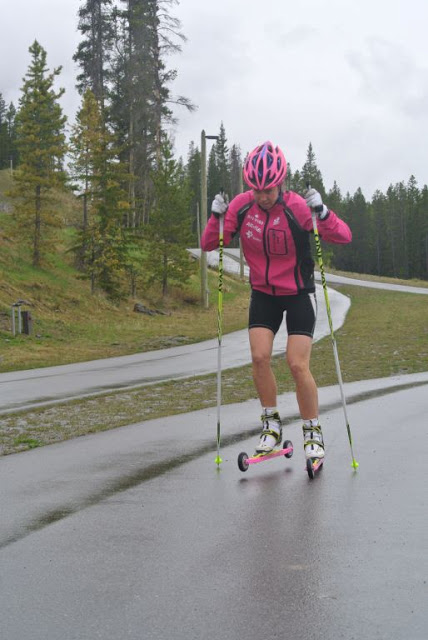
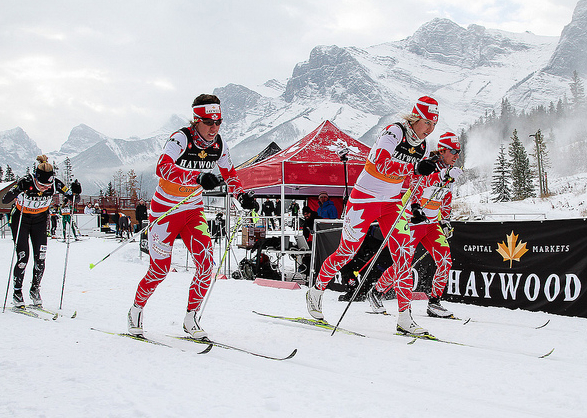
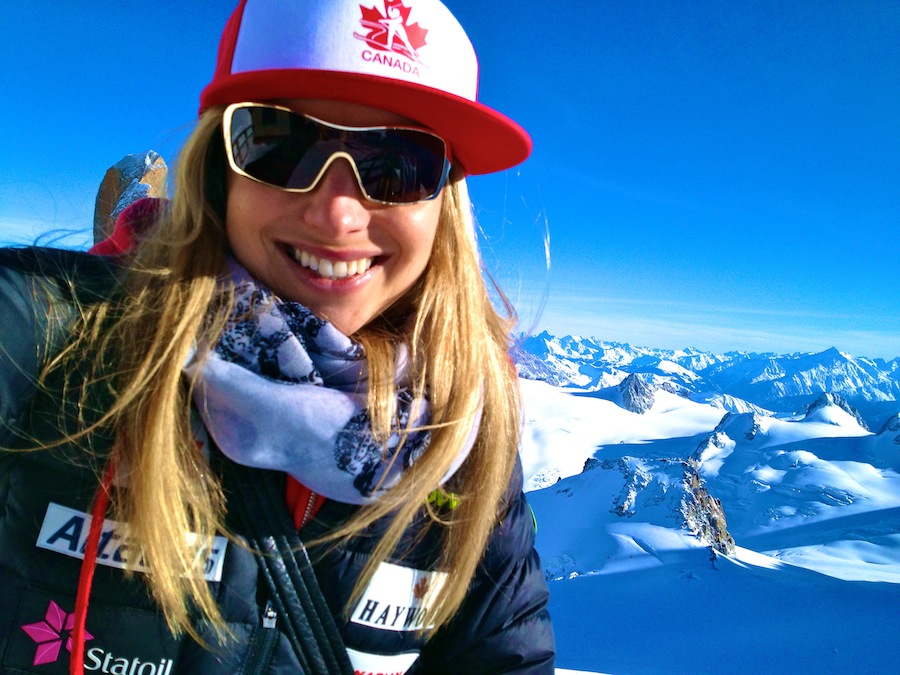
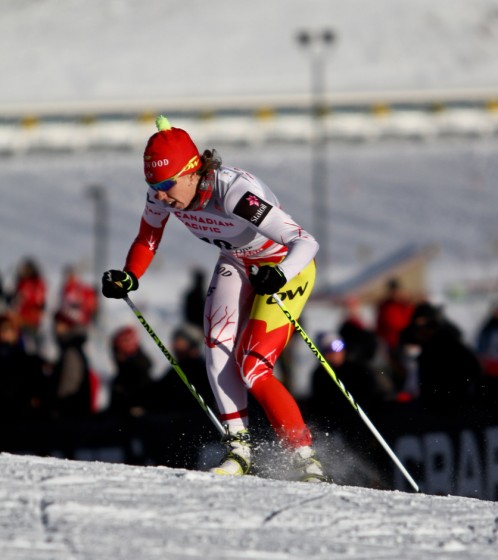
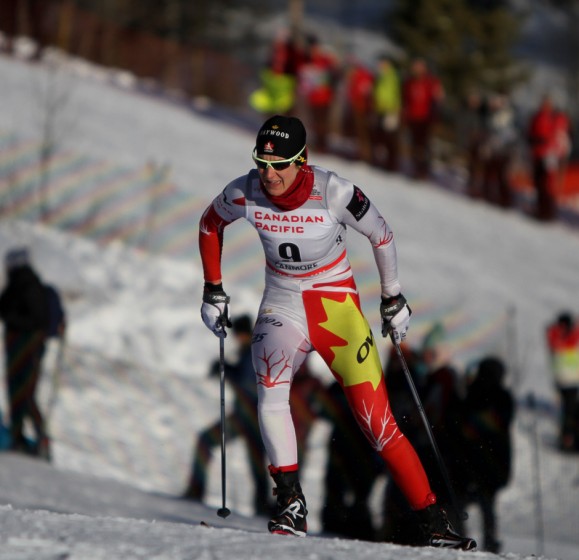
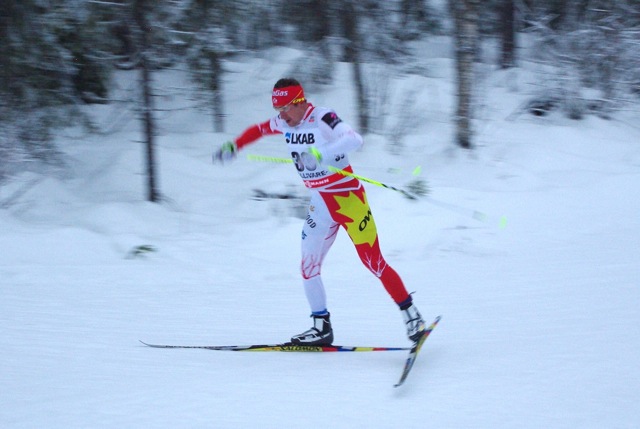
Perianne Jones tests a pair of F1 Sprint Skate rollerskis, a Fast-and-Female release from CCC supplier Peter Rozmovits at Canada Winter Sports, in late May in Canmore, Alberta. “Not even the rain could dampen my spirits with these boards on my feet!” Jones wrote on her blog. “Is there such a thing as too much pink?… probably.” (Photo: periannejones.blogspot.com)
Perianne Jones has no problem jumping into workouts with the guys. And keeping up with teammates like Lenny Valjas, Ivan Babikov and Devon Kershaw? Piece of cake.
If you caught a glimpse of the Canadian World Cup Team during its recent on-snow camp in Bend, Ore., chances are you saw Jones kicking it with men from the national team.
“The boys are great,” she said Sunday on the phone from Canmore, Alberta. “I have a small fleet of rollerskis now so I can just pick and chose the right speed and hop in behind them.”
With Chandra Crawford training independently this summer and Dasha Gaiazova working with Louis Bouchard in Quebec and B2ten in Montreal, that leaves Jones, 28, as the lone remaining female in Canmore. From May 19-29, she was the only women’s World Cup Team member in Bend as well.
Lucky for her, the U.S. Ski Team was there, too. Jones said she consciously coordinated two or three workouts with the American women, but mostly met up with them by default. When she wasn’t skiing with them or other Canadian women, Jones was on a fast pair of rollerskis behind Valjas, Kershaw and Babikov, or training with her coach, Eric de Nys, or her husband, Joel Jaques, a national-team wax technician.
“I don’t think I’ve done a single workout by myself yet this year,” Jones said. “I am not lonely.”
***
FasterSkier: How was Bend?
Perianne Jones: It was an awesome camp. There was a little bit less snow than there was in the past, but skiing was still perfect every day. Good spring skiing, just what we needed.
FS: How did you recharge in April before the start of the season?
PJ: Joel and I went to Hawaii and chilled out for a while … around 16 days. It was awesome. … We ran into Ida [Sargent]. She was there with her sister. At the end of the season, everyone was talking about what they were going to do in the spring and she said she was going to Kauai and we were going, too. We knew that our trips would overlap a couple days, but it just so happened that we were out on a hiking trail and we ran into her, so that’s funny.
We stopped in San Francisco for a night because Joel really wanted to visit Alcatraz. Then we came back to Canmore and were here for a couple weeks before we went to Bend, which was nice because we hadn’t really spent that much time in Canmore since, I don’t know when, before the ski season.
FS: How are you feeling now after your first training camp?
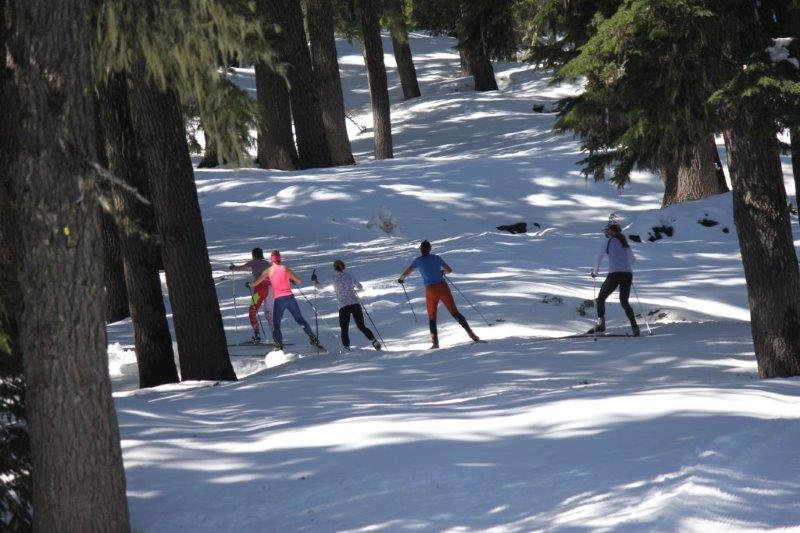
Perianne Jones of the Canadian World Cup Team leads a group of skiers at Mt. Bachelor in Bend, Ore., during a training camp May 19-29. (Photo: Dan Simoneau)
PJ: I came out of the Bend camp as healthy and the least tired than I have in the past. Sometimes it’s a big shocker to get things going with skiing and that many hours in Bend. Last year, I came out of that camp and got sick so this year I feel pretty good and I’m able to still train here in Canmore and do normal stuff. I’m feeling good about things.
FS: Did you do anything differently in Bend, besides train with the guys more often?
PJ: I think the camp structure was pretty much identical to what we did last year. I did a little bit less super-hard intervals and my intervals were a little more controlled, Zone-3 kind of thing. I took a good rest and then kind of gradually built into things before Bend so I had some training under my belt before I got there. It wasn’t too much of a shock. It was still a shock (laughs).
FS: How are you feeling about your training situation this year, especially without Chandra?
PJ: Chandra’s done what’s best for her and I totally support that. The most important thing to me and to her is that she races fast in the winter so whatever way she gets there that’s the most ideal for everyone.
Dasha’s going to do most of the training camps with us so we’ll be in New Zealand together and her and I will be in our fall camp together, so that’s a good six weeks of training right there that we’ll do together. She’ll be in Canmore a little bit and I will probably go out to Montreal for a little bit in the fall, and I’ll combine that with a trip to Ottawa. Dasha and I are going to be working together better than ever which is pretty exciting, and Louis [Bouchard] is totally onboard with that. Louis and Eric have been planning things and making sure there are opportunities for her and I because I think that was something that we all missed last year, more opportunities to get together until we were on snow.
We are three of the best women in the country so the most effective way for us to train is together sometimes. In terms of training partners around here, there’s no shortage of people to train with in Canmore and I’m sure Chandra and I will meet up and do some intensity workouts at some point.
Eric and Joel are awesome training partners and they’re committed to doing intensity workouts with me. I’m well taken care of. I’m not worried at all. I have really awesome people supporting me and committed to coming out and training with me.
FS: What’s changed with your overall training approach this year?
PJ: Getting back into things was pretty relaxed, but the actual training, now that it’s going, I will do a little bit different. I’m going to focus more on some Zone-3 type threshold workouts for the first few months. Last year we kind of dove right in and did some hard stuff. I’m just gonna build into more than I have in the past. Other than that, I mean, pretty similar. Last year, we did a few intensity blocks. I’m still gonna do more intensity, not [more] than last year, but more than years previous. It may not be all in blocks; it might be every few days, not every day for a week.
FS: Why change it?
PJ: I definitely had some fatigue going in [to the season last year]. There were a number of things that weren’t ideal. In Park City, I got a weird kind of skin infection. We thought it was something on my skin, but it actually took a lot out of me; my body was fighting an infection. I should’ve backed off a little bit then and I didn’t so I went into the season a little more tired than I should have and kind of paid for it all the way through. All in all, it turned out OK all things considered.
FS: Last season was your best yet, but you’ve said you were disappointed with World Championships. How does that motivate you moving forward?
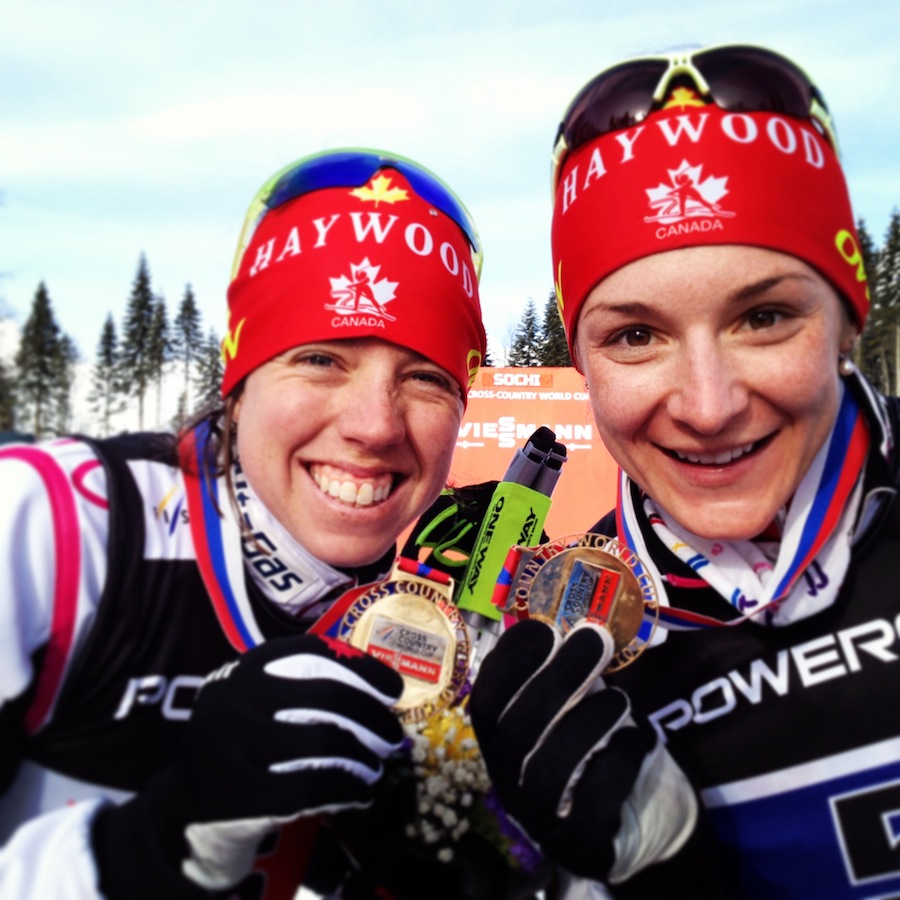
Perianne Jones (l) and Dasha Gaiazova celebrate their first bronze together in the Sochi World Cup classic team sprint last season. (Photo: Chandra Crawford)
PJ: It was a good year but there was more potential than I kind of showed and things could’ve been better. That’s kind of the way it goes with skiing. No one’s ever satisfied; we always want more. But I’m definitely doing things differently and we’ve looked at what I’ve done and changing things to optimize it and make sure we don’t make the same mistakes twice.
There are always just so many variables so we have to look at everything, like what happened in the fall, the infection and the training we did. We just poured over everything and not make any drastic changes, but the little ones that we think will help.
FS: How excited are you for the Sochi Olympics, especially the team sprint after taking bronze there with Dasha in the pre-Olympic World Cup?
PJ: It’s definitely something we think about given what happened last year. We all know there are three women and any two of us could be on that team, but it’s a goal for us as a whole, all of us are definitely thinking about it and we’ll support whoever ends up on the start line that day.
FS: What’s your plan after this season?
PJ: I haven’t quite decided. It’ll probably be my last Olympics. I don’t know if it’ll be my last year skiing. I’m not sure I’ll make it to 2018, that’s a long ways away (laughs).
FS: What’s next?
PJ: I’m heading back down to Bend around the 25th of June for a few weeks. The boys are doing a camp there so I’ll go down with them, and then in August we’re going to New Zealand for a few weeks. Our fall camp right now is up in the air, it will happen somewhere we just haven’t really nailed down the spot. It might be Hawaii; it might be somewhere else because the boys need to do some altitude stuff. Wherever it [is], Dasha and I will be there.
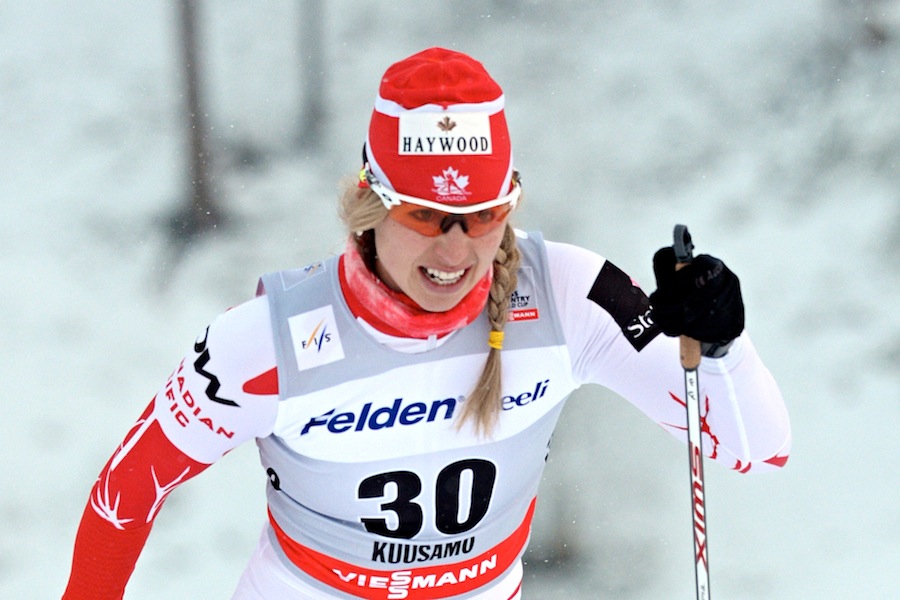
Chandra Crawford racing to 37th in a classic-sprint qualifier at the Kuusamo World Cup in Finland on Nov. 30. Midway through a tough season last year, Crawford, 29, decided to stop racing in February and returned home to Canmore, Alberta, to recharge before the 2014 Olympics. In April, she declined her nomination to the national team and will work with personal coach Peter Larsson this summer. (Photo: CCC/Nordic Focus)
And then there were two.
That’s how many women are on Canada’s World Cup Team after Chandra Crawford recently decided to train on her own with personal coach Peter Larsson for the next several months.
Dasha Gaiazova is back in eastern Canada for the second-straight offseason, which makes Perianne Jones the lone World Cup female at the national team’s base in Canmore, Alberta, where she’ll work with women’s coach Eric de Nys.
Crawford, a 29-year-old Canmore native and 2006 Olympic gold medalist, will be there, too, working independently with her technique and tactics coach of the last four years, Larsson, a Swedish sprint specialist who won six World Cups. Technically, she declined her nomination to the 2012/2013 national ski team (NST), but in an email last week, Crawford reiterated that she’ll be back onboard once the World Cup season starts in November.
“After a solid burn out and overload I’m re-charged and keen to make the most of the days until Sochi,” she wrote of the pre-Olympic training phase. “I have to manage my energy and do things in ways that work for me so while it’s financially sketchy it is the best option.”
Last season, she ended her season in early February after the World Cup in Sochi, Russia, citing the physical and mental toll of 13-plus years of international racing.
“I’m just preparing to go into the Olympic year so rested and so calm from this time I took to step back and center myself and become so healthy and energized,” Crawford said at the time. “The system is overtaxed now and I need to be more honest about my skiing level and listen to my body better.”
She spent the next few months recharging and catching up with family, friends and loved ones, “something I’ve missed for so long I didn’t even know to miss it,” Crawford wrote.
“My weekdays were usually spent on self-improvement and appointments for all aspects of my physical and mental health,” she continued. “Weekends were enjoyed with friends – skiing in the mountains and dance parties. … April I made my decision early about my plans for the year and got to work communicating that out with everyone involved.”
She based the move on her needs in an Olympic year. “I always give at least my best on race day and love big events so it’s a question of how good my fitness and ‘best’ can be on that day,” she wrote.
The news didn’t necessarily surprise de Nys, but it was one that slightly complicated his team’s training plans.
“I thought it was definitely conceivable,” de Nys said Monday on the phone. “I didn’t think she would choose that, but at the same time I totally understand why and totally support her in her decision. We wish her all the best in her training.”
On Monday, he spoke with Crawford and other independent racers, Amanda Ammar, Zoe Roy and Alana Thomas, about the upcoming NST camp in Bend, Ore. Jones will be there, and de Nys invited them to coordinate workouts from May 19-29.
“I’m not writing her plan or anything like that,” de Nys said of Crawford. “I’m just keeping the door open.”
Canadian World Cup teammates Perianne Jones (second from left) and Chandra Crawford (second from right) go head-to-head at a time trial last October in Canmore, Alberta. (CCC photo)
As for Jones, he’s in the process of lining up training partners for the 28-year-old Canmore-based skier. So far, he has mostly aligned schedules with Gaiazova, who trains with NST assistant men’s coach Louis Bouchard at the Pierre-Harvey National Training Centre in Quebec and B2ten in Montreal.
De Nys will also invite foreign training partners to Canmore and explained that Jones has talented biathletes around town as well, like Zina Kocher, Megan Imrie, and Crawford’s younger sister, Rosanna.
“I’ve also made the commitment to start to become in better shape so I’ll make her feel really good about herself as she drops me on the hills,” he joked.
Looking at his team of three (technically two until Crawford proves she’s capable of racing internationally again in the fall), de Nys stressed the importance of end results – not how one gets there.
“I don’t view it any different than how it works in the U.S. with Gus Kaeding coaching [national-team members] Andy [Newell] and Simi [Hamilton] in Vermont,” he said, referring to America’s elite-team system.
“There’s more than one way to the top and the national ski team is one way and there’s other ways we can do it,” de Nys explained. “The important thing is you have a team that’s willing to work with each other. We do have a group of women, albeit a small one, that do want to work with each other.”
He likened Crawford’s situation to that of an NHL player going down to a farm team. It’s unusual that one would do so by choice, but the athlete still has to show they’re worthy of playing at the highest level before getting bumped back up.
“Chandra will have to undergo some testing and some evaluation,” de Nys said of her anticipated re-entry to the national team. “It’s one thing if you want to go off and do your own training, that’s all fine, but before we take someone to Europe, we want to make sure they’re physically healthy. … We’re not going to take somebody to Europe for vacation.”
In Crawford’s case, he doesn’t expect that will be a problem.
“Sometimes the environment or the pressure in whatever team you’re on doesn’t necessarily suit everyone,” he explained. “I think that’s the point Chandra is at in her life. … While we can’t necessarily support that, I understand why she chose that.”
In July, Crawford plans to train in Alaska, he said. Meanwhile, Gaiazova and Jones will join the Canadian men’s team in New Zealand and also in Hawaii this summer. Separated for the first time last year, the men’s and women’s World Cup teams previously held camps at different venues. This year, de Nys said it made sense to combine overseas trips and share resources (i.e. physical trainers).
With two women on its current World Cup squad, it raises the question what Canadian women’s skiing could look like in the future. De Nys expects some changes.
“We anticipate that perhaps Dasha, Peri and Chandra will be done after this year so we have to start grooming the younger crowd as well,” he said. “There’s a fairly large gap from the World Cup level to the younger levels. … We have to make sure we keep building up this castle.”
He pointed out talent in the junior- and senior-development ranks, especially with skiers like Anne-Marie Comeau, who made the top 50 in two debut World Cup races last season at the age of 16.
“You just don’t show up and pull races out of your hat like that,” de Nys said. “Now we just have to make sure that we do the right things … bring in some of those girls, work with some of them.”
After Bend, the NST will host a women’s camp on Canmore’s Haig Glacier with its World Cup, junior and senior development teams.
With the conclusion of the 2012-2013 World Cup season and of competition Period IV in Falun, Sweden, FIS released the world ranking lists in sprint and distance disciplines from which the new Red Group is determined.
A top-30 spot on either the sprint or distance list gets athletes a spot in this elite set of skiers whose travel, lodging and living expenses are paid for, within the sprint or distance discipline, through the next competition period, until the rankings are recalculated.
Out of all the rankings released periodically throughout the winter, a spot in the Red Group after Period IV most truly represents performance consistency within a single season. Rankings are tabulated from World Cup points from the previous calendar year, which means that lists released after Period I, II and III include results from the previous season. Period IV, however, only represents races from the last five months, and in contrast to the straight World Cup rankings include points from World Championships.
This can turn out to be good news for athletes who sat outside the bubble at the end of Period III, and bad news for those who were previously inside it. Moving in or out of the top-30 from one period to the next comes down to relativity — whether an athlete performs better within a period than they did in the same time frame the previous season. New results at the same venues supplant the old ones with the release of each list.
American Holly Brooks, for example, was outside the top-30 cutoff at the end of Period III in the distance rankings, when she was 41st. With a few of her best results of the season in Falun this past weekend, however, she moved up to 29th and will have her expenses covered at the beginning of next year for distance World Cups.
Her teammate Jessie Diggins, by contrast, moved from 30th in the distance list at the end of Period III to 35th for Period IV, just outside the Red Group cutoff. Diggins ended this season with a strong eighth in the Falun prologue, but it didn’t quite match the results she posted last season in the same period and she consequently moved down the list.
Outside the bubble skiers, there were few changes amongst those who made the Red Group on the American and Canadian teams between this period and the last. In the sprint rankings, Kikkan Randall led the way at the top of the women’s list and Ida Sargent joined her in the top-30 in 23rd.
Canada’s Dasha Gaiazova and Perianne Jones both remained in the money in 17th and 30th, respectively.
Andy Newell finished the season comfortably in the Red Group with a seventh-place sprint ranking and is the lone American in the top 30.
Canada’s Lenny Valjas finished the year only a few points behind him in eighth, and Alex Harvey and Devon Kershaw also squeaked into cutoff in 21st and 23rd.
Randall also finished the season with a high ranking in the distance list, in tenth, to lead two additional Americans in the top 30: Liz Stephen was 14th and Brooks just made the cutoff in a points tie with Italy’s Virginia De Martin Topranin in 29th.
No American men made the distance Red Group; Noah Hoffman was 42 points away in 35th.
Ivan Babikov and Harvey each made it in for the Canadians, Babikov in 18th and Harvey in 23rd. Kershaw and Valjas were outside in 43rd and 44th.
In all, five Americans (four women, one man) and six Canadians (two women, four men) are in the Red Group for the start of the 2013-2014 season. For athletes on the U.S. Ski Team the distinction is an important one; Hoffman told FasterSkier he was informed at the beginning of the season that Red Group would be sufficient for A-Team nomination for the following year.
North Americans on the World Ranking Lists, Period IV:
Chandra Crawford, Canadian World Cup Team member and 2006 Olympic gold medalist, in Chamonix-Mont-Blanc, France. (Courtesy photo)
Countless times, Chandra Crawford relied on her upbeat attitude and incredible self-motivation to rise to the occasion. When it came to racing, there were no bad days, just a genuine love of the sport.
At the age of 22, the always-smiling, wide-eyed girl from Canmore, Alberta, won gold in the freestyle sprint at the 2006 Olympics. She notched her first World Cup victory the following season in her hometown and won another gold in a World Cup skate sprint a few months later in March 2008 in Lahti, Finland.
Canadian Chandra Crawford (3) follows Maiken Caspersen Falla of Norway with Kikkan Randall (USA) close behind in the Alberta World Cup freestyle sprint semifinals on Dec. 15 in Canmore.
Now 29, Crawford’s no longer a girl, yet she still thrives off that same optimistic adrenaline that’s fueled her for the last 13 years. For instance, take the Canmore World Cup. Heading into the races two months ago, Canada’s leading national-team female hadn’t cracked the top 30 this season. In her signature event in front of thousands of fans, she qualified in third in Canmore and went on to place sixth in the World Cup final.
After the holiday break, in which she spent time with her two teammates – Dasha Gaiazova and Perianne Jones – training and racing Alpen Cups in Germany, Crawford struggled to get back near the top. In mid-January at a World Cup skate sprint in Liberec, Czech Republic, she was 29th. She didn’t finish her next race, a 10 k classic mass start in La Clusaz, France.
That’s when Crawford knew something was wrong. And unlike all the other times she had buried the bad feelings and triumphed, she took a hard look at the root of the cause.
“I spend a lot of time with my training logs, analyzing a lot of what I’ve been up to and how I’ve been feeling over the last year, and there were just so many strong reasons in there for the state I’m in,” Crawford said on the phone Wednesday. “It just seemed clear to me that I was in a pretty good hole.”
She wasn’t burnt out, sick of the sport or tired of racing, she said. Rather, Crawford realized she had done too much in the last year, which culminated into an overwhelming sense of mental and physical fatigue. Stress in the last year was a contributing factor, but moreover, that paired with a “super-hard” training sessions took a toll on her body.
“I’ve been hammering for a lot of years now so to take a breather after 13 solid years of full-time training and racing at as high a level as my body can at all times, I don’t feel too bad about it,” Crawford said.
On Tuesday, Cross Country Canada (CCC) issued a press release stating Crawford decided to end her season early to recover for next year’s Winter Olympics in Sochi, Russia. After prequalifying for the 2014 Games with her Canmore result, Crawford appeared to be in a safe spot. But what was next for Canada’s golden child? And what would become of the nation’s World Championships hopes with just two World Cup females racing in Val di Fiemme, Italy, later this month?
A Little R & R
According to Crawford, who flew home from Sochi on Monday, she’ll take some off before resuming training. She formulated a loose plan with Canadian women’s coach Eric de Nys before leaving after breaking the news to him last week.
Nervous about the conversation, Crawford said she waited until she saw him in person to discuss it. After spending time with his family in Canmore, de Nys rejoined his team on the flight to Sochi for the pre-Olympic World Cup.
“We were sitting on the plane together for a couple hours and then finally I just said, ‘I’m thinking about stopping the season,’ ” Crawford recalled. “And he said, ‘We’re on the same page,’ so then I was completely calm and I knew it was the right thing.”
According to de Nys, Crawford’s only obligation is to be ready to go in May when the team starts training for the 2013/2014 season. He said her situation is much like that of a season-ending injury; she’s going to take time to recover, recuperate and follow a training plan in doing so.
“We know she’s a performer so I don’t have any worries about her getting back into shape,” de Nys said on the phone from Valdidentro, Italy, where Gaiazova and Jones are training before the Davos World Cup.
“Sometimes things go awry,” he added. “It might seem drastic midway through the season, but it happens quite often where athletes have to miss a couple months of racing.”
De Nys used LukášBauer, the Czech Republic’s famous World Cup skier, as an example. Bauer’s season was cut short in February last year when he discovered a fracture in his heel.
“He couldn’t walk anymore,” de Nys said. “That’s not what he wanted to do, but in this situation it’s the same thing. Of course, Chandra wants to try to finish the season, but when we really thought about it, talked about it, it doesn’t make sense. I think she’s going to come back stronger from this.”
Chandra Crawford (CCC photo)
Crawford does, too, but she’s a little unsure of the timeline required to get there.
“I don’t know what to expect,” she said. “I don’t know how long this is supposed to take, but that’s why we’ve shied away a little bit from trying to put timeframes on it. In the past, when I make a goal I am going to do everything in my power to achieve it, which can sometimes lead to forcing it or maybe trying to fabricate a state that might not actually be happening.”
Moving forward, she said there are two scenarios she’ll try to avoid. One, disappointment when she doesn’t meet her goals. And two, “acting fine because I decided I want to be fine at a certain time,” she said.
“We’ve seen this past year that, although I have tremendous abilities to create an optimal state and that’s why I’ve raced well in the past, the system is overtaxed now and I need to be more honest about my skiing level and listen to my body better,” Crawford said.
Making the decision to stop racing three weeks before World Championships wasn’t easy, especially given Crawford’s love of Italy. According to de Nys, it was better to make it sooner rather than later.
“It’s no fun when you know you can be on the podium and you’re finishing 40th or 50th, you know something’s not going right,” he said. “When you just kind of get in the water and you’re spinning your wheels, you know that’s time to take a break and re-gather everything and come back fighting stronger.”
Crawford said another factor in her decision was her experience with previous Olympic years – and the media attention leading up to it. Upon returning to Canada, she had four interviews on Tuesday and two that she moved to Wednesday.
“The first question of the first interview of the Olympic countdown was, ‘Do you feel the weight of the nation’s expectations on you to win gold?’ ” Crawford said. “If I get drilled with that question the entire year, even with all my media training and whatever I do to deflect it or focus on the process, it’s still a thought that just comes up so much more often with the media presence.”
After envisioning herself coming home and “crumpling onto the couch,” Crawford said she’s exhausted but happy. And while she was considering a two-week yoga retreat in Mexico to take her away from the temptation to ski, she wrote in an email Thursday that she might cancel the trip.
“Just looking at enjoying home life and not running around so much,” Crawford explained.
Whatever she ends up doing to unwind, Crawford said she doesn’t take anything for granted – not a vacation, her team or all the racing opportunities she’s been given.
“I’m definitely spoiled rotten and I really appreciate everyone being behind me because I’m definitely putting my all into my pursuit of skiing,” she said. “It’s interesting that this time putting my all into it means taking a step back.”
The founder of Fast and Female, Crawford will continue with her less-involved role, attending about two events per year and delegating responsibilities to her board and a new executive director. As the movement of empowering young girls keeps spreading across North America, Crawford said she’s thankful for the athletes, volunteers and regional coordinators behind it, especially Kikkan Randall and other US Ski Team members. Ultimately, Crawford wants to make more appearances in the future, but reasons, “my chance to pursue my dreams to the best of my abilities on the racing side is just a short time window right now.”
As she embarks on a fresh start in racing, she’s looking forward to feeling regenerated for next season.
“I’m just preparing to go into the Olympic year so rested and so calm from this time I took to step back and center myself and become so healthy and energized,” Crawford said. “There are just so many things I pour energy into that I really have to be really disciplined and prioritize for the Olympic year.”
World Champs Outlook
In Crawford’s absence at the upcoming World Championships, an additional female sprinter will not be selected, according to CCC High Performance Director Thomas Holland.
When the team was named a week and a half ago, the selection committee extended its 11-person maximum for one additional distance woman on the squad. Without Crawford, the team was back to 11. Of the five women, three are sprinters.
With the opportunity for one team sprint and one relay per gender at World Championships, Canada’s women appear to be in a good position for the former. Last weekend, Gaiazova and Jones teamed up to win bronze in the classic team sprint in Sochi. The Canadians will also field a women’s relay.
“This is not an event we have done well in,” Holland wrote in an email, pointing out their 16th-place finish at the 2007 World Championships. They didn’t have a relay in 2009 and placed 14th two years ago. “It would be nice to see an upward improvement from the last 3 [World Championships].”
De Nys explained Canada has been working to rebuild its women’s program for the last several years since Beckie Scott and Sara Renner captured silver in the team sprint at the 2006 Olympics.
“Now, we’re very strong, but just in sprint so we’re trying to get some momentum behind distance skiing in Canada as well,” de Nys said. “Sometimes it takes a little while before you have the right horses in the stables, you know?”
Canadian Chandra Crawford after placing fifth in the World Cup classic sprint in Drammen, Norway, last March. Photo: Fischer/Nordic Focus.
CANMORE, Alta.— The leader of the Canadian women’s cross-country ski squad, Chandra Crawford, has decided to take a break from competitive high-performance skiing to recharge her batteries for the final charge to the Olympic Winter Games in Sochi 2014.
Physically and mentally exhausted from pushing herself hard in training and life, the 29 year old will take the remainder of the season off to give her body the rest it requires.
“My motivation and love of competing at the highest level in cross-country skiing has made so many dreams come true for me, but it can also cause me to go overboard,” said Crawford. “As Kenny Rogers said ‘You got to know when to hold ‘em, know when to fold ‘em. Know when to walk away, know when to run.
“It’s really disappointing to end my season early, but with my ultimate purpose of showing up calm as a Buddhist monk, and bulletproof in Sochi next year, it’s an opportunity to prepare mentally and physically to execute my best training ever.”
After struggling to find her top form this season, the Canmore, Alta., resident made the decision with her coaches and support team heading into the World Cup test event on the Olympic course in Sochi, Russia, which Crawford competed in this past weekend.
“Chandra is a world-class person both on-and-off the playing field, and we are fully supportive of this decision to get her back home in order to get rested for the Olympic year,” said Tom Holland, high-performance director, Cross Country Canada. “Sometimes the demands on an athlete’s body are just simply too much, and the most effective form of preparation is to take a short break.”
In addition to winning her Olympic gold medal in Torino, Crawford has racked up seven World Cup medals in her career. The two-time Olympian balances her athletic life with leading Fast and Female, an organization which has inspired and empowered thousands of girls, ages nine-to-19, across Canada to live healthy, more active lives.
“It was really important for me to have a good run through on the Olympic trails in Sochi to aid in my preparation for next year, and I’m already excited to skate sprint on this 1.25 km course next year,” added Crawford. “Cross Country Canada has always celebrated our victories, and battled with us through the tough times, and this has been no different. I appreciate the support I have received from my coaches and teammates, our sport partners, and sponsors in this decision. This is the best thing for my body, and I will sacrifice part of this season in order to give everything I have to my Olympic performance next year.”
Crawford will continue training for the run to Sochi in May.
***
Cross Country Canada is the governing body of cross-country skiing in Canada, which is the nation’s optimal winter sport and recreational activity with more than one million Canadians participating annually. Its 55,000 members include athletes, coaches, officials and skiers of all ages and abilities, including those on Canada’s National Ski Teams and Para-Nordic Ski Teams. With the support of its valued corporate partners – Haywood Securities, AltaGas, Statoil and Canadian Pacific – along with the Government of Canada, Canadian Olympic Committee, Canadian Paralympic Committee, Own the Podium and B2ten, Cross Country Canada develops Olympic, Paralympic and world champions. For more information on Cross Country Canada, please visit us at www.cccski.com.
Liz Stephen (US Ski Team) hammering in the 9 k classic pursuit at the Tour de Ski on Dec. 30 in Oberhof, Germany, where she was 23rd. (Photo: Marcel Hilger)
Note: This article has been updated to include comments from Jessie Diggins after an unintended oversight.
There’s something about La Clusaz, France, and Liz Stephen can’t put her finger on it, but it works for her.
Two years ago, the US Ski Team (USST) veteran notched her first World Cup top 20 in the small alpine village near the Swiss border, some 3,500 feet above sea level. It could’ve been the hills, maybe the thin air, but Saturday, Stephen (who turned 26 a week ago) figured it was the memory of placing 18th there in the 15-kilometer freestyle mass start that carried her to another career best.
Stephen led the North American women in Saturday’s 10 k classic mass start, placing 15th for her best classic result. She was 1:13.8 behind Norwegian winner Marit Bjørgen, and 47.2 seconds ahead of the second American, Jessie Diggins, who posted a solid 24th despite a pole mixup before the race.
“Less than 3 minutes to [before the start] I realized I’d grabbed the wrong poles and had two different spare ones, with loops instead of handles,” Diggins explained in an email. “I ran back to the start area looking for my poles but ended up grabbing a spare Canadian set. So when the gun went off my heart rate was already in L4!
“I was psyched on today, and even more pumped seeing Liz have a great one,” Diggins added.
“I was certainly remembering my first ever top 20 here 2 years ago with Morgan Arritola the other day,” Stephen wrote in an email. “I think once you have a good race somewhere, you have a good memory and feeling of the place in your mind and your confidence is higher going into the competition. So, La Clusaz may be one of those places for me.”
Sadie Bjornsen, who earned her starts as the early season U.S. SuperTour leader, also made it into the points in 28th (+2:29.1) and USST teammate Ida Sargent followed in 29th (+2:35.7). For the Canadians, Dasha Gaiazova led the way in 27th (+2:26.2), her second-best distance result since placing 25th in a 10 k classic last year in Poland.
Kikkan Randall (USST) struggled with icing skis in above-freezing temperatures and variable conditions. She crashed on the last lap and finished 32nd (+2:50.9). Canada’s Perianne Jones was 38th (+3:27.9) and Chandra Crawford did not finish after her skied iced up early on, and she decided her body wasn’t feeling it and pulled out.
On a day marred by struggles in difficult waxing conditions, Stephen came out on top – relatively speaking – placing 15th for her second straight race. It was her second-best individual result this season since finishing 13th in a 5 k classic at the Kuusamo World Cup in November. Perhaps most notably, in her previous race she was second fastest up the final climb in the last stage of the Tour de Ski, putting her 15th overall.
A 9 k freestyle ascent up the infamous Alpe Cermis is where most people would expect Stephen to thrive. But Saturday, she made herself known in a gritty classic race.
“She’s always been sort of a skater and doesn’t really like that,” U.S. women’s coach Matt Whitcomb said with a laugh. “She’s learning to gain confidence in her kick. She’s learning to work with her new tech [Oleg Ragilo] and dial in just some better classic performances.”
Stephen credited the wax techs and the entire coaching staff for making the difference for her team Saturday. While most everybody struggled with snow and ice clumping beneath their skis in the moist and variable tracks, the Americans were able to generally shake it off, literally, and glide more than most.
“With a small team like we have, it takes all hands on deck to make good skis,” Stephen wrote in an email. “Our guys never seem to slow down for a second. I mean, they penciled in a 10-minute lunch break between our race and the dudes and didn’t even get to it today.”
With temperatures into the mid-30s before the 11:15 a.m. start and mid-40s by the end of the race, it only got warmer as the day went on. Most men opted for hairies for their afternoon race, but for the women, it was a bit of a crapshoot.
“I think we did a good job hitting for our efforts today,” Whitcomb said. “We had very competitive skis. By no means were they perfect, they were just really good and our girls were able to [work with] that.”
Skiing in the top 30 from the start and making her way to 18th by the 2 k checkpoint, Stephen explained that she tried to ski smart even though there were plenty of places to pass on the three-lap course.
“With the conditions being what they were, staying in the track was best for not icing on the uphills,” she wrote. “I forced myself to stay in the tracks as much as I could, which was easy with the rollerski kick I had. I made most of my moves on the uphills, just consistent turning up the speed throughout the race and staying relaxed, trying to ski smooth and controlled and hang tough.”
Meanwhile, Randall and Diggins skied together around 23rd and 24th two kilometers in. Randall climbed as high as 18th near the halfway point while Stephen hung in 17th. At 5.3 k, Diggins led the rest of the Americans in 29th. Seven seconds back in 30th, Bjornsen worked to keep Diggins in sight, and Sargent an additional 10 seconds behind in 31st.
“I wasn’t skiing with any one person for long but mostly trying to hang with the pack as long as I could,” Diggins wrote. “Once I got a system for double poling while smacking the snow off my skis I was able to ski the hills with more confidence.”
Skiing separately but feeding off each other, Diggins, Bjornsen and Sargent continued to pick off the places while Randall started to slip.
“For a while there was a line of four Americans with Kikkan, Jessie, Sadie, Ida, working in the mid-20s and making us proud,” Whitcomb said. “Today was by no means a big focus race for Kikkan. In a lot of ways, if there is such a thing on the World Cup, it was sort of a training race.”
Randall didn’t make any excuses, he said, but had a hard time after 7 k. In an email, she wrote that she was satisfied with the first two laps of her race, with her skis first starting to ice during the end of loop two.
“Going into Lap 3 I was getting tired but still moving well and gaining places until I hit the first big climb,” Randall wrote. “There my skis began to ice more and more, and soon I was only running on stilts. I tried to knock the snow free several times but the snow kept packing on more.
“I crashed once on the downhill when my skis grabbed while I was trying to kick free. I finally stopped at the top of the 2nd to last hill and slid my skis across each other to clear the snow,” she continued. “I started icing again up the final hill but was able to kick off over the top to at least have a sprint-off.”
Randall edged German Nicole Fessel and France’s Anouk Faivre Picon, who were 33rd and 34th, respectively.
“I don’t think I was at 100% physically today but I was certainly a lot better than my result showed,” Randall wrote. “Unfortunately, with my technique, when I get tired, I have a tendency to run more and glide a little less which I’m sure contributed to the icing on the skis. … I am certainly a little frustrated with today but not too concerned.”
Bjornsen, 23, shared similar frustrations, but was pleased to land in the points in a distance race. (She previously recorded a career-best of 25th in the 10 k classic mass start at the Canmore World Cup, but explained finishing 28th in Saturday’s competitive field meant more to her).
“I think today you either had skis that were working – or skis that were testing your patience and perseverance,” Bjornsen wrote. “Today I was in the second category – but I am also very excited for how things went considering.”
After spending most of the offseason coping with injuries, Bjornsen explained that it took her a while to get back into race shape. After working her way back to the World Cup, she couldn’t be happier with the opportunities ahead.
“Now it is time to jump in between the other US girls momentum and follow them!” she wrote. “I am very excited for the girls relay tomorrow. Even though I will be standing on the sidelines cheering – our team is a six-woman relay team, and I believe in those girls 100%.”
According to the start list, Holly Brooks (who did not start Saturday race because of limited spots), Randall, Stephen and Diggins will represent the U.S. in the 4 x 5 k relay. At the World Cup opener in Gallivare, Sweden, three of those women (plus Sargent instead of Randall) placed fifth in the event.
Although she wouldn’t be racing, Sargent was excited to watch the relays Sunday after posting one of her best distance results.
“Anytime I’m in the points is a good day,” Sargent wrote. “I was also excited that after a long break from a distance race (Canmore was my last one) that the body still feels really good.”
In Canmore in mid-December, Sargent was 14th in a 15 k skiathlon. In two races since, she had yet to crack the top 30 in an individual World Cup.
“Great to have 4 girls in the top 30 today,” she wrote. “It was a tough race.”
***
Canadian classic-sprint specialist, Gaiazova was also positive after one of her top distance results.
“I just wanted top pace myself a little bit and relax behind other skiers,” Gaiazova said on the phone. “I was trying to pick good lines and good rides, follow people around the course, pass them on downhills or over the tops of the hills were my skis weren’t so sticky. At the end, I know a lot of people got tired from their skis getting stuck. I was able to see people ahead of me and coaches were telling me I was close to top 30.”
That was all she needed to carry her through to 27th, a result that helps the Canadian women secure another spot on the distance quota next season.
“I’ve been feeling really good the last few weeks,” Gaiazova said after achieving a career-best fourth in the Liberec classic sprint last weekend. “It’s exciting; I’m really happy with where my skiing is right now.”
Jones wrote in an email that she was not “super stoked” with her result, “but I can’t be too disappointed, either. It’s my first distance race of the season so I hope to build on it.”
“Every time I do a distance race I hope to be in the top 30 so I have some work to do!” Jones added. “The conditions were super tough … people were icing up like crazy and having all kinds of trouble. We were pretty lucky we didn’t have it that bad at all!”
Crawford was on the fence whether to race Saturday.
“With a lot of bad pumped out feeling in my body lately the plan was to see how warm up felt and then decide whether or not to race, with not racing being likely the best option,” she wrote. “My decision was swayed by my optimism, love of racing, appreciation of a great opportunity, good conditions and skis, so I started.”
After falling more than a minute back by 2 k, Crawford realized she didn’t have her normal speed and her skis were icing up. She pulled out before 3.3 k.
One woman short of a relay, the Canadians will next race in two weekends at the World Cup in Sochi, Russia. Crawford wrote she’s “going to keep training and make a great plan with my coaches to get this worked out in the four weeks until world champs.
“Some easy training and chilling out will help for sure,” she added. “Setbacks are set ups for comebacks, eh!”
An excited Dasha Gaiazova at the women’s 0.85 k World Cup classic sprint in Liberec, Czech Republic. The Canadian was fourth for a career best, narrowly missing the podium in a photo finish. (Chandra Crawford photo)
The Canadian women went to Oberwiesenthal, Germany. Lenny Valjas went to Egypt. Wherever their respective travels took the Canadian World Cup Team, it worked, at least for the sprinters on Saturday.
Perianne Jones led the three-person women’s squad in the qualifier, posting the seventh-fastest time in the World Cup classic sprint in Liberec, Czech Republic. For Jones, it was by far a personal best.
“All my qualifiers before this year have been by the skin of my teeth,” Jones said with a laugh. “So I’m happy to be consistently in there and really in the mix instead of the last one or two.”
But it got better for the Canadians: Dasha Gaiazova qualified in 10th, Valjas advanced in 16th and Crawford made it through in 27th. All four of the Canadians that raced in Liberec – including Valjas, who finished his first Tour de Ski last Sunday – made the heats. Then Jones, Gaiazova and Valjas advanced to the semifinals to secured top-10 results.
From there, Gaiazova carried the most momentum, finishing neck-and-neck in the semifinal with eventual overall winner Mona-Liisa Malvalehto of Finland, who won the semi in a photo finish. Gaiazova joined her in the final, where she latched onto Malvalehto out of the start.
Running in second for the first half of the women’s 850-meter race, Gaiazova attempted to hold off Poland’s charging Justyna Kowalczyk, but lost some speed when Kowalczyk jumped ahead of her in the track before the last hill. With Malvalehto skiing away to the victory, Gaiazova, Kowalczyk and Norway’s Maiken Caspersen Falla battled for second, where Kowalczyk won the three-way photo finish. All three came in 1.7 seconds behind Malvalehto (who won in 2:03.8), with Falla edging Gaiazova for third.
So close to a podium, Gaiazova said on the phone she was simply glad to be in contention in her signature event.
“It was a short course and you had to go all out from the start,” Gaiazova said of the less-than-one-kilometer course, shortened from 1.7 k after the coaches voted Friday night.
“At the end, it’s just sort of like a drag-race double poling,” she said, adding that she didn’t think in the final moments, she just went for it. “I did the best I could and I’m definitely happy.”
Not far down the results list in ninth, Jones also notched a World Cup individual best. She was second in her quarterfinal to Germany’s Hanna Kolb and fifth in her semifinal – the same one Gaiazova and Malvalehto won.
Jones said she scrambled after bad starts in both the quarterfinal and semifinal. While she made up for it drafting and passing others on the big downhill in the first heat, she failed to pick off as many people in the semi.
“I tried to make my same move coming up the last hill like I did in the quarterfinal, but it wasn’t enough to move on to the final,” Jones said. “I was happy with it, but I know what I need to work on now and that is my starts.”
As for Gaiazova, who’s top-six secured a trip to the 2014 Winter Olympics, Jones said she was fun to watch.
“Dasha skied tactically super well the whole day and she’s in great shape,” Jones said. “It was really exciting to see her be so close to a podium. We were really cheering hard for her.”
Valjas ended up 10th in the men’s 1.6 k sprint after advancing out of his quarterfinal in fourth with one of the fastest times. The lone Canadian man racing, Valjas went on to place fifth in the semifinal.
“I felt the final hill,” he said. “I could feel the legs just didn’t have the same snap or speed … There’s nothing I can change. I can only go as fast as my body would let me. Today I was just out there having fun and seeing how fast I could go.”
Earlier in the week, Valjas took three days off completely at an all-inclusive resort in Hurghada, Egypt, where he traveled solo. There, he met up with the women’s alpine technical team and said he mostly “sat tanning [and] tried to recover” after placing 23rd in the Tour, an overall result he was pleased with.
“I really didn’t know what to expect for this race and I’m happy with making the semi and cracking the top ten just after the Tour,” he said.
In both his heats, Valjas struggled to find an open lane to test his finishing kick. He skied right behind Germany’s Tim Tscharnke into the last stretch of the semifinal, but Tscharnke moved ahead and Valjas dropped to fifth.
“We picked the same lane and I don’t know why, but I kept going to the left lane up the hill, which is the outside when you come into the finish,” Valjas said. “It’s just way further. Maybe I could’ve done something tactically better. … I couldn’t keep up with them on the last uphill anyways so it didn’t change too much.”
In an email, Crawford, who was 29th overall, wrote that she was inspired by her teammates’ performances despite feeling a little off in her first World Cup in nearly a month. She was sixth in her quarterfinal, 7.6 seconds behind Kolb as the heat’s winner.
“I feel sluggish like I usually do coming off a block without racing,” Crawford wrote. “It looks like it will take the usual race into shape plan. … Couldn’t quite dance around and make moves as I pleased – the main move I wanted to make being closing the gap to the group.”
In the scheme of things, this race – with several Tour competitors sitting it out – wasn’t the end-all of the season. Most of the Canadian women, for instance, had their sights on the classic sprint at World Championships Feb. 21 in Val di Fiemme, Italy.
“My teammates Peri and Dasha are classic sprinting like complete bosses so I’m looking forward to our prep together this next month,” Crawford wrote.
The three spent the last few weeks of December training at home in Canmore, Alberta, before flying to Oberwiesenthal in early January for Alpen Cup races (a classic sprint and 5 k freestyle). According to Canadian women’s coach Eric de Nys, the races were tune-ups before resuming the World Cup schedule.
Reacting to the results in their first race back, de Nys wasn’t surprised, but rather somewhat relieved given the nature of sprinting.
“I think sprinting is still so volatile, especially on today’s course,” he said. “We have three high-quality women that can go to the podium any day … all of our cards have to fall the right way.”
One shot around an 850-meter course made it even tighter, but de Nys advocated the shorter sprint. After previewing the 1,700-meter course Friday, he estimated it would take the women between upwards of four minutes to complete. In his opinion, anything over three minutes wasn’t a true sprint.
“If you want to talk about a sprint today, if you’re an 800-meter runner for a woman, it’s about 1:55, I think, and today we were 2:04,” de Nys said. “Now we’re starting to be in the right ballpark of time to really call it a sprint, if you want to call 800-meters a sprint.”
Like most of the Canadians, Jones welcomed the news of a shorter course. The women first skied in Liberec on Friday with a typical pre-race workout at Zone 3.
“It took us six minutes to do two laps,” Jones said with a laugh. “So we’re like, ‘OK this is gonna be a really long sprint.’ At the coaches’ meeting, they decided to shorten it, which was pretty awesome for everyone. Even the men’s race looked a little like a distance race on TV … I think it’s good to keep sprints sprints.”
Valjas felt similarly after the men’s 1.6 k course took about 3 ½ minutes.
“The sprint, I think, should be really a lot shorter,” he said. “The course yesterday that they had for the training was a lot longer so this morning they cut it … it would’ve been four minutes yesterday.”
On Sunday, Gaiazova and Jones will pair up in the team sprint and Valjas will enjoy the day off.
“It will be a really, really exciting race I think,” Jones said. “All the teams here are pretty close and anything can happen. Team sprints are just so crazy that way. … They’re my favorite.”
The Tour de Ski kicks off on Saturday in Oberhof, Germany with a 3.1/4.0 kilometer skate prologue, marking the start of the second World Cup period of the 2013 season.
At the end of every World Cup period a new sprint and distance Red Group is released for next period.
As a quick refresher, the Red Group is about one thing, and one thing only, money.
Transportation and lodging are covered for Red Group skiers for World Cup weekends, providing a significant boon to national programs and self-supporting skiers alike.
The Red Group rankings are tabulated based on World Cup points for the previous calendar year. At the completion of a period, the corresponding period from the previous season is dropped.
This means the Red Group does not always consist of the current 30 fastest skiers.
Take for example the case of American athlete Holly Brooks.
Brooks is currently ranked 20th in the overall World Cup standings and 14th in the distance rankings.
Yet she is 41st on the distance Red Group list, 69 points out of the top-30. Brooks is hurt by the fact her best results last year came in period I, and those are now off the list.
Brooks is the type of skier who would be most helped by being in the Red Group. As a member of the United States B Team, Brooks is responsible for her own travel and lodging expenses.
Other “close but no cigar” skiers include Ida Sargent (USA) who is 32nd on the sprint list, just three points out. Sargent will skip the Tour de Ski, but with two post-Tour sprint races, in Liberec, Czech Republic, and Sochi, Russia that Sargent may race, she will have a chance to move up.
Next period she will drop just two points off the back-end from last year’s period II.
Perianne Jones (CAN) is 33rd on the sprint list another three points behind Sargent, and like the American, will not start the Tour.
On the positive side of the Red Group 30, Kikkan Randall leads the charge, ranked 1st on the sprint list, one of just two women to score World Cup points in every race covered.
Canadians Chandra Crawford in 19th and Dasha Gaiazova in 25th join Randall in the top-30.
On the distance side Randall is 7th, Jessie Diggins 25th and Liz Stephen 29th, with Brooks the next closest in 41st.
Gaiazova and Jones are the only Canadian women with World Cup distance points in the last year, but with a total of 12 points between the two, neither is in contention for the top-30.
Diggins is also ranked 36th on the sprint list with 64 points. Making the cut on both lists is advantageous, as sprint and distance World Cup events are considered separately. For example, a skier in the distance Red Group will not have expenses covered for a sprint-only World Cup weekend.
Devon Kershaw (CAN) leads the North American men on the distance list, ranking second despite a slow start to the season. Teammate Alex Harvey is 11th.
Ivan Babikov (CAN), however, just missed, and is ranked 31st, eight points from 30th.
The top Americans are Noah Hoffman in 42nd, and Kris Freeman in 45th. The pair stand with 97 and 96 points respectively.
Len Valjas (CAN) is 52nd, primarily on the strength of his strong World Cup finals last season.
In sprinting, Andy Newell (USA) is 9th, Kershaw 11th, Valjas 12th and Harvey 15th.
They are joined by Simi Hamilton (USA) in 29th.
Other Rankings
Other rankings provide no immediate return, but hold more cachet at the end of the season. World Cup overall, Sprint and Distance Cups and Nations Cup are all based only on the current season.
The following is a quick summary of the top North Americans in each category.
World Cup Overall Men:
27. Babikov (CAN)
28. Newell (USA)
30. Hoffman (USA)
Canadian Chandra Crawford chases frontrunner Justyna Kowalczyk of Poland in Saturday’s quarterfinal at the World Cup 1.3 k freestyle sprint in Canmore, Alberta. Crawford finished third in the heat ahead of Kowalczyk in fifth, and went on to place sixth overall.
CANMORE, Alberta – It was four years ago, but the memory’s still pretty fresh for 29-year-old Canadian National Team member Chandra Crawford.
She had been cruising into the stadium at the Canmore Nordic Centre and saw the sun beating down on the final flat. Beyond that, she glanced at the Three Sisters mountains, an iconic range in her hometown.
Then she won gold in the World Cup skate sprint. It had been a great moment, one she’d never forget, but it wasn’t the end-all.
The night before Saturday’s 1.3-kilometer freestyle sprint, Crawford said she didn’t sleep much. Her heart raced thinking about the sprints and what she wanted to achieve. Without an individual top 30 on the World Cup yet this season, she had a big hill to climb – and at Canmore, that’s literal.
Crawford attacked the challenging course from the qualifier, completing the up-and-down loop with the third fastest time of the morning behind her friend Kikkan Randall of the U.S. and Laurien van der Graaff of Switzerland. Randall won the qualifier in 2:55.48, and Crawford was just 2.94 seconds slower.
The crowd went wild. Born in Canmore, Crawford was the top Canadian qualifier – female or male – on the day. What’s more, she went on to advance as a lucky loser twice in the quarterfinals and semifinals. She had been third in her quarterfinal by 0.5 seconds to winner Celine Brun-Lie (NOR) and runner-up Ida Sargent (USA), then placed fourth in a fast heat behind Denise Herrmann (GER), Randall and Maiken Caspersen Falla (NOR), respectively.
Her dad, Glen, a cameraman for the Canadian Broadcasting Company, first told Crawford she made the final. Just like in 2008, he was the first person she saw at the finish.
“I’m just really lucky I can cross the finish line and look up and see my dad,” she told the Canadian Press after winning in Canmore four years ago. “It’s pretty unique on a World Cup I think.”
Yet it happened again on Saturday, and this time, it might have been a bit more dramatic.
“I stumbled out of that tent like, ‘Oh, that was a hell of a day,’ and he’s like, ‘You’re gonna be in the final!’ ” she recalled. As soon as the spectators found out, they were ecstatic, too.
In the final, Crawford finished sixth behind Falla, Randall, Brun-Lie, Herrmann and Ingvild Flugstad Oestberg, respectively. She had been in contention for a podium, following Randall in fourth up the climb. Randall moved from third to first, but Crawford couldn’t answer her push. Randall and Falla skied away from the field, and the remaining four battled for third.
“I got gapped over the top by Maiken and Kikkan, not enough K’s in my name probably,” Crawford said. “And then I thought, ‘OK, get third. You gotta beat, like, Herrmann or something.’ That was all going pretty well, but everyone had a little more jam than me coming down the homestretch. Being a double lucky loser I think I took it pretty far.”
Smiling at the finish, Crawford talked about the cowboy-hat-wearing crowd that fueled her.
“That’s definitely where I got a lot of the positivity from today,” she said. “I was really forcing it this last week to get my mind around some belief and some confidence. It’s been a little bit tricky.”
At the same time, her form was coming around and the Canmore course suited her, Crawford said. It was drastically harder than the one she won on previously, but the conditions combined with her fast skis and high energy made for her season-best result.
Perianne Jones (CAN) going for it in the Alberta World Cup 1.3 k freestyle sprint on Saturday in Canmore. She finished 11th overall for an individual best.
Not far behind in 11th, teammate Perianne Jones notched a World Cup individual best after qualifying in 14th, taking second in the quarterfinal and sixth in the semi.
A Canmore resident when she’s not traveling the world, Jones showed her knowledge of the course, sitting back in the quarterfinal and catching the slingshot draft on the last hill. She jetted into the stadium and advanced in second behind Falla. In the semifinal, she couldn’t quite hold on and skied alone into the finish.
“My legs were full of lactic acid and I was working really hard to go up that hill,” Jones said. “I didn’t have it in me. I lost a lot of time over the top. …. I really wanted to be in there in that last heat, and I’m pretty bummed about that, but I was really happy with the way I skied my quarterfinal so that’s the positive thing.”
Jones has also been dealing with illness since notching her previous best of 12th three weeks ago in Kuusamo, Finland. Last weekend, like Crawford, she failed to make the top 30 at the Quebec World Cup and advance in the sprint.
“It’s been slow to start. I’ve had to really listen to my body and respect my body,” Jones said. “I’ve had to sit out a lot of races, which is hard when all I want to do is race, but it’s coming around and I think after Christmas I’ll be even stronger.”
The third woman on Canada’s World Cup team, Dasha Gaiazova placed 20th after narrowly qualifying in 29th. Upset after her run ended in the quarterfinals, where she was fifth, she talked about what the race meant to her, especially so close to her home in Banff.
“Every sprint, every race is so precious, especially Canmore, it’s so cool,” Gaiazova said. “I think as a team, we all feel like we’re in good shape, just as good as last year, but we just need some results to prove it, I guess. I think everybody’s just getting a little impatient, maybe. I’m sure it’s gonna come. Every little detail out on the race course is so important to execute well.”
Dasha Gaiazova (CAN) during Saturday’s Alberta World Cup sprint qualifier, where she made the cut in 29th and advanced for the first time in a World Cup skate sprint in Canmore, Alberta.
She simply didn’t have enough left at the end.
“When I first started climbing I felt like, I can push harder,” she said. “And [I said], ‘Screw this I’m going to the front and I can do this.’ I felt like, this is great, this is exactly what I want to be doing, so I kept pushing all the way. At the end, I don’t know, the finishing stretch is a little uphill so you really need to push hard through that and I just ran out of gas.
“It’s unfortunate,” she added. “I’ll try next time.”
Regardless, it was an improvement since her last World Cup skate sprint in Canmore. Back in 2008 when she was struggling with Celiac disease, she placed 42nd.
Just outside of the top 30 on Saturday, Heidi Widmer of the Alberta World Cup Academy (AWCA) placed 34th for her best individual World Cup result. Born in Banff, she’s lived in Canmore for the last five years.
“I was really rooting for a qualification in my backyard, but it’s also motivating at the same time,” Widmer said.
Andrea Dupont (Rocky Mountain Racers) finished 41st, Alysson Marshall (AWCA/NST) was 43rd, Kate Brennan (AWCA) placed 47th and Emily Nishikawa (AWCA/NST) was 48th.
Also racing for Canada, Dahria Beatty (Yukon Ski Team) was 55th, Marlis Kromm (AWCA) 57th, Alana Thomas (AWCA) 61st, Rebecca Reid (AWCA) 62nd, Maya McIsaac-Jones (RMR) was 63rd, Erin Tribe (Thunder Bay) 65th and Zoe Roy (RMR) 67th.
Devon Kershaw (CAN) bringing it home in the individual sprint qualifier in Quebec City.
QUEBEC CITY – For the morning qualification races in Friday’s World Cup sprint, the Canadian fans lining the sides of the track had plenty of athletes to root for—28 men and women, in total.
If they want to keep cheering throughout the afternoon heats, they’re going to have to switch allegiances: of those 28 athletes, all but one, Alex Harvey, were too slow to advance to the knockout rounds.
“Something’s not working right now—I don’t know,” said Justin Wadsworth, the Canadian head coach. “In front of our home fans, we can’t do it, and that’s tough—that’s the toughest part.”
Of those 28 Canadians, not all could fairly be counted on to advance out of the morning time trial—many were younger or less-experienced athletes competing in their first World Cup races.
But Wadsworth also has a stable of veterans who for one reason or another couldn’t master Quebec City’s course, which in Saturday morning’s above-freezing temperatures had been transformed into a slow, sloppy mess, with snow the texture of mashed potatoes.
“I did not ski those conditions well today, and I almost bailed twice,” said Devon Kershaw, who finished 34th. “You can’t make mistakes like that.”
Kershaw’s teammates Len Valjas and Chandra Crawford said that they both felt they had skied well, but didn’t end up with results that matched their sensations.
“It’s kind of how it’s been going this season,” Crawford said. “I feel pretty good, I’m doing my thing, I’m loving it, I’m really laying down my best—and then the times are showing that other people are laying down better bests.”
Thus far, the Canadians have failed to make any progress towards the goal of 20 podiums that Wadsworth set for the squad before the season’s start.
He attributed the team’s troubles to a slew of small setbacks, from injuries to Valjas’s hand and Kershaw’s ankle, to an illness that has been plaguing sprinter Perianne Jones.
But Wadsworth said that these early-season disappointments would all be forgotten if the squad skis well later this year at the World Ski Championships in Italy.
“You just can’t panic too much,” he said. “We know what we’ve done in the past works. We’ve had a lot of good results…It’s all, for me, about World Championships this year.”
If there’s one bright side to the Canadians’ travails, it’s that the team now has a whole lot of resources to throw at supporting Harvey’s performance in the afternoon.
The 24-year-old grew up in a Quebec City suburb, and the fans and media here have been anxiously awaiting a podium performance by the local boy.
“If there’s a guy that can perform when the pressure’s on, it’s that guy,” Wadsworth said. “He’s a pro, and he thrives when it’s like this.”
Dasha Gaiazova led things off for Canada’s top team.
QUEBEC CITY – The race is called the team sprint, but it’s not all about speed—much to the chagrin of the top Canadian women’s squad.
To get to the finish of Friday’s World Cup, Dasha Gaiazova and Chandra Crawford each had to ski three legs of 1.6 kilometers in short succession, which put a premium on endurance—endurance that Crawford said she was lacking.
“Sprint relays, a tough beast,” she said. “It is a heck of a format.”
Chandra Crawford struggled through the sugary snow, but was still excited to be racing in front of the home crowd.
Both Gaiazova and Crawford are both known for their quickness, but at a whopping 1.6 kilometers, the Quebec course demanded staying power, too.
While the pair was in the mix early in their preliminary heat, they couldn’t hold on when the pace accelerated in the closing laps, and they failed to advance into the finals after placing ninth, 19.6 seconds off the lead.
“I think they needed it a little faster and a little shorter,” said Canadian Head Coach Justin Wadsworth.
For both women, however, there were still some silver linings in Friday’s race.
Crawford said she soaked in the cheers of the hometown crowd, which numbered in the thousands and lined the sides of the trail in front of the provincial parliament building.
“It is awesome we get to race in Quebec,” she said. “I’m so glad we get to do this. It’s a boost for the sport, and a heck of a lot of North Americans [are] out here to watch.”
Gaiazova was buoyed by her parents, who she said were seeing her race for the first time in 12 years.
“It’s really cool that they came,” she said.
Wadsworth said he thought that Saturday’s individual sprint, which gives racers time to recover after each effort, should play more to the strengths of his top women—even though it will still require some strategy.
“The women, I think, know it’s a long course, and they have to even-pace the qualifier a little bit, so they have enough steam,” he said. “We’ll see tomorrow.”
It wasn’t a dream come true in Québec City for the Canadian squad today, but tomorrow is another day.
— Alex Matthews, Topher Sabot and Matthew Voisin contributed reporting
With so much happening in Gällivare, Sweden, this weekend, we didn’t have the chance to put quite everything into our main feature stories. Here are some leftovers from the races, as well as some small pieces about the U.S. men’s and Canadian women’s relays.
Women’s Relay
When asked about the U.S. women’s relay podium, Development Coach Bryan Fish initially didn’t get too specific… he was just impressed. “That was exciting to watch,” he told FasterSkier in a classic understatement. “One of the things, Jessie just really dug deep to get that third place. That was awesome. It was certainly a team effort. It’s really exciting.”
A little-known fact from that relay is that Holly Brooks fell down during her opening-leg effort for the U.S. Her teammates didn’t even realize it until she was telling FasterSkier about the incident at the finish line: “On that first hard corner you come up a short hill with a lot of speed and you have to go into a herringbone, and I don’t know what happened, but I went down. I got up pretty fast, but I had been in fourth or third. Luckily it was an uphill. But then it was hard to get that position because that was right when they accelerated.”
Nevertheless, Brooks was happy with her performance and said that being the scramble skier was a lot of fun.
“It was a great start position, and that scramble leg, it is scrappy,” she said. “You have to be a total bulldog. You’re out there with [Ida] Ingemarsdotter and Vibeke [Skofterud], so it’s scrappy and they make their presence known. I had a blast. Of course I would have liked to have come in a little faster, but I felt like I kept us in there and then these girls really poured it on.”
Meanwhile, the Canadian women were quietly having a solid race of their own. According to the FIS results database, the last time a Canadian women’s team finished a regular World Cup relay was at this same race series…. in 2004. And it wasn’t a completely Canadian team, with Sara Renner instead joining up with three Germans. While the Canadians regularly field relay teams at championship events like the Olympic Games and World Championships, to have four racers competing on Sunday was a landmark.
Perianne Jones racing the second leg for Canada.
“It was fun to be out there, racing with everyone, for sure,” Perianne Jones told FasterSkier. “It was my first World Cup of the season, and I think it’s a huge success for us to have a relay team. We finished, and there were people behind us, so those were all positive things.”
Expectations weren’t sky-high, she said: “All of us are sprinters.” Coach Justin Wadsworth had confirmed to FasterSkier the day before that sprinting has their full focus. But the ladies were happy with their performances; Alysson Marshall won a photo finish against Kazakhstan to net the team 14th place out of 18 finishers.
“I was kind of lonely for most of it,” anchor skier Marshall said. “I could tell that those two girls were working together to catch me, so it was kind of fun once they caught me that I could just stay behind them and ski with them until the finish. I think I got the sprint finish. So that was fun.”
Men’s Relay
Not as happy with their performances were the U.S. men. After an anchor leg from Andy Newell that left them in eighth place, 13 seconds behind the leaders, Noah Hoffman and Tad Elliott struggled to find their pace on the short 7.5 k loops – a new format this year, since men’s relays have always been 4 x 10 k. Although Kris Freeman turned in the seventh-fastest anchor leg, he was only able to gain a few spots, and finished 15th, a second behind Sweden II.
“I got tagged pretty far back there,” he told FasterSkier. “I started out with a group of three and I wasn’t expecting that Swede to be as strong as he was – I’m curious who he was, because he was skiing very well. The Finn dropped off pretty quick, and we were reeling a couple of guys in, but there just wasn’t enough course.”
The Swede Freeman was referring to was Calle Halfvarsson, a Swedish national team member who finished fourth in the opening 15 k skate in Sjusjøen last season. Like Freeman, he was probably hoping to receive the tag a little further up in the field. But the two turned out to be good allies.
Kris Freeman about to make a pass as he anchors the U.S. 4 x 7.5 k relay.
Freeman, however, was disappointed with the distance change: “I think that every time skiing makes a change for TV, it’s really bad for the sport,” he said with a smile that was difficult to interpret.
Hoffman was slightly more diplomatic.
“It’s hard for me,” he said of the change. “But I think it probably makes it more exciting, and I understand why they did it.”
Despite the fact that the distance change without a doubt made it tougher for Hoffman – or Elliott or Freeman, since all are distance specialists – nail a good relay leg doesn’t mean that he wasn’t frustrated. He believes he can do much better. “Disappointing” was the first word he used to describe his performance.
“Newell skied awesome,” Hoffman said. “I was super impressed and psyched that he handed off to me basically with the pack. And then I just struggled. It’s fast – 7.5 k goes really fast, and the pace went out really hard. I just couldn’t hang onto those guys.”
When the World Cup was last in Gallivare two years ago, the U.S. had a strong run through three legs. Newell skied an almost identical opening leg, before Freeman skied the team into fifth. At that time just 21 years old, Hoffman had attacked the third leg and kept the team in contention, sitting in sixth place. (He tagged off to SuperTour leader Chris Cook, and the team dropped to 17th by the finish.)
While that performance was skating, which had been Hoffman’s stronger technique, he didn’t feel that he should have done any worse classic skiing now in 2012.
“I believe I can ski better than I did today in any leg in the future,” he said. “I’ve really worked hard on both techniques and trying to stay balanced in both, so I don’t really have a prefrence at this point. So whatever the team needs me to do, I hope to be able to produce a good result for it.”
Newell, despite having one of the stronger performances on the team, was merely ambivalent about his performance: he’d been hoping for something a little better. His strategy was to be at the front when “the move went down,” but he was stuck behind a French skier and unable to respond for just a moment, meaning that he then had to play catch-up. While the deficit to the leaders wasn’t much by the time he tagged, “I would have liked to have been closer to the top three or four,” Newell said.
Women’s 10 k
More from Brooks, who was surprised with her fifth-place performance, but says that she now knows what it takes to do well at the World Cup level: “There were some really, really high speed corners, and I don’t know – you just gotta go for it. If there’s anything I’ve learned, it’s that if you hold back at all on anything – and I did, I was a little bit of a wuss on some of the hills, and I was three seconds from the podium. So I have no regrets at all, but every second out here counts. Every second, every half a second.”
Canada’s Chandra Crawford on the corners that took out Stephen and Diggins: “It’s really dark up here in the afternoons, so I’ve been skiing around on this course when it’s really dark. Some parts of it have no lights. I was really glad about that when I got out there, because I could ski all the downhills with my eyes almost closed.”
Teammate Dasha Gaiazova on the FIS policy, new in the last few years, to alternate the seeded group with unseeded skiers (she is the latter): “I really liked that, for sure. As a slow person, I loved that. It was definitely good to see those fast girls. To see Vibeke [Skofterud, of Norway] go by, and to see that with just a little more on the hills, I’d be able to stay with her longer and get in a few more positions.”
Men’s 15 k
Hoffman of the U.S. wasn’t thrilled with Saturday’s race, either, where he placed 38th: “Yesterday was a little disappointing place-wise, I was hoping to do better, but it was so tight and so fast, 30 ½ minutes for [winner Martin Johnsrud] Sundby, which is really fast, so I was feeling like I wasn’t that far out of the points, 15 seconds or so, and I was only 45 seconds out of the top ten, so I think that it’s a good place to start from. I’m hoping to build on it.”
This year, a big focus for Hoffman has been technique work and gaining efficiency in both disciplines. How did all of the changes work in a race setting?
“I think it’s an improvement,” he told FasterSkier on Sunday. “Last week in Muonio and yesterday were both challenging conditions for me, and I think I handled them better than I have in the past, so I think that’s a good step in the right direction. But obviously there’s a lot of work still to go.”
Ivan Babikov of Canada deployed the same slow-starting tactics he used last weekend and netted a 14th-place finish in the 15 k skate race.
GÄLLIVARE, Sweden – With all of the success by U.S. women at the opening World Cup race today, it is easy to forget that lots of other North American skiers competed, too. And several had strong results – headlined by Ivan Babikov of Canada, who placed 14th in the men’s 15 k skate.
Babikov declined to comment to FasterSkier after the race, but appeared to have followed the same strategy he took to a podium finish in a FIS race in Bruksvallarna, Sweden, last weekend: starting slow, and building to a furious finish. At 2.3 k, Babikov was 47th; by 6.9 kilometers, he had improved to 22nd. From there, he built towards a solid race, finishing just 3.6 seconds out of the top ten.
“Ivan was solid and has been working really hard this year- I’m really proud of the hard work he has put in,” Canadian Head Coach Justin Wadsworth wrote in an e-mail. “He stayed in Canmore longer to be with his family, so his tough period of training is a little different then the other guys. I think Ivan will be good all year now, he’s ready.”
While Babikov turned in his best World Cup performance since placing seventh in a 30 k in Davos last December, things didn’t go so well for his Canadian teammates. Alex Harvey placed 36th and Devon Kershaw 44th; 2012 NorAm leader Kevin Sandau wound up 64th.
It wasn’t the best day for a long-haired, mustachioed Devon Kershaw, nor for any of his teammates besides Babikov.
“It was rough,” Harvey said of the 15 k. “It was the first skate race of the season for me, so it was hard on the legs and just not super. It’s a good course for me I think, with a lot of long gliding sections, but it could be the best course for you in the world, and you still need a good day. Today was not that day.”
Neither Harvey nor Wadsworth seemed particularly worried, however, that Harvey and Kershaw – who finished 2012 ranked second and eighth in the overall World Cup standings – were having a slow start.
“The guys have been here in Sweden for the last two weeks, and have trained a lot and haven’t had a good chance to absorb it yet,” Wadsworth explained. “Which is a good thing, as I don’t want them peaking for the first World Cup. They will be really good when it counts this year.”
When it counts, says Harvey, is World Championships.
“Last year I started the season really good, but the goal was to hold onto a decent level of shape [all year],” he told FasterSkier. “This year it’s all about February, so I’m going to keep training throughout the first period. I’m not expecting great results.”
You might think that it would be tough, mentally, to go through the first period of World Cup racing – where every mistake counts, ever bauble costing a place or several – knowing that you’re not at your best. But that’s not how Harvey looks at things.
“Even when I was a junior – I was on the podium at World Juniors, and then some races in Canada I was not even on the podium,” he said. “I’ve always had a hard time being at a great level throughout the season. I think I’ve been naturally able to peak pretty hard for a couple of weeks and then go back to not-so-good. But I just have to deal with that.”
Harvey is on tap to anchor Sunday’s 4 x 7.5 k relay for Canada. Lenny Valjas, still recovering from a broken bone in his hand, will lead things off, tagging to Kershaw. Babikov will ski the first skate leg before Harvey finishes things up.
Despite a tough day on the tracks, the Canadians are optimistic for the relay.
“It’s only 7.5 k and it’s a mass start, so it’s totally different,” Harvey said. “We could win the relay tomorrow. We could.”
Canadian Women
If the Canadian men had a rough time at Hellner Stadium, the women had it worse. Dasha Gaiazova led the way in 61st, followed by Chandra Crawford in 71st and Alysson Marshall in 77th. Perianne Jones sat the race out.
Again, Wadsworth said, the slow start to the season is all part of the plan, especially for the women in a 10 k.
Dasha Gaiazova, hard at work on the 10 k.
“Our focus for the ladies is sprinting, and I know they’re very capable of podiums,” he wrote. “To put too much weight on distance races for them would be foolish. Of course we all want them to improve at distance races, but the focus is on sprinting, and they’ll be there when it counts.”
According to Crawford, though, races like this one will help her stay in the mix through long sprint heats.
“It is just so good for my sprinting and my fitness to do as much of the distance racing as I can, so I feel really fortunate to strap on some boards and burn it up for 10 k,” she told FasterSkier. “I accomplished my goals of pushing my limits. The plan for today was to start with a pace that I thought that maybe I could hold. And it happened – I was out of my comfort zone almost the whole time. I got really blown out from trying to stick on a couple of girls, and then recovered on a downhill.”
“I love it,” she laughed. “Rutted, ice, you won’t here me complaining when it’s fast and slick out there, especially for 10 k of skating. The faster the better for me, for sure.”
Gaiazova seemed slightly disappointed by the results, but was able to pick out the positives.
“Time-wise, I’m pretty happy with how it went, but position-wise, there are just so many good girls pushing for every second, so it’s always good to remember that,” she said. “So hopefully it will go up and up. It was really really tight with how close everybody was.”
She had gone into today’s race with a goal of skiing technically well on the course’s many transitions, and felt she had accomplished that.
“The person who started behind me, Vibeke Skofterud, caught me on the first loop, and I was trying to just ski with her,” Gaiazova explained. “I could tell that on those transitions I was as good as her, but she would pull away on the hills. So that was really cool to be able to just try to keep the same distance for as long as I could behind her. And she finished sixth or something, just behind Holly [Brooks].”
U.S. Men
Kris Freeman (USA) leading Martin Johansson (SWE) midway though the race.
The American men didn’t have their best days, either. After Kris Freeman posted fourth and 14th-place finishes in distance races in Muonio, Finland, last weekend, and Noah Hoffman beating him out for 13th in one of those, expectations were relatively high. Today, though, the team just didn’t quite have it.
“It was okay,” Freeman said at the finish line. “I felt really good on the second lap and I started moving up in places, and then it wasn’t there from about kilometers ten to thirteen. I started playing defense, and then I got my legs back for the last couple of k’s. I’m hoping to hold on to points today, but it wasn’t a great race.”
Although he crossed the line well within the top 30, he eventually slipped down to 33rd, missing out on World Cup points by six seconds.
“I was moving up through the field, and then my legs just felt all loaded up, and I wasn’t able to close it out,” he lamented.
Hoffman finished just eight seconds behind in 38th; he’s only done better in World Cup racing a handful of times.
Tad Elliott placed 59th, Simi Hamilton 63rd, and 2012 SuperTour leader Sylvan Ellefson 76th.
After a substantial weekend of racing, we often have interesting tidbits that didn’t make it into the main race report. Here are Notes and Quotes from races in Bruksvallarna, Sweden, and Muonio, Finland.
Chandra Crawford (CAN) was plenty excited about her 2nd place finish in the FIS sprint in Brusvallarna, Sweden. She told FasterSkier that she may have let her emotions get the best of her, saying “I just wanted to be Fast & Female out there, ski fast and take chances so I may have accidentally attacked a little earlier than I wanted to, so I need to be patient.”
The weekend was the start of a five week block of racing for the Canadians, a stretch Crawford is excited to have underway.
“I feel like I just need to do as much racing as I can now and that’s going to help. This is the first weekend of a pretty sweet 5-week race [period], toward the end are the most important races so I always feel the better the more I race.”
The biggest disappointment on the day for Crawford may have been losing out to Ida Ingemarsdotter (SWE) in the quest for the top prize — a reindeer pelt. Crawford took home a fish instead.
While World Cup racing starts this weekend, the first sprint doesn’t come around for another whole week. But the Canadian women will field a relay team in the 4x5km event in Gallivare, Sweden.
“First relay since I don’t know when, maybe World Championships,” Crawford’s teammate Perianne Jones said. “Its not often that we have four chicks on the World Cup, so it’s sweet.”
On the men’s side, Alex Harvey told FasterSkier that he has one goal for the season — World Championships.
“It’s a long season and the only goal for me are World Champs, so I’ll keep the [training] load fairly high during the first World Cup period.”
Crawford didn’t hesitate to heap accolades on her competition and her fellow North Americans.
She predicts sprint winner Ingemarsdotter will be a force at the Canadian World Cups in December, and is expecting big things from American Liz Stephen, who placed second to Justyna Kowalczyk (POL) in the 10km freestyle over in Muonio, Finland.
“She’s gonna be on the podium this year and I’m gonna freak out,” Crawford said. “She deserves it so much and she is such a great athlete. I’m psyched for Liz today.”
For her part, Stephen was happy to dial things up a notch after a strong result in the 5k classic.
“[Saturday’s] race was certainly a solid race for me, especially classic, but it’s early in the season and a lot of us finished yesterday [the classic race] and we were like, ‘Oh my God, I think I could’ve gone a lot harder,’ so it’s about finding that race gear this time of year,” Stephen said.
She described the Muonio course as having “a lot of flat strips and there’s one sustained hill, and then you have to work a gradual down for a couple k into the finish. I wouldn’t say it played to my strengths, but it certainly helped elements that I need to work out and elements that are in any course.”
Her teammate Holly Brooks placed 7th.
“It’s nice to have kind of a good result going into next weekend and then the Kuusamo mini tour, so yeah, I’m pumped with it,” Brooks said.
At one point during the 10k race, Brooks came through as race leader.
“When I first got to Grover [US Ski Team head coach Chris Grover] I was at the beginning of the seeded groups and he told me I was leading, and it wasn’t until later that I got a backsplit. At one point I was tied with Justyna, and that’s a pretty exhilarating split to get (laughs), pretty motivating. I heard that split after the lap.”
Brooks also found the longer race provided more head-to-head competition.
“I felt good. [Saturday] I didn’t catch anyone in front of me, and nobody behind me caught me either and it was only a one-lap race, so I kind of felt like I was out there by myself and I had no idea what was going on. But today with the two-lap race, there were a lot people out there. There were actually a couple of good traffic jams, but I caught the girl that started 20 seconds in front of me, probably within the first k at least, and I thought that was maybe a good sign that I was moving fast.”
Grover was happy to have the team in Muonio, after dealing with World Cup races being moved last year.
“It’s really nice to be here in Muonio, ton of skiing, great condition out there. So its been an excellent few days of training and start of the competition,” Grover said.
Ida Sargent, who made an appearance in the finals in the sprint competition described the course as “really crazy.”
“It started with a very steep climb then there was a rolling section and then a technical s-turn downhill and then a steep climb back up to the finish. You basically crossed the line herringboning which was really awkward and hard. I think the technical hard course was good for me though.”
Simi Hamilton overcame some tough travel to place 8th in the sprint.
“The race went pretty well I thought,” Hamilton said. “It’s been kind of an interesting week because I was delayed a day getting here (got here late Tuesday night) and my bags didn’t show up until about midnight last night (and I’m still waiting on one of my ski bags, which has all my poles in it!) But yeah, I’m pretty psyched with how everything went considering I came into the day a little tired from travel, time change, etc. and I really haven’t done any hard race-like efforts since Canmore.”
The classic distance race in Muonio featured perfect conditions, circumstances that Grover felt levels the playing field.
“I think the great thing about today is it was really nice skiing conditions, very easy hard waxing conditions, tracks were fantastic, cool clear day…Not a lot of days like that are on classic days. It becomes less of a waxing competition and the athletes can really demo where they’re current fitness is. It takes out the stress of a tough waxing situation for the athletes, they can focus on their performance. For everyone to get a feel for where they stack up.”
Brooks concurred, adding, “It [the course] skied really well, conditions were awesome, those beautiful deep hard tracks, it was really nice.
“Yesterday the weather was heinous, ice fog and windy today was just really, mid-20s and perfect. The course has a huge climb on it in the middle, which was pretty hard…When we got back we were watching the women’s race in Bruks. They had 10k skate today, they were crossing the line and collapsing at the end. Man I couldn’t do that today.
“We just did a short skate this afternoon and that was definitely in the dark, but they have a lot of lit trails out of necessity. I’m pretty used to it, night skiing. Jessie was commenting how it’s confusing to her. It’s dark and its 4 o’clock. And then we were skiing over old classic tracks too. You’re in the dark and can’t see them well. I think I took out the speed trap from Kazakhstan. It was in the middle of the trail, I clipped it with my ski.”
Liz Stephen (l) with Justyna Kowalczyk (POL) and Russia’s Yulia Tchekaleva (r) on the podium on Sunday in Muonio, Finland. Kowalczyk won the FIS 10 k skate race by 4.46 seconds over Stephen. (Holly Brooks courtesy photo)
After months of training and anticipation, the nordic sports opened their seasons around the world this weekend with races around the world. Established veterans had several dominating performances, but there were new faces on the podiums as well, signaling that when World Cup racing starts next weekend, things could be pretty interesting.
In Bruksvallarna, Sweden, the Swedish, Canadian, and Slovenian national teams butted heads in a three-day race series. One of the biggest surprises was Swedish 23-year-old Emma Wiken taking a 2.4-second win over Charlotte Kalla on the first day of racing. But otherwise, Sweden’s top stars prevailed, with Daniel Richardsson, Johan Olsson, Teodor Peterson, and Ida Ingemarsdotter taking wins and Kalla returning to completely decimate the women’s field in the 10 k skate. Canada had strong performances as well, with Alex Harvey placing fourth in the 10 k classic, Ivan Babikov third in the 15 k skate, and Chandra Crawford second in the skate sprint. Katja Visnar of Slovenia also stepped on the podium in the sprint.
To the northeast in Muonio, Finland, even more national teams tried out their racing legs. Finland was joined by Russia, the United States, the Czech Republic, Poland, Kazakhstan, Japan, and Germany in a three-race series. Justyna Kowalczyk of Poland swept the women’s competitions, and was at her most dominant in a 29-second win in Saturday’s 5 k classic. For the men, Alexey Poltoranin of Kazakhstan took two victories before Matti Heikkinen of Finland bested the field in the 15 k skate. The U.S. had several top performances, headlined by Liz Stephen‘s second-place finish in the 10 k skate, just 4.6 seconds down on Kowalczyk; Holly Brooks and Jessie Diggins also made the top ten. But Kris Freeman also placed fourth in the men’s classic race, and Andy Newell and Ida Sargent both made the sprint finals.
Meanwhile, Beitostolen, Norway, was hosting the opening races for both skiers and biathletes. The women’s races were characterized by familiar Norwegian faces on top of the podium: Maiken Caspersen Falla in the sprint, Therese Johaug in the two distance races, and Tora Berger dominating the biathlon competitions. Perhaps the biggest surprise was Marit Bjørgen‘s two losses to Johaug, including a 50-second blowout in the classic race. Petter Northug won on Friday before falling in the sprint final, leaving Anders Glørsen to take the win, while Chris Andre Jespersen skied to a huge victory on Sunday. World Champion Martin Fourcade of France won Saturday’s biathlon sprint, before sitting out Sunday’s mass start and leaving the victory to Erlen Bjøntegaard.
Finally, the U.S. race season began in Fairbanks with the Tour de Ski Fairbanks, a three-day series culminating in pursuit races on Sunday. Designed to be a meet for University of Alaska Anchorage and University of Alaska Fairbanks skiers, the weekend consisted of prologues on Friday, classic mass starts on Saturday, which included sprint preems, and then skate pursuits on Sunday. Logan Hanneman and Raphaela Sieber, both from UAF, picked up the overall titles, although Viktor Braenmaark and Marine Dusser (UAA) had the fastest ski times on Sunday and Rebecca Konieczny (UAF) won the women’s prologue.
Canadian Chandra Crawford wrapped up her pre-season tune-up in fine form, placing second to fellow World Cup sprint star Ida Ingemarsdotter (SWE) in the Bruksvallarna, Sweden skate sprint.
Crawford qualified in 7th, three seconds down on Stina Nilsson (SWE) before placing second to Katja Visnar (SLO) in the first quarterfinal, in the process bumping teammate Dasha Gaiazova, who was third in that heat.
In the semis, Crawford returned the favor, besting Visnar as both women advanced to the final.
“I felt better and better with every heat, getting more and more into it,” Crawford told FasterSkier in a post-race interview. “It was fun to mix it up with the Swedes and some Slovenian talent out there.”
In the final the Canadian, couldn’t get the better of Ingemarsdotter, who won two World Cup races last year, but kept the edge on Visnar, relegating the Slovenian to third.
“I just got psyched up listening to music like I always do [at the start of the final], jumping around and just thinking about how I want to feel when I cross the finish line,” Crawford said.
She added that she doesn’t usually make a race plan based on her competition, but said “generally my plan is try to be in second or third, ideally second. That’s the best place to be at all times right ‘til the finish line.”
She implemented that plan, letting Visnar lead for three-quarters of the fast-skiing 1.2-kilometer course, before attacking after the downhill.
Ingemarsdotter moved as well, and took over the lead on the last small climb, setting up the drive down the homestretch.
“From my perspective, I was just following Ida and she was flying,” Crawford said.
Gaiazova qualified in 14th and teammate Perianne Jones in 17th. Both were bounced in the quarters, placing 13th and 18th respectively.
Jones told FasterSkier that it felt good to race but that “it wasn’t a great day.”
She was more pleased with her performance on Friday, when she placed 14th in the 5km classic.
“I think Friday took a little more out of me than it normally would,” Jones said. “I just have to get back to that state where I can recover from a hard effort in a day or so.”
The men’s race featured a similar level of talent, including 2012 Sprint Cup champion Teodor Peterson (SWE) and the always dangerous Emil Joensson (SWE).
Joensson, always a strong qualifier, set the time to beat and earned bib #1 for the heats, with the lone Canadian, Alex Harvey advancing in 11th.
Harvey placed second to Joensson in the quarters, advancing to the semis, but he knew the conditions were not ideal for success.
“It was just way too short, 2:15 with all the work in the first minute or so,” Harvey wrote to FasterSkier in an email. “The sprinters didn’t have time to get tired!”
He said he skied aggressively, attacking hard over the top and free-skating the entire downhill.
“I got by four guys in my quarterfinal and two in my semi, but it wasn’t enough to move through,” Harvey wrote.
Harvey ended up fourth in his semi, albeit a particularly stacked heat. Joensson crossed first, followed by Peterson and then Robin Bryntesson (SWE), another strong Swedish sprinter.
“I feel great about this weekend,” Harvey concluded. “I did a ton of training before I flew over here, then some more…in Ostersund so considering that, I think I skied pretty well.”
In the final, Peterson out-kicked Joensson in the homestretch to take the win with Calle Halvarsson (SWE) rounding out the top three.
Canadian Alex Harvey racing to a 10th-place finish in last year’s 15 k skate race on Nov. 12 in Bruksvallarna, Sweden. On Friday, Harvey was fourth in the 2012 Bruksvallarna FIS opener. (Photo: Erik Wickström)
In and around Scandinavia on Friday morning, several nordic races kicked off the season. While the International Ski Federation (FIS) events in Bruksvallarna, Sweden, were among some of the shortest, few likely complained about a 5- and 10-kilometer classic race at this point in the year.
It’s November. The World Cup races start in a week. Let’s just get the kinks out.
Several skiers across Europe tweeted about their legs feeling a little syrupy, which essentially translates to mean slow. The winners of Friday’s races in Bruksvallarna, Sweden’s Daniel Richardsson and Emma Wikén, were pleased with how their bodies responded for the tune up – the first of three races on the western edge of Sweden (near Norway) this weekend.
Richardsson topped more than 140 competitors in the men’s 10 k, winning in 22:15.3. Seeing how most of the field was Swedish, he led his nation’s sweep of the top three, with Marcus Hellner finishing 5.2 seconds behind in second and Lars Nelson placing third (+6.3).
Canadian Alex Harvey ended Sweden’s run by beating out Calle Halfvarsson for fourth and was the only non-Swede in the top 17. Harvey finished 8.7 seconds back, about 8 seconds ahead of Halfvarsson, who started fast and remained strong through 7.5 k.
In an email, Harvey wrote that he felt good about the race despite losing some time over the first two or three kilometers. He wasn’t entirely confident in his choice of skis and had better pair he could’ve used, but the Canadians always race on new skis in Bruksvallarna, he added. It’s just tradition.
“I didn’t have much expectations, just wanted to get the race feeling back and ski well technically in classic,” Harvey wrote. “I’ve been doing quite a bit of training lately so I knew I wasn’t gonna be 100% but I’m happy to be that close to the lead.”
Snow conditions were fast and “the tracks were bomber,” he wrote. “It was actually fairly easy for the ‘not so good’ classic skiers to kick their skis. The first half of the loop was pretty much all climbing, then a long downhill and some short ups and downs toward the end of the lap.”
Canadian head coach Justin Wadsworth said on the phone that he was happy with the team’s performances, which included Chandra Crawford placing eighth and Perianne Jones finishing 14th out of 77 in the women’s 5 k. The only other Canadian man who raced, Kevin Sandau was 34th.
“It always takes me a hard race or two before the body gets comfortable racing,” Sandau wrote in an email. “I was happy with today’s race, hard effort and looking especially forward to tomorrow’s 15km (a bit longer which I like).”
“It’s always good when you’ve only been here a week and can have some solid distance results,” Wadsworth said, “and a good sign that everyone’s base level fitness is there.”
He said the field wasn’t quite as competitive as it was there last year, when the Norwegians and other international skiers came to Bruksvallarna to get on snow (for one race; the others were canceled). So the middle of the pack was a bit weaker, but the top men and women remained as strong as ever, he added.
“It’s the first real race of the year, you have to know that it’s big in that sense,” he said. “Everyone’s trained for it all summer and now you want to see where you are. For sure, there’s more nervousness probably than there is the rest of the season because of all the unknowns. Everyone trained hard this last week, too.”
For Richardsson, 30, the win was a positive outcome after a rollerski accident derailed some of his training. According to Langd.se, he fell rollerskiing this summer and ran as an alternative. Leading up to Friday’s race, he had mostly eased back into skate skiing.
“This was the first substantial speed [test] in classic for a long time,” Richardsson said in the translated interview. “Glad it went so well, but it was hard.” Hellner and Nelson challenged him to the finish.
***
In the women’s race, the 23-year-old Wikén, who recently made Sweden’s A-team, edged teammate and Bruksvallarna’s defending champ Charlotte Kalla by 2.4 seconds in 12:33.1. Another national-team member, Ida Ingemarsdotter was third (+9.3), and Sweden filled up the top seven. Crawford was eighth (+33.7) and Jones 14th (+37.5).
Somewhat surprised after beating Kalla for the first time, Wikén told op.se she felt great.
“I do not think I have gone as fast as the 5 km classic before,” she said in the translated interview. “That’s really the biggest race I had hoped for before the weekend.”
Teammates and coaches noted Wikén’s progress in training, but Friday’s race confirmed it. “I’ve seen her work so it is no surprise,” Ingemarsdotter said.
Kalla said Wikén must have come on strong at the finish, yet was pleased with her own performance considering she’s still training hard.
Another notable top finisher, Sofia Bleckur struggled with a rheumatic disease, which primarily affects the body’s joints and bones, this summer and fall. She pulled off fourth ahead of Anna Haag and Stina Nilsson, who were two tenths of a second apart in fifth and sixth. Sara Lindborg was seventh, 5.9 seconds ahead of Crawford.
Before the start, Crawford wasn’t sure what to expect. She came down with a cold nearly two weeks ago just before flying to Sweden. As she started to feel better, she ramped up the training, which didn’t feel great.
“I felt pretty rough going into it,” she said on the phone. “I had a lot of process goals for today, not results-based, that I wanted to accomplish. I wanted to cross finish line and say to myself and coaches, ‘I did all these things really well,’ all the technical goals and effort goals. That’s what I focused on because I’ve been feeling pretty stiff.”
At the same time, her skis felt great and it was good to get racing again, she said. “It’s been a long hard training season,” she said.
While she probably wouldn’t do Saturday’s 10 k skate, she was looking forward to Sunday’s skate sprint. Most of the Canadians planned to do one or two of the three races, she said.
“Ida [Ingemarsdotter] is the one to watch for Sunday so [I’m] looking to bomb around with her,” she said. “Having done that Swedish camp with the Americans, it’s good to be back in Sweden.”
Jones was the only other Canadian woman to race Friday, and was pleased with placing 14th. Wadsworth said she had been coping with some fatigue leading up to it.
“I just wanted to put out a solid effort and ski well,” Jones wrote in an email. “I haven’t done much for the last few weeks so I was really happy with how it went. It was a really fun feeling to put that bib on and race again, the body felt good, our skis were amazing, it was nice to get things rolling today!”
In future races, she’s going to try to start faster and attack the downhills more.
“I wanted to start hard because most of the uphills were in the first half of the race,” she wrote. “I guess I didn’t quite start as hard as I thought!”
Alysson Marshall was supposed to start for Canada, but stayed back in Östersund, Sweden, to recover from a cold. Wadsworth said Devon Kershaw and Ivan Babikov would race Saturday’s 15 k skate, and Dasha Gaiazova, Crawford, Jones and Harvey would race Sunday’s sprint.
Canadian World Cup Team members Chandra Crawford (r) and Perianne Jones duking it out to the finish of the inaugural WinSport Frozen Thunder Classic sprint Oct. 26 in Canmore, Alberta. Crawford won by 0.2 seconds. (Cross Country Canada/James Cunningham photo: cccski.com)
Without a doubt, the Canadian World Cup team faced some challenges last season even though its results didn’t really show it. Sure, every team has its ups and downs and occasional tizzy, but Canada generally kept it under wraps.
Devon Kershaw continued to podium one weekend after the next and ended up second overall in the World Cup. Simultaneously, most of his teammates also notched personal bests: Alex Harvey finished sixth overall, Lenny Valjas tallied three podiums in a month and each of the three women (Chandra Crawford, Perianne Jones and Dasha Gaiazova) finished the season with career-best sprint rankings.
According to head coach Justin Wadsworth, it was a successful season by all measures, but they needed to make some changes at the end of it. Before the start of the 2012/2013 training season, the Cross Country Canada (CCC) coaching and high-development staff decided to split the team in two – into men and women – to devote more resources and attention to each.
“When things go pretty well you don’t want to make radical, radical changes,” Wadsworth said in a phone interview from Canmore before the team left for Sweden last week. “At the same time, we had a good season, but I think we can do better.”
Wadsworth remained head coach, but also took the role of men’s coach. He hired Louis Bouchard of the Pierre-Harvey National Training Centre as the assistant men’s coach, and former assistant Eric de Nys became the women’s coach. Torbjørn Karlsen came on as a consultant to the women’s team.
Then, they got to work. Above all, Wadsworth and de Nys said they tried to instill a sense of professionalism in their athletes. If they wanted to keep improving and be the world’s best, they had to believe it. Moreover, they had to get along.
“We’re becoming, as a team, more respectful of each other and more professional,” Wadsworth said on the phone from Canmore before leaving for Sweden last week. “The results are great, blah, blah, blah, but the team itself, we’ve had our share of difficulties and challenges, and I think our team has continued to keep rising above those and be professional. A good example is Devon and Chandra’s breakup last year and stuff, those are really hard things to internalize as a team when we’re traveling together and we’re in the same hotel and same vans all the time.”
For North American skiers and staff, it’s especially tough to spend most of November through March overseas without much alone time.
“It’s a lot different when you’re with a team from Sweden or Switzerland that are racing for a week or two weeks together and then they go home and everyone takes a break and it’s kind of fun to be back on the road with each other,” Wadsworth said. “We’re more or less on the road with each other for five months out of the year. I think that managing that is a lot harder than it might seem on the outside.”
Yet once again, they’re heading into the season full-steam ahead, and Wadsworth said the athletes’ overall spirits are as high as ever. With that final piece in place, they should be able to top last season’s results, he reasoned.
“We just have to be smart, but I think every weekend could provide us an opportunity,” he said. “Last year, there was only one weekend we didn’t have a top five and that was a weekend where Devon scored more World Cup points in Nove Mesto than he would’ve if he would’ve finished second. Essentially we scored a top five every weekend, and if we do that again this year I’d be really pleased. It just shows consistency and kind of depth.”
Goals
With a series of what Wadsworth called “peaks” on the race schedule to look forward to, there’s one big event the team is emphasizing: FIS World Championships from Feb. 20-March 3.
“I’ll just say I’ll be disappointed if we don’t come away with a couple medals there,” he said. “I think we have so many opportunities between our men and our women and some of the different races there that I expect more than that. With that said, though, it’s one 10-day period out of the year where you’ve got to be firing on all cylinders.”
Beyond that, he wants to increase the team’s tally of 15 World Cup podiums last season to 20. That’s why they’ve been focusing on individuals. On the women’s side, de Nys has made a point to push his three skiers – specifically Crawford and Jones, who train together in Canmore – harder than ever. He asks that all his athletes show up to work ready to go and he’s tried to explain what it takes to be the best.
“It’s not necessarily that we want to be as good as, we want to be better than whoever’s leading the charge,” de Nys said in a phone interview from Canmore two weeks ago. “We have a good idea of what we have to do and we’re gonna try damn hard to get there, and if we fail in our attempts at least we know we tried really, really hard.”
But failure doesn’t exactly fit in their agenda. De Nys said he’s expecting at least one medal at World Championships from his group of veterans, most of which made measurable strides in testing this summer and fall.
“Everyone had a pretty good season, but we want to really build on the consistency so we’re not having so many peaks and valleys in performance,” he said. “We want to get some medals on the World Cup.”
The women’s training group has been effective, but also presented unique challenges with varying levels of experience, de Nys said. Two Senior Development Team members from the Alberta World Cup Academy, Alysson Marshall and Emily Nishikawa, joined the team at camps.
“So we have Emily who’s 23 and has very limited World Cup experience to Chandra Crawford who has a gold medal at the Olympics,” de Nys said. “It’s a very diverse dichotomy, I guess, of skiing talent and trying to bring those five ladies together to work hard and build off of each other’s strengths and weaknesses, and at the same time, challenging them to do things and push themselves to places they’ve never been before. That’s been the real focus.”
About 90 percent of the time, Crawford and Jones trained together with one of their close friends, Amanda Ammar of the Canmore Nordic Centre. De Nys considered those three the core training group in Canmore, which he’d like to see grow to at least half a dozen next year. Gaiazova followed a slightly different plan in Québec with Bouchard as her personal coach, but when they all got together, the overarching goals were the same.
“In July we were already way further ahead then we were last year in October,” de Nys said. “Really encouraged by what we’ve done, and we’ll just have to see how it plays out on the snow.”
Women’s World Cup Team
Chandra Crawford
Age: 29 on Nov. 19
2011/2012 World Cup sprint rank: 7th (tied best-ever in 2008); 29th overall
Number of World Cup podiums last season: 2 (second at Rogla skate sprint, 3rd at Milan team sprint)
Personal best: Olympic gold medal (2006 in skate sprint)
Personal goal: Podiums at Canadian World Cups in mid-December and World Championships
“I would like to stand on some of those podiums they’re building over in Québec and one in Canmore,” Crawford said. “But it is early season so we’ll see what can happen. Then there’s world champs in Italy; I love racing in Italy. My classic sprinting is feeling better than ever, and Val di Fiemme is pulling me, I’m already feeling how good that finish line is going to feel to cross after a sweet classic sprint.”
Dasha Gaiazova
Age: 28
2011/2012 World Cup sprint rank: 26th (personal best); 46th overall
Number of World Cup podiums last season: 0
Personal best: 8th in two World classic sprints (Drammen and Otepää) and 9th at Rogla skate sprint last season; 20th in skate sprint at 2011 World Championships
Personal goal: Canada World Cup sprints and World Championships
“I’m really looking forward to racing in Québec, it’s a sprint so it’s going to be perfect for me,” Gaiazova said. “It’s always such a treat to be back in Canmore and race in front of old friends and supporters and family. … And then of course the World Championships, the sprint and the classic. I love classic skiing and I love Italy so it should be a good match for me.”
Perianne Jones
Age: 27
2011/2012 World Cup sprint rank: 47th (personal best); 72nd overall
Number of World Cup podiums last season: 1 (3rd at Milan team sprint)
Personal best: 12th at Milan World Cup skate sprint (2012); 29th in skate sprint at 2011 World Championships
Personal goals: “World championships and the Canadian World Cups are the focus,” Jones wrote in an email. “We are now an even stronger women’s team so we are looking forward to sprint relaying together. I have some more distance goals after a couple 30th places last year I’d like to be more solidly in the points while sprinting will still be my main focus.”
Spoiler alert: “I think you’re going to see different things from the women this year,” she said after placing second to Crawford at last month’s Frozen Thunder sprint time trial.“We’ve done different training and I think more effective training than in the past, and I’m excited to see our distance results also, not just our sprint results.”
***
Men’s World Cup Team
Devon Kershaw
Age: 29
2011/2012 World Cup overall rank: 2nd
Number of World Cup podiums last season: 6
Personal best: 2011 world champion in classic team sprint; won Szklarska Poreba World Cup skate sprint and Rybinsk 15 k skate (2012); 5th in 50 k classic at 2010 Olympics
Personal goal: Primarily World Championships, where he hopes to defend the team sprint title he won with Alex Harvey in 2011
“Last year everyone was going for the overall, everyone was going for the Tour de Ski, but this year World Champs will be the bulk of the focus,” he said in an October interview. “It’s been a dream of mine for ten years now to be on the podium at a championship with our men’s relay. We were close in 2009 [Canada was fifth], and I believe if we are all healthy and in decent shape that 2013 could pose a great chance to show the skiing world on the big stage what we are capable of as a team. That’s a dream I’d like to see accomplished before I retire.”
While he’s not focused on an overall World Cup title this year, he didn’t rule out trying to win the Tour di Ski.
“The Tour is my favorite race of the season, one that I hold so close to my heart,” Kershaw said. “But Alex and I and the North Americans will be the only skiers that will be racing in Canada, nobody else that’s of any note will come over, so I don’t know how the Tour will go, but I’m hoping good.”
Coach’s comment: When Kershaw spoke to FasterSkier last month, he talked about the team flying under the radar, with the exception of Alex Harvey in Québec. But after Kershaw finished second overall on the World Cup last year, are they still the underdogs? Sort of, Wadsworth said.
“We just do our own thing,” he said. “We’re so far out of the mix with the world media and the attention that’s on the rest of the ski world, it’s kind of nice. … If you look at anything on the FIS website, there’s very few things on our team for the level of the team we have. I think it’s a good place to be. I still don’t think people respect, maybe, our team like they should, but we’re only going to keep getting better and winning more races so it’s a good place to be.”
Alex Harvey
Age: 24
2011/2012 World Cup overall rank: 6th
Number of World Cup podiums last season: 3
Personal best: 2011 world champion in classic team sprint; won 2012 World Cup Finals 3.3 k skate prologue and 2nd in 15 k skate pursuit in Falun; 3rd at Lahti World Cup skiathlon (2012)
Personal goal: More than one medal at World Championships
“We wanted to defend our world championships title, that’s in the team sprint, but also we want individual medals,” Harvey said. “The team sprints will be huge, and after that I think I’ll do [most] all the races unless things change dramatically this year. Fifteen-kilometer skate hasn’t been my strength so … that’ll be the event that I probably skip.
“After that, I think there’s a good shot at all the other races: the 50 k, I like the course there, the last two years have been really good for me. I was second last year and fifth the year before on that course in a classic race. The 30 k should be good, too, and we’re looking forward to the relay. I think we’re going to be firing at all the races. I think they’re all good opportunities.”
Lenny Valjas
Age: 24 on Nov. 21
2011/2012 World Cup sprint rank: 12th (28th overall)
Number of World Cup podiums last season: 3
Personal best: 2nd at Drammen World Cup classic sprint, 3rd at Stockholm classic sprint, 3rd at World Cup Finals 15 k classic in Falun (all in March 2012)
Personal goal: “The main goal is World Champs,” he said last week, two days after breaking a bone in his hand near his pinky finger. “That’s so far away, I’m not worried about that at all. The goal would be to get on the podium there, is the team goal for everybody, just get a few podiums at that championship.”
In an email update on Tuesday, Valjas said the swelling had gone down, but he would continue to train with one pole for at least another week.
“It is still pretty tender but the good news is the pole strap does not sit close to the broken part of my hand,” he wrote. “I can’t wait to use two poles again. Uni-poling sucks!”
Coach’s comment: “He won’t be racing in the first races in Bruksvallarna,” Wadsworth said. “But I think after two weeks in the place it is, it should be fairly stable and I think with the way the ski strap goes around his wrist it shouldn’t bother him too much. After we give it a little period of time here it should be good to go. I don’t think he should have any problems with it.”
As for all his training leading up to the fluke injury, which occurred when Valjas tried to catch a football last week, Wadsworth said he had taken it to the next level, bumping up the quality and workload at camps.
Ivan Babikov
Age: 32
2011/2012 World Cup distance rank: 34th (52nd overall)
Number of World Cup podiums last season: 0
Personal best: Won Tour de Ski stage (10 k skate pursuit) in 2009; 5th in 30 k pursuit at 2010 Olympics; 4th in 15 k skate at Canmore World Cup (2005)
Personal goal: Alberta World Cup, Tour de Ski and World Championships
“For me, it’s a pretty exciting season. First of all it’s a pre-Olympic season and it’s pretty cool to see how much I’ve done [since] the year before,” Babikov said. “But also, we have a World Cup in Canmore this year and there’s a pursuit race that I love and I’m really looking forward to. The Canmore trails are my favorite in the world. The uphills are really hard and the altitude and stuff, and it’s home, of course; friends and family are going to be there. That’s kind of my goal, to do well here.
“For the second part, the Tour is always big for me, and this year it’s shorter. There’s one less sprint race, which is good for me. I think it’s going to be tighter this year. For the end of season, there’s the World Championship in February in Val di Fiemme where I won my only World Cup so far at the hill climb. I love those trails, they’re hard, and I love Italy. Our team’s been so strong and the relay and the individual races, of course, it’s gonna be awesome.”
Coach’s comment:“We definitely tweaked [Ivan] harder than anybody else because the first part of the year was really good for him, but he kind of faded after that,” Wadsworth said.“And his wife did have a baby and stuff so it was a lot of stress at home and traveling back and fourth. This year we tried to learn from the things that worked well for him last year, and now we’re trying to increase them and get him to ski fast all year. Right now all the indicators are really that he’s made probably the biggest jump up of anyone on the team.”
***
Also racing Period 1 on the World Cup: last season’s NorAm winners
Alysson Marshall
Team: Alberta World Cup Academy/Senior Development Team
Age: 24
Number of individual World Cup starts: 11
Personal best: 33rd at Otepää World Cup classic sprint(Jan. 2011)
Personal goal: “The major events that I am focusing on this year are the Canadian World Cups and World Champs,” Marshall wrote in an email. “I am hoping to race well in the Scandinavian WCs but my main focus is to perform in Canada. After Christmas my goal will be to qualify for the World Champs and set myself up for good results there.”
Kevin Sandau
Team: Alberta World Cup Academy/Senior Development Team
Age: 24
Number of individual World Cup starts: 6
Personal best: 37th in 35 k mass start at World Cup Finals in Falun (March 2012)
Personal goal: “I hope to apply what I learnt from last seasons WC trips in terms of travel and race preparation as I start transition to racing more and more world cup races. I want to be racing at a speed in Gällivare and Kuusamo to what I think will progress to a top-12 in Canmore. I think a good start would be a PB finish in one of these races.”
U.S. Ski Team and Stratton Mountain School T2 Team skier Andy Newell (l) pulling away in the men’s A-final on Friday at the Canmore Nordic Centre in Canmore, Alberta. Newell won the WinSport Frozen Thunder Classic sprint ahead of Devon Kershaw, Kris Freeman and Skyler Davis, respectively. (Gus Kaeding/SMS photo)
While it was great to hear from several top skiers on the Canadian and U.S. nordic ski teams on Friday, we weren’t able to fit everything into the recaps of the men’s and women’s time trials. Here are some extras and outtakes from the WinSport Frozen Thunder Classic, an unofficial sprint showdown between North American teams in Canmore, Alberta.
(Original race stories with link to results: men | women)
On pre-race problems:
I was PO’ed because I had to wait forever for USADA [U.S. Anti-Doping Agency] to come and test me [Friday] morning. It took a long time and I was trying to drive to the venue, and I got stuck behind school buses and stuff. I had just enough time to get a warmup in and then do the qualification. I didn’t have too much time to mess around. – Andy Newell (U.S. Ski Team/Stratton Mountain School T2) top qualifier, 1st in men’s A-final
I actually had a pretty hard time [at the U.S. Ski Team camp] in Park City, Utah. I went there for some testing and got the stomach flu which knocked me out for 48 hours and took me a little bit to come back, but I’ve been feeling better and better as I’ve been in Canmore, and we had a 9 k time trial earlier this week that I felt really strong in and recovered well from. Today I was recovering between the rounds real well so all indications are good. I’m excited to go over to Europe and start mixing it up. – Kris Freeman (USST/Maine Winter Sports Center) 3rd man
I have been dealing with sinus infection early in the camp so I haven’t done very many intervals, so I was a bit nervous in that respect. But overall just stoked to be racing and feeling good. The heats felt good – my quarter I felt awesome and slowly my legs started to get more heavy, but played them well throughout I thought. – Skyler Davis (USST/SMS), 4th man
On that sprint feeling:
I’d almost forgotten some of the sensations that accompany sprinting: the lactic acid and nerves seemingly boring a hole in my stomach (maybe I’m slowly developing and ulcer and don’t know it?) the trying to stay warm while not sweating too much so I don’t freeze once I finally do take my jacket off, the trying to dial in kick and not knowing when to add more or go with better glide. It’s a circus, all right! – Jessie Diggins (USST/SMS) 8th woman (via jessiediggins.com: Pre-gaming the season)
On choosing skate skis over classic:
My classic skis compared to other people’s weren’t gliding great so it was like, ‘I might as well try to go with skate skis.’ I knew if we [Devon Kershaw, Kris Freeman, Skyler Davis and I] could all be together at the high point, I could have a pretty good chance of winning [the A-final] if I had the skate skis on. – Newell
[Newell] went on skate skis for the prelim and the final and that was obviously pretty smart. He just smoked everybody in the prelim and he once again smoked everybody in the final. –Freeman
It was by far the faster technique. It would’ve been a really, really good opportunity to do that. I wish I would’ve double poled the final just to see, but at the same time it’s nice to work on the stride and glide. That’s what [the World Cup in] Kuusamo [Finland, Nov. 30-Dec. 2] will be. I’ve had some bad races there the last couple years so I felt pretty strong striding [Friday]. It was just a fun workout. – Devon Kershaw (Canadian National Ski Team) 2nd man
On the 1.8 k course at the Canmore Nordic Centre:
Kershaw leading Kris Freeman (c) and Phil Widmer (r) in the WinSport Frozen Thunder Classic 1.8 k sprint semifinal on Friday. Kershaw won the heat and went on to place second in the A-final. (Pavlina Sudrich photo)
It was kind of rolling out of the start and then a short-ish climb and then gradual uphill for a while before turning and then coming down a hill and then a two-tiered climb. [In the heats], I’d lead and I’d just stay comfortable, just chill out a bit essentially and then my tactic was to attack over the second bump and hold that until the finish. – Kershaw
For an experienced sprinter, double poler, [the biggest climb] was an OK hill to double pole. It wasn’t super steep. It was definitely faster to stride it, but as long as you could make enough time up on other parts of the course, you wouldn’t lose as much time on the uphill, for sure. – Newell
I’m pro-downhill of any kind. [Leader Perianne Jones] tucked a bit going down into the finish, when I kept poling. – Chandra Crawford (CNST) 1st in women’s A-final
Coming down into the finishing stretches was a little bit downhill and I guess I thought I had a bigger lead than I did. Chandra just kind of flew by me. I saw her fly by me so I turned it up a notch but I didn’t have enough space to quite get her. We were super close at the end. – PerianneJones (CNST) top qualifier, 2nd woman
On racing with teammates:
It was pretty cool to have all the SMS T2 male team [Newell, Davis and Eric Packer] in a semi. Newell and I really worked together during the first part then I just tried to wait it out and make my move in the lanes. It was a fun heat. – Davis
On racing in October:
The morning of the inaugural WinSport Frozen Thunder Classic sprint at the Canmore Nordic Centre. (Pavlina Sudrich photo)
It’s just so cool to be able to have a time trial at this time of year. The conditions at the nordic centre are absolutely unbelievable and to have all the Americans and stuff here as well, for sure, I would argue that it was the most competitive domestic sprint race of the year and it wasn’t even a race, it was a time trial, so that’s pretty good to be a part of. – Kershaw
I’m feeling extremely confident – really excited to see what I can do this year! Really excited for the season. I feel like I am the most fit in my entire life. – Davis
I know classic sprinting is my biggest weakness and therefore I’m super thankful for any good chance to work on it that I can get. I felt a little like I was spinning my wheels, going nowhere during the race, but I worked hard and even when I totally ran out of energy (and technique!) in the final, it was a sweet learning experience. Slowly but surely, it’ll get better! – Diggins(via jessiediggins.com)
I didn’t ski as well as I have in the past. The top 16 skiers from the individual start preliminary round went on to compete in head-to-head heats. I finished 17th in the preliminary round. When I learned I didn’t qualify, I did a bounding intensity workout by myself (because I couldn’t, of course, get on the snow.) I did 8 by 3 minutes building from fairly easy to hard. My energy wasn’t great. It was not a very productive workout. After the bounding intensity, I got to watch the end of the sprint race. – Noah Hoffman (USST/Team HomeGrown) via noahhoffman.com: “Canmore Sprint”
It’s cool just to be able to race in such winter conditions because it’s been so cold. It kind of feels like the season started a little earlier, but most of us are still training a lot. – Newell
The conditions were manmade snow mixed with a little bit of fresh snow. It was a little tricky, and there were definitely some differences in ski speeds out there. I think that’s why skate skis worked so well. – Freeman
Chandra Crawford (l) pushing along the final stretch to edge Canadian World Cup teammate Perianne Jones in the Frozen Thunder Classic sprint A-final on Friday. (Pavlina Sudrich photo)
I only have one pair of old klister training skis here for classic, which I struggled to get kick on during the heats. It was good practice for racing in tricky conditions and it will feel great to be on race skis when the season actually starts. – Ida Sargent (USST/Craftsbury Green Racing Project) 3rd woman
The Canmore Nordic Center has done a great job of creating a world-class early season training venue. With the cool temperatures and the snow guns running around the clock, the skiing got better and better all week. It’s pretty rare to enjoy midwinter skiing conditions in October. – Eric Packer (SMS), 6th man (via ericpacker.com: “Canmore Wrap (with Videos)”)
On Frozen Thunder’s “race” atmosphere:
It was a fun time trial. It’s an amazing field and it was just fun. It was very light, no one was really that intense, I mean, Kris [Freeman] is intense all the time, but other than him everyone is pretty chilled out. It was time trial plus-plus, which is kind of cool. – Kershaw
Canadian National Ski Team member Chandra Crawford (r) beats teammate Perianne Jones by 0.2 seconds to win the inaugural WinSport Frozen Thunder Classic sprint on Friday in Canmore, Alberta. (Cross Country Canada/James Cunningham photo: cccski.com)
There’s only so much warming up one can do on a 1.8-kilometer course with more than 70 other people using it. That’s why Chandra Crawford spent part of her 45-minute prep before the WinSport Frozen Thunder Classic at the Canmore Nordic Centre dancing with Jessie Diggins.
While the first unofficial race of the season and certainly the largest sprint in North America so far tested both Canadian and U.S. national team skiers, it also brought them together.
That energy – with Canadian women’s coach Eric de Nys commentating and Heidi Widmer of the Alberta World Cup Academy (AWCA) feeding him jokes — was what Crawford thrived off. On Friday, the Canadian World Cup skier and 2006 Olympic gold medalist soaked up her surroundings on the U.S. Ski Team’s last day in Canmore, Alberta, and pulled out a 0.2-second victory at the inaugural classic sprint.
She edged teammate Perianne Jones – who won the qualifier by nearly four seconds – to do so, and couldn’t have asked for a better finish. In a phone interview after the race, Crawford said Jones was the only person she really compared herself to since they share a similar training plan and worked together throughout the offseason. With all of their race skis in Sweden (where the team will train in Östersund in early November), the two each found pair in the garage to use for Friday’s sprint.
Jones (r) leading Stratton Mountain School T2 skier Sophie Caldwell (r), AWCA member Heidi Widmer (second from l) and Amanda Ammar in the quarterfinal of Friday’s Frozen Thunder Classic sprint. (Pavlina Sudrich photo)
The even playing field made their battle to the finish that much more meaningful.
“Peri has been really strong all training season and was great today,” Crawford said. “Her attack on the last climb was awesome. … Over the top I pushed really hard to close it back up and managed to sneak by her on the downhill, then she came back again right into the finish.”
The two lunged at the line, and Crawford took the win. Ida Sargent, of the U.S. Ski Team (USST) and Craftsbury Green Racing Project, started out with the duo at the start of the A-final. Racing on klister training skis, the only classic skis she brought to Canmore, Sargent took the lead early, but fell behind on the final climb when Jones and Crawford went for it.
Sargent finished third, 5.63 seconds behind Crawford, and Alysson Marshall of the AWCA/Canadian Senior Development Team was fourth (+16.22).
“I was psyched to ski with [Crawford and Jones] for a lot of the race,” Sargent wrote in an email. “It’s a confidence booster for me to have a solid race under my belt for these last couple weeks of training before we head to Europe.”
In the qualifier, Crawford finished second to Jones, Marshall was third and Sargent ranked fourth. All four won their respective quarterfinals, and Jones and Crawford came out on top of the semifinals. However, the first semifinal with Jones, Sargent, Liz Stephen and Widmer, was more than 10 seconds faster than the second.
Crawford (l) leading USST member/SMS skier Jessie Diggins (second from l) and fellow Canadians Brittany Webster and Dahria Beatty (not shown) in the quarterfinal of Friday’s Frozen Thunder Classic sprint. (Gus Kaeding/SMS photo)
Jones had no idea they went that fast.
“Ida was right there [behind me],” she said. “I was just kind of skiing relatively controlled and doing what I had to do to make it into the next round.”
Jones bested her qualifying time of 4:15.88 by more than two seconds in the semi (in 4:13.70), and Sargent finished 0.86 seconds back. In the second semifinal, Crawford clocked a 4:23.77 to top Marshall, one of her training partners, by 0.63 seconds.
While the sprint, in which 25 women started, doesn’t bear much weight as an October race, it did indicate to Crawford and Jones that things were going in the right direction. They didn’t compare themselves to the Americans since the U.S. team did a speed workout the day before and was wrapping up a 2 ½ week camp, but they could step back and recognize their individual gains.
“I think you’re going to see different things from the [Canadian] women this year,” Jones said. “We’ve done different training and I think more effective training than in the past, and I’m excited to see our distance results also, not just our sprint results.”
Crawford was happy to see they shook the fatigue from their final dryland camp in Park City and St. George, Utah, which ended about two weeks ago. The Americans left Park City a week later and flew straight north to get on snow at Frozen Thunder.
“The snow is amazing, it’s like mid-winter now,” Jones said. “I’d say we’re still not using great skis only because there were rocks on it earlier. I don’t think there were any rocks out there today. It’s amazing; best October skiing ever.”
The conditions, which have been getting increasingly better throughout the week with more snowfall and colder temperatures, attracted another international competitor: Australian Esther Bottomley. She finished sixth in the qualifier and sixth overall after Stephen, who won the B-final for fifth place.