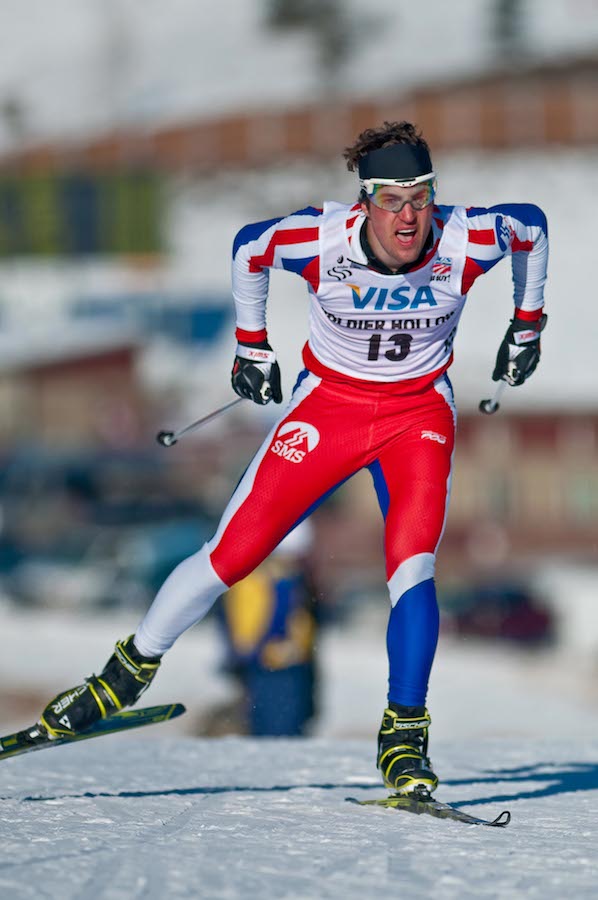
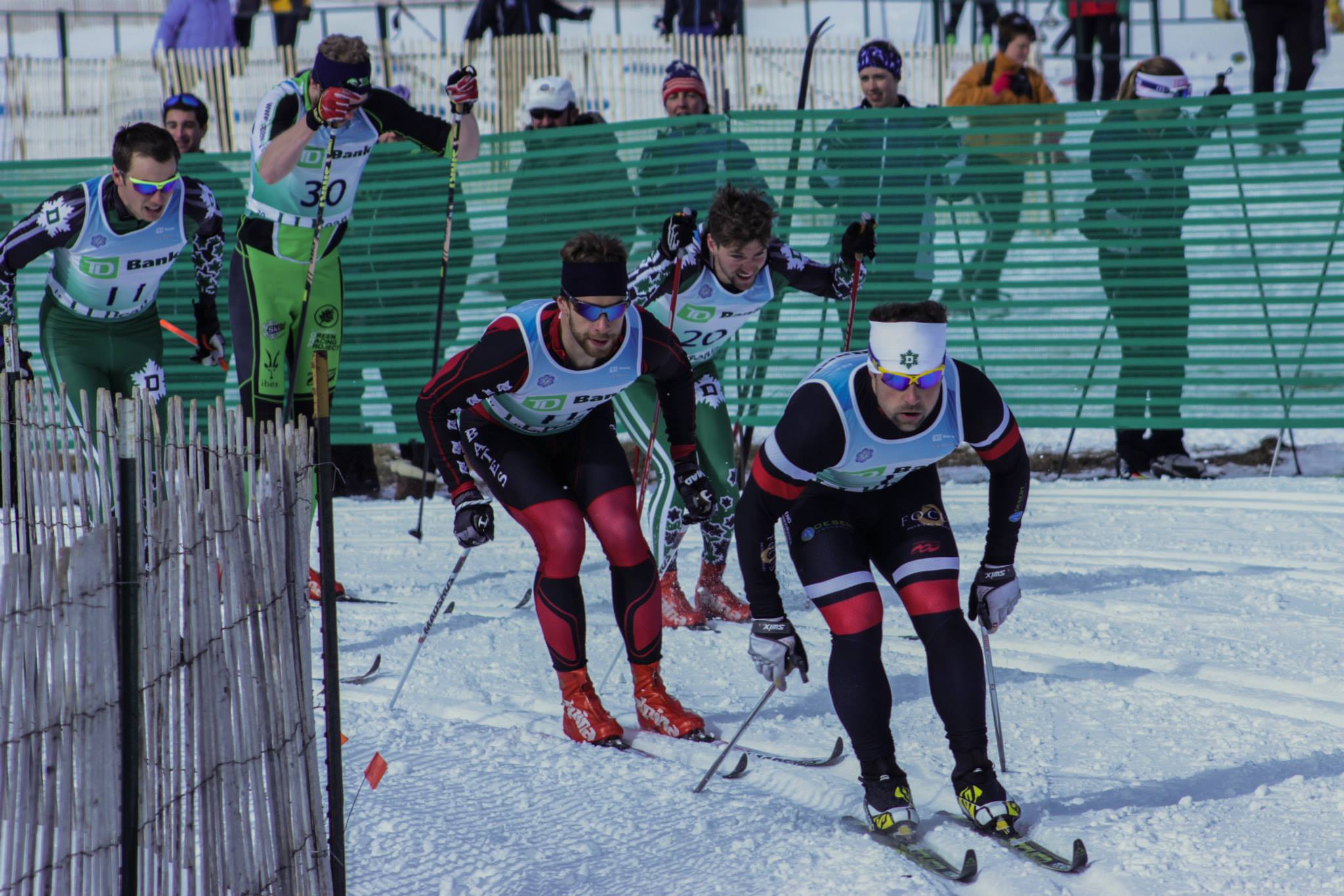
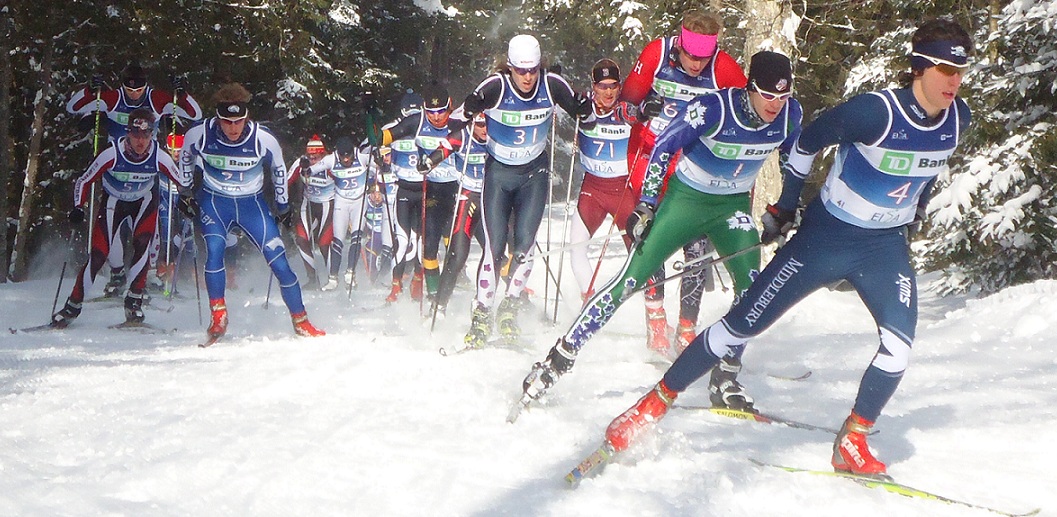
Stratton’s Ben Saxton racing to second in the freestyle sprint at 2014 U.S. nationals in Midway, Utah. Saxton was one of two skiers recently nominated to the U.S. Ski Team’s development “D” team. (Photo: bertboyer.zenfolio.com/Proceeds go to the National Nordic Foundation)
Ben Saxton and Paddy Caldwell are like many Dartmouth College students — smart, young, athletic — but these two 20-year-old nordic skiers have another thing going for them: being part of the U.S. Ski Team (USST).
While the team won’t actually be named until fall, the USST recently nominated Saxton, of Minnesota, and Caldwell, of New Hampshire, to its development, or D-team, which existed two seasons ago with two different men (Erik Bjornsen and Skyler Davis).
USST Head Coach Chris Grover explained on the phone earlier this week that the team was reinstated, so to speak, to capture the talent of two guys that have been on the team’s radar for several years.
“There will be times when our A-team is bigger, B-team is bigger, maybe not have a D-team and hopefully have a bigger D-team,” Grover said of the D-team’s existence. “It needs to depend on when athletes are emerging.”
National-team staff considered a wide range of other talented U.S. skiers for its development team, without any specific quota or male-to-female ratio. Ultimately, they decided Saxton and Caldwell were the top picks.
Paddy Caldwell (Dartmouth) racing to 10th in the skiathlon at his first Junior World Championships in February in Val di Fiemme, Italy. (Photo: FlyingPointRoad.com/Proceeds go to the NNF)
“These were two that really stood in terms of where they’re at, at their particular age,” Grover said. “If you look at where they compared to their international peers … we do an analysis each year of where these guys would stack up against the top-10 men in the world in distance and top-10 men in the world in sprint. Paddy is actually ranked in the top 10 in the world in juniors.”
Caldwell is also the son of four-time Olympian Tim Caldwell and grandson of 1952 Olympian and former USST head coach John Caldwell. He’s cousins with Sophie Caldwell, a member of the USST A-team, and a nephew of Sverre Caldwell, Stratton’s nordic director. He trained with Stratton as a postgrad, and at Junior World Championships last February, he tallied 10th in the 20 k skiathlon — a format juniors don’t often do. He was the top American at 2014 NCAA Championships in the 20 k freestyle mass start (fifth overall), and he won the junior 10 k freestyle mass start at U.S. nationals in January.
Also a junior-national champ, Saxton placed second in the skate sprint at U.S. senior nationals in January and was second in the classic sprint at U.S. SuperTour Finals in late March. Also last season, he captured 10th an Alpen Cup classic sprint in Rogla, Slovenia, and was 11th in a 10 k classic race in Switzerland.
“They are on the path right now to potentially being medal-capable seniors down the road,” Grover said. “We wanted to help bridge the gap this year from the NTG [National Training Group].”
While NTG athletes get several opportunities during the offseason to work out with full-fledged USST A- and B-team members — most of which spend the winter overseas on the World Cup — there are some exclusive USST sessions, including testing inside the Center of Excellence (COE) in Park City, Utah. Saxton and Caldwell will now have access to that as D-team members invited to the USST summer camps.
“It’s an unfunded team, first of all,” Grover explained. “There’s no financial resources that we could put toward this. Ideally we would have some resources that we could put towards this. [The] opportunity is joining national team camps … all are open to them. Also, being able to utilize, as Ski Team members, testing facilities and sport science and sports medicine, some of those in-house resources that are reserved for Ski Team athletes. It’s just a minor step between, say, what we’re doing with a National Training Group.”
The two D-team members will have to pay for their own travel, room and board for camps, Grover said. While adding them to the team doesn’t directly impact the USST’s budget, it does put a strain on resources, like coaching.
“You want to make sure that you’re not just going out and grabbing any athlete who’s had a result, but grabbing an athlete who’s on the path for excellence,” Grover said.
A few weeks ago, USST men’s assistant Jason Cork called Saxton and Caldwell individually to inform them of the possibility of being named to the team. According to Saxton, Cork asked if they were interested. Both were, but they had a few questions. What would this mean, exactly? Could they continue studying at Dartmouth? What was this going to require from an attendance, performance and financial standpoint?
“I asked [those questions] and got the answer and liked what I heard,” Saxton said on the phone, sounding somewhat sleepy before class on Monday morning. He spent the weekend fielding congratulations and phone calls from friends and family about the news.
“Obviously I was pretty excited about it — it’s a pretty cool opportunity,” he said. “There are a lot of people that are skiing at a level that would warrant being on a team like this.”
After taking a postgrad year training and racing with the Stratton Mountain School (SMS), Saxton is in his freshman spring term with a full load of classes most days of the week. He hasn’t declared a major or narrowed his concentration just yet, but a college education remains high on his priority list — as it does for his family.
“I chose Dartmouth because academics are pretty important to me and my family,” he said.
Caldwell is in his second year at Dartmouth, but technically part of the freshman class with an interest on economics and geography. This coming winter, he could race for the Big Green during the college season in his second season of NCAA eligibility, but he hasn’t pinned down his ideal race schedule yet, or decided whether to take a summer term.
“When I first got the call [about the D-team], it was shocking,” Caldwell said on the phone from Dartmouth’s campus in Hanover, N.H. “Like, ‘Oh man, stuff’s gonna change. This is gonna mean not skiing for Dartmouth,’ but I realize that in the end, this is going to be great opportunity to keep pursuing skiing as best I can.”
The college’s flexible term schedule, which can work around a ski calendar, also appealed to Saxton, who had previously decided to study in the spring and resume full-time training in the summer. He said being on the USST D-team wasn’t going to require any drastic changes.
“When I first got the call [about the D-team], it was shocking, like, ‘Oh man, stuff’s gonna change. This is gonna mean not skiing for Dartmouth,’ but I realize that in the end, this is going to be great opportunity to keep pursuing skiing as best I can.” — Paddy Caldwell, on recently being nominated to the U.S. Ski Team’s D-team
Saxton previously decided to forgo his NCAA eligibility when Stratton promoted him to its elite SMST2 Team this spring. Two years after graduating high school (he spent his first postgrad season with F.A.S.T. Performance Training in Wisconsin), Saxton has entered the professional-skiing ranks. He’ll mostly race for Stratton when he’s not in the USST suit at international competitions (i.e. U23 World Championships, one of his goals).
2014 U.S. Ski Team Summer Training Camp Schedule:
– Bend, Ore. (May 19-30)- Alaska: Anchorage and Eagle Glacier
(Women: July 6-21, Men: July 13-28)- Lake Placid, N.Y. (Aug. 25-Sept. 8)- Park City, Utah (Oct. 7-29)
Certain camps remain optional for D-teamers, like the upcoming USST camp in Bend, Ore., from May 19-30. The following USST camp in Anchorage, Alaska, and Eagle Glacier in July will be limited because of capacity restrictions on the glacier, Grover explained. There are spots reserved for A- and B-teams, Alaska Pacific University (APU) elite team, and some foreign training partners, which have yet to publicized (and Grover said he’s usually one of the last to know; A-team veteran Kikkan Randall usually coordinates international invites, and she and her teammates like to keep it a surprise).
The U.S. men’s and women’s camps will be staggered on Eagle Glacier, with the women training there from July 6 to 21, and the men going up July 13-28. The team will not travel to New Zealand this year, as its men’s team had recently in the past.
“We’ve been talking about the Alaska option for a few years,” Grover explained. “The women have had some excellent camps up there the past few summers. Noah [Hoffman] had a great camp up there last year. As a men’s team, we did go to NZ last year but we were actually on the Dachstein Glacier/Oberhof Ski Hall the summer before that. The Snow Farm in New Zealand is an excellent place for a training camp so I know we’ll be back at some point.”
After Alaska, the USST will rendezvous in Lake Placid, N.Y., earlier than usual from Aug. 25-Sept. 8, and train at altitude in Park City from Oct. 7-29.
While neither Saxton nor Caldwell had finalized their school and racing schedules for the coming season, they understood the D-team arrangement as a big opportunity. Saxton said it was the first step of moving up the ladder to the B- or A-teams.
“That’s the more important thing for development skiers: go to camps, international races, train with these guys, and of course all the schwagg,” he said. “We’ll race in the suit a couple of times. The most important thing is it will give us the opportunity to train with those guys and work with the national-team coaches.”
At the same time, Saxton and Caldwell will retain their personal coaches: Saxton with Stratton’s former coach Gus Kaeding and whoever comes on as his replacement at the SMST2 Team, Caldwell with Dartmouth men’s coach Ruff Patterson.
“They should continue to work with coaches they’ve worked with,” Grover said. “Just like any other athlete on the Ski Team, it’s up to them whether they want to work with a personal coach or a U.S. Ski Team coach. They’re really not around the national-team staff for us to have a big impact on them; club coaches, that’s who’s going to see them day to day.”
While Caldwell will have to make some decisions about whether he should focus on college racing or international competitions, Grover said the upcoming U.S. nationals and U23 World Championships should be a focus. There will not be any trials for D-team members to earn World Cup starts — if they want to do that, the best way to do so is lead the SuperTour early in the season. Saxton might strive for that.
“We really want to see them be successful with the level they’re at,” Grover said. “Skiing well at U23s and national championships … successful at Europa cups. Those are the places we need them to be successful at right now.”
In terms of World Cup opportunities, it depends on how well those two are skiing compared to USST A- and B-team members. This winter, the U.S. has a reduced national quota of three men’s sprint spots and four men’s distance per race. The women have five sprint and five distance openings, all of which are based on the team’s performances last season.
“We may award a start spot at a given World Cup based on the kind of fitness we see in camp this summer and fall, and it will be awarded purely on Coaches’ Discretion,” Grover explained.
Regardless, Caldwell and Saxton are hungry. The other piece of the puzzle will be figuring out how to pay for it.
“There might be more travel involved,” Caldwell said. “That’s something I’ll look at more closely. This past winter I was able to go to Europe, which was amazing and go to school at the same time. We made it work, but I got a lot of support from the collage and the team and NNF [National Nordic Foundation] financially, I feel like we’ll make it work in that way.”
After meeting at Junior Nationals a few years ago, Caldwell said he and Saxton have become best friends. They’ve traveled to Europe together, know each other well “and I’m really excited we’re going through this together,” Caldwell said.
“I think we’re definitely going to be leaning on each other at times and that’s a good thing,” Saxton said. “I know that we can count on each other and it’s really nice to have a good friend along for the ride.”
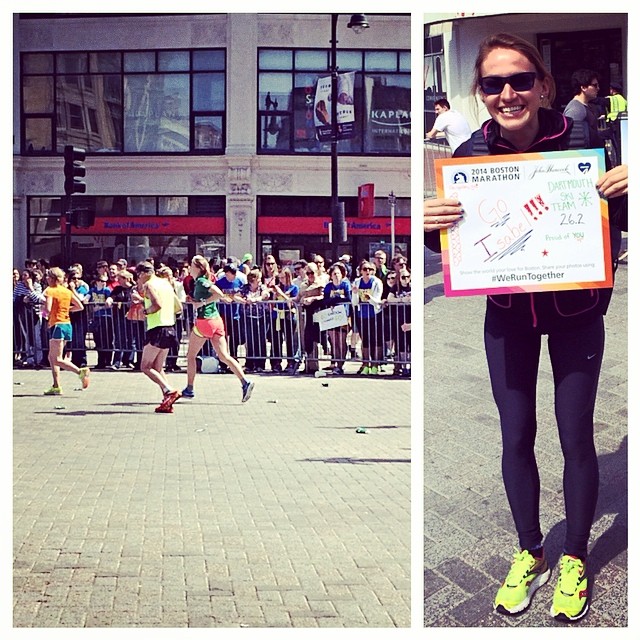
Isabel Caldwell nears the finish of the 2014 Boston Marathon on Monday while Sophie Caldwell (r) cheers her on. (Photo: Sophie Caldwell/Instagram)
Two days after nearly 36,000 people ran that Boston Marathon on Monday, we’re willing to bet there are more than a couple still feeling the pain of the 26.2-mile run from Hopkinton, Mass., to Boston.
Isabel Caldwell, a former Dartmouth and Stratton skier and the younger sis of U.S. Ski Team member Sophie Caldwell, was one of them, but she didn’t feel as sore as she expected.
“My marathon went pretty well … I hadn’t done a whole lot of running before so I wasn’t expecting too much but I finished and had fun so it was a good day,” she wrote in an email. “The race experience was pretty amazing. There were so many people. I think I ended up finishing about halfway through the second wave of runners so I was surrounded by other runners the entire time. The sides of the course were also covered in spectators. It seemed like everyone was doing it for a greater cause this year, there were Boston Strong posters everywhere and all of the spectators and runners seemed very determined to make it the best Boston ever.”
We asked her what you do in the day (or two or three) after to relieve soreness in the legs and stiffness in other parts of the body. She wasn’t as sore as she was when she ran the Burlington Marathon in Vermont last year.
“I think difference is that last year at Burlington it was about 40 degrees and raining so as soon as I finished I got cold and my muscles seized up and I didn’t want to walk anywhere,” she explained. “For about a week afterwards I had horribly sore legs.”
Monday was warmer — upwards of 60 degrees by the finish — and Caldwell wrote that she had to walk a couple of miles to the subway, “which felt horrible at the time but was probably good for my recovery.”
Tuesday, she tried to stay off her feet.
“I have a lot of blisters, but I may try to roll out a little bit,” she wrote. “I probably won’t train for a few days and maybe just do a couple of bike rides later in the week.”
Her sister, Sophie, cheered her on near the finish. Definitely inspired to run a marathon someday, she wrote in an email that she’ll probably wait until after she’s done skiing professionally to avoid injury.
But the 2014 Olympian does know a lot about taking care of yourself after any race — especially endurance events.
No. 1: Fuel Properly
“Even though you might not have much of an appetite, eating and drinking enough would be really important,” Sophie wrote. “It’s probably also important to move a little so you don’t get too stiff and tight and then maybe an ice bath if you dare (I don’t).
No. 2: Accept and Minimize the Burn
“I think getting sore is inevitable, but there are definitely ways to make it less miserable! I was giving Isabel piggy back rides today, so I’m not sure she did the greatest job with recovery! In her defense, she had to sit in the car for four hours to drive back to Hanover.”
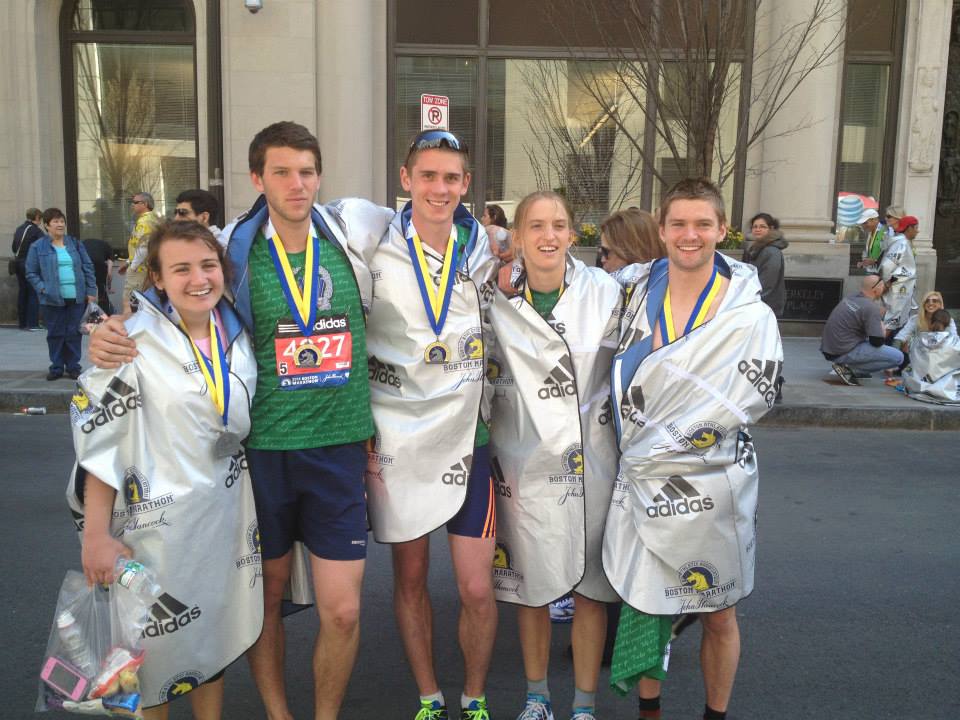
Isabel Caldwell and others in the Dartmouth crew who ran the 2014 Boston Marathon. (From left to right: Caitie Meyer, Oscar Friedman, Erik Fagerstrom, Isabel Caldwell, David Sinclair. Not pictured: Annie Hart) (Photo: Nancy Seem)
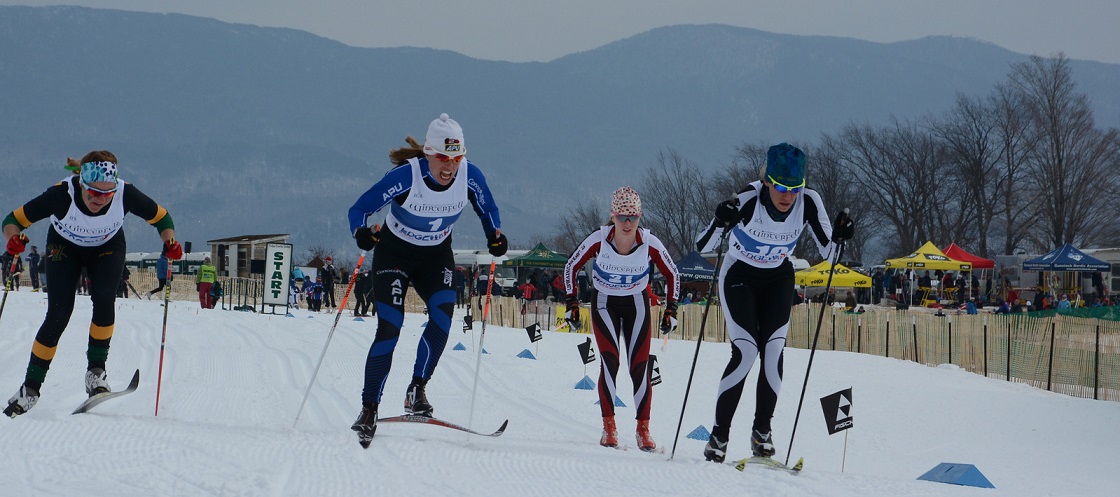
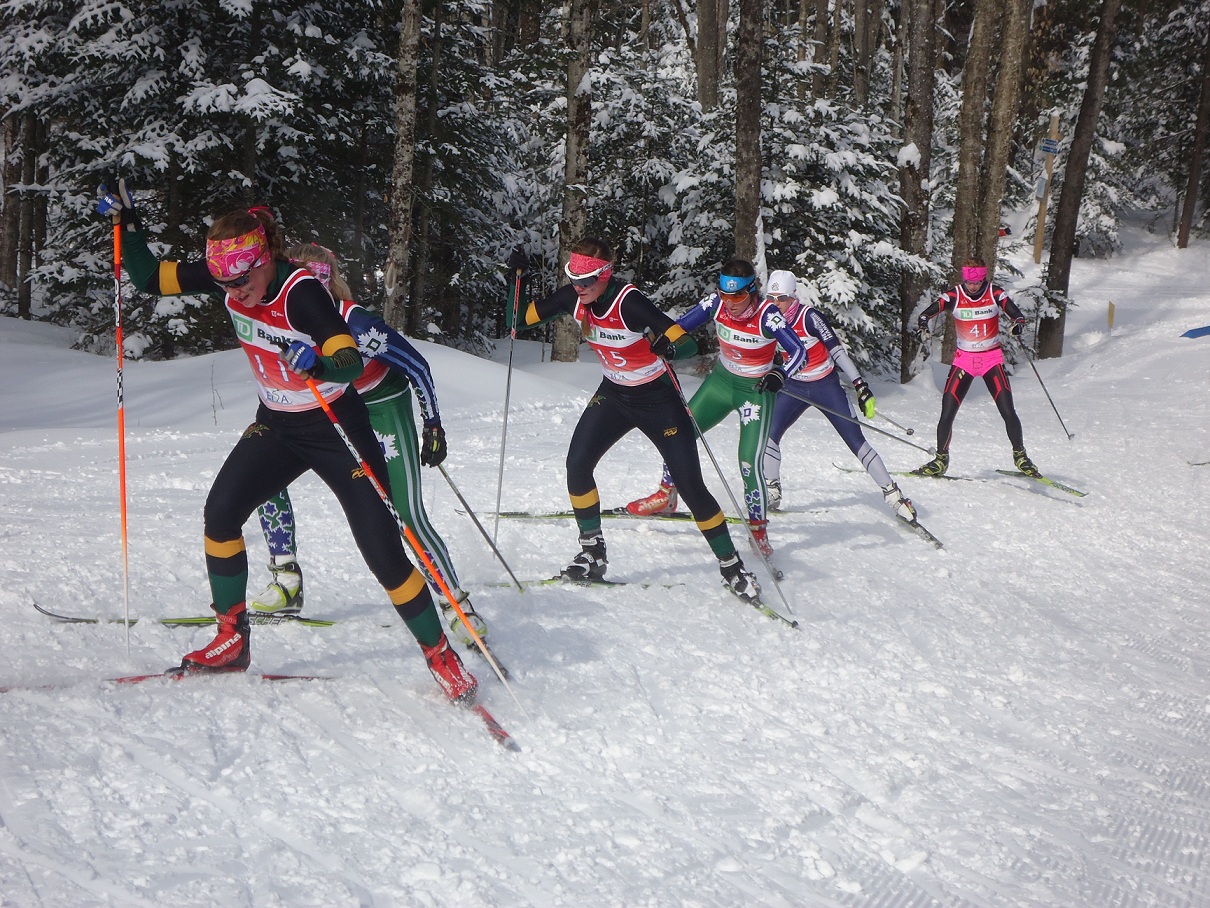
The beginning of a quarterfinal heat at the UVM Carnival/Eastern Cup. From L-R: Anja Gruber (UVM), Rosie Brennan (APU), Erin Perryman (SLU), Kaitynn Miller (BOW). Photo by Connor Hunt
It was a weekend filled with emotion and grief for all at this year’s combined UVM Carnival/Eastern Cup in Stowe, Vermont. The passing of Dartmouth skier Torin Tucker during the Craftsbury Marathon on Saturday gave way to a somber air throughout the venue at the Trapp Family Lodge. Torin’s passing affected those involved at all levels of the event, with many taking time to show their support and respect.
In the midst of such sadness, EISA racing continued to move forward. Saturday featured a classic sprint event, while Sunday brought 5 and 10-kilometer freestyle races. Held on the race courses to be used this spring during the 2014 Junior National Championships, this weekend would be a test-run for many potential competitors seeking titles in March.
Saturday: 1.3k Classic Sprint
Saturday morning’s classic sprint qualifying results would serve to determine collegiate placing for EISA purposes, while the top-30 overall (including guest skiers and Eastern Cup competitors) would be used to determine final Eastern Cup placing. The day began cold, but as the sun crested over the Green Mountain’s Worcester range and began to penetrate the venue temperatures rose quickly and a sunny, warm day enveloped Stowe. While a few competitors opted to double-pole the qualification round, the steep hill leading to the finishing stretch took the skate ski option out of the equation for the afternoon heats.
Top qualifier Dakota Blackhorse-Von Jess heads a quarterfinal heat during Saturday’s classic sprint at the UVM Carniva/Eastern Cup (Photo by Connor Hunt)
In the collegiate ranks it was UVM’s Jorgen Grav who took the victory, adding another impressive finish to his collection of top results. Following Grav was Colby College racer John Dixon. A relative local to the area hailing from Shelburne, Vermont and Champlain Valley Union High School, the senior from Colby picked up his first career podium in his premiere event. Laval skier Frederic Touchette rounded out the podium.
In an impressive display of sprinting prowess, the Bates men claimed the team victory in the event on the strength of three top-ten finishes: Jordan Buetow, Alex Hamilton and Nick Michaud gave the Bobcats their first team victory in EISA competition.
The overall qualification round was won by Dakota Blackhorse-Von Jess (Bend Endurance Academy), who finished a whopping 5 seconds ahead of Eric Packer (SMS T2). In the afternoon heats, however, Patrick O’Brien (Craftsbury) was able take the victory ahead of Blackhorse-Von Jess thanks to impressive striding speed and a quick finish. Grav was the top collegiate competitor in the heats, ending up 6th.
UVM was on top of the podium in the women’s race as well, with Linda Danvind-Malm winning the collegiate race ahead of Dartmouth’s Annie Hart, who is still gunning for a victory this season after a continued string of second-place finishes.
Middlebury’s Stella Holt climbed the final step of the podium in third, just ahead of teammate and sprint powerhouse Heather Mooney. Kelsey Phinney’s 9th place helped the Panther women to a team victory in the event.
Also notable was The University of New Hampshire, who showed the strength of a young women’s team by placing two freshmen in the top ten. Elizabeth Gill took 7th place, while another new face on the circuit, Katrin Larusson, finished in 10th.
Returning from strong results at US Nationals and, prior to that, a stint on the World Cup, APU skier Rosie Brennan won the women’s overall qualification, but it was Craftsbury skier Caitlin Patterson who won the afternoon heats. With Patterson and O’Brien’s wins, the Craftsbury Green Racing Project swept the open races, while Grav and Danvind-Malm gave another set of green suits a sweep for UVM in the collegiate race.
Sunday: 5/10K Freestyle
UVM’s Linda Danvind-Malm races in the 5k Freestyle event at UVM (Photo by Ian Nesbitt
More warmth overnight led to greasy, slippery snow during Sunday’s individual-start freestyle races. The fast conditions, combined with a technical course, made for exciting speed during the races. With the 5-kilometer competition loop ending in a brutal climb from the 3.5 mark to the finish line, a lot could be decided in the final minutes of the race.
As it was, that is exactly what happened during the men’s race. With several skiers nearly tied for the lead after one lap, UVM’s Jorgen Grav put in a big surge on his second trip around the course. Collapsing completely at the line, Grav’s efforts to push himself to exhaustion on the final climbs paid off: the Catamount put over 15 seconds in the field in the second half of the race, earning him another win on the weekend.
Achieving second place, and his career-best finish, was another native of Norway: New Hampshire’s Eirik Fosnaes. Fosnaes’ breakthrough race helped the Wildcats to a team victory in the event, as teammates Johnny Springer (8th) and Per Lindgren (10th) were all within the top ten.
Following Fosnaes was Rogan Brown, another Catamount who has thus far achieved a strong and consistent season. One could expect Grav, Brown and U23 World Championships competitor Scott Patterson to make a formidable freestyle threat in the NCAA skate race in Utah this spring.
Always a team to display great depth, the Williams College men took second place in the team score, while the absence of Patterson put UVM in third.
All that was needed for a weekend-wide sweep by the Catamounts was a victory by Linda Danvind-Malm on Sunday, and with an 8.7 second victory ahead of teammate Anja Gruber, Danvind-Malm was able to deliver. The two UVM women echoed the depth of the men’s team, and were nearly 30 seconds ahead of third place.
It was certainly an exciting final podium finish: Fresh off a strong showing in Saturday’s classic sprint, UNH’s Katrin Larusson charged to the first podium of her young career in 3rd place.
In general it was a great day for new faces on the women’s side, with Williams freshman Hannah Cole nabbing 6th place, and young Colby skiers Amy Bianco (9th) and Olivia Amber (10th) all racing to top ten placings.
Results for both EISA racing (“Collegiate Results”) and the overall Eastern Cup (“Complete Results”) can be found at Bart Timing.
Qualification for big races can take more than perfect physical preparation – it takes a mental edge, too. Whether it’s the Olympics, World Junior Championships, or making your region’s squad for junior nationals, many athletes face the pressure of having to perform when it counts, and coming into races with the wrong mindset can be a big detriment.
We talked to Dartmouth College sports psychologist Dr. Mark Hiatt about what it takes to get your head in the game. For more background on Dr. Hiatt and sports psychology in general, as well as an introduction to some of the concepts and tools he advocates, check out our segment from last week, when we talked to him about team and interpersonal dynamics. As always, if his suggestions spark your interest, seek out a sports psychologist to work one-on-one through your own situation. Many universities offer appointments for students and sometimes also the public. The Association for Applied Sport Psychology also has a “find a consultant” online tool.
As in that piece, the FasterSkier staff brainstormed some situations that skiers might find themselves in, and asked Dr. Hiatt to weigh in. Here’s what we came up with.
Scenario 1: It’s trials time, for Olympics or maybe World Junior Championships. An athlete has a very outside chance of making it based on last year’s results, but thinks that he has improved a lot and has a shot. However, every time he thinks about it he gets a little hopped up because he has to have his best race ever. He’s afraid he will try to hard in the beginning of the race and blow it. What’s a good strategy to manage the pressure?
Mark Hiatt: “I would recommend starting with relaxation/breathing techniques. Sometimes this is referred to as ‘energy management’ in the Sport Psychology literature. Athletes can also use visualization strategies to see themselves performing at a pace that is optimal for the race. It may be useful to incorporate cognitive strategies to manage any negative thoughts. These can include strategies to recognize negative thinking, dismiss the negative thoughts, or counter and challenge them.”
Highlights: Visualization can be extremely helpful, but it also holds a danger: if you picture yourself racing perfectly, and things don’t get off to such a great start, you might lose a lot of confidence. Dr. Patrick Cohn of Peak Performance sports has a podcast you can listen to about what might be the most productive way to use visualization. The magazine Psychology Todayoffers a run-down of relaxation and breathing techniques; one is progressive muscle relaxation, a routine that is more of a long-term strategy to learn how to get, and stay, relaxed. You can find a script for progressive muscle relaxation here.
Scenario 2: Two races into a four-race trials series, an athlete is ranked solidly within the team picked for these races. He still has to have one more good race to clinch his spot, but his success so far is making him relax – maybe too much. How does he stay focused through the whole trials series?
Mark Hiatt: “The athlete may want to review his/her personal goals for the season to reinforce why the particular race is important. One question may be to see if there are ways to make the goals more challenging or interesting to the athlete (e.g., targeting a particular time). Again, we could work on visualization exercises and cognitive strategies to reinforce competitive thinking. Mindfulness breathing strategies have been found to be helpful for some athletes in improving attention and focus. Mindfulness breathing exercises train athletes to pay close attention to breathing while trying to let go of distractions such as thoughts, feelings, and physical sensations.”
Scenario 3: A skier is widely expected to qualify for the Olympics, but still must go through the actual trials process. She has been building up for this since the last Olympics, where she just missed qualifying, and has attracted a lot of support from family, friends, even local businesses. It’s a little bit overwhelming to think how many people have bought into this dream and put their money on the line. She feels like if she doesn’t qualify, she’ll be letting them down, but she knows that these thoughts are not productive for racing. How does she put them out of her mind or turn them into something positive?
Mark Hiatt: “It might be useful to spend some time exploring these thoughts and feelings with the athlete, as it sounds like she is putting a lot of pressure on herself to perform. I think that cognitive strategies, such as observing/dismissing negative thoughts, challenging them, or affirming more productive/competitive thoughts could be helpful for her. Having negative thoughts before, during, and after competition is normal and happens to all athletes (as well as everyone). There are a few options for managing negative/unproductive thoughts. In general, the first step is to distinguish between what is healthy and productive competitive thinking versus unproductive thinking for an athlete. I often have athletes think back to their top performances and go through them to help identify what all the thoughts and emotions were that contributed to that great performance.
“Once there is a better sense of what the productive versus unproductive thoughts area, we can practice skills to dismiss the unproductive thoughts and focus on the more productive ones that we want for competition. One example is using mindfulness meditation based skills to dismiss negative thinking. Good competitive thinking may be more general or focused on a specific skill. Ideally we might have a combination of them to use at different times, general thoughts before the competition and skill-bases specific thoughts (e.g., “push off strong”) during competition.”
Scenario 4: Congrats – you were picked for these big races in Europe that have been your goal for years! Several weeks into the trip, though, is your birthday. All of a sudden you realize how much you really miss your family. You just can’t focus because you’re imagining how comforting it would be to be at home celebrating together, but right now your only support on the road comes from teammates and coaches. How can you overcome this?
Mark Hiatt: “I think the first step is to acknowledge these feelings and not try to fight them. These feelings are normal and natural to have in this type of situation and for many people the more you try to fight them the worse it gets. So I think the first step is accepting acknowledging these feelings and accepting them openly. It’s not something to overcome as much as it is to help athletes figure out how they want to act with them. On a practical level, I might ask if there are there some possible solutions in terms of reaching out and touching base with the athlete’s family? Is this something that would help the athlete? Are there ways for the athlete to communicate with coaches and teammates about how he or she is feeling? Again, I might revisit goals for competition and training and work on cognitive strategies, visualization, and relaxation techniques to help prepare for competition.”
Editor’s note: This is the second installment of a four-part series on the impact of female nordic coaches in the U.S. In Part I, former U.S. Ski Team member Nancy Fiddler introduced herself and reason for writing about the topic. Part II takes a look at several female collegiate coaches and their influence at that level. Parts III and IV will discuss female coaches in the Junior Nationals pipeline as well as grassroots programs across the country.
***
Part II of my series on female cross-country ski coaches in the U.S. looks at the careers of five female collegiate coaches. As I have said before, back in the 1970’s, when I was a collegiate racer, there were no female coaches on the scene. I contacted these women through email and was pleasantly surprised by their generous and very eloquent responses. Each has made a contribution to skiing and has a distinctive story to tell.
To give a little background, Cami Thompson-Graves is an old teammate and friend, Tracey Cote someone I have heard much about and finally met a year ago, and Becky Woods is the daughter of Bob Flynn, who was the head ski coach when I was at Bates. As a coach, I watched Abi Holt and Kristina Trygstad-Saari during their racing careers, and now am following their coaching careers with interest.
Cami Thompson-Graves
Women’s Team Coach, Dartmouth College, 24 years
“I see myself as just one person contributing to a team.” — Cami Thompson-Graves, on how she’s contributing to the big picture of women’s skiing in the U.S.
Dartmouth women’s coach Cami Thompson-Graves (r) and interim men’s coach Kristina Trygstad-Saari. (Photo: Flying Point Road Photography/flyingpointroad.com)
Cami Thompson-Graves has indeed contributed to the recent success of the U.S. Women’s Cross Country Ski Team. Just this spring, 2012 Dartmouth graduate Sophie Caldwell was named to the U.S. Ski Team (USST) B-team.
While Dartmouth did not win the 2013 NCAA Championships, its women are definitely players on the national collegiate stage, with freshman Mary O’Connell taking second and fourth places in March in Ripton, Vt. With the woman affectionately known as Coach Cami at the helm, Dartmouth won NCAAs in 2007.
Her own racing pedigree, which spans a career from Vermont High School Ski Meister to USST member, has seen some success. Thompson-Graves was a promising racer in the mid ’80s with near perfect technique whose career was cut short after a bout of overtraining. She turned her talents to coaching.
Thompson-Graves’ 24-year career at Dartmouth College in Hanover, N.H., puts her at the leading edge of the phenomenon of female collegiate coaches in a traditionally all-male environment. Pursuing an interest in motivating and developing athletes, Thompson-Graves began her career at Dartmouth as a development team coach, soon moving up to the head women’s coach position.
“I love the women I work with,” she said. “They have such different personalities and work towards their goals each in their own way.”
Dartmouth women have a strong role model to look up to in their coach, who juggles her career with being married and parenting. Thompson-Graves feels like she is making a difference for the skiers in her program.
“I think we have a great team here, and it is all those women working together that help each of them achieve whatever their goals are,” she said.
Beyond teaching the women in green the secrets to maintaining a rigorous training and racing schedule while attending classes in one of the country’s top schools, Thompson-Graves is impacting her skiers in other ways.
“Hopefully they are learning to think big … and to make their own decisions,” she said. “It is so important for women to realize they can do this.”
Her coaching style is distinctive; one might say she leads in a soft manner.
“I feel strongly that a coach is a mentor, not a dictator,” she said. “We should be challenging, guiding, and nurturing rather than micro-managing and directing.”
On the subject of whether female nordic coaches are on a par with their male peers, Thompson-Graves is vehement that a woman is capable of doing anything a man can in this field. The difficulty for women, she believes, is that the lifestyle is tough, especially for young coaches.
“If we want more women to be involved in the sport, then we need young women to see it is something they can and might want to aspire to,” she said. “I am lucky that I can do my job and still have a family. Some coaching jobs are much less family friendly.”
Thompson-Graves will be leading young women in skiing for some time to come; she knows she has a great coaching situation and she appears to get just as much back as she gives to the team she coaches. As long as Thompson-Graves feels like she is doing a good job, she will continue to coach.
“When I see so many of the women I have worked with still involved in the sport in some way I am proud of what I have accomplished,” she said
Tracey Cote
Head Nordic Coach, Colby College, 16 years
“I’m modeling the great things about being involved in skiing for a long time. Some of my proudest moments have been to watch my former skiers in their new roles as coaches. This contribution, I know, is making a difference.” – Tracey Cote
Tracey Cote was running cross-country at the University of Minnesota-Duluth when her teammates convinced her to go out for the brand-new nordic team. Cote ended up pursuing her love for her the sport even after the Duluth team was cut two years later, transferring to Northern Michigan University, where she ran and skied for the duration of her undergraduate career.
A year after taking a part-time coaching position at Colby College in Waterville, Maine, Cote was offered a full-time faculty position there, coaching the men’s and women’s nordic teams. On top of her racing experience, Cote has a Master’s degree in health education and a teaching degree.
Heading into her 16th year at Colby, she hasn’t looked back.
“The one thing about ski coaching is that as sad as it is to see your seniors leave, you’re always excited to see your incoming skiers develop and you can’t imagine not being her for their four years,” she said. “This pattern could keep me coaching for the next 25 years!”
Citing fellow college coaches Becky Woods (Bates College) and Dartmouth’s Thompson-Graves as mentors, Cote soon hit her stride as a coach and leader of young people. Athlete development is what she likes most about her job and the challenge to inspire each skier to reach his or her potential.
“My biggest reward is seeing what my skiers accomplish after Colby,” she said. “I feel lucky to have developed close relationships with such amazing people.”
Cote said she’s not afraid to push her skiers to make them better, but she is their biggest fan and supports them when they are struggling.
With three boys, ages 4, 6 and 9, Cote and her husband, Patrick, are an involved nordic-skiing family. Waterville has recently been a hotbed of activity with the formation of the Central Maine Ski Club four years ago and the recent addition of the Quarry Road racing venue just a short distance from campus. While on sabbatical leave last year, Cote jumped into athlete development at the grassroots level and got the “Get Ready to Race Program” for third- and fourth-graders off the ground.
Cote will be back on the college circuit next winter and looks forward to getting back to her job developing athletes at the highest level.
“Although I coach a small program in the scheme of things, I do my best to develop athletes at the highest level,” she said. “I see my program as a step to bigger opportunities in skiing.”
On the topic of gender equality in coaching nordic, Cote said she “feels very lucky to be in the college world, as I feel men and women are treated very equally and the Eastern [conference] coaches are very professional.”
She is not sure that coaching at the Junior National level has reached that degree of professionalism and is more male-dominated, but thinks this will change with time.
Between her jobs as head coach, associate athletic director and senior women’s administrator at Colby, Cote is a wife and a mom. She knows what it is like to be busy.
“Obviously, the U.S. Ski Team has been primarily coached by men, and I may be wrong, but I don’t think too many women are willing to live the lifestyle it takes at that level,” she said.
Cote sees herself as a role model for women and said she’s “really proud to be one of a few women in any college sports program coaching men … with the U.S. women doing so well and being such an inspiration to a whole new crop of women, I hope we see female coaches at the highest ranks.”
Abi Holt
Head Nordic Coach, University of Utah, four years
“I think I am one of a few coaches in the country who has coached at literally every level of skiing. I have coached youth ski leagues, middle school skiers, high school skiers, college, US Ski Team, and masters… and taught beginner ski lessons.” – Abi Holt
A former Sun Valley junior and eventual coach, Abi Holt (l) with SVSEF nordic director Rick Kapala (Photo: Max Durtschi/SVSEF blog)
Abi Holt, head coach of the men’s and women’s nordic teams at the University of Utah in Salt Lake City has a solid grasp on the skiing pipeline. Her own ski-racing background covers just as much ground.
As a junior from Sun Valley, Idaho, Holt was a three-time junior national champion and an 18-time junior All-American. Skiing for Dartmouth, she was an NCAA All-American. She said she fell into coaching “sort of by accident.”
All it took was a phone call from Park City coach, John Callahan (formerly of The Utah Nordic Alliance, or TUNA) to steer Holt to a career in ski coaching in 1999. Fresh out of college and new in town, Holt needed a job, so she spent the winter as Callahan’s assistant coaching the high-school-age competition team the following season.
After three years in Park City, Holt moved back to Sun Valley, coaching there for five years, then put in a year in Vancouver, British Columbia, as the Hollyburn Ski Team head coach. Back in Utah, she took a position as University of Utah assistant coach and signed a joint contract with the USST as an assistant development coach. Holt is now heading into her fourth year as Utah’s head coach.
The lifestyle appears to agree with Holt, who said she likes her job for
“the variety! Getting outside and not sitting at a desk all day. Watching young people develop into fantastic human beings. The challenge of managing team dynamics.”
Holt’s impact on the men and women she coaches goes beyond the management of training and racing.
“I believe that involvement with Nordic skiing creates great humans,” she said. “I hope that young skiers who I am involved with learn how to mix the necessary intensity of the sport with some humor.”
Holt knows she has a great situation in her position at Utah. She loves her job and her confidence demonstrates that she is at the top of her game. After finishing second at NCAA Championships for the last three years, Holt is focused on winning in 2014. She believes that college skiing has a place in the pipeline of U.S. skiing.
“College programs are well-funded and we have access to a tremendous amount of support for our athletes,” she said. “Additionally, nearly every coach in this country has come through a college skiing program, so if nothing else, we are feeding the coaching system.”
Holt sees herself as a role model for her athletes, but also for women looking at coaching as a career option. At Utah, she is the only woman who is a head coach of a men’s team at a university where many men serve as head coaches of women’s teams.
“I’d like to think that my team’s success serves as proof that women can be successful as ski coaches, no matter which gender they are working with,” she said.
Holt has dedicated herself to her career and sees herself as “one of the women who is leaning in to the profession and the industry,” she said. “I have worked hard and pushed hard to get to this position.”
She is a self-proclaimed “true fan of American nordic skiing” and a “constant advocate of college skiing.” Finally, Holt believes that “women coaches are on par with the male coaches in the U.S. – there just aren’t enough of them!”
Becky Woods
Head Nordic Coach, Bates College, 20 years
“Performance and success correlate with one another! If I can help my athletes perform well and find success in ski racing this will translate into their personal lives as well. It is about building confidence, finding self-assurance, and believing in your abilities.” – Becky Woods
Bates head coach Becky Woods (r) with one of her former athletes, Sylvan Ellefson, who graduated in 2009, and her daughters Kaelyn and Emma at the World Cup sprints last December in Quebec City. (Courtesy photo)
The head men’s and women’s nordic coach at Bates College in Lewiston, Maine, for the last two decades, Becky Woods can be described as a quiet force. She has built the team into a reputable program over the years and has become a much-beloved coach by her athletes.
Woods, who skied for Bates and graduated in 1989, began her career as an assistant coach on weekends, where she helped out on the Carnival circuit. After a stint in coaching juniors of various ages in Colorado, she returned to Maine, where she was asked to come back to Bates as head coach.
While Bates might not be the biggest heavy-hitter on the NCAA circuit, Woods consistently turns out high-quality skiers. Among them are four All-American skiers – Sylvan Ellefson, Justin Easter, David Chamberlain, and Justin Freeman – who have all had a big presence on the U.S. skiing stage.
For Woods, coaching runs in the family as her father, Bob Flynn, coached at Bates for many decades. In the ’70s, he served as head ski coach and also served many years as a coach of baseball and golf. He continues to coach as one of Woods’s assistants in the winter. She called him her mentor: “My Dad ‘Coach Flynn’ was and continues to be someone I go to for advice, support, and a few laughs!”
As a collegiate coach, Woods is highly in-tune with her athletes.
“I think I build some solid relationships with my skiers,” she said. “It is really important for me to get to know the ‘whole’ person so I can help them be the best ski racers they can be.”
She considers herself to be a big part of their lives while they are at Bates. “We consider ourselves a ski family here,” she said. “So in that sense, once you enter the family, you are here to stay!”
The life of a college skier is a demanding one, and Woods is there to help her athletes.
“Balancing their workloads is a challenge,” she said. “Academic schedules combined with daily, consistent training and racing is a tough combination but something that is so worth it.”
Woods is a strong believer in collegiate skiing. “The opportunities that my athletes have are just fantastic and to be a part of that is a privilege.”
She knows she’s preparing her skiers for a career in ski racing beyond college, should they choose this path. “When skiers from Bates are skiing on the World Cup and at the Olympics, it certainly feels like we are having an influence at a level larger than just collegiate skiing.”
While not all Bates skiers continue on to the big leagues beyond college racing, Woods prepares everyone for life. “I think my role as a D1 college coach is to prepare athletes physically, mentally and emotionally for what is to come,” She said.
She said she’s equally proud of “those folks who leave Bates and go on to give back in skiing. It is a true testament to their experiences here at Bates and their passion for skiing.”
Woods credits her husband, Tucker, with whom she has two teenage daughters, for giving her the support she needs to pursue her career. She believes that the women who coach skiing are absolutely on par with their male peers.
“There are fewer women coaching, but I don’t think that speaks to the abilities of the coaches, more to the choices that people make professionally,” she said.
Kristina Trygstad-Saari
Interim Men’s Coach, Dartmouth College, one year
“From both my experiences as an athlete and a coach, it’s important to have women in the mix … as a junior skier, it was always beneficial to be around strong, healthy, positive women. I figure that more perspective and diversity is always better.” –Kristina Trygstad-Saari
Kristina Trygstad-Saari while training with the Bridger Ski Foundation. (Courtesy photo)
Dartmouth grad Kristina Trygstad-Saari (’07) thought she was returning to her alma mater last year to serve as the development-team assistant. In the end, the men’s team needed her more and she wound up coaching that team for the fall and winter.
Trygstad-Saari has been a cross-country ski racer most of her life, and now she wants to give back some of what she learned during her racing career. She had a stellar career as a junior with the Bridger Ski Foundation (BSF) in Bozeman, Mont. She holds nine Junior National titles and was sixth at World Juniors, and has competed in World Cup races and skied on the U.S. Development Team.
While studying at Dartmouth in Hanover, N.H., Trygstad-Saari decided to take a break from serious skiing. She didn’t stay away long, making a trip to the NCAAs her junior year in 2006. After a few years of racing out of college and an Olympic-team bid, Trygstad-Saari turned her experience toward coaching.
Trygstad-Saari quickly climbed the coaching ladder, returning to BSF to work for her former coach, Dragan Danevski. Coaching J5’s her first year and J2’s and masters the next year, Trygstad-Saari drew from Danevski’s knowledge.
“Once I started coaching for BSF, he was an obvious mentor and a resource,” she said. “He has incredible experience with coaching and athletics.”
It was just a year later that Trygstad-Saari was learning from another revered coach, this time at Dartmouth.
“Coach Cami Thompson-Graves was an exceptional mentor,” she said. “She gave me the freedom to learn through experience while also sharing her own knowledge and experiences to help me along.”
Trygstad-Saari sees herself as a role model for the athletes she works with and feels that she is making a difference through her coaching. She has a big worldview of cross-country skiing, but works on a very “local and personal level,” she said. “I really try to connect with each individual I‘m working with, and if I can have even the smallest positive effect on most of the people I work with, then I’m happy. A little bit can go a long way.”
Trygstad-Saari uses her own experiences as an athlete, ski racer, and student to guide her athletes. “I had a lot of ups and downs in my ski career, especially during college, and I try to share what I learned to help others.”
Having fun and working hard go hand-in-hand for Trygstad-Saari and are the foundation of her coaching method. She reminds her skiers that a love of the sport is just as important as success.
“Creating a healthy environment for training and racing is one of my priorities,” she said. “Providing this on the development levels will only help skiing on the highest levels.”
Trygstad-Saari sees a future for herself in ski coaching and would eventually like to be a head coach of a college team. Her coaching plans are open-ended, but for the time being, she is working at her favorite summer job: catering. That said, come next winter, Trygstad-Saari will be pursuing her passion for coaching cross-country skiing.
Due to low snow in Hanover, New Hampshire, the Dartmouth Carnival was moved to Craftsbury, Vermont this year. Ironically, the Craftsbury Outdoor Center, renowned as one of the top snow-making operations in the East, did not need to fire up the guns for last weekend’s races.
Thanks to a dumping of fresh snow from the Nor’easter named Nemo, racers were able to take full advantage of Craftsbury’s challenging 5-kilometer race loop. Though the loop begins on a stretch of snow all too familiar to anyone who spent last winter in New England, the trail soon leads racers into sustained climbs and fast descents, ultimately bringing racers far below the stadium before twisting brutally back uphill toward the finish.
The course was made even more challenging this weekend by the winter storm’s heavy precipitation; Friday’s classic races were held in snowing conditions, slowing the course considerably. Despite the difficulty the fresh accumulation added to waxing, pacing and even just seeing the trail ahead, most everyone in attendance seemed ecstatic just to be skiing while snow was falling from the sky.
FRIDAY: 5/10k classic
Though they were still a few hours removed from Hanover, the home team was left wanting after the very first race of the weekend. Though they placed skiers in places 4 through 6, the Dartmouth women were unable to capture a podium spot in the 5k classic race. Anja Gruber of UVM continued to impress in the classic style, taking the victory by 17 seconds ahead of Middlebury’s Annie Pokorny. Third place went to Kaitlynn Miller of Bowdoin, who had been skiing dangerously close to the podium, or perhaps in this case “Bowdium”, all season. The finish was yet another best-ever EISA result for Bowdoin College.
Though they did not place anyone on the podium, Dartmouth did place their top 3 skiers in the next 3 places. Annie Hart, Corey Stock and Mary O’Connell finished 4th, 5th and 6th, respectively. The trio’s depth at the top end of the field led Dartmouth to a victory in the team score.
The men’s race saw another UVM skier atop the podium, as Scott Patterson collected his first classic-style victory of the season. Though he has been nearly untouchable in the freestyle technique so far this year, Patterson had finished 5th and 2nd in the two earlier classic races this season at Colby and UVM.
Finishing behind Patterson were Dartmouth skiers Sam Tarling and Silas Talbot who, along with David Sinclair in 5th place, were barely able to give the Big Green the top team score, 2 points ahead of UVM.
Vermont’s Dylan Grald finished 4th, as a familiar list of schools packed the top-10. Aside from Middlebury’s Ben Lustgarten in 7th place, the top-10 consisted entirely of skiers from Dartmouth and UVM.
Saturday: 3x5k Relays
Even after the conclusion of Friday’s races, the snow continued. Though the storm let up in the early hours of the morning, racers on Saturday were greeted by thick, soft and dry powder for the 3×5 kilometer freestyle relays. Once again, the going would not be easy.
Middlebury’s Austin Cobb led the pack through the first section of the course as the men’s field settled in past Craftsbury’s large open stadium area. During the second half of the scramble leg, Dartmouth skiers Erik Fagerstrom and Scott Lacy pushed ahead to tag off to their Big Green teammates with a bit of a lead. Their effort was successful, if only briefly.
Austin Cobb (MIDD) leads out the start of the men’s 3×5 relay at the Dartmouth Carnival
On the next leg UVM’s Rogan Brown caught up to the two Dartmouth teams, while behind them Scott Patterson furiously fought (and succeeded) to also make contact with the leaders. This lead pack of four teams would be at the front for the remainder of the race.
Behind the storm of green and black suits at the front, Middlebury’s Dylan McGarthwaite skied an impressive leg to bring the Panthers up into 5th overall, which represented 3rd place in the team standings (only the top team of each school counted for team scores).
On the final lap the group of UVM and Darmouth men still held an advantage over the field. As the racers headed to the low point of the course many wondered if a sprint to the finish was imminent.
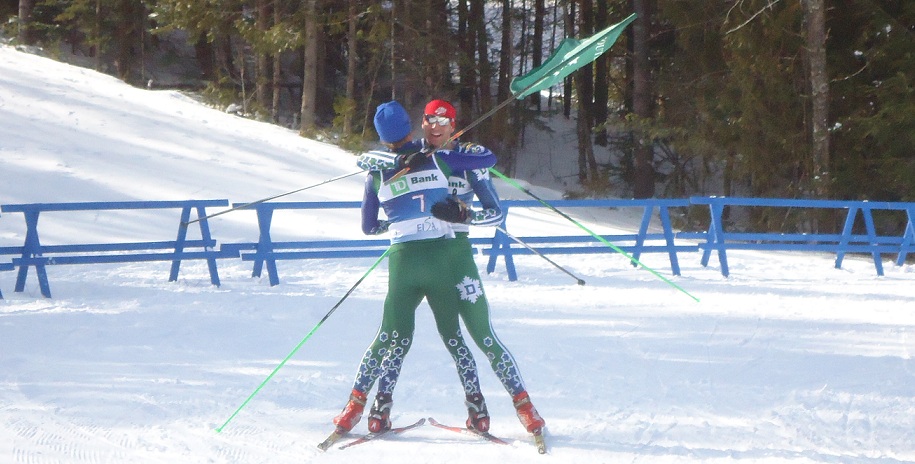
Dartmouth’s Sam Tarling put those questions to rest, putting on a big surge in the last few kilometers. Tarling created a gap large enough to allow him to cross the line smiling and waving a Dartmouth flag to the home crowd.
To give the Big Green even more to cheer about, Dartmouth’s Steve Mangan crossed the line next. UVM took places 3 and 4 in the overall standings (2nd in team scores) while Middlebury finished 5th overall to secure 3rd place in the team standings.
Steve Mangan and Sam Tarling celebrate the Dartmouth victory
The women’s relay stayed together early, as a relatively large pack was still skiing within sight of one another approaching the top of “Coaches Corner” at the 4k mark. Familiar suits were at the front, however, as UVM’s Linda Dandvind-Malm and Dartmouth’s Annie Hart towed the rest of the field in their wake.
Leg 1 of the women’s relay near 4k, with familiar suits up front
By leg 2, an order began to form that would hold for most of the race: Dartmouth in front, chased by UVM and UNH. With wider gaps between racers than the men’s relay, the women’s race was all about chasing down the team ahead of you. With the top three teams, however, there was little shuffling at the front as Dartmouth, UVM and UNH each crossed the line, in that order, with about a minute between teams.
Post-race traditions
Dartmouth skiers donned traditional garb to cheer on the racers Saturday
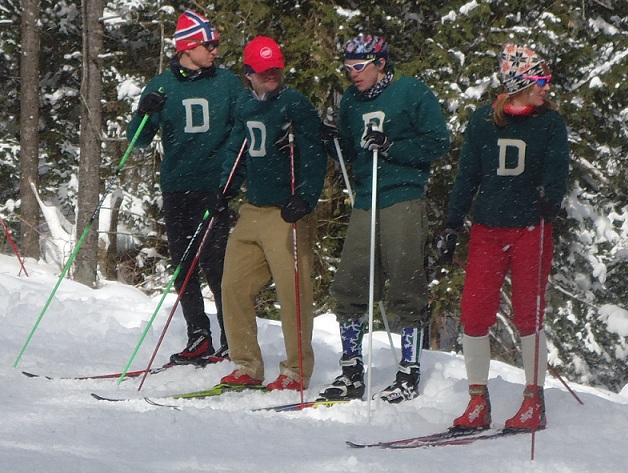
Aside from racing, the Dartmouth Winter Carnival is also home to a few other notable traditions. On Saturday, Dartmouth skiers and fans donned knickers and school sweaters to cheer on the racers. Dartmouth’s green suits were quite prevalent during the races, and the green sweaters and knickers were just as prevalent in the post-race festivities.
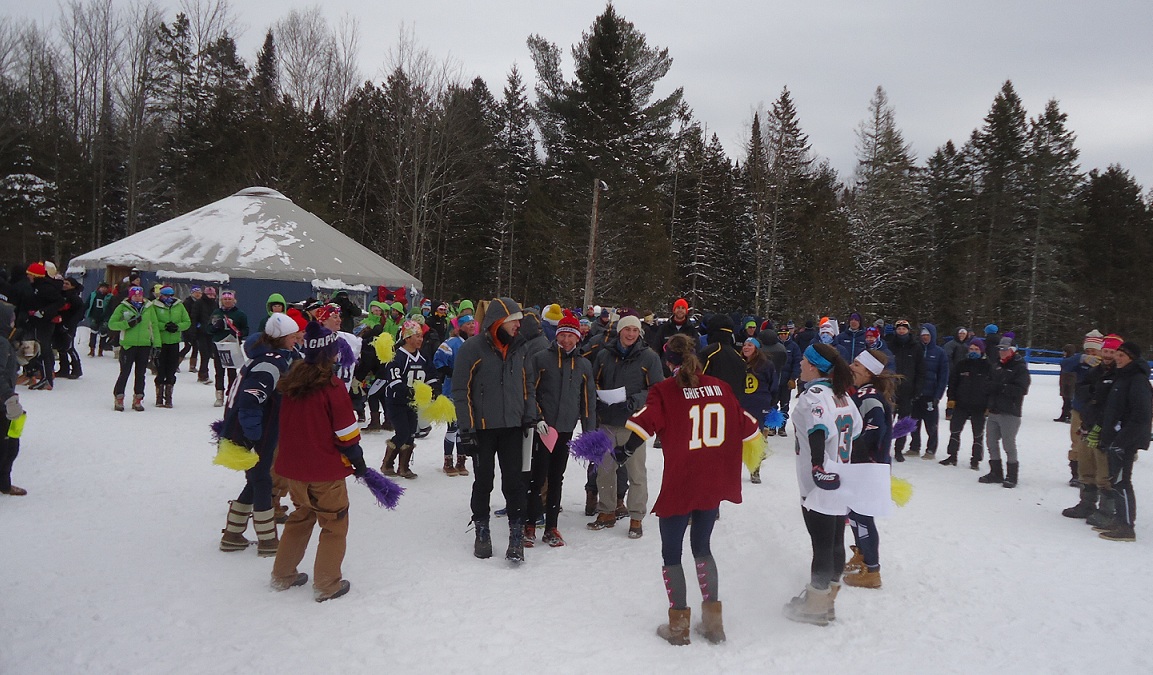
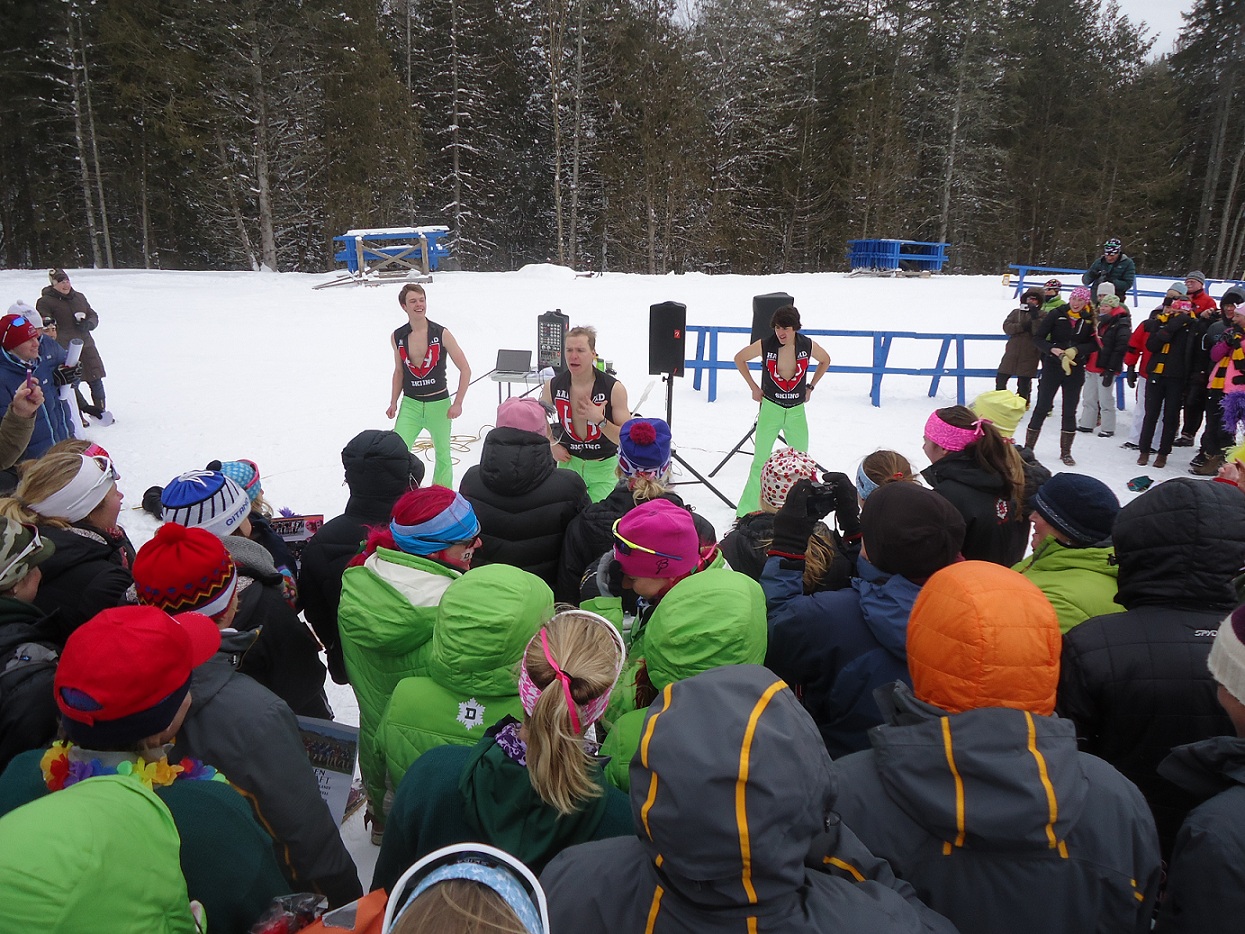
One of the more unique post-race festivities at the Dartmouth Carnival is the annual “Carni-Crush” exchange that takes place after the conclusion of racing on day 2 of the Carnival weekend. Though the Carnival did not fall on Valentines Day this year, the tradition of teams and individuals giving out valentines to other racers was not one to miss. Skiers wrote poems, sang songs, and organized dance routines to show express their love for their friends and competitors. Some were sincere, others were crude, and most were cringe-worthy, but everyone was having a blast in the relaxed post-race atmosphere.
The Middlebury women wore cheerleader outfits and held a mini pep-rally for the Williams menThe Harvard men used the P.A. system to perform a song-and-dance number/strip-tease for the SLU women
EISA Racing continues next week with the Middlebury Carnival, featuring new and updated courses at the Rikert Touring Center.
Responsible for assisting with all aspects of the Cross Country Development Team (driving, race management, equipment, etc.) as well as general team responsibilities with waxing, video and social media. Assistant is expected to attend training sessions and many New England races, although schedule has some flexibility. It is possible to do some racing.
Bachelors Degree and collegiate racing experience preferred. Part time, through the winter months, starting immediately through Mar 10. Compensation: $1200-$1500 per month. For information, please call 603.646.2787.
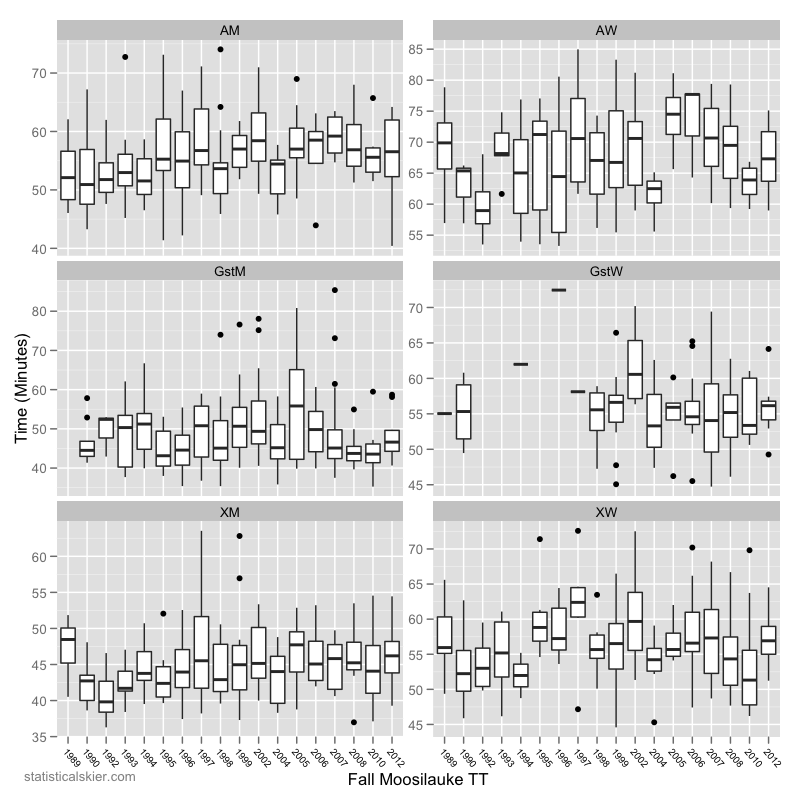
After correcting a few typos in the the “official” results I thought we’d look again at the time histories for Dartmouth’s Moosilauke time trial. The following graph depicts every result (except for 2011, which I still can’t find anywhere).
The blue is the median for each individual running; this includes both summer and fall times. Despite some course changes over time, it’s interesting that you probably wouldn’t be able to spot exactly when they happened from the graphs. There’s just a bit too much noise in there.
The cross country men (i.e. men actual on the Dartmouth Ski Team) have, on average actually been getting slower, in an absolute sense. But definitely the strongest trend is in the alpine men. Course changes aside, it would be interesting to look up who was on the alpine men’s team at Dartmouth in the early 90′s.
As FasterSkier mentioned the other day, the Dartmouth Ski Team’s Moosilauke time trial is a pretty neat data set, since they’ve kept the data going back quite a ways. Interpretations are sometimes a challenge, since the course has changed from time to time when trail work is done. My sources tell me that in addition to the weather being horrendous this year the trail was slightly rerouted, possibly adding some distance to the course.
Given all this, the times were a bit slow (click for full version):
Those are only the fall term runnings, and 2011 is missing, since those times appear to be missing on the official historical results.
Laura Spector warming up for a race in 2009. Photo courtesy of U.S. Biathlon Association.
HANOVER, NEW HAMPSHIRE – When Laura Spector left the East and drove to Bozeman, Montana, this spring, she knew she was headed for school, but she wasn’t sure what was going to happen after that.
The 2010 Olympian and national team biathlete had finished up her first full year of training and racing since graduating from Dartmouth College, and it wasn’t what she had been hoping for. After starting the early-season World Cups she struggled, ending up overtrained and trying to rest up while simultaneously competing on the second-tier IBU Cup.
At the time, Spector told FasterSkier that she would “plan to not ever in the future be just solely an athlete,” but remaining in her sport was still a very real possibility. Despite moving to Bozeman to do an intensive summer course of organic chemistry at Montana State University, Spector brought all of her training gear with her and thought she might rejoin the team in some capacity in the fall.
After a few more months, her plans have solidified, and biathlon isn’t in them. Spector has a job working in a biology lab here in Hanover.
“I’m not planning to compete this year,” Spector told FasterSkier. “I’m not going to have time because I’ll be working full-time for a whole year, so biathlon is not in the plan for this winter. Except maybe for fun if there’s something local.”
Instead of skating her way around Europe and knocking down targets with a .22-caliber rifle, Spector will be working for Dr. Sharon Bickel, a Dartmouth College professor, looking at DNA replication and meiosis in fruitflies.
“I am really excited,” Spector said. “It should be a lot of fun. I finally get to do something with my degree, and it’s something I’m really interested in. It will keep me busy most of the time. So I’m very excited to have it.”
Just Getting Started
Laura Spector racing to 19th place in the World Cup sprint in Oberhof, Germany, in 2011. Photo: nordicfocus.com courtesy of USBA.
For U.S. Biathlon, Spector’s decision leaves the women’s team down a veteran competitor.
“As a team, for sure it’s a big loss,” U.S. women’s coach Jonne Kahkonen said in an interview. “Two years ago she made a couple of mass starts already and was on her way up. And I can definitely see that there’s more there. But that’s just the way life goes – not everybody can do this forever, or even until the next Olympics. So that’s just part of this game.”
Spector, who will turn 25 this fall, grew up in Lennox, Massachusetts, and skied the state’s high school circuit as well as NENSA’s Eastern Cups for several years before moving to the Green Mountain Valley School in Waitsfield, Vermont. Under the tutelage of Jon Arne Enevoldsen, she made her first trip to biathlon’s World Junior Championships in 2005.
The following year, she enrolled at Dartmouth, where she competed in a few college races and finished third at the Williams College carnival. But she also kept going in biathlon, making another trip to World Junior Championships and finishing ninth in the sprint. After that season, Spector turned to biathlon fully, making two more trips to the junior races and qualifying for senior World Championships in 2008. The next year, she spent about half the season on the World Cup.
Although she made the Vancouver Olympic team, her performances there didn’t knock anyone’s socks off – it wasn’t until the next season that she had her big breakthrough, scoring a World Cup top-20 in Oberhof, Germany, and competing in several of the prestigious 30-woman mass starts, which an American had last done six years before.
That 2010-2011 season was Kahkonen’s first on the U.S. staff, and he remembers Spector’s performances as having allowed the U.S. women to build towards higher and higher levels of success.
“That was just the ball rolling in the right direction, and a lot of times that’s something that the team needs,” Kahkonen said. “The work is there, the potential is there, but you need someone who can actually get the results, or at least a little taste of the results, and then the others realize that it’s possible, that it’s out there. And for sure Laura was a big part of that.”
And that’s what Spector is leaving behind: despite a subpar string of results in 2012, everyone at the U.S. Biathlon Association (USBA) was certain that the team’s young veteran could return to the sport’s biggest stage, and be shooting alongside the world’s best in Europe.
“We will miss her on the team, but we wish her well,” USBA President Max Cobb wrote in an e-mail. “We were of course sorry to hear the that she would not continue to train and compete, but these are the hard choices every athlete has to make.”
For Spector, it wasn’t as hard of a choice as she might have imagined.
“I’m sure I’ll miss the race season a little bit,” she admitted. “It will be weird to know that my teammates are competing and I’m not. But I’m also really excited about the choice I’ve made and I’m very happy, so I don’t have any regrets about it.”
Back to School
Spector’s insistence on finishing up at Dartmouth rather than focusing on biathlon full-time was sometimes a frustration for her coaches on the national team. And Spector, the consummate multi-tasker, needed something else to occupy her mind after she graduated. In her only year as a full-time resident at Lake Placid’s Olympic Training Center, she wanted more – and coaches could tell.
Laura Spector in a sprint in Atholz, Italy, in 2011. Photo: nordicfocus.com courtesy of USBA.
“It’s kind of a surprise, but not really,” Kahkonen said of Spector’s decision. “Just talking to Laura, she was not quite there, exactly – not to say that she was not motivated, or not fit, but I could tell last winter that something was a little off, so maybe it was in the back of her head that she wanted to go on and take some more school and pursue that. So by then I could tell that she wanted to figure some other things out in her life.”
In meetings this spring, the two tried to work through their plans for Spector’s career.
“I said that to me, as a coach, I want results, and I want from the athletes 100 percent commitment,” Kahkonen said. “If you’re not sure about it, then you should take some time off and figure out whether this is what you really want to do. So that was the discussion at the meetings in the spring. I didn’t know if I should say it.”
Spector took that idea and ran all the way to Bozeman with it. In part because of her busy schedule as a biathlete when she was at Dartmouth, she had skipped a few classes that are traditionally required before graduate school, and she wanted to fill out her coursework so that she could get another degree in the future. She also wanted to test out going back to school.
“It was very fast-paced because it was two terms of organic chemistry in twelve weeks, but I did really well and I enjoyed being able to study again and keeping my mind busy,” Spector said. “And I was also working part-time in a fly lab, studying fruitflies, and that was my first lab experience – and I really liked it. So I was hoping that would work out and it would be a step towards taking a job in a lab for a full year.”
Now certain that school and biology are the right route, Spector knows that she needed to gain more experience in the lab. She plans to apply to graduate school at the end of the fall and begin next September. Until then, she’ll be working with fruitflies.
The door is still open, however, if Spector changes her mind – or finishes school.
“In a way, I think it’s good, because if she decides that she wants to come back and start competing again, when that’s all done, she can have a full focus on biathlon,” Kahkonen said.
And Spector, a notoriously hard worker, isn’t exactly slacking. If she decides to return to the sport, she’ll definitely be fit.
“I’m still biking and running every day,” she said. “I’m still really active, especially in Bozeman because it’s a really great place to do all that, and I still plan to be working out every single day.”
What she’ll miss most about her sport, she said, is her team.
“I’m planning to go watch the rollerski nationals [in Jericho, Vermont], and I’m really excited to see everybody and say hello,” Spector said. “We’re all practically a family and I really want to see them and talk to them face to face, and really let them know what I’m doing. It will be good, because I’ll be out East for a while when they are, so maybe we’ll cross paths a little bit more.”
And as for her coach? There seem to be no hard feelings.
“She’s going to be in Jericho, and I said that if she brought her rifle, I’d zero her,” Kahkonen laughed.
Laura Spector all by herself toward the top of Whiteface Mountain en route to winning the Climb to the Castle rollerski race in 2010.
American biathlete Casey Smith at 2011 World Youth and Junior Championships in Nove Mesto, Czech Republic. Smith, one of the top U.S. juniors, is a student at Montana State University. Photo: Judy Geer.
Note: This is the last piece in a three-part series following several groups of biathletes as they negotiate the college question. Part one featured five top juniors who took a detour through college before returning to the international stage, whilepart two looked at USBA’s 2007-2010 Development Team.
In November, 2011, Casey Smith was named Junior Biathlete of the Year for 2011 by the United States Biathlon Association (USBA). In a European country, that might mean a pat on the back from a coach at practice, perhaps an honorary celebration thrown by an athlete’s club, or maybe an added bargaining chip in sponsorship negotiations.
Smith, though, barely even has a club. The Winthrop, Washington, native, who turned 20 in February, was in the midst of his sophomore year at the Montana State University (MSU), where he jumps in time trials with the college’s ski team and otherwise trains primarily by himself. There is no coach, and “practice” doesn’t seem like the right word for a solo rollerski.
“[The award] helped me do some more fundraising, I guess, because it adds something else to your resume,” Smith told FasterSkier in an interview this spring.
That fundraising, along with lots of planning and motivation, helped Smith get to Europe three times during the 2011-2012 season. Once there, Smith is finally part of a team – Team USA.
“There’s lots of support from USBA and the coaches,” he said.
First, Smith raced in the junior division of Open European Championships in Brezno, Slovakia, where his best finish was 15th in the individual. A few weeks later he competed as a junior for the first time at World Youth and Junior Championships (he had twice represented the U.S. as a youth), notching a top finish of 31st. At the end of the season, Smith made one more trip for Swedish National Championships and to do an exchange at the National Sports Academy in Ostersund.
“The kids there were surprised that [some of us] don’t really have teams that we train with regularly,” Smith said after talking with the Swedes. “They definitely have a lot more opportunities. They had three biathlon coaches, so for one thing they have coaches to work with at the range every day.”
Not only does Smith not have a coach to work with in Bozeman, but he estimates that only about half of the targets at Bohart Ranch’s range are actually functional (a local masters group, headed by Madshus rep Peter Hale, is helping fix it up). In 2012 he did, however, have more company than before: World Junior teammates Sam Dougherty and Kelly Kjorlien enrolled at MSU and trained through their freshman year The three traveled together to this year’s Championships in Kontiolahti, Finland.
“I like it here in the West, and I think I’m doing okay with what I’m working with,” Smith said. “I have a couple of coaches that I work with here in Washington, for my training plan and my skiing technique, so that helps a lot.”
Smith plans to continue training at MSU for another season, his last as a junior. Once a senior, he hopes to make the national team outright, although he admits it might take a few years. Still, he thinks he can do it.
But even if Smith’s training is working, it’s certainly not the ideal situation – and the lack of options available to even juniors identified as the very best highlight a struggles both USBA and the athletes themselves face in trying to develop internationally-successful seniors.
Kids These Days
While not going to college may once have been the norm for American juniors, times have changed. USBA no longer supports a development team, meaning that the transition to senior status can be tough. And the junior national team is no longer well-funded, either.
“There’s a few camps that I can go to,” Smith said of what he earned by being named to the junior national team. “But you don’t have to be on the junior national team to do that. That’s about it, really. There’s not a whole lot of benefits, I don’t think, other than that you’re named to the team.”
He is not, for example, has provided with either funding or coaching. The team has a Midwestern Regional Coach, Vladimir Cervenka, who is based out of Grand Rapids, Minnesota. It also has an Eastern Regional Coach in Olympic gold medlaist Algis Shalna, who lives in Burlington, Vermont. There is no Western Regional Coach to provide support for Smith either at home in Washington or at school in Bozeman, or for anyone in the Rockies or Alaska.
Cook, who spent several years at the University of Utah. Photo: NordicFocus/USBA.
And there’s no suggestion that juniors to move to a central location to train together, as has sometimes been the case in the past. For instance, current senior national team member Annelies Cook remembers making her own decision about college. She said she had a lot of options.
“I went through this process of, am I going to go to college?” she told FasterSkier last fall. “Do I do a postgrad at some place like the Green Mountain Valley School? I decided that it would be pretty cool to go be with the junior biathlon team in Duluth. They had started a new thing where they split the men and the women up, so there was a group of us [girls] who ended up moving out to Duluth to train.”
These days, there’s no residential program in Duluth, and there’s also not a biathlon coach at Green Mountain Valley School. The only real program accepting postgraduate biathletes is the Maine Winter Sports Center.
As a result, a large number of top juniors from the past few years’ World Youth and Junior Championships teams have chosen the college route: Ethan Dreissigacker, Hilary McNamee, and Carly Wynn are at Dartmouth College, Addie Byrne is at Harvard, Meagan Toussaint skied for the University of Maine Presque Isle, and Brynden Manbeck for Saint Scholastica, to name a few, in addition to the crew in Bozeman.
“I never really considered deferring from college to focus on biathlon, frankly because I didn’t think there was enough competition in the U.S. to make it worth focusing just on biathlon,” said Dreissigacker, who has competed in several more World Junior Championships as a college student. “I was mostly just planning on skiing in college. The great thing about biathlon is that it is skiing – you just get to shoot also! So it never made sense to me that one might be required to ‘not focus on skiing’ in order to focus on biathlon.”
Dreissigacker did take a winter term off of Dartmouth, but it wasn’t to race in the U.S. – he spent a large chunk of that season traveling in Europe, competing against superior athletes and gaining experience. With Smith’s three trips across the Atlantic this past season, the Montana-based junior has a similar goal.
“If you want good competition for biathlon, there’s not really any in the U.S.,” Smith said. “There’s two or three other good kids that you’ll go race against at a NorAm, but they’re the same ones every time, and you can pretty much know where you’re going to place. But you go over to Europe and there’s fifty kids, and five seconds can be a couple of places, rather than a minute at some of the races over here. I’ve tried to get over to Europe and do as many races as I can.”
Why Not Skip Class?
But not all of Dreissigacker and Smith’s compatriots see college as the best springboard for their flight to Europe. Despite the lack of resources, a number of athletes have found a way to dedicate themselves to biathlon.
They are following in the steps of recent Olympians Jay Hakkinen, Jeremy Teela, and Tim Burke, who between them have several World Cup podiums, dozens of top-tens, and Burke’s stint in the yellow leader’s bib in December 2009. Tracy and Lanny Barnes followed similar paths, with Lanny placing 23rd at the 2010 Vancouver Games for the best Olympic result ever by an American woman.
“I’m of the mindset that if you want to be a world-class biathlete or skier, it pays to put school on the side for at least a little while,” 23-year-old national team member Leif Nordgren told FasterSkier in the fall.
He’s one of a group of young biathletes who went full bore through their junior years and into the senior ranks. That includes Wynn Roberts, who made the 2010 Olympics at age 21; Roberts has since lost national team status and is now supported through the National Guard. It also includes 24-year-old Russell Currier, who has raced for the Maine Winter Sports Center throughout his career. In 2012, Currier had two sixth-place finishes on the World Cup, and has since joined Nordgren on USBA’s “A” team.
It was a surprising path for Nordgren, who didn’t make the first World Youth and Junior Championships squad until his senior year of high school. He had been touring colleges and planning to ski race, but after the trip to Martell, Italy, he decided to focus on biathlon full-time for a year and see what happened.
Nordgren (L) with Lars Berger of Norway at 2011 World Championships. Photo: NordicFocus/USBA.
“At first my parents were shocked that I’d even consider skipping school,” he said. “I started training with the junior national team all summer, thinking I was just going for a year. That winter I won a bronze medal at Junior World Championships in Ruhpolding, Germany, and I figured that I could actually be good at biathlon if I continued.”
Nordgren received a few World Cup starts in each of the next two seasons, and then had his first full season on the circuit in 2011. He doesn’t think that he could have made it to the sport’s top level so fast, scored World Cup points that season, or had his three top-30 finishes at World Championships if he had gone to college.
“I guarantee that both skiing and school would have suffered,” he said. “Now, I can put all my energy into being a world class biathlete. The ages from 17 to 25 are some of the most important ones for physiological development.”
Fellow Minnesotan Raleigh Goessling hasn’t made it to the World Cup yet, but he agreed with Nordgren that delaying college had made a difference in his career.
“I realized that I was very motivated to train for biathlon and not motivated to attend class,” he said of his senior year in high school. “If I went directly to school, I would have compromised my academic performance and college experience. I know this isn’t the case for everyone, but I’m very happy with my decision. During my two postgraduate years at the Maine Winter Sports Center I learned a lot about what it means to be an athlete, how to function independently, and how to conduct myself professionally.”
A College Coach’s Dream
Each of the more than a dozen biathletes contacted by FasterSkier for this series – some of whom don’t have degrees, others who went straight to college, and still others who postponed school for several years but now have diplomas – said, like Goessling, that they knew they had made the right choice.
They suggested that it was an individual choice, and that different athletes need different environments to succeed. With only a minority of top juniors taking postgraduate years to focus on biathlon (Goessling was joined by Ben Greenwald and Andrea Mayo), more and more biathletes seem to be comfortable with the challenges of combining education and athletics – parly because the vast majority of teams available to older junior skiers and biathletes are associated with colleges.
“Now with the lack of support at the national level, it might become more of an important question,” former University of Utah coach Eli Brown said in an interview. “There’s a huge resource in college skiing. It’s always a drive of mine to stick that almost, but not quite, perfect puzzle piece into the development pipeline.”
Ethan Dreissigacker racing at 2012 World Youth and Junior Championships. Photo: Judy Geer.
College coaches have in many cases welcomed biathletes with open arms; Brown, who coached Annelies Cook during her college years, was speaking about nordic sports in general, not only nordic skiing. Part of Brown’s enthusiasm came from a certain amount of selfishness. He wanted to recruit the fastest team that he could, and adding a high-level biathlete to his roster helped with that goal.
“I knew Annelies, I’d seen her ski,” he said. “I’d been around biathlon [at the] Maine Winter Sports Center and I knew her attitude and work ethic would rub off on the group. She’s literally – well not literally, I guess, because of NCAA rules, but unofficially – a professional athlete, and brought that lifestyle to the whole group, which I think raises the level a little bit.”
Former University of Vermont coach Al Serrano said the same thing of Lowell Bailey, who earned two NCAA podiums during his time as a college skier: “He is a huge asset to any team and a coach’s dream.” And Dartmouth coach Cami Thompson, who worked with Olympians Carolyn Bramante and Laura Spector, had the same sentiment, despite the fact that the pair focused on biathlon during the winters; Bramante raced one full season of carnivals, while Spector did just half a season (in her first race, she was third).
“The pros are that when you have a high-level athlete, anytime they’re training with your team it’s a good thing, whether it’s how they ski technically or that they’re pushing your team in workouts, or just that they’re thinking outside of what we’re normally doing,” Thompson said. “It gets people thinking about what else is out there in skiing.
“And from the con side I’m not even really sure there’s really that much of a con.”
Embracing the Challenge
But as longtime observers of cyclical changes in development funding, coaches have a different perspective on how their programs can help athletes into their 20’s, and see that college can be a benefit for the athletes, not just for the teams. Serrano, for example, discussed how Bailey had been able to forget about the long-term pressures associated with the Olympic cycle and focus on smaller, incremental goals and having fun with his sport.
“Mix it up for a little while,” Brown agreed. “As we all know it’s a game of attrition. If you can still be doing it when you’re 30, you’re probably going to be doing all right. There’s a value to having balance in your life, being part of a team, training hard, and using [a college team] as a stepping stone.”
And just as elite biathletes can be assets to a college team, there is plenty the shooters can learn from their skiing teammates as well; the exchange goes both ways, and both Cook and 2006 Olympian Carolyn Bramante said that they had gone to school with the deliberate intention of gaining ski speed.
“I didn’t think that I was a fast skier,” Cook said looking back at her 2006 decision to go to Utah. “I felt like shooting was my strength, and I thought, well maybe if I just ski for a while, I will become a better skier, and then I can come back and be a better biathlete all around.”
It worked, and she suggested that biathletes should have no qualms about picking a fast college ski team and trying to learn as much as they could.
Kelly Kjorlien, now at MSU, representing the U.S. last season. Photo: Judy Geer.
“I know there’s the whole European/American college debate, but the way that it affected me was really positive,” she said. “I had experienced athletes to train with and they were good, and fast, and I had someone to chase and really good people around me to watch and learn from. So I’ve benefitted a lot from that.”
Coaches and athletes alike admit that the college route can be tough. For instance, only a few universities have access to a range, and in many places shooting practice requires a long drive.
“The biggest challenge is getting in combo workouts, with shooting and skiing,” Dreissigacker said. “There’s a place to shoot and a place to ski, but there’s no place in the Hanover area to do both together. There is a great biathlon venue in Jericho, Vermont that’s about 80 minutes away, so I can train there occasionally on weekends.”
In Bozeman, the trio of racers has to drive 16 miles to the range, which Dougherty said adds a lot to the time commitment of a normal college skier. Both athletes said that UVM would probably be the best location to be a biathlete – and regional coach Algis Shalna does work with a number of college-aged athletes there – but it’s difficult to sync with the varsity team, which is small and focused on winning races.
“Their ski team doesn’t seem to have the flexibility that we have at Dartmouth,” Dreissigacker said. “I think that maintaining a flexible connection with skiing is key for developing biathletes in the U.S., because in order to compete with the Europeans in biathlon you have to have to be one of the faster skiers in the U.S. as well. Luckily I get great support from [Dartmouth coach] Ruff Patterson and Algis Shalna, and both are flexible enough to let me work with the other.”
With so few biathlon races on the calendar, travel to competition can be even more arduous, especially during an academic term. Biathletes even describe the question of whether a campus is gun-friendly or has easily available off-campus housing as considerations. And, of course, there’s the lack of institutional support for biathlon.
But the benefits, such as scholarship money, may equal or outweigh those costs – if an athlete is prepared to work hard and plan carefully.
“You can definitely be competitive [as an American], you just have to be self-motivated,” Smith said of his current situation. “There are more people [in European programs], especially in the youth category, so the athlete doesn’t have to have as much self-discipline to go out and train on their own every day… they just have to show up.”
That discipline, he said, can be an advantage.
“I think in the long run, if you can keep going and keep up your motivation, it will make you a better athlete in the end.”
After years as a careful observer of the sport, Brown agreed.
“We operate in sports where there’s not much depth at all, especially compared to Europe,” he said. “In the U.S., [biathlon] results are separated by minutes. I think it was a really smart move by Lowell and Annelies to get in a place where they can really be pushed.”
Is Montana The New Biathlon Mecca?
Recently, it seems that another option is emerging for biathletes who are leaving high school: already at three, the Bozeman biathlon scene appears to expect more growth. Althogh elite nordic athletes have flocked to Bozeman for years, it’s still a surprising place for a biathlon boom. Bohart’s ten-point range is only open two days a week at this point, and the always-available two-point range is squirreled away in the “back forty,” according to Smith.
But a number of biathletes already had connections to the area, and others are making some. Corinne Malcolm, who spent two years at MSU before beginning biathlon and making it onto the national team, is reportedly considering a returning to Bozeman in some capacity. 2010 Olympian Laura Spector is taking organic chemistry there this summer. And the group has a fledgling website, Biathlon Elite, which lists Kyle Rutar of Casper, Wyoming, and Erik Rupert of Duluth, Minnesota, as team members.
It’s a bid to market themselves and snag some more resources – perhaps club funding from the university, to start with – and if they succeed, it will be an significant development in the short history of collegiate biathlon.
Sam Dougherty shooting in the youth men's individual race at 2011 World Junior Championships. Photo: Judy Geer.
But even if it doesn’t, the athletes know that they are lucky to have training partners, something that most of their predecessors who went to college lacked. Even at Dartmouth, Dreissigacker is currently the only one pursuing biathlon seriously, despite the presence of McNamee and Wynn.
“We don’t have a local shooting coach per se, but we try and stay in close contact with our hometown and national coaches for advice,” Dougherty said of the Montana group. “Both Casey and Kelly have been on the national and international biathlon circuit much longer than I have, and it’s great to be able to learn from them and apply their knowledge and experience to my biathlon training.”
Smith appreciates the company: “It is way better than the [first] year, because there’s people to go shooting with, and it’s easier to motivate yourself when you have others,” he said.
Both Smith and Dougherty touted the involvement of Hale, the Madshus representative, who spent five years on the U.S. biathlon team when he was himself a competitor. Hale’s main role in the scene is to organize a masters group in Bozeman, but he has also helped galvanize support for range improvements.
“Mr. Hale has been really great to us, and wants us to get the most out of biathlon while we’re here,” Dougherty said. “We feel like there are a lot of people here in our corner, which makes everything much more pleasant and feasible.”
What Does the Future Hold?
Several of the country’s most promising biathletes – Sean Doherty, Anna Kubek, and Tara Geraghty-Moats – are actually still youths, meaning that they don’t have to make the college decision quite yet. But when they do, will they have any more options than today’s juniors?
Maybe, or maybe not. Given current conditions in the biathlon world, today’s youth competitors may find themselves at UVM, Dartmouth, the growing MSU training group, or somewhere that offers scholarship money. The other options are limited to the Maine Winter Sports Center and going it alone.
“I feel like the junior programs are a little bit weak around the country right now, and that’s a major problem,” said Cook. “How do you develop young biathletes and how do you keep them interested, and how do you give them a coach and a place to live? I definitely think that’s a reason for biathletes to turn to college.”
Geraghty-Moats, who focused on nordic combined as a younger athlete and has been homeschooled for most of her career, isn’t on a standard path, but she thinks that college may factor in at some point.
Geraghty-Moats on the range at Swedish Nationals. Photo courtesy of Per Nilsson.
“At the moment I’m working on getting my Associate’s Degree at Community College of Vermont,” she said. “It’s possible I’ll transfer those credits and do my last two years of college years at UVM. “But for next winter I plan on keeping biathlon as my main focus. I’ve gone from never having shot a rifle to being 18th at World Juniors in not quite two years. I’m big on short term goals and taking things one step at a time – I’ll figure out how I can gracefully transition from being a junior a to a senior in a few years.”
For young biathletes who choose the college route, there may be another powerful ally in their corner: USBA President and CEO Max Cobb, a Dartmouth graduate himself who said that being a student-athlete was a formative experience. While acknowledging that his organization isn’t doing the best job with development – with their small budget, the team has chosen to focus on high performance – he said he hoped to make college an easier option for biathletes who want a degree.
“Being able to pursue sport and college together is fantastic,” Cobb told FasterSkier. “I think that’s a great opportunity for every young, talented athlete that’s coming along, and the important thing is to try to find that balance, to have your eyes wide open as to how your commitment to college academics does or does not affect your Olympic aspirations… The question for us is, how do we make the next Lowell Baileys better in terms of the kinds of training they can keep up with while they’re studying? It’s a long-term push for us. It’s not something we’re going to solve in the next six months.”
And in the end, doing so would give his athletes more long-term career options. Today’s juniors mostly say that they are committed to getting an education – “if I took time off from college, it would be too hard for me to return and finish my degree, which is very important to me,” Dougherty said – which USBA understands. Cobb pointed out that the average medalist at the 2006 Olympics was 32 years old, and most people don’t want to start college after they retire in their mid-30’s.
“That a college education is widely known to be a really important part of one’s preparation for life, whether you’re a full-time athlete on a track to make the Olympic team or not,” he said.
USBA’s commitment to that talking point will likely be tested in the next two years. Spector, who after competing in the Vancouver Olympics went on to have a breakthrough season in 2011 and collect her first World Cup top-20, has said that she “plans to not ever in the future be just solely an athlete.” Though still a member of the national team, she will not attend any camps this summer, and has not decided the extent of her involvement the rest of the year; the women’s coach, Jonne Kahkonen, has expressed frustration with the inability to work with Spector when she is outside the national team system.
But in the end, say some, if athletes are talented and motivated, all roads just might lead to Rome.
“The big question you have to go back to is to compare Lowell and Tim [Burke], in terms of development and making that choice or not making that choice, and then compare Andy Newell and Torin Koos,” said Brown. “They’re almost the same athlete in the end, totally different path. It’s hard to really quantify if those decisions were negative or positive in terms of just results.”
Lowell Bailey competing in 2012 IBU World Championsips, his seventh. Bailey left biathlon completely for two years during his time as a ski racer at the University of Vermont.
Note: this is the beginning of a three-part series following several groups of biathletes as they negotiate the college question. .
In the summer of 2002, Lowell Bailey was a national “A” team biathlete living in a trailer at Camp Ethan Allen, a national guard training site in Jericho, Vermont.
Lowell Bailey Hometown: Lake Placid, NY Age: 30 Results Before College: Three top-20 World Junior Championships races, along with three top-10’s at European Championships; started a World Cup. Alma Mater: University of Vermont Notable Senior Results: Five World Cup top-10’s, numerous top-20’s, scramble leg for U.S. relay team. What’s Up Now: Bailey had his major breakthrough in the 2011-12 season, where he finished 14th in the Total Score, the top-ranked American. He’s planning to continue at least until the Sochi Olympics. Quote: “I really think that if I didn’t go to UVM, if I didn’t have college and the things that college has to offer, I don’t think I would have gone back to biathlon. I think I needed that mental break from the sport at that moment in my life.”
In some ways, his career as a biathlete was looking up: although he had missed the previous winter’s Olympics by two spots, a few veterans had retired, leaving Bailey near the top of the heap on the U.S. team. And after years on the junior national team and the previous season on the senior team, he was beginning to accumulate the kind of training that can make skiers fast.
There was just one problem, and the trailer and military base had something to do with it.
“I was at a point in my biathlon career where I was kind of burnt out, believe it or not, at age 21,” Bailey told FasterSkier in an interview last fall. “I was thinking, ‘man, what am I doing?’ The funding for biathlon was pretty much nothing. I had a lot of pressure from my family and my grandparents, and a lot of people that were wondering what I was doing with my life.”
Ten years later, Bailey is a two-time Olympian and has ascended to the top of the international field. He netted four individual top-ten World Cup results in 2012 and landed 14th in the Total Score. How he got there, however, was by taking the road less traveled – not only by U.S. nordic athletes, but by the other biathletes he is now battling in Europe.
Bailey spent three years at the University of Vermont, training with the college ski team and racing on the EISA circuit and at NCAA Championships. While he was quick to say that college isn’t for every athlete, Bailey was clear that in his case, it was a career-saver.
“I really think that if I didn’t go to UVM, if I didn’t have college and the things that college has to offer, I don’t think I would have gone back to biathlon,” he said. “I think I needed that mental break from the sport at that moment in my life.”
The Changing Face of USBA Development
Typically, national team coaches in the U.S. don’t support the college model; just this spring, both Matt Whitcomb and Chris Grover told FasterSkier that education was not compatible with athletic commitment to the U.S. Ski Team program. Biathlon coaches agree.
“It’s for sure nothing that we recommend, going to college, if we see potential for an athlete,” U.S. Biathlon Association (USBA) Head Coach Per Nilsson wrote in an e-mail to FasterSkier. “We prefer to keep them more under our guidance.”
That was even more true a decade ago, when USBA had a well-funded and successful junior national team program. In 2002, Lanny Barnes, Tracy Barnes, and Carolyn Treacy (now Bramante) teamed up for silver in the World Junior Championships relay, putting the U.S. on the podium for the first time since Jay Hakkinen’s 1997 sprint title, and other athletes were frequently finishing in the top 20.
At that point, Bramante seriously considered heading off to a university like other high school seniors, and applied to Dartmouth College. But after being accepted she decided to defer, taking summer classes at Colorado College instead.
Carolyn Bramante Hometown: Duluth, MN Age: 30 Results Before College: Silver medalist in World Junior Championships relay in 2002, and three other individual top-20’s. Alma Mater: Dartmouth College Notable Senior Results: Represented the U.S. at 2006 Olympics in Torino, as well as 2007 and 2009 World Championships. What’s Up Now: Just finished medical school at University of Minnesota, headed to Johns Hopkins University for residency in Internal Medicine and Pediatrics; also gave birth to a son, Leo, who has child-sized scrubs. Quote: “My choice to go to Dartmouth was definitely what I thought was best for my biathlon career. Skiing wasn’t always a huge strength of mine, so I [wanted] to work on skiing for a year or more, and I knew I would have great training and racing at Dartmouth.”
“On the ‘A’ junior team nobody was really going to school except for me, and not on the senior national team either,” Bramante told FasterSkier. “Biathlon has only been an Olympic sport for women since 1992, so when I was looking at the women who had gone to the Olympics, none… went to school while they were training. There were very few examples to look at of how to do school and training.”
The U.S. coaching staff couldn’t give her the answers she wanted, either.
“When I was a junior I really liked our coaches, but they were very discouraging of going to school,” she said.
And why wouldn’t they be? The team provided coaching, racing opportunities in Europe, and fast, hardworking teammates; it seemed like a no-brainer for dedicated athletes to stick with biathlon full-time to until finishing their junior careers at age 20. Tim Burke, Walt Shepard, and Anders Osthus were among those who trained with development coach James Upham out of Burlington, Vermont.
But after the 2002 Olympics, much of that funding disappeared, leaving both juniors and first- and second-year senior racers in the lurch. The development program was routed through the then-still-nascent Maine Winter Sports Center, and although that organization provided support, the timing was ripe for biathletes who wanted to go to college to assert themselves.
“There was pretty much zero support from U.S. Biathlon at that point, and that was a huge influence on my decision,” Bailey said.
The reasons to consider college were numerous and highly individual; Bailey and Bramante, who enrolled at Dartmouth a year later, were followed by Annelies Cook heading to the University of Utah, Shepard to Bowdoin College, and Laura Spector to Dartmouth. For Bramante, Spector, and Shepard, finances were less of the equation, since Ivy League and Division III schools cannot offer scholarships.
But Cook and Bramante, for example, considered themselves strong shooters who wanted to improve their ski speed, and chose college teams accordingly. Shepard wanted to move back to southern Maine, where he had grown up, and to work with former Canadian and U.S. national team coach Marty Hall, who headed the Bowdoin program at the time.
Bramante racing at the ’09 World Championships (Courtesy Photo)
And then there was the consideration of life after biathlon.
“The trend at that point, and to some degree today, is that you do your ski career and then you pick up on real life after that,” Bailey said. “The trouble with that is – I mean, right now I just turned 30, and I’m looking at Sochi very seriously, so at the end of that season I’ll be 32 or 33, and there’s still the possibility of continuing on. If I do choose to retire, I’m a 32-year-old and I have to start from where a 21-year-old college graduate is starting. To me, that’s a pretty scary prospect.”
Shepard, who retired after the 2010 season, echoed that sentiment in an interview, pointing out that he is now almost 30 and in his first full year in the work force. Cook hopes to go into nursing, which will require additional education, while Spector is planning on a graduate degree and Bramante recently earned her M.D. Not all athletes have such ambitious career goals, but for those who do, the thought of starting undergraduate classes at age 30 is understandably daunting.
“I didn’t want to push medical school off forever, because medical training is a really long road,” Bramante said. “I was really excited to start learning.”
The All-American Route: Bailey at UVM
While Bramante knew exactly what she wanted, Bailey was in more of a general funk – and didn’t have much of an inkling that he would blaze a new path and inspire other biathletes to broaden their horizons. A single interaction with assistant coach Al Serrano, however, changed the course of his athletic career.
“Al one day mentioned during training that he was the head coach at UVM,” Bailey told FasterSkier. “He mentioned for the first time the possibility of me skiing for UVM, and the fact that scholarship money was available.”
Bailey now wonders if the comment was made in jest, since he was on track to be a career biathlete. But the idea quickly grew in his mind, and it took only one night before he went back to Serrano and asked how they could make it work. At first, Serrano was careful not to steal Bailey away from the biathlon team, and Bailey wanted to keep racing for the national team that had given him so much support. In 2003, he attempted to compete as both a collegiate skier and an international biathlete.
“It was probably the busiest year of my life,” he said. “I went and raced the December and early January race circuit in Europe. Then I came back and raced the college circuit and I remember perfectly – we had NCAA’s at Dartmouth that year and I finished the final race, went back and packed my bags, and was on a plane to Russia the next morning. I competed at World Championships for biathlon and I think I was racing five or six days later.”
Annelies Cook Hometown: Saranac Lake, NY Age: 27 Results Before College: Four top-20’s at World Junior Championships, several more in European Cup races. Alma Mater: University of Utah Notable Senior Results: Competed at 2011 and 2012 World Championships; two World Cup top-40’s What’s Up Now: Recently promoted to national team “A” status after the best year of international racing of her career. Quote: “You know, I didn’t make the Olympic team [in 2010] and it was heartbreaking, but if you asked me whether I would trade my years at Utah for two weeks at the Olympics, I don’t know that I would do that.”
Bailey did fine that year – he finished 45th, 50th, and 59th at World Championships, placed second in the 10 k skate at NCAA Championships, and helped UVM to the runner-up trophy – but he realized that it wasn’t sustainable (four years later, Spector would make the same discovery). Believing that he had to pick a single focus, he chose Vermont and said goodbye to biathlon.
“At that point, as much as I was really grateful to U.S. Biathlon for the opportunities that I’d had racing and the lifestyle and all of that, I thought that I was transitioning into a different phase of my life,” Bailey explained. “I wanted to focus on nordic skiing and school, and enjoy my time at UVM. I really liked the team atmosphere.
“I mean, there’s nothing like a college ski team.”
Bailey excelled as a skier: he was an All-American every season at UVM, and in 2004 he replicated his second-place NCAA finish. In 2005, he finished fifth in the U.S. Nationals 10 k classic. Of the four men who beat him, three – Ivan Babikov, Justin Freeman, and James Southam – went on to compete in the Olympics in skiing, and two (Babikov and John Stene of Norway) were foreigners, so Bailey ended up with bronze.
As graduation drew near, Bailey began thinking about what to do with his degree. Once again, he was approached by a coach. This time it was Upham, the USBA development team coach who had moved to the Maine Winter Sports Center. Upham saw Bailey in Burlington – “I played guitar with him, actually” – and urged him to at least try out his program. After all, the upcoming Olympic trials would be in northern Maine.
Cook at 2012 World Championships.
“I even said he could stay at my house,” Upham told FasterSkier.
Bailey was undeniably in great shape, so despite uncertainty about how quickly his shooting would come back, he figured he might as well “give myself a year to see what I can do in biathlon.” Since then, he has not looked back, except to say thank you – both to USBA for its support early and late in his career, and to college, without which he doesn’t believe he would have made it to the 2006 Olympics.
“Competing at the college level relieves the pressure of the long term development goals, and we got to focus on the moment and let the rest fall where they may,” Serrano said of Bailey’s years at UVM. “I think this helped him reinvent himself for the next stage of his international career – which he has had do a few other times since. His ability to do this is extraordinary, and I am in awe of what he has accomplished.”
Bramante and Spector: Olympic-Bound Students
When Cook headed for Utah, she more or less copied Bailey’s plan, only competing as a biathlete at U.S. Nationals every spring. Shepard, too, mostly eschewed biathlon while he was at Bowdoin, and raced on the EISA circuit until 2010, when he took the year off to train for Vancouver. But athletes also have another option for their college years: remaining a full-time biathlete. Bramante blazed that path in the runup to the Torino Olympics, and since then Spector has done the same thing.
While coaches feared that athletes leaving biathlon for college skiing would train less, stop shooting, and never return to the sport at a high level, Bramante’s approach carried different worries. In the past several years, only one school – UVM – has had any sort of collegiate biathlon program, meaning that students who want to continue as biathletes have no training or race support and must spend a significant chunk of time and energy on logistics, travel, and planning.
At Dartmouth, Spector and Bramante had to tackle a lot on their own. Bramante started fixing up the old shooting range at Dartmouth and re-started the Biathlon Club, which had been a division of the school’s Outdoor Programs Office; Spector often traveled an hour and a half to Jericho, Vermont when she needed a better range.
Laura Spector Hometown: Lenox, MA Age: 24 Results Before College: Member of tenth- and seventh-place relay teams at World Junior Championships; placed 11th in a European Cup race. Alma Mater: Dartmouth College Notable Senior Results: The 2010 Olympian finished 19th in a World Cup in 2010-11, and also had four more top-30 results.
What’s Up Now: Member of the national team “B” squad, taking the summer off from full-time training to study organic chemistry at the University of Montana. Quote: “I plan to not ever in the future be just solely an athlete. Because that just doesn’t work for me. I want to be able to love the sport that I’m doing, and when I have nothing else to balance my time I stop loving it.”
Despite those challenges, Bramante made the senior national team in 2004-2005, then qualified for the Olympics the next season. In her eyes, she had proven herself. But she still felt pushback from USBA.
“I think the coaches were definitely impressed that I had been able to do it while being in school, but… they wouldn’t endorse [that approach],” Bramante said. “Bernd [Eisenbichler] was the new High Performance Director and coming from a German background it was understandable that he wouldn’t support me going to school. I don’t want to sound too negative against USBA, because I don’t blame them for not wanting us to go to school.”
By the time Spector arrived at Dartmouth the next fall, she didn’t get the same feeling. But she also hadn’t received as much support from USBA as a junior, which she said meant that the team was less invested in her sticking to its program.
She was immediately hit by the challenges of her situation.
“She was trying to go up to Jericho to train and do the shooting, and then she’s come down and try to train with us , and she’d try to go to the carnivals, and she’d try to go to World Juniors,” Dartmouth women’s coach Cami Thompson told FasterSkier. “It was way too much. She just wasn’t focused enough, and she got tired and run down and it impacted her results. She skied okay, but she could have skied better and she probably could have done biathlon better.”
The next year, Spector focused entirely on biathlon and qualified for her first senior World Championships. Then in 2010, she became an Olympian, finishing 65th in the sprint and 77th in the individual in Vancouver. Her best season came in 2011, when – still a student – she qualified for two 30-woman mass starts and had her first World Cup top-20.
Five years after Bailey’s first Olympic appearance changed the game, Spector’s results had a similar effect. At the time, they were landmarks for the U.S. women’s team; the last American to appear in a World Cup mass start had been Rachel Steer six years earlier.
“Laura is really structured in her personality and can get in the right amount of training,” Nilsson, the current head coach, said. “The compromise for her is shooting and combination training – it gets a little more complicated to find time for shooting when you have studies plus 20 hours of physical training, and then try to squeeze in a drive to go and do combo training. But obviously it’s possible to progress, as she showed last year! She did a good job.”
You Can’t Always Win, But There’s Accident Forgiveness
In fact, both women found that they struggled once they left school. Bramante finished Dartmouth in the fall of 2006, had her best season in 2007, then started medical school at the University of Minnesota, which was a “hard decision” to make while thinking about the 2010 Olympics. She ultimately decided to take time off – in Bramante’s world that means getting a masters degree in public health – to prepare for Vancouver.
That year’s trials were a disaster. Bramante struggled with rifle problems, and also felt that her strategy to spend more time on biathlon had backfired.
“There was not quite as much academically, and that allowed me to go to training camps,” she said. “I didn’t get any slower in speed, but I didn’t get faster, and I think I almost trained too much that year because I had so much time and I was going to all the camps and whatnot. For some people that amount of training just doesn’t work. There’s a beauty to just doing one thing and getting really into it, but for me that never felt right, and it just wasn’t as successful as when I also had school going on.”
Spector faced similar challenges. Her last term at Dartmouth came in the summer of 2011, after which she moved to Lake Placid for her first fall training full-time with the national team. But instead of continuing her rise towards the top of the biathlon standings, Spector began backsliding. She failed to make the top 70 in the first period of World Cups, and raced on the Continental Cup for the rest of the season. Spector said in an interview last week that she believed the transition away from school had negatively affected her performance.
Except for Bailey, who seemed to skate effortlessly from one success to the next, there have been hiccups and disappointments along the way for each athlete who tried the college route.
Cook, for example, was hoping to replicate Bailey’s route all the way to the 2010 Olympics, but it didn’t work out. After leaving Utah she was immediately invited to the national team, where she initially floundered.
Laura Spector in a sprint in Atholz, Italy, last year. Photo: NordicFocus.com courtesy of USBA.
“It was such a big change from the way that I had been training as a nordic skier and college athlete that I had a really terrible year, actually,” Cook told FasterSkier last fall. “I was really burnt out and I didn’t get to build into it at all. Unfortunately that was an Olympic year, so I didn’t make the Olympics and that was kind of a bummer, and then I didn’t get re-named to the team because they restructured everything.”
Shepard, too, missed the 2010 Olympics; he made it to the last series of trials races in Altenberg, Germany, where six men were competing for the final two spots on the Olympic team. It was disappointing – he had dreamed of racing at the Olympics since he was a kid, and had been preparing for Vancouver ever since missing the Torino team – but Shepard didn’t blame the failure on his training or his decision to attend Bowdoin. Instead, he humbly explained that he just wasn’t good enough.
“I mean, if Tim [Burke] and Lowell and Jeremy [Teela] weren’t such good friends I would have a lot of cause to write them out of my will for my career coinciding with the glory day of men’s biathlon,” Shepard joked in an interview.
While Spector has been on the national team for the past several years, Cook, Bramante, and Shepard all spent time off the roster and still either made or came close to making the international racing squads. And that’s one place where USBA policy diverges from that of, say, the U.S. Ski Team.
For each international tour – such as World Cups, World Championships, and Olympic Games – there are explicit trials procedures. The trials themselves change from year to year, but never more than a handful of national team athletes are prequalified for any competitions; if one of USBA’s own athletes is beat out by someone else, so be it. Discretion seldom comes into play.
“It was just based purely on the math and the times and the percent back,” Shepard, one of the team’s Athlete Representatives, said of his first trials before Torino. “It was the polar opposite of the way they were choosing the nordic team, which was heavily based on discretion. We had gone the other way because on the nordic side there was a lot of controversy, a lot of people upset about the process, and it created a lot of headaches for USSA.”
The downside, he said, was that there was no room to accommodate athletes who might be the best pick but had raced poorly for one reason or another. But the upside, for athletes like him, seems obvious: there’s no nepotism, and athletes can’t be penalized for working outside the national team system. If biathletes show up and race well, they’re in.
For example, Cook trained largely on her own in 2011 – “I had a lot of help from people” – and not only started her first World Cup that season, but also made World Championships. After that she was re-named to the national team, and has since been one of its core members.
A Matter of Perspective
The resiliency shown by Cook and others likely isn’t entirely unrelated to their career paths. For instance, several of them talked about how college freed them from getting hung up on biathlon-related disappointments and minutiae.
“It’s really easy for any biathlete or nordic skier to get wrapped around all the little training elements,” Shepard said. “You wake up in the morning and your heart rate is a couple beats out of whack, and you’re generally being a geek about your life, that to me can be a really negative process, where if you get up and everything isn’t totally in its place then you’re going to have a bad day.”
Walt Shepard Hometown: Yarmouth, ME Age: 29 Results Before College: Two top-20’s at 2002 World Junior Championships, several European Cup top-20’s. Alma Mater: Bowdoin College Notable Senior Results: Competed in 2005 World Championships; domestically, was a five-time national champion and a three-time North American champion. What’s Up Now: Works at a consulting firm in Portland, Maine, and is getting married next week. Quote: “Adding the school element put the whole process in perspective for me. It’s really easy for any biathlete or nordic skier to get wrapped around all the little minutia that make up the training elements… it was raising the bar in terms of what I thought I was capable of.”
Shepard had taken time off after high school to race full-time, but still didn’t feel that he was mature enough as an athlete when he tried out for the 2006 Olympics.
“There was a lot of pressure, a lot of travel, and not necessarily the kind of perspective that I really needed to be successful,” he said. “That was a big part of the decision-making process for me in deciding to go back to school, was that I just really needed to be a more well-rounded person if I was going to have a shot to make the 2010 Games… When I was in the last year of my career, I was a completely different person.”
All five biathletes said that the traditional reasons to attend school – scholarship money, the promise of a job after biathlon, new training partners, being surrounded by people one’s own age – were joined by another, and that was balance.
“If you look at an athlete as a human being who has facets other than just being a good athlete, if you actually look at them as a whole person, then something like college can actually be a good thing,” Bailey said. “It can be a positive for their sports career because it gives you a different perspective, and I think you’re just mentally fresher and more able to put your heart and soul into the training sessions. You’re not faced with the monotony day in and day out.”
Conversely, having taken time off to compete in biathlon full-time before entering college also improved their educational opportunities.
“When I went into college, I told myself, I really want to go back into biathlon when I’m done here,” Cook said. “I had four years of training experience under my wing, so I didn’t go to school as an 18-year-old who might have been more prone to wanting to party. I had a good time, but I definitely treated myself as an athlete and a student first.”
Sheppard sporting Maine Winter Sports Center colors at his last U.S. Nationals.
Shepard, too, said that he did better at college than he probably might have had he gone directly to Middlebury, where he was accepted after high school. Instead, he lived in Burlington for several years and trained with Burke, Bailey, and company. That made all the difference when he made it to Bowdoin, where he maintained his progression of increasing training hours every year.
“To go back to school five years later, I had a lot more life experience and perspective, and I think I got a ton more out of my academic experience,” Shepard said. “And it really made me so much more of a calm person when it came to 2010, because when all I was doing was biathlon, that felt pretty easy to me all of a sudden.”
Does College Slow You Down?
When Bailey initially left biathlon to attend UVM, his excitement for learning and joining a college team did nothing to answer the questions of whether leaving the national team would cause the kind of athletic decline that many predicted. He and Bramante were the guinea pigs.
What did they learn? Bailey, for one, was the first to admit that on paper, school isn’t the smartest route for elite athletes, and the reasoning is based firmly in truth.
“I’m not going to say that it’s the ideal training environment,” he said of college. “If your main focus is having the most ideal training environment, I would definitely say that a college campus isn’t it.”
Ideal or no, the proof of whether athletes can compromise is in the proverbial pudding: a comparison of the development of athletes who took the college detour and those who didn’t.
When Bramante was reunited with the Barnes sisters at the 2006 Olympics in Torino, all three were about to turn 24 – on the young side, as most medalists were in their late 20’s or even mid 30’s. Bramante she finished 80th in the sprint, while Tracy Barnes placed 71st in the sprint and Lanny Barnes 64th in the individual. Bramante wasn’t quite even with her peers who had stayed in the national team program, but she was close. (By the time Vancouver rolled around and they reached the age where athletes are more likely to win medals, only Lanny made the Olympics, where she finished 23rd in the individual.)
Bailey had joined them in Torino and fared better, placing 27th in the individual and in the mid-40s in the sprint and pursuit. That was about as well as Burke had finished, and the men – who had each placed 11th at World Junior Championships in the early 2000’s – still seemed to be back on par.
Bailey racing at 2012 World Championships. Photo: Nordic Focus.com courtesy of USBA.
In 2012, that’s still the case. Although Burke had his major breakthrough first, wearing the overall yellow World Cup leader’s bib in 2009, both finished 2012 ranked in the top 20 in the World Cup Total Score; Burke’s top finishes were fourth and sixth, while Bailey placed fifth twice.
“Lowell was the first person to go to college and take a three year break from biathlon, fulltime, which went against everything that every biathlon coach would ever tell you in this country: that if you stop doing biathlon, there’s no chance for you to have success afterwards,” Shepard said. “And Lowell totally disproved that.”
Meanwhile, Cook and Spector’s teammates from their World Junior Championships days are no longer competing. While they certainly left the sport for a myriad of different reasons, from other interests to burnout, allowing athletes the chance to pursue education likely wouldn’t worsen the dropout rate – and in some cases, like Bailey’s, it might even make them more likely to continue in the sport.
“It was a very much needed break,” Cook, who had previously spent three very productive years at the Maine Winter Sports Center, said of her time at the University of Utah. “You can imagine living in northern Maine and not going to college. I did miss out on the whole college scene, and that was at times difficult, I would say. All my friends were doing different things, and I was a full-time athlete.”
The national team, due to low participation numbers in the sport, admits that it must accept that some athletes will want to go to college; if top biathletes aim to get an education, the team has little choice but to demur. But thanks to this group’s success, taking a break from the sport doesn’t necessarily seem like such a bad option.
“After your studies, when you have some more experience in life, maybe you still feel that you want to be a really good biathlete,” Nilsson said. “Then you can get back to it with high motivation again. This was the case for Lowell.”
It takes a highly organized and dedicated athlete to maintain an elite-level training load through college. Nevertheless, there’s been a softening of the biathlon community’s attitude. Instead of saying no, some are asking: why not?
“You look at a guy like Lowell Bailey, who was able to do really robust training as a junior with us, and then go on and have a really successful career at the UVM, stand on the podium at NCAA’s, and then come back to biathlon and make the Olympic team in 2006 fresh out of college, and continue to be a strong member of the team – I think that’s a good example for us,” Cobb concluded.
What advice do these athletes have for others currently navigating the college question? Stay tuned for part three of the series, when we’ll check back in with Bailey, Bramante, Shepard, Spector, and Cook, as well as the current crop of juniors. Part two, focusing on USBA’s 2007 and 2008 development teams, will run next Monday.
Laura Spector racing in a World Cup mass start in Antholz, Italy last season. Photo: nordicfocus.com / USBA.
Note: This piece is a preview to our upcoming series on how American biathletes navigate the question of college. Check back next Monday for the first installment, which will address in more depth many of the issues brought up here.
After the 2011 IBU World Cup season, American biathlete Laura Spector was riding high. That January, she had collected her first top-20 result and become the first U.S. woman in six years to qualify for one of the circuit’s prestigious 30-woman mass starts. She had a total of five top-30 races that season, and seemed like a solid leader on the rapidly rising women’s team.
A year later, things looked different. In the first period of World Cup racing, the 2010 Olympian failed to crack the top 70. She stepped down to the IBU Cup level and didn’t return.
“I’m definitely not happy with how the season went,” Spector told FasterSkier in an interview last week as she prepared to move to Bozeman, Montana. “It was below par and below what I was expecting.”
Spector said that she knew as early as October that things weren’t quite right; by the time the team was having their fall camps, she was already tired.
“I think I went into the season already pretty worn down from all the training in the summer and the fall,” she explained. “I talked to my coaches about it just a little while ago, and they pretty much agreed that that was probably what had happened. Trying to push through four months of racing without being able to take breaks didn’t really help things.”
Spector attributed the change to her first autumn of training full-time with the national team. Prior to 2012, she had been a student at Dartmouth College, taking the winters off from school to race but attending classes in the spring, summer, and sometimes fall. She had never trained day in and day out with the national team or its coaches.
“When I was at Dartmouth the previous fall, which was right before I had some of my best results, I was able to be a lot more responsive to what I was feeling because I didn’t have a coach watching me every day,” she said. “I think that part of doing more training than I was able to handle was being with my coach every single day, and therefore having to do the exact workout whether I felt like I could do it or not.”
The women’s national team coach, Jonne Kahkonen, agreed that Spector had come into the season at less than full speed, but saw a different cause, and believed that she had been tired as early as the end of the summer.
“After school was done – typically when you finish something you might get sick, or you get more tired actually after you finish that work load,” he said in an interview from Lake Placid. “I think that had a big role in that for sure, even more than Laura really realized, and that probably carried a little further out than any of us could really think of.”
According to Kahkonen, part of the reason that it took a whole season to realize what was happening was due to the fact that he had never worked closely with Spector before, at least not in comparison to the other national team members who were in residence at the Olympic Training Center. Without a good understanding of her baseline and how she showed stress, it was more difficult for him to pick up on the problem.
“If I’m being really honest, for me, as a coach, that is for sure not an ideal situation,” Kahkonen said. “Even last year she wasn’t training fully with the team because she finished school at the end of August, so there was not that much time after school was done and before the season started…Even getting to know Laura a little better, it wasn’t the same as when you see an athlete every day.
“I think all these motivated athletes, especially like Laura, she is really motivated and when the plan is there, she will do it by the book, by the second,” he continued. “It’s tough to get that really honest answer of whether you really feel tired right now, or if you feel good then maybe you could do even more of some other kind of training.”
By the middle of the season, Spector was able to finish 10th in an IBU Cup race in Canmore, Alberta. She also had several top-30 finishes in IBU Cup races in Europe and at Open European Championships in Brezno, Slovakia.
It wasn’t much consolation, though.
“It’s hard to go through an entire season and watch yourself racing at a level that you should not be racing at,” Spector said. “The whole time I knew that I was not racing as well as I could, but I couldn’t really race any better because I didn’t have any time to recover. It’s definitely hard.”
And so Spector is trying to get back on track by returning to what has worked in the past: school. A biological sciences major at Dartmouth, she hopes to attend graduate school in the future. This summer she’s taking an intensive organic chemistry course at Montana State University.
What does that mean for biathlon?
“We’ll see,” she said. “I’m going to go to school this summer and I’m taking everything out with me. They have a biathlon range at Bohart, and I’ll be running and biking and staying active. I don’t have time to fly back East to go to camps or anything… then when the fall comes around, we’ll see what happens. Really I’m just playing it by ear.”
Based on her IBU Cup results, Spector was named to USBA’s “B” team, a step down from the “A” funding level she has been at for several seasons. That didn’t faze her, but she also said that she didn’t plan on integrating fully into the national team system any time soon.
“I plan to not ever in the future be just solely an athlete,” she said. “Because that just doesn’t work for me.”
For Kahkonen – who said that he “didn’t have any finalized plans yet” for Spector, and that they still needed to have another conversation about her season – it wasn’t the most welcome news.
“To be honest I’m kind of worried that that’s something that might happen,” he said of the possibility that Spector wouldn’t return to Lake Placid. “Obviously from my point of view I’d love to have Laura here, just to get to work with her more individually, because that’s how I feel about coaching, and that’s how I want to be coaching. I haven’t really had that chance with Laura yet, and obviously when you look at her results there’s huge potential there.”
Nevertheless, he said he’d do what he could to give Spector the best shot at success.
“If school and taking classes is something that she really wants to do right now, it is obviously her decision,” he said. “What I always say is that if you want the top result, then you need to do biathlon 100%, but at the same time biathlon is only a part of life, and you have to be happy doing biathlon. It’s sometimes a tricky combination. I want to give all the information and all the support that I can give, and then the final decision is up to the athlete.”
Spector was grateful for that support, and said that she felt like USBA staff understood her choices.
“They’ve seen that I’m able to handle it pretty well, and still perform well,” she said. “Since I’ve talked to them they are definitely supportive, because they know that their athletes have to have a healthy mind as well as a healthy body. Whatever it takes, they are willing to support you as long as you turn in good results.”
With her return to school, she hopes that she can give them – and herself – just that.
Sam Tarling on the Slickrock Trail in Moab, Utah, in mid October, where he went to "unwind" after training with APU, CXC and the U.S. Ski Team in Park City. "It ended up not being as good a recovery because I was so excited," Tarling said. "(I) just started hammering around on my bike. I'm not a good biker, but I was trying really hard to keep up with Chelsea Holmes (SVSEF), so I got pretty banged up." Photo by Evan Martell.
Note: This article has been updated.
Peering up at a sign inside a pizza joint in Colville, Wash., Sam Tarling saw an opportunity. Like so many other spontaneous offers 21-year-old Dartmouth College racer seized to get out West, Tarling jumped at the chance to eat for money.
With an evening to kill and a stomach of steel, Tarling reasoned he couldn’t lose. The defending NCAA 10-k champion trumped similar challenges in the past.
Three quarters of the way through the seven-pound pizza less than an hour later, Tarling rethought his decision.
“I sort of did it on a full stomach,” he said almost two weeks after during an interview in Rossland, British Columbia.
He had already ordered a different meal when several Bridger Ski Foundation (BSF) juniors dared him to get the pizza. If he finished the seven-pounder, the restaurant would eat the cost and give him $100 dollars and another pizza for free.
“I’m a total sucker for eating challenges,” the 6-foot-2 college junior said. “I was probably a little too confident going in.”
The pizza proved too mighty. Tarling got sick and paid for the pie.
“It had every topping on it and was a little undercooked and … was a little too doughy and sloppy for me,” he said. “Instead of paying for half of the cost of the trip to Canada, I ended up losing like a quarter of it.”
That was Tarling’s life in a nutshell — at least for the last three or so months.
Tarling’s Fall Travels:
1. Middlebury (late August/early September, stayed with Chase Marston, trained in Craftsbury)
2. Lake Placid, N.Y. ( 10 days in mid September for U.S. Ski Team camp, also trained with CGRP)
3. Sun Valley, Idaho (11 days with Burke Mountain Academy, also trained with SVSEF)
4. Park City, Utah (14 days in October for USST camp, trained with APU and CXC)
5. Moab, Utah (3 days, mountain biking with SVSEF)
6. Vail, Colo. (1 month with Ski Club Vail and Team Homegrown)
7. West Yellowstone, Mont. (10 days, SuperTour opener)
8. Bozeman, Mont. (1 week with Green Mountain Valley School and BSF)
9. Silver Star, British Columbia (1 week, BSF)
10. Rossland, B.C. (5 days, BSF)
11. Bozeman (1 night then flew home to Portland, Maine)
Since late August when he wrapped up finals and left Hanover, N.H., Tarling had been on the road training and racing independently for Dartmouth. While he chose a similar route last year as a sophomore, taking the fall semester off and attending classes in winter and spring, Tarling has been more places and slept on more couches than expected.
His travel-intense schedule — starting in Middlebury, Vt., and ending in Canada — wasn’t entirely unplanned, Tarling said. It wasn’t exactly organized, either.
“I haven’t really told many people about my plans because I know what’s going to be good for me,” he said. “On paper, it might not look like the best plan to be traveling around, but most of this sport, to me, is mental.
“As long as I’m happy and eager to go training, I’m going to train my best,” he added.
While watching football with friends during his last night in Bozeman, Mont., Tarling considered extending his trip. Sun Valley racer Mike Sinnott, Team Homegrown’s Sylvan Ellefson and the Bridger crew were all headed to Silver Star, British Columbia. They suggested Tarling come, too.
Tarling called up his Dartmouth coach, Ruff Patterson, who said the team would rollerski in Hanover rather than travel to Mont-Sainte-Anne, Quebec, for its annual camp. There was no natural snow back east.
“That was kind of a deal breaker right there,” Tarling said. “I called up the airline and luckily there was another flight that mimicked my flight pattern exactly two weeks later, same flight and no extra fees or anything, so that was an easy decision.”
The next day, he hopped in one of the BSF vans and started chatting with head coach Dragan Danevski. They decided to work out the financial details later and chatted about the Bridger program in the meantime.
After two nights on the road — one of which the pizza scarred — Tarling found himself in western Canada without a place to stay a few days before the NorAm races at Sovereign Lake. Upon hastily planning the trip, BSF athlete Leif Zimmermann suggested his friends in Silver Star might have an extra room, Tarling said. They didn’t.
“I found a nice little couch in the BSF house that I could put my stuff down and sleep on,” Tarling said. “But it was kind of like my head up on the arm and my feet were up on the end.”
He slept in his first bed in nearly a month in Rossland, where Tarling ended up by default when there wasn’t enough room in the BSF van back to Bozeman.
Since September, Tarling had bounced around seven states and provinces, joining the U.S. Ski Team in Lake Placid, N.Y., and Park City, Utah, and working out with teams like the Sun Valley Ski Education Foundation (SVSEF) in Idaho and Team Homegrown in Vail, Colo.
He spent three days mountain biking in Moab, Utah, camping in the dirt outside a friend’s house because there wasn’t enough room inside, and lived at 8,000 feet (nearly 2,500 meters) in Vail for a month before first racing in West Yellowstone, Mont.
Conor Wallace (l) and Sam Tarling (r) during bounding intervals in Vail, Colo., in November. Photo by Sylvan Ellefson
The idea was to get in as much training as possible before his college season started at U.S. Nationals in Rumford, Maine, Jan. 2-8. With about two years left before he graduates college — most likely with a degree in environmental studies and/or geography — Tarling figured it was a good time to check out ski programs as well.
“I didn’t really plan this to be like a review of all the clubs, but it just sort of worked out that way,” he said.
Most were extremely accommodating, he said. While staying with a friend in Middlebury, Tarling trained with the Craftsbury Green Racing Project in northern Vermont. His next stop was Lake Placid, after USST development coach Pete Vordenberg invited him to join as many national team camps as he could.
Tarling looked at his school schedule and training goals, and found a way to make two of them. He worked the rest of his fall travel around that.
Based mostly out of the east last year, Tarling rode around with the Maine Winter Sports Center. He similarly spent most of the preseason on the road, but occasionally stopped to visit his parents in Maine.
This year, he made it home to Cumberland for one night after Lake Placid. He spent the summer at school and went to Maine once in August for a few nights while sick with a stress- and sinusitis-induced migraine. That was an isolated incident, he said, which hadn’t happened since.
Asked about the wear of nearly four months of travel and several nights on futons, Tarling responded, “My neck kind of hurts.”
“This is definitely the first time that I’ve been on the road and not had a definitive plan of where I’m going to be sleeping that night or what I’m going to be eating,” he said. “It’s kind of like an adventure.”
For Tarling, that’s what made the fall so fun. Sure, he ran out of money in Canada after only budgeting through the West Yellowstone races in late November. But he valued experiences like training with the Alaska Pacific University (APU) and Central Cross Country (CXC) teams while in Park City. He learned more about a rival of his alma mater (Burke Mountain Academy) when the Green Mountain Valley School let him sleep on its couch in Bozeman.
“Things fell into place and I was really fortunate,” Tarling said. “I wouldn’t have been able to do any of my fall without support from friends and coaches.”
He also credited his parents and the New England Nordic Ski Association for helping support him financially. Last summer, he saved as much as possible while instructing sailing in Enfield, N.H., and tutoring for his main classes and French on the side. He acknowledged his work wasn’t the most profitable.
“I made as much money as I could without impacting my training at all,” Tarling said, explaining his goal to increase training hours by 10 percent yearly. By the time he graduates college, he hopes to be at the competitive range of 800-900 hours.
“Obviously, my biggest sponsor is my parents,” he added. “I’m totally dependent on whatever they’re willing to support me with.”
Upon leaving the east for Sun Valley in late September, he brought the emergency credit card his parents gave him in case of emergency. That could entail anything from a much-needed meal to a flight change, Tarling said.
On his last night in Rossland, where Tarling did not race but rather helped the BSF support its lone racer there in Zimmermann, Tarling said he was out of money and ready to get home. He hadn’t anticipated the costs of NorAm race fees in Silver Star and the race support, lodging and food that came with it.
He had kept receipts and hoped Dartmouth would have something left in its budget at the end of the season to pay some of his race fees. If nothing else, Tarling would know how much to anticipate spending in the future.
Ready for some rest before giving his all at nationals, Tarling said his fall had gone as well as he could have imagined.
“I have nine starts already and usually by this time, I have two or six if I’m lucky,” he said. “I definitely have a little bit more of a restless personality so when I get into a program where I’m just stuck in the same place for a long time, I really want to mix it up and get out of it and do something else. This fall has been really easy that way for me.”
For that, he was grateful for Patterson’s flexibility and Dartmouth’s academic D-plan that allowed him to take the fall off. His parents as skiers also understood what he was doing, but tried not to get overly involved, Tarling said.
“I really appreciate that they’ve sort of been able to step back a bit and let me develop as a skier in my own way,” he said.
Six days before Christmas, Tarling took a series of three flights to get to Portland, Maine. There, his mother picked saw him for the first time since September, one bag lighter. On his second stopover, he discovered the airline lost his gate-checked bag and the four pairs of ski boots, two pairs of running shoes, wax kit and training jackets in it.
He went home for the night, and two days later, left for Craftsbury to get on snow. Back with his parents for the holiday weekend, Tarling wrote in an email that the airline returned his bag on Christmas Eve.
Happy to have his hats, gloves, headbands and Buffs in place, Tarling went back to Craftsbury on Monday for a time trial on Tuesday.
“I gotta find snow,” Tarling said. “It’s not that I hate Christmas or anything, it comes at the total wrong time. I want to be focused on tapering and prepping for nationals and getting on snow as much as possible, and then I have to, like, go home and eat cookies and … go to all these dinner parties and stuff like that, be social.
Note: This is part of an ongoing series on junior and collegiate racers in the U.S. and beyond. The nordic sports are certainly not the largest, but there are still thousands of great stories. We will be picking athletes out of this pack to feature – nominations for outstanding or interesting nordic skiers can be sent to alex@fasterskier.com. We are looking for unique stories, not necessarily the fastest skiers. Nominations should include a brief explanation of why we should profile the athlete.
GLENS FALLS, N.Y. — Sitting inside a coffee shop with an iced drink to divert her attention, Carly Wynn looked down to collect her thoughts. As she toyed with a straw, the 18-year-old from Queensbury, N.Y., smiled. In fewer than three years, the three-time New York State nordic ski champion had learned a lot about herself.
Courtesy photo — Carly Wynn
For one, she wasn’t sure she wanted to stick with nordic — or maybe not in the long run.
With three straight state titles under her belt by her junior year, Wynn decided to switch to biathlon. She had dabbled in the two-pronged sport, but wanted to devote all of her training and resources to it. That meant leaving her high school team for her senior season.
At the time, she dreamt of becoming an Olympian or World Cup competitor. A few weeks ago in August, Wynn as a member of the U.S. Biathlon Junior National Team held similar aspirations, but ultimately wanted to ski in college.
Upon sorting through schools and speaking with several coaches, Wynn discovered biathlon at the collegiate level wasn’t exactly an option. College ski teams wanted cross-country to be the focus and understandably so, she said.
A conversation with the Dartmouth College head women’s coach, Cami Thomson, changed her outlook. Several of Thomson’s skiers practiced biathlon and competed on their own in the past, Wynn said. If she wanted to, she could as well.
“Dartmouth was absolutely the best option because there’s a (shooting) range right there in Hanover, (New Hampshire),” said Wynn, the top U.S. female qualifier at the Youth World Biathlon Championships last year. “It’s an ideal support system.”
With all those options, Wynn emphasized the importance of narrowing her scope. She wanted to make the college’s six-person carnival team and with nearly 20 others vying for spots, she knew it wouldn’t be easy.
After two seasons of biathlon, in which she earned a fully funded trip to the Czech Republic for worlds and won two races at the 2011 Junior Nationals, Wynn resolved to commit to cross-country skiing and she where it takes her over the next year — or four years.
Carly Wynn competes in the Youth World Biathlon Championships in Nove Mesto, Czech Republic, in January 2011. She finished 52nd in the 7.5 k pursuit (shown here), and was 43rd in the 10 k individual race and 53rd in the 6 k sprint. Photo courtesy Judy Geer.
“Every biathlete wants to be a fast skier, so I kind of see that as an added bonus,” Wynn said. “It’s not like gymnastics where you have one shot at making the Olympics and it’s got to be when you’re 17. I’m thinking 2018 right now.”
Her coach, former U.S. Biathlon head coach and five-time Olympian Algis Shalna, hadn’t exactly agreed with her decision to put her Olympic goals on hold, she said. He believed she could continue her biathlon training uninterrupted and shoot for the world trials or 2014 Olympics.
“I just think that if I put the time into that that would be required, I would miss out on the college racing experience,” Wynn said.
So she’s settled, at least for now. The opportunity to practice biathlon is always there, she said, and she planned to keep working with Shalna, a collegiate and regional development coach based out of Vermont.
If the carnival scene doesn’t pan out, she might go back to biathlon entirely. Either way, Shalna said he would support her.
Almost four years after he discovered her at an Eastern Cup race in Lake Placid, N.Y., the 52-year-old former Lithuanian skier said Wynn had the potential to be among the one of the nation’s best biathletes. He remembered the 5-foot-3 sophomore whiz by as he watched a 10 k nordic race. He followed to observe.
“I was really impressed with her ability for endurance and how she was able to … stay in the group and stay with those good skiers,” Shalna said. “I thought she (had) good pain tolerance and I thought, ‘I really want to talk to this girl and see if she wants to do biathlon.’ ”
Once she started training with him and shooting at targets, he saw Wynn was good enough to require more attention. He reached out to the U.S. Biathlon Association and insisted she was worth the time and gas money, and he drove nearly 300 miles round trip from Williston, Vt., to meet her regularly at the Saratoga Biathlon Club in northeastern New York.
“I knew it was going to work,” Shalna said of his intention to turn the fast, athletic skier into a biathlete. “My worry was: is she going to commit to biathlon?”
He learned that her mentality suited the sport. Not only was she calm and confident, but Wynn acted like a professional and took her training seriously, Shalna said. Over time, her shooting improved as did her already-good skating technique.
In the end, Shalna was pleased she chose Dartmouth, but said she needed to keep working on biathlon. Of the seven athletes on the Junior National Team and others he trained in the northeast, he said several joined collegiate nordic teams.
“It’s all a matter of how much training and time she can commit,” he said. “She is going to be a top racer in the country.”
For Wynn, it’s all about the process – a concept that she didn’t readily accept. It wasn’t until she understood the discipline of biathlon that she was able to step back and relax.
Wynn, 18, while hiking Algonquin Peak in the Adirondacks in July. Photo courtesy Elizabeth Izzo.
“I’m learning a lot about how to think in order to get the best out of myself,” she said. “Biathlon’s really taught me how to do that, how to focus on exactly what you’re doing right then and not have expectations.”
Shalna’s advice and Wynn’s willingness to listen helped her in life beyond skiing and biathlon, she said. A few weeks ago, Wynn said she nearly had a panic attack when she considered the high number of valedictorians at Dartmouth. Despite ranking third in her graduating class, she worried she would be overly challenged.
She talked herself down, rationalizing that she didn’t have to decide her major until the spring of her sophomore year. She anticipated studying exercise physiology, but was mostly excited about skiing, first in college and then beyond the NCAA scene.
“It’s worked really well integrating biathlon into my program,” Wynn said. “At this point for my future, I’m thinking that if I take any sport to the Olympic or World Cup level it will definitely be biathlon.”
With only one NCAA qualifying race in the EISA weekend, the question was: who would step up their game?
The answer came from two Dartmouth juniors that were tired of taking second: Erika Flowers and Eric Packer. Out of five podium finishes this season, Packer has not only taken second place in four races (two each of skate and classic) without clinching a win, but is also ranked second overall on the EISA points list.
Stronger at the skate technique, Flowers has also placed second twice at carnival skate races without finishing in first.
“I’ve been really close so many times it felt good to finally win,” said Packer. “The guys on the team were starting to give me grief for it – they were starting to call me “Champ of the Chumps” because it seemed like I was always finishing second place, so I definitely had that in mind when I was racing today.”
Nils Koons (DAR)
One teammate – and close competitor – who may have wished he had not taunted Packer today was Nils Koons, who started 30 seconds before Packer out of the starting gate. Packer could see him on every climb of the course, and said that the splits he was getting on Koons were so close the entire 2 that “It was really a yo-yo all the way around.”
Packer thought it was important in today’s conditions to race the whole course at a constant pace.
At the men’s 10am race start he temperatures had already climbed to 50 degrees Fahrenheit. The hard-pack track around the Rikert Touring Center held up under a sprinkle of rain without getting mushy, but moisture and dirt made for slower skiing and created wider-than-usual gaps between finish times.
“I was just focusing on skiing the whole course fast, because of the way that course is, with the gradual downhills it’s important to race at a really constant output, skiing the downhills as hard as the uphills.”
As he crossed the finish line, Packer knew right away that he had upped teammate Koons, but he had to wait several minutes before yellow jersey holder(and teammate) Sam Tarling and top UVM competitor Alex Howe finished the race before finding out he had finally taken top tier on the podium.
“I was really excited to have that at last.”
Packer took the win by 2.6 seconds over Koons, while third place went to Colby’s Wyatt Fereday. Fereday, whose top result thus far in the carnival season has been 11th place, had a stand-out race, finishing 18.3 seconds back to Koons. He also helped his team capture the second men’s score, 31 points behind Dartmouth.
UVM competed without two of their key members – Scott Patterson and Franz Bernstein – but Alex Howe held up the team with a 4th place finish. Meanwhile, last weekend’s double-winner, Sam Tarling, grabbed 5th place and the third Dartmouth score to put the Big Green men’s team in first at 136 points. Host college, Middlebury, put three men in the top 13 in order to snag the third men’s score.
Erika Flowers (DAR)
Conditions didn’t change much for the women’s race at 11:30am.
“It was something different than what we’ve been skiing on,” said Flowers of the warm conditions, “it kind of favors more glide and powerful skiing.”
Flowers said she hadn’t felt great that morning, but after a conservative first lap she started getting into the race. She was also fortunate enough to get good splits on her competition.
“I started in the back and Lucy [Garrec] was in front of me and she was having a really good race – we were kind of going back and forth throughout the race, so that was fun.”
Lucy Garrec (UVM)
Flowers thought she made up time by working a good tempo through the V2 sections of flat and gradual uphill, as she ended up putting 8.4 seconds on UVM’s Garrec, while her teammate, Rosie Brennan, ensured a top score for the Dartmouth women by landing third place, 22 seconds back to Garrec.
The Dartmouth women tallied 133 points to UVM’s 125.
It was another day of fierce competition between the two rivals, as the top eight finishers heralded from either team. UVM picked up 4th and 6th with Caitlin Curran and Amy Glen while Dartmouth took 5th, 7th and 8th with Stephanie Crocker, Sophie Caldwell, and Megan Killegrew.
Corinne Prevot (MID) and Elizabeth Guiney (UNH) rounded out the top 10.
Ida Sargent during the quarterfinals at this year's U-23 World Championships in Germany.
Before last year, Ida Sargent had had a handful of strong results, but the only way you wouldn’t have heard her name by the end of the 2009-2010 season is if you’d been buried in a snowbank. Sargent, who split her winter competing for the Craftsbury Green Racing Project and the Dartmouth Ski Team, started out with some top-10s in the early season SuperTours, then really heated up at the national championships in Anchorage, where she took third in the classic sprint and was the only woman to come within five seconds of Kikkan Randall in the qualifier.
A month later, at the U-23 World Championships in Germany, Sargent nearly made the podium in the skate sprint, finishing fourth, then came back home and won seven of the nine individual races she entered on the eastern collegiate circuit. At the SuperTour Finals in northern Maine in late March, she grabbed two more second places, and was one of the only women to seriously challenge Randall for a victory, grabbing the lead, if only temporarily, in the middle of the classic sprint. We caught up with Sargent from her home in Vermont last week.
FasterSkier: Can you start out by telling me what your plan is for the year? You’re training with the Green Team through the summer, and then you have one more year at Dartmouth starting in the fall?
Ida Sargent: That’s basically the plan. I live like 20 minutes away from Craftsbury, but I’m also just living in the Green Team house since it’s easier. School starts in the beginning of September. Dartmouth is a trimester system—I’m definitely doing the fall trimester, but Craftsbury’s going to Finland to race in November, and it will work out well with the Thanksgiving break, so I’m going to do that. Then I’m going to see how it works. If things are going really well, I could take the winter off, if not, I’ll just race for Dartmouth and do the same thing I did last year. I’ve got some options—I’ll just play it by ear, with how it goes.
FS: Do you have any cool plans for your training this summer? Obviously you guys just finished the eastern REG camp—are you doing anything else cool? Any camps or anything?
IS: We had that, which was fun—it was great having more people doing our time trials, and just having them around for workouts. We don’t have any specific camps as a team, so it’ll just be more dryland training through the rest of the summer in Craftsbury. I’m psyched to be in one place for a while, since I’ve been moving around a lot.
FS: So really, I want to ask you some questions about the last year, because it seemed like it was so successful. You had 3rd place in the classic sprint at Nationals, then fourth in the sprint at U-23’s, a bunch of wins on the eastern collegiate circuit, then some really solid races at SuperTour Finals in Northern Maine. Were there any races last season that you weren’t happy about?
IS: NCAA’s was definitely not what I was hoping for. I had a couple rough races there, so that was a disappointment. But overall it was really good—when you do that many races, you’re going to have some bad ones. It was definitely a lot of racing last winter.
If I’m in school this winter, NCAA’s is a big goal—it’s my last year, and having it be at Trapp’s [in Vermont], we know those courses so well. It’s at the top of the list for something I’d like to do well at.
Kikkan Randall (r) leads Sargent in the classic sprint at the SuperTour finals in March
FS: Out of all those races last year, was there one that you felt was the absolute best?
IS: I’m not sure which one would be the very best, but the last race I did was the classic sprint at the SuperTour finals, and racing in the final with Kikkan [Randall] was really fun for me, just really motivating. I felt like I was, at least for the beginning of that sprint, able to push her. It was cool to see that. I mean, she’s just really fit and strong, but it was cool for me to see that while she’s still a ways ahead of me, I’m closing in. It was a pretty eye-opening experience for me.
FS: You were actually leading her for a bit, up until the middle of the big hill on the course, right?
IS: The hill kind of sneaks up, with a lot of turns, and so we were both in two parallel tracks next to each other, and whoever had the inside track would pull in the front. Going over the top, she definitely put on a surge, and I didn’t have that extra gear in me, but it was cool to be that close. I figured that was a good way to go into the off-season, with some motivation.
FS: You’d obviously had some pretty solid seasons before last year, but nothing quite like this one, right? What do you think made the difference? Was it something different that you did with your training or technique, or was it just the cumulative effects of training for a long time?
IS: I’ve tried to look back and see what was different. I think it was just the cumulative years of putting the time and effort into it. I had some results before, but I think it was more the year-in and year-out, and things just kind of came together this year. I tried to look and find one specific thing, but I haven’t really found that. I was in school in the summer and then took the fall off—having the fall off let me race full-time during that period. The team at Craftsbury was great, but then also in the winter when I was at school with the team at Dartmouth—both of those programs have been really helpful. It worked out, so I’m hoping it does again. I’m just trying to keep up with the same things, to hopefully repeat that.
FS: So you race with a very strong women’s team at Dartmouth—you feel like that’s a big part of the equation?
IS: It’s really exciting. There’s always someone to push you. We have a great group, and it feels—we’re all pretty laid back, and no one’s too intense. This winter was really fun. Traveling to races every single weekend, the carnival season can be kind of hard, but being with that group of girls makes it really exciting. Mass start races with our carnival team—I feel like we spend a lot of time just the six of us, last year, racing together. We’re able to push each other that way.
Sargent racing for the Dartmouth team at the Saint Lawrence Carnival last winter. Photo, Lincoln Benedict.
FS: Do you feel like you’ve gotten all the training you’ve needed while at college? Or, to be a little more direct, do you feel like you’ve had to make any compromises with your training?
IS: You can’t train as much in college as you could if you’re just a full-time skier. It’s adding another stress. There’s a lot of things going on—it’s really busy with classes. It takes some of the focus away from it, but it gives me a good balance, and I don’t feel like it’s impacted it that much. The balance is really great, and the team, you can’t really beat that for a women’s training group. It’s one of the best in the country.
College takes away from the training, I’m sure, but at the same time, you can still train a lot. I added it up—I think I probably go to class for 10 hours of the week, and then have 10 to 15 hours of homework a week, but that’s just like a part time job. You can do it—just, it takes more effort. Looking at where I am right now, I’m glad that I’ve had three years of college already, and next year I’ll have finished. I don’t think it’s taken away that much from my development as a skier, and hopefully by next year, I’ll have a college degree.
FS: Can you tell me how many hours you trained last year, and how many you’ll train this year?
IS: I think it was between 600 and 650. I think while I’m in school, I don’t want to increase it much more than that, so that I’m still getting recovery while I’m doing other school stuff.
FS: In addition to skiing for Dartmouth, you’ve also been working with [Craftsbury Nordic Coach] Pepa [Miloucheva] for a long time, too, right?
IS: I started skiing with Craftsbury Nordic when I was really young, and she came to the U.S. probably when I was nine.
FS: What do you like about working with her?
IS: Pepa’s just—she knows me really well now, so I wouldn’t want to change to another coach or program. She’s very smart physiologically, and so I feel like the training we’re doing is not just coming out of some random place. She always has a reason behind something. I’m really comfortable with her coaching and the program there. It’s great that the Green Racing Project was started last year—that’s really helped me a lot, and it’s great for the area. Craftsbury has a lot of potential to become one of the bigger ski areas in the country right now. I think it will grow a lot from where it is right now.
FS: Do you think having that kind of continuity with a program is something that’s been really helpful?
IS: At this point, I’m not looking to make any big changes in my training—everything I want to do is just small changes, fine-turning areas I can make improvements on. To have a coach like Pepa and a program like Craftsbury where I’m already comfortable and know what things work well—you can kind of take what I’ve already done and build on that. It’s much easier to make improvements when I have the knowledge base to grow from.
FS: Do Pepa and [Dartmouth women’s coach] Cami [Thompson] have a pretty similar philosophy? Or has moving between those two programs been tough?
IS: They have similarities, but they’re definitely different. With me and Hannah Dreissigacker, and my older sister, there’s just been a lot of Craftsbury skiers that have gone on to Dartmouth, and Cami and Pepa have worked together quite a bit. I think they have a pretty good relationship, and their programs fit pretty well. When I’m at Dartmouth, I do the Dartmouth training plan; when I’m at Craftsbury, I’m on the Craftsbury plan.
FS: So can you tell me about your goals for this year?
IS: It’s my last year as a U-23, so that’s definitely a major focus. I could either be racing for Dartmouth—in which case I’d focus on NCAAs and the college carnivals—but there’s also, it seems like, a lot of effort maybe for more OPA cup trips. If that worked out, that could be really good. If things went really well, maybe World Championships. I’m just going to try to race fast, and then see what happens—that’s my plan right now.
FS: What about in the future? Do you have any idea what you’re hoping to do after you graduate? Do you want to stay with the Craftsbury program?
IS: I’m definitely going to spend at least a year at Craftsbury full time, and see how things go. Right now, I’m having a lot of fun ski racing, and so that’s what I want to be doing. If that changes, my goals might change, but that’s about as far ahead as I’ve planned right now.
Sargent on her way to a second-place finish in the classic sprint qualifier at the 2010 national championships. Photo, Rob Whitney.
Annie Hart of St. Paul, Minnesota is the 2009 Minnesota State High School Champion, 2010 State runner-up, a three-time All State recipient, 2010 Junior 5k champion, three-time Junior Olympian, and a U.S. World Junior team member.
Hart takes the lead for a section during the 2010 State Meet. Photo: Bruce Adelsman/skinnyski.com
But skiing isn’t all that Hart can do well. She also ran on the St. Paul Academy cross-country and track teams and excelled academically throughout her high school career, earning her the honor of being named 2010 Star Tribune Scholar-Athlete of the Year. The Minneapolis Star Tribune selected Hart and male counterpart Eric Satterthwaite, a swimmer, for having “reached the peak of high school athletic achievement” in having won a state championship in addition to their enviable academic records.
Hart at Senior Nationals.
While not on the ski trails, Hart worked hard at her academic pursuits, earning a 3.85 GPA, two Distinguished Honors for Excellence in science and English, and winning an award in the Minnesota High School Press Association sportswriting competition as three-time editor of her student newspaper. “I’d say the most challenging part about so being involved was finding a way to stay relaxed, rested, and happy through it all. It is a skill that I think will help me no matter where I end up going.”
“I think the best lesson I learned is to never give up,” Hart told FasterSkier of her experiences. “There were so many times when it would have been so much simpler to move on and say well maybe next time, but I have achieved things that I never would have had I taken the easy path.” She will certainly not be taking the easy path now that the challenges of high school are over. Dartmouth College is expecting another high-caliber addition to their already impressive Nordic team. Dartmouth “would be a difficult place to turn down,” Hart said. “Not only do they have amazing academics, but the ski team is equally stunning.”
After a summer living at home and working with Minneapolis Ski Club (MSC) and with the Central Cross-Country Ski Association (CXC) at a regional camp, Hart will begin her training with Dartmouth coaches and team. “I think I will miss some of it,” she admits, referring to the unique atmosphere of the Minnesota high school Nordic circuit. But, “I’d say that I am in fact ready to move out and move on.”
Mike Sinnott is in his third year out of Dartmouth College, skiing for Salomon and the Sun Valley Ski Education Foundation. Last year, he was fourth in the sprint at U.S. Nationals in Anchorage, participated in the team sprint and classic sprint at the Whistler World Cups, and took a victory in the Noquemanon Ski Marathon.
Sinnott pushing the pace at the 2009 Boulder Mountain Tour. Photo: Saab Salomon Factory Team
FasterSkier: Before we talk about the Olympics, stuff like that, I remember back to the winter of 2006-2007 when you were racing for Dartmouth. You won something like six of the eight distance races that year in the EISA, and the first four in a row. What was it like to be that unstoppable?
Mike Sinnott: It was pretty fun. I ended up winning 9 of the 12 races, including the first six. It was fun-it built a lot of confidence. Each one you keep building on, you raise the expectations for skiing. It was great too because Ben [True, Dartmouth teammate] was always right there breathing down my neck, and if I didn’t win he was picking up the slack. It was nice to be working together-we did a lot of pushing each other and believeing in ourselves. That’s what can be tricky, is to have a high level of success for a long period, and what was fun that year was that I kept my skiing at a high level from January all the way to the end FS: What did you learn from that experience?
MS: Just the confidence. It’s different after college because you don’t have to race week in and week out-you get a lot more breaks, and you get to pick and choose. When I wasn’t doing well last season I got to take some time off-it’s not as vigorous as the college season is. But it’s nice know that you have that in your tank if need be.
FS: You guys won the NCAA championship that year, and you got to meet the president, right?
MS: Yeah-I didn’t race well there myself-I was maybe eighth in the skate and maybe 15th in the classic. Kind of a bummer way to end the season, and I flew straight over to Europe for U-23’s after that. We were driving down to get on a plane before the slalom was over.
Any NCAA team gets to visit the president that wins a championship. We didn’t go down early or anything-we woke up at five and had an early morning flight into D.C., spent the rest of the afternoon in the White House. I guess there was a bomb threat while we were there, and they didn’t tell us-they just kept telling us ‘the president will be there.’
It was interesting-they told you that you’ll know the president is coming because he’ll be preceded by laughter. Everyone was quiet and you could hear him coming-he’s a pretty amicable guy.
FS: What are some other things you take from the college experience now that you’re racing at a higher level?
MS: I took a lot from Dartmouth-we definitely picked up the training and trained hard there. We did a lot of OD’s and adventures. There was a little bit of arrogance, in that we trained super hard and tough-looking back, out of college, I know I can do more than that, but in college you’re certainly going all out. I learned a lot about how to push myself and how to keep up the competition and fighting at all the workouts-not necessarily going overboard making everything a competition, but really trying to keep up in OD’s and enjoying the rivalry and the competition within training and all the adventures we do. And from skiing out east you learn a lot about varied conditions and just going with it.
Sometimes you’ll have to deal with no snow and bad kick wax, or changed venue and changed races. It’s a lot of fun, and it keeps you on your toes and able to cope with things better out west, where it’s a little more relaxed with what you’re going to deal with. Even at Williams, they never really groom there-you might have to wake up and sidestep the course before the race. It was a lot of fun dealing with the hoopla and hullabaloo that’s the eastern circuit.
FS: Do you miss college at all? Are you feeling bored not getting that intellectual stimulation?
MS: I miss it a lot. I go back every so often when I have a chance. I’ve already noticed my mind deteriorating. It’s nice to have that side of things as a balance, something to keep your mind occupied. There’s a lot of down time, and I don’t have much going on for that downtime-it’s great for recovery and fantastic for skiing, but as for having a well-rounded life, it’s not always there. It’s different-it’s definitely nice having all that [at school], but it’s nice also to have a one-minded focus, and you can drive towards that ski goal. Some day I’ll get back to doing something worthwhile with my head.
FS: Since then you’ve been with the factory team for two years, but now it’s defunct. What are you doing this year?
MS: The factory team is defunct, but Salomon’s still holding together, so I’m racing for them. It will be at least minor support through Salomon, and just leaning a little bit more on the Sun Valley Ski Education Foundation (SVSEF) for support. I think everywhere’s scraping together pretty thin, so I’m not so worried in that regard.
Sinnott at the Canmore World Cup in 2008, photo courtesy of Patrick Sinnott
FS: Who’s heading up your program?
MS: In Sun Valley, they started the Olympic Development Team just a couple of years ago. Chris Grover was our first coach, and Travis Jones is the current head coach. Rick does some coaching, and Chris Mallory also helps a little before the juniors get into full swing. Travis is our head coach, and we have several members on the team: Morgan Arritola, Kate Whitcomb, Nicole Deyong, Colin Rodgers, Simi Hamilton. We kind of have a core block of athletes that are pursuing the Olympic dream full-time, and then some post-high school kids who are taking a year off before going to college. We used to have Willie Neal on our team, and Miles Havlick, and this year we have Adele Espy, and then a lot of Sun Valley kids will come through just to have a chance to ski before they go to school. It’s modeled a bit after Euro clubs-we’re trying to get more kids involved cradle to the grave. We brought in Chris Grover to keep us going strong through college and after college-as long as we want to keep going competitively, there’s going to be something to support us.
FS: You grew up in Sun Valley training with SVSEF, and now you’re back with them afterwards. Is it nice to have that continuity?
MS: I was born and bred in Sun Valley-it’s pretty nice to be able to be at home and still have a competitive training group there. I know the area well, so I know where all the adventures are to be had. There are not a lot of training clubs in the country right now-there are like three or four clubs still active for people post-high school, even, so I’m pretty lucky that way. Sun Valley’s a special place-I’m also extremely biased because I grew up there, but compared to Hayward or Anchorage, or out east now, I think Sun Valley’s pretty top-notch. And plus we’ve got beautiful weather year round, unreal grooming and support from the valley, and 100-plus k of ski trails within the town. We can get some nice altitude training at about 8,000 feet if you just drive up short ways, just a half hour. Outrageous access to the backcountry-we’ve got some tele-skiing in the spring. A great geographical spot for training. I was fortunate enough to be born there, and I’m just lucky enough to be able to keep the dream alive where I was born and raised.
FS: What are your goals for this year? Obviously the Olympics, but anything beyond that?
MS: It’s not just to make the Olympics-I want to really go there with a head full of steam and ski well and compete well and show them that America’s not so much a pushover, and I think those are easily attainable goals. I’ve had pretty good luck when I was young going to Europe and skiing against those top guys. It may appear that they’re a lot better than us, but it’s not the case-I was looking back to my first junior trips and I was right in there with [Petter] Northug and Dario Cologna. When I was younger I was competing with them-I know that it’s definitely attainable, and I know that we can ski well at the Olympics and use Vancouver as a bit of a home course advantage. That’s one goal; I think I’d also like to get over and do some more racing in Europe. I’d like to get over and do some World Cups-it’s hard to know where the level of racing when you only have a couple of starts against those top guys every year.
Sinnott at 2009 U.S. Nationals in Anchorage
FS: Do you know what your schedule is going to look like?
MS: For the early season races, it’s going to be a lot about little games to see how to get the max low points, so to speak, so that you’re best ranked on the points list. I think the SuperTours are going to be a bit pick and choosey. I want to go into Nationals with a chance to podium in every event. I’m fortunate in that I can sprint and do distance, and I’ll get my mid distance legs under me after a bad year. I like to be competitive and hone that in through the early season, and then get ready to be fired up in Anchorage, assuming we’re going to be racing there, of course.
FS: On your FasterSkier profile, you mention that you’re pretty into soccer. Tell me about it.
MS: I’m on a co-ed team-they do that in Sun Valley. I’m actually on a team with Morgan Arritola and Simi Hamilton and Chris Mallory-we get together every Wednesday and play and have a ball. You’re supposed to have three women on the field at any one time, but a 50 year old man counts as a woman-I’m not sure who’s more insulted. I think it’s good getting out there and doing some sprinting-I think it helps you recover pretty quick. I love soccer, and I think it’s an underutilized way to cross train, because it is a lot of fast twitch and quick thinking, activating your mind a little bit. Newell’s got to make a lot of decisions when he’s in a sprint race-you have to be able to maneuver and be quick-thinking and making decisions, and I think that can be lost in just going for a distance ski every day.
I put a heart rate monitor on, and I average 185 beats for over an hour. And at least in coed, I get to hang out with the locals a little bit-you meet a lot of fun people and go hit the bars after, just having a softer side to the training.
FS: Do your coaches get on you about that at all?
MS: They were down on it when I was in high school, because it’s also easy to be lazy when you’re playing soccer. In college [Dartmouth Coach] Ruff Patterson was all for it. He would have us play every other week on Friday-the training program would be to get together and play soccer. Right now the coaches do get worried about injuries, but if you do it right, it’s safe. That’s why I don’t do a more competitive league. They’ve been trying to recruit me for a local travel team, but that’s why I play in this co-ed league-for the most part it’s low key.
FS: I’ve heard you’re a pretty competitive dude. What are some of your favorite ways of expressing that side of yourself?
MS: I do my soccer a lot for competition, and I argue incessantly, and just little things in training-making sure to keep the competition going. More where people start seeing that competitive side is just sitting around. I’ll be recreating and get a little too fired up out playing bocce ball or whiffleball or something. I guess I do a little recreational games, lawn games-whatever comes up, I’m definitely going to try to win.
FS: What lawn game would you go to the Olympic trials for?
MS: As one of the inventors of whiffleslide I’d have to say that. That’s a game where it’s whiffleball, but you put a slip-n-slide from third base to home, with mandatory sliding. Very important for summer, and Fourth of July mainstay, I’m good at that one. I thought I was pretty good at bocce ball, but I just got beat pretty handily yesterday, so I don’t know about that one. Croquet too.
FS: Oooh-I’m pretty good at croquet. I think I could probably take you.
MS: People don’t know all the full rules, so I can take full advantage. Noah Hoffman’s a dark horse for croquet, better than you’d expect. But I think I could take you pretty easily.
You can’t be serious about it. I’m competitive, but I’m not serious about it. I keep it fun, but try to win. At least that’s what I tell myself-I don’t know how it appears to other people.
Other fun games that people need to try: bike polo is great, and also, foccer-it’s ultimate frisbee and soccer at the same time. We played it a lot at college-man it is a tough game. There are two teams, and as soon as you drop the frisbee or you lose the ball, you’re like, ‘next game.’ It’s a great game for a kid with ADD-super fun.
FS: Well, good luck with your training, and if we meet up at the Olympics, maybe we’ll have to go for a game of snow croquet…