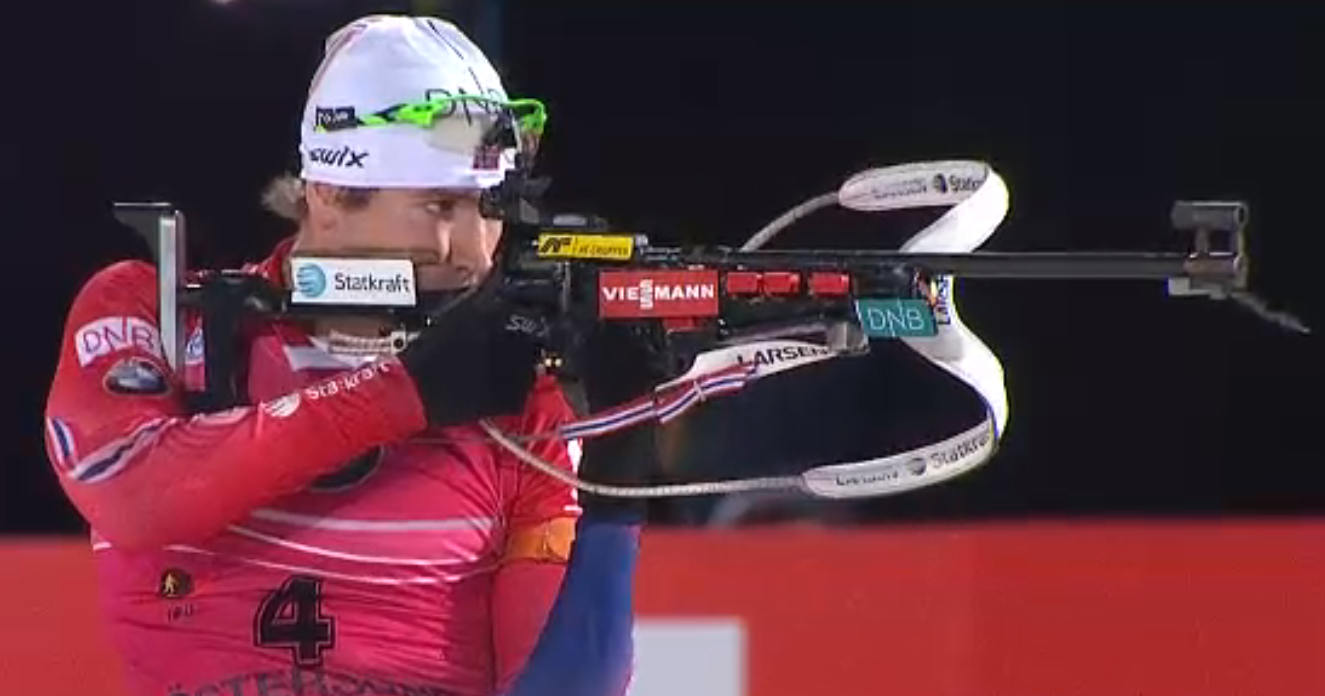
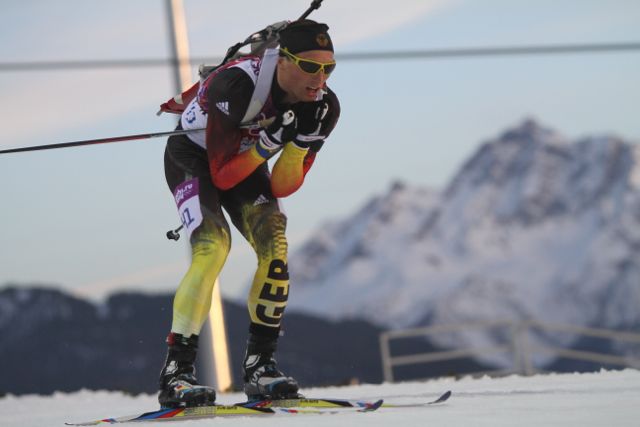
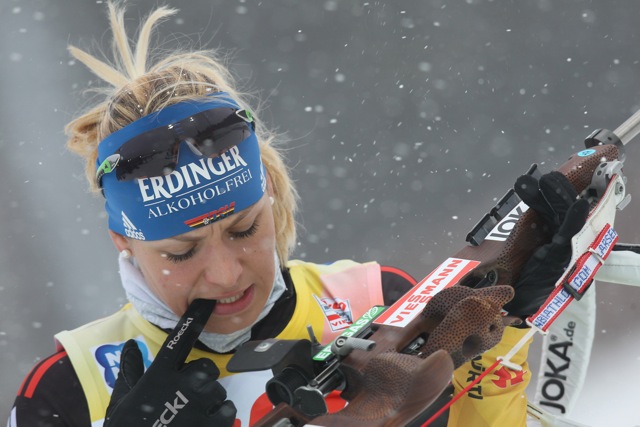
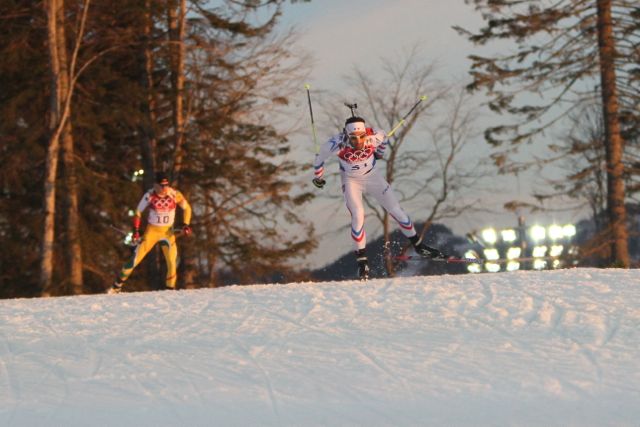
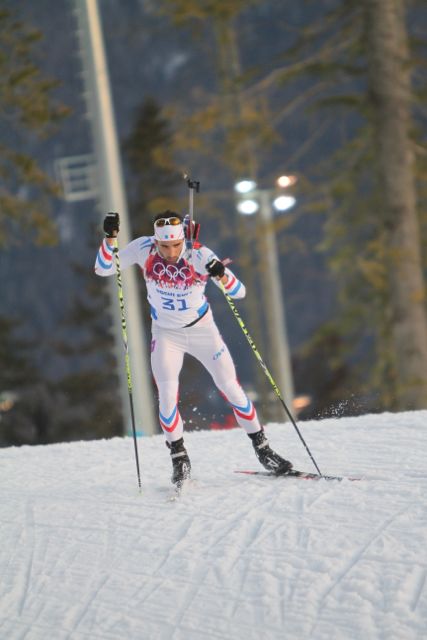
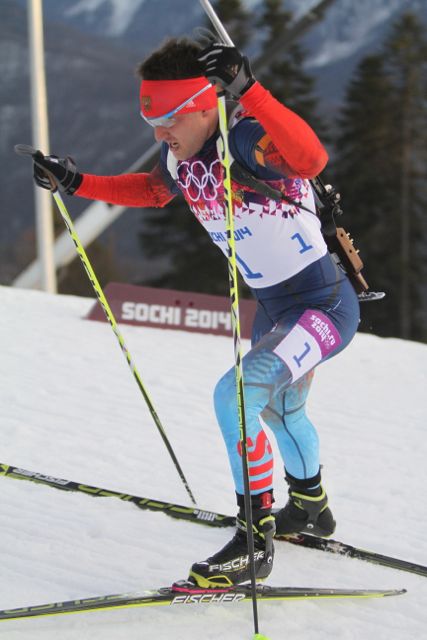
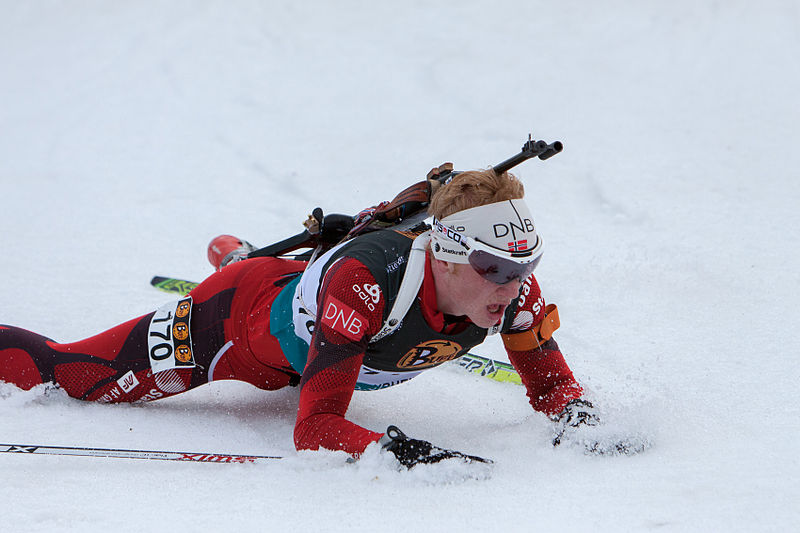
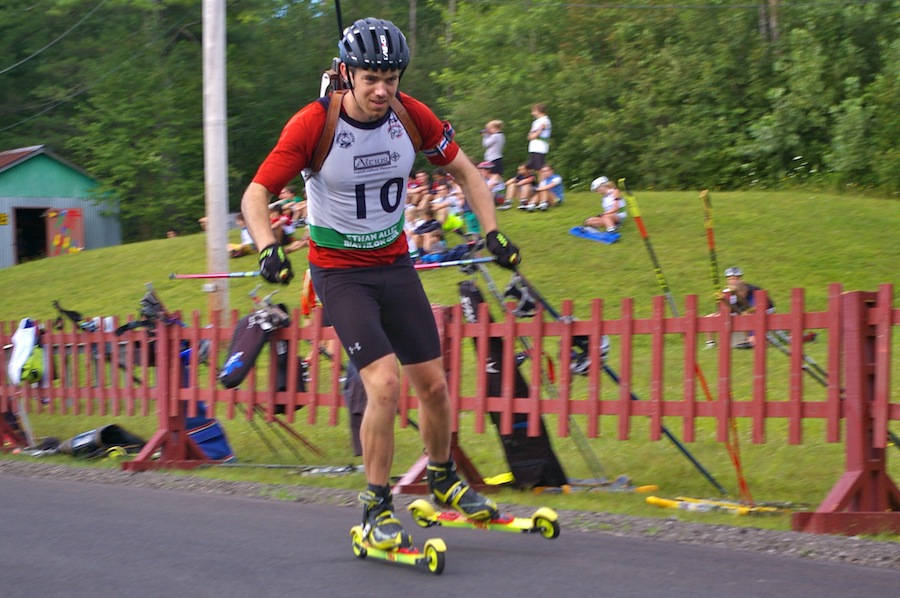
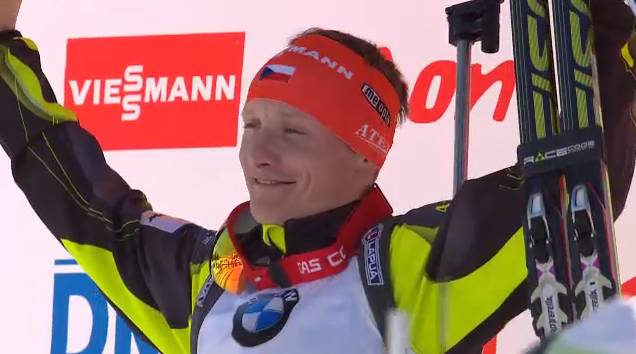
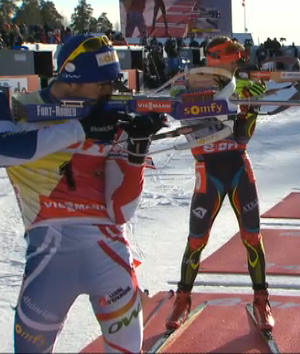
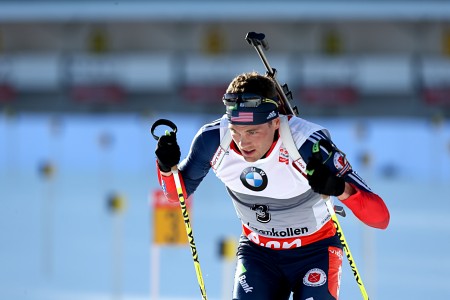
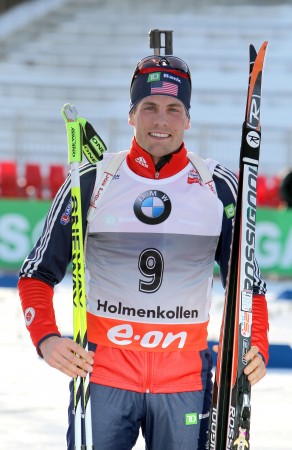
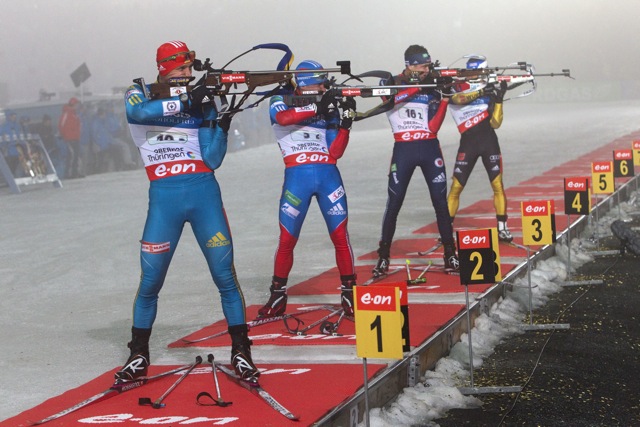
Emil Hegle Svendsen of Norway taking one of his 20 perfect shots in today’s World Cup 20 k, which he won by over a minute.
Emil Hegle Svendsen said earlier this week that the 20 k individual race in Östersund, Sweden, would separate “men from mice.”
If that’s the case, then Svendsen is definitely a man. The Norwegian biathlete, 11-time world champion, four-time Olympic gold medalist, and the third-winningest man in World Cup history, took his 36th win in dominating fashion, beating runner-up Serhiy Semenov of Ukraine by one minute and 17 seconds.
“It’s insanely amazing go get started this way,” Svendsen told Norwegian broadcaster NRK. “I followed the plan I’ve had success with before. And it worked again.”
He turned in a masterful performance, hitting all 20 of his targets – the only man to do so, which is a big advantage in the format which penalizes each missed shot with a minute of added time.
Rival Martin Fourcade of France couldn’t even come close, missing four targets in the very first shooting bout and then basically phoning it in. He placed 81st, and had to hand Svendsen the yellow leader’s bib that he started with as last season’s overall World Cup champion.
“I’m happy to give it to Emil today,” Fourcade told NRK. Svendsen reported that Fourcade had tossed him the jersey while they were in the changing area.
The wind was variable in the Östersund stadium, which was why so many competitors tripped up. There’s also the issue that the 20 k is the most grueling race format, and a tough way to kick off the season.
“I have been thinking, and the last time I cleaned in a 20 k was in my first World Cup victory in 2007, under similar conditions,” Svendsen said in a post-race press conference. “But I was a bit lucky today with the wind especially in standing and that made it quite easy to hit all 20. Still, it does take some skill to do that… I have been feeling really good in the shooting range this winter.”
His perfect shooting was acknowledged by competitors as something fairly incredible.
“Emil delivered in the top ten or top five of his best races in his career,” said teammate Ole Einar Bjørndalen, who knows a thing or two about best performances. “It is a fantastic achievement to shoot down all 20 targets in the shooting today.”
Svendsen knew, however, that he had to a large extent capitalized on his competitors’ errors. He had sixth-fastest course time, but was still well behind teammates Johannes Thingnes Bø, who finished eighth, and sixth-placeBjørndalen. He knows that Fourcade isn’t going to miss four targets right off the bat every race, nor will his teammates always pick up three or four penalties apiece. It will get harder and harder to win as the season goes on.
“It was not good enough; I need to catch some seconds if I expect to be on the podium in the sprint,” Svendsen admitted. “But it is like this every season with me. It takes a couple of races to warm up; I am like an old diesel engine.”
Second-place Semenov made it clear that he loves the format: his only other podium also came in the 20 k, two seasons ago in the pre-Olympic test race in Sochi, Russia.
“I am a bit slow, but I can go at the same speed for the whole distance,” he explained in the press conference. “But this race was hard; I could hardly wait to get to the finish line.”
Third-place Michal Slesingr was almost another minute behind Semenov; both men, as well as Erik Lesser of Germany, had one penalty. Lesser was a late starter and made a charge at the podium but came up just three seconds short of the Czech veteran’s time.
Most of the other names in the top ten are familiar, previous podium finishers, with one exception: Quentin Fillon Maillet of France. The 22-year-old turned in his best performance yet and, like Lesser, as a late starter was able to surprise when he displaced American Tim Burke out of the top ten.
As for Svendsen, his performance cast doubt on the comments he had made in the off-season about feeling a lack of motivation to continue with biathlon.
“Winning makes you motivated and makes you want to continue for a long time,” he said in the press conference. “Biathlon is fun and to compete is fun. As long as it is fun, I will continue.”
The German nordic sports experience at the 2014 Olympics could perhaps be summed up on the last day of competition.
In the men’s 50 k, Germany entered four men. The finishers were led by Thomas Bing, about to turn 24 years old, in 36th place.
Next came Axel Teichmann, more than ten years Bing’s senior. Then two biathletes – Arnd Peiffer and Erik Lesser, in their 50 k debuts on the world stage and within a minute of Teichmann’s time.
Four years earlier, Teichmann had captured silver for Germany in the same event, but on that day in February he labored to 39th place, more than four minutes behind the winning Russian skier. While Germany still had a few of their stars from days past on their roster, they were mostly stars no more.
Peiffer and Lesser had teamed up for a silver medal in the biathlon relay the day before, but they surely were not on fire in the 50 k (understandably). While they treated the race as a fun way to end their Games – and some other biathletes and nordic combined skiers probably would have jumped at the chance to do the same thing – their participation brought up an uncomfortable question: can Germany find nobody else?
To say that Sochi was a disappointment for Germany would be an understatement. While expectations were somewhat tempered by their team’s performance so far that year, it was hard not to remember Vancouver. There, biathlete Magdalena Neuner won two golds and a silver, Simone Hauswald shared the podium with her when she earned bronze in the mass start, and the relay also took bronze.
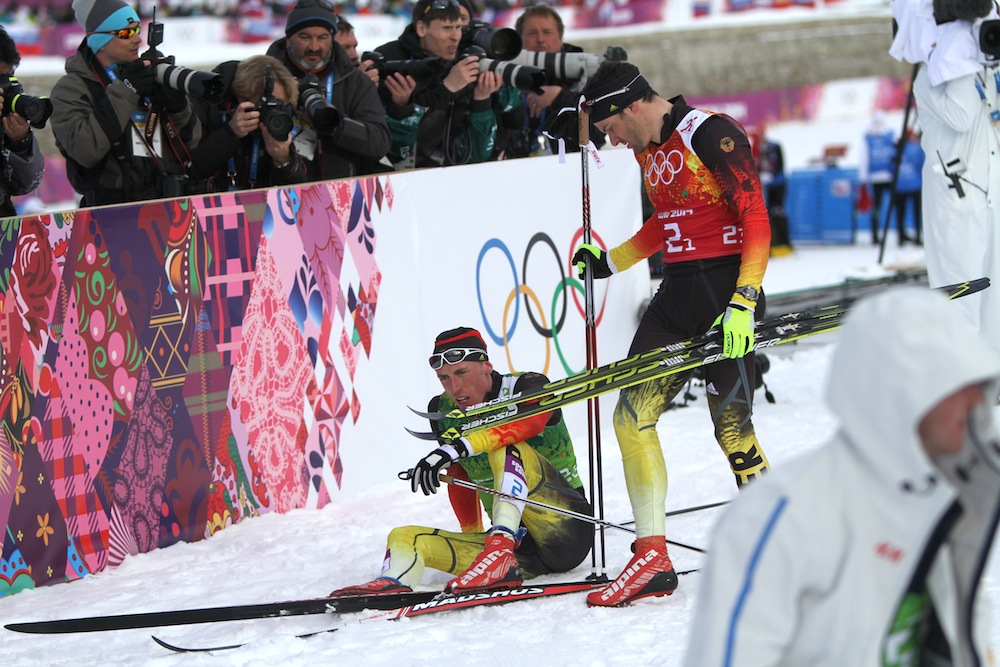
Germany’s Tim Tscharnke (l) after the finish of the 2014 Olympic team sprint with teammate Hannes Dotzler. The two finished seventh after Tscharnke fell a few hundred meters before the finish as a result of a tangle with Finnish anchor Sami Jauhojärvi. Finland took gold and Germany placed seventh.
In cross country, Nystad and Evi Sachenbacher-Stehle had teamed up for gold in the Vancouver team sprint, Teichmann and Tim Tscharnke took silver in the men’s event, the German women were second in the relay, and the men won two individual silver medals.
For a little perspective: in 2014, Germany came away with three medals, total, in cross country and biathlon combined.
Where to start with the embarrassments? Was it Sachenbacher-Stehle testing positive for a banned stimulant? Or was it Tscharnke falling down in the final stretch of the team sprint and, instead of getting up and likely earning bronze, lying in a heap whimpering about how he missed out on gold?
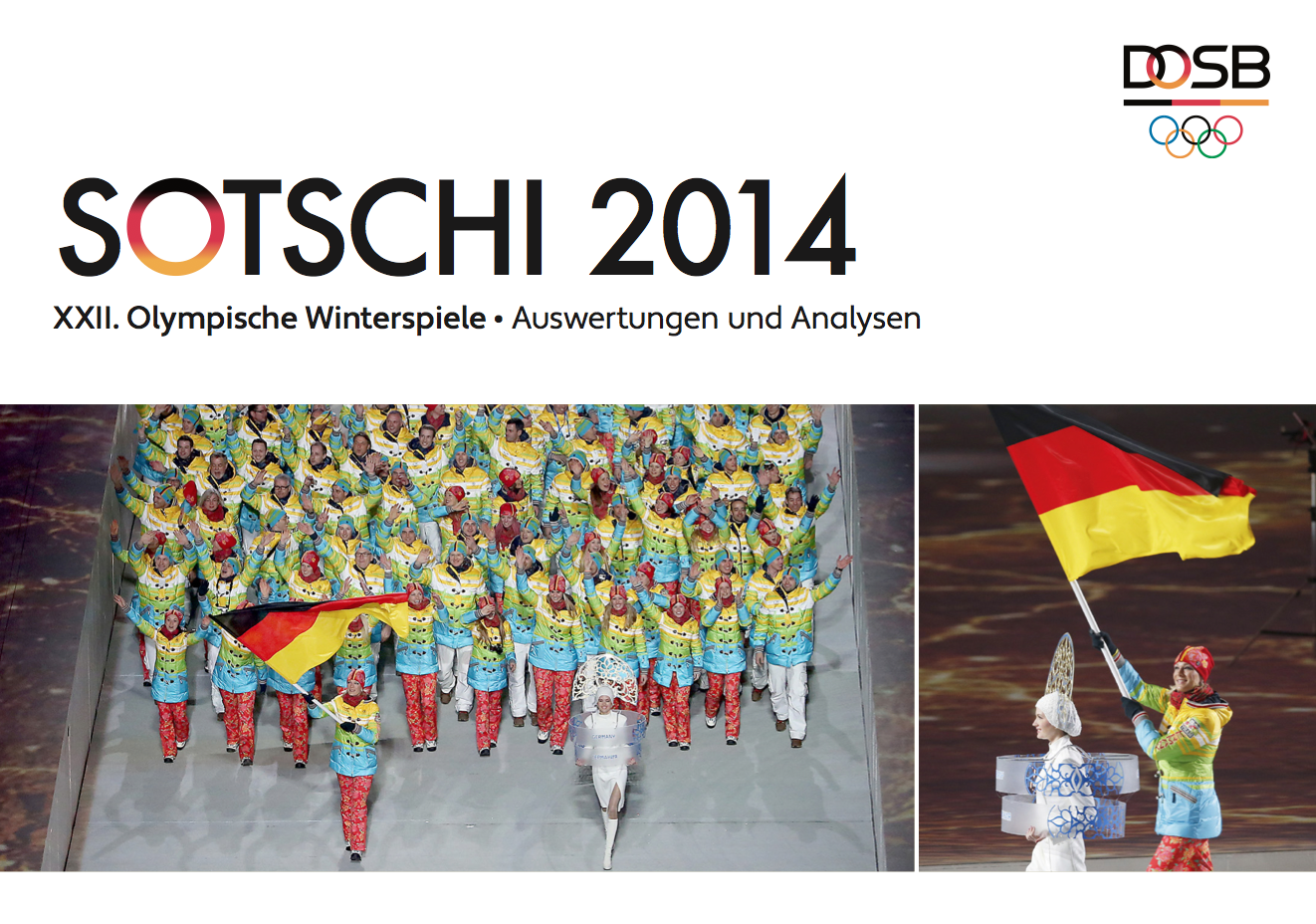
In a Deutscher Olympischer SportBund report obtained by FasterSkier, the country’s Olympic committee assesses the success of each sport at the 2014 Olympics, and looks for actionable plans to move forward and upward. The document runs more that 230 pages and not only focuses on each sport individually, but also on funding partners, medical and logistical support, and what other countries are doing to succeed. It’s an impressive analysis of a huge and complex system.
A Cross Country Team Too Old and Too Young
“Denise Herrmann and Josef Wenzl improved in the world rankings in the 2013/2014 season and even at times led the Sprint Cup,” the report noted of young German skiers. “But the pre-Olympic season was marked by a disappointing World Cup, and the coaching change in 2012 didn’t bring the expected turnaround.”
Herrman was one of the great hopes for Germany – a medal in the skate sprint seemed very possible for the 25-year-old (and if that doesn’t sound “young”, the report notes that the average age of a medalist was 28 for women and 29 for men). But like other favorites including Marit Bjørgen and Kikkan Randall, she didn’t make the final.
That was symbolic of the single medal and three top-8 finishes by German skiers, their worst performance at an Olympic Games since 1998.
While performances by the team’s young stars showed that maybe they weren’t ready for literally the biggest stage in the sports world, the squad was also filled with older athletes. The single medal came in the women’s relay, where 36-year-old Nystad was helped earn bronze and the team came into the sprint finish with the leaders.
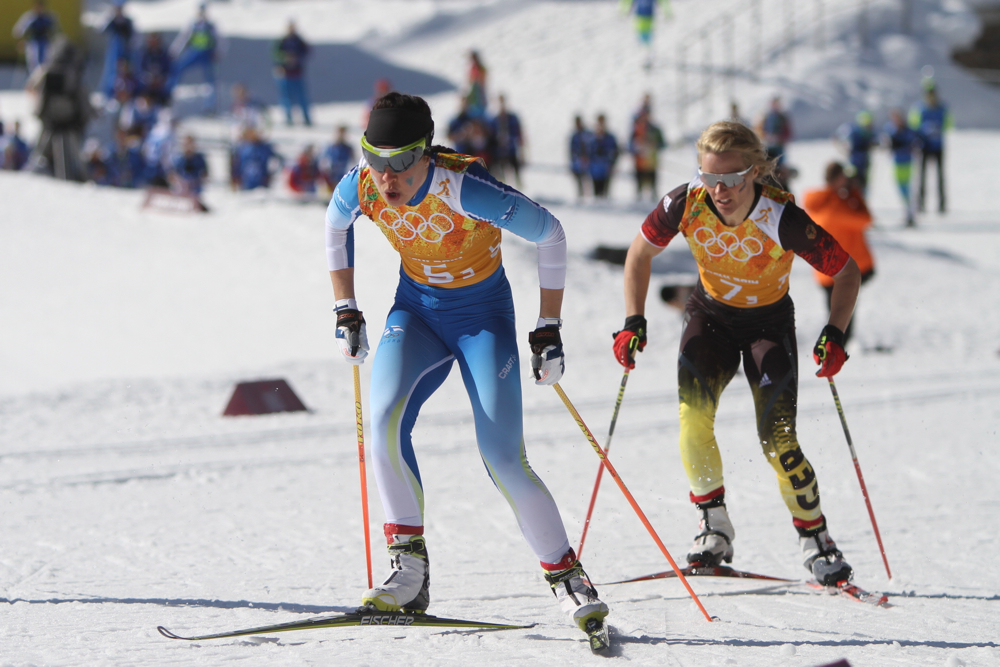
Kerttu Niskanen of Finland leading Claudia Nystad of Germany in the Olympic relay. Nystad completed her comeback from retirement with a bronze medal.
The report noted that Nystad was the oldest medalist in cross-country skiing. But they didn’t say what the rest of the team’s aging veterans accomplished: because Teichmann didn’t contribute much, nor did 36-year-old Tobias Angerer. None of the women who competed in the 15 k skiathlon were under the age of 30.
Nordic sports are particularly difficult to analyze, the report noted, with different techniques and physiological demands of uphill and flat sections, aggression needed on downhills, transitions essential on rolling terrain, and equipment and ski service becoming increasingly important.
But the best athletes, the report explained, are in general among the best at each of these different aspects, and having a weakness in one area can’t necessarily be compensated for by excellence in another area due to the high level of competition in the field.
What do they recommend to get German skiing back on track? For once thing, they focus on a “long-term development structure” and suggest that the objectives and tasks be reworked after observing other country’s strategies for developing cross country skiers.
Another recommendation is that while providing for an athlete’s development, not to treat them as machines: “An essential prerequisite of all participating institutions is to in close cooperation control the sport, but also the personal development of the athletes and to focus on the achievement of future excellence in high-performance.”
Finally, the committee noted that the ski association’s current strategy of setting up different training groups seems to be effective, but that it should look towards biathlon and nordic combined for how to systemize development at the junior level.
If there’s more talent coming up, there may finally be starts for them. Teichmann, Angerer, and Katrin Zeller retired. Nystad is back in action and had a strong race in Beitostolen, Norway, this weekend.
What Happened to Biathlon?
Erik Lesser of Germany en route to a silver medal in Sochi.
Biathlon was an unmitigated disaster for Germany at the Sochi Olympics. On the second page of the biathlon section of the report, the committee addresses an ugly truth: the medal rankings. Germany collected two medals, one silver and one bronze, which landed them in fourth place (although there were several ties; five teams were better, two the same). The Czech Republic surged past them with five medals.
“Besides the established nations of Germany, France, Russia, and Norway, increasingly athletes from Austria,the Czech Republic, Slovenia, and Canada are gaining podiums and placing among the world leaders,” the report noted.
Echoing a sentiment expressed by many of the sport’s observers, the committee crunched some numbers and showed that biathlon is, in fact, getting increasingly competitive: the same level of performance that might have won a medal in the past just doesn’t cut it anymore.
“In order to achieve podium finishes, the men at maximum about 1.2 percent behind in skiing, and hit targets at a rate of of about 98 percent. The previously assumed requirement to be 1.5 percent back and a 95 percent hit rate are therefore obsolete now… in the women’s field, a hit rate of 96 percent and maximum ski speeds less than 2.0 percent back are needed to reach medal placings… the best individual performances in the opening contest, the sprint, were… clearly behind the world leaders in both skiing and hit rate as well as in the shooting times. Because they were immediately dependent on the sprint results, the prospects were thus low for the subsequent pursuit.”
Forget medals – it didn’t get any better for Germany when considering top-8 performances: in other words, they weren’t even close to winning more medals. The team had only three top-eight finishes (discounting those from Evi Sachenbacher-Stehle after her doping ban). Norway and the Czech Republic led the way with 11, while France had 10. Germany’s three tied it with the United States, Canada, and Slovakia.
The women’s team, the report noted, was highly variable. After the Vancouver Games, three stars retired (Kati Wilhelm, Martina Beck, and Simone Hauswald), while Magdalena Neuner called it quits after the 2012 World Championships in Ruhpolding, Germany.
“[The team] ultimately consisted of two juniors (Franziska Preuss, Laura Dahlmeier); a very experienced senior athlete (Andrea Henkel); an experienced, former cross-country skier – with considerable training effort for the stabilization of the shooting performance (Evi Sachenbacher-Stehle); and an athlete who in comparison to previous years increased her experience but at events as big as Sochi still has far to go (Franziska Hildebrand). The challenging tracks in Sochi required a high level of competition experience with regard to the race schedule. Their could succeed in competition only on the basis of a high level of physical and mental performance. These parameters within the existing team structure are pronounced insufficient for an Olympic Winter Games.”
Magdalena Neuner, a three-time World Cup champion, double Olympic gold medalist, and winner of 17 World Championships medals, has been critical of the DSV’s biathlon program. Photo: NordicFocus/Fischer.
Since the Olympics, Neuner has publicly criticized the Deutscher Skiverband (DSV, the governing body for snow sports) and accused them of being behind the times and resistant to change.
“Times have changed, and the level of the World Cup has increased,” she told Der Spiegel. “[They] didn’t want to think differently… the team needs someone who has a bit more sensitivity for the young girls. The World Cup is a tough business. And because they are currently not as successful, it is even harder. Now they need a coach who is fully behind them.”
In a separate conversation with Sport1, Neuner said that far too much pressure had been put on the likes of Dahlmeier and Preuss, who just two years before had been competing at the Youth Olympic Games.
Her leadoff leg of the women’s relay was tough to watch – she fell, and also had her rifle sight clogged with snow. Perhaps additionally discombobulated by Sachenbacher-Stehle’s doping result, Preuss tagged off three minutes behind the leader and in tears. She was 19 years old, and has since made it clear that she never wants to revisit the memory.
“It’s always difficult in the first World Cup season, and especially at the Olympics for young athletes: the pressure is greater than they had ever imagined,” Neuner told Sport1. “You think you’re now relaxed on the World Cup, but it is different than before. The public attention is so high and the pressure as well.”
She also said that the trainers did not sufficiently individualize training plans, and as a result many of the athletes were often exhausted and sick. Neuner trained more or less independently of the national team during her most successful years.
Neuner has since been in contact with the DSV, and they have reportedly offered her a position to advise them.
Henkel – who has medals from three Olympics and teamed up on relays with the strongest German biathletes ever, from Uschi Disl to Neuner – has since retired, married longtime boyfriend Tim Burke, and is planning a life in the U.S. German media is calling the very young German women’s team perhaps the most challenging squad since the reunification of East and West Germany.
“You shouldn’t compare these girls to what was before, but give them some time to develop and not have a lot of worry,” the told news.de.
What About Everyone Else?
How does Germany apply the same logic to other countries? The report also contains information on each of Germany’s main rivals: France, Canada, Norway, Russia, and the United States. A few interesting assessments:
France, it notes, won 15 medals – but all came in ski and snow sports, a “problem” noted by the head of the French effort and which will be targeted for expansion in coming years. How does France fund their efforts? Among other things, through the military, customs, and border patrol, which provides athletes with salaries. 60 percent of the medals won came from athletes in these programs, and only in jumping was the success unrelated.
“There is a positive trend in the spending from 2010 to 2013, for the key role of competitive sports the Institute for French High-Performance Sports [INSEP] used 63 percent of its total expenditures, or about 21 million euros. The budget for research projects amounted in 2012 to about 18 percent or 5.8 million euros and in 2013, about 12 percent or 3.9 million euros. Research and development activities to support the development of competitive sports staffed 18 employees of the Research Department of the INSEP.”
In assessing Canada, the report mentioned the governments Athlete Assistance Program (AAP) and discusses Own the Podium (OTP) at length. It concludes:
“Given increasingly costly global funding for sports and declining sponsorship in Canada, it needs to be clarified whether Canada can afford wider sports funding at present. The summer sports have obtained more financial due to the larger number of sports, despite fewer medals. After Sochi there is again, as before in 2013, debate about the questions: is it important for the summer sports to be equally successful as the winter ones? Is success in some sports more important than others? Does Canada have to be equally successful in Olympic and Paralympic Games?”
And how does the U.S. succeed? Germany marvels at the U.S. Olympic Committee’s very different funding strategy:
“With the relaunch of the USOC site ‘Team USA,’ the creators succeeded with the new website and numerous promotions to make an increasingly patriotic, emotionally-tinged connection between the American ‘consumers’ and Team USA. According to the 2012 Annual Report of the USOC, 130 million Americans are ‘fans’ of the Olympic Movement and at the end of 2012, USOC social media sites had more than 3.5 million followers. Team USA is 34 business partners, sponsors and suppliers – including Coca Cola, Dow Chemical, Samsung, VISA and Nike. The message [is that] that all Americans are part of the team behind the team USA and that without the willingness to provide financial support for the athletes a successful performance in the international arena is not possible…”
Can German nordic sports get their mojo back this season? We’ll have a hint at an answer this weekend: the FIS Cross Country World Cup kicks off in Kuusamo, Finland, and on Sunday the first IBU Biathlon World Cup will be held in Östersund, Sweden.
Martin Fourcade of France (right) skied the fastest course time in the 20 k individual, making up for his one missed shot and taking home his second gold medal of the Olympics.
FasterSkier’s coverage is made possible through the generous support of Rudy Project.
SOCHI, Russia – For the last several years, it’s been clear that Martin Fourcade is the best biathlete in the world.
Did he fall short at big events sometimes? Yes – the Norwegians, among others, showed up with their “A” game and the perfect peaking plan at 2013 World Championships, taking three individual golds to the Frenchman’s one.
And did he mess up sometimes, on the big stage? Yes – like in the opening mixed relay in Östersund, Sweden, this year, when he not only missed four shots in the standing stage, but forgot to use all of his spare rounds and earned his team a two-minute penalty.
And yes, there have been races where Fourcade didn’t seem like himself – missing shots or skiing anything other than the fastest split time of the day. This year, there have been questions of whether the pressure of an Olympic season was getting to him. They were never stronger than on Saturday, when he missed one shot, skied the second-fastest time, and still ended up somehow in sixth place instead of on the podium.
But it is the Frenchman’s style to take each of these incidents and bounce back with an even bigger and bolder show of success. Here at the Olympics, Fourcade made his first statement by winning Monday’s 12.5 k pursuit in dominant fashion.
Today, he furthered his claim as best biathlete in the world by skiing to a 12-second win in the 20 k individual. It was the first time since 1968 that a French athlete has won two gold medals at the same Games.
“It is a really different feeling from two days ago, which was a lot of relief,” Fourcade said in the press conference. “I’m just incredibly happy and it’s a wonderful thing.”
Fourcade excelled on the 4k loop’s huge climbs.
Fourcade picked up a penalty in his second of four shooting stages. In the individual format, each missed shot is penalized by one minute of added time, so Fourcade had knocked himself out of medal position at the race’s halfway point. But he was clean for the rest of the race climbing back into the lead as other competitors accumulated penalties and slower ski times.
And then he had to wait.
Because how good is Fourcade? That has been the question all year. Is he one minute, and thus one penalty, better than the rest of the field? Two minutes? Three minutes over 20 kilometers?
“You are just by yourself,” Fourcade said of the individual format. “You have four firing lines, four shooting rounds. And all the mistakes, they cost a lot. I had to be in my top form.”
Even with one miss, it would take perfect shooting for one of his competitors to beat Fourcade and earn that minute of penalty time back. Before Fourcade had made it to the final stage, an earlier-starting athlete, Dominik Landertinger of Austria, had cleaned all four stages. Landertinger wasn’t skiing fast enough to contend with Fourcade – his ski time was almost two minutes slower – so Fourcade could relax knowing that his gold was safe from this threat.
But it showed that on the quiet, windless Sochi range, it was definitely possible that more people would shoot clean. And soon, one did.
Erik Lesser of Germany came into the range for the final time tired and shaking. He was clean so far, and knew that any errors would destroy the good race he had going. So he shot very slowly, but methodically knocked down all five targets. Based on Fourcade’s split times, Lesser had a ten-second advantage heading into the final four kilometers.
Could he take the gold away from the most dramatic competitor on the circuit?
“To be honest, yes I had that thought,” Lesser said in the press conference. “I tried to do my best during the final loop and I hoped that my colleague from France wouldn’t be that fast.”
Erik Lesser of Germany.
But while Fourcade had turned in what ended up as the fastest finishing-loop time, as well as the fastest overall ski time, Lesser couldn’t quite do it. He slowly hemorrhaged seconds to Fourcade and eventually ended up in second.
“Well, it didn’t happen!” Lesser laughed. “But nevertheless I consider this to be a great success for me. It was a major success. At some point I was even thinking about winning a gold medal, but one cannot be disappointed with a silver medal at all.”
After Lesser, only Anton Pantov of Kazakhstan cleaned, but was so much slower on his skis that he only finished 27th.
For Fourcade, the day was more relaxed than his pursuit win, because it was not head-to-head racing and he was out on the trails alone with fewer head games.
“The emotions were different, because this was an individual race and we had less excitement and less pressure,” he said. “I knew what I had to do and I love individual races. Of course I was a favorite and I knew that I will be doing well. I almost fell down but the most important thing was to stay put…. I wouldn’t complain about the two golds.”
While he has made history for France and is jet-setting into the history books for his sport, he said that he doesn’t consider himself alongside Ole Einar Bjørndalen, the Norwegian who won his 12th Olympic medal in Saturday’s sprint, or Fourcade’s countryman Raphael Poirée, who won 44 World Cup races before retiring.
“I love sports but I never thought about becoming part of history and part of this,” Fourcade said. “But I am happy and I would like to share my happiness with my teammates and my friends. Maybe this is why I am good at what I am doing.”
The other podium finishers were doing it for history in a different sort of way. Lesser’s grandfather Axel Lesser was an East German cross country skier who competed in the 1976 Olympics. In the relay, he was in second place but collided with a spectator and was injured, and had to withdraw from the race. Today, his grandson paid that debt back.
The younger Lesser has said that he considers his grandfather his hero, along with Bjørndalen.
Evgeniy Garanichev of Russia, hammering hard.
“For me, the opportunity to win an Olympic medal is a great opportunity and especially having such a relative,” he said.
On top of that, Lesser’s great-grandfather really wanted to see him race in the Olympics (this is 25-year-old Lesser’s first Games, after he broke through on the World Cup circuit with his first podium last season).
“He is quite old, by the way,” Lesser said of his 93-year-old great-grandfather. “He was anxious to see my first Olympic Games [while he was still alive]. I promised him that I could do that. I am happy that he could see this result.”
The bronze medal went to Evgeniy Garanichev of Russia, an early leader – the earliest leader, actually, after having started in bib number one. With a single penalty and the second-fastest ski time, Garanichev held onto the lead for 15 minutes after he crossed the finish line.
That’s the thing about in individual race: it’s a waiting game.
“When I was changing, our therapist came and we heard through the walkie-talkie the info about athletes arriving,” Garanichev said through a translator. “The coaches told us everything about what was happening. I didn’t think about it – I was satisfied with my race and my shooting. Only after a little bit of time, I went out and started watching.”
By then, Fourcade had surpassed his time by 34.5 seconds. And later, Lesser bumped Garanichev down one spot further to bronze.
The result was Russia’s second biathlon medal of this home Games, although they have yet to win gold. But Garanichev, too, was charting a course into the history books. He won his bronze on his 26th birthday, and is believed to be the first athlete to win an Olympic medal on their birthday.
It was a good present.
“I think one always has some hope,” he said. “This is what you’re looking for this is what you prepare for. The Olympics only happen once in four years. So you start to be optimistic and you do your best every time you race.”
Austria was narrowly edged out of the medals, with Simon Eder finishing three seconds down on Garanichev and the clean-shooting Landertinger landing in fifth. Jean Guillaume Beatrix of France continued his stellar Olympics by placing sixth with one penalty, while Emil Hegle Svendsen of Norway, on the opposite end of the spectrum, continued to disappoint in seventh, also with a single penalty.
“Normally on a day like this I’d be fighting with Fourcade,” Svendsen told Norways’ NRK broadcaster. “I’m surprised that I’m so far behind. I’m disappointed and sad.”
Johannes Thingnes Bø after finishing sixth at 2012 Norwegian biathlon championships in Trondheim. At 20, Bø won his first IBU World Cup on Saturday, then repeated with another victory in Annecy, France, on Sunday. (Photo: Wikimedia Commons)
The thing about Le Grand Bornand in Annecy, France, is it’s so darn flat, you’ve got to ski real fast if you’re going to make waves there.
That’s one thing IBU World Cup competitors quickly realized during their five days of races at the venue, with relays on Thursday and Friday, sprints on Saturday, and a final pursuit on Sunday.
As a biathlete, you’ve also got to hit your targets. Norway’s Johannes Thingnes Bø did both – almost perfectly with 19-for-20 shooting – to rack up his second-straight victory of the weekend and his career.
Starting first, 33 seconds ahead of the Czech Republic’s Ondrej Moravec, the 20-year-old Bø won the men’s 12.5-kilometer pursuit by 37.5 seconds in 31:43.7. He cleaned his first prone and missed one on the second stage, but it didn’t make much of a difference. He had a 46-second lead before his second prone and was still 21 seconds ahead heading into his third loop.
Bø recorded some of the fastest range and loop times to beat Germany’s Erik Lesser, who cleaned every stage to take second. Another 1.6 seconds back, Russia’s Anton Shipulin placed third with a penalty on the first standing. Meanwhile, Moravec had two penalties to finish 12th.
Twenty of the top 25 finishers cleaned the first prone, and six of those men – including Shipulin, Lesser, Austria’s Daniel Mesotitsch and Dominick Landertinger, and Norway’s Lars Berger and Henrik L’Abee Lund – also cleaned their second prone.
But by the time Bø knocked down all his targets in the first standing, no one else had got a shot off. Lesser cleaned again to move to second, 31 seconds behind the Norwegian, but Bø cleaned once more to dash the hopes of anyone trying to catch him and finished uncontested.
“It was a special feeling to go out with bib number one,” Bø told IBU, according to a press release. “I never felt the pressure. I think that is why I was so good on the shooting range and on the tracks.”
Overjoyed with second and a solid start to the season, Lesser described his weekend in France as “phenomenal.”
“I hope our team can keep this form and try to beat Johannes and his brother [Tarjei] in Sochi,” Lesser said.
The IBU World Cup goes on a three-week holiday break before resuming on Jan. 3 in Oberhof, Germany.
Smith on a Roll
Nathan Smith (Biathlon Canada) racing to seventh in the 12.5 k pursuit in early August at 2013 North American Biathlon Rollerski Championships in Jericho, Vt. Four months later, he’s punched his ticket to Sochi.
A day after he tied his career-best 16th and qualified for Canada’s Olympic team, Nathan Smith finished eighth in Sunday’s pursuit, 57.5 seconds behind Bø and 18.4 seconds off the podium.
He had risen from 48th to 27th in a pursuit a week earlier in Hochfilzen, Austria, yet Smith knew it would be tighter and harder to pick off the places closer to the front.
As a result, he started conservatively and tried to keep pace with those around him using as little energy as possible. He missed a shot in the first prone, but after doing the same thing last Sunday, Smith knew it was possible to recover.
He ended up cleaning his second and third stages before missing one more on his second standing.
“Missing the last shot is a biathlon classic,” Smith wrote in an email. “I think I lost focus thinking about the possibility of a podium. Frustrating for what could have been, but I’m not too upset, as the race was still a solid [personal best].”
On Monday, Smith plans to fly home to Canmore, Alberta, via Calgary to spend the holidays training and enjoying the break. On Jan. 4, he’ll head back to Germany.
Both his Biathlon Canada teammates currently in France also qualified for the pursuit, with Jean-Philippe Le Guellec shooting clean and placing 33rd (+2:19.0), and Scott Perras finishing 48th with five penalties (+3:29.2).
“Skiing was ok‘ish.’ Better than [Saturday],” Le Guellec wrote in an email. The team veteran placed 49th in the preceding sprint with two standing penalties.
“Shooting 20/20 is a great feeling before heading home,” he added. “I basically tried to survive skiing. I was always between packs too, so skied alone a lot, which makes it harder because you have no one to help you. But easier to since you can really just do your own thing.”
Getting passed a couple times reminded Le Guellec to keep pushing, and he was glad his back didn’t suffer the effects of the flat course.
“I tweaked my standing position a tad, remembering stuff that was working well this summer and kind of forgot down the road, so I think that really helped bring standing back for me,” he explained.
Having a perfect day on the range as well, Lowell Bailey of US Biathlon placed 15th, up from 35th. Perhaps most notably, he had the second-fastest net time of 31:13.7 behind Carl Johan Bergman of Sweden, who finished fourth.
“After cleaning my third stage, I knew I had a good chance at a top finish but I just tried to refocus on what tasks I needed to execute during the fourth stage,” Bailey wrote in an email. “I had been a little bit too tentative on the range earlier in the week and I wanted to stay aggressive and focused for the last stage. I was able to do this and found myself in 18th leaving the range, fighting for a top-15. We had great skis and I felt better than I had in the last two races.”
Bailey went 20-for-20 to finish 1:11 behind Bø (after starting 1:41 behind), and crossed the line just 0.6 seconds ahead of teammate Tim Burke in 16th.
Burke had two penalties – one on each of standing stage – as he skied up from starting 28th.
“I wanted to be really aggressive on the shooting range and on the course,” Burke wrote in an email. “I knew that would be my only chance to move up.”
While Bailey clocked the second-fastest loop time on the fourth of five laps, Burke had the second-fastest course time on the same loop. Burke’s course time on the second loop ranked third.
“I tried to go out really hard right from the start and just hold on,” he explained. “It worked out well for me and I ended up feeling better today than in any of my previous races this season. I ended with the 3rd fastest ski time, so I am very happy with the direction my skiing is headed.”
After cleaning both prone stages, he was up to 15th and thought a podium might be possible. He didn’t get ahead of himself, though, staying aggressive on the range and not “trying to make my shots too perfect,” Burke explained.z
Skiing in 19th at the beginning of the last loop, he trailed Bailey and Sweden’s Frederik Lindstrøm by about five seconds, and pushed hard on the first climb to catch them. Burke also caught Frenchman Martin Fourcade and the group he was skiing with, then beat Lindstrøm and Fourcade in the finishing stretch.
“The finish sprint is really fast here and it comes after nearly a minute downhill, so everyone goes into it completely recovered,” Burke explained. “This is definitely not my type of finish so I knew that I had to try something before the last downhill. I made my move on the last climb and was able to get free of the group.”
Happy with his performance and how he felt after three weeks of racing, Burke’s ready for another big training block. He’ll be in Antholz, Italy, while the rest of his team travels back to the U.S.
“I have had a lot of trouble in the past staying healthy when I fly home for the Holidays, so I did not want to take any extra risks this year,” he explained. “I will also train at altitude for the next few weeks and I am hoping that this will help me in Sochi.”
Ondrej Moravec of the Czech Republic celebrated the first victory of his career in Oslo on Sunday.
The Norwegian men clearly wanted to end this weekend’s biathlon World Cups at Holmenkollen with a bang.
Outshone yet again by female teammate Tora Berger, who swept the women’s sprint, pursuit, and mass start, and down their leader Emil Hegle Svendsen, who has been suffering from a cold, it was up to Tarjei Bø and Ole Einar Bjørndalen to give the Oslo fans a red, white, and blue victory in the last race of the weekend, the 15 k mass start.
Despite having talked just one day before about how tired he was, how his health struggles in the autumn had left him without a seasons-worth of the reserves and how after a late start to racing he’s still coming into form, Bø took the race out from the gun. Bjørndalen was similarly aggressive, trying hard to move to the front and at one point getting shot out past the v-boards, which he gracefully hopped, as he exited a downhill corner.
Both men cleaned the first stage, and headed out onto the course in second and third position.
But by the third stage after the men had transitioned to standing shooting, it looked like the race was headed for a different kind of red, white, and blue victory: one by Martin Fourcade, who had dominated the previous day’s pursuit.
Anything can happen in biathlon, though, and at the finish, it was yet another tri-colored flag set to be hoisted at the flower ceremony. Czech journeyman Ondrej Moravec had outshot Fourcade on the last stage, then held him off on the last lap to earn his first career victory by a margin of 13.7 seconds.
And what a place to get that first victory.
“It was like a dream to me,” he said in the post-race press conference. “I tried to enjoy the last part coming down the finish line, and it was perfect with the spectators. It was an amazing feeling – I don’t know what more to say.”
First wins often come in sprints or individual races, where there’s no chance to celebrate – so Moravec clearly appreciated the circumstances. And in terms of the venue, it’s the only one where a win is rewarded with the chance to meet the country’s royalty.
“To win at Holmenkollen, it’s something special,” Moravec told the Czech press. “After all it is a legendary venue and you get to see yourself with the king. It’s not just another race on the World Cup.”
Fourcade and Moravec shooting head to head in the final stage.
So how did the audience with Harald V go?
“He asked me if this is really the first victory of my career,” Moravec said. “And I congratulated him on the success of all the Norwegian athletes. It was a really nice experience.”
Moravec and Fourcade, already at the front of the lead pack, had both cleaned the third stage, and hit the course together with a ten-second lead on Andriy Deryzemlya of Ukraine – and 15 more seconds to the rest of the field. Fourcade first skied slow, motioning Moravec to lead, then sprinted past and grew a gap of about five seconds.
But when he made it to the range, Fourcade missed two of his first three shots.
“I was not with good focus,” Fourcade said of the errors. “It was too much to be able to get the win.”
That gave Moravec an opening.
“Perhaps it wouldn’t be a win, but I couldn’t ignore that I had heard Martin miss on the first shot,” Moravec said in a Czech biathlon press release. “Then I tried to concentrate on myself and my shooting rhythm.”
He, too, missed one. But he left the penalty loop with a 16-second lead on Fourcade, Andrei Makoveev of Russia, Erik Lesser of Germany, and Deryzemlya, who all left the range and the penalty loop at the same time. On the first major climb, Fourcade made it clear that he planned to take silver, and maybe even go for gold. None of the others could match his pace.
“I have felt really good on my skis here,” Fourcade said in the press conference. “I hoped to catch Ondrej on the last loop…. I saw that I was catching some time, so I tried to believe.”
But while nobody else could match Fourcade, Moravec could. Try as the Frenchman might, he couldn’t make up enough time on the Czech. The gap shrunk to five seconds, but the effort exhausted Fourcade, and it slowly began to creep back in the other direction. (Fourcade’s skis also appeared to be slower on the downhills, no matter how hard he pushed on the climbs.)
“On the last lap, in the beginning I was a little bit tired, but then I found some energy for the last uphills, and then it was perfect,” Moravec told IBU’s Jerry Kokesh. “It’s amazing for me. The first victory in my career, and after in Nove Mesto [World Championships, on home turf] when I was two times in fourth place, this is crazy. I’m so, so proud of this.”
Fourcade was impressed with the Czech’s closing effort.
“He was really strong on the last hills,” he said, before turning to smile at Moravec. “Well done.”
Tim Burke, on the way to an eventual fourth-place finish. Photo: USBA/NordicFocus.
Behind, another battle was unfolding, as no less than four men seemed to have a shot at third. In the end, American Tim Burke just lost out on the podium to Erik Lesser of Germany.
It was something of a surprise to see Burke charging down the home stretch. Although he and teammate Lowell Bailey had been at the very front with Moravec on lap two, Burke had then missed a shot each in the second and third stages, and disappeared from view.
The key to his race was cleaning the final stage. He had not even been in the main chase group, but as some of those racers accumulated penalties, he jumped up to seventh position, just behind Simon Eder of Austria and 15 seconds from the group that briefly contained Fourcade.
“I could see third, fourth, and fifth ahead of me, but I didn’t think I could get them,” Burke said in an IBU interview at the finish. “Then I started to come back on the uphill, and I started to think, okay, this could be possible.”
With 1500 meters to go, he had caught Lesser, Makoveev, and Deryzemlya. Unfortunately, that’s about the time Lesser made his attack, taking the Russian with him. Burke had to maneuver around Deryzelmlya before he could try for the podium.
On the final climb around the backside of the range, Burke went stride for stride with the pair, passing Makoveev. But Lesser had an extra half a gear and was untouchable, securing bronze and leaving Burke in fourth.
“It’s sort of a bittersweet race,” Burke said in an IBU interview at the finish line. “I’m really happy with fourth place, it’s a good race for me, but I was super close to the podium, and that would have been nice.”
His loss, of course, was Lesser’s gain. The mustached German said that he was extremely surprised to be on the podium.
Burke at the flower ceremony. Photo: USBA/NordicFocus.
“After yesterday’s pursuit [where he missed seven shots and dropped 24 places] I was extremely tired and I was thinking, maybe I have to end my career or something,” Lesser said in the press conference, touching his hand to his face as if in an attempt to wipe away the memory. “It was so hard – my legs doesn’t work, my mind doesn’t work, shooting doesn’t work. It was the worst day in this season for me.”
The beginning of the mass start didn’t seem much different. Sure, Lesser shot well – his single penalty came in the third stage – but every time he tried to close a gap, he said, it was “very hard.”
By the last lap, however, he found some energy.
“I tried to just push everything that I had in my legs, and in the end I am very happy, even more happy than I was with the third place in Ostersund,” he said. “When I saw that Tim was coming…. that last uphill in the stadium, the Petter Northug uphill, I tried to do it like him two years ago at the World Championships. Then I knew I had him.”
Bailey finished 27th; the lone Canadian to start, Jean Philippe Le Guellec, placed 24th with three penalties.
Sergui Sednev (UKR), Evgeniy Garanichev (RUS), Tim Burke (USA), and Erik Lesser (GER) on the foggy range in the men’s relay in Oberhof, Germany, on Friday. Photo: USBA/NordicFocus.
After watching the women slog through Thursday’s relay, the men of the IBU World Cup knew what they were in for in Oberhof on Friday.
But then, they knew what they were in for before even showing up to Germany this year.
“The conditions in Oberhof are as always, the same conditionsm,” Russian biathlete Alexei Volkov said through a translator in a post-relay press conference. “You can see them for yourself. So for us that doesn’t change a lot. The only thing that changed was sometimes the wind on the shooting range.”
And despite having a slightly longer loop, the men’s 4 x 7.5 k relay was arguably less sloppy than the women’s race – the rain wasn’t pouring out of the sky with the same intensity, the tracks had been salted and were a bit more firm, and a downhill hairpin turn that had claimed several victims was eliminated as the loop grew in length.
At the outset, Ukraine hoped to repeat the win garnered by its women’s team just one day before. The ladies had seized the dreadful course conditions and made them their own – and so did Serhiy Semenov, who, impressively, didn’t use a single spare round on the leadoff leg. No slouch on his skis, either, the Ukrainian tagged off with an 18-second advantage on the Czech Republic and Russia.
And more favorites had taken a beating. Germany was 30 seconds back in fifth, thanks to a penalty loop by Simon Schempp; Norway sat in ninth after Henrik L’Abee-Lund hit the penalty loop in each stage. Austria was 15th, France 19th, and Sweden 20th.
But a few athletes set out to change the standings on leg two. Most notable, Ole Einar Bjørndalen of Norway, who received the tag from L’Abee-Lund 33 seconds behind Ukraine.
“I went out determined and knew how I would go over the course,” Bjørndalen told Norwegian broadcaster NRK. “I should be proactive and drive on, do my thing. It worked well… it was easier for me to shoot today than many others.”
They don’t call him the king for nothing. 38-year-old Bjørndalen had the fastest time on the first loop, then cleaned the prone stage while several others struggled. Sergui Sednev of Ukraine used a spare round and was still in the lead, but it didn’t last long as Bjørndalen blew by him on the trail. He continued the pace on the second loop and then, incredibly, quickly cleaned the standing stage as well.
So far this season the champion had seemed quite far from showing the form that would allow him to capture World Cup victory number 94. His top finish had been seventh in the pursuit in Hochfilzen, Austria, where he was 30 seconds off the podium. But after today’s relay, he’ll surely be back in the mix in individual racing as well.
“Yeah, it was fun,” Bjørndalen told NRK. “A leg that shows that the most successful biathlete still has much to offer.”
Another man on the attack was Tim Burke of the American team. Starting his leg in seventh place, he used only a single spare round over the two stages to move into third, and then put in a furious effort on the final loop to overtake Erik Lesser of Germany and tag off in second position, 25 seconds behind Bjørndalen.
“I was not sure if I was going to catch Lesser on the last lap,” Burke told FasterSkier. “I think he actually put a few seconds on me in the first few climbs, but I was able to get by him in the approach to the finish. I really like the long flat heading into the finish here, it seems to suit my technique.”
(For more from the U.S. men, stay tuned for a later article.)
The top two teams both unleashed the least-experienced of their racers on leg number three: for the Norwegians, it was Erlend Bjøntegaard, in his first World Cup season, and for the U.S. Russell Currier, who is no stranger to the World Cup but hasn’t done as many relays.
While Bjøntegaard seemed to be purposefully using a loose, relaxed technique and trying to ski smoothly, Currier was swept up by veteran Arnd Peiffer of Germany and Artem Pryma of Ukraine. The three men were skiing hard to try to make up time, and visibly straining much more than the Norwegian. Currier skied with the group to the range, and then used a single spare to maintain that position.
Bjøntegaard had also used a spare, and was still in the lead. In standing he used another, but left with the lead again.
Peiffer, meanwhile, had dropped several places back after relying on all of his extra bullets to clean prone and then using one spare in standing. But he was on the move, pulling the Ukraine team along with him as he caught and passed Anton Shipulin of Russia and then Currier.
While Currier spent a long time on the range, waiting for lulls in the wind to avoid using more than one spare round, and left the range in fifth, Shipulin, Pryma, and Peiffer shot more quickly if not necessarily accurately. On the last loop it was Shipulin who was on the attack, grinding away at the course’s big uphills and dragging Peiffer with him. The two closed on the Norwegian and, amazingly, Shipuling tagged off only 1.5 seconds from the lead.
“As far as I’m concerned about my performance, yes, of course, I’m very satisfied, and that bodes well for the upcoming competitions,” Shipulin said through a translator at the press conference.
Bjøntegaard? He wasn’t as sure.
“Today I was terribly tired,” the Norwegian said after starting with a 40-second lead. “I was a bit dead and didn’t have any splash. I threw up when I got to the finish, and I’ve never done that before. It suggests that things aren’t quite as they should be.”
By the last leg, it was clear that the race was going to be a barnburner.
Emil Hegle Svendsen of Norway, Dmitry Malyshko of Russia, Florian Graf of Germany, and Andriy Deryzemlya of Ukraine all came together on the first loop and entered the range at the same time. The wind was blowing heavily at that point, and Svendsen was the only man to clean in prone. Unsurprisingly, he skied hard after leaving the rang with a 14-second advantage on Malyshko. But the Russian skied just as hard. Their loop times were separated by only 0.3 seconds.
So Svendsen came to the last shooting of the race – which, in the slow conditions, had already dragged on for an hour and fifteen minutes – with a 14-second lead. But then he began missing shots, three of them by the time he’d used his five bullets.
He carefully loaded his first spare round, and knocked down a target. Then did it again. And again. Meanwhile, Malyshko arrived, shot, used a spare round, and hit the trails.
“At the range, Emil was already shooting, and when I came in and got ready to shoot I felt that the wind was blowing really hard,”Malyshko explained in the press conference through a translator. “And that’s the moment where he basically missed two or three targets. I was lucky because when I started shooting there was a little lull in the wind, and I managed to shoot a lot better than him.”
“That was not cool, to stand there and know that [I had to hit them],” Svendsen told NRK. “But fortunately I did and it salvaged a podium.”
While he may have been disappointed that the lead he had so aggressively crafted was destroyed, Bjørndalen was nonetheless impressed by his teammate.
“Emil managed to bring down the last three of three shots, and that’s an achievement,” he said. “Some might say that it was a bad series to shoot three misses, and that’s okay, but when you get in the situation where you have three extra shots and every boom is a penalty loop, it’s a great achievement to hit on all three with trembling legs and 20,000 people in the stands.”
The gap to Malyshko was nine seconds, and it almost seemed like Svendsen would be able to close it; he’s accomplished more monumental feats before. But Malyshko, once again, showed no interest in being dominated by the former World Champion.
“As I came out of the last stage – we had a little break during Christmas and had some good training, and I felt well-rested and in good form,” he said. “On the last lap I let Svendsen come back a bit, but I just managed to keep the gap big enough, and so, yeah, we won. So I’m very happy.”
Svendsen, meanwhile, hung his head at the finish. His teammates tried to console him, but he was clearly disappointed.
Malyshko’s teammate, second-leg skier Evgeniy Garanichev, said that while you always hope for the best, he hadn’t expected to win; Shipulin complimented the whole squad.
“The relay in the end is a team sport, and I want to congratulate each of my team members because each of them because each ran an excellent race,” he said. “The fact that each of us ran very good is why we came in first.”
Graf hung in for a solid third place finish after cleaning the final stage. He wasn’t as fast on his skis as the two leaders, but still put a significant gap on Deryzemlya.
“I was actually just informed this morning that I would be able to race, so I was very happy,” Graf said through a translator in the press conference. “Erik [Lesser] had said before that we have to make the same position as the women yesterday, and with a solid performance of the whole team we achieved that.”
After Ukraine crossed the line in fourth, the United States brought it home in fifth, tying their best relay performances of the last two decades.
Notes and Quotes: Oberhof Atmosphere
To race in Oberhof is one of the most exhilarating things a biathlete can do. A few podium finishers weighed in during the press conference:
Malyshko: The last lap, when you come into the stadium in Oberhof, the wall of sound is massive and we really have to switch off your ears so you can concentrate on the shooting. Maybe in Ruhpolding, but I’ve never heard so much noise when coming into the shooting range.
Bjøntegaard: So many athletes and people have tried to explain to me how it is to race here, but I think it can’t be explained. You have to experience it. It’s so much fun to race for so many people. This is biathlon at its best. A lot of fun. Not always with the weather, but that’s part of the game – we race for twenty minutes, so I can take some rain!
Lesser: You have now here today 20,000 people pushing you. It’s really a danger at the Birgtseig – I was warned by some of my colleagues who aren’t here that you really have to avoid getting pushed too much. Two laps I could avoid that, but the third time it was a fact. But of course it was a great experience here.
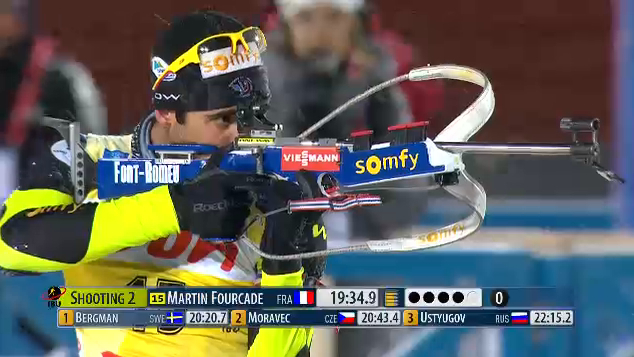
Martin Fourcade (FRA) missed just one shot on the first standing prone en route to a 12.3-second victory on Wednesday in at the first biathlon World Cup of the season in Ostersund, Sweden.
“Sometimes you go down in order to go higher.”
That’s what Martin Fourcade, the defending biathlon World Cup champion from France, told FasterSkier after finishing 48th in a cross-country World Cup race on Saturday.
He had finished more than a minute and a half behind Norwegian winner Martin Johnsrud Sundby in the men’s 15 k freestyle in Gällivare, Sweden. Not exactly what he’d hoped for, but he picked himself up and sat out Sunday’s mixed relay – the first official biathlon World Cup race of the season – to prepare for Wednesday.
This time last year in Östersund, Sweden, Fourcade won the men’s 20-kilometer individual start by nearly two minutes. How do you top that?
For starters, he’d have to win the first World Cup of the season again in the same place. And sometimes a closer race with a flair for the dramatic is more interesting anyways.
As the crowd “oohed” and “ahhed” over several favorites as they entered the range, Fourcade gave them something to gasp about. After missing just one shot on the first standing stage, he paused his typical rapid fire before his last shot on the fourth and final stage. One breath and then he executed, shooting 19-for-20 and finishing with a time of 50:44.7.
After starting near the front of the pack in bib 15, Fourcade waited near the finish for a several minutes as other top contenders rolled through. In the end, the effort was good enough with the next-closest finisher Dominik Landertinger of Austria placing second, 12.3 seconds back. It wasn’t the 1:54.3-minute margin Fourcade won by last year over Michal Slesingr (CZE), but he’d take it.
After two cross-country races in the last 10 days (the first of which he placed sixth in a FIS 15 k skate race, just 25 seconds behind Norwegian winner Petter Northug in Beitostolen, Norway), Fourcade said he was not his best shape. He took that into account Wednesday.
“I was able to shoot slowly today and not push so hard on the tracks,” Fourcade told IBU reporters on Wednesday. “I was confident with my shooting today.”
“I had some bad moments after the cross-country. I did not shoot and was tired,” he added. “I am a better athlete than last year. I was not so fast on the skis, but I was a better biathlete today with shooting and skiing.”
The runner-up with one missed shot on the second stage as well, Landertinger came on strong toward the finish, rising from 22nd to seventh between the second and third loops. After the fourth loop with one more to go, he ranked third and shot clean to bump an earlier finisher, Emil Hegle Svendsen (NOR), down to at least third. Starting nearly 40 bibs later, Germany’s Erik Lesser continued to pick off his competitors and shot clean to finish a career-best third, 21.7 seconds behind Fourcade.
Erik Lesser (GER) after notching a career-best third at the IBU World Cup opener on Wednesday in Ostersund, Sweden.
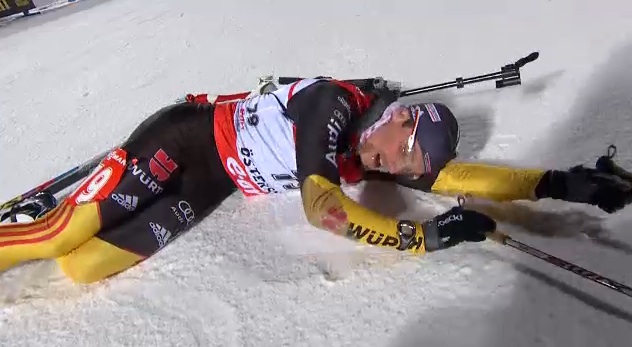
After collapsing at the finish, Lesser seemed a bit shocked about his result.
“Top twenty was my goal, but this is better,” he told reporters. “I am just a small guy from Germany who made it to the podium. … I knew I had to be good on the shooting range, so on the last standing I tried to be cool like Martin and Landi and shot zero.”
Svendsen placed fourth (+37.1) with two penalties – amounting for a total loss of two minutes – and Russia’s Evgeny Ustyugov was fifth with two penalties (+1:01.3). Ustyugov initially led out of the first prone stage, but Svendsen followed him into the range and shot clean to capture the lead. Meanwhile, Fourcade was just a second back.
In the first standing stage, Carl Johan Bergman (SWE) continued his clean-shooting streak, and Fourcade dropped to 15th. Svendsen suffered a big blow when he missed twice and was dealt two minutes of penalties, while Ondrej Moravec (CZE) cruised through three clean stages before missing two shots on the last. He ended up 14th and Bergman missed three shots between the last two stages to place 18th.
Fans cheered loudly as late starter Austrian Fritz Pinter entered the stadium to place sixth with one penalty (+1:06.1), and Erlend Bjoentegaard (NOR) and Krasimir Anev (BUL) placed seventh and eighth, respectively, with one miss apiece. Russia’s Anton Shipulin had three penalties yet pulled off ninth, and Jarkko Kauppinen (FIN) shot clean for 10th.
Perras Leads North Americans
Canadian Scott Perras had the best result among North Americans, finishing 32nd (+3:04) with two penalties on the first and second standing stages. The performance ranked among the top of his career in individual races, rivaling a 31st he tallied two seasons ago at a 20 k in Pokljuka, Slovenia. At one point, he was 27th after the third loop on Wednesday, but a final penalty minute cost him.
Perras had hoped for a top 30 going into the race, he explained in an email. “I enjoy the challenge of the Individual race and there are only two more this season,” he wrote. “I hope that I can start these and collect something a little more sizeable than 9 WC points. I am not satisfied with the skiing but feel it will improve as the season progresses.”
He was happy with his shooting so far this year after having worked hard to improve it.
“I love the moment when you enter the range with good shooting up to that point, this is where the next big challenge is in a race,” Perras wrote. “It’s what we train for. I executed well but left one target standing, more training and those type of experiences will be what allows me to perform on demand in moments like that.”
Trailing Perras by 2.7 seconds in 33rd, Tim Burke (USA) appeared to be running in fifth after cleaning the final shooting stage. However, after starting early in bib No. 8, his fourth-place rank at the finish gradually slipped away. He shot 17-for-20 with two misses on the first standing stage and another on the second prone, adding three minutes to his time for a cumulative of 3:06.7 seconds behind Fourcade.
“Going into today I had zero expectations,” Burke wrote in an email. “I have been sick for the majority of our pre season camp here in Sweden so I have not been able to do any hard training. I had no idea how my body would react for this hard effort so I was actually pretty happy with my skiing.”
He came down with a chest cold soon after arriving in Sweden two weeks ago. On Wednesday, he explained he was finally feeling better and his cough was going away. Considering the circumstances, he felt like he had a decent race “except for my shooting times,” he wrote.
“In the last standing I jammed a round and had to come out of position to load the rifle. With the times so close today, I could not afford this mistake,” Burke explained. “Going into this weekend, I am confident that the skiing will only get better so I am definitely hopeful for a good result in the sprint.”
U.S. teammate Lowell Bailey placed 37th with three penalties – one on each of the last three stages – and was 3:14.4 back. After placing ninth in the 20 k individual race there last year, he wrote in an email that he tried to forgo expectations and had planned to approach the season “less aggressively this year, with the hopes of increasing the ski speed as the season progresses.
“I had a great year of training and I’m confident with my plan going into the season,” Bailey wrote. “Although I wasn’t as high up on the result list as last year, I’m happy with the result. I was competitive on both the ski course and the shooting range and this is the most important thing to take away from today.
“The other thing to remember is that one penalty today, especially in the two and three penalty area, made a huge difference in the results,” he added. “But that is the nature of the Individual race, and the sport of biathlon generally!”
Canada’s Nathan Smith missed three shots for 55th (+4:40.7), and teammate Jean-Philippe Le Guellec went from hovering in the top 10, then top 20, to falling to 62nd with four penalties (two on each standing stage).
Of the Americans, Jay Hakkinen tied for 63rd with one penalty (+5:12.1), Leif Nordgren had four penalties for 75th and Russell Currier was 89th with eight misses.