Tag: Frozen Thunder

  • Crawford, Killick Fastest in Their Many Laps Around Frozen Thunder

    Crawford, Killick Fastest in Their Many Laps Around Frozen Thunder

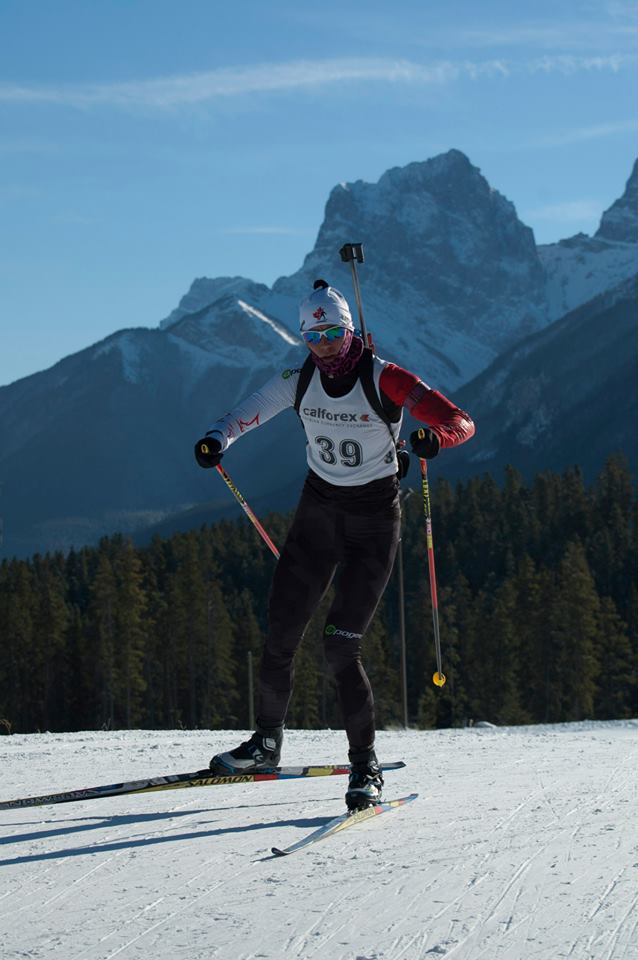
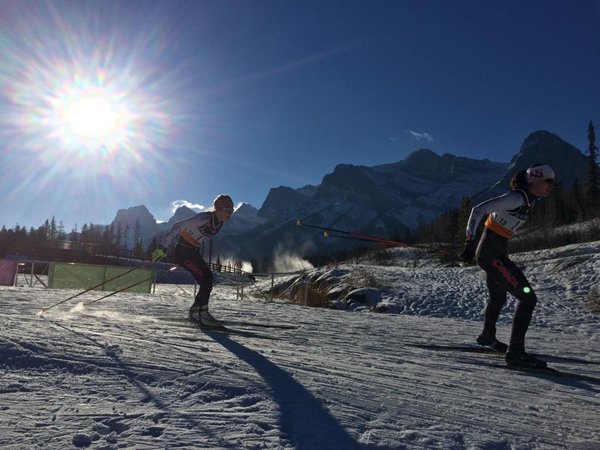
    Rosanna Crawford (right) and Emma Lunder on course at the Frozen Thunder 8 k skate race. The pair of national team biathletes went 1-2 in the women's rankings. Photo: Rosanna Crawford/Instagram.
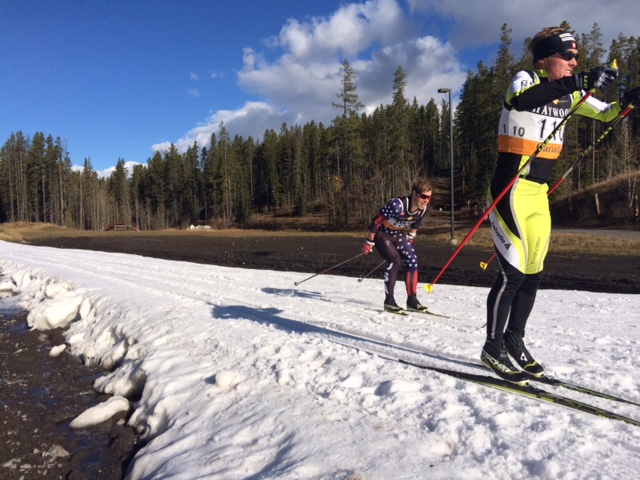
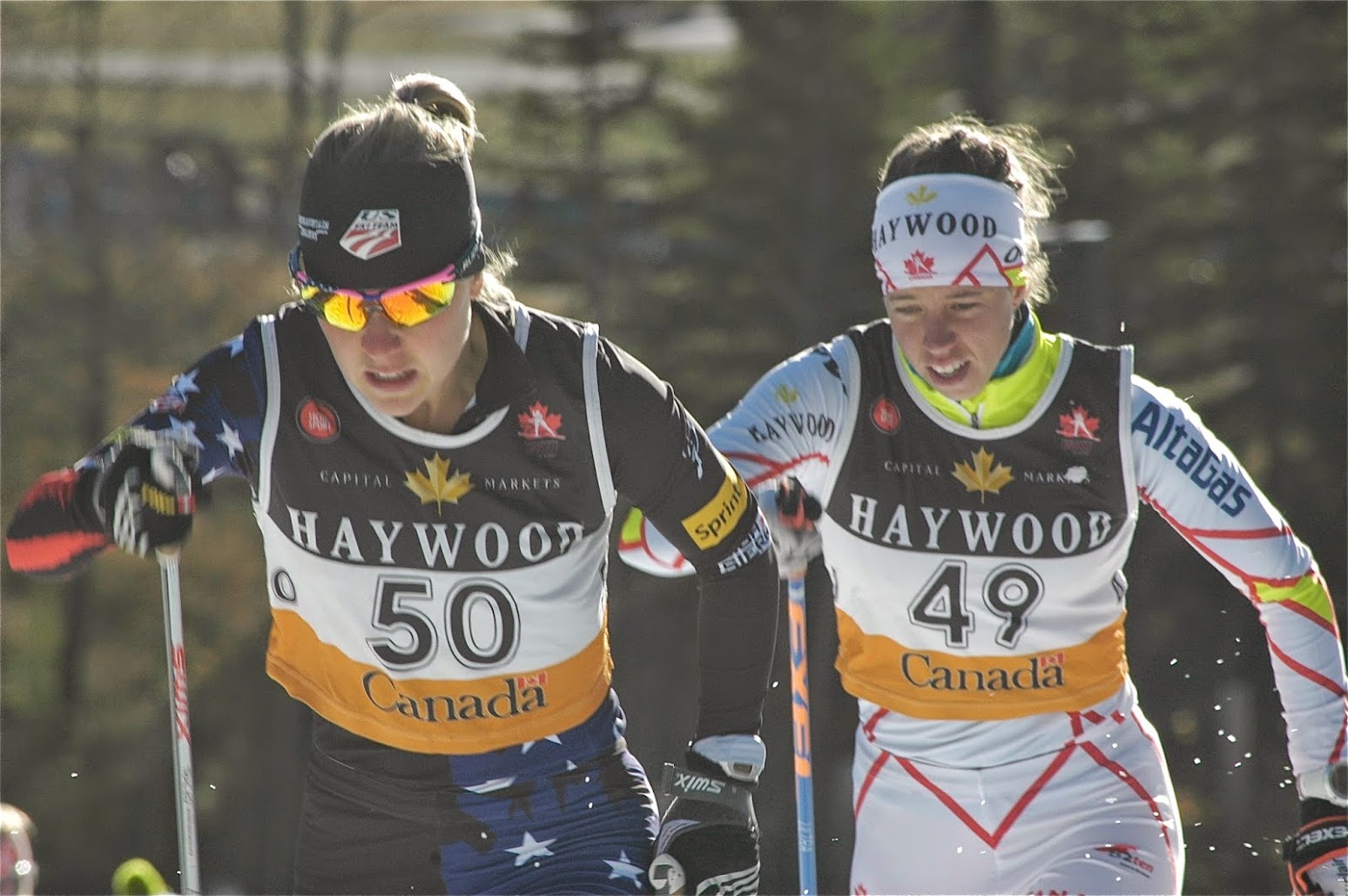
    Rosanna Crawford (right) and Emma Lunder on course at the Frozen Thunder 8 k skate race. The pair of national team biathletes went 1-2 in the women’s rankings. Photo: Rosanna Crawford/Instagram.

    “Putting a bib on always adds that extra bit of excitement and nerves!” Rosanna Crawford wrote in an email on Sunday.

    One of Canada’s top biathletes, Crawford had bested a field of North American nordic athletes the day before in an 8 k skate competition at Frozen Thunder, the saved-snow loop in Canmore, Alberta.

    “We’ve done a few biathlon [time trials] on snow, but it’s always fun to leave the rifle at home and just focus on the skiing,” wrote Crawford, who was 17.2 seconds faster than national team teammate Emma Lunder. “Going round and round the 900m [loop] made for a tough race, there isn’t much rest on that loop and you always have to be working.”
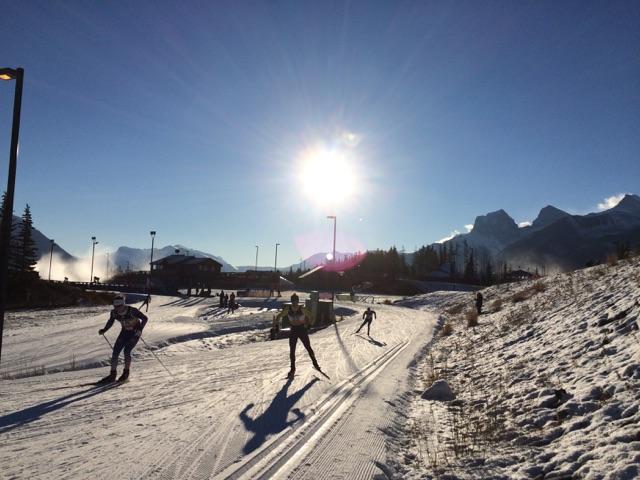
    Racing at the Canmore Nordic Centre on Saturday. Photo: Cross Country Canada.
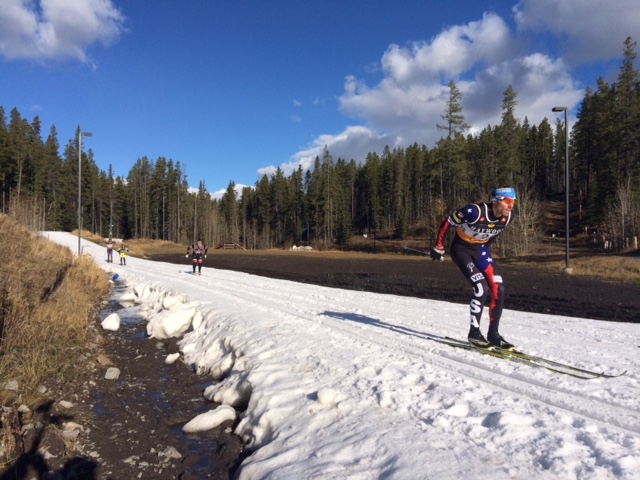
    Racing at the Canmore Nordic Centre on Saturday. Photo: Cross Country Canada.

    “I do feel that the increased amounts of intensity this year have helped me with speed – I feel quite strong going into this season, and it seems that my body is better at recovering from tougher workouts,” Lunder wrote in an email. “During the race Rosanna and I worked together for six out of the 8 loops which was great. We took turns leading and pulling and it was super fun to practice racing tactics with her. I think (especially for myself) skiing together helped us race even faster with the constant chasing/chase going on. It was motivating to try and react to her every move, and I was pretty psyched to actually lead us for a few of the loops.”

    Mary Rose of the Sun Valley Ski Education Foundation Gold Team finished third, another 18.5 seconds behind Crawford.

    “Putting a bib on and racing on snow is always an exciting experience,” the American skier, who won the Climb to the Castle rollerski race earlier this autumn, wrote in an email. “This time trial helped flush out the cobwebs and allowed me to focus on my race routine. This felt like a real race because it wasn’t just Sun Valley SEF Gold Team but several Canadians and the Canadian National Team. It was fun to get into the mix with athletes you don’t usually race with!”

    Crawford noted that with recent cold weather, she had been hoping for a longer loop in the Canmore woods.

    “It’s unfortunate the Nordic Centre wasn’t a bit more on top of having the snow guns out,” she wrote. “We had about 10days of below -5 temps at night and could have had a 3-4km loop by now! …It almost looks like the race season should have started in Canmore will how snow looks in Europe right now!”

    She’s not wrong. Although Norwegian ski areas pour money into saving and making snow to provide early skiing, the weather in central and northern Europe has not been cooperating this year and some early-season venues are struggling to provide quality on-snow training.

    Annika Hicks of Canmore Nordic was the top Canadian cross-country skier, finishing fourth. Her time was a minute and 17 seconds slower than Crawford.

    In the men’s 10 k race, Graeme Killick of the Canadian National Ski Team took an 8.1-second victory over Kevin Sandau of the Alberta World Cup Academy. Spandau in turn eked out a time just 0.9 seconds faster than National Ski Team stalwart Ivan Babikov to secure second place.

    Rose’s Sun Valley teammate Rogan Brown placed fourth, +27.3.
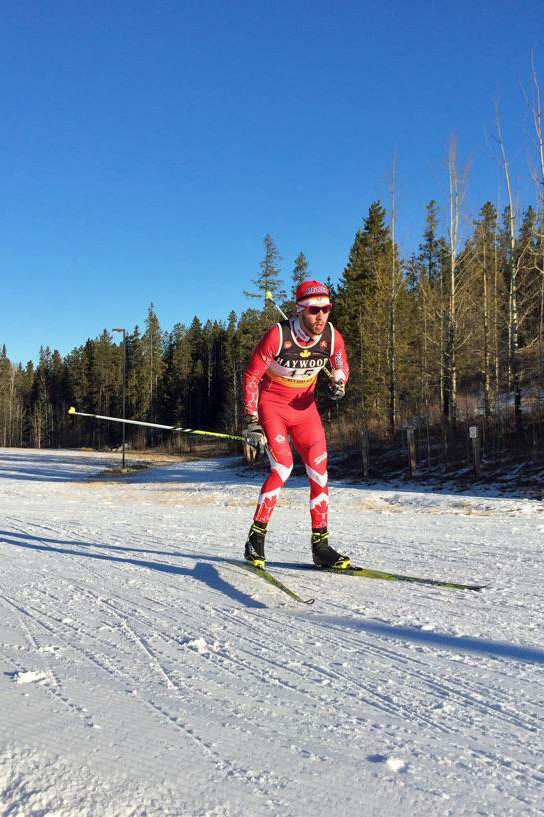
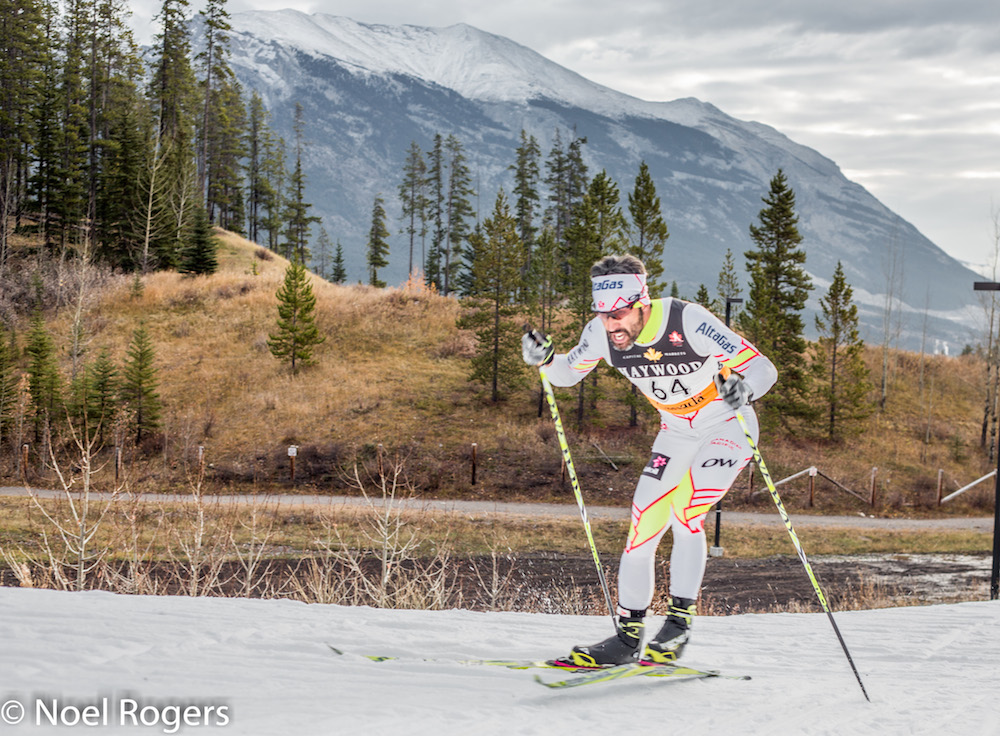
    Graeme Killick skating to victory. Photo: Cross Country Canada.
    Graeme Killick skating to victory. Photo: Cross Country Canada.

    From here the athletes are headed either to Europe for the opening races of the World Cup season, or to other locations in North America to kick off domestic points series.

    “I always look forward to the start of the season, heading to Sweden, knowing I get to visit my favourite Euro yarn store in Östersund, seeing all your friends and getting ready to see if all your hard work in the summer has paid off,” Crawford wrote. “We have a few more weeks until the first race, so training is still intense, a mix of volume and intensity. I seem to be strong in December and then not quiet as good the rest of the year. So we are trying a bit of a different approach to keep a better fitness through out the year.”

    Rose will race next in West Yellowstone, Montana.

    “The first races of the season will be in West Yellowstone, MT during Thanksgiving week,” explained Rose, who writes on her website that her sights are set on the Ski Tour Canada World Cup races later in the season. “From there we head home to Sun Valley for the second set of SuperTour races… My fitness is where I want it to be right now, but there is obviously room for improvement in the coming weeks. My goal is to keep building fitness as the season progress.”

    Others don’t know yet where they are headed: Lunder wrote that the biathlon team has time trials November 10th and 13th to determine who will go to the World Cup (of the positions which were not pre-selected) and who will go to the second-tier IBU Cup.

    Results: men / women

  • FS Podcast: Weeks Away from Season Opener, Canadian Coach Wadsworth Optimistic

    FS Podcast: Weeks Away from Season Opener, Canadian Coach Wadsworth Optimistic

    The 2015/2016 Canadian National Senior Team, with co-head World Cup coaches Justin Wadsworth (l) and Louis Bouchard (second from l) and athletes (from l to right) Jess Cockney, Len Valjas, Dahria Beatty, Alex Harvey, Cendrine Browne, Devon Kershaw, Katherine Stewart-Jones, Ivan Babikov, Emily Nishikawa, Knute Johnsgaard, Olivia Bouffard-Nesbitt, technical services coordinator Joel Jaques, and Graeme Killick during a photo shoot in their new Swix training wear in Canmore, Alberta. (Photo: CCC)
    The 2015/2016 Canadian National Senior Team, with co-head World Cup coaches Justin Wadsworth (l) and Louis Bouchard (second from l) and athletes (from l to right) Jess Cockney, Len Valjas, Dahria Beatty, Alex Harvey, Cendrine Browne, Devon Kershaw, Katherine Stewart-Jones, Ivan Babikov, Emily Nishikawa, Knute Johnsgaard, Olivia Bouffard-Nesbitt, technical services coordinator Joel Jaques, and Graeme Killick during a photo shoot in their new Swix training wear in Canmore, Alberta. (Photo: CCC)


    Six years in as the Canadian national team’s head coach, Justin Wadsworth speaks with tempered confidence. And there’s good reason for that. After concluding an altitude camp in Park City, Utah, three weeks ago, he says the Canadians are fit, healthy and primed for what he hopes will be a special season.

    FasterSkier reporter Jason Albert spoke with Wadsworth last Friday, Oct. 23, three days before the Frozen Thunder classic sprint in Canmore, Alberta.

    Wadsworth attributes some of the team’s positive outlook to an organization emphasizing better communication and collaboration between the national team and regional training centres.

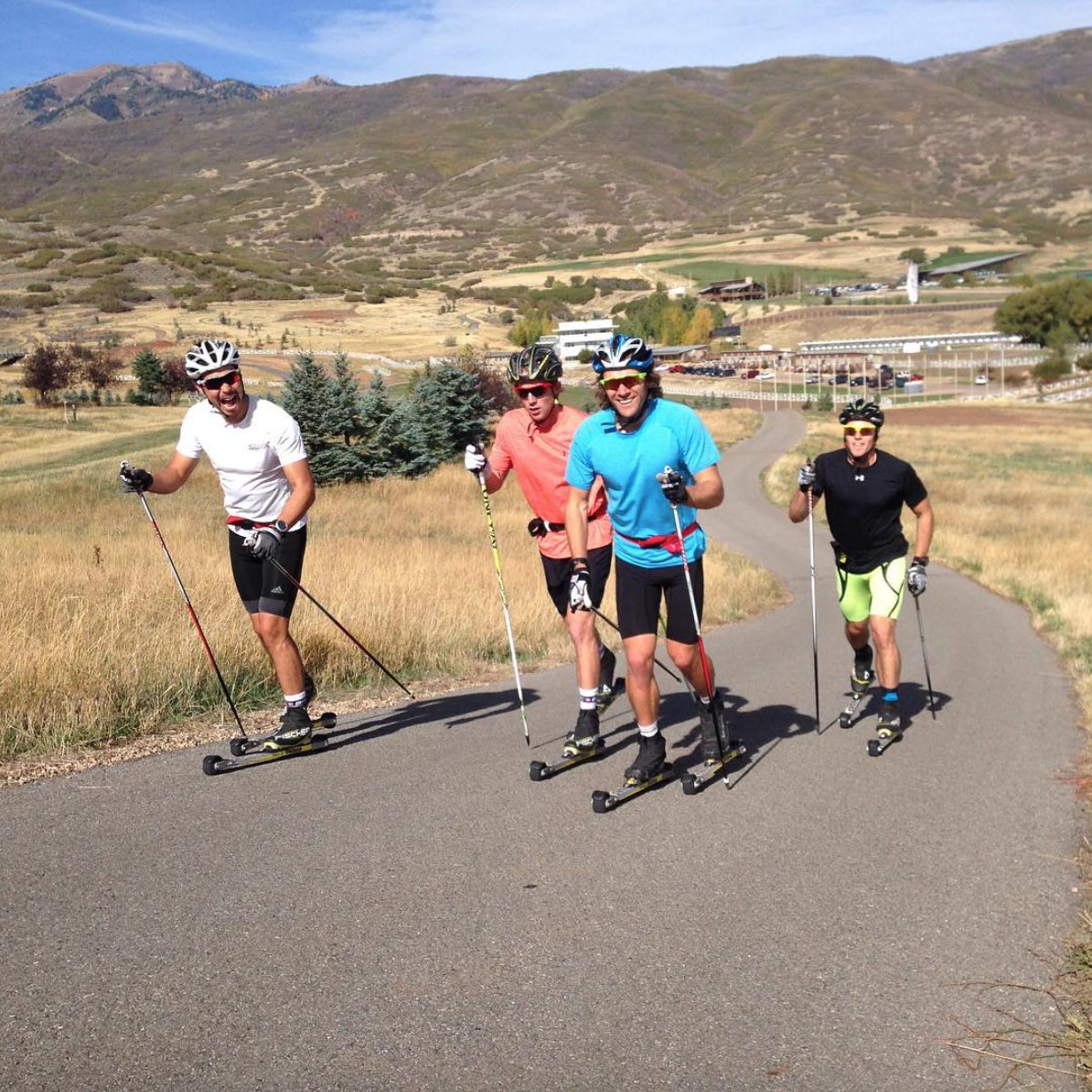
    Graeme Killick, Jess Cockney, Devon Kershaw, and Michael Somppi rollerski at Soldier Hollow during their last day of a dryland altitude camp near Park City, Utah. (Photo: Ivan Babikov/Instagram)
    Graeme Killick, Jess Cockney, Devon Kershaw, and Michael Somppi rollerski at Soldier Hollow during their last day of a dryland altitude camp near Park City, Utah. (Photo: Ivan Babikov/Instagram)

    “I feel like we’ve struggled with that a little bit in the past, but now more than ever, our training centres, coaches, and national training centre are really working closely together,” he explained.

    Canada’s series of training camps this summer and fall were an opportunity for skiers striving for international starts to work out with World Cup skiers.

    “I really feel like this year has been a huge success and a step forward a far as our collaboration with the training centres,” Wadsworth said. “I think we have a very methodical stable program and we are just checking off the boxes and now we are coming up to that part of the season where we have to transition all that into speed on the snow.”

    According to Wadsworth, national-team skiers like Emily Nishikawa are ready for that transition.

    “She’s in the best shape she’s ever been in by far,” he said.

    He added that veteran World Cup skier Ivan Babikov is returning to his former levels of fitness.

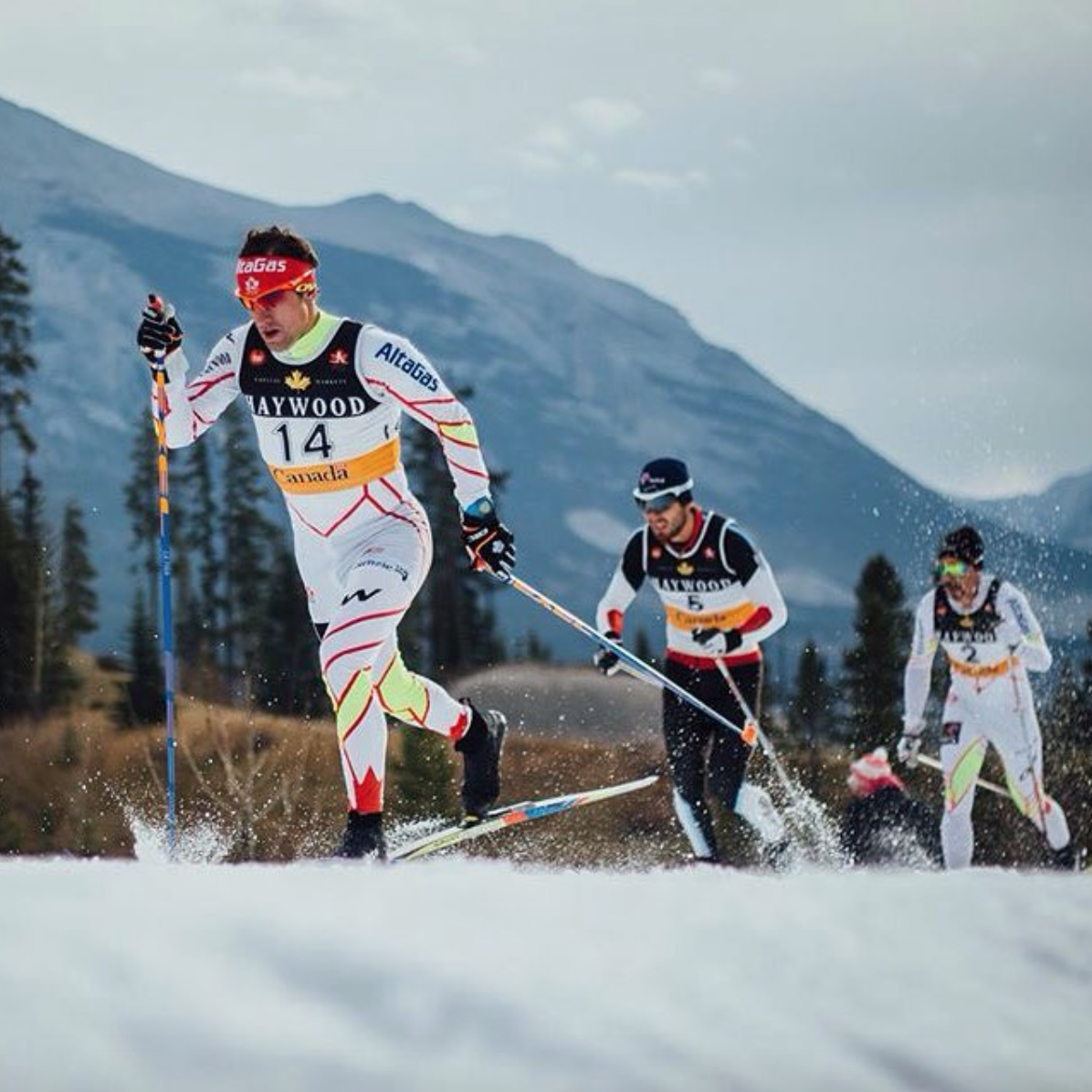
    Canadian World Cup veteran Ivan Babikov (14) during the Frozen Thunder classic sprint on Monday, in which he placed third. (Photo: Marie-Eve Bilodeau-Corriveau/Instagram)
    Canadian World Cup veteran Ivan Babikov (14) leads Patrick Stewart-Jones and Jess Cockney (r) during the Frozen Thunder classic sprint on Monday, in which he placed third. (Photo: Marie-Eve Bilodeau-Corriveau/Instagram)

    “He showed us in the time trial in Soldier Hollow. He was five seconds behind Alex [Harvey] in that, and we all know where Alex is,” Wadsworth said.

    With two individual World Championship medals last season, it’s hard to imagine Harvey could exceed expectations this season. But post iliac artery surgery, Wadsworth says Harvey is a new skier.

    “His surgery really allowed him to come to a new level. He’s just been breaking all his running time trial efforts by minutes,” Wadsworth said. “He’s going to be scary this year with his legs feeling good.”

    After on-snow racing this week at Frozen Thunder, the national team heads to Gällivare, Sweden, in mid-November for its final preseason training camp. The World Cup eventually lands in Canada in March for the 2016 Ski Tour Canada. As the host country, Canada is allotted 26 starts in the tour: 14 male and 12 female, Wadsworth said.

    He acknowledged expectations are high. “Without a doubt our biggest race this year is the Tour of Canada,” he said. “It’s our World Championships, and we really want to have a lot of great results there from all different levels of our program.”

  • Stage Craze Hits Soldier Hollow: USST Caps Camp with Mini Tour

    Stage Craze Hits Soldier Hollow: USST Caps Camp with Mini Tour

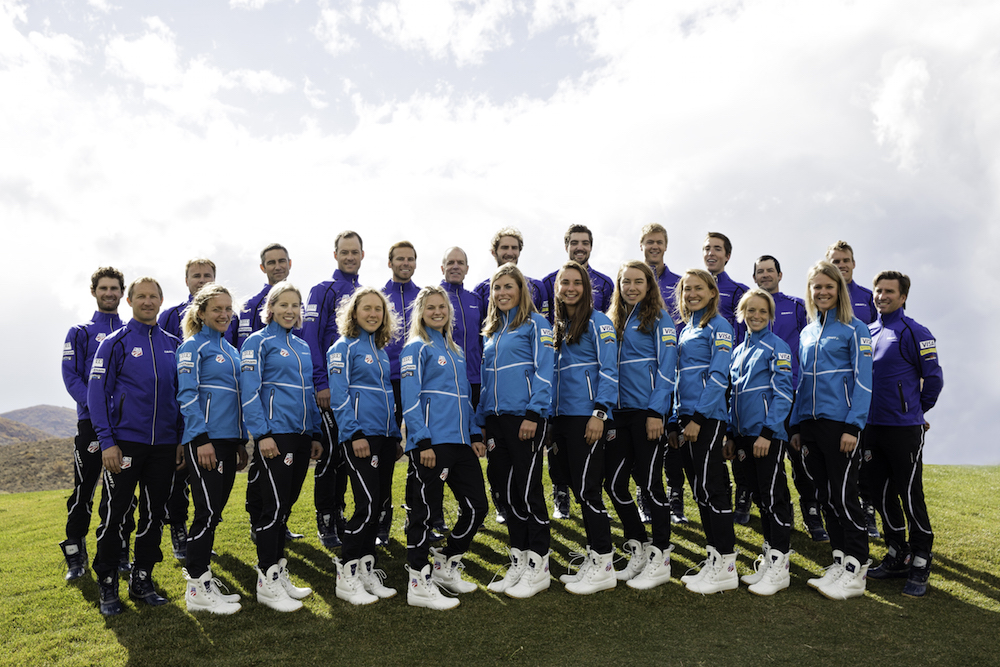
    The 2015/2016 U.S. Nordic Ski and Nordic Combined teams during a team photo shoot in their new uniforms on Monday, Oct. 19, in Park City, Utah. (Photo: USSA)
    The 2015/2016 U.S. Nordic Ski and Nordic Combined teams during a team photo shoot in their new uniforms on Monday, Oct. 19, in Park City, Utah. (Photo: U.S. Ski Team)

    Over the last two weeks, the U.S. Ski Team and many of the nation’s top skiers have been hitting the hardtop and trails around Park City, Utah, intent on getting in quality training sessions at altitude before heading off to on-snow camps. The area’s consistent fall weather and training opportunities, including the rollerski loop at Soldier Hollow, make this camp an annual team staple.

    Many of the country’s most competitive nordic skiers outside the U.S. Ski Team (USST) are also in Park City, drawn there by the opportunity to train with the team before it heads to Europe for the start of the World Cup in late November.

    USST Head Coach Chris Grover estimated there were slightly more than 30 athletes at the camp, with all 16 national-team members, plus skiers from the National Training Group, Alaska Pacific University (APU), the Sun Valley Ski Education Foundation (SVSEF) Gold Team, Stratton Mountain School (SMS) T2 Team, and the Craftsbury Green Racing Project. On the phone earlier this week, Grover expressed excitement about a, “nice mix of some younger guys and some veterans, and top club athletes and the national team.”

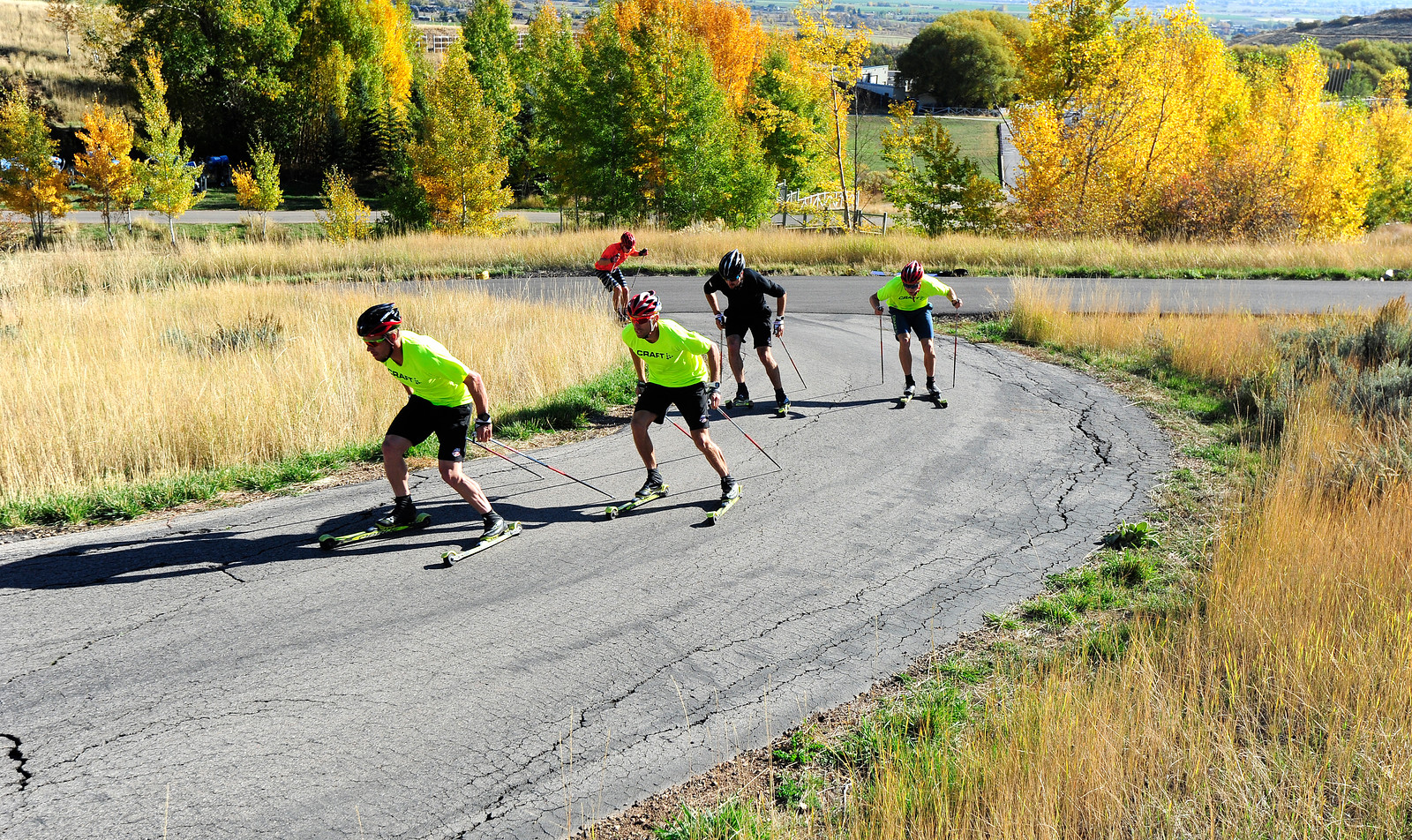
    U.S. Cross Country Ski Team roller ski training on the Olympic trails at Soldier Hollow, Utah. (U.S. Ski Team - Tom Kelly)
    The U.S. Ski Team trains on the Olympic trails during its annual fall camp at Soldier Hollow in Midway, Utah. (Photo: U.S. Ski Team/Tom Kelly)

    Although this is a national-team camp, guest athletes are invited to attend the high-intensity workouts as well as the long, over-distance sessions when the venue safely allows them to do so, Grover explained.

    During the first week of camp the focus has been on threshold, some testing and speed workouts, and something called “The Double Pole Project.” Grover described this as a pre-workout video session meant to aid in transferring the athletes’ work in the weight room to lower abdominal engagement in their double-pole technique. Stemming from a plan shared at the World Cup coaches’ seminar in Trondheim, Norway, in late August, the team integrated this into their camp with hopes of seeing this strength technique come through this winter.

    After the initial week of mellow, acclimatization-based workouts and technique focus, the second week of training included more intensity. On Tuesday, Grover highlighted that morning’s 6 x 4-minute ski bounding session as one that got both athletes and coaches excited. Whether it was the sun beaming down or the lower elevation training site in Salt Lake City, the first full-group, high-intensity workout of the camp went off without a hitch, he said. It also provided a preview of the intensity coming at the end of camp: a three-day rollerski mini tour starting on Sunday.

    U.S Ski Team members Andy Newell and Ben Saxton training on the Olympic trails at Soldier Hollow in Midway, Utah. (Photo: U.S. Ski Team/Tom Kelly)
    U.S Ski Team members Andy Newell and Ben Saxton training in mid-October on the Olympic trails at Soldier Hollow in Midway, Utah. (Photo: U.S. Ski Team/Tom Kelly)

    In the past, the USST ended its Park City camps with rollerski time trials. This season, without a World Championships or Olympics, and with over half the the World Cup races being tour-stage events (19 to be exact), Grover and his staff decided to shift from race simulations to stage events.

    “We’ve definitely put an emphasis on practicing not only how to manage energy from day to day, but how to recover optimally from each session,” Grover said.

    The team saw some success at Norway’s Toppidrettsveka mini tour this summer, with Liz Stephen and Noah Hoffman placing third in the hill climb, but also encountered bad luck with broken poles and several crashes in the last stage of that tour, Grover said. These are the types of mishaps he’s hoping the tour simulations will minimize in races this winter.

    The mini tour will start this Sunday, Oct. 25 with a freestyle sprint, followed by a shorter classic mass start on Monday, and ending with a longer freestyle pursuit on Tuesday.

    The national team also unveiled its new uniforms this week. L.L. Bean and Craft signed as the team’s clothing sponsors this spring and revealed the new suits and warmups with the team on Monday in Park City. Grover explained the shift to L.L. Bean and Craft as one that’s been “excellent” because it provides a “…uniform that is totally unique to the USA.” He also believes the team will benefit from the wide range of pieces available through these larger companies.

    Coach Matt Whitcomb works with Jessie Diggins at at U.S. Cross Country Ski Team roller ski training on the Olympic trails at Soldier Hollow, Utah. (U.S. Ski Team - Tom Kelly)
    U.S. women’s coach Matt Whitcomb works with Jessie Diggins during rollerski training at the U.S. Ski Team’s annual fall camp at Soldier Hollow in Midway, Utah. (Photo: U.S. Ski Team/Tom Kelly)

    The first World Cup is a little more than a month away in Kuusamo, Finland, and aside from D-team rookie Julia Kern rebounding from a slight back injury, the team is healthy, Grover said. Erik Bjornsen has resumed training at full capacity after surgery on his hand and a knee injury earlier this summer.

    Team veteran Kikkan Randall recently announced her pregnancy and will be missing this season as a result. Grover was fully supportive, acknowledging her pregnancy as one of Randall’s long-term goals. The timing also worked nicely without a World Championships or Olympics this season. While Randall has been training with the team in Park City, she has scaled back her intensity and shifted toward over-distance and technique training, Grover explained.

    Without a major championship on the World Cup calendar this season and a North American tour — the Ski Tour Canada — in its place, domestic competition for the additional start spots is something many U.S. and Canadian athletes are looking forward to. Per the “national quota” regulations of the World Cup, the U.S. will be able to start five additional men and five additional women for the entire Ski Tour Canada, for a total of up to 24 racers.

    While Grover said the upcoming mini tour in Park City would not decide those spots, he explained the coaches were using this week’s training sessions to note the fitness of non-national team athletes. However, on-snow results will ultimately determine who receives those Canadian World Cup starts. More on the 2015/2016 World Cup Team selection criteria here.

    After wrapping up the mini tour on Tuesday, the USST will leave Utah on Wednesday. Several clubs will head directly to Canmore, Alberta, for an on-snow camp at Frozen Thunder, while others, like APU and its USST members, will head back to Alaska in hopes of getting on snow as well.

    The USST will reconvene Nov. 13 to fly to Gällivare, Sweden, where they’ll hold a camp and compete in a couple FIS races before traveling to Kuusamo for the World Cup openers.

    ***

    About the Author: New to the FasterSkier team, Jeremy has been involved in many facets of the ski community since he began ditching middle school to go skiing. When not daydreaming of the Birkie, he finds time to explore the fishing and trail-running opportunities of his new home, Seattle, Wash. 
  • Biathlon Canada Wraps Up Trials, Selects World Cup and IBU Cup Teams

    Biathlon Canada Wraps Up Trials, Selects World Cup and IBU Cup Teams

    Nathan Smith racing to his second-straight win in two races at Biathlon Canada's World Cup/IBU Cup trials in Canmore, Alberta, which determined Canada's teams for World Cups 1, 2 and 3 this winter. Smith was prequalified. (Photo: Justin Brisbane)
    Nathan Smith racing to his second-straight sprint win on Friday at Biathlon Canada’s World Cup/IBU Cup trials in Canmore, Alberta, which determined Canada’s teams for early season international races this winter. Smith was prequalified for the World Cup. (Photo: Justin Brisbane)

    Canadian World Cup and IBU selection races wrapped up Friday, with some shuffling of finishers making for a very close race for the available international starts. For the second-straight day in a row, the men raced a 10.2-kilometer sprint and the women raced 7.2 k on the modified Frozen Thunder course (with loops of 3.4 k and 2.4 k, respectively).

    Mark-Andre Bedard (Team Quebec) shooting a perfect prone on Friday in the second sprint of Biathlon Canada's World Cup/IBU Cup trials. He went on to miss one standing to place third overall and make the World Cup team. (Photo: Justin Brisbane)
    Mark-Andre Bedard (Team Quebec) shooting on Thursday in the first sprint of Biathlon Canada’s World Cup/IBU Cup trials. He went on to miss one standing to place third overall and make the World Cup team. (Photo: Justin Brisbane)

    The men raced first, with Nathan Smith again claiming the win in 26:30, besting Biathlon Canada teammate Brendan Green in second by 33 seconds. Marc-André Bédard (Team Quebec) took third. All three of the podium finishers had a single miss on the day.

    Bédard ended up with the highest-combined race percentage of all athletes who were not pre-selected for the World Cup. The lone male member of Team Quebec competing at the trials in Canmore, Alberta, Bédard said, “I felt like an underdog again.”

    Despite opting not to train with the national team this year, he was still able to earn a spot on the early-season World Cup team. Bédard spent most of his summer competing in extreme-obstacle races (like the Obstacle Course Racing World Championships), for which he said he trained the hardest of his career.

    “It’s not a surprise for me to have done well [today], but it truly is surprising I made it to the World Cup,” Bédard said after Friday’s race. “I’ve never been able to get on [the World Cup] this early and this year I decided to enjoy the sport and take it as it comes.”

    Bédard joins pre-selected athletes Smith and Green, as well as, World Cup veteran Scott Perras on Canada’s World Cup team.

    The men’s IBU Cup team is made up of Maxc Davies, Carson Campbell, and brothers Scott and Christian Gow.

    Rosanna Crawford (Biathlon Canada) racing to her second-straight victory of Canada's World Cup/IBU Cup trials in Canmore on Friday. She missed two standing, but finished 32 seconds ahead of anyone else for the win. Crawford prequalified for World Cup starts. (Photo: Mark-Andre Bedard shooting a perfect prone on Friday in the second sprint of Biathlon Canada's World Cup/IBU Cup trials. He went on to miss one standing to place third overall and make the World Cup team. (Photo: Justin Brisbane)
    Rosanna Crawford (Biathlon Canada) racing to her second-straight victory of Canada’s World Cup/IBU Cup trials in Canmore on Friday. She missed two standing, but finished 32 seconds ahead of anyone else for the win. Crawford prequalified for World Cup starts. (Photo: Mark-Andre Bedard shooting a perfect prone on Friday in the second sprint of Biathlon Canada’s World Cup/IBU Cup trials. He went on to miss one standing to place third overall and make the World Cup team. (Photo: Justin Brisbane)

    In the women’s 7.2 k race on Friday, Crawford notched her second-straight victory in 23:50, 32 seconds ahead of Biathlon Canada teammate Audrey Vaillancourt, despite two standing penalties. Vaillancourt had one standing miss and finished 42 seconds ahead of  junior Sarah Beaudry (with one prone and one standing miss) in third.

    Vaillancourt was the top woman outside of the pre-selected team, earning her a World Cup start with Crawford and two other national-team members: Zina Kocher and Megan Heinicke.

    Starting out the season on the IBU Cup tour are Beaudry, Emma Lunder, Julia Ransom, and Claude Godbout.

    Lunder, who is new to the national team as well as the Biathlon Alberta Training Center, wrote in an email that she’s excited to join her new teammates, Ransom and Beaudry, on the IBU Cup this year.

    “I’m really excited to be heading overseas to race,” she wrote. “I’m happy with how the trials races went, of course there are a few things I want to work on in the next few weeks, but I’m feeling good about the season!”

    Having made her World Cup debut last year, Lunder said she’s motivated to work her way up to the World Cup circuit with her sights set on qualifying for World Championships. If that doesn’t pan out, she added that racing at home for IBU Cups 7 and 8 in Canmore will be her season highlights.

    This year, Biathlon Canada chose its early season World Cup/IBU Cup teams through a selection process instead of allocating quota spots off selection races. According to High-Performance Director Christopher Lindsay, the availability of more quality athletes makes creating a strong team more probable. With more Canadian biathletes becoming eligible for international racing by meeting set high-performance standards, Lindsay said both coaches and the high-performance committee could ensure their athletes would be competitive on the world stage.

    Friday’s results

    The Shakedown

    Starting at World Cup 1:
    Rosanna Crawford (pre-selected based on meeting Biathlon Canada World-Cup B standard for overall performance in 2013/2014)
    Megan Heinicke (selected based on 2013/14 in-season results as ranked by the 2014/2015 AAP and Squads & Teams Criteria List)
    Zina Kocher (selected based on 2013-14 in-season results as ranked by the 2014-2015 AAP and Squads & Teams Criteria List; and a combination of key out-of-season time trial and competition results as per NTP)
    Audrey Vaillancourt (best percentage at Nov 13-14 Time Trial; and 2013/14 in-season results as ranked by the 2014-2015 AAP and Squads & Teams Criteria List)
    Nathan Smith (pre-selected based on meeting Biathlon Canada World-Cup B standard for overall performance in 2013/2014)
    Brendan Green (pre-selected based on meeting Biathlon Canada World-Cup B standard for overall performance in 2013/2014)
    Marc-André Bédard (best percentage at Nov 13-14 Time Trial outside of the pre-selected athletes)
    Scott Perras (selected based on 2013/14 in-season results as ranked by the 2014/2015 AAP and Squads & Teams Criteria List; and a combination of key out-of-season time trial and competition results as per NTP)
    ***
    Selected to IBU Cup Tour 1:
    Sarah Beaudry (best percentage at Nov 13-14 Time Trial; and a combination of key out-of-season time trial and competition results as per NTP)
    Emma Lunder (best percentage at Nov 13-14 Time Trial; and a combination of key out-of-season time trial and competition results as per NTP)
    Julia Ransom (best percentage at Nov 13-14 Time Trial; and a combination of key out-of-season time trial and competition results as per NT )
    Claude Godbout (best percentage at Nov 13-14 Time Trial)
    Scott Gow (pre-selected based on meeting Biathlon Canada IBU Cup B standard for overall performance in 2013/2014)
    Christian Gow (best percentage at Nov 13-14 Time Trial; and a combination of key out-of-season time trial and competition results as per NTP)
    Macx Davies (best percentage at Nov 13-14 Time Trial; and a combination of key out-of-season time trial and competition results as per NTP)
    Carsen Campbell (based on best percentage at Nov 13-14 Time Trial)
    ***
    Selections for starting spots at World Cups 2 and 3 will be determined based on results from World Cup 1, World Cup 2, IBU Cup 1, IBU Cup 2, the Nov. 13-14 time trials, and NorAm Cup #1.
    — above information from Chris Lindsay, Biathlon Canada high-performance director
  • Smith, Crawford Win Opening Sprints of Canadian World Cup/IBU Cup Trials in Canmore (Updated)

    Smith, Crawford Win Opening Sprints of Canadian World Cup/IBU Cup Trials in Canmore (Updated)

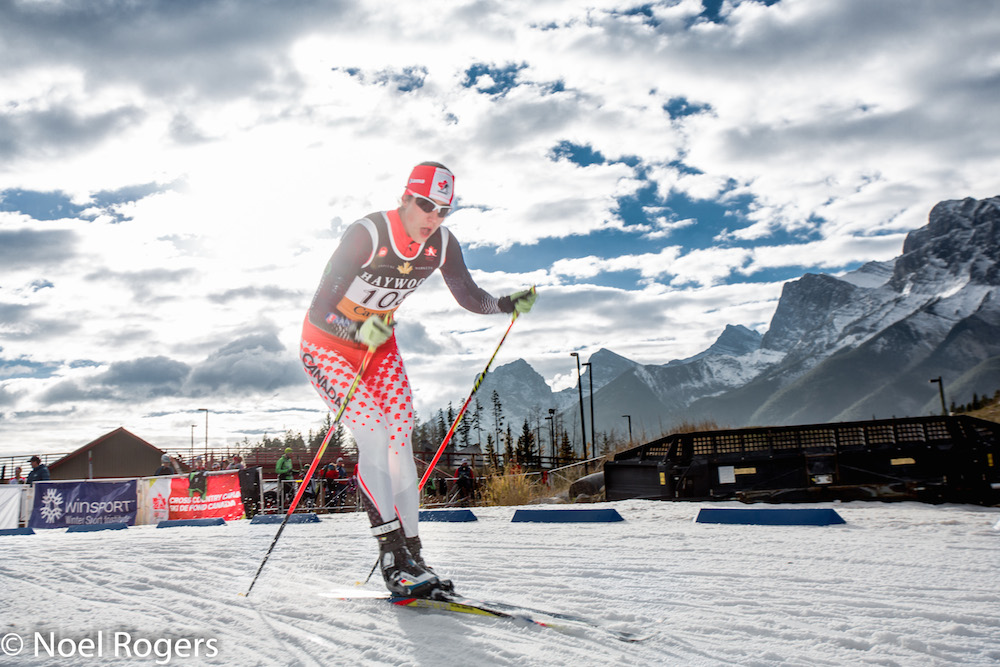
    Rosanna Crawford racing to the win in Monday's distance race at Frozen Thunder in Canmore, Alberta. (Photo: Noel Rogers/Bow Valley Photography)
    Rosanna Crawford racing to the win in the cross-country distance race on Oct. 27 at Frozen Thunder in Canmore, Alberta. She win on to win her second-consecutive race at Frozen Thunder on Thursday with a victory in the 7.5 k sprint at Canada’s IBU World Cup/IBU Cup trials. (Photo: Noel Rogers/Bow Valley Photography)

    Day one of the Canadian World Cup and IBU Cup selections races took place at the Canmore Nordic Center on Thursday. The sprint race format consisted of three laps of the 3.4-kilometer Frozen Thunder loop for men, and three laps of the 2.4 k track for the women.

    Cold temperatures dropping well below -20 degrees Celsius (-4 Fahrenheit) made the tracks hard packed and squirrelly for racers. The 10.2 k men’s race started at noon due to the cool morning with women’s 7.2 k following 45 minutes later.

    In the men’s race, Biathlon Canada’s Nathan Smith claimed the first victory of the season, clocking in at 26:57 minutes. Despite two misses in his last bout of shooting, Smith maintained strong ski speed to land on top of the podium. Marc-Andre Bedard of Team Quebec was just 12 seconds with perfect shooting for second. Macx Davies (Biathlon Canada) rounded out the top three another 25 seconds back, with three penalties.

    “Wasn’t looking for anything else than give my best and have fun!” tweeted Bedard after the race. The former Olympian has been focusing on obstacle racing for much of the year.

    The women’s race saw national-team veteran Rosanna Crawford take the win, with just one miss and the fastest time of 23:35. Emma Lunder, a new member to Biathlon Canada and the Biathlon Alberta Training Center, also had one miss and fought to stay with Crawford on her final lap for second overall, 1:08 back. Audrey Vaillancourt, another national-team member as well as an Open European Championship winner, finished in third, 9 seconds behind Lunder, with two penalties.

    Chilly morning for our first of two races up at the Nordic Center, happy to hit 9/10 when it’s hard to feel your fingers!” Crawford posted on her facebook fan page.

    Racing continues Friday with another set of sprints. Crawford, Smith and Brendan Green prequalified for World Cups 1, 2 and 3, and Scott Gow prequalified for IBU Cups 2 and 3 (although he’s aiming for a World Cup spot instead).

    In all, Canada has eight male and eight female quota spots, with four from each gender being tapped for the World Cup and four selected to the IBU Cup after trials. Qualifiers are expected to have shot at least 80 percent in two races this year, and come within 90 percent of the average of the podium finishers’ times at trials. The high-performance committee will review all results and select the team based on results and consistency, with a major focus on trials but also including other considerations as well.

    For more on selection criteria, click here.

    Thursday’s results

    ***

    About the author: Evan Brian Paul Girard is a student, an athlete and an adventurer. He grew up in a small town in Saskatchewan called Oxbow with a population of about 1,200. Biathlon Saskatchewan’s provincial coach Doug Sylvester introduced him to the sport at age 17. Having never cross-country skied or shot a target rifle, Girard was nearly a decade of training behind his fellow competitors, and he spent the next two years training with Biathlon Saskatchewan. In the spring of 2013, he was accepted as a member of the high-performance team, Rocky Mountain Racers, based out of the Bow Valley in Canmore. In December 2013, he competed for Canada for the first time as a biathlete at the Winter Univerisade in Trentino, Italy.

  • Kershaw, Crawford Earn Victories in Frozen Thunder Distance Races

    Kershaw, Crawford Earn Victories in Frozen Thunder Distance Races

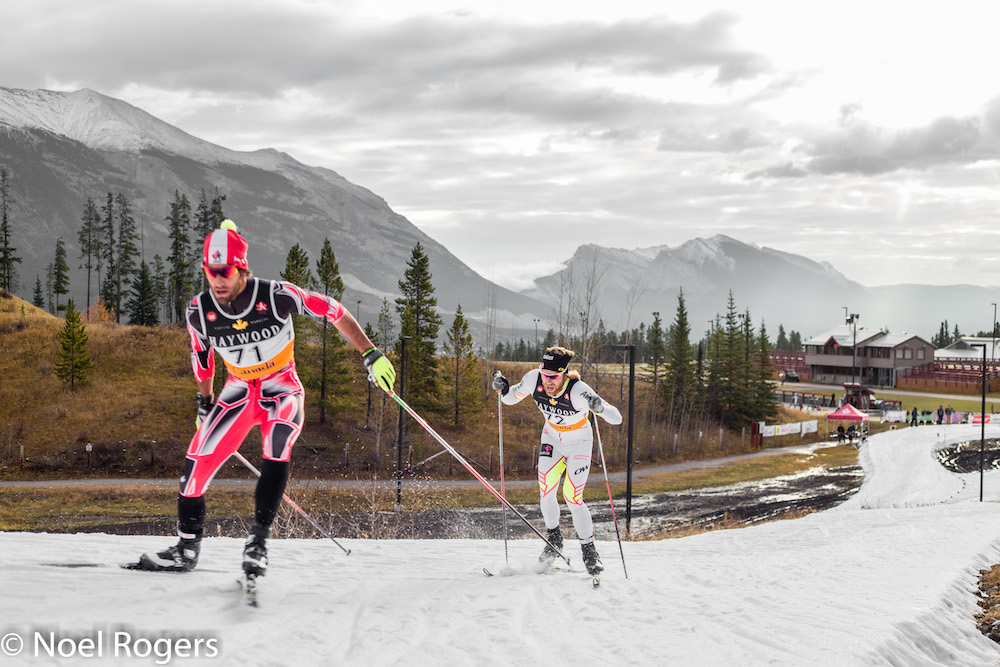
    Scott Perras (l) with Devon Kershaw on his heels in Monday's Frozen Thunder distance race at the Canmore Nordic Centre. (Photo: Noel Rogers/Bow Valley Photography)
    Devon Kershaw (r) chases down biathlete Scott Perras during Monday’s Frozen Thunder 10.8 k freestyle interval start at the Canmore Nordic Centre. Kershaw went on to win, and Perras placed third. (Photo: Noel Rogers/Bow Valley Photography)

    A 1.8-kilometer loop can get crowded with 101 racers, especially when each competitor is racing anywhere from four to six laps.

    Such was the case at Monday’s Frozen Thunder freestyle-individual start in Camore, Alberta. Jumping at the chance for on-snow training and racing in October, groups including the U.S. Ski Team and Canadian national cross-country and biathlon teams converged on the Canmore Nordic Centre.

    In the men’s 10.8 k race, the good ol’ boys of North American nordic skiing came out on top.

    Devon Kershaw of the Canadian World Cup Team skied his way to a win in the freestyle-interval start in Canmore, Alberta, with a time of 23:00.4.

    Canadian Para-Nordic Team veteran Brian McKeever placed eighth in Frozen Thunder's 10.8 k freestyle interval start on Oct. 27 in Canmore, Alberta. (Photo:  Noel Rogers/Bow Valley Photography)
    Canadian Para-Nordic Team veteran Brian McKeever placed eighth in Frozen Thunder’s 10.8 k freestyle interval start on Oct. 27 in Canmore, Alberta. (Photo: Noel Rogers/Bow Valley Photography)

    Not far behind was U.S. veteran skier Kris Freeman (+5.1) of Team Freebird. After three laps, Freeman was roughly 13 seconds behind Kershaw but gradually erased the deficit as the finish inched closer.

    Freeman’s final surge was not enough to overcome Kershaw, who clocked the fastest time in each of the first three laps.

    Kershaw said that the crowded 1.8 k loop did little to distract him from his race. Comparing the conditions of the loop made of saved-snow to several past World Cups, Kershaw said that the busy Frozen Thunder track was nothing he hadn’t seen before.

    “You just move around people that are slower than you and it’s actually pretty easy to not focus on that aspect of it. A busy track doesn’t bother me when I’m racing,” Kershaw wrote after his win.

    Freeman agreed, writing that in the modern era of nordic skiing, short loops have become more abundant – even in the winter season. He said that while he was careful when overtaking his competitors, everyone he met on the course gave enough space for a fellow skier to pass.

    Kershaw said that since its conception, Frozen Thunder has continued to get bigger and better. This year was no different.

    “The Frozen Thunder races are getting more and more popular as the years go on,” he wrote. “The volunteers here in the Bow Valley that make events like this happen are just so incredible. When you’ve got athletes from the U.S. coming up, and training centres and clubs from across the country coming to compete and train here – it shows just how fantastic a success and how well received the whole Frozen Thunder project is.”

    Third place was claimed by Biathlon Canada’s Scott Perras, who finished 30.8 seconds behind Kershaw.

    For Perras, the race was an opportunity to ski with the Canada’s cross-country team. He said that Canadian biathletes and and cross-country skiers rarely interact due to the diverse schedules of each team.

    “It was great to get to ski parts of a race with Kershaw,” he wrote. “I’ve never actually been in a cross country race when he was around. October really is the only time of year cross country and biathlon get to have some fun chasing each other.”

    Perras and teammate Brendan Green wore one of each other’s skis so that they could compare their results without worrying about variation in ski speed. He was able inch past Green who finished 1.3 seconds behind. Perras said the laps he spent skiing with Kershaw made the all the difference.

    Perras also noted that the top three men in Monday’s race were some of the oldest in the field of 64.

    “As an ‘old guy’ this brings a smile to my face,” the 31 year old said. Kershaw is also 31 and Freeman is 34.

    Further down the results sheet was Simi Hamilton of the U.S. Ski Team (USST). While the Stratton Mountain School (SMS) T2 skier finished 40th and roughly three minutes and 20 seconds behind Kershaw, his result is misleading. Hamilton recently suffered “a mild shoulder tweak” and skied the entire race with one pole.

    Rosanna Crawford racing to the win in Monday's distance race at Frozen Thunder in Canmore, Alberta. (Photo: Noel Rogers/Bow Valley Photography)
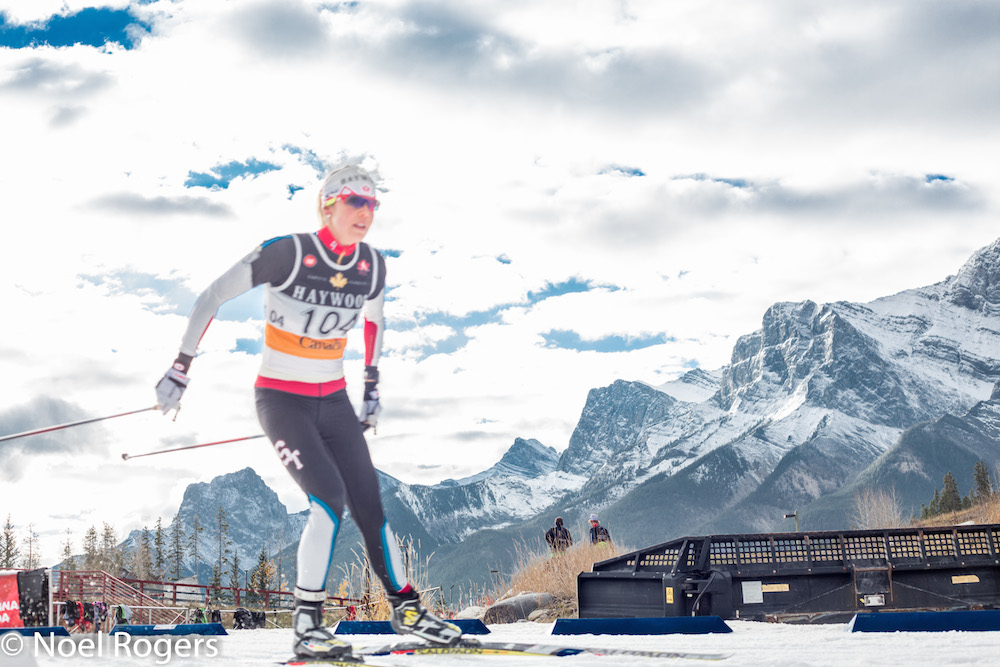
    Biathlete Rosanna Crawford racing to the win in Monday’s 7.2 k freestyle women’s race at Frozen Thunder in Canmore, Alberta. (Photo: Noel Rogers/Bow Valley Photography)

    In the women’s 7.2 k race, Rosanna Crawford (Biathlon Canada) bested a strong women’s field to take the win. After four laps around the Frozen Thunder track, she finished with a time of 17:39.2.

    Despite soft conditions, Crawford explained she felt strong throughout the race and enjoyed starting near the back of the pack.

    “Starting near the end meant there was a lot of girls I could chase down. I love having someone just within sight that I can try to chase down and pass!” she wrote in an email.

    Crawford, who just completed a two-week block of treadmill rollerski intensity, explained that the race helped her begin the transition from dryland training to on-snow racing.

    Coming in second for the women was USST member Liz Stephen (+3.6), who traditionally excels on hilly courses with long climbs. Monday’s race had no such climbs and was relatively flat.

    Taking the final spot on the podium was Canadian biathlete Zina Kocher (+11.7). Kocher said that while she also favors hill-intensive courses, the Frozen Thunder distance race left her feeling technically and physically strong going into the final weeks of fall training.

    Now that Frozen Thunder racing has concluded, the North American teams will part ways before they begin their final training blocks of the fall. The Canadian Biathlon Team will host a time-trail on the 1.8 k ski loop Friday, as part of their continued training camp.

    Heidi Widmer racing to ninth in the women's freestyle distance race at Frozen Thunder on Oct. 27 in Canmore, Alberta. (Photo: Noel Rogers/Bow Valley Photography)
    Heidi Widmer (AWCA/Canadian NST) racing to ninth in the women’s freestyle distance race at Frozen Thunder on Oct. 27 in Canmore, Alberta. (Photo: Noel Rogers/Bow Valley Photography)

    Results: 

    See also: Frozen Thunder classic sprint recap & photos

  • Sargent, Newell Climb to Top in Frozen Thunder Classic Sprint (with Photo Gallery)

    Sargent, Newell Climb to Top in Frozen Thunder Classic Sprint (with Photo Gallery)

    Andy Newell racing to his second Frozen Thunder classic sprint victory in three years on Friday at the Canmore Nordic Centre in Canmore, Alberta. Runner-up Dakota Blackhorse-von Jess won last year. (Photo: Pavlina Sudrich)
    Andy Newell (r), of the U.S. Ski Team and Stratton Mountain School (SMS) T2 Team, racing to his second Frozen Thunder classic sprint victory in three years on Friday at the Canmore Nordic Centre in Canmore, Alberta. Runner-up Dakota Blackhorse-von Jess (in second) won last year. Matthias Inniger of Switzerland was third overall and Kris Freeman (Team Freebird) was fourth. (Photo: Pavlina Sudrich)

    There are a couple things one can count on at the Canmore Nordic Centre, including solid tracks and quality snow, even in October. At the first unofficial sprint of the North American season on Friday morning, more than 120 racers found both for the Frozen Thunder classic sprint, and organizers added what could be a new tradition to the mix: a zero-elimination format.

    Sounds chaotic? It worked, according to American Dakota Blackhorse-von Jess of the Bend Endurance Academy in Oregon.

    “It was a great format — worked out far better than I could possibly have imagined,” he wrote in an email after the race. “Gets everyone the chance to race with like-speed people and … experience the stress of a full sprint day. Great opportunity for all that ran like clockwork. … Fantastic event.”

    Blackhorse-von Jess and another American Ida Sargent (U.S. Ski Team/Craftsbury Green Racing Project) posted the top men’s and women’s qualifying times, respectively, beating out their competition on the 1.6-kilometer course by more than 2 seconds apiece.

    Frozen Thunder organizers opted for what they called the “knock-in sprints,” or King’s Court format, ranking all 122 racers — men and women combined — by qualifying times and seeding them in four-person heats for the first of three rounds.

    The top two in each heat of round 1 moved up; the last two moved down a heat. The format repeated for round 2 to put the most competitive skiers at the top of round 3, allowing all participants to race all three rounds.

    Matthias Inniger of Switzerland bringing it home for third overall and Kris Freeman (Team Freebird) on his way to fourth in the Frozen Thunder classic sprint on Friday. (Photo: Pavlina Sudrich)
    Matthias Inniger of Switzerland bringing it home for third overall and Kris Freeman (Team Freebird) on his way to fourth in the Frozen Thunder classic sprint on Friday. (Photo: Pavlina Sudrich)

    Blackhorse-von Jess won his first two heats, topping U.S. Ski Team and SMST2 Team member Andy Newell in round 2, but Newell had the edge in the final round 3 for the overall win. Blackhorse-von Jess placed second, Switzerland’s Mathias Inniger took third, and Kris Freeman (Team Freebird) was fourth.

    “It kind of felt like each heat was a final since nobody wants to move down a bracket so we had to push each hard each round,” Newell wrote in an email. “There were a lot of fast skiers here but we North Americans are all pretty good buddies so it was definitely a friendly fight out there. We’ve all trained with each other a bit this off season and want everyone to kick ass over season.”

    In terms of tactics, he added that it depended on how fast your skis were.

    “We all agreed to use kick wax this year to make it an even playing field and only waxed with low flour [sic] wax,” Newell wrote. “For me the tactic was to push hard on the uphills to try to break it up a bit. We were all on klister and the snow was sugary but still great racing conditions.”

    The course was two laps, for a total of two uphills.

    “One is a decent climb and the other is a pretty short one,” Newell explained. “The reason we have double poled here in the past is because it’s kind of a downhill finish which can be faster in the skate skis. But I think it worked out well this year with everyone on klister.”

    According to Blackhorse-von Jess, the heats were an opportunity to get back into the swing of racing.

    “With the fastest (and the best skiers in North America) all there, you have to push every time. And starting in the fastest quarter and moving on into the fastest semi means do-or-die for making the final, so there’s no sandbagging all day,” he wrote. “I don’t know why I was so fast qualifying, really. [My coach] Ben [Husaby] helped me make some major changes to my classic technique this year, which has made obvious improvements off the snow so it’s not surprising it’s helped on the snow. But who knows. It’s a training day for everyone and while I’m encouraged by the day, I don’t think anyone can read overmuch into the crystal ball based on today.”

    Canadian World Cup Team member Devon Kershaw led the Canadians as the top man in the second-fastest final round, beating out Jess Cockney, of the Alberta World Cup Academy (AWCA), Lenny Valjas (Canadian World Cup Team), and American Ben Saxton (SMST2).

    “Not the best day ever for me, but not the worst,” Kershaw wrote on Instagram. “Thanks to all that made it possible (CCC, volunteers, all the racers & staff).”

    Ida Sargent (U.S. Ski Team/CGRP) leads Perianne Jones (Canadian NST) in round 2. The two went on to place first and second among women in the Frozen Thunder classic sprint on Friday. (Photo: Angus Cockney)
    Ida Sargent (U.S. Ski Team/CGRP) leads Perianne Jones (Canadian NST) in round 2. The two went on to place first and second among women in the Frozen Thunder classic sprint on Friday. (Photo: Angus Cockney)

    Sargent raced three junior men in round 1, finishing third behind Reed Godfrey of the Alberta Ski Team (AST) and Caelan McLean (Yukon Ski Team). She then met two junior men and Canadian National Team member Perianne Jones in round 2.

    There, she placed second behind Samuel Greer (NDC Thunder Bay), whom she outlasted in the first round, and Jones took third. Sargent advanced to the last round with Godfrey, Geer and another junior man, Tate Macdonald (AST), and beat them all for a resounding overall victory.

    “The format was definitely funky but they did a great job pulling it off and I thought it ran really smoothly,” Sargent wrote in an email. “At first I thought it was a weird idea but then it ended up being fun and I had to go as hard as I could every single round rather than being able to ski a little conservatively through the early rounds. On the World Cup, every heat is 100% so this was great training.”

    Her goal was to push as hard as possible each round, and with a downhill double-pole finish (in which she got passed at least once in previous rounds), she made a point to go even harder over the tops of each hill to get a sizable lead before the finish.

    “I’m happy to be feeling good right now,” she wrote. “I don’t consider this part of the season yet and I’m just psyched to have had a fun and hard effort on snow.”

    Jones was third in the second-fastest, coed round 3, after McLean and Thomas Manktelow (AST), respectively.

    “I’ve never done rounds like that before, but it was really fun, and good for us to go hard every round,” Jones wrote in an email. “North American sprinting (especially for the women, and especially in Canada) has turned into a bit of a cake walk in the first couple rounds before putting the hammer down in the final — which is the worst thing for development because once you get to the World Cup there’s no lolly-gagging.”

    Dahria Beatty (AWCA) placed third among the women, finishing ahead of fourth-place woman Heidi Widmer (AWCA/Canadian NST) in the final round. 

    Angus Foster (Big Thunder Nordic) was the top junior man in 21st overall, followed by Pearce Hanna (Rocky Mountain Racers) and David Askwith (Georgian Bay).

    Maya MacIssac-Jones (RMR) was the top junior woman, followed by Katherine Stewart-Jones (Nakkertok) and Katie Weaver (Hollyburn).

    “I’d say best Frozen Thunder Race ever,” Jones concluded. “It was sunny and warm, and CCC and Zone 4 (Dan Roycroft) somehow managed to make the day go incredibly smoothly running 96 heats — 1 every 30 seconds. I have to admit I was skeptical about the format, but the race ran like a well-oiled machine, and was a ton of fun.”

    “Snow was incredible, as always,” Blackhorse-von Jess wrote. “They do an amazing job there and it got a lot more traffic this year with all the racers and it held up awesome.”

    Distance racers will have a chance to strut their stuff at Frozen Thunder on Monday at the 10/15 k freestyle individual start at 9 a.m. Mountain time.   

    Results: Qualifying | Heats

    Check out dozens of photos from the first unofficial race of the season, the Frozen Thunder classic sprint, in Canmore, Alberta, courtesy of Angus Cockney, Jess Cockney’s father.

  • After Long Offseason Prep, Frozen Thunder Means the Season’s Here

    After Long Offseason Prep, Frozen Thunder Means the Season’s Here

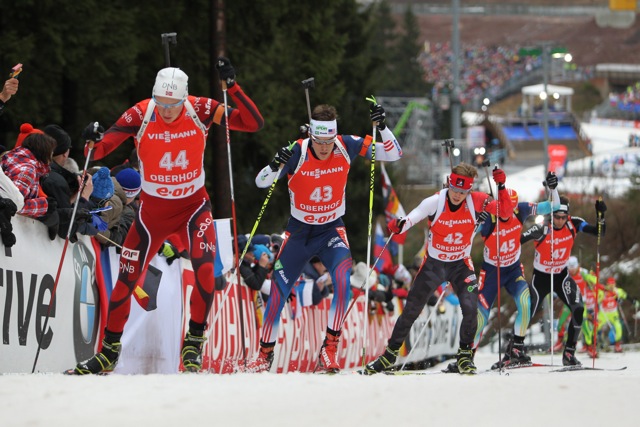
    Macx Davies (bib 42) in the thick of things in the World Cup pursuit at Oberhof, Germany, in January, behind Henrik L'Abee-Lund (NOR) and Leif Nordgren (USA). Photo: USBA/NordicFocus.
    Macx Davies (42) in the thick of things in the World Cup pursuit at Oberhof, Germany, in January, behind Norway’s Henrik L’Abee-Lund (44) and American Leif Nordgren (43). (Photo: USBA/NordicFocus)

    About the author: Macx Davies, 21, made his World Cup debut last January, placing 42nd in the World Cup sprint in Oberhof, Germany. That netted him his first Biathlon Canada national-team nomination. Davies wrote this update on his training season, Canmore’s Frozen Thunder and his preparation for the season.

    ***

    Opening my eyes, the morning light shines through my window; I take a deep breath as my mind starts to turn. Today I ski. Today I step closer to the season. Today winter starts.

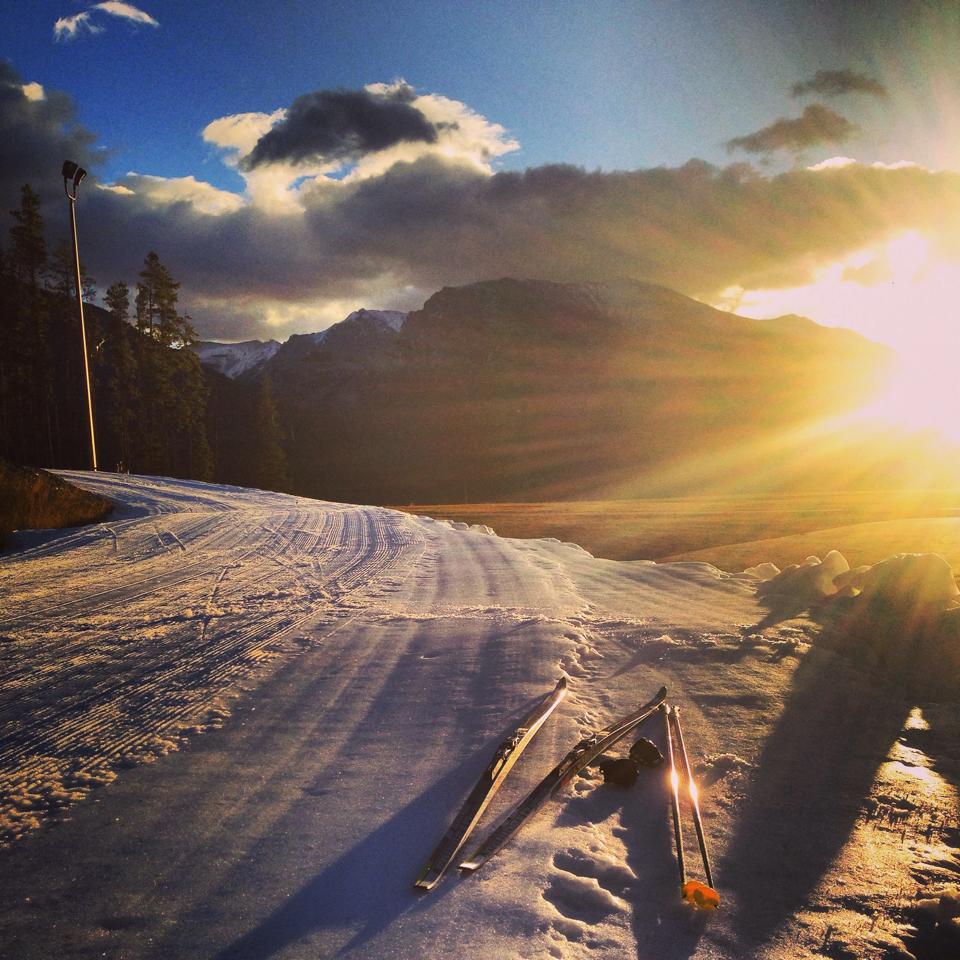
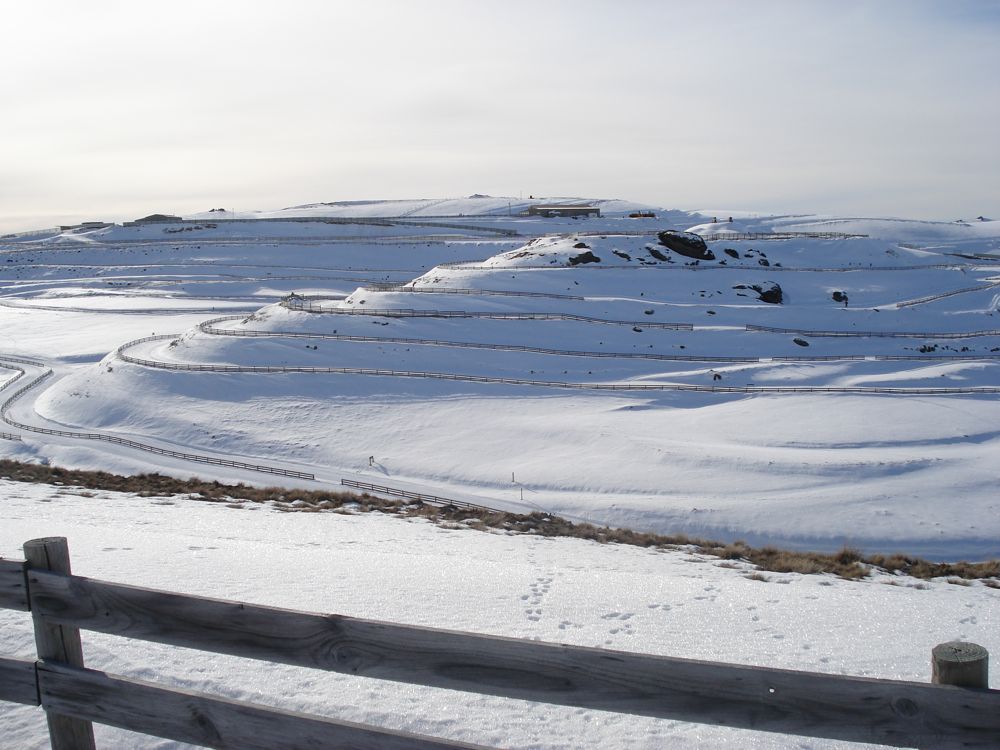
    Biathlon Canada's Rosanna Crawford snapped this photo of Frozen Thunder on opening day, Oct. 18, at the Canmore Nordic Centre in Canmore, Alberta. (Photo: Rosanna Crawford/Facebook)
    Biathlon Canada’s Rosanna Crawford snapped this photo of Frozen Thunder on opening day, Oct. 18, at the Canmore Nordic Centre in Canmore, Alberta. (Photo: Rosanna Crawford/Facebook)

    Over the past two months I have been waiting for this day. Dreaming of putting my skis on and feeling the snow run under my feet. We, around Canmore, had a taste of this early September, when the temperatures dropped and snow fell from the sky. Giving the ski community a chance to tour the local golf courses and explore beyond the normal playgrounds that the Canmore Nordic Center provides. With the taste of skiing reignited I began longing for the day they rolled out the frozen beast. Kept under his thick sawdust blanket, waiting to rumble the thunderous roar. Starting the new season.

    Fortunately my coaches, Roddy and Matthias, saw fit to keep my longings at bay with copious amounts of training and intensity. With little energy left to think too hard, the month of September seemed to rush by.

    In the whirlwind of rollerskiing and shooting, we arrive at the last few days, which means the Canadian Biathlon National Team, along with many elite ski teams from Canmore, make the annual pilgrimage down to Park City. Here we experience the elevation that only Utah or Colorado can provide. With the never-ending mountain passes and the amazing trail systems, all entrenched in the colors of autumn. We raced around the Soldier Hollow track and drove down to Salt Lake City for intensity work. Adding the occasional run and even a mountain bike!

    However, living up at 2,000 meters tires out the team quickly. Luckily for us Canadians, we find new energy at the Outlet stores and the fashionably questionable choices they provide, as well as their cheap prices. Though the stores can only provide so much energy, after our first week most of the team is becoming even more tired. Thankfully, I was in the house with an experienced team member, who shared some recovery tricks with us less experienced. He showed us how to use recovery boots and had the foresight to order a Nerf gun to keep everyone on their toes. (Thankfully he only had a three-bullet clip.) Once the two weeks came to a close, I was sad to leave, but happy to get a much needed rest week. And as always, glad to be home in Canmore. Back to the mountains I know so well and the town of my childhood.

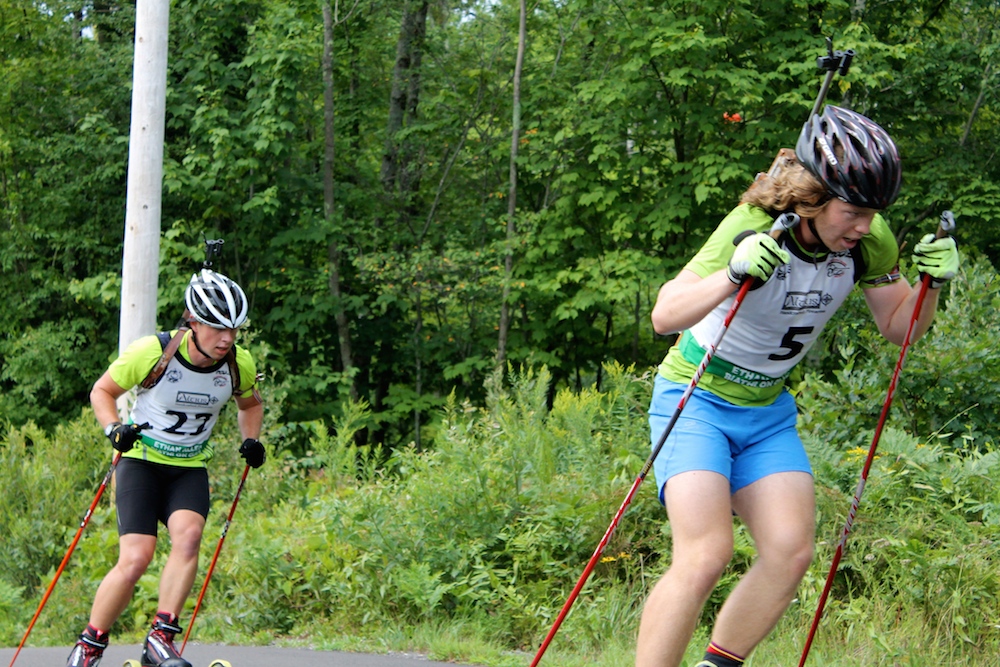
    Davies (r) in the men's 10 k sprint at the North American Rollerski Championships in August at the Ethan Allen Firing Range in Jericho, Vt.
    Davies (r) in the men’s 10 k sprint at the North American Rollerski Championships in August at the Ethan Allen Firing Range in Jericho, Vt.

    Having completed the Park City training camp with less than two weeks left till Frozen Thunder, it was just a few days away. But with the end of a successful camp comes the testing, which they had us start before we even finished our recovery week.

    Sustainability, the first test, and our first time back on the wondrously challenging rollerski treadmill. Followed by some high-speed intensity, otherwise know as Max Aerobic Speed or MAS, which involves a lot of pain and two-and-a-half minutes of counting your strides and waiting for the 15-second warning to come. Thankfully, it is a team event, where two people alternate between that and easy spinning on a bike. This means you always have someone cheering you on when the going gets tough. Not to mention that that teammate will be going through the same pain in a couple minutes.

    While all this is happening inside the testing facilities in the Bill Warren Training Center there is another sound in the air, the dump trucks making endless trips from snow pile to the ski trails. After a couple days of hearing the commotion around the ~2.2km loop, they bring out the PistenBully to add some extra noises as they flatten the now smaller piles into skiable terrain.

    At this point there is a silence that encompasses the whole Nordic Center, as if the snow has absorbed any sound. With this silence, everyone knows that they will be on snow in less than 24 hours. They just need to wait for the sun to rise, for the morning to come and for the ribbon to be cut. The excitement rises with the sight of snow and everybody smiles as they step onto their skis. Finally we are gliding up the hills and coasting down the other side. It has been a long summer but winter is here. It may not yet be cold and the days aren’t short, but as far as skiing is concerned, winter is here.

    With the snow rolled out, the skiers flock to Canmore from across Canada and even from the United States. With all the skiers and biathletes on the trail, it can become crowded, but having all these elite athletes in one place doesn’t happen often and is always a great time to catch up with friends. Especially when you have a long ski, catching up with friends is one of the few things that can shorten the long hours on the track. Personally I enjoy simply having all the skiers around. For this reason Frozen Thunder is one of the best training environments we have all season.

    “Having all these elite athletes in one place doesn’t happen often and is always a great time to catch up with friends … Frozen Thunder is one of the best training environments we have all season.”

    We have only had couple days of skiing and everyone is getting ready for the first race series. Starting on Friday October 24 there are classic sprints and finishing off the unconventional racing “weekend” on Monday with a Freestyle Distance race. For me this is the final wake up call that the season has arrived. It is time to shift into the racing mindset and have all the months of hard training pay off in the new ski season. Finally I am skiing. Finally the season is here. Finally it is winter.

  • As USST Park City Camp Ends, Excitement for Racing Season Builds

    As USST Park City Camp Ends, Excitement for Racing Season Builds

    Jessie Diggins (USST/SMST2) leads a train of skiers through the fall foliage and stunning views at the American Fork in Utah. (Photo: USSA)
    Jessie Diggins (USST/SMST2) leads a train of skiers through the fall foliage and stunning views at the American Fork Canyon Road in Utah. (Photo: USSA)

    The U.S. Ski Team concluded its annual altitude camp in Park City, Utah last week, leaving attendees a little more excited and prepared for the upcoming season. A final gathering before the national team travels to Europe in November, the camp provided opportunity for U.S. athletes to train at altitude and soak up some final rays of sun before winter takes hold.

    The annual October camp has always been popular due to its consistent, dry weather and high-altitude training opportunities. In 2013 the camp saw its largest attendance with 50 skiers converging in Utah with the hopes of earning a spot on the Olympic team.

    Despite the absence of the Olympics, the camp’s popularity has continued into 2014. According to U.S. Ski Team head coach Chris Grover, approximately 40 skiers were at the 2014 camp, which concluded Sunday Oct. 19.

    Unlike September’s USST training camp in Lake Placid, N.Y. the Alaskan members of the national team, including Kikkan Randall, Sadie Bjornsen, and Erik Bjornsen, were present in Park City.

    They were joined by fellow national team members Andy Newell, Simi Hamilton, Ben Saxton, Paddy Caldwell, Noah Hoffman, Liz Stephen, Ida Sargent, Sophie Caldwell, and Jessie Diggins.

    Miles Havlick (SVSEF) leads Simi Hamilton (USST/SMST2) and Paddy Caldwell (USST/SMST2)  in bounding intervals. (Photo: USSA)
    Miles Havlick (SVSEF) leads Simi Hamilton (USST/SMST2) and Paddy Caldwell (USST/SMST2) in bounding intervals in Utah. (Photo: USSA)

    A variety of other skiers from Alaska Pacific University, Bridger Ski Foundation, Stratton Mountain School T2, and Sun Valley Ski Education Foundation Gold Team, among others, joined the array of activities that traversed the mountains surrounding Park City.

    Athletes participated in workouts that ranged from a rollerski up the American Fork Canyon that featured over 3,000 ft. of elevation gain, to speed work on Soldier Hollow’s familiar trails. During a long run, the team even came across some fresh snow above 8,000 ft.

    For Miles Havlick (SVSEF) the training in Park City was valuable because of new perspectives he gained from the USST coaches and their ability to “broaden your horizons.” Furthermore, Havlick said that training with the USST men was beneficial to his technique and fitness.

    “There’s no one better than to do a speed workout with than Newell, Simi, and Bjornsen,” he said in a phone interview.

    On Thursday Oct. 16 the USST held a 10 k time-trial for both the men and women at Soldier Hollow that saw Randall and Miles Havlick top the women’s and men’s fields. While the results have little significance due to variation in each skier’s training and rollerski speeds, the USST coaches monitor both heart-rate and lactate to analyze the effects of the training load, effort, course type, and altitude on each skier.  

    The Park City camp is unique in the fact that athletes live at roughly 8,000 ft. in Upper Deer Valley to increase hemoglobin levels and prepare for high altitude races. According to Diggins the annual camp helps her prepare for some of her favorite competitions, including the high-altitude stages of the Tour de Ski.

    “I am still learning how to ride the line between going hard and blowing up at altitude, since once you flood your legs you can’t recover as fast as you can at sea level,” Diggins explained. “So doing a lot of long L3 and longer L4 intervals at SoHo (Soldier Hollow) is really helpful for my race prep.”

    Sadie Bjornsen said that while it is always difficult to acclimatize to altitude, she has developed several techniques to aid the adjustment.

    “I know that for at least 4 days I am going to feel like a slog. I also know that I need to force myself to train easier than ever those first few days in order to adjust well without getting too tired for the rest of the week,” she wrote in an email.

    The USST and NEG skiers gather for speeds at Soldier Hollow in Midway, Utah. (Photo: USSA)
    The USST and NEG skiers gather for speeds at Soldier Hollow in Midway, Utah. (Photo: USSA)

    With the roughly 40 athletes in attendance the allocation of time and resources is difficult to balance between national team and club team members. However, Grover said that the USST coaches have a functional system in place.

    Grover explained that the primary goal at any USST camp is to prepare the national team for World Cup and World Championship success. Its secondary goal is to offer training opportunities to developing athletes who are just below the national team level.

    “Both goals are important to us as coaches,” Grover wrote in an email.

    As in past camps, the U.S. Ski team had several “closed” workouts in addition to trainings that included the entire training group. Grover explained that the division was important for both the national team and club athletes, but acknowledged that regardless of the structure of the workouts there would always be some imperfection.

    “Our intent when dividing some of our sessions is to provide value to both groups, but I guarantee it will never feel perfect for each individual,” Grover said.

    Despite the success of the camp, the USST did not leave Park City without injury. Sophie Caldwell fractured her left elbow Oct. 7 after tripping on a low-hanging cable in a Park City Mountain Resort parking lot. After performing surgery hours after the injury, doctors estimated that Caldwell’s recovery to be roughly six weeks.

    According to Grover, Caldwell is in great spirits and finding creative and productive ways to train despite her injury.

    “She has been incredibly mentally tough through this process, and it is clear that she has the heart and the resolve of a champion,” Grover said of the 24-year-old.

    At the conclusion of the Park City Camp, the USST traveled to Canmore, Alberta for a week of on-snow training and racing at Frozen Thunder. The team will remain in Canada until Oct. 28 when skiers enter their final block of training before traveling to Europe. 

  • For Slovakian Olympic Gold Medalist Kuzmina, More Happy Times in Canada (Exclusive Interview)

    For Slovakian Olympic Gold Medalist Kuzmina, More Happy Times in Canada (Exclusive Interview)

    Anastasiya Kuzmina of Slovakia racing in Antholz, Italy, last season. Photo: Fischer/NordicFocus.
    Anastasiya Kuzmina of Slovakia racing in Antholz, Italy, last season. Photo: Fischer/NordicFocus.

    Canada probably holds a special place in the heart of Anastasiya Kuzmina, the Slovakian biathlete: it’s where she had the biggest triumph of her career, winning a gold medal in the sprint at the 2010 Olympics. She followed that up with silver in the pursuit. Besides being the Olympics, the gold was actually the first win of her career; she has since won three World Cup races, all sprints, and garnered a number more podium finishes.

    But for most European athletes, that wouldn’t mean much. Canada is far away, many time zones and an entire ocean to cross; Canmore, where most of the Canadian biathletes train, is particularly far west. Biathlon’s World Cup hasn’t visited Canada since the Olympics, so most elite athletes haven’t thought of revisiting.

    That’s not true of Kuzmina, who came back to Canada for the second time this fall to do a training camp on Frozen Thunder. It was the second year in a row that she attended, training and time trialing with the Canadians.

    “Anastasiya is a great friend of Biathlon Canada,” Canadian High Performance Director Chris Lindsay told FasterSkier in an interview ten days ago. “We are really, really happy that she has come the last two years. It’s great for our women’s team.”

    Most European teams head to Scandinavia for early on-snow skiing, but as Kuzmina said, she wasn’t interested. She also has one more connection: originally from Russia before she married coach Daniel Kuzmin, she knew Ivan Babikov. That made it a bit easier to plan a trip.

    It paid off, as Kuzmina believes that the fall training camp was important for her preparation. Plus, she simply had fun.

    “I would like say a big thank you to all the people in Canada for a great time spent in your country,” she told FasterSkier. “I hope to be back here more than once.”

    Still, it seemed like a big risk to take right before the start of the World Cup season: all that flying, and adjusting time zones back and forth. Over e-mail, we talked to Kuzmina about what keeps drawing her back, and how she’s preparing to defend her gold medal – and to return to Russia.

    Kuzmina shooting her way to the silver medal in the 2010 Olympic pursuit.
    Kuzmina shooting her way to the silver medal in the 2010 Olympic pursuit.

    FasterSkier: I was recently talking to Chris Lindsay at Biathlon Canada who calls you a “great friend of Canadian biathlon.” How did you decide to go train at their venue for the first time two years ago? Do you know the athletes well?

    Anastasiya Kuzmina: Last year when our small team decided to go on a “first snow training camp,” and since we don’t really like to training in Scandinavia in October-November, we decided to come to Canmore. We contacted Tom Zidek [originally Czech and a now a wax tech and coach for Biathlon Canada] and Ivan Babikov, who’s helped us a lot with the organization of the camp in Canada as in the last and this year. And we haven’t lost. Here we found a warm welcome from all the coaches, athletes, and stuff of Nordic Center, excellent conditions for training, so good snow condition for this period.

    FS: What makes “Frozen Thunder” a better place to train than the places in Europe that have early snow at this time of year?

    AK: It’s not only “Frozen Thunder”. In Canmore there is a lot possibility for different trainings (running, gum, special trainings). It is also very important to have the altitude like in Sochi.

    FS: How long did you get to spend in Canada, and what were your focuses for training while you were there?

    AK: Last year we were in Canmore one month, and this year 25 days. Mainly it was trainings, but rest days we visited in Calgary and Banff. We would like to come back to Canmore in summer time.

    FS: Are you happy with the time trials that you did? I heard you also did a 1-on-1 mass start with Zina Kocher, how was that? Is it good preparation for the World Cups coming up?

    AK: Tests with the Canadian girls and Zina were very good pre-season training. A bit of stress before the first World Cup never hurts. At last, my shooting in the trainings was good and this is a positive for me. I hope for the girls it was also good that I’m participating there.

    FS: Between this and your trip to New Zealand this summer, you have been doing a lot of training and racing away from home! What is the goal of that, and is it hard to travel so much during the training season?

    AK: The athlete’s life is always travelling, there is no escape. We are looking for the best place for training camp in the world, and it’s not always close to home!

    FS: I have to ask: what was it like racing against Justyna Kowalczyk this summer? [note: Kuzmina competed in the cross country ski races at New Zealand Winter Games, where she was second to the Polish ski star]

    AK: When the competitions have the opportunity to compete with one of the best skiers of our time, it gives positive energy for training in the future.  We have very good relations with Justyna and hope that she will win several medals in Sochi!

    FS: Is there a lot of pressure going into the Olympics since you won the gold medal in Vancouver, or any expectations to repeat the result? Or do you feel like it is just the same, that you only have to do your best and see what happens?

    AK: Every season and every competition is pressure for each athlete. Olympic Games is very special event, and in this reason I do not want to expect anything. I have to wait and see.

    FS: How does it feel to be going to Russia for the Olympics? Does it still feel like home for you, and do you have many fans there, or will it be a strange experience to be racing there but for Slovakia?

    AK: My home is now in Slovakia, but I always enjoy coming to Russia where my family and friends still are. I very much hope that the Olympics will be held to a very high level and that I’ll remember them as happily as I do my first Olympics in Canada.


  • Frozen Thunder Extras: Photos and More

    Frozen Thunder Extras: Photos and More

    Eventual men's winner, Dakota Blackhorse-von Jess (Bend Endurance Academy) qualified for the heats with the fourth-fastest qualifying time
    Eventual men’s winner, Dakota Blackhorse-von Jess (Bend Endurance Academy) qualified for the heats with the fourth-fastest qualifying time

    CANMORE, Alberta — Frozen Thunder, the 2.2-kilometer snow-covered course at the Canmore Nordic Centre, has been buzzing with activity for the last week and headlined by a classic-sprint showdown between some of the top Canadian and U.S. nordic skiers on Thursday. Here’s what you may have missed:

    Dakota Blackhorse-von Jess topped two U.S. Ski Team members en route to the men’s victory, winning the unofficial first race of the season by a bit of a landslide. Under warming skies, he stuck with his classic skis on the two-lap course, while eventual runner-up Andy Newell (who won the qualifier by 3 seconds) and third-place finisher Simi Hamilton slipped behind on skate skis.

    “Andy made a great jump at the start of the second lap, but I was able to use the advantage of kick to accelerate away over the top of the big climb and again on the second hill to keep the advantage,” Blackhorse-von Jess, of the Bend Endurance Academy in Oregon, wrote in an email. “It may have helped that the sun came out and started NUKING right at the start of the A-final as it slowed the snow down and probably made it much more difficult to double pole up the first hill. And I had good skis, which is no small thing.”

    “[Thursday] was a great tune-up,” he added. “We’ve really been focusing the last 4 years on systematically building my aerobic fitness. … Racing is so much fun, being back on the road and seeing all my friends and getting back in the wax room with Scott Johnston and Sam Naney of MOD, and for sure being in the mix with Andy and Sim who set the bar for the rest of us was awesome. And let’s be honest – winning a race against those two, even in a tune up event, even with a relatively small field, even in October, it still makes a good time even better.”

    For more about the men’s and women’s sprints, check out our race recap and other photos.

    Results: men’s qualifier | women’s qualifier | final results

  • Smutna, Americans Show their Speed in Frozen Thunder Sprint

    Smutna, Americans Show their Speed in Frozen Thunder Sprint

    With one lap to go, Dakota Blackhorse-von Jess (Bend Endurance Academy) leads the men's A-final of the Frozen Thunder classic sprint at the Canmore Nordic Centre in Canmore, Alberta. U.S. Ski Team and Stratton Mountain T2 teammates Simi Hamilton and Andy Newell follow, along with Sam Naney (Methow Olympic Development). (Photo: Pavlina Sudrich)
    With one lap to go, Dakota Blackhorse-von Jess (Bend Endurance Academy) leads the men’s A-final of the Frozen Thunder classic sprint at the Canmore Nordic Centre in Canmore, Alberta. U.S. Ski Team and Stratton Mountain T2 teammates Simi Hamilton and Andy Newell follow, along with Sam Naney (Methow Olympic Development). (Photo: Pavlina Sudrich)

    Note: This article has been correct to recognize Sophie Caldwell (USST/SMST2) as the women’s qualifier winner.

    CANMORE, Alberta – The 2013-14 ski season unofficially kicked off Thursday with a classic sprint on snow at Frozen Thunder in Canmore, Alberta. While a fairly low-key event overall, it served as a tune-up race for many of the skiers as they head into the World Cup races in Finland or U.S. SuperTour openers in West Yellowstone, Mont., in late November.

    Racing two laps around a shortened version of the 2.2-kilometer Frozen Thunder loop, skiers completed the course in 4 to 5 minutes for the women, and roughly 30 seconds faster for the men, making for a long sprint course to start the season.

    Katerina Smutna of Austria leading the women's A-final at the Frozen Thunder classic sprint on Thursday in Canmore, Alberta. U.S. Ski Team members Ida Sargent and Sophie Caldwell chase to finish second and third, respectively. (Photo: Pavlina Sudrich)
    Katerina Smutna of Austria leading the women’s A-final at the Frozen Thunder classic sprint on Thursday in Canmore, Alberta. U.S. Ski Team members Ida Sargent and Sophie Caldwell chase to finish second and third, respectively. (Photo: Pavlina Sudrich)

    As Caitlin Gregg of the Methow Olympic Development team in Washington explained, the variety of terrain on the course, with plenty of uphills, downhills and turns, made for a quality course. However, the two-loop experience made for a unique mental challenge of staying psyched for big hills the second time around.

    To deal with possible crowding issues in the qualifiers, race organizers used a unique starting strategy. After the first five skiers, they left a larger time gap than usual before starting the next of five racers to space out the field.

    The field of 34 women raced first. Sophie Caldwell of the U.S. Ski Team (USST) and Stratton Mountain School T2 Team (SMST2) won qualification by just over a second, followed by Austrian Katerina Smutna and Ida Sargent (USST/Craftsbury Green Racing Project) rounding out the top three.

    The men’s field was somewhat larger with 54 racers, and like last year, saw a combination of skate and classic equipment used among the top racers. Andy Newell (USST/SMST2) won the qualifier on skate skis by more than 3 seconds. SMST2 teammates Skyler Davis and Simi Hamilton (USST) followed up in second and third.

    Only 16 men and 16 women moved onto the heats. As a result, many of the less sprint-endowed racers came up with alternate plans for their workout that day. Some moved on to interval sessions, while others simply decided to save up energy for Friday’s classic-distance time trial. However, many skiers were impressed with the organization of the sprint.

    Sargent appreciated the trademark low-key, high-organization style of an event run at the Canmore Nordic Centre. “The race this morning was very chill but also very well organized and well run,” she said. “They did a great job keeping the schedule rolling which can be tricky with a two-lap course.”

    After leading much of the A-final, Smutna ended up with the win, while the Americans showed their strength, with Sargent finishing second, Caldwell placing third and Liz Stephen (USST) in fifth. Alysson Marshall of the Canadian National Senior Development Team and Alberta World Cup Academy was the top Canadian in fourth, with Olivia Bouffard-Nesbitt took sixth and 2013 World Championships team member Andrea Dupont was seventh. American Jessie Diggins (USST/SMST2) did not race due to a cold, and Canadian World Cup team member Perianne Jones did not start. Her Canmore-based teammates, Lenny Valjas and Ivan Babikov were not on the start list, and Dasha Gaiazova is in Quebec.

    On the men’s side, several skiers were strong on Thursday. Dakota Blackhorse-von Jess (Bend Endurance Academy) looked especially strong in winning the A-final by a large margin on classic skis. He was the only one of the top three on classic skis. Both Newell and Simi Hamilton used skate skis for the qualification and final to end up second and third, respectively.

    Across the board, U.S. and Canadian skiers appreciated the chance to mix it up on snow before the season starts in earnest.

    “It was really great to have everybody in town with the US skiers and even some Austrian skiers in the race,” Dupont said.

    On the significance of an October race, Sargent said, “I was less concerned with results than trying to go hard and get out some of those racing tweaks like remembering how to warm up, test wax, and stay fueled on between sprint heats.”

    Finally, as a footnote to a race well run, several teams showed off their new season’s spandex. The U.S. team showcased their new uniforms with electric blue accents for men and pink accents for the women, while Team Ninja, the band of independent skiers based out of Canmore, showed up in suits adorned with pink and white snowflakes, and ninjas.

    Results

    About Katie Bono

    Katie is a Canadian contributor at FasterSkier. Hailing from Minnesota, she raced for Dartmouth College and Sun Valley before turning her energies to climbing (and becoming the fastest known woman to ascend Mt. Rainier in Washington). Now based in Canmore, Alberta, she is an athlete ambassador for Millet and works as a mountain guide in Alaska, Washington and South America.

  • Skiers Flock to Frozen Thunder for Pre-Season Tune-Up (Photo Gallery)

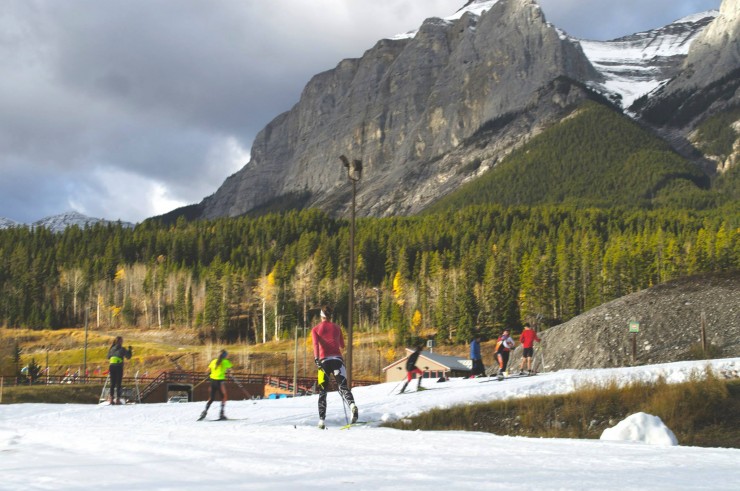
    The start area of the 2.2-kilometer loop at Frozen Thunder at the Canmore Nordic Centre, with the Bow Valley in the background in Canmore, Alberta.
    The start area of the 2.2-kilometer loop at Frozen Thunder at the Canmore Nordic Centre, with the Bow Valley in the background in Canmore, Alberta.

    By Katie Bono 

    CANMORE, Alberta — The days are getting shorter and shorter in Canmore, and if you’re an elite Nordic skier in North America, you know what that means. It’s Frozen Thunder time!

    Skiers from across the U.S. and Canada recently converged upon Canmore to ski the seasonal anomaly that is Frozen Thunder: a 2.2-kilometer loop of real snow skiing, harvested from last winter and saved over the brief Canadian summer under a thick coat of sawdust.

    According to a Cross Country Canada press release, Frozen Thunder’s first incarnation was in 2009 as a 400-metre loop of snow. However, if you know anything about the Canmore Nordic Centre, you know that settling for an ‘adequate’ trail experience is not in their nature.  Accordingly, the loop has been expanding ever since.  This year’s loop is the longest yet, and even includes a bridge crossing.

    Conditions on the loop thus far have been surprisingly good. Despite temperatures in the mid-teens (Celsius, around 50 degrees Fahrenheit) since opening day on Oct. 19, the trail has stayed thick, white and fairly firm, and skiers who were on the loop last year say that this year’s loop is substantially better than last year’s version.

    The list of skiers already getting their training on at Frozen Thunder is long: All of the Canmore-based Canadian teams are here, and many of the farther afield Canadian and U.S. teams are, as well. The Wisconsin-based Central Cross Country (CXC) was in town for the first four days of skiing and has since departed, while members of the U.S. Ski Team, Stratton Mountain School T2 Team, XC Oregon, Maine Winter Sports Center, and the Methow Olympic Development, among others, will be in town for a while longer.

    Skiers were out in full force on Wednesday and there was almost a palpable stoke in the air. Many looked to be gearing up for tomorrow’s classic sprint race while others were simply getting a solid interval session in.  Tomorrow’s race will be hosted by Winsport, and many of the top U.S. and Canadian skiers are expected to participate as their preliminary warmup for the season.  Qualification starts at 9 a.m. Mountain time, and only the top 16 in each gender will move on to heats.

  • Wednesday Workout: ‘Get Back Into It’ with the Canadian National Team

    Wednesday Workout: ‘Get Back Into It’ with the Canadian National Team

    The approximately 2-kilometer manmade loop at Frozen Thunder officially opened Oct. 19 in Canmore, Alberta. (Photo: Pavlina Sudrich)
    The approximately 2-kilometer manmade loop at Frozen Thunder officially opened Oct. 19 in Canmore, Alberta. (Photo: Pavlina Sudrich)

    It wasn’t that long ago that the Canadian World Cup Team was on snow, but in the last month since its Aug. 11-29 camp in New Zealand, the national team has been hitting the dryland pretty hard.

    About a week ago, its six skiers were finishing up camp in Truckee, Calif., and nearby Nevada City. One of two women on the team, Perianne Jones explained in an email that they had a great camp for the first few weeks of October. “We did lots of climbing, that’s for sure,” she wrote. “Flat roads were hard to come by.”

    Jones and Dasha Gaiazova left a few days earlier than the guys – Gaiazova for a sponsor appearance and benefit in Colorado, and Jones to get on snow at home in Canmore, Alberta. Proudly termed Frozen Thunder, Canmore’s approximately 2-kilometer loop made from snow stockpiled since last winter, opened in earnest on Oct. 19.

    Canadian National Team Head Coach Justin Wadsworth works on offset with development skier Jenn Jackson. (Photo: Pavlina Sudrich)
    Canadian National Team Head Coach Justin Wadsworth works on offset with development skier Jenn Jackson at Frozen Thunder in Canmore, Alberta. (Photo: Pavlina Sudrich)

    Two days later, Monday marked the start of a weeklong Cross Country Canada women’s camp with Jones and the national junior and senior development teams.

    “We are back on snow!” Jones exclaimed. “[Monday] was our first ski together, kind of a ‘get back into it’ workout.”

    When getting back onto real skis and snow (as opposed to rollerskis and pavement), whether it’s your first time in a several weeks or months (or years!), it’s important not to go too headstrong into it.

    Jones said her first workout on Frozen Thunder wasn’t anything too crazy, just skating around casually and working on technique between two stations. National-team coaches manned each – with head coach Justin Wadsworth focused on offset (V1), and women’s coach Eric de Nys watching their glide and positioning on the one-skate (V2).

    “It was mostly about balance, and getting used to the feeling of being back on snow,” Jones explained. “For the girls from the East it was also an adaptation to the altitude.”

    So if you’re about to go skiing for the first time – even if it’s not quite 1,500 meters (nearly 5,000 feet) above sea level – consider a technique workout like the following. You might not have national-team coaches to critique you, but you’ll probably notice areas that need some work.

    The workout: Get Back Into It (snow skiing)

    Warmup: 30 minutes easy Zone 1

    Stations workout: Rotate through two stations on a loop (even 2 kilometers will do) for an hour and a half. If skating, consider offset and one-skate stations that hone in on the following:

    •             Offset (V1): Knee drive and weight over the ski
    •             One-skate (V2): Glide and getting the hands high

    At the stations, bump up the intensity to Zone 2 or so, “just to make sure the movements [are] good,” Jones explained.

    Cool-down: 15 minutes easy Zone 1

    As for her first workout back on snow, Jones wrote it didn’t feel too foreign.

    “We are lucky to have stayed in touch with the snow through the summer,” she wrote. “It’s always nice on the joints to get off the pavement at this time of year though!”

    On Thursday night, Jones will host a Skiers 4 Schoolbox fundraiser at the Bill Warren Training Centre to support her trip to Nicaragua, where she and several other skiers hope to build a school in April.

    “Education is a basic human right that many kids don’t have access to,” the fundraiser’s Facebook page states. “We want to do what we can to help!”

    Among those joining Jones and her husband Joel Jaques are Phil Widmer, Emily Nishikawa, Zoe Roy, Olivia Bouffard Nesbitt, Mark Arendz, and Ruth Tamas from Jones’ hometown in Almonte, Ontario.

    “We are still looking for a few more bodies to help us build our school!,” Jones wrote.

  • Canadians Bounce Between High and Low California Training; Kershaw Off to Norwegian Camp

    Canadians Bounce Between High and Low California Training; Kershaw Off to Norwegian Camp

    The Canadian World Cup Men's Team during a rollerski at Donner Pass near Truckee, Calif. (Photo: Mark Nadell/MacBeth Graphics) http://macbethgraphics.smugmug.com/Training/CANADIAN-NATIONAL-TEAM-2013
    On Oct. 4, the Canadian World Cup Men’s Team rollerskis across the Rainbow Bridge toward Donner Pass near Truckee, Calif. (Photo: Mark Nadell/MacBeth Graphics)

    “The leaves crunch beneath my now worn running shoes as I negotiate the soft, pine needle infested single track above the Nor-Cal town of Truckee, CA. After days upon days of warm weather, blue skies and summer-like vibes, the jackets and long tights were thrown on – a rude reminder that even in California it’s approaching mid-October. As I weave between some seriously large pines and over the endless ridges, it feels as though I am literally running into winter.”  – Devon Kershaw, on his blog

    There’s no place like California. That’s what Canadian World Cup Team Head Coach Justin Wadsworth thought when he scouted the Truckee area in July. He stayed with a former teammate from the U.S. Ski Team, Marcus Nash, and spent two days exploring northern California and all the high-elevation ski town had to offer.

    What he found was seemingly endless roads covering technical terrain at elevations around 1,775 meters (more than 5,800 feet). About a 45-minute drive away, one could find themselves more than 1,000 meters lower in Nevada City (at 2,477 feet), which Wadsworth deemed perfect for harder efforts. Weather was good there in autumn: warm, sunny and dependable. And who on his team wouldn’t want to go to California for a change?

    The Canadian World Cup Men's Team during a rollerski at Donner Pass near Truckee, Calif. (Photo: Mark Nadell/MacBeth Graphics) http://macbethgraphics.smugmug.com/Training/CANADIAN-NATIONAL-TEAM-2013
    Alex Harvey leads Canadian World Cup teamamtes Ivan Babikov (c) and Lenny Valjas (l) during a rollerski on Old Highway 40 on Oct. 4 near Truckee, Calif. (Photo: Mark Nadell/MacBeth Graphics)

    “It’s been a really great camp; there’s been sunny, blue skies every day,” Wadsworth said on the phone from Truckee on Tuesday. “Everyone can train in shorts and a T-shirt or no shirt.”

    Not that Park City, Utah, where the team normally takes its final dryland camp of the season, is a bad place to be – especially for altitude training at 2,000-plus meters (6,500 feet). But after somewhat of a hold-and-cold season last year, in which some of his skiers reached career bests and others finished a little disappointed, Wadsworth decided it was time for change.

    Off to Truckee they went. Starting Oct. 1, the entire men’s and women’s World Cup team spent nearly three and a half weeks in California, wrapping up Thursday before heading home to Canmore, Alberta, for the opening of Frozen Thunder on Saturday.

    The men’s team – Devon Kershaw, Alex Harvey, Ivan Babikov, and Lenny Valjas – opted for RV dwelling, like their training camps in Hawaii. The women – Perianne Jones and Dasha Gaiazova – weren’t as into that, so they split their time between a Truckee hotel and a house the team rented in Nevada City, Wadsworth said.

    Between the mountain town and low-lying Nevada City, the Canadians divided their efforts accordingly, with sustained easy training in Truckee and more intensity at lower elevations.

    Wadsworth said the area offers some of the best roads and steepest hills he’s ever seen, quiet and ideal for training. He had been looking for rollerski terrain where he could push his men to work on their offset, or V1, for long stretches.

    “We’re so fit these days you have to get a really big hill to get these guys working continuously,” he said.

    California in autumn has been what I remembered it to be. Blue skies and sunny weather, vistas with apparent and looming granite monoliths, stellar soft single track running trails and long, winding (and climbing!), quiet roads. I remember all that from my years training in the fall both in the Mammoth Lakes and Truckee areas in the past. – Kershaw

    Among the skiers he works with directly on the men’s team, Wadsworth said Kershaw, Harvey and Babikov are in the best shape he had ever seen. Valjas was still recovering from his knee surgery in July. According to his blog, Valjas had done “almost no cardio” before the California camp, but Wadsworth said he was jumping into most workouts.

    The Canadian World Cup Men's Team during a four-hour rollerski from 1,000 to 7000 feet. (Photo: Justin Wadsworth)
    The Canadian World Cup Men’s Team during a four-hour rollerski from 1,000 to 7000 feet. From left to right: Devon Kershaw, Lenny Valjas, Alex Harvey, and Ivan Babikov. (Photo: Justin Wadsworth)

    “I was pretty happy he hopped right in and could hang with the guys really well,” Wadsworth said. “We have to make sure we’re not overdoing it with his knee.”

    Women’s coach Eric de Nys worked with the women separately on more sprint-specific training. Jones and Gaiazova left earlier to get on snow in Canmore, and Kershaw flew to Europe on Monday to train with the Norwegian men’s team on the glacier in Val Senales, Italy. Wadsworth will meet him over there later this month and said this was the first time the national team invited one of his athletes to such a significant training camp. It was a no-brainer for a couple reasons.

    “Devon came to me and needed a bit of a change,” Wadsworth said.

    The 30-year-old world champion had been touring North American training camps for his entire career, even before he started racing internationally in 2005. He was also dating Kristin Størmer Steira, who came to Canmore in July, but he hadn’t seen her since, Wadsworth explained.

    “I’ll be there for six days to make sure things are handled well,” Wadsworth said.

    The Canadian World Cup Men's Team hard at work near Truckee, Calif., during their final dryland camp from Oct. 1-17. (Photo: Justin Wadsworth)
    The Canadian World Cup Men’s Team hard at work near Truckee, Calif., during their final dryland camp from Oct. 1-17. (Photo: Justin Wadsworth)

    Mostly, he doesn’t want to blow all the work the team’s put into proper recovery this season. In retrospect, his athletes were a little too eager last summer and they paid the price during the race season, he said.

    “I think things got a little out of hand last year with the intensity,” Wadsworth said. “People being too fired up and doing intensity a bit too hard than what we should.”

    This spring, summer and fall, the Canadians have been more carefully monitoring each workout, placing some responsibility on the athletes. Heart-rate profiles could tell them a lot about where each individual was at with training, and they also tested a bit more this year.

    “After each period, we tested to double and triple check where the athletes were,” Wadsworth said. “That’s something we brought back more … [but] I get more from the actual workouts outside seeing their fitness. The tests give us more indicators of small nuances and changes in physiology. We want to see improvements obviously, but the testing looks at other things that would be red flags or other areas, if they’re missing, we want to see there.”

    Looking at his team’s training progress, Wadsworth said his athletes were right on track.

    “Everybody’s a little bit different, but as a whole I’m really pleased with where we are,” he said. “The main thing is people have been really consistent and doing what they need to do. There hasn’t been a lot of showy stuff; we’re just really, really trying to hit the markers in every training session.”

    Once they get on snow and start gearing up for the start of the World Cup late next month, they’ll have to be more diligent at keeping that in check, he added. The team will skip its typical warmup FIS races in Sweden and jump right in the World Cup opener in Finland.

    “We’re basically using Kuusamo [Nov. 29-Dec. 1] as the first racing that we’ll be doing,” Wadsworth said. “That’s on purpose to build through the season and not having too much hard intensity and save it for later on.”

    Jones and Gaiazova won’t go to Europe until mid-December for the third World Cup in Davos, Switzerland. Wadsworth said the entire goal of the season is a continual slope and gradual build up toward the Tour de Ski and, ultimately, the Olympics in Sochi, Russia.

    “When we get over there, we’ll be fit and ready,” he said.

    In Canmore, the women will have nearly two months at home on manmade snow at Frozen Thunder (Gaiazova will arrive there later this month after training in Montreal and Quebec). Harvey will stay in Quebec with coach Louis Bouchard and the Pierre-Harvey Training Centre.

    On Oct. 24, the rest of the Canadian World Cup Team will host a classic sprint race with the U.S. Ski Team and other elite skiers in town. From what he’s heard, Wadsworth said temperatures have been ideal for making snow, and he hoped they’ll be able to add a “few more meters” to the course.

  • Before Olympics, U.S. and Canadian National Teams Train at Both New and Familiar Venues

    Before Olympics, U.S. and Canadian National Teams Train at Both New and Familiar Venues

    The Snow Farm in New Zealand. The Canadian National Ski Team and U.S. men will return there this August for a two week on-snow training camp.
    The Snow Farm in New Zealand. The Canadian National Ski Team and U.S. men will return there this August for a two week on-snow training camp.

    As U.S. and Canadian national team members continue to log hours this June on snow, asphalt and trails, they have several more training camps on tap for the remainder of the season to look forward to. The first World Cup in Kuusamo, Finland, isn’t until the end of November, but when you start to break down the North American training schedules by camp and month, the offseason suddenly looks much shorter.

    The two nations have a history of holding joint camps in the offseason; last month in Bend, Ore., the teams often skied together on rollerskis and on snow at Mt. Bachelor. The teams separated after Bend; the U.S. Ski Team migrated to Park City, Utah, for an altitude camp and series of treadmill tests. Liz Stephen traveled to Norway and Sweden to train with national team members there, and the Canadians split for their respective homes, which for Perianne Jones, Ivan Babikov and Devon Kershaw meant Canmore, Alberta.

    For their next training blocks, the U.S. Ski Team and Canadian National Ski Team diverge. The Canadian men and women will be back in Bend in late June for a two-week dryland camp, while the Americans have a month-long block of home-based training to follow Park City.

    “By design, we have a really open summer,” said USST head coach Chris Grover. “The idea was to really allow each athlete to build some momentum in their home club environment and home training environment, and to really make some progress with their day-to-day training over the summer. So everyone’s got quality at-home time in the summer, some on-snow opportunity.”

    When the training season transitions to fall, U.S. athletes will be together more often than not. “[It is] a little more of an intensive camp schedule once we get into the fall, as the volume drops and we’re typically doing more intensity,” Grover said.

    In between now and October, the U.S. men and women each have a separate two-week training camp on the schedule. The women will once again be in Alaska starting in mid-July for a half dryland, half on-snow camp in Anchorage and on Eagle Glacier. In 2012, the women’s Alaska camp included Finnish guest athlete Aino-Kaisa Saarinen, and Grover indicated another guest invitation was currently being finalized.

    The U.S. men have a longer break built into their camp schedule, but will travel all the way to the New Zealand’s Snow Farm to return to snow for group training in mid-August. After trying something new with a men’s camp in Ramsau, Austria, and Oberhof, Germany, last year, Grover is returning his team to familiar ground before the Olympics. He says they found the quality of skiing on Dachstein glacier to be inconsistent and the Oberhof ski hall wasn’t suited for long sessions.

    “Dachstein in the morning is good, but in the afternoon it’s typically not very good, depending on the weather,” Grover said. “In the ski hall there’s only so much skiing you really want to do on a daily basis inside there.

    At the Snow Farm, he says, the snow is more consistent and offers higher quality skiing for longer training sessions. With the Canadian men scheduled to be there at the same time, the location also offers more opportunity for group workouts.

    New Zealand also provides the potential for some early head-to-head competition. The New Zealand Winter Games take place there in August and include three FIS races at the Snow Farm. The U.S. will miss the first two races, a 15 k mass start classic and a 10 k individual freestyle, while they fly down, but Grover thinks there is a possibility the U.S. men will jump into the freestyle sprint on August 15 for their second day on snow. Whether they compete or not, he expects the camp to be a quality one.

    “New Zealand has been a go-to for us since 2002 and we’ve really come away from it so many times going, ‘That was a really great camp,’ ” Grover said. “We took a look around and tried something different last year, but I think because it’s an Olympic year, we know we can get a ton of great skiing down there and we know we can come away from the camp having had a fantastic camp. It made sense to go back down.”

    When fall intensity ramps up the USST will return once again to Lake Placid, N.Y., followed by a return to Park City for another altitude block and a final pre-season camp in Canmore on the stockpiled snow of Frozen Thunder.

    “We had a great camp up there last year and I think one of the reasons the team hit the ground running so well in the fall World Cup was because we had that extra eight days of on snow time that we haven’t had in previous years for some of the athletes,” Grover said of Canmore.

    After New Zealand, the CNST’s October camp takes them to a new venue: Truckee, Calif., instead of Park City. Women’s coach Eric de Nys explained in an email that they wanted a new location for their October camp.

    “We wanted a fresh place to do the training this year and we feel we can achieve our objectives for this camp better in Truckee,” he wrote.

    — Alex Matthews contributed reporting.

  • With a Few Last Laps on Frozen Thunder, Smith Readies for Pressure-Laden December World Cups

    Nathan Smith competing at 2012 World Championships in Ruhpolding, Germany.

    Despite tying his career-best World Cup result last year, winning three IBU Cup races and hitting the podium in another, and securing a spot on Biathlon Canada’s “A” team, until recently Nathan Smith wasn’t feeling too confident about the upcoming season of racing.

    “I got a cold at the end of August and I guess I underestimated how much of a toll it took on me,” he told FasterSkier in an interview on Thursday. “So I did the NorAm races here in September and then went on a camp to Austria. I was pretty tired from that and October was pretty rough – I wasn’t feeling like my usual self. But within the last two or three weeks, I feel like I’m starting to get back into better shape.”

    That fitness was on display last week, when the Canadians had two time trials in Canmore on their two-kilometer on-snow loop, Frozen Thunder. In the sprint, Smith shot one penalty in each stage and finished a second off the podium.

    “It was a lot better for me,” Smith said. “I was pretty happy with my skiing, and shooting was good, especially in the pursuit considering that it was very windy at the range. So I’m happy with it… now I’ve had a couple of good time trials, so I’m feeling good about going into the season. I was a little bit worried earlier.”

    While Smith, as an “A” team member, is pre-qualified for the first World Cup races in Östersund, Sweden, the pressure is far from off. He has never spent a full season competing on the World Cup circuit: thanks to Biathlon Canada’s philosophy that athletes should routinely excel at IBU Cup races before making the jump to the World Cup, there’s typically a lot of movement in and out of the last starting spots on Canada’s World Cup team over the course of the season.

    Nathan Smith (l) and Scott Perras training in Bend, Oregon, this spring, a new camp for the Canadians.

    There’s added pressure this year because the organization will more or less select the team for World Championships, to be held in mid-February, before Christmas.

    “Due to a very unusual IBU Cup schedule, we do not anticipate having any IBU Cup athletes in Europe during January, just our World Cup team,” Biathlon Canada High Performance Director Chris Lindsay wrote in an e-mail. “This means that if you are on the World Championships team you will have been at the World Championships prep camp [in early February], and to be at the prep camp you were probably at World Cups five and six [in January], and to be selected for [them] you will have had to do well in December.”

    Although Lindsay stressed that total season performance would be considered in selecting the Championships team, and that World Cup athletes who didn’t perform well in the January World Cups wouldn’t be kept in Europe if other athletes had excelled in IBU Cup races, the strange schedule definitely puts the pressure on to perform well early in the season and hold onto a World Cup starting spot.

    “December is really important for us,” said Smith, who has raced at three prior senior World Championships and finished 43rd in the pursuit at the 2012 edition. “You have to show what you can do.”

    He’s also already thinking ahead to the Olympics, since the qualifying window is now open and senior athletes can only qualify through World Cup and World Championship events. Doing so is another reason to stay on the World Cup rather than bouncing down to the IBU Cup, where he won three races last year.

    “I’d like to make some Olympic criteria,” he said. “As a senior, you have to be going for top-30’s on the World Cup, so I would like to get a few of those, and then that will help a lot. Last year I didn’t have any top-30’s, but I think that some of my best IBU Cup races would have been at that level, so I hope that I can pull off races like that on the World Cup when I need to.”

    That’s a lot to think about, but luckily the team has been having fun as well. Last Tuesday, part of the national team headed to Calgary to try out speedskating.

    “It was pretty fun, but then yesterday we had to do our time trial and then again today, and pretty much everyone was complaining about their backs hurting because you have to bend over so much,” Smith said. “Yesterday my back was destroyed, but now it’s better. So it was fun, but next time I won’t do that this time of year.”

    It was a good exercise – “I can’t really think of anything that would be closer to cross-country skiing, the way that you’re supposed to set your foot and the balance,” Smith said – and typical of the Canadian team’s current tendency towards involvement with other sports. Head coach Matthias Ahrens, Smith said, had invited some of the speedskaters up to try an agility course and other biathlon training in Canmore earlier this year. And then there’s the increased collaboration with the national cross country team.

    “We did two or three intensity workouts with their team this year,” Smith said of the skiers. “Obviously that’s not a lot, maybe not enough, but it’s a start and it’s more than we have done before, so that was good. I hope it continues.”

    The issue of joint training is similar to that faced by the American ski and biathlon teams: how do you coordinate schedules? The skiers, Smith said, are often gone on camps, much more so than the biathletes. So even they are both at home base (more or less) in Canmore, it’s tough to line up workouts.

    “We do see them,” Smith said. “I’ve been seeing Ivan [Babikov] out there pretty much every day.”

    In addition to training, the two teams have gone in on a few other things together. One is the new rollerski treadmill in Canmore, which both groups used for testing. They also  announced their national teams at the same time in a joint media event.

    “That’s good especially for raising our profile,” Smith said. “Biathlon Canada is maybe riding their coattails a little bit. I think it’s partly because Chris Lindsay, our High Performance Director, is based out of Canmore now [he had been in Ottawa], so he probably gets to chat more with the cross country guys. That’s certainly a good thing.”

    Having a few more training partners was especially beneficial for the men’s team this year because Brendan Green, one of the most successful of the biathletes, has been out since February with a bad back and will likely miss the whole competition season.

    “We definitely miss training with him,” Smith said. “He’s always pushing us.”

    While Green’s absence is a blow to the team, it might help Smith in his quest to stay on the World Cup, however.

    “A lot of the time I’m kind of the fourth guy, and without Brendan last year we lost quite a bit of points at the end of the season so we actually only have three World Cup spots this year,” Smith explained. “It is unfortunate. So if Brendan was racing I would probably hardly do any World Cups. So I guess that’s one positive thing for me, but it’s not really that great.”

    Luckily, Smith said, Green didn’t fashion himself as the team captain, so leaving him at home in Canada doesn’t create as much of a hole as it could have.

    “Brendan is a pretty quiet guy,” he said. “I know he had the best results out of all of us, but he never really – he doesn’t like to be the leader. I don’t think our team really has a leader. Obviously Scott Perras and I really look up to the results that Brendan and JP [Le Guellec] have gotten, but it’s not really a leadership thing.”

    For another week or so, Smith is with the team in Canmore, training away until they depart for Sweden. That means more loops on Frozen Thunder.

    “Last week was pretty warm here,” he lamented. “We lost all of our natural snow, and Frozen Thunder was getting pretty thin and dirty. There were lots of rocks. But then a cold front came in and it started snowing, so it’s getting better. Just a little bit on top really helped it out.”

    Is he getting bored of skiing around such a small loop?

    “I don’t know, it’s okay, especially with shooting,” Smith said. “I think if you’re a cross country skier, it would be a lot worse.”

  • Frozen Thunder Sprint Showdown: Notes and Quotes

    Frozen Thunder Sprint Showdown: Notes and Quotes

    U.S. Ski Team and Stratton Mountain School T2 Team skier Andy Newell (l) pulling away in the men’s A-final on Friday at the Canmore Nordic Centre in Canmore, Alberta. Newell won the WinSport Frozen Thunder Classic sprint ahead of Devon Kershaw, Kris Freeman and Skyler Davis, respectively. (Gus Kaeding/SMS photo)

    While it was great to hear from several top skiers on the Canadian and U.S. nordic ski teams on Friday, we weren’t able to fit everything into the recaps of the men’s and women’s time trials. Here are some extras and outtakes from the WinSport Frozen Thunder Classic, an unofficial sprint showdown between North American teams in Canmore, Alberta.

    (Original race stories with link to results: men | women)

    On pre-race problems:

    I was PO’ed because I had to wait forever for USADA [U.S. Anti-Doping Agency] to come and test me [Friday] morning. It took a long time and I was trying to drive to the venue, and I got stuck behind school buses and stuff. I had just enough time to get a warmup in and then do the qualification. I didn’t have too much time to mess around. – Andy Newell (U.S. Ski Team/Stratton Mountain School T2) top qualifier, 1st in men’s A-final

    I actually had a pretty hard time [at the U.S. Ski Team camp] in Park City, Utah. I went there for some testing and got the stomach flu which knocked me out for 48 hours and took me a little bit to come back, but I’ve been feeling better and better as I’ve been in Canmore, and we had a 9 k time trial earlier this week that I felt really strong in and recovered well from. Today I was recovering between the rounds real well so all indications are good. I’m excited to go over to Europe and start mixing it up. – Kris Freeman (USST/Maine Winter Sports Center) 3rd man

    I have been dealing with sinus infection early in the camp so I haven’t done very many intervals, so I was a bit nervous in that respect. But overall just stoked to be racing and feeling good. The heats felt good – my quarter I felt awesome and slowly my legs started to get more heavy, but played them well throughout I thought. – Skyler Davis (USST/SMS), 4th man

    On that sprint feeling:

    I’d almost forgotten some of the sensations that accompany sprinting: the lactic acid and nerves seemingly boring a hole in my stomach (maybe I’m slowly developing and ulcer and don’t know it?) the trying to stay warm while not sweating too much so I don’t freeze once I finally do take my jacket off, the trying to dial in kick and not knowing when to add more or go with better glide. It’s a circus, all right! – Jessie Diggins (USST/SMS) 8th woman (via jessiediggins.com: Pre-gaming the season

    On choosing skate skis over classic:

    My classic skis compared to other people’s weren’t gliding great so it was like, ‘I might as well try to go with skate skis.’ I knew if we [Devon Kershaw, Kris Freeman, Skyler Davis and I] could all be together at the high point, I could have a pretty good chance of winning [the A-final] if I had the skate skis on. – Newell

    [Newell] went on skate skis for the prelim and the final and that was obviously pretty smart. He just smoked everybody in the prelim and he once again smoked everybody in the final.  –Freeman

    It was by far the faster technique. It would’ve been a really, really good opportunity to do that. I wish I would’ve double poled the final just to see, but at the same time it’s nice to work on the stride and glide. That’s what [the World Cup in] Kuusamo [Finland, Nov. 30-Dec. 2] will be. I’ve had some bad races there the last couple years so I felt pretty strong striding [Friday]. It was just a fun workout. – Devon Kershaw (Canadian National Ski Team) 2nd man

    On the 1.8 k course at the Canmore Nordic Centre:

    Kershaw leading Kris Freeman (c) and Phil Widmer (r) in the WinSport Frozen Thunder Classic 1.8 k sprint semifinal on Friday. Kershaw won the heat and went on to place second in the A-final. (Pavlina Sudrich photo)

    It was kind of rolling out of the start and then a short-ish climb and then gradual uphill for a while before turning and then coming down a hill and then a two-tiered climb. [In the heats], I’d lead and I’d just stay comfortable, just chill out a bit essentially and then my tactic was to attack over the second bump and hold that until the finish. – Kershaw

    For an experienced sprinter, double poler, [the biggest climb] was an OK hill to double pole. It wasn’t super steep. It was definitely faster to stride it, but as long as you could make enough time up on other parts of the course, you wouldn’t lose as much time on the uphill, for sure. – Newell

    I’m pro-downhill of any kind. [Leader Perianne Jones] tucked a bit going down into the finish, when I kept poling. – Chandra Crawford (CNST) 1st in women’s A-final

    Coming down into the finishing stretches was a little bit downhill and I guess I thought I had a bigger lead than I did. Chandra just kind of flew by me. I saw her fly by me so I turned it up a notch but I didn’t have enough space to quite get her. We were super close at the end. – Perianne Jones (CNST) top qualifier, 2nd woman

    On racing with teammates:

    It was pretty cool to have all the SMS T2 male team [Newell, Davis and Eric Packer] in a semi. Newell and I really worked together during the first part then I just tried to wait it out and make my move in the lanes. It was a fun heat.  – Davis

    On racing in October:

    The morning of the inaugural WinSport Frozen Thunder Classic sprint at the Canmore Nordic Centre. (Pavlina Sudrich photo)

    It’s just so cool to be able to have a time trial at this time of year. The conditions at the nordic centre are absolutely unbelievable and to have all the Americans and stuff here as well, for sure, I would argue that it was the most competitive domestic sprint race of the year and it wasn’t even a race, it was a time trial, so that’s pretty good to be a part of. – Kershaw

    I’m feeling extremely confident – really excited to see what I can do this year! Really excited for the season.  I feel like I am the most fit in my entire life. – Davis

    I know classic sprinting is my biggest weakness and therefore I’m super thankful for any good chance to work on it that I can get. I felt a little like I was spinning my wheels, going nowhere during the race, but I worked hard and even when I totally ran out of energy (and technique!) in the final, it was a sweet learning experience. Slowly but surely, it’ll get better! – Diggins (via jessiediggins.com)  

    I didn’t ski as well as I have in the past. The top 16 skiers from the individual start preliminary round went on to compete in head-to-head heats. I finished 17th in the preliminary round. When I learned I didn’t qualify, I did a bounding intensity workout by myself (because I couldn’t, of course, get on the snow.) I did 8 by 3 minutes building from fairly easy to hard. My energy wasn’t great. It was not a very productive workout. After the bounding intensity, I got to watch the end of the sprint race. – Noah Hoffman (USST/Team HomeGrown) via noahhoffman.com: “Canmore Sprint

    It’s cool just to be able to race in such winter conditions because it’s been so cold. It kind of feels like the season started a little earlier, but most of us are still training a lot. – Newell

    The conditions were manmade snow mixed with a little bit of fresh snow. It was a little tricky, and there were definitely some differences in ski speeds out there. I think that’s why skate skis worked so well. – Freeman

    Chandra Crawford (l) pushing along the final stretch to edge Canadian World Cup teammate Perianne Jones in the Frozen Thunder Classic sprint A-final on Friday. (Pavlina Sudrich photo)

    I only have one pair of old klister training skis here for classic, which I struggled to get kick on during the heats. It was good practice for racing in tricky conditions and it will feel great to be on race skis when the season actually starts.  – Ida Sargent (USST/Craftsbury Green Racing Project) 3rd woman

    The Canmore Nordic Center has done a great job of creating a world-class early season training venue.  With the cool temperatures and the snow guns running around the clock, the skiing got better and better all week.  It’s pretty rare to enjoy midwinter skiing conditions in October.  – Eric Packer (SMS), 6th man (via ericpacker.com: “Canmore Wrap (with Videos)”)

    On Frozen Thunder’s “race” atmosphere:

    It was a fun time trial. It’s an amazing field and it was just fun. It was very light, no one was really that intense, I mean, Kris [Freeman] is intense all the time, but other than him everyone is pretty chilled out. It was time trial plus-plus, which is kind of cool. – Kershaw 

  • Canada’s Frozen Thunder Offers Goods to All

    Canada’s Frozen Thunder Offers Goods to All

    Alberta World Cup Academy skiers Brent McMurtry and Phil Widmer skating on the 1.8 k manmade course at Frozen Thunder on its opening day, Oct. 13. (Devon Kershaw courtesy photo/devonkershaw.com)

    Before the sun rises in Canmore, Alberta, those near the ski trails can probably hear the sounds of striding and skating along hard-packed snow this time of year. That’s likely accompanied by voices, chit-chatting as skiers compete 1.8-kilometer loops around the Canmore Nordic Centre before trail passes go on sale at 9 a.m.

    They’re not exactly renegades, night owls or extreme enthusiasts. For the most part, these individuals belong to clubs – some of which are American – and they’re just sharing a slice of the popular pie that is Frozen Thunder.

    According to Canmore Nordic Centre manager Michael Roycroft, about 150 skiers per day for the next few weeks are expected to use to the 5-meter wide manmade course, which officially opened for the fourth straight year on Oct. 13 and is expected to stay open through the winter. That daily estimate probably didn’t account for groups like F.A.S.T. Performance Training from Hayward, Wis., which were among those skiing before or after business hours.

    Juniors from F.A.S.T. Performance Training out of Hayward, Wis., on snow for the first time this season on Oct. 13 at the Canmore Nordic Centre. From left to right: Ryan Davis, Zach Goldberg and Ben Saxton. (F.A.S.T. courtesy photo: facebook.com/pages/FAST-Performance-Training/222929117723592)

    F.A.S.T. head coach Bill Pierce guessed there were as many as two hundred skiers at the centre Wednesday afternoon, and not all were on snow.

    “It’s amazing how busy the training centre was with athletes in the afternoon,” he wrote on Facebook. “Cross country skiers both on snow and rollers, runners, mountain bikers, and biathletes in every age range were training.”

    With more than a week and a half remaining of their two-week Canmore camp, Pierce wrote his five athletes recently transitioned higher intensity, like many of the skiers there. They started with an easy 1 ½-hour ski on snow, followed by speed work on rollerskis in the afternoon. Earlier in the week, the Alberta World Cup Academy invited them to a strength session at the national-team headquarters.

    “Canmore is living up to its reputation as the perfect place to train for endurance sport,” Pierce wrote in an email. “The camp is a great mix of dryland and snow!”

    He added that it was unusual to be in a wax room when it’s 50 degrees Fahrenheit (10 degrees Celsius) with green grass outside. Regardless, the snow was holding up despite the warmer temperatures earlier in the week.

    Pierce recalled the feeling of getting on Frozen Thunder for the first time.

    Frozen Thunder two years ago on Oct 17, 2010. (Canmore Nordic Centre courtesy photo)

    “The first 500m of snow felt awkward and unstable but after 5 min., the feel of slippery glide gets under control and the grace of being on snow takes over,” he wrote. “It was just an awesome feeling and even at 50F the snow was faster than rollers.”

    According to Pierce, the weather had been a mix of sun and clouds that initially shrunk the snow base. Fortunately for the groomers and snowmakers there, daytime highs below freezing were expected through the weekend.

    “We’re just glad to have the snow opportunities mixed in with the dryland,” Pierce wrote. “One learns in today’s training and racing environment that any day on snow is better than not. It’s a great camp in a great town!”

    Who’s there: 

    CANADA

    1. Nordic World Cup

    2. Biathlon

    3. Para-Nordic

    4. Biathlon development

    5. Alberta World Cup Academy

    6. Thunder Bay NDC

    7. Canmore Nordic Ski Club

    8. Rocky Mountain Racers

    9. Blackjack Ski Club

    USA

    1. U.S. Nordic Ski Team

    2. CXC

    3. Craftsbury GRP

    4. Bridger Ski Foundation

    5. Stratton Mountain School T2

    6. F.A.S.T.

    (Note: This is not a complete list, but is based on those who registered with CCC high-performance director Tom Holland and other sources.)

    He called the scene “almost an elite WY [West Yellowstone],” with more than a dozen teams flocking to the first substantial, skiable surface in North America.

    In all, there were at least nine Canadian teams, six of which were national-team affiliated, and six squads from the U.S., including its national ski team.

    Against a rainy backdrop on Friday, Cross Country Canada officially announced its 2012/2013 World Cup, Biathlon and Para-Nordic teams at Frozen Thunder (FT), a project launched in 2009 to provide preseason training opportunities to their high-performance athletes. Since then, FT has expanded from spreading a snow pile (preserved through the summer under sawdust) into a 400-meter track to one that’s nearly two kilometers and growing.

    American Matt Liebsch, who’s been training in Canmore while staying with Canadians Ian Murray and national-team biathlete Brendan Green, said the potential is certainly there for more skiing and the snowmakers have their guns ready along a 5 k loop. Back in 2010, Canmore proved it could blow about 30 kilometers worth of snow when it hosted the World Cup.
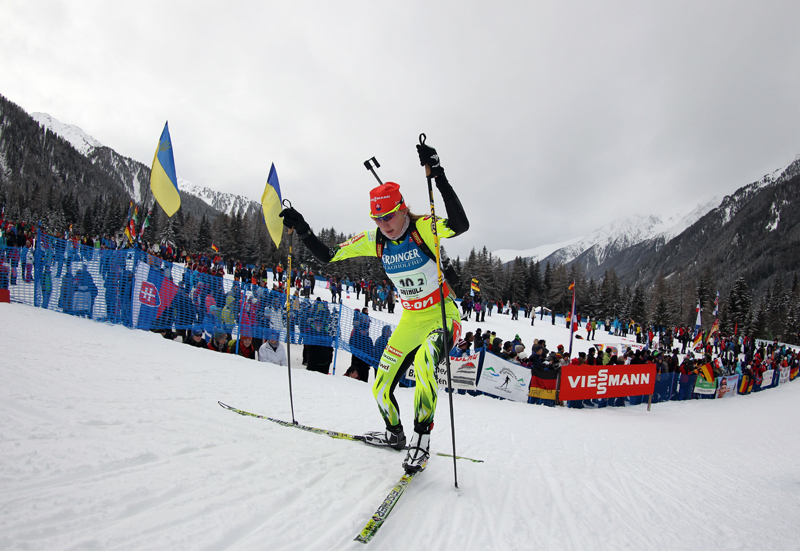
    “It was very low snowfall and they still had 30 k of trails open,” Liebsch said on the phone Friday. “There’s not anything quite like this in the states.”

    The Minnesota skier with Borton Volvo XC United said he scheduled a six-day trip to Frozen Thunder to get the maximize his time before the season starts in nearly a month. In late August, he took a group of skiers to the Haig glacier, about 45 minutes outside Canmore, for a week of high-altitude, on-snow training.

    “That was a little awkward, you know, long skiing and stuff, but since I’ve been here I’ve put the skates on and that felt really good,” Liebsch said. “I was doing quality sessions my second and third day here.”

    Since then, he’s been working out with friends like former teammate Tad Elliott (U.S. Ski Team/Team HomeGrown) and Sylvan Ellefson (Team HomeGrown). The U.S. Ski Team (USST) arrived on Thursday, and Liebsch said he skied with those two on Friday morning. Yesterday, he and Ellefson went on a 1 ½-hour mountain bike.

    In terms of getting on snow, scheduling isn’t too complicated. While it was previously first-come, first-served, Roycroft wrote that this year, the nordic centre reserved time for high-performance athletes from any country (either national team, provincial or the development equivalent) to use the trails from 9 a.m. to noon. The public can ski any time outside of that. Regarding total use, he said it’s up 25 percent.

    Phil Widmer (AWCA) on snow at Frozen Thunder on Oct. 13 in Canmore, Alberta. (Devon Kershaw courtesy photo)

    While the Canadian World Cup skiers have been in Canmore for more than a week, their U.S. counterparts recently settled in for their 1 ½-week camp. According to Canadian head coach Justin Wadsworth, they hadn’t coordinated workouts, but that didn’t mean they weren’t going to.
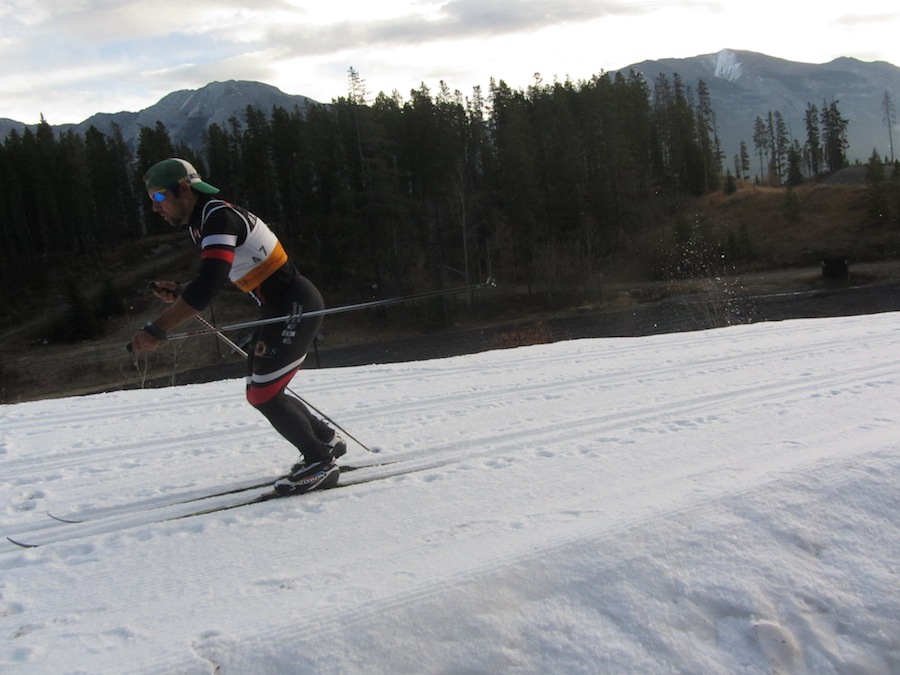
    “This part of the season is crucial to be flexible and not force workouts just because they’re on the plan,” Wadsworth wrote in an email.

    One thing’s for sure: there’s going to be a timed-and-bibbed sprint showdown Oct. 26.

    According to a Cross Country Canada press release, Frozen Thunder’s first major sprint race – the WinSport Frozen Thunder Classic – will include more than 100 competitors from the U.S. and Canada. Qualifying will begin at 9 a.m. with the head-to-head heats starting at 10 a.m.

    “The sprint race is another important element in Frozen Thunder’s delivery of what Canada’s athletes have asked for, and need, in their pursuit of international excellence,” Roycroft said in the release.

    “Through the financial backing of the Government of Canada’s commitment to the Own the Podium program, along with WinSport Canada, this multi-year effort complements the more than $30 million these organizations, along with the Government of Alberta, have invested into the facilities and resources at the Canmore Nordic Centre over the last two Olympic cycles to help our Nordic athletes reach their goals.”

    As Wadsworth put it: “It’s just a really competitive field for sprinting so it should be a fun race to see.”

    Cross Country Canada announcing its World Cup and Para-Nordic Ski Teams on Friday at Frozen Thunder in Canmore, Alberta. (CCC photo/twitter.com/cccski)
    A look at the 1.8 k course at Frozen Thunder in Canmore, Alberta, earlier this week. (Matt Liebsch courtesy photo/mattliebsch.com)
  • Canmore Jump-Starts Ski Season With ‘Frozen Thunder’

    It will be a little while before the Canmore Nordic Center has full coverage of its trails like in this mid-winter shot, but operation 'Frozen Thunder' will help the Canadians get on snow early. (Photo: Win Goodbody)

    Early season skiing is always tough. A lucky few end up on glaciers or live in locations that benefit from early snowfalls, but the majority must make do on rollerskis.

    However, Canmore, the epicenter of Canadian cross country skiing, has hit on a new way to get on snow early.

    Beginning this weekend, staff at the Canmore Nordic Center (CNC) in Alberta will roll snow into a loop in an operation nicknamed ‘Frozen Thunder.’ The loop, which will be roughly one kilometer long, will even go through the biathlon range.

    In an e-mail to FasterSkier, Magi Scallion, the CNC director of events, said that the CNC managed to store enough snow at the end of last season to cover roughly three kilometers of trails, but by October, the amount had been reduced to just enough to cover a kilometer to a kilometer-and-a-half.

    To spread the white stuff, the CNC will be using large trucks, a back hoe and Pisten Bullys. “We’re essentially trucking it onto the trail we’ll be skiing on, and then pushing it out with our Piston Bullys,” said Scallion.

    As Canmore is the base for the Canadian National Cross Country Ski Team, as well as the Canadian National Biathlon Team, both will be heavy users of the loop. According to Scallion, the national teams have limited their early season travel in order to take full advantage of the on-snow training opportunities at home in Canmore.

    In addition to the Canadians, the U.S. National Biathlon Team is also planning on using the snow, as their World Cup selection races are slated for the CNC in mid-November.

    At the local level, five or six clubs based in the area will be skiing on the loop, with several out-of-town clubs also expected to make the trip. In total, Scallion said she hopes for upwards of 100 users per day.

    Despite unseasonably warm temperatures thus far in October in Canmore, Scallion’s hope is that ‘Frozen Thunder’ will be the start of winter at the CNC. “We fully expect this snow to last until we can produce snow with our snow making machines,” she said. “This is the beginning of the ski season for us.”

    The cost? Scallion pegged the total for the project at roughly $6,000. The cost of the snow itself, because it was produced last winter as part of the CNC’s snowmaking program, was very little. About $2,000 has been allocated for the use of heavy machinery to move the snow, while the largest expenditure was for sawdust, which covered the snow during the summer to reduce melting. Some four loads of sawdust – at $1,000 bucks a pop – were used.

    As for next year, plans are already underway to increase the amount of snow available to create early-season skiing. The CNC is investing another $10,000 this fall to renovate a section of earth to improve snow storage and reduce sawdust costs for next year, and its goal is to be able provide roughly five kilometers of “groomed snowfarm snow trail” at some point in the future.