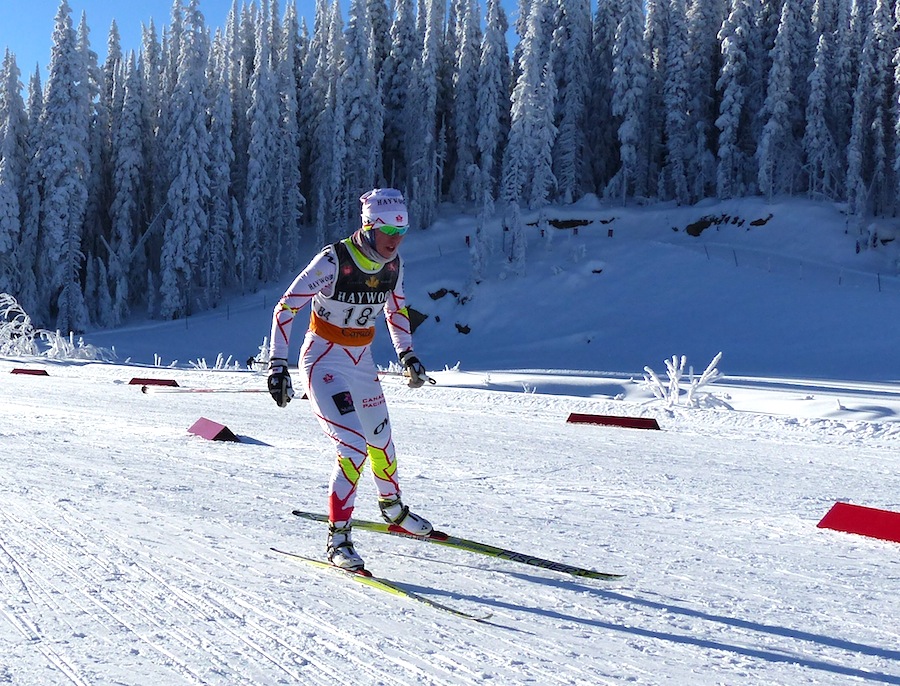
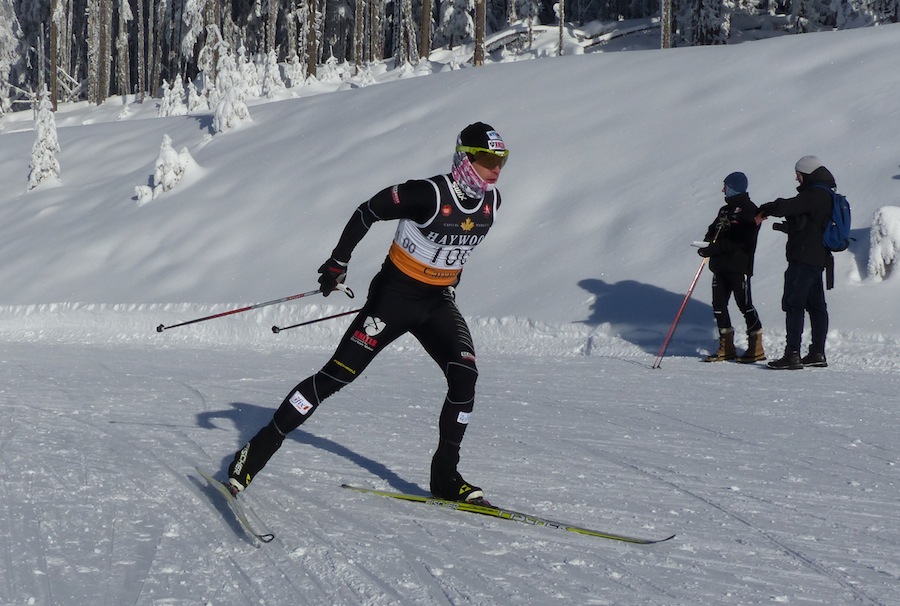
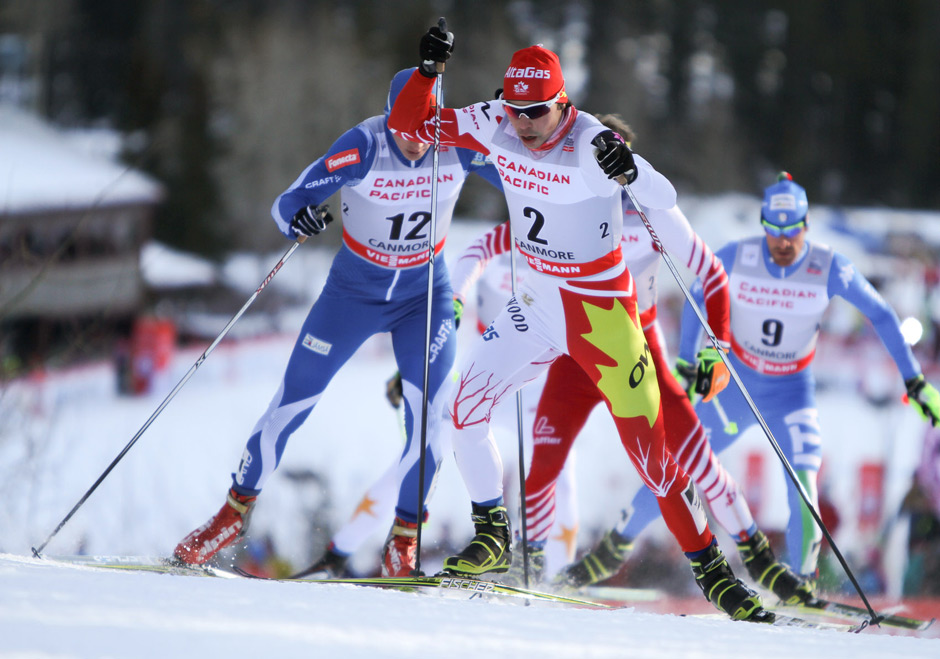
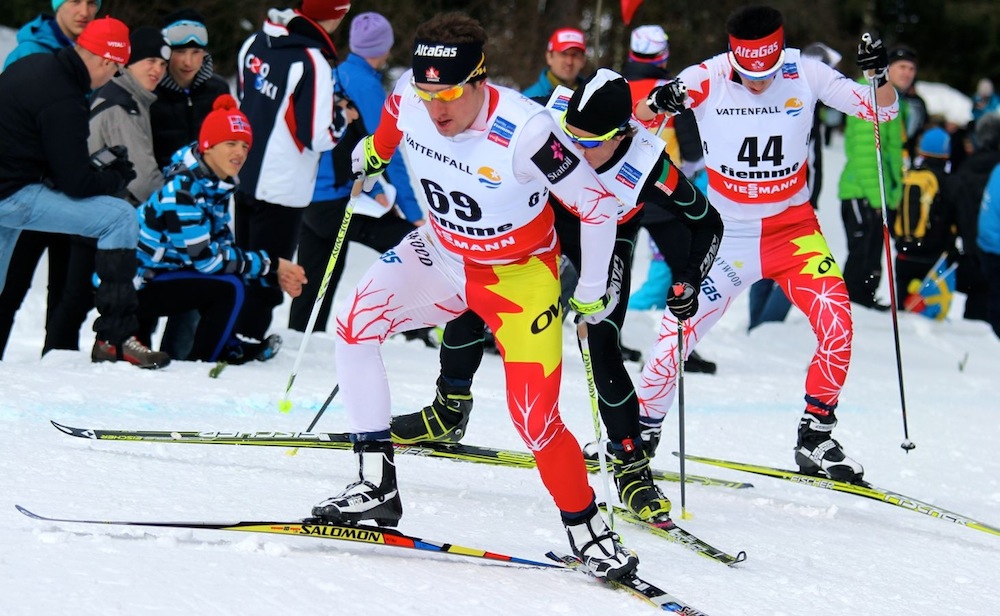
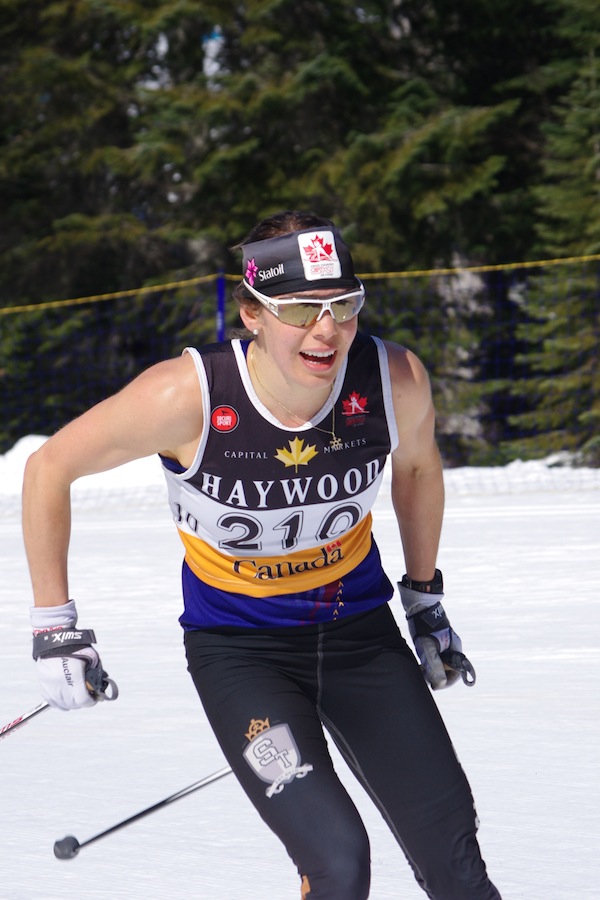
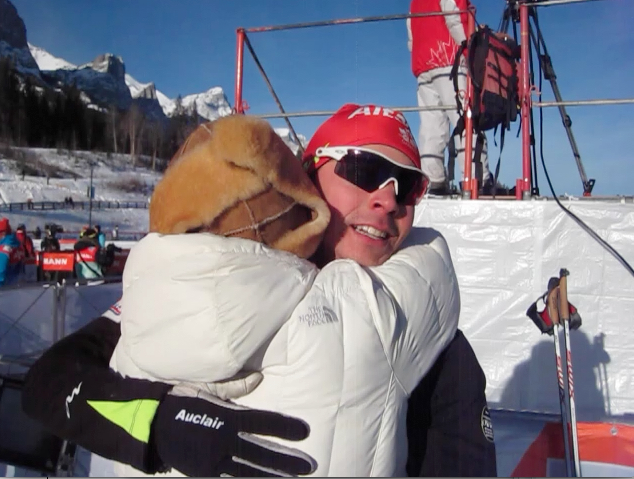
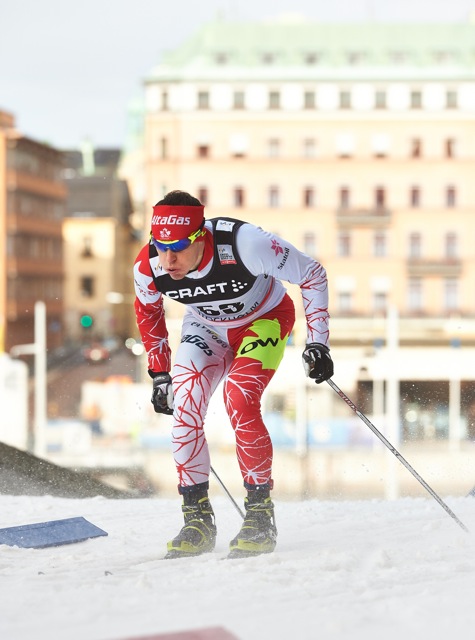
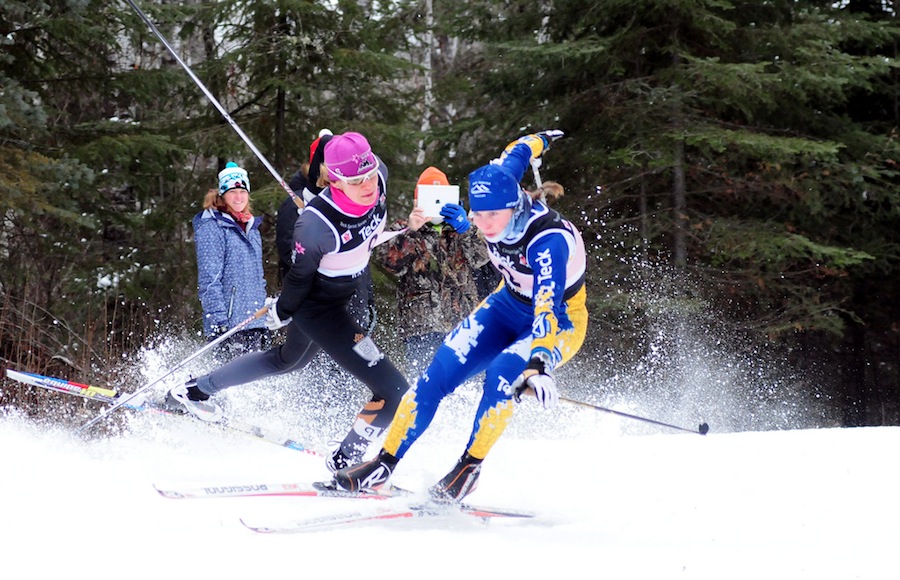
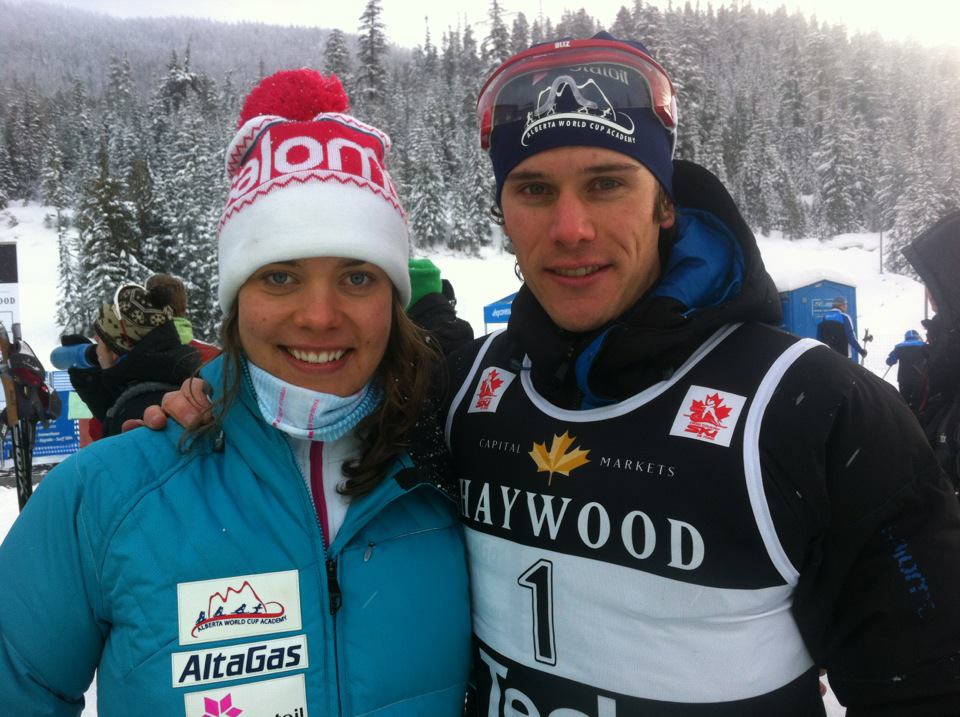
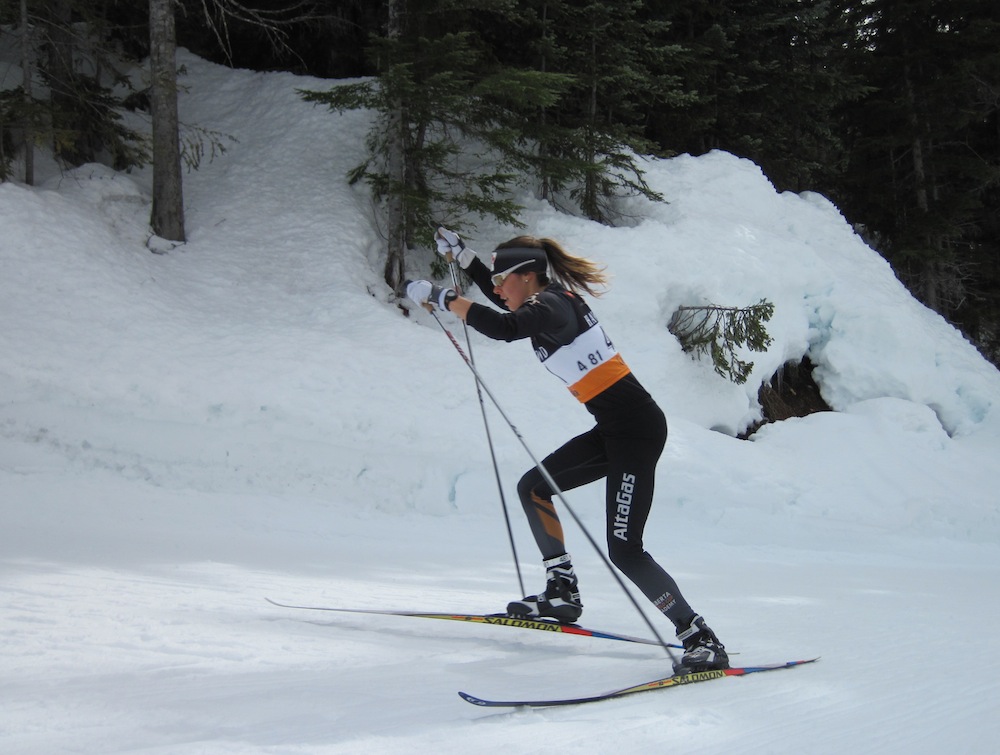
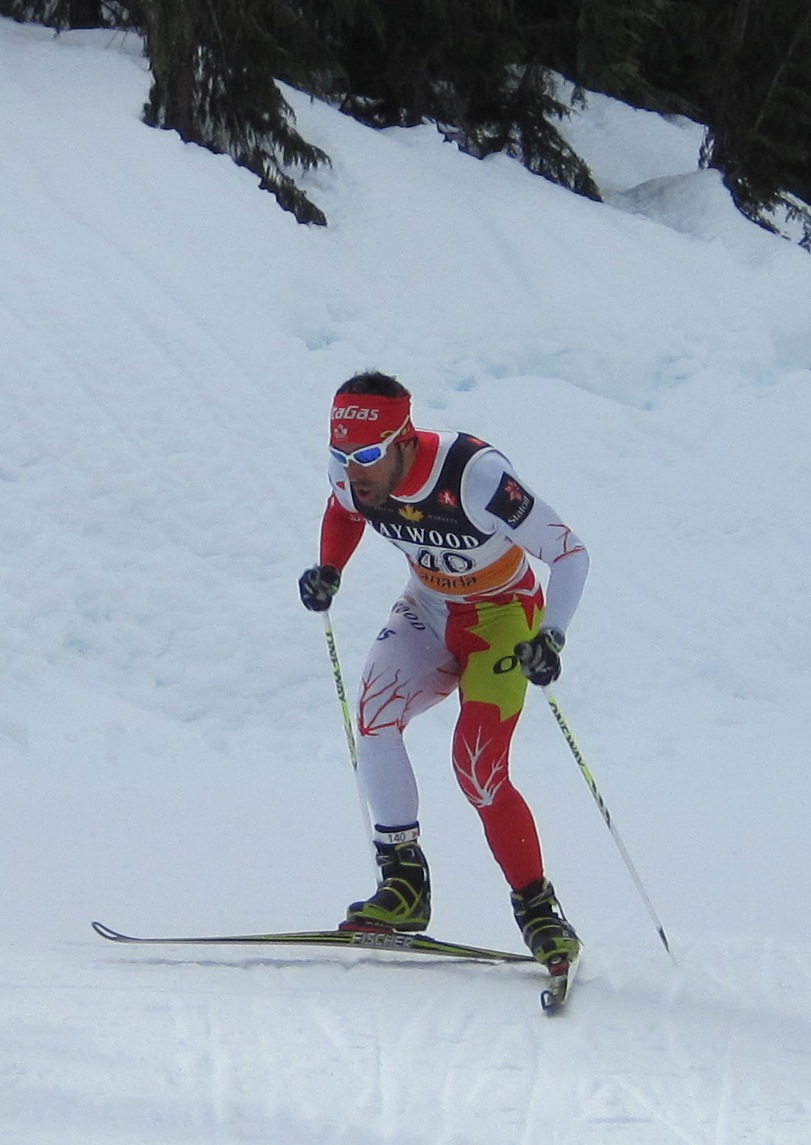
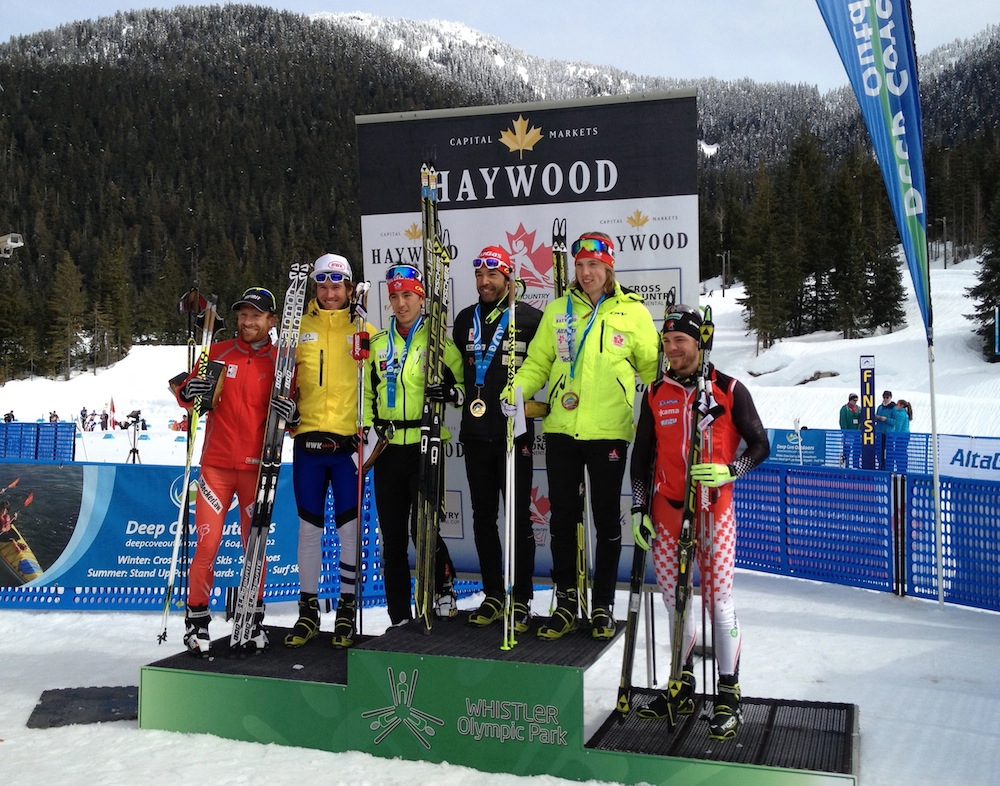
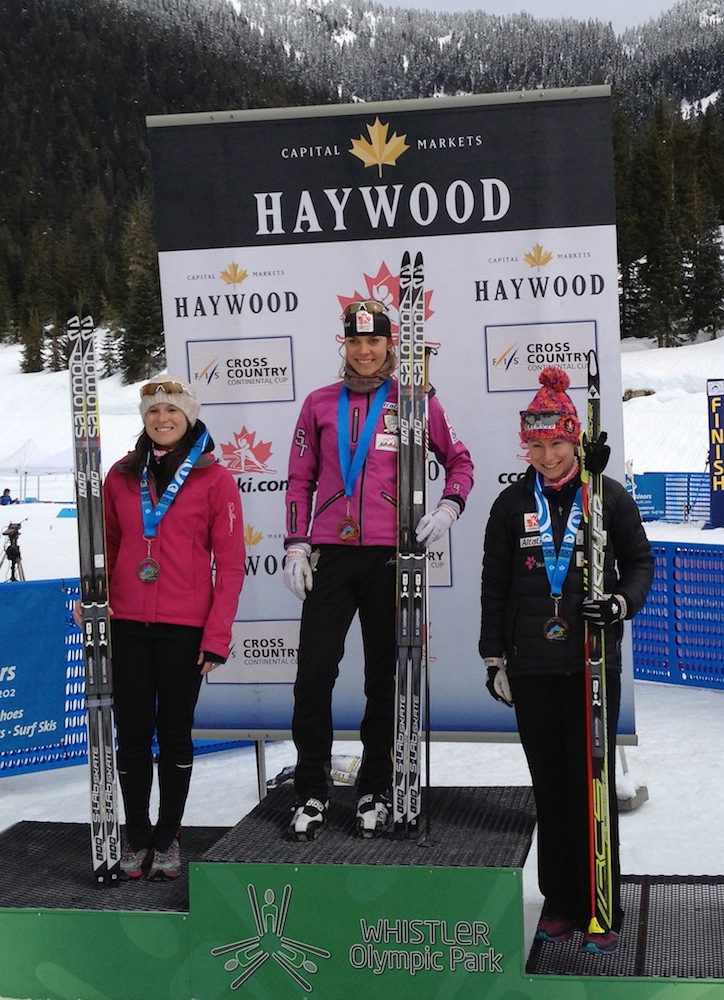
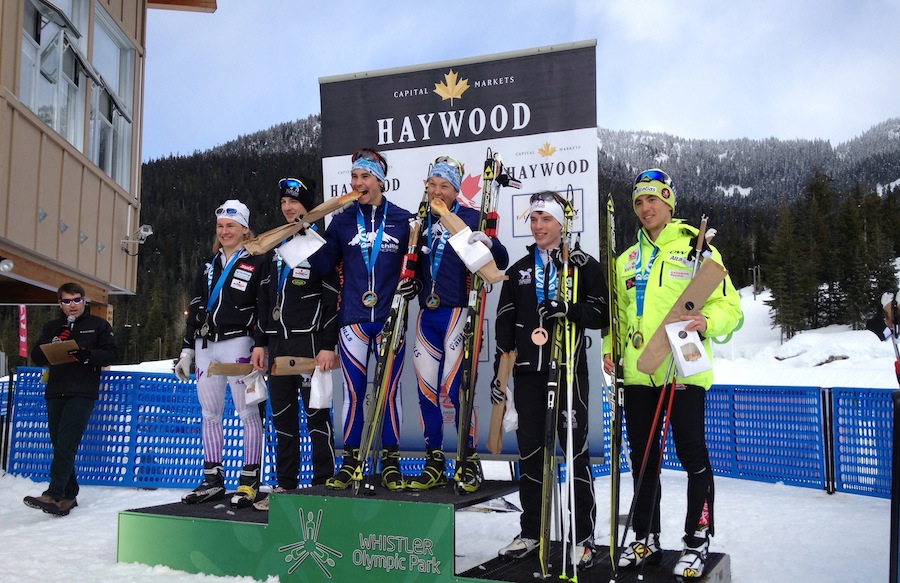
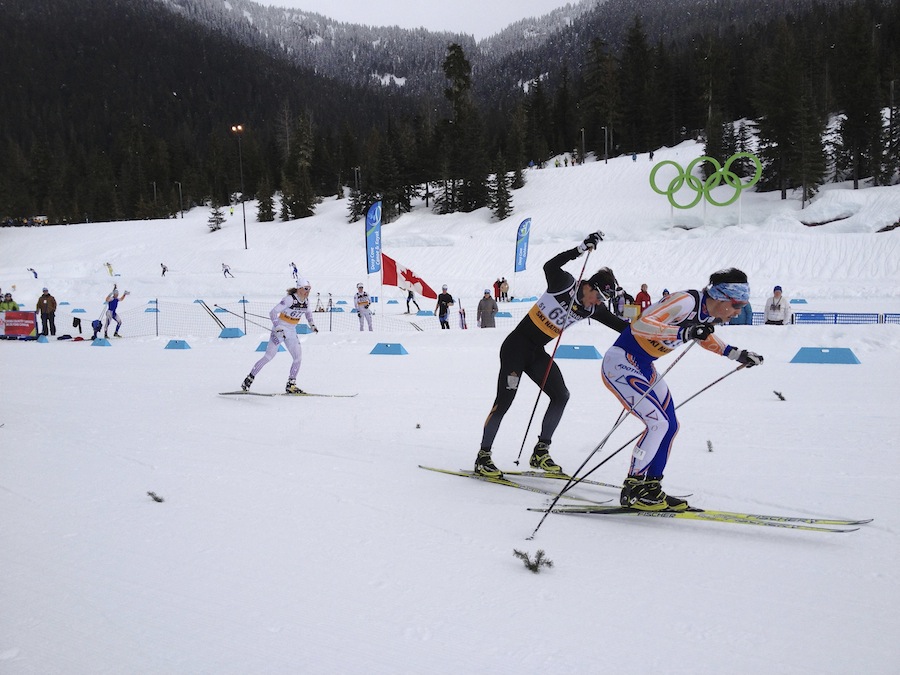
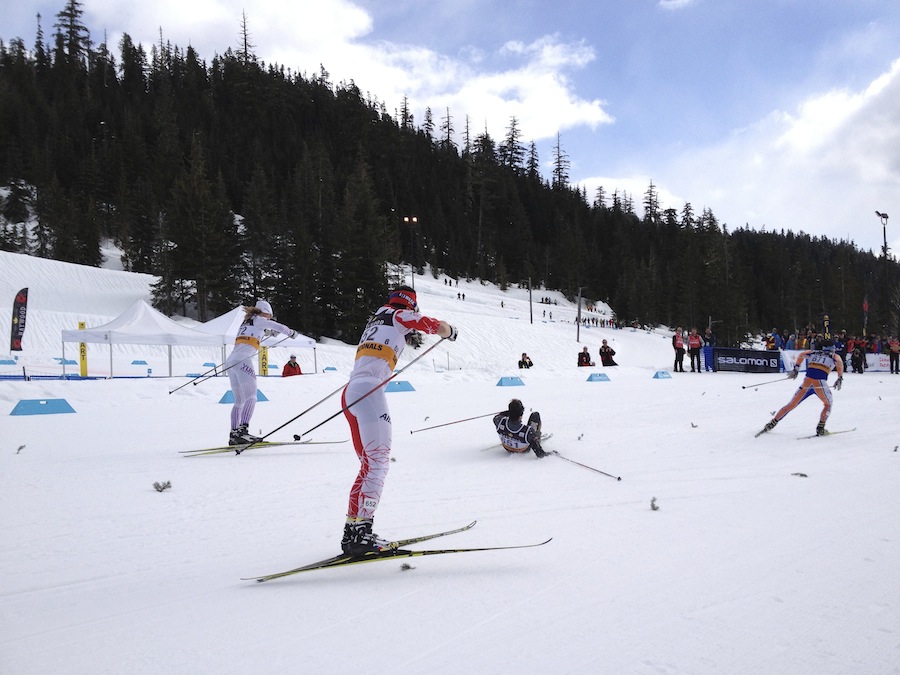
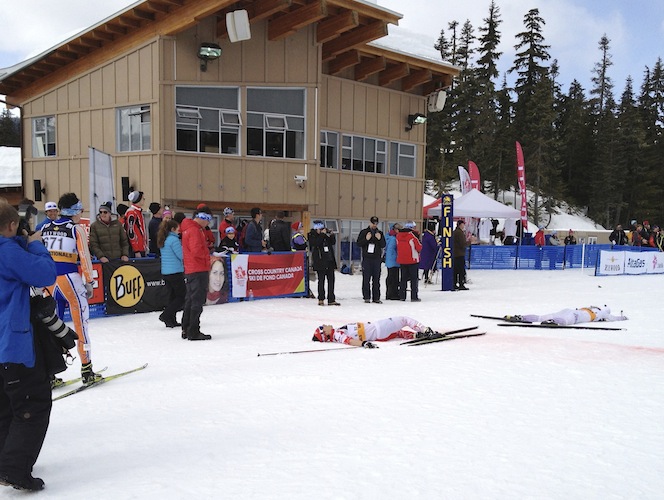
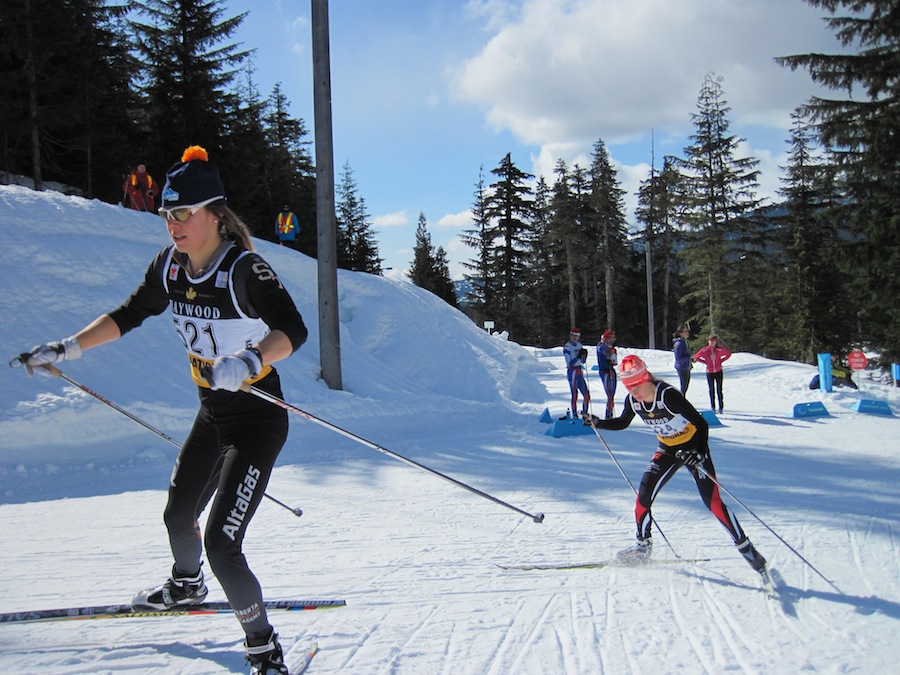
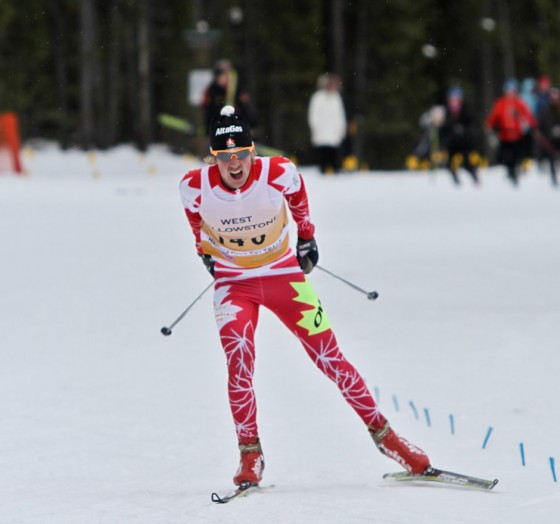
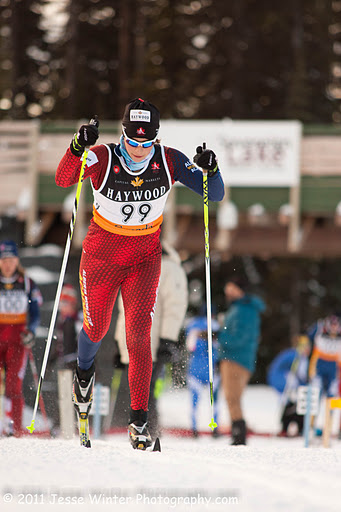
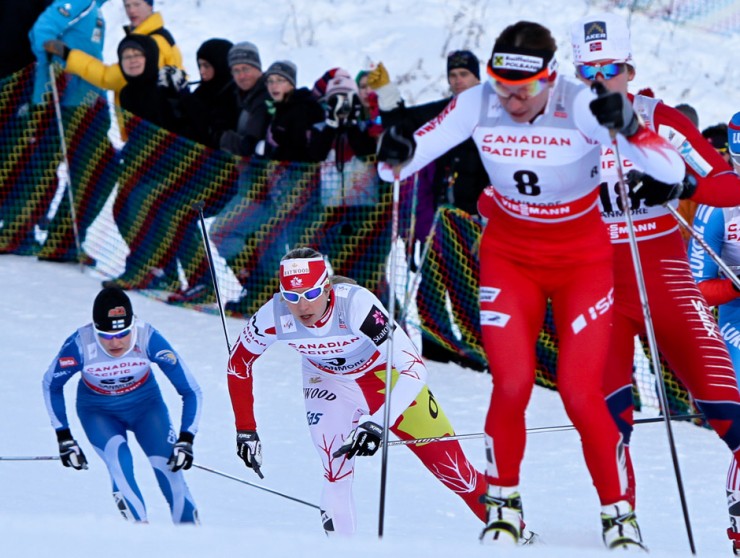
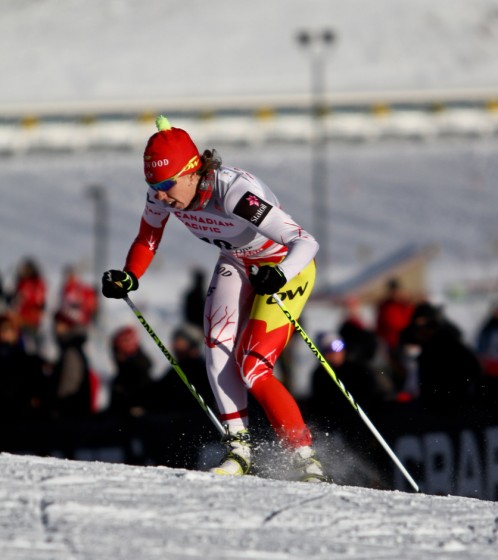
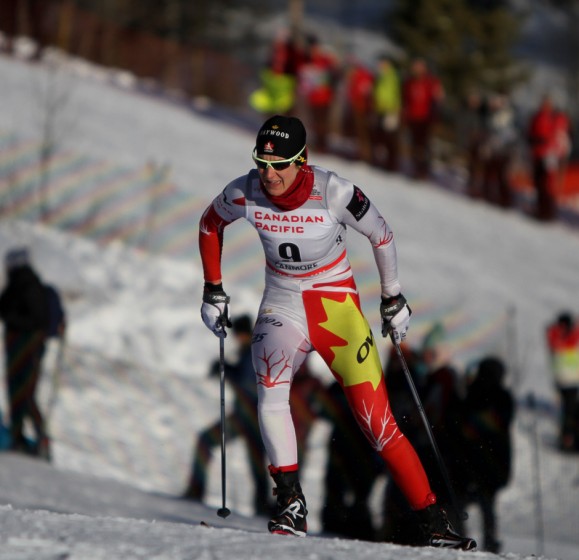
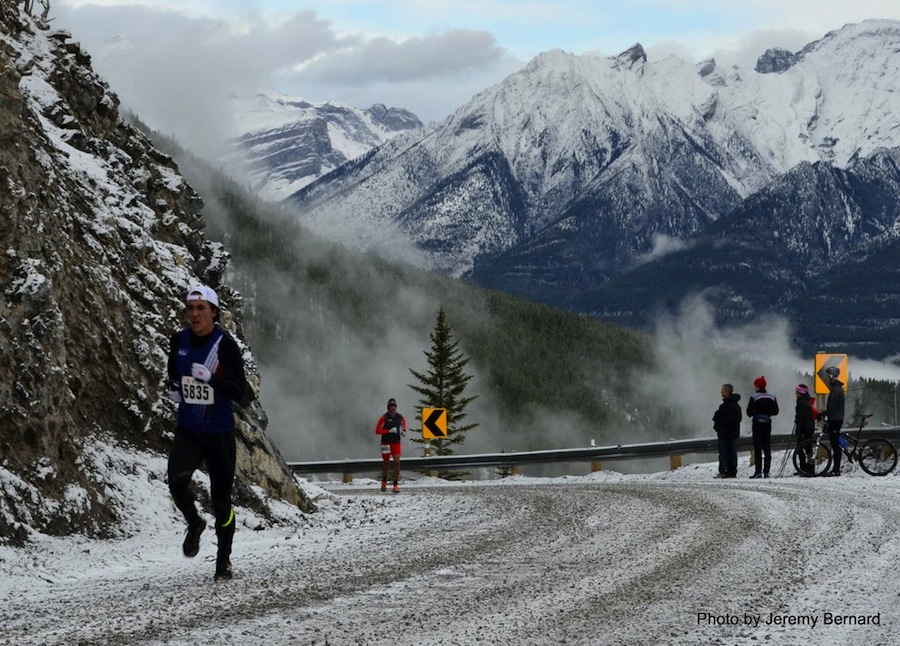
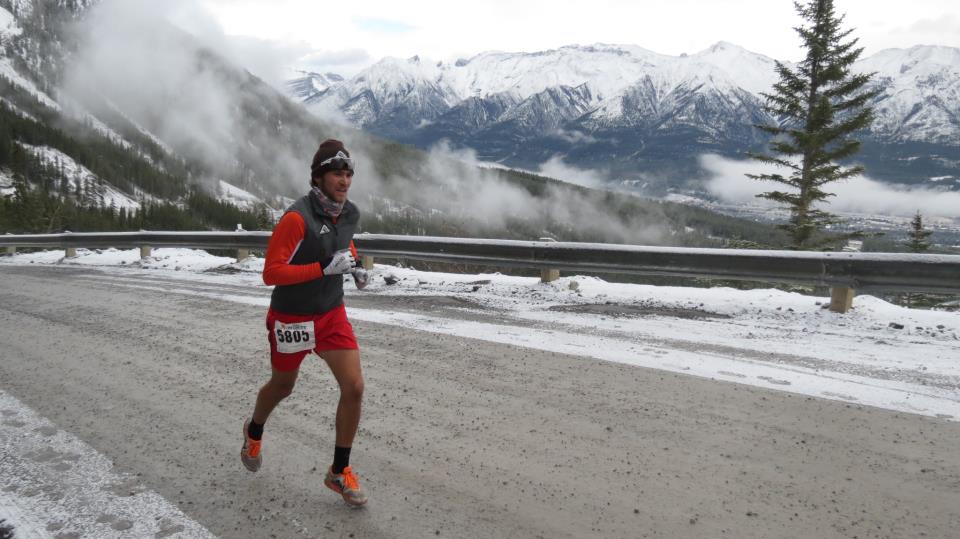
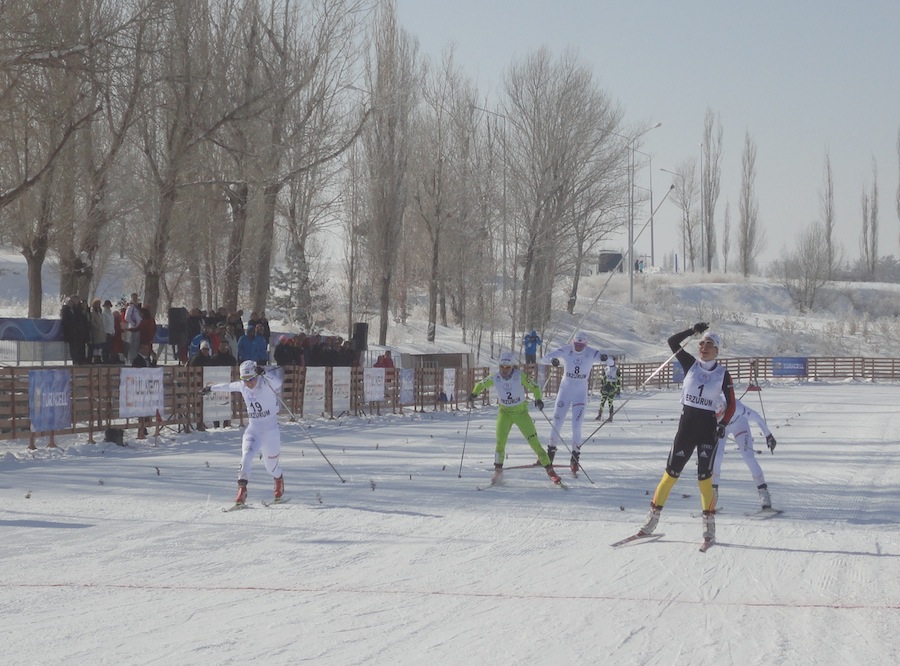
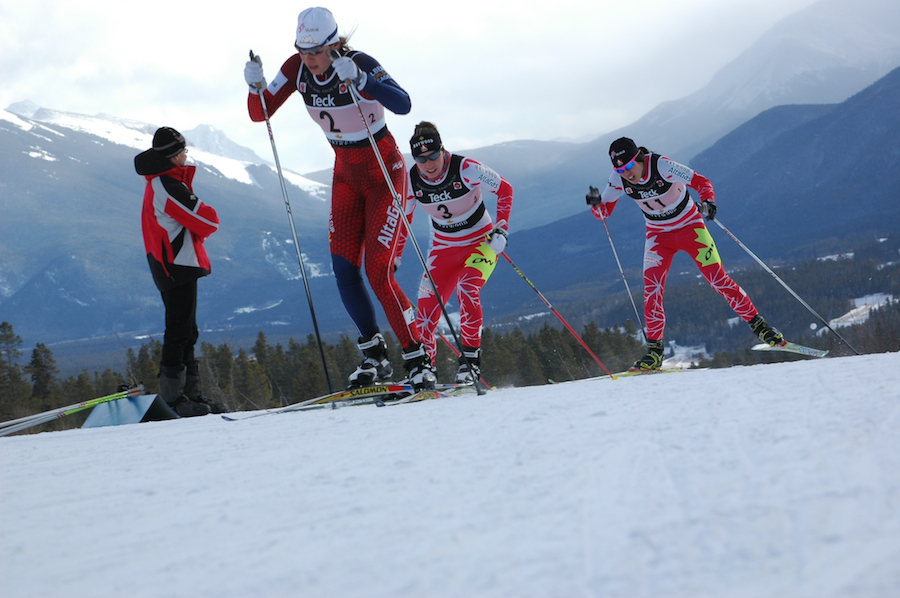
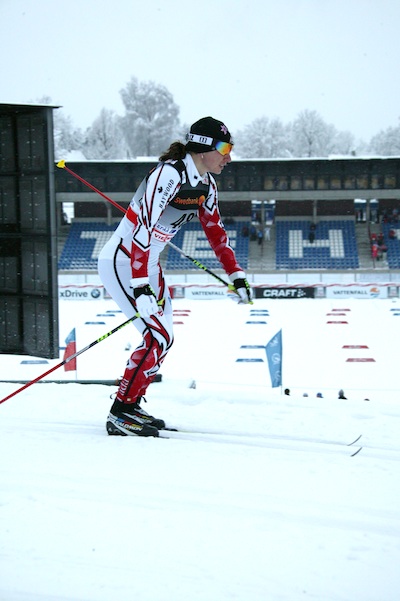
Emily Nishikawa (AWCA/NST) halfway through her 10 k freestyle race on Dec. 7, in which she placed fifth at the NorAm opener at Sovereign Lake, B.C. The next day, she was third in the classic sprint there.
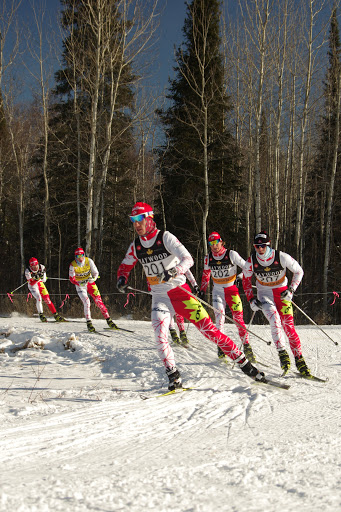
Saturday’s NorAm freestyle sprints at the Black Jack Ski Club delivered an exciting day of racing, with crashes, tactic changes between rounds, and photo finishes in Rossland, B.C.
Emily Nishikawa of the Alberta World Cup Academy (AWCA) and Canadian National Senior Team (NST) won the women’s 1.4-kilometre A-final by 0.22 seconds in 3:21.29, and teammate Heidi Widmer edged Olivia Bouffard-Nesbitt (Laurentides) in a photo finish for second.
The Americans rounded out the rest of the A-final with Caitlin Patterson (Craftsbury Green Racing Project) in fourth, Jennie Bender (Bridger Ski Foundation) in fifth and Caitlin Gregg (Team Gregg/Madshus) in sixth. After crossing the line in fourth, a jury decision bumped Gregg to sixth after she collided with Bender in the finishing straight. Bender went down; Gregg did not.
“I was relegated to 6th place and I deserved it,” Gregg wrote in an email.
The women’s final was considerably faster than qualification, with qualifier winner Bouffard-Nesbitt taking five seconds off her qualification time of 3:26.26.
In an email, Nishikawa wrote that she “got off to a slower start in the qualifier, but I felt much better throughout the heats.”
She was happy with her day and the way the season is starting, a noticeable upgrade from one week earlier when she said she was “looking forward to some more races” to show what her training had accomplished.
The women’s heats were closer and more tactical than the previous NorAm at Sovereign Lake.
“Most of the heats were really tight,” Nishikawa wrote. “With a fast finish stretch I barely squeaked into the final!”
American Caitlin Gregg (Team Gregg/Madshus) kicked off the final the same way she won both her heats, trying to drop the group on the opening climb. “This [tactic] worked well until the final when Emily and the other ladies could stay with me,” Gregg wrote. “Emily had an incredible surge up the steepest hill on the course and took the lead from there on out. It was impressive!”
Widmer used the same tactics as Gregg to win her quarter, but “barely squeaked into the final because the others came up so quickly in the finish” of her semifinal.
Widmer and Nishikawa finished 0.04 seconds apart in their semifinal to take the lucky loser spots, relegating Alysson Marshall to the B-final by 0.2 seconds.
Bouffard-Nesbitt tried to hang back in the final.
“After the ‘S’ turn I was carrying a lot more speed than the person ahead of me,” she wrote in an email. “But had Emily and Heidi coming up on my right so I had no choice but try to squeeze by on the left.”
She pushed the last corner to work her way up to the photo finish for second. She was happy with her result and first qualification win.
“I learned a lot today though!” she added.
Bjornsen Nabs First Win of the Season
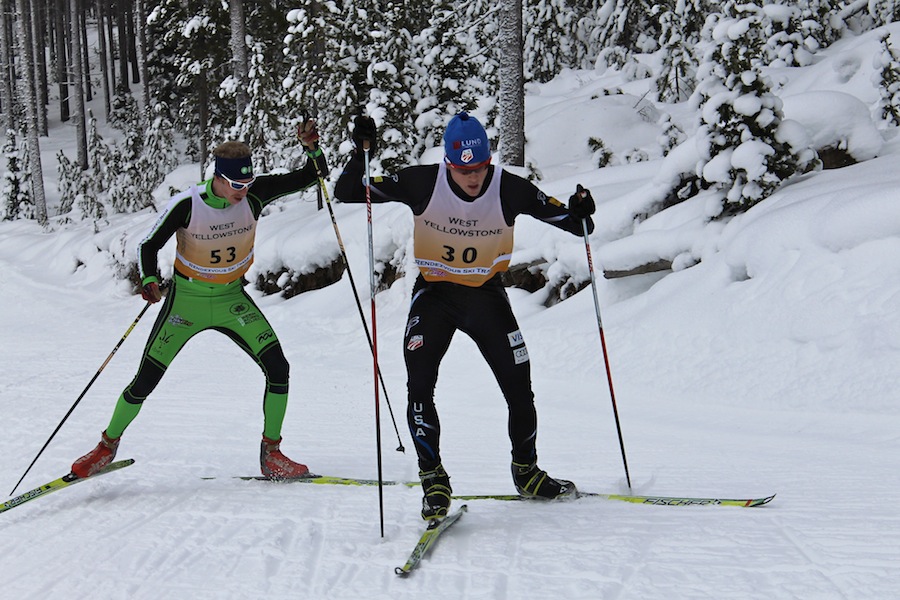
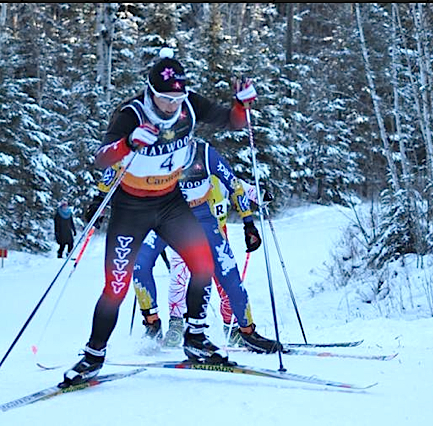
Erik Bjornsen (APU/USST) leads Peter Hegman (Craftsbury) during the SuperTour 15 k skate on Dec. 1 in West Yellowstone, Mont. Bjornsen went on to place 11th in the event.
In the men’s 1.6 k skate sprint, Erik Bjornsen of Alaska Pacific University (APU) and the US Ski Team (USST) changed his tactics to come out on top in the A-final in 3:37.53, 0.19 seconds ahead of fellow American Miles Havlick of the Sun Valley Ski Education Foundation (SVSEF) in second.
Only two Canadians advanced to the final, including Graham Nishikawa (NST), who placed third. Sylvan Ellefson (SSCV/Team HomeGrown) finished fourth, Dakota Blackhorse-von Jess (Bend Endurance Academy) was fifth, and Knute Johnsgaard (Yukon Elite) placed sixth.
“In the quarters I thought I could go out and control the race,” Bjornsen wrote. “But I quickly learned my lesson when I got out sprinted by two people in the finishing lanes.”
After getting “lucky” in the semi “when two Canadians went down,” Bjornsen advanced to the final.
“I stayed comfortable, kicked hard over the tops of hills, and prepared myself for the final sprint,” he explained. “When I made the move past Dakota and Miles in the finish I could see the win, I was just a happy little bear.”
In his first year with the SVSEF Gold Team, Havlick was “psyched” by his second place.
“As a junior, I used to be a pretty strong sprinter but after 4 years of NCAA skiing (without sprinting), it has been tricky finding that next gear again,” he wrote. “But today, it felt like it was back.
“The courses today were tough and like 2 weeks ago [at the SuperTour] in West Yellowstone, offered few opportunities to pass after the start,” Havlick added. “I wanted to be aggressive and get out early and keep the pedal down from there.”
Nishikawa was happy with third. “I felt better throughout the heats so that was positive and the main goal of the day,” he wrote.
Like a number of the more experienced Canadians who have been describing the NorAm races in terms of process rather than results, his focus appears to be locked on Sochi.
Johnsgaard was frustrated by the tactical choices that put him sixth in the A-final. Coming into the final 100 metres, he “tucked in behind Miles and Dakota, but the guys behind us really worked the downhill and swallowed us up.
“I was mad at myself for letting up on the last downhill because I thought I could get on the podium today for the first time,” he wrote.
At 21, he is determined to get to U23 World Championships and needed more to break AWCA member Patrick Stewart-Jones’ grip on the top spot. Based on the first two NorAm weekends, one Canadian male and one female will be pre-selected for U23s.
After winning his quarterfinal, Michael Somppi (AWCA/NST) crashed in the semifinal, which didn’t remedy his frustrations with his early season races. He ended up eighth overall behind Stewart-Jones in seventh.
“I tried to start strong in my heats and set a hard pace on the first climb,” Somppi wrote. “It’s really the only place on the course you could make people’s legs burn. The rest of the course was fast and twisty so passing was difficult.”
This tactic “worked for me in my quarter-final heat and was working in my semi-final as I was skiing in second place before I crashed,” he explained.
“You often need a little luck on your side in sprint racing and today I didn’t have a horseshoe,” Somppi concluded.
There are a number of racers who might agree with that.
VERNON, B.C. — Photos from the season-opening NorAm at the Sovereign Lake Nordic Centre, with 10/15 k freestyle followed by classic-sprint races in temperatures near -18 degrees Celsius on Saturday and Sunday, respectively. All photos by Gerry Furseth and Peggy Hung.
Dec. 7: Women’s 10 k and men’s 15 k freestyle individual starts (Race report | results)
Heidi Widmer (AWCA/NST) en route to winning the women’s 10 k freestyle individual start in 33:14.7, 26.3 seconds ahead of Amanda Ammar (not shown) in second.
Emily Nishikawa (AWCA/NST) halfway through her 10 k freestyle race on Dec. 7, in which she placed fifth in the NorAm opener at Sovereign Lake, B.C.
Brian Gregg (Team Gregg/Madshus) on his way to winning the 15 k freestyle individual start, in the Sovereign Lake NorAm races last month.
Matt Liebsch (XC United/Team StrongHeart) racing to second in the Sovereign Lake NorAm 15 k freestyle on Saturday. He finished 3.3 seconds behind winner and friend Brian Gregg (Madshus/Team Gregg).
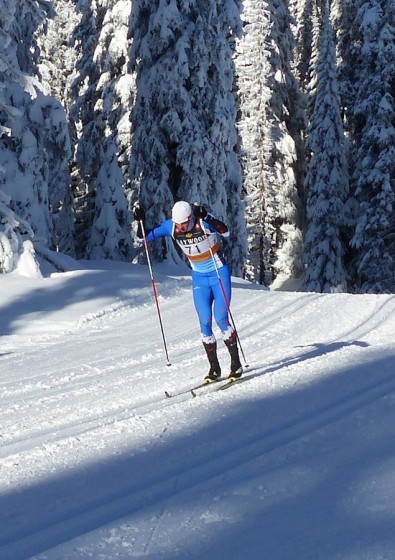
Kevin Sandau (AWCA/NST) early on in his 15 k freestyle race, in which he placed fifth.
Sandau at the end of his second lap.
Heidi Widmer finishing with the fastest 10 k freestyle time by more than 26 seconds in 33:14.7.
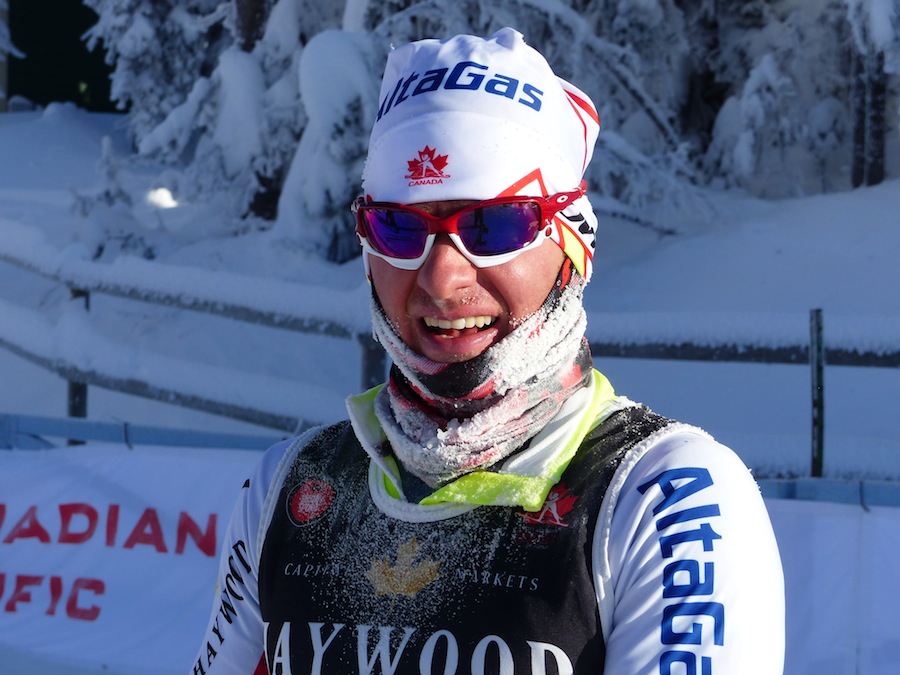
Emily Nishikawa (AWCA/NST) and Anne-Marie Comeau of the Pierre-Harvey Training Centre (c) at the finish.
Graham Nishikawa (CNST) was the top Canadian in third.
Kevin Sandau (AWCA/NST) after finishing 15 k freestyle at the Sovereign Lake NorAm, which started in temperatures around 18 C on Saturday afternoon.
Happy Ninjas, teammates Amanda Ammar (l) and Zoe Roy, after placing second and third, respectively.
A “unicorn” Ninja makes her way to the podium.
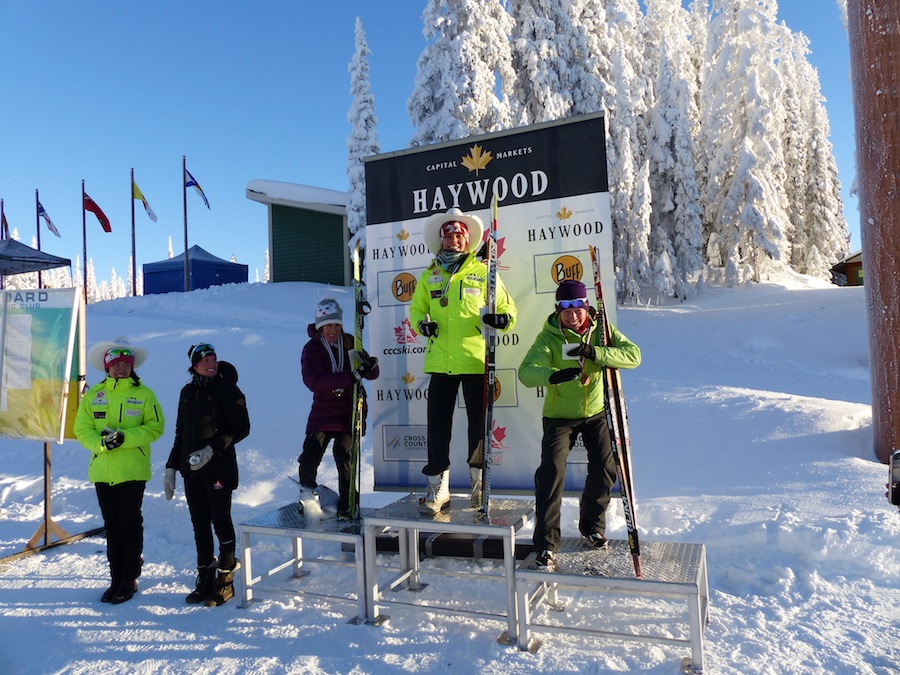
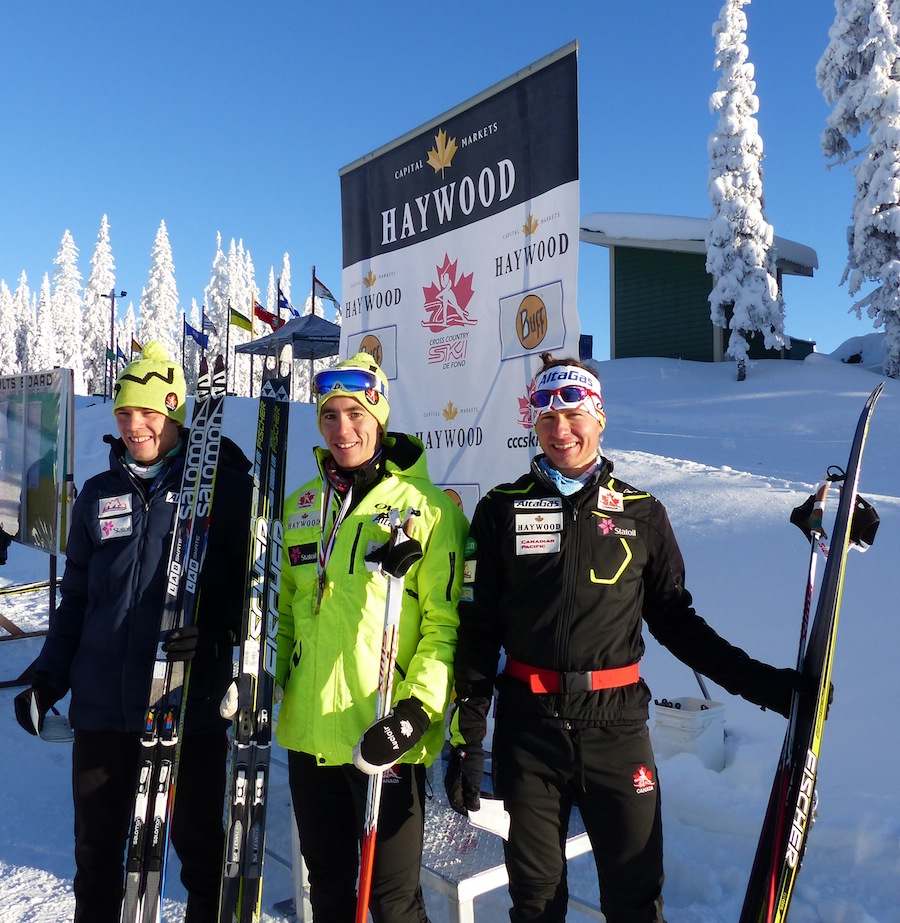
Heidi Widmer (AWCA/NST) after winning Saturday’s 10 k freestyle individual start at the opening NorAm at Sovereign Lake, B.C. Two Team Ninja skiers, Amanda Ammar (l) and Zoe Roy (r) placed second and third, respectively.
Top three Canadian men in the Sovereign Lake NorAm 15 k freestyle individual start on Saturday: Graham Nishikawa (c) was third overall, Patrick Stewart-Jones (l) placed fourth, and Kevin Sandau was fifth.
Dec. 8: Women’s 1.2 k and men’s 1.4 k classic sprints (Race report | results)
Early morning at the Sovereign Lake Nordic Centre on Dec. 8, before the men’s and women’s NorAm classic sprints.
Amanda Ammar (Team Ninja) racing to the fastest 1.2 k classic qualifying time of 3:06.4 at the Sovereign Lake NorAm on Dec. 8.
Andrea Dupont (Rocky Mountain Racers) qualifying in second, 2.2 seconds behind Amanda Ammar (not shown), who was fastest in the NorAm 1.2 k classic sprint qualifier at Sovereign Lake, B.C.
Emily Nishikawa (AWCA/NST) qualifying in third, 5.8 seconds out of first at the NorAm 1.2 k classic sprint qualifier at Sovereign Lake, B.C., on Dec. 8.
Heidi Widmer (AWCA/NST) qualifying in fourth, 8.2 seconds out of first at the NorAm 1.2 k classic sprint qualifier at Sovereign Lake, B.C., on Dec. 8.
Alysson Marshall (AWCA/NST) qualifying in fifth, 9.7 seconds behind Amanda Ammar (not shown), who was fastest in the NorAm 1.2 k classic sprint qualifier at Sovereign Lake, B.C.
Raphaël Couturier (CNEPH/NST) putting down the fastest qualifying time of 3:28.6 in the men’s 1.4 k classic sprint the Sovereign Lake NorAm on Dec. 8.
Knute Johnsgaard (AWCA/NST) qualifying in third, 3.6 seconds behind Raphael Couturier (not shown), who was the fastest qualifier in 3:28.6 in the men’s 1.4 k classic sprint the Sovereign Lake NorAm on Dec. 8.
Patrick Stewart-Jones (AWCA) qualifying in 13th in the men’s 1.4 k classic sprint the Sovereign Lake NorAm on Dec. 8
Graeme Killick (AWCA/NST) qualifying in seventh in the men’s 1.4 k classic sprint the Sovereign Lake NorAm on Dec. 8
Julien Locke (Black Jack) qualifying in 13th in the men’s 1.4 k classic sprint the Sovereign Lake NorAm on Dec. 8
Women’s quarterfinals
Andrea Dupont (l) and Brittany Webster (second from l) trail two Canadian Senior Development Team skiers in their semifinal of the NorAm 1.2 k classic sprint at Sovereign Lake on Dec. 8. Dupont qualified in third as a lucky loser, and went on to win the final.
The women’s A-final cruises down a hill along the 1.2 k classic sprint course at the Sovereign Lake Nordic Centre in Vernon, B.C. Andrea Dupont (RMR) won it ahead of Alysson Marshall and Emily Nishikawa.
Dupont leading Marshall (c) in the finishing stretch
(L-R) Emily Nishikawa, Alysson Marshall, and Andrea Dupont head into the finishing stretch of Sunday’s classic sprint at the NorAm opening weekend at Sovereign Lake in Vernon, B.C.
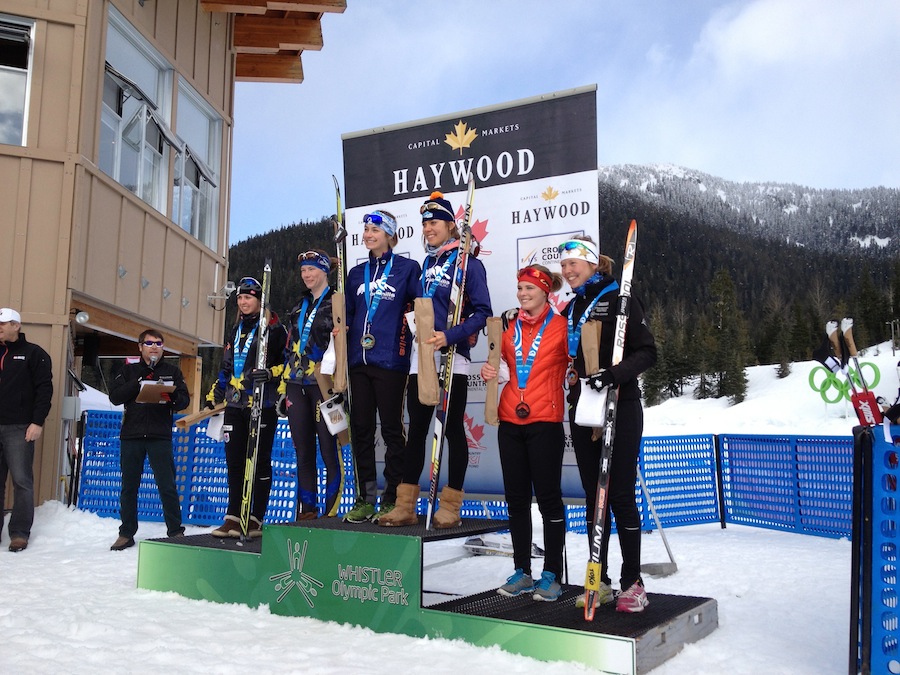
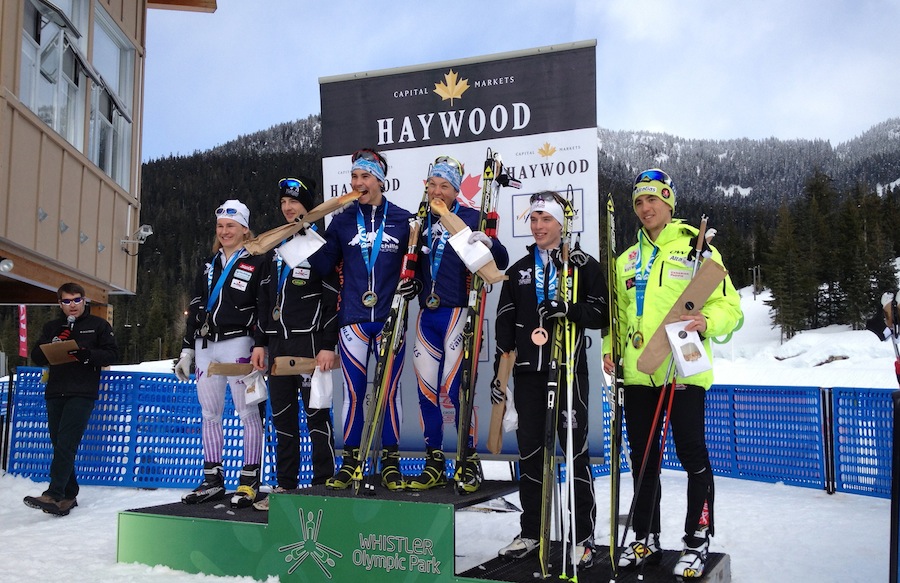
Heidi Widmer (AWCA/NST) after winning Saturday’s 10 k freestyle individual start at the opening NorAm at Sovereign Lake, B.C. Two Team Ninja skiers, Amanda Ammar (third from l) and Zoe Roy (r) placed second and third, respectively. Brittany Webster (second from l) placed fourth, and Emily Nishikawa (l) was fifth.
VERNON, B.C. — Another cold one at Sovereign Lake kept the organizers and athletes scrambling in temperatures around -20 degrees Celsius, but the end result was an exciting day of racing at the first NorAm of the season.
In the men’s 15-kilometre freestyle individual start on Saturday, American Brian Gregg (Madshus/Team Gregg) rose to the top in 41:03.3 minutes, edging out compatriot and friend Matt Liebsch (XC United/Team StrongHeart) by 3.3 seconds, and Canadian Senior Development Team (NST) member Graham Nishikawa in third (+4.5).
Matt Liebsch (XC United/Team StrongHeart) racing to second in the Sovereign Lake NorAm 15 k freestyle on Saturday. He finished 3.3 seconds behind winner and friend Brian Gregg (Madshus/Team Gregg) and Graham Nishikawa (CNST) was the top Canadian in third.
Coming off a SuperTour podium in West Yellowstone, Mont., last weekend, Gregg said he was very happy with his pacing plan that allowed him to move up from third his last time around the 5 k loop.
“I tried to stay really controlled, and focussed on making each lap maybe a little bit faster,” Gregg said. “Each lap got a lot harder. It was a good strategy.”
Gregg did a solo time trial on the same course two weeks earlier, and said that experience translated to success on Saturday. After the race, he and Liebsch planned to fly back to Montana to race the second SuperTour distance race of the season — a 15 k classic — in Bozeman on Sunday.
Liebsch was pleased with his result, racking it up as another step towards his season goals.
“There is a 30 k skate [at U.S. nationals] that I want to ski very well and prove that I should be on the Olympic squad and start that 50 k skate in Sochi,” he said.
Nishikawa was satisfied with his day, explaining: “The name of the game today was just staying warm and getting through it alive.”
Asked about his expectations for the weekend, Nishikawa said, “I am just here to race and get into top race shape.” After training with the Canadian Para-Nordic Team throughout the offseason as a potential guide for the Paralympics, his target is on both the Olympics and Paralympics in Sochi, Russia.
Top three Canadian men in the Sovereign Lake NorAm 15 k freestyle individual start on Saturday: AWCA teammates Graham Nishikawa (c), who was third overall, Patrick Stewart-Jones (l) in fourth, and Kevin Sandau in fifth.
Patrick Stewart-Jones of the Alberta World Cup Academy (AWCA) took fourth to lead the U23’s, ahead of Kevin Sandau (AWCA/NST) in fifth.
Heidi Widmer (AWCA/NST) led the way for the women, winning the 10 k in 33:14.7.
“Today was a great start to the season,” she wrote in an email. “Even though the weather wasn’t the warmest, it was such a beautiful day on the trails.”
A couple of Ninjas infiltrated the podium, led by Team Ninja’s founding member Amanda Ammar in second (+26.3). One of Ammar’s teammates and training partners in Canmore, Alberta, Zoe Roy place third another 13.2 seconds back. Racing in their ninja suits, Ammar and Roy snuck ahead of perennial favorites Brittany Webster (Highlands) in fourth and Emily Nishikawa (AWCA/NST) in fifth.
“[Usually] I struggle with skating,” Ammar said. “I think that is one of my best skate results in a NorAm.”
Roy was pleased with third, describing her result as “a step in the right direction.”
The unusually cold weather created challenges for race organizers. The jury announced on Friday that the start would be delayed to 11 a.m. PST. When the volunteer crew finished setting up the stadium and course at 9 a.m., the temperature was still -22 Celsius. The jury then decided to cancel the races for younger groups and start the open categories at noon, which resulted in a race at -18 C.
The younger racers’ distance races were rescheduled for Sunday, between the open sprint qualifiers and heats. Sunday’s start was delayed to 10 a.m.
Many of the racers were not fazed by the cold, but others were visibly affected. What do skiers like the Nishikawas and Graeme Killick have in common, besides a certain resemblance to popsicles at the finish line? All were born in cold communities (i.e. the Yukon, northern Alberta), but have lived in more termperate areas for a number of years.
Kevin Sandau (AWCA/NST) after finishing fifth overall in the 15 k freestyle at the Sovereign Lake NorAm, which started in temperatures around 18 C on Saturday afternoon.
Canadian Jesse Cockney of the Alberta World Cup Academy and Senior Development Team (2) leading his quarterfinal in the Alberta World Cup 1.3 k skate sprint in Canmore on Dec. 15, 2012. Cockney won the heat and went on to place ninth overall for a personal best in his fifth World Cup start. He finished the season as the overall NorAm winner and is starting 2013/2014 on the World Cup in Europe as a result.
Because the Olympics only come around every four years, domestic races hold even more value in the months leading up to the 2014 Sochi Winter Games. In Canada, they’ll determine who will fill approximately four remaining spots on the Olympic nordic team.
The NorAm calendar has been reduced this season, with fewer races in the middle of winter when most will be focussed on what’s happening in Russia. This explains why there’s a heavy concentration of events early in the season, starting this weekend.
Canadian nordic skiers getting some early on-snow time at the Sovereign Lake Nordic Centre on Nov. 7 in Vernon, B.C., the first NorAm stop of the season.
Sovereign and Black Jack
Following the trend of the last several years, many of North America’s best skiers will meet at Sovereign Lake in Vernon, B.C., for the first NorAm races of the season on Saturday and Sunday, which will be the first “real” races for most Canadians. The next weekend, the circuit heads south to Rossland, B.C., for two more races Dec. 14-15 before the holiday break. Normally, several American skiers make the trip up north to British Columbia for the NorAm openers, deepening the field, and Sovereign Lake’s powder conditions likely enticed many this year.
These two weekends of races will be an opportunity to catch a glimpse of the shape of the skiers and identify those that might be capable of Olympic selection by mid January.
For Heidi Widmer, an Alberta World Cup Academy (AWCA) and Canadian Senior Development (NST) skier, it is important to find her marks and have fun during the first part of the season.
“The NorAms in Silver Star and Rossland before Christmas are a way to get back into the racing scene and build back that routine,” Widmer wrote in an email. “Also, we usually make gingerbread houses or cookies in Rossland and I missed that last year, so definitely looking forward to that.”
“Having done the work, I am confident there will be some very good moments for me this upcoming winter,” Michael Somppi (AWCA/NST) wrote in an email. “The trick is to make those moments line up with the important races.”
Olympics Trials in Canmore
Graham Nishikawa (44) follows Canadian World Cup vetera Ivan Babikov (69) in the 15 k freestyle individual start at 2013 World Championships in Val di Fiemme, Italy. Babikov went on to place fourth, the best ever by a Canadian man in the event, and Nishikawa finished 39th for his best result at World Championships.
Anyone with even the slightest chance of qualifying for Sochi has probably circled the Canadian Olympics Trials dates on their calendars: Jan 8-12 in Canmore, Alberta.
Graham Nishikawa is certainly one of them. Four years after he narrowly missed his nation’s home Olympics in Vancouver, B.C., the 30-year-old Senior National Team member, who’s been working with Canada’s Para Nordic squad throughout the offseason, is ready for redemption.
“My goal is to qualify for Sochi,” Nishikawa said in a phone interview. “The selection races are very important, whatever I need in those races to be in the best shape is what I’ll focus on. If I need more training and that means that I have to skip some NorAms, I will do that.”
Veterans will certainly have some pressure on to perform, while many young skiers could catapult themselves into the mix. However, there are only about four Olympic spots available as all six World Cup Team members (Alex Harvey, Devon Kershaw, Ivan Babikov, Len Valjas, Dasha Gaiazova, and Perianne Jones) have already satisfied the Sochi-selection criterias with their results last season.
Third in a FIS skate sprint in Idre, Sweden, on Nov. 30, Chandra Crawford (r) celebrates on the podium with Swedish winner Hanna Falk and runner-up Jennie Öberg (l). (Photo: Cross Country Canada)
Last weekend, Chandra Crawford, who declined her nomination to the team in April, earned her spot back on the World Cup team with third place in a FIS skate sprint in Idre, Sweden (which likely secured her Olympic prequalification as well).
“We are taking a team size of 11,” Canadian National Team Head Coach Justin Wadsworth said in a phone interview last month. “That can be any combination; it can be six men, five women. It can be seven men, four women. It can be six women, five guys. We’ll just see how everybody’s racing and where our strengths and weakness are.”
Many skiers will compete for the remaining tickets, which should be a close fight.
“I expect my performance level to be reasonably consistent throughout the winter, however I will be aiming to peak for the Olympic Trials at the beginning of January,” Somppi explained.
Note that these races also act as trials for the Junior and U23 World Championships in late January in Val di Fiemme, Italy. Needless to say, any skier who’s shooting for international starts will likely be in the best shape possible.
“I have a chance to qualify for U23 Championships and the Olympic team based on domestic results so yep, I want to be racing well, especially at Olympic trials in Canmore,” Widmer wrote. “U23 Championships are a skate sprint this year, so that gets me really fired up and I know I have a good chance to perform well provided I do the work to get there.”
The Rest of the Season
For the rest of the best Canadian seniors not quite at the Olympic level, there are opportunities to race in Europe, either on the OPA Cup Tour with the national team in February, or by earning World Cup starts late in the season as NorAm leaders. Both options require skiers to excel on the domestic circuit first.
The traditional mid-season meeting, the Eastern Canadian Championships at Nakkertok Ski Club near Ottawa, falls on the first weekend of February and remains the fourth and final NorAm stop before nationals. Top skiers will need to travel East for those races to contend for some important points.
“I’m still going to fight for the place of NorAm leader, because my Plan B is to race in Europe,” Somppi explained.
Nationals in Newfoundland
Heidi Widmer racing to fourth overall (and a Canadian bronze) in the 30 k freestyle mass start at nationals in Whistler, B.C. (Photo: Martin Kaiser)
For the first time in over 10 years, Canadian Nationals will be held on the Atlantic Coast in mid-March. This will be a new destination for most skiers and certainly a new race site that will bring novelty and freshness to the annual event which concludes the Canadian domestic season.
The races will be held at the Blow Me Down Trails in Corner Brook, Newfoundland, the site of the 1999 Canada Games.
“I love the East Coast and am really looking forward to the races at the end of the season,” Kevin Sandau (AWCA/NST) wrote. “I think they will really be a unique experience for National Champs.”
“I’m excited!” Widmer wrote. “I think it’s important to have the competition in different parts of the country to promote the sport in that area as well as save travel costs for those coming from the far-East for races all the time. I’ve never been to Newfoundland before but with a name like Blow Me Down, it’s gotta be a unique place!”
It will require some long travel for athletes coming from West, but offers a chance for everyone to discover the skiing community in this part of the country.
“I actually visited Newfoundland for the first time this past spring,” Somppi wrote. “My girlfriend spent a year at Memorial University in St. John’s, so I went out to visit her. The Newfoundlanders I met along the way were friendly and welcoming, so I’m expecting a warm reception for competitors at this year’s Nationals. I am very much looking forward to my second trip to Newfoundland!”
Skiers to Watch
The reigning NorAm champions, Jesse Cockney (AWCA/NST) and Amanda Ammar (Team Ninja) have chosen to start their season differently from one another, with Cockney taking advantage of the early World Cup starts and Ammar opting to start racing at home in Canada while recovering from injuries in her back and foot.
Jess Cockney after finishing second in the Alberta World Cup 1.3 k skate sprint qualifier last December in Canmore. He went on to finish ninth for his best World Cup result.
“My main focus is Olympic trials this year, and I want to do everything I can to be prepared and confident when I hit that start line, which for me, was staying here, doing the Canadian circuit, and getting in some prime training, ” Ammar, a 2006 Olympian, wrote in an email. “I would of missed all the Norams leading into trials, and this was not ideal for me. I want to know where I stand … during trials.”
Last December, Cockney made a World Cup impression on home soil in Canmore, qualifying second and placing ninth in the freestyle sprint at the Alberta World Cup. With that result, the 24 year old is halfway to making the Olympic team. Starting the season on the World Cup will give him the opportunity secure his spot and gain more international racing experience.
Some top skiers will not return to the NorAm circuit after retiring at the end of last season, including Brent McMurtry, David Greer and Kate Brennan.
The NorAm runner-up last season, Graham Nishikawa is best known as a distance racer, but can notch solid sprint results as well. Married in July, this could be his last push for the Olympics.
Michael Somppi (AWCA/NST) racing to 48th in the World Cup classic sprint qualifier in Stockholm, Sweden, last season. (Photo: Fischer/Nordic Focus)
Somppi finished third at the end of last season and is better at skating, but said he worked on his classic to make sure he was in fighting form for the 15 k classic at Olympic Trials.
A little off his game last year, Sandau, a distance specialist and typical domestic favourite, is back to his old training routine that produced good results for him previously. He’s confident that his training will pay off and is one to keep an eye on in distance races.
Making the Senior National Team as a first-year senior, Raphaël Couturier of the Pierre-Harvey Training Centre (CNEPH) is an all-round skier that shouldn’t be overlooked.
Alysson Marshall (AWCA/NST) placed third overall last season despite missing the first part of the NorAm season to participate in the opening World Cups. She is a sprint favourite and could be a podium contender for distances races as well.
Like her older brother, Emily Nishikawa (AWCA/NST) was a member of the Canada’s World Championships team last winter in Val di Fiemme, Italy, and started several World Cups throughout the 2012/2013 season. She is certainly one of the women in the running for a position the Olympic distance team.
In her first full season back racing, Brittany Webster (Highland Trailblazers) also made it to 2013 World Championships, but sickness kept her from performing at her best in Italy. She ended the season with a fourth-place finish in the 30 k freestyle at Canadian Nationals and was the third Canadian behind Swiss winner Bettina Gruber, Canadian biathlete Zina Kocher, and Heidi Widmer.
Considering that result, Widmer, known as a dangerous and talented sprinter, can clearly get top results in distance – even after rebounding from head injuries.
Alana Thomas (Team Ninja) is an all-around skier who’s had consistently good results in the past couple years. She’s suffered some setbacks with injuries, but with the “Ninja”spirit, anything can happen!
Keep an eye on Olivia Bouffard-Nesbitt (Rocky Mountain Racers) as well. At 21, she’s arguably one of Canada’s most promising up-and-comers.
While most of the favourites come from national training centres, there are a few skiers from other clubs that could produce top results in NorAm sprint and distance races this season.
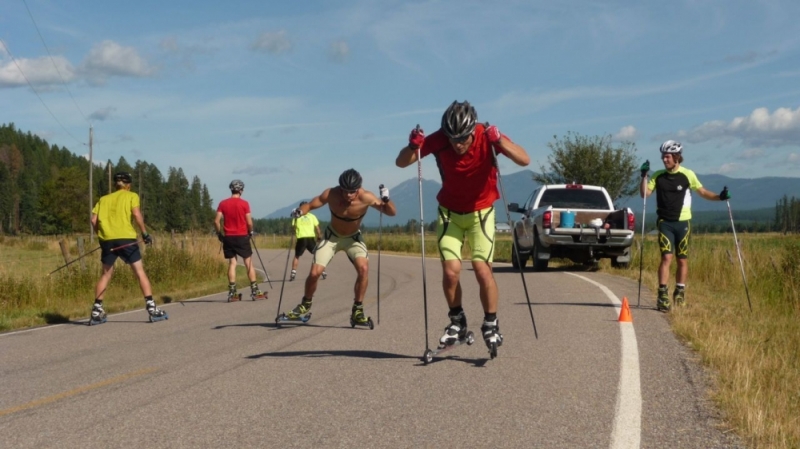
Alberta World Cup Academy skier Patrick Stewart-Jones (second from r) leads teammate Phil Widmer in some quick sprints during an August dryland camp in Whitefish, Mont. (Photo: AWCA)
Note:This is the fourth and final preview giving an inside look at Canada’s national training centres. We asked coaches to tell us what’s new, whom to look out for and their outlook for the season. Teams were presented in no particular order.
Team: Alberta World Cup Academy (AWCA)
Coaches: Mike Cavaliere (program director/men’s coach), Chris Jeffries (women’s coach), Stefan Kuhn (assistant coach)
Athletes: Jess Cockney, Chris Hamilton, Russell Kennedy, Graeme Killick, Yannick Lapierre, Alex Mahoney, Kevin Sandau, Michael Somppi, Patrick Stewart-Jones, Sebastien Townsend, Phil Widmer, Ezekiel Williams; Dahria Beatty, Annika Hicks, Marlis Kromm, Alysson Marshall, Emily Nishikawa, Rebecca Reid, Heidi Widmer.
With 19 athletes (12 men and seven women), the AWCA is down one from last year, but still boasts quantity and quality with eight skiers on the National Senior Development Team (Cockney, Killick, Sandau, Somppi, Phil Widmer, Heidi Widmer, Marshall, and Nishikawa).
Who’s new: Two former Callaghan Valley Training Centre athletes – Lapierre and Townsend – both originally from Quebec. Mahoney hails from Lethbridge in southern Alberta, but has been living in Canmore for the last three years, formerly training with Rocky Mountain Racers. Williams comes from Nakkertok and the Gatineau, Quebec, area.
Who’s missing: Kate Brennan retired and is now working as a manager at the Paintbox Lodge in Canmore, owned by Sara Renner and Thomas Grandi. According to Jeffries, Brennan “was plagued by many health problems in her final years, from which she seems to be recovering from very well,” he wrote in an email. “She was engaged to former ski racer Phil Wood this summer.”
Janelle Greer moved back to Whitehorse, Yukon, and was considering attending nursing school next fall, Jeffries wrote. Suzanne Stevenson is studying at Montana State University, and Jeffries didn’t think she was ski racing, and Brittany Evans is also pursuing undergraduate studies at the University of British Columbia.
Former men’s team leader, Graham Nishikawa – still on the Senior Development Team – has been training with Canada’s Para-Nordic program in the leadup to the 2014 Olympics. Brent McMurtry retired and is studying at the University of Victoria. Matt Wylie also retired and is attending the University of Calgary.
An AWCA coach for a month and a half last season, Mike Vieira took a new job this spring as Cross Country Canada’s manager of coaching development.
“We all resumed our roles from last year and have not missed a beat,” Jeffries explained. “[Former AWCA skier and national-team member] Drew Goldsack was contracted for a week this summer to coach the women during a training camp here in Canmore, which gave the girls a fresh perspective and allowed me time to coach the girls of the Alberta Ski Team.”
The team also brought on an intern, Lars Hanel, a former racer studying to become a coach in Germany. According to Jeffries, he arrived in October and will assist the Academy through the 2013/2014 season.
Top results last season:
Jesse Cockney of the Alberta World Cup Academy and Senior Development Team (2) leads Finland’s Anssi Pentsinen (12) and the rest of his quarterfinal in last year’s World Cup 1.3 k skate sprint in Canmore, Alberta. Cockney won the heat and went on to place ninth overall for a personal best in his fifth World Cup start.
Cockney, 24, had a breakout season starting at the Canmore NorAm, where he placed second in the 15-kilometer classic to earn his way to the Quebec and Canmore World Cups last December. In Canmore, Cockney wowed local supporters and international competitors with the second-fastest qualifying time in the World Cup skate sprint, and went on to place ninth overall.
He notched several other podiums throughout the NorAm season, made the top 50 in the Lahti World Cup skate sprint (in 50th), and placed fourth in the classic sprint at Canadian Nationals in Whistler, B.C.
Phil Widmer, who turned 30 last month, and Emily Nishikawa, 24, both earned trips to World Championships in Val di Fiemme, Italy, where Widmer placed 49th in the classic sprint. Earlier in the season, Widmer finished 15th in the Canmore World Cup skate sprint, racked up several NorAm victories, and placed third in the classic sprint at nationals.
At 23, Nishikawa pulled off 57th in both the classic sprint and 10 k skate at World Championships, despite an unusually rapid heartbeat that turned out to be benign. At the Canmore World Cup in December, she placed 34th in the 15 k skiathlon and 48th in both the 10 k classic mass start and freestyle sprint. She ended the season in 46th at World Cup Finals in Falun, Sweden.
After placing 34th in the Canmore World Cup sprint, Heidi Widmer also qualified for U23 World Championships in Liberec, Czech Republic, where she notched 28th in the 10 k skate (and subsequently made the senior devo team in the spring). The 22 year old medaled twice at nationals, placing third in the 5 k and 30 k skate races in Whistler.
Coach’s comments:
According to Jeffries, all went as planned throughout the summer and fall, with athletes hitting personal best in field tests and showing “good fitness” on the rollerski-treadmill incremental tests.
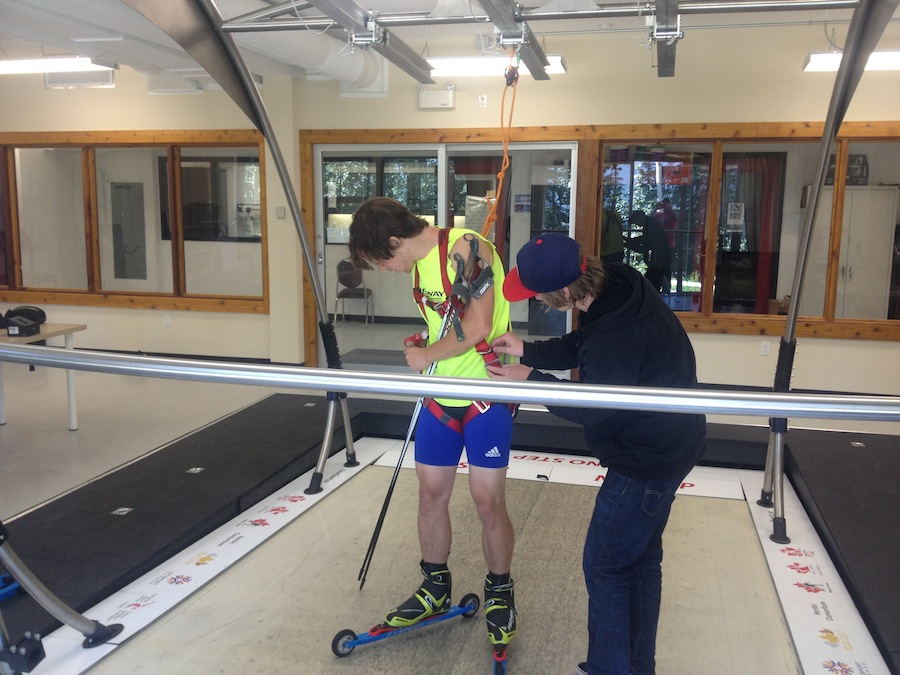
Sebastien Townsend (AWCA) prepares for a rollerski-treadmill test at the Bill Warren Training Centre in Canmore, Alberta. (Photo: AWCA)
The women’s team held seven training camps from May through November, most of which took place around Alberta and British Columbia, but also included trips to Whitefish, Mont., and Whitehorse. The men ventured to similar places, with a total of six camps, including one at home on Frozen Thunder.
Even in an Olympic year, the team’s goals are generally the same.
“As always, we want to qualify athletes for international trips (WJC, U23s, Olympics, World Cup, Scando Cup) and ultimately graduate athletes to national teams (World Cup, SDT),” Jeffries wrote. “One of our big goals as a team is to have athletes positioned on the NorAm to win the FIS regional spots, allowing them to race World Cups. If you ask our athletes what they need to make performance gains internationally, their number one answer is World Cup starts. The FIS regional spot is the most predictable way to earn those starts in a year.”
Looking at the men’s team, Jeffries stated their athletes are “healthy and performing at a very high level.”
“The group is a little more diverse than in previous years, which has likely contributed to a very healthy team environment,” he added. “We have 6 U23 athletes who are all chasing after the older boys, getting stronger in the process. The non-U23 men are very focused as they work towards being in shape for the Olympic trials in January.”
The reigning FIS regional leader, Cockney gets to start this season in Europe with Canada’s World Cup Team.
On the women’s side, Jeffries explained they’ve had a drop in numbers last year: from 12 to seven.
“As a result, the group is very focused this year and more mature,” he wrote. “Dahria is our only junior, but her drive to be successful internationally puts her more in the category of team veteran as she pushes the other girls and keeps them on their toes.”
While the group’s general fitness is “very high,” Jeffries stated their women have suffered more injuries than usual. Hicks has been on an adjusted program waiting for compartment-syndrome surgery on her lower legs this fall. “She raced through a lot of pain last winter and we had her diagnosed this spring,” he explained.
In early September, Heidi Widmer crashed rollerskiing and ended up with her third concussion. She took a few weeks off and was back in action later this fall. “Heidi brought in a great level of fitness from last winter that she has continued to build on this summer, so we are confident it won’t take her long to get ready for the start of race season and the U23/Olympic trials in January,” Jeffries wrote.
“As a coaching team, we are all very competitive people, so we are always looking internally on how we can become better. Our overall philosophy though is pretty simple and helps us maintain perspective. We ultimately try to keep things simple, looking at finding ways to do hard training with high quality, which we generally just refer to as “regular training.” The attitudes and commitment of the athletes is what I think allows us to try and raise the bar each year. We have a great group of athletes with a lot of talent who work extremely hard, which allows us to have success annually.”
Heidi Widmer (l) and Andrea Dupont after colliding at a NorAm sprint last January in Thunder Bay, Ontario. Widmer suffered a mild concussion, but qualified for the U23 World Championships as a discretionary pick and was fully recovered in five days. (Photo: John Sims)
Heidi Widmer is no stranger to head injuries. One of the newest members of Canada’s Senior Development Team, the 22 year old suffered her first as a teenager in the fall of 2009. The culprit? Rollerskiing – downhill, to be specific.
Part of the Alberta World Cup Academy in Canmore, Widmer crashed during a classic rollerski, and the next thing she remembers is the hospital. Four years later, the cause of the accident is still a mystery to her, as she has amnesia surrounding the event, but the effect was a head injury serious enough to send her to the Calgary hospital as a precautionary measure.
“That crash took me by surprise,” Widmer said on the phone last week. “I didn’t really plan on that happening. So that was my one really bad concussion and since then I’ve had to be more cautious with my head. I haven’t had any problems recovering from that. I made a full recovery. I didn’t have any spinal or internal bleeding; I was super lucky with that.”
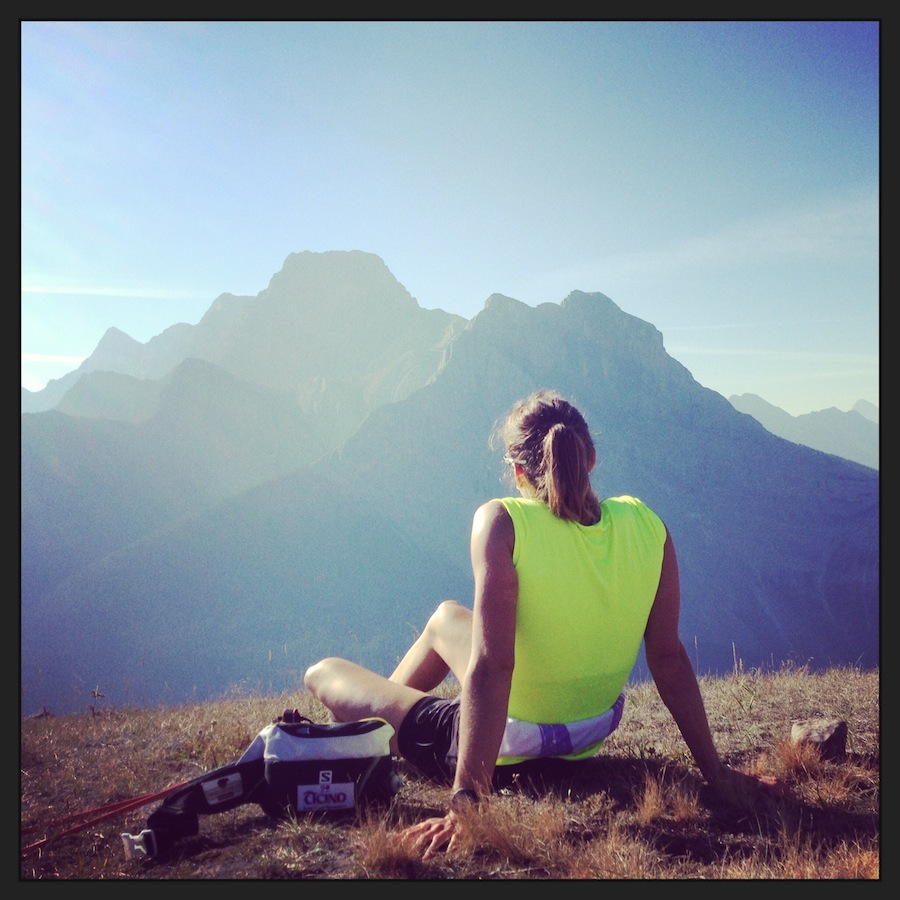
Heidi Widmer looks out at the 3,100-metre Mount Lougheed during a summer hike up Wind Ridge near Canmore, Alberta. (Courtesy photo)
Fast-forward to Sept. 7, 2013, Widmer found herself in an eerily similar situation.
“This past fall I was classic rollerskiing again and fell on a downhill pitch,” she said. “I slipped on some mud at the bottom; I was going down with a teammate. [There was] a nasty little grime layer at the bottom of the hill that neither of us saw. And that took us both out … I superman-ed into a ditch.”
Fortunately, she didn’t hit her head and there were no major acute injuries. However, Widmer noticed a pressure in her head that didn’t feel right, so she cut her workout short to get some rest. After taking another day off, she started back into training and felt great, winning a skate sprint time trial with the women’s national team that week.
Shortly after, her symptoms returned along with a bad headache. After consulting with doctors, Widmer agreed to take several weeks off, then gradually return to full-intensity training.
“[The pressure] is not extreme and it’s not like I’m in blinding pain, but it’s enough for [the doctors] to want to take the right precautions,” Widmer explained.
Despite these mild symptoms, she resumed full-time training and is more excited than ever to be back.
“I’m super lucky in so many ways that it’s not a serious head injury,” she said. “There’s no internal bleeding, I’m functioning, I’m fine, but I just have to be able to take care of this and come out of it with some lessons learned for sure.”
Widmer had another concussion last winter, when she crashed in a skate sprint during the selection races for U23 World Championships. She had to take five days off to recover, and as a result, missed one of the qualifying races. She still made the team as a discretionary selection and said she recovered completely after five days.
“I haven’t reached the point of the doctors being like ‘one more and you may never be able to ski again’ type extreme,” she explained. “I know that every time it does happen, it adds up in my brain, but I don’t have a specific medical answer for that.
“Being afraid to fall is probably more dangerous than accepting the risk,” she added. “Falling happens to be part of skiing and after all we’re talking about cross country skiing. I’m not an alpine skier pushing 130 km/hour and crashing with my face on ice!”
In addition to maintaining a healthy perspective on her concussions, Widmer has also started doing a fair amount of physio work to maintain and improve her balance — something that took a hit from her first concussion. The trauma caused her damage in her inner ear, which governs balance. She’s working on restoring that balance via physio exercises, while also getting back into shape for race season.
“I think that the rest of this fall is something that will play to my advantage,” Widmer said. “It’s something that I’ve come to view as an advantage for me, because the fall that I had [my previous head injury], [taking time off] paid off in my season. I ended up having one of my best seasons. I think it says a lot to be able to absorb the summer of training and come into the fall with a new perspective and motivation to train. It’s really reignited in me my motivation. Sometimes in the fall it’s super common for people to get super run down with the changing seasons and the ski racing season approaching. So I’m looking at it in as positive a light as possible.”
As for whether she’s feeling the positive effects of her time off yet, Widmer said she’s a little behind with her fitness, but is confident she’ll get back up to speed soon.
“I’ve already seen huge gains in the last week of returning back to intensity,” she said. “The summer [training] is absorbed, and more than anything, I’ve learned to be more patient over the past month.”
Widmer’s first races for the season are the Alberta Cup races the first weekend of December. “I’m ready to get after the winter,” she said.
***
About the Author:
Katie Bono is a Canadian contributor at FasterSkier. Hailing from Minnesota, she raced for Dartmouth College and Sun Valley before turning her energies to climbing (and becoming the fastest known woman to ascend Mt. Rainier in Washington). Now based in Canmore, Alberta, she is an athlete ambassador for Millet and works as a mountain guide in Alaska, Washington and South America.
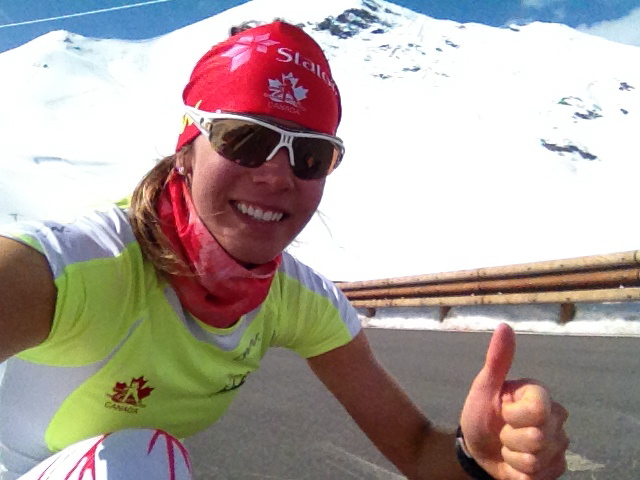
A happy Heidi Widmer on a bluebird day at Stelvio Pass in Switzerland. She spent five days there at a Swiss national-team training camp near the Italian border in early June. Widmer, 22, made the Canadian Senior Development Team in April. (Courtesy photo)
Editor’s Note: This is a continuation of our recently relaunched ‘Pros of Tomorrow’ series, which highlights some of the most notable up-and-coming athletes around the world. See also: Cendrine Browne.
***
Fresh off her last races of the season at Canadian Nationals in Whistler, British Columbia, Heidi Widmer plunged into the backcountry in early April for some ski touring in Callaghan Valley.
There, the 22-year-old Banff native knocked off the 1,275-metre (nearly 4,200-foot) Mt. Cayoosh and headed to a lodge in the Selkirk Mountains for more touring. Even with all the physical activity capping a long season, Widmer considered the trip relaxing amid beautiful scenery.
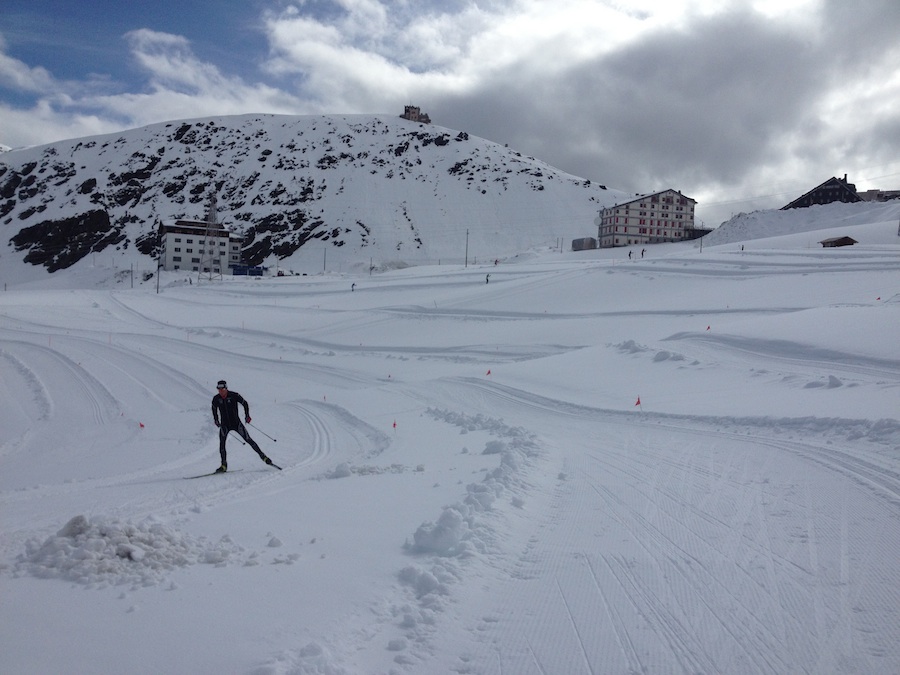
The Stelvio Pass ski track and hotel Widmer stayed at earlier this month 2,700 metres above sea level in Switzerland. (Courtesy photo)
“It’s really a huge mental break,” she said on the phone Sunday from Switzerland, where she’s training with the Swiss national team. “It’s really a good chance for reflection because you’re out for hours on end, most of the time slogging around.”
Now in Davos, Switzerland, Widmer also visited El Salvador (for surfing) and New Orleans (for a music festival) for a total of two weeks in late April. Then it was back to training, first with the Alberta World Cup Academy (AWCA) for five days in Canmore, Alberta, then for a weeklong camp in Vernon, B.C.
Widmer spent another five days back in Canmore before flying to Switzerland on May 25, and she’ll be there until June 24.
Doesn’t she get tired?
“Surprisingly not,” Widmer said with a laugh. “I have to take my downtime when I can get it. I really enjoy traveling, but I maybe enjoy it too much. I really got after it in the spring.”
With a list of trips lined up, Widmer was uncertain about Switzerland, arranged through former AWCA head coach Christian Flury, now in charge of the Swiss women’s team. She knew if she received the call up to Canada’s Senior Development Team, which she had been working for her entire junior career, her schedule would depend on the national team’s.
Lucky for her, it all worked out.
“I’ve been working toward getting on the national team for a couple years and the fact that it all fell together, it just kind of means that the work is just beginning,” Widmer said. “It’s gratifying knowing that I’m doing something in the right direction.”
Siblings Heidi and Phil Widmer sharing the podium at a NorAm in January. (Photo: Mike Cavaliere)
She heard the good news soon after emerging from the backcountry during an April meeting with AWCA women’s coach Chris Jeffries. Her initial excitement came with some apprehension: did her brother Phil make it, too? Jeffries couldn’t say, so she waited to hear from her older brother, who was in the backcountry away from reliable cell service for another week.
While making pizzas with friends one night, Widmer got a phone call from her mom, who was crying. Phil, 29, left a message about being renominated.
“My mom was so happy,” Widmer recalled. “It’s really cool being able to accomplish something together. … I think that says a lot about persistence. He’s been for sure inspiring, to watch him take the setbacks in stride and keep working towards getting where he wants to go.
“I don’t know where I would be if I didn’t have him to follow in the sport,” she added. “I remember when he qualified for Torino [Olympics in 2006]. I was at an influential age where you’re like, ‘My older brother can do this, so can I.’ ”
Last season, Widmer tallied two podiums at nationals in the 5- and 30-kilometer freestyle races. At U23 World Championships in Liberec, Czech Republic, she placed 28th in a 10 k skate. There, she spoke with Flury about her dream of coming to Switzerland, where her father was born and she and her siblings have citizenship.
Also in Liberec, Widmer saw online that The Gypsy Kings and Fleetwood Mac were playing in New Orleans. Taking a short detour to Louisiana on the flight back from El Salvador was a no-brainer, and so was going to Switzerland.
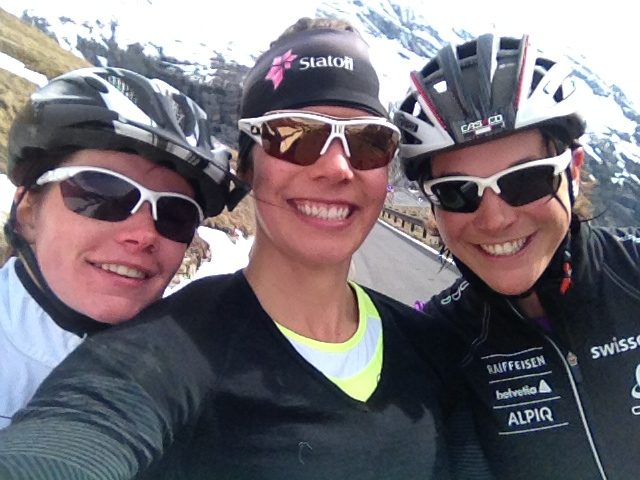
Heidi Widmer (c) with Swiss skiers Nathalie von Siebenthal (l) and Christa Jäger after rollerski intensity on Stelvio Pass in Switzerland. (Courtesy photo)
Flury assured Widmer it was possible and spoke with Jeffries about her training plan.
“Through email and conversations with him, I knew that he was really open to it and I felt extremely comfortable coming over to train with him,” Widmer said. “The rest of the team being so welcoming, I was optimistic it was going to work out, but they definitely exceeded my expectations.”
After visiting her grandmother in Zurich, Widmer met up with the Swiss team at the national-sport centre headquarters in Magglingen, Switzerland. She spent the next week adjusting to the time difference and recovering while the national team did baseline testing.
Widmer then spent few nights in Davos with Tatjana Stiffler, originally her Facebook friend, before heading to a training camp on Stelvio Pass at a glacier some 2,700 metres (8,850 feet) above sea level.
“It’s been amazing,” Widmer said. “I always wanted to come over here and train but I didn’t really know what to expect. … Right away the team was super inclusive and everyone was really supportive of me being there, and I felt like part of the team instantly. It was pretty awesome.”
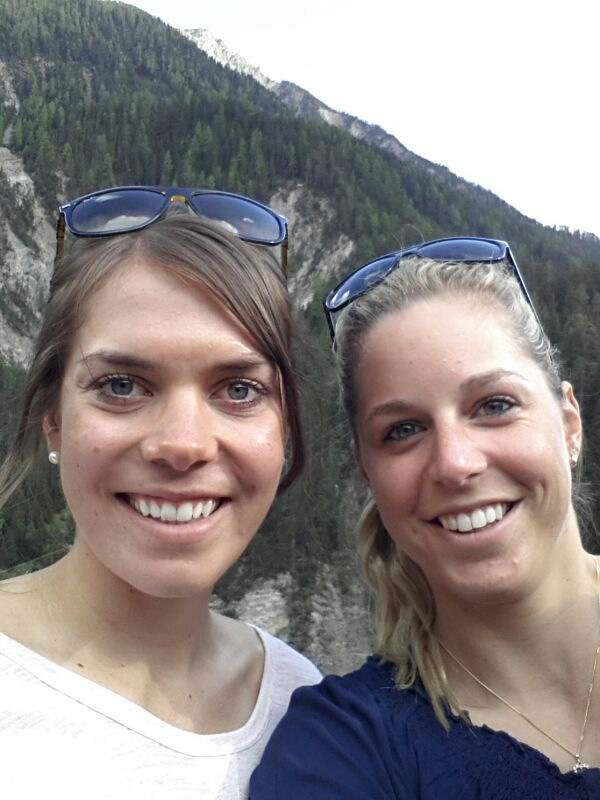
Widmer (l) and Davos skier Tatjana Stiffler (Courtesy photo)
She didn’t speak much Swiss-German, but was learning thanks to Stiffler. The dialect and vocabulary were much different than the High German she knew, but Widmer said she was having fun catching on and chatting with Swiss skiers when she could.
“I always felt, ‘My name’s Heidi Widmer … and I’m not super connected with Switzerland,’ ” she said. “I know they had a strong team to train with and the environment seemed like it would be a good fit and a good experience. I’m always interested in learning how different teams are approaching ski racing so that was also a draw.”
So what’s different about Switzerland, in terms of its national-team training methods and glacier? According to Widmer, not much on the philosophical front, except for a few technical points she’s been working on.
“It’s been very similar to what we do in Canada,” she said. “You’re doing longer hours and more hours when you’re at altitude on the glacier and similar approach to the training speed and … not just going out and hammering at altitude.”
As for the glacier itself: “I’m trying to think of another word besides pimped,” Widmer said with a laugh. “It was a lot more comfortable living than our [Haig] glacier camp, let’s put it that way.”
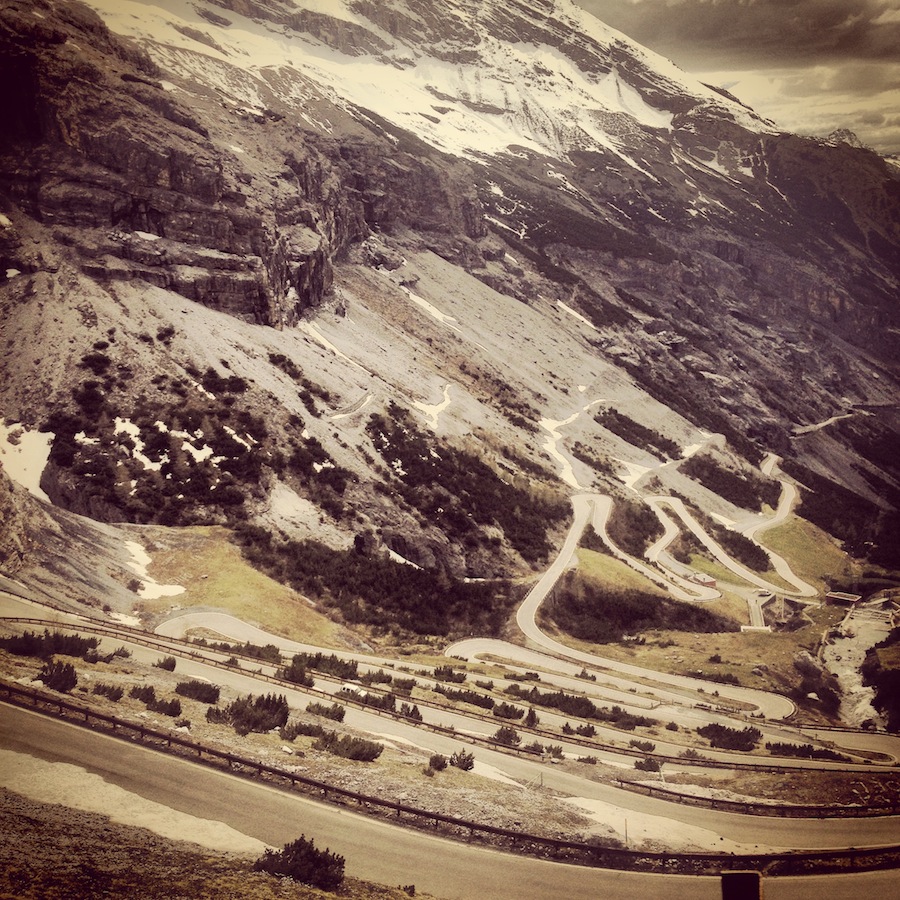
The road up Stelvio Pass, the highest paved mountain pass in the Eastern Alps, with 42 hairpin turns and 14 percent grade in some parts, according to Heidi Widmer. “We did classic intensity up this road starting at 1900m,” she said. (Courtesy photo)
From the hotel, one can cross the road and immediately access the 4 k ski loop, which starts with a brief descent before winding back up to the top of the glacier.
“Then you go back to your hotel and all the meals are cooked for you,” she said. “All the teams are there, and it’s a really cool atmosphere.”
Widmer spent five days with the team on Stelvio before heading back to Davos last week. She’ll be dryland training there for the rest of her stay with Stiffler and a few U23s, like Nathalie von Siebenthal and Christa Jäger. World Cup skier Bettina Gruber, 28, is also in Davos, and the two planned to meet up for some intensity.
Looking ahead, Widmer said she’s most focused on peaking for her last year of U23’s – and making the Olympics if possible. Number one on her list: the skate sprint at U23 World Championships in Val di Fiemme, Italy.
“What I did last year is working; I don’t think I have to do anything drastic to change my training approach,” she said, adding that she’s boosted her strength training.
Naturally a sprinter, Widmer didn’t rule out her potential in distance events, especially with a 10 k classic Olympic qualifier in January in Canmore.
“My classic skiing in distance and sprinting has to step it up a notch so I’m putting my focus on that as well,” she added. “I haven’t had a breakout international performance yet so I’m really looking towards that.”
***
Have an idea for a skier you’re itching to read more about? Email info@fasterskier.com with the subject line: Pros of Tomorrow.
Heidi Widmer (AWCA) on a mission to capture her first individual national title at 2013 Canadian Nationals on Sunday in Whister, B.C. There, she was the top Canadian and third overall in the 5 k freestyle individual start.
WHISTLER, B.C. – Heidi Widmer of the Alberta World Cup Academy (AWCA) didn’t win Sunday’s 5-kilometre freestyle individual start at Canadian Nationals outright, but she took home her first individual national championship at the age of 22.
American Caitlin Gregg of Central Cross Country (CXC) made the trip to Canada and took the overall win in 12:02.9 on a fast-and-warm day at Whistler Olympic Park. She was happy with her race and is feeling that this event will be good preparation for the U.S. SuperTour Finals in April.
Caitlin Gregg (CXC) en route to the overall win in Sunday’s 5 k freestyle individual start at Canadian Nationals in Whistler, B.C.
University of Colorado-Boulder senior Eliska Hajkova took second place, 10.9 seconds behind Gregg. Along with some Colorado teammates, she decided to celebrate spring break in Canada this year. A Sochi hopeful, she wanted to test herself against an international field before returning home.
Hajkova was excited by her race, particularly enjoying the fast snow and low elevation (900 metres compared to Boulder’s elevation of 1,650 m).
“The [course] has hard uphills and tricky downhills, but it is so fun to race,” she said. “The trails here, oh my God, this is really a heaven for skiing.”
The fastest Canadian, Widmer was third overall, 22.4 seconds behind Gregg.
“It was definitely a lung burner, but I am very happy and ecstatic,” she a day after winning the team sprint with Marlis Kromm. “It is my first Canadian championship, so I am really happy with that.”
“It was a really fast course today and good conditions, but different than we expected,” she added. “I wanted to finish stronger than I started. Five k is about pushing right from the beginning and trying to hold off that blow up as long as possible.”
Nakkertok’s Alana Thomas was second Canadian and fourth overall (+32.7) and Alysson Marshall (AWCA) brought some upside to a rough season, collecting the bronze less than two seconds behind Thomas.
“It was a pretty decent distance race for me,” Marshall said. “I am happy with how it turned out.”
Asked what her season highlight was, she responded “Later this week!” A sprint specialist, she is looking forward to the classic sprints on Thursday and the classic interval start on Tuesday to provide that highlight.
Julia Ransom (Biathlon Alberta) was the top Junior Woman in eighth (+48.9). She was not the top biathlete on the day, edged out by Canadian national-team biathlete Rosanna Crawford, also from Canmore.
Fresh off Sochi, McKeever notches first Canadian title
Brian McKeever (Canadian Para-Nordic Ski Team) after notching his first national title at Canadian Nationals on Sunday in Whistler, B.C. There, he won the 10 k freestyle individual start just days after flying back from IPC World Cup Finals in Sochi, Russia.
In the men’s 10 k freestyle individual start, Canadian Para-Nordic Ski Team member Brian McKeever collected his first national title in 21:18.1.
A perennial winner in International Paralympic Committee (IPC) events with 10 Paralympic medals and an unbeaten streak on the World Cup this season, the 33-year-old visually-impaired skier started fast on Sunday. He posted one of the fastest splits up the opening climb and kept up the tempo.
Graeme Killick (AWCA) started faster, but faded on the second lap to concede the silver medal to teammate Graham Nishikawa, who was 14 seconds behind on the first climb.
“You never really know how you are going to feel after getting off the plane from Russia,” McKeever said after flying from IPC World Cup Finals in Sochi just 48 hours prior.
“First national championship win in my career,” he said. “I am really happy about that.”
About 10 seconds behind with three kilometers remaining, Nishikawa finished strong, 11.6 seconds behind McKeever.
The 5 k ‘blue’ loop, best known as the second loop of the 2010 Olympic 50 k course, has a testing final kilometre, with the steep climb from ‘Way Out’ followed by a rolling section into the Hermodt’s hill before the drop into the stadium. Many racers bled time on the apparently easy Hermodt’s on the second lap, Killick included. With 3 k remaining, Killick was close to McKeever.
“I lost a lot of it probably coming to the stadium here,” Killick said.
Coming off two golds at IPC World Cup Finals and two at IPC World Championships this season, Brian McKeever returned to Canada to claim his first national title on Sunday in the 10 k freestyle individual start in Whistler, B.C.
Hearing how McKeever one-skated the final climb, Killick laughed and said that wasn’t an option for him. Killick held on for bronze, 23.0 seconds out of first.
“It was super-fast conditions,” Nishikawa said. “Just go from the gun and a lot of pain. I usually start slow and hopefully pick it up. I am happy with my effort, it hurt a lot so that’s a good thing.”
Nishikawa’s also coming off some intense racing at World Championships in Val di Fiemme, Italy, but said he’s recovering.
“[Today] feels better than yesterday, so I am looking forward to Tuesday a lot,” he said.
Killick was also upbeat, saying “it was good for a skate race.” In a 10 k individual start, “you have to keep your speed up all the time, and I think I was almost there, but not quite.”
Like the others, Killick enjoyed the conditions, describing them as “nice and fast, good speed. It held up better than when we were testing yesterday.”
While the men’s podium was all-Canadian, the U.S. took fourth and sixth with Sylvan Ellefson (Ski & Snowboard Club Vail/Team HomeGrown) and Bryan Gregg (CXC), respectively.
Marc-André Bédard (Biathlon Canada) led a good showing of biathletes, placing fifth overall and fourth Canadian (+30.4) to match his result at Canadian Nationals last year, where he was fourth in Quebec.
2013 Canadian Nationals 10 k freestyle men’s podium, with winner Brian McKeever (third from r), Graham Nishikawa in second (second from l), Graeme Killick in third (second from r), Sylvan Ellefson in fourth (second from l), Marc-Andre Bedard in fifth (r) and Brian Gregg in sixth (l).The top-three Canadian women in Sunday’s 5 k freestyle individual start at Canadian Nationals in Whister, B.C., with Heidi Widmer (c) in first, Alana Thomas (l) in second and Alysson Marshall in third.
Foothill Nordic’s Jess Cockney (r) and Phil Widmer (Canmore Nordic), after colliding in the finishing straight of Saturday’s freestyle team sprint final at 2013 Canadian Nationals in Whistler, B.C. Cockney went on to win with teammate Brent McMurtry, defending their 2012 national title, while Widmer and Russell Kennedy settled for fourth. Knute Johnsgaard (l) took silver with teammate David Greer for Whitehorse.
WHISTLER, B.C. – On a sunny day at Whistler Olympic Park, the men put the cap on an exciting first day of Canadian Nationals with a collision and crash in the final 50 metres of the 2×3 1-kilometre freestyle team sprint.
Whitehorse divides and conquers, with Graham Nishikawa skiing around a fallen Phil Widmer (Canmore) on the right and Knute Johnsgaard at left, to take second and third behind Foothills’ Jess Cockney (far right) in Saturday’s freestyle team sprint at Canadian Nationals in Whistler, B.C.
Four teams entered the final straight together with Phil Widmer of Canmore Nordic in the lead. At the start of the pine-bough lane markers with 50 metres to go, Widmer and Jess Cockney of Foothills Nordic chose the same lane. Widmer fell, leaving Cockney to defend his national team-sprint title with partner Brent McMurtry. Skiing for different Whitehorse teams, Knute Johnsgaard and Graham Nishikawa split around the fallen Widmer and lunged for the line.
A year after winning at Canadian Nationals in Quebec, McMurtry and Cockney claimed the team victory in 15:32.03. Johnsgaard finished in 15:33.00, taking silver with partner David Greer. Nishikawa was 0.31 seconds behind to take bronze with teammate Colin Abbott.
Widmer recovered to take fourth with Russell Kennedy, 11 seconds after Cockney. Raphaël Couturier (Skibec) led the second pack another 5 seconds back in fifth with teammate and Canadian National Team biathlete Marc-André Bédard.
When asked what made the difference, Cockney had a one-word answer: “Brent.”
“Brent skied so strong on his last leg and gave me such a huge lead,” Cockney added. “All the other guys were gassed after catching up to me.”
Johnsgaard had a similar view. “I felt really strong. I just didn’t quite have the finishing speed that Jess had in the final,” he said.
Cockney skied the last leg with a clear tactic in mind.
“I didn’t feel that strong so I held the lead as long as I could and made sure to tuck in behind Knute and Phil on the downhill into the last 300 metres,” he said. “With the headwind, it was good to tuck behind someone else.”
Nishikawa also took a strategic approach to the final. A big crash and a broken pole on his first lap of the semifinal put him well off the back of the pack. While Abbott was able to finish the job of rejoining the group, the energy they spent qualifying in second in the fastest heat would come back to haunt them.
An exhausted top three after Saturday’s freestyle team sprint final at 2013 Canadian Nationals in Whistler, B.C.
In the final, the first-leg skiers went out hard on their third and final lap.
“Brent attacked and dragged Colin,” Greer said. “I got around a couple of people and ended up coming in second.”
“I finally caught the top three teams at the corner with a hundred to go and then they all started their sprint,” Nishikawa said.
Asked about the crash, he said, “It took a lot of energy to get there so I just had my head down trying to sprint. I saw some tangles and then I was in a lunge for second as well. It happened fast so I don’t really know what happened.”
Johnsgaard, who also was in a good position to see the collision, didn’t think any penalties would come of it. “I think it is part of racing,” he said.
The jury agreed and took no action.
The women’s 2×3 1-kilometer team sprint was also exciting, but without the finishing-straight fireworks. On the final lap, Foothills’ Marlis Kromm opened up a gap to send Heidi Widmer off with a sizable lead. Their finish time of 15:17.1 was nearly 10 seconds ahead of Hardwood’s Erin Tribe, who shared silver with Mary Thompson.
Heidi Widmer (Foothills) leads Anne-Marie Comeau (MSA) in the semifinal of Saturday’s freestyle team sprint at 2013 Canadian Nationals in Whistler, B.C. Widmer and her teammate Marlis Kromm went on to win the final.
Zoe Roy and Michaela Howie teamed up for Rocky Mountain Racers and won the sprint for bronze. Roy finished just over a second ahead of biathlete Julia Ransom (Canmore), who partnered with Kathryn Stone.
Anne-Marie Comeau (Mont St. Anne) took over from Camille Pépin and quickly moved from fifth to second on the final leg , but a crash on the top hairpin put her back in fifth, six seconds out of the medals.
Kromm and Widmer were very happy with their result.
“We were junior challenge girls here [in Whistler at 2008 nationals] and won the relay here so it was really fun to come back,” Widmer said. “It’s a great start to the week and Mother Nature has been really great today.”
Both saw the race as tactical. “We wanted to start in control, ski the first couple of laps with the pack and try to save some energy and make our moves in the second half of the race,” Kromm said.
“It is a long week of racing at nationals,” Widmer added. “The team sprint is important, but you have to be aware of your energy for the rest of the week.”
The silver medalists said the race was “definitely tactical.”
“You had to hold on to a spot and pick when to move up and make sure you had something for that last lap,” Thompson said.
“It was really refreshing that the sun was shining and the skis were fast,” Tribe added. “It was a great day.”
Women’s freestyle team sprint podium at 2013 Canadian Nationals, with Marlis Kromm and Heidi Widmer of Foothills Nordic in first (c), Erin Tribe and Mary Thompson of Hardwood in second (l), and Michaela Howie and Zoe Roy of Rocky Mountain Racers in third. (Photo: Peggy Hung)2013 Canadian Nationals men’s freestyle team sprint podium with Purebread Bakery baguettes in hand. Jess Cockney and Brent McMurtry of Foothills Nordic took first (c), Knute Johnsgaard and David Greer of Whitehorse were second (l), and Whitehorse’s Colin Abbott and Graham Nishikawa placed third (r). (Photo: Peggy Hung)
Graeme Killick (AWCA/CNT) racing earlier this season at the West Yellowstone SuperTours.
The Canadian Noram series wrapped up with the Western Canadians mini-tour in Grande Prairie, Alberta. Graeme Killick (AWCA) and Alana Thomas (Nakkertok) crossed the finish line first on Sunday to take the overall victory.
Competition was intense despite the reduced field, with most of the racers from eastern Canada avoiding the travel and four of the usual suspects busy in Val di Fiemme.
In Friday’s classic sprint, Heidi Widmer (AWCA) crossed ahead of Alysson Marshall (AWCA) and Kate Brennan (AWCA). Widmer was thrilled with the win; Marshall on the other hand was a bit frustrated crossing the line in second.
Thomas (Nakkertok) leading Zoe Roy (RMR) and Emily Nishikawa (AWCA) in the 15 k skathlon at the Lappe Nordic NorAm on Jan. 3 in Thunder Bay, Ontario. (Courtesy photo)
“Friday went okay for me, I didn’t feel great in my qualifier but started feeling better as the heats went on,” she told FasterSkier. “I didn’t ski the final as tactically well as I wanted to but I was satisfied with the final result.”
Jess Cockney (AWCA) outsprinted Brent McMurty (Foothills) and fastest qualifier Andy Shields (Thunder Bay NDC) in the men’s final. Michael Somppi (AWCA) narrowly missed out on the podium to shields after what he called “a mixup in the finishing lanes.”
Saturday was classic distance interval starts in tricky waxing conditions. Amanda Ammar (AWCA) finished in 31:56.0 to beat Thomas by 49 seconds, with Annika Hicks (AWCA) a further ten seconds back in the 10km event.
“I was out on a mission,” Ammar told FasterSkier. “These trails were tailored perfect for me. Lots of striding, many exchanges, and technical downhills. I went out hard and made a gap early. It was a fantastic race, and I was pumped to have two classic podiums in a row.”
Thomas, though, was happy with her race too.
“I felt pretty good but had AMAZING skis thanks to help from the Foothills coaches, conditions were a little tricky so this played a big part,” she reported.
Killick led the men’s 15km race in 40:27.1, with Kevin Sandau (AWCA) 41 seconds behind and Cockney at 1:01.
Sunday’s 15km skate pursuit began with Ammar starting 12 seconds ahead of Thomas and 15 seconds ahead of Hicks. Widmer skied the fastest in 43:24.46 to move from sixth to third and the final podium spot for the weekend. Thomas quickly caught Ammar and won the sprint for the mini-tour title, with Thomas also taking the second fastest time for the day ahead of Ammar in third.
The men closed out the weekend with a 30km skate pursuit. Killick began the day with a 37 second lead and finished with 45 seconds, earning the second fastest time for the day with 1:14:06.6. Cockney started in second and was caught by fourth starter Michael Somppi (AWCA). Cockney edged Somppi at the line to take second overall with third starter Sandau sliding back to fourth overall while taking 5th for the day.
FasterSkier contacted the podium finishers, and got comments about their races as well as the weekend on the whole and the wrap-up of the Canadian NorAm season.
Overall Thoughts
Widmer: I am really happy with the way my body responded this weekend. I haven’t done that much consecutive racing yet this season and have missed it! It’s such a fun and demanding format and having two skate races worked well for me. It is great to be able to stand on a podium again as well as traveling with the whole team together feels great. It’s been awhile since we’ve travelled with this big of a team this season and feels great – especially when everyone is doing so well!
Hicks: As a whole, the weekend was really good. Two out of three races were really good, so I’m happy about that. I’m disappointed Sunday didn’t go better, because it would have been nice to fight for a podium position in the overall standings, but sometimes the body won’t let that happen. I was happy to hang onto 5th.
Ammar: These mini tours are great fun! Obviously I would of liked to have done better in the sprint, but I’m so pumped about how good my classic race went. I’ve been feeling quite strong in this race, and it’s nice to see that it’s becoming consistent. Overall, this was a great weekend!
Shields: Westerns was a great set of races for me. I wasn’t planning on making the long trip of Grande Prairie, but I decided to go around two weeks ago when I found out the flights were so cheap. Thunder Bay didn’t sent any coaches to this event so I got race support from the Augustana Vikings and their coach Les Parsons.
Somppi: Overall it was a good weekend of racing. It felt good to be on the podium for the mini-Tour this time instead of finishing one step off in fourth like I did at Eastern Canadian Championships.
Sprints
Widmer: Sprint day was my focus and I wanted to put everything on the line in the qualification to see what would come of it – I was pleased to have it pay off on a speedy course. There was a lot of time between heats because there were a lot of racers to get through with the Juniors as well, so I did my best to conserve energy and not let my mind get too far from ski racing. The final was really fun – I just hammered from the gate and hoped I wouldn’t see anyone in my peripheral. My goal for the weekend was to take the win in the sprint and it’s my first NorAm title of the season so a great early birthday present!
Thomas: I was pumped to make my first A-final of the year on Friday, unfortunately I crashed myself out of contention but felt awesome so was stoked for the rest of the weekend.
Hicks: I had one of the best sprints of my life. I made the A final for my first time as a senior so that was exciting. I felt a little out of place standing on the start line in the final. I just tried to stay with the leaders as long as possible, but ran out of steam at the end. I can’t complain about a 5th place in a sprint though!
Ammar: I was very disappointed with the sprint. I unfortunately fell in the qualification, and ended up having a high bib number, and since they weren’t timing heats, I ended up in a stacked first heat and didn’t even making it into the semi’s.
Shields: The Mini-tours started off with one of my best sprint qualifiers of my career and I was able to make it to the A-final without too much trouble. In the final I was able to squeak onto the podium with a lunge. It was my first Senior NorAm podium of my career.
Interval
Widmer: The classic day was tough. It was really abrasive and transformed snow with a glazed track which meant a lot of running for me. Although it wasn’t my strongest race and didn’t play to my strengths, I came away with a lot of lessons learned about my ski selection as well as my body in classic skiing.
Hicks: The 10km classic the next day went really well too. The conditions were really challenging. It was really icy and abrasive. I think everyone struggled a little with grip, but the Academy especially. Our glide was great, though. I was slipping a lot right off the start and thought “Oh no, this is not going to go well” but I just tried make it work and kept pushing. I crashed pretty hard on one of the downhills, which was unfortunately right when Amanda passed me, so I didn’t get a chance to ski with her. I was a little surprised I finished 3rd because I didn’t feel smooth at all, but I knew I put in a good effort.
Marshall: Saturday was pretty rough, I was tired and struggled for kick on some sections so the race felt like a slog. I have been dealing with some ongoing health issues with my thyroid and have been tired and having trouble recovering. I decided not to race on Sunday to give my body a chance to get back on track and not get too beat down from three days of racing on tired legs.
Somppi: The classic distance wasn’t great. I started well, skiing a strong opening 5km lap, but couldn’t hold the pace and crashed towards the end of my second lap.
Pursuit
Thomas: Sunday was just a total blast. I started 12 seconds down on my good friend Amanda and worked to catch her asap in the first few kilometers. From there we skied together and let it come to a sprint finish. I’ve never won a NorAM before so it was really great to do it on such a fun day!
Widmer: The 15k Skate race went really well for me. I’ve done a lot of work on skating, especially one skate, this past training season and I have come to rely on it in the distance races. I started 6th, 1:08 back from the lead and after finding out Alysson was a scratch I knew I wanted to get Zoe and Annika in my sights as soon as possible on the winding race trails so that I would be motivated to catch them. It’s like hunting season in the pursuit races! A really fun format. After about 7km I caught Annika and Zoe, Annika had a crash so Zoe and I skied the second half of the race together and she gave me an awesome push. I put my head to the ground in the last 1.5km and did everything in my power to knock off as many seconds as possible to secure a 3rd place overall on the weekend and my first ever distance NorAm win.
Hicks: The 15km skate was the biggest disappointment of the weekend. Usually, it’s my favourite race because I’m generally a stronger skater, and I was in a really good position (only 27 seconds back of Amanda in first). Unfortunately, my legs had nothing left in them, and I knew it right off the start. I really struggled to keep my turnover high, my legs were so heavy. I crashed on the downhill again, which really didn’t help matters. The whole race was just a struggle.
Ammar: I’m happy with the skate race, with me skate races can go two ways, good or really really bad. Luckily Alana and I worked together kept the pace consistent, got a big enough gap that no one was a threat to catch us, then we battled at the last 100meters to the finish. I didnt race a gutsy race like the classic, but tried for a more tactical. Alana got me by a boot, and even though I was so close to winning, I still have to be happy with this result.
Somppi: I started the final pursuit race in 4th place, much further behind the leader than I would have liked to be. I had a tall task of making up 1 minute and 4 seconds on tour leader Graeme Killick. Fortunately it was a skate 30km, which is a good race for me, so I figured I had a chance. Graeme ended up skiing a very good race and held off all the challengers to win the mini-Tour. I did my best to pace the 30km well and finish fast. The final 6km I emptied the tank completely and was able to catch Jesse a few hundred metres from the finish line. Knowing Jesse’s sprinting abilities I executed the best strategy I could think of, blowing by him on the final short climb and trying to hang on to a small gap to the finish line. Unfortunately I didn’t get enough of a gap and he was able to tail me into the finish lanes then ski up beside me and win in an photo finish.
Full results are at zone4, with separate sprint qualifying and heats results, individual-start results, and then final-stage times and overall standings.
The Canadian junior women’s team at the U23/Junior World Championships in Liberec, Czech Republic. From left to right: Annika Hicks, Katherine Stewart-Jones, Marlis Kromm, Cendrine Brown, Frederique Vezina, Heidi Widmer, Anne-Marie Comeau, Maya MacIsaac-Jones, and Andrea Lee. (Courtesy photo)
Once again, the women led the way for the Canadian team in Liberec, Czech Republic, this time in the U23 freestyle individual-start distance races in fresh, falling snow on Thursday.
Heidi Widmer (Alberta World Cup Academy) rebounded from what she considered a disappointing result in Tuesday’s sprint to place 28th in Thursday’s 10 k.
“I am really happy for a top 30 in a distance race,” she wrote in an email after placing 34th on Tuesday. “It is a personal best for me and really encouraging.”
Widmer was 3 minutes and 5 seconds behind race winner Ragnhild Haga of Norway, who won in 27:50.4. Last season, Haga placed third in the 10 k freestyle at Canadian Nationals, well ahead of the other U23-eligible skiers present.
Widmer was a little surprised by her good day. “I had pretty low energy yesterday but after a good warmup this morning I tried to shake it all off and just focus on the moment and having the best race possible for the day,” she explained.
Widmer felt the course was in good condition, adding “there was sun in the forecast for today which I was super excited about but we got some nice fluffy snowflakes and clouds instead.”
“My skis felt really good,” she wrote. “The Canadian wax techs here are really experienced with these conditions and [with] the Liberec site so we are very lucky.”
Annika Hicks (AWCA) was the second Canadian in 37th (+3:29.3).
“I’m not too happy with my result because I know I’m capable of more,” Hicks wrote. “Unfortunately, I started feeling strong a little too late in the race, but hopefully that means good things for [Saturday’s] pursuit!”
Hicks was also pleased with the course and her skis. “There was a little bit of fresh snow accumulating on the track, and we thought it’d be sunny,” she wrote. “The main race line was pretty skied in, but if you were off that you were skiing through about an inch of powder. My skis were really fast! I was passing people on the downhills (which doesn’t happen very often … I’m pretty small!). The course was great, it suits me really well. Lots of tough climbs and fast downhills.”
Andrea Lee (NDC-Thunder Bay) finished 40th (+3:45.4), nine seconds ahead of Marlis Kromm (AWCA) in 43rd.
“Today was a so-so day for me,” Kromm wrote. “I was really thinking about skiing smooth and relaxed, and skiing my own race, but felt like I was missing that top gear.”
Kromm was also happy with the work of the support team. “The conditions were good and we had awesome skis today,” she wrote. And she’s also looking forward to the pursuit. “I like the mass start races, they’re exciting and you can really get in there and fight.”
As for the Canadian men, two of the team’s stronger skate skiers – Russell Kennedy (AWCA) and Andy Shields (NDC-Thunder Bay) were unable to race because of illness, which also kept them out of the sprint. That left just two men to represent Canada on Thursday. Colin Abbott (Yukon Elite Squad) was 63rd, 4:31.4 back from Russia’s Sergey Ustiugov, who won in 35:44.1. Patrick Stewart-Jones (AWCA) was 71st (+5:16.6).
Abbott described his experience of U23 World Championships best. “It was a pretty average day for me,” he wrote, “And that just isn’t good enough against the best in the world.”
“While I wasn’t happy with how my body felt today I was happy with how I raced mentally,” he added. “I skied smart and efficient and did what I could with what my body gave me today. I’m still confident I can put together a good race for the skiathlon on Saturday.”
He echoed what other Canadians said about the venue and the skis. “The course is a challenging one with steep climbs, fast downhills and deceptively hard gradual climbs,” Abbott wrote. “Joel and Graham (the Canadian wax techs) nailed the skis today.”
Patrick Stewart-Jones (l), Colin Abbott and Andy Shields drag some sleds on Jan. 14 in Ramsau, Austria. The Canadian Junior/U23 World Championships team spent about a week training there leading up to the event in Liberec, Czech Republic. (Photo: Heidi Widmer)
(Note: This recap has been updated with comments from Heidi Widmer.)
Tuesday didn’t go exactly as the Canadians at the FIS Nordic U23 World Championships in Liberec, Czech Republic, had planned. Starting the week off with classic sprints, many had hoped to make the rounds. Out of five, none did.
But several were close. Canadian team leader Lisa Patterson told Cross Country Canada that it wasn’t their best day of racing – but they were also going against the best in the world.
“At the Under-23 World Championships you can’t get away with an average day,” Patterson said in the press release. “We are looking for some better results over the next two days when we hit the short distance freestyle events.”
Marlis Kromm (AWCA) racing at the Sovereign Lake NorAm in Vernon, British Columbia, last season. (Photo: Jesse Winter/jessewinterphotography.com)
One of the team’s highlights, Marlis Kromm, 22, of the Alberta World Cup Academy finished 32nd in the women’s 1.3-kilometer sprint qualifier, just 1.06 seconds outside qualifying in the top 30. Kromm could not be reached for comment on Tuesday.
Not far behind, teammate Heidi Widmer (AWCA) was 34th, 1.74 seconds from qualifying and 18.75 seconds behind top qualifier Elena Soboleva of Russia, who went on to win her quarterfinal, semifinal and final. Last year, Widmer qualified in 16th in the freestyle sprint at U23 World Championships in Erzurum, Turkey. She ended up 27th overall (while Kromm was 36th).
“I definitely expected to qualify and had a goal of a top 12 result, so angry and confused are my first reactions,” Widmer wrote in an email. “I know that I am capable of these results and believe in my ability, so when it doesn’t pan out the way I had hoped, it is hard to understand why. I felt I skied the course the way I had intended and did everything in my power to have a good race, but I just didn’t have the fitness to back it up today.”
Less than three weeks ago, Widmer, 21, suffered a mild concussion in the NorAm Junior World/U23 trials classic sprint. Her head was fine Tuesday, she explained.
“I had better energy [while training] in Austria, but maybe that was more to do with the sunlight!” she wrote. “We had really good preparation leading into today’s competition and although I didn’t feel like I had my top form, I thought that I put together the best I was capable of, but came up short.”
Andrea Lee, 22, of the Thunder Bay National Development Centre (NDC) placed 47th (+29.28) in her U23 debut.
Of the Canadian men, Patrick Stewart-Jones (AWCA) posted the best result in 39th. He was 12.97 seconds behind top qualifier and eventual winner Frederico Pellegrino of Italy, and about five seconds out of qualifying.
One of two Canadian men to race, Stewart-Jones, 21, wrote in an email that he was fortunate to avoid various ailments that have been affecting his team. Andy Shields (NDC-Thunder Bay) was unable to start because of sickness, and Russell Kennedy (AWCA) was also ill, according to Colin Abbott (Yukon Elite Squad), who was 47th on Tuesday.
“Andy has either food poisoning or gastroenteritis,” Abbott explained. “He hasn’t eaten much in the last two days. Russell has been in bed for most of the past 4 days with a fever, cough and upset stomach.”
“Despite being healthy I felt like I missing a couple of gears and just couldn’t get in the right zone for racing,” Stewart-Jones wrote. “I felt flat warming up and hoped I would feel better racing but unfortunately I didn’t.”
With a mix of manmade and natural snow, the conditions were good and course suited him, he explained.
“Unfortunately the sprint was the race I was really looking forward to,” Stewart-Jones added. “Now I’ll just try to prepare the best I can for the next two races. I suppose the pursuit is my best chance left for a good result.”
Abbott, 22, who was 16.86 seconds behind the leader, explained in an email that he lost time in the final stretch.
“I felt snappy and strong up the first big climb, unfortunately my body let me down in the last 300 meters,” he wrote. “While I was hoping to qualify today, this is my first European race experience and I’m trying to keep expectations on results to a minimum. I really have no idea where a good race would put me in the standings so I’m focusing on trying to have good races and figuring out what a ‘good result’ is later.
“The 30km pursuit is the race I’m most looking forward to,” Abbott added. “I’m excited to race head to head with this field!”
That said, he feels for his teammates.
“It’s been hard seeing two of my team-mates unable to race here so far due to illness,” Abbott wrote. “Andy and Russell worked their butts off to make it here and I know that no matter how hard a race hurts, it always hurts more to not be able to race.”
Canadian Chandra Crawford chases frontrunner Justyna Kowalczyk of Poland in Saturday’s quarterfinal at the World Cup 1.3 k freestyle sprint in Canmore, Alberta. Crawford finished third in the heat ahead of Kowalczyk in fifth, and went on to place sixth overall.
CANMORE, Alberta – It was four years ago, but the memory’s still pretty fresh for 29-year-old Canadian National Team member Chandra Crawford.
She had been cruising into the stadium at the Canmore Nordic Centre and saw the sun beating down on the final flat. Beyond that, she glanced at the Three Sisters mountains, an iconic range in her hometown.
Then she won gold in the World Cup skate sprint. It had been a great moment, one she’d never forget, but it wasn’t the end-all.
The night before Saturday’s 1.3-kilometer freestyle sprint, Crawford said she didn’t sleep much. Her heart raced thinking about the sprints and what she wanted to achieve. Without an individual top 30 on the World Cup yet this season, she had a big hill to climb – and at Canmore, that’s literal.
Crawford attacked the challenging course from the qualifier, completing the up-and-down loop with the third fastest time of the morning behind her friend Kikkan Randall of the U.S. and Laurien van der Graaff of Switzerland. Randall won the qualifier in 2:55.48, and Crawford was just 2.94 seconds slower.
The crowd went wild. Born in Canmore, Crawford was the top Canadian qualifier – female or male – on the day. What’s more, she went on to advance as a lucky loser twice in the quarterfinals and semifinals. She had been third in her quarterfinal by 0.5 seconds to winner Celine Brun-Lie (NOR) and runner-up Ida Sargent (USA), then placed fourth in a fast heat behind Denise Herrmann (GER), Randall and Maiken Caspersen Falla (NOR), respectively.
Her dad, Glen, a cameraman for the Canadian Broadcasting Company, first told Crawford she made the final. Just like in 2008, he was the first person she saw at the finish.
“I’m just really lucky I can cross the finish line and look up and see my dad,” she told the Canadian Press after winning in Canmore four years ago. “It’s pretty unique on a World Cup I think.”
Yet it happened again on Saturday, and this time, it might have been a bit more dramatic.
“I stumbled out of that tent like, ‘Oh, that was a hell of a day,’ and he’s like, ‘You’re gonna be in the final!’ ” she recalled. As soon as the spectators found out, they were ecstatic, too.
In the final, Crawford finished sixth behind Falla, Randall, Brun-Lie, Herrmann and Ingvild Flugstad Oestberg, respectively. She had been in contention for a podium, following Randall in fourth up the climb. Randall moved from third to first, but Crawford couldn’t answer her push. Randall and Falla skied away from the field, and the remaining four battled for third.
“I got gapped over the top by Maiken and Kikkan, not enough K’s in my name probably,” Crawford said. “And then I thought, ‘OK, get third. You gotta beat, like, Herrmann or something.’ That was all going pretty well, but everyone had a little more jam than me coming down the homestretch. Being a double lucky loser I think I took it pretty far.”
Smiling at the finish, Crawford talked about the cowboy-hat-wearing crowd that fueled her.
“That’s definitely where I got a lot of the positivity from today,” she said. “I was really forcing it this last week to get my mind around some belief and some confidence. It’s been a little bit tricky.”
At the same time, her form was coming around and the Canmore course suited her, Crawford said. It was drastically harder than the one she won on previously, but the conditions combined with her fast skis and high energy made for her season-best result.
Perianne Jones (CAN) going for it in the Alberta World Cup 1.3 k freestyle sprint on Saturday in Canmore. She finished 11th overall for an individual best.
Not far behind in 11th, teammate Perianne Jones notched a World Cup individual best after qualifying in 14th, taking second in the quarterfinal and sixth in the semi.
A Canmore resident when she’s not traveling the world, Jones showed her knowledge of the course, sitting back in the quarterfinal and catching the slingshot draft on the last hill. She jetted into the stadium and advanced in second behind Falla. In the semifinal, she couldn’t quite hold on and skied alone into the finish.
“My legs were full of lactic acid and I was working really hard to go up that hill,” Jones said. “I didn’t have it in me. I lost a lot of time over the top. …. I really wanted to be in there in that last heat, and I’m pretty bummed about that, but I was really happy with the way I skied my quarterfinal so that’s the positive thing.”
Jones has also been dealing with illness since notching her previous best of 12th three weeks ago in Kuusamo, Finland. Last weekend, like Crawford, she failed to make the top 30 at the Quebec World Cup and advance in the sprint.
“It’s been slow to start. I’ve had to really listen to my body and respect my body,” Jones said. “I’ve had to sit out a lot of races, which is hard when all I want to do is race, but it’s coming around and I think after Christmas I’ll be even stronger.”
The third woman on Canada’s World Cup team, Dasha Gaiazova placed 20th after narrowly qualifying in 29th. Upset after her run ended in the quarterfinals, where she was fifth, she talked about what the race meant to her, especially so close to her home in Banff.
“Every sprint, every race is so precious, especially Canmore, it’s so cool,” Gaiazova said. “I think as a team, we all feel like we’re in good shape, just as good as last year, but we just need some results to prove it, I guess. I think everybody’s just getting a little impatient, maybe. I’m sure it’s gonna come. Every little detail out on the race course is so important to execute well.”
Dasha Gaiazova (CAN) during Saturday’s Alberta World Cup sprint qualifier, where she made the cut in 29th and advanced for the first time in a World Cup skate sprint in Canmore, Alberta.
She simply didn’t have enough left at the end.
“When I first started climbing I felt like, I can push harder,” she said. “And [I said], ‘Screw this I’m going to the front and I can do this.’ I felt like, this is great, this is exactly what I want to be doing, so I kept pushing all the way. At the end, I don’t know, the finishing stretch is a little uphill so you really need to push hard through that and I just ran out of gas.
“It’s unfortunate,” she added. “I’ll try next time.”
Regardless, it was an improvement since her last World Cup skate sprint in Canmore. Back in 2008 when she was struggling with Celiac disease, she placed 42nd.
Just outside of the top 30 on Saturday, Heidi Widmer of the Alberta World Cup Academy (AWCA) placed 34th for her best individual World Cup result. Born in Banff, she’s lived in Canmore for the last five years.
“I was really rooting for a qualification in my backyard, but it’s also motivating at the same time,” Widmer said.
Andrea Dupont (Rocky Mountain Racers) finished 41st, Alysson Marshall (AWCA/NST) was 43rd, Kate Brennan (AWCA) placed 47th and Emily Nishikawa (AWCA/NST) was 48th.
Also racing for Canada, Dahria Beatty (Yukon Ski Team) was 55th, Marlis Kromm (AWCA) 57th, Alana Thomas (AWCA) 61st, Rebecca Reid (AWCA) 62nd, Maya McIsaac-Jones (RMR) was 63rd, Erin Tribe (Thunder Bay) 65th and Zoe Roy (RMR) 67th.
U.S. Ski Team member Liz Stephen extending her lead to win the second annual Spray Drag running race on Saturday in Canmore, Alberta. (USSA Nordic courtesy photo)
Thirty-six men in the Spray Drag running race didn’t end up chasing Devon Kershaw up Spray Lakes Road in Canmore, Alberta, on Saturday, but they had one heck of a battle from the start.
According to American Sylvan Ellefson (Ski & Snowboard Club Vail/Team HomeGrown), the pace was fast for a bunch of nordic skiers early on.
“Any road runner could have pulled away, but it was a quick pace,” he wrote in an email. “It continued on the road with a couple of us switching off in the lead.”
From the Canmore Nordic Centre, racers (including 26 women and seven junior boys) ascended a snow- and dirt-covered road to the Spray dam. In an email, race organizer and Alberta World Cup Academy coach Stefan Kuhn wrote that some fresh snow made for an interesting race, and it was “definitely colder at the top than last year.”
Start of the Spray Drag men’s race on Saturday in Canmore, Alberta. The second-annual road run up Spray Lakes Road was a fundraiser for the Alberta World Cup Academy. Graham Nishikawa (5835) won it, followed by Sylvan Ellefson (5805) in second and Michael Somppi (5818) in third. (AWCA courtesy photo)
The men raced 7.5 kilometers with nearly 400 meters (1,312 feet) of elevation gain, and the women and juniors did 5 k.
About six men took off at the beginning of the dirt road, including Ellefson and AWCA/Senior Development Team skiers Graham Nishikawa, Michael Somppi, Kevin Sandau, Graeme Killick, and Jesse Cockney. Nishikawa and Ellefson opened up a gap around the halfway point, and Nishikawa – who holds the course record in 29:23 – tested his competitor with about 1 k to go.
“Nish moved ahead of me put a little speed in to see how I’d react maybe (at least that’s what it felt like, not sure if he actually did … ha),” Ellefson wrote. “And then with about 200m to go he kicked and I couldn’t hold on.”
Nishikawa, who was third last year to Canadian World Cup Team members Kershaw and Ivan Babikov, won the second annual race – an AWCA fundraiser – in 30 minutes and 28.1 seconds. Kershaw won it last year in 29:44. According to Kuhn, the Canadian national team didn’t compete this year because the race didn’t fit in with their schedule in Canmore.
“It is a very tough course,” Nishikawa wrote in an email. “I am happy to see my shape is good after the Park City camp.”
Sylvan Ellefson (SSCV/Team HomeGrown) working to catch Graham Nishikawa (AWCA/CNST) in the final stretch of Saturday’s 7.5 k Spray Drag road race in Canmore, Alberta. (SMS courtesy photo)
The runner-up, Ellefson finished 14.1 seconds back. Somppi was third (+24.1) and Killick placed fourth (+27.3), respectively. After leading early with Nishikawa and Ellefson, Sandau was fifth (+1:05.5).
The women’s race turned out to be a spectacle with U.S. Ski Team member Liz Stephen crushing the competition and course record. She won by more than three minutes in 23:01.2, besting the record (25:41 by Madeleine Williams) and last year’s winning time (25:53 by Brittany Webster) by nearly three minutes. Last year, Perianne Jones was second, and Rhonda Jewett finished third.
After Stephen, Canadian Zoe Roy, who skied for the University of Utah and now trains with Rocky Mountain Racers, placed second (+3:02.0). Heidi Widmer (AWCA) was third (+3:27.3).
“We where excited to see Heidi run a [personal best],” Kuhn wrote. “Race winner Liz definitely showed us a new level for this event for the ladies’ time.”
Liz Stephen (in yellow) tries to warm up after winning Saturday’s 5 k Spray Drag hill climb by more than three minutes in Canmore, Alberta. She’s greeted by Canadian World Cup skier Chandra Crawford (l) among others. (AWCA photo)
U.S. Ski Team member Liz Stephen extending her lead to win the second annual Spray Drag running race on Saturday in Canmore, Alberta. (USSA Nordic courtesy photo)
AWCA skier Graham Nishikawa (l) leads American Sylvan Ellefson near the top of the Spray Drag running race in Canmore, Alberta. (AWCA photo)
Sylvan Ellefson (SSCV/Team HomeGrown) working to catch Graham Nishikawa (AWCA/CNST) in the final stretch of Saturday’s 7.5 k Spray Drag road race in Canmore, Alberta. (SMS courtesy photo)
The start of the Spray Drag men’s race on Saturday in Canmore, Alberta. The second annual road run up Spray Lakes Road was a fundraiser for the Alberta World Cup Academy. Grahama Nishikawa (5835) won it, followed by Sylvan Ellefson (5805) in second and Michael Somppi (5818). (AWCA courtesy photo)
Alberta World Cup Academy coach and race director Stefan Kuhn at the top of the Spray Drag hill climb in Canmore, Alberta. (AWCA photo)
Hanna Kolb (GER), victorious in the U23 women's sprint on Tuesday in Erzurum.
ERZURUM, Turkey — After scoring points on the World Cup, a victory at U23 World Championships is still a big deal. Just ask Hanna Kolb (GER)—despite having placed 17th this weekend in Szklarska Poreba, Poland sprint, she still thought of her inaugural U23 title as an significant accomplishment.
“It is one of the greatest achievements for me,” she said to FIS marketing coordinator Michal Lamplot.
Hanna Kolb (GER) in qualifying.
“Even though I have won already some World Cup points…this individual title is really special for me. It was a perfect day for me.”
Indeed—Kolb was seeded first going into the qualifier, which she won by one second. In the final, she entered the stadium with Swedes Emma Wiken and Jennie Oeberg hot on her tail, but she held them off in the straightaway for the win. Wiken was the runner-up and Oeberg was third.
Tuesday marked the second day in a row the Swedish women put up an impressive performance. After second and third, Linn Soemskar (SWE) finished fifth.
“I did not expect to be on the podium today” said Wiken. “I have not been that successful in sprints lately.”
Oeberg was similarly modest. “This season has not been the best for me so the bronze medal feels like a victory.”
With three teammates in the final, Oeberg said the last heat was fun to ski.
The weather at Kandilli was once again sunny and frigid. The temperature eventually rose above the -20 C threshold, but two hours before the start, the it was -25 C: cold enough to freeze the diesel for the wax rooms’ generator and force volunteers to start a fire underneath it to thaw it out.
The women's A-final, exhausted in the finish pen.
Bjornsen Leads North American Effort in Fourteenth
Three North American women made it to the heats on Tuesday: Sadie Bjornsen, who qualified in 11th, Heidi Widmer (CAN), who was 16th in the prologue, and Becca Rorabaugh, who scraped into the rounds by less than a second in 29th.
“It was great to get some athletes in the rounds today; we didn’t do that yesterday,” said U.S. trip leader and USST development coach Bryan Fish.
Bjornsen (11) and Kolb (1) leading up the main hill in the first quarterfinal.
“Sadie skied well, she just got bumped out at the end there, but she skied well and said she’s feeling well, so that’s great,” said Fish.
Despite feeling stronger than she has all year in her quarterfinal, Bjornsen said she made a few tactical errors that cost her the semis. Hers was the first quarter of the day, and after skiing wide and in front up the main hill just out of the stadium, she let Kolb, the eventual winner, take control, and Kolb slowed and allowed the rest of the pack to catch up.
“I took the outside, which was super corduroyed and didn’t ski that well, so I lost my speed there, which was kind of a bummer. It was one of those tactical errors—it happens,” said Bjornsen.
She finished third in her heat, and might have advanced as a lucky loser had a subsequent heat not been faster.
Though disappointed, Bjornsen was mainly encouraged by the fact that she felt better than she has all year.
“I have felt like I’ve had pwer yet this year, so at the end of the day I’m happy, because now I’m really excited for the classic race,” she said, referring to the 10 k individual classic on Thursday.
“It was a little bit of a bummer; I’d have liked to ski more heats today, but then again these were my first heats this year, so at least I got to ski one.”
Heidi Widmer (CAN) fighting to catch back up after losing her ski in the stadium.
Canada’s Heidi Widmer started the day strong with a 16th-place qualifier, but had an unlucky quarterfinal—her ski came off before she left the stadium, though she was still able to come back for fifth in her heat and 27th overall.
There was quite a bit of jostling on Tuesday, and Widmer got on the unlucky end of it. Coming out of the stadium, both Widmer and Germany’s Sandra Ringwald tried to cut across to the inside around the corner to the first climb, and Ringwald’s skis crossed over hers.
“She was being aggressive,” said Widmer. “I tried to stand my ground and she went down.”
“I was stoked because I thought I had avoided the crash and thought I was really lucky, but then I went to stride on my left ski and it was not there,” she continued.
After scrambling to get it back on, she fought to catch back up to the pack, but to no avail. She shortened the gap, but the effort cost her, and she had nothing left for the finish.
“It was a really big bummer, because I felt really good today, and felt for sure I could have moved on,” said Widmer. “It’s hard to accept that, but I love sprint racing so I guess I have to love all aspects of it…. I’ve had upsetting days before, so that makes it easier to keep in perspective.”
Rorabaugh (USA) in the quarterfinals.
Rorabaugh was the next North American qualifier for the heats; she finished sixth in her quarterfinal and 30th overall.
“During the quarter I felt OK, but made a few tactical errors,” sad Rorabaugh. “I took the outside over the top of the hill, which is silly, and the girl I was skiing behind let a gap form.”
This is Rorabaugh’s third and final U23 Championships, and she’s trying not to take a last-chance approach to the week.
“It would be easy to put a lot of pressure on your last year, but I’m trying to be cognizant of that, because I don’t think it helps anything,” she said.
Rounding things up for the North Americans, Emily Nishikawa (CAN) finished 33rd and Marlis Kromm 36th (CAN).
Jessie Diggins (USA) sat out the sprint after coming down with flu-like symptoms during her flight from Poland to Turkey. Diggins and Fish said they were unsure if she would race the 10 k classic on Thursday or the skiathlon on Saturday.
Heidi Widmer leads Alberta World Cup Academy teammates Alysson Marshall (center) and Emily Nishikawa (right) in the semifinal of the NorAm 1.2 k freestyle sprints at the Canmore Nordic Centre in Canmore, Alberta, on Sunday. Marshall went on to win the A-final, Widmer was second and Nishikawa was fifth. Photo courtesy of Angus Cockney.
Three months may not seem like a long time, but Alysson Marshall couldn’t wait much longer. Since her first race of the season on Nov. 13, the Alberta World Cup Academy and Canadian Senior Development Team member had aimed for the top spot on the podium.
Maybe she didn’t expect it in Europe, especially at World Cup races in Kuusamo, Finland, and Düsseldorf, Germany, but she wanted it at home.
In six of eight NorAm races this season, Marshall finished either second or third. She was the runner-up in five of them, including every NorAm sprint before Saturday’s 1.2 k freestyle final at the Western Canadian Championships.
There in Canmore, Alberta, she initiated change.
Aware of her teammates’ racing styles, she hung on to one in particular: Heidi Widmer (AWCA). The second-fastest woman in the qualifier after Andrea Dupont (Rocky Mountain Racers), Widmer won her quarterfinal and semifinal, and Marshall knew she’d be a good person to follow in the final.
As Widmer led once again, Marshall remained close behind, waiting for the slingshot she knew was coming on the last downhill into the stadium. On the last turn, Marshall said she took a better line and made her move. Widmer couldn’t recover and Marshall won the A-final by 1.01 seconds in 2:36.56. Widmer placed second and Marlis Kromm was third, completing the AWCA podium sweep.
“It was very exciting to cross the finish line and not have one or two people in front of me,” Marshall said in a phone interview. “I was in second until the final turn and sort of ended up in front.”
That was easier said that done, as Marshall found out last weekend at the NorAm races in Whistler, British Columbia. There, Widmer took the lead from the start and created a big enough gap on her contenders to seal the win in the 1.4 k freestyle sprint.
Despite missing another victory by a second, Widmer said she was satisfied with her result.
“My goal today was to be the top U23, so I pulled that off,” Widmer said. “It’s great that we have three Academy [women] on the podium [and] four of us in the final.”
After DuPont, who placed fourth, Emily Nishikawa rounded out the AWCA podium crew in fifth. Heather Mehain (Sovereign Lake) was sixth in the A-final.
Widmer said having teammates in the final helped in several ways. When she led in the semifinal with Marshall and Nishikawa right behind her, Marshall lightly pushed on Widmer’s poles to keep her distance and Widmer’s momentum going. In that way, they could ski tightly together with ease.
“It adds a level of comfort, but also a level of we know where we can push each other,” Widmer said. “We know each other’s strengths and each other’s weaknesses.”
Widmer said she tried to catch Marshall’s draft after she passed her in the final, but it didn’t work. Regardless, she said the race was a good test and affirmation of her fitness.
Kromm was also excited about placing third in a photo finish with Widmer. It was the second open podium of Kromm’s career after the 21-year-old placed third in last weekend’s sprint at Whistler.
Sitting in fifth before the final descent on Saturday, Kromm said it wasn’t a bad position to be in.
“I also didn’t panic too much,” she said. “From that corner, it’s kind of a short tuck into a free skate then a two skate into the finish. … I felt quite good in both my quarter and semi; I had just enough to keep it together on that downhill.”
Heading into Sunday’s 10 k freestyle pursuit, Marshall looks to be the woman to beat with a 15-second head start on Nishikawa, who ranks second, according to Western Canadian Championships standings on Zone4.ca.
“I’m just going to have to go out as hard as I can and see if I can hold the other girls off tomorrow,” Marshall said. “I’m sure it’s going to be tight.”
Heidi Widmer standing atop the sprint podium on Saturday. Photo: Mike Cavaliere.
The women’s headline from Whistler on Saturday could have read exactly like the men’s. Heidi Widmer (AWCA) took gold in the Haywood NorAm freestyle sprint, leading an Alberta World Cup Academy sweep of the top three spots on the podium. Her brother Phil accomplished the same feat only minutes after the completion of the women’s A-final.
“That was super special, for sure,” said Widmer of winning the same day as her brother. “It’s really great watching him do well.”
Joining Widmer on the podium were her teammates Alysson Marshall in second and Marlis Kromm in third.
AWCA Race Director Mike Cavaliere was understandably pleased with his team cleaning up in both the men’s and women’s races.
“We’re pretty happy…it was a really good day,” he said.
Heidi and Phil Widmer; siblings on top of the podium. Photo: Mike Cavaliere.
Widmer set out for the sprints with a straightforward strateg: lead from the start to avoid getting caught in the shuffle.
“For the heats, I figured there would be only one good line on the track,” said Widmer. “Passing was quite a hassle, so I wanted to control the pace.”
New snow on Friday night and Saturday morning made the sprint course at Whistler Olympic Park slow and soft. The lesser-used passing lanes became an added challenge to contend with, and factored into the race strategy.
Besides notching her first win of the winter and leading her team to a perfect day, Widmer had another reason to celebrate her result. She automatically qualified for Canada’s World U23 Championship team.
“It’s a huge relief,” said Widmer.
Marshall had been hoping to break her recent silver-meal streak with a win on Saturday, but was nonetheless complimentary of her teammate’s performance.
“Heidi skied really well today and deserved the win,” said Marshall.
Marshall said she fought against tired legs in the qualifier, and didn’t start feeling fast until she had to fight for second place in her semifinal.
The A-final, she said, was rough. Marshall narrowly avoided a crash with Andrea Dupont (Rocky Mountain Racers), who ended up in fifth. Coming into the stadium, Marshall was in third.
The start of the women's A-final.
“I had to wait until the final stretch to pass Marlis [Kromm], as there was only lane that was skied in,” she said. “I was able to go around Marlis on the last corner but I didn’t have enough gas to catch Heidi.”
For Kromm, a bronze-medal finish represented her first time on the podium in the senior women’s category. Like her competitors, she said the snowy conditions were an added challenge to contend with.
“It was a different race that I’d imagined with the new snow,” she said. “I had to change my tactics, and think on the spot about changing my strategy.
Kromm characterized the course as “basically, a one-lane highway” as a result of the new snow, which gave the heats an added scramble for the best position on the fastest lane.
“There was definitely contact out there,” she said. “It led to a lot of stepping on poles and bumping to get the best spot. It’s important to keep that in mind and know you’ll get pushed around a bit, and be ready for it.”
The women compete in a 10 k classic on Sunday to conclude the three-event, four-day set of races in Whistler.
Jessie Diggins (CXC) celebrates a decisive victory in the NorAm women's 1.4 k freestyle sprint 'A' final on Saturday in Rossland, British Columbia. Alysson Marshall, Jennie Bender and Andrea Dupont can be seen from left to right in background. (Photo by Dan Roycroft/AWCA)
ROSSLAND, British Columbia — Some 2,500 kilometers or 1,550 miles away from Wisconsin, the Central Cross Country (CXC) ski team was feeling a little travel-weary as it rolled into Rossland on Monday.
After almost five weeks on the road, some of its members decided to remedy their bodies and minds with a distance ski on the Rossland-Paulson classic-only trail. A little confusion led Jessie Diggins and Jennie Bender to the wrong trail, Seven Summits, where they climbed a snowshoe-packed path for more than an hour.
In a blog post, Bender wrote how it was “the most action the inside edge of (her) classic skis had ever seen.” Eventually, the two turned around and began the hairy descent. One of their coaches, Gus Kaeding, made a point to follow them up and jumped out from some bushes to scare them on the way down.
The lighthearted workout was exactly what some of them needed, with plenty of wipeouts to go around. Even CXC Head Coach Jason Cork joined them.
“It was actually really good, especially after you’ve been on the road so much and it’s just like, go to ski trail, go to ski trail,” Cork said. “This was definitely a different challenge and everybody fell multiple times, which usually doesn’t happen so that was kind of funny. And nothing got broke, so that was great.”
Four days later, the four CXC athletes in Rossland proved they were ready to race as each of them qualified for the heats in the NorAm Teck Sprints on Saturday.
Diggins won the women’s 1.4 k freestyle sprint qualifier by more than five seconds in 3:06.92. Andrea Dupont of the Rocky Mountain Racers was the second fastest qualifier in 3:12.25, and Marlis Kromm (Alberta World Cup Academy) ranked third.
After fourth- and fifth-place AWCA qualifiers Alysson Marshall and Heidi Widmer, Bender notched her best freestyle qualifier of the season, finishing sixth. Teammate Sara Hewitt made it through in 12th.
By the time the heats rolled around, it appeared all of the CXC women were skiing particularly strong. Diggins dominated the quarters and semifinals — skating out ahead of the group in order to avoid any crashes on the tight and winding course at Black Jack Ski Club.
Alysson Marshall (AWCA) rounds a corner during the NorAm Teck Sprints in Rossland, British Columbia, on Saturday. She was second overall. (Photo by Dan Roycroft/AWCA)
In the ‘A’ final, the 20-year-old Diggins won by a clear-cut margin for her seventh straight victory this season. Bender finished close behind in third after Marshall edged her at the line.
“Two people on the podium and one that close to being second is pretty good,” Cork said. “Anytime you either keep or improve your position that’s good.”
While Diggins held steady at No. 1 and Bender picked off several competitors along the way, Hewitt notched her best performance of the season, making the ‘B’ final and placing 12th overall.
“(Hewitt) looked good in the heats,” Cork said. “She was probably a little tired by the time we got to the last one, but I mean, it’s December. It’s not even Christmas yet.”
Yet somehow, the CXC athletes had already managed 10 starts. While consistently good results justified the packed schedule, these races were most important for preparation, Cork said.
“At this point, it’s nice because nobody has those pre-race jitters anymore,” he said. “The difference between the first night at West Yellowstone and last night, it’s a big difference.”
Diggins used the race to try some new things, such as course-specific tactics and a jogging warm-up. She resolved to attack the first hill early, pushing through a smaller incline just beyond the top.
“I knew there wasn’t going to be a whole lot of places to get around (racers),” she said. “The strategy was just kind of work on that fast, ‘Boom!’ on the gun and try to work on getting out real quick.”
The plan worked, but even Diggins experienced some close encounters on the short loop.
“I got my pole stepped on, I’m sure I probably stepped on someone else’s,” she said. “It was good practice. It makes it more exciting right from the start, learning how to maneuver your way around people.”
For Bender, it was more of the same. In her last two sprints, she lost a pole basket in race tangles. On Saturday, Bender said she was cut off twice — first in the semifinal and then the ‘A’ final.
Jennie Bender (CXC) takes the sharp turn at the NorAm Teck Sprints on Saturday in Rossland, British Columbia. She was third overall. (Photo by Dan Roycroft/AWCA)
“I realized I respond well to that,” Bender said. “That’s one of those really beneficial things in sprinting, the fact that if I get cut off or something crappy happens with my equipment, that fires me up.”
That was the case in the final women’s race of the day, in which Bender forged ahead to second to lead the Diggins chase pack. Coming into the stadium, she caught a glimpse of one of her late challengers, and found herself competing with two others — Marshall and Dupont — for second place.
Marshall beat her by a leg, and Dupont was fourth.
“I’m trying to work on being powerful and getting my skis not to be squirrelly,” Bender said. “I think it was a really good sprint. The other girls are really good sprinters as well. I obviously wish I had that extra foot to get me in second, but I’m happy.”
For the second straight weekend, Marshall was second in a sprint final. Like the CXC athletes, she fought some fatigue throughout the week, but recovered in time for the heats. In the final, she called upon some recent memories from racing overseas to pull her through.
“I was kind of motivated by the World Cup girls just free skating around after the downhill, using my momentum to get to the finish,” Marshall said.
The final stretch of Rossland’s sprint course was similar to that.
“So it seemed to work out today,” she said.
After placing third in last weekend’s classic sprint, Dupont said she didn’t have anything left at the end of the freestyle ‘A’ final on Saturday.
“I was happy with it overall,” Dupont said of her fourth-place finish. “I just kind of lactated out I guess and didn’t have it on the finishing stretch.”
Widmer was fifth overall and said she was pleased to escape the day without any major incidents. Her older brother, Phil, was seeded second in the men’s race and crashed out of contention in the first round of heats. Heidi Widmer’s quarterfinal was held up as a result.
“I was holding my breath … all these volunteers were saying, ‘Stop the race, stop the race,’ “ she said. “I knew Phil’s race was on course and he had shoulder surgery last spring. I was crossing my fingers. I didn’t want his shoulder to be thrown out.”
He was physically OK, but disappointed about not advancing.
Last year, Heidi Widmer said teammate Kate Brennan injured her shoulder on the same corner where her brother and another academy racer, Matt Wylie, fell in Rossland on Saturday.
Brennan won the ‘B’ final this year and was seventh overall after passing another AWCA athlete, Emily Nishikawa, on the last downhill.
Kromm achieved a career-best of sixth in a sprint after making her first open ‘A’ final.
“It’s always nice to be at the front of the group, but you’ve got to start somewhere, so I’m happy,” Kromm said. “The girls were pretty tough today.”
Nishikawa was eighth, Annika Hicks (AWCA) was ninth and Alana Thomas (Nakkertok) made the top 10. Erin Tribe (NDC) was 11th after making the ‘B’ final.
Jessie Diggins (CXC) bursts out of the start in the qualifying round of the NorAm Cup classic Teck Sprints at Sovereign Lake in Vernon, British Columbia. (Photo by Jesse Winter/JesseWinterPhotography.com)
VERNON, British Columbia — Throughout Saturday’s NorAm Cup Teck Sprints, Jessie Diggins made a point to look back.
There were a lot of things the current SuperTour leader and Central Cross Country (CXC) skier was working on, but keeping her distance ranked near the top.
“I’ve had problems where I’ll get stepped on or pushed over or something,” said Diggins, who claimed her second classic sprint victory in the 1.2 k event in as many races this season.
“It’s purely because I need to be looking more and be very aware of when someone is going to make a move,” she added.
So Diggins looked back several times — something she doesn’t typically do. It was OK because in every heat but the final, she was several seconds ahead.
In the ‘A’ final, Diggins edged Alysson Marshall of the Alberta World Cup Academy (AWCA) after Marshall qualified ahead of her with the fastest time of 3:15.4. Diggins was seeded second, 0.8 seconds back.
“(Alysson) got me fair and square,” Diggins said of the qualifier. “She did a really good job.”
After finishing the first lap at Sovereign Lake Nordic Centre, Diggins felt she could have paced it differently.
“But that’s all right because then in the rounds, you get a couple chances to redeem yourself,” she said.
That’s assuming one advances through two heats to the final.
Heidi Widmer (AWCA) knew she’d have to tweak her race form if she wanted to make it. Unlike Diggins, she focused on looking ahead.
In the qualifier, where Widmer was 10th, her sights nearly cost her. As she crested a hill with a tight corner, she found herself trying to avoid disqualification.
“I was a little premature on the turnaround,” she said. “I caught myself before I was going to turn around too early. The barricade was farther back. It was stupid.”
The younger sister of Phil Widmer, who was sixth in the men’s sprint, she joked about being too eager to turn around.
The Canadian sprinter regrouped for the heats, advancing with Marshall all the way to the ‘A’ final. There, Widmer finished sixth. Andrea Dupont (Rocky Mountain Racers) was ahead in third in third, Jennie Bender (CXC) was fourth and Emily Nishikawa (AWCA) was fifth.
“I wanted to ski really aggressive and make sure I put everything on the line,” Widmer said. “That meant when I got to the line I was pretty bagged.”
She wasn’t the only one. Bender, who qualified in fourth, completed an interval workout with a few teammates two days before, CXC coach Jason Cork said.
“We had a big training week this week so, of course you want to race well, but I think the big focus is nationals,” Cork said. “They did, like, 50 minutes of Level 3 on Thursday so I expected no one to be like super, super, super poppy.”
A pole mishap prompted Bender to ski faster. About halfway through the quarterfinal, another racer stepped on her pole basket and it slipped off. She wouldn’t have been as frustrated if it didn’t happen just a few weeks before in a West Yellowstone sprint.
“I was like, ‘Seriously?’ I made sure they were tight,” Bender said. “Stuff happens like that once in a while.”
After dropping behind, she grabbed a spectator’s pole and pushed forward to win the heat.
“(I) just busted my butt to get back there,” she said.
While Bender lunged at the finish of the ‘A’ final, she wasn’t able to beat Marshall. She wanted to land in the top three, but said the performance was good preparation for the classic sprint at U.S. Nationals on Jan. 8.
“I felt surprisingly better throughout the heats,” said Bender, who qualified in fourth and ended up in the same spot. “As I went along, I kind of woke up more.”
Marshall was also pleasantly surprised with how her legs held up. She stepped off a plane less than a week earlier after racing World Cup sprints in Dusseldorf, Germany, last weekend.
That experience, in which she teamed up with Canada’s Dasha Gaiazova in the team sprint, proved valuable.
“I just wanted to take what I learned on the World Cup and bring it here,” Marshall said. “The speed of the girls there and realizing how much faster you have to go.”
With several weeks of international racing and training behind her, she felt like she was coming into form.
“I feel like I’m getting faster and getting into good race mode now,” Marshall said.
Rounding out the top 10 was Marlis Kromm (AWCA) in seventh, Kate Fitzgerald (APU) in eighth, Kate Brennan (AWCA) in ninth and Alana Thomas (Nakkertok) in 10th.
Canada's Dasha Gaiazova in the classic sprint qualifying in Otepaa, Estonia, on Sunday. She finished eighth overall.
Estonia has been good to Canada’s Dasha Gaiazova.
One year after notching a career-best 12th place in the Otepaa classic sprint, Gaiazova did herself four places better in the same event on Sunday, finishing fourth in her semifinal heat and eighth overall.
The result netted Gaiazova $750, and a big confidence boost as she heads home to prepare for the 2011 World Championships in Oslo. The racing in Otepaa wrapped up an exceptional two-week stint in Europe, which also included a fifth place in last week’s team sprint in the Czech Republic with her teammate Chandra Crawford.
Capitalizing on a strong double pole over the marathon homestretch in Otepaa, the 27-year-old Gaiazova came from last place in her quarterfinal all the way up to second place behind Sweden’s Hanna Falk, guaranteeing her a spot in the semis.
There, she made a similar charge on the home stretch after another slow start, but couldn’t quite make up the lost ground, ultimately finishing fourth. She had a chance to advance to the finals as a lucky loser, but the second semifinal included Marit Bjoergen (NOR) and Justyna Kowalczyk (POL), and was faster.
“I work a lot on my double poling, and for sure I can tell that here, my efforts are paying off,” she told FasterSkier. “This is my first semi of the season, and I’m happy that my time at home over the holidays is paying off with better skiing and better speed.”
Chandra Crawford in qualifying.
Crawford, her teammate, qualified 17th and got off to a great start in her own quarterfinal. But coming into the first small climb with speed, she stepped out of the track to move up, and couldn’t find any space to get back in.
“There was a whole line of people, and then it was tricky to get purchase outside of the track,” she said afterwards.
Crawford slipped back in the pack, and couldn’t close the gap on the ensuing downhill, ultimately placing last in her heat. She finished 27th on the day, for a close to her own trip that left her “not really satisfied.”
In last weekend’s sprint in the Czech Republic, Crawford saw a similarly promising start evaporate in a crash.
“I like the start,” she said Sunday. “I’ve just got to keep it for the last three quarters of the race. I learned a lot last weekend and this weekend.”
Like Gaiazova, Crawford will also head home to Canada for the leadup to Oslo where, she said, “at least there won’t be expectations on me.”
“I haven’t made it through a single quarterfinal this year,” she said.
Crawford had made several B-finals in classic sprints in 2008, but since an injury-plagued 2009, she has yet to crack the semis in the event.
At this point, Crawford said, she’s taking things “one step at a time.”
“Making it through a quarterfinal is the new definition of success, for me,” she said.
Ultimately, Crawford continued, she needs to compete a bit more, since, as she put it, she loses her “racing mojo” easily.
“Sometimes if I just spend a month, say, visualizing, by the time I get to the race, it’s like an out-of-body experience,” she said.
Back in Canada, she said she might try to compete in a Nor-Am in Kelowna, BC, or perhaps just “bang out intensity.”
Two other Canadian women took to the start on Sunday; Alysson Marshall was 33rd, and Heidi Widmer was 50th.