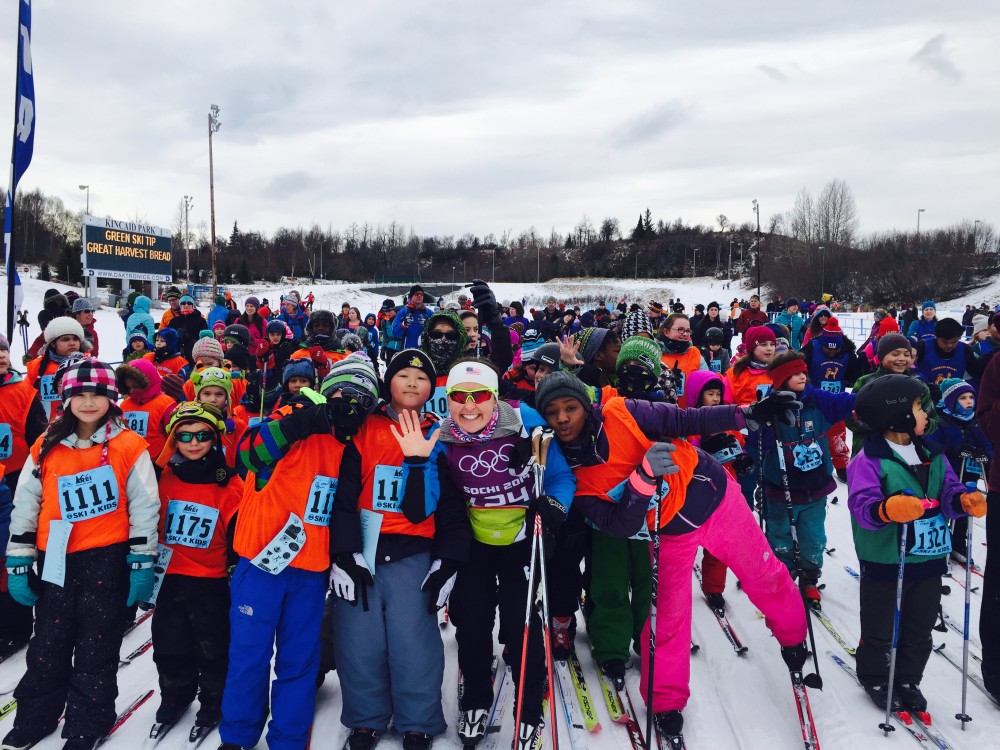
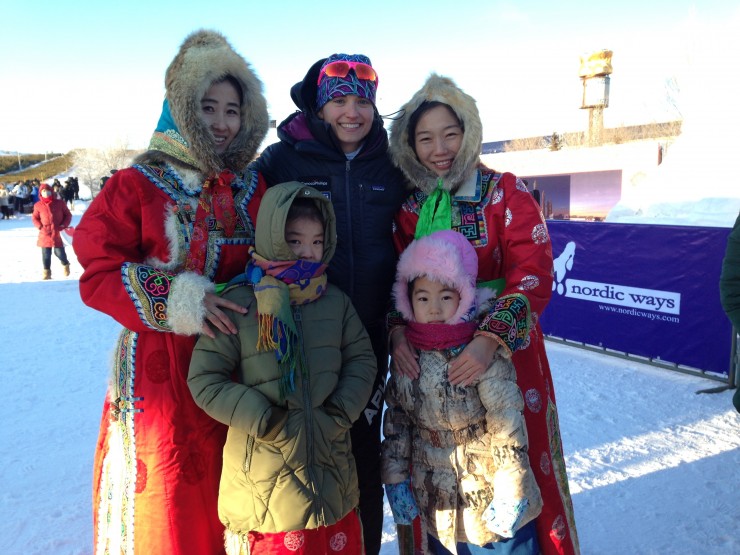
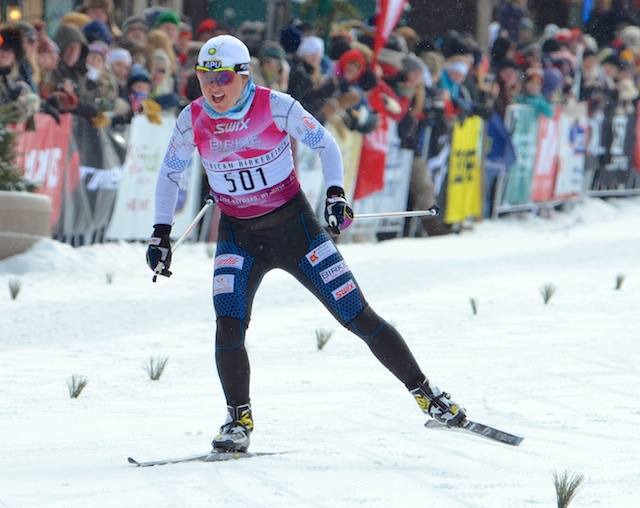
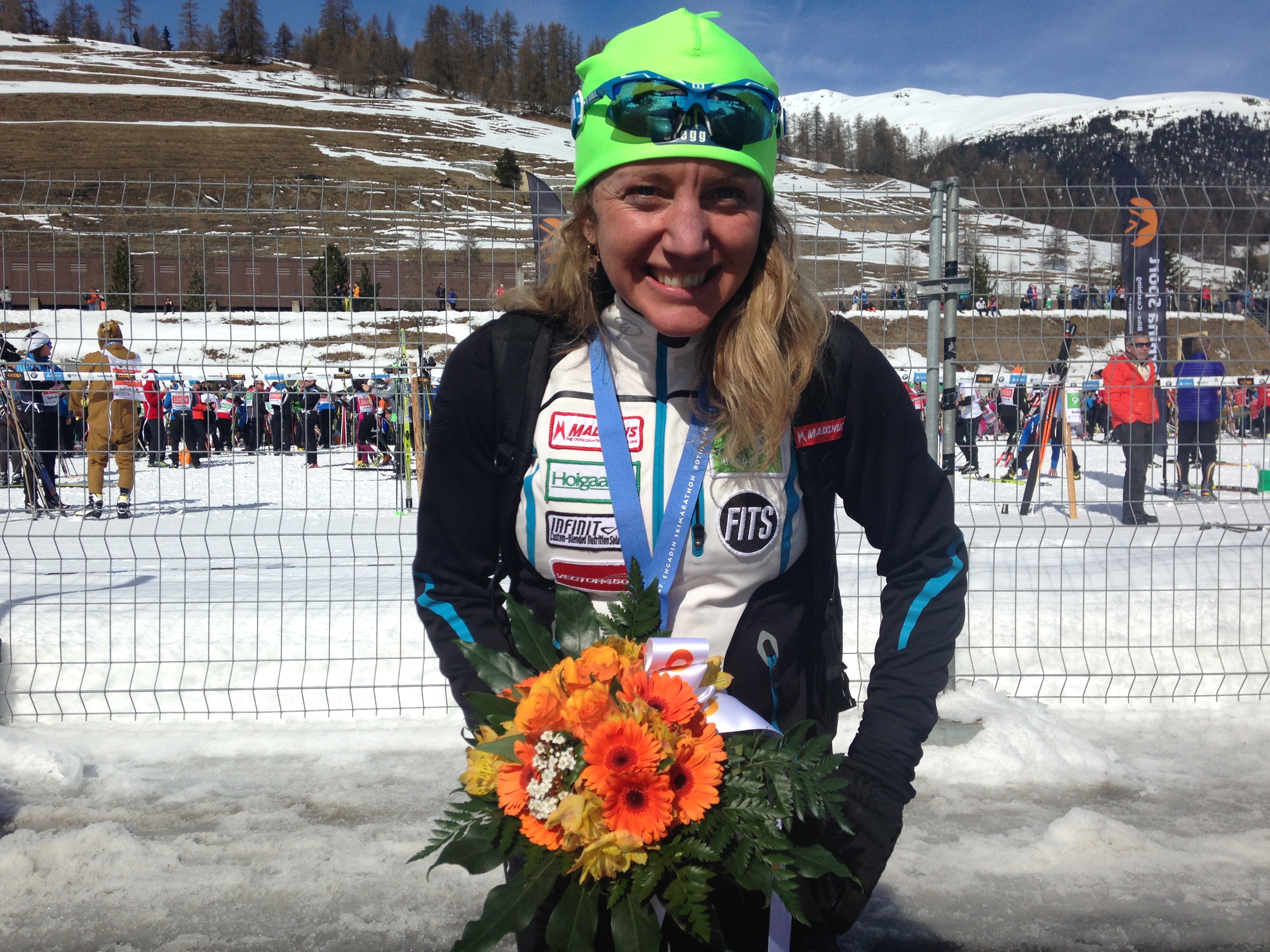
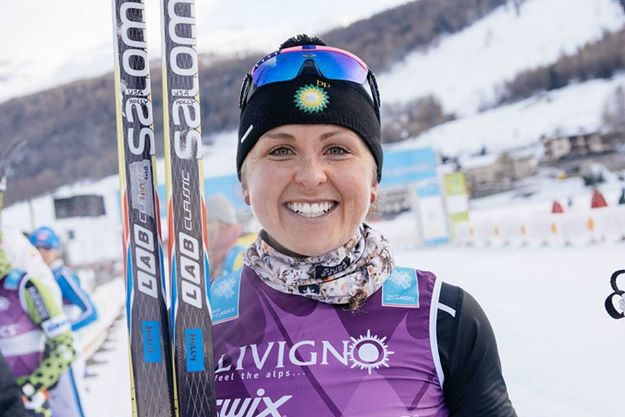
Holly Brooks (in purple Olympic bib) inspiring local youth in Alaska. (Courtesy photo)
Prior to her emergence on the national and then international cross-country ski scene, Holly Brooks, now 34, wasn’t exactly relay sock worthy, but that too would eventually transpire.
A graduate of Washington’s Whitman College in 2004, Brooks hadn’t tapped her potential as an athlete. Upon graduation she moved to Anchorage, Alaska, and took a part-time job coaching West Anchorage High School. Two years later, she was hired by Alaska Pacific University (APU) Nordic Director Erik Flora as a coach. In 2008, after thousands of kilometers coaching/skiing, she won the Tour of Anchorage.
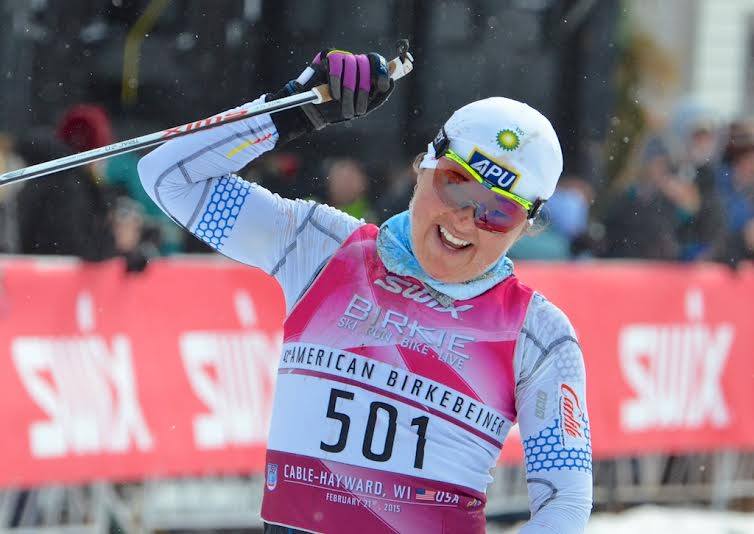
In 2010, Brooks made the U.S. Olympic team and headed to Vancouver, British Columbia, for what would be the first of her two Olympics. The next year, she qualified for 2011 World Championships, and in 2012, Brooks won the American Birkebeiner was named to the U.S. Ski Team.
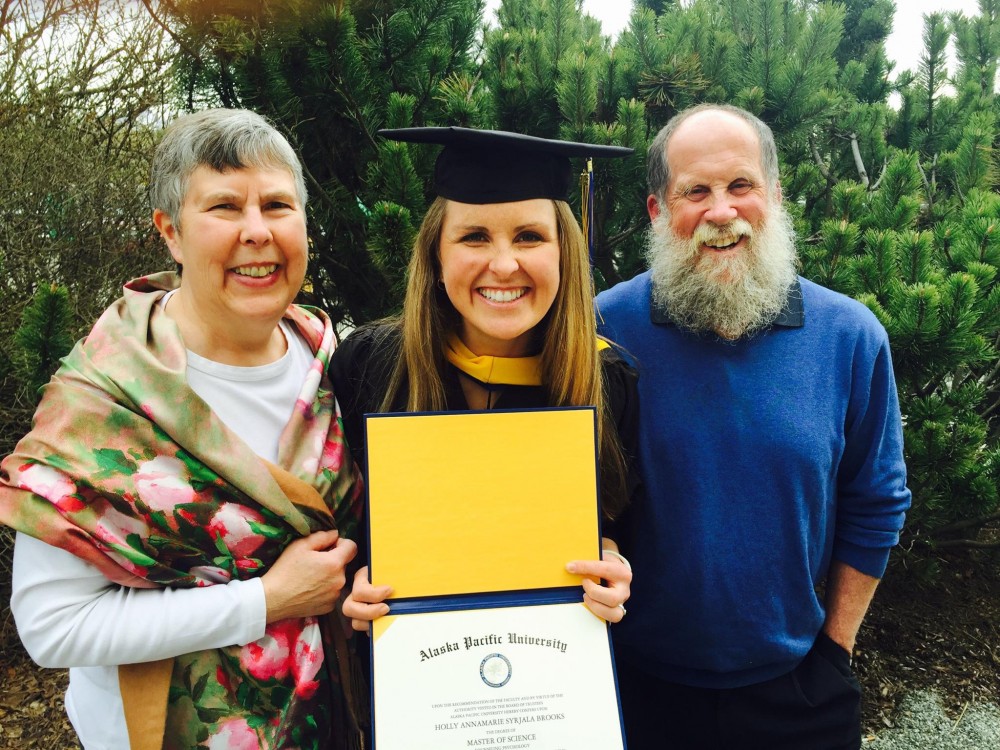
Holly Brooks with her parents Don Brooks and Chris Syrjala at her graduation in April. Brooks received a master’s in counseling psychology from Alaska Pacific University. (Courtesy photo)
Although a late career move, Brooks had arrived.
At the start of the 2012/2013 season in Gällivare, Sweden, along with Kikkan Randall, Liz Stephen and Jessie Diggins, Brooks proved the infamous relay socks had legitimate mojo: the foursome were the first Americans to podium in a 4 x 5 k women’s World Cup relay.
Brooks’ retirement, as she explains, became “official” just weeks ago. But she hasn’t really considered racing for a bit over a year. As mentioned in the podcast, she and her husband, Rob Whitney, himself an accomplished cross-country skier and former national-team member, began thinking about starting a family. The backstory to all this: during her serious training and racing, Brooks was without her period for eight years.
As she has navigated the complexities of fertility, Brooks has found new meaning in her master’s degree in counseling psychology — she’ll be starting a business with a focus on helping female athletes.
Holly Brooks with her husband Rob Whitney and their six chicks in Alaska. (Courtesy photo)
There’s a lot more in the podcast as we go beyond simply scratching the surface. Brooks also reads a poem by runner Lauren Fleshman, “From Retiring to Rewiring“.
“When you wake up in the morning, Pooh,” said Piglet at last, “what’s the first thing you say to yourself?”
“What’s for breakfast?” said Pooh. “What do you say, Piglet?”
“I say, I wonder what’s going to happen exciting today?” said Piglet.
Pooh nodded thoughtfully.
“It’s the same thing,” he said.
— A.A. Milne, Winnie-the-Pooh
Breakfast, as you learned in elementary school (or more recently from Ryan Gosling), is The Most Important Meal of the Day. That’s likely true for anyone. It is emphatically true for skiers. Whether you’re training once a day or three times a day, 100 hours a year or 1,000, it all starts with breakfast. If training is the foundation for racing, and proper nutrition is the foundation for proper training, then it logically follows that breakfast is the foundation for, well, everything.
Kikkan Randall in the kitchen “getting ready and fueled” in the fall of 2014. (Photo: Twitter)
Certain types of breakfast tend to get all the press. Pretty much everyone is a fan of second breakfast. J.R.R. Tolkien explains that hobbits eat second breakfast as the second of their six daily meals – after (first) breakfast and before elevenses. Thomas Mann, in The Magic Mountain, ups the ante, discussing not only second breakfast but also, remarkably, third breakfast. Robert McCloskey, in the seminal 1941 children’s book Make Way for Ducklings, underscores that second breakfast is best in the animal kingdom as well; his Mr. and Mrs. Mallard follow around the late-morning duck boat until they get “another breakfast, better than the first.” Everyone, it seems, is a fan of second breakfast.
There is no question that everyone is a fan of pancakes (and their close relative, the waffle). Turning from early-20th-century literature to the modern institution of the 21st-century skier blog, it is clear that there could not be a skier blog – or maybe even skiers – without pancakes or waffles.
And a generation earlier, before the term blog had even been invented, Luke Bodensteiner, at the time a struggling Olympic hopeful, wrote in Endless Winter: An Olympian’s Journal of downing 18 (!) “steaming hot buttermilk pancakes” one morning in September 1993, then crushing a 50-kilometer rollerski followed by a 12-mile run. Plus ça change.
This is not an article about second breakfast. Nor is it even an article about pancakes. This is an article about what athletes eat for real breakfast on real weekdays. Training day or rest day, at home or abroad, every elite athlete has a food that they’re comfortable with. And once they’ve found it, they tend to eat that food every. single. day. (Except for Lex Treinen, who wrote that he “never actually [has] the same breakfast every day,” but he’s an outlier among the athletes surveyed for this article.) If ski racing is, ultimately, about controlling the things you can control and trying to get a good outcome from the things you cannot, then breakfast becomes one more thing that can be effectively controlled.
Starting with Alaska, we asked skiers with the Alaska Pacific University Nordic Ski Center elite team to share an honest picture of their average breakfast for a weekday training day and describe what they eat. Here’s what they told us:
“My typical breakfast is a three-egg omelette with Canadian bacon, mushrooms, peppers, onions, spinach, and cheese and two pieces of wheat toast with cinnamon sugar. Together with an Americano.” (Note: Not Randall’s actual omelette/photo via Wikimedia Commons)
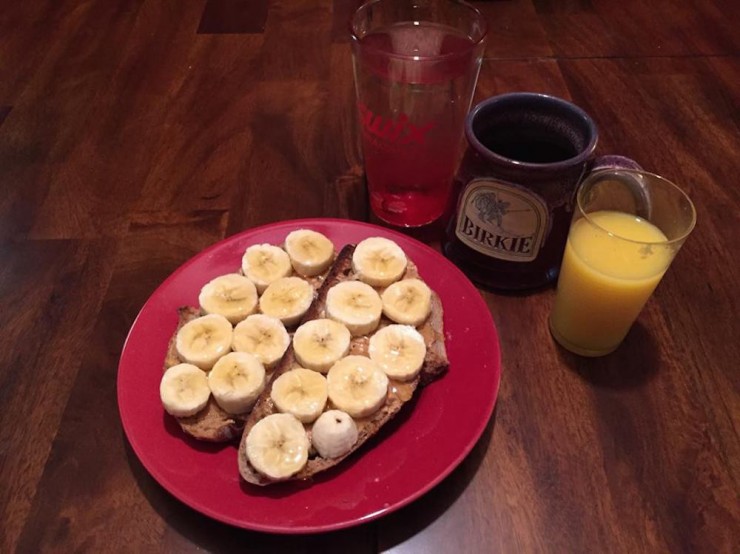
“I was out of eggs so normally one would be this concoction [pictured] – peanut butter, banana, and honey – and the other would be a poached egg on top of toast with jam. Just the right combo of carbs, protein and fat to keep me going and ensure that I don’t have a growling stomach 1 hour later……”
Honorable mention: On marathon race mornings, Holly makes “a big bowl of 50k oatmeal (peanut butter, banana, raisins, yogurt, salt, honey),” plus two cups of coffee.
“My normal breakfast is oatmeal, yogurt, almonds, fruit slices (apple, banana, berries), spoonful of peanut butter, honey. Sometimes I will substitute some sort of cereal throughout the week to break up the oatmeal. Today I used Pumpkin Flax Seed cereal.”
“Omelette and oatmeal with blueberries”
“Everything bagel with raspberry jam; 2 eggs over medium; coffee with foamed milk”
“Apple, organic peanut butter, and cookie dough; black coffee”
“Two eggs, rice, beans, shredded cabbage, and salsa”
“Everything bagel with raspberry jam and fried eggs on top; oatmeal with mixed berries; coffee, black.”
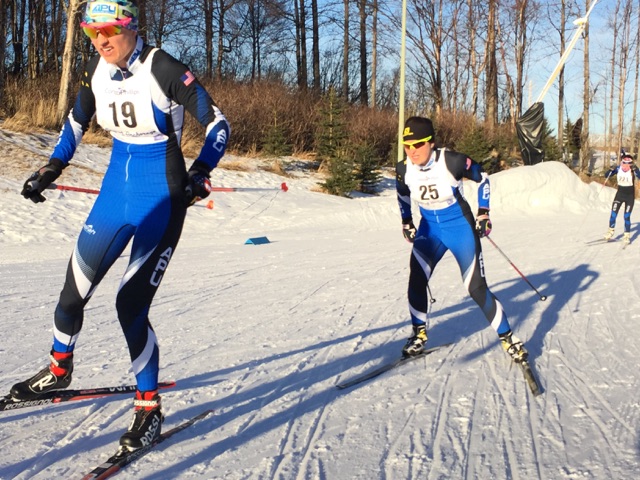
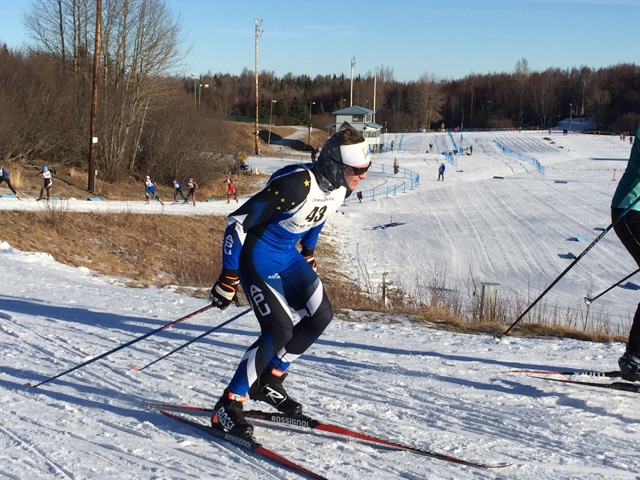
APU teammates Lauren Fritz (l) and Holly Brooks racing for the win at the 2016 Anchorage Tour in Kincaid Park on March 6. Brooks won and Fritz placed second. (Photo: Rob Whitney)
ANCHORAGE, ALASKA – A first-time racer and a former champion returning after a long absence skied to convincing victories in the Anchorage Tour Festival 30-kilometer race, née Tour of Anchorage 50 k, at Kincaid Park on Sunday. David Norris, last seen coming out of a group sprint to win the American Birkebeiner two weeks ago, and Holly Brooks, previously seen in two Olympic games but not at this race since 2009, each won by roughly three minutes on a sunny morning at Kincaid.
The Tour of Anchorage is traditionally a 50-kilometer, point-to-point race, ranging from the Chugach foothills on the east side of town to Kincaid Park at the west edge of the Anchorage metropolitan area. In between, racers traverse ski trails, city greenbelts, and bike trails until they reach the Coastal Trail multiuse trail, at which point they cover 15 k along the shores of the Pacific Ocean before ascending a hill to finish at Kincaid. It is truly a tour through the heart of Anchorage.
This year’s race, like every other race held under the auspices of the Nordic Ski Association of Anchorage (NSAA) in this snow-sparse winter, occurred exclusively on the snowmaking loop centered on the Kincaid Stadium. This year’s Tour presented 10 laps around a 3 k course, making for a 30 k freestyle race. It was more a Tour of the Snowmaking Loop than a Tour of Anchorage. Conditions on the course were very good at the outset, with recent fresh snow mixed into a solid base of manmade snow, though the steepest uphills and downhills broke down into sugar snow over glare ice by midway through the race.
David Norris (APU) racing to his first Anchorage Tour win at Kincaid Park on March 6. (Photo: Rob Whitney)
Norris, who skis for Alaska Pacific University (APU) and who won the men’s race by nearly three minutes in 1:14:51.0, seemed undeterred in his first time racing the Tour of Anchorage. In an email, he wrote, “This would have been my first year to do the actual Tour. … Due to the low snow year I was glad to have the Tour Festival 30km race on the manmade loop. I am glad the NSAA hosted the event even though we couldn’t do the formal course.”
The men’s podium was all APU blue. Jack Novak was second in 1:17:32.9. Andre Lovett followed roughly a minute later in 1:18:27.9.
Norris skied most of the race by himself, after breaking away from Novak late in the first lap. Norris wrote of his race strategy, “I went out hard from the start to practice that kind of effort. Jack stayed with me for almost the entire first lap before settling in.”
Norris had no other immediate competitors for the remaining nine laps and 27 k.
But with a field of 148 skiers on a 3 k loop (60 racers for the 30 kilometer race and 88 for the contemporaneously held 15 kilometer race), Norris had plenty of company out there. As Norris graciously wrote, “I thought I skied steady and was able to re-accelerate through corners or after congestion due to all the different levels of racers on a short 3km loop. I really apologize if I ever startled anyone while making a pass. I tried to be really careful not to be a jerk while making passes today.”
“I tried to be really careful not to be a jerk while making passes today.” — David Norris, after winning 2016 Anchorage Tour 30 k
While Sunday was the first time in this race for Norris, a Fairbanks native, the 2016 Tour marked a homecoming of sorts for Anchorage’s Holly Brooks. Brooks won the flagship 50 k Tour in both 2008 and 2009, at a time in her ski career when she was an APU coach first and a competitive skier second. Better results, a spot on the U.S. Ski Team, and nomination to the 2010 and 2014 U.S. Olympic teams famously followed. Brooks then spent last winter traveling the world, competing in the FIS Marathon Cup/Worldloppet series on three continents. She is now pursuing a degree, buying a house, and likely training somewhat less. But she is still winning ski races.
Brooks, who remains affiliated with APU, finished first among the women in 1:24:46.1. Her main competition came from fellow APU skier Lauren Fritz, who finished slightly less than three minutes back in 1:27:39.0. Citizen racer Sally Hokanson was third in 1:40:21.4.
While Norris went out hard from the start and gapped Novak early, Brooks and Fritz skied together for a majority of the morning. Brooks started to pull away about three quarters of the way through the race, she recounted in an in-person interview.
“It might have been on lap 7 of 10. It was on [the downhill on] the backside [of the course], because my skis were running pretty well,” she said. “I noticed I had a little bit of a gap. I just put a few extra strides in and a good tuck and a big push, and opened up a little bit of a gap.”
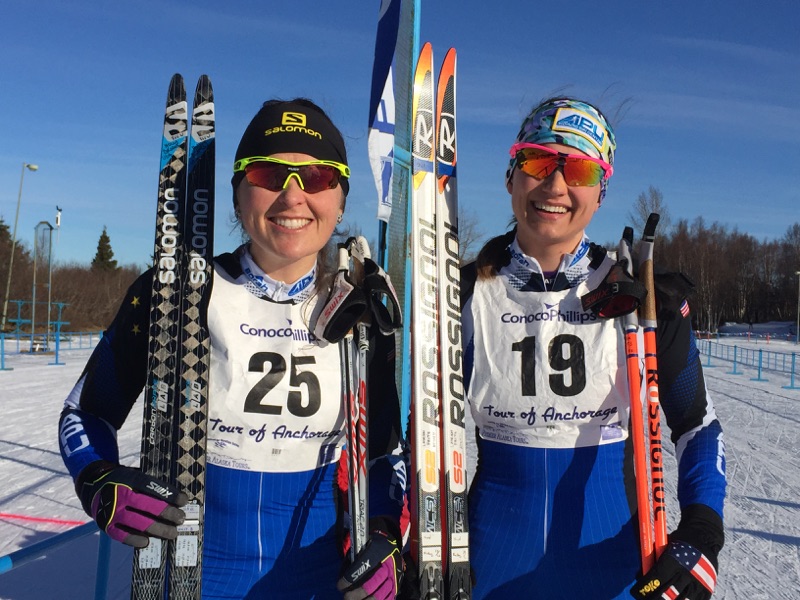
Holly Brooks (l) and Lauren Fritz, both APU, after placing first and second, respectively, at the Anchorage Tour in Kincaid Park on March 6. (Photo: Rob Whitney)
Brooks kept her lead to the finish, aided by her own observations and splits from others.
“There’s a little out and back, where you can kind of get an idea if someone’s there or not, so I saw her there the first time after I’d made the move,” Brooks said. “And then I got a couple of back splits after that that I had a little bit of a gap.”
Brooks appreciated the chance to be back racing on home soil, after many winters spent skiing anywhere but in Alaska.
“It’s nice to be home,” she said. “I had my husband out here giving me feeds, so that’s always fun, and a lot of local people out there on the course too. There was a lot of traffic out there today, the 30 k and the 15 k on the same loop, and some of the downhills were a little sketchy with the traffic, but it was manageable.”
A Kincaid lap race may not be particularly exciting, but it was certainly a change of pace from Brooks’ schedule last spring. When asked where she had been one year ago this month, the peripatetic Brooks had to think for a while before answering.
“Last year I wasn’t home for another five weeks,” she finally said. “Let’s see… I was at the Engadin this weekend last year I think. And then after that I think there was the Norwegian Birkie. And then, I can’t remember if there was something between that and going to Siberia. So, a much different year.”
While Norris was racing the Tour for the first time, the rest of the day’s podium finishers were no strangers to this race. Among the men, second-place finisher Novak won the race in 2015 (when it held as a criterium with a 50-minute time limit), and was third in 2014. On the women’s side, second-place Fritz was also second in 2014. And third-place Hokanson was second in the 2015 criterium, and (as Sally Johnson) won the 25 k classic race in 2008.
So what are the winners’ plans for the rest of the season?
“I will be training in Fairbanks until I leave for Spring Series in Vermont, which will conclude my season,” Norris wrote. “My season has progressed and I think I have made a good step forward. My goal at the beginning of the season was to earn a spot on the Canadian Tour World Cups, but with just average races in December and November I wasn’t able to secure a position.”
Meanwhile, Brooks had upcoming spring marathon racing goals, including either the Kachemak Bay Nordic Ski Marathon in Homer or the Sonot Kkaazoot in Fairbanks. But as of early Sunday afternoon, standing in the Kincaid parking lot, the March sun finally taking the chill off what had been a brisk morning, she had more immediate plans. “Oh, and I’m anxious for that sauna to get nice and hot,” she observed, gesturing toward a portable sauna that had been towed into the parking lot next to the beer garden. “And the barrel hot tub.”
An all-APU men’s podium at the 2016 Anchorage Tour Festival 30 k freestyle on Sunday, March 6, in Anchorage, Alaska, with David Norris (c) in first, Jack Novak (l) in second, Andre Lovett in third. (Photo: Holly Brooks)
Women’s podium, with APU’s Holly Brooks (c) in first and Lauren Fritz (l) in second, and citizen racer Sally Hokanson (r) in third at the 2016 Anchorage Tour Festival 30 k freestyle on Sunday in Anchorage, Alaska
(Photo: Tamra Kornfield)
A panorama view of the classic course at the second-annual Qaniq Challenge Jan. 16-17 in Valdez, Alaska. (All photos: Gavin Kentch)
By Gavin Kentch
VALDEZ, Alaska — Sometimes it’s easy to lose sight of the “cross-country” part of cross-country skiing. Particularly in this winter of discontent, when a lot of your training time ends up being spent doing 2.9-kilometer laps around a snowmaking loop.
Sometimes it’s important to travel for five days so that you can spend less than two hours racing, but do so on a course that goes from a mountain overlook to the shores of the Pacific Ocean.
Sometimes, surreally, the country’s second-richest ski race is held in Valdez, Alaska, in the middle of January, and gives away a purse of $10,000 dollars to a field of 36 racers. Sometimes it’s just time to take a road trip with your mom. This is the story of all of those events.
Dramatis personae
Holly Brooks finished her racing obligations in China a few days before this race, returned from China to Washington to visit family, flew back to Alaska on Thursday, then drove to Valdez on Friday before racing the Qaniq Challenge on Saturday. I assume this is basically a normal week for her. Other local athletes carpooled with each other for the over 300-mile drive from Anchorage to Valdez.
Personally, I traveled with my mom, because I am just that cool. (Also, I needed her to chauffeur me across southcentral Alaska: My car is a 1989 Toyota Camry, named Teakettle, which at 27 years old is more venerable than at least half the modern-day World Cup field, not to mention the advent of FIS points. I suspect that Teakettle would literally be unable to drive over Thompson Pass, and so to leave Valdez by road when the weekend was over. And the next ferry back to Whittier wasn’t until a week later.) Her husband, Jim Bouchard, got the other front seat.
Of the three of us, my mother is a good sports mom, who spent my childhood waking up very early on very many occasions to drive me to a variety of endurance sporting events. She once drove six hours one way, in the evening after work, to pick up my little brother after he had been struck by lightning on a solo bike trip outside of Tok, Alaska. My stepfather spent decades living by himself in a log cabin he built off the road system, about 30 miles south of Denali. He was a national age group champion at the 1992 Masters World Cup held in Anchorage. And as for me? Well, not to pull rank, but I have previously been described on this website as “a nothing-special recreational skier.”
‘Getting here is half the challenge’
Valdez is slightly over 300 road miles from Anchorage, a drive of approximately six hours, depending upon winter driving conditions. (This assumes that spectacularly massive avalanches do not close the only road into town for over two weeks.) I decided we should take the ferry there, saving hours’ worth of driving – the ferry leaves from Whittier, a little over an hour’s drive south of Anchorage.
A waterside view of the old apartment building in Whittier, a “city” in the Valdez–Cordova census area of Alaska. As of 2014, the population estimate was 217, according to Wikipedia. The city is also a port for the Alaska Marine Highway and known as the Gateway to Prince William Sound.I may or may not have also harbored fantasies in which an avalanche closed the Richardson Highway the day before race weekend, harming no one, but nonetheless preventing all the real skiers from getting there in time for the race, and then I won the first prize of $3,000 dollars. This did not happen.
My mom and Jim arrived at my house in the predawn darkness on Jan. 14. With some difficulty, we added my skis and ski accoutrements to the car, then carved out space for me in the backseat.
We left my driveway shortly after 9 a.m. It was not exactly light out, but by this point in the year at least sunrise was within an hour. We headed toward the Seward Highway. We had a combined 11 pairs of skis, six pairs of poles, and five pairs of ski boots. Plus snacks. The car was packed. The gas tank was full. Nothing could go wrong.
It was shortly discovered that certain parties had forgotten to pack their wallet, containing, crucially, the state-issued identification necessary to board the ferry. Words were exchanged. A backtrack was undertaken. Houses were returned to. A wallet was obtained, and with it a legitimate form of ID. We set off once more in stony silence, now calamitously late, making plans to do the long drive the next day and ruing the not-small amount of money now wasted on ferry tickets. We decided to try to drive to Whittier anyway, and to hope that the ferry was somehow running late.
We drove down Turnagain Arm under low fog and amber skies, the water in the fjord smooth as glass. Last month, this stretch of road was closed due to 91 mph winds. Also, a semitruck had been blown over on its side and completely off the road. Also, the tunnel that we intended to drive to, in order to reach Whittier, in order to get on the ferry, had been closed.
That did not happen today. We could not see more than 100 feet above the ground as we drove along the Arm, but all the roads were passable. We arrived at the designated snow-plowed field, in seemingly the middle of nowhere, to queue for the 11:30 a.m. opening of the tunnel to Whittier, having long since missed our intended 10:30 a.m. opening, and still assuming that we were about to miss the ferry altogether. At least we could have lunch in Whittier before returning.
(N.B.: I have not fact-checked this final statement. It may literally not be possible to buy a restaurant meal in Whittier on a Thursday in winter. I’ll figure this out next trip.)
We were met by a wonderful sight: a handful of cars sat in the field ahead of us, still waiting for the 10:30 tunnel opening. An Alaska Department of Transportation message board slowly scrolled the reason for the delay: “Please stand by. Tunnel will reopen when smoke is purged.”
I have never been so grateful to drive through an icy, slippery, claustrophobic five-mile long tunnel cut into the mountains that apparently had had rogue smoke in it just a few minutes before.
We emerged, blinking, into the light, and into the town of Whittier, Alaska.
Whittier is a special place. For one, it is the rare settlement that was literally founded where it is because the weather there is always bad. For another, there are virtually no private houses in Whittier; all of the town’s residents live inside the same large apartment building.
For the first few decades of Whittier’s existence, everyone in Whittier lived inside the Buckner Building, a seven-story concrete apartment building erected by the U.S. Army shortly after World War II (see photo above). Later, that building was abandoned.
The new apartment building in Whittier, Alaska.Now everyone lives in the much more colorful Begich Towers, a few hundred yards away from its predecessor. (The concrete hulk of the Buckner Building lives on, standing sentinel over the Valdez waterfront. It gained passing fame a few years ago when two bros descended its asbestos-choked stairwells on downhill skis.) We marveled at the Ghosts of Whittier Past and Present, and drove the car onto the M/V Aurora.
The ferry ride took six hours. It was amazing. The sun was out. Prince William Sound was, atypically, placid and still. Snow-covered peaks shimmered over hillsides of spruce trees cascading down to the water.
At one point, I literally said, “Oh look, yet more dolphins are playing around the bow of the boat. How nice.” I felt like an athlete going over to London for the 1912 Olympics, although there was no track set up on the deck for us to exercise on. And I guess they had fewer glaciers. And more alcohol. Seriously, though, it was probably the most sublime day I have ever spent on a boat in my life.
The M/V Aurora, an Alaska Marine Highway System ferry.Valdez
Valdez is also a special place, though for different reasons than Whittier. It has an average annual snowfall of 300 inches, for one, and two to three times that just up the road in Thompson Pass.
It is also home to the southern terminus of the Trans-Alaska Pipeline System, which undergirds what remains of the state’s suddenly fragile economy. Valdez’s taxes on the pipeline itself make it shockingly wealthy, a lucrative petro-state enclave even within resource-dependent Alaska. (This also explains why Valdez was able to essentially move $10,000 dollars of oil tax money from its own coffers to the pockets of young elite cross-country skiers, which actually feels to me like a pretty positive development.)
A street view in Valdez, Alaska, last month.Standards of what is normal change when you live in such an environment. When I spoke with Qaniq Challenge race director Darryl Verfaillie about ten days before the race, his talk of contingency plans and water drainage made me assume that snow coverage for the race courses was marginal at best.
After inspecting the trails in person after we got to town, I learned that their coverage ranged from a low of one foot of base to a high of at least three feet. As Anchorage suffers through its second low-snow year in a row, Valdez was looking like a pretty good place to be a cross-country skier.
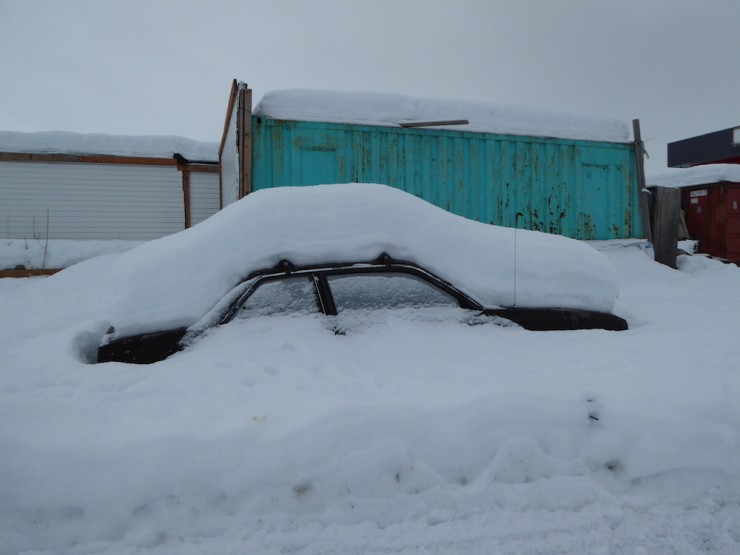
Valdez has also had a relatively snow-sparse winter, at least for Valdez. Therefore, the piles of cleared snow filling spare lots around town were only one to two stories high. These towers stood guard over a neat gridlock of residential streets (Valdez was essentially rebuilt from scratch following the 1964 Good Friday earthquake), where virtually every house was flanked by multiple snowblowers and snowmachines.
Valdez is also the type of place where there are still pay phones. Or maybe not pay phones per se, just telephones in public spaces that permit one to make free calls to anyone else in town. (I don’t know if this institution is common in the states. It persists in Alaska.) It was very pleasant. There was admittedly not too much going on on a Thursday evening in January.
Valdez is also the type of place where there are still pay phones. Or maybe not pay phones per se, just telephones in public spaces that permit one to make free calls to anyone else in town. (I don’t know if this institution is common in the states. It persists in Alaska.)
A royal welcome
I don’t want to be obsequious, but race organizers were beyond accommodating of the skiers. Late on Thursday night, recently arrived in town, I politely emailed the race director, making a tentative inquiry about whether I might be able to find any waxing facilities during the day on Friday. He wrote back at 6:30 a.m. Friday morning, putting me in touch with the local cross-country ski coach (go Valdez Buccaneers!). We were ensconced in the ski team wax room by midmorning.
On multiple occasions, during the middle of the school day, a very clearly not-high-school-age skier walked through the halls of Valdez High School, carrying a large ski bag over his shoulder and bags of waxing supplies in both hands. There were irons, vials, strange powders, an extension cord or two sticking out, and of course the large ski bag. In different contexts, it could be described as suspicious. No one batted an eye.
The royal treatment continued at the Friday-evening racers’ meeting.
“Will there be indoor waxing available tomorrow morning?” someone (me) asked.
“I don’t know, do you want it?” said the race director.
“Uh, yeah,” I said, “if that’s possible, thanks.”
“Okay,” said the RD. “We’ll have someone open the Teen Center for you by 8 a.m.”
And so Jim and I waxed our skis for the classic race inside, warm and dry, with numerous outlets and a bathroom and music. For a ski race on the road, it was paradisiacal.
It was that sort of weekend; everyone could not have been more accommodating. Or maybe I just have really extravagant demands when it comes to ski waxing.
Actual racing: Day 1 (classic)
I previously wrote a real article about the real skiers here. I saw some of these real skiers, if briefly, on race day. Lex Treinen came past me at one point, an unsurprising occurrence in the classic interval start. He was going very, very fast, and even said hi to me by name as he nimbly stepped around me and re-entered the tracks, all while going approximately Mach 9. I had scarcely registered his presence before he was past me. I was impressed.
Trailside view from the classic race course on Day 1 of the Qaniq Challenge.I was also impressed by the army of volunteers and support staff that the race had mustered. I think there were literally as many volunteers and support staff on course as there were racers. Road crossing? They had four people there, including one to hold up traffic on each side, and real, groomed snow across the road.
There was a section where all racers had to do two loops around a 3 k lap, and to help count the number of laps, they had two people at that intersection. One, with a clipboard, counted laps for each racer; the other, with large flags, would direct each racer to head around for another lap or to go back down the course when they approached this junction, as if they were directing an airplane taxiing up to the jetway. If memory serves, I passed six on-course checkpoints during the approximately 15 k race. It was impossible to take a wrong turn.
It was not, however, impossible to fall down. In an impressive display of consistency, I did so twice, once on each lap, in the same place each time. (That place was a six- or seven-foot wide section of trail, presenting the first of two extremely tight corkscrewed turns, with substantial exposure on either side. Alaska is an exciting place to be a ski racer.)
I learned while doing interviews after the race that Tyler Kornfield, an inestimably more talented skier than me, had also fallen twice, in the same place I had. And unlike me, he was wearing skate boots. That made me feel better.
The Pacific Ocean from classic course.After around 50 minutes of skiing, and going from a scenic mountain overlook down to the shores of the Pacific Ocean and back, I approached the finish. I crossed the finish line, immediately began feeling the effects of the longest all-double-pole race in my life, and teetered over to the edge of the finish area to collapse in the snow. I lay on the ground. After a few minutes, I tried to pick my head up, but I was still dizzy, and things were still spinning, so I lay back down. I was not unhappy.
A woman, a local resident who was volunteering with the race, came over. She was wearing a knee-length fur parka that probably cost roughly as much as the entire purse for the weekend’s race. It was one of the most beautiful things I have seen in my life.
She looked down on me not unkindly. “Are you still breathing, hon?” she asked me. I looked up at her. I attempted to form the words, “Thanks, I’m fine.” I met with some success.
It is sort of uncomfortable to sprawl on the ground with one’s skis still on. (Shoutout to my APU Masters coach Galen Johnston, who took my skis off for me unasked while I convulsed on the ground following a recent Besh Cup.)
“Do you think you could help take off my skis?” I said. “Just pull up on the bindings.” She knelt down and began, with great enthusiasm, to pull on my entire foot. “That’s okay,” I said, “don’t worry about it. Maybe you could just help me get up.” This fur-clad vision graciously reached down, gave me a hand, and helped me stand upright again. I was suddenly very conscious of having just finished racing. I tried very, very hard not to get snot, spittle, extruded Apple-Cinnamon Hammer Gel, or any other form of race-induced effluvia on her beautiful jacket.
“Sorry about your boots,” she said. “I’m really more of a hockey mom.”
Eventually, I found my bag, put on every piece of spare clothing I had brought (temps were in the 20s above, but humid maritime cold is cold-cold), and set out for an attempt at a cooldown. I skied part of the way with Holly. At one point, I confessed to her, “I’ve actually never raced on consecutive days before. What do I do in the 23 hours before the next race?” She graciously told me what I should do. Her advice (get warm, dry, and food immediately; active cooldown; warm shower; stretching and jog later that day) was not rocket science, but was much appreciated.
Actual racing: Day 2 (skate)
The start/finish area of skate course at the Qaniq Challenge.Day 2 was a skate race. They took everyone’s first day results, re-seeded the field based on classic time, then had a chevron start for the mass start skate race. There were little numbered placards alongside the tracks in the start area to help everyone line up correctly. It was adorable.
The chevron start, which I may never encounter again in my life, made me feel like a real ski racer. Lining up behind Dylan Watts and Holly did not change this sensation.
The gun went off, and I very quickly felt like less of a ski racer. I guess I’m not very good at starting races fast. Apparently I’m more of an interval-start specialist (says the Masters racer who has done precisely two interval-start races in his life, counting the previous day’s classic race).
Two to three minutes into the race, places #1-4 (the top four guys) were quickly pulling off the front in the lead pack. Places #5-8 (Holly, overall winner Rosie Frankowski, and two male citizen racers) were coming together into a chase pack. I moved up into ninth overall, and took aim at shortening the gap of ten feet that had opened up between me and eighth. In a sudden moment of prescience, I saw the next 45 minutes unfolding before me. I told myself, “You’d better catch this train, or you’re going to spend the entire rest of the race skiing by yourself.”
I did not catch the group. I did ski the entire rest of the race myself. I caught glimpses of the chase pack ahead of me, at greater and greater distances, until as late as 8 k into the race. They were moving very fast, taking turns trading off the lead on a pancake-flat, all-V2 course. They looked like they were having fun. They looked like they were happy. I hoped they were happy.
I was not unhappy; I was skiing, and skiing is fun. But it is more fun when you can see. I think it was colder than I realized; soon my eyes were watering profusely, and I was having a hard time making out the trail, the time on my watch, or anything else.
I had previously been telling myself things like “get forward” and “weight on the balls of the feet,” giving myself technique cues like Jessie Diggins lite (very lite), and at least trying to stay focused while I skied along entirely on my own.
But soon my thoughts became slightly less focused. Like, “my eyes are really cold right now. I really can’t see. I wonder if I’m doing them permanent harm? Like that musher who just got airlifted out of the Kusko 300 sled dog race because she frostbit her eyeball. Is that what’s happening to me right now? Man, I hope I’m okay?” These were understandably valid concerns. They were not particularly effective as technique cues.
(My eyes were ultimately fine. They hurt more when I finished, and again when I shut them to go to sleep that night, and they were bloodshot as hell for a few days later, but that was all.)
I eventually emerged from my solitary ski through the woods and back to the finish line. I did not appreciate it at the time, but apparently they had sent out a PistenBulley during the race to re-groom the start/finish area and take out the set tracks from the chevron start. It was that sort of race weekend.
I crossed the finish line, returned my race bib to Woman in Beautiful Parka, and once more put on every piece of clothing I had brought. This time, it wasn’t enough. I shivered through a ten-minute cooldown, then went inside the old trap range building that had a roaring fire going and served as race headquarters. I stood immediately behind the massive stove, slowly picked the ice out of my thawing beard, and regaled a very patient Dylan Watts with stories of my race while learning what had happened up front. It sure beat getting into Teakettle and turning on the heater that no longer actually produces any appreciable heat whatsoever.
After the race
I headed home for food and a shower. Around the time I was deciding between a nap and writing up my race article, Holly, only furthering her role as worldwide ambassador for cross-country skiing, was back on skis, leading a free clinic for local high school kids. I’m sure this is just what her fellow two-time Olympian Kobe Bryant does for his post-game recovery regimen. (My Holly Brooks hero worship notwithstanding, I should emphasize that she was joined by the rest of the APU Elite Team and associated skiers that were in town, including Frankowski, Lauren Fritz, Paul Kovacs, Dylan Watts, Treinen, and Kornfield. Pretty good day to be a novice skier in Valdez.)
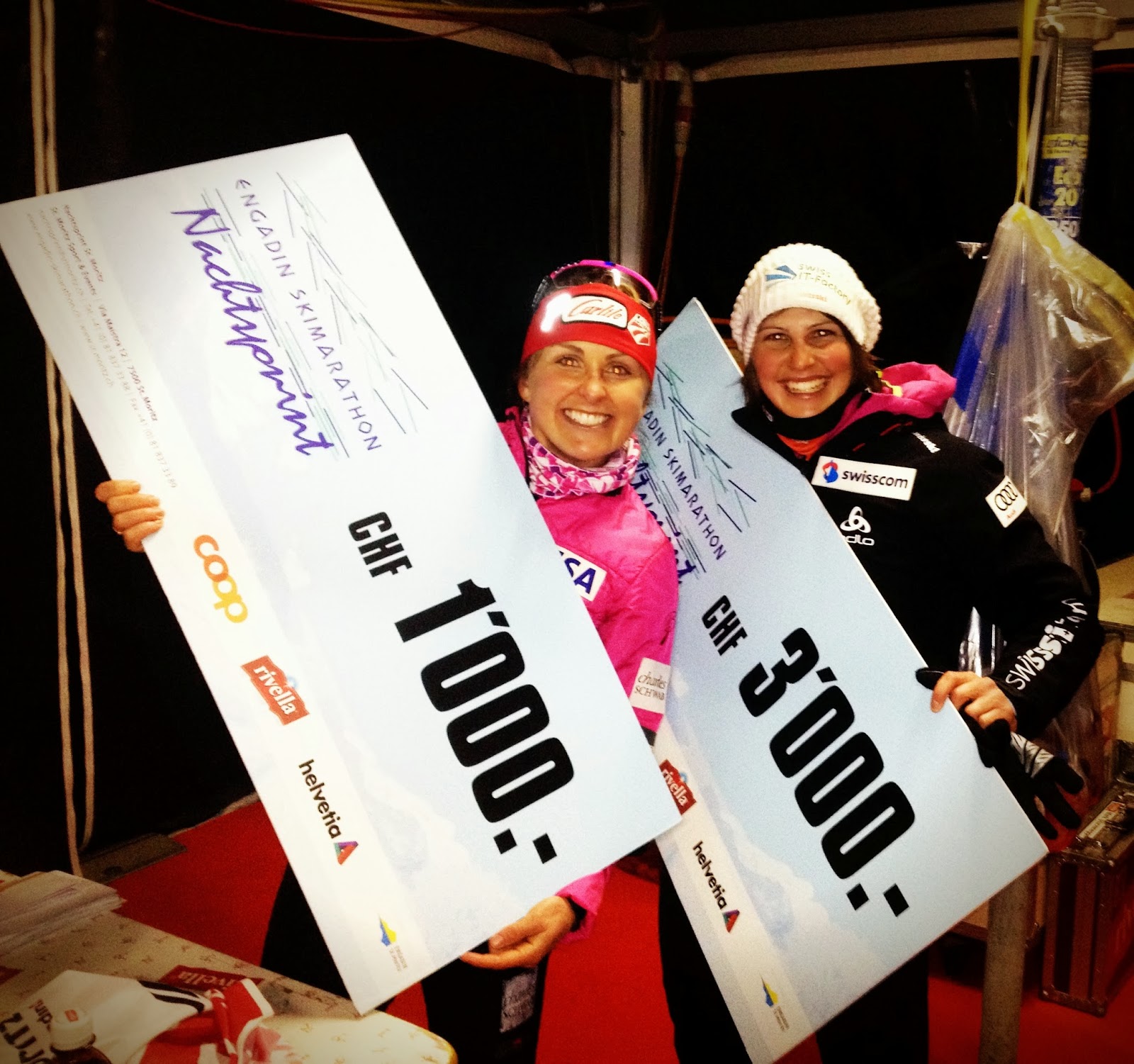
That night, the awards banquet was held in a local bar, The Fat Mermaid. Ten thousand dollars was redistributed from oil money to impoverished elite skiers. Lex and Rosie posed with oversized $3,000 checks.
Awards went five deep per gender. There were also prizes for the fastest locals, and for the fastest skier over 50 (shoutout to my stepfather). That’s 13 awards among 36 racers, or over a third of the field. Also, we all got good pizza, and one free drink ticket each. Also, they had applause not only for the sponsors and volunteers, but also for the press (me). It was a good awards banquet.
Heading the home
The next morning, it was time to go home. It was tough to leave, but we were wrapping up a five-day trip so that I could ski for a combined 101 minutes, so it was probably time. About half the field went backcountry skiing in Thompson Pass on the way home. We headed straight back to Anchorage, so that I could get back to my exceptionally patient wife and our two young girls.
Before we left, we had breakfast at the Totem Inn; poor Jim was yearning for meat after three mornings of oatmeal.
The Totem Inn was very… Alaskan. Of the twenty people in the restaurant on this Monday morning, nineteen of them were men. My mother stood out, because she was the only woman. I stood out, because my race T-shirt, pretty pink sports watch, and choice of tea over coffee clearly marked me as Not An Oilpatch Worker. (My stepfather did not stand out; people who have lived in the woods for three decades also look like they could work at the pipeline terminal.)
The inn’s motto, I have since learned, is, “Where everything about us says, ‘Alaska!’” I applaud their honest marketing.
We hit the road soon after. It was a different experience than the ferry – think six hours of trying to avoid the stench of unwashed ski gear and citrus solvent emanating from the ski bags wedged against my perch in the backseat – but Interior Alaska in midwinter is starkly beautiful, and an amazing contrast to the Sound.
By 4 p.m. I was back home in Anchorage, with its two inches of snow in my front yard, a world away from Valdez and its towering snow piles. By that evening my 3 ½ year old, having heard stories of my race weekend, was playing “cross the finish line and fall down.”
Skiing is also, in many ways, an intensely democratic sport. (Let’s elide for a moment the fact that Norway has like a billion World Cup wax techs to the U.S.’s handful – and that’s not counting another dozen or so under the aegis of Great Britain – and that some countries may be more equal than others.)
Sometimes you buy your first-ever race suit secondhand from Holly Brooks, then the next winter find yourself lining up immediately behind her in a mass start race. Sometimes you find yourself double-poling through a gorgeous valley as fast as you can, with the only other skier visible in front or behind you the quickly disappearing form of Lex Treinen. And sometimes, the local high-school kids race against regional high schools one weekend in the Valdez Invite, then against the APU Elite Team the next weekend in the Qaniq Challenge, all on their home course. Skiing is special like that.
(Photo: Gavin Kentch)
(Photo: Gavin Kentch)
(Photo: Gavin Kentch)
(Photo: Gavin Kentch)
(Photo: Gavin Kentch)
(Photo: Gavin Kentch)
(Photo: Gavin Kentch)
***
About the Author: Gavin Kentch lives in Anchorage. He skis with the Alaska Pacific University Masters team, plays with his two adorable daughters, and occasionally works as a solo attorney. He was probably on snow this year before you were.
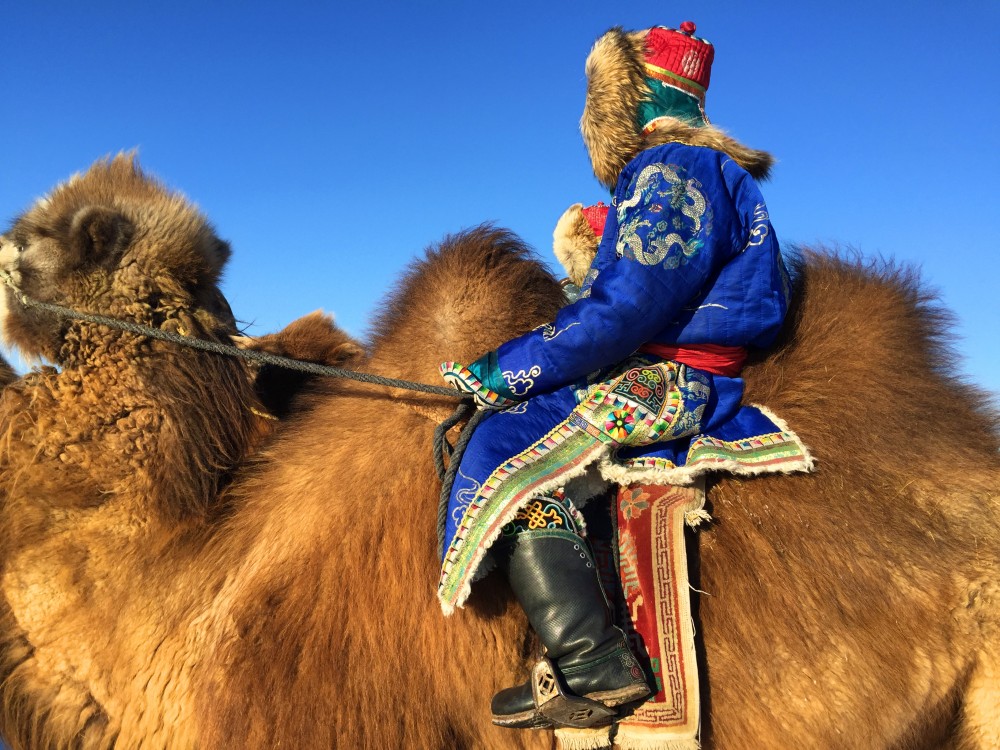
Competitors at this year’s China Tour de Ski spent their post-race recovery watching and riding camels in Xiwuqi, Inner Mongolia. (Photo: Torin Koos)
Does riding a camel count as a post-race cool down? For nordic competitors in the 2016 China Tour de Ski, it definitely did.
“The last day [of the China Tour de Ski], we had a sprint race in a place called Xiwuqi. Then in the afternoon we got to go and ride camels and see a camel race. I mean who does that?” exclaimed Holly Brooks, an Alaska Pacific University (APU) elite team member, two-time Olympian and most recently, a China Tour de Ski competitor, in a phone interview.
Torin Koos, who also raced at this year’s eighth edition of the China Tour de Ski (TdS), shared in Brooks’ surreality of a post-race jaunt on an unusual four-legged friend.
“There was a camel race going on and the athletes got wind of it and wanted to go. So the [event] organizers arranged a bus for us to go out there after the final races,” Koos, a four-time Olympian and currently an investigative news producer for KSL TV, the NBC station in Salt Lake City, said on the phone. “When else are you going to do your post-race recovery at a camel race in Mongolia?”
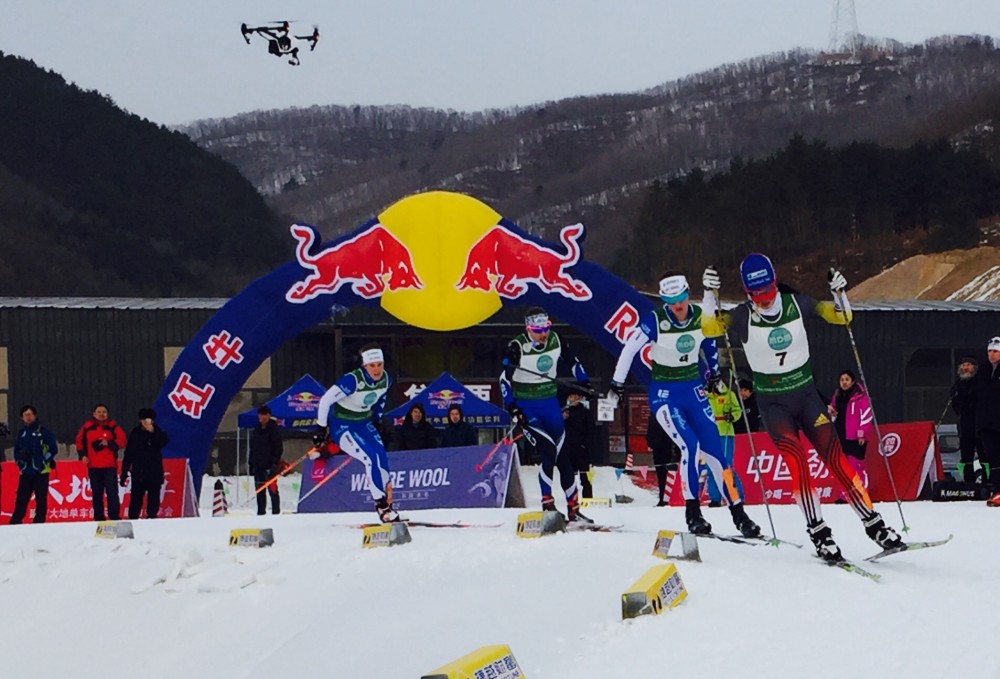
On top of camels, this year’s China TdS involved five stages of racing: a 1.2-kilometer freestyle sprint for Stage 1, another 1.2 k freestyle sprint for Stage 2, 50 k classic mass start “Vasaloppet” for Stage 3, 3.8 and 5.7 k mass starts for Stage 4, and finally a third 1.2 k freestyle sprint for Stage 5.
“Each stage was unique in and of itself. I mean, we had five races in three different venues,” Brooks said of the race schedule, which spanned from Jan. 1-7.
Another American racer, Lauren Fritz of APU explained on the phone, “They don’t block off a lot of time for travel. [Koos, Brooks and I] flew into China and got in at midnight” on Dec. 30.
“We had all of the next day to chill … then we raced the first stage [on Jan. 1]. The next day we took a 6 a.m. bus to a train station, took a two-hour train ride to the city, then another bus to our hotel. We raced two more days and then we got on a bus for 17 hours to Inner Mongolia for the last two stages of racing.”
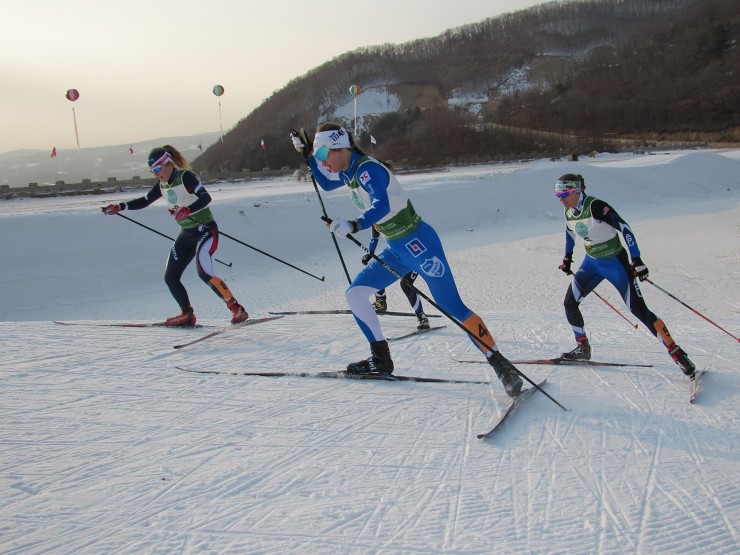
The Stage 1 women’s sprint, (from right to left) with Qu Ling (China) leading Mimmi Bjørn (Sweden), Lauren Fritz (U.S.) and Linda Danvind-Malm (Sweden) on Jan. 1 at the China Tour de Ski in Yanji. Fritz placed fourth overall, Brooks (not shown) missed the final in fifth place. (Photo: Holly Brooks)
While a 17-hour bus ride the day before a race does not appear in most skiers’ training logs, neither does a 3.8/5.7 k freestyle mass start race in Inner Mongolia.
“A 3.8 k prologue mass start is a pretty crazy race,” Fritz recalled. “It was a 1.9 k loop and the girls did it twice.”
Racers in the fourth stage launched into a steady 500-meter incline out of the start, especially unforgiving after 1,500-kilometers of bus travel the previous day.
“You could V2 the whole hill if you had good skis, so it was a hammer-fest out of the start,” Fritz said. “It was pretty cold out, I didn’t really warmup that well and because we had a 17-hour bus ride the day before, I was pretty tired. Definitely got to the top of the hill after V2ing the whole thing and was just toasted.”
The 27-year-old went on to finish 10th overall, 43.31 seconds back from the women’s prologue winner, Terese Andersson of Sweden, who topped the 3.8 k freestyle mass start in 10:10.76.
Just 1.22 seconds behind Andersson in third place, Brooks felt that with more closing speed the prologue title could have been hers.
“It was kind of fast and furious,” Brooks said. “They had a really good course and I was up there to start, but without the training I just didn’t have the finishing speed for the last 200-meters.”
Brooks spent much her fall unable to train, due to a rollerskiing accident that left her needing reconstructive surgery in her thumb’s ulnar collateral ligament.
“I rollerskied into a pile of sand and I got up and my thumb was bent backwards … so I had surgery in late September and was in a cast for two months,” she explained.
This year, Brooks has also been working to complete her masters degree in counseling psychology, which she said has taken priority over ski training.
China Tour de Ski Race Schedule: Stage 1: (Jan. 1) 1.2 k freestyle sprint Yanji, Jilin Stage 2: (Jan. 3) 1.2 k freestyle sprint Changchun, Jilin Stage 3: (Jan. 4) 50 k classic Changchun, Jilin Stage 4: (Jan. 6) 3.8/5.7 k freestyle mass start Xiwuqi, Inner Mongolia Stage 5: (Jan. 7) 1.2 k freestyle sprint Xiwuqi, Inner Mongolia
“Last year I chased the marathon scene and really kind of raced myself into submission,” she said. “I did 11 marathons and traveled by myself for four months in Europe … and at the end of the season I was just exhausted. So I ended up taking a lot of time off this summer. Then this fall, I was working full time on an internship and in grad school.”
The other American to finish third in Stage 4 was Koos, who crossed the line just 1 second after Swedish skier Lukas Johansson, who won the men’s 5.7 k freestyle mass start in 13.56.5.
“I definitely felt like I could have won it. I kind of got taken out on the next-to-last climb so I was battling back up [to the front] for a bit,” Koos explained.
However, both Brooks and Koos felt that as the Tour progressed, so did their ski racing.
“I was starting to feel better and better as the Tour went on. I think I was also getting further away from having the flu,” said Brooks, who spent much of the final week in December battling illness.
“That last qualifier somehow I was able to win it by eight seconds which I was super pumped about, but then once again, I just didn’t have the final finishing speed,” the 33-year-old Washington state native added. Brooks placed second in the Stage 5 freestyle sprint.
“Definitely the highlight was going to Inner Mongolia,” Koos said. “I’ve never seen so many cameras out on a race course. There were hundreds of people out there taking pictures. It had this big-time feel, but in the middle of nowhere.”
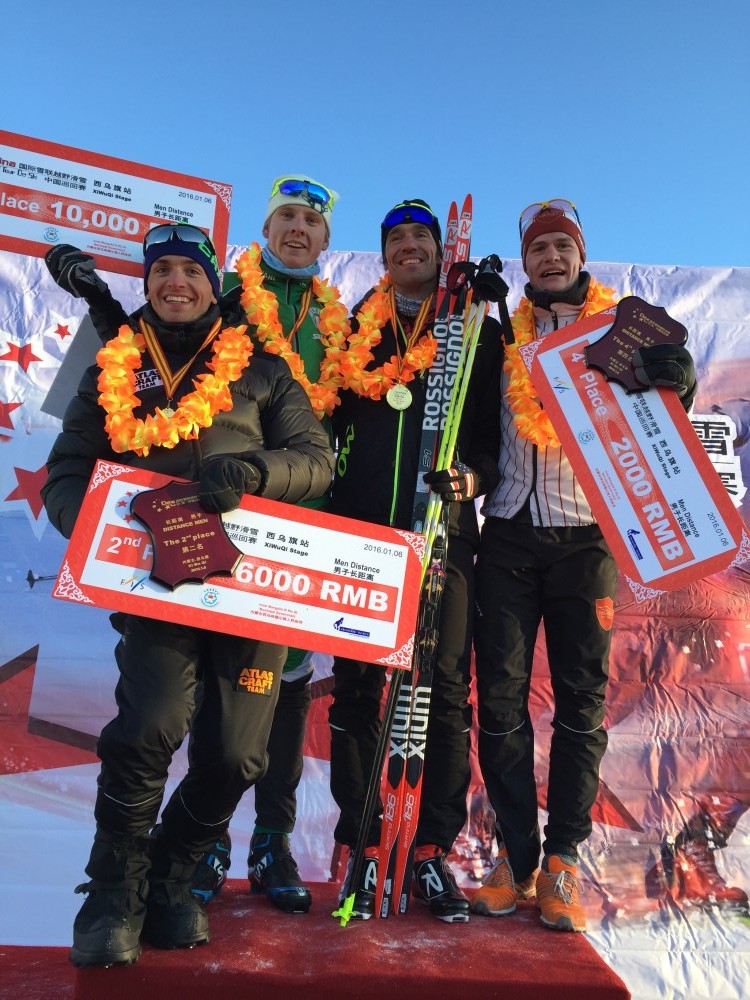
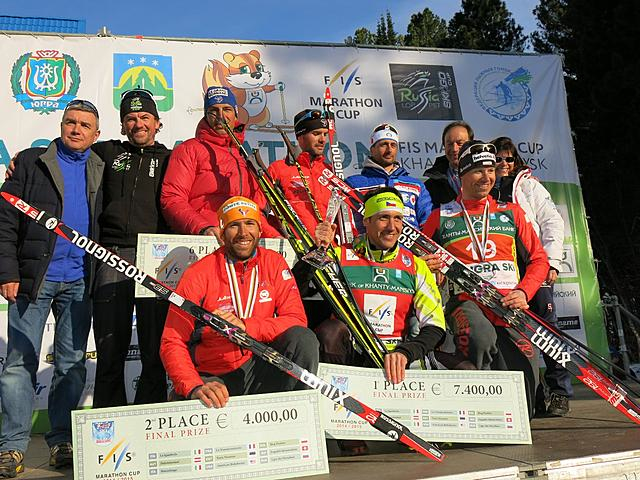
(From left to right) The Stage 4 men’s 5.7 k freestyle mass start podium, with second-place finisher Daniel Máka (Czech Republic), race winner Lukas Johansson (Sweden), American Torin Koos in third., and Torben Svensson (Sweden) in fourth sharing the top spot of the podium with prize money in hand on Jan. 6 at the China Tour de Ski in Xiwuqi, Inner Mongolia. (Photo: Holly Brooks)
“I also raced the best in Mongolia and it didn’t hurt getting on the podium [in the mass start],” he added. “I won the the sprint [qualifier] there, but couldn’t quite get it done in the rounds.”
On Jan. 7, the final day of racing, Koos advanced to the quarterfinal in the freestyle sprint. However, since only the top four advanced to the final in all of the China Tour de Ski sprint events, Koos missed moving past the semifinal and finished in fifth overall.
“All in all, it’s a little bit different when you’re working full-time and your priorities have changed a little bit,” 35-year-old Koos said of his training coming into the China TdS. “But I think as the Tour went on, I was getting stronger and I think I left there at a pretty high level.”
Based off their sprint race results from Stage 1 and Stage 2, Koos and Brooks were accurate in deeming themselves improved by the Tour’s finale.
In the first freestyle sprint, Koos qualified for the quarterfinal, but did not move on to the semifinal, ending the day in 11th.
Canadian Graham Nishikawa, the lone Canadian competitor at the China Tour de Ski, raced to sixth that day.
“I always wanted to compete in the Tour de China and this year it worked out. It was a great event! The organization was stellar and the racing was really fun,” Nishikawa wrote in an email. “We got to see so much of China and travel to places that I would have never otherwise seen. The racing was good for me. I had some bad luck with breaking poles, but raced fairly consistently everyday.”
Nishikawa, 32, is a member of the Para Nordic World Cup Team as a guide for Brian McKeever.
For Brooks, Stage 1 left her in fifth, just outside of the women’s final after qualifying for the quarter and semi. Fritz broke the bubble, moving all the way to the final, where she placed fourth.
“The sprints were my focus because I’ve had the most success in sprinting before,” Fritz said. “And they went pretty well, I had a few tactical errors and a little bad luck. Didn’t quite achieve what I wanted, but I was still pretty happy.”
Stage 2 brought the racers to Changchun, where they raced the second freestyle sprint. Here, Koos bested his previous result, finishing fifth overall, just outside of the final. Nishikawa moved into 13th.
Fritz once again advanced all the way to the final in the second freestyle sprint. Coming into the finishing stretch, she found herself in second, closing in on first place. However, with 150-meters to go, Fritz said someone stepped on her pole and she crashed, ultimately finishing the final in fourth.
Brooks qualified for the quarterfinal and semifinal that day, but didn’t advance to the final and finished the day in seventh overall.
“I’ve never seen so many cameras out on a race course. There were hundreds of people out there taking pictures. It had this big-time feel, but in the middle of nowhere.” — Torin Koos on the racing atmosphere in Inner Mongolia
The 50 k Classic Vasaloppet and More
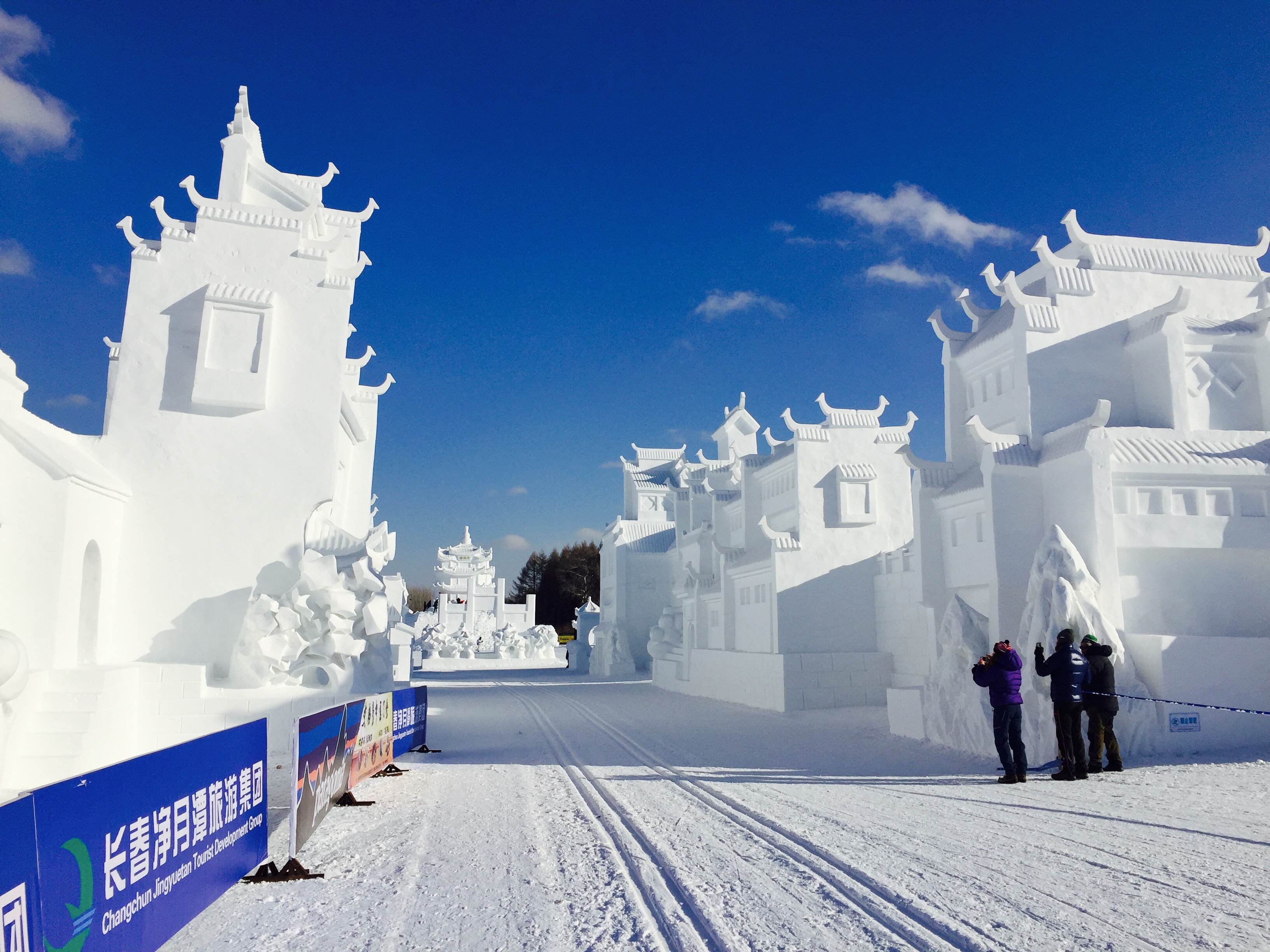
Snow castles and carvings that might even put Italy’s Roman Pantheon to shame — if not for the risk of melting — marked the lap lane to the China TdS 50 k Vasaloppet.
“Some things about China you just can’t believe. People think that we do things bigger than anybody in the U.S., but in some regards, it’s definitely not true,” Koos said. “Like, at the Chinese Vasaloppet, they had these sculptures that we were skiing by and it was something that you could maybe envision Las Vegas doing.”
This year’s China Vasaloppet promised athletes 50 k of skiing through the Jingyuetan National Forest Park, located in the northeast Jilian Province of China.
Sculptures surround the lap lane for the 50 k classic Vasaloppet marathon on Jan. 4. at the China Tour de Ski in the Changchun Jingyuetan Park. (Photo: Holly Brooks)
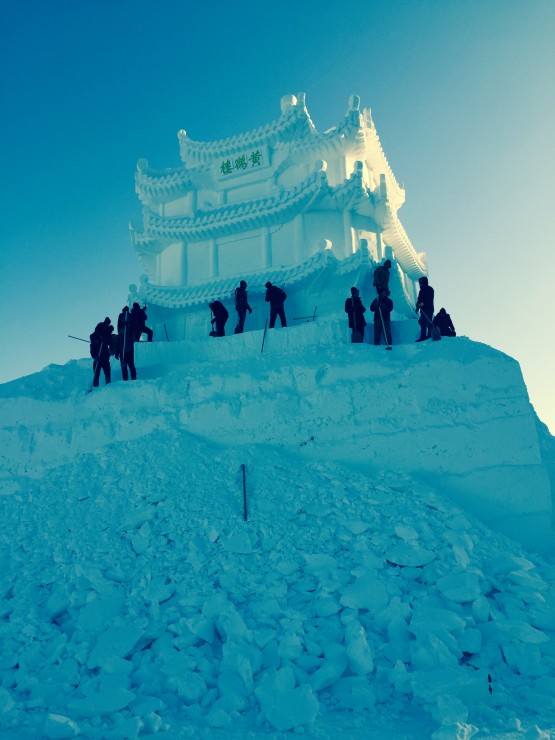
“Racing through snow sculptures that are five stories tall, I mean it was magnificent,” Brooks described. “You’re doing a lap lane through pavilions, doves, and castles. I’ve been in a lot of stadiums in my life, and I’ve been in a lot of marathons all over the world and this was incredible.”
A total of 258 racers showed up for the two-lap marathon and while not everyone finished, most soaked up the sunny skies and spectacular snow artwork that surrounded them during the race.
In the women’s event, Brooks led the Americans in sixth overall in 2:43:33.9, about 9 1/2 minutes behind the race winner Qinghua Ma of China, who completed the 50 k course in 2:34:08.1. Fritz finished 11th (+16:23).
“I’ve been in a lot of stadiums in my life, and I’ve been in a lot of marathons all over the world and this was incredible.” — Holly Brooks on racing the Chinese Vasaloppet 50 k classic
The men’s field saw Czech skier Petr Novak take the overall 50 k win in a time of 2:19:26.3. Koos finished 12th, 8:05.5 minutes behind Novak. Nishikawa finished about a second after Koos in 13th.
Along with a marathon through snow mansions, the China TdS boasted festival banquets almost every night.
“On this trip, every other day we were having a banquet or a celebration,” Brooks said. “Just the atmosphere and the ambience, I actually turned to someone and said, ‘I see why the Chinese don’t come to the World Cups very often, they seriously do it up in their own country.’ ”
Brooks was not alone in thinking that the tone of the Tour made for an enjoyable racing experience.
“The whole attitude at the tour was so different and it was really refreshing,” Fritz said. “If you were in the top few you were gunning for some good prize money… but once the skis came off it was way more fun than a normal SuperTour race trip, because there’s no pressure and everyone’s there to have a good time.”
A couple Americans did pocket prize money, though for Koos, it did not stay there long.
“I won a few hundred bucks or something. It was enough to buy me a sweet custom made grey suit in Beijing, so I’m looking pretty dapper these days. When in China, you just got to live it up to the fullest,” he said.
“If I had skied just a little bit faster I could have made some real money,” he added. “Maybe that’s motivation for 2017.”
Brooks also came away from the week with monetary winnings. However, the all-expense paid trip remained more important.
“There’s a company called Nordic Ways, a Swedish Tour Company, and they do everything,” she explained. “The bought my [plane] ticket. You show up at the airport and there’s someone holding up a sign with your name on it. All the transportation, three meals a day, everything is covered.”
Overall, Brooks finished the Tour in fourth, Koos placed sixth in the Tour, Fritz was the seventh overall woman, and Nishikawa the 10th overall male.
“There are so many ways to be a cross-country ski racer and I’m just really enjoying having new experiences, having new adventures, and reinventing myself every season,” Brooks said. “I feel like I really accomplished that by going to China.”
Holly Brooks (r) atop a camel after the final stage of the China Tour de Ski in Xiwuqi, Inner Mongolia. (Photo: Holly Brooks)
American Torin Koos during the qualifier of the men’s 1.2 k freestyle sprint on Friday, Jan. 1 at the China Tour de Ski in Yanji. (Photo: Torin Koos)
Sculptures surround the lap lane for the 50 k classic Vasaloppet marathon on Monday, Jan. 4. at the China Tour de Ski in the Changchun Jingyuetan Park. (Photo: Holly Brooks)
American Torin Koos (r) tests the Kung Fu crouching tiger maneuver on former Norwegian club teammate and friend, Erik Bakkejørd (NOR) during off time in the Forbidden City at this year’s China Tour de Ski. (Photo: Torin Koos)
One of many snow mansions that surrounded skiers during the 50 k classic Vasaloppet marathon lane, Monday, Jan. 4. at the China Tour de Ski in the Changchun Jingyuetan Park. (Photo: Holly Brooks)
Holly Brooks (APU) (l) and Lauren Fritz (APU) stand in front of one of the many ski yurts located in Inner Mongolia during this year’s China Tour de Ski. (Photo: Holly Brooks)
Racers competing in this year’s China Tour de Ski sit down to a banquet featuring a video projection of drone footage from the 50 k classic Vasaloppet marathon, which took place on Monday, Jan. 4., in Changchun’s Jingyuetan Park. Brooks noted that the dove snow sculpture shown in the background is close to six stories tall. (Photo: Holly Brooks)
U.S. Olympians Torin Koos (l) and Holly Brooks stand with their winnings from the 3.8/5.7 k mass start race on Wednesday, Jan. 6 in Xiwuqi, Inner Mongolia. Both Brooks and Koos place third in their respective events. (Photo: Torin Koos)
Lauren Fritz (APU) poses for a moment during a run along the Great Wall of China during the 2016 China Tour de Ski. (Courtesy photo)
A row of peking duck greets Brooks during off time in Changchun, where both Stage 2 and Stage 3 of this year’s China Tour de Ski were held. (Photo: Holly Brooks)
American Holly Brooks (r) gets some air while practicing dung fu moves with Finnish skier Anita Kirvesniemi in the Forbidden City, during off time at this year’s China Tour de Ski. (Photo: Holly Brooks)
Right to left: American Lauren Fritz (APU), along with Mimmi Bjørn (SWE), American Holly Brooks (APU) and Cecilia Mårtensson (SWE) during the women’s semi-final Stage 1 on Friday, Jan. 1 at the China Tour de Ski in Yanji. (Photo: Lauren Fritz)
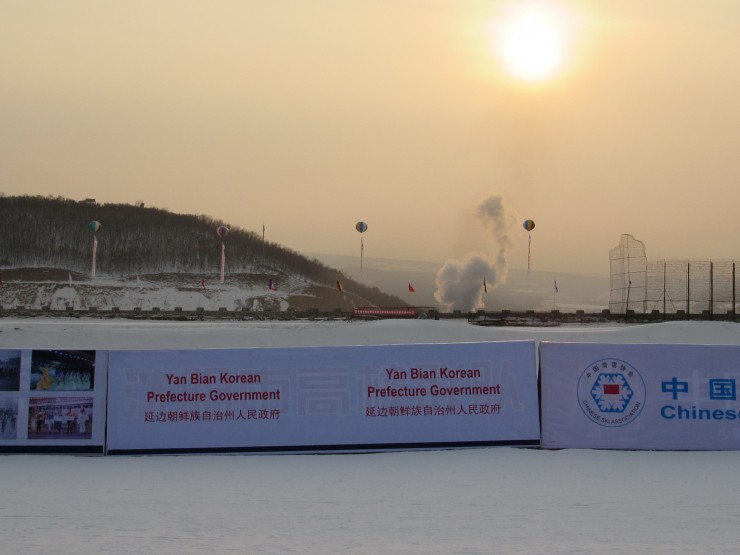
A plume of smoke rises from a nearby coal plant while looking to the southeast of the 1.2 k freestyle sprint course on Friday, Jan. 1 at the China Tour de Ski in Yanji. (Photo: Lauren Fritz)
Holly Brooks (APU) (l) and Lauren Fritz preview the Stage 1 sprint course–a 2×800-meter loop around a “gravel pit”–for the women’s 1.2 k freestyle sprint in Yanji. (Photo: Lauren Fritz)
Lauren Fritz poses for a picture with local spectators in Xiwuqi, Inner Mongolia during this year’s China Tour de Ski. (Photo: Lauren Fritz)
Swedish skier and former University of Vermont athlete, Linda Danvind-Malm (l) and American Lauren Fritz (APU) stand in front of one of the many snow castles that line the lap lane to the 50 k classic Vasaloppet marathon during the 2016 China Tour de Ski in Changchun. (Photo: Lauren Fritz)
A standard meal for competitors at this year’s China Tour de Ski. (Photo: Lauren Fritz)
American Lauren Fritz (APU) leads Swedish skier Mimi Bjørn in the Stage 2 semi-final of the women’s 1.2 k freestyle sprint race on Sunday, Jan. 3, at the China Tour de Ski in Changchun. Fritz advanced to the final, where she was gaining on first place until her pole was stepped on and she crashed close to 150-meters from the finish. She ultimately finished the day in fourth overall. (Photo: Lauren Fritz)
American Lauren Fritz (APU) at the finish line for the 50 k classic Vasaloppet marathon on Monday, Jan. 4 at the China Tour de Ski in Changchun. (Photo: Lauren Fritz)
On June 28, Jon Schafer, known in U.S. nordic circles as Fast Big Dog (FBD), stepped foot on Eagle Glacier, 5,700 feet above Girdwood, Alaska, where he spent about a week training on snow with a masters camp, led by Alaska Pacific University Head Coach Erik Flora. It was FBD’s first journey to the glacier and in the following account, he explains its significance. Interviews were conducted in person and on the phone.
***
By Jon “Fast Big Dog” Schafer
In just a few weeks, overweight and overpaid NFL players will assemble for training camps, subjecting themselves to the rigors of almost 60 total minutes of daily exercise.
Each spring, Major League Baseball prepares its aging demographic of viewers for the tediousness of watching baseball with an even more tedious primer known as spring training.
Elite rowers have long escaped ice-jammed winter rivers for a few weeks of cranking out miles in the Florida sun, and the list goes on and on.
The offseason training camp has been a staple for top-level athletes in many sports for decades, providing a distraction-free environment for individuals to focus on sport-specific training, make technical improvements and provide the mind a much-needed break from the grind of offseason training.
Nordic skiing is no exception. Nordic skiers have historically been very creative in their attempts to get on snow in the summer. European-based skiers have a few different options of glaciers and more recently, even ski tunnels. But what about North American athletes? What options are available to them? Is it necessary to make the pilgrimage to the tradition-laden glaciers of Europe or are there alternatives here in the U.S.?
The answer is hiding in plain sight. One of America’s premier Olympic development centers, the Alaska Pacific University Nordic Ski Center (APUNSC), has been taking skiers up onto Eagle Glacier in Alaska for over two decades. What began as three very hardy skiers living in a tent on the glacier has grown into one of the world’s top nordic ski training facilities at the Thomas Training Center.
(Photo: Jim Falconer)
(Photo: Jim Falconer)
This transformation wasn’t easy though. Alaska can be a cold, harsh environment and the development of the elite facility that exists today only happened thanks to thousands of hours of dedication spread over more than 20 years by driven, committed people with a vision. In many ways, Eagle Glacier is much more an outstanding training center; it is also an excellent metaphor for the ascension of U.S. skiing as a whole. Both journeys have been tumultuous at times, with great success only coming after countless hours of hard work, commitment and teamwork.
Probably not coincidentally, one of the most frequent visitors to Eagle Glacier is also one of America’s most successful skiers: current U.S. Ski Team (USST) member, four-time Olympian, three-time overall Sprint World Cup winner, and team sprint world champion Kikkan Randall.
“I went there for the first time in 2000,” Randall explained. “I was young, eager and ready for anything. The cabin and the overall facilities weren’t as nice as they are now, for sure. You had to be tough, but that’s not a bad thing. Skiing is a tough sport and the sooner you learn how to be tough, the better off your are.”
With these humble roots, a solid foundation was laid for growth and success. As a whole crop of young talent began to mature on the World Cup circuit, so did Eagle Glacier. “So many people worked hard to make that place what it is today,” Randall continued. “I don’t know if I’ll ever be able to express all of my gratitude to the people who first got it started, Jim Galanes and then Erik Flora in particular, whose efforts in the last ten years have been nothing short of extraordinary.
“We’ve kind of all grown up together,” she added. “As the level on the World Cup has risen, we’ve responded to this challenge by all pushing ourselves harder. Not only do the coaches and staff have Eagle more dialed, but so do the athletes. It used to be that you’d see people up at night watching movies, but not anymore. Now it’s just skiing, eating and sleeping. The whole operation is very professional in all aspects.”
(Photo: Jim Falconer)
(Photo: Jim Falconer)
(Photo: Jim Falconer)
Olympic gold medalist and nordic-combined world champion Billy Demong agreed. ”In the late ’90s and early 2000s, we were all working super hard, but we hadn’t quite broken through,” he said. “I was on Eagle Glacier in 2002 because as a team we were committed to be the best. Johnny [Spillane] won the World Championships the next year in nordic combined and that was really the start of our run.
“It wasn’t just nordic combined either,” Demong continued. “Kris Freeman had a fourth place at worlds that same year, Kikkan and Andy [Newell] began going really fast and Timmy Burke and Lowell Bailey started to have a big impact on the Biathlon World Cup in the next few years. It certainly wasn’t any one thing that took us all to the next level, rather the additive effect of lots of little things. Looking back, it’s amazing how far nordic skiing has come in the U.S. in a relatively short period of time. Hopefully the USSA [U.S. Ski and Snowboard Association] will continue to fund everyone so that we can all continue this remarkable trajectory.”
As Eagle starting getting more traffic from elite skiers, its mystique also continued to grow. For four-time Olympian Andy Newell, his first visit was the same year as Demong’s and his recollections were somewhat similar to both Demong and Randall.
“I went there for the first time in 2002 and I remember it was pretty spartan, but it was my first training camp with the U.S. Ski Team, so I still thought it was awesome,” Newell said via a Skype interview from the USST training camp in New Zealand. “I was just this punk kid, so I was so stoked that I was at a training camp with all of my idols that nothing else mattered,” recalled Newell. “I still remember what it felt like to hear I was rooming with Kris and Justin Freeman and Rob Whitney — I really looked up to those guys, so to be able to train and live with them was an incredible feeling.”
If that had been the end of the story, the trip may have not been all that memorable, but what followed is just one of many examples of the aura of Eagle.
“We got the rooming list and I was assigned to stay with Kris, Justin and Rob, which I thought was awesome,” Newell recalled. “Inexplicably, just before bed, Kris and Justin moved out to one of the other rooms. I thought this was odd, as the other bunk rooms were pretty crowded, but I didn’t care. I soon found out why though, as in the middle of the night, Rob woke up screaming that we were all going to die and that we had to get off the glacier immediately. I was terrified. Here it is my first night at U.S. Ski Team camp and one of the veterans, a guy I looked up to, is telling me that we were all about to die. I didn’t know to do, but I was thoroughly panicked. It turned out that Rob was widely known as a sleep talker. To make matters worse, he wouldn’t just mumble random stuff, he would address you by name and seemed very coherent. We laugh about it now, but it was scary as hell at the time. That’s the type of stuff that happens up on Eagle.”
Demong agreed. “Any time you get a bunch of skiers together living in a confined environment, it’s always going to be interesting. I was there early on and we had a really good group, but the coaches were just getting crushed working on the groomer. Rumor had it that a new PistenBully [PB] was being flown up to us and we were all so stoked as we knew this was going to have a huge impact. It did, but not in the way we imagined.”
While Demong wasn’t on site the day the groomer arrived, he recalled the story about its delivery. Just as the helicopter was coming into sight, the pilot got hit with a nasty down-draft and had to jettison the PistenBully from over 100 meters in the air to avoid crashing the helicopter. The PB came crashing toward the earth and smashed off the ice. Everyone was OK, but thinking back, Demong pondered, ” ‘I wonder if stuff like this happens in Norway?’ I still look back very fondly at those times, too, as in many ways those struggles, those battles and all of the crazy stuff was the best part of the whole adventure.”
(Photo: Jim Falconer)
(Photo: Jim Falconer)
Two-time Olympian and APU skier Holly Brooks echoed these sentiments. “Yeah, Eagle could be rough in the early years, but the job that everyone has done, in particular Erik and his team in the last few years, is nothing short of amazing,” she said. “Everyone has steadily improved every aspect of the training center to allow skiers to focus exclusively on skiing. It is now a truly world-class facility. We’ve had several top European World Cup skiers like [Norway’s] Astrid Jacobsen and [Finland’s Aino] Kaisa Saarinen come over and they agree that this is one of the best summer training environments anywhere in the world.”
The environment, while harsh at times, is proving to be more and more applicable to the conditions seen in racing season, something that coaches and athletes alike now recognize to be a huge strength. “Not every day on Eagle is bright, sunny, extra-blue conditions, so getting comfortable training in those bad conditions is key,” Brooks explained. “So many championship races end up being held in poor weather, so Eagle Glacier is huge in helping us prepared for that environment, both mentally and physically. In fact, we even have a running joke that when it is really lousy out, it is a ‘championship day.’ It’s funny, but it’s also very, very true. Many of the last championship races have been in bad weather [Holmenkollen, Val di Fiemme, Sochi] and a lot of our success at these venues is due to our training on Eagle.”
Randall concurred, “With climate change, we are seeing conditions on more and more of the World Cups that are very similar to what we see on Eagle, so being able to train for this is very important. It is very interesting, we talk a lot about ‘championship days’ on Eagle, but I’ve come to learn that this means a lot more than just being comfortable in bad weather — it’s really more about being tough no matter what is thrown at you and no place teaches you that lesson better than Eagle Glacier.”
In contrast to Randall and Brooks, Newell, a Vermont-based skier with the Stratton Mountain School T2 Team, didn’t witness the slow, steady progression of the training center firsthand, as he didn’t have the opportunity to return to Eagle until last year, but he echoed all of the same thoughts.
“I was blown away when I finally got a chance to return,” he noted. “I went up there last summer and the changes were incredible. Flora absolutely has that place dialed. It is very structured now and it runs very, very smoothly. As the overall level on the World Cup continues to rise, summer training camps have become even more important. To be competitive at the very top level, you simply must get on snow at least once a summer. Our competition is getting on snow even more often, so we really need to capitalize on our time and Eagle Glacier is a perfect place to do that.”
Newell went on to bring his experiences on Eagle full circle by summarizing the history and growth of the training center and the parallels with the success of the U.S. team. “One of the very special aspects of Eagle is the history. I was there at the very start of my career and I was able to learn a lot from the veterans, so it’s very exciting and rewarding to be able to return and help pay that forward to the up-and-coming group of skiers,” he said. “One of the walls is painted with the names of everyone who has trained and suffered on the glacier and it is a true badge of honor to have your name on that wall. I am very proud of what this represents and I am hopeful that younger skiers will see those names and be just as inspired today as I was in 2002. In many ways, Eagle Glacier represents the past, present and future of U.S. skiing.”
(Photo: Greta Anderson)
(Photo: Greta Anderson)
(Photo: Greta Anderson)
Some of the newer members of the USST immediately picked up on that vibe on their first visit. “I went up to Eagle for the first time two years ago and I was immediately awestruck,” remarked Olympian and 2015 World Championships bronze medalist Caitlin Gregg.”I had heard lots of horror stories from the old days, but as soon as I arrived I knew the place was special. You see the names of all of these great skiers on the wall and suddenly it hits you, I am a part of this.
“The Eagle Glacier experience goes way beyond just being on snow in the summer though,” she continued. “I left the place a few years ago so fired up about training that it really set the stage for me for the last two years, which have been the best years of my career. That’s the type of impact Eagle Glacier can have on a skier.”
World Championships U23 silver medalist Noah Hoffman also tapped into the energy immediately, “I went for the first time two years ago and I didn’t know what to expect. I had previously skied on Dachstein and Stelvio glaciers and in both of these two places cross-country skiing is such an after-thought, it was incredibly exciting and refreshing to be on Eagle where it is so dialed in for elite cross-country training.”
Like all attendees, Hoffman knew right away he was part of something special. “Everything about the place is amazing. The weather is crazy but Flora and his team do such a great job of grooming you feel like you’re on a World Cup course for every workout. The scenery is intense too: it feels so epic and so remote, yet you’ve never more than a few k’s from the lodge at any point on the loops. It is definitely a place unlike any other and I can’t wait to go back.”
Even frequent visitors such as Randall and Brooks can still feel this magic and energy every time they walk through the door. “I’m always surprised at how much fun I have up there,” noted Randall. “Yes, it’s a lot of work, but the groups up there seem to have such good energy. We’ve grilled burgers in full snowsuits in crazy blizzards and loved every minute of it. Probably one of my favorite things is dishes — I LOVE doing the dishes with my teammates — we have so much fun that it makes the whole experience very special. I am certain that the emotional bond that we all develop on Eagle has gone a long way toward our successes on the World Cup.”
“We’ve grilled burgers in full snowsuits in crazy blizzards and loved every minute of it.” — Kikkan Randall, Alaska Pacific University and U.S. Ski Team member, on training at home in Alaska on Eagle Glacier
“Without a doubt, Eagle Glacier is magical,” exclaimed Brooks. “It is vast, wild and beautiful, yet it can kick the crap out of you. I skied so much up there that I’ve gotten home and not been able to remember how I got off the glacier. I’ve even had a few very intense camps in which I skied so hard and with so much focus, that I’ve come back to the cabin so drained that I once walked in, I started crying. And I’m not a crier. That’s just what happens to you up on Eagle.”
***
Who is Fast Big Dog? “FBD is a cultural anomaly: part man, part myth. He spent the better part of a month hitchhiking from Costa Rica to Alaska, carrying his skis the entire time, with only his quick wit and love of tequila to keep him going. … He skis, he rides, he writes and he paddles.” — FBD
The 3,022-foot Mount Marathon rises above above Seward, Alaska.
Records were destroyed this Fourth of July in Seward, Alaska at the 88th edition of the annual Mount Marathon. In impressive fashion three runners bested previous course records, with international running stars Kilian Jornet and Emelie Forsberg claiming the men’s and women’s titles, respectively.
Jornet notched a time of 41:48 on the 5-kilometer course, that climbs and descends roughly 3,000 feet, to take the men’s victory. The Spaniard beat Eric Strabel’s 2013 course record by 67 seconds. Forsberg took first in the women’s race with a time of 47:48, breaking Nancy Pease’s 25-year-old record by 2:42. Forsberg wasn’t the only woman to surpass Pease’s record, with 18-year-old high school running sensation Allie Ostrander crossing the line in 50:28 to take second place in her senior class debut. Prior to 2015, Ostrander competed in the junior category of the race and is the only junior woman to claim the overall junior title.
It came as no surprise that Jornet crossed the line in first. Considered the best mountain runner in the world, he has six-time Skyrunner World Series championships to his name along with countless course records across the globe. After his record-breaking performance in Alaska, Jornet remarked to Alaska Dispatch News that the run reminded him of some European races due to the thousands of fans that lined the finish.
“That’s crazy,’’ Jornet said to the news organization. “Some races in Europe are like that. Here in the U.S., it’s unique.”
Rounding out the podium were Rickey Gates (42:56) and Jim Shine (43:11).
On the women’s side, Forsberg said she was surprised by the win given the strong competition. The Swede is a three-time Skyrunner World Series champion.
A photo posted by Emelie Forsberg (@tinaemelie) on
In second, Ostrander said to Alaska Dispatch News that while she was please with her senior debut she still hoped to claim the record time in the future. “I kinda wish the record was mine but I have a lot more years in me,” Ostrander said. “Some people are racing at 70 so I’ve got, oh, 50 more shots at it.”
The final woman on the podium was Chrissy Marvin (52:28).
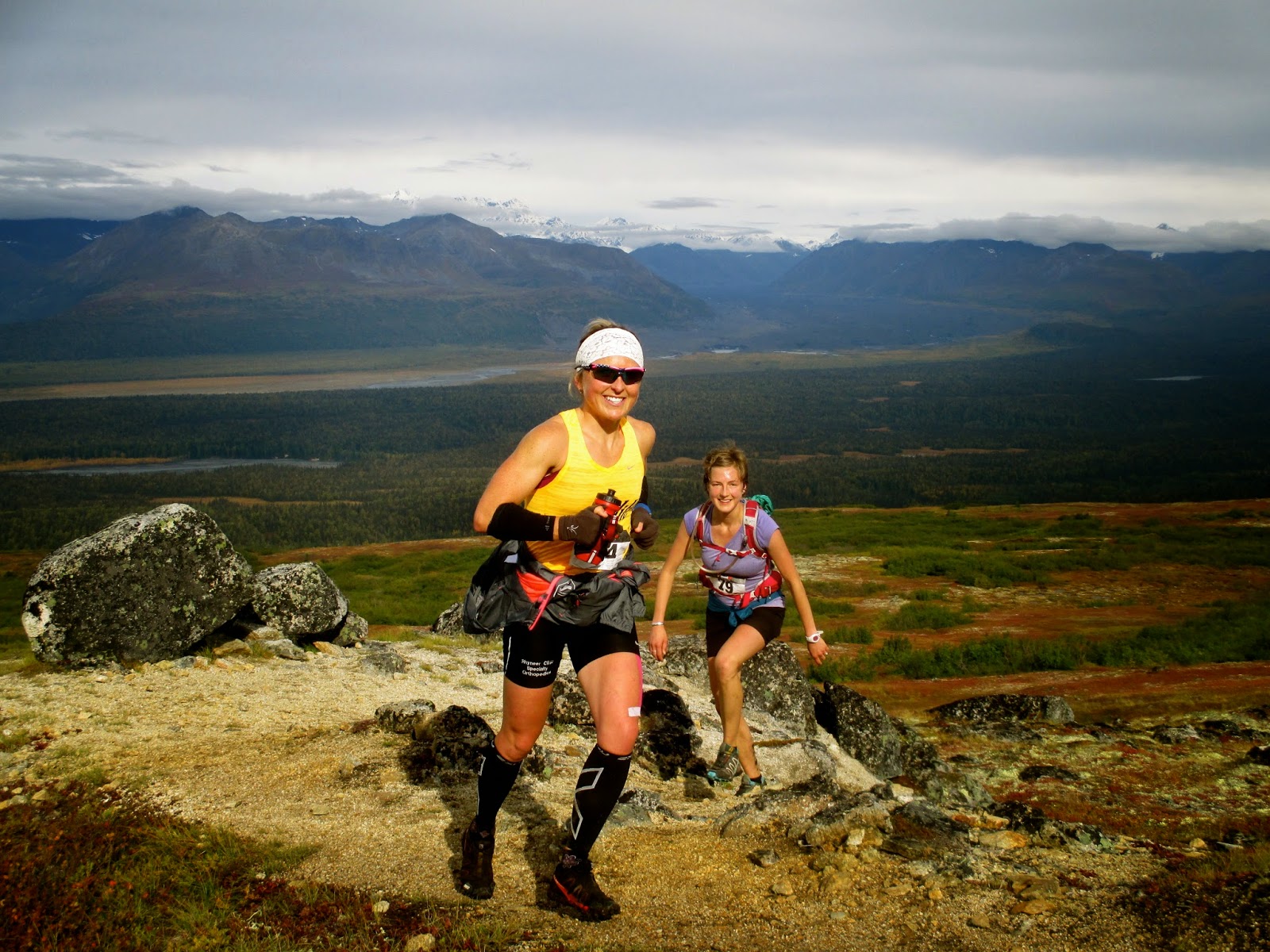
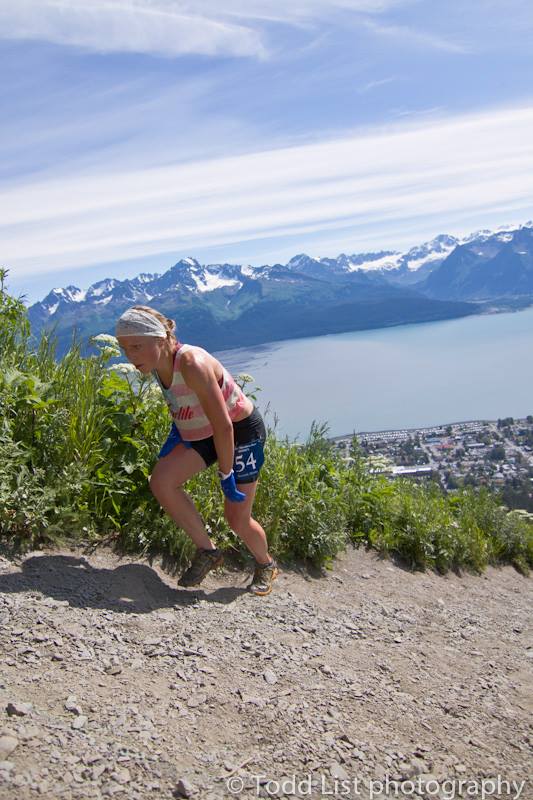
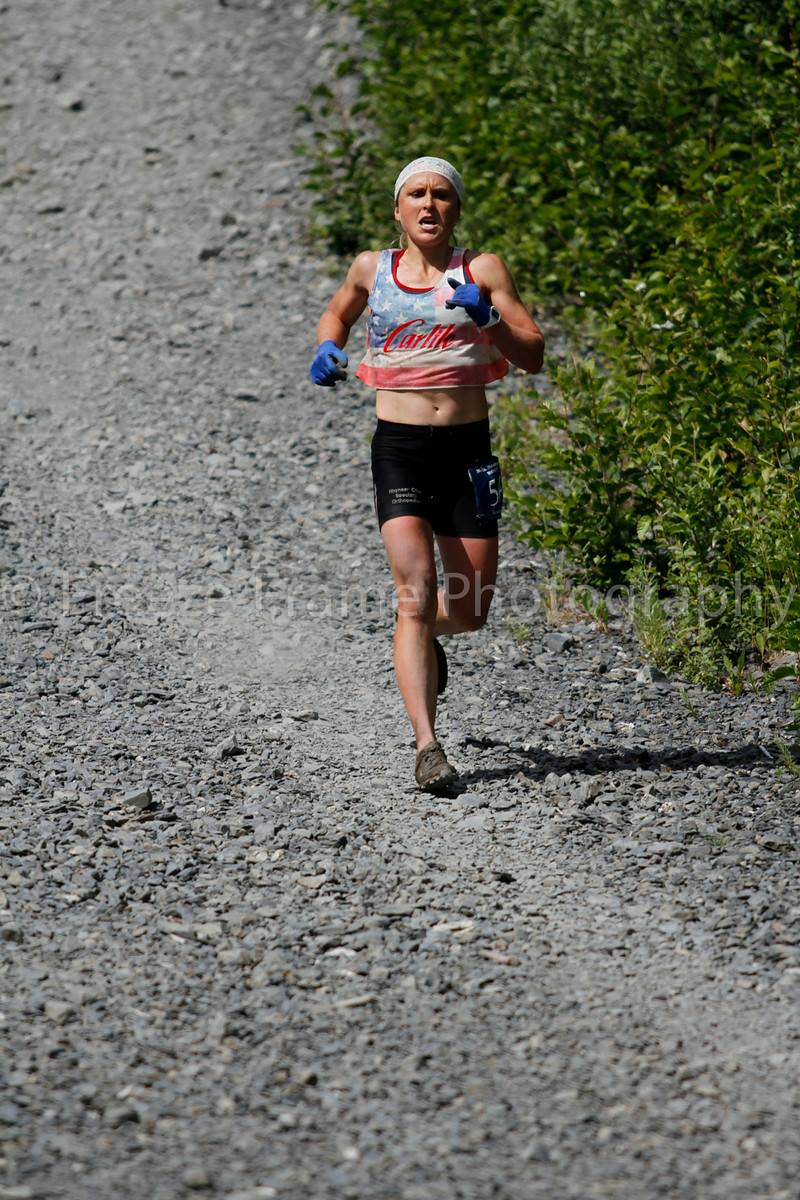
Missing from the women’s race was two-time Mount Marathon champion Holly Brooks, who decided to sit out the race in order to rest after the long 2014/2015 FIS Marathon ski season.
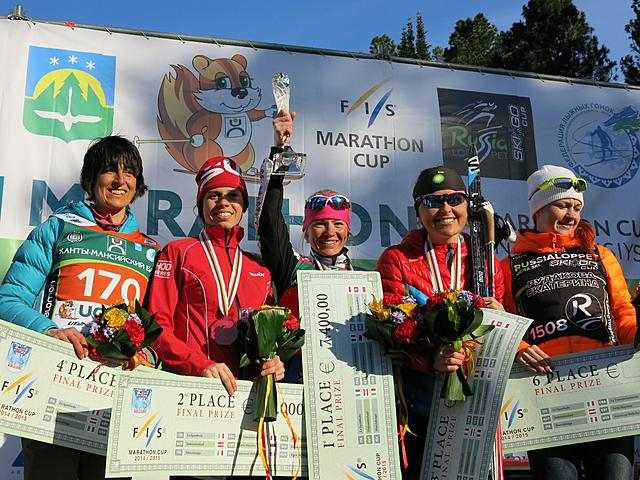
Holly Brooks (2nd from the right) was third in the 2015 FIS Marathon Cup, after finishing 10th in the final event, the 50 k freestyle race Ugra Ski Marathon in Siberia, Russia, on Saturday. Tatjana Mannima of Estonia (center) won the overall Marathon Cup, and Aurelie Dabudyk of France was second (2nd from the left). Antonella Confortola of tally (left) was fourth overall, and Ekaterina Rudikova of Russia (right) was sixth overall. Photo: FIS/Worldloppet
With her 10th-place finish in the Ugra Ski Marathon in Siberia, Russia, on Saturday, American Holly Brooks was third overall in the 2015 FIS Marathon Cup, only 15 points short of first overall.
“Today I fell a bit short of a season-long goal but hey, that’s part of the sport,” APU’s Brooks said in a comment on her Facebook page, explaining that she was just missing the power in the tough spring conditions in the freestyle race this weekend. Originally slated as a 50 k, the course was shortened to 30 k due to warm conditions.
“It was tough skiing out there: deep, dirty slush and a relentless ‘tropical’ headwind,” she wrote. “When I tried to apply the gas, it was like trying to drive a car on an empty tank. Today I felt as if I was a corpse on skis, as it turns out that 500k of racing and four months of ‘living on the road’ away from home was a bit too much for a strong finish.”
Brooks had been leading the overall FIS Marathon Cup going into the Ugra, but only had a narrow 4-point lead to Tatjana Mannima of Estonia, and a 51-point lead to Aurelie Dabudyk of France. The 26 points netted from her 10th-place finish were not enough to hang onto the lead. Mannima won the series with 496 points after placing fifth, while Dabudyk rode a strong second-place finish in the race to pass Brooks in the rankings as well. Dabudyk finished with 484 points and Brooks was third with 481 points overall.
Mannima also won the series in 2012-2013. Brooks’ third place is the top North American result in the overall FIS Marathon Cup to date. Now she is looking forward to come home to Alaska.
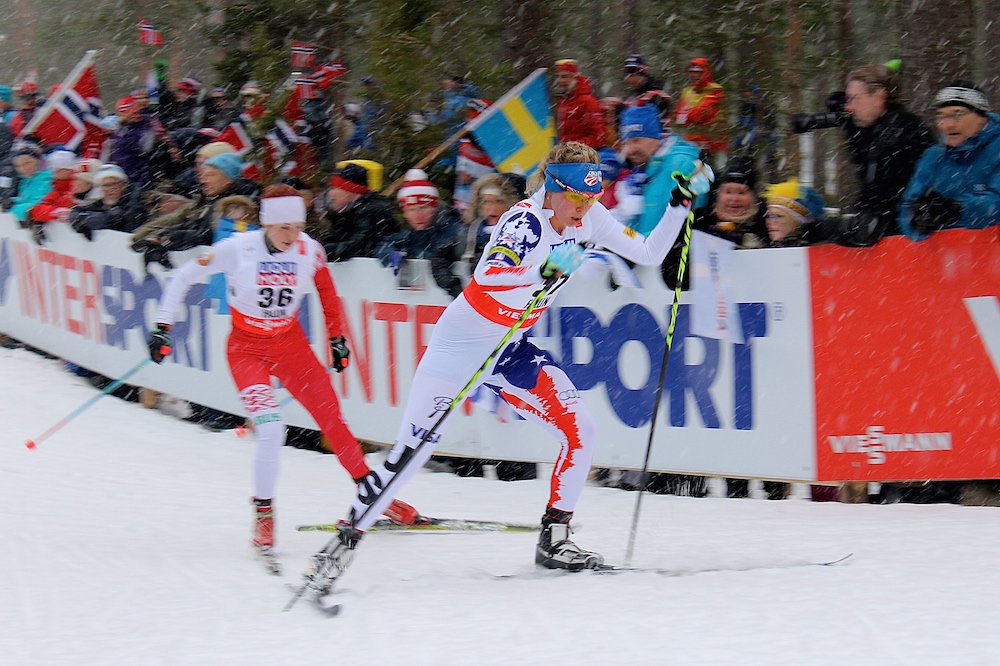
Jessie Diggins (U.S. Ski team) leads Ekaterina Rudakova of Belarus, whom Diggins passed, up “little” Mördarbacken early in the women’s 10 k freestyle individual start at 2015 World Championships in Falun, Sweden. Diggins went on to take silver for the best-ever U.S. women’s distance result at an international championships; Rudakova placed 39th.
It was defending Ugra champion Ekaterina Rudikova of Belarus who took home the race win by almost a minute, clocking in at 1:19:46.4, while Dabudyk of France finished in 1:20:42.9; Antonella Confortola Wyatt was third. Brooks crossed the line in 1:27:38.9.
Her win was not without controversy. Women do not have their own starting waves in FIS Marathon Cup races, but are not allowed to work with men to set the pace or block for them. Some alleged that Rudakova did just that.
“I was accused of having pacemakers at the race and it made me mad and gave extra power,” she told FIS. “I wanted to prove [to] everyone that I can win. It really gave me good motivation throughout the whole race. The course shortening did not affect me, I had lot of power in me and could have gone on. Next year I maybe try to win the overall FIS Marathon Cup.”
“According to eyewitnesses, the competition took place on a low organizational level. Due to weather conditions, the organizers had to change the route of the race, which failed to prepare properly. The start was delayed, but the most important thing – none of the participants had been warned before the start that the distance was reduced, and instead of accelerating loops and three laps of 15 km, the finish was after three laps of 7.5 km. Many participants… did not expect so much rapid completion of the marathon, and expected another 20 km struggle. Some, like Anton Gafarov, went out for another lap from which they had to return.“
Gafarov, a World Cup podium finisher, and the racer who at the Sochi Olympics became U.S.-media famous after receiving a ski from Canadian coach Justin Wadsworth after breaking one in the sprint semifinals, finished 27th.
The Ugra was also the smallest of the WorldLoppet marathons, with only 400 competitors completing the race.
The men’s race came down to a sprint finish. Swiss World Cup skier Toni Livers won the race in 1:13:39.0, 0.4 seconds ahead of Aliaksey Ivanov of Russia. Evgeniy Belov of the Russian national team was third, finishing in 1:13:51.1.
“The race course was difficult and hard as the snow was very soft,” Livers told FIS. “I saw that some of the athletes had some difficulties. There was a small group for a while and then me and another skier were able to make a gap. We worked well together all along and there were only 2 of us in the end. I was able to cross the finish line in front. It was really great!”
Petr Novak of the Czech Republic had a comfortable lead in the overall Marathon Cup prior to the event, and was able to hold on to that lead even with a seventh place finish. Benoit Chauvet of France was fifth in the Ugra, but beating Novak by two spots in the final race was not enough to snag the overall title. Novak still won by 50 points total, collecting a total of 442 points. Chauvet was second overall with 392 points, and Livers was third with 268 points.
Petr Novak of the Czech Republic won the 2015 FIS Marathon Cup, with Benoit Chauvet of France in second place, Toni Livers of Switzerland in third. Photo: FIS/Worldloppet
Holly Brooks (Alaska Pacific University/Salomon) racing to her second Birkie victory in Hayward, Wisconsin, in February. On April 11th, Brooks will try to wrap up the FIS Marathon Cup crown in Khanty-Mansiysk, Russia. (Photo: Darlene Prois/ABSF)
ZÜRICH, Switzerland– American racers might think the ski season is over, but not so for Holly Brooks.
“I think I might be the only North American skier who is still competing,” she laughed on Sunday. “Maybe someone else is out there, but I know a lot of people are heading to the beach.”
The Alaskan made the FIS Marathon Cup her season goal, and is about to fly to its last competition, the Ugra Ski Marathon in Khanty-Mansiysk, Russia. She currently leads the standings by four points over Tatjana Mannima of Estonia, with Aurelie Dabudyk of France only 41 points behind as well. With 100 points going to the winner, 80 to second place, then 60, then 50, any of the women could conceivably win the Cup.
That is, if any of them wins the actual race. Last year, marathon favorites Riita-Lisa Roponen of Finland and Seraina Boner of Switzerland finished second and third in the Ugra, minutes behind relative unknown Ekaterina Rudakova of Belarus. The podium finishers were the only non-Russians in a field of fast women.
In their head to head meetings, APU’s Brooks has beaten Mannima three times and Mannima has beaten Brooks twice, but both were in classic races. The Ugra is a 50 k skate, the technique which Brooks favors. FasterSkier caught her for an interview before she flew to Russia.
FasterSkier: What have you been up to for the last few weeks?
Holly Brooks: I’ve been country hopping, as per usual. Or, as usual for me this winter. The last week I spent in Chamonix, which sounds really exciting but it was gray and raining and I didn’t do a whole lot of skiing.
The week before that was kind of a Scandinavian tour. I spent the week in Trondheim with Anders Haugen, a Norwegian-Alaskan who just moved there. The snow wasn’t great there either. That was the week leading up to the Årefjällsloppet, the final of the Swix Ski Classics in Sweden. It was not a great race for me, but I was really happy to be there to experience and hang out with my team, Team Santander, who took the overall win. So that was really fun.
And then the week before that was the Norwegian Birkie. Which was great. You always have to check that off your bucket list as a cross-country skier.
FS: Your last FIS Marathon Cup race was a while ago at this point. How has it been trying to stay motivated?
HB: It’s really wild that the penultimate FIS Marathon Cup was the Engadin, which was March 8th, and the final, the Ugra Ski Marathon, is April 11th. So there’s more than a month there.
I have had a good month in between. I went to Holmenkollen and cheered on teammates there in the 30 and 50 k’s. I had some good racing – the Norwegian Birkie was a really fun experience. I actually cooked dinner for the head of the Norwegian Labor Party, who is potentially going to be the next Prime Minister of Norway. So I cooked his pre-Birken dinner, which was really fun. I’ve just gotten to see a lot more of Europe and of Scandinavia and places that are off the beaten path of the World Cup. And I’ve made a lot of new friends in the last month too.
FS: Now you’re off to Russia. You’ve had plenty of challenges this year with logistics, but how much harder is it with Russia?
HB: I don’t think I’ll believe I’m in Russia until I’m actually in Russia. It has been extremely hard. The logistics around this race have been a total bear. I will say that the people on the organizing committee have been really helpful and really welcoming.
But the visa alone, being a solo show I’ve had to do all the organization myself. For the visa alone I probably sent over 150 emails and made 30 calls. Put hours and hours and hours of time into that. And then figuring out the tickets and who will wax my skis, and all the normal solo stuff.
It will be a long journey to Khanty-Mansiysk. I didn’t even know where it was until I googled it. Siberia is quite far away. I think it’s five time zones away from central European time. I was definitely watching with interest when the biathletes ended their season there a couple of weeks ago. So yeah, I’m excited to get there.
FS: You’ve spent time racing in Russia before, on the World Cup and at the Olympics. Do you think that will help you deal with some of the unfamiliarity of things?
HB: I know that the only thing you can expect is that you have no idea what’s going to happen. You just have to be ready to roll with the punches. I definitely also know that you also have to be extremely patient, because things don’t necessarily happen in a timely manner or how you would expect them to happen.
The food could be great or it could be horrible. I’m definitely taking peanut butter, instant coffee, and instant oatmeal, amongst other things, just in case. And I’m supposed to be able to walk from my hotel room to the start/finish of the race. I’m hopeful that everything will go smoothly.
FS: In the beginning of the season you got a little cushion of time before you started racing, compared to the last couple of years and the World Cup crew. Now you’re going much later than them. What’s harder?
HB: This year has been interesting because I spent all of November and half of December in Alaska, studying. It was actually really hard being at home watching everybody kick off their season. Now I’m on the opposite end. Everyone’s done, they are headed to the beach, and I’m still going. Essentially my season is the same length, it’s just shifted back three weeks to a month.
I think this is a little harder. It was hard watching them race and I wanted to race at the beginning, and now I’m really tired and I’d like to be done. Everyone else is done and I have to stay focused and stay strong. I think the way I’ve done it this year is a little bit harder, but I’m hoping it will pay off.
FS: What’s the race preview?
HB: Well, I have a four point lead going into this race. It’s pretty crazy after an entire season of marathons in eight different countries, to have it be this close at the end is quite exciting but also a little stressful. The girl in second, Tatjana Mannima of Estonia, is only four points behind me and it’s the same as World Cup scoring so if I beat her, then I win the FIS Marathon Cup. If she beats me, then she wins. There’s a lot at stake here. I’m really just trying to stay focused for April 11th.
FS: And then what will you do?
HB: And then it will take me three days to get home [laughs]. I’m already having nightmares about potentially having to check four pieces of luggage on an international flight to Alaska! I’m really really excited to go home.
American Caitlin Gregg (Team Gregg/Madshus) placed third at the 2015 Engadin on Sunday, a 42 k freestyle marathon from Maloja to S-chanf, Switzerland. (Photo: Inge Scheve)
S-CHANF, Switzerland — Coming off a bronze medal at Nordic World Championships, American Caitlin Gregg (Team Gregg/Madshus) finished third in Sunday’s Engadin Skimarathon 42-kilometer freestyle from Maloja to S-chanf, Switzerland, just 7.6 seconds out from the win, which France’s Anouk Faivre Picon seized in 1:39:35.3.
Russia’s Ilia Chernousov won the men’s race by one-tenth of a second over France’s Robin Duvillard in 1:34:50.
Picon won the sprint finish, 0.8 seconds ahead last year’s Engadin champion Riita-Liisa Roponen of Finland. Gregg placed third and France’s Aurelie Dabudyk was 1:41.7 back in fourth. Two-time U.S. Olympian Holly Brooks (Team Santander) finished fifth (+1:53.3).
“My skis were awesome,” Gregg told FasterSkier after the race. “I felt so good in the race, and I’m so ready for the World Cups in Oslo next week.”
Gregg, who finished the Engadin Skimarathon for the first time, was surprised about the level of competition.
“The race was super aggressive from the start. The men come in on you all over, and it makes the whole thing really crazy,” she said, adding that it was difficult to keep track of where her opponents stood.
“I got to the hills by St Moritz, and I saw an opening, so I made a jump there and just kept hammering to get by as many guys as I could,” she explained.
Ropenen got a gap on Gregg, who also didn’t notice that Picon had passed her.
“The girls got cut off all the time, and during the sprint to the finish, about fifty guys swarmed around us,” Gregg said.
Caitlin Gregg (third from l) on the podium in third at the 2015 Engadin 42 k freestyle marathon in S-chanf, Switzerland. Two Americans made the flower ceremony, with Holly Brooks in fifth (second from right). France’s Anouk Faivre Picon won the women’s race, and Finland’s Riita-Liisa Roponen was third. (Photo: Fast Big Dog)
“It’s brutal out there for the women,” Brooks said, adding that she hopes the organizers will consider establishing a separate women’s wave to make the competition more fair.
The remains of the brutal battles were evident to the waves following the elite: the race course was littered with broken poles, baskets and equipment debris from start to finish.
The pile grew throughout the morning as more marathon racers descended on the track. In total, more than 13,300 skiers participated in the 47th Engadin Skimarathon, making the Swiss race the third-largest Engadin event on record.
Chernousov, who now lives near the Engadin finish in S-chanf with his wife Selina Gasparin of the Swiss biathlon team, secured a home victory in the men’s race. He won the photo finish over Duvillard by 0.1 seconds, while Switzerland’s Roman Furger was third 0.9 seconds back. Another Swiss skier Jason Rueesch, was just 0.2 seconds off the podium in fourth.
Brian Gregg (Team Gregg/Madshus) was the top American man in 24th, 26 seconds behind the winner. David Norris of Alaska Pacific University (APU) placed 32nd (+40.2), Sun Valley’s Miles Havlick was 35th (+51.5) and APU’s Tyler Kornfield finished 61st (+6:21.2).
In the women’s race, Canada’s Karen Messenger placed 29th (+24:34.2).
The battle of the FIS Marathon Cup
With fifth place in the Engadin Skimarathon, Brooks is back in the FIS Marathon Cup leader bib with one race remaining.
“I accomplished one goal today, and that was to take back the red bib, but I’m not so happy with my race,” Brooks said. “I’m not in top shape, and I definitely feel that I haven’t raced much at altitude. Once we hit the hills at St Moritz, it was so hard to follow.”
With fifth place in the Engadin, Brooks has 455 points in the overall FIS Marathon Cup and is now just 4 points ahead of Tatiana Mannima of Estonia with only one race to go in the race series. Mannima placed 11th on Sunday, 6:15.4 behind the winner. She is 47 points ahead of Dabudyk, who’s currently third overall. The final event is the 50 k freestyle Ugra Marathon on April 11 in Khanty-Mansiysk, Russia.
“It all comes down to that race in Russia now, and it’s over a month until we race,” Brooks said, adding that she was next headed to Norway for the Norwegian Birkebeiner and potentially some other races to stay focused until the Ugra.
Petr Novak, who was 29th on Sunday, is still leading the overall 2015 FIS Marathon Cup. With 404 points for the season, Novak has a comfortable gap on Benoit Cahuvet of France in second place with 347 points and Sergio Bonaldi of Italy in third place with 229 points.
Italy’s Segio Bonaldi celebrates after winning in a sprint finish at the 2015 American Berkebeiner in Hayward, Wis. It was Bonaldi’s second Birkie title. (Photo: American Birkebeiner Ski Foundation)
The 2015 American Birkebeiner in Hayward, Wis., was spared the most frigid weather gripping the Eastern U.S., as temperatures hovered around 15 degreesFahrenheit when Saturday’s 51-kilometer freestyle elite race began. And despite three to four inches of new snow, even the sun made an appearance during the race.
In was in these conditions that American Holly Brooks, of Alaska Pacific University in Anchorage, Alaska, won her second Birkie, claiming victory in a time of 2:34:33.
Holly Brooks racing to her second Birkie victory on Saturday in Hayward, Wis., which she won by nearly 30 seconds to reclaim the FIS Marathon Cup overall lead. (Photo: Darlene Prois/ABSF)
However, she first had to ward off Aurelie Dabudyk of France, who stuck with Brooks until she began her final push on the flats of Lake Hayward, a few kilometers from the finish.
Brooks came into the race second overall in the FIS Marathon Cup, but reclaimed the lead after Saturday’s win.
The 32 year old told FasterSkier that the top four women were together for most of the race. At “B*itch Hill” – a steep climb about 40 k into the race – she said she heard a second snow machine behind her.
“I looked over my shoulder and there was the sea of men who had caught us,” she explained. “I knew it was a now-or-never moment.”
As the leading men passed the first four women, Brooks decided to make her move. She tagged onto the group of men and managed to break from the group.
However, she was surprised to find Dabudyk was able to hang behind her.
“I did not want to leave it to the finish sprint and therefore pushed as hard as I could on Lake Hayward. I did not dare to look back before the finish line to be sure not to lose any seconds,” she explained to the press. “I didn’t want to be ‘that skier’ who looked back and lost the sprint because you miss a crucial pole plant or something.”
As usual, she said Main Street in Hayward was incredibly loud and festive.
“It would have been fun to grab a flag and celebrate a bit but ensuring the win and reclaiming the red bib was more important!” she said. “I am really happy that I could win the Birkie again today!”
Holly Brooks celebrates after winning her second American Berkebeiner on Saturday in Hayward, Wis. The win put her back in the lead of the overall FIS Marathon Cup. (Photo: American Birkebeiner Ski Foundation)
Dabudyk went on to finish second, 28.1 seconds behind Brooks. Tatiana Mannima of Estonia was nearly two minutes back in third (+1:59.9), barely holding off German Anja Gruber, who placed fourth (+2:02.1).
Mannima has won the last two FIS Marathon Cup races, while Gruber is coming off three podium finishes earlier this month in SuperTour races in Craftsbury, Vt.
Dabudyk said to the press that she wanted to stay with Brooks until the finish, though down the stretch Brooks had too much power for her.
“But I am really happy with my second place,” she added.
Mannima said that she pushed hard from the start to see which skiers could hold onto her speed. She was able to stay in the lead group until Brooks and Dabudyk finally took off with 10 k to go.
“At Lake Hayward, I was trying to stay behind Gruber, as it was pretty windy on the lake. I hoped to pass her before the finish line, which I did,” she explained, adding that she is happy to just be on the podium.
American Caitlin Patterson (Craftsbury Green Racing Project) ended up fifth (+9:31), after winning the SuperTour 20 k classic mass start in Craftsbury late last month.
Bonaldi wins second Birkie in exciting fashion
Italy’s Segio Bonaldi (r) outlasts three Frenchmen en route to his second American Birkebeiner victory on Saturday in the 42nd annual Birkie in Hayward, Wis. (Photo: Darlene Prois/ABSF)
The men’s race offered a more dramatic finish, as Italian Segio Bonaldi outsprinted three Frenchmen to win by less than a second.
Bonaldi, Birkie winner in 2013, finished in 2:12:21.1. He passed France’s Christopher Perrillat-Collomb in the final 100 meters to win by just 0.5 seconds. Benoit Chauvet and Mathias Wibault were also in the lead group, and Chauvet finished in third (+1.7) while Wibault faded to fourth (+5.0).
Chauvet told the press that he tried to break out of the lead group of 20 at the first climb, but no one was willing to break with him. However, the racers slowly began to spread apart at about the 35 k point, and Chauvet was able to work with Perrillat-Collomb.
“At this point all were thinking about winning the race,” he said.
Chauvet explained that his tactics failed him, however, and that Bonaldi was smarter and stayed behind the others until the final stretch. Chauvet said he probably made his final sprint too early, as he tried to be first coming off the new bridge that drops the skiers into downtown Hayward and the final straightaway to the finish.
“I did not feel so well until 15 k before the finish,” Bonaldi said. “My skis were also not very good so I tried to stay behind and to wait for the finish sprint. I kept energy for that.”
The 36 year old added that he really wanted to win this year, especially after finishing third last year, but was not sure he would have a clear shot at victory until 100 meters before the finish line.
“I am very happy!” he said.
“I am little bit disappointed to be third as I wanted to win. I have to come back for the victory next year,” Chauvet said.
The top American, Lex Treinen (APU), finished nearly 20 seconds after Wibault in fifth and was 24.5 seconds from the win. Last year, he placed 10th in the Birkie. American Brian Gregg (Team Gregg/Madshus) finished in eighth (+1:51.4).
FIS Marathon Cup leader Petr Novak of the Czech Republic came through in 11th (+5:51.4).
“I had the worst skis of my life. I lost so much on the downhills. It was a mental fight for me all the way through and right until the end!” Novak said in a statement to the press. Despite his rough day, he still retains the lead in the overall FIS Marathon Cup standings.
American Matt Liebsch (XC United/Team Strong Heart), 2009 Birkie winner, finished 10th (+3:10.8), while 2012 Birkie winner Tad Elliott (Ski & Snowboard Club Vail Elite) took 16th (+10:29.5).
Naryshkina, Mork take classic titles
Men’s 55 k classic Birkie winner Ole Christian Mork (c) is with second-place finisher Torin Koos (l) and Thomas Seidel (r), who placed third. (Photo: ABSF/Facebook)
In the 55 k classic race, Natalia Naryshkina of Russia and the CXC Team took the women’s win in 3:19:20.2, while Norway’s Ole Christian Mork won the men’s race in 2:54:22.1.
Naryshkina beat runner-up Josie Nelson of Medicine Lake, Minn., by 3:44.9, and Kelly Sillicorn of Winona, Minn., by 3:50.9. Isabel Caldwell, younger sister of U.S. Ski Team member Sophie Caldwell, placed fourth (+6:14.8).
Mork, of Oslo, outlasted four-time U.S. Olympian Torin Koos by 8.8 seconds and Thomas Seidel, of Salt Lake City, in third by 14.7 seconds.
Holly Brooks winning the 2012 American Birkebeiner, four-tenths of a second ahead of Caitlin Gregg (l), for her first Birkie title. (Photo: Darlene Prois/ABSF)
Each year, leading up to the third week in February upward of 11,000 people get sick. It isn’t a sickness that would cause a widespread panic, but rather one thousands of Midwesterners actually looked forward to each year, and it’s called Birkie fever.
The 42nd running of the American Birkebeiner takes place Saturday, starting in Cable, Wis., and ending some 30 miles (or 50-plus kilometers) south in Hayward, Wis. The race filled up in November, with all 10,500 allotted entries accounted for before the first of the year. In total, 10,517 skiers from 18 countries were registered for the three Saturday races, almost 7,000 of them are entered in the 51 k skate race. That’s a big change from 1973, the first time the Birkie was held. Back then, there were 34 men and one woman as race participants.
The race course has gone through several changes since 1973, from the direction skiers raced to the length of the race. This year’s race has a few changes that will add a some interesting twists. For one, the race is longer. The classic race is now 55 k and the skate race now 51 k. The extra distance was due to a relocation of the final aid station and the extension of the finish line, pushing it farther down Main Street.
The International Bridge was a fixture in the Birkie before. (Photo: ABSF)
The biggest change that has garnered some of the most attention is the new bridge the American Birkebeiner Ski Foundation (ABSF) finished assembling on Wednesday over Highway 63, a kilometer from the finish.
The International Bridge adds no length to the race, but it does add a 17-vertical-foot hill before the finish. Previously, once skiers were five kilometers from the finish, it was a flat ski to Main Street. The new manmade hill adds a 10-percent climb to legs that already have some 50 kilometers of climbs in them.
This isn’t the first time the International Bridge has been a fixture on the Birke course. In the late ’70s and early ’80s when the race finished at the Telemark Resort in Cable, the bridge was the last hill skiers needed to climb before they finished. The temporary bridge is 100-feet long and spans 30 feet over the highway.
The bridge was needed to eliminate the traffic congestion problems the race brought during the weekend. Funding for the ramp and other changes is a part of phase one of the ABSF’s multiple-year fundraising program.
The past two years, the Birkie has been a part of the FIS Marathon Cup, a season-long international competition that crowns a winner with the highest points after a series of races of 42 k or farther. This means it attracts some of the world’s best long-distance racers and this year’s women’s field is a reflection of that. In the elite wave, the top four women in the FIS Marathon Cup are entered: Tatjana Mannima of Estonia, American Holly Brooks, Aurelie Dabudyk of France, and Antonella Confortola of Italy. Confortola finished second in last year’s Birkie.
Brooks was leading the FIS Marathon Cup, but skipped last week’s stop at the Tartu Marathon in Estonia to head to Hayward to prepare for the Birkie.
“I’m really excited for this year’s Birkie,” Brooks wrote in an online message this week. “It’s been a couple of years since I’ve been here and it’s great to be back — both at the Birkie and on ‘home soil!’
“I’ve been bouncing from country to country racing marathons and I decided last fall that I would spend two weeks here in Hayward,” she explained. “I have great friends that I’m staying with and it feels fabulous to be in a house [rather than a hotel].”
The new podium awaits for the winner of this year’s race. (Photo: ABSF)
Coming into the race, Brooks ranks second in the overall FIS Marathon Cup standings, just seven points behind Mannima. Brooks won the Birkie in 2012 and knows the course well.
“I‘ve seen the whole thing start to finish… both at distance pace and race pace. That’s more than I can say for some of the courses I’ve raced this winter!” Brooks wrote. “Not sure how much of a true advantage it gives me but it puts my mind at ease a bit. I know where people including myself have made moves.”
Two year ago at the Birkie, Mannima lost a photo finish and placed second to three-time Birkie champion Caitlin Gregg, who is currently in Sweden representing the U.S. at the FIS Nordic World Ski Championships in Falun. American Caitlin Patterson (Craftsbury Green Racing Project) finished third in 2013 and seventh last year, and could prove to be a threat in this year’s elite race.
In an email on Wednesday, Patterson wrote that she was looking forward to skiing part of the Birkie trail on Thursday, refreshing her memory “of some of its notable features, and seeing the new bridge and finish line if possible.
“My preparations have been going well — mostly I’ve been focused on recovering after recent Craftsbury Supertours, building up my energy, and actually keeping my training skis pretty short and easy,” she explained. “At this point in the season I have to trust the endurance and fitness I’ve built up during the past year, and mostly just stay sharp and excited for the race, which I most certainly am!”
In terms of her goals and expectations for Saturday’s race, Patterson felt anything was possible.
“The past two years of racing the Birkie have taught me that it’s a race in which you have to test your limits but where you never quite know what will happen, where you must always be thinking quickly and ready to react throughout all 50+k,” she wrote. “I believe that I’m in very good shape, so my goals are to trust my fitness, ski with confidence and enjoyment of the sport… and to make it onto the podium!”
“I’ve seen the whole thing start to finish … I know where people including myself have made moves.” — Holly Brooks on her Birkie advantage
The men’s field is also competitive. Most of the FIS Marathon leaders didn’t race last weekend’s Tartu Marathon to fly to the U.S. to prepare for the Birkie. Overall FIS Marathon Cup leader Petr Novak of the Czech Republic is racing along with France’s Benoît Chauvet,who sits in second place, only 85 points behind Novak. Second-and-third place finishers from last year’s Birkie, Simone Paredi and Sergio Bonaldi of Italy, are also listed to start. Bonaldi won the Birkie in 2013.
Tad Elliott (119) racing in the men’s 30 k classic mass start at U.S. Cross Country Championships in January in Houghton, Mich. (Photo: Christopher Schmidt)
For the U.S., Birkie winners Tad Elliott (Ski & Snowboard Club Vail Elite) and Matt Liebsch (XC United/Team Strong Heart) will be racing, along with 2014 U.S. Olympian Brian Gregg. Elliott won in 2012 and Liebsch took first in 2009.
This trio has had a pretty intense history in the Birkie. When Elliott won in 2012, Liebsch placed second and Gregg took third. The difference between first and third was only 14.8 seconds.
In a phone interview, Liebsch mentioned how team tactics played a part in previous Birkies, but that would not be the case this year.
“In the past, you would have these teams come over with five or six guys and it would essentially be like a cycle race,” Liebsch said. “The fast sprinters would just sit in the back while his teammates did all the work up front setting the pace and sending guys off the front to disrupt the flow of the race. This year is a little different because there aren’t the multiple-person teams.”
Liebsch added that the style of racing here is different than at European marathons.
The 2011 American Birkebeiner men’s podium (from left to right): with France’s Benoit Chauvet in second, Norway’s Tore Martin Gundersen in first and Russia’s Andrey Tyuterev in third. (Photo: Andy Caniff/Swix Sport USA)
“In Europe, the pace is extremely fast due to the fact that teams have ten or eleven guys,” he said. “Here in the United States, the pace is slower and many of the Europeans don’t like that pace so they would send guys off the front if the pace got to slow.
“Most of the European guys are here to get FIS points to improve their standings for the overall FIS Marathon Cup title,” he added.
Chauvet is currently second in the overall FIS Marathon Cup and has the biggest team entered in the Birkie with four total teammates, while the overall leader, Novak will race solo.
“The strategy for most of the European guys will be to stay up front, in the top eight, get points and then head back to Europe,” Liebsch said. “This could really help out the fast American guys like Tad, Brian, me and Lex [Treinen] because the pace won’t be crazy fast like most European races can be.”
In an email, Treinen predicted that U.S. guys would have a good showing: “Matt looks like he’s in good shape and he and [Brian] Gregg would love to take home a Midwest victory here,” he wrote. ” … I have been training specifically for the Birkebeiner for at least two weeks and I even did some intervals recently, so I feel like I am in better shape than ever before.”
Elliott has spent some time in the Midwest and won last month’s Seeley Classic race that was held on the Birkie course.
“I am excited to race the Birkie,” Elliott wrote in an email. “It will be three years since I last raced here! I am looking forward to a great event. I have had some health issues again sneak in this last month, but I have a few tricks up my sleeve. My twin brother is also my wax tech coming with me from Colorado. Hoping [he] can keep me in the race this year!”
The biggest factor going in the weekend is the weather. There was a concern of a lack of snow but over the last few weeks the area has gotten enough snow to make the course set up nicely for the race. The wind and cold temperatures are an immediate concern. On Tuesday, organizers canceled Thursday’s elite sprints because of the predicted well-below-zero temperatures at the scheduled start time. Early predictions show Saturday morning’s temperatures to be around 4-degrees Fahrenheit.
Start of the Jizerská Padesatka, a 50 k classic race near Liberec Czech, Republic. (Photo: Swix Ski Classics)
Sunday’s 50-kilometer classic race Jizerská Padesatka near Liberec, Czech Republic, is the next event in the 2015 Swix Ski Classics long-distance circuit and racers are eager to hit the tracks after a long break since the first races in Italy in mid-December.
Going into the third event in the Ski Classics (after the opening Pro Team Prologue and La Sgambeda), Norway’s Anders Aukland of Team Santander tops the overall ranking. Johan Kjølstad, who won the overall Ski Classics title last season, is second overall.
In the Ski Classics athlete ranking, 42-year-old Aukland tops the list in front of his younger brother Jørgen Aukland. Kjølstad, who races with Team United Bakeries, is in third place, three points ahead of Czech veteran Stanislav Rezac of Team Silvani Madshus, while Sweden’s Jörgen Brink of Team Lager 157 is fifth overall going into the Jizerská 50 k on Sunday.
In the overall sprint competition, Andreas Nygaard (Team Santander) is currently wearing the green points bib, while Team United Bakeries’ Øystein Pettersen is in second place, 10 points behind Nygaard.
Holly Brooks at the Pro Team Tempo, which opened the Swix Ski Classics season in mid-December in Livigno, Italy. (Photo: Swix Ski Classics)
Brooks Skips the Jizerská
American Holly Brooks, who was picked up by the Aukland brothers’ Team Santander just a day prior to the start of the Ski Classics season, is in sixth place in the women’s overall competition. Seraina Boner of Switzerland, who races for Team Coop, tops both the overall standing as well as the athlete ranking.
However, Brooks is sitting out the Jizerská, returning to Europe for the Dolomitenlauf on Jan. 18, and joining her team for the Marcialonga a week later.
“I’m just trying to balance the FIS Marathon Cup, the Swix Ski Classics, and travel,” Brooks wrote in an email. “In years past I’ve done maybe three races 30K and longer spread out over a season, so I don’t know how my body is going to react and/or how the fatigue will build.
“My goal is to race as much as possible without a downgrade in performance,” she added. “I have a feeling I will be very, very tired by the end of the season.”
New Women Join Circuit
Prior to the Jizerská, the competition for the women’s overall Ski Classics title gets tougher. Three different Pro Teams have entered new female skiers into the long-distance series: Norway’s Hilde Landheim will race for Team Coop, Viktoria Melina joins the Russian Marathon Team, and Masako Ishida of Japan will race for Team United Bakeries.
In the Ski Classics, each professional team may enter a total of 10 skiers per season, male and female skiers included. Once entered, the teams may not unregister athletes, but they can enter additional athletes until they reach the maximum of 10 skiers.
Stellar Conditions
Czech Republich, home of the Jizerská 50, which will be held on Sunday, as pictured on Jan. 6.
Last year, the Jizerská races were canceled due to lack of snow, so event organizers are especially excited to put on the races this year and are proud to present stellar conditions on the race course. Promising weather forecasts, decent snowfall in the past week and cold weather have made it possible to produce enough artificial snow to cover the whole course, and the organizers are confident that they will be able to run the race as planned given the weather forecast, which predicted snow at the start and temperatures around freezing.
“We are happy to see that the weather has turned fine and the winter conditions have finally arrived,” Martin Koucky, a member of the Jizerská 50 Organizing Committee, said in a press release. “The whole Jizerská 50 track is now covered with snow while the race preparations continue to run along at full speed. There are some thirty centimeters of artificial and natural snow at potential critical points: at the Bedrichov stadium as
In addition to the 50 k Ski Classic on Sunday, the Jizerská race weekend opens with a 30 k skate race and a children’s race on Friday, and also offers a 25 k classic race as well as a corporate relay race on Saturday. New this year is a 1.5-kilometer double-pole sprint on Friday.
Six More Marathons on Tap
Team United Bakeries’ Pettersen (14), Berdal (11), and Kjølstad (13) at last month’s La Sgambeda in Livigno, Italy. (Photo Swix Ski Classics)
After the Jizerská 50 on Sunday, the Ski Classics moves to Switzerland for the brand-new La Diagonela on Jan. 17.
La Diagonela was introduced to the race series last winter as a replacement for the Jizerská 50, which was be canceled, but was such a success that the circuit included the race as a new, permanent installment on the Ski Classics calendar for the 2014/2015 season. This year, the 65-kilometer La Diagonela will be held on a picturesque new course through the villages of St. Moritz, Zuoz and Pontresina in the Engadin Valley.
After the stop in Switzerland, the Ski Classics moves to Italy for the Marcialonga in the valleys of Val di Fassa and Val di Fiemme on Jan. 25. The 70 k race is famous for its notorious final uphill climb, the Cascata, to the finish in Cavalese town square.
From Italy, the Pro Teams travel to Germany for the 50 k König Ludwig Lauf in Oberammergau, Bavaria, on Feb. 1.
After the König Ludwig Lauf, the athletes get a well-deserved break from competing until the legendary 90 k Vasaloppet from Saelen to Mora, Sweden, on March 8.
After Vasaloppet, the circuit moves on to Norway’s Birkebeinerrennet on March 21. The 54 k classic race starts in Rena, crosses to mountains to the finish line in Lillehammer, the host of the 1994 Winter Olympics.
The series once again ends with the season finale Årefjällsloppet in Sweden on March 28. The 75 k race offers stunning views from the in Vallbo to the finish line in Åre.
Rosanna Crawford with coach Roddy Ward after placing a career-best fifth in the IBU World Cup 10 k pursuit on Sunday in Hochfilzen, Austria. “Such a fun race today, I moved from 34th to 5th for a new personal best with 19-for-20 shooting,” Crawford wrote on Facebook. (Photo: Chris Lindsay)
While Roddy Ward, biathlon Canada national team coach, was referring to athlete Rosanna Crawford when he said, “Way more is possible,” it’s easily a sentiment that could be applied to the rest of the international nordic circuits after this past weekend of racing.
The weekend’s racing began Friday with the IBU World Cup 7.5/10 k sprint in Hochfilzen, Austria, that saw Johannes Thingnes Bø of Norway and Kaisa Mäkäräinen of Finland claim victories in their respective races. American Tim Burke turned in the top North American finish after placing 13th, while teammate Susan Dunklee paced 29th for the women.
Tim Burke on his way to 25th in the IBU World Cup 12.5 k pursuit on Sunday in Hochfilzen, Austria. (Photo: USBA/NordicFocus)
The action continued in Hochfilzen on Saturday with the men’s 4 x 7.5 k and the women’s 4 x 6 k relays. Russia proved dominant in the men’s race, winning by roughly 20 seconds. Canada finished a team-best sixth place while the U.S. team was lapped after a combination a poor starting position and sub-par skis. In the women’s relay, Germany proved as strong as the Russian men, topping their field by over 20 seconds. The Canadian women were unable to match their male counterparts, however, and finished 11th.
In the final day of IBU World Cup racing, one Canadian athlete demonstrated what exactly was possible. Crawford, who started the 10 k pursuit in 34th, wanted to improve her position, but when she crossed the line for a career-best fifth place it was apparent improving her position was just the beginning. On the men’s side, Burke was the top North American in 25th position.
The weekend also brought FIS Cross Country World Cup action to Davos, Switzerland. Norwegians Therese Johaug and Maritn Johnsrud Sundby won Saturday’s 10/15 k classic interval starts. A trio of Americans made up of Liz Stephen, Jessie Diggins and Sadie Bjornsen went 20-21-22 in the 10 k to give the Americans three skiers in the top 30. Canadian Emily Nishikawa placed 29th for her best-ever World Cup finish. In the 15 k, Canadian Alex Harvey also found success, skiing to 17th, which he said was one of his best distance performances at altitude.
In Sunday’s sprint, Ida Sargent returned to the spotlight after placing 16th, while teammates Kikkan Randall and Sophie Caldwell joined her in the top 30 after finishing in 20th and 22nd positions. On the men’s side, Canadian Lenny Valjasreturned to form to place 13th while American Andy Newell placed 15th.
Andy Newell (l) of the USST trails eventual 3rd place finisher Erik Brandsdal of Norway (r) and Alexey Petukhov of Russia (c) who eventually finished fourth in the 1.3 k freestyle sprint in Davos, Switzerland. (Photo: Fischer/NordicFocus)
The real story of the day, however, was that Norway continued its winning streak with both its men and women sweeping Sunday’s races and earning 10 of 12 podium positions in Davos.
Not just over the mountains from from Davos, Livigno, Italy hosted the La Sgambeda Marathon. While the women’s 42 k freestyle was dominated by Riitta-Liisa Roponen of Finland, American Holly Brooks was able to hold on for an impressive second place.
Back across the home front, NorAm racing continued in Rossland, British Columbia despite warm conditions and a lack of snow. Both races were classic distance races with 7.5/11 k on Saturday and 11/15 k on Sunday, and Canadian Alysson Marshall and American Kris Freeman topped their respective fields each day.
Last Thursday, the FIS Nordic Combined Continental Cup opened in Park City, Utah, where Taylor Fletcher posted the two best American performances in fifth and eighth place.
The IPC World Cup also opened last Wednesday in Vuokatti, Finland, with Canadian Mark Arendz taking silver in his first race on Thursday: the 15 k standing biathlon. Two days later, his Canadian Para Nordic teammates Chris Klebl and Brittany Hudakboth earned bronze in the 10 k sit-ski and 5 k standing, respectively. Also on Saturday, American Oksana Masters captured a career-best World Cup silver in the 5 k sit-ski, and Andy Soule just missed the podium in the 10 k sit-ski (behind Klebl) in fourth.
On Sunday, Masters carried her momentum to win gold in the women’s sit-ski sprint, becoming the first American female Paralympic nordic skier to do so since the early 2000s. On Tuesday, she took her first-ever international biathlon silver in the biathlon sprint.
Davos World Cup organizers have struggled to produce and collect enough snow for this weekend’s competitions, but will manage to pull off both a distance race and a sprint. (Photo: Holly Brooks)
Note: This article has been updated to include Friday’s announcement from the International Ski Federation (FIS), that Davos will host next weekend’s World Cup races as well, after the freestyle races in La Clusaz, France, were canceled because of a lack of snow.
***
The upcoming World Cup races in Davos, Switzerland, have been scaled back due to lack of snow — but it’s still better there than La Clusaz. On Friday, the International Ski Federation (FIS) announced that next weekend’s canceled races in La Clusaz would instead take place in Davos.
For the next two weekends, racers will compete in individual 10- and 15-kilometer distances and freestyle sprints in Davos. The Davos Nordic Organizing Committee, in conjunction with Swiss Ski and FIS, had already shortened the originally scheduled Davos races from the men’s 30-kilometer classic and women’s 15 k classic on Saturday, to a men’s 15 k classic and women’s 10 k. Freestyle sprints will take place Sunday.
Next weekend, Davos will host 10/15 freestyle individual starts and a freestyle sprint.
Athletes on a thin base at the 1.3 k track in Davos, Switzerland. (Photo: FIS)
American Holly Brooks was among the flocks of skiers training in Davos this week before she headed to slightly higher grounds in Livigno, Italy, for her first marathon of the season at La Sgambeda on Friday.
“Davos, like much of central Europe, is having one of the driest early winters on record,” Brooks wrote in an email on Wednesday.
She provided a few photos to illustrate the scene, one of which (see above) showed a truck dumping snow in front of a PistenBully, which then spread it across the World Cup course.
“The organizing committee in Davos is blowing snow at a mountain pass above (where it is cold enough) and trucking it down to cover a 5 k loop for this weekend’s upcoming World Cup,” she explained. “The effort and $ going into this project is incredible. I feel very luck that just over the mountains in Livigno, the site of my marathon, there is enough snow to hold the races on a larger, 35 k loop.”
According to FIS, the Davos Organizing Committee (OC) produced snow high up on Flüela Pass — some 2,380 meters (7,800 feet) above sea level — where temperatures were cold enough to make it.
As of Tuesday night, the organizers has spent more than 70 hours bringing it down to the race course. They did so using PistenBullies, which also pushed natural snow down the nearby mountainsides. That snow was then collected and transported down to the Davos World Cup trails in trucks.
“After two tough weeks with many difficult decisions, we are very happy to present the athletes our tracks,” Adriano Iseppi, head of the Davos OC, said in a press release. “Even if we were able to produce snow only for one night on the competition area, we made the impossible possible. Many thanks to all the helpers up in the mountain and out in the tracks who have been working day and night.”
The Davos Organizing Committee has been producing snow up high for the World Cup races this weekend. (Photo: Holly Brooks)
A local alpine skiing legend, Paul Accola, who now owns a forestry company, also donated his time and equipment for three days to help the organizers move snow.
Hippolyt Kempf, a Swiss Nordic-combined gold medalist (1988 Olympics) and current head of Swiss Cross-Country, was complimentary of Davos Nordic.
“They did an amazing job working all day and all night long to make sure that the cross-country track in Davos will be ready,” he said in the release. “We are convinced that athletes alike visitors can expect stunning competitions.”
While Davos assumed responsibility for hosting next weekend’s World Cup freestyle races as well, start times had not yet been set for Dec. 20-21.
Davos World Cup schedule:
Saturday, Dec. 13
11:15 CET women’s 10 k classic
13:30 CET men’s 15 k classic
Sunday, Dec. 14
12:30 CET women’s and men’s freestyle sprint prologue
14:30 CET women’s and men’s freestyle heats
Saturday, Dec. 20 (moved from La Clusaz; times TBD)
The World Cup Nordic Season begins in Ruka, Finland in just two weeks. Alaska Pacific University and U.S. Ski team members Kikkan Randall, Sadie Bjornsen and Erik Bjornsen head to Finland this weekend to begin preparations. In addition, Reese Hanneman (APU skier from Fairbanks) earned Period 1 World Cup start rights with his Overall Supertour win from last season and he will be joining Erik, Sadie and Kikkan for the first few weeks of World Cup racing.
Olympian Holly Brooks begins her new quest for competing in the FIS Marathon Cup at the beginning of December in Italy, and the rest of the APU team begins their season domestically in West Yellowstone, MT on November 28th.
“We came into it with the idea of making a really cool video about a race that had never been filmed well before,” Anchorage native Max Romey said in a Skype interview.
Eric Strabel is chased by Wylie Mangelsdorf during the 2013 Mt. Marathon race. (Photo: Todd List Photography)
The up-and-down race is just a little over five kilometers total, but starts at sea level in Seward and reaches halfway at the top of the mountain 3,022 feet above sea level. From there, racers begin a headlong plunge back into town. It is not uncommon for racers to finish muddy and bloody.
In Sept. 2013, Romey published a 43-minute-long video called “A New Mt. Marathon Record,” his largest-scale production that generated more than 27,000 views on YouTube.
Christy Marvin descends during the 2014 Mt. Marathon race. During the descent she made up over two minutes on winner Holly Brooks, to finish only three seconds behind. (Photo: Todd List Photography)
Together with Natalie Fedak, his freshman-dorm resident advisor at WWU, Romey has been working on his latest project, a 20- to 30-minute documentary of the 2014 race. The film, 3022 ft., will include pre- and post-race interviews with the athletes, as well as plenty of race-day footage.
Mt. Marathon is Alaska’s oldest race, first formally organized in 1915 and based on a running bet from several years prior. It is also among Alaska’s most competitive races, with a lottery to get into the race and the state’s best athletes vying for the top spots.
“To give you an idea of how competitive Mount Marathon is, Salomon-sponsored Rickey Gates finished just seconds behind Kilian Jornet at September’s The Rut Vertical K, but placed fourth at Mount Marathon [in 2014],” Saari said. “In 2013, Rickey broke the Mount Marathon course record, but didn’t win the race, as [Alaska Pacific University nordic coach] Eric Strabel was even faster.”
Also from APU, Holly Brooks, a former U.S. Ski Team member who competed at the 2014 Winter Olympics, won her second Mt. Marathon title this past July. Brooks dominated the uphill portion, reaching the top 2 minutes and 5 seconds before Christy Marvin in second. But Marvin is a ferocious downhiller, and by the time she crossed the finish line she was just three seconds behind Brooks.
“The race was insane – probably the most exciting women’s race ever,” Romey recalled of the 2014 edition. “Just knowing what was behind it, and it was closest ever, and we filmed everything, and we were lucky enough that it turned out super-suspenseful and exciting. The part I’m really excited about sharing is the stories behind it.”
The 6-foot-4, energetic junior is pursuing an interdisciplinary degree in cultural diversity, environmental science and film that entails “basically filming a bunch of other cool stuff,” he said.
A two-time Alaska state champion from Service High (in the 3,200 meters and 1,600 meters in 2012), Romey is a varsity runner at WWU and started making films about running when he was injured his freshman year of college. During that time he devoted his energy to filming the team’s practices and races.
Last November, he published a 3:45-minute video about his cross-country team leading up to the 2013 NCAA Division II national championships.
In 3022ft., Romey explores the backstories of the Mt. Marathon’s main characters, from record-holder Strabel to young phenom Allie Ostrander.
Max Romey with his camera (Photo: Natalie Fedak)
However, it was the race’s women that captured Romey’s attention, and he has his work cut out condensing hours of interviews with Brooks, Marvin, Najeeby Quin, and Denali Foldager, among others, into a relatively short film.
“We got a lot of these interviews and the story that we ended up following was one of predominantly really strong women in this sport,” Romey explained. “But the part I’m really excited about sharing is the stories behind it, you know, like the stakes of why Holly is going into this race, why she’s racing against Najeeby and Christy and Denali and all these other really strong women who don’t get the recognition that the men’s race gets … [The women] are working just as hard as the men, they’re just doing it for eight more minutes.”
“The race was insane – probably the most exciting women’s race ever.” — Max Romey, 20-year-old filmmaker from Western Washington University
“It’s not a video about women being awesome, it’s an awesome video, and naturally women are in it,” Romey states on his 3022ft. fundraising website. His campaign ended Oct. 31. (Photo: Indiegogo/3022 ft: A Mount Marathon Story)
Romey’s goal is to release a video that is partly about the emotional drama of racing — the preparation, the emotional hurdles, the fear of the treacherous downhills — and partly about the beauty and excitement of the race itself, with tight shots of runners barreling down the loose mountainside matched with panoramic shots above the picturesque seaside town of Seward on Alaska’s Kenai Peninsula.
Before the 2014 race even started, however, Romey encountered an unexpected obstacle. He asked permission to fly his drone — a tiny, remote control helicopter equipped with a camera — and was denied.
“I asked Seward and Seward asked the FAA and then the town of Seward said ‘no,’ ” he recalled. “[This] hurt me to hear because so many people do it and just don’t ask, but I was the one that asked permission, and now I’m the one that is being told no.”
Eric Strabel descends from the highpoint of Mt. Marathon in 2014. (Photo: Todd List Photography)
Romey scrambled for a solution, and so to get the footage for the video, he positioned 12 photographers with video cameras all over the race course — 20 cameras, in all.
“I pulled every string I had just to make sure I had everything captured,” he said. “Or tried to have everything captured; we missed some stuff even with 20 cameras going.”
What Romey was left with was over a terabyte (1,000 GB) of footage, including many hours — “many more than I need,” he said — of interview footage. Romey said that, on race day, he ran or hiked nearly nine miles to film a three-mile race. Has he run Mt. Marathon?
“My coach at Western says I’m not allowed to, just because it’s a leg breaker,” he said.
On Oct. 2, Romey released the trailer for the video and started a one-month crowdsourcing campaign to help fund the production of the video, estimated at $45,000. As of Oct. 31, he’d raised $8,589, or 19 percent, of that goal. But that wouldn’t stop him from finishing it.
“The only thing that puts our schedule at risk is if we don’t get enough money to hire the people who would make the post-production phase shorter and the final product better,” he explained on his fundraising site. “We don’t want to rush this film; we have a production schedule that allows for revision, critique and refining, but at a pace that demands several hours of work each day.
“If worst comes to worst and we are forced to extend our schedule, we will still finish the film,” he added. “But extending the schedule means slowing the distribution of our film to you, our supporters, as well as risking film festival entries if we miss the deadlines.”
While the campaign ended, there were still options to support Romey on his website: 3022ft.com. And when it comes to the thought of releasing his final film, Romey bubbles over with excitement.
“All this footage is in a hard drive, and I just can’t wait to pack it into 25 minutes and share it with everybody,” he said. “It’s like having this secret and I’m just waiting to tell it.”
On Oct. 27, Romey published his latest project, “Alaskan Recess,” a 2:30-minute trail-running video with the tagline, “If trails are nature’s playground, then recess never has to end.” He also used his drone to film and follow Brooks during an “all uphill” rollerski/trail run up Hatcher Pass.
“This kid’s going somewhere,” Brooks said in an October interview. “We were talking about the eventual premiere of the Mount Marathon documentary and we’re talking about it at a brewery, and he [wasn’t] even old enough to drink … He’s one of the most organized and hard working people I know.”
Holly Brooks skiing up “Wall Street” near the top of Spencer Loop-Hillside trails, which some racers may remember from the 30/50 k at SuperTour Spring Series last March. (Courtesy photo)
This week’s workout comes from U.S. Olympian Holly Brooks, who’s about to embark on the four-month FIS Marathon Cup/Worldloppet series with a goal of finishing in the overall top three. While she’s done marathons before — including the American Birkebeiner (which she won in 2012) and Switzerland’s Engadin twice — this will be the former U.S. Ski Team member’s first season exclusively focusing on uber-long distance races.
***
This season I’m preparing to compete in the FIS World Loppet Marathon Cup. I will compete in eight races as short as 42k (La Sgambeda – Italy & Engadin – Switzerland) and as long as 70k (Marcialonga – Italy). This is a notable change from the World Cup circuit which includes lots of sprints, prologues, and 10ks. The regular Wold Cup has one 30k per year (Holmenkollen) and a second 30k at Championships. Consequently, I don’t have a ton of marathon experience and I’ve certainly never kicked off the season with a 2 hour race!
Holly Brooks post workout Tuesday on the Girdwood trails just south of Anchorage, Alaska. (Courtesy photo)
One of my go-to workouts is quick and simple: Over & Under, L3 pace workout with surges
The purpose of this workout is raise aerobic threshold and build the capacity to respond to surges in speed. All of the marathons I will compete in this year are mass start format. Thus, I need to be comfortable going fast and going fast for long period of time. Often these races come down to a break in the middle (when someone sprints to break the pack) or they may end up in a 10-30 person sprint at the end for the victory. The ability to make or respond to a surge is critical for this style of racing. Hence the “over (speeds) and under (L3) title to this workout.
How it’s done:
Warm up easy (25 – 40 minutes) and make the warm up progressive. Keep the pace low & save your juice for the interval! This workout can be done on snow, roller skis, or even foot with poles – choose your method based on what you’ve got.
1 hour L3, threshold, or “fast distance” pace. The idea is to keep the majority of the workout aerobic… think 30-50k race pace. Well above distance pace and below hard race pace. Pick some technique goals to focus on for the session. One thing I like to think about early season are transitions. There is lots of time to be gained or lost in the twists and turns of ski courses. After a summer of roller skiing on street terrain actual ski courses are more dynamic and complicated. Don’t be complacent!
Adding intermittent speeds ranging from 10-30 seconds are a fun way to mix up this workout and good practice for mass start formats. The best way to do this is with other people, taking turns “attacking” the group at choice places. (Rather than the predictability of a speed every five minutes keep the format open.) In a race you never know when some one’s going to make a move – you just need to be ready to respond. It’s fun to replicate that in this workout if you have a comparable training group.
Fun additions – wax your skis (if you’re skiing!) …. cause good boards for a good workout make a difference. Wear a race suit – because you’ll feel faster, I promise. There is nothing worse than attempting a fast high quality workout in old, baggy fleece! Bring a snack – good recovery foods are key and near the end of this workout your stomach may start to grumble.
The APU women training Tuesday in Girdwood, Alaska. (Photo: Kikkan Randall)
Today I skied 20k in this format and next week I’ll ski a 30k pace workout. We’ve had snow skiing in Anchorage for about a week now and it’s good to make the transition from fall training to full on, winter snow-skiing gradually. (Tired shins & balancing muscles!) I’m not doing any 2-hour/50k threshold workouts because the recovery time takes too long to maintain a productive training load.
Yesterday morning [on Oct. 28], the APU team drove south to Girdwood to take advantage of near World Cup conditions on their 5k loop. The trails are wide enough for 2.5 skaters, groomed immaculately, and are homologated for high level competition. (Meaning they are hard and have hills!) Thanks so much to the Girdwood Nordic Ski Club for putting so much time and energy into their trail system. Access to snow and good trails is huge for those of us that have important early season races!
All spring, summer and fall, Holly Brooks has been training. For what? She wasn’t 100-percent sure until recently.
Regardless of whether she started the coming winter in the U.S. or abroad, former U.S. Ski Team member had been working on her strengths: distance and endurance. Of course, Brooks, 32, knew she’d have to add in some speed here and there to learn how to respond to the pivotal moment in any race: the break.
She’d done some traditional training with her team, Alaska Pacific University (APU) in Anchorage, but for the first time since she made the U.S. Ski Team (USST) in 2012, she didn’t join its annual October camp in Park City, Utah. Instead, she was enjoying more flexibility in her life, like mountain biking in the Yukon with her husband Rob Whitney, while balancing her workouts with schoolwork as a counseling psychology grad student (with an emphasis on sport psychology) at APU.
Holly Brooks (l) and Switzerland’s Bettina Gruber after placing third and first, respectively, in the St. Moritz night sprints before last year’s Engadin Marathon in Switzerland, where Brooks placed fourth after a late crash. (Photo: Hollyskis.blogspot.com)
“Typing the title of this blog solicits two very different responses from me,” she began. “The first excitement, the second terror.”
In a follow-up email, Brooks explained she named her winter: “Holly’s Distance Racing Project — Exploring the world and its people one ski marathon at a time.”
That made tackling the International Ski Federation (FIS) Marathon Cup series, with nine scored races between December and March, and her goal of landing in the overall top three, a little less intimidating.
To do so, she’ll be the American Birkebeiner’s first elite ambassador, which should help out with race entries and accommodations at the seven FIS Marathon Cup/Worldloppet races she plans to do. The Birkebeiner, also known as the Birkie, is the largest ski marathon in North America and one of 20 international Worldloppets.
“My goal is to increase awareness of ski marathons — to speak about the Birkie during my travels abroad as well as bring FIS Marathon stories back to North America,” she explained in an email.
“There are definitely a good handful of Americans that had experience with Worldloppets, but I don’t feel like anyone committed fully to the whole series and was real vocal,” she explained on the phone from Anchorage. “One of my goals is to go over and write about it and blog about it and make it more accessible to North Americans and make it more tangible in people’s minds.”
Announced Monday, Brooks became the Birkie’s first sponsored elite-athlete representative. In an email, American Birkebeiner Ski Foundation (ABSF) Executive Director Ben Popp wrote the foundation’s mission was to support the entire sport, and had previously done so in funding citizens races, youth and adult programs, and Wisconsin High School Nordic Ski Championships. Now, it was eager to sponsor Brooks and another elite ambassador Anne Hart, who grew up in Stillwater, Minn., skis for the Stratton Mountain School T2 Team and writes training tips on the Birkie website.
Holly Brooks winning the 2012 American Birkebeiner, four-tenths of a second ahead of Caitlin Gregg (l), for her first Birkie title. (Photo: Darlene Prois/ABSF)
“I’m excited to support [them] and help them be great role models for our next generation of skiers,” Popp wrote. “Additionally, having Holly chase the [FIS Marathon Cup] and skiing the Worldloppets will create a great amount of stories/visibility. … There are some really cool races around the world that many have no idea about. When [Birkie founder] Tony Wise created the Worldloppet, it was to create a medium ‘to travel the world through skiing.’ ”
While certain details of the partnership and its perks for Brooks weren’t immediately clear, she explained her goal is to increase interest and participation in the American Birkie, as well as promote the ABSF’s healthy lifestyle initiative during presentations in different countries.
“Sometimes motivation can be low, but when you commit to a race or an event, the incentive is real,” she said in a press release.
2014/2015 FIS Marathon Cup:
– Dec. 12: La Sgambeda 42 k (Italy)
– Jan. 18: Dolomitenlauf 60 k (Austria)
– Jan. 25: Marcialonga 70 k (Italy)
– Feb. 7: La Transjurassienne 56 k (France)
– Feb. 15: Tartu Marathon 63 k (Estonia)*
– Feb. 21: American Birkebeiner 50 k (Wisconsin)
– Feb. 28: Bieg Piastow 50 k (Poland)
– March 3: Engadin Skimarathon 42 k (Switzerland)
– April 4: UgraSki marathon 50 k (Russia)*
* *Brooks does not plan to race
The Birkie on Feb. 21 is on her list of races this season, after the 56-kilometer La Transjurassienne in France (Feb. 7) and the 50 k Bieg Piastów in Poland (March 1).
That means FIS World Championships from Feb. 18 to March 1 are out for Brooks, who’s competed in the last two (in 2011 in Oslo, Norway, and 2013 in Val di Fiemme, Italy). She also represented the U.S. last winter at the 2014 Olympics in Sochi, Russia, as well as the 2010 Vancouver Olympics.
“I think World Championships in Falun [Sweden] are going to be amazing and I’m actually part Swedish, too, so that’s going to be a bummer,” she said. “But at the same time, I’ve been to two World Championships, including Holmenkollen and I’m not sure Falun is going to be able to top Holmenkollen to be honest…”
“I’m ready for new challenges,” she continued. “When it comes down to it, I’m a competitor and I want to be in races where I’m in contention for a podium … especially after having a difficult season last year …. I miss going for the win, I miss fighting for the podium and when you’re on full-time World Cup, you’re not really winning anything.”
She laughed.
At the same time, jumping into the unknown without any teammates, coaches or wax techs to fall back on made her somewhat anxious. That, and she didn’t have her season entirely mapped out in terms of how she’d pay for it — with flights from Alaska to Italy (for the La Sgambeda on Dec. 12), back home, then to Austria, Italy, France, then Wisconsin (for the Birkie). After that, it’s back to Europe to Poland, Switzerland (Engadin Skimarathon on March 8), and Norway (for potentially the Holmenkollen 30 k on March 15, if the U.S. Ski Team grants her a World Cup start, and the Norwegian Birkebeinerrennet 54 k classic on March 21). Finally, she plans to finish the season at SuperTour Spring Series from March 20-26 in Sun Valley, Idaho.
In all, the traveling will amount to about one more trip to Europe than she’s used to (with an average plane ticket costing about $2,200), but on the bright side, she’ll spend Thanksgiving at home — possibly in Hope, where she and Whitney recently built a cabin with the help of their family.
“I’m actually going to have my first holidays at home for the first time since I can remember,” Brooks said. “And not just at home, in the states and at home.”
The unique marathon schedule requires her to start her season in early December in Italy, then fly home before her next race more than a month later. Considering her goal of a top three in the circuit and her decision to skip two of the nine scored races (the Tartu Marathon in Estonia and Ugra in Russia), she didn’t want to start the season having missed the first race.
It would be tough enough to achieve an overall podium at the end of the season; she didn’t need that initial mental hurdle of having to play catchup.
If all goes well, Brooks could make the Worldloppet’s selective red group with top results early on — as soon as after the first race. Much like on the World Cup, the red group comes with start rights and some support like room and board, although she’s not entirely sure how much, possibly two to three days of accommodation per race weekend.
“I’m not super familiar with all the rules because it’s such a new scene for me,” she said.
But with consistently competitive results, and the fringe benefits as an official Birkie ambassador, she hoped it would lighten the load and looming logistics of her season.
In addition to where she’ll stay during races, Brooks was unsure where she’d spend the weeks before and after each race in Europe, and who would help her find housing. But that’s where her connections from several years of international travel and pro racing could come into play; she’s established relationships she’s confident will help her in the months to come.
“I hope that word will get around that I’m … out there and I have this goal,” she said with a laugh. “I’m putting a lot of faith in strangers to help with logistics and the financial aspect.”
Compared to the World Cup, which costs $140 dollars per athlete per day based on the FIS fixed rate, there is no flat rate for the marathon circuit.
“Some of the countries are more expensive, some of them are a little bit cheaper,” she said. “It is really unclear how much this will cost. Part of me wants to have the whole season planned out in advance and know exactly where I’m staying and who’s going to be waxing my skis for every race, but I’ve come to the realization that I can’t take care of all those logistics ahead of time.
“One of the most intimidating parts of this goal is, not only do I have the regular fundraising to figure out, but I have all the logistics. I’m on my own,” she said. “[U.S. Ski Team Head Coach] Chris Grover is so organized and so good with logistics … and the coaches are always looking out for you and figuring out how you’re going to get to your next meal and how you’re going to get to the airport, and now that’s all on me.”
“While I’m dreading it, I’m excited for it.” — Holly Brooks, on her decision to go for an overall podium in the FIS Marathon Cup
When it comes to waxing her racing fleet (downsized from her 30 pairs of World Cup skis because she simply can’t carry that many alone), Brooks said she’ll rely on her sponsors, like Swix, and industry partners at certain races, like Salomon in France, and possibly the Birkie for individual attention (i.e., a personal tech).
“It’s scary because I know how hard I train and also how much money I’m spending,” she said. “To have skis that aren’t competitive could blow the whole thing, but that’s ski racing. I just have to do the best I can…”
Payouts for the marathons range, but the overall Marathon Cup winners receive a small crystal globe and about $7,500 dollars — that same amount each male and female Birkie winner gets. Second place earns $4,500 and third place gets $3,000.
“That goes to show I’m not doing it for the money,” Brooks said. “Winning is hard. I don’t know the exact level of competition, but I know what happened last year: [Finland’s] Riitta-Liisa Roponen won the overall and she won I think every Worldloppet race she entered.
“You could stand to do all right financially if you have all your expenses covered and you get to pocket your earnings,” she added. “I’m hoping to at least break even and not go into the red, but we’ll see. I have a couple irons in the fire and I’m hoping I [can] get people excited about the challenge that’s behind it.”
So far, her sponsors’ reactions have been favorable, although she said nothing was final yet.
Without teammates, Brooks could be looking for roommates to share the high cost of living in Europe. She entertained the idea of rooming with Roponen, “but I don’t know, I think she might think of me as a little more of a competitor than a teammate,” she laughed.
She considered racing for a professional European marathon team and had an offer from one, but Brooks declined the spot. “They wanted me to come over to Europe every month in the summer and fall, which is completely unrealistic when you think about it,” she said. “That wasn’t what I was looking for.”
Come February and March, she figured there might be a good possibility other Americans — those who don’t end up making World Championships — joining her at marathons like the Engadin and Birkebeinerrennet. But time will tell, and she was prepared to do it on her own.
Holly Brooks (c) with APU teammates and former U.S. Ski Team teammates Sadie Bjornsen (l) and Kikkan Randall at a recent Fast and Female event in Anchorage. (Photo: Hollyskis.blogspot.com)
“That’s one of the biggest differences going from being on a really strong team that is the U.S. women’s team to being a little bit more of a lone wolf,” Brooks said. “But I think that’ll force me out of my comfort zone … While I’m dreading it, I’m excited for it.”
Her decision to commit to the Worldloppet/Marathon Cup was a gradual one, starting with the idea that she might go to the SuperTour opener in West Yellowstone, then U.S. nationals, and potentially qualify for some World Cups.
“I kind of got sick of the maybe in my life,” she recalled. “Instead of just training and having no idea where I was going to be racing … I’m really excited to commit to this and solidify it. It’s pretty much all races that I haven’t been to before.”
In the meantime, she’s been taking classes three times a week, amounting to about nine to 10 hours of in-class time per week — not including the time she spends studying at home. On top of that, she typically trains 20-plus hours a week (and has another 10-15 hours of physical therapy) and stays involved with the community through events and presentations in her spare time.
“I’ve had to be really diligent with my time and be more focused and organized,” she said.
In early October, Brooks said she was thankful she didn’t have to rollerski first thing on a 19-degree Fahrenheit morning. She got on the Ski Erg instead.
Earlier this fall, she did an “all uphill” rollerski-running workout at Hatcher’s Pass with friend and videographer Max Romey, who filmed her with a drone.
“It would hover right over my head, then he would lift it up and do these wide-sweeping panoramic shots,” she explained. “It’s really, really cool.”
Romey published the video Oct. 12.
Best of all: “He sent me the whole hour-and-a-half unedited version that I could use for technique,” she said.
***
Update: Early Monday, Brooks explained a recent development and possible race addition to her upcoming winter schedule. In an email, she wrote that the rules state FIS Marathon Cup/Worldloppet racers cannot collect their overall prize money unless they are present for the final race — the UgraSki marathon in Russia one month after the Engadin, which Brooks initially planned to be her final scored race. She had intended to skip the Ugra as well as the Tartu Marathon in Estonia.
“There is currently no information about the Russian race available – at least the link from the FIS World Loppet site goes no where…,” Brooks wrote. “This is a huge bummer for many obvious reasons. I’m waiting to hear clarification on this rule as well as some details on the race.”
Holly Brooks nears the top of the 2014 Mount Marathon race course with Resurrection Bay in the background. Brooks won the 5 k race by two seconds to claim her second win. (Photo: Todd List)
Holly Brooks understands the hazards of the acclaimed Mount Marathon. Having previously run the race six times the Olympian knew winning her second title wouldn’t be easy. Despite a brutal course, high temperatures, and challenging field of women Brooks was able to claim the 2014 Mount Marathon victory with a time of 52:49.
The 5 k race which tests participants with a 3,000 foot climb and decent on the slopes of Mount Marathon in Seward, Alaska is often referred to as the “Olympics of Alaska.” The race has claimed many causalities over the years ranging from severe injuries to the tragic and mysterious disappearance of Michael LeMatire from the course in 2012.
Brooks races down scree in the 2014 Mount Marathon. (Photo: Free Frame Photography)
Mount Marathon is also one of the most esteemed races in the state. The annual Fourth of July competition draws roughly 35,000 to 45,000 spectators to the small town, demonstrating the popularity and the importance of the race.
“Mount Marathon is to Alaska what the Birkie is to Minnesota, only with the additional element of extreme danger,” Brooks wrote via email.
Brooks, who won the Mount Marathon in 2012, sat out last year’s race to focus on training for the 2014 Olympics. While the former U.S. Ski Team member has big plans for international marathon racing this year, she decided to enter the race in 2014 despite its physical costs.
Brooks was wary of the weather on race day as warm temperatures and intense sun greeted racers prior to the competition. It was a situation Brooks knew all too well. In 2009, the APU Skier was forced to drop out of the race due to extreme dehydration. According to Brooks, her recovery required four to five bags of IV fluid.
Not only did she have to worry about the heat, she also faced a strong women’s field including 2013 champion Christy Marvin who was hungry for a back-to-back win.
When the race began Brooks took an early lead, and by the top of the epic climb she was roughly two minutes ahead of the next competitor.
From there, however, it was all downhill.
As Brooks descended the peak she began to feel as if she had no control over her legs. She later joked to NPR that she felt like a “marionette running down a mountain.”
Coming into the finish, Brooks struggled to maintain her speed. In addition, Marvin had decimated Brooks’ two minute lead and was rapidly approaching the finish.
Fortunately for Brooks there wasn’t enough pavement for Marvin to catch her and she was able to claim the win by only two seconds.
“The home stretch down Fourth Avenue was possibly the longest two minutes of my life and the finish line couldn’t have come sooner. Had the race been 10 yards more she would have passed me as she was charging hard,” wrote Brooks. “She had a great kick and I was described looking like ‘a race walker that wasn’t racing.’”
Despite some embarrassment in regards to her condition in the finishing stretch of the race, Brooks was ecstatic to garner her second Mount Marathon win.
Brooks falls to the ground after barely holding on to her win over Marvin in the 2014 Mount Marathon. (Photo: Max Romey productions)
“I love to race and this is without a doubt, the biggest race in Alaska,” Brooks said. “It’s good for people to see skiers excelling in non-ski events and I think it adds to our legitimacy as the good, all-around, tough athletes that we are. I always told my kids when I was coaching that ‘skiers can do anything!’ I think that having a good result in Mt. Marathon proves that.”
After proving her strength and toughness, Brooks did what any skier would have done; she continued to train. With the start of the U.S. Ski Team Women’s Camp in Anchorage on July 7, Brooks is now in preparing for the winter.
However, even champions like Brooks have to take it easy sometimes.
“While I’m participating I’m having to moderate workouts,” Brooks said. “It’s kind of a bummer but since the race went well this year it is worth it, I’m hoping by next week’s trip to Eagle Glacier that I’ll be 100% and can ski all the workouts with the girls.”
In the men’s race, 2013 champion and APU coach, Eric Strabel, won the men’s race with a time of 44:46.
Results for the 2014 Mount Marathon can be found here.