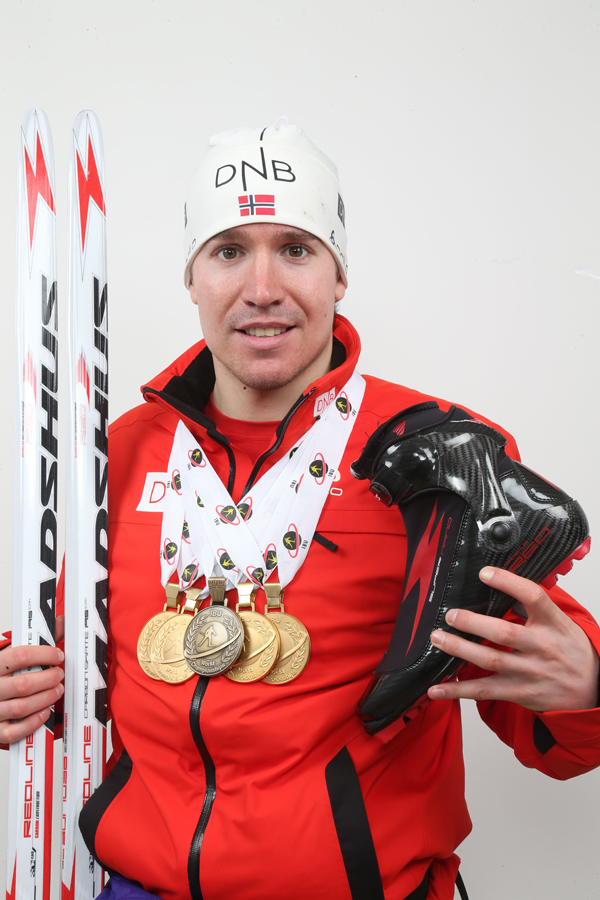
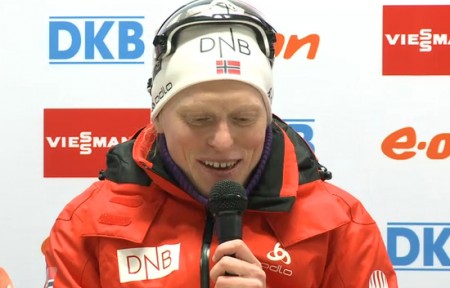
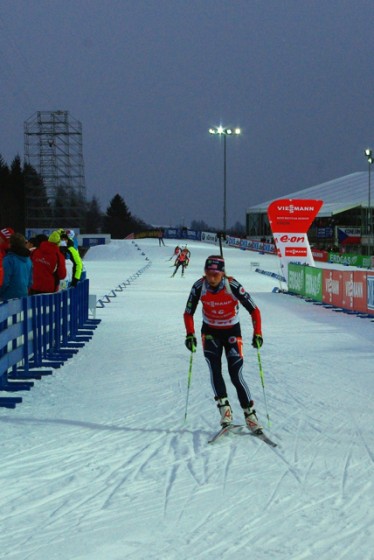
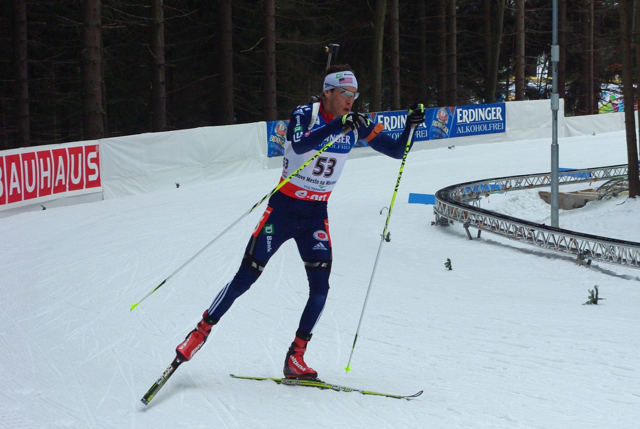
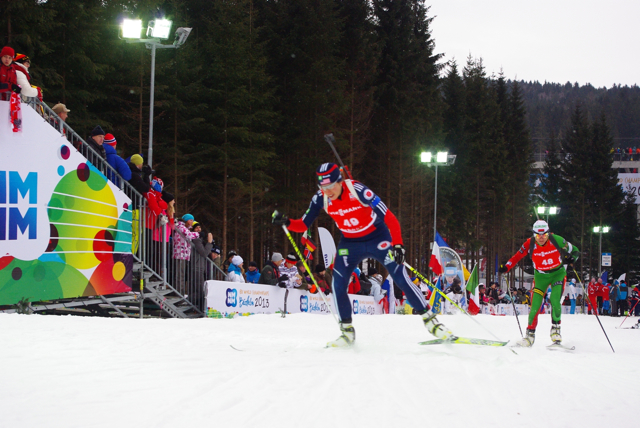
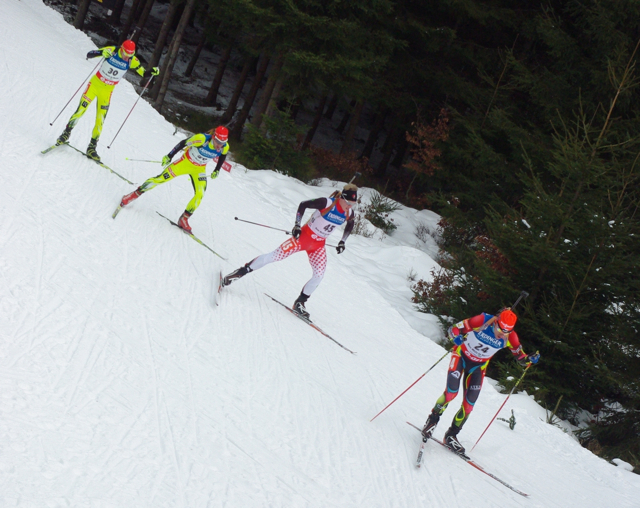
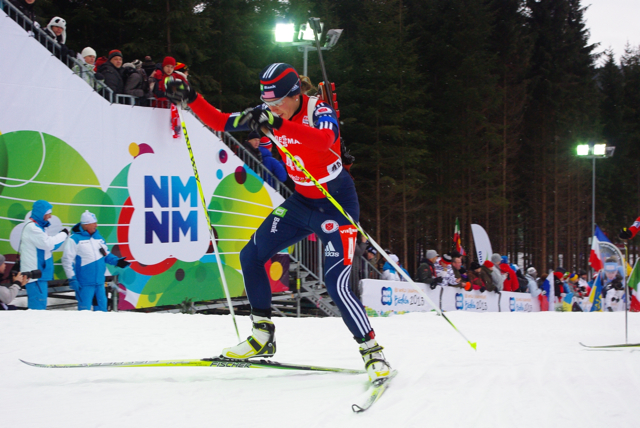
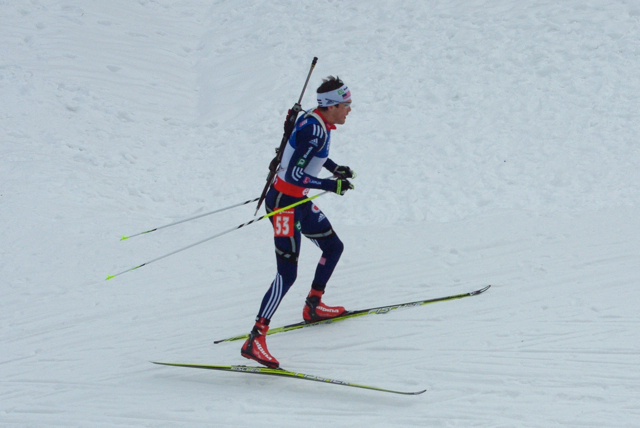
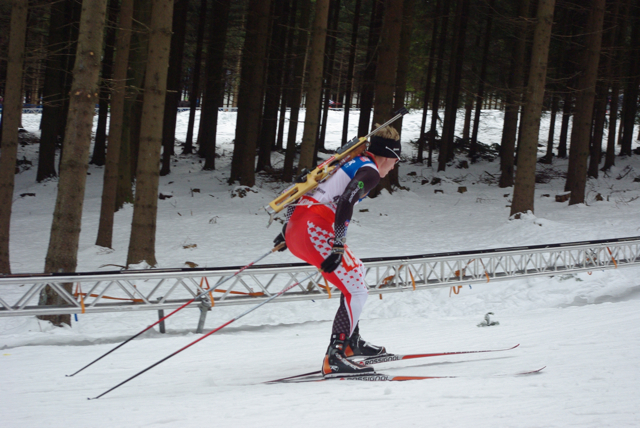
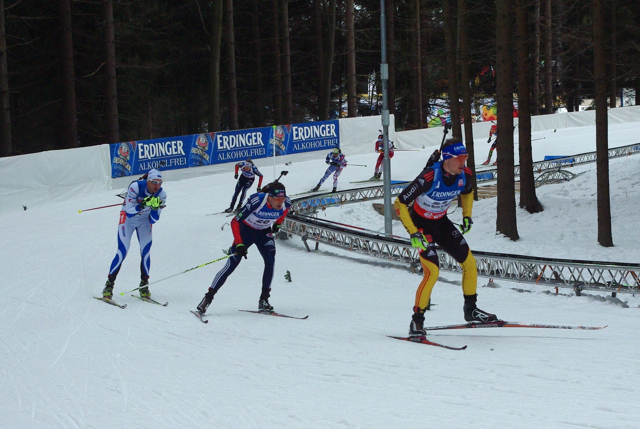
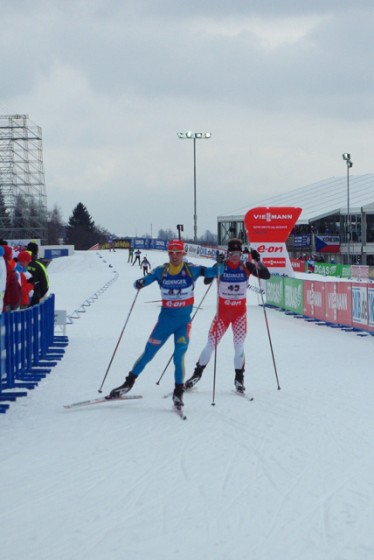
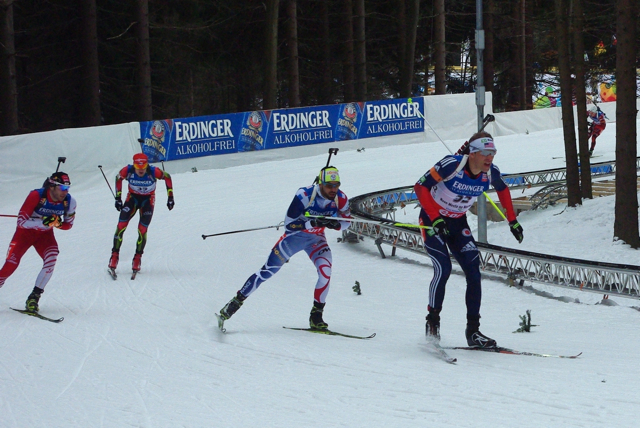
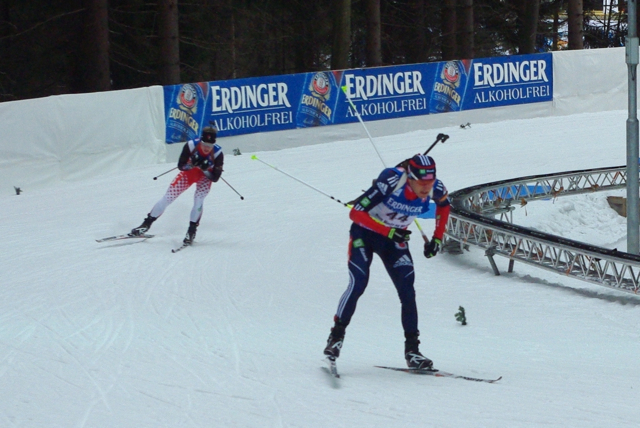
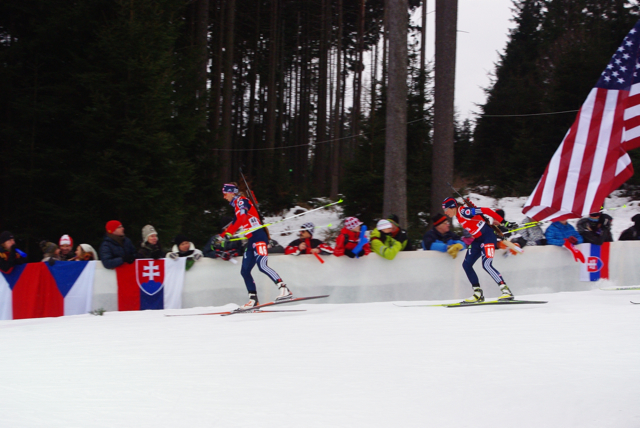
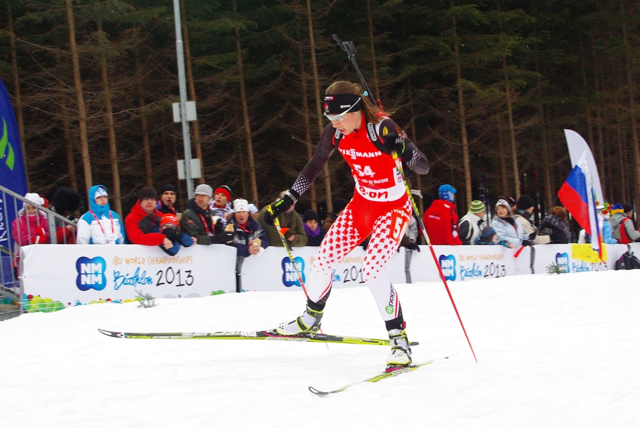
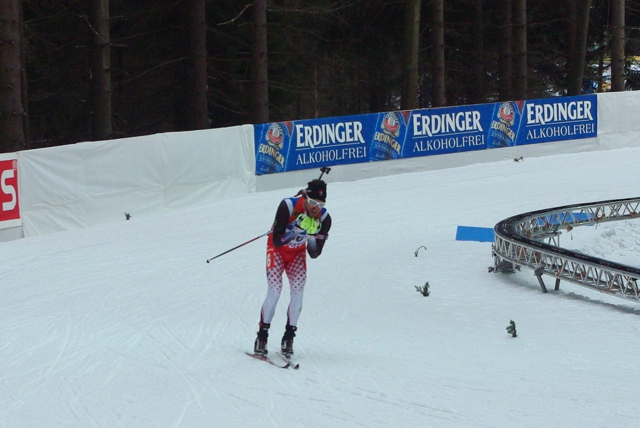
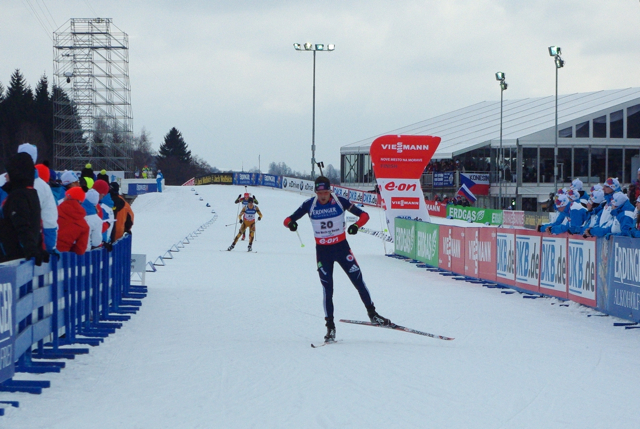
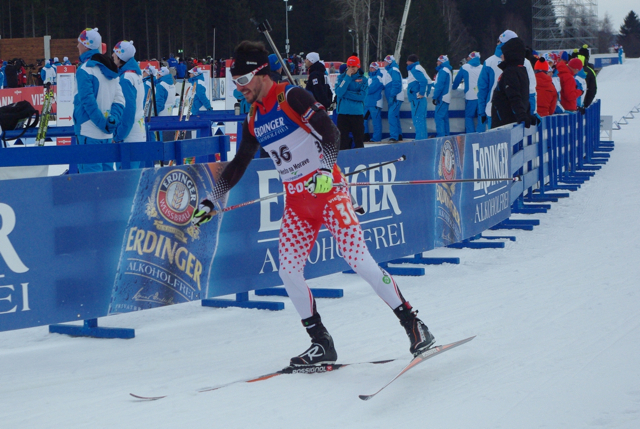
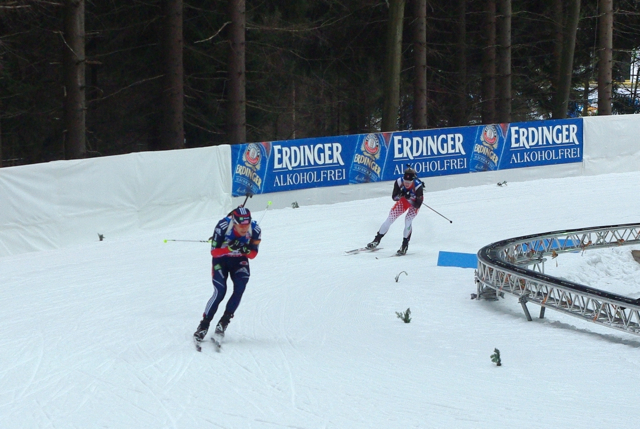
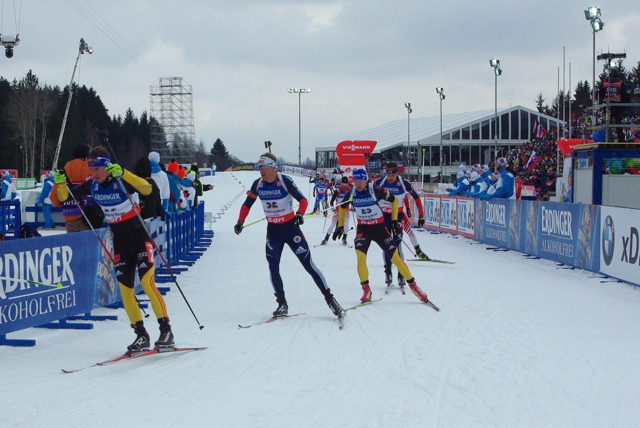
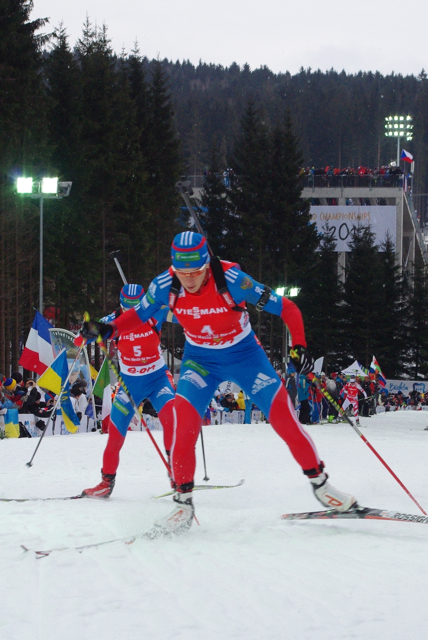
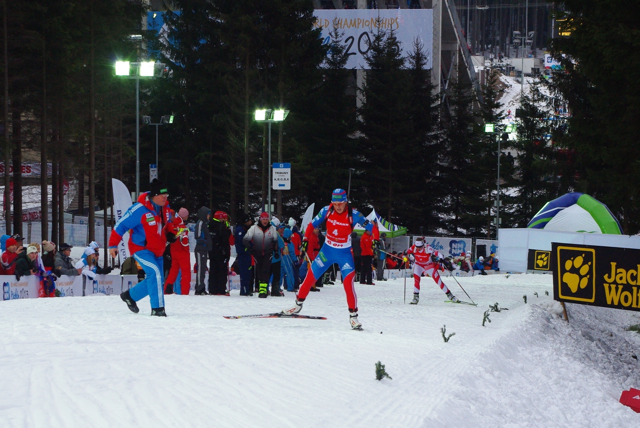
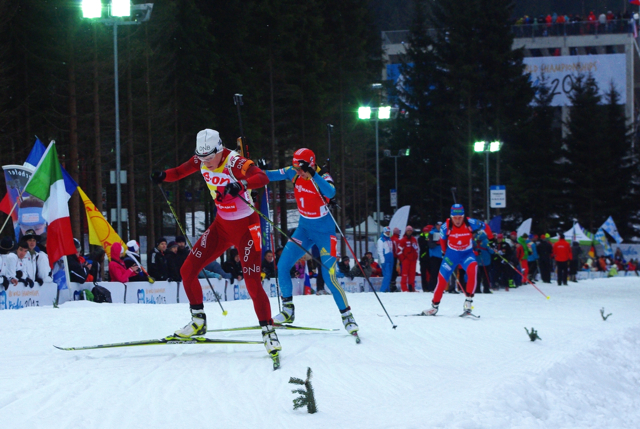
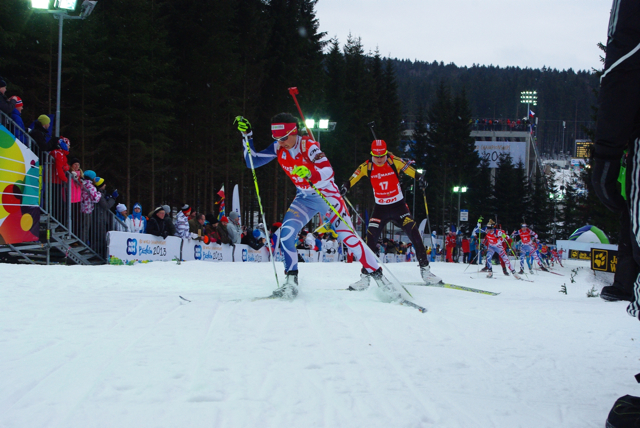
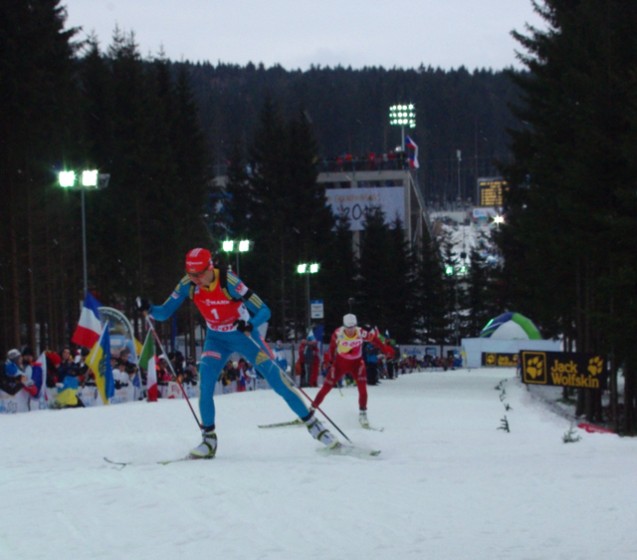
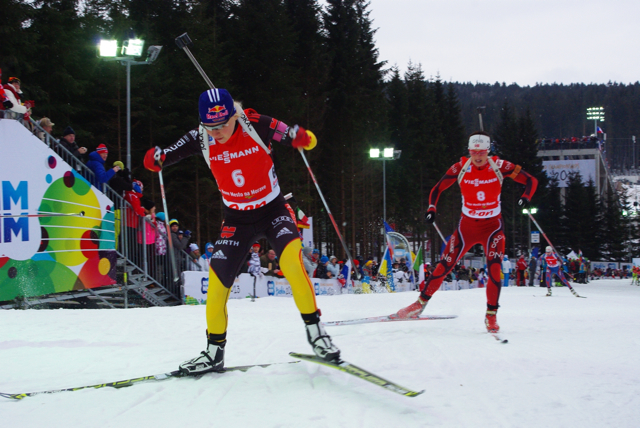
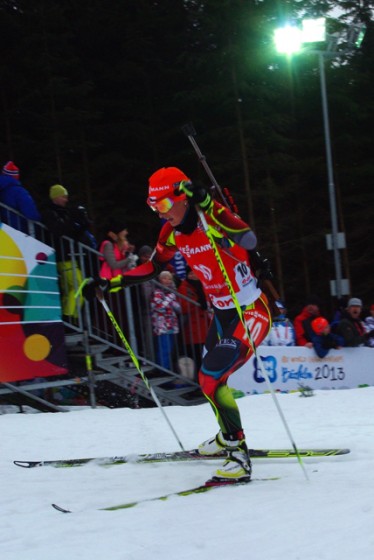
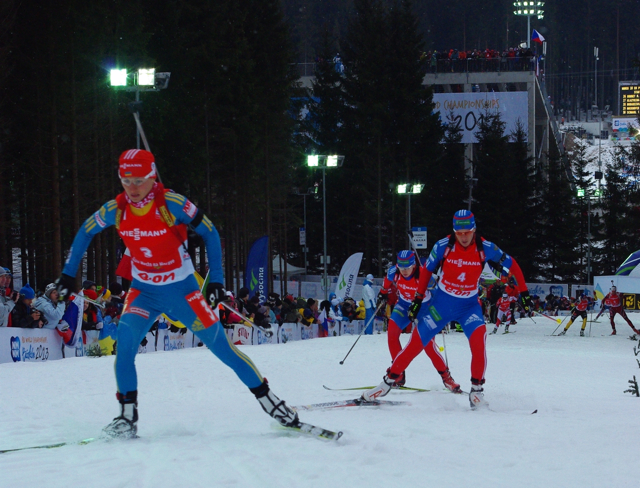
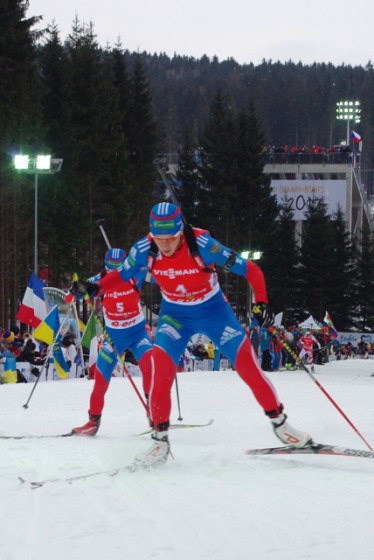
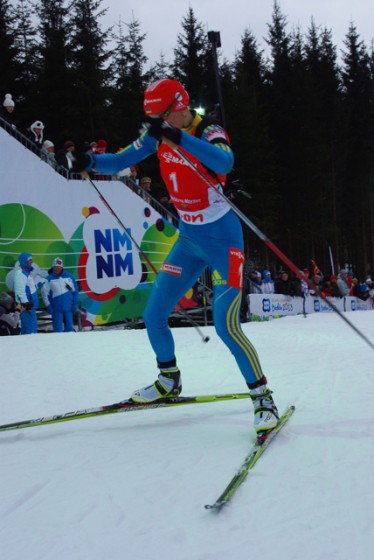
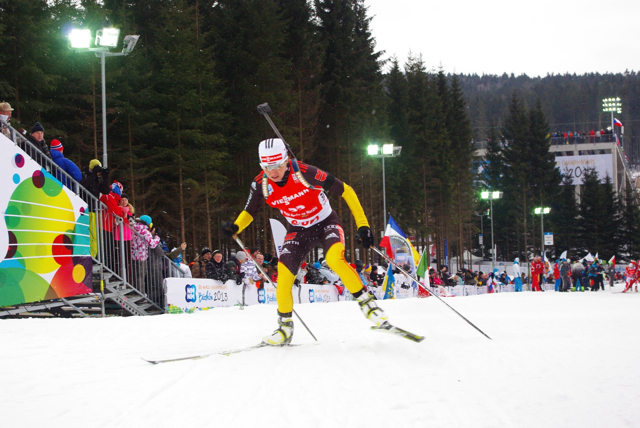
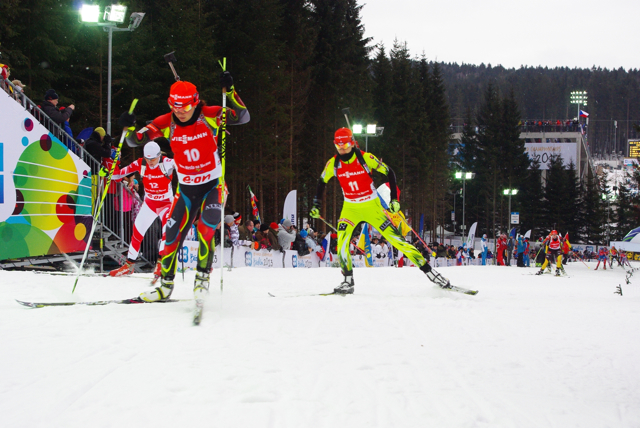
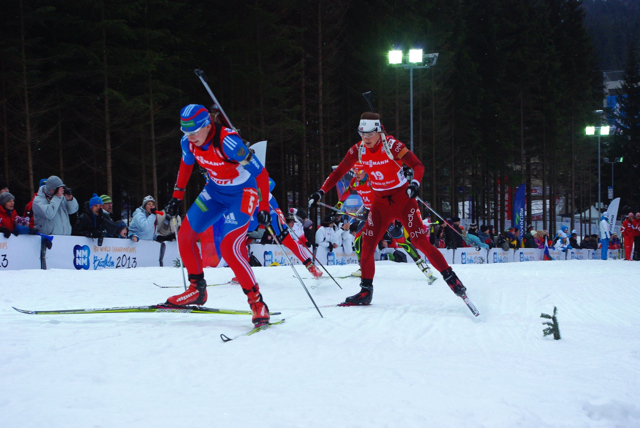
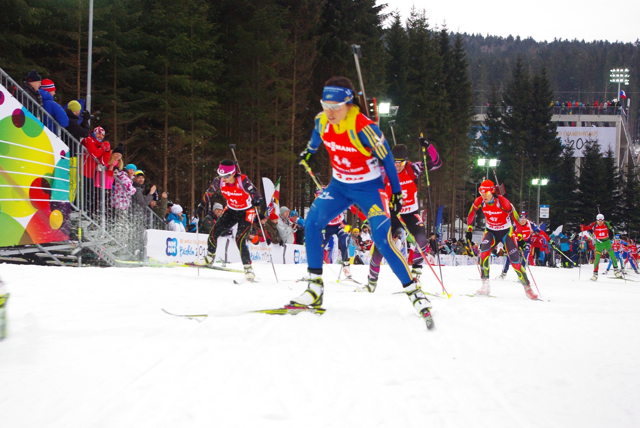
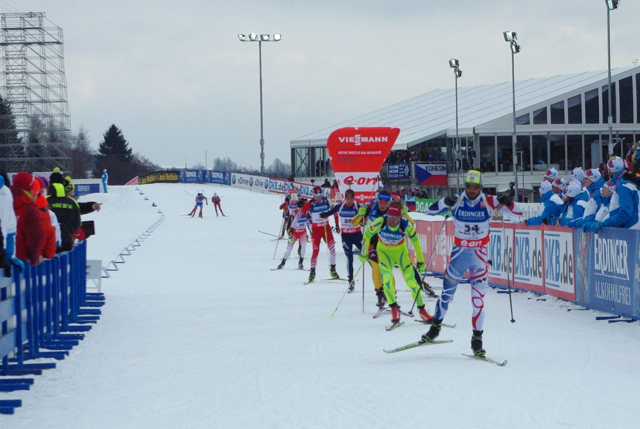
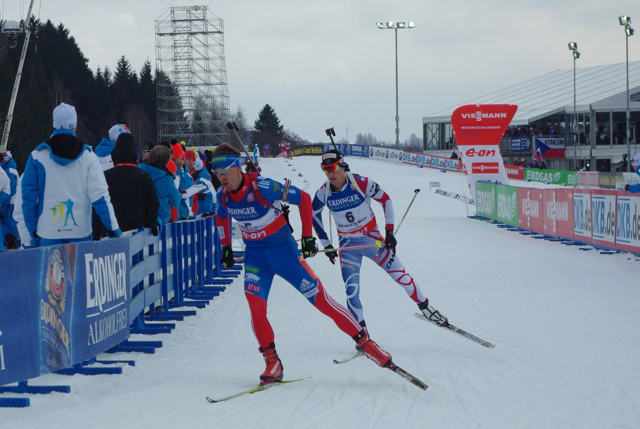
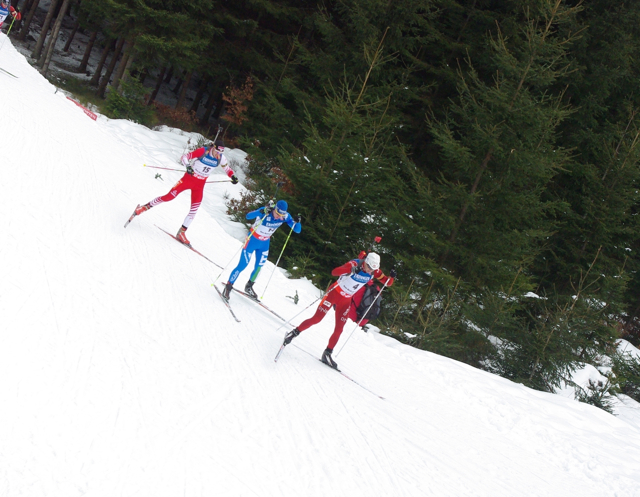
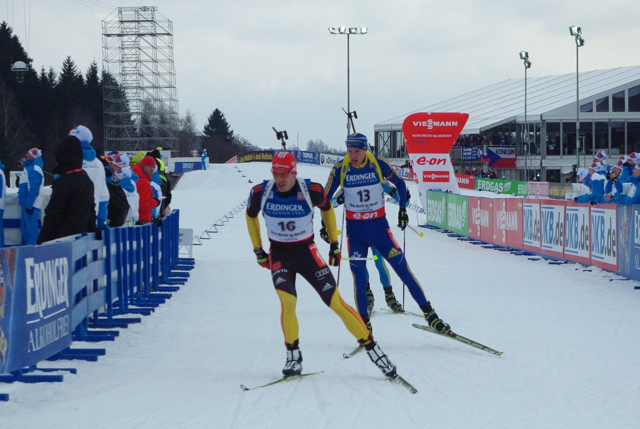
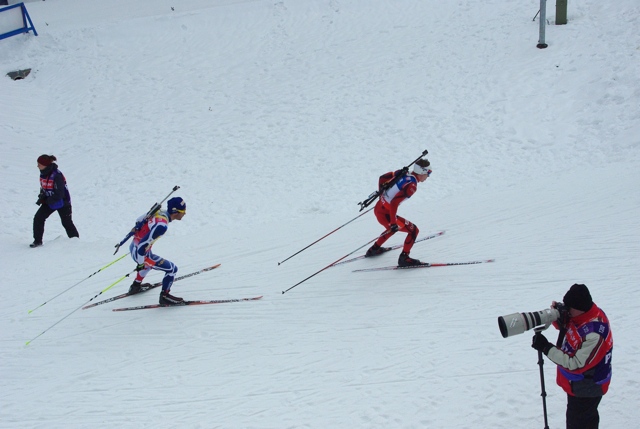
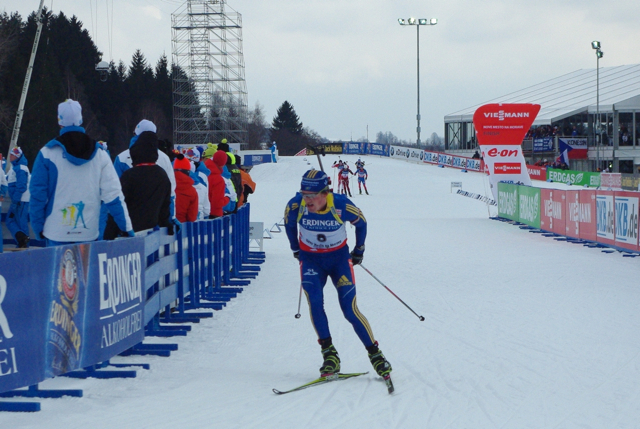
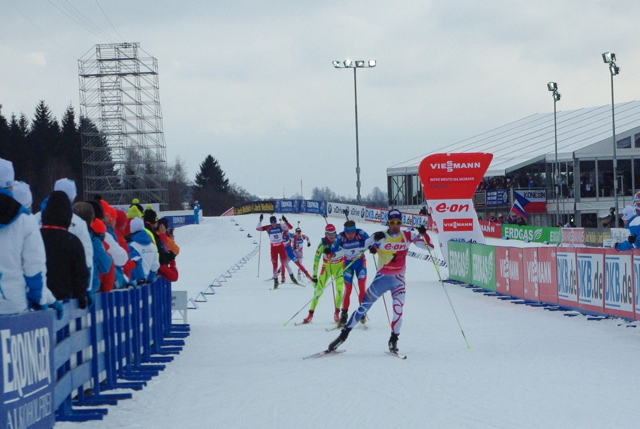
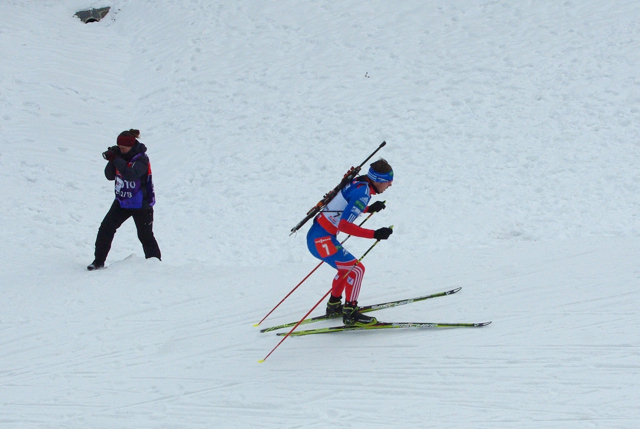
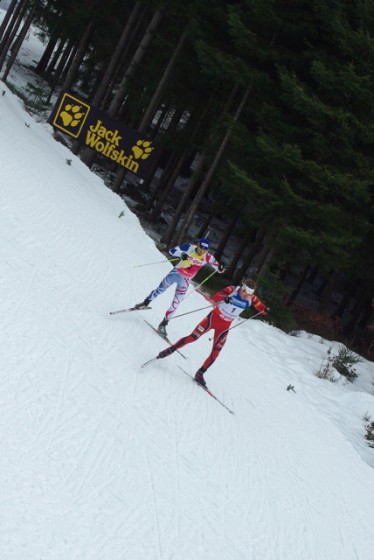
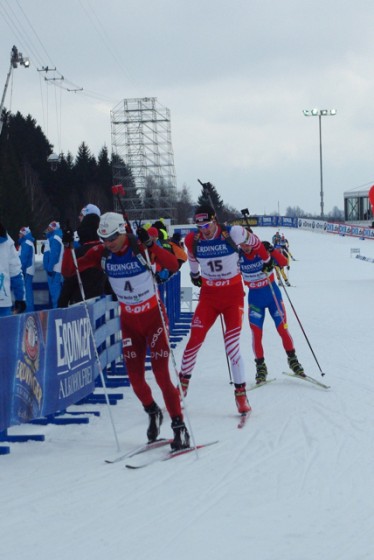
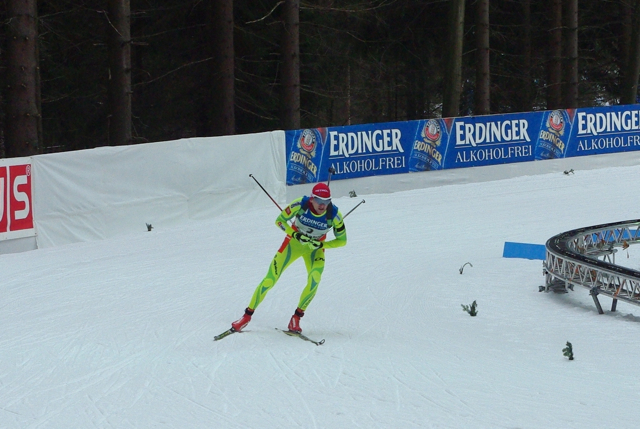
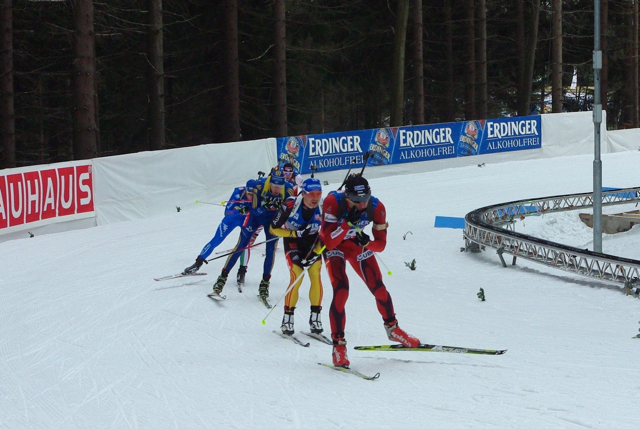
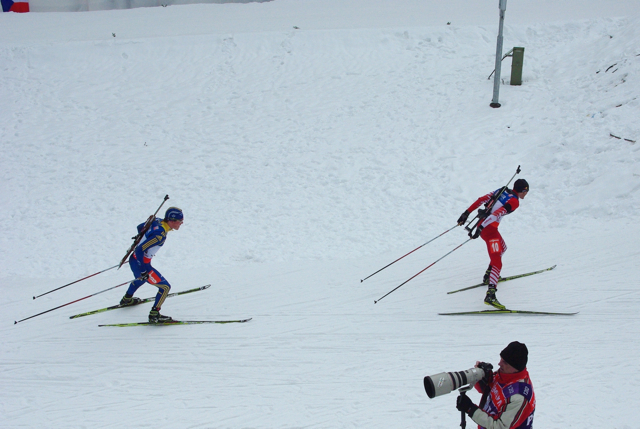
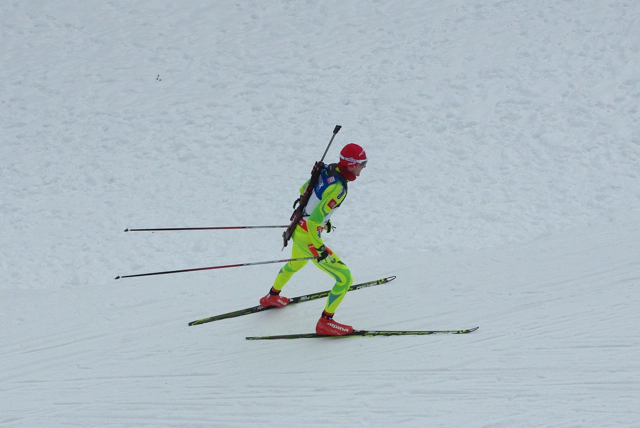
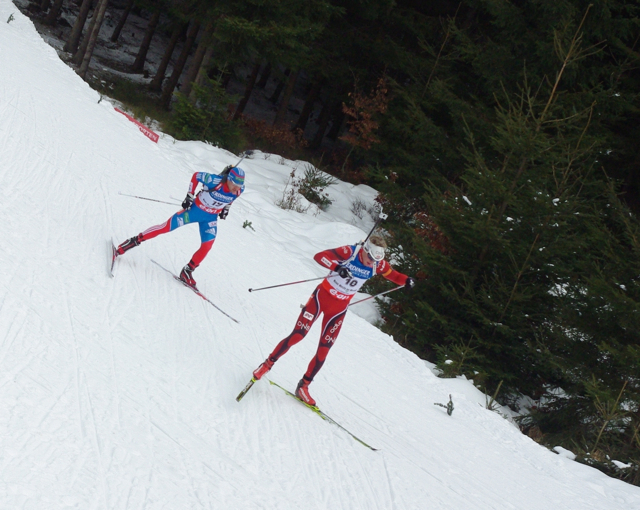
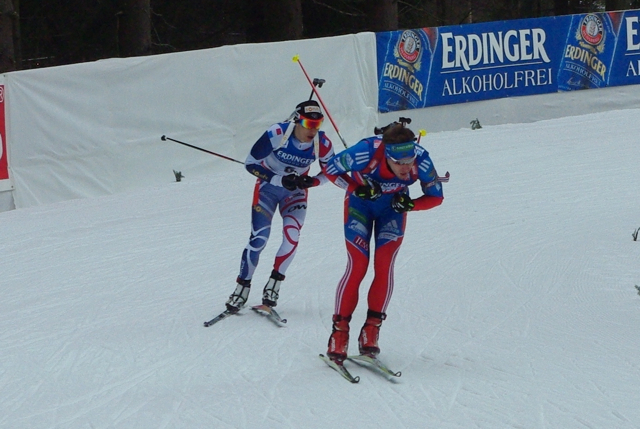
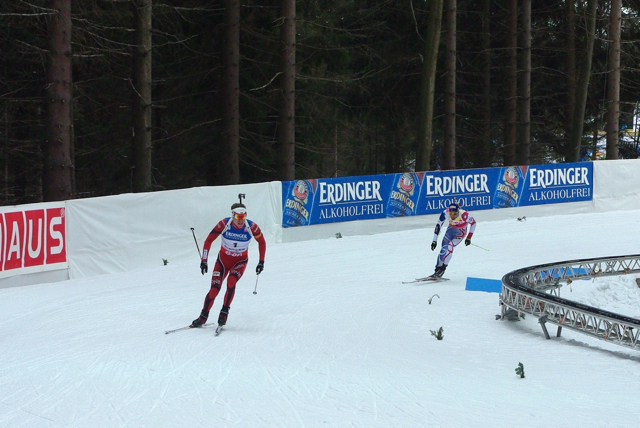
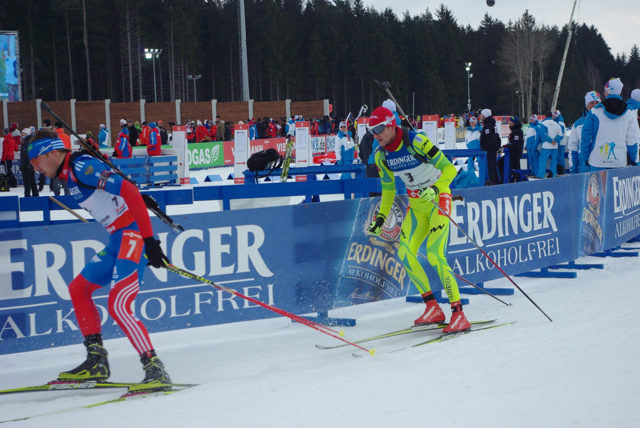
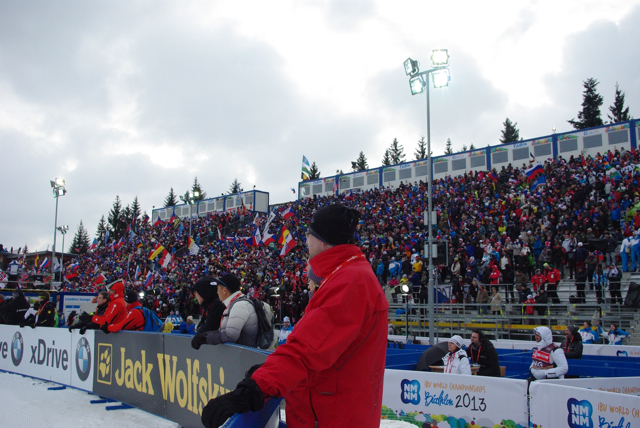
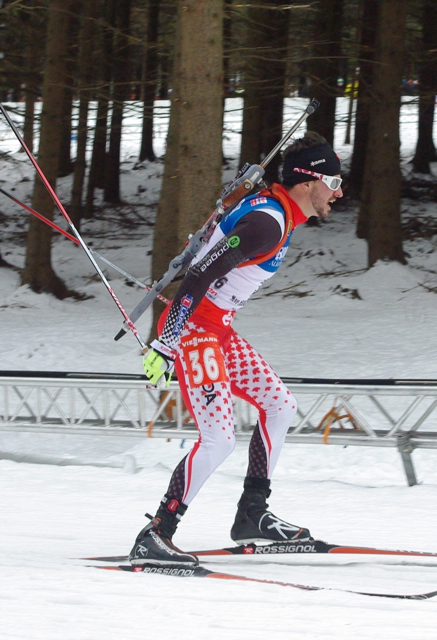
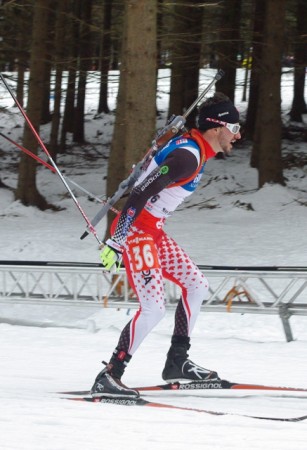
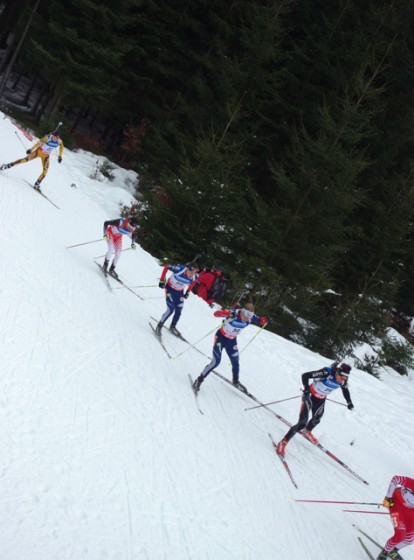
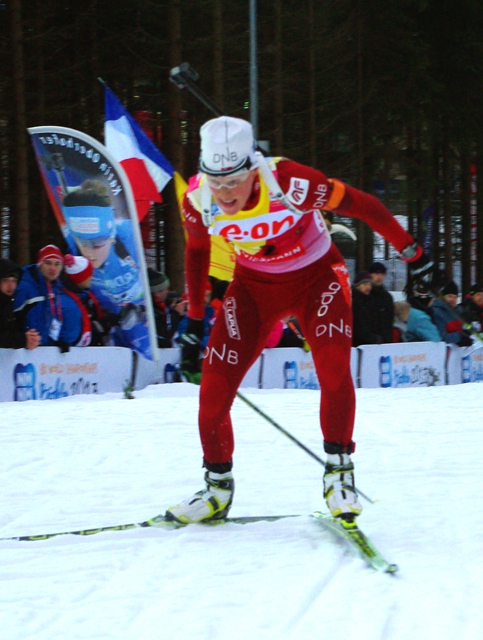
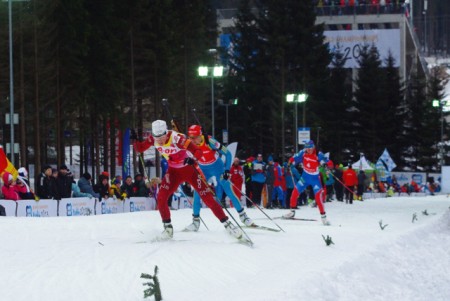
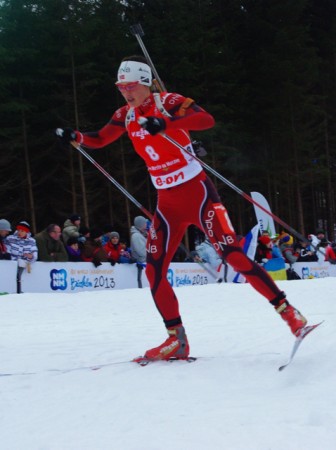
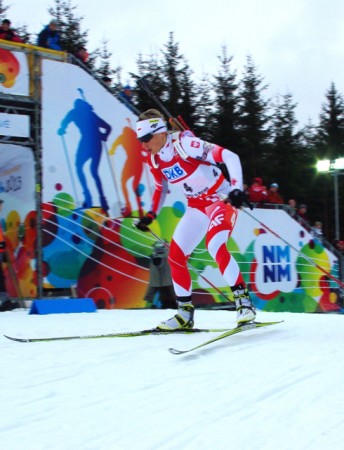
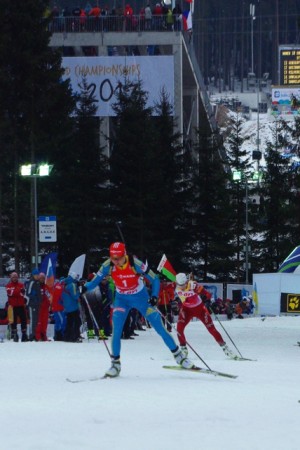
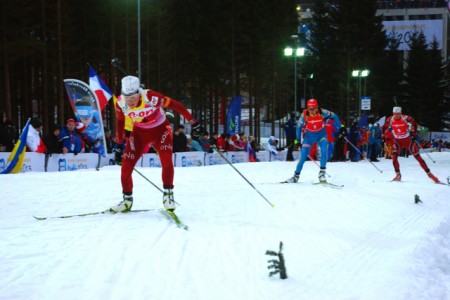
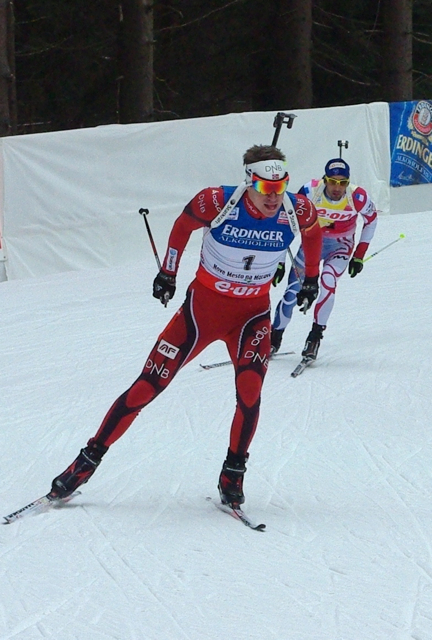
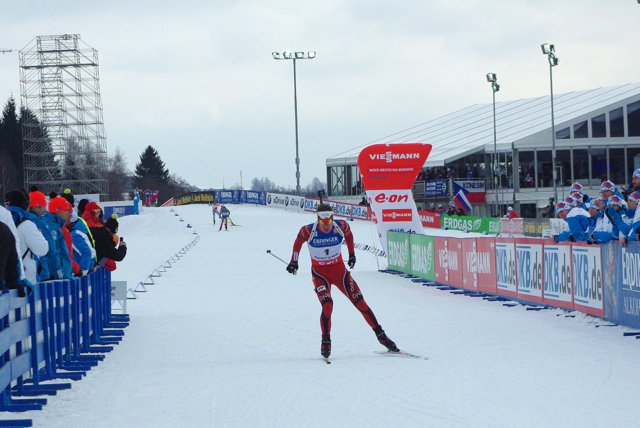
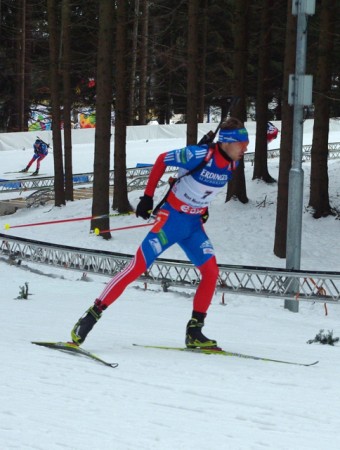
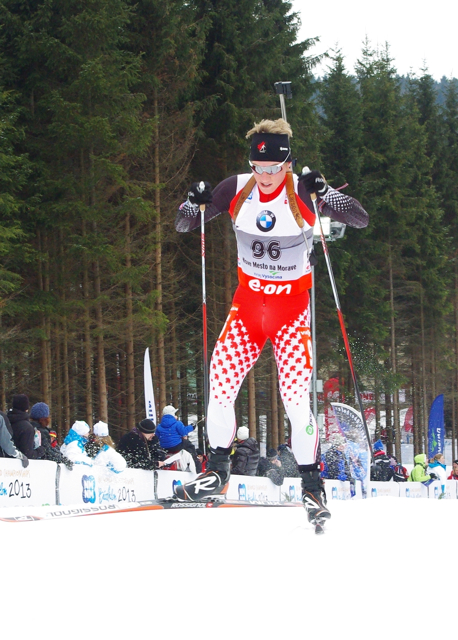
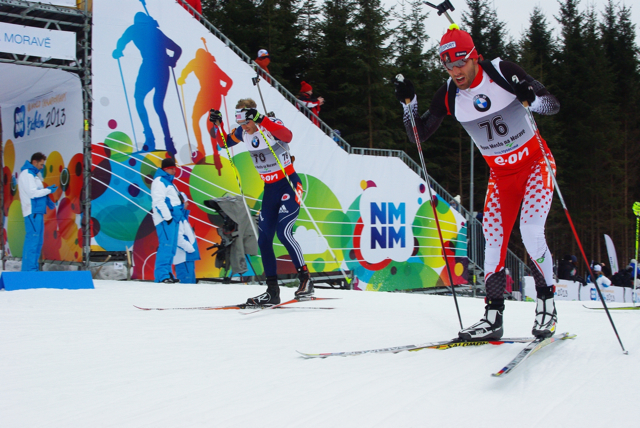
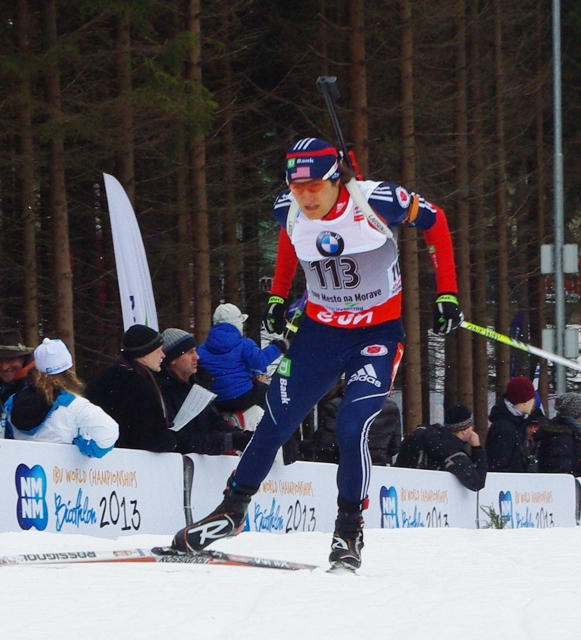
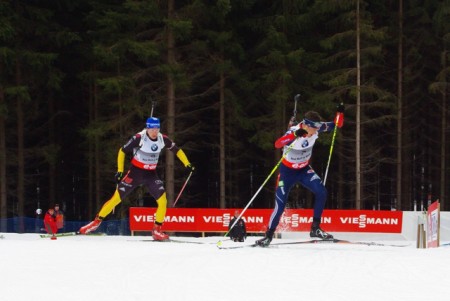
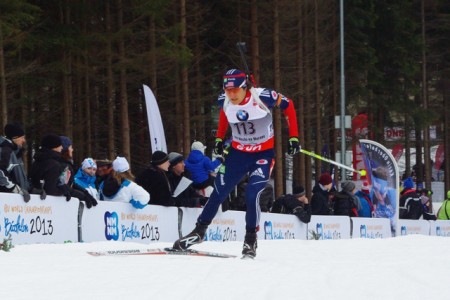
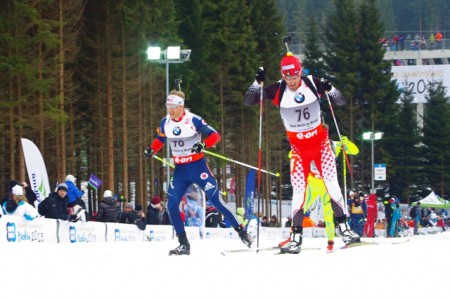
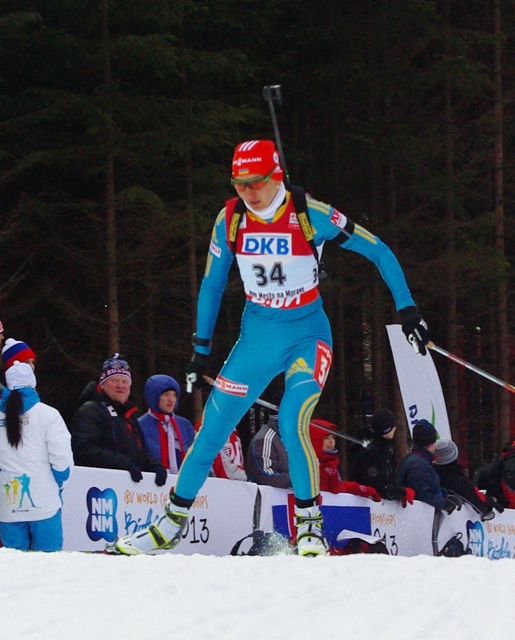
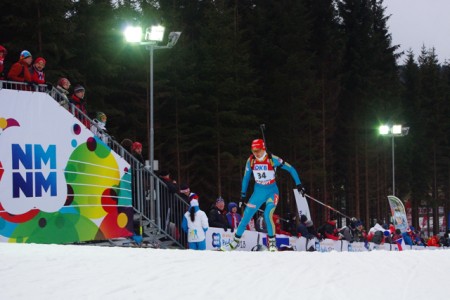
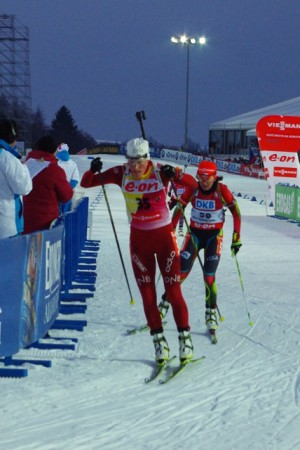
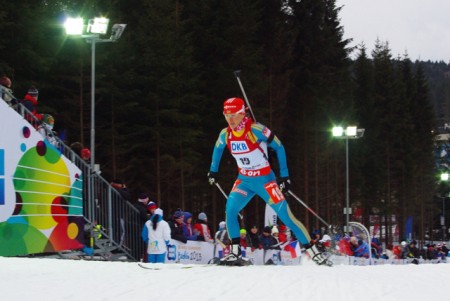
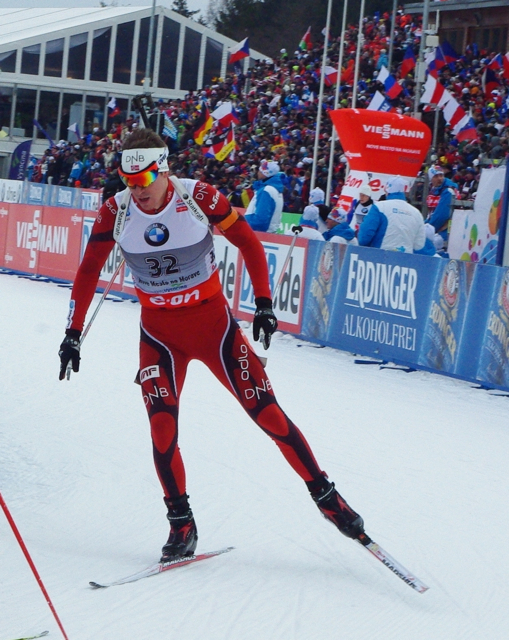
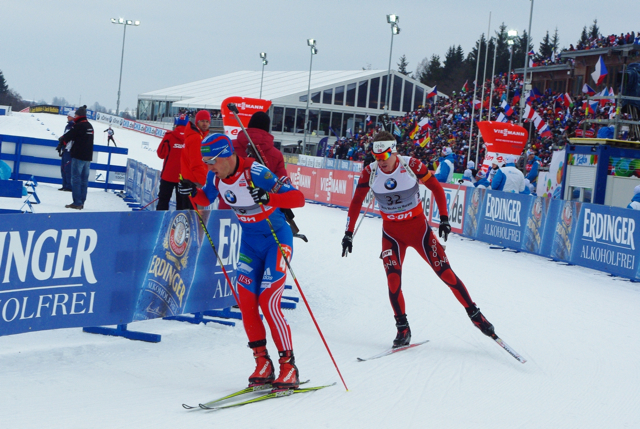
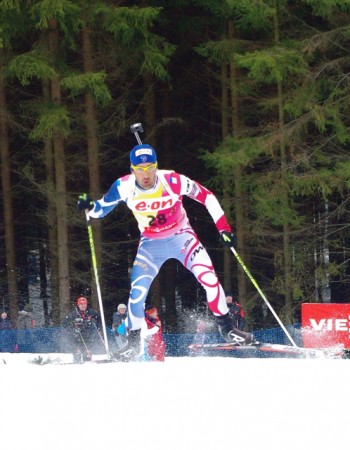
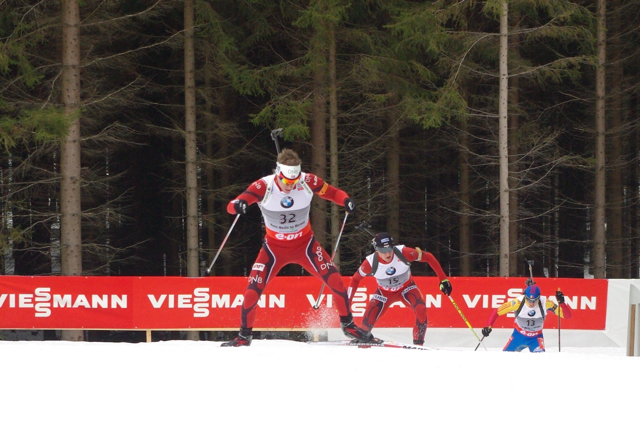
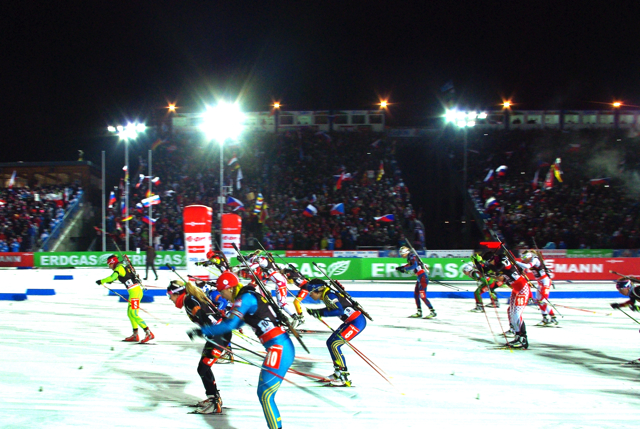
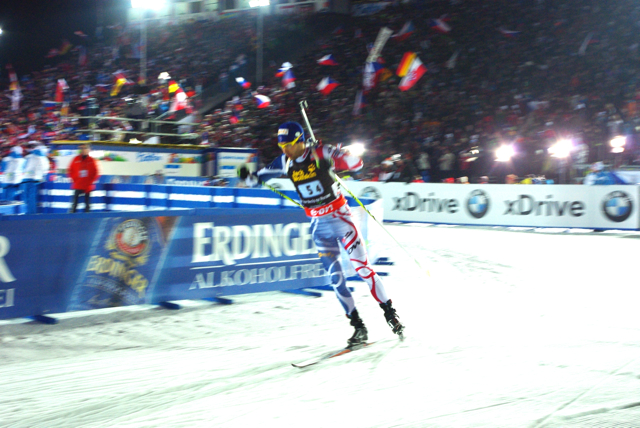
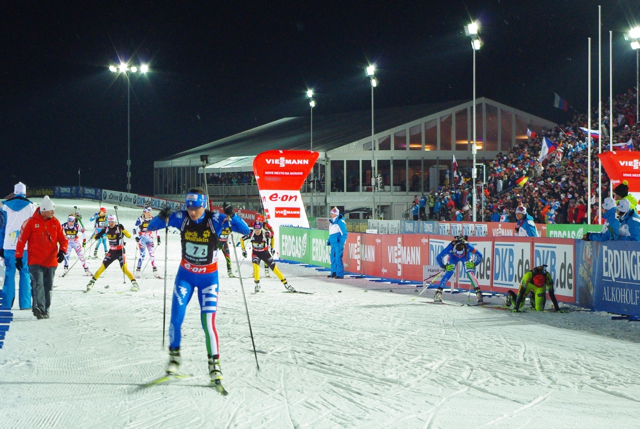
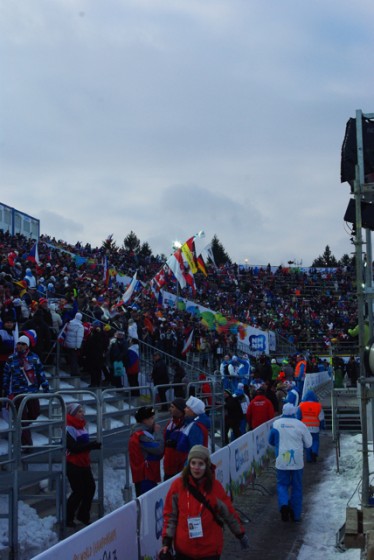
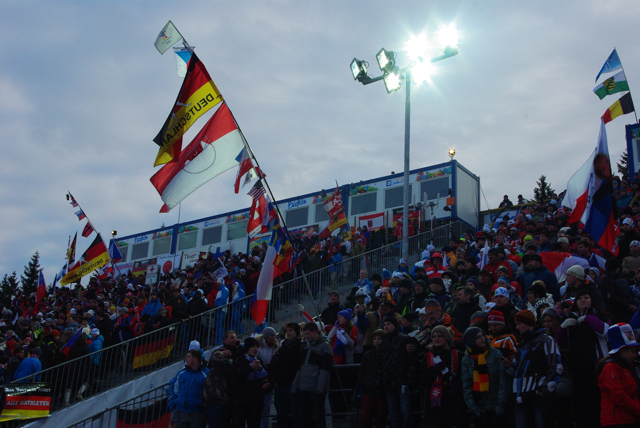
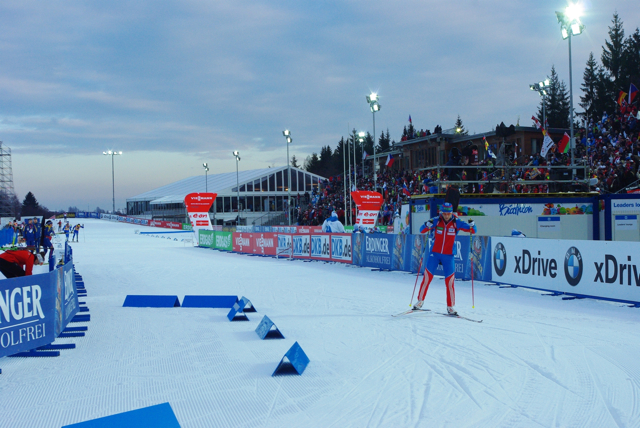
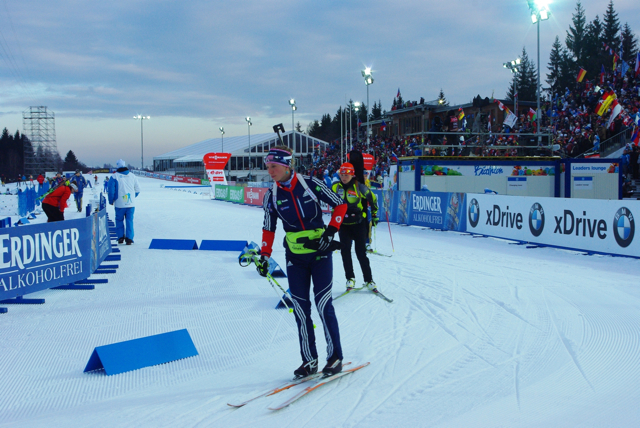
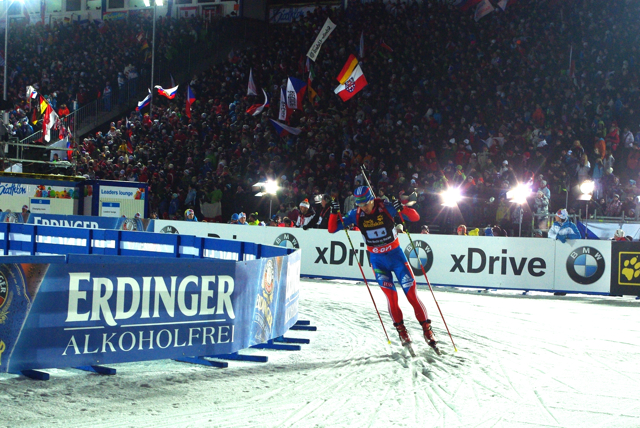
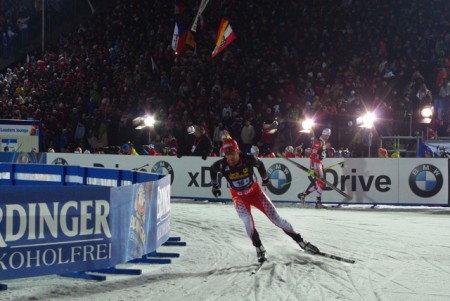
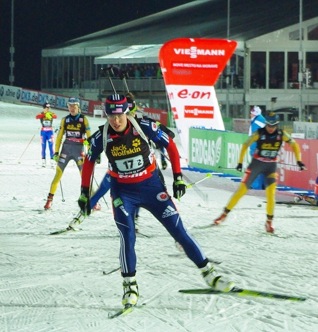
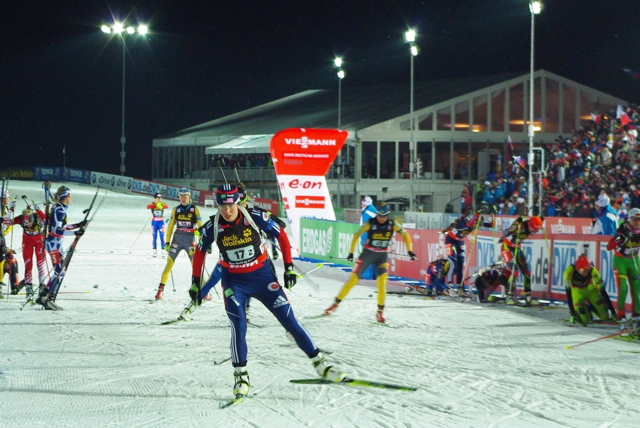
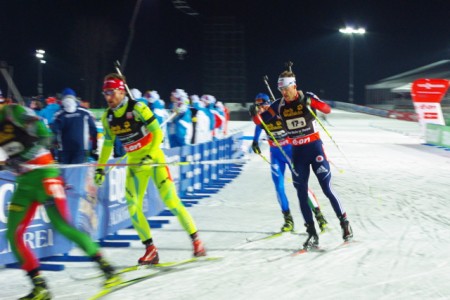
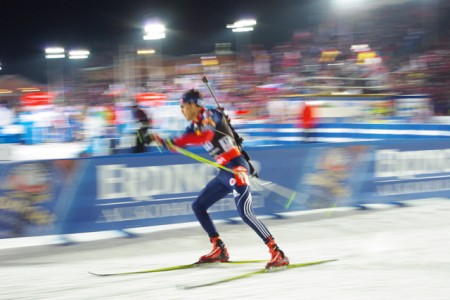
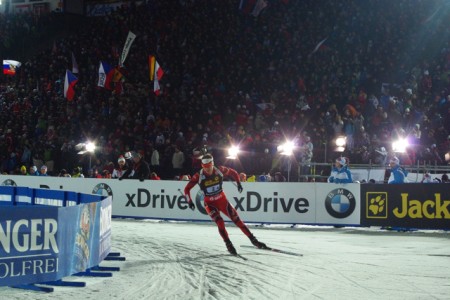
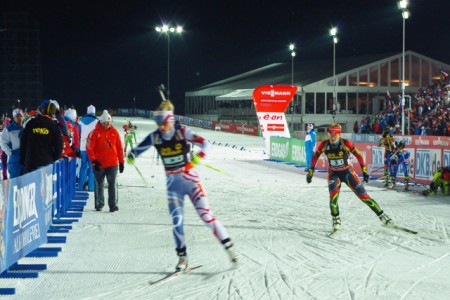
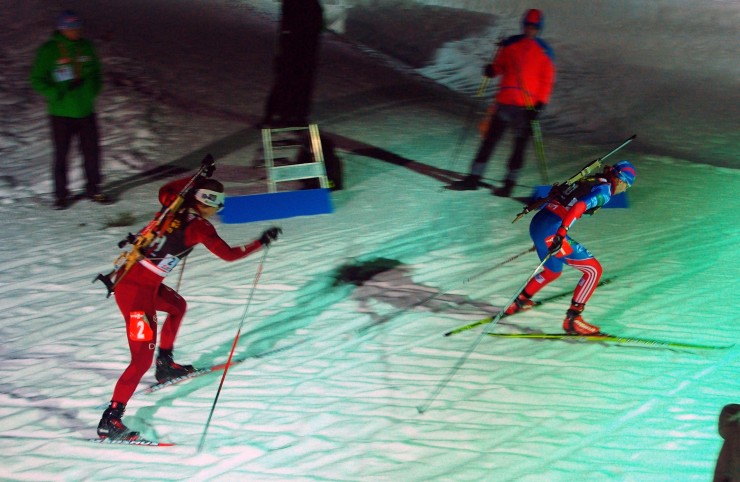
Emil Hegle Svendsen (NOR) – IBU world championships Nove Mesto (CZE). Photo: Manzoni/NordicFocus.
The 2013 IBU World Championships represent one of the best ever performances by the Madshus team athletes. No less than nine medals – eight gold and one bronze – were secured on the new Madshus REDLINE skate skis and Super Nano Ski boots.
While Emil Hegle Super-Svendsen (NOR) took home an impressive four gold medals and one bronze medal, veteran biathlete Ole Einar Bjoerndalen (NOR) earned his 50th Championship medal at the 2013 World Championships in Nove Mesto this week.
“I guess the media are thinking more about this being my 50th medal than I am. But of course, when you point it out, it is a little bit special, Bjoerndalen said after his relay race on Saturday.
“This is certainly one of the best Biathlon World Championships for Madshus,” says Per Wiik, who is the Global Marketing Manager at Madshus headquarters in Biri, Norway.
“It’s really fun to note that all of these medals are earned on our new REDLINE and SuperNano equipment, which is certainly defining the new gold standard for speed and performance,” Wiik says, adding that Madshus is now looking forward to the 2013 FIS Nordic World Championships in Val di Fiemme (ITA). The Nordic World Championships start on February 20 and end on March 3.
Madshus athletes helped themselves to a total of eight gold medals:
Emil Hegle Svendsen (NOR) won the sprint and the pursuit as well as helping Norway to gold medals in the mixed relay and the men’s relay. He also won the bronze in the men’s 20km mass start.
Synnoeve Solemdal (NOR) helped Norway to gold in the mixed relay and the women’s relay.
Ann Kristin Aafedt Flatland helped Norway to a gold in the women’s relay.
Ole Einar Bjoerndalen (NOR) helped Norway to gold in the men’s relay.
Tarjei Bø had every intention to come back stronger than ever. The 2010/2011 Biathlon World Cup winner remained positive through his bout with Chlamydia pneumoniae, an infection that can lead to pneumonia and affect the heart, last summer.
Rid of the virus in October, the 24-year-old spent the next few months recovering and frequently reassuring Norwegian media he’d be back. He wouldn’t start racing until January, but he still had his sights set on World Championships in Nové Město na Moravě, Czech Republic.
That goal became a reality early in this year’s International Biathlon Union (IBU) World Championships last week, when Bø helped the Norwegians capture gold in the opening mixed relay. On Saturday, he repeated the feat in the men’s relay with Ole Einar Bjørndalen, Henrik L’Abée-Lundand Emil Hegle Svendsen, yet it was Sunday’s 15-kilometer mass-start victory that brought Bø to tears.
“After everything that’s happened, it’s amazing that I can do it,” he told NRK after shooting clean and finishing first for his second individual World Championships title in 36:15.8.
“I deserve it more than others, in terms of what I’ve been through,” he said, according to a translation. “The cry of joy summed up a troublesome year .. This is insane. It means everything.”
After making all 20 targets for the first time in a World Cup race, Bø said he was nearly brought to tears his last time in the range.
“I thought it was going to be a sh*t bad season, but suddenly it’s become the best I’ve had, almost,” he said with a laugh.
Bø outlasted a competitive and closely bunched field of 13 men heading into the final standing. There, he cleaned at rapid speed and shot out of the stadium. Svendsen, Sweden’s Bjørn Ferry, Erik Lesser of Germany, Ondrej Moravec of the Czech Republic and Russia’s Anton Shipulin followed him out, while France’s World Cup lead Martin Fourcade fell out of contention with a penalty and into 10th.
Meanwhile, Bø continued to attack, pulling away from Svendsen and Shipulin and sealing the deal on the final hill. Svendsen and Shipulin duked it out for second, where the Russian clocked the fastest last lap of the 30-person field for the silver. For Shipulin, it redeemed his third-place finish in last Sunday’s pursuit, after he lost time on the last lap. A medalist in every race he started, Svendsen simply had nothing left.
“I chased what I had today, but I had so little energy that I had no chance to win,” Svendsen told NRK. “It’s amazing that [Bø] can do it. Absolutely fantastic.”
“The pursuit was a lesson,” Shipulin said in a press conference. “This week, I thought a lot about the mistake in the pursuit. I tried not to make that again today.”
Shipulin missed just one shot on the second prone for his second medal in Nové Město. Svendsen racked up a grand total of four gold and Sunday’s bronze.
Early in the mass start, L’Abée-Lund led the after the first prone. Fourteen men shot clean and left the stadium within 11 seconds of one another. Slovenia’s Jakov Fak trailed L’Abée-Lund and Shipulin hovered in the top three.
Through the first standing, Bø and a handful of others cleaned again, including Moravec, Austria’s Dominick Landertinger, Ferry and Andreas Birnbacher. Bø led out of the stadium with Birnbacher, and Fourcade tagged on close behind.
American Lowell Bailey remained in podium hunt after making all his targets through three stages. Only Bø and Ferry had cleaned every stage as well, and were two men who finished with perfect shooting.
Heading into the final stage, Fourcade in first had a 1.6-second lead on Bailey in second. Bailey missed two targets and dropped to 14th, improving to 13th by the finish, 1:09.4 behind Bø.
“More than ever, I realize that at this level, a podium result requires perfection,” Bailey told U.S. Biathlon. “That’s what I’ve strived for in training and that’s what I will continue to strive for looking forward to the final three World Cups and beyond.
“I felt great today. My skis were great, I felt good physically, and I was relaxed and confident in the range,” he added. “Of course I would like to have cleaned that last stage, but other than that, I had the race I wanted to have.”
Canadian Jean-Philippe LeGuellec cleaned the first two stages, missed one on the third and two on the final standing to finish 22nd, a career-best in the event at World Championships.
“The race went decently well. I managed some good shooting, but then, so did the entire field,” said LeGuellec after the race. “Skiing was not as great. I had enough juice to ski the whole race pretty much. All in all, it was a great effort.”
The third North American in the selective mass start, Tim Burke of the U.S. placed 30th after crashing on the first loop.
According to the U.S. Biathlon press release, two athletes fell in front of him on a fast downhill corner. Burke skied into one of them, then off the course and into a ditch. He struggled with snow-stuffed rifle in the first two stages, picking up a total of five penalties before cleaning the last two.
“I was really motivated for this race today and I thought I definitely had a chance to fight for another podium,” Burke said. “Unfortunately, I was involved in a bad crash on the first loop where I ended up off of the course. During the crash I rolled on my rifle and it ended up totally jamming with snow. From that point, my race was essentially over as it took me a few minutes to get the rifle functioning once I got in the range. I was pretty disappointed to end World Champs like this but that’s the way biathlon goes sometimes.”
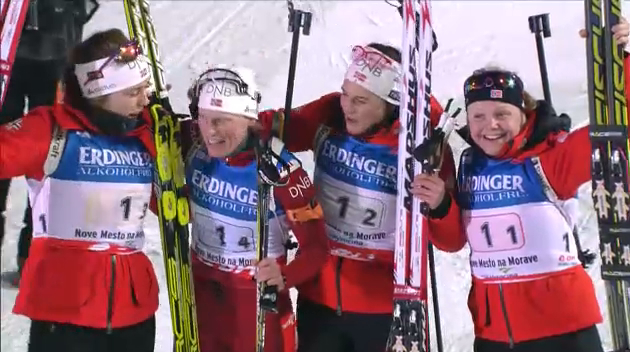
The Norwegian women’s relay celebrates its second-ever World Championships title after winning the 4 x 6 k event on Saturday in Nove Mesto, Czech Republic. From left to right: Synnøve Solemdal, Tora Berger, Ann Kristin Flatland and Hilde Fenne.
What does it feel like to have Tora Berger breathing down your neck? Ask Andrea Henkel of Germany, Ukraine’s Olena Pidhrushna or Italian Karin Oberhofer, who started the final leg of Friday’s 4 x 6-kilometer relay less than 40 seconds ahead of her.
Norway’s 31-year-old anchor, Berger had already racked up three world titles in the last week at the International Biathlon Union (IBU) World Championships in Nové Město na Moravě, Czech Republic. She was flawless in Wednesday’s 15 k individual, defending her 2012 victory without a single miss, and seemed to be no reason she couldn’t do it again on Friday.
Fourth at the exchange thanks to teammate Synnøve Solemdal, who skied the fastest third leg to elevate the team from 13th, Berger left the stadium 38.6 seconds behind Henkel in first. One kilometer later, Pidhrushna was about seven seconds down on Henkel, and Oberhofer was another 23 seconds back.
And then there was Berger, who shot clean on the prone to move within 21 seconds of Pidhrushna in the lead. Henkel had to use one spare round, but remained close to the Ukrainian, trailing by 1.4 seconds while Oberhofer cleaned to leave the stadium in third, 10.7 seconds behind.
As Henkel pushed to the front, Berger did the same from the fourth position, overtaking Oberhofer by 3.5 k and moving to third. Barbora Tomesova of the Czech Repubic followed close behind, stepping on Berger’s pole and ripping it out of her hand. The Norwegian remained calm, took a few no-pole strides and received another near the top of the long incline. She didn’t lose any ground, and if anything, set herself up for a solid last stage.
Despite using one spare on the standing stage, Berger ended up clocking the seventh-fastest range time in the range and left the stadium in third, just 2.3 seconds behind Oberhofer, who had cleaned again. Pidhrushna was just 1.3 seconds back in second after using one spare, and Henkel, who used two spare rounds, fell to fourth nearly 16 seconds back.
Berger didn’t waste any time and took the lead with a fast-and-furious V1 up the gradual 2-kilometer grind. A Norwegian coach put his hand over his mouth as he watched from the stadium. Could Berger hold it?
Then it became apparent; her contenders couldn’t keep up. With 1 k remaining, Pidhrushna trailed by 3.5 seconds. The deficit grew to seven seconds with half a kilometer to go. Oberhofer was five seconds down, then 10 seconds behind Berger before the final push to the finish.
There, Berger skied uncontested to the win in 1:08.11. For Norway, which included Hilde Fenne and Ann Kristin Flatland, it was the second women’s relay victory ever and first since 2004. For Berger, it was her fourth gold at a single World Championships, which put her on par with Norway’s retired great, Liv Grete Skjelbreid Poirée. Back in 2004, Poirée also won four gold medals at Biathlon World Championships. And Berger has one more race remaining: Sunday’s 12.5 k mass start.
“I was just trying to do my best,” Berger said in a press conference about her simple-yet-effective game plan. “I never dreamed of this as I was driving to Nove Mesto. Whatever happens Sunday will only be a bonus.”
Seven seconds behind, Pidhrushna brought home silver for Ukraine (which included Juliya Dzhyma, Vita Semerenko and Valj Semerenko). Valj Semerenko put the team into contention on the third leg after cleaning her standing stage and boosting the team to first. She and Germany’s Laura Dahlmeier switched leads over the next two kilometers and were the first through the exchange with Italy’s Michela Ponza.
After bringing Italy (with Dorothea Wierer and Nicole Gonteier) from fourth to first earlier in the leg, Ponza helped her team notch bronze for its first World Championships relay medal. It was her first medal at worlds as well.
“I am the oldest one up here … it is a dream come true,” Ponza said at the press conference. “All of my colleagues made a great race. … I want to thank everyone who believed in us. This is a good moment for Italian biathlon.”
Overall, the Norwegians made fewer than 80 percent of their shots (compared to Ukraine’s 88.9 percent and Italy’s 90.9 percent), using nine spare rounds and skiing a penalty loop on the first leg. Ukraine had no penalties and used five spare rounds, and Italy used just four spares.
“I was sure today that the last shooting and the last loop would be important,” Pidhrushna said. “I had a spare round but the others did too, so I told myself that this was a chance. That last loop was quite crazy.”
Russia placed fourth (+29.0) after being an early contender. Three of their seven used spares came on the third leg with Ekaterina Shumilova after she cleaned the prone. Germany finished 30.9 seconds behind in fifth after using 11 spare rounds, three of which came from Henkel.
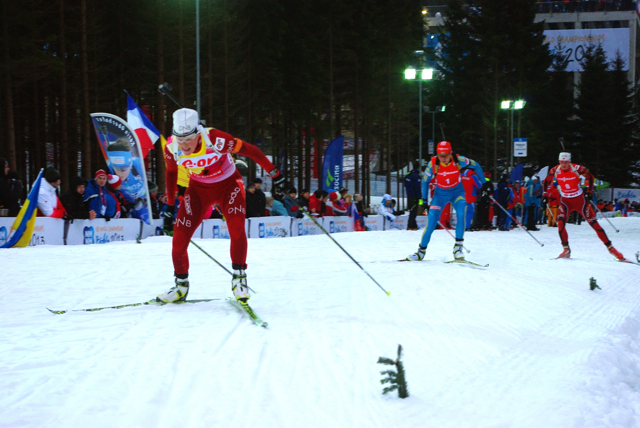
Tora Berger leading Olena Pidhrushna (UKR) and Norwegian teammate Ann Kristin Flatland (r) on the penultimate lap of Sunday’s 10 k pursuit at the IBU World Championships in Nove Mesto, Czech Republic. Berger won the race for her second gold of the week (after the mixed relay) and followed up with her third victory on Wednesday in the 15 k individual.
For 31-year-old Tora Berger, it just keeps getting better. Norway’s leading female biathlete took control at the International Biathlon Union (IBU) World Championships on Wednesday, cruising through the 15-kilometer individual race to not only defend her title, but do so without error in Nové Město na Moravě, Czech Republic.
Starting 62nd of 118 women, Berger attacked the five-lap course to catch contenders like Ukrainian sisters Valj and Vita Semerenko. And while the freshly fallen snow was slow and a strong crosswind in the range made shooting difficult, Berger remained calm and collected, shooting clean through three stages to take the lead by more than 40 seconds.
With one more stage and two laps to go, anything could potentially happen, even for Berger, the event’s defending world champion who already notched gold in Sunday’s pursuit and the opening mixed relay of this year’s World Championships.
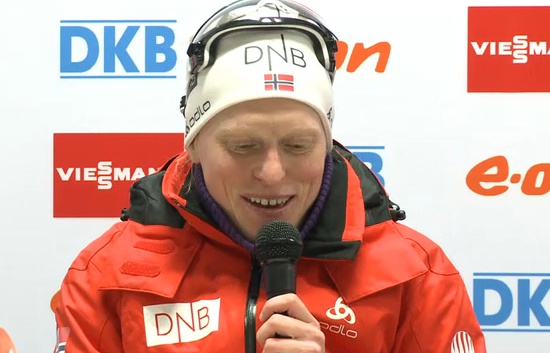
Norwegian Tora Berger talking about her 15 k individual victory in a press conference on Wednesday at the 2013 IBU World Championships in Nove Mesto, Czech Republic.
“I knew that if I shot clean today I had a chance to be the winner,” Berger said in a post-race press conference.
She did so – for her first time in a World Championships 15 k individual race – knocking down all five targets on the final standing en route to her third victory of the week and seventh world title.
One of just three women to shoot to perfection on Wednesday, Berger didn’t let off the gas after last time in the range. With a lead of 1 minute and 25 seconds, she then clocked the second-fastest final lap and had the fifth-fastest course time of the day.
Only Germany’s Andrea Henkel in bib 71 came close, finishing second, 52.7 seconds behind Berger’s winning time of 44:52.5. Along with France’s Marie Laure Brunet, who ended up 19th, Henkel shot clean for her 12th World Championships medal and first individual podium since 2008.
“I knew how important the shooting range is,” said Henkel, 35. “I thought the individual race is the biggest chance for me to win another medal so I took this chance.”
Out of all her medals, she said each is special. “Behind each medal there’s a little story, and I think this is another nice one,” Henkel said.
Also on the World Championships podium for the first time since 2008, Valj Semerenko hung on after starting third and missing one shot on the first prone. She cleaned the next three stages and finished in the lead, but told her congratulators to wait; the best skiers were nearly 40 bibs back.
She was right. Poland’s Magdalena Gwizdon in bib 42 led through the first three stages, with one penalty on the first standing, but fell out of contention with two more misses and ultimately placed 18th. Vita Semerenko then moved to first with three clean stages, but missed one on the last standing to end up fifth (+2:25.9).
Slovakia’s Anastasiya Kuzmina cleaned the first two stages, but suffered a penalty on the second prone, losing 40 seconds to Berger. Kuzmina missed one more on the final stage to place fourth, just 12.5 seconds off the podium.
And while the time penalties were costly – as they always are in individual races – Valj Semerenko managed to keep her head in the game.
“The miss was quite a shock for me, but it was OK,” she said. “I told myself that every miss in this race puts you about 10 places behind so I [skied as hard] as I could and I hoped to lead the race.”
For Semerenko, who finished 1:42.5 back from Berger, the medal was her first since her 2008 women’s relay captured second. Perhaps most notably, was her third in a non-team event at the World Cup level.
“I told myself if I deserve a medal, I will win one, and I just tried my best,” Semerenko said.
NOVÉ MĚSTO NA MORAVĚ, Czech Republic – Nine American and Canadian biathletes competed in the men’s and women’s 10/12.5 k pursuits at IBU World Championships on Sunday. Here are some photos of the action.
Megan Heinicke (CAN) chases down Ma Wei (CHN).
Russell Currier (USA) in a group approaching the range.
Susan Dunklee is cheered on.
Annelies Cook (USA).
Leif Nordgren (USA).
Susan Dunklee (USA) leads Liudmila Kalinchik (BLR) on the first loop.
Scott Gow (second from right) was the youngest competitor to qualify for the .12.5 k pursuit at IBU Biathlon World Championships.
Susan Dunklee (USA).
Leif Nordgren (USA).
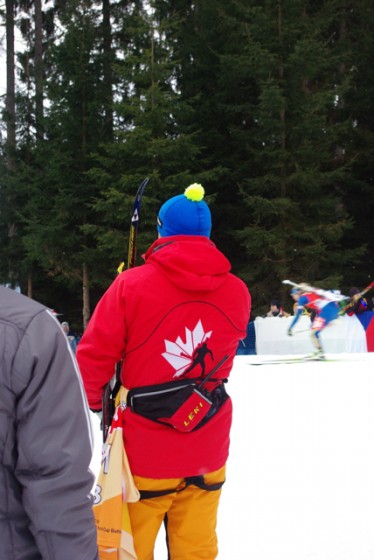
Team Canada support staff out on course.
Scott Gow (CAN).
Simon Schempp (GER) and Tim Burke (USA).
Scott Gow (CAN) approaching the range.
Lowell Bailey (USA) with Simon Fourcade (FRA).
Russell Currier (USA) and Scott Gow (CAN) on the first lap.
Annelies Cook and Susan Dunklee on the first lap of the pursuit.
NOVÉ MĚSTO NA MORAVĚ, Czech Republic – Tora Berger of Norway took home the sixth World Championships title of her career in Sunday’s 10 k pursuit, which wasn’t all that surprising – the current World Cup leader started just six seconds out of the lead. But the rest of the race was more interesting – she lost the lead after the second shooting stage and didn’t regain it until the last lap. Then, Olga Zaitseva of Russia and Ann Kristin Flatland of Norway crashed, allowing Krystyna Palka of Poland and Olena Pidhrushna of Ukraine to snag the final medals. Here’s our race report; below are some images of how the race unfolded.
Olga Zaitseva (RUS) gets instructions from a coach as Krystyna Palka (POL) tries to chase her down.
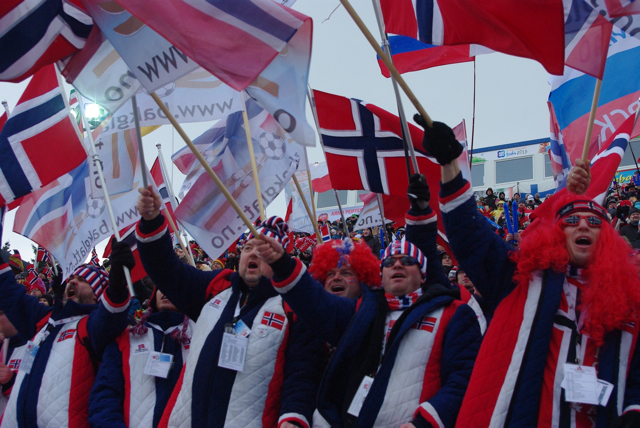
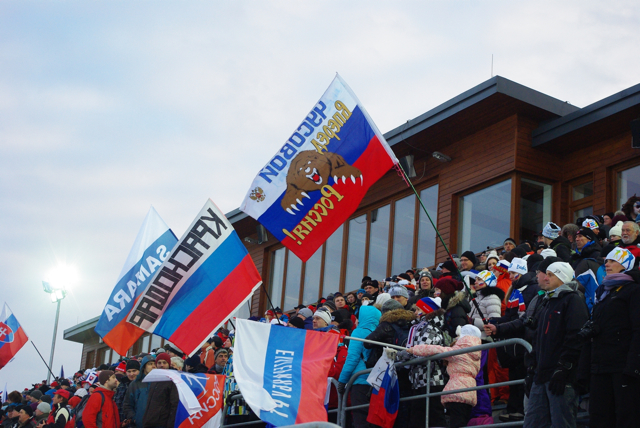
Norwegian fans were thrilled with Berger’s gold.
Tora Berger (NOR) leading Olena Pidhrushna (UKR) on the second lap as Olga Zaitseva (RUS) gives chase.
Sophie Boilley (FRA) and Anastasiya Kuzmina (SVK).
Olena Pidhrushna (UKR) leading Tora Berger (NOR) on the first lap.
Miriam Gossner (GER) and Ann Kristin Flatland (NOR).
Veronika Vitkova placed 8th for the home team.
Sprint bronze medalist Vita Semerenko (UKR) leading Olga Zaitseva and Olga Vilukhina (RUS).
Russians Olga Zaitseva and Olga Vilukhina competing in the pursuit at 2013 World Championships. Both were disqualified from the 2014 Olympics by the International Olympic Committee, with a whistleblower stating that the biathlon team was doping in the years leading up to Sochi.
Sprint champion Olena Pidhsrushna (UKR) was unable to handle the pressure and snag another gold.
Andrea Henkel (GER) at 2013 World Championships, where she took silver in the 15 k individual.
Veronika Vitkova (CZE), Jana Gerekova (SVK), and Magdalena Gwizdon (POL).
Olga Vilukhina (RUS) and Synnøve Solemdal (NOR) early on.
NOVÉ MĚSTO NA MORAVĚ, Czech Republic – 60 men started within two and a half minutes of each other in Sunday’s World Championships pursuit, but the gold medal was ultimately decided by just 2.4 centimeters, with Emil Hegle Svendsen of Norway outsprinting Martin Fourcade of France. Read our race report; here’s what the action looked like as the 12.5 k, four-stage race developed.
American teammates Lowell Bailey and Tim Burke lead Canada’s Jean Philippe Le Guellec on the second lap of the men’s 12.5 k pursuit on Sunday.
NOVÉ MĚSTO NA MORAVĚ, Czech Republic – Saturday’s sprint races couldn’t have been considered a big success for either the Canadian or U.S. teams, with only one of the 16 total athletes making the top 30.
But Sunday was a fresh day, and two of the North Americans woke up on the right side of the bed, kept their focus and positive attitudes, and turned what could have been a bummer of a starting position into strong race efforts.
Starting in the mid-30’s, Lowell Bailey of the U.S. and Jean Philippe Le Guellec of Canada skied and shot their way all the way into the top 15, with Bailey finishing 13th and Le Guellec 15th. Only one man, Dominik Windisch of Italy, moved up more places than Le Guellec – 25 to the Canadian’s 21.
But Windish was jumping from 58th, among the very last starters, to 33rd. Bailey and Le Guellec may not have been the biggest movers, but they were certainly among the most successful.
“It’s nice to have had this type of day because I haven’t really pulled anything worthy in pursuits this year,” Le Guellec wrote in an e-mail to FasterSkier. “So it’s nice to kind of ‘Feel like myself’ again in the hunt!”
Bailey climbed 19 places, and was similarly thrilled after a frustrating sprint.
Bailey leading a group of skiers into the range.
“I’m really happy with that result,” he told FasterSkier at the finish line. “I started 1:38 back and ended 1:20 back, so I gained time on the winner. I feel like I’ve prepared for that race all year, and I’m just glad to put one together finally… It’s always a disappointment to have what you think is a good race and then not end up where you want to be on the results list, so today was definitely a good day for my confidence. I’m really happy with the top 15.”
More than that, Bailey was pleased to have shot a perfect 20 for 20. He was one of only four men to do so, and it was a first in his career.
“I’ve shot clean a fair amount in two-stage races, but as far as World Cup races go, this is the first time I’ve shot clean in a four-stage race,” he explained. “It is a big marker for me career-wise. I’ve had that goal written down on paper going back as far as the Vancouver Olympics. I’ve come really close a lot of times, and I’ve done it in training and time trials, but to do it at World Champs, that was my goal.”
Le Guellec came close to doing the same, but missed one shot in the final standing stage; before that, he had been a bit ahead of Bailey.
“Shooting was on today and I was really happy with that considering it has been going since Oberhof and that it wasn’t an easy day in the range either,” Le Guellec wrote. “As for the missed shot, I was 19/20 with the wind pushing on the barrel and tried to compesate for that by pushing the round into the target. I ended up overcompensating and sending the shot slightly out of the ring. It didn’t go down.”
Le Guellec had the 14th-fastest ski time of the day, but said that he did most of his moving on the range: he’d come in, shoot clean, and then cruise past skiers who had been ahead of him as they headed to the penalty loop.
“I’m always aggressive in prone since it’s my strong position and it’s the best way to climb in ranking,” he wrote. “I kept my cool in standing, took the time to set up properly and they went down is the only way I can explain that feat.”
Bailey took a similar approach. In many World Cup races, particularly with head-to-head formats, he has been in the running late in the race, but then had an error or two in the final stages. Today, he focused a little harder, and managed to block out the din of the 20,000-plus screaming fans in the stadium.
“I really told myself each time going in, don’t worry about what’s going on around you, just focus on fundamentals,” he said. “It’s nothing new – that’s what coaches tell you, that’s what you train to do. But today I was able to really stay in my zone and not get distracted.”
Le Guellec, already flying on lap one.
Bailey and Le Guellec skied around each other for much of the race, and Bailey – who had the 18th-fastest ski time, a relief after a slow sprint race – reported that it was cutthroat out on the trails.
“It was a fiercely contested race out there,” he said. “It’s World Championships and everyone has a little bit of extra fire underneath them. So it was a fight from the start. A lot of pack skiing, a lot of jockeying for position on the course. You have to just keep your head in the game.”
He started trying to move up immediately, as is usually the strategy in pursuit races.
“The first lap was really hard,” he said. “I forget who was setting the pace, but it was me and Tim [Burke], and some other guys who are really quick on the skis. When you are starting in the 30s area, you’re still close to the top so you know you can have a good race, but you know you have to have a perfect race to do it. So everyone on that first lap was really trying to make up time.”
Le Guellec agreed.
“The pace off the bat was pretty aggressive,” he wrote. “But I’ve been feeling pretty good ski shape-wise since the begining of World Championships so I was able to hang on without stepping out of my comfort zone too much. It was nice to ski in packs today and made it to be a fun and interesting race.”
Both are now re-energized for Thursday’s 20 k individual race – where shooting matters, a lot. Each miss is penalized by a minute of added time, but the two have now proven that they can shoot as well as the best in the field. Paired with their fast ski times, things are looking up.
“See you on Thursday after the Individual!” Le Guellec wrote as the conclusion to his e-mail. “To be continued…”
* * *
The pair’s teammates were’t quite as lucky – or, perhaps, not quite as focused. For whatever reasons, things didn’t quite work on the course today.
In the men’s sprint, Tim Burke dropped from 28th to 32nd, and Russell Currier from 44th to 52nd; Leif Nordgren managed to improve ten spots from 53rd to 43rd despite six penalties.
For Canada, Scott Gow had a great start to his pursuit, hitting all ten prone targets and skiing from 45th up into the mid-30’s. But standing proved a challenge, and he missed five targets, dropping to 50th.
In the women’s race, his teammate Megan Heinicke improved ten places from 54th to 44th, missing three shots along the way. For the Americans, Susan Dunklee and Annelies Cook both collected five penalties; they finished 47th and 51st, respectively.
Tora Berger (NOR) leads Olena Pidhrushna (UKR) and Olga Zaitseva (RUS) on the second lap of the women’s 10 k pursuit at World Championships.
NOVÉ MĚSTO NA MORAVĚ, Czech Republic – On her best days, Tora Berger is perfect.
Today was not one of those days. The Norwegian, who leads the World Cup standings, missed three targets in the 10 k, four-stage pursuit, and had to ski three corresponding penalty loops. When she started, in bib two and just 6.4 seconds behind sprint winner Olena Pidhrushna of Ukraine, she was a favorite to take gold; by the time she left the third shooting stage that seemed unlikely, as she sat in third 23 seconds behind Olga Zaitseva of Russia.
“Before the fourth shooting, I was thinking that if I shoot clean in the last shooting, then maybe I would have a chance for a medal,” Berger said in a press conference. “I didn’t expect that I would take the gold.”
But the two women ahead of her, Zaitseva and Krystyna Palka of Poland, each missed a shot. And that gave the Norwegian, who is arguably the best standing shooter in the world, male or female, the opening that she needed.
“I saw that the first two had each had misses, and I knew that it was all on myself,” she said. “I hit all the targets, and then I went as hard as possible on the last loop.”
She left the range with a five-second lead on Palka, then skied the fastest last loop of anyone in the field to extend that to 18 seconds by the finish line. The usually reserved superstar could not contain her feelings, and was grinning from ear to ear with genuine happiness as she celebrated her gold medal – the second of this World Championships after she and her teammates won the opening mixed relay.
It was another success for the Norwegian team, which has rarely misstepped so far this weekend. Besides the mixed relay, Emil Hegle Svendsen has taken both men’s golds and Berger was silver in the sprint. After taking a day away from the stadium to do an easy classic ski tomorrow, Berger plans to be back in contention again in Wednesday’s 15 k individual.
“For me it’s most important that I try to do the best in all of the competitions,” Berger said. “And we’ll see after the Championships what that brings me.”
In Disastrous Crash, Medals Lost for Norway and Russia
Ann Kristin Flatland on the course’s first climb, before she lost the binding from her ski.
It was nearly an even better day for Norway – with a kilometer to go, Ann Kristin Flatland was locked in a battle for second place with Zaitseva. Both had passed Palka earlier on the loop. It would have been a storybook comeback for 30-year-old Flatland, who took last season off to have a baby and had just one penalty in the pursuit to move up from eighth position at the start.
But going around a corner, she and Zaitseva tangled. Flatland fell, taking out the Russian with her; Palka was able to fly past. Then Pidhrushna did, too.
“It was really shit – I don’t know what happened,” Flatland told Norwegian broadcaster NRK after the race (and after hiding from the press for a long time while she stopped crying and regained her composure). “It was a course that suited me well. On that last lap I felt so fit, like I was stronger than those around me.”
Indeed, Flatland’s skiing style is much like Svendsen’s – as her competitors skied up the hills in V1, she used her strength and power to V2 easily up the climbs. But she had even worse luck than Zaitseva, because when she crashed, Flatland’s binding ripped off her ski.
“I felt that time passed very slowly as I lay there,” Flatland said.
The team’s press coordinator, who watched Berger ski past and then wondered why Flatland wasn’t right behind, eventually found her on the trail and handed her a new ski. Flatland ended up seventh, over a minute behind Berger.
Zaitseva was able to get up more quickly, but the damage was done for her medal hopes as well. Although she was not hurt, she was unable to catch Palka and Pidhrushna, and finished fourth.
“Ann Kristin fell, and there was no room for me to maneuver in, so I fell too,” Zaitseva explained to the press. “She came up to me after the race and said she was sorry, and I understand that – it happens.”
Both the Norwegian and Russian teams filed protests about the accident – it’s hard to tell exactly what they hoped to accomplish – but withdrew them later, and the results stood as originally listed.
“Maybe we can play SingStar tonight,” Berger told NRK. “That’s at least one thing [Flatland] likes.”
Palka Capitalizes for Poland’s First Medal
Poland’s Krystyna Palka competing in Saturday’s sprint.
As Zaitseva and Flatland were trying to pick themselves up, Palka and Pidhrushna were carrying on their own battles – and wound up in the medals even though they weren’t necessarily expecting it when the left the range. Pidhrushna almost closed the gap to Palka, but the Pole was able to hold her off.
“Now we have medal from the World Championships for the women’s team!” Palka told FasterSkier as she waited for the press conference to start. “We have never had this.”
While Poland has had a World Champion before – Tomas Sikora won gold in the sprint back in 1995 – Palka indicated that there hadn’t been a medal for the women before. But the women’s team, which has seen several racers in the top ten on the World Cup this season, knew that it was possible one of these days. Starting with bib seven, Palka had her shot here in Nove Mesto.
“I know that we can really have some medals, and we were ready for this,” she told FasterSkier. “We have a lot of good competitions, but all the time we miss some shots or there’s something with the skiing. But we have a lot of chance for really good competitions, and finally I did this.”
She was helped along the course by the cheering fans, not only the rowdy Czechs, but also a large contingent from Poland; she said that it’s not so far to travel, so many came to see her and the other women race.
The World Championships medal adds another layer to Poland’s success in the nordic sports, and the biathlon team may be trying to emulate skier Justyna Kowalczyk. They aren’t so dominant just yet – but they certainly have more depth than the Polish ski team.
Pidhrushna leading Berger earlier in the race.
“We train alone as the biathlon group,” Palka explained. “But when I was a child I often had competitions with Justyna, and in school we were in one class together. We are friends.”
In the press conference, she struggled to describe what it meant to win a medal for her country.
“Today is a really special day for me,” she said. “It’s my first podium, and it’s at World Championships. That’s hard to say what I feel – I feel everything at once, all the time, I’m happy and I want to cry. I don’t know how to describe today.”
Pidhrushna also had conflicting emotions – she had been on track for gold at the race’s halfway point, but then missed two shots in the first standing stage.
“I think that was some internal pressure because I was leading,” she said through a translator in the press conference. “I was thinking about the second gold being possible, but I couldn’t cope with this pressure – I don’t have as much experience as some others. So I think that’s why I missed those two targets.”
She knew that her bronze medal today came at a cost to the other racers, too.
“After the last shooting I was skiing, and suddenly I saw two girls fall down on the track,” she said. “I went around them and was fine, so I was lucky today to get a medal.”
Despite the blown standing stage and the fact that her medal didn’t come exactly the way she would have hoped, Pidhrushna – who had never won a race before yesterday’s sprint, said she was still “happy” to be back on the podium.
Ekaterina Glazyrina of Russia and Andrea Henkel of Germany placed fifth and sixth after Zaitseva, capping off impressive runs through the field. Both hit a perfect 20 of 20 targets; Glazyrina moved up from bib 27 and Henkel from bib 33.
After Flatland crossed the finish line, Veronika Vitkova used the home crowd’s roaring cheers to propel herself past Vita Semerenko of Ukraine in a sprint finish for eighth, and Kaisa Makarainen of Finland rounded out the top ten.
Emil Hegle Svendsen was all alone coming into the final shooting – but then he gained some company on the last lap, and had to give it everything he had to win his third gold medal.
NOVÉ MĚSTO NA MORAVĚ, Czech Republic – After Saturday’s sprint, Martin Fourcade said that he would make up the eight seconds on Emil Hegle Svendsen and get the first shot off in the pursuit, and then go on to win.
Sure enough, partway through the first lap of skiing in the 12.5 k competition, there was Fourcade, right on Svendsen’s tails. Both cleaned the first stage and skied the second loop together. But Fourcade couldn’t hold onto the lead, missing two shots in the middle of the race, and didn’t return to the front until the last loop.
Even that was a surprise. Svendsen had shot clean until the last stage; he entered with an almost 20-second lead, and even after missing a shot and skiing a penalty loop, was the first to leave the stadium. Dmitry Malyshko was on his heels, and Svendsen assumed that he would be fighting with the Russian as he had earlier this season in World Cup racing.
But then, doggedly fighting through the trails, Fourcade popped up, again gluing himself to the back of Svendsen’s skis just as he had on the first loop.
“I was very surprised,” Svendsen said in a press conference. “I thought that me and Malyshko, who was also first out of the stadium, we were going to have a go, but all of a sudden these two guys were also there. So it was a change of tactics. I had to just wait for the sprint – that was my tactic when I saw that they were behind me.”
Over the last two kilometers the race developed into one of the most exciting in recent memory. Fourcade had brought Russia’s Anton Shipulin along with him, and suddenly there were four World Cup winners battling against each other, throwing elbows and tangling skis.
How had Svendsen been caught? The Norwegian is hardly a slouch when it comes to skating, and gave no evidence that he was holding back. Yet Fourcade eventually made his way to the front – and it seemed like he might go on to take his first gold medal of the Championships.
Svendsen and Fourcade, together on the first loop.
“Me and Anton had a little bit of a crash,” Svendsen explained. “I don’t know whose fault it was but we had a little bit of a stop-up in the last uphill, and when this happened Martin could pull away, four or five or six meters. This was crucial because I thought it was the end for me for the gold.”
Fourcade certainly made the most of his competitors’ momentary lapses, and put in an aggressive V2 sprint up the last uphill. Indeed, it appeared that it was all over – even more so because it is tough to remember the last time anyone outsprinted Fourcade when victory was on the line.
But coming down the last big downhill , Svendsen somehow used his momentum to catch back up to the Frenchman. As they crested the small rise before the stadium, he tried to go by on the inside, narrowing the V of his skis to sneak by. Fourcade would have none of it, predictably allowing him no space and clinging to the lead.
As the meters ticked down it looked more and more grim for Svendsen. But as any wily racer knows, as long as there’s one last downhill – no matter how small – the second-place skier still has a fighting chance.
“Then it was around the turn and into the stadium, I caught him and had some strength left for the sprint,” Svendsen said. “When I came behind him I could come off the backs of his skis with a little bit more speed, and this was what decided the pursuit I think.”
As they shot into the finish lines, Svendsen pulled wide. From the back he crept closer and closer, finally pulling alongside Fourcade as the finish line approached. At this point it looked like Fourcade would still prevail – but then he had a slight bobble and started his lunge early. Svendsen got in one more stride before he threw his leg forward across the line – and as Fourcade crumpled into the snow, Svendsen raised his arms in victory.
“I was not sure, but I had to sell it a little bit!” he laughed in the press conference. “I had a good feeling when I saw to my right that maybe I had one or two centimeters or so.”
Svendsen said that he had not looked at the photo finish, but Fourcade certainly had – even after picking himself up out of the snow, he thought he might have held onto gold. But it wasn’t to be – he lost the medal by a margin of just 2.4 centimeters.
Anton Shipulin of Russia, on the hunt.
“I’m now disappointed because it was so close – 2.4 centimeters,” a crestfallen Fourcade, not his usual boastful self, quietly explained in the press conference. “It was one of those times that you can’t see who is in the front. So that’s why it’s really hard for me to lose today, because I felt really good in the race, for the entire race. When I saw Emil on the left in the last meters I thought that I could beat him… I am disappointed. I will remember this 2.4 centimeters in each training session next summer.”
In their mad dash to the line, the pair – who are undoubtedly some of the best sprinters on the circuit – left the Russians in the dust. Shipulin managed to prevail over his teammate and take bronze, the first Russian medal of the Championships.
Although he had pulled himself up to the lead group, he wasn’t shocked that he couldn’t snag a gold medal out of it.
“I was not surprised at all, because I expected this,” Shipulin said through a translator. “They are formidable to me, I respect them, but next time I will be ready for such speed… This is just the start for our team, but it’s a good start. We have three more starts and of course we will fight for medals in all of them.”
Dominik Landertinger of Austria skied his way up from 15th to take fifth place, nine seconds ahead of sprint bronze medalist Jakov Fak of Slovenia.
But even at the end of the press conference – nearly a full hour after the finish of the race – the gold and silver medalists were shaking their head at how the race had played out.
“I thought I had it on the final uphill, but Emil was strong and he came back to me,” Fourcade lamented. “So, congrats.”
Svendsen was asked if he could remember such a close finish – and he could. Unsurprisingly, it was also against Fourcade.
“Martin and I were just talking about that,” he said. “We had a similar finish in the USA two years ago – in Fort Kent we had the exact same. So it was similar to that, actually. Today was very close, a very close finish. I thought that when Fourcade got a five meter gap on the last uphill that it was over for me, but I got some strength and managed to pull it off in the end, so I was very happy.”
For the Norwegian, it makes three gold medals in three tries here at World Championships. He was on cloud nine.
“This is a dream come true,” he said. “I have no words. It’s very special and I am very thankful and very lucky.”
Fourcade is sure to come back with a vengeance in Thursday’s 20 k individual race – he has lost to Svendsen by a combined 8.2 seconds in the two individual races so far, and also took silver in the relay – but Svendsen is gaining in confidence. He didn’t go so far as to predict a sweep, but he will certainly be in the hunt for medals once again.
“Out of the three competitions so far this was my best day,” he said. “My shooting felt perfect – I had very good control. On the last shooting it was a little bit more wind. This worried me a little bit. I had one missed shot. It was difficult shooting, but I managed to keep my head cool, and I’m happy either way.”
Scott Perras (right) and Lowell Bailey (USA, left) attack the course’s first climb in Saturday’s sprint.
NOVÉ MĚSTO NA MORAVĚ, Czech Republic – Things in Saturday’s sprint races didn’t exactly go as planned for Canada’s traditional top scorers.
“I have no idea what happened,” Rosanna Crawford told FasterSkier after finishing 77th with three penalties. “My shooting has abandoned me. I don’t know what’s going on. It was the same wind as my zero, so I’m sure I just pulled the shots. I felt a lot better. It would have been a good race if it weren’t for the shooting. But that’s the way it goes in biathlon, you’ve got to do both.”
She was narrowly edged by teammate Zina Kocher, who placed 74th with four penalties. In fact, the only Canadian woman to qualify for the pursuit was Megan Heinicke, who squeaked in with a 54th-place finish and two penalties.
Things were only a bit better for the men, with Jean Philippe Le Guellec left frustrated after missing three shots; he said he had “mixed feelings” as he skied well enough to place 36th, better than he would have expected from that performance on the range.
“It’s really disappointing in that respect, but skiing was awesome, so I guess as far as preparation for here and preparation for next year, it will just be a question of working on the shooting,” Le Guellec said.
Like Crawford, he didn’t really know where he had gone wrong – which is never a good feeling.
“It was a little more windy then at zero, so I kind of compensated instead of correcting, but I guess I didn’t shade enough with my first round in prone,” he explained. “But then I hit my next four. Then in standing I opted to go on the earlier lanes, just to stay out of the wind, but then I went and missed two anyway. So I don’t know, maybe it was too soon after the ski effort.”
Scott Gow.
Scott Perras and Nathan Smith missed the pursuit in finishing 66th and 73rd; instead the youngest member of the team, Scott Gow, will join Le Guellec after placing 45th.
“I’m super excited,” said Gow, who is competing at his first World Championships. “This was more or less my ultimate goal for the season, to move from the IBU Cup to getting that World Cup spot and then hopefully to World Championships, so overall, I’m happy I made it and happy to have a good race. It doesn’t get much better than that.”
Gow doesn’t even have much World Cup experience, so being in the deafening roar of the stadium seems pretty foreign. He’s been trying not to think about the added pressure – which clearly worked today.
“I try to just pretend that it’s like racing at home, but it’s a little overwhelming at times,” he admitted. “I don’t know how I did it. I just came out to training and to race like, don’t think about it, don’t think about it, don’t think about it. Don’t worry about the crowds or the enormous amount of people or any of that stuff. It has paid off so far.”
Like Gow, Audrey Vaillancourt is completely new to the hubbub of World Championships. She only started racing the World Cup after Christmas.
“It’s really a shock,” she said. “It’s huge, the difference. It’s so much faster here. You have to be strong and have really good shooting to do well here. It’s a big step.”
Vaillancourt finished 83rd; although she had been “really hoping” to make the pursuit, she said she couldn’t claim to have had a bad race.
“The caliber is so high here,” she said. “My goal this year was to be here, so I’m just really glad I made it.”
She hopes to refocus for the individual, where she thinks she has a better shot.
“The individual is really a different race,” she said. “Anything can happen. I’m really looking forward to it – my shooting has been really good since Christmas, only today in standing I’m not sure what happened. But it will be fine again.”
Also hoping to improve in the individual will be Perras, who when he talked to FasterSkier was on the bubble of making the pursuit. He ultimately ended up just outside the 60-man cutoff. He said that after a “pretty rough” mixed relay, he felt much better on his skis, and that the pre-Championships training camp had prepared him well.
“It’s always tricky because I find I ski a lot better off of volume, but there wasn’t exactly a lot of time to get in volume,” he said. “So we focused on intensity and had some good time trials. The conditions for the time trials were pretty tough, so it was good practice for here.”
Before he takes a crack at the individual, though, his three teammates will get to race the pursuits. Le Guellec may have had his best chance at a medal in the sprint, a format that he won earlier this year at the Ostersund World Cup – but despite that prior success, he said he hadn’t put that much more pressure on himself.
“I came out today and just wanted to do my thing, and it’s unfortunate that no matter the tactics I used in the range it didn’t pay off at all, so that’s really disappointing, but that’s how it goes,” he said.
He has made friends with the difficult courses here, so anything could happen in the pursuit.
“I love the course,” he said. “It reminds me of home – it’s a grunt, it’s a hard course, but at the same time it has a nice flow to it. You work hard for it. It’s fun.
Tim Burke skiing with Andreas Birnbacher of Germany. After struggling to stay healthy this season, Burke led the team in the World Championships sprint.
NOVÉ MĚSTO NA MORAVĚ, Czech Republic – On the one hand, today’s World Championship sprint didn’t go so well for the U.S. Both Tim Burke and Lowell Bailey – likely the team’s best hopes for medals – were frustrated to have missed some targets, and ended up 28th and 32nd.
But on the other hand, all four team members qualified for Sunday’s 60-man pursuit, which has to be considered a success. That’s twice as many as made the cut at the last Championships in Ruhpolding, and only a handful of times has the whole team qualified.
So while Bailey was deeply disappointed and Burke called it “a rough day,” they were ready to try again in the pursuit. One of the team’s younger members, 44th-place Russell Currier, was a bit happier with his performance.
“It was a decent race – my seasonal best, nothing too impressive,” Currier told FasterSkier after finishing with two penalties. “I almost made it into the points, so that was good progress. Training has been going well the last two weeks – I had really high hopes and I wanted a shot at redemption for what hasn’t been a stellar season so far.”
Except for Burke, who drew bib seven, the men were also left frustrated by course conditions, which devolved into deep, sugary snow as more and more skiers glided past over the course of the day. Bailey was particularly disappointed to have to start in the second seed; in World Cup racing, top-ranked racers can all start near the front, but at World Championships each country receives one entry in each of the four seed groups.
Bailey knew that he’d be in the second seed, but was hoping that he’d be lucky enough to draw a bib near the front of it. Instead, he started 78th – not the best case scenario he had imagined.
Russell Currier improved nearly 20 places on this sprint result from last year’s World Championships.
With bib 113 out of 136, Currier was stuck with some of the worst conditions. As such, he said, it wasn’t easy to gauge how well he had skied.
“I felt a lot better than I have, but it’s hard to say because I think the conditions really slowed down towards the end of the field,” Currier said. “But we had money skis today, we really had a good grind, and so that for sure helped. Given the amount of resources, we have a very put-together wax team.”
The team also seemed to have great skis in Thursday’s mixed relay, which bodes well going into the pursuit. Burke and Bailey will start just under a minute out of the top ten, with the others a little further back.
For Burke, who skipped the mixed relay because he was sick, today was a test, and something he thinks he can improve on with more starts.
“I did a lot of hard training [over the break], of course, but nothing is quite the same as racing, so this will really help me get into form,” he told FasterSkier. “It was okay on the skis and so it will get better. I’m feeling as healthy as I felt all year. I expect to do better and better in these races.”
He would have liked to have worked the kinks out in the mixed relay, but it wasn’t to be – he needed a few more days to gather his strength for the taxing, ten-day World Championships schedule.
“I wanted to start for sure, but I’ve had a kind of hard few weeks and it’s been really tough for me to stay healthy, so I wanted to really pace myself and pick my fights,” Burke said.
The last U.S. qualifier, Leif Nordgren, will start with bib 53.
* * *
Luckily for the women, the course seemed to stabilize for the second race of the day – or at least stop getting worse.
“What I heard was that for the guys it was sort of unfair, because it was nice and hard for the very first people and then not as nice,” Hannah Dreissigacker, one of the last starters of the whole field, told FasterSkier. “But it was the same when I raced it as when I was warming up, so I think once it got chewed up a little it was mostly the same. I think it was pretty fair. As soon as a few people go over it, it’s sugary.”
If the men had just a few misses too many, the women were even more frustrated on the range. Annelies Cook led the way in 45th place with two penalties, but was left wondering what might have been as she felt like she didn’t have much of an excuse for her missed shots.
Susan Dunklee had the 14th-fastest ski time of the day.
“I missed one standing that was an accident, when I pulled the trigger when I didn’t mean to,” a deflated Cook told FasterSkier at the finish line. “So that’s a bummer. I mean, that’s a penalty loop, and then I got distracted by it and missed one after that. It’s just a bummer because I had a really good prone and I felt like I was in control, but, it was a good effort, and I think I had a smart race, so I was really happy about that.”
After a stellar mixed relay leg on Thursday, Susan Dunklee also succumbed to errors on the range, racking up four penalty loops and finishing 49th. Sara Studebaker had two missed shots and just missed the pursuit in 65th place, while Dreissigacker, in the first World Championships race of her career, had a good thing going after a clean prone – but then missed three targets in standing and ended up 71st.
For Dunklee, the penalties were something of a mystery.
“The targets didn’t want to go down today,” Dunklee said. “I’m not sure what I was doing different from the other day, but the other day it felt easy, I didn’t have to do anything and it all felt routine. Today it just didn’t work…. My standing started so well, I hit my first three shots, and then I just don’t know – I lost my focus on the last two, or something.”
She said that she had expected a lot of herself after seeing what was possible in the relay, but that it hadn’t actually stressed her out too much – and maybe that was the problem.
“I felt so relaxed before the race – almost more relaxed than I ever do before a race,” she explained. “I have been feeling so good lately, and I had a good race already so it was less pressure, but maybe I was too relaxed.”
She shouldn’t change too much though: her ski time was the 14th-fastest of the day, clearly a good sign for the pursuit.
For Dreissigacker and Cook, the Nove Mesto experience has been about trying to manage the pressure and expectations. For Cook, who is in her third World Championships, it’s not the crowds so much as the fact that she’s having a breakthrough season, which creates a bit more expectation. She doesn’t want that to get to her head.
“It’s been such a big change for me this year, so every race it’s pretty exciting to see where I am, and I just try not to get too worked up, because for me it has to be just another race,” she told FasterSkier. “I feel like I’ve done a good job with that. But I did get nervous today – I started watching the guys’ race and I got butterflies. I’m glad to be done with today.”
For Dreissigacker, it’s also about expectations – in her first year as a full-time biathlete, she’s unsurprisingly doing better than ever before – but also the atmosphere, where well over 20,000 fans shout and scream as racers pass by on the trails or shoot in the stadium. Before these Championships, Dreissigacker had raced just a single weekend of World Cups, so it’s all new. She thought that had something to do with her three misses in standing.
“Honestly, I felt good in standing,” she said. “And then suddenly I had missed three, and I was like, shoot. I had better hit the last one, at least! I don’t really know. It was one of those things where a couple of them, I was sure they were hits. But then they weren’t. Maybe when you have all that adrenaline going, I just jerk the trigger more than I think or something.”
Before the start of today’s race, she had tried to plan for how to deal with the adrenaline. She thought she was somewhat successful.
“I was definitely worried about pacing, because when you have all that adrenaline it is easy for the first lap to not feel hard, but still be too hard,” she said. “So I tried to go the first lap at level three, threshold, and maybe it will actually be level four. And I thought I had, but then the next laps were really hard anyway. But I think that’s just how it’s going to be.”
Olena Pidhrushna of Ukraine earned the first win of her career at an opportune time, picking of a World Championship in the sprint.
NOVÉ MĚSTO NA MORAVĚ, Czech Republic – After a men’s sprint that saw three former World Champions pack the podium, the women’s 7.5 k competition threw something different down the pipes: a 26-year-old Ukrainian who had never won so much as a World Cup.
“Of course it’s a surprise for me to be in first place today,” Olena Pidhrushna said through a translator in the post-race press conference. “I dreamed of being a World Champion and winning a World Cup, but I didn’t think it would happen today – neither I nor my trainers and coaches thought it would be today. So I’m really happy to be first.”
Pidhrushna is certainly not an unknown, having earned second-place honors at two different World Cup venues so far this season. But to see her atop the podium was something of a surprise nonetheless; so far, most of the best performances have come from teams like Norway and France, whose racers are used to dealing with the intense pressure that comes at World Championships.
But Pidhrushna, who is a veteran despite her winless status, proved that you don’t have to be a superstar to keep your cool. She was flawless on the range, taking her time to nail all ten targets and avoid the penalty loop. Paired with the sixth-fastest ski time, she safely maneuvered to a 6.4-second win over World Cup overall leader Tora Berger of Norway.
“I tried to fight as hard as possible, but Olena was too strong,” Berger, who started just one bib behind the Ukrainian, said after the race.
Tora Berger heading towards the range.
She explained that she had held back a little bit on her first two loops in order to “save some energy” for the last round of big uphills. And Berger did have the fastest split time on the last 2.5 k loop, cutting five seconds out of Pidhrushna’s lead. But Pidhrushna was also going for the win, and her determination kept her just far enough ahead of Berger to secure gold.
“After my second shooting I was first, but it was hard – I knew that it would be to die or to win,” Pidhrushna said. “So it depended only on me, how I raced today, and I did the best that I could.”
When she and Berger crossed the finish line, they bumped another Ukrainian out of the lead: Vita Semerenko, who as the owner of two previous World Championships bronze was far more of a favorite to be on the podium than her lesser-known teammate. Like Pidhrushna, she shot clean. But starting in the first group with bib 19, she knew that her perfect score wasn’t necessarily enough to guarantee her first gold.
“When I first crossed the finish line, I was confident that I would have a medal, but I didn’t think that it would be a gold medal because a lot of good rivals were behind me and I thought they could pass me,” she explained.
Then she added, laughing: “And unfortunately they did!”
So instead, she settled for her third bronze. But Semerenko still seemed pleased, smiling her way through the press conference as she celebrated a great day for her team: twin sister Valj had two penalties to place 22nd, and will also be a factor in the pursuit race tomorrow.
“Of course I would not tell the secret [of our success], but I think the secret is with our trainers,” Semerenko said, laughing again. “They did a really good job of preparing us for the World Championships. And also our servicemen did a good job today, to give us fast skis, and we did a good job too.”
Pidhrushna agreed, still in a daze at her good fortunes. Although she had placed second in the pursuit in Antholz, Italy, the last World Cup before the pre-Championships break, being on the podium today was still the last thing she expected.
“I wouldn’t say that I was confident after Antholz, because after the end of the World Cups I was ill, and I didn’t train for several days,” she said. “It was only last week that I trained, so I would like to thank my trainers because they did everything for me.”
The Russian women raced well, but were ultimately locked out of the podium as Olga Zaitseva and Olga Vilukhina finished fourth and fifth. An early starter, Zaitseva had one penalty and looked to be in good shape to stay on the podium; she ended up just two seconds behind Semerenko. Vilukhina shot clean, but didn’t have quite the ski speed needed to earn a medal.
Miriam Gossner of Germany, currently third in the World Cup standings, was undone by two penalties in prone and finished sixth; it was still an improvement from the mixed relay, where she used four spare rounds and was forced to ski a penalty loop, which coupled with slow skis and skiing was a disaster for Germany. Sitting just 33 seconds out of the lead, the World Cup’s fastest skier is definitely a threat for the pursuit.
Krystyna Palka of Poland finished seventh, followed by a clean-shooting Ann Kristin Flatland of Norway; Kaisa Makarainen of Finland and Veronikia Vitkova of the Czech Republic rounded out the top ten.
Emil Hegle Svendsen of Norway following Dmitry Malyshko of Russia onto the range; Svendsen won the fourth World Championship title of his career, while Malyshko placed fifth.
NOVÉ MĚSTO NA MORAVĚ, Czech Republic – Three years ago, Emil Hegle Svendsen of Norway was the king of biathlon.
Then the young guns intervened. First, teammate Tarjei Bø claimed the 2011 crown, along with a string of World Cup and World Championships victories. Then Martin Fourcade of France rose to the top, fighting Svendsen neck and neck all season but dominating the World Championships in Ruhpolding, Germany, where he took three titles.
Svendsen came into this season determined to win his way back, but coming into this World Championships he trailed Fourcade by 62 points, or about one win, in the total score. And speaking of wins, the Norwegian had only collected one of them.
But the Championships started off well for the Norwegian team, as Svendsen held off Fourcade in the mixed relay. In the press conference, he said he was not worried that the Frenchman was chasing him. Then in today’s sprint, Svendsen calmly executed his plan, hit his targets (mostly), and beat Fourcade by 8.1 seconds to win the first individual title awarded here in the Czech Republic.
Still, Svendsen said he wasn’t thinking about any of the history – just going out and doing his job.
“Every race has its own life,” he said in a press conference. “Last year is last year and today is today, so that didn’t have so much to do with it, but I had a goal to do the same as in the mixed relay on the tracks and on the shooting range, and I managed to do that , so I am happy.”
Starting just four bibs apart, the two battled through the 10 k, two-stage race; each cleaned the prone stage, and then missed one shot in standing, earning a penalty loop apiece.
Martin Fourcade on the trails.
“I think [the penalty] was loss of focus and also part of biathlon,” Fourcade said. “I am a bit disappointed about this target, but Emil did one too, and that is the game, you can’t be perfect all the time. I wasn’t today, but I’m very happy with the place.”
Unlike his Norwegian rival, Fourcade, in typical fashion, did make the race personal. He knew exactly who his biggest competition was likely to be, and wasn’t afraid to talk up the matchup that will happen again in the pursuit tomorrow.
“I expected it,” Fourcade said of Svednsen’s fast skiing. “But I am really happy with what I did, I did almost 100 % of what I could do, and in this kind of race you have to just say congratulations to the better one… and I hope to beat him in the pursuit.”
Svednsen, for his part, said that when he crossed the line he wasn’t sure if he would hang onto the lead. Here at World Championships, racing is organized a bit differently than a t a regular World Cup, with each country receiving one starting position per seed rather than all of the top racers starting together at the front.
“There were almost 100 athletes left on the tracks after I crossed the finish line, so I had no idea if I was going to win,” Svendsen said. “I had a good feeling, but with one mistake you can never be sure. If I had shot clean then maybe I would have been more secure when I crossed the finish line. But today there were really strong athletes in the third and fourth start groups.”
It initially seemed that Fourcade’s teammate Alexis Boeuf would earn the final medal of the day. But the later seeds also made a charge at the podium. First, Dmitry Malyshko of Russia tried to redeem himself after a relay meltdown on Saturday, shooting clean and bumping Boeuf off the podium by just two seconds.
But it didn’t last as Jakov Fak of Slovenia, who won two World Cup races earlier this season, used his own clean sheet to come just as close. Leaving the range after standing, he was in a dead heat with Malyshko, with a split 5.8 seconds behind Svendsen – and five ahead of Fourcade. While he ultimately trailed the Frenchman by three seconds at the finish, he was able to put some time into Malyshko and secure bronze.
“My coaches gave me all the information,” Fak explained in a press conference. “I couldn’t say that I had a great last loop – I lost some time to Martin. But I’m very happy with the bronze medal and I think that every athlete that wins a medal at the World Championships should be very happy because it’s such a strong field. It’s a great achievement for me.”
Fak was the World Champion in the individual race last year, and said that he had believed that format was once again his best hope for a medal. After the mixed relay, he hadn’t been feeling so good on his skis – and he knew that the field would be “killing themselves” to win the sprint. With a few more days to recover, the individual seemed like a better shot.
But he ended up feeling better on his skis today – still not perhaps himself, as he can often make up for errors on the range with fast skiing, whereas today his bronze came despite better shooting than Svendsen and Fourcade – and earned the medal after all. That takes some of the pressure off after a disappointing mixed relay, where the Slovenians were unable to repeat their medal from last year and finished fifth.
“We won a medal last year, and we wanted to get the pressure off the whole team but it didn’t work out so good,” Fak said. “Before the World Championships I wanted to win a medal but I didn’t expect it in the sprint. But today I felt good, especially on the shooting range, and I was able to get the third place.”
The snow on the course broke down somewhat over the course of the 132 starters, and Fak said that he was at a slight disadvantage starting 20 bibs behind Fourcade, although he didn’t go so far as to say it kept him from a silver medal. The uphills were fine, he said – they held up better than they had in the mixed relay – but the downhill corners got deep, which slowed him down.
Ole Einar Bjørndalen of Norway, starting a few bibs behind Fak, notched his best result of the season, coming in fourth despite a penalty in standing. The aging superstar had appeared to be out of sorts and finally no longer a factor in races earlier this season, but his skiing today served as a reminder that not only is he still earning starts, he’s very much a threat.
“The sprint was my favorite distance before,” he had told Norwegian broadcaster NRK before the race. “I really want to fight back and show that I can assert myself there again… but I don’t know how good of shape I’m in.”
As it turns out, pretty good shape: his ski time was the fourth-fastest of the day. He led after the prone stage, but dropped to fifth with his penalty in standing. Nevertheless, he was able to beat Malyshko on the last loop.
Boeuf held on to sixth, followed by Anton Shipulin of Russia and Fredrik Lindström of Sweden; Evgeniy Ustyugov of Russia and Simon Eder of Austria rounded out the top ten.
Tomorrow’s pursuit is shaping up to be exciting, as Fourcade said that he planned to make up the eight seconds on Svendsen so that he could take the first shot of the race. Fak, meanwhile, said that he hoped to ski down the three seconds to the Frenchman and ski together with him as well. Each man has won a pursuit so far this season.
And in the battle for the World Cup title, Fourcade is still ahead. While Svendsen earned 60 points for his win, second place is worth 54, so he only crept a bit closer to the lead. To cut further into the deficit, he’ll have to win more. In the press conference, Svendsen was asked if he could imagine doing just that.
“How many more [golds] can I imagine?” he laughed. “I can imagine four more, but I don’t think that is realistic. I have a goal to be on the podium more times this World Championships, but still it’s a lot of work to do. I’m very happy now that I have reached my goal, and I’m just going to have fun for the rest of the time here.”
As Czech flags wave in the background, the mixed relay field sets off in pursuit of the first World Championship title of 2013.
NOVÉ MĚSTO NA MORAVĚ, Czech Republic – For the athletes here at IBU World Championships, the competitions represent the test of a year’s worth of training, all carefully planned and executed.
But for the inhabitants of this small town of just over 10,000, and perhaps for Czech winter sports itself, the nearly two-week event is also a test. How well can a winter sports federation and organizing committee which are definitely not among the sport’s wealthiest pull off a major championship event in a previously unremarkable venue?
Because it’s easy to forget, standing in the brightly lit stadium with tall grandstands holding well over 20,000 fans rising on every side, that just a few years ago there was barely any infrastructure here. The football-stadium feel? That’s new. Even athletes who have been traveling here for years are surprised to see the changes.
“This was one of the first venues I ever came to to race in Europe,” American biathlete Susan Dunklee told FasterSkier. “It was for an IBU Cup, and I couldn’t recognize it now from then. It’s so different. The stands, this whole part of the stands is new, that part was new last year, the wax facilities were new last year, they changed the course last year to make it more on the other side of the road, so it’s totally different. It’s cool to see.”
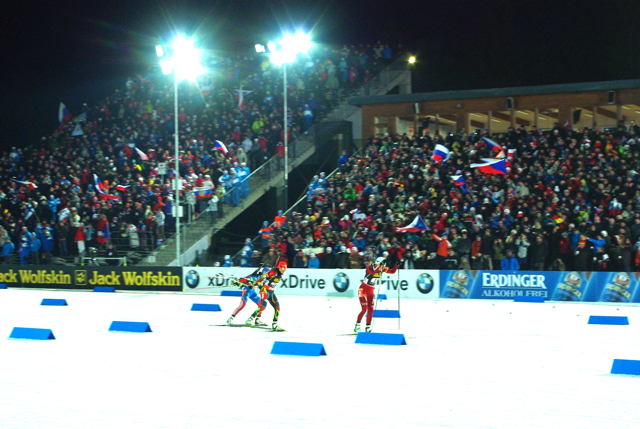
And more than simply the infrastructure, it’s the rabid enthusiasm of the Czech fans that was remarkable as World Championships kicked off with the mixed relay on Thursday. Racer after racer commented on the atmosphere in the arena, with Martin Fourcade of France noting that it was a great advertisement for the excitement of biathlon. Synnøve Solemdal of Norway said that she was “surprised, but happy” to see the how much Czechs love biathlon, and teammate Emil Hegle Svendsen described a “fantastic audience.”
Even as a journalist, volunteer, coach, or other support staff, standing on the infield sends a jolt of adrenaline through your system. The fans sing along with the announcements on the loudspeakers; they cheer to thank the range officials. The 27,000 voices boom and crack through the night air. Even before the race kicked off, U.S. shooting coach Armin Auchentaller marveled at the atmosphere as he stood behind the firing line.
The town held its first World Cup competition here last year, and even then it wasn’t clear that World Championships would turn out to be the high-octane event that was seen on Thursday. Competitors who raced in the test event were still surprised when they showed up this year.
“It’s awesome,” Canada’s Jean Philippe Le Guellec told FasterSkier. “The crowd is really phenomenal and it’s really nice. I didn’t expect to have this kind of turnover, but when we got here and saw the stadium we had a glimpse of what would be possible, and here it is.”
And so, surprisingly, the tiny Czech Republic is taking its place as a hotbed of biathlon. The bronze medal by the home country’s mixed relay team in the opening race proved that they have the athletic chops; the fans prove they have the enthusiasm.
“The stands are packed,” U.S. athlete Leif Nordgren said. “It’s awesome. This is the loudest crowd I’ve ever had, I think… Seeing the size of the stands, it’s not surprising, but whenever the Czech team was shooting, it was deafening. That was really cool.”
Other athletes agreed: watch out, traditional venues. This little town is on the schedule to stay.
“It’s awesome, totally awesome,” American Lowell Bailey told FasterSkier. “Germany might be the home of biathlon, but Czech has just as much or more atmosphere. And to have them get the bronze today, it couldn’t be more perfect for them. We’re good friends with that team. They’re all great guys, I’ve trained with them, and they deserve it, absolutely.”
The bottom line seemed to be that the organizing committee’s hard work paid off. Dunklee pondered the immense effort it must have taken to get the venue in shape for such a successful event.
“You look at all the blue and white outfits around here, the volunteers,” she said. “And then all of the spectators that they convinced to come. They have a lot of enthusiasm – it’s phenomenal. I wasn’t expecting it to be another Ruhpolding or Oberhof, but it looks like it is.”
Martin Fourade (FRA), charging on the anchor leg.
Karin Oberhofer of Italy takes the tag on leg two.
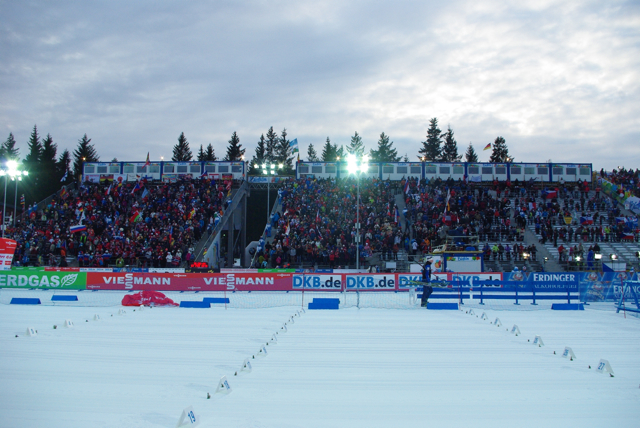
The stands.
More of the stands.
Olga Zaitseva (RUS) warming up.
Annelies Cook (USA) gets ready to start.
Looking across the starting area at the stands, an hour before the race.
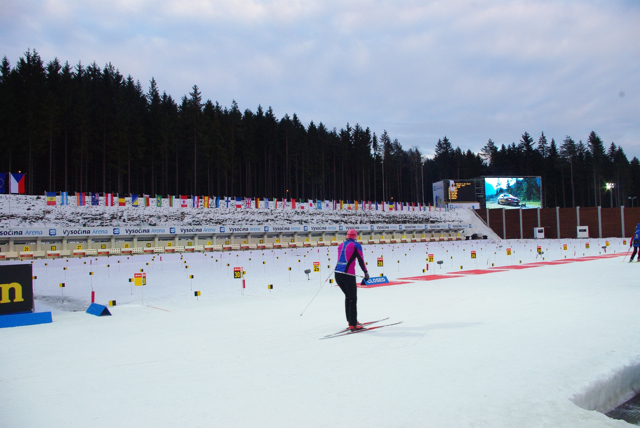
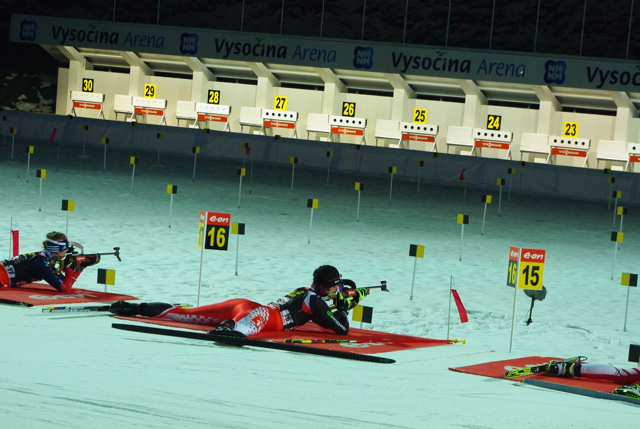
The shooting range, pre-race.
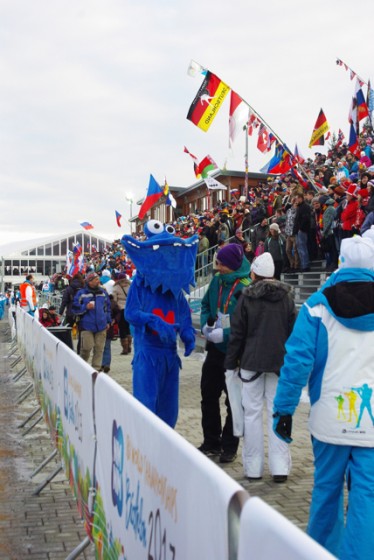
One of the event mascots.
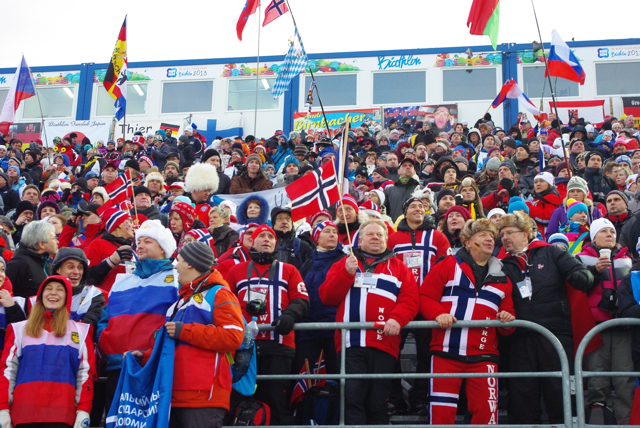
Norwegian fans.
Russia fans.
Tora Berger (NOR) leads Veronika Vitkova (CZE) and Olga Zaitseva (RUS) on the first leg.
Dmitry Malyshko (RUS) before imploding on the final leg.
Rosanna Crawford on the range during the mixed relay on Thursday. It is the first World Championships for the Canmore native.
NOVÉ MĚSTO NA MORAVĚ, Czech Republic – For the Canadian team, just being in the stadium at World Championships for yesterday’s mixed relay felt pretty good.
Take Rosanna Crawford, the scramble leg skier for Canada. With her breakout season – she finished 12th in a World Cup sprint in Pokljuka, Slovenia, earlier this year – it’s easy to forget that the whole World Championships experience is new for her.
“It’s pretty crazy,” she told FasterSkier, practically shouting over the din of the 27,000 spectators who were cheering as the second-leg women shot on the range. “This is my first World Champs and I’m pretty stoked to be here. It’s an amazing crowd – I can’t believe how many people are here. It’s so cool.”
While Crawford said the craziness didn’t get to her too much and she was able to focus, things still didn’t go as smoothly as she would have liked. On her best days, Crawford is nearly perfect on the range. On Thursday, she relied on two spares in prone and one in standing to knock down all her targets.
“That is too many for me,” she said. “I think I might have come in a bit too hard on my prone, and not hard enough on my zero. Sometimes that pushes my shots high… So hopefully the other guys can have a better shooting day than I did.”
Nevertheless, there were plus sides to her performance: despite the errors she tagged off in 11th place, just over a minute behind Tora Berger of Norway. That isn’t a bad spot for the Canadians, and Crawford felt good on her skis.
“Skiing was definitely way better than Ruhpolding and Antholz,” she said, referring to the January races where her ski speed was not up to par with her earlier strong results.
Megan Heinicke took over and improved slightly on Crawford’s shooting, using only two spare rounds total rather than three. But she was stymied on the trails, skiing the 19th-fastest time of her leg and dropping to 14th. From there, Jean Philippe Le Guellec took over. Although he shot the same as Heinicke and skied better, he wasn’t able to gain any spots.
Still, like Crawford, he felt that the relay was a positive way to kick of World Championships.
“It’s good to be back at World Championships, being healthy,” said the Canadian, who this season is finally getting over the long-lasting effects of mono. “I think that’s the main thing. For the rest, we did preparation, and we’ll see how it goes during the week, but I think we’ve done all we can do for now. It’s just to ski hard and shoot.”
Scott Perras embarks on the anchor leg of the mixed relay.
As he watched the video screen to see how anchor leg Scott Perras was doing, Le Guellec said that he thought the relay would turn out to be “an okay race, but nothing phenomenal.”
For his part, he was relatively happy, and said that it was good to test out the courses, which he knew would present challenges throughout the week.
“It’s a really, really, really hard course,” Le Guellec told FasterSkier. “It’s just right out of the range you’re going up for quite a while. You don’t have a lot of recovery once you get to the top – you have a small horseshoe which goes down, but you’re not really recovering because you need to turn a lot, so the recovery is pretty hard. Then you’re going up again for another 30 or 40 seconds.”
And as for how to handle that level of difficulty? His strategy seemed to have worked so far.
“It’s very demanding but I paced myself,” Le Guellec said. “You really have to. It’s a fun course though.”
Perras ended up using one spare in each stage, and despite strong skiing dropped to 15th; more than any mistake on his part, that was perhaps due to a charging Fredrik Lindström of Sweden, who was frustrated to receive the tag in 15th and skied the fifth-fastest anchor leg to pass Canada and move up a spot.
15th is still an improvement on Canada’s result from last year’s World Championships, where Zina Kocher, Megan Imrie, Le Guellec, and Nathan Smith finished 18th.
Susan Dunklee had the best time of any woman in the second leg of the relay.
NOVÉ MĚSTO NA MORAVĚ, Czech Republic – Every racer on the circuit tries to peak for World Championships, but despite the most careful of preparations, there are always questions: am I ready? Am I in my best shape? Can I win?
Although it has developed into a fiercely competitive race, the mixed relay – initially its own World Championships held after the last World Cup of the season, then incorporated into mid-season World Championships – serves also as a sort of litmus test. Before the individual racing begins, racers can test their shape in a team format.
For the Americans, the team passed the test.
“It’s always good to see where you are and I was skiing with Klemen Bauer [of Slovenia, the fastest third-leg skier] for most of the race, so, that’s a good sign,” said Lowell Bailey, who held the team steady in eighth.
Although the U.S. has had success in the format before – with just two men and two women, it gives smaller nations a fighting chance to duke it out with the big dogs – that has never been the case at World Championships. Since the event’s inception the Americans have failed to start three times, and their best finish was 12th in Ruhpolding last season.
In the Czech Republic today, they improved to eighth, the best World Championships result ever for the team.
Things started out with Annelies Cook, who was just off the lead pack after a perfect prone stage. She encountered trouble in standing, and eventually used all of her spare rounds. Cook tagged off in 14th, over a minute behind Tora Berger of Norway, and yet Bailey said that she’d done a great job controlling the damage.
“Annelies struggled with one her stages, but it’s all about not skiing penalty loops,” he explained. “She was able to stay in it, which kept us in contention.”
Lowell Bailey in a pack of other top teams.
Cook had the seventh-fastest ski time of the leadoff skiers, and the next racer, Susan Dunklee, was ready to go even farther. Dunklee blazed around the course in the third-fastest time, and coupled with a single spare round, her split was the fastest of all the second-leg skiers. One highlight was skiing the last loop with Darya Domracheva of Belarus, last year’s World Cup runner-up.
“I think I passed her!” Dunklee laughed after the race. “She passed me and then I passed her. It felt great. I was sick for the first week or so of January, and I didn’t feel like I was quite 100% on form again until Antholz when we were training the last couple of weeks. I felt really good lately.”
For Dunklee, skiing fast was great, but shooting so well was magical.
“The prone, the last week or so in practice I’ve been able to hit the targets and it felt easy, and when I miss I’ve known where the misses are, and it was like that today,” she said. “So I was so excited about that. The standing was pretty stable. I don’t know what happened with that one miss, but it didn’t bother me, I was able to refocus.”
Bailey had been through something of a funk of his own in January, although not as directly related to illness as Dunklee’s was, and was pleased with his racing today. He used two spares in prone, but his shape was good enough that he was able to respond to that unexpected challenge.
“That set me back out of that pack I was in,” Bailey said. “Then I cleaned standing, which was good, and I was able to make some up on the last loop… I felt good. I had good preparation through the Antholz camp and managed to stay healthy and everything. It was really nice to have a few days off just to reset, and then just ramp up for World Champs.”
Dunklee agreed that the two-week training block in Antholz had done wonders for her ski form.
“It was huge,” she said. “I needed to reset, physically and mentally with the shooting.”
Leif Nordgren rounding a corner in the stadium.
The U.S. anchor was Leif Nordgren, who was racing in the place of Tim Burke, who hasn’t been completely healthy in the last week. The men had differing views on how this affected things: Bailey said that considering Nordgren didn’t know he was racing until a few days ago, “hats off to him.”
Nordgren himself was less impressed.
“Tim has been battling some sickness for a while now, so I kind of knew there was a possibility and I was prepared for it,” he said. “It’s just another race.”
A single spare round in prone and then a clean standing stage moved Nordgren into seventh, but he wasn’t able to hold that. Matej Kazar of Slovakia caught him on the last loop, and Nordgren was just edged in a photo finish.
“I didn’t have a lot of gas left on the last loop,” he admitted. “But I did ski I think probably a fairly even race. The tracks were a little deep in some places, but I was happy with my skiing too. It was a good first race.”
Nordgren didn’t quite share Bailey’s conviction that the eighth-place result was amazing, but he might have just been disappointed at losing that photo finish. Still, he said it was a strong result, and that eighth place at World Championships means more than the same finish would in a World Cup.
“I don’t think it’s the best, but it’s a good result, especially considering that it’s World Championships and everyone has their top teams,” he said.
Breaking the race down, the team still sees room for improvement. In total, their ski times added up the sixth-fastest of the day – and within seconds of several faster teams. Instead, the range will be the focus as the team prepares for 2014, where the event will make its Olympic debut. It may be one of the team’s best chances for a medal.
“I see this as a really strong performance for our team and a good indicator that the team is ready for the World Championships,” United States Biathlon Association President Max Cobb wrote in an e-mail. “Susan Dunklee had a super ski time and overall the team was just two seconds off the Russians. The shooting was solid but we can still be faster on the range, it is our goal to improve that for next year so we can contend for a mixed relay medal in Sochi.”
On the range, the Americans were in total a minute slower than the winning Norwegian team. That was more on par with teams out of the top ten than those on the podium, and erasing that deficit would have put them almost exactly on par with the bronze-medal Czech Republic.
But it’s good to have something specific and tangible to work on, and for now, Cobb says, the team is doing just fine – as evidenced by their best result ever.
“The training has been good, confidence is growing and the team spirit is really good,” he wrote. “I think this opening today is very reassuring for everyone – we are ready to perform. I think we will see some more personal bests at these championships.”
27 teams started today’s mixed relay at IBU World Championships, under the lights in Nove Mesto, Czech Republic.
NOVÉ MĚSTO NA MORAVĚ, Czech Republic – For Norway, today’s World Championship title in the mixed relay was like a walk in the park, a simple repeat of last year’s victory.
Except, if anything, the 2013 edition was more straightforward: there were no malfunctioning targets, no win that came despite crossing the finish line second behind Slovenia. No hiccups of any kind. Instead, Norway led nearly from start to finish, and earned a 20-second victory over the French.
World Cup overall leader Tora Berger kicked things off with a typically flawless leg, cleaning her targets with no spare rounds and then skiing away from the competition on the final loop for a 12-second lead. Synnøve Solemdal was the only team member who put the win in jeopardy, but it was just barely: she used two spare rounds in standing and tagged off 3.7 seconds down on Olga Vilukhina of Russia.
From there, the Norwegian men took over, starting with Tarjei Bø. He quickly caught Russia’s Anton Shipulin – Alexis Boeuf of France did too – and the lead pack cruised easily on the first lap.
Tarjei Bø and Alexis Boeuf quickly caught Anton Shipulin; it was just the start of Russia’s problems.
Bø, the 2011 World Cup champion, had so far had a rough season that didn’t even start on time thanks to health problems over the summer, but he didn’t so much as flinch on the trails and looked to have regained his ability to dominate.
“It was the first race this season that I feel like myself, so it was good,” Bø said after using a single spare round in the whole race. “I had some power on the uphills, and this is my strength. In January it was my weakness.”
He handed Emil Hegle Svendsen a 12-second lead over Russia, with France a bit further back. Russian anchor Dmitry Malyshko has had a breakout season, but perhaps the pressure of anchoring at World Championships got to him, and he uncharacteristically blew it on his prone stage. After using all three spare rounds – losing valuable seconds in the meantime – he still had to ski a penalty loop.
From that point Russia was out of the race, but their loss was a gain for France, which moved into second. Svendsen had to use a spare round in standing, at which point French anchor Martin Fourcade was on the range, but it was not enough to make much of a dent in his lead.
In the postrace press conference, a French journalist asked Svendsen how he felt in that final stage, undoubtedly hoping to hear that the Norwegian had to focus hard to overcome his nerves as Fourcade stalked into the range, ready to pounce.
Emil Hegle Svendsen in his element, taking the lead on the final leg.
But Svendsen is a big-race veteran, knows that he can respect his competitors without fearing them. No such response was going to come out of his mouth.
“I was pretty confident,” he said. “My first five shots were quite good and I knew that I would hit the last one, so there was not so much stress… It’s always a big relief that you have the gold medal in the pocket. It was a fantastic feeling for sure.”
Fourcade congratulated Svendsen, and said that he gave it his best, but the 30-second gap he started with was too much to close on the quick-skiing Norwegian.
“I knew after the shooting that it would be really hard to catch him,” Fourcade said. “I tried at the beginning of the lap, but then he got a bit too much of an advantage. It was really good race – I think it is a good advertisement for biathlon and an exciting way to have the beginning of the World Championships.”
While the win was exciting for Norway, what really electrified the sold-out 27,000-strong crowd here in Vysočina Arena was the Czech team. Every time a Czech was on the shooting range, the stadium would explode with noise for each hit and miss. Every time a Czech skier came on the video screen, the crowd would erupt again.
The bronze medal was not exactly surprising – the team has been strong all year, with Ondřej Moravec earning two podiums and Gabriela Soukalova three, including her first win. Still, though, it was not expected to see the home team on the podium instead of the Russians or the Germans, who struggled with shooting and finished a dismal 13th.
“The bronze medal is a pleasure for us,” Soukalova said in broken English in the press conference, visibly overcome with emotion.
Veronika Vitkova started things off with two spare rounds in prone, and tagged off 44 seconds out of the lead. Not exactly an auspicious start when a team wants to win a medal.
“I know I made two mistakes on the first shooting, but at the end everything came together and it came out pretty well,” Vitkova said through a translator.
Marie Dorin Habert of France leading Gabriela Soukalova of the Czech Republic.
Soukalova used a single spare before Jaroslav Soukup jumped up a few more places with one spare of his own. It was particularly good to see after the Czech racer, who earned individual bronze at last year’s World Championships, was in a horrific bike accident this summer that left him with multiple serious injuries on several parts of his body. His return for this Championships hadn’t been guaranteed, and when he said earlier this season that he hoped to be a medal contender, it seemed like a long shot.
But aside from shooting well, Soukup had the fifth-fastest time among third-leg skiers.
“After the accident was really hard for me,” Soukup said in the press conference. “I wasn’t thinking about biathlon. But now I feel like a normal person. I feel good and I can actually do biathlon.”
That left things to Moravec, who capitalized on Malyshko’s shooting woes and moved into third as the Russian worked his way through spare rounds. Unlike Malyshko, Moravec was flawless on the range; he knocked down all ten targets and was especially impressive in standing, where he cleaned quickly and earned the guarantee of bronze.
“It was such an amazing feeling,” Moravec said in the press conference of the final lap. “For us it’s like being a winner – a gold medal winner. We’re so happy. And at home in Nove Mesto, too.”
The surprises did not stop there, as Italy placed fourth, a definite surprise; Slovenia, last year’s runners-up, were fifth and Russia limped in for sixth. The United States placed eighth and Canada 15th; stay tuned for more from those teams.