Tag: Jay Hakkinen

  • Bailey Ninth, Hakkinen and Leguellec Top-Twenty in World Cup Biathlon Openers

    Martin Fourcade after winning last year's World Championships pursuit. Photo: nordicfocus.com

    One by one, last year’s heroes succumbed to errors over the course of the opening biathlon World Cup race in Ostersund, Sweden on Wednesday.

    Norwegians Tarjei Boe and Emil Hegle Svendsen, wearing the yellow and red bibs of as the previous overall and discipline leaders, only made it four kilometers before the mistakes began. Racing near the beginning of the field in the interval-start competition, each missed two shots in their first of four shooting stages – and in an individual race like today’s, where each missed shot is rewarded with a one-minute time penalty, that hurts.

    Ole Einar Bjorndalen of Norway missed six shots. Bjorn Ferry of Sweden missed five. Germans Michael Greis and Arndt Peiffer missed three, as did Switzerland’s Benjamin Weger and Russia’s Anton Shipulin.

    Who was left atop the leaderboard after twenty kilometers?

    Martin Fourcade of France, that’s who. Last year’s third-place finisher in the overall World Cup and World Championships pursuit victor missed just one shot – and on a day when not a single competitor went clean, he won by almost two minutes.

    Fourcade came into the final shooting stage with Dominik Landertinger of Austria. Neither man had made a mistake, but while Fourcade held the lead, shooting errors could change everything.

    “I knew that if I shot clean in the last stage, I could win,” Fourcade told IBU News. “But it is not good to think like that and I missed one shot.”

    It had to have been a nervous moments, but the Frenchman still came out on top. Landertinger faltered in a bigger way, missing two shots to Fourcade’s one. The Austrian ended up fourth place, just three seconds off the podium.

    Fourcade, meanwhile, skied through to the finish with a massive cushion. Michal Slesingr of the Czech Republic and Simon Schempp of Germany joined him on the podium, separated by just 0.2 seconds after each missing one shot.

    While many favorites had missed early on, two Americans followed different trajectories over the 20 kilometers. Lowell Bailey had shot clean coming into the last standing stage, and even though he ended up missing two shots, he still came away with a ninth-place finish, tying his career best.

    “All I can say is that I had a split bullet on the first shot and threw the next one wide on the left,” Bailey wrote in an e-mail. “It all happens so quickly. One minute you’re fighting for the podium, and a few seconds later you’ve just added two minutes to your course time! I was happy to come back and hit the last three targets. Of course every biathlete hopes to clean every race, but I am satisfied with the way things went today.”

    Bailey’s previous best was ninth place at the World Cup in Fort Kent, Maine this winter, which was lightly attended compared to these opening races. He found his quick start to be particularly gratifying since he hasn’t always been so lucky.

    “I had solid, uninterrupted training going into this race so I felt as prepared as I could be,” he explained. “The last couple of years, I’ve struggled in the beginning of the season with nagging sicknesses that kept me from following through training in this critical part of the season.

    “I am really happy with the way things went to day- it’s a good feeling to start the season tying a career best!”

    After just two loops of clean shooting, Bailey had the second-fastest cumulative time. With another clean round, he stayed in podium position with third-best. But even before arriving at that last shooting stage, the wheels had begun to come off; Bailey’s skiing dropped to the 83rd-fastest time for the loop. After missing two shots, he maintained ninth place to the finish.

    “I felt pretty good out of the start and for the first few loops,” Bailey wrote. “[But] I definitely felt more and more fatigued towards the end of the race… my fourth loop was a little off the pace.”

    With a layer of wet snow falling on top of the groomed trails this morning, it could have also been that Bailey – like other World Cup racers – was thrown off by the slow, difficult conditions compared to the faster, icy snow they had been training for the last week or more.

    Teammate Jay Hakkinen went through a similar rollercoaster of emotions; after two loops and clean shooting, he was ranked fifth. But he missed one shot in each of his last stages and after tiring on his skis skipped from seventeenth to eighteenth on the final lap of the course. Still, it was his best result since the 2008-2009 season.

    “It was a really good start to the World Cup season by collecting World Cup points,” Hakkinen wrote in an e-mail.

    It couldn’t be a more different start then last year, when Hakkinen didn’t even make it onto the World Cup squad until halfway through the season.

    “After working very hard to prepare for the season, I am glad to see things are going according to plan,” Hakkinen said. “90% shooting is quite solid. I just need to keep doing the same disciplined training and then the shots I missed today will be hit in the next race.”

    U.S. Head Coach Per Nilsson enjoyed the day’s racing, writing “That was fun!” in an e-mail.

    “Lowell and Jay had a solid race in skiing and shooting” he said. “That was a great season opener for them even if it was not a perfect race. It gives us great optimism for the future also.”

    The other two U.S. starters, Tim Burke and Leif Nordgren, didn’t fare so well. The pair missed five and four shots to finish 58th and 64th, over six minutes behind Fourcade. Nilsson said that men had been sick and were still not in top race condition.

    “The first race after being sick really hurts! Looking forward to feeling better this weekend,” Burke tweeted.

    Still, Nilsson was enthusiastic.

    “Tim still ranked 27th in the course time. And Leif had a good second half of the race,” he wrote. “We are looking forward to the race tomorrow and for the rest of this trimester.”

    The Canadian team only saw one bright spot in today’s results, but what a spot it was: JP Leguellec finished 14th with two penalties. Unlike Hakkinen and Bailey, he actually got stronger as the race went on, missing a shot in each of his middle stages and then cleaning the last one.

    The result isn’t a breakthrough for Leguellec – he has ten even better international results for his name, including sixth place in the sprint at the Vancouver Olympics – but like Bailey and Hakkinen, he said that it was a relief to start of the season on the right foot.

    “I focused hard on my training this summer and everything indicated that I was in good shape, but without racing, it is so hard to measure where you are at because there is no indicator,” he said in a Biathlon Canada press release.

    Now, he has that indicator, and he hopes that it’s just a starting point for the 2012 season.

    “I believe the podium is the next step and today clean shooting would have put me in second place,” Leguellec said. “Aiming for the podium there is no margin for error. I have to do the same things in the sprint on Friday that I did today – strong skiing and clean shooting.”

    Leguellec’s teammates had universally tough days – Scott Perras and Brendan Green missed four shots to place 68th and 72nd. In his first-ever World Cup start, Scott Gow – who just turned 21 – missed four shots as well and placed 101st.

    World Cup action continues tomorrow with the women’s 15 k individual.

    Full results

  • U.S. Names World Cup Biathlon Team After IBU Cup Race in Ostersund

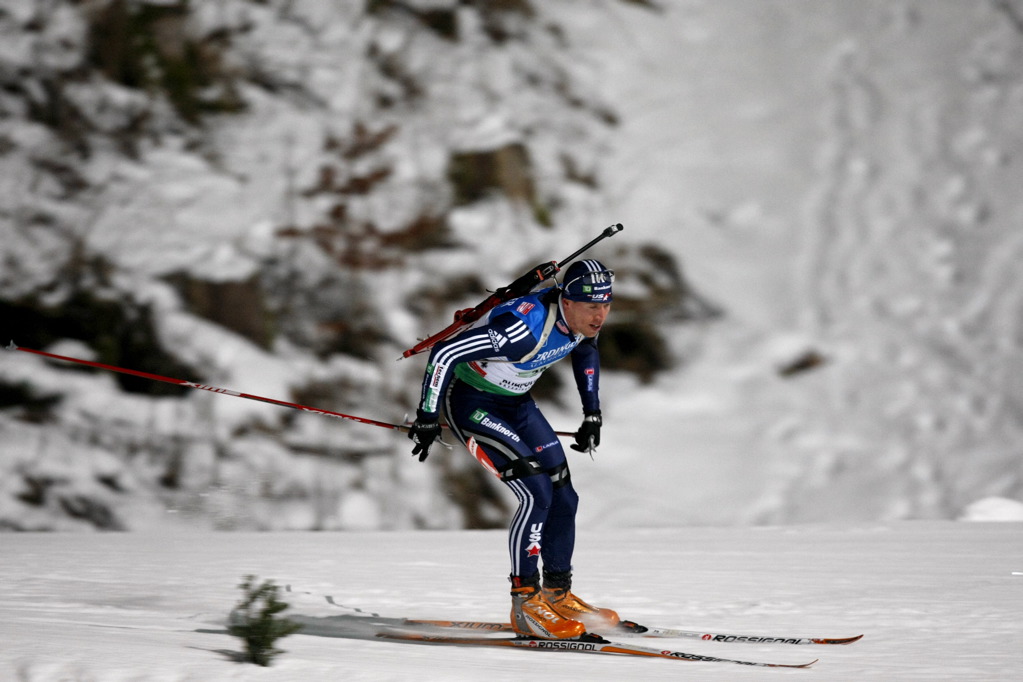
    Jay Hakkinen racing on the World Cup last season.

    While U.S. and Canadian skiers have been competing at FIS and World Cup races for several weeks now, the American biathletes waited until Sunday to kick off their season in an IBU Cup sprint.

    The race in Ostersund, Sweden, was actually the second of the weekend, but the U.S. team sat out of Saturday’s race. While the men were lucky to have skipped the windy conditions that shook up the result sheet in the opener, the whole team was faced with a new challenge on Sunday: fresh snow.

    Until that morning, there had been little natural snow on the ground in Ostersund. Instead, the race course was packed with snow hoarded from the previous winter.

    “The course in Ostersund has been prepared with snow that was stockpiled last winter and covered with a tarp and wood-chips to keep it through the summer,” U.S. Biathlon Association President and CEO Max Cobb wrote in an e-mail. “Without that we would not be able to have any training or racing in Ostersund this November.”

    But on Sunday, the weather finally gave the venue what it’s been wanting all along – real, fresh, new snow.

    “It was snowing when I woke up this morning and it continued to storm until after the races,” said national team member Susan Dunklee. “Now it looks like a winter wonderland with several centimeters of new snow.”

    The “A” team did not compete on Sunday, since they are prequalified for the World Cup. Instead, the race served as a time trial for the “B” team and independent athletes who hoped to join them next weekend and fill the team’s four-man, four-woman World Cup quota. The IBU Cup is a coordinated series of eight race weekends for racers just below the World Cup level; this weekend’s openers in Ostersund were filled with well-known World Cup athletes as well.

    In the men’s 10 k sprint, Jay Hakkinen led the way in 27th place with two penalties, finishing just under two minutes behind winner and Olympic medalist Jakov Fak of Slovenia.

    The veteran was philosophical about what the result meant.

    “The first race of the season is always a bit unpredictable, and therefore it can be a bit stressful, which is why I was glad the first race was an IBU Cup,” Hakkinen wrote in an e-mail. “The focus was to apply what I worked on in the training to the racing, as far as shooting, technique and so on. Therefore, the overall result was not as important as gathering information.”

    The U.S. Biathlon Association was also hoping to gather information, and the results led them to name Hakkinen as the last member of the World Cup squad. He joins Tim Burke, Lowell Bailey, and Leif Nordgren. The four teamed up to place sixth in the relay at World Championships last year.

    The other U.S. finishers, Jeremy Teela in 49th, +2:47, and Bill Bowler in 108th, +6:33, will head to the next IBU Cup races in Ridnaun, Italy.

    In the women’s 7.5 k race, Dunklee and Lanny Barnes led the way with almost identical results; the pair finished 42nd and 43rd, separated by just half a second. But they took different routes to their finishes, with Dunklee missing three shots but notching the 29th-fastest course time on the day, and Barnes collecting a single penalty but skiing the 59th-fastest time.

    They also had different outlooks on their results.

    “It feels great to have one race done and to already have one that I feel good about,” Dunklee told Fasterskier. “My missed prone shoots were a little wild, so that could have gone a little bit better. [But] on skis I was able to push hard on all three laps and focus on every section.”

    Barnes – along with her sister Tracy, who finished 76th with four penalties – was not so cheery.

    “The race was a disappointment for both of us,” the twins wrote in an e-mail. “We had both been feeling really great earlier in the week, but felt pretty lousy today. We probably pushed a bit too much in training the last two weeks we’ve been here. That is how it goes though, and this is the first race of a very long season.”

    All three women noted the difficulty of skiing through inches of soft snow – something that took them entirely by surprise after the hard and fast tracks they had been practicing on all week.

    “It’s funny because it turned to winter here today, and the fast icy manmade snow conditions turned to deep, slow new snow,” the Barnes wrote. “It’s dumping snow out now. Good to see some of that white stuff coming down- [we] haven’t seen any of that since we left Colorado.”

    Dunklee and Lanny Barnes will join Sara Studebaker and Laura Spector on the World Cup, while Tracy Barnes and Annelies Cook, who finished 79th with five penalties, will continue on the IBU Cup circuit.

    Kaisa Makarainen of Finland, last year’s overall World Cup champion, won the race by thirty seconds despite missing three shots.

    Full results: men / women

  • USBA Names Twelve Athletes to Pre-World Cup Training Camp in Sweden

    The United States Biathlon Association has named six men and six women to attend a pre-World Cup training camp in Sweden in November. The camp will be used to divide the team further into a World Cup team and a group traveling to the IBU Cup, a coordinated international race circuit are one level below the World Cup.

    The national A-team athletes, including Tim Burke, Jay Hakkinen, Leif Nordgren, Lowell Bailey, Sara Studebaker, and Laura Spector, were prequalified for the training camp. Other athletes were chosen based on the results of the North American Rollerski Biathlon Championships in Jericho, Vermont this summer and from time trials held at Soldier Hollow, Utah last week.

    Three-time Olympian Jeremy Teela headlined the additions to the team, and was joined by fellow national team member Bill Bowler to round out the squad of six men. All but Bowler have experience at either the Olympic Games or World Championships, and the four A-team men worked together to notch a remarkable sixth-place finish at 2011 World Championships. Both Burke and Teela have stood on the World Cup podium before, while Hakkinen and Bailey have top-ten finishes to their names.

    On the women’s side, Studebaker and Spector each notched top-twenty World Cup finishes last season. They will be joined by Tracy and Lanny Barnes of Durango, Colorado, who were the top qualifiers based off of time trial results. The twin sisters are not members of the national team although they have each competed in at least one Olympics, with Lanny Barnes posting the best U.S women’s result in a decade at the 2010 Games in Vancouver. National team members Susan Dunklee, who achieved top-ten results on the IBU circuit last year and Annelies Cook, who competed in the 2011 World Championships in Khanty-Mansiysk, Russia, round out the team.

    Both the men and women will receive four starting spots on the World Cup circuit this season, so at least two men and two women will be sent to the IBU Cup following the training camp in November.

  • Even After Losing Photo Finish to Italy, U.S. Notches Best-Ever World Champs Relay Finish

    Even After Losing Photo Finish to Italy, U.S. Notches Best-Ever World Champs Relay Finish

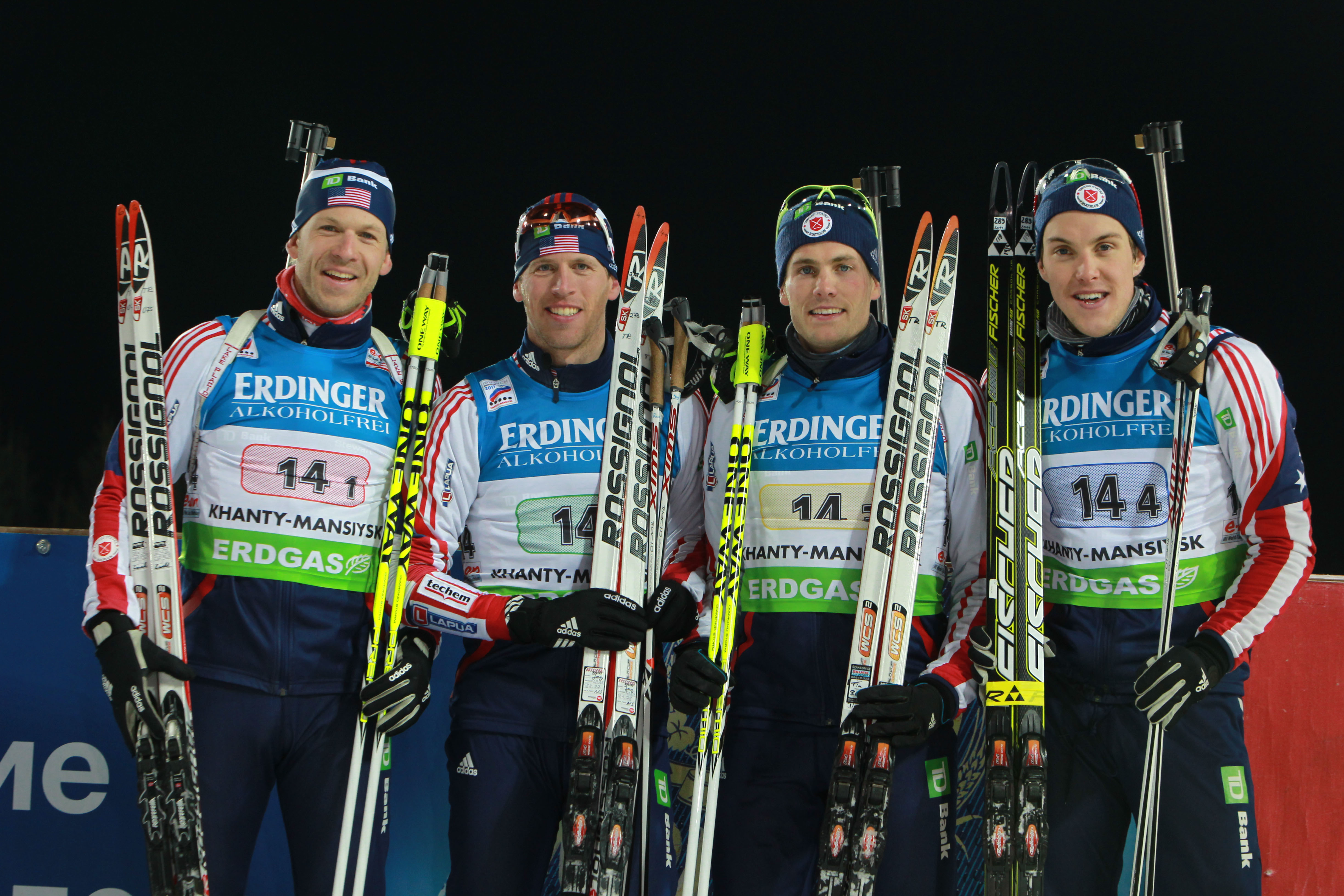
    The U.S. team: Lowell Bailey, Jay Hakkinen, Tim Burke, Leif Nordgren. Photo: nordicfocus.com courtesy of USBA

    Was U.S. biathlon head coach Per Nilsson enthusiastic about his team’s relay finish at World Championships on today?

    “BEST EVER!” he wrote in an e-mail on Friday evening. “[It’s] fun to show that we have a team that can fight on the highest level in the world.”

    While the entire team had a strong performance in Khanty-Mansiysk, Russia, on Friday – leadoff skier Lowell Bailey tagged off in fifth place – Leif Nordgren was again the hero, skiing the fastest anchor leg and passing Olympic medalists Michael Greis of Germany and Christoph Sumann of Austria en route to a photo finish for fifth place.

    In the end, Nordgren came up short – he finished just two hundredths of a second behind Markus Windisch of Italy, and the U.S. had to be content with sixth.

    Not that they had a hard time doing that.

    Nordgren's photo finish. Courtesy of USBA.

    “We have had better World Cup finishes, but it’s the best World Championships finish ever for the men’s relay!” wrote an ecstatic Max Cobb, President and CEO of the U.S. Biathlon Association.

    In addition to finishing higher than any other U.S. team in history, the Americans were a mere ten seconds away from the podium, surely the closest they’ve ever come to earning a team medal.

    Lowell Bailey started out the historic day for the U.S. It was a hectic mass start, with at least three crashes or tangles in the first kilometer. Then on the second loop, Bailey broke a pole.

    Despite using three spare rounds – a number which in most relays would have been hugely detrimental – Bailey handed off in fifth place. His success was in part thanks to his third-fastest ski time of all the scramble skiers, but also because a number of other teams struggled on the range as well – of the twenty-two teams which finished, only eight used fewer than three spare rounds on the first leg.

    When Jay Hakkinen took over, he used three spare rounds in prone. Once again, this would usually be the death knell for a U.S. (or any other) relay, but today, the team only dropped to eighth. Over the rest of the leg, Hakkinen was able to claw his way back into seventh, only forty seconds behind the leader.

    Next up for the U.S., Tim Burke turned in the fourth-fastest last loop; in combination with his two spare rounds in standing, the team dropped back to eighth, just over a minute behind Norway and Germany.

    Nordgren was the U.S. anchor, and all eyes were on the 21-year-old, who had been having an exceptional World Championships so far. With two top-thirty finishes, he was the only American qualified for the mass start the next day.

    After the prone shooting, Nordgren had used two spares – a painful pair, after missing his one remaining target with the first spare and having to try again. The same thing happened in standing, and the U.S. was sitting in eighth place still.
    “I missed my first extra in both prone and standing,” Nordgren told FasterSkier. “Of course it’s a bummer, and a little frustrating, but you just have to put that behind you and focus on the next shot. There’s really no time to think about it.”

    Instead of thinking, he put in a furious charge over the last 2.5 kilometers.

    “Leaving the range, I was in eighth place, right behind Austria and a few seconds down from Germany,” he said. “Italy was about 18 seconds ahead. I wasn’t quite sure what to do, I didn’t even know what place I was in so I just pushed a little and caught up to Germany and decided to wait. I skied with him for almost the entire last loop.”

    Burke. Photo: nordicfocus.com courtesy of USBA. More photos below the article.

    Nilsson was proud of his youngest athlete.

    “Leif took down Greis and Sumann on the last loop and was amazing,” he said.

    But Nordgren wasn’t done yet.

    “Going into the final uphill was the first time I even saw the Italian. He looked like he was hurting, so I went for it. I made a big push and caught him about 100 meters before the finish. But I made my sprint for the line just a little late, and it came a little faster than I anticipated.”

    In the end, he was two hundredths of a second behind Windisch, in what Cobb said was the closest finish on the World Cup this season.

    “We actually finished sixth, [but] they put us in fifth for a couple of minutes after the finish,” Nordgren said. “Then I guess they took a closer look at the photo and bumped us back. That’s alright though, we’ll survive. I’ve never been in a photo finish before so that was really cool! To come up on the losing side is a bummer of course, but its just a race, there will be more.”

    While Nordgren’s performance was the highlight of the day, it took four solid legs to get him to where he finished: the best U.S. result at World Championships, ever.

    The U.S. also placed sixth in the relay at the 1972 Olympics.

    Canadians Solid in 11th

    While the Canadians have had better races, their eleventh-place finish was still deemed a success.

    “As a whole, this was a very good performance,” said third-leg skier Jean-Phillipe Leguellec. “It was a very tight relay today and each of our legs were in the heat of the action. We ended up using only six spare rounds, and finished 1:36 behind the leading team… Even the relay where we came in seventh, two years ago, we were 4:30 back and did a penalty loop! I guess that just shows exactly how different one race can be to another and how much shooting can change everything.”

    The team put in a steady effort, with Brendan Green, Scott Perras, and Leguellec handing off after each of the first three legs in ninth place.

    Green in particular had some excitement on the trails, as he scrambled in the hectic mass start.

    “That seems to be how the relay starts more or less typically are,” he told FasterSkier of the chaos. “I think because the bigger climbs weren’t until the last third of the loop, the pack was able to stay a little tighter than normal which resulted in more broken poles and mix ups than usual.”

    Green had one of the slowest shooting times in the prone stage, but said that it was all part of the plan.

    “The two previous races of the Championships for myself did not go well at all, so I was really focused on today and wanted to finish the week off with a solid performance,” he explained. “I’ve been struggling in the range lately with my prone shooting, so today I needed to take my time in the range for the first bout of shooting and be sure of my shots. My slow prone meant I had to play catch up, but I was confident in my standing and was able to shoot clean and catch back up.”

    Perras used two spare rounds in prone, but then cleaned standing with no extra shots.

    “We were the closest we had ever been to the leaders in a World Cup relay so to do this at a World Championships is great,” he said in a Biathlon Canada press release. “Being 10th at the Olympics and 11th at Worlds shows we can be with the best on a good day.”

    Leguellec used one spare round and Nathan Smith two, dropping the team to 11th place.

    Overall, the Canadians tied for the fewest number of spare rounds of any team in the field, something that everyone was proud of.

    “As a team we shot very well which was exactly what we needed to do as a couple of the guys on the team aren’t feeling 100% at the moment,” Green said. “This way we were able to stay in the game the whole race. It was an exciting race from start to finish for us, with the time gap being tight for a relay, so all in all I think the team had fun out there and we are satisfied where we finished.”

    Leguellec agreed.

    “All in all we’re very happy with how our World Championships ended. It was a very satisfying team effort today and we can now move on to finishing the season.”

    Full results

    Bailey, leading Italy in leg one, ironically enough. Photo: nordicfocus.com courtesy of USBA.
    Bailey heading through the stadium. Photo: nordicfocus.com courtesy of USBA.
  • Bø Wins His First World Championship in Khanty-Mansiysk Individual; U.S. Youngster Nordgren Continues Hot Streak

    Bø Wins His First World Championship in Khanty-Mansiysk Individual; U.S. Youngster Nordgren Continues Hot Streak

    Maximov, Bo, and Sumann on the podium. Photo: nordicfocus.com courtesy of USBA.

    In biathlon, the individual format is often described as a shooter’s race. With a minute of added time penalizing each missed shot, the consequences for a single mistake while shooting are even higher than in any other format. There are many great biathletes – World Cup winners and even World Champions – who have never won an individual race.

    In Khanty-Mansiysk, Russia, on Tuesday, young Norwegian Tarjei Bø proved that while the individual is a shooter’s race, it’s also a skier’s race. With one penalty and the third-fastest ski time of the day, he picked up a 40-second victory and the first World Championship gold that he can claim wholly as his own.

    Bø is part of a strong Norwegian team, perhaps the strongest in years. While teammates Ole Einar Bjorndalen and Emil Hegle Svendsen were favorites coming into this season, and Lars Berger was, as always, a threat to win if he could just put together a good shooting race, Bø was at 22 years of age the wild card.

    But although all three of his famous teammates have won World Cups this year, Bø outdid them by winning four and wearing the overall yellow leader’s bib for almost the entire season.

    (You can read Nat Herz’s interview with Bø to find out how he’s done it.)

    In Khanty-Mansiysk, his first World Championships, he anchored the winning Norwegian mixed relay team and picked up bronze medals in both the sprint and pursuit. Finally, on Tuesday, he won gold on his own.

    “To win in the relay with your friends is very special, but this first individual Gold medal in the World Championships has a more special feeling,” he told IBU News. “I was happy to win the relay but when I win alone it is more emotional; a special moment for me.”

    Bø made things look easy, but in reality they were not.

    “I had steel control over the shooting, and tried to keep a steady pace and keep quiet,” he told NRK News. “Today I was the boss of myself.”

    He elaborated on his shooting in a press conference after the race.

    “My plan was not shoot so fast today,” Bø said. “But on that last shooting, I was very nervous. So I decided that I had to shoot fast so I did not have to think too much. Suddenly the shooting was over and I had five hits; it was a fantastic feeling. It might have looked perfect, but it was not so perfect in my head. I had a bit of luck I think.”

    It was an emotional day for the young racer, who cried upon learning that he had won. In the end, he was satisfied.

    “I have heard that you aren’t properly a man until you have won a 20 k,” he told NRK. “Now I have.”

    Maxim Maksimov finished second, collecting the first Russian medal of the Championships. He edged out Christoph Sumann of Austria by just five seconds.

    Sumann, who at 35 years old was picking up his fourth World Championships medal, just like Bø, said that he felt like an old man.

    “I was in my first World Championships when you were in primary school,” he told the Norwegian in the press conference.

    Nordgren (L) spent a lot of time racing with Lars Berger (NOR), who is a World Champion in cross-country skiing. Photo: nordicfocus.com courtesty of USBA.

    For the U.S., too, the team would not have guessed at the beginning of the season that it would be led by a youngster at this World Championships. But just as in Saturday’s sprint, 21-year-old Leif Nordgren (who was featured earlier this year in our Pros of Tomorrow series) was the top American finisher, and he again had a career-best finish. This time, he placed 21st thanks to a single penalty.

    “Last night’s race went really well for me,” Nordgren told FasterSkier in an e-mail. “I was a little surprised actually how well it went. I don’t think I could be any happier.”

    When asked how he achieved his stellar result, Nordren said it was just basic biathlon.

    “There wasn’t really much to it,” he said. “I got a nice ride skiing behind Lars Berger for the first couple of loops, and that really set up a good pacing for me for the rest of the race.  The individual is a shooting race though, so I wasn’t really concerned about how fast or slow I was skiing, I just wanted to make it around the loop each time, hit all my targets, and go full gas on the last loop.

    “It worked out pretty well I’d say- I missed my first shot on the last stage, kind of a bummer but that’s biathlon, and the last loop I pushed as hard as I could.”

    He was followed by veteran Tim Burke in 30th place. Burke has had a tough season- today’s race was merely “okay”.

    “My shooting was better than it has been, but it was still not good enough for a top result,” he told FasterSkier. “The individual is so heavily weighted towards shooting that you really can’t afford to miss more than one shot. Of course, I am not satisfied with a 30th place. I know I am capable of much more so this has been quite frustrating for me.”

    Lowell Bailey and Jay Hakkinen struggled on the range, missing six shots each and finishing 78th and 80th.

    Hakkinen had been one of the best-ranked shooters on the World Cup up until this week.

    “I think that might be past tense now,” he said in an e-mail. “I almost missed more today than I have all season, but that is biathlon.”

    For Nordgren, his career-best result had some extra bonuses, too.

    “21st is a really good result for me, but perhaps the coolest thing is that I’m now qualified for the mass start race on Saturday,” he said. “Only 30 men make it into the mass start, the top 15 from the overall World Cup, and the next best 15 from the Championships.”

    It will be Nordgren’s first mass start at the senior level, since he didn’t qualify for any of the World Cup mass starts this year.

    Burke racing earlier this week. Photo: nordicfocus.com courtesy of USBA.

    Unfortunately for the U.S. team, though, the mass start situation has been disappointing as well, thanks to an error on the part of the IBU.

    “After the race yesterday the IBU put out the list for the Mass Start,” Burke explained. “On the list I was the last qualifier in 30th place. This was a huge relief to me and I was so excited to get another opportunity. I felt like my ski speed was very competitive and my shooting was finally getting back on track. It seemed like the first time this season that I was going to finally get a break. Our entire staff was thrilled and we were all cheering in the wax cabin when the list was posted after the race.”

    But it was not to be.

    “I was informed this morning that the IBU had made a mistake and I was actually number 31,” Burke said. “It’s hard for me to believe that a ‘professional organization’ could make a mistake like this at World Championships. This was absolutely devastating to me.”

    While he was clearly suffering, Burke was still able to look on the bright side and say some kind words about his teammate.

    “At least Leif will get to race the mass start and I am very happy for him,” Burke told FasterSkier. “He has worked really hard all year and he has definitely proven himself here this week. I am very impressed by his composure on the range in his first year on the World Cup and at his first World Championships. He has been one of the best shooters here in Russia during some very challenging conditions.

    “I expect that we will see great things from him in the future.”

    Full results

  • US Just Misses Top Half in Presque Isle Mixed Relay

    US Just Misses Top Half in Presque Isle Mixed Relay

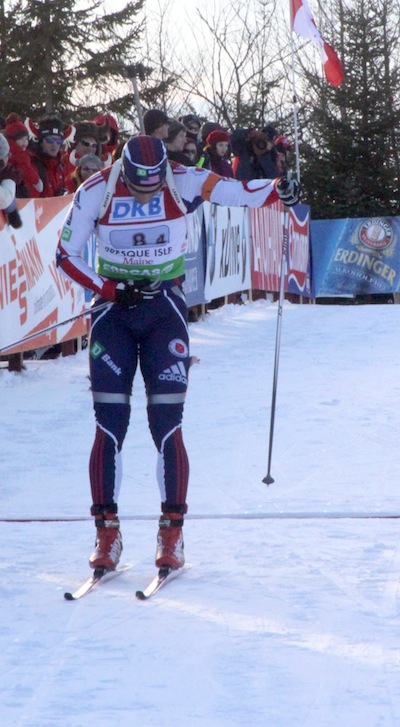
    Jay Hakkinen (USA) in action in Saturday's Presque Isle mixed relay.

    It’s not often that the U.S. biathlon team gets to race a relay in front of a home crowd—in fact, it hasn’t happened in more than seven years.

    So when the American squad of Sara Studebaker, Haley Johnson, Jay Hakkinen and Jeremy Teela took to the course in Presque Isle in Saturday’s World Cup mixed relay, the race was just as much for the hundreds of red-white-and-blue-clad spectators as it was for the athletes themselves.

    “It’s about them, too,” Teela said.

    The Americans were aiming for the top half of the field of 12 teams, and up until the very last shooting stage, things were going to plan. Teela, the anchor, was locked in a duel with the last Swedish skier, Fredrik Lindstrom, for the sixth position—and he wasn’t having trouble holding the pace.

    “[Lindstrom] was very easy to ski with—I knew I had much better shape than he did,” Teela said.

    But when the two came in to shoot standing, it all unraveled, as Teela had to use all three of his spare rounds and still left one of his five targets untouched. He had to take a trip to the penalty loop—a relatively rare occurrence in a relay race—while Lindstrom used just one extra round and easily wrapped up the sixth spot, relegating the Americans to seventh.

    Some avid fans (Yeah, we know they're backwards–we caught them facing that way.)

    Teela skied hard into the finish, thanking the Presque Isle faithful with a bow, but he still said that he was “upset” with his race. The misses in the final shooting stage, he said, came despite feeling “very good” in the range.

    “I was very aggressive, and sometimes aggressive works, and sometimes it doesn’t,” Teela said. “That’s what confidence and experience is supposed to help you with.”

    While Teela’s collapse came in full, clear view of the spectators, he wasn’t the only American who struggled on Saturday. Johnson, in the second leg, didn’t have to ski any penalty laps, but she did need all three of her extra rounds for both shooting stages.

    “It takes four athletes…to make a great relay,” Teela said. “Two of them were really good.”

    The teammates Teela was referring to were Studebaker and Hakkinen, who both skied stellar legs. Studebaker hung with the leaders through her first of three trips around the women’s two-kilometer loop, and used just a pair of spare rounds over her two shooting stages.

    Hakkinen, meanwhile, needed just one spare round in the third leg, moving the American team up from tenth place to eighth place in the process. After struggling with illness in the early season, the veteran is getting his legs under him, as demonstrated by his racing on Saturday and his 28th in Friday’s sprint.

    “The more time I have, the better I can be,” he said. “I need training. I need races.”

    Haley Johnson in the range.

    The Americans will be back in front of the Presque Isle faithful one last time in Sunday’s pursuit. While the fans’ numbers didn’t seem much larger than on Friday, when they tallied somewhere in the low thousands, they didn’t lack for enthusiasm.

    The crowd—which included three shirtless young men with chests emblazoned with ‘U,’ ‘S,’ and ‘A’—cheered every time the Americans came through the stadium, no matter their position.

    On Sunday, they’ll have a chance to shout for what could be another groundbreaking result, after Studebaker’s 14th place on Friday. She’ll start in that position in the pursuit, and with just one minute separating her from Helena Ekholm, the first starter, Studebaker certainly has a chance to move up. While some top athletes opted to sit out the mixed relay to be more rested for the pursuit, Studebaker said she wasn’t worried.

    “I feel confident in my ability to come out here and race, and just kind of flush it all out and go again tomorrow,” she said.

    One thing that will help? The fact that Studebaker was able to stick to the leaders for her first lap on Saturday.

    “It gives you that confidence that you can ski with those girls,” she said. “Maybe I can’t do it for three full laps, at their pace, in a sprint race, but I’m getting there. And I think that’s a really good thing.”

  • Peiffer Takes Presque Isle Sprint; Bailey Leads Americans in 25th

    Peiffer Takes Presque Isle Sprint; Bailey Leads Americans in 25th

    Fans at the men's 10 k pursuit race in Presque Isle, the first World Cup on American soil in seven years.

    It’s not the Super Bowl yet, but there was no lack of enthusiasm from fans greeting World Cup biathlon’s return to northern Maine.

    Hundreds of spectators turned out to the Nordic Heritage Center on Friday morning to watch Germany’s Arnd Peiffer win the men’s 10 k sprint in Presque Isle, the first elite-level international race on American soil in seven years.

    Peiffer, a burly 23-year-old, shot clean to top France’s Martin Fourcade and Russia’s Ivan Tcherezov, on a chilly day that still felt cozy, despite the temperature.

    With hundreds of schoolchildren, teachers, and parents packing bleachers overlooking the stadium—and a penalty loop that circumnavigated the Heritage Center’s main lodge—Presque Isle’s residents got an intimate look at a sport that rarely travels to this side of the Atlantic.

    Organizers estimated that 3,000 spectators took in the races on Friday; FasterSkier tallied roughly 1,000 in the stadium.

    Regardless, there were dozens waving flags, wearing hats emblazoned with stars-and-stripes, and even brandishing signs they’d made for adopted international athletes and countries. Local schools bused in entire classrooms to watch.

    Elaine Millett, a special ed teacher from the nearby town of Ashland, was sent to the races as a substitute at the last minute, when one of her co-workers called in sick.

    “It was like winning the lottery,” she said.

    American Lowell Bailey leaving the range.

    The American faithful were rewarded with a solid, if unsensational performance by their men’s team.

    Gearing back up after some volume training in his home of Lake Placid, Lowell Bailey led the U.S. in Friday’s race in 25th place, with one penalty, 1:50 behind Peiffer. Jay Hakkinen was next, in 27th, as Jeremy Teela and Leif Nordgren also placed in the top-60, meaning that four Americans qualified to race in Sunday’s pursuit.

    Bailey said that he struggled with cold, slow snow on the 3.3-kilometer loop used in the sprint—a grinding course with the typically relentless, undulating terrain favored by trail designer John Morton, who laid out the system here.

    “There’s not a lot of recovery on this course. There’s no real steep hills, but that being said, there’s just a lot of climbing, and all the recovery is this really quick, turny stuff. It’s difficult, for sure…I think I underestimated it,” Bailey said, adding that he also “could feel the last couple weeks of training, today.”

    With just 72 men’s starters, the competition in Presque Isle wasn’t quite as fierce as it normally is on the World Cup circuit; the last World Cup sprint in Italy in January had 95.

    Some athletes simply elected not to make the trip across the Atlantic, while others are competing in the Asian Winter Games in Kazakhstan. Norwegian star Emil Hegle Svendsen is taking some time for training, before competing in the cross-country World Championships in a month; he’ll fly into Fort Kent for next week’s races. The participation of his teammate, legendary Ole Einar Bjoerndalen, is still pending.

    Make no mistake, though—there were still plenty of big guns, including World Cup overall leader Tarjei Boe of Norway. Boe cleaned his first stage, in prone, but then took a penalty in standing to remove himself from contention, ending up fourth. Afterwards, he told FasterSkier that his skis weren’t great—and that his fitness wasn’t at its best, either. Indeed, both Peiffer and Fourcade were faster out on course.

    “The shape is okay, but not in my top,” Boe said. “It’s a lot of competitions during the winter—I’m going for the yellow jersey…and

    Tarjei Boe leaving the range.

    I have to do every race to win it. I just have to continue to make good results. This is not a bad day, but of course I want to win.”

    Peiffer shot clean to take his first race since last January, finishing 16 seconds up on Fourcade.

    After a heavy racing schedule over the past few weeks, German team doctor Jan Wuestenfeld told FasterSkier that the country’s biathletes were not anticipating great results in the U.S.

    “The whole team was, like, finding their way again,” he said.

    Wuestenfeld said that the atmosphere in Presque Isle was “much more relaxed” than typical World Cups, which also likely helped.

    With the win, Peiffer will lead out Sunday’s pursuit, which is based on the results from Friday’s sprint. Just four other men start within a minute of the German, though with four shooting stages, there will undoubtedly be some new faces mixing into the top five.

    First, though, racing in Presque Isle continues on Saturday, with a mixed relay consisting of two men and two women. The Americans will start Hakkinen, Teela, Sarah Studebaker, and Haley Johnson.

    Link to full results.

    A look at the stadium in Presque Isle.
  • Barnes, Cook, and Hakkinen End IBU Cup Campaign on High Notes

    Barnes, Cook, and Hakkinen End IBU Cup Campaign on High Notes

    Tracy Barnes in the IBU Cup sprint race in Altenberg, Germany. Photo: Viktoria Franke.

    When U.S. biathletes left Altenberg, Germany after the pursuit race on Saturday, they were saying goodbye not only to the venue, but to the entire IBU Cup circuit. While the U.S. Biathlon Association is supporting the World Cup team for the rest of the year, no more Continental Cup races will be funded.

    Luckily, the team had plenty of satisfying results while in Europe, so the trip ended on a positive note.

    “I’m proud of the women’s team this year and how we have done,” said Tracy Barnes. “I like our group, I like our posse.”

    Barnes led the U.S. women in the final pursuit. Starting with bib 17, she missed three shots and slipped a few places to finish 23rd overall.

    Annelies Cook was next, just seven seconds behind Barnes. She missed five shots in four shooting stages, and slipped from 21st to 25th.

    While these might seem like a lot of penalties for a pursuit, conditions on the range were tricky, and not a single woman shot clean. In fact, there was only one woman with one penalty and two more with two penalties. The International Biathlon Union reported that the wind was constantly changing on the shooting range, making it difficult for even the best shooters to avoid penalties.

    Susan Dunklee, who led the U.S. in Friday with a 10th-place finish in the sprint, had an especially tough day on the range. She missed seven shots and slipped to 37th place.

    “I missed a bunch of shots on the right side,” she said in an e-mail as the team packed up. “Some of them were rushed. I didn’t feel that bad on the range. Some days the shooting comes together, some days it doesn’t, and that’s the nature of the sport.”

    Dunklee said that the skiing wasn’t great either, and the women’s team had struggled with the slush. Temperatures were reported at around 50 degrees Fahrenheit, and second-place Nadine Horchler of Germany lost a sprint finish because the edges of the trail were in particularly poor condition and she was unable to pass winner Iris Waldhuber of Austria.

    In the men’s race, Jay Hakkinen led the U.S. team with a 27th-place finish. He moved up from bib 40 thanks to relatively clean shooting. Hakkinen missed three shots but only three of the skiers ahead of him shot better.

    “It is always nice to move forwards in the pursuit,” Hakkinen told FasterSkier. “Pursuits are pretty basic: if you shoot clean you move forward, miss one you stay where you are, and miss more than one you move back. Therefore, I used a pretty basic strategy of skiing with those around me and trying to outshoot them in the range. Today was not an easy shooting day, though, with changing wind, which made that strategy challenging, but it ended up a solid performance.”

    Hakkinen also had the 27th-fastest ski time of the day in just his fourth race of the season.

    “It is a great feeling that my shape is improving, which I expected, but it is nice when it actually happens according to plan,” he said. “I definitely have been enjoying the races, having been starved from them for so long. I still have a lot of work to do, but I feel I passed the first test.”

    Zach Hall and Wynn Roberts also moved up in the pursuit. Hall started 50th and finished 47th, despite having six penalties, while Roberts improved from 59th to 52nd. Roberts missed nine shots, but had the 39th-fastest ski time of the day.

    Bill Bowler had a tough day on the skis, slipping from 49th to 55th.

    Men’s results / Women’s results

    Jay Hakkinen moving through the field in the pursuit. Photo: Viktoria Franke.
    Bill Bowler and Zach Hall were separated by just one second at the beginning of the pursuit. Photo: Viktoria Franke.
    Wynn Roberts in the pursuit. Photo: Viktoria Franke.
  • U.S. Women Continue Hot Streak in IBU Cup Competition

    U.S. Women Continue Hot Streak in IBU Cup Competition

    Susan Dunklee led the U.S. team with a 10th-place finish in the sprint in Altenberg, Germany on Friday. Photo: Viktoria Franke.

    After last week’s success at the IBU Cup races in Nove Mesto, Czech Republic, U.S. biathlete and 2010 Olympian Haley Johnson was promoted to the World Cup.

    You might think that sending the top finisher off to Rupholding would slow down the American women racing on biathlon’s second-most prestigious circuit. But you’d be wrong. Susan Dunklee, Tracy Barnes, and Annelies Cook – who all missed qualifying for the Olympics last year –  didn’t need Johnson on the roster to have the third-best team score in Friday’s sprint race in Altenberg, Germany.

    Led by Dunklee’s tenth-place finish, the American squad trailed only the home team and the Russians.

    Barnes and Cook have been on fire all season, each recording multiple top-20 finishes in IBU Cup racing and even earning a World Cup start or two. Today, they finished 17th and 21st.

    But Dunklee, for whom this was only the third race in Europe this season, a top-10 result was a bit of a surprise.

    “My zero groups were huge today and I haven’t felt on top of my game (skiing or shooting) for the past couple weeks so I didn’t have particularly high expectations for myself going into the race,” she told FasterSkier.

    “Yeah, I’m psyched.”

    Although this was the third year that Dunklee has made the trip to Nove Mesto and Altenberg, she’s never had such strong results before. She had finished in the top twenty just once on those trips.

    But familiarity with the courses is never a bad thing, and Dunklee had a strategy for today.

    “There’s a big steep headwall in the first half of the course and my goal was to hammer up and over the top and then hang on,” she said. “The trickiest part of the race was hearing my name announced over the PA system during the middle of my standing stage. It was a new experience for me and I really had to focus to hit my shots after that.”

    A sometimes-erratic shooter, Dunklee missed only one shot on Friday.

    In Saturday’s pursuit, the three women will start within twenty-five seconds of each other.

    “For tomorrow, I want to have fun,” Dunklee said. “Tracy, Annelies and I will start practically within sight of each other and we hope to ski together and rumble with the women ahead of us.”

    The U.S. men, who have not had as much success on the IBU Cup so far this season, were led by four-time Olympian Jay Hakkinen in 40th place. Hakkinen was sick in the fall to the season, and the Nove Mesto races were his first opportunities for head-to-head competition.

    “Last week was my first races of the season,” Hakkinen said in an e-mail. “It was a great feeling to be back racing after being away so long. Since they were trials races, the big goal was to get back on the World Cup as soon as possible… but the [International Competition Committee] wanted me to race another week of IBU Cup races.”

    After leading the team in Friday’s sprint, Hakkinen is one step closer to his goal.

    “I am looking towards a World Cup start in Antholz, although there is no clear criteria or guarantee of whether I will be allowed to do so. I just hope to have a good performance in the pursuit tomorrow in order continue my goal of a top performance in the World Championships.”

    If he does make the World Championships team, it will be an unusual story: because he was sick this fall, he didn’t even attend the trials races in Canmore or Mount Itasca and was named to the IBU Cup squad on discretion. Hakkinen also said that he wasn’t yet in race shape, and two days of racing in a row were a challenge for him.

    However, he was positive about his shooting.

    “My shooting has been strong,” he said. “Since while I was sick with mono, it was one of the only things I could work on and I knew I would be relying on it while I got used to the racing again.”

    Bill Bowler was the next American, finishing a career-best 49th. He was just one second and one place ahead of teammate Zach Hall. Both athletes are relatively new to biathlon – Hall picked the sport up after graduating from Dartmouth College, while this is the first season that Bowler has raced internationally. The pair represent the opposite of Hakkinen in many ways – and were only thirty seconds behind him, for all his experience.

    Wynn Roberts was another twenty-five seconds behind them in 56th, and Russell Currier rounded out the American squad in 82nd. Currier missed six of ten shots, among the most penalties in the field, and will be the only athlete sitting out Saturday’s pursuit.

    Men’s results / Women’s results

  • The More the Better: Four More Biathletes Head to Europe after Minnesota Trials

    The More the Better: Four More Biathletes Head to Europe after Minnesota Trials

    Wynn Roberts racing at North American Championships last March. Roberts annihilated the field at the Mount Itasca trials.

    With eleven athletes already racing in Europe – that’s more than the U.S. Ski Team can say – what could the U.S. biathlon community possibly ask for from their governing body?

    Well, if some is good, then more is better. After a second series of trials races in Mount Itasca, Minnesota, the U.S. Biathlon Association (USBA) named four more athletes to the IBU Cup roster (the series one level below the World Cup), as well as reconfiguring the teams across the pond.

    Going into the Mount Itasca trials, USBA had said that they would name up to two more men and two more women. For the athletes, the pressure was on: there was a distinct possibility that only the winners would be sent to Europe, so standing atop the podium would be extremely important.

    Wynn Roberts (USBA B-Team) did just that, winning all three trials races in convincing fashion. In Thursday’s 15 k mass start competition, he had the best shooting in the field and skied to a three-minute victory over Raleigh Goessling of the Maine Winter Sports Center (MWSC). In Saturday’s 10 k sprint he beat Goessling by 15 seconds and in Sunday’s 12.5 k pursuit he led by a minute.

    Roberts was a no-brainer to add to the IBU Cup team, and was named based on his trials results.

    The other man added to the roster, though, didn’t even compete at Mount Itasca. Jay Hakkinen, a member of USBA’s A-Team, was a discretionary selection due to “force majeur” – he was sick for a long time this fall, and missed an entire training block. USBA decided to give him the benefit of the doubt and name him to the January IBU Cup squad without disrupting his December training.

    “Normally this time of year I am traveling and racing on the World Cup,” Hakkinen said on his blog. “However, with the World Championships in March this year, I am glad to be in one place doing good solid training so I am in good shape at the end of the season when it counts.”

    Haley Johnson in the sprint race. Photo: Seth Hubbard/MWSC.

    In the women’s races, Haley Johnson (USBA B-Team) got off to a strong start, winning the opening 12.5 k mass start by a minute over Susan Dunklee (USBA B-Team / Craftsbury Green Racing Project). Then in the 7.5 k sprint, she bested MWSC’s Bethann Chamberlain by 22 seconds. It was obvious that Johnson would be heading to Europe.

    “I actually felt great [at the first trials races] in Canmore and knew that absolutely everything was where I needed it to be to start the season, except for hitting the targets,” Johnson told FasterSkier.

    “The primary change I made was with my rifle. I am using the team’s spare barrel. I was able to transfer over all of my custom pieces to make this temporary set-up work seamlessly. Changing my barrel enabled me to get back to positive shooting training and helped me rebuild my confidence on the range.”

    Last year, Johnson was USBA’s golden girl early in the season, skiing to a top-30 World Cup result in December. This year, she didn’t even make the initial IBU Cup squad; things had changed. Now, Johnson is relieved to be back on track.

    “I see being back in Europe as the next step, which is just one rung of many in this competition season. World Cups and World Championships still remain higher up in the ladder. I have raced in Nove Mesto before, so it will be familiar territory.”

    But if Johnson was going to the IBU Cup races, who would join her? Would it be Dunklee or Chamberlain, or, perhaps, Lanny Barnes (USBA B-Team / Durango Biathlon), who had finished third both days? If Johnson simply skied to another decisive win, would USBA bother naming another woman?

    Susan Dunklee in the sprint race. Photo: Seth Hubbard/MWSC.

    The last day of competition would prove to be decisive. For the first time, “Johnson” wasn’t the first name on the results sheet. Instead, Dunklee skied to a 13-second victory in the 10 k race. She missed only three targets in four shooting stages, tying for the best shooting of the day.

    “I had the ideal starting spot in that last race,” Dunklee said in an e-mail. “I love chasing people down and with only 15 second start intervals I could practically see everybody that I wanted to catch. I knew that I would have be deliberate about turning that mentally off once I got into the range so I would focus on hitting one target at a time and not be thinking about the people around me.”

    Dunklee was a discretionary pick for the IBU Cup squad based on her second-best points ranking from the trials.

    “The women’s team has so much positive momentum right now, and I’m excited for the chance to contribute to that,” Dunklee said. “Our entire group has been very close in races and time trials all fall, and so seeing the other girls tear it up on the World Cup and IBU Cup already has been very inspiring. On any given day, any of us can vie for those high finishes.”

    Besides adding to its roster, USBA reorganized the teams in Europe. Russell Currier and Jeremy Teela were moved from the World Cup squad down to the IBU Cup circuit. Only five athletes will remain on the World Cup squad: Tim Burke, Leif Nordgren, Lowell Bailey, Sara Studebaker, and Laura Spector.

    Even though Annelies Cook and Tracy Barnes had been bumped up to the World Cup circuit from the IBU Cups for one weekend, they will now return to the IBU Cup team, rejoining Zach Hall and Bill Bowler.

    The World Cup will start the new year in Oberhof, Germany on January 5, while the IBU Cup will resume in Nove Mesto, Czech Republic, on January 8.

  • Snow Wreaks Havoc on Olympic Biathlon Races

    Snow Wreaks Havoc on Olympic Biathlon Races

    Snow falling hard as Magnus Jonsson gets underway.
    Snow falling hard as Magnus Jonsson gets underway.

    American hopes for a medal in the men’s 10k biathlon sprint fell about as hard as the snow did in the middle of today’s race.

    25 minutes into the event, the steady drizzle that came down throughout the morning morphed into a wild snow squall, slowing the skiing drastically and effectively squashing the chances of anyone still on course.

    The medalists in the race—France’s Vincent Jay, Norway’s Emil Hegle Svendsen, and Croatia’s Jakov Fak—all were among the first ten starters, the winners of what U.S. Head Coach Per Nilsson called a “lottery.”

    “Independent of what wax you had, you had no chance,” Nilsson told FasterSkier. “Wet, aggressive, new fallen snow—that’s the slowest you can get.”

    Snow Hat
    Snow falls on the hat of this biathlon spectator.

    Most of the top men were seeded at the front of the race, but anyone who had to ski through more than a couple of minutes of the heavy snow had an insurmountable task before them.

    American Jeremy Teela, in bib number thirteen, was probably the last one to escape: despite two penalties, he still placed ninth.

    Tim Burke (USA) - 47th place.
    Tim Burke (USA) – 47th place.

    Burke was not so lucky. He had clean tracks for his first of three 3.3k laps, and looked to be in decent position after a single penalty in the prone stage. But by the time he came back around for the standing, the squall had set in with full force. He missed two more shots, and ended up in 47th—barely qualifying for Tuesday’s pursuit.

    The effect of the snow was epitomized by Jay Hakkinen’s performance. Despite not missing a single shot, the Alaskan had to set out in the worst of it, and ended up over three minutes back from the French winner.

    “It’s just mountain weather,” he said. “I just went out to fight as hard as I can. It’s frustrating, but the good thing is I held it together in the shooting.”

    Bailey chasing Vladimir Iliev.
    Bailey chasing Vladimir Iliev.

    Lowell Bailey, the fourth American starter, faced the same brutal conditions. He also shot clean, but still finished back in 36th. All four Americans made it into the top-60, guaranteeing themselves positions in Tuesday’s pursuit.

    Canada’s lone competitor, Jean Philippe Leguellec, got lucky by drawing the eighth starting spot, then maximized the opportunity by missing just one shot, in the standing. He actually led the race after the first shooting stage, but slowed by the penalty loop, ended in sixth.

    After a week of hype, the weather at Whistler Olympic Park finally delivered today, with a huge impact on the outcome of the race. But Nilsson still didn’t see a problem with hosting such important races at a venue known for its erratic weather.

    “This was, unfortunately, pretty extreme,” he said. But still, “it can happen everywhere.”

    Some excited fans in the stadium.
    Some excited fans in the stadium.
  • USBA Announces Athlete Nominations to the U.S. Olympic Committee

    USBA Announces Athlete Nominations to the U.S. Olympic Committee

    NEW GLOUCESTER, Maine – The International Competition Committee of the U.S. Biathlon Association conducted a final review of results from the IBU Cup races in Altenberg, Germany this morning.  As a result, the U.S Biathlon Association will forward the following list of athletes to the United States Olympic Committee.

    Men’s Olympic Team Nominations:

    1) Tim Burke, Paul Smith’s, NY- prequalification from 2008-2009 season (2 top 15 results at WC)

    2) Jay Hakkinen, Kasilof, AK- prequalification from 2008-2009 season (2 top 15 results at WC)

    3) Jeremy Teela, Park City, UT – qualification from Dec 2009 WC (1 top 30 at WC)

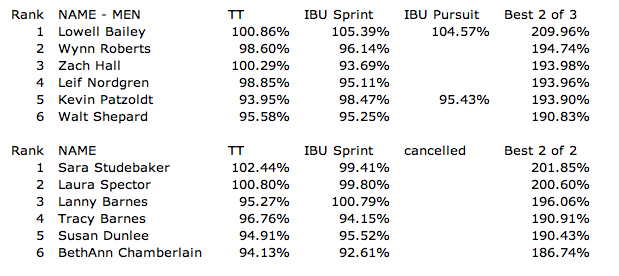
    4) Lowell Bailey, Lake Placid, NY – overall points winner, Altenberg

    5) Wynn Roberts, Battle Lake, MN – discretionary selection. Roberts was 2nd overall (behind Bailey) based on the Percent Back Points from the Altenberg races and lead the Trials races held in Minnesota in December.

    The Women’ selection was more complex because of the cancellation of today’s Women’s Pursuit at Altenberg.  Contingency “C” from the Olympic Team Selection Procedures was required and is stated below:

    Contingencies: In the event one or more of the competitions in a series are cancelled the following will apply as appropriate to the situation:

    a.  If four races are held the best three of four will be scored.

    b.  If three races are held, the best two of three races will be scored.

    c.  If less than three races are held; the top American in each race, not already nominated to the respective team, will be nominated to the IBU Cup team or the Olympic team, respectively, and the ICC in accordance with the USBA Principles of Discretion (see Section II.B.), will determine the remaining nominations.

    Contingency “c” requires winners of the two races (Time Trial and IBU Cup Sprint) to be nominated to the team, with the remaining athlete named by discretionary selection of the ICC.

    Women’s Olympic Team Nominations:

    1) Haley Johnson, Lake Placid, NY- qualification from Dec 2009 WC (1 top 30 result)

    2) Sara Studebaker, Boise, ID- winner Time Trial, Altenberg, Germany

    3) Lanny Barnes, Durango, CO- winner Sprint Event, Altenberg, Germany

    4) Laura Spector, Lennox, MA- discretionary selection, Altenberg, Germany.  Laura was ranked 2nd based on the Altenberg Percent Back points list.

    Below is the Altenberg Percent Back points list:

    USBA Altenberg Percent Back Points List

    The International Competition Committee would like to congratulate the nominees for the Olympic Team and wish them luck at the upcoming World Cup races in Rupholding, Germany and Antholz, Italy.   Also, best wishes for the IBU Cup team athletes who will move on to racing at the IBU Cup in Nove Mesto, Czech, where the U-26 Team Selection process will continue.

  • Hakkinen Hits All Targets, Moves up to 26th in WC Ranking

    Hakkinen Hits All Targets, Moves up to 26th in WC Ranking

    Ruhpolding, Germany – Still feeling a bit worn from his all out effort in the 5th place relay finish on Thursday Hakkinen knew that good shooting would be a key to a good performance today.

    Hakkinen was able to follow his plan and “clean” his targets. “I am very happy with my shooting today,” said a smiling Hakkinen at the finish. “It was a perfect day with no wind.” His shooting times of 34 seconds in prone and 29 seconds in standing are, when taken together, about 15 seconds longer than his usual times, but the deliberate approach worked and he was able to put together his first clean race of the season landing tied for 22nd place with Martin Fourcade of France. With today’s performance he moved up four places to 26th – just one point out of 25th.

    The rest of the US team struggled on the range today with four penalties each. “It is not normal but it can happen,” said High Performance Director Bernd Eisenbichler. “They had an off day but they will bounce back for Antholz next week – that course really plays to our boys skiing strengths and they are already looking forward to racing there.”

    The winner today was the “king of biathlon” Ole Einar Bjorndalen who, with perfect shooting and a winning margin of over 33 seconds, showed that he has recovered from his illness earlier in the season. While “the king” will start with a big advantage in the 12.5 km Pursuit competition on Sunday, it gets very tight after that. Hakkinen, who is starting 22nd, just 30 seconds out of eighth place, is in the middle of a pack of 30 athletes all starting within a single minute. The race will be streamed online live Sunday at 9:00 AM Eastern Time. Click on the “Watch us live on the web” link just above the news News section at www.USBiathlon.org

    Full Results | Photo Gallery

    Jay Hakkinen
    Jay Hakkinen

    Source: USBA

  • Aiming for Gold

    Jay Hakkinen changes with Tim Burke in the Mens Biathlon 4×7.5km Relay Final of the 2006 Turin Winter Olympic Games. The two men hope to be part of the team that wins the first U.S. Olympic medal in the sport of biathlon in 2010.

    As the men’s 4×7.5-kilometer biathlon relay started at the 2006 Olympics, few could have guessed what would happen in the first leg of the race.

    American Jay Hakkinen skated into the stadium in first place. An American? Leading in biathlon? There had to be some mistake. Where were the Germans? Or the Norwegians?

    There was no mistake. Hakkinen handed off to Tim Burke, who then handed off to Lowell Bailey. Jeremy Teela anchored the team and crossed the finish line in ninth – the best relay finish for the U.S. since Martin Hagen, Lyle Nelson, Donald Nielsen, and Peter Hoag finished eighth at the 1980 Olympics (the best U.S. finish in an Olympic biathlon relay was sixth at the 1972 Games).

    Sparked by this result, these four American biathletes are now aiming for a medal at the 2010 Olympics. In the world of biathlon, this would be like a couple of guys from Denmark winning the Daytona 500.

    And Bailey and Burke – relative newcomers compared to veterans Hakkinen and Teela – could be key to this success.

    Biathlon has its roots in the military in Scandinavia and Finland. Today, there are five events in biathlon – the 20km individual (15km for women), 10km sprint (7.5km for women), 12.5km pursuit (10km for women), mass start, and the relay. Cross-country skiers carry .22 caliber rifles on their backs and shoot, standing and prone, at five targets 50m away. For each miss, competitors must either ski a 150m penalty loop or, in the individual race, they are docked one minute for each missed target. For this reason, the fastest skier doesn’t necessarily win, and the lead changes often.

    Biathlon is huge in Europe, especially Germany, with tens of thousands of people often filling the stands at the World Cups and millions more watching on TV (it’s the most popular televised winter sport in Europe). In Europe, biathletes are like rock stars, says Bailey.

    Hakkinen and Teela, now both 31 years old, have both scored top 20 (even top 10) results for years. Hakkinen won the sprint at the 1997 Junior World Championships, and one of Teela’s best early results was ninth in the sprint at the 2001 Worlds. Throughout his 14-year career, Hakkinen has finished in the top 25 in World Cups 58 times (including six top 25s, including relays, in the first three World Cups of the 2008/09 season), while Teela has been there 25 times. World Cup fields usually have over 100 competitors.

    Only in the past two years have Bailey and Burke begun scoring World Cup points (by finishing in the top 30). Burke, 26, has accumulated 25 top-25 finishes in World Cups and at World Championships in 2007 and 2008. And Bailey, 27, had a breakthrough year last season, finishing 11th in the 12.5km pursuit at a World Cup in Pyeong Chang, Korea.

    Burke is not exaggerating when he says, “I definitely feel that I am part of the strongest men’s biathlon team that the U.S. has ever had.”

    Lowell Bailey and Tim Burke met as youngsters cross-country skiing in a children’s program. The boys are only six months apart in age – Lowell being older (and now, an inch taller too) – and both lived in small towns in New York’s Adirondack State Park. They skied at Lake Placid, a community steeped in winter sports.

    They were good Nordic skiers who qualified for the Junior Olympics – considered junior nationals in the sport of cross-country skiing. In 1996, when Burke was 14 and Bailey 15, the U.S. Biathlon Association was recruiting young Nordic skiers, and the boys were invited to a biathlon development camp.

    According to former biathlete Chad Salmela, who wrote in FasterSkier.com about Bailey’s and Burke’s first time shooting, they were pretty good shots. By 1999, Bailey had qualified for the Junior World Championships in Slovenia. The following year, Burke also raced at Junior Worlds.

    “There was a lot of opportunity as a junior in the sport of biathlon because biathlon is a smaller sport in the U.S.,” says Bailey. “It was a tangible goal for me to think about making the Junior World Championship team, even after only a year of training biathlon.”

    He particularly liked the idea of world travel-going to Slovenia for Junior Worlds versus Alaska or Maine for Junior Olympics.

    “Growing up living and training in Lake Placid and being around the Olympic spirit and seeing international competitions come into town, from a young age I really wanted to see the world as an athlete,” he adds. “It doesn’t get any better than that.”

    Burke had a similar goal. Growing up and competing in Lake Placid filled him with thoughts of competing at the Winter Olympic Games.

    Neither man qualified for the 2002 Olympics, and for Bailey, it was a disappointment. Burned out, he enrolled at the University of Vermont in the fall of 2002. He joined the top-ranked UVM ski team, and along with Ethan and Ryan Foster-two brothers from Weston, Vermont-the UVM men’s Nordic team became one of the best in the country, an unprecedented feat for three Americans. The top collegiate cross-country skiers are typically guys with names like Ole and Sven, brought over from Europe as ringers.

    Over the three years it took Bailey to finish his bachelors degree in political science and environmental studies, he won two NCAA silver medals in freestyle (the skating technique developed by Bill Koch in the 1980s, and the technique used in biathlon). He was so committed to his team that after winning his second silver at the 2004 NCAA Skiing Championships, held on Donner Pass in California, Bailey ran up the course – sinking to his thighs with each step – to cheer on Ryan Foster, who at that point was only two seconds out of a top 10 finish.

    After graduating in 2005, Bailey dove back into biathlon with the same enthusiasm and commitment that he had shown in college racing.

    “(College) allowed me to step away from the sport at a time where I was pretty burned out,” he says. “I was mentally fried from the day in, day out pursuit of making myself a better biathlete. It really was an opportune time to go toward strictly Nordic skiing and to branch out and pursue some other things in my life in the academic arena.”

    “I came into the 2005-06 season with much more motivation and eagerness to learn the minutiae that really help you become a better biathlete,” he adds.

    He showed that he had returned to full steam by qualifying for the 2006 Olympic team.

    Burke took a more frustrating path to the Torino Games. In 2002, he finished 11th in the pursuit at Junior Worlds. But then health issues derailed his career: he battled back from hip surgery, viral infections, the flu, and even a badly impacted tooth.

    “Making the transition from successful junior to successful senior was tough,” he says. “It took a long time for me. I spent many years living below the poverty level, just like riding in the back of the bus in a minor league baseball team.”

    The 2006 Olympic relay was a turning point for Burke. Not only were he and his teammates motivated by their ninth place finish, but positive changes on the team were on the horizon – changes that “have had a great impact on our team results,” says Burke.

    The most important change was hiring Per Nilsson, 38, who coached biathlon at the National Sports Academy in Solleftea, Sweden, before coming to the U.S. He “believed in our team’s ability to succeed,” says Burke. Nilsson started coaching the U.S. team in the late spring of 2006.

    “Per introduced me to a more professional style of training and my results immediately improved,” Burke adds. “Through my improved results I really started to believe in my ability to win and that has made a huge difference.”

    Burke’s confidence has grown to the point where every time he steps on the starting line, he expects to finish in the top 30.

    Bailey’s confidence from his 11th last year carried through to this season. In the first World Cup race in early December 2008, he finished 15th in the 20km individual race.

    “I was really psyched to get off on a good foot with that 15th place,” says Bailey. “I’m looking forward to improving on that throughout the season. I’m also really excited to see how we’re able to place as a team in these next relays because I don’t think we’ve really shown our potential yet.”

    At the World Cup on January 8, 2009, in Oberhof, Germany, the team placed 11th in the relay.

    Looking ahead to the Vancouver Olympics, Bailey says that everyone on the team is also focusing on the individual races, not just the relay.

    “As we’ve made improvements on our own – all of us really, Jay, Tim, Jeremy, and myself having individual successes along the way,” he says.

    Forever the team player, Bailey doesn’t even care who wins a medal, as long as it’s one of his teammates.

    “The most important thing going into Vancouver isn’t really whether or not the medal comes from our relay or from an individual event,” he says. “Just the idea of being a part of a team that has the first U.S. Olympic medal in the sport of biathlon will be amazing.”

    Source: http://www.usbiathlon.org

  • Americans find the targets in Oberhof

    Americans find the targets in Oberhof

    Oberhof, Germany – Jay Hakkinen (Kasilof, AK) could have been happier, but not much. Hitting nine out of ten targets in world class time, Hakkinen finished 17th in the ultra competitive Oberhof World Cup Sprint, with a time of 26:55.8, one second behind 15th place and just ten seconds out of tenth. The result moves Hakkinen into 26th place in the overall World Cup ranking and qualifies him for the Mass Start competition on Sunday. Just six seconds back was teammate Tim Burke (Lake Placid, NY) 22nd in 27:01.8 followed by Lowell Bailey (Lake Placid, NY) 39th in 27:26.8. All had just one penalty on the day. Jeremy Teela (Heber, UT) had two misses in prone and but cleaned his standing and finished 46th out of 113 competitors in 27:42.4.

    “The Oberhof sprint is the toughest on the World Cup,” said High Performance Director Bernd Eisenbichler. “The boys handled the transitions in the course really well and this showed in their good times on the second loop, It was impressive to see all of them manage the long uphill approach to the range and shoot clean standing.”

    Running through the performance of the team Head Coach Per Nilsson was clearly pleased with the results of his boys. “Jay promised himself he would master his concentration on the range and he did a great job – clean [no penalties] and the 4th fastest time in standing, prone was a little low and his miss was at 6 o’clock.” Commenting on Tim Burke who was ill in December he said “Tim’s not 100% yet but he is coming – he knows he’ll b ready for World Championships.” Lowell Bailey was satisfied with his performance on his least favorite World Cup course and Teela’s standing shooting “was really outstanding,” said Nilsson.

    “The team spirit was pretty low after the relay where we struggled with our equipment and missed too many targets but today we started to see what we can do when things go our way,” said Eisenbichler. “The form is coming better and better.”

    Complete Results | Photo Gallery

    Hakkinen’s top 30 World Cup ranking earns him a place in the Mass Start competition at 10:00 AM Eastern Time Sunday. Watch streaming video of the race live at www.usbiathlon.org. The next stop on the World Cup tour is Ruhpolding Germany where the men will start in the relay on Thursday at 11:40 AM Eastern Time.

    Source: USBA

    Jay Hakkinen, photo courtesy of Max Cobb, USBA
    Jay Hakkinen, photo courtesy of Max Cobb, USBA
    Tim Burke, photo courtesy of Max Cobb, USBA
    Tim Burke, photo courtesy of Max Cobb, USBA
    Lowell Bailey, photo courtesy of Max Cobb, USBA
    Lowell Bailey, photo courtesy of Max Cobb, USBA