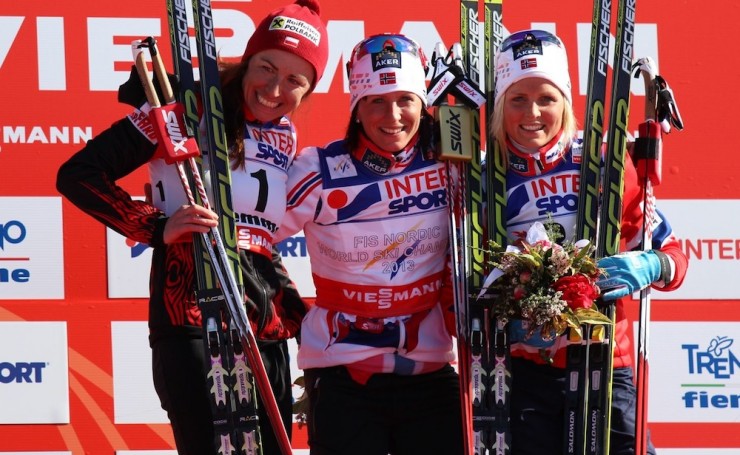
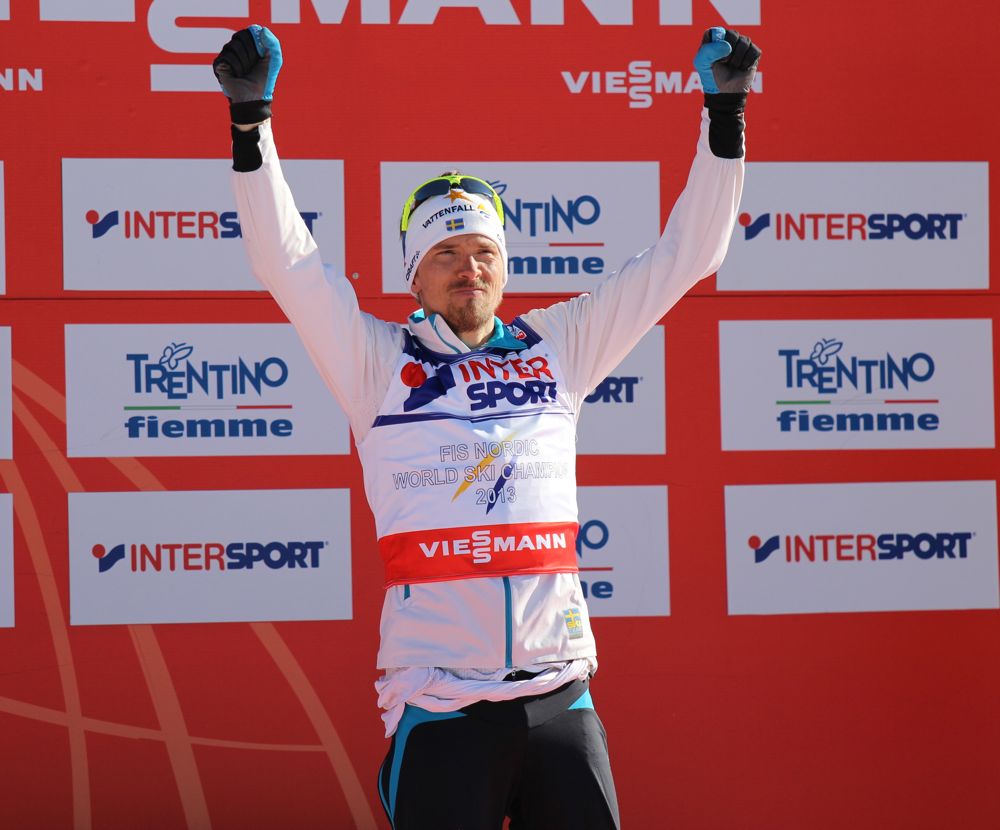
Podium after the women’s 30 k classic: Bjørgen smiles after besting Justyna Kowalczyk and Therese Johaug.
Things got down to business in Val di Fiemme for the second week of World Championships, with only the classic races still on the schedule: interval start, relay, and marathon. Norway’s Therese Johaug and Petter Northug picked up titles in the 10 / 15 k freestyle races, while Ivan Babikov of Canada and Liz Stephen of the U.S. were fourth and fifth. Norway also swept the relays, unsurprisingly; the U.S. women had a history fourth-place finish. In the 30 k, Marit Bjorgen won yet another World Championship, but said this one was particularly meaningful (and Justyna Kowalczyk is probably particularly devastated to lose it). Finally, the Championships capped off with what has been called the greatest 50 k ever by Johan Olsson of Sweden, who broke away early and managed to ski alone for 35 k to the win.
Nordic combined racers were also still duking it out in Val di Fiemme, with a few unsurprising winners: Eric Frenzel continued his string of pre-Championships World Cup successes and won the individual large hill competition, while Jason Lamy Chappuis of France anchored the winning team sprint. For the U.S., there were no more fireworks like the bronze medal in the relay, but instead a collection of solid performances that left the team wanting just a little more. Billy Demong and Taylor Fletcher finished 15th and 17th in the large hill, then combined for sixth place in the team sprint, undone by a poor morning on the jumping hill.
IBU World Cup biathlon racing kicked off in Oslo with good omens for the Norwegian team: Tarjei Bø and Tora Berger won the opening sprints. While Berger continued her tear, sweeping th pursuit and mass start as well, two non-Norwegians got to meet King Harald V after their victories on Saturday and Sunday: World Cup leader Martin Fourcade of France after the pursuit and Czech Republic’s Ondrej Moravec, who got his first career win in the mass start. After a disappointing sprint for the entire American team, Tim Burke skied to fourth in the mass start.
In Nove Mesto, Czech Republic, a group of American skiers made it clear that they could cut it against the Europeans. Kate Fizgerald (APU) won on both tightly-contested days of racing, first tying with a Czech skier for the win in the 3.3 k prologue, then outsprinting Sophie Caldwell (SMST2) for victory in the 10 k classic pursuit. Rosie Brennan also hit the podium, placing third in the pursuit to give the Americans the sweep. American men were paced by Paddy Caldwell (SMS), fresh off a trip to Norwegian junior nationals, who placed fourth in the prologue and ninth in the pursuit; Stratton teammate Eric Packer finished tenth and twentieth.
While the World Championship marathon was technically held in Val di Fiemme on Sunday, another big-deal, long-distance race was taking place in Sweden: the Vasaloppet, one of the biggest marathons in the world and at 90 kilometers also one of the longest. In a battle of the titans Jorgen Aukland outdueled fellow former champions Daniel Tynell, Anders Aukland, and Jorgen Brink for the win; in the women’s race it was Norway’s Laila Kveli who skied to a large and surprising victory. While few Americans contested the race Canada had a strong presence, considering the distance from home, with Brian McKeever placing 45th and Andrea Dupont 11th.
Finally, on the home front, a couple more marathons were taking place. The 30 k Great Race from Tahoe to Truckee, a ripping mostly-downhill affair, was won by CXC’s Brian Gregg ahead of Far West Farm Team’s Spencer Eusden and Truckee’s Marcus Nash. Fellow Truckee resident Katerina Nash bested Farm Team’s Beth Taylor for the women’s win. In Maine, Harvard skier Akeo Maiseld-Carucci bested John Dixon of Colby over 50 kilometers while Robyn Anderson outsprinted VTXC teammate Lea Davison for the women’s win, nearly eight minutes ahead of the rest of the women’s field.
We also posted a video interview with newly-crowned World Champions Kikkan Randall and Jessie Diggins, and considered how to research interval training in the latest edition of our “This Month in Journals” series.
FIS Cross Country World Championships, Val di Fiemme, Italy | results
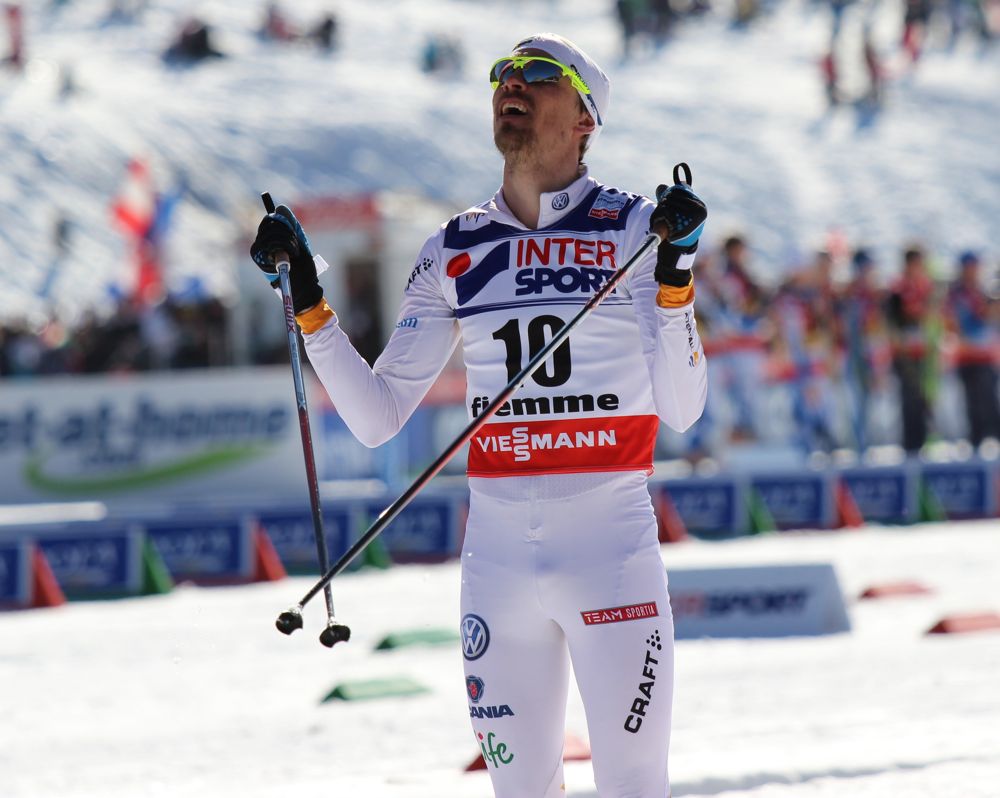
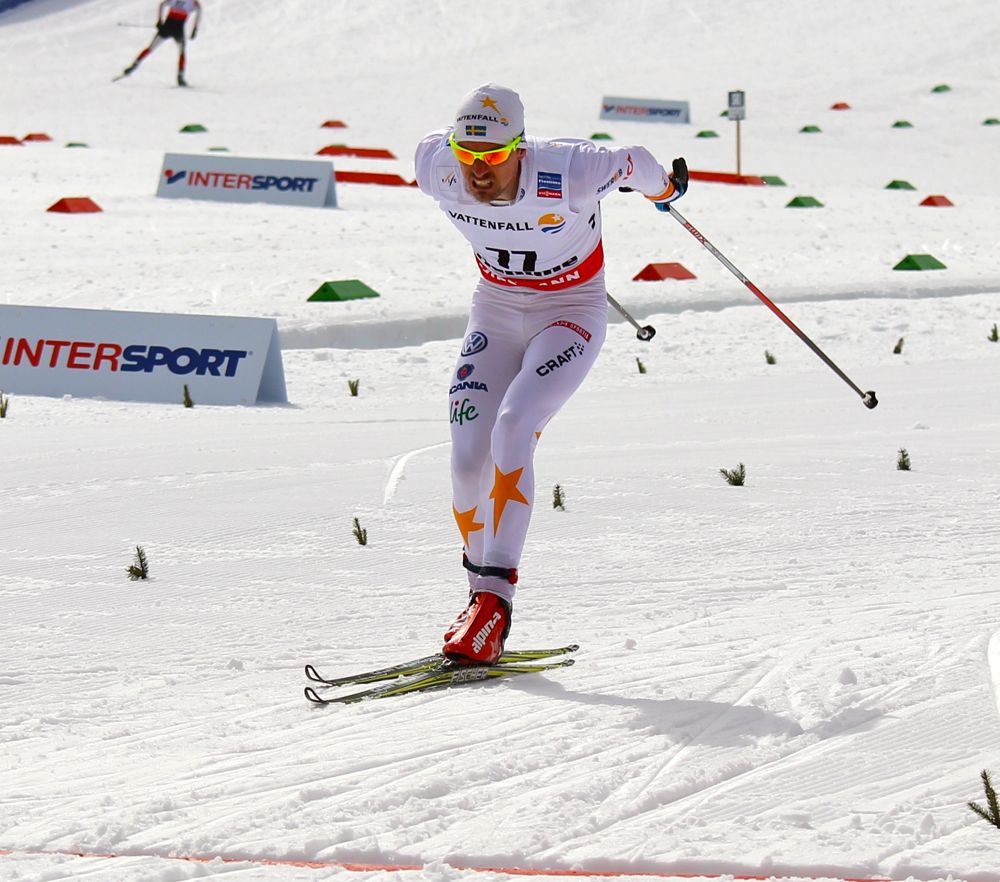
Sweden’s Johan Olsson celebrates his victory in Sunday’s 50 k classic mass start at the 2013 World Championships in Val di Fiemme, Italy. It was his first individual gold and Sweden’s first following six silvers at this year’s championships.
FasterSkier’s coverage of the 2013 FIS Nordic World Ski Championships in Val di Fiemme, Italy, is brought to you by the generous support of Fischer Sports.
VAL DI FIEMME, Italy – Had it been anyone else, the veterans in Sunday’s 50-kilometer classic mass start would have thought Johan Olsson was crazy. But the 32-year-old Swede had been racing long enough to know better than to blow a race that long less than a quarter of the way in. Or did he?
Three-time overall World Cup and Tour de Ski winner Dario Cologna couldn’t be too sure. Unlike those who broke away earlier in the mass start – like Swiss teammate Curdin Perl, who did so in the first kilometer (and later in the first of six laps, a group of five led by Sweden’s Anders Södergren) – Cologna decided Olsson’s breakaway around 11 k was worth worrying about.
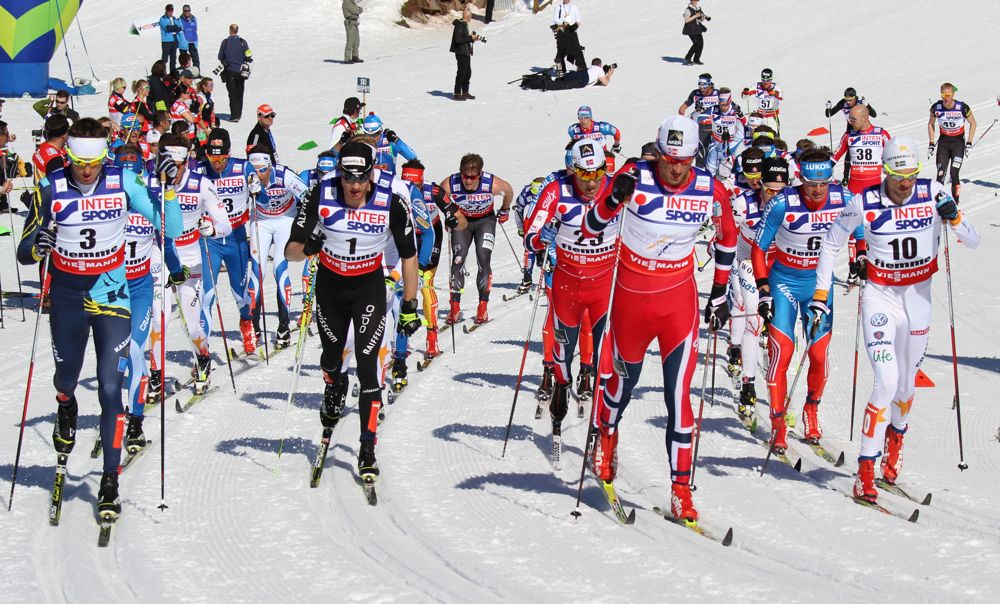
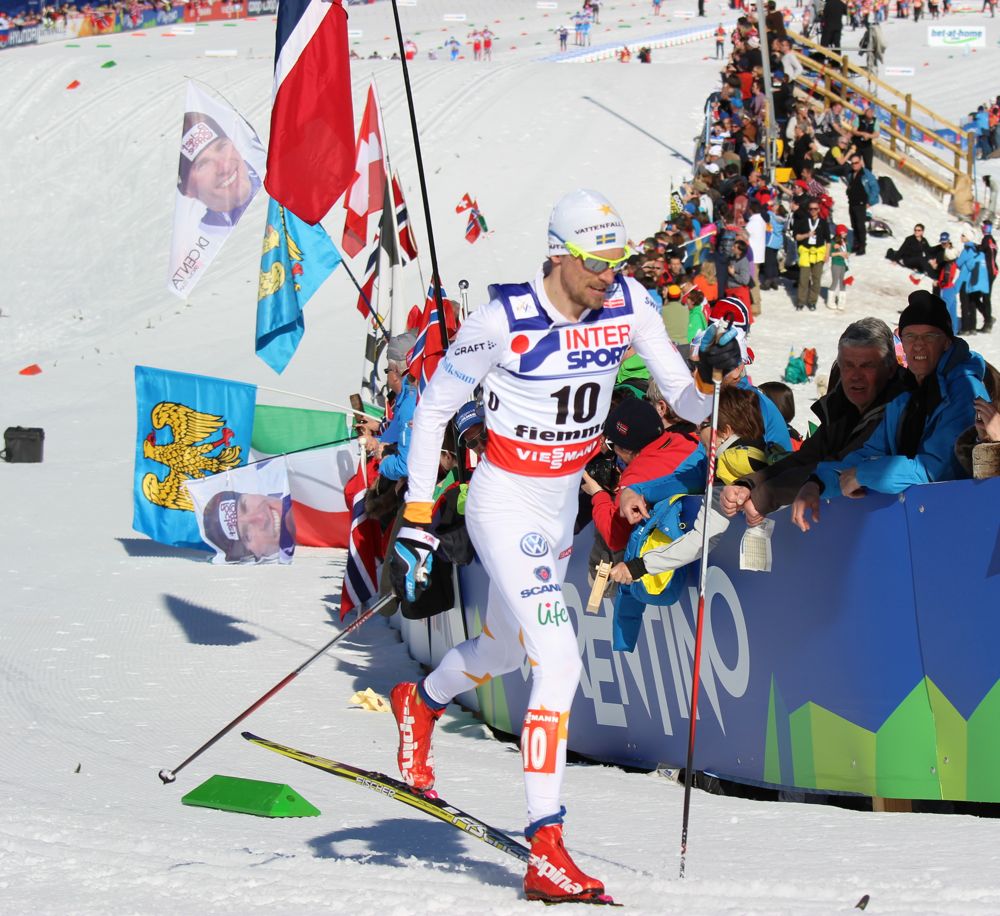
Leading up the first hill in Sunday’s World Championships 50 k mass start (from left to right), Kazakhstan’s Alexey Poltoranin, Switzerland’s Dario Cologna, Norway’s two-time defending champ Petter Northug, and Sweden’s Johan Olsson. Olsson went on to ski alone in the lead for nearly 30 kilometers and win his first individual gold by 12.9 seconds over Cologna.
Six seconds back, Cologna caught the 2010 Olympic relay champion around 12.5 k, and the two skied together for the next 8 ½ kilometers. Meanwhile, Russia’s Maxim Vylegzhanin and Alexander Legkov worked to close the gap from behind, coming within 11 seconds of the leaders at the 20.5 k checkpoint.
Moments later, Cologna crashed on the infamous descent athletes call the “elevator shaft.” He was trailing Olsson, caught off balance and fell alone. Initially stunned, Cologna picked himself off the ground before being swallowed by the chase group.
Led by Legkov and Vylegzhanin, the pack was giving Olsson some leeway early in the race. Few thought he could hold it, but they were going to respect him nonetheless and conserve for their own purposes of getting through a hot and sunny afternoon, with temperatures soaring above 12 degrees Celsius (53 Fahrenheit). Meanwhile, the Swede willed himself up front, pushing harder to extend the gap.
Halfway through the race, Olsson had 28 seconds between him and Kazakhstan’s Alexey Poltoranin. There were another 25 men just behind Poltoranin, but Olsson didn’t care. He kept his mind blank, he said, and focused on his own race.
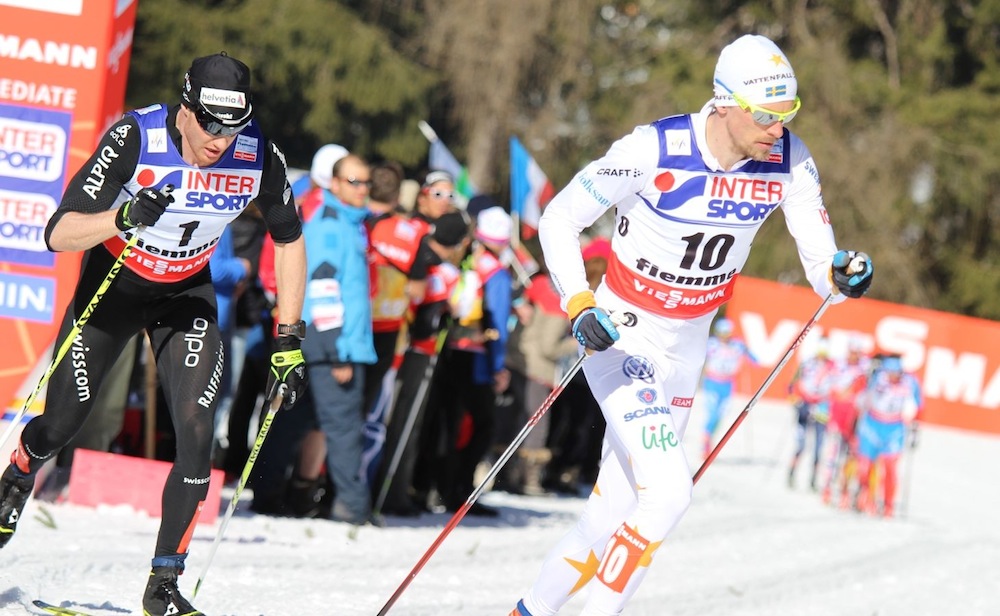
Sweden’s Johan Olsson (r) leads Dario Cologna of Switzerland early in Sunday’s 50 k classic mass start at the 2013 World Championships in Val di Fiemme, Italy. Cologna crashed on a downhill around 21 k, and Olsson skied away for the win.
At one point, Olsson did think about the 50 k at the 2010 Olympics, where he took third, one second behind Norwegian winner Petter Northug and Germany’s silver medalist Axel Teichmann. But that was completely different. Olsson was having the race of his life on Sunday, skiing alone in the front, and if he could hold it, he’d be thrilled.
It wasn’t until 500 meters before the finish that Olsson truly believed he could win it.
Olsson had challengers, notably Lukas Bauer of the Czech Republic, who came within 27 seconds of the Swede with 15 k remaining. Olsson’s teammate Daniel Richardsson opted not to change skis before the last lap and came within 12 seconds of him, but Olsson was confident his own skis were better. If not, he’d use whatever energy he had left to help his teammate win. Sweden needed a gold badly in these World Championships, and Olsson was determined to secure it in some form.
As it turned out, neither Bauer nor Richardsson posed a threat, as their separate efforts drained them both. Legkov consistently led the chase group, which remained around 20-strong for much of the race, and came within 25 seconds of Olsson with less than five kilometers remaining.
Still, it wasn’t enough. Olsson refused to relent throughout the entire last lap, pushing all the way into the finish.
Entering the stadium alone, the Swede didn’t let off. Just a hundred meters or so before the finish, he put his hands to his lips and kissed the sky, then took a few strides across the line. After 50 k, he didn’t have the energy nor the demeanor to showboat, and he simply stood soaking up the moment.
“I was so happy when I finished; I saw no reason to lay on the ground,” Olsson said at a post-race press conference. “Maybe I can catch a cold or something.”
Cologna, who took the lead at the start of the last lap then conserved within the pack, positioned himself in second for the last two kilometers. Cruising down the second-to-last downhill, he extended his gap on Legkov, Rønning and Poltoranin, respectively.
The four chased him up the hill, and the group challenged one another for the podium. Far enough ahead, Cologna claimed silver without much trouble, 12.9 seconds behind Olsson, who won in 2:10.41.4. Poltoranin outsprinted Legkov by 2.7 seconds for third (+16.8).
For Olsson, it was his first individual victory at World Championships, and his third medal of the week after taking second in both the 15 k freestyle and 4 x 10 k relay. Both times, he had been a runner-up to Norwegian favorite Petter Northug, who had won the 50 k at the last two World Championships. Olsson predicted Northug could be unbeatable again, which was part of the reason he seized the chance to pull away early.
Sweden’s Johan Olsson holding his own way off the front in the World Championships 50 k classic mass start Sunday in Val di Fiemme, Italy.
Swedish men’s coach Arild Monsen told NRK he instructed his guys to go hard early and raise the average speed of the race.
“The plan was to avoid that Northug would have the opportunity to win,” Monsen said. “It has happened too many times.”
At the same time, Northug was never really a threat, skiing within the group for most of the race and finishing 21st, two minutes behind Olsson.
“It was going hard from the start,” Northug told NRK. “I had hoped it would go quiet, at least the first three kilometers. I lacked that little extra today, and [then] it became heavy.”
Even Olsson didn’t expect to take off like he did.
“I felt pretty good so I just thought that, ‘OK this might be a really bad move, but I’m going to try to be offensive today and make something of this race,’ ” he said.
Skiing alone for nearly 30 k, he said the most stressful part about it was when his lead stopped growing. Less than a minute wasn’t enough, he thought.
“I thought that this gap is too small, and at least I’m gonna try to make them work to catch me in the last lap,” Olsson said. “It was just like, ‘I don’t want any other medal than the gold so I don’t care.’ I just went for it and that felt really good because I felt like I almost had nothing to lose.”
When he finally secured gold, he said it meant everything.
“I think the 50 k is the finest thing you can win in the World Championships,” Olsson said. “I think still my performance today means more than the gold medal, what I did out there, that I could go solo and just finish first.”
Like most everyone who witnessed it, Norway’s coaches were impressed. Team director Vidar Løfshus told NRK that he’s never witnessed anything like it: a man going it alone for most of 50 k on a flat-out hot day.
Sweden’s Johan Olsson soaks up his first individual gold at World Championships on Sunday after the 50 k classic mass start in Val di Fiemme, Italy.
“I think it almost is the greatest 50-kilometer achievement what we’ve seen today,” Løfshus said, according to a translation. “When you go [30 k] in front of this slush, as it says something about that man there.”
Watching Olsson, Løfshus was confident the group would catch him on the last lap. So was Norway’s service chief, Knut Nystad.
“I was pretty sure that Olsson should be obtained,” Nystad said. “It was awesome that he did.”
Cologna said that once he started skiing with the pack, he knew Olsson would be tough to catch unless he started to fade.
“I know that he can ski very fast for a long time,” Cologna said. “I thought, ‘If he’s not very tired in the end, it would be hard to get him.’ … It wasn’t possible to win the gold medal, but he deserved to win today. It was a very strong race by Johan.”
Olsson dedicated the race to his wife and former teammate, Anna Olsson (formerly Dahlberg), a 2006 Olympics team sprint champion.
“Getting the win is something you dream about,” he said. “This gold medal is for my family, my wife, who takes care of our child while I’m here. She makes it possible for me to still be an elite skier.
“This is our first individual gold medal and I don’t think she’s going to make a comeback,” he said with a laugh.
For Sweden, it was the first gold after six silvers in this year’s World Championships.
Norway failed to make the podium for the first time in an individual event all week, with Rønning leading the team in fifth (+20.2). Tord Asle Gjerdalen was sixth, Petter Eliassen 14th, Sjur Røthe 17th and Northug 21st. Germany’s Hannes Dotzler skied a solid race from start to finish, placing seventh (+32.7). Vylegzhanin was eighth, Jens Filbrich of Germany ninth and Richardsson 10th. Bauer ended up 16th, one minute out of first.
Petter Northug (l) checks back before celebrating Norway’s victory in the 4×10 k relay at 2013 World Championships on Friday in Val di Fiemme, Italy. Calle Halfvarsson (second from l) anchored Sweden to silver, Russia’s Sergey Ustiugov (second from r) was third, 0.2 seconds ahead of Italy’s David Hofer.
FasterSkier’s coverage of the 2013 FIS Nordic World Ski Championships in Val di Fiemme, Italy, is brought to you by the generous support of Fischer Sports.
VAL DI FIEMME, Italy – After so much buildup, so many strategic moves throughout the men’s 4 x 10-kilometer relay at the 2013 Nordic World Ski Championships on Friday, everything almost literally came to a grinding halt in the fourth and final leg.
The worker bees hard done their jobs for the first 30 kilometers of the race, making the last 10 into something like a Sunday stroll on a 10-degree Celsius (50-degree Fahrenheit) afternoon.
As expected, Petter Northug was among those controlling the pace early in the anchor leg. Norway’s relay closer for the last four World Championships, he wasn’t about to use his reserves too early. The frontrunners of the six-man group, Italian David Hofer and Russia’s Sergey Ustiugov weren’t keen on going hard, either.
Just to show how slow they were going, Northug started single sticking, basically walking up the second climb.
“It went slower than when you take your mother on Easter,” he later told NRK, according to a translation. “There were a lot of tactics, and I get what I want.”
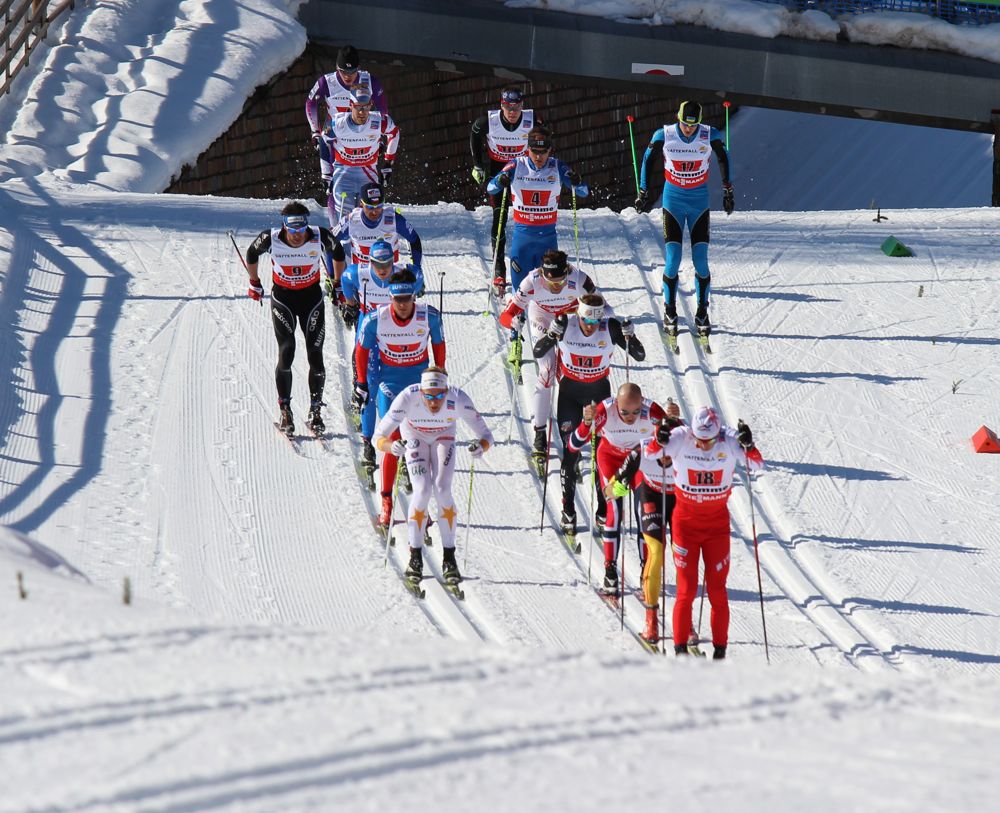
As the pack approached the high point of the 3.3 k course, all six men stood up. Hofer did so first to let German Axel Teichmann and Ustiugov pass by, and Switzerland’s Remo Fischer, Sweden’s Calle Halfvarsson and Northug casually tucked behind him. Several thousand spectators watching the antics on the stadium big screens booed with dissatisfaction. Come on guys, this is a race.
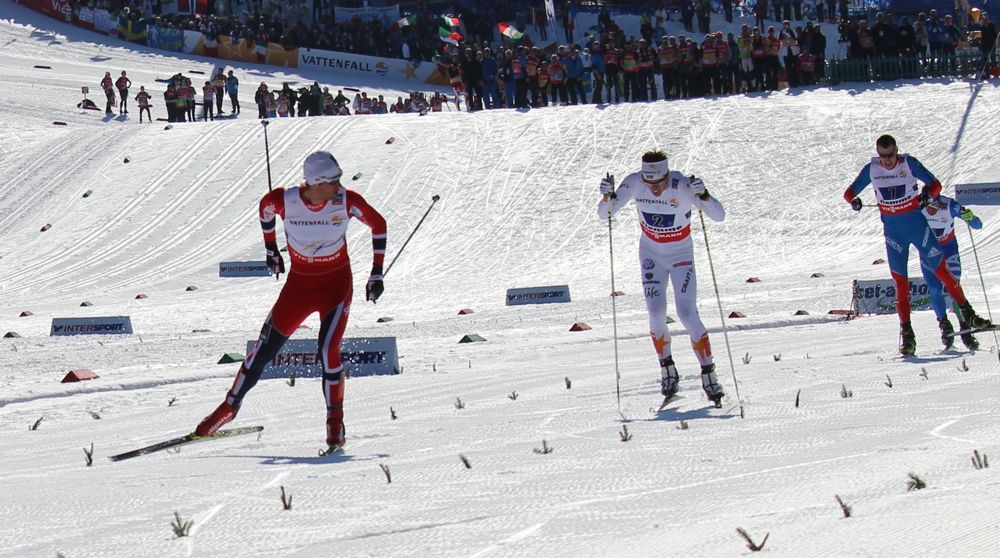
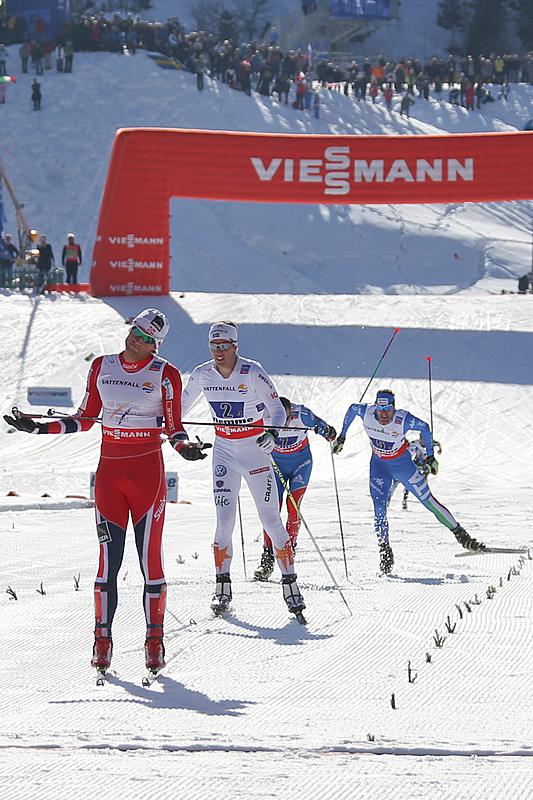
Petter Northug prematurely shrugs off Norway’s seventh-straight men’s relay title at World Championships on Friday in Val di Fiemme, Italy. He beat Sweden’s Calle Halfvarsson (second from l), Russia’s Sergey Ustiugov (third) and David Hofer of Italy in fourth for his second gold of the week. (Photo: Fiemme2013)
But in a World Championship relay, that’s how it often goes.
“You need to race a little bit tactical, come from behind, save power for the last round because then you know it will be attacks,” Northug explained.
He quietly hovered near the back within a second or two of the lead until he decided it was time to go. Everyone knew some kind of surge would come, they just didn’t know when.
While the front guys played mind games, American Tad Elliott made up 59 seconds after starting in ninth. He caught the group on the second lap and led Northug up the second climb.
By the next hill, however, Elliott’s effort caught up with him and the 25-year-old Colorado native started to slip behind. Meanwhile, Finland’s Matti Heikkinen continued to make up ground on the leaders after starting nearly a minute and a half back in 11th. Heikkinen reached the group on the third lap and surged to the front early, but failed to hold on halfway through. He fell to the back of the group in seventh while Northug took the lead. Hofer and Ustiugov skied behind him, followed by Halfvarsson, Fischer and Teichmann.
With about 1 ½ k remaining, Northug led the downhill into a relatively boring part of the course. Before then, nothing really happened on the straightaway before the second-last descent. Northug caught his competitors off guard and attacked on the flat, where Halfvarsson in second responded quickest.
In his first World Championships, the 23-year-old Swedish anchor knew this was his moment and managed to get ahead of Northug on the fast downhill, taking the inside corner on the sharp bottom curve.
While Halfvarsson and Northug battled back up to the top, Ustiugov and Hofer put their heads down trying to hang on. The Swede led the final downhill, looking back to see how close Northug was. Really close.
The two sped over the last bump before the stadium and began the much-anticipated sprint showdown. Northug free skated alongside Halfvarsson to take the lead and just before finish, he let everyone know who the winner was. With Halfvarsson a few meters behind, Northug put his hands out and shrugged. No big deal.
Now a nine-time world champion, Northug claimed the seventh-consecutive world champs relay victory for Norway, in which he and Tord Asle Gjerdalen, Eldar Rønning and Sjur Røthe combined for a winning time of 1:41.37.2.
Sweden (Daniel Richardsson, Johan Olsson, Marcus Hellner and Halfvarsson) came up 1.2 seconds short for its sixth silver medal of the week. Russia (Evgeniy Belov, Maxim Vylegzhanin, Alexander Legkov and Ustiugov) edged Italy (Dietmar Nöckler, Giorgio Di Centa, Roland Clara and Hofer) by 0.2 seconds for third, 2.4 seconds behind Norway.
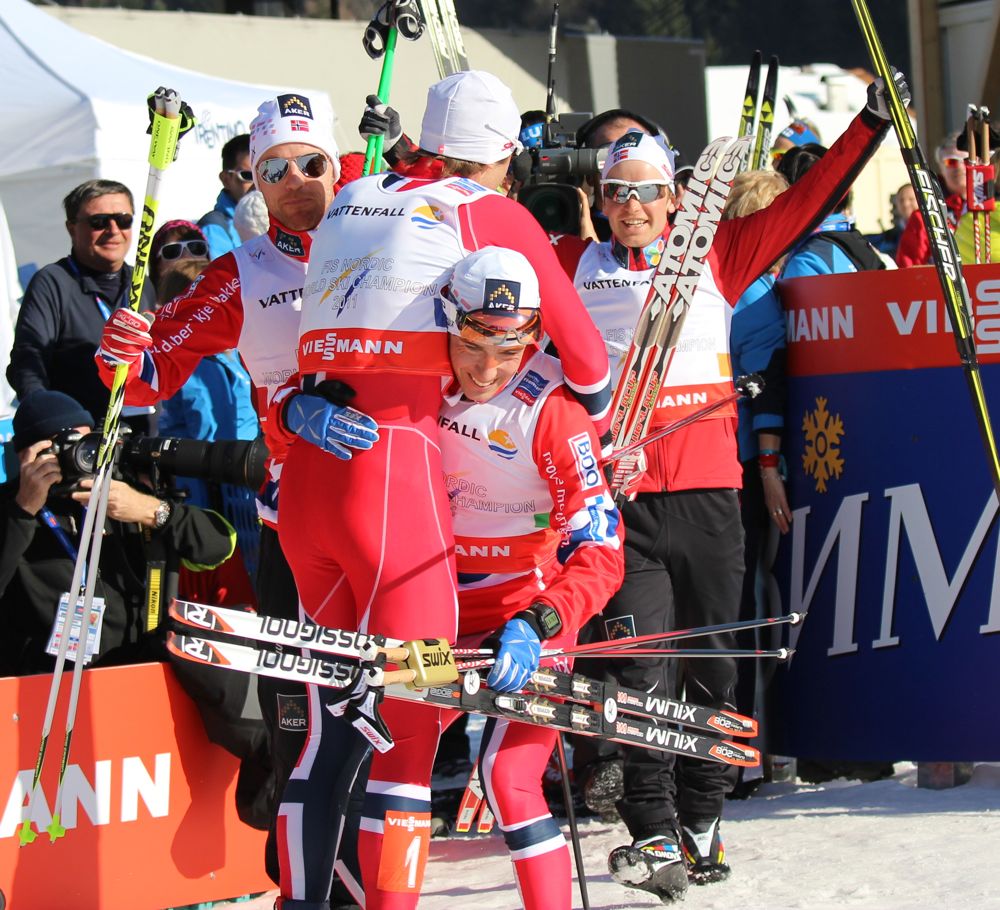
Eldar Rønning hoists teammate Petter Northug after the Norwegian anchor sealed the team’s seventh straight World Championships relay victory on Friday in Val di Fiemme, Italy. Tord Asle Gjerdalen (l) and Sjur Røthe (r) join the party.
“Two hundred and fifty meters before the line I knew it was gold,” Northug told reporters. “So that feels amazing.”
“It’s awful fun to win the relay, and a dream to fight against Sweden at the end,” he told NRK. “I know what that rests on my shoulders. It is almost a scandal to be number two.”
His teammates set him up according to plan. Their scramble leg, Gjerdalen again filled in for Martin Johnsrud Sundby, who’s been out sick since Wednesday’s 15 k (Gjerdalen started in his place and earned bronze). Easily recognized as Norway’s Aviator-wearing guy, Gjerdalen wore his trademark sunglasses while putting the team in second at the first exchange, just 0.3 seconds behind Germany’s Hannes Dotzler.
(The Germans ended up seventh behind Finland in fifth and Switzerland after Teichmann crashed twice on the last lap. “Throughout my career, I’ve never had so much bad luck,” the 33-year-old Teichmann told Südkurier.)
On the second classic leg, Rønning kept the Norwegians close and tagged to Røthe in fifth, 3.4 seconds behind Switzerland’s Dario Cologna, who skied a commanding second leg. Italy, Russia and Germany were also in the mix, along with Sweden’s Olsson, who tagged to Hellner four seconds back in sixth.
“It was tough,” Olsson told reporters. “In my case, maybe the glide wasn’t 100 percent today compared to some of the other competitors on my leg. It’s tough on the mind, too, when you don’t have the maximum skis under your feet.”
After taking his second-straight silver to Northug, who won Wednesday’s 15 k individual skate, Olsson told NRK: “He loses maybe one in a hundred sprints. It’s amazing how he does it again and again. No matter how the race is, he always wins.”
Norway’s Torde Asle Gjerdalen (r) puts the team in contention early on the first of four 10-kilometer legs in Friday’s relay at 2013 World Championships in Val di Fiemme, Italy. Norway won by 1.2 seconds over Sweden.
On the third leg, Legkov lifted Russia to first by the last exchange, 0.6 seconds ahead of Hellner. Røthe came through after the Swede in third, 2 seconds behind Legkov.
“The idea was that Petter should never have been in the lead on the last stage,” Hellner told NRK.
While he didn’t lead from the start, he was close enough to capture it.
“I did everything I could, but I had nothing to answer. I had no strength left,” Halfvarsson told NRK.
“I tried to get a few meters up in the last uphill, but he is too strong,” he explained to reporters. “I had no chance. I’m happy with the silver because this is my first medal, but when it’s so close to gold, it’s not so fun.”
Northug suggested Sweden should’ve chosen someone else and said his team was surprised to see Halfvarsson listed as its anchor.
“But we say thank you,” Northug told SVT. “All glory to him, he beat several strong sprinters, but he still has a ways to go.”
For Røthe, who also started his first World Championships relay, the gold was everything he’d hoped for.
“It’s great to be world champion,” he told NRK. “It was a fun duel with Sweden.”
“A big job for the whole team, but the last guys, they’re just walking, slow, slow, slow and doing a massive sprint,” Gjerdalen told reporters. “That’s entertainment, that’s excitement and a lot of adrenaline. The whole stadium was just quiet. It’s cool!”
At the finish, the King of Sweden, Carl XVI Gustaf, congratulated Northug.
“Nice that you stopped by,” Northug reportedly said.
“We did not talk so much,” he explained to NRK. “He said it was a close fight, and seemed very pleased that Sweden had taken the silver.”
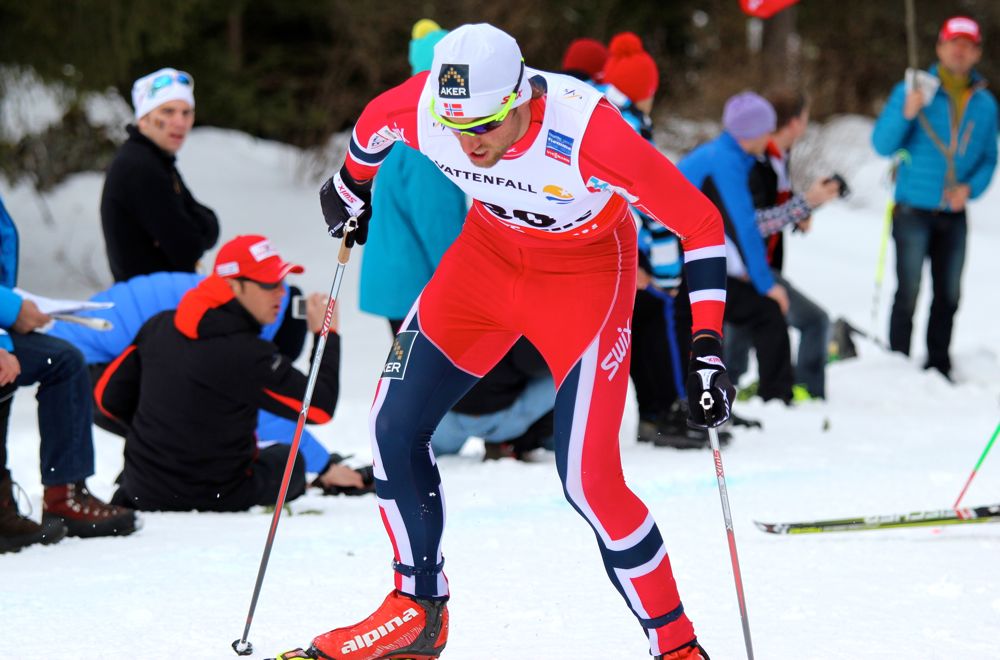
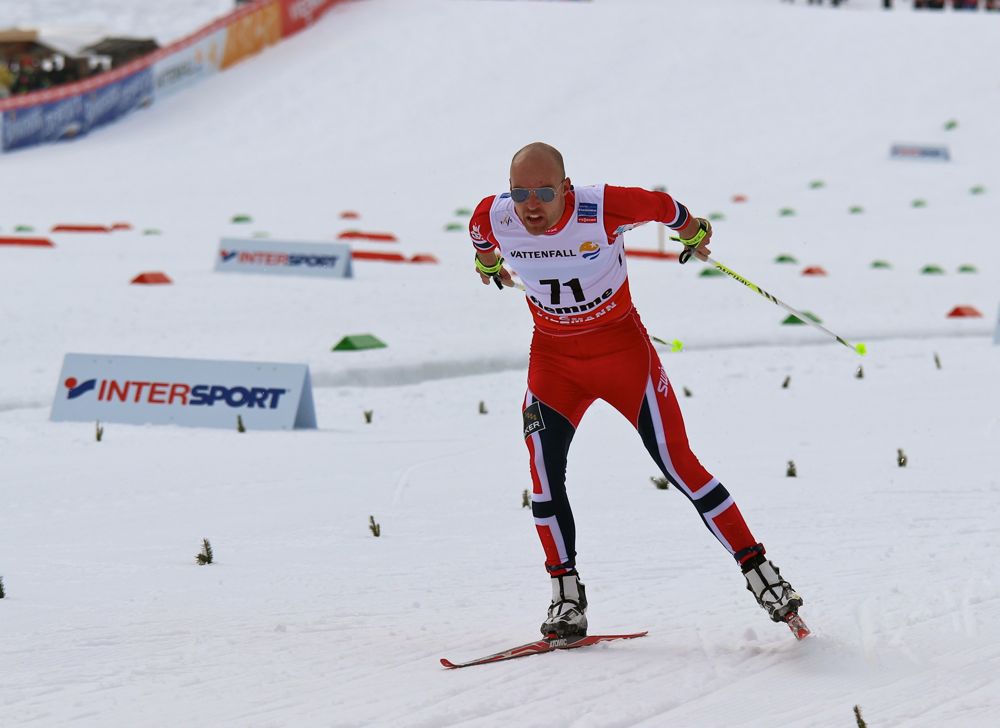
Norway’s Petter Northug charging hard up to the high point of the course on his second of three laps in Wednesday’s 15 k freestyle individual start at the 2013 World Championships in Val di Fiemme, Italy. Northug won the race by 11.8 seconds for his first individual-start title and eighth at World Championships.
FasterSkier’s coverage of the 2013 FIS Nordic World Ski Championships in Val di Fiemme, Italy, is brought to you by the generous support of Fischer Sports.
VAL DI FIEMME, Italy – For Norway, Sunday’s men’s team sprint letdown at the 2013 Nordic World Ski Championships turned out to be a blessing. It was hard to see then, but Petter Northug not advancing to the finals with teammate Pål Golberg was a good thing.
While the 22-year-old Golberg recovered after blacking out, Northug slept off the frustrations and woke up Monday anxious to get back out there. That’s when it hit him: why not do the 15-kilometer individual start on Wednesday?
Sure, it wasn’t historically his best event. Heck, he hadn’t won a 15 k freestyle individual race on the World Cup before. But with seven World Championship golds behind him, Northug, 27, figured he didn’t have much to lose. And he had energy to spare.
The 89th of 95 starters, Northug went into Wednesday’s race with a specific plan: attack for gold. The first of three laps went exceptionally well as he clocked the fastest time through the 1.8 k checkpoint. The mass-start specialist held his high pace for the second 5 k loop, reaching 9.4 k faster than anyone else, and put his head down the third time around.
With race favorites Dario Cologna of Switzerland and Russia’s Alexander Legkov behind him, Northug knew he couldn’t let off and was most concerned with Sweden’s Johan Olsson in front of him. The last starter in soft, sluggish conditions with temperatures up around 8 degrees Celsius (46 Fahrenheit), Cologna struggled early, ranking eighth through 1.8 k at the high point of the course. At the tail end of the second lap, he was third fastest, but fell to fifth at 11.8 k.
“I heard the times of Dario so I knew that it’s going to be a fight between me and Johan Olsson,” Northug said at a post-race press conference. “When I was out on the second lap, then I just focused on the time of Johan.”
Losing some time on the third lap, he focused on staying upright for the long downhill back toward the stadium.
“I started to get a little bit worried, but I knew my plan the last two downs was more to stay on my legs and not to fall,” Northug said. “I knew I had the seconds to win.”
As Olsson, who started six minutes before Northug in bib 77, sat in the leader’s chair at the finish, Northug cruised down into the stadium with a 40-second lead. Looking exhausted, he mustered a final sprint and barely made it through before losing control and veering sharply to the left – almost into the boards.
His head then his back hit the ground, and he exhaled. A few moments later, Northug realized what he had done in winning his first title at this year’s World Championships in an event he didn’t typically dominate.
“When you’re so tired as I was today you don’t hear any crowds; it feels like you’re racing alone,” he said of coming into the stadium for the last time. “You just want to cross the finish line because you’re tired … and then you cross the line and you get a couple minutes to rest and you hear the crowd and you hear the speaker announce that you are world champion. That’s an amazing feeling.”
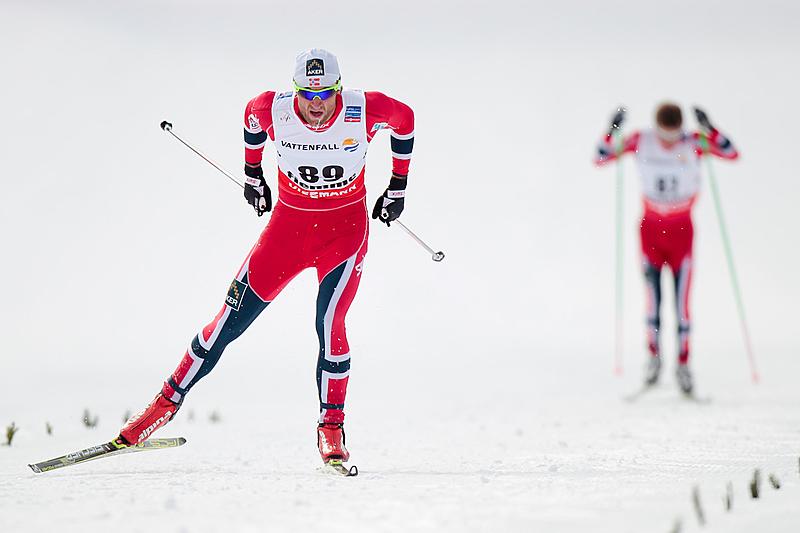
Petter Northug just before becoming a 15 k freestyle World Champion on Wednesday in Val di Fiemme, Italy. (Photo: Fiemme2013)
Northug took the individual crown with a time of 34:37.1. Olsson was second, 11.8 seconds behind, for his first individual silver medal at World Championships. Norway’s Tord Asle Gjerdalen earned his second individual bronze at worlds (+22.3) after placing third to Northug in the 50 k freestyle mass start two years ago in Oslo, Norway.
Ivan Babikov made history for Canada in fourth, 53.6 seconds behind Northug and 31.3 seconds off the podium, notching his nation’s best finish in a 15 k skate individual start since Pierre Harvey was 16th in 1982. Norway’s Sjur Røthe placed fifth (+1:03.0) and Cologna ended up eighth, 1:21.1 behind. Starting a minute in front of Cologna and skiing with him near the finish, Legkov ended up 25th (+2:28.7).
In a race that was by no measures easy with at least six steep climbs per lap, Northug attributed his success to being hungry for redemption and feeling in great shape after last week’s classic sprint (where he was second), Saturday’s skiathlon (where he was fourth) and Sunday’s team sprint (where he and Golberg placed 11th).
“Today is a day you dream of when you’re an athlete,” Northug said. “You wake up, you feel that you have a lot of power, you want to compete, you want to give your all and also when you then win, it’s amazing.”
Asked what his eighth World Championships gold meant to him compared to the rest, Northug said nothing could rival his 50 k victory in Olso. “To win a 50 k in a world championship is one of the biggest things I’ve done,” he said.
Even so, this individual win was pretty significant and counted just the same, he said.
Sweden’s Johan Olsson pushing to the finish of Wednesday’s 15 k freestyle individual start at the 2013 World Championships in Val di Fiemme, Italy. Olsson took second, 11.8 seconds behind Norway’s Petter Northug.
His closest challenger on Wednesday, the 32-year-old Olsson knew what Northug was capable of. Early last season in Kuusamo, Finland, Northug romped the field in a World Cup 10 k freestyle by 23.8 seconds. A month later, he won a World Cup 30 k freestyle in Davos, Switzerland, by nearly a minute.
“I know when he’s at his best, no one can beat him,” Olsson said.
Aware of the splits throughout the race, with Olsson posting the fastest times through the 9.4 and 11.8 k checkpoints before Northug blew them away, he mostly focused on himself.
“If you should take a medal on the individual start, I think you cannot focus too much on the other competitors,” he said at the press conference. “My biggest enemy on the course is the voices that say, ‘Give up.’ But you have to fight all the time, that’s the way I ski.”
Olsson stole the spotlight and leader’s position from Gjerdalen, who started 71st and bested Babikov in bib 69 to reach the podium. Notably, the 29-year-old Norwegian senior team member didn’t know he was racing until Wednesday morning, when he received a text message that teammate Martin Johnsrud Sundby was out sick, FIS tweeted.
“I knew it was my turn to go,” Gjerdalen said. “I must admit I wasn’t very happy because … it’s been four or five years since I’ve been fast in this individual start. I actually wanted to trade this race for the 50 k.”
Tord Asle Gjerdalen of Norway on his way to his second World Championships bronze in Wednesday’s 15 k freestyle individual start in Val di Fiemme, Italy. Originally not on the start list, Gjerdalen raced in place of teammate Martin Johnsrud Sundby, who was out sick.
Regardless, he gave it his all, attacking the course in his signature Aviator sunglasses. Starting 12 minutes before Cologna, Gjerdalen used the Swiss superstar as fuel when Cologna passed him on the second lap. Gjerdalen thanked him at the finish.
“He turned an individual start into a mass start for me so that’s perfect,” he said.
“Before I started, I knew the skis would get slower and slower so I was really surprised that I made the podium,” Gjerdalen said of the softening conditions. “When I realized that I knew I had a chance and the coaches were shouting, ‘A medal!” I thought, ‘What?’ That was incredible. It gave me speed.”
And the Aviators?
“I use them all the time; they’re fogging, I can’t see,” he joked. “No, they’re really good and it’s become an image for me. I have only one [pair] with me so I hope they don’t break or I lose them, then I have to go buy some new gear. But I suppose [Italy] is the right culture to buy them.”
Liz Stephen (l) with Justyna Kowalczyk (POL) and Russia’s Yulia Tchekaleva (r) on the podium on Sunday in Muonio, Finland. Kowalczyk won the FIS 10 k skate race by 4.46 seconds over Stephen. (Holly Brooks courtesy photo)
After months of training and anticipation, the nordic sports opened their seasons around the world this weekend with races around the world. Established veterans had several dominating performances, but there were new faces on the podiums as well, signaling that when World Cup racing starts next weekend, things could be pretty interesting.
In Bruksvallarna, Sweden, the Swedish, Canadian, and Slovenian national teams butted heads in a three-day race series. One of the biggest surprises was Swedish 23-year-old Emma Wiken taking a 2.4-second win over Charlotte Kalla on the first day of racing. But otherwise, Sweden’s top stars prevailed, with Daniel Richardsson, Johan Olsson, Teodor Peterson, and Ida Ingemarsdotter taking wins and Kalla returning to completely decimate the women’s field in the 10 k skate. Canada had strong performances as well, with Alex Harvey placing fourth in the 10 k classic, Ivan Babikov third in the 15 k skate, and Chandra Crawford second in the skate sprint. Katja Visnar of Slovenia also stepped on the podium in the sprint.
To the northeast in Muonio, Finland, even more national teams tried out their racing legs. Finland was joined by Russia, the United States, the Czech Republic, Poland, Kazakhstan, Japan, and Germany in a three-race series. Justyna Kowalczyk of Poland swept the women’s competitions, and was at her most dominant in a 29-second win in Saturday’s 5 k classic. For the men, Alexey Poltoranin of Kazakhstan took two victories before Matti Heikkinen of Finland bested the field in the 15 k skate. The U.S. had several top performances, headlined by Liz Stephen‘s second-place finish in the 10 k skate, just 4.6 seconds down on Kowalczyk; Holly Brooks and Jessie Diggins also made the top ten. But Kris Freeman also placed fourth in the men’s classic race, and Andy Newell and Ida Sargent both made the sprint finals.
Meanwhile, Beitostolen, Norway, was hosting the opening races for both skiers and biathletes. The women’s races were characterized by familiar Norwegian faces on top of the podium: Maiken Caspersen Falla in the sprint, Therese Johaug in the two distance races, and Tora Berger dominating the biathlon competitions. Perhaps the biggest surprise was Marit Bjørgen‘s two losses to Johaug, including a 50-second blowout in the classic race. Petter Northug won on Friday before falling in the sprint final, leaving Anders Glørsen to take the win, while Chris Andre Jespersen skied to a huge victory on Sunday. World Champion Martin Fourcade of France won Saturday’s biathlon sprint, before sitting out Sunday’s mass start and leaving the victory to Erlen Bjøntegaard.
Finally, the U.S. race season began in Fairbanks with the Tour de Ski Fairbanks, a three-day series culminating in pursuit races on Sunday. Designed to be a meet for University of Alaska Anchorage and University of Alaska Fairbanks skiers, the weekend consisted of prologues on Friday, classic mass starts on Saturday, which included sprint preems, and then skate pursuits on Sunday. Logan Hanneman and Raphaela Sieber, both from UAF, picked up the overall titles, although Viktor Braenmaark and Marine Dusser (UAA) had the fastest ski times on Sunday and Rebecca Konieczny (UAF) won the women’s prologue.
Ivan Babikov (CAN) racing to third in the 15 k skate in Bruksvallarna, Sweden on Saturday. Photo courtesy of Babikov/Salomon.
Devon Kershaw had a good start in Bruksvallarna, Sweden today. So did Daniel Richardsson. But in the end, for both the Swedes and the Canadians, it was steady pacing that garnered skiers a top finish: Johan Olsson bested Richardsson for the win, and Ivan Babikov placed third for Canada while Kershaw faded to tenth.
At 4.6 k into the 15 k, interval-start skate race, the second competition in the opening series of FIS races, Richardsson had an 11-second lead over Kershaw, with Olsson another two seconds back. Babikov was tenth, 21 seconds out of the lead.
And yet Olsson, if anything, picked up the pace and was unstoppable over the last half of the race.
“I did my own race, and it felt good,” Olsson told Sweden’s TV4. “It was nice to go first in the seeded field. I’ve been away a lot and haven’t had so many training races, so I haven’t had any direct comparison to the others yet. It was nice that it went well today.”
Richardsson, who won Friday’s 10 k classic race, also seemed happy with the result; traditionally he has been stronger in the classic technique.
For Babikov, the slow start and strong finish were all part of his plan.
“I tried new tactics today,” he told FasterSkier in a phone interview. “The goal was to start really conservative for the first lap, and not thrash it, just to ski and glide. I tried to save as much power and energy as I could for the last few laps. And it worked really well I think… I didn’t know it was going to be that hard. The snow is pretty fast, so I thought it would be a fast 15 k, but it ended up that lots of people got tired on the last laps and maybe started too fast.”
Kershaw was one of those – “I licked chode”, he tweeted after the race – and told FasterSkier that the large workload he’s had in training for the last few weeks was clearly still affecting his ability to go hard. He was impressed with Babikov’s control.
“I want to say how psyched I am for Babs though- he was great today,” Kershaw wrote at the end of an e-mail to FasterSkier describing his race. “Paced it perfectly and was really, really moving that last lap. I’m impressed. He’s been notorious for slow starts to seasons, too, and to have a race like that so early in the year, on a course that was pretty rolling (read: not epically difficult which is Babs terrain!) is a very, very good sign. It was awesome to see.”
Babikov said that as far as the tactics test went, he was likely to use the same approach to next weekend’s 15 k skate in Gällivare, the first World Cup of the season. He was optimistic about his chances there, and not concerned about the time back from Olsson.
“Of course I’m happy with the race in total, because I’m on the podium and those two guys – Johan Olsson is potentially the winner for next weekend, too,” Babikov said. “He won last year’s opener in Sjusjøn in Norway, and he’s always been strong. And Richardsson is a really good skier, too. And I beat quite a few good guys too, Hellner was back there somewhere, so I’m really happy with my race, for sure.”
Babikov had a few other advantages, as well. He was the very last starter in the field, which he said played in his favor on a crowded course; for the first two laps, he was constantly passing large groups of skiers, and some parts of the course were quite narrow. There was even a tunnel narrow enough that racers could only double-pole, “so if you’re stuck behind somebody you have to wait until it opens at the end,” Babikov said. By the last lap, the course had cleared out and he had more room to run.
He also lapped with Olsson and had the chance to ski a loop with the eventual winner.
“I was pretty relaxed behind him, which gave me some good confidence, and I could use that on the last lap,” Babikov reported.
All in all, he said, he is in “good form at this moment.”
The same could not be said for Kershaw – or Sweden’s star skier Marcus Hellner, who finished ninth, one place ahead of the Canadian and well over a minute behind Olsson. Although Hellner didn’t have Kershaw’s strong start, he experienced a similar fade at the end.
“I’m not sure how Hellner raced, but for him to be ninth in a 15 k skate race… It must be one of his worst 15 k skate races ever,” Kershaw wrote. “You know he’ll be a different person next weekend on his home courses of Gallivare.”
Kershaw hoped that he would, too, with another week to recover from his training load.
“I am and have been training very hard these last weeks, which is pretty normal for me this time of year,” Kershaw wrote. “Of course, last year I’m not even sure I was top 30 in this race, but it doesn’t feel good to get the floor wiped with you. Apparently it takes some time to digest that workload, but I am hoping that next weekend in Gallivare goes WAY better than it did today. I’ll try and take the small positives out of this effort, and move forward.”
His fast pace early – Kershaw actually led at 1.8 k – was deliberate, he said, and he hadn’t taken into account how tired his body was. After feeling good and expecting to be able to hold the pace, he found that quite the opposite was true. Coming down the last hill into the finish, Kershaw bent over and put his hands on his knees, trying to steady his shaky legs.
“I was feeling pretty good for that first part, skiing big/smooth which is how I wanted to attack the course,” he wrote. “I felt relaxed and was hitting the technique well, but… I was on fumes with one lap to go, and I was able to hold on a bit until the 11.8 k mark when things got really, really ugly. In those last 3 k I was running on empty – legs like concrete and I couldn’t recover, let alone attack… I lost oodles of time and it was a big effort for sure.”
Kershaw and Babikov were the only non-Swedes to break into the top ten; Lars Nelson placed fourth, the third Swede for a second day in a row, and likely won himself a start in next weekend’s World Cup. Anton Lindblad was fifth and Martin Johansson sixth.
The lone remaining Canadian, last year’s NorAm winner Kevin Sandau, placed 36th.
Johan Olsson (SWE) on his way to victory in the men's 15km classic in Szklarska Poreba (POL). Photo: Fischer/Nordic Focus.
It isn’t all that common, these days, to see Johan Olsson on the World Cup.
After a strong start to this season, Olsson took a two-month forced hiatus due to illness. Last year, after the November World Cups he didn’t return to the top level of competition until World Championships in March. In 2010, he skipped the entire month of January to prepare for the Olympics. Injury and illness are sadly par for the course for the tall Swede, who is just a month shy of his 32nd birthday.
But when Olsson does show up, he gets noticed.
In Szklarska Poreba, Poland on Sunday, Olsson picked up his third win of this World Cup season in just five individual starts, leading from the very first time check through the finish of the 15 k classic individual-start race.
Olsson’s victory came in challenging conditions: kickwax was far from straightforward, and athletes’ skis seemed to be either slipping or icing. Some racers ended up herringboning even the more moderate hills on the course, unable to make their skis do the work for them.
“Conditions were very tough as you can win or lose everything,” Olsson explained. “You can lose a lot of time if you do not have the right skis.”
That wasn’t a problem for the Swede, however.
“I had extraordinary skis,” he told FIS after the race. “It was really difficult before the start and I waited as long as I could to pick skis, but I made the right decision and I’m very happy about that.”
Olsson has now won his last two races, both of which were long, classic affairs; in Nove Mesto, Czech Republic last week, he squeaked out a victory in a 30 k mass start.
“It feels really, really great today, just like last week,” Olsson said after the race.
Dario Cologna strides his way to second in Szklarska Poreba (POL). Photo: Fischer/Nordic Focus.
Second place went to Dario Cologna of Switzerland, who maintained his huge lead in the overall World Cup standings but was unable to touch Olsson today. Cologna also finished second to Olsson a week ago in the Czech Republic, but today the margin of victory was larger, due partly to the interval start. Both skiers showed even pacing; halfway through the race, they were separated by ten seconds, and at the finish the gap was 19.
“I tried to fight a lot but there was always a ten-second margin,” Cologna said after the race.
Russians Alexander Legkov and Ilia Chernousov were third and fourth almost a minute behind Olsson. The pair trains on their own under the guidance of Reto Burgermeister, and their joint success today – the next Russian, Maxim Vylegzhanin, was 50 seconds behind them in 13th place – may make the Russian federation more sympathetic to their cause.
Then again, it might not. In 1947, the Russians convened a meeting of Soviet governments in Szklarska Poreba to decry the Mashall plan, which they described as “the American plan for the enslavement of Europe.” There’s a certain irony that here at the same venue, their most successful skiers were a pair of Russians who train mainly in Switzerland with a Swiss coach and support staff.
But regardless of what the federation thinks, the two racers were giddy with their success. Legkov may have beaten his teammate, but he noted that the day was truly a success for both of them.
“Ilia is my friend and I am happy for his good result,” he said. “We will divide the prize money.”
All of the top finishers praised the Szklaska Poreba venue, which is new to the World Cup circuit. Olsson, for example, said that the change of scenery was refreshing – and that even though the culture is vastly different than his native Sweden, he heard fans screaming his name as he skied past.
“When you’re in the World Cup circus for ten years as I am, it’s fun to come to a new location,” he said. “The courses here are really good, too, as is the audience.”
Cologna agreed, and thought that the races would bolster the sport’s fanbase, which has been fueled by Justyna Kowalczyk’s success.
“It is good to have World Cup in Poland, as cross-country skiing is very popular,” he told FIS. “I like to be competing here. The fans were great and were cheering on everybody.”
Of note:
-Alexey Poltoranin of Kazakhstan finished sixth, collecting his first top-ten result since December. It was a good day for the Kazakhs: teammate Sergey Cherepanov finished 11th, the first top-20 result of his World Cup career.
-Germany’s Franz Goering finished eighth, representing his first top-ten finish in over a year. He last made the cut in Rybinsk, Russia in February 2011.
-The top Pole was 31-year-old Maciej Kreczmer, who placed 58th, over four minutes behind Olsson.
-Cologna was the only one of the top-ranked World Cup racers to have a strong race. Second-place Petter Northug did not compete, while third-place Devon Kershaw placed 26th and fourth-place Marcus Hellner 21st.
Men's 15km classic podium in Szklarska Poreba (POL): Dario Cologna (SUI, 2nd place – left), Johan Olsson (SWE, 1st place – middle) and Alexander Legkov (RUS, 3rd place – right). Photo: Fischer/Nordic Focus.
Johan Olsson (SWE) leads classical 30 k mass start in Nove Mesto (CZE). Photo: Fischer/Nordic Focus.
After a two month hiatus from World Cup racing, Johan Olsson (SWE) demonstrated a complete return to form, pushing the pace from the get-go in the 30km classic mass start in Nove Mesto, Czech Republic, before countering a vicious attack from Dario Cologna (SUI), and riding fast skis to victory.
Olsson couldn’t have asked for a better start to the 2012 season. At the opening 15km skate in Sjusjoen, Norway, he skied to a convincing 30-second victory over Petter Northug (NOR). He followed up with a 5th place finish in the Kuusamo mini-tour and was on track to better his 2009 season in which he placed 14th in the overall standings while winning his first World Cup race.
Following the final race in Kuusamo, however, Olsson didn’t even toe the start line on the World Cup for another two months, battling a series of upper respiratory illnesses, including bronchitis.
“I had some tough weeks this winter, but my seasons are usually like that,” Olsson said, explaining that he is very sensitive to cold temperatures.
After a strong result in a Scandinavian Cup race in mid-January, Olsson earned a start in Oteppa, Estonia, placing seventh. He continued to ski well at the Swedish National Championships, twice placing second to teammate Marcus Hellner, and after taking no chances in frigid Rybinsk, Russia last weekend, Olsson was back in action today.
The sporadic racing and long-running battle with illness did not dampen the Swede’s aggression on the trail.
Petter Northug (NOR), front and center during the mass start in Nove Mesto (CZE). Photo: Fischer/Nordic Focus.
He led the race from the gun, and was never out of the top-5. Hellner and Anders Soedergren threw their hat in the ring at various points in the race as well, giving the Swedes a strong presence throughout the six-lap affair.
With five intermediate bonus sprints, the intensity remained high, and with each successive lap the lead pack shrunk by several more skiers.
Despite the challenges for bonus points, the real excitement didn’t begin until 10k remained in the race—not bad for a men’s mass start race where most events can be fast-forward to the final sprint.
At the 20k mark Soedergren held the lead ahead of Alekander Legkov (RUS) with Hellner and Olsson in 3rd and 4th respectively. This was at the bottom of the large climb up to the bonus, and Devon Kershaw (CAN) worked up to take the top spot through the line in his quest for points.
Cologna, the overall World Cup leader spent the first two thirds of the race comfortably ensconced in the middle of the pack. He made no effort for bonus points, missing out entirely the first time, and picking up a single point the next two times through.
The Swiss star, however, was not off his game, he was merely biding his time, eyes set on the race victory.
He quietly worked his way up toward the front, and on the second large climb of the lap, when Olsson accelerated, Cologna was in position to follow.
The pack was caught unawares, and the pair immediately had 10 meters. Maxim Vylegzhanin (RUS) and local hero Lukas Bauer (CZE) tried to respond, opening a gap of their own on the main group.
“We created a small gap and I thought it would be a good chance to go away,” Cologna said.
With over five kilometers left in the race, the move was risky. Sustained breaks are not as fickle in cross-country as in cycling, but pulling away so early rarely leads to success.
Cologna was committed however, and after Olsson, riding fast skis, led down the next descent, the Tour de Ski Champion took over, driving a fierce pace.
From that point onward, Olsson had to content himself with riding Cologna’s tails. The two were well matched on the climbs, but even with slower skis, Olsson was hard-pressed to match Cologna’s double pole, resorting to kick significantly earlier in an effort to keep up.
Some meters back, Eldar Roenning (NOR) joined up with Bauer and Vylegzhanin, but the three men were unable to close up. Lapping through the stadium they were six seconds behind the leaders and four up on the pack, and less than a kilometer later they had been absorbed.
Cologna and Olsson blew through the final bonus sprint, stretching the lead to nearly twenty seconds. And one climb later, when the pack failed to make up ground, the margin appeared secure, though on several occasions, both Cologna and Olsson could be seen taking long looks back, watching for any threat.
None would come, but Cologna, despite appearing the stronger, would have no chance to sprint for the win, ultimately undone by his skis.
Johan Olsson (SWE) celebrates his victory with Dario Cologna (SUI) charging to the line for second. Photo: Fischer/Nordic Focus.
Olsson moved into the lead on the final descent in the stadium, and cruised out to a 20 meter lead.
Cologna attacked valiantly on the small rise before the homestretch, closing slightly, but that effort was erased on the next drop, and Olsson doubled poled home for his third career win.
The Swede gave credit where credit was due, pointing to his skis as the key to victory.
“I have had some good races lately with Otepää and Swedish Championships,” he said. “I think my shape is rising, but today the biggest difference was my skis.”
He added that after the performance, he “might switch to downhill skiing.”
Cologna said after the race that he had been planning an attack at some point, and that he is feeling in top form.
Despite missing the win, he is now almost 400 points ahead of Northug in the overall. With the Norwegian planning on skipping the next several World Cups to prepare for the Vasaloppet, it would take a serious injury or illness to prevent Cologna from defending his overall title.
Northug placed 14th today and did not earn a single bonus second. Kershaw, who placed 12th, accrued the largest number of bonus point. His 50 points are equivalent to an additional fourth place finish.
Sixteen seconds after Olsson celebrated across the line Vylegzhanin led a charge of Russians at the front of the pack, to claim the final podium spot.
He was closely followed by Konstantin Glavatskikh and Stanislav Volzhentsez in fourth and fifth respectively.
Of Note:
– With Ilia Chernousov in eight, the Russians placed four skiers in the top eight.
– With Northug off-form, Niklaus Dyrhaug was the top Norwegian in 6th place. Dyrhaug skied well in the Tour de Ski, and provides a bright spot for the often maligned men’s distance squad.
– Sweden, led by Olsson, placed 1, 9, 11, and 13 with Ricakrdsson, Hellner and Soedergren in the mix.
– Bauer, limited as usual by his sprinting ability, placed 18th on home snow.
– Martin Jaks (CZE) saluted the home crowd, thanking them for their enthusiasm, as he skied home in 29th. Teammate Jiri Magal was 25th.
– 22-year-old Hannes Dotzler (GER) followed up a 16th in the 15k classic in Estonia with a 15th today. Based on his limited World Cup starts, Dotzler appears to be something of a classic specialist.
Dario Cologna (SUI), Johan Olsson (SWE) and Maxim Vylegzhanin (RUS) take their respective steps on the podium following the 30 k classical mass start in Nove Mesto (CZE). Photo: Fischer/Nordic Focus.
Doogiski over at NordicXplained asked how Pentsinen’s 4.3 second win in qualification on Friday stacks up historically. Quite impressively, it turns out.
That’s the second largest qualifying round winning margin for the men’s field in WC, OWG or WSC races. The only larger one was almost 10 years ago, with a 4.7 second victory by Björn Lind in a freestyle sprint in Germany in December of 2001. So we’re reaching back to the very beginning years of sprinting here.
Ola Vigen Hattestad came close to this once last season, winning qualification by 3.86 seconds.
A winning margin greater than 4 seconds in qualifying has happened more often with the women: six times. And it’s basically a who’s who of dominant female skiers over the past decade: Skari, Neumannova, Bjørgen (twice), Kowalczyk and Majdic. Skari’s is particularly absurd. She won qualifying in a WC sprint in Italy way back in the day (December 2001 again) by 8.4 seconds! It was classic, so maybe waxing was an issue, or maybe Skari was just that fast. Interestingly, the woman she beat that day be 8.4 seconds was Petra Majdic.
More generally, the typical winning margin in qualification is just under a second for the men and about 1.5 seconds for the women.
Marit Bjørgen
And how is Bjørgen faring so far this year?
She’s certainly still winning everything in sight, but she’s not really faster than last year. Although, that’s not surprising, since “regression to the mean” would lead us to believe that she’s regress a least a little this season.
Assorted Men
A few of the men who had strong weekends:
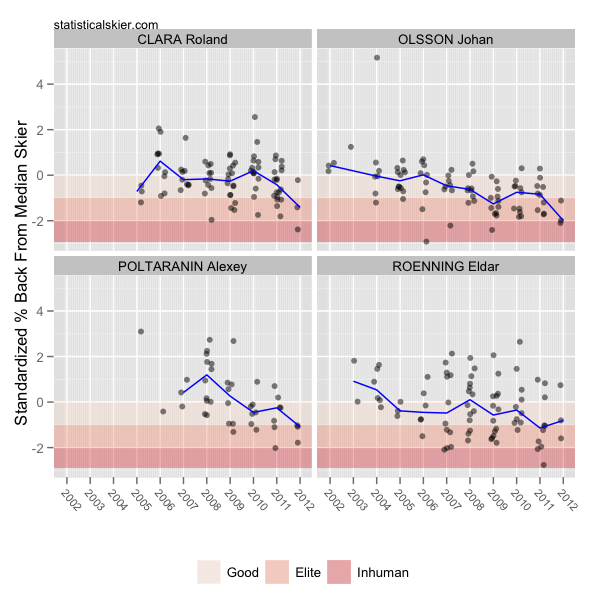
Eldar Rønning ended up doing very well in the overall mini-tour thanks to some very strong classic skiing on the last day. But overall, his skiing hasn’t been out of this world, and might even be a bit of a step back from last season. Remember that overall tour placings are heavily dependent on the specific events. In this case, strong classic skiers had a lot more space to make up ground, and so the overall tour may have favored classic specialists somewhat. If the techniques had been reversed, Rønning may not have fared so well.
On the other hand, Clara, Olsson and Poltaranin have all skied somewhat better so far this season overall. It’s particularly exciting to see from a guy I think a lot of people didn’t have on their radar (Clara), an older skier coming off a few bad-ish seasons (Olsson) and a guy from a “different” country (Poltaranin).
I plan to talk about sprint heat times when I can, but FIS messed up the heat times royally (at least, the times that are available online), so not this week. Maybe next time. I’ll have words about the North Americans on Wednesday…
Norway's Petter Northug competing at the 2011 World Championships in Oslo, Norway. Photo by Geir Olsen/NSF
Roland Clara had been second before. On Saturday in Kuusamo, Finland, the Italian looked pretty comfortable in the leader’s chair, bundled in a blanket and flashing a genuine smile. But the men’s 10 k freestyle race on the second day of the Ruka Triple mini-tour was only halfway through.
With individual starts staggering the finishes, Clara could see his seat wasn’t permanent. With every checkpoint — 3.1, 6.4 and 8.1 k — his challengers closed in. Of the remaining men on the course, Norway’s Petter Northug was most threatening.
After a steady start, the defending World Champion recorded the fastest time at 6.4 k. He was 11 seconds faster than any of the 100 or so men that started before him and reached that point.
As Northug crossed the finish and collapsed into an exhausted heap, Clara relinquished his spot. He nearly achieved his first World Cup victory, but it wasn’t his day. After Northug finished 16th in Friday’s 1.4-k sprints, the champion reclaimed the No. 1 spot — both on the podium and in the World Cup standings.
“I was tired at the end, but I managed to keep all the way,” Northug told NRK. “The plan was to attack. I tried to go out hard and finish hard. I think it was the key today.”
Clara ended up second, 23.8 seconds off Northug’s winning time of 21:49.1. Starting nearly 40 bibs after Clara, Maurice Manificat (FRA) initially endangered his lead, setting a new best time at 6.4 k. Clara’s late push helped him stay on top, and Manificat finished 6.3 seconds behind him.
Positioned in third after Northug (+30.1), Manificat awaited the result of Dario Cologna (SUI). At the halfway point, Cologna only trailed Northug by 6 seconds.
By 6.4 k, Cologna was 11 seconds behind the eventual winner, but on par for a podium finish. In the end, Cologna was 1.6 seconds slower than Manificat and finished fourth (+31.7). Manificat was happy with the podium and relieved he wasn’t the only one who felt the wrath of the challenging course, which was intensified by strong winds.
“I got a bit tired at the end,” Manificat told FIS Ski. “Luckily, Dario Cologna also got tired and I could keep the third place.”
Clara, who was third last weekend in the 15 k freestyle in Sjusjoen, was also pleased with his early World Cup performances.
The men's podium at last weekend's 15 k freestyle in Sjusjoen, Norway (left to right): Petter Northug (NOR), Johan Olsson (SWE) and Roland Clara (ITA). Photo:Fischer/NordicFocus.
“Two races, two podiums,” he told FIS Ski. “It’s incredible for me to be in the podium all the time. Tomorrow I will give my best and try to make the gap closer.”
Clara currently sits in third in the World Cup standings with 106 points after Northug (145 points) and Sweden’s Johan Olsson (132).
A win in Sunday’s 15 k classic pursuit would guarantee Northug, the World Cup and Ruka Triple leader, the overall mini-tour victory and 200 World Cup points.
A year ago, Northug wasn’t even a player in the three-day Ruka Triple. He sat out Kuusamo’s early-season competition because of illness. After Saturday’s race, he is well on his way to claiming another World Cup victory with an 11.8-second lead on Cologna (SUI) and 41.4 on Alexander Legkov (RUS).
“Tomorrow, around 120 athletes will hunt me,” Northug said to FIS Ski. “I will try to keep the same shape for the whole season. After the Tour de Ski, we will see who will fight for the World Cup.”
Other top contenders for the Ruka Triple crown include Clara (+47.8), Manificat (+48.3), and Olsson (+51.9). Marcus Hellner (SWE) is seventh in the stage standings, and Chris Andre Jespersen (NOR) moved to eighth with a fifth-place finish on Saturday.
Rounding out the top 10, Russia’s Evgeniy Belov was ninth in the mini-tour standings and David Hofer (ITA) was 59 seconds behind Northug in 10th. After illness kept Lukas Bauer (CZE) from competing until this weekend, he finished 10th Saturday to move up to 11th overall.
The top North Americans in the stage standings were Canada’s Lenny Valjas (17th, +1:08.2) and Ivan Babikov (20th, +1:16.4). While Valjas isn’t known for his distance races, Babikov is — along with teammate Alex Harvey, who currently ranks 24th after two days of races.
Finally, the World Cup season is under way. The individual 10/15km freestyle races this past weekend had some predictable performances (the Norwegian women) and some not so predictable performances (Swedish men).
Men
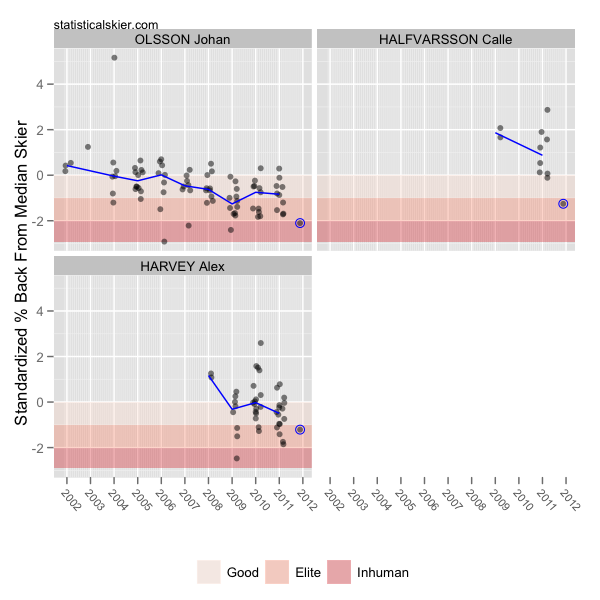
Let’s focus on just three of the men with notable performances on Saturday:
Definitely strong races for each of these guys, but there are some differences. Note that in Johan Olsson’s case, the past three seasons have seen him more or less plateau, and maybe even fall off a bit. He hasn’t laid down an effort quite like that in some time. Given his age and the trend over the past few seasons, I’d guess that we aren’t going to see Olsson pull this rabbit out of his hat each weekend, but you never know.
Calle Halfvarsson, on the other hand, is quite young, only around 22 I believe. For some reason I had it in my head that he was more of a sprinter, but looking back at his results I see now that he’s not quite that lopsided. He has racked up a 1st and 5th place in the WJC sprints, and several top 30 appearances in WC sprints, once as high as 9th. His distance results haven’t looked quite as impressive, but they certainly haven’t been poor. One interesting point to make is that after some strong WJC results, Halfvarsson had some strong results in WC races last season, including the sprints I mentioned. But he didn’t fare well at U23′s last year, finishing 23rd, 25th and 27th. This is a good reminder that you can’t put too much emphasis on a single set of championship level races in evaluating skiers.
All that said, this Saturday’s race was clearly out of the ordinary for him. I’d guess this performance is a good sign for him, but I wouldn’t expect him to do this every weekend this year. Even if this is his best result of the season, and the rest of his races fall between this performance and his median from last year, that would represent an enormous jump.
There was plenty of excitement about Alex Harvey’s 5th place, particularly on this side of the Atlantic. In contrast with Olsson and Halfvarsson, though, this result doesn’t look nearly as extreme for Harvey. If anything, I’d call this a strong race, but not at the outer limits of what he’s shown before. That’s why I’m taking Alex Harvey very seriously this season.
Women
To be honest I’m a little bored by the Norwegian Domination (impressed, but a bit bored) so I’m just going to look at two of the American’s:
Kikkan showed touches of this kind of performance last season, so it’s exciting to see it come to the surface right off the bat in the season opener. I don’t think she’ll be enough of a threat in distance events to be a serious podium threat in the stage races, but that’s mostly a reflection of how little weight the sprint races get in those events. If the sprint races were actually given equal footing in terms of time penalties, she might be giving some of the Norwegians a run for their money in the stage races with distance performances like these.
Similarly, it’s awesome to Liz Stephen get off to a strong start. Hopefully this will be a confidence builder for her. She essentially matched her career best, but the follow-up question is whether she can improve on it. I want to see her bust through to the Elite range a few times this season.
Miscellaneous
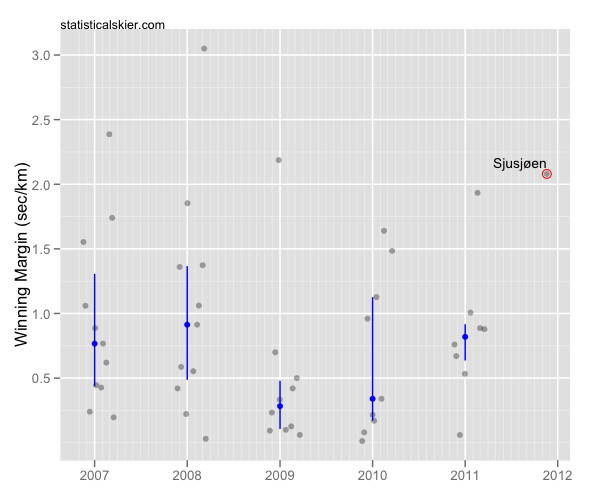
Over at NordicXplained, they commented that the margin of victory in the men’s race seemed unusually large. Close races are of course expected in mass starts, but they have become fairly routine in interval start races as well. How big was Olsson’s winning margin? Well…
These are the winning margins for men’s interval start races over the past five seasons. I’ve scaled the margins by race distance, for a somewhat fairer comparison. Olsson’a margin is certainly quite large. Not unprecedented, but quite unusual.
With the Norwegian women taking the top two spots earlier in the day in the 4×5 k, the Norwegian men had the bar for success set high for their four-man relay effort.
Northug getting it done in Sjusjoen (Photo: flyingpointroad.com)
As always, Petter Northug Jr. was anchoring Norway I, supported to Eldar Roenning and Finn Haagan Krogh on classic skis, while Lars Berger, biathlete, brother of Tora Berger, and occasionally cross-country relay selection skied third in the 4×10 k race in Sjusjøen, Norway, on Sunday.
Held on 2.5 k loops of man-made snow, the tracks quickly became extremely icy and hard.
While Norway I had a slight advantage in the form of Northug’s traditional anchor-leg superhuman efforts, it was obvious that the men were not going to have as clear a path to the finish line as their female counterparts.
Ultimately, the result was the same, as Norway I took the gold medal in a tight finish. In a surprise turn of events, Norway III emerged from the finish-line sprint with silver medal, while the Swedes picked up the bronze, narrowly edging out the French.
Russia I and II as well as France pushed the pace on what is usually a fairly sedate opening leg of the relay, forcing the field to work, and whittling away several teams.
As they rounded the corner into the exchange zone, the main pack was down to just six, with another six teams hanging close inside of 15 seconds, including the Americans, kept competitive with a strong leg by Andy Newell.
The lead pack on the second leg (Photo: Liz Stephen)
The major players on the outside were Switzerland, where Toni Livers dropped 46 seconds to the leaders, while Germany I employed Andy Kuehne — who could be seen running up hills on his skis — to finish the leg dead last, over a minute and 30 seconds back of the lead.
Under strong efforts by a variety of teams including Russia I, using Maxim Vylegzhanin, the French who tapped Maurice Manificat, and Finlands’ Sami Jauhojaervi, the main pack was reduced to six teams, including Norway I with Krogh.
Norway III, up until that point in the hunt, was let down by unknown quantity Ronny Fredrik Ansnes who dropped them out of the lead group and almost 30 seconds back of Russia I when the teams switched to the skate leg.
Russia I, France, Finland, Norway I, Sweden and Italy all came into the exchange within five seconds, while Switzerland’s Dario Cologna, the Czech Republic, and American Kris Freeman making up a smaller chase pack, around 30 seconds off the pace.
It took a massive effort for Cologna to draw back into the group – he skied the fastest second leg of the day by 13 seconds, blowing by Canada’s Ivan Babikov who broke a pole and was struggling as a result.
With Sweden’s Daniel Rickardsson tagging off to Johan Olsson, winner of Saturday’s 15 k skate, fireworks appeared in the offing for the third leg, especially with the history between Norway and Sweden in the relay.
But the Swede who was so strong on Saturday didn’t seem to be in the same world-class form. After leading for the first 5 k, Olsson could be seen looking around and motioning for someone else to come to the front.
However, Olsson was mostly ignored, until Lars Berger of chief rival Norway I stepped up at 7 k and turned up the pace. Berger was matched by everyone, especially Roland Clara who was skiing third for Italy. Clara, who picked up a bronze medal on Saturday finishing just shy of Northug for silver, put in an attack in the last 700 meters on a steep uphill, managing only to shake Russia I in the form of Sergey Turychev before the third and final exchange.
Roughly 30 seconds back of the lead pack, USA’s Tad Elliott attacked his small group of Morten Eilifsen (NOR III) and Remo Fischer (SUI), and then was attacked in turn, as Norway III and the Swiss handed off 44 seconds back, and Elliott handed off to Simi Hamilton 53 seconds behind the leaders.
Heading into the fourth leg, it was clear that Northug hadn’t had a sudden urge to change his tactics. Immediately after taking the tag, the firebrand Norwegian pulled up to let the five others go by, slotting himself in the pack second from the back.
The pace then dropped considerably, letting Curdin Perl (SUI) and Sjur Roethe (NOR III) claw back their considerable deficit. It was obvious for a long way out that the race had turned into an 8-way shootout at the finish line for just three medals.
At that point, Northug does what he does best, unleashing his unparalleled finishing kick to get clear of the pack to pick up the gold medal for Norway I.
But the surprise was Roethe, who stormed from 8th and a 44 second deficit to deliver a silver medal for Norway III, and secure the one-two finish for the second relay of the day.
“I’m happy to be on the podium today,” said Roethe in an interview after the race.
“The last leg was a tactical one but at the end I pushed hard and could take the second spot for our team.”
Sweden’s Calle Halfvarsson made a valiant effort to break up the Norwegian party, but the young Swede – who opened his season with a career-best World Cup finish in 4th on Saturday – couldn’t find enough speed to get past the red suits.
“In the last uphill I was behind and lost a bit the connection,” Halfvarsson said in a post-race interview with FIS Ski.
“I had to pass all for the finish sprint and that was not so easy… I am satisfied with my race but for sure I was a bit nervous before and during it.”
Left empty-handed at the finish line were the French, who finished fourth, just ahead of Russia I. Finland finished sixth, barely holding off the hard-charging Norway II, who placed biathlete Emil Hegle Svendsen on the anchor leg. Svendsen came from 12th spot, nearly two minutes back to have a shot, which gives you an idea of just how slowly the lead pack was going on the final leg.
USA anchorman Simi Hamilton dropped just two spots, one to Ilya Chernousov (RUS II) and the other to Svendsen, to end the Americans day in a solid 11th.
Canadian opening-leg specialist Devon Kershaw appeared strong in the early going, until a collision popped his ski off his foot, and put him to the ground.
Kershaw has provided plenty of first-leg fireworks in the past, but his fall and resulting time loss put the Canadians in a deep hole early, while Babikov broke a pole and never managed to find his rhythm. Graham Nishikawa skated the third leg, but by the time he received the tag they Canadians were out of the running, and the Canadians failed to start their fourth skier, sprinter Len Valjas.
Johan Olsson (SWE) celebrates the win in Sjusjoen, Photo:Fischer/NordicFocus.
Petter Northug (NOR), famed for his unmatched finishing kick, fired up the afterburners once again, accelerating out of the final stadium hairpin and into the homestretch. The seconds ticked off the clock, and it seemed impossible that Northug would overtake his challenger.
But lifting off the snow with each stride, Northug ate up the final meters, lunging across the line before collapsing in a heap, just two tenths of a second ahead of Roland Clara (ITA)…for second.
Northug provided plenty of drama with a stunning finish, but his efforts would only be good for runner-up as Johan Olsson (SWE) outpaced the field by a substantial 31 seconds in the men’s 15km freestyle in Sjusjoen, Norway.
Olsson, starting relatively early at bib 41, set a standard that the rest of the field was forced to try and match. Some, notably Northug and Dario Cologna (SUI), succeeded for a time, but none could maintain the pace for the full 15,000 meters.
Johan Olsson (SWE) skates to victory in the opening World Cup of the 2012 season. (Photo: flyingpointroad.com)
With one career victory under his belt, Olsson was hardly a favorite coming in. He had just three World Cup podiums to his name, all coming in 2009. Add to that a serious back injury that knocked him out of training for a good portion of the fall, and Olsson it is no surprise that Olsson said after the race “I absolutely did not believe I could win.”
In the finish corral he told FIS Media Coordinator Sandra Spitz that he attempted to ski the race like one of his “big idols,” famed Norwegian biathlete Ole-Einar Bjorndalen.
“I tried to ski my own race, like he did [in Bruksvalarna several years ago],” Olsson said.
He clearly succeeded, accelerating over the duration of the race, and ultimately leaving his competition in the proverbial dust. While none of the racers mentioned it, he may have been aided a little bit by warming temperatures and a softening course. As the day progressed the snow transitioned from the rock-hard track to a wetter, and in some cases, mushy consistency.
Northug, Cologna et al knew exactly what they needed to do. Cologna actually came through the half way mark a half second up on Olsson, but that was before the Swede surged. Four kilometers later and the defending overall World Cup Champion was twenty seconds down.
Northug, on the other hand, fell back by the halfway mark, and never closed back up. But while he couldn’t close on Olsson, he did move past everyone else, climbing from 5th at 7.5k to his ultimate second place.
“It was a tough race today,” Northug said at the post-race press conference. “In the last lap I heard it was pretty tight between the racers so I was fighting in every uphill and also on the easy terrain. I tried to give it all towards the end, and I’m happy to be second.”
Petter Northug (NOR) grabs 2nd in the World Cup opener. Photo:Fischer/NordicFocus.
It is hard to imagine Northug ever being truly satisfied with anything but the victory, but on this day there was no alternative. And his 2012 season is already off to a much better start than last year, when he missed the opening races due to illness and took nearly a month to round into form.
With Olsson’s striking performance, and Northug’s impressive surge to the line, it is easy to overlook Clara, who earned his first ever World Cup podium.
The 29-year-old Clara skied a consistent race, holding position throughout. He edged young Swede Calle Halfvarsson, at bib 19, the early leader, by 7.2 seconds.
“It was a perfect race,” Clara said. “I did not think I could make it to podium today, but when I started I heard it was going good and then I was waiting [at the finish].”
With 58 World Cup starts, Clara is hardly a newcomer. Halfvarsson, on the other hand, at just 22 years of age shows signs of breaking through this season. His previous best World Cup result was a ninth in a freestyle sprint event.
Halfvarsson edged out another young – but more established – name, Canadian Alex Harvey.
Coming off an impressive 2011 campaign that included World Championship gold, Harvey is looking to battle in the overall World Cup standings. Today he finished 5th, two seconds in back of Halfvarsson.
Harvey placed a solid 10th in last weekend’s FIS race in Sweden, but didn’t feel great out of the start in the first meaningful race of the season.
“I felt pretty tired warming up today,” Harvey told FasterSkier in an email. “It took me a while to get going, and still on the first lap, I wasn’t 100% yet, so I lost quite a bit of time there, coming into 34th place after 3.75km.”
But he was able to pick up the pace and finish strong. He was pleased with the result noting he had never cracked the top 30 in a 15km individual start race, though the performance was not completely unexpected.
“I wouldn’t say I’m surprised because I worked pretty hard this summer to improve my individual starts and skating up steep hills, “ he said. “I’m just happy that the hard work is starting to pay off.”
Canadian head coach Justin Wadsworth was pleased with his young star’s day. “Alex had a great race, really exciting to see him race well in what you’d call his weaker discipline [skate distance],” Wadsworth told FasterSkier in a phone interview from Norway.
“This shows how well rounded he is. We as a team worked hard on skating technique, which seems to be working well for him right now, so we’re excited,” Wadsworth continued.
Kris Freeman led the US men in 55th place. The rest of the squad was not far behind—Tad Elliott 60th, Andy Newell 63rd, and Lars Flora 65th , with the exception of Noah Hoffman, who struggled to 79th in the 92 skier field.
Simi Hamilton (USA), originally scheduled to start, was a last minute scratch when organizers realized the US had been allocated too many start slots.
Four other Canadians also competed. Devon Kershaw placed 37th, Ivan Babikov, just over from Canada, took 42nd, Len Valjas was 64th and Graham Nishikawa 71st.
More details on the Canadians’ race can be found here.
Much was made of the presence of many of the top Norwegian biathletes. Lars Berger, Emil Svendsen and Tarjei Boe make up a dream team on the biathlon circuit, but only Berger excelled, placing 8th, just two seconds behind Cologna.
Berger is plenty experienced on the cross-country side, racing for the silver medal winning relay team at the Vancouver Olympics.
Svendsen, known as one of the fastest skiers in biathlon was 15th, and overall biathlon World Cup Champion Boe placed 20th.
Another biathlete, Ronny Haafsas, who made some noise at the World Cup opener two years ago, winning this same event, placed 38th.
The World Cup opener often features highly variable results. With established stars like Sami Jauhojärvi (FIN), Axel Teichmann (GER), Tord Asle Gjerdalen (NOR) and John Kristian Dahl (NOR), among others finishing well off the pace, the race may not be the best indicator of the upcoming season.
Daniel Rickardsson, the tall Swede with a mean double-pole technique and the ability to ski seemingly any terrain with ease, is what keeps the Norwegians awake at night asthe 15K classic at the World Championships approaches.
Daniel Rickardsson showing off his double pole while winning in Drammen.
“It’s a heck of an awesome course they have out there, and the atmosphere just adds to the experience. I can’t wait to get on it,” Rickardsson said at the press conference Monday morning.
Along with the rest of the Swedish men’s team, Rickardsson feels in shape and ready to revenge the bad wax on Sunday.
“I will definitely be there and fight for the medals,” said the modest Swede, who doesn’t want to name himself a favorite for the gold. “I don’t want to focus on results as much as I want to focus on my race and the challenges I have to solve on the course. The race in Drammen was the best race of my career, and those are rare, but I think I should be able to race well tomorrow. I am confident,” he said, adding that he thinks the peak from Drammen is just as good now as it was then.
Watch and learn
Rickardsson is a joy to watch on the course. His teammates describe him as majestic and elegant, and almost impossible to match in double-pole technique.
“I’ve always been a stronger classic skier, although I’ve made progress in skating too this last season. Double-poling has always come easily to me, and is something I’ve focused a lot on throughout my career,” Rickardsson said, understated as always.
“I try to ski efficiently and conserve energy. I think being tall is a benefit, especially in double-poling, and I’ve always tried to use it to my advantage,” Rickardsson added.
Anders Södergren, the veteran of the Swedish ski team and an authority on classic technique, admires Rickardsson’s skills.
“Daniel is tall and powerful. He skis with controlled, big strides and has a wicked drive, especially in double-poling,” Södergren said, adding that everything Rickardsson does is controlled and calm, and that he handles the pressure to perform in the 15K just fine.
“He’s totally relaxed. He’ll be fine. I don’t think I’ve ever seen Daniel nervous or stressed out,” he said.
Marcus Hellner, who along with Rickardsson was a member of the Swedish team that won gold on the 4x10K relay at the 2010 Olympics in Vancouver, is also impressed with Rickardsson’s technique.
“I’m envious of his double-pole technique. He skis big, solid and elegant. The drive he generates without spending too much energy is amazing,” Hellner said.
Better wax
The entire Swedish crew had less than perfect skis for the pursuit, but they’re not concerned about missing the wax again. Especially Rickardsson and Hellner suffered on the classic portion of the pursuit.
“That’s all forgotten now. Wax doesn’t worry me one bit. We talked to the wax techs, and we know they work hard on giving us the best skis,” Rickardsson said, concluding that Sunday’s sticky mess is history for him.
“I don’t waste an ounce of energy thinking about skis.”
Northug doesn’t define a race
While Petter Northug is sitting out the 15K classic, Marcus Hellner doesn’t feel like a medal would be worth less without him.
Marcus Hellner winning the World Championship sprint.
“Not at all. Northug has never been the king of the 15K classic,” Hellner said, adding that Lukas Bauer is one of the real contenders for the medals.
Additionally, Bauer sat out the 30K pursuit, and statistically, racers who have skipped the 30K have had better odds at winning the 15K classic that follows. Bauer also often does better in his first event in a major event. On the other hand, some racers feel that having a distance race in the books helps prepare them for the next. Other medal contenders include Martin Johnsrud Sundby (NOR) who was fifth in the 30K pursuit on Sunday, and Dario Cologna (SUI) who seems to be good at all distances.
Sweden’s team to the 15K classic consists of Daniel Rickardsson, Johan Olsson, Marcus Hellner and Anders Södergren.
The Swedes were visibly disappointed after their 30K pursuit in Holmenkollen Sunday, which landed them a 6th, 16th, 20th and 29th place. The Swedes missed the wax and missed the train. In a mass start pursuit, it’s all about being with the train when it leaves.
Johan Olsson (in front) on the skate leg of the 30K pursuit. (Photo: Inge Scheve)
The Swedes had prepared to repeat Thursday’s sprint success and crash the Norwegians’ party and add insult to injury by doing so on their home turf in Holmenkollen. But while all the Swedes said they felt good and everything was pointing in the direction of another good day on the course, their skis seemed to be waxed with glue.
“If you don’t have the speed in your skis, you just don’t hang,” said Johan Olsson, who said they simply got dropped.
“I thought my skis were really good for about half of both the classic and skate leg, then it felt like I was skiing over hydraulic oil or intense dirt or something. When they surged you had to work so hard,” Olsson said, explaining that the drag drained the team of the energy they needed to stay with the surges in the field.
Daniel Rickardsson did a heroic attempt at surging on the 2nd lap of the classic leg. He was quickly caught. (Photo: Inge Scheve)
The surge that died
Daniel Richardsson’s strategy was to get up ahead and pull early, and he did a heroic attempt at six kilometers into the classic leg, but when you have to work even on the downhills, it gets challenging in a hurry.
“I wanted to go up and pull, and on the second lap (of the classic) I did, but it got really tough and hard,” he explained.
Anders Södergren also had something to prove in the 30K, and wanted to get out there. His classic skis were better than his skate skis, and that made for a monster hard finish.
“Its’ frustrating. Physically I am there and I’m already looking at the next race,” Södergren said after his race.
Carefully tested
Olsson and the rest of the team spent considerable time testing skis before the race.
“I spent maybe an hour just with my wax tech this morning, and the skis felt good then, but it wasn’t before the second half of the leg that they started dragging, and that makes it hard to know when you test,” Olsson said.
“Waxing can be really frustrating. But it’s a part of the sport, and on days when you have brutally killer skis, there is nothing that’s more fun than that,” he said.
“But in this field the margins are so small, it’s win or lose. Some have good skis, the Norwegians did today and we didn’t have the speed when they surged,” he said, adding that he’s already thinking ahead.
“They wax and test here every day of the year and that’s obviously an advantage. Oslo has that humid sea air, we don’t have that anywhere, we can’t just go to Gothenburg to test skis. But when the Worlds are in Falun (in 2015), then we’ll have the advantage,” Olsson concluded.
Take stock tonight
Coach Joakim Abrahamsson confirmed that the pursuit didn’t pan out as planned.
“This was not what we hoped for. They were all physically in shape, but they only had good skis for half of the leg,” Abrahamsson said, noting that he doesn’t want to blame the wax techs.
“We’ll have to analyze this later, the boys are still hot and don’t feel satisfied.”
Petter Northug (NOR) won his first gold medal for the 2011 World Championships – Norway’s third gold. Maxim Vylegzhanin (RUS) and Ilia Chernousov (RUS) were second and third respectively, all after Alex Harvey (CAN) had taken the lead at 18 kilometers, which he held until the 26.5K mark. Hellner looked like he was in contention for a medal for the last two kilometers, but got dropped on the final descent into the stadium and had no chance to close the gap with his skis lacking the glide of his competitors.
The 2010/2011 Veissmann Tour de Ski is nothing if not draining. Consisting of eight events in ten days in two countries, the fifth edition begins December 31st and runs until January 9th.
The Tour begins with a freestyle prologue in Oberhof, Germany, on December 31st, followed by a classic pursuit start on January 1st. The Tour then moves to Oberstorf, Germany, for a sprint on January 2nd, and a pursuit on the 3rd.
After a two day break, the Tour resumes in Toblach, Italy, for a sprint on January 5th and a point-to-point pursuit start from Cortina to Toblach on the 6th.
The Tour de Ski wraps up in Val di Fiemme, Italy, as the Italians host a 10/15 k on January 8th, and then the final climb up Alpe Cermis on the 9th.
The Favorites
In the fifth edition of the event, all three top male finishers from last season are expected to contend. Lukas Bauer (CZE), Petter Northug Jr. (NOR) and Dario Cologna (SUI) are all registered, and while two have started the season quickly, the third – Northug – has only four World Cup starts to the season, having fallen ill just before the opener.
The Czech Republic's Lukas Bauer racing at the 2010 Olympic Games.
Bauer has come out swinging – the aging Czech distance specialist sits in seventh in the overall rankings, and has already collected two podium finishes, including a stage win in Kuusamo, Finland. He has finished in the top 30 in every distance race he has started (his one sprint wasn’t great, as he finished 104th, a full ten seconds away from qualifying).
Given his hot start, the fact that he is the defending and two-time Tour de Ski champion (2007/2008 and 2009/2010), Bauer is undeniably the favorite. While his utter lack of sprint skill is disconcerting, he has shown in the past that it is irrelevant, as in the two sprints on the Tour last year, he finished 54th and 60th. But Bauer recognizes that sprinting is still important – he has put extra time into improving his speed over the summer, and should be aiming to limit the damage during the two sprint stages.
After Bauer, Switzerland’s Dario Cologna is a must-watch. In his short four year World Cup career, Cologna has already won the World Cup overall, the Tour de Ski (2008/2009), and currently sits in second in the overall standings, a mere 22 points from the lead.
Cologna is dangerous because he is a true all-around skier, and more importantly, is extremely consistent. The last time Cologna finished outside of the top 30 on the World Cup was over a year ago, on December 12, 2009, in Davos. He has already stood on the World Cup podium three times this season, including a second place finish in the Kuusamo mini-tour, and a third place in the freestyle sprint in his hometown of Davos.
Despite finishing runner-up to Bauer in last years’ Tour, winning the 2009/2010 Crystal Globe, and being the most recognizable cross country ski name on the planet, Petter Northug has to be considered a bit of a dark horse. The dynamic Norwegian is just bouncing back from illness, and his absence from the early World Cup has put him in a large hole in the overall standings, as he sits in 18th.
Dario Cologna celebrating a victory at the Olympics
While Bauer is the distance workhorse, and Cologna is the all-around consistent performer, Northug is the sparkplug. Love him or hate him, the Norwegian is without a doubt one of the most talented and entertaining skiers on the circuit.
The question will be his health, and whether he has returned to his world-beating form. Over the last two World Cup weekends, Northug has done well, but not outstanding. The real concern should be with his famed sprint speed – his failure to win a sprint finish in the 30 k freestyle at the La Clusaz World Cup combined with his 28th place sprint in Davos the weekend before shows that his sprint is not where it has been in the past.
Northug may need a few extra races to get back to where he needs to be, as it is inconceivable that a skier of his talent will be held down for long. Expect him to speed up over the course of the Tour, and a podium finish is completely realistic.
The Chasers
While most of the buzz is about the top three finishers from last year, both the Russians and the Swedes also have strong contingents hitting the start line.
The Russians have nine men starting, headlined by Alexander Legkov and Maxim Vylegzhanin. Legkov currently sits atop the World Cup overall, and much like Bauer he is a sub-par sprinter, but an excellent stage racer.
Winner of the Kuusamo mini-tour and runner-up in 2006/2007 Tour de Ski, Legkov has the potential to gut out a victory, as he has the tools to distance ski as well as almost anyone, and won’t lose much time in the sprints. The only area for concern is his Tour de Ski record in the past three years, as he has finished 20th, 33rd and failed to complete the event since his second place in 2006/2007.
Legkov and Bauer.
Maxim Vylegzhanin is ranked third in the overall behind Cologna and Legkov, and as one would expect, has had great start to the season. He has finished in the top 15 six times, including fifth in the Kuusamo mini-tour, and besting Northug in the 30 k freestyle in La Clusaz, which certainly bodes well. He has a decent record on the Tour (21, 15, DNF), but just can’t seem to make the breakthrough to finish in the top 10.
The only surprise for the Russians is that 20 year old phenom Petr Sedov, who is currently 8th overall, will not be starting.
The Swedes are bringing seven men to the party, and could easily capture at the very least a couple of stage victories.
Emil Joensson is the current world cup sprint leader, and is currently fifth in the overall. He is practically a lock to make the podium in both sprints, and he can ski a mean 10 or 15 k, especially classic. Unfortunately for Joensson, as the Tour goes on, his distance racing will be sorely tested, and he simply lacks the ability to compete in the longer events, so it is unlikely he will be able to contend for a podium spot in the final races.
However, his team mate Marcus Hellner, who is fourth overall in the World Cup ranking has a much better shot. Often billed as Northug’s biggest rival, but not quite at the same level, Hellner started out the season strong with a home town win in Gallivaere, Sweden, but has been inconsistent since then, finishing fourth in Kuusamo, 33rd in the 15 k classic in Davos, seventh in the sprint, and finally 29th in the 30 k freestyle in La Clusaz.
In the 2009/2010 Tour de Ski, Hellner was saddled with the wooden medal despite having a very strong final climb. To stay in contention for the podium, Hellner will have to avoid the inconsistent distance days, and if he is close going into Alpe Cermis, his strong skate climbing means he can pick up a few spots.
Other strong Swedes include Daniel Rickardsson, a very good all around skier who will be in a position to crack the top 10, Johan Olsson, who hasn’t raced a World Cup since finishing 7th overall in Kuusamo, and the tough-as-nails Anders Soedergren.
Sweden’s Scandinavian counterparts, Finland, lack a real shot at the Tour overall. Sami Jauhojaervi is their best hope, as he is ranked 19th overall, and has had success on the Tour previously, but his horrendously inconsistent skiing (think two top 10’s, and three races 50’s or higher) will prevent him from being a true challenger. Matti Heikkinen gets the nod as well, but like Jauhojaervi lacks the staying power required for the lengthy event.
While the event is on home turf for both the Germans and the Italians, neither country has a skier competitive enough at the moment to challenge the top group.
Seven Italians are pegged to start, including Giorgio di Centa, and on-form sprinters Fulvio Scola and Renato Pasini.
Meanwhile, the Germans have only two men currently in the top 40 in the overall World Cup standings, but 13 men will start. Surprisingly Jens Filbrich and Tim Tscharnke are the two highest ranked German skiers, while stalwarts Axel Teichmann and Tobias Angerer are 46th and 58th respectively, and both will have to demonstrate a lot better form than they have thus far on the World Cup.
North American Contenders
This edition of the Tour will see five North American men fighting for position – and all five men bring their own unique set of skills to the event.
American’s Andy Newell and Kris Freeman will both take to the start line, and will hope to continue the good early-season World Cup results with top results, regardless of stage. Freeman has jumped out to the best start of his World Cup career, and sits in 13th place Overall, as a result of collecting points in each of his World Cup starts thus far.
Newell has had a decent start as he sits in 31st in overall on the back of his strong sprinting, in which he has earned points in all three of the sprints thus far on the circuit.
Newell
Both men have been typecast as specialists – Newell in sprinting, and Freeman in distance racing. However, both skiers have been working hard on diversifying their skiing, and have a bet running over who will score World Cup points first – Freeman in a sprint, or Newell in a distance race.
The biggest question mark surrounding Newell is whether he will be able to distance race well enough to stay in contention.
“I’m pretty excited to have a bunch of opportunities to do some distance races,” he said, “because I know I’m in good shape and I can distance race really fast — I just haven’t had the chance to show it.”
Newell knows he has strengths and weakness in distance racing; “I know I’m a good mass start skier for sure,” he said.
“I can ski well in packs but at the same time it’s like any time in a mass start race – you run the risk of blowing up,” he said, “It can be sometimes easier for sprinters like myself [to blow up] as you can build up so much lactic acid.”
Both Freeman and Newell are relatively new to the Tour de Ski. Freeman has never competed in the event before, and Newell he completed three races last year before bowing out, and he felt that he has not gotten “a true Tour experience.”
Regardless, Newell is going in confident; “I feel like I can be good at back to back to back races,” he said, “I think I’ve trained enough over the year that’s something I’ve gotten a lot better at.”
Like many other racers on the Tour, Newell is targeting consistency, and is thinking about having good races each stage, rather than focusing on finishing as his end goal.
While both Americans are working on their weaker race types, the best bet for top performances are their bread and butter events – the skate sprint for Newell, and something 15 k or longer for Freeman. It is difficult to imagine either skier truly contending for a place on the overall podium, but top 30 finish is a completely reasonable expectation.
“Hopefully I’ll be able to hang in there for some distance races and score some distance races,” said Newell, “I’m going to need to score some bonus seconds in sprints [to have a chance in the overall standing].”
The Canadian contingent showcases an all-around skier just coming into his prime, a young gun with loads of potential, and one of the best climbers on the circuit. Devon Kershaw, Alex Harvey and Ivan Babikov are all world class talent who had excellent results on the Tour de Ski last season, and look to build on that success. In charge of the three skiers is Head Coach Justin Wadsworth – a rookie on the Tour de Ski.
“I think I’m pretty well organized,” said Wadsworth in an interview with FasterSkier, “and that’s key for keeping the nerves down.”
While he has never been involved with the Tour before, Wadsworth is confident – he has been to all the World Cup venues before, and the three skiers he is in charge of will be well served. The Canadians have a large staff of five wax technicians as well as a massage therapist, the legendary ‘Wolfman’.
Wadsworth is confident in his athletes ability to make the most of the Tour, and emphasized that Kershaw and Harvey have a shot in every stage, while Babikov will be able to take advantage of the difficulty of the last three stages, as he will be getting fitter every race.
Kershaw
After one of the hottest starts of his career, in which he has consistently skied in the top 30 while hitting a few top 10 finishes, Kershaw is hitting his stride as an all-around skier.
While he appears to be in form, and he is happy with how things went, Kershaw is still cautious about the event.
“The Tour de Ski is completely different [from the rest of the World Cup season],” said Kershaw in a recent interview with FasterSkier, “a whole lot of things have to go right.”
For Kershaw, having one or two really good days would make for a successful Tour, but his real ambition for the Tour de Ski is unrelated to results.
“To be honest, the only big goal is to stay healthy,” he said, “Over the different Tours, we’ve had a lot of illness on the team, and I’ve been lucky to avoid it for the most part.”
If he stays healthy, Kershaw has proven that he can race well in the Tour format. Last year he finished 16th in the event, benefitting from good sprinting, as well as six top 30 finishes.
While he has traditionally had strong results in Tour de Ski sprints, including a podium, this year Kershaw isn’t so focused on the sprint.
“The sprints are long days, and I don’t know how important they are in the overall,” he said. “[Lukas] Bauer won the Tour last year without ever qualifying for a sprint
Unfortunately for Kershaw, his favorite and best event, the 10 k classic, has been eliminated from the Tour this year. As a result, he’s keeping his eye out for the 20 k pursuit in Oberhof, Germany in Stage 4.
“The Tour really starts at the Pursuit in Oberstorf,” said Kershaw, “That’s the first place you’re really going to see some fireworks. Whether or not I’m looking forward to that, I have to be on my toes.”
Kershaw said he may have pushed his training a little bit too hard during the last week, and as a result is feeling a little flatter than he would like, but with some dedicated rest, is hoping to be back in top shape come December 31.
While Kershaw is still hoping to regain a little bit of energy, Alex Harvey is feeling well rested and ready to go, according to a recent interview with FasterSkier.
Harvey is still relatively new to the Tour – this will be his second time tackling the event. And he learned a lot from last year, and highlighted two major things that he is hoping to improve on – staying calm, and proper feeding.
The point-to-point race is something he is much more comfortable with the second time around. Last year Harvey described himself as “really nervous” prior to the start, as there was no opportunity to ski the course beforehand and he had a large gap he desperately wanted to close to the leaders. As a result, Harvey ended up with a severe diaphragm spasm, throwing off his rhythm. This time around, Harvey is a lot more comfortable, as he knows the course, and is aware that he needs to stay relaxed.
Second, he recognized the increased importance of feeding on an event like the Tour de Ski. In the long classic race last year, Harvey was skiing strong at the front of the chase group when he bonked hard with one kilometer to go.
“I didn’t feed enough during the day,” said Harvey, “you need to make sure your energy levels are always high, and it’s really hard to recover when you bonk that hard.”
If there was one area Harvey really targeted for improvement this year, it was his sprinting.
“On the sprinting side I was disappointed last year,” he said, “This year I wanted to make sure I can sprint well.” Last season Harvey managed to qualify just twice for a World Cup sprint. This season he has started just one, but finished ninth.
Harvey has been confident with his shape all fall, and his strong start on the World Cup has increased his confidence. “I knew I would be more consistent this year, and I know I usually improve as the season goes on,” he said.
And consistency is what Harvey is targeting for the Tour. While he has picked a few stages as key – the 20 k Pursuit in Oberstorf, the 36 k point-to-point, and the second last stage – he is confident in his shape regardless of the stage.
“If I have a good day, any of the stages I can do well,” he said.
As for the Final Climb, the 22 year old isn’t intimidated – he’s actually a little bit excited about it.
“It’s not complicated,” he said, “you have to ski well technically, but it’s all about the climbing. It’s just how your body is doing, even the skis only matter for the first part.”
While Harvey may not consider the Final Climb very complicated, that may be in part to being in close proximity with the man who is quite possibly the best at the event – team mate Ivan Babikov.
The first few stages don’t suit Babikov, as he has struggled in prologues and sprinting, but as the days get longer and the Tour gets tougher, Babikov, who is widely regarded as one of the toughest athletes on the circuit, will shine. His specialty is the last stage – in 2009 he won the quad-busting climb outright, and in 2010 he finished fourth. If Babikov can stay close during the opening stages, his climbing skill means he may threaten for a podium spot.
Both Canadians and Americans have spent the Christmas break in Davos, Switzerland, taking advantage of the high quality training location, and getting in large amounts of skiing and some good recovery as well.
The group has gone alpine skiing, and taken advantage of the many excellent coffee shops in the Swiss town, but the teams are now in Oberstorf preparing for the first stage – a 3.75 k prologue.
Hanna Falk coming from absolute obscurity to lead a strong Swedish women’s sprint team. For the average or even the dedicated World Cup fan, there would have been no reason to know Falk’s name before last fall. Prior to the start of the season, she had just one World Cup start, which was an uninspiring, out-of-the points finish, and some good-but-unremarkable results at two World Junior Championships.
But after three World Cup starts in two weekends before Christmas, Falk had a victory, a second place and a top 10 finish, shaking up the predictable women’s sprint standings. She never looked back, making the final twice more, as well as collecting another win on her way to a fifth-place finish in the sprint rankings. In her eight career individual World Cup starts, she has earned two wins, which is pretty darn impressive.
While sprinting has long been an area where the Swedes have excelled, as Bjoern Lind and Peter Larsson have shown, Emil Joensson is cut from the same cloth. In winning the Sprint Cup, the man failed to make the final in just a single sprint race this past year, in Oslo. So long as he steered clear of those pesky Russians, Joensson was a good bet to make the podium every time he hit the start line.
Emil Joensson (SWE) captures the World Cup victory in Canmore, Alberta. Photo: Philip Bowen.
What You Should Know For This Season
The Swedes have arguably the best all-around team on the circuit, as one might expect from a top three country.
In distance events, they have greater male skiing depth than Norway. Marcus Hellner, Johan Olsson, Daniel Richardsson and Anders Soedergren showed at the Olympics that Sweden is no longer playing second fiddle – and so long as they don’t pull a Brink (make sure you have the sound on – we need announcers like that here in North America), they will be Norway’s greatest competition in Oslo come February.
The only hole in the line up is women’s distance skiing. While the return of Charlotte Kalla – arguably the best skater on the circuit – to top form will be an answer to Marit Bjoergen, Kalla doesn’t have much help. Anna Haag can chip in on distance, but it’s a long way down to Magdalena Pajala after that.
They have greater consistency in sprinting than just about everyone. Emil Joensson is as good as they come, and Jesper Modin is a tower of power, standing at 6’7. Hanna Falk and Ida Ingemarsdotter finished fifth and sixth in the sprint cup, leading a collection of young, strong sprint women. The Swedes had a skier in every single final in a sprint on the World Cup last year, which is the only way to keep pace with the Norwegians and Russians.
Anders Soedergren has to be the most unlucky skier on the circuit. He has a lengthy track record of illness and injury, and this summer he got into an altercation with an off-duty police officer while rollerskiing that resulted in a fairly serious injury. Also, his house burned down this fall, luckily without him in it. And the International Ski Federation is taking away his favorite race, the 50 k individual start!
While Soedergren seems to have nothing but bad luck, his team mate Marcus Hellner has elevated his skiing to the next level. After taking a few lumps early in his career, Hellner is now on track, and is considered one of Petter Northug’s main rivals – especially after their poker showdown in Las Vegas this past summer.
The retirement of Anna Olsson, who went out with a bang in the Stockholm city sprint, is no big deal, as there are loads of young Swedish sprinters itching to get into the action. While the Norwegians are pressing the panic button over the lack of women in their system, the Swedes have no such problems.
Hanna Brodin. Brodin finished 11th in her first World Cup of the season, and cracked the final in the Stockholm city sprint. She looked a little out of place in her non-national team suit in the same sprint final in Stockholm where Olsson retired, and she did get blown away, but so would just about anyone else with that field.
Brodin has an excellent track record as a junior sprinter, owning a silver medal from World Junior Championships in 2009 as well as gold from 2010.
“This could have ended really awful. I am shocked and scared,” Anders Södergren told the Swedish newspaper Sportbladet.
The cop, who was not in uniform and not on duty, argued that the Swedes were violating the Austrian traffic codes that outlaw roller skiing on public roads.
Sportbladet’s reporter on location said that the team had completed about half of their workout when the incident occurred. Suddenly, Marcus Hellner and Johan Olsson, who were leading the group, made a sharp turn to find out why their teammates were slowing down. They had done so because a man had entered into the busy road and started yelling at them. Södergren was right behind his teammate Jens Eriksson.
“You can’t stop in 15 feet; we were doing at least 30 kilometers per hour. So when we got close, the guy pushed Jens in the side. Jens fell into me and I fell into the guy’s car, which he had parked in the middle of the walking trail. No sane person would push another person like that,” Södergren told Sportbladet.
Demanded an Explanation
The Swedish skiers were angry at the off-duty officer. Hellner yelled at him, and the cop yelled back.
“The worst part is that he lied. He said we ran into him,” Södergren said, after he had collected himself from the initial shock.
Sportbladet’s reporter attempted to speak with the officer, who refused to give his name.
“I was just defending myself. They came straight at me, I was simply shielding myself. The pedestrian path is for foot traffic. I am not here on duty, but as a private person, and I was just parked to talk with a coworker,” said the man, who was very agitated. Apparently, roller skiers must have irritated the officer for a long time. He said they’ve had problems with roller skiers for 30 years, and he emphasized that roller skiing on public roads is illegal in Ramsau.
Rarely Enforced
The Swedish national team is well aware of the law that outlaws roller skiing on public roads, but nearly all the athletes in Ramsau roller ski on the roads. According to Swedish national team coach Joakim Abrahamsson, the cops rarely enforce the rule. “We all know it’s not allowed, but this kind of behavior is ridiculous, regardless,” Södergren told Sportbladet.
Södergren dislocated his shoulder in the incident, and Eriksson suffered some scrapes. However, the entire team was shaken up from the episode.
From Langd.se, October 16, 2010. By Kjell Erik Kristiansen, translation by Inge Scheve
Marcus Hellner (SWE) at the finish of the men's 30k pursuit at the 2010 Olympic Games.
In Las Vegas, where FasterSkier had the opportunity to interview Marcus Hellner, the Swedish skier was able to stay relatively undercover. At the card table, such was his anonymity that he had other players thinking he was a professional poker player, not a professional athlete. But in Europe, and especially in Sweden, Hellner is a star. At the Olympics in February, he vanquished rival Petter Northug, breaking the Norwegian’s pole on the way to winning the 30 k pursuit, then went on to anchor the Swedish team to gold in the relay. He was fourth in the Tour de Ski and third in the overall World Cup, collecting six podiums along the way.
Fortunately, Hellner’s English is more than good enough to sit for an interview. He’ll occasionally bust out an impressive phrase—at the Olympics, he spoke of a “lust for vengeance” after finishing fourth in the 15 k—but for the most part, his speech matches his demeanor: relaxed and deliberate.
FasterSkier: Can you start out by telling me about your training so far this year? Are you doing anything differently? Marcus Hellner: Not such big differences, but it’s more training, a little bit more focus on the double-poling, because I want to be better there—be a better classical skier. And also I’ll try to be more focused and think a little bit more about not pushing too hard, just so you don’t get injured or something like that. Sometimes I have trouble with my knee, and I have to be focused and do the right thing—not running too long if it’s starting to hurt a little bit. It has been good so far.
FS: With the classic skiing—did you feel like you were having more trouble with it last season?
MH: Yeah—I have some things to work on. I want to get better all around, and classic is my worst technique. I’m not as good as I could be, I think, because I have a good engine, but a little bit bad technique.
FS: So what are you doing to improve it? MH: Last year I went in a lot for skating, and I tried to be stronger in the upper body. I did a lot of pull-ups, push-ups, double-poling on steep climbs, and I think that maybe I lost my timing, a little bit, on the flats. So this year, I’m going to do a little more on the flats to discover the timing again.
FS: How many hours are you training this year? MH: I don’t know how many hours, really, but maybe 750 or 800, something like that.
Hellner at the World Series of Poker in July
FS: Is that comparable to what you’re been doing over the last few years? MH: It’s a little bit more. I always try to go up, and I feel that I have some room left. I always have felt that I could train a little bit more—I’ve never been feeling like I’ve trained too hard. It’s maybe 30, 40 hours more than last year. I think the most important thing for me is that I’ll train through the summer and the autumn—that’s the training season for me, and that’s when I’m counting hours. In the winter, it’s more like shaping up for the races. That’s not, for me, training season—I still train hard, but everything I do is for the competitions. It’s two parts for me, two goals.
FS: So, your goals for next year—is the overall World Cup something you’re aiming for?
MH: The goal is the ski championships in Oslo. That’s when I want to be in the best shape, but of course, I’m trying to be good in the whole season. Last season I tried to be good at the Olympics, but I also had good shape all the time.
FS: Will you try for a second peak around the Tour de Ski?
MH: I don’t think so—I will train pretty hard before the Tour de Ski. I will do it, but I will not try to be in the best shape. I think the Tour—it could be good for me to have a lot of competitions. It’s fun, and it’s good for the championships, also.
FS: In Oslo, are there specific races you’re focusing on? The pursuit and the 15 k?
MH: I don’t know—I like the 15 k most, but that’s my smallest chance of medals. Maybe the best chance is the relay, and maybe the 30 k or 50 k. It’s hard for me to tell, but I think I’ll have a good chance for medals if I’m in good shape that week.
FS: Do you feel like the Swedish team has a lot of momentum after the Olympics?
MH: Yeah—we have a good team spirit. They’re my buddies. We get along very well, we do a lot of training, and we hang out after the training as well. They’re my best friends, as well, and that’s very nice.
FS: After the Olympics, between the pursuit and the relay, it seems like you guys maybe have the edge on Norway right now.
MH: I think Norway, right now, has one person, and that’s Petter [Northug]. He’s very good. We have the four of us in the distance team—we are all people that can win a competition, so you have many skiers that are very good. Petter was the best last year—I was close, but he was a little bit better—and I think Norway depends on him very much in the relays and the other competitions.
FS: Do you feel like there’s something specific that Sweden is doing a little better right now with its men’s team, whether it’s the training philosophy or development system, or something else?
MH: I don’t know what Norway is doing, but I do know that the things we do are very good. We train hard and we have a good spirit—we want to be better. It’s a driving force all the time. We watch each other, and we share. If Johan [Olsson], for example, is better in classic, I watch him very much, and he allows me to do it. And when we’re doing races, we all push hard, and we always try to beat each other. It’s an honest situation—nobody’s trying to do anything to cover up, or to harm the team. Everybody’s thinking about the team, and I think that is very important. Even in cross-country skiing, it’s like a football [soccer] team, I think. If you can help each other, everybody gets better.
FS: The 30 k pursuit at the Olympics—there were some people in the U.S. who watched that race and said it was one of the best ever. Can you just talk a little bit about that race? How much of that was strategy, and how much of that was things falling into place?
MH: Wow, that’s flattering. We had an open mind—if there was a situation that opened to be able to help each other, we take it. That has always been our idea. We have never thought that this person will do this, this person will do that—plus, it’s only happened in the Olympics. It wasn’t a plan or anything—it
Hellner with silver medal winner Tobias Angerer after the finish of the 30 k pursuit at the Olympics
just happened. We talked during the race, and we decided we’d do it like this, and we did it all the way.
FS: Like, you and Anders Soedergren? (Hellner and Soedergren appeared to block the chasers as their teammate Olson went on a solo breakaway.)
MH: Yeah, we talked a little bit. We weren’t going to try to stop the other guys, but we weren’t going to help them. If we got in the front line, we were not going to pull hard to go on to Johan.
FS: That’s one of the benefits of having four guys that are that strong, huh?
MH: Yeah—you can do so. I’ve seen Germany do it before, a little bit—they’re trying to be helpful to each other. It’s hard in cross-country skiing because you don’t have the benefits like you have on a bicycle. You can’t slipstream that well, but you can do a little bit.
FS: And it seems like that’s the way that the International Ski Federation is going, with more mass start events, and faster courses.
MH: They want to have that, I think. I don’t know if I like it, myself. I don’t know if I want the races to be like that, because for me, cross-country skiing is still an individual sport, and I like it to be that way.
FS: How about with all the tours? There’s the one at the beginning of the season, and then there’s also the new World Tour Championship.
MH: I don’t know—I like the tours. There are some things I think they could do better, but it’s a good idea, I think. It’s many competitions, and I like to compete. But I think overall, there could be more individual competitions. I think there are too many mass starts.
FS: So if you were to ask FIS to change anything, that’s what you’d ask them to change?
MH: Yeah—I would like the 50 k to be individual [start]. I don’t like the mass start there. It’s not fun to watch, and it’s not fun to do.
FS: So you think at Worlds, that’s how they should do it?
MH: I think that’s definitely how they should do it, and I think there are many people that think like me. Anders does, and I think Johan, and Dan [Richardsson). I don’t know how the Norwegians feel—now that Petter is so good, they like it. I think the spirit of skiing is dying when they take away the individual, because that’s a very nice thing that we have.
FS: Is there anything you feel like you can do to stop that shift? MH: Sadly, no. It’s hard. I think it’s very hard. I don’t know if there’s so much I can do about it.
FS: It seems like the power of TV and spectators is maybe more powerful than that of the athletes, at least right now.
MH: I think so. It’s a little bit sad. If all the competitors joined together…but I don’t know if all the competitors want the same as me. I can’t force anybody to feel like that, but maybe some day they will understand that it should be a 50 k individual.
Hellner knows how to put it on the line in individual-start races–this is him at the finish of the 15 k at the Olympics, in which he placed fourth.
What? Yeah, that’s right, there are lots of great reasons to be a Nordic skier, but one of them is that there are a whole lot of fit, attractive people wearing spandex. Here is a list of some of the hottest European skiers on the World Cup. We may have forgotten a few so feel free to write them into the comment section and we will add them to the list. We did not want the North Americans to dominate so we made an executive decision to eliminate all of them… sorry Andy and Morgan.
Superficial? Certainly, but remember that it is spring time, and you’re supposed to be having fun.
All of our photos of these athletes are from races, so we are using google images to supplement. If you don’t have a poster on your wall, google will provide.
Please vote at the bottom of the page. We will tally the scores and then enter a second round of voting to determine the winners!