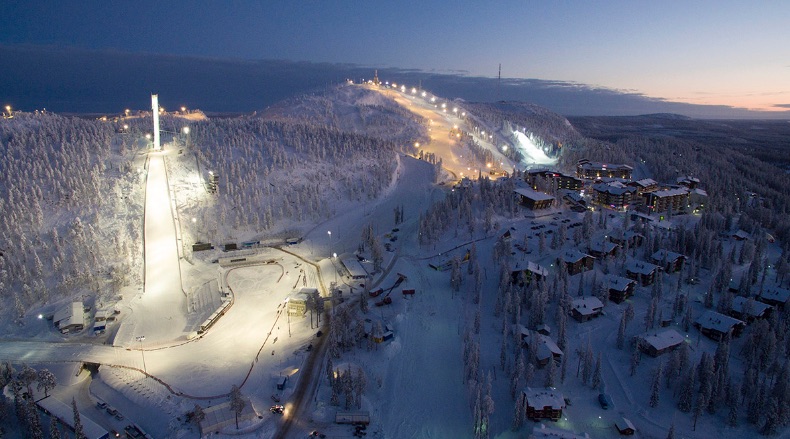
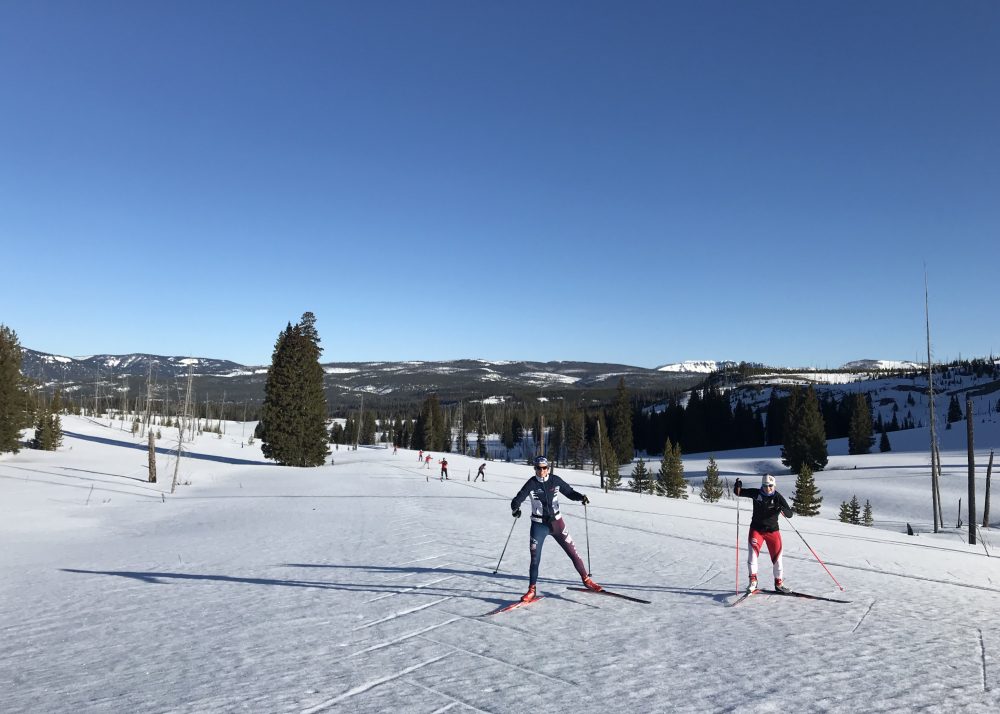
Kuusamo, Finland’s cross-country ski/ jumping complex. (Screenshot from rukanordic.com)
FIS Cross-Country World Cup in Kuusamo, Finland: 10 k/ 15 k Classic
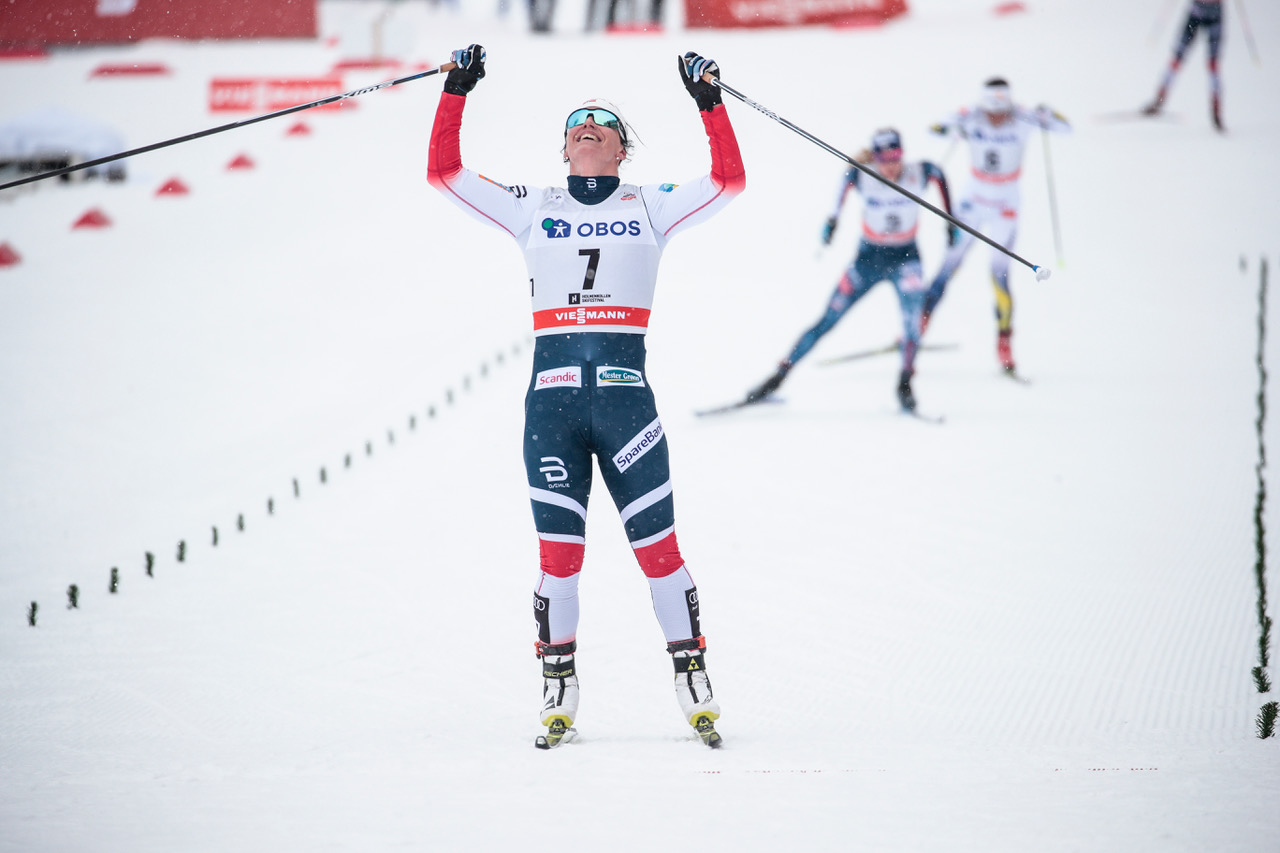
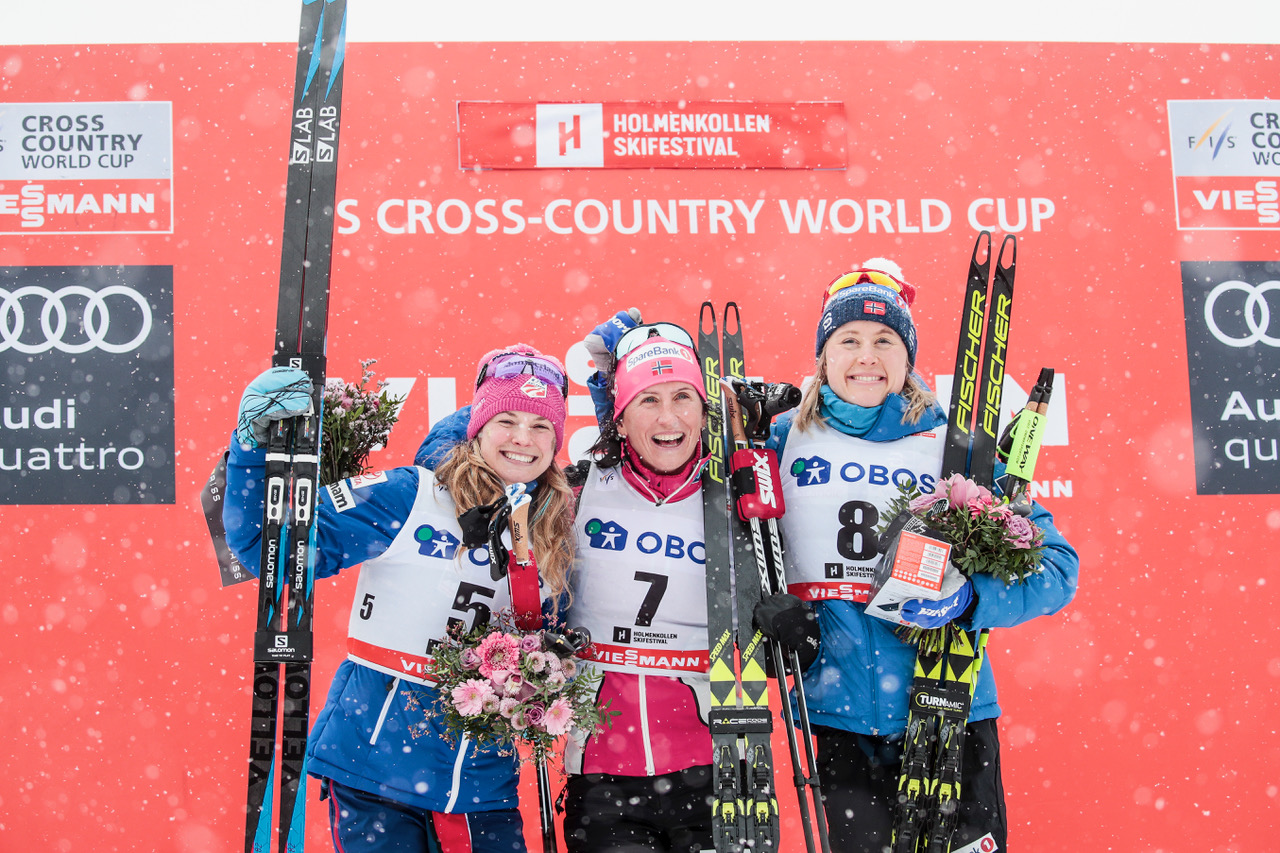
Sunday in Kuusamo brought closure to the World Cup’s opening weekend. The women contested a 10-kilometer interval start classic race. In her first World Cup race after serving a suspension for testing positive for a banned substance, Norway’s Therese Johaug won in a time of 28:02.5 minutes.
By the time check at 3.3 k, Johaug had begun to control the pace and the race. At the finish, she bested Sweden’s Charlotte Kalla, who placed second, by 22.5 seconds. Kalla’s teammate, Ebba Andersson placed third (+32.8).
The U.S. placed three women in the top-30, with Sadie Bjornsen of the U.S. Ski Team (USST) leading the team in eighth place, 1:10.5 minutes behind Johaug. Jessie Diggins, also of the USST,placed 14th (+1:38.5), Rosie Brennan (APU) was 23rd (+2:02.8).
Sophie Caldwell (USST) finished 43rd (+2:52.3), Caitlin Patterson (CGRP) 46th, (+2:56.8), Ida Sargent (USST) 56th (+3:31.1), and Kaitlynn Miller (CGRP) 61st (+3:55.7).
No other North American women were entered in the race.
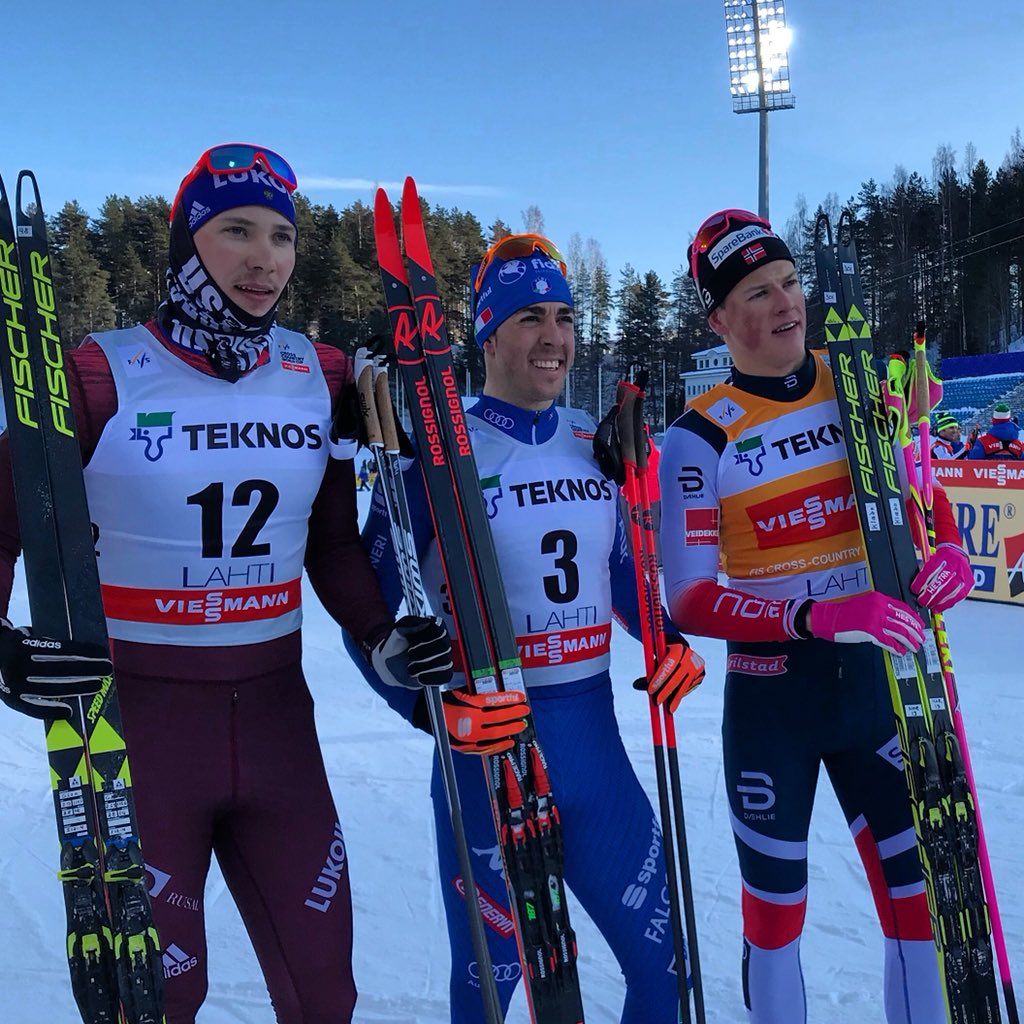
Saturday’s classic sprint winner in Kussamo, Russia’s Alexander Bolshunov, made it a clean sweep for himself by winning Sunday’s 15 k classic in a time of 36:17.8 minutes. Emil Iversen of Norway was second (+19.5), with Calle Halfvarsson of Sweden in third (+21.2).
Alex Harvey of Canada was the only North American in the top-30, placing 22nd (+1:13.9). Also for Canada, Russell Kennedy (TEAM R.A.D.) skied to 71st (+3:47.6), Andy Shields 82nd (+4:22.6), and Julien Locke (CNST) 83rd (+4:32.3).
Just outside the points for the U.S. was Erik Bjornsen (USST) in 31st (+1:50.0). The next best placed U.S. skier was Adam Martin (CGRP) in 53rd (+2:42.7). Scott Patterson (USST)finished 57th (+2:47.8), David Norris 59th (+2:53.3), and Kevin Bolger (USST)63rd (+3:09.5).
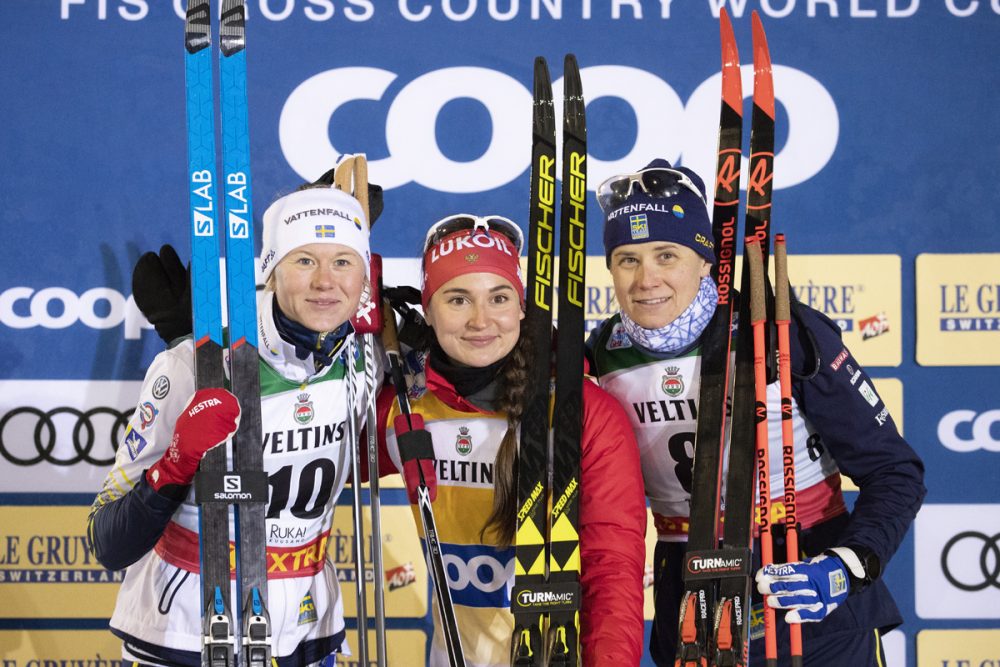
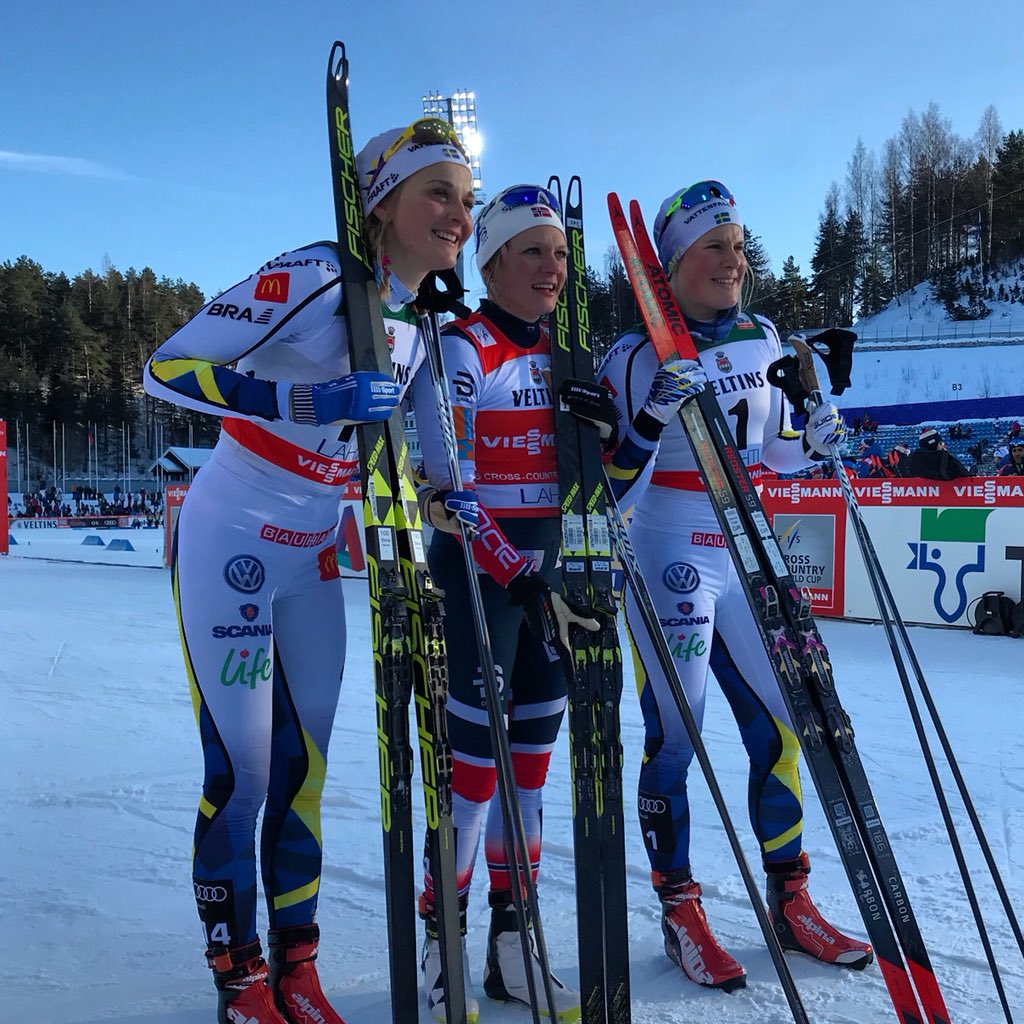
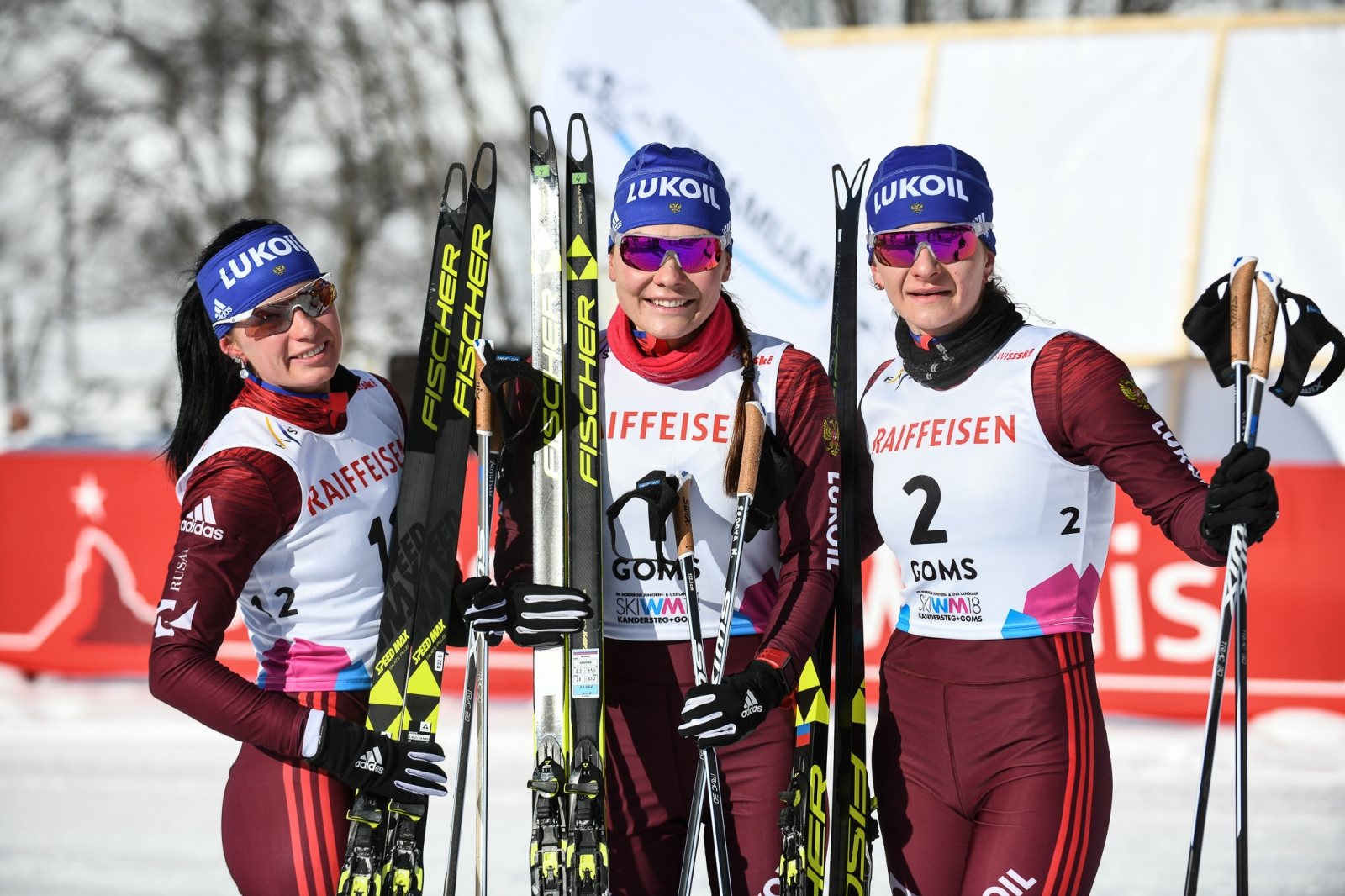
The women’s 1.4-kilometer classic sprint podium (l to r): Sweden’s Maja Dahlqvist, Russia’s Yulia Belorukova and Ida Ingemarsdotter of Sweden. (Photo: Fischer/Nordic Focus)
FIS Cross-Country World Cup in Kussamo, Finland: Classic sprint
On Saturday in Kussamo, Finland the 2018/2019 World Cup season began with a 1.4-kilometer classic sprint.
Twenty-three-year-old Yulia Belorukova from Russia won the final in 2:52.62 minutes. It was Belorukova’s first World Cup win. Second place went to Sweden’s twenty-four-year-old Maja Dahlqvist who crossed the line 1.12 seconds back. Also from Sweden, Ida Ingemarsdotter was third (+1.51), Norway’s Maiken Caspersen Falla fourth (+1.52), Krista Pärmäkoski of Finland fifth (+4.71), and Stina Nilsson of Sweden, sixth (+12.33). Nilsson crashed in the final.
In the women’s qualifier, Russia’s Natalia Nepryaeva set the fastest time in 2:56.50 minutes. Seventy-three skiers started the qualifier.
Three U.S. Ski Team (USST) women advanced to the heats by qualifying in the top-30. Sadie Bjornsen in 5th (+3.01), Sophie Caldwell in 22nd (+6.97), and Ida Sargent 24th (+7.23).
Caldwell and Sargent did not advance out of the heats. Caldwell was third in the first heat, won by second fastest qualifier, Falla. Caldwell finished 0.36 seconds behind Falla and ultimately did not secure a lucky loser spot. Sargent raced in the third heat where she placed sixth (+4.50).
Four U.S. women bowed out in the qualifier, with last season’s second overall skier in the World Cup standings, Jessie Diggins, placing 33rd (+9.05). Rosie Brennan (APU) skied to 38th (+10.74), Kelsey Phinney (SMS-T2) 46th (+13.49), and last season’s overall SuperTour leader, Kaitlynn Miller (CGRP), was 58th (+18.06).
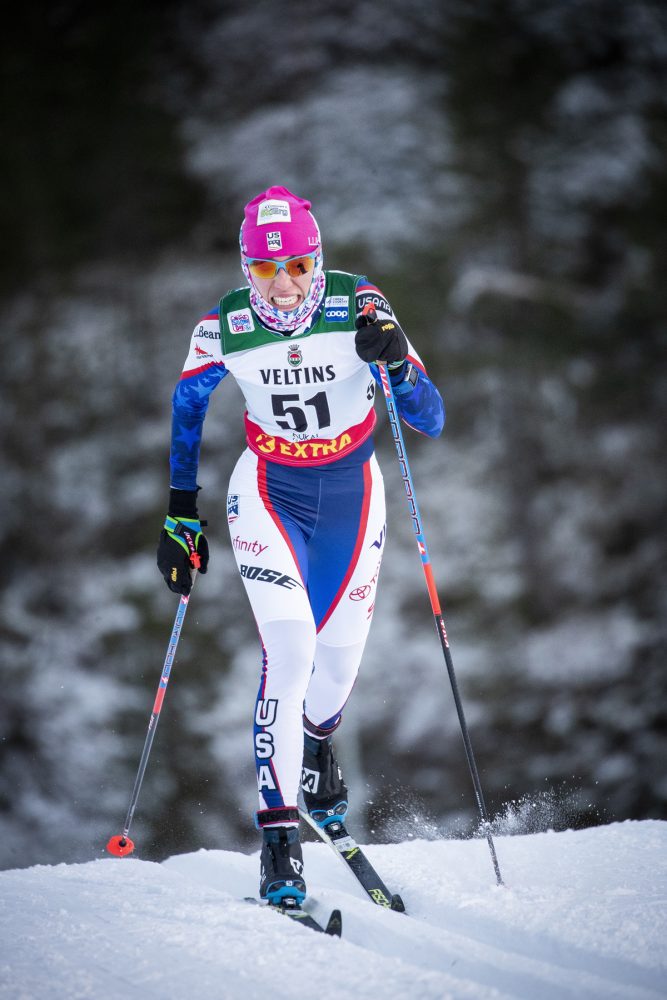
Kaitlynn Miller racing for the U.S. in the women’s 1.4-kilometer classic qualifier on Saturday in Kussamo, Finland. (Photo: Fischer/Nordic Focus)
No Canadian women entered the race.
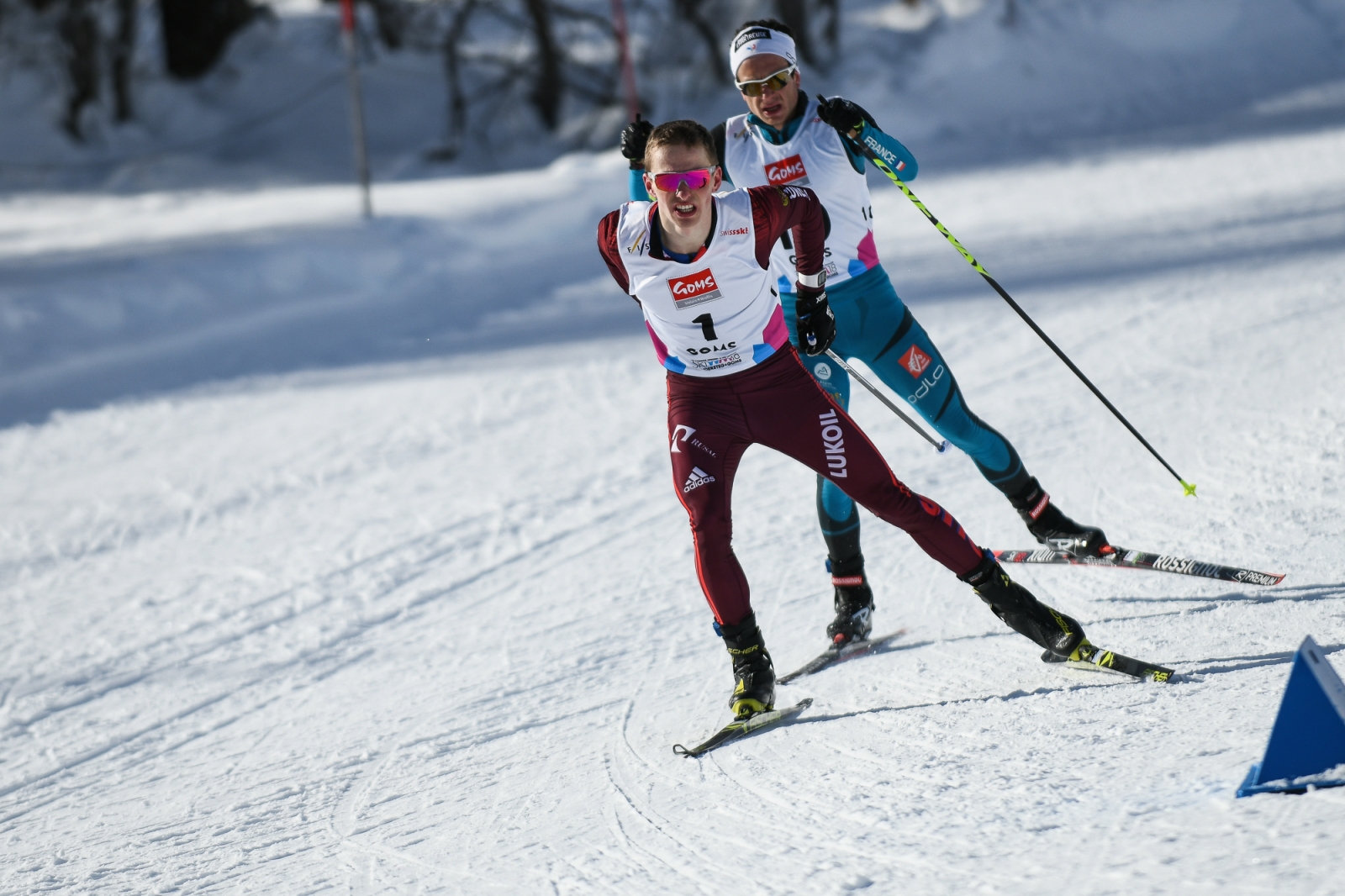
In the men’s race, last season’s World Cup overall and sprint cup winner, Johannes Høsflot Klæbo, scorched the qualifier in 2:28.95, winning by 3.21 seconds over he next fastest qualifier, teammate Eirik Brandsdal.
Klæbo won his heat and his semifinal. But the semi was tight: Klæbo won by 0.1 seconds over Russia’s Alexander Bolshunov.
In the final, Bolshunov won in 2:29.35 minutes, Klæbo was second (+0.31), Brandsdal third (+1;35). Also of Norway, Emil Iversen placed fourth (+3:04), Russia’s Gleb Retivykh fifth (+3.86), and Norwegian Sondre Turvoll Fossli sixth (+4.85).
The only North American to advance to the heats was Canada’s Alex Harvey, who qualified in 25th (+9.40) and ended the day in eighth. Harvey advance out of the heats by placing second to Russia’s Gleb Retivykh in the fourth quarterfinal. In the second semifinal, Harvey placed fourth (+2.30) and did not advance as a lucky loser.
Also for Canada, Julien Locke (CNST)finished 69th (+15.43), Andy Shields 75th (+18.59), and Russell Kennedy (Team R.A.D.) 76th (+18.61).
For the U.S., Erik Bjornsen (USST) placed 42nd (+11.41), Kevin Bolger (USST) 55th (+13.19), Ben Saxton (SMS-T2) 70th (+15.68), David Norris (APU) 78th (+19.05), and Simi Hamilton (USST) 82nd (+1:11).
Jessie Diggins (U.S. Ski Team) racing to 10th in the 2018 World Cup women’s 10 k classic in Planica, Slovenia. (Photo: Salomon/NordicFocus)
Welcome to FasterSkier’s World Cup Preview, where we check in with the top-10 teams from last year’s FIS Cross Country World Cup tour before the season starts. The World Cup begins with a classic sprint in Ruka, Finland on Nov. 24th.
***
United States
Overall in Nations Cup Last Year: 5th
Women’s Ranking 2017/2018:3rd
Men’s Ranking 2017/2018:11th
U.S. Skiers to Watch:
The high note last season was the gold medal team sprint performance by Jessie Diggins and Kikkan Randall. That pinnacle proved U.S. Ski Team (USST) coaches, wax techs, support staff, and of course athletes, could position themselves to succeed on the quadrennial winter sport prime-time stage. Time to exhale.
On both the men’s and women’s side, countless standout performances are vivid. Yet the collective success on the U.S. women’s team will remain a generational benchmark. It’s a good hunch, with the imminent 2018-2019 season, the women’s team has not hit it’s apogee.
This much is for certain: despite the retirements ofRandall and Liz Stephen, the U.S. women’s team remains loaded. Sophie Caldwell was the third ranked sprinter in the world last season. Sadie Bjornsen was top-10 in both the distance and sprint rankings, and sixth in the overall. Ida Sargent, despite breaking her thumb prior to the Olympics, finished 23rd in the sprint cup.
Although Rosie Brennan was not renamed to the 2018-2019 USST, she appears fully recovered from mono and will be starting the season on the World Cup as a discretionary selection.
Each World Cup weekend last year was time to check results and determine not if any of the women’s team had shined but who. The individual milestones were many.
Diggins’ season was a non-stop stream of highlights. In a post-Marit Bjørgen landscape, the Norwegian legend has retired, Diggins is poised to become even more of a force.
Not that anyone ever doubted Diggins, but watching Diggins charge and string out the field on January 28, during the 10-kilometer mass start freestyle in Seefeld, Austria was pure aerobic theater. She set the pace. She dictated the narrative. The move didn’t resemble an athlete taking a chance, but an athlete shifting into their top race gear and accelerating to the line. Pure confidence. For the remainder of Diggins’ season, there was no doubt.
Even with a skipped World Cup weekend in Lahti, Finland to manage media obligations back in the U.S. after the Olympic Gold, Diggins finished second overall on the World Cup.
Simi Hamilton (U.S. Ski Team) racing to 13th in the men’s freestyle sprint qualifier at 2018 World Cup Finals in Falun, Sweden. He went on to finish the day in 14th overall. (Photo: Fischer/NordicFocus)
On the U.S. men’s team, Andy Newellstepped down from full-time World Cup racing with a goal of making the 2019 World Championship team. Noah Hoffman retired and attends university. Simi Hamilton, the 17th ranked sprinter on the World Cup last season, is the veteran. Deep into his international career, Hamilton brings poise and power to the sprint roster. Paired with Erik Bjornsen, Hamilton co-leads a team sprint contender. After the duo placed sixth in the Olympic team sprint, Hamilton and Bjornsen are a possible breakthrough team for the Seefeld, World Championships.
Erik Bjornsen posted 13 top-30’s with an individual best of ninth place in the Seefeld 15 k mass start.
Scott Patterson comes off an Olympics and Holmenkollen 50 k where his ability to perform under pressure cemented him as a premier male long-distance skier. He placed 18th in the Olympic 30 k skiathlon and 11th in the marquee 50 k classic — a best U.S. men’s result since 1976. Patterson reinforced that performance with a 16th in the Holmenkollen 50 k skate.
New to the USST is Kevin Bolger. This season will be his first full-time European based campaign. Bolger more than impressed when he placed an astounding 11th overall in Lahti’s skate sprint last March. It was Bolger’s first career World Cup.
Paddy Caldwell will begin the season on the World Cup. He had several standout time of day performances in skate races last season.
Non-USST skiers starting on the World Cup will include overall SuperTour leaders David Norris and Kaitlynn Miller.
Caitlin Patterson (CGRP) and Kelsey Phinney (SMS T2) were discretioned as distance and sprint athletes respectively for early season World Cups. Adam Martin (CGRP) was a discretionary selection for the men’s distance races, his start rights begin in Lillehammer, Norway. Ben Saxton is scheduled to race only the classic sprint in Ruka, Finland.
News of Note from USST Head Coach Chris Grover:
On the men’s team: “The men have been in great shape this summer and fall,” Grover emailed FasterSkier. “Look for great results right away from Simi and Erik; both have had very productive preparation periods. Kevin Bolger has also had a great summer of training and looked very good in our October Park City camp. Scott Patterson had a broken toe to deal with for much of the summer but is doing well now. As you suggest, he’ll bring more experience to his WC campaign this season. You’ll see him in action first at the FIS opener in Beitostølen on Sunday, Nov. 18 (15 km F). Paddy Caldwell has been wrestling with occasional elbow tendonitis ever since New Zealand camp, so there is a decent chance that he has a slower start to the World Cup.”
Season goals: “The women’s team is a veteran squad that all now understand what it takes for them individually to be in top fitness in February. Our goal for Seefeld (women and men) is 3 medals and we have targeted 5-6 race days where we have good chances to win those medals. And I believe this World Cup season will be one of our best, if not the best. It’s going to be a great season to be a fan of USA cross country ski racing.”
On leadership: “Although we are missing Kikkan, Andy and Liz, and their strong leadership, we’ve had an excellent team atmosphere this preparation season, and we’ve had a lot of fun. Multiple athletes are stepping up to fill the leadership vacuum left by our retiring veterans. I’m really looking forward to getting on the road with this team (both USST and invited discretionary athletes) and watching this new squad in action.”
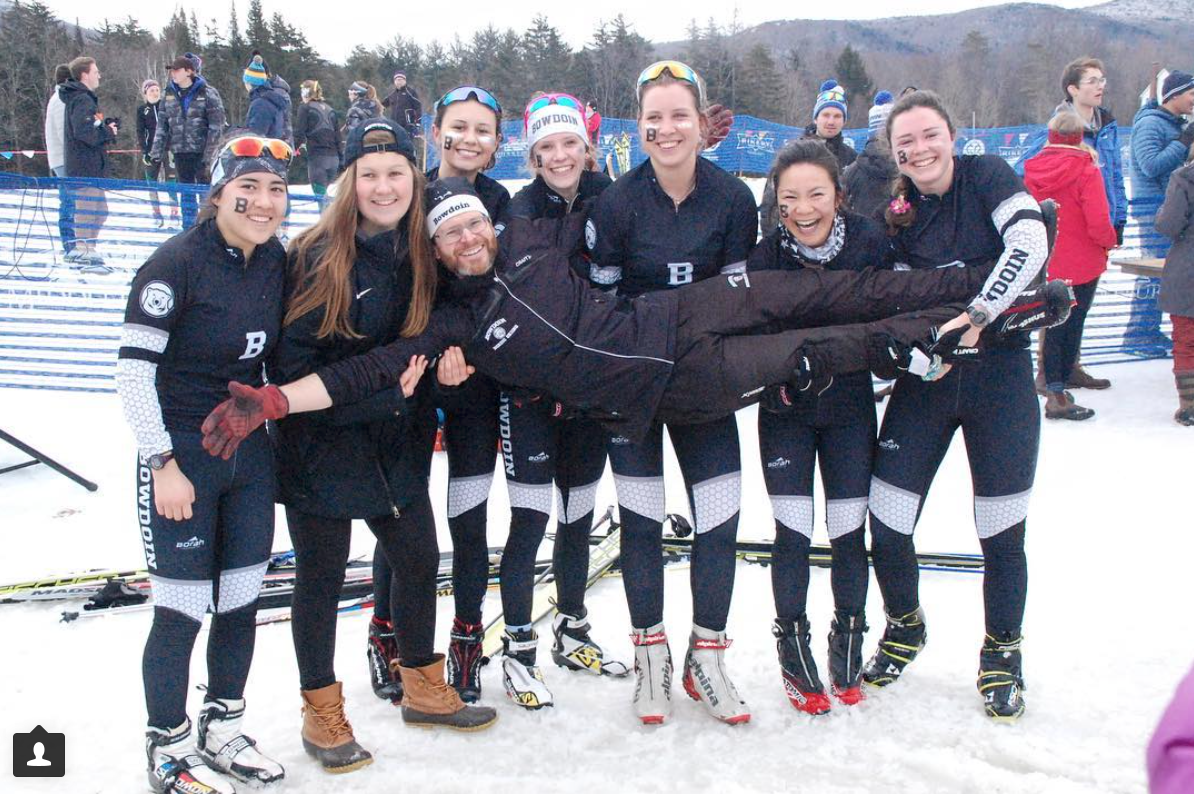
Bowdoin nordic skiers with head coach Nathan Alsobrook. In July, Alsobrook was recognized as NENSA’s 2018 Coach of the Year. (Photo: @bowdoinskiing/Instagram)
Building on one of its most successful seasons yet, the Bowdoin College nordic ski team, out of Brunswick, Maine, recently jumped back into training under the guidance of head coach Nathan Alsobrook. Last winter, three skiers qualified for NCAA Skiing Championships, one alumna qualified for the U.S. Olympic team (Kaitlynn Miller, class of 2014), and one visually impaired skier Jake Adicoff (’18) earned a silver medal at the Paralympics. It was a season that Alsobrook names as a highlight of his coaching career.
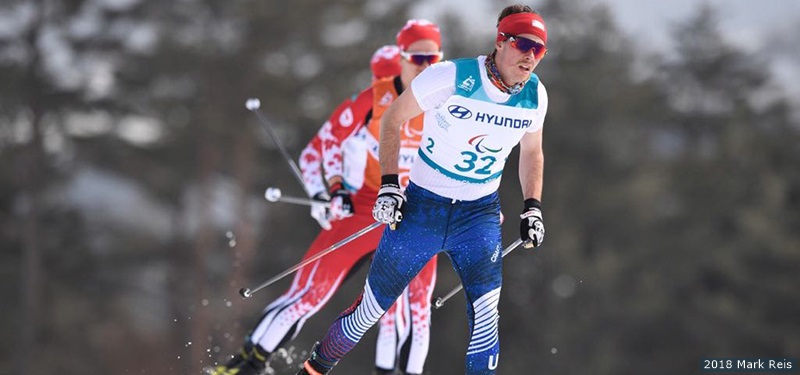
American Jake Adicoff leads Canada’s Graham Nishikawa and Brian McKeever in the men’s visually impaired 20 k freestyle at the Paralympic Winter Games in PyeongChang, South Korea. Adicoff earned silver (behind McKeever) in the men’s visually impaired 10 k classic in PyeongChang. (Photo: US Paralympics/Mark Reis)
“The most fun thing about has just been to see the very slow but steady progress that the program has been able to make over the past several years,” Alsobrook said in a phone interview last month. “It’s been very fun and exciting.”
To top it off, Alsobrook was recognized by the New England Nordic Ski Association (NENSA) as 2018 Coach of the Year in recognition of his team’s steady progress and his contributions to the growth of cross-country skiing in New England.
“Over the past years, Nathan has been active in NENSA Programming, including serving as a coach at Eastern Regional Camps, chairing the Coaches Education Committee and running L100 Technique clinics for the state of Maine,” a NENSA press release stated. “Through his dedication to these programs he has made the Bowdoin Nordic Team a visible and attractive institution for skiers to continue their careers.”
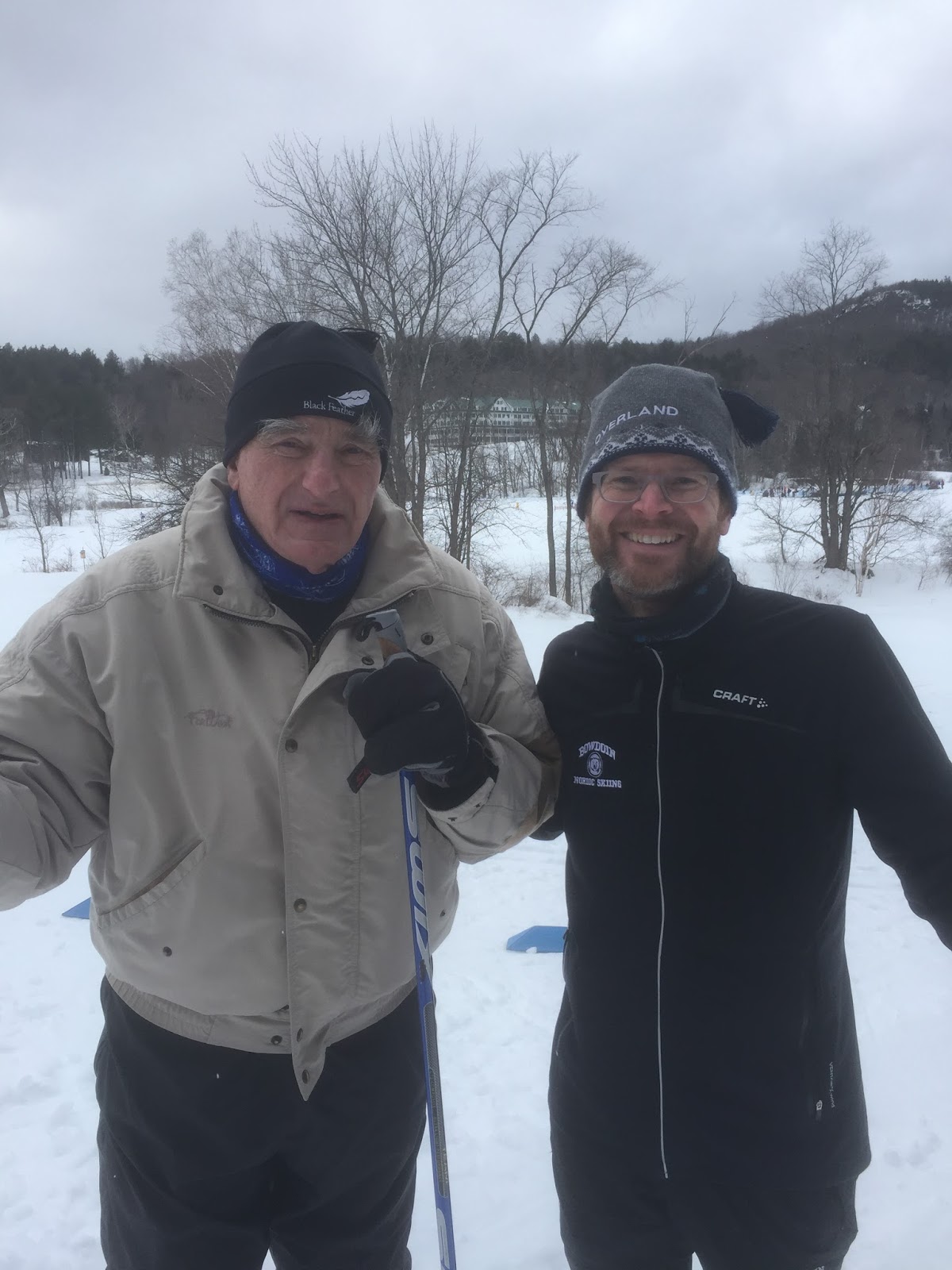
Current Bowdoin Nordic Ski Team Head Coach Nathan Alsobrook (r) with Marty Hall, who coached at Bowdoin for eight years and was inducted into the U.S. Ski & Snowboard Hall of Fame this past spring. (Photo: Bowdoin Nordic)
A Bowdoin graduate (’97) himself, Alsobrook returned as head coach in 2007, taking the place of former U.S. and Canadian national team coach Marty Hall, to whom he attributes planting the seeds for Bowdoin’s current development.
“He was really responsible for taking Bowdoin out of where it had been,” Alsobrook said of Hall’s eight years with the team. “We really weren’t functioning at a super high level before Marty came in. He was able to really push for the college to bring more resources to the sport and just sort of professionalize the whole program. He essentially created this really great foundation for me to springboard off of.”
Before Bowdoin, Alsobrook coached at Whitman College, Montana State University (MSU), Colby College, and the Pocatello XC Ski Foundation, and earned a master’s in exercise physiology from MSU in 2005.
While it didn’t happen overnight, over the years, the Bowdoin Polar Bears have trended upward in the Eastern Intercollegiate Skiing Association (EISA) nordic rankings.
“We had individuals pop great races, and we had these flashes of brilliance that more was possible, but it took so many years for us to become competitive as a team. It was not until 2013 that we sent a skier to NCAA’s during my tenure,” Alsobrook explained. “We would have little successes here and there, a great relay performance or a single race where we would finish very competitively, but we never really put it together for consistent week after week Carnival team performances. It was really only last year that that finally happened, where all of a sudden for the combined men’s and women’s nordic events we would find ourselves finishing in the top half of the league.”
Every weekend on the Carnival circuit last winter, either Bowdoin’s men’s or women’s team placed in the top six. And it saw three skiers — more than ever before — qualify for NCAA’s in Steamboat Springs, Colorado: Gabrielle Vandendries, Renae Anderson and Elliot Ketchel.
Outside of the results, Alsobrook said he enjoys the culture of the student body at Bowdoin and feels that it contributes to the dedication and work ethic of his athletes.
“There is this really great sense of balance here at Bowdoin, and we really try to compliment that in our program,” he said. “It’s such a fun mix of these very academically focused and engaged students. … They just love learning, they love being in this environment and challenging themselves, and then they’re just so ready to get out and train hard.
“I think we do a pretty nice job here at Bowdoin of making this a very collaborative experience, the learning experience and certainly the athletic experience,” he continued. “And it’s just such a natural fit for when you’re trying to create this very team-centered program like I’m trying to do here, that that culture is already in place at the college. I mean, people really want to do well here, in whatever they’re doing, and they’re going to work really hard to do it, and yet they’re trying to help everyone else do the same. That’s something I really appreciate … any competition is directed toward making everyone better.”
His coaching philosophy aims to capitalize on this dedication to personal success, while also reflecting the sense of balance achieved at the school.
“I can’t remember who started saying this, but it’s something we started saying around our team: ‘Happy people ski faster,’ and that is really at the heart of what we are trying to do,” he said. “I know that my skiers are going to get more out of themselves on the race course if they feel very fulfilled with their Bowdoin experience as a whole.”
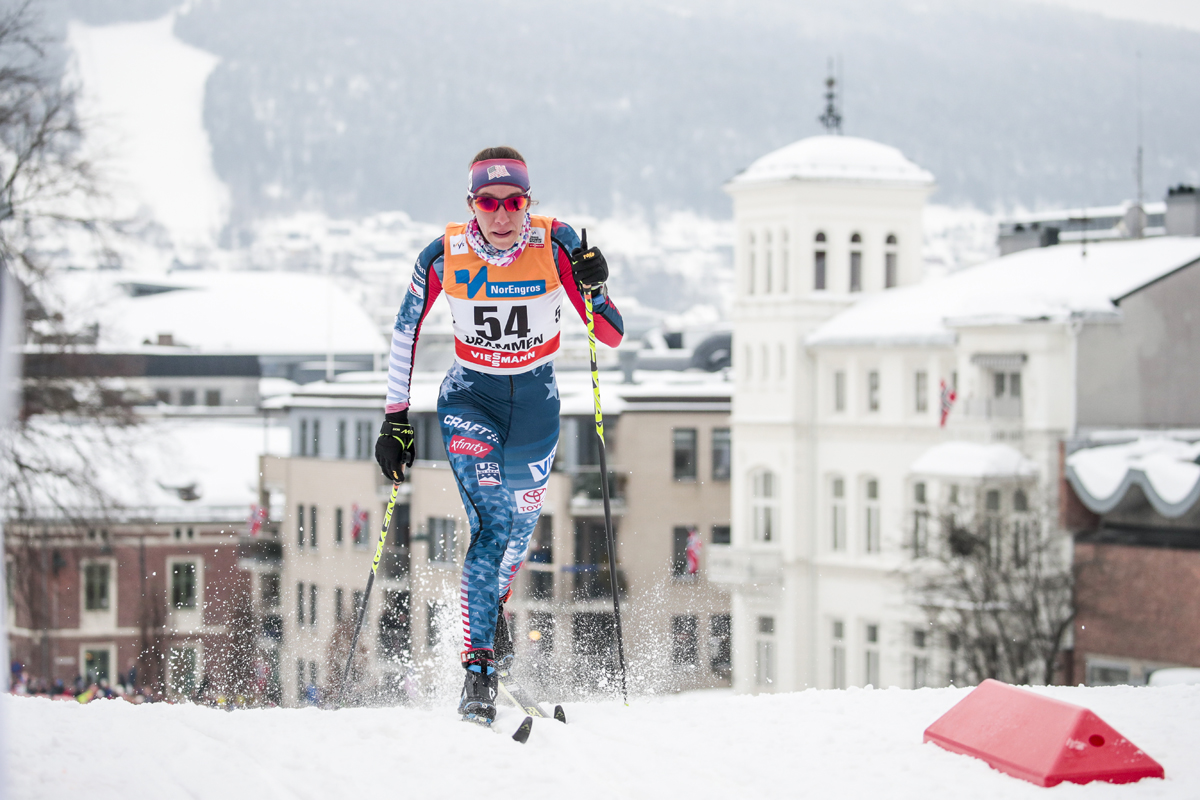
Bowdoin alumna Kaitlynn Miller racing to 53rd in the World Cup classic sprint qualifier last March in Drammen, Norway. (Photo: Fischer/NordicFocus)
According to Alsobrook, this culture and balance served Kaitlynn Miller, who now skis for the Craftsbury Green Racing Project, well in her time at the school. He described Miller as “very studious, very thoughtful … and yet very focused when it came time to train.”
Miller ended last season as the overall SuperTour leader and has earned World Cup starts in November and December as a result.
“It was really nice to have someone that embodied what we are trying to do in our program,” he continued. “For someone who is such a high-level athlete, she is just extremely humble, very kind and thoughtful, very team-centered. It was really fun to coach an elite athlete who was such a team-centered, selfless person … It’s been a real pleasure to watch her take off.”
As for the upcoming season, Alsobrook will continue to focus on the continued growth of his team.
“With my athletes, we’re all about the process,” he said. “Having said that, of course, I have outcome goals, essentially I want to see the team keep moving forward. We’ve never won the Maine State Championship, for example … so we’re really excited to go after that this year. We’ve come close a few times, and maybe this will be our year,” he said.
Another goal will be to continue to place highly at EISA Carnivals and to develop a strong championship team. Last year, its two female athletes at NCAA’s — Vandendries and Anderson — posted top-30 finishes in Steamboat.
“Certainly bringing back a good contingency of skiers to NCAA’s again is a big goal,” he said. “We had a number of times where our [team] finishes [in EISA competitions] were fourth, fifth, sixth pretty consistently throughout the season, and that’s a pretty good place to be in a league as competitive as EISA. I do not want to stay there and keep cranking out those finishes, I want to keep getting better. … I mean, hey, we did fourth last year, why not try for third this year? They’re just great things for us to keep fighting for while at the same time we stay firmly grounded on the process.”
Craftsbury Green Racing Project nordic skiers and biathletes doing uphill running intervals on a dirt road in Craftsbury, Vermont. (Photo: Pepa Miloucheva)
For a mid-summer Wednesday Workout, we reached out to Craftsbury Green Racing Project head coach Pepa Miloucheva. In addition to sharing a running workout, Miloucheva told us what and who is new to the team based out of Craftsbury, Vermont.
“All is good here in Craftsbury, everyone is healthy and training is going well,” she wrote in an email in early July. The nordic team joined last month’s U.S. Ski Team (USST) training camp in Lake Placid, N.Y., and also plans to attend the USST’s on-snow New Zealand camp in late August.
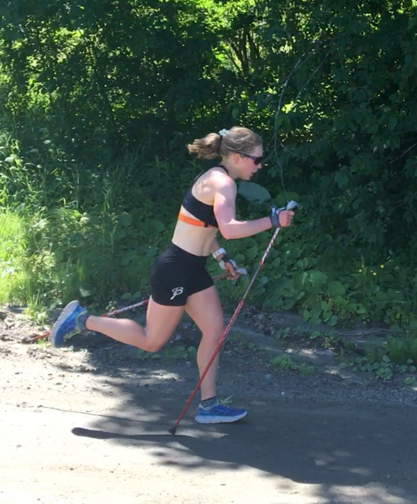
Ida Sargent, of the Craftsbury Green Racing Project and U.S. Ski Team, during dirt-road running intervals in Craftsbury, Vt. (Photo: Pepa Miloucheva)
Craftsbury’s roster additions include Corey Stock and Akeo Maifeld-Carucci. Returning to the nordic squad are Ida Sargent (U.S. Ski Team), Caitlin Patterson, Kaitlynn Miller, Liz Guiney, Adam Martin, and Ben Lustgarten.
The workout itself, one Miloucheva explained the team does this time of year, is 6-8 x 10-minute running intervals with poles. They do so on a gradual, mile-plus-long hill on a dirt road in Craftsbury. To replicate, find a climb that takes at least 10 minutes to run up, and repeat six to eight times.
“This is a lactate threshold workout, important for improving our sustainable speed,” Miloucheva wrote. “Threshold workout improves both lactate production/recruiting more fast twitch units and lactate removal, ability to minimize the negative effects of lactate while having the benefits.”
“Athletes run with poles up and I drive them down as quickly as possible to shorten the time between the interval,” she explained. “Goal is to maintain speed for all intervals and keep lactate between 3-5mmol/l, depending on the athlete.”
Male and female athletes all start at once, just at different starting points so they finish in the same place. Miloucheva recommends focusing on controlling speed during this workout to ensure a productive 50-plus-minute workout at Level 3.
Upon repeating the workout later in the training season, athletes are instructed to push the pace at the end of the interval to Level 4.
The workout: 6-8 x 10-minute running intervals with poles
Need: A hill that takes at least 10 minutes to run up, poles.
Warmup: 30 minutes easy running, with a few accelerations and functional movements
Then: Run uphill for 10 minutes at Level 3, return to starting point, repeat 6 to 8 times. Pace at end of interval can be increased to Level 4 later in the season.
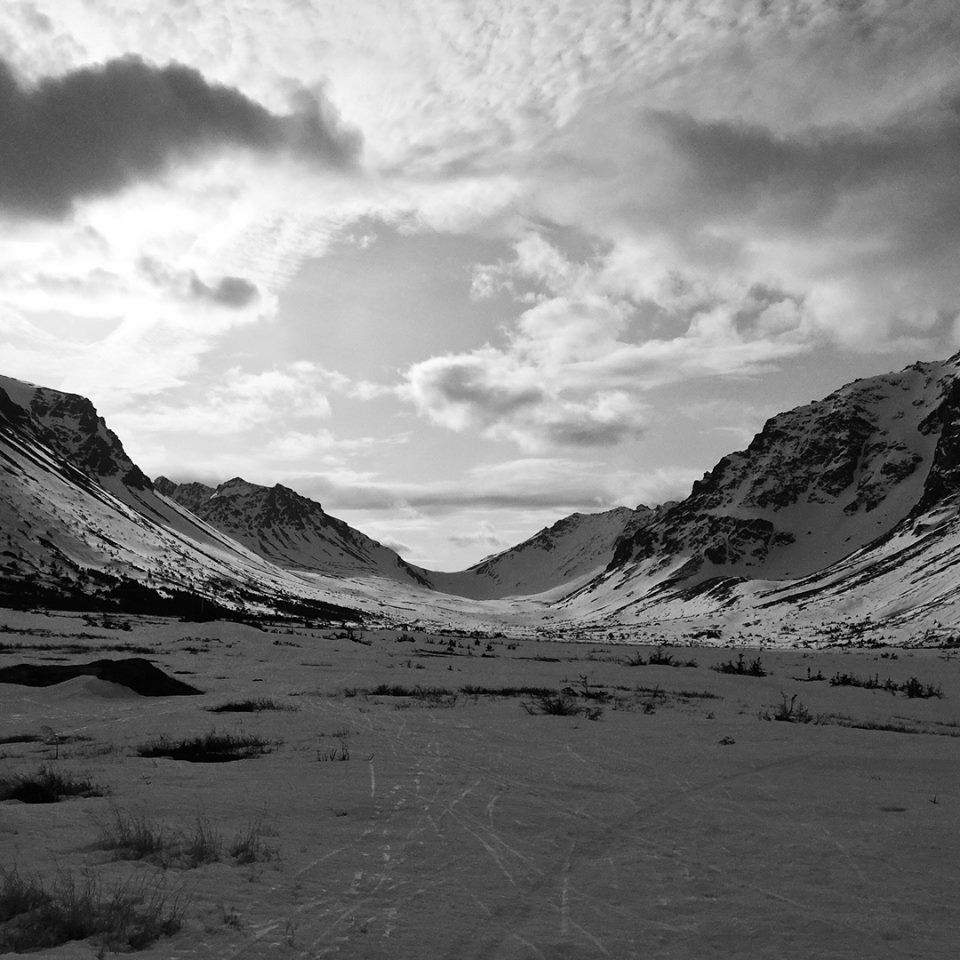
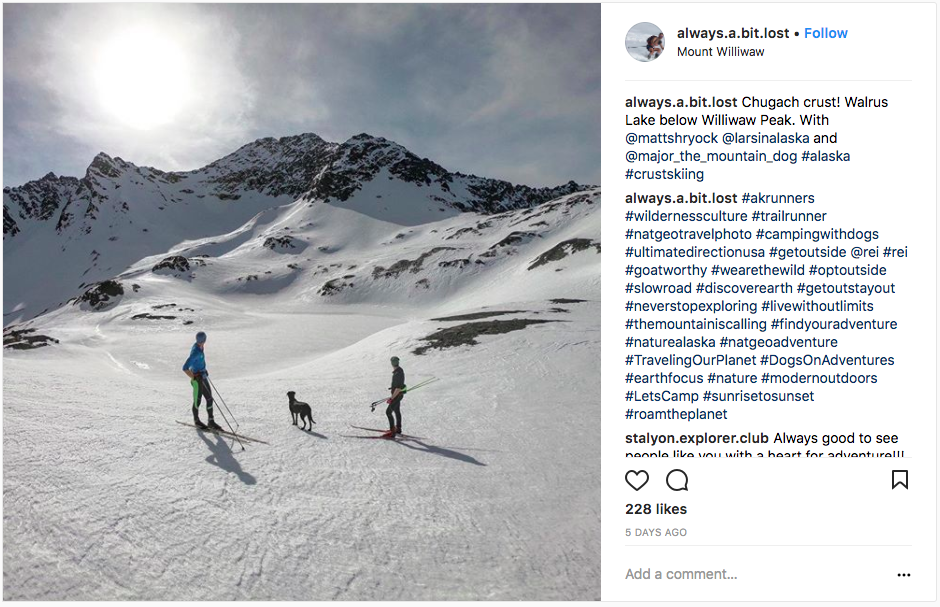
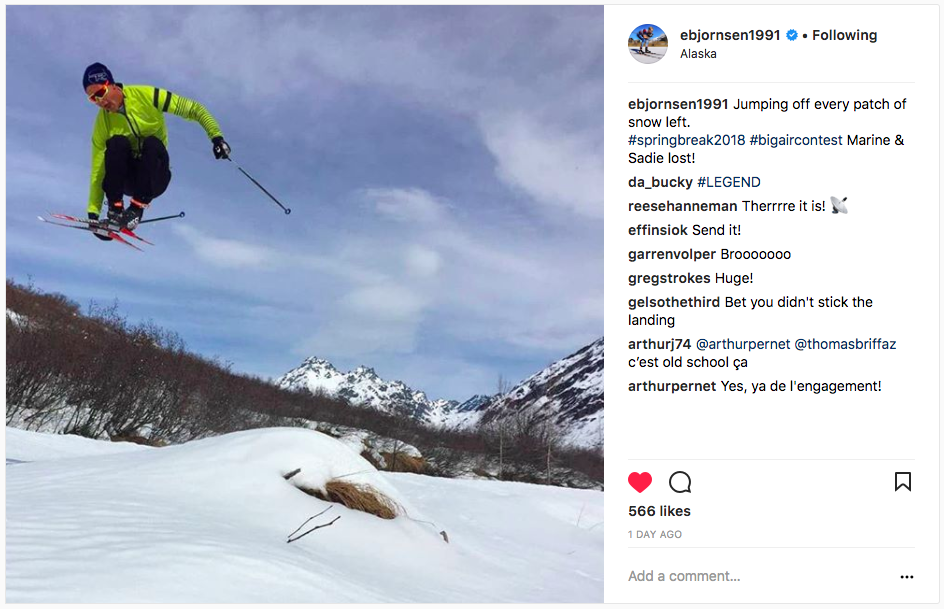
Crust skiing on April 17 in Chugach State Park, at the edge of town above Anchorage, Alaska. (Photo: Gavin Kentch)
This article has been updated with additional information on pro skiers who volunteered with Skiku, and additional pictures from Montana and New York.
* * *
It’s the last week of April. Skier New Year, May 1, looms next Tuesday. It’s roughly six months till the presumptive first race of the 2018/2019 season, seven till the first World Cup weekend. Whether you’re a pro or an amateur, whether you’re targeting your first World Championships or your first Birkie elite wave, now is the time to start thinking about setting goals and writing training plans.
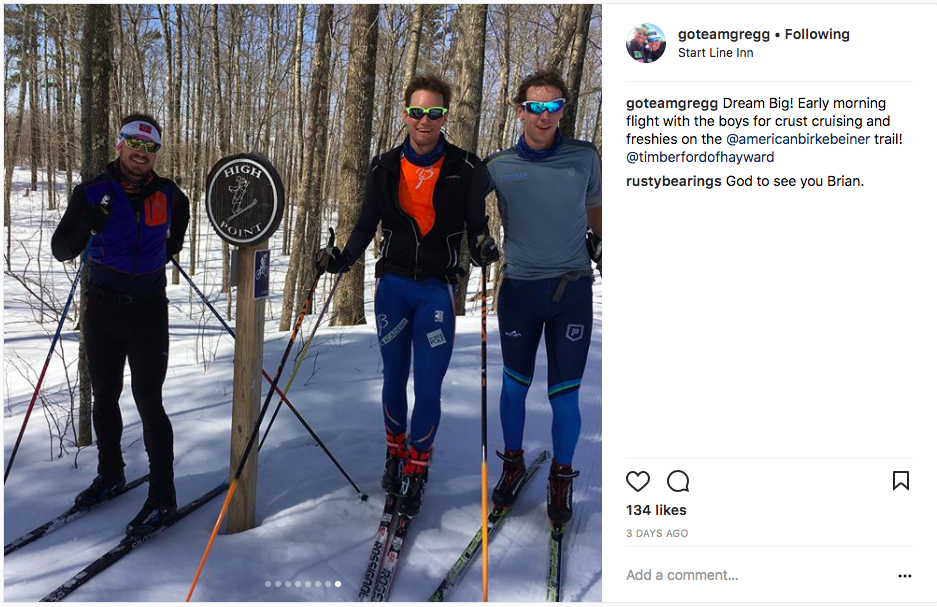
For a certain subset of athlete, those spring training plans still involve skiing. On snow. In some cases, really good snow, in surprisingly wintry weather.
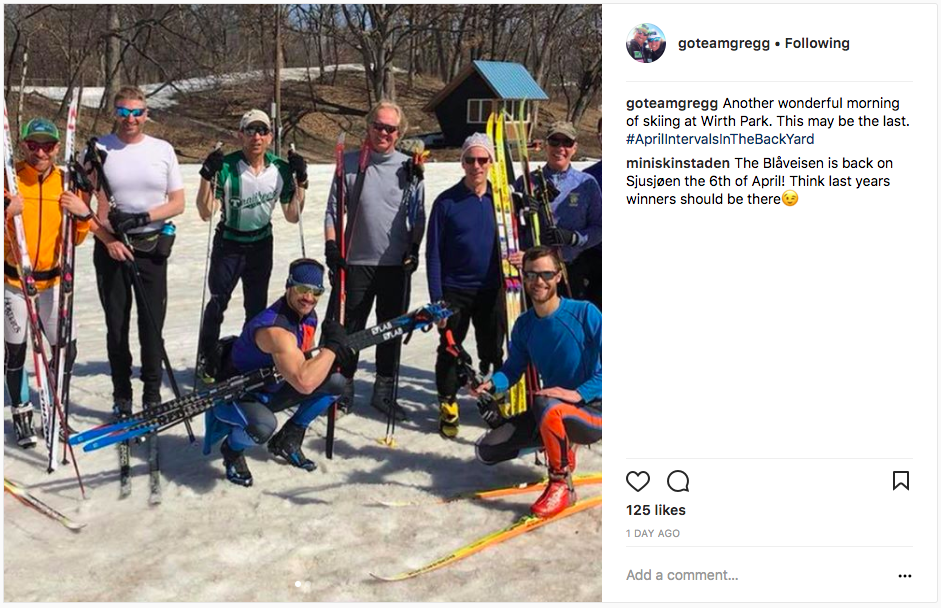
In honor of the last week of the offseason, please join FasterSkier as we channel our inner Us Weekly and flit through an extremely unscientific social-media roundup of those athletes who are still on snow, arranged in very approximate order of most to least surprising to be skiing at this time of year. (Actually, it’s only the Midwest and Vermont where it seems somewhat surprising to still have skiable snow in late April; no offense is intended to anywhere on the list after that.)
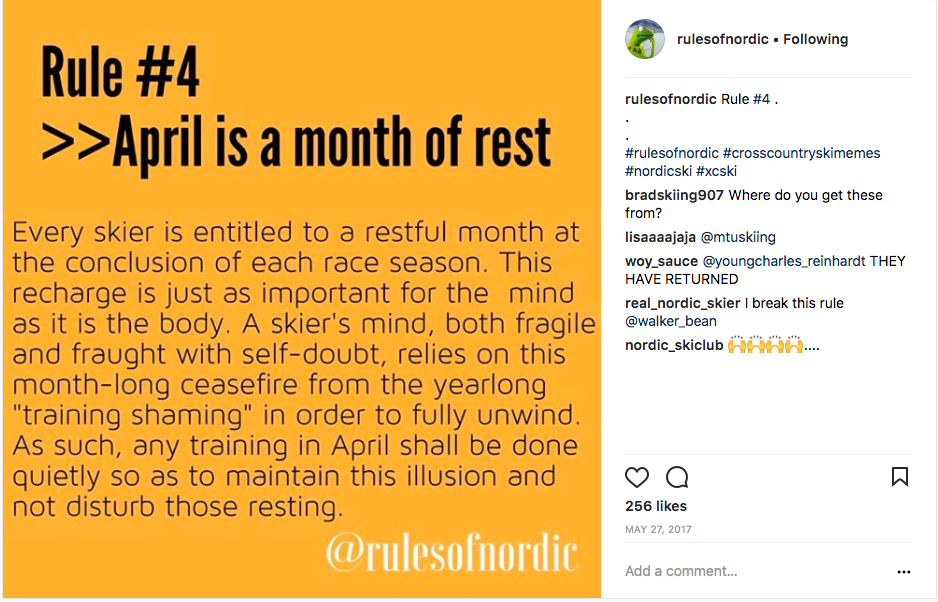
And before we begin, a quick note on methodology: This social media roundup is by definition limited to those athletes who are not only currently out in the snow, but who are also posting about it on social media. This second criterion threatens to bring your average recovery-month athlete into conflict with what has been codified as Rule of Nordic No. 4, “April is a month of rest.”
So, caveat lector: Just because your favorite skier has been taking a well-deserved break from finding and curating Instagram-worthy content for your enjoyment, this doesn’t mean that they’ve been sitting on their butt since Spring Series. They just might not want to tell you what they’ve been up to, and/or they wish to avoid damaging the fragile psyches of their colleagues.
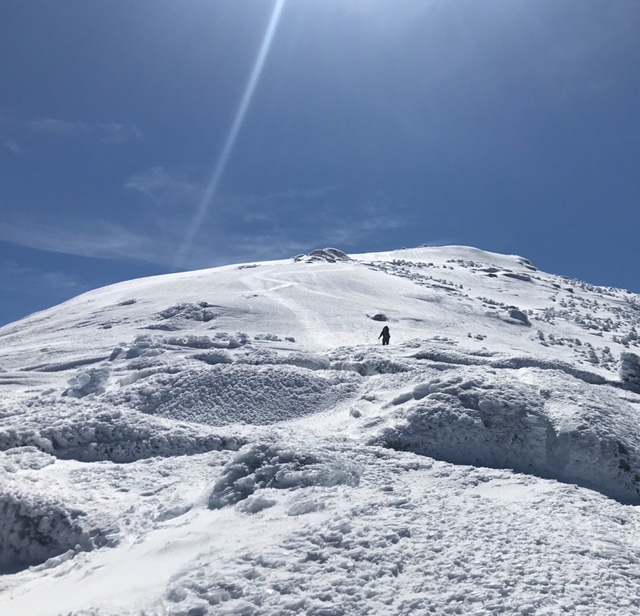
Skiing on New York’s highest peak? Check. David Hochschartner of the North Country School in Lake Placid sent us this photo of backcountry shredding on Mount Marcy, the highest point in the state at 5,343 feet above sea level.
“Monday skiing from bottom to the summit of Mount Marcy in New York,” Hochschartner wrote in an email to FasterSkier on Wednesday. “Over 3500′ vertical … backcountry skiing does not break rule #4 because it isn’t training, it’s just fun!”
Backcountry skiing near the top of Mount Marcy in New York’s High Peaks region on Monday, April 23. (Photo: Tim Ely)
The mid-April Midwest blizzard was notable, to be sure. But was it historic? Yes, says Ari Ofsevit, who now lives in Boston but was formerly the source behind Twin Cities XC Commentary and who remains the one-man operation behind the indispensable BirkieGuide.com.
Here’s Ofsevit with some historical meteorological perspective:
Basically, the current weather in the Twin Cities is pretty unprecedented. The only other similar year was 1975, when there was at least 3″ of snow on the ground in MSP for 11 days in April (this year had 12), but that year it was an old, melting base that mostly fell in late January. This year will set the following records:
* Most days with at least 3″ of snow on the ground in April (skiable snow): 12
* Most snow in April: 26.1″
If the current forecast to hit the 70s this weekend holds, it won’t wind up the coldest April on record, but will likely be in the top three. But it’s a good combination of cold and snow, which hasn’t been seen to this degree before.
The average year has the snow depth dipping below 3″ around March 1, so it’s an extra month and a half of winter.
Vermont
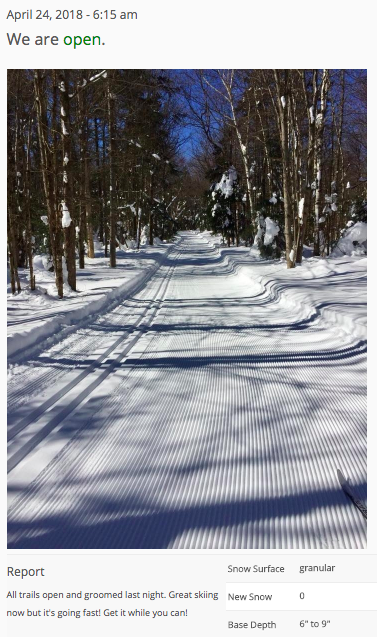
There’s a lot of snow at Prospect Mountain in Woodford, Vermont, too. (“Getting 80″ in a week in March didn’t hurt,” Ofsevit notes.) Here’s a stunning screenshot from the conditions report for Tuesday, April 24 (just offscreen is the current temperature, 69°):
Dartmouth skier Adam Glueck skied 50 k there on Sunday, describing conditions as “50+ F and transformed.”
Montana
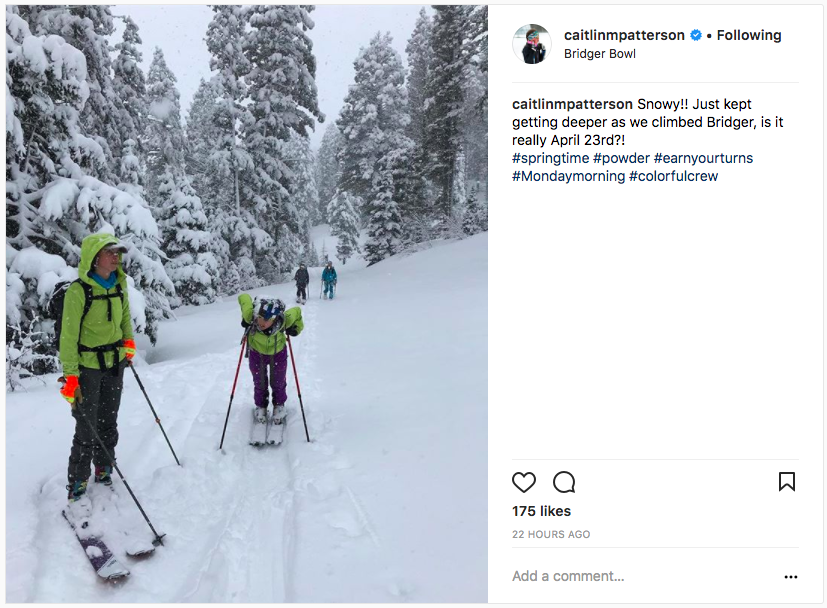
Effective Tuesday morning, they were still grooming some nordic trails at Crosscut Mountain Sports Center (formerly Bohart Ranch). Pictures of nordic skiing there are hard to come by right now, so here’s a screenshot from Caitlin Patterson’s Instagram page showing backcountry skiing at adjoining Bridger Bowl on April 23 in fresh powder:
And from two days before that, here’s some prime crust skiing at Fawn Pass on Saturday:
Crust skiing at Fawn Pass, outside West Yellowstone, Montana, April 21, 2018. (Photo: Caitlin Patterson)
Canada
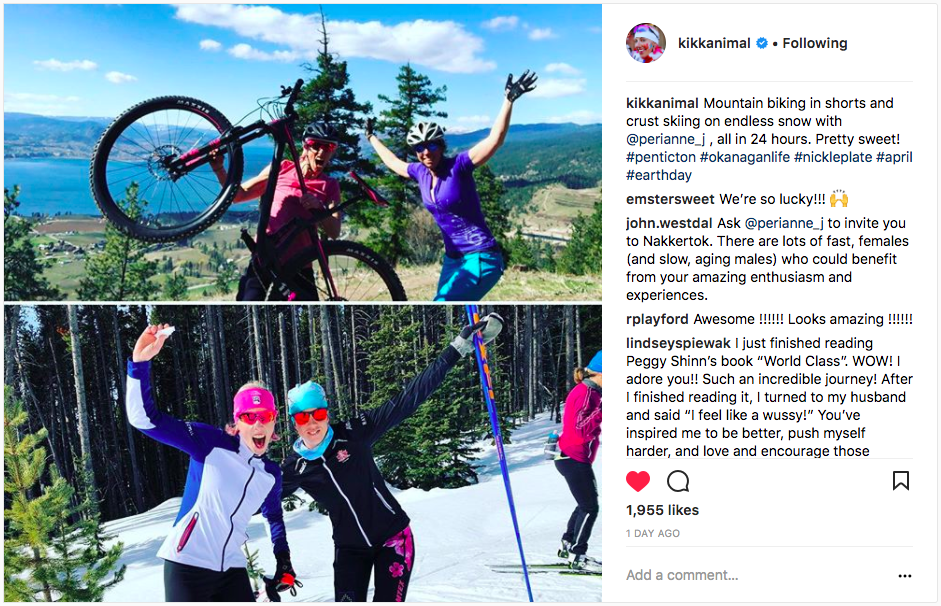
Recently retired American skier Kikkan Randall doesn’t seem to be suffering from her move to Penctiton, B.C., judging from Sunday’s shot of crust skiing with former Canadian World Cup racer Perianne Jones:
And 100 kilometers to the north, Sovereign Lake Nordic Centre isn’t lacking for snow, either. Here’s a screenshot from the webcam as of Tuesday morning, showing impeccable coverage:
That’s a base of 256 centimeters, or over eight feet (!) in American, according to a current conditions report. Sovereign Lake is closed to official skiing at present, but reopens from May 10-13 for its Spring Fling Ski Camp.
Oregon
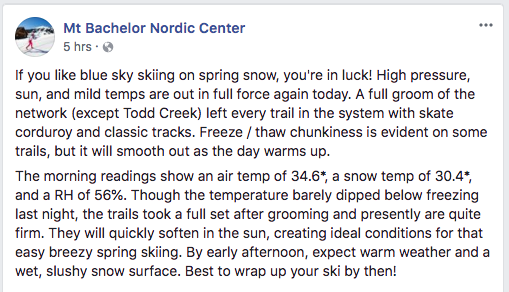
Mt. Bachelor currently has a base of 85″ at 6,300 feet near the base of the alpine area, which is somehow less than Sovereign Lake but still, you know, more than seven feet of snow. Here’s the nordic grooming report from Tuesday morning:
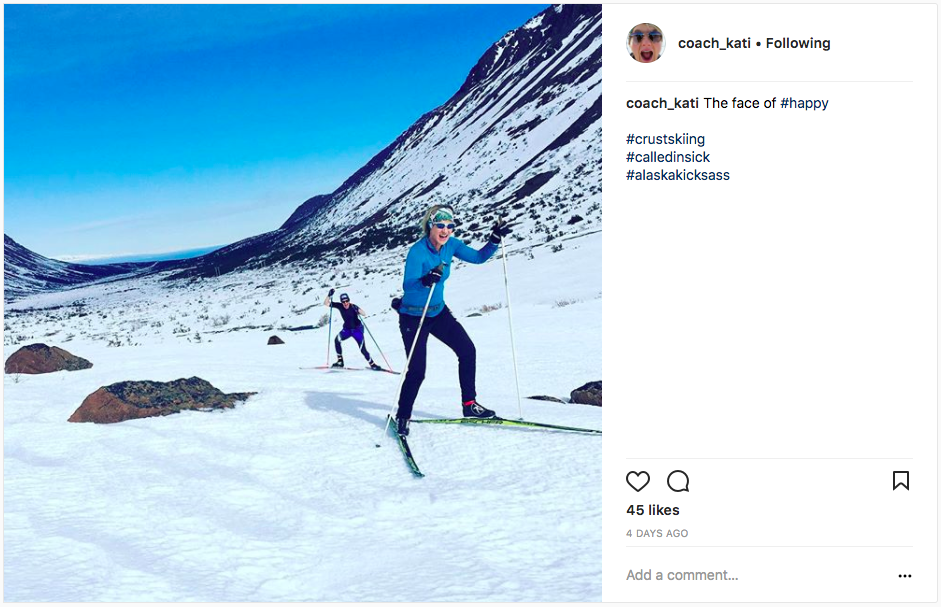
There’s still a lot of snow in Alaska right now. Maybe not at sea-level Anchorage, which is staggering toward spring with a series of high-30s, mid-40s raw and windy days culminating in snow squalls Tuesday evening – Kincaid is down to the dregs of a snowmaking loop by this point, and formal grooming there ended last weekend – but pretty much everywhere else. This reporter found fresh snowfall and blowing spindrift at 2,200′ at the edge of town Monday morning, and most places higher than that are still snow-covered. There is over five feet of snow at Hatcher Pass, and temperatures there remained below freezing even as it rained at sea level on Tuesday. The Mat-Su Ski Club should presumably once more be grooming through mid-May with ease.
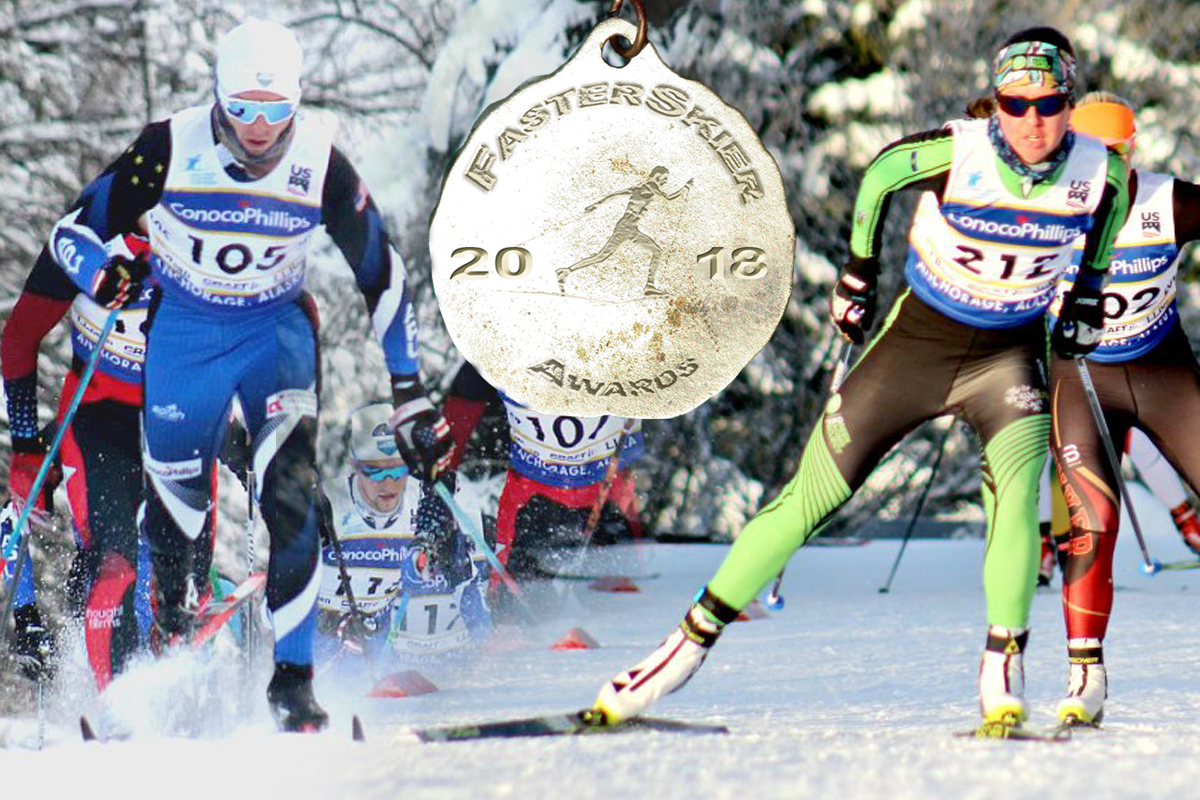
David Norris of Alaska Pacific University (105) and Caitlin Patterson of the Craftsbury Green Racing Project (212) are FasterSkier’s 2018 U.S. Continental Skiers of the Year. (Photos: FasterSkier)
Caitlin Patterson, Craftsbury Green Racing Project
Had Caitlin Patterson glanced to either side while she double poled down the finishing stretch of this year’s U.S. nationals classic sprint, she wouldn’t have seen any other skiers. As it were, the 27 year old had her sights set on the finish line, where they stayed until she secured first place.
As the first across the line, Patterson snagged her fourth win of the week, and with it, a spot in history. She became the first woman in six years to win four consecutive titles at a single U.S. nationals (after U.S. Ski Team member Jessie Diggins did in 2012).
“It felt surreal coming down the finishing stretch … realizing that I couldn’t hear people behind me and realizing that it was going to be number four,” Patterson told Fasterskier after the race.
Caitlin Patterson (Craftsbury Green Racing Project) racing to 40th in the women’s freestyle sprint qualifier at the World Cup in Dresden, Germany. (Photo: Fischer/NordicFocus)
The banner week for the Idaho native, who grew up in Anchorage, Alaska, where nationals took place, started with an outright victory in a snowy 10 k freestyle. The race after that, Patterson claimed a definitive win in the women’s freestyle sprint, crossing 3.56 seconds ahead of her closest competitor. To close out the week, Patterson was the first American in the women’s 20 k classic mass start, before winning the classic sprint with no other skiers in sight.
“I could not have imagined this if I tried,” Patterson said, reflecting on the week.
Prior to her winning streak at nationals, Patterson also raced the opening SuperTour races in West Yellowstone, Montana, where placed third in the 10 k classic. At the following NorAm/SuperTour races in Sovereign Lake, British Columbia, she won 10 k freestyle and placed second in the classic sprint.
Following her racing at U.S. nationals, Patterson flew to Europe to race Period 2 of the World Cup. She notched some of her best World Cup performances of her career while there, with a 20th in the 10 k classic in Planica, Slovenia, and a 23rd in the 10 k freestyle mass start in Seefeld, Austria. The Olympics were the next stop for Patterson, where she skied to 34th in the skiathlon and 26th in the 30 k classic mass start. She also raced World Cup Period 4,
On the domestic circuit back home, Patterson finished the season in second in the overall SuperTour standings, behind her Craftsbury teammate Kaitlynn Miller (who also made the U.S. Olympic team) in first.
David Norris, Alaska Pacific University
Our U.S. Breakthrough Skier of the Year in 2016, David Norris is our pick for American male Continental Skier for 2018. The Fairbanks, Alaska, native is the overall SuperTour winner for 2017/2018, and he opened his season with a second-place finish in the 15 k classic mass start at the West Yellowstone SuperTour.
At U.S. nationals, Norris came down sick and raced two of the four races, placing sixth in the 30 k classic mass start and ninth in the classic sprint. After nationals, Norris raced at the Craftsbury SuperTour, where he finished seventh in the classic sprint and won the 10 k freestyle.
“I came to Craftsbury itching to race,” Norris wrote in an email to FasterSkier in January. “I was sick during nationals and competed in the 30km because I had to if I wanted a chance to earn an Olympic spot. I came up shy, but I know I that I am in good shape. After nationals I took another ten days easy to fully recover from illness so that I could come into Craftbury and Canada healthy.”
The Ishpeming SuperTour men’s 20 k freestyle podium on Feb. 17, with David Norris (c) in first, Kevin Bolger (l) in second, and Brian Gregg (r) in third. (Photo: APU)
At the NorAm/SuperTour in Gatineau, Quebec, Norris placed ninth in the classic sprint before finishing second in the 15 k freestyle and winning the 15 k classic pursuit. Norris continued on the SuperTour circuit to Ishpeming, Michigan, where he finished third in the skate sprint and won both the 20 k skate and 10 k classic races. At the American Birkebeiner in Hayward, Wisconsin, he was the second American and fifth overall.
Norris qualified for Period 4 of World Cup racing and competed in Finland, Norway and Sweden before returning to the U.S. for SuperTour Finals in Craftsbury. There, he finished the season in fourth in the 50 k classic mass start and seventh in the 15 k freestyle mass start. As the overall SuperTour leader at the end of the season, he’ll earn Period 1 World Cup starts next winter.
Honorable Mention: Kaitlynn Miller, Craftsbury Green Racing Project
Kaitlynn Miller (Craftsbury Green Racing Project) racing to first in the women’s 1.4 k classic sprint qualifier on Feb. 26 at the SuperTour in Craftsbury, Vermont. She went on to win the final. (Photo: John Lazenby/Lazenbyphoto.com)
With three podiums as a top American finisher at U.S. nationals, Kaitlynn Miller qualified for her first Olympics and finished the season in first in the overall SuperTour standings. The 26 year old, who was born in New Jersey and grew up in Vermont, started the season out with a second-place finish in the 10 k classic mass start. The next weekend, Miller won the Sovereign Lake NorAm classic sprint.
At nationals, Miller was the second American and fourth overall in the skate sprint sprint. She was the third American and fifth overall in the 20 k classic mass start, and third outright in the classic sprint. She went on to win the Craftsbury SuperTour classic sprint, then placed second in the classic sprint and third in the 10 k classic pursuit with the fastest time of the day at the Gatineau SuperTour/NorAm.
Before jetting to the Olympics in PyeongChang, South Korea, Miller raced to a win in the Ishpeming SuperTour 5 k classic and placed third in the skate sprint. She finished her season on Period 4 of the World Cup and SuperTour Finals back on her home course in Craftsbury.
“It’s been a really unexpected good season and I am really happy with it,” Miller told FasterSkier at World Cup Finals in Falun, Sweden. “To be honest, 10 k skates are generally speaking not my favorite and that’s probably the best-feeling race I’ve had since being over here, which was a really really pleasant surprise and definitly a good high note to end on.”
Honorable Mention: Kevin Bolger, Sun Valley Ski Education Foundation
Kevin Bolger (Sun Valley Ski Education Foundation) racing in the 15 k classic mass start on March 4 at the World Cup in Lahti, Finland. He placed 54th in his first distance World Cup start. (Photo: Fischer/NordicFocus)
Our 2018 Breakthrough Skier of the Year, we felt Kevin Bolger should be recognized as an exceptional continental skier as well. Bolger, 25, finished the SuperTour season in second overall, just 15 points behind Norris in first.
Bolger tallied five SuperTour podiums this past season, including second place in the U.S. nationals skate sprint and a win in the skate sprint at the Ishpeming SuperTour. He made his World Cup debut in early March in Lahti, Finland, where he was the top Continental Cup skier in the skate sprint in 11th overall. He went on to score another World Cup top 30 at World Cup Finals in Falun, where he placed 30th in the skate sprint.
“As I reflect back on my season I don’t think it could have gone better,” Bolger wrote in an email to FasterSkier. “I’ve gotten a taste of what it’s like to be skiing on the World Cup and skiing against the best in the World. That has shown me that I still have a lot of work to do ‘a lot of work’, of course I’ve had some good results but I want more.
“I want to be able to not only ski with those guys on the World Cup, but I want to be compete against them,” he continued. “I haven’t been more motivated and excited for another year to start.”
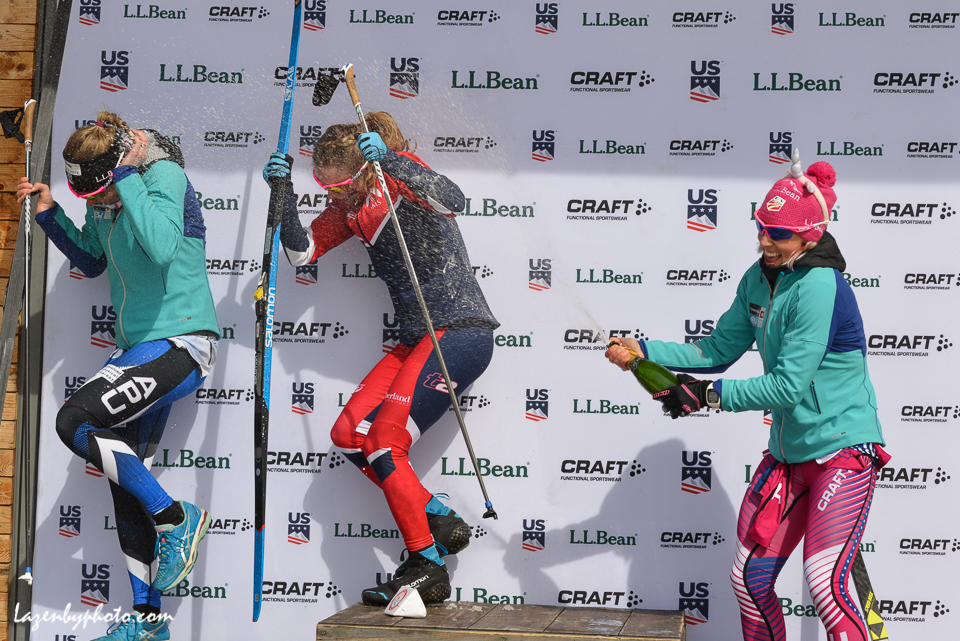
Kikkan Randall (r) sprays her U.S. Ski Team teammates Jessie Diggins (c) and Sadie Bjornsen (l) with champagne on the podium of the 30 k classic mass start at U.S. Distance Nationals in Craftsbury, Vt. Diggins won, Bjornsen placed second and Randall finished third. (Photo: John Lazenby/Lazenbyphoto.com)
2018 U.S. Distance Nationals (Craftsbury, Vermont): 30 k classic mass start
Jessie Diggins swept SuperTour Finals once again, after doing so last year in Fairbanks, Alaska, and winning every individual race at 2016 SuperTour Finals the year before in Craftsbury, Vt.
Back in Craftsbury on Tuesday, and coming off three-straight victories in the classic sprint, 10-kilometer freestyle mass start and mixed relay with her Stratton Mountain School (SMS) T2 Team teammates, Diggins, 26, pulled out her fourth-straight win in her last race of the season: the women’s 30 k classic mass start, which is part of U.S. Distance Nationals.
Jessie Diggins (r) edging her U.S. Ski Team teammate Sadie Bjornsen at the line for the win in the women’s 30 k classic mass start at 2018 U.S. Distance Nationals in Craftsbury, Vt. (Photo: John Lazenby/Lazenbyphoto.com)
She did so in an all-out effort to the line, beating her fellow U.S. Ski Team (USST) member Sadie Bjornsen by just 0.4 seconds in 1:25:27.2 hours. Diggins, Bjornsen of Alaska Pacific University (APU), and another USST member Sophie Caldwell (SMST2) broke away from the pack on the first of five laps at the Craftsbury Outdoor Center. Caldwell dropped off the pace around 10 k and skied on her own for the next 15-plus kilometers before being caught by a chase group of six, led by Kikkan Randall (APU/USST), on the final lap.
Meanwhile, Diggins and Bjornsen skied together, trading the lead for the rest of the race. On the final short climb up to the stadium, Diggins pulled ahead slightly then extended her lead in the finishing straight. After finishing first and second, respectively, Diggins and Bjornsen laid on the ground for what seemed like a long time, particularly spent from the effort, before congratulating each other. Behind them, Randall outlasted the chase pack for third (+2:21.7), Caldwell followed just behind her in fourth (+2:23.1), Ida Sargent of the Craftsbury Green Racing Project (CGRP) and USST placed fifth (+2:26.5) and Rosie Frankowski (APU) finished sixth (+2:29.2).
Also in the top 10, Liz Stephen (USST) finished the last race of her professional career in seventh (+3:10.9), Caitlin Patterson (CGRP) eighth (+3:27.2), Kaitlynn Miller (CGRP) ninth (+3:56), and Chelsea Holmes (APU) 10th (+4:45.3).
Stratton had two wins on the day with Charlotte Ogden (SMS) winning the junior women’s 20 k classic mass start in 1:04:33.9. Canada’s Catherine Reed-Metayer (Skibec Nordique) placed second (+11.8), Waverly Gebhardt (Steamboat Springs Winter Sports Club) finished third (+33.8), and Phoebe Sweet (Craftsbury Nordic) was the third American junior in fourth overall (+1:10.2).
Spring Series concludes with the men’s 50 k classic mass start on Wednesday, starting at 9 a.m. EDT. Watch the races live on the SuperTour live stream.
The start of the women’s 30 k classic mass start at 2018 U.S. Distance Nationals in Craftsbury, Vt. (Photo: John Lazenby/Lazenbyphoto.com)
Jessie Diggins (1) leading the women’s 30 k classic mass start at 2018 U.S. Distance Nationals in Craftsbury, Vt. (Photo: John Lazenby/Lazenbyphoto.com)
Sadie Bjornsen (2) leading the women’s 30 k classic mass start at 2018 U.S. Distance Nationals in Craftsbury, Vt. (Photo: John Lazenby/Lazenbyphoto.com)
Sadie Bjornsen (2) leading the women’s 30 k classic mass start at 2018 U.S. Distance Nationals in Craftsbury, Vt. (Photo: John Lazenby/Lazenbyphoto.com)
Sadie Bjornsen (2) leading Jessie Diggins (c) and Sophie Caldwell (l) during the women’s 30 k classic mass start at 2018 U.S. Distance Nationals in Craftsbury, Vt. (Photo: John Lazenby/Lazenbyphoto.com)
Ida Sargent (15) leads Kikkan Randall. Caitlin Patterson, Liz Stephen (yellow bib) and others in a chase pack during the women’s 30 k classic mass start at 2018 U.S. Distance Nationals in Craftsbury, Vt. (Photo: John Lazenby/Lazenbyphoto.com)
Sadie Bjornsen (2) and Jessie Diggins (1) racing for first in the women’s 30 k classic mass start at 2018 U.S. Distance Nationals in Craftsbury, Vt. (Photo: John Lazenby/Lazenbyphoto.com)
Kikkan Randall (3) racing for third place in the women’s 30 k classic mass start at 2018 U.S. Distance Nationals in Craftsbury, Vt., ahead of Sophie Caldwell (second from l), Ida Sargent (second from r), and Rosie Frankowski (r). (Photo: John Lazenby/Lazenbyphoto.com)
Jessie Diggins (l), Liz Stephen (c) and Rosie Frankowski (r) at the finish of the women’s 30 k classic mass start at 2018 U.S. Distance Nationals in Craftsbury, Vt. (Photo: John Lazenby/Lazenbyphoto.com)
Jessie Diggins with a photo of her retiring U.S. Ski Team teammates Kikkan Randall and Liz Stephen on her cheek at 2018 U.S. Distance Nationals in Craftsbury, Vt. (Photo: John Lazenby/Lazenbyphoto.com)
Kikkan Randall (l) and Liz Stephen after the last race of their professional careers, the 30 k classic mass start at 2018 U.S. Distance Nationals in Craftsbury, Vt. (Photo: John Lazenby/Lazenbyphoto.com)
The women’s 30 k classic mass start podium at 2018 U.S. Distance Nationals in Craftsbury, Vt., with Jessie Diggins (c) in first, Sadie Bjornsen (l) in second and Kikkan Randall (r) in third. (Photo: John Lazenby/Lazenbyphoto.com)
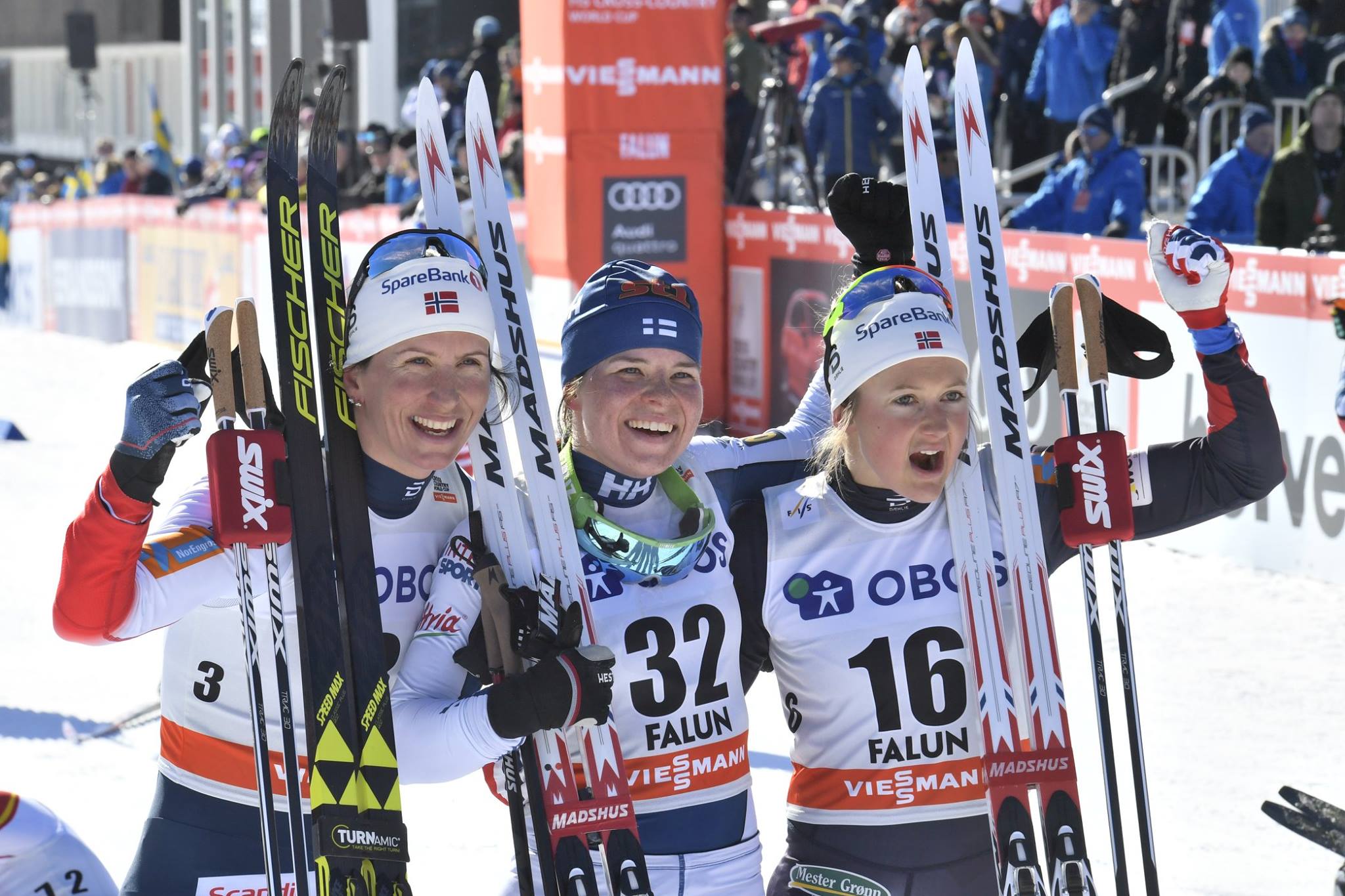
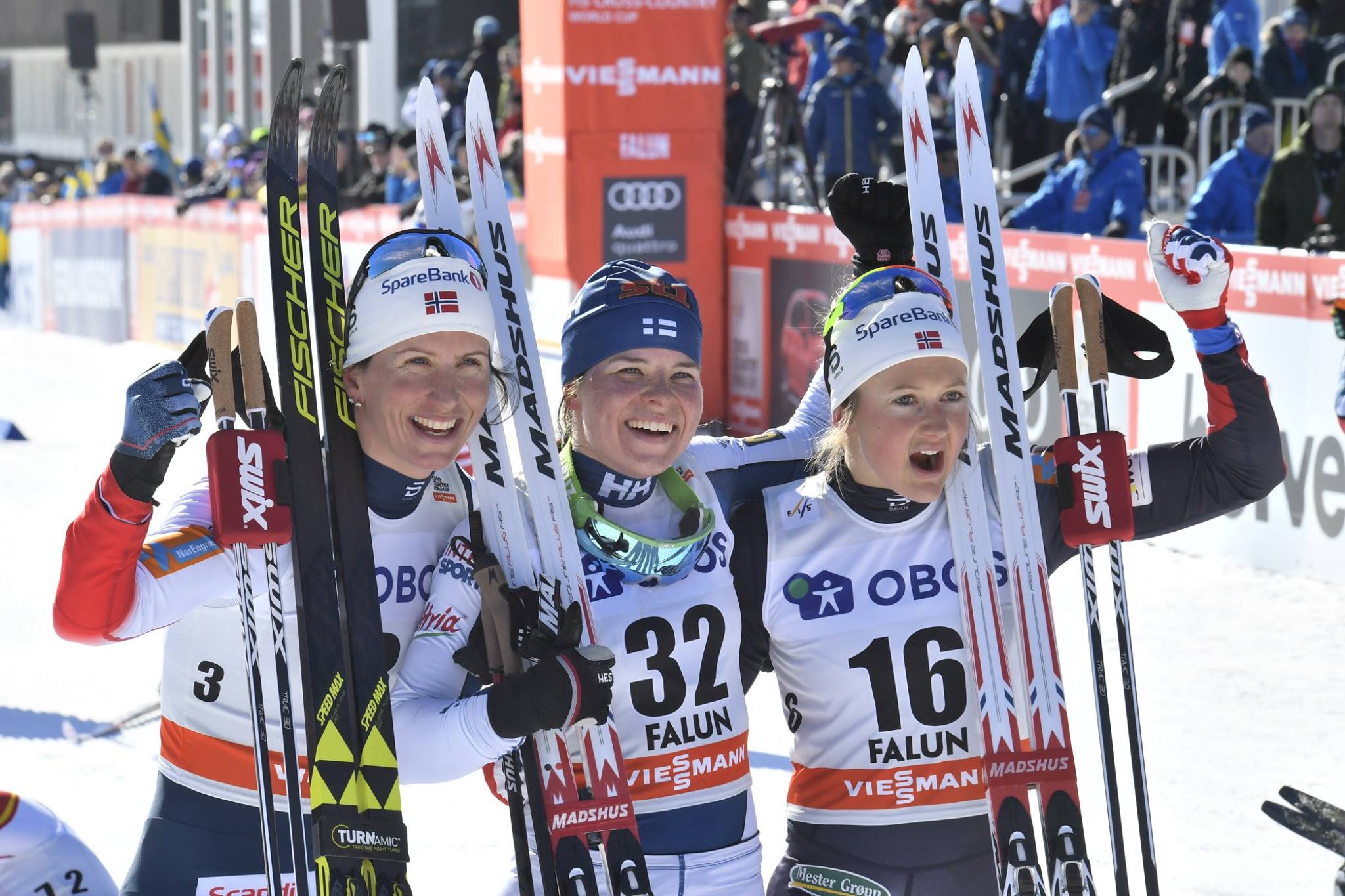
The women’s 10 k classic mass start podium at 2018 World Cup Finals in Falun, Sweden, with Finland’s Krista Pärmäkoski (c) in first, Norway’s Marit Bjørgen (l) in second and Ingvild Flugstad Østberg (r) in third. (Photo: FIS World Cup Svenska Skidspelen/Facebook)
FIS Cross Country World Cup Finals (Falun, Sweden): 10/15 k classic mass starts
Day 2 of World Cup Finals in Falun entailed 10- and 15-kilometer classic mass starts on Saturday, and in the first race of the day, Finland’s Krista Pärmäkoski pulled out a thrilling finishing-sprint victory over Norway’s Marit Bjørgen.
After American Jessie Diggins led early in the first 2.5 k loop, Bjørgen set the tone from the front for most of the race. With less than a kilometer to go, Norwegian powered up the final horseshoe-shaped climb in first, with Pärmäkoski and Bjørgen’s Norwegian teammate Ingvild Flugstad Østberg just behind her. The three had dropped the field while lapping through the stadium around the 7.5 k.
While Østberg fell off the pace on that final uphill, Bjørgen accelerated as she took a few quick strides over the top, gaining a few meters on Pärmäkoski as they headed into the descent. The finishing stretch is long in Falun, and Pärmäkoski was able to come on strong just before she and Bjørgen entered the final 100 meters before the finish. There, Pärmäkoski’s double-pole speed not only matched Bjørgen, but beat her, as Pärmäkoski passed her with several meters to go and took the win by 0.2 seconds in 26:00.5 minutes. It was Pärmäkoski’s second win of the season and fourth of her career (including time-of-day pursuit stage wins).
Just behind Pärmäkoski and Bjørgen, who congratulated each other immediately at the finish, Østberg finished 5.1 seconds back in third. Five women fought for fourth place, with Sweden’s Ebba Andersson taking it (+14.5) ahead of Japan’s Masako Ishida in fifth (+14.8), Sweden’s Charlotte Kalla in sixth (+15.2), Austria’s Teresa Stadlober in seventh (+15.4), and Diggins in eighth (+15.5).
Norway’s Astrid Uhrenholdt Jacobsen was the next finisher across the line in ninth (+24.8), then Finland’s Kerttu Niskanen in 10th (+26.2) and American Sadie Bjornsen in 11th (+26.3).
Canada’s Emily Nishikawa was the next North American in 36th (+1:31.1), and she led her teammates Cendrine Browne, who placed 50th (+2:05.7), Dahria Beatty in 61st (+2:46.6) and Zina Kocher in 69th (+6:12).
For the U.S., Sophie Caldwell finished 41st (+1:36.1), Rosie Frankowski 44th (+1:43.7), Caitlin Patterson 47th (+1:54.8), Ida Sargent 52nd (+2:10.2), Liz Stephen 54th (+2:20.0), Kikkan Randall 57th (+2:34.1), and Kaitlynn Miller 64th (+2:50.7). Rosie Brennan did not start.
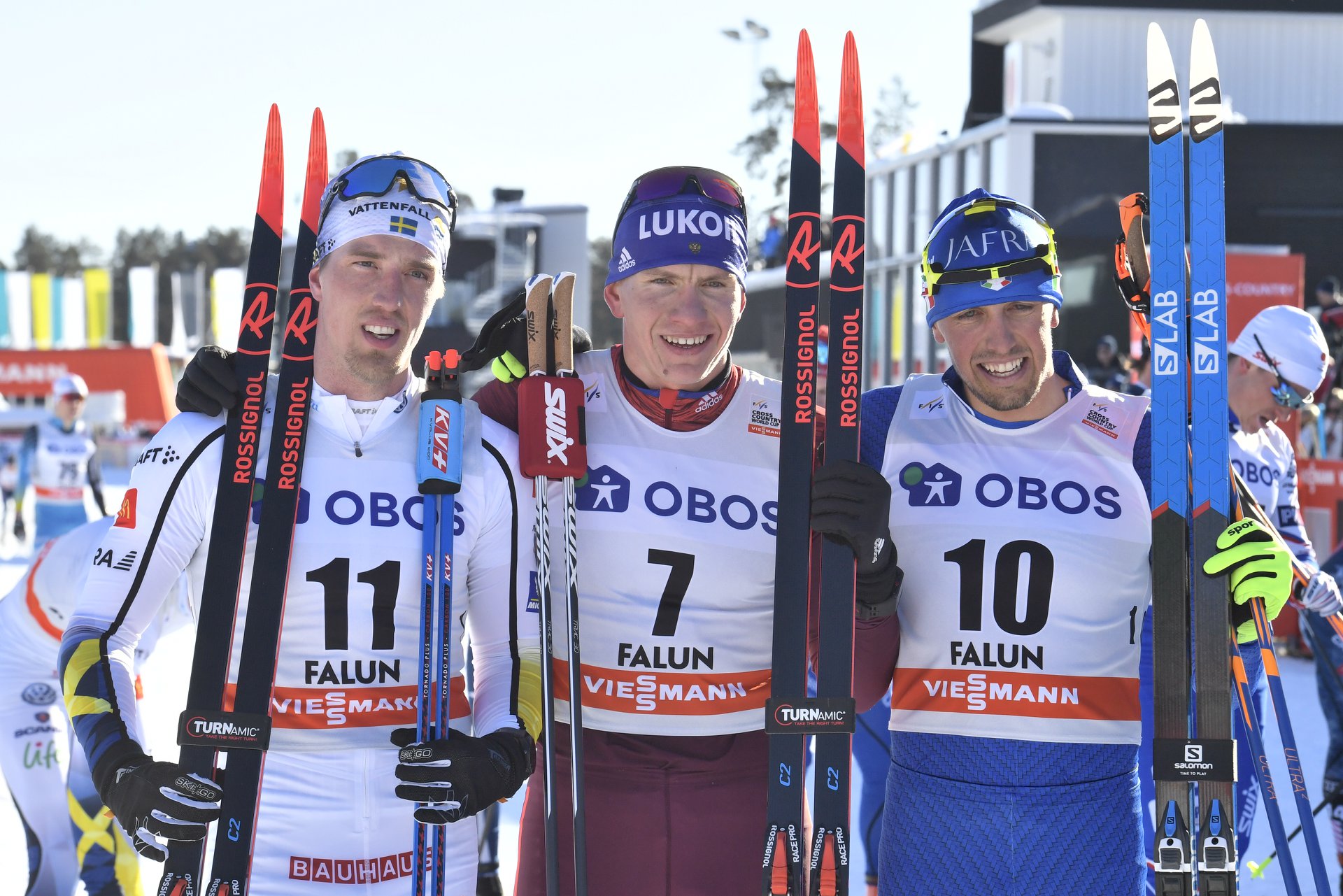
The men’s 15 k classic mass start podium at 2018 World Cup Finals in Falun, Sweden, with Russia’s Alexander Bolshunov (c) in first, Sweden’s Calle Halfvarsson (l) in second, and Italy’s Francesco de Fabiani (r) in third. (Photo: : FIS World Cup Svenska Skidspelen/Facebook)
In the men’s 15 k classic mass start on Saturday afternoon, Russia’s 21-year-old Alexander Bolshunov notched his first-career World Cup win after reaching the podium seven other times this season (placing third in six of those seven races).
Bolshunov hung in the pack and took the lead at the start of the final lap at 11.25 k, ahead of four of his Russian teammates, Alexey Chervotkin in second, Evgeniy Belov in third, Andrey Larkov in fourth, and Maxim Vylegzhanin in fifth. Behind them, Switzerland’s Dario Cologna skied just ahead of Norway’s Martin Johnsrud Sundby and Canada’s Alex Harvey, who were among 29 skiers within four seconds of first.
While Sweden’s Calle Halfvarsson led the final climb before the stadium, Bolshunov caught him on the downhill and out-double-poled him in the finishing stretch, taking first by 1.3 seconds in 36:59.8. Halfvarsson finished second and Italy’s Francesco de Fabiani scored his second World Cup podium of the season in third (+3.1).
Kazakhstan’s Alexey Poltoranin missed the podium by 0.6 seconds in fourth (+3.7), Chervotkin followed in fifth (+5.2), ahead of Cologna in sixth (+5.6) and Italy’s Federico Pellegrino in seventh (+5.6), after they finished together. Sundby and his Norwegian teammate Niklas Dyrhaug also crossed the line at the same time in eighth (+6.3) and ninth (+6.3), respectively, just 0.1 seconds ahead of another one of their teammates, Sjur Røthe, in 10th (+6.4).
Less than five seconds later, Harvey finished 20th (+10.7), ahead of Norway’s Johannes Høsflot Klæbo in 22nd (+13.6). Klæbo slipped out of contention on the third of four laps, as he dropped from fourth to 22nd in less than two kilometers.
Canada’s Devon Kershaw finished 26th (+14.6) for his fourth-straight race in the top 30 (including his 26th-place finish in the Olympic 50 k classic mass start), Graeme Killick placed 41st (+1:13) and Julien Locke was 81st (+3:29).
Erik Bjornsen was the top American man in 52nd (+1:47.1), Simi Hamilton finished 62nd (+2:06.4), Kevin Bolger was 69th (+2:27.1), David Norris 70th (+2:31.2), Scott Patterson 71st (+2:40.6), Paddy Caldwell 75th (+2:52.7), and Andy Newell 86th (+4:47).
World Cup Finals conclude with 10/15 k freestyle pursuits on Sunday.
France won the International Biathlon Union (IBU) World Cup women’s 4 x 6 k relay to start the day at Holmenkollen, ahead of Germany and Italy, while the Canadian women’s team (Sarah Beaudry, Julia Ransom, Emma Lunder, and Rosanna Crawford) placed 11th and the U.S. (Clare Egan, Susan Dunklee, Joanne Reid, and Emily Dreissigacker) came back from 21st to finish 15th.
In the men’s 12.5 k pursuit that followed, France’s Martin Fourcade won his 10th race at Holmenkollen, putting himself 49 points ahead of Norway’s Johannes Thingnes Bø with three individual races in Tyumen, Russia, remaining. US Biathlon’s Sean Doherty tied his second-best result this season in 17th and his teammate Lowell Bailey raced up to 28th with the 19th-fastest time of day. Leif Nordgren placed 40th and Tim Burke was 47th, while Canada’s Scott Gow finished 51st and Christian Gow was 54th.
Norway’s Marit Bjørgen celebrates her seventh Holmenkollen 30 k victory on Sunday in Oslo, Norway, ahead of American Jessie Diggins, Norway’s Ragnhild Haga (not shown) and Sweden’s Charlotte Kalla. (Photo: Fischer/NordicFocus)
*Update: This article previously stated that Jessie Diggins was the first American woman to reach a podium at the Holmenkollen. Diggins is actually the first American woman to reach the Holmenkollen podium in the 30 k distance, second woman to podium at a Holmenkollen in history. In 1980, American Allison Owen reached the podium in the 10 k distance.
OSLO, Norway — Some pointed to the broadcast screen in disbelief. Others began waving their Norwegian flags with revitalized vigor. Twenty minutes earlier, Norway’s Marit Bjørgen appeared to be out of the running for another win in the women’s 30-kilometer mass start at Holmenkollen.
She had lost nine seconds to the leaders by the 11 k mark and another 17.9 seconds had dissipated between her and the the leaders as they passed 13.3 k. A little over the halfway point, at 16.3 k, the 37-year-old Bjørgen was down 36 seconds.
For any spectator familiar with Bjørgen’s race tactics, she does not favor come-from-behind style skiing. In this year’s Olympic 30 k classic mass start, she pulled away from the field in the first 8 k and went on to claim gold by a close to a two-minute gap.
Exactly one year ago, in the 2017 Holmenkollen 30 k classic, she had put 33 seconds into the field by 8 k, tripling that in the following 10 k, before crossing the finish line more than two minutes ahead of the rest of the field. If racing to win, Bjørgen usually starts by burying the competition.
Sweden’s Charlotte Kalla leads American Jessie Diggins and Norway’s Ragnhild Haga during the Holmenkollen women’s 30 k freestyle mass start at the World Cup in Oslo, Norway. (Photo: Fischer/NordicFocus)
So when Sunday’s top three — Sweden’s Charlotte Kalla, Norway’s Ragnhild Haga and American Jessie Diggins — broke free, the predictions for the podium went with them.
“I thought I was fighting for the fourth place,” Bjørgen said at a post-race press conference.
With Bjørgen out of the driver’s seat, the attention from the teleprompter and crowd turned to Diggins, Kalla and Haga. For the most part, the three skied in a line, with Kalla and Diggins exchanging leads.
Still anytime the Swede pulled at the front, her effort appeared to be a byproduct of Diggins. Every uphill churn from the Swede seemed like an attempt to stave off the American. Diggins continually reinstated herself ahead of Kalla in first: stars and stripes unmistakably spearheading the way.
On a course that is fabled for Norway, in a sport that is historically Scandinavian, the U.S. skier repeatedly put the iconic suits of Sweden and Norway behind her. But this seemed to be more than just the dogged-skiing characteristic of Diggins’s race style. The 26-year-old Minnesota native was not just being gutsy. She was making a point.
“I think there has been this myth that Americans, OK, maybe they can win short distances, and maybe Jessie can win a 5 k but there is no way she can hang in a 30 k,” Diggins told FasterSkier during an in-person interview after. “I was setting out to debunk some myths today.”
For the first 8 k, Diggins charged the field of 54 skiers. Along with Kalla, she spurred the lead group’s gap that formed at the 13 k mark. In another 5 k from there, she had broken free of Bjørgen. Without looking back, Diggins was chasing down a Holmenkollen master head on.
“Maybe it wasn’t smart to be leading so much, but I was thinking this is my only shot and so I got to go for it,” Diggins said. “It was an incredible feeling to be leading the Holmenkollen … for me, trying to be competitive in every race that I enter has been a goal for a long time. I don’t want to be a specialist, I want to be a medal threat in every race that I do.”
As Diggins continued to pose a threat in the front, danger lurked behind. Bjørgen cut through the course, the dreaded dorsal fin gradually on the rise.
At 18.3 k, the gap from Bjørgen to the leaders was 32 seconds. In two kilometers, that was reduced to 26 seconds. Another 2 k and Bjørgen was four seconds closer. Over the course of 5 k, Bjørgen had cut her time back from the leaders in half; another 5 k still remained and 15 seconds separated her from the top three.
A wave of surprise and simultaneous excitement rolled over the spectators. Six seconds separated her from the lead group at 27 k. The Norwegian pushed closer and closer, and with 1.5 k left in the race, she was back in contact with the front pack.
“It was amazing that I did it,” Bjørgen said. “I haven’t thought it was possible … but when we passed the stadium, the last time, before we go off Gratishaugen … I thought … I wonder if they want to change skis and they didn’t.
Norway’s Marit Bjørgen leading teammate Astrid Uhrenholdt Jacobsen in the Holmenkollen 30 k freestyle mass start at the World Cup in Oslo, Norway. (Photo: Fischer/Nordic Focus)
At 13.3 k Bjørgen stopped to switch skis, as did her Norwegian teammate Astrid Uhrenholdt Jacobsen. Kalla, Diggins and Haga did not. After the top three bypassed the ski exchange, one thing was on the Bjørgen’s mind.
“I thought I had to push hard,” Bjørgen said.
Fueled by the energy of her home crowd, Bjørgen went on to pass Haga, Diggins and Kalla in the final kilometer. Alone, she raced toward the final stretch and crossed the finish line first in a time of 1:18:12.4 hours, earning her seventh Holmenkollen title in historic fashion. She now also holds the record for most Holmenkollen victories of any woman.
“I haven’t won a competition like this, so it’s all so very special,” Bjørgen said. “To win at Hollmenkollen … for sure it’s the biggest you can do after the World [Championships] and the Olympics.”
Crossing 3.6 seconds behind Bjørgen was Diggins in second place. She became the first American woman to reach the podium at Holmenkollen in the 30 k distance. 1980, American Allison Owen reached the podium in the Holmenkollen, which was raced as a 10 k.
“I didn’t know who it was [chasing the top three] I just heard that the gap was shrinking,” Diggins said. “I felt I was just sprinting the last 4 k. That was my only shot. We didn’t change skis which maybe was a mistake, but also you make the best call that you can at the time.”
The Holmenkollen women’s 30 k freestyle mass start podium on Sunday in Oslo, Norway, with Jessie Diggins (l) in second, and Norway’s Marit Bjørgen (c) in first and Ragnhild Haga (r) in third. (Photo: Fischer/Nordic Focus)
While she held off Haga and Kalla, those two battled for third. Haga outlunged Kalla by a just one-tenth of a second for the final spot on the podium (+4.3).
“I am very happy with my sprint, my finish against Charlotte,” Haga said. “I regretted that we didn’t switch skis when I heard that Marit caught many seconds there, but suddenly she just came up and, yeah, she is always there when it matters. So Marit is amazing today as well.”
Rounding out the women’s top 10 was Kalla in fourth (+4.4), Jacobsen in fifth (+11.6), Ingvild Flugstad Østberg in sixth (+1:39.5), Finland’s Krista Pärmäkoski in seventh (+1:51.7), Germany’s Stefanie Böhler in eighth (+2:10.2), Austria’s Teresa Stadlober in ninth (+2:11.6) and Sweden’s Ebba Andersson in 10th (+2:11.9).
U.S. skier Sadie Bjornsen finished 11.5 seconds outside the top 10 in 12th (+2:23.4) in what she described as her “best Holmenkollen finish.”
“I was really looking forward to today. I had not too many awesome feelings lately,” Bjornsen told FasterSkier after. “I was just looking forward to the simplicity of a skate race. I had a ton of fun out there.”
American Kikkan Randall (19) leading Canada’s Cendrine Browne and Russia’s Alisa Zhambalova during the Holmenkollen women’s 30 k freestyle mass start on Sunday in Oslo, Norway. (Photo: Fischer/NordicFocus)
Following Bjornsen, U.S. skier Kikkan Randall placed 19th (+3:21.9) in what will be her final Holmenkollen race. The first time Randall raced at Holmenkollen was in 2007. As she reflected on her years of racing there, the 35-year-old Olympic gold medalist remained humble of the time she had spent on the historically challenging trail.
“This is probably one of the coolest places to race, with the atmosphere and the spectators,” Randall said. “It was definitely hard, but I really enjoyed it … there’s something that’s hard to put into words about pushing yourself over the course of an hour and twenty minutes. It just kind of feels good to finish a little bit empty.”
After a photo finish with French skier, Anouk Faivre-Picon, American Caitlin Patterson finished 28th (+4:13.1), just behind Faivre-Picon in 27th. Sunday’s race was Patterson’s second Holmenkollen freestyle race, and the 27-year-old Craftsbury Green Racing Project member was happy to spend the first two-thirds of it with a large group of racers that included Randall.
“This one was way better because I was actually in it. That other year I was just blown out,” Patterson said, referring to her previous Holmenkollen skate race, in 2015, when she placed 53rd. In last year’s Holmenkollen 30 k classic, she finished 36th.
“Today my goal was to stay more relaxed and as much as I wanted to stay with the lead pack, but not burn all the matches right at the start,” Patterson added.
“I switched my skis the last lap, with the snow starting to come down … and for better or worse, it did mean I lost the pack,” she continued. “But then I was able to ski with Anouk for the last lap and we reeled in that Norwegian and a Russian. … I always feel a lot better about races if I finish strong, whatever the place is.”
Also for the U.S., Rosie Frankowski, of Alaska Pacific University, finished in 31st (+4:45.4), 28.3 seconds outside the top 30.
Canada’s Cendrine Browne finished 36th (+6:16.1) followed by Emily Nishikawa in 44th (+7:36.1) and Dahria Beatty in 49th (+9:45.1).
For the U.S., Liz Stephen finished 51st (+10:01.7) and Kaitlynn Miller 53rd (+16:05.0).
Along with Randall, Stephen also completed her final Holmenkollen on Sunday. Stephen had her parents cheering her on after they made the trek to Norway to watch her race in person. Her closing words on her final time around the historic course were full of emotion, both happy and sad.
“I think this is actually the first race that I have ever looked at Matt [Whitcomb] in the eye during the race and thanked him for the feed and kept going,” Stephen, 31, said. “It’s bittersweet. It’s certainly not the way I was hoping to end it but … it was really special watching Noah [Hoffman] hug his dad yesterday.
“I mean this sport has been our life and it is hard to leave, but it is time,” she added, referring to her retirement at the end of the season. “And I am really lucky to have had such a good run with it. And to have an amazing team to let go forward.”
The Holmenkollen women’s 30 k freestyle mass start podium on Sunday in Oslo, Norway, with Jessie Diggins (l) in second, and Norway’s Marit Bjørgen (c) in first and Ragnhild Haga (r) in third. (Photo: FIS Cross Country/Twitter)
FIS Cross Country World Cup (Oslo, Norway): Women’s 30 k freestyle mass start
Marit Bjørgen, the Norwegian queen of distance cross-country events, racked up another victory at Holmenkollen in the women’s 30-kilometer freestyle mass start on Sunday for her seventh win in the World Cup’s ultimate distance event at the famed Norwegian venue. (She had previously won in 2005, 2010, 2012, 2014, 2015 and 2017).
But she did so in not-so-typical fashion. Instead of breaking the field mid-race and skiing to a comfortable win, like she did in the last race of the 2018 Olympics in PyeongChang, South Korea (a 30 k classic mass start), Bjørgen came from behind to win Sunday’s Holmenkollen 30 k and wasn’t able to let off too much before finish. She didn’t take the lead until less than a kilometer to go and put just enough time into her competition to take the win in 1:18:12.4 hours, while American Jessie Diggins outlasted the chase group of three to place second (becoming the first American woman to reach the Holmenkollen podium), 3.6 seconds behind Bjørgen. Norway’s Ragnhild Haga edged Sweden’s Charlotte Kalla by 0.1 seconds for third place (+4.3), while Kalla settled for fourth (+4.4).
The rest of the field was strung out, with Norway’s Astrid Uhrenholdt Jacobsen finishing fourth (+11.5) and Ingvild Flugstad Østberg nearly another 1 1/2 minutes back in fifth (+1:39.5). Finland’s Krista Pärmäkoski placed seventh (+1:51.7), Germany’s Stefani Böhler notched eighth (+2:10.2), Austria’s Teresa Stadlober ninth (+2:10.2), and Sweden’s Ebba Andersson 10th (+2:11.9). Less than a second behind Sweden’s Ida Ingemarsdotter in 11th (+2:22.8) was American Sadie Bjornsen in 12th (+2:23.4).
In the Distance World Cup standings, Diggins gained some valuable points to keep herself in third, now 63 points ahead of Pärmäkoski in fourth. Heidi Weng, who finished 18th on Sunday, still leads the distance standings by 104 points and Østberg is second, 51 points ahead of Diggins.
In the Overall World Cup, Weng leads by 153 points over Østberg. Diggins is another 104 points back in third, 100 points ahead of Pärmäkoski in fourth. At World Cup Finals next week in Falun, Sweden, a total of 300 points is up for grabs for the winners (50 for freestyle sprint, 50 for classic individual start, and 200 for freestyle pursuit).
The U.S. had three in the top 20 and four in the points (top 30) in Sunday’s 30 k, with Kikkan Randall in 19th (+3:21.9) and Caitlin Patterson in 28th (+4:13.1). Rosie Frankowski (Alaska Pacific University) missed the top 30 by about 28 seconds in 31st (+4:45.4), Liz Stephen placed 51st (+10:01.7) and Kaitlynn Miller (Craftsbury Green Racing Project) finished 53rd (+16:05.0).
Cendrine Browne led four Canadian women in 36th (+6:16.1), Emily Nishikawa was 44th (+7:36.1), Zina Kocher (Foothills Nordic) finished 47th (+8:52.0), and Dahria Beatty placed 49th (+9:45.1).
Germany’s Vanessa Hinz celebrates her first IBU World Cup win and podium in the women’s 12.5 k mass start on Sunday in Kontiolahti, Finland. (Photo: IBU/Biathlonworld)
IBU World Cup (Kontiolahti, Finland): Men’s and women’s mass starts
(Note: This rundown has been updated to include comments from Lowell Bailey and Rosanna Crawford.)
Germany’s Vanessa Hinz won her first International Biathlon Union (IBU) World Cup race (and achieved her first World Cup podium) and Austria’s Julian Eberhard won his first race of the season (and first mass start of his career) in the women’s 12.5 k and men’s 15 k mass starts on Sunday in Kontiolahti.
Germany’s Vanessa Hinz celebrates her first IBU World Cup win and podium in the women’s 12.5 k mass start on Sunday in Kontiolahti, Finland. (Photo: IBU/Biathlonworld)
Hinz shot an impressive 20-for-20 with the third-fastest range time and fifth-fastest shooting time to take the win in 35:47.9 minutes. Third after the first prone stage, she moved into second, then third after cleaning the next two stages. After knocking down her final five targets in the last standing, Hinz left the range almost 24 seconds ahead of France’s Anaïs Chevalier in second and 26 seconds ahead of Italy’s Lisa Vittozzi in third. Hinz stayed ahead of her challengers on the final loop, finishing 13.5 seconds clear of Vittozzi, who claimed second. Chevalier finished third, 16.8 seconds back, while Finland’s Kaisa Mäkäräinen was next across the line in fourth (+43.4) with a gap to Sweden’s Hanna Öberg in fifth (+1:02.1).
Vittozzi and Chevalier both cleaned the first three stages then had to ski a penalty lap after the last standing bout (0+0+0+1). Mäkäräinen missed three (1+0+1+1) yet skied the second-fastest course time on her home course, and Öberg missed two (0+0+2+0). The fastest course time of the day was clocked by Darya Domracheva of Belarus, who had to ski five penalty laps (0+1+1+3) and ended up 10th (+1:18.2).
“I always dreamed of shooting four times clean and today I did it,” Hinz, 25, said, according to an IBU press release. “I was so often close to the podium. I knew I could do it. Today, I said, ‘OK, let’s try it and if it works, it is OK … and if not there is another season waiting and other races.’ Now I am on top of the podium and it is crazy.”
Vittozzi, who placed fourth in the mass start at the 2018 Olympics, was glad to improve on a third-place finish in Friday’s sprint by placing second on Sunday.
“I have been third so many times and that was not satisfying for me,” Vittozzi said, one day after she won the mixed relay with her team in Kontiolahti. “Today I am very happy about my second place.”
For Chevalier, it was her first individual podium of the season and it came a day after she and Antonin Guigonnat won the single mixed relay. Chevalier, 25, was severely injured when she was hit by a car last spring, according to an IBU press release.
“I am very happy to be here today, because it was a very hard season,” she told the IBU. “I forgot how nice it is to be on the podium … I forgot that it was not easy, so I am very happy … I did my best on the last lap; [Vittozzi] was faster, but I am third and happy with that!”
Canada’s Rosanna Crawford shot 19-for-20 to place 13th (+1:25.9) with her only miss coming in the second prone stage (0+1+0+0). Her overall shooting and range times were 10th fastest of the 30-woman field, compared to her 26th-ranked ski time. Crawford had been in 11th after cleaning the final standing stage, then slipped two spots to finish 13th in her second mass start of the season.
“Since the skiing wasn’t feeling great today I made sure I was super focused in the range,” Crawford wrote in an email to FasterSkier. “I knew that was my only chance to get a good result today. My one prone miss was a bad trigger pull, but the rest were nice solid hits. I made sure to have a solid set up and then just trusted my rhythm and shooting.
“I knew that I wanted that top 15, so I just kept fighting and trying to stick with the women when they caught me,” she wrote of her last loop. “The last time up the wall I managed to stay close to [France’s] Anais Bescond, and hold off the two people behind me. Really happy to be in the top 15 again.”
Clare Egan was the lone American woman to qualify for Sunday’s mass start, and it was the second mass start of her career. She was on track for a top-15 result after missing just one target in the first three stages, but she had to ski three penalty laps on the last standing (0+1+0+3), which put her in 23rd by the finish (+2:05.6). Notably, she skied the 14th-fastest overall course time.
“I didn’t have quite the same energy level tonight as the last two days, but I still had the 14th rank course time and that means anything is possible in the race,” Egan wrote in an email to FasterSkier. “To put it in perspective, the winner of the race, Hinz, had the 13th rank, just 2 seconds faster than me. This is the first time I’ve felt totally comfortable skiing with the fastest women, and I certainly hope I can maintain this speed for one more week of World Cup racing.”
Egan was pleased with her 9-for-10 prone shooting and her clean standing stage (“which is the first time I’ve cleaned a standing stage in an individual race this entire year, believe it our not,” Egan wrote).
“But when I missed my second shot on the final stage, I let that throw me off my game, and really blew the rest of the stage,” she explained. “It’s so hard to keep 100% focus in every scenario, and I find it gets harder and harder towards the end of the race when I’m not necessarily the most lucid. I know that I have to work on so I have a goal to manage the final stage better next week and in the future.”
Her 23rd-place finish was one better than her previous World Cup mass start finish, which was 24th last season in Hochfilzen, Austria.
“In my only other mass start, which was last year at World Championships, I felt like an imposter,” Egan reflected. “Maybe because I was the first ‘reserve’ to get called up when one of the top women [did not start]. But this was totally different. I knew I deserved to be there today and was confident about competing with the other top women.”
“In my only other mass start, which was last year at World Championships, I felt like an imposter … This was totally different. I knew I deserved to be there today and was confident about competing with the other top women.” — Clare Egan (US Biathlon) on Sunday’s mass start
While the women raced Sunday night, the men’s 15 k mass start took place in the afternoon, when Eberhard passed the likes of France’s Martin Fourcade and Russia’s Anton Shipulin after a tangle late in the race to take the win.
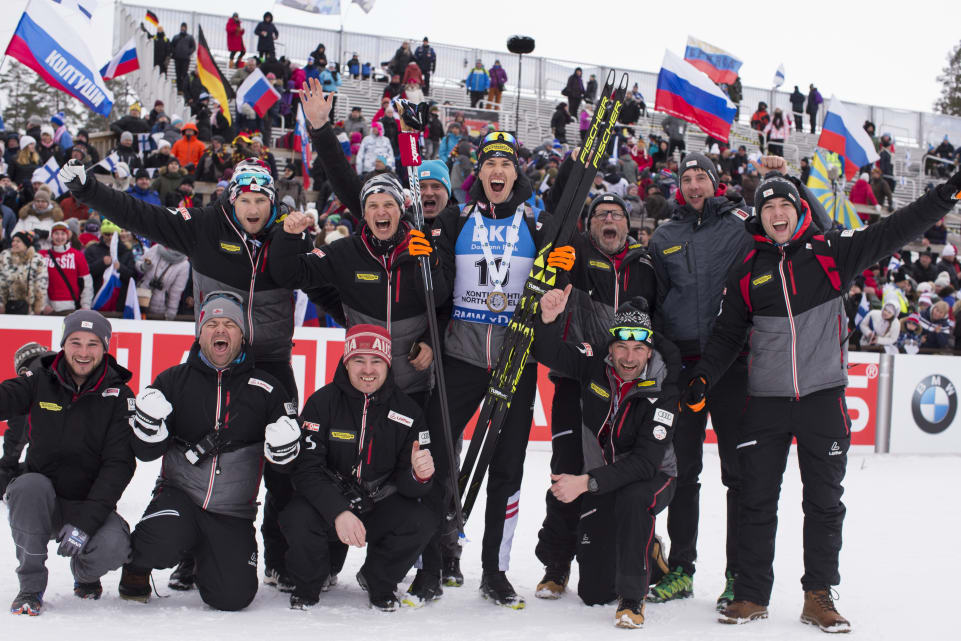
The Austrian team celebrating Julian Eberhard’s fourth career victory, his first this season and his first in a mass start on Sunday after the IBU World Cup men’s 15 k mass start in Kontiolahti, Finland. (Photo: IBU/Biathlonworld)
The Austrian had cleaned the first two prone stages to move into third by the race’s halfway point, behind Germany’s Benedikt Doll and Arnd Peiffer in first and second, respectively. Eberhard missed one in the next standing stage, yet left the range in second, 15 seconds behind Peiffer (who cleaned) in first, while Doll missed one as well to slip into third, 19 seconds back.
With two loops to go, Fourcade was coming back from two early prone penalties and found himself in fifth after a clean standing stage, less than a second behind Shipulin in fourth. On the next standing stage, Fourcade cleaned to take the lead and left the range about five seconds ahead of Shipulin (who also cleaned) in second.
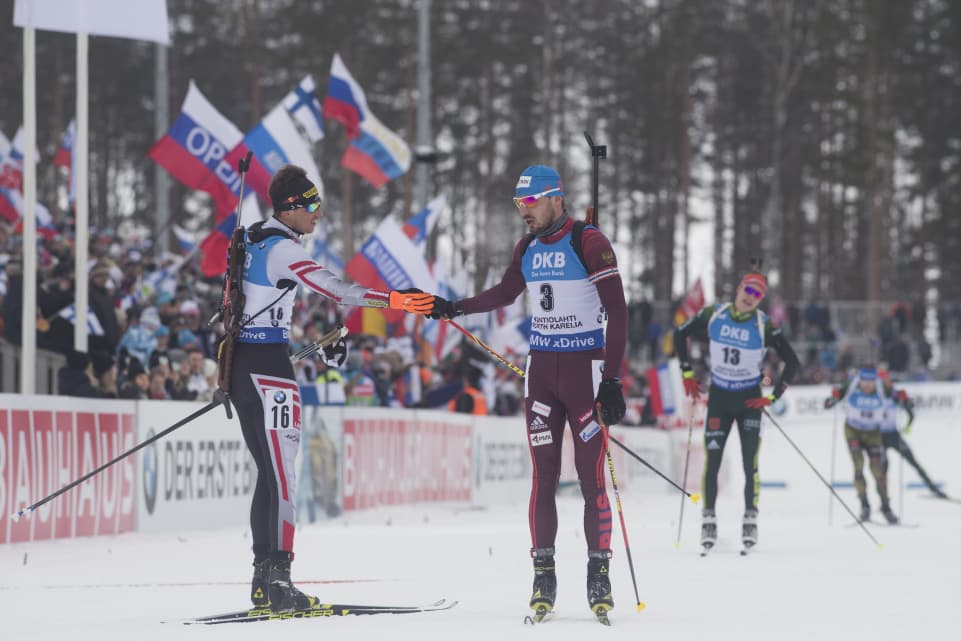
Eberhard missed one yet remained in contention in third, 17 seconds behind Fourcade. On the last loop, Shipulin caught Fourcade before the course’s notorious climb known as “The Wall”, and Eberhard closed on the two frontrunners as they ascended it. Still several seconds behind over the top, he caught Shipulin on the bridge before the stadium, but the two tangled skis and Shipulin fell. Eberhard stayed upright and pulled even with Fourcade, passing him to take the win in 38:04.8. Fourcade finished second (+6.9) and Shipulin third (+19.3).
Austria’s Julian Eberhard (l) and Russia’s Anton Shipulin after the finish of the men’s 15 k mass start the IBU World Cup in Kontiolahti, Finland. Shipulin fell when his skis tangled with Eberhard’s. While Eberhard raced to the win, Shipulin placed third. (Photo: IBU/Biathlonworld)
“I wanted to be in a sprint with all three, but the bridge is too small for this,” Eberhard said, according to an IBU press release. “I came up the bridge with too much speed. Anton and I were in the same track and there was an accident. I apologized to Anton at the finish but he said these things can happen and it was OK with him.”
“I hold no grudge against Julian,” Shipulin told the IBU. “This can happen in sports and is all fair … I am in good shape and want to preserve this and perform my best in the last World Cups.”
Fourcade explained that illness caused him to sit out Thursday’s sprint, and he was only able to train three hours this week.
“It is really difficult to race in this situation without any feeling or training,” Fourcade told the IBU. “I did not know what to expect today but I am quite satisfied. I would have liked to win, but I used too much energy trying to come back in the early laps and had no energy when it was time to attack.”
Behind them, Doll picked off one place on the final loop to finish fourth (+21.9), passing his German teammate Erik Lesser, who finished fifth (+23.9). Peiffer followed in sixth (+27.1) as Germany had three in the top six.
American Lowell Bailey raced to 14th (+1:06.3) with two penalties, both of which came in the standing stages (0+0+1+1). Bailey had been fourth after cleaning the second prone, 16 seconds behind Doll in first, but slipped to 10th after missing one on the next bout. He had to ski another penalty lap on the last stage, and left the range in 14th.
Overall, Bailey posted the 10th-fastest shooting time, 15th-fastest range time and 18th-fastest course time.
“I finally felt like I was back in the spot that I ended last season,” Bailey wrote in an email when asked about his consistency. “I felt controlled and able to keep the pace with the top of the field throughout the race. It was nice to be back in the mix.
“Although I would have liked to see this ski speed a few weeks ago, better late than never!” he continued.
Next week’s World Cup in Oslo, Norway, will be his last of the season and his career.
“After nearly two decades of international racing, Oslo will be my final World Cup as a U.S. Biathlete,” Bailey wrote. “I’m sure it will be emotional but I hope to end my World Cup career on a high note!”
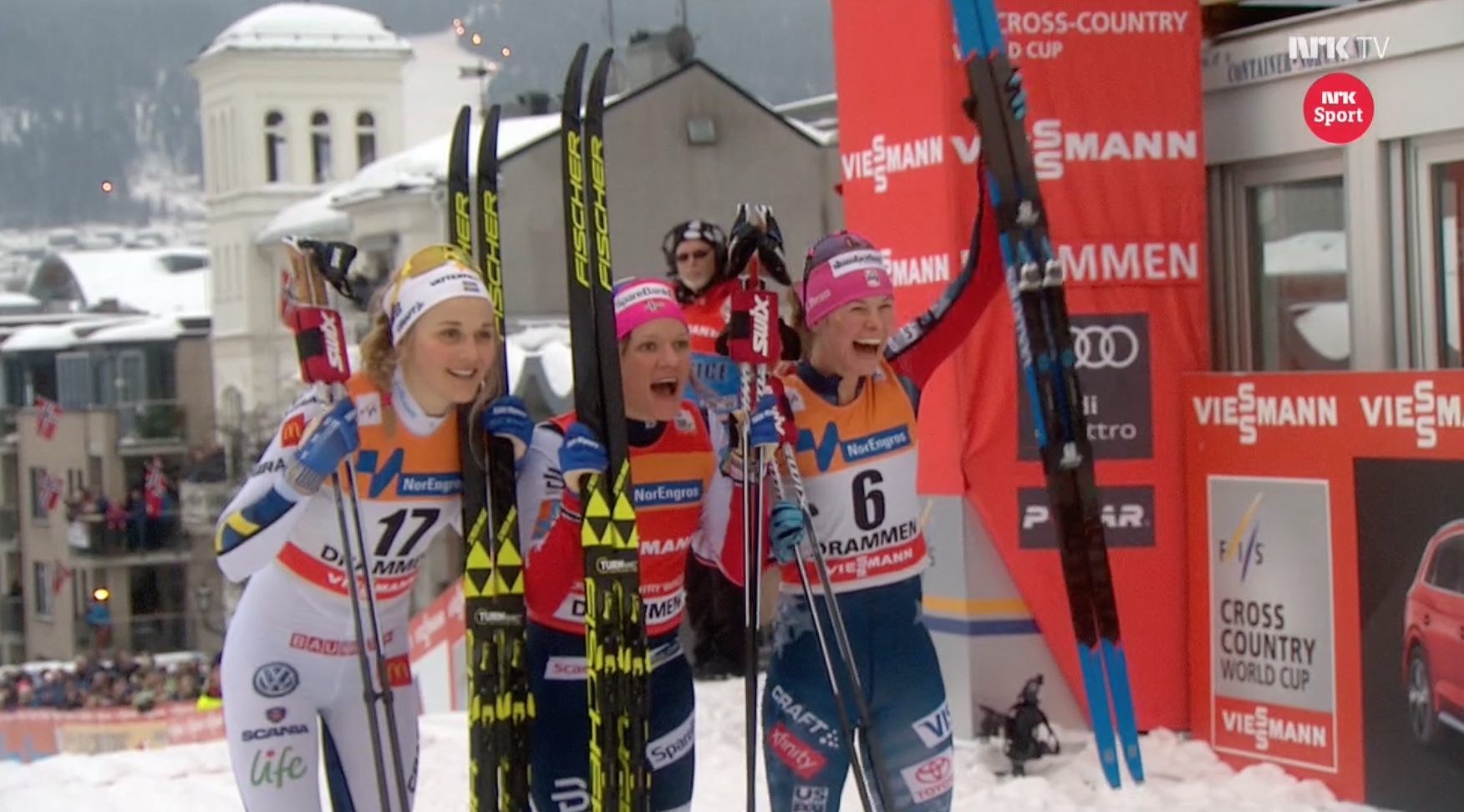
Maiken Caspersen Falla of Norway (center) won the classic sprint in Drammen and all but wrapped up the Sprint Cup. Stina Nilsson of Sweden (left) was second and Jessie Diggins of the United States third. (NRK screencap)
FIS Cross Country World Cup (Drammen, Norway): Classic sprints
The cross-country World Cup hit the city on Wednesday, with classic sprints contested in the Oslo suburb of Drammen on snow which had been trucked onto the streets. And the crowd was rewarded with wins by two Norwegian favorites: Maiken Caspersen Falla in the women’s sprint and Johannes Høsflot Klæbo in the men’s race.
In the women’s final, Falla and Natalia Nepryaeva of Russia battled at the lead for much of the race, but Falla pulled away from the field on the last climb to the finish. Stina Nilsson of Sweden and Jessie Diggins of the United States pulled past Nepryaeva in the final few hundred meters to claim spots on the podium; Krista Parmakoski of Finland was fifth and Katja Visnar of Slovenia sixth.
With the win, Falla all but wrapped up the World Cup’s Sprint Cup crystal globe: she is just two points from having it clinched, with one sprint remaining on the calendar. In Falun, Sweden, in ten days, she more or less just has to make the heats to earn her third Sprint Cup in a row.
Also racing for the United States, Sadie Bjornsen and Sophie Caldwell made the quarterfinals, but did not advance past that round. Bjornsen ended the day in 21st and Caldwell in 27th.
Ida Sargent and Rosie Brennan were 47th and 48th in qualifying, followed by Kikkan Randall in 50th and Kaitlynn Miller in 53rd.
For Canada, Emily Nishikawa finished 52nd and Dahria Beatty 55th.
Great Britain’s Nichole Bathe, who raced for the University of Alaska Fairbanks, finished 58th.
In the men’s final, Russia’s Alexander Bolshunov set the pace for most of the heat. Klæbowas on his ski tails, and drew even on the course’s on downhill, where Norwegian teammate Eirik Brandsdal also caught up to them. Skiing back up to the finish, Klæbo ramped up to a furious tempo and was uncatchable. Brandsdal passed Bolshunov to claim second by a healthy margin. Sindre Bjørnestad Skar finished fourth, Kasper Stadaas fifth, and Emil Iversen sixth, all for Norway.
The lone North American to make the heats, Erik Bjornsen, qualified in 26th and finished the day in 18th. Teammate Andy Newell just missed the quarterfinals after finishing 33rd in qualification. Logan Hanneman and Kevin Bolger finished 49th and 50th, and Reese Hanneman 56th.
For Canada, Julien Locke placed 51st in qualifying, Alex Harvey 54th, and Andy Shields 58th.
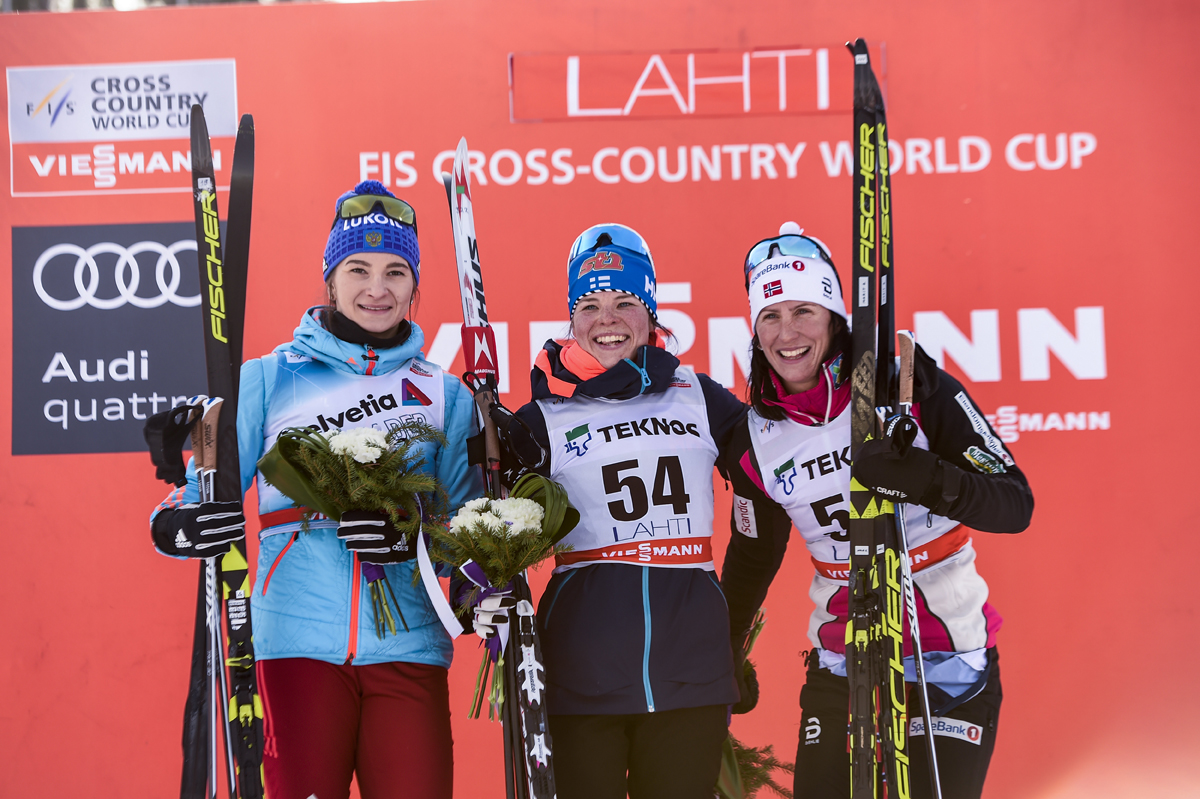
The women’s 10 k classic podium at Sunday’s World Cup in Lahti, Finland, with Finland’s Krista Pärmäkoski (c) in first, Russia’s Natalia Nepryaeva (l) in second and Norway’s Marit Bjørgen (r) in third. (Photo: Fischer/NordicFocus)
(Note: This article has been updated to include comments from American Caitlin Patterson.)
The 2018 Olympics were pretty successful for Finland, in terms of cross-country skiing: Iivo Niskanen won gold in the 50 k and Krista Pärmäkoski earned silver in the 30 k and bronze in the skiathlon and the 10 k skate.
After the Games finished, the FIS Cross Country World Cup moved to Finland, but on the first day of competition – skate sprints – the host nation was stymied.
Among the frustrated was Pärmäkoski, who was tangled up when Germany’s Victoria Carl fell in a quarterfinal heat. Carl was relegated to last for her skiing, but that didn’t lessen the sting of not advancing for Pärmäkoski, who had qualified with the third-best time in the women’s field.
Sunday brought a 10 k classic, a favorite discipline for her, however.
“Yesterday was kind of annoyed, so I wanted to show [what I could do] today,” Pärmäkoski told Finland’s YLE broadcaster, according to a translation.
She set out with a vengeance, eventually notching her second career World Cup victory with a 20.9-second win over Natalia Nepryaeva of Russia.
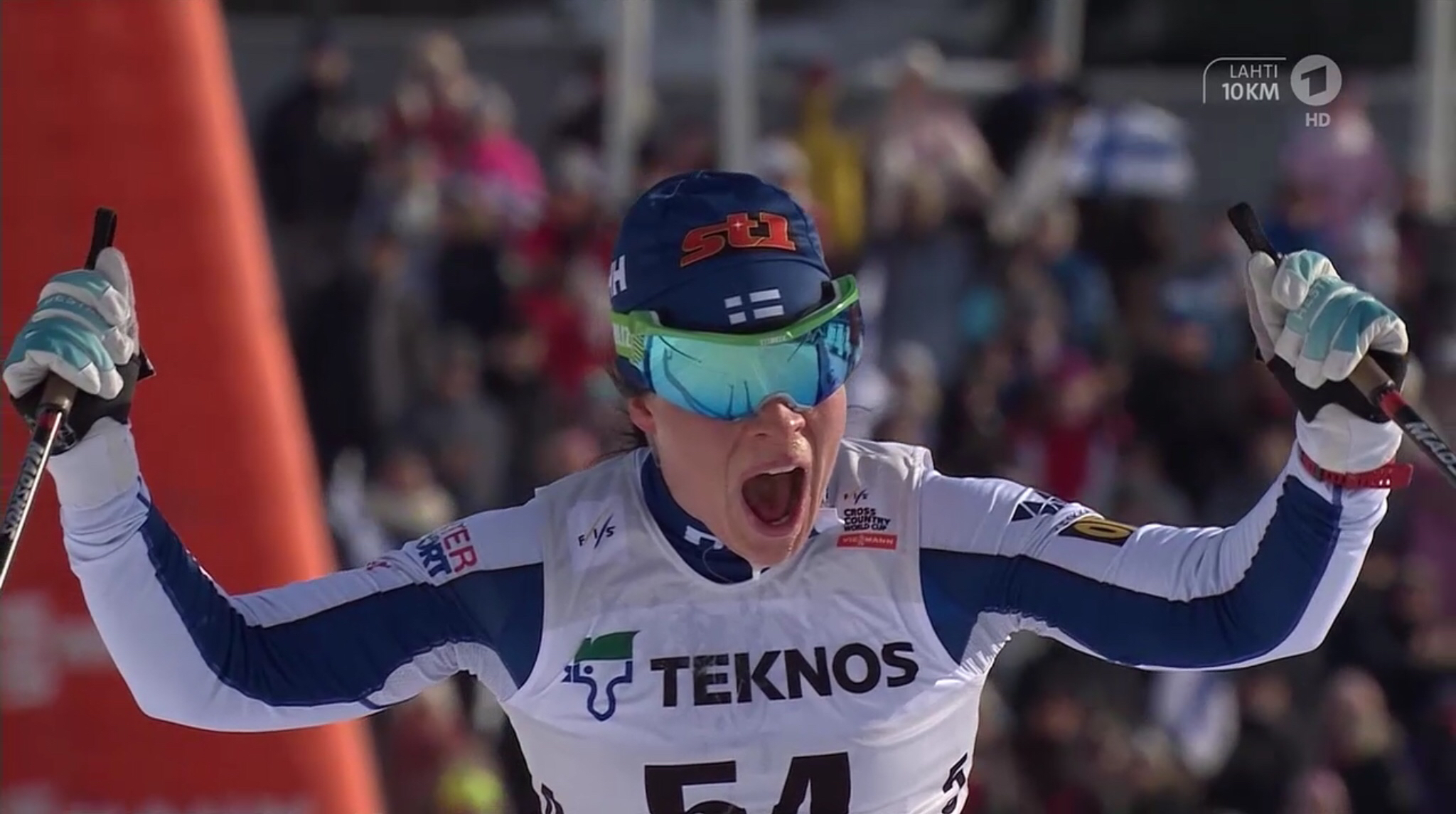
Finland’s Krista Pärmäkoski celebrates the second World Cup victory of her career, on home turf in Finland in the Lahti 10 k classic. (ARD screencap)
“When in good shape, feeling bad feels good,” Pärmäkoski said.
Third place went to Norway’s Marit Bjørgen, who skied an even race to finish +29.2. She was tenth after a kilometer and a half, seventh at 3.7 k, and fifth at 5 k, but managed to ski up and bump Finland’s Kerttu Niskanen off the podium by just 0.3 seconds, for her first 10 k classic podium since 2012.
“I think it was the finish that secured [the podium],” she told Norway’s VG news site, according to a translation. “I think it went smoothly, very strong on the uphills, and I’m happy with it. I’ll take this finish with me.”
“Marit is the best athlete of all time, so it feels good that the time has come for me to be able to beat her,” Pärmäkoski told YLE.
Fifth went to Norway’s Heidi Weng, who opened hard but lost ground on the second lap of the 5 k course and finished 43.3 seconds behind Pärmäkoski. Teresa Stadlober of Austria was sixth (+52.4), Sadie Bjornsen of the U.S. seventh (+57.6), and Ingvild Flugstad Østberg of Norway eighth (+59.0). Aino Kaisa Saarinen (+59.1) and Johanna Matintalo (+1:13.4) rounded out the top ten, giving Finland four finishers in the top ten.
It was Saarinen’s last time competing on home ground, as the 39-year-old former World Champion is ending her World Cup career after this season. She cried as she was handed a bouquet of flowers at the finish line.
“It was certainly the best race of the season,” she told YLE.
Bjornsen Seventh in Post-Olympics Rebound
Sadie Bjornsen (U.S. Ski Team) finishing seventh in the women’s 10 k classic at the World Cup in Lahti, Finland. (Photo: Fischer/NordicFocus)
Like Pärmäkoski, Bjornsen had left Saturday’s sprint feeling frustrated. She had qualified in fifth position but then couldn’t make the right move in the quarterfinals and failed to advance to the semifinals.
“Yesterday was really awesome because I could see that I finally had some good feelings in my legs and I got really excited to keep racing,” Bjornsen said in an interview after the 10 k. “So, today, I don’t know, I was just approaching it like I wonder what can happen, like, let’s just send it hard and see what happens.”
With cold temperatures making for firm tracks, Bjornsen attacked the course’s long climbs – the biggest of which has a 44-meter height differential.
“I definitely really love the Lahti courses here,” she said. “I think that there’s like a lot of really awesome climbing. It’s not like they’re necessarily running hills; there’s actually some glide involved with them, and so I think it’s just really cool classic skiing… Right away I could see that I had some good skis under my feet and I just had nothing in the way, so I just went. I tried to go really hard from the start.”
The effect was immediately noticeable.
“I always try to go out hard and sometimes it’s hard, and sometimes it’s not,” Bjornsen laughed. “There’s no change in what my perceived effort. I think when I have good races is when that going hard actually is going hard. It was funny, because Matt [Whitcomb, the U.S. Ski Team women’s coach] was cheering at 3 k, and he just yelled ‘you finally went out hard!’ and I actually smiled in the race and was like, ‘ok, this is awesome.’ Like, ‘this is fun,’ you know?”
Unlike Weng and Niskanen, who faltered at the end, Bjornsen skied a fairly consistent race. She was sixth at 3.5 k, eighth at 6.1 k, and seventh at the finish, 57.6 seconds behind Pärmäkoski’s time and 30.9 seconds off the podium.
“I maybe struggled a little bit right there in the middle where I needed to continue being strong,” Bjornsen said. “I think that’s where those top girls are really making some time. When I have had my best distance races, it’s when I really nail between 5 and 7.5 k and that is kind of a point that I’ve been working on this year. And, I think that I maybe stuttered a little bit during that time. So I guess, looking back, I feel like that’s where I have to make an improvement for the future–to be in that podium place.”
Caitlin Patterson (Craftsbury Green Racing Project) racing to 32nd in the women’s 10 k classic at the World Cup in Lahti, Finland. (Photo: Fischer/NordicFocus)
For the U.S., Caitlin Pattersonwas next, just missing the World Cup points in 32nd (+2:02.7).
“The end of the race was good, but the beginning was a little rough,” Patterson wrote in an email. “The course starts out going up one of the sunniest hills, and by the time I started the snow had transitioned on that hill away from the wax that we were using. I had a terrible time getting up the first long rolling climb, but luckily I was able to pull myself together and re-focus for the rest of the race, and the skis worked much better for the rest of the course. So I’m happy with my effort, that I kept pushing and didn’t let up after a bumpy start. I would have been happier with a more consistently strong race, since I did lose quite a bit of time at the beginning that I wasn’t able to make up for later.”
Patterson raced the first and last events of the Olympics, placing 34th in the 15 k skiathlon and 26th in the 30 k classic mass start.
“My two races in Korea were separated by 15 days, but I certainly kept busy with training,” she explained. “I did a time trial, at least 3 interval sessions, some strength workouts, and distance workouts. It’s best for me to stay active and keep the speed up, since I knew that would be the best way to hopefully feel good for the 30k as well as to stay strong for the rest of the season. Beyond training in Korea, I felt really busy with all the time spent taking buses to and from places, but I did get out to watch a Big Air competition one day, and visited the Coastal village area a different day, so a bit of sight-seeing.
“I’m feeling ready to race and still excited for each start even at this point in the season,” Patterson continued. “If there was another race tomorrow, I’d absolutely want to do it. I feel like it’s been a while since I’ve had a consistent string of races, so I need more back to back to clear the cobwebs out again, and to reaffirm that I still have good racing fitness which I know is true.”
Ida Sargentand Sophie Caldwellfinished 40th (+2:21.9) and 42nd (+2:24.2), respectively. Rosie Brennanfinished 48th (+3:02.1) and SuperTour leader Kaitlynn Millerplaced 51st (+3:09.1).
Liz Stephenof the U.S. Ski Team did not start due to illness.
Canada started two women: Emily Nishikawafinished 41st (+2:22.2) and Dahria Beatty44th (+2:40.7).
Krista Pärmäkoski of Finland (center) won her second straight 10 k classic, to the delight of the crowd in Lahti. Natalia Nepryaeva of Russia (left) finished second and Marit Bjørgen of Norway third. (Photo: FIS Cross Country/Twitter)
FIS Cross Country World Cup (Lahti, Finland): 10/15 k classic
Racing at home in Finland, Krista Pärmäkoski picked a good time to collect the second World Cup victory of her career, and again in a 10 k classic. Pärmäkoski’s first win came in the 10 k classic in Planica, Slovenia, earlier this season.
In second was Russia’s Natalia Nepryaeva, who picked up her first World Cup podium. The current U23 standings leader, Nepryaeva’s time was 20.9 seconds slower than Parmakoski. Both she and Marit Bjørgen of Norway, who finished third (+26.7), used a steady pace to reach the podium. At the 5 k split, Heidi Weng of Norway – wearing the yellow bib of the overall World Cup leader – was in second at the halfway point but faded to finish fifth (+43.3), and Kerttu Niskanen of Finland was in third place but she dropped to fourth by the finish, +27.0. Austria’s Teresa Stadlober finished sixth (+52.4).
Sadie Bjornsen placed seventh (+57.6) to lead the American team. Caitlin Patterson was next, just missing the World Cup points in 32nd (+2:02.7). Ida Sargent and Sophie Caldwell finished 40th (+2:21.9) and 42nd (+2:24.2), respectively. Rosie Brennan finished 48th (+3:02.1) and SuperTour leader Kaitlynn Miller placed 51st (+3:09.1).
Liz Stephen of the U.S. Ski Team did not start due to illness.
Canada started only two women: Emily Nishikawa finished 41st (+2:22.2) and Dahria Beatty 44th (+2:40.7).
The men’s 15 k classic podium at the World Cup in Lahti, Finland, with Kazakhstan’s Alexey Poltoranin (c) in first, Russia’s Alexander Bolshunov (l) in second and Finland’s Iivo Niskanen (r) in third. (Photo: FIS Cross Country/Twitter)
In the men’s race that followed, Alexey Poltoranin of Kazakhstan got some redemption after a major bonk in the Olympics 50 k last weekend, winning the 15 k classic individual start in Lahti.
Starting in the middle of the field in bib 44 (out of 71), Poltoranin paced it perfectly, skiing a steady race with some of the top split times and then turning it up another notch over the last several kilometers to take the win in 33:11.9 minutes. His biggest threat was Russia’s Alexander Bolshunov, who started 64th and clocked faster splits at every timing point throughout the three-lap race except the one that mattered most — the finish. There, Bolshunov came up 9.1 seconds short of Poltoranin’s time to place second, and Finland’s Iivo Niskanen — the Olympic 50 k champ — placed third, 20.9 seconds out of first.
Norway took fourth through seventh, with Emil Iversen in fourth (+28.8), Martin Johnsrud Sundby in fifth (+39.9), Niklas Dyrhaug in sixth (+50.1), and Johannes Høsflot Klæbo in seventh (+1:00.3). Russia’s Alexey Chervotkin placed eighth (+1:08.3), Germany’s Thomas Bing was ninth (+1:08.5) and Sweden’s Daniel Rickardsson finished 10th (+1:09.2).
Canada’s Devon Kershaw led the North Americans in 25th (+1:43.2), and Erik Bjornsen was the top American in 32nd (+2:06.6).
Four Canadian men raced, with Graeme Killick placing 39th (+2:22.9), Julien Locke 69th (+4:56.6) and Andy Shields 70th (+5:42.1).
The U.S. was represented by six men, with Noah Hoffman placing 40th (+2:24.0), Paddy Caldwell 45th (+2:40.5), Scott Patterson 50th (+2:58.7), Kevin Bolger 54th (+3:09.5), and David Norris 57th (+3:23.5).
The World Cup picks back up again this Wednesday with classic sprints in downtown Drammen, Norway.
The women’s 1.4 k freestyle sprint podium at Saturday’s World Cup in Lahti, Finland, with Norway’s Maiken Caspersen Falla (c) in first, and Sweden’s Stina Nilsson (l) and Hanna Falk (r) in second and third, respectively. (Photo: Fischer/NordicFocus)
Eight points. That’s the number that separated Norway’s Maiken Caspersen Falla and Sweden’s Stina Nilsson in the Sprint World Cup standings before Saturday’s freestyle sprint in Lahti, Finland.
Three sprints. That’s the number of World Cup sprint races that remained in the 2017/2018 calendar, one of which took place on Saturday.
With one down and a classic sprint and skate sprint to go, Falla’s lead has grown to 28 points. It’s not much, with 150 sprint points remaining in the two remaining races (100 for winning the Drammen classic sprint and 50 for winning the skate sprint at World Cup Finals in Falun), but she’s getting there. Let’s just say neither of these two women can afford to skip a sprint.
Coming off her last race of the Olympics, the team sprint (where Norway took bronze behind the U.S. and Sweden), Falla had 10 days to recover before Lahti. Nilsson had six days after notably racing to third in the 30-kilometer classic mass start on the last day of the 2018 Winter Games in PyeongChang, South Korea.
Six time zones away from Korea in Finland, Falla and Nilsson faced off once again, but instead of racing for gold (which Nilsson had claimed in the Olympic classic sprint), they’re in a race for the Sprint Crystal Globe (of which Falla is the two-time defending champion).
Norway’s Maiken Caspersen Falla celebrates her gold medal in the 2017 World Championships freestyle sprint in Lahti, Finland, ahead of Americans Jessie Diggins (19) and Kikkan Randall (r), who placed second and third, respectively. The third U.S. woman in the final, Sophie Caldwell (second from r) finished sixth. (Photo: Fischer/NordicFocus)
As alluded to, Falla had the edge on Saturday, winning the women’s 1.4 k skate sprint by 0.36 seconds over Nilsson in 2:54.83 minutes. She did it by leading from start to finish — a tactic she hadn’t necessarily planned nor desired —on the same course that she won on at World Championships last year. In that skate sprint, Falla bested Americans Jessie Diggins and Kikkan Randall for gold. Diggins and Randall placed second and third in that race, respectively, but the two did not contest Saturday’s sprint in Lahti. Instead, they were coming off a New York City media tour that involved several appearances with major TV networks.
But back to Falla. The 27-year-old left her competition chasing on Saturday, advancing to the final after placing second in her quarterfinal (0.71 seconds behind Nilsson) and first in the first semifinal (just 0.04 seconds ahead of Nilsson in second place).
She had qualified for the heats in 12th, 7.96 seconds off of the top time of 2:54.72 set by Sweden’s Hanna Falk.
“I was really stressed in the prologue,” Falla said afterward, according to an International Ski Federation (FIS) press release. “In the heats I had a better feeling.”
She had to fend off three Swedish heavy hitters in the final: Nilsson, Falk and Ida Ingemarsdotter.
But Falla never let any of them get ahead of her — an impressive feat on Lahti’s sprint course with two major climbs. The lone Norwegian in the final, Falla jetted out of the gate and into the lead, with Falk quick to challenge her before the first uphill. But Falla stayed ahead.
“I didn’t want the first position, but I just got it in the start,” Falla told FIS in a televised post-race interview. “So I just had to lie in front and do the best I could.”
While Falla continued to drive the pace, Sweden’s Falk took a breather near the back while Ingemarsdotter and Nilsson slotted into second and third. Germany’s Sandra Ringwald, in her first World Cup sprint final since the Tour de Ski in late December, skied in fourth, ahead of Falk and Switzerland’s Laurien van der Graaff.
Norway’s Maiken Caspersen Falla celebrates her win in the women’s 1.4 k freestyle sprint on Saturday at the World Cup in Lahti, Finland. (Photo: Fischer/NordicFocus)
Falla led the downhill then into last long, multi-tiered climb, while the three Swedes assembled hungrily behind her. Nilsson began her attack when they hit the steepest section near the top, but Falla was at least a step or two ahead as they rounded the 180-degree turn and began to descend down the other side.
Tucking into the stadium, Falla got low and used her fast skis to gain a few more meters on Nilsson. She then took a couple of strides to keep her momentum and finally launched her final V2 push toward the finish.
No one could match her; not Nilsson skiing closest to her, nor Falk or Ringwald just behind. She didn’t even have to lunge to secure the victory over Nilsson, but Falk and Ringwald did as they placed third (+0.78) and fourth (+0.88), respectively. For Ringwald, fourth place marked her best individual World Cup result in a little over a year (after she placed fourth in a 2017 skate sprint in Toblach, Italy).
For Falla, it was her second individual World Cup win of the season and first victory since Dec. 2 in Lillehammer, Norway, where she won the classic sprint. Falla was the 2014 Olympic champion in the individual skate sprint. And let’s not forget, she won the World Championships sprint in Lahti last year as well as the 2016 Lahti World Cup skate sprint.
“Last year here and also two years ago I was in front down the last downhill, and I succeeded there for the last three years so I knew it is very possible to lie in front as well,” Falla told FIS. “In the final I had Stina and Hanna behind me and I knew both of them are really fast. I have a big respect for them and I am very happy I could win today.”
Nilsson, who bested Falla for the classic-sprint gold medal in PyeongChang, had qualified for Saturday’s heats in 14th, 8.26 seconds out of first.
“I felt pretty good in the prologue, but in the end I was missing some seconds, which I probably lost after the start,” she told FIS. “In the heats I found my pace and I could keep all the way through to the final. In the final, I was not so fast after the start but I am happy to be on the podium again. It is very good for the sport that the battle for the Sprint Crystal Globe is still going.”
Falk also said she was satisfied with her end result, after winning her quarterfinal and advancing as a lucky loser in third in the semifinal with Falla and Nilsson.
“I had a very good qualification,” Falk told FIS. “I tried to fight in every heat. The final was hard but I am happy to be third today. I had a good speed before the last corner but it was always tight there. It was a tough fight between me and Sandra [Ringwald]. I’m happy to be third.”
Sadie Bjornsen (U.S. Ski Team) qualified fifth in the women’s 1.4 k skate sprint at the World Cup in Lahti, Finland, and went on to finish 17th overall. (Photo: Fischer/NordicFocus)
Four Americans in Top 30
Leading the Americans in the qualifying round was Sadie Bjornsen in fifth, 3.88 seconds off Falk’s fastest time. Sophie Caldwell qualified in 17th, Ida Sargent advanced in 21st and Rosie Brennan followed in 29th.
For Brennan, it was her first time back in the heats in about two months after she qualified in 21st in the Tour de Ski classic sprint on Oberstdorf, Germany. While the heats were canceled that day due to a storm, Brennan went on to finish the Tour in 24th overall. Since then, however, the U.S. Ski Team (USST) member has finished outside the top 40 in four World Cup races and one Olympic event (the 15 k skiathlon).
Despite finishing sixth in her quarterfinal on Saturday, 4.91 seconds behind Ingemarsdotter in first, Brennan’s overall result of 29th indicated she was back on track.
“I have been struggling with health and recovery since the tour,” Brennan wrote in an email to FasterSkier. “I’ve just been taking things day by day and trying to work through whatever issue I am facing. The Olympics was a huge disappointment for me. I did what I thought was best to prepare for the games, but have struggled with my health and my body and as a result was far from where I wanted to be at that time.”
In PyeongChang, she raced one event — the skiathlon — and placed 58th. She stayed with the team for the duration of the Games, hoping to have the opportunity to race the 30 k. But that wasn’t in the cards.
“It’s very challenging to be at the games and not be participating in the events that you have trained for over so many years,” Brennan reflected. “I have had some good races this year and have made some improvements so I am doing my best to remember that and try to see each day as a new opportunity. My goals moving forward are more about my feelings, my body, and my health than any results. I am very happy to have made a step forward today and am hoping my distance skiing will see the same results. I wasn’t able to ski my quarterfinal as well as I would have liked, but it’s been awhile since I’ve raced now so to just get another stab at it was a great step forward.”
Sophie Caldwell (U.S. Ski Team) racing to 17th in the Lahti skate sprint qualifier. She went on to reach the semifinals and place eighth overall. (Photo: Fischer/NordicFocus)
Out of the four Americans in the quarterfinals, Caldwell was the lone U.S. woman in the semifinals. She had raced to second in her quarterfinal, finishing 0.25 seconds behind Ringwald, who won that heat. But her road there wasn’t an easy one, as Caldwell skied up from near the back of the pack into second coming out of the final downhill. There, she scooted ahead of Norway’s Heidi Weng, who had been second at the time, while Weng dropped to last in the heat.
“… I had the ambition to do well, and it’s incredibly annoying when something like that happens,” Weng said, according to a loose translation.
She added that she didn’t discuss it with Caldwell after.
“I can’t do anything about it now,” Weng said. “Things like that happen in a sprint…”
Caldwell reflected that it might’ve been worth conserving less energy and using more to get in a better position before that last downhill.
“I found myself in the back there with no room to pass or respond to a move,” Caldwell wrote in an email to FasterSkier. “… There is a big draft on the final downhill and if you’re leading, you need to send it and have a good bullet tuck, and if you’re within contact of the leader, you can try to work the draft and in my quarter I was able to do that. I don’t remember there being contact with Heidi, but we both definitely bobbled a bit on the final corner.”
Caldwell’s first World Cup podium came in Lahti four years ago. Last year at World Championships, she reached the skate-sprint final and placed sixth overall.
On Saturday, she made it to the semifinals and finished fourth in the second semi, 1.46 seconds behind Ringwald in first.
“I have had some success in Lahti before and I’ve also had some disappointing results, and I think today was somewhere in between,” Caldwell wrote. “I enjoy how tactical this course can be with all the corners and transitions. I was feeling quite good today, but I struggled to find that extra punch and didn’t ski with the confidence or control I know I’m capable of, so even though the result is by no means a bad one, I was just disappointed in how I skied mentally in the semi final.”
She was pleased with her recovery after the Olympics, where she placed eighth in the classic sprint and fifth with the women’s 4 x 5 k relay.
“The Olympics can be physically and emotionally exhausting, so I made sure I took some time to take it easy and get my feet under me again,” Caldwell wrote. “I was really looking forward to getting back in the World Cup routine in Europe. We had a very long travel day, so we were feeling a little rugged the first day here, but some good sleep, food, and training had me feeling quite good a couple days later. I did some light intervals on Thursday that felt quite good and was psyched for today.”
Bjornsen described having some trouble transitioning from the Olympics back to the World Cup. She raced four events in PyeongChang, with a top individual result of 14th in the classic sprint.
“It was an interesting step back to the World Cup today,” Bjornsen wrote in an email to several media outlets. “It has been a real ‘homesick’ week here coming back from the Olympics, and sometimes hard to feel how your actual muscles are feeling instead of your head. Fortunately, my muscles felt surprisingly good in the qualifier and I felt really excited to see what I could do today!”
In her quarterfinal, she recalled getting “tangled” and losing her positioning on the first turn, leaving her chasing the rest of the group.
“I finally caught them on the very top of the course, but just narrowly missed getting into their draft down the hill, and missed moving with those top three,” Bjornsen wrote. “Sprinting has been everywhere from amazing to frustrating this year, and what I have learned is that you can never think too hard about it. Often for me, the difference between a fantastic day, and a frustrating day is some super move that I either find, or I miss.”
She ended up fourth in her quarterfinal, 2.84 seconds behind Falk in first, which put Bjornsen 17th overall.
“I am just looking forward to heading into tomorrow with a head that is back excited again, and some muscles feeling good!” Bjornsen wrote of Sunday’s 10 k classic. “I put a lot of focus into my form at the Olympics without much thought about afterwards. Fortunately, the majority of the World Cup field is in the same state, so now we are all just racing with what sort of energy and excitement we have left. I always kind of like that. It is raw and fun.”
Sargent finished the day in 27th overall after placing sixth in her quarterfinal, 1.07 seconds behind Sweden’s Anna Dyvik in first. After skiing in fourth in the middle of the race, Sargent moved up to second on the final downhill toward the finish. But on the tight lefthand corner before the finishing straight, she lost her position and momentum and slipped to sixth.
“Today wasn’t great but it was a huge step forward for me,” Sargent wrote to FasterSkier. “I haven’t raced much recently and was struggling with injury so I’m just super happy to be racing again and very excited to have a bunch more racing in the next few weeks.”
“I’m excited to feel like my fitness is still there after so much travel and not much racing,” Sargent wrote.
Canada’s Dahria Beatty just missed making the rounds in 34th place on Saturday in the Lahti World Cup skate sprint. (Photo: Fischer/NordicFocus)
Beatty 34th for Canada; Phinney 36th in First World Cup
Canada’s Dahria Beatty missed qualifying for the heats in 34th, 0.9 seconds out of 30th place. While she was the lone Canadian woman competing on Saturday, three other American women started, with Kelsey Phinney of the Sun Valley Ski Education Foundation (SVSEF) racing to 36th, 1.25 seconds out of qualifying, in her World Cup debut.
“I was pretty happy with my effort, definitely a little bummed to miss out on the heats, but cool to know that I’m pretty close to that level!” Phinney wrote in an email to FasterSkier. “I’m psyched to be here and getting a World Cup start was one of my main goals of the season. Being a second out of qualifying will for sure help stoke the fire for next year and I learnt a lot today from things that went right and things that didn’t.
“This was my first World Cup start and everyone has been so welcoming,” she continued. “I’ve been having a lot of fun and just trying to take it all in. … It’s hard to put the feeling of being at the start line of a World Cup into words, it’s something I’m hoping to get to experience a lot more of!”
(Her Sun Valley teammate Kevin Bolger, also in his first World Cup, placed 11th overall after reaching the semifinals in the men’s 1.6 k sprint. “I am so proud of Kevin, it was so special to get to watch him holding his own with the best in the world in the heats today! Really cool to see your teammate crush it in his first World Cup.”)
Phinney explained that Saturday was a one-time opportunity since she’ll be joining the OPA Cup trip on Monday before flying back to the U.S. for SuperTour Finals in Craftsbury, Vermont, later this month. She’s spent the better part of the last month racing in Norway, placing sixth in a FIS skate sprint in Åsen and 13th in a Scando Cup skate sprint last weekend in Trondheim.
“She had a really impressive Scando Cup Sprint last weekend, and has shown she can skate sprint with the best of them,” SVSEF Head Coach Chris Mallory wrote in an email to FasterSkier. “I thought she might squeak into the top 30 with a good day. She skied the first half of the sprint today very fast, so the pacing was just a touch off. But still, very solid effort for her first WC. She’s shown the speed is there, so she’ll be back.”
Kaitlynn Miller (Craftsbury Green Racing Project) on her way to 61st in the World Cup skate sprint qualifier in Lahti, Finland. (Photo: Fischer/NordicFocus)
Also for the U.S., two Craftsbury Green Racing Project (CGRP) skiers, Caitlin Patterson and Kaitlynn Miller, placed 56th (+20.12) and 61st (+21.70), respectively.
***
Notes: In the first women’s quarterfinal, Germany’s Victoria Carl skied up on the ski tails of Finland’s Krista Pärmäkoski, which caused both women to crash out of contention on the final downhill. Pärmäkoski had been skiing in second at the time, behind Nilsson in first. She finished fifth in that heat (+12.11) and Carl, who appeared to hit her head, took a long time to stand back up and crossed the line in sixth (+49.5). Carl was relegated to last (30th place) for obstruction.
German coach Janko Neuber told reporters after that, “She crashed, fell on the head and bruised the back of her neck. As a precaution she is being taken to the hospital for evaluations, but we are optimistic that it isn’t anything serious.”
Pärmäkoski, who finished the day in 21st overall, wrote in Instagram: “This was a bit tough but today, with the fall, shorts [sprints] were short. Fortunately tomorrow is another chance.”
The men’s 1.6 k freestyle sprint podium at Saturday’s World Cup in Lahti, Finland, with Italy’s Federico Pellegrino (c) in first, Russia’s Gleb Retivykh (l) in second and Norway’s Johannes Høsflot Klæbo (r) in third. (Photo: FIS Cross Country/Twitter)
FIS Cross Country World Cup (Lahti, Finland): Men’s & women’s freestyle sprints
The defending world championships from the 2017 freestyle sprint prevailed again in Lahti on Saturday, with Norway’s Maiken Caspersen Falla winning the women’s 1.4-kilometer freestyle sprint final and Italy’s Federico Pellegrino coming out on top in the men’s 1.6 k final at last year’s World Championships venue.
Falla’s rise to the final started with her qualifying in 12th, 7.96 seconds off the fastest qualifying time set by Sweden’s Hanna Falk in 2:54.72. Russia’s Natalia Nepryaeva qualified second (+0.63) and Finland’s Krista Pärmäkoski third (+3.62), just ahead of Germany’s Victoria Carl in fourth (+3.88) and American Sadie Bjornsen in fourth (+3.88). Four American women qualified for the heats, with Sophie Caldwell in 17th, Ida Sargent in 21st and Rosie Brennan in 29th.
The women’s 1.4 k freestyle sprint podium at Saturday’s World Cup in Lahti, Finland, with Norway’s Maiken Caspersen Falla (c) in first, and Sweden’s Stina Nilsson (l) and Hanna Falk (r) in second and third, respectively. (Photo: FIS Cross Country/Twitter)
Falla went on to place second in the first quarterfinal, 0.71 seconds behind Sweden’s Stina Nilsson in first. According to the race jury’s ruling, Carl obstructed Pärmäkoski coming out of the last downhill before they entered the finishing straight and both crashed out of contention, with Pärmäkoski finishing fifth in the heat (+12.11) and Carl sixth (+49.5). Carl was relegated to last (30th place) for the obstruction.
Falla then won the first semifinal by just 0.04 seconds over Nilsson in second. The two other Swedes in that heat, Falk and Ida Ingemarsdotter, advanced to the final as well as lucky losers with fast-enough times.
In the final, Falla found herself at the front of the pack early then held her position to the finish, crossing the line in 2:54.83 and beating Nilsson by 0.36 seconds. Sweden had two on the podium with Falk in third (+0.78), Germany’s Sandra Ringwald placed fourth (+0.88), Ingemarsdotter was fifth (+1.83), and Switzerland’s Laurien van der Graaff placed sixth (+3.02).
Caldwell was the lone American woman to make it past the quarterfinals, as she placed second in her quarterfinal, 0.25 seconds behind Ringwald in first, then fourth in the second semifinal, 1.46 seconds behind Ringwald, who also won that heat. Overall, Caldwell finished the day in eighth.
Bjornsen placed 17th overall after finishing fourth in her quarterfinal, 2.84 seconds behind Falk in first. Sargent had been second in her quarterfinal until the final tight lefthand corner into the finishing straight, where she slipped to sixth and ultimately finished sixth, 1.07 seconds behind Sweden’s Anna Dyvik in first. Overall, Sargent finished the day in 27th, and Brennan placed 29th overall after finishing sixth in her quarterfinal, 4.91 seconds behind Ingemarsdotter in first.
Two American men advanced to the heats as well, with Kevin Bolger of the Sun Valley Ski Education Foundation (SVSEF) qualifying in 16th in his World Cup debut, 6.38 seconds behind Norway’s Johannes Høsflot Klæbo, who topped the qualifier in 2:59.06. Erik Bjornsen of the U.S. Ski Team qualified 29th, 8.29 seconds back.
Meanwhile, Pellegrino qualified for the heats in third (+1.9) behind France’s Baptiste Gros in second (+1.23).
There, Pellegrino won the first quarterfinal by 0.19 seconds over Klæbo, with the Norwegian visibly backing off before the finish — comfortable enough to automatically advance to the semifinals in second place. But Klæbo showed Pellegrino what he’s made of in the first semifinal and beat the Italian by nine-hundredths of a second.
Bolger also raced in that first semifinal after placing fourth in his quarterfinal, 0.73 seconds behind Russia’s Gleb Retivykh in first. Bolger’s time was good enough for one of two lucky loser spots in the semifinals, where he went on to finish sixth, 1.86 seconds after Klæbo. Overall Bolger finished the day in 11th.
Erik Bjornsen placed 20th on the day after finishing fourth in the first quarterfinal (with Pellegrino and Klæbo), 1.56 seconds out of first.
In the final, Klæbo set the tone, slowing the pace to almost a stop at one point, while he and Pellegrino stood side by side at the top of the course. On the way down, they accelerated, but Norway’s Sindre Bjørnestad Skar was the one who truly attacked. It might’ve been a bit too early, as Pellegrino caught him by the top of the final climb and took the lead on the following downhill into the stadium. Pellegrino held off his challengers, including Retivykh who came on strong out of the downhill, to take the win in 3:16.73, 0.77 seconds ahead of Retivykh in second and 0.9 seconds ahead of Klæbo in third. Skar settled for fourth (+1.3), Finland’s Ristomatti Hakola placed fifth (+1.44) and France’s Lucas Chanavat finished sixth (+7.55).
In the qualifier, Canada’s Dahria Beatty finished 34th, +13.39 and just 0.9 seconds from making the quarterfinals. She was the only Canadian woman competing.
American Kelsey Phinney (SVSEF) was also close to making the cut. In her first European World Cup, she placed 36th in the qualifier, +13.74. Caitlin Patterson and Kaitlynn Miller, both of the Craftsbury Green Racing Project, placed 56th (+20.12) and 61st (+21.70).
Mathilde Petitjean of Togo, a primarily Quebec-based skier, finished in 59th (+20.80).
In the men’s qualifier, Logan Hanneman (APU) placed 49th (+11.45). Paddy Caldwell (U.S. Ski Team/SMS T2) finished 59th (+13.55), and APU’s Reese Hanneman and David Norris placed 61st (+14.33) and 67th (+19.27).
Julien Locke led Canada in 42nd place (+9.78), and Andy Shields finished 60th (+14.29).
American Chloe Levins racing to seventh in the junior women’s 7.5 k sprint on Saturday at IBU Junior World Championships in Otepää, Estonia. (Photo: Terri Dickson)
Poland’s Kamila Zuk won her second race in a row, taking gold in the junior women’s 7.5 k sprint after also winning the individual at World Junior Championships. Zuk had one penalty to two by second-place Marketa Davidova of the Czech Republic, who finished 26.0 seconds back. Bronze went to Myrtille Begue of France, who shot clean to finish 52 seconds back.
The sole U.S. starter, Chloe Levins followed up her sixth-place finish in the individual with seventh place in the sprint. Levins had a single penalty and finished +1:31.7.
For Canada, Megan Bankes was close behind Levins in ninth, with two penalties and +1:49.5. Teammate Nadia Moser was 21st, also with two penalties, +2:46.2. Emily Dickson finished 36th, +3:50.5 with two penalties, and Zoe Pekos just missed the pursuit cutoff in 66th (+6:22.4) with four missed shots.
In the junior men’s 10 k sprint, Vasilii Tomshin of Russia took the gold with perfect shooting. France’s Martin Perillat Bottonet was second, less than a penalty-loop’s worth of time back at 20.5 seconds – and he did have one penalty. Norway’s Sverre Dahlen Aspenes took bronze (+29.4) with two missed shots.
Trevor Kiers led Canada in 16th, a breakthrough result; his previous World Juniors best was 39th in the pursuit last season. Kiers missed two shots, both in prone, and finished 1:34.9 behind the time set by Tomshin.
Adam Runnalls placed 26th for Canada (+2:08.3) with three missed shots. Teo Sanchez also qualified for the pursuit by placing 53rd (+3:19.2) with one penalty, and Angus Tweedie was left on the outside looking in with 69th place (+4:41.3) with three missed shots.
Cody Johnson led the Americans in 37th, with clean shooting, 2:31.1 back from Tomshin’s time. Tim Cunningham was the next finisher in 71st (+5:13.5) with seven missed shots, followed by Jacob Pearson in 79th (+6:24.2) with two penalties and Cam Christiansen in 86th (+7:52.5) with three penalties.
The SuperTour men’s 20 k freestyle podium on Saturday, Feb. 17 in Ishpeming, Michigan, with David Norris (c) in first, Kevin Bolger (l) in second, and Brian Gregg (r) in third. (Photo: APU)
U.S. SuperTour (Ishpeming, Michigan): Friday, Saturday and Sunday
The SuperTour circuit ventured to the Al Quaal Recreation Area in Ishpeming, Michigan, this past Friday, Saturday and Sunday for three days of racing Feb. 16-19.
Day 1
In Friday’s 1.6-kilometer freestyle sprints, Kevin Bolger of the Sun Valley Ski Education Foundation (SVSEF) posted a 2.69-second victory in the men’s final over his teammate Jack Hegman in second and 3.02 seconds ahead of David Norris of Alaska Pacific University (APU) in third.
Bolger started the day by qualifying first in 3:43.04 minutes (2.41 seconds ahead of Hegman in second). Eighteen men entered the race, all of which advanced to four quarterfinals. Bolger went on to win his quarterfinal and semifinal before ultimately winning the final in 3:38.45.
Kris Freeman (Caldwell Sport) finished fourth in the final (+6.4), Forrest Mahlen (APU) took fifth (+10.07), and Eric Packer (APU) was sixth (+10.1).
In the women’s sprint, Northern Michigan University (NMU) sophomore Anikken Gjerde Alnæs edged Erika Flowers of the Stratton Mountain School (SMS) T2 Team by 0.1 seconds for the win in 4:09.87. Alnæs, of Norway, had previously won the qualifier in 4:22.88, 1.72 seconds ahead of Flowers in second.
With 10 women entering the qualifier, all 10 were seeded in two semifinals. Alnæs won the first semi in 4:20.24, and APU’s Chelsea Holmes won the second semi in 4:14.18.
In the final, Alnæs shared the podium with Flowers in second and Kaitlynn Miller of the Craftsbury Green Racing Project (CGRP) in third (+6.75). Holmes placed fourth (+7.49), Liz Guiney (CGRP) was fifth (+2.13), and Canada’s Sophie Carrier-Laforte finished sixth (+7.3).
Day 2
The SuperTour women’s 15 k freestyle podium on Feb. 17 in Ishpeming, Michigan, with Chelsea Holmes (c) in first, Caitlin Gregg (l) in second and Erika Flowers (r) in third. (Photo: APU)
On Saturday, APU reigned, with Holmes winning the women’s 15-kilometer freestyle and Norris topping the men’s 20 k skate.
In the women’s race, Holmes and Caitlin Gregg (CXC Team/Loppet Nordic Racing/Team Gregg) broke away from the field and duked it out for first, with Holmes taking it by 5.9 seconds in 42:37.1. Almost two minutes back, Flowers placed third (+1:58.4) to return to the podium. Kristen Bourne (NMU) placed fourth (+1:59.7), Miller was fifth (+2:01.2), Guiney sixth (+2:01.6), and NMU had two more in the top eight with Nicole Schneider in seventh (+2:02.5) and Alnæs in eighth (+2:07.5), respectively. Carrier-Laforte finished ninth (+2:25.3) and another Canadian Alannah MacLean (NTDC Thunder Bay) was 10th (+2:45.7) out of 43 women.
In the men’s race, the top-eight finishers were separated by less than 10 seconds, with Norris taking the win by 2.9 seconds over Bolger in 50:01.7. Brian Gregg (CXC Team/LNR/Team Gregg) placed third (+5.9), 1 second ahead of Ben Lustgarten (CGRP) in fourth (+6.9). In a photo finish for fifth (+7.2), Tad Elliott (Ski Club Vail) took it by 0.1 seconds over Adam Martin (CGRP) in sixth (+7.3) and Hegman in seventh (+7.3). Ian Torchia (NMU) finished eighth (+9.9), Canada’s Evan Palmer-Charrette (NTDC Thunder Bay) was ninth (+16.0), and Kyle Bratrud (CXC Team/LNR) 10th (+18.1) out of 62 finishers.
Day 3
On Sunday, Norris raced to his second-straight win (and third in as many distance races since winning the 15 k classic pursuit on Feb. 4 at the NorAm/SuperTour in Gatineau, Quebec). With a time of 24:42.7, Norris skied 28.2 seconds faster than Lustgarten in second place, and Freeman joined them on the podium in third (+32.4). Martin followed in fourth (+34.5), Hegman was fifth (+35.9), Bolger sixth (+39.3), Zak Ketterson (NMU) seventh (+42.5), Bratrud eighth (+42.8), Elliott ninth (+1:00.5), and Torchia 10th (+1:02.2).
Miller won the women’s 5 k classic on Sunday in 14:53.9, just 2.7 seconds ahead of her Craftsbury teammate Guiney in second. Holmes returned to the podium in third (+7.8), and was followed by Felicia Gesior (CXC Team/Peak Nordic) in fourth (+32.4), Vivian Hett (NMU) in fifth (+36.5), Flowers in sixth (+46.5), Bourne in seventh (+58.5), MacLean in eighth (+1:00.8), Alnæs in ninth (+1:05.3), and Carrier-Laforte in 10th (+1:05.3).
Sadie Bjornsen (U.S. Ski Team) during the classic leg of the women’s Olympic 15 k skiathlon at the 2014 Winter Olympics in Sochi, Russia. She placed 31st in her Olympic debut.
If you read FasterSkier, two aspects of our coverage generates the most reader comments: doping violations and their adjudication, and team-selection criteria. Although here we are, two days away from the PyeongChang Olympics’ Opening Ceremony with Sochi doping still plaguing the news, as the title suggest, this piece is about team selection.
On Jan. 26, U.S. Ski & Snowboard revealed its 2018 U.S. Olympic Team — a list 20 skiers deep comprised of nine men and 11 women. The U.S. Ski & Snowboard press release announcing those selections used this statement to describe the roster: “The team includes 20 athletes who qualified for the team through World Cup results as well as domestic racing results at the L.L.Bean U.S. Cross Country Championship.”
The buzz following Olympic team selection followed two major threads, one focused on team size, the other on the selection of non-U.S. Ski Team (USST) women sprinters.
In considering why team size remains a concern, let’s zip back to 2014 when the USST was allocated a quota of 17 athletes for Sochi. The team that headed to Russia was 14-athletes deep; seven men and seven women. The remaining three U.S. spots were were reallocated to other nations. At the time, U.S. Ski Team Head Coach told FasterSkier that the small team was by design.
U.S. teammates Sadie Bjornsen (l), Kikkan Randall (c) and Jessie Diggins at the finish of the women’s 2014 Sochi Olympic relay, in which they placed ninth with Liz Stephen.
“With seven women and seven men, we have our start positions filled,” Grover said in 2014. “Seven and seven was the magic number for us.”
One line of reasoning is that a smaller team is more easily managed and the potential for medals are higher.
An Olympic cycle later, the current iteration of the U.S. Cross-Country Olympic team is six skiers larger. That’s partly a function of the depth of the U.S. women’s team on the World Cup and partly a function of how the Olympic selection criteria was interpreted during the team nomination process.
In explaining how the team was named, U.S. Ski & Snowboard Chief of Sport Luke Bodensteiner said that U.S. Ski & Snowboard (formerly USSA) was not mandated to use all of its quota spots for the 2018 Olympics.
“That is a decision we made,” Bodensteiner said on the phone. “We received, across all of sports at U.S. Ski & Snowboard, 110 quota spots, and we accepted all 110. However, we have 109 athletes; one athlete is participating in two different disciplines.”
Bodensteiner clarified that the uneven split of nine men and 11 women on the cross-country team was a result of the women’s depth both domestically and on the World Cup. He explained that the selection criteria does not specify how the spots are distributed between men and women.
“It is really based on results achieved on World Cup ranking and then the Olympic selection list points,” Bodensteiner said. “As it worked out, more women scored more points, actually scored more rankings in the World Cup than the men, and then more selection points than the men on the women’s side. So we just applied down the sort of next-best points in most cases, and that is why [we] have two more women than men and that is just a function of the women scoring more substantial points in the tryout events.”
Practically speaking, a larger team means more variables to manage but clear upsides for the broader cross-country community.
“Filling quotas presents clear positive possibilities and also some challenges to both mitigate and maximize…,” Bodensteiner said. “We try to take everything into account like utilizing start positions in the Olympics and how large a team quota we get. There are challenges for a bigger team, in particular, when you exceed the start possibilities. In cross-country, we have a number of athletes that probably won’t compete. That creates challenges like issues with health, waxing skis, and maintaining a positive team spirit. On the other side, there’s the positive: we have a lot of cross-country athletes going to the Olympics. It is a great experience generally, and something the community appreciates, that the athletes have that opportunity.”
Bodensteiner communicated that several athletes are not expecting to start races in PyeongChang are onboard in terms of fulfilling U.S. Ski & Snowboard’s performance outcomes in PyeongChang.
“We have also had quality discussion with athletes that we have no place to start,” Bodensteiner said. “We have been able to share our concerns that with a large team, we’d like dynamics that do not distract from winning medals. We spoken about how we mitigate those concerns and we have oriented those athletes in terms of how to help mitigate and work together to establish the way to go about doing business. They have been good, highly productive discussions.”
Team Selection: Nominations from the World Cup Qualifying Criteria
Let’s start with the low-hanging fruit, the athletes who met the following objective criteria: “Any eligible athlete that posts a top-8 individual final World Cup result during the selection period [Nov. 23, 2017, through Jan. 15, 2018] in the following events will be selected to the Team: Sprint C, individual start 10/15 km F, and 15/30 km Skiathlon.”
Sophie Caldwell (U.S. Ski Team) racing to sixth in the individual freestyle sprint at the 2014 Winter Olympics in Sochi, Russia. (Photo: Fischer/NordicFocus)
U.S. Ski Team members Sadie Bjornsen, Sophie Caldwell and Jessie Diggins automatically qualified for the Olympic team by meeting the top eight in an Olympic event threshold. Bjornsen qualified on Nov. 24 in Kuusamo, Finland, with a second place in a classic sprint. Caldwell qualified in the same race in eighth place. Diggins made the Olympic team on Dec. 12 in Lillehammer, Norway, when she placed sixth in a classic sprint. (Regarding both Bjornsen and Diggins, each scored multiple top-eight results in Olympic events during the selection period; we’ve simply specified the first instance each skier automatically qualified.)
Three skiers down, 17 to go.
The second-tier of the objective criteria reads as follows: “Athletes ranking in the top-50 in the distance World Cup standings or the top-50 in the Sprint World Cup standings as of January 15, 2018 shall be selected to the team.”
Rosie Brennan, Kikkan Randall, Ida Sargent, Liz Stephen, Erik Bjornsen, Simi Hamilton and Andy Newell jumped the top-50 hurdle.
Let’s run through the men first. On Jan. 15, Hamilton was ranked 15th, Newell 36th and Bjornsen 49th on the World Cup sprint list. Bjornsen was also ranked 41st on the distance list.
For the women, Sargent was ranked 13th on the World Cup Sprint list and Randall 19th. We’ll get back to this in a moment, but Brennan was ranked 43rd on the sprint list and 34th on the distance list. Liz Stephen ranked 35th overall on the distance list.
Some of the chatter heard after the Olympic team selection had to do with a portion of the criteria stating that no more than five athletes per gender would be selected based on sprint results, including all of World Cup sprint results, World Cup sprint rankings, and the domestic OWG points list.
So far we’ve discussed six more skiers, bringing us to nine athletes, all current members of the U.S. Ski Team (USST) and all qualified from their World Cup results.
U.S. Ski Team Head Coach Chris Grover wrote in an email that he believed the World Cup-based criteria served the purpose of fielding the most competitive team.
“From my perspective, the objective World Cup criteria worked well,” Grover wrote. “The fastest athletes were selected to the PyeongChang team.”
He also acknowledged that the inclusion of overall results from the Tour de Ski’s (TdS) final hill climb as part of major championship qualification criteria would be revisited.
“One bit of criticism/feedback that we received was that the Final Climb from the Tour de Ski should not be included in the selection period, because it is a special event that is not representative of the races at a major Championships,” Grover wrote. “I think this is a valid point. The Final Climb has been in our criteria for years, and nobody has complained until this season. Although we believe this race has been effectively useful in identifying our aerobically fit skaters, we are very open to removing it from future criteria and closing the World Cup distance selection period one day earlier. This is something we can discuss with the Cross Country Committee this spring.”
Non-World-Cup-Based Nominations
Filling out a team large enough to fill the four-starters-per-nation race quota allowed the coaches and selection committee to refer to the 2018 Olympic Winter Games (OWG) points list (click “2017/2018 SuperTour Points” under “Resources” on right side of page). That points lists kept a running total for the season’s first two SuperTour weekends and weighted results at 2018 U.S. Cross Country Championships in Anchorage. (For sprinters, points were allocated only for qualification results, not the final results.) The rankings were then further organized by an athlete’s two best sprint results and two best distance results in separate columns on the spreadsheet (note: those columns were blank on Monday morning.)
For the men, team selection appears to have been rather straightforward. The top-three ranked distance skiers were selected off the OWG points list. In order, those athletes were USST member Scott Patterson, Alaska Pacific University’s (APU) Tyler Kornfield and former USST member Noah Hoffman.
Patterson, who is in his first season as a USST member, did not score World Cup points in Period 1 and declined an offer to race the TdS as his path to Olympic qualification. Patterson contested U.S. nationals as his potential qualifying route to the Games. Patterson won the 15 k skate and placed sixth in the 30 k classic mass start.
APU’s Tyler Kornfield (126) celebrates as he crosses the line first in the men’s 30-kilometer classic mass start on Jan. 7 at 2018 U.S. Cross Country Championships in Anchorage, Alaska. Eric Packer (118) finished second and Denver University’s Eivind Romberg Kvaale (124) placed third. Kornfield reached the podium in three out of four races at 2018 U.S. nationals.
Second on the OWG list was Kornfield, who won the 30 k classic mass start, placed 13th in the 15 k skate, qualified sixth in the skate sprint and third in the classic sprint. He also placed third overall in both the classic and skate sprints at nationals. Kornfield’s all-around point scoring catapulted him into the team selection conversation.
Third on the list was Hoffman, who placed second in the 15 k skate at nationals and fifth in the 30 k classic mass start. Hoffman also scored World Cup points in 28th in the Lillehammer 30 k skiathlon, a race loaded with home-field Norwegian talent.
Paddy Caldwell, also in his first season as a full-fledged USST member, played his qualifying hand by remaining in Europe and racing the TdS. In his first winter racing full time on the World Cup, Caldwell has popped solid results. His nascent 2017/2018 World Cup resume is highlighted by the 19th-fastest time of day in Kuusamo’s 15 k skate pursuit and the 19th-fastest time of day on the TdS’s final climb 9 k skate pursuit. However, Caldwell landed outside the top-50 bubble on the World Cup distance list.
Patterson was selected as the highest-ranking athlete on the 2018 OWG selection list. As specified in U.S. Ski & Snowboard’s Olympic team press release, Patterson’s selection, according to U.S. Ski & Snowboard, was not a discretionary pick.
However, Hoffman, Kornfield, and Caldwell were all selected to the Olympic team by discretion. Bodensteiner, himself a former U.S. cross-country Olympian, explained over the phone that Hoffman, Kornfield, and Caldwell were nominated to the team by head coach Grover. Those nominations were then reviewed and approved by a three-person committee composed of Bodensteiner, U.S. Ski & Snowboard President Tiger Shaw, and former USST member Holly Brooks as the athlete representative.
Bodensteiner provided firsthand insight into Caldwell’s nomination and approval process.
“Chris Grover presented to the committee whether Paddy was qualified to be part of roster,” Bodensteiner said. “From an athlete-management standpoint, Paddy is somebody we have all agreed has got high potential for the future and the coaches were very interested in getting him into this environment [on the World Cup] and let him race a lot and developing him that way. We could have declined to accept Chris’s nomination of discretion. When I think of developing Paddy, for him it is not necessarily about performance in this Olympics but about future Olympics. Also, in thinking of his development, you don’t want to pull a guy like that out of racing for a month. We agree from an athlete management standpoint we want to make sure he has that experience. On our phone call about Paddy, Chris Grover does get into specifics about [Paddy’s] recent results. Paddy will get a start and maybe more in PyeongChang.”
It should be noted that in an interview about team selection this past summer, Grover stated that development occurs at many lower levels, like Europa Cups, World Juniors, etc., but “It does not and should not come at the World Championships or the Olympics. … It’s not a development trip; it’s a competition trip at the very highest level.”
At the same time, the criteria allows use of discretion for “Indication of medal potential in future Olympic or World Championship competition (such as international age group results and rankings) that would be materially enhanced by selection to the team.”
In the past, that “future medal potential” option for discretionary selection has rarely been used.
“We haven’t used it that way,” Grover said this summer. “Obviously the language is there if we were to choose to use it, but in the past we really have not used it that way, and I don’t anticipate using it going forward into this season. … We want … the fastest skiers on the start line in Korea, and those are the ones that we’re gonna be selecting.”
In PyeongChang, it’s likely that Patterson, Hoffman, Bjornsen and Paddy Caldwell will form the core of the U.S. Olympic men’s distance starts, with Kornfield getting several warranted race opportunities. Hamilton also skied himself into the Olympic distance race start mix by placing 12th in the 15 k skate mass start in the final pre-Olympic World Cup weekend in Seefeld, Austria. The 15 k skate at the Olympics is an individual start.
Factored into the men’s Olympic sprint-start equation are brothers Logan and Reese Hanneman. The Alaskan brothers (both members of APU) were the two highest ranking sprinters on the OWG list. Logan, the younger of the two, placed first and second in the U.S. nationals classic and skate sprint qualifiers. Reese placed third and first, respectively. Older brother Reese also doubled up by winning both the skate and classic sprint crowns. According to the U.S. Ski & Snowboard Olympic team press release, neither Hanneman was considered a discretionary pick.
Depending on Erik Bjornsen’s race schedule, the U.S. coaches will have a core of Newell, Hamilton, the Hannemans, and Bjornsen for the classic sprint. In case of illness, Kornfield has sprinting chops as well. He’s a former two-time classic sprint national champion who reinforced his sprint cred with his double-podium performance in the sprints at the 2018 nationals.
Time to bring the discussion back to the women’s Olympic team selections. To restate, Diggins, Sadie Bjornsen, Sophie Caldwell, Sargent, Randall, Brennan, and Stephen all qualified objectively with their World Cup results. That’s seven female athletes, which leaves four spots remaining on the 11-athlete women’s Olympic cross-country team.
“We acted on the principle that we wanted to maximize start rights in each race,” Bodensteiner explained. “There was an interesting dynamic to women’s team. We have a generous quota and the need to fill spots. Our top women are going to race quite a bit and they ultimately exhaust start options for other skiers.”
In other words, this team is in PyeongChang to medal. Yet even with that caveat, “slam dunk” could be used to describe the nomination of Caitlin Patterson, of the Craftsbury Green Racing Project (CGRP). She was the top American in all four races contested at nationals. She won the 10 k skate, and both the skate and classic sprints, and was the first American in the 20 k mass start classic (and second overall). Patterson was selected off the OWG point list as the highest ranking female athlete.
Caitlin Patterson (Craftsbury Green Racing Project) racing to 52nd in the freestyle sprint qualifier at the last World Cup on Jan. 27 in Seefeld, Austria. The next day, she placed 23rd in the 10 k freestyle mass start. (Photo: Fischer/NordicFocus)
With the exception of Caitlin Patterson, Scott’s older sister, who again reinforced her Olympic readiness with a 20th place in Planica’s 10 k classic, start spots remain scarce for non-USST women skiers at the Games. That said, three more domestic-circuit-based female skiers were nominated to the Olympic team: Annie Hart (Stratton Mountain School T2 Team), Kaitlynn Miller (CGRP) and Rosie Frankowski (APU).
Frankowski was second on the distance OWG points list after placing fourth and second*, respectively, in the 10 k skate and 20 k mass start classic at Nationals (*she was the second American, third overall in the mass start). According to Grover in an email, Frankowski remains an “alternate” for the distance events.
If we don’t include Hart and Miller yet, we’re at 18 athletes total, nine men and nine women.
According to Bodensteiner, initially the U.S. Olympic Committee (USOC) relayed that U.S. Ski & Snowboard had a quota of 18 cross-country athletes.
“Once we get that quota, we are required to make an entry,” Bodensteiner explained. “So we do the selection, in this case on 18 athletes. We do the entry, and then it is a couple days later when you start with this reallocation. It is really hard to determine what is going to happen there. Because you don’t know if Norway is going to give back a spot, or Germany or even a Macedonian. You just don’t really know what is going to happen.”
According to Bodensteiner, the U.S. was reallocated a 19th team spot. Soon after the additional reallocated spot, the USOC informed U.S. Ski & Snowboard that a 20th quota spot was added.
“That creates some interesting dynamics for selection because then you select your team, and couple days later, in this case, a 19th quota drops,” Bodensteiner said of the team-naming process. “And the coaches had done all their nominations about coach discretion that they wanted to do. And when we hit 19, and then eventually 20, and made a subsequent selection, that is a fairly dynamic process as well.”
For both the 19th and 20th spots, which Bodensteiner confirmed were Hart and Miller respectively, the selection committee in consult with the USOC, decided to go strictly off the point hierarchy from the women’s domestic list.
“Ultimately we decided to accept [the 19th and 20th spots], and at that point did not elect to use anymore coach’s discretion and just re-apply the procedure, with the athlete on objective criteria that had the next-best selection points,” Bodensteiner said.
Hart topped the OWG sprint list. Yet, as mentioned earlier, the criteria is written in a way to seemingly cap the number of sprinters at five in either gender. Last year, as a result of the the strict interpretation of those guidelines used to select the U.S. team for the Lahti World Championships, no domestic sprinter was selected to the World Championship roster. (Sophie Caldwell, Diggins and Randall all advanced to the final in that event. Diggins earned silver, Randall bronze.) The requisite lack of sprint opportunities for U.S. based women skiers at cross-country events like World Championships or the Olympics may be the cost of fielding perhaps the strongest women’s sprint team in the world. Sophie Caldwell, Diggins, Bjornsen, Randall and Sargent are internationally recognized sprinters. Even in a best-case Olympic scenario, one of these podium threats will be cheering during sprint qualifications, as only four can start a given race.
Yet the U.S, Olympic team will bring six female sprinters to PyeongChang. Bodensteiner stated that despite the language in the criteria (“will not exceed”), capping the number of sprinters at five per gender is not absolute.
“That is where, as I have explained with the quote-unquote sixth sprinter, that it was not a selection that was made in that allocation of 18,” Bodensteiner said. “That was made basically in consultation with the USOC and an external review to decide what’s the most fair application of the criteria in terms of filling the 19th position. That is where we as a selection committee would have looked at the athlete with the next highest selection points even knowing this athlete would be a reserve but we defaulted to the person who had the highest selection points.
“Annie is an interesting spot in thinking about how deep to get, and looking at outstanding results in sprinting, rather than choose lower on the distance list,” he continued. “It made sense to choose and recognize exceptional results. Discretion allows the committee to fill start rights and use the criteria in the most equitable way possible.”
Miller and Caitlin Gregg were tied for third on the women’s OWG distance points list. With their two best races considered, each athlete earned 56 points. Miller was selected over Gregg by applying the criteria’s tie-break procedure.
As a notable aside, multiple athletes alleged to FS, in writing but off the record, that Olympic team selection had been influenced by internal arbitration, external civil litigation, or the threat of either or both of these. However, both the existence and outcome of arbitration procedures are confidential, and multiple docket searches in state and federal courts revealed no lawsuit that had actually been filed.
Asked whether the USOC had been prompted to begin arbitration to either open up more Olympic team spots or be included on the team beyond the original 18 athletes selected, Bodensteiner stated that the USOC helped guide those particular selections.
“I guess what I will tell you, there is always an opportunity for independent review,” Bodensteiner said. “And that is where the USOC is really involved with us and we have a lot of discussions with them, like what’s the proper application of the procedure in terms of being applied fairly and equitably with the 19th selection and probably the 20th. We had done a lot of consultation with the USOC on both those selections.”
Bodensteiner also made clear that it is in every interested party’s right right to advocate for themselves.
“The athletes have the protection to challenge a selection position,” Bodensteiner explained. “It can be any reason they feel wronged. It is also not part of public record. They have the opportunity to make a complaint to USOC — they oversee the whole process. The USOC also approves the selection criteria, they have influence over it. Yet, they do not tell us to fill our quotas. So, the athlete can file a complaint to the USOC and they, the USOC, will moderate the discussion with the athlete who feels they wrongly have not been selected. If we can not come to terms, it is referred to an arbitrator.”
As far as FasterSkier has been informed, at least one athlete, and potentially more, was involved in official arbitration in connection with the 2018 U.S. Olympic cross-country selections. The USOC is not a government funded agency and it’s arbitration records are not public documents.
“That is not public record, we have dealt with that in the past, that is as deep as I want to get,” Bodensteiner said. “It is interesting when you get into application of criteria. Despite what you write specifically, they are open to interpretation. We maintain fidelity to criteria as much as possible. Some people will feel that wasn’t the right process. I understood to be something different. We will always go on and rewrite if there are any ambiguities and make better criteria.”
As of Wednesday morning, FasterSkier was still seeking comment from the the USOC regarding the reallocated spots — spots 19 and 20 — on the U.S. Olympic cross-country team.
Moving forward, Grover wrote that Hart will be a reserve for the classic sprint and Miller a reserve for the distance events.
It’s full steam ahead with 20 U.S. cross-country athletes in PyeongChang. As the final rosters take shape in what on paper could bring the U.S. its first Olympic cross-country medal in almost two generations, coaches like Grover and the USST women’s coach Matt Whitcomb will be carefully penning out each race’s start roster for the Games.
In the often black-and-white world of elite ski racing, Bodensteiner conveyed he, too, could imagine the pressure exerted on both the athletes and coaches in the Olympic pressure cooker.
“It takes pretty adept coaching to work the athletes through that and deal with the athletes who don’t get selected to race in each competition,” Bodensteiner said about the tough race start decisions facing the team. “That can be a tough thing for athletes for sure. You can imagine the pressure on the team sprint race right now. That is going to be a pretty difficult challenge for those guys. I anticipate it will be a tough one for the athletes. There’s a very high potential to get a medal there and there are certainly more than two athletes that are probably thinking they should be on that team.”
The Games begin on Feb. 10 with the women’s 15 k skiathlon.
Rosie Frankowski (APU) racing to a 2-second win in the women’s 10 k classic pursuit on Sunday, the final day of 2018 Eastern Canadian Championships in Gatineau, Quebec. (Photo: Rob Smith)
NorAm Eastern Canadian Championships (Gatineau, Quebec): 10/15 k classic pursuits
Rosie Frankowski defended her lead and tallied her second-straight win on Sunday, the final day of Eastern Canadian Championships, both a NorAm and a SuperTour. Meanwhile, David Norris overcame a 10-second starting deficit to make it all Alaska Pacific University (APU) atop the podium in the classic pursuits.
Frankowski started the women’s 10 k pursuit 47 seconds clear of her APU teammate Becca Rorabaugh in second and held Rorabaugh off by 2 seconds at the finish, crossing the line first in 1:00:32.6 hours on a warmer day around 0 degrees Celsius with heavy snow in Gatineau. Kaitlynn Miller of the Craftsbury Green Racing Project (CGRP) was the third American on the podium, racing up from seventh to third, 21.3 seconds behind Frankowski.
Olivia Bouffard-Nesbitt (Rocky Mountain Racers) led the Canadians in fourth (+3:09.2), up from sixth at the start, and Frédérique Vézina, of the Pierre-Harvey National Training Centre (CNEPH), followed in fifth (+3:15.2), after starting fourth.
Another 4.6 seconds back was Liz Guiney (CGRP) in sixth (+3:19.8). Felicia Gesior (CXC Team) finished seventh (+4:05.6), Corey Stock (Bridger Ski Foundation) placed eighth (+4:05.8), Annika Hicks of the Alberta World Cup Academy (AWCA) was ninth (+4:40.8), and Alannah Maclean of the National Team Development Centre (NTDC) Thunder Bay finished 10th (+5:25.9).
Tad Elliott (13) leads Brian Gregg (17) and Jack Hegman (11) up a climb during the men’s 15 k classic pursuit on Sunday at 2018 Eastern Canadian Championships in Gatineau, Quebec. Gregg went on to edge Elliott in a photo finish for third and Hegman followed in fifth. (Photo: Rob Smith)
In the men’s 15 k, Norris started second and caught leader Jack Hegman, of the Sun Valley Ski Education Foundation (SVSEF) early then raced alone to the victory in 1:19.26, while Ben Lustgarten (CGRP) followed 1:17.8 minutes later in second. Lustgarten started the race in sixth and Brian Gregg (Team Gregg/Loppet Nordic Racing/CXC) started seventh, with Gregg edging Tad Elliott (Ski Club Vail) by less than a tenth of a second in a photo finish for third (+1:38.5). Elliott had started third.
Hegman finished fifth (+1:42.6), his Sun Valley teammate Kevin Bolger was next across the line in sixth (+1:59.1), Adam Martin (CGRP) finished seventh (+2:01.2), Rogan Brown (SVSEF) was eighth (+2:02.9), Scott Hill (Barrie Cross Country) was the top Canadian in ninths (+2:22.5), and Jack Carlyle (AWCA) finished 10th (+2:44.2).
Nordic Combined World Cup (Hakuba, Japan): Large hill/10 k Gundersen
In the final nordic combined World Cup competition before the Olympics, Norway’s Jan Schmid came from 1:14 minutes behind at the start of Sunday’s 10 k to win the individual large hill/10 k event by 6.6 seconds in 25:36.5.
Schmid started the race in seventh, based on his competition jump, 1:14 behind Estonia’s Kristjan Ilves in first. Ilves had jumped to first and started the race 13 seconds ahead of Japan’s Yuto Nakamura in second, but while Nakamura dropped to 18th (+2:21.2) at the finish, Schmid moved all the way up to first with the fourth-fastest course time.
Japan’s Akito Watabe, who won Saturday’s large hill/10 k competition, took the final spot on the podium after a photo finish with the Czech Republic’s Tomas Portyk. They finished 11.1 and 11.2 seconds behind Schmid in third and fourth, respectively.
American Adam Loomis achieved his best individual result in three years, placing 24th (+3:03.4), after jumping to 30th and starting 3:20 out of first. Loomis skied the eighth-fastest course time.
His USA Nordic teammate Ben Berend placed 31st (+4:28.4) after ranking 28th in the jump.
Nordic Combined Continental Cup (Planica, Slovenia): Saturday and Sunday
Meanwhile on the Nordic Combined Continental Cup, Americans Bryan and Taylor Fletcher reached the podium on both Saturday and Sunday in Planica, Slovenia.
Bryan won back-to-back individual large hill/10 k Gundersen starts, while Taylor placed second on Saturday and third on Sunday.
On Saturday, Bryan jumped to third on the 139-meter large hill and started the 10 k race 22 seconds behind Germany’s Anton Schlüter in first. Taylor jumped to 14th and started 1:35 minutes out of first and posted the fastest course time in the 10 k to finish second to his older brother, 59.4 seconds back.
Bryan skied the third-fastest 10 k to take first in 26:24.1 minutes. About a minute behind Taylor, Austria’s Martin Fritz placed third (+1:58.8). Schlüter ended up 15th (+3:51.5).
Also for the U.S., Jasper Good raced from 26th in the jump to eighth overall (+3:08) with the fifth-fastest course time. Grant Andrews did not finish after posting the 38th-ranked jump.
Canada’s Nathaniel Mah placed 28th (+5:41.5) after starting 27th based on his jump.
On Sunday, Fritz jumped to first and finished between the Fletcher brothers in second place, 39.7 seconds behind Bryan, who repeated in first.
Bryan had jumped to second and started the 10 k just 9 seconds back. He skied the fourth-fastest course time en route to the win in 25:01.6.
Taylor’s jump put him in 15th and 1:40 back at the start of Sunday’s race, and he passed 12 competitors to claim third (+1:25.0) with the second-fastest course time.
Good finished 17th (+3:12), up from 23rd in the jump, with the ninth-fastest 10 k time, and Andrews placed 22nd (+3:38.2), up from 24th.
Mah finished 34th (+5:38.7) after jumping to 21st.
Russia’s Denis Spitsov celebrates his first U23 World Championships gold on Friday ahead of France’s Jules Lapierre in the men’s 30 k skiathlon in Goms, Switzerland. (Photo: JWSC2018.ch)
(Note: This article has been updated to include comments from Americans Lauren Jortberg and Ian Torchia.)
U23 World Championships (Goms, Switzerland): 15/30 k skiathlons
On the final day of U23 World Championships racing in Goms, Russia stole the show in the women’s and men’s skiathlons.
The all-Russian women’s 15 k skiathlon podium at U23 World Championships on Friday in Goms, Switzerland, with Anastasia Sedova (c) in first, Natalia Nepryaeva (l) in second and Yulia Belorukova (r) in third. (Photo: JWSC2018.ch)
Anastasia Sedova led them in the first race of the day on Friday, the women’s 15-kilometer skiathlon, which she won in 44:03.6 minutes. Russia swept the podium and had four in the top five with Natalia Nepryaeva in second (+10.7) and Yana Kirpichenko in third (+37.2), and Yulia Belorukova in fourth (+1:58.0). Germany’s Pia Fink placed fourth (+1:33.5).
The race was the first of the week for the 22-year-old Sedova, a World Cup regular, and it was her second individual gold medal at her second U23 World Championships (she won the 10 k classic in 2016).
“Good preparation for the Olympic Games,” Sedova said during an in-arena interview after the race. “I am very lucky today. Good atmosphere, good weather today.”
Kirpichenko won the 10 k classic earlier this week and Nepryaeva placed third in the freestyle sprint in Goms.
“It’s hard to say how to describe the race, but Anastasia is a really good skier,” Nepryaeva said after. “She was really good today. So for me it was hard to support her during the race. Today she was much better than me.”
American Lauren Jortberg (Dartmouth Ski Team) led the North Americans in 29th (+5:29.9) for her best distance result at the Junior/U23 World Championships level.
“Early in the race I was right over 30th place, and I was trying to maintain contact with the big group ahead of me,” Jortberg, a Dartmouth sophomore from Boulder, Colorado, wrote in an email. “The pace of the classic leg was really fast. A couple of the girls in the race are heading to the Olympics in a few days so it was a really hot start!”
She came through the transition at the race’s halfway point in 31st, about 3:47 behind the leaders.
“I am a much better skater so I felt like I really put the hammer down on the skate leg and moved up a lot,” Jortberg wrote. “The skate course was much easier than the classic course, but I feel like I skied the massive climbs better than the girls around me. I focused on having a really high tempo over the hills and skiing the downhills technically well because there was no rest on the course.
“I’m pleased with my performance today, and I’m excited about my results this week as a whole,” she added. “I’m definitely leaving here hungry for more because I don’t think it was my best week, but I think it was really solid. This is the most competitive field I’ve ever raced against so it feels really good to know that I’m not too far off their level!”
Also for the U.S., Lydia Blanchet placed 38th (+7:11.1) and Nicole Schneider was 40th (+8:04.3). Julia Kern did not finish.
Canada’s Katherine Stewart-Jones (Canadian National U25 Team/NTDC Thunder Bay) placed 31st (+5:39.0) and Maya MacIsaac-Jones was 42nd (+8:08.8), while Laura Leclair and Sophie Carrier-Laforte were lapped.
Russia’s Denis Spitsov leads France’s Jules Lapierre during the men’s 30 k skiathlon on Friday at 2018 U23 World Championships in Goms, Switzerland. Spitsov went on to win by 2.9 seconds over Lapierre. (Photo: JWSC2018.ch)
In the men’s 30 k, Russia’s Denis Spitsov took the win in 1:18:14.9 hours, just 2.9 seconds ahead of France’s Jules Lapierre. Norway’s Ole Jørgen Bruvoll placed third (+21.5), ahead of Russia’s Ivan Yakimushkin in fourth (+23.2), and Andorra’s Irineu Esteve Altimiras in fifth (+36.4).
The gold was the first for Spitsov, 21, who previously placed second in the 15 k classic earlier this week. He has two individual bronze medals from last year’s U23 Worlds (in the 30 k skiathlon and 15 k freestyle).
American Ian Torchia (U.S. Ski Team/Northern Michigan University) placed 27th on Friday (+6:05.7). Only 33 men finished, and he was the only North American that didn’t get lapped.
“Between the 3700 feet of climbing, a 2.5km loop, and the top dogs having World Cup podiums…half the field got lapped,” Torchia wrote in an email. “Definitely added some motivation in the final 2 laps to see Spitsov and Lapierre slowly catching up.
“I felt I skied technically better in skate and struggled on the classic leg,” Torchia explained. “Took a hard tumble halfway through the classic leg and had to take half a lap to recover from that. Found a hole in my suit close to my groin afterward which was a little unnerving!”
At the end of the week, he noted that he felt “more fired up than coming in. Funny how being 6 minutes back can do that,” he wrote. “It was an eye-opening experience to get back on the international stage after 2 years and I will take these lessons of racing to the rest of the season in the Ishpemimg Super Tour, Steamboat NCAA’s, and Craftsbury Spring Series. Also already thinking of ideas on how to change and optimize my training to make the jump to the top level.”
Americans Andrew Egger, Zak Ketterson and Thomas O’Harra also competed, as did Canada’s Alexis Dumas, Gareth Williams, Philippe Boucher, and Ricardo Izquierdo-Bernier.
Stratton’s Ben Saxton (l) edging Julien Locke (r) by eight-hundredths of a second for the win in the men’s 1.4 k classic sprint A-final on Friday at Eastern Canadian Championships in Gatineau, Quebec. (Photo: Becca Rorabaugh (APU) on her way to winning the women’s 1.3 k classic sprint qualifier on Friday at 2018 Eastern Canadian Championships in Gatineau, Quebec. (Photo: Rob Smith/CCC)
NorAm Eastern Canadian Championships (Gatineau, Quebec): Classic sprints
Eastern Canadian Championships opened in Gatineau on Friday with classic sprinting, and Americans Becca Rorabaugh and Ben Saxton ended the day with wins in the women’s and men’s A-finals, respectively.
Becca Rorabaugh (APU) on her way to winning the women’s 1.3 k classic sprint qualifier on Friday at 2018 Eastern Canadian Championships in Gatineau, Quebec. (Photo: Rob Smith/CCC)
For Rorabaugh, the win is her second straight after the Alaska Pacific University (APU) skier won the women’s 5-kilometer freestyle at last weekend’s SuperTour in Craftsbury, Vermont. She edged last weekend’s classic-sprint winner, Kaitlynn Miller, of the Craftsbury Green Racing Project (CGRP), by 0.41 seconds for the win in 3:23.15 minutes in Friday’s 1.3 k classic sprint final. It was an all-American podium (and all-American final) with Erika Flowers, of the Stratton Mountain School (SMS) T2 Team, just another three-hundredths of a second back in third (+0.44). Liz Guiney (CGRP) followed in fourth (+2.51), Rosie Frankowski (APU) was fifth (+3.88), and Corey Stock (Bridger Ski Foundation) placed sixth (+6.1).
Rorabaugh had started the day by qualifying first in 3:26.95, then won both her quarterfinal and semifinal. Miller qualified third and won her quarterfinal and semifinal as well.
In the men’s 1.4 k classic sprint, Saxton (SMST2) nipped Julien Locke (Canadian U25 Team/Black Jack) at the line by 0.08 seconds for the win in 3:04.54. Patrick Stewart-Jones (Alberta World Cup Academy) placed third (+5.53), Kris Freeman (Caldwell Sport) was fourth (+5.94), Kevin Bolger (Sun Valley Ski Education Foundation) fifth (+7.42), and Julian Smith (NTDC Thunder Bay) sixth (+11.63).
Locke initially won the qualifier in 3:08.37, then won the first quarterfinal and first semifinal as well. Saxton qualified sixth, then advanced in second in his quarterfinal about a second behind Smith, and Saxton won the second semifinal.
Easterns continue Saturday with 10/15 k freestyle races and conclude Sunday with 10/15 k classic pursuits.