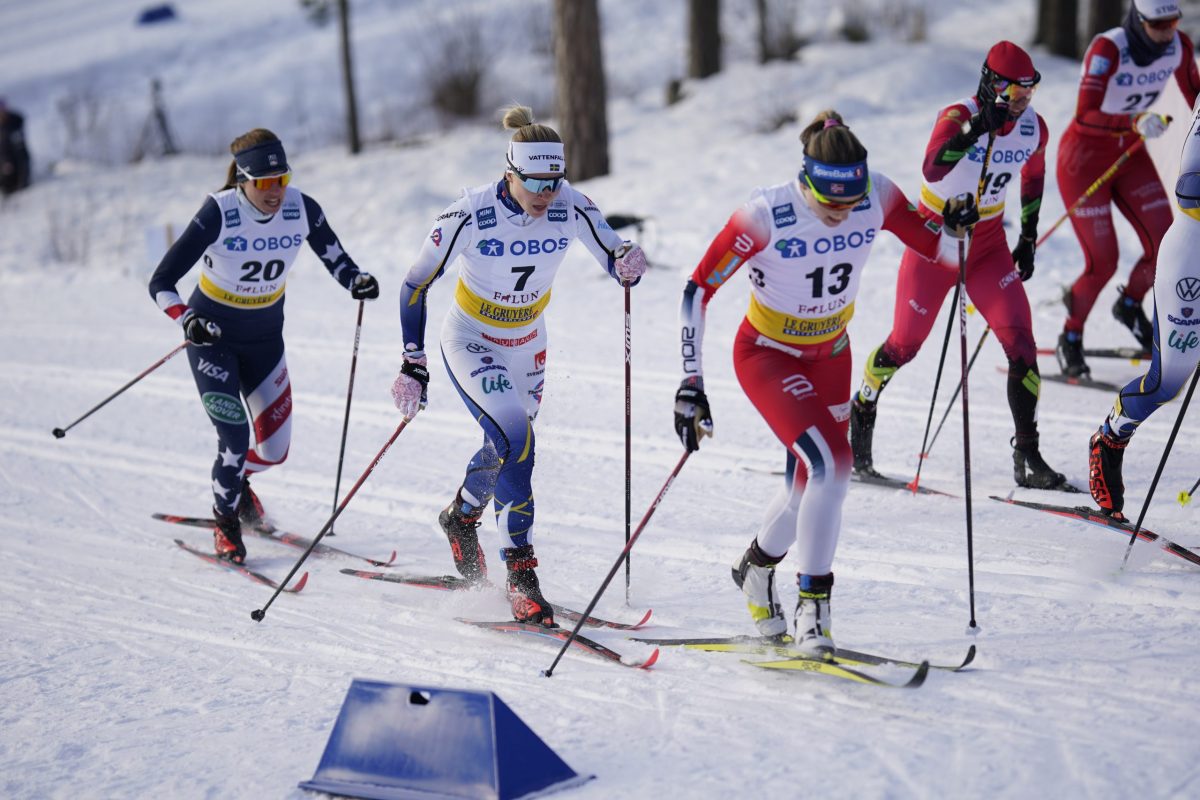
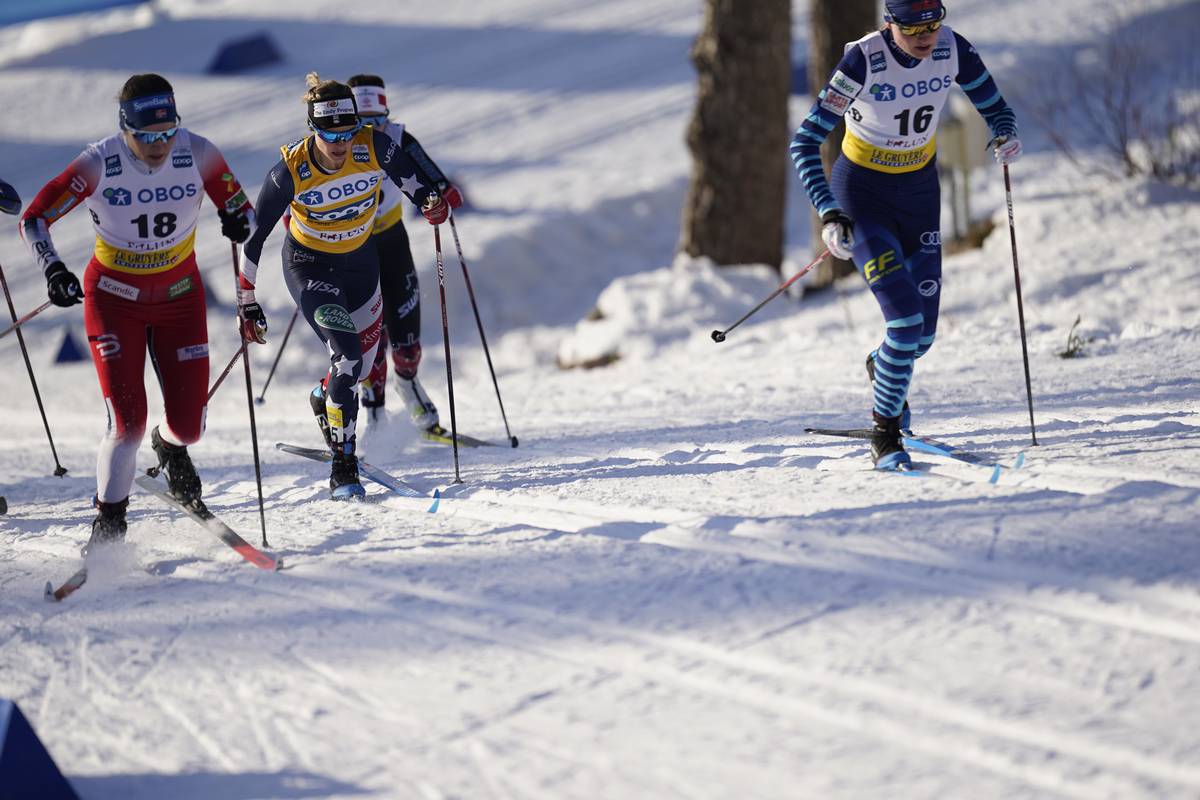
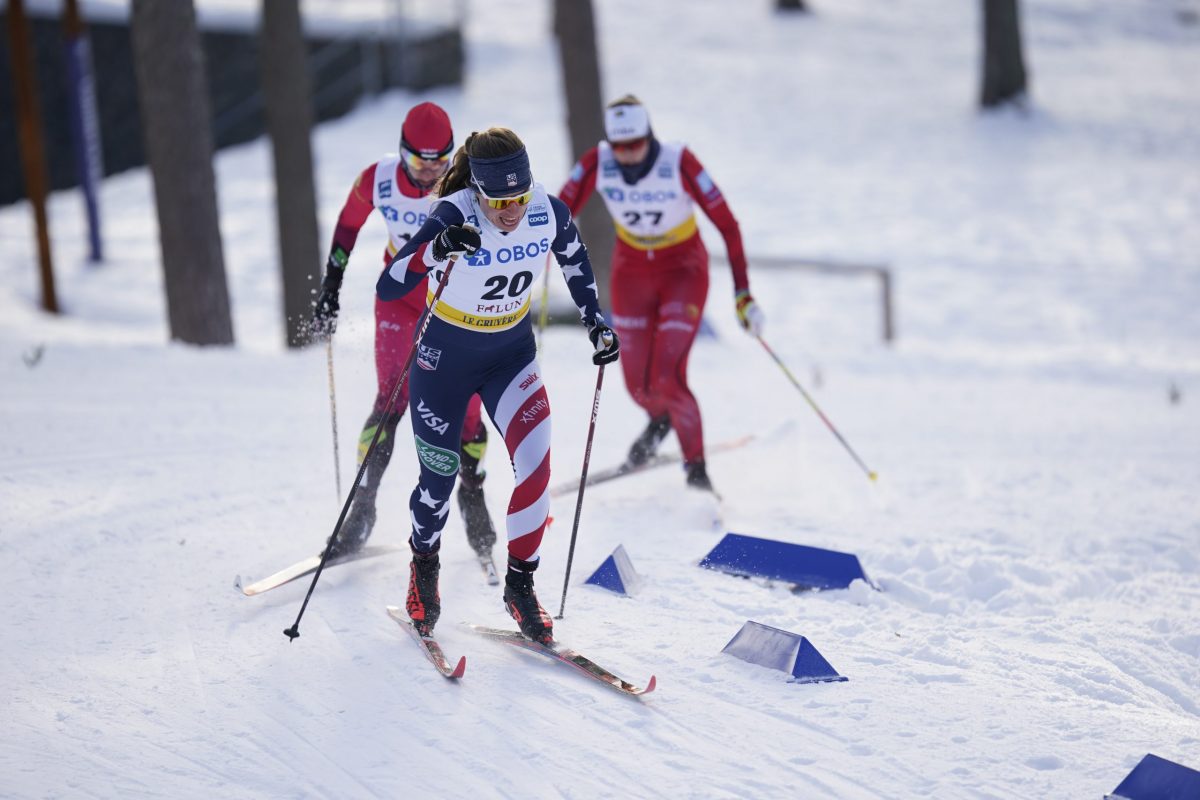
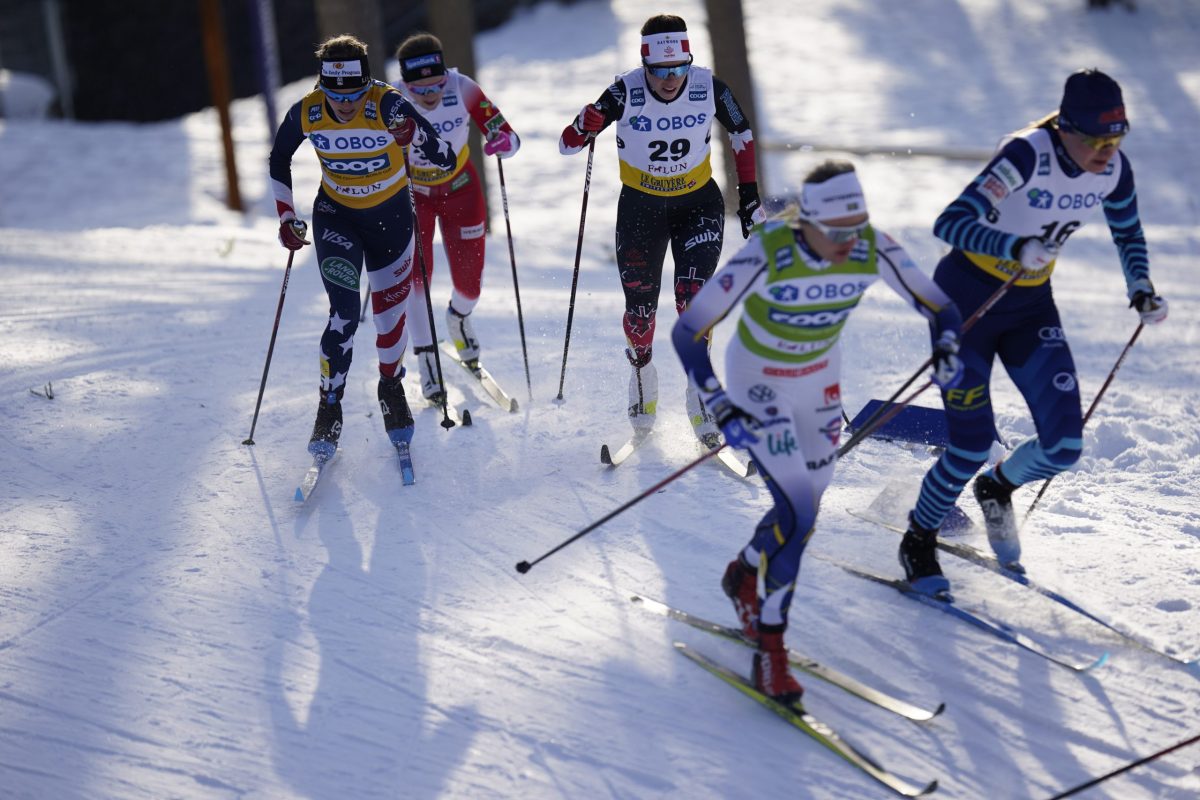
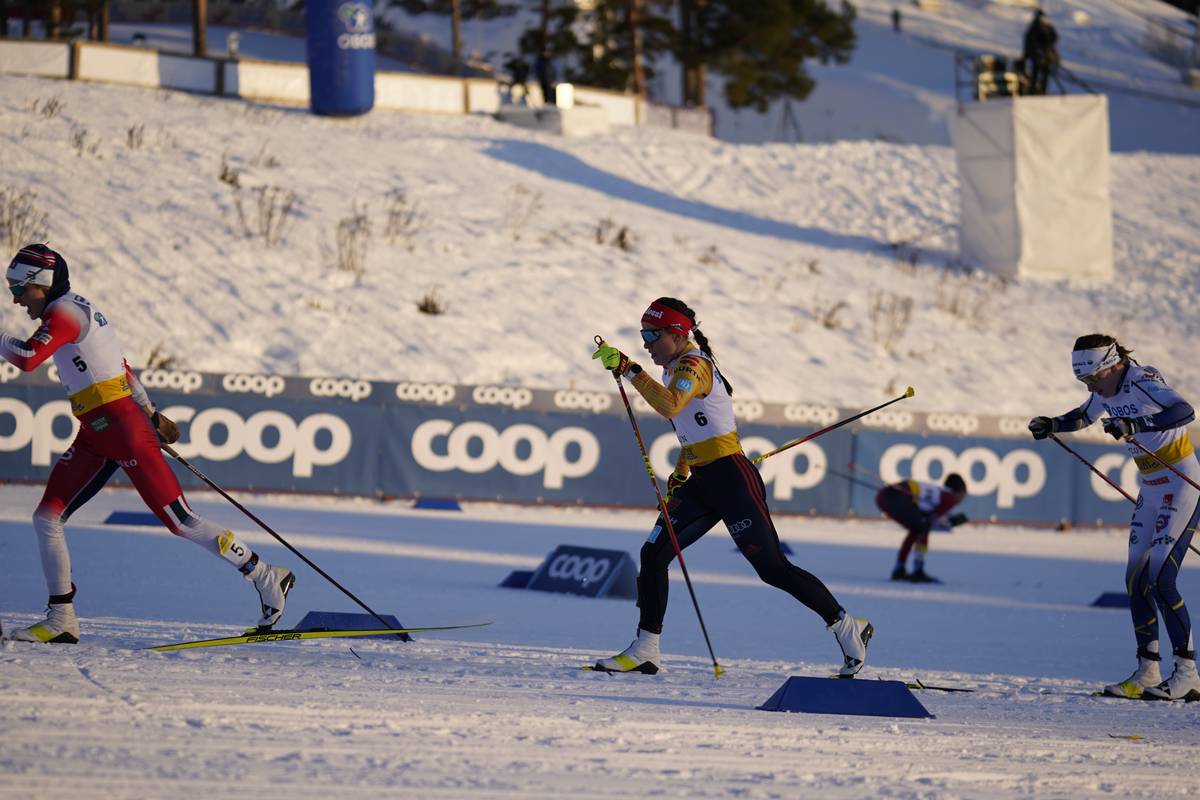
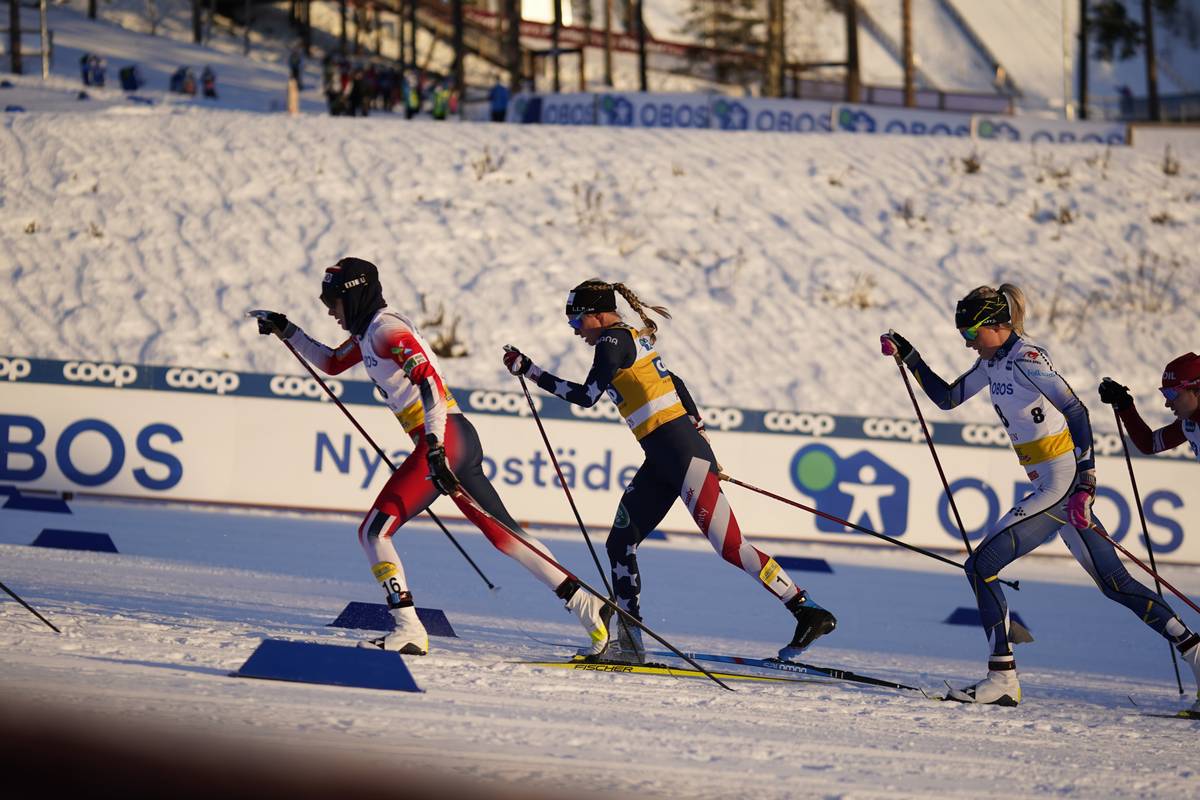
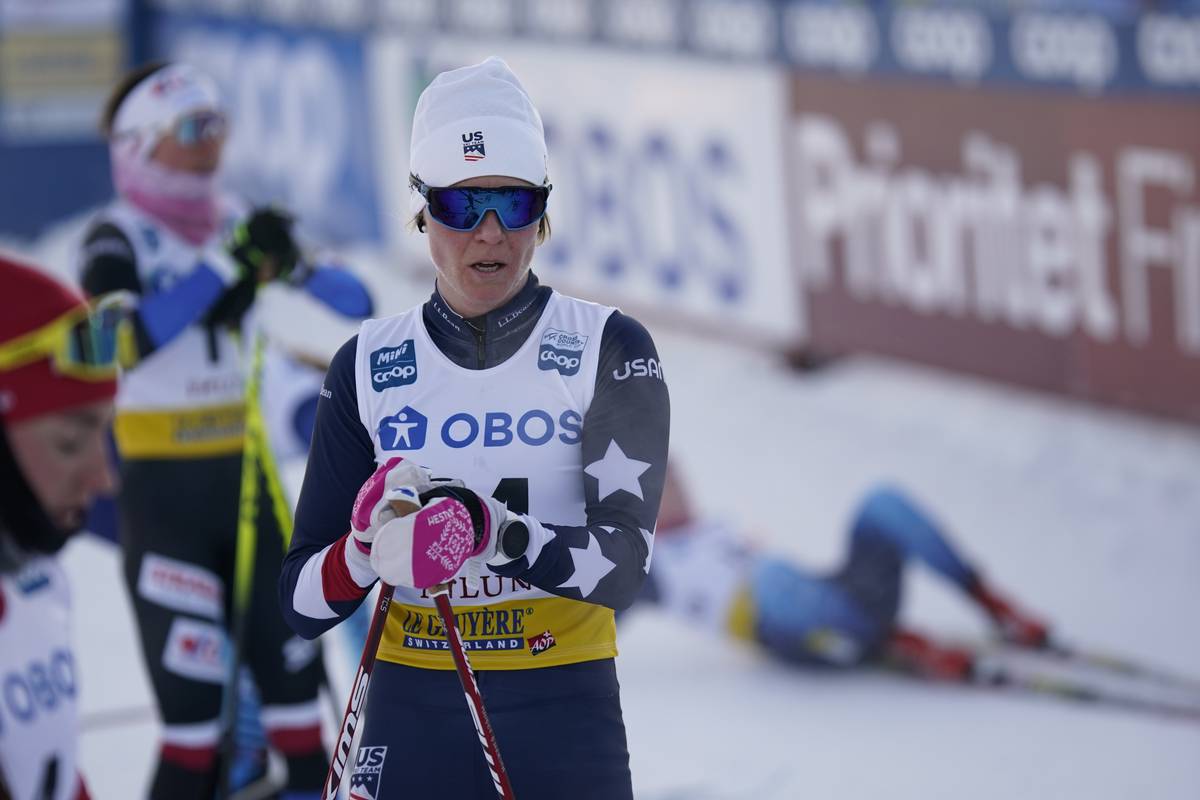
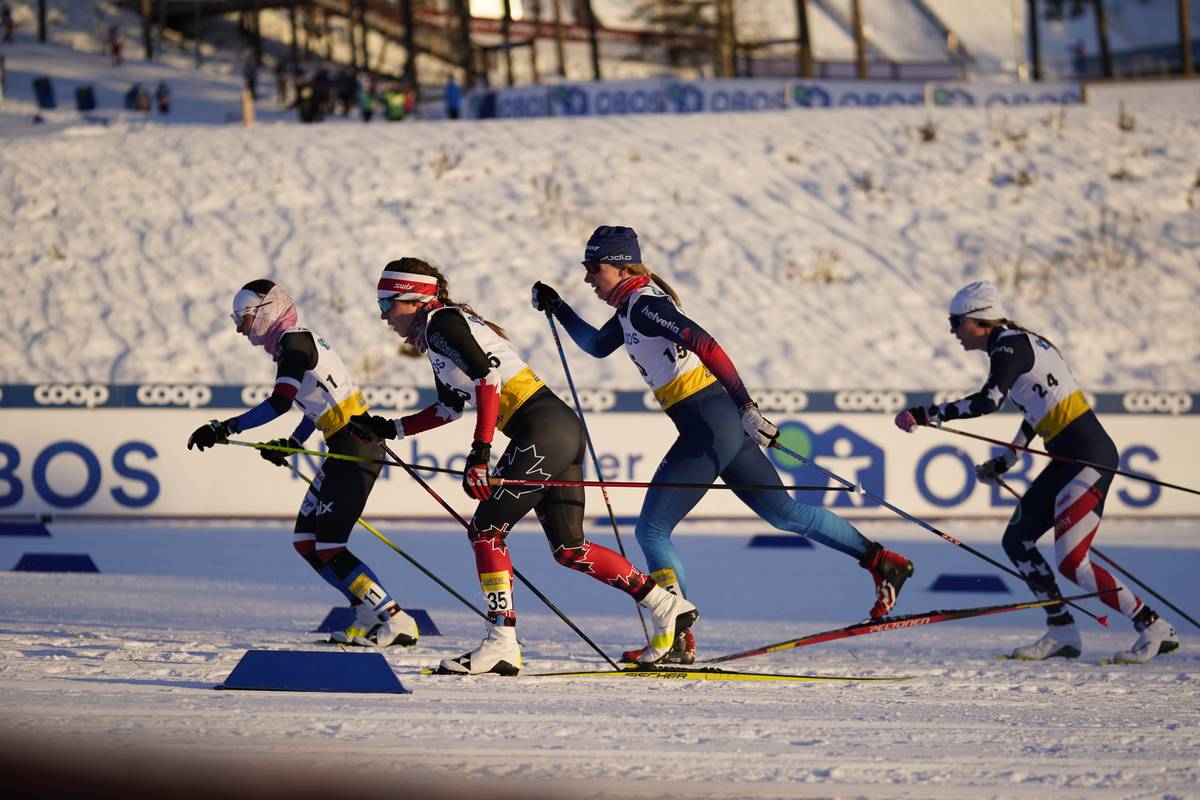
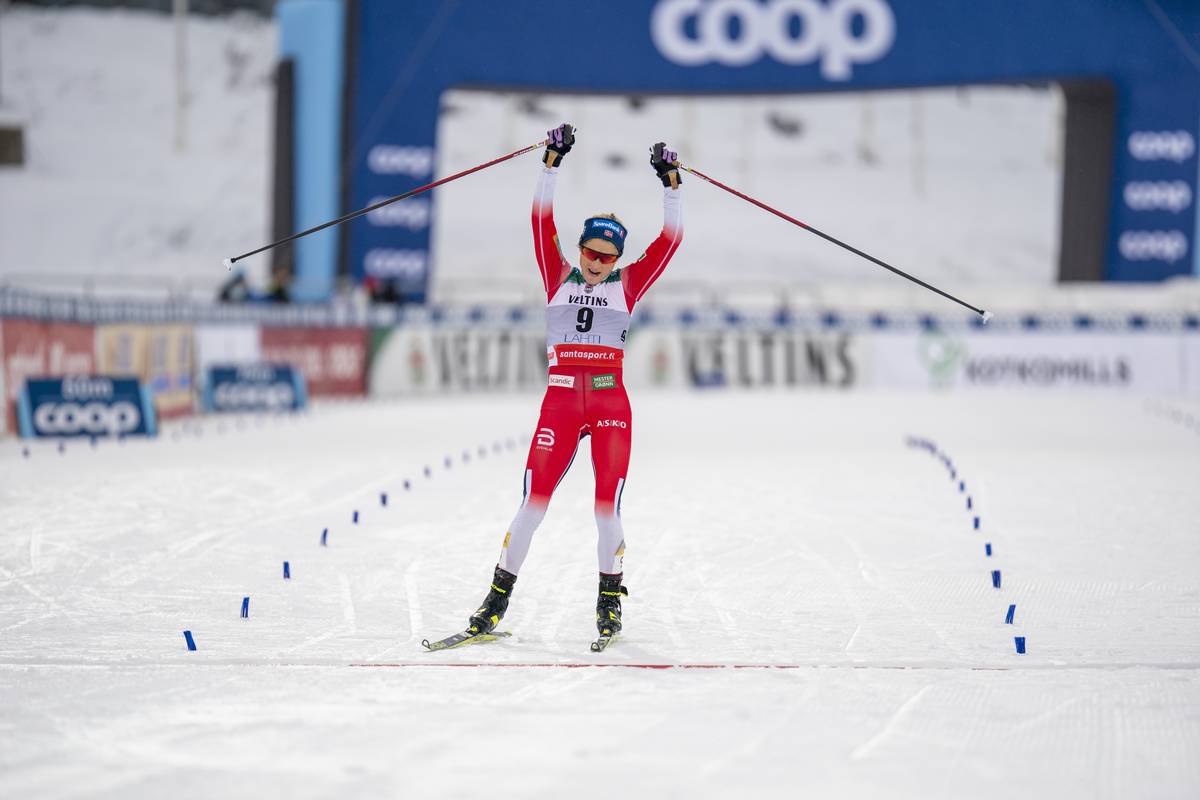
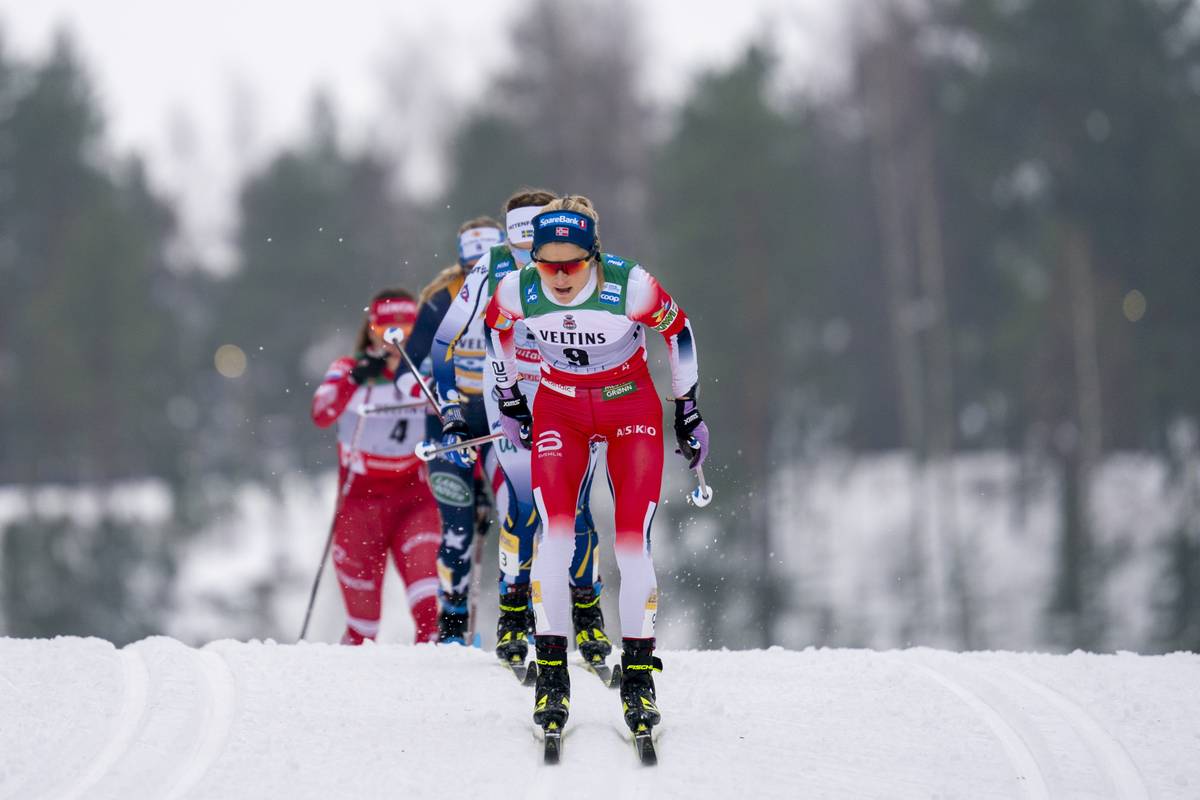
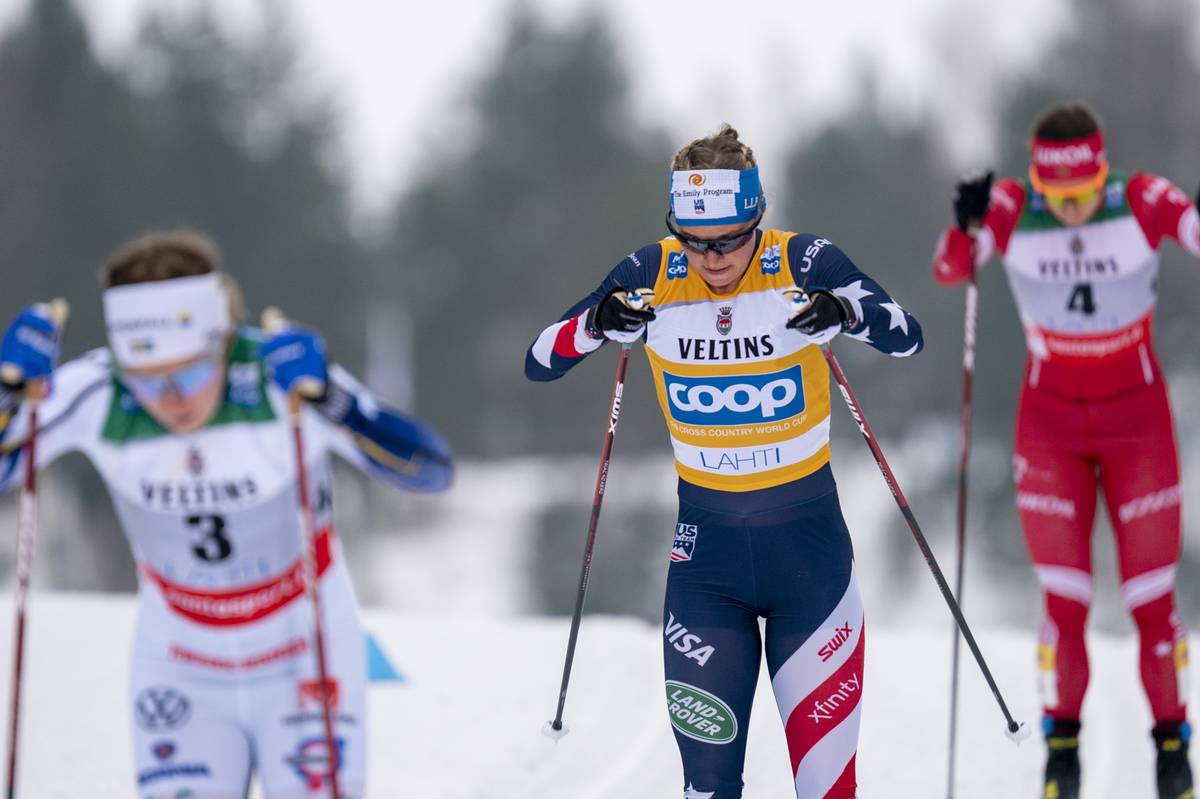
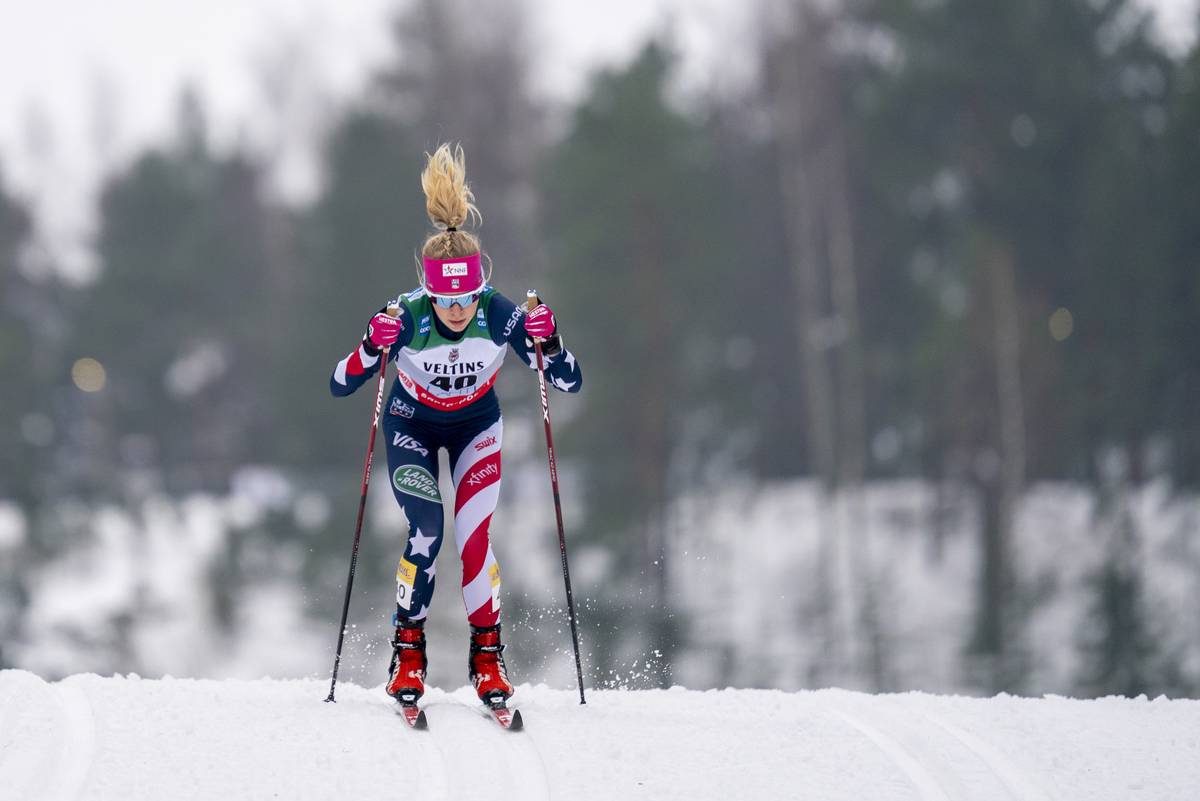
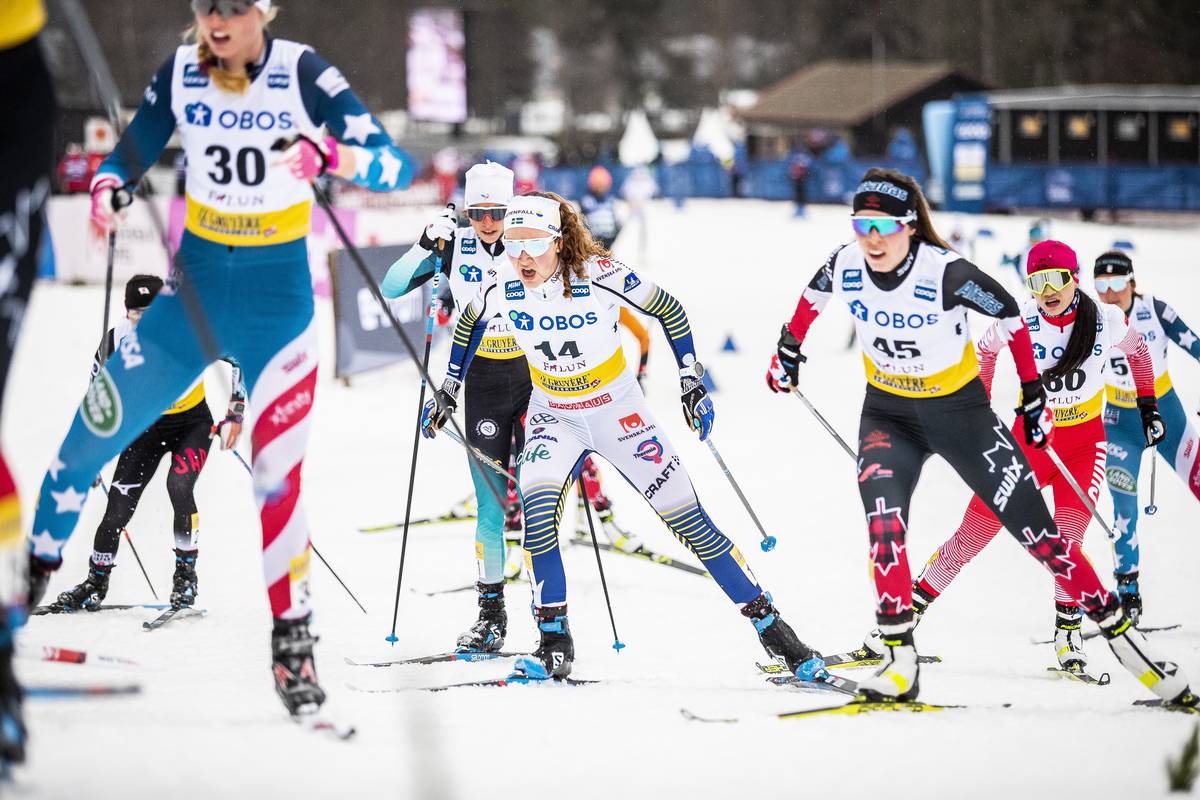
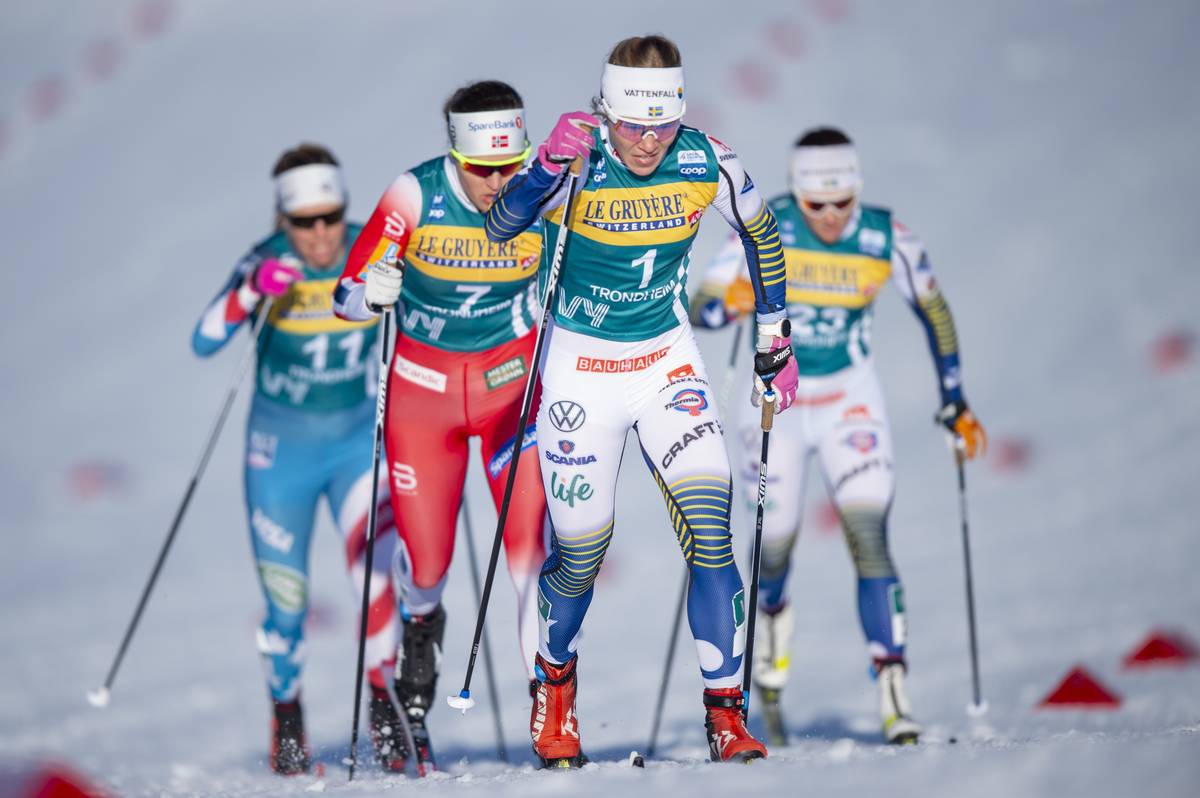
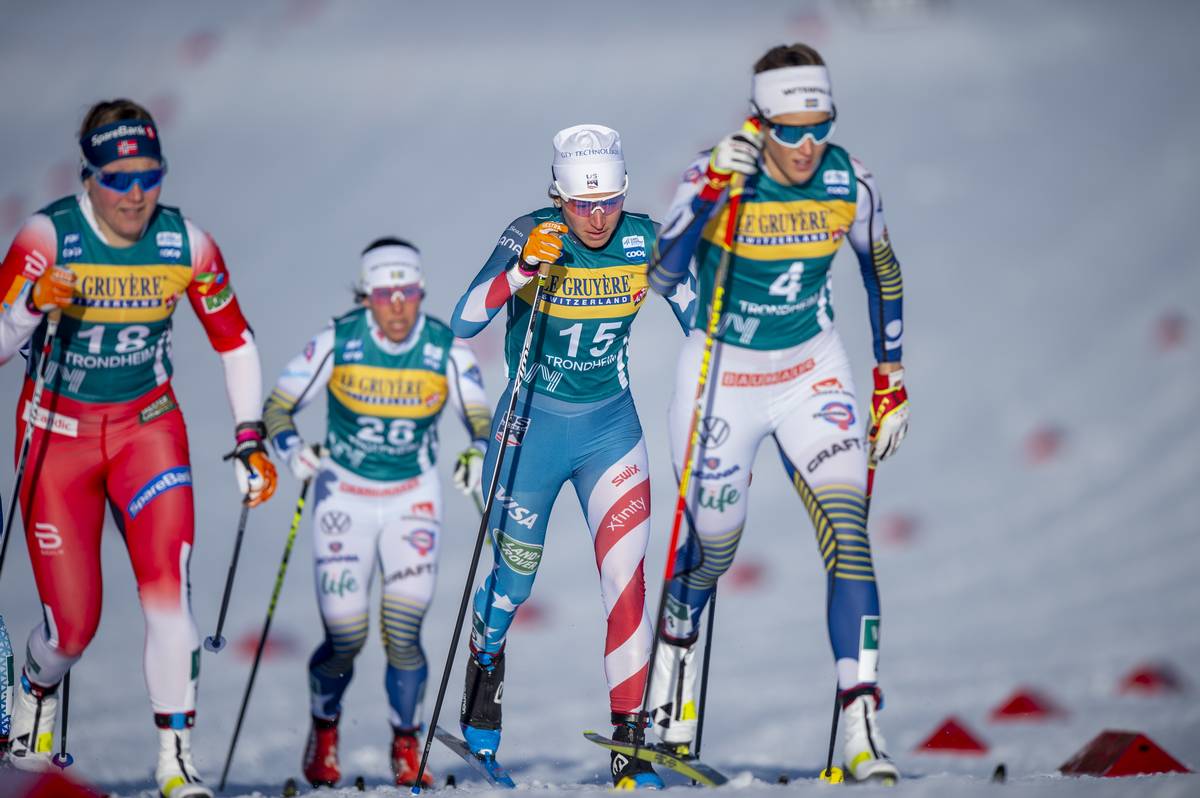
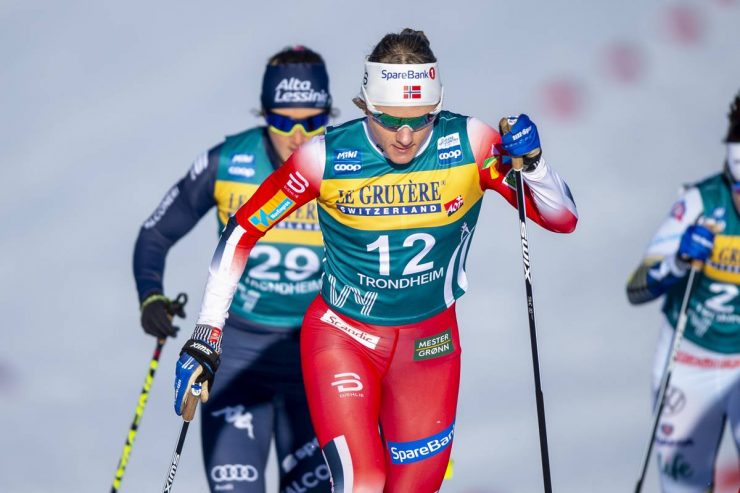
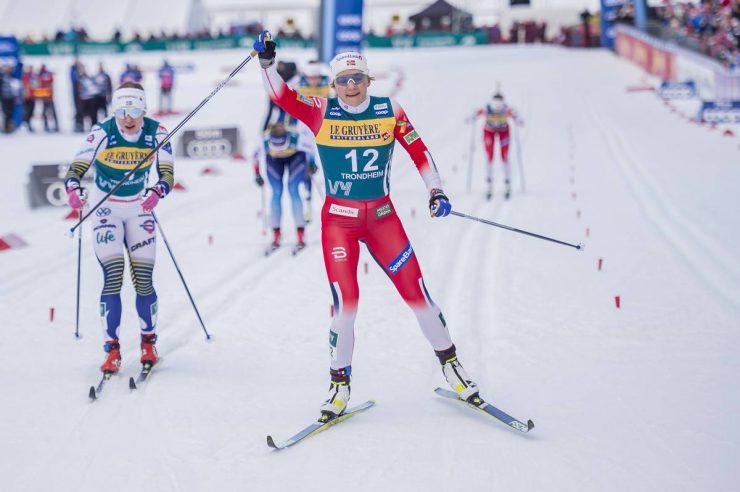
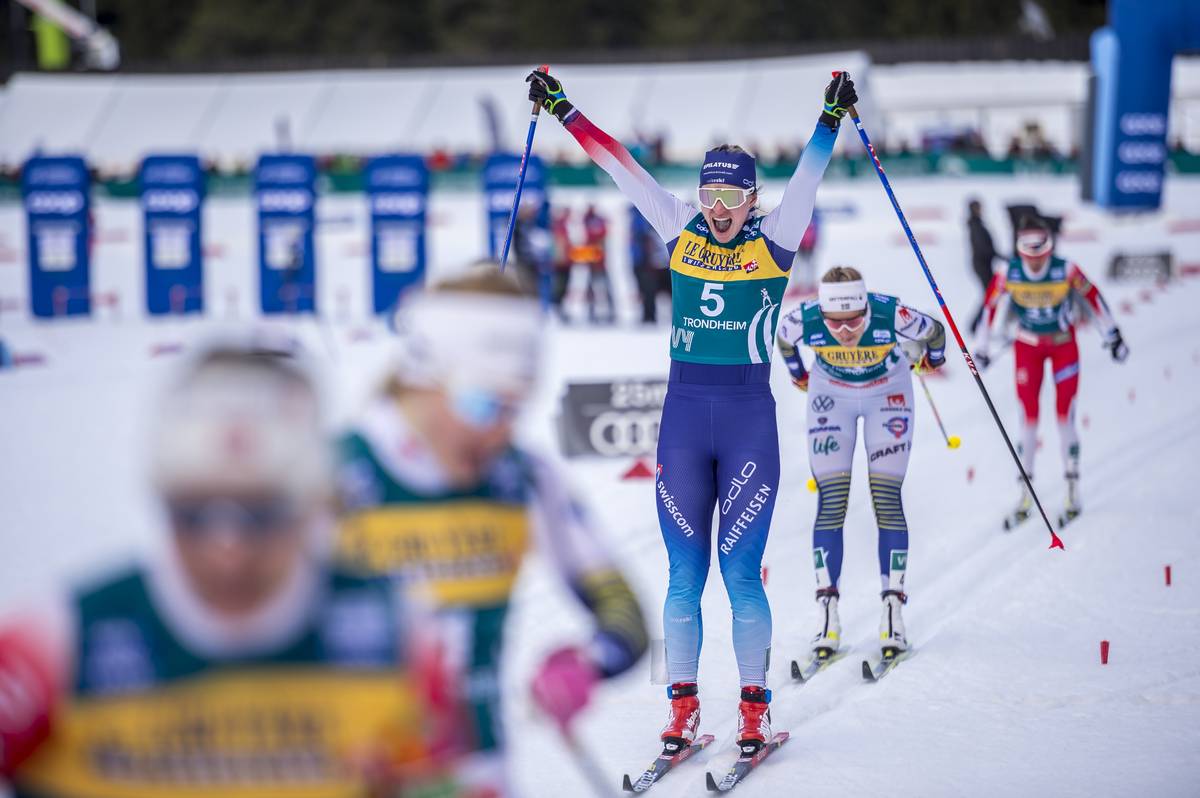
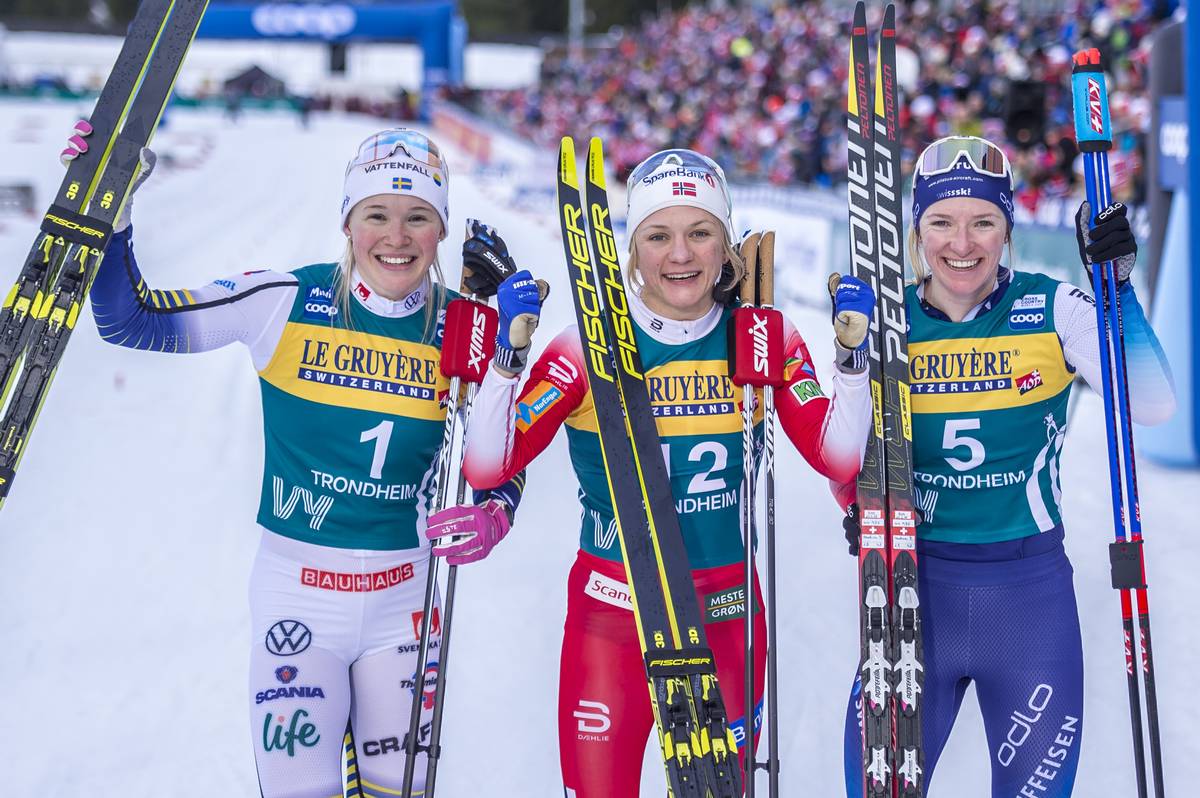
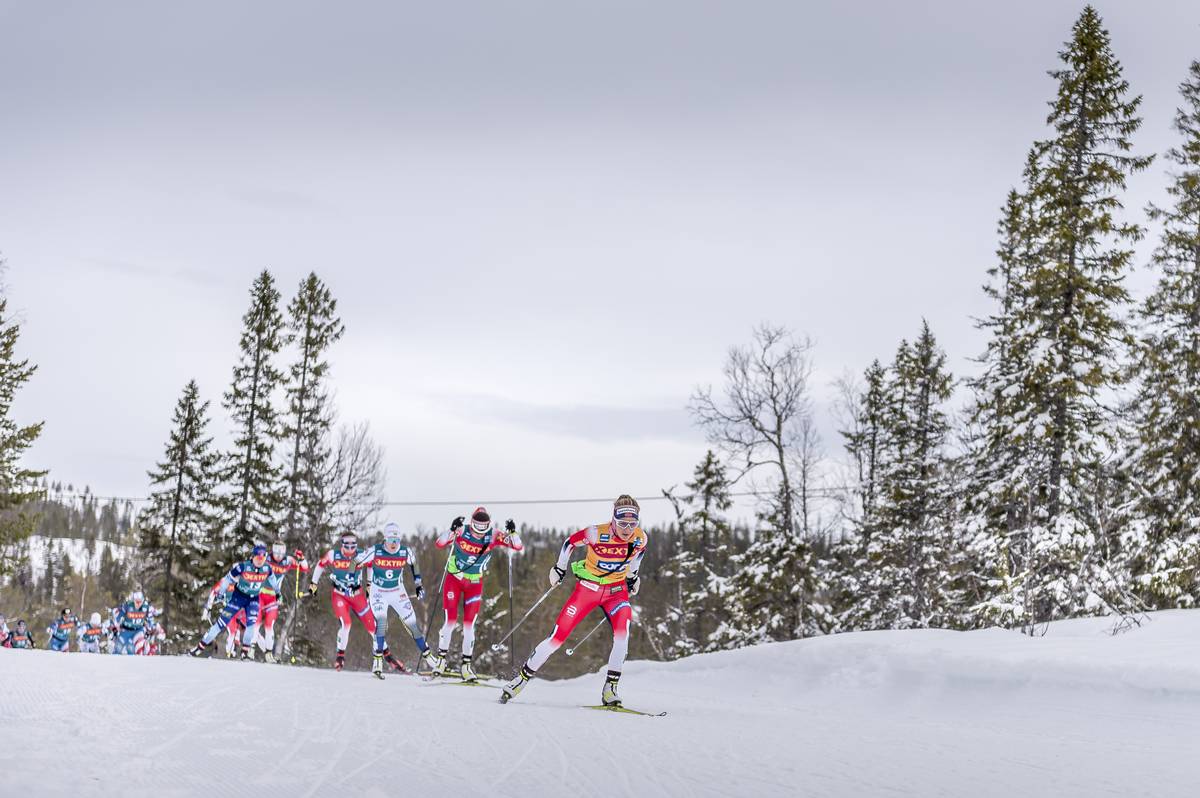
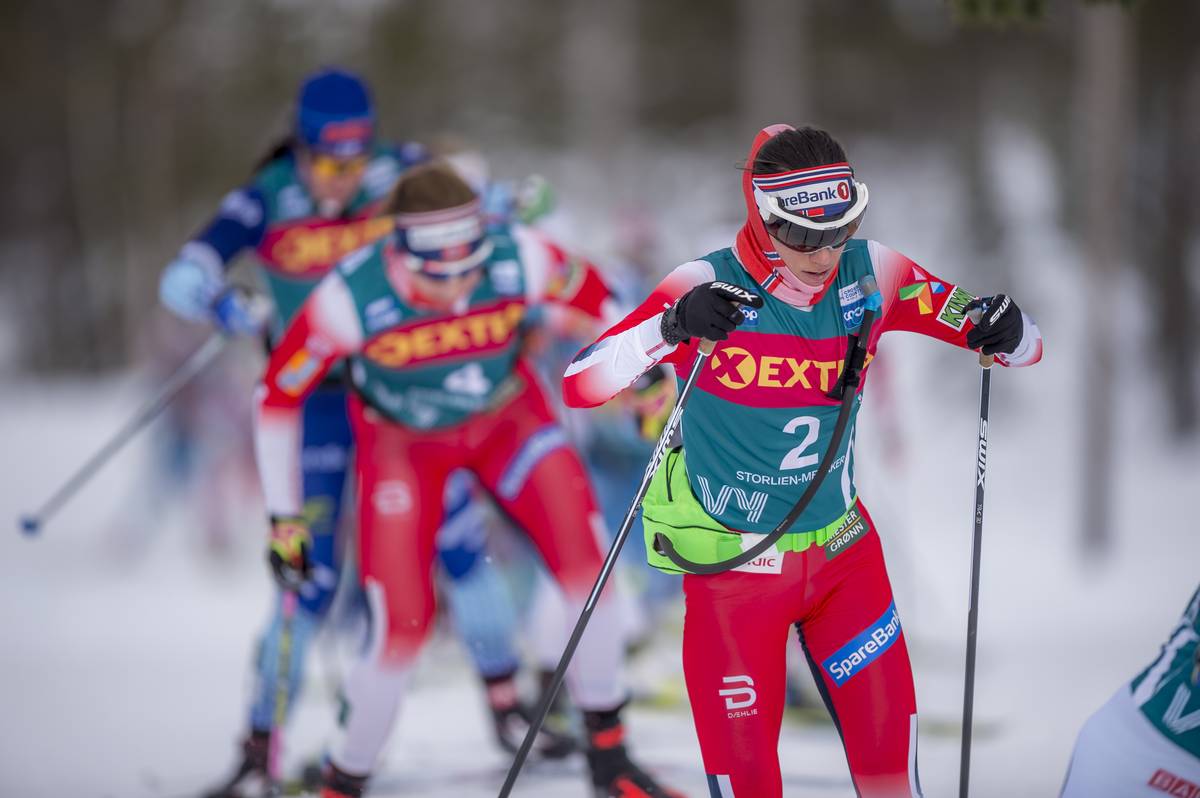
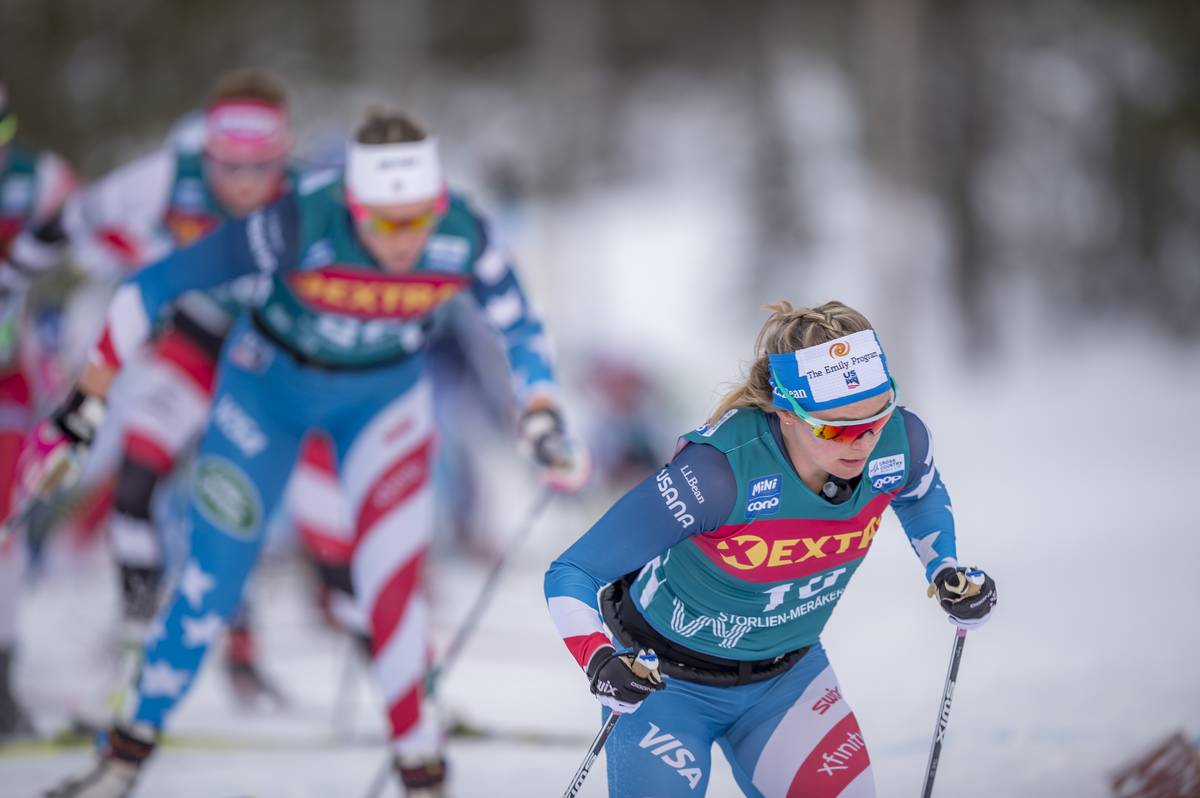
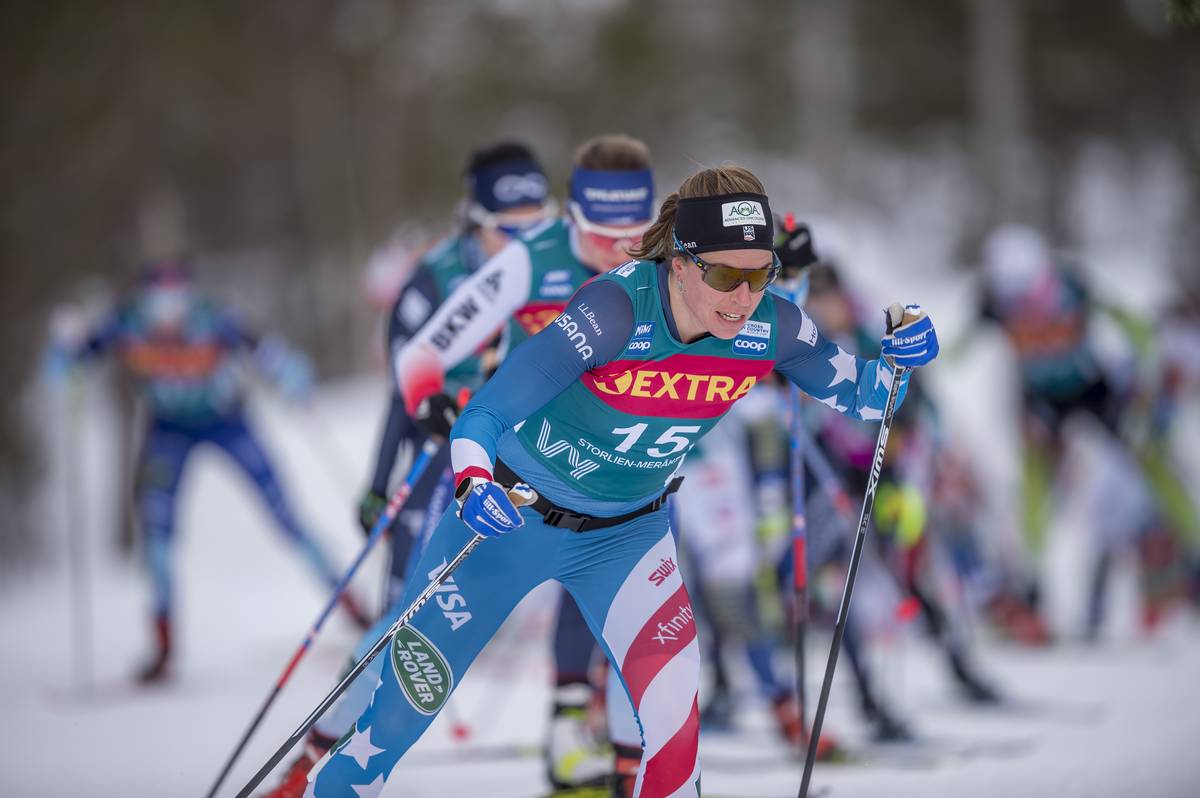
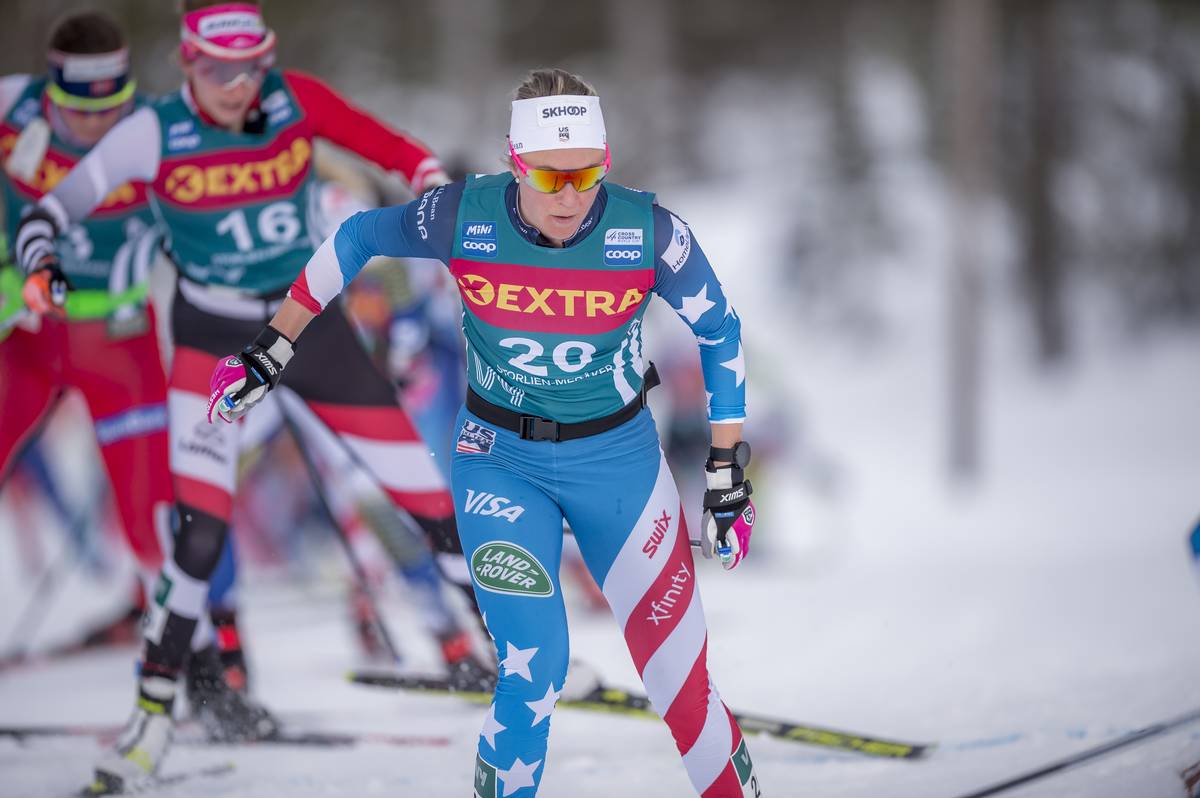
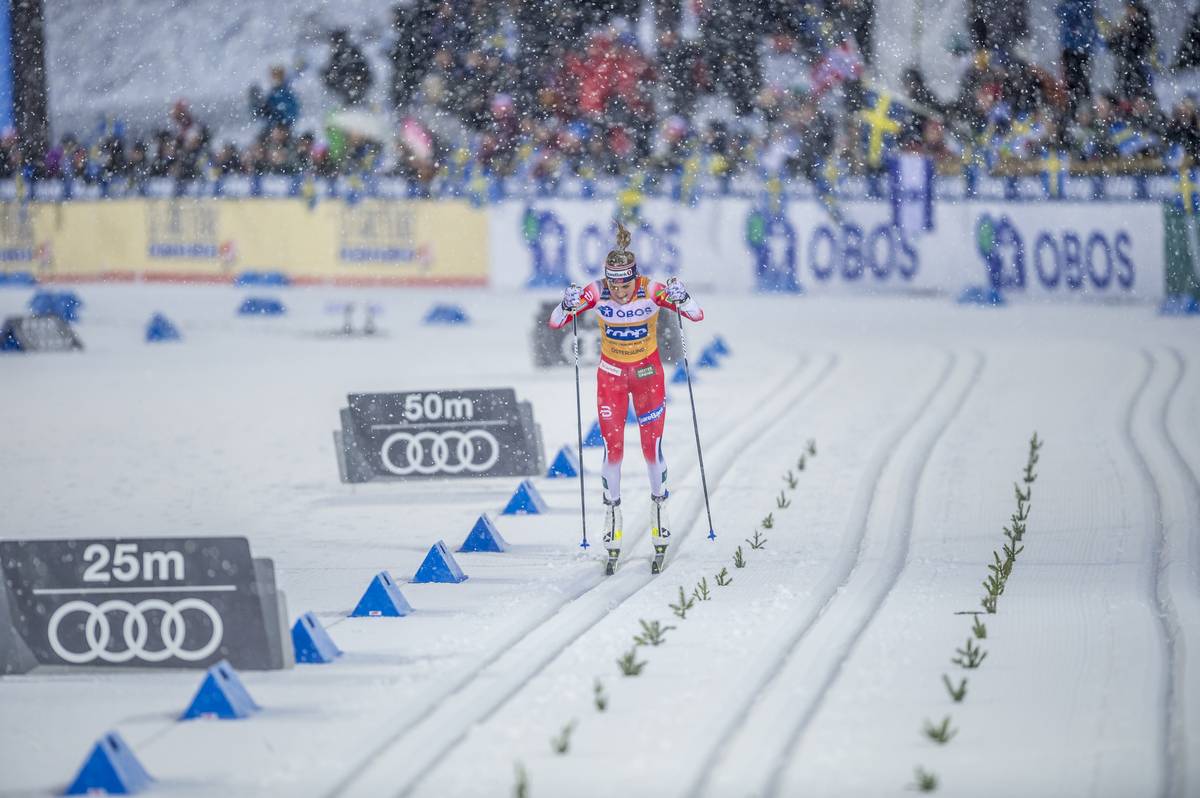
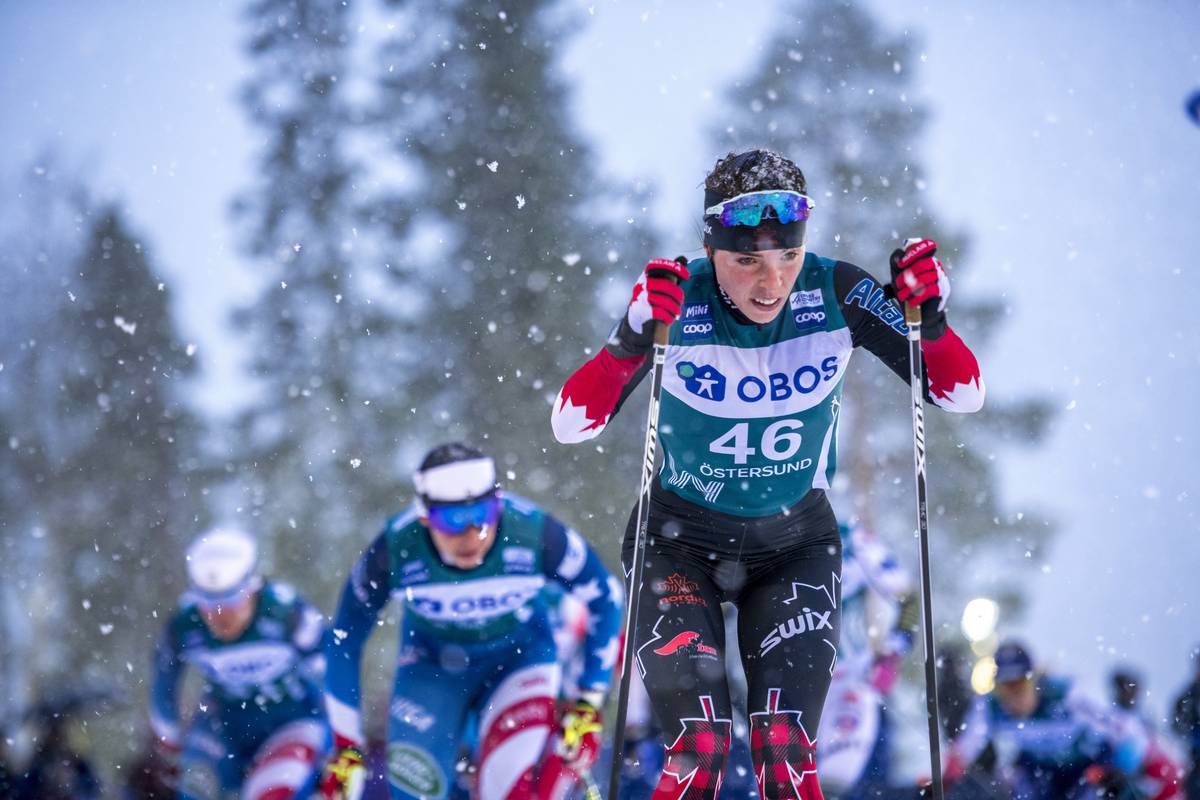
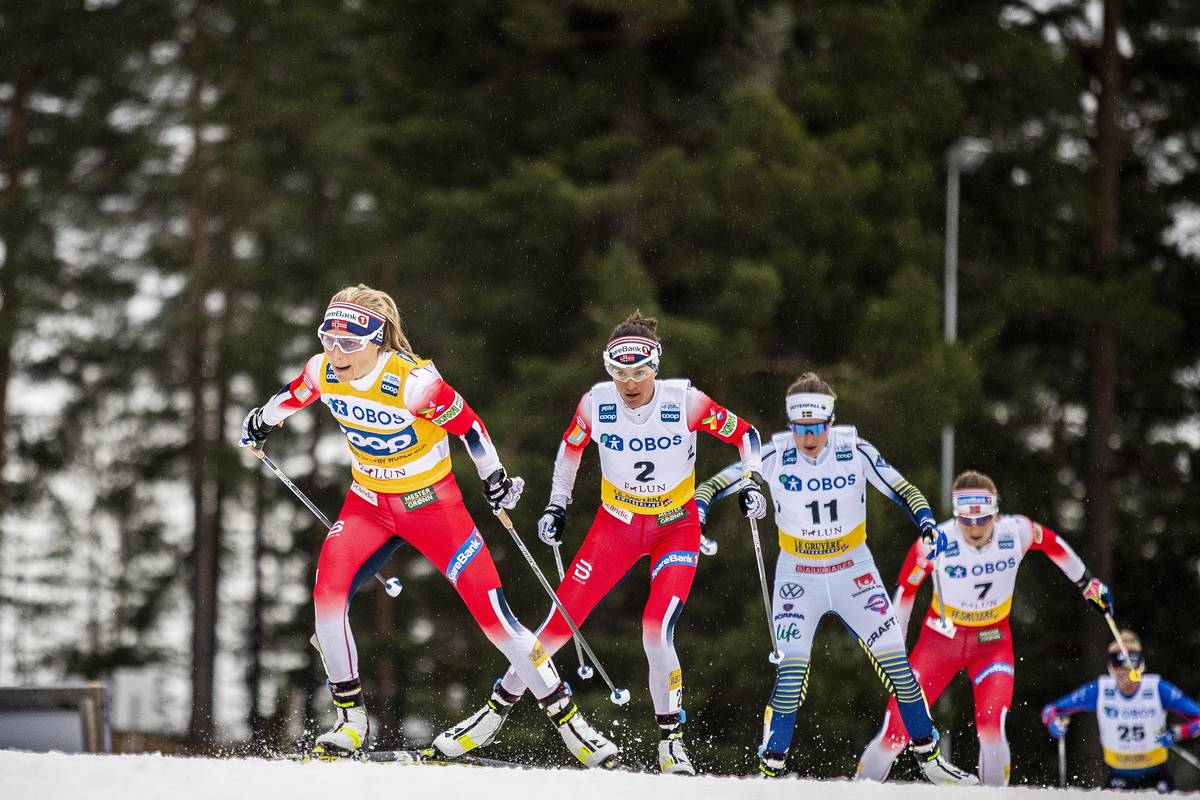
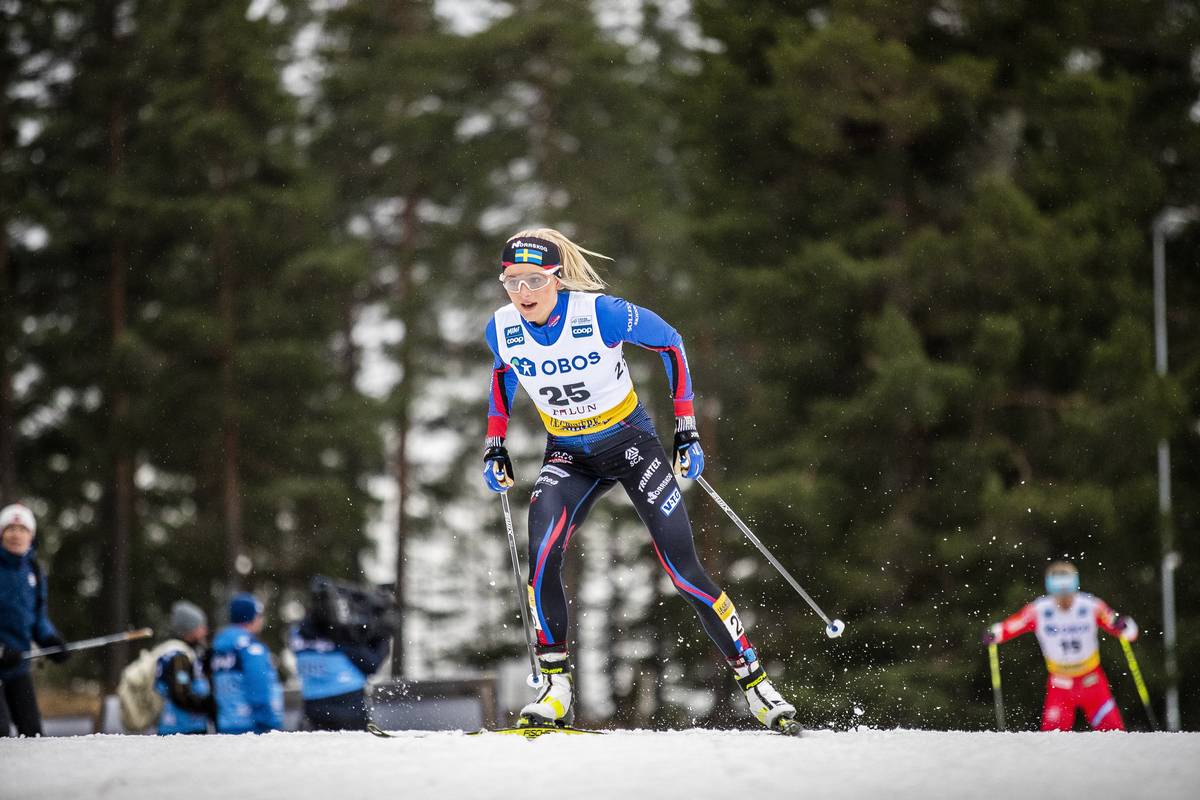
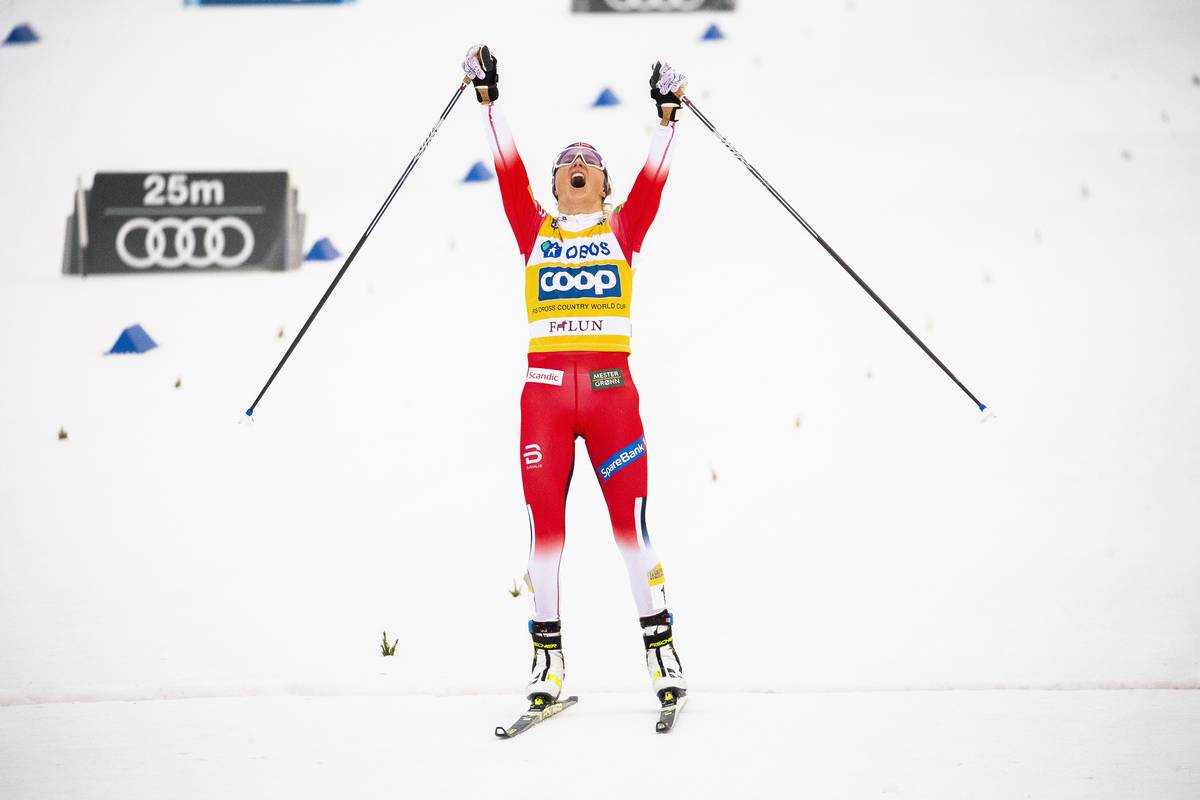
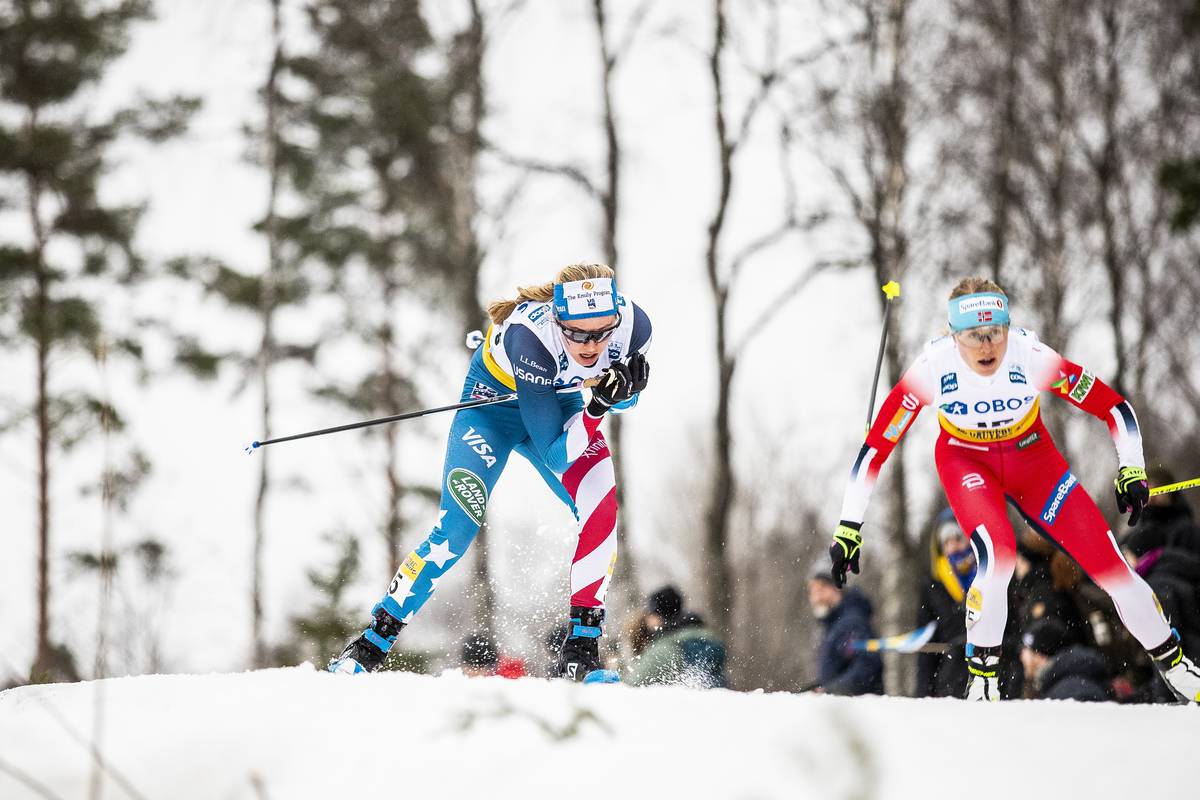
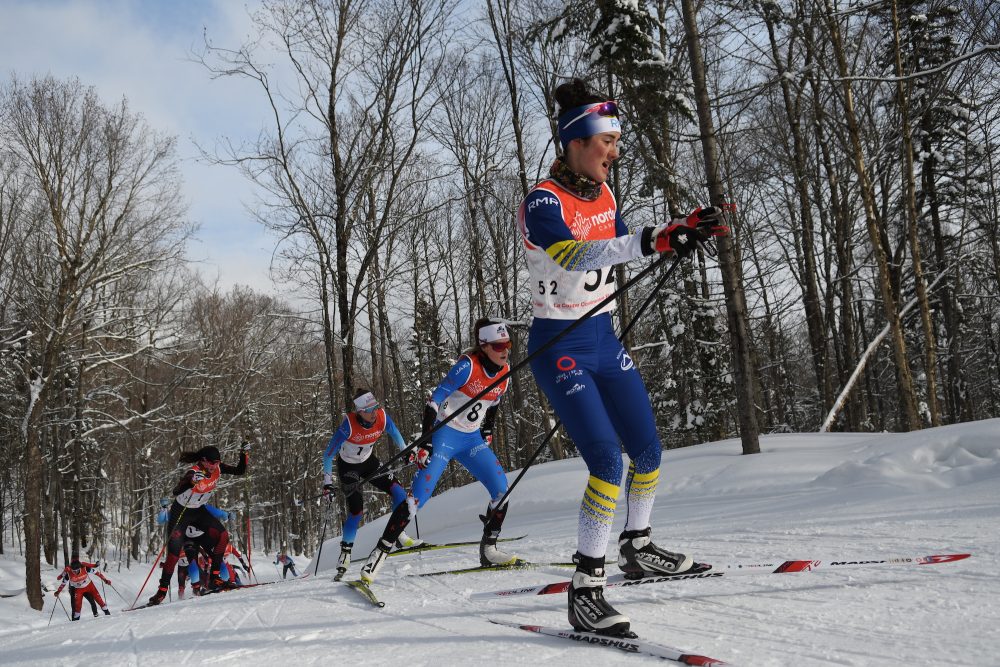
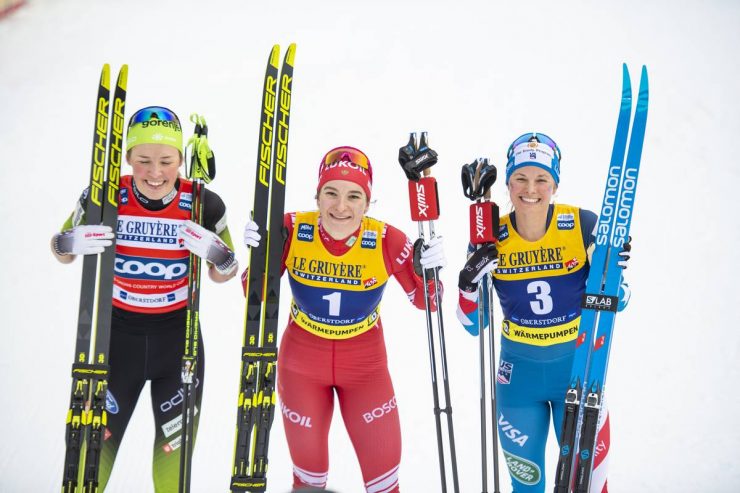
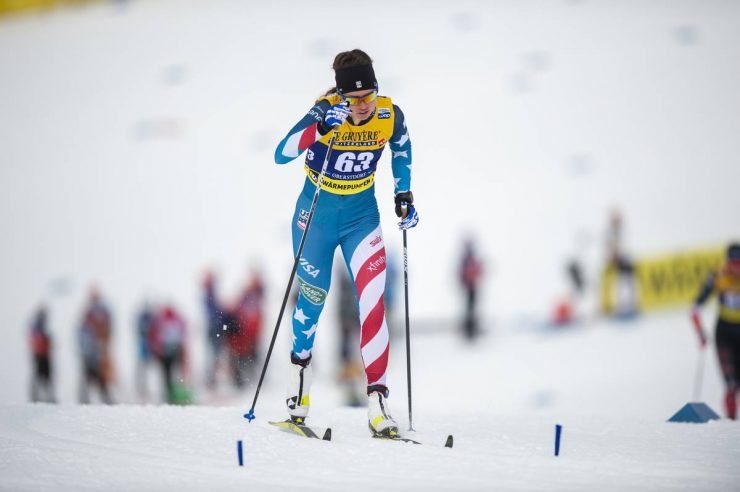
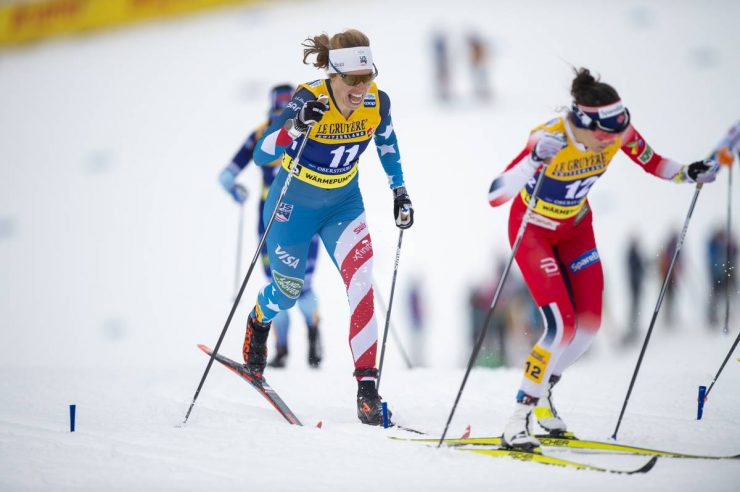
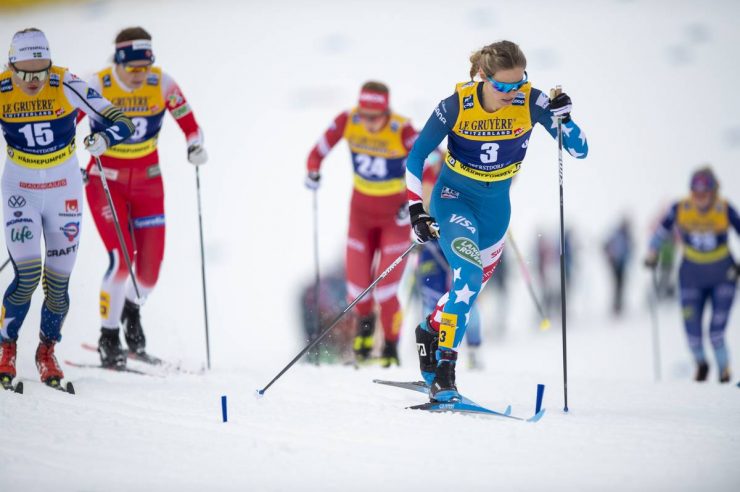
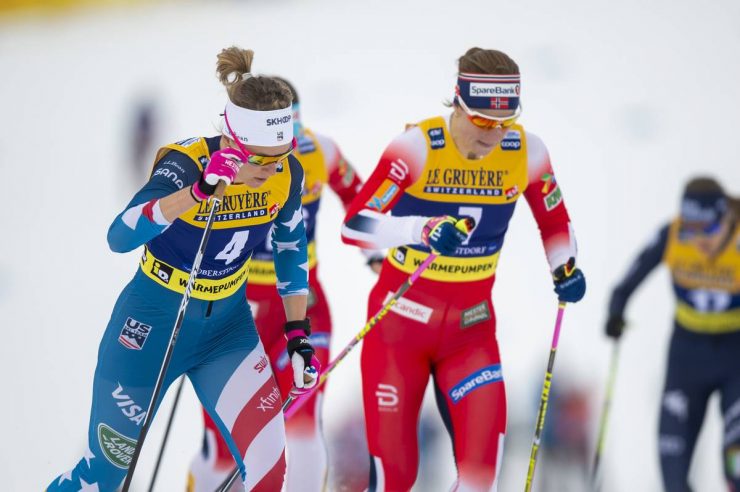
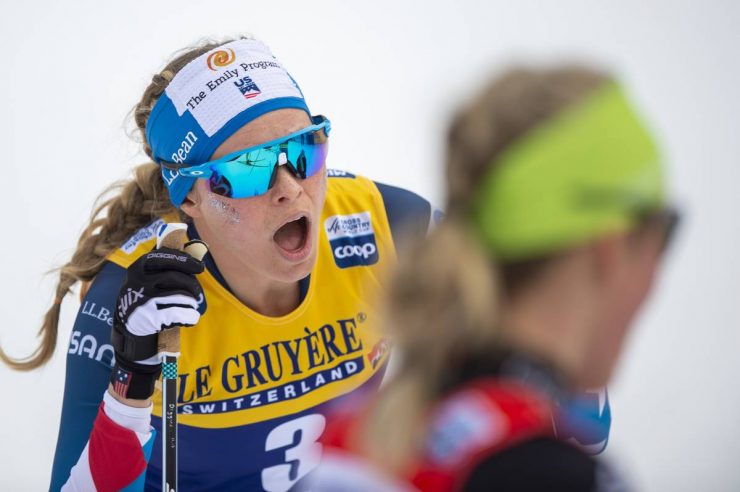
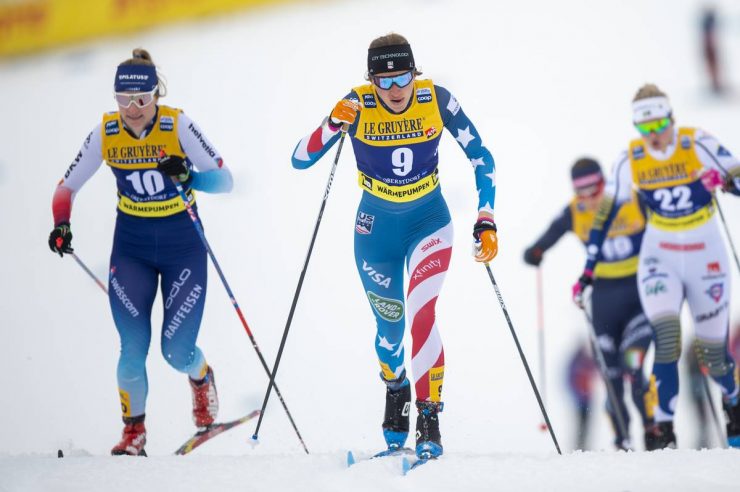
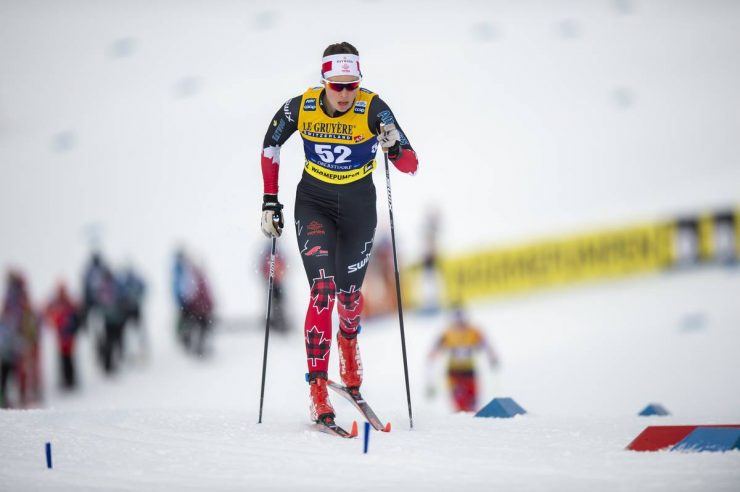
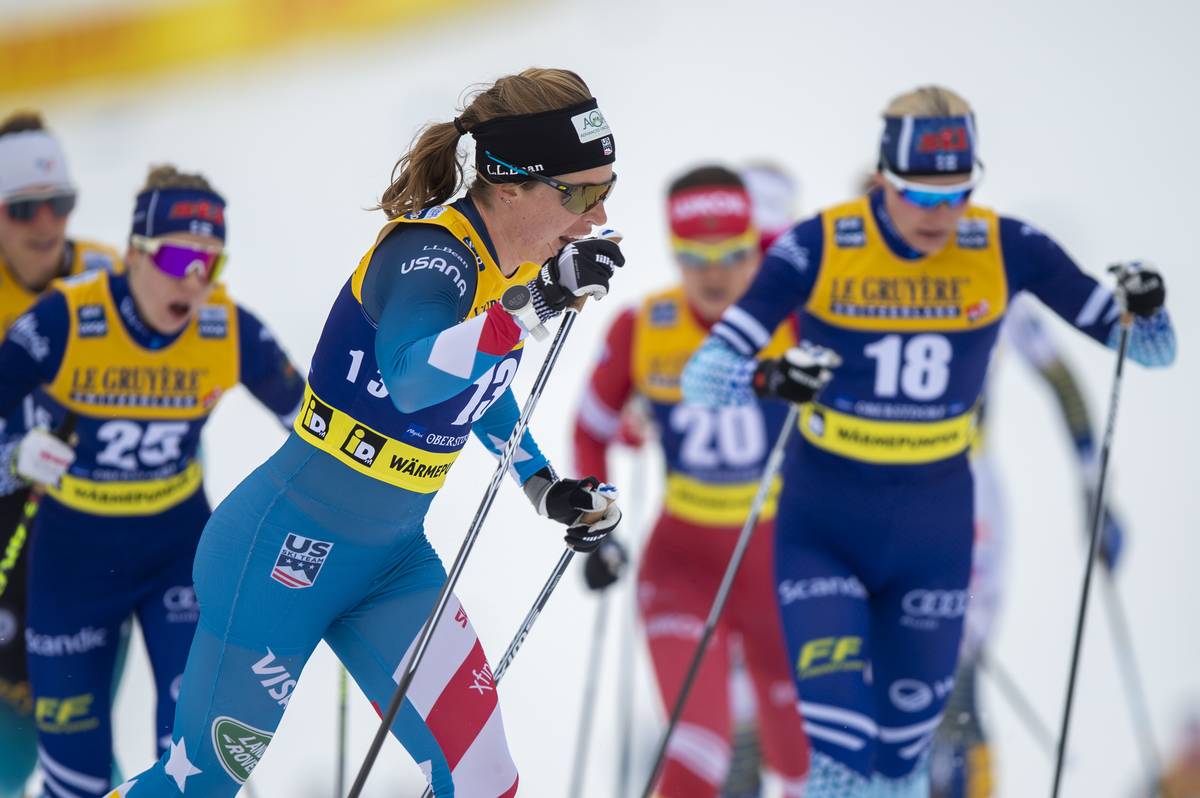
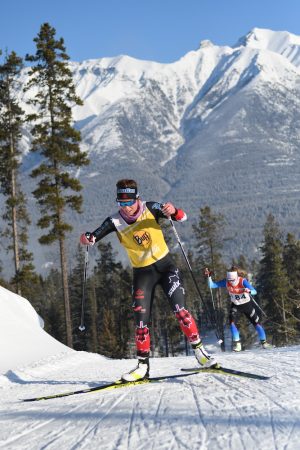
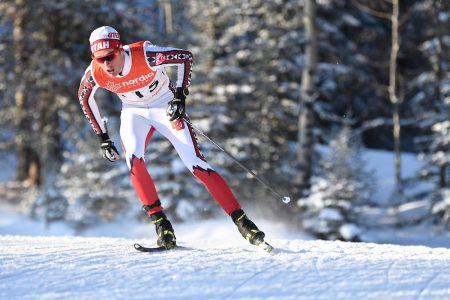
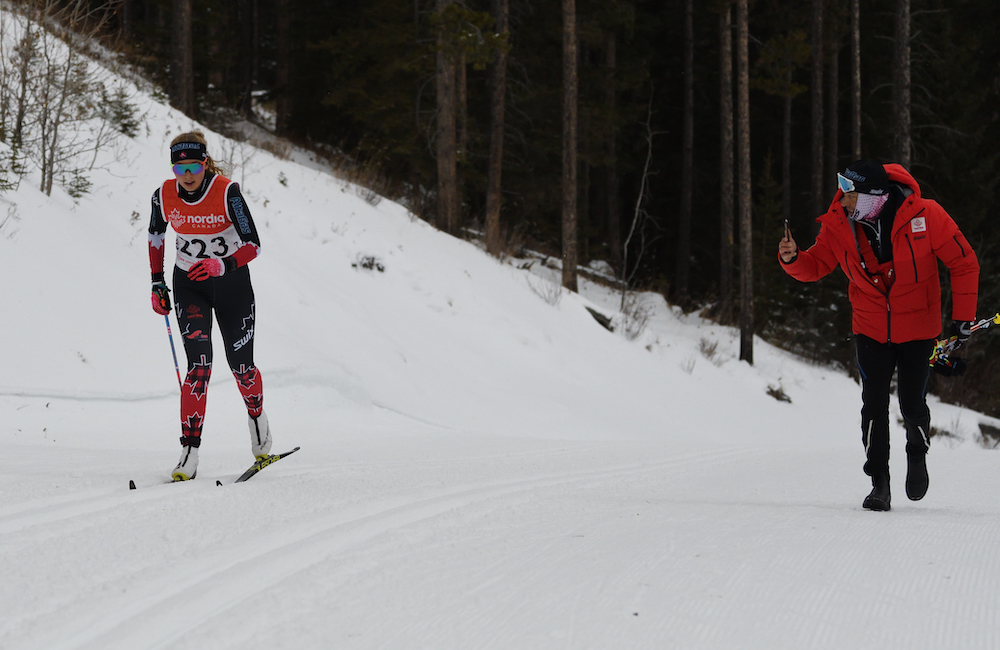
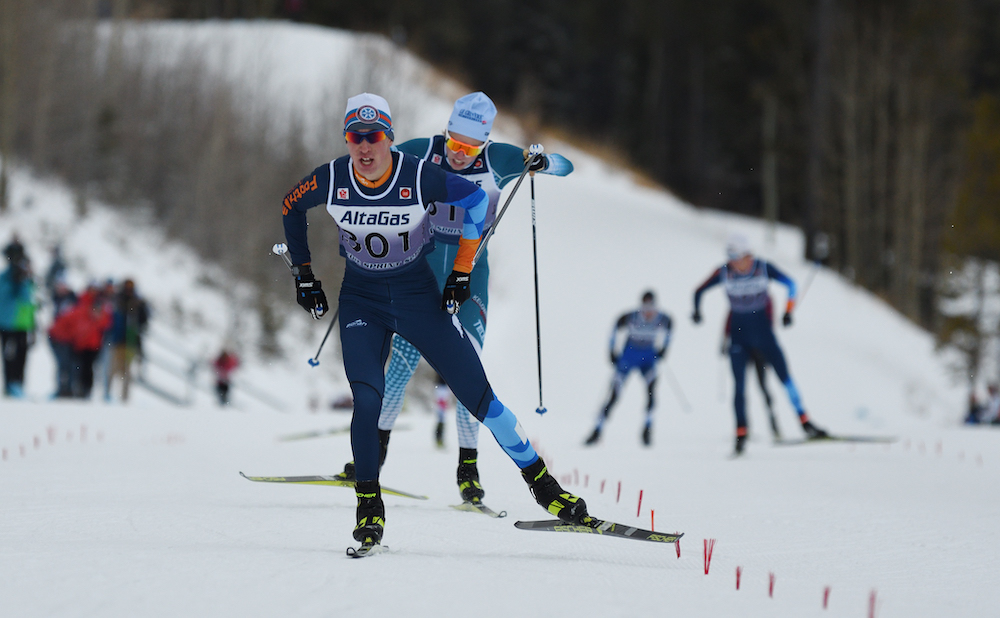
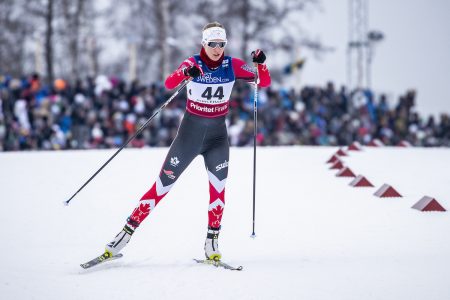
Rosie Brennan charges up the first and longest climb on the sprint tracks in Falun, Sweden. (Photo: NordicFocus)
This World Cup coverage is made possible through the generous support of Marty and Kathy Hall and their A Hall Mark of Excellence Award. To learn more about A Hall Mark of Excellence Award or to learn how you can support FasterSkier’s coverage please contact info@fasterskier.com.
If you had any question about the strength and depth of the Swedish sprint team, look no further than the qualification list from today’s classic sprint in Falun. Led by Johanna Hagström with a time of 3:14.18, Sweden put six women in the top-10. This number was repeated in the semi-final, leading into a half-Swedish final round on home soil.
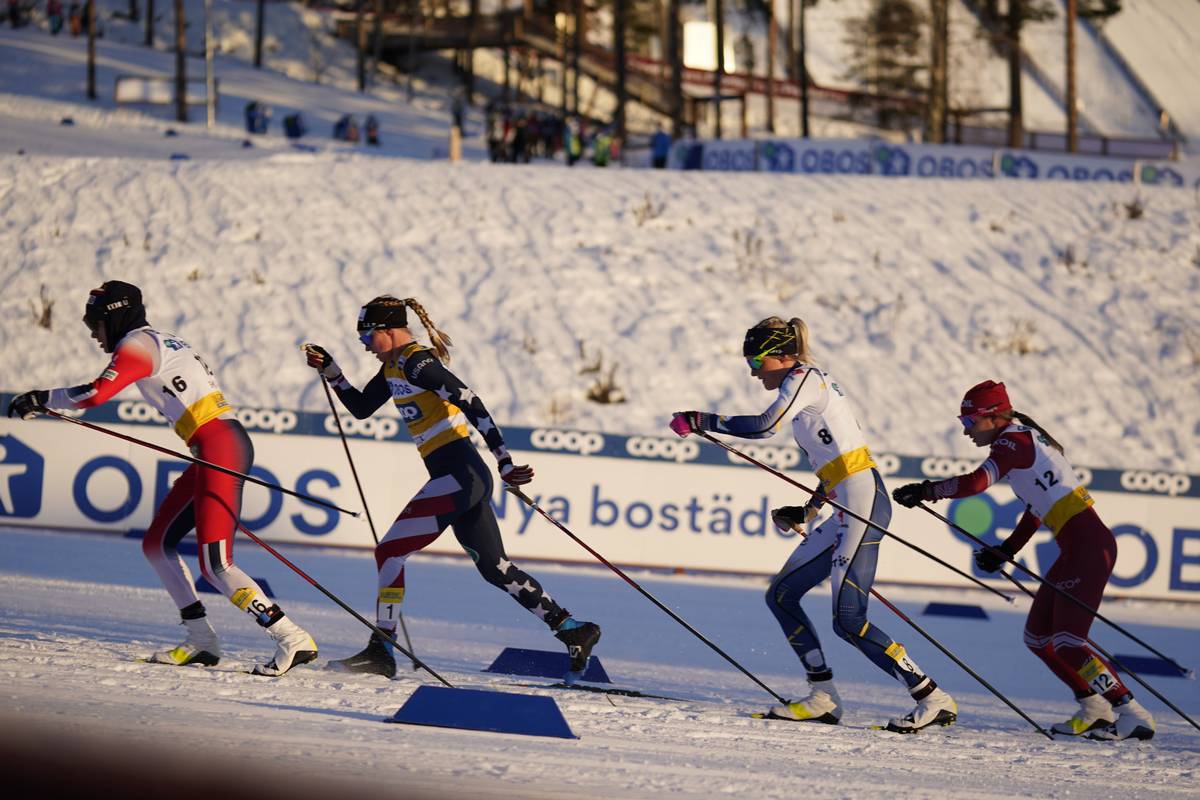
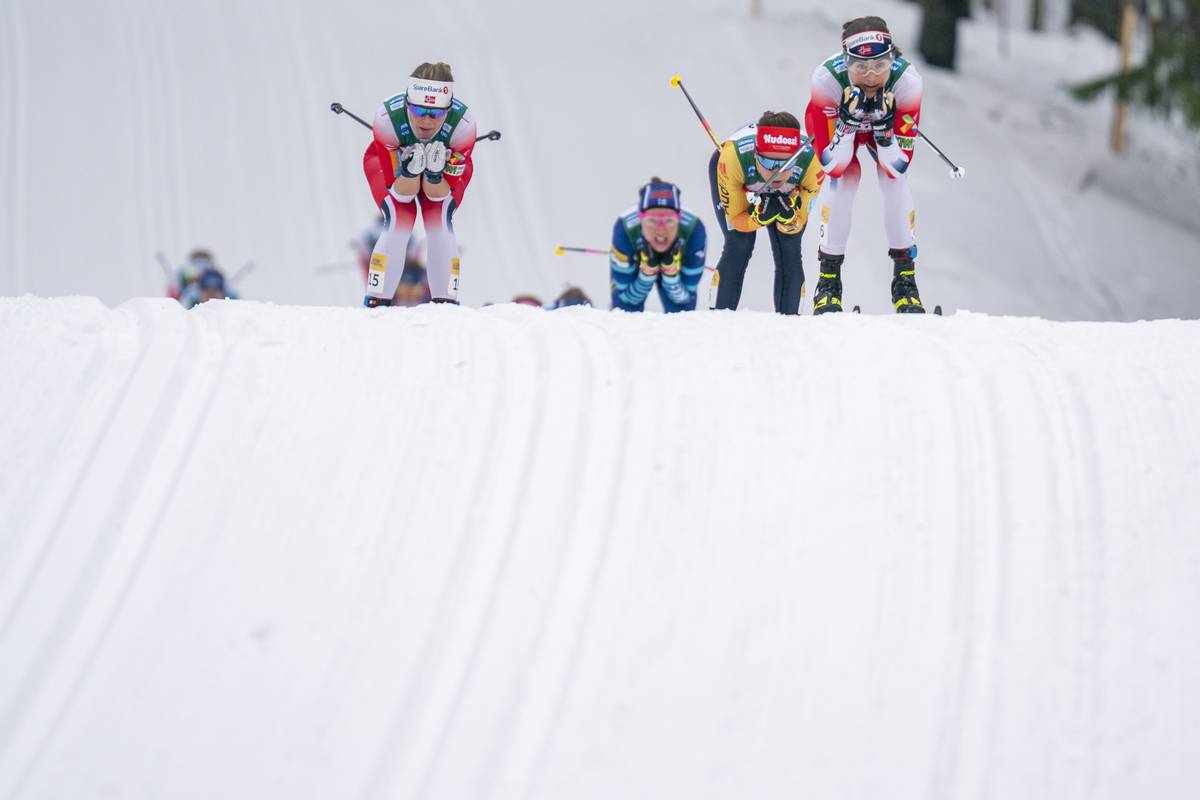
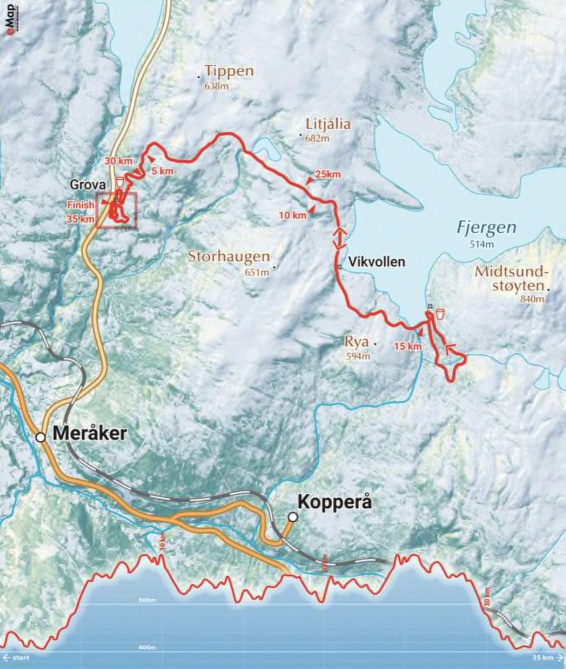
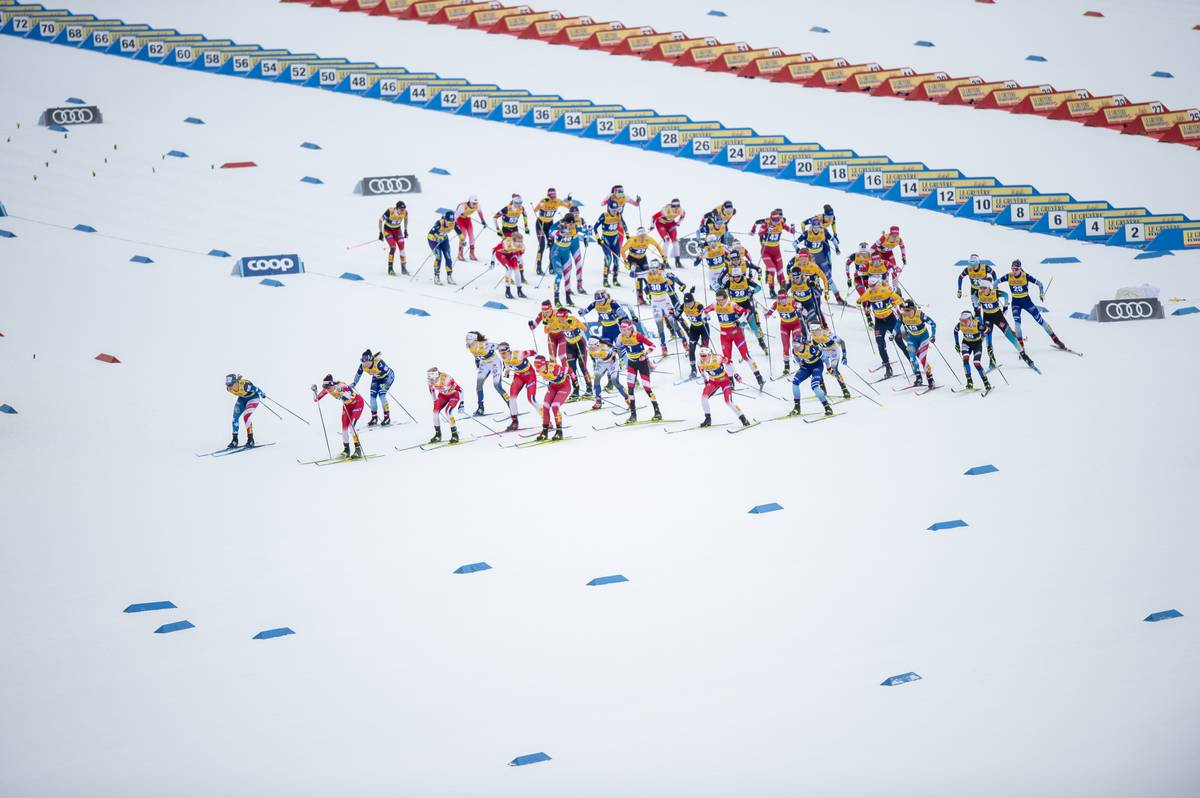
The sprint tracks featured the longest climb first, followed by a spiraling curve to send the women up the second climb. A sharp left turn and a roller brought the athletes back toward the stadium and into the final stretch. As the heats unfolded, this looked like a series of uphill sprints out of the track, some furious double poling, and some powerful cornering.
The profile of the sprint tracks in Falun, Sweden. (Photo: https://skidspelen.se/)
Of the Americans in the heats, Jessie Diggins was the top qualifier in 15th, with Rosie Brennan 20th and Sophie Caldwell Hamilton, back from her mid-season Vermont training camp, in 25th.
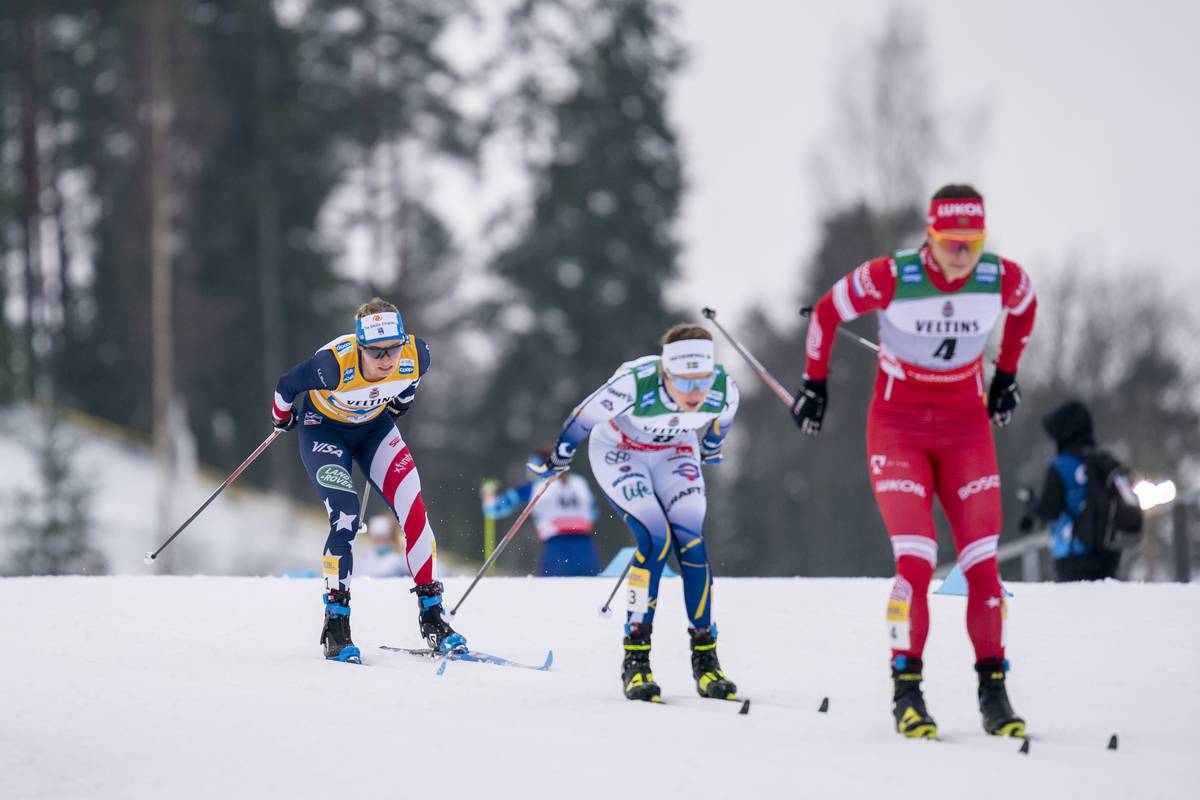
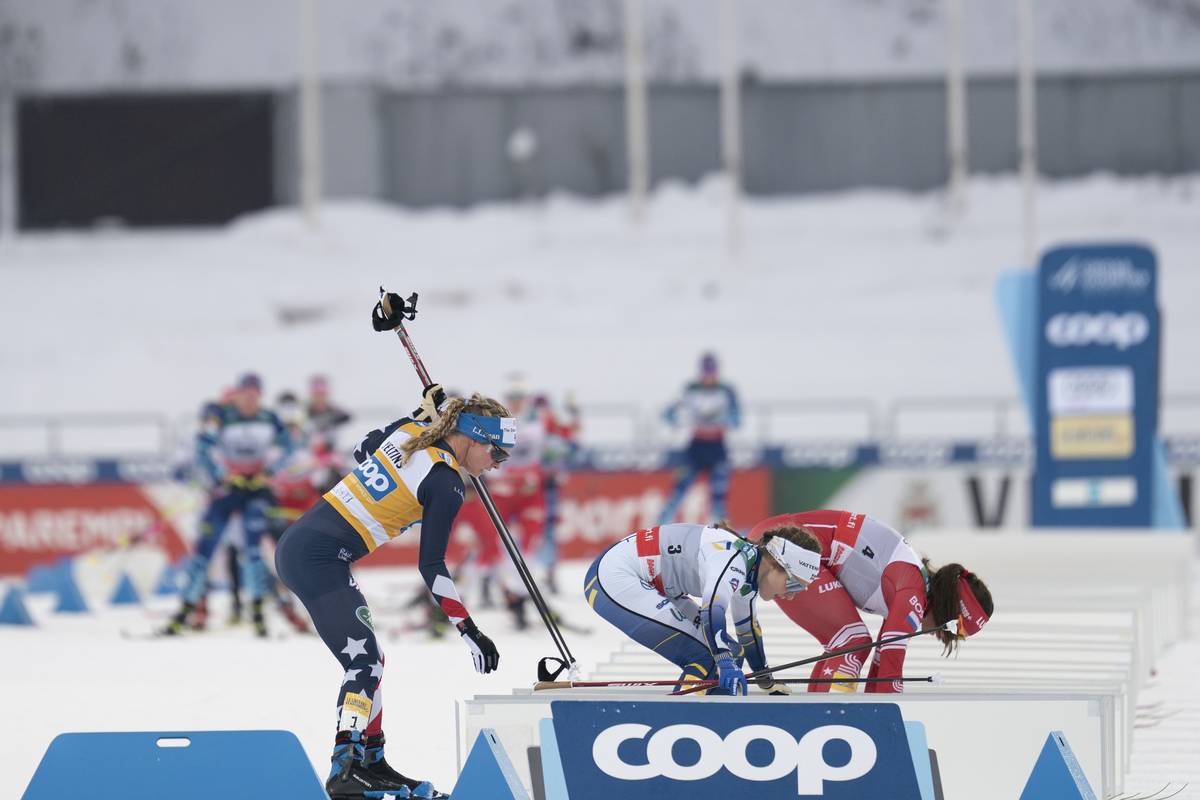
During the first heat of the quarters, Diggins looked confident in her tactics, sitting in the middle of the pack. Making assertive moves to seize optimal tracks, she swung wide in the final curve to set herself up to capitalize on her double pole as she sprinted her way from fourth to first. Diggins ceded time at the line to Sweden’s Linn Svahn to finish comfortably in second.
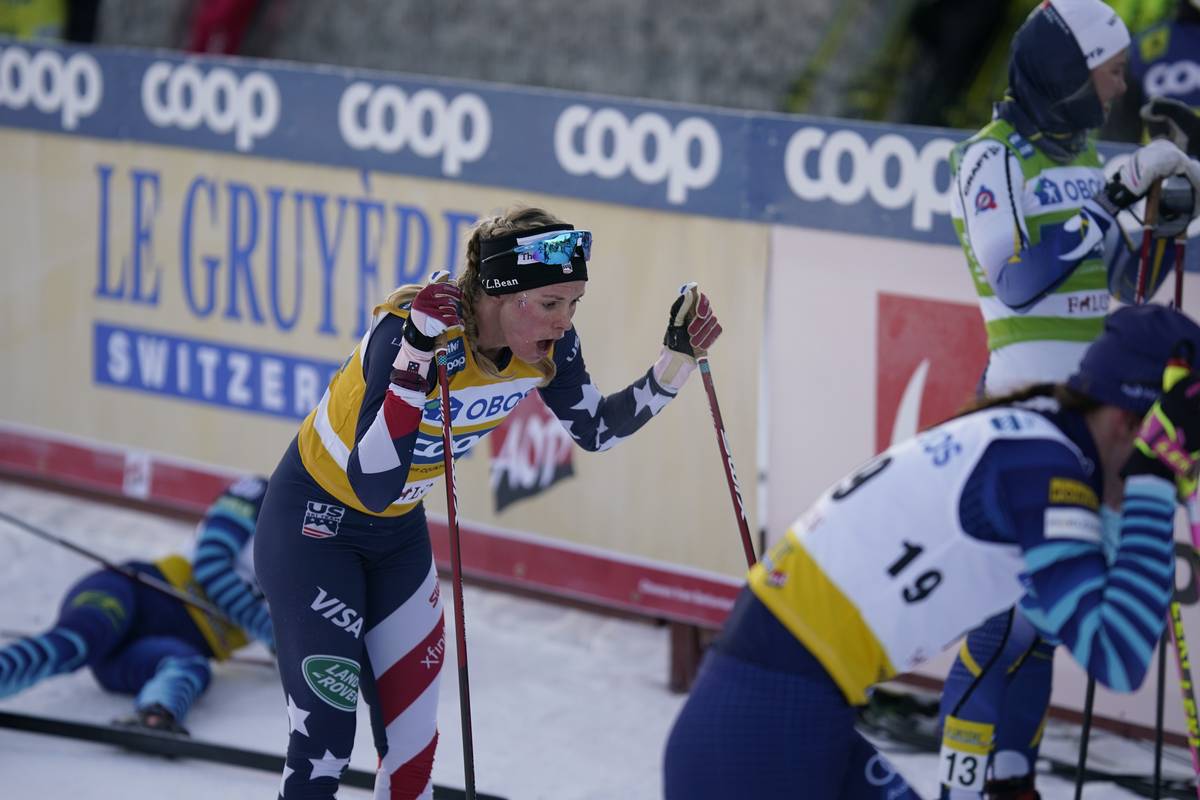
Jessie Diggins skis to 8th in the classic sprint in Falun, Sweden. (Photo: NordicFocus)
Racing in the first heat of the semis, Diggins looked to be employing a similar tactic of patiently waiting to pounce in the back half of the loop. Heading up the second climb in the 5th spot, she began to hammer, but by that time, Svahn and Norway’s Tiril Udnes Weng had created a small gap she could not close. Challenging Anna Dyvik of Sweden, Diggins powered over the final roller and worked her double pole, but was unable to make up any ground and finished 4th.
This ended Diggin’s day, putting her in 8th place overall.
“Whew, today was exhausting!” wrote Diggins after the race. “I think all the all-out efforts in the cold finally started to catch up to me, as I was definitely getting pretty tired in my semifinal. But I was really proud of how I skied today – especially in really tricky kicking conditions with steep hills and tracks that were deteriorating, and a ton of herringbone out there! It’s a very encouraging step forward in my classic technical skiing. We also had great skis which is always important!”
Advancing from the second heat of the semis, Slovenia’s Anamarija Lampic took the lead to pull the group through a fast heat. A few meters back, Sweden’s Jonna Sundling edged out Ane Appelkvist Stenseth and fellow Swede Hagström in a tight finish, which allowed all three women to advance to the final.
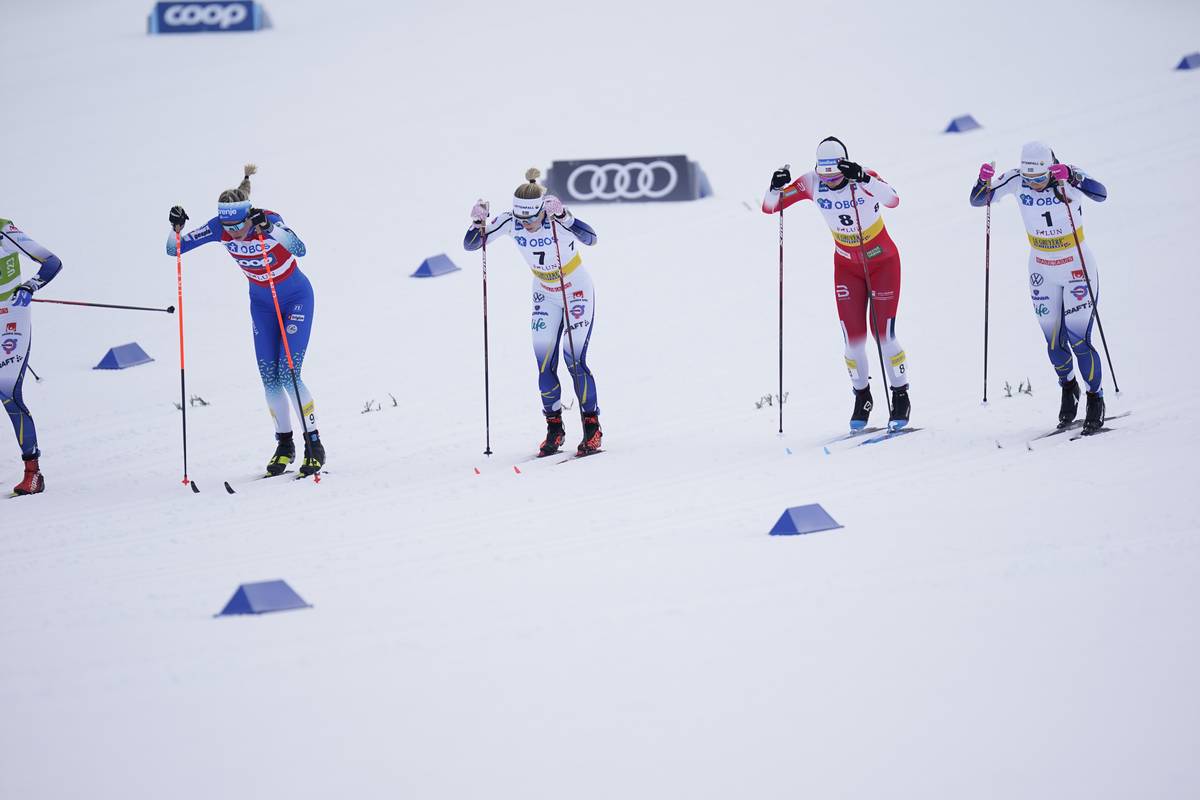
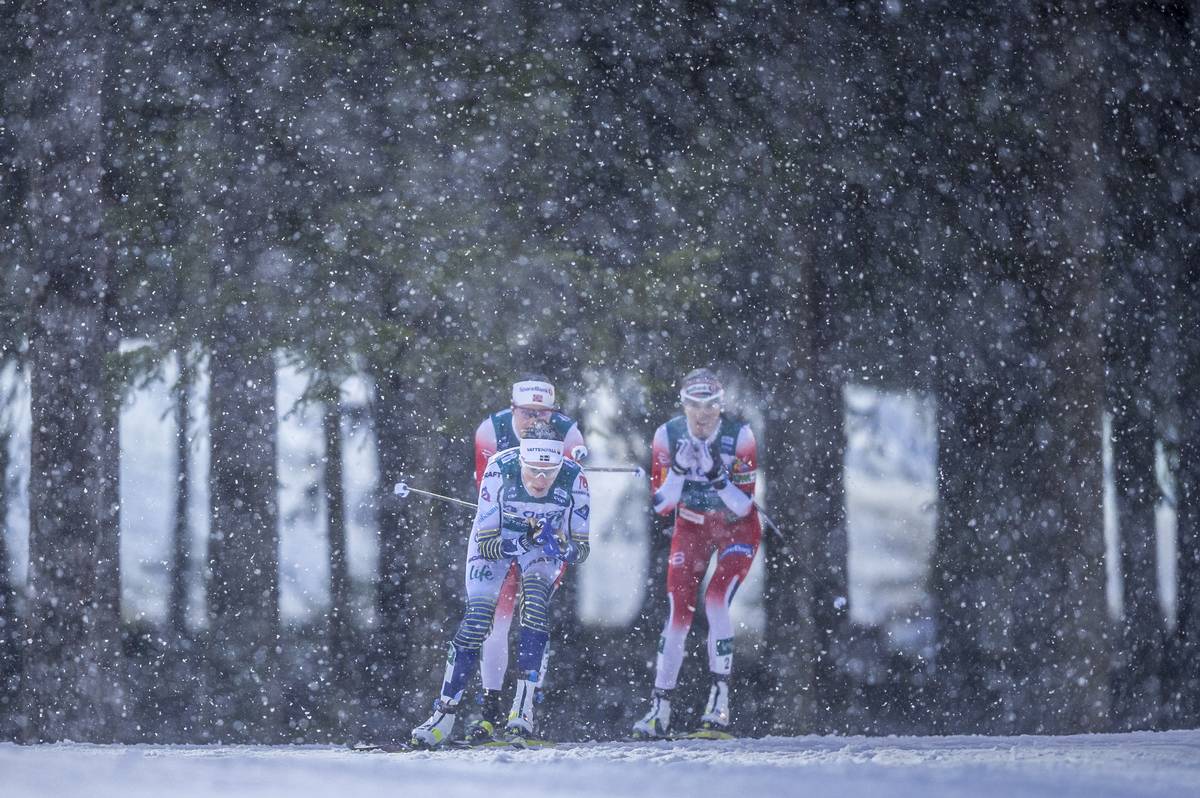
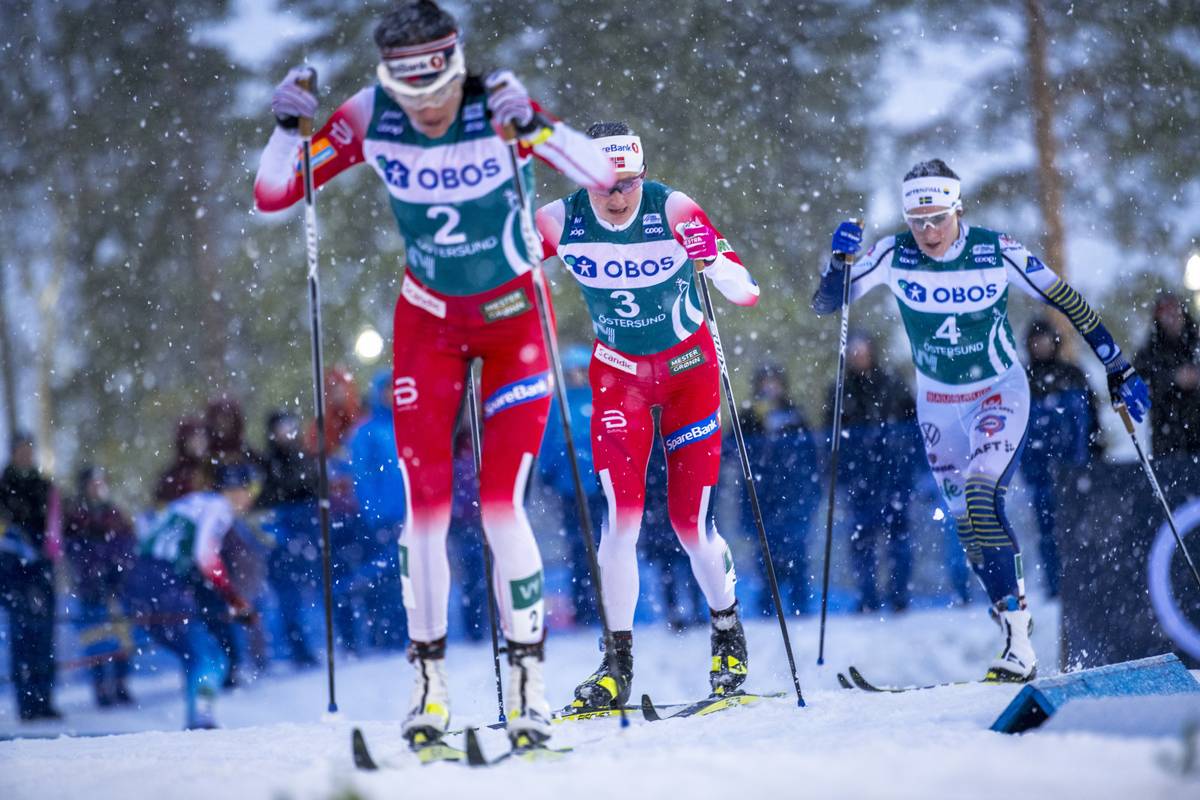
Poling in sync, the final round of the classic sprint in Falun takes to the tracks. (Photo: NordicFocus)
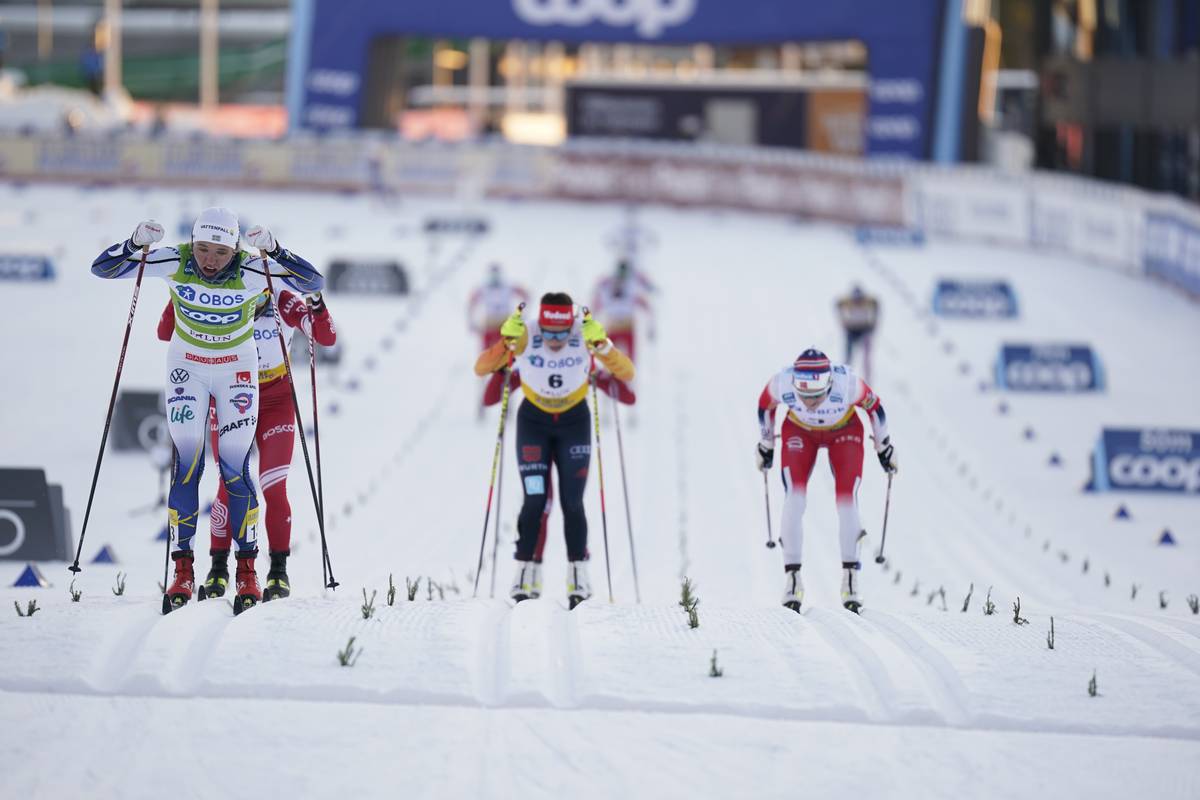
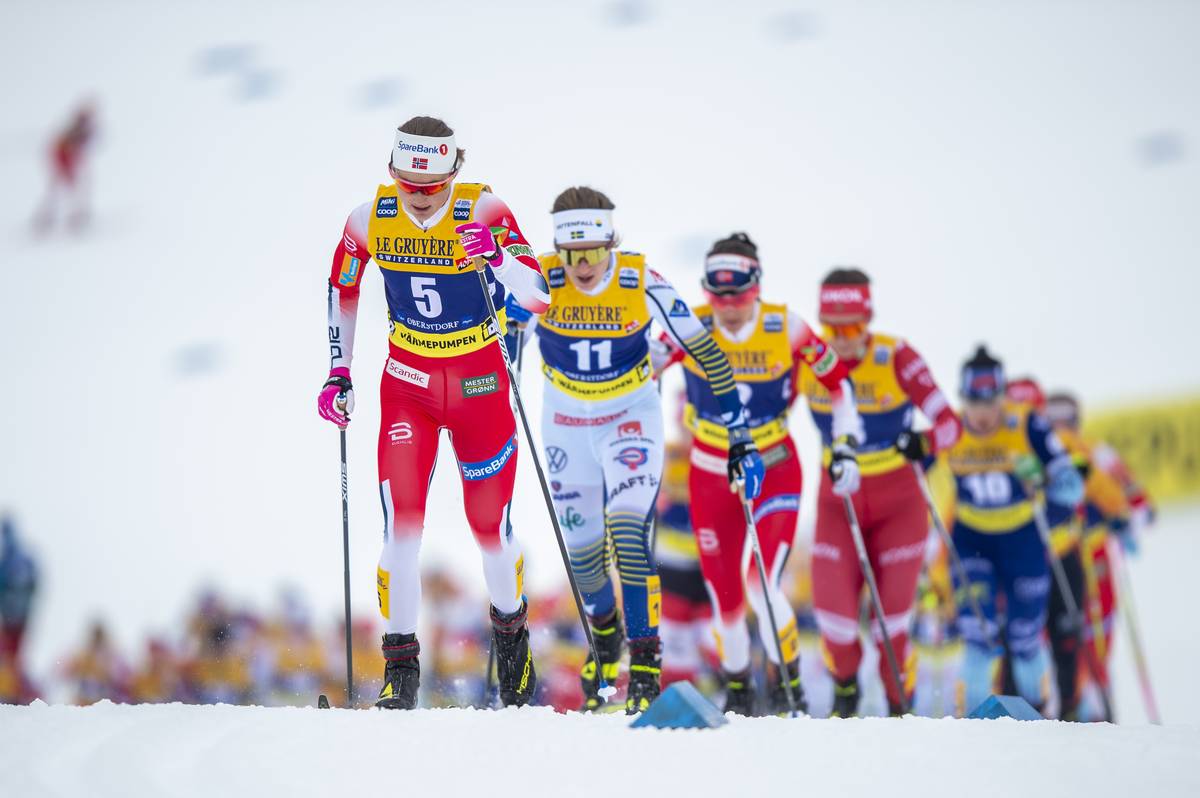
Let’s regroup. Three Swedes, two Norwegians, and one Slovenian in the final: Svahn, Sundling, Hagström of Sweden; Weng, Stenseth of Norway; and Lampic of Slovenia. The two semifinal leaders, Svahn and Lampic, pushed the pace from the front, up and over the two significant climbs. Sitting in a tuck to conserve energy for a final sprint over the roller and toward the lanes, Svahn was on the tails of Lampic, with Sundling just behind. The Swedes gained ground over the roller, setting up an exciting race down the finish lanes.
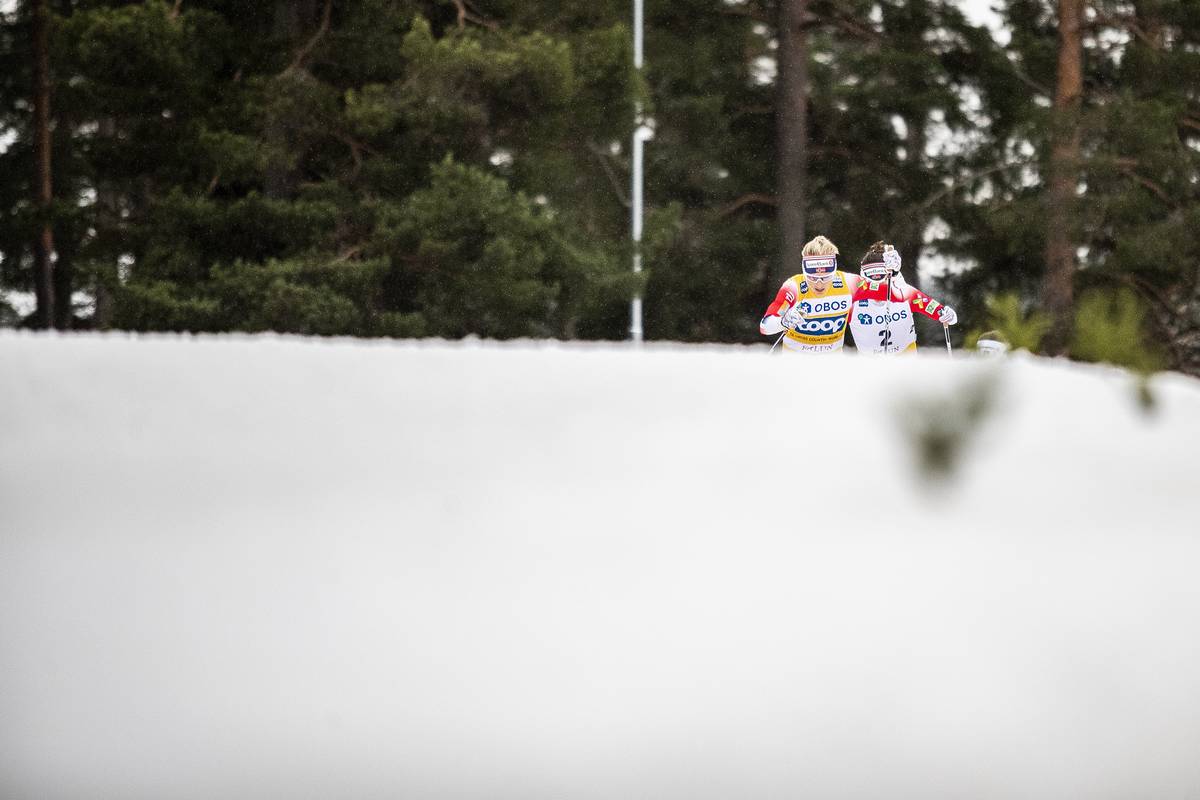
Anamarija Lampic and Linn Svahn push the pace during the final round of the classic sprint in Falun, Sweden. (Photo: NordicFocus)
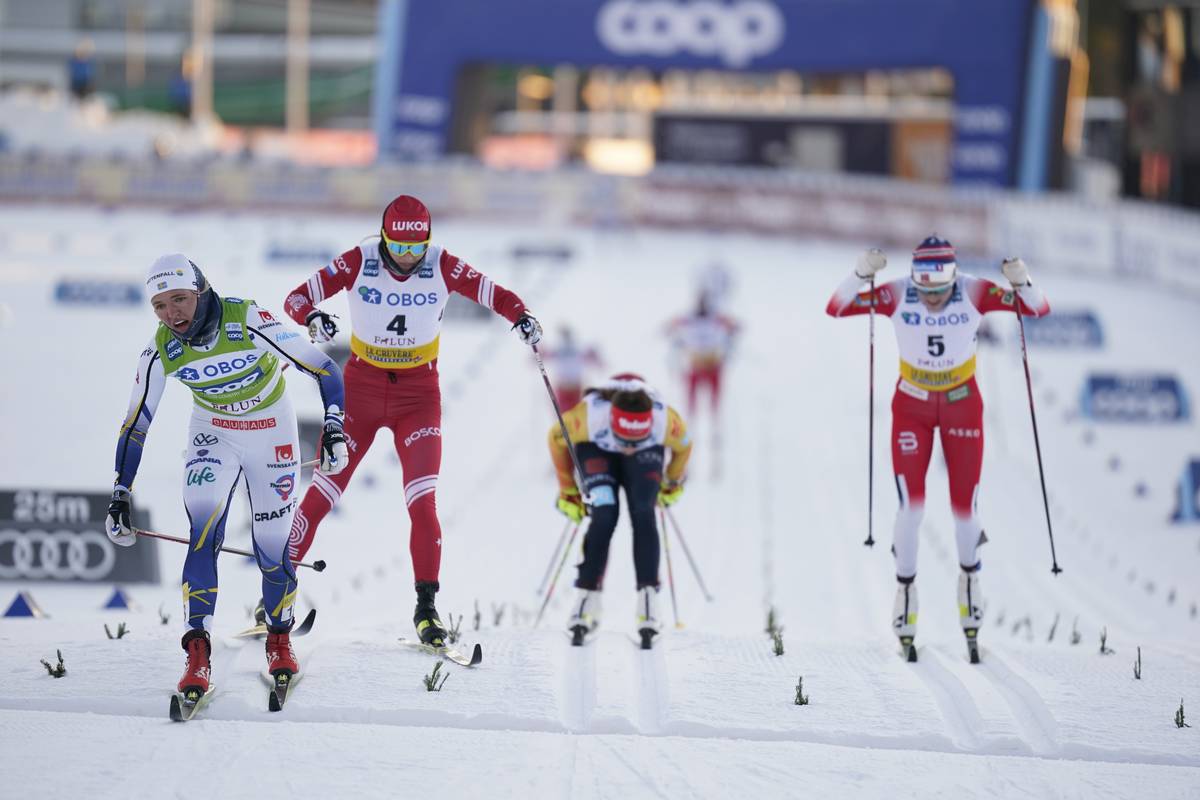
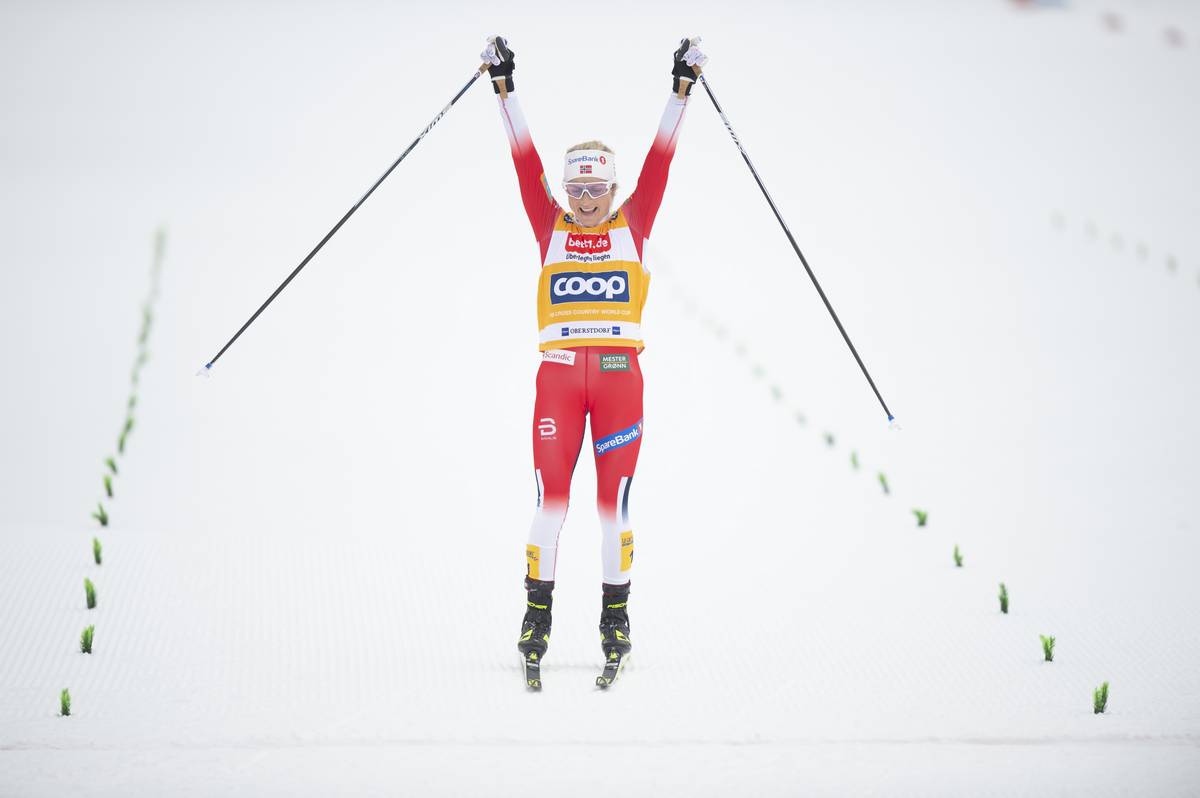
With the line just moments away, Svahn simply attacked the ground with her double pole, pulling ahead for a back-to-back win in Falun.
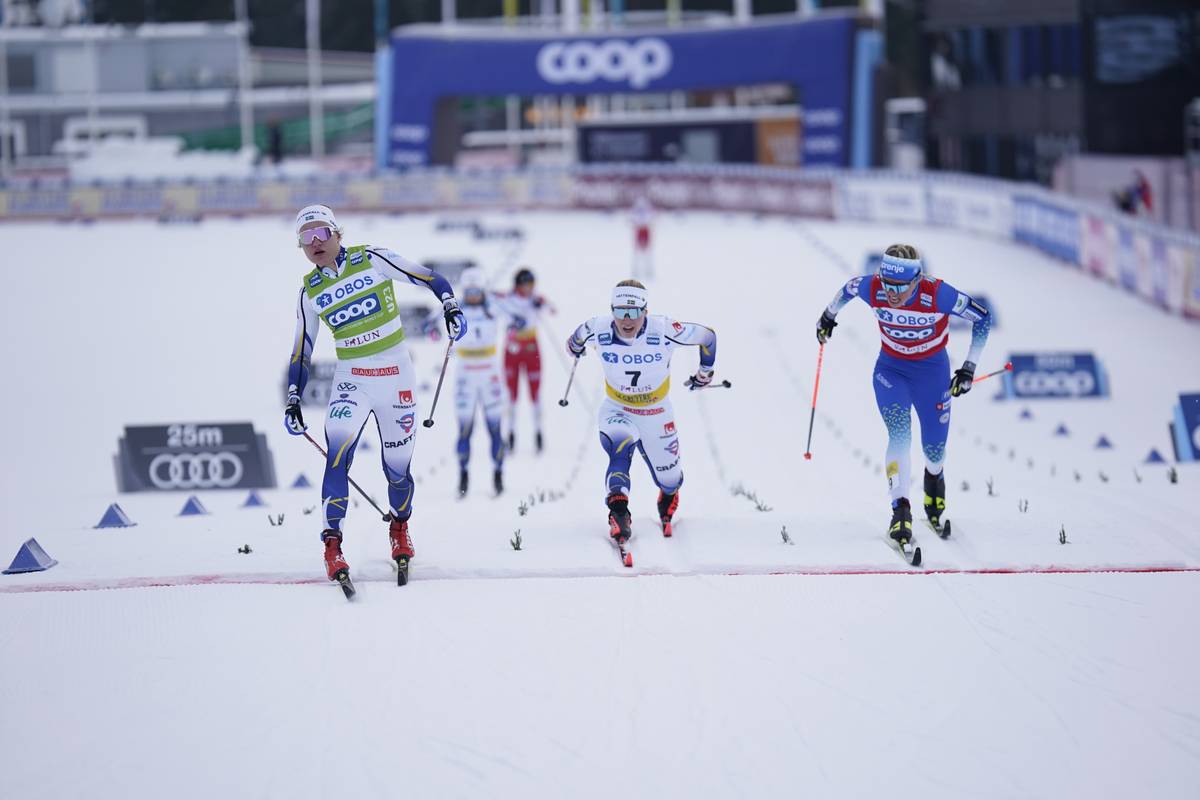
Just behind, Lampic and Sundling were virtually tied as they crossed the line in a photo finish. Though times were the same to the hundredth of a second, Lampic was declared second and Sundling third.
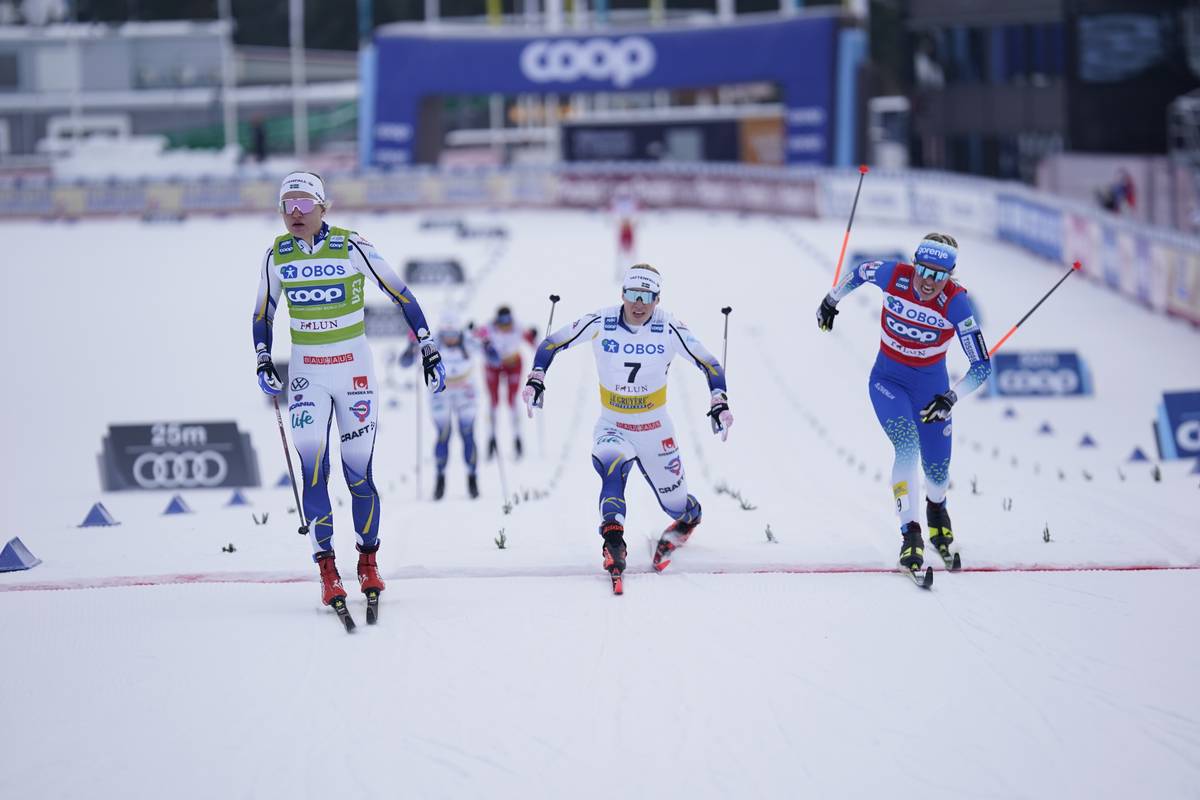
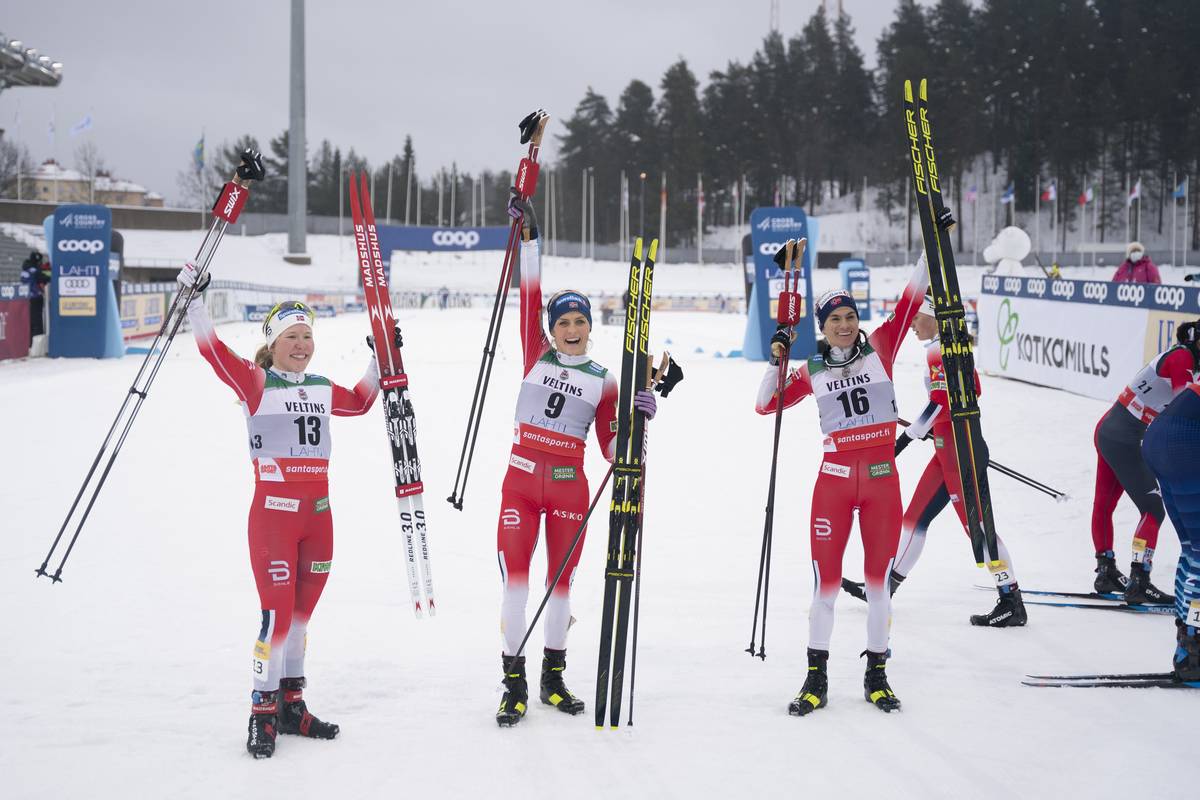
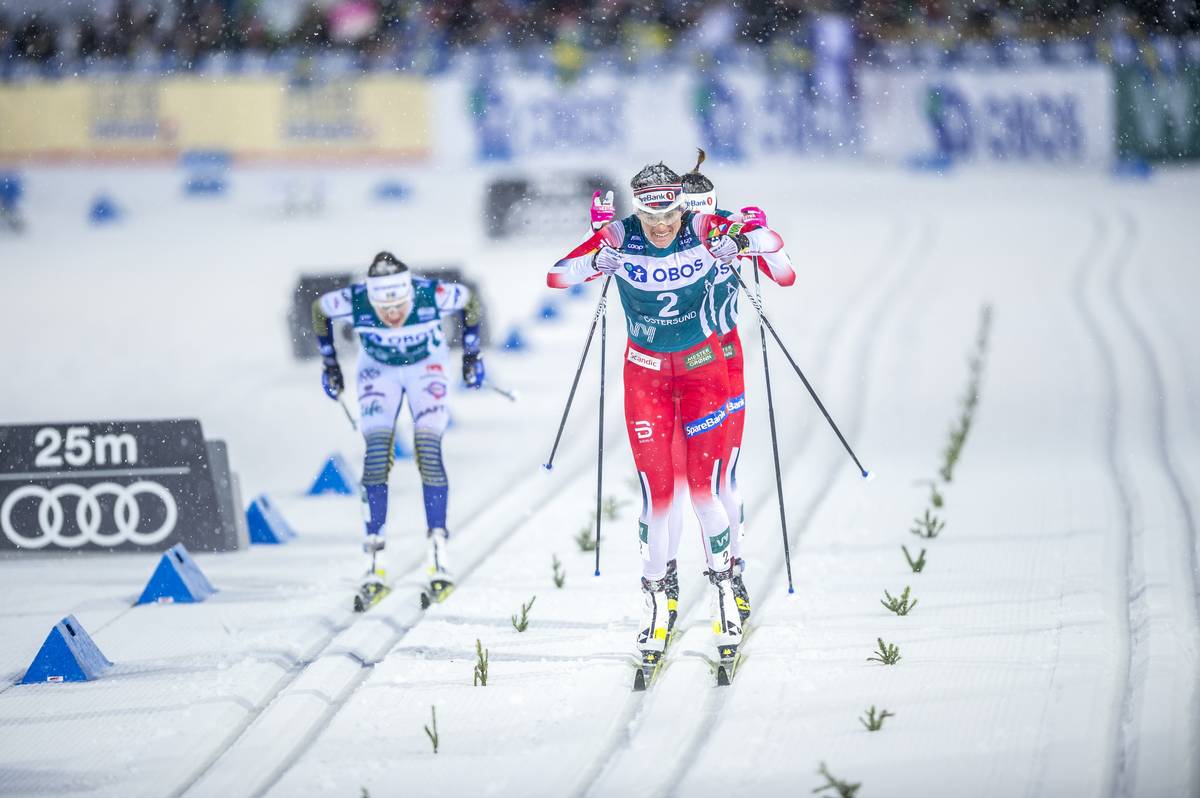
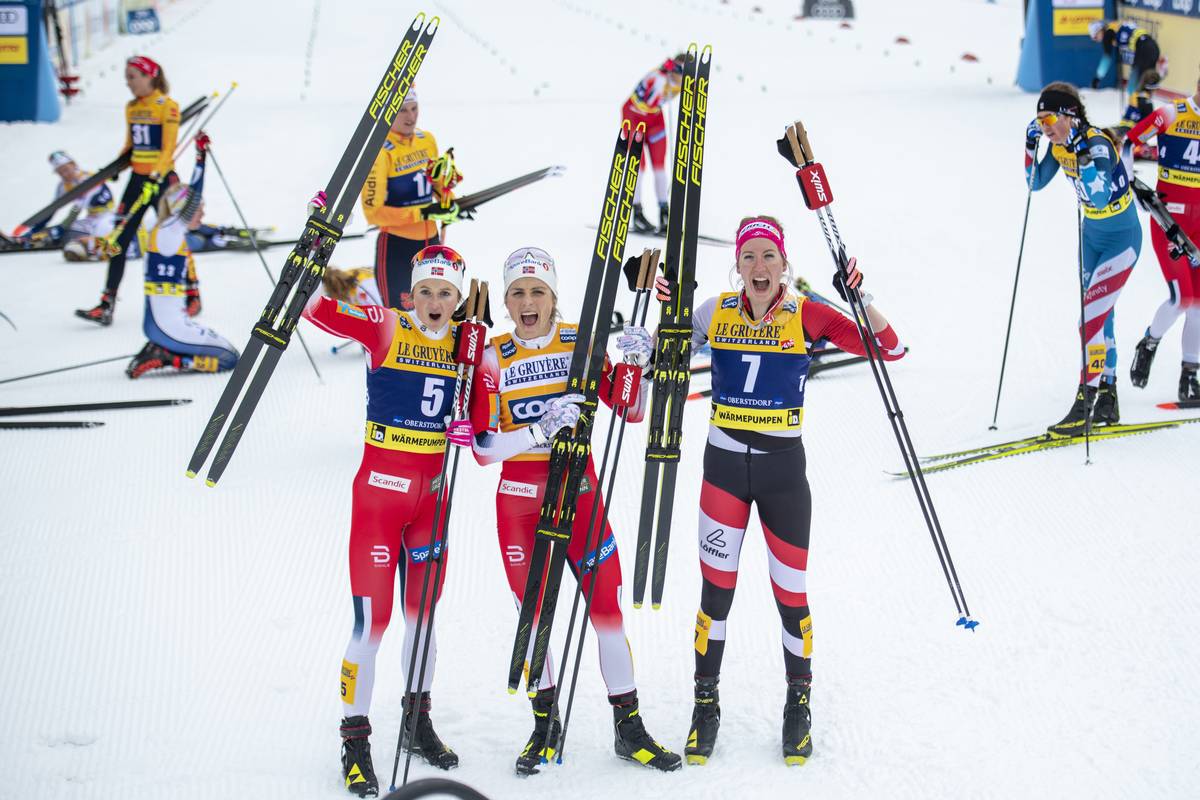
Linn Svahn takes back-to-back wins in Falun, while Anamarija Lampic and Jonna Sundling slide in for the remaining podium spots. (Photo: NordicFocus)Anamarija Lampic (SLO) edges out Jonna Sundling (SWE) for second place in the classic sprint in Falun, Sweden. (Photo: NordicFocus)
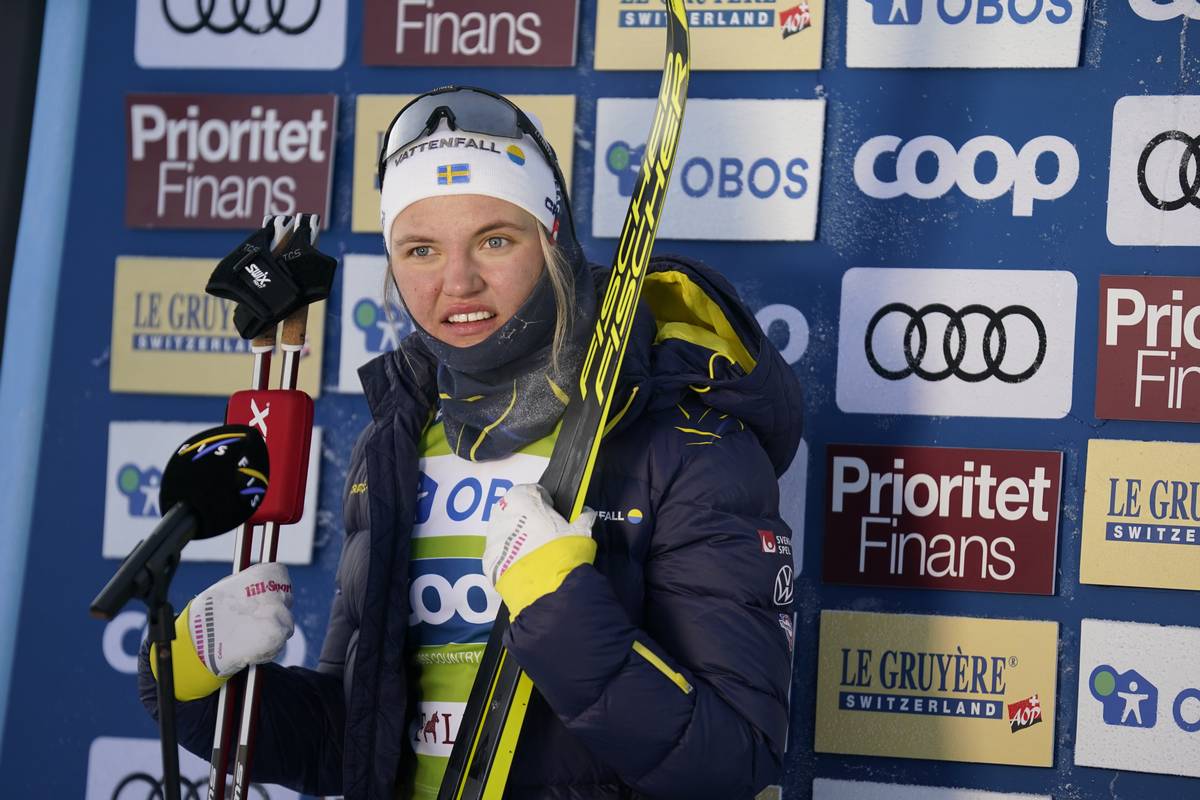
“I’ve been feeling a little bit tired since yesterday’s race, but it’s so fun to compete in Falun. I really enjoy racing on a home course, so it was a good day,” Svahn told FIS at the finish.
Despite her age, this is 21-year-old Svahn’s 7th individual win in a World Cup sprint, split almost equally between skate and classic. It is also her second consecutive classic sprint victory on the Falun tracks, as she stood atop the podium in February 2020, also alongside Sundling third place.
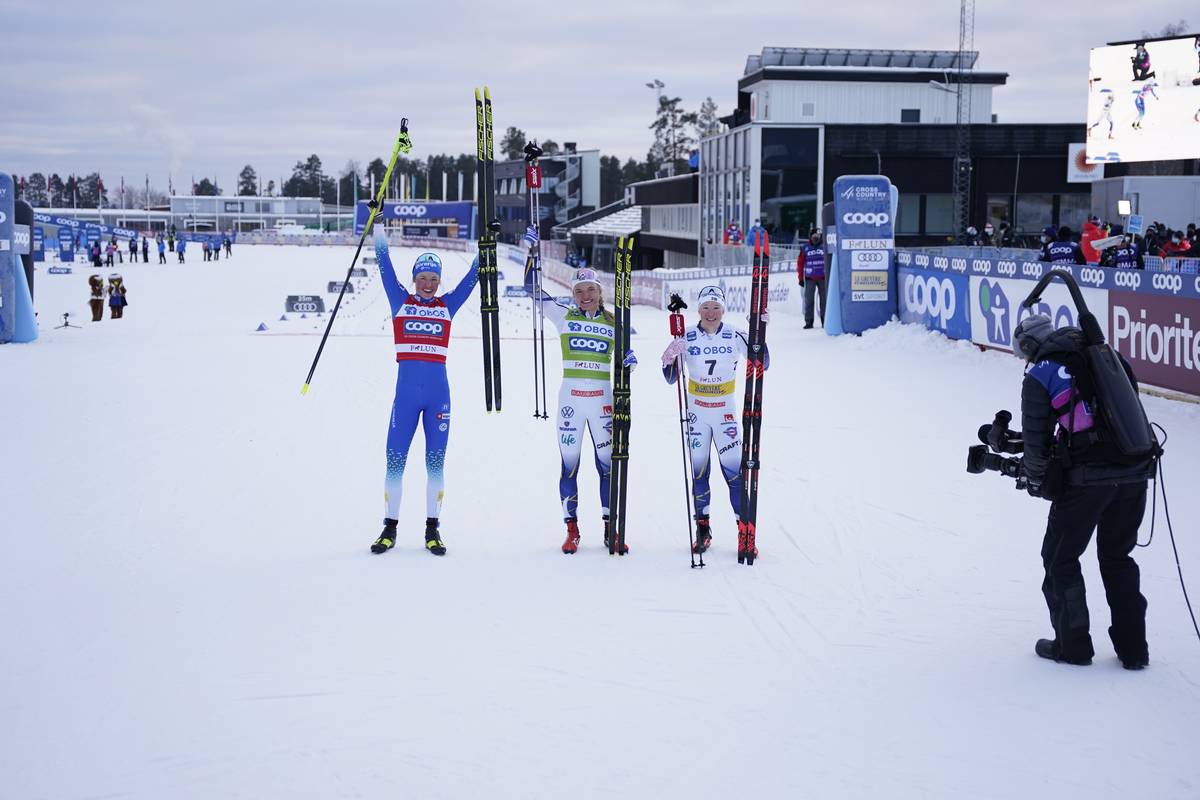
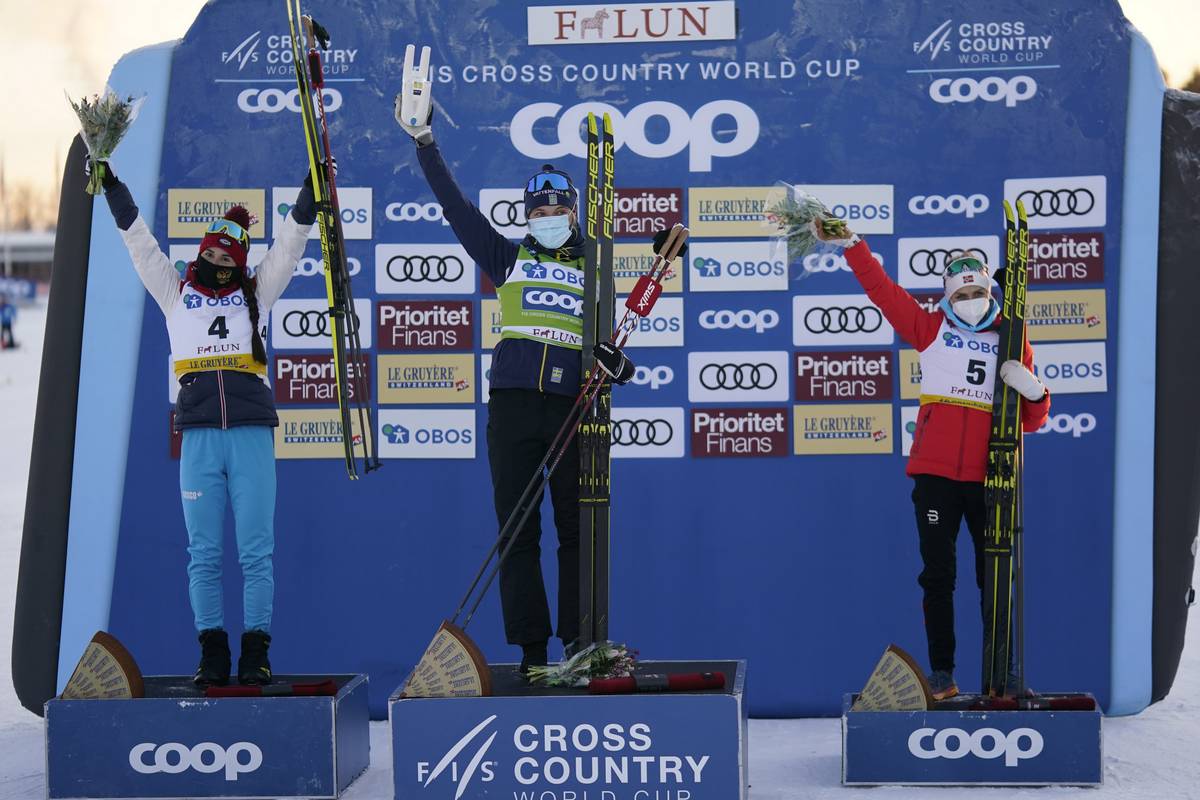
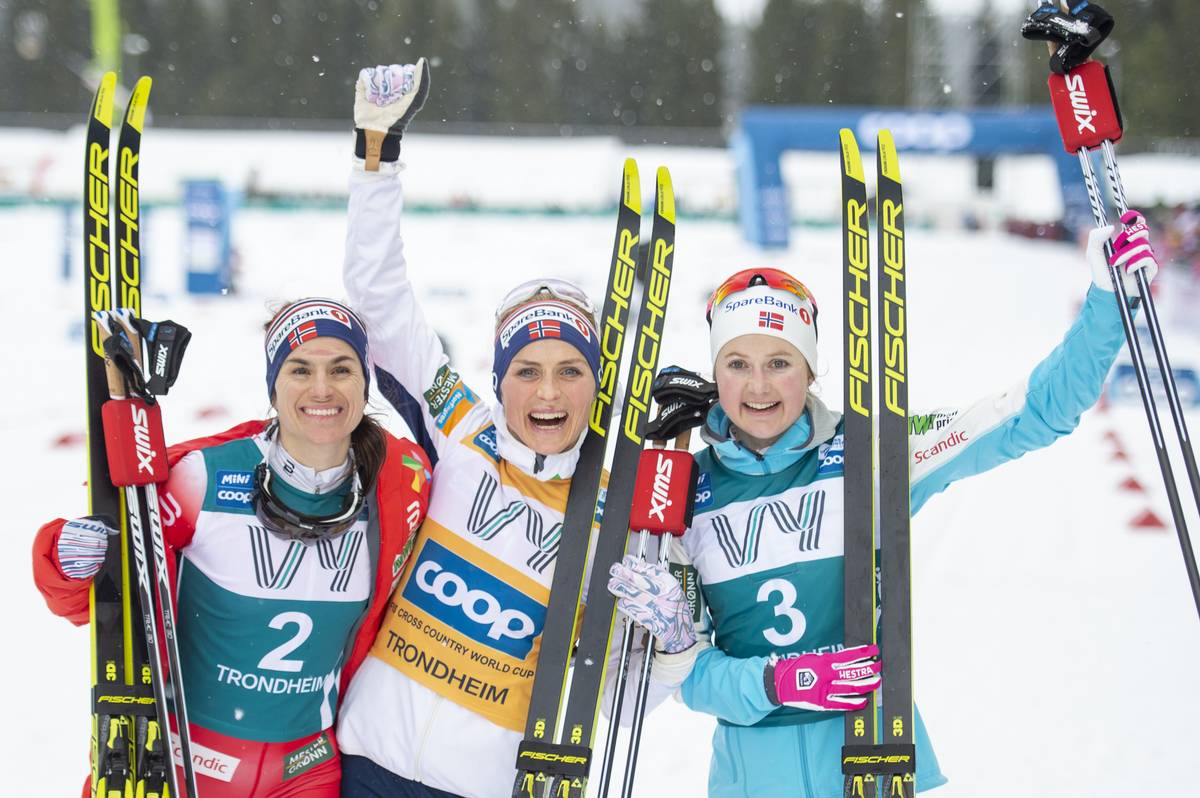
The women’s classic sprint podium in Falun. Linn Svahn nailed her second consecutive win on the course, with Anamarija Lampic (SLO) second, and Jonna Sundling (SWE) third. (Photo: NordicFocus)
Svahn was also asked about the close finish and whether she was sure of her win in the moment.
“I’m never sure of a victory until I pass the finish line first, but it’s cool to see how many strong girls we are competing in sprint races. I think the levels are really high now and it’s tough to win each race, but I’m really glad I managed to do that today, especially in a classic sprint, because it’s my goal this year.”
Looking back, Brennan raced in heat 4 of the quarter finals, where she finished 4th, unable to advance. This left Brennan in 19th overall.
Powering uphill, Rosie Brennan skis her way to 4th in her quarterfinal in Falun, Sweden. (Photo: NordicFocus)
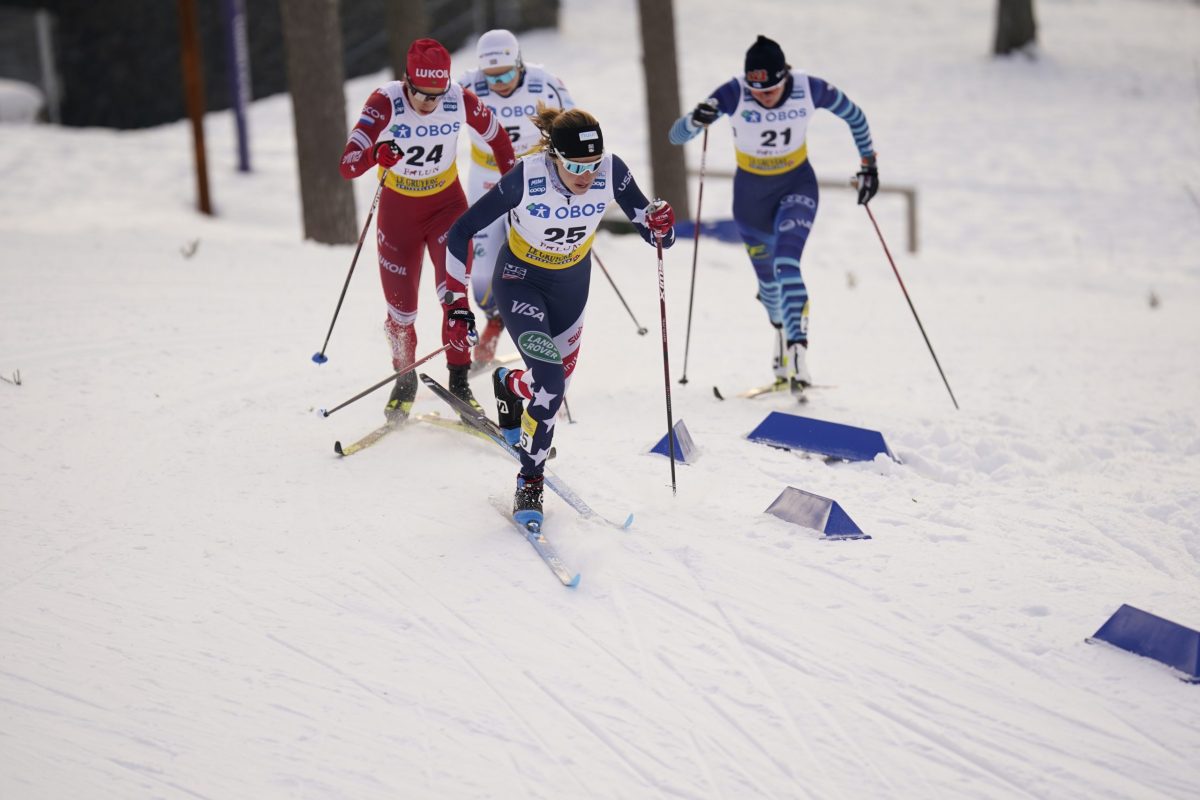
After a conservative start, Caldwell Hamilton skied her way into 2nd position at the top of the intermediate climb. Looking strong as she transitioned from double pole into diagonal stride over the last roller, she held her position around the final curve and into the finish lanes. Swinging around her and quickly closing the gap with her double pole, Sweden’s Hanna Falk overtook the American in the final meters. As the second heat ended up the fastest, Caldwell Hamilton was not able to advance and ended her day in 16th.
“Today was a really solid race for me,” wrote Caldwell Hamilton in a post-race email. “It wasn’t my best, but it was my first time skiing the heats in a classic sprint this year (actually probably in 11 months) and after a qualifier that felt so-so, I was happy with how I skied my quarter. Falun is a very tough course with some big climbs and technical downhills, but I like those features in a classic course.”
Sophie Caldwell Hamilton crests the intermediate climb on the sprint tracks in Falun, Sweden. (Photo: NordicFocus)
“After the first few races of the tour, I took the opportunity to spend a few weeks at home in Vermont during a time where I wouldn’t be missing many sprints,” Caldwell Hamilton continued. “It was such a nice break and I had skiing at the nordic center our neighbors own, Wild Wings, that I could ski to from my house, so I was a pretty happy camper to just spend some time at home doing some solid training and taking a break from the World Cup scene. Now I feel mentally and physically recharged and ready to take on the last couple months of the season! My qualifier today felt a little like I hadn’t done an effort like that in awhile, but I think every race effort will help make that feel a little more normal.”
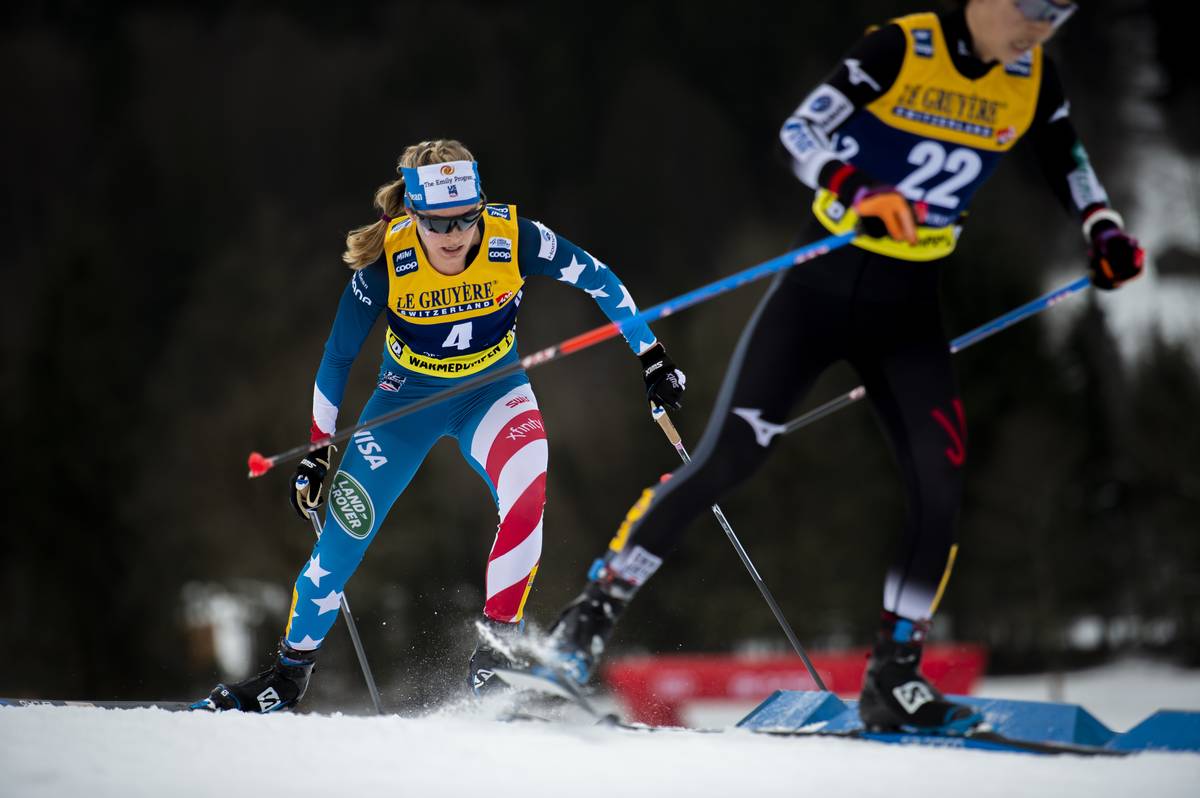
Jessie Diggins and Canada’s Katherine Stewart-Jones (bib 29) climb side by side during the first heat of the quarterfinals in the classic sprint in Falun, Sweden. (Photo: NordicFocus)
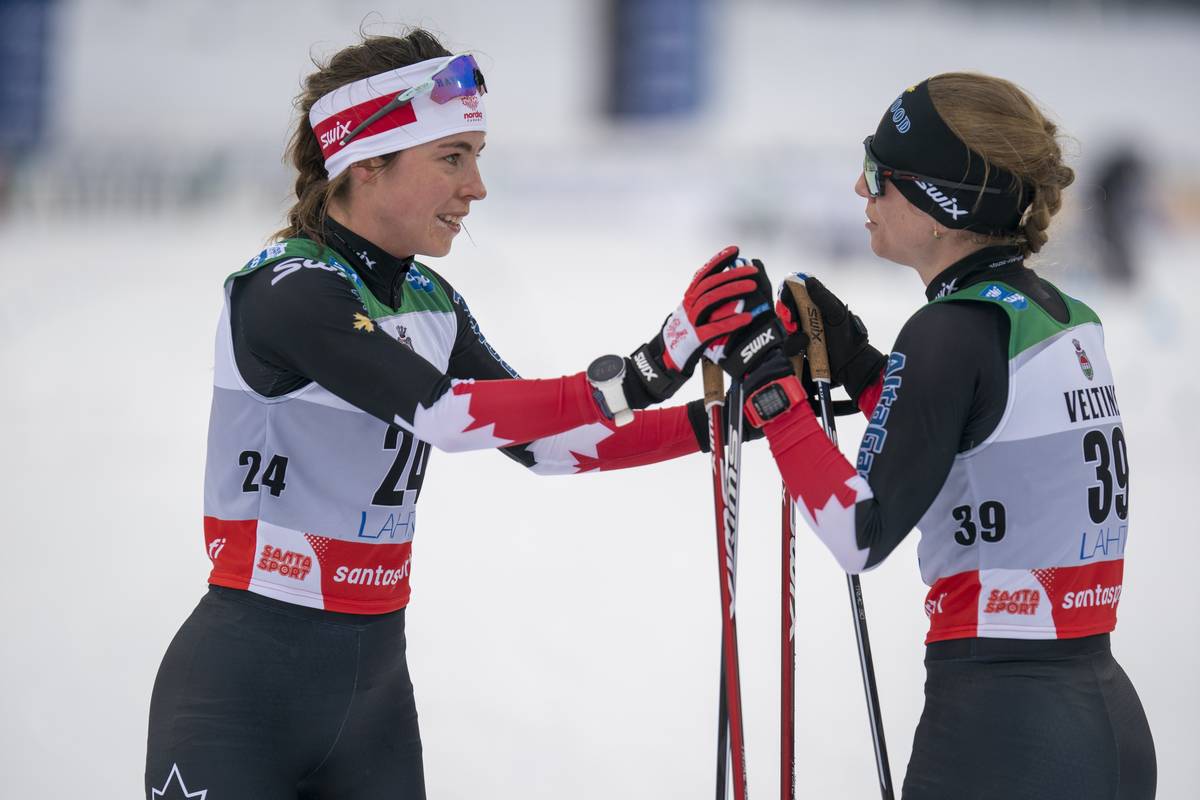
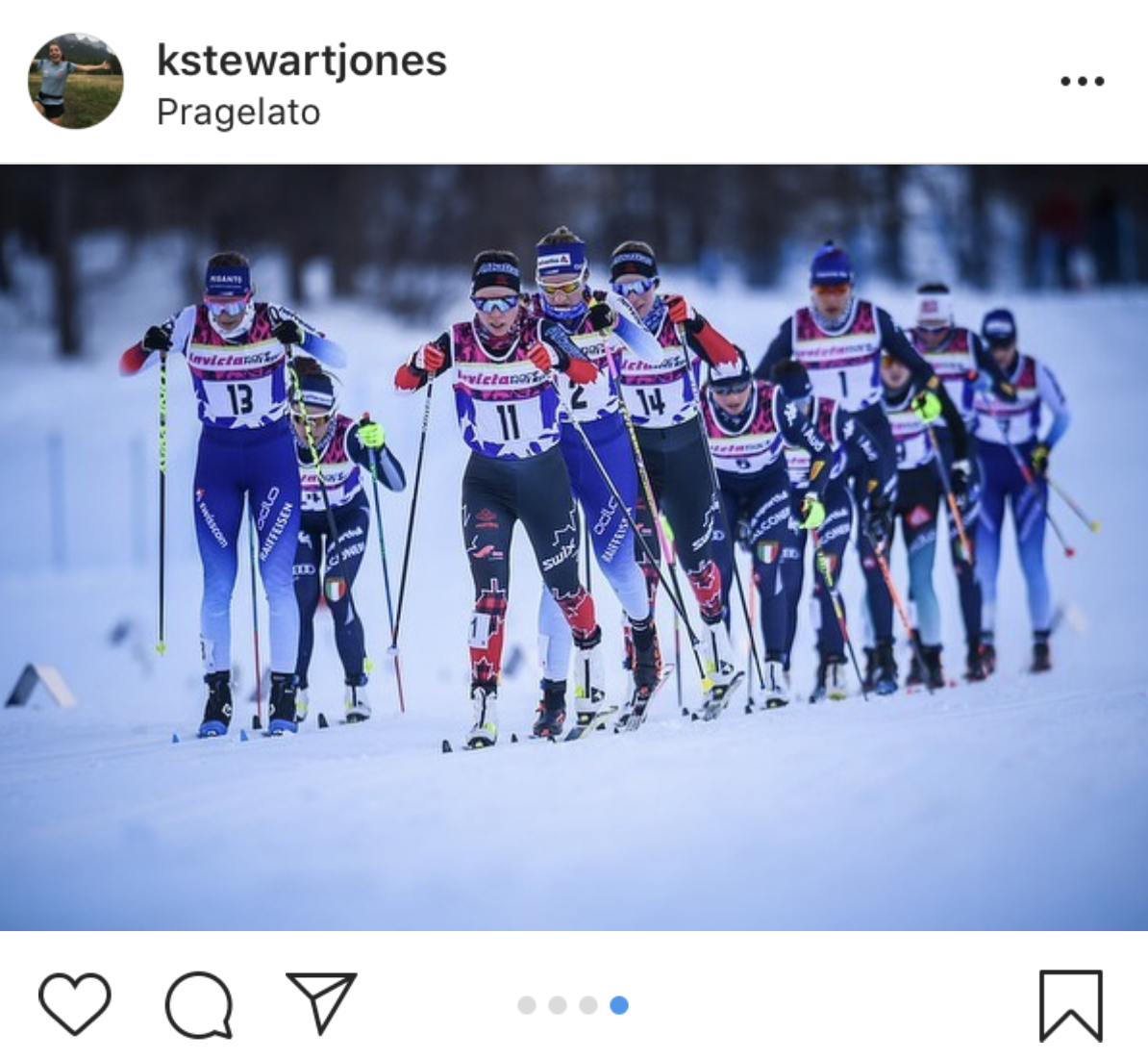
After qualifying in 29th, Canada’s Katherine Stewart-Jones landed in the first heat of the quarterfinals with Diggins. Stewart-Jones held strong with the lead group through the second climb, but fell off the pace to finish last in the heat, just behind Norway’s Anna Svendsen. Stewart-Jones was 30th in the final results.
Outside the rounds, Julia Kern qualified in 35th (+12.95), Hannah Halvorsen 56th (+22.59), and Alayna Sonnesyn 65th (+30.2).
Maya Macisaac-Jones (CAN) races to 54th in the qualifier of the Falun, Sweden classic sprint. (Photo: NordicFocus)
Racing for Canada, Dahria Beatty qualified 48th (+17.29), Maya Macisaac-Jones 54th (+21.77), and Laura Leclair 58th (+24.77).
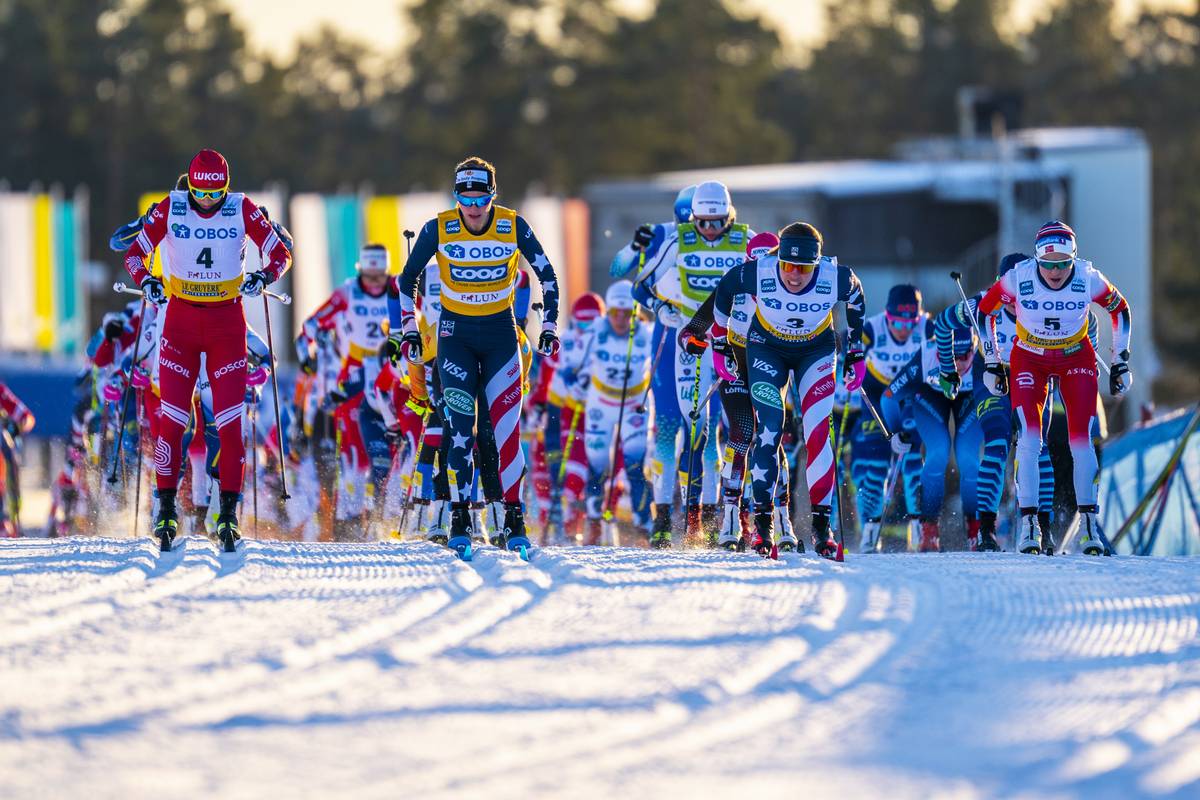
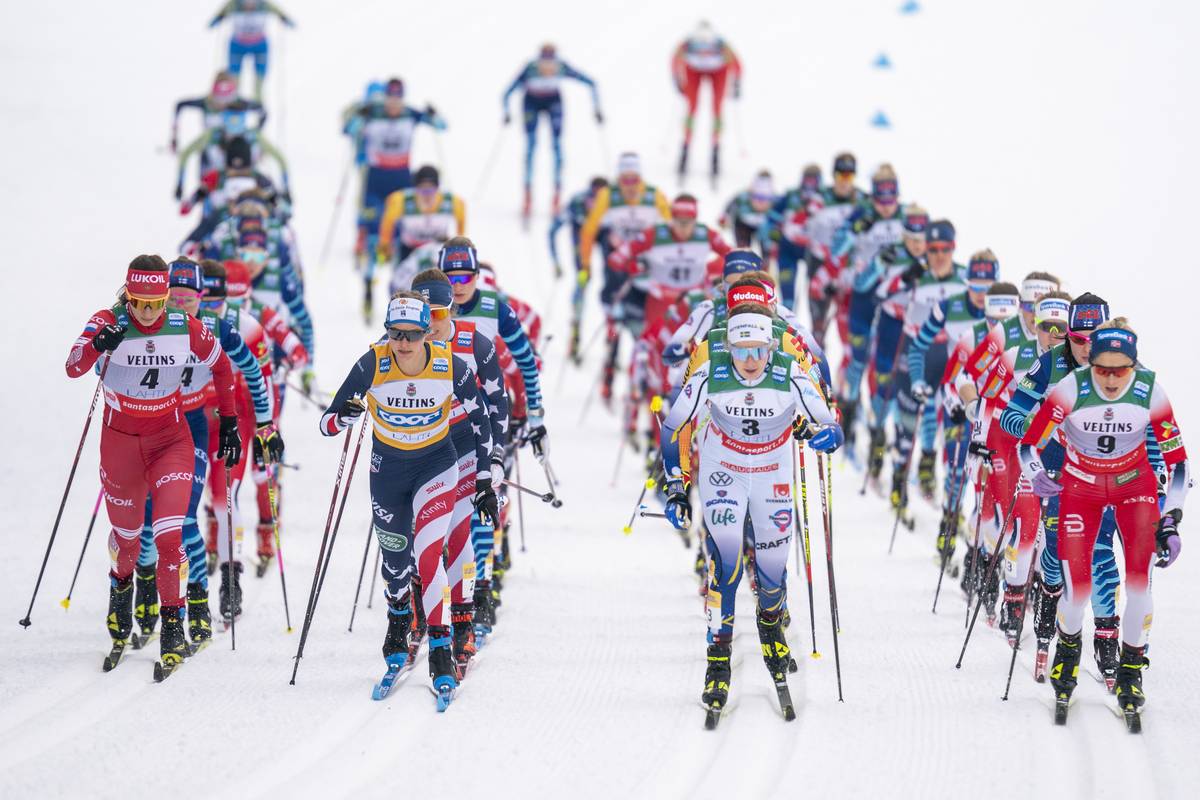
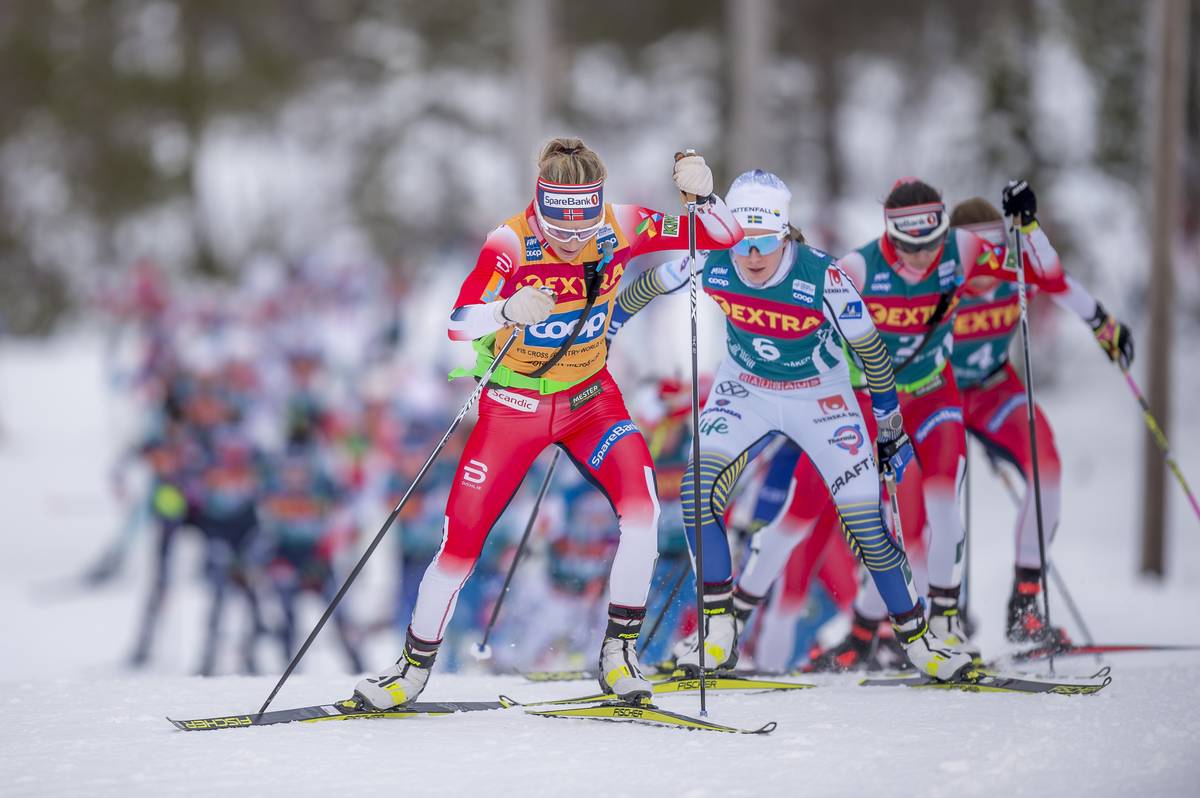
Jessie Diggins (yellow bib) strides amidst a pack of contenders during the 10 k mass start classic in Falun, Sweden. (Photo: NordicFocus)
This World Cup coverage is made possible through the generous support of Marty and Kathy Hall and their A Hall Mark of Excellence Award. To learn more about A Hall Mark of Excellence Award or to learn how you can support FasterSkier’s coverage please contact info@fasterskier.com.
In case you missed it, yesterday’s 10-kilometer skate in Falun, Sweden was a standout day for the Americans, highlighted by a gutsy victory by Jessie Diggins. How deep into the well Diggins explored was evident in her writhing and occasionally dry heaving body at the finish as she regained enough oxygen and composure to stagger to the leader chair. She upset the prolific Norwegian distance champion Therese Johaug, whose 66 World Cup distance victories both garner immense respect and some frustrated “She won again…” comments from non-Norwegian followers.
But the story does not end there. Rosie Brennan skied to 8th and Sadie Maubet Bjornsen landed in 10th in her first World Cup race of the season. Three in the top 10 in a full field hungry to to prove their mettle before World Championship selections are solidified. Not a bad day in the office.
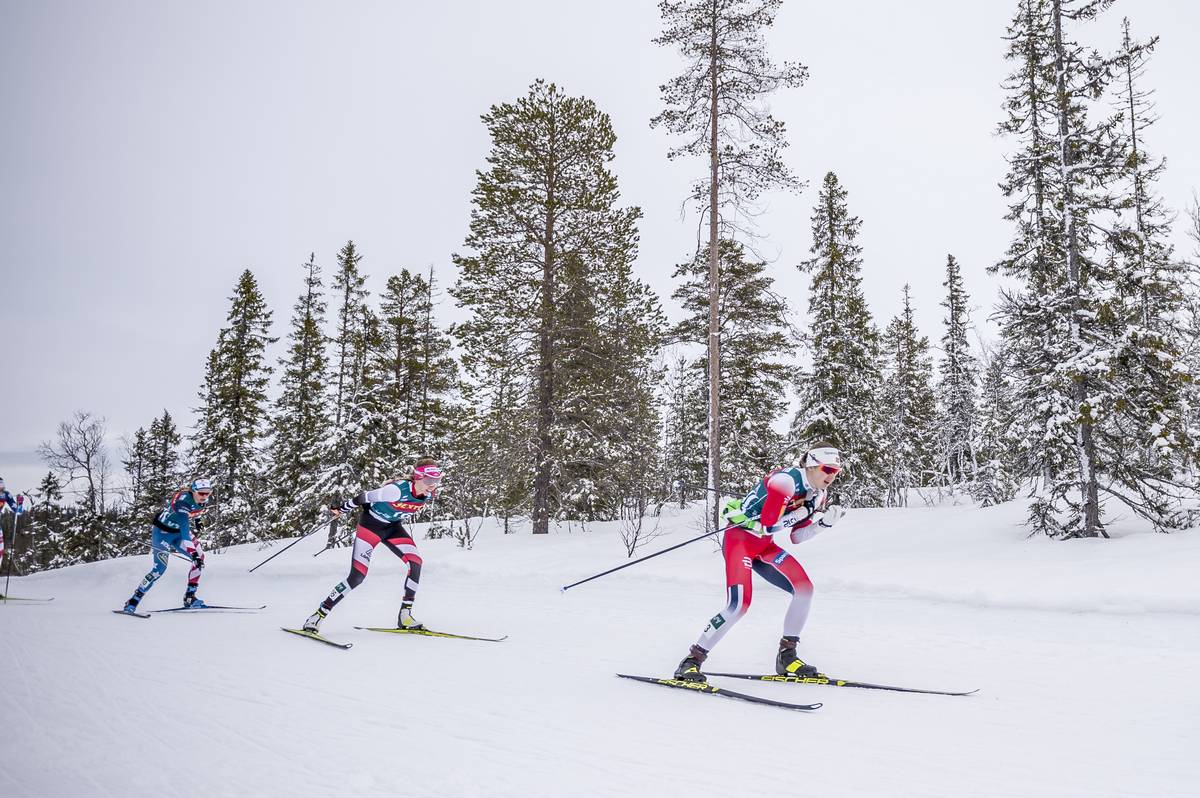
On the front lines, Jessie Diggins (left) and Rosie Brennan (right) take to the course during the 10 k mass start classic in Falun, Sweden. (Photo: NordicFocus)
In today’s 10 k mass start classic, the excitement builds a little differently. Versus a drawn out rise in excitement as the splits of the seeded group fly by the various checkpoints, today was head-to-head, with all eyes on what Johaug’s rebuttal would be and how the American’s (and Swedes and Russians and the remaining Norwegians, for that matter) would respond.
Mass start and classic technique, in which Johaug excels. Conversely, Diggins’ has struggled to achieve the same results in classic as skate, though she has displayed marked progress this season.
Jessie Diggins watches her finish time hold up against distance champion Therese Johaug in the 10 k skate in Falun, SWE. (Photo: NordicFocus)
In a pre-race interview, FIS phrased the question to Diggins as this. “What are you in for today?”
“Oh boy! [It’s] a very different race!” she laughed. “I’m very excited to give it my all. All you can give on race day is your own effort. I’m looking forward to crossing that finish line knowing I gave it everything I had. For me, if I can do that, then it was a good day.”
Awaiting the gun to send them off, the athletes quietly slid back and forth in the squeaky frozen tracks, keeping nerves at bay and blood flowing in the single digit Fahrenheit temps. Skiers familiar with an outing in such conditions understand the sounds that go along with these conditions. The cacophonous start sounded like a lightsaber battle.
Germany’s Katharina Hennig (center) chases Therese Johaug (NOR) with Ebba Andersson (SWE) in pursuit. (Photo: NordicFocus)
It was clear early that Johaug and her teammate Heidi Weng wanted to push the pace. They attempted to pull away from the group in the opening kilometers creating a small gap. But in the first downhill back toward the stadium, Diggins gave them something to worry about. Her skis like rockets, she overtook them in the descent, slingshotting around the curve and into the lead as they lapped through the stadium.
In fact, no one could break away. Not even the breakaway specialist Johaug. At the 5 k mark, the top-10 skiers were separated by less than two seconds, with Diggins sitting fifth, smack in the middle.
Left to right, Heidi Weng (NOR), Jessie Diggins, and Frida Karlsson (SWE) stride toward the finish of the 10 k classic in Falun, Sweden. (Photo: NordicFocus)
After a sprint bonus point opportunity at 5.8 k, which was narrowly snagged by Johaug over Sweden’s Ebba Andersson, the pace began to accelerate. At roughly the 6.5-kilometer mark, Johaug began her surge, creating a new gap of a couple seconds by the subsequent top of the climb. But the slinky phenomenon repeated itself, as Andersson, Linn Svahn, Katharina Hennig, and Weng closed the gap on the descent to the stadium. Diggins fought hard to maintain contact, tucked in behind Sweden’s Frida Karlsson just behind the leaders with a train of chasers close on their tails.
With 1 k of downhill and fast terrain to go, this pack was still tight, Svahn and Hennig pushing from the front. An ill-timed crash on a downhill curve took Anderson, who had been in 4th, out of contention, but one could not look away as five remaining women flew toward the finish.
Hammering the uphills, Johaug crested the final sustained climb in the lead, tucking as she pushed into the final sweeping downhill. Svahn stayed tight in the corner, hugging the v-board and capitalizing on her fast skis to sneak by Johaug on the inside. The Swede held herself less than a ski-length ahead of Johaug over the final rollers and into the finish lanes. At that point, it was all over; Johaug was no match for the sprint star’s closing speed.
Linn Svahn (SWE), Katharina Hennig (GER), Therese Johaug (NOR), (l-r) closing down on the finish line on Saturday. (Photo: NordicFocus)Linn Svahn (SWE), Yulia Stupak (RUS), Katharina Hennig (GER), Therese Johaug (NOR), (l-r) poling in for a tight finish. (Photo: NordicFocus)
Poles whipping in double pole fury, Svahn held her ground at the front to stop the clock at 25:57.1. Meanwhile, Russia’s Yulia Stupak sprinted past Johaug in the final meters to take second (+0.4), while Hennig forced the final podium position to be decided by photo. It was determined that Johaug held onto third (+0.9).
The women’s 10 k mass start classic podium: Yulia Stupak (RUS) second, Linn Svahn (SWE) first, and Therese Johaug (NOR) third (l-r). (Photo: NordicFocus)
“I was really looking forward to competing because I’ve been home since the Tour de Ski and I felt pretty strong the last week,” Svahn told FIS after the race. “I just tried to keep my focus on the course and do everything right. When they couldn’t get a gap on the last uphill, the hardest uphill, I thought, ‘Well, now it’s my turn to try to do my best to the finish line.’
“I felt strong and had really amazing skis,” Svahn continued. “It was a victory for the whole team, especially the waxers, because my skis were unbelievable.”
In a gutsy finish, Sweden’s Linn Svahn takes the win in the Falun 10-kilometer mass start classic. (Photo: NordicFocus)
Yana Kirpechenko (RUS) finished at the back of the tight lead group in 5th (1.9), with Norway’s Helene Fosseholm bringing in the chase pack in 6th (+7.7), Diggins 7th (+8.3), and Weng 8th (+8.8).
“Today was awesome,” wrote Diggins in an email. “We had really competitive skis, and I actually have been loving how cold it is because when it’s cold like this I feel like I can just keep pushing and pushing my body! This course had a lot of power striding, and I was just focused so hard on keeping my technique as together as I could with a flooding body. I was sending it as hard as I could the entire race, and I’m very proud of that effort. And fun to be so close to the front in a classic race!”
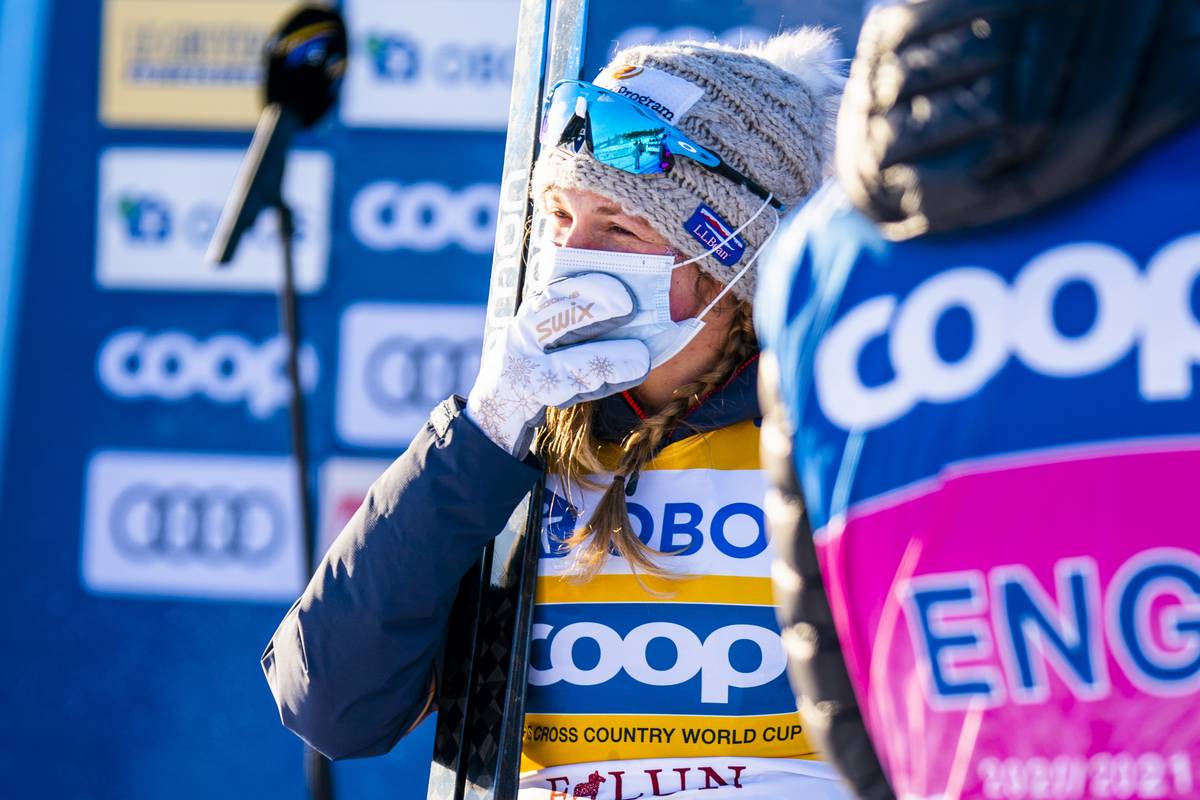
Jessie Diggins, filling the lungs after placing 7th on Saturday. (Photo: NordicFocus)
Sadie Maubet Bjornsen was next up for the Americans, finishing in a pack of chasers in 15th (+35.7).
“Another exciting day of racing in Falun here,” Maubet Bjornsen emailed. It is the first time in a while that I have started a ways back in a mass start, and boy, it is a different type of racing! Huge respect for all those who put together amazing races from that position! I kind of felt like I was burning matches more than I would have loved just trying to weave my way through.
“I was once again feeling encouraged by these first races. With five weeks away from hard intensity as I have worked through a back injury, my huge achievement was making it to the finish line. Classic has been particularly tough for it, so today was a real wild card. But I had some really encouraging feelings, and I look forward to working towards more exciting feelings in the weeks to come.”
Back on the World Cup, Sadie Maubet Bjornsen puts together solid back to back distance results with a 15th place finish in the 10 k classic mass start in Falun, Sweden. (Photo: NordicFocus)
Maubet Bjornsen took her first long-term absence from international skiing recently. During the pandemic, she has remained mostly in Anchorage, Alaska working and training.
“After spending 11 months away from [World Cup] racing, this weekend has been particularly fun to just kind of re-remember how this works. I haven’t yet raced without spectators, and I will say it is a different feeling. It almost feels like a super serious summer time trial. You hear your coaches cheering more than ever, which is kind of fun in a new way! It kind of takes racing back to the core, which is special.”
Outside the top-30, Rosie Brennan took 33rd (+1:15.6), followed by Katharine Ogden in 42nd (+1:49.1), Sophia Laukli 50th (+2:37.1), Caitlin Patterson in 51st (+2:41.2), and Alayna Sonnesyn in 56th (+3:33.2).
Post-Race Comments from U.S. Head Coach Matt Whitcomb.
Rosie Brennan finishes 33rd in the 10k mass start classic in Falun, Sweden. (Photo: NordicFocus)Face covered at the finish, Katharine Ogden skied to 42nd in the 10 k mass start classic in Falun, Sweden. (Photo: NordicFocus)
Leading the Canadian women with her second individual top-30 in two World Cup stops was Katharine Stewart-Jones in 17th (+36.2), her career best individual result at this level. Despite a string of wins and podiums last season, both domestically and in Opa Cup events, and a top-30 finish in the 2020 Scandinavian World Cup Ski Tour, a seemingly break-through season, Stewart-Jones was not named to the Canadian national team for 2020/2021. Another top-20 result will automatically qualify her to make the team next season.
“It was a super fun race,” Stewart-Jones wrote after the race. “The pace went out hot but I knew it was the type of course where gaps are hard to make but also hard to close so my goal was to get myself into a good position in the first lap and hold on. The techs did an awesome job with my skis which helped me relax both on the downhills and climbs.
“Overall I’m just extremely happy to be back racing and also very excited about how the team has been performing so far. Cendrine [Browne’s] result yesterday was really inspiring and I am confident that this is just the beginning for our team.”
Stride and glide: Canada’s Katharine Stewart-Jones (bib 35) and Sadie Maubet Bjornsen (bib 24) work their way toward the finish of the 10 k mass start classic in Falun, Sweden. (Photo: NordicFocus)
Cendrine Browne rounded out the Canadian finishers in 38th (+1:45.1). The race saw 60 finishers.
Same as it ever was – Therese Johaug with the off the front win. (Photo: NirdicFocus).
In case you missed the discussion on the Devon Kershaw podcast, the Norwegian team made its World Cup return today in Lahti, Finland after nearly two months of training and competing domestically. As predicted, neither their form nor racing gears have not been from this decision. The women in red went 1-2-3 in the 7.5/7.5-kilometer skiathlon, led by powerhouse Therese Johaug who notched her third consecutive win in the event and third career skiathlon win on the tracks in Lahti. Her total of nine career skiathlon wins is a women’s record, surpassing Johaug’s former teammate and one of the most decorated skiers of all time, Marit Bjørgen.
In her usual style, Johaug took command from the start, skiing away from the pack displaying remarkable precision in her technique and metronomic tempo, stopping the clock at 37:45.1.
Therese Johaug drives the pace during the classic leg of the Lahti skiathlon. (Photo: NordicFocus)
As has been remarked before, with the lack of spectators and commentary overlaying the live stream, it’s hard not to be struck by the intensity of the athletes’ breathing. As they kicked, glided, and skated six laps of the 2.5 k course, their lungs pumped at a rate and effort that seemed impossible to sustain. Yes, Johaug had a gap to the chasers from early on, but like the others, her rapid breathing made it abundantly clear that she did not simply walk away with the victory.
“It was so fun to be on the World Cup again,” Johaug told FIS after the finish. “It has been a long time since I was in Kuusamo [for the opening World Cup races in Ruka, FIN], so it’s really good to race here and see all the people in the cross country family again.”
Unlike the teams coming off a two-week break following the Tour de Ski, the Norwegian squad made a quick turnaround from their National Championships, which wrapped up just five days ago in Trondheim. Today’s skiathlon is the second this week that Johaug has raced and won. In fact, with only minimal rearrangement for the second and third spots, the podiums in the two events were identical.
The women’s 15 k skiathlon podium in Lahti, Finland: Helene Marie Fossesholm (NOR) second, Therese Johaug (NOR) first, and Heidi Weng (NOR) third, (l-r). (Photo: NordicFocus)
“My shape has been really good, now and the last weekend. Today, I know that I was starting in the line, so I knew to take it a little bit easy in the first lap and then go hard from the second and the third. I felt really strong today, and of course, I had to do all the job alone, and especially then, it’s really good to stand on top of the podium.”
Norway’s Heidi Weng and Helene Marie Fosseholm – lead the chasers during the skiathlon in Lahti, Finland. (Photo: NordicFocus)
Perhaps the more interesting race to watch unfold happened behind Johaug. When the Norwegian began to pull away in her second classic lap, a small chase pack emerged in her wake, containing Russia’s Natalia Nepryaeva, Sweden’s Ebba Anderson, and Jessie Diggins in stars, stripes, and the yellow overall World Cup leader bib. Diggins striding was strong and confident, as she tucked in behind the other two racers, entering the exchange zone at 7.5 k on their tails and smoothly switching into her skate skis and poles.
The eventual second and third-place finishers, Helene Marie Fossesholm of Norway followed by teammate Heidi Weng apex a corner during the skate leg. (Photo: NordicFocus)
As the first skate lap unfolded, Norway’s Helene Marie Fosseholm and Heidi Weng began to ski off the front of the second group of chasers, which contained names like Olympic champion in the Skiathlon Charlotte Kalla of Sweden and bronze medalist Krista Pärmäkoski of Finland. Wearing the red World Cup distance leader bib, Rosie Brennan also sat comfortably in this group.
Though only 29-years-old, Weng is a veteran compared to Fosseholm, who is only 19. Her results this season indicate she is a name to get to know; she finished 6th overall in the Ruka Triple, and proceeded to earn four podiums during her subsequent time racing on home turf, including a Johaug-like victory in the 10 k skate last week during the Norwegian National Championships, winning by a margin of over 30 seconds. Johaug did not contest this event.
By the 10 k mark, Fosseholm and Weng had caught the group of Andersson, Nepryaeva, and Diggins. The Russian began to fall off the pace, but Diggins was not about to follow suit. The women skated as a unit through the next lap, never separated by more than a second or two.
Jessie Diggins (USA) skiing behind Sweden’s Ebba Andersson and Russia’s Natalia Nepryaeva on Saturday’s 15 k skiathlon in Lahti, Finland. (Photo: NordicFocus)Jessie Diggins (USA) at the ski exchange 7.5 k into the women’s skiathlon alongside Ebba Andersson of Sweden and Natalia Nepryaeva of Russia. (Photo: NordicFocus)
As they left the stadium for their final lap, Fosseholm made a surge, testing her mettle against her more seasoned pursuers. With just over a kilometer to go, she had nearly a seven-second gap, which dissolved much faster than it was formed.
Andersson, Weng, and Diggins powered through the back half of the lap, steadily closing in on Fosseholm. Aerial shots showed the women charging up the final climb, still able to jump skate after nearly 40 minutes of exertion. They V2’ed over the top of the climb, all cylinders firing as they dropped back toward the stadium, around a couple of tight curves and toward the lanes.
Fosseholm could be seen taking nervous glances over her shoulder, knowing the other women had zeroed in their sights and there was no room for error. Luckily for Fosseholm, she had maintained enough real estate to enter the lanes with a clear path to second place (+28.1).
Behind her, it was still anyone’s game. Weng was first into the lanes, but Andersson was by her side and charging, Diggins just behind. With a furious throw of boots at the line, Weng snagged the third spot on the podium (+29.6) with Andersson centimeters behind in fourth (+29.7) and Diggins in 5th (+30.1).
Yellow bibbed Jessie Diggins double poles during the first leg of the 7.5 k / 7.5 k skiathlon. (Photo: NordicFocus)
In a post race interview, Diggins shared insights into the conditions in Lahti and how bomber kick on klister allowed her to ski what she identifies as one of her best classic races on the World Cup. With suboptimal glide in skate, Diggins had to shift her tactics so she could stay in the draft of those in front of her and ultimately left a final slingshot around Andersson and Weng to fight for the podium just out of reach.
“I was excited to dare greatly and try to stay with Johaug as long as possible, just to see and to really push it… In the skate half, it was nice to have those girls to work with. I had to keep adjusting my strategy as I realized how our glide stacked up to their glide. I had to keep changing it around, and I played the only card I had, tactically speaking. It didn’t really work, but it was the only thing I could do in the situation that I was in. I was really proud of that and I think I skied as smart of a race as possible.”
Jessie Diggins leaves everything on the course to finish 5th in the 15-kilometer skiathlon in Lahti, Finland. (Photo: NordicFocus)
Diggins also discussed the team recovery camp in Seiser Alm, Italy, how she manages the balance of increased media attention with training and recovery and her desire to support meaningful causes like the Emily Program, and how “new blood” on the World Cup squad re-energizes the veteran members of the American team.
Maintaining her position in the second group of chasers, Brennan skied to 11th place (+1:07.6), ending her race just ahead of Kerttu Niskanen in a photo finish.
In focus and red bibbed as the World Cups leading distance skier, Rosie Brennan near the start of the 15 k skiathlon in Lahti, Finland. (Photo: NordicFocus)
“It’s always hard to know how the body is going to bounce back from an event like the Tour de Ski,” wrote Brennan in an email after the race. “As a result, I decided to start controlled and then see what I had when I switched to skating. I felt much stronger in classic than I have all season and as a result maybe should have been more aggressive in the classic leg, but hindsight is always 20/20. After the transition to skate, my muscles struggled a bit, but I found better movements and strength as the skate portion went on. There wasn’t much space to move in the skate portion and I feel I missed some moves that I shouldn’t have, but had a strong final climb to move up a bit. In all, I feel this race was a really good step in the right direction for me as I am now focused on preparation for the World Championships.”
Rosie Brennan finishes strong in the chase pack for 11th place in the 15-kilometer skiathlon in Lahti, Finland. (Photo: NordicFocus)
A quick look to the overall World Cup ranks. With today’s results, Diggins remains at the top of the overall leaderboard with 991 points and also ties Brennan for the top spot in the distance standings with 401 points. Brennan remains in second place overall with 824 points, followed by Russia’s Yulia Stupak with 802 points.
In her first World Cup start, Sophia Laukli (USA) skis to 33rd in the Lahti, Finland skiathlon. (Photo: NordicFocus)
Also for the U.S., Sophia Laukli in her first World Cup start raced to 33rd (+3:54.8). Laukli is a member of the US Cross Country D-Team and is a sophomore at Middlebury College in Vermont. Caitlin Patterson was the next American in 37th (+4:33.8), Julia Kern 40th (+6:31.3), and Alayna Sonnesyn 43rd (+6:41.1). Forty-eight skiers finished the race.
This was Canada’s first World Cup appearance this season. Two athletes scored points, Katherine Stewart-Jones in 24th (+3:23.5) and Cendrine Browne in 27th (+3:44.9). Laura Leclair skied to 44th (+6:41.7).
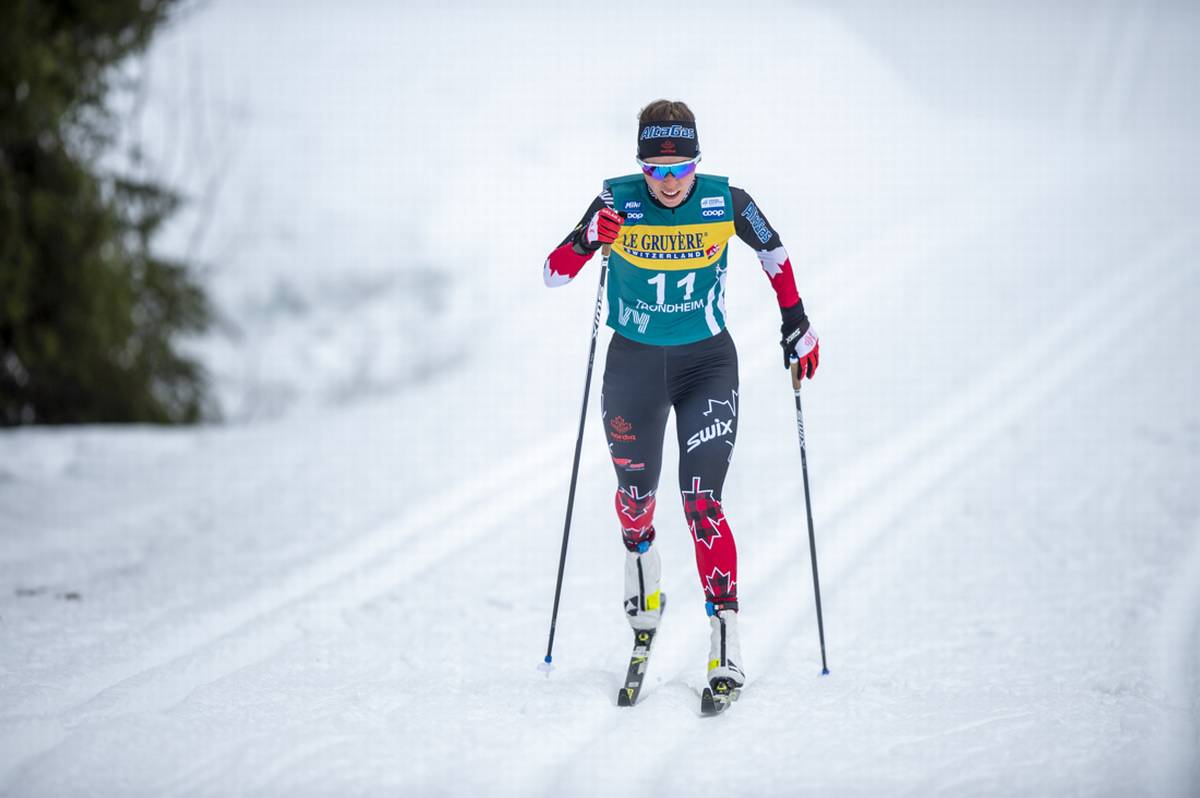
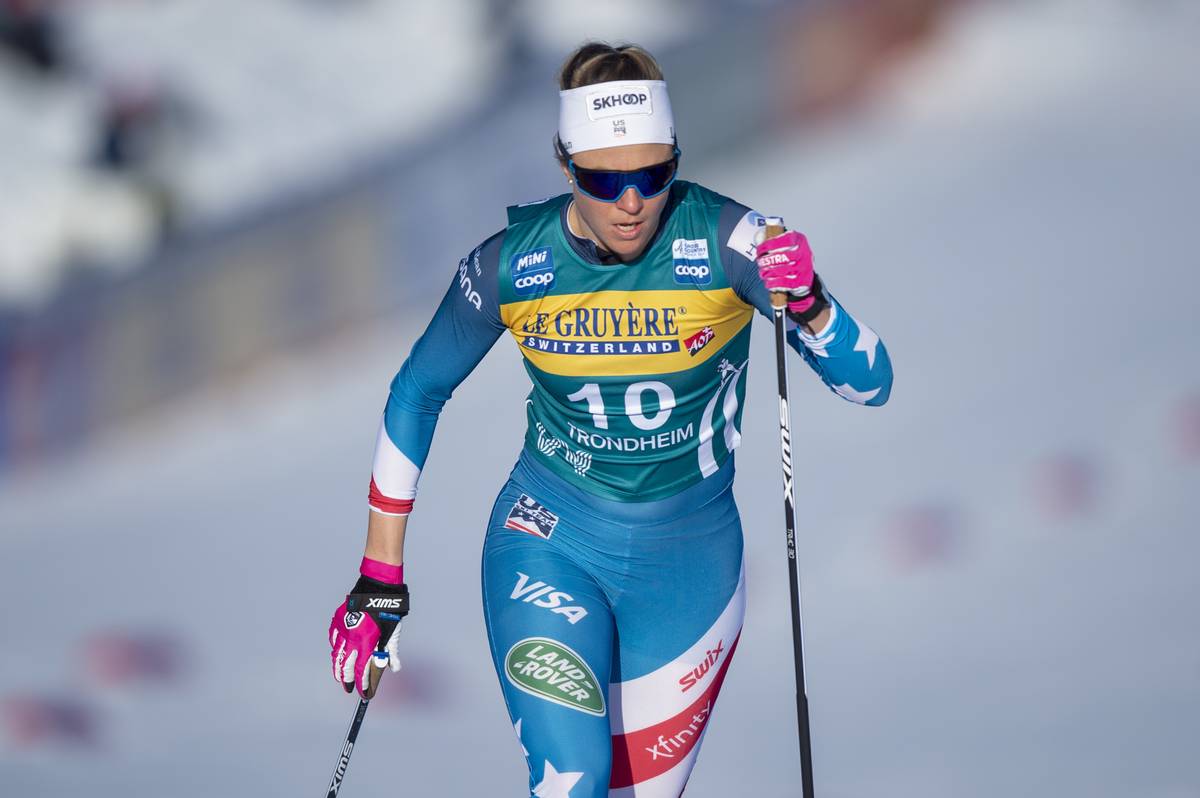
Katherine Stewart-Jones Trondheim, Norway during the Ski Tour 2020’s classic sprint qualifier. (Photo: NordicFocus)
Win now? Win later? Or somewhere in between?
A one year plan with a World Champs looming in 2021 or something befitting a six-year plan for capturing hardware at the 2026 Winter Games in Italy? Those are the strategies in play as national teams set budgets, rosters, and priorities. For countries like Norway and Sweden – at least on the Swedish women’s side – win now and later seems to be the constant background noise. For other nations like the U.S. and Canada, with smaller pools of championship medal pedigree, planning for the short, near, and long-term can be like juggling four different objects all of different masses. There’s almost too much to coordinate.
Nordiq Canada made it explicit: medal potential at the 2026 Games was the end goal. With a solid second-place finish in the junior men’s 4 x 5 k relay at the 2020 Junior Worlds, Canada may be primed for a delayed gratification epiphany six years out. But translating that 2020 success, with a young corps of skiers, does not necessarily translate to World Champs or Olympic hardware.
When Katherine Stewart-Jones was initially not renamed to the 2020-2021 Canadian National Team, the news came as a thud to many Canadians following the sport. At twenty-five-years-old, Stewart-Jones doesn’t exactly trend towards ancient in ski racing terms. This season, she placed 29th overall, the fourth-best placed North American behind Jessie Diggins, Sadie Maubet Bjornsen, and Rosie Brennan (all of the U.S.) in the Ski Tour 2020. That series of six races split between Sweden and Norway featured a loaded field. A 29th overall was real. It was Stewart-Jones’s best World Cup result since her first World Cup race in Planica, Slovenia in 2016.
In Canada, skiers must qualify for each respective period of the World Cup. In years past, Stewart-Jones earned World Cup race starts after solid results on the NorAm circuit as the Continental Cup leader. Just this season, of the six NorAm races she contested, she won a 10 k classic, a 5 k skate, and a classic sprint. In her other three races, she was top Canadian at a NorAm/SuperTour weekend: Second in a skate sprint, third in a 5 k classic, and third in 10 k skate.
She punched her ticket to Europe as the COC leader and guaranteed funding.
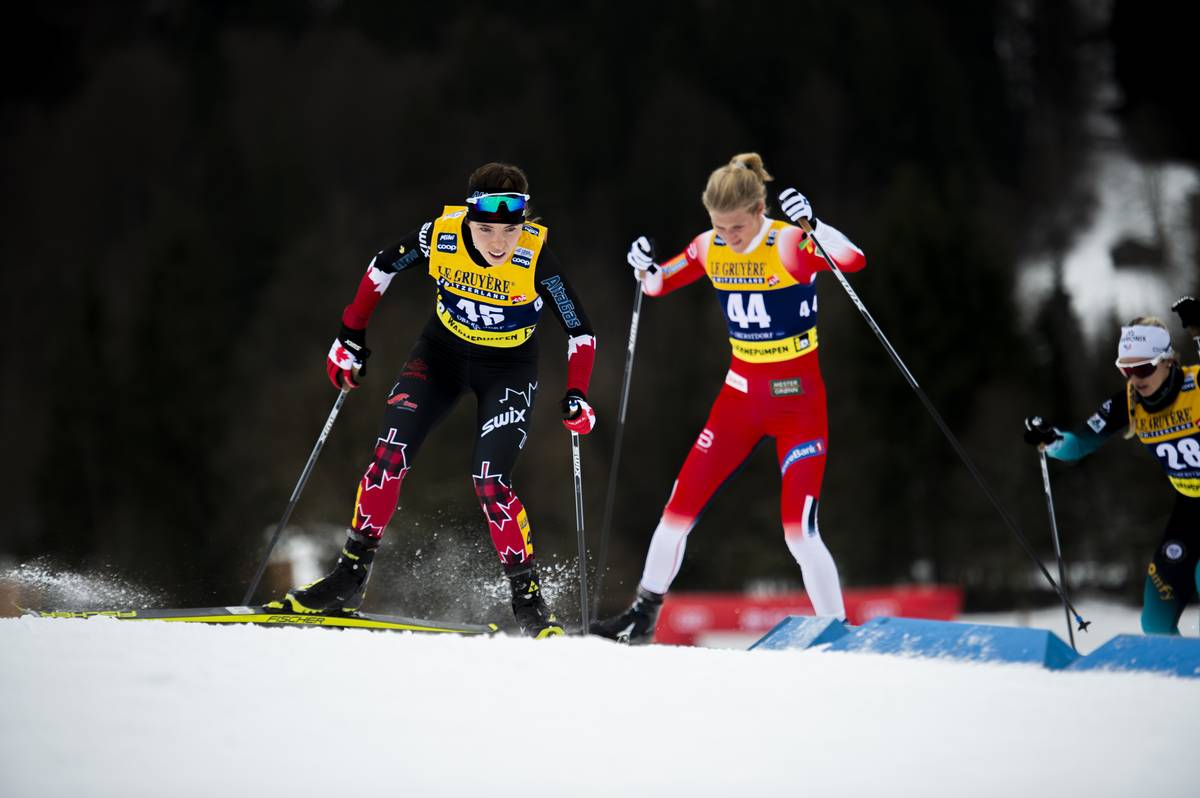
Katherine Stewart-Jones of Canada skiing to 31st in the Oberstdorf, Germany 15 k skiathlon. (Photo: NordicFocus)
Stewart-Jones skied for Thunder Bay NTDC for four seasons. Last spring, she relocated to Canmore with Erik Bråten as her only coach. She still represents Nakkertok, her home club, but does not belong to a training centre.
Despite making career-best marks on the World Cup, she failed to meet the national team’s objective criteria: she needed to place in the top-20 twice on the World Cup, or a single top-12, or earn at least 22 World Cup Points. She fell short. The team selection criteria did not allow athletes born in 1995 (her birth year) or earlier to be discretioned.
“I think it is important to support the top as well as the people that are coming up,” Stewart-Jones said. “I think most people would agree with that. It is a tough situation to be in.”
The national team skews young, with the oldest athlete on the senior team, Dahria Beatty, at 26, and the average age roughly 22.
Nordiq Canada provides a national team selection appeals process that Stewart-Jones took advantage of. When the appeal was filed, a three-person panel approved by both Stewart-Jones and Nordiq Canada considered the case. The panel ruled in favor of Stewart-Jones, declaring that her 9th place time of day during the Ski Tour 2020’s 10 k classic pursuit counted towards the criteria. She was renominated to the 2020-2021 national team. (The original criteria did not specify time of day as a consideration for overall place.)
“I have had a lot of people ask me if the fact that you didn’t get renamed to the national team in the first place, is that extra motivation to race fast? And I don’t get that,” said Stewart-Jones. “To me, it would never be a motivation, because I am doing it because I really just want to be the best in the world and that is why I have done this for the last however many years. So, when it comes down to it, what motivates me is just improving and there is just always always always something to improve on. Which is what makes skiing so fun to me.”
National team selection was critical for Stewart-Jones to maintain funding. As a member of the national team, she would be “carded”, and receive financial support from the government’s Athlete Assistance Program (AAP). For Stewart-Jones, the AAP helped offset the majority of her ski racing costs for the past five years.
Moa Lundgren of Sweden (bib 14), and Katherine Stewart-Jones of Canada (bib 45), during the 10km women mass start skate in Falun, Sweden. (Photo: NordicFocus)
Coming into last season, Stewart-Jones understood meeting the objective criteria for renomination would have been a massive leap. With one eye on renomination, she felt the added pressure. Knowing the criteria’s benchmarks, she explained that although she made gains, in the back of her mind she understood some would percieve her results as underperforming.
“I would still get disappointed even if I did improve a lot, which can be a good thing and a bad thing at the same time,” Stewart-Jones said. “For me it was important to make the national team so that was definitely a focus I had this season. Which, I think, is not the best when your focus is just the results that allow you to make the national team the next year.”
If steady improvements are considered, then Stewart-Jones and her move to Canmore have paid off. Starting last year she began working with National Team coach Erik Bråten. As she upped her hours, which were considerable, she allowed herself more autonomy in creating her training plan while absorbing Bråten’s ideas.
“I think that was the biggest factor with me improving so much was just that I was able to have more input on what I was doing,” said Stewart-Jones.
Along with the autonomy, she increased her training by roughly 150 hours total over the past two years. In Canmore, she’s part of a group of women a text away from a workout. There’s Dahria Beatty, Maya MacIsaac-Jones, and Annika Richardson among others who can push Stewart-Jones on any given day.
This season left many unknowns on the table. For North American skiers, the prospects for a home snow advantage were fleeting. The Canadian World Cup races were canceled while the World Cup family had already descended on Québec City. Stewart-Jones was slated for the distance races in Canmore. With the season aborted, she missed out on her two most important opportunities to make a statement and make the leap to meeting national team objective criteria.
Cycling into the summer, the where and when for next season’s World Cup calendar is unsettled. Short-term or long-term, win now or later, Stewart-Jones is zeroing in on a 2021 World Championship run as Canada finds its footing with new leadership.
This is the finish we all dreamed of. The final climb of the Nationals course at Sovereign Lake on April 2nd. The women would have finished the 30km in -6C air, -10C snow, about an hour before this photo was taken.
The ski world has been rattled by COVID19 and Canada is no different. One thing hasn’t changed, the new year starts on May 1st and brings changes.
Nordiq Canada’s CEO Shane Pearsall resigned effective May 22nd. In the press release below, Nordiq Canada (NC) describes ‘mixed emotions’ about Pearsall’s decision to focus on family time in the pandemic era.
Stéphane Barrette, NC’s Directeur du développement des athlètes et entraineurs, will be acting CEO. Barrette’s work on a partnership with XC Ski Nation to produce a series of videos and his effort to start a new club, Ski de fond Montréal, are two visible projects from a person better known to coaches and clubs than to athletes and fans.
Dave Dyer, who directed cross-country events for many years and shared the work with Jeff Ellis this past season, officially retired March 31st. Dyer was CCC Race Director for all of Ellis’ racing career and had several title changes during his 18 years in the role before ending as Events Director. Ellis is now in sole charge of event planning, which, Ellis said, will be a bit different this year.
“This current crisis is a real opportunity to examine what it takes to put on an event. Where can we reduce the financial risks for all while providing well run, efficient competitions?” — Ellis
As is almost traditional in Canada, there are protests over the National Team Selection. The High Performance Committee (Joel Jaques for NC, Erik Bråten as head coach, two athlete reps, and 14 coaches from across the country) decided to use the original selection criteria despite the loss of the end of the season. This criteria was focussed on developing a team for 2026 and the HPC interpretation is summarized here.
One of the results was that Katherine Stewart-Jones was dropped from the team. Stewart-Jones is the current COC leader after either winning or being top Canadian in six NorAm events in December, finished 29th overall in the Scando Tour from Sweden to Norway, earned a first and second at an OPA Cup in Italy, and was looking dialed-in for the World Cup Final in her new home of Canmore when FasterSkier saw her training in March. She was born in 1995, and that matters.
“Discretion was available to athletes born in 1996 and after,” Pearsall told FasterSkier on May 2nd, and summarized the thinking behind it as “we’ve got an eye on 2026.” (Pearsall’s own retirement didn’t come up in the talk about what is new for the coming season, it would be announced six days later.)
An athlete born in 1995 or earlier needed to score two WC top 20’s, or one WC top 12, or finish the season with 22 or more WC points. In the shortened season, only Dahria Beatty met this criteria with 23 points over five WC weekends. Cendrine Browne and Maya MacIsaac-Jones also earned WC points this season, but not enough to rejoin the National team.
The social media storm on selection was inflamed when NC deleted the original posts to make a correction, which also deleted many highly emotional comments.
Multiple athletes have protested the selections; FasterSkier will have more when the hearings are complete and athletes are free to talk. Maybe the Norwegian system of full coaches’ discretion, no protest process, would cause less controversy? Or maybe not, if you ask Martin Johnsrud Sundby fans. Either way, we can be sure that lots of people are passionate about the sport.
Therese Johaug, untouchable during Stage 6 of the Ski Tour 2020. (Photo: NordicFocus)
We’ll start with the weather: think all over the place. A moving target for meteorologist with moisture spitting from the skies, and air masses swirling this way and that making the trees sway like a mamba line along the course. A wax tech’s nightmare scenario? Yes. It certainly trended in that direction.
By all measures, this was Therese Johaug’s, Norway’s latest version of a cross-country skiing record-breaker, stage and tour. Of six stages total, she won five outright, with the lone exception, Saturday’s Stage 5 classic sprint in Trondheim.
Stage 6 featured a 15 k classic pursuit. Call it a pursuit, however, on the race’s sharp end, this was a runaway. Although the field was, in theory, pursuing Johaug, she simply put more time into her challengers on Sunday. She began 2:33 ahead of Norwegians Heidi Weng in second, while Ingvild Flugstad Østberg set off another second back.
Johaug expanded her lead at the finish, by over a minute, to Weng and Østberg. Johaug won the pursuit in 41:13.8. Weng placed second (+3:40.8) with a slight gap over Østberg, who toed the line 0.7 seconds further back. Sweden’s Ebba Andersson, the day’s fourth starter at 4:48, lost time to0, finishing 5:54.3 back to end the Ski Tour in fourth overall.
“I felt really good today and the waxers had done a really good job the whole Ski Tour and today as well I have the perfect skis,” Johaug told FIS after the race. “When the skis are good and the shape is good I can just go out there and enjoy all the people that come here and cheering us.”
Heidi Weng (bib 2) and Ingvild Flugstad Østberg pacing along during Stage 6. (Photo: NordicFocus)
Norway’s Heidi Weng and Ingvild Flugstad Østberg (bib 3) pursing Johaug during Stage 6 of the Ski Tour 2020. (Photo: NordicFocus)
As far as time of day, Johaug took that prize as well. However, Norway’s Astrid Uhrenholdt Jacobsen placed fifth overall and had the second-fastest race time, 44.8 seconds off Johaug’s winning mark. Krista Pärmäkoski of Finland notched the third-fastest time of day (+1:04.4).
Jessie Diggins of the U.S. was the top placed North American in sixth (+8:40.1). (She skied the 17th fastest time of day.)
“Today, like yesterday, was a crazy day in terms of weather and waxing. It kept snowing on and off, the sun coming out and then the wind picking up as more snow came down! I was pretty much skiing an individual start race as I was alone the entire time, but I was really proud of my pacing and efforts as I held my placing without anyone to work with. There was a really tricky time in the middle of the race when the skis weren’t kicking very well (for much of the field, I think) but I was able to refocus and reset and keep pushing as hard as I could.
“As for the overall tour, I’m really happy with my efforts and how I hit my goals for every race. One of my big goals was to see each day as an entirely separate opportunity and to not put pressure on myself for the overall tour, since there are so many factors that I can’t control that play into that placing. But by hitting my own process goals for each race and staying consistent I was able to have a tour that I’m proud of.
“I’m really proud of our tech team and coaches for their tireless efforts day in and day out through this tour. It’s been exhausting but they’re the hardest working guys out there!”
Jessie Diggins racing to sixth overall in the Ski Tour 2020. (Photo: NordicFocus)
Post Stage 6, a spent Jessie Diggins. (Photo: NordicFocus)
Sadie Maubet Bjornsen ended her tour in 10th (+9:43.8). With the big time gaps, the second wave of skiers (the mass start) began with Pärmäkoski in bib 13, starting at 8:08 back. Maubet Bjornsen (bib 12), began 16 seconds ahead and was the initial target of the wave starters. Maubet Bjornsen held off a charging Pärmäkoski for over 5 k.
“Wow, I made it!! That was one heck of a tough tour! Things were looking mighty rough to begin with, but I knew I had to just keep fighting and believing!,” Maubet Bjornsen emailed.
“But among some challenging times, there were some glimmering hopes in there. Tours are my favorite types of racing, because you have to be so resilient and such a fighter. Day after day, you have to put your fatigue and emotions aside, and just stay so positive.
“The tummy troubles at the beginning of the tour were particularly tough! It was scary to start a tour so depleted, but I was thankful we had our nutritionist, Susie Parker Simmons around to help me stay on my feet! From there it was just a matter or fighting for every second from there on.
“Today was a totally wild scene! Conditions were constantly changing, and it was hard to find the perfect skis! I knew the name of the game was to just keep fighting, because everyone would be struggling at some point out there. I managed to find something to work, and went through some highs and lows out there in the 15k which brought me to 10th overall in the tour! I’m super happy and satisfied with that, given the little fatigue hole I had to crawl out of this past month. Thank you to our team for helping make a tricky classic day at the finish of the tour possible to fight with the others.
“I’m looking forward to taking a rest now, and finding the energy to finish the end of the season strong, for the third tour of the season.
“Thanks to the Ski Tour 2020 for bringing some different types of racing. While it wasn’t always the best type of races for my strengths, it was so refreshing to visit some new locations with some different types of events! These are some of my favorite memories this season!
“And of course, hugest thanks to the staff. We couldn’t race day after day like this without them!!! They are the heroes.”
Sadie Maubet Bjornsen (bib 12) racing to 10th overall in the Ski Tour 2020. (Photo: NordicFocus)
Rosie Brennan, starting in bib 10, 7:27 behind the first starter Johaug, placed 12th (+9:53.3).
“Today was a very challenging day,” Brennan wrote in an email. “Due to the massive time gaps in the overall, the wave started at bib 13 so I had a big pack starting not too far behind. The conditions were very challenging with snow, sun, rain and everything in between and some very icy tracks. I did my best to stay in front of the wave but just didn’t have the skis or the energy to make it happen today. I am very disappointed in myself. After having a great tour, it was hard to end on this note, but I am doing my best to look at all the positives from the tour as a whole and make a nice little work list to improve on the things that were so tough today.”
Rosie Brennan (stars and stripes) during Stage 6 of the Ski Tour 2020. (Photo: NordicFocus)
Also for the U.S., Julia Kern placed 30th (+14:51.4), Caitlin Patterson 36th (+16:38.4), Katharine Ogden 42nd (+20:26.6), Rosie Frankowski 43rd (+20:36.7), Sophie Caldwell 44th (+21:41.2), and Alayna Sonnesyn 48th (+24:34.6).
Canada’s Katherine Stewart-Jones placed in the points for the tour overall, by finishing 29th in the pursuit (+14:46.3). Cendrine Browne was 33rd (+15:47.5), and Emily Nishikawa 35th (+16:08.4).
Katherine Stewart-Jones during Stage 5 of the Ski Tour 2020. (Photo: NordicFocus)
This stage concludes the Ski Tour. Racing continues in Lahti, Finland next Saturday.
The day began in Trondheim with a centimeter of snow, which then transitioned to big blue skies for the thousands of fans attending the fifth stage of the Ski Tour 2020, a 1.5 k classic sprint. The Norwegians can throw a cross-country race party. The scene, despite the different setting, was reminiscent of the festive cowbell and camp-out sideshow of Holmenkollen’s Frognerseteren. It’s not quite the Yankee stadium of cross-country skiing, but a sign that in the hot-beds of the sport, fans arrive in droves.
The sprint course was more traditional, meaning this was no simple VO2 max test of an effort — that went down on Stage 3, in Åre, Sweden as athletes ascended an uber steep alpine ski hill to close out that event. Trondheim’s classic sprint was bolstered by two punchy climbs on a three-terrace course, long and fast glide outs, and two speedy corners which swung skiers through a 180-degree direction change to keep it spicy.
Sweden’s Jonna Sundling laid down the fastest qualifying time in 3:22.75, shadowed by her teammate, Linn Svahn, 0.24 seconds back. Maybe, not surprisingly, Therese Johaug was the third-fastest qualifier, 0.83 seconds back. Johaug won her first career sprint on Stage 3 of the Ski Tour.
Jonna Sundling of Sweden in bib 1, during her quarterfinal of the Stage 5 classic sprint in Trondheim, Norway. (Photo: NordicFocus)
The U.S. packed five skiers into the heats. Sadie Maubet Bjornsen qualified in 10th (+6.20). Rosie Brennan in 11th (+6.34), Sophie Caldwell 15th (+7.32), Jessie Diggins 20th (+8.58), and Julia Kern 24th (+9.54). Yet the story on the U.S. women’s side ended earlier than their highwater mark norm, which is most often, representation in the six skier final. In no uncertain terms, this is the golden age of U.S. women’s cross-country skiing. A stars and stripes void marked the semis and final. No U.S. skiers advance beyond the quarterfinals.
In the third quarterfinal, Kern and Brennan lost contact with Sundling and Tiril Udnes Weng who came in 1-2, respectively. Kern was fourth in the heat (+3.7), Brennan fifth (+7.71).
Maubet Bjornsen and Diggins fell off the pace as well in the fourth heat, placing fourth and fifth respectively. Both were over four seconds off Norway’s Anna Svendsen’s pace of 3:19.34 who won that quarterfinal.
Sadie Maubet Bjornsen during the Stage 5 classic sprint in Trondheim, Norway. (Photo: NordicFocus)
“It was an extremely tricky weather day with a combo of rain/snow/sun, and everything in between,” Maubet Bjornsen emailed.
“I was excited to put together a solid qualifier, but felt like a few adjustments would allow things to be even better for the heats. My body felt sharp and powerful, so I knew the key for me was to be quick out of the start, and do my favorite thing… ski from the front. I was quick out of the start, but struggled to hold the speed up the first climb. Since climbing is generally my strength, it’s unclear whether it was skis, body, or both that held me back. But, that’s how ski racing is. You can’t overthink anything too much, you just keep believing, and chasing away!
“It is the tour of crazies for me, so I’m going to let it go, and look on to “the chase” tomorrow. With the tour ending with a 15k classic, I am sitting just outside top 10 overall, and really hoping to climb my way within that tomorrow. Let’s see if I can channel all amounts of frustration towards some constructive racing in the final day!”
The last U.S. athlete eliminated was Caldwell. She placed third in the fifth quarterfinal, 1.53 seconds back on Norway’s Heidi Weng in first. Caldwell placed 14th in the final standings, Maubet Bjornsen 16th, Kern 20th, Brennan 21st, and Diggins 23rd.
Sophie Caldwell (bib 15) during her quarterfinal in Trondheim: Stage 5 of the Is Tour 2020. (Photo: NordicFocus)
Post-race interview with U.S. World Cup Coach Matt Whitcomb
Wintry weather moved in during the men’s quarterfinals. The blue-bird scene morphed quickly into an intermittent snowglobe. With the swift winds swirling around the stadium, the snow squalls eventually moved on as the semifinals progressed.
The 12 skier field in the two women’s semis consisted of six Norwegians, four Swedes, and two Swiss skiers in Laurien van der Graff in the first semi, and Nadine Fähndrich in semi two. Fähndrich kept Swiss hopes alive by advancing to the finals after winning her semi.
The first semifinal featured Norway’s Maiken Caspersen Falla and Sweden’s Sundling. These two athletes were the skiers to watch. For Falla, by her own high standards, this has been an offseason, as the young Swedish sprint team has pushed her aside for precious top-of-the-podium real estate. Falla won the opening World Cup sprint in Ruka, Finland, otherwise, it’s been a first-place void for the former Crystal Globe sprint winner.
In bib 12, Maiken Caspersen Falla strides it during her quarterfinal in Trondheim. (Photo: NordicFocus)
In Falla’s semi, she and Sudling took first and second, respectively, with Astrid Uhrenholdt Jacobsen and Linn Svahn of Sweden in close contact, only a few tenths of a second back. In the final, Falla was locked in. Although at moments Sundling was side by side with Falla, the Norwegian dictated the decisive move off the front. Over the second climb, at roughly 2:25 into the race, Falla powered over the hill and into the glide out transition with only Sundling able to match two meters back.
Falla took the win in 3:15.55 with Sundling in second (+0.48). Fähndrich was third (+2.88), Anna Dyvik of Sweden fourth (+3.71), Svendsen fifth (+5.26), and Heidi Weng sixth (+6.64).
Maiken Caspersen Falla on her way to her second sprint win of the 2019-2020 World Cup season. (Photo: NordciFocus)
Sealing it: Maiken Caspersen Fall in Trondheim. (Photo: NordicFocus)
“This feels always like the [World Championships] so crowded and so many people screaming my name at the start and after the finish,” Falla told FIS after the race. “It’s an amazing atmosphere and I’m so happy to be here. There has been some hard distance races for me now. The 30 k and also 10 k was really hard so I’m really happy that I stayed in the tour, didn’t go home and got this opportunity to win here and race in this amazing atmosphere.”
This was Falla’s 21st individual sprint win. She sits second overall in total World Cup sprint wins. Marit Bjørgen of Norway still reigns with 40 World Cup sprint victories. For Fähndrich, this was her second career individual podium. Prior to her third place on Saturday, the Swiss skier posted up a second place in Cogne, Italy’s 2019 10 k classic for her first World Cup podium.
Hands up: Nadine Fähndrich earns a third place for the Swiss in Trondheim. (Photo: NordicFocus)
Katharine Ogden in 37th was the top-U.S. skier outside the top-30. Alayna Sonnesyn placed 42nd, Caitlin Patterson 48th, and Rosie Frankowski 51st.
For Canada, Emily Nishikawa finished in 34th, Katherine Stewart-Jones 35th (+14.19), Cendrine Browne 40th,
The Ski Tour overall looks certain for Johaug who placed ninth in Saturday’s sprint. She leads with a total time of 2:19:28. Weng remains in second (+2:33), and Ingvild Flugstad Østberg third (+2:34). Østberg finished 22nd in Stage 5. This Norwegian trio is the likely overall podium, as Sweden’s Ebba Andersson is fourth at 4:48 back. Racing concludes for the Ski Tour on Sunday with Stage 6, a 15 k classic pursuit for the women.
Norway’s Therese Johaug (yellow bib) the Ski Tour’s overall leader was the third overall qualifier. (Photo: NordicFocus)
Nature has a lovely way of being, well, natural. In other words; marginally unpredictable, sometimes downright uncomfortable, and finicky. Prior to the Ski Tour 2020’s Stage 4 weather forecast and on-the-ground big-wind gust reality, the stage had been scheduled to pulse 38-kilometers from Storlein, Sweden to Meråker, Norway in a point to point event. Cool, right? An international border crossing during a race, with a single sanctioned coaching/feed zone for athletes around the 25 k mark. A think-out-of-the-box format with a nod to the old-school days of Norwegian countryside racing.
Nature interfered. Or at least the predicted inclement weather scheduled to pummel the rolling mountains featured in the point to point race was enough to scare off race organizers.
An updated map and course profile for Stage 4 of the Ski Tour 2020.
The stage was rerouted the stage. Stage 4’s freestyle mass start streamed from the start/finish area in Meråker, to the original coaching feed zone at approximately 15 k, where athletes skied a several k loop, and then routed onto the main course back to the Meråker ski stadium. In total, the new route was 34 k, with approximately 30 k consisting of an out-and-back. Organizers maintained a single feedzone policy. (Thus, you’ll see several athletets with hydration belts. Most notably, the Norwegians.)
Prior to her breakaway on Stage 4, Norway’s Therese Johaug began to stretch the cord to the pack. (Photo: NordicFocus)
Although mother-nature dictated the course reroute, Norway’s Therese Johaug dictated the intro and closing chapters of Stage 4.
This was no surprise, as she has dominated World Cup distance events with a few second-place efforts here and there, to prove maybe she is human after all. Analyzing her results, it’s clear she is a record-setter. And another record of sorts fell today as Johaug won in 1:26:32.8 hours. It was Johaug’s eighth individual distance World Cup victory in a row. A streak that outdoes her run of seven consecutive wins, which the Norwegian has strung together on two occasions — once between January- March of 2016, and again between March-December 2019.
Johaug on her 34 k journey. It’s early, the pack is still in contact. (Photo: NordicFocus)
The day was not a singular Johaug show. Her teammate Ingvild Flugstad Østberg kept the racing on the front-end honest for the overall win.
Earlier in the race, it did appear like a Johaug runaway. At 14 k, she had gapped the second place Østberg by 28.0 seconds. Chasing in a line through the time check along with Østberg were Norway’s Heidi Weng, and Sweden’s Ebba Andersson. American Jessie Diggins led a group, 1:24 back, including Austria’s Teresa Stadlober, and Krista Pärmäkoski.
Another 30 seconds back, an organized chase pack including Charlotte Kalla, Rosie Brennan, Sadie Maubet Bjornsen, and Astrid Uhrenholdt Jacobsen churned along.
Jessie Diggins (left), Teresa Stadlober (center), and Ingvild Flugstad Østberg (right), on the Stage 4 course. (Photo: NordicFocus)
Through 20 k, those gaps remained relatively firm. However, out on course, the winds were evident with swaying treetops. A solo effort can take its toll with no draft to exploit. No matter how you look at it, either Johaug slowed or Østberg sped up, the time between the two skiers diminished between 20 k and 30 k. At the 31 time check, Johaug’s lead had shrunk to 7.9 seconds over Østberg, who had snapped away from a hard to shake Weng early in the race. Weng paced through the 31 k mark in third (+51.0), Andersson in fourth (+1:37.3), and Diggins in fifth (+3:01.2).
Have no doubt, despite Joahug’s singular dominance, this was a hunted Johaug. Her effort in the closing Ks never waned, as Østberg proved a worthy foil. As much as Østberg wanted to will the 30-40 meter span to Johaug away, Joahug was able to keep four seconds between herself and the fearless Østberg at the finish. Weng came through solo in third overall (+1:21.6), with Andersson in fourth (+2:00.5).
Norway’s Heidi Weng placed third on the Stage 4 34 k skate mass start race. Note the nifty hydration belt (Photo: NordicFocus)
Jacobsen pipped the next chase group, taking fifth (+3:06.5), with Tiril Udnes Weng of Norway in sixth (+3:10.3), and Diggins in seventh (+3:13.9).
Jessie Diggins during Stage 4 of the Ski Tour 2020. She placed seventh overall. (Photo: NordicFocus)
Post-race interview with Jessie Diggins
Also for the U.S, Brennan ended her day in 10th (+3:41.9).
“It’s been an adventurous couple days here in the ski tour,” emailed Brennan. “A lot new things, a lot of surprises, and a lot of last minute changes. Our point to point race was changed due to high winds but we still managed to to an out and back in the same trail starting and finishing in Meråker. It was really windy still making it challenging to ski alone out there. Knowing that I did all I could to stay in my group. There were a few kilometers that I was dangling and unsure if I could hang, but I was fortunately able to find another gear climbing and work my way back up to my group. , unfortunately,y missed the first break on the way back but was able to pick off some people all the way to the finish. I am really happy with the race as 30km has been a struggle for me in the past. I am still feeling strong in the tour and am going to do all I can to hold on to a top 10 in the closing stages.”
Rosie Brennan, pack skiing to 10th overall on Stage 4. (Photo: NordicFocus)
Maubet Bjornen clocked in one place after Brennan in 11th (+3:44.8).
“It was a thrilling day of ski racing today, with lots of course changes, weather delays, a long2-hour bus trip to the start, and a total ‘unknown’ in front of us with this long race,” wrote Maubet Bjornsen.
“I have finally felt my body feeling better, and I just kept my mind excited to take on whatever was coming.
“It was windy as heck, which made the course super tough, but still beautiful. I didn’t look around a ton, because I was so focused, but in the few chances we went down a hill, and I got a glimpse, I just felt so lucky to be part of this fun experience. It is so different than any race I have ever done, and the total ‘unknown’ put the cherry on top.
“I’m so excited to find my strength again, and put together a race that is more representative of where I am at. 11th in a long distance skate race is huge for me!”
Maubet Bjornsen: Stage 4, Ski Tour 2020. (Photo: NordicFocus)
Also for the U.S., Julia Kern placed 19th (+6:04.5), Rosie Frankowski 29th (+6:12.2), Caitlin Patterson 41st (+8:20.3), Katharine Ogden 42nd (+8:49.8), Alayna Sonnesyn 48th (+10:23.3), Sophie Caldwell 56th (+12:27.3). Hailey Swirbul did not start.
For Canada, Cendrine Browne scored in the points in 25th overall (+6:07.9). Katherine Stewart-Jones skied to 31st (+6:16.1), and Emly Nishikawa 39th (+7:52.9).
In the Ski Tour overall, Johaug looks unstoppable – she has won all four stages thus far. Her elapsed time, which factors in a 60-second time bonus for her sprint stage win on Tuesday, and three 15 second intermediate time bonuses on the course Thursday, is 2:16.33. Østberg sits in second (+2:06), Weng third (+2:39). Diggins was the best-positioned American in sixth (+6:02).
Racers have a rest day Friday, with racing starting up in Trondheim for Stage 5’s 1.5 k classic sprint.
Therese Johaug (yellow bib) with enough time at the finish to gather skis and watch 2nd, 3rd, and 4th come across the line. (NordicFocus)
The early evening show, under the lights of Östersund, Sweden’s ski stadium, Stage 2 of the Ski Tour 2020 – a 10-kilometer classic pursuit – got underway as the plentiful moisture falling from the sky transitioned from steady rain to big snowflakes.
This was a 10 k race with three discrete tales. First, the story with the least tension.
That would be Norway’s Therese Johuag’s 10 k effort. Which, despite the pursuit format, was a solo time trial affair. She set herself up for that narrative by winning Stage 1’s 10 k individual skate by 45.6 seconds. No skier on the World Cup could fathom closing that gap to a generational distance skier.
Johaug won in 27:29.0 minutes. Her effort gained her even more time in the Ski Tour overall as teammates Heidi Weng placed second (+57.4), and Ingvild Flugstad Østberg third (+57.8). Sweden’s Ebba Andersson lost out on third in the closing meters, as she placed fourth (+58.6).
Therese Johaug for a clean no-one-in-site win. (NordicFocus)
This was Joahug’s 13th World Cup distance win of the season and according to FIS, this brings her closer to a hallowed record. Marit Bjørgen, a legend from Norway holds the World Cup distance win record with 62 victories. Sunday’s win brings Johaug’s total to 59.
Let’s be frank: with a 45.6 second lead on the second starter Weng, 47.3 seconds on Østberg in bib 3, and 53.1 ticks ahead of Andersson in bib 4, this was as much a sure thing as sunrise and sunset.
Ebba Andersson leads Heidi Weng and Ingvild Flugstad Østberg during the Stage 2 10 k classic pursuit. (Photo: NordicFocus)
Behind Johaug, the tactic for the three closest chasers — Weng, Østberg, and Andersson was clear: cede no ground to the All-Star list of skiers starting roughly 20 seconds further back. For much of the race, the threesome kept a tidy buffer of 30 seconds on those in fifth to 16th place. At times Andersson took pulls up front, motivated by chants of “Ebba” from the home-nation fans. Østberg and Weng too remained motivated to secure a potential podium as they burned their matches prudently but with enough gusto to keep the masses at bay.
Taking her turn pacing the premier chase group, Heidi Weng (bib 2), followed by Ingvild Flugstad Østberg and Ebba Andersson. (Photo: NordicFocus)
Heidi Weng (bib) taking second in Stage 2 of the Ski Tour 2020. (Photo: NordicFocus)
Weng led the charge into the final straight. Østberg slotted in behind Weng using her as a double-poling pace machine. Weng and Østberg gained a precious few meters on Andersson to take second and third, respectively.
Johaug leads the Ski Tour 2020 after two stages with a total time of 49:18. Weng is second at 0:57, and Østberg is third overall with the same time back. Andersson sits one second further back in fourth overall.
The race behind the top-four had a different vibe. It was less about fending off a potential chase, and more about how a large group of skiers would coalesce, who would lead, and who would sit back and take advantage of the more skied in tracks.
Jessie Diggins skiing to 11th overall during the Ski Tour 2020 Stage 2 10 k classic pursuit. (Photo: NordicFocus)
American Jessie Diggins, in bib 8, pulled the group through the 3.3 k mark 1:25.2 behind Johaug. In contact with Diggins, and coming through in this order were Astrid Uhrenholdt Jacobsen, Ragnhild Haga, Rosie Brennan, Krista Pärmäkoski, Frida Karlsson, and Natalia Nepryaeva. The group from fifth to Austria’s Therese Stadlober in 16th place was separated by 11 seconds.
Brennan took her turn up front though the 4.9 k mark, as did Karlsson later in the race. By the finish, the collective group did not gain time on those ahead, they ceded a few more seconds to the top four. But we would be remiss to make note of Brennan’s determination. You could see it in yesterday’s 10 k skate, and it was evident today; she’s got moxie and now the confidence to take pulls, as she did with Karlsson today, and try to break the pack. In a post-race interview (audio posted below), Brennan noted she had in fact been keen on making a move during the pursuit.
Grit: Rosie Brennan during Stage 2 of the Ski Tour 2020. (Photo: NordicFocus)
Post-race interview with Rosie Brennan
Slovenia’s Anamarija Lampic ended up fifth overall (+1:38.7), as the first finisher of the third group out on course. Brennan ended her day in 10th (+1:43.3), and Diggins in 11th (+1:43.6).
“It was a pretty crazy day out there!” Diggins wrote. “I was actually super stoked about the rain while warming up because klister skiing in the rain is such amazing kick and really fun getting up all the hills on. The snow right before the start made it a really strange race because the one track became exponentially faster as it got skied in, which led to massive packs (for a girls race, anyway) forming. Huge thanks to the tech team because my skis stayed competitive and were kicking well even in the rapidly changing conditions!
“I’m excited for the rest of the tour – the next two races are formats we’ve never done before, so I’m ready to go give it my very best shot!”
Sadie Maubet Bjornsen, who began in bib 22, 1:51.4 behind the first starter Johaug, placed 19th (+2:12.5).
“After recovering from a mild tummy bug or a form of food poisoning that visited the night before the start of this tour, I am feeling thankful and hopeful after the second stage of the tour today,” Maubet Bjornsen emailed. “With a snow/rain downpour, I was feeling right at home strapping classic skis on my feet and heading out in the misery. I have spent plenty of days in this exact condition during summer training up on Eagle Glacier, so I was trying to channel every bit of internal strength I could find. The fact that I was able to work my way up to 19th today, and had encouraging feelings in a somewhat depleted version of myself is something I will take and run with!
“I am excited to have a day to recover and fill up my tank, and take on this tour in the same way I did the last. An imperfect start will just fuel me with the extra fight for the days to come!
“Thanks to the tech team for putting wonderful skis together given the absolute craziness coming out of the sky!”
In speaking to U.S. World Cup Head Coach Matt Whitcomb after the race, he explained that skiers in the back of the field were able to take advantage of the considerably faster skied in tracks. Again, heavy wet snow fell during the race.
Post-race interview with Matt Whitcomb
U.S. skier Hailey Swirbul in bib 36 moved into the points on Sunday to place 24th (+2:20.2). Her trajectory in the standings aligned with her 13th fastest time of day. Along those lines, Julia Kern of the U.S. Ski Team skied from 50th to finish 36th (+2:43.8). Her on course time was the sixth-fastest of the day.
Also for the U.S., Caitlin Patterson was 41st (+2:54.1), Sophie Caldwell 51st (+3:07.0), Alayna Sonnesyn 54th (+3:55.7), Katharine Ogden 55th (+4:03.8), and Rosie Frankowski 62nd (+4:59.7).
For Canada, Katherine Stewart-Jones placed 32nd (+2:37.5) and skied the ninth fastest time of day. Cendrine Browne was 39th (+2:45.9), and Emily Nishikawa 44th (+2:59.8).
Katherine Stewart-Jones (CAN) during Stage 2 of the Ski Tour 2020. (Photo: NordicFocus)
As far as the overall standings and how times are calculated, time of day is used to determine a skier’s time for Stage 2.
Early race agitators: Norway’s Therese Johaug and Heidi Weng. (Photo: NordicFocus)
As always, it was a reset: a new day at the start of a World Cup race. On Sunday, the ribbon of snow in Falun, Sweden offered an opportunity for a sixty-six women field to race head to head in a 10 k mass start freestyle race.
With a course that some noted was softened in difficulty by eliminating the infamous Moderbakken climb — which has become a feared incline on the World Cup circuit — the racing was expected to be a close contact affair. The women raced four laps of a roughly 2.5 k circuit featuring punchy hills and terrain requiring athletes to work with little opportunity to recover.
Coming into the race, Norway’s Therese Johaug had been synonymous with the words distance race and victory. She has been unstoppable. She has won 11 of the last 13 individual distance events on the World Cup. According to FIS, in a string of 24 distance races, Johaug has placed first or second in 23 of them: the only outlier a 4th place in the 10 k mass start classic in Val di Fiemme, Italy during the fifth stage of the 2019-2020 Tour de Ski.
Again, it has been a year in which Johaug has been dominant in the win column, but not necessarily in her margin of victory. In year’s past, seeing Johaug way off the front, a minute plus ahead of the field was not uncommon. This season, the gaps have been more humane.
From the start on Sunday, Johaug was out front and the skier to match. Through the first lap, it was Johaug, Heidi Weng of Norway, Ebba Andersson of Sweden, Astrid Uhrenholdt Jacobsen of Norway, and Sweden’s reassimilating Frida Karlsson who had been off the World Cup this season since the opening weekend in Ruka, Finland for failing to meet team body-metric requirements, who looked poised to keep pace.
Early on, Weng took pulls and Andersson contributed to a pace that would snap any imaginable cord to those wishing to gap up. At 3.6 k Johaug, Weng, and Andersson pushed discernibly ahead, as Jacobsen and Karlsson fell off to a bit more than six seconds back. Jessie Diggins, starting in bib 5 for the U.S., came through the 3.6 k check in eighth, at 17.2 seconds behind, as the Norwegians and Swedes kept the tempo hot.
Frida Karlsson back on the World Cup for Sweden. (Photo: NordicFocus)
Although a mass start, the race at the sharp end whittled away at the masses. Three off the front was for real. Morderbakken or not, there would be no catching them: the three leaders had 18.8 seconds on Karlsson in fourth and 19.4 seconds on Jacobsen in fifth by 6.7 k.
Weng hung on until the closing 1.5 k when she too began to wither as Johaug began to write the conclusion to this 10 k script. The overall World Cup distance leader, Johaug, won in 25:04.1. And as she crossed the line, arms raised to the sky, Johaug displayed a stoke often reserved for bigger championship stages. Andersson, who missed the first part of the season with an injury, placed second (+6.5). For Andersson, her second place matched her season best result during the fourth stage of the Tour de Ski, a 10 k mass start classic. Weng hung on for third (+23.8).
Johaug stoke: the 10 k mass start win in Falun. (Photo: NordicFocus)
After Sunday’s race, Johaug has a commanding lead in the distance standings with 1011 points. Weng sits in second with 665 points.
“It was tough conditions and of course with a mass start in Skating it’s not my favorite but I think the tracks were so slow and it was better than I had expected it,” Johaug told FIS after the race.
Diggins was the top American in 14th, 57 seconds back. At moments Diggins appeared poised to link up with Jacobsen and Karlsson in the early stages, but oftentimes she found herself working alone. In the windy conditions, the effort became too taxing.
“It wasn’t my best day out there but I was proud how I just kept fighting even as a large pack was moving in to catch me up, I did everything I could in the moment,” Diggins said after the race.
She comes off a training camp at mid-altitude in Seefeld, Austria and a mystery kink in her neck that appeared the morning of Saturday’s classic sprint in Falun. (In the audio posted below, Diggins discussed how she has been handling the pressure of expectations after realizing the dream of an Olympic gold medal.)
Diggins driving during the 10 k mass start skate in Falun. (Photo: NordicFocus)
Post-race interview with Jessie Diggins
U.S. skiers Sadie Maubet Bjornsen placed 21st (+1:28.2), and Rosie Brennan 23rd (+1:31.1).
“I had a challenging day today,” Brennan emailed. “Nothing went particularly wrong but I just wasn’t moving as fast as I thought I should be. It was very tough conditions with no natural snow and warm temperatures and falling rain. It was a short 2.5km loop that didn’t provide much rest but also not too many climbs. While this type of race has never been my forte, I did expect a little bit more of myself. I will take the week to hopefully find a little more speed and be ready for the Ski Tour 2020.”
Also for the U.S., Hailey Swribul placed 35th (+1:56.2), Sophie Caldwell 38th (+2:11.3), Alayna Sonnesyn 49th (+2:38.8), and Julia Kern 57th (+3:20.1).
Post-race interview with World Cup Coach Matt Whitcomb
Canada’s Cendrine Browne scored in the points with a season best 29th place (+1:40.1). Katherine Stewart-Jones skied to 37th (+1:59.9), Dahria Beatty 40th (+2:14.1), and Emily Nishikawa 46th (+2:35.5).
Canada’s Cendrine Browne racing into the points in Falun. (Photo: NordicFocus)
Racing continues next Saturday with a skate sprint in Åre, Sweden — the start of the Ski Tour 2020.
The 10 k mass start podium from Falun: Ebba Andersson (SWE) second, Therese Johaug (NOR) first, and Heidi Weng (NOR) third, (l-r). (Photo: NordicFocus)
Emily Nishikawa (bib 1) leads out the U20 and Open 15km at MSA Trials. (Photo: Doug Stephen)
Mont Sainte-Anne brought great ski conditions on a weekend where the best in Canada fought to qualify for four different race trips: U20/U23 World Championships in Oberwiesenthal, Germany; Falun and the Scando Tour; the sprint tour of Québec and Minnesota; and World Cup finals in Canmore. Combine this with the usual NorAm action and COC leader competition and you have all the ingredients for a great weekend.
Over 400 athletes raced in five age groups with over 150 competing for U20 selection.
For all four trip selections, Nordiq Canada will be making a list and checking it twice. Or maybe more than twice. For U20, five athletes of each gender are selected, starting with the top skier on Sunday, then Friday, then Saturday and starting again with Sunday’s second place. For U23, four or five skiers will be selected the same way. The Sprint Tour averages the qualification and heats points to rank athletes to be selected after pre-qualified athletes. The Canmore weekend similarly sums the two distance days. With 10 Host Nation starts allocated in addition to the ones Canada has earned, there are many start opportunities. Most of the paths to guarantee a spot on next year’s National Team begin with qualifying for one of the above. But no pressure.
Each COC leader gets their own start allocation at every World Cup for the period. As there are no more NorAm (Continental Cup) events until Nationals beginning on March 26, the COC leader as of today retains this for the rest of the World Cup season. The best five of nine races are counted, which means Katherine Stewart-Jones had the women’s spot locked up in December. Antoine Cyr came into this weekend with the leader’s bib and a win Saturday was enough to keep it, according to Nordiq Canada.
The U20 and open women started the day with 15km on the same hilly 5km course as Saturday. Emily Nishikawa and CNEPH’s Cendrine Browne got away early before Nishikawa broke clear on the final long climb to win in 43:44.1, with Browne 13.4 seconds back. Browne’s teammate Laura Leclair spent most of the race alone and held off a charging pack to finish third for the top U23 result, 1:45.4 behind, just 0.8 seconds ahead of the top U20 finisher, Revelstoke’s Elizabeth Elliott. Black Jack’s Jasmine Drolet was edged out into 5th but should still have earned the trip to U20’s in Oberwiesenthal.
Nishikawa spent a rare winter period back in Canada and enjoyed the change.
“It was great to be home in Canmore, and I got a good block of training in before heading back to the World Cup,” Nishikawa emailed. “It was very fun to be able to race in Canada – in Whistler and here in MSA, and now I feel ready to get back on the World Cup.”
Nishikawa, who was 25th overall in the 2019 Tour de Ski, is focussed on the Scando Tour and racing back home in Canmore.
Browne, who is bouncing back from a tough year, was happy to be back in the game. “The race felt really good, I had good legs and great skis. I really liked skiing with Emily, it was fun to race with her again,” Browne wrote. “I should’ve taken more relays and rested more so I maybe could’ve followed Emily when she attacked at 14km. Unfortunately, when she did attack, my legs were fried!”
Browne, a distance specialist who loves the skate days, was also excited to have won the sprint on Friday.
“Winning a sprint was very fun! It was a big confidence boost! It was also a pretty tactic race, which was very fun too.”
The applause and support is always there for the good days, but no athlete has only good days.
“Last year was very tough for me, as for many athletes after the Olympics, Browne continued. “I was very depressed and wasn’t having fun anymore. It was also very hard to lose all support from my federation. After that tough year, I had a severe concussion (in the end of August till mid November) so coming back strong is such a big relief. I feel so much better, physically and mentally and I’m confident that I have a good form.”
Writing about the tough times feels like kicking an athlete when they are down. It is much easier to write about an athlete when they are scrambling to catch a flight to Falun. It looks like some athletes will be at the airport before we have a confirmed published list of who is joining Browne and Nishikawa for period 4 of the World Cup. (To be fair, that list is one of four that has to be written and double-checked by officials who also have flights to make today.)
“Today’s race was tough,” Leclair wrote to FasterSkier. “I skied alone and had a pack of 10 skiers chasing me the whole time. I would have liked to ski with Emily and Cendrine but lost them in the first lap. However, I did what I had to do and I am happy with how I skied considering I was alone.” Leclair will be going to a CNEPH elevation camp in Livigno, Italy, on her way to U23 Worlds.
Russell Kennedy leads the pack early, with Rémi Drolet (#108), Philippe Boucher (#104), Sam Hendry (#107), and Ricardo Izquierdo-Bernier (#106) keeping a close eye. (Photo: Doug Stephen)
The men skied 30km and many said they were feeling the big climb by lap six. Black Jack’s Rémi Drolet animated the race early before Canmore’s Sam Hendry made a big move on the final lap to explode the pack of ten. In the end, it was Team R.A.D.’s Evan Palmer-Charrette who emerged to take the win in 1:15:49.7, with Fondeurs-Laurentides’ Ricardo Izquierdo-Bernier at 0.3 seconds and top U23 Hendry at 0.4. CNEPH’s Phil Boucher was fifth at 5.3 ahead of Rémi Drolet who took his third U20 win at 11.2 seconds back.
Foothills’ Tom Stephen popped out of the second pack to book his trip to Germany as the second fastest U20, 2:04.6 behind the winner and 11th overall.
“The race today went very well for me,” Palmer-Charrette explained in an email. “My plan from the get go was to match any move and stay in contact, the final kilometre is very high speed and my plan was to wait until there to make a move, so it played out perfectly.”
“Race went pretty well today,” Hendry wrote of his Sunday. “I skied in the group and did the best job I could to save energy. Coming up to the last climb I moved into the front of the pack to avoid traffic and found myself pulling away from the group so went all in and attacked hard over the final climb. I then had a few second lead and tried to hang on until the end of the course but blew up in the final meters and was passed by Evan and Ricky.”
Like many of the other athletes, Hendry is balancing full time studies with skiing.
“Full time school and racing is going great. The University of Utah is super accommodating and want to see me succeed in not only academics and college racing but also international competitions such as these trials and U23’s.” That balance only goes so far. In addition to collegiate racing and U23’s, Hendry is hoping to ski World Cup Finals in Canmore (which may require a good result from him in Germany), but nationals is not on the program.
Boucher should have earned his trip to Canmore with a 4th and a 5th in distance this weekend.
“The race went well,” he wrote. “I managed to react well on Sam’s move in the last km. It blew the pack in small groups. So the only tactic here was to survive until the end. But in general, the plan for today was to try to stay in the front of the pack in the uphills, so I dont get caught behind if someone makes a move.”
While many athletes are enjoying the new race calendar with less east/west flights to races, Boucher also sees a downside: less races.
“I think there’s a lack of races. We currently race 1 weekend per month… I train all summer long to race in the winter so it’s a shame when we dont have a lot of racing to do in North America. I had a difficult start in December but at least I had some good racing at the U.S. Nationals in Houghton early in January. And then here at MSA, it’s been one of my best racing weekends of the season so far. My race shape is raising and that’s good sign for the coming races.”
Nordiq Canada’s Jeff Ellis, Joel Jaques, and Erik Bråten have talked to FasterSkier about balancing the need for lots of races, reduced travel costs, and reduced challenges to host regional races. Watch this space.
While some athletes will go home happy with their race efforts and others won’t, it seems like everyone enjoyed their weekend. Palmer-Charrette put it best: “The conditions here for the whole weekend were really good, the [Organizing Committee] did a great job with the trails. Yesterday turned out to be a slightly tricky waxing day and on a relatively flat high speed course there were definitely a few athletes caught out with icing issues, however that’s the game of classic racing. For the sprint and today, conditions couldn’t get any better really, so it made for exciting races.”
Photographer Doug Stephen has more evidence of the great trails in his Sunday Gallery. Athletes are welcome to download and use full resolution images if they give credit to ‘Doug Stephen’ or @vr45photography.
Olivia Bouffard-Nesbitt leads Jasmine Drolet, Elizabeth Elliott and Liliane Gagnon in pursuit of the top 3. (Photo: Doug Stephen)
The speedy women of Oberstdorf. Natalia Nepryaeva (RUS) won the classic sprint ahead of Anamarija Lampic (SLO) and Jessie Diggins. (Photo: NordicFocus)
Onward and upward. Day two in Oberstdorf, Germany featured a 1.5-kilometer classic sprint with three sharp toothlike climbs. Seemingly riding the edge of their capability inside the tracks, athletes pumped their way up each pitch before wrapping around a bend and descending an equal grade back toward the stadium.
Wolf jaw or race course? The Obesrtdorf sprint loop in profile. (Photo: Screenshot FIS Broadcast)
After what Matt Whitcomb called an “off day”, the Americans demonstrated their ability to rebound. To not let the sensations or disappointment from one day percolate into subsequent races. Onto the next.
This was clearly demonstrated in the qualifying round: three, four, nine, eleven. Diggins was the fastest of the crew finishing 2.24 seconds behind top qualifier Natalia Nepyaeva of Russia, who stopped the clock at 3:38:08. Diggins was 0.8 seconds behind Anamarija Lampic of Slovenia, who won both sprint events, skate and classic, during the Tour de Ski, and took second the weekend after the Tour in the freestyle sprint in Dresden. Lampic also popped the second fastest qualifying time of the day.
Sadie Maubet Bjornsen nearly matched Diggins time in fourth (+2.35), followed by Sophie Caldwell in ninth (+5.38), and Rosie Brennan in eleventh (+5.90). The only other country to put three athletes in the top ten was Norway, a testament to the strength of the American women on a day where our expectations meet reality.
Striding it out in Oberstdorf, Caitlin Patterson skis to 61st in the qualifier. (Photo: NordicFocus)
Also starting for the U.S., Caitlin Patterson took 61st (+24.18), and Alayna Sonnesyn finished 66th (+26.7).
In the quarterfinals, Maubet Bjornsen wore the lowest bib number in the first heat, which is curious as this is often the choice of the top two qualifiers (see Diggins comments on heat selection below). Maubet Bjornsen took second in a tight finish with Lotta Udnes Weng and Astrid Uhrenholdt Jacobsen of Norway, moving with Weng into the first wave of semis.
Caldwell won the third heat of the semis in a photo finish with Ane Appelkvist Stenseth of Norway. Brennan was eliminated after finishing fourth in the fourth heat to finish 16th for the day, a top result in the event.
“Sprint is always such a bitter sweet event for me,” Brennan emailed. “While today was the best classic sprint of my career, I still felt that I made some mistakes and didn’t ski as well as I felt. The course here is long and has some good striding which I was really excited about. I know there are probably some sprinters that aren’t excited about the length but I felt the course did a good job of including all kinds of skiing and really rewarding good skiers. I am really happy with my feelings and for sure have a little list of things to work on moving forward.”
Diggins charged full gas through the fifth heat of the quarters for the win, beating out Sweden’s Linn Svahn who advanced alongside her.
Jessie Diggins leads Sweden’s Linn Svahn during the quarterfinal in Oberstdorf. (Photo: NordicFocus)
In the first semi, Caldwell and Maubet Bjornsen took it out with the leaders, matching Nepryaeva’s long powerful bound up the climbs and the speedy out-of-the-track tempo of Anna Svendsen of Norway. Coming into the final downhill, Svendsen, Nepryaeva and Caldwell pulled ahead, creating a small gap to the remaining women. Caldwell held her tuck longer than the other women, collecting herself for a spicy double pole sprint to the finish. Sliding across the line at the heels of Nepryaeva, Caldwell stayed ahead of the Norwegian to take second in the heat. Maubet Bjornsen finished fifth between Nadine Faehndrich of Switzerland and her opponent from the quarters, Weng.
“It was one heck of a thrill out there today on the courses for next year’s World Championships,” wrote Maubet Bjornsen in an email to several outlets. “This is certainly one of the hardest sprint courses I have sprinted on, but I really enjoyed it! My legs felt a lot stronger than last weekend, but still not quite recovered enough to put together the race I was dreaming of today. Finishing 9th is still and achievement, but I know I am capable of more when I have my full strength.
“My tactic today was to race at the front of the group, even if it required a bit more energy, because then I knew I wasn’t going to get stuck behind anything. I always feel most confident skiing that way. In the final climb of the semi’s, I think I paid the price a bit.”
Sadie Maubet Bjornsen matches Astrid Uhrenholdt Jacobsen (NOR) up the climb in Oberstdorf. (Photo: NordicFocus)
Striding hot out of the gate, Diggins also held a position at the front, matching Lampic, who dictated the pace, up the climbs and tucking into her draft on the descents. On the last and longest climb, Diggins was overtaken by Svahn and Heidi Weng of Norway and she was unable to regain her position on the subsequent downhill. Though her tempo was faster than her opponents in the final double pole sprint, she finished fourth. As her time would have won the previous heat, Diggins and Svahn advanced with Lampic and Weng as the lucky losers.
Again taking the reins from the start-beep, Lampic surged to the front of the group and stayed there, though she could not drop the strong group of women in her wake. Up the final climb, Nepyaeva matched Lampic stride for stride, her long powerful pushes keeping her alongside the Slovenian’s green and black suit.
Like a slingshot, Nepryaeva sped around Lampic as they rounded the final curve into the straightaway. The duo duked it out double poling in perfect synchrony, but Lampic recovered no ground on the Russian. Nepraeva stopped the clock at 3:27:08, the fastest split of the day.
Down to the final meters, Natalia Nepraeva (RUS) and Anamarija Lampic (SLO) sprint to the line with two Americans on their heels. (Photo: NordicFocus)
Winning by centimeters, Natalia Nepryaeva (RUS) celebrates her accomplishment. (Photo: NordicFocus)
Racing for the last podium position, Diggins and Caldwell flew into the final straight in neighboring tracks, with Svahn not far behind. Firing on all cylinders, Diggins pulled ahead of Caldwell to take third by just over a second (+2.44). After being left behind by the Americans, Svahn finished fifth (+5.16), followed long after by Stenseth (+30.20). The Norwegian had fallen off the pace midway through the round, ceding her chances to contend with the pack.
Jessie Diggins takes third in Oberstdorf, with Sophie Caldwell just behind. (Photo: NordicFocus)
Two up, one down. Anamarija Lampic (SLO), Natalia Nepyaeva (RUS), and Jessie Diggins celebrate their top results in Oberstdorf. (Photo: NordicFocus)
Due to poor WiFi connection, athletes chose to send comments via email. Reflecting on her performance, Diggins expressed that she “loved” the long sprint course.
“You had time to try out different tactics and that last hill saw some moves, for sure. We had awesome skis today so I was able to use a little bit of a slingshot to get into good position in the finishing lanes, and I just worked to stay smooth and calm in the first half, while looking for openings to get into better position.”
Diggins explained that heat selection is variable, and did not feel today’s variance from a usual bracket was explained by the length of the course. Her choice to race in the fifth quarter and second semi were based simply on her perception of the opportunity to advance.
“I chose the latter heat because it was wide open, and seemed to be a good path forward out of the quarters. But you never know how it’s going to go, and I was happy to secure lucky loser time in the fast semifinal!”
Gasping for air after an effort Diggins can be proud of in Oberstdorf. (Photo: NordicFocus)
After finishing 22nd in the skiathlon, some might question from the comfort of their couches whether Diggins is on the same form that we have seen in previous years. As was discussed with Matt Whitcomb, “success breeds expectation.” We expect to see Diggins at the top of the results sheet day in and day out, and that pressure can creep into an athletes self-expectation as well. When asked how she handles this, Diggins explained that she does not dwell on what is on the paper or posted in the comments.
“That’s a great question about handling expectations and pressure…and my plan for that has always been to set really concrete process-oriented goals, work as hard as I can to meet them, and then regardless of the result on paper I can decide if it was a “good” day for myself or not based on my effort, focus, technical progress and strategy.”
In her post-race remarks, Caldwell offered an insightful perspective that took into account her strengths as a sprint specialist versus an all-arounder like Diggins or Maubet Bjornsen.
“This sprint was definitely one of our longest ones, and for sure the longest one of the year. I think it’s really exciting to have varying sprint courses throughout the year and this is about as far from the Dresden course as you can get. I used to think short and flat suited me best, but now I don’t really know what I like, especially for classic, but I try to be excited for any kind of sprint so I don’t count myself out before it begins. That said, I do think that there are already a lot more distance races than sprints, so when it gets much over 3 minutes, it’s starting to favor distance skiers more, which is fine to do sometimes, it’s just too bad when there are already so few sprints if too many of them start getting really long. But I personally really enjoyed the course and the race today. I don’t think it’s too much different for recovery for me whether the course is 3 mins or 3:30, but I think for the men it is probably harder because if they’re in the second half of the bracket, they have a lot less recovery. I usually just try to move around until I’ve flushed my legs out and then relax for a little bit and then start moving around again before my next heat!
“Today was a really awesome day for our team. I was psyched to make my first classic final in years, and I think only my third ever. I’ve now had three 4th places in the last four races, which is a little bittersweet, but it’s important to remind myself that 4th is still a really strong result, especially in a tough classic sprint. It was great to ski with Sadie in my semi and I know she’s bouncing back from giving her all in the tour, but is getting stronger each day and a good result today is a huge step in the right direction. And Jessie was on fire all day and it was awesome to see her get another classic podium. So really fun to have such a strong day for our women and even though it was a tough day for the guys, I know they will be fighting back in Falun!”
Sophie Caldwell skis to 4th place in Oberstdorf. (Photo: NordicFocus)
Between the city sprints in Dresden and today’s event in Oberstdorf, Caldwell headed to Austria for an altitude camp. She explains the role this plays in balancing training and recharging, and how the sprinters use an altitude stint to build fitness without losing their top end speed.
“Simi and I just took a little break in Seefeld during the distance weekend in Nove Mesto and it’s was really nice both physically and mentally. The schedule this year is very demanding, with almost no weekend off, so we felt it was important to find in a couple times to work in a break, remove ourselves from the World Cup, and take some time for ourselves. I was really tired right after Dresden and didn’t realize it until I allowed myself to take a break, so it was nice to have a few days of true recovery and then I felt I was able to train really well for 9 or 10 days before coming here. Seefeld is at mild altitude, but I think it’s only at 3,700 ft, so as long as I keep my easy skis easy, I don’t feel too many effects of altitude and don’t worry about not being sharp when coming down a little in elevation.”
Maya Macisaac-Jones posted the top qualifying time for Canada in 35th. (Photo: NordicFocus)
Racing for Canada, Maya Macisaac-Jones posted the top qualifying time in 35th (+14.28), followed by Dahria Beatty (+15.79), Katherine Stewart-Jones in 50th (+18.58), and Katherine Weaver 65 (+26.08).
The start of the 56 skier deep field in the women;’s 115 k skiathlon in Oberstdorf, Germany. (Photo: NordicFocus)
Here at FasterSkier, we do not play the odds. Some contributors we know play Noah Hoffman’s Fantasy League – but we steer clear of rolling the dice on cross-country skiing. But the women’s skiathlon events on the World Cup may not be the biggest payouts since in recent history they have been a lock.
Oberstdorf in Oberstdorf, Germany — the site of next year’s Nordic Ski World Championships — required no crystal ball of an imagination to determine the top-spot for the women who raced a 7.5 k / 7.5 k skiathlon on a championship-caliber course.
Coming into the race, Norway’s Therese Johaug had won a total of seven World Cup skiathlon’s, including a win in the format this season in Lillehammer. With a win today she could match the record of eight skiathlon World Cup wins held by her former teammate, the now retired Marit Bjørgen.
This is about the most unspoiling of a spoiler alert: Johaug won today’s skiathlon in 40:05.2 to tie Bjørgen on the skiathlon win list. But her day was more tenuous than we would have imagined. Her gap on second place at the finish, Norway’s Ingvild Flugstad Østberg, was for Johaug somewhat meager, 15.5 seconds. Austria’s Therese Stadlober placed third (+15.6). According to FIS, this was Stadlober’s third career World Cup podium. Her two other podiums came in the 2018 Tour de Ski, one of which was a time of day podium up the Alpe Cermis.
Today, for Johaug, her race day concluded with arms raised in the air win.
A familiar pose for the World Cup distance leader: Therese Johaug winning the 15 k skiathlon in Oberstdorf, Germany. (Photo: NordicFocus)
She was able to slowly stretch away from a group of chasers during the 7.5 k classic leg. She inched ahead from the main chase group near 2.5 k as she charged up the course’s main climb, the Burgstall hill. The field was spread out, but not shattered. Joahaug came over the top and into a long glide out with a 100-meter lead.
At 3.8 k, Joahug had a 5.3-second buffer on Østberg in second, with eight other skiers within 15 seconds. Roughly two kilometers later, she added another three-second cushion. By the exchange to skate skis at 7.5 k, Johaug’s lead was 14.1 seconds to Østberg. But in close contact with Østberg were Finland’s Kerttu Niskanen and Krista Pärmäkoski, Norway’s Heidi Weng, Sweden’s Ebba Andersson, Stadlober, German Katharina Hennig, and Russia’s Natalia Nepryaeva who was 18.9 seconds back.
Churn as she may in her free-radical producing high octane tempo, Johaug essentially put no more time on the core chasers during the skate portion. For a time, up through 13.7 k, Johaug had a 20.1-second margin on the next closet skier, which winnowed by five seconds at the finish. This was not a Johaug walk-away as we have seen in the past. Østberg and Andersson took the primary responsibility of keeping the void to Johaug in check.
Therese Johaug charging during the 15 k skiathlon – Obertsdorf, Germany. (Photo: NordicFocus)
Johaug with a gap: 15 k skiathlon in Oberstdorf, Germany. (Photo: NordicFocus)
Østberg, Stadlober, and Andersson were able to sprint to the finish for their 2-3-4 order. (They came through +15.5, +15.6, +15.7, respectively.)
“It was a tough race out there,” Johaug told FIS after the race. “Especially the classic when I have a gap of five seconds, I know that I have to push myself all the way because if they attack me it will be a group. And it will be hard to go into skating and get a new gap again. I tried to focus on myself and work in my head all the way, but I am really happy with the first place today.”
Johaug has won 11 of 12 World Cup distance races this season and leads those standings with 896 points. Weng is in second with 595 points.
Ingvild Flugstad Østberg (bib 5) lading the chase during the classic portions of the Oberstdorf, Germany 15 k skiathlon. (Photo: FasterSkier)
It was not the day hoped for by the top American women. That reality became evident early in the classic portion of the race. By 3.8 k, Jessie Diggins had ceded 23.3 seconds, and Rosie Brennan 27.4. The time-bleeding trend never fully stabilized. Brennan was 18th through the exchange (+55.3), Diggins 24th (+1:04.1).
Brennan placed 17th overall (+1:46.6), while Diggins was 22nd (+1:55.0).
Rosie Brennan of the U.S., during the classic portion of the 15 k Oberstdorf, Germany skiathlon. (Photo: NordicFocus)
“Skiathlons are always a little unpredictable when we do so few in a year,” Brennan sent in a group email. “We were able to race on one of the new courses they have made for World Championships but due to lack of snow, we could only use one 3.75km course. The course is significantly hillier than the old course and skied quite well. However, doing a skiathlon on one course that’s split half classic half skate always causes some problems with not much room to pass. I felt very good today but struggled a lot moving through the field. I was frustrated with that but very happy about my feelings and skiing so I feel good that I am in a good place and have more good races to come.”
World Cup Coach Matt Whitcomb explained in a post-race interview that Diggins was feeling slightly off today with her sensations.
Jessie Diggins on the skate leg of the 15 k Oberstdorf, Germany Skiathlon. (Photo: NordicFocus)
Post-race interview with U.S. World Cup Coach Matt Whitcomb discussing the women’s race
Post-race interview with U.S. World Cup Coach Matt Whitcomb discussing the race course
Also for the U.S., Cailtin Patterson returned to the World Cup after contesting U.S. Nationals in early January to place 34th (+3:16.5). Patterson moved up in the skate portion to 34th, after transitioning to skate in 42nd. Alayna Sonnesyn raced to 51st (+5:45.1).
For Canada, Katherine Stewart-Jones just missed the points in 31st (+2:40.2). Dahria Beatty placed 47th (+4:54.0).
“It was a fun race, I knew that I would need to make up positions in the classic part of the race without using too much energy… but I also knew the pace would start out fast,” Stewart-Jones emailed. “I was able to move up little by little throughout the race. I felt better on the skate portion but wasn’t quite able to close the gap to top 30. I am for sure a bit disappointed to be so close but it is also motivating to know that I can ski like that on a day where I don’t feel at my best! As for the team, I am really excited about our progress. Dahria has been consistently in the top 30 in World Cup sprints this year which is really exciting and her and Emily were really close to top 30 in Davos. The best is definitely yet to come with most of the team focusing on the Scando tour and World Cup finals!”
Katherine Stewart-Jones of Canada (bib 45) skiing to 31st in the Oberstdorf, Germany 15 k skiathlon. (Photo: NordicFocus)
And with those concerned with the baggy bibs last week in Nové Město – it was a return to the form-fitting bibs we’ve come to know on the World Cup.
Racing continues tomorrow in Oberstdorf with a classic sprint.
Katherine Stewart-Jones leads the mass start on the way to a Canadian 1-2 at the OPA Cup in Pragelato, Italy. (Photo: Athlete Instagram, credited to @damianobenedettophoto)
Canada took a step back from the World Cup circuit this weekend and focussed attention into development series. As the country tries to build momentum in a post Alex Harvey world, the focus has moved away from World Cup podiums and towards a consistent presence in the top 30. The road to the World Cup goes through local and regional races on the way to national/continental races.
One of the development challenges in Canada is size. The second largest country has roughly the same population as California. Skiers from Newfoundland live closer to Holmenkollen than Whistler Olympic Park.
The Continental Cup series in each FIS ‘continent’ is the top level race series below the World Cup. Canada has the NorAm series. The USA has the SuperTour series. France, Germany, Italy, Slovenia, Switzerland, and Austria share the OPA Cup series. This distribution of ‘continents’ may seem odd, but remember that the combined land area of the OPA countries is equal to British Columbia and Nova Scotia. Canada has three more time zones separating those two provinces.
As part of an effort to reduce travel demands on developing skiers in Canada, Nordiq Canada has been making changes. For the second year in a row, Westerns is not a NorAm event, but a regional event (albeit for a region larger than continental Europe). While this eliminates one east/west flight for eastern-based skiers, western athletes from Saskatchewan, Manitoba, Nunavut, North West Territories, and the Yukon still have a flight to pay for.
8 young Canadians are in Lausanne, Switzerland, for the Youth Olympic Games. Another 8 were in Pragelato, Italy, for an OPA Cup event, where two Canadians won. If you know someone who doesn’t think winning an OPA Cup is a big deal, listen to what Devon Kershaw and Jess Cockney think in the latest podcast. Cockney may ‘only’ have four top 10 results on the World Cup before he ‘retired’, but he did win a combined NorAm/SuperTour earlier this season.
As Cockney reminded us in the podcast, development comes in cycles. It is hard to remember that ten years ago Norway needed to borrow a biathlete to make a mens relay team for the Olympics, the same Olympics when Canada had four different men with top 10 individual finishes. The glory of being at the top of the roller coaster comes with an unseen cost of getting a big machine up a steep hill. This weekend was part of that climb.
Western Canada Cup, Whistler Olympic Park
Russell Kennedy leads the A final out of a corner that Petra Majdič remembers well from the 2010 Olympics. (Photo: Weisheng Wang)
Western Canadians was held at Whistler Olympic Park, with over 250 athletes competing for titles under a slightly changed name: Western Canada Cup. Record-setting snow storms and very challenging driving conditions should make for some good stories from the athletes who completed the trip.
The embedded videos are the full-length interviews by Nordiq Canada’s Jeff Ellis. Social media has edited versions.
On a spectacularly sunny Friday, AWCA’s Annika Richardson won the 1.3km classic sprint on a course that will bring back Olympic memories for older fans. Richardson’s 3:16.95 put her 1.45 seconds ahead of Benita Peiffer and 2.11 seconds clear of Elizabeth Elliott which made an all-AWCA podium. Peiffer and Elliot are in their final season of U20.
Bragg Creek’s Sebastien Boehmler-Dandurand edged out Canmore’s Russell Kennedy by 0.28 seconds to win the men’s 1.3km in 2:41.37. Telemark’s Gareth Williams grabbed third at 1.90 seconds, well ahead of his brother Ian in 4th who claimed the top U20 finish.
On Saturday, WOP showed the changeable weather with falling snow and soft tracks after a heavy overnight snowfall. In the men’s 15km classic interval start, Kennedy confirmed his favourite status with a win in 46:57.6, 45.3 seconds clear of Gareth Williams. AWCA’s Jack Carlyle grabbed the bronze at 1:20.3 back. Ian Williams was again 4th overall to take the U20 win.
In the women’s 10km, Emily Nishikawa showed why she was Canada’s top distance skier on the World Cup last season with a 35:42.4 time. Sprint winner Richardson claimed second, 2:51.4 back followed by AWCA teammate Sadie White at 3:09.0 Whitehorse’s Amanda Thomson was 5th at 3:45.5 to take the U20 title.
Sunday continued the domination by the favourites. Nishikawa won the 15km free mass start in 43:06, 2:07.6 ahead of Elliott and 2:13.8 ahead of Revelstoke’s Gina Cinelli.
In the men’s 15km, Kennedy snatched a second win in 37:29.4, 1.6 seconds ahead of Gareth Williams and 19.4 seconds ahead of Carlyle.
“It is fun to be back in Canada and see how well people are skiing here!,” Kennedy wrote to FasterSkier. “Whistler is so pretty but it is super tricky with weather. Always unpredictable but really good for testing skis I don’t use that much.”
While the regional field may not have been as deep as MSA will be, the return of Nishikawa and Kennedy from World Cup period 1 gave nearly 300 athletes a good vision into what the next level of competition looks like.
Dahria Beatty wins the OPA Cup ahead of Katherine Stewart-Jones. (Photo: Beatty’s Instagram)
While the western athletes were at the 2010 Olympic venue, eight Canadians made the trek to the 2006 Olympic venue to compete in the OPA cup. Dahria Beatty won the Saturday’s mass start 15km classic in 49:09.0, 8.1 seconds ahead of teammate Katherine Stewart-Jones. Italy’s Sara Pellegrini was third at 38.7.
In the men’s 30km, Antoine Cyr edged out Bob Thompson for 22nd place at 5:56.1 back from winner Paolo Ventura who won in 1:26.36.3.
On Sunday, Stewart-Jones moved up, taking first in the 5km free in 14:03.5, 5.2 seconds ahead of Italy’s Elisa Brocard and 10.4 seconds ahead of Beatty in third.
“Being on the podium for both races is a huge confidence booster going into next weekend’s World Cup races, especially because the courses in Pragelato are World Cup level,” Stewart-Jones wrote in an email. “With Dahria also on the podium the last two days I couldn’t be more excited with how well our Canadian Women’s team is performing.”
Stewart-Jones is targeting the Scando Tour, starting in Åre, Sweden, on February 18th and ending in Trondheim, Norway, on the 23rd.
“The courses here in Pragelato are awesome which made for some good hard racing this weekend,” Beatty wrote after her third OPA podium of the season.
“I had only done one distance race this season before this weekend so it was really good for me to get some high caliber race kilometres in. My distance skiing is feeling strong right now so I am excited to do a few distance World Cups in the next month and do some classic skiing since Saturday was also my first classic race of the year.”
Canadian men recovering from the 30km classic in Pragelato’s OPA Cup. (Photo: Erik Bråten)
In the men’s 10km, Cyr was again top Canadian, finishing 23rd, 1:38.2 behind France’s Jean Tiberghien who won in 24:05.1.
Thompson is a sprinter by preference and was in Pragelato with Oberstdorf’s sprint in mind.
“The main focus for me this weekend was to get some longer really hard work in, which a 1.5 hour 30k definitely accomplished,” Thompson wrote. “I think the OPA’s are a great chance to find near World Cup level racing and for those who are looking to get a bit more experience at that level they are a great challenge for those looking to make a jump in their racing.”
The OPA cup is a continental cup series (like the NorAm and SuperTour) and the field is studded with athletes who move up and down between the World Cup and this series. The athletes best known to North Americans would probably be France’s Richard Jouve (8th here) and Italy’s Elisa Brocard (12th and 2nd).
Head coach Erik Bråten is with the team until Oberstdorf and back to Canada briefly for MSA Trials. He is excited with the progress this season and happy with the visit to Pragelato.
“What I take away is that we have some young athletes that is getting great race experience outside of North America, and a couple of girls that really showed a high level even in a tough training week.”
The YOG started off with a ‘cross country cross’ event including obstacles on Saturday, followed by the more traditional events: Sprints Saturday, classic mass starts Tuesday, and a mixed relay on Wednesday. The American athletes outshone the Canadians over the obstacles on the first day, taking 4th in each gender before working up to podiums on Tuesday. Full results for the event are here.
While this is an important event in young athlete’s lives’ and there have been some great individual results, fans and media alike have to be careful not to apply expectations and pressure to the developing minds in those developing bodies.
Katherine Stewart-Jones leads a sprint heat on her way to domination. (Photo: Robert Smith)
The NorAm circuit moved east to the Nakkertok trails for three days of racing jointly hosted by Nakkertok Nordic, Club Skinouk, Chelsea Nordiq, and Kanata Nordic. Friday featured classic sprints, Saturday interval start free, and Sunday interval start classic.
The event was also the Candy Cane Cup for the younger categories, as well as Ontario Cup 1 and Coupe Québec 1. 374 athletes in the U16, U18, and Open categories competed on Friday with many more younger athletes racing Saturday and Sunday.
Nordiq Canada’s Jeff Ellis was there and has once again shared the full-length post-race interviews. Photographer Robert Smith has galleries for each day, so keep scrolling.
Nakkertok had over 3km of trail open thanks to their snowmaking, with a 2.5km loop used for the distance races.
The ‘NakkerTrak’ at Nakkertok before the 2019 NorAm weekend. (Photo: Natural Fitness Labs)
On the women’s side, it was the KSJ show, with home-grown national team member Katherine Stewart-Jones winning all three days.
In the sprint, Stewart-Jones finished in 3:19.96, comfortably ahead of AWCA’s Maya MacIsaac-Jones and RMR’s Katie Weaver at 2.43 and 3.93 seconds back respectively. The podium trio were the top three qualifiers, but in reverse order.
Stewart-Jones steamrolled the field in the free 5km, 36.8 seconds ahead of Laura Leclair in second and 39.9 seconds before Cendrine Browne, both of CNEPH.
The trend continued on Sunday, with Stewart-Jones finishing the classic 10km in 28:52.1, 1:18.1 ahead of Skibec’s Andrée-Anne Théberge and 1:29.8 ahead of AWCA’s Annika Richardson.
Antoine Cyr leads Julien Locke in the interval start classic. (Photo: Robert Smith)
For the men, Hardwood’s Bob Thompson kicked the weekend off with a sprint victory in 3:12.71, followed by national team member Antoine Cyr at 0.36 seconds and his CNEPH teammate Antoine Briand at 0.63.
On Saturday, Cyr won the free 10km in 22:10.4, 20.9 seconds ahead of Fondeurs Laurentide’s Ricardo Izquierdo-Bernier and 32.8 seconds clear of Team R.A.D.’s Evan Palmer-Charrette.
Palmer-Charrette stepped up to finish the weekend on top of the podium, winning the 10km classic in 24:43.8. National team member Julian Smith was second at 6.2 seconds followed by Cyr at 14.4 seconds.
For many Canadians this season, the big focus is on the Mt. Sainte Anne (MSA) NorAm in January, which is the Junior and U23 World Championship trials. That series is also a path to World Cup starts. As a result, a number of athletes chose the nearer of the two December NorAm races and skipped the other to reduce travel. Over 30 western Canadians drove to Sun Valley for the SuperTour event instead of flying to Nakkertok.
“I think that it’s good for younger athletes to chase high competition for development,” Stewart-Jones wrote in response. “It makes more sense for them to travel less too. This year, for most of the younger athletes and even a lot of the older ones, the focus is on trials in MSA in January so there is a lot of time to prepare for their optimal race performance.”
Stewart-Jones moved from Nakkertok to Canmore this training year, resulting in new training partners and a new personal coach, national team head coach Erik Bråten. That also meant returning to Nakkertok required two extra flying days and the associated illness risk.
“If I hadn’t been trying to get the COC spot locked up for the rest of the season I would have most likely gone to Sun Valley too.”
There is a complicated calculus to getting World Cup starts in Canada. The COC leader gets FIS-guaranteed starts and financial support from the host organization for each race weekend. Keeping the COC leader bib for the season would mean more and cheaper time on the World Cup for Stewart-Jones. Dahria Beatty and Emily Nishikawa chose to race period 1 in Europe instead, with Beatty qualifying for the next WC trip selection by placing 25th in the Davos sprint on Saturday.
A scenic train ride in the men’s 15km individual start on Sunday. Wyatt Gebhardt of CU Boulder leads the way. (Photo: Doug Stephen)
Updated with more quotes.
The first three race days of both the NorAm and SuperTour series are complete and the athletes and coaches are digesting the lessons.
It was free sprints Friday, classic distance Saturday, and interval start free technique distance on Sunday. The men started the Sunday with a four lap 15km followed by the women doing a 3 lap 10km.
CGRP’s Ben Lustgarten nailed the pacing to win Sunday’s race in 42:56.0, just 0.8 seconds ahead of AWCA’s Jack Carlyle and 8.0 seconds clear of APU’s Hunter Wonders. Lustgarten was 37th at the first split and 10th after one lap before getting the fastest 3rd and 4th lap. Carlyle won the first two laps but faded to earn the 10th fastest final lap.
Nordiq Canada provided the full length interviews; shortened versions are also on @nordiqcanada’s Instagram.
For the women, Caitlin Gregg showed that she is still on the top of her game, easily winning the 10km in 29:55.6. Saturday’s winner Katharine Ogden (Dartmouth) was 23.4 seconds back to complete her medal set with one of each. National team member Katherine Stewart-Jones was third at 1:00.6, after scoring second on both previous days.
This was Gregg’s second race weekend after the birth of daughter Heidi ten months earlier and a hamstring injury that caused her to miss the NYC Marathon in November.
Caitlin Gregg climbing to victory in the 10km free. (Photo: Doug Stephen)
“Today was good confirmation that my fitness is on track after having a baby 10 months ago,” Gregg wrote to FasterSkier. “My goals are still day by day and week by week but I would love to represent the USA at the Theodore Wirth World Cup in March and of course the Birkie is always a big focus of my training.”
Gregg has always lived outside the normal development system, earning her first World Championship medal before her first national team nomination. This is Gregg’s year to get training priority, while husband Brian works full time as a financial advisor and takes the supporting role, with daughter Heidi leading the sleep-deprivation program.
The day by day goals are the result of Gregg’s hamstring injury, which is a complete rupture of the hamstring tendon from the ischial tuberosity (sit bone).
“All 3 muscles have detached but I have had an amazing team of doctors, surgeons and PT’s who have made the impossible possible this season!”
Medical consensus is that the hamstring will have to be surgically reattached, resulting in months of very limited mobility. Gregg’s hope is to delay that until after SuperTour finals and the Vasaloppet.
Stewart-Jones was the top Canadian all three days.
“Overall I am pretty happy with the racing, especially the sprint: I’ve worked really hard at improving my skate technique and I felt way more smooth than last season,” she wrote at the end of the weekend. “I felt really tired today but I pushed as hard as I could considering.”
That tired result was third place, after taking second on Friday and Saturday.
Russell Kennedy raced Friday and Saturday as part of his preparation for Europe.
“I am feeling good. I am fit but not peaking just yet. I have a lot of racing under my belt and a good sense of what is fast and what isn’t. Now just need to put the pieces together in Davos,” he wrote.
“I was working on my pacing on Saturday and it’s close. Davos is high and a steady course. I need to be ready for a hard last lap but also be able to hang on a good ride. I am hopeful with one more race on Thursday I will be in form for Davos.”
Kennedy’s Davos teammates Dahria Beatty and Emily Nishikawa skipped the Canmore races to test themselves at an OPA Cup in Slovenia. Beatty took bronze behind Slovenia’s Katja Visnar in the skate sprint Saturday while Nishikawa was 10th in the 10km free won by Italy’s Elisa Brocard on Sunday.
Depth of Field
One of the primary goals of combining NorAm and SuperTour races is to gather a deeper, more competitive field.
A secondary goal for Canadian Head Coach Erik Bråten is to find out if there is “a lot of sea between the boats.”
“It’s not just a number,” Bråten explained, “not even to see if we are winning or not, but to see where are the gaps. Is it two people at the top, then a huge gap to the next Canadian?”
Katherine Stewart-Jones tightening her hold on the NorAm leaders bib on her way to a third consecutive top Canadian result. (Photo: Doug Stephen)
In the top-30 of the women’s sprint qualifier, there were 12 Canadians, 13 Americans, and five Europeans. Cutting it another way, we have four U20’s, four U18’s, and eight NCAA athletes. Counting full time students is more difficult, but it is probably about 12. After removing the 71 U20 and U18 athletes from the qualification results, there are only 37 senior athletes competing for 30 places in the heats. If these were divided into separate NorAm and SuperTour events, every athlete would automatically qualify for heats.
For the men’s sprint qualifier, there are 14 Canadians, 12 Americans, and 4 Europeans. There was a single U20, two U18’s, and six NCAA athletes. There are 80 U20 and U18 athletes and 71 seniors, which creates a lot more pressure for the men to perform in the qualifier.
AWCA’s Jack Carlyle had good results moved down the sheet by the invading SuperTour athletes, with his 5th and 2nd places scoring 2nd and 1st on a virtual Canadian-only podium.
“I’m a big fan of the combined Super Tour/NorAm weekend,” Carlyle wrote. “High level competition is always a good thing, and having the best of Canada and the US is the way to do that.”
Stewart-Jones has spent more time on the NorAm podium than Carlyle, but had a similar answer about the bigger challenge.
“I love it. It’s always fun to have more competition.”
While you might expect junior national team member Anna Pryce who qualified 4th to want to ‘race up’ in senior heats instead of winning all three heats in U20, the choice was not hers, as Nordiq Canada’s Jeff Ellis explained.
“We currently have the option to let juniors race up and if they qualify for the Open heats they would race up. If they failed to make the top 30 they would still have the ability to race in the U20 heats. In Canmore we did not offer that option because the U20 category contained the athletes trying to qualify for the [Youth Olympic Games].”
At NorAms that aren’t explicitly part of a trip qualification, allowing the fastest U20’s to ‘race up’ creates closer more competitive heats for both age groups.
Attentive readers will notice that Canada has officially shifted away from named age groups in favour of the FIS-preferred U20, U18, etc. As habits are hard to change, the old names including ‘Junior Women’ and ‘Junior Girls’ are still visible in places. These names will eventually disappear, possibly as slowly as Kuusamo (Ruka), Ladies (Women), Take a break and learn new facts! The free spin is a game on a slot without deposit money. You can see these titles on the internet: free spins, bonus spins, and free spins. Free spins can be won while playing for real money. This is also called "free play" – a bonus game on the slot. The second type of free spins is an online casino marketing event to attract customers, virtual money for bets without the possibility of withdrawal. The classification is as follows: for registration, deposit, and action. Sometimes it can be extra 50 free spins for special slot machines . Don’t hesitate to try it and maybe you will be the next big winner. Cross Country Canada (Nordiq Canada), Lab City (Menihek), and SilverStar (Sovereign Lake).
The ‘B’ finals are also gone for this season. They were added back after the World Cup eliminated them, with the rationale that it would give a third heat to six more athletes in the four categories. As with the World Cup, nobody wants to watch a B final, few athletes want to race one, and eliminating four ‘B’ finals makes a shorter day for the officials and volunteers.
Doug Stephen has photo galleries for sprint, classic, and free. Athletes can download full-resolution images for their use if they credit ‘Doug Stephen’ or @vr45photography.
Sam Hendry brought his University of Utah teammates home to race. (Photo: Doug Stephen)
Katherine Stewart-Jones powering to another second place in the 5km classic. (Photo: Doug Stephen)
Day two of the first NorAm and SuperTour weekend was interval start classic, with 10km for the men and 5km for the women.
The US SuperTour athletes took the chance to show their depth today, packing the top ten of the open categories.
The 154 men raced first, with the U.S. Ski Team’s Zak Ketterson winning comfortably in 27:33.1. National team member Antoine Cyr was second at 15.0 back, followed by CGRP’s Ben Lustgarten at 20.4 seconds.
Dartmouth’s Katharine Ogden won the 5km in 14:58.1, 19.7 seconds ahead of national team member Katherine Stewart-Jones and 36.5 seconds ahead of Sun Valley’s junior Sydney Palmer-Leger. 119 women finished today.
While the open categories got the headlines, they aren’t the only people racing. In a throwback to 2009, Tasha Betcherman beat out Olympic medallist Sara Renner in the masters women’s 10km. In total, 33 masters and 268 younger athletes raced today, for a total of 578 finishers.
National team’s Natalie Wilkie attacks a climb while coach Robin McKeever shoots video. (Photo: Doug Stephen)
Mexico crowned the second ever national champion, with Jonathon Moreno taking the title in 41:25.7, 1:47.5 ahead of yesterday’s winner, Rodrigo Rangel Fernandez.
Rangel Fernandez was excited by the progress Mexico is making, throwing down a challenge to Johannes Høsflot Klæbo.
Full results for the weekend are on zone4, including live timing again for Sunday. The timers included separate climb results for Saturday; Canmore is the head office of the Zone4 timing company, and once again they added some detail that isn’t usually included at this level of racing.
Doug Stephen’s gallery has 162 full-res photos today.
Full-time student Jess Cockney was happy to win again in Canmore. (Photo: Doug Stephen)
The NorAm series fully lived up to the North American Cup label in Canmore Friday with 1.3km free technique sprints to kick off a combined NorAm, SuperTour, and Mexican National Championships weekend.
Full results for the weekend are on zone4, including live results every day. Friday featured sprints for the older age groups only (282 racers): Saturday is interval start classic, and Sunday’s race an interval start free.
Before the races, there was chatter about the importance of increasing the level of competition and a dash of fear that the American visitors would school the host country. The competition level was up and fear was not needed this day. The open women’s final featured two Germans, two Canadians, and two Americans before the open men’s final skewed Canadian. (Heat brackets and final results.)
Julia Richter takes the win ahead of Katherine Stewart-Jones and Katharine Ogden. (Photo: Doug Stephen)
There are a few race videos in @NordiqCanada’s Instagram story.
Nordiq Canada’s new Events Coordinator Jeff Ellis took time from his Race Director role to shoot video interviews with the top athletes, including the first ever Mexican National Champion Rodrigo Rangel Fernandez. Edited versions of some of these interviews are also on @NordiqCanada’s Instagram.
University of Utah’s Julia Richter won the qualifier and all the heats to take the win in 3:10.52, 0.08 seconds ahead of the national team’s Katherine Stewart-Jones and 0.63 seconds clear of Dartmouth’s Katharine Ogden.
Full-time student Jess Cockney (Team ULLR) turned in another solid sprint performance at home, winning the men’s final in 2:46.18, over two seconds ahead of SVSEF Gold Team’s Peter Holmes and Canadian National Team member Graham Ritchie.
National team junior Anna Pryce qualified 4th overall before winning all her heats. She finished the 1.3km final in 3:18.40, 0.38 seconds ahead of AWCA’s Elizabeth Elliott and 0.43 seconds from CNEPH’s Liliane Gagnon. Seventy-three U20 women competed, making that cohort the largest age group.
Xavier McKeever (Team ULLR, CNST) won the U20 sprint after qualifying 20th overall. His 2:42.02 bested Telemark’s Ian Williams by 0.85 seconds and ULLR teammate Joe Davies by 5.30 seconds.
The first Mexican National Championship sprint featured four athletes. Rangel Fernandez won comfortably in 3:37.33, completing a major step forward for the federation in Mexico. Vadovų paieška, personalo atranka, mokymai vadovams ir darbuotojų paieška primumesse.lt
Canmore-based photographer Doug Stephen was in the thick of the action. Athletes can use full-resolution photos from his gallery if they credit ‘Doug Stephen’ or @vr45photography.
Katherine Stewart-Jones leads BSF’s Erika Flowers in the quarter final. (Photo:Doug Stephen)
Seven men and nine women will be lining up in stars and stripes for the World Cup’s opening: Finland’s Ruka Triple. Three race series features a classic sprint followed by a two-day distance pursuit.
Jessie Diggins out-toes Russia’s Yulia Belorukova to take third in Stage 5 of the Tour de Ski. (Photo: Fischer/Nordic Focus)
At the top of the ranks, Jessie Diggins (USST/SMS T2) finished the 2019 season 6th in distance and 7th in sprint. It was a year of navigating the life of a gold medalist whose training time was suddenly competing with travel, media attention, and collaborating with sponsors. According to her blog, she packed in 25 events in the first 50 days after the Olympics. Diggins admitted this swell of opportunities also left her feeling mentally and physically fatigued during the season.
That said, you know American women’s skiing has come a long way when feeling flat leads to finishing 6th overall in the World Cup Standings. Diggins won the freestyle sprint in Cogne, Italy and took 3rd in the 10 k skate in Falun, Sweden. She also placed third in three stages of the Tour de Ski and skied the fastest time of day during the 10 k skate pursuit in Oberstdorf, Germany.
Presuming Diggins achieved her goal of finding a work-life balance that allowed her to better recover and absorb training, we can expect her to consistently remain one of the top athletes on the World Cup.
One thing is certain: The Minneapolis World Cup race on March 17th features a freestyle sprint, and Diggins will be racing in front of a home crowd amidst a cacophony of cowbell.
Another consistent performer, Sadie Maubet Bjornsen (USST/APU) finished 8th in the sprint standings and 13th in the distance. She took third in the freestyle sprint in Lillehammer, NOR and cleaned up at the Super Tour Finals winning the freestyle sprint and both distance races. Another testament to how high the standard has been set for the American women, Maubet Bjornsen’s season was not particularly novel, despite consistently measuring up as one of the best all-around skiers in the world. We have come to expect her to perform, and she continues to meet our expectations. This year we expect no less.
Leading the American women on the short track, Sophie Caldwell (USST/SMS T2) finished the season ranked 4th in the overall sprint standings. Caldwell took second place in Davos, Val Muestair, and Lahti, and landed inside the top ten an additional three times. After posting the second fastest qualifying time in the World Championships in Seefeld, AUT, Caldwell was eliminated in the quarterfinals after throwing her boot across the line a three-way photo finish. Because the heat was slow and she was deemed third, she was unable to advance.
Julia Kern (L) and Sophie Caldwell after finishing fourth place in the team sprint (Photo: Garrott Kuzzy / LumiExperiences.com)
Julia Kern (USST/ earned her first Period 1 starts as the overall SuperTour leader in 2019. The 22-year-old also displayed her readiness to race at the World Cup level by scoring points in five events. Her best individual performance came during the freestyle sprint in Cogne, ITA where she finished 11th. She also battled for a gritty fourth place result while racing with Caldwell during the Dresden team sprint, and shone at US Nationals earning two sprint podiums.
Racing fearlessly with the best in the world, Kern cracked the top-20 in the skiathlon in Seefeld, finishing 19th. She also finished 23rd in the freestyle sprint two days prior. With another year of training and experience under her belt, Kern will certainly be worth following.
After recovering from mono, Rosie Brennan rebounded with a phenomenal season in 2019 and consequently was nominated once more to the U.S. Ski Team. Last year, Brennan blew through Period 1 with a vengeance, placing inside the top 30 and mostly within the top 15 in all of the distance races she entered. She cracked the top-10 in the 10 k skate in Davos, with a career best sixth place, and again in the skiathlon when the competition was at its peak in Seefeld.
The remainder of the women starting in Ruka who earned discretionary selection includes: Caitlin Patterson (USST B Team/CGRP) who landed inside the top 30 in the 10 k skate in both Lillhammer and Ulricehamn, SWE, Hailey Swirbul (USST B Team/APU) who stood on the podium after three Opa Cup distance races and landed inside the top 10 at U23 World Championships, and Rosie Frankowski (APU) who finished 24th during the skiathlon at the World Ski Championships in Seefeld.
The second weekend of racing in Lillehammer features a distance pursuit, followed by two sprint events in Davos, SUI and Planica, SLO. These women will be able to focus on the races that best suit their strengths in Period 1.
Before heading to the American men’s field, FasterSkier sends well-wishes to Hannah Halvorsen who was slated to contest the Period 1 sprint races. Halvorsen was struck by a car while crossing a street in Anchorage on November 1st, fracturing her skull and badly injuring her left leg and knee. According to her father who posted information on Facebook, Halvorsen will have a long road ahead of her, but doctors are optimistic that full recovery will be possible. FasterSkier wants to respect the privacy of the Halvorsen family, but will report when they are ready to share further information.
The U.S. women’s relay after taking a historic third in the 4 x 3.3 k relay at 2017 Junior World Championships on Sunday at Soldier Hollow in Midway Utah, with (from left to right) Hailey Swirbul, Julia Kern, Hannah Halvorsen, and Katharine Ogden. (Photo: U.S. Ski Team/Tom Kelly)
Deep breath. Back to the World Cup.
Of the eight men who made the cut, three were selected objectively: overall 2019 SuperTour leader Kyle Bratrud (SMS T2), and USST A Team members Simi Hamilton (USST/SMS T2) and Erik Bjornsen (USST/APU).
Returning with a wealth of World Cup experience, Hamilton is a consummate contender in sprint races. His most noteworthy performance was aptly timed at the World Championships in Seefeld where he finished ninth. Hamilton advanced from the quarters in a lightning fast heat, then got hung up with another skier in the semi, losing both his momentum and contact with the leaders. On home turf, Hamilton also won the freestyle sprint during the SuperTour finals.
American Simi Hamilton (r) leading Great Britain’s Andrew Young during the 6 x 1.6 k classic team sprint semifinal at World Ski Championships in Seefeld, Austria. (Photo: John Lazenby/lazenbyphoto.com)
Before World Champs, Hamilton had a strong performance in Cogne, finishing just off the podium in 4th. Displaying the agility and sure-footedness for which he is known, Hamilton dodged a crash in both the quarter and semifinals. This race marked a turning point in his season as crashes and illness prevented him from capitalizing on the fitness he felt confident he possessed. When the pieces come together, Hamilton is both a force to be reckoned with and a thrill to watch.
After popping the third fastest time of day during the 15 k classic pursuit in Lillehammer, Bjornsen has been promoted to the USST A-Team. Last season, Bjornsen whittled his way up the results list, particularly in distance racing. He finished 16th the 15 k classic Cogne, followed by a 17th place finish in the same event in Seefeld. Are you noticing a theme here?
Once again in the 15 k classic in Quebec City, Bjornsen finished 18th followed by a second top 20 (19th fastest time of day) in the subsequent 15 k skate pursuit. At the SuperTour finals, Bjornsen took the win in both the distance races and finished second in the freestyle sprint, demonstrating his versatility as an athlete.
Bratrud’s lead in the SuperTour was primarily garnered through strong results in distance skiing, which also translated to encouraging results on the World Cup. The Minnesota native stood on the podium six times in NorAm and SuperTour distance races, taking the top spot in four of them. At US Nationals, he won the the 15 k classic and took second in the 30 k skate. During his mid-winter international stint, Bratrud landed inside the points in the 15 k classic in Cogne. This will be his first season racing on the World Cup in Period 1.
The remainder of the men to watch in Period 1 include Scott Patterson (USST/APU) and David Norris (APU), who will be focusing on distance racing, and Kevin Bolger (USST/SVSEF) and Logan Hanneman (APU) who will focus on sprint events. Hanneman will not start in Ruka, but plans to compete in both Davos and Planica.
The men’s podium from the 30 k skate mass start at U.S. Nationals in Craftsbury, VT. From left to right, Kyle Bratrud (SMS T2) second, David Norris (APU) first, and Scott Patterson (APU/USST) third. (Photo: John Lazenby)
Several athletes who were offered starts in Period 1 declined to focus on the SuperTour. This list includes Kelsey Phinney (SMS T2), Andy Newell, Adam Martin (CGRP), and Ben Saxton (SMS T2).
Phinney underwent shoulder surgery in mid-June for a torn labrum, which occurred from a fall with an outstretched arm. He doctors estimated a six to twelve month recovery process. Phinney spent six-weeks in a shoulder sling, then began to slowly reintroduce strength training and outdoor activities. So far, she has done some no-pole and one-pole skiing.
“My biggest priority is making sure my shoulder heals properly and gets back full range of motion,” wrote Phinney in an email on her return to competition. “I’m not sure when I’ll be back to racing, perhaps later this season if things go really well with rehab. In the meantime, I’m enjoying time at home in Boulder – it’s been nice to see friends and family here, and to explore life outside of the bubble of training and racing. And then in a couple weeks, I‘ll be at the first SuperTour races of the year to help my SMST2 team out with ski testing, driving around, and cheering very loudly! I’m hoping to start using two poles in the next few weeks, and ideally I’ll be able to ski quite a bit in Canmore and Sun Valley and see where I can go from there!”
Canada
Overall in Nations Cup Last Year: 11th
Women’s Ranking 2018/2019: 15th
Men’s Ranking 2018/2019: 9th
Canadians to Watch:
Alex Harvey takes in the cheers after placing second in the men’s 15 k classic in Québec City. (Photo: John Lazenby/lazenbyphoto.com)
Canada’s top skier, Alex Harvey, retired at the end of the 2019 season. He ended his career on a high note. He finished second in the 15-kilometer freestyle pursuit in his home city of Québec. Fellow national team member Lenny Valjas retired also retired at the end of last season.
Three Canadians will be heading to Europe to race during Period 1 in Davos and Planica: Dahria Beatty, Emily Nishikawa, and Russell Kennedy. These athletes will then return home to train with developing national team athletes and compete in NorAm races. Canada will not be contesting the Tour de Ski. Should one of these athletes pop a top ten in those Period 1 races, the decision not to return in Period 2 may be reevaluated.
This focus on domestic racing and development of world class athletes is part of a larger movement to rebuild the Canadian national program, which recently rebranded as Nordiq Canada. You can find more information on this here.
Beatty posted strong results in 2019. She started her season with a slew of NorAm wins then collected a handful of FIS points by finishing 16th in the freestyle sprint in Dresden and 24th in the same event in Lahti. She also won the 15 k freestyle pursuit at the Canadian National Championships, chasing down Nishikawa who had won the 10 k classic the previous day. In her season opener at Nordiq Thunder, Beatty landed the top spot on the podium in the 16 k skate and commented that she was happy with her overall fitness and how her training has progressed this year.
Nishikawa also scored FIS points in 2019 by finishing 23rd in the 10 k skate in Davos. She also placed 25th in last season’s Tour de Ski.
Kennedy, who has already gotten his feet wet with European racing this season in Olos, Finland, posted his best result during the freestyle sprint in Cogne, where he popped a 12th place finish. Domestically, he landed on the podium in five NorAm races.
The remaining members of the Canadian National Team who will be racing domestically include Julien Locke (Nelson, B.C.), Katherine Stewart-Jones (Chelsea, Que.), Graham Ritchie (Parry Sound, Ont.), Antoine Cyr (Gatineau, Que.), Sam Hendry (Canmore, Alta.), and Julien Smith (Thunder Bay, Ont.).
“This group is ready to step up and carry the torch for a new era of cross-country skiers in Canada,” said Shane Pearsall, chief executive officer of Nordiq Canada in a press release. “They are equally as fierce and determined to deliver medal winning performances as their heroes before them. We are going to work with our sport and funding partners to deliver this dynamic group of athletes the tools they require to succeed on the road to 2022 and beyond.” The site https://x100casino.com contains the best 100 online casinos in the world
Dahria Beatty on course during the 10-kilometer skate in Ulricehamn, Sweden. (Photo: Fischer/Nordic Focus)
Junior Tyson Green (Caledonia) outsprints Mark Arendz (NPST) in a third round King’s Court heat. (Photo: @NordiqCanada instagram)
Nordiq Canada hosted the annual kick-off to the race season at Canmore Nordic Centre on November 13th. The ‘Nordiq Thunder’ races are an opportunity to put on a bib and test fitness and are not being used for trip selection this year. The full press release follows the two winner’s interviews, below. Results for both days are on zone4.ca
CANMORE, Alta.—Antoine Briand and Maya MacIsaac-Jones were crowned the king and queen of the annual Nordiq Thunder King’s Court Sprints on Wednesday in Canmore, Alta.
Born just two days apart, the 24-year-olds hammered the pace up and down hills on the challenging 1.4-kilometre track throughout the qualifying round, and in each of the three head-to-head heats, under a blue-sky morning at the Canmore Nordic Centre.
The unique King’s Court race is a no knockout format that gives athletes opportunities to race – handling category sizes of nine-to-24 racers in three rounds, with up to four athletes per heat. The goal of the format is to have athletes compete against a variety of similarly skilled racers, men and women mixed in each heat, that benefits skill development. By the final round, the fastest athletes are generally competing in the all men and all women’s final, with the slower athletes in the lower finals.
That certainly held true on Wednesday for both men’s and women’s brackets.
Racing on skate skis for the qualifying round and in the final, Briand of Sept-Iles, Que., was the fastest qualifier leading the men into the senior head-to-head heats. After struggling to find his top gear in the first round, Briand put the pedal down in the second and final heat where he edged out Olympian and three-time World Cup medallist, Andrew Newell of the United States, for top spot on the podium. Bob Thompson, of Thunder Bay, Ont., placed third.
“In some ways this means nothing and, in some ways, it means everything. I am happy to win today,” said Briand. “It was an interesting battle. I played it wise going fast on the flats and the downhill. I wanted to do good and win today. It was important for my confidence to get this one.”
A motivated Maya MacIsaac-Jones was determined to kick her season off with a strong start. Qualifying in second spot, the Athabasca, Alta. resident put her summer training to the test with a hard-fought battle through the women’s heats where she went head-to-head with National Ski Team member, Dahria Beatty of Whitehorse, in the final two rounds.
While Beatty led the Canadian duo into the finishing stretch in the second round, it was MacIsaac-Jones who double-poled relentlessly to make up the ground and edge the Olympian at the line.
“That format is so great in terms of getting ready for the race season and having a good tune-up,” said MacIsaac-Jones. “I think it is one of the best formats for sprinting out there. You have to go as hard as you can in every heat, and you aren’t saving anything for the final. It is perfect.”
A rematch was set for the senior women’s final.
Beatty and MacIsaac-Jones were quick off the start line, darting up the steep climb out of the stadium. Playing chase around the rolling terrain, it was the determined MacIsaac-Jones taking the lead this time on the final downhill, and she never looked back, securing her spot on the golden step of the senior women’s podium.
“I had a lot of fire in me this training season. It definitely is what is keeping me in this racing season. Things have been feeling really good overall this year. Today is another check mark on everything that I’ve been doing in training is working so far.”
Joe Davies, of Whistler, B.C., was the top junior men’s sprinter. Jasmine Drolet, of Rossland, B.C., opened up a sizeable gap to handily win the junior women’s title.
Nordiq Canada is holding its annual season-opening race series for the majority of the nation’s male and female cross-country skiers, thanks to the Canmore Nordic Centre’s annual snow preservation project, Frozen Thunder.
In an effort to provide Canada’s Nordic athletes with the ability to train on snow at home in October and early November, the Frozen Thunder initiative stored enough snow under a thick layer of sawdust to insulate it over the summer months, allowing them to cover the 1.4-kilometre of trail.
Modeled after snow preservation projects in Europe, the Canmore Nordic Centre was the first to take on the project in North America – and is subsequently the first to open its trails on the continent each year – providing another critical resource for Canada’s high-performance Nordic sports.
Nordiq Canada is the governing body of para-nordic and cross-country skiing in Canada, which is the nation’s optimal sport and recreational activity with more than one million Canadians participating annually. Its 60,000 members include athletes, coaches, officials and skiers of all ages and abilities. With the support of its valued corporate partners – Haywood Securities Inc., AltaGas, Swix and Lanctôt Sports– along with the Government of Canada, Canadian Olympic Committee, Canadian Paralympic Committee, Own the Podium and B2Ten, Nordiq Canada develops Olympic, Paralympic and world champions. For more information on Nordiq Canada, please visit us at www.nordiqcanada.ca.