Tag: Lahti Finland

  • After Wake-Up Call, Sundby and Norway Back to Winning Big

    After Wake-Up Call, Sundby and Norway Back to Winning Big

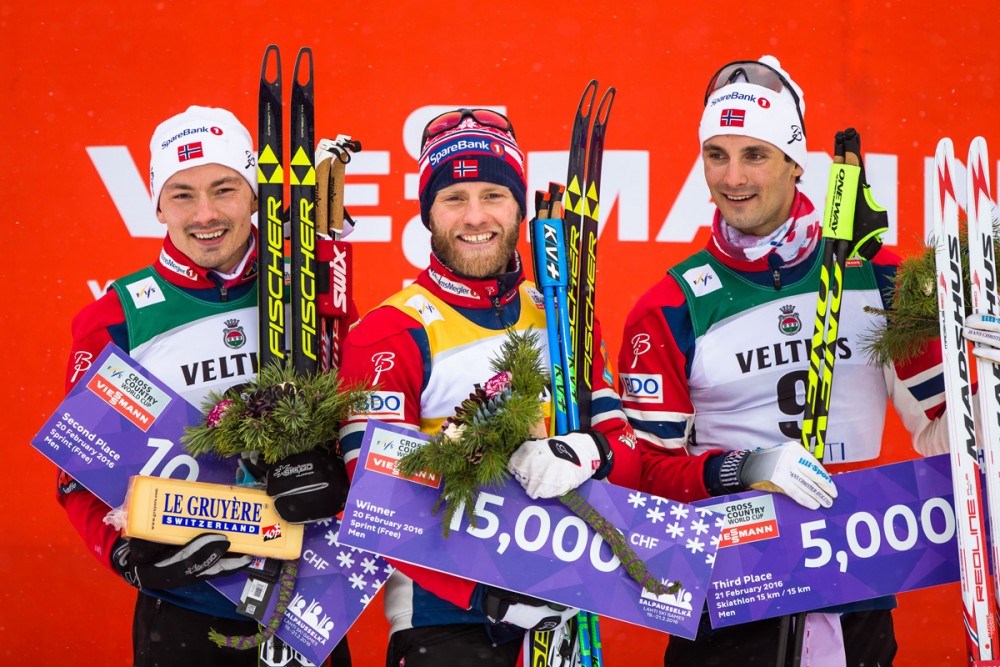
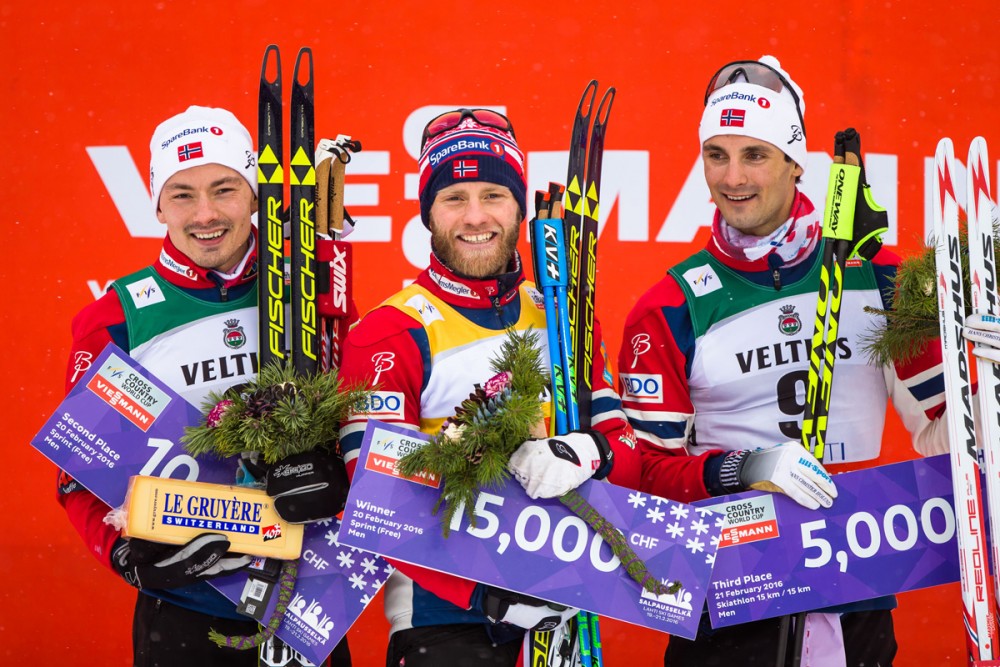
    Left to right: Finn Haagen Krogh (NOR),  Martin Johnsrud Sundby (NOR),and Hans Christer Holund (NOR) on the podium after the men's 30 k skiathlon on Sunday in Lahti, Finland. (Photo: Fischer/Nordic Focus)
    Left to right: Finn Haagen Krogh (NOR), Martin Johnsrud Sundby (NOR),and Hans Christer Holund (NOR) on the podium after the men’s 30 k skiathlon on Sunday in Lahti, Finland. (Photo: Fischer/Nordic Focus)

    When the pattern of weekend after weekend podium wins is broken, missing top spots can serve as a wake-up call.

    The Norwegian men’s ski team saw this first-hand after Russia claimed three victory titles last week in Sweden. With redemption in mind, Norway locked in on this weekend’s World Cup competitions in Lahti, Finland.

    We needed to come back from three Russian victories last week,” Norwegian Martin Johnsrud Sundby, the overall winner of the men’s 30-kilometer skiathlon on Sunday in Lahti, said in a post-race interview with FIS. “We were pretty mad about that. So we had a talk last night that we were going to fight back today.”

    The Norwegians commandeered Sunday’s 30 k podium, after also taking the top three spots in Saturday’s sprint. The first five skiers across the finish line on Sunday all sported the red suits of Norway, a quintet spearheaded by Sundby in a time of 1:10:3.0.  

    Sundby Falls During First 15 k Classic Leg

    Even while headed to his 13th individual World Cup win of the season, Sundby was not immune to the challenges presented by the Lahti skiathlon. Fresh snow that continued to cover the course and a crash tested him during the 30 k distance.
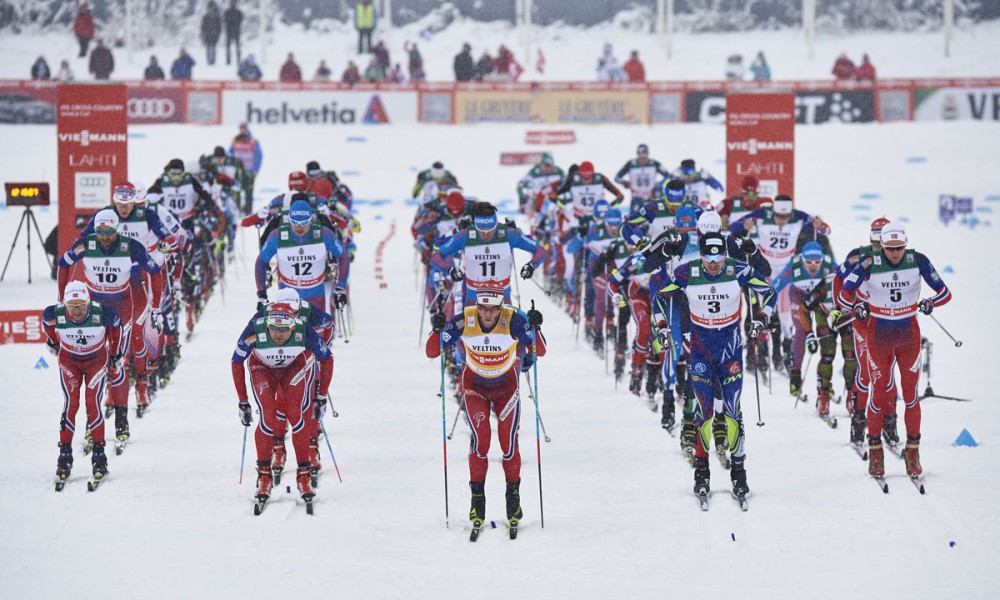
    The start of the men's 30 k skiathlon on Sunday in Lahti, Finland. (Photo: Fischer/Nordic Focus)
    The start of the men’s 30 k skiathlon on Sunday in Lahti, Finland. (Photo: Fischer/Nordic Focus)

    “I tried to create quite good speed in the first couple laps as usual, a bit more difficult for sure when it’s snowing,” Sundby said. “I had a crash with a Russian guy in the second loop. It was a bit painful so I used a couple of laps to recover.”

    While Sundby recovered from his fall, France’s Maurice Manificat took control of the pace for the next two 3.75 k classic laps.

    “Martin [Sundby] was falling on the second lap,” said Hans Christer Holund, who finished third (+8.0), during a post-race press conference. “When he was falling it looked like the French were trying to get ahead and just go. I was a bit surprised that the [French] were going so hard in the beginning.”

    First to the ski exchange and the first skate skier on course–followed closely by Sundby and French teammate, Jean Marc Gaillard–Manificat managed to make the king of distance struggle, even if just for the next two skate laps.

    “Manificat did a great job setting the pace,” Sundby said during a post-race press conference. “He was going hard. He didn’t want any help. He just kept pushing. From my point of view, the pace was quite tough.”

    Still not tough enough, however, to hold off Sundby for long. By 23.7 k the Norwegian was back in the front and the French man began to fade. Saturday’s second place finisher in the sprint, Finn Hågen Krogh of Norway, moved in behind Sundby, while fellow Norwegians Didrik Tønseth and Holund held onto their two teammates in the lead.
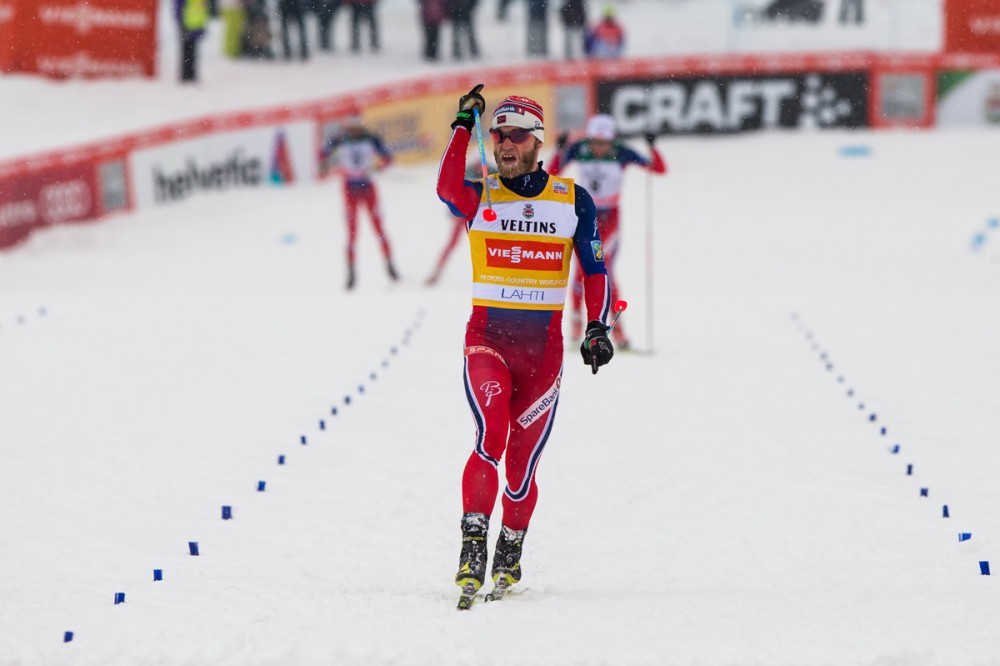
    Martin Johnsrud Sundby (NOR) crosses first in the men's 30 k skiathlon on Sunday in Lahti, Finland. (Photo: Fischer/Nordic Focus)
    Martin Johnsrud Sundby (NOR) crosses first in the men’s 30 k skiathlon on Sunday in Lahti, Finland. (Photo: Fischer/Nordic Focus)

    By the final course climb, with Krogh still clinging on, Sundby knew he needed to make his move soon, if he hoped to secure the win.

    “I didn’t want to come into this last 100 [meters] with him,” Sundby said during a press conference, referring to Krogh. “But I had to try and the last uphill is quite long and tough. So, I just said to myself ‘yeah, you just go 100 percent and see what happens.’”

    The race leader’s ‘100 percent’ effort proved potent. He continued his lead into the stadium, crossing the finish line 4.9 seconds ahead of second place finisher, Krogh.

    “Usually the day after the sprint you are almost more tired than after a distance race,” Krogh said during a post-race press conference. “That’s why I was kind of surprised that I did so well today because I felt a bit tired after the sprint yesterday. To finish second today is a really good surprise for me.”

    Holund out-lunged teammate Tønseth by six tenths of a second for third, 8.0 seconds behind Sundby. Niklas Dyrhaug of Norway finished fifth, (+45.0), and Manificat, the first non-Norwegian, crossed in sixth (+49.0).

    “I had fire in classic & so good skis!” Manificat tweeted after the race. “In skate I tried more but I loss too much energy!”

    Maxim Vylegzhanin of Russia, who won the Falun 10 k classic, finished 10th in the skiathlon (+2:09.6), just ahead of Sweden’s Marcus Hellner, who may be finally coming back into race form after a difficult year.

    Bjornsen Best American Finish in Skiathlon, 27th Overall

    While some of Sunday’s skiathlon racers struck from the front, others chose to sink their teeth in and hang on from behind. Erik Bjornsen (U.S. Ski Team), the first American to cross the finish line on Sunday in 27th overall (+2:59.2), went with the latter.

    “I was feeling like I was pacing it pretty well in the classic,” Bjornsen said in a post-race interview. “It was easy for me to kind of sit up there in the top 20. The plan was to try to hold that as long as I could in the skate.”

    After switching to skate skis, Bjornsen found himself battling for position in a pack of close to 20 other skiers.

    “It was important to be in the front of that group,” Bjornsen said. “I wasn’t there so I was definitely getting the slingy effect,” he added, referring to his pack position and need to slow for the downhills, but ‘hammer’ the uphills to stay with the group.
    Erik Bjornsen (USA) celebrates as he crosses the finish line during the men's 30 k skiathlon on Sunday in Lahti, Finland.
    Erik Bjornsen (USA) celebrates as he crosses the finish line during the men’s 30 k skiathlon on Sunday in Lahti, Finland.

    “I wasn’t in the most efficient spot, but I was happy with the finish,” he added.

    With World Cup points from the skiathlon 30 k, Bjornsen remains excited for his next series of races: the Ski Tour Canada.

    “It will be my second tour this year, so I hope to ski through the whole thing,” he said, “and make sure I can go to each race feeling recovered and ready to go.”

    The two other Americans who raced in Sunday’s skiathlon, Noah Hoffman and Scott Patterson, finished in 36th (+4:14.3) and 52nd (+6:04.0) respectively, after getting caught up in an early crash.

    “Noah and I both got in a crash like 100 meters from the start,” Patterson said. “I mean, it’s hard to fight back when the pace is so fast up front. I picked up some places, but not as many as I wanted. Still shooting for that first top 30, so I’ll have to try again in Canada.”

    As the first distance leader after U.S. nationals, Patterson will race the Ski Tour Canada in March as well.

    Hoffman, who also broke a pole during Sunday’s fall, managed to move up almost 30 places after the tangle.

    “I felt really good during the skate portion,” Hoffman said. “I was moving up I had some good guys to ski with, but at that point I was too far back to do anything. It’s two weekends in a row that I’ve gone down, I’ve got to be better at staying on my feet.”

    After a fall in last Sunday’s 15 k mass start in Falun, and a crash in Sunday’s skiathlon, Hoffman is ready to steady his skis and put his race fitness back to the test.

    “I got away from the other guys I was with at the top of the course and I’m looking forward to carrying that fitness through to Canada,” he said.

    –JoJo Baldus, Harald Zimmer, & Chelsea Little contributed reporting


    Results

  • Iversen Capitalizes on Northug’s Weakness for Second World Cup Win

    Iversen Capitalizes on Northug’s Weakness for Second World Cup Win

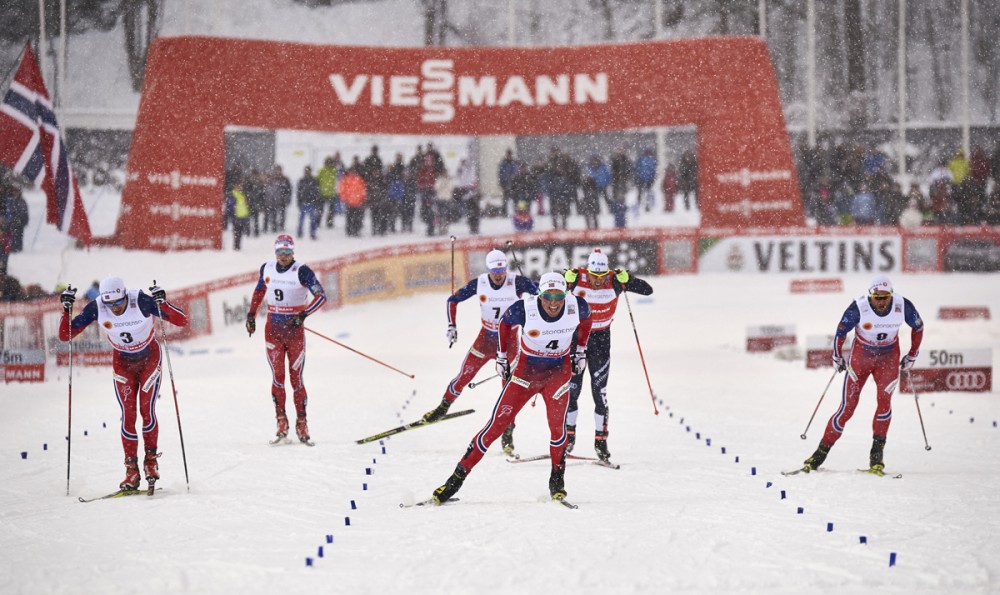
    Left to right: Norwegians Finn Hågen Krogh, Eirik Brandsdal, Sindre Bjørnestad Skar, Emil Iversen, Italian Federico Pellegrino, and Norway's Petter Northug during the men's 1.6 k freestyle sprint final on Saturday in Lahti, Finland. (Photo: Fischer/Nordic Focus)
    Left to right: Norwegians Finn Hågen Krogh, Eirik Brandsdal, Sindre Bjørnestad Skar, Emil Iversen, Italian Federico Pellegrino, and Norway’s Petter Northug during the men’s 1.6 k freestyle sprint final on Saturday in Lahti, Finland. (Photo: Fischer/Nordic Focus)

    Logging hours upon hours of ski training is one thing. Logging hours upon hours of ski training with Norway’s nordic icon, Petter Northug is another. At least, so suggests Norwegian Emil Iversen, winner of the men’s 1.6-kilometer freestyle sprint on Saturday in Lahti, Finland.

    “I have trained too much with him now I think,” Northug said during a post-race press conference, referring to his Norwegian teammate, Iversen.

    “He has found my weakness … He beat me in Obsterdorf, he beat me here and we will not train together next year, I can tell you now,” he added with a laugh.

    With another World Cup sprint title under his belt, 24-year-old Iversen did not disclose his superstar teammate’s sprinting soft spot.

    “I can’t tell that to you,” Iversen said at the press conference regarding Northug’s weakness. “But yeah, for sure, I know what that is, so I’m going to use it also next year.”

    Whatever secrets Iversen knows, he put into action during Saturday’s sprint.

    He qualified fourth, the second Norwegian — one-tenth of a second behind teammate, Finn Hågen Krogh — and 2.41 seconds back from Finland’s Martti Jylhä, the top qualifier in 3:04.15. Iversen went on to win his quarterfinal, semifinal and eventually the final, besting not just Northug, but Italy’s sprint prodigy, Federico Pellegrino as well.

    “The Norwegians now have seen how I behaved [in prior races],” Pellegrino, 25, told the Italian Ski Federation, according to a translation. “So in the final they put a man in front of me preventing me from doing my game.”

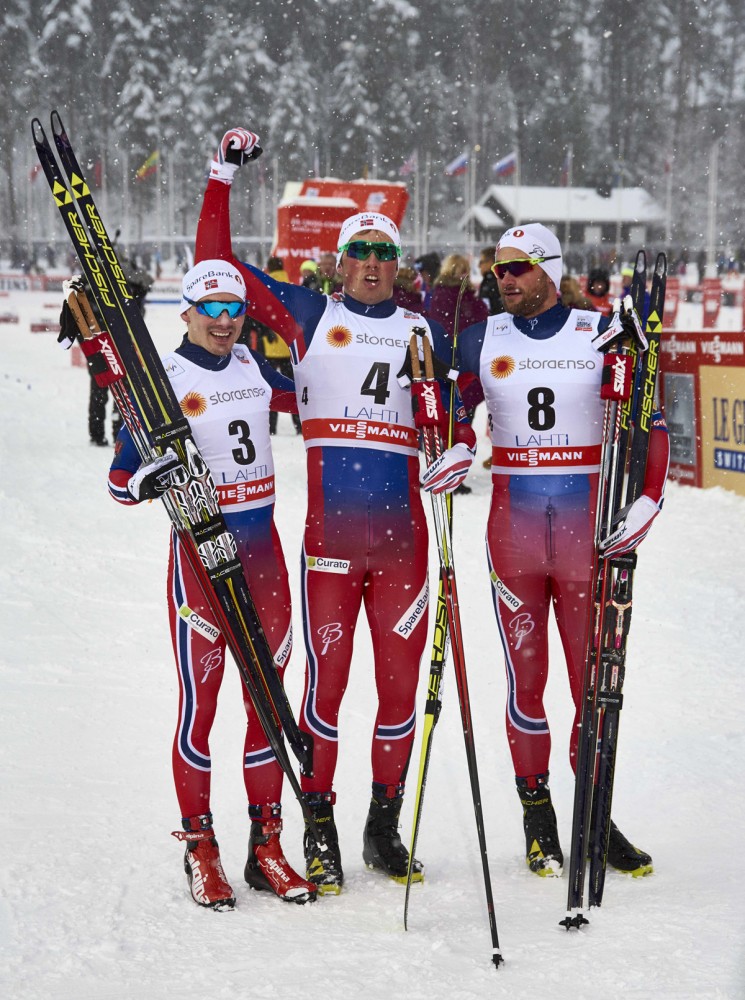
    An all Norwegian podium with (left to right) second place finisher Finn Hågen Krogh, first place finisher Emil Iversen, and third place finisher Petter Northug for the men's 1.6 k freestyle sprint final on Saturday in Lahti, Finland. (Photo: Fischer/Nordic Focus)
    An all Norwegian podium with (left to right) second place finisher Finn Hågen Krogh, first place finisher Emil Iversen, and third place finisher Petter Northug for the men’s 1.6 k freestyle sprint final on Saturday in Lahti, Finland. (Photo: Fischer/Nordic Focus)

    The Final

    The lone non-Norwegian in the final, Pellegrino found himself sandwiched between Norway’s Krogh and Eirik Brandsdal from the start until the top of the second climb.

    Prior to the course’s second major downhill, Brandsdal cornered by Pellegrino on the inside of a sweeping lefthand turn, inching the Italian into third place by the descent. Northug coasted at the pack’s back, sitting behind teammates Sindre Bjørnestad Skar and Iversen.

    As the six finalists ascended the third-and-final major course climb, Pellegrino and Iversen maneuvered to the left of Krogh, Northug and Brandsdal. Emerging first through Saturday’s snowfall were the yellow gloves and navy suit of Pellegrino.

    However, by the end of the last downhill into the stadium, Pellegrino was lost in a sea of red; his opportunity for a podium spot swallowed by the full force of Norway. Iversen and Krogh tuck skated to the right of Pellegrino, with Iversen cinching his winning spot just 0.25 seconds ahead of teammate Krogh in a time of 3:08.41.

    “I tried to have a good position on the last climb, but I was fifth or so,” Hågen Krogh said during a post-race press conference. “I should have been two more spots going forward in the field. But…I was very happy to be on the podium,” the overall second place finisher added.

    While Iversen and Krogh tucked past Pellegrino on the right, Northug came up on the left, with a turnover in the final 100 meters that out-motored that of the Italian. In a lunge for the line, Northug nabbed third (+0.69) and secured the final spot for the all-Norwegian sprint podium.

    “We train a lot in Norway and I think that’s the answer,” Iversen said regarding Norway’s sprint sweep in the men’s competition. “I think it’s the training we do. You have to train hard all year long.”

    Hamilton in the Heats, 17th Overall

    Though he did not advance beyond the quarterfinal, American Simi Hamilton’s performance on Saturday proved his progress this season as one of consistency.

    “Obviously, every weekend you want to go out and you want to be on the podium, but you take what you can get,” Hamilton said during an in-person interview. “Being able to consistently ski in the teens each sprint. I’m happy with that.”

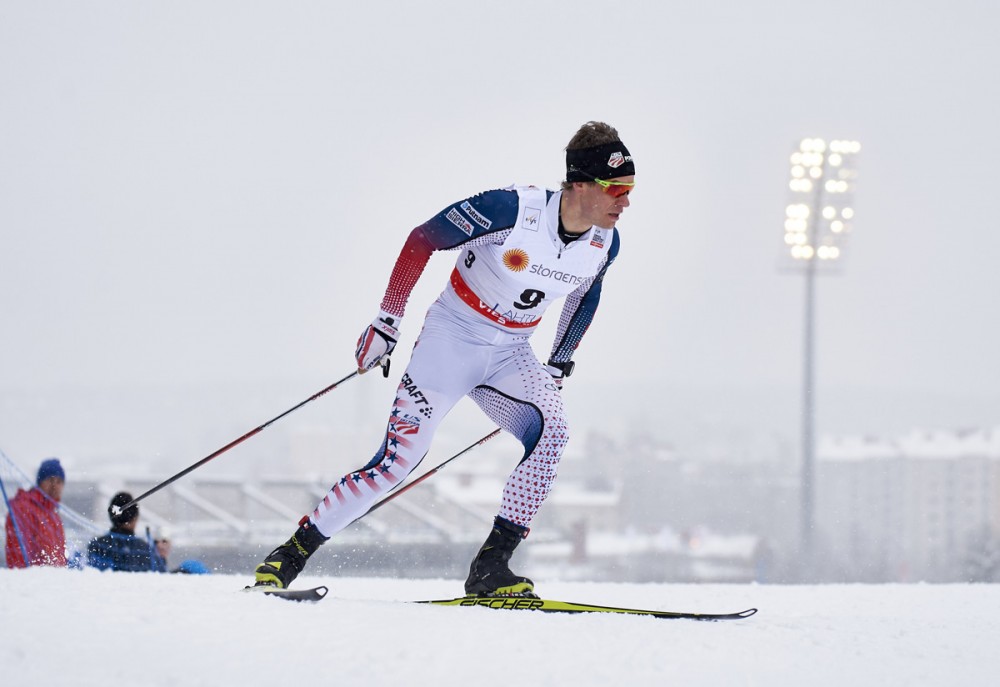
    American Simi Hamilton raced to a 17th overall in the men's 1.6 k freestyle sprint on Saturday in Lahti, Finland. (Photo: Fischer/Nordic Focus)
    American Simi Hamilton raced to a 17th overall in the men’s 1.6 k freestyle sprint on Saturday in Lahti, Finland. (Photo: Fischer/Nordic Focus)

    After qualifying in 10th (+3.42), the top American for the day said his body “felt really good” and gave him confidence to work the longer course during his quarterfinal.

    “I think this course has a lot that plays to my strengths. Some very different climbs and a couple very technical corners,” he said. “The first two thirds of the course you’re really working the entire thing, so I wanted to conserve my energy and then kind of pin in it the last third.” 

    As the U.S. skier made his way into the final major climb, however, he had trouble getting into position.

    “I tried to make a move there and got really tangled with a couple different people on that climb,” he explained.

    Jumping in behind Russia’s Alexey Petukhov, Hamilton manage to draft speed during the final downhill into the stadium.

    “I got a pretty good slingshot coming into Petukhov, but I went left into some slower snow right before the final corner and kind of got pushed back again,” Hamilton said. “So I just had to settle for getting behind Petukhov and then try to do something in the finishing stretch.  Unfortunately I stumbled a little bit coming into the finish.”

    With motivation for more than a top 20, Hamilton is ready for his next series of races: the Ski Tour Canada.

    “I’ll carry that [momentum] with me into Canada,” Hamilton said. “Really looking forward to a couple good skate sprints there and a classic sprint in Canmore and all the other races.”

    Saturday’s other U.S. male starter, Reese Hanneman, is also looking forward to the Canadian World Cup races after finishing 51st overall in the Lahti sprint. 

    “I’m hoping to keep feeling better and use this last block or races as a springboard to some good ones in Canada,” Hanneman, who will head back to the U.S. early Monday, wrote in an email.

    While Hanneman remained happy with the amount of power and movements he executed on course during Saturday’s sprint qualifier, he also acknowledged areas where he could have made up time.

    “I lost a second or two in the crux of each of the big climbs,” he wrote. “There are two big climbs, each ending in a short steep pitch. I felt like I was able to maintain good momentum up until about the final couple meters of each of those pitches, where I slowed down and had to dig. The top guys were just zipping all the way over.”

    The seconds he lost, he said, were not due to his skis — despite fresh snowfall during Saturday’s event in Lahti.

    “My wax tech Eli Brown, and all of the US techs did an incredible job with my skis today,” he wrote. “They felt great on snow that could’ve been really challenging. I definitely want to thank those guys for all their hard work.”

    — JoJo Baldus and Harald Zimmer contributed reporting

    Results: Qualifier | Final