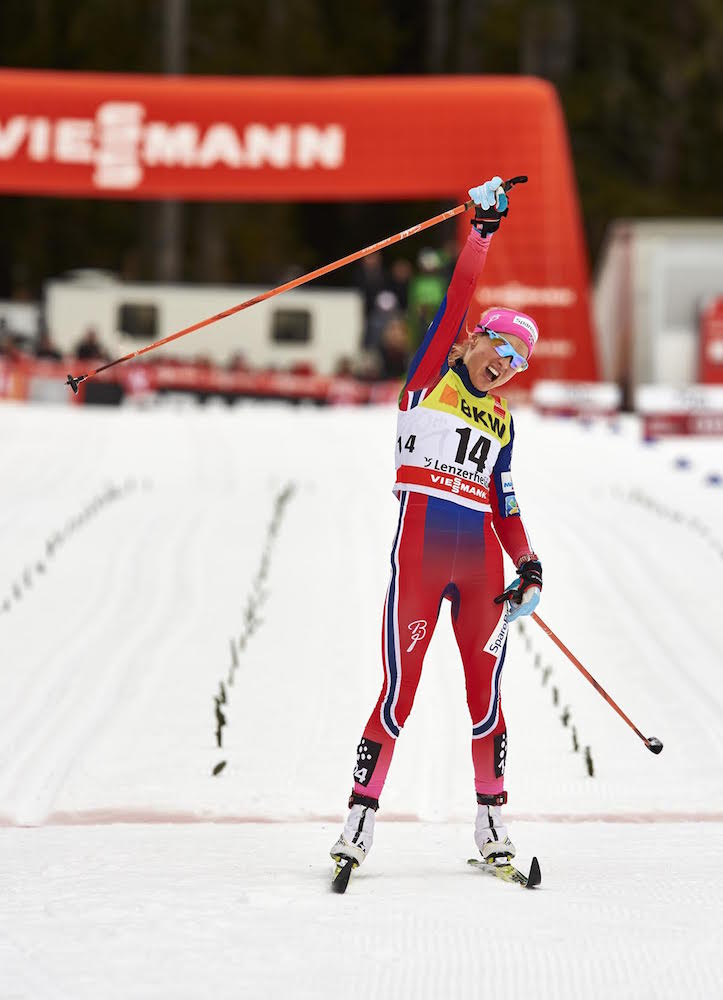
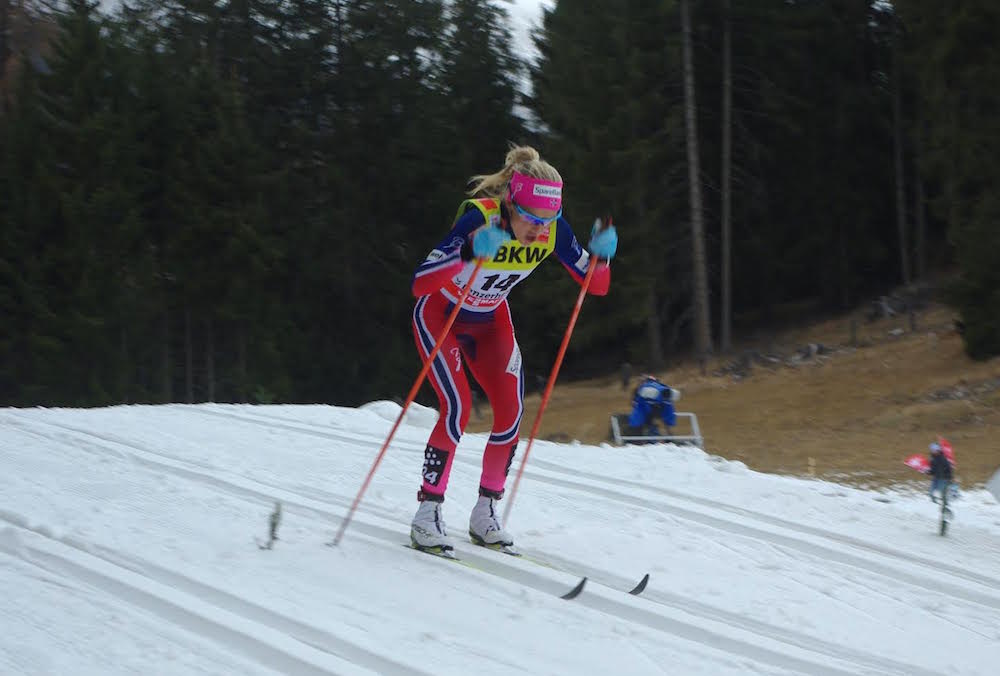
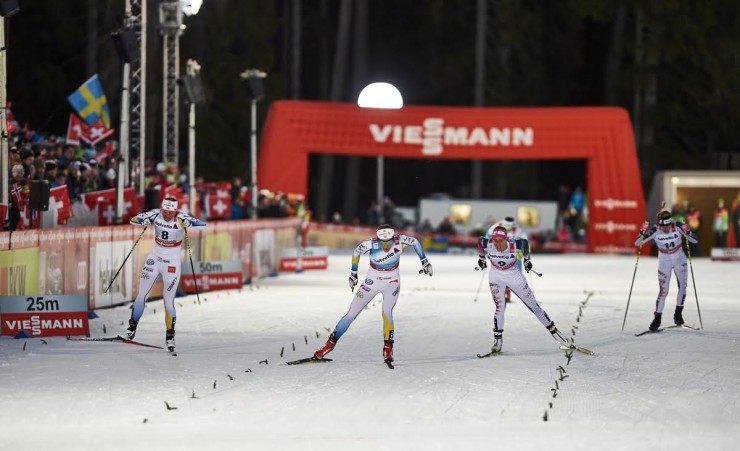
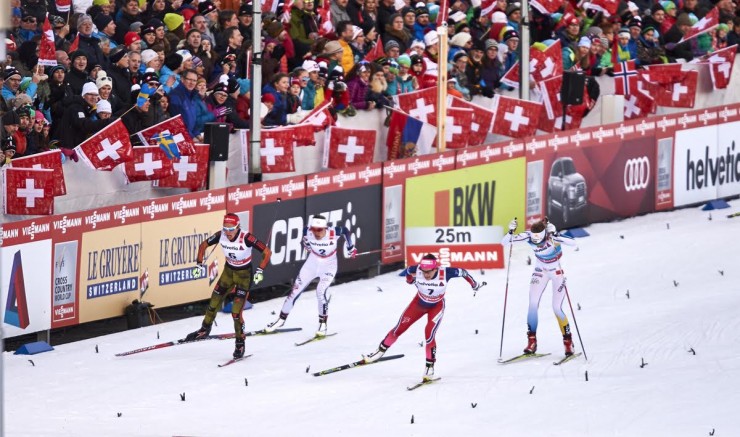
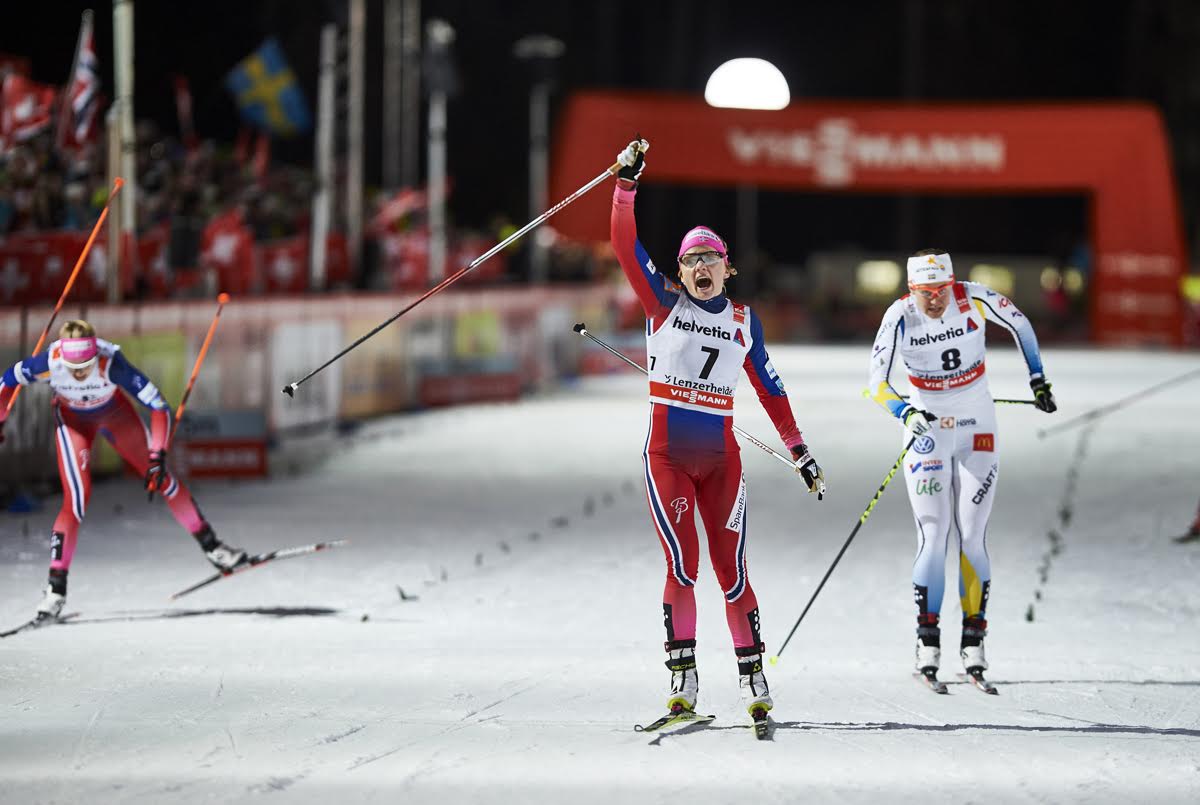
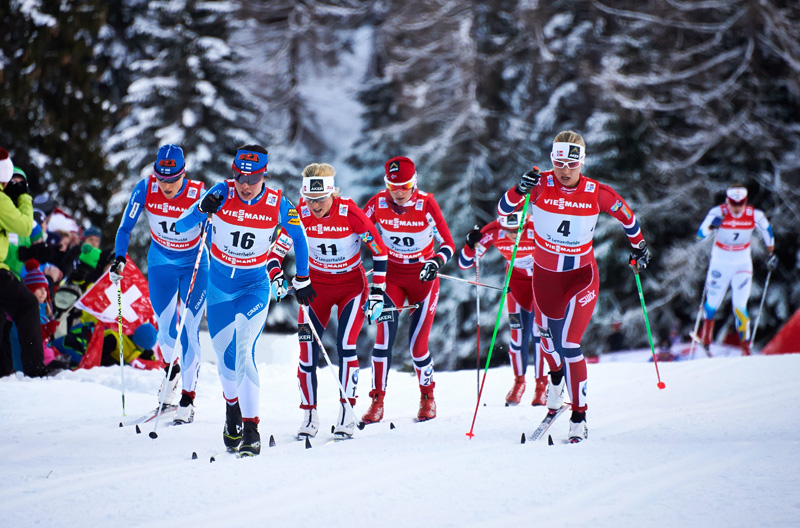
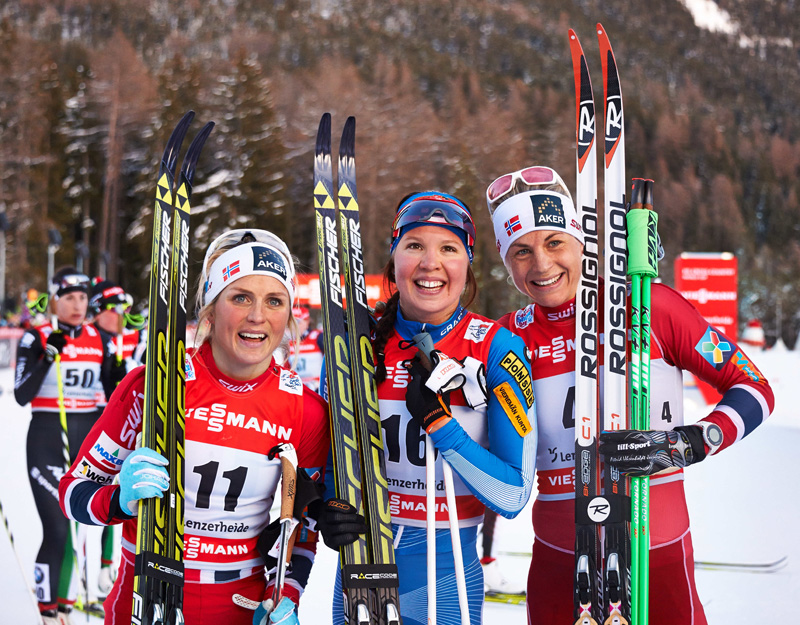
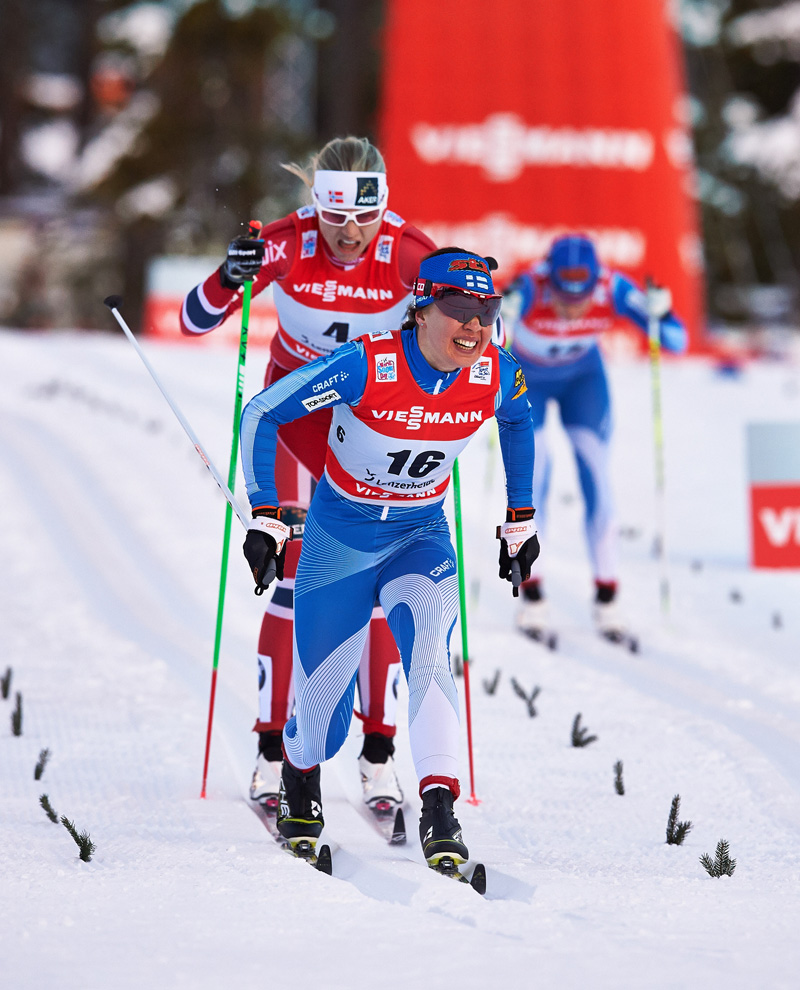
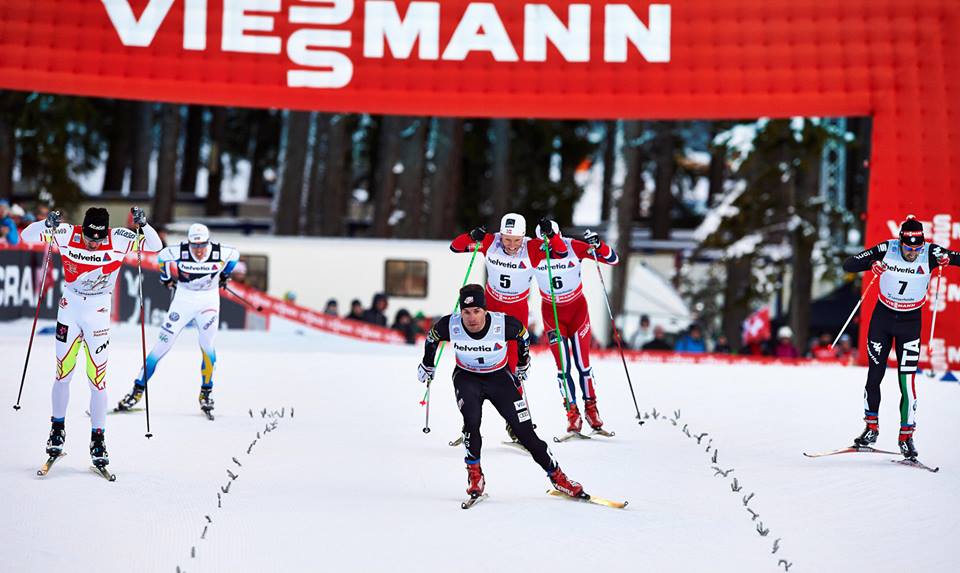
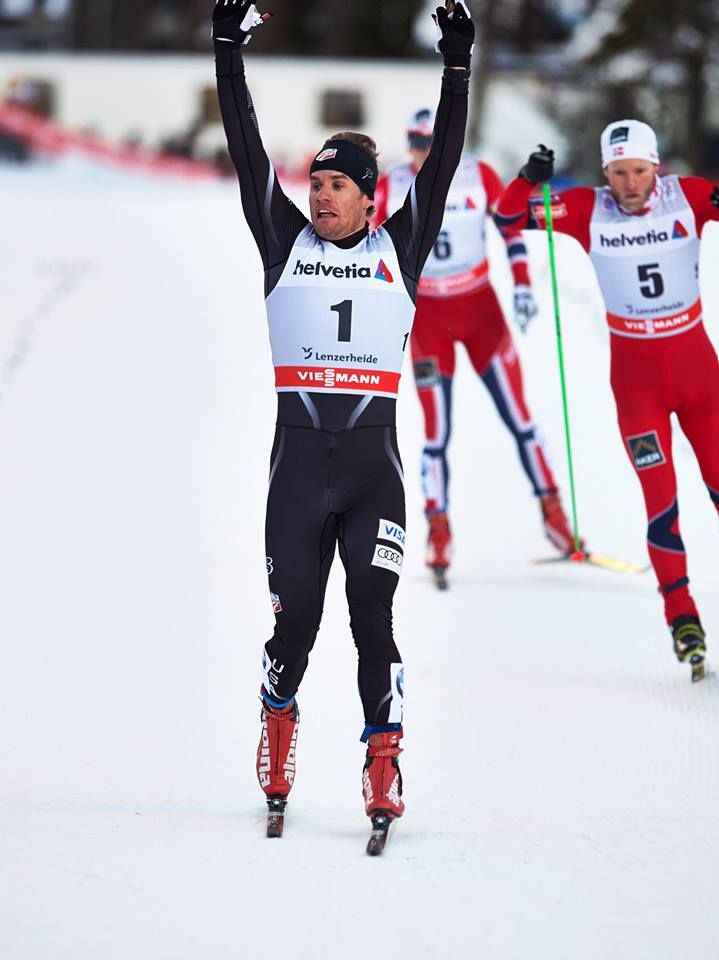
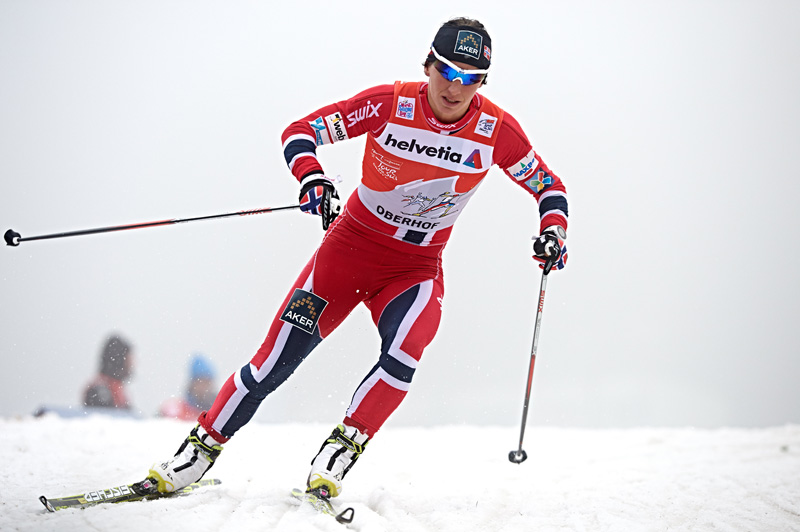
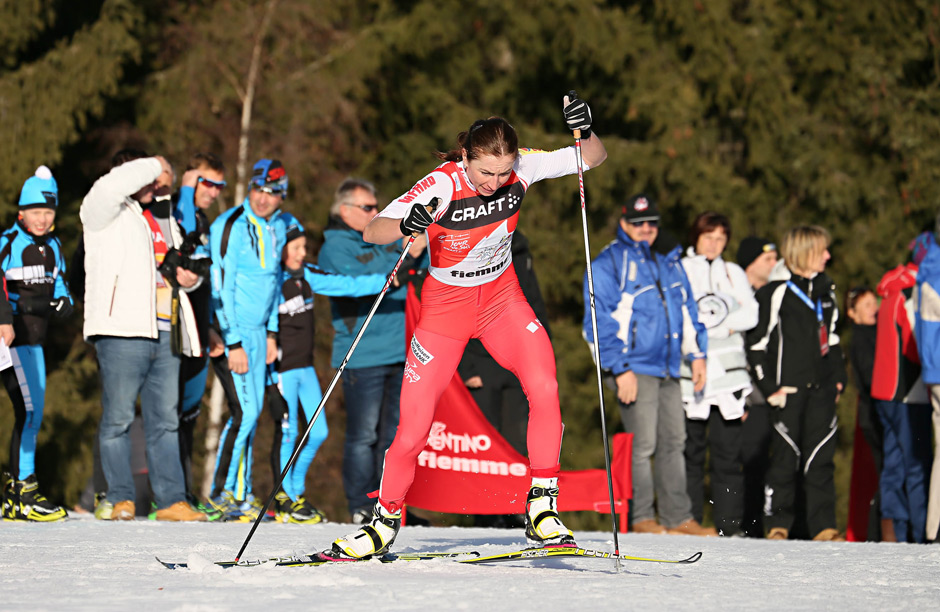
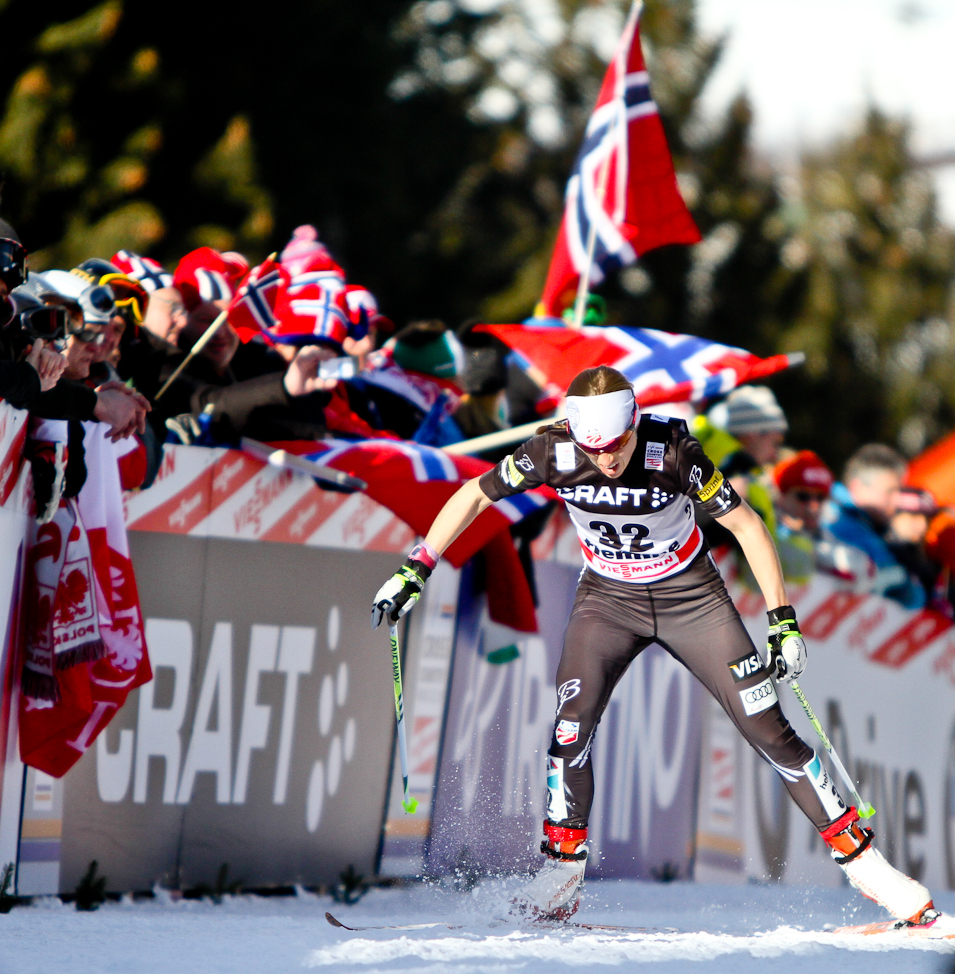
Norway’s Therese Johaug celebrates at the finish of Saturday’s 15 k classic mass start in Lenzerheide, Switzerland. She won the race by nearly 38 seconds to take the lead in the Tour de Ski after the second stage. (Photo: Fischer/NordicFocus)
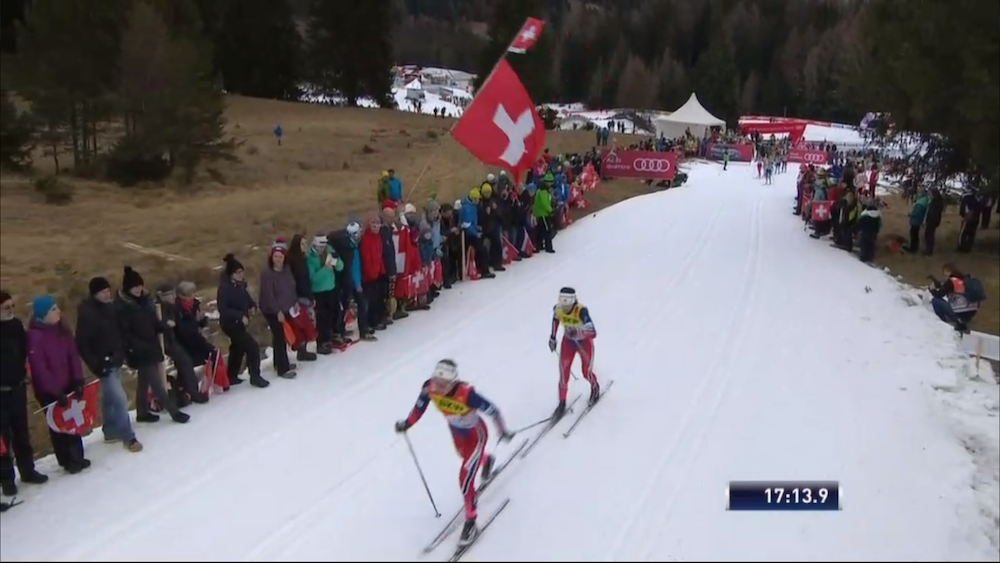
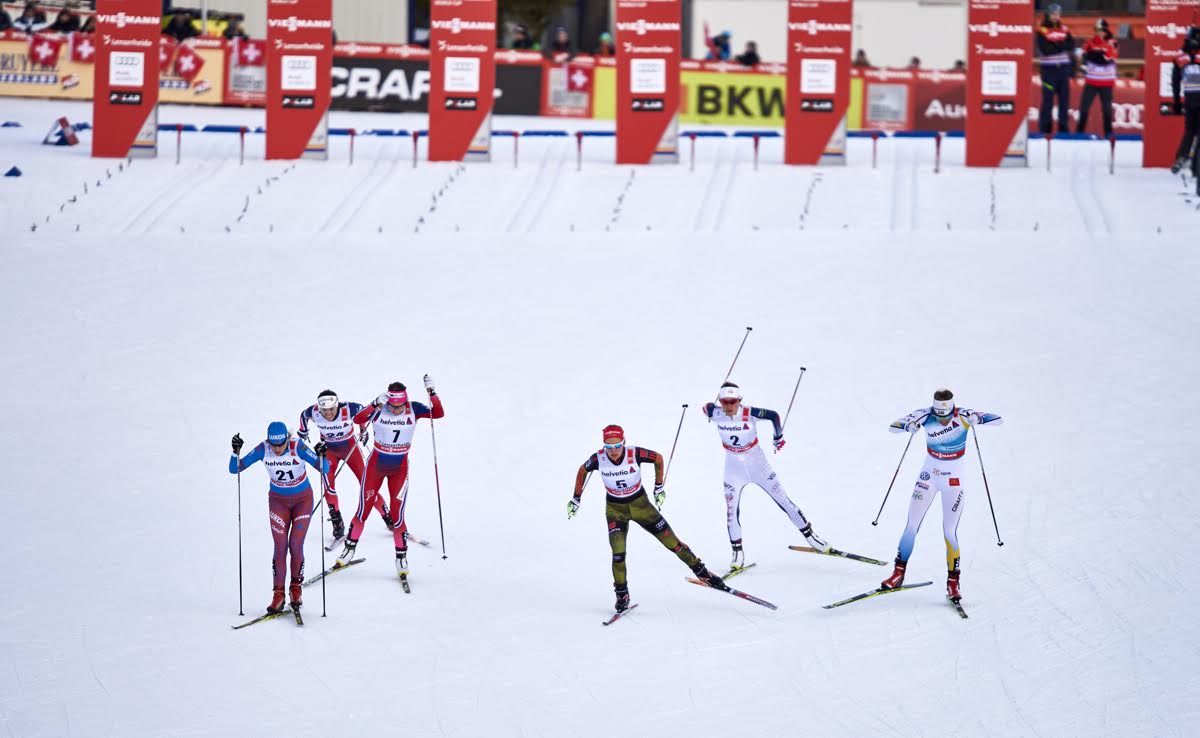
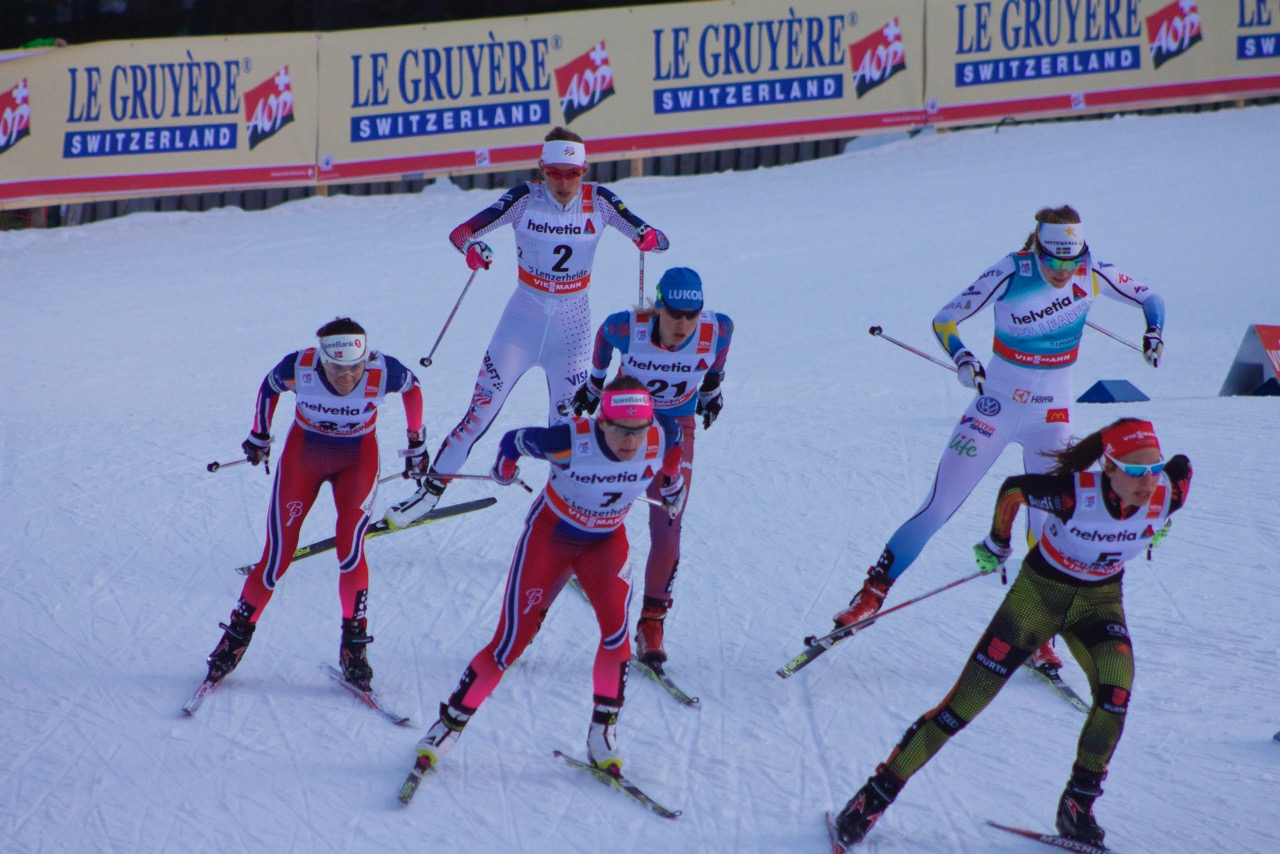
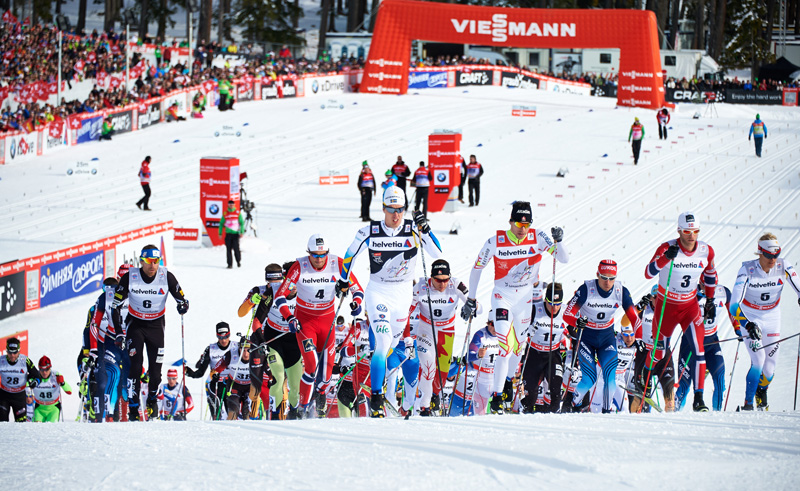
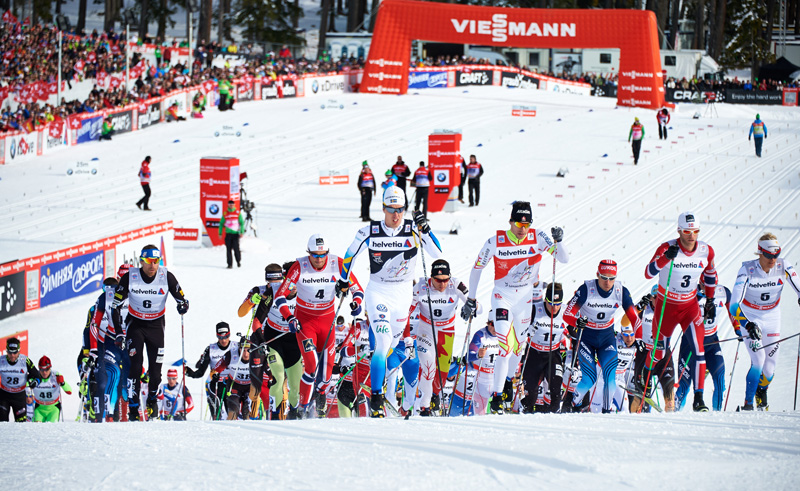
Eight-hundred meters into Saturday’s 15-kilometer classic mass start — the second stage of the Tour de Ski — it was all over. Therese Johaug, the Norwegian World Cup leader who’s won every distance race this season, had already put five seconds between herself from the rest of the 65-athlete women’s field. Several teammates fought to hang on behind her, with Heidi Weng skiing in second, Sweden’s Charlotte Kalla in third (+5.7), Astrid Uhrenholdt Jacobsen in fourth (+6.6), and Ingvild Flugstad Østberg in fifth (+7.3).
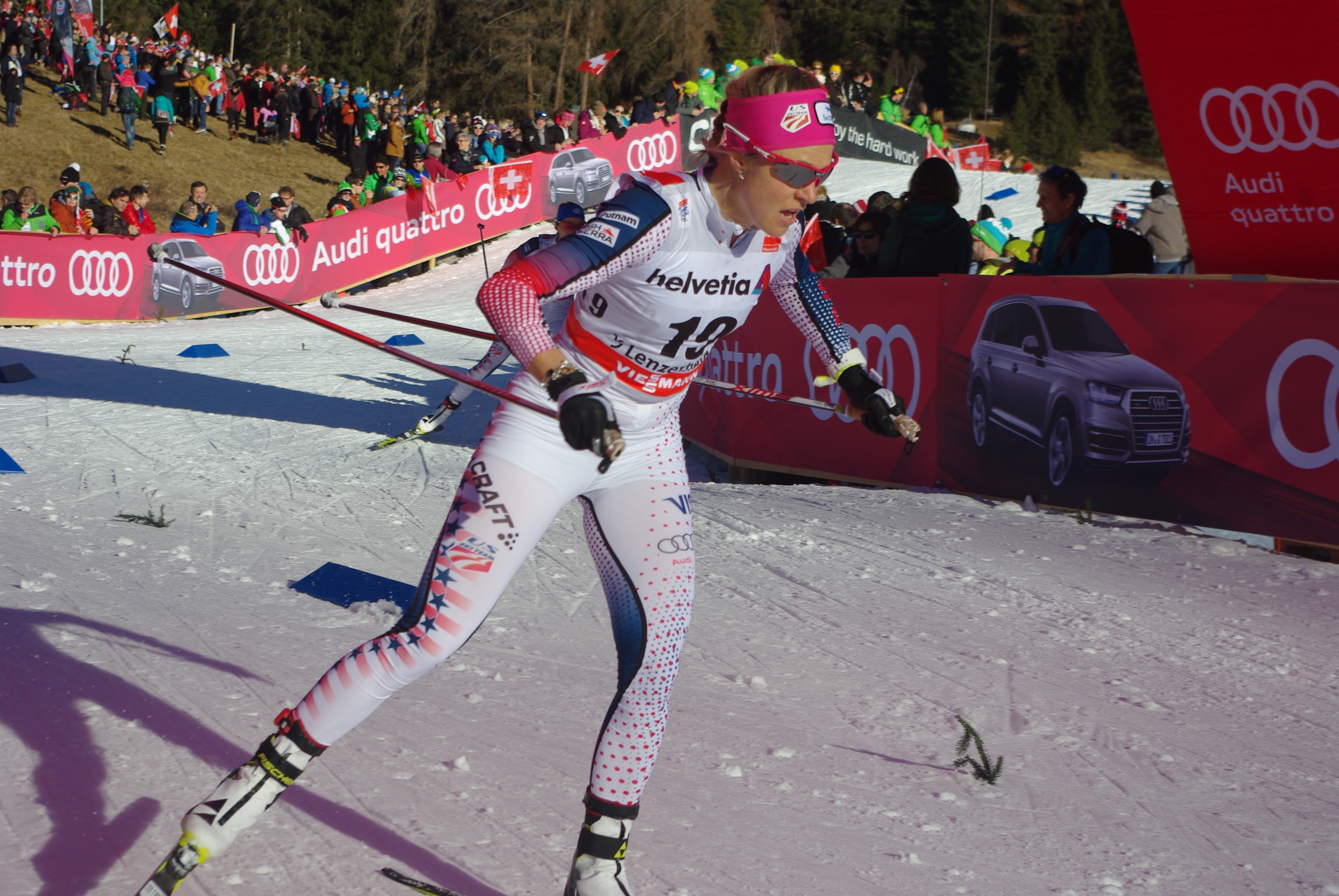
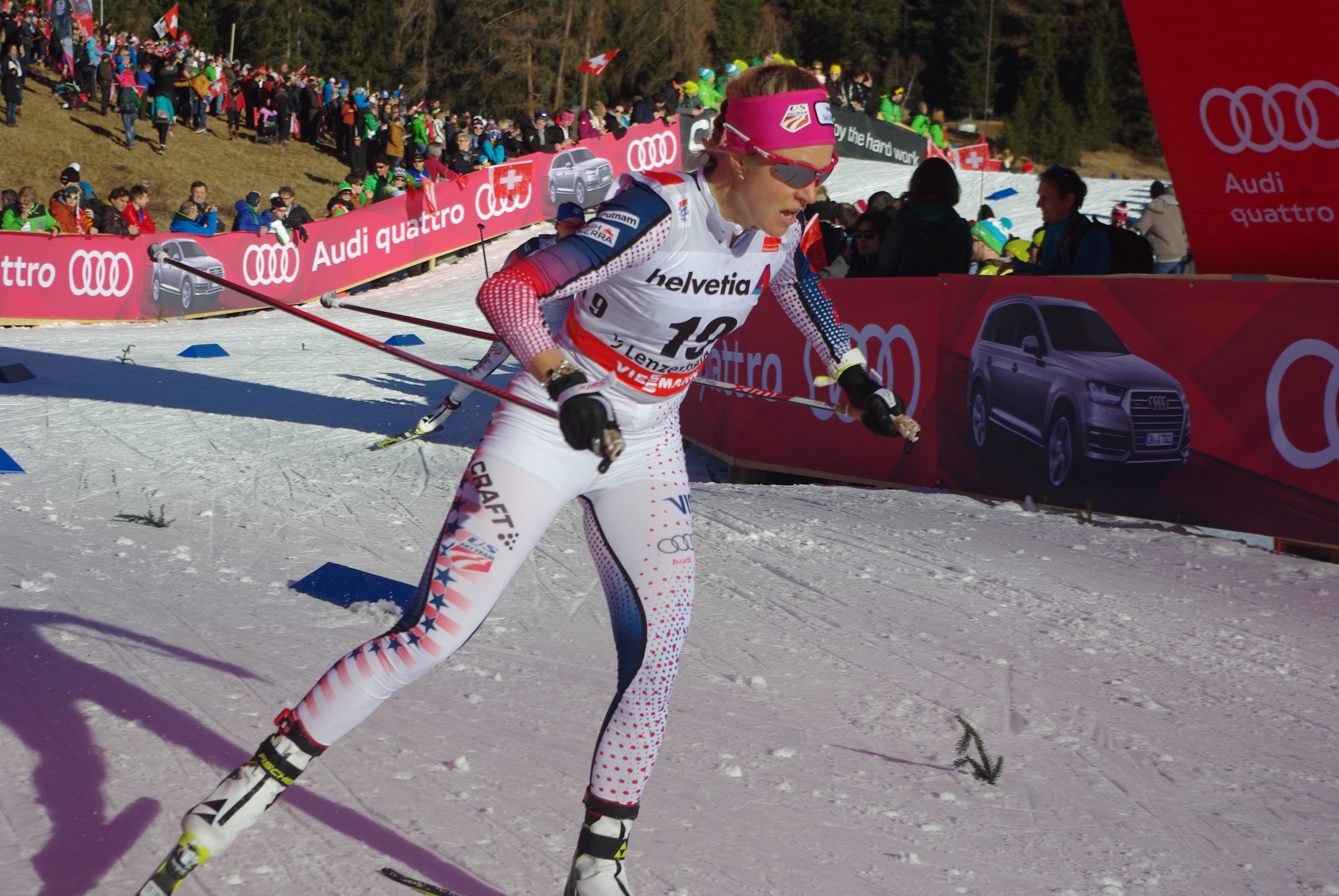
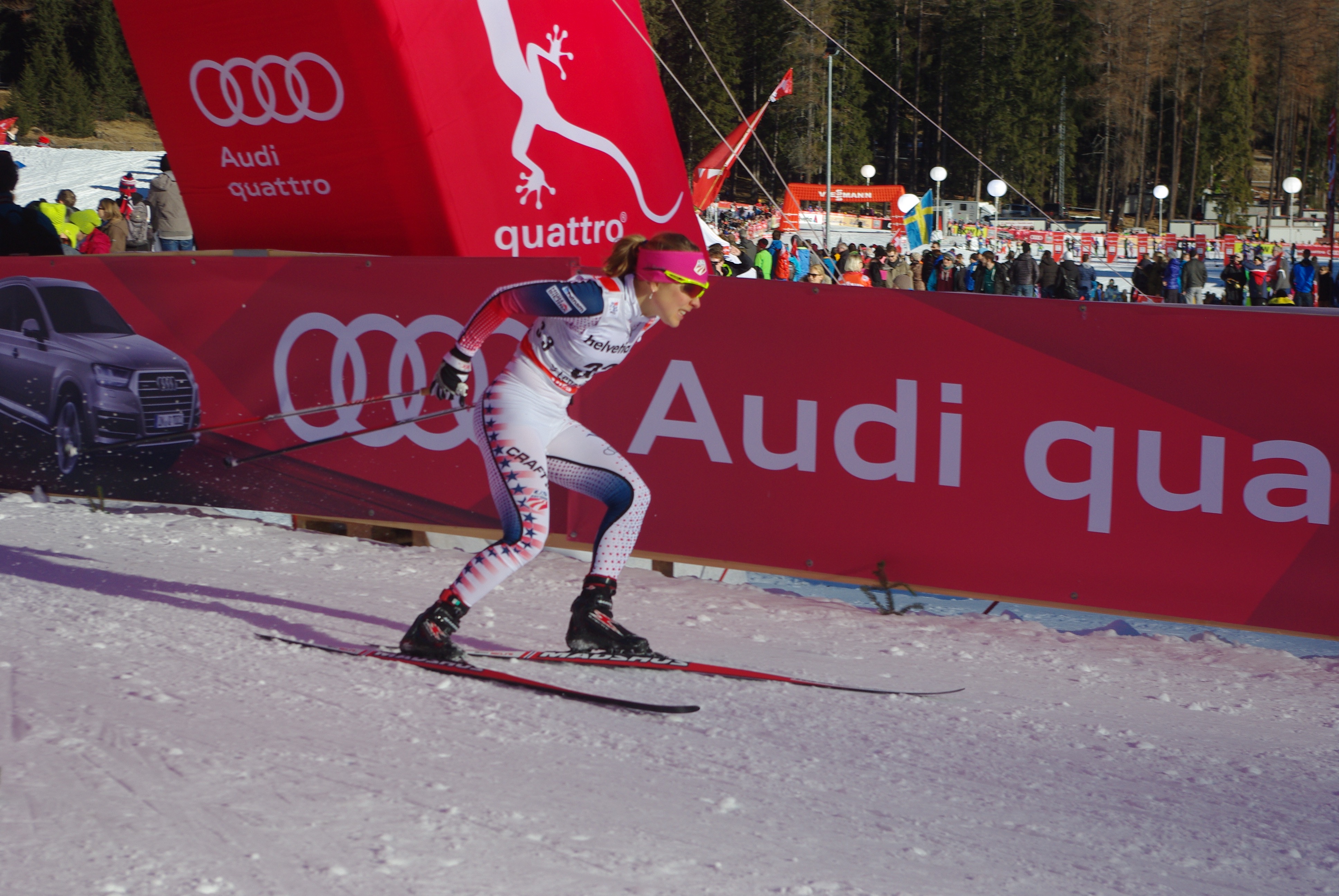
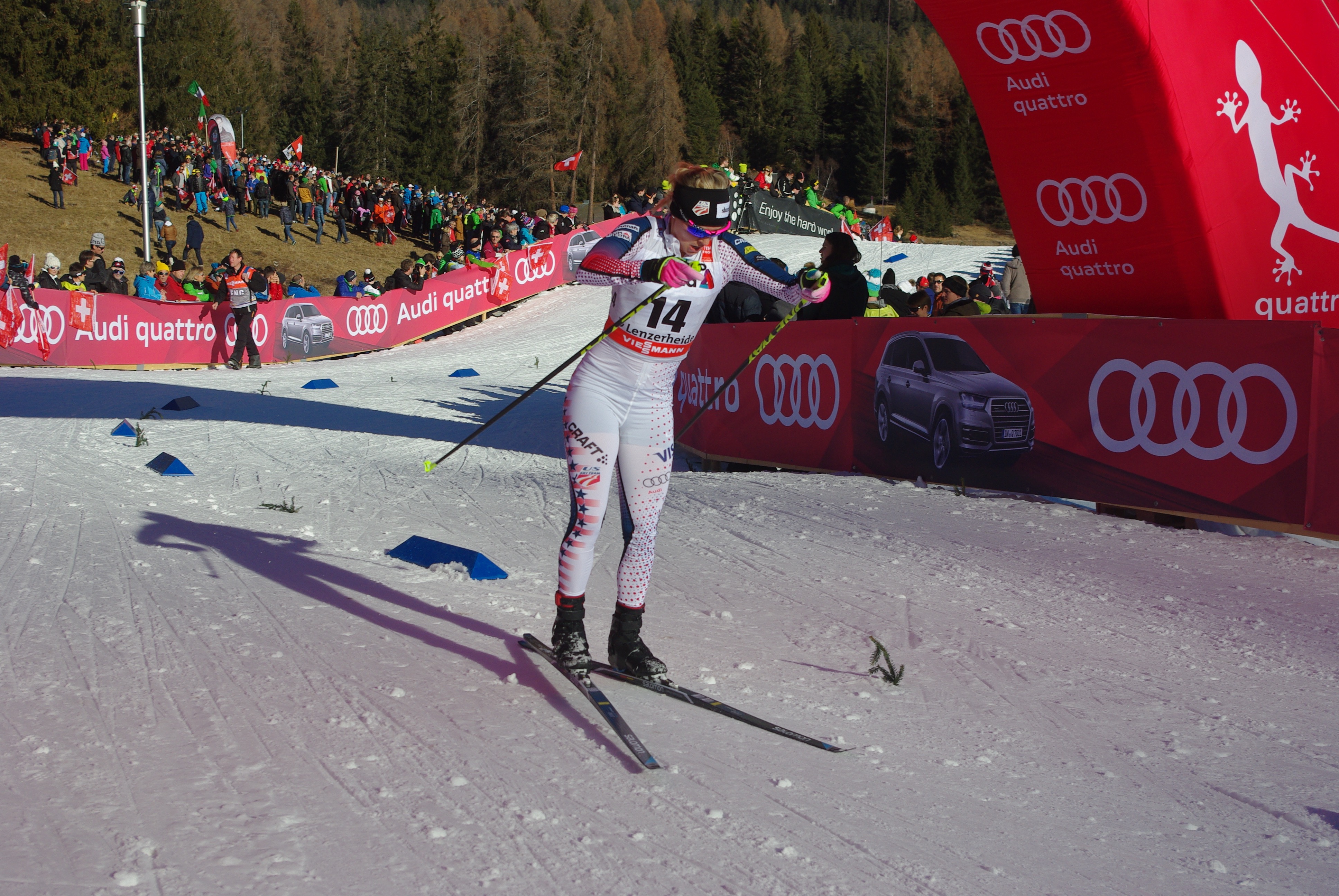
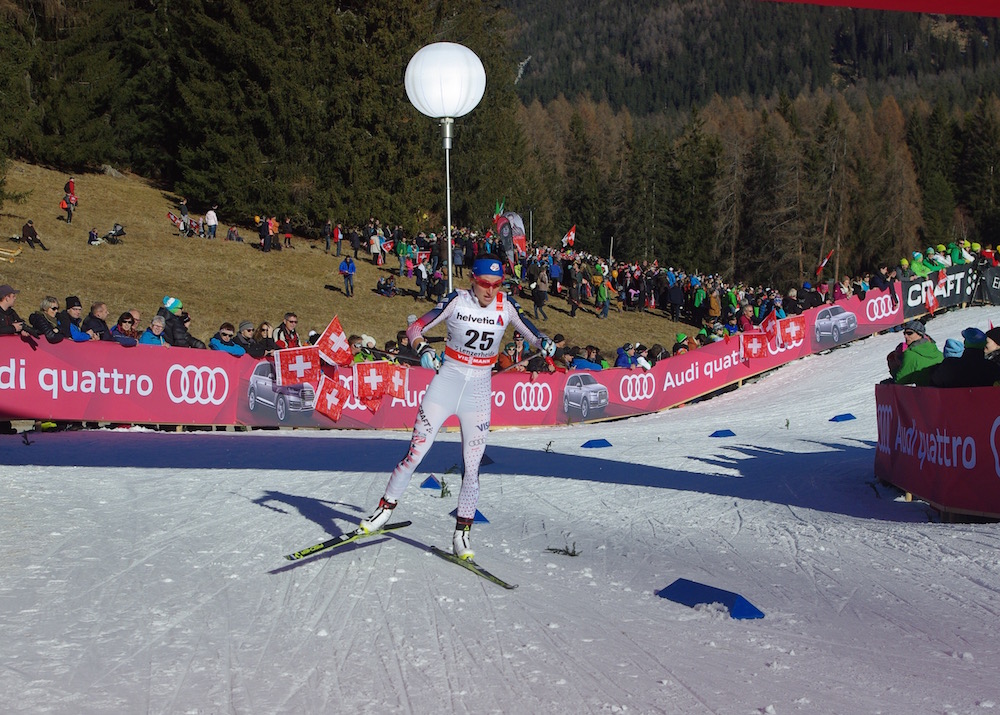
Jessie Diggins positioned herself in sixth by 0.8 k, less than a second behind Østberg, and another American, Sadie Bjornsen skied another 2.5 seconds back in 10th.
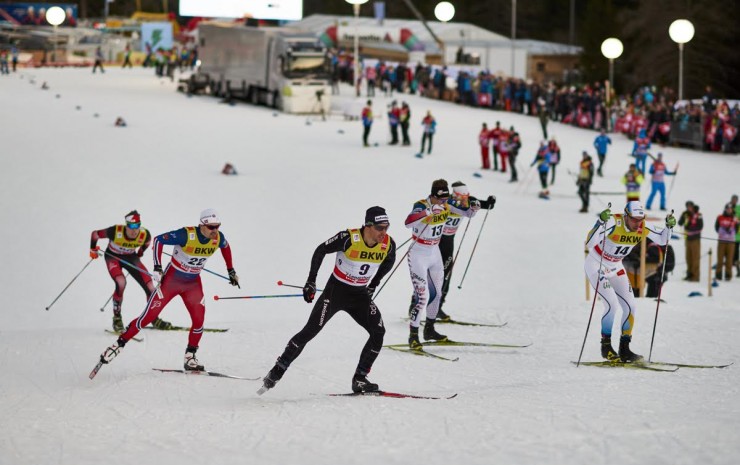
But that was less than a kilometer into the four-lap mass start in Lenzerheide, Switzerland: a classic distance race on a thin strip of snow amid a brown field, in temperatures just above freezing.
Norway’s Therese Johaug broke away early to win the women’s 15 k classic mass start at the second stage of the Tour de Ski on Saturday in Lenzerheide, Switzerland.
Around 2 k, Johaug had nearly 13 seconds to play with. The order remained the same behind her, except Sweden’s Stina Nilsson crept into sixth, 22 seconds back. Diggins stuck in ninth (+25.8) and Bjornsen in 14th (+30.9).
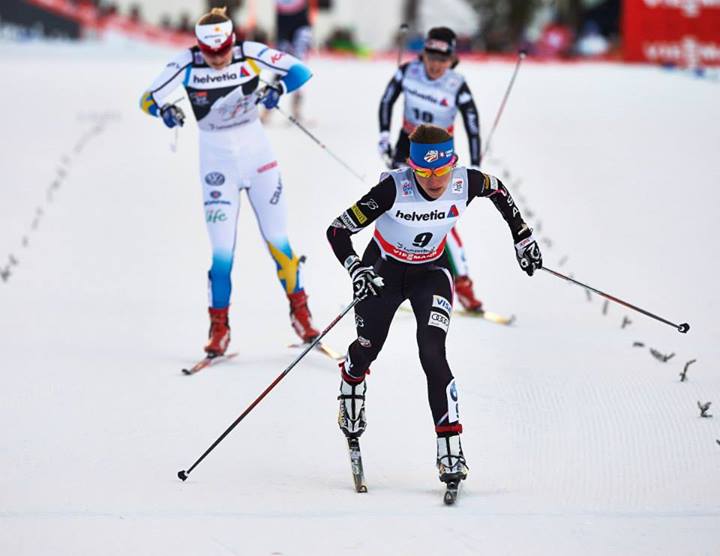
The rest of the race continued to be all about Johaug, as the 27 year old raced to a 37.9-second victory over Østberg in 41:26.4, and took the overall lead in the Tour de Ski by 4.5 seconds (thanks to 30 bonus seconds she captured at the 5.8 k and 9.6 k checkpoints).
“The plan was not to get a gap so early,” Johaug explained in a post-race press conference.
But she felt good, so she decided to go for it.
“When I have this gap in the front of the girls, I had to do my own race,” she said. “I had to focus on the technique and my job. I am sure I have perfect skis and the body was really good. It was a good feeling here.”
Fifteenth in Friday’s skate sprint at the first stage of the Tour, Johaug had 44.4 seconds to overcome in order to catch Østberg as the leader. Another Norwegian, Maiken Caspersen Falla had won the sprint, but decided not to continue the Tour in order to prepare for other World Cups later in January.
Ingvild Flugstad Østberg leads Norwegian teammate Heidi Weng about a third of the way through Saturday’s 15 k classic mass start, Stage 2 of the Tour de Ski in Lenzerheide, Switzerland.
That put Østberg, who had been second in Stage 1, in the lead heading into Saturday’s distance race.
Best known as a sprinter, Østberg hammered the last five kilometers to drop Weng (whom she skied in second and third with in pursuit of Johaug for about seven kilometers) around 10 k and minimize the distance back to Johaug. With about a kilometer to go, Østberg trailed Johaug by 42 seconds. Østberg recovered 4 seconds on that final kilometer.
“It was a great day for me, maybe my best 15 k ever, so surprised I’m not [farther] behind Therese,” Østberg said in the press conference.
When Johaug was asked if this was her ideal start to the Tour, she replied, ‘Yes.’
“I’ve got the perfect start,” Johaug told VG. “I have never gone with the [Tour leader’s] red jersey until the nine years I have gone, so I am very pleased to have with me 45 bonus seconds today, plus the difference to the others. So I’m very, very happy.”
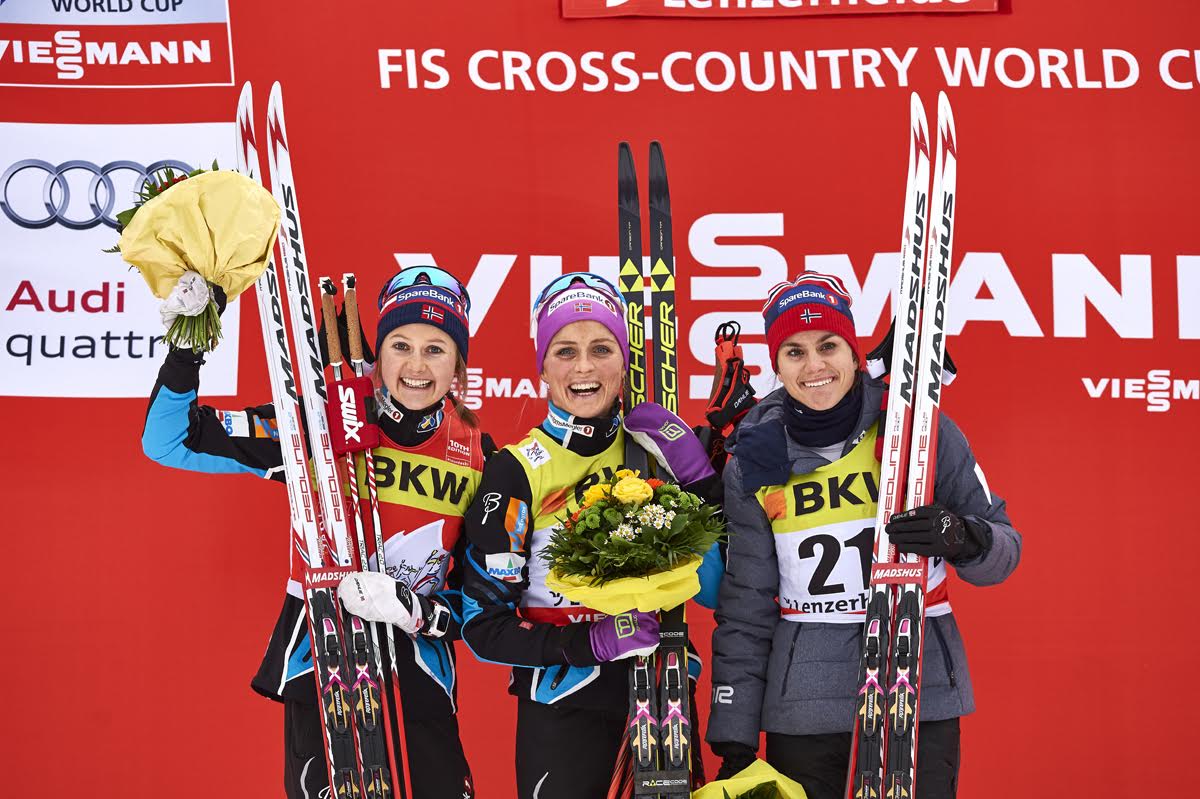
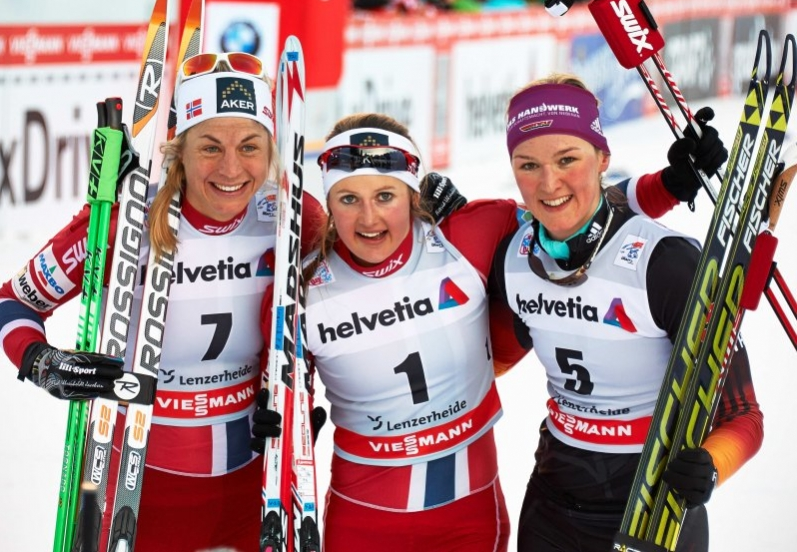
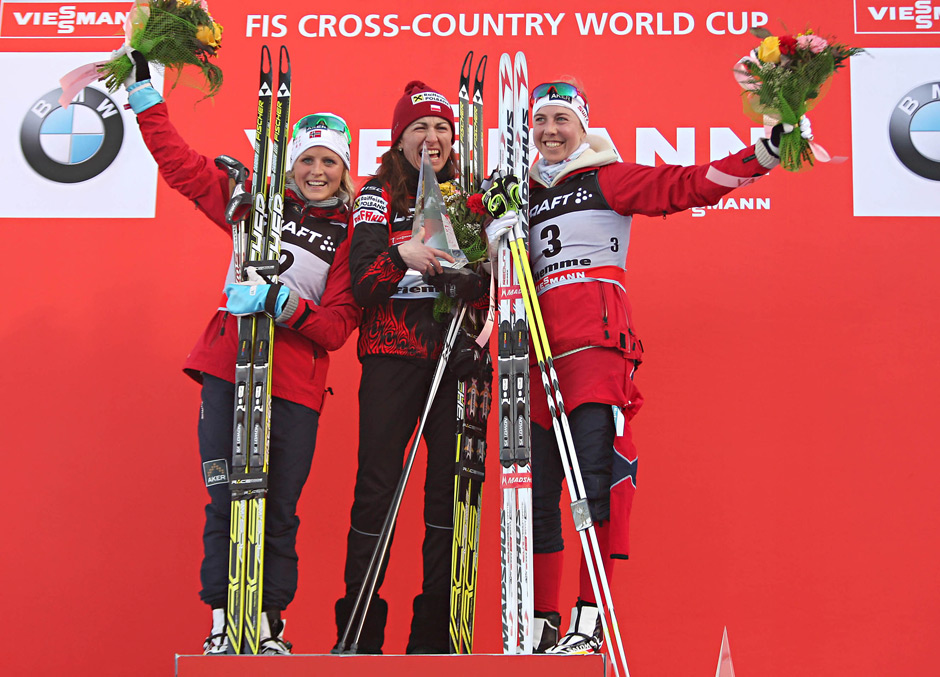
The Norwegian women swept the 15 k classic mass start podium at Stage 2 of the Tour de Ski on Saturday in Lenzerheide, Switzerland, with winner Therese Johaug (c), Ingvild Flugstad Østberg (l) in second, and Heidi Weng in third. (Photo: Fischer/NordicFocus)
Weng finished third, 38.3 seconds after Østberg and 1:16.2 behind Johaug. It was another 16.5 seconds to fourth, with Anne Kyllönen edging her Finnish teammate Kerttu Niskanen by 0.2 seconds. Kalla crossed the line 0.7 seconds later in sixth. Finland had four in the top 10 with Laura Mononen 2:19.3 back in seventh and Krista Parmakoski 2:30.7 behind in 10th.
“The last lap, I was very stiff,” Weng recalled in the press conference. She now ranks third in the overall Tour standings, 1:45.2 behind Johaug. “I was very slow so it was very hard. I think that the other girls come back, will take me to the end, but I still take the third place so I was very happy.”
Part of a seven-skier chase pack behind Østberg and Weng until about a kilometer before the halfway point, when the group started to faction off behind the leaders, Jacobsen missed the top 10 by 11.5 seconds in 11th (+2:42.2) and lay on the ground after the finish for a long time. Several teammates and competitors, including the U.S. women checked on her, but Jacobsen needed help from medical staff to get her back on her feet.
“I just talked to Astrid, and the intention is that she’ll race tomorrow,” Norway’s national-team doctor Fredrik Bendiksen told NRK, according to a translation.
Sunday’s race, Stage 3, is a 5 k freestyle pursuit for the women and the final race in Lenzerheide.
Women’s coach Egil Kristiansen expressed concern about Jacobsen.
“I do not know what it is, but it is not quite good,” he told NRK. “I guess it might have something to do with the breath. She has had no cases of it before.”
As for the 5 k, Johaug wasn’t sure the distance was long enough to her liking.
“Oy, It is really short race,” she said in the press conference. “Ingrid starts only 5 seconds behind me, so I know it’s gonna be tough, but I will do my job and focus on my stuff, and, yeah, then we see how it goes.”
Østberg saw it from a different viewpoint. Five seconds to Johaug was still a lot to overcome, she said.
“I’m not quite sure if I’m going to try to keep up to Therese or just focus on my own race,” she said. “My plan today was to focus on my own race and stay calm, that’s been a really good plan for me this season in distance races, so I guess I have to do the same tomorrow. But for sure, it would be fun if I could keep up with Therese. She’s really strong in distance races … so it will be a hard fight tomorrow.”
Stay tuned for another report on the U.S. women, with Diggins and Bjornsen leading their team in 12th (+2:44.7) and 13th (+2:45.3), respectively, on Saturday. Bjornsen currently ranks eighth in the Tour (+3:02.8), and Diggins ninth (+3:05).
Sadie Bjornsen (USA) finished seventh in today’s World Cup sprint, just two hundredths of a second away from advancing to the final. Despite the disappointment of being oh-so-close, Bjornsen said she was thrilled with the result.
LENZERHEIDE, Switzerland — Sophie Caldwell’s fourth-place finish in the World Cup freestyle sprint was a highlight for the U.S. Ski Team on Friday. But it certainly wasn’t the only one on this first day of racing in the 2016 Tour de Ski.
Six athletes making the quarterfinals? That was one metric. Caldwell was joined by Sadie Bjornsen, Jessie Diggins and Ida Sargent in the women’s quarterfinals, while Simi Hamilton and Andy Newell made the cut in the men’s race.
“The great thing is that we are regularly qualifying four people now,” U.S. Ski Team Women’s Coach Matt Whitcomb said of his squad. “And that’s an important step in a direction that gives us a better shot at huge results every day. Throwing more darts at the board you get more bullseyes.”
Ida Sargent (USA) racing to 26th in the qualifying round of the World Cup skate sprint on Friday in Lenzerheide, Switzerland.
Some athletes came close to a bullseye; some didn’t. Sargent finished fourth in her heat and 20th overall, which she said was good for a skate sprint, but not perfect.
“It was good there is just – I need more hill,” Sargent said. “I can make up time on the uphill, but there you can V2 almost that whole hill and maybe there’s ten seconds of V1. I would have liked a little more than that, but it is what it is. And I just didn’t have a strong finish today.”
Newell also landed fourth in his heat after being near the front early, and finished 19th overall.
“I feel a lot better than the result’s going to show,” Newell said. “I tend to like those races where you can go on an uphill and get away, which you can’t really do on a course like this. I should’ve been a little more aggressive on the top of the hill… it’s just one of those races where it is tactical, it’s going to come down to the last hill and into the finishing stretch. Sometimes it works in your favor, sometimes it doesn’t. That’s the way sprint racing is.”
But some of the team did come close to bullseyes. Metric number two: three of those ladies finished in the top eight, with Bjornsen and Diggins just barely missing the semifinals.
Jessie Diggins (USA) said she lacked that last ounce of power needed to make the finals in Friday’s skate sprint.
“For all three of those girls, it was heats skied exceptionally well,” Whitcomb said. “There was never a time when one of them was dangling off the end, unable to hang because of fatigue or fitness or poor moves.”
Bjornsen called it “some of the better skiing I’ve done”, and was disappointed to miss the finals by just one spot – and two hundredths of a second, after failing to outlunge Sweden’s Ida Ingemarsdotter, who went on to take second place on the day.
“It was a drag race there at the end and I was bobbling a bit,” she said. “I think it was a very close photo finish. I’m very satisfied.”
Diggins was in the same semifinal and missed the final by another 0.65 seconds, but was also happy with her skiing.
“It was one of those things where I got a little flooded on the wrong part of the course, but I was looking for the windows and I felt great,” she explained. “Which is awesome on the first day of a Tour. I’m really excited for the whole thing. I’m really proud of how I skied the quarter.”
Like Newell in his quarterfinal, the course’s tactical nature and razor-thin time margins tripped up more than a few racers.
Simi Hamilton (USA) in qualifying; he later crashed in the quarterfinals.
“There’s not a whole lot of passing because the whole thing is turning, basically, except for up the hill,” Diggins said. “Even there it winds a bit and there’s a best line. So when you pass, you have to just be so decisive. If you don’t have the power in that moment then you’re not going to make the pass. In my quarter it worked. I had the right amount of power. Then in the semifinal, it wasn’t there when I went to try to make the move.”
But enough about the women — metric number three? Even when things didn’t go so well, the team had a good attitude.
Hamilton qualified in 13th and was feeling good coming off a World Cup podium in Toblach, Italy, before Christmas. He had also won the sprint the last time it was held here as part of the Tour de Ski.
But in his quarterfinal he crashed with Switzerland’s Jovian Hediger in the final. That left him in 27th place overall, far from where he wanted to be.
That could have been a major disappointment for Hamilton, but the Stratton Mountain School T2 skier took it in stride.
“I came into [the corner] with a lot of speed, and skis just kind of get piled up there,” Hamilton said. “I’m, for sure, bummed… But it’s ski racing, we all come out on the good end of things, we all come out on the bad end of things, stuff like that happens. So you’ve just got to, I think, roll with it. Stay positive, and look forward to all the racing in the future.”
Andy Newell (USA) during the Tour de Ski freestyle-sprint qualifier on Friday in Lenzerheide, Switzerland.
Hediger didn’t take things so lightly, turning around in the finish and angrily pointing at Hamilton before telling Swiss media that the American took him out, even though he stayed on his feet and finished fourth in the heat.
“Simi is clearly in podium form, but crashed on the final corner because of just sort of a race incident,” Whitcomb said. “Each of them were too close to the middle of the track. But the cool thing that made me more proud than anything today is that Simi got up and waved to the crowd and skied it in with a smile on his face. He’s going to keep his focus here.”
“He’s got a little bit of a short temper, but he’s a nice dude, everyone’s a nice dude out there,” Hamilton said of Hediger. “I think racing kind of turns up that dial for some people a little bit.”
The team seemed to universally be looking forward to the next stages of the Tour de Ski, starting with 15 and 30 k classic mass starts on Saturday.
“It’s my first Tour and I’m stoked to see what happens,” Bjornsen said. “I have no idea what to expect, but it will be fun.”
Even Diggins, who usually enjoys skating more than classic, was excited.
“Super pumped,” she exclaimed. “Yay classic skiing! It’s a good thing I’m loving it more this year. So I’m excited to go out there and show off all the months and months and months of hard work.”
And even the sprinters, who are focused on turning in good results in the classic sprint stage in Oberstdorf, Germany, in a few days, were positive. The sprint emphasis won’t stop them from going hard in distance races before then.
“I’m going to race for real tomorrow,” Newell said. “It’s a mass start classic race, and I’m going to try to forget the fact that it’s 30 k, and just try to go with it and ski and try to have fun out there. I’ll be racing hard tomorrow, then assess things one day at a time and make sure I’ll be ready for Oberstdorf.”
Sargent, who resists being pinned in the sprinter box, agrees.
“I haven’t done many distance races – I’m mostly really excited for classic races,” she said. “It will be really good because the only distance races I’ve done so far were in Kuusamo when I was still sick, and they didn’t go very well. I am looking for some redemption now that I’m healthy.”
“This is a team that’s on the roll right now,” Whitcomb concluded.
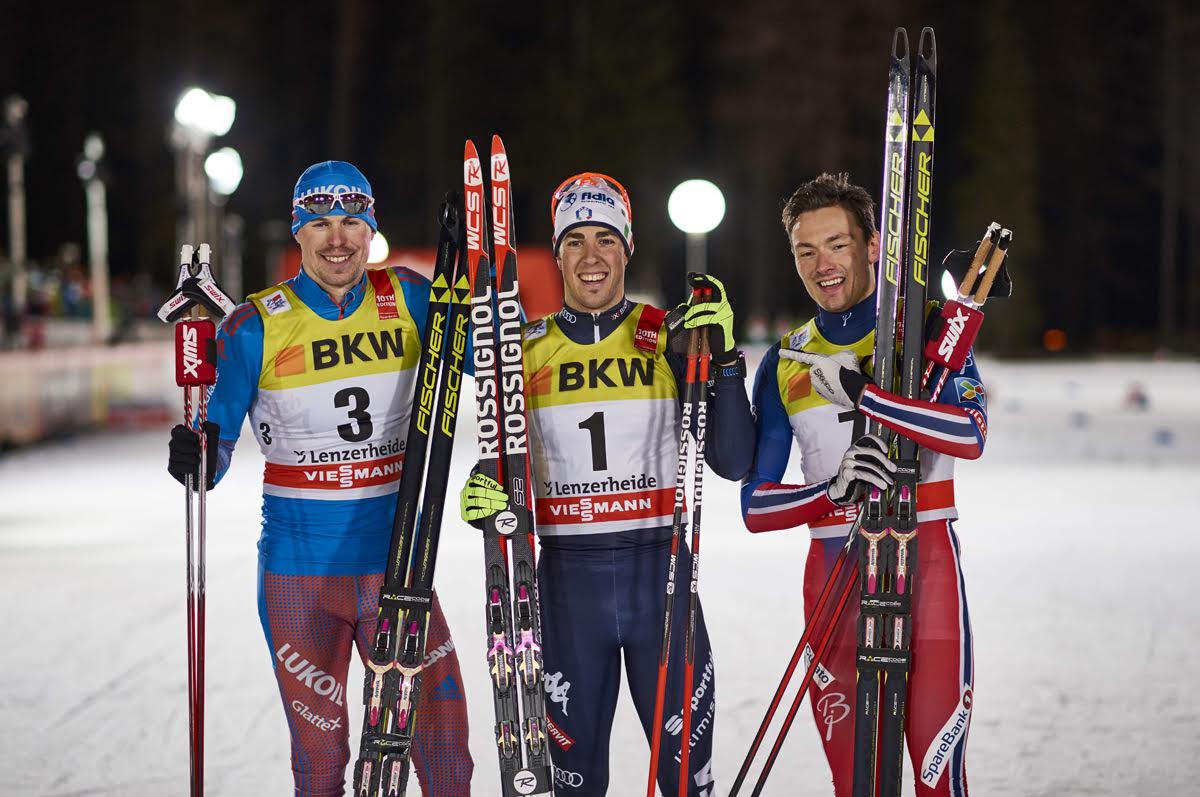
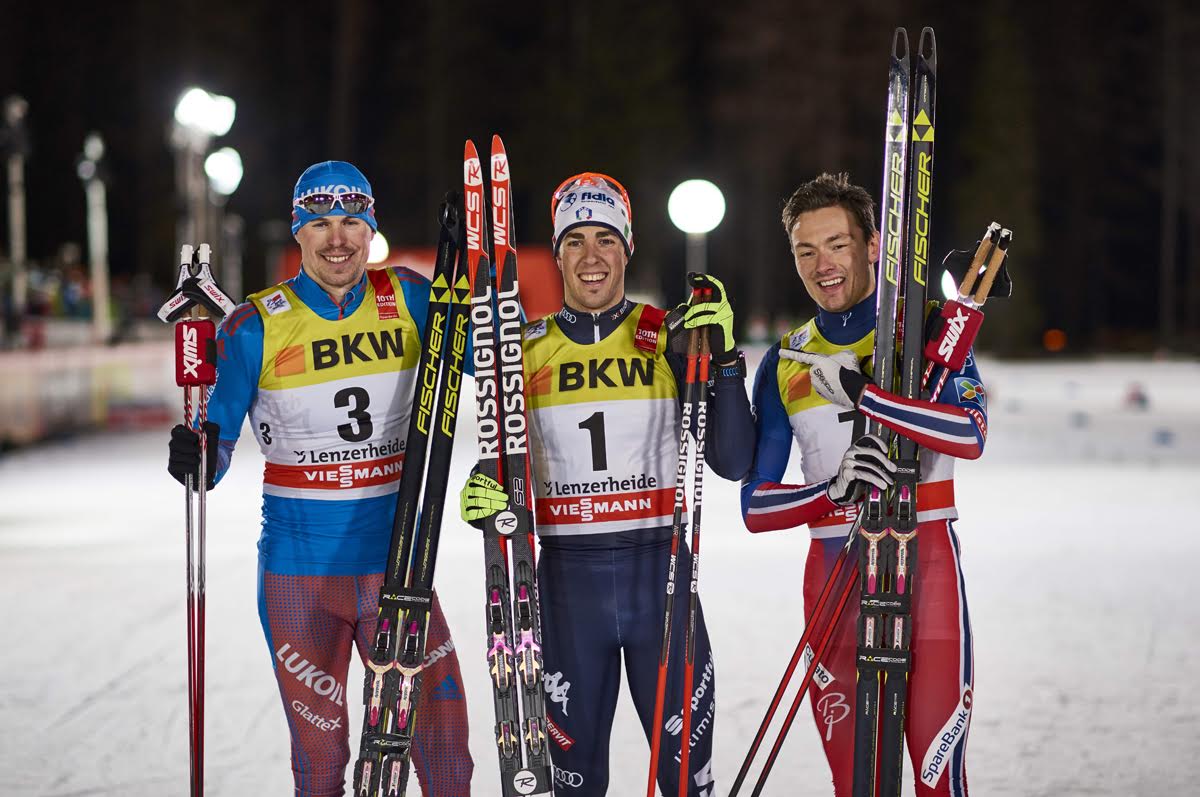
With his third-consecutive World Cup win, Federico Pellegrino (c) became Italy’s most successful sprinter of all time on Friday. He won the 1.5 k freestyle sprint, the first stage of the 2016 Tour de Ski, ahead of Russian runner-up Sergey Ustiugov (l) and Norway’s Finn Hågen Krogh (r) in Lenzerheide, Switzerland. (Photo: Fischer/NordicFocus)
It’s a new year, yet some things remain the same. Jan. 1 marked the opening stage of the 2016 Tour de Ski, a 1.5-kilometer freestyle sprint in Lenzerheide, Switzerland. It also marked the third World Cup sprint victory in a row for Italy’s Federico Pellegrino.
The 25-year-old Pellegrino dominated the day. He qualified first with a time of 2:45.92. Across the official results sheet, a pattern of 1’s next to Pellegrino’s name tells the story; the only aberration on his way to the win, a second place in his semifinal by a margin of 0.11 seconds.
Under a nighttime sky illuminated by what looked like modernist street lamps, Pellegrino won the final in 2:43.14. He out sprinted Russian Sergey Ustiugov who placed second (+0.40). Norway’s Finn Hågen Krogh skied to third (+1.25).
Not considered a sprint specialist, but certainly considered the favorite for this year’s 10th edition of the Tour de Ski, Norwegian Martin Johnsrud Sundby placed fourth (+10.09). In fifth was Sweden’s Emil Jönsson (+12.270, followed by Swiss veteran and three-time Tour de Ski champion, Dario Cologna in sixth (+59.01).
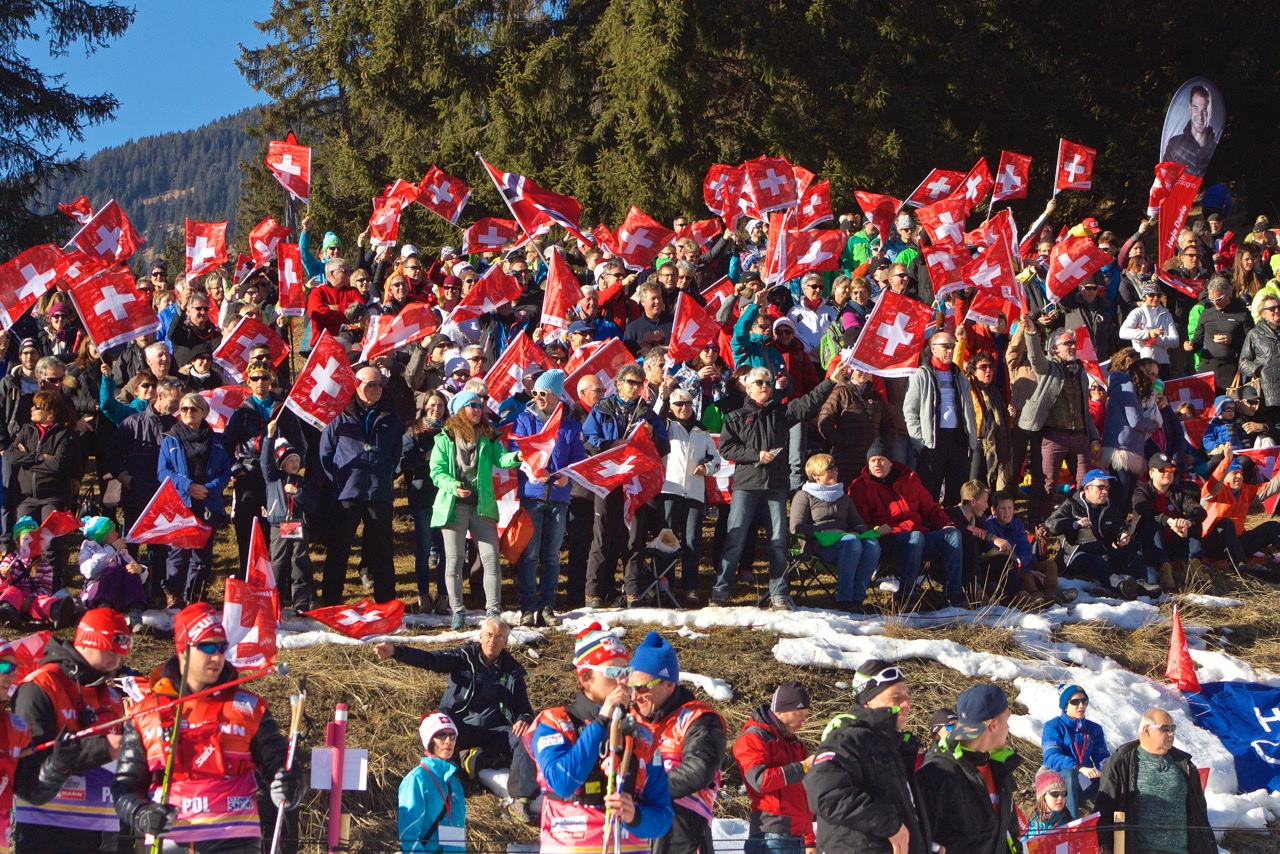
Swiss fans were out in force in Lenzerheide, Switzerland, cheering raucously for their homegrown athletes, especially three-time Tour de Ski champion Dario Cologna, who made the final and placed sixth after falling. (Photo: JoJo Baldus)
Cologna is a good place to start this sprint final’s tale. It was a partisan crowd. And when Cologna’s name was announced as he stepped forward in his lane, the crowd became electric — it was a sea of waving red and white Swiss flags.
From the gun, Ustiugov led out with a scrum of V2ing skiers trailing close behind. After a series of short roll-overs, Cologna slotted into second and eventually dropped into third.
Just over a minute into the race, when it was clear Ustiugov was making a powerful move on the flats, Cologna became tangled with himself, and fell. That left only five skiers, with a clear separation of Ustiugov, Krogh and Pellegrino developing with Sundby dangling off the back.
Then, just over two minutes in, it was a three-person race with Pellegrino taking the lead, accelerating around a turn with what appeared to be the slickest skis in the field. He crossed the line with a cursory foot outstretched, as if the results were in question.
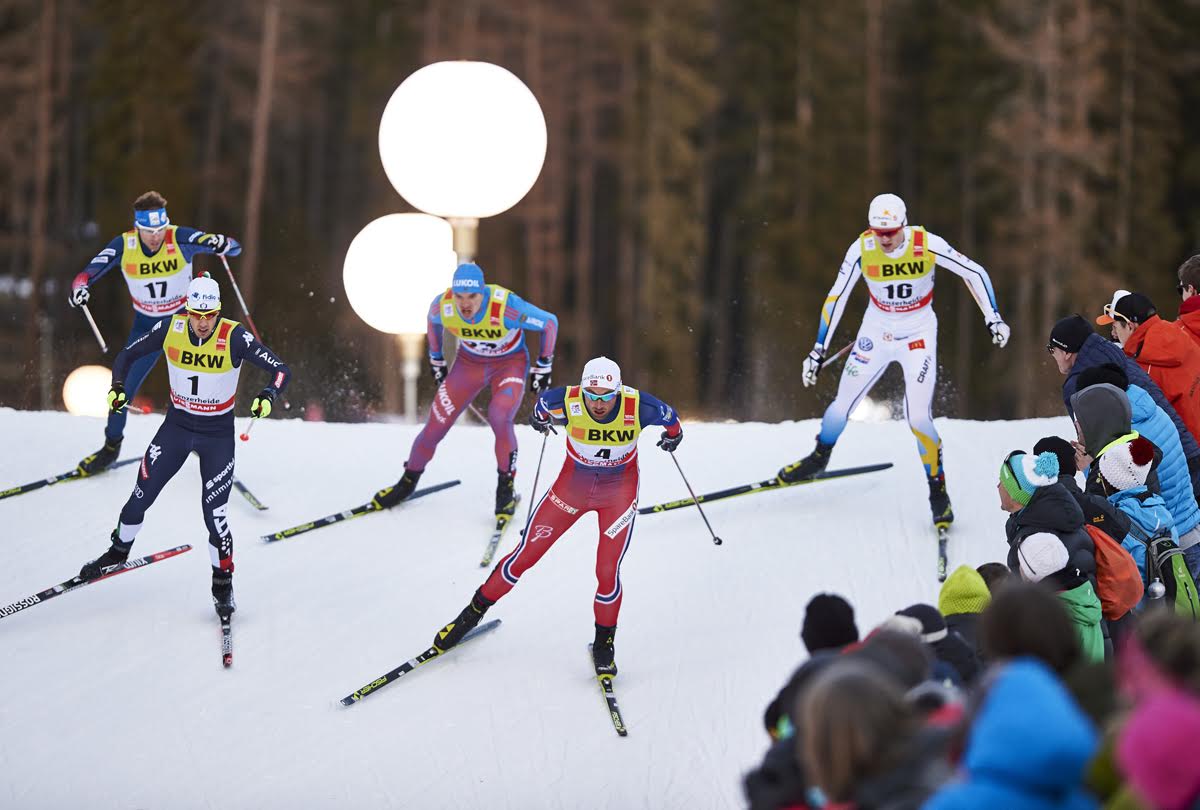
The second men’s quarterfinal, with Italy’s Federico Pellegrino (1) and Norway’s Petter Northug (4) leading, followed by American Andy Newell (17), Russia’s Andrey Larkov (c) and Sweden’s Oskar Svensson (r) at the Tour de Ski freestyle sprint in Lenzerheide, Switzerland. (Photo: Fischer/NordicFocus)
The only blip in Pellegrino’s day — second place in his semifinal — proved a valuable learning opportunity. In the post-race press conference, he admitted his tactics would need to change after his semifinal.
“I learned how to play in the final, so I didn’t make the same mistake,” he said. “I knew that if I arrived in the final 100 meters in the front of the race, I should win. It’s what I made, and so I happy for having do it.”
As a sprint aficionado, and now the winningest Italian World Cup sprinter, with six wins total, (Italian Cristian Zorzi won five World Cup sprints), Pellegrino is still undecided about finishing out the Tour.
“Tomorrow, we have a 30 k. I just have to pay attention to not make a big bonk, and save some energies for [the classic sprint in] Oberstdorf, but I want to be good,” he said. “Maybe in the last five kilometers, I will push as hard as I can, but before, I have to be patient, and quiet and wait. Then we are 10 k in skate, I want to have good sensations in this distance. Then in Oberstdorf, we will have a classic race. We have, I think, two very hard uphills, and in classic, this is my bread. I want to be good there, too.”
Italy’s Federico Pellegrino racing to first in the freestyle sprint qualifier at the first stage of the 2016 Tour de Ski in Lenzerheide, Switzerland. He went on to win the final for his third consecutive World Cup sprint victory.
He’s now shooting for an unprecedented four-consecutive World Cup freestyle sprint victories. With another World Cup win, he’ll become Italy’s winning-most World Cup skier.
“I don’t know if I will finish the Tour de Ski, because then we have [the World Cup weekend in] Planica [Slovenia], and I want to make history and win the fourth sprint skate in a row. I am undecided on my goals,” he said.
Ustiugov avenged his lack of prime results this season with his first podium of the year. Through a translator at the press conference, he showed respect for Pellegrino.
“I tried everything in the final, but Frederico was actually faster than me in the end. Next time, I will try again,” Ustiugov said.
Krogh in third seemed content after the race, nodding to the first- and second-place finishers as simply better on this day.
“The two guys who are one-two today are faster than me, nothing to do about that, so I am very happy with third place,” Krogh said.
As for the Swiss favorite, Cologna, even he surpassed his sprinting expectations — his goal was to make the semis. “Of course I would have liked to get on the podium, but I’m more than satisfied,” Cologna told Swiss TV broadcaster SRF 2. “The semifinal was the goal in order to get a few bonus seconds. Now I could show a good race in the final, prove that I’m in shape. That was a good start to the Tour.”
As a potent threat to Sundby’s overall Tour aspirations, Cologna has set himself up well for Saturday’s 30 k classic mass start, but he has no illusions about overturning the Distance World Cup hierarchy, which Sundby reigns.
“I think it will be a very hard race. The loop has a lot of vertical meters, eight times,” Cologna said. “Sundby will create a lot of pressure early on, and I don’t think it will end with a mass sprint. So you have to save strength whenever possible on the loop, always run a smart race, and hopefully stay in contact with the top until the final.”
The overall Tour standings reveal a tight grouping after the first stage — Pellegrino in first, Ustiugov in second (+6.6), and Krogh in third (+11.6).
But heading into the first distance race, some notable names fared well after a day of freestyle sprints. Sundby is placed fourth, 15.3 seconds out of first, followed by Jönsson, (+20.5), while just over a second back lurks Cologna, with Norway’s Petter Northug Jr., in seventh, 23.1 seconds out. (Note: Saturday’s race is a mass start, but overall time back is cumulative throughout the Tour.)
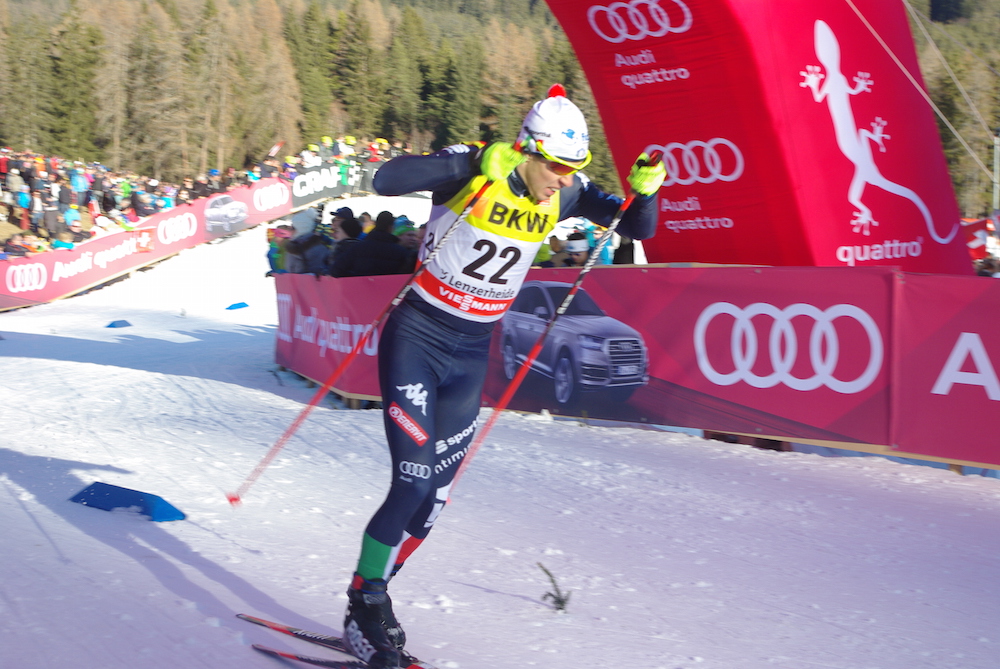
Andrew Young of Great Britain qualified second in the first stage of the 2016 Tour de Ski on Friday in Lenzerheide, Switzerland. He went on to place 30th overall after colliding with an inflatable archway in his quarterfinal.
For the British, a potential storyline piggy backing on Andrew Young’s third-place sprint podium in Toblach, was derailed in the fifth quarterfinal. Young began race day with a qualifier to be proud of: he qualified second overall, two seconds behind the day’s winner, Pellegrino.
Skiing close to the front, and with no sign of fatigue, approximately 38 seconds into the fifth quarterfinal and moments after skiing under an inflated Audi archway, Young fell to ground — he had been skiing inches from the barrier when he tumbled.
After the race, Young and his coach/father, Roy Young, reviewed the heat’s video with the race jury. Afterwards, the jury ruled in Young’s favor that a course obstacle did impede the skier.
In an email, Roy Young said the TV review showed “a rope dangling from Audi arch caught his arm. This spun him under the advert at side of track where he got stuck. Effectively out of the race bye time he was freed & with bruised arm he decided to stop & tell officials what had happened. For stopping I think they have ranked him 30th rather than last in his quarter. (About to check the rules, but it all seems unfair. ) But we go on and get ready for tomorrow – better go and win then. :)”
The Tour de Ski continues Saturday with 15/30 k classic mass starts.
Sophie Caldwell of the U.S. Ski Team en route to the second-fastest qualifying time of the day in the World Cup sprint in Lenzerheide, Switzerland, the first stage of the FIS Tour de Ski.
LENZERHEIDE, Switzerland — There was a scary moment for Sophie Caldwell in the quarterfinals of Friday’s World Cup sprint, the first stage of the 2016 Tour de Ski.
Saddled with one of the most competitive quarterfinals of the day, Caldwell got a slow start – which landed her at the back of the pack. She had skied the second-fastest qualifying time earlier in the day, but no matter what angle she tried it was hard for her to get to the front on the course’s one major climb, much less on the downhills.
“Super scary,” U.S. women’s coach Matt Whitcomb said of watching the heat unfold.
The second women’s quarterfinal (from left to right): Russia’s Natalia Matveeva, Norway’s Heidi Weng and Maiken Caspersen Falla (7), Germany’s Hanna Kolb, American Sophie Caldwell, and Sweden’s Stina Nilsson (SWE) shortly after the start in the freestyle sprint at Stage 1 of the Tour de Ski Lenzerheide, Switzerland. (Photo: Fischer/NordicFocus)
But the upside to being in a fast heat is that even if you finish fourth – as Caldwell did – you can make it to the semifinals as a lucky loser. Caldwell rode that luck all the way to the final and fourth place overall, changing her strategy along the way.
“I had a bit of a slow start in my quarterfinal so after that I put my focus on having a fast start and that was a lot better,” Caldwell said. “There were fewer people to go around and I think it’s just easier to keep your head in it when you’re battling for one of the top positions rather than sort of off the back scrambling.”
Caldwell took a hard inside line on the last downhill corner, putting her in potential podium position. But athletes reshuffled going up the last hill and into the stadium, and was left to edge out Astrid Uhrenholdt Jacobsen of Norway in a photo finish for fourth place, 1.03 seconds out of the win.
It was her best World Cup result since her podium in Lahti, Finland, at the end of the 2014 season.
“I am really happy,” Caldwell said. “Fourth is always sort of a bittersweet place to get. I want to be on that podium and I think I can one day. But this is the best result I’ve had in a long time so I’m really happy with it.”
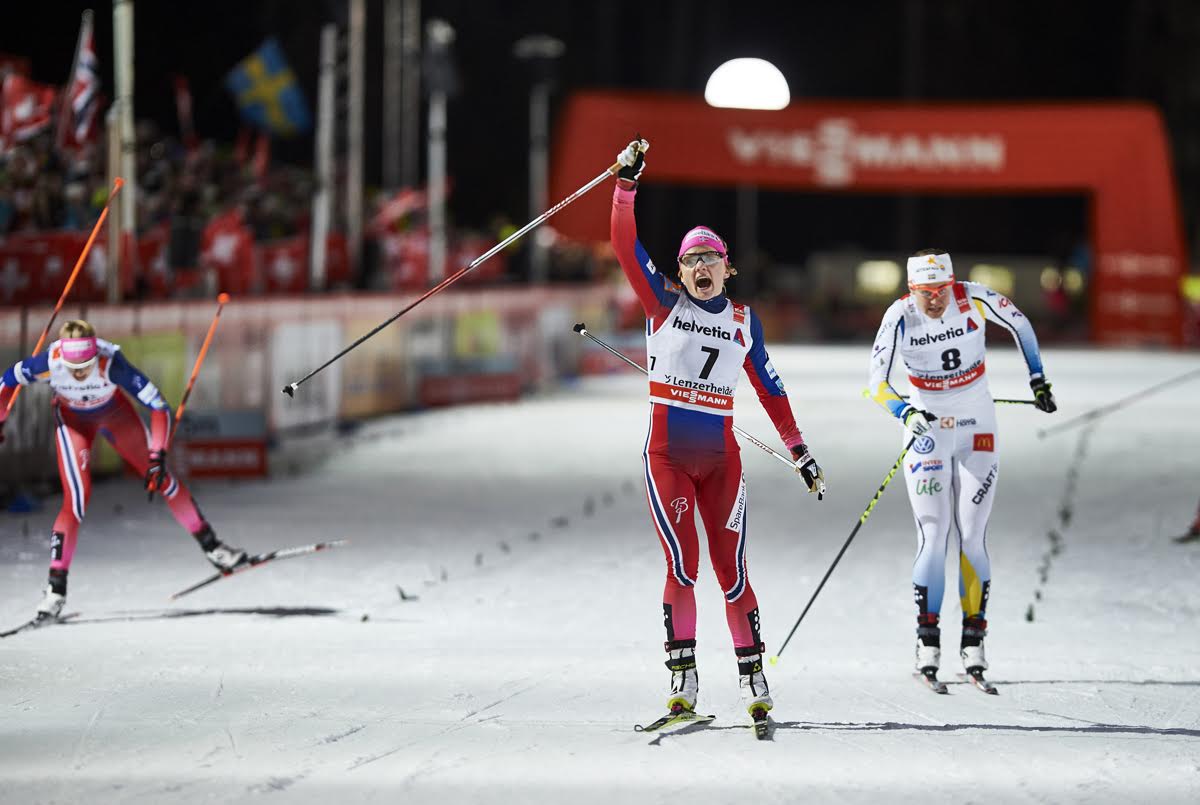
Norway’s Maiken Caspersen Falla (7) celebrates her victory in Friday’s freestyle sprint, the first stage of the 2016 Tour de Ski, over Sweden’s Ida Ingemarsdotter (8) and Norwegian teammate Ingvild Flugstad Østberg (not shown). Norway’s Astrid Uhrenholdt Jacobsen placed fifth after a photo finish with American Sophie Caldwell (not pictured), who took fourth. (Photo: Fischer/NordicFocus)
Maiken Caspersen Falla of Norway won the day after qualifying in seventh position. She said that the course, with its drag-race uphills and few places to make any huge moves, fit her well.
“I felt better and better during all the heats,” Falla said in the post-race press conference. “I think the other girls are skiing really fast on the first lap. On the last lap I felt really good especially on the last uphill. I was first in the last 100 meters, so it’s really nice – as always – to get the World Cup victory.”
Falla leads the World Cup sprint standings this season.
Ida Ingemarsdotter of Sweden was second (+0.40), and Ingvild Flugstad Østberg of Norway third (+0.54). Ingemarsdotter made her decisive move late in the second lap. It was her second World Cup sprint final of the season, while Falla and Østberg are staples on the circuit.
“I had a good feeling and was satisfied with myself,” Ingemarsdotter told FasterSkier. “I knew that it’s two laps and it’s not the first lap that counts. It’s the whole way to the finish. I just focused on the second lap and when we went into the stadium I knew that if you can take any position there, you can take it cheap and you don’t have to work so hard.”
Both she and Østberg are looking forward to the whole Tour de Ski, not only the sprints. She’s “absolutely” going to enjoy more good distance racing, Ingemarsdotter said.
“Tomorrow is 15 k classic,” she explained. “I think the strong Norwegian girls will go really hard. I will focus as much as possible on following them, to keep the gap to the front not so big.”
And Østberg? She hasn’t gone all the way to the end of the Tour de Ski since 2012, but this year she has said she’s focusing on also doing excellent distance racing. So finishing the Tour de Ski is on the table.
“It’s a good start to the Tour,” she said in the press conference. “This year my plan is to go the whole way and up Alpe Cermis, so it’s important to have a good start. Tomorrow is another day with a lot of bonus seconds, so I guess overall standings will look different after tomorrow.”
Sophie Caldwell stuck at the back of the pack in her quarterfinal heat, which was won by eventual race winner Maiken Caspersen Falla of Norway (bib 7). Caldwell placed fourth to move on as a lucky loser. (Photo: JoJo Baldus)
Caldwell isn’t as likely to go the whole way. Head coach Chris Grover said before the Tour began that she and the other sprint specialists would probably stop after the Oberstdorf, Germany, stages a few days from now.
But with four times racing around the course, Caldwell definitely got in her workout today.
“The semi and final were hard,” she said. “But I’ve been working really hard on recovering in between heats and in the qualifier today that was the best my legs have felt all year. So I was hoping to come into the Tour pretty rested and focusing on recovering between each heat. I think it worked.”
In fact, that’s one thing that U.S. women’s coach Matt Whitcomb picked out as a highlight of the day.
“The goal for Sophie is to try to skate through as many heats easily as she can, and she has certainly run into some very difficult heats this year,” he said. “But the nice thing about today is that Sophie had to dig really hard a couple of times, which smoked her in Davos. And it didn’t today. She was in the mix right in the end. So she has clearly taken a nice step in the direction.”
The reason that today’s quarterfinal and some others this season have been so hard is that athletes now pick their own heats, which can leave some easier and some harder than the former system, which automatically seeded athletes according to qualification position.
“The new heat selection process is interesting,” Caldwell said. “Sometimes it works in your favor and sometimes it doesn’t. I think so far this year I have to be the world’s luckiest loser. In about five of the six heats I’ve moved on in it has been as lucky loser. I have picked some fast heats, which is tough, because it’s hard to move on from. But then lucky losers come out of that heat so sometimes it’s a good thing.”
Whitcomb admitted that heat selection is something they are still working on. But part of the strategy is also to get each qualifier from the team into a different heat, if possible, so that they are less likely to bump each other out. With three other women (Jessie Diggins, Sadie Bjornsen, and Ida Sargent) qualifying today, that dynamic was at play.
“We’ve started to change our strategy [for picking heats] but with Stina [Nilsson] qualifying 28th and 30th in the last two weekends, it has thrown a huge wildcard into the mix,” Whitcomb said (Nilsson ended up sixth, 1.3 seconds behind Caldwell). “So still we’ll do our best to select easier heats moving forward, but you can only do your best when you’re also trying to get all four of your women into different heats.”
So far, though, things have worked out for Caldwell, even if she’s sometimes had to work harder than she or her coach would prefer.
After making it to the final she gave it her all, which is the most either of them could ask for.
“I knew it was going to be tight,” Caldwell said. “I can’t even remember what happened there, but positions can change a lot. People who were on the outside are all of a sudden on the inside and then unless you’re right in the front, you never know when someone is going to come over. So it’s tough. But I fought til the end and I’m happy with it.”
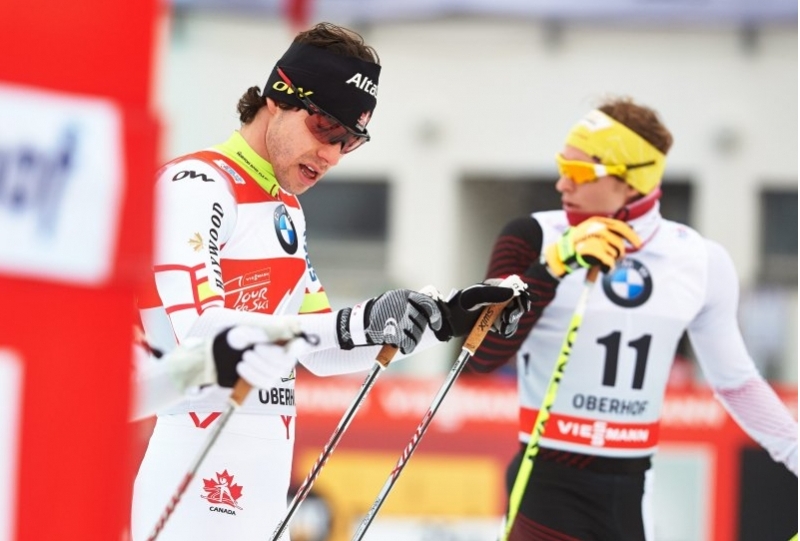
Lenny Valjas (Canadian World Cup Team) missed qualifying by 0.01 seconds in 31st in Friday’s 1.5 k freestyle sprint qualifier at the first stage of the 2016 Tour de Ski in Lenzerheide, Switzerland. (Photo: JoJo Baldus)
In a World Cup sprint, 31st has a little extra bite. Ask Len Valjas. He’s been in that position twice in the last three freestyle sprints.
On Friday, the Canadian World Cup Team sprinter finished one-hundredth of a second behind 30th, which would have qualified him for the heats in the 1.5-kilometer skate sprint, the first stage of the Tour de Ski in Lenzerheide, Switzerland.
Just over two weeks ago at another Swiss race site in Davos, Valjas ended up 31st, four-hundredths of a second out of the top 30, in the first World Cup skate sprint of the season.
Back then, the 27-year-old Canadian clocked in 4.64 seconds behind the winner. On Friday, he was 6.86 seconds back from qualifying winner Federico Pellegrino, the Italian who went on to rack up his third-straight World Cup sprint victory.
“It’s two races that could have gone way better…,” Valjas told FasterSkier after Friday’s qualifier. “It’s almost harder than being far back when you can just accept that you sucked today. But 1/100th, that’s the difference between having a potentially sweet day here ’cause I love the heats. Qualifying is always hard for me; I’m just disappointed. I couldn’t see what I could have done today.
“It just shows I’m not exactly at the level I was, like, it used to be easy,” he added. “I know I’d be between 25th and 20th on any given day and now I’m between 25 and 35, so I need to get a little bit stronger and fitter so I don’t have this disappointment.”
Leading up to this World Cup season, all had gone according to plan, Valjas explained.
“I’m healthy, just need to get a little bit snap back, just a few parts of my skiing I just need to figure out,” he said, adding that he plans to race the Tour through the fourth stage, a classic sprint in Obertsdorf, Germany.
Just 0.15 seconds back from Valjas’s time, his teammate Alex Harvey placed 33rd (+7.01). Devon Kershaw was 9.72 seconds back from the qualifying winner in 60th, and Ivan Babikov finished 92nd (+18.92) of 100 men in the opening stage.
Two of four American men fared better, with Simi Hamilton and Andy Newell qualifying in 13th and 17th, respectively. Erik Bjornsen did not advance in 69th (+12.61) and Noah Hoffman was 85th (+16.44) in the qualifier.
Bjornsen called his qualifier “really bad,” while Hoffman, a distance skier, said he felt good.
“A tour with six distance stages and two sprints is a great tour for me,” Hoffman told FasterSkier. “Today is just something to get ready for tomorrow.”
Saturday’s second stage of the Tour holds a women’s 15 k and men’s 30 k classic mass start. Hoffman called the course “awesome” and especially opportunistic for him with a longer hill than previously used at the Tour two years ago.
“The weather should be a little interesting. It’s going to be a little mix of rain and snow and sun,” Hoffman said. “Obviously I was frustrated with Period 1, but I feel like I am ready to go. I will continue to take care of the things I can control, and hopefully it will come around.”
In the women’s 1.5 k qualifier, four of seven U.S. women qualified. Sophie Caldwell led the team in second, 2.98 seconds behind the qualifying winner Ingvild Flugstad Østberg of Norway. Sadie Bjornsen qualified ninth, Jessie Diggins was 14th and Ida Sargent 26th.
Rosie Brennan placed 47th, 3.44 seconds out of 30th and 13.03 seconds back from Østberg. Also for the U.S. Ski Team, Caitlin Gregg was 49th (+13.29) and Liz Stephen 68th (+19.24) of 71 finishers.
“This is straight-up my favorite race series of the year and time of year, and mentally I’m psyched to get going.” — Liz Stephen after Stage 1 of the 2016 Tour de Ski
Brennan explained that she’s mostly focused on classic races, and aims to complete the Tour.
“I would like to feel like I skied well to the end, not just like, ragged across the line,” she said.
Caitlin Gregg (U.S. Ski Team) finished 49th in the Tour de Ski freestyle sprint qualifier on Friday in Lenzerheide, Switzerland. (Photo: JoJo Baldus)
For Gregg, also programmed to finish the Tour, it was her first skate sprint in almost a year (since placing second to Brennan at 2015 U.S. nationals in Houghton, Mich.).
“It’s one thing to do a skate sprint at U.S. nationals and it’s one thing to do a skate sprint on the World Cup,” Gregg observed. “All said and done, I was like three seconds out of qualifying. It’s kind of a ways, still also … definitely as close as I’ve ever been. I think I felt great … I kind of wish the skate sprint was in the middle of the whole series.”
Looking ahead, she’s most excited for the 5 k races and the hill climb, which she has never done before on the World Cup.
“Just the whole thing, I think, it kind of suits when I am feeling good and I can kind of build throughout the series,” Gregg said. “The goal coming in was to be … maybe a little bit undertrained. I took a number of days off over the Christmas break, probably a total of four out of the 10 to kind of to reset, recharge the batteries and then come into this and be able to build instead of trying to hold on.”
For Stephen, who ended up fifth in the overall standings last year for the best-ever finish by an American in the Tour de Ski, it was just a matter of getting started.
“I feel like I’m in a good position, shape-wise for the rest of the Tour,” she said. “I mean, this is straight-up my favorite race series of the year and time of year, and mentally I’m psyched to get going. Tomorrow’s 15 k should be really awesome here.”
For that race, Stephen explained she’ll try to get toward the front of the pack within the first 2 k to avoid the “bottlenecking” effect on what she called a “steep kicker” shortly after the start.
“My plan is to get as good a start as I can possibly get and try not to get on the back end of that bottleneck,” she said. “Which generally tends to make you chase the rest of the race…”
U.S. women’s coach Matt Whitcomb was thrilled with the team’s start.
“This is a team that’s on the roll right now. I’m excited to see these four girls who did well sprinting today mix it up in the classic race, but I’m also excited to see Rosie and Liz and Caitlin get things going,” he said. “I’m excited to see our distance skiers start to mix it up too. Tomorrow is going to be a big day to hit the skis and I think our team is 100 percent ready to go.”
Sophie Caldwell of the U.S. Ski Team en route to the second-fastest qualifying time of the day in the World Cup sprint in Lenzerheide, Switzerland, the first stage of the FIS Tour de Ski.
LENZERHEIDE, Switzerland— The U.S. Ski Team’s Sophie Caldwell had the best World Cup sprint qualifier of her career, skiing to second position in the 1.5 k skate here at the first stage of the Tour de Ski.
Ingvild Flugstad Østberg of Norway dominated the qualifier. Caldwell, 2.98 seconds behind, was the woman who came closest to matching her.
“It was a good boost of confidence, for sure,” Caldwell said after the qualifier. “I really like this course and my legs felt better than they have all year in terms of flooding and fatigue, so that was encouraging. A good qualifier should set me up for a good day.”
Joining her in the women’s heats will be teammates Sadie Bjornsen, who qualified ninth (+4.84), Jessie Diggins in bib 14 (+5.69), and Ida Sargent in bib 26 (+8.52).
“The break was really nice,” Caldwell said of her preparation for the Tour. “The first half was solid training and then I really tried to rest the second half. I’ve been feeling really good. It was hard to do enough resting when you’re racing every weekend, so it was nice to chill for a bit and take my mind off skiing and enjoy Christmas with friends. It was good to recharge and I’m feeling awesome.”
Three American teammates ended the day early after missing the top-30 cutoff for the quarterfinals. They are Rosie Brennan (47th, +13.03), Caitlin Gregg (49th, 13.29), and Liz Stephen (68th, +19.24).
No Canadian women are competing in the Tour de Ski. Heidi Widmer, who now races for Switzerland, placed 41st (+12.07).
Simi Hamilton led the U.S. men in qualifying, placing 13th. Federico Pellegrino of Italy easily won qualifying, posting a time 2.08 seconds better than runner-up Andrew Young of Great Britain.
Last time a sprint was held here as part of the Tour de Ski, Hamilton won the qualifier and went on to win the whole thing, his first World Cup stage win.
Today he was a bit back from that mark in qualifying, but didn’t doubt that he could still have a good final result. In the last World Cup sprint before Christmas, a skate competition in Toblach, Italy, he finished second.
“After a long break it’s always a little up in the air how you’re going to feel on that first really hard effort back,” he said after today’s qualifier. “It was good. I love skiing here. It’s a great place and a really fun course. Our skis were good. I felt a little bit flat, but I kind of felt like I did in Toblach in the qualifier, so maybe that’s a good sign. Looking forward to doing some more skiing this afternoon.”
He talked about what it felt like to return to the venue where he’s had the best result of his career, and the best result by a U.S. man in decades.
“I think it’s pretty natural to feel pressure in that situation,” Hamilton admitted. “But it’s ski racing and sometimes it’s going to go really well and other times maybe it doesn’t go perfectly. I think everyone understands that and that’s why people really love ski racing, and especially the athletes.”
He will be joined in the quarterfinals by U.S. Ski Team and Stratton Mountain School T2 teammate Andy Newell, who clocked in at 17th (+5.44) in the qualifier.
Erik Bjornsen (69th, +12.61) and Noah Hoffman (85th, +16.44) missed the cut, as did the whole Canadian men’s team.
Lenny Valjas came the closest, a heartbreaking one-hundredth of a second out of the heats in 31st place. He was followed by Alex Harvey (33rd, +7.01), Devon Kershaw (60th, +9.72), and Ivan Babikov (92nd, +18.92).
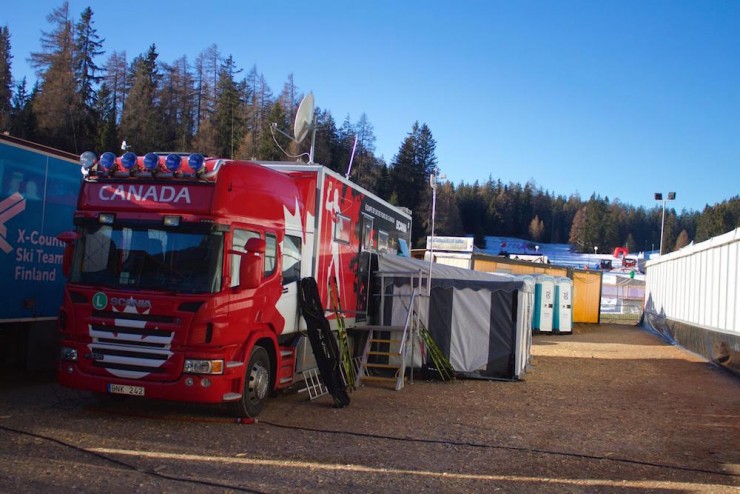
The Canadian “tour bus”, a.k.a. wax truck, parked in Lenzerheide, Switzerland, as seen two days before the 2016 Tour de Ski begins (pictured on Wednesday, Dec. 30, 2015.)(Photo: JoJo Baldus)
(Photo: JoJo Baldus)
(Photo: JoJo Baldus)
For the 10th straight year, the World Cup is going on a major tour. The 2016 edition of the Tour de Ski starts Friday, with eight races in 10 days. Racers will compete in three countries and four different venues, and if they complete the tour, they will have done five skate races (including two sprints), three mass starts and two pursuits — ending with a final 9-kilometer hill climb.
While it’s a lot to keep track of from a viewing standpoint, think of what the athletes, their teams and even the organizers have ahead of them. FasterSkier will be on site to report from two of three stops on the tour (in Lenzerheide, Switzerland, and Obertsdorf, Germany), and NBC plans to stream the races live from NBC Live Extra (subscribe and watch online) and broadcast on TV via the Universal HD channel (4:30 Eastern time Friday for the opening stage in Lenzerheide).
Follow FasterSkier’s live updates during the races on Twitter and check our home page for comprehensive reports.
The races: (all start times converted to Eastern time)
Saturday, Jan. 9 (Val di Fiemme, Italy): 10/15 k classic mass start (6:30/8:30 a.m. ET)
Sunday, Jan. 10 (Val di Fiemme, Italy): 9 k freestyle pursuit (hill climb) (8/9:40 a.m. ET)
The players:
Last season’s winners: Marit Bjørgen, Martin Johnsrud Sundby (both of Norway).
Bjørgen is out this year as she gave birth to her first child (a boy!) on Dec. 26. Sundby has won the Tour de Ski (TdS) twice and last year’s runner-up Therese Johaug, who currently leads the World Cup overall standings (along with Sundby) won the TdS in 2014.
Wondering which skiers will be doing the 2016 Tour? We’ve compiled a list of several (but not all) national-team rosters below:
U.S.A.
Women:
Liz Stephen
Rosie Brennan
Caitlin Gregg
Jessie Diggins
Sadie Bjornsen
Sophie Caldwell*
Ida Sargent*
Men:
Noah Hoffman
Erik Bjornsen
Simi Hamilton*
Andy Newell*
*Will likely end Tour after second Obertsdorf race (fifth stage on Jan. 6) or after Toblach race in order to prepare for World Cup in Planica, Slovenia (Jan. 16-17), according to U.S. Ski Team Head Coach Chris Grover.
Canada:
Ivan Babikov
Alex Harvey
Devon Kershaw
Len Valjas*
*Plans to end Tour after Obertsdorf, according to Canadian National Team Head Coach Justin Wadsworth
Graeme Killick, who was originally slated to race in the entire Tour, recently withdrew due to illness, according to a Cross Country Canada press release. Kershaw is competing in his 10th Tour de Ski.
In the first stage of the inaugural Tour de Ski in 2006, Kershaw reached the podium (in second in Munich, Germany). At the 2011 stage in Toblach, Italy, Kershaw won his first-ever World Cup.
“The Tour de Ski is a competition that’s so near and dear to my heart. I can’t believe that this is my 10th Tour de Ski start,” he said in the press release. “To have so many disciplines and distances all combined together to find the best overall skier over a 10-day period makes the Tour de Ski unique.”
Meanwhile, five Canadian women and three men will race the OPA Cup Jan. 8-10 in Planica, Slovenia, as part of the U25 B-Tour. Those athletes include World Cup skiers Emily Nishikawa and Jess Cockney, NorAm leader Dahria Beatty, Katherine Stewart-Jones, Maya MacIsaac-Jones, Cendrine Browne, Knute Johnsgaard, and Andy Shields.
Norway:
Women:
Maiken Caspersen Falla
Therese Johaug
Heidi Weng
Ingvild Flugstad Østberg
Astrid Uhrenholdt Jacobsen
Kari Øyre Slind
Ragnhild Haga
Men:
Martin Johnsrud Sundby
Petter Northug
Niklas Dyrhaug
Didrik Tønseth
Anders Gløersen
Finn Hågen Krogh
Hans Christer Holund
Sjur Røthe
Emil Iversen
Sondre Turvoll Fossli
Norwegian National Team Director Vidar Løfshus on selecting 17 athletes (10 men and seven women) to the Tour de Ski team: “It has been a very challenging process to select the team. We have probably never had a team with this many skiers who have a potential to podium in the overall Tour de Ski. At the same time, we have given special consideration to those who have a chance at winning the overall World Cups, and accordingly, there are several well qualified skiers who were not named to the team this time.
“Skiers such as Maiken Caspersen Falla and Sondre Turvoll Fossli are not intending to complete the entire Tour. As mentioned, the bar for making the team has been incredibly high. We have considered skiers with top-10 World Cup finishes within reach, and skiers who have a shot at winning one of the overall World Cups, which means that there is a discrepancy between the number of male and female team members.
“It is particularly exciting that Emil Iversen from the national development team and Kari Øyre Slind from the regional development project Team Veidekke Trøndelag have performed at such a level that they are qualified for the 2016 Tour de Ski squad. Both are rookies to the Tour de Ski.”
Fessel is a question mark, after suffering a cold over the holidays with the team manager Andreas Schlütter telling Germany’s DSV, “We hope she can go into the opening race on New Year’s Day.”
“Unfortunately I caught a cold just before the season highlight,” Fessel said. “Until Wednesday before Christmas I was able to train well in Toblach, then first signs of a cold manifested with a sore throat. My plan was to prepare intensively for the Tour in the past week. Instead I had to abstain from training for a whole week.”
In a non-World Championships season, Fessel explained the Tour is the highlight, especially with two stages at home in Germany.
“Those are my most important competitions this year. I wanted to show the best possible performance in front of family and friends,” she said. “Instead I now have to hope that I will be fit in time and able to start.”
Sweden’s Calle Halfvarsson (black sprint leader’s bib) and Canada’s Alex Harvey (red leader’s bib) lead the men’s 15 k mass start early in the fourth stage of the Tour de Ski on Wednesday in Lenzerheide, Switzerland. (Photo: Fischer/Nordic Focus)
After proving themselves a force to be reckoned with in the first three stages of the Tour de Ski, Canadians Alex Harvey and Devon Kershaw confidently charged to the front early in Wednesday’s 15-kilometer classic mass start in Lenzerheide, Switzerland.
The Tour leader through the end of 2013, Harvey started in the first position on the first line of attack ahead of more than 100 men in Stage 4 of 7. He was in the company of guys like Norway’s Finn Haagen Krogh and Martin Johnsrud Sundby, Sweden’s Calle Halfvarsson and Germany’s Jens Eriksson. Confidence wasn’t a problem, as Harvey explained on the phone while traveling from Germany to Switzerland for the second stop of the Tour de Ski.
“I always have fairly high confidence, even when things aren’t going too well,” Harvey said.
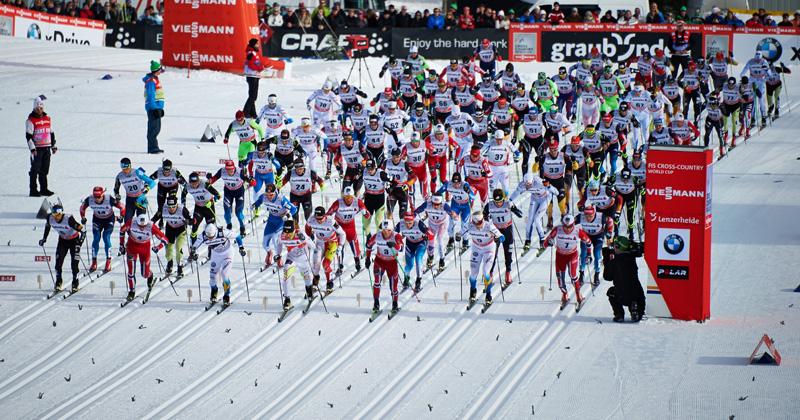
Start of the Tour de Ski men’s 15 k mass start in the fourth stage on Wednesday in Lenzerheide, Switzerland. (Photo: Fischer/Nordic Focus)
For Kershaw, that confidence was coming back. After slipping from third overall in the Tour the day before, Kershaw in bib No. 8 started near Harvey. By the first climb out of the stadium, the two teammates had united at the front of the pack, plodding along on the first of four laps.
Almost immediately, both sensed something was wrong. Their skis weren’t gliding, and while the extra kick on the 3-degree Celsius afternoon helped them climb, it wasn’t working for them on the downhills and flats.
“It was pretty evident our skis were bad,” Harvey said. “Even double poling.”
After testing in the morning, Harvey said their wax techs added some more kick, fearing the sun’s rays would hit the course and change the integrity of the conditions.
Didn’t happen.
Second behind Sundby through 2.4 k, Kershaw hung within two seconds of the leaders (Halfvarsson, Sundby and Russian’s Ilia Chernousov and Alexander Legkov) for the first five kilometers. Meanwhile, Harvey hovered around fourth place, and Kershaw ended up following one or two places behind him for the first lap and a half.
At the first sprint preem at 5.1 k, Harvey picked up bonus seconds in third, 1.3 seconds behind Sundby and 0.9 behind Legkov. A kilometer later, Harvey had dropped eight seconds off the pace in eighth, and Kershaw was another eight seconds back in 15th.
Halfway through the race, Harvey slipped to 17th and Kershaw was just outside the top 20, yet both remained within 6.3 second of Russia’s Stanislav Volzhentsev and Legkov up front.
By the end of the third lap, Harvey and Kershaw were back in 31st and 32nd, respectively, 24 seconds out of the lead. Their teammate, Ivan Babikov stepped up in their place, passing nearly 50 people to put himself 26th (+17.5) with one lap to go.
Over the next 3.6 kilometers, Babikov in bib 75 continued to pick off the places, finishing 18 seconds back from Kazakhstan’s Alexey Poltoranin (who won in 34:28.1) in 19th.
“I’m pretty satisfied with the race,” Babikov said on the phone. “Too bad with the skis, but whatever, it happened. I’m glad I got some points and got closer to the top 30 overall, just trying to chip some time off the leader.”
Babikov improved to 32nd in the Tour, 2:08.9 out of the overall lead, picking off 43 places in less than 35 minutes.
“After two sprints in a row it was almost like a sprint tour: tour de sprint,” Babikov said. “I had a pretty good prologue, though, and that kind of gave me a good boost, but after two sprints went really bad, I lost a lot of time. I know I do my best every day, and it is what it is. I was just trying not to get too upset.”
Starting 12 or 13 rows back, Babikov said it helped to ski around competitors like Lukas Bauer of the Czech Republic (bib 77) and American Noah Hoffman (bib 89). Knowing “there was no way” he could pass everyone early on, Babikov relaxed and tried to stay smooth for the first lap.
His plan worked as racers tired on the second and third laps, and Babikov picked them off in bunches.
“I tried to go hard over the top and catch people in the draft,” he said. “I tried to keep the pace similar .. going hard by the third and fourth lap, people are gonna start popping. Luckily I had a good amount of shape to do that.
“Unfortunately I got too tired going around 60 guys, 70 guys [and] on the last lap I got a bit too dropped on the lead pack,” he added.
Babikov nearly caught the lead group around the second sprint preem at 9.6 k, but that’s where some of the frontrunners started to break away. He came within 8.7 seconds of Finland’s Matti Heikkinen, who led with 2.7 k remaining, skiing in 19th, then fell a few seconds and places behind before closing hard for a top 20.
Harvey and Kershaw finished 40th (+45.5) and 47th (+58.3), respectively, skiing with each other until the last kilometer or so. Harvey said he lost contact after going hard at the first preem (the second was on the third lap, and the leaders picked up additional seconds at the finish).
“These are the days you wish you were a runner or a swimmer.” — Devon Kershaw, 47th
“I was still with the group at the end of lap two, but drifting more and more,” Harvey said. “Lap three I got popped off the main group.
“The result was pretty bad,” he added. “It was a tough day for the skis for Devon and I. We had the same wax as Babs … He’s like, ‘Yeah, my skis were bad, but yours were really, really bad.”
Canada’s Alex Harvey (l) in the leader’s bib at the start of the 1.5 k skate sprint quarterfinals last Sunday in Oberhof, Germany. After winning the qualifier (for the first time), Harvey placed second in the heat and went on to finish 11th overall. (Photo: Fischer/Nordic Focus)
For the first time in the Tour, Harvey had to give up the leader’s bib as he settled in third in the overall standings, 35.3 seconds behind Sundby in first and 5.6 seconds back from Halfvarsson in second.
While he was hoping for a podium, or at least a top five to repeat his success in the 15 k classic in Oberhof last year, Harvey was glad to have the opportunity to chase a bit in Friday’s 35 k pursuit from Cortina to Toblach, Italy. He’ll start third behind Sundby and Halfvarsson, and expects to work with a group to try to rein Sundby in.
No matter what happens, Harvey said he won’t finish the Tour. Saturday will be the end of his road; he won’t participate in the final climb.
Currently 22nd in the Tour, 1:43 behind Sundby, Kershaw said he was frustrated with the last two races after placing 56th in Tuesday’s 1.5 k freestyle sprint.
“Fifteen k classic and skate sprint, those are my two best events with no question, and I came out of it way worse than I’d hoped,” Kershaw said.
“I know I’m in good shape based on Oberhof,” he added. “We had really, really, really tough skis in the sprint; obviously Alex is in the best shape of his life…”
“I had the same sprint yesterday as I did in Oberhof, it’s just that Alex wasn’t where he was in Oberhof and consequently so was I,” Kershaw said.
Feeling good in Wednesday’s warmup and relaxed on the climbs during the race, he simply couldn’t hold the pace with the skis he had been dealt.
“These are the days you wish you were a runner or a swimmer and you could use your actual physiological strength,” Kershaw said with a laugh. “[The Tour is] a pretty unique competition and we’ll just have to see how the body is and hopefully the equipment is better than it was in Switzerland, but I finally feel like my energy and body is back.”
Kershaw went to a dentist on Monday for a toothache and came away with some anti-inflammatories that he hopes will help his molar pains and headaches.
“Don’t go to the dentist in Lenzerheide thats rule number one,” Kershaw said. “Hopefully the nerve pains subside, but it’s not affecting me when I race.”
The lone Canadian woman in Tuesday’s 10 k classic mass start, Dasha Gaiazova placed 58th, 3:10.8 behind winner Kerttu Niskanen of Finland.
Perianne Jones ended her Tour run on Tuesday after placing 39th in the women’s 1.5 k skate sprint.
“Now I will train until Nove Mesto, which I think is just what I need,” Jones wrote in an email on Tuesday. “Doing the whole Tour would put me into a big hole at this point. We are focusing on doing things one step at a time, and although I didn’t qualify today I feel like things are coming along.”
Finland’s Kerttu Niskanen (16) and Aino-Kaisa Saarinen (14) lead Norway’s Therese Johaug (11), Heidi Weng (20), Ingvild Flugstad Østberg, Astrid Uhrenholdt Jacobsen (4), and Sweden’s Hanna Erikson (7) in Wednesday’s 10 k classic mass start at Stage 4 of the Tour de Ski in Lenzerheide, Switzerland. (Photo: Fischer/Nordic Focus)
Marit Bjørgen is sick. For Norwegians, the news that the 33-year-old team leader had to pull out of the Tour de Ski on Wednesday morning was definitely a bummer; having never won the Tour before, she was missing the opportunity to do so again.
The attention quickly shifted to her teammates, including distance favorite Therese Johaug and Ingvlid Flugstad Østberg, who led the Tour standings through three stages.
But the Norwegians aren’t the only ones in this seven-stage game, and Finland’s Kerttu Niskanen was among the “others” seeking a little recognition on Wednesday, New Year’s Day.
In the fourth stage of the Tour, Johaug, Østberg and another Norwegian, Astrid Uhrenholdt Jacobsen, assembled almost immediately out of the start of the women’s 10-kilometer classic mass start in Lenzerheide, Switzerland. Together in red suits at the front of the pack, they were out to send a message. They were setting the pace and controlling this race.
The women’s 10 k classic mass start podium at Stage 4 of the Tour de Ski: winner Kerttu Niskanen (c) of Finland, and Norway’s Astrid Uhrenholdt Jacobsen (r) in second and Therese Johaug in third. (Photo: Fischer/Nordic Focus)
But three laps is a long way.
Before the end of the first loop around 2.4 k, the three led while Sweden’s Hanna Erikson — who notched her first international podium with a freestyle-sprint win in Stage 2 — hung less than a second behind the three in fourth. Another 0.5 seconds back, Aino-Kaisa Saarinen headed up Finland’s trio in fifth, with Niskanen and Anne Kyllönen trailing in sixth and seventh, respectively.
By the end of the first 3.1 k lap, Johaug and Østberg still led, but Saarinen had made her way up to third, 0.7 seconds back and even with Jacobsen. Another 1.3 seconds later, Niskanen came through in fifth, followed by Erikson another half-second back in sixth. The top 10 remained within 6 seconds of one another, but when you’ve got Johaug up front — known to “pop” and drop the field at any time — that’s a lot of time to claw make up on her.
Niskanen remained in contact, even after dropping more than five seconds behind Johaug at 4.6 k, along with Østberg, who fell off the pace slightly as well. With Johaug nearly 2 seconds ahead of Saarinen in second and 3.6 seconds up on Jacobsen in third, it seemed the writing was on the wall: another Johaug win without Bjørgen to make it a little more interesting.
At the sprint preem less than a kilometer later, Niskanen sprung to life. First through the bonus checkpoint at 5.5 k, she put 1.2 seconds into Saarinen and just over two seconds into Jacobsen and Johaug. Norway’s Heidi Weng had moved up to fifth, 3 seconds behind Niskanen, and Østberg was more than six seconds back in sixth.
Whatever was going on behind Niskanen, it didn’t matter. Striding smoothly along the rolling course, with an approximately 500-meter climb in the middle of each lap, Niskanen never relinquished the lead — even with Johaug breathing down her neck with less than 3 k remaining.
She managed to keep the Norwegians at least a full stride and couple meters behind until one pivotal point on the high point of the course at 8.6 k, where the preem was on the second lap. As if it was there again, Niskanen charged up and over the top to break free of Johaug and Saarinen, who were nearly even with her at the time. Jacobsen was right there with them, and Weng lost a little time on the screaming-fast descent toward the stadium.
With one more rise to go, Niskanen was first to the top and used her fast skis with superior glide to gain even more on her ground competitors, all while tucking in the track of her choice. Jacobsen followed and Johaug was right behind her in one of the outside tracks, but Johaug’s drafting tactic ended up impeding her as she came up on Jacobsen and quickly searched for a open track to switch to. Meanwhile, Weng was gaining on the group, including Saarinen, skiing alone in another track.
As the leaders rounded the lefthand turn into the stadium, Niskanen launched into double poling as she tried to fend off Jacobsen and Johaug for one last time. She succeeded, winning in 26:27.4, four-tenths of a second ahead of Jacobsen in second. Johaug took third, another 0.7 seconds back, Weng passed Saarinen for fifth (+1.9) and Saarinen settled for sixth (+2.5).
The third Finn in the top six on Wednesday, Kyllönen placed sixth (+23.9) for her fourth-straight top eight in the Tour. Eva Vrabcova-Nyvltova of the Czech Republic finished seventh (+24.5), Russia’s Olga Kuziukova was eighth (+25.1), Erikson ninth (+25.8) and Østberg edged France’s Aurore Jean in a photo finish for 10th (+29.8).
Finland’s Kerttu Niskanen holds off Astrid Jacobsen of Norway to the finish of Wednesday’s 10 k classic mass start to win Stage 4 of the Tour de Ski in Lenzerheide, Switzerland. (Photo: Fischer/Nordic Focus)
For Niskanen, 25, the victory was her first stage win — and podium — after she took third in the classic sprint last season at World Cup Finals in Stockholm.
She started to cry “tears of joy” when she crossed the finish line, Niskanen told the Helsingin Sanomat, according to a translation. “Then I thought, ‘It’s useless to cry when this is not so terribly serious.’ ”
With a total of 30 bonus seconds (15 for being the first through 5.5 k, and another 15 for winning), Niskanen improved to third in the overall Tour behind Jacobsen in first and Østberg in second. The frontrunner since winning Tuesday’s sprint, Østberg dropped 35.4 seconds out of the lead and Niskanen stood 36.8 seconds back in third.
Jacobsen was originally going to go home after four stages, but now she’s in it to win it.
“I’ll go to each race as it is the most important ski race,” she said of the remaining three stages, which pick up Friday in Toblach, Italy.
“She’s at least a podium contender,” Norwegian women’s coach Egil Kristiansen told NRK.
Through four stages, Johaug was fourth overall (+44.7) and Saarinen sat in fifth (+54.0), and Kyllönen was sixth (+55.7).
Kyllönen told the Ski Association Bulletin that Weng pushed her “into the wall,” during Wednesday’s 10 k, according to the Sanomat. “I was on the tip … when I fell, and the group escaped,” she said. “There is no TV picture, so making a protest is a pointless waste of energy.”
Germany’s Denise Herrmann ranked seventh overall (+59.3) after placing 20th in the first classic race of the Tour, Weng was eighth (+1:09.4), Erikson ninth (+1:13.2), and Vrabcova-Nyvltova 10th (+1:39.9).
Leading the Americans, Sophie Caldwell was still in the top 20 after placing 33rd (yet Wednesday marked her last race of the Tour), and fellow U.S. Ski Team member Jessie Diggins was 21st (+2:30.2) after placing 32nd. Liz Stephen finished 26th in the first distance race of the Tour to improve to 21st overall (+2:32.0).
As for Bjørgen, she flew back to Norway on Wednesday, but Kristiansen expects her to be up-and-training again in two or three days.
“The most important thing now is that she gets stored up energy and eats well,” Kristiansen told NRK, according to a translation.
Tuesday was a bit much; she raced after struggling to eat breakfast.
“She was not quite [right],” he said. “Normally she is very sharpened and focused towards competition. … It is never positive to be sick, but at the same time plan B might just as well [focus on] the Olympics. We talked about how important it was that she forgot that and started with a clean slate. We are done with what happened.”
Bjørgen’s righthand rival and close teammate, Johaug said she was “very sorry” to hear the news.
“I told her that [there’s a] more important ski race this year. The Olympics is the main goal,” Johaug told NRK. “The most important thing now was that she came home. There are new opportunities.”
Simi Hamilton (c) races toward the finish of the 1.5 k freestyle sprint final at the Tour de Ski Stage 3 in Lenzerheide, Switzerland. Hamilton held off Canada’s Alex Harvey (l) and Norway’s Martin Sundby (5) as well as Italy’s Federico Pellegrino (r) for the win. (Photo: Fischer/Nordic Focus)
Gus Kaeding literally had one foot out the door and his vehicle running Tuesday morning, but he couldn’t draw himself away from what was unfolding some 3,700 miles away in Lenzerheide, Switzerland.
The Stratton Mountain School (SMS) T2 Team head coach almost missed his flight from Vermont to Utah because of the success four of his athletes — all on the U.S. Ski Team — were having in Stage 3 of the Tour de Ski. He didn’t, but said on the phone from his connection in Detroit that it would’ve been fine if he did.
Sophie Caldwell (U.S. Ski Team) winning her 1.5 k freestyle sprint semifinal on Tuesday at Stage 3 of the Tour de Ski in Lenzerheide, Switzerland. (Photo: Fischer/Nordic Focus)
To start the 1.5-kilometer freestyle sprints, Sophie Caldwell and Jessie Diggins qualified in ninth and 16th, respectively, 5.24 seconds and 6.93 seconds behind Norwegian qualifier winner Ingvlid Flugstad Østberg.
Their male counterparts from SMST2 in southern Vermont, Simi Hamilton and Andy Newell did the unthinkable and qualified first and second, with Hamilton putting down the fastest 1.5 k time of 2:35.01 and Newell ranking second, 0.31 seconds back.
Hamilton went on to win his quarterfinal then advance in third out of the semifinals to make his first final in his three years on the U.S. Ski Team (USST). Newell placed second in his quarterfinal and fourth in his semifinal to end up eighth overall, a season best for the USST veteran.
Diggins placed fifth in her quarterfinal, 1.74 seconds behind Germany’s Denise Herrmann, who won the heat in 2:58.47 and went on to place third overall. Diggins ultimately took 21st to put her 15th in the overall Tour standings.
“My body felt OK, and then as soon as I started trying to go hard, I couldn’t find that extra gear,” Diggins said on the phone. “In my quarters, I kind of let myself get screwed over in the first 100 meters, tried to get behind Denise Herrmann, but I started to get squeezed out.”
Stuck behind a skier who tripped, Diggins said she spent the rest of the two-lap race fighting her way back toward the lead pack.
“I didn’t have the energy to go really wide and pass and I just couldn’t find an open window,” she said. “The heat was not spectacular for sure and I wish I could have done the opening bit again and just tried to get a better start, but the Tour is a long thing and I just have to focus on recovery get ready for tomorrow and the day after that and the day after that.”
Caldwell placed second in her quarterfinal then relied on fast skis and finishing kick to carry her to her first win, which she took 0.25 seconds ahead of Herrmann in 3:01.93.
“I felt awesome in my semifinal, I don’t know what got into me there!” Caldwell wrote in an email. “I had talked a bunch of strategy with the coaches, especially about positioning with that final corner. I thought that I might be able to pick up a place or two by pushing not only over the top of the hill, but a little ways down the hill. I believe I was in 2nd over the top, and I pushed hard and my plan worked! I came into the corner first, so I was able to guard the inside and pick my lane into the finish.”
In her first year on the USST, Caldwell, 23, also advanced to her first final, where she finished sixth for a career best, 6.81 seconds behind Østberg, who won it in 2:58.00.
“I simply just got tired,” Caldwell wrote. “I actually had one pretty decent move that put me into a good position coming around the lap, but then it was downhill (figuratively) and uphill (literally) after that.”
The finish put her sixth overall in the Tour standings, which will put her up front for the start of Wednesday’s 10 k classic mass start. She’ll leave the Tour after that, resting up and spending some time with family in Europe before gearing back up for the World Cup that resumes in Jan. 11 and 12 in Nove Mesto, Czech Republic.
Simi Hamilton (U.S. Ski Team) after becoming the first American man to win a Tour de Ski stage at the third of seven races in the 2013/2014 Tour. Hamilton won the 1.5 k skate sprint in Lenzerheide, Switzerland. (Photo: Fischer/Nordic Focus)
As if watching all this unfold wasn’t enough, Kaeding remained glued to his live stream as Hamilton hung in the mix for the early part of the men’s final. Up the long climb, he rose from fourth to third, then third to first as he slingshot around the last corner.
“I literally had my bags all packed … and I was just standing there,” Kaeding recalled. “As soon as I saw Simi, I was like, ‘Come on Simi, come on Simi.’ ”
Hamilton flew past Italy’s Federico Pellegrino and held off Canadian Alex Harvey and Norway’s Martin Johnsrud Sundby, who also caught the downhill draft, for the victory in 2:37.02, three-tenths of a second faster than Harvey in second and 0.74 seconds ahead of Sundby in third.
For Hamilton, it bested his previous top result of seventh in a sprint, and although not technically a World Cup (Tour stages are worth half the World Cup points), Hamilton became the first man to win a Tour de Ski stage.
“I definitely had a smile on my face all day,” Kaeding said. “I’ve literally been traveling every moment since, but I sent everyone quick emails.”
For Stratton, having four skiers in the heats, three of them make the semifinals and two continue to the final, was huge for the Vermont ski academy. Caldwell’s father, Sverre, overseas the nordic program there, and two years ago he started Stratton’s first elite team with the title sponsorship of the T2 Foundation, a non-profit that financially supports American skiers.
On Tuesday, Eurosport commentators talked about Stratton, but as Kaeding pointed out, ironically failed to mention Newell as a part of the group — and he’s been a local staple for the last two decades.
“I thought it was pretty cool … We always joke about those announcers not even knowing the names of the Americans in the friggen heats,” Kaeding said. “But it’s good to get the school and a little [publicity] … It’s good to know all those athletes are from the same club, but they’re really part of Team USA and that’s the important thing.”
Sophie Caldwell (U.S. Ski Team) on her way to qualifying in ninth in Tuesday’s 1.5 k freestyle sprint at Stage 3 of the Tour de Ski in Lenzerheide, Switzerland. (Photo: Fischer/Nordic Focus)
Regardless of where they come from (Hamilton from Colorado, Diggins from Minnesota and both Caldwell and Newell from Vermont), the mental and physical training is what got them where they ended up Tuesday and in various other races this season.
Kaeding said they don’t do anything special at Stratton, but it’s the mental capacity and natural talent of athletes like Hamilton that he was happy to see pay off. Two days earlier at Stage 2 in Oberhof, Germany, Hamilton as a late starter saw his qualifying time squashed by a snow squall and he missed the heats in 35th.
“Simi’s been on the verge of doing really well here for a couple days and has been really close to pushing something over the top,” Kaeding said. “To his credit, he kept pushing on. … We work on things like that.”
In terms of strategy, Kaeding said Newell and Hamilton are especially good tacticians out on course, and with teammates Skyler Davis and Eric Packer (also sprinters), they learn from one another each day in training throughout the summer.
“Andy, really a veteran, has been in the heats forever; Simi’s just a really a beautiful skier, can ski between cracks that nobody can get through … and those guys all really compliment each other really well,” Kaeding said. “When they train together every day, it’s basically like a World Cup sprint heat. I think it sets them up really well.”
In the last four (of five) sprints she’s raced this season, Caldwell has consecutively made the rounds in each. On Sunday, she qualified in a career-best fifth to finish 22nd and two weeks earlier in Davos, Switzerland, qualified in ninth and went on to place ninth in the freestyle sprint.
Kaeding said he chats with her remotely after races, and in the last two sprints, they discussed her strong finishing speed, but need to to get out front sooner and “see what happens, dictate the pace even if she lacks a little pop at the end,” Kaeding said. “So she tried that two days ago in Oberhof. She said it went pretty well, but maybe that would’ve been a better day to follow.”
Caldwell told him she’d check out Lenzerheide’s sprint course and base her strategy off that. With a boilerplate track, both agreed that sitting in and conserving might be best.
“She kind of hit it perfect and exploded into winning the heat, much like Simi did,” Kaeding said.
“She skied great all day, skied technically well [and] made smart moves out there,” USST Head Coach Chris Grover said on the phone. “She just ran out of gas in the final, and that’s just because she’s a little bit younger and still developing, but she’s going to be a big name for the future.”
Heading into the fourth of seven stages, the U.S. has two skiers in sixth (Caldwell and Newell) overall in the Tour, Hamilton ranks 11th and Diggins 15th, and Hamilton and Newell are currently seventh and eighth in the sprint standings, respectively, Caldwell 10th and Diggins 24th.
“The start of the Tour really favors sprinters … so their Tour standing is reflecting that,” Grover said. “But they’re able to get in there and stay healthy and execute.”
Caldwell, Newell, Hamilton and Holly Brooks (37th on Tuesday) plan to end their Tour after Lenzerheide, but Diggins, Liz Stephen (44th, 37th overall), and Noah Hoffmann (83rd, 89th overall) plan to complete all seven stages with the final races Friday through Sunday in Italy.
“I am so excited for Simi! He was incredible today,” Hoffman wrote in an email. “The course and conditions were perfect today. Racing in the Swiss Alps on a bluebird day is pretty fun, even if it is a sprint race. I felt good. I didn’t have many expectations for results today. I’m certainly looking forward to distance racing.
“[Wednesday] will be challenging starting in the back,” he added. “I’m going to be patient. It’s a good course for me, and I’m looking forward to moving up. … The energy on the team is very high. I’m sorry we’re splitting up tomorrow. It’ll be a very small group for the final three days of the Tour.”
— Lander Karath, Seth Adams and Pasha Kahn contributed reporting
Simi Hamilton celebrates his first victory and podium in the third stage of the Tour de Ski on Dec. 31 in Lenzerheide, Switzerland. In the 1.5 k freestyle sprint final, Hamilton edged Canada’s Alex Harvey and Norway’s Martin Johnsrud Sundby, who placed second and third, respectively. (Photo: Fischer/Nordic Focus)
Simi Hamilton had to look behind him inches before the finish to make sure it was actually happening. Yet the 26-year-old U.S. Ski Team (USST) member hadn’t fully realized what he’d accomplished two hours after his freestyle sprint victory on Tuesday in the third stage of the Tour de Ski.
In his three years on the national team, Hamilton had never made the finals of a sprint. Yes, he was a sprinter, but qualifying in the top 30 among the world’s best, then advancing in the top two or with one of the fastest times in the quarterfinals and semifinals on a given day wasn’t easy.
His best World Cup result of the season had been 14th in a 1.5-kilometer freestyle sprint in Davos, Switzerland, and two years ago he achieved seventh in a World Cup classic sprint in Drammen, Norway.
Just over two weeks ago in Davos, Hamilton nearly made it to the semifinals after placing third in the quarterfinals. On the first day of the Tour on Dec. 28, he placed 42nd in the 4.5 k freestyle prologue in Oberhof, Germany. A day later, he was 35th in the 1.5 k freestyle sprint at the same venue.
Simi Hamilton (c) races toward the finish of the 1.5 k freestyle sprint final at the Tour de Ski Stage 3 in Lenzerheide, Switzerland. Hamilton held off Canada’s Alex Harvey (l) and Norway’s Martin Sundby (5) as well as Italy’s Federico Pellegrino (r) for the win. (Photo: Fischer/Nordic Focus)
Not qualifying didn’t sit well with Hamilton, a guy who lives, breathes and trains for sprinting in southern Vermont with the Stratton Mountain School T2 Team.
“I didn’t have a very good day on Sunday, which I was pretty pissed about,” Hamilton said in a post-race phone interview. “I got a little shafted with some crazy intermittent weather that was going on and just didn’t do what I really wanted to do that day. I knew waking up this morning that all the stars were aligning and that I really wanted to go for it and it turned out well.”
Among the things he and 102 other male competitors had in their favor in Lenzerheide, Switzerland — the weather. It wasn’t snowing, raining, and there was an ample amount of landscape for them to work with on yet another 1.5 k freestyle course.
The race was two loops — unlike Oberhof’s single narrow-and-zigzagging lap — and Hamilton knew he could ski big, just the way he liked. Lenzerheide was also more than 5,000 feet above sea level, with altitude effects that might bother some but typically help the Aspen, Colo., native.
“I had a lot of really good things going for me today,” Hamilton said. “It was fast conditions, nice and sunny, hard-packed. And then a course that’s not super long, has some technical corners, and nothing like crazy steep. I’m a bigger skier, I’m better V2er, and I can kind of carry my speed up through the gradual climbs.”
Hamilton topped Newell by 0.31 seconds with the fastest time in 2:35.01. Sunday’s sprint winner, Calle Halfvarsson of Sweden ranked third, 0.73 seconds behind Hamilton.
“It felt good yesterday just doing some speeds around the course, and knew that it was going to be a good course and venue for me,” Hamilton said. “Just going into the qualifier, I definitely had a hunger for having a good day.”
A typical World-Cup qualifier, Newell wasn’t quite expecting his time to rank second.
“I felt like I didn’t have a super great run in qualification and I was surprised when I came across with the fastest time,” he said on the phone. “But I think it just goes to show that our wax techs obviously did a very good job.”
China’s Qinghai Sun qualified in fourth (+1.17), and the Tour leader, Harvey advanced in 24th (+4.25).
“I have three sprint podiums in my career and I have qualified in the 20’s every time so I know when you get into the heats, and the gun goes off, it is a fresh start,” Harvey said in a Cross Country Canada press release.
Hamilton went on to win the first quarterfinal by 0.29 seconds over Tim Tscharnke in 2:36.37. He had aimed to lead early and control the pace for both laps and did just that, topping Russia’s Ilia Chernousov, Martin Jaks of the Czech Republic, Sweden’s Carl Quicklund, and Ales Razym, respectively.
Hamilton’s quarterfinal was the second fastest and Chernousov ended up making the semifinals as a lucky loser. (Norway’s Finn Hågen Krogh won the third quarterfinal in 2:36.14 and advanced with Switzerland’s Eligius Tambornino, whom he beat in a photo finish for first, and fellow Norwegian Martin Johnsrud Sundby in third.)
Canada’s Alex Harvey still wearing the red leader’s bib through three stages of the Tour de Ski. (Photo: Fischer/Nordic Focus)
Harvey took second in the second quarterfinal, 0.12 seconds after Italy’s Federico Pellegrino, who qualified in seventh and won the heat in 3:27.97. Russia’s Andre Larkov was third in the heat (+0.23), Sun finish fourth (+1.44), and two Brits, Andrew Young and Andrew Musgrave placed fifth and sixth, respectively.
Newell also automatically qualified for the semifinals in placing second to Germany’s Josef Wenzl in the fourth quarterfinal. Hanging behind Wenzl and pushing him to the line, Newell was seven-hundredths off Wenzl’s win in 2:36.98, Poland’s Maciej Starega took third (+0.62), Germany’s Sebastian Eisenlauer was fourth (+0.79), and Kazakhstan’s Alexey Poltoranin fifth (+2.46). Finland’s Ville Nousiainen did not start after qualifying in 22nd.
Halfvarsson won the fifth quarterfinal in 2:38.75, the slowest of the day, after overtaking Norway’s Petter Northug, who advanced in second (+0.13), and Austria’s Bernhard Tritscher in third (+0.28). Italy’s David Hofer placed fourth (+0.8), Austria’s Harald Wurm was fifth (+0.97) and another Italian Enrico Nizzi sixth (+1.19).
Approaching his semifinal with a similar tactic as the quarters, Hamilton floated to the front early, creating space for himself and skiing big while staying low. Pellegrino tucked into second and hovered in fighting position around the inside corners, but Hamilton held is own and picked his line into the finishing stretch.
In fourth at the time, Harvey used a slingshot effect and some conserved energy to rocket to first while holding off both Pellegrino and Hamilton. Harvey won the semifinal in a three-way photo finish with Pellegrino and Hamilton, edging the Italian by four-hundredths of a second for the win in 2:37.94. Pellegrino automatically advanced in second and Hamilton placed third another 0.02 seconds behind. Sundby was fourth, 0.3 seconds after Harvey, and all four ultimately made the final with the fastest times.
In the second semi, notably slower, Krogh won it in 2:38.7, just one-hundredth of a second faster than Halfvarsson in second. Newell stood in the top three for essentially all of the race, getting into second early behind Wenzl. Tucked behind the 6-foot-2 German for most of the race, Newell maintained his position while Krogh attacked on the first significant climb.
While Krogh took the lead, Halfvarsson passed Newell on the second tier of the hill, and Newell trailed them both into the finish. On a sweeping lefthand turn into the stadium, Northug caught up with the pack and passed Newell, pushing down the stretch to contend with the top two. Northug ended up third (+0.11), Newell fourth (+0.34), Chernousov fifth (+0.89), and Wenzl lost steam to finish sixth (+1.59). That would be the end of the road for those four, as Northug placed seventh overall, Newell eighth for his best result of the season, and Chernousov ninth.
“I should have been just a tiny bit more aggressive to get into the top two but our skis were running so fast I thought I would have been able to get around people at the bottom,” Newell said. “I guess that’s what cost me from going into the final. I’m sure Northug and I were probably pretty close. I don’t know what the times were. I’m bummed not be in the final, but, oh well.”
Hamilton realized his plan of skiing one hill better than anyone else “in terms of being able to conserve energy and stay relaxed” backfired a bit in his semifinal, when he didn’t create enough of a gap over to the top of the hill. That allowed guys like Harvey to get into his slipstream.
“Going into the final I knew I was a little more tired than I had been earlier so I was focused on getting a good position within the pack, either second or third, and just kind of conserving energy, getting a good draft on the downhill, and then when I needed to make a move, put some pressure on,” Hamilton said.
He essentially did that, initially following Pellegrino — who leapt out to the front off the start — and Krogh, who quickly reined Pellegrino back in. Harvey put himself third around the first corner behind Krogh and Pellegrino, with Hamilton right there in fourth, along with Halfvarsson and Northug, respectively. On a downhill, Harvey dropped to fifth ahead of Northug, while Krogh and Pellegrino duked it out on the first part of the ensuing climb.
The two nearly tangled when Pellegrino nicked Krogh’s ski, but pushed on as Hamilton followed in third. With Pellegrino leading, Hamilton followed Krogh toward the second tier.
“Finn kind of died on that very last steep pitch up and over the bridge,” Hamilton recalled. “We came down on the first part of the downhill and I thought Federico Pellegrino had definitely just wrapped it up at that point. So I was focused on just what I could do to ski for second or third.”
Before he knew it, Hamilton said he and Krogh were back within striking distance after catching Pellegrino’s draft. Zooming around the last corner, Hamilton started coming up on Pellegrino quickly and searched for an opening to make a move.
“I just went for it, getting through without tripping on any poles or anything,” Hamilton said. “The last 100 meters I focused on skiing powerfully and quick tempo and smooth and good balance.”
Simi Hamilton of the U.S. Ski Team (c) after winning Tuesday’s 1.5 k Tour de Ski freestyle sprint, ahead of Canada’s Alex Harvey (r) in second and Norway’s Martin Sundby (l) in third. (Photo: Fischer/Nordic Focus)
Seconds later, he had done it — winning his first World Cup event (technically a stage as its worth half the points, but an ample amount of cash around $3370 dollars) in 2:37.02 — and becoming the first American man to win a Tour de Ski stage in the eight years of its existence.
Right behind him, Harvey and Sundby had slingshot from behind to overtake both Pellegrino and Krogh, beating them both to the finish for second (+0.32) and third (+0.74), respectively. Pellegrino took fourth (+0.94), Krogh was fifth (+1.61), and Halfvarsson sixth (+2.96).
For Harvey, second place was exactly what he needed to keep the leader’s bib, putting him 22.7 seconds ahead of Halfvarsson and 27 seconds up on Sundby in third. Northug improved to fourth overall, Sweden’s Jens Eriksson is currently fifth, and Newell sits in sixth with one race left in his journey through the Tour. Krogh ranks seventh and Canadian Devon Kershaw slipped from third to eighth after failing to qualify in 56th on Tuesday.
“It is awesome to have the leaders bib,” Harvey said. “Every day I start with it on my shoulders is extra special. … Lots of people are fighting to grab the bib from me so it is special to keep putting it on. Who knows – maybe that even makes me go faster.
“Outside the World Championships and Olympics, the Tour de Ski is the next biggest thing for us,” Harvey added. ‘I can take a lot of confidence into the Olympics this year knowing that I have been able to get on the podium when the lights are shining and everyone is racing in their top form.”
“You start to realize what you’ve done. It’s a pretty amazing feeling.” — Simi Hamilton
Moments after the finish, Hamilton and Harvey grabbed hold of their respective nations’ flags and skied together backward down the final stretch. They smiled and hugged each other, living in the moment and soaking up the jovial atmosphere all around them. Hamilton almost looked starry eyed.
“It’s hard to put the feelings into words,” Hamilton said. “I’ve just had texts and emails and tweets pouring in from friends and family and supporters … You start to realize what you’ve done. It’s a pretty amazing feeling. I’m just so psyched right now.”
Kikkan Randall, who opted out of this year’s Tour to train in nearby Davos, has won two Tour de Ski stages, but remains the only American to have won a race in the multi-stage event.
“I’m in very good company for sure; Kikkan is a hero to us as U.S. skiers,” Hamilton told FIS.
“I felt really good waking up this morning and knew that it was going to be a good day and decided to kind of go for it with guns blazing from the very start,” he said. “It turned out pretty well and I’m pretty ecstatic for sure.”
Aside from Hamilton, four USST members made the rounds, all hailing from the SMST2 Team. Jessie Diggins finished fifth in her quarterfinal for 21st, Sophie Caldwell made her first final for a career-best sixth place, and Newell ended up eighth on the day.
“Both the guys were poised to have good races,” USST head coach Chris Grover said on the phone. “We definitely had an average day in the second day in Oberhof, so you saw that a little bit reflected in their stronger performance today. … Because a snow squall came in that really affected skiers with start numbers 30 through 60 [on Sunday] … he never had an chance to show what he could do in Oberhof.”
In terms of New Year’s celebrations, well, the Tour isn’t exactly designed for that with 10/15 k classic mass starts on Tuesday.
“There probably wont be too much celebrating in terms of the traditional New Year’s celebration, but we’ll save that for another night,” Hamilton said.
Wednesday’s classic races in Lenzerheide in Stage 4 mark the first of two classic events in this edition of the Tour. Hamilton planned to race, then head back to Davos (just 30 minutes away) after that to train for the next World Cup races Jan. 11-12 in Nove Mesto, Czech Republic.
— Lander Karath and Pasha Kahn contributed reporting
The Women’s Podium Stage 3 in Lenzerheide. Astrid Jacobsen (NOR), Ingvild Flugstad Østberg (NOR), Denise Herrmann (GER). Photo: Fischer/Nordic Focus
Ingvild Flugstad Østberg outshone her fellow Norwegians in Tuesday’s freestyle sprint race in stage 3 of the Tour de Ski. Setting the fastest qualifying time around the 1.5 k course, she continually proved her speed throughout the day to seize the coveted red leaders bib of the Tour.
Stage 3 in Lenzerheide, Switzerland, was a repeat of last Sunday’s race format in Oberhof, Germany. Unlike Oberhof, however, the course was firm and wide, quite different from last Sunday’s slushy and narrow trails in Germany. Temperatures were warm at 39 degrees Fahrenheit, but the snow was cool and compact. The course consisted of two 750 meter loops around the open stadium with one relatively gradual climb that steepened at the end and a descent back to the stadium, where a long final straightaway to the line allowed plenty of space for moves to be made in the final approach to finish.
The women’s quarterfinals kicked off with Østberg of Norway, in bib number one as the fastest qualifier, easily leading the heat to win the heat with Germany’s Hanna Kolb in second.
Van der Graaff lunging for the line at the 2012 Milan city sprints.
The second heat featured local favorite Laurien Van Der Graaf of Switzerland leading the first lap of the race until the Norwegian duo of Astrid Jacobsen and Heidi Weng pushed ahead on the final climb. Van Der Graaf had the strongest finish, however, and took the race back from the Norwegians at the last moment, with Weng in second and Jacobsen in third. It was quick heat with Jacobsen taking a lucky loser spot in the quarterfinal.
The third heat featured US skier Jessie Diggins. Getting a slow start, she wasn’t able to make a move in a race that was dominated by Germany’s Denise Herrmann, who won it well ahead of France’s Aurore Jean in second.
Heat four saw Italy’s 21 year old Greta Laurent lead the group from start to finish with America’s Sophie Caldwell skiing carefully behind her to finish second. Caldwell made a strong effort at the finish to pass Laurent, but finished just .06 seconds behind her.
The final quarterfinal heat was something of a group of death with Norway’s Marit Bjørgen, Slovenia’s Alenka Cebasek, Sunday’s sprint winner Hanna Erikson of Sweden, and the always quick Gaia Vuerich of Italy. The Germans Katrin Zeller and Stefanie Boehler rounded out the group.
Vuerich was the early leader, with Erikson hanging in behind her. Cebasek took over the front of the heat on the first downhill, before Erikson slipped past her and led the climb on the second lap with Vuerich following to finish in that order. Bjørgen was unable to keep up with the pace on the second lap and fell well behind. Starting the day as the leader of the Tour de Ski, Bjørgen appeared very disappointed, fighting off tears as she left the stadium.
The first semifinal began with Van Der Graaf taking the lead until the second lap, when Østberg skied ahead of her as they rounded the corner into the stadium. As the course began it’s second climb up the hill, Jacobsen took over the lead, with Østberg following and Van Der Graaf in third. As the racers came down the final hill and into the stadium it appeared to be Jacobsen’s race, but tiring at the end, she was passed by a hard charging Østberg and Van Der Graaf, with Jacobsen finishing in third and Kolb in fourth. Luckily for Jacobsen and Kolb the heat was fast, and they both moved on to the final in lucky loser positions.
The second semifinal was led early on by Finland’s Anne Kylloenen, a lucky loser, with Vuerich, Erikson, and Caldwell behind her. On the second lap, Caldwell made a push for the front on the climb and found herself in second place as the heat tucked down the last hill. Caldwell’s skis were clearly fast as she steadily gained ground on Kylloenen, finally overtaking her at the bottom of the hill as they rounded the corner into the stadium. Caldwell skied into the finish to win her semifinal heat with Herrmann overtaking Kylloenen at the end for second, and the Finn in third.
Sophie Caldwell racing to ninth in Davos (Photo: Fischer/Nordic Focus)
In the women’s final heat Østberg made a move right from the gun, taking the lead for the first lap with fellow teammate Jacobsen skiing right in behind her. On the start of the second lap Jacobsen moved ahead of Østberg and Van Der Graaf, with Herrmann and Caldwell following. On the final downhill it appeared that Jacobsen had successfully managed to stretch the race out with her charge up the last climb, as each skier had a sizeable gap between each other on the descent.
The race was not yet decided though, and on the finally straightaway it became close again with Østberg battling her way ahead and a late sprint from Herrmann brought her up the front as well. Østberg’s power at the end proved to be just enough to win the day, nicking her teammate Jacobsen by a toe to win with a time of 2:58. Jacobsen was second, .10 seconds behind, with Herrmann third, .80 seconds behind Østberg. Van Der Graaf, Kolb, and Caldwell finished the final in that order.
Ingvild Flugstad Østberg wins in Lenzerheide. Photo: Fischer/Nordic Focus
It was a big day for Østberg, she notched her first ever World Cup win while also taking the leader’s bib in the Tour de Ski and second place for the sprint competition. She appeared thrilled with her victory and told FIS after the race, “I felt really good and strong the whole day. I am so surprised and happy to win and to be the Tour leader.”
Østberg told Norwegian newspaper Dagbladet that she has no intention of getting an early bedtime tonight ahead of tomorrow’s 10 k classic race. “It’s probably someone who settles before midnight tonight, but it will at least not be me. I have always been up to midnight on New Year ‘s Eve and there will be no exception tonight. I should use it to digest everything that happened today” she said.
The result has been a long time in the making for Østberg, who excelled as a Junior but has been slow to find success on the World Cup level, at least by Norwegian standards as she has been overshadowed by her illustrious teammates.
“I have been patient and developed every year. I managed to improve my performance every winter, but it may not have always been easy to see, for there have always been some Norwegian who has been better than me” She told Dagbladet.
Herrmann, finishing in third, is now the Tour de Ski sprint leader, and she told German TV broadcaster ZDF after the race, surprised, “Wow, that was enough for the podium again.”
(Photo: Fischer/Nordic Focus)
Sophie Caldwell delivered another breakthrough performance today, reaching the final heat of a World Cup sprint for the first time after winning her semifinal heat, an achievement deemed huge by Head US National Team Coach Chris Grover. She finished sixth in the final heat and Grover explained that exhaustion played its part. “In the final she just ran out of steam, she skied great all day, skied technically well, she made smart moves out there, she just ran out of gas in the A final, and that’s just because she’s a little bit younger and still developing. She’s going to be a big name for the future.”
Caldwell discussed her race in an email with FasterSkier, highlighting her growing confidence and experience. “I’m getting more and more confident in my qualifiers, especially skating, and that feels really good…knowing that I can qualify if I have a decent day is definitely a boost of confidence.” She has also become savvier tactically. “In Oberhof I learned that I can conserve a lot of energy by following and leading usually isn’t the best strategy for me at this point. In both my quarter and semi, I settled into second place in the inside lane and tried to hold my own.
“I felt awesome in my semifinal, I don’t know what got into me there! I had talked a bunch of strategy with the coaches, especially about positioning with that final corner. I thought that I might be able to pick up a place or two by pushing not only over the top of the hill, but a little ways down the hill. I believe I was in 2nd over the top, and I pushed hard and my plan worked! I came into the corner first, so I was able to guard the inside and pick my lane into the finish.”
As for the final heat she said, “I’d like to say I made a tactical error out there, but I simply just got tired. I actually had one pretty decent move that put me into a good position coming around the lap, but then it was downhill (figuratively) and uphill (literally) after that.” Caldwell added that, ” I don’t think I could wipe the smile off my face after the final, even after I was exhausted and got a very solid last place.”
Like many of the other sprinters on the Tour, tomorrow will be Caldwell’s last race. “I’m going to race tomorrow and apparently I’m sitting in 6th for the Tour now, so that will be pretty cool to be on the front line for the mass start! I’m going to drop out of the Tour after tomorrow and rest up and spend some time with my family for a few days. After that, it’s back to the World Cup for a little eastern European section and then we’ll start to gear up for Sochi!”
Likewise, tomorrow’s classic race will be Østberg’s last day on the Tour de Ski before she heads home to rest and train for the World Cup races in Nove Mesto on January 11th and 12th. In any case she is not optimistic about holding onto her leaders bib, saying, “I am realistic enough to see that I will probably lose the jersey tomorrow. I just hope it turns to a different Norwegian girl” she told NRK.
Norwegian National Team Coach Egil Kristiansen defended the decision to send Østberg, and possibly Jacobsen as well, home after tomorrows race despite Østberg being in the leaders bib. “She is good enough to win the Olympic gold now. We must not lose focus on what’s most important this season” said Kristiansen.
Jacobsen is in fourth place overall, and second in the sprint category for the Tour de Ski, and Kristiansen says he has found himself in a difficult position with whether to let her continue the Tour after tomorrow. “The plan was that she should go [home] after the race tomorrow, but…Astrid is one that can stand on the podium here, we need to discuss what is most natural to do.”
For her part, Jacobsen seems eager to continue racing, but averse to openly challenging her coach’s decision in the Norwegian media. “What I think is that I’m happy to be in great shape” she said. “It is up to the boss if I can continue or not.”
Bjørgen was dealt a setback today as she looks to gain as much time on her teammate Theresa Johaug as she can before the final stage and its climb up the Alpe de Cermis that favors Johaug’s smaller frame and high tempo. Norwegian broadcaster NRK deemed it a “Sprint Fiasco” for Bjørgen. When asked if she thought this affected her Tour chances, she responded simply, “No.” But her tears after her quarterfinal heat indicated her disappointment. Gro Eide, a spokesman for the Norwegian National Team announced, “It’s nothing serious, but Bjørgen is struggling with stomach trouble.”
Poland’s Justyna Kowalczyk (c) celebrates her fourth-straight Tour de Ski victory last year in Val di Fiemme, Italy. She shared the 2012/2013 Tour de Ski podium with Norwegians Therese Johaug (l) in second and Kristin Størmer Steira in third (r). (Photo: Fiemme2013)
With the eighth-annual Tour de Ski starting 24 hours from 8 a.m. EST, we thought we’d give you a rundown of what’s happening when and who’s racing.
The short-and-simple: TdS
The stages: seven in nine days
The places: Oberhof, Germany (Dec. 28-29), Lenzerheide, Switzerland (Dec. 31 & Jan. 1), Cortina d’Ampezzo-Toblach, Italy (Jan. 3), Val di Fiemme, Italy (Jan. 4-5)
Dec. 28: 3/4.5 k freestyle prologue (women at 14:00/men at 15:15 CET), Oberhof. Start lists:women | men
Dec. 29: Freestyle sprint (heats start at 14:30 CET), Oberhof
Dec. 31: Freestyle sprint (heats at 14:45), Lenzerheide
Jan. 1: 10/15 k classic mass start (men at 13:00/women at 15:45 CET), Lenzerheide
Jan. 3: 15/35 k freestyle pursuit (women at 10:30/men at 12:15 CET), Cortina to Toblach
Jan. 4: 5/10 k classic individual start (men at 11:00/women at 15:45), Val di Fiemme
Jan. 5: 9 k freestyle pursuit/final climb (women at 13:30/men at 15:00 CET)
The players:
Poland’s Justyna Kowalczyk powers to the top of the Alpe Cermis and her fourth Tour de Ski victory last season. (Photo: Fimme2013)
221 athletes from 26 nations
Justyna Kowalczyk: four-time defending champ from Poland. She’s one of three women to have completed all seven Tours to date, with Finland’s Riitta-Liisa Roponen and Ukraine’s Valentina Shevchenko
Marit Bjørgen: the Norwegian powerhouse is back after skipping last season’s Tour because of a heart scare. The three-time Olympic gold medalist and 12-time world champion has yet to win the Tour, but finished second twice (in 2007 and 2012).
Petter Northug: the Norwegian runner-up in three straight Tours (2009-2011), who has yet to win overall andone of three men to finish all seven editions of Tour. Germany’s Jens Filbrich and Italy’s Giorgio Di Centa are the others.
(Not racing: Dario Cologna: Swiss skier who won three Tours in 2009, 2011 and 2012. Recently started skiing again after tearing an ankle ligament and having surgery in November. Hopes to race Alpen Cups Jan. 10-12 in Chamonix, France.)
The point: $$$, World Cup points (overall winners get 400 World Cup points and half of the regular World Cup points will be awarded per stage), and a tune-up for the Olympics in February
U.S./Canadian lineup (tentative):
Liz Stephen racing the final climb up the Alpe Cermis in the 2011/2012 Tour de Ski. Last year, she had the second-fastest time in the 9 k freestyle pursuit, and finished 15th in the overall Tour.
As athletes prepare to start this year’s Tour de Ski on Thursday, plans are taking shape for the next four editions of the race that would vary its length and location.
According to FIS Cross-Country Race Director Jürg Capol, the Tour will almost certainly be making a stop in Switzerland next year, and for the three years afterwards.
Jürg Capol at a press conference in Oberhof, Germany, on Wednesday, before the first stage of the 2012 Tour de Ski.
The event will alternate between venues in Münstertal—the small valley that claims Swiss superstar Dario Cologna as a native—and Lenzerheide, which Capol says is best known as a center for biathlon.
From its inception, the Tour de Ski was intended to make stops in three nations, but an initial foray into the Czech Republic didn’t pan out. Since last year, the Tour has been limited to stages in Germany and Italy.
The Swiss, Capol said, have committed to hosting the Tour for the next four years. The change must be ratified by the FIS committee that handles scheduling for cross-country, but Capol said that discussions there shouldn’t be contentious.
The committee will also take up a proposal that would limit the Tour to a mere six stages over eight days in its 2014 edition, to give athletes more of an incentive to participate in an Olympic year.
Typically, a handful of top athletes have opted out or dropped out of the Tour during years with Olympics or World Championships, to avoid illness or fatigue that could detract from their performances in the season’s marquee event.
In 2014, there’s the added problem that the Olympics start early, on February 7, reducing the amount of time that athletes have for recovery between the Tour and the Games.
The idea to shorten the Tour has already been discussed in committee, Capol said, and while it still must be voted on, he said that approval would be a formality.
As for Tours in non-Olympic years, he said that the format would likely remain the same: 10 races in eight days in years with a World Championships, and 11 races in nine days in years when there are no other championships.