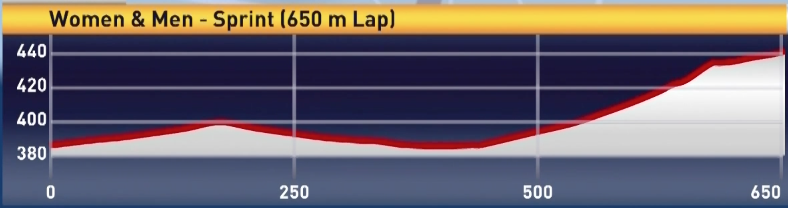
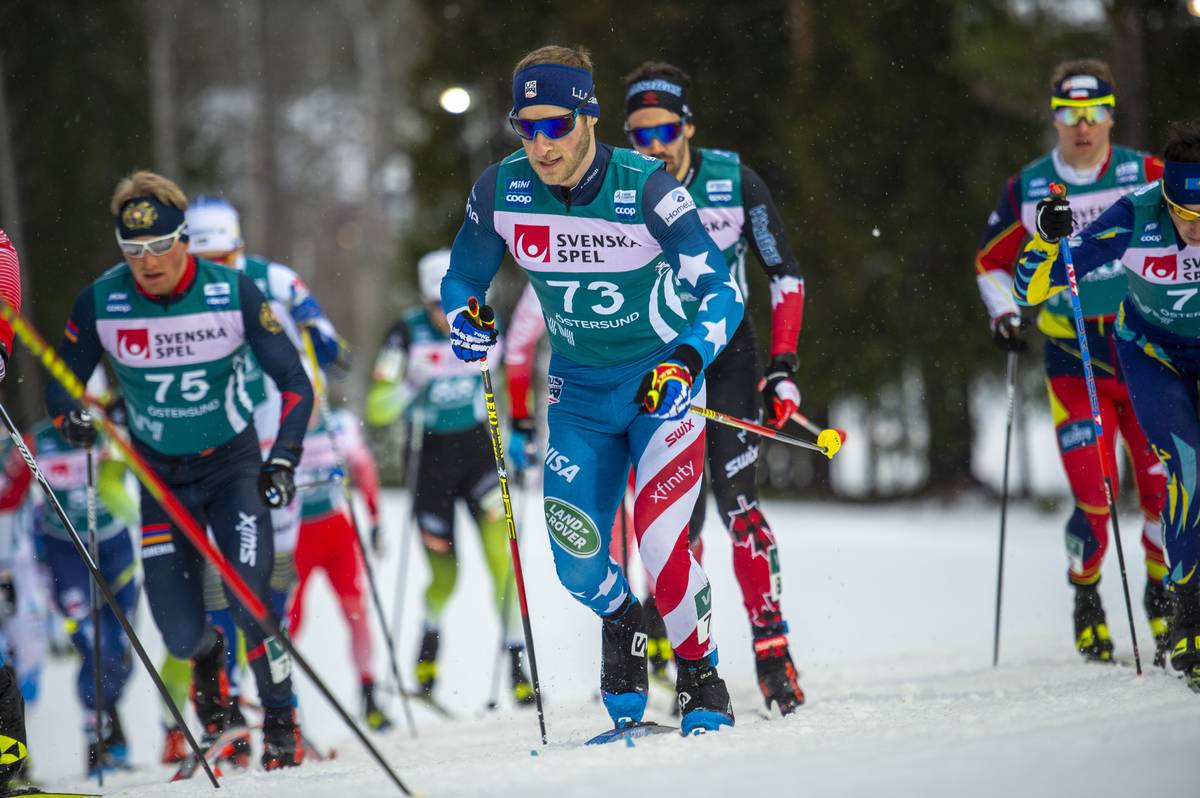
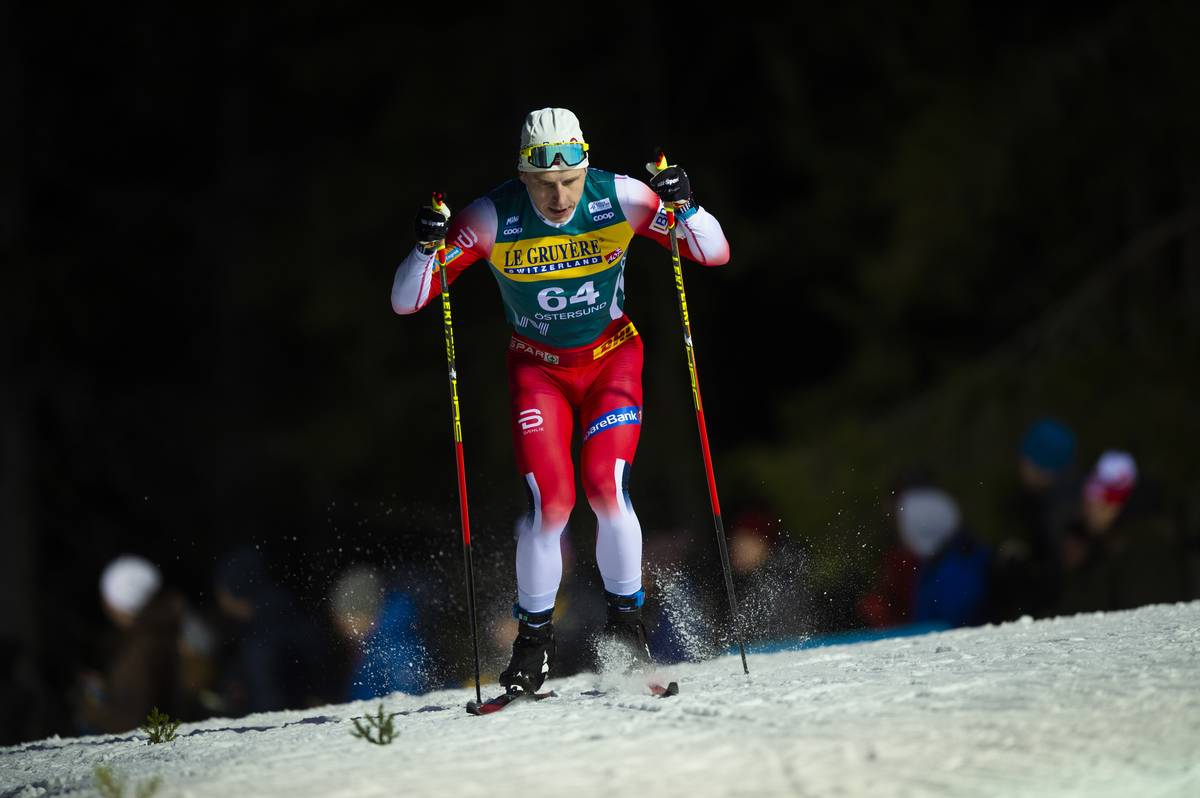
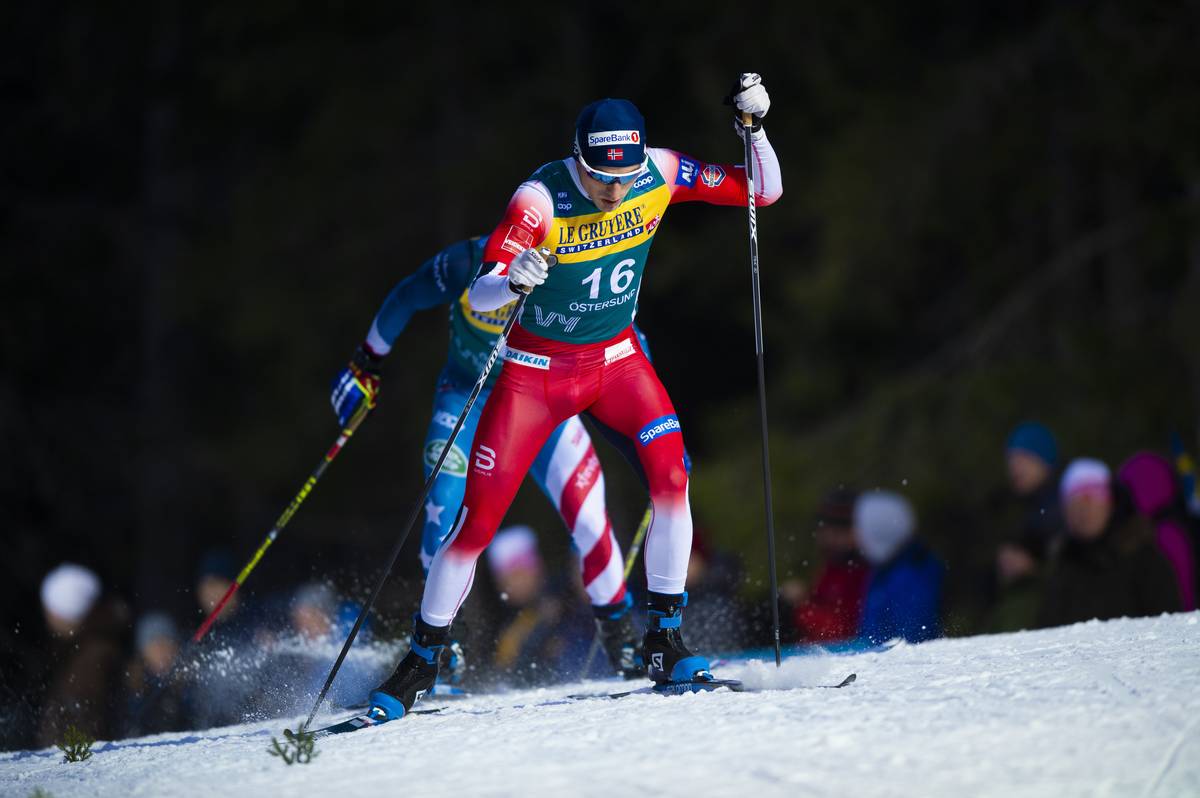
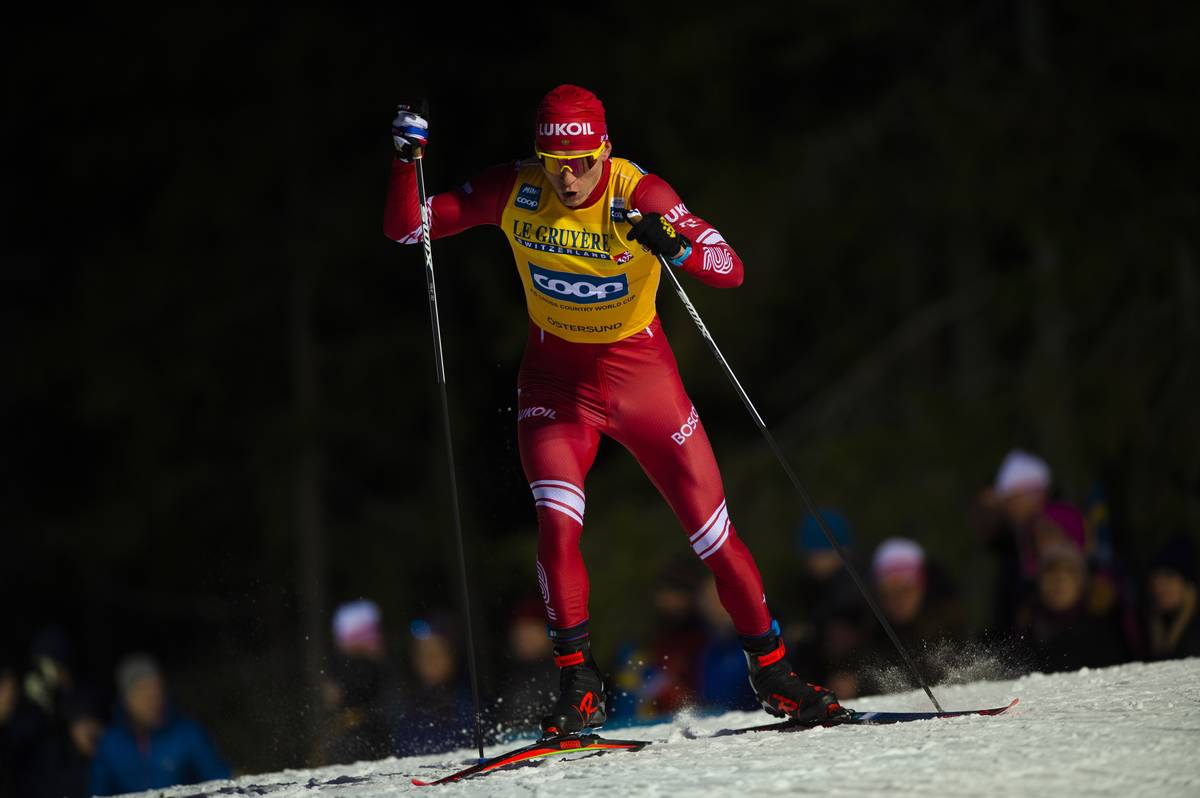
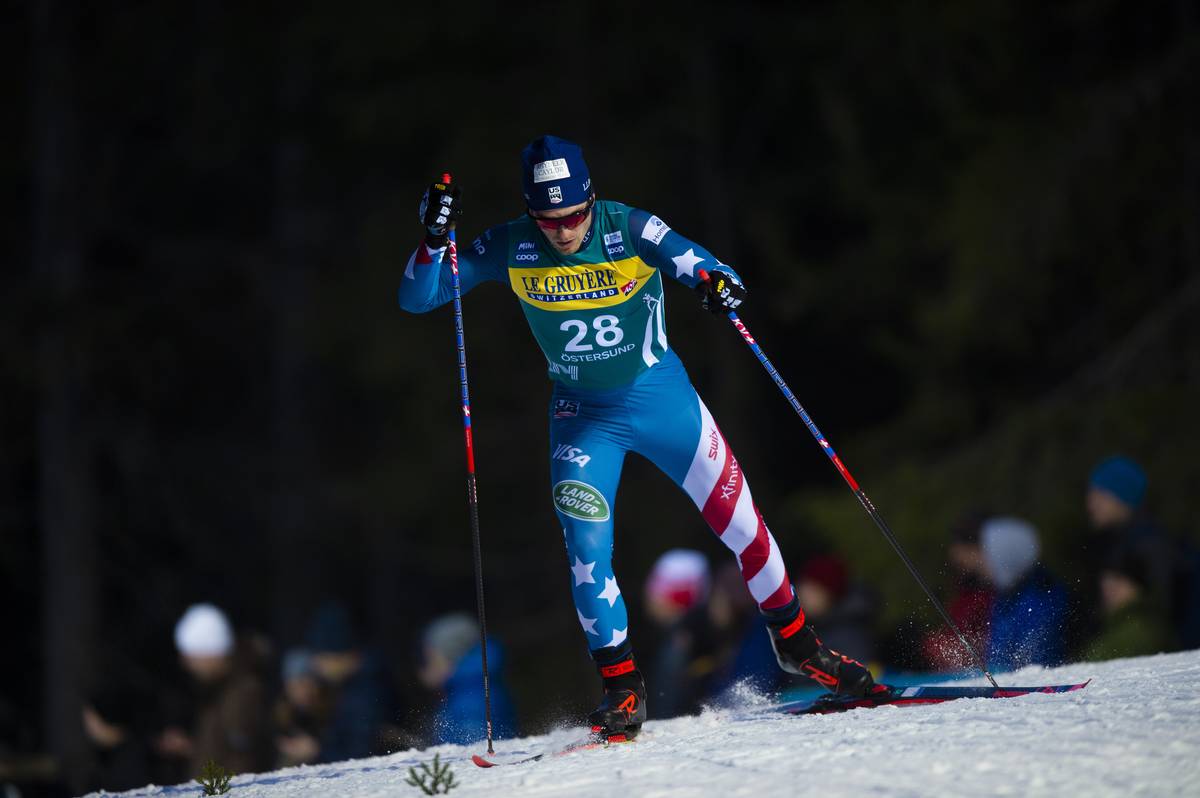
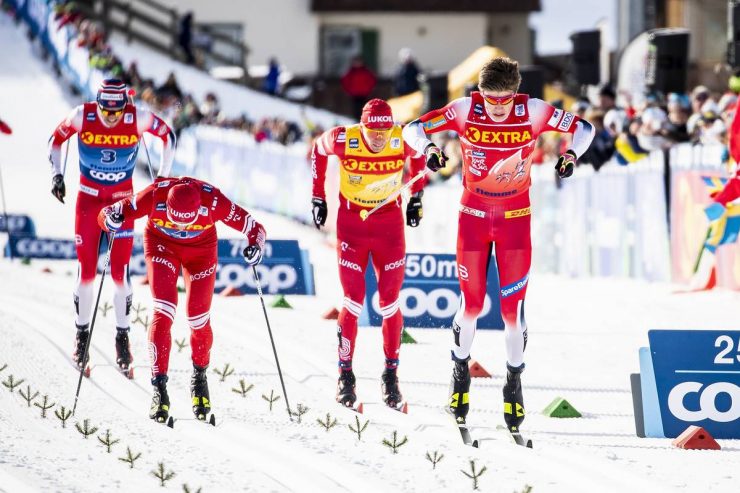
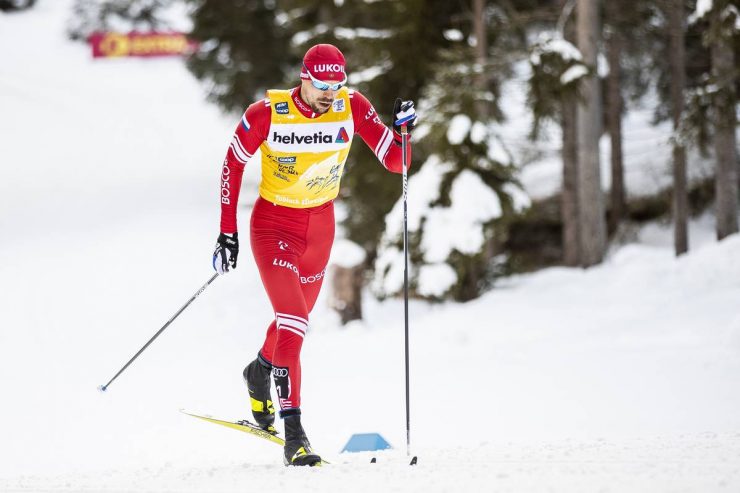
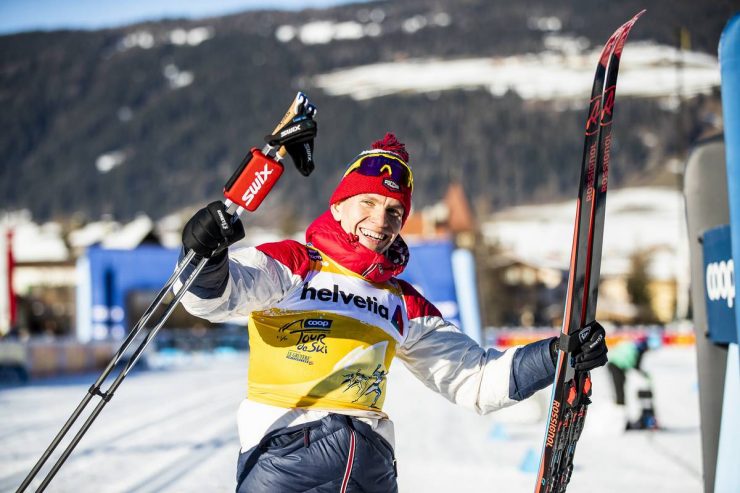
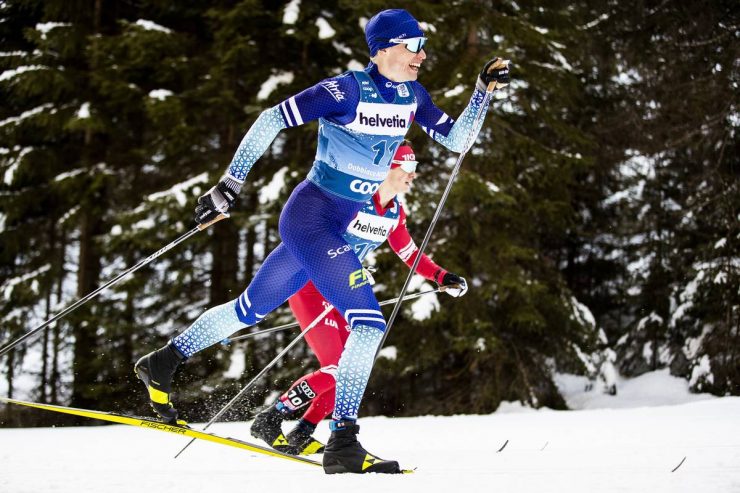
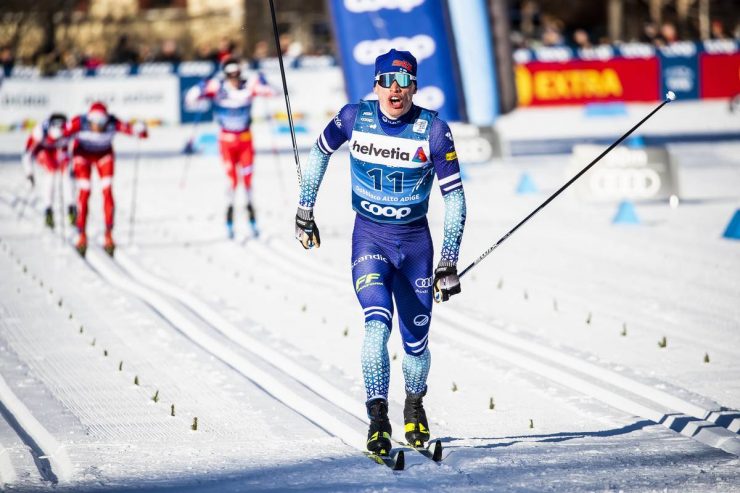
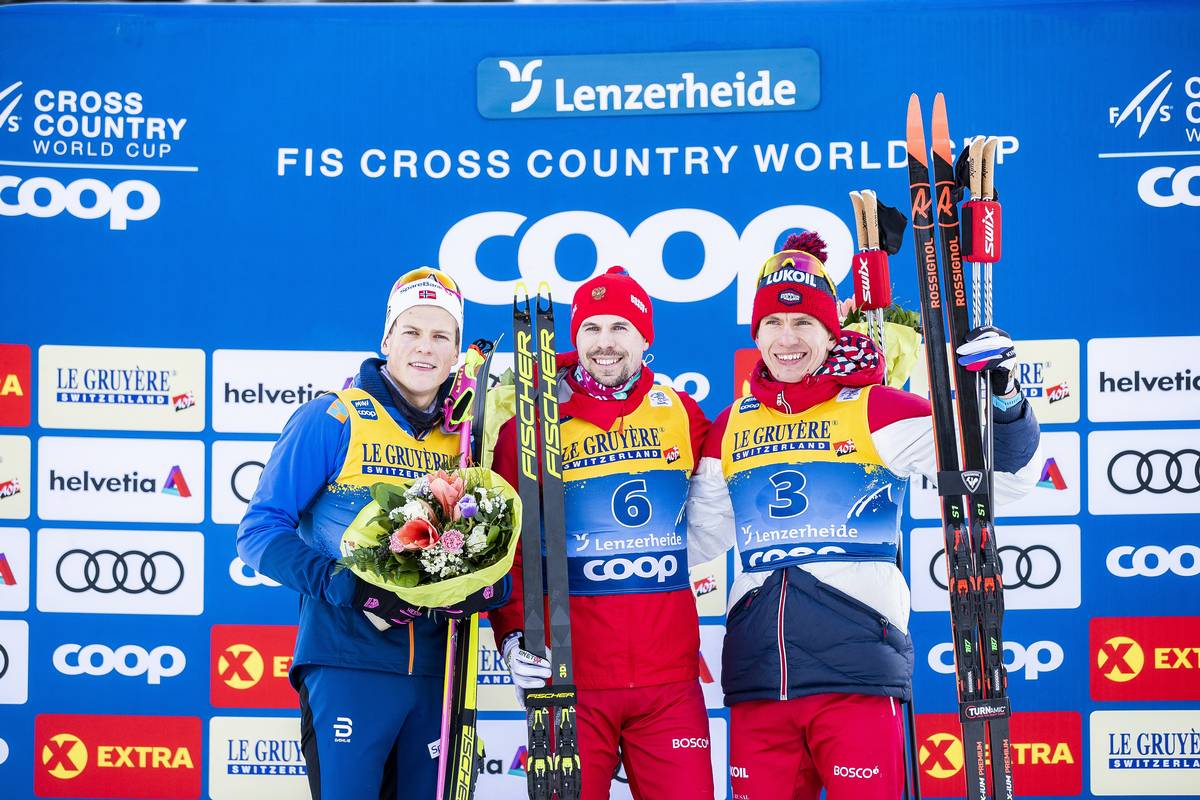
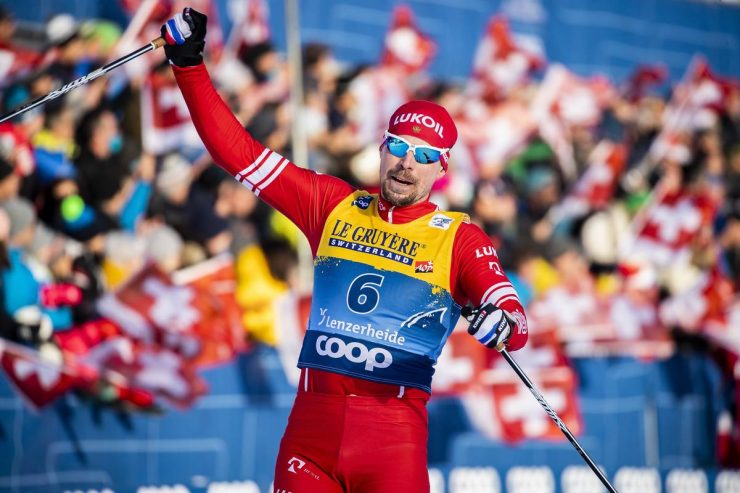
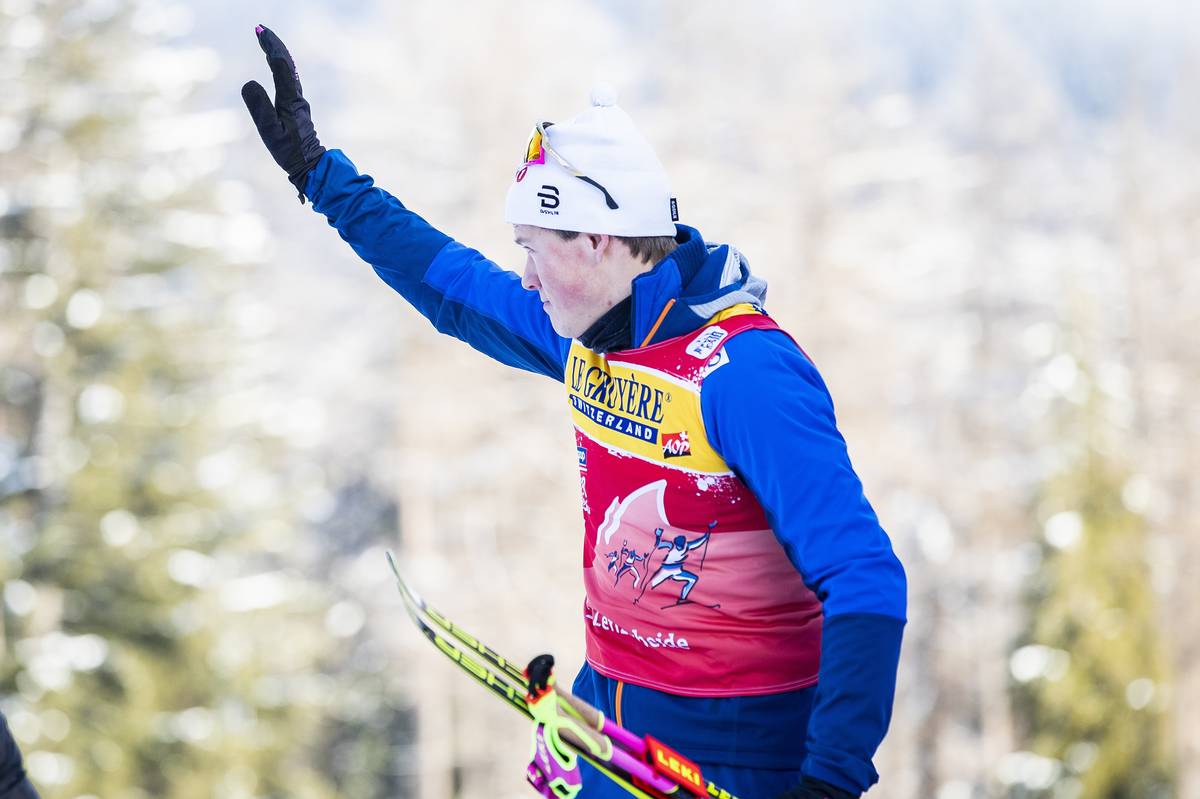
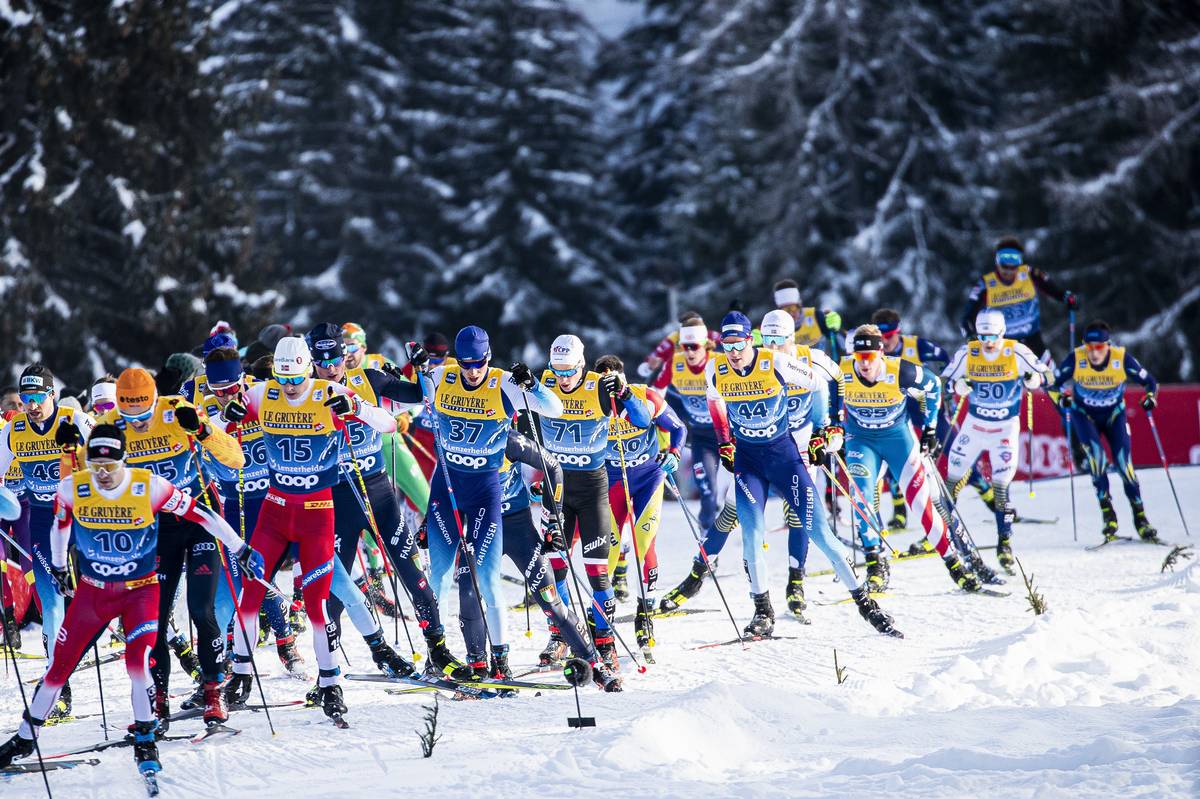
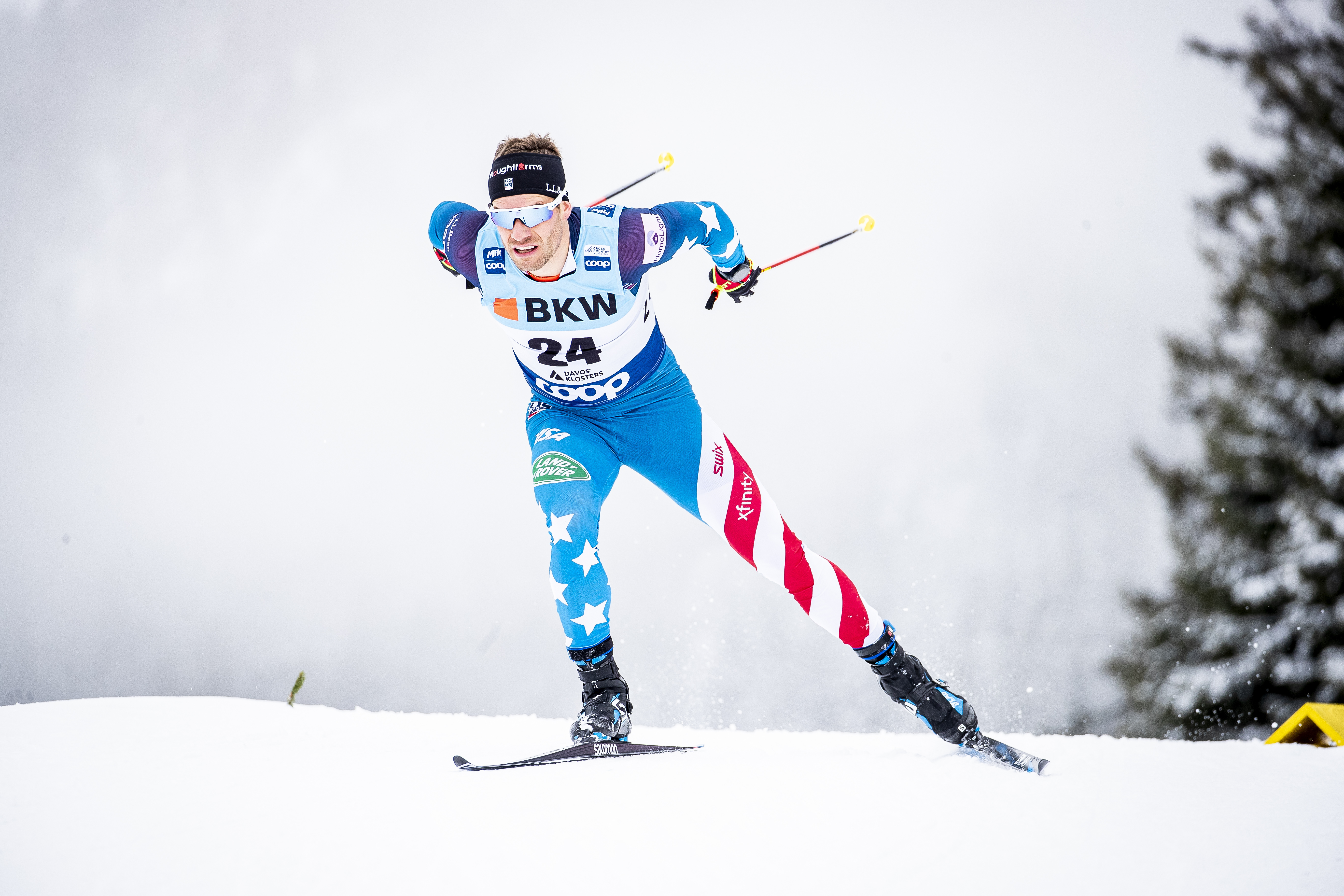
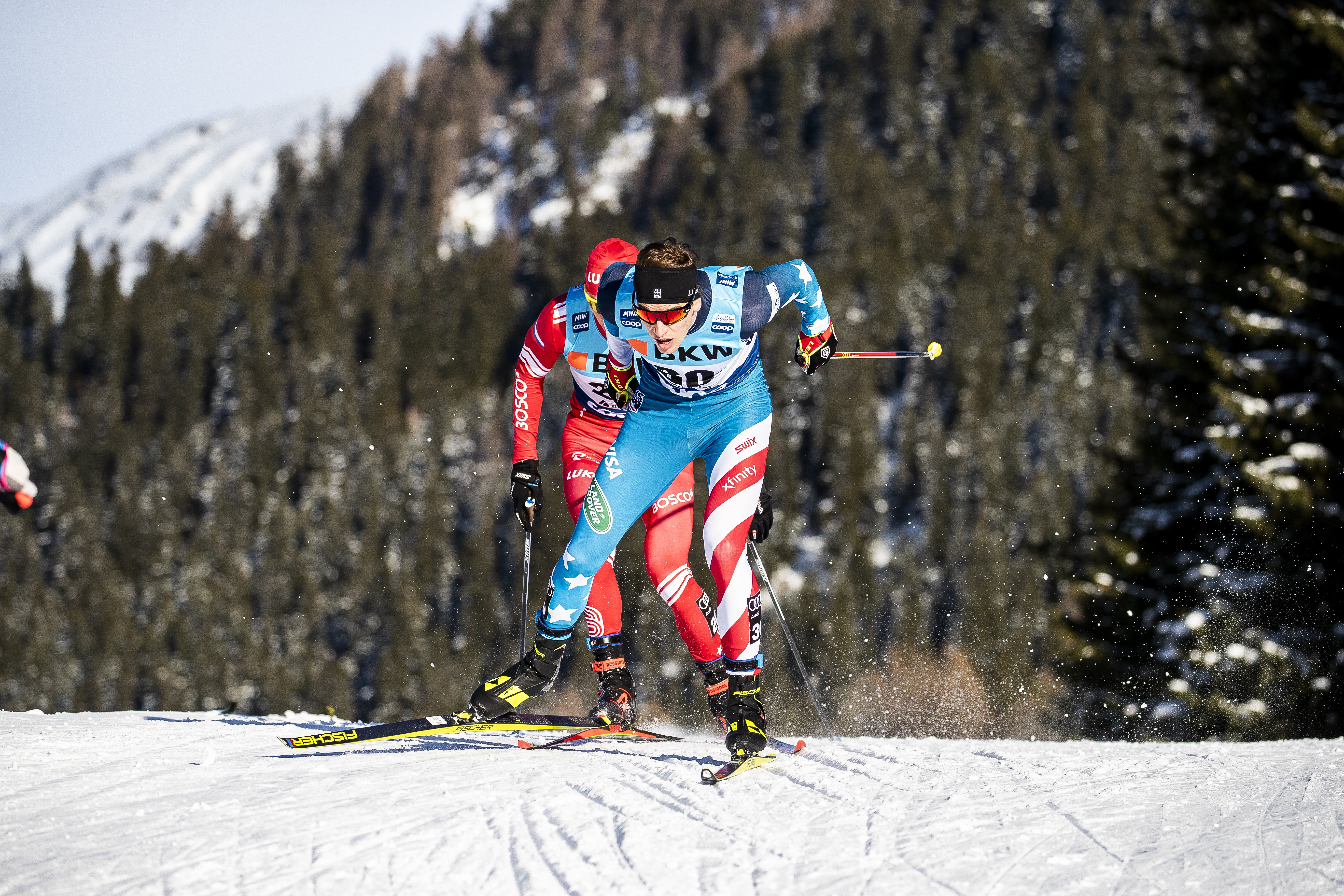
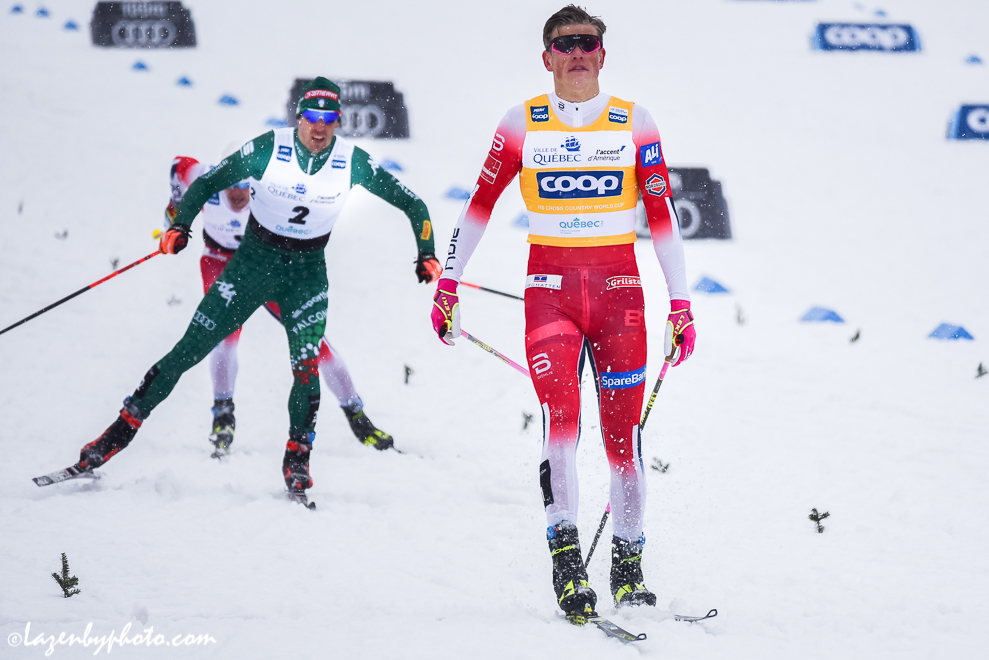
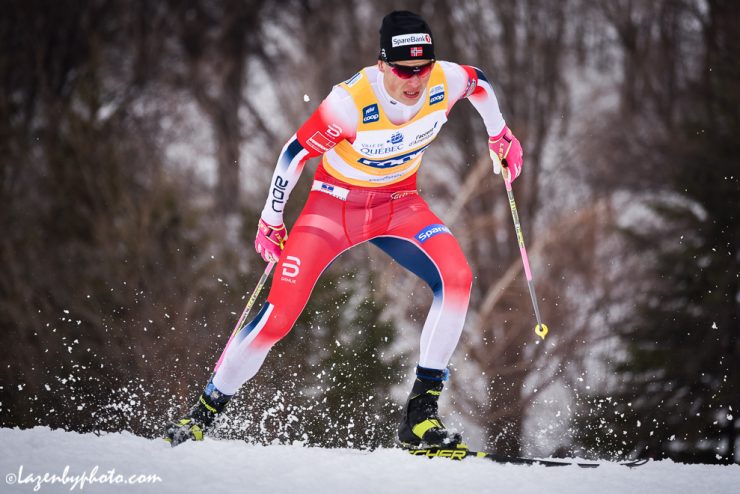
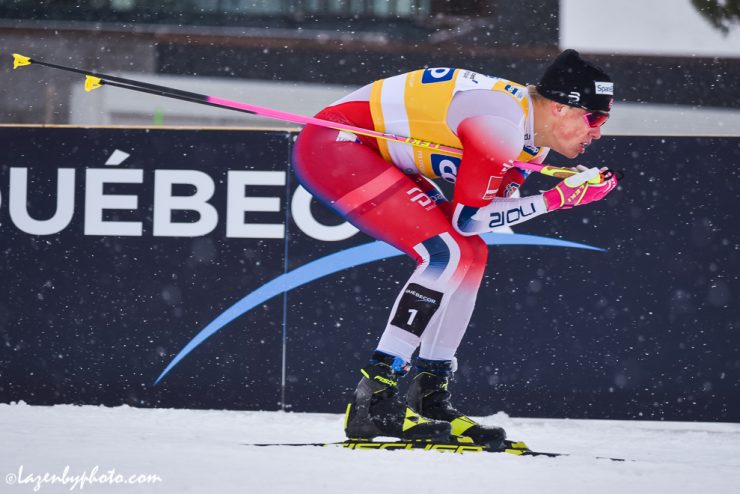
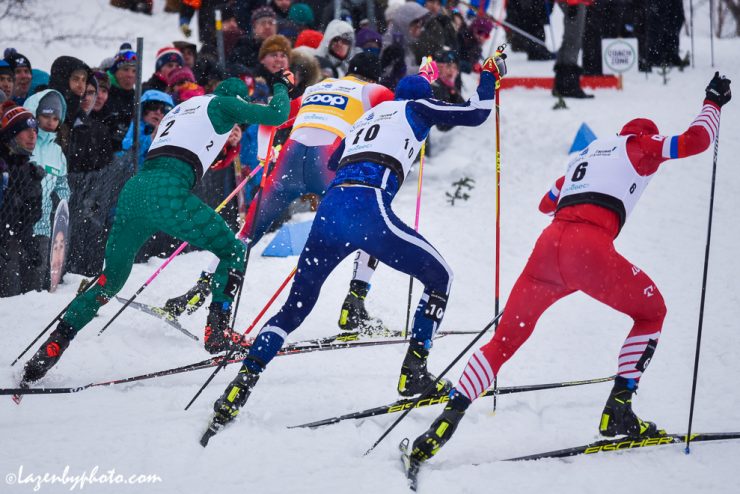
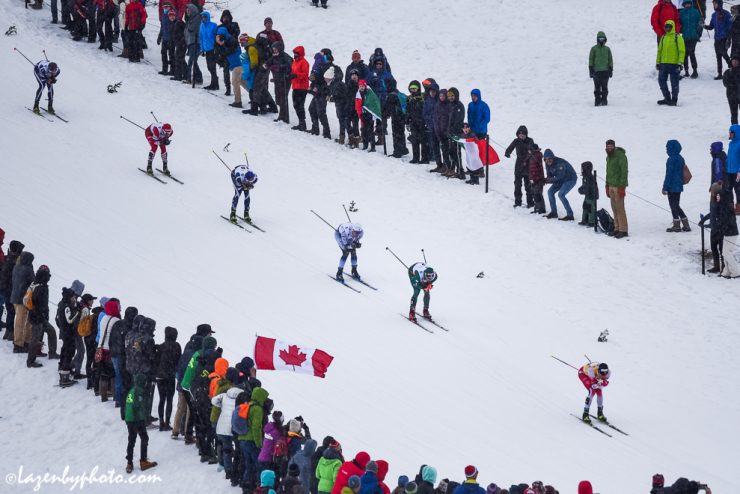
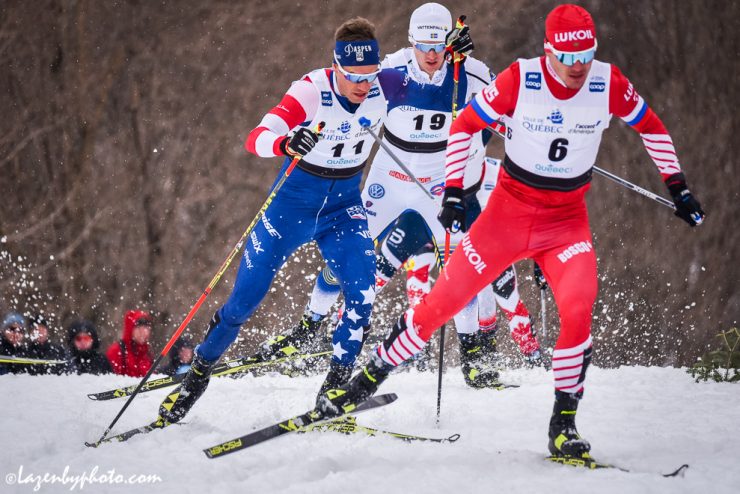
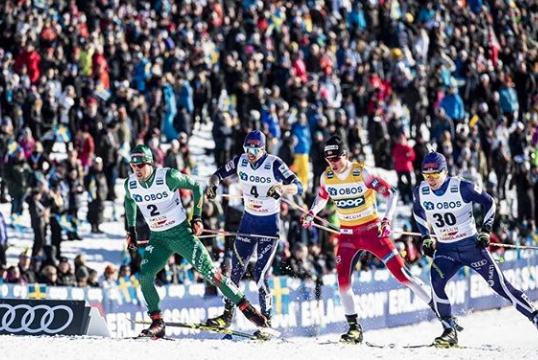
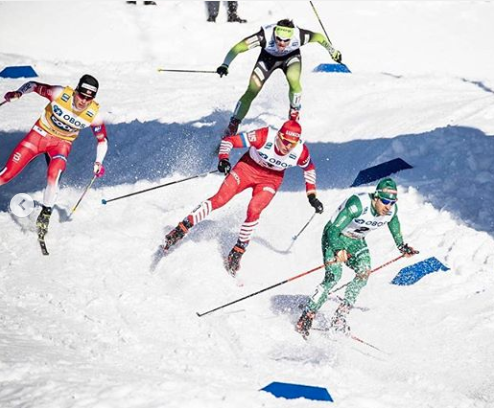
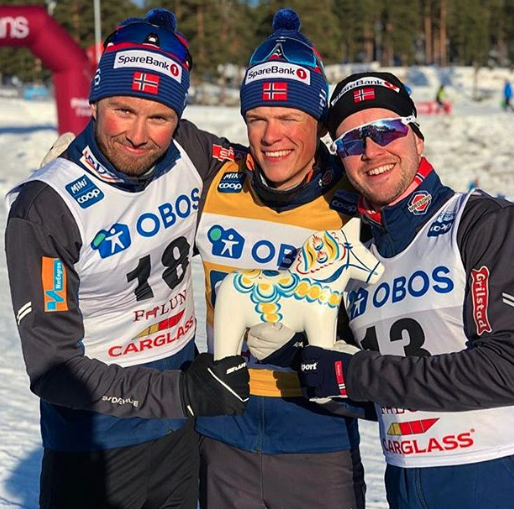
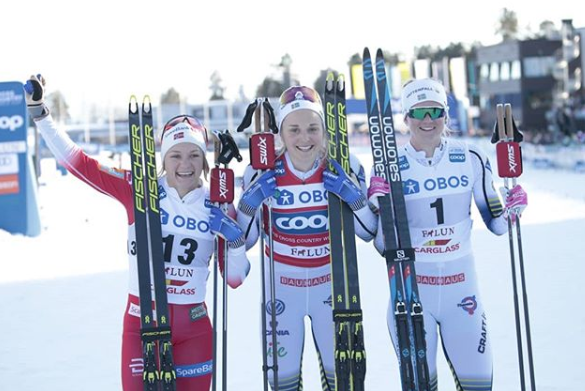
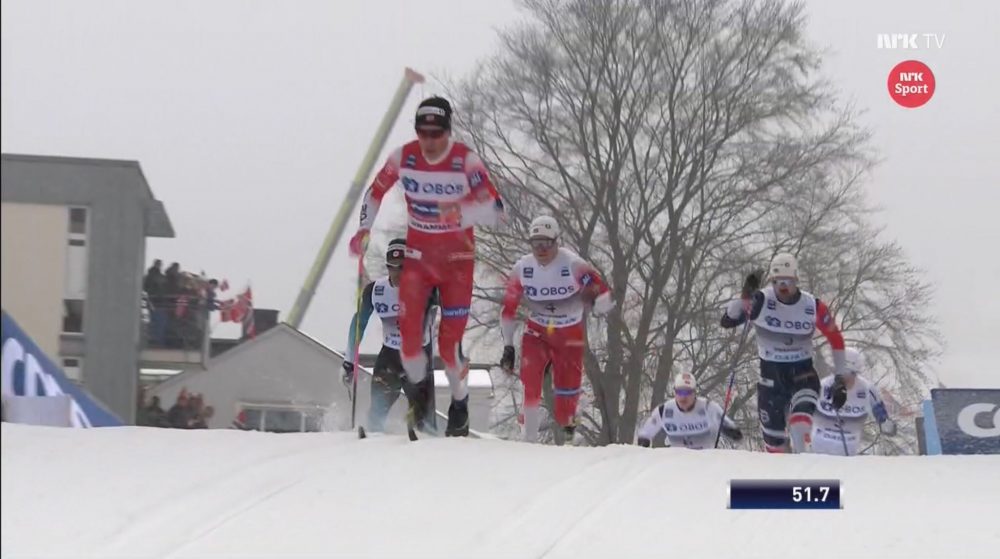
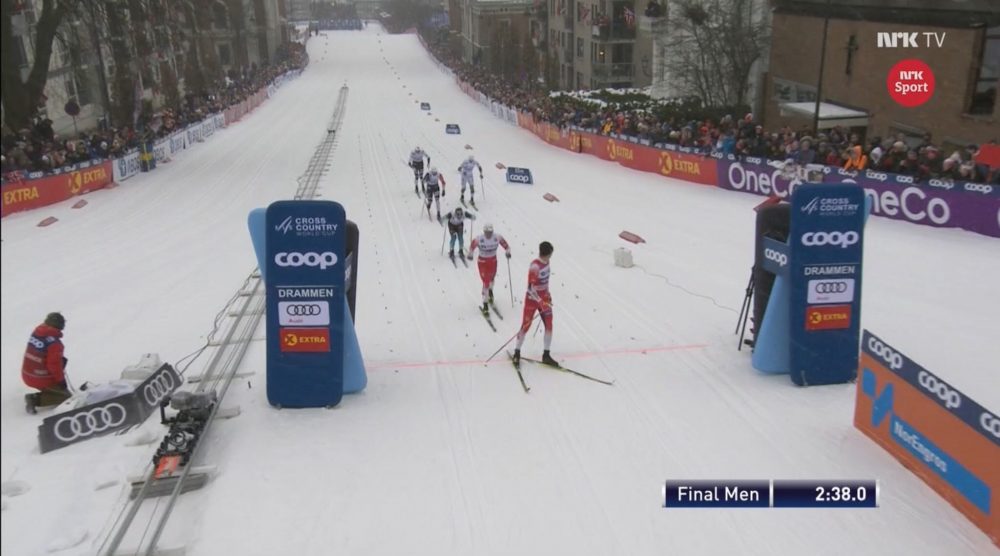
Let’s explain. The format was basic, a freestyle sprint. Otherwise, that’s where sprints as we know it ended. The 0.66-kilometer course shot off from the start up a gradual V2-able climb. It then rounded a left-hander where athletes descended what looked like a salted banked turn found in a X-Games terrain park. Down to the course’s bottom zoomed the skiers. Then things turned skyward. The course ascended a mini-Alpe Cermis lasting around one-minute for the men, to the finish atop the climb. The climb was the defining characteristic of the terrain: athletes suffered up a downhill ski slope gaining roughly 60 meters in altitude before the finish line. Calling the final ascent punchy would be an understatement. Grinding. Grueling. Leg-cement-inducing is more appropriate.
The Åre sprint hill climb in profile. (Photo: Screenshot FIS Broadcast)
Perhaps a sprint sideshow? That could be argued. But hosting an event at the base of the Swedish National Alpine hill with amenities for fans, of which there were plenty, and bountiful options for climbing terrain, we’ll let others debate the merits of hosting a climb-fest sprint.
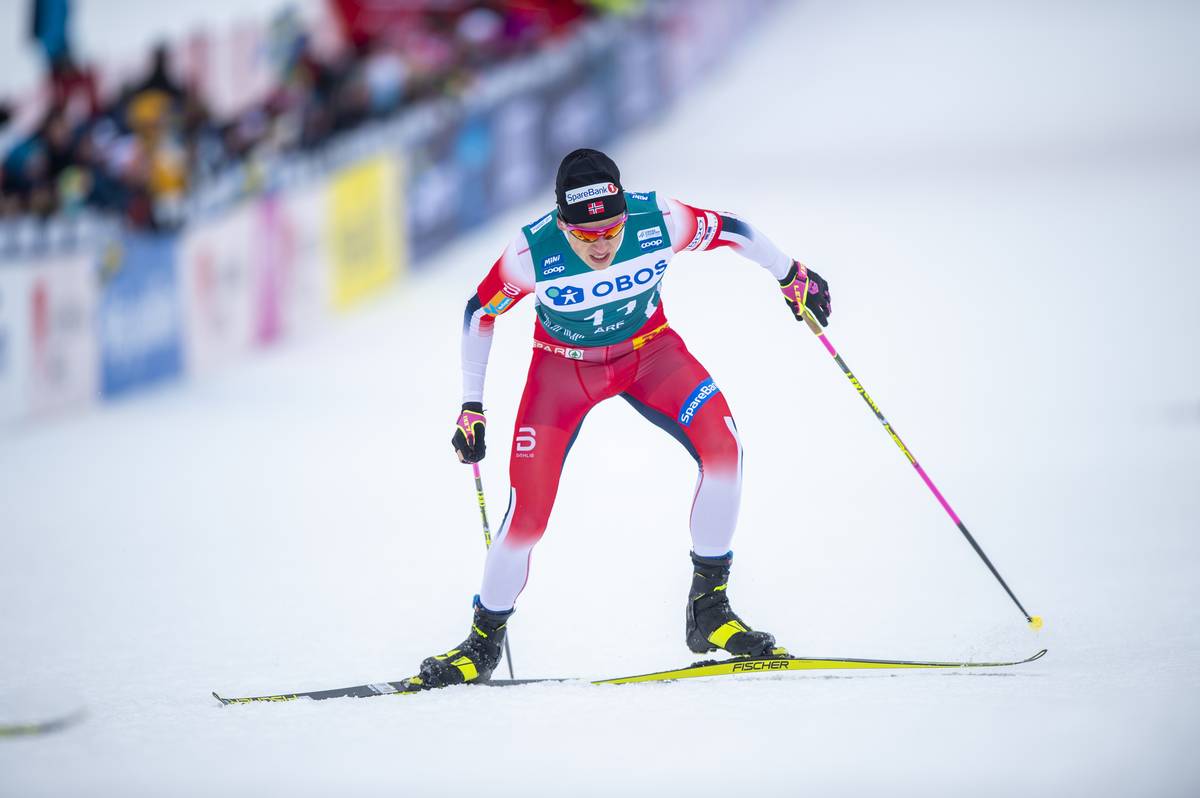
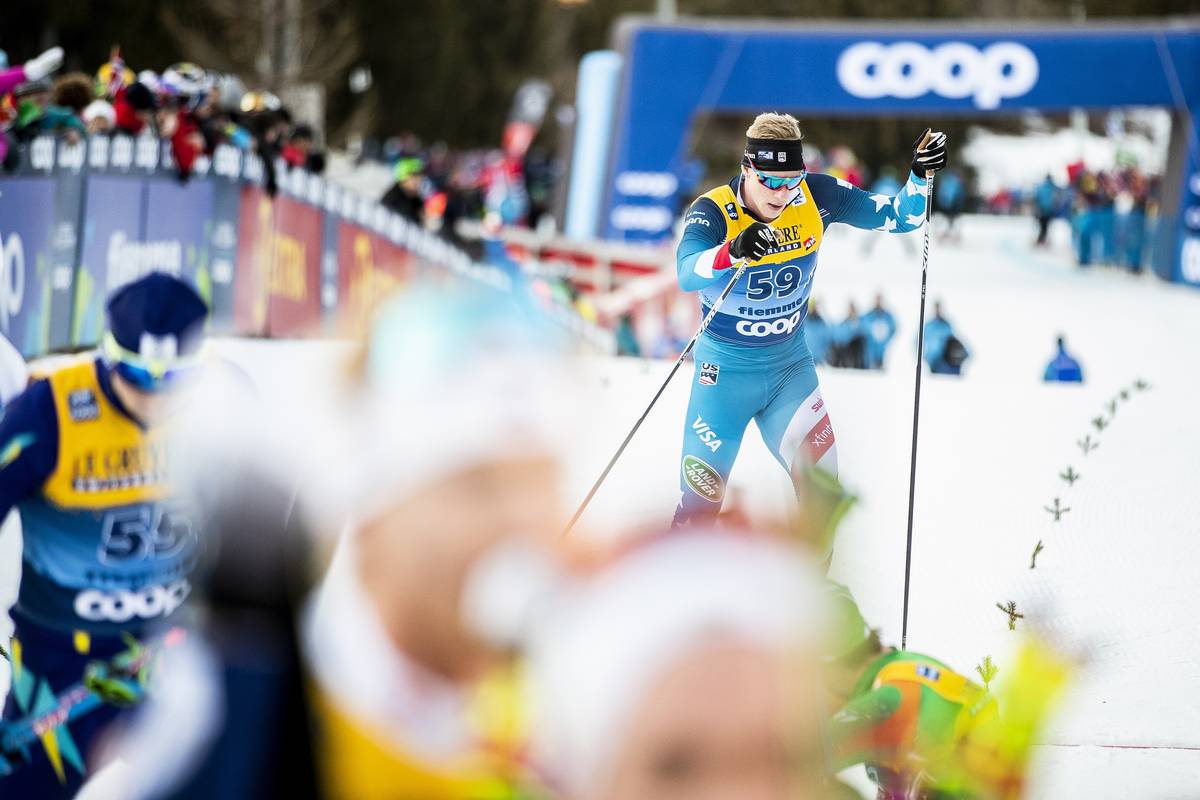
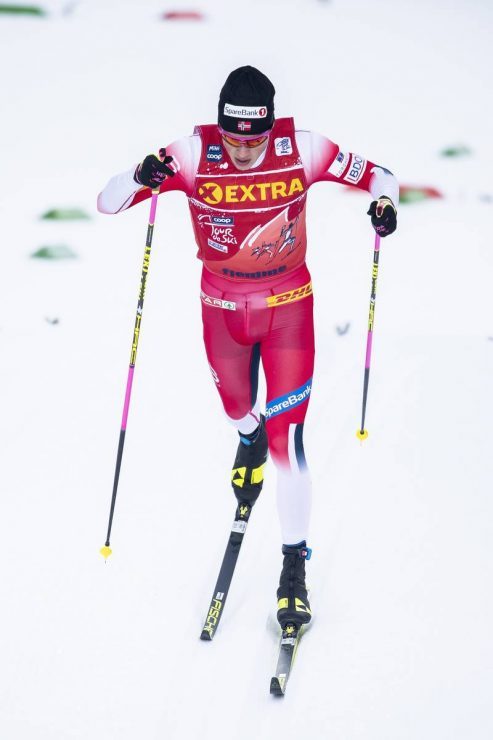
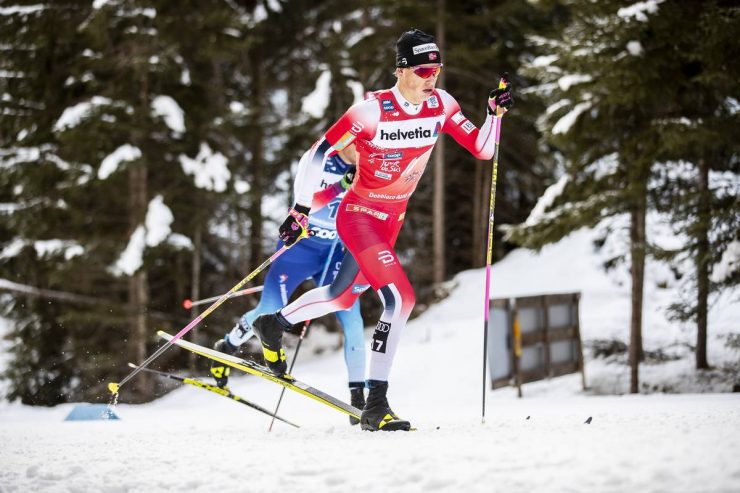
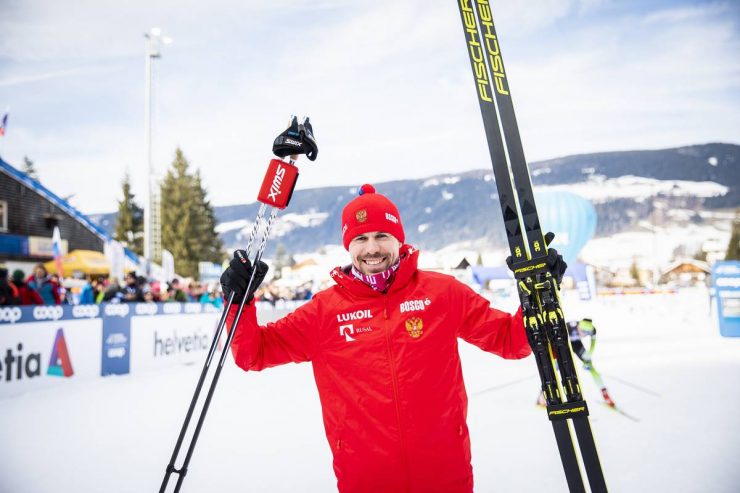
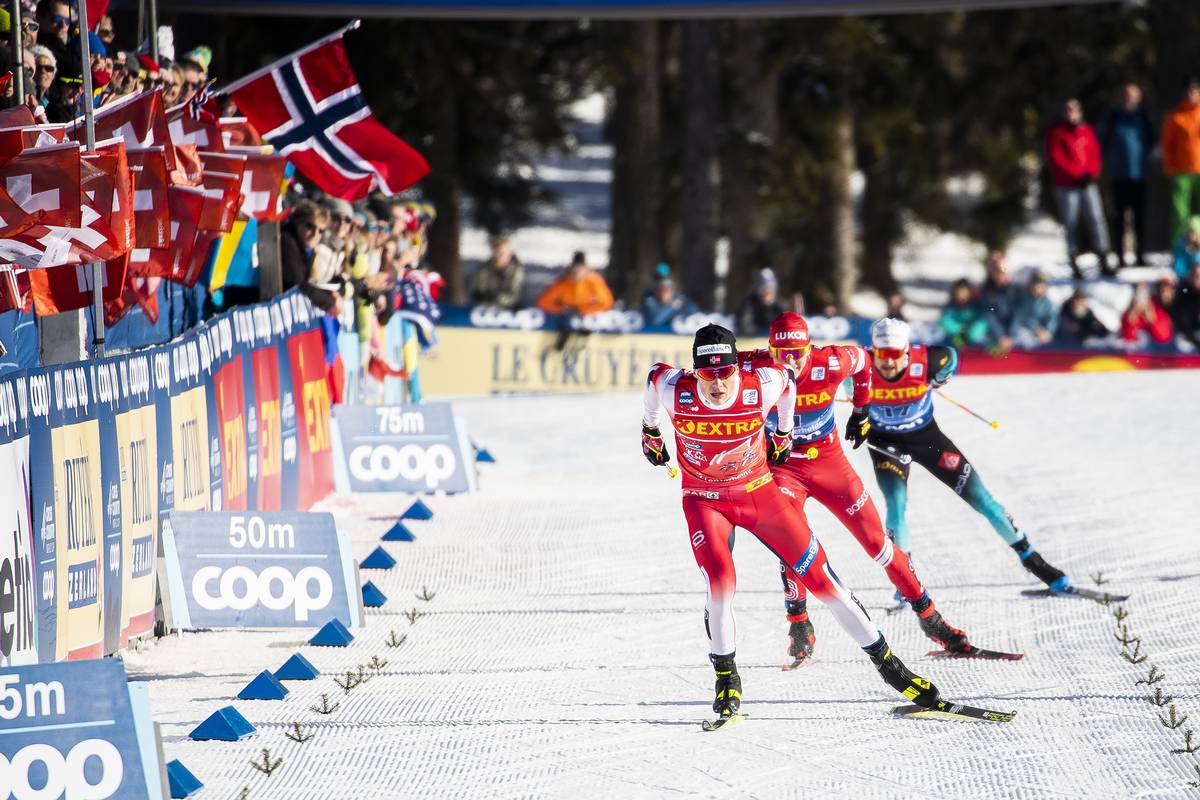
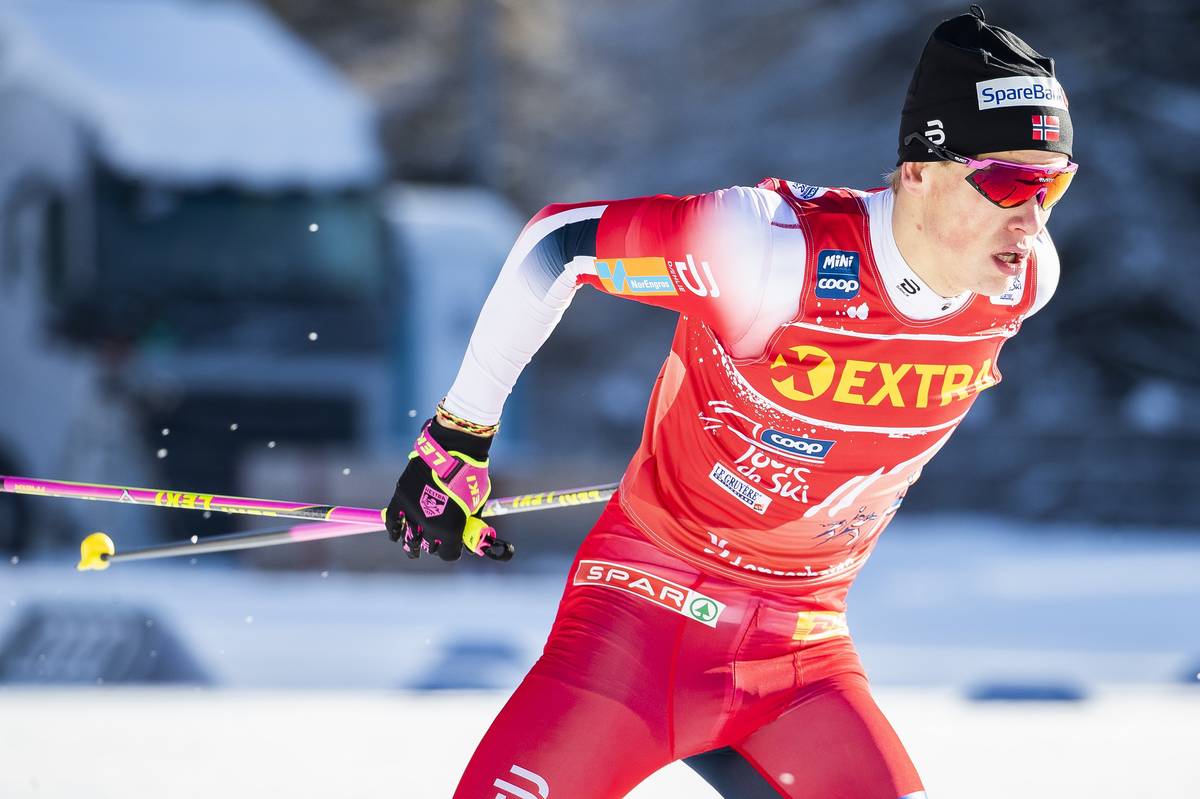
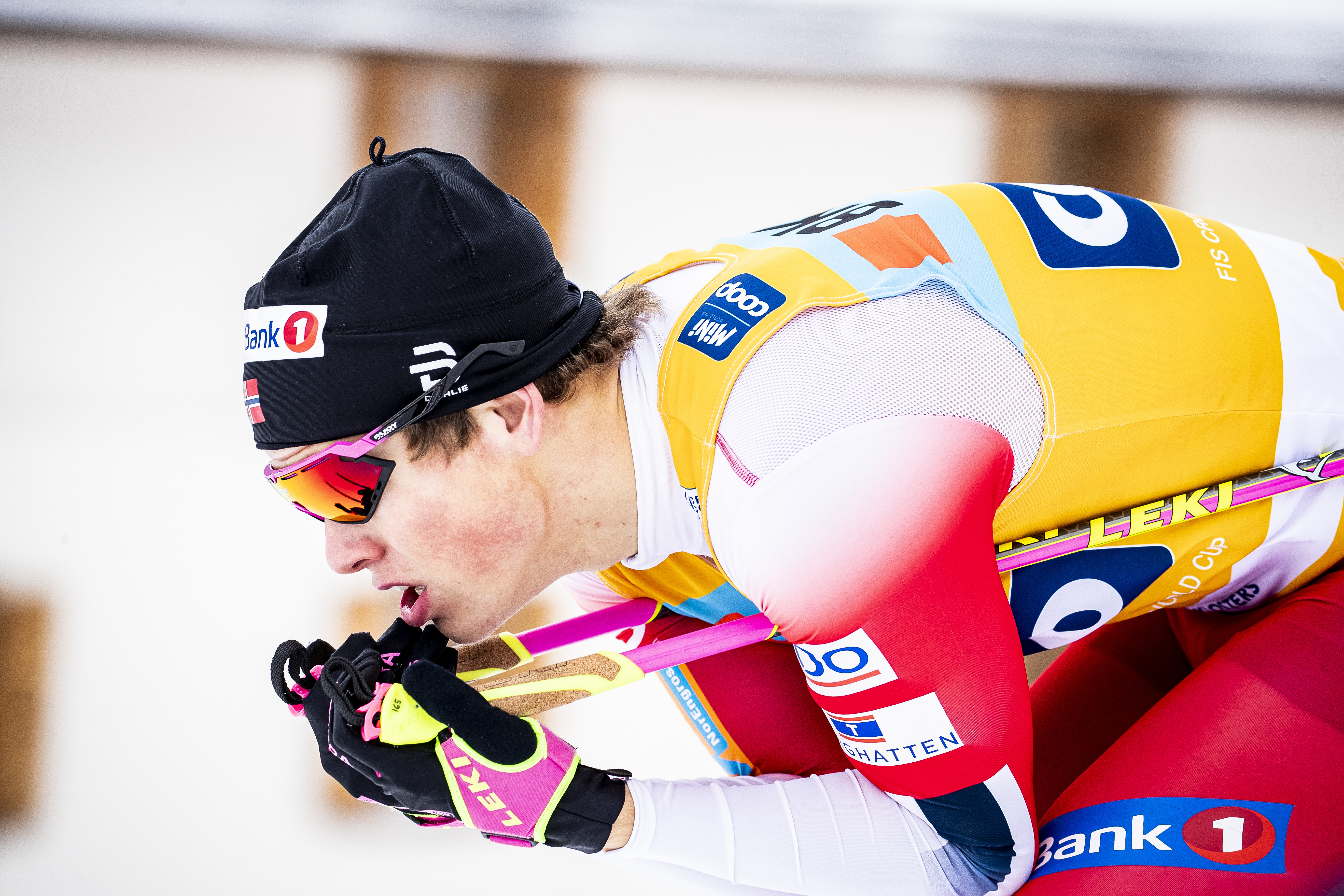
Johannes Høsflot Klæbo of Norway in Åre, Sweden on his way to winning Stage 3 of the Ski Tour 2020. (Photo: NordicFocus)
But some things haven’t changed: Johannes Høsflot Klæbo qualified in first covering the course in 1:49.64. That’s right, a quick and snappy 0.66 k, despite the big vert. Klæbo continues to deal with broken fingers and a thus far lackluster Ski Tour 2020. He placed 31st in Stage 1 and 25th in Stage 2. He came into Stage 3 ranked 25th overall in the Ski Tour, 2:05 behind the leader, Norway’s Stage 2 winner, Pål Golberg.
For his part, Golberg laid down the second-fastest time in qualification, 2.58 seconds back. Alexander Bolshunov of Russia, by all measures the pre-Ski Tour favorite, qualified in 23rd (+8.59).
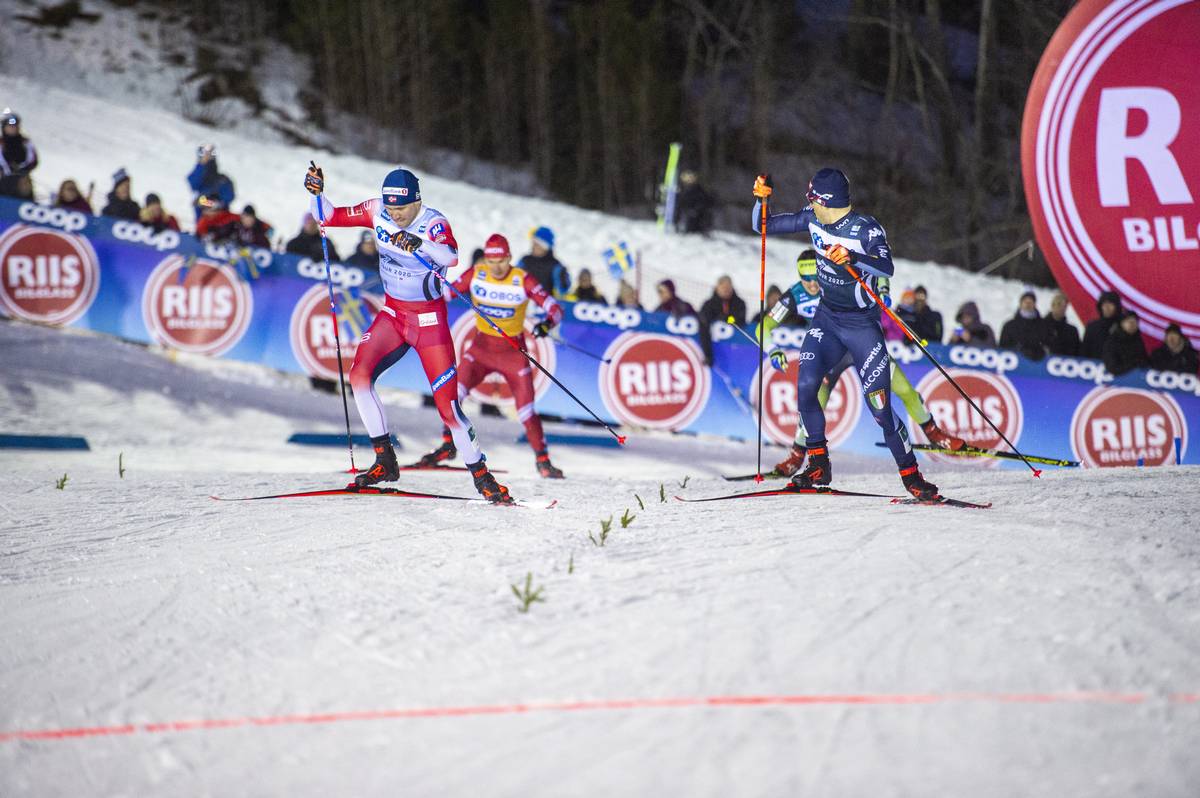
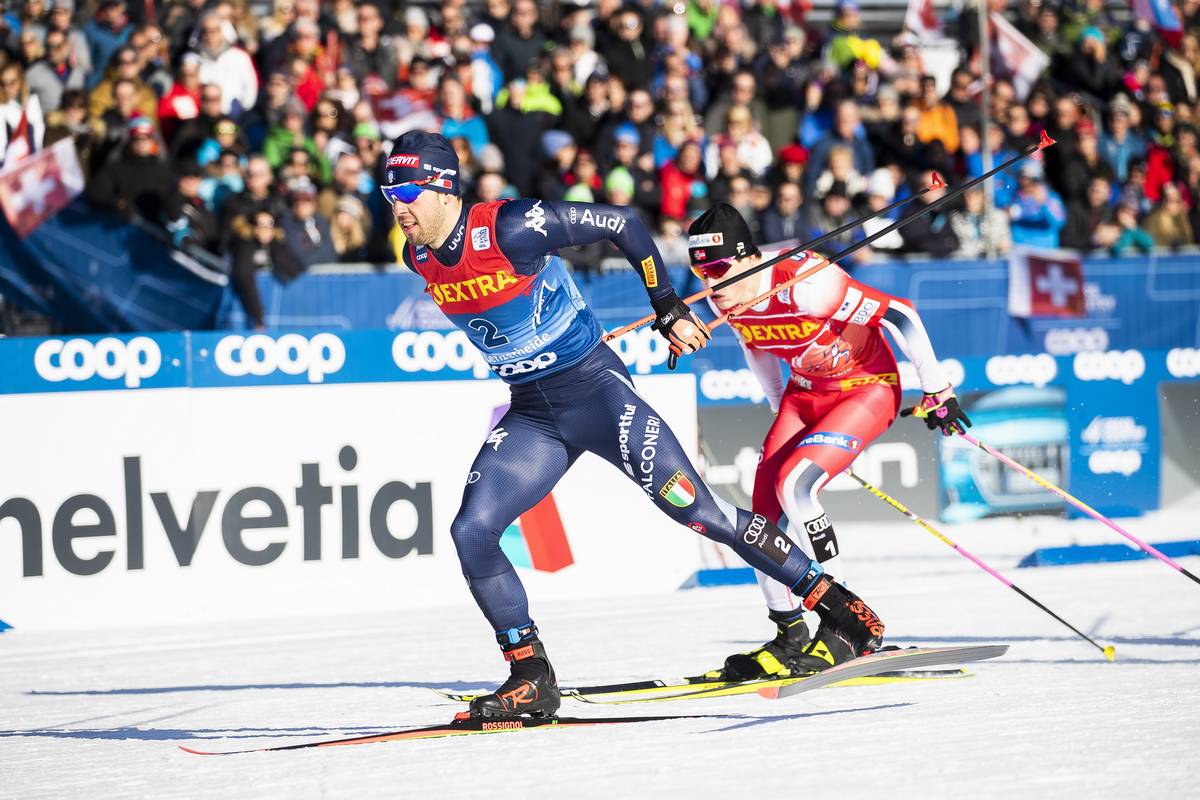
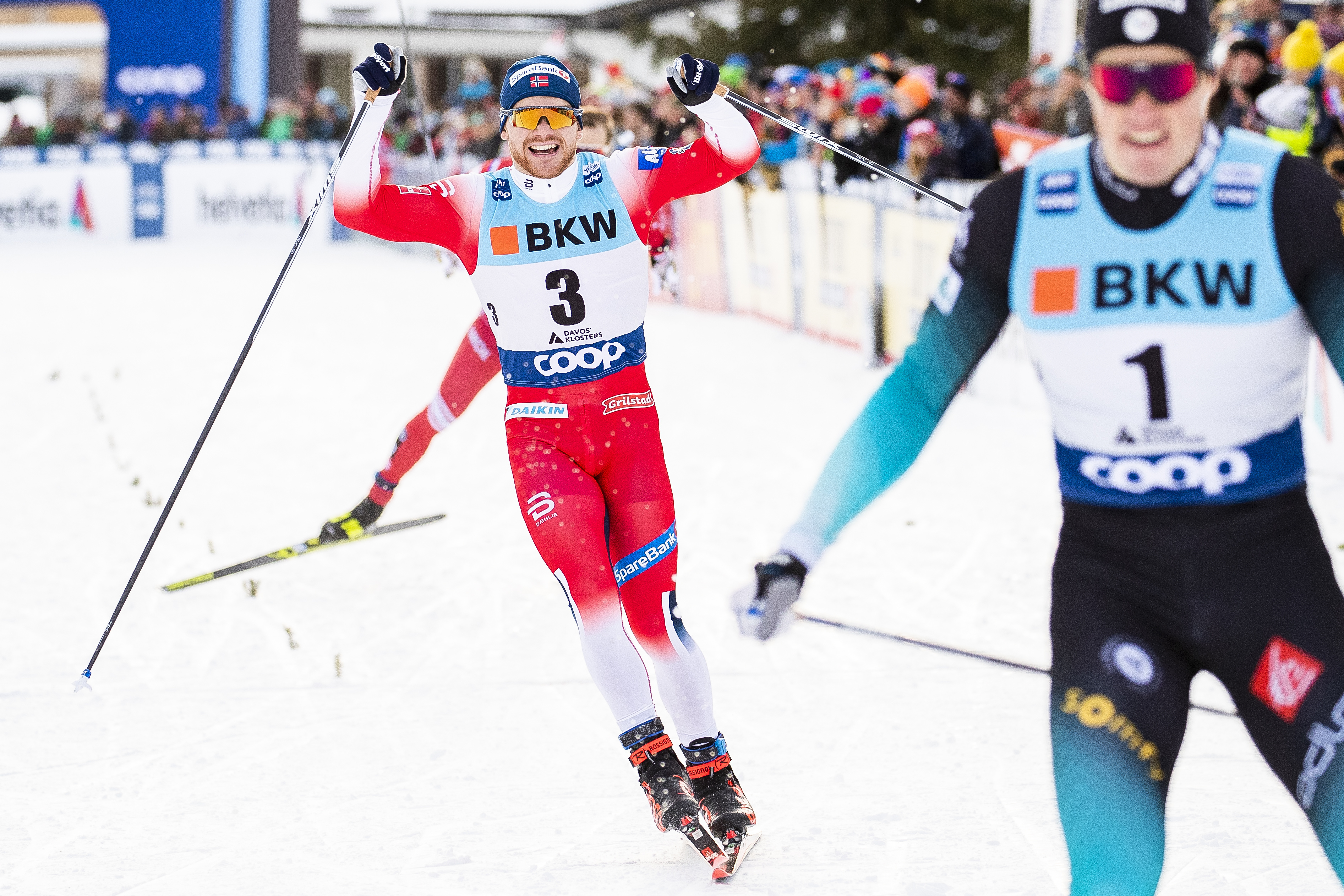
Pål Golberg of Norway and Italy’s Federico Pellegrino into the finish. (Photo: NordicFocus)
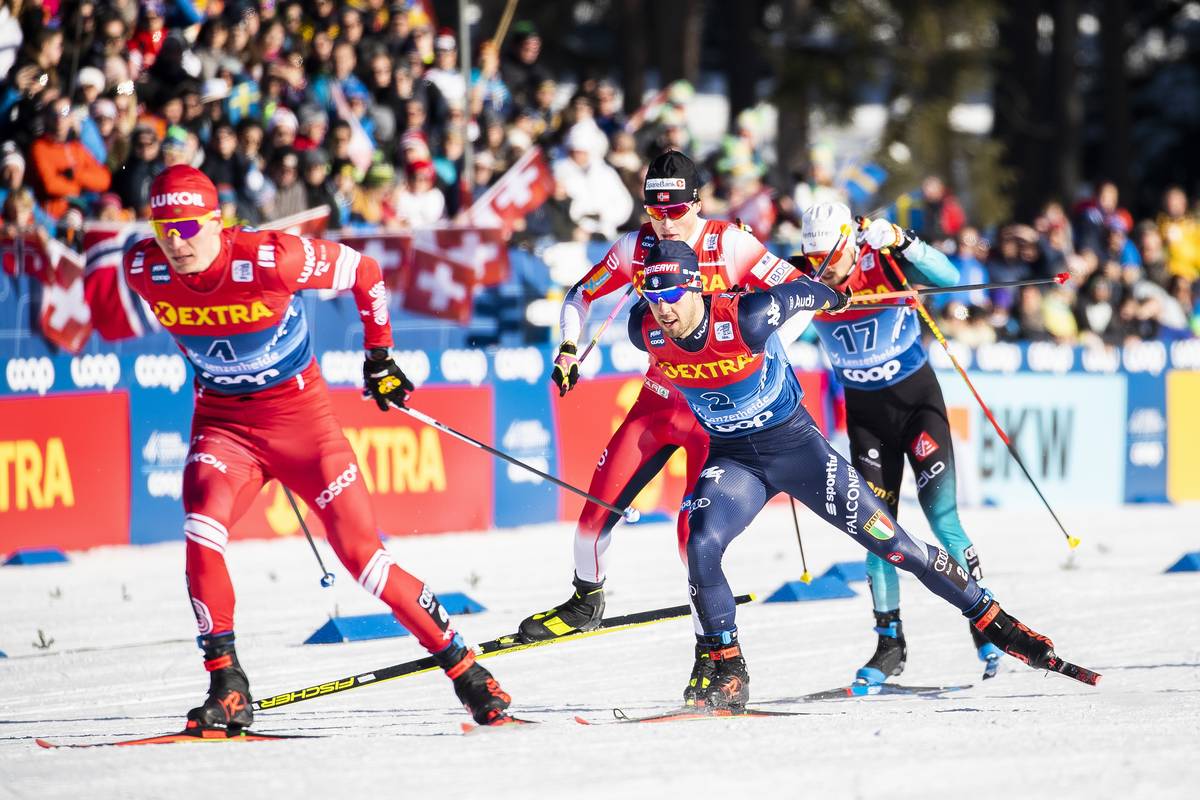
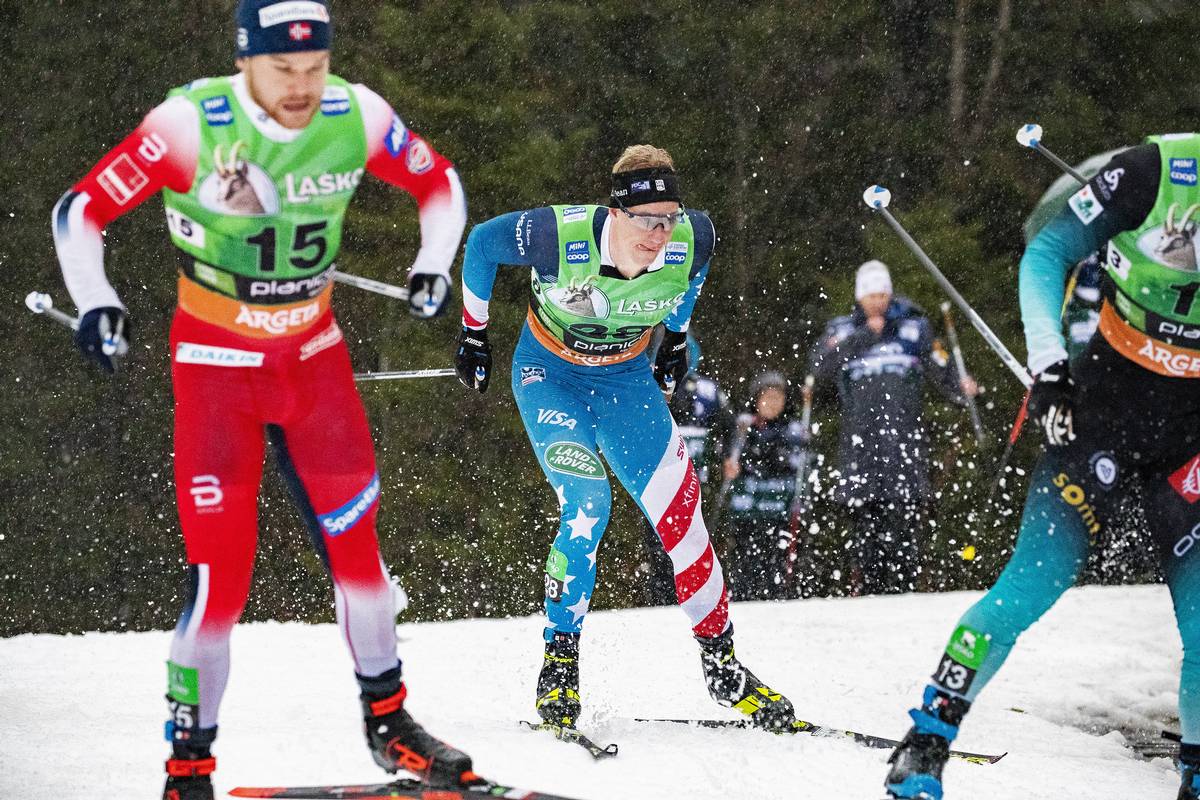
In the second semifinal, rounding the corner on the first and notably mild climb, Italy’s Federico Pellegrino took the inside line over the top. In bib 11, Norway’s Simen Hegstad Krüger came through in second, followed closely by Bolshunov who had advanced as a lucky loser.
Krüger took an aggressive line and cut off the advancing Russian. As this transpired, Krüger tumbled as their skis crossed. Bolshunov continued with Krüger going between his legs. Bolshunov now sat in fifth as he crested the hill. Krüger snapped a pole and grabbed a spare just prior to the descent. (He eventually received a yellow card for his cut-off move.)
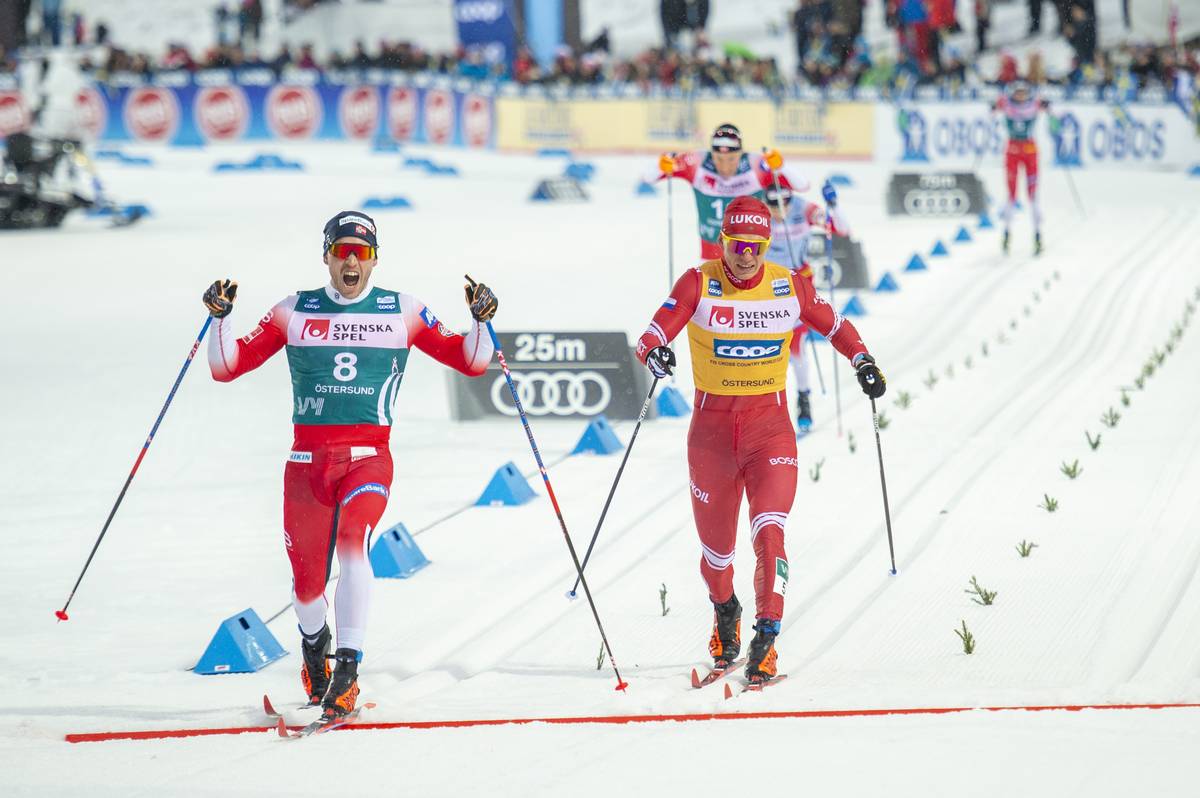
Golberg won the semi, with Pellegrino in second. Bolshunov never recovered and placed fourth, 1.92 seconds behind Golberg. Bolshunov finished the day in eighth after being eliminated.
Although 8th on the day, Russia’s Alexander Bolshunov sits second overall in the Ski Tour 2020 after three stages. (Photo: NordicFocus)
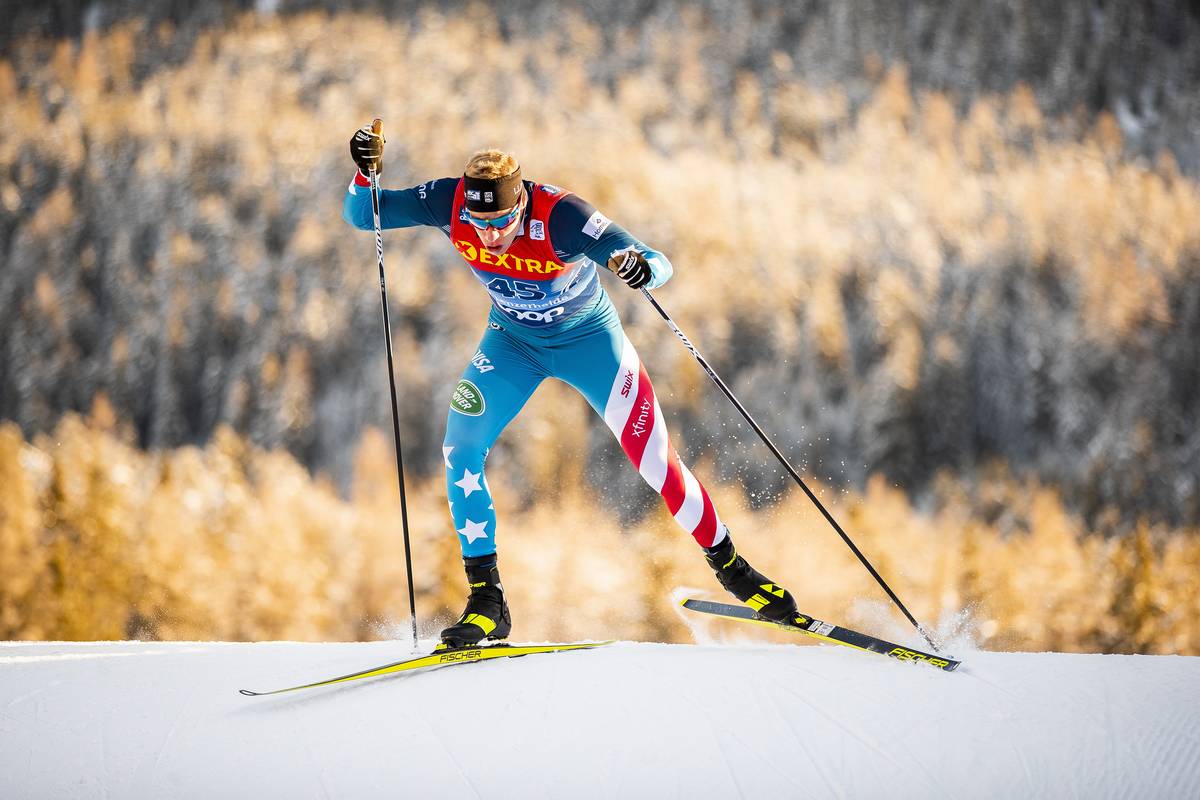
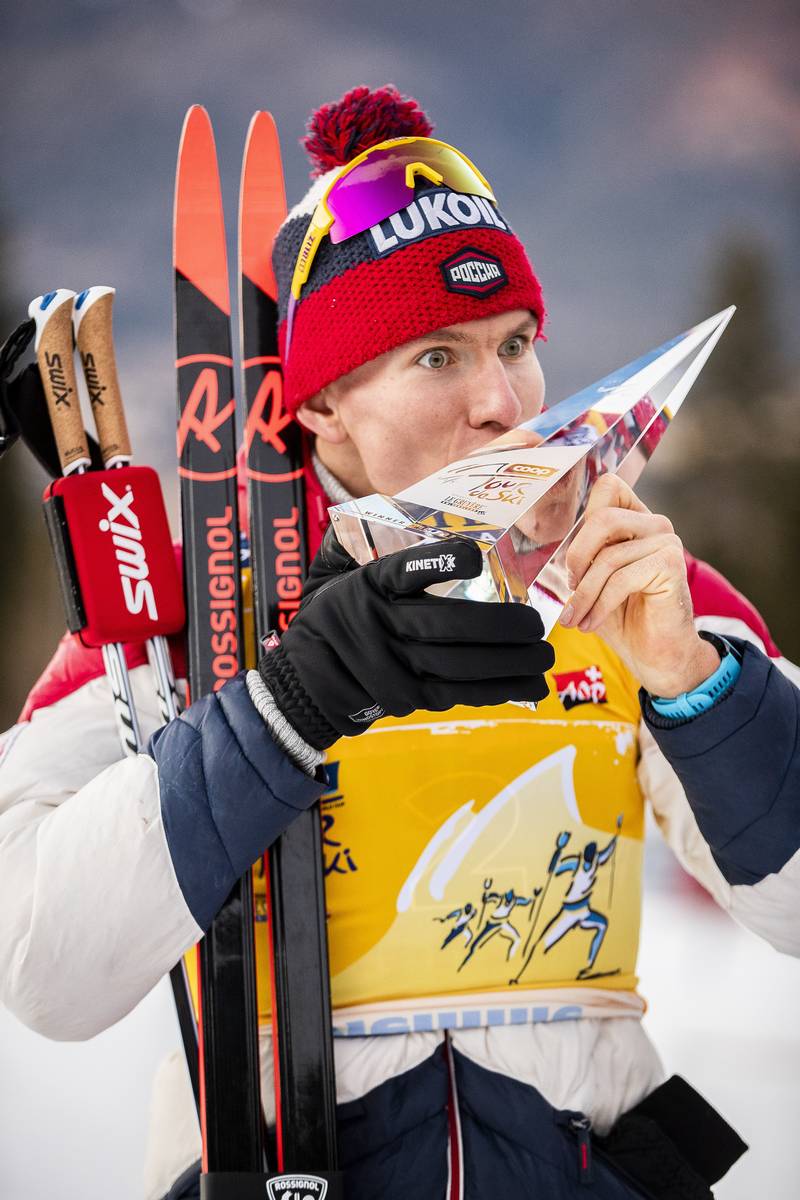
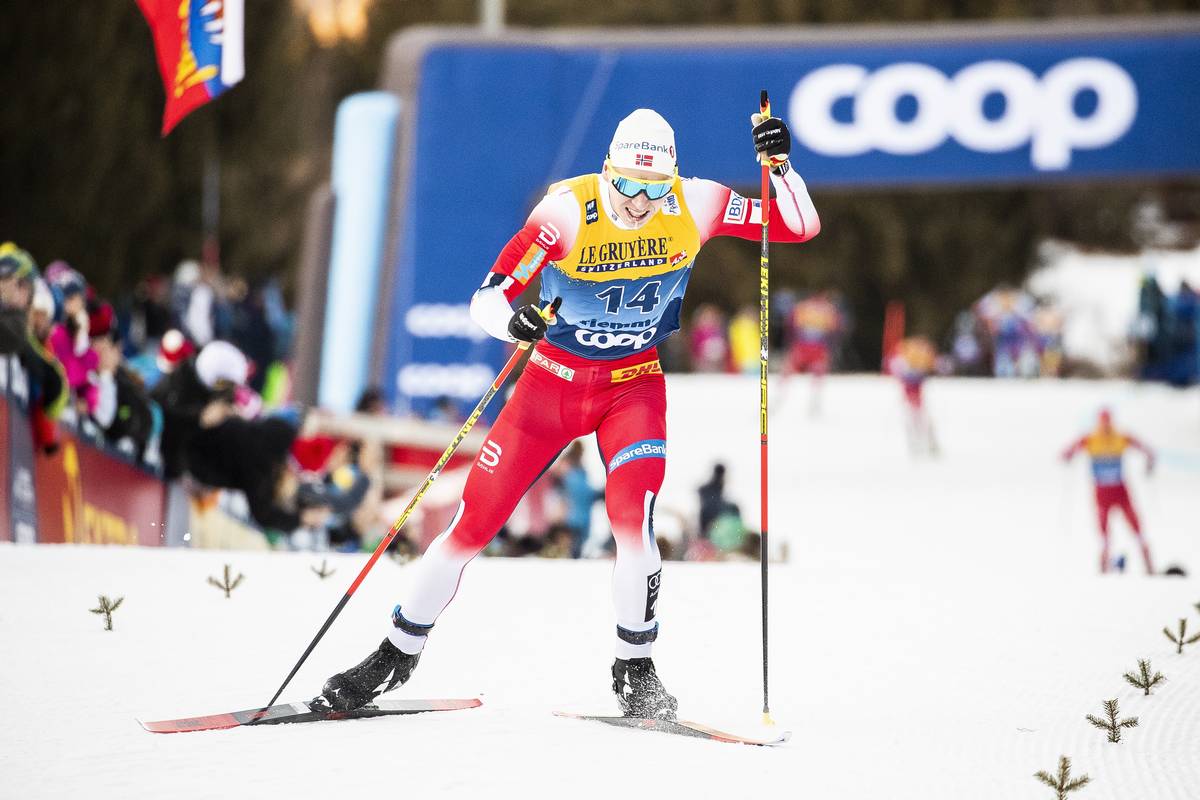
Outside of the peculiar course, a stumble here and there, Klæbo and his astounding pull away acceleration in the final was the story. He advanced by winning the first quarterfinal and the first semi. He won that semi by only 0.52 seconds over France’s Jay Renaud. What became evident was that Klæbo was holding back and had not dialed his tactics.
In the final that featured Klæbo, Pellegrino, Renaud, Golberg, Lucas Chanavat of France, and Norway’s Erik Valnes the charade was over.
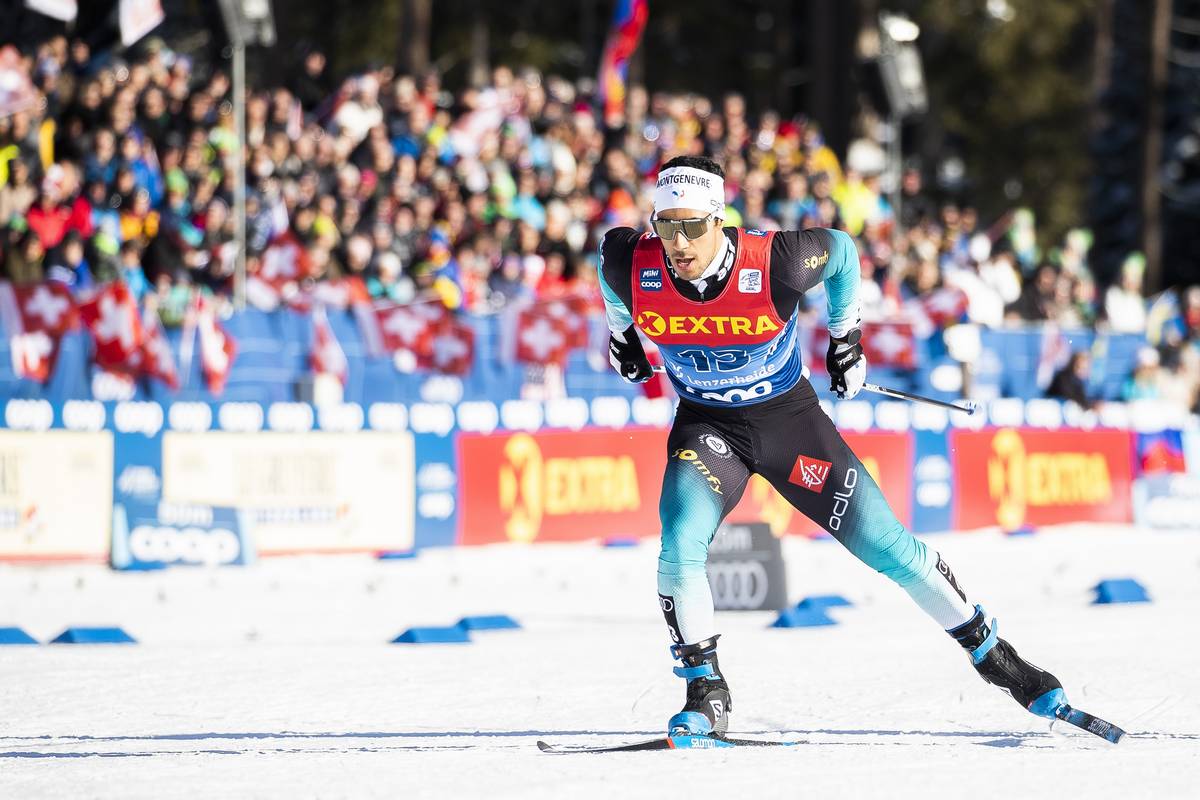
Chanavat led into the final climb with Pellegrino off to his right, a meter back, with Klæbo shadowing on the other side. Then Pellegrino upped the pace and pulled ahead with Klæbo settling into his draft. Chanavat took charge of the climbing lane to the left. For a moment, Klæbo must have been inhaling extra oxygen, as he fell slightly back.
But as the trio passed under the red sponsor arch, Klæbo shot off. For every single V1 cycle Pellegrino completed, Klæbo threw in two hop-skates. As he rounded to the left atop the climb, Klæbo looked back on a 20-meter gap. “Mamma mia” they must have been saying in Italy.
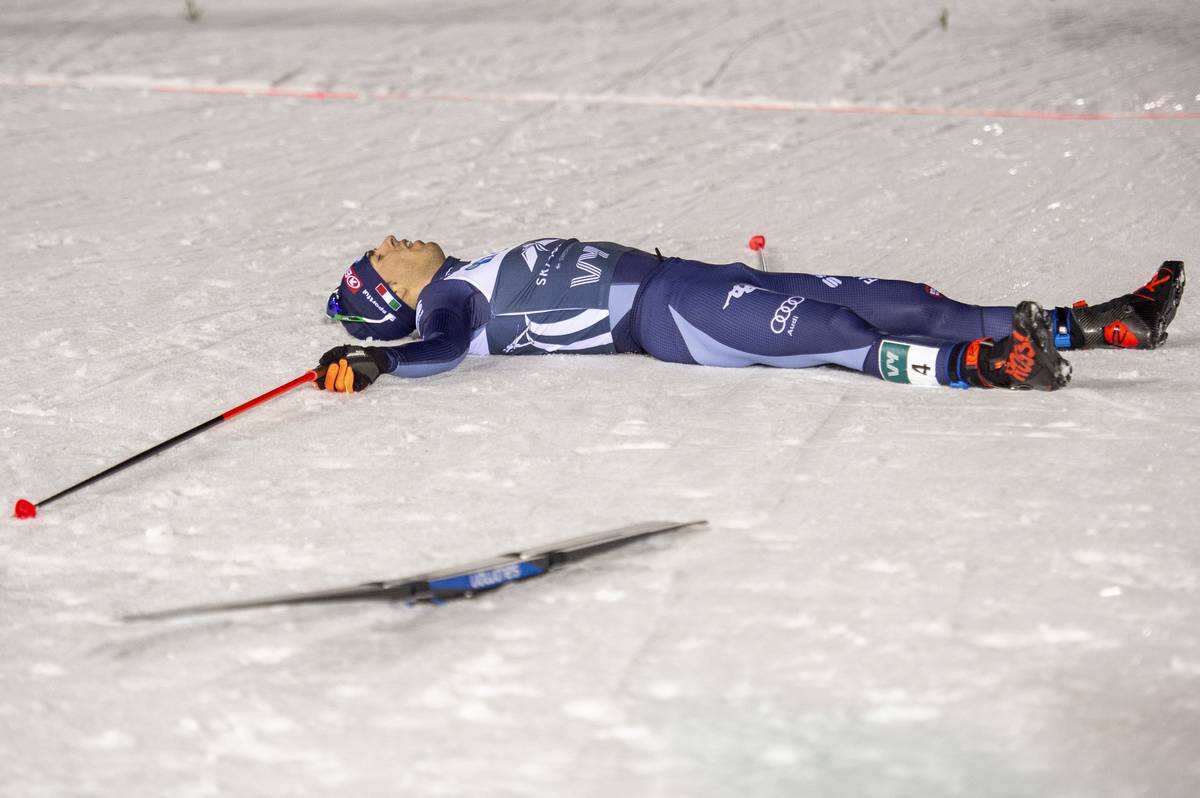
Italy’s Pellegrino: totally spent. He placed second overall in the Stage 3 Ski Tour 2020 sprint. (Photo: NordicFocus)
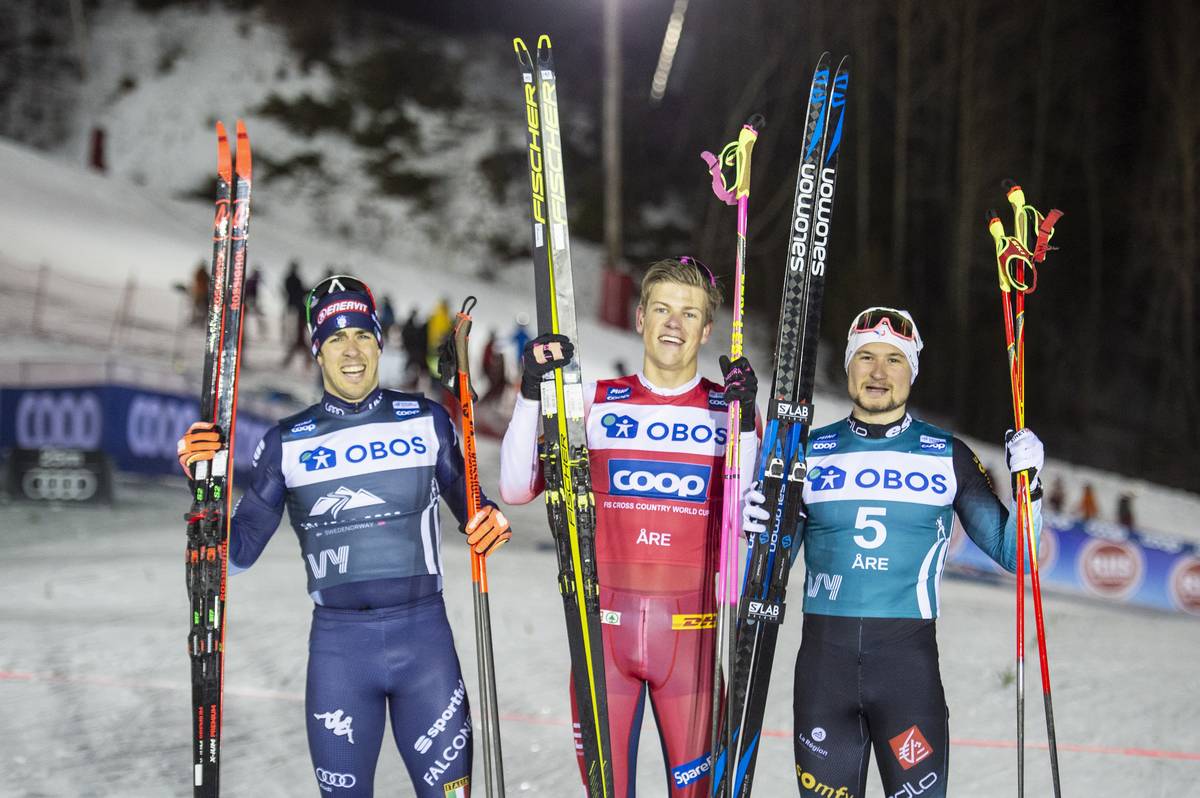
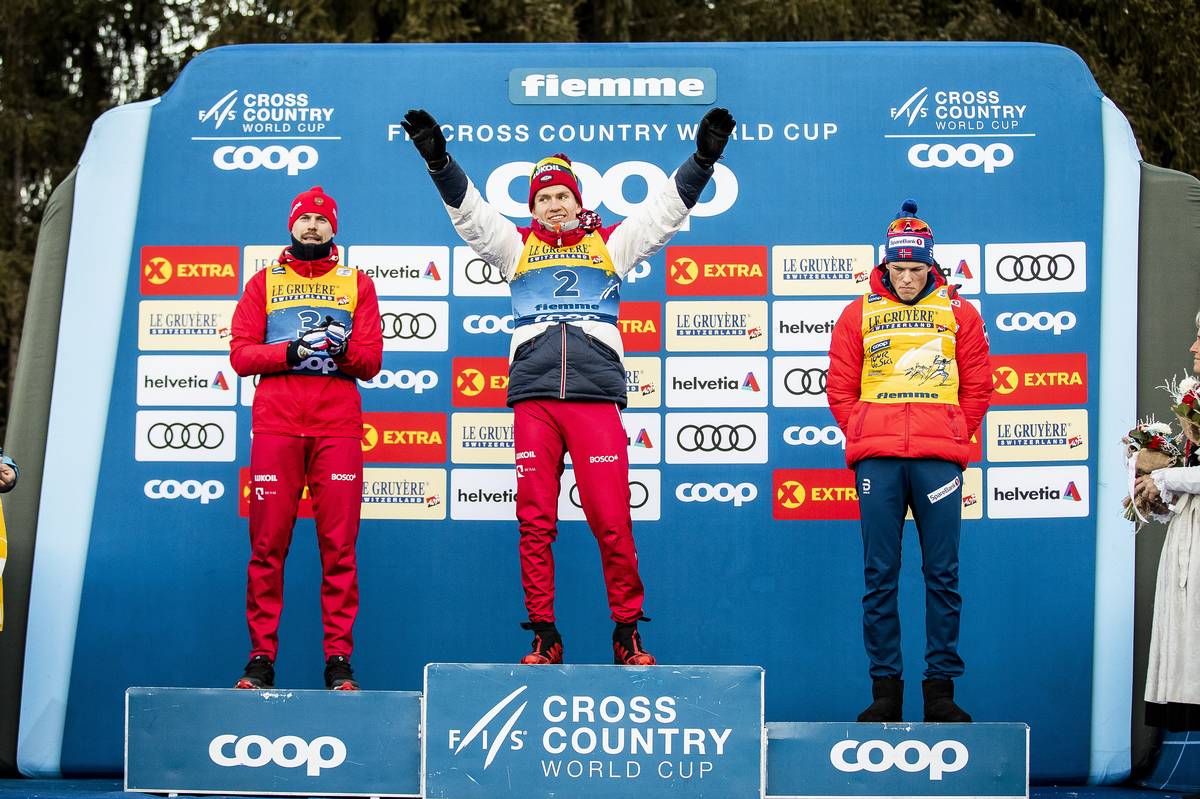
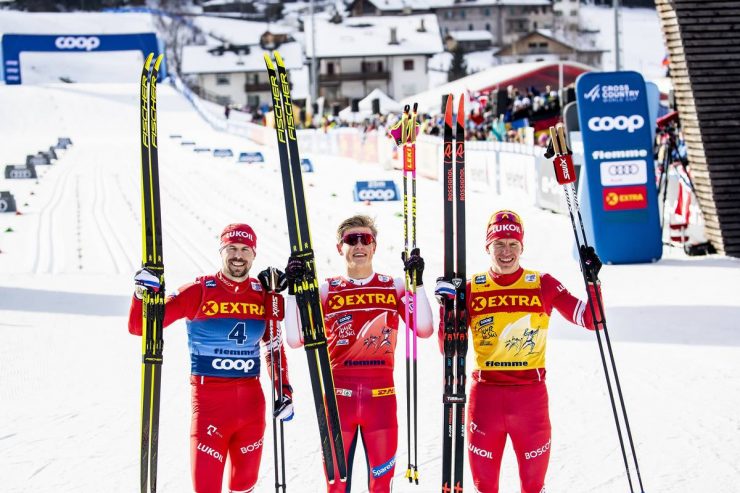
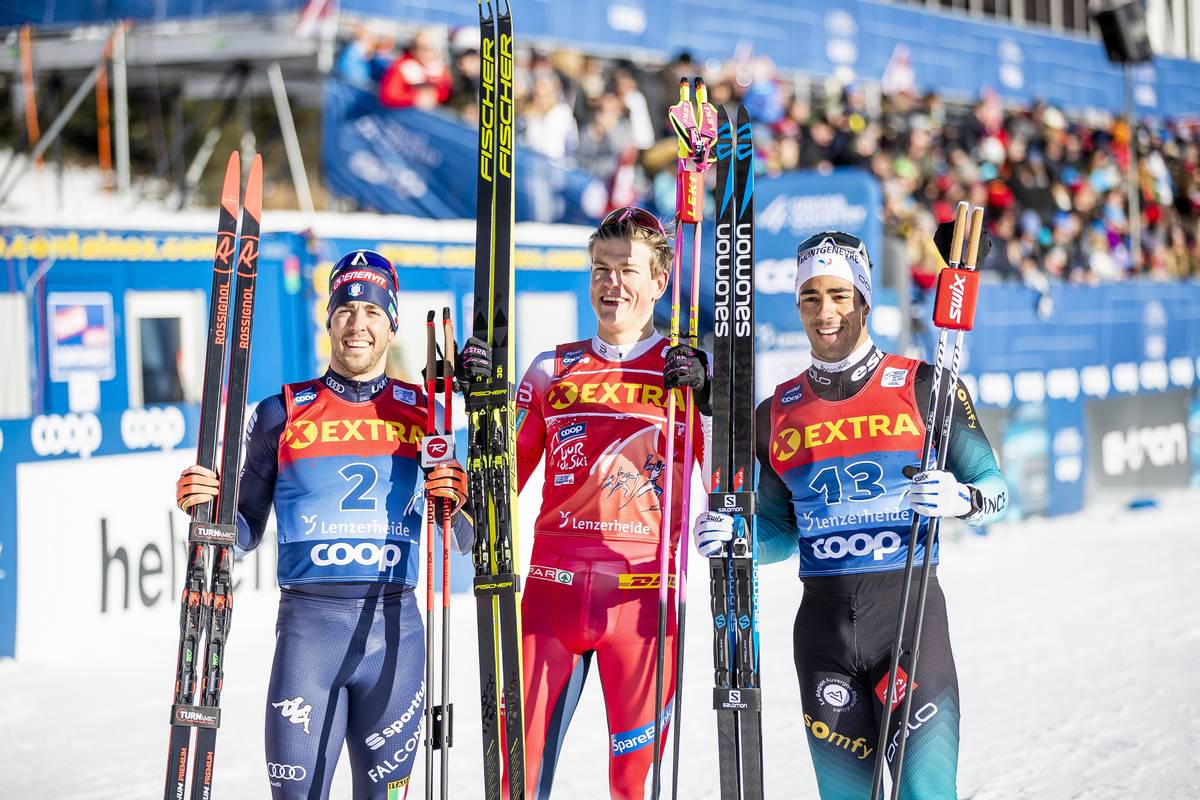
Klæbo won the final in 2:02.63. Pellegrino was second (+2.39), and Renaud third (+3.70). Golberg was fourth (+14.46), Chanavat fifth (+26:39), and Valnes sixth (+1:05.62).
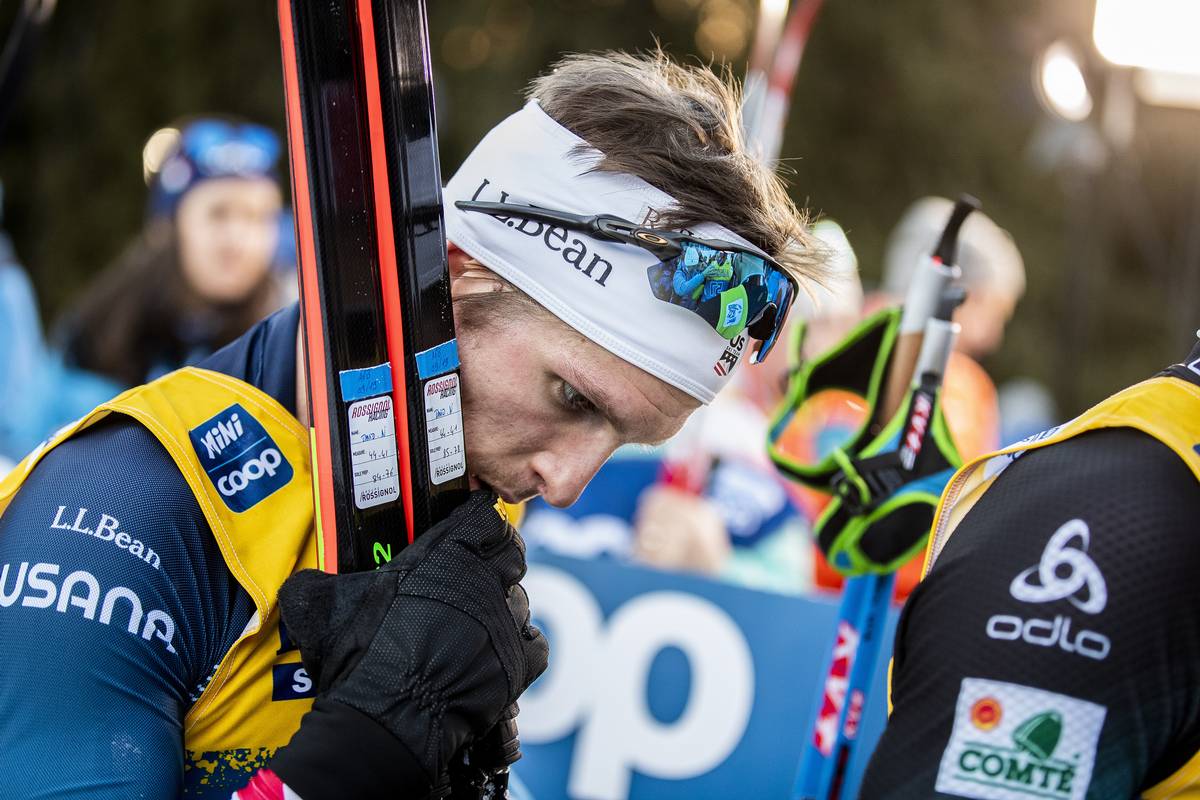
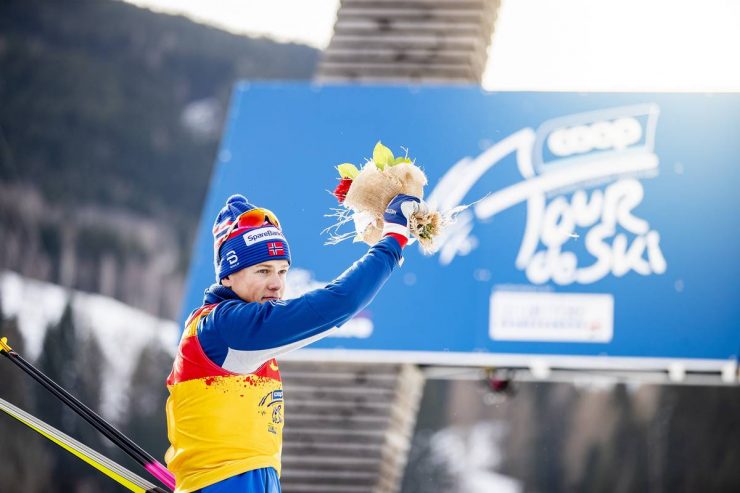
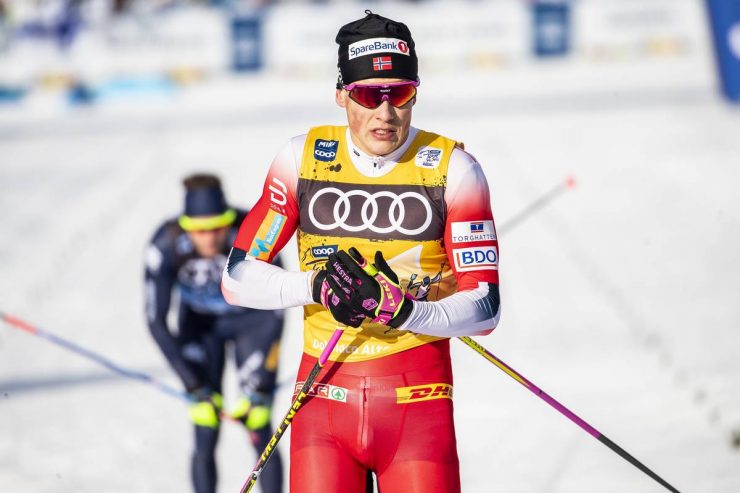
Time to chill at the finish: Johannes Høsflot Klæbo of Norway. (Photo: NordicFocus)
“It was a real suffer-fest,” Klæbo told FIS after the race. “It was a lot of fun. At the end I was just trying to push all out. I turned my head on the last climb and it was a huge gap. … It was good to get the confidence again and fight for the podium. … At the end, I was just trying to push all out. I turned my head on the last climb and it was a huge gap. In the end, it was really fun.”
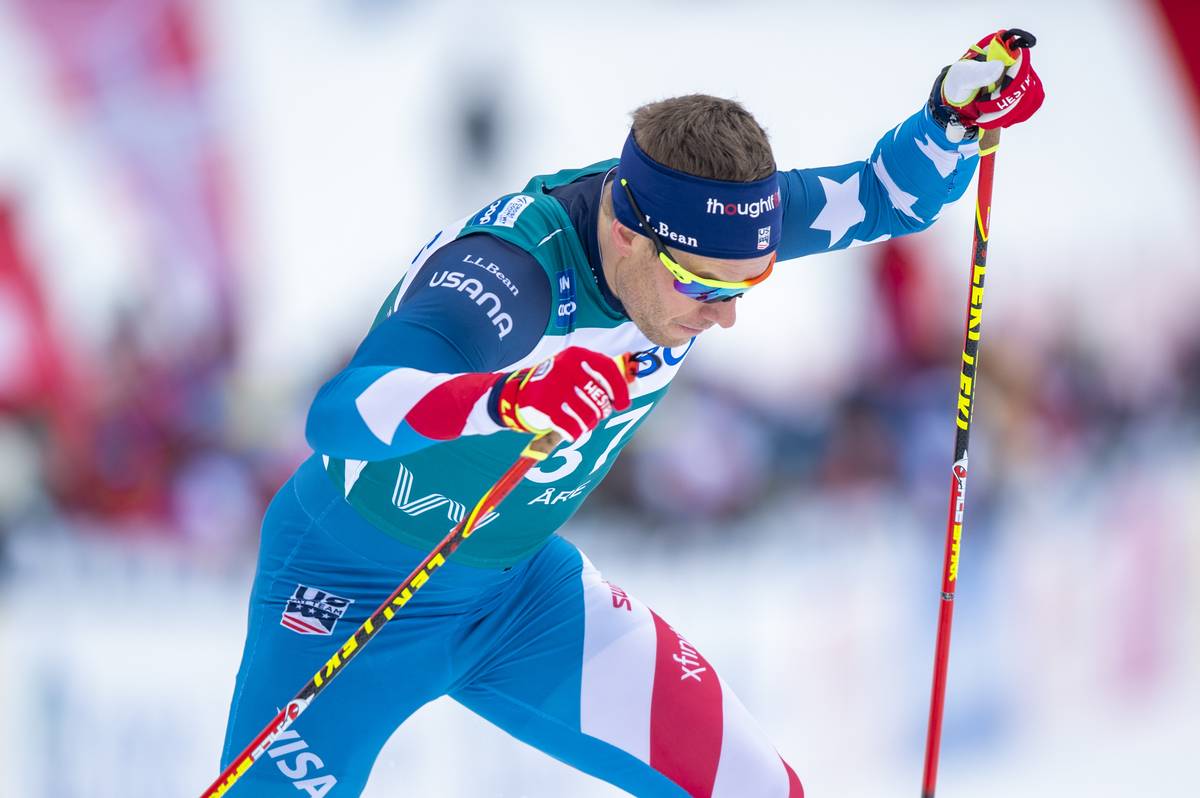
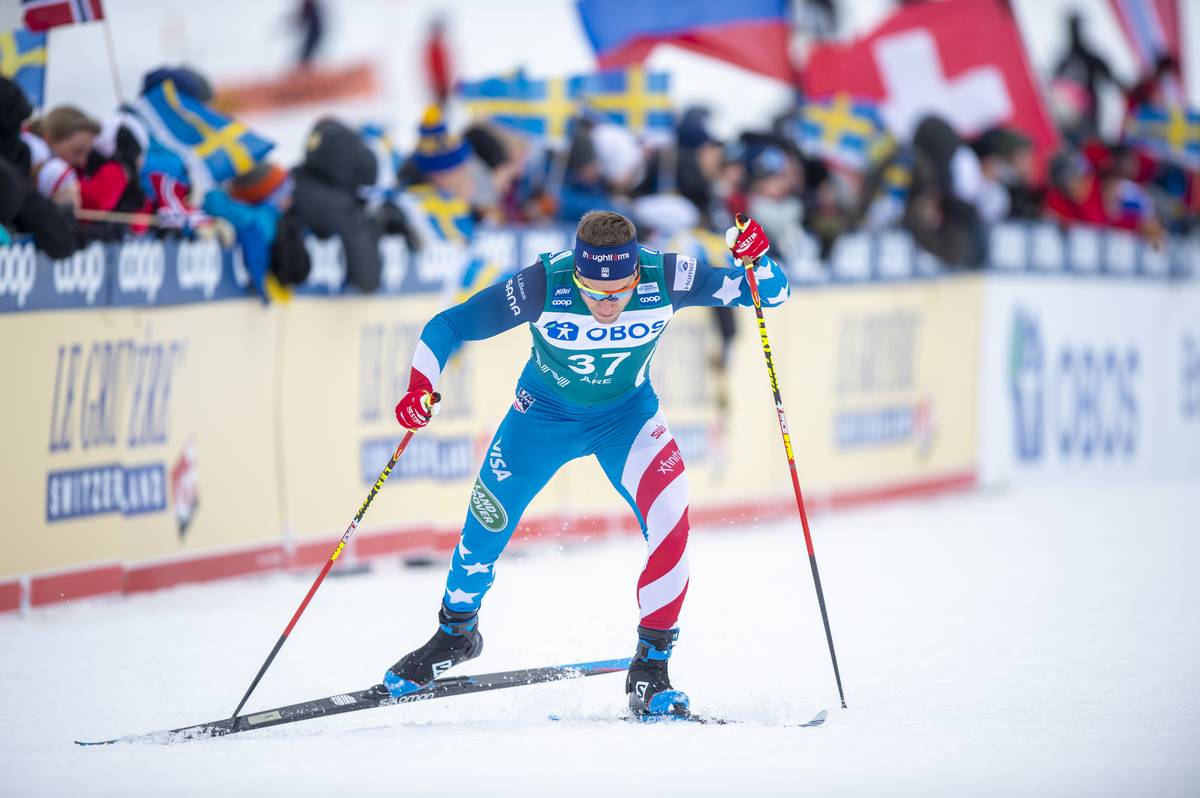
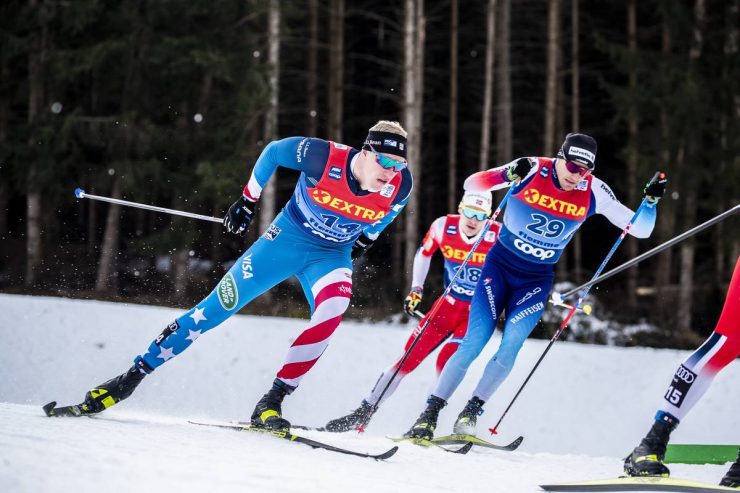
For the U.S. Simi Hamilton was the lone North American who advanced into the heats qualifying in 17th (+7.12). Hamilton skied to third (+2.27) in the second quarterfinal which was won by Russia’s Denis Spitsov in 2:04.14. The Aspen, Colorado native placed 14th in the final standings. (Below we have included an extended post-race interview with Hamilton. In the interview Hamilton discussed his injuries, and his return to racing World Cup sprints.)
The U.S. Ski Team’s Simi Hamilton in Åre, Sweden. (Photo: NordicFocus)
Post-race interview with Simi Hamilton
In his return to World Cup sprinting, Simi Hamilton skis to 14th overall on Stage 3. (Photo: NordicFocus)
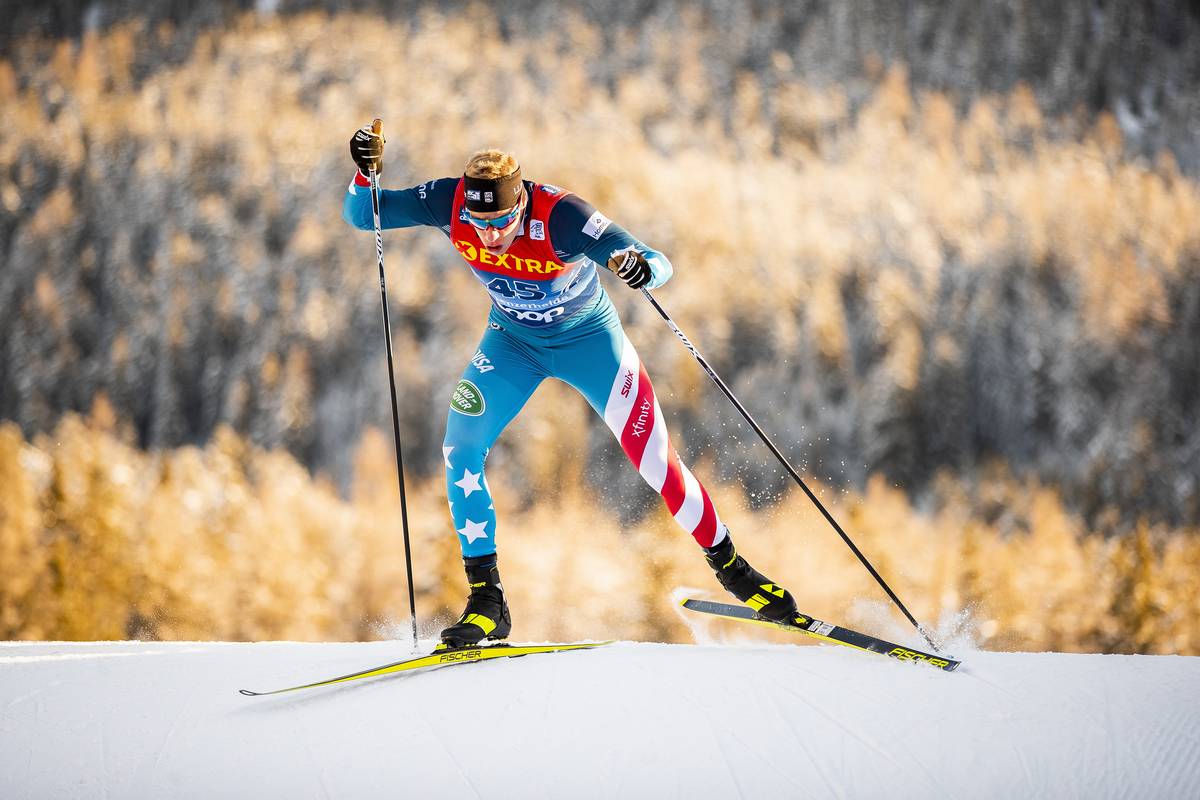
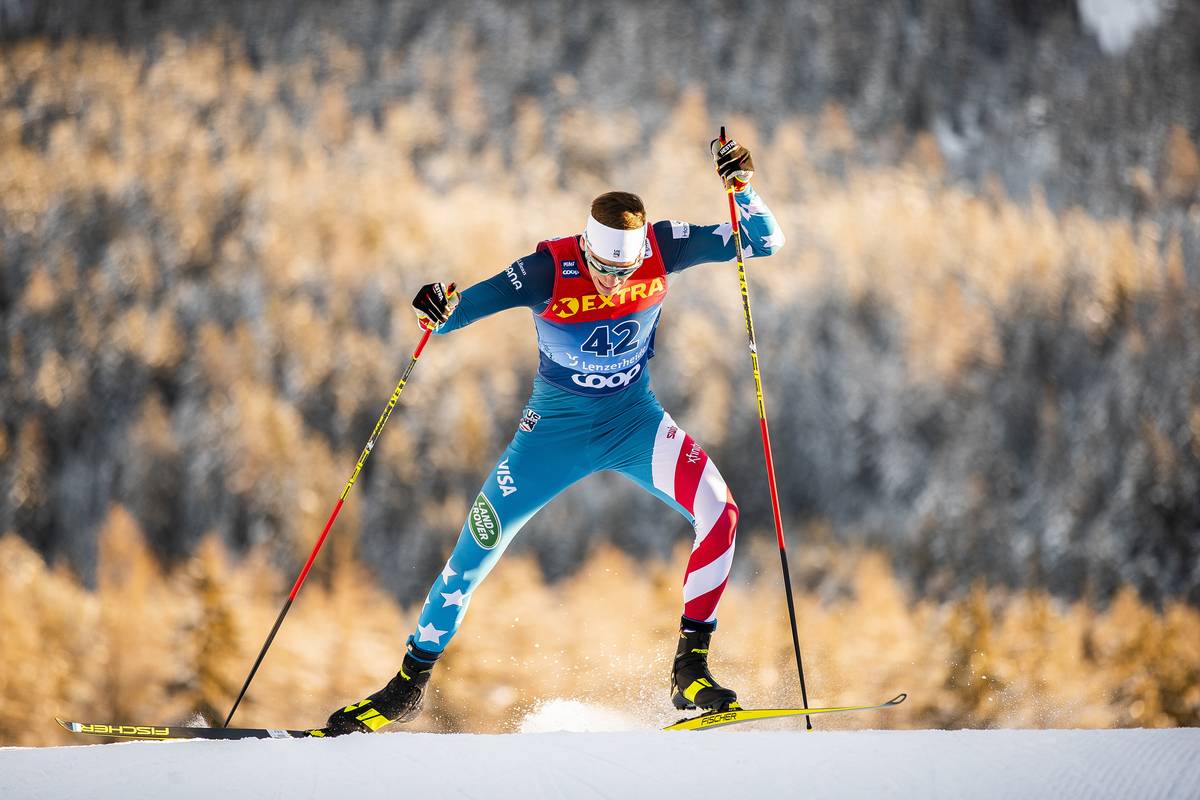
Logan Hanneman placed 45th on the stage, Kevin Bolger 60th, David Norris 65th, and Ben Lustgarten 81st.
Post-race interview with U.S. World Cup Coach Matt Whitcomb
For Canada, Russell Kennedy finished in 73rd, Evan Palmer-Charrette 75th, Alexis Dumas 76th, and Ricardo Izquierdo-Bernier 78th.
Picking up where we left off in Östersund, Sweden: a pursuit start 15-kilometer classic. Unlike the women’s field where Therese Johaug “administered a beatdown”, creating a large time gap for herself, the margins for the men were much smaller.
This year’s Tour de Ski winner Alexander Bolshunov of Russia, whose winning streak was interrupted, would start with a 22 second time deficit in fifth. Tenth place Ivan Yakimushkin (RUS) was 33 seconds back and Jens Burman (SWE) in 20th just inside a minute.
Alexander Bolshunov during Stage 2’s 15 k classic pursuit of the Ski Tour 2020. (Photo: NordicFocus)
With four 3.75 k laps to cover, the deficits were manageable. Perhaps the only Tour victory hopeful who was kept up about the work that needed to be done was Johannes Høsflot Klæbo, who would start 1:23 behind the leader after finishing 31st the day before.
The caveat would be to stay upright while navigating the icy winding bends of the primarily man made track. With grey skies and above-freezing conditions, it was fast and dicey, made evident by numerous crashes.
During one particularly noteworthy four-person pileup, Kamil Bury of Poland was taken out by Italy’s Maicol Rastelli as the two navigated a treacherous right hand turn at the bottom of a steep descent. Though neither had full control, Rastelli slid off the left side of the course, taking Bury along with him. Bury lost a ski and became tangled in the netting.
Just before impact… (Photo: Screenshot NBC/FIS Broadcast)
As Rastelli stood up and worked to right his skis, which were pointing in opposing directions, a third skier, Lin Bao of China, essentially slide tackled Rastelli, sending him in a complete backflip back down to the snow.
A fourth skier, Tadevos Poghosyan of Armenia, also lost control and slid into the pile. Bao and Poghosyan were able to stand up relatively quickly and continue on their way, but cameras cut away before the resolution of whether Bury found his ski and Rastelli was able to recover from his forced aerials.
Holy carnage… back to the race.
At the end of the first lap, it was as if the men were gifted ready-made groups. Røthe and Krüger matched stride for stride and double pole for double pole, while the remainder of the top five plus a handful of additional Norwegians, namely Pål Golberg, Hans Christer Holund, and Martin Løwstrøm Nyenget, chased from roughly six seconds back.
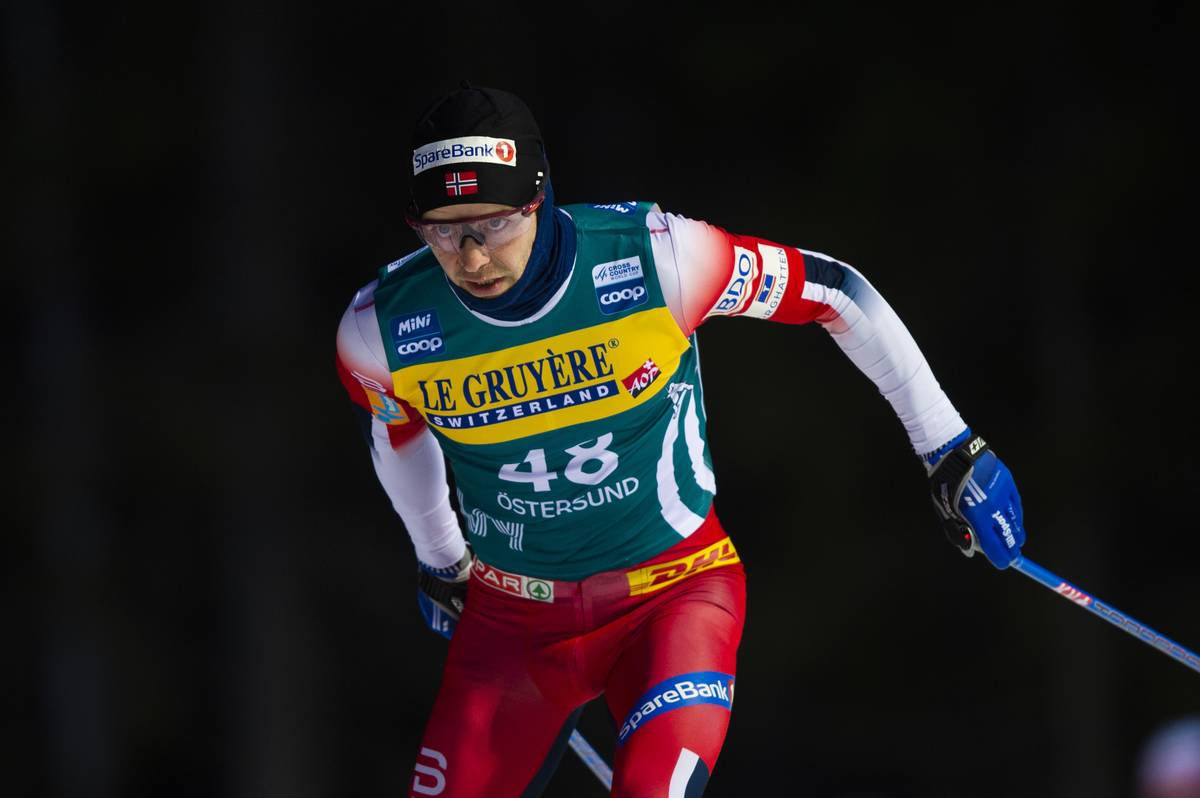
In bib 11, Martin Løwstrøm Nyenget (NOR) works his way towards the sharp end of the men’s 15 k classic pursuit. (Photo: NordicFocus)
It looked as though Røthe and Krüger might run away from the field, but it was not so easy. By 4.4 k, the gap was closed and an eight-man train chugged along the tracks. As Yakimushkin had fallen off the pace, it became seven Norwegians and Bolshunov.
Over the final two laps, the front pack whittled down from eight to five, where it remained with one k to go. Holund, Golberg, Røthe, Bolshunov, and Nyenget. The Russian in the yellow bib was primed to make a move.
Bending, rolling, and swooping, they headed for the stadium. Up the final punchy climb, Golberg and Bolshunov were side by side, and Golberg started to slip. He recovered and powered out of the climb, running with Klæbo-like dominance over the crest of the hill and into a tuck to lead into the stadium.
Bolshunov had fast skis and caught a draft before whipping into second place as the men entered the final straight. The Russian was right behind Golberg and absolutely charging. But there was not enough real estate. He changed lanes to challenge the Norwegian and looked as though he would overtake him, but the final meters evaporated and Golberg threw his foot for a clear win.
A lane switch wasn’t enough for Alexander Bolshunov as Pål Golberg of Norway takes the win. (Photo: NordicFocus)
Pål Golberg about to toe – during the 15 k classic pursuit, Stage 2 of th Ski Tour 2020 in Östersund, Sweden. (Photo: NordicFocus)
Golberg crossed the line in 34:50.8, with Bolshunov 0.3 seconds behind. Nyenget took third (+2.1) in a tight finish with Røthe (+2.5). Holund dropped off in the final sprint to round out the top five (+7.3).
Pål Golberg wins at the line over Alexander Bolshunov during the 15 k classic pursuit, Stage 2 of th Ski Tour 2020 in Östersund, Sweden. (Photo: NordicFocus)
“Perfect klister conditions,” Golberg told FIS at the finish. “I managed to get the ski pair from last weekend, so I had good skis this weekend as well. It was a really, really good day.”
The interviewer noted that conditions were much different than the previous day.
“It was hard in the middle,” Golberg explained. “It was a bit drier, so a bit difficult with klister in the downhill. But the tracks were perfect, so I’m really happy.”
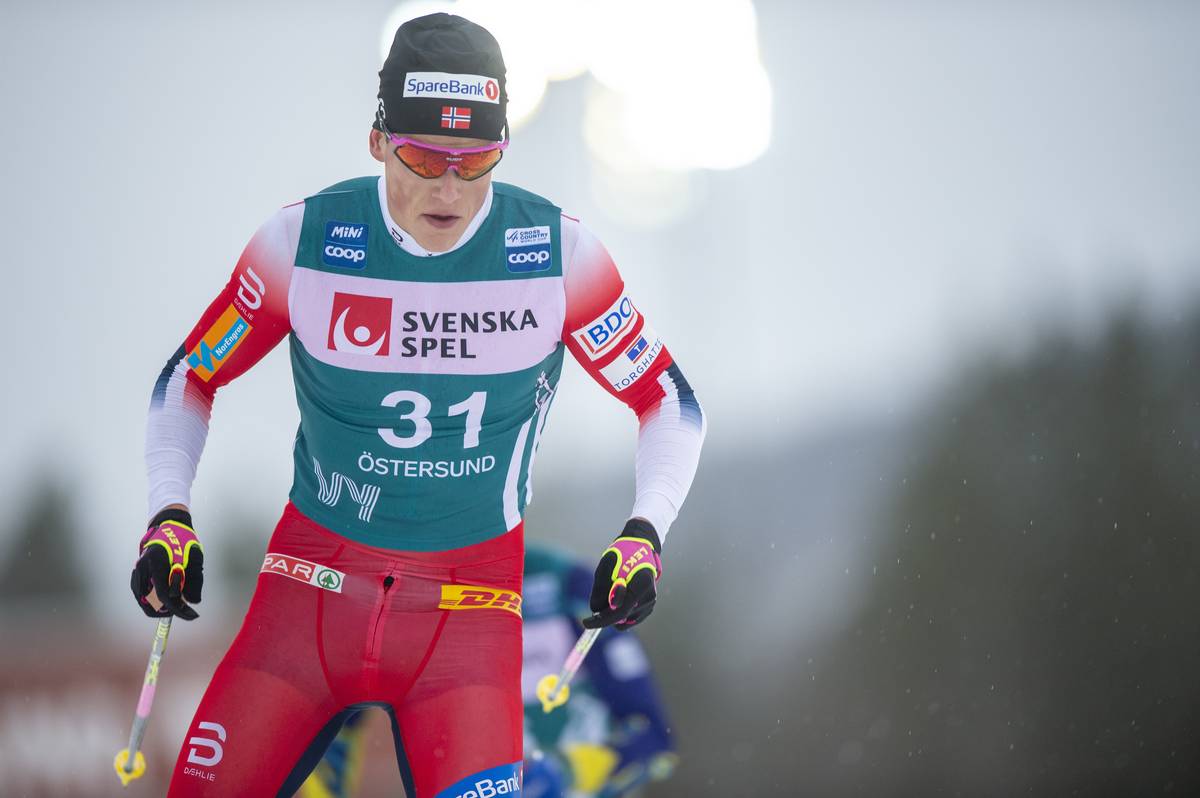
Not the start of the FIS Ski Tour 2020 desired by Johannes Høsflot Klæbo. (Photo: NordicFocus)
Speaking of Klæbo, the Norwegian skied his way into 25th, but ceded an additional 52 seconds in the overall standings by finishing 2:15 back on the leaders.
FIS sent out a news brief shortly after the race with information regarding Klæbo’s injured finger. Here is the statement in full:
“Johannes Høsflot Klæbo (NOR) has to undergo an emergency check up for his broken finger. The check up has to take place with his doctor in Trondheim (NOR). As the rules of the FIS Ski Tour 2020 state no other transportation of athletes than by train, the jury gave permission to Johannes to travel by car to Trondheim and back to Åre for this special case. After the consultation, the jury will receive a report of the treating medical team in Trondheim.”
Leading again for the U.S., David Norris skis to 34th. (Photo: NordicFocus)
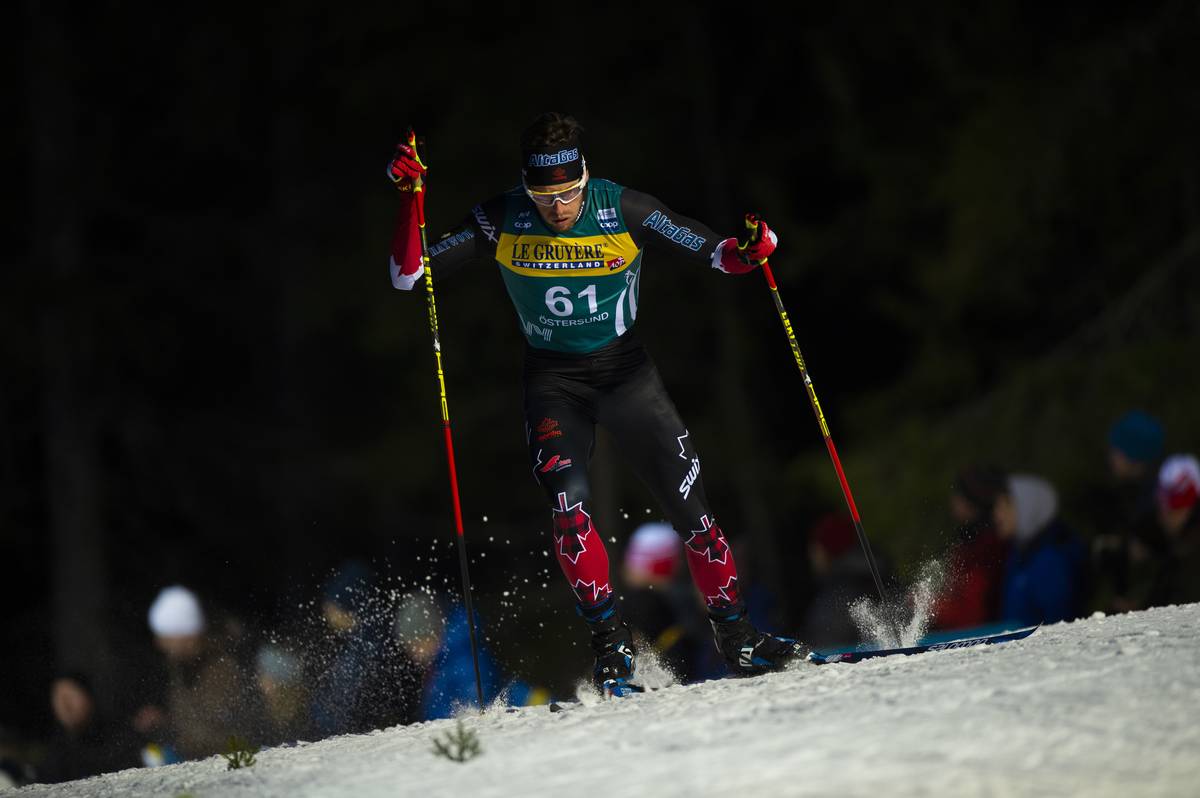
Stride and glide, Simi Hamilton climbs in Östersund, Sweden. (Photo: NordicFocus)
The American men hovered near their positions in Stage 1 at the end of the pursuit. Still grinding, David Norris finished 34th (+3:05.0), followed by Simi Hamilton in 43rd (+3:47.8).
Ben Lustgarten was the next American in 68th (+6:01.4), followed by Kevin Bolger in 70th (+6:12.7), and Logan Hanneman in 85th (+10:00.2).
Ben Lustgarten in the mix during the classic pursuit in Östersund, Sweden. (Photo: NordicFocus)
Racing for Canada, Russell Kennedy was again the top skier in 58th (+4:47.3). Next up was Alexis Dumas in 61st (+4:51.9), and Evan Palmer-Charette in 66th (+5:33.7).
Tomorrow is a rest day on the Ski Tour 2020, Stage 3, a skate sprint, will be held on Tuesday.
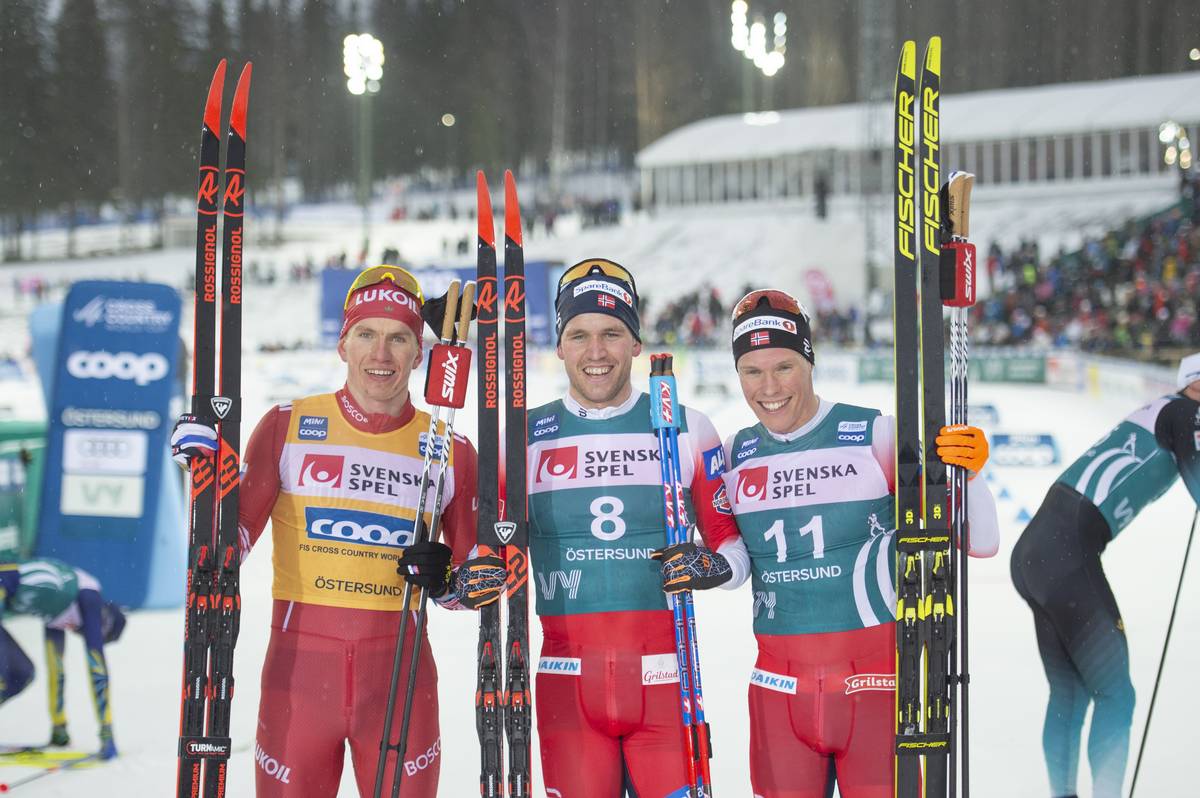
The men’s Stage 2 Ski Tour 2020 15 k classic pursuit podium: Alexander Bolshunov (RUS) second, Pål Golberg (NOR) first, and Martin Løwstrøm Nyenget (NOR) third, (l-r). (Photo: NordicFocus)
The pacing master of Stage 1 of the Ski Tour 2020: Sjur Røthe. (Photo: NordicFocus)
The six-stage Ski Tour 2020, which runs from Sweden to Norway over the next week, began Saturday in Östersund, Sweden with the men’s 15-kilometer individual start skate. The race began with twilight immersing Östersund with the sky eventually morphing into black as the seeded group of skiers looped around on what FIS called a 4.71 k course. This much can be concluded after a single day of what will be a hotly contested tour: the Norwegians fired on Stage 1 as they captured the top four spots in the field of 90 skiers.
The other take away beyond the Norwegian team’s blistering skis – Sjur Røthe paced himself a masterful 15 k of skiing as he won the event in 30:41.5 minutes.
However, not all looked shiny for the Norwegian as he went on to win his first World Cup of the season. At the 5 k time check, Røthe came through in 19th place, 19.5 seconds behind Hans Christer Holund, also of Norway. At 7.6 k, the halfway mark for the race, Røthe had moved up to 10th overall but remained 20.3 seconds off the fastest split set by yet another Norwegian, Simen Hegstad Krüger.
Then the tides turned, and Røthe began chiseling away at the time deficit. As he lapped through at 10 k, he sat in fourth, 15.4 seconds behind the virtual leader, Krüger. The chisel became a jackhammer; at 12.6 k Røthe was within six seconds of Krüger.
Simen Hegstad Krüger hammering during the 15 k skate, Stage 1 of the Ski Tour 2020. (Photo: NordicFocus)
The pacing proved perfect only when Krüger crossed the line: Krüger was a later starter than Røthe: Røthe began in bib 48, Krüger in bib 64. Røthe could, however, pace himself off the splits of Norway’s Finn Hågen Krogh who began in bib 16. Of the early starters, Krogh set the fastest marks at 5 k, 10 k, and the finish, respectively.
Finn Hågen Krogh (bib 16) an early starter during Stage 1 of the Ski Tour 2020, but fast through his 15 skate effort for third overall. (Photo: NoridcFocus)
Røthe’s first-place time (30:41.5) was 1.7 seconds faster than Krüger’s who took second on the day. Krogh was third overall (+16.6), and the veritable senior citizen of the Norwegian team, Martin Johnsrud Sundby, placed fourth (+17.3).
Saturday’s victory was Røthe first win of the season – however, it was his sixth individual podium which includes a second-place time of day podium in Ruka’s 15 k skate pursuit back in December. Last week, he was second in Falun’s 15 k mass start skate.
“It was a great day for me and the Norwegian team,” Røthe told FIS after the race. “I think we need to give a big hug to the guys in the wax cabin today. They made brilliant skis for us today, and for sure I have done my preparations well, I am really satisfied with today. I am looking forward to [the Ski Tour], it has been one of my main goals this season so for sure I am prepared, but I need to go home and get a good rest because it is not many hours before we do the classic race here in Östersund as well.”
For those playing the long-term odds in the Ski Tour 2020, after one stage down, Russia’s overall World Cup leader, and 2019-2020 Tour de Ski winner, Alexander Bolshunov, placed fifth (+22.2).
Russia’s Alexander Bolshunov, the overall World Cup leader here during Stage 1 of the Ski Tour 2020. He placed 5th on the day. (Photo: NordicFocus)
Along with capturing first through fourth places, Norway also claimed sixth (Hans Christer Holund), and eighth (Pål Golberg) place in the top-10. Norwegian Johannes Høsflot Klæbo was out of the points in 31st (+1:22.8). The Norwegian star returned after missing last weekend’s racing in Falun with a broken finger. Along with Bolshunov’s fifth place, Russia took ninth (Denis Spitsov) and 10th (Ivan Yakimushkin). The national team outlier in the top-10 was France’s Adrien Backscheider in seventh.
David Norris (APU), of the U.S., was the best-placed North American in 36th (+1:27.7). U.S. teammate Simi Hamilton (USST) placed 46th (+1:54.5). He returned to the World Cup racing after sitting out last weekend’s racing due to lingering neck pain. Kevin Bolger (USST) skied to 71st (+3:11.1), Ben Lustgarten (CGRP) 73rd (+3:12.2), and Logan Hanneman (APU) 86th (+4:35.6).
David Norris of the U.S. during the 15 k skate, Stage 1 of the Ski Tour 2020. (Photo: NordicFocus)
Post-race comments from U.S. World Cup Coach Matt Whitcomb
For Canada, Russell Kennedy skied to 52nd (+2:02.5), Evan Palmer-Charrette 60th (+2:31.9), Alexis Dumas 64th (+2:39.4), and Ricardo Izquierdo-Bernier 80th (+4:10.7).
Russell Kennedy of Canada, during Stage 1 of the Ski Tour 2020. (Photo: NordicFocus)
Racing continues in Östersund tomorrow with a 15 k classic pursuit for the men and a 10 k classic pursuit for the women.
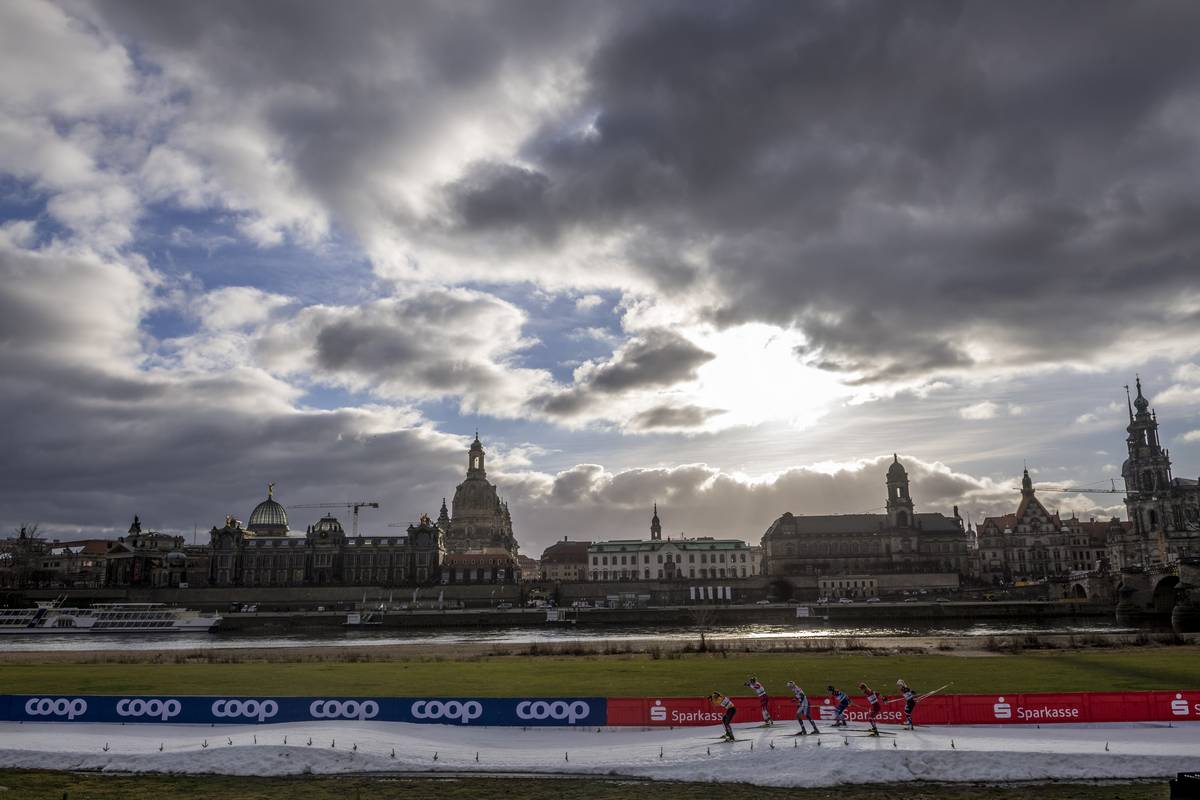
The metaphors are rife when describing the rough and tumble nature of the urban environment. Most often we think of pine forest, alps, and Hansel and Gretel valleys as the backdrop for the World Cup. To foster interest and in-fill a dense schedule of racing, city-sprints are nothing new when it comes to populating the World Cup calendar. Places like Dresden provide a contextual backdrop to a Europe steeped in history. The city is often a reminder of darker times, as it’s historic architecture was destroyed in World War II.
The city, since rebuilt to historical specs, is the place to be post Tour de Ski.
As a sprint specific weekend immediately following the Tour, the field is absent one notable name from Norway: Johannes Høsflot Klæbo. He placed third overall in the Tour and took the weekend to recover.
The World Cup show goes on. And perhaps one of the most stable and finest skate ski technicians out there took center stage. France’s Lucas Chanavat earned his third podium of the season and his second career World Cup victory with a win on Saturday in Dresden. Chanavat won the two-lap 1.3-kilometer qualifier in 2:14.72.
Lucas Chanavat of France (bib 1), where he was all day, out front during the Dresden city sprints. (Photo: NordicFocus)
In a tight qualifier in which the top-10 were separated by 1.75 seconds, three Americans qualified for the heats: Logan Hanneman in 21st (+3.65), nineteen-year-old junior skier JC Schoonmaker (in his debut World Cup) 24th (+3.80), and Kevin Bolger in 28th (+4.00).
Bolger finished 25th for the day after placing fifth in the second quarterfinal. Schoonmaker was 30th overall and in the points, as he slotted into sixth in that same quarterfinal heat. Hanneman ended up 29th overall, after skiing to sixth in the first quarterfinal.
For Canada, Bob Thompson placed 34th, Graham Ritchie 46th, Antoine Cyr 51st, and Pierre Grall-Johnson 66th.
Bib 1, JC Schoonmaker at last week’s Senior Nationals in Houghton Michigan. (Photo: Reese Brown)
JC Schoonmaker in the points for the U.S., during the Dresden, Germany skate sprint. (Photo: NordicFocus)
Post-race comments from Marine Dusser, Head Coach at University of Alaska Anchorage
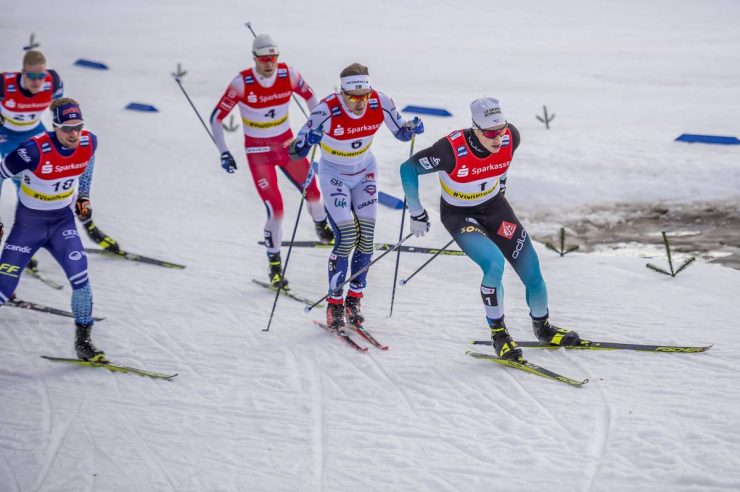
Stats aside, this was a tricky course for a basic two-lap oval sprint race. Crashes and slides were plentiful. Staying on your feet, an obvious must, was problematic for some. Most notable was a clash during the fourth quarter, where France’s Richard Jouve clipped the back of Italy’s Federico Pellegrino’s skis. It occurred on the lap corner where skiers seemed to be magnetically attracted to the tightest line up against the v-boards.
Not a bad tactic. But the high risk move didn’t always pay off. Pellegrino went down, as did Jouve, in a gnarly tumble. Pellegrino took a moment on course to disparage Jouve. Both skate sprint savants, Pellegrino placed an uncharacteristic 27th and Jouve 22nd.
The scene was a reminder that those who fired from the start, got out front, and remained there, set themselves up for success. With no true kicker hills on course, coupled with the high speed tracks, remaining in the front and out of trouble proved to be the recipe for success.
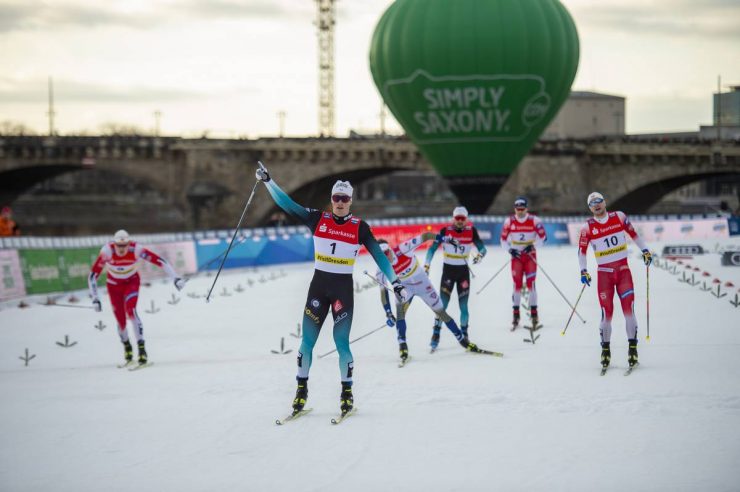
Chanavat played those tactics to perfection. He won his quarterfinal, semi-final (in a photo-finish with Norway’sSindre Bjørnestad Skar), and the final by skiing boss-like out front in 2:14.81.
Number one in the qualifier, number one in the final. Lucas Chanavat is the champion in Dresden. (Photo: NordicFocus)
The only mishap in the final was for Håvard Solås Taugbøl of Norway, who snapped a pole early on the first lap. Skiing the remainder of the lap with a single pole, he ultimately placed sixth, only 1.86 seconds back.
“I felt good today, especially in the final stretch,” Chanavat told FIS after the race. “I saw the crazy falls because Richard Jouve is usually fighting there (in the 180° turn) during the final and he was unlucky today again but he will be back stronger soon. I was hoping for a World Cup victory this year but I was not expecting it to happen so fast.”
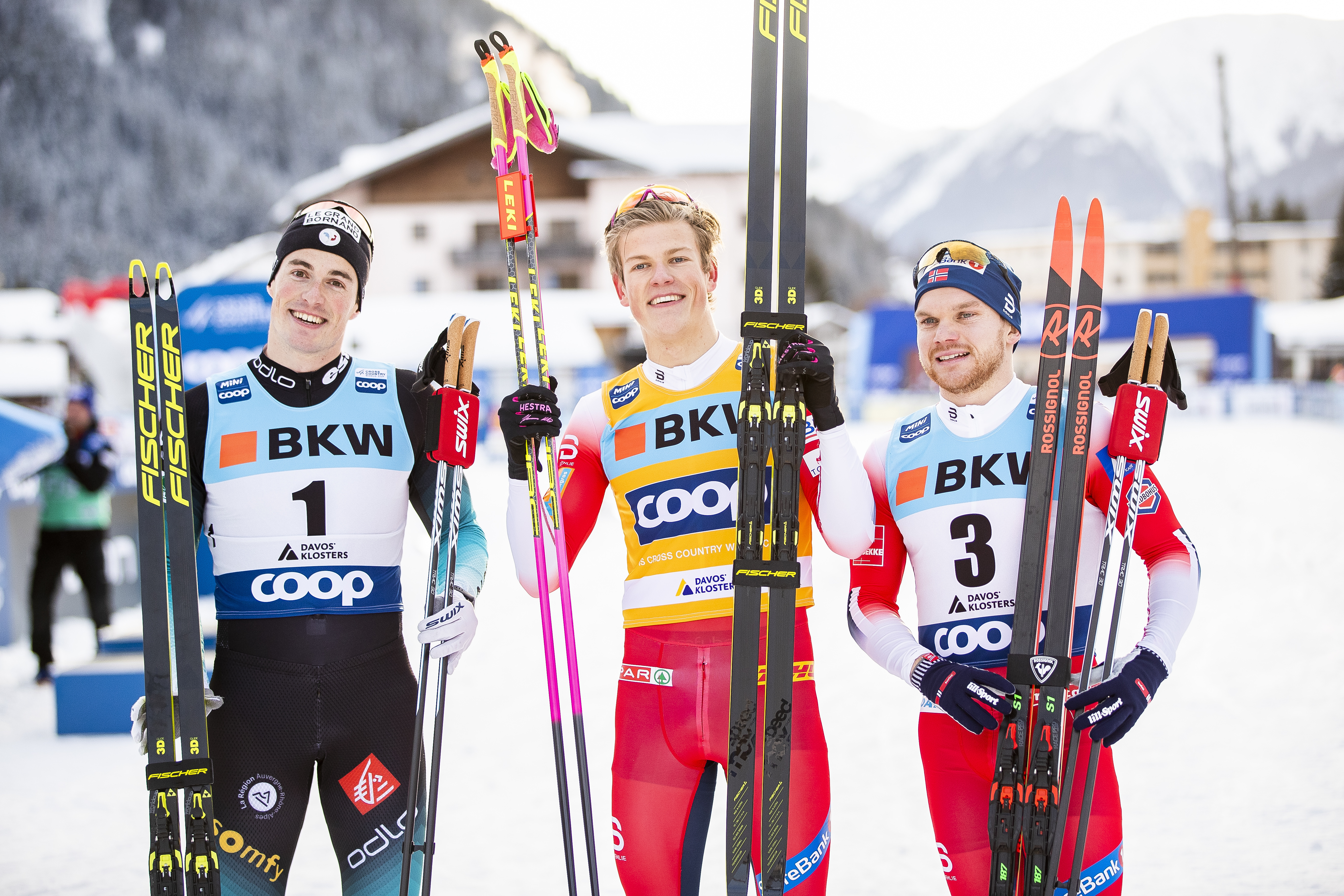
Skar took second place (+0.61), Sweden’s Johan Haeggström third (0.96). Pål Trøan Aune of Norway placed fourth (+1.04), and Jay Renaud of France fifth.
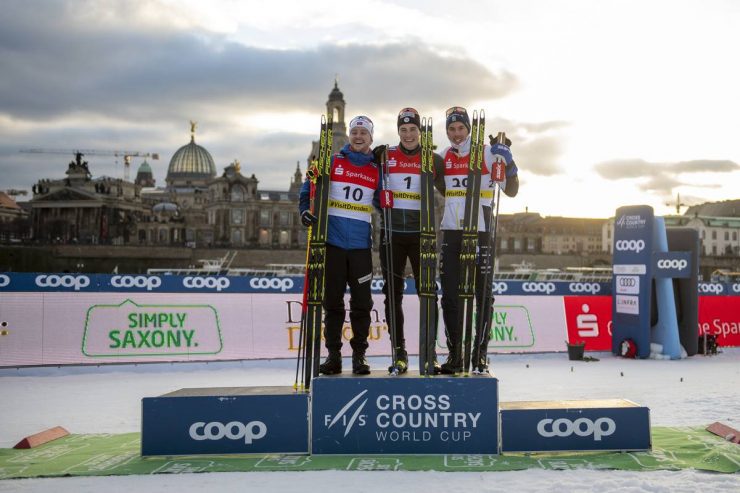
The men’s podium on the streets of Dresden. Lucas Chanavat (FRA) takes the win ahead of Sindre Bjørnestad Skar (NOR) and Johan Haeggström (SWE). (Photo: NordicFocus)
Norris and Hanneman, both skiers for APU in Anchorage, are among a rare group of U.S. men who have finished the Tour de Ski. We conducted a brief email exchange with the skiers post-Stage 7 of the Tour de Ski.
David Norris
David Norris in Toblach: 2019-2020 Tour de Ski. (Photo: NordicFocus)
FasterSkier: Huge accomplishment to one, stay in the Tour, and two, remain near the top-30 in prob the deepest field the TdS has seen for a long time. Can you speak to that?
David Norris: I didn’t know what to expect going into the tour, but my goal was to finish in the top-30 overall and picking up some top-30 finishes in the distance events. Dropping out was never a plan unless I were to get sick.
The first three stages felt awful for me. I was healthy and fresh going into the Tour so I tried to just focus on improving each day and in general, I felt better each day that we raced.
FasterSkier: First time at the TdS. What are your takeaways in terms of how you grew as a ski racer this week?
David Norris: The Tour was a great chance for me to practice the skill of moving past frustrations and preparing for the next opportunity.
FasterSkier: Highlights?
David Norris: Toblach’s pursuit was a ton of fun. I got into a group of guys who were all battling hard against each other. Of course, the hill climb will remain a highlight to my ski racing memories.
David Norris in Lenzerheide: 2019-2020 Tour de Ski. (Photo: NordicFocus)
FasterSkier: Lowlights?
David Norris: I crashed on a completely untechnical section of the 15km mass start in stage 5. When I got up I was in last after having a great start position.
FasterSkier: Top-30 on the Alpe. What was that experience like?
David Norris: Everyone went out hard and fought for spots before we got onto the Marcialonga trail. I felt really relaxed coming into the base of the climb after a few kilometers of single-file skiing. When the track got wide at the base of the climb I felt really strong and was able to move up a bunch of places. After about 8 minutes of climbing, I just remember trying to pick guys off/hanging on to dudes, listening to the fans screaming, and not clipping my tips on the alpine gates.
FasterSkier: You are a rarity — a U.S. male skier finishing the TdS. What advice would you give to others who might consider the risk/reward of contesting the event — given the opportunity?
David Norris: I can’t speak for where I will be in a few weeks, but because I remained healthy throughout the Tour I think it should help boost my fitness. I don’t think we should be afraid of this event. I washed my hands more than ever and ate an insane amount of risotto and pasta this week so I’d suggest others do the same going forward.
Logan Hanneman
Logan Hanneman in Val di Fiemme: 2019-2020 Tour de Ski. (Photo: NordicFocus)
FasterSkier: Just finishing, what does that mean to you?
Logan Hanneman: It means quite a lot to finish the Tour actually. I am not much of a distance skier, so I was very happy to be able to make it through all of the stages without getting lapped or pulled.
FasterSkier: From a pure learning experience standpoint, what did you learn?
Logan Hanneman: I learned that there are some incredibly fit skiers in this world! But also besides that, I learned just how chaotic mass start races over here can be.
FasterSkier: Highlights?
Logan Hanneman: Definitely qualifying well in both sprints and making the heats was a highlight for me. Especially the second sprint. I was getting pretty tired that far into the tour, but so was everyone else.
Logan Hanneman in Lenzerheide: 2019-2020 Tour de Ski. (Photo: NordicFocus)
FasterSkier: Lowlights?
Logan Hanneman: Lowlights…ha…realizing just how much more fit I need to get in order to even remotely close in distance races.
FasterSkier: Comment on why you stayed in the TdS? And will you get starts in Dresden or take a rest?
Logan Hanneman: I stayed in the Tour just because I had set the goal for myself to finish. Sure on paper, it may not have looked like a great decision, seeing as how I was way near the back in the distance races. But in years past, I have not done much distance races during the middle of the season, and I feel that that negatively affected my fitness for the remainder of the season, so I wanted to try something different this year. Plus, it’s pretty cool to finish that last stage, even though it is just brutal. I am unsure at this point for sure if I will get offered starts in Dresden, but I think it looks pretty promising, so I will plan on racing that weekend and then heading home for a few weeks to recover and train.
The winner: Russia’s Alexander Bolshunov. (Photo: NordicFocus)
The hype. The Spectacle. Stage 7 of the 2019-2020 Tour de Ski (TdS) brings the show: the Alpe Cermis final climb. The race this year began as a mass start — a new format for the final stage, as this has historically has been a pursuit race, where the first skier to the finish line is the TdS champ.
With the opening sections of the course taking in the sprint course loop in Val di Fiemme, the man-made snow then led skiers on a snaking route, downstream along with the Torrent Avisio. At roughly 5.2 k into the what FIS had called a 10 k race, the gradient kicked up for the duration. The Alpe rears up at 12 percent initially, but soon morphs into a mountain-and-me struggle with gradients pushing 28 percent.
So the racers had that to mull as they no doubt had a somewhat anxious night of tossing and turning. And coupled with the big show final climb, FIS got its wish with a dearth of time bonuses on course this year for a tight TdS coming into the finale.
Last year’s TdS winner, Norway’s Johannes Høsflot Klæbo, wore the yellow leader’s bib by a single clock-tick, or one second over Russia’s Alexander Bolshunov. Last year’s TdS runner-up, Sergey Ustiugov of Russia, sat 15 seconds back. Ustiugov is seasoned on the Alpe. He won the TdS overall in 2016-2017, and was third in 2015-2016.
Let’s drill down on elapsed climb times and the work to be done for the top-three in the overall. Ustigov had to beat Klæbo by 15.1 seconds to take the overall, Bolshunov 1.1 seconds. Ustiugov clocked 31:47.6, the 11th fastest time of day for Stage 7 last year. Bolshunov, for his part, posted 32:34.1 for the 23rd fastest time in 2019. Klæbo’s time was 32:51.7, the 27th fastest time.
Coming into that final stage in 2019, Klæbo had a 1:20.4 minute gap on second place Ustiugov. And with the pursuit format, Klæbo was never caught, despite ceding just over a minute to Ustiugov in the final stage. Bolshunov bested Klæbo by 17.2 seconds. On paper at least, Klæbo would have to maintain close contact today.
With the knowledge of last year’s climbing splits, Klæbo’s task this Sunday involved matching the Russians stride for stride. There would be no time to let up momentarily, reset on the Alpe, and grind to the finish. It was to be head to head racing.
On the Alpe
Part of the job here is building tension. Cutting to the chase, there was no Klæbo-induced tension Sunday on the Alpe. He hung in there for a bit. At 6.6 k, before the toll of cumulative climbing took effect, Klæbo was fifth, two seconds behind the lead pacesetter Ustiugov. Bolshunov shadowed his teammate one second back.
As the Alpe kicked up, Klæbo, who at moments looked atypically spent, began to fall off in earnest. At 8 K he slid to 6.4 seconds back to Ustiugov, but more importantly, 5.1 seconds behind Bolshunov. Bolshunov, at that point was the virtual TdS overall leader. His task simple: keep pace with Ustiugov who had to gap his teammate by a bit more than 14 seconds to seize the overall.
Klæbo never regained traction on the Alpe. He placed 21st on the day. He lost 1:10 to Bolshhunov on the stage, and 58 seconds to Ustiugov. That put Klæbo in third overall for the Tour.
First time Tour de Ski overall winner, Russia’s Alexander Bolshunov. (Photo: NordicFocus)
Ustiugov intially held on. With less than a kilometer to go, he and Bolshunov were velcroed. The younger Bolshunov did eventually surge and any semblance of a link between he and Ustiugov snapped. Bolshunov went ahead to place third on the stage and take the Tour overall win. By the finish, Ustiugov, who ended up fifth for the stage, had ceded another 12.3 seconds to Bolshunov.
The final TdS podium had Bolshunov in first, in 2:58.18.1 hours, Ustiugov in second (+27.1), and, Klæbo third (+1:09). It was Bolshunov’s first career Tour de Ski overall title.
The men’s final overall TdS podium: Sergey Ustiugov (RUS) in second, Alexander Bolshunov (RUS) first, Johannes Hoesflot Klaebo (NOR) third, (l-r). (Photo: NordicFocus)
In fourth overall was Sjur Røthe (+1:51.6) and in fifth, Simen Hegstad Krüger (+2:53.7).
Røthe and Krüger animated the racing for the stage win. Past the 8 k time check, the two Norwegians accelerated. No skiers near the front dared match. Last year, Røthe posted the fastest time of day on the Alpe, Krüger was a close second. (Krüger was third overall in last year’s TdS.)
Simen Hegstad Krüger of Norway winning Stage 7 of the 2019-2020 Tour de Ski. (Photo: NordicFocus)
Today, Krüger motored ahead of Røthe in the waning meters for the stage win in 30:55.8. Røthe stopped the clock 13.9 seconds later to secure a Stage 7 second place. With his climbing prowess on the Alpe, Krüger jumped from 12th overall after Stage 6, to fifth. Røthe moved from sixth to fourth.
“It hasn’t quite worked out in the Tour so far so I hoped to get a good finish,” Krüger told FIS after the race. “I knew that this hill suits me well and so I just tried to keep that steady pace and to keep it going all the way to the top and it was fun to cross the finish line as the first thanks to the mass start.
“Sjur and I were going together and he looked strong so I was far from sure that I was going to win but it was also tough going first so I really had to push.”
David Norris of the U.S. This image captures the true sense of the TdS. A pure physical and mental test for skiers. (Photo: NordicFocus)
Two Americans persevered in this Tour: David Norris and Logan Hanneman. Norris placed 30th on the stage (+2:12.4) and 35th overall (+10:18.1). Hanneman placed 56th overall (+20:05.5). He was perhaps the final pure sprinter to finish the Tour, as all the others had withdrawn. Hanneman was also 56th on the day (+4:53.8).
Logan Hanneman of the U.S. finishing his maiden overall voyage at the Tour de Ski. (Photo: NordicFocus)
So it’s a wrap. The TdS concludes with Klæbo unable to solve this seven-stage racing puzzle made more difficult by the two Russians who stymied his run for a second overall TdS win.
Racing continues next weekend on the World Cup with city sprints from Dresden, Germany.
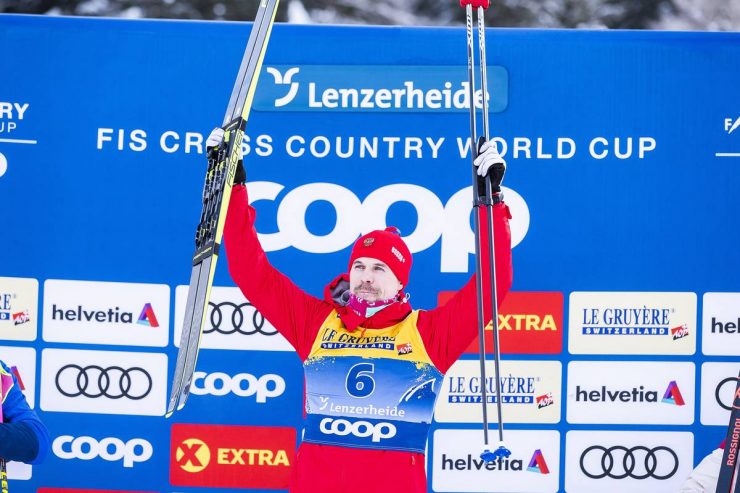
The men’s podium after Stage 6. Johannes Høsflot Klæbo (center) took the sprint victory ahead of Sergey Ustiugov (left) and Alexander Bolshunov (right). (Photo: NordicFocus)
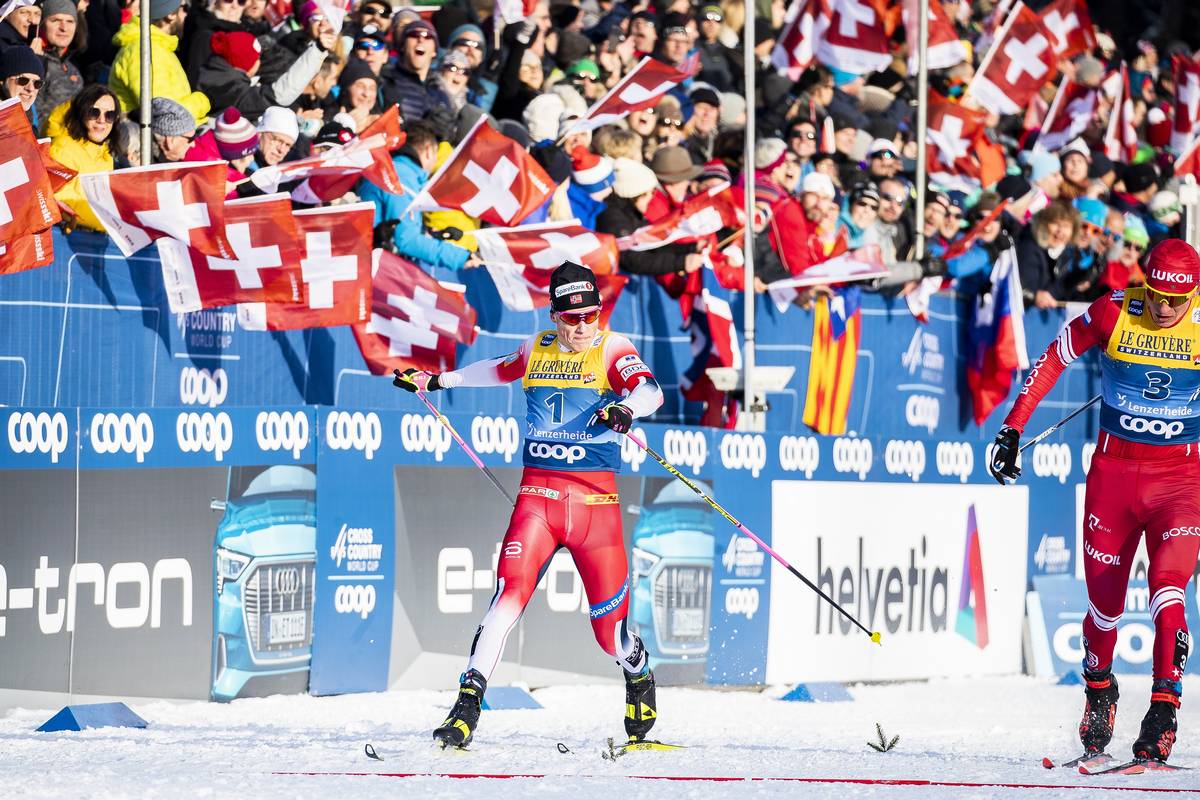
With up to 60 bonus seconds on the line in the penultimate stage and just two minutes separating the top ten in the Tour de Ski overall, every place matters in the 1.5-kilometer classic sprint in Val di Fiemme, Italy. Fighting for the top spot on the podium, Johannes Høsflot Klæbo of Norway sat 18 seconds back on Alexander Bolshunov of Russia entering Stage 6 and three seconds ahead of Sergey Ustiugov.
Johannes Høsflot Klæbo (NOR) set the bar high, winning the qualifier by six seconds during Stage 6 of the 2019/2020 Tour de Ski. (Photo: NordicFocus)
None of these men cracked the top ten fastest times up the Alpe Cermis in the final stage in 2019. However, Ustiugov skied over a minute faster than Klæbo, and Bolshunov out-skied the Norwegian by 30 seconds. Though Klæbo still won the overall, he entered the final stage in the lead with a 1:20 cushion. This is not a luxury he will have this year.
Still, the sprint powerhouse won the qualification round by a large margin, sending a message to the field that he was ready to fight. His time was nearly six seconds faster than second place Federico Pellegrino of Italy and roughly seven seconds faster than Ustiugov or Bolshunov, who qualified 4th and 5th, respectively.
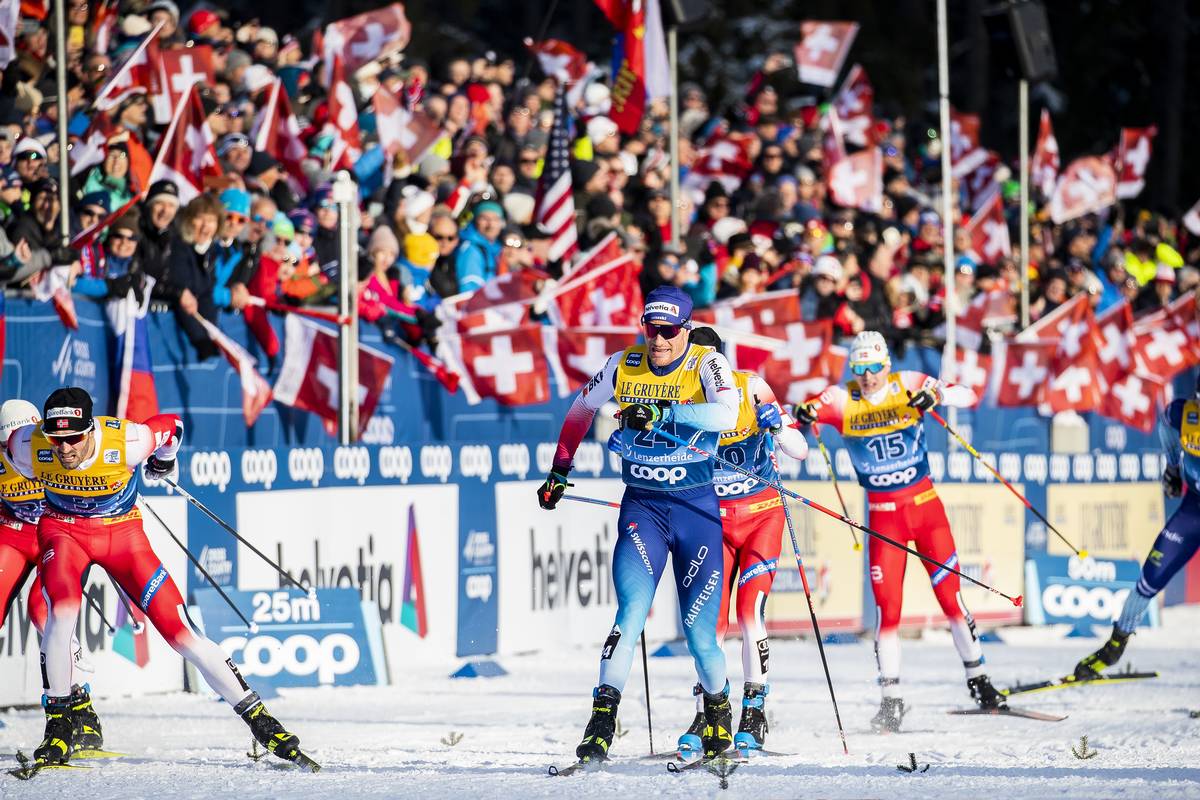
Racing in the first heat of the quarterfinals, Klæbo sat comfortably in the back of the pack using minimal energy and staying out of trouble in the first descent of the course. Up the final climb, he exploded to the front using his signature “Klæbo-step” technique, dropping Pellegrino and Denis Spitsov of Russia. He tucked into the downhill, then powered through the final straight alone to win the heat by over a second. Pellegrino, who finished third, did not advance the majority of the race was slow-paced.
The next excitement came at the finish of the fourth quarterfinal heat. Norway’s Sjur Røthe, who sits in fourth in the overall standings and skied the fastest time up the Alpe Cermis in 2019, was at the back of the pack heading up the final climb. Racing on lightning fast boards, he moved into the mix with the leaders on the descent, creeping up behind Ustiugov who held the left-most lane in the final stretch. Skiing in the neighboring lane, Ustiugov’s teammate Andrey Larkov kept Røthe boxed into this spot.
Creating room for himself at the risk of a crash, Røthe moved into the middle of the lanes, sandwiched between the Russians. Finally, Larkov moved right, allowing Røthe to hop into the lane and sprint his way into second, just behind Ustiugov. Larkov’s movement took out France’s Renaud Jay, who slid out of his track into Sweden’s Calle Halfvarsson. The men tangled onto the ground. Larkov was issued a yellow card for obstruction.
About to make his move, Johannes Høsflot Klæbo flies through the descent in the quarter final. (Photo: NordicFocus)
Sergey Ustiugov crests the hill in the lead with Sjur Røthe (NOR) chasing from behind in the quarterfinal. (Photo: NordicFocus)
On to the semis. In the first round, Klæbo again sat tucked into the pack. It was clear that Norwegian techs nailed the wax and ski selection as Klæbo and his teammate Pål Golberg soared to the front in the long descent, gaining momentum for the final sprint to the finish.
Klæbo entered the stadium alongside Bolshunov with Goldberg in his wake. Seeming to gain half a meter on the Russian with each double pole, the two created enough of a margin to lay off the gas before sliding across the line. The force of Bolshunov’s stroke snapped the tip of his pole in the final meters, though he maintained his position in third and was able to advance to the final as a lucky loser.
Ustiugov and Gleb Retivykh advanced comfortably from the second semi-final.
Ustiugov and Bolshunov took the pace out fast in the final heat, hoping to take the sting out of Klæbo’s top gear. Ascending the steep second climb, Ustiugov held the lead with Bolshunov and Klæbo on his heels, all three men running powerfully out of the track. Perhaps to interrupt his momentum, Bolshunov cut in front of Klæbo along the tangent of the curve, but the Norwegian seemed unphased, trusting his skis and his talent in the final stretch.
Down to the final meters, Johannes Høsflot Klæbo (NOR) takes the win in Stage 6. (Photo: NordicFocus)
Flying past the Russians in the final stretch, Klæbo stopped the clock at 3:03.78. Ustiugov slid his boot across for second (+0.70), followed by Bolshunov in third (+1.33). With the win, Klæbo takes home 60 bonus seconds, Ustiugov 54, and Bolshunov 48.
Johannes Høsflot Klæbo (NOR) and Alexander Bolshunov (RUS) exchange congratulations at the finish of the 1.5-kilometer classic sprint. (Photo: NordicFocus)
Catching his breath while Norwegian flags are waved, Johannes Høsflot Klæbo takes the win in the 1.5-kilometer classic sprint during the 2020 Tour de Ski. (Photo: NordicFocus)
This is Klæbo’s twelfth consecutive sprint victory and the 20th of his career.
“We had really good skis today,” Klæbo told FIS after the finish. “My plan was to go second before the last downhill. I tried that yesterday and it worked quite good then, so my plan was to do the same today and it worked twice, so it’s really good.”
When asked about the close quarters in the final climb and Bolshunov’s move to take Klæbo’s path, the Norwegian indicated no belief of foul play.
“I think it was a really hard pace in the last uphill. I think Sergey had a bit of a gap, but at the end, we managed to give it all out and be in good position going into the last downhill.”
The men’s podium after Stage 6. Johannes Høsflot Klæbo (center) took the sprint victory ahead of Sergey Ustiugov (left) and Alexander Bolshunov (right). (Photo: NordicFocus)
The sole American, Logan Hanneman, qualified in 14th (+11.88). He selected the fifth heat of the quarterfinals, which proved to be an exercise in patience. With no one willing to take the lead, the pace stayed pedestrian until the final descent the pack stayed tight. With a spread of only one second between the men at the finish, Hanneman finished 4th with no shot at a lucky loser spot. He ended his day in 18th.
“I am pretty well beat this late in the tour,” wrote Hanneman in an email. “I know my distance leaves a lot to be desired, especially at this stage, but I really wanted to finish the tour and so I have been doing everything I can not to get pulled out in the distance races and allow myself to race this last sprint. I was quite happy with today, especially for how fatigued I am. But…everyone is in the same boat so that really isn’t an excuse of any type.
“I am really looking forward to getting out of the quarterfinals one day, but I am slowly moving up places in my heats, so hopefully it will happen someday soon!”
Logan Hanneman in the mix during the quarterfinal. (Photo: NordicFocus)
Overall Tour Standings Heading Into Final Stage
Traded repeatedly amongst the three leaders, the yellow bib exchanges hands once more before the final stage.
With the top three athletes in the Tour’s overall standings racing in the final, earned time bonuses have less differential. As the final stage will begin in a mass start this year, the men will not have the visual cue of hunting one another up the climb. They can only hope to receive information from coaches about their time ahead of or behind the other leaders.
With his victory in the classic sprint, Johannes Høsflot Klæbo regains the yellow leader bib entering the final stage of the 2019/2020 Tour de Ski. (Photo: NordicFocus)
Time for the overall standings was calculated based on the result from qualification, less the bonus seconds obtained in the heats. As such, Klæbo’s qualifier gave him a seven second advantage over the Russians heading into the heats. With 12 bonus seconds more than Bolshunov, Klæbo netted a total of 19 seconds, indicating that his aggregate time is now the fastest of the tour by one second. Klæbo netted 12 seconds on Ustiugov, widening his margin to 15 seconds in the overall.
Pål Goldberg sits in 4th (+1:53), followed by Iivo Niskanen of Finland (+1:59), and Sjur Røthe in 5th (+2:01). Røthe was over two minutes faster than Klæbo or Bolshunov in the final stage of 2019, and over 1:15 faster than Ustiugov. The podium is within his reach.
The men’s podium of Stage 4 of the 2019/2020 Tour de Ski. Alexander Bolshunov (center) won the stage ahead of Sergey Ustiugov (left) and Iivo Niskanen (right). (Photo: NordicFocus)
The hunter becomes the hunted. Looking back on previous tours, Russia’s Sergey Ustiugov has not worn the leader bib going into the pursuit stage except for the 2016/2017 tour in Oberstdorf, Germany. That year, Ustiugov won six of the seven stages, placing second in the mass start classic in Stage 6, but still raced up the final hill climb with a significant buffer for the overall victory.
This year, Ustiugov was the man to beat. After a dominant performance in yesterday’s 15-kilometer skate, the Russian began the 15 k classic in Toblach, Italy with a lead of 22.6 seconds before the next skier and 27 seconds in the overall standings. On the hunt were his teammates, Ivan Yakimushkin and Alexander Bolshunov, followed by a troop of athletes looking to earn back time on the leader. In particular, a host of Norwegians looking for redemption after the third stage. Would his gap be enough to hold his position over 15 k’s?
Within the first 4 k, the answer was evident. Bolshunov and 4th place starter Calle Halfvarsson of Sweden closed the gap and overtook the leader. The three men skied together through 8 k, then Bolshunov began to crack open a gap.
Sergey Ustiugov falls short in preserving his rights to the leader bib in Stage 4 of the 2019/2020 Tour de Ski. (Photo: NordicFocus)
Unable to match the pace, Ustiugov switched into damage control mode. Standings in the overall tour are based on the cumulative time from each stage, and the time added from today’s event is based on time of day results, meaning the elapsed time each individual spent on course. Being caught by Bolshunov meant Ustiugov had already lost 29 seconds, meaning that Bolshunov’s aggregate time now earned the 23-year-old the rights to the yellow bib.
Ustiugov was able to keep his teammate within 20 seconds, but Bolshunov never saw his position at risk and finished with a 13 second lead. He stopped the clock at 38:14.9 for his first stage win in the Tour de Ski. Subtracting this from his deficit in the overall, Bolshunov now leads the overall rankings by 16 seconds.
Alexander Bolshunov celebrates his Stage 4 win during the 2019/2020 Tour de Ski. (Photo: NordicFocus)
“It was a really, really hard race,” Bolshunov told FIS through a translator. “A big part of this was that I had to work alone. Sergey in the middle helped to keep the pace, by my own feelings started to run away and the last lap it was really hard to keep the speed.”
When asked whether he had energy left for the final three stages in Val di Fiemme, he answered with a mischievous smile.
“The tour just started.”
Alexander Bolshunov (RUS) takes control ahead of Calle Halfvarsson (SWE) and Sergey Ustiugov (RUS) during Stage 4 of the 2019/2020 Tour de Ski. (Photo: NordicFocus)
Alexander Bolshunov (RUS) blasts off as he leaves behind Calle Halfvarsson (SWE) and Sergey Ustiugov (RUS) during Stage 4 of the 2019/2020 Tour de Ski. (Photo: NordicFocus)
When Bolshunov began to pull away, Halfvarsson fell dramatically off the leaders, dropping from eight seconds back to over 50. Perhaps the Swede was paying for his effort in light of the cumulative tour fatigue that is setting in. He rebounded in the final lap to finish within 30 seconds of Bolshunov in 5th.
Steadily working his way up through the field in his dominant technique, Iivo Niskanen had an outstanding performance. The Finn began the race in 11th place with a deficit of 1:35, half of which he recouped in the first half. Like many other athletes, Niskanen began to fade in the middle part of the race, but he switched on his afterburners in the final lap.
Iivo Niskanen rises up the ranks on his way to a third place finish in Stage 4 of the 2019/2020 Tour de Ski. (Photo: NordicFocus)
With 2.5 k to go, Niskanen was 50 seconds back on Bolshunov in sixth, yet he could be seen rounding the corner into the final stretch as Ustiugov slid over the line. Niskanen took the third spot on the podium finishing 24.8 seconds back on the leader, a result that moves him into fifth place in the overall standings.
So far this season, Niskanen won the 15 k classic in Ruka in addition to a 10 k classic early season opener. He is also an Olympic champion in the 50 k classic and podium finisher in the 15 k classic at the 2019 World Ski Championships in Seefeld, his stride and glide prowess is clear. Heading into two additional classic stages, he now sits in 5th place in the overall standings with a 1:10 deficit.
Iivo Niskanen takes third during Stage 4 of the 2019/2020 Tour de Ski. (Photo: NordicFocus)
Desperate to whittle down his 37-second deficit in the overall ranks, Johannes Høsflot Klæbo looked like a workhorse in the pursuit. No pomp, just head down, focused, determination. He knew he was not fighting for a podium position on the day, but any time he could gain on the leaders would help keep him in contention for an overall win. It is essential that he keep his overall deficit within a margin that could be surpassed with bonus seconds he intends to garner in the sprint during Stage 6.
Klæbo started the day 1:11 behind Ustiugov. Nearly 30 seconds of this were chipped away in the first 5 k, then he began to struggle. He began ceding places and time, leaving him in 16th at the 12.4 k mark 1:23 in the hole. He too found a new gear, closing hard in his final lap to move into 10th (+57.2).
Johannes Høsflot Klæbo climbs his way into 10th during the 15 k classic pursuit in the 2019/2020 Tour de Ski. (Photo: NordicFocus)
As he gained time on Ustiugov, his deficit in the overall standings reduced to 26 seconds, though he still sits in third. Perhaps better suited for head to head competition, Klæbo is in good position heading into the next two stages.
Again the top American distance athlete, David Norris finished 44th (3:43), improving on his 51st place finish yesterday. His time of 39:34.9 was the 34th fastest time of day.
Kevin Bolger finished 61st (+5:24.9), and Logan Hanneman 71st (+7:47.2).
In a post-race interview, Whitcomb shares that Bolger, who is a sprint-specialist, used the TdS distance stages as an opportunity to build fitness. He will now leave the tour to prepare for the city sprints in Dresden. Whitcomb also provided insight into Norris and Hanneman’s races, and offered a possible answer to the yo-yo like time difference seen in the race.
Post-race interview with Matt Whitcomb.
Racing continues Friday with a 15 k mass start classic in Val di Fiemme, Italy.
Rising to the top, Sergey Ustiugov takes the win in Stage 3 of the 2019/2020 Tour de Ski in Toblach, Italy. (Photo: NordicFocus)
New day, new venue, almost a new decade. The 2019/2020 Tour de Ski continued in Toblach, Italy with a 15-kilometer interval start skate. In the war of attrition that is the tour, the first stages set the tone. Hopefuls for the overall win seek to establish their position near the top without expending too much energy to hold up for the long haul.
We are now in the meat and potatoes of the tour. Three consecutive distance races, interrupted by one travel day. There are no bonus seconds on the line in the next two stages, meaning athletes need to fight for every second solely with their own grit.
Sergey Ustiugov (RUS) flies to his second stage win during the 15-kilometer skate in Toblach, Italy. (Photo: NordicFocus)
Racing midway through the seeded group in bib 44, Russia’s Sergey Ustiugov took off on Stage 3, setting the fastest time at each checkpoint to lead wire-to-wire. But his position in the leader chair was insecure until the remainder of the seeded men had their shot.
Wearing the highest numbered bib in the seeded group as the overall tour leader, Klæbo would have information on how he was matching up with Ustiugov at each checkpoint, informing him on whether he needed to work harder or lay off the gas. After winning a 60-second time bonus in the sprint, Klæbo had a cushion of 34 seconds over Ustiugov to work with. Victory in stage three was not imperative, but it would be important to keep the Russian within that margin.
In the first 5 k, it looked like this was how the story would play out. Ustiugov’s teammate Alexander Bolshunov, who trailed Klæbo by 32 seconds, nearly matched the pace setter. Klæbo trailed by six seconds, followed by three of his teammates in the next ten seconds: Hans Christer Holund, Simen Hegstad Krüger, and Pål Golberg. Each of these men is accomplished in distance racing.
Johannes Høsflot Klæbo falls flat in his attempt to keep the leader bib in Stage 3 of the 2019/2020 Tour de Ski. (Photo: NordicFocus)
On his way to a second place finish, Alexander Bolshunov consistently performs in Stage 3 of the 2019/2020 Tour de Ski. (Photo: NordicFocus)
However, things quickly began to change. Ustiugov’s splits became untouchable, and the Norwegian stronghold began to crumble. By the 10 k mark, his time was over 15 seconds ahead the next skier, and Klæbo had fallen 40 seconds behind into 15th. Ustiugov had the race locked up.
Sergey Ustiugov (RUS) locks eyes on his second stage win during the 15-kilometer skate in Toblach, Italy. (Photo: NordicFocus)
As the remainder of the seeded group made their way through the finish, Ustiugov remained on top by a large margin. His 23-year-old teammate Ivan Yakimushkin, who had not landed in the top 30 in either of the first two stages of the tour, worked his way into second place (+22.6). Yakimushkin was 43rd in the 15 k in Lenzerheide and qualified in 49th in the sprint, leaving him ranked 47th overall.
Sliding his boot across the line in unmatchable time, Sergey Ustiugov takes the win in Stage 3 of the 2019/2020 Tour de Ski in Toblach, Italy. (Photo: NordicFocus)
Rising to the top, Sergey Ustiugov takes the win in Stage 3 of the 2019/2020 Tour de Ski in Toblach, Italy. (Photo: NordicFocus)
Prior to the tour, Yakimushkin was a member of the Russian relay team that won the event in Lillehammer earlier this month and posted a top-10 in the distance classic race in Ruka.
Bolshunov, who was also born in 1996, took third 29 seconds back. Currently the top-ranked distance skier on the World Cup, Bolshunov has raced consistently in the tour: third in the first stage, and eighth in the second.
The all-Russian men’s podium of the 15-kilometer freestyle event in Stage 3 of the 2019/2020 Tour de Ski in Toblach, Italy. Sergey Ustiugov (center) was the clear winner over Ivan Yakimushkin (left), and Alexander Bolshunov (right). (Photo: NordicFocus)
In addition to sweeping the podium, Russia took three additional spots in the top 10, with Artem Maltsev, Andrey Melnichenko, and Denis Spitzov finishing 5th, 6th, and 10th, respectively.
Looking frustrated, Klæbo fell back to 17th (+1:11.4) by the finish, well-outside the margin he had to work with.
Johannes Høsflot Klæbo grimaces after a disappointing performance in the 15-kilometer freestyle event in Stage 3 of the 2019/2020 Tour de Ski in Toblach, Italy. (Photo: NordicFocus)
He was not the only Norwegian to struggle after the 5 k mark. Goldberg fell from 8th to 60th, and Krüger from 6th down to 22nd. Holund was the only Norwegian to maintain his top-10 position throughout the race, finishing 5th. Sjur Røthe also worked his way into 8th.
Though he leads the point standings, Johannes Høsflot Klæbo hides the usual toothy smile after a disappointing performance in the 15-kilometer freestyle event in Stage 3 of the 2019/2020 Tour de Ski in Toblach, Italy. (Photo: NordicFocus)
Though he still leads the point standings, Klæbo is now 37 seconds in the hole for the overall, sitting in 3rd place. He faces a pursuit-start classic tomorrow and a mass start classic on Friday. Presuming the time bonuses are still available in the mass start, he will have the opportunity to earn back time there and also in the classic sprint on Saturday.
Ustiugov’s performance bumped him into the overall lead with Bolshunov 27 seconds behind in second place. Nothing is out of reach for these three men. Holund and Maltzev round out the top five, trailing by just over 1:20.
As was seen in the final climb up the Alpe Cermis last year, Ustiugov has the upper hand over the Norwegian. Klæbo will need to rebound in time to create a significant gap before the final stage if he hopes to repeat his victory.
For the Americans, David Norris was again the top-ranked distance skier, finishing 51st (+2:22.6). Kevin Bolger finished 60th (+3:04.0), followed by Logan Hanneman in 73rd (+3:46.0).
In a post-race call, Matt Whitcomb provided insight into the men’s race. He also explains his approach counseling athletes about races in which athletes may not be set up to excel.
Post-race interview with Matt Whitcomb.
David Norris skis to 51st, the top American finish in Stage 3 of the 2019/2020 Tour de Ski in Toblach, Italy. (Photo: NordicFocus)
Heading into three classic races, Whitcomb explained that the techs are feeling confident in ski selection and waxing. Many K’s have been logged to ensure the American skis are ready to compete.
Post-race interview with Matt Whitcomb regarding ski testing.
With lickety-split snow and a two-lap course lined with fans, Stage 2 of the Tour de Ski (TdS) in Lenzerheide, Switzerland, a 1.5-kilometer skate sprint, sent a few ripples through the field, but solidified Norway’s Johannes Høsflot Klæbo as the TdS front runner.
Yesterday, Klæbo, in second place, ceded little time to two of his main rivals for the overall, Russians Sergey Ustiugov, who won Saturday’s mass start skate, and Alexander Bolshunov, who placed third.
Sprint courses are the real canvas for Klæbo. With half of Sunday’s course splashed in sunshine while the other sunken in deep shadows, Klæbo was able to use his tactical smarts and his explosive finish to conserve energy, pounce when it mattered, and take the win. Which, it so happens, came with a plentiful stash of time in a 60-second time bonus.
Johannes Høsflot Klæbo sprinting to the Stage 2 TdS win. (Photo: NordicFocus)
Klæbo began the day qualifying in first with a time of 2:44.64. Nearly matching his pace was Italy’s prayer for skate sprint salvation, Federico Pellegrino, who punched the clock in 2:45.84.
The duo went 1-2, Klæbo then Pellegrino, in the first quarterfinal which allowed the pair ample time to rest prior to the semis. In the first semi, it again was Klæbo-Pellegrino, 1-2 to advance.
The skate sprint powerhouses: Federico Pellegrino (ITA) and Norway’s Johannes Høsflot Klæbo (NOR) during Stage 2 of the 2019-2020 TdS. (Photo: NordicFocus)
The men’s final featured Klaebo, Pellegrino, Richard Jouve of France, Pål Golberg of Norway, Russia’s Gleb Retivykh, and Johan Haeggstroem of Sweden. Jouve, who qualified in 13th, and advanced after placing second and first respectively in his quarterfinal and semi, went out in the final with a statement as he tried to secure his first career World Cup win.
Jouve went to the front immediately after leaving the start gates. The pace nothing too tepid, more of a control move to keep a potential podium in sight amidst the attacking prowess of Klæbo and Pellegrino.
A minute into the final, Jouve pushed along the shaded back straight to produce a line of six skiers – Klæbo in third, Pellegrino in fourth. With the sweeping left-hand turn which returned skiers to sunshine and the main stadium, the pace took on a this-is-for-real tempo. Jouve maintained his position upfront as they climbed out of the stadium. Klæbo sat back, several feet to the right of Jouve, safely out of traffic.
Richard Jouve of France placed third in Stage 2 of the TdS in Lenzerheide, Switzerland. (Photo: NordicFocus)
On the long descending straight on the backside of the course, just before their second time through the sweeping left back into sunshine, Pellegrino lets his skis glide him into a position behind Jouve. Klæbo kept wide and outside as they rounded the corner into the final straight.
Midway through the turn, Klæbo was textbook sprint wunderkind: he boosted ahead with a quick-turnover but equally powerful V2 to seal it. He won in 2:55.33. Pellegrino, who stuck in Klæbo’s draft down the straight, pulled past Jouve to take second (+0.35). Jouve was third (+0.57).
Hunting the finish line – Norway’s Johannes Høsflot Klæbo during Stage 2 of the 2019-2020 TdS. (Photo: NordicFocus)
With the Stage 2 win, Klæbo earned that aforementioned 60-second time bonus, and the TdS overall lead. His total time after two stages rests at 35:07. He sits 32 seconds ahead of Russia’s Bolshunov, who is second in the overall after placing eighth in the sprint, earning him a 30 second time bonus. Ustiugov, placed 11th in the sprint (24 second time bonus) and is positioned fifth overall at 34 seconds back.
Both Bolshunov and Ustiugov stayed at the front of their semi for the first lap. That semi also featured Klæbo and Pellegrino. Bolshunov faded to fourth as the second lap ensued, while Ustiugov maintained his spot at the sharp end. Down the home stretch, they were swallowed into the Klæbo-Pellegrino maw.
Alexander Bolshunov (RUS) pushing the pace while chased by Federico Pellegrino (ITA), Norway’s Johannes Høsflot Klæbo (NOR), and France’s Renaud Jay during the men’s TdS Stage 2 skate sprint in Lenzerheide, Switzerland. (Photo: NordicFocus)
For the U.S. men, two standout qualifiers marked a successful day. Logan Hanneman qualified in 10th (+4.56) and Kevin Bolger in 12th (+4.72).
Hanneman finished 21st for a career-best World Cup result. He placed fifth in the fourth quarterfinal after getting hung up in a crash as Slovenia’s Miha Simenc and Norway’s Jan Thomas Jenssen tangled a meter ahead.
“I am quite happy with the day, even though it ended with a crash,” Hanneman emailed. “The qualifier was definitely the highlight. I honestly didn’t feel that great, so I was a little bit worried when I hit the hill on the first lap. But then I just tried to ski really big when I lapped through, abs apparently I was going faster than I thought I was.
“In the heat, everything was going well, and I was set up for a good position into the final downhill, however on the corner just after the short steep climb, the Norwegian and Slovenian came in from the outside, and collided with one another. I was directly to the inside of them and a little behind, so I had nowhere to go but to crash into them.
So it goes I suppose, but I was getting excited for the final push into the finish.
“My plan for the next few days is really to race as hard as I can in the distance races. They are not my strong suit, and I would really like to make it to the end of the Tour, so keeping within the time-back requirement would be awesome. So we will just take one at a time and see how they unfold!”
Bolger placed fifth in the third quarterfinal to place 22nd overall in the sprint.
Logan Hanneman placed 21st during the Stage 2 TdS skate sprint for a career best World Cup result. (Photo: NordicFocus)
Kevin Bolger placed 22nd overall in the TdS Stage 2 skate sprint in Lenzerheide, Switzerland. (Photo: Nordic Focus)
Racing continues for the men on Tuesday with an 15 k interval start skate in Tobalch, Italy. Monday is a rest day.
Ustiugov claims his 8th stage win in the opening event of the 2019/2020 Tour de Ski. (Photo: NordicFocus)
The starting corral was blocked by a wall of red before the start of the 15-kilometer mass start freestyle in Lenzerheide, Switzerland. Of the top ten ranked athletes, eight hailed from either Norway or Russia, interrupted only by Iivo Niskanen of Finland and Lucas Chanavat of France.
Johannes Høsflot Klæbo thanks his supporters before climbing into the second spot on the podium after the first stage of the 2019/2020 Tour de Ski. (Photo: NordicFocus)
Front and center was last year’s victor Johannes Høsflot Klæbo. He became the youngest Tour de Ski Champion at 22 years of age after holding off Russia’s Sergey Ustiugov who was gaining on the Norwegian throughout the final climb up the Alpe Cermis. It was clear in the final meters that there was no showmanship or gamesmanship in this performance; the young star was fully spent as he collapsed over the line.
Now an aged and wizened 23-year-old working on his tactics and gears in distance racing, Klæbo aspires to become the second man in history to win consecutive tours. Swiss athlete Dario Cologna did this in 2011 and 2012.
Klæbo is not a lock for this achievement — today’s opening stage made that abundantly clear. He will need to hold off the likes of Sergey Ustiugov and Alexander Bolchunov (RUS), Niskanen, Emil Iversen (NOR) and an otherwise deep field all vying for the same goal.
“I will try my best and I will count [my time] after the last day,” Klæbo told FIS during a pre-race press conference.
With the starting pistol marking the start of the nascent tour, the men began soaring around the course, through snow laden pine forest in front of high mountains emerging from their wreath of snow.
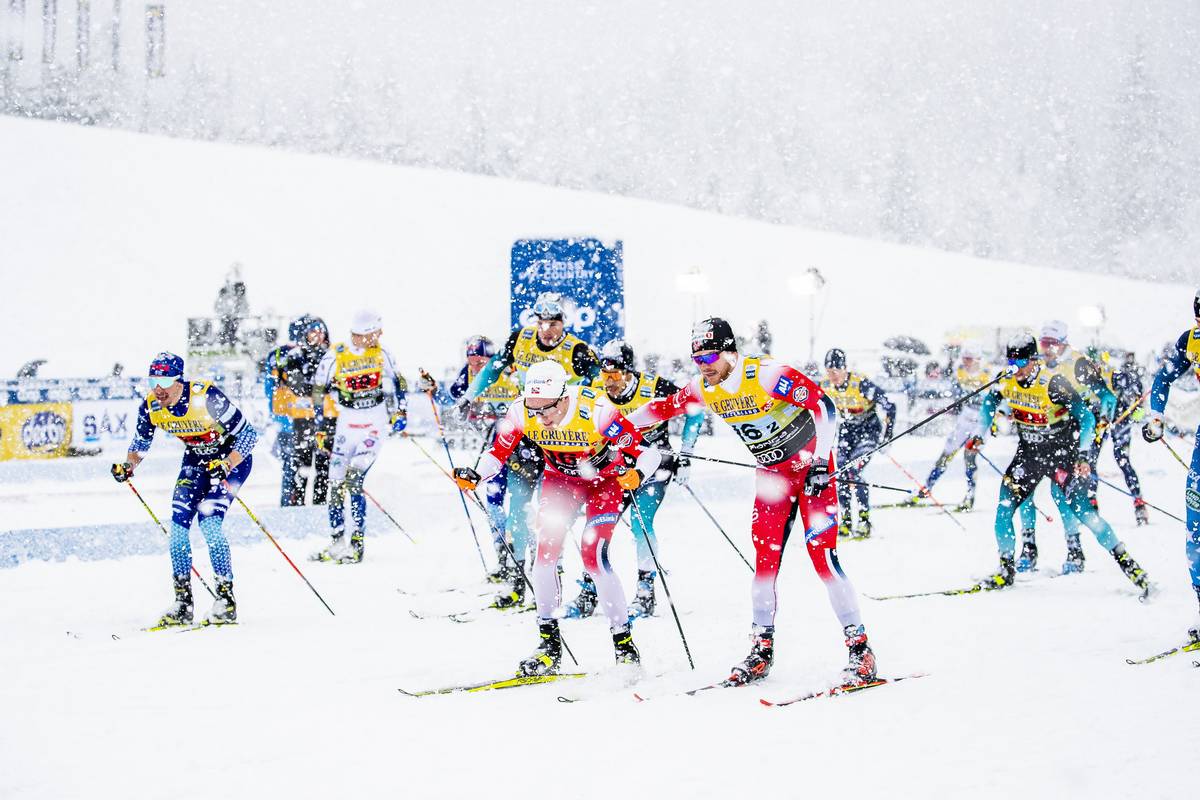
For the first 10 k, the field held strong in a long train. The top men, who stemmed from the first row of the start line, regularly exchanged the lead and the top 40 were separated by 10 seconds. Though the pace began to accelerate, the top ten were only spread by three seconds with 1.5 k to go.
A dense pack of skiers during the first stage of the 2019/2020 Tour de Ski, a 15-kilometer mass start freestyle. Logan Hanneman can be found on the right side of the image wearing bib 85. (Photo: NordicFocus)
Moves and countermoves. With 1 k to go, Ustiugov took charge. He rocketed off the front to create a gap to the lead pack. His teammate Bolshunov was three seconds back, along with Cologne, Iversen, Klæbo, and their Norwegian teammates Simen Hegstad Krüger and Sjur Røthe.
Ustiugov managed to maintain his gap and flew through the final straightaway in a confident V2. In the screen behind him was a pack of men whose final standings were far less certain. Klæbo and Bolshunov were dueling tête-à-tête in a sprint to the finish, sliding their boots over the line in sync for a photo finish. It was decided that Klæbo edged out his competitor for second, though he and Bolshunov will both enter the second stage of the tour four seconds behind Ustiugov.
Johannes Høsflot Klæbo (NOR) and Alexander Bolshunov (RUS) slide across the line in a photo finish at the end of the first stage of the Tour de Ski. (Photo: NordicFocus)
Iversen surged for 4th (+7.2) ahead of his countryman Martin Løwstrøm Nyenget (+8.6) who bested Tour de Ski veteran Cologna, Hans Christer Holund, Jan Thomas Jenssen, and Sjur Røthe in a five-way photo finish. Finishing in the order listed, the five men were separated by a margin of 0.4 seconds. Krüger rounded out the top ten one second later (+10.0).
Dario Cologna (bib 24) finishes amongst a herd of men vying for position at the end of Stage 1 of the 2019/2020 Tour de Ski, a 15-kilometer mass start skate in Lenzerheide, Switzerland. (Photo: NordicFocus)
“It was a really good performance and the shape was okay,” Ustiugov told FIS through a translator at the finish. “It was for sure a pleasure to win the first stage and I wish to show the same results on the next stages. Big thanks to Russian fans because it’s a really big pleasure to hear Russian people [cheering] here in Switzerland. It’s great.”
Russia’s Sergey Ustiugov celebrates his victory after the first stage of the 2019/2020 Tour de Ski, a 15-kilometer mass start skate. (Photo: NordicFocus)
Today’s victory marks the Russian’s eighth win in a TdS stage, advancing him to the second most behind Petter Northug who has 13 wins. The winner of the 2016/2017 TdS, Ustiugov has reached the overall podium in three of his last four rounds, only missing the final TdS podium in the 2017/2018 tour where he withdrew after the 5th stage. The Russian also won the first distance stage of last year’s TdS.
The men’s podium of the first stage of the 2019/2020 Tour de Ski, a 15-kilometer mass start skate in Lenzerheide, Switzerland. Sergey Ustiugov (RUS) took the win over Johannes Høsflot Klæbo (NOR) and Alexander Bolshunov (RUS) who were second and third, respectively, in a photo finish. (Photo: NordicFocus)
Three Americans started in Lenzerheide. David Norris finished as the top ranked American in 58th (+1:11.2). Kevin Bolger finished 64th (+1:35.0), followed by fellow Logan Hanneman in 69th (+1:42.1). Simi Hamilton was slated to start, but withdrew from the TdS due to a pulled muscle in his groin.
For the first nine kilometers, Norris hovered on the cusp of the top-30. After the race, Matt Whitcomb explained the energy-expenditure challenges of racing in this position, along with the strategy of sprint specialists Bolger and Hanneman.
Post-race interview with Matt Whitcomb on men’s performance.
“This was a fun mass start – fast and flowing,” wrote Norris explained an email after the race. “For the first 12km or so I felt really comfortable in the group. I tried to ski relaxed and avoid any of the chaotic crashes and tangles that seemed to occur each lap. With about 2 km to the finish I felt great and my skis were running well, but all of the sudden I bonked incredibly hard – got tunnel vision and struggled to avoid tripping on myself. It was a tough way to finish the race, but I’m optimistic I have better days ahead in this tour.”
Swiss flags flying against a breathtaking backdrop. Wearing bib 77, Kevin Bolger can be found at the center. (Photo: NordicFocus)
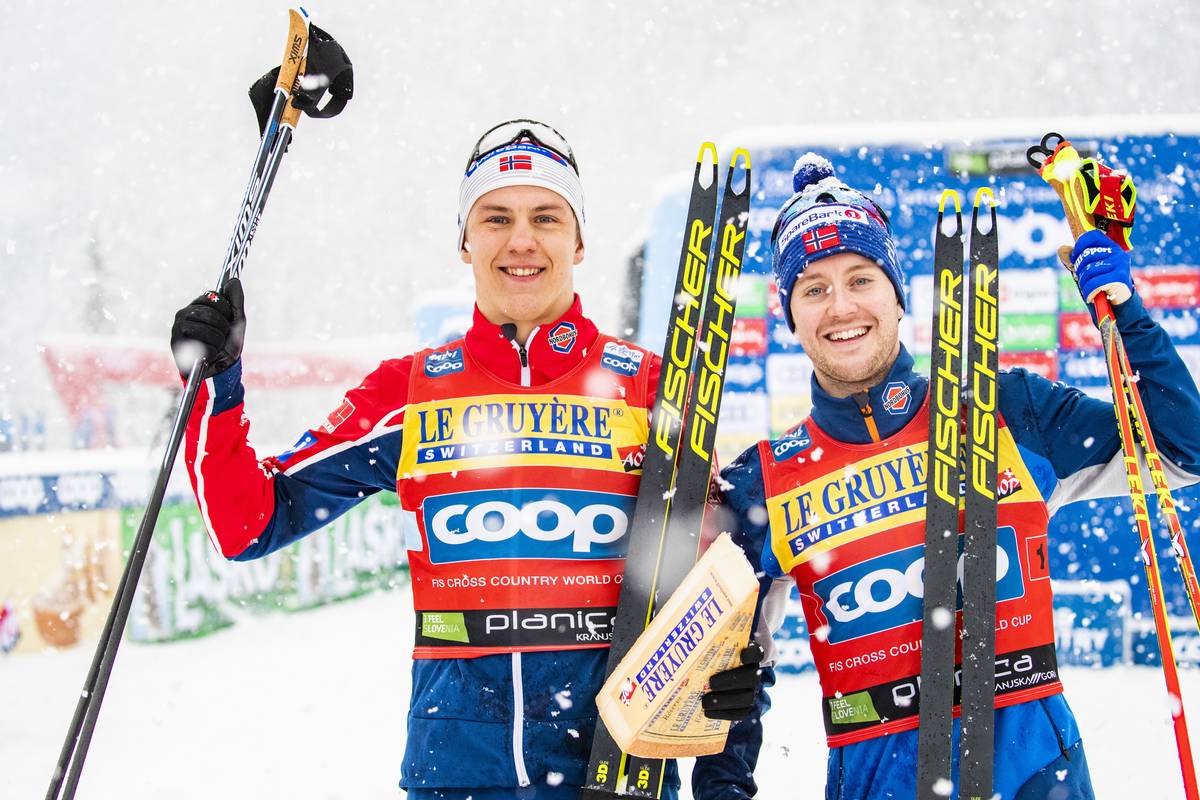
The men’s podium of the freestyle team sprint in Planica, Slovenia. The Norway I team of Sindre Bjørnestad Skar and Erik Valnes took the win over the Norway II and Finland teams. (Photo: NordicFocus)
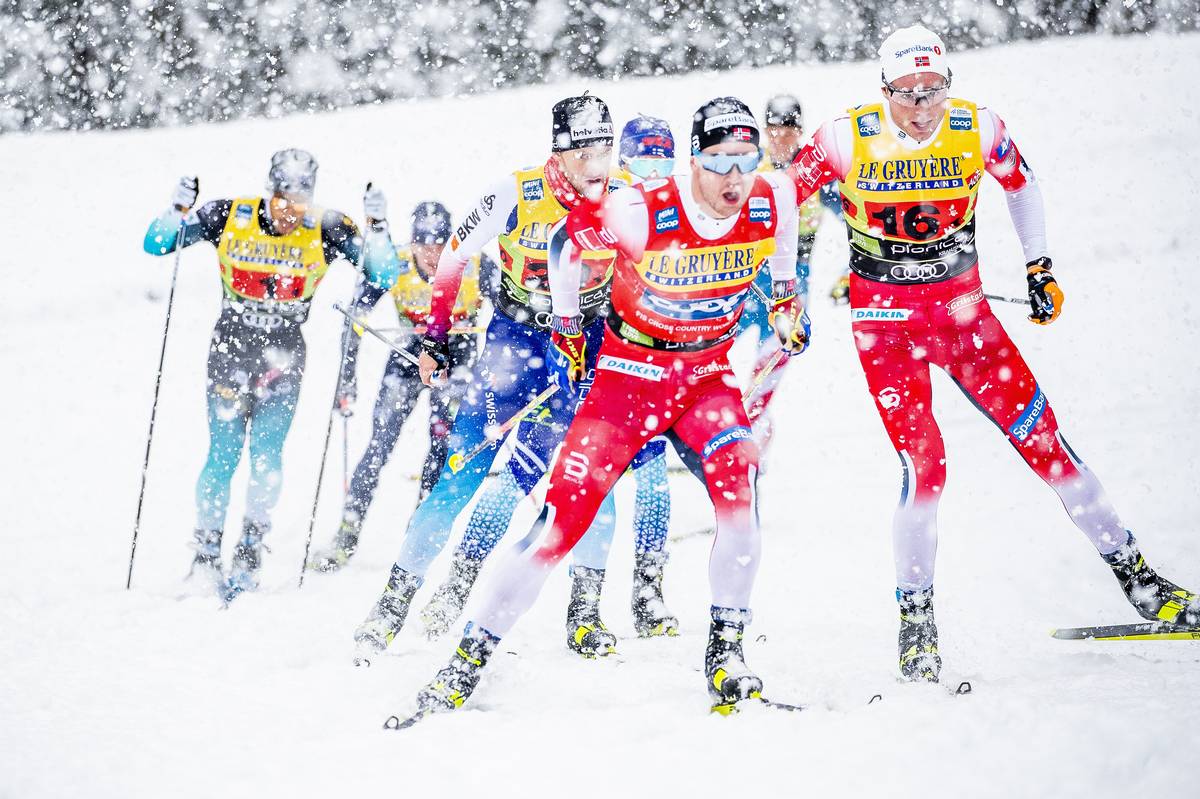
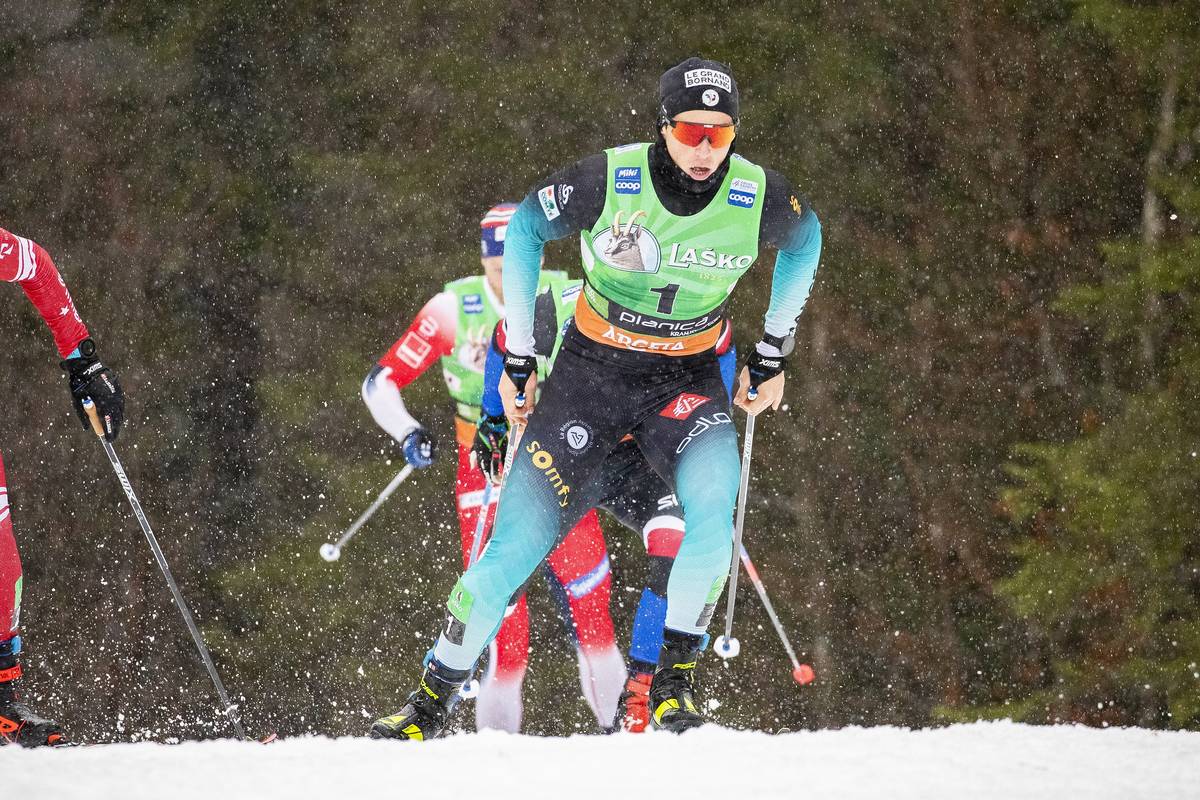
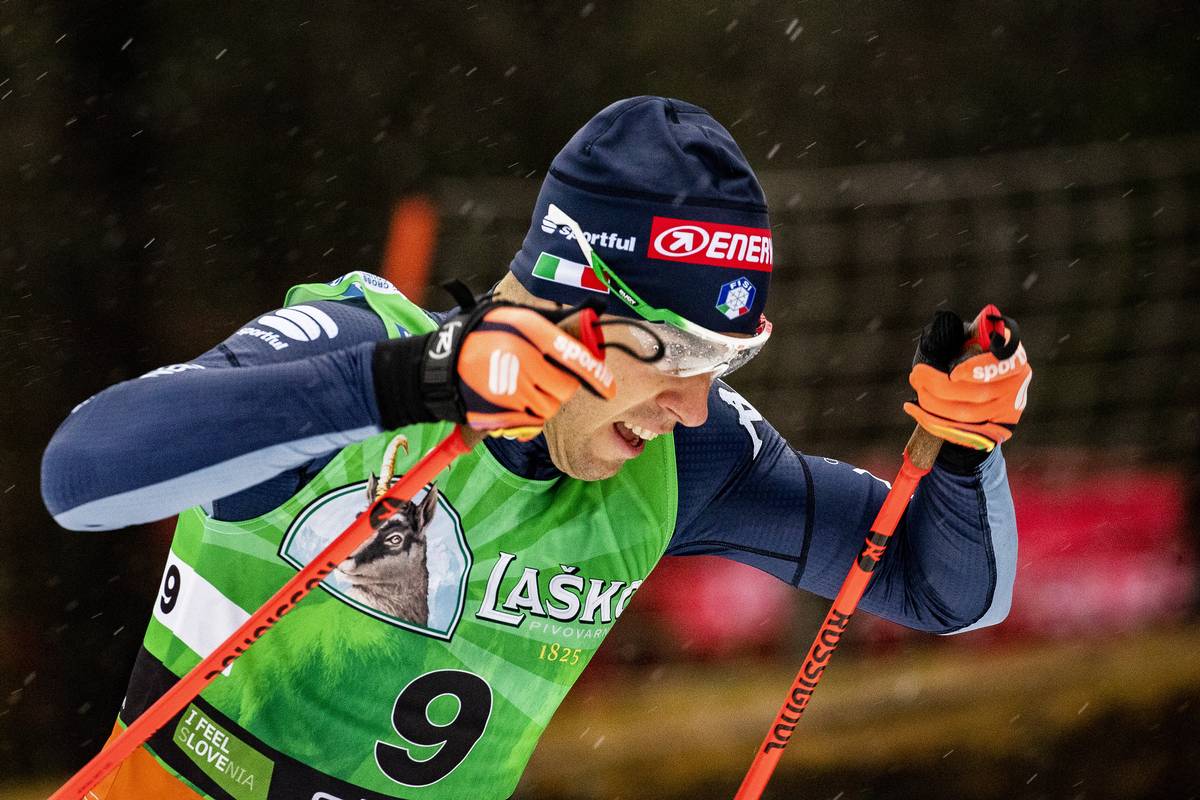
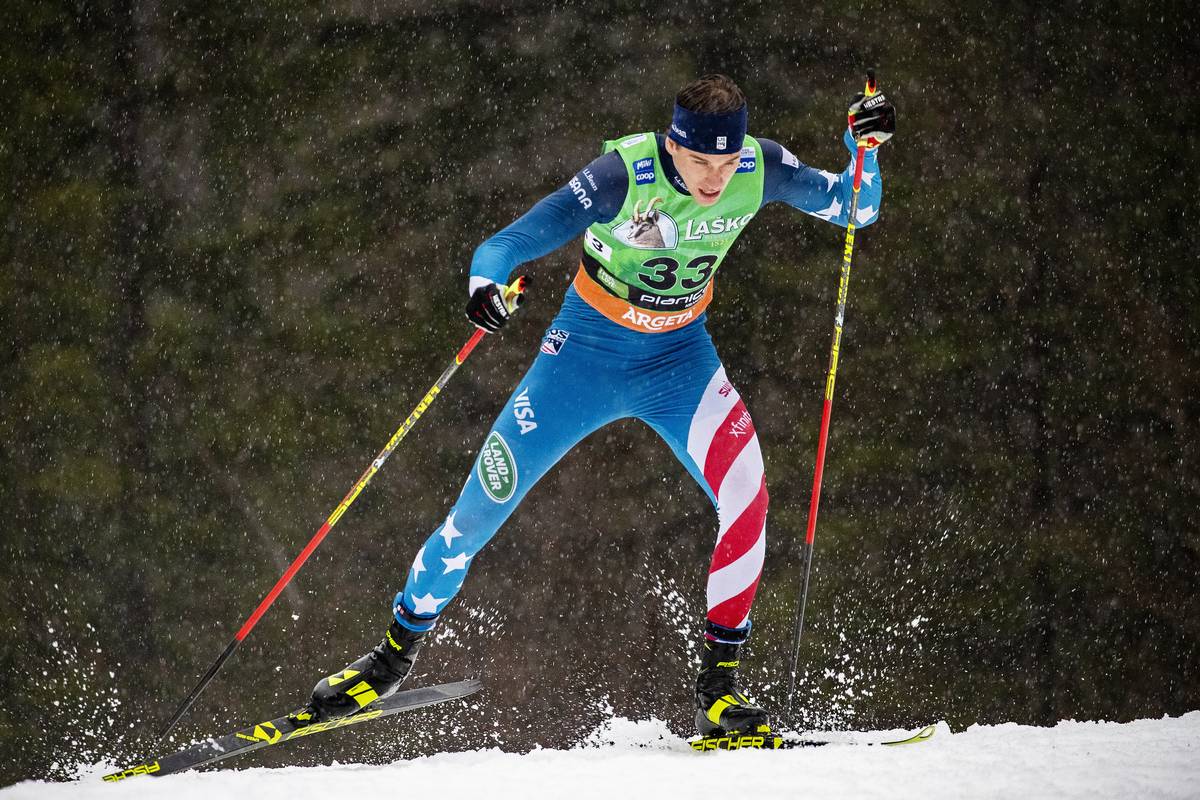
From under the umbrella to inside the snow globe. Fat flakes were falling in Planica, Slovenia at the start of the freestyle team sprint. A painful mix of speed and endurance, each team member skied three 1.2-kilometer laps for a total of 7.2 k. Comprising the victorious Norway I team, Sindre Bjørnestad Skar and Erik Valnes stopped the clock at 16:54.52. Fellow countrymen Håvard Solås Taugbøl and Gjøren Tefre took the Norway II team to second place (+1.29) followed by the Finnish team of Ristomatti Hakola and Joni Mæki in third (+1.43).
Coming into the third exchange at the halfway mark of the race, the pack of athletes included all ten teams, no one able to break apart the masses in the slow conditions. A variety of teams including Norway, Finland, and France took turns trying to create a gap, but wasting energy too early in the slow snowy conditions risked hazard.
The Norway II team of Håvard Solås Taugbøl and Gjøren Tefre tag off in a tight field during the freestyle team sprint in Planica, Slovenia. (Photo: NordicFocus)
By the fourth exchange, there was no longer time to wait. Skar of Norway I pushed by Tefre of Norway II began to surge. He quickly created a small gap to all but Richard Jouve of France and Hakola of Finland I who went with the leaders in red.
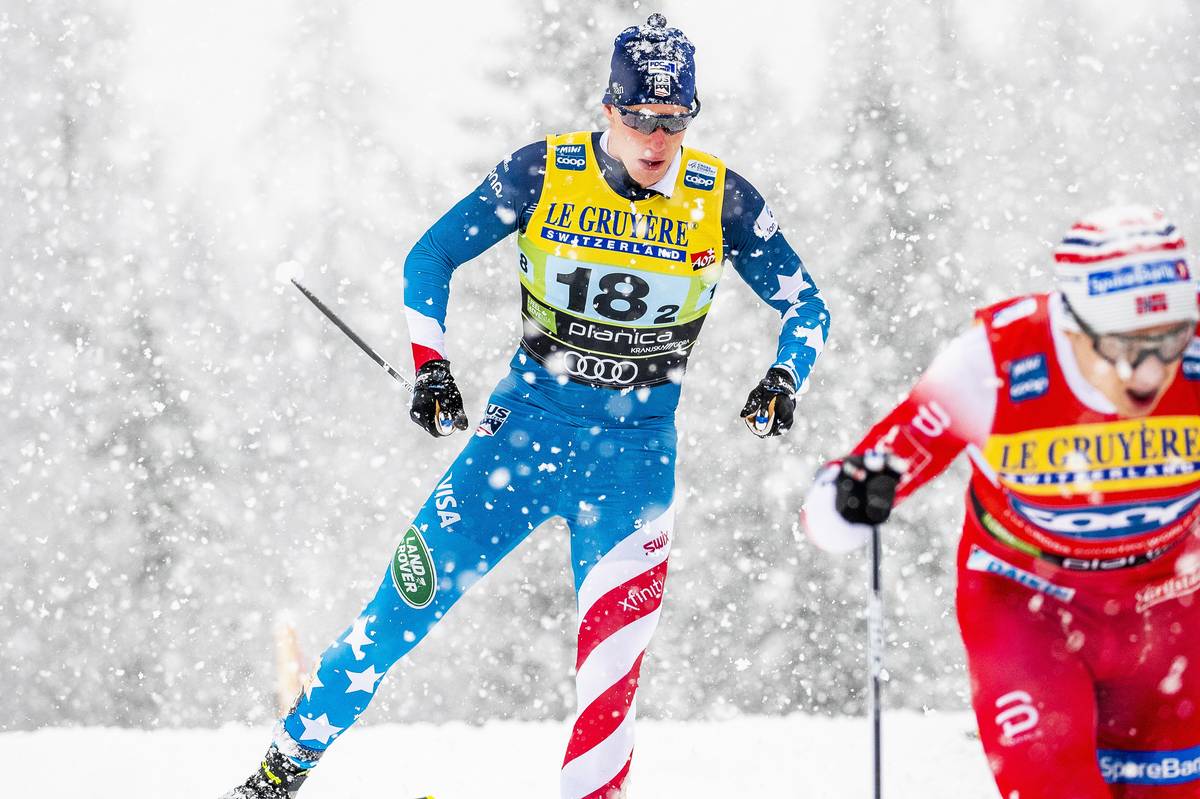
Though the density was lowered, the spread of the top eight teams was less than nine seconds as they made the final exchange. Having mingled with the leaders throughout, the American duo of Kevin Bolger and Logan Hanneman sat in fifth, less than three seconds back on the Norwegians.
Densely packed inside a snow globe, Norway pushes toward a 1-2 sweep in the freestyle team sprint in Planica, Slovenia. (Photo: NordicFocus)
Winding up the energy in the final leg, Norway again made a push to break apart the field. Allowing them to lead to the climb at halfway, then working his way around the outside, yesterday’s sprint champion Chavanat made a go at the lead. Cresting the hill, Chavanat’s V2 was outmatched by two men in red jump-skating as though indefatigable even after 3.5 k’s of sprinting.
Valnes exploded off the front, leaving the threesome of Tefre, Mæki, and Chavanat duking it out to a close finish. Bobbling as he crossed into an opening, Tefre tangled skis with Mæki, but both men lost little momentum as they headed into the final straightaway.
Perhaps spent from his attempt to lead, Chavanat’s tempo could not match the others and he was overtaken in the final meters. Tefre slid his boot over the line just ahead of Mæki, leaving the French team 0.07 seconds off the podium.
The Norway I team of Sindre Bjørnestad Skar and Erik Valnes took home the cheese at the freestyle team sprint in snowy Planica, Slovenia. (Photo: NordicFocus)
“It was a challenging day [for conditions], just as yesterday,” Skar told FIS at the finish line. “But it’s the same for everyone so you just have to deal with it and do your best.”
He explained how the wet falling snow affected tactics and how the race unfolded for the Norway I team.
“It was so close and then with this weather it is almost impossible to go alone in the front. I tried the last half, but it was difficult, but we had to try and Erik was the best guy at the finish.”
Kevin Bolger accelerates out of the exchange during the freestyle team sprint in Planica, Slovenia. (Photo: NordicFocus)
After losing contact with the leaders in the final lap, the Americans held on for 7th place (+21.19).
In a post-race call, Whitcomb explains that the team of Bolger and Hanneman was not finalized until the morning, when original anchor Simi Hamilton, who took 12th in the rain yesterday, was forced to withdraw after coming down with a cold. Because of the adjustment, the team lost their start position in the semifinal and began at the back of the field. The men finished eighth in the fast first round, from which the top three teams went on to be the top three teams in the final. The Americans advanced to the final with the last lucky loser spot.
Post-race interview with Matt Whitcomb on the men’s team sprint.
Kevin Bolger (second from left) keeps the USA team in contact during the freestyle team sprint in Planica, Slovenia. (Photo: NordicFocus)
“Logan and I had the weather on our side today!” wrote Bolger in an email. “I was skiing well but punched it to the front of my semi-final on the second lap and got a bit flooded from that. Luckily, Logan skied really well on his final lap to bring us into qualifying contention!
“The Final felt a lot better,” he continued. “I skied a lot more conservatively and tactically better and am happy with how I moved forward. I was a bit surprised when Logan came into the Tag zone leading but was ready to head out and give it my all for the last lap!”
Logan Hanneman stays in the mix behind Norway during the freestyle team sprint in Planica, Slovenia. (Photo: NordicFocus)
At 26-year-old, Sun Valley native Kevin Bolger is in the midst of his third season of World Cup starts, landing inside the top-30 on eight occasions. Hanneman, who hails from Fairbanks, AK, has much less experience on the World Cup. Whitcomb explains how weekends like this one, where many of the all-arounders are resting for the Tour de Ski, consequently narrowing the field and improving the odds of sprinters like Hanneman who are often on the cusp of qualifying for the rounds.
Post-race interview with Matt Whitcomb on Logan Hanneman’s development on the World Cup.
“The final was just nuts,” wrote Hanneman in an email about his day. “It was snowing so hard. The pace was much more pedestrian than the semi final. I found myself with an open lane up the last hill of my second lap, and made what I thought was a low energy move up into the lead… turns out it was all adrenaline because come my last lap I was dying. But Kevin skied great during the whole final, and we were able get beat some teams in the final. Very happy with the day for sure!”
With a snaking artificial loop of snow in a drizzly, and sometimes thundering Planica, Slovenia, the men’s World Cup field competed in a 1.25-kilometer skate sprint on Saturday. What Planica lacked in wintery vistas, it provided with fast technical racing during a day of topsy turvy weather. Racing was suspended after the quarterfinals when a robust lightning and hail storm moved in. With loud thunder booms reverberating during the weather delay, the competition organizers aptly blasted ACDC’s Thunderstruck.
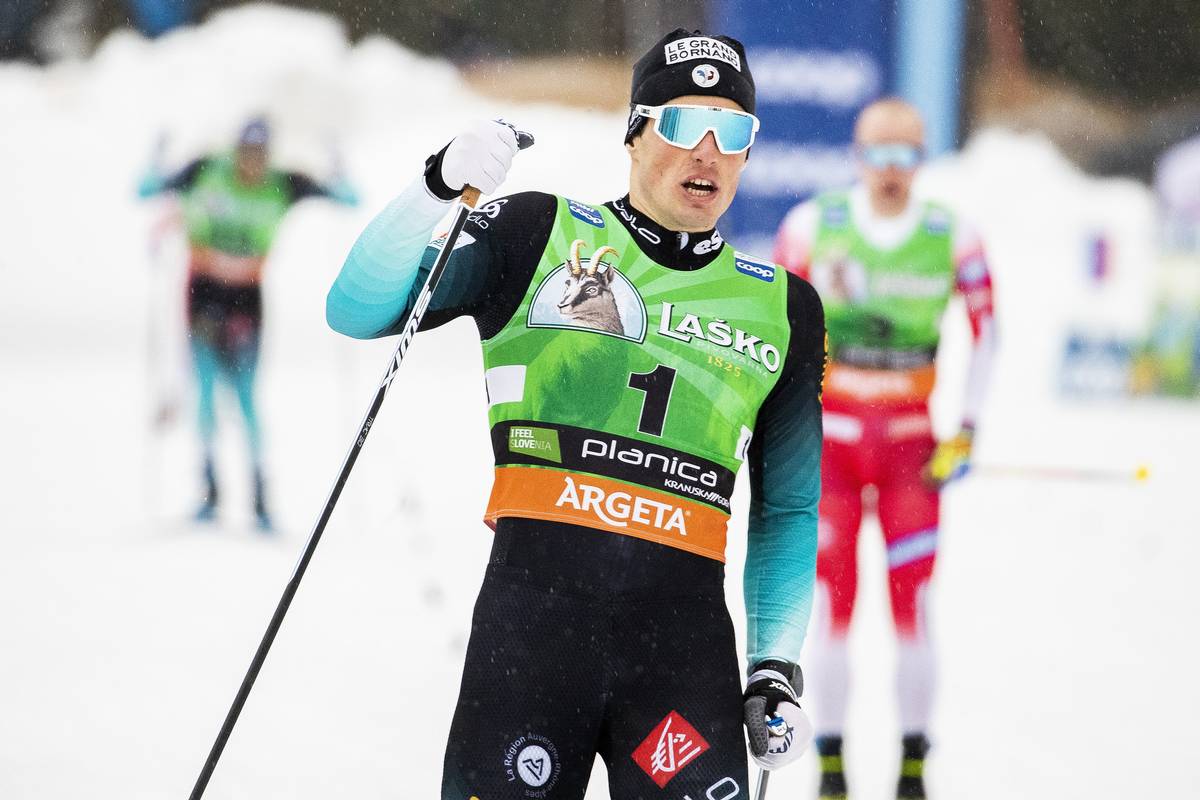
First career World Cup win for Lucas Chanavat of France in the Planica, Slovenia skate sprint. (Photo: NordicFocus)
And that is part of the story. FIS runs a tight production schedule for live television where any deviation from the plan can be perceived as a potential loss of revenue. In the past, during unsafe weather, the call to postpone or cancel a race has arguably sided in favor of the production schedule. During the 2018 Tour de Ski, a women’s sprint qualifier in Oberstdorf, Germany, was held in what many considered hazardous conditions. The men’s qualifier was ultimately canceled and the day’s results nullified.
U.S. World Cup Coach Matt Whitcomb noted there was little hesitation today when after the men’s fifth quarterfinal — with lightning strikes too close for comfort — the race organizers postponed racing until the storm abated.
Soggy, stormy, and thundering in Planica, Slovenia. (Photo: NordicFocus)
The Racing
Lucas Chanavat of France came into Planica having podiumed seven times in the individual skate sprint. Never for the win. Yet, he placed second overall last weekend in a decidedly different weather scenario skate sprint in Davos, Switzerland.
With his fastest qualifying time on Saturday at 2:10.91 — Chanavat was 2.55 seconds faster than the second-place qualifier, Italy’s Federico Pellegrino — the Frenchman’s time had come.
Chanavat won his quarterfinal, and in the first semi, took second to Pellegrino. Chanavat controlled much of that semi. It appeared early on that only Norway’s Sindre Bjørnestad Skar in bib 3 could match Chanavat. With the meters ticking off, on the final punch of a hill Pellegrino slotted in and out of tight traffic to jump skate clear to the outside. He carried enough speed into the final straight to take the semi-final win with Chanavat in a close second.
Power move: France’s Lucas Chanavat, Saturday’s skate sprint winner in Planica., Slovenia. (Photo: NordicFocus)
That set the tone for the final featuring Chanavat, Pellegrino, Norway’s Erik Valnes, Håvard Solås Taugbøl, and Skar, and another Frenchman in Richard Jouve.
A minute into the final, the skiers were four across pushing into a short power-climb. Again Pellegrino displayed a burst of speed and came into the descent in first with the train of skiers drafting behind. Gliding under a bridge and sweeping into another short climb, Chanavat took the lead from Pellegrino. He skied safely in front as they stepped through a dicey high speed left-hand corner. Despite Pellegrino’s best hop-skate efforts, Chanavat kept his speed and poise for his first career World Cup win in 2:14.41. Chanavat now leads the overall sprint standings. Essee, avhandling, referat, uppgift. uppsatser
For Pellegrino, he just missed out on win 14 as he placed second overall (+0.40). His 13 World Cup wins have all come in the skate sprint. Valnes was third (+0.83).
Federico Pellegrino of Italy placed second on Saturday in the Planica, Slovenia men’s skate sprint. (Photo: NordicFocus)
All three U.S. skiers entered qualified for the heats. Kevin Bolger of the U.S. Ski Team (USST) qualified in 16th (+5.34), Simi Hamilton (USST) in 27th (+6.07), and Logan Hanneman (APU) 28th (+6.13).
Hamilton advanced to the first semi as a lucky loser after placing fourth in the screaming fast second quartervfinal won by Pellegrino. He ended up sixth in his semi to finish 12th overall. Hamilton is also ranked 12th overall on the World Cup’s sprint list.
Simi Hamilton, Planica, Slovenia. (Photo: NordicFocus)
Simi Hamilton, placed 12th overall in Planica, Slovenia’s World Cup skate sprint. (Photo: NordicFocus)
Simi Hamilton post-race interview
For Bolger, it was his second consecutive weekend in the points. He placed 18th overall after finishing fifth in his quarterfinal.
Kevin Bolger on his way to qualifying 16th overall and finishing 18th on the day during Planica, Slovenia’s World Cup skate sprint. (Photo: NordicFocus)
Kevin Bolger post-race interview
Whitcomb commented in an interview that Bolger can either be on or off. It was a week the coach said Bolger made some adjustments to his training to get him firing. “I’d like to think that some of the training adjustments that he has made helped him ski fast right from the gun today,” said Whitcomb. “He was quick out of the start. Quick down the first descent. He looked good on every climb.”
Post-race comments from World Cup Coach Matt Whitcomb on Kevin Bolger’s and Simi Hamilton’s day
Hanneman scored his first World Cup points of the season, ending the day in 28th. Last weekend in Davos he was 31st after tying in qualification with Bolger in 30th. That tiebreaker sided in favor of Bolger, the athlete with lower FIS points.
Logan Hanneman placed 28th in Planica’s World Cup sprint. (Photo: NordicFocus)
Post-race comments from World Cup Coach Matt Whitcomb on Logan Hannmeman’s day
Russel Kennedy was the only Candian entered. He finished 55th (+9.79).
Canada’s Russell Kennedy during the Planica, Slovenia skate sprint qualifier. (Photo: NordicFocus)
Individual racing for Period I on the World Cup has concluded. Tomorrow features a skate team sprint in Planica.
The men’s podium of the 1.5-kilometer freestyle sprint in Davos, Switzerland. Johannes Høsflot Klæbo (center) took first ahead of Lucas Chavanat of France (L) and Håvard Solås Taugbøl of Norway (R). (Photo: NordicFocus)
Davos, Switzerland: gifted athletes, throngs of spectators lining the course, plenty of Vitamin-D and a spectacular day for the 1.5-kilometer freestyle sprint. Racers chased down and skied away from their long afternoon shadows as the sun moved across the cloudless bluebird sky.
The crowds were in for a treat. In sprint racing, heats often have significant variance. Some will be fast, some will be slow with a final upsurge in intensity at the end. In today’s event, heats were fast and tight. Winning times were comparable, lucky losers waited with bated breath through the end.
Improving upon their performance in the opening classic sprint in Ruka, two Americans qualified for the heats. Simi Hamilton qualified in 8th and Kevin Bolger in 30th.
Lucas Chavanat of France models composure during the 1.5-kilometer freestyle sprint in Davos, Switzerland. (Photo: NordicFocus)
In the first heat of the quarterfinals, Johannes Høsflot Klæbo, who had qualified in 5th, threw down against France’s Lucas Chavanat, who was the top qualifier. Perhaps making a statement, Klæbo set the tone of the heat, quickly moving to the front and holding his position to comfortably take the heat with Chavanat behind him.
During his round, Hamilton marked the leaders, the Italian favorite Federico Pellegrino and Erik Valnes of Norway. Hamilton maintained contact throughout, fighting through the finish to place third in his heat. His time survived the three subsequent heats each by a fraction of a second to advance as a lucky loser.
Italy’s Federico Pellegrino leading Erik Valnes of Norway in the quarterfinals of the 2019 skate sprint in Davos, Switzerland. (Photo: NordicFocus)
Simi Hamilton hunts down the leaders in the quarterfinal of the 1.5-kilometer freestyle sprint in Davos, Switzerland. (Photo: NordicFocus)
Onto the semis. In the first heat, Chavanat took control from the gate and held it through through the last turn, the stacked group of competitors tucked in closely behind him. Klæbo stayed tucked into the middle of the pack. In the final straightaway, Klæbo swung around overtaking his teammate Valnes in the final meters, besting Chavanat by a toe.
In a tuck and on the hunt. Not an easy victory for Johannes Høsflot Klæbo during the 1.5-kilometer freestyle sprint in Davos, Switzerland. (Photo: NordicFocus)
In the second wave, Hamilton stayed just behind the Norwegian leaders Håvard Solås Taugbøl and Sindre Skar — in the mix but out of trouble. In the final stretch, a pack of five contenders charged toward the finish. Crossing in a photo finish with Gleb Retivykh of Russia, Hamilton was deemed 4th and advanced again as a lucky loser.
At the start of the final, none of the men took the reigns and the first climb looked calm. Chavanat emerged at the front after the descent, but the field behind him stayed tight. Dueling once more, Klæbo tucked in just behind Chavanat, marking him closely and staying low in his draft.
In the final high-velocity stretch, Klæbo and Chavanat were neck-in-neck as the crowd roared. Leading by inches, Klæbo charged with unmatched tempo. He added two jump skates before throwing his boot across the line ahead of the Frenchman in a photo finish. Chavanat was just 0.05 seconds behind Klæbo. Laughing breathlessly, they embraced and congratulated each other at the finish.
Johannes Høsflot Klæbo of Norway checks his position relative to his opponent, Lucas Chavanat of France, at the finish of the 1.5-kilometer freestyle sprint in Davos, Switzerland. (Photo: NordicFocus)
Johannes Høsflot Klæbo (NOR) and Lucas Chavanat (FRA) congratulate one another after a photo finish in the final of the 1.5-kilometer freestyle sprint in Davos, Switzerland. Klæbo won by a margin of 0.05 seconds. (Photo: NordicFocu)
Håvard Solås Taugbøl of Norway finished third (+1.36) — his first career World Cup podium, followed by Sindre Skar (+1.54), Retivykh (+3.19), and Hamilton (+4.82).
“It was a really tough fight and Lucas was very strong all day,” Klæbo told FIS at the finish. “It was really cool to see that he was that strong again. In the quarter-final, the speed was really high and I was trying my best at a final and was a bit in front of him, but it was a really good fight.”
Håvard Solås Taugbøl of Norway celebrates his podium finish at the 1.5-kilometer freestyle sprint in Davos, Switzerland. (Photo: NordicFocus)
Klæbo’s victory makes him the first male athlete to win five consecutive World Cup sprint events. The last athlete to do so was Marit Bjørgen who won a remarkable eleven in a row between 2003 and 2005. He also became the first athlete to win three World Cup sprint events in Davos. Today’s third consecutive win allowed him to surpass Pellegrino, who won in 2014 and 2015.
In his interview with FIS, the sprint champion was also asked about sharing the podium with his teammate.
“It was really cool to have Håvard on the podium today,” said Klæbo. “I think in Norway we are quite happy today.”
Hamilton has a history of racing well in Davos. He placed 12th last season and 9th in 2017. At 5,100’ Davos is one of the highest elevation venues on the World Cup, but much lower than his 8,000′ hometown of Aspen, Colorado.
In his post-race interview, Hamilton shares why this course suits him well and how this performance gives him confidence on the season ahead. He also discusses his opening performance in Ruka and the tight spread throughout the heats.
Simi Hamilton skis to an 8th place result in the qualifying round of the 1.5-kilometer freestyle sprint in Davos, Switzerland. (Photo: NordicFocus)
Post-race interview with Simi Hamilton.
In a post-race call, head coach Matt Whitcomb discussed Hamilton’s performance, fitness, and headspace going into the qualifier.
Post-race interview with Matt Whitcomb about Simi Hamilton’s sprint day in Davos.
Racing in the speedy second heat of the quarterfinals with Hamilton, Bolger was eliminated after finishing sixth in his heat and finished 30th.
“It was a step in the right direction,” wrote Bolger in an email. “Last year I came here and qualified 31st so to be on the right side of that this year felt good! I’ve been struggling a bit to find my form so to get into some heats today is a big confidence booster going forward.
“Simi and I had a ripper of a heat and it was really awesome to see him go all the way through to the final,” he continued. “I wish I could have joined him but [it will happen] in time. I’m excited to find some more fitness and keep progressing into semi-finals and hopefully some finals this year!”
Kevin Bolger crests the top of the climb during the 1.5-kilometer freestyle sprint in Davos, Switzerland. (Photo: NordicFocus)
Whitcomb gives depth to Bolger’s performance and the role it plays in terms of his starts for the season.
Post-race interview with Matt Whitcomb about Kevin Bolger’s performance and physiology.
Outside of the heats, Logan Hanneman finished in 31st after skiing the same qualifying time to the hundredth of a second as Bolger (+6.86). (It apears that in the event of a tie, the skier with the lower FIS points is the winner.) Canada’s only entrant Russell Kennedy finished 42nd (+8.07).
Canada’s Russell Kennedy qualified in 42nd during the 1.5-kilometer freestyle sprint in Davos, Switzerland. (Photo: NordicFocus)
Logan Hanneman on course during the qualifying round at the 1.5-kilometer freestyle sprint in Davos, Switzerland. (Photo: NordicFocus)
Post-race, Whitcomb explains why the tie in the qualifier went to Bolger for who advanced to the heats.
Post-race call with Matt Whitcomb about qualification.
He is proudly Alaskan and has resisted the temptation over the years to migrate elsewhere. We are talking about twenty-nine-year-old Reese Hanneman who has in fact migrated from his hometown of Fairbanks to the more southern maritime climate of Anchorage, Alaska.
So the question has been, is Reese Hanneman retired? After many years on the SuperTour, winning five national titles, stints on the World Cup, and an Olympic team nomination last year, the answer to that question really is how you define retired. He’ll not be on the SuperTour — he did not contest any domestic races at that level this season — but you might find him racing in places like China.
If you follow Hanneman on Instagram, you’ll know his creative eye impresses. He is the founder of the creative PR agency the Ophira Group, and he is finishing his engineering degree. He still finds time to “train” but certainly, the hours are down.
We caught up with Reese Hanneman, the older of the two cross-country skiing Hanneman brothers, (Logan is 25) in mid-February after he had competed in the China Tour de Ski. (That race concluded in early January.)
Johannes Høflot Klæbo wins the sprint with Federico Pelligrino and Sindre Bjørnestad Skar following. (Photo: John Lazenby/lazenbyphoto.com)
How to play the Johannes Høsflot Klæbo sprint game? It has got to go through every sprinter’s mind. As the day’s fastest qualifier, Klæbo set the tone in 3:07.61.
Prior to Friday’s 1.6-kilometer freestyle sprint in Québec, the young Norwegian had started nine World Cup sprints this season. He had won seven of them and placed second in another. And he had already locked up another sprint cup crystal globe becoming the first to win the prize in three successive seasons. With the globe pressure off, Klæbo could play his hand. Which brings us back to how he’d ski on a long sprint course with soft conditions and how his competitors would counter.
Johannes Høsflot Klæbo during the Quebec City sprint qualifier. (Photo: John Lazenby/lazenbypohoto.com)
Johannes Høsflot Klæbo during the Quebec City sprint. (Photo: John Lazenby/lazenbypohoto.com)
Russia’s Alexander Bolshunov, second in the World Cup overall standings, went head to head twice against Klæbo on Friday. In the quarterfinals, Bolshunov went full-throttle from the start. He looked like he could pull off the start-to-finish-pull for much of the first Klæbo encounter. Yet had did fade to place third in the heat which his nemesis won.
In the final with Klæbo, Bolshunov had a timid start. He hung in the back. This time playing a different strategy. Around 1:20 into the final, Bolshunov did accelerate. He gained a few spots to move into fourth.
Another skier in the final knowing it was Klæbo’s show, Italy’s Federico Pellegrino, made an up-tempo counter punch on a steep climb at the 1:55 mark. Hop-skating on the outside, Pellegrino pushed. Sindre Bjørnestad Skar of Norway led over the top and kept the Pellegrino move in check. With over a minute of racing to go, Klæbo kept in control. Skar took the lead, Klæbo followed, with the Italian and Bolshunov in third and fourth.
Nonchalantly, Klæbo took over race control ten seconds later. Nothing shiny. Nothing really marked with flare. Just simple flat out free-skating, V2ing, and lovely sprinting. He won in 3:22.14. Pellegrino was second (+1.10), and Skar third (+1.55). Bolshunov skied to fourth (+1.57).
The men’s sprint final in Quebec City. (Photo: John Lazenby/lazenbyphoto.com)
Johannes Høsflot Klæbo of Norway strining out the men’s sprint final in Quebec City. (Photo: John Lazenby/lazenbyphoto.com)
“Quite difficult conditions today, it was a really fun race,” Klæbo told FIS after the race. “I think the quarterfinal was the toughest one, it was really hard. It seems like Bolshunov is in good shape so it should be an interesting weekend.”
Coming into Friday’s races, Klæbo held a 14 point lead over Bolshunov for the World Cup overall. With the win, Klæbo earned 50 points, Bolshunov 40th for fourth. With two distances races remaining, it does get interesting. Klæbo leads with 1443 points to Bolshunov’s 1419.
In the press conference, Pellegrino made light of his second place finish as he deferred to a skier he has gained much respect for.
“This adds to the long list of second place behind Johannes,” Pellegrino said according to a translator. “It will be a long list. I will keep training very hard to be on top. I still have the legs to keep up so I will keep on trying. I have never made a podium in Québec before so I think I can do it again next year. I heard a lot of noise, ‘Pellegrino, Pellegrino’. In Europe, it’s hard to get people to come out and watch in bad weather. There was a lot of emotion in Alex [Harvey], but next year I hope they will still come to watch even without Alex. The courses were in good shape in spite of the conditions and the crowd here is amazing!”
Federico Pellegrino the men’s sprint qualifier in Quebec City. (Photo: John Lazenby/lazenbyphoto.com)
A spent Federico Pellegrino after the men’s sprint final in Quebec City. (Photo: John Lazenby/lazenbyphoto.com)
World Cup skiers understand Pellegrino’s sentiments. They too are here to soak in the Québec City atmosphere as it is an extension of Alex Harvey’s love for the sport and Québec’s love for him. Harvey qualified in 23rd on Friday and finished 10th overall.
“It was really good,” Harvey said in the mixed zone after the race. “I think in a stage event like this the goal for every sprint day is to make the semis, that’s where the sweet spot is for bonus seconds, so that was really good. … The semi-final was the fastest heat out of the two, it was just full gas the whole way with Bolshunov. So the other guys were just faster, but I haven’t qualified on the World Cup since December 2018. So I’m not the best sprinter anymore. So for me to make the semis it was great.”
This is Harvey country. (Photo: John Lazenby/lazenbyphoto.com)
Alex Harvey during the Quebec City sprint qualifier. (Photo: John Lazenby/lazenbypohoto.com)
Simi Hamilton was the top American on the day in 13th. After qualifying in 11th, Hamilton bowed out after placing third in his quarterfinal, roughly .5 seconds behind Harvey who skied to second.
“It’s just tough out there,” Hamilton said of the soft snow. “You know I think I’ve gotten better at skiing in those kinds of conditions, but still not totally there and it was just really soft and slow, made it extra hard with the headwind in places and it’s not fun skiing, but that’s ski racing. It’s not gonna be super enjoyable all the time. I think probably everyone feels like they can’t really ski out there today because it’s so hard.”
U.S. skier Logan Hanneman made the top-30 cut after qualifying in 29th. Skiing near the back of his heat in the quarters, Hanneman lost his balance around a dicey downhill corner.
“My ski just got grabbed by some of the snow,” Hanneman said of his tumble. “It’s pretty wet and deep on that corner especially and a snake jumped up and bit me and down I went. That’s how it goes I guess, but it’s tricky conditions out there and even on the downhill leading into it was grabbing the skis and going everywhere. You have to be light on your feet, which is not my forte.”
Simi Hamilton (bib 11) during his quarterfinal of the Quebec City sprints. (Photo: John Lazenby/lazenbyphoto.com)
Logan Hanneman during the Quebec City sprint qualifier. (Photo: John Lazenby/lazenbypohoto.com)
Hanneman has seized several opportunities this season on the World Cup. He first qualified for the World Cup heats this past February in Cogne, Italy.
“Just this season, I’ve only got a few World Cups in me and I qualified 15th in Cogne,” Hanneman said. “And then I qualified at World Champs and here and so I’m really happy to be making it into the heats now. I was really excited today to try to be a little more competitive in the heats because in the heats I’ve done before I’ve just been in the back. I don’t know when and where to pass because it’s so tight. So I was excited I felt pretty good on that uphill and I was excited for this uphill for sure and it didn’t happen so that’s okay.”
Racing continues tomorrow with a 15 k classic mass start race for the men and a 10 k for the women.
Sweden’s Stina Nilsson during the 1.6 k skate sprint qualifier in Quebec. Nilsson won the sprint final. (Photo: Doug Stephen)
We’re changing the format for this race rundown. With many North Americans racing during World Cup finals in Québec, screenshots from Live Timing will keep the rundown updated efficiently.
In the finals of Fridays; 1.6 k skate sprint in Québec, Stina Nilsson took the win and with it the sprint Crystal Globe overall. Sweden also took second and third place with Maja Dahlqvist and Jonna Sundling respectively. American Sadie Bjornsen placed sixth overall as the top North American finisher.
FIS World Cup 1.6 K Freestyle Sprint Québec
In the semi-finals, Jessie Diggins (USST), Bjornsen, and Sweden’s Charlotte Kalla tangled up early in the second semi-final as they rounded a tight corner. Kalla fell off the pace, while Diggins and Bjornsen fought to regain contact with the three skiers up ahead. Bjornsen out-toed Diggins for a lucky loser spot in the finals.
In the men’s race, Norway’s Johannes Høsflot Klæbo took control of the final late in the race to do as he does: win with little pressure to push a toe across the line. Italy’s Federico Pellegrino place second, with Sindre Bjørnestad Skar of Norway in third.
Canada’s Alex Harvey advanced to the semis where he was eliminated to place 10th in the final standings.
Simi Hamilton was the top-ranked U.S. skier finishing 13th in Thursday’s sprint. Logan Hanneman (APU), also for the U.S., fell in the fifth heat but ranked 25th overall.
Norway swept the men’s podium of the 1.4-kilometer freestyle sprint in Falun, Sweden. With a narrow margin, Johannes Høsflot Klæbo (center) took the win over Emil Iversen (l) and Sindre Bjørnestad Skar (r). (Photo: Instagram Screenshot @fiscrosscountry)
The World Cup made its final European stop in Falun, Sweden before the field heads across the pond to Quebec City for the final series. For the men, the weekend opened with a 1.4-kilometer freestyle sprint, a last test before the freestyle sprint in Canada.
Heading into the weekend, Norway’s Johannes Høsflot Klæbo sat comfortably in the lead for the overall sprint standings with string of six back-to-back wins, not including a win at the World Championships. The 22-year-old phenom had earned a remarkable 604 points and held a lead of 145 points over second place, his friendly rival from Italy, Federico Pellegrino. Klæbo had not lost a sprint since the second World Cup weekend in Lillehammer where a broken pole in the semifinal took him out of contention. He was also humbled in the first race of the season where he looked over his shoulder and laid off the gas too soon, allowing Russia’s Alexander Bolshunov to take him at the line.
While the top of the podium might be more memorable than the other positions, in reflecting on the season, one cannot overlook Pellegrino’s freestyle sprint results. The Italian has landed on the podium, most frequently in second, in all but one skate sprint event this season — the city sprints in Dresden where he was issued a yellow card for obstruction in his quarterfinal, leaving him in 30th for the day. Eirik Brandsdal of Norway sat in third, followed by his teammate Sindre Bjørnestad Skar in fourth, and Gleb Retivykh of Russia in fifth.
Despite Falun sitting roughly 60 degrees north in latitude, a fair amount of grass showed aside the ski jumps and between the folds of the ribbon of snow making up the course. Above freezing temperatures and plenty of sun quickly caused the windy course to become chewed up, especially on some of the downhills and corners. With variable weather leading into the weekend as well, the event coordinators reportedly kept the course closed, even to athletes, techs, and coaches in an effort to preserve a solid track. But despite their best efforts, the course was no match for the sun.
As athletes skied their qualifier, the course eroded; uphills became soft and piles of corn snow could be found on the outside of the curves. This made for an exciting day of races as the sprints became a test of both speed and surefootedness. With numerous crashes in the heats for both men and women, tactics had to include staying on their feet as the athletes’ primary goal.
Federico Pellegrino (right) leads Johannes Høsflot Klæbo (yellow bib), Ristomatti Hakola (bib 4), and Lauri Vuorinen (bib 30) during the quarterfinal of the 1.4-kilometer freestyle sprint in Falun, Sweden. (Photo: Instagram screenshot @chiccopelle/@nordicfocus)
As expected given their introduction, Klæbo and Pellegrino went one-two in the qualifier. The two then met head to head in the first heat of the quarterfinal, where they debuted their chosen strategy of hanging back for the first half of the race, then slowly moving into better position before the last 30 seconds where they fired on all cylinders. Klæbo made his move a bit sooner than Pellegrino, demonstrating his signature powerful jump skate as he climbed a granular hill. Pellegrino took things closer to the wire, blasting his way into second place with a no pole skate in the final stretch. The two finished just 0.4 seconds apart in a heat where less than 1.5 seconds separated first through fourth.
The remainder of the quarterfinal heats proved to be close as well, in particular, the third heat, which ended in a four-way photo finish between Skar, Francesco De Fabiani of Italy, Richard Jouve of France, and Andrew Young of Great Britain. As the heat did not prove to be the fastest, only Skar and De Fabiani advanced even though the men were only separated by 0.2 seconds in all.
The course continued to keep things interesting in the semis, where Klæbo and Pellegrino faced Martin Bergström of Sweden, Bolshunov, Skar, and Miha Simenc of Slovenia. Again, Klæbo could be found toward the back 1:30 into the race, but his tactic did not play out as smoothly for him as it did in the quarters.
Rounding a curve late in the long downhill that caused so many skiers to lose their footing, Klæbo found himself boxed out by Bolshunov, forcing him wide into the loose corn on a turn. This robbed the Norwegian of some of his momentum, making it harder for him to position himself with a jump to the front as he did before.
Federico Pellegrino (right) leads Alexander Bolshunov, Johannes Høsflot Klæbo (left), and Miha Simenc (back) around a turn through loose granular snow during the semifinal of the 1.4-kilometer freestyle sprint in Falun, Sweden. (Photo: Instagram screenshot @chiccopelle/@nordicfocus)
Charging down the final stretch, Skar held the lead with Pellegrino on his tails. Klæbo surged desperately close behind, battling for position with Bolshunov and Bergström. With a final lunge, Pellegrino slid his boot across the line first, just 0.11 seconds head of Skar. Klæbo crossed 0.27 seconds behind Pellegrino in third, holding his breath that the heat would be fast enough to allow him to advance to the final as a lucky loser. Bergström finished fourth 0.91 seconds back, with an unlucky Bolshunov only 0.03 seconds behind him in fifth.
While not as close as the first, the second semi still kept spectators on edge. A broken pole took out Lucas Chanavat of France who had qualified in fifth and was seen as a favorite to win the heat. From there, Emil Iversen and his teammate Brandsdal skied comfortably to take first and second in the heat respectively. Luckily for Klæbo and Bergström, the second heat was indeed slower than the first, so both were able to advance. This put Bergström, who skied for the University of Utah, in unchartered territory, as the 27-year-old had never before made the finals in a World Cup sprint.
Perhaps this fact made Bergström more inclined to take the plunge. At the top of the perilous downhill midway through the final, the six men who had skied as a group to that point stood up and exchanged glances, not wanting to lead until later in the race. While his opponents paused, Bergström charged down the hill in front, staying on his feet through the curves. His lead did not last long, as he was overtaken by the three Norwegians, Iversen, Skar, and Klæbo, and by Pellegrino.
Neck in neck at the finish of the 1.4-kilometer freestyle race in Falun, Sweden. Johannes Høsflot Klæbo (far right) took the win over Emil Iversen (left) and Sindre Bjørnestad Skar (right center). Federico Pellegrino (left center) walked away empty-handed in fourth. (Photo: Instagram screenshot @chiccopelle/@nordicfocus)
Heart rates collectively increased for the racers and the crowd as Skar rounded the corner into the finish in first, just ahead of Pellegrino.
Had Klæbo’s tactic failed him again? Just on the leaders’ tails, Klæbo and Iversen skied furiously to reel them in. With little room to spare, Klæbo battled his way to the front, throwing his foot to stop the clock at 2:52.38. Iversen too overtook the fading Skar and Pellegrino, sliding across the line just 0.1 seconds behind Klæbo, with Skar 0.18 seconds behind to close out the Norwegians’ podium sweep. Pellegrino was left with the wooden medal after crossing the line in fourth, 0.71 seconds behind Klæbo. Bergström took fifth (+1.97) and Brandsdal sixth (+2.18).
“It was a really hard race,” Klæbo told the International Ski Federation (FIS) after the finish. “The conditions are quite difficult, especially on the downhills. So it was tough, but in the end there, it was really good conditions and it was a fair fight to the finish. So a bit of struggle in the semifinal, but in the final, a bit better.”
The Norwegians celebrate after sweeping the men’s podium of the 1.4-kilometer freestyle sprint in Falun, Sweden. With a narrow margin, Johannes Høsflot Klæbo (center) took the win over Emil Iversen (l) and Sindre Bjørnestad Skar (r). (Photo: Instagram Screenshot @emilivers)
U.S. skier Simi Hamilton (USST), qualified in 16th, but a hangup on an uphill early in his quarterfinal robbed him of his momentum and disrupted his plan, leaving him fifth in his heat. Hamilton ended the day in 22nd overall. Kevin Bolger (USST) advanced to the heats where he was eliminated, finishing in 27th overall.
Also for the U.S., Logan Hanneman (APU) placed 39th, and Ben Saxton (SMS T2) was 60th.
Alex Harvey of Canada ended his race in 31st. He was the only Canadian entered.
While two out of four entrants finishing in the top-30 is a positive result for the U.S., head coach Chris Grover explained that luck was not in their favor. In both the men’s and women’s races, crashes and tangles plagued the Americans throughout the day.
“Today was a day where everything started great, but it seemed like one version of misfortune struck followed by another, unfortunately,” Chris Grover told FasterSkier in a call. “But people were healthy, the service team made great skis all day long, so that was really good.”
Bolger had perhaps the best luck of the day.
“Kevin might have been the only guy who didn’t have a significant hangup or bauble out there,” reported Grover. He also felt that Bolger skied well technically, though Bolger felt his race left room for improvement.
“I’m very happy to have come here and qualified with such a strong field,” wrote Bolger in an email. “I was feeling very strong leading into the quarterfinal, unfortunately, a few mistakes led to me losing some time and positioning in my heat, so I can say I’m a little upset leaving the day not having moved on or finishing better. But every race is a learning experience, and I’m looking forward to the next race and applying new tactics!”
Despite feeling strong, Hamilton struggled a bit to feel powerful in the soft conditions during his qualifier. At the start of the heats, he felt poised for a good day but was struck by the poor luck Grover mentioned.
Simi Hamilton on course during the 1.4-kilometer freestyle sprint in Falun, Sweden. (Photo: Instagram screenshot @simihamilton/@nordicfocus)
“In the quarter, I wanted to get up front, or as far up as I could, just so I could have the first line into those downhill corners and try to control the heat,” explained Hamilton in a call. “I got off to an okay start, not great, but I just kind of slotted behind Chanavat, knowing that he would probably ski pretty well and ski toward the front, so I felt like I was in a great position.
“At the end of the long straightaway at the start, there’s a hard right-hand corner that goes into the little steep climb, and I just got completely skied into by one of the Finns, Mæki,” he continued. “I almost went down, but kind of saved it, but lost some pretty valuable time there and ended up getting stuck at the back. I still felt good at that point, my energy felt great, but I couldn’t really make any moves past people on the two climbs. And the nature of how the course was holding up today, it was pretty much impossible to pass people on the downhill corners, just because there was basically one line through the corners today and it was incredibly sketchy.”
This experience was frustrating for Hamilton, who is known for his agility on skis. Typically, the downhills and corners would have played to his strengths.
“I’m still psyched about where my fitness and shape are right now, and I’m still mentally engaged with everything, so I’m looking forward to the races coming up in Quebec,” he concluded.
The season has left Hamilton with “mixed feelings” as he has not been able to achieve the results he has felt capable of. He has also faced his fair share of illness.
“I think there have been points in the season that I’ve been really proud of an happy about,” he reflected. “I feel like I’ve had quite a few races this year where I was really close to having a great day, but for whatever reason, I couldn’t quite get there. I’m thinking specifically about the two skate sprints in the Tour [de Ski], both of those were bittersweet because I felt great for both of those, and in Toblach, I had that weird fall on the uphill, and then in Val Mustair, I felt pretty good again but had a pretty tough heat with Chanavat and Pellegrino and couldn’t quite move on. So I’ve felt like in quite a few races, I was just ready to break through and it didn’t quite happen.
“But at the same time, I think that there were a lot of positive moments and positive signs,” he continued. “I knew that my fitness was quite good all season, so I have a little more confidence in that, and have just kind of tried to enjoy it. It was definitely a bummer to get sick in January and miss Dresden, and then January and early February were just not awesome for me with getting sick and missing some training, and then a pretty bad weekend in Lahti. There were some down moments for sure, but looking back on the good races, I’m pretty proud of those.”
After three Olympics and consistently racing on the World Cup circuit since 2010, the 31-year-old Aspen, CO native feels that he is in the twilight of his career.
“All season, I was debating whether I was going to keep coming after this year or not, and right now I feel pretty fired up still and pretty motivated. I know that there are some really specific things that I can work on, so I haven’t fully made a decision yet, but I am definitely leaning toward skiing one more year. So right now, I’m just trying to focus on putting together the best sprint in Quebec and the best weekend in general that I can and have fun there skiing with a big North American team and have a lot of friends and family cheering us on, so I’m looking forward to that.”
Racing in Falun continues tomorrow with 10/15k freestyle events.
Women’s podium from the Falun, Sweden 1.4 k skate sprint. From left to right, Maiken Caspersen Falla of Norway in second, Stina Nilsson of Sweden in first, and Maja Dahlqvist of sweden in third. (Photo: @fiscrosscountry Instagram screenshot)
FIS World Cup Falun, Sweden 1.4 k Freestyle Sprint
On a day when sugary snow course picked off skiers trying to advance during Falun, Sweden’s 1.4-kilometer freestyle sprint, Stina Nilsson, yes of Sweden, took the win. She won the final in 3:07.72 over Norway’s Maiken Caspersen Falla in second (+0.67). The day’s top qualifier, Maja Dahlqvist, placed third (+2.14).
The Americans entered in the race were some of the key players who tumbled on course. Jessie Diggins (USST) qualified in 21st and was leading the second quarter final when she fell on a sugared downhill to place 28th overall. Both Sadie Bjornsen (USST), ranked fourth after qualification, and Sophie Caldwell advanced to the semis.
Caldwell took a belly slide on the the course’s funky downhill to place sixth in her semi and finish 11th overall. In the second semi, Bjornsen was eliminated after placing fifth. She finished 10th overall.
In the men’s 1.4 k skate sprint, Norway’s Johannes Høsflot Klæbo continued his winning ways with another sprint victory. He won the final in 2:52.38, 0.1 seconds over teammate Emil Iversen. Another Norwegian, Sindre Bjørnestad Skar, placed third (+0.28).
U.S. skier Simi Hamilton (USST), who qualified in 16th, bowed out in the quarterfinals after placing fifth in his heat. Hamilton was 22nd overall. Kevin Bolger (USST) advanced to the heats where he was eliminated to end up 27th overall.
Also for the U.S., Logan Hanneman (APU) placed 39th, and Ben Saxton (SMS T2) was 60th.
Alex Harvey of Canada ended his race in 31st. He was the only Canadian entered.
A classic run-stride from Johannes Høsflot Klæbo during the finals of the 2019 Drammen city sprint. (Photo: NRK screenshot)
For the rare athlete the field of play is truly a stage. A place to perform in the moment and seemingly acknowledge the moment as it happens. Johannes Høsflot Klæbo appears to have many of these days. And as he crossed the line in today’s 1.2-kilometer classic sprint in Drammen, Norway, Klæbo may as well have taken a bow. It was again a virtuoso sprint performance.
In 2:37.90 minutes, Klæbo earned another win in Drammen — he took his first career win here last season.
With thirty skiers making the rounds, and each adding their own dimension to the heats, Klæbo brings a presence that often gives the impression it is a solo show. On Tuesday he won the qualifier in 2:25.60 minutes. To put things in perspective, Russia’s Alexander Bolshunov, the second fastest qualifier, clocked a time of 2:29.14.
A quick glance at the live timing brackets shows Klæbo making a clean sweep. Along with the qualifier, he won the first heat, the first semi, and indeed the final.
It’s easy to get swept up in the Klæbo narrative. But out in the finals with the twenty-two-year-old were Norway’s Eirik Brandsdal, Sondre Turvoll Fossli,and Pål Trøan Aune, Richard Jouve of France, and Sweden’s Oskar Svensson.
The other five skiers followed the lead of Klæbo’s dance in the finals. With an uptick in tempo fifty seconds into the race where Klæbo threw in his trademark run-stride, then a few cycles of double pole, and a quick transition into his run-stride he was off into the downhill with the others unable to catch his draft.
Through the curvy turns, into more downhill, and into the step-around-corner, Klæbo had a breath easy gap on the field heading into the uphill straight. But Klæbo kept the charge on. Able to look back twice at an approaching Brandsdal, Klæbo cruised across the line. Pending any fall on the technical descent, the race for first looked over as soon as he clicked into that untouchable gear way back at the 50 second mark.
Time to check the action behind, Johannes Høsflot Klæbo of Norway winning the 2019 Drammen city sprint. (Photo: NRK screenshot)
Brandsdal placed second (+0.89), Jouve third (+2.17), Fossli fourth (+3.34), Svensson fifth (+3.63), and Aune sixth (+4.01).
Klæbo leads the sprint globe overall competition by 145 points over Italy’s Federico Pellegrino. His lead in the overall World Cup is a mere 31 points over Bolshunov, who placed 13th in Drammen. With a sizable lead over third place skier Sjur Røthe, who tallies 802 points total in the overall standings (Bolshunov sits with 1250 points, Klæbo 1281), we should see a fight through the final weekend in Quebec to determine the World Cup winner.
For the U.S., Simi Hamilton was the only skier to break into the heats. He qualified in 30th, but bumped to 25th overall after placing fifth in the first quarterfinal heat won by Klæbo.
Three other Americans were entered. Logan Hanneman (APU) finished in 48th, Ben Saxton (SMS T2) 50th, and Kevin Bolger (USST) 51st. With a new crew of sprinters in Drammen, with the exception of Hamilton, U.S. Ski Team Head Coach had a plan in mind for future Drammen appearances.
“With the exception of Simi, the men’s group needs to gain more experience on this course,” Grover noted in an email. “This was the first Drammen World Cup Sprint for Ben and the second for Logan and Kevin. All our men need more work on their double-pole to be competitive here double-poling against the best and strongest.”
No Canadians were entered in Tuesday’s race. Racing continues on the World Cup this weekend with a skate sprint on Saturday and an interval start skate 10k/15k on Sunday.