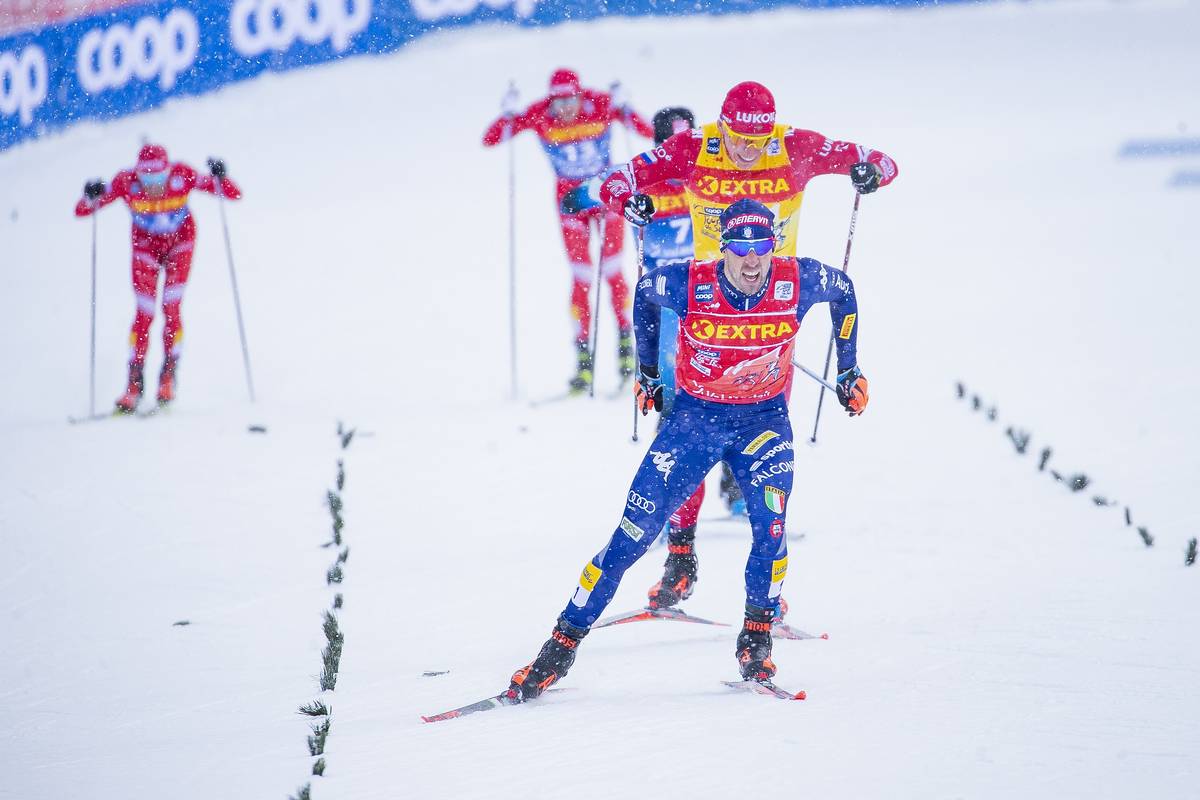
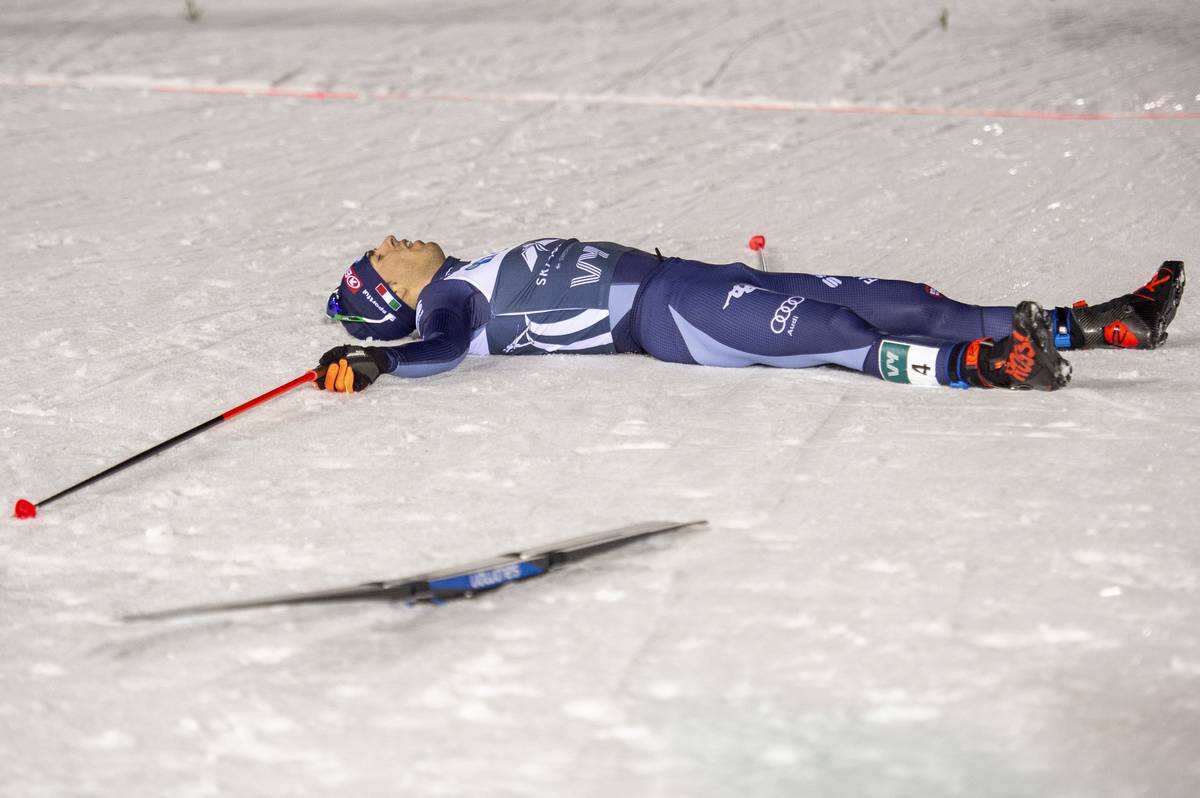
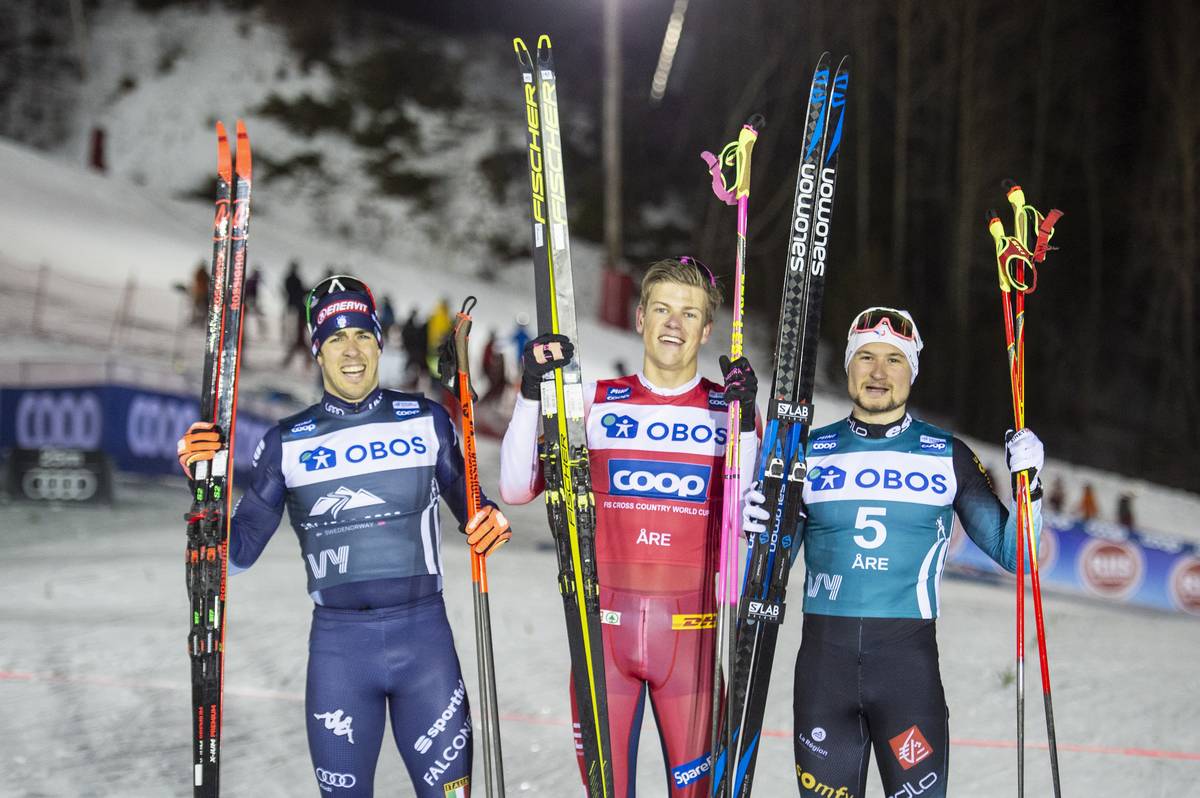
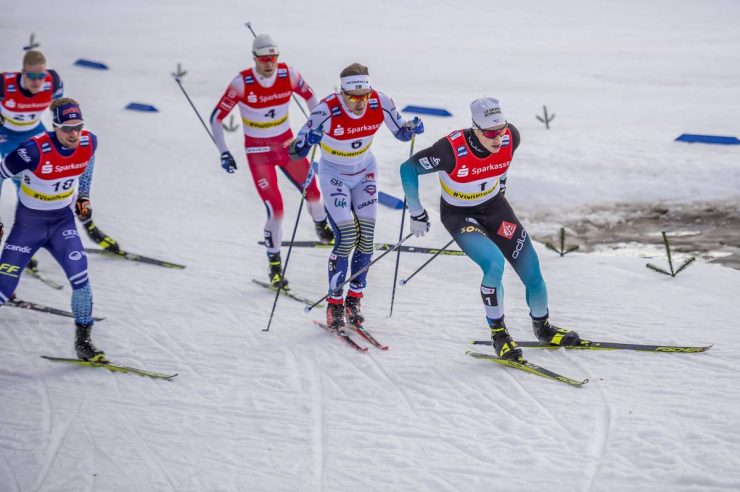
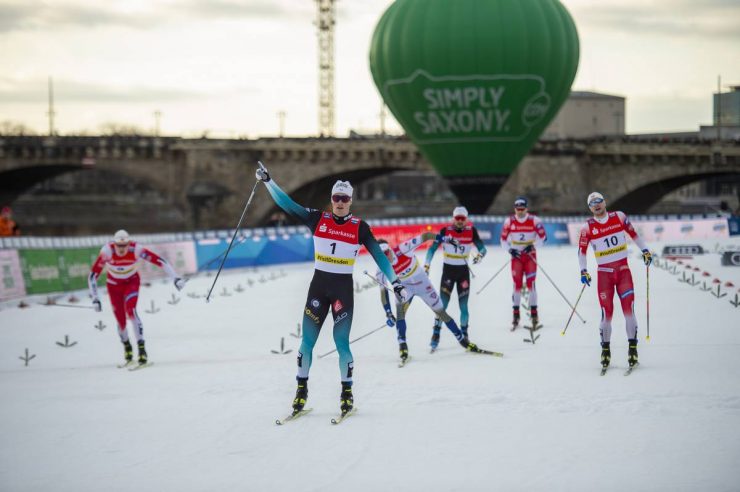
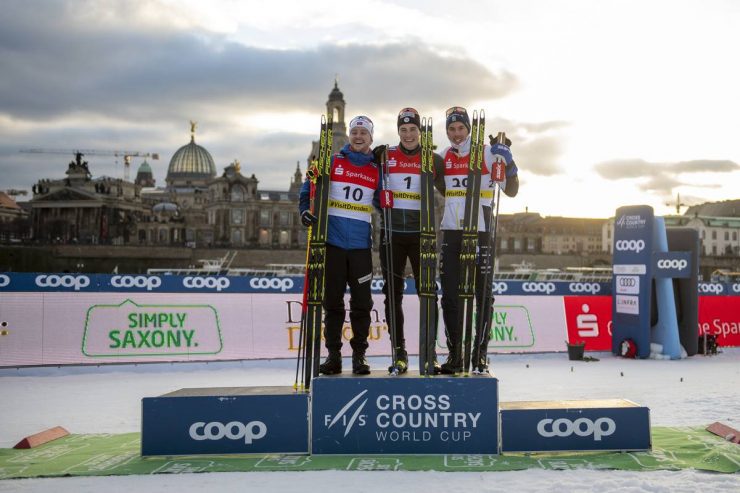
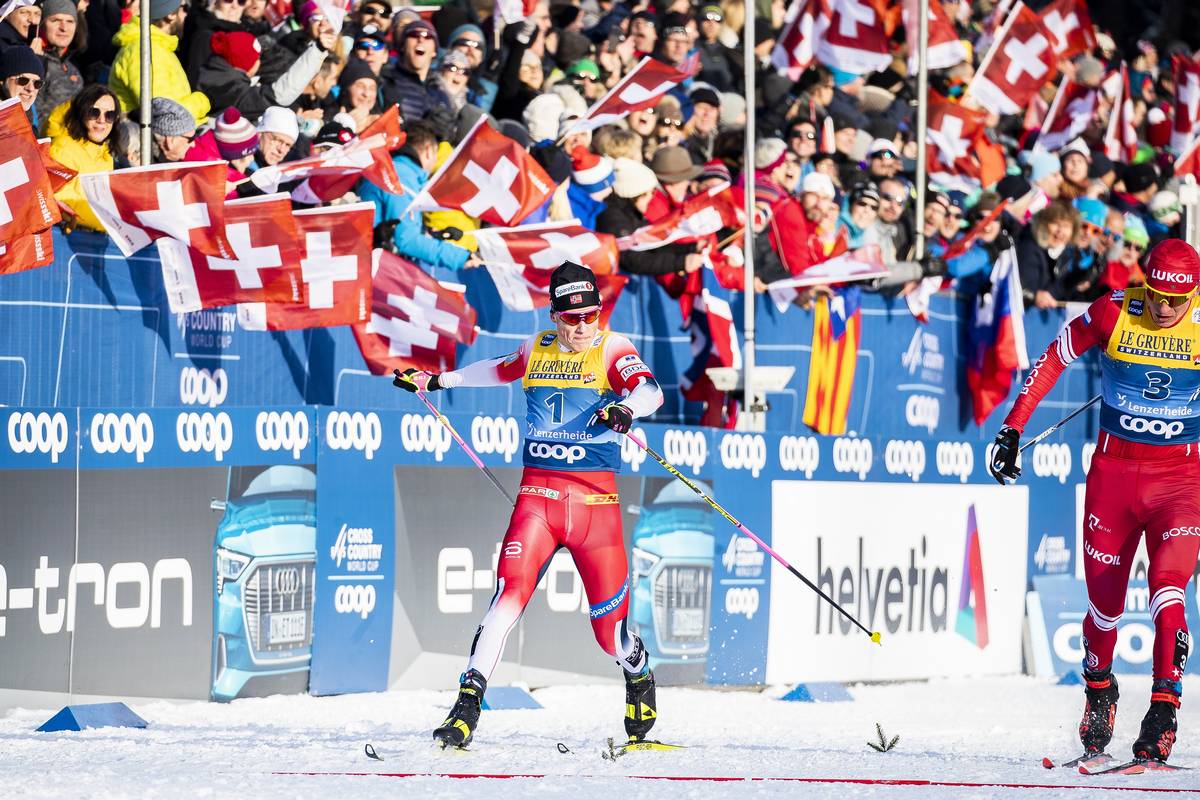
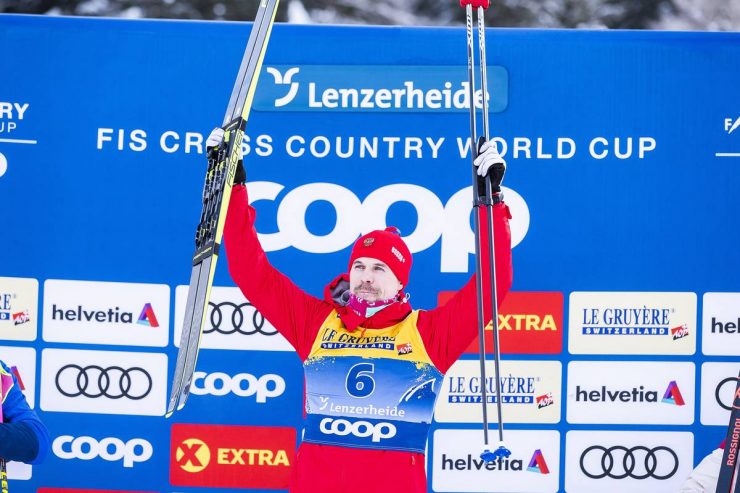
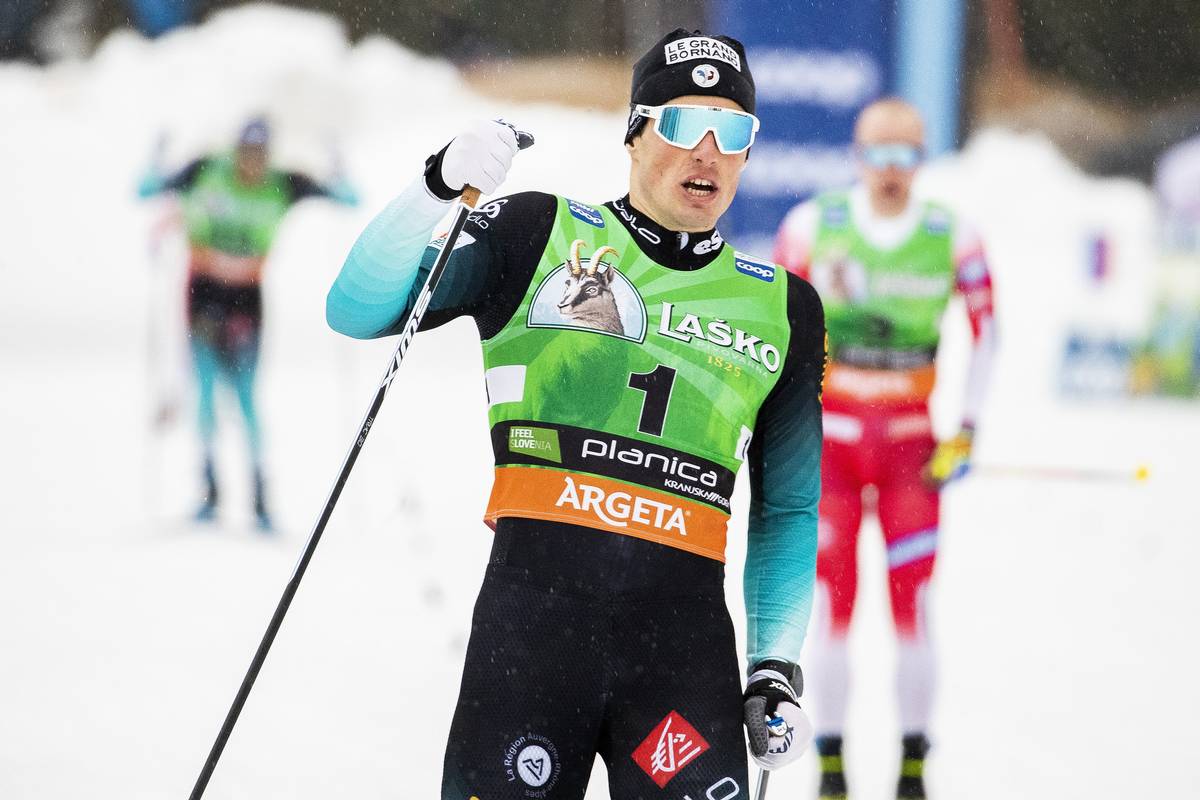
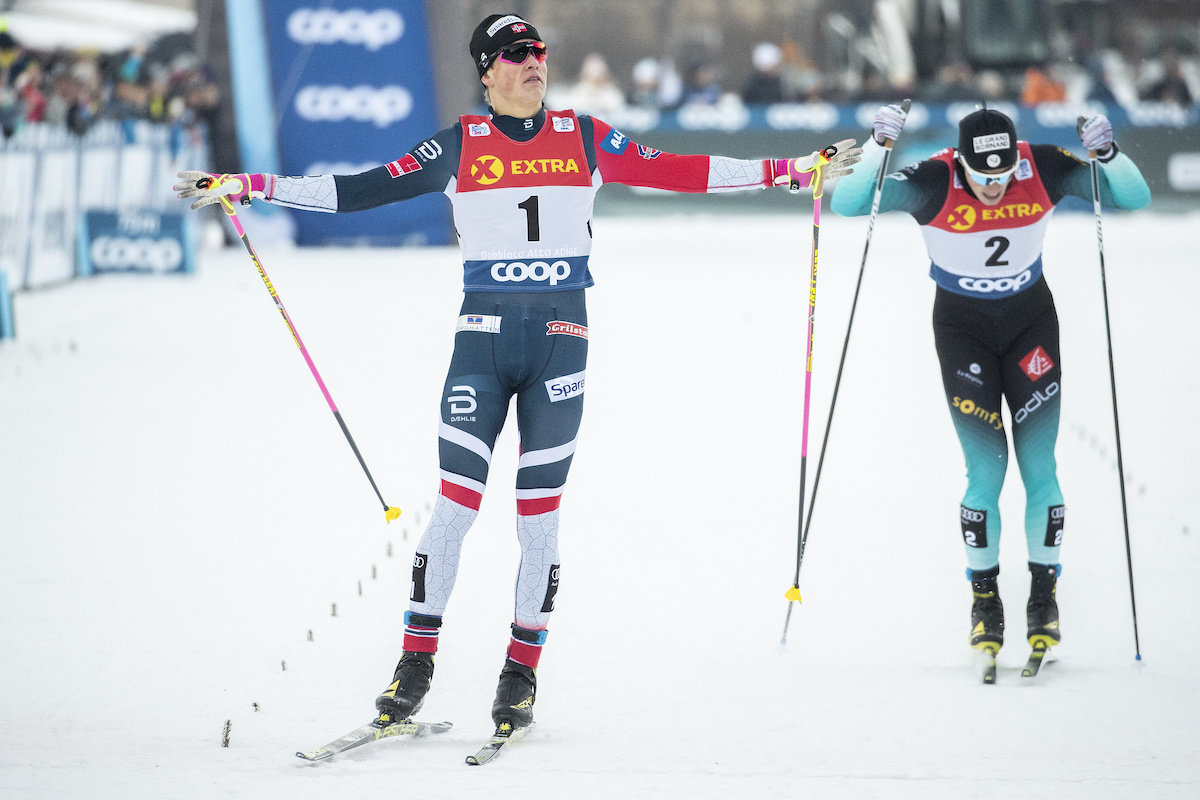
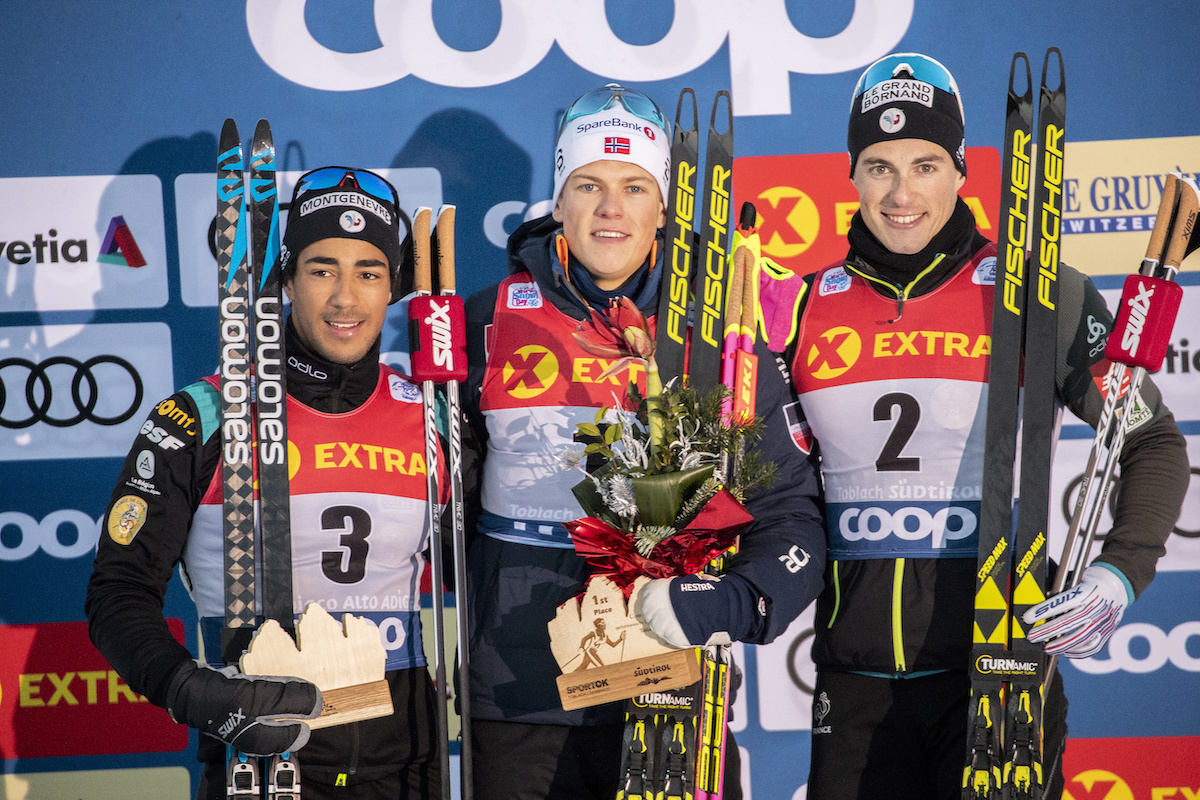
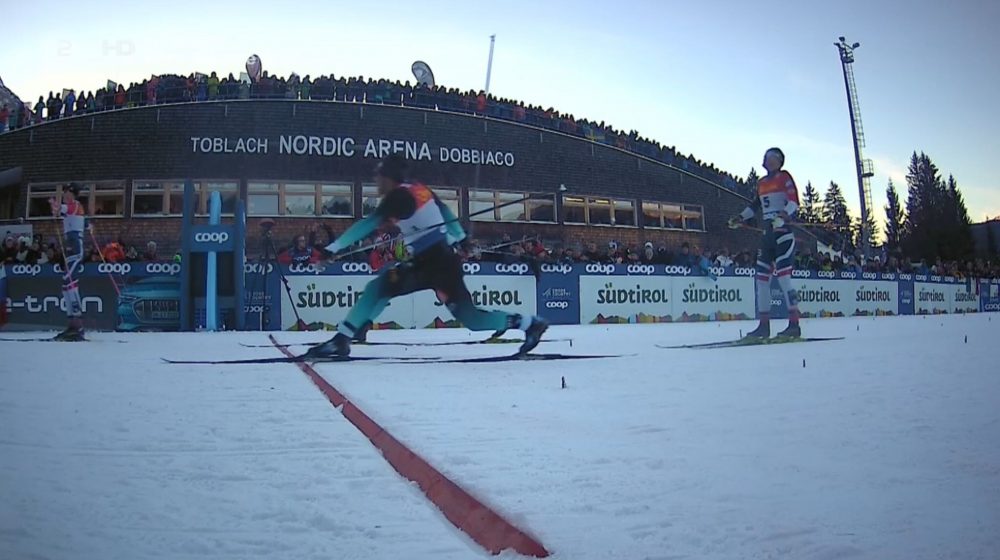
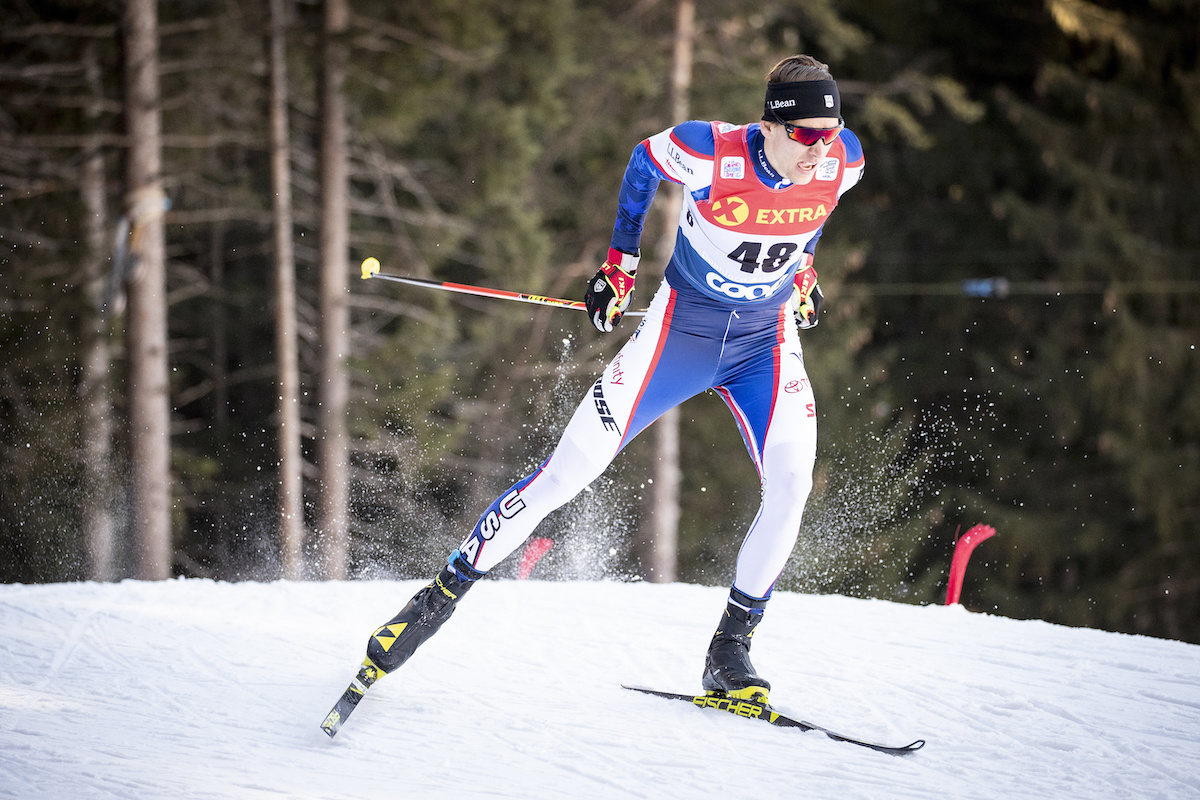
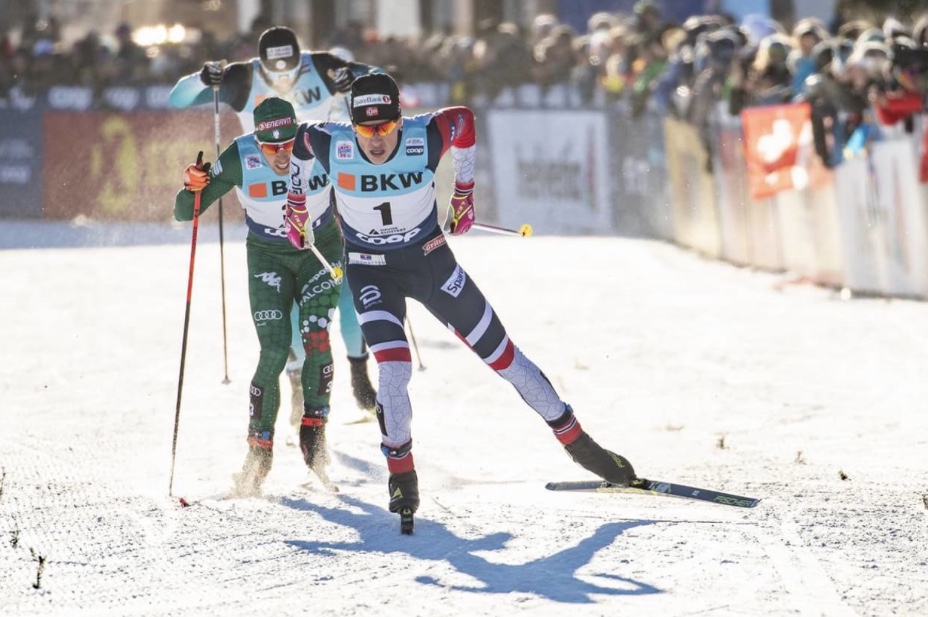
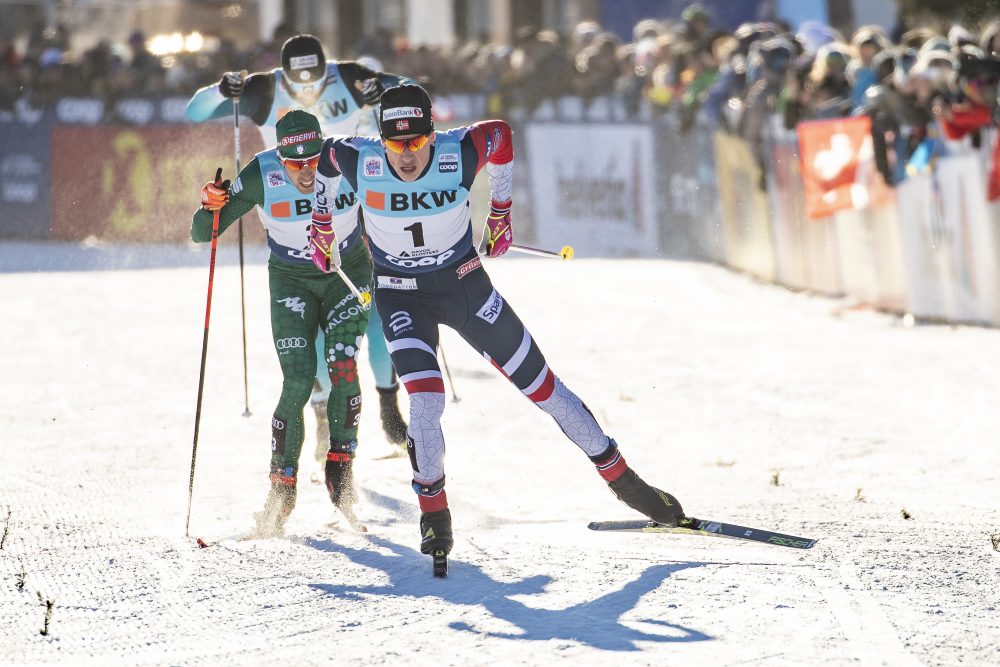
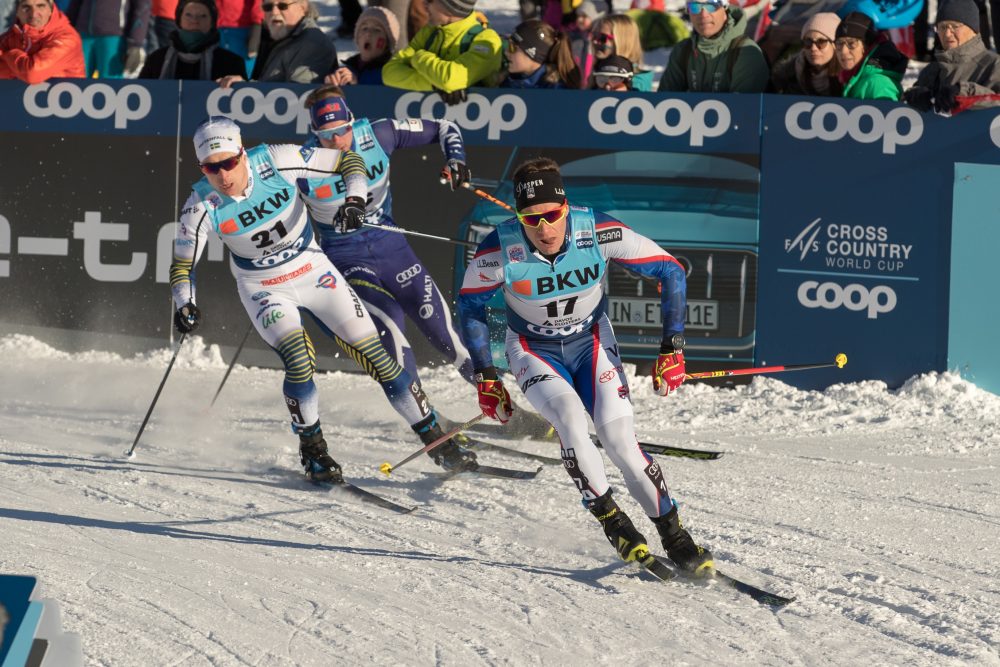
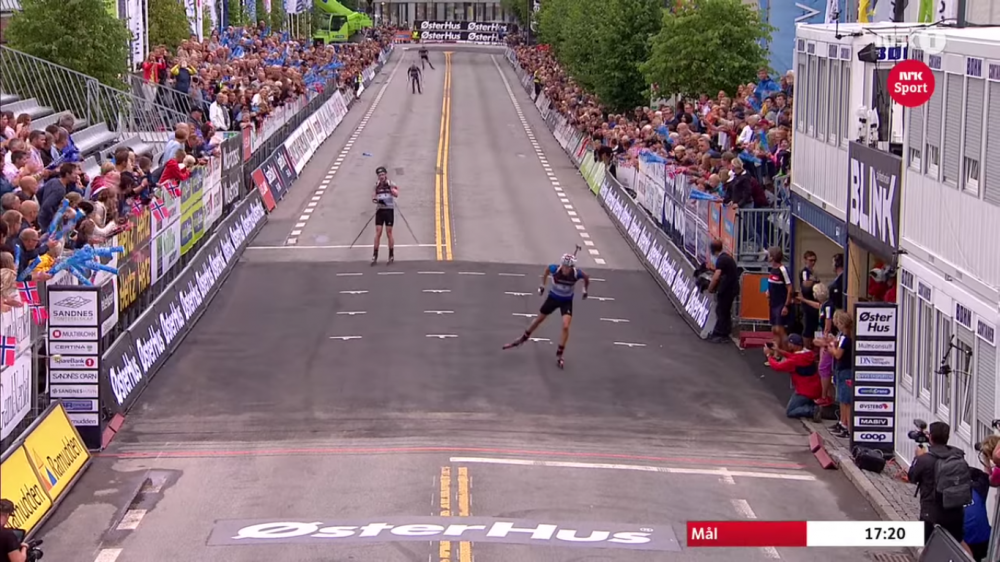
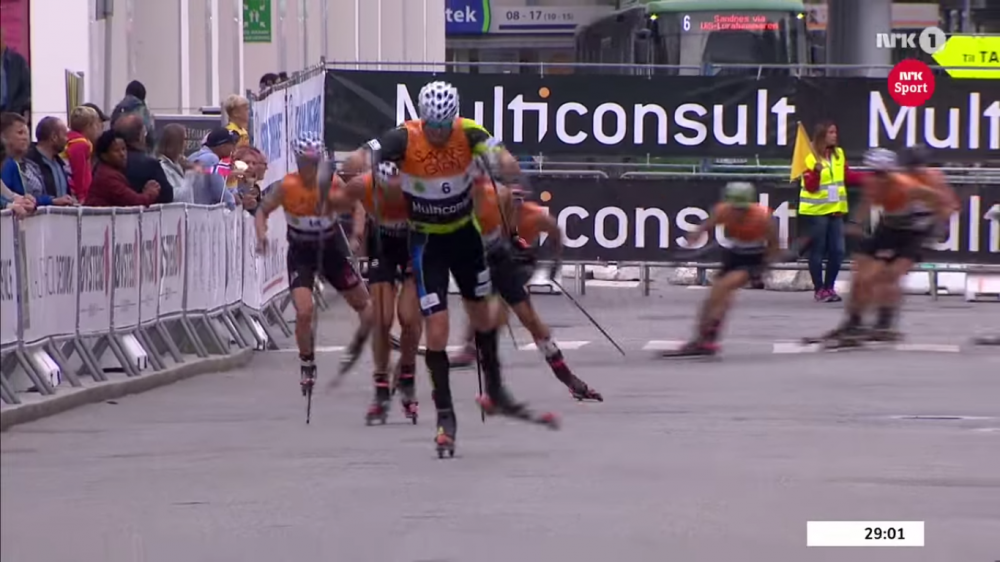
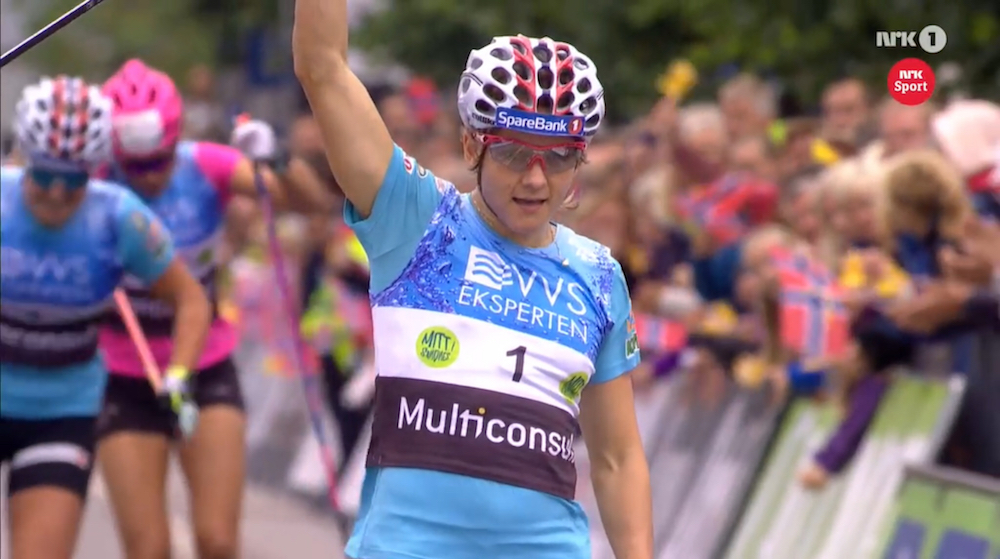
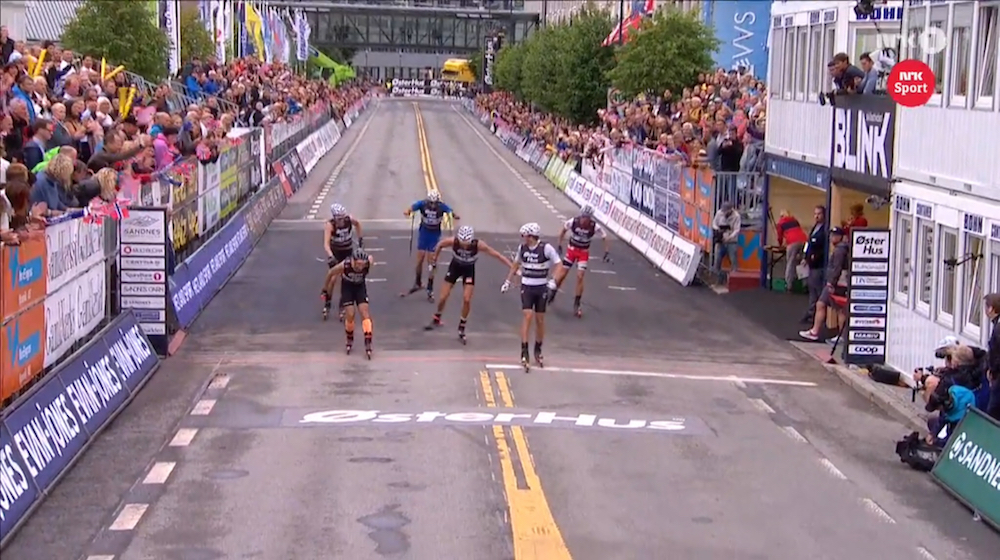
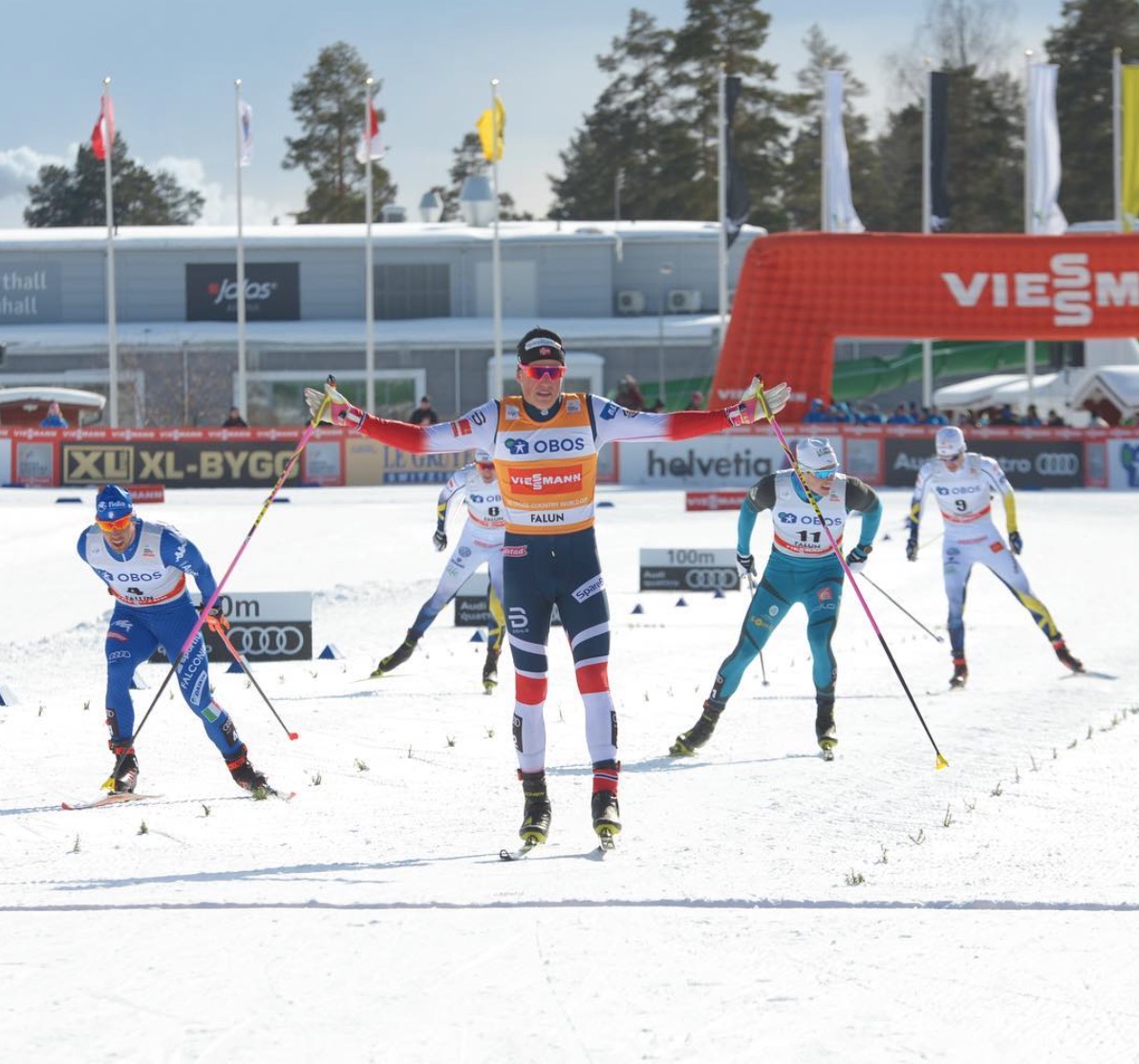
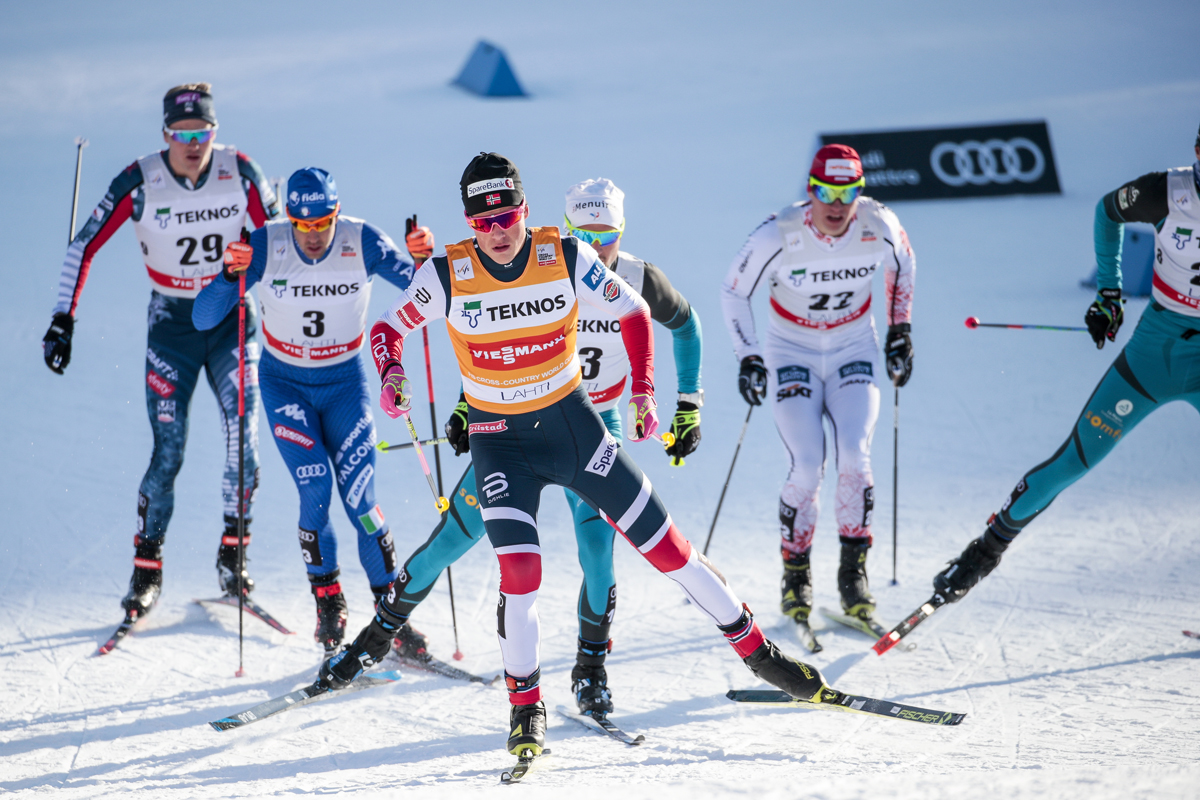
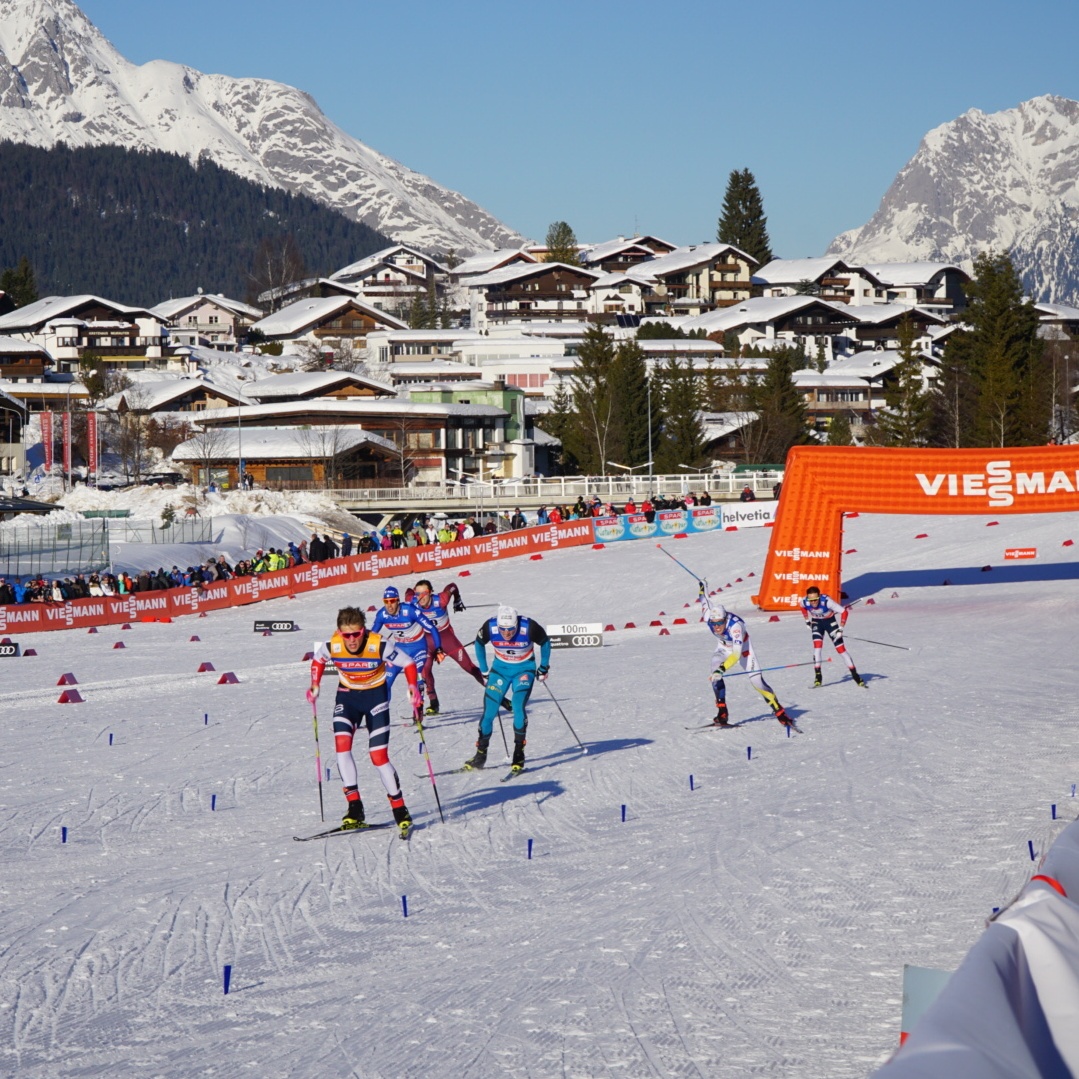
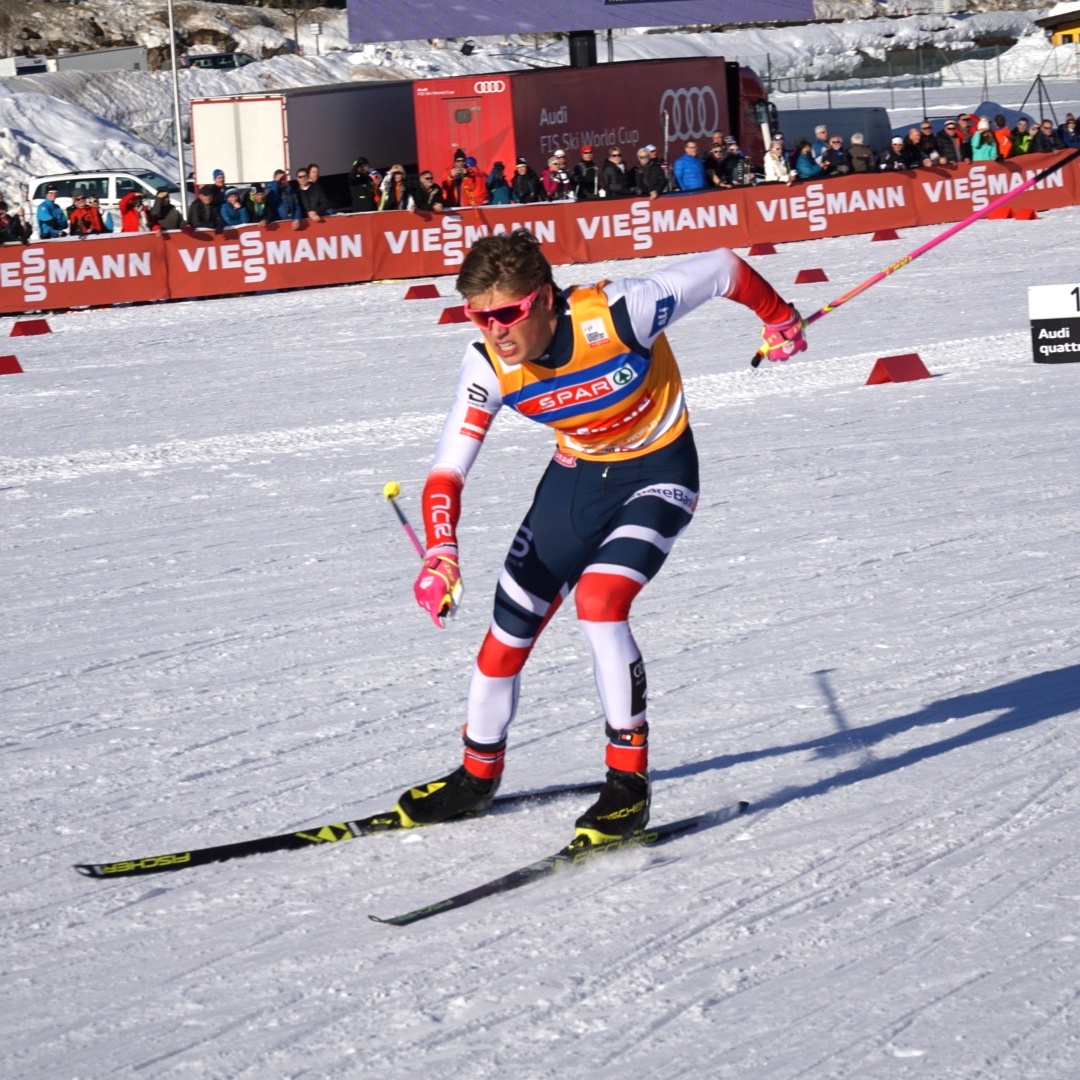
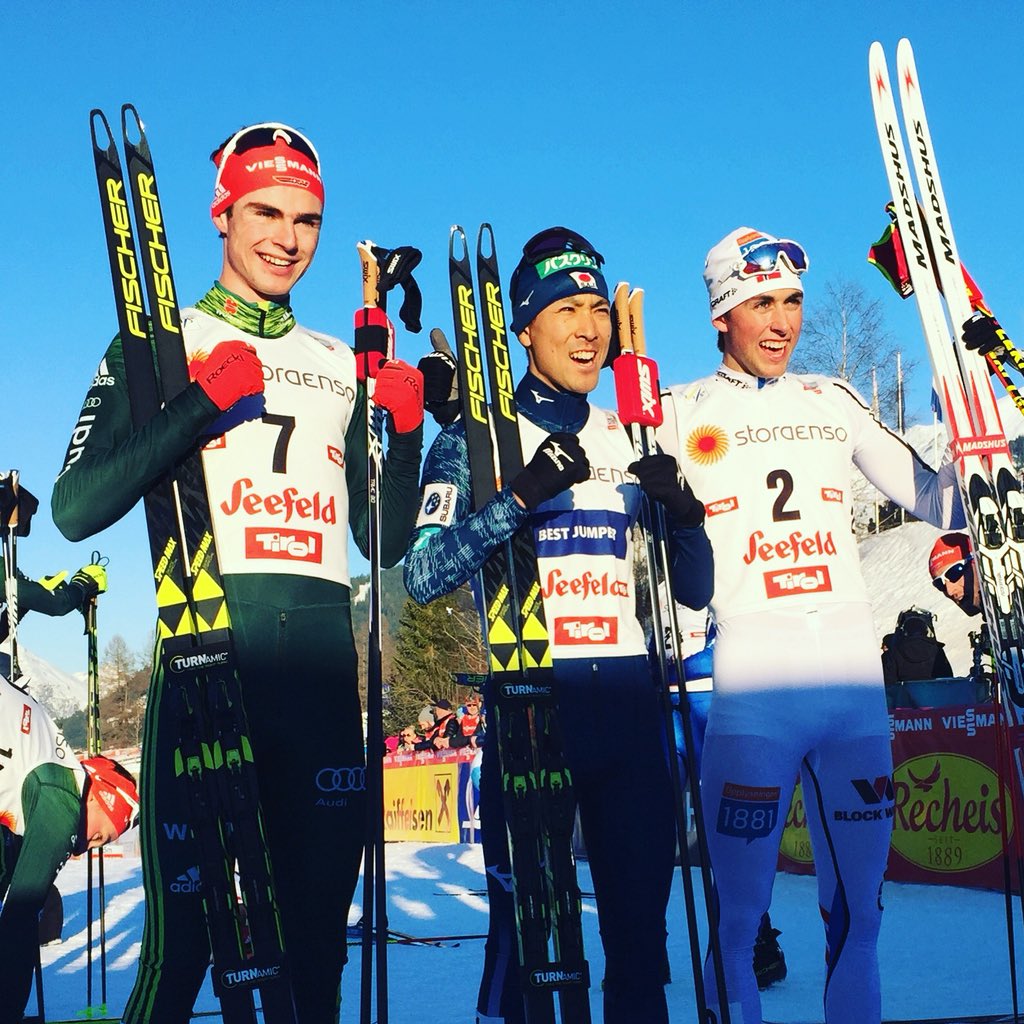
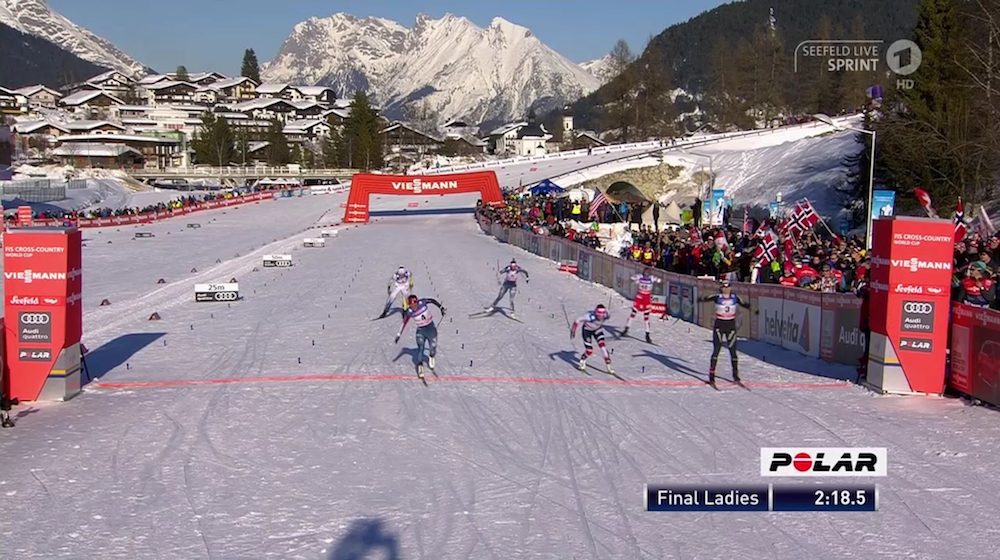
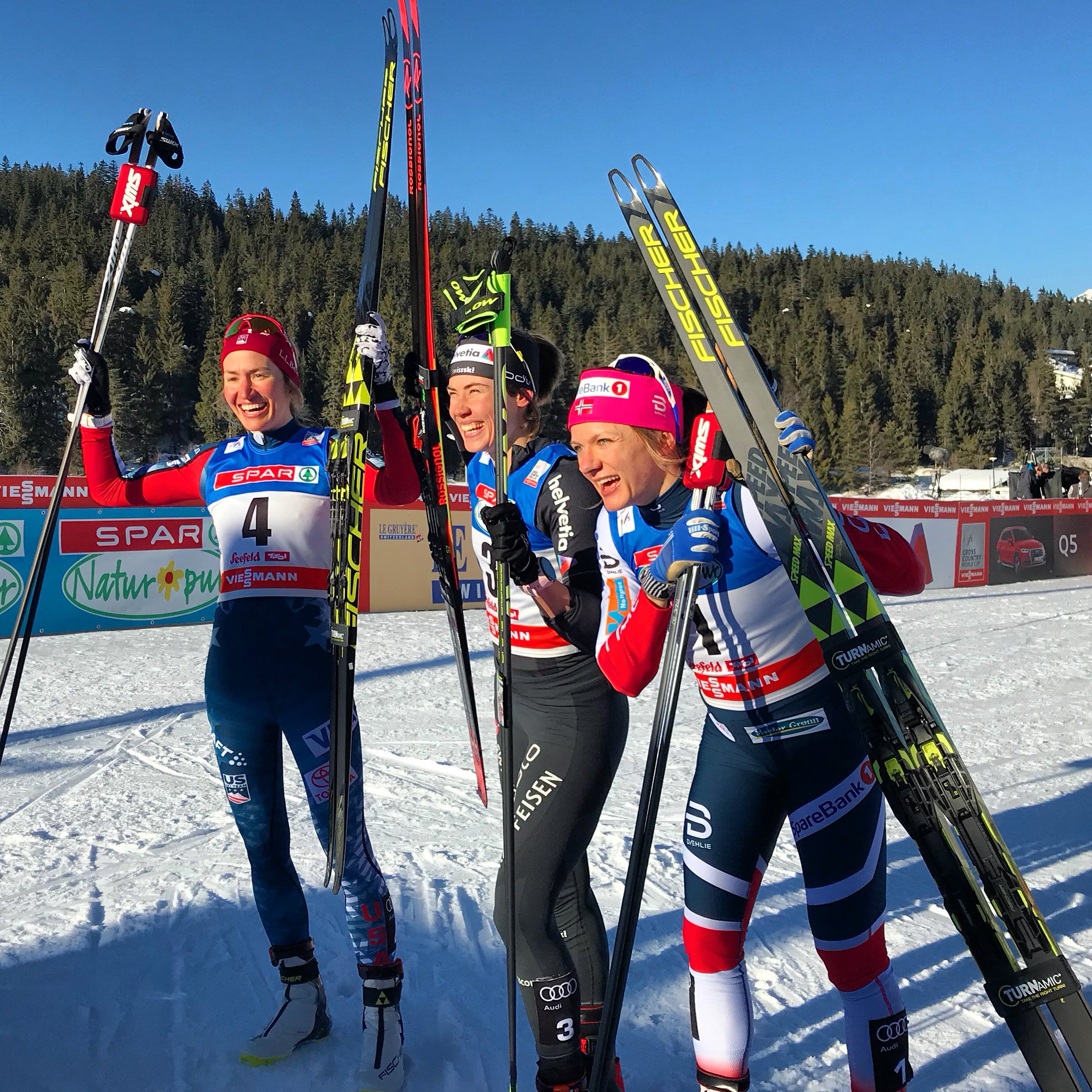
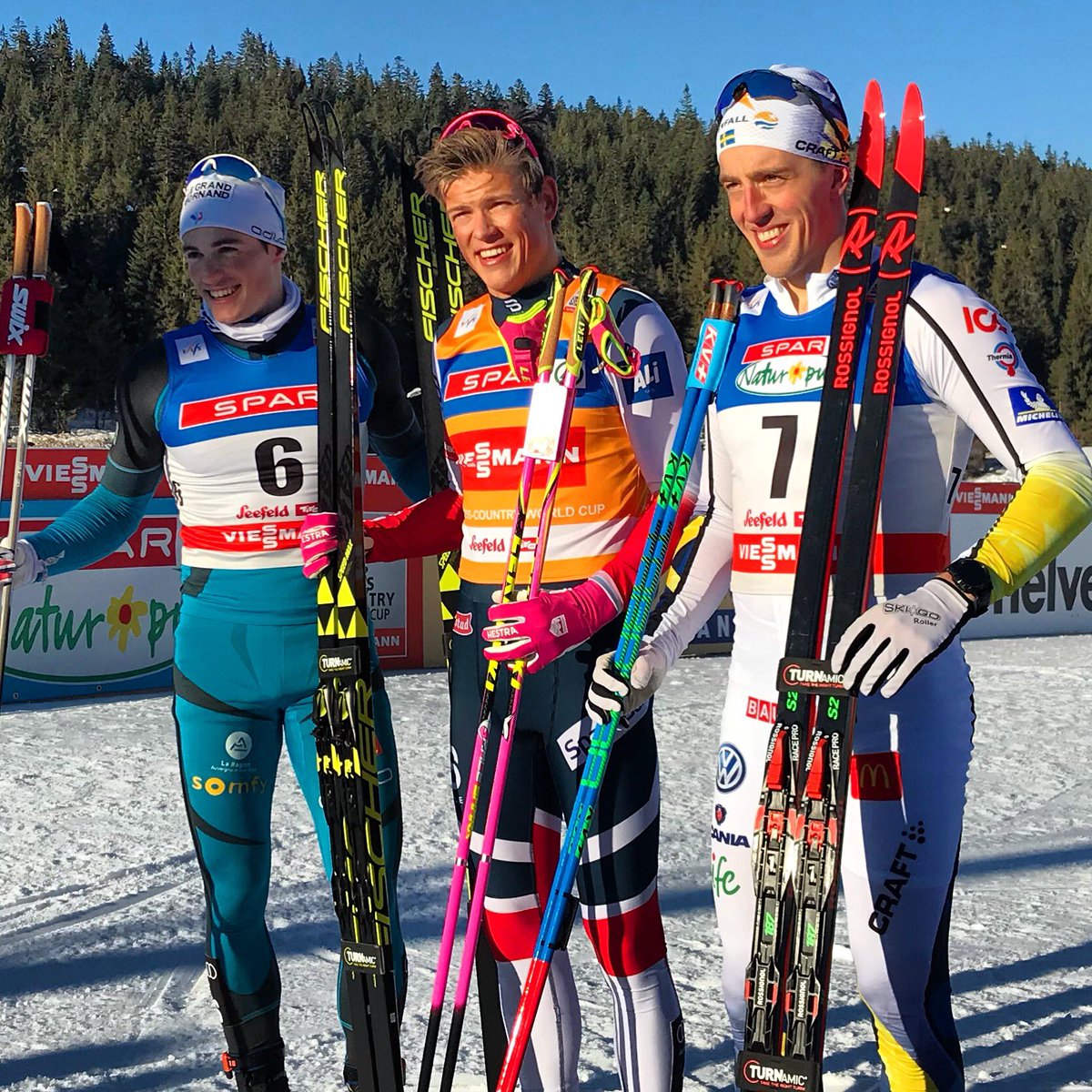
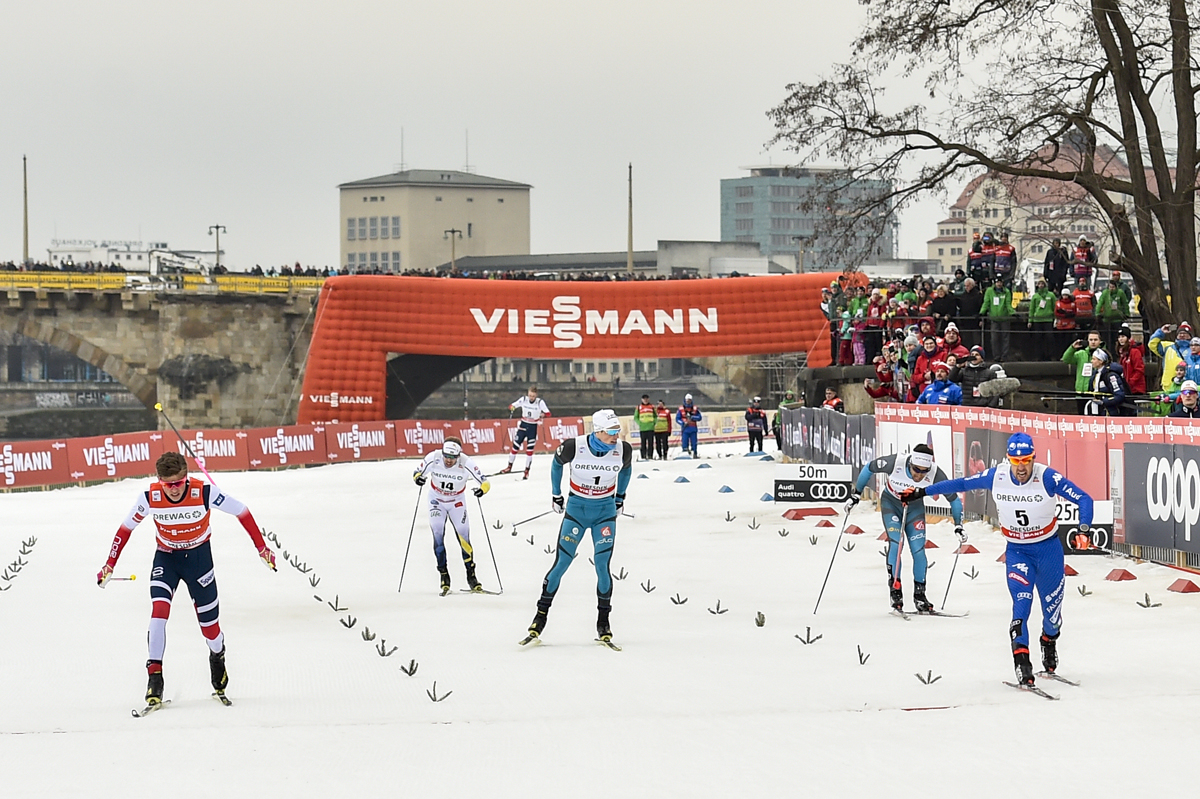
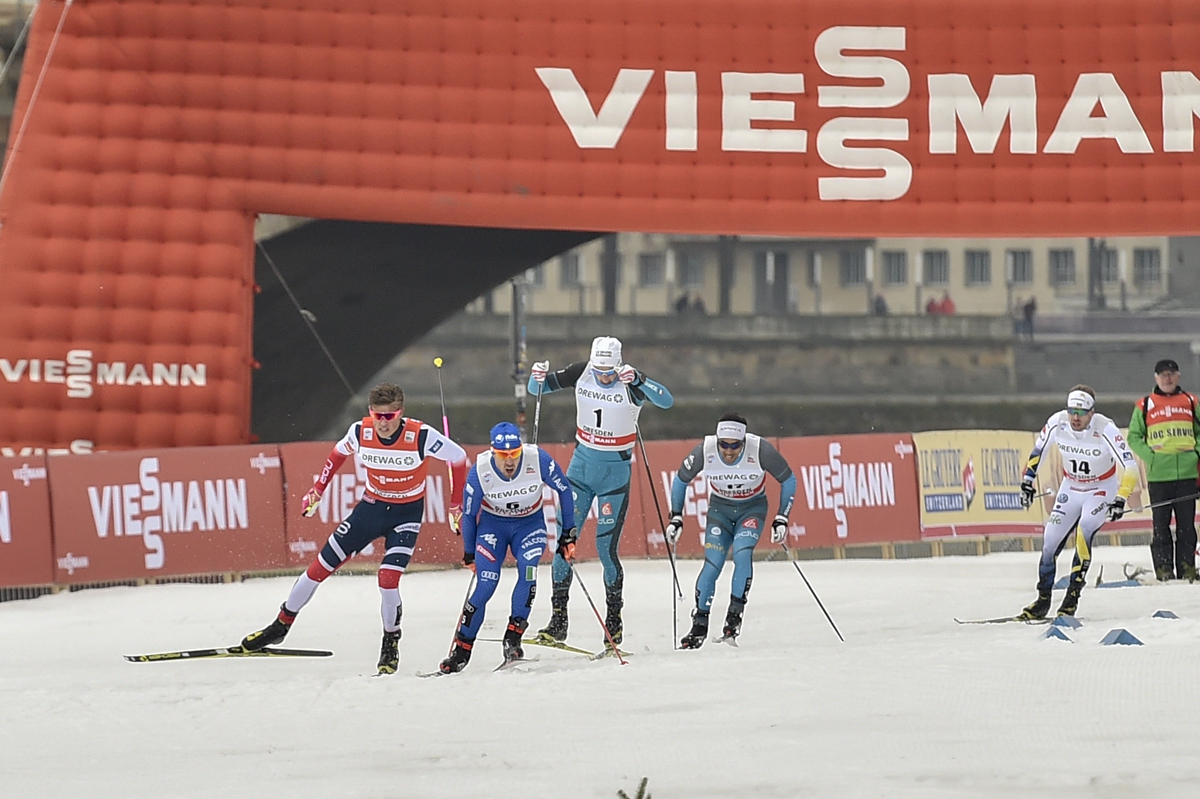
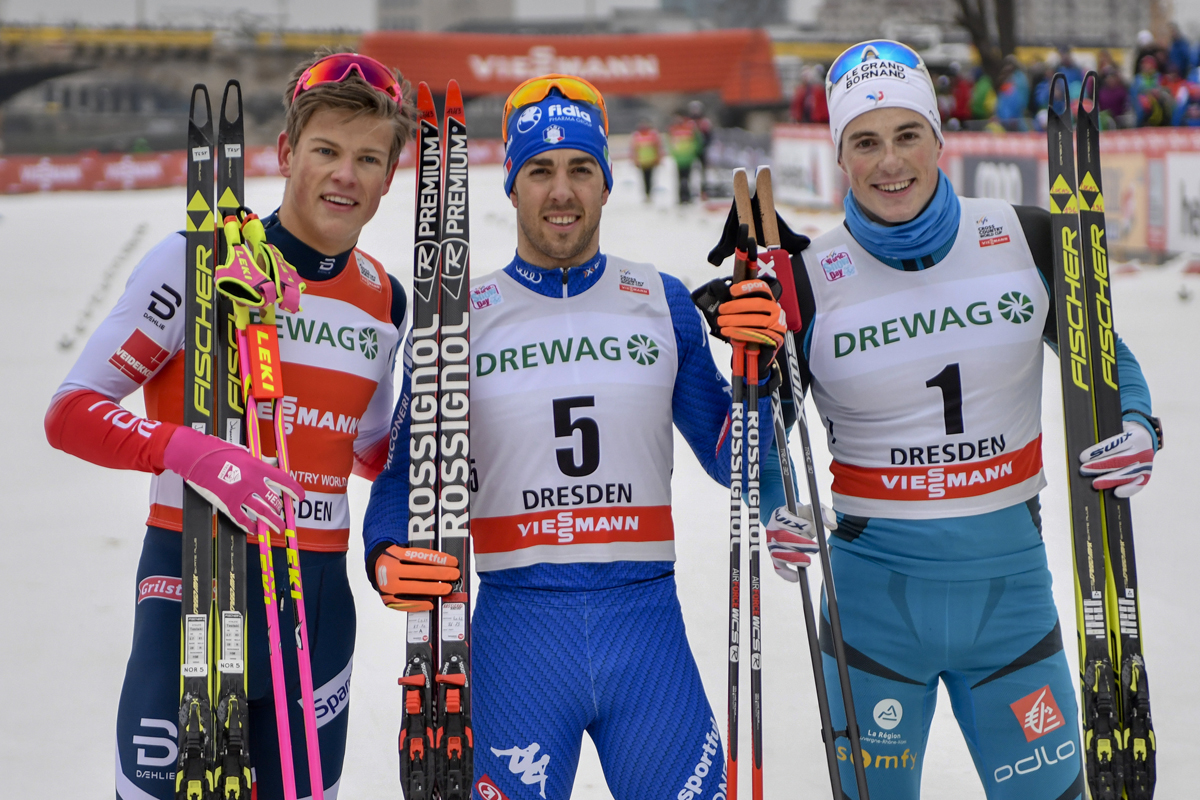
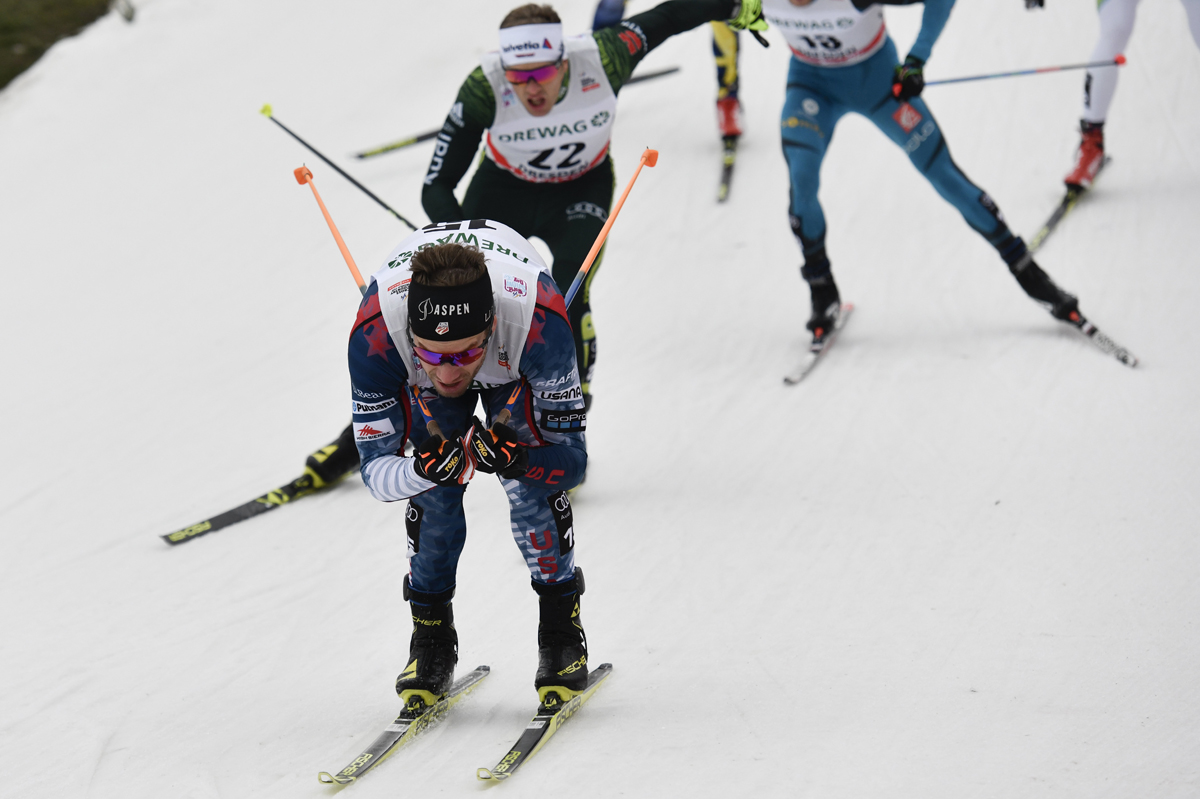
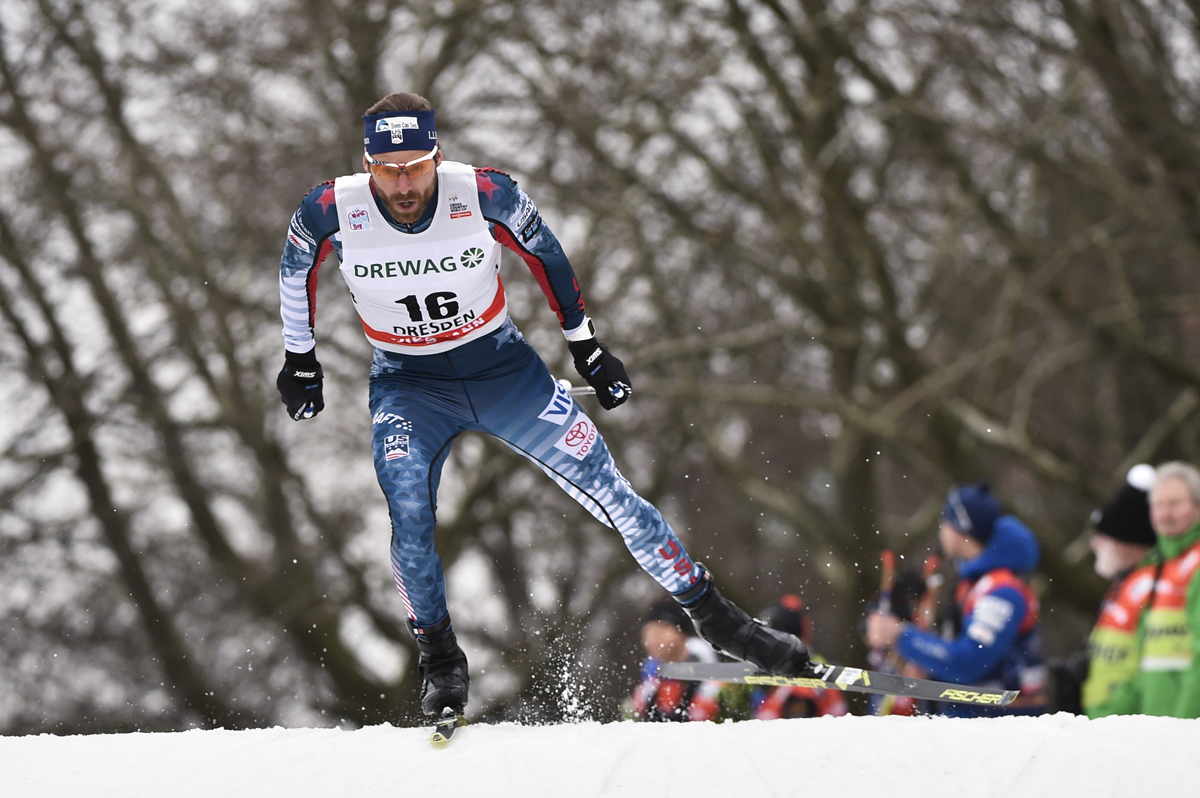
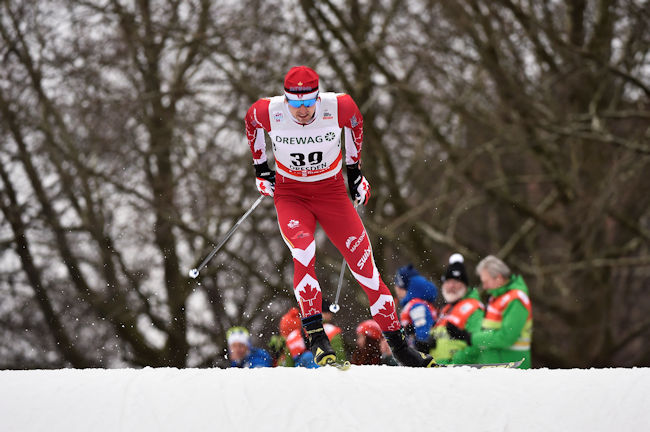
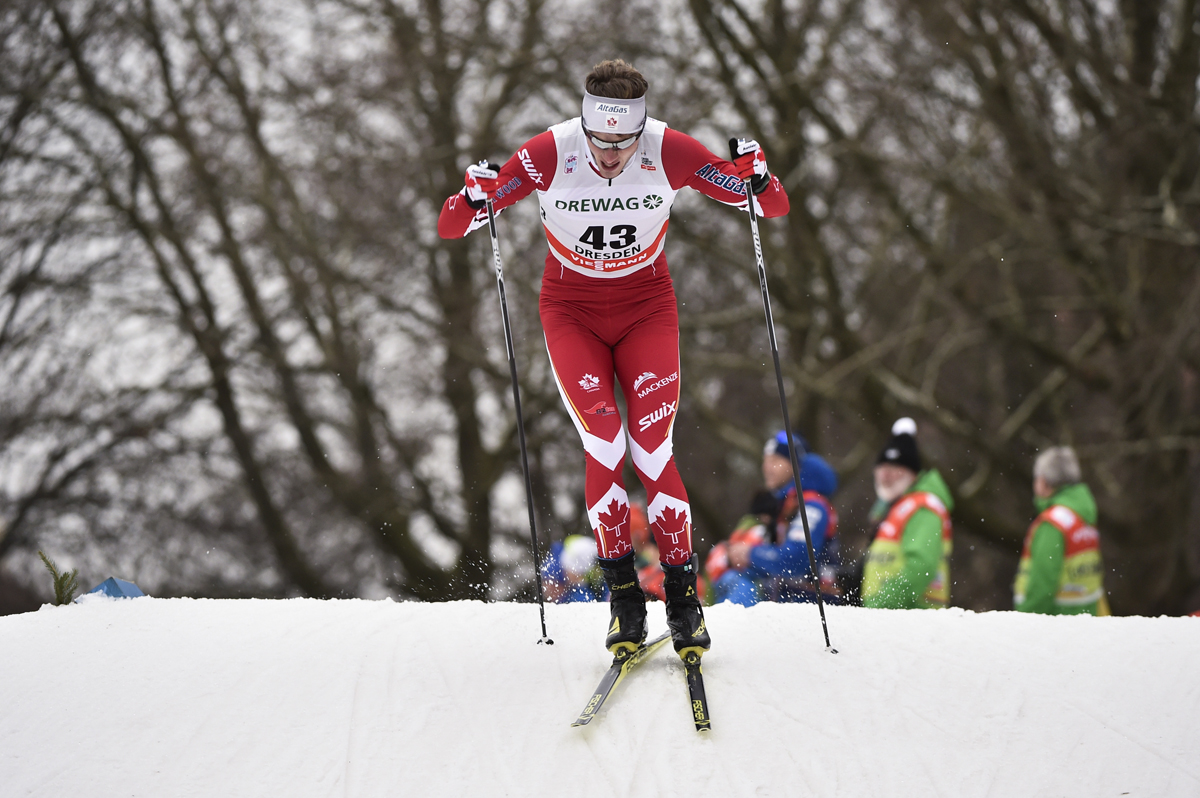
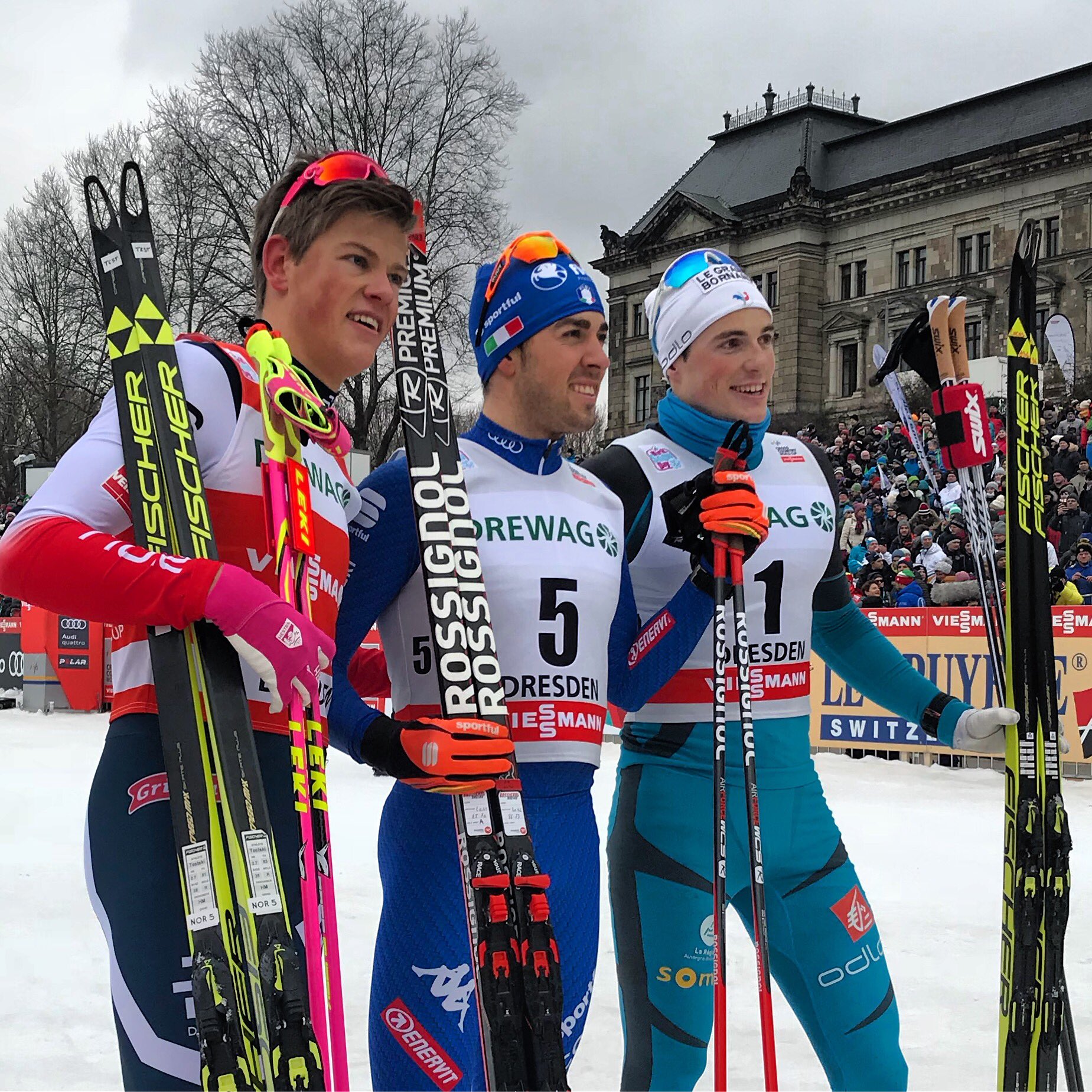
Federico Pellegrino of Italy crosses the line first for his third World Cup sprint win in a row. (Photo: NordicFocus)
This World Cup coverage is made possible through the generous support of Marty and Kathy Hall and their A Hall Mark of Excellence Award. To learn more about A Hall Mark of Excellence Award or to learn how you can support FasterSkier’s coverage please contact info@fasterskier.com.
A new year, new snow, and some welcome faces at the start of the 2021 Tour de Ski in Val Müstair, Switzerland. In this 15th edition of the TdS, the first three stages of eight take place in Val Müstair. The tour then proceeds to stages in Toblach and Val di Fiemme, Italy.
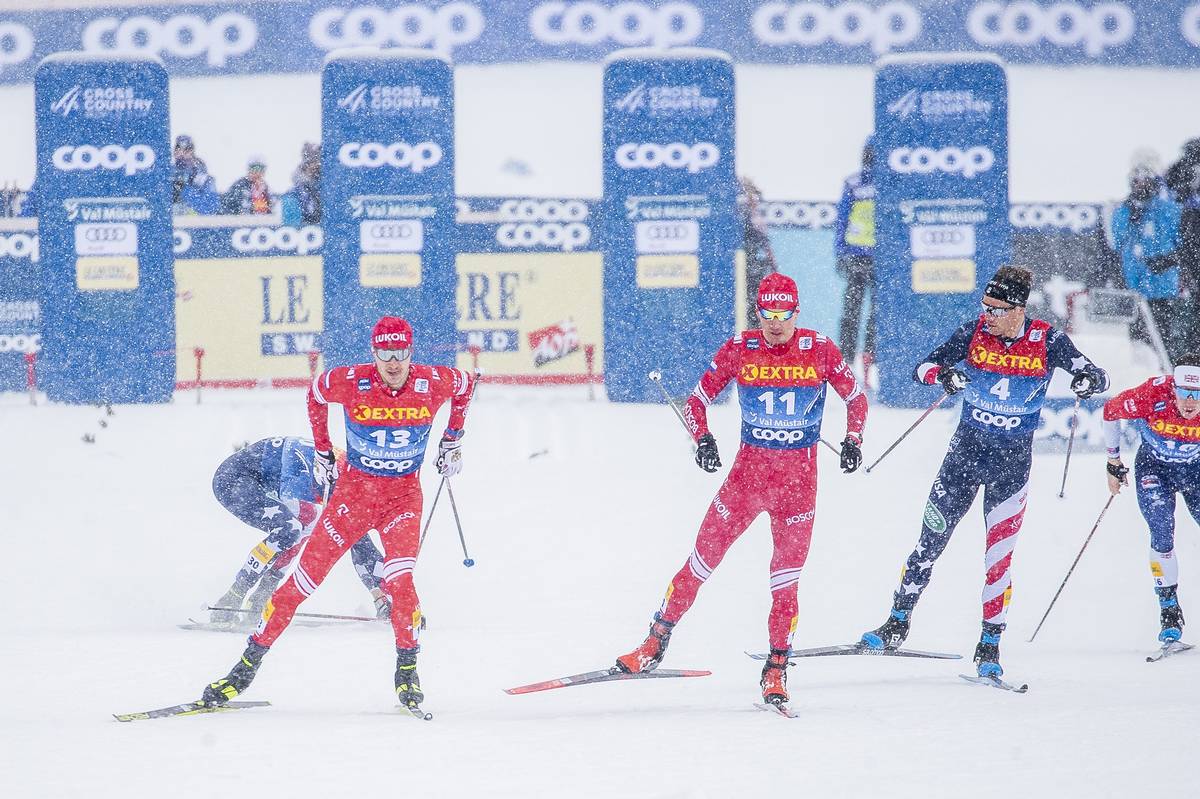
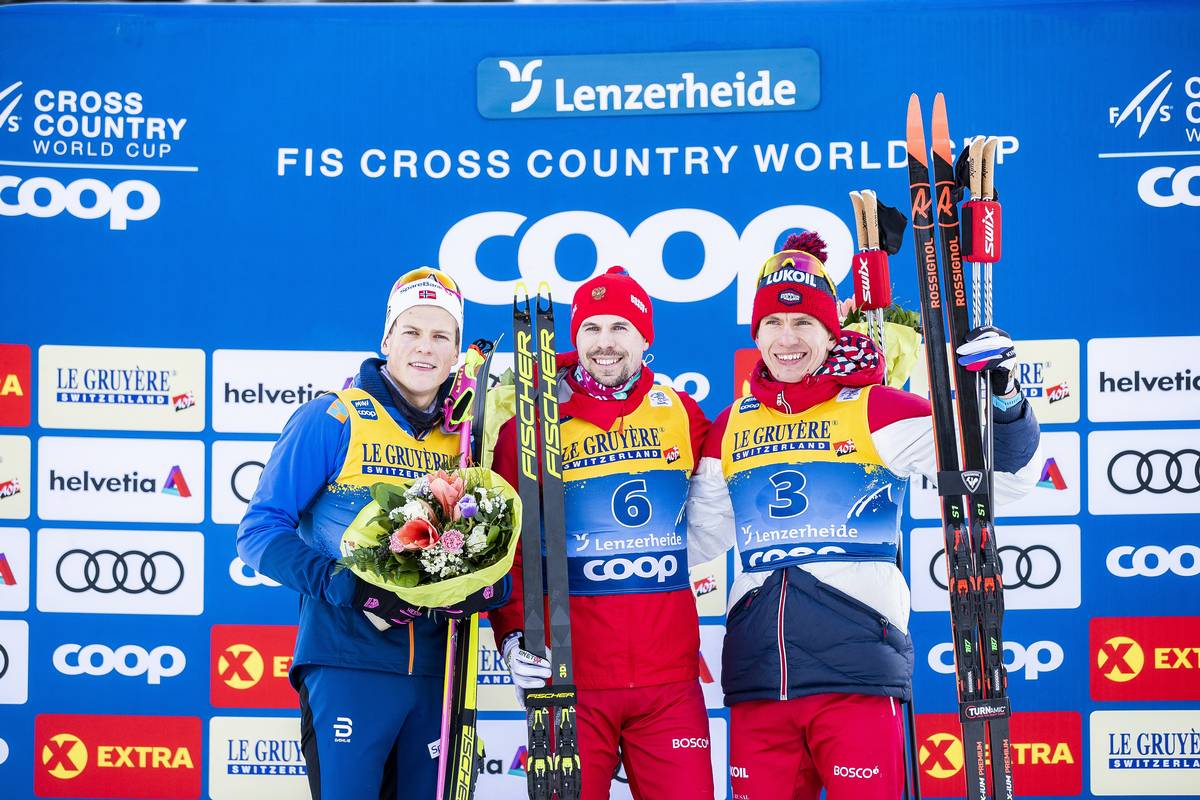
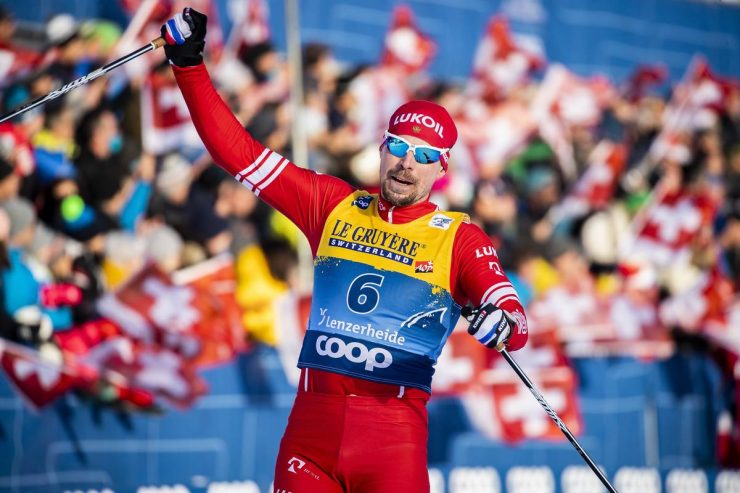
Friday’s 1.4-kilometer freestyle sprint was a two-lap race on a course featuring banked turns, waves, and a small jump. This cross-country sprint playground was exactly that for Italy’s Federico Pellegrino (30) won the final’s in 3:08.44 as steady snow fell over the iconic alpine valley setting. The final featured Russians Alexander Bolshunov, Gleb Retivykh, and Artem Maltsev, with Frenchmen Richard Jouve and Lucas Chanavat rounding out the group of six.
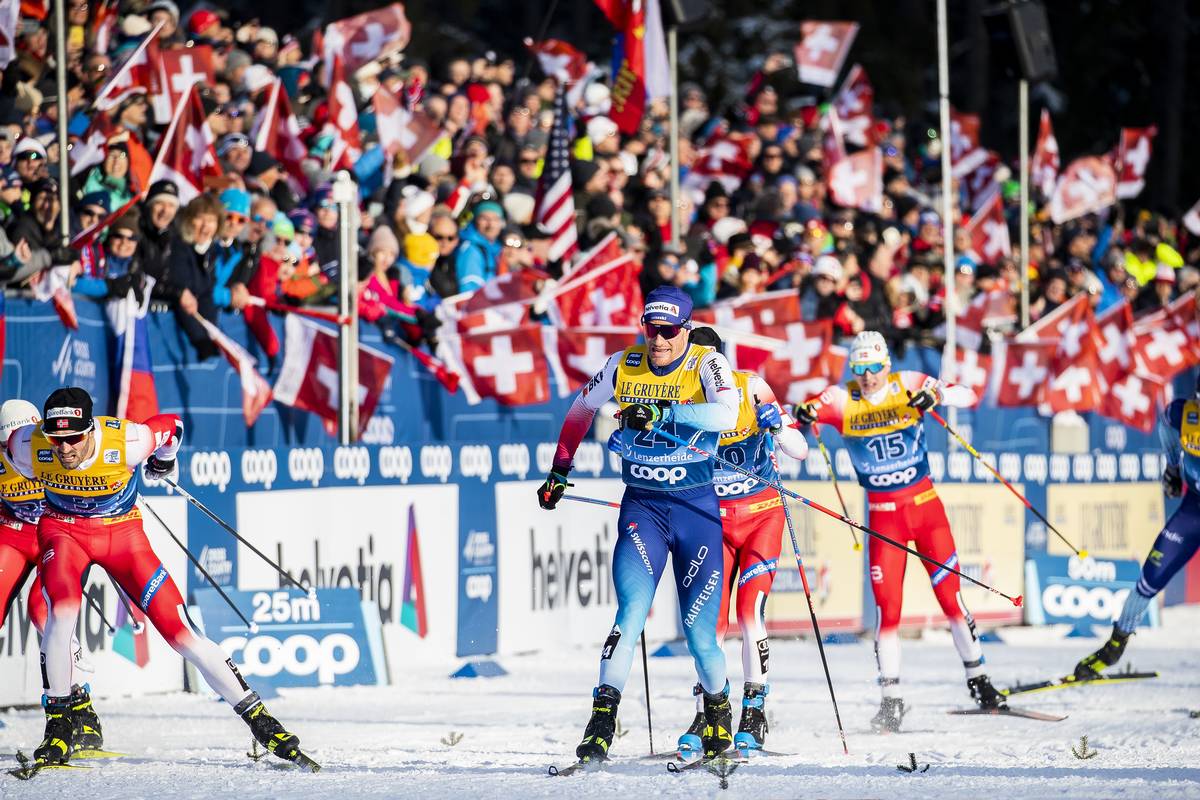
On the first lap, the Russians played coy and skied behind, while Chanavat commanded the pace. As the second loop began, Pellegrino began his surge creating a small gap to Bolshunov in second and Jouve third. Careening down the winding curves, Pellegrino free skated his way into the rollers, pumping over the top to accelerate into the final curve and maintain command from the front as he entered the final lanes.
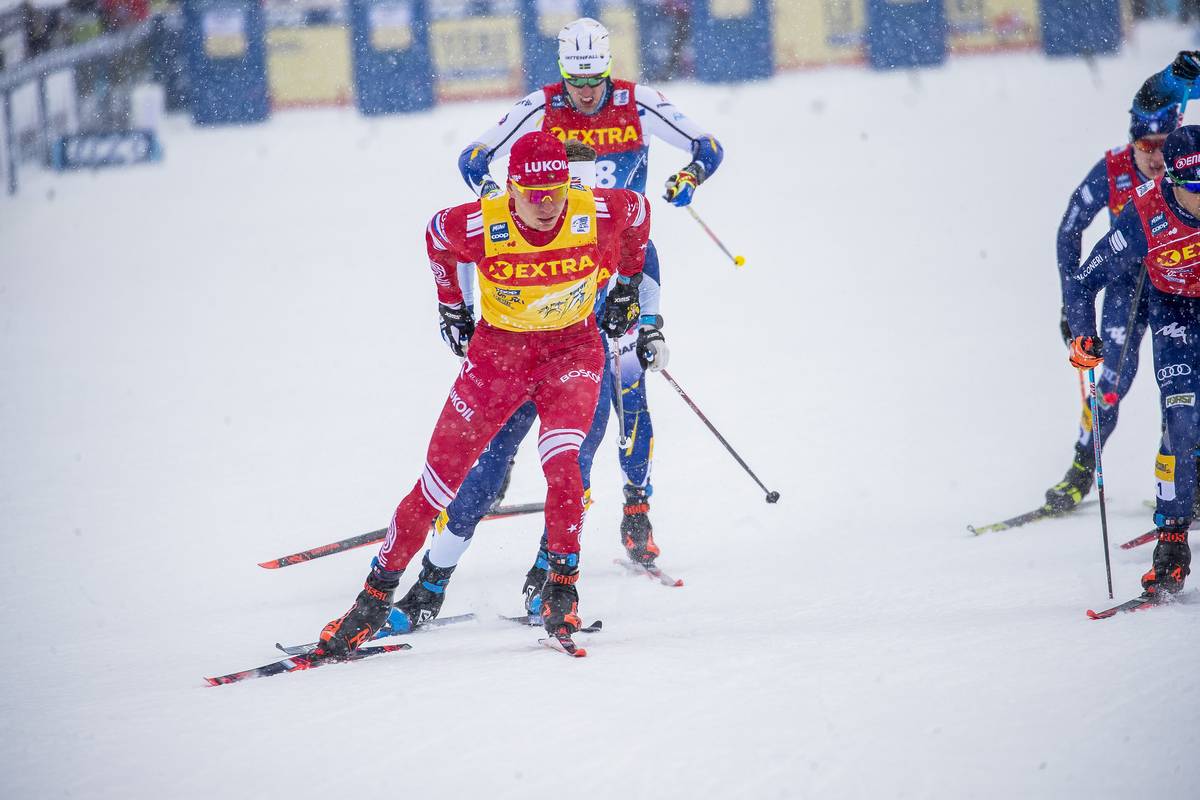
Alexander Bolshunov, the overall favorite for this edition of the TdS, places second, a spot behind Italy’s Federico Pellegrino who won the day. (Photo: NordicFocus)
Though Bolshunov was closing hard behind him, Pellegrino stayed strong enough to comfortably take the stage. The Russian locked up second (+0.57) with Jouve in third (+2.43). Retivykh placed fourth (+4.33), Maltsev fifth (+4.82), and Chanavat sixth (+28.28).
“[My legs] hurt; it hurts a lot… I think the feeling was better in the qualification than in the final, but I knew that I wanted to be really good here today,” Pellegrino told FIS after the race. “I had a lot of pressure, just made by myself, because after two victories, for sure you feel that you can continue to win.”
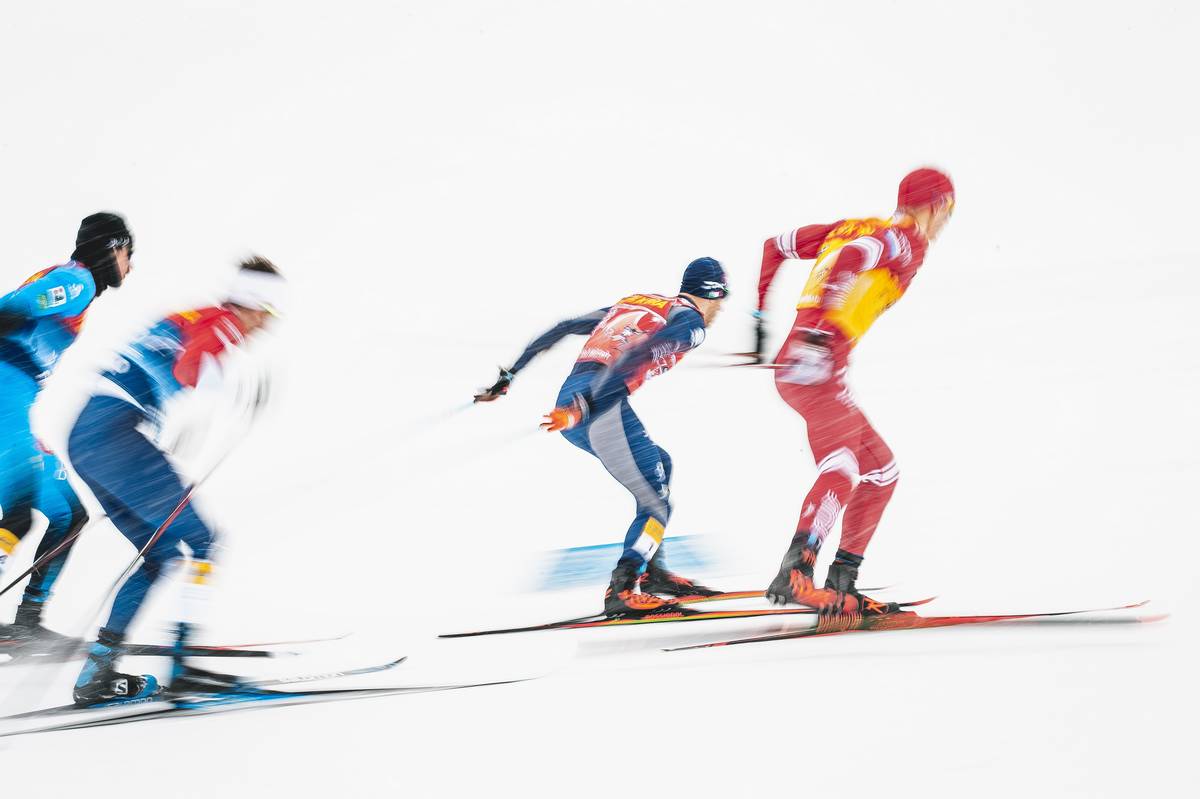
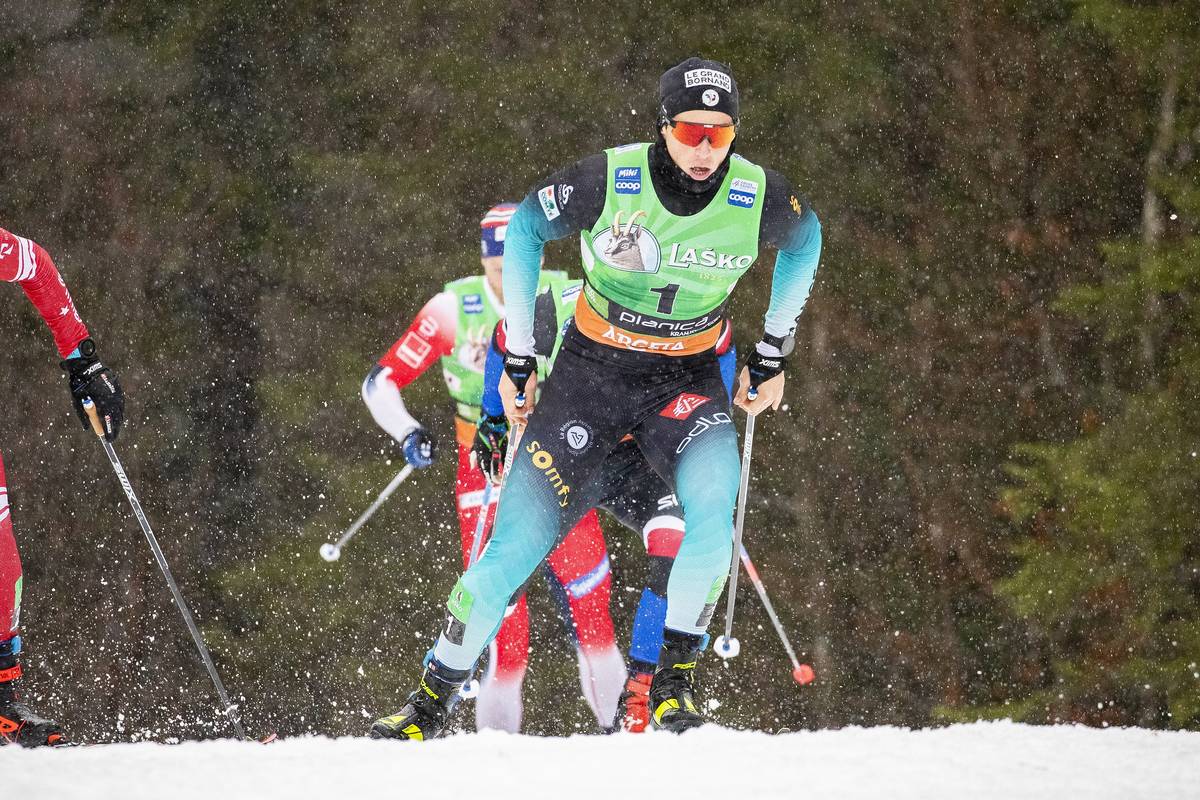
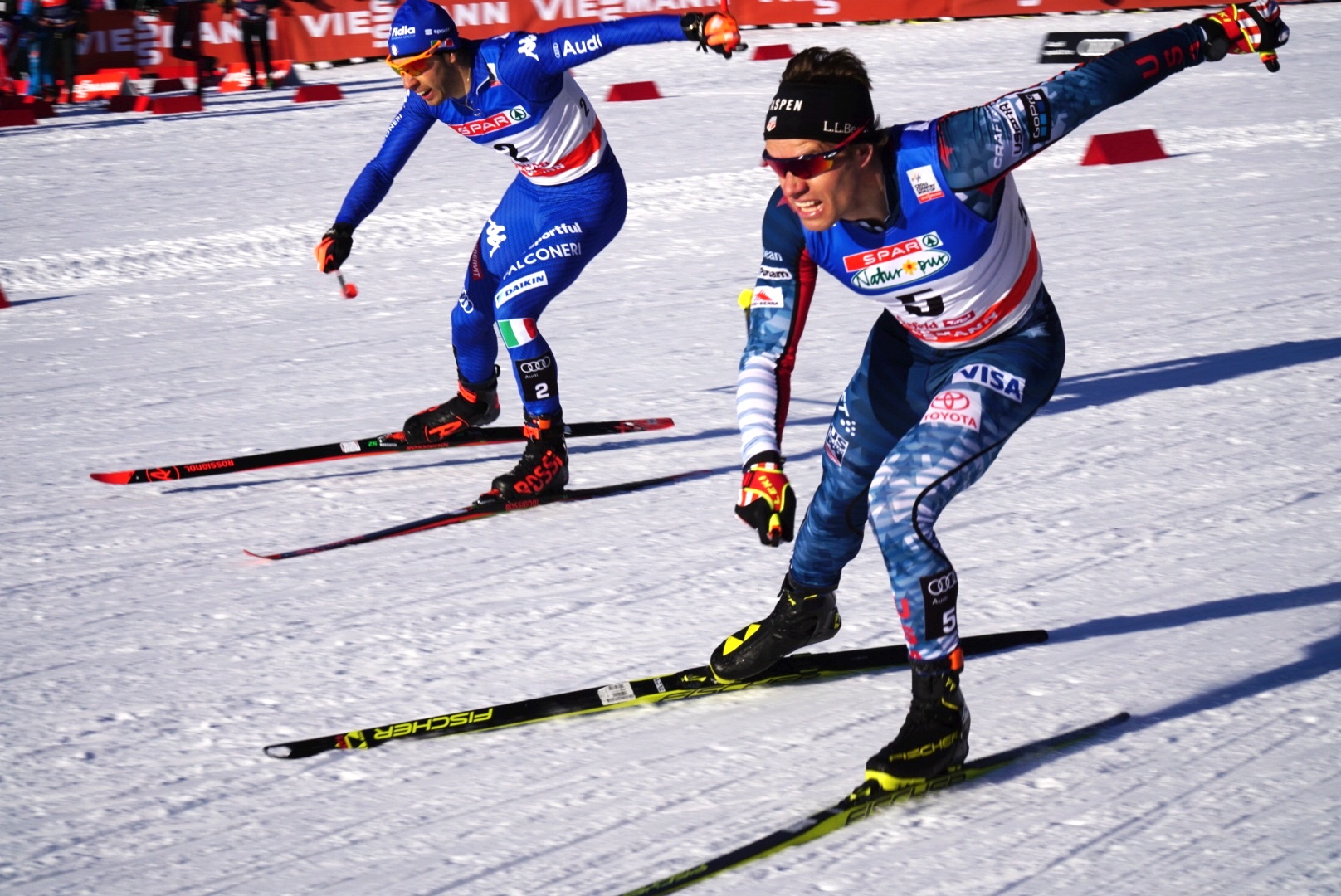
Federico Pellegrino and Alexander Bolshunov setting the pace. (Photo: NordicFocus)
Pellegrino made his dedication and intent clear from the beginning. He posted the fastest qualifying time on course by over two seconds, stopping the clock at 3:02.19.
“This is my job,” he said about his participation in the Tour. “To race here is really important.”
The Italian continued by commenting on how the pandemic has affected his country and the traditional New Year’s celebrations that occur. He expressed his wishes to provide an uplift and source of national pride during this challenging time.
“I hope to have given a little bit of sunshine on this new 2021 year.”
Wearing the yellow bib as the overall World Cup leader, Bolshunov is the real threat for the TdS overall. He won last season’s edition, which offered a full complement of racers from Norway. (Norway is not contesting the TdS due to the ongoing pandemic). On his way to winning the 2020 TdS, Bolshunov won a single stage of the TdS, stage 4’s 15 k classic pursuit, before securing the overall on the Val di Fiemme final hill climb.
Let’s take a step back into the earlier rounds.
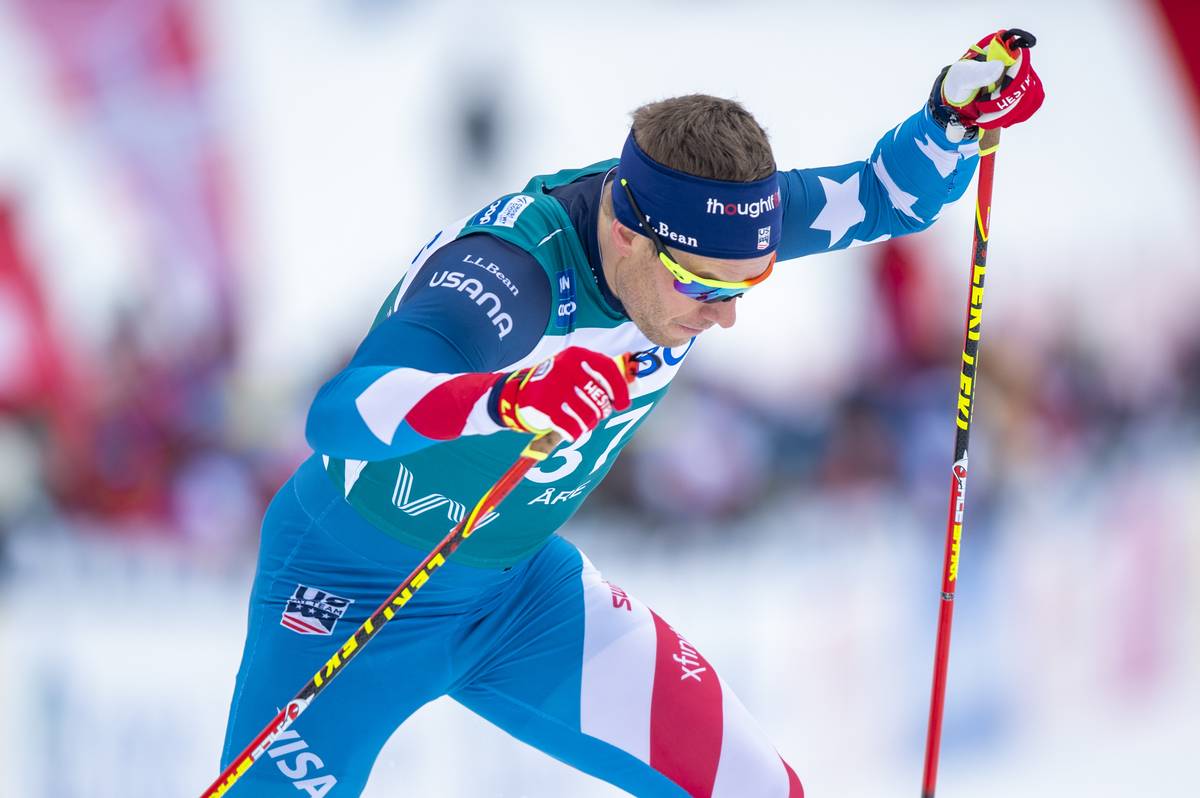
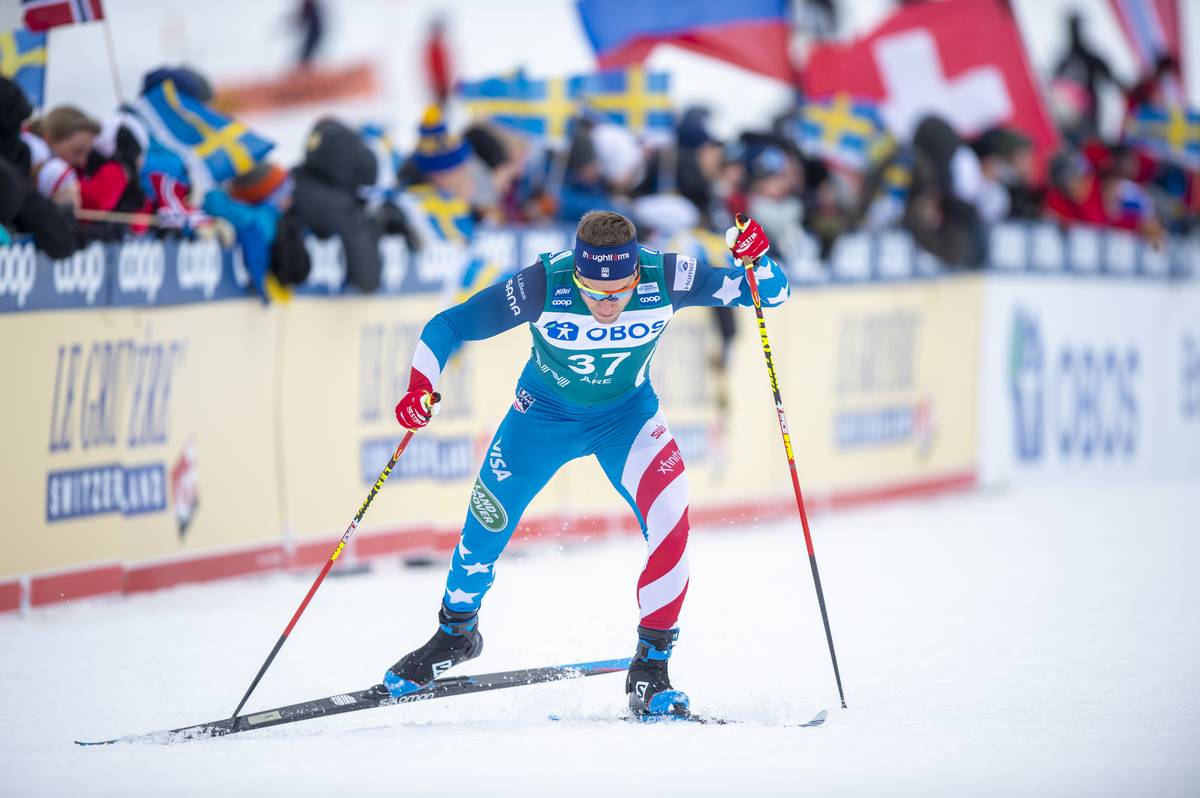
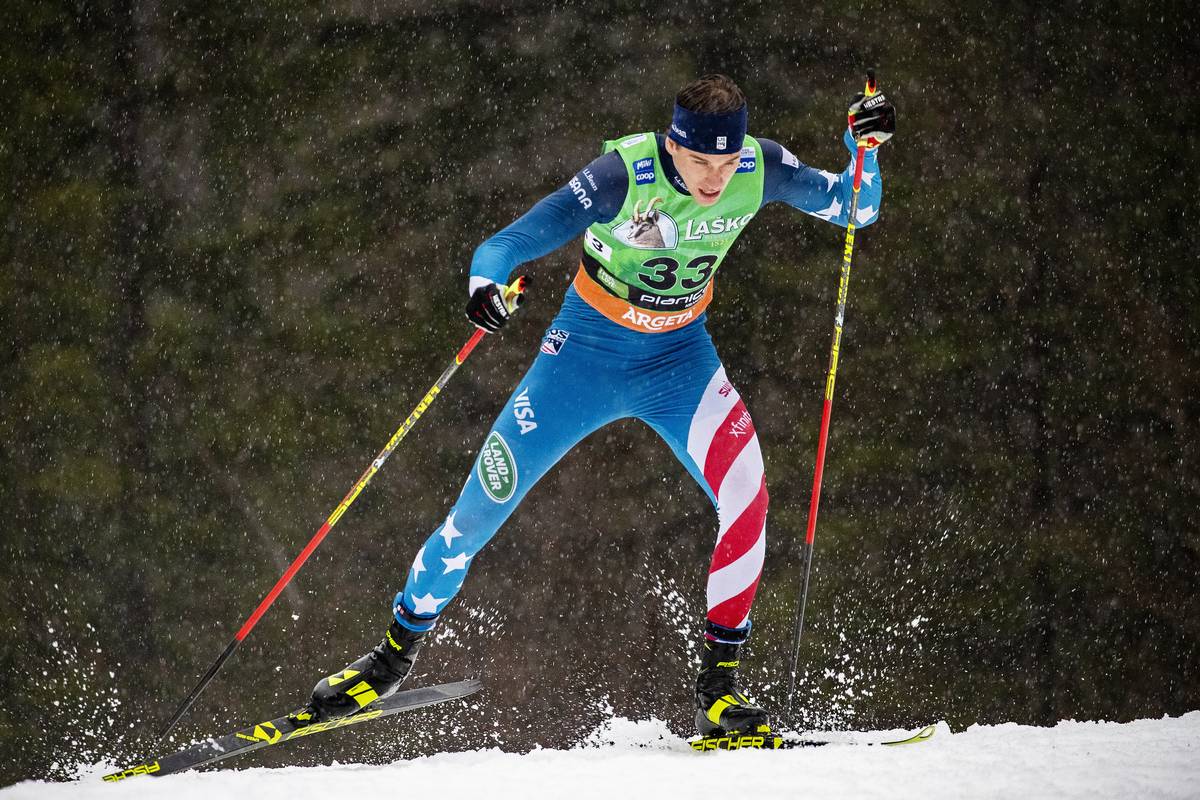
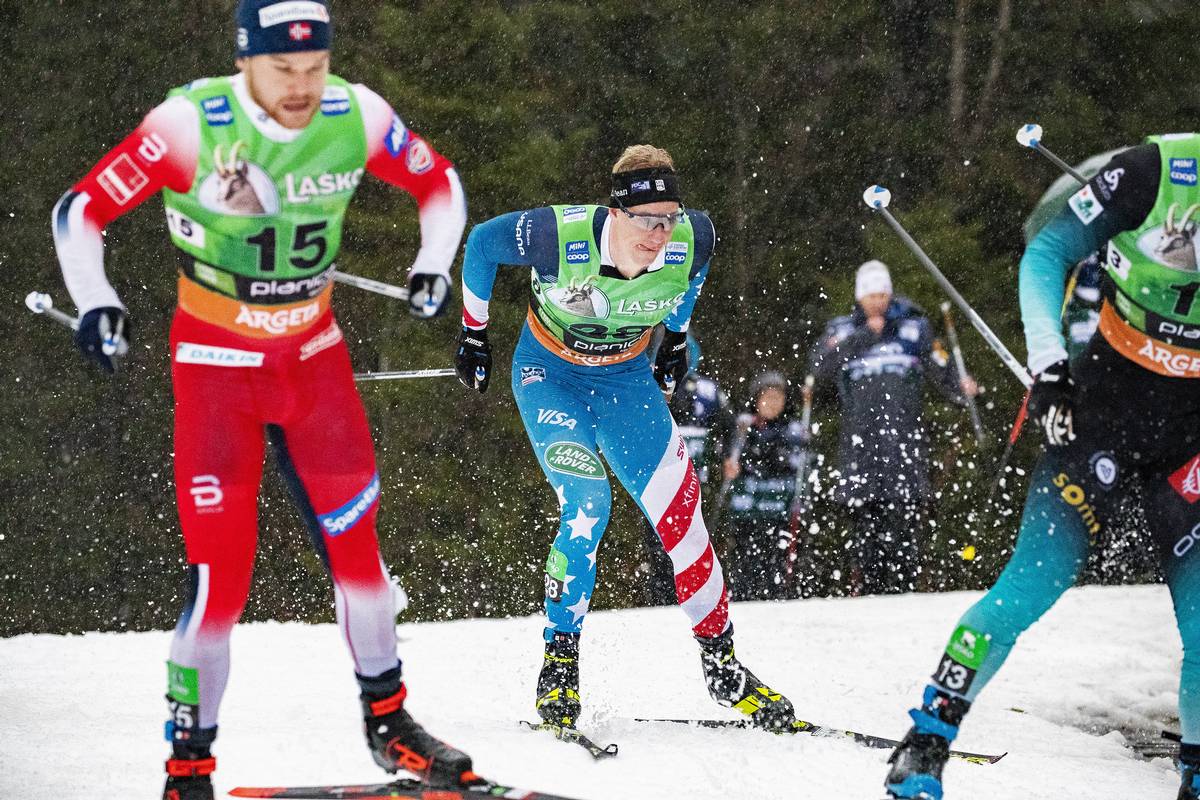
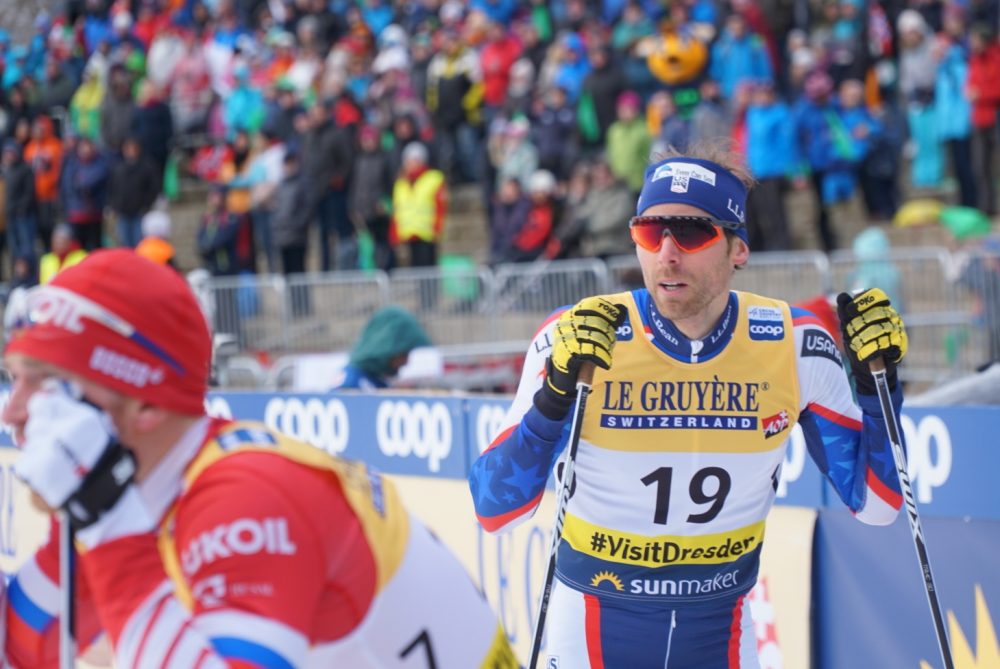
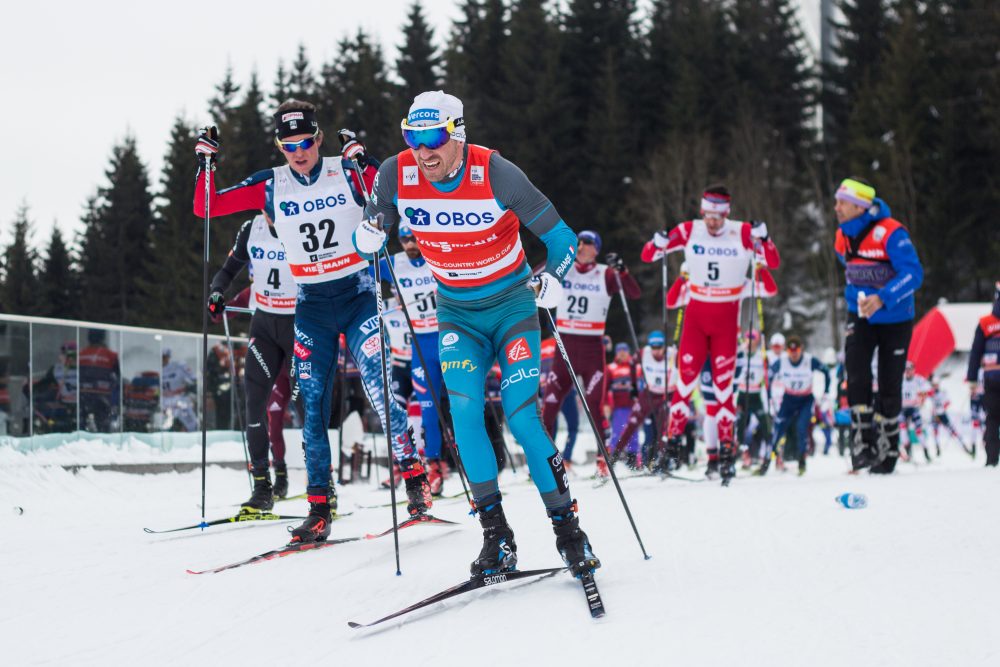
Simi Hamilton amidst a slew of Russian skiers, placed 13th overall on Friday after qualifying in 4th. (Photo: NordicFocus)
Showing great form, Simi Hamilton led the American men with a 4th place finish (+2.9) in the qualifier. Kevin Bolger snagged the final spot in the top-30 (+9.23) and both men stepped into the starting gates in the second heat of the quarterfinals.
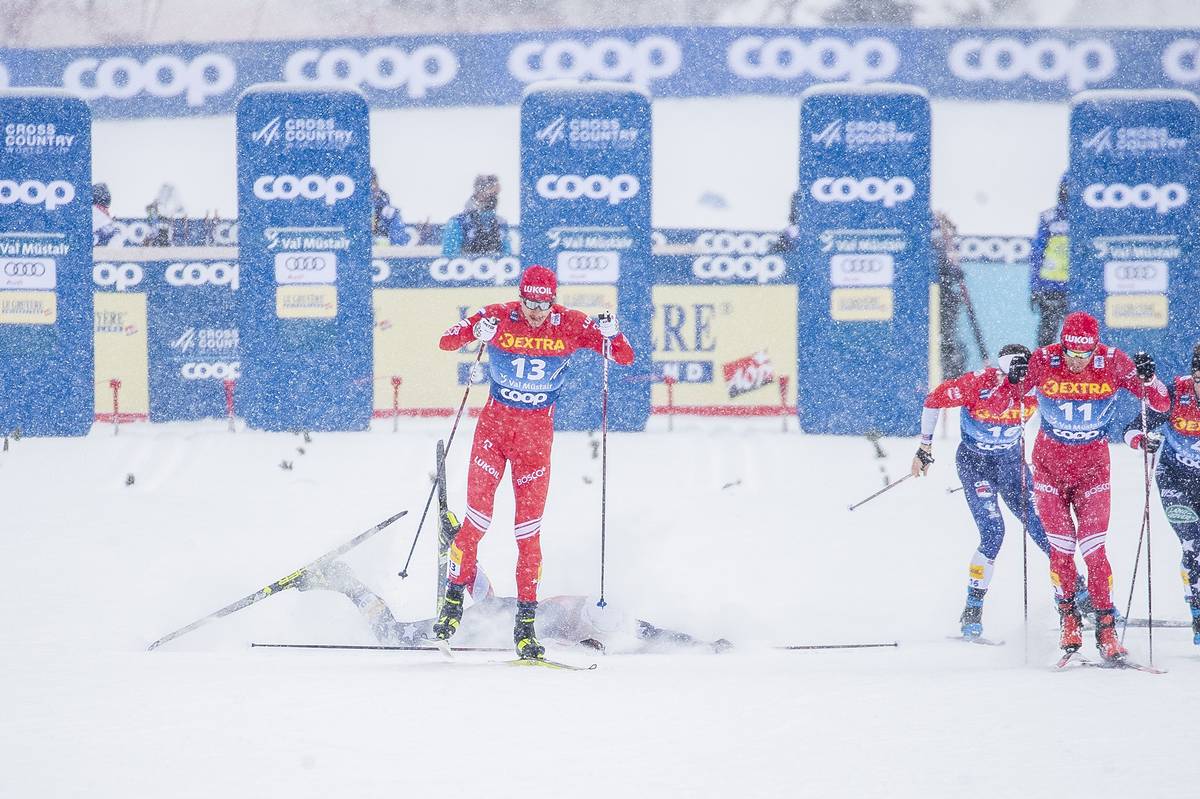
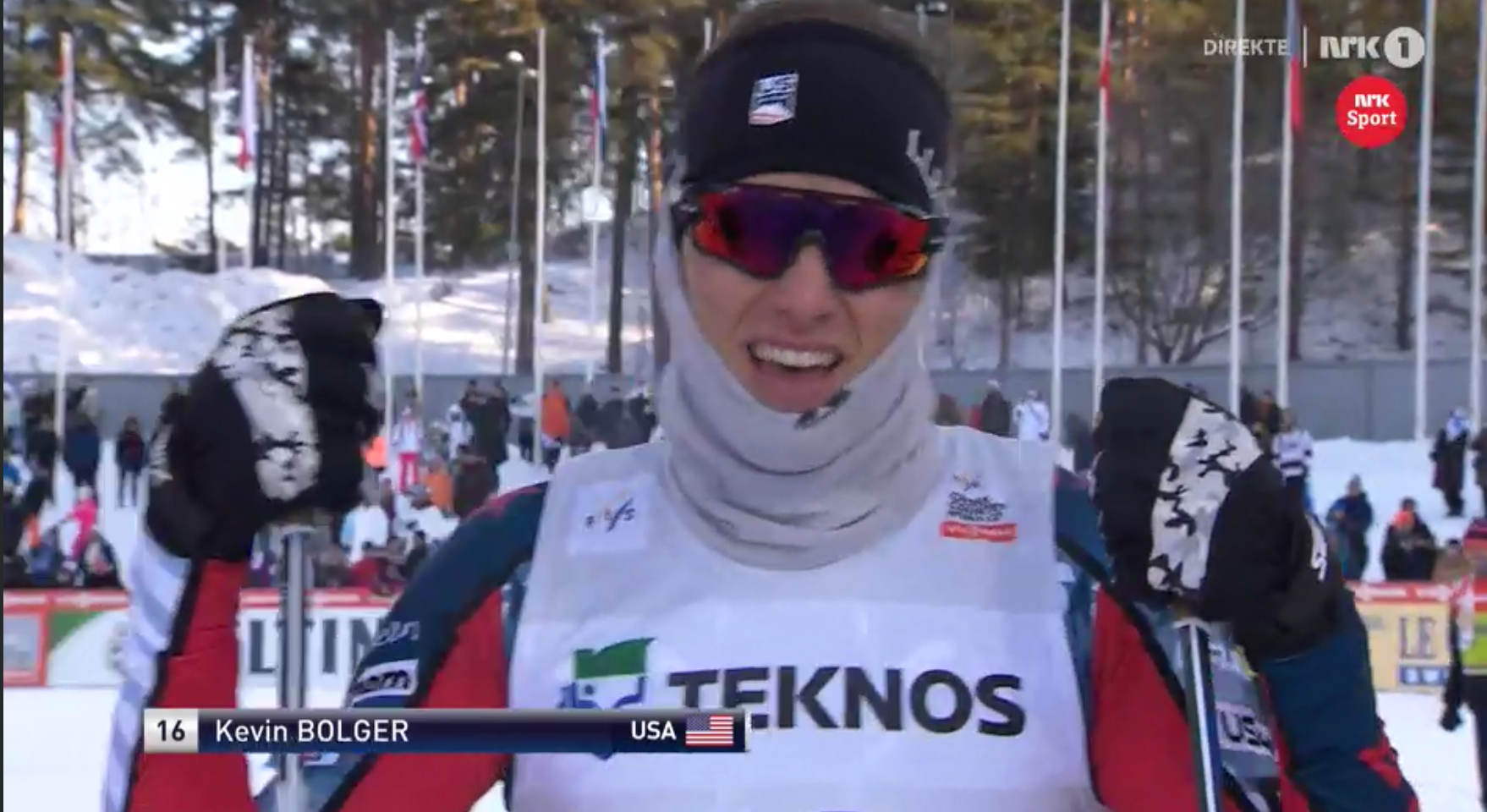
Unfortunately, a broken pole near the start robbed Bolger of the chance to truly compete. He lost contact with the pack and ended the day in 30th.
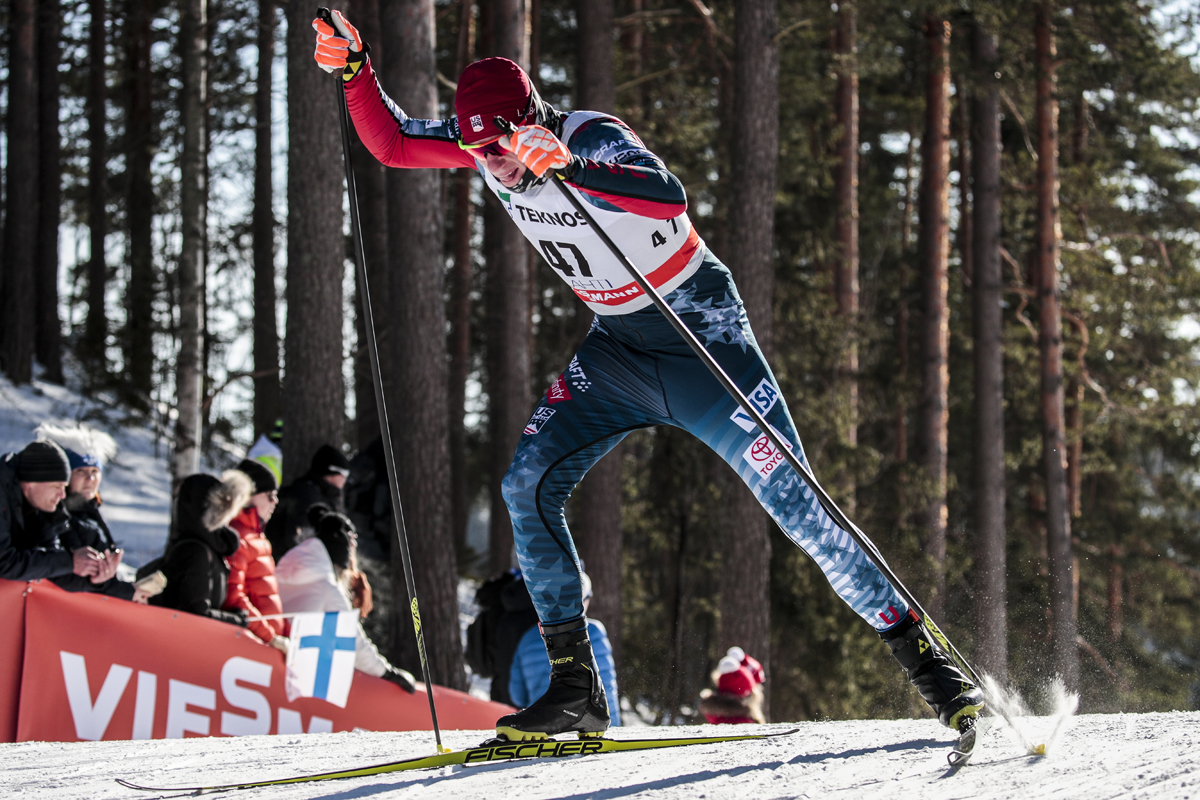
Kevin Bolger takes a tumble in Val Müstair, Switzerland. (Photo: NordicFocus)Bolger, recovering after a snapped pole in his quarterfinal. Simi Hamilton in bib 4. (Photo: NordicFocus)Bolger upright and on the go as the pack gains ground. Bolger finished 30th overall. (Photo: NordicFocus)
Racing with the agility and tactics for which he is known, Hamilton tucked in behind the three Russians that led the first lap of the heat. As they accelerated into the tight downhill S-turns, Hamilton edged his way up in the group, reaching his hand out to touch the skier next to him, signaling his presence with confidence and authority to diffuse a potential tangle.
In his second lap, Hamilton held second position on the tails of Andrey Melnichenkov (RUS), seemingly getting in position for a top-two finish early. Coming into the final turn, Hamilton was forced to stay wide, allowing Gleb Retivykh the more direct line. Hamilton fought with Melnichenkov and Retivykh all the way to the line, but couldn’t quite make up the ground. He finished third in the heat, 0.02 seconds off the time needed to advance to the semi as a lucky loser. Hamilton ended the day 13th.
“Today was nothing amazing result-wise, but I think there were a lot of good signs for me that indicates I’m skiing at a strong level right now,” Hamilton wrote in an email to FasterSkier after the race. “Obviously I wanted to be back in the final, but the near-perfect racing it takes for me to do that didn’t shake out today. I was really psyched with my qualifier, and my body felt quite good during that effort.”
Hamilton continued with insight into his approach to the tour and his outlook after today’s very near miss.
“I’ve been feeling a little tired the last few days, so I’ve been taking it very, very easy, and I wasn’t sure how everything would respond after basically taking three days totally off. Obviously, my main goal for the tour is to perform well in the sprints, but I’d like to feel good on the distance days too so I wasn’t really preparing this week like I would have if I were putting all my eggs in today’s basket. Instead, I took a much more conservative approach to things to make sure I was giving my body the rest it needs for this whole eight race event. In my quarter I felt pretty strong and I thought I skied it tactically well, but I got boxed out on the outside coming into the finish lanes and I lost what turned out to be a very important tenth of a second from that. So, yeah, frustrating but you can’t always just look at the results to decide whether a race went well or not.”
Gus Schumacher of the U.S. during qualification. He placed 31st overall, just missing the rounds. (Photo: NordicFocus)
Barely outside rounds, Gus Schumacher ended his day after the qualifier in 31st (+9.55). Distance racer Scott Patterson took 79th (+22.72).
Racing continues tomorrow as stage 2 of the Tour de Ski offers up a 15 k classic mass start for the men.
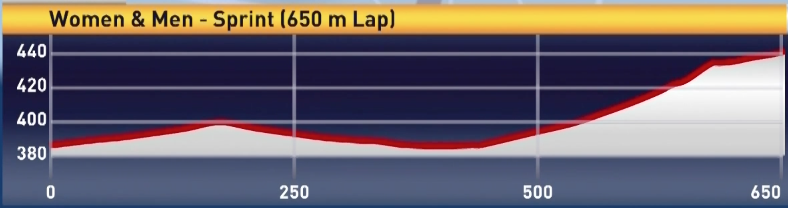
Let’s explain. The format was basic, a freestyle sprint. Otherwise, that’s where sprints as we know it ended. The 0.66-kilometer course shot off from the start up a gradual V2-able climb. It then rounded a left-hander where athletes descended what looked like a salted banked turn found in a X-Games terrain park. Down to the course’s bottom zoomed the skiers. Then things turned skyward. The course ascended a mini-Alpe Cermis lasting around one-minute for the men, to the finish atop the climb. The climb was the defining characteristic of the terrain: athletes suffered up a downhill ski slope gaining roughly 60 meters in altitude before the finish line. Calling the final ascent punchy would be an understatement. Grinding. Grueling. Leg-cement-inducing is more appropriate.
The Åre sprint hill climb in profile. (Photo: Screenshot FIS Broadcast)
Perhaps a sprint sideshow? That could be argued. But hosting an event at the base of the Swedish National Alpine hill with amenities for fans, of which there were plenty, and bountiful options for climbing terrain, we’ll let others debate the merits of hosting a climb-fest sprint.
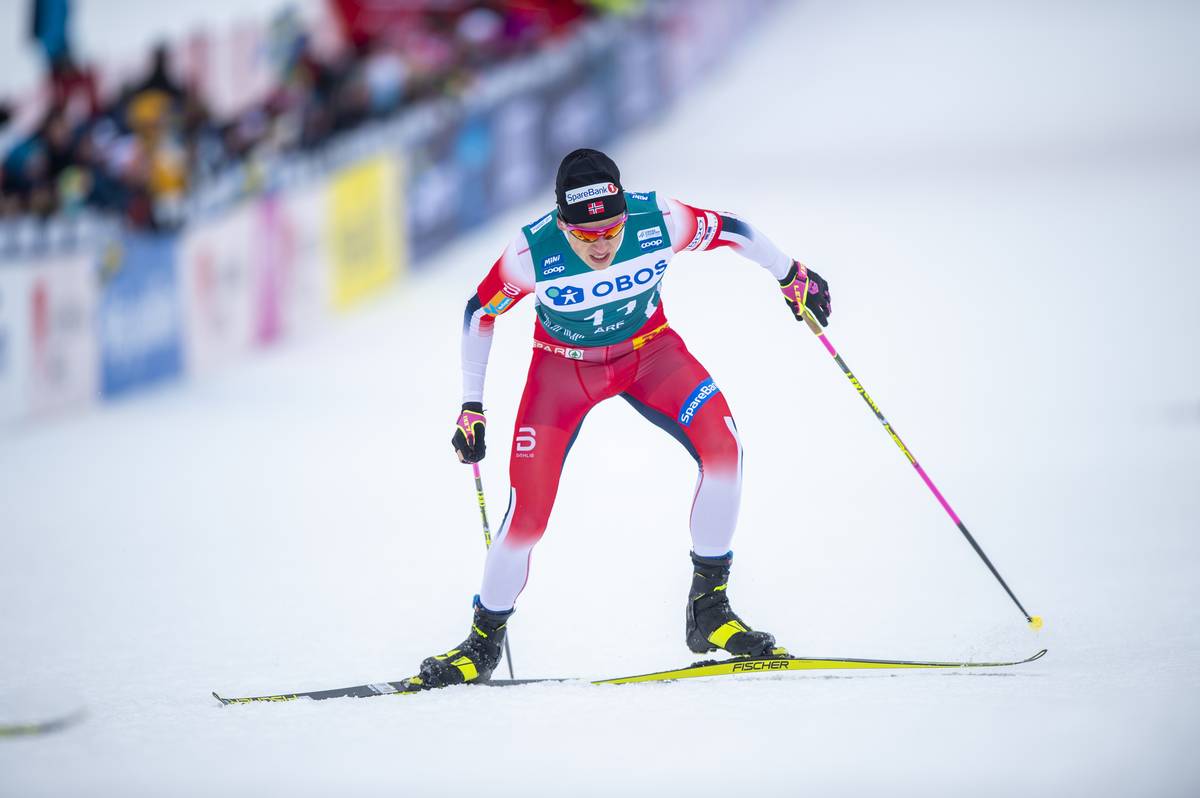
Johannes Høsflot Klæbo of Norway in Åre, Sweden on his way to winning Stage 3 of the Ski Tour 2020. (Photo: NordicFocus)
But some things haven’t changed: Johannes Høsflot Klæbo qualified in first covering the course in 1:49.64. That’s right, a quick and snappy 0.66 k, despite the big vert. Klæbo continues to deal with broken fingers and a thus far lackluster Ski Tour 2020. He placed 31st in Stage 1 and 25th in Stage 2. He came into Stage 3 ranked 25th overall in the Ski Tour, 2:05 behind the leader, Norway’s Stage 2 winner, Pål Golberg.
For his part, Golberg laid down the second-fastest time in qualification, 2.58 seconds back. Alexander Bolshunov of Russia, by all measures the pre-Ski Tour favorite, qualified in 23rd (+8.59).
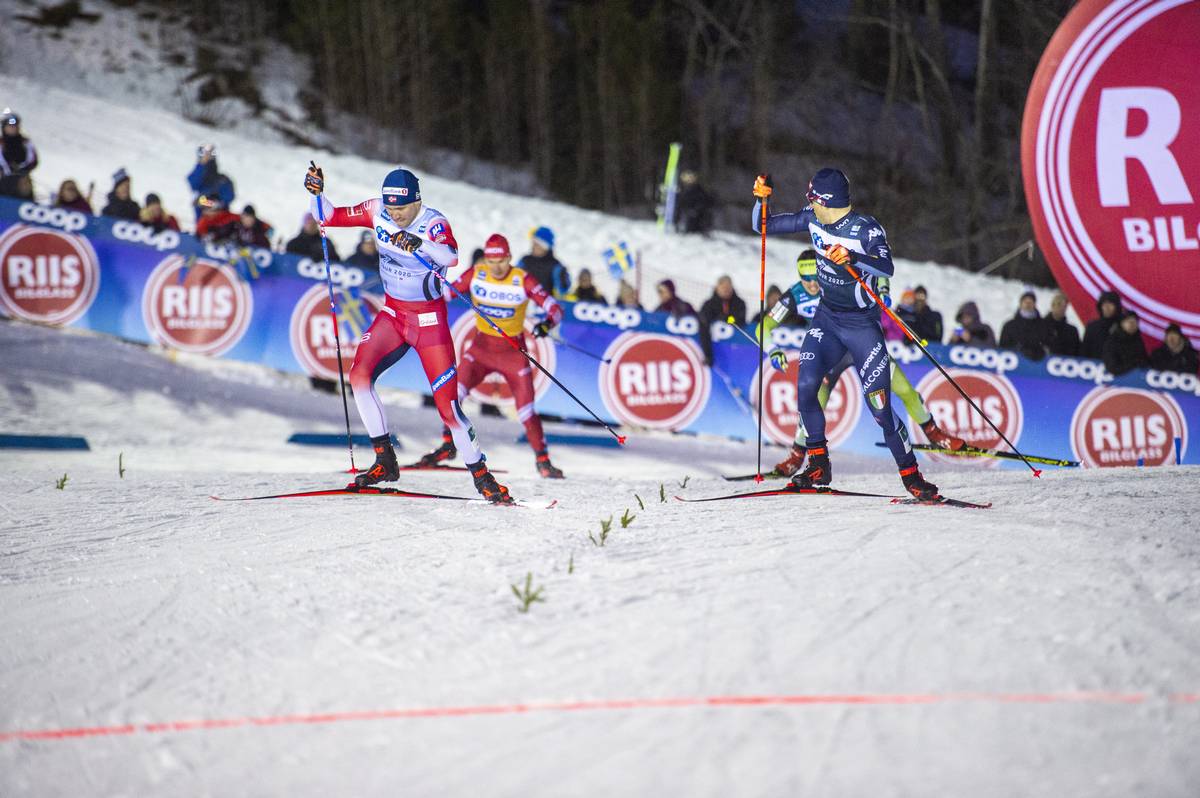
Pål Golberg of Norway and Italy’s Federico Pellegrino into the finish. (Photo: NordicFocus)
In the second semifinal, rounding the corner on the first and notably mild climb, Italy’s Federico Pellegrino took the inside line over the top. In bib 11, Norway’s Simen Hegstad Krüger came through in second, followed closely by Bolshunov who had advanced as a lucky loser.
Krüger took an aggressive line and cut off the advancing Russian. As this transpired, Krüger tumbled as their skis crossed. Bolshunov continued with Krüger going between his legs. Bolshunov now sat in fifth as he crested the hill. Krüger snapped a pole and grabbed a spare just prior to the descent. (He eventually received a yellow card for his cut-off move.)
Golberg won the semi, with Pellegrino in second. Bolshunov never recovered and placed fourth, 1.92 seconds behind Golberg. Bolshunov finished the day in eighth after being eliminated.
Although 8th on the day, Russia’s Alexander Bolshunov sits second overall in the Ski Tour 2020 after three stages. (Photo: NordicFocus)
Outside of the peculiar course, a stumble here and there, Klæbo and his astounding pull away acceleration in the final was the story. He advanced by winning the first quarterfinal and the first semi. He won that semi by only 0.52 seconds over France’s Jay Renaud. What became evident was that Klæbo was holding back and had not dialed his tactics.
In the final that featured Klæbo, Pellegrino, Renaud, Golberg, Lucas Chanavat of France, and Norway’s Erik Valnes the charade was over.
Chanavat led into the final climb with Pellegrino off to his right, a meter back, with Klæbo shadowing on the other side. Then Pellegrino upped the pace and pulled ahead with Klæbo settling into his draft. Chanavat took charge of the climbing lane to the left. For a moment, Klæbo must have been inhaling extra oxygen, as he fell slightly back.
But as the trio passed under the red sponsor arch, Klæbo shot off. For every single V1 cycle Pellegrino completed, Klæbo threw in two hop-skates. As he rounded to the left atop the climb, Klæbo looked back on a 20-meter gap. “Mamma mia” they must have been saying in Italy.
Italy’s Pellegrino: totally spent. He placed second overall in the Stage 3 Ski Tour 2020 sprint. (Photo: NordicFocus)
Klæbo won the final in 2:02.63. Pellegrino was second (+2.39), and Renaud third (+3.70). Golberg was fourth (+14.46), Chanavat fifth (+26:39), and Valnes sixth (+1:05.62).
Time to chill at the finish: Johannes Høsflot Klæbo of Norway. (Photo: NordicFocus)
“It was a real suffer-fest,” Klæbo told FIS after the race. “It was a lot of fun. At the end I was just trying to push all out. I turned my head on the last climb and it was a huge gap. … It was good to get the confidence again and fight for the podium. … At the end, I was just trying to push all out. I turned my head on the last climb and it was a huge gap. In the end, it was really fun.”
For the U.S. Simi Hamilton was the lone North American who advanced into the heats qualifying in 17th (+7.12). Hamilton skied to third (+2.27) in the second quarterfinal which was won by Russia’s Denis Spitsov in 2:04.14. The Aspen, Colorado native placed 14th in the final standings. (Below we have included an extended post-race interview with Hamilton. In the interview Hamilton discussed his injuries, and his return to racing World Cup sprints.)
The U.S. Ski Team’s Simi Hamilton in Åre, Sweden. (Photo: NordicFocus)
Post-race interview with Simi Hamilton
In his return to World Cup sprinting, Simi Hamilton skis to 14th overall on Stage 3. (Photo: NordicFocus)
Logan Hanneman placed 45th on the stage, Kevin Bolger 60th, David Norris 65th, and Ben Lustgarten 81st.
Post-race interview with U.S. World Cup Coach Matt Whitcomb
For Canada, Russell Kennedy finished in 73rd, Evan Palmer-Charrette 75th, Alexis Dumas 76th, and Ricardo Izquierdo-Bernier 78th.
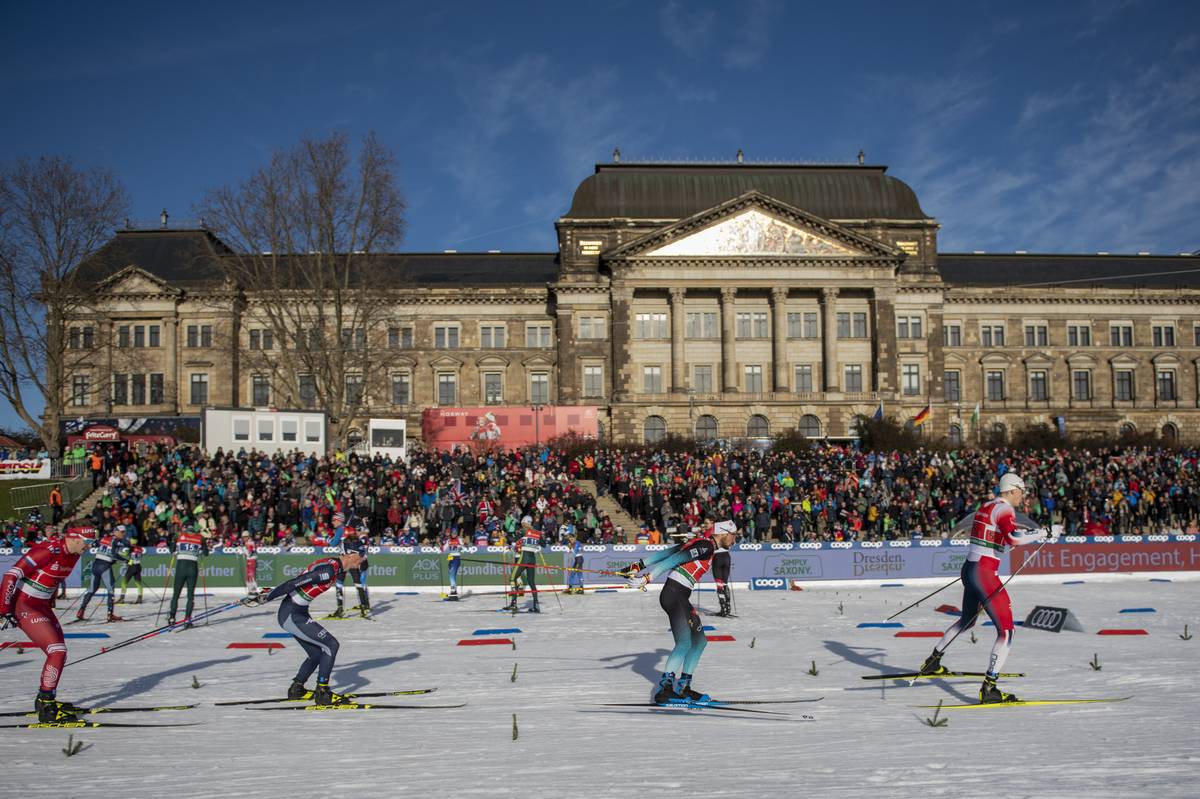
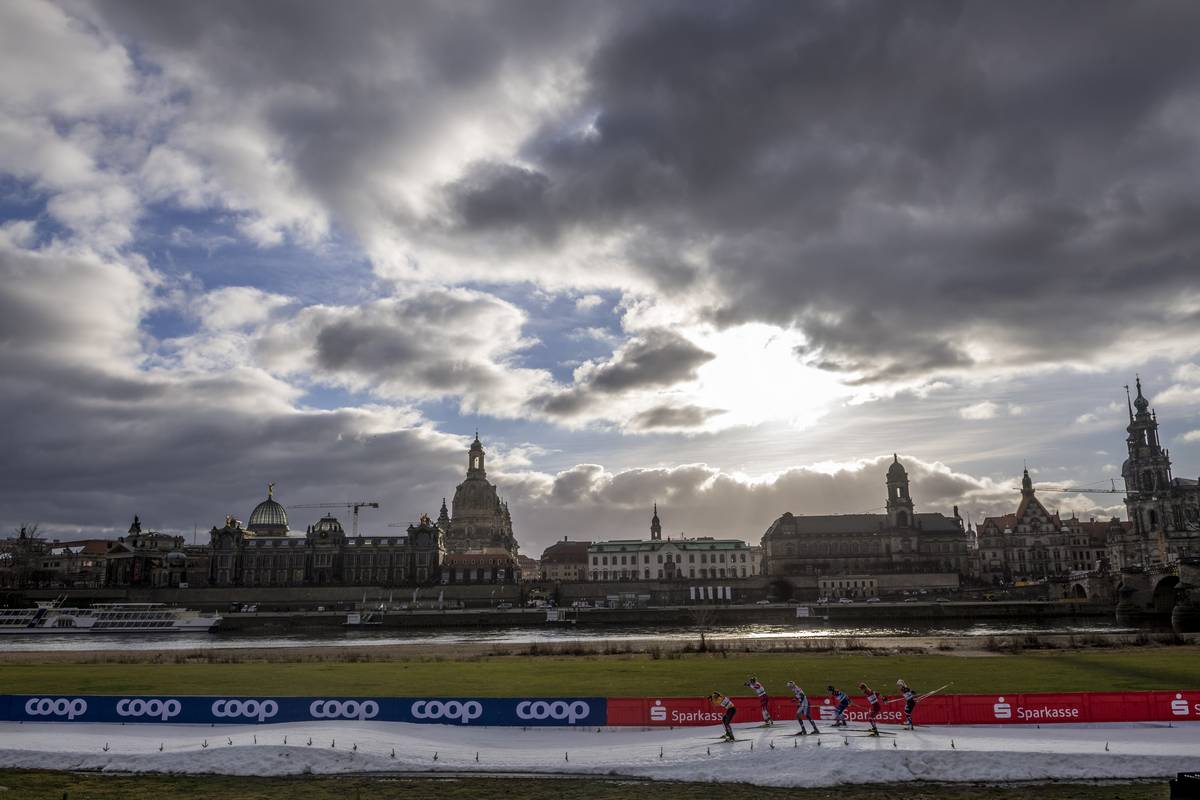
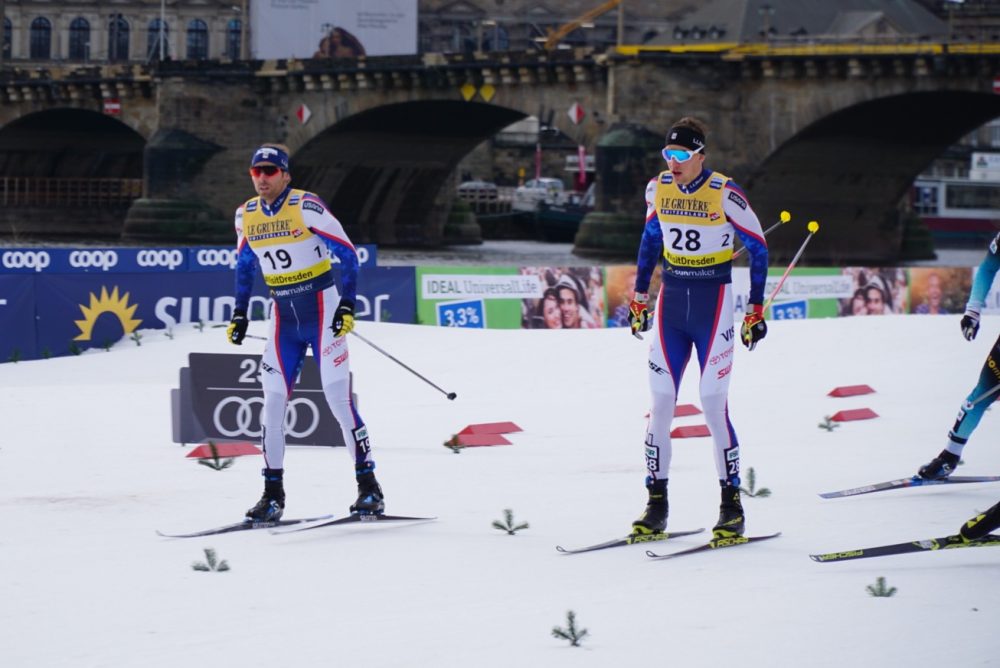
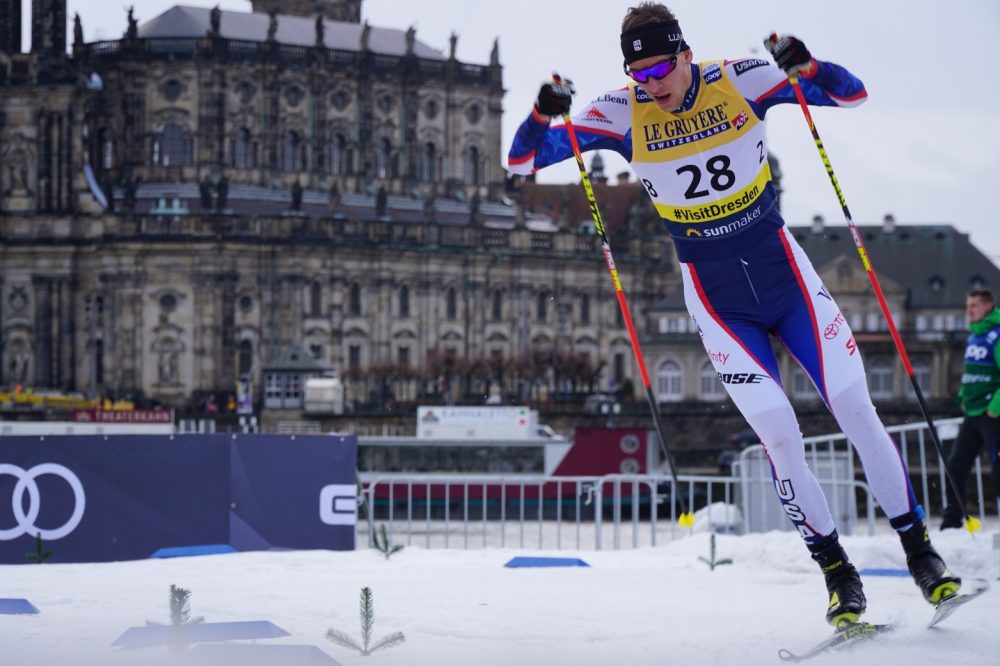
Spectators gather in Dresden, Germany to watch the team sprint. (Photo: NordicFocus)
It was dizzying in Dresden for the skate team sprints. The man-made loop of lightning-fast snow had skiers going literally round and round for a total of 11 exchanges between teammates. Each skier skated a single 0.7-kilometer lap, for a total of 7.8 k. Each skier raced six laps. Turn your head dizzy.
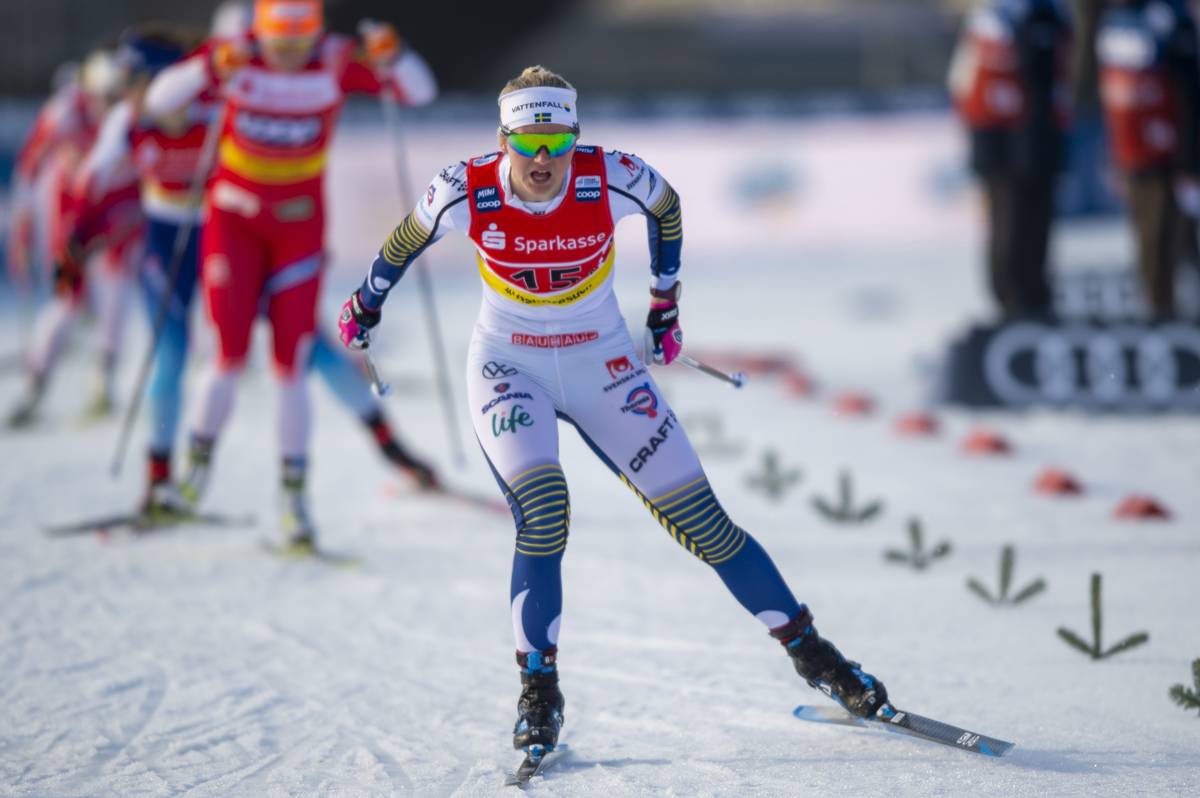
Maja Dahlqvist (bib 15) and teammate Linn Svahn maintain their lead in the final laps of the Dresden team sprint. (Photo: NordicFocus)
The Women’s Final
The finals consisted of ten teams. Sweden I animated the race with its display of pull ahead speed late in the race. Sweden I featured Maja Dahlqvist, who won this event last year with Stina Nillson. This year, Dahlqvist and Linn Svahn, yesterday’s skate sprint winner, had the pleasure of burning plenty of matches in Dresden.
Sweden I’s tactics were clear: late in the race, with several exchanges remaining, apply speed to the front, separate from the pack, and position themselves for the win. According to FIS, that has been somewhat easy for Sweden to do of late: Sweden has won seven of the last eight women’s team sprint World Cup events. This includes the last five in succession.
So it was today, as Dahlqvist tagged to Svahn on the final lap with a 0.8-second gap on Switzerland I’s Nadine Faehndrich. Norway I came through 3.6 seconds back, and Sweden II another 0.4 seconds behind.
That was the race. Faehndrich was able to close down and give Svahn a scare at the line for a photo-finish.
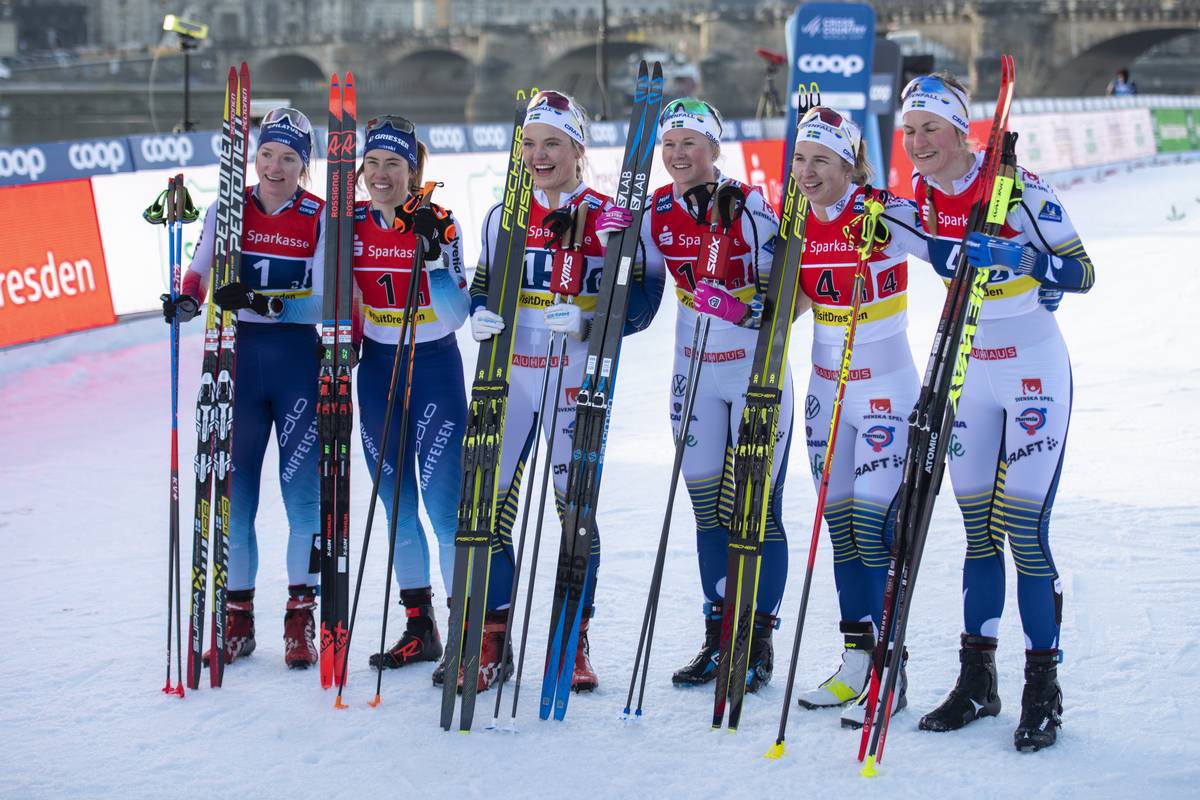
The finish line item read: Sweden I in first at 15:43.7, Switzerland I second (+0.09), and Sweden II third (+3.27).
The U.S. team of Julia Kern and Sophie Caldwell placed fifth overall (+6.61). The U.S. pairing advanced out of the semis after placing third behind Norway I in first and Switzerland I’s Laurien Van Der Graaf and Nadine Faehndrich.
Sophie Caldwell (bib 3) finds her line heading into the u-turn before the exchange zone. (Photo: NordicFocus)
Julia Kern (bib 3) shows poise in the pack during the team sprint. (Photo: NordicFocus)
Canada I’s Katharine Stewart-Jones and Dahria Beatty placed third in the second semi-final — in a photo finish with Germany I for second — and did not advance as a lucky loser. In the team sprint format, the two top teams advance, with the six remaining spots in the final given to the next six fastest teams via lucky loser spots. Canada I placed 11th on the day.
Canada II’s Maya Macisaac-Jones and Katherine Weaver were 23rd overall.
Laurien Van Der Graaff (SUI), Nadine Faehndrich (SUI), Maja Dahlqvist (SWE), Linn Svahn (SWE), Evelina Settlin (SWE), Linn Soemskar (SWE), (l-r) take the podium positions. (Photo: NordicFocus)
The Men’s Final
Looking for some smooth skiing technique cues for high speed skate skiing? Look no further than the Frenchman crossing the line in first on Sunday for France I. Lucas Chanavat — paired with Jay Renaud — was the kinesthetic perfection of coaches advising – and sometimes commanding — athletes to ski big and tall.
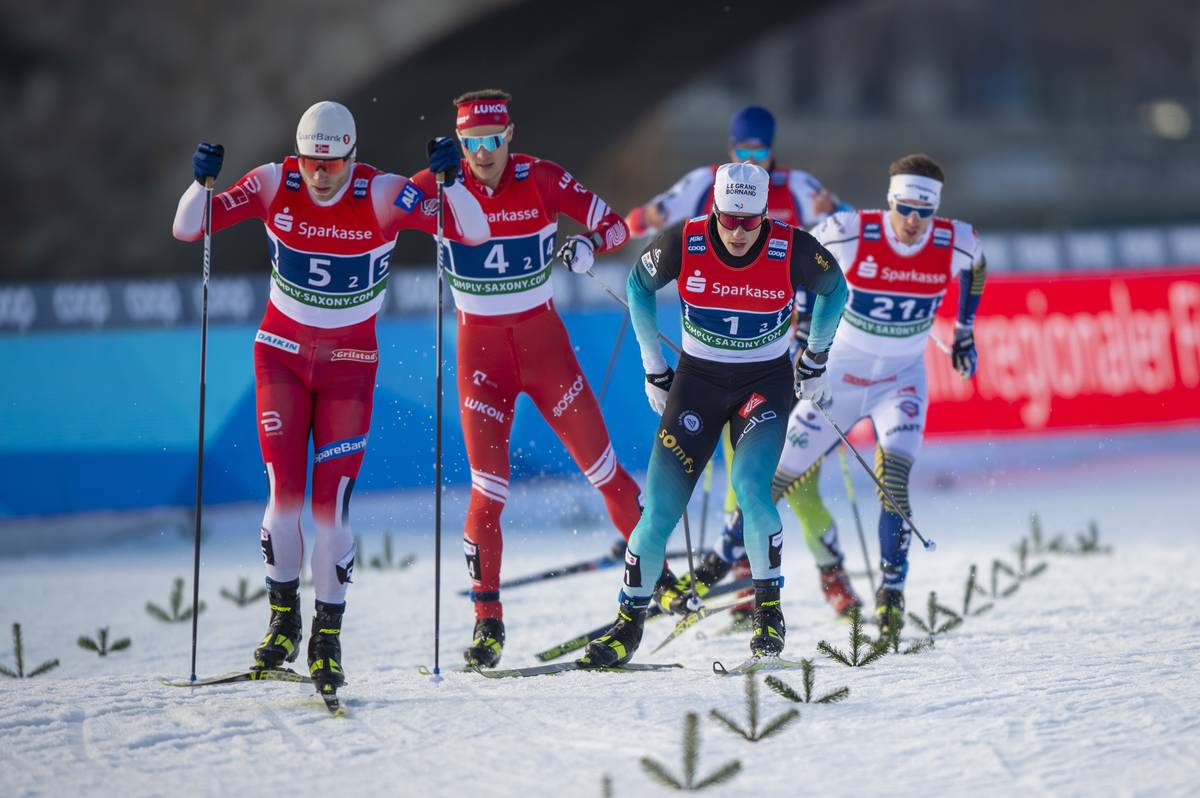
Lucas Chanavat (bib 1) put on a clinic this weekend in Dresden, Germany. (Photo: NordicFocus)
On Dresden’s quick 0.7 oval loop and deteriorating snow, Chanavat was simply big and smooth and just enough faster than the others.
In an event that saw five teams on the final tag within 1.4 seconds, France did not exactly have this Dresden team sprint nailed shut.
With the front five teams out of trouble, they came into the final straight drag race style. As noted, France I pipped in for the win. Sweden I’s Marcus Grate and Johan Haeggström were second (+0.09), and Russia I’s Andrey Krasnov and Gleb Retivykh third (+0.18). Norway I’s Håvard Solås Taugbøl and Sindre Bjørnestad Skar were fourth (+0.56).
Great Britain’s James Cluget and Andrew Young were eighth overall (+7.07).
Canada I’s Graham Ritchie and Bob Thompson were 14th overall, with Canada II 20th. For the U.S., JC Schoonmaker, a junior skier for the University of Anchorage Alaska, and Kevin Bolger were paired. They placed 21st for the day.
Marcus Grate (SWE), Johan Haeggstroem (SWE), Renaud Jay (FRA), Lucas Chanavat (FRA), Andrey Krasnov (RUS), Gleb Retivykh (RUS), (l-r) earn top honors in the men’s team sprint. (Photo: NordicFocus)
The metaphors are rife when describing the rough and tumble nature of the urban environment. Most often we think of pine forest, alps, and Hansel and Gretel valleys as the backdrop for the World Cup. To foster interest and in-fill a dense schedule of racing, city-sprints are nothing new when it comes to populating the World Cup calendar. Places like Dresden provide a contextual backdrop to a Europe steeped in history. The city is often a reminder of darker times, as it’s historic architecture was destroyed in World War II.
The city, since rebuilt to historical specs, is the place to be post Tour de Ski.
As a sprint specific weekend immediately following the Tour, the field is absent one notable name from Norway: Johannes Høsflot Klæbo. He placed third overall in the Tour and took the weekend to recover.
The World Cup show goes on. And perhaps one of the most stable and finest skate ski technicians out there took center stage. France’s Lucas Chanavat earned his third podium of the season and his second career World Cup victory with a win on Saturday in Dresden. Chanavat won the two-lap 1.3-kilometer qualifier in 2:14.72.
Lucas Chanavat of France (bib 1), where he was all day, out front during the Dresden city sprints. (Photo: NordicFocus)
In a tight qualifier in which the top-10 were separated by 1.75 seconds, three Americans qualified for the heats: Logan Hanneman in 21st (+3.65), nineteen-year-old junior skier JC Schoonmaker (in his debut World Cup) 24th (+3.80), and Kevin Bolger in 28th (+4.00).
Bolger finished 25th for the day after placing fifth in the second quarterfinal. Schoonmaker was 30th overall and in the points, as he slotted into sixth in that same quarterfinal heat. Hanneman ended up 29th overall, after skiing to sixth in the first quarterfinal.
For Canada, Bob Thompson placed 34th, Graham Ritchie 46th, Antoine Cyr 51st, and Pierre Grall-Johnson 66th.
Bib 1, JC Schoonmaker at last week’s Senior Nationals in Houghton Michigan. (Photo: Reese Brown)
JC Schoonmaker in the points for the U.S., during the Dresden, Germany skate sprint. (Photo: NordicFocus)
Post-race comments from Marine Dusser, Head Coach at University of Alaska Anchorage
Stats aside, this was a tricky course for a basic two-lap oval sprint race. Crashes and slides were plentiful. Staying on your feet, an obvious must, was problematic for some. Most notable was a clash during the fourth quarter, where France’s Richard Jouve clipped the back of Italy’s Federico Pellegrino’s skis. It occurred on the lap corner where skiers seemed to be magnetically attracted to the tightest line up against the v-boards.
Not a bad tactic. But the high risk move didn’t always pay off. Pellegrino went down, as did Jouve, in a gnarly tumble. Pellegrino took a moment on course to disparage Jouve. Both skate sprint savants, Pellegrino placed an uncharacteristic 27th and Jouve 22nd.
The scene was a reminder that those who fired from the start, got out front, and remained there, set themselves up for success. With no true kicker hills on course, coupled with the high speed tracks, remaining in the front and out of trouble proved to be the recipe for success.
Chanavat played those tactics to perfection. He won his quarterfinal, semi-final (in a photo-finish with Norway’sSindre Bjørnestad Skar), and the final by skiing boss-like out front in 2:14.81.
Number one in the qualifier, number one in the final. Lucas Chanavat is the champion in Dresden. (Photo: NordicFocus)
The only mishap in the final was for Håvard Solås Taugbøl of Norway, who snapped a pole early on the first lap. Skiing the remainder of the lap with a single pole, he ultimately placed sixth, only 1.86 seconds back.
“I felt good today, especially in the final stretch,” Chanavat told FIS after the race. “I saw the crazy falls because Richard Jouve is usually fighting there (in the 180° turn) during the final and he was unlucky today again but he will be back stronger soon. I was hoping for a World Cup victory this year but I was not expecting it to happen so fast.”
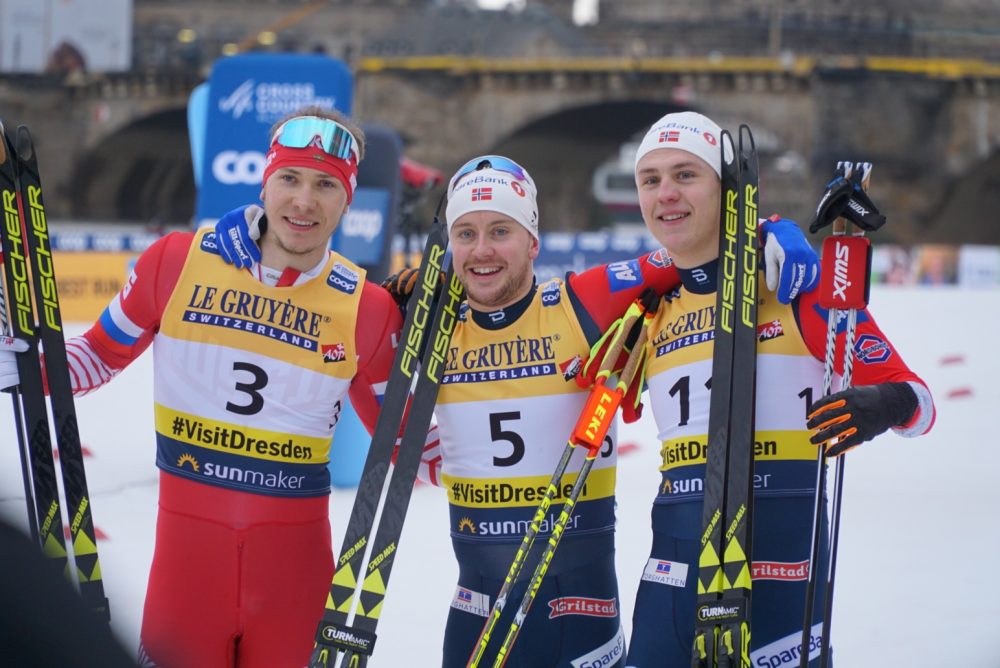
Skar took second place (+0.61), Sweden’s Johan Haeggström third (0.96). Pål Trøan Aune of Norway placed fourth (+1.04), and Jay Renaud of France fifth.
The men’s podium on the streets of Dresden. Lucas Chanavat (FRA) takes the win ahead of Sindre Bjørnestad Skar (NOR) and Johan Haeggström (SWE). (Photo: NordicFocus)
Ustiugov claims his 8th stage win in the opening event of the 2019/2020 Tour de Ski. (Photo: NordicFocus)
The starting corral was blocked by a wall of red before the start of the 15-kilometer mass start freestyle in Lenzerheide, Switzerland. Of the top ten ranked athletes, eight hailed from either Norway or Russia, interrupted only by Iivo Niskanen of Finland and Lucas Chanavat of France.
Johannes Høsflot Klæbo thanks his supporters before climbing into the second spot on the podium after the first stage of the 2019/2020 Tour de Ski. (Photo: NordicFocus)
Front and center was last year’s victor Johannes Høsflot Klæbo. He became the youngest Tour de Ski Champion at 22 years of age after holding off Russia’s Sergey Ustiugov who was gaining on the Norwegian throughout the final climb up the Alpe Cermis. It was clear in the final meters that there was no showmanship or gamesmanship in this performance; the young star was fully spent as he collapsed over the line.
Now an aged and wizened 23-year-old working on his tactics and gears in distance racing, Klæbo aspires to become the second man in history to win consecutive tours. Swiss athlete Dario Cologna did this in 2011 and 2012.
Klæbo is not a lock for this achievement — today’s opening stage made that abundantly clear. He will need to hold off the likes of Sergey Ustiugov and Alexander Bolchunov (RUS), Niskanen, Emil Iversen (NOR) and an otherwise deep field all vying for the same goal.
“I will try my best and I will count [my time] after the last day,” Klæbo told FIS during a pre-race press conference.
With the starting pistol marking the start of the nascent tour, the men began soaring around the course, through snow laden pine forest in front of high mountains emerging from their wreath of snow.
For the first 10 k, the field held strong in a long train. The top men, who stemmed from the first row of the start line, regularly exchanged the lead and the top 40 were separated by 10 seconds. Though the pace began to accelerate, the top ten were only spread by three seconds with 1.5 k to go.
A dense pack of skiers during the first stage of the 2019/2020 Tour de Ski, a 15-kilometer mass start freestyle. Logan Hanneman can be found on the right side of the image wearing bib 85. (Photo: NordicFocus)
Moves and countermoves. With 1 k to go, Ustiugov took charge. He rocketed off the front to create a gap to the lead pack. His teammate Bolshunov was three seconds back, along with Cologne, Iversen, Klæbo, and their Norwegian teammates Simen Hegstad Krüger and Sjur Røthe.
Ustiugov managed to maintain his gap and flew through the final straightaway in a confident V2. In the screen behind him was a pack of men whose final standings were far less certain. Klæbo and Bolshunov were dueling tête-à-tête in a sprint to the finish, sliding their boots over the line in sync for a photo finish. It was decided that Klæbo edged out his competitor for second, though he and Bolshunov will both enter the second stage of the tour four seconds behind Ustiugov.
Johannes Høsflot Klæbo (NOR) and Alexander Bolshunov (RUS) slide across the line in a photo finish at the end of the first stage of the Tour de Ski. (Photo: NordicFocus)
Iversen surged for 4th (+7.2) ahead of his countryman Martin Løwstrøm Nyenget (+8.6) who bested Tour de Ski veteran Cologna, Hans Christer Holund, Jan Thomas Jenssen, and Sjur Røthe in a five-way photo finish. Finishing in the order listed, the five men were separated by a margin of 0.4 seconds. Krüger rounded out the top ten one second later (+10.0).
Dario Cologna (bib 24) finishes amongst a herd of men vying for position at the end of Stage 1 of the 2019/2020 Tour de Ski, a 15-kilometer mass start skate in Lenzerheide, Switzerland. (Photo: NordicFocus)
“It was a really good performance and the shape was okay,” Ustiugov told FIS through a translator at the finish. “It was for sure a pleasure to win the first stage and I wish to show the same results on the next stages. Big thanks to Russian fans because it’s a really big pleasure to hear Russian people [cheering] here in Switzerland. It’s great.”
Russia’s Sergey Ustiugov celebrates his victory after the first stage of the 2019/2020 Tour de Ski, a 15-kilometer mass start skate. (Photo: NordicFocus)
Today’s victory marks the Russian’s eighth win in a TdS stage, advancing him to the second most behind Petter Northug who has 13 wins. The winner of the 2016/2017 TdS, Ustiugov has reached the overall podium in three of his last four rounds, only missing the final TdS podium in the 2017/2018 tour where he withdrew after the 5th stage. The Russian also won the first distance stage of last year’s TdS.
The men’s podium of the first stage of the 2019/2020 Tour de Ski, a 15-kilometer mass start skate in Lenzerheide, Switzerland. Sergey Ustiugov (RUS) took the win over Johannes Høsflot Klæbo (NOR) and Alexander Bolshunov (RUS) who were second and third, respectively, in a photo finish. (Photo: NordicFocus)
Three Americans started in Lenzerheide. David Norris finished as the top ranked American in 58th (+1:11.2). Kevin Bolger finished 64th (+1:35.0), followed by fellow Logan Hanneman in 69th (+1:42.1). Simi Hamilton was slated to start, but withdrew from the TdS due to a pulled muscle in his groin.
For the first nine kilometers, Norris hovered on the cusp of the top-30. After the race, Matt Whitcomb explained the energy-expenditure challenges of racing in this position, along with the strategy of sprint specialists Bolger and Hanneman.
Post-race interview with Matt Whitcomb on men’s performance.
“This was a fun mass start – fast and flowing,” wrote Norris explained an email after the race. “For the first 12km or so I felt really comfortable in the group. I tried to ski relaxed and avoid any of the chaotic crashes and tangles that seemed to occur each lap. With about 2 km to the finish I felt great and my skis were running well, but all of the sudden I bonked incredibly hard – got tunnel vision and struggled to avoid tripping on myself. It was a tough way to finish the race, but I’m optimistic I have better days ahead in this tour.”
Swiss flags flying against a breathtaking backdrop. Wearing bib 77, Kevin Bolger can be found at the center. (Photo: NordicFocus)
Yes, the sprint skiers put on a show this weekend in Planica, Slovenia. With a pure skate sprint weekend – both an individual and team sprint were on tap — speed and dicey conditions were a highlight. But perhaps, it took a supporting role to the weather. Day one featured a green-brown and rainy template peppered with bountiful bolts of lightning. The racing was postponed for a bit of time. Sunday was a winter wonderland: big puffy snowflakes fell down…a winter gift from the weather gods.
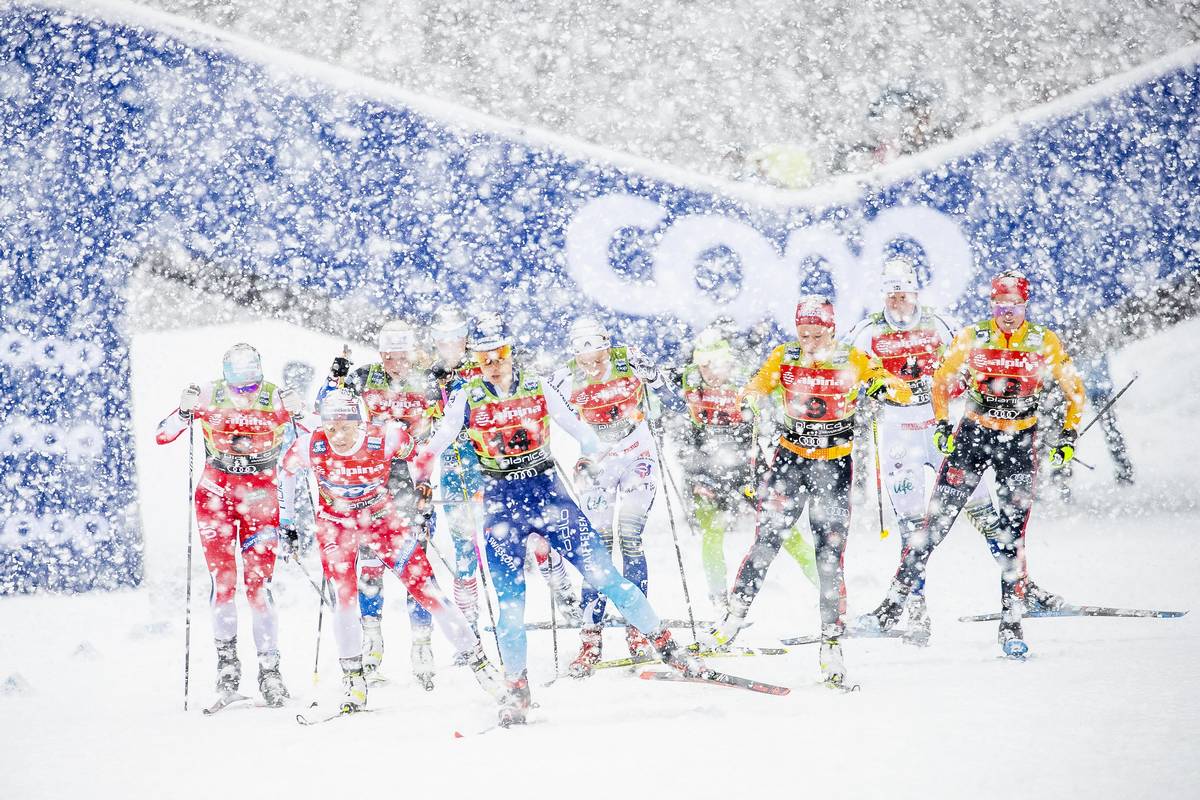
Heavy snow, collapsing arch. Planica women’s team sprint. (Photo: NordicFocus)
In this episode, we talk racing, attendance at cross-country World Cups, the upcoming Tour de Ski, and yes, the weekend’s sprint races.
If you have questions, send them to info@fasterskier.com or devon@fasterskier.com.
You can subscribe to the show on iTunes or, most places you find your podcasts.
With a snaking artificial loop of snow in a drizzly, and sometimes thundering Planica, Slovenia, the men’s World Cup field competed in a 1.25-kilometer skate sprint on Saturday. What Planica lacked in wintery vistas, it provided with fast technical racing during a day of topsy turvy weather. Racing was suspended after the quarterfinals when a robust lightning and hail storm moved in. With loud thunder booms reverberating during the weather delay, the competition organizers aptly blasted ACDC’s Thunderstruck.
First career World Cup win for Lucas Chanavat of France in the Planica, Slovenia skate sprint. (Photo: NordicFocus)
And that is part of the story. FIS runs a tight production schedule for live television where any deviation from the plan can be perceived as a potential loss of revenue. In the past, during unsafe weather, the call to postpone or cancel a race has arguably sided in favor of the production schedule. During the 2018 Tour de Ski, a women’s sprint qualifier in Oberstdorf, Germany, was held in what many considered hazardous conditions. The men’s qualifier was ultimately canceled and the day’s results nullified.
U.S. World Cup Coach Matt Whitcomb noted there was little hesitation today when after the men’s fifth quarterfinal — with lightning strikes too close for comfort — the race organizers postponed racing until the storm abated.
Soggy, stormy, and thundering in Planica, Slovenia. (Photo: NordicFocus)
The Racing
Lucas Chanavat of France came into Planica having podiumed seven times in the individual skate sprint. Never for the win. Yet, he placed second overall last weekend in a decidedly different weather scenario skate sprint in Davos, Switzerland.
With his fastest qualifying time on Saturday at 2:10.91 — Chanavat was 2.55 seconds faster than the second-place qualifier, Italy’s Federico Pellegrino — the Frenchman’s time had come.
Chanavat won his quarterfinal, and in the first semi, took second to Pellegrino. Chanavat controlled much of that semi. It appeared early on that only Norway’s Sindre Bjørnestad Skar in bib 3 could match Chanavat. With the meters ticking off, on the final punch of a hill Pellegrino slotted in and out of tight traffic to jump skate clear to the outside. He carried enough speed into the final straight to take the semi-final win with Chanavat in a close second.
Power move: France’s Lucas Chanavat, Saturday’s skate sprint winner in Planica., Slovenia. (Photo: NordicFocus)
That set the tone for the final featuring Chanavat, Pellegrino, Norway’s Erik Valnes, Håvard Solås Taugbøl, and Skar, and another Frenchman in Richard Jouve.
A minute into the final, the skiers were four across pushing into a short power-climb. Again Pellegrino displayed a burst of speed and came into the descent in first with the train of skiers drafting behind. Gliding under a bridge and sweeping into another short climb, Chanavat took the lead from Pellegrino. He skied safely in front as they stepped through a dicey high speed left-hand corner. Despite Pellegrino’s best hop-skate efforts, Chanavat kept his speed and poise for his first career World Cup win in 2:14.41. Chanavat now leads the overall sprint standings. Essee, avhandling, referat, uppgift. uppsatser
For Pellegrino, he just missed out on win 14 as he placed second overall (+0.40). His 13 World Cup wins have all come in the skate sprint. Valnes was third (+0.83).
Federico Pellegrino of Italy placed second on Saturday in the Planica, Slovenia men’s skate sprint. (Photo: NordicFocus)
All three U.S. skiers entered qualified for the heats. Kevin Bolger of the U.S. Ski Team (USST) qualified in 16th (+5.34), Simi Hamilton (USST) in 27th (+6.07), and Logan Hanneman (APU) 28th (+6.13).
Hamilton advanced to the first semi as a lucky loser after placing fourth in the screaming fast second quartervfinal won by Pellegrino. He ended up sixth in his semi to finish 12th overall. Hamilton is also ranked 12th overall on the World Cup’s sprint list.
Simi Hamilton, Planica, Slovenia. (Photo: NordicFocus)
Simi Hamilton, placed 12th overall in Planica, Slovenia’s World Cup skate sprint. (Photo: NordicFocus)
Simi Hamilton post-race interview
For Bolger, it was his second consecutive weekend in the points. He placed 18th overall after finishing fifth in his quarterfinal.
Kevin Bolger on his way to qualifying 16th overall and finishing 18th on the day during Planica, Slovenia’s World Cup skate sprint. (Photo: NordicFocus)
Kevin Bolger post-race interview
Whitcomb commented in an interview that Bolger can either be on or off. It was a week the coach said Bolger made some adjustments to his training to get him firing. “I’d like to think that some of the training adjustments that he has made helped him ski fast right from the gun today,” said Whitcomb. “He was quick out of the start. Quick down the first descent. He looked good on every climb.”
Post-race comments from World Cup Coach Matt Whitcomb on Kevin Bolger’s and Simi Hamilton’s day
Hanneman scored his first World Cup points of the season, ending the day in 28th. Last weekend in Davos he was 31st after tying in qualification with Bolger in 30th. That tiebreaker sided in favor of Bolger, the athlete with lower FIS points.
Logan Hanneman placed 28th in Planica’s World Cup sprint. (Photo: NordicFocus)
Post-race comments from World Cup Coach Matt Whitcomb on Logan Hannmeman’s day
Russel Kennedy was the only Candian entered. He finished 55th (+9.79).
Canada’s Russell Kennedy during the Planica, Slovenia skate sprint qualifier. (Photo: NordicFocus)
Individual racing for Period I on the World Cup has concluded. Tomorrow features a skate team sprint in Planica.
Norwegian Sindre Bjørnestad Skar (c) after taking first in the men’s 1.6-kilometer freestyle race on Saturday. Russia’s Gleb Retivykh placed second, while Norway’s and Erik Valnes placed third. (Photo: Garrott Kuzzy /LumiExperiences.com)
The white ribbon of snow created a stark contrast to the green grass and gothic architecture along the bank of the River Elbe for the second year of city sprints in Dresden, Germany. As is typical in these events, the 1.6-kilometer out and back course was predominantly flat with a few short hill punches and a 180-degree hairpin turn at the halfway mark, where the race seemed to truly begin. The nature of the course challenged skiers as there was little opportunity for recovery, and as always, a small margin for error.
Last year in Dresden, Italy’s Frederico Pellegrino upset a seemingly unbeatable Johannes Høsflot Klæbo in the men’s sprint, going on to win back-to-back the next day in the team sprint as well. This Saturday, after he won the qualifier in a time of 3:21.12, the question quickly became whether or not Pellegrino would remain king of the track in Dresden.
Heading into his quarterfinal, Pellegrino appeared to employ the same patient tactics which paid off for him in 2018. The Italian skied calmly in the middle of the pack for the first half of the course, moving slowly ahead after the hairpin. Coming into the final hill just before the finishing lanes, Pellegrino surged to take the lead, stepping on the ski of Frenchman Baptiste Gros as he passed by. Holding onto the lead, Pellegrino crossed the quarterfinal in first ahead of Norway’s Pål Golberg in second.
Due to the hangup with Pellegrino, Gros staggered, losing momentum, but stayed on his feet heading down to the final stretch, crossing the quarterfinal in third. More excitement ensued as the two Russians in the heat, Alexander Terentev and Andrey Krasnov, caught their skis on the pine boughs that were used to line the course and mark out the lanes and crashed in the final meters before the line.
It was ruled that the hang up caused by Pellegrino was an obstruction, earning him a yellow card and relegating him to last in his heat. He finished the day in 30th position.
With Pellegrino out of the running and Klæbo sitting out the races in Dresden to recover from his overall win in the Tour de Ski, focus shifted toward Sindre Bjørnestad Skar and Erik Valnes of Norway, Lucas Chavanat, who took third in last year’s Dresden city sprint, Baptiste Gros, and Richard Jouve of France, and Gleb Retivykh of Russia, all of whom are ranked highly on the overall sprint World Cup standings.
In the first and fastest heat of the semifinals, Skar and Retivykh jockeyed for the lead throughout the race, Skar punching ahead on the final hill, but Retivykh bested him in the final meters with a time of 3:32.58, just 0.14 seconds ahead of the Norwegian. Both Jouve (+0.20) and Gros (+0.53) advanced as lucky losers. Everyone in the first heat skied a faster time than the skiers in the second wave. Advancing from the second semifinal was Valnes (3:37.72) and Chavanat (+0.15).
As the men faced off in the final, it was anyone’s game through the first half. Rounding a turn late in the race, Gros caught his ski on a V-board lining the course causing him to fall, taking Chavanat down with him. Left standing, Skar and Retivykh again dueled for position, eager to be first to the top of the final roller. Skar attacked at this seemingly pivotal spot, positioning himself just ahead of Retivykh. The Russian fought back, not willing to relinquish the victory until the very end when Skar threw his foot forward for the win with a time of 3:25.94.
Retivykh finished just 0.11 seconds behind, followed by Valnes (+2.83) in third. Jouve cruised through the finish in fourth (+11.22) followed by the two Frenchman, Chavanat in fifth (+21.94) and Gros in sixth (+23.93).
Skar is now ranked second in the overall World Cup sprint standings.
“It feels good to be the winner today,” Skar told the International Ski Federation (FIS). “It is my fourth final this year and I’ve been number four, and number five, and number six, so to be on the top now today, that’s a very good feeling.”
Despite the man-made snow and warm and wet weather leading into the race, the event coordinators were able to produce a solid and fast track for the athletes.
“Yesterday was unbelievably sugary and was 8 inches deep by the end of the testing period,” Matt Whitcomb told FasterSkier in a call. “Today they were able to take advantage of salting because it had gotten warmer and it had rained a little bit so that added moisture which allowed the salt to react with the snow an make for a very hard surface.”
“I think the conditions of the track were very good,” Skar told FIS. “But of course with the headwind up to the U-turn, it is hard to be in the front and it’s a lot of tactics, but that’s the same for everyone so you just have to go with it and try to be up there.”
Andy Newell placed 25th in Saturday’s 1.6-kilometer freestyle sprint in Dresden, Germany, his first World Cup race since last season. (Photo: Garrott Kuzzy /LumiExperiences.com)
In his return to World Cup skiing after racing the domestic circuit, American Andy Newell qualified in 19th (+5.58) and ultimately ended the day in 25th. The second North American to finish in the top 30 on Saturday, Kevin Bolger (USST), qualified in 28th (+6.76) and finished in 29th overall.
Both Bolger and Newell raced in the third quarterfinal, along with Jouve, Norwegians Eirik Brandsdal and Gjøran Tefre and Russia’s Artem Maltsev. Jouve won the quarterfinal in a time of 3:28.24, while Newell crossed in fifth (+1.31), and Bolger sixth (+1.45). ending the day in 25th and 29th respectively.
Americans Andy Newell (l) and Kevin Bolger after their quarterfinal in the men’s 1.6-kilometer freestyle sprint in Dresden, Germany. (Photo: Garrott Kuzzy /LumiExperiences.com)
“We had Simi Hamilton get sick on Thursday, which was disappointing because he’s been feeling great, qualifying really fast, ready for big results,” said Whitcomb. “But, we decided to bench him this weekend, so it was awesome to have Andy jump in as a replacement and qualify for the rounds with Kevin Bolger. Putting two guys in there, having only started four wasn’t too bad for us.”
“It feels good to be back,” Newell said during a phone conversation. “You know, your first World Cup of the year, you don’t know what to expect. I was hoping to do a little bit better than I did today. It’s always hard to jump on a plane and come over and race, but I think it was a good start.
American Kevin Bolger during the qualifier for the men’s 1.6-kilometer freestyle sprint in Dresden, Germany, his first World Cup race since last season. (Photo: Garrott Kuzzy /LumiExperiences.com)
“I think we had good skis and I felt pretty good in qualification and I felt like I did what I needed to do to get to a good position,” Newell continued. “Then I think I maybe forgot how aggressive it is in the last 200-meters here compared to some other races. I remember last year I was taken by surprise by how much contact and how much jostling goes on up and over the last little bump and into the lanes. I think I was caught by surprise again this year. Even though I was in a great place with good energy, I just ended up getting ping-ponged around a little bit.
“On the World Cup here you can’t give anybody an inch,” he continued. “They’ll take advantage of that because the competition is so tight. So I think that’s kind of where I messed up today, but it’s good to check in and see how the speed is going and see what I need to work on if I am going to come back over and race later in the year.”
The final American in the race, Erik Bjornsen, finished in 33rd in the qualifying round (+7.43). Simi Hamilton did not start due to illness.
For Canada, Bob Thompson placed 32nd overall, Lenny Valjas 47th (+9.55).
The men’s podium from Toblach, Italy’s first stage of the 2018/2019 Tour de Ski — a 1.3 k skate sprint. Richard Jouve (left) from France placed second, Johannes Hoesflot Klaebo (center) of Norway was first, and Lucas Chanavat of France (right) was third. (Photo: Fischer/Nordic Focus)
*Note: This article has been updated to include comments from U.S. Ski Team B-Tean member, Kevin Bolger
Without the visual of the grey and white U23 marker next to his name on an FIS results sheet, it’s easy to forget Norwegian Johannes Høsflot Klæbo is still under 23 years of age. As the Tour de Ski (TdS) celebrates its 13th edition this year, the twenty-two-year-old Klæbo (he celebrated his 22nd birthday this October) is only in his first TdS. He did not start last season’s 2017/2018 Tour. Nor did he start the 2016/2017 TdS. His debut World Cup race came in the spring of 2016.
Even so, by the opening race of this season’s TdS, a 1.3-kilometer freestyle sprint in Toblach, Italy, Klæbo maintained the composure of a seasoned Tour veteran. A skier used to winning and ready to do it again.
He started by posting the day’s fastest qualification time, placing first in a time of 2:16.86 minutes.
Klæbo then advanced to Quarterfinal 1, exchanging the lead with Russia’s Sergey Ustiugov for the first half of the sprint loop, before taking command and eventually duking it out with France’s Lucas Chanavat and Norwegian Sindre Bjørnestad Skar in the finishing stretch.
Johannes Høsflot Klæbo (bib 1) from Norway winning the men’s final in Toblach, Italy. Klæbo looked in form during the first stage of the 2018/2019 Tour de Ski.(Photo: Fischer/Nordic Focus)
Klæbo eventually won that quarterfinal, crossing first in a time of 2:19.71 minutes, just ahead of Chanavat. Both he and the Frenchman advanced to semi-final 1. Skar squeaked into the second semi as a Lucky Loser thanks to the heat’s fast times.
In the first semi-final, Klæbo once again took the lead from the start. He was shadowed closely by Chanavat and Italy’s Federico Pellegrino until the course’s second climb. There, the Italian made a push to the front, but by the bottom of the following hill, Chanavat had maneuvered his way around Pellegrino to take the lead. As the first semi-final skiers cornered into the finishing stretch, it was a four-skier battle between Chanavat, Pellegrino, Klæbo and Norwegian Eirik Brandsdal.
Chanavat took the semi final win. Crossing behind Chanavat, Klæbo (+0.07) bested Pellegrino (+0.10) by 0.03 hundredths of a second to advance to the final. Pellegrino did not move on.
By the time the men’s final rolled around, the line up included three Norwegians, two Frenchman, and a Russian. Norway’s Emil Iversen and Skar had advanced to the final as the two Lucky Losers from the second semi, which was won by France’s Richard Jouve followed by Russia’s Alexander Bolshunov.
From the start of the gun, it was Klæbo in front in the final. Clinging to his skis were Jouve and Bolshunov as the group headed toward the first climb. Klæbo maintained the leader’s pull just until the top of the climb, where Bolshunov positioned himself in first for the descent. Rolling into the second short climb, Bolshunov and Klæbo went head-to-head. Lurking just behind them was the French duo.
As they headed into the third climb, Chanavat moved to the outside right of the group. Jouve followed. By the time the final field crested the last climb on course, Klæbo was positioned in first, Jouve in second and Chanavat in third.
A final sling around the curve to the finish revealed Klæbo flurrying to hold off the attacks of Chanavat and Jouve. His efforts paid off and the Norwegian finished the sprint, his first TdS race, in first in a time of 2:17.99 minutes. Chanavat crossed 0. 34 seconds behind Klæbo for second.
Crossing a mere 0.05 hundreths of a second behind Chanavat was Jouve in third (+0.39). The podium is Jouve’s sixth in the top three (fifth individual) all of which, like his compatriot, were in the freestyle sprint discipline.
Rounding out the top 10 was Pellegrino in seventh, Brandsdal, in eighth, Sweden’s Oskar Svensson in ninth and Norway’s Finn Hågen Krogh in 10th.
Johannes Høsflot Klæbo of Norway crossing the line in first as France’s Richard Jouve placed second and his teammate, Lucas Chavanat, was third. (Photo: ZDF Screenshot)
Two Americans qualified for the heats, with Simi Hamilton qualifying in eighth (+3.00) and Kevin Bolger of the U.S. qualifying in 13th (+3.98).
Hamilton, who advanced to the second quarterfinal, looked strong for the first two-thirds of the course. However, in the last climb of the sprint loop, while moving from fifth to third, Hamilton fell. The crash cost him advancing to the semis and he crossed his heat in sixth, ending the day’s sprint in 26th.
“I think he unfortunately just took himself out,” U.S. World Cup head coach, Matt Whitcomb said during a phone conversation. “From the side angle, it looked like he just started getting a little bit too far forward. He thought he might have hit something…But it was a bummer because he had a really speedy qualification and was just positioned perfectly to move on and was feeling great.
“It’s one of those instances where you can be disappointed but not discouraged because he’s where you want him to be,” Whitcomb continued. “He’s in a place where he’s good enough to be on the podium, can certainly ski with the best, but unfortunately that didn’t unfold today.”
The U.S. Ski Team’s Kevin Bolger during the first stage of the 2018/2019 Tour de Ski — a 1.3k skate sprint. Bolger placed 21st overall. (Photo: Fischer/Nordic Focus)
Bolger, who advanced to the fifth quarterfinal remained in contact with Swedish skiers Karl-Johan Westberg and Viktor Thorn and Russian Alexander Bolshunov, who lead through the first and second climbs. Bolshunov picked up the pace on the second hill, pulling the rest of the field with him.
“I kind of assumed Bolshunov would want to take command of the heat, and he did from the start, and then he put in that surge just over the top of the second climb, I felt like I was ready but not in the best position to react, and was able to get back in contact with the group over the last climb, but making a move from there was tough,” Bolger wrote in an email to FasterSkier on Saturday. “We had one of the fastest heats of the day, if I was in any other heat I think I would have qualified.”
The Russian crossed the quarterfinal first with Poland’s Maciej Starega holding onto him to cross in second. Bolger eventually crossed in fifth for 21st on the day.
“Really exciting to see Kevin qualify,” Whitcomb said. “Watching his qualification rounds, he must have skied one of the fastest first climbs. His V1s were absolutely lightning fast. We’re really impressed with his trajectory throughout Period 1 getting gradually faster and faster and almost being there in Davos and he’s clearly there now.”
Two weekends ago, Bolger finished the Davos, Switzerland sprint in 31st, just one place outside of qualifying. These were the first heats of the season in which he qualified.
“I was excited, but also relaxed,” Bogler wrote of how he was feeling. “I don’t feel like a newbie in the world cup heats anymore, I’ve had experience. So I wanted to ski aggressive and attack and be in the mix from the start.”
“I will be dropping out of the tour after the 3rd stage, along with Simi, and Sophie,” Bolger continued. “But tomorrow’s 15 k skate will be a hard effort, but a fun fast course I’m looking forward to having a good race, but I’ll be putting a little more focus into the next skate sprint in Val Müstair!”
Canadians Alex Harvey finished in 50th (+7.16), Len Valjas in 55th (+7.46), and Bob Thompson 62nd (+8.10).
“My skis were great today!” Harvey wrote in an email after the sprint. “I was actually feeling quite good in the warm up and in the race. I just think that a 2:16 sprint is a bit too short for me. The conditions made for a quick and fairly easy prologue, I think 2 years ago in was more around 2:45 so to shave 30 sec of a sprint course is pretty impressive.”
“I would have liked to get in the heats and maybe put some time on some of the contenders for the overall but I guess I’ll have to wait for tomorrow to do that!” he added.
Another duo of North Americans started the qualifier, with Erik Bjornsen (USST) and Ben Lustgarten (CGRP) of the U.S. placing 76th (+10.38) and 105th (+15.23), respectively.
Johannes Høsflot Klæbo of Norway down the finishing stretch in Davos, Switzerland. He won the day’s skate sprint while Italy’s Federico Pellegrino (green suit) was second. (Photo: Fischer/Nordic Focus)
As seems fitting for all things Davos, Switzerland: the racers enjoyed a bluebird day for the 1.5-kilometer freestyle sprint on Saturday. And just when we thought Johannes Høsflot Klæbo of Norway might be too spent from a year of media coverage and big-effort racing, he scored his first win of the season in gorgeous Davos.
He began the day at full-throttle in the men’s qualifier, placing first with a time of 2:22.39 minutes. Lucas Chanavat of France qualified second (+0.36) and Federico Pellegrino of Italy qualified third (+1.76).
Klæbo continued his winning streak throughout the heats, winning his quarterfinal, and semi. He finished the day with an overall win in the final, finishing in 2:20.44 minutes. This was Klæbo’s first win of the season. He qualified first in the 1.6-km skate sprint in Lillehammer, Norway two weeks ago, but he finished in 11th overall. One thing was for certain in Davos: Klæbo was skiing with confidence, snappiness, and some of the flair he’d been missing this season.
On the first climb of the final, Klæbo and Chanavat duked it out for the lead position. Pellegrino, skiing more conservatively at the outset, started in the back of the pack but was able to work the first corner to his advantage. By the top of the hill, he was sitting in third place. As the skiers lapped through and skated around the tight right-hander before the final climb, Kælbo was in stalk and hunt mode. He punched up the final climb and gapped the field on the downhill, sprinting to the finish ahead of Pellegrino who finished second (+.39).
“That’s what we train for the whole spring and all summer – so now I’m where I want to be. It’s a fantastic feeling,” Klæbo told Norwegian broadcaster NRK according to a translation. Klæbo also told NRK he has not confirmed his plans to race the Tour de Ski (TdS) and will make that decision in the coming days.
With the win on Saturday, Klæbo joins Norway’s Eirik Brandsdal and Petter Northug with nine wins each in World Cup individual sprint wins. The three all sit fourth all-time for World Cup sprint wins among Norwegian men.
For Pellegrino, it was his second podium of the season. He won the 1.6km skate sprint in Lillehammer. Pellegrino has won 11 freestyle sprint World Cups in his career which is the men’s record. That win total is topped by only Kikkan Randall who won 12 freestyle sprints, and Marit Bjørgen who won 24 freestyle sprints during their careers.
Despite his skate sprint pedigree, Pellegrino admitted he feels slightly old among the sprint scene’s young skiers.
“I think I am starting to be a bit old,” Pellegrino told the International Ski Federation (FIS). “This was my 10th race here in Davos and always passed the qualifications. I am really proud of that until now and I hope to do 10 more years and maybe I’ll beat the younger then.”
Babtiste Gros of France finished third (+1.40), barely out sprinting teammate Chanavat (+1.45) in the final. This was Gros’s first podium of the season and his fifth career podium.
Simi Hamilton of the U.S. Ski team zeroing in during the fifth heat Saturday in the 1.5-kilometer freestyle sprint in Davos, Switzerland. Hamilton placed 12th overall. (Photo: Reese Brown/U.S. Ski Team)
Simi Hamilton(USST) was the only North American that qualified for the men in the Davos sprint. Hamilton was 17th (+4.76) in the qualifier. In the fifth heat, Hamilton was second to Joni Maeki of Finland to advance to the semis. A bit spent from the quick-turnaround after the fifth heat to the second semi-final, Hamilton placed sixth in his semi-final.
“Davos, it’s always been a good place for me, having grown up at 8,000 ft. I don’t feel like it’s super high here at 5,000 feet,” Hamilton told FasterSkier in a call. “I think it is still tough for everyone, but also for me when I haven’t been above 1,000 ft for the last 6 weeks, it’s still a shock to the system.”
Hamilton also spoke about his short recovery time from the fifth heat to the semis, and why he chose a later heat.
“Obviously you want to choose one of the earlier heats so you have a longer turnaround time between the quarters and the semis,” Hamilton added. “But, my main goal today was to ski into the semis. It’s always the big goal to be in the final and be on the podium, but I think setting the short-term, realistic goal is also important. So today, having not been at altitude for a while and not feeling super super good, I set the goal of just being in the semis. With that in mind, I chose heat five, knowing that would set me up best for getting into the semis, but probably wouldn’t result in me feeling really good in the semis. So I was kind of expecting that, but just went out and raced as hard as I could and completely ran out of gas in that semi-final and felt pretty crappy on that second lap. ”
US Ski Team Coach Matt Whitcomb also commented on Hamilton’s 12th place in a call.
“Nice step forward for Simi today,” Whitcomb said. “Not exactly what we need on a podium day, but it was still a step forward. He felt very controlled in his quarterfinal and was tactically sound today, made really good moves. It was nice to see him in the semifinals, it’s positive feedback for him. But I’m really looking forward to seeing him in the first few ski sprints in the Tour de Ski.”
Kevin Bolger (USST) was the second-best American, finishing 31st and barely missing the cut off for the heats. This is Bolger’s best individual result so far this season.
In an email to FasterSkier, Bolger explained he is feeling better energy in his first full World Cup season as a new member of the U.S. Ski Team.
Kevin Bolger of the U.S. Ski Team during the skate sprint qualifier in Davos, Switzerland. Bolger just missed the heats by qualifying in 31st. (Photo: Reese Brown/U.S. Ski Team)
“The qualifier was a fast 2 lapper, no room for error,” Bolger wrote. “Unfortunately, I ended up 31st just 0.02 out from qualifying, but it’s a step in the right direction. I’m moving forward and that’s a huge confidence booster going into Christmas break, and the Tour.”
Bolger also noted he will be racing in tomorrow’s 15 k skate individual start.
“It’ll be a burner, pretty tough course especially at altitude but I’m excited. I feel like my distance skiing is moving in the right direction as well, I’ll be using today’s result as fuel for tomorrow, but looking forward to getting out there and putting together a good race, should be a fun day in the sun!”
Alex Harvey was the best placed Canadian, placing 37th overall. Harvey, who in the past has explained he does not prefer higher altitude courses, has placed in the top-30 twice in Davos sprints: a ninth place in 2011, and a 23rd in 2017. Lenny Valjas, in his first World Cup of the season, was 53rd. Andy Shields finished in 60th. No other Canadians were entered.
Racing continues tomorrow for the men with a 15 k skate individual start.
France’s Maurice Manificat (r) leads American Scott Patterson (32) and Canada’s Alex Harvey (5), among others, during the 2018 Holmenkollen 50-kilometer freestyle mass start last season in Olso, Norway. (Photo: Logan Hanneman)
Welcome to FasterSkier’s World Cup Preview, where we check in with the top-10 teams from last year’s FIS Cross Country World Cup tour before the season starts. The World Cup begins with a classic sprint in Ruka, Finland on Nov. 24th.
***
France
Overall in Nations Cup Last Year: 7th
Women’s Ranking 2017/2018: 12th
Men’s Ranking 2017/2018: 3rd
French to Watch: Subdued, understated, but right there when it counts. That would encapsulate France’s men’s team – a group never demanding your attention, but certainly deserving of it.
Maurice Manificat, at 32 years old, placed 5th in the distance rankings last season. When the technique was freestyle, Manificat became a top-10 lock. Of his eight distance top-10’s last season, only two involved classic technique: he placed 9th in a 15 k classic pursuit and 5th in a 30 k skiathlon. Otherwise, it was all skate. In particular, if the race format is a 15 k skate, keep Manificat within your sights.
His Olympics impressed for their consistency and hardware. A fifth place in both the 30 k skiathlon and 15 k skate kept Manificat in the medal hunt. He helped deliver Olympic bronze in the men’s 4 x 10 k relay — he actually skied the second classic leg — and the team sprint which suited his skate skiing endurance.
Thirty-eight-year-old Jean-Marc Gaillard lends stability to the French distance team. He posted several top-20 results and finished 7th overall in the Tour de Ski. Sitting 18th in the distance cup and 21st overall, Gaillard may not podium, but he takes pressure off Manificat and plays a key role when it comes to championship relays – he was part of France’s bronze performances in the 4 x 10 k relay in PyeongChang and Sochi in 2014 as their scramble leg starter.
The speed is also reliable for France’s men. Lucas Chanavat, Baptiste Gros, and Richard Jouve form a reliable trifecta of sprint qualifiers that can move through the heats.
Chanavat posted four podiums last season all in skate. Gros earned seven top-20’s. Jouve sported five top-10’s including a 4th place in Dresden’s skate sprint. Jouve also earned Olympic hardware with Manificat in the team sprint.
This season, France does not have an “A” level women’s team according to a team announcement. The “B” team will feature several younger skiers with limited World Cup experience. However, Anouk Faivre-Picon, at thirty years old, was a steady top-30 distance skier for France last season. She notched a season-best 13th place in the Olympic skiathlon. Maybe this year will see an uptick in results and organizational commitment from France which did not bring a women’s team to the 2017 Lahti, Finland Nordic Ski World Championships.
Norway’s Maiken Caspersen Falla (1) winning Saturday’s women’s cross-country sprint final on the last day of the 2018 Blink Ski Festival in Sandnes, Norway. (Photo: Blink Ski Festival/Axelar/Arild Aarnes)
The 2018 Blink Ski Festival continued in full force on Friday and Saturday, with cross-country and biathlon prologues, 10- and 15-kilometer cross-country races and biathlon mass starts all taking place on Friday, followed by sprints on Saturday.
Elite racing began in the afternoon with the men’s prologue (no prologue was held for the women), Norway’s Gjøran Holstad Tefre posted the fastest time of 3:12.21. Finishing 1.89 seconds back was another Norwegian, Aleksander Dyrberg Ek, and Great Britain’s Andrew Young claimed the prologue’s final podium spot, finishing 2.27 seconds off the winning time.
Also in the top 10 were Norway’s Morten Eide Pedersen in fourth (+4.7), Britain’s James Clugnet in fifth (+4.76), France’s Lucas Chanavat in sixth (+5.09), Norway’s Stian Grastveit in seventh (+5.70), France’s Renaud Jay in eighth (+5.75), and Norway’s Sindre Folkvord and Harald Østberg Amundsen in ninth (+6.00) and 10th (+6.03), respectively.
Canada’s Evan Palmer-Charrette finished 34th (+16.68), Scott Hill placed 39th (+19.37) and Bob Thompson was 40th (+19.54) out of 47 finishers.
After the elite men’s prologue, athletes geared up for a men’s and women’s biathlon prologues.
Norway’s Johannes Thingnes Bø took the men’s biathlon prologue win in a time of 10:30.2 after two misses (1+1). One second back, it was a tie for second place between another Norwegian, Lars Aasheim Svaland, who had one penalty (0+1), and France’s Antonin Guigonnat, with one miss as well (1+0).
Slovenia’s Anastasiya Kuzmina, who took one gold and two silver medals at the 2018 Olympics, won Friday’s women’s prologue with clean shooting and a time of 11:34.6. Just 0.6 seconds behind was Norway’s Emilie Ågheim Kalkenberg, who placed second with perfect 10-for-10 shooting as well. France’s Justine Braisaz claimed third, 10.7 seconds out of first, after missing two targets (0+2).
The next event on Friday’s program was the women’s 10 k cross-country mass start, which Norwegian sprint specialist Maiken Caspersen Falla won in 20:39.4. She bested fellow Norwegian Mari Eide by 1.9 seconds, and Sweden’s Charlotte Kalla and Norway’s Kari Øyre Slind followed in third (+3.9) and fourth (+3.9), respectively, with the same time.
Working their way into the top 10 were Russia’s Elena Soboleva in fifth (+4.9), Finland’s Krista Pärmäkoski in sixth (+5.0), Norway’s Ingvild Flugstad Østberg and Ragnhild Haga in seventh (+5.1) and eighth (+5.2), respectively, Austria’s Teresa Stadlober in ninth (+6.6), and Russia’s Natalia Matveeva in 10th (+8.7). Out of 31 women, Nichole Bathe, racing for Great Britain, finished in 23rd (+1:09).
Sweden’s Hanna Öberg (front) racing to first in the women’s biathlon mass start on Friday the 2018 Blink Ski Festival in Sandnes, Norway. (Screenshot: NRK broadcast)
Friday’s program then moved on to the women’s biathlon mass start. Sweden’s Hanna Öberg won the event in a time of 13:19.4 despite three misses (0+1+2+0). Kuzmina finished second, crossing 2.1 seconds behind the Swede after a penalty in each stage (1+1+1+1). Third place went to another Swede, Mona Brorsson, who crossed 5.9 seconds after Öberg and shot four penalties (2+1+1+0).
Norway’s Henrik L’abeé-Lund (r) winning the men’s biathlon mass start on Friday at the 2018 Blink rollerski festival, ahead of his teammate Johannes Thingnes Bø in second in Sandnes, Norway. (Screenshot: NRK broadcast)
Following the women’s biathlon race, the men’s biathlon mass start got underway. Norway’s Henrik L’abeé-Lund emerged as the winner, crossing the line in 17:21.3 after shooting four penalties (1+1+2+0). Exactly three seconds behind him was J.T. Bø in second place with two misses (1+0+1+0). Sealing the all-Norwegian podium was Vetle Sjåstad Christiansen, who missed six targets (1+1+2+2) and finished 12.1 seconds after L’abeé-Lund for third.
Russia’s Sergey Ustiugov leading the pack of the elite men’s 15-kilometer freestyle cross-country mass start on Friday at the 2018 Blink Ski Festival in Sandnes, Norway. (Screenshot: NRK broadcast)
Friday’s final race turned back to cross-country for the elite men’s 15 k freestyle mass start. Russian skier, Sergey Ustiugov, who was banned from competing at the 2018 Winter Olympics, won it in 29:26.0, 2.1 seconds ahead of Norway’s Aleksander Ek, (who had placed second in the prologue to start the day). Italy’s Federico Pellegrino was just another 0.6 seconds back in third (+2.7).
“I was a little nervous today because I won it last year and I wanted to repeat my success here again today,” Ustiugov told NRK through a translator. “It didn’t go easy, but I did manage to do what I wanted to do, and I would like to thank all my team, Markus [Cramer], and the rest of the team. That was great.”
The remaining top ten included Norway’s Vebjørn Turtveit in fourth (+2.9), Sindre Bjørnestad Skar in fifth (+3.9), Øystein Pettersen in sixth (+5.4), and Torstein Bu in seventh (+5.8). France’s Adrien Backscheider and Clement Parisse placed eighth (+5.9) and ninth (+6.2) respectively, followed by Norway’s Eirik Brandsdal in tenth (+6.2).
Racing for Canada, Alex Harvey finished 14th (+7.5).
Norway’s Maiken Caspersen Falla winning the women’s cross-country sprint on Saturday at the Blink Ski Festival in Sandnes, Norway. It was her second-straight victory after topping Friday’s 10 k freestyle mass start as well. (Screenshot: NRK broadcast)
Saturday marked the final day of the Blink rollerski festival and included cross-country and biathlon sprints. In the women’s cross-country final, Norway’s Falla picked up her second-straight win, ahead of Russia’s Matveeva in second (+1.6) and Sweden’s Ida Ingemarsdotter in third (+2.4). Norway’s Eide was just off the podium in fourth (+2.9), Norway’s Barbro Kvåle Trømborg placed fifth (+3.7), and another Norwegian, Linn Ravndal, finished 8 seconds back in sixth.
Falla’s won the final in 3:40.8 after topping her quarterfinal and semifinal as well.
The men’s cross-country racing began with a prologue, which Norway’s Vetle Christiansen won in 1:31.92, just three-hundredths of a second ahead of his fellow countryman, Ek. France’s Baptiste Noel placed third in the prologue, 1.76 seconds out of first.
Russia’s Gleb Retivykh (second from r) winning the men’s cross-country sprint final on Saturday at the Blink Ski Festival in Sandnes, Norway. (Screenshot: NRK broadcast)
In the heats later in the day, Russia’s Gleb Retivykh came out on top of the final, getting there by placing second in both his quarterfinal and semifinal, then winning the last round by 0.2 seconds over Pellegrino in a time of 3:15.5. Pellegrino had won his quarterfinal but advanced as a lucky loser in fourth out of the second semifinal. The 25-year-old Ek capped off his successful series with another podium, placing third in the final, just 0.3 seconds out of first.
In a post-race interview with NRK, Retivykh explained this was his first time at Blink.
“I am very happy,” he said in English. “Today is my first win at Blink, and [it was my] first time here.”
In a close final, Norway’s Gjøran Tefre and Brandsdal followed in fourth (+0.5) and fifth (+0.7), respectively, Italy’s Francesco De Fabiani was just behind in sixth (+0.8).
France’s Justine Braisaz celebrating across the line as she wins the women’s biathlon super sprint on the last day of 2018 Blink Ski Festival on Saturday in Sandnes, Norway. (Screenshot: NRK broadcast)
Biathletes were able to experience head-to-head sprint racing as well (a deviation from the typical biathlon World Cup sprint format, which is individual), in the women’s and men’s biathlon supersprints, which included one prone and one standing shooting stage per heat.
France’s Braisaz won the women’s final in 7:45.3. She had previously won her quarterfinal (which was a longer distance), then placed seventh in the first semifinal (same distance as final). Norway’s Marte Olsbu placed second in the final (+0.4), and Sweden’s Brorsson returned to the podium in third (+0.9).
“It was really close at the end, but I am very happy about the weekend here,” Braisaz told NRK on English after. “Everything is perfect, even though the weather is a little bit — how do you say — moody. But it’s OK. And I am really happy to be in Norway and I will make my stay longer after the festival weekend.”
Norway’s Vetle Sjåstad Christiansen winning the men’s biathlon supersprint on Saturday, the last day of the Blink Ski Festival, in Sandnes, Norway. (Screenshot: NRK broadcast)
In the men’s biathlon super sprint, Norway’s Christiansen dominated the day, winning his quarterfinal and semifinal before beating J.T.Bø by 2.2 seconds in the men’s final with a time of 12:01.8. France’s Guigonnat completed the podium in third, 8.5 seconds behind Christiansen.
Sweden’s Hanna Falk (r) smiles as she wins the fourth World Cup race of her career and first race in Falun, Sweden, with a victory in the women’s freestyle sprint at 2018 World Cup Finals on Friday. Her teammate Jonna Sundling (l) placed second while Norway’s Marit Bjørgen finished third. (Photo: Svenska Skidspelen/Instagram)
FIS Cross Country World Cup Finals (Falun, Sweden): Freestyle sprints
In the last sprint of the season and the first race of the three-day World Cup Finals in Falun, Sweden’s Hanna Falk and Norway’s Johannes Høsflot Klæbo won their respective 1.4-kilometer freestyle sprint finals, while Norway’s Maiken Caspersen Falla and Klæbo claimed the season-long Sprint Crystal Globes and Sophie Caldwell of the U.S. placed third in the Sprint World Cup.
Falk started Friday by topping the women’s qualifier on home turf in 2:59.88 minutes, 1.65 seconds ahead of American Jessie Diggins, who qualifiedin second. Russia’s Natalia Nepryaeva qualified third (+2.73), while American Sadie Bjornsen raced to the fourth-fastest qualifying time (+2.96), ahead of Norway’s Marit Bjørgen in fifth (+3.72).
Falk then won the first quarterfinal and first semifinal before taking control and dusting the field in the women’s final. She essentially led the final from start to finish, but slowed her pace and the five women behind her as she ascended the last climb. As she reached the 180-degree turn at the top, Falk launched into high gear, leaving the rest of the field chasing. Bjørgen was closest to her in second, but still several meters back, as they descended down into the stadium, and Falk skated away from her pursuers for her fourth-career World Cup win (and first victory in Falun) in 3:08.25. Sweden’s 23-year-old Jonna Sundling came on strong in the finishing straight for her first World Cup podium in second (+0.53), Bjørgen took third, and Sweden had three in the top four with Anna Dyvik in fourth (+1.72).
Norway’s Silje Øyre Slind finished fifth (+4.3), andCaldwell, who had qualified for the heats in 16th then won her quarterfinal and advanced in third in the second semifinal, placed sixth overall (+6.99).
Four American women posted top-20 qualifying times, with Kikkan Randall advancing as well in 18th. Diggins placed seventh overall after finishing third in the first semifinal, 0.42 seconds behind Falk in first and just 0.08 seconds behind Sundling, who advanced to the final in second.
Bjornsen was ninth on the day after placing fifth in that semifinal, 0.85 seconds out of first. Randall finished 15th overall after placing third in her quarterfinal, 3.14 seconds behind Diggins, who won that heat.
Also for the U.S, Ida Sargent missed the top 30 needed to qualify in 36th, as did Rosie Brennan in 49th, Caitlin Patterson in 63rd, Liz Stephen in 66th, Kaitlynn Miller in 69th, and Rosie Frankowski in 75th.
Canada’s Emily Nishikawa placed 40th, Dahria Beatty was 48th, Cendrine Browne 60th, and Zina Kocher 71st.
Norway’s Johannes Høsflot Klæbo (yellow bib) celebrates his 11th World Cup victory of the season in the men’s freestyle sprint at 2018 World Cup Finals in Falun, Sweden, ahead of Italy’s Federico Pellegrino (l) in second and France’s Lucas Chanavat (11) in third. (Photo: Svenska Skidspelen/Instagram)
In the men’s race, Russia’s Alexander Bolshunov qualified first in 2:36.23, 0.46 seconds ahead of Klæbo in second. Klæbo then won the first quarterfinal, first semifinal, and you guessed it, the final as well, backing off before crossing the finish line for the last time in 2:37.03.
Italy’s Federico Pellegrino powered past France’s Lucas Chanavat in the finishing stretch of the final to claim second, 0.39 seconds behind Klæbo. Chanavat completed the podium in third (+1.76), Finland’s Ristomatti Hakola finished fourth (+3.26), and Sweden’s Oskar Svensson and Teodor Peterson placed fifth (+3.88) and sixth (+6.17), respectively.
Two American men qualified for the heats, with Simi Hamilton advancing in 13th and Kevin Bolger in 29th. Hamilton went on to place 14th on the day after finishing third in the first quarterfinal, 0.61 seconds behind Klæbo. In his second-career World Cup sprint, Bolger placed 30th overall after finishing sixth in his quarterfinal, 2.21 seconds behind Peterson in first.
In the overall Sprint World Cup, Klæbo took his second-straight title by a whopping 243 points over Pellegrino in second, while Falla won her third-straight Sprint Crystal Globe by 78 points over Sweden’s Stina Nilsson, who was out sick for Friday’s race. Nilsson joined her at the Sprint World Cup podium ceremony on Friday, as did Caldwell, who achieved her best overall sprint standing in third.
Falla placed eighth overall on the day after being eliminated in the semifinals (she finished fourth behind Falk, Sundling and Diggins, respectively).
For the U.S., Erik Bjornsen narrowly missed qualifying in 31st, Andy Newell placed 43rd, Paddy Caldwell was 60th, David Norris 84th, and Scott Patterson 87th.
For Canada, Julien Locke placed 32nd, Alex Harvey 34th, Devon Kershaw 74th, and Graeme Killick 81st.
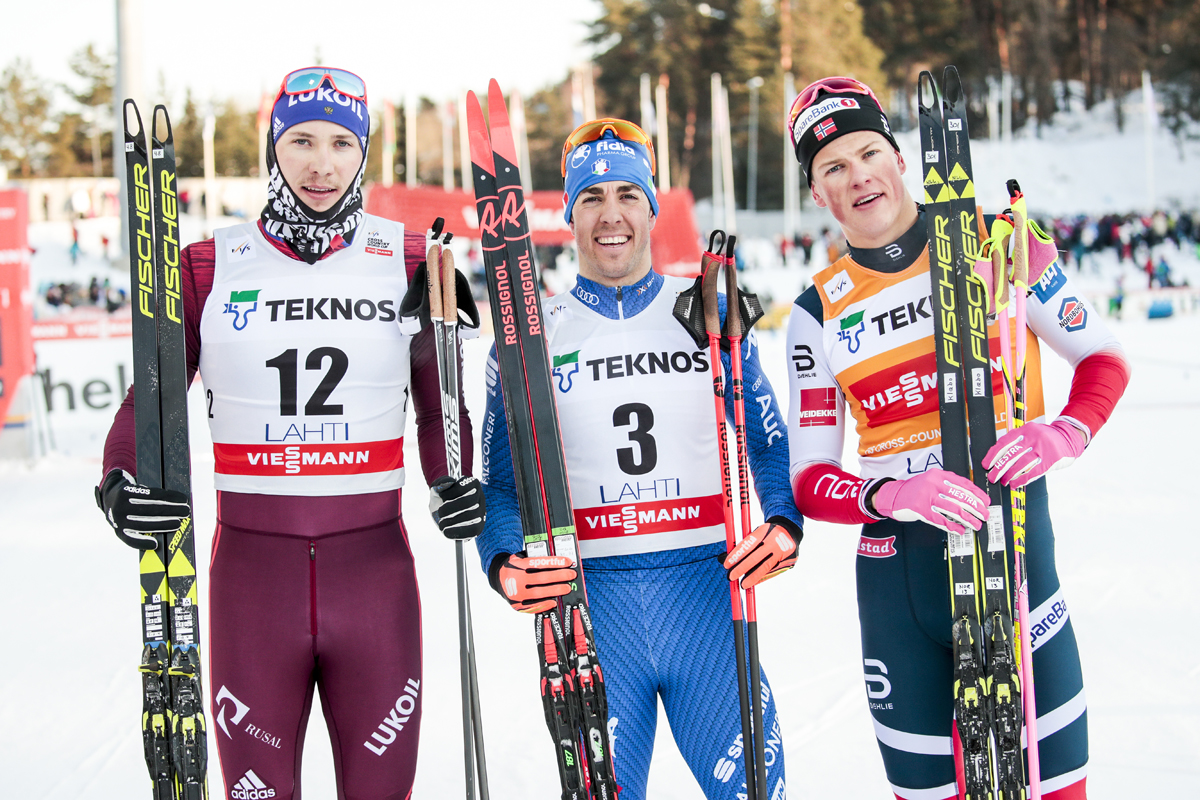
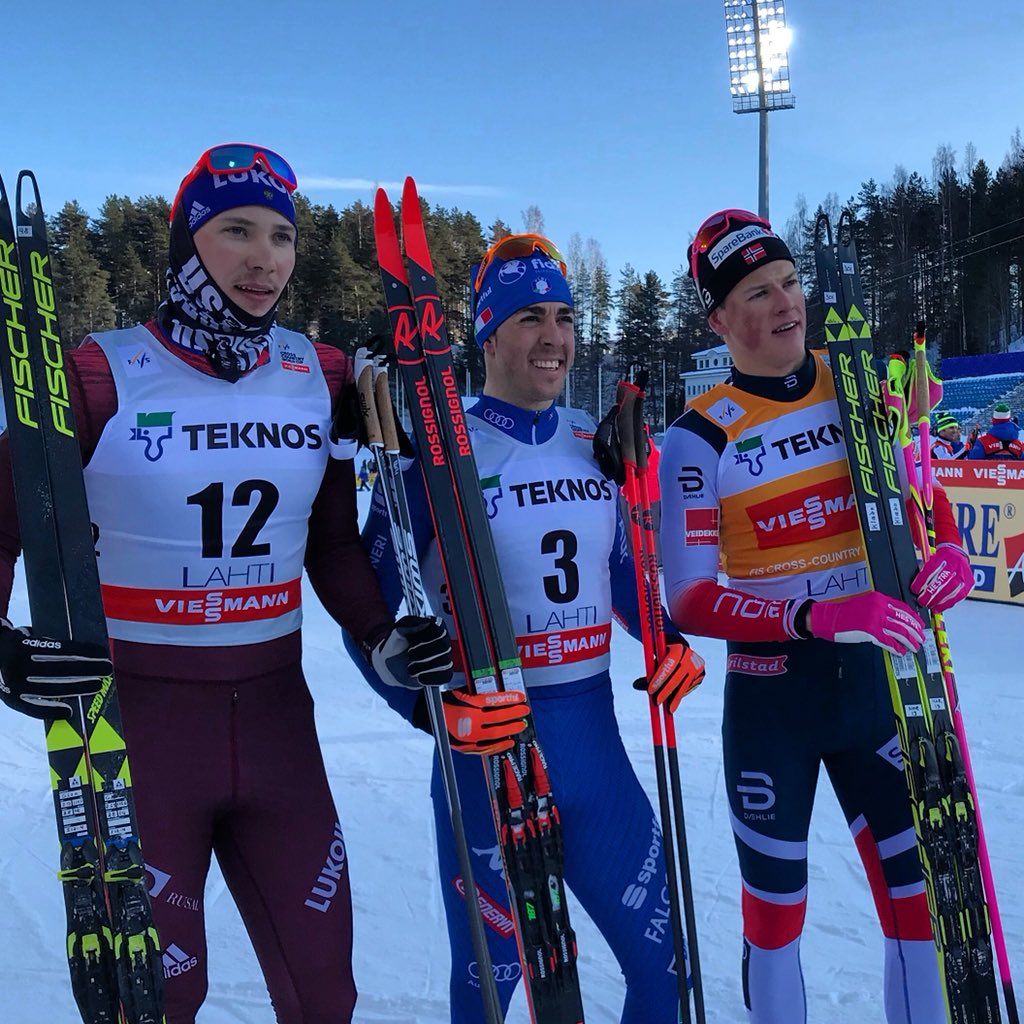
The men’s 1.6 k freestyle sprint podium at Saturday’s World Cup in Lahti, Finland, with Italy’s Federico Pellegrino (c) in first, Russia’s Gleb Retivykh (l) in second and Norway’s Johannes Høsflot Klæbo (r) in third. (Photo: Fischer/NordicFocus)
The men’s freestyle sprint final in Lahti, Finland, started in almost comical fashion: the six men who had made it to the final heat of the day skied slowly, then even slower, as nobody wanted to lead.
The final was full of dangerous men. Norwegian youngster Johannes Høsflot Klæbo has won five sprints this season, and he just became an Olympic gold medalist in the sprint in PyeongChang, South Korea, a mere ten days ago. In his quarterfinal and semifinal heats, he had put in big turns of speed which had dropped most of the field.
They hadn’t dropped Italy’s Federico Pellegrino, though, and the 2017 World Champion was the only man competing in Lahti who had beaten Klæbo in a sprint this season.
Then there was France’s Lucas Chanavat, who put in a huge burst of speed up a hill in his own quarterfinal, perhaps mimicking the move that Klæbo usually makes to test it out or prove a point.
They were all lurking there in the final, along with Russia’s Gleb Retivykh, Finland’s Ristomatti Hakola – consistently one of the fastest qualifiers on the World Cup – and Norway’s Sindre Bjørnestad Skar.
Norway’s Johannes Høsflot Klæbo leading his quarterfinal, which included Italy’s Federico Pellegrino (3) and American Erik Bjornsen (29), in the men’s 1.6 k skate sprint at the World Cup in Lahti, Finland. (Photo: Fischer/NordicFocus)
Klæbo finally got up to some sort of speed on a gradual downhill, stringing out the field after a full 90 seconds of being clumped together and moving at walking pace. But he still wasn’t going full bore. On one of the final opportunities, it was Skar who went to the front and sprinted up a hill, finally turning the speed dial to “full”.
Coming down the final hill into the stadium, it was Skar, Klæbo, and Pellegrino, who overtook the leader going into the last turn. In the finishing stretch, the two Norwegians seemed to just fade away; Pellegrino sprinted for the line and a big win of 0.77 seconds.
“I think that when I returned after the Olympics, back home I had a very good time, really good weather in the Alps,” Pellegrino – the silver medalist in the PyeongChang sprint – said in a post-race interview with FIS. “And it was very good to recover and train a lot, so that I could come here in the best shape. I’m really proud of this.”
Also surging past the Norwegian duo was Retivykh, who had accelerated into and through the final corners and pulled away in finishing lane.
“I have been waiting quite long for the World Cup podium,” said Retivykh, according to FIS. “Last time I was top three was in PyeongChang last year. So it feels great to be back. I am not surprised to be second because I knew I could do it. It feels great… I am sharing the podium with two great athletes.”
Klæbo hung on for third, +0.90 seconds, and Skar was fourth, +1.30. He edged Hakola (+1.44) while Chanavat was left in sixth (+7.55).
Coming into the final as the giant everyone feared, Klæbo’s tactics had not paid off.
“I’m glad this was not the Olympics,” Klæbo told Norwegian broadcaster NRK, according to a translation. “Pellegrino was too strong. I had nothing to answer with. Then you have to be thankful for third place. And I’m still smiling pretty wide.”
Pellegrino, meanwhile, played his cards exactly right. He also beat Klæbo here one year ago to win World Championships gold, and he channeled that experience.
“I lost too many races in the past when I was leading almost the whole race,” he told FIS. “I think that on this track I know how to do it.”
And with the win, Pellegrino became the most decorated skate sprinter in men’s World Cup history. It was his tenth skate sprint victory, a new record.
With third place, however, Klæbo has sealed this year’s overall Sprint Cup trophy even though there are still two sprints to come in Drammen, Norway, and Falun, Sweden.
“That is a bright spot, then,” he told NRK. “It helps a little, but there was no snap today. The [qualifier] was good, but otherwise it was a bit dead.”
By placing 11th in the freestyle sprint in Lahti, Sun Valley’s Kevin Bolger won some Gruyere cheese for being the top-ranked Continental Cup skier of the day. (Photo: Matt Whitcomb)
Bolger 11th in World Cup Debut, Bjornsen 20th
You didn’t have to scroll very far down the qualifier results sheet to find the name of a World Cup debutant. In 16th place was Kevin Bolger of the Sun Valley XC Gold Team. The SuperTour leader made the most of his opportunity, and NRK broadcasters referred to him as “the surprising man – Kevin Bolger.”
“Honestly, I didn’t necessarily expect him to qualify in a Scandinavian World Cup, in his first go at it,” Bolger’s coach Chris Mallory wrote in an email. “He generally builds into sprint days as they progress, as he’s a bit of an all-arounder. But he really stepped up to the plate today.”
In his quarterfinal, Bolger was last out of the start gates and sat in sixth place for much of the race. But near the end of the heat he moved into fifth and then coming into the finish turned on the afterburners to move up to fourth.
The last of the quarterfinals, it also turned out to be the fastest one, and both Bolger and third-place Karl-Johan Westberg of Sweden moved on to the semifinals as lucky losers behind Retivykh, the heat’s winner, and second-place Franceso De Fabiani of Italy.
“He’s a big glider, and can carry his speed really well, but he’s focused a lot on improving his speed this year,” Mallory wrote of that finishing sprint.
In the semifinal, Bolger couldn’t quite pull the same move. He was again in sixth out of the gate, but Pellegrino broke a pole, dropping to last. The two traded off places as Pellegrino then caught back up, and then replaced his pole again. Then Bolger passed Emil Iversen, but the Norwegian passed him back by the finish and Bolger ended up sixth in the semifinal and 11th on the day.
Bolger before the start of his semifinal heat. (NRK screencap)
Bolger graduated from the University of Utah last year and it is his first season as a full-time senior racer with the Gold Team, although Mallory said that Bolger had trained with Sun Valley for two years as a high school postgraduate before heading to college.
Before heading to Europe for the World Cup, Bolger had won a SuperTour sprint in Ishpeming, Michigan, and placed second and sixth in 20 k and 10 k races there. Earlier in the season, he was second in the skate sprint and fifth in the classic sprint at U.S. National Championships.
“My goal was for him to get some World Cup starts and a top 30 this season, so those opportunities would keep coming,” Mallory explained. “I watched FIS live timing all night, normally not so exciting, but last night it was!”
Erik Bjornsen of the U.S. Ski Team and APU qualified in 29th place and in his quarterfinal, had a poor start position as a result of his bib and was immediately shunted to the back of the heat.
“Up the first climb I tried to make a couple moves, but I was just kind of boxed in,” he explained.
He was in the first quarterfinal, along with Klæbo, Pellegrino, and Renaud Jay of France. By late in the heat Bjornsen was able to move up to fifth when Poland’s Maciej Starega, who had led early, began to fade. Then in the final downhill he moved into fourth and held that position through the finish.
Norway’s Johannes Høsflot Klæbo and Italy’s Federico Pellegrino (3) going head to head down the finishing stretch in the first men’s quarterfinal at the World Cup 1.6 k skate sprint in Lahti, Finland, with American Erik Bjornsen (l) chasing. (Photo: Fischer/NordicFocus)
But he hadn’t been able to get to the front early in the heat, and by the finish, the two eventual podium finishers were jetting off at hyperspeed. Though he wasn’t able to catch onto their tails, Bjornsen said that he was feeling better than he had at the Olympics, where his results had been disappointing.
“I definitely kind of struggled,” he admitted of the 2018 Olympic experience. “It was some of my worst distance racing of the year, so it was obviously very frustrating.”
After today’s sprint, however, there might be light at the end of the tunnel.
“I felt like I had good energy left,” Bjornsen said of his heat. “I tried making moves on both sides… the fitness is feeling a lot better than it was a couple of weeks ago. And so, I mean, the peaking plan for the Olympics didn’t work as planned. But it’s been a relatively good season for me, pretty consistent. I had a lot of top 30 finishes… I’m just trying to move past [the Olympics] and have a solid period four on the World Cup.”
He now looks to the 15 k classic on Sunday, which he called “one of my favorite races.”
And on getting upstaged by Bolger, Bjornsen seemed the opposite of upset.
“I was just really psyched to see that,” he said. “The kid has put in a lot of work the last few years and – I mean, I was very surprised. It was great to see. I like to see those younger dudes coming here and having successful results. It’s really impressive. You know, it’s his first World Cup and he just looked comfortable and good out there. It’s just the perfect transition to the World Cup. Keep it up!”
Canada’s Julien Locke on his way to 42nd in the men’s 1.6 k skate sprint at the World Cup in Lahti, Finland. (Photo: Fischer/NordicFocus)
“It was so awesome to have two World Cup first timers, Kelsey [Phinney] and Kevin, have such impressive results,” agreed teammate Sophie Caldwell. “Kevin had the race of the day and it was so inspiring for our entire team, staff, and hopefully all the skiers back home to see that success in a young, up and coming racer who just sent it today. We were going crazy!”
The rest of the North American field did not make it into the quarterfinals. In the qualifier, Logan Hanneman (APU) placed 49th (+11.45). Paddy Caldwell (U.S. Ski Team/SMS T2) finished 59th (+13.55), and APU’s Reese Hanneman and David Norris placed 61st (+14.33) and 67th (+19.27).
Julien Locke led Canada in 42nd place (+9.78), and Andy Shields finished 60th (+14.29).
Logan Hanneman (Alaska Pacific University) on his way to 49th in the men’s 1.6 k skate sprint at the World Cup in Lahti, Finland. (Photo: Fischer/NordicFocus)
The men’s 1.6 k freestyle sprint podium at Saturday’s World Cup in Lahti, Finland, with Italy’s Federico Pellegrino (c) in first, Russia’s Gleb Retivykh (l) in second and Norway’s Johannes Høsflot Klæbo (r) in third. (Photo: FIS Cross Country/Twitter)
FIS Cross Country World Cup (Lahti, Finland): Men’s & women’s freestyle sprints
The defending world championships from the 2017 freestyle sprint prevailed again in Lahti on Saturday, with Norway’s Maiken Caspersen Falla winning the women’s 1.4-kilometer freestyle sprint final and Italy’s Federico Pellegrino coming out on top in the men’s 1.6 k final at last year’s World Championships venue.
Falla’s rise to the final started with her qualifying in 12th, 7.96 seconds off the fastest qualifying time set by Sweden’s Hanna Falk in 2:54.72. Russia’s Natalia Nepryaeva qualified second (+0.63) and Finland’s Krista Pärmäkoski third (+3.62), just ahead of Germany’s Victoria Carl in fourth (+3.88) and American Sadie Bjornsen in fourth (+3.88). Four American women qualified for the heats, with Sophie Caldwell in 17th, Ida Sargent in 21st and Rosie Brennan in 29th.
The women’s 1.4 k freestyle sprint podium at Saturday’s World Cup in Lahti, Finland, with Norway’s Maiken Caspersen Falla (c) in first, and Sweden’s Stina Nilsson (l) and Hanna Falk (r) in second and third, respectively. (Photo: FIS Cross Country/Twitter)
Falla went on to place second in the first quarterfinal, 0.71 seconds behind Sweden’s Stina Nilsson in first. According to the race jury’s ruling, Carl obstructed Pärmäkoski coming out of the last downhill before they entered the finishing straight and both crashed out of contention, with Pärmäkoski finishing fifth in the heat (+12.11) and Carl sixth (+49.5). Carl was relegated to last (30th place) for the obstruction.
Falla then won the first semifinal by just 0.04 seconds over Nilsson in second. The two other Swedes in that heat, Falk and Ida Ingemarsdotter, advanced to the final as well as lucky losers with fast-enough times.
In the final, Falla found herself at the front of the pack early then held her position to the finish, crossing the line in 2:54.83 and beating Nilsson by 0.36 seconds. Sweden had two on the podium with Falk in third (+0.78), Germany’s Sandra Ringwald placed fourth (+0.88), Ingemarsdotter was fifth (+1.83), and Switzerland’s Laurien van der Graaff placed sixth (+3.02).
Caldwell was the lone American woman to make it past the quarterfinals, as she placed second in her quarterfinal, 0.25 seconds behind Ringwald in first, then fourth in the second semifinal, 1.46 seconds behind Ringwald, who also won that heat. Overall, Caldwell finished the day in eighth.
Bjornsen placed 17th overall after finishing fourth in her quarterfinal, 2.84 seconds behind Falk in first. Sargent had been second in her quarterfinal until the final tight lefthand corner into the finishing straight, where she slipped to sixth and ultimately finished sixth, 1.07 seconds behind Sweden’s Anna Dyvik in first. Overall, Sargent finished the day in 27th, and Brennan placed 29th overall after finishing sixth in her quarterfinal, 4.91 seconds behind Ingemarsdotter in first.
Two American men advanced to the heats as well, with Kevin Bolger of the Sun Valley Ski Education Foundation (SVSEF) qualifying in 16th in his World Cup debut, 6.38 seconds behind Norway’s Johannes Høsflot Klæbo, who topped the qualifier in 2:59.06. Erik Bjornsen of the U.S. Ski Team qualified 29th, 8.29 seconds back.
Meanwhile, Pellegrino qualified for the heats in third (+1.9) behind France’s Baptiste Gros in second (+1.23).
There, Pellegrino won the first quarterfinal by 0.19 seconds over Klæbo, with the Norwegian visibly backing off before the finish — comfortable enough to automatically advance to the semifinals in second place. But Klæbo showed Pellegrino what he’s made of in the first semifinal and beat the Italian by nine-hundredths of a second.
Bolger also raced in that first semifinal after placing fourth in his quarterfinal, 0.73 seconds behind Russia’s Gleb Retivykh in first. Bolger’s time was good enough for one of two lucky loser spots in the semifinals, where he went on to finish sixth, 1.86 seconds after Klæbo. Overall Bolger finished the day in 11th.
Erik Bjornsen placed 20th on the day after finishing fourth in the first quarterfinal (with Pellegrino and Klæbo), 1.56 seconds out of first.
In the final, Klæbo set the tone, slowing the pace to almost a stop at one point, while he and Pellegrino stood side by side at the top of the course. On the way down, they accelerated, but Norway’s Sindre Bjørnestad Skar was the one who truly attacked. It might’ve been a bit too early, as Pellegrino caught him by the top of the final climb and took the lead on the following downhill into the stadium. Pellegrino held off his challengers, including Retivykh who came on strong out of the downhill, to take the win in 3:16.73, 0.77 seconds ahead of Retivykh in second and 0.9 seconds ahead of Klæbo in third. Skar settled for fourth (+1.3), Finland’s Ristomatti Hakola placed fifth (+1.44) and France’s Lucas Chanavat finished sixth (+7.55).
In the qualifier, Canada’s Dahria Beatty finished 34th, +13.39 and just 0.9 seconds from making the quarterfinals. She was the only Canadian woman competing.
American Kelsey Phinney (SVSEF) was also close to making the cut. In her first European World Cup, she placed 36th in the qualifier, +13.74. Caitlin Patterson and Kaitlynn Miller, both of the Craftsbury Green Racing Project, placed 56th (+20.12) and 61st (+21.70).
Mathilde Petitjean of Togo, a primarily Quebec-based skier, finished in 59th (+20.80).
In the men’s qualifier, Logan Hanneman (APU) placed 49th (+11.45). Paddy Caldwell (U.S. Ski Team/SMS T2) finished 59th (+13.55), and APU’s Reese Hanneman and David Norris placed 61st (+14.33) and 67th (+19.27).
Julien Locke led Canada in 42nd place (+9.78), and Andy Shields finished 60th (+14.29).
American Chloe Levins racing to seventh in the junior women’s 7.5 k sprint on Saturday at IBU Junior World Championships in Otepää, Estonia. (Photo: Terri Dickson)
Poland’s Kamila Zuk won her second race in a row, taking gold in the junior women’s 7.5 k sprint after also winning the individual at World Junior Championships. Zuk had one penalty to two by second-place Marketa Davidova of the Czech Republic, who finished 26.0 seconds back. Bronze went to Myrtille Begue of France, who shot clean to finish 52 seconds back.
The sole U.S. starter, Chloe Levins followed up her sixth-place finish in the individual with seventh place in the sprint. Levins had a single penalty and finished +1:31.7.
For Canada, Megan Bankes was close behind Levins in ninth, with two penalties and +1:49.5. Teammate Nadia Moser was 21st, also with two penalties, +2:46.2. Emily Dickson finished 36th, +3:50.5 with two penalties, and Zoe Pekos just missed the pursuit cutoff in 66th (+6:22.4) with four missed shots.
In the junior men’s 10 k sprint, Vasilii Tomshin of Russia took the gold with perfect shooting. France’s Martin Perillat Bottonet was second, less than a penalty-loop’s worth of time back at 20.5 seconds – and he did have one penalty. Norway’s Sverre Dahlen Aspenes took bronze (+29.4) with two missed shots.
Trevor Kiers led Canada in 16th, a breakthrough result; his previous World Juniors best was 39th in the pursuit last season. Kiers missed two shots, both in prone, and finished 1:34.9 behind the time set by Tomshin.
Adam Runnalls placed 26th for Canada (+2:08.3) with three missed shots. Teo Sanchez also qualified for the pursuit by placing 53rd (+3:19.2) with one penalty, and Angus Tweedie was left on the outside looking in with 69th place (+4:41.3) with three missed shots.
Cody Johnson led the Americans in 37th, with clean shooting, 2:31.1 back from Tomshin’s time. Tim Cunningham was the next finisher in 71st (+5:13.5) with seven missed shots, followed by Jacob Pearson in 79th (+6:24.2) with two penalties and Cam Christiansen in 86th (+7:52.5) with three penalties.
Norway’s Johannes Høsflot Klæbo (2) racing to gold, ahead of Italy’s Federico Pellegrino (9) and Russia’s Alexander Bolshunov (4) in the men’s 1.4-kilometer classic sprint final on Tuesday at the 2018 Winter Games in PyeongChang, South Korea. (Photo: FlyingPointRoad)
PYEONGCHANG, South Korea — Johannes Høsflot Klæbo. Search the Norwegian’s name in the International Ski Federation (FIS) web databank and it appears at the top of nine of the 13 World Cup races he has entered this season.
For many, Klæbo is more than just the name of Scandinavia’s most recent nordic speedster. It is a verb. Cross-country skiing argot has come to embrace the idea of pulling a “Klæbo” or deciding to “Klæbo” a course.
On Tuesday at the Alpensia cross-country venue in PyeongChang, his name gained even more light in the glimmer of cross-country skiing stardom. He raced to a convincing win in the men’s 1.4-kilometer classic sprint at the 2018 Winter Olympics amidst freshly falling snow and frigid winds. While most racers were bundled in buffs, Klæbo kept his distinct coiffed hair sans hat.
The victory earned Norway its third gold medal of the Games and Klæbo’s first Olympic medal. The 21 year old’s win is also the youngest gold-medal performance in the history of cross-country at the Olympics.
But even a name like Klæbo takes pause to credit those who predate his success. His name has not always dominated nordic-news headlines. There were others before him. Looking back 12 years, Klæbo can recall the the individuals he aspired to be like. There were names that he as a 9 year old heard again and again; ones that he looked up to, that motivated his desire to not only to compete at an Olympic games, but to put forth a gold performance of his very own.
“When Petter [Northug] was doing [cross-country skiing] so well from 2006, it’s been a big inspiration for me,” Klæbo said during a post-race press conference.
Norway’s Johannes Høsflot Klæbo (2) and Russia’s Alexander Bolshunov (3) with spectators after winning gold and bronze, respectively, in the men’s 1.4-kilometer classic sprint on Tuesday at the 2018 Olympics in PyeongChang, South Korea. (Photo: FlyingPointRoad)
Petter Northug, Jr., is one of Norway’s most decorated male cross-country skiers to date. In 2006 at the age of 20, Northug won three Junior World Championship titles. At the time, Klæbo was Northug’s junior by a little more than a decade. Northug went on to compete at two Olympic Games, coming away with two gold medals in 2010.
“When you’re starting to go in high school and you’re looking forward and looking up to people doing it well in championships, you really want to do the same,” reflected Klæbo, who is mainly coached by his grandfather. “You want to do it your way. To be able now to cross the finish line first and get an Olympic gold medal. It’s quite an unbelievable feeling.”
On Tuesday, his Olympic win was secured in the top of the final climb. Though the sprint finalists were led out of the start by Russia’s Alexander Bolshunov, who’s also 21, Klæbo stuck to the Russian’s ski tails.
Holding tightly to Klæbo was Italy’s Federico Pellegrino. Finland’s Ristomatti Hakola, who posted the top time in Tuesday’s qualifying round in a time of 3:08.54 minutes, as well as Norway’s Pål Golberg and Sweden’s Oskar Svensson, also followed as they made their way up the initial ascent.
“Bolshunov was quite strong in the start of the final there; he was pushing quite hard for the first uphill,” Klæbo said. “My plan was always to be able to run fast in the last uphill and to be able to get the gap and turn around on the top there.”
Klæbo crafted his plan perfectly. While Bolshunov’s maroon suit strode in first through the first major hill and the second course climb, Klæbo crouched patiently just behind. As they approached the final hill, the distinct bouncing stride of Klæbo came into play.
The pitch intensified and so did Klæbo. At the halfway point, the Norwegian and Russian fought side-by-side. Just before the peak of the hill, Klæbo made his move. He pushed around Bolshunov and pressed the pace in the front.
Rounding back toward the stadium, it was the Norwegian in first with close to a two-meter gap on the two skiers chasing him down: Bolshunov and Pellegrino. In a pack of three behind them were Golberg, Svensson and Hakola.
The final descent featured Klæbo on his own. He cornered the final turn without anyone close to him and double poled to the 50-meter mark, checking back several times before slowing his pace. With arms outstretched and a pink gloved wave to the crowd, he crossed the finish line first in a time of 3:05.75.
The battle for second came down to Pellegrino and Bolshunov. The 27-year-old Italian, in his second Olympics, double poled. The Olympic rookie from Russia matched him. Pellegrino, the overall Sprint World Cup champion from two seasons ago (Klæbo won the Sprint Crystal Globe last year), is better known for his dominance in the freestyle sprints. However, that didn’t prevent him from gunning to the end.
Norway’s Johannes Høsflot Klæbo (l) and Italy’s Federico Pellegrino finishing first and second, respectively, in the first semifinal of the men’s 1.4-kilometer classic sprint at the 2018 Olympics in PyeongChang, South Korea. (Photo: FlyingPointRoad)
“I knew that I could always talk about me like an outsider for today. This was a good thing,” Pellegrino said at the press conference. “But in Ruka when I catch the final and I think that the track was so similar with a strong uphill I started to think about a medal. Then I worked a lot during this winter for improving my classic side.”
“I had only one goal for these Olympics, that was to return to Italy with one medal,” Pellegrino said on Tuesday.
The medal would come in the color of silver. Pellegrino outlunged Bolshunov by 0.02 seconds to claim second (+1.34) place and his first Olympic medal. Bolshunov’s bronze medal is also the Russian’s first of Olympic caliber. Previously this season, Bolshunov had reached the World Cup podium five times, always in third place. Two of those races were sprints.
“If I may be frank I have not yet internalized this medal,” said Bolshunov, who’s competing at these Olympics as part of the “Olympic Athletes of Russia” delegation.
“It’s only been a little while, so I have to basically understand what has happened,” he continued. “But I am very happy to be here, and I am very happy to have achieved this result.”
Norway’s Golberg finished fourth (+3.81) and Sweden’s Svensson fifth (+7.73), while top qualifier Hakola finished the final in sixth (+20.72).
— Jason Albert, Gavin Kentch, Ian Tovell, and Harald Zimmer contributed
Italy’s Federico Pellegrino absorbs his silver-medal performance on Tuesday in the men’s 1.4 k classic sprint at the 2018 Olympics in PyeongChang, South Korea. (Photo: FlyingPointRoad)
Off the front and in for the win, Norway’s Johannes Høsflot Klæbo leads down the finishing straight in Seefeld, Austria en route to another win in the men’s 1.4 k freestyle sprint final, ahead of France’s Lucas Chanavat in second and Sweden’s Calle Halfvarsson in third. (Photo: Garrott Kuzzy / LumiExperiences.com)
There are no brakes for the World Cup until Sunday afternoon in Seefeld, Austria. The Opening Ceremony of the 2018 Winter Olympics is Feb. 9. For the champing-at-the-bit thoroughbreds in Seefeld, Saturday featured the last sprint before the Games: a 1.4-kilometer freestyle sprint.
If you were thinking the World Cup’s sprint leaders were taking a “taper” weekend in the run-up to PyeongChang, you’d be wrong. Jumping into the mix were overall Sprint World Cup leader Norway’s Johannes Høsflot Klæbo, Italy’s Federico Pellegrino, who’s second in the sprint standings, and Norwegian Emil Iversen, who was third at the time. The list could get exhausting. Let’s just say the heavy hitters of the sprint world came out to play.
Under Seefeld’s alpine sun, the boldest pattern on the men’s World Cup continued. Klæbo won the qualifier by nearly five seconds, covering the course in 2:46.89 minutes. Pellegrino qualified in second, crossing the line 4.88 seconds slower.
Norway’s Johannes Høsflot Klæbo racing to the win in his semifinal, which he took by 0.33 seconds over France’s Lucas Chanavat (not shown). Klæbo went on to win the final as well. (Photo: Garrott Kuzzy / LumiExperiences.com)
Klæbo also took the Seefeld sprint win with a time of 3:02.66 in the final. France’s Lucas Chanavat placed second overall, 0.48 seconds back, Sweden’s Calle Halfvarsson third (+0.97), Pellegrino fourth (+1.06), Russia’s Gleb Retivykh fifth (+1.17), and Iversen sixth (+5.57).
The winning trend is clear, these races appear to be Klæbo’s to lose. The day marked Klæbo’s sixth World Cup sprint victory of the year and his ninth overall. After Saturday, he has a 205-point lead over Pellegrino in the sprint standings. Chanavat moved up to third, 293 points behind Klæbo and six points ahead of Iversen in fourth.
“No, I don’t have a plan before I start,” Klæbo told the International Ski Federation (FIS) in a post-race interview. “I just take it step by step, and just try to be in front and to have this control. This was quite fun for me; you have this uphill where no one wants to be in first and into a downhill. It’s something else, but it’s fun.”
Klæbo-style fun.
Let’s circle back to Klæbo’s time in the finals: 3:02.66 minutes. Much slower than his rocketing qualifying time. Yet, Klæbo commands respect like Petter Northug did in his prime or Martin Johnsrud Sundby did just a few months ago. Through the quarterfinals, semifinals and finals, it’s clear the men’s field awaits Klæbo’s kill-shot before making any decisive moves in earnest.
In the first heat, which featured Klæbo, Austria’s Dominik Baldauf shot off the front in what looked like a frenzied attempt to gamble his own fast-twitch-muscle-fiber reputation. Klæbo let him go for about a minute. Midway up the first climb, the group seemed to stall a bit, waiting for the inevitable. Of course, Klæbo went. With a now trademark speed-burst, the 21-year-old Norwegian was up and over the top of the hill. Only Halfvarson was able to catch Klæbo’s tails as the pair finished first and second, with Halfvarsson 0.53 seconds back.
In Klæbo’s semifinal, slow-the-boss-down tactics played heavy until the first hill again as Halfvarsson and Chavanat controlled the pace. One-two-three it was Halfvarsson, Chavanat, then Klæbo over the top. American Simi Hamilton, who had qualified fifth and placed second in the second quarterfinal to reach the semis, crested the hill in fourth.
American Simi Hamilton (near) gunning down the final straight with Italy’s Federico Pellegrino in the first men’s semifinal. Pellegrino placed fourth, 0.09 seconds ahead of Hamilton in fifth, and the Italian advanced to the final as a lucky loser. Hamilton did not and finished the day ninth overall. (Photo: Garrott Kuzzy / LumiExperiences.com)
On the false working flat prior to the course’s second climb, Klæbo simply began to pull away. Looking under his legs passing under the 100-meters-to-go banner, Klæbo’s win was already settled. Chavanat was second (+0.33), Halfvarsson third (+0.52), Pellegrino fourth (+2.52), Hamilton fifth (+2.61) and Poland’s Maciej Staręga sixth (+28.76). While Halfvarsson and Pellegrino advanced to the finals as lucky losers, Hamilton did not.
Perhaps it is time for the guessing to start. As in, will Klæbo dominate in PyeongChang? Can the 21 year old handle Olympic size pressure? Klæbo keeps his cool. But will the Games see a field ready to play for silver and bronze as they kowtow to Klæbo or a field with steady nerves ready to settle a score in what looks to be the start of a long and storied Olympic career for Klæbo?
Hamilton was the best-placed American man on Saturday. He clocked the fifth-fastest qualifying time, 6.46 seconds off Klæbo’s top time, then placed second to Pellegrino in his quarterfinal and was fifth in the first semifinal, 2.61 seconds behind Klæbo. Overall, Hamilton ended the day in ninth.
“I felt like, in the quarters I skied downhill really well, and I was able to get a really good draft and slingshot coming down through the stadium, so I was kind of trying to rely on that again,” Hamilton told FasterSkier in person after the race. “I was just trying to be mid-pack going over the top of the big climb, and the downhill was skiing quite a bit different than it was in my quarter. It was like, much, much icier. I was definitely way more conservative skiing into it, and I just did not ski it very well, and as a result, didn’t carry my speed down through the long straightaway nearly as well as I could have or should have. I knew that Federico and I were fighting for that fourth spot there.”
Also for the U.S., Erik Bjornsen (U.S. Ski Team) finished 37th in the qualifier, 0.89 seconds out of the top 30 and 11.99 second out of first. Logan Hanneman, of Alaska Pacific University (APU) was 39th (+12.52), Andy Newell (U.S. Ski Team) 42nd (+12.90),Reese Hanneman (APU) 65th (+17.91), and Ben Lustgarten (Craftsbury Green Racing Project) 76th (+21.88).
Brothers Logan (l) and Reese Hanneman after the World Cup skate sprint in Seefeld, Austria. The two were recently named to the U.S. Olympics cross-country team for PyeongChang, South Korea, next month. (Photo: Garrott Kuzzy / LumiExperiences.com)
In his second-career World Cup race, Logan Hanneman, 24, left venue wanting more.
“It was really hard, I don’t quite understand why, but I felt very close to cramping right out of the start,” Hanneman told FasterSkier after. “I think it was a lot of nerves. And then you hit this huge hill right out of the start, and then it hurt quite a bit. Then you have the downhill ripping across [the arena] and your legs just fill up with lactate quite a bit before that last uphill. But it was good. I think I was about the same as last week from out [of the heats], so really close again. I would have really wanted to get in today especially because it’s skating.”
At last weekend’s classic sprint in Planica, Slovenia, Hanneman placed 35th.
Alex Harvey was the lone Canadian in the heats and placed eighth overall. In his first World Cup race since placing a historic third overall in the 2018 Tour de Ski, Harvey played perfect tactics in his quarterfinal, holding his big efforts back on course’s first major climb. Toying in sixth initially, his hand unfolded from the back of what he called a “come-from-behind course”.
Canada’s Alex Harvey during the men’s 1.4 k freestyle sprint at the World Cup in Seefeld, Austria. He finished fourth in his semifinal for eighth overall. (Photo: Salomon/NordicFocus)
Coming into the final climb, Harvey moved up the outside and gained position.
“I was trying to see if I could save energy on that first hill and make my way past a couple guys on the downhill and come up that last hill with a lot of speed and still have the energy to makes some moves there,” Harvey said on the phone after.
In what was the fastest quarterfinals of the day (both lucky losers advanced from Harvey’s heat), the Canadian was able to ski a dicey corner into the final stretch with speed and take the quarterfinal win in 2:29.96 minutes.
“It worked in the quarter and then in the semi, I think that worked well also but it was just the very final corner before the last hundred meters that didn’t take as well as I should have,” Harvey reflected.
Iversen settled in and took control of Harvey’s semifinal with a slightly more laid-back pace than Harvey’s quarterfinal, at least initially. Midway through the first hill, Iversen punched into the lead and crested the hill with physics in his favor.
“It was slow when Emil was in the front,” Harvey noted. “We were basically just walking up that big hill and he didn’t really drill it. He just went hard the last couple of steps over the hill to generate some speed and try to hold his own and it worked well for him. Probably Emil is one of the only guys in the men’s field who can hit the top of a hill first and hold it down a hill because he is both a bit heavier than a few other guys. He is actually a really good downhiller. He can take those corners really well. … He is one of the few guys, but I still think for me and basically anyone else in the field other than him it’s not the best strategy.”
Canada’s Alex Harvey racing with Switzerland’s Dario Cologna during the men’s 1.4 k skate sprint quarterfinal in Seefeld, Austria. Harvey won that heat by 0.44 seconds over Cologna, and went on to place eighth overall, while Cologna finished the day in 10th. (Photo: Garrott Kuzzy / LumiExperiences.com)
Iversen won that semifinal, the second one of the day, in 2:56.88 minutes. Harvey finished 0.47 seconds back in fourth, behind Russia’s Retivykh in second and France’s Richard Jouve in third, as he was unable to gain ground in the last hundred-meter stretch.
Canada’s Len Valjas placed 40th, 12.72 seconds back in the qualifier, after fighting a lingering injury for much of the race season. Valjas injured his back in the gym prior to last season’s World Championships in Lahti, Finland and told FasterSkier he tried to manage the injury and fight off the pain until he re-injured himself this past November.
“I went home again and pretty much got every test done and they found a herniated disk in T2-3 and below that a cracked vertebrae on T-4 which is the rib that is probably affecting my breathing,” Valjas explained. “It just feels like there is a rubber band around my chest so when it’s flared up and tight it just takes longer to take a deep breath, and I honestly can’t go any higher than [Zone] 3, my body can’t go on any slower breathing. So yesterday was a really bad day, my breathing sucked, I didn’t do any pre-race I just skied slow and got worked on.”
Valjas went on to say he felt better trying to qualify for Saturday’s heats and plans on taking the next four days off before flying to South Korea for the Olympics.
“I just need to manage resting but also I need those hard efforts to get my body ready for racing again. Right now it’s kind of a pain,” Valjas added. “I know that I can ski fast so I am trying to save my one effort for the sprint in Korea. These efforts, I need them, but also at the same time, I need to give some rest.”
Also for Canada, Julien Locke (Canadian U25 Team) skied to 43rd (+13.31), Knute Johnsgaard (World Cup Team) 51st (+14.74), Bob Thompson (NTDC Thunder Bay) 58th (+16.55), Graeme Killick (World Cup Team) 61st (+17.28), and Devon Kershaw (World Cup Team) 70th (+19.53).
“I am feeling pretty good, the shape is definitely starting to come around compared to the start of the season for me,” Johnsgaard told FasterSkier after. “But I am also coming off a pretty big kind of training block here in Livigno at high altitude so I am feeling it a little bit, but the plan is to build off that training and hopefully absorb it and be in top shape for the games. Considering that, it was a great race for me today.”
Racing continues Sunday in Seefeld with 10/15 k freestyle mass starts.
The podium for Day 2 of the Seefeld Triple Nordic Combined World Cup, with Japan’s Akito Watabe in first (c), Germany’s Vinzenz Geiger (l) in second and Norway’s Jarl Magnus Riiber (r) in third. (Photo: FIS Nordic Combined/Twitter)
FIS Nordic Combined World Cup (Seefeld, Austria): Normal hill/10 k
Two of the same men from Friday repeated on the podium on Day 2 of the Seefeld Triple Nordic Combined World Cup, with Japan’s Akito Watabe notching his second-straight win on Saturday.
Norway’s Jarl Magnus Riiber, who finished second on Friday, placed third in Saturday’s individual normal hill/10 k Gundersen, while Germany’s Vinzenz Geiger placed second, more than a minute behind Watabe.
Watabe jumped to first and started the 10 k with a 25-second head start on Riiber in second. Geiger started seventh, 1:45 minutes back, and rose to second at the finish, 1:05.5 behind Watabe (who won in 23:28.5) and 3.4 seconds ahead of Riiber in third (+1:08.9).
For the second day in a row, Norway’s Jan Schmid narrowly missed the podium in fourth (+1:14.1), up from fifth after the jump.
Taylor Fletcher was the lone American competing on Day 2, and he ended up 31st, up 10 places after jumping to 41st. Fletcher started the 10 k race 4:44 out of first then finished 3:52.9 behind Watabe.
The Seefeld Triple concludes Sunday with the individual normal hill/15 k Gundersen.
American Sophie Caldwell (l) and Switzerland’s Laurien van der Graaff (r) tied for first on Saturday in the women’s 1.1 k freestyle sprint final at the World Cup in Seefeld, Austria, while Norway’s Maiken Caspersen Falla placed third. (Screenshot: ARD broadcast)
FIS Cross Country World Cup (Seefeld, Austria): Freestyle sprints
It doesn’t get any closer than that. On Saturday, American Sophie Caldwell and Switzerland’s Laurien van der Graaff tied for first in the women’s 1.1-kilometer freestyle sprint final at the World Cup in Seefeld, Austria. They both finished within one-hundredth of a second of each other to take the victory — the last sprint before the Olympics — in 2:18.65 minutes.
Norway’s Maiken Caspersen Falla finished 0.21 seconds later for third place.
The women’s freestyle sprint podium at Saturday’s World Cup in Seefeld, Austria, with American Sophie Caldwell (l) and Switzerland’s Laurien van der Graaff (c) tying for first and Norway’s Maiken Caspersen Falla (r) placing third. (Photo: FIS Cross Country/Twitter)
“I broke my pole in the semifinal, then I got really tired,” van der Graaff said in a post-race interview with the International Ski Federation (FIS). “But I still believed I can be with Maiken and Sophie, and that I could catch them in the final was just great.”
Norway and the U.S. both had two in the final, with Kathrine Rolsted Harsem of Norway placing fourth (+1.34), Sweden’s Linn Sömskar finishing fifth (+1.83) and American Sadie Bjornsen taking sixth (+2.26).
Falla had raced to first in the qualifying round with a time of 2:21.44, Italy’s Greta Laurent qualified second (+1.43), van der Graaff third (+1.66), Caldwell fourth (+1.84), and Bjornsen fifth (+2.01).
Van der Graaff then won her quarterfinal and placed third in the first semifinal, 0.77 second behind Caldwell, who won it. Falla was second in that semifinal (+0.16) and van der Graaff advanced as a lucky loser.
Caldwell and Falla went head to head in every heat, with Falla winning their first quarterfinal by 0.08 seconds over Caldwell in second.
Bjornsen won her quarterfinal and finished second to Harsem in the second semifinal.
A third American, Kikkan Randall also qualified for the heats, placing 18th in the qualifier then finishing third in her quarterfinal (1.33 seconds behind Sömskar in first) to end up 14th overall.
Canada’s Dahria Beatty placed 30th in the qualifier to nab the last spot in the rounds, then finished fourth in her quarterfinal (1.65 seconds behind Laurent in first) for 20th overall.
For the U.S., Ida Sargent missed qualifying by about half a second in 37th (+8.20), Rosie Brennan finished 42nd (+9.86) and Caitlin Patterson was 52nd (+13.0).
Also for Canada, Emily Nishikawa finished 51st (+12.68) and Cendrine Browne was 54th (+13.34).
The men’s 1.4 k freestyle sprint podium at the World Cup in Seefeld, Austria, with Norway’s Johannes Høsflot Klæbo (c) in first, France’s Lucas Chanavat (l) in second and Sweden’s Calle Halfvarsson (r) in third. (Photo: FIS Cross Country/ Twitter)
The men raced 1.4 k, with Norway’s Johannes Høsflot Klæbo qualifying first in 2:46.89 then winning his quarterfinal and semifinal before putting the hammer down for one last time in the final, finishing first in 3:02.66.
France’s Lucas Chanavat placed second in the final, 0.48 seconds back, after qualifying sixth, winning his quarterfinal and placing second in the first semifinal (0.33 seconds behind Klæbo). Sweden’s Calle Halfvarsson took the third spot on the podium after finishing 0.97 seconds after Klæbo. Halfvarsson had previously qualified seventh, taken second in his quarterfinal and advanced as a lucky loser in third in the first semifinal (0.52 seconds behind Klæbo).
Italy’s Federico Pellegrino missed the podium in fourth (+1.06), Russia’s Gleb Retivykh placed fifth (+1.17), and Norway’s Emil Iversen was sixth (+5.57).
Canada’s Alex Harvey and American Simi Hamilton both made it to the semifinals, where they finished fourth and fifth, respectively, and did not advance to the finals. Harvey had qualified for the rounds in 22nd and won his quarterfinal, then raced in the second semifinal, where he finished fourth, 0.47 seconds behind Iversen in first. That put Harvey eighth overall on the day.
Hamilton clocked the fifth-fastest qualifying time, 6.46 seconds back from Klæbo’s top time. The U.S. Ski Team member then placed second to Pellegrino in his quarterfinal and was fifth in the first semifinal, 2.61 seconds behind Klæbo. Overall, Hamilton placed ninth.
Also for the U.S., Erik Bjornsen finished 37th in the qualifier, 0.89 seconds out of the top 30 and 11.99 second out of first, Logan Hanneman was 39th (+12.52), Andy Newell 42nd (+12.90), Reese Hanneman 65th (+17.91), and Ben Lustgarten 76th (+21.88).
Canada’s Len Valjas placed 40th (+12.72), Julien Locke 43rd (+13.31), Knute Johnsgaard 51st (+14.74), Bob Thompson 58th (+16.55), Graeme Killick 61st (+17.28), and Devon Kershaw 70th (+19.53).
France’s 22-year-old Chloé Chevalier racing to her second win and third podium of the week in as many individual races at 2018 IBU Open European Championships on Saturday in Ridnaun, Italy. (Photo: IBU/Biathlonworld)
IBU Open European Championships (Ridnaun-Val Ridanna, Italy): Men’s and women’s pursuits
France’s Chloé Chevalier picked up her second win and third podium of the week at the International Biathlon Union (IBU) Open European Championships on Saturday in Ridnaun, Italy, winning the women’s 10 k pursuit, while Russia’s Alexander Loginov rose to the top step of the podium in the men’s 12.5 k pursuit on Saturday.
Chevalier started the women’s pursuit in second, 13 seconds behind Ukraine’s Iryna Varvynets (who won Friday’s sprint and thus started first), and shot clean to take the lead after the third stage — where Varvynets missed one. Chevalier went on to clean the final stage for perfect 20-for-20 shooting and crossed the line first in 29:25.4. Varvynets finished second, 11.0 seconds back after missing a single target in the first standing (0+0+1+0), and France had two on the podium with Julia Simon in third (+43.2). Simon also shot 19-for-20, with her miss coming in the second prone stage (0+1+0+0).
“Three medals in three races is definitely more than I had expected,” Chevalier, 22, told the event’s organizers on Saturday. “Today I saw that Iryna shoots faster than I, and so I really gave my all in the track. Even if it might not look like it, after the many races in the last few days I am noticing that I am getting more and more tired.”
American Chloe Levins rose from 59th at the start to 42nd at the finish (+4:11.8), with three clean stages and two misses in the first standing (0+0+2+0). She had the 28th-fastest overall range time and 30th-ranked shooting time.
In the men’s pursuit, Loginov started first as Friday’s sprint winner Latvia’s Andrejs Rastorgujevs did not start. Loginov held the lead throughout the race despite two misses — one in the first stage and another in the last stage (1+0+0+1) — and secured the win in 32:22.1. Bulgaria’s Krasimir Anev started second, 19 seconds after Loginov, and held his place as well, shooting clean and finishing second, 27.6 second back.
“I am really happy here in Ridanna and the results reflect that,” Loginov, 25, told organizers. “Not to start in the individual event on Wednesday was the right decision because the last few days had been very demanding with six races in eight days. I am cross with my two errors in the shooting range, but very happy with my performance in the track.”
Russia had two on the podium with Evgeniy Garanichev in third (+1:10.7) after Garanichev started in bib 19 and overcame three penalties (1+0+2+0) with the fastest overall course time.
Canada’s Macx Davies started 27th and finished 35th (+4:33.9) with five misses (3+0+2+0), while American Alex Howe rose from 53rd at the start to 43rd (+5:53.5) with five penalties (2+2+1+0).
The 2018 Open European Championships conclude with the single mixed relay and mixed relay on Sunday. American Susan Dunklee and Lowell Bailey are on the start list for the single mixed relay, Canada’s Carsen Campbell and Sarah Beaudry. For the mixed relay, the U.S. has entered Levins, Maddie Phaneuf, Paul Schommer, and Alex Howe.
Italy’s Federico Pellegrino (5) getting a ski tip ahead of Norway’s Johannes Høsflot Klæbo (l) for the men’s freestyle sprint final win on Saturday at the World Cup in Dresden, Germany. France’s Lucas Chanavat (1) placed third for the second-straight World Cup sprint, another Frenchman Richard Jouve (second from r) placed fourth, Sweden’s Emil Jönsson (second from l) was fifth, and Norway’s Even Northug (behind) took sixth after breaking a pole out of the start. (Photo: Fischer/Nordic Focus)
How do you beat Norway’s Johannes Høsflot Klæbo at his competition-crushing game? Take him by surprise with minimal time to recover. Italy’s Federico Pellegrino did just that on the last uphill rise of the 1.2-kilometer sprint course on Saturday in Dresden, Germany.
Dresden, a historic city in eastern Germany, debuted its brand-new course along the Elbe River on manmade snow amid damp conditions and temperatures above freezing throughout the day. Pellegrino had done what he needed to advance through the rounds, clocking the first-fastest time in the qualifier, 2.9 seconds behind France’s Lucas Chanavat in first, then placing second in his quarterfinal and third in the first semifinal. Klæbo won that semi by 0.16 seconds over Chanavat in second and 0.3 seconds ahead of Pellegrino in third. With a fast-enough time, Pellegrino moved on to the final, where he met the 21-year-old Klæbo again.
“I knew that at the beginning of the race, I’m becoming a little bit old so the younger Klæbo and Chanavat were faster than me,” Pellegrino, 27, said of the final in a post-race interview with the International Ski Federation (FIS). “So I just had to wait, but I wanted to attack in the longer race to the finish line.”
The race from his point of attack might have seemed like an eternity, but in actuality, it was about 500 meters before the finish. Klæbo and Chanavat had burst out of the start at lightning speed, skiing “shoulder to shoulder,” as Chanavat later said in a press conference, and slightly gapping the four skiers behind them — one of which was Pellegrino.
While Klæbo pushed the pace up front, Pellegrino kept the two leaders close, skiing just a couple strides back. France’s second man in the final, Richard Jouve slotted into fourth behind him and Sweden’s Emil Jönsson — in his first final in a year — followed in fifth. Behind them, Norway’s Even Northug (Petter Northug’s 22-year-old brother) worked to fasten a new pole after breaking his on the starting gate. That took him out of the race from the gun.
Chanavat attempted to get ahead of Klæbo on a tight righthand corner, but Klæbo held the inside line and his position. Coming out of that corner, Pellegrino latched on to Chanavat and brought the rest of the group with him. Shadowing the two leaders’ every move, Pellegrino accelerated just before the final rise, taking just three V2 pushes to get to the top.
Norway’s Johannes Høsflot Klæbo (l) and Italy’s Federico Pellegrino (second from l) jockey for position just before the finish of the men’s freestyle sprint final at the World Cup in Dresden, Germany, while France’s Lucas Chanavat (1) and Richard Jouve chase, followed by Sweden’s Emil Jönsson (14). (Photo: Fischer/NordicFocus)
Even with Klæbo, the Italian took another push to move ahead and left Klæbo chasing. With about 75 meters to go, they began their all-out showdown to the finish, side by side, with Pellegrino staying just ahead to cross the line first in 1:52.77 minutes. Klæbo was just 0.18 seconds back in second and Chanavat 0.98 seconds behind in third.
“When I will have grandchildren this will be the story I am going to tell them, that I beat Johannes,” Pellegrino said, according to a FIS press release.
It was his first World Cup victory in nearly a year since winning a freestyle sprint in Falun, Sweden, late last January, and his 10th career individual World Cup win.
“Klæbo is a really good guy because if he wanted to he could stop me,” Pellegrino told FIS. “… He tried to stay stay quiet to let me go … he’s really good to continue to win.”
In the four sprints Klæbo’s contested this season, Saturday marked his first loss (he did not compete in the Tour de Ski, opting for a training block instead and racing at Norwegian nationals in Vang, Norway, where he won the classic sprint).
“It was a tough one,” Klæbo said of Saturday’s final. “Me and Chanavat was trying to go pretty hard from the start of the final, and I think both of us went a little bit too hard. … I’m satisfied with second place here but I have to do something else to beat him next time.”
Two seasons ago, Pellegrino was the overall Sprint World Cup champion. Last season, it was Klæbo as both the U23 and Sprint World Cup Champion.
The men’s freestyle sprint podium on Saturday at the World Cup in Dresden, Germany, with Italy’s Federico Pellegrino (c) in first, Norway’s Johannes Høsflot Klæbo (l) in second, and France’s Lucas Chanavat (r) in third. (Photo: Fischer/NordicFocus)
“I always try to do my best; if the best means the victory it’s great,” Pellegrino said, according to FIS. “It was a really good show. I prefer courses with more hills. Yesterday I changed the way I was thinking about the race.”
“He was clever,” Klæbo said in an interview with NRK. “He skied like this in the semi and quarterfinal. Our strategies differed slightly.”
While Pellegrino kept himself in contention in the heats by skiing from behind, Klæbo did as he usually does, by leading with a pace few, if anyone else, could match. Klæbo qualified second, 0.15 seconds off Chanavat’s top qualifying time of 1:50.42, then won his quarterfinal by a clear-cut margin of 0.6 seconds over Switzerland’s Roman Schaad. Chanavat won his quarterfinal by 0.12 seconds over Pellegrino, then hung with Klæbo once again in the semifinal.
At the last World Cup sprint in Lenzerheide, Switzerland, the first stage of the Tour de Ski, Chanavat placed third in the skate sprint.
“I did my best and I competed to try to get the victory today, but I was a lot focused on Johannes,” Chanavat, 23, said at the press conference. “So I was surprised when Pellegrino came pretty strong on the side in the race.”
He added that the gap between him and Klæbo is getting closer. “So I’ll try to keep it shorter,” Chanavat said.
Jouve finished 0.25 seconds off the podium in fourth, 0.98 seconds behind Pellegrino, Jönsson finished fifth (+2.36), and Northug sixth (+12.04).
Hamilton 10th, Locke 15th
American Simi Hamilton made it to the semifinals and finished the day in 10th overall after placing fifth in the second semi, 0.38 seconds behind Jönsson in first. That heat ended in a three-way photo finish for first, which Jönsson took ahead of Northug (+0.01) and Jouve (+0.04). Those three men advanced to the final, but Hamilton and Norway’s fourth-place finisher in that semifinal, Pål Trøan Aune (+0.23) did not.
American Simi Hamilton (front) leads Germany’s Sebastian Eisenlauer during their quarterfinal of the men’s 1.2 k freestyle sprint at the World Cup in Dresden, Germany. (Photo: Fischer/NordicFocus)
Before that, Hamilton had qualified in 15th and finished second to Norway’s Fredrik Riseth in his quarterfinal.
“It was a really cool venue, great course,” Hamilton told FasterSkier in person after the race. “But it was really tight the whole way around so it was hard. My starts aren’t that good right now and so my quarter, I was basically trying to start as fast as I could and I still was second or third out of the blocks, so I wasn’t feeling super confident after that.”
Going into the semifinals, he decided not to worry about his start and concentrate on moving up later in the course.
“What ended up happening around that corner, I just couldn’t get around anyone,” Hamilton recalled. “Every time you get an opportunity to make a move, it gets shut down almost immediately, so that was really frustrating, but I was happy with how my body is feeling right now, and it’s fun to get into the heats.
“I am always way more comfortable skiing towards the back of the pack and then making a definite move somewhere on the course, so unfortunately for me like this course doesn’t favor doing that too well,” he continued. “You can’t afford to ski at the back and then pass four five people, not enough room or time.”
He added that he enjoyed how different the Dresden course was in comparison to other, much hillier World Cup terrain.
“I think the only super-short flat course we race like this was in Milan [Italy] years ago, so its fun just doing something different,” he said. “The crowd is awesome here.”
U.S. Ski Team Head Coach Chris Grover observed that Hamilton was at a disadvantage trying to move up from behind on Dresden’s course.
“He made it work in the quarterfinal,” Grover told FasterSkier. “He’s so good when he gets that opening to go. I think we saw in the semifinal that he would be starting to go and then get blocked. And again after the corner, started to go, and got blocked. And under the bridge, started to go, and then got blocked. It’s nobody’s fault, nobody obstructed him or anything like that, it’s just not a course with many passing options. The guys are so well-matched, in a semifinal or final it becomes that much harder. So he’s a little bit frustrated, but I think he’s in good shape.”
Andy Newell (U.S. Ski Team) racing to 18th in the men’s freestyle sprint qualifier at the World Cup in Dresden, Germany. He went on to finish sixth in his quarterfinal for 27th overall. (Photo: Fischer/NordicFocus)
Two Americans qualified for the heats in the top 30, with Andy Newell finishing 18th in that preliminary round, but Grover noted the U.S. team’s qualifiers overall were “uncharacteristically poor”.
“To have Erik Bjornsen just miss the qualification, to have Kikkan [Randall] just miss the qualification, to have the four athletes who did go in not have the best qualifications, something was a little bit missing,” he said.
(Bjornsen placed 32nd and Randall 34th in their respective men’s and women’s qualifiers. Bjornsen was 0.23 seconds out of 30th.)
Newell’s run ended in the quarterfinal, after he initially took the lead, ahead of Canada’s Julien Locke, but slipped to sixth on the second half of the course.
“Andy didn’t have the best start, but he got himself to first and he was able to take the best line,” Grover reflected.
He wasn’t sure why Newell then dropped to the back of the group, and Newell wrote in an email that he wasn’t sure what happened, either.
“Felt like I was able to accelerate to the front well but then managed to get swarmed before the last little bump and then it was extremely tough to pass before the finish,” Newell wrote. “I should know better than to let myself get stuck in the middle… on narrow tracks like this if you get stuck in the middle with guys on either side you can’t get a full push and thats how you get swarmed, bad tactics on my part.”
“Tomorrow should be fun, fast, and wild,” he added of Sunday’s freestyle team sprint. “Hopefully I’ll be able to be more aggressive tomorrow 🙂 Looking forward to it.”
Julien Locke (Canadian U25 Team/Black Jack) racing to 16th in the men’s freestyle sprint qualifier at the World Cup in Dresden, Germany. He went on to place third in his quarterfinal for 15th overall, his best World Cup result. (Photo: Cross Country Canada/NordicFocus)
He finished his quarterfinal in sixth, 1.54 seconds behind Northug in first, for 27th overall. Meanwhile Locke hung with Northug and Jouve up front and finished third, 0.62 seconds out of first and just 0.18 seconds out of second.
While second place in that heat would have put him in the semifinals, 15th overall was still a career best for Locke, of the Canadian U25 Team and Black Jack Ski Club. Last March at World Cup Finals in Quebec, he placed 20th in the freestyle sprint. And just over a week ago at the NorAm Olympic trials in Mont Sainte-Anne (MSA), Quebec, Locke, 24, won the classic sprint final, but missed out on a potential Olympic spot by one place after qualifying second (the tiebreaker) behind Russell Kennedy (Team R.A.D.).
The individual top 30 was the second of Locke’s career. Fresh off of competing in Canada, he arrived in Dresden a day and a half ago.
“… A little bit of a tight schedule, but body feels great, and super-fun course out there with all these spectators,” Locke told FasterSkier after. “And yeah, short, very short. It was close to 1.1 [kilometers] and definitely the shortest sprint race I have ever done.”
“I was prepared to hit it hard here and I was hoping for sure to get into the heats and then get into the rounds,” he added. “I don’t like getting knocked out, but I am content with how today went.”
Bob Thompson (NTDC Thunder Bay) racing to 50th in the men’s freestyle sprint qualifier at the World Cup in Dresden, Germany. (Photo: Fischer/NordicFocus)
Three other Canadian men met the Cross Country Canada (CCC) selection criteria for Dresden, where Bob Thompson (NTDC Thunder Bay) finished 50th in the qualifier (+8.67), Dominique Moncion-Groulx (Alberta World Cup Academy) 59th (+9.99) and Antoine Briand (Pierre-Harvey National Training Centre) 60th (+10.12).
(Note: CCC High Performance Director Thomas Holland explained in an email that Briand was added as the fourth man, based on the U23 selection list, after Kennedy had to relinquish his starts in Dresden due to illness.)
For the U.S., Period 2 SuperTour leader Ben Lustgarten (Craftsbury Green Racing Project) finished 49th (+8.64) out of 67 men.
“I thought I skied well — usually this stuff is my weakness,” Lustgarten said after. “It’s like icy and slushy so usually when it’s like that skate skiing, I get off balance, but I was like trying really hard to stay focused and ski big. I only got bogged down a little bit on the big hill, but … I was only nine seconds out of first, so I think that is really good. I am really happy with that.”
The U.S. and Canada each have two teams entered for Sunday’s freestyle team sprint on the same course in Dresden, with Bjornsen and Hamilton (United States I), Newell and Lustgarten (U.S. II), Thompson and Locke (Canada I), and Briand and Moncoin-Groulx (Canada II).
“It’s going to be wild out there,” Lustgarten said. “[The Dresden organizers] pulled it off; they had to shorten the course a little bit because they didn’t have enough snow … but it was good. It’s the shortest sprint I have ever done in my life by far.”
The women’s freestyle sprint podium on Saturday at the World Cup in Dresden, Germany, with Sweden’s Hanna Falk (c) and Maja Dahlqvist (l) in first and second, and American Sophie Caldwell (r) in third. (Photo: FIS Cross Country/Twitter)
FIS Cross Country World Cup (Dresden, Germany): Freestyle sprints
For her second-straight World Cup sprint, Sophie Caldwell of the U.S. Ski Team reached the podium in the women’s 1.2-kilometer freestyle sprint on Saturday in Dresden, Germany.
Caldwell placed third in the final behind Sweden’s Hanna Falk, who won it in 2:11.02 minutes, and Maja Dahlqvist, also of Sweden, who placed second (+0.23). Caldwell and Dahlqvist both lunged in a photo finish for second, which Dahlqvist took by 0.07 seconds.
Also in the final, which included four Swedes, Switzerland’s Laurien van der Graaff finished fourth (+0.58), and Sweden’s Anna Dyvik followed in fifth (+0.68) and Stina Nilsson sixth (+7.56) after tripping.
Falk started the day by winning the women’s qualifier in 2:06.34, by just 0.02 seconds over Nilsson in second. Caldwell qualified 11th (+2.02). and another American Ida Sargent made it into the heats in 14th (+2.44). Kikkan Randall missed the top 30 by 0.6 seconds in 34th (+6.57), Julia Kern placed 38th (+7.78), and Caitlin Patterson, of the Craftsbury Green Racing Project (CGRP), was 40th (+8.56) out of 49 women in the qualifying round.
Sargent finished fourth in her quarterfinal, 043 seconds behind Sweden’s Ida Ingemarsdotter in first, to finish the day in 17th overall.
For Caldwell, who went on to advance in second in her quarterfinal and third in her semifinal, the podium came after she finished second in the last World Cup skate sprint (the first stage of the Tour de Ski) on Dec. 31 in Lenzerheide, Switzerland.
Her boyfriend and fellow U.S. Ski Team member Simi Hamilton came close to reaching the men’s 1.2 k sprint final on Saturday after qualifying in 15th then placing second in his quarterfinal and fifth in the second semifinal, 0.38 seconds behind Sweden’s Emil Jönsson in first.
France’s Lucas Chanavat won the qualifier in 1:50.42, 0.15 seconds ahead of Norway’s Johannes Høsflot Klæbo in second. Hamilton was 4.32 seconds back in the qualifier, and his U.S. teammate Andy Newell also qualified in 18th (+4.91). Erik Bjornsen missed qualifying by 0.23 seconds in 32nd (+6.15) and Ben Lustgarten (CGRP) finished 49th (+8.64) out of 67 men.
The women’s freestyle sprint podium on Saturday at the World Cup in Dresden, Germany, with Italy’s Federico Pellegrino (c) in first, Norway’s Johannes Høsflot Klæbo (l) in second, and France’s Lucas Chanavat (r) in third. (Photo: FIS Cross Country/Twitter)
While Hamilton’s day ended in the semifinals, putting him 10th overall (and Newell finished sixth in his quarterfinal to place 27th overall), Italy’s Federico Pellegrino timed his attack perfectly in the final, challenging Klæbo for the win down the finishing stretch. The Italian took it by 0.18 seconds in 1:52.77, Klæbo placed second and Chanavat third (+0.98).
France and Norway had two men in the final, with France’s Richard Jouve placing fourth (+1.23), Sweden’s Jönsson taking fifth (+2.36) for his best individual World Cup result since December 2016. Norway’s Even Northug finished sixth (+12.04) after breaking his pole out of the start.
Canada’s Julien Locke of the National U25 Team and Black Jack Ski Club had a career-best day, finishing 15th overall. He qualified 16th (+4.61) then placed third in his quarterfinal, crossing the line just 1 second behind Norway’s Fredrik Riseth, who won that heat. Hamilton was second in that quarterfinal, 0.67 seconds back.
Also for Canada, Bob Thompson (NTDC Thunder Bay) finished 50th in the qualifier (+8.67), Dominique Moncion-Groulx (Alberta World Cup Academy) was 59th (+9.99) and Antoine Briand (Pierre-Harvey National Training Centre) 60th (+10.12).
Germany’s Laura Dahlmeier, Franziska Preuss, Denise Herrmann and Franziska Hildebrand (left to right) celebrating their win in the women’s 4×6-kilometer relay at the 2018 IBU World Cup in Ruhpolding, Germany. (Photo: IBU/Biathlonworld)
IBU World Cup (Ruhpolding, Germany): Women’s relay
The teams from Germany and Italy dueled for the top position all race in Saturday’s 4 x 6-kilometer women’s relay at the IBU World Cup in Ruhpolding, Germany. Cheered on by some 20,000 home-crowd fans, Germany’s anchor Laura Dahlmeier stayed on the ski tails of Italy’s Federica Sanfilippo after the last shooting stage, then passed her before the last major climb and held a narrow lead around the rest of the course to cross the finish line first in a time of 1:08:47.0 hours, with Italy 2.9 seconds behind. German had a team total of zero penalties and nine spares.
“It’s incredibly fun to win in front of this audience here today,” Dahlmeier told German broadcaster ZDF in an interview right after the race, according to a translation. “I think this will boost our whole team morale. We showed today that we are a team to be reckoned with in relays. It was just a nice race.”
Germany with Franziska Preuss, Denise Herrmann, Franziska Hildebrand, and Dahlmeier was never more than 30 seconds behind the pace, even though Hildebrand temporarily fell back from leading the field to tagging off to Dahlmeier in fourth position.
“My race held all kinds of surprises today,” Hildebrand told ZDF with a laugh. “It started with a fall on an icy patch 100 meters after it began… Then I dropped my pole, also had to exchange the replacement one, and then three spares [in prone] to avoid the penalty. Today everything conspired in my race.”
Italy with Lisa Vittozzi, Dorothea Wierer (coming off a victory in the individual race on Thursday), Nicole Gontier and Sanfilippo had the best shooting performance of the day, with no penalty and just three spares.
“That last loop with Laura was really tough,” Sanfilippo said in the press conference. “I gave my best, I tried all for my team. I knew that I can be strong on the last loop. I tried to attack, but Laura was a little bit stronger. But I am also really happy that we finished in second place, I think that was really important for our team.”
Sweden with Linn Persson, Mona Brorsson, Anna Magnusson and anchor Jenny Öberg was third, 17.2 seconds back, with no penalty and five spares. Brorsson and Öberg managed to move the team up to the podium positions, for the second one in a row following a third place from Oberhof, Germany, a week ago. Before that, the Swedish women’s team had been on a six-year hiatus from those lofty positions.
“It’s cool to be on the podium again,” Persson said in the press conference.
“This is like our second home and there were a lot of Swedes here, so we had big support during the race on the tracks,” Brorsson added.” That was an advantage for us.”
Just a few seconds off the podium, Norway with Synnøve Solemdal, Tiril Eckhoff, Ingrid Landmark Tandrevold and Marte Olsbu was fourth (+23.1, with no penalty and nine spares), with Olsbu outsprinting Poland’s anchor Weronika Nowakowska on the finish stretch (+24.5, with no penalty and five spares). For both teams it was their best relay result of the season so far.
Switzerland with the three sisters Elisa, Selina and Aita Gasparin reinforced by Lena Häcki surprisingly led the race at the third exchange after Selina had moved them in front, but her youngest sister Aita could not hold that position, falling back with a penalty lap in the last standing stage to finish eighth (+1:37.1, with one penalty and 11 spares).
Biathlon Canada’s team of Emma Lunder, Julia Ransom, Sarah Beaudry, and Rosanna Crawford started the race with a setback after Lunder incurred a penalty in her prone stage, leaving the range in 23rd position at the end of the field and already almost a minute behind the leader. She managed to limit the gap with a clean standing stage to exchange still in 23rd position and 1:47 back.
Taking over Ransom then remained clean in both stages to move the team up to 17th, tagging off 2:14 behind. Beaudry only required one spare in her prone stage (0+1, 0+0) to improve to the 12th position even making up 3 seconds to the leaders.
Then Crawford, fresh off her first career podium in the individual race on Thursday, managed to also shoot clean in both stages and overtook the teams from Slovakia and Ukraine while further decreasing the gap to finish the race in 10th position, 1:56.7 back, with one penalty and just four spares.
“Things were a bit softer and slushy today compared to the individual, but nothing too bad,” Crawford commented on the conditions in an email to FasterSkier. “There was quite a bit of wind on the range, which I think was tricking people, the wind flags weren’t showing much but I had to make 6 left correction during zero [target practice].”
“Today was a solid showing from our team,” she added regarding their result. “Everyone cleaned standing, I think we can be really happy of this race, and take some real confidence going into the Olympic relay.”
Previously this season Canada had finished the relay in Oberhof, also Germany, in 14th position, and the first one in Hochfilzen, Austria, in ninth.
For US Biathlon with Susan Dunklee, Clare Egan, Emily Dreissigacker, and Joanne Reid, it was the first women’s relay of the year after missing out on the first two races of the season in this discipline.
Thus starting at the very end of the field, veteran Dunklee moved up through the pack and got through the prone stage with one spare. But then she had to fight against a penalty lap in her standing stage requiring all three spare rounds, leaving the range in 12th position. With the fastest course time on the opening leg, she managed to slightly decrease the gap to 21.6 seconds and made up three positions to exchange in ninth place.
Egan missed the first two shots in her prone stage, but hit the targets with her spares leaving the range over a minute back. She followed that up by cleaning her standing stage and left the range 1:29.5 back, then only lost five more seconds on the last loop to exchange in 14th.
Dreissigacker also needed just one spare in her prone shooting, but then incurred two penalties in her standing stage, doubling the gap and falling back to 19th position at the exchange and 3:51 back.
Anchor Reid needed three spares on her leg (0+2, 0+1) and managed to still overtake the teams from China and Finland to finish 17th, 4:57.7 behind Germany, with two penalties and 13 spares overall.
“Finally we had a full team and raced a relay!” Dunklee wrote on Instagram. “Competing on a foreign continent has its challenges.”
Ski Classics (Seefeld, Austria): 60 k Kaiser Maximilian Lauf
The men’s podium at the Kaiser Maximilian Lauf 60 k Ski Classics marathon in Seefeld, Austria, with Norway’s Tord Asle Gjerdalen (c) in first, Sweden’s Andreas Holmberg (l) second, and Russia’s Ilya Chernousov (r) third. (Photo: Visma Ski Classics)
At the third Ski Classics event of the 2017/2018 season, the 60-kilometer Kaiser Maximilian Lauf on Saturday in Seefeld, Sweden’s Britta Johansson Norgren (Lager 157 Ski Team) and Norway’s Tord Asle Gjerdalen (Team Santander) took the women’s and men’s victories, respectively.
Johansson Norgren and Japan’s Masako Ishida (Team Koteng) broke away shortly after the start. The two went back and forth for a while until Johannson Norgren gapped Ishida in the Leutasch valley. While Ishida was caught by a chase pack with Sara Lindborg (Team Serneke), Kari Vikhagen Gjeitnes (Santander) and Lina Korsgren (Åre Ski Team), she reined Johansson Norgren back in on the long climbs after the valley. Ultimately, Johansson Norgren took the win in 2:49:16.0 hours, while Lindborg claimed second, 37.5 seconds back. Ishida finished third (+58.9), Gjeitnes placed fourth (+1:40.7) after injuring her ankle about 2 k before the finish, and Korsgren fifth (+2:05.1).
The women’s podium at the Kaiser Maximilian Lauf 60 k Ski Classics marathon in Seefeld, Austria, with Sweden’s Britta Johansson Norgren (c) in first, Sweden’s Sara Lindborg (l) second, and Japan’s Masako Ishida (r) third. (Photo: Visma Ski Classics)
“It was my plan to go full speed from the beginning,” Johansson Norgren said, according to a Ski Classics press release. “I knew Ishida will go fast in the climbs, but I felt strong from the beginning. It was really hard skiing alone in the valley, and when Ishida caught me up, I wasn’t sure if I could win the race. But the last part of the course was perfect for me and I had no problems securing the victory today.”
The Leutasch valley was the turning point of the men’s race as well, where Vinjar Skogsholm (Team Parkettpartner) and Andreas Holmberg (Team Serneke) broke away from the pack and had built a 90-second gap on the chase group as they left the valley. There on the first climb out of the valley, Holmberg pushed the pace and dropped Skogsholm, while Gjerdalen and Ilya Chernousov (Bauer Ski Team) worked to catch Holmberg up front. They caught him 3 k before the finish and Gjerdalen was first across the finish line in 2:27:49 hours, 14.8 seconds ahead of Holmberg in second.
Chernousov finished third (+32.0), Ermil Vokuev (Russian Marathon Team) was fourth (+1:07.6), and Anton Karlsson (Lager 157) fifth (+1:08.2).
“I didn’t like the fact that we gave too much leeway for Holmberg and Skogsholm,” Gjerdalen said, according to the press release. “I’m happy that Ilya helped me in our attempt to catch up with Holmberg, but I wasn’t really sure if we were going to make it. You never know how the other person is feeling in the front, what kind of skis he has and what goes on in his mind. But I managed to win today and it feels great to be back on the top.”
In the overall “Champion” standings, Nordgren leads with 450 points, 110 ahead of Lindborg in second. Gjerdalen is first in the men’s champion standings with 330 points, 50 points ahead of Morten Eide Pedersen in second.
The Ski Classics tour moves to Zuoz, Switzerland, next weekend for the 65 k La Diagonela.