Tag: Magdalena Neuner

  • And The Most Improbable Comeback Award Goes To… The German Women

    And The Most Improbable Comeback Award Goes To… The German Women

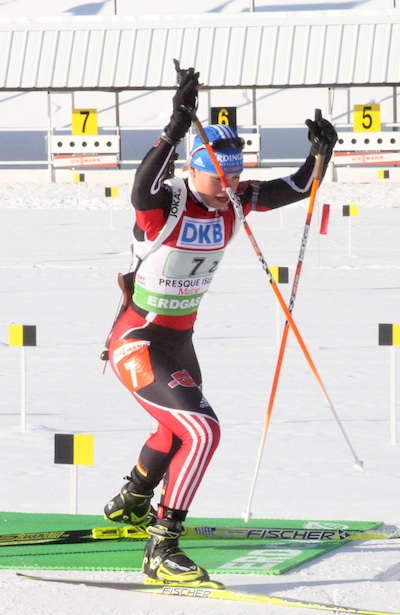
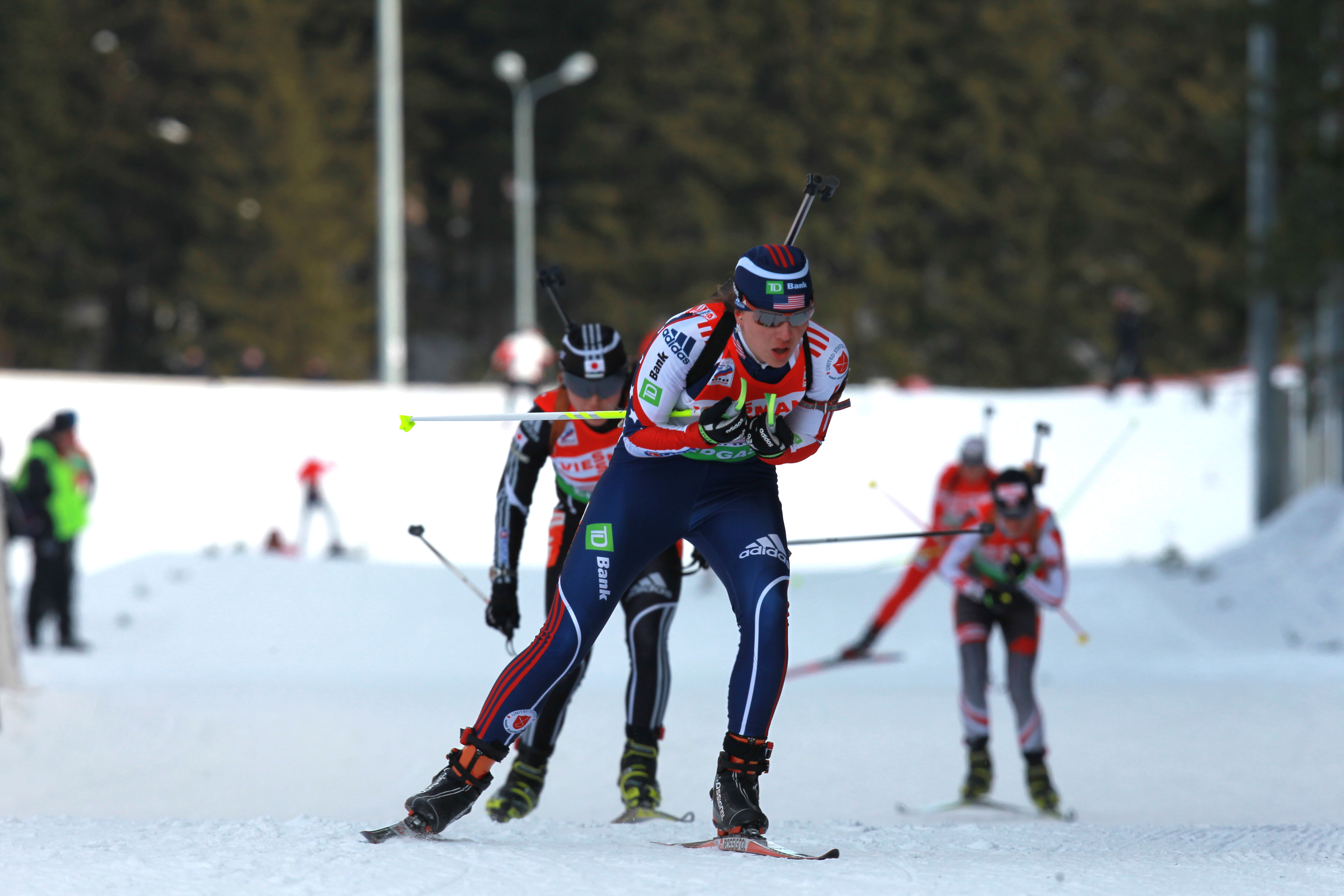
    Sara Studebaker (USA) en route to tagging off in eighth place after the first leg of the women's 4 x 6 k relay in Khanty-Mansiysk, Russia. Photo: nordicfocus.com courtesy of USBA.

    Going into Sunday’s women’s 4 x 6 k relay, there had been plenty of excitement already in this year’s biathlon World Championships.

    What could top Emil Hegle Svendsen’s furious attack in the last few hundred meters of the previous day’s mass start? Or how could there be a performance more dominating than Helena Ekholm’s two-minute victory in the individual race?

    Well. The fans in Khanty-Mansiysk didn’t realize it, but they were about to see something that was both as exciting and as dominating all rolled into one, and it was set to come from Magdalena Neuner, the 24-year-old German who had already won two gold medals from this Championships and five from previous years.

    The women’s relay started out like any other race this week: with the Russian flags held by spectators in the stadium blowing sideways in the strong, gusty wind. The competitors took note – but they still suffered in the first prone shooting stage, when a surprise group consisting of Slovakia, Ukraine, and Russia left in the lead.

    The trio worked together for the next loop, then all missed targets in standing, sometimes disastrously so. Ekaterina Yurlova of Russia, for instance, used three spare rounds and still skied three penalty loops. The lead was now taken over by Italy and the Czech Republic, who had cleaned their targets with no difficulty.

    Valj Semerenko of Ukraine and Andrea Henkel of Germany, however, weren’t content to let things sit – they both passed Veronica Vitkova of the Czech Republic and made a move on Michela Ponza of Italy. But the Italian veteran showed a feistiness that her competitors might not have been expecting. When Semerenko drew alongside her to pass, she took off, and had a small three-second lead going into the tag.

    Karin Oberhofer couldn’t carry on Ponza’s good work, and was immediately passed by Vita Semerenko (Valj’s twin sister) and Miriam Gössner of Germany. Gössner led alone into the range, but her work on skis turned out to be for naught, as she used two spare rounds and watched Semerenko leave without her.

    Also in trouble on the range? Home team Russia, whose Anna Bogaliy-Titovets matched Yurlova’s errors and hit the penalty loop three times, dropping the squad to a humiliating 19th place.

    The second Semerenko led into the range for standing, and while she only used one spare round, she took 42 seconds to shoot – one of the slowest times of the entire field. As a result, her accuracy was overshadowed and she slipped to second place behind Darya Domracheva of Belarus.

    The Olympic bronze medalist was not going to give up the lead – she turned in the second-fastest last-loop time and handed her teammate Nadzeya Pisareva an 18-second lead of Ukraine.

    By the next handoff, the two Eastern European teams had widened their lead to nearly a minute over France and Germany. It seemed like the race was turning into a yawn, with the only potential battle set for bronze.

    But it slowly became clear that there was plenty of action still to come.

    Oksana Khvostenko cleaned her prone stage, leaving the Ukrainian with a clear lead over Liudmila Kalinchik of Belarus. Marie Dorin of France and Magdalena Neuner of Germany both also missed a target, and were still a minute behind.

    In the next kilometer, the pair worked together to cut twenty seconds out of Khvostenko’s lead. By the time the entered the standing shooting stage, they had made up another 20 seconds and shot side by side with Kalinchik, who crumbled under the pressure, used all three spare rounds, and still headed to the penalty loop. Belarus, which had appeared to have a medal wrapped up just four kilometers earlier, now had no chance.

    When Neuner and Dorin left the range for the last time with two kilometers of racing remaining, the German upped her game even more. The pair had worked together to great effect, but Neuner now struck out on her own, clearly on the warpath with Khvostenko in her sights.

    The 33-year-old Ukrainian had been part of two medal-winning relay teams at previous World Championships events, but appeared slow and ungainly compared to Neuner. Perhaps she was not at her best; earlier this week, she sat out the individual race due to illness. For whatever the reason, she was not able to stay ahead of Neuner’s charge.

    The pass came on a long, awkward downhill, which was gradual enough to require the women to free-skate for quite some time. Neuner later said that her skis were faster than the Ukrainian’s, and she sailed by, passing the Khvostenko in one easy go and coming into the finishing stretch with a 100-meter lead. She began smiling far before that, seemingly unable to believe that she had erased more than a deficit of over a minute and passed three teams en route to her third gold medal of the Championships.

    “At first I did not think about the gold medal,” Neuner said in a press conference.

    “I thought, ‘okay it is a silver medal.’ Then the Ukraine was just before me and I knew it was not very far to get the gold medal. I had very good skis and on the downhill I came nearer and then I knew I could get the gold medal. It was a great feeling.”

    Despite losing what seemed like an insurmountable lead, Khvostenko stopped to grab a Ukrainian flag from the crowd and carried it across the finish line 24 seconds later, much to the delight of her teammates who, while disappointed to lose the gold, still seemed elated to repeat their silver-medal performance from 2008.

    And 23 seconds after that, an exhausted Dorin coasted across the line to capture bronze, repeating her French team’s performance from the 2009 World Championships.

    While Neuner’s will be the performance that everyone remembers from the relay, the glory could have belonged to Ukraine – while the team faltered on skis in the last leg, they had an astonishingly good day on the range, using only four spare rounds over eight shooting stages.

    After a strong scramble leg from Sara Studebaker, who tagged off in eighth, the U.S. women began a downhill slide. Laura Spector dropped the team to 12th, more than two minutes back. Then Annelies Cook used all of her spare rounds in both stages and still hit the penalty loop twice, moving back to 15th. Haley Johnson, who also suffered on the range and visited the penalty loop once, was quick on her skis, posting the seventh-fastest anchor leg time, but still only gained a single spot in the rankings.

    “I don’t think any of us are satisfied with the end result, but we all did what we could today and it was a really solid effort,” Studebaker told FasterSkier. “At the Olympics, we were 17th, so this is a step in the right direction.  he wind was getting stronger too as the race went on, and I think some of the later legs really struggled with that.”

    As for her own performance, Studebaker was pleased.

    “I feel really good about my relay leg today. I felt pretty strong skiing and was happy to use only two extra rounds. It was also a lot of fun out there- in my last loop I was able to pass two or three girls and move us up a little more, so it was great to see that my skiing is still strong after a long couple weeks here. It was a really good way for me to end the Championships.”

  • Norway Won That Other World Championships Relay Today, Also

    The eyes of the ski world may have been focused on Oslo today, where the Norwegian women ran away with the win in the 4 x 5 k relay, but the biathlon world is focused on Khanty-Mansiysk, Russia, where World Championships kicked off today with a mixed relay.

    And while the result was the same – Norway on top by a solid margin – the route to victory was a lot more challenging for Norway’s biathletes. Tora Berger scrambled and predictably came into the tag zone in the lead. But Magdalena Neuner turned the tables on the favored Norwegians, and after two clean shooting stages, the Germans were in the lead. Meanwhile, Ann Kristin Flatland of Norway used two spare rounds and worked herself into a twenty-second hole.

    When the men took over, both Arnd Pfeiffer of Germany and Ole Einar Bjorndalen of Norway used three spare rounds, and the gap remained almost the same. The legendary Bjorndalen is a hero in his country, but was unable to do a hero’s work today.

    “I had some problems with sickness in January, and had to take some days off,” he explained to IBU News. “I stayed at home the whole time after that and had some very good training. I think that was a good strategy for me… Today was a very good race for me.”

    While he wasn’t able to overtake Pfeiffer, he did all that was needed: he gave anchor leg Tarjei Boe a gap small enough to close.

    The 22-year-old Boe, who wears the yellow overall World Cup leader’s bib, was set up for a battle with German veteran Michael Greis. But Greis did him a favor by using two spare rounds in the first shooting stage, while Boe cleaned. Because he had to load the spare rounds, Greis took 14 more seconds to shoot than Boe, and most of the catching up came with no effort to the Norwegian. Coming out of the range, Boe had a 14-second lead, which he extended through the second shooting stage and all the way to the finish.

    While the Norwegians were favored simply by the fact that all four of their racers had won World Cup races this year, they haven’t always been strong in mixed relays in the past.

    “It was very important for us to win today,” Bjorndalen said. “We have had problems in the mixed relay before with good teams. So it was good to be ahead of teams that have had success in this competition like Sweden and Germany.”

    The French team of Marie Laure Brunet, Marie Dorin, Alexis Boeuf, and Martin Fourcade finished third, thanks to Fourcade’s clean shooting and second-fastest anchor leg ski time. The team was fifth at the last tag, passing Sweden and Finland en route to the podium.

    Boeuf was particularly enthusiastic about his team’s finish.

    “This is my first medal,” he said. “And it is cool.”

    The Americans finished 13th, in a performance that had plenty of positives but more than enough frustrations as well.

    “The mixed relay was, well, mixed for me,” said leadoff skier Sara Studebaker. “I felt great skiing and had a really solid leg in that regard, but the shooting was tricky.”

    Studebaker used five spare rounds to put the team in 15th place.

    “The wind on this range can really come and go and often comes from behind which can trick you into thinking there is less wind then there actually is,” she said. “After my first five shots in prone I took a couple clicks and that made all the difference in hitting my three spare rounds. But with so many spare rounds, it’s tough to really be in it.”

    Laura Spector skied next, and used four spare rounds. She dropped the team to 17th place.

    But luckily, the men were able to come to salvage the day for the Americans. Jay Hakkinen used a single spare round to move the team up to 16th, and then Leif Nordgren went on a tear, passing three teams despite using four spare rounds. He had the fourth-fastest second loop and the eighth-fastest finishing loop of all the anchor skiers.

    “I had a pretty good race today, not great, but not bad,” he said of his effort. “The skiing felt really good so I was happy with that part. We knew from the beginning World Champs was late this year, so that was kind of our plan for me to be skiing fastest now. I’m definitely excited for the next couple of races. Anything can happen in biathlon, so if I can put together a good day on the range and on the tracks, who knows what can happen!”

    Some of Nordgren’s strongest performances this year have come in relays.

    “I’m not really sure why they’ve been the best this year,” Nordgren said. “I really like the head to head races that you get in a relay. I think I just perform a little better when I’m under that pressure direct from others. Most of my races this year have been either sprints or individuals, and the only real pressure there to do well is from myself.”

    While the result was a large improvement on the Americans’ 18th-place mixed relay at the 2009 World Championships in Pyeong Change, South Korea, Studebaker said that the team was still disappointed.

    “I think we were hoping things would have gone a bit better,” she said. “Jay and Lief both had excellent legs, and perhaps with a few less spares from Laura and I we could have been top-ten.”

    Head coach Per Nilsson agreed.

    “We are okay with the result for the mixed relay,” he said. “We finished right in the middle of the field, which is pretty much where we are ranked also. The shooting was okay, it’s always a little windy here and in general everybody used a little more extra rounds. The best team had 0+7 and we had 0+14, so also here we were in the middle of the field. So we can look forward to the next races. We are aiming for better biathlon performances when you both shoot and ski well, which also will bring better results.”

    Regardless of the finish, the mixed relay was a good way to start the Championships. Both Studebaker and Nordgren are skiing in their first senior World Championships.

    “It was a great way to get into race mode again,” Studebaker said. “This is my first World Championships, and coming off some great results in the U.S. World Cups I was a little nervous. It was nice for me to have today’s race to kick the nerves out a bit and relax. I feel like this was perfect preparation for me for the sprint race on Saturday.”

    And Nilsson pointed out that it was good for the service team to have a practice run, too.

    “The snow is a little different here than in other places,” he said. “We have [developed a lot of grinds] through our stonegrinding project with Muck Bauer in Schlessing, Germany. And through the hard work from our technicians Nicola Cantoni, Petr Garabik and Christian Sieler, we have make sure that all the different waxes are tested for these conditions.”

    Full results

  • With Strong Shooting, Neuner Takes Fort Kent Mass Start; Studebaker 23rd

    Germany's Magdalena Neuner in Presque Isle last week.

    Magdalena Neuner is among the fastest skiers on the biathlon circuit—but that’s never been her problem.

    In the past, it has been her shooting that held her back. So when Neuner puts together a good performance on the range, she’s tough to beat.

    She did just that in Sunday’s 12.5 k mass start in Fort Kent, hitting 19 of 20 targets to capture a dominating 24-second win over her teammate Andrea Henkel. Belarus’s Darya Domracheva was third, 29 seconds behind, and Sara Studebaker (USA), the lone North American starter, was 23rd.

    After three races in as many days, and six races in the last 10, Studebaker said she was tired in the first mass start of her career. But her 18-for-20 shooting—including clean bouts in both standing stages—kept her competitive with the bottom half of the field.

    “It was awesome, and to be able to hold it together for [those] last two standing stages when you’re really tired—and being in a very new situation, for myself, it was great,” she said.

    Neuner was tight with Henkel after both cleaned their first two shooting stages—Neuner said that she purposefully took things easy out on course to keep things under control in the range.

    “I went a little bit slower to shoot very well,” she said.

    When Henkel missed a target on the third stage, and Neuner cleaned, the race was essentially over. Neuner had one penalty in the final shooting, but that still left her with a 30-second advantage over her teammate.

    Gerald Hoenig, one of the German women’s coaches, told FasterSkier that Neuner’s shooting problems are mental—and that things are easier if she’s doing well.

    “When Magdalena has good results, it will be better and better—this is a good situation for her,” Hoenig said. “I think it will be stable, for the moment, and I hope for the World Championships.”

    Henkel, meanwhile, took over the yellow bib of overall World Cup leader from Finland’s Kaisa Makarainen. Makarainen had been battling back and forth with Sweden’s Helena Ekholm, but neither of those women were at their best in Fort Kent, allowing Henkel to seize the opportunity with two wins and a second place in her last three races.

    “I like winning, but being second to Magdalena today is fine,” Henkel said in the press conference. “I am happy any time I am on the podium.”

    Sunday’s women’s mass start was the last of a two-week jaunt by the World Cup to the U.S. According to U.S. Biathlon Association CEO Max Cobb, the International Biathlon Union’s calendar is full through 2014 – the next opportunity for America to host World Cup races will be in 2015.

    Link to full results.

  • Henkel Doubles Up in Fort Kent; Studebaker Makes Mass Start

    Sara Studebaker (USA) on her way to 27th in Saturday's 12.5 k pursuit. Photo, flyingpointroad.com

    Germany’s Andrea Henkel skied to her second straight World Cup win on Saturday in Fort Kent, besting her teammate Magdalena Neuner by 25 seconds in the 10 k pursuit.

    Neuner and Henkel came into the final shooting stage together, and Neuner, a stronger skier, looked to have the race wrapped up when she hit her first four targets. But her last round went awry, and she couldn’t overcome the 25-second deficit she accumulated in the penalty loop—not with Henkel going clean.

    France’s Marie Dorin was third, moving up from bib number seven as one of just three women to hit all 20 of her targets.

    Sara Studebaker (USA), meanwhile, was the top North American in 27th, using a solid 17-for-20 shooting to collect her fourth top-30 in as many individual races. The result helped her become the last woman to qualify for Sunday’s mass start—her first ever—despite struggling on course.

    “Out on the tracks, it was not my day,” she said. “On the range, three penalties, with the way I was feeling today skiing—I think it was a good result for me…To not have your best day and still be in the top 30 is pretty good.”

    Three Canadians started, in Rosanna Craword, Claude Godbout, and Zina Kocher, but all of them struggled on the range and were lapped.

    Germany's Andrea Henkel racing to the win. Photo, flyingpointroad.com

    At the front, it was a battle between Henkel and Neuner—the first and third starters—for the latter part of the race.

    Their teammate Miriam Goessner, the second starter, was in the mix until the second shooting stage, when she came apart and missed four shots.

    Goessner typically struggles with her rifle, but she had held together in Friday’s sprint and raced to second place with just two penalties. Her seven total misses in Saturday’s pursuit knocked her back to 10th, but at just 20 years old, she’s still got plenty of time to figure things out on the range.

    “I know if I was 19 or 20 years old, I’d have to collect experience, too. I think it’s normal—when she’s 24, I think she’ll be a really, really good biathlete,” Neuner said.

    Neuner herself isn’t known for her prowess in shooting, and indeed, she missed two shots in her first stage on Saturday. It took her two more loops with no misses to draw even with Henkel, who hit 14 of 15 in her first three trips to the range.

    When the two came back to the stadium for their final shooting stage, Neuner knew that if she hit all her targets, she’d likely win. But a hiccup on her last shot cost her the race.

    “I was thinking, and this was not very good,” she said.

    With a third place from Friday’s sprint and a second place on Saturday, Neuner will get one last crack at a win in Fort Kent in Sunday’s mass start. But to do it, she’ll have to scale the course’s massive climb—which she called the “Mount Everest of biathlon”—five more times.

    She’ll also have to contend with Henkel, who is on a tear here after less impressive results last week in Presque Isle, where she was still on the mend from an illness.

    In two races in Fort Kent, Henkel has won both, hitting 29 of 30 total shots. And over the 10 kilometers of skiing on Saturday, she was just 30 seconds off Neuner, who had the best course time of the day.

    To win on Sunday, Neuner can likely afford just one more penalty than Henkel—not to mention the fact that there will be 28 other women gunning for the victory.

    “I think it will be a tough race tomorrow,” Neuner said. “But I think my chances are good.”

    Link to full results.

  • Germans Sweep Fort Kent Podium; Studebaker Clean in Second Straight Sprint

    Germany's Andrea Henkel on her way to the win in Friday's 7.5 k pursuit in Fort Kent. Photo, flyingpointroad.com

    Northern Maine is best known for its ties to Scandinavia—both New Sweden and Stockhom are within striking distance of the biathlon venues in Fort Kent and Presque Isle.

    But in the raw conditions for Friday’s 7.5 k World Cup sprint, it was the German women who felt more at home in Fort Kent. Battling through frigid temperatures and a swirling breeze, Andrea Henkel led her country to a sweep of the top three, with Miriam Goessner in second and Magdalena Neuner in third.

    “It’s cold, it’s windy—I think it’s the German conditions today,” Neuner told FasterSkier afterwards.
    American Sara Studebaker put together clean shooting for her second straight sprint race, and with serviceable skiing, finished 17th, for the second-best result of her career. Claude Godbout was the top Canadian finisher, in 48th.

    Wind and snow, especially in the latter stages of the race, made things tough. Photo, flyingpointroad.com

    Temperatures on Friday were a bit warmer than on Thursday—the mercury hit nine degrees F during the women’s race—but the gusty wind made up for it. It was a tough day for biathlon, and just as tough for the spectators—Studebaker said that she probably wouldn’t have come out to watch.

    Consequently, the crowd in Fort Kent wasn’t much larger than Thursday’s, which numbered no more than 500. But with some area schools cancelled for the day, there was a smattering of fervent, flag-waving supporters.

    The Fort Kent community is heavily invested in the races here—volunteers have taken full weeks off work—and at least one business owner, Carl Theriault, sent up a half-dozen workers from his car dealership to watch, on the clock.

    All three of the medal-winning Germans opted to start in the first seed, and they went out within in eight-minute span. (Like on Thursday, Friday’s start interval was 40 seconds, to help turn the racing from small Fort Kent fields into a full television program.)

    Neuner, in bib one, and Goessner, in bib four, each missed two shots, but made up for the errant bullets with fast skiing.

    Henkel, at 33 the elder stateswoman of the German team, had been recovering from illness over the last week, and she was still missing a gear on Friday. But she made up for it by shooting clean, and ultimately finished 11 seconds up on Goessner, and 16 ahead of Neuner.

    As the girlfriend of American biathlete Tim Burke, Henkel has spent some time training in the U.S. over the past few years. The travel is undoubtedly long, but according to Neuner, crossing the Atlantic is like taking a vacation,

    The Germans on the podium. L-R Miriam Goessner, Andrea Henkel, and Magdalena Neuner. Photo, flyingpointroad.com

    since in America, the Germans don’t have to contend with their country’s rabid fans and press.

    “It’s really relaxed here,” Neuner said. “In Germany, we have a lot of people, and a lot of media.”

    Neuner, 24, and Goessner, 20, are of a different generation from Henkel, and Goessner, especially, is a relative newcomer to the German squad.

    An erratic shooter, Goessner didn’t qualify for the nation’s Olympic team for biathlon last year. But she’s so fast on her skis—on Friday, she had the best course time by 14 seconds—that she ended up going to Vancouver with the German cross-country skiers.

    She has a silver medal in her closet from the relay to show for it, but returned to the biathlon circuit this season and promptly racked up two podiums in the opening World Cups in Sweden.

    Her accuracy deserted her through January—a month in which Goessner finished no higher than 17th—but it was sufficient again on Friday.

    In the press conference, Goessner said that she benefits from training with Neuner and Henkel, “because they shoot faster and better.”

    But Jan Wuestenfeld, the German team doctor, said that the German women also benefited from good conditions on course—unlike Norway’s Tora Berger, the fourth-place finisher, who had to contend with snow flurries that blew in towards the end of the race and slowed the course.

    According to reporters from NRK, the Norwegian national broadcaster, the conditions cost Berger some 10 seconds on her last of three 2.5-kilometer loops, which would have pushed her down from second place.

    “Obviously, we were lucky,” Wuestenfeld said. “Tora, she had absolutely no chance on her last lap.”

    Studebaker, on the other hand, started in the middle of the field. She, along with her teammate Laura Spector, was sporting glove liners to keep her hands warm, but other than that, she had nothing special to say about the weather.

    American Haley Johnson on the range. She had two penalties, and finished 43rd. Photo, flyingpointroad.com.

    For Studebaker, the 17th place was another example that she’s stepped her racing up a notch. Prior to this season, she’d never finished higher than 34th; this year, she already has five top-30s.

    “It has definitely been a breakthrough,” she said. “A little bit shocking, but at the same time, it didn’t feel like anything unattainable when we were training this summer and fall.”

    With a month to go until the 2011 World Championships in Siberia, Studebaker’s shooting can’t get much better than it was on Friday—she shot clean, and was 29th-fastest getting into and out of the range.

    She said that her skiing still has a little bit of room to improve, and her coach, Jonne Kahkonen, said that on a perfect day, Studebaker could break into the top 10 in Russia. The real target, though, is the 2014 Olympics in Sochi, he said.

    “For sure, it’s not realistic for a medal right now,” said Kahkonen. “We have to remember where we started from, in the beginning of the season…Sochi—that should be the goal.”

    Women’s racing continues on Saturday with a pursuit. All six North Americans who started Friday’s sprint qualified, in part thanks to a field that was a mere 56 athletes. (The top 60 athletes in sprints make the cut for the ensuing pursuit.)

    With her eighth-place finish, Finland’s Kaisa Makarainen retook the yellow bib of overall World Cup leader from Sweden’s Helena Ekholm, who had wrested it away after last week’s races in Fort Kent. Makarainen now leads by eight points over Ekholm, but Henkel’s finish on Friday helped her creep back into contention–she now has 639 points to Makarainen’s 664. Berger is fourth, with 609.

    Link to full results.

  • Germany Takes Prime Time Mixed Relay in Presque Isle

    Germany Takes Prime Time Mixed Relay in Presque Isle

    The start of Saturday's mixed relay in Presque Isle, ME.

    Germany’s biathlon team is deep enough that most other countries have their hands full even when they field their best athletes. But in Saturday’s mixed relay, many only put forth their second string—and the result was predictable.

    With a crowd of up to five million watching a rare prime-time broadcast back home, the German squad of Kathrin Hitzer, Magdalena Neuner, Alexander Wolf and Daniel Boehm raced to a convincing 30-second win in Presque Isle, ME, topping France and Russia.

    The U.S. team was seventh—a decent result, but one that could have been better without a late collapse in the range by the anchor, Jeremy Teela. Canada was 12th of 12 teams, after struggling to overcome some lethargic skiing.

    The mixed relay is a relative rarity on the World Cup—Saturday’s was only the second of the year for the circuit. Every country starts two men, then two women, with each taking two trips to the shooting range: prone, then standing.

    To make the race more competitive, the athletes are allowed to use up to three extra rounds per shooting bout—in effect, giving them eight chances to hit five targets. Any targets still standing after eight shots, though, result in penalty loops, which don’t happen often.

    Germany's Magdalena Neuner leaving the shooting range.

    With three races in three days in Presque Isle, a number of top athletes opted to skip the mixed relay, to stay fresh for Sunday’s pursuit. Out of the top five men’s and women’s finishers from Friday’s sprint, only two—Russia’s Ivan Tcherezov and Italy’s Michela Ponza—started on Saturday.

    In Neuner and Hitzer, however, Germany ran two of its very best women. While the relay roster is ultimately a coach’s decision, Hitzer said, both she and Neuner wanted to race.

    “I think tomorrow, on the track, I’ll think, ‘oh no, I feel the competition from yesterday!’ But the relay is always a cool race,” she said. “We traveled around half the world, and some are still having a little bit of a problem with jet lag. For me, it’s okay.”

    As for Neuner, according to German team doctor Jan Wuestenfeld, “Magdalena wants to run every race.”

    “She’s so strong, she can do it,” he said.

    Wolf and Boehm are not exactly the cream of the crop of German men, but they’re both still decent; each has a World Cup podium to his name. As Wuestenfeld put it, “when you are in Germany, in the national team, you are a world-class biathlete.”

    Combined with their female partners, Wolf and Boehm surely served as an appealing draw for the country’s biathlon-mad television audience.

    Biathlon is rarely shown in prime time in Europe: during the race, U.S. Biathlon CEO Max Cobb told FasterSkier that “sports has its place, and it’s not now.” But according to Cobb, the Presque Isle schedule was shifted to move the mixed relay to Saturday, when the European Broadcast Union convinced its member stations to show the race in the evening. German television channels were hoping to draw as many as five million viewers; they had correspondents conducting trailside interviews with the team’s athletes even before the mixed relay had concluded.

    “This is huge,” Cobb said.

    From the start of the race, the Germans didn’t disappoint, with Hitzer going back and forth with France’s Marie Laure Brunet at the front. The two women each used just two spare rounds total, and finished their legs together, with Hitzer tagging to Neuner and Brunet tagging off to Sophie Boilley.

    Neuner is among the very best biathletes on her skis, and she’s tough enough to beat even when she’s not shooting well. On Saturday, she was. Like Hitzer, she used just two spare rounds total, and when Boilley needed three on

    Neuner doing a post-race interview with German television.

    the first stage alone, Neuner was gone. She skied into the transition alone, almost a full minute in front of all the chasers, and by that point, the Germans appeared to be set up either for a dominating win, or a devastating collapse.

    As it happened, neither of those outcomes transpired. As France made a late push with some strong shooting—they needed just one spare round combined for third leg Vincent Jay and anchor Alexis Boeuf—both German men turned in serviceable performances to hold a lead that dwindled just enough to make things interesting.

    Heading into the final shooting stage, Boehm was still roughly half a minute up on Boeuf, and hit four targets with his first five shots. When Boehm missed with his first extra round, he had the crowd—and likely the entire German nation—holding its breath. But everyone exhaled when he knocked over the final target with his next bullet.

    “He can shoot very good, and very fast, and clean, but it was a lot of pressure for him, I think,” Hitzer said afterwards. “I know how it is to feel that.”

    France skied in for a clear second place, thanks to the solid showings by Jay and Boeuf; Russia’s Maxim Tchoudov just bested Italy’s Christian de Lorenzi in a sprint to the finish.

  • Aroostook County Preview: Athletes to Watch at the Biathlon World Cup in Maine

    Aroostook County Preview: Athletes to Watch at the Biathlon World Cup in Maine

    Tora Berger (NOR) racing at the Vancouver Olympics. Berger has won the last four World Cup races.

    On Friday morning at 9:30 a.m., the United States will hold its first World Cup race since 2004.

    The IBU World Cup circuit will be making stops in Presque Isle, Maine, this weekend, and then in nearby Fort Kent next weekend. While it might take almost as long to get to “The County” from the U.S. as from anywhere else, the races should be spectacular. If you can’t make it to Maine, the event will be broadcast live by Eurovision and the International Biathlon Union, and can be watched online on the IBU website (click the “BiathlonWorld TV” link).

    Either way, there’s no reason not to skip off work a little early on Friday afternoon and watch the best biathletes in the world race around in our own time zone. Here’s a brief guide to what to watch.

    Emil Svendsen (NOR) on the range in Vancouver.

    1. World Cup Overall Leaders – and Contenders

    One of the biggest questions of the next two weekend is whether the current overall World Cup leaders can hang onto their yellow bibs. 22-year-old Tarjei Boe of Norway leads his teammate Emil Hegle Svendsen by just six points going into this batch of races. Boe has worn the yellow bib since mid-December, but hasn’t won a World Cup since the first weekend in January. To keep his lead in the standings, he will have to beat Svendsen consistently – no small feat, considering that Svendsen has three victories to his name already this season, bringing his career total to 19, and was recently added to the Norwegian team to cross-country World Championships. He’s fast.

    On the women’s side, Kaisa Makarainen of Finland has worn the yellow bib since the very first weekend of World Cup competition in Oestersund, Sweden. But the only two victories of her career came that weekend, and since then she’s been less impressive. Her lead over Helena Ekholm of Sweden has dwindled to just 14 points, and Germany’s Andrea Henkel is making a charge at the title as well. Ekholm, the 2008/2009 overall World Cup winner, has two victories so far this season. Henkel has none, but she’s been on the podium more consistently than almost any other woman, and could finally win a race at any point.

    Jeremy Teela (USA) and Ole Einar Bjorndalen (NOR) in Vancouver.

    2. The Norwegian Men

    It’s impressive enough that Norway has both of the top contenders for the overall World Cup on their team. But Boe and Svendsen certainly aren’t the only Norwegian men who could win in Presque Isle and Fort Kent. No less than four of the team’s biathletes have collected victories on the World Cup circuit this year: Boe, Svendsen, Lars Berger, and of course, 37-year-old living legend, 92-time World Cup winner, and six-time Olympic gold medalist Ole Einar Bjorndalen. The team didn’t appear to be in top form at the last few World Cups in the Alps, but people, including Swedish Olympic gold medalist Bjorn Ferry, hypothesized that they were suffering from the effects of altitude. Back close to sea level, any one of the four could win again.

    3. Tora Berger

    While the Norwegian men had lackluster results in the Alps, their teammate Tora Berger (Lars’ sister) did not. She won two races in Ruhpolding, Germany, and then another two in Antholz, Italy, and appears poised to make a late-season run through the rankings. Berger’s ski speed is so fast that it sometimes straight-up demoralizes the competition. FasterSkier hopes that there isn’t a third Berger sibling, who would undoubtedly suffer from incredibly low self-esteem.

    4. The Russians

    In the first period of World Cup racing, the Russians were completely uninspiring. But then, gradually, they reappeared in the spotlight. In Antholz, the women raced to a dominating victory in the relay. After that effort anchor leg Olga Zaitseva, who has won one World Cup on her own this season, told IBU News that “We are back.” Anton Shipulin was also on the podium twice in Antholz, and seems to be rounding into form. It would be surprising for the Russians not to be skiing fast, considering that they are hosting World Championships in a few short weeks and will without a doubt be at their best in front of the home crowds.

    Bjorn Ferry (SWE) en route to a gold medal performance at the Vancouver Olympics.

    5. Bjorn Ferry

    Ferry is one of the most boisterous media personalities in the biathlon world: he has a great sense of humor and strong opinions. At one point, the 6′ 4″ Swede suggested that dopers should get the death penalty. He also has a wife who is a seven-time world champion arm wrestler, a cookbook entitled “Ferry Food,” and a website called “Ferry Tales.” But as entertaining as all of these quirks are (FasterSkier enjoyed interviewing him in Muonio, Finland earlier this season), it’s Ferry’s skiing and shooting that gets him the most attention. He picked up his first Olympic gold medal in Vancouver and has two wins so far this season. He will probably anchor the mixed relay in Preque Isle; Sweden won the mixed relay at 2007 World Championships with a potentially identical team, and are always dangerous in that event.

    6. Martin Fourcade

    With three second-place finishes in Ruhpolding, Germany, and then a thrilling, dominating, flag-waving mass start victory in Antholz a week later, Fourcade is on the rise. There aren’t many people who scare Ferry, but earlier this season he said that the French would be the team to watch. Lately, it looks like he might be right. This season, Fourcade, who sits fourth in the overall World Cup rankings, is eclipsing Olympic champion Vincent Jay. It’s no small task, but if Fourcade is still as fired-up as he was in Italy, he’ll be outshadowing everyone else on the circuit as well.

    Magdalena Neuner (GER) races to Olympic gold in Vancouver.

    7. Magdalena Neuner

    At just 23 years of age, Magdalena Neuner of Germany already has twenty World Cup victories. So far this season, she only has one – but she’s also contributed to a victorious German relay team that is on the rebound after the retirement of three stars: Martina Beck, Simone Hauswald, and Kati Wilhelm. Neuner has more up her sleeve and will undoubtedly have a few good races before the season is over.

    8. Lowell Bailey and the U.S. Men: the Veterans and the Skinny Fast Young Kid

    Lowell Bailey has been on a tear recently, notching a career-best 12th-place finish in Antholz and tagging off after the first leg of the relay in an astonishing second place. While last year it was the Tim Burke show, this year is turning out to be all about Bailey. But behind him are a veteran squad including Burke, three-time Olympian Jeremy Teela, and four-time Olympian Jay Hakkinen. And then there’s Leif Nordgren, the only young blood on the team. Nordgren shot clean to finish in the top 40 of the first World Cup race of the season, and has contributed several excellent relay legs, including one in Antholz which left the team in fifth place after two skiers. While Bailey is turning the team into a bit of a one-man show, it’s also good to see a diverse group of athletes able to contribute; the Antholz relay was the best U.S. result in two years.

    Laura Spector racing to 19th place in the World Cup sprint in Oberhof. Photo: nordicfocus.com courtesy of USBA.

    9. Laura Spector and the U.S. Women

    Expectations haven’t exactly been high for the U.S. women lately, and neither has funding: while the men’s team spent weeks in Europe this summer, training just as the European teams do, the women were stuck in Lake Placid. They have a smaller World Cup quota because of a lack of success in recent years and haven’t always been able to even field a full relay team. But out of all of this have come some exceptional performances. Laura Spector has led the way with top-30 and even a top-20 result, as well as qualifying for two mass start races; the last time a U.S. woman skied in a mass start, which only allows for 30 athletes, was six years ago. Sara Studebaker has finished in the top 30 as well, and Haley Johnson, the latest addition to the World Cup team, is keeping up with the others just fine.

    10. Brendan Green and the Canadians

    If Tim Burke was the hero of American biathlon last year, then Jean-Phillipe Leguellec was the Canadian equivalent. He finished sixth, 11th, and 13th in races at the Vancouver Olympics, prompting him to tattoo the Olympic rings on his leg. But this year, Brendan Green is stealing his spotlight. The pair have each had excellent finishes, and made history when both competed in a mass start earlier this season; it was the first time that Canada had put two athletes in a mass start. Canada will be fielding a full team, so look for them in the somewhat-unconventional red suits.

  • Rupholding Courses, New for 2012 World Champs, Get Rave Reviews

    Rupholding Courses, New for 2012 World Champs, Get Rave Reviews

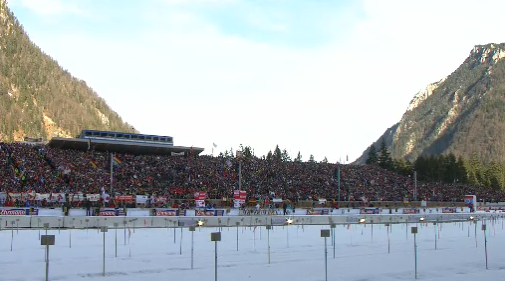
    The new stadium in Ruhpolding, Germany, has a great view of the shooting range.

    When the small town of Ruhpolding, Germany, bid to host biathlon’s 2012 World Championships, they knew they had their work cut out for them.

    “Preparations for the World Champs 2012 start now,” said Mayor Claus Pichler in August 2008 when Ruhpolding won the bid. “I got plenty of feedback from the delegates at the IBU Congress.”

    And they have been busy ever since, completely renovating and reconfiguring the area’s stadium as well as giving the trails a facelift. All of the work was unveiled last weekend when Ruhpolding hosted the fifth weekend of IBU World Cup racing.

    Swedish head coach Wolfgang Pichler – a Ruhpolding native and Claus’s brother – was proud of the changes which had been made.

    “I think the stadium here is the best in the world,” he told IBU News this weekend. “Our goal was to make big progress; if you look at everything, the tracks and buildings . . . you will see that this is a step forward for our sport.”

    If so many upgrades were needed, why was Ruhpolding chosen at all? Mayor Pichler had a few ideas. He hypothesized that the selection committee knew that the town of just over 6,000 would pull out all the stops to host an amazing event.

    “Ruhpolding and biathlon are more or less the same,” Pichler told IBU news last week. “We have done so much to develop this sport. It is not an exaggeration to say that Ruhpolding is the cradle of modern biathlon and the sport is deep in my heart. I would like our home town to remain that cradle for the future; we will contribute our part so that biathlon remains the winter sport number one all over the world.”

    With the caveat that a number of women complained about the difficulty of one of the downhills – Helena Ekholm of Sweden even said that she “really hated” it – most of the athletes seemed to like the new courses. Here’s a roundup of reactions from the World Cup field, beginning with North America’s best biathletes and finishing with international stars.

    Jeremy Teela (USA)

    “The new venue is very nice – there are lots upgrades for the spectators,” the three-time Olympian told FasterSkier. “The range moved a little left and back it seems. The courses have become a little harder, with some down hills that are more technical, which takes away from the recovery you’d normally get. I would highly recommend coming to watch next years World Champs; the atmosphere in Germany for biathlon is like no other.”

    Laura Spector (USA)

    “I am a fan of this course because climbing tends to be one of my strengths and there are a number of long, steep hills,” America’s top female biathlete said in an e-mail. “The downhills are tricky and I’ve skied them many times over the course of the week to get more comfortable, but it also depends on the weather and snow conditions. I think it’s a great choice of venue because so many biathlon fans attend the races here.”

    Tim Burke (USA)

    “Competing here in Ruhpolding is definitely very exciting with all of the fans,” last year’s early-season World Cup overall leader told FasterSkier. “They had 89,000 total fans for the week, which creates an incredible atmosphere. Unfortunately, the course here at Ruhpolding is by far my least favorite course on the World Cup. You almost never have to work for more than 30 seconds before you get a break. It is basically jump skating up a steep hill then resting over and over again. I will definitely have to make some changes to my training if I want to compete for a top spot next year at World Championships.”

    Scott Perras (CAN)

    “The new course is pretty good; actually I like it a lot,” Perras said in an e-mail. “It still has the difficulty of the old course, but with better flow so it is all around more enjoyable. The uphills are still covered with fans but they are not as close as in previous years; it seems they widened the trails and with many of the trails being two-way, it’s not as intimate as before, when you would grind up steep climbs and you could feel the breath of the fans.

    “The most disappointing thing about Ruhpolding is that the weather is never consistent and rarely fair for the entire field. Even though they sell over 100,000 tickets a weekend I would rather see solid winter conditions and less fans. That being said, the organizing committee really is on the ball with salting the course and everything turned out well [this weekend].”

    Magdalena Neuner (GER)

    “It took us a few days to get acquainted with the new courses,” the two-time Olympic gold medalist told IBU News. “We were pretty critical in the beginning about the very hard downhill. But it depends a lot on the conditions with the weather. I am basically pretty happy that the most dangerous parts will not be that difficult next year for the World Championships. Nevertheless I think the stadium is very nice for both the athletes and fans.”

    Emil Hegle Svendsen (NOR)

    “It is an amazing stadium,” the Olympic gold medalist and current second-place man in the overall standings said in a press conference. “I think it is for sure one of the best. Most important for the athletes the tracks are good and wide . . . they have built something amazing and I am really looking forward to the World Championships here next year. I think it is going to be something very special.”

    Andrea Henkel (GER)

    “[The downhills] were for me a little bit too tough,” the 2007 overall World Cup winner said in a video blog from Ruhpolding. “I made it very safe from loop to loop and on each loop got more afraid… the new stadium is very well-planned, I think. They have a huge gym with lots of bikes for warming up and cooling down, which was good yesterday [when it was pouring rain]. The track is fine, everything is very hard, which is good for me on the uphills but it is maybe a little too hard on the downhills. Maybe they will change it before the World Championships next year.”

    The Ruhpolding venue is nestled in the Alps.
  • In Return To Form, Ferry Wins World Cup Sprint; Neuner Tops for Women – Updated

    In the World Cup sprints in Pokljuka, Slovenia on Saturday, two athletes took their first wins of the season. But while they hadn’t been atop the podium in Ostersund, Sweden, or in Hochfilzen, Austria, their strong performances weren’t entirely surprising: both Bjorn Ferry (SWE) and Magdalena Neuner (GER) were gold medalists at the Vancouver Olympics last year.

    Canadians led the North American contingent in both the men’s and women’s races.

    Bjorn Ferry (SWE) en route to a gold medal performance at the Vancouver Olympics.

    Men

    When FasterSkier talked to Swedish biathlete Bjorn Ferry in Muonio, Finland, earlier this season, he said that one of his goals was to win the overall World Cup.

    So far this season, it had seemed like that goal was pretty far out of reach. On Thursday, he finished 61st in the individual race in Pokljuka, Slovenia, which was his worst result so far; he was 11th in the sprint in Hochfilzen, Austria, and moved up to tenth in the pursuit. Those were the only races in which he even cracked the top 20.

    Not so good for an overall World Cup contender.

    But in Pokljuka on Saturday, Ferry reminded the biathlon world that he was, in fact, a reigning Olympic champion, and eked out a five second victory over Tarjei Boe of Norway in the 10 k sprint race.

    Ferry told IBU News that he knew he was fit, but had struggled this season nonetheless.

    “This week, it was like I took another step,” he said. “One level better. It is now fluid and I do not have to push so hard. The individual was actually my best skiing performance of the year. I just missed eight targets; it was bad shooting. But today I held it together and hit the targets. It was a bit slow, but clean.”

    While shooting clean definitely helped, ten other athletes hit all the targets in the two-stage sprint race, so it was his skiing that guaranteed him the win. Ferry had the fifth-fastest course time, and all of the faster skiers missed at least one target.

    It was a close race for the podium, with Boe only five seconds behind Ferry, and Michael Greiss of Germany another three seconds behind Boe. Greiss led after the standing stage, but Ferry’s skiing moved him into the win three kilometers later.

    For Boe, a second-place finish was almost as sweet as a win. When the World Cup continues after the Christmas break, he will wear the overall yellow leader bib.

    “I never thought before the season that I would have the yellow bib,” he told IBU News. “I thought there was a good chance that I would win a race or two, but this is something else.”

    For the North Americans, a pair of Canadians led the way. Brendan Green and Scott Perras finished 29th and 30th – excellent results for each of them.

    In the end the result was good, but I am slightly disappointed with my final shooting,” Perras told FasterSkier in an e-mail. “I managed to shoot clean in prone which is always the way to start a race. And I was prepared for the standing stage – there was not too much physiological stress. I didn’t even think it was good race so I wasn’t even nervous. I just got on my trigger too quickly and missed my first shot… so there was some mistakes that cost me some serious positions. I have to get comfortable with being in a good position so that I can capitalize.”

    Tim Burke led the way for the U.S. team in 35th place, followed by Lowell Bailey and Leif Nordgren in 68th and 69th.

    Women

    Magdalena Neuner (GER) at the Vancouver Olympics.

    Neuner, last year’s overall World Cup champion, hasn’t shown her typical dominance so far this season. After skipping the Ostersund World Cups, she helped the Germans to a relay victory in Hochfilzen, but didn’t hit the podium in any of the individual races.

    Today, though, was a different story. Neuner missed two shots in standing, but was skiing so fast that it didn’t matter. Her teammate Miriam Gossner had the second-fastest ski time of the day – just over three seconds back – but missed three shots. So despite her shooting errors, Neuner was able to ski to a solid eleven second victory over Anastasiya Kuzmina of Slovakia.

    “It was a great day for me,” Neuner told IBU News. “I had two mistakes on the shooting range and did not think about winning. It is a very nice Christmas present for me.”

    Unlike Ferry, Neuner isn’t focusing on the overall World Cup. Because of the races she missed in Ostersund and her lack of podium finishes in Hochfilzen, she says it is out of the realm of possibility.

    “I think Kaisa [Makarainen, of Finland] is very, very good this year,” she said. “I lost three races and now it will be very difficult for me. I am looking forward to the battle for the title a little bit, but more about the World Championships. It is important and after that we will see.”

    Makarainen finished in a tie for third today. She and Olga Zaitseva of Russia had identical times, exactly 17 seconds behind Neuner. Ties are not uncommon in biathlon, but a tie at the top of the field is less common than one further down the results sheet, where racers are packed in more closely.

    Makarainen will keep the yellow overall leader’s bib moving into the next weekend of World Cups, and has the position locked down after having two wins, two second-place finishes, and two third-place finishes in the first three weekends of racing.

    For the North Americans, Zina Kocher of Canada finally raced to her potential today, finishing 17th. So far, she had only finished in the top 60 once, racing to 49th place in the very first race of the season in Ostersund. Kocher finished last season ranked 31st in the overall World Cup standings, and owns one of Canada’s only World Cup medals in the last decade, so for her the result meant getting back on track.

    Sara Studebaker led the Americans in 58th place.

    “Today was a little rough on skis for me,” she told FasterSkier in an e-mail. “I didn’t feel great right from the start and knew it was going to be a tough race to get into. I was really happy with my shooting though – it wasn’t too tough on the range for me today and I was happy to come away with only two penalties.

    “I think I’m still figuring some things out with my training and this much racing right now,” she continued. “This is only my second year on the World Cup circuit, and it takes some time to figure out how best to prepare. So while today wasn’t my best day, I’m learning a lot from just being here and that’s invaluable.”

    Annelies Cook, in her very first World Cup race, was just 0.4 seconds behind Studebaker in 59th place.

    “It was really special for me to finally race a World Cup,” she told FasterSkier. “The race was solid. I was happy to hit a few more targets and did my best on the tracks. It was a tough course, especially because of new snow that made things slower. It’s a totally different ball game from the IBU Cup – the amount of people, staff, racers, and the organization. But I guess in the end, it is still just racing, so that stays the same.”

    If there had been a pursuit after the sprint, Cook would have made the cutoff (only the top 60 from a sprint start the pursuit), no small feat for her first World Cup.

    “It would have been really sweet to do a pursuit. I felt a little stiff skiing and maybe a second day of racing would have helped that!”

    Racing continues on Sunday with a mixed relay.

  • Henkel and Germany Take a Victory Lap in Women’s Biathlon Relay – Updated

    Last weekend, if you had asked which country had the best female biathletes, the answer probably would have been Sweden. Anna Carin Zidek and Helena Ekholm both graced the podium multiple times at the World Cup openers in Ostersund, Sweden.

    But last weekend, Magdalena Neuner wasn’t racing.

    In Hochfilzen, Austria, things are different. In Saturday’s 4 x 6 k relay, Neuner was Germany’s second skier. She took the tag in third place, twenty seconds behind Svetlana Sleptsova of Russia, and only used one spare round in two shooting stages to clean and tag off to Sabrina Buchholz with the lead.

    Germany never looked back. By the time their fourth skier, Andrea Henkel, entered the stadium for the last time, she had a lead of over a minute. Henkel took a German flag from a spectator and skied with it into the finish, all smiles, to meet her teamates.

    The team, consisting of Kathrin Hitzer, Neuner, Buchholz, and Henkl, had been the subject of some speculation. Could this new team – minus the now-retired trio of Martina Beck, Simone Hauswald, and Kati Wilhelm – possibly be as successful as the old German team?

    The answer was a resounding “yes.”

    Henkel told IBU News that the Germans had never doubted their abilities.

    “Everyone kept asking if our new team would do as well as the old team,” she said. “All of the time we said that we were still a strong team and no one believed us. Today we could finally show how good we are.”

    Still, what unfolded behind the Germans was almost more interesting. After controlling the early portion of the race, Russia watched their medal chances all but disappear as third-leg skier Ekaterina Yurlova, who was sitting in second position, used all of her spare rounds in the standing stage and still left one target black. While she was shooting, the French and Ukranian teams came into the range, cleaned with no extra rounds, and skied away without her. Russia never recovered and had to muster a strong effort just to secure fourth place.

    Beginning the final leg, Marie Laure Brunet of France and the Valj Semerenko of Ukraine were skiing together about a minute behind Henkel, followed by Olga Zaitseva of Russia and Tora Berger of Norway. At the exchange, it seemed inevitable that France and Ukraine would round out the podium.

    But there was more drama about to unfold. While all four athletes cleaned in prone, with only Semerenko using a spare round, Brunet faltered in standing, using all three extra bullets and still missing one target. Semerenko disappeared ahead of her, second place secure, while Brunet had to head to the penalty loop.

    And meanwhile, Berger was showing why she was an Olympic gold medalist in Vancouver. She quickly cleaned standing and set out on the final lap at a pace that could not be matched by either Zaitseva or Brunet, who left the range ten seconds behind her. Berger had visibly more power and zip, and rescued her Norwegian team’s hopes for a medal. By the time she reached the finishing stretch, she was able to ease up and celebrate as she crossed the line. And with a team that included two World Cup rookies, Norway did have reason to be proud.

    But while the Norwegians were pleased, it was the Ukrainians who seemed most excited by today’s result. It had been nearly two years since they last stood on a World Cup relay podium. In January 2009, Ukraine won a relay in Oberhof, Germany, and since then their women have finished fourth several times. Today, they mobbed Semerenko as she crossed the finish line nine seconds ahead of Berger.

    Sweden raced to an uninspired and distant sixth-place finish.

    The Americans did not enter a team, as they have only two women on the World Cup right now. The Canadian team of Megan Imrie, Zina Kocher, Rosanna Crawford, and Melanie Schulz finished 11th, using twelve extra rounds and tallying one missed target.

    “11th is a decent result for us,” she told FasterSkier in an e-mail. “However, with less spare rounds and without the penalty lap, the result could have been better. Megan started off strong shooting clean in prone, but then struggled in standing, needing all three spares to clean. My skiing felt much stronger today and was able to pull off a great ski race, but then my shooting was a disaster needing 2 spares in prone and ending up with a penalty lap in standing. Rosanna shot much better with 2 spares in prone.”

    The Canadians were the last team not to be lapped by the Germans, and Kocher said that it was an issue the whole team felt during the race. Everyone wanted to be able to finish the race.

    “[Rosanna] tagged off to Melanie, who needed to push hard to make it to standing shooting before the winning team finished the race,” Kocher sad. “Otherwise our team would have been pulled from finishing the race. Melanie needed spares in standing and said she strongly felt the stress of the top teams finishing.

    “Many teams struggled in the first prone in leg one,” she continued, “and therefore, Megan’s clean prone really helped us stay in the game. Room for improvement, but not bad for the first relay, faster skiing and clean shooting is the ticket.”

    The World Cup continues on Sunday with a men’s relay and a women’s pursuit.

  • Hauswald Triples Up in Oslo; Tcherezov Takes Win in Mass Start

    There’s one way to guarantee yourself a good result in a biathlon race: hit all the targets.

    In the men’s 15 k mass start World Cup in Oslo, Russia’s Ivan Tcherezov was the only one of 30 starters to do so, and he won, by 26 seconds, over Austria’s Christoph Sumann and Norway’s Emil Hegle Svendsen.

    From the first loop and first shooting stage, Tcherezov was in the hunt, ensconced in a big group and trailing only Svendsen, Simon Fourcade (FRA), Austria’s Daniel Mesotitsch, and Germany’s Arnd Peiffer.

    By the end of his third clean shooting stage, he was alone—the nearest competitor was Germany’s Andreas Birnbacher, some 20 seconds back.

    Tcherezov never blinked, and never gave his rivals a chance to get back in the race. He said he was struggling on his skis on the “very wet and soft” course, but since nobody else could muster fewer than two misses, the Russian skied to the line essentially unchallenged.

    Sumann had a decent-sized gap over Svendsen, but the latter had to work for his podium place over Birnbacher—the only one collected by a Norwegian male this week. The two left the range for the last time with Birnbacher leading by a few seconds, but Svendsen managed to close the gap and pass the German before the finish to claim third by a few seconds.

    Tim Burke (USA) was with the leaders through two shooting stages, then faltered with two misses in the third round and three in the fourth, ending up in 23rd, nearly two and a half minutes down.

    He said the huge effort to stay with the leaders left him unsteady in the range.

    “I skied with the group up front there, but that was completely out of my league,” he said. “I tried every tactic I had. Nothing worked. I was just too tired in my legs to really hit the targets….That was probably one of the worst standing shootings in my career.”

    While the rest of the U.S. team heads home from Norway, Burke will travel to Khanty-Mansiysk, Russia, for the final World Cup weekend. Currently 14th in the World Cup overall standings, he’ll be looking to maintain that position, or move up.

    Canada’s Jean-Philippe Leguellec was one spot behind Burke in 24th, with two penalties.

    Hauswald Hits the Triple

    While Tcherezov demonstrated one way to win, Germany’s Simone Hauswald took her victory the hard way in the women’s 12.5 k.

    Single penalties in each of her first two shooting stages put her more than thirty seconds off the lead, behind a train of her German teammates led by Andrea Henkel.

    After the two misses, Hauswald said, “I kept my focus, knowing that the race is over after the third and fourth shooting [stages] are over.”

    Hauswald is the fastest woman on the biathlon circuit right now, and even though there were a handful of her competitors who shot clean today, none of them could stop the German from winning her third race in a row. She cleaned both of her standing stages, wresting the race from Henkel after the latter had a miss in her last shooting round.

    Hauswald held on to win by 15 seconds over Vita Semerenko (UKR) and 22 over Magdalena Neuner (GER).

    “I cannot believe what I have done in the last three races,” she said. “Maybe it is the perfection of doing biathlon: body, mind, and soul together.”

    Zina Kocher of Canada was the only American starter, and she had a nightmare day. Nine penalties left her just over seven minutes back.

  • Despite Mistake, Neuner Holds On for Gold

    Despite Mistake, Neuner Holds On for Gold

    Magdalena Neuner (GER) races to Olympic gold!

    Magdalena Neuner (GER) left the door open in the women’s 10k pursuit. But Anastasia Kuzmina (SVK) couldn’t shut it.

    When a penalty by Neuner in the final shooting stage left Kuzmina trailing by just six seconds, the Slovakian had a chance to reel in the leader over the final two k loop. But Neuner put the hammer down, steadily pulling away to win her second medal in three days. After hitting all 20 shots, Marie Laure Brunet (FRA) was third, moving up from sixth.

    Leading Kuzmina by 25 seconds coming into last shooting stage, Neuner could have essentially ended the race by shooting clean. She hit her first four targets, but the pressure got to her on the last one.

    Anastasia Kuzmina (SVK) on her way to the silver medal.

    Kuzmina skied into the range in time to see Neuner’s miss, and she took advantage, hitting all five of her shots in rapid succession. The two left the range almost together, and it looked like the stage was set for a head-to-head battle. But Neuner never gave it a chance, pulling away from Kuzmina immediately to win by a comfortable margin.

    It was a duel between those two from the beginning, as Kuzmina began with a negligible two-second advantage over the Slovakian. Competitors set out on course today with a handicaps based on how far back they were in Saturday’s sprint.

    In the first of four shooting stages, the two women matched each other round for round, skiing into the range together and hitting all five targets in synch.

    They were still glued to one another after the second lap, and for the first three shots, nothing changed. But then Kuzmina missed, forcing her to ski a penalty loop that put her 25 seconds behind. She couldn’t take advantage of a mistake by Neuner in the third stage, either—both ended up missing one more shot.

    In dramatic final round, Neuner said that she came into the range relaxed despite past struggles in the past with her shooting. She remained so as she hit her first four shots, but then let the pressure get to her for the last one. She said afterwards that she let herself start thinking about gold.

    “The last shot, I was a little bit nervous,” she said. “It was a mistake.”

    Magdalena Neuner (GER) and Anastasia Kuzmina (SVK) scramble out of the range together.

    But it didn’t matter, because Kuzmina was done—in the post-race press conference, she said she knew that her legs were too tired to do anything in the final lap, even as she trailed by just a few seconds.

    With her gold medal in the 7.5 k sprint on Saturday, she said that she felt even more pressure to repeat the performance—not less because she’d already won a medal. She wasn’t complaining about silver, though, pumping her arms as she crossed the finish.

    After struggling with illness earlier in the season, Meghan Tandy (CAN) had a strong performance today as the top North American finisher in 36th. She had a very strong final sprint to take second out of her pack of five, aided by what looked like a strong pair of skis.

    “It’s just great to feel that I’m approaching…that best-performance-of-the-season-feeling again,” she said.

    Sara Studebaker was the only American in the race, and she dropped just one spot to go from 45th to 46th place. She shot well, but said that she felt a little bit flat for the skis.

  • Broken Bones Can’t Stop Slovakian Biathlete

    Broken Bones Can’t Stop Slovakian Biathlete

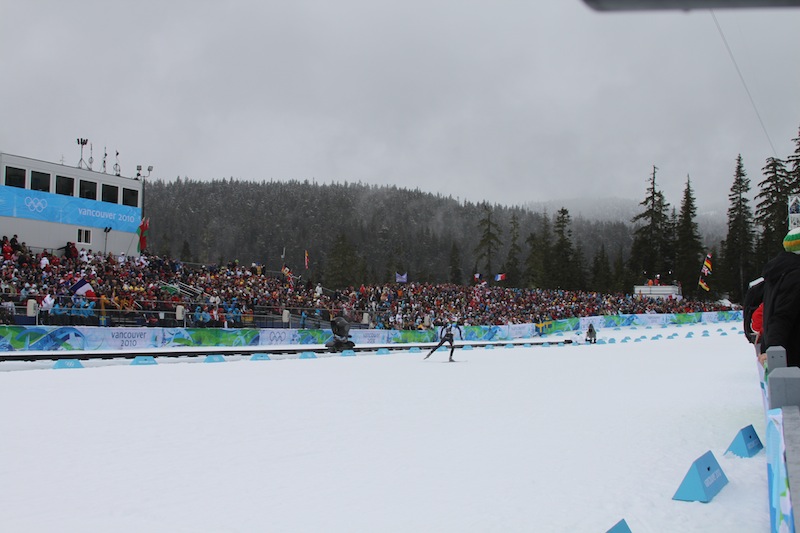
    The crowd at the women's 7.5k sprint at the 2010 Olympic Games. sal
    The crowd at the women's 7.5k sprint at the 2010 Olympic Games.

    Breaking two bones in your hand a month before the Olympic Games doesn’t sound like good preparation. But it sure didn’t hurt Anastasia Kuzmina.

    Shaking off an early miss, as well as the injury she suffered in early January, the Russian-turned-Slovakian won her country’s first Olympic medal in biathlon—and its first-ever gold in the Winter Games—on Saturday in the women’s 7.5k sprint.

    The announcers characterized Kuzmina’s win as a surprise, but her win comes after a silver medal in last year’s World Championships, affirming her ability to compete at the highest level after giving birth to her first child in 2007.

    An early starter—bib 19 of 88—she faced a long wait after finishing to see if she’d won. But instead of standing around in the steady drizzle that fell all afternoon, Kuzmina said that she went inside to change, preferring to minimize the suspense. When she emerged, she found that she was the winner by a second and a half over Germany’s Magdalena Neuner. Marie Dorin (FRA) took the bronze.

    Germany's Magdalena Neuner, en route to second place
    Germany's Magdalena Neuner, en route to second place

    Ivor Lehotan, the Vice President for Information of the International Biathlon Union—and a Slovakian—said that Kuzmina moved to the country two years ago to be with her husband and coach, Daniel Kuzmin.

    While Slovakia had been knocking on the door with a number of fourth- and fifth-place finishes at various championships, Lehotan said that it took someone with Kuzmina’s combination of Slovakian calm, and Russian strength and passion—an ideal mix for biathlon—to take the program to the next level.

    She missed her first shot of the day, in the prone stage, but then went on to hit the next four in that round, and all five in the standing. Kuzmina and Neuner, with one penalty each, were the only athletes in the top-nine who were able to overcome even a single miss—everyone else shot clean.

    With the rain, and with temperatures above freezing, race officials applied fertilizer to the course to firm it up—making “a huge difference from yesterday,” according to American Laura Spector, who finished 77th.

    “It was really nice actually—it wasn’t deep or slushy or anything,” she said. “It was actually quite fast.”

    Saturday’s race was the first-ever Olympic experience for the whole American team, with the exception of Lanny Barnes, and none of the women were able to crack the top half of the field. Sara Studebaker was the closest, in 45th—just one spot away. Barnes was another place behind Spector, in 78th, while Haley Johnson was 80th.

    Spector, Studebaker, and Barnes each had only one miss—a poised performance from the first two, given that they had never competed on such a big stage.

    “I was really nervous this morning,” Spector said. “I just had to tell myself I know how to prepare for a race…and I think that really helped calm me down.

    German fans in the stands
    German fans in the stands

    The stands were packed with boisterous fans in the stands near the range, with hundreds standing shoulder to shoulder on a small hill that sat just off to one side. Different countries had their own fan sections, each decked out in national colors and waving flags. But very few fans ventured beyond

    the stadium, making for some quiet race trails and an odd contrast, Spector said.

    The American team raced in some sharp new spandex—American flag-themed, with stars and stripes on the shoulders. Studebaker said that they were an improvement on the old, solid blue suits.

    Haley Johnson sporting the new American uniform
    Haley Johnson sporting the new American uniform

    “You can actually tell who we are, which is great,” she said. “The dark blue suits—they tend to get blended in with everybody else.”

    The Canadians women had an off day, led by Megan Tandy, who shot clean to finish in 46th. Zina Kocher, who regularly had been in the top-20 this season, missed three shots and finished 65th, while Rosanna Crawford and Megan Imrie were 72nd and 76th, respectively.