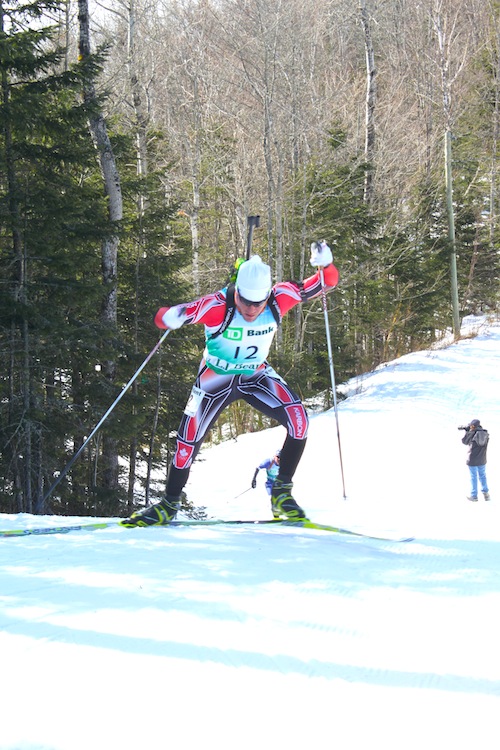
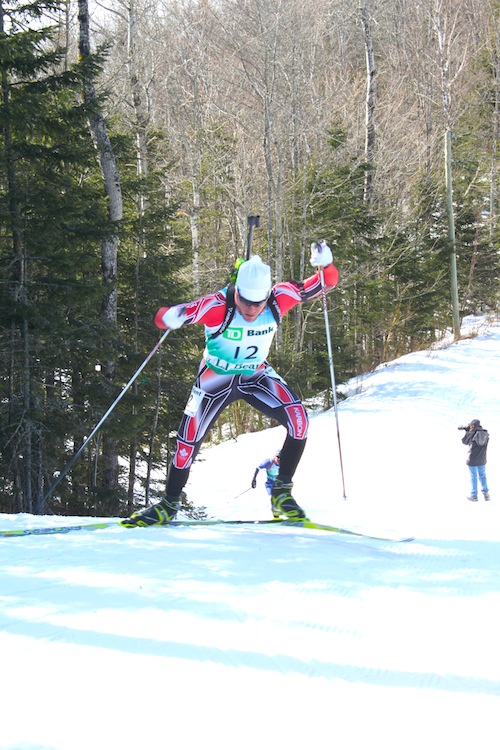
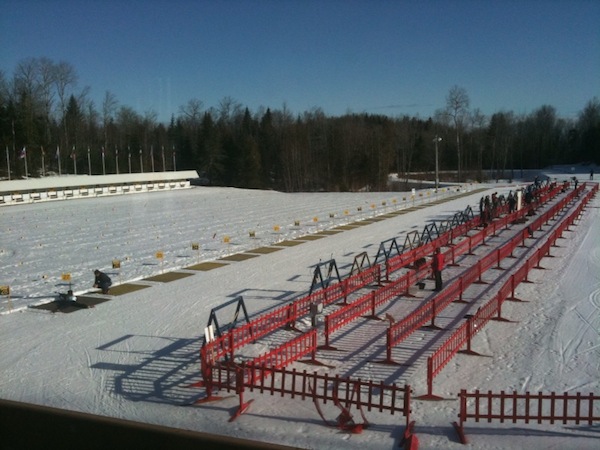
Tag: Marc-Andre Bedard

  • Initially Discouraged After Sprint Race, North American Men Put Three in Top Twenty at World Championships

    Initially Discouraged After Sprint Race, North American Men Put Three in Top Twenty at World Championships

    Tim Burke cresting a hill in Ruhpolding, Germany, en route to tenth place. Photo: NordicFocus/USBA.

    RUHPOLDING, Germany – Not a single one of the North American men was pleased with their race in the World Championships 10 k sprint today – at least that’s what they said at the finish.

    One after another, the biathletes reported that they felt slow. Tim Burke. Jean Phillipe Le Guellec. Lowell Bailey. Russell Currier. Nathan Smith. Marc-Andre Bedard.

    Here’s a typical soundbite, this time from Le Guellec.

    “Skiing wasn’t really awesome, actually,” the Canadian told FasterSkier just after finishing. “Skis were really good, but my ski shape was really not so good. I couldn’t get moving.”

    Burke leading Dominik Landertinger of Austria out of the range.

    It was startling, then, to look at the final results and see them so close to the front. Burke led the way in tenth, with Le Guellec 14th and Bailey 20th.

    “I was definitely a little surprised that I ended up tenth today when I felt like I was not in top form,” Burke wrote in an e-mail later that evening.

    There were a couple factors which led to the men thinking they had done far worse. First, having an early bib turned out to be a big advantage, and the sun bore down on the Chiemgau arena and the ruts in the track became deeper and deeper. Of the first ten starters, five placed in the top 11. Burke, starting 12th, was fifth when he crossed the line, which usually doesn’t inspire confidence.

    But it became more and more difficult to break into the top ten as the afternoon wore on. Carl Johan Bergman, starting with bib 41, pulled off what seemed like an impossible feat when he finished third.

    Then, there was an uncharacteristic pittance of clean sheets in the men’s field.

    Le Guellec, skiing well in spite of himself.

    “Normally on this range, with the downhill approach, everyone shoots really well,” Burke explained in his e-mail. “Maybe it was the pressure of World Champs or the 30,000 fans, but for some reason the guys field shot poorly today.  I think this is why I was able to stay in the top ten. Normally with the feeling I had today I would expect to finish around 20.”

    Regardless, many of the North American men had quietly successful days.

    Burke’s top-ten, which is the third-best World Championships performance of his career, came at what is one of his least favorite venues on the circuit.

    “I’ve always sort of struggled on this course – it’s a lot of short steep climbs and quick downhills, and it’s tough for me, I like a working course a little bit more,” he said directly after the race. “Some of these guys are a little quicker and do a little better on these steep climbs.”

    Adding to the choppiness of the Ruhpolding course was the drastic difference in conditions on different sections of the trail.

    “The shady parts were actually really icy,” Burke said. “So you went from like six inches of corn snow to ice – it made for some un-rhythmic skiing, for sure.”

    That feeling of never quite getting in a groove, and being constantly a bit off balance, is probably what led Burke to come away with a negative feeling.

    Bailey leaving the stadium on his first loop.

    Like Burke, Le Guellec, who started with bib 21, underestimated his performance by about a half.

    “If I’m top 30, I guess I’ll be all right,” he told FasterSkier after the race. “Tomorrow’s another day.”

    Le Guellec had just one penalty, and was happy with his shooting – especially so since he felt that with slow skiing, he needed something to rely on for tomorrow’s pursuit race.

    “The pursuit race is very tactical, so hopefully ski shape will be there, but you can get by with good shooting,” he said. “And then the individual is in a little while still, so I’m hopeful that I should be [skiing] fine.”

    Does he think that he can improve his ski speed over the course of the week?

    “Aw, hell, I hope so,” he laughed.

    Bailey after hitting his tenth of ten shots.

    Bailey shot clean, but was practically despondent about his skiing after finishing 20th. After the race he seemed unable to comprehend how things had gone so wrong; usually a fast skier who can get by with a penalty or two, today he had just the 43rd-fastest course time.

    “I didn’t feel very fresh,” he said, pausing. “I’m not sure why. I felt really good coming in. I expected to feel better skiing. I definitely was struggling, bigtime.”

    The trio will all be in contention the pursuit, with Burke starting 58 seconds behind Martin Fourcade, the winner of the sprint, Le Guellec 1:10 back, and Bailey trailing by another five seconds.

    All Four Canadians Will Start in Pursuit

    Le Guellec will be joined in the pursuit by all of his teammates. It’s a big accomplishment for Canada, especially given that they are missing star skier Brendan Green. Nathan Smith placed 45th in the sprint, Scott Perras 50th, and Marc-Andre Bedard 55th.

    All three have seen limited World Cup action this year, but only Perras was part of Canada’s last swing through the top-tier circuit; Smith and Bedard were racing on the IBU Cup instead, where Smith recently picked up three wins.

    Given that success, he was hoping for more from today’s race.

    Smith leaving the range.

    “I’d been expecting better skiing,” he told FasterSkier, echoing the other men. “I think it was softer than the mixed relay today. I don’t think my skiing was as good… and eight of ten is a little worse than I’d been shooting lately. So it was okay, not a disaster, but not what I was really hoping for.”

    Smith felt betrayed by his poor 88th-place starting position (which came about somewhat mysteriously – read why here).

    “I didn’t ski with anyone,” he said. “I just saw that Marco was always 30, 45 seconds behind me. I could keep seeing him. But he was the only guy around the same speed as me. It was like a team time trial and I didn’t want him to get me.”

    Bedard, who started one bib behind Smith, was the only man who knew the root of his skiing problems: he said that the late start threw him for a loop and he didn’t do a good enough warmup. Both were looking forward to the pursuit, where start times will be back to normal and they’ll have real competitors to ski with.

    For Bedard, more than Smith, the race today was special, however, regardless of his skiing woes. The Quebec native was not expecting to be named to the team, but was called up when Green had to bow out due to his back problems.

    “It’s awesome [to be here],” he said, savoring the words. “It’s really a privilege for me. I always race my best, but I wasn’t expecting to come, so I concentrated on the IBU Cups and going to nationals, and then with Brendan getting injured and having a pretty decent race in Canmore, they decided to take me here. And that was really – I train all year for this event.

    Bedard shooting prone.

    “It’s cool to be on World Cups, but you need to be on World Champs or Olympic Games,” he said. “Especially here. I don’t think there are going to be a lot of World Championships or Olympic Games that are this big. So this is awesome to have a chance to race in Ruhpolding, at World Championships.”

    Bedard felt the love all the way around the course, he said.

    “The fans here are awesome,” he said. “They are definitely sold for their country, that’s normal, that’s okay. But it’s cool to see people, you go around, even training – in the race you don’t really notice – but there’s people yelling your name, and ‘Go Canada,’ so there must be maybe ten real Canadians here but [it feels like more].”

    Currier, Hakkinen Out of Pursuit

    Currier heading out on course.

    The remaining two Americans had rough days for a variety of reasons. Russell Currier, who is getting over what he called “some godawful virus or something,” had three penalties and a lackluster ski time to finish 63rd. He just missed the 60th-place cutoff for the pursuit, although he didn’t know it when he talked to FasterSkier at the finish line.

    What he did know was that it wasn’t a good race for him.

    “Eh, pretty shitty,” he said of the effort. “I was good after prone, even with the miss. But then ski speed kind of fell apart, and two misses in standing. It wasn’t a disaster or a terrible race, but not good enough at this level.”

    Like Burke, he wasn’t a fan of the trails here.

    Hakkinen in the penalty loop.

    “I hate this course,” he said. “Even when it’s in good shape this is a terrible, terrible course. I mean that’s just my opinion.”

    Still, he said that’s “just something you deal with” and that he was looking forward to the other races this week. Given that illness was the reason his ski form was off, he was confident that he’d be able to get things back together.

    Hakkinen finished 91st with five penalties, four of which came in the prone stage. He was understandably uninterested in talking to the press after the race; U.S. coach Jonne Kahkonen told FasterSkier that the wind had been getting tricky as Hakkinen came into the range, and that even though he was paying attention and taking clicks to adjust to the conditions, things had gone wrong.

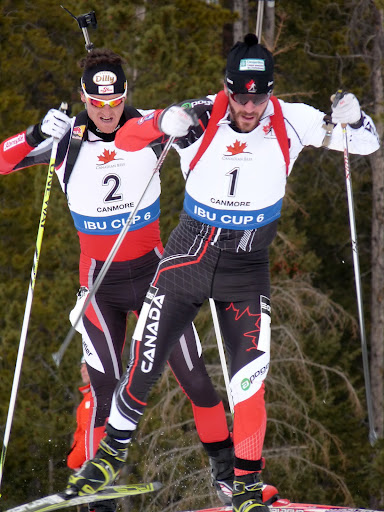
    Full results

    Race report

  • U.S., Canada Name Biathlon World Championships Teams; World Cup Racers Joined by Five More

    Lowell Bailey, currently 13th in the World Cup standings, is the top-ranked North American biathlete going into World Championships in Ruhpolding, Germany. Photo: NordicFocus/USBA.

    At the end of last week, both the U.S. and Canadian biathlon teams announced their rosters for the upcoming World Championships in Ruhpolding, Germany, March 1-11.

    The biggest surprise was the absence of Brendan Green, the top Canadian man who is currently ranked 32nd in the world. Green recently had a trio of career-best results and his first top-ten finishes on the World Cup in Oslo, Norway, but was hit by back problems before the weekend was even over. After returning to Canada, the injury became so severe that he will not be able to compete.

    Instead, 34th-ranked Jean-Phillippe Le Guellec will lead the team without him, joined by World Cup semi-regular Scott Perras. The squad will be rounded out by Nathan Smith, who recently picked up three wins at IBU Cup competitions in Canmore, Alberta, and Marc-Andre Bedard, who had top-ten finishes of his own at the races.

    While Smith seemed like a shoo-in based on multiple top-ten finishes on the IBU Cup earlier this season, most of the athletes didn’t even know that a fourth spot was up for grabs until recently. Bedard told FasterSkier that he was not expecting a nomination.

    “I was hoping for sure that with great results in Canmore that I might get a shot but Nathan had even better resullts,” he wrote in an e-mail. “When I heard about Brendan, that gave me a shock as I knew what was going to happen but I just stayed focus on my races in Alberta, actually more hoping that our ‘best man’ would get back for Germany!”

    Bedard said that even without Green competing, he would still be motivating the team for great results.

    “It seems serious, so I get to go and I’ll have him on my shoulder pushing in his honor,” Bedard wrote. “I have a lot of respect for him and I’m just wishing for him to get back stronger, kind of like [Alex] Harvey did after his surgery.”

    On the women’s side, Canada will be led by Zina Kocher, who is currently ranked 23rd in the world. She is joined by Megan Imrie, who collected her first pair of top-20 World Cup results earlier this season. Yolaine Oddou and Megan Heinicke, who both podiumed in the Canmore races, will also compete.

    Even though there are only four starting positions available for each country in each competition, the U.S. named five men to its World Championship team. It’s not clear yet who will start each race. The move, however, was not entirely surprising. Four Americans – Lowell Bailey, Tim Burke, Jay Hakkinen, and Russell Currier – have finished in the top ten in World Cup competition this year.

    The fifth man, Leif Nordgren, was sick for much of the early season, but told FasterSkier after Under-26 Open European Championships that he was on the upswing. Nordgren had the best results at last year’s World Championships, and anchored the U.S. relay team there to a historic sixth-place finish; that was likely a consideration in naming him to the team even though he has not started a World Cup since early January.

    Three U.S. women have competed in the last period of World Cups, and all three will be heading to Ruhpolding. Rookie Susan Dunklee leads the team in the rankings, landing at 48th in the World Cup standings, while Sara Studebaker, who could be called the veteran among the trio, snagged her first top-20 result of the season at the last World Cup in Kontiolahti, Finland. Annelies Cook is having her best season yet, and true veteran Lanny Barnes will round out the team after hitting the podium in Canmore last week.

    North American Roster for World Championships

    Men

    Lowell Bailey (Lake Placid, NY)

    Marc-Andre Bedard (Quebec, QC)

    Tim Burke (Paul Smiths, NY)

    Russell Currier (Stockholm, ME)

    Jay Hakkinen (Kasilof, AK)

    Jean-Phillipe Le Guellec (Kingston, ON)

    Leif Nordgren (Marine on St. Croix, MN)

    Scott Perras (Regina, SK)

    Nathan Smith (Calgary, AB)


    Women

    Lanny Barnes (Durango, CO)

    Annelies Cook (Saranac Lake, NY)

    Susan Dunklee (Barton, VT)

    Megan Heinicke (Squamish, BC)

    Megan Imrie (Falcon Lake, MB)

    Zina Kocher (Red Deer, AB)

    Yolaine Oddou (Val Belair, QC)

    Sara Studebaker (Boise, ID)

  • With Home-Field Advantage, North Americans Flex Their Muscles at Canmore IBU Cup Races

    With Home-Field Advantage, North Americans Flex Their Muscles at Canmore IBU Cup Races

    Canada's Marc-Andre Bedard leads Austria's Friedrich Pinter in Canmore on Saturday. Photo: Michael Potter.

    Last year, the world’s best biathletes got a taste of northern Maine when the World Cup made stops in Fort Kent and Presque Isle.

    This season, the top racers are staying firmly ensconced in Europe. But instead of letting the sport get too comfortable on what could be considered its home turf, the International Biathlon Union (IBU) sent their eponymously named IBU Cup circuit across the Atlantic, and for the last week the “second World Cup” has been contested in Canmore, Alberta.

    For the Canadians, bringing the races to their country has been huge. But even the Americans got behind the effort. Continental solidarity was high.

    “This is as close to home as I will ever get for an international competition and I’m still in the Rockies, so it feels like home here,” said U.S. biathlete Lanny Barnes, a native of Durango, Colorado, who podiumed in Canmore. “The Canadians have put on some great races and are always very welcoming to the U.S. team. This is probably one of the most beautiful venues on the world.”

    Melanie Schultz takes a corner against the backdrop of the Canadian Rockies. Photo: Michael Potter.

    On both Saturday and Sunday, the athletes competed in sprints – 7.5 k for women, 10 k for men, a prone and a standing shooting stage apiece. On Wednesday, they doubled their distance for individual races, which featured four shooting stages instead of two and a one-minute penalty for each missed shot. On Thursday, it was back to sprints, and the penalty loop if the athletes made any errors.

    Over the four days of racing, North Americans picked up three wins, three more podium finishes, and a total of 21 top-tens.

    “These races have been great for Canadian biathlon,” Biathlon Canada High Performance Director Chris Lindsay told FasterSkier.

    Nathan Smith, who raced to all three of the Canadian wins at the races, agreed.

    “These were the highest caliber races to be held in Canada outside of the Olympics in recent history,” he said. “It’s good for publicity and getting new people involved in the sport. Our team got a lot of medals and top-6 results here… you can feel the team’s momentum.”

    Other athletes confirmed that there was a loud fan base for the weekend races, although they lamented lower midweek attendance.

    “It was too bad none of the schools came out to watch on the weekdays, but we still have a good number of people out there cheering,” said Canadian biathlete Rosanna Crawford. “Hopefully this will lead to World Cups being held in Canmore.”

    Men’s Races: Domination By Smith

    Three-time Olympian Robin Clegg placed ninth in Saturday's sprint. Photo: Michael Potter.

    The story of the week – not only for the Canadian team, but for the circuit itself – was the near-total domination by 26-year-old Calgary native Smith.

    Smith, who trains in Canmore, started out by winning the opening sprint by a mere five seconds over Russia’s Sergey Klyachin; Norwegian Martin Eng, who has an 11th-place World Cup finish to his name, was another second and a half behind.

    In the next sprint, Smith shot clean and extended his lead, this time finishing 40 seconds ahead of Friedrich Pinter of Austria. After sitting out the individual race, Smith made it three-for-three with a four-second victory over Pinter in Thursday’s race.

    “To have my first IBU win in Canmore was… amazing!” Smith told FasterSkier. “I’ve been training here since I started biathlon. I know a lot of the volunteers, so I’m proud that I could reward them in a small way for all their hard work over the years.”

    Smith’s path to dominance really started at IBU Cup races in Obertilliach, Austria in December, where he placed third in a 10 k sprint, the first podium of his career.

    “The bronze I got in December in Obertilliach was very special,” Smith said. “That was the first time I’d ever put good skiing and shooting together in an international race.”

    After two more top-ten finishes in IBU Cup action in January, Smith made a brief jaunt onto the World Cup himself, producing a top result of 47th in a sprint in Antholz, Italy. When he returned to Canada for these races, he knew he could once again be near the top.

    “All year I had been having really good time trials amongst the national team and I was hoping for a breakout performance,” he said.

    He got it, and even though Canadian events are sometimes lightly attended by international teams, in this case Smith still had to beat out the IBU Cup’s best. Pinter, for example, has a handful of World Cup podiums to his name and owns a World Championships relay medal; the top three racers in the overall IBU Cup standings were also in the mix.

    “The big difference here is how the pack thins out a little farther down the result sheet,” Smith said. “I think it was mostly the slower skiers who were missing. I think my races wouldve been at or very near the top if in Europe…. I was within striking distance of first at the IBU cup in Italy twice except my shooting wasn’t as good.”

    Being in familiar surroundings, Smith explained, helped achieve his career-best performances.

    “I knew I would have a little leg up on a lot of the other competitors because I got back to Canmore a couple weeks before the first race,” Smith said, before laughing it off. “Fair is fair though, since most of the time its the other way around!”

    In the first sprint, Smith was joined in the top ten by three-time Olympian Robin Clegg, who missed two shots to Smith’s one and finished 55 seconds back in ninth.

    In the second two sprints, it was Marc-Andre Bedard who kept him company, placing seventh and fifth.

    “I had great races, but it didn’t feel like it,” Bedard said of his results. “I think I’m getting in better shape, and it’s just starting to feel good. There were quite a bit fewer people here than in Europe, so that helps the results for sure, but compared to the top guys my ski times are really better [than earlier this season].”

    Bedard liked the atmosphere in Canmore, but said that if he could get absolutely everything he wanted, the races would be on the other side of the country: “It was pretty cool, but I’d love to race at home in Quebec once in my life at an international race!”

    Jeremy Teela led the U.S. men, finishing 11th, 13th, 25th, and 12th.

    Women’s Races: Depth and Consistency

    Canada's Yolaine Oddou was the first North American woman to hit the podium. Photo: Michael Potter.

    The North American women couldn’t match Smith’s domination. They did, however, have something else going for them: depth. While a Canadian or American woman never topped the podium, Canadians Yolaine Oddou and Megan Heinicke and American Lanny Barnes all took their turns on the lower steps. Twice, the North Americans placed five women in the top ten.

    In the opening sprint, Rosanna Crawford led the way in eighth followed one second later by Oddou in ninth; four more North Americans packed the top twenty.

    “I was a bit disappointed in the race Saturday with the missed shot in prone,” said Barnes, who placed 12th. “You can’t afford to miss on a day like that with perfect conditions. The great thing was we had another opportunity on the same course and same race format to give it another go on Sunday.”

    With a fire in her belly, Barnes stepped up her game in the second sprint – as did the rest of the North Americans. Oddou placed third, Barnes and Heinicke tied for fourth, and Crawford and American Laura Spector placed ninth and tenth.

    Success continued in the weekday races, with Heinicke placing second and Barnes third in the individual, and then Crawford placing sixth in the sprint and leading teammate Melanie Schultz, Spector, Heinicke, and American Tracy Barnes in a six-through-ten sweep.

    At 21 years old, Oddou is in her first season of racing on the IBU Cup, and these were her best results by far. Crawford is a 2010 Olympian, but also considered the races to be highlights.

    “It was great to be racing in my home town, and I had my best results of the season and great shooting in all the sprint races,” Crawford told FasterSkier. “I was top Canadian two out of three sprints so that was very exciting for me.”

    For Crawford, there was a little added motivation, as her mother had just been through surgery for breast cancer but still managed to get out on the trails to cheer.

    “Things had been pretty stressful for me leading into these races,” Crawford said. “But she is such a strong and amazing women and is one of the main reasons I have made it this far in biathlon. She was out there everyday with her cow bells and cheering louder than anyone else!”

    Lanny Barnes was the most consistent of the Americans, and was particularly pleased with her podium finish on Wednesday.

    “I knew I was in race because I could practically hear the announcer everywhere on course and our staff kept giving me splits of leading the race,” said Barnes, who led through the first half of the race and then regained her lead on the penultimate loop before tiring before the finish.

    “I probably started out a little harder than I wanted to, and lost a little time in the end, but was happy that my skiing is coming around,” she explained. “I was bummed that [twin sister] Tracy wasn’t right in there with me, but she is just getting over a cold otherwise I think she might have give me a run for the money!”

    Tracy Barnes told FasterSkier that due to illness she had taken the races “one day at a time,” and was happy, though not thrilled, with her performances.

    “I’ve placed in the top ten several times this season and know I’m capable of it,” she said.

    Race results

  • Canadian biathlete Bédard reflects on Spartan win

    Canadian biathlete Bédard reflects on Spartan win

    In early July, Marc-André Bédard’s brother called him up, urging him to try a Spartan Race.

    Simon Bédard, of Montreal, had just finished one the 5 k trail challenges in Ottawa. He had heard of a $20,000 reward for outrunning the series’ reigning champ, Hobie Call, and figured his brother, Biathlon Canada’s 2008 athlete of the year, could beat him.

    Nuvision Action Image — Canadian biathlete Marc-André Bédard runs through the gladiator pit before winning the Spartan Beast Race at Killington Mountain in Killington, Vt., on Aug. 6.

    While training with the national team in Canmore, Alberta, the 2010 Olympian looked into it.

    “I was like, ‘This is no joke,’ ”Bédard said after researching the Spartan Beast Race in Killington, Vt. “I’ve done races where if you win, you get big money, but never that big.”

    He convinced his girlfriend, Claude Godbout, also on the Canadian biathlon team, to sign up with him. Their coach, Jean Paquet, knew they registered, but they spared him the details.

    “He was fine with it,” Bédard said in a recent phone interview between training sessions in Jericho, Vt. “It was like, ‘No problem, but don’t go crazy with it because it’s not our sport; it’s not what we train for.’ ”

    After watching videos on the Spartan Race website, Bédard had an idea what was coming: several obstacles over a long mountain course. The challenges, however, were kept secret, as was the distance of the race. They could expect to run 10-12 miles over rugged terrain and alpine ski trails, swim across a pond and dodge blows in a gladiator pit.

    The two 25-year-olds drove seven hours from Quebec City for the Aug. 6 race, setting clear intentions before the start. Above all, they didn’t want to get hurt. They aimed to have fun, and in the end, “compete: but only if goal number 1 and 2 are achieved first,” Godbout wrote on the Spartan Race blog.

    Fewer than three hours after the elite mass start, after jumping fires and covering some 13 miles of trails, Bédard emerged as the overall race winner. Muddy and cramped up, he was second to cross the finish, but the first man – a Montreal triathlete named Julien Dorais – missed a few obstacles and had to go back.

    Following Bédard’s winning time of 2:56.09, Godbout was the second female in 3:53.51. Both received Spartan helmets from the film “300,” Bédard said, with his valued at $500. There wasn’t any prize money for beating Call, who fell behind with an injury, since Call dropped out of a previous race. Regardless, Bédard gushed about his award being his best yet and both were pleased with their success.

    Nuvision Action Images — Canadian biathlete Claude Godbout crawls under barbed wire during the Spartan Beast Race at Killington Mountain in Killington, Vt., on Aug. 6.

    “I’ve being doing races since I was six years old,” Godbout said. “That was the hardest one I’ve done.”

    “We weren’t used to … (the) swimming and the obstacles and all this,” she added. “Everything was new. It was fun from the beginning until the end.”

    Bédard said he raced as fast as possible, especially on the downhills, while being careful enough.

    “We’re not supposed to do anything extreme,” he said of their national-team obligations. “We’re lucky in a sense that nothing happened. It’s a thin line between too dangerous and too tough. I had trouble walking after that for four days, so it was tough to come back to training.”

    Two days after the race, they jumped into biathlon-specific workouts with the team. Bédard said their coach wasn’t overly sympathetic to their soreness, yet they managed to log some 15 hours of training that week.

    Rollerskiing with the Canadian cross-country ski team in Jericho, Bédard said the race’s effect had not yet worn off. The Spartan series gave them free race entries and invitations to the Spartan championship and next year’s Death Race.

    While tentative to commit, Bédard said he hoped to do more races like it in the future. “It’s something you have to do in your life,” he said. “Not always as a competition, but just to finish that thing is really mentally and physically relieving.”

    Courtesy photo — Marc-André Bédard, left, and Claude Godbout pose with their awards after Bédard won the Spartan Beast Race in Killington, Vt., and Godbout was the second woman.

    For him, the training wasn’t especially different. He worked out at the gym for several hours each week and supplemented ski training with long trail runs. Out in the woods, he tossed sticks at targets to prepare for the anticipated spear throw. It turned out to be one of the last challenges, which he aced.

    “I’ve been on the national team for a long time,” Bédard said of his tenure with the team since 2000. “I need, at least once a year, to race something else. Even if I do a kayak race, it will be good for me.”

    But the Spartan Race was a beast of its own. “It was one of those things that I didn’t know what I was getting into and it looked like it was less tough,” he said.

    “It’s really big because it’s not our sport … (but) it’s something people can relate to,” he added. “It’s easier to understand the level of training that we do. To say that we finished in the 20th in the (biathlon) training that we did today; they don’t get it. “We’re not doing this for the fame or anything, but really, it gives good publicity for the biathlon.”

  • How Many Norwegians? With Perfect Shooting, Berger Makes It Four

    So far this season, three Norwegian men have dominated the World Cup biathlon circuit, taking wins when it suits them and not always playing nicely together. 22-year-old Tarjei Boe currently sits atop the overall World Cup rankings, followed closely by teammate Emil Hegle Svendsen. Veteran Ole Einar Bjorndalen, who has won 92 World Cups in his career but only one this year, is third, giving the Norwegians a clean sweep of the standings halfway through the season.

    But it was none of those men who stood atop the podium in Rupholding, Germany on Friday. Instead, their teammate Lars Berger – who is almost always overshadowed by not only his male teammates but also his more successful sister, Tora – who won the 10 k sprint.

    Berger’s skiing has never held him back. In fact, he is currently the only athlete who has won relay gold in both biathlon and nordic skiing World Championships, and won the 15 k at 2007 Nordic World Championships in Sapporo as well.

    For Berger, shooting is what makes or breaks a day, and on Friday he shot clean for just the third time in his career. The last two instances were in Vancouver in 2009 and in Hochfilzen, Austria in 2008. And in both cases, he won.

    “It is too bad that it does not happen so often,” he told IBU News. “You know I am not that good! It takes some luck. But when it happens it is quite a dream day for me.”

    Berger skied to a 21-second victory over Martin Fourcade of France, who also shot clean, as did third-place finisher Ivan Tcherezov of Russia, just two more seconds behind. The soft snow made tough going for weaker skiers, but Berger was able to shine, owning the fastest course time of the day.

    “We train a lot in tough conditions back home,” he told IBU News. “Today was difficult but not impossible [conditions]. The most important thing today was not to stress too much on the skis, but to flow over the snow and do good skiing so you can go fast.”

    While Berger had a “dream day”, the North Americans did not. They were led by Marc-Andre Bedard of Canada, who finished 44th with clean shooting. A recent addition to the World Cup squad, Bedard was a surprise leader of the Canadian team, which had three men score World Cup points and two men qualify for the mass start last weekend.

    Bedard didn’t have as easy of a time on the snow as Berger did, but was positive about his shooting.

    “It feels awesome to finally get a good shooting race,” he told FasterSkier. “But starting in the last seed is is not so cool, especially in warm weather- the trails get softer and deeper every time someone passes! The skiing was really tough today but I managed to get my shooting on.

    “I’m happy to race the third pursuit of my career,” he continued. “I want to break my bad luck in pursuits and get a big one! I’ll get the day off to prepare for Sunday and I want it!”

    For a time on Friday it looked like he might be lonely in the pursuit. After two shooting stages, Bedard and Brendan Green were the only Canadians in the top 60, and Lowell Bailey was the only American.

    But in the 3.3 k before the finish, U.S. biathletes Tim Burke and Jeremy Teela made up time and finished 56th and 58th – just inside the cutoff for Sunday’s pursuit race. Green finished 48th and Bailey 50th.

    While packing the 40s and 50s isn’t the position the men were hoping to be in, they have the opportunity to move up quite a few places in the pursuit, since all are capable of much stronger results.

    Full results

  • North American B-Teamers Rack Up Biathlon Results, Too – Updated

    The U.S. Biathlon Association (USBA) decided to try something new this year: instead of sending all of its best athletes to the World Cup, they would send a smaller group of developing athletes to the IBU Cup – biathlon’s equivalent of the Continental Cup, but more competitive – as well.

    “It’s better for athlete development to go to the IBU Cup and have success, than it is to go straight to the World Cup,” USBA President and CEO Max Cobb told FasterSkier in an interview.

    Well: mission accomplished.

    In the second weekend of IBU Cup racing, and the first with an American contingent present, Annelies Cook and Tracy Barnes each collected a top-20 and a top-15 result in Martell, Italy. Which is funny, because USBA wrote some guidelines for this very situation. In their athlete selection criteria, they said,

    “Athletes achieving a top 15 and a top 20 at IBU Cup will be moved up to the World Cup provided there are open start positions.”

    They couldn’t have guessed that not one but two women would meet the criteria. This year, the U.S. was allowed three World Cup starts for its women, and Sara Studebaker and Laura Spector have filled two of them so far – with great success, as each has a top-30 result to their name so far this season. USBA declined to fill the third spot because it felt that it would be better for the women’s team, which is viewed as weaker than the men’s team, to start at a lower level of competition.

    Now, they have more fast women than spots on the World Cup, and with a second round of trials coming up to select more athletes for the next period of IBU Cups, things are only going to get more competitive.

    To solve their current dilemma, USBA is bumping both Cook and Barnes up to the World Cup, Cook told FasterSkier in an e-mail.

    “We actually just found out that we are being invited to race in the Pokljuka [Slovenia] World Cup this weekend,” she said. “Tracy will race the individual and myself the sprint. We are both really excited for this opportunity!”

    As for the races that already happened: they were plenty exciting. In the first day’s 15 k individual competition, Cook finished 18th and Barnes 19th. Conditions were windy, just like in Austria for the World Cup.

    “I have never experienced such wild and changeable wind conditions,” Cook told FasterSkier. “One second, it would be howling in one direction and then two shots later it was going in the opposite direction.”

    Barnes, a World Cup and Olympic veteran, had possibly the most exciting race of anyone in the field.

    “The first race, the individual, was for me a ‘glad to have that one over with’ kind of race,” she said in an interview. “Even though I’m the old fart on the team I still managed to miss my start because I grabbed one training ski and one race ski. Man, did I feel like a greenhorn!”

    But Barnes’ troubles didn’t end there. She struggled in both the skiing and shooting portions of the race.

    “The conditions on the range were incredibly difficult, and I felt that it was a great opportunity for me with the shooting,” she said. “But with a few too many mistakes, I missed that opportunity.

    “Then, on the last loop of the race I went down on one of the downhill corners and ended up on my back under a fence with my skis facing uphill. I tried to get up but my rifle was stuck. I was sitting there flopping like a fish for I don’t know how long, and then all of a sudden I feel someone’s hands under my arms and I’m lifted off the ground and turned around so that my skis were facing downhill. I thanked the very nice, and very strong, volunteer for getting me out of the mess and was off down the trail. What a funny race.”

    For Cook, a big part of her strategy was skiing safely but aggressively, which she managed to do.

    “It was an exciting race series because they are now limiting spots on the World Cup, so there are more racers from the World Cup on the IBU Cups,” she said. “There was some serious carnage because of some twisty, turny, icy corners after the uphills… It was definitely part of my strategy to not crash on the downhills, and to pass girls in snowplows!”

    The next day, both Cook and Barnes improved on their finishes in the 7.5 k sprint, with Barnes moving up to seventh place in the standings, missing only a single shot.

    “The second race was fun, because I had the opportunity to rumble with Ekaterina Iourieva of Russia,” she said. “We both came into the range at the same time and she skied up to a shooting point and I skied up to the point in front of her and decided I’d try to mess with her a little. We were shooting shot for shot and I sped up my last one to get it off before her and hopefully mess her up, but no go, she cleaned as well and we went out on the last loop together. She put a little time on me on one of the uphills, but then by the last uphill before the finish I was able to catch her and pass her. It was just fun and exciting to be able to race with a Russian who has been a solid force in biathlon in the past.”

    And indeed she has: Iourieva is a former World Champion just returning from a two-year doping ban. She finished sixth in the individual race and fifth in the sprint, making a argument for her return to the World Cup circuit.

    Cook finished twelfth, and gained further confidence in her skiing.

    “I was very happy to be skiing well compared to the field,” she said. “I was actually quite nervous because I have been feeling so much better skiing this year than previously, but you never really know until you start to race in Europe how you actually stack up. There’s a lot more racing to come, but it is good to start gaining a little confidence now!

    “As far as shooting went…. Ouch! The shooting was not super stellar for me at all this weekend.”

    Claude Godbout of Canada had a top finish of 26th in the sprint race.

    On the men’s side, the Canadians had a few top finishes of their own. In Saturday’s 20 k individual, Scott Gow placed 15th – and it was the 20-year-old’s first race in Europe as a senior.

    “My race this past Saturday was excellent, and I was ecstatic with my 15th placing,” he told FasterSkier in an e-mail.

    “Going into the race my goal was to ski controlled, be relaxed in the shooting range, and with good shooting make it into the top 30. For the first couple laps, I was skiing controlled but not shooting very relaxed, and I think that caused my one prone miss, but after my first standing I got more into my normal shooting rhythm, which allowed me to hit the rest of my targets. Looking at results, there were a lot of people who struggled with shooting, and that is partially due to the fact that it was pretty gusty and unpredictable wind conditions on the shooting range. I’d  like to think that being able to stay focused, relaxed, and not rushing my shooting also helped me knock down targets.”

    And in Sunday’s 10 k sprint, Marc-Andre Bedard finished 11th, just under 40 seconds behind the winner, Andrei Makoveev of Russia. Bedard was in sixth place after the first shooting stage, but missed one shot in standing.

    “I had a good one and felt like I was going for the podium,” he said in an e-mail. “But my miss standing just got me off of the top spots. Still, these are the biggest (in numbers) international races of the year, which are represented by over 40 nations and 170 men! Most of us are pushing for a  spot on the World Cup and the top countries bring full teams of 7 men, so this is a great feeling to be on top there.”

    Despite his excellent sprint result, Bedard won’t be getting the call to move up to the World Cup like Cook and Barnes did. But he has a few more chances.

    “Unfortunately I need to keep on going fast if I want a chance to get on the World Cup after Christmas,” he said. “I was hoping to get to Slovenia right away, but I’ll keep racing on the IBU in Obertilliach Friday and Saturday hoping that I get some more top results top convince the coaches!”

    The American men struggled, with Zach Hall finishing 79th in the individual and 96th in the sprint, and Bill Bowler finishing 92nd and 76th.

    “Zach Hall caught a tough break on his last shooting stage in the individual race, entering the range at the same time as the strongest wind of the day,” U.S. coach Patrick Coffey told FasterSkier. “Despite some tough shooting, the men put in strong performances. Bill Bowler had an impressive sprint race, shooting 2, 1 on another windy day. On his first trip to Europe he has looked right at home on the international stage.”

    While the men, and Godbout, will be heading to Obertilliach, Austria, for the third weekend of IBU Cup racing, Cook and Barnes couldn’t be happier to have the chance to race in Slovenia this weekend.

  • Spector, Once Again, and Bedard Prevail in Second Biathlon Trials Sprint

    Spector, Once Again, and Bedard Prevail in Second Biathlon Trials Sprint

    After winning the second sprint race of the U.S. Biathlon Association (USBA) selection trials in Canmore, Alberta, on Thursday, Laura Spector seems like almost a lock to join teammate Sara Studebaker, who was pre-qualified, for the first period of World Cups this winter.

    Meanwhile, Canada made it two-for-two as Marc-Andre Bedard won the men’s race. The Canadian athletes are not competing for spots on the World Cup, as their selection trials were held earlier this fall on rollerskis, but they filled out the field in the selection races and added a bit of pressure for the Americans. One American man will also be selected for the World Cups, joining Tim Burke, Jeremy Teela, and Leif Nordgren.

    As was also the case in Tuesday’s sprint, conditions in Canmore were challenging. A bit more snow fell, so more trails were available for racing, but there still wasn’t enough cover to groom the penalty loop; so once again, penalties were assigned as 23 seconds per missed shot for women and 22 seconds for men. In addition, wind was a factor on the shooting range, and it showed: the women, who had shot well on Tuesday, were more erratic on Thursday.

    Spector competing at the Vancouver Olympics.

    Spector had the second-fastest ski time of the day behind U.S. teammate Haley Johnson. However, she missed two shots in the prone stage, compared to Johnson’s two in prone and three in standing, which left her alone atop the results. Johnson’s performance on the range dropped her to a disappointing sixth place.

    Second place went to Tracy Barnes, who is skiing independently after being cut from the U.S. national team this spring. Her ski time was competitive, but it was her shooting that led her to success: her one miss was the lowest total of the day, even while it still left her twenty seconds behind Spector. Anneliese Cook, also competing independently after being cut from USBA’s development team, took third place.

    Aside from Spector, the national team athletes didn’t fare particularly well against their former teammates: Lanny Barnes finished fourth, with one more miss than her sister, followed by Susan Dunklee with three misses and Johnson with five. Maine Winter Sports Center athletes Bethanne Chamberlain and Katrina Howe finished seventh and eighth.

    In the biathlon system, selection is based on “percent back”, which is calculated with a formula that takes into account the time of each athlete and compares it to the average time of the top three racers.The best two results from each athlete are used, and as a result, Spector’s two wins all but automatically qualify her, unless another athlete wins by a huge margin in the last race.

    Marc-Andre Bedard competing in Fort Kent, Maine, last year.

    In the men’s race, Bedard, like Spector, had the second-best ski time, after Russell Currier of the U.S. team, who had the fastest time for the second straight race. However, Bedard’s one missed shot tied him for the best shooting on the day, and allowed him to take the victory.

    Bil Bowler, who was cut along with the rest of the U.S. development team this year, was the only American who could match Bedard’s shooting. He had the third-fastest ski time of the day, and finished second overall, followed by Currier, who missed four shots in the prone stage. As the second American in Tuesday’s race, Currier’s consistency could pay off and earn him a coveted World Cup spot.

    Scott Gow of Canada finished fourth, followed by Lowell Bailey and Zach Hall of the U.S. national team.

    Trials conclude on Friday with a mass start race. In all likelihood, Spector will be the one to join Studebaker in Europe. On the men’s side, things are more exciting, as almost anyone who has a good race could seize the opportunity to join three athletes who are already training in Sweden.

  • Currier Wraps Up Championships With Mass Start Win

    Currier Wraps Up Championships With Mass Start Win

    Marc-Andre Bedard, Walt Shepard, and Russell Currier shoot in the third stage

    It doesn’t happen that often, but when Russell Currier gets hot on the range, there’s not a lot that can stop him.

    The Maine native is a notoriously fast skier—but also a notoriously inconsistent shooter. Sunday, at the North American Biathlon Championships, he wasn’t exactly on fire—more of a slow burn, perhaps—but the fifteen of twenty targets he hit was just enough to net him a satisfying win in the 15 k mass start race, at the tail end of a frustrating year.

    “15 out of 20 is okay shooting,” said Gary Colliander, one of Currier’s coaches, “but when you show it head-to-head like it was today…this was a great performance.”

    Marc-Andre Bedard early in the race

    Currier’s victory wasn’t assured before getting past the last shooting stage. Having skied most of the previous loop glued to Canada’s Marc-Andre Bedard, the pair headed into the range together.

    As they stepped up to shoot for the fourth and final time, their movements were practically synchronized. But Currier had a big advantage over Bedard before they even started firing: He was using his own rifle.

    Bedard, who had been barred by the Border Patrol from bringing his own gun into the country, was using one that he’d borrowed from Maine Winter Sports Center.

    “I’m still trying to learn how to shoot with this [gun],” he said. “Standing is especially hard.”

    To make matters worse, Bedard jammed his second bullet after hitting his first shot. He had to stop and hand-feed the next round in, as Currier blazed through the stage with just one miss.

    Standing right beside him, Bedard said that by then, he knew he had to hit the next four targets to give himself a chance—then proceeded to miss two.

    By the time Bedard made his way over to the penalty loop, Currier was already heading back out on course, done with his one lap. And from the way Currier was skiing—huge, crisp strides—it was clear that the race had been decided. His coach let him know the size of his advantage, and he skied off assured of the win.

    “A whole penalty is…a good 25 seconds,” he said. “We’re about even on ski speed, so I knew I’d be safe.”

    Russell Currier at the line

    Currier said it was his first win in a mass start race, and it was particularly satisfying since the winter had been such a tough one. He had hoped to qualify for the Olympic team this year, but shot poorly and didn’t even make the initial selection.

    “This has probably been my worst season actually,” he said. “A nice little break like this definitely does the self-esteem good.”

    It did his hometown fans some good as well. Maine Winter Sports Center’s men had been close to breaking through all week, as Walt Shepard took second place in each of the first two races. Today, they finally got a victory.

    Shepard was third Sunday, in what was his last competitive biathlon race; he’s retiring at the end of this season. He was right with Bedard and Currier halfway through, but shot himself in the foot—not literally—with a handful of uncharacteristic misses.

    He had three penalties in his first round, then worked his way back into the race by cleaning the second. But in the standing, he “threw it away again,” with three misses in the third stage and one in the fourth.

    Walt Shepard ends his biathlon career with a bow

    It was especially frustrating, Shepard said, because he felt so good skiing on Sunday. But he was still content with a third consecutive podium finish, giving a big bow to the crowd as he crossed the line.

    “It worked out,” he said. “I’d rather be on the podium than not at all. I had written a little bit better end to the story—it just didn’t come true.”

  • Biathlon Championships Set to Blast Off in Maine

    Biathlon Championships Set to Blast Off in Maine

    Wynn Roberts (left) headlines the competitors at North American Biathlon Championships in Fort Kent, Maine

    You can always count on snow in northern Maine. Throw in skis and guns, and you’ve got a recipe for a pretty good week.

    Three days of racing kick off this morning at the North American Biathlon Championships in the biathlon-crazed town of Fort Kent, Maine. The fields are small, but competitive at the top, with four biathletes racing fresh off the 2010 Olympic Games: Americans Haley Johnson, Laura Spector, and Wynn Roberts, and Canada’s Marc-Andre Bedard.

    The dark horse is Caitlin Compton, an American who competed at the World Biathlon Championships in 2008, but switched back to cross country raced for the U.S. team in Vancouver. She arrived yesterday fresh from the cross country World Cup in Norway, drummed up a rifle, and decided to race at the last second.

    There’s nothing on the line but bragging rights, but that was enough to draw 128 elite, master, and youth biathletes out of the woodwork. And the event will be a dress rehearsal for the World Cup that will be held here next year.

    Things get going today with the sprint, which is 10 kilometers for the men and 7.5 for the women, both with two rounds of shooting: prone, then standing.

    Results from the sprint are doubly important, because athletes then start Saturday’s 12.5/10k pursuit with a handicap based on their times from Thursday. Win the sprint, and you’re the first one out on course for the pursuit, with a head start equal to your margin of victory over the second place finisher. Sunday’s 15/12.5k mass start will be the last race of the championships, and for that competition, everyone starts with a clean slate.

    In addition to the Olympians, the fields feature strong contingents from the host club, Maine Winter Sports Center, including hometown hero Russell Currier (he’s not technically from Fort Kent, but nearby Stockholm is close enough to win him some loyalty). Other threats to podium on the men’s side are Casey Simons, Zach Hall, Walt Shepard, and Bill Bowler.

    For the women, aside from Spector, Johnson, and Compton, the challengers are BethAnn Chamberlain, Susan Dunklee, Annelies Cook, Katrina Howe, and 2009 World Junior Championships silver medalist Grace Boutot.

    With the country’s top men and women racing in Europe on the World Cup circuit, the racing should be tight. We’ll have complete coverage of the events—check back later today for results and a report from the sprint.

    Athletes and coaches in the range on Thursday morning before the sprint.