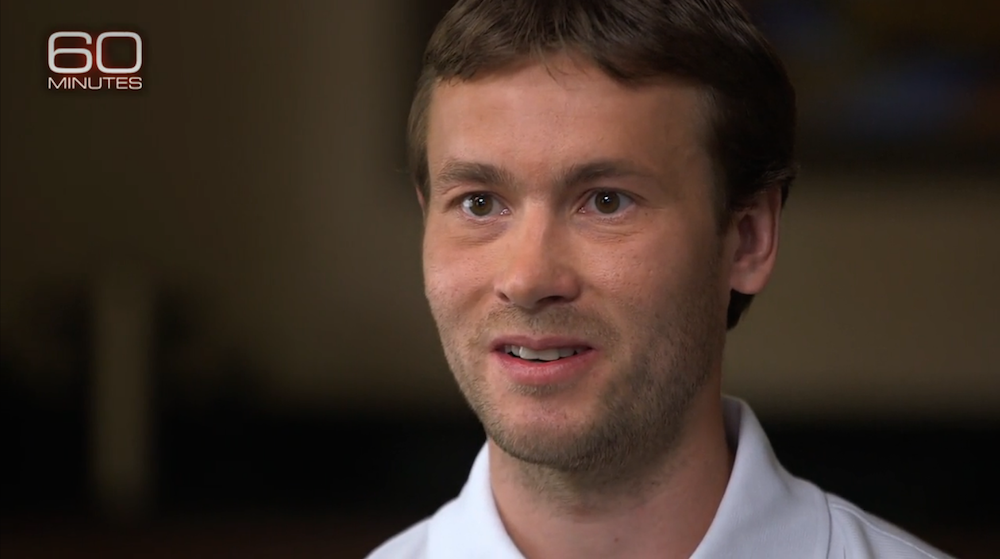
Vitaly Stepanov, a former RUSADA employee, during an interview with 60 Minutes’ Armen Keteyian, which aired Sunday, May 8. Click here for the video. (Photo: CBS News)
At least four Russian gold medalists in Sochi used performance-enhancing drugs to reach the top of the podium at the last Winter Olympics, and the FSB — Russia’s equivalent of the FBI — helped with the cover-up.
That’s the story that was told to 60 Minutes, which aired Sunday evening in the form of a 13-minute interview with Vitaly and Yuliya Stepanov, as well as U.S. Anti-Doping Agency CEO Travis Tygart and American runner Alysia Montaño.
Yuliya Stepanov was one of Russia’s top runners in track and field — a program the World Anti-Doping Agency (WADA) suspended in November after its independent investigation found it was engrossed in a “culture of cheating” and widespread corruption. Yuliya’s husband, Vitaly, previously worked at what the 60 Minutes described as “a low-level job collecting urine and blood samples” for RUSADA, the Russian Anti-Doping Agency, in Moscow.
“Together, they exposed the dark secrets of their country’s doping program and, as you will learn for the first time, damning new details about cheating at the 2014 Winter Games in Sochi, Russia,” the news segment stated.
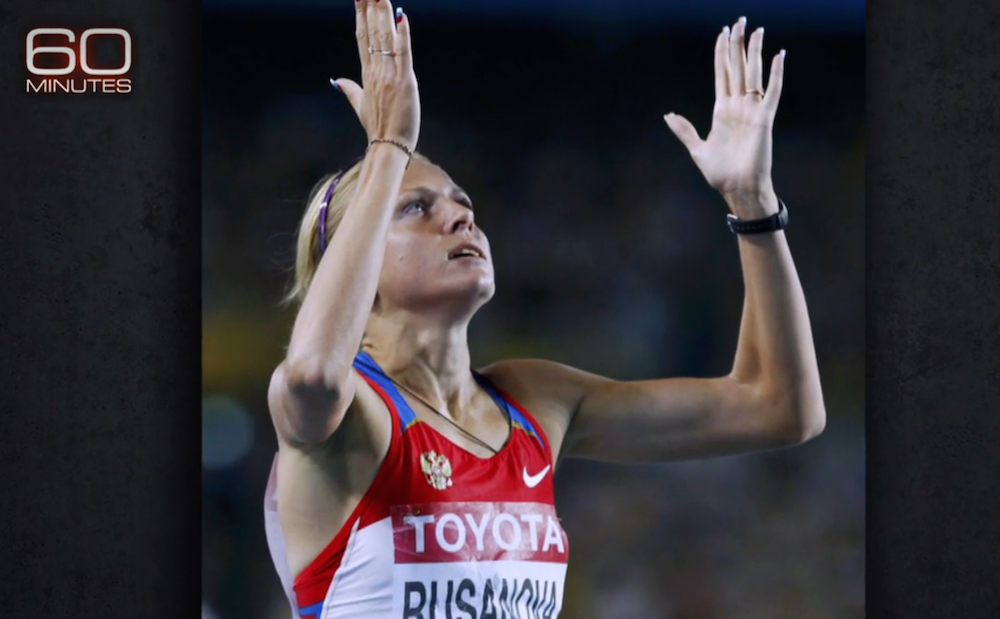
Yuliya Stepanov, a former Russian track and field athlete who admitted to using several steroids. (Photo: CBS News)
Yuliya doped and all of her teammates doped, she stated. Vitaly didn’t agree with it, asserting that he wanted sports to be fair and clean. The two decided to get divorced, Vitaly lost his job, yet they would later reunite under a common cause.
Just before the 2012 London Games, Yuliya — who was no longer a medal contender — “lost the protection of the system and tested positive for EPO,” the segment stated. “Facing a two-year ban, she called Vitaly just days before their divorce would be final.”
“And he suggested, ‘Let’s tell the truth, Let people know the whole truth, the way things happen in Russia,’ ” Yuliya said. “To destroy the system one has to talk about it.”
Yuliya used her phone to secretly video her coach giving her steroids, her teammates discussing their drug use and the team’s medical director telling her how to get back on the drug program. The video recordings were used in a documentary by Germany’s ARD, which aired in December 2014 and prompted WADA to take action — banning the Russian track and field team as a result.
The couple now lives in a one-bedroom apartment with their child at an undisclosed location in the U.S. — 60 Minutes did not say where for their protection.
Over the last few months, Grigory Rodchenkov (who ran the drug-testing lab in Sochi, was fired following the WADA investigation and has also sought refuge in the U.S.) shared what he knew with Vitaly. Apparently, Rodchenkov was unaware that Vitaly recorded 15 hours of their conversations, and “what Rodchenkov has revealed threatens the credibility of the results at the 2014 Winter Games in Sochi, Russia,” 60 Minutes reported.
“What Rodchenkov has revealed threatens the credibility of the results at the 2014 Winter Games in Sochi, Russia.”
“He told me what I and Yulia did, we could only see this much. But what was happening with cover-ups, it’s like this,” Vitaly said, holding his hands out wide.
Rodchenkov apparently bragged that he had what he called “the Sochi list” of Russians who used prohibited substances at the 2014 Winter Games. What’s more: Russia’s FSB, its federal security service, was directly involved.
Vitaly said that, according to Rodchenkov, some FSB agents worked as doping-control officers at the Sochi Olympics and “tried to control every single step of the anti-doping process in Sochi.”
Rodchenkov also said at least four Russian athletes won gold medals in Sochi while using banned drugs, and his lab aided the cover-up. He did not specifically name the athletes, but speculation surrounds a list of 26 Russian gold medalists from 13 events in Sochi, with some athletes earning more than one gold. A representative for Rodchenkov told 60 Minutes that, for now, he was not available for comment.
“It’s a stunning revelation,” USADA’s Travis Tygart said. “And if true it’s a devastating blow to the Olympic values.”
In the next month, the governing body of track and field will decide whether it will allow the Russian team to compete at the Rio Olympics this summer.
“It’s clearly the final nail in the coffin for Russian track and field,” Tygart said. He said USADA is not in favor of allowing Russia to compete in track and field in Rio.
US Biathlon President and CEO Max Cobb reacted on Twitter Sunday evening, posing a few questions: “… How, after over 200 emails on the corruption, did #WADA designate the Moscow lab for Sochi?”
Cobb followed up with a series of other tweets and retweets regarding the interview.
“2. Why is it that @CBSNews, @ARD_Presse & London papers are investigating & validating what Pound suspected, while #WADA does nothing?” and “3. Verification of heretofore suspected widespread doping & coverup at Sochi has HUGE impact & demands immediate investigation by #WADA”
“With brave whistleblowing by Stepanovs & Rodchenkov’s statements, time for #WADA to investigate Sochi & all sports in RUS. If not now, when?” Cobb added.
“Thank you @60Minutes for bring this harsh reality to the masses. Heartbreaking and infuriating!” US Biathlon A-team member Lowell Bailey tweeted Monday morning.
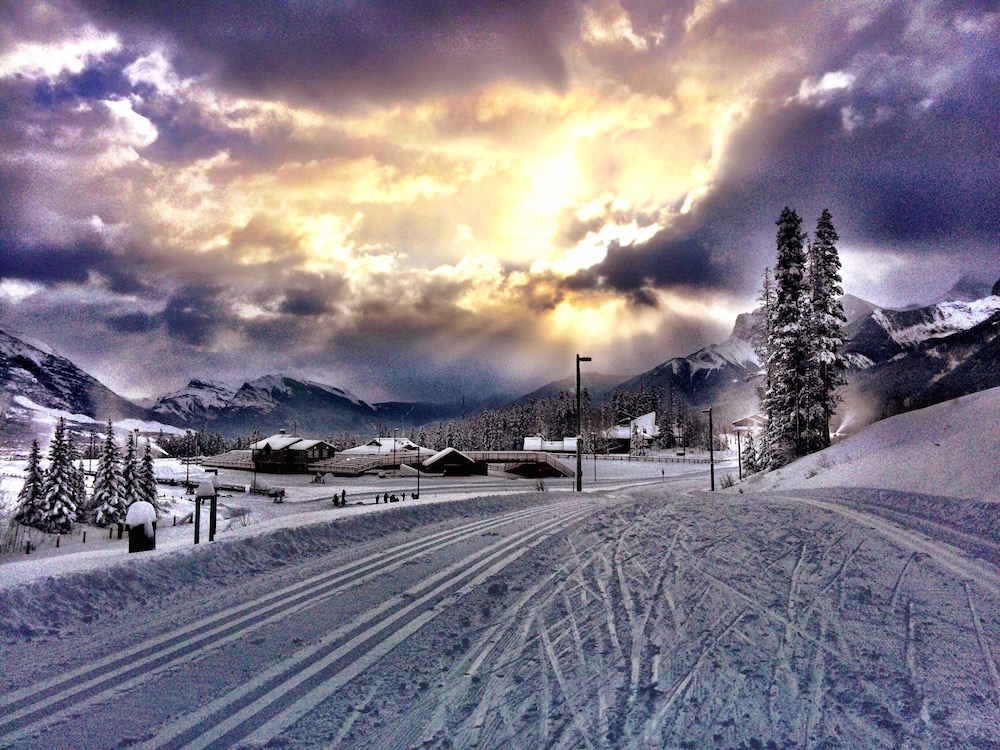
Fresh snow at the Canmore Nordic Centre in Canmore, Alberta: an Olympic legacy venue that now regularly hosts Canadian-based FIS Cross Country World Cups and IBU World Cups. (Photo: Pavlina Sudrich)
There’s an unspoken sentiment amongst many cross-country insiders that what we think of as the modern-day International Ski Federation (FIS) Cross Country World Cup is in fact a European Cup. Cross-country ski racing is more popular in Europe and commands sizable television audiences — in other words European events make money — so the arguments goes that FIS rarely schedules North American-hosted World Cups. FIS nordic races run primarily in Europe.
The first official FIS-sanctioned World Cup season was 1981/1982. The next year, 1983, Anchorage, Alaska, and Labrador City in Newfoundland and Labrador hosted the final two World Cup race weekends. In 1984, Fairbanks, Alaska, hosted another World Cup. Early on, North American venues were included on the FIS calendar in ’85, ’87, (’88 Calgary Olympics), ’89, ’91, ’94, ’95, and 2001 in Soldier Hollow. (The 2002 Salt Lake Olympics’ cross-country events were held at Soldier Hollow in Midway, Utah.)
If you crunch a bit of basic World Cup-hosting data on the FIS website, you’ll note numerous maple-leaf flags and an absence of U.S. stars and stripes. Since 2001, the World Cup has visited Canada six different seasons.
The Ski Tour Canada: a high point for Canada and reminder of American ski fans’ desire to bring World Cups to the U.S.
If this year’s eight-stage Ski Tour Canada (STC) was a pinnacle moment for Canada’s cross-country racing scene, it was a void south of the border in the States: it’s been 15 years since U.S. cross-country skiers have raced a World Cup on home snow.
“It’s obviously not a lack of desire to host an event,” said Luke Bodensteiner, U.S. Ski & Snowboard Association (USSA) executive vice president of athletics, about the absence of American based-cross-country World Cups. “Across all our sports we host a lot of World Cup events each year. We know we have the organizational capability, we know how the marketing aspects work, we developed over time great relationships with excellent host sites that we can count on year in and year out. It’s also very well scrutinized business decision based on fulfilling our sponsors needs and driving maximum TV ratings and making sure we don’t take on overburdensome costs.”
As a governing body based in Switzerland, FIS remains eager to expand its brand. “FIS was very motivated for us to have an East Coast urban style event like you saw in [Quebec], and we did a fair amount of exploration actually in New York, New York City,” Bodensteiner said.
Discussions and potential partnerships between Cross Country Canada (CCC) and USSA were a possibility when mapping out the most recent Canadian World Cups. But the dollar signs didn’t add up for the American side.
“The kind of the numbers that we had come to together for a top event or a two-race stop would have been roughly 1.8 million [dollars] in expense,” Bodensteiner said of a USSA and FIS exploration of possible U.S. host sites. “It is not an inconsequential amount, for sure.”
Businesses and nonprofits like USSA and CCC don’t exist to bleed money. If $1.8 million is a starting point for potential venues, then it needs to make financial sense for all the stakeholders.
Mark Duperreault, the Alberta World Cup Society’s Canmore STC organizing committee chair, said the cost of hosting includes funding the travel and living expenses of Red Group athletes (ranked in the World Cup top 30) to the equivalent of 125 Swiss Francs per athlete per day (about $130 U.S. dollars). Considering both sprint and distance Red Groups, male and female, Duperreault said he budgeted for more than 100 total athletes. That sum doesn’t include funding for FIS staff like a race director, an event coordinator and a media coordinator, which CCC was also responsible for. The host organization is also tasked with funding the immense cost of producing the event’s video broadcast feed.
Then there’s the prize money.
“It is quite high,” Duperreault said. “There’s prize money for the overall, sprint cup prize money, we had the daily prize money for the Tour leader, we had the stage prize money, and then there is always in the rules all these overall contributions to the overall World Cup. So we distribute some of that.”
Funding World Cups
Then how exactly did the Canadians pull off the Tour? Comparing Canada’s ability to viably finance World Cups with that of the U.S., a glaring difference exists. In Canada, government funding for international-level sporting events is available. CCC, in its efforts to budget for hosting World Cups, can rely on funding at three distinct tiers of government: the national, provincial and municipal levels.
Starting at the top of the funding pyramid is a national government body called Sport Canada. Sport Canada has cultivated a well-defined hosting program with clear eligibility requirements. Dave Dyer, CCC’s director of events, said Sport Canada will fund about 35 percent of an event’s total budget.
Sport Canada also requires provincial government buy-in; its monetary support is formalized only when funds are also allocated at the provincial level. Keeping it simple, Sport Canada matches what the provincial and/or municipal government contribute.
“So one dollar from the feds equals one dollar from the provinces,” Dyer said.
Sport Canada also limits its support to 35 percent of an event’s overall budget.
“If you use the matching principle on the 35 percent, you probably get up to 60 percent of the initial funding from public sources,” he added.
Referring to the $1.8 million USSA estimates it would cost for a World Cup weekend, Dyer noted those numbers reflect a minimum investment.
“I think those are pretty accurate numbers and I suspect they got some of those numbers from us because we certainly shared with USSA the costs of running the races in 2012,” he said. “In 2012, we had two races in Quebec City and three out in Canmore. So, I think that probably $2 to 2.4 million is probably a good estimate for a weekend of races.”
Using Dyer’s approximation that 60 percent of the cost of Canada’s World Cups were publically funded, and a conservative total cost of $2 million per event weekend, there’s an estimated $1.2 million of total government backed funding per Canadian race weekend. That’s a big financial burden lifted off CCC’s shoulders.
Call it a subsidy or a community development investment, when asked if Canadian World Cups were possible with no government funding, Dyer was deadpan in his reply: “I’d say no,” he responded.
Even with over half the dollars coming from public funds to cover the cost of hosting , CCC still perceives hosting domestic World Cups as a risk.
“I’d say losing money is not an option,” Dyer said when asked if Canada would host World Cups even if they lost money. “We work pretty hard on a budgeting perspective, both in terms of revenue generation as well as holding a line on expenses, so we don’t get ourselves into a situation where we are losing money.”
Dyer explained that long before submitting official proposals to Sport Canada, they have already entered into discussions with major funding partners. “No one likes surprises and I think the funding partners appreciate that approach and in fact encourage that approach,” he said.
“Losing money is not an option. We work pretty hard on a budgeting perspective … so we don’t get ourselves into a situation where we are losing money.” — CCC Director of Events Dave Dyer
In the U.S., without major public funding from national, regional, or municipal governments, organizers like USSA would be responsible for raising millions more to host World Cups compared to CCC.
The Revenue Stream — Television Rights
Attendance at all eight STC stages were free. With no gate revenue, World Cup organizers get a short-term return on their investment by selling TV broadcasting rights.
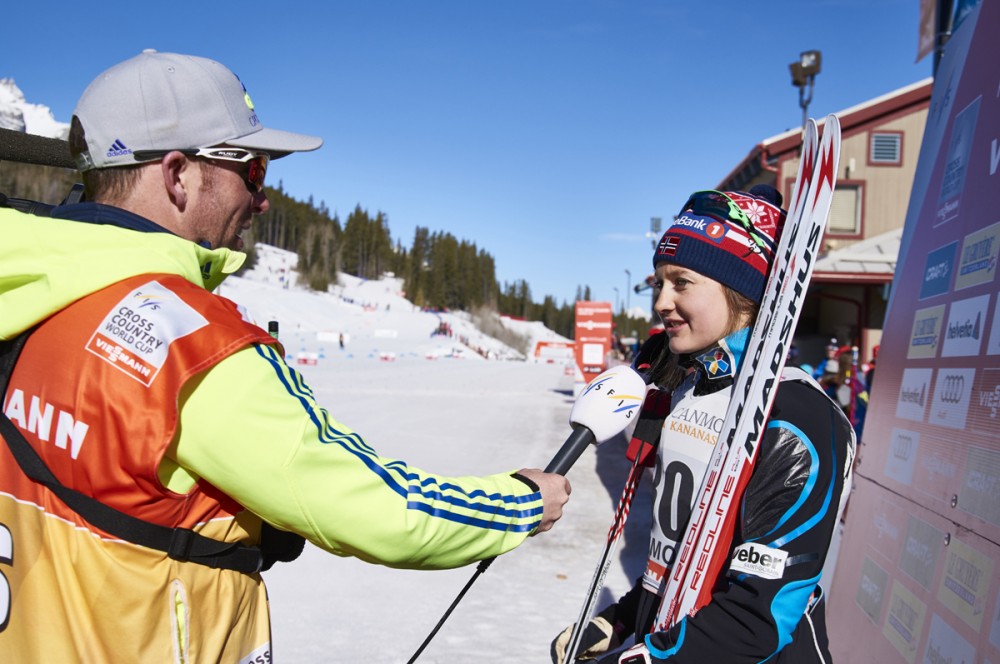
Norway’s Invild Flugstad Østberg (r) being interviewed by FIS’s Jeff Ellis after she won the women’s 10 k freestyle at Stage 7 of the Ski Tour Canada in Canmore, Alberta. World Cups are highly produced broadcast intended for international distribution. (Photo: Madshus/NordicFocus)
Canada’s model, in terms of selling World Cup television rights, is straightforward. Dyer says they sold the international rights to Infront Sports and Media, who in turn sold those rights to partners in Europe interested in broadcasting World Cups — networks like NRK in Norway, RAI in Italy, and the ubiquitous Eurosport. It would then be individual broadcasters, like Eurosport, who are responsible for selling advertising spots in each specific broadcast market.
CCC sold its domestic broadcast rights to the Canadian Broadcast Corporation (CBC), a public broadcaster, and TVA-Sport in Quebec.
FIS’s hosting template for cross-country World Cups places a huge burden on host sites like those in Canada. During the STC, CCC was responsible for producing the World Cup broadcast. That means things like running television cable throughout the venue, as well as renting satellite trucks and cameras.
Televising World Cups in the U.S. is a non-starter.
“Our TV market is substantially different … and in some cases we have even for long times had to purchase time on networks to show the events,” Bodensteiner said. “And the marketing aspect of it has kind of prevented us from making it a good business-based decision to run an event and not lose a ton of money in the process.”
The key piece here is that USSA has in the past had to pay a network to broadcast an event, according to Bodensteiner.
Reading between the lines, USSA could sell its international rights easily, but the domestic market is another story. In Canada, the CBC made the STC available for free on its website rather than televise it. In the U.S., no domestic television market exists for cross-country skiing or at least on a scale that makes sense for USSA to take a financial risk, produce the event and try to sell domestic broadcast rights. (NBC Sports does stream cross-country World Cups live on its website. Streamed events begin with a brief commercial. During the event there’s no commentary; it’s a raw feed from the host site. And to watch the feed you must have NBC Sports as part of your subscription cable or satellite TV package.)
“One of the weaknesses when you look at the cross-country World Cup versus, say the biathlon World Cup, the IBU’s model is substantially different from FIS,” Bodensteiner said of the International Biathlon Union (IBU). “The IBU really holds all of the marketing rights and all the TV rights. They basically go to where they want to go and they take on the vast majority of costs, and things as well as the revenues … versus FIS where it is like all the costs fall back onto the host organizer.”
Max Cobb, executive director of the US Biathlon Association (USBA), explained that organizing committees and the USBA have fewer hosting responsibilities when compared to their cross-country counterparts.
The IBU sells its television rights to a broadcast cooperative called the EBU, or European Broadcast Union.
“The European Broadcast Union is responsible for the televisions broadcast and they cover the costs of that either through bartering with their members within Europe, or when the event’s outside Europe, they cover the costs directly,” Cobb said. “They are completely responsible for the production, they contract with broadcasters, they hire the crew, so they do it themselves. The organizing committee is only responsible for the integration of the broadcast work and the competition so everybody can play nice in the sandbox, so to speak.”
When hosting a biathlon World Cup, the broadcast production costs are a minor part of the organizing committee’s and USBA’s overall event budget. The IBU also covers the prize money. Cobb said biathlon World Cups in the U.S. should be revenue neutral. The organizers receive a percentage of the marketing rights that are sold — these include stadium banner ads as well as television spots.
In February, the IBU World Cup returned to North America for the first time in five years, stopping in Canmore, Alberta, followed by Presque Isle, Maine.
“I know almost everybody hosting World Cups just has the marketing company do the whole package,” Cobb explained. “So that means there is a guaranteed revenue for the organizers.”
The logic follows that those revenues cover the costs organizers take on.
The big risk organizing committees face is if local weather or snow conditions cancels the event. In that case, the organizers wouldn’t get the full value of their marketing share.
“As long as you are actually able to conduct the event, the risk is relatively low,” Cobb added. He also explained that the hosting venue is responsible for paying the room and board for the top 25 men and women while the teams pay for their own travel costs.
The financial reality for USSA appears much different than it does for USBA when comparing the risks of hosting World Cups. Bodensteiner knows that bringing cross country World Cups back to the U.S. will require some creative financing.
“The thing that has been daunting for us in cross country is just the magnitude of the likely loss that we take. It is potentially very very heavy,” Bodensteiner said. “So far that hasn’t made sense to us from a business analysis standpoint.”
Legacy and Nation’s Group Start Rights
With all that financial gloom, there is an upside: the infrastructure legacy.
Canmore is a legacy Olympic venue. Although the original plan for trails, waxing huts, and media accommodations debuted in the late eighties, over the years the facility has gone through several capital improvements. After the Olympics and then post-World Cups, locals can use the Canmore Nordic Centre, elite athletes can train there, and as it has been modernized, organizations like FIS and the IBU see the site as attractive known quantities. (Along with the STC, Canmore hosted an IBU World Cup this season.)
Dyer described benefits of hosting World Cups, like community and athlete development and increased media attention. Then there are intangible benefits like promoting cross-country skiing and young skiers being inspired by watching their heroes.
Chris Grover, head coach of the U.S. Ski Team (USST), donates some of his time serving as the chairman of the FIS Cross Country World Cup and Continental Cup subcommittee.
“The World Cup and Continental Cup committee actually is the committee that decides who gets World Cups where they are and what kind of World Cups they are, what distances and what technique, what date it is, what countries, what venues all those sorts of things so we make a lot of those types of decisions,” Grover said, clarifying his subcommittee’s role.
As a subcommittee member and as a coach, Grover knows the real costs and hard-to-measure benefits associated with hosting races. With a keen interest in developing the next generation of athletes, Grover also understands that exposure to international racing and World Cup culture is key for U.S. skiers.
For skiers not regularly on the U.S. or Canadian World Cup teams, earning a “quota” spot can be decisive. These are the extra start rights host nations receive. As part of a longstanding agreement with FIS that came about since North American stops are not regularly built into the calendar, Canada and the U.S. have a reciprocal agreement. They piggy-back on one another. For example, during the STC, both the U.S. and Canada were granted extra starts as part of what is called the Nation’s Group. Since Canada has taken on most of the hosting burden over the years, it’s the U.S. that rides Canada’s back.
On the surface, more start rights means more international exposure and better prepared athletes. But is buying those Nation’s Group spots by hosting World Cups in the U.S. worth the costs?
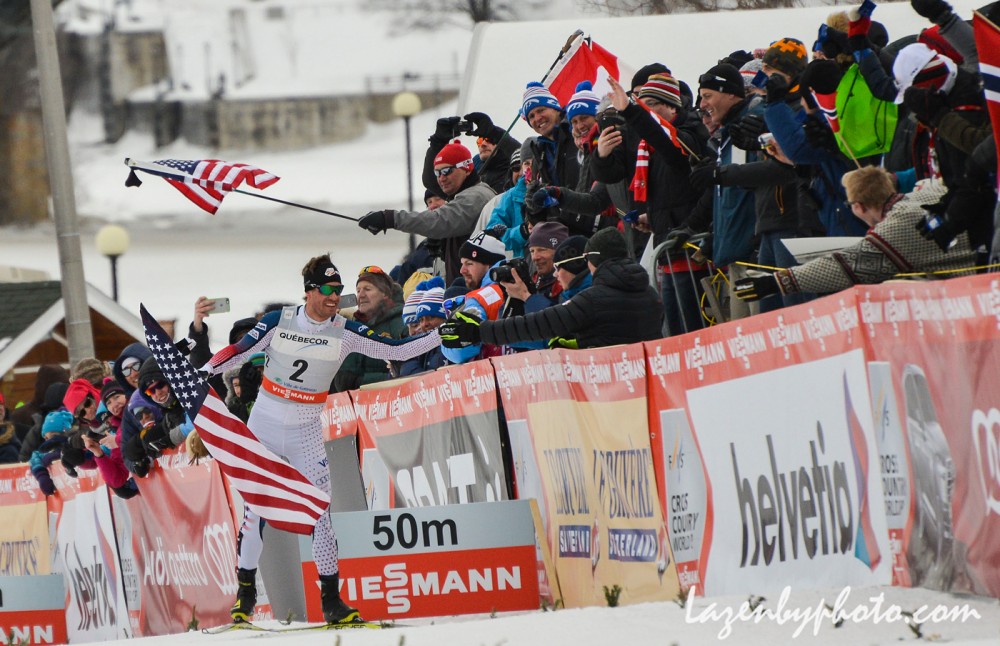
American Simi Hamilton during his “victory lap” after finishing third in the men’s freestyle sprint at Stage 1 of the Ski Tour Canada in Gatineau, Quebec. (Photo: John Lazenby/lazenbyphoto.com)
“It’s not a totally cut-and-dry kind of scenario,” Grover said. “Because if you take a look at what happened in Canada, we had 11 men that started there in that Tour. Only four of the men scored World Cup points and that’s actually the same as it was all season and those four men are the same athletes that are already on the U.S. Ski Team: that’s Erik [Bjornsen], and Noah [Hoffman], and Andy [Newell], and Simi [Hamilton]. None of the other men in this big start group took a World Cup point over eight races in every discipline, altitude and sea level.”
The U.S. women were supposed to have 13 STC start spots, but Caitlin Patterson did not start because of illness. Of the 12 starters, two women scored World Cup points for the first time, Chelsea Holmes and Katharine Ogden.
“So they took advantage of the opportunity,” Grover recounted. “But the vast majority of the other athletes were not able to ski very close to that top international standard level. So the scenario that we have right now is that if we were to host a World Cup in the U.S., we would have all these start rights, but we don’t have, in our current scenario, we don’t have enough athletes who are really ready to have any kind of performance at the World Cup level … We had four athletes on the guys’ side that were ready to compete. That’s quite a juxtaposition to some other nations, especially the stronger nations, say Norway or Russia, who bring in a Continental Cup leader and that athlete is 16th in the race or they are 12th or whatever, and they are really ready to compete at that level.”
If getting international exposure, as some would argue, is a major piece of getting U.S. skiers to the next level, Grover explained they are already meeting that goal with none of the downsides associated with hosting World Cups.
“International exposure is key, but we have so many opportunities to do that if you look at the projects that we have available for our top U.S. athletes; starting with Youth Olympic Games, going to U18 Scando Champs, World Juniors, U23 [World Championships], Europa Cup,” Grover said. “We have lots of opportunities to go to Europe and compete against the best skiers in the world.”
Then there’s the World Cup. Each World Cup period — a World Cup season is comprised of four periods — the U.S. can start its male and female overall SuperTour leaders. Grover noted that the U.S. grants its overall, sprint and distance leaders World Cup starts in Period 3 or 4, for a total of up to three woman and three men in addition to the team quota, based on the World Cup rules*.
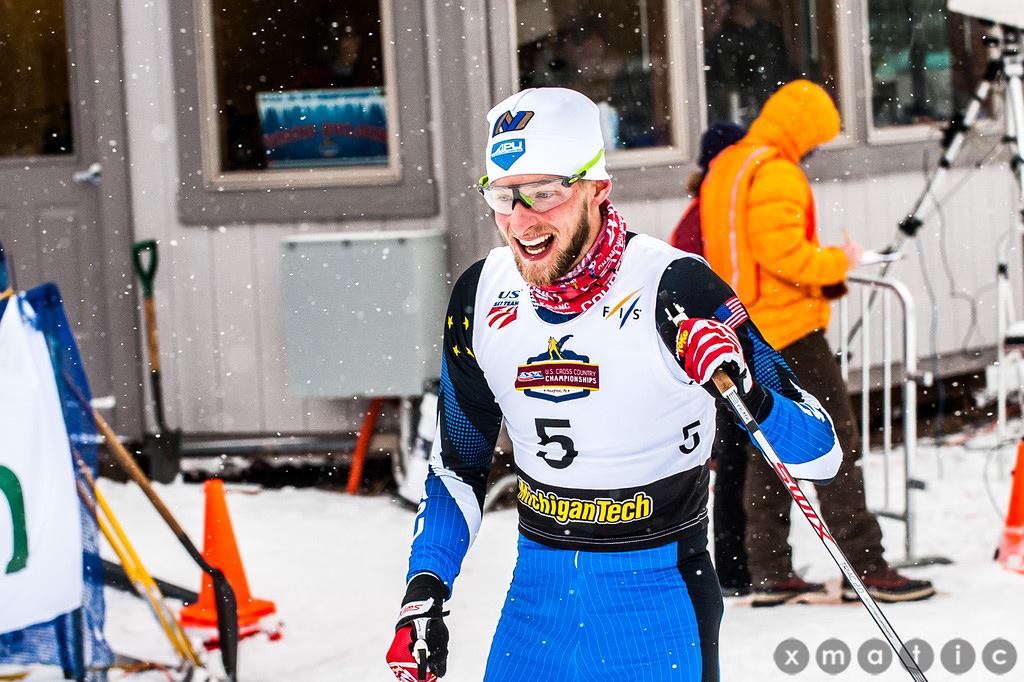
Eric Packer after winning his first national title in the classic sprint at 2016 U.S. Cross Country Championships in Houghton, Mich. (Photo: Christopher Schmidt)
Eric Packer, an Alaska Pacific University (APU) skier, earned his first-career World Cup starts at the STC as the overall SuperTour leader for Period 3. After leading the overall SuperTour at the end of the season, Packer will also begin next season on the World Cup.
“The U.S. men, I think, need to further step up their game, and I am part of that,” Packer said. “We had a lot of guys on the team [at the STC], myself included, that weren’t scoring points and weren’t all that close, and we need to get better, for sure.”
Packer is a model of Grover’s reference to skiers having opportunities to race internationally. He raced at Junior World Championships and two times at U23 World Championships. As he moves forward, Packer is poised to exploit more opportunities to race at the highest level of the sport. Those starts, however, must be earned on the SuperTour rather than from the U.S. Nation’s Group quota: the World Cup’s North American return is tentatively slated for the 2020 World Cup season.
Still, Packer made a comment that highlights what the cross-country community communicates to those young people striving to be the best. “The short-term cost-benefit may not really pay off,” he said. “If you extract yourself from that and look at the mile-high view, what that whole effort [to host World Cups] communicates is that high-level skiing, international skiing, is super important to us — that’s something that we as a skiing nation value. That’s something that is maybe overlooked in the importance of hosting a World Cup.”
One thing is for sure: dollars and cents will dictate decisions to host World Cups moving forward. At present, the numbers don’t seems to be appealing enough to convince USSA and local organizers that it’s in the interest of U.S. cross-country skiing to bring World Cups back. From the U.S. perspective, perhaps it’s hard to argue from that Canada, with its government-sponsored financial support, shouldn’t be doing the heavy lifting.
*World Cup rules state that “up to three Ladies and Men have the right to start outside of the quota in the World Cup Period 3 or 4. Each COC Cup is responsible to chose before the 30th of September in which period these 3 additional quotas will be used and have to communicate that to the FIS office. The allocation of the three additional quotas between the COC overall, distance and sprint rankings is determined by each COC. These additional quotas are nominative, the athletes can not be substituted if they can not start due to force majeure.”
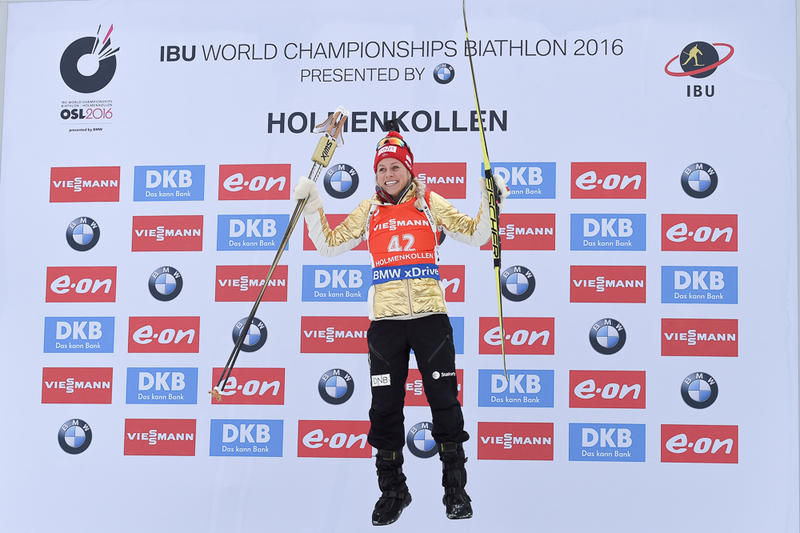
Tiril Eckhoff of Norway jumps for joy after claiming her first ever World Championships title, in the 7.5 k sprint in Oslo, Norway. (Photo: IBU)
OSLO, Norway—Norwegian biathlon fans had high expectations coming into a home World Championships this season.
But perhaps the biggest pressure was on the men’s team. With the four core members all hitting the podium so far this season and two picking up individual wins, the demand for medals – preferably gold – was strong and loud.
And so it was something of a coup when on the first day of individual competition, Norway’s new World Champion in the sprint was 25-year-old Tiril Eckhoff in the women’s 7.5 k.
Kaisa Makarainen of Finland put down an early blazing-fast time, but many top competitors had started later in the field. In bib 42, Eckhoff was one of them.
It wasn’t until Makarainen had finished that Eckhoff took her first shot. She hit that one and the next four in prone, leaving the range with the fastest split time so far, and then also cleaned her standing stage. After powering around the final lap, cheered on by 20,500 rabid fans, she laid down a race that no other woman could match.
“A big thanks to all the crowd,” she said in the press conference. “My friends and family were watching and cheering at me. Thanks to the crowd who got me around the last loop. I was really really tired and they cheered and cheered.”
It’s not that Eckhoff is unknown. Far from it. She earned bronze in the Olympic mass start in 2014, and won a World Cup the following season.
But after being annoited as the heir to Norway’s biathlon throne upon Tora Berger’s retirement, Eckhoff hasn’t dominated.
Her 15-second victory over Marie Dorin Habert of France, the World Champion in this event last year, was just that, though: dominant.
Susan Dunklee on her way to eighth place in the World Championships sprint. (Photo: USBA/NordicFocus)
She was almost at a loss for words to describe winning on home turf. Her club, Fossum IF, has its office just a few kilometers from Holmenkollen.
“It’s amazing,” Eckhoff said. “I went my first ski race here. Now I’m back and – it’s unbelievable to be World Champion. It’s amazing. Of course I had a dream, but I didn’t expect this victory. I worked hard. I don’t know how to describe it.”
Both Eckhoff and Dorin Habert shot clean. Another late starter, Laura Dahlmeier of Germany, worked her way into third despite a miss in prone.
“After the first mistake, I thought okay, for today it’s over, perhaps it could be a position in the top ten,” Dahlmeier said. “I never expected to reach the podium. The second shooting I shot zero, and the coaches told me I was on the seventh place. I thought maybe fifth or fourth. In the end I’m on the podium and I’m really happy about this position. I think it’s one of the best days of my life.”
Eighth for Dunklee
The first person to knock Makarainen out of her leader’s position was Dorin Habert, trailed by Susan Dunklee of the United States, who had started one bib ahead but missed a shot in standing. The pair crossed the finish line just seconds apart and then collapsed, before getting up to congratulate each other.
For a long while, Dorin Habert and Dunklee sat in first and second, perhaps in part because they had been able to push each other on the last lap.
“I was so glad to have a ride,” Dunklee said. “If you have anybody pulling away from you like that, you want it to be the best skier out there. She’s certainly one of them. I knew if I could just keep her in touch as much as possible it would help me a lot. I was actually accelerating – I think I closed some of the gap near the end.”
That was part of a very deliberate strategy. Dunklee earned her first podium on this sprint course in Oslo two years ago.
“I know I can be really strong on the big hill and on this little hill here [in the stadium],” she said of the Holmenkollen course. “And just holding back a slight, slight percentage of effort so I have something to give on those efforts, helps a lot. So I feel very confident being able to pace it.”
Eighth isn’t a podium, but it’s still one of the best performances ever by a U.S. woman at a Championships. Only a handful of women have ever placed in the top ten: Dunklee and Kari Swenson both have fifth-place results to their names.
“Susan’s off to an awesome start at the World Championships,” said U.S. Biathlon Association President and CEO Max Cobb. “It’s great to see her in such good form. The performance today sets her up really, really well for the pursuit competition, and she’s shown that she has the speed to go head to head with anybody in the world. We’re going to see a really exciting competition tomorrow. And with this solid performance I think she’s virtually assured a start in the mass start too.”
After earning her first podium of the season two weeks ago in Presque Isle, Maine, Dunklee had found some motivation that had been lacking earlier in the season.
“I don’t think I had been super hungry in Canmore, for example, and I was a little worried about that,” she said. “Like, if I don’t have the hunger, then what am I doing out here? But then that Presque Isle podium really got me excited again. Motivated, and confident, and very hungry.”
After a two-week training block to sit and think about racing, Dunklee got nervous. But then the nerves went away and she was simply ready to race.
It showed in the mixed relay on Thursday, where Dunklee skied the leadoff leg for the United States. She shot perfectly and tagged off to teammate Hannah Dreissigacker in first place.
“The relay was fun,” she said. “That was a fantastic day. I felt really on. I felt like tactically I skied it really how I meant to going in, shooting I was exactly where I wanted to be, very focused, I was just trying to find that place again without putting so much pressure on myself. Trying to take the confidence from it but not feeling weighed down by it.”
Dunklee is honest about how important the mental aspect is for her. She says that it just takes her a little while to get psychologically focused and confident, and that World Championships often comes right at the time when things are coming together.
Dunklee’s breakthrough came in 2012 at World Championships, where she placed fifth in the 15 k individual. And she set best-ever marks for the American women’s team she doesn’t want to be defined by championship success.
After all, it was a regular World Cup podium that got her fire going again this season.
“I don’t want to be a big-race specialist,” she said. “I think that what I’m good at is peaking at the right time of the year. I think something about our training plan works really well for me.”
Needless to say, Dunklee is looking forward to the pursuit.
“I think it will be fun,” she said. “The better skiers you have to ski around, the better you’re going to ski. If I can get in behind a pack and relax a bit, I’ll do well, and I think there will be a lot of opportunities to do that.”
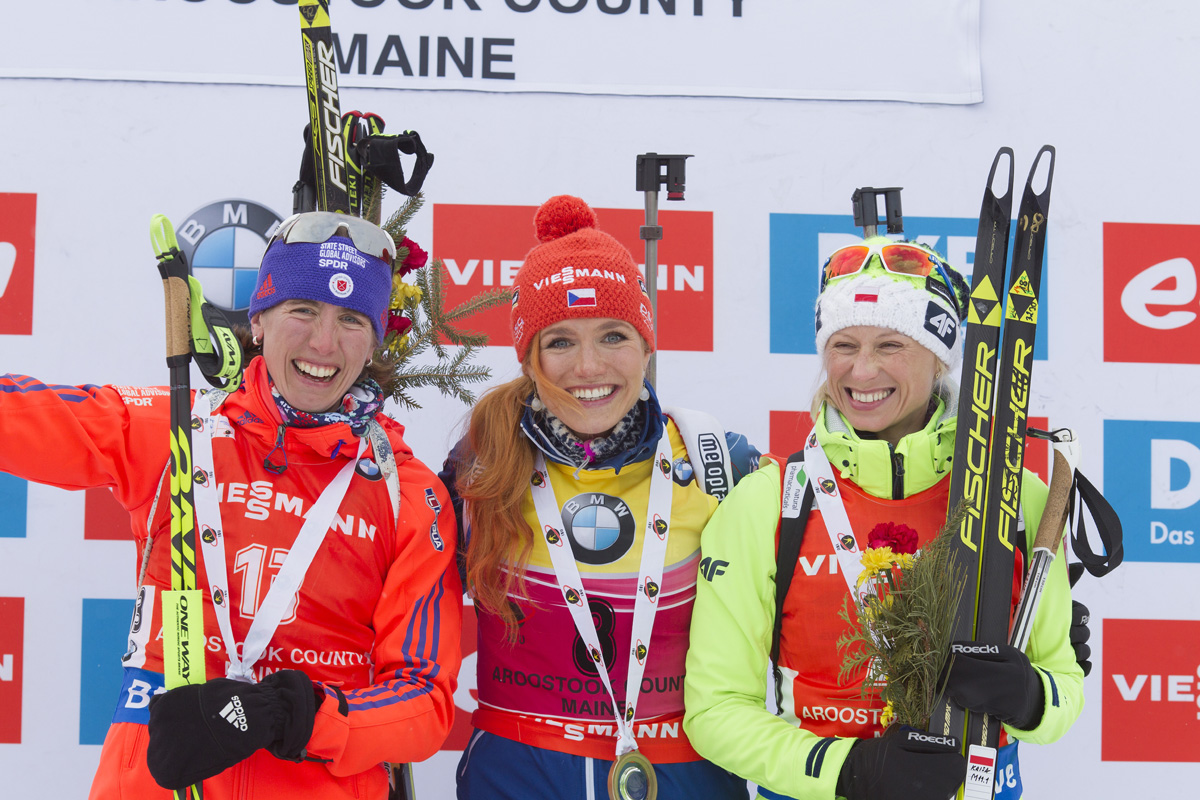
American Susan Dunklee (l) after achieving her best IBU World Cup finish in second place on Thursday and tying the best World Cup result by a U.S. biathlete. She finished second to Czech Gabriela Soukalova (c), and Poland’s Krystyna Guzik placed third (r) in the women’s 7.5 k sprint in Presque Isle, Maine. It was the first IBU World Cup held in the U.S. since 2011. (Photo: Fischer/NordicFocus)
Gazing out at the crowd, standing on the second step of the podium on Thursday, Susan Dunklee recognized dozens of faces: family, friends, people from her home base in Craftsbury, Vt., US Biathlon board members, colleagues from the Lake Placid Olympic Training Center, not to mention her team and support staff.
It had all the makings of a local-race feel, except for the implications of a World Cup podium — and the flashing lights, silver medal and media attention that came with it.
Two days before her 30th birthday, Dunklee had the best race of her career. The 13th starter, she raced to second in the women’s 7.5-kilometer sprint on the first day of the IBU World Cup in Presque Isle, Maine, finishing 17.8 seconds behind Gabriela Soukalova of the Czech Republic, the winner in 20:02.2 and overall World Cup leader.
Nearly 400 miles and a seven-hour drive from her hometown of Barton, Vt., Presque Isle is less than a half an hour away from Canada. Yet in her first U.S. World Cup, and the first World Cup in the states since it was last held in Presque Isle in 2011, Dunklee felt somewhat at home.
“To be able to have a best result on home soil and we only have a North American World Cup every five years, I couldn’t ask for anything better,” Dunklee said on the phone after the race. “It’s just phenomenal.”
In order to achieve her best World Cup result by one place (she finished third in a sprint two seasons ago in Oslo, Norway), Dunklee rekindled her joy in both the sport and Presque Isle’s course specifically, putting herself in a happy place she had been struggling to find in the last week.
“Last week was a little tough for me,” Dunklee said of the last World Cup in Canmore, Alberta. “I felt like I was going through the motions but not really feeling hungry for it.”
That changed on the final day of racing there, when she skied the first leg of the U.S. mixed relay, which went on to place fourth for the team’s best-ever finish in the event. Being within two seconds of a podium recharged her and reminded her to stay the course.
“Coming here I was like, ‘OK, there’s going to be random things that happen that are going to throw me off, but I’m just going to take the positive things that I can and use those to my advantage,’” Dunklee said.
On the team’s first training day in Maine on Tuesday, she skied the Presque Isle World Cup course for the first time. Dunklee had previously raced a NorAm there in 2009, but missed out on the 2011 Presque Isle World Cup as the team’s fifth woman at the time, when it only took four.
That was frustrating, she said, but she moved on from it — taking advantage of an opportunity instead in Ruhpolding, Germany, where she raced and previewed the course a year out from 2012 Ruhpolding World Championships. There, a year later at her first World Championships, she broke through in fifth in the 15 k individual.
Susan Dunklee (US Biathlon) racing to a career-best second on Thursday in the women’s 7.5 k sprint at the IBU World Cup in Presque Isle, Maine. (Photo: Fischer/NordicFocus)
Memories aside, Dunklee was excited about what she saw in Presque Isle earlier this week.
“I skied the course and I’m like, wow … this is a John Morton course. This is what I grew up skiing on and this is what I’m good at,” she recalled. “This is what I’m going to thrive on. I love the ups and downs, the steep climbs, the roller-coaster flow, and that’s what really set the tone right away.”
On Thursday, it was cold in northern Maine, but busloads of schoolchildren came out for the first of four days of World Cup racing. Dunklee wasn’t in her home state, but with everyone speaking English and cheering “USA!” out on the course, it was the closest she had felt to being there.
“The community is extremely welcoming and they go out of their way to accommodate us and make us feel like home,” Dunklee explained.
She started behind Soukalova, an early leader with perfect shooting in both her prone and standing stages. No sooner had Finland’s Kaisa Mäkäräinen in bib 6 finished and taken the lead from Czech Veronika Vitkova (the second starter) by 20 seconds, Soukalova in bib 8 charged across the finish line moments later, 24.5 seconds faster than Mäkäräinen to take hold of first place.
The day was young, but most of the top-ranked skiers were on course at the beginning of the 88-woman field. Dunklee followed Soukalova out, cleaning prone as well to take the lead by 0.8 seconds after the first shooting.
Her shooting didn’t feel automatic, Dunklee recalled. That wasn’t necessarily a good thing, but it wasn’t bad, either.
“I was very aware of each shot I was taking; it wasn’t flowing automatically like it usually does, and usually you want that automatic flow in a race,” she explained. “Instead I had all these thoughts going through my head, but what was great about today is I was able to take those thoughts and just say, ‘It’s OK that I’m distracted. I’m going to put that thought aside and go back to what I’m focused on right now in the present moment.’ ”
She had similar feelings earlier this year in Ruhpolding, where she placed sixth in the mass start. Recognizing this, she resolved to keep calm.
On the second shooting stage — standing — Dunklee cleaned again and left the range with 9.3 seconds to make up on Soukalova.
A US Biathlon staff member (l) cheers on Susan Dunklee (r) as she races to a career-best second place in the 7.5 k sprint on Thursday at the IBU World Cup in Presque Isle, Maine. (Photo: Fischer/NordicFocus)
What came to mind then? “You still need to fight like hell,” she recalled. “When you’re having that sort of race, you don’t want to lose a second anywhere … I’ve just got to fight for the next seven minutes or whatever it takes.”
With 1 k remaining, she was 17.6 seconds off Soukalova’s time. Half a kilometer later, Soukalova still held her ground, 17.4 seconds ahead. By the finish, Dunklee was 17.8 seconds back in second, and she wasn’t even sure she was second — but she smiled at the cameras anyway.
“I knew I probably had one of my best races in my life and I’d done it at home and my parents were there,” she said. “I just felt really good about my performance. I was really happy.”
US Biathlon Women’s Coach Jonne Kähkönen knew she was on track for a career best.
“I knew that if she would clean the race today, she would be fighting for the podium, even if there were a few fast athletes starting behind her,” he said on the phone. “Not nervous, but just wanted to wait and see what the later starters would do.”
France’s Marie Dorin Habert presented the most immediate threat. After starting 24th and cleaning prone, Dorin Habert left the range in first, 4 seconds ahead of Dunklee. However, during her second stage, she missed one standing shot. The penalty loop put her in fourth, 25.5 seconds behind Soukalova and 16.2 seconds behind Dunklee, with one loop to go.
Meanwhile, Poland’s Krystyna Guzik had started 20th and cleaned both stages to leave the range for the last time in third, trailing Dunklee by 4.4 seconds. She couldn’t catch the American on the final loop and finished 1.3 seconds behind her in third.
“Shooting is so hard; it is not sure that every day I will shoot well,” she said in a post-race press conference. “I thought that this was a new day and do my best to shoot well and run fast. I just could not catch Susan; she was too fast on the last loop. For me, the last loop today was really hard.”
Ultimately, the three podium finishers were the only ones in the top eight to shoot clean. Soukalova had the fifth-fastest overall course time, Dunklee’s course time ranked 12th and Guzik’s 15th.
Overall World Cup leader Gabriela Soukalova of the Czech Republic racing to a 17.8-second win (over American Susan Dunklee) in the women’s sprint on Thursday at the IBU World Cup in Presque Isle, Maine. (Phot: Fischer/NordicFocus)
“I have to say everything was perfect,” Soukalova said in the press conference. “I started to feel a little tired after the long trip from Canada, but I started to feel good after the start. … We had good service, good skis today so I am very satisfied with this result.”
Dorin Habert crossed the line in fourth, 20.5 seconds behind Soukalova and 1.4 behind Guzik, bumping Mäkäräinen, with a single standing miss, into fifth.
The top five would stand, and Dunklee would tie the best result by a U.S. biathlete (male or female) joining the ranks of Joan Smith (1994) and Anna Sonnerup (1991).
Current men’s team member, Tim Burke placed second in two World Cup races in 2009/2010 and earned silver at 2013 World Championships. Before him, Josh Thompson also took silver at 1987 World Championships.
“What a great day for @USBiathlon with 6 athletes in the top 30 and @SusanDunklee on the podium! #homecourseadvantage!”Burke tweeted on Thursday, after he, Sean Doherty and Lowell Bailey placed in the top 20 in the men’s sprint. Dunklee, Hannah Dreissigacker and Clare Egan finished in the top 32 of the women’s race.
“Today Susan cemented her place as a world class biathlete,” US Biathlon President and CEO Max Cobb wrote in an email. “It was a historic performance, matching the best World Cup finish by an American.”
“You spend years and years working on this, trying to perfect things,” Dunklee explained. “And at first progress is pretty good, you make big gains pretty fast, and then to get that last one percent or so of performance, it just takes so much more work.”
You need that 1 percent, she added.
“There’s times where you work your way at something for months and you just don’t make progress on it or you even go backwards because you’re trying so hard, she continued. “I don’t know, somehow things came together and I’m just amazed. It’s exciting.”
‘A Culmination of a Whole Lot of Effort’
What is it about progress, or maybe more specifically about biathlon, in which someone like Dunklee can turn a last-place finish in Canmore’s mass start, complete with a “dirty” stage (five missed targets), around less than a week later with a silver-medal performance?
“We’ve talked about this actually a couple of times over the season,” Kähkönen said of Dunklee’s ability to overcome adversity and less-than-desirable results. “It’s been a little up and down. We’ve been trying to track down in the training log if we can find some reasoning behind it and be able to narrow it down better in the future as well. But now it looks like everything is on track in terms of the physical training.”
Susan Dunklee (US Biathlon) racing to a career-best and historic second place in the women’s sprint at the IBU World Cup in Presque Isle, Maine. (Photo: USBA/NordicFocus)
In the last World Cup before World Championships in Oslo in early March, Dunklee said the timing of this result was “perfect.”
“I think Susan, ever since last week, she was able to put distractions on the side and focus on what matters,” Kähkönen said.
“In order to have my best performances in biathlon or anything in life, to be a person that takes joy out of life … I really have to find what I love about it,” Dunklee explained. “… I think that hunger is honestly my most valuable asset as an athlete.”
Looking ahead to the rest of the races in Presque Isle, Dunklee had fewer than 24 hours to absorb what she’d done on Thursday and prepare for Friday’s pursuit. At 1:10 p.m. Eastern time, Soukalova will start the 10 k pursuit first. Dunklee will head out 18 seconds later in second, and Guzik 1 second after Dunklee in third. Dorin Habert will follow, 3 seconds after Dunklee.
“I’ve got the best setup I’ve ever had before going into a pursuit,” Dunklee explained. “Starting pretty close behind the leader, and that’s another wonderful opportunity to have a great result. I’m going to enjoy tonight and celebrate a bit, but at the same time I’m going to try to wind down a bit, have a little Susan-time to myself and get some good sleep tonight because I really want to see what I can do tomorrow.”
Asked about the task of refocusing after a result like Thursday’s, Kähkönen said that’s the key to consistent top results.
“With this schedule, we just don’t have the luxury of getting stuck on the current or especially the past,” he said. “You just need to stay focused on what’s coming up next.”
But Thursday was a pretty incredible day to be part of US Biathlon, in the same state (albeit 270 miles away) as its headquarters in New Gloucester, Maine.
“It’s unbelievable,” Kähkönen said. “Just to be able to grab the podium on the home soil, home World Cup, even if it’s not the hometown, but there’s a lot of friends and family and fans that are great support. The local community is just awesome, so it means the world to us.”
“It’s not just my success,” Dunklee stated. “It’s a culmination of a whole lot of effort over lots of years by this whole group of people who care a lot about our team.”
Dreissigacker 27th, Egan 32nd, Kocher 42nd
Joining Dunklee in the pursuit will be two other U.S. women and one Canadian. Dunklee’s teammate on the national team as well as Craftsbury Green Racing Project, Hannah Dreissigacker placed 27th for her fourth-best sprint result, finishing 1:33.7 behind Soukalova with a single prone penalty.
Hannah Dreissigacker (US Biathlon) racing to 27th in the women’s 7.5 k sprint at the IBU World Cup on Thursday in Presque Isle, Maine. (Photo: USBA/NordicFocus)
“I was really happy to clean standing — I am normally a better prone shooter than standing, but I knew that I had to clean standing if I wanted to really do well,” Dreissigacker, the 41st starter, wrote in an email. “I’m very happy that I was able to concentrate for all of the shots and make it happen.
“It felt really special to have my family here, and so many other Americans out there cheering for us,” she wrote. “I actually started just after I heard on the loud speaker that Susan had cleaned. So then she came around the building and headed out on her last lap just a bit behind me. That was a fun lap — I was excited for her, and also all of the staff and fans were out there cheering so hard for her and I could tell that she was gaining on me, and also that she was probably going to podium. I felt like we were doing that lap together, though she only caught me at the very end.”
Also for the U.S., Clare Egan finished 32nd (+1:38.5) with one standing penalty. The 56th starter, Egan looked to be in contention for a top 20 after cleaning prone, but slipped into 28th after standing.
Clare Egan (US Biathlon) racing to 32nd, her second-best IBU World Cup result, in the women’s 7.5 k sprint on Thursday in Presque Isle, Maine. (Photo: USBA/NordicFocus)
“I was thankful to clean prone because it put a little less pressure on the standing, which is the harder discipline for me,” Egan wrote in an email. “I was very shaky in standing and I had to stop and reset my position after missing my 3rd shot, but that worked and I hit the last two.
“This is my 2nd best result ever and by far my best result since World Cup 1,” she explained. “My ski speed took a major hit in December but I am now recovered to where I think I should be so that is a huge relief. I had a top-30 ski time today and 90% shooting so that is an almost perfect day.”
Originally from Cape Elizabeth, Maine (and a teammate of Dunklee and Dreissigacker at Craftsbury), Egan described the experience of racing in her home state.
“My parents, my teammates’ families, and some USOC staff and USBA board members are here,” she wrote. “I heard my name all along the course from voices both familiar and unknown– and that was a first.”
Friday will be Egan’s second time racing a World Cup pursuit.
Maddie Phaneuf (US Biathlon) on her way to 65th in the second individual IBU World Cup of her career on Thursday in Presque Isle, Maine. (Photo: USBA/NordicFocus)
The fourth U.S. woman, 20-year-old Maddie Phaneuf, in her second individual World Cup race, placed 65th (for her best result by 28 places) with a clean prone and two standing penalties.
“My goal was to shoot well and ski strong … which I didn’t feel I reached fully,” Phaneuf wrote. “I felt pretty good on the skis, but not nearly as strong as I was in Romania.”
“My result-goal was to make the Pursuit, which I just missed,” she wrote of Thursday’s World Cup race, in which she needed a top 60 to advance to the pursuit. “But I’m still happy with the result and know that I have the potential to achieve more.”
On behalf of her team, Dreissigacker noted, “Our skis were phenomenal today. Our wax techs definitely deserve a share of the credit for the great day that we had as a team.”
The top Canadian, Zina Kocher placed 42nd (+2:02.0) with three misses (2+1). Overall, she had the 20th-fastest course time.
“I was focused on having consistent solid performances this week in order to qualify for World Champs,” Kocher wrote in an email. “Knowing that it is a trials situation though does bring a bit more nerves into the equation.
“I had thought I had focused on attacking from the start, however looking at the breakdown in ski speeds, looks more like I went out for a casual ski lap 1, & lap 3 an explosion went off,” she wrote of her course times, which ranked 54th on the first loop, then 46th on the second, and finally, third on the last loop. “I’d say I’m happy with 3rd fastest last lap but will work on a more aggressive warm up for the next sprint or relay I do to make sure I’m starting out a bit quicker!”
Also for Canada, Emma Lunder placed 68th with two penalties (1+1), Audrey Vaillancourt was 80th with four misses (2+2) and Erin Yungblut 87th in her World Cup debut, also with four penalties (1+3).
Note: In the men’s 10 k sprint, Sean Doherty led the U.S. in 13th (0+1), Lowell Bailey was 15th (0+1) and Tim Burke 20th (1+1).
“The men were just really consistent,” Kähkönen said. “Everybody close together and just the whole field for the top athletes, so it puts them into a very good place looking ahead for tomorrow’s pursuit race. Hopefully Susan’s podium will give them another push.”
Stay tuned for a separate report on the men’s race.
Watch the men’s and women’s pursuits live on Eurovision (Friday at 11:30 a.m. and 1:30 p.m. EDT)
Susan Dunklee with her parents Judy (l) and Stan (r) after Dunklee tied the best-ever U.S. result in an IBU World Cup in second in the women’s sprint in Presque Isle, Maine. (Photo: USBA/NordicFocus)
Dunklee celebrates a career-best second place in the women’s sprint at the IBU World Cup in Presque Isle, Maine. (Photo: USBA/NordicFocus)
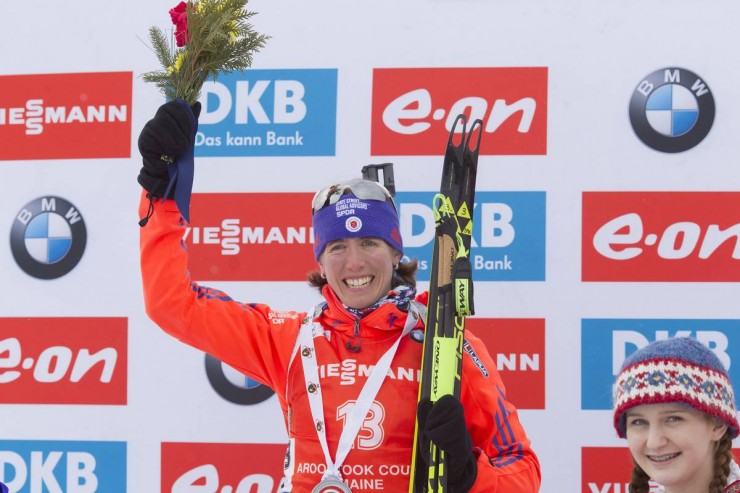
Dunklee celebrates a career-best second place in the women’s sprint at the IBU World Cup in Presque Isle, Maine, in February. (Photo: USBA/NordicFocus)
When asked by FasterSkier at Monday’s Geneva press conference whether the worst fears of those in the nordic sports community – namely that Russia has had an organized doping program off and on for many years – were true, World Anti-Doping Agency Independent Commission Chair Richard Pound hedged.
“Certainly the two sports you mentioned are known to have had a lot of doping problems, and probably not just Russia,” he said.
Dr. Jim Carrabre, the Vice President for Medical Issues at the International Biathlon Union, says that whether biathlon has a doping problem depends on how you define problem – but that no way is it the IAAF. (IBU file photo)
(You can read the background on that press conference, and its implications for winter sports, here. The topic was largely centered on Russian track and field.)
To ask those in the cross-country ski and biathlon communities, that statement is both true and false. Both the International Ski Federation (FIS) and the International Biathlon Union (IBU) touted the successes they have had in fighting doping from Russia and beyond, but also welcomed more information, investigation, and re-testing of old samples.
They also weighed in on the serious finding that the Russian state security apparatus, FSB, was present in the anti-doping laboratory at the 2014 Olympics. That finding has the potential to undermine the results from the Games, although the panel did not find direct evidence that agents had manipulated samples.
Unfairly Maligned?
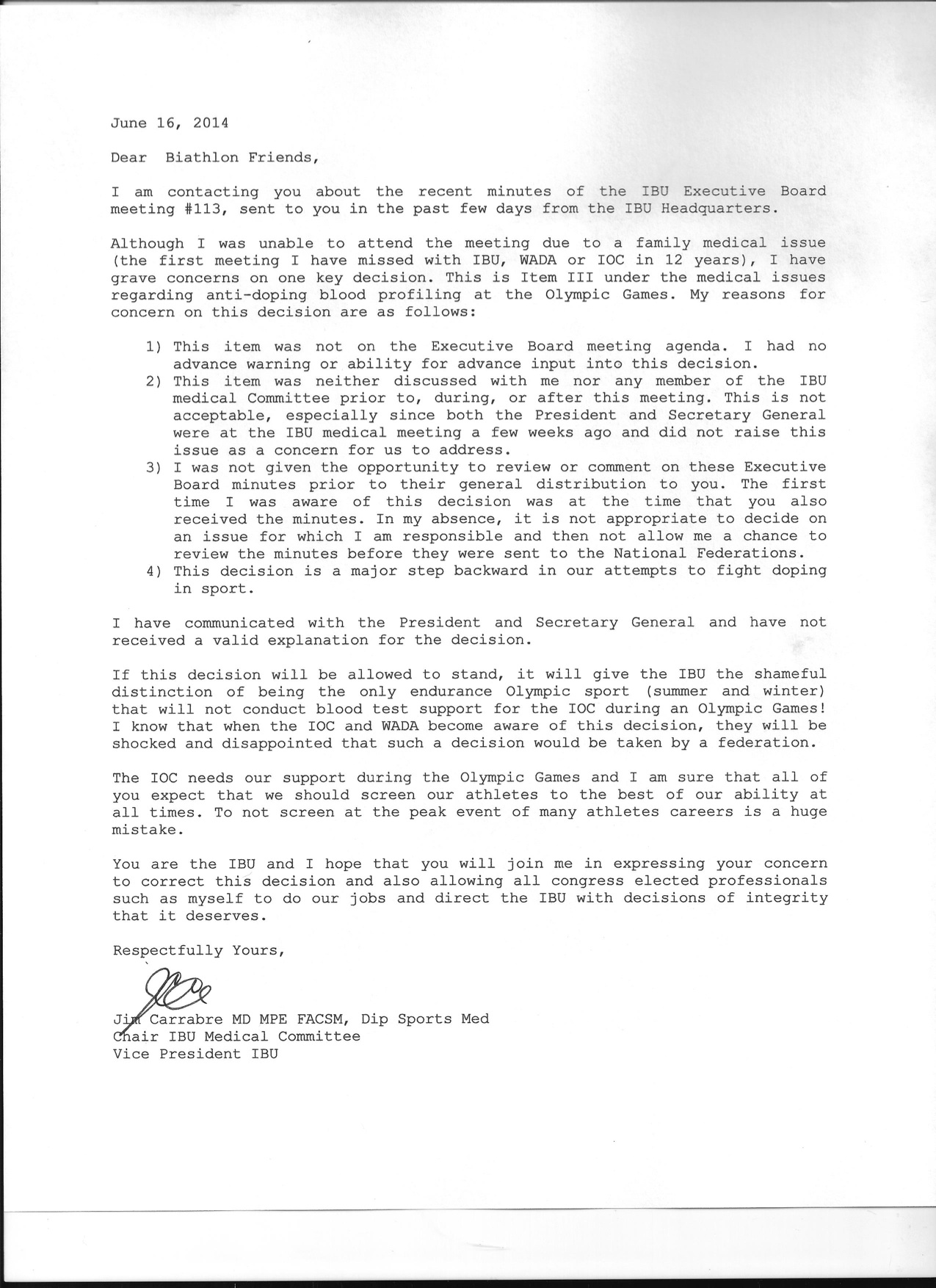
“I have to say I’m a little disappointed that in the context of this investigation, [Pound] would name FIS and biathlon as having severe doping problems,” said Dr. Jim Carrabre, a Minneapolis-based family doctor who is the IBU’s Vice President for Medical Issues.
“Is there evidence of that in what he uncovered, that we were implicit in this problem?” he asked. “If there wasn’t, then he shouldn’t have even mentioned it. On this stage and this scale of deception and criminal acts, I don’t think it’s appropriate to include us in the same sentence. I think we deserve more respect than that.”
Apparently speaking off the cuff, Pound did make comments that neglected specific aspects of his anti-doping program.
For instance, take this one.
“The only organization I know that actually keeps samples for a long-term basis is the [International Olympic Committee],” Pound said in response to a member of the press. “Most other testing agencies, if it’s not a positive test, a sample is kept for a number of months and then routinely destroyed.”
The IBU actually did have such a program, anticipating the update to the WADA Code which went into effect on January 1, 2015.
Carrabre and his team kept samples that had suspicious profiles, but which weren’t positive, from the two years leading up to this change. Then they re-tested them with the new methods.
Sarah Lewis, the Secretary General of the International Ski Federation, would welcome re-testing samples from the 2014 Olympics in Sochi, Russia. (FIS file photo)
That effort led to several new positives. Some were from athletes who had already been banned from other samples, but it also led to the bans of Sergui Sednev of Ukraine and Alexander Loginov of Russia, a former Junior World Champion who competed at the 2014 Olympics.
“I don’t know if there were any other federations which suspended athletes just prior to Sochi,” Carrabre said. “I think that we were the only ones that did that.”
So does that mean that biathlon has a serious doping problem?
“It’s a glass half full or half empty kind of thing: do you have a problem because you catch them?” he asked. “Or do you have a problem because you’re not catching anyone?”
Likewise, FIS Secretary General Sarah Lewis touted her organization’s dealings with Russian doping in an email to FasterSkier.
“In 2010 FIS sanctioned the Russian Ski Association following an investigation due to the high number of Russian doping cases,” she wrote. “A series of measures were implemented by FIS and the Russian Ski Association through enforcement of a compliant anti-doping programme. The Association was required to provide a detailed report on their activities and actions it had undertaken to address the doping problems in a meaningful way. These included a significant number of changes such as changing cross-country ski team and other officials.”
Alexandr Loginov, en route to winning the 2013 World Junior Championship sprint, was allowed to compete at the Sochi Olympics; but a re-test of a sample taken pre-Sochi was found positive, meaning he never should have been there. However, his doping was sophisticated enough that the sample was merely marked as suspicious using pre-2015 methods. (Photo: Mario Danzl/Obertilliach 2013.)
One of the notable things in the WADA Independent Commission report is that track and field’s governing body, the IAAF, did not sanction Russia (they are now considering doing so). That is a radical difference to how FIS handled their own situation.
… But Help Wanted
Both federations however made it clear that if the type of behavior found in the track and field investigation was widespread across all sports within Russia, their carefully-designed anti-doping programs would lose some key components.
“Where biathlon and nordic skiing have troubled histories in terms of doping in Russia, I want to believe that we caught the athletes who were doing it,” said Max Cobb, the President and CEO of the U.S. Biathlon Association and the chair of the IBU’s Technical Committee.
“I really want to believe that,” he continued. “But I think you can’t look at a case like this and say, we don’t need to investigate further in our sport. I think this is a watershed moment in sport. All of us who are working in sport need to seize the moment to dig deeper into this and respect the work that WADA has done to expose this ,and see where else the evidence leads. Does it lead to more cases in our sport? I hope not, but it’s on us to find out.”
That said, FIS and the IBU had policies in place to minimize the amount of damage corruption at RUSADA could have caused.
“The samples of the Russian cross-country skiing athletes are collected by the FIS-appointed agency directly,” Lewis wrote, explaining that the disgraced RUSADA agency did not have responsibility. “Consequently we can be sure there was no-notice for the testing missions, no pre-screening of samples that have been shipped out of the country, and we are not specifically aware of manipulation of whereabouts reporting (but can also not exclude for cases where FIS has not planned a testing mission).”
“A number of samples are sent to the Moscow lab (mainly those for purposes of the ABP due to the limited possible transport time for arrival at the laboratory according to WADA Guidelines) but a large amount are taken to a different WADA-accredited lab outside of Russia,” Lewis continued. “There were challenges to be able to ship the samples out of the country in the past, but we have always succeeded to do so. Samples in Russia are not only being collected in the Moscow region, but also from other areas in Russia where the athletes are living and training, which is certainly time- and cost-intensive, but FIS has allocated a significant amount of its anti-doping budget for this testing strategy since many years.”
Furthermore, while the narrative of the WADA report is that athletes were doped and protected in Russia so that they would never test positive outside the country, Carrabre pointed out that all of the Russian doping cases he has seen have been detected based on samples taken outside of Russia.
“There’s obviously still doping outside of the country, because we caught them!” he said of the biathlon program.
And yet – he has had trouble catching athletes inside Russia, suggesting that there may very well be deception and collusion going on inside the country.
“RUSADA has reported some positive EPO tests on very low-level athletes who competed at national championships, maybe to make a smoke screen for the other ones they may be hiding,” he said.
Both FIS and the IBU use an Athlete Biological Passport program, and Carrabre was particularly anxious to know whether hidden or manipulated tests taken by RUSADA belonged to biathletes for this reason.
“But I would hope that in the WADA database if they have reports on positive tests by athletes that we are not aware of, that they would share that with us,” he said. “Because that would be useful information for us.”
For instance, the Report stated that “significant percentages of [Doping Control Forms] in Russia are either not entered into ADAMS or are significantly delayed,” referencing WADA’s global database tool which stores and manages anti-doping test information. In particular, one whistleblower said gave the number of her sample to an official who hid it at the RUSADA laboratory, and this positive test was never entered into ADAMS.
The Independent Commission noted that in many cases, even when information was entered in ADAMS, there was a significant delay first.
WADA had not directly contacted him or the IBU, Carrabre said.
About Sochi
While much of the report focused on track and field athletes, one finding did shine a light on winter sports. The Independent Commission revealed that the FSB had infiltrated the anti-doping lab in Sochi.
From the report:
‘Specifically, Moscow laboratory personnel have reported, under confidentiality, regarding the continued presence of the Russian security (FSB), “[L]ast time in Sochi, we had some guys pretending to be engineers in the lab but actually they were from the federal security service, let’s call it the new KGB; FSB.” ‘
This is similar to the atmosphere in the Moscow anti-doping laboratory:
“One laboratory staff member provided information to IC investigators about the suspected bugging or wiretapping of telephones, while another staff member reported that office spaces within the Moscow laboratory were monitored (bugged) by the FSB in order to be informed of the laboratory’s reported statements demonstrate the perceptions of laboratory officials, who believe they are under constant state surveillance.”
Everyone involved seemed puzzled by the allegations of FSB presence in Sochi.
“My first reaction is that what Dick Pound said sounds pretty good to me: I can’t imagine what the state’s interest in urine samples was,” said Cobb.
Cobb was the IBU’s Technical Delegate overseeing the Sochi competitions, meaning that he was intimately involved with the Games but that anti-doping was far outside his direct responsibility.
“It’s disturbing to have any outside influence present in something as sensitive as anti-doping at the Olympic Games,” he said.
“It totally surprises me,” Carrabre said. “Really, frankly, I’m a little shocked to hear that… they would have to have had been granted access through IOC to do so. WADA had an Independent Observers group there who were aware of all the people in the laboratory. So it would be interesting to hear from them.”
But were there actually more positive tests, which never saw the light of day?
“I would think that if there was mishandling of results before Sochi, then there would be no reason to think it wouldn’t continue during the Games,” Carrabre said.
“In regard to samples from Sochi 2014, these are in custody of the IOC,” Lewis wrote. “FIS would certainly support the IOC if it decides to re-test any of these – as has been the case in the past – at any other WADA accredited laboratory.”
Bottom line
The findings in the WADA Independent Commission report definitely have implications for skiing and biathlon. It’s even possible that the findings will lead to further action which may eventually lead to changes in the results sheets.
But a separate aspect of the track and field investigation, and what made it so horrific and allowed the behavior to continue for so long, was collusion by the IAAF, in the person of President Lamine Diack. Diack is under investigation in France for taking bribes to hide doping.
“I’m disappointed too because the people I know in IAAF are good doctors,” Carrabre said. “They are working hard to keep this sport clean. I think the image there, now, is that everybody is trying to manipulate sport. But the people who are working hard to keep that sport clean have also been deceived.”
And likewise, although there may be dopers – Russian or otherwise – in their sports, FIS and the IBU do not want to be categorized alongside the IAAF and its criminal president.
“We can’t keep people from doping,” Carrabre said. “Just like if you have a store you can’t stop people from shoplifting. But you can catch them. I think we’ve done a reasonably good job of doing that.”
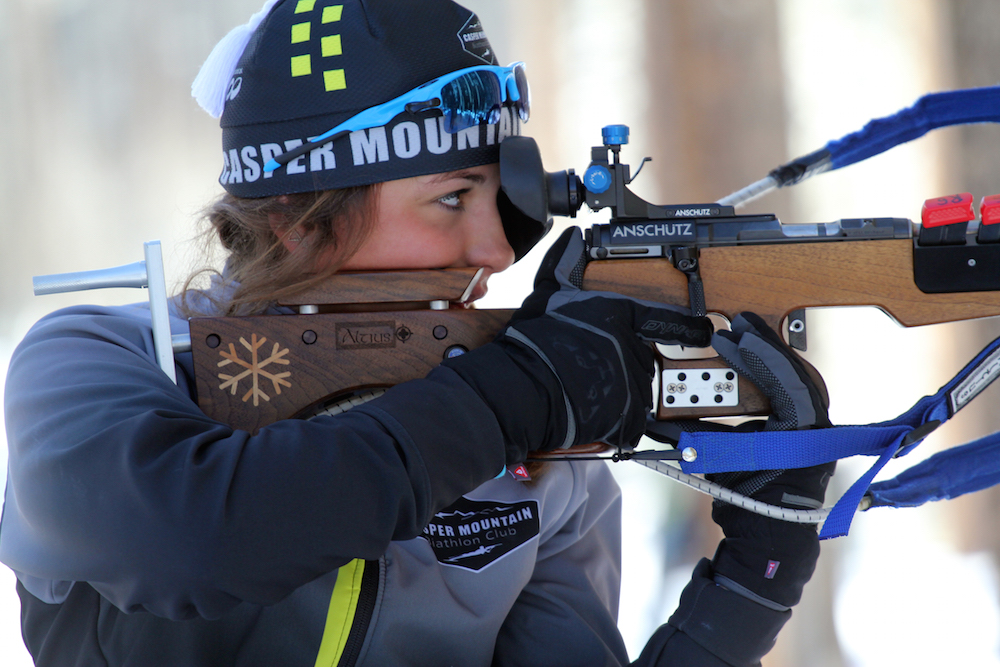
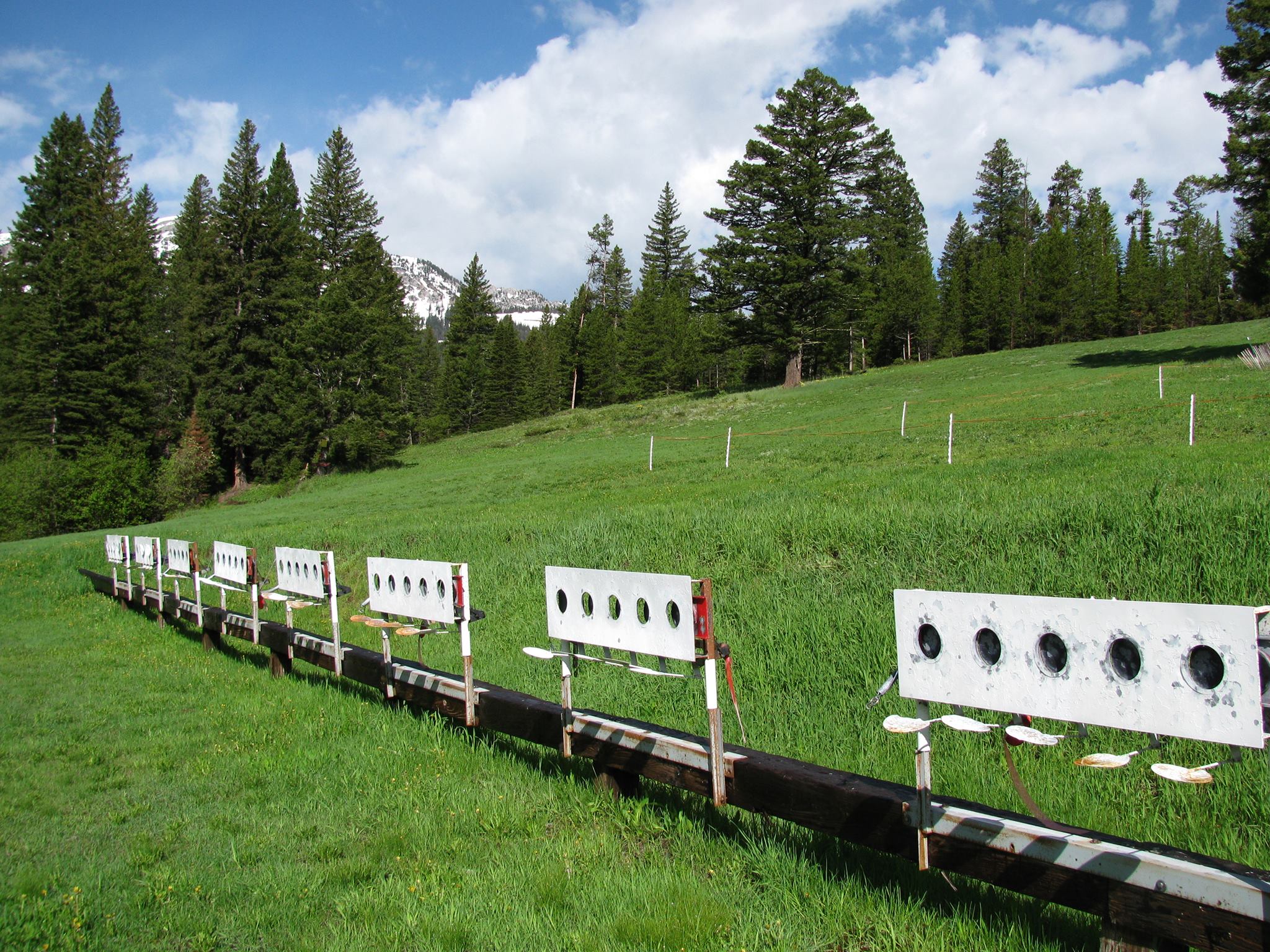
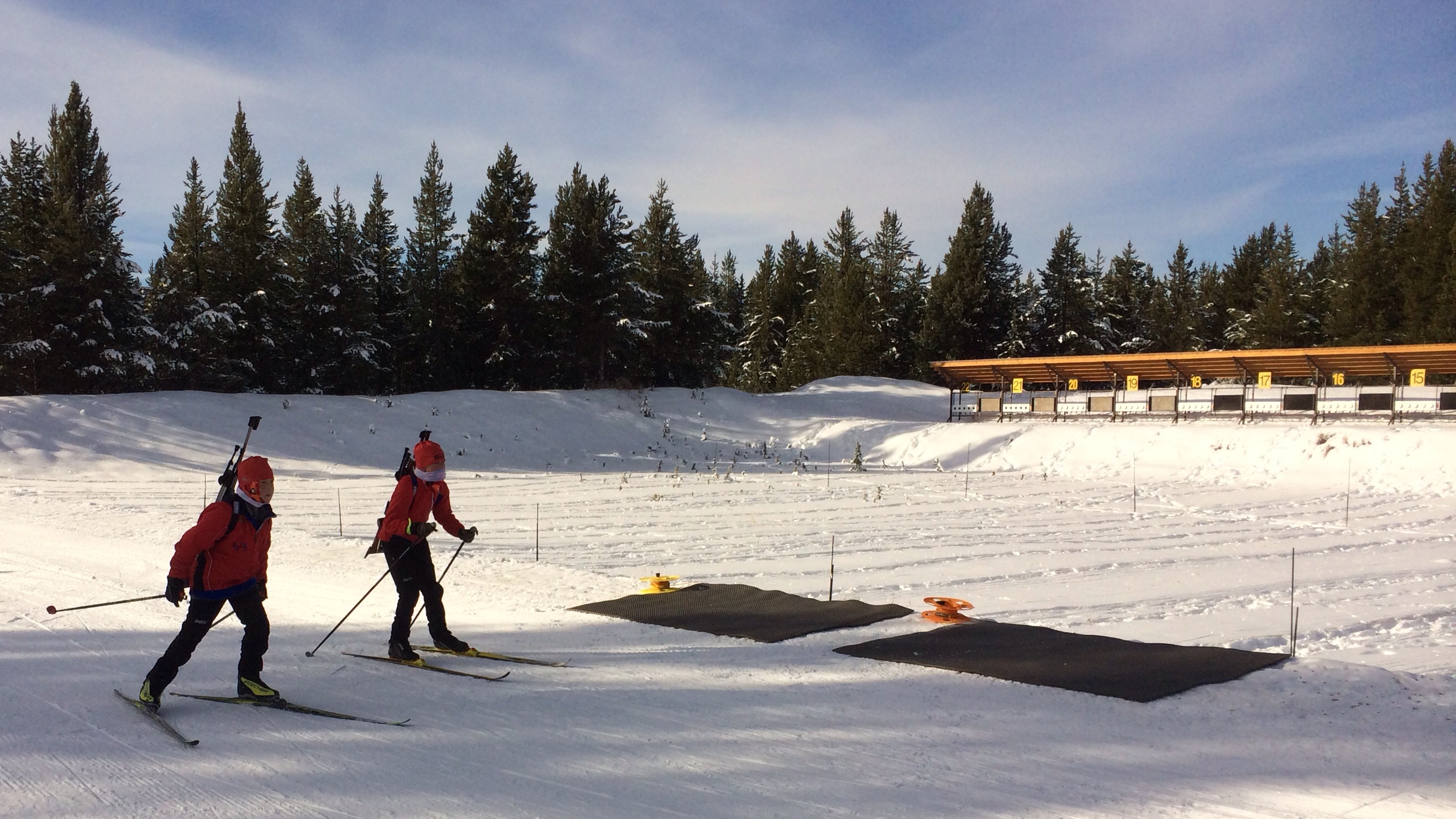
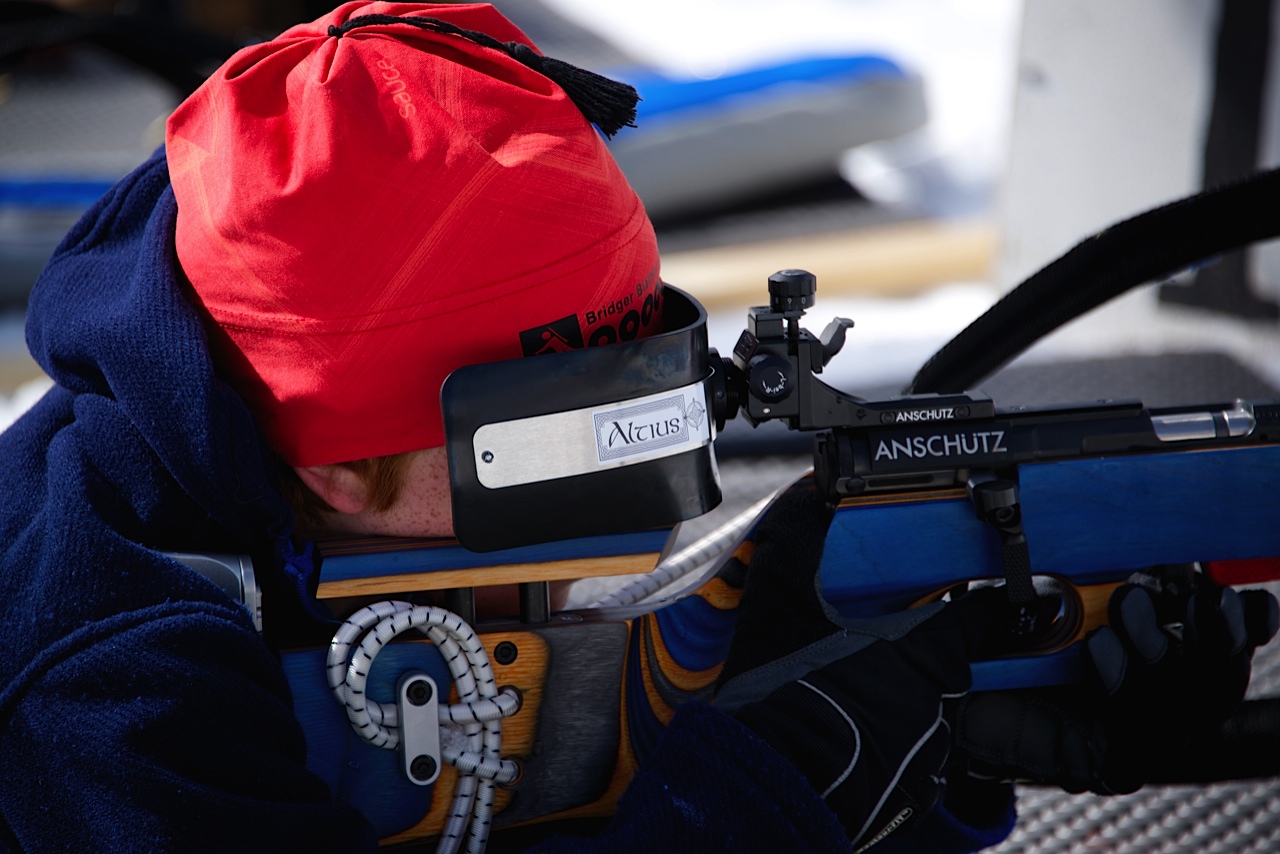
Casper Mountain Biathlon Club athlete Rylie Garner, 16, takes aim. Garner is one of six juniors training with the CMBC year round. (All photos: CMBC)
Where there’s a will, there’s a way. Without a range of its own, Wyoming’s Casper Mountain Biathlon Club (CMBC) has put athletes on the podium in the junior division at biathlon national championships.
But with donated land and the purchase of new targets, the club awarded a $728,307-dollar contract to build what might be the highest-altitude biathlon range in the U.S.
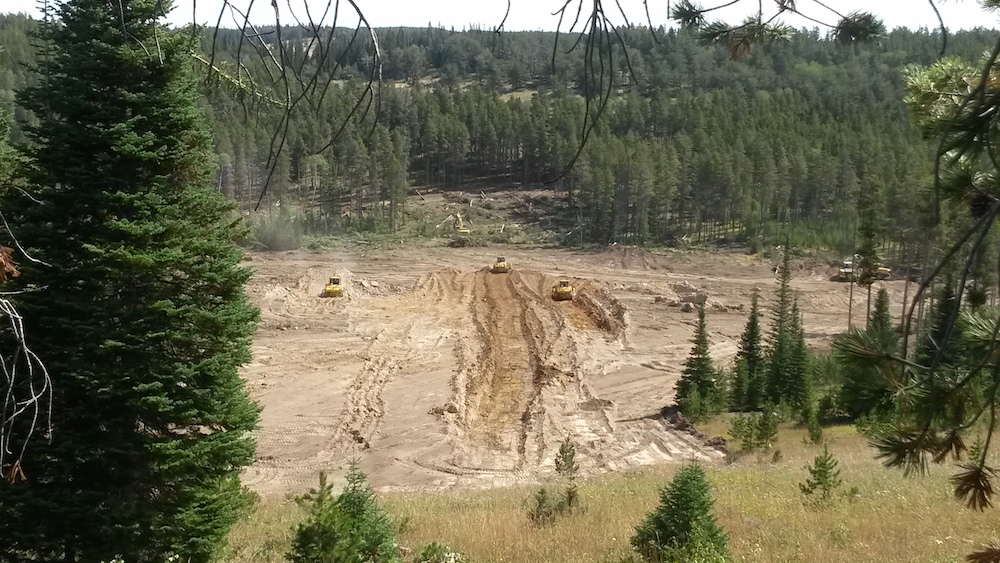
On Aug. 13, CMBC chose the Casper-based Wayne Coleman Construction to build a range on donated land abutting the Natrona County-run Casper Mountain Trails Center. Construction started late last month, and the range is expected to be complete by early November.
“It will be the only venue dedicated to both adaptive and able-bodied skiers,” CMBC’s president, Rob Rosser, said in a phone interview. Also a U.S. Paralympics Nordic and Biathlon development coach, Rosser competed in biathlon at the 1998 Winter Olympics and won multiple national and North American titles in the sport.
Construction on the Casper Mountain Biathlon Club range began last month.
Founded in 2008, CMBC gained nonprofit status in 2010. Its athletes ski at the Casper Mountain Trails Center, eight miles outside of town. The ski center includes 42-kilometers of winding trails on public land, but there’s no biathlon range.
In Casper, there’s a shooting range where CMBC athletes can practice, but it’s not biathlon-specific.
“We’ll shoot on paper, and then we’ll set up a metal target as well, just so they can shoot at an actual biathlon target,” Rosser said. “That’s the best we can do for now. We’ve managed to get some decent results in less-than-perfect training venues.”
To shoot at an actual biathlon range, CMBC athletes have to drive to a five-lane range in Lander, Wyo., 150 miles away.
“The best range close to us is Soldier Hollow, which is six hours away,” Rosser said. “That’s the closest one with both rollerskiing and shooting.”
They also train indoors with electronic rifles.
“Since about 2010, we’ve trained kids with electronic rifles,” he explained. “CMBC has had quite a few podiums at Nationals – Junior category – with the kids doing a combo of live shooting and training with the electronic systems.”
In a follow-up email, Rosser explained that Kyle Rutar, one of the club’s athletes, placed fourth in a Junior World Trials race after training exclusively with an electronic rifle.
“There’s nothing like doing it firsthand, skiing up to a rifle range, hearing lead hit on metal,” said Rutar in a phone interview.
It was “definitely an adjustment” to go to from an electronic rifle to the real deal, he added.
“The thing about the infrared rifle – everything’s dumbed down. There’s no wind, no temperature, no ballistics. All those things come in to play when you start doing it for real. … Infra-red is top notch for core shooting skills, but in race setting, you have to learn to adjust to the shooting environment in general.”
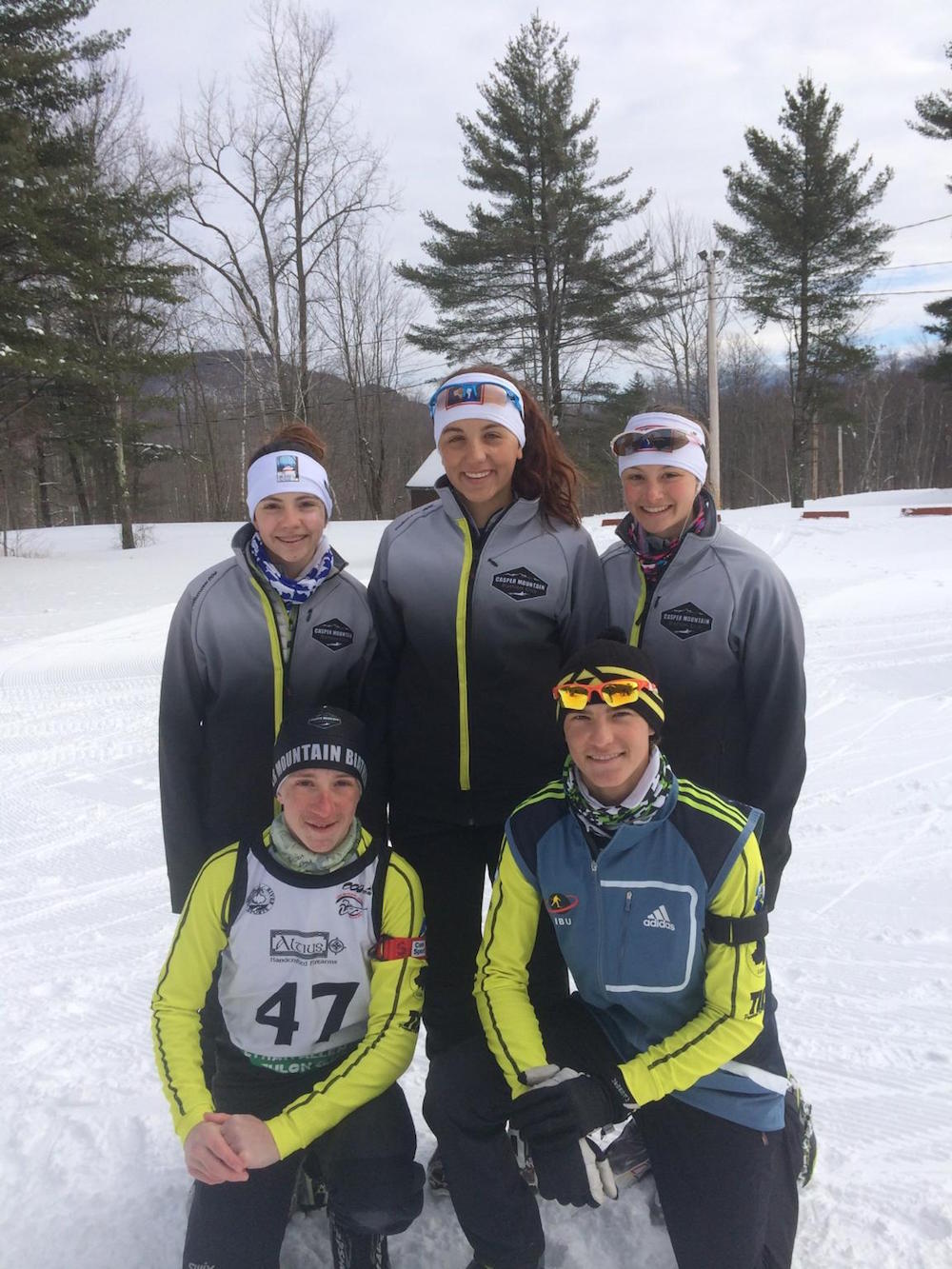
The Casper Mountain Biathlon Club team at 2014 U.S. biathlon nationals in Jericho, Vt. (from left to right, back to front): Madison Tinker, Rylie Garner, Katherine Gruner, and Christian Bjorklund and Jake Pearson.
Presently, CMBC has six junior skiers ages 10 to 16 in a year-round training program: Jake Pearson, Rylie Garner, Katherine Gruner, Garrett Aune, Lu Elder, and Mac Elder.
“Jake, Rylie and Katherine have been doing biathlon for 4 years now,” Rosser’s wife Cathy wrote in an email. “Garrett is going on his second year and Lu and Mac just started this year.”
Cathy is CMBC’s managing director, a title with a jack-of-all-trades job description including club administration, bookkeeping, grant writing, marketing and communications and some program planning. In addition, Ken Miech is a part-time program coordinator and assistant coach. A member of the Wyoming National Guard Biathlon Team, Miech started as a volunteer coach and now assists with program planning and execution.
“In 2014, we had 530 people come through our program,” Cathy explained.
Of those participants, 485 were juniors, 27 were adaptive athletes and 18 were masters. Most of the adaptive athletes are disabled veterans.
“Without a range, we’ve focused on youth and adaptive programs,” she wrote. “Once the range is built, we will continue this emphasis and also begin to put energy into the masters program.”
“Obviously we’re excited about having a natural range and seeing a great amount of growth because it’s a lot more fun shooting the real thing,” Rob said.
Land for Range Donated
According to Cathy, a local family — the McMurrys — donated 40 acres to Natrona County specifically for the range. They also donated a second 200-acre tract that surrounds the range to the city for ski trails.
Crediting the McMurry family’s generosity, she added, “They recognized the economic impact a biathlon venue could have on the community. They don’t have a specific interest in nordic skiing or biathlon, but they wanted to see the land used for the public good and recreation.”
According to Cathy, the 40-acre plot where the range will be built was appraised at $318,000 dollars. She estimated the value of the additional 200 acres at $1.3 million.
“I worked with [Rob] a little bit on the stadium design,” US Biathlon President and CEO Max Cobb said on the phone. “It’s a very impressive plan that he’s put together out there.”
“It’s going to be the only biathlon range that I know of at 7900-feet altitude and the only one dedicated to both adaptive and able-bodied athletes,” Rosser said.
“It’s going to be the only biathlon range that I know of at 7900-feet altitude and the only one dedicated to both adaptive and able-bodied athletes.” — Rob Rosser, Casper Mountain Biathlon Club president
The CMBC currently owns nine electronic targets up to International Biathlon Union (IBU) standards, with plans to buy 21 additional mechanical targets. For adaptive athletes, the International Paralympic Committee (IPC) mandates 10 audio targets for visually impaired athletes, and 10 for sitting or standing athletes. CMBC’s goal is to offer 24 targets for adaptive skiers.
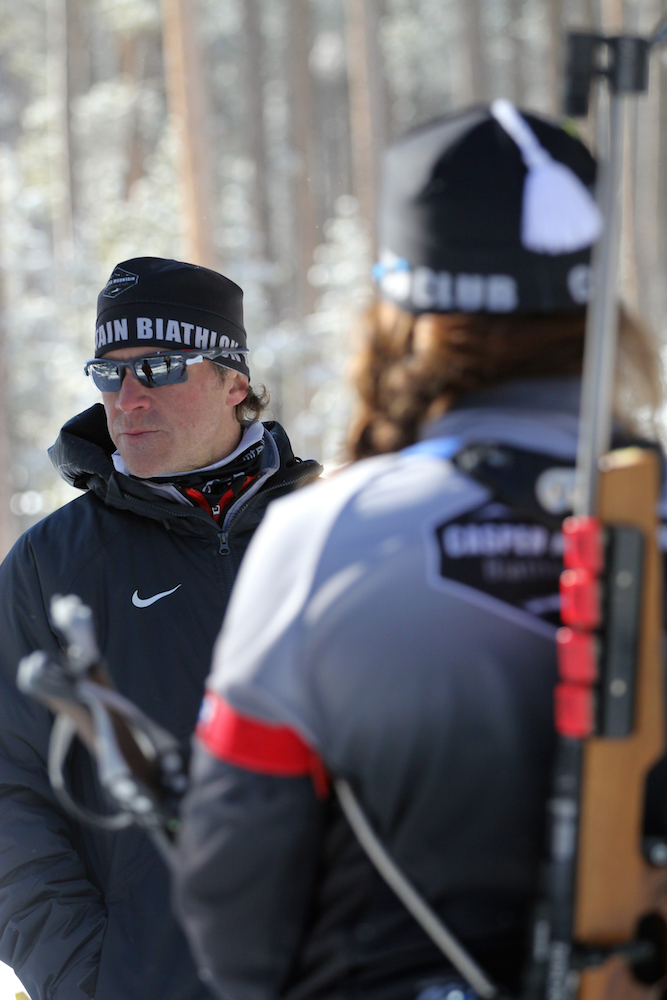
Casper Mountain Biathlon Club president and coach Rob Rosser with athlete Rylie Garner.
“We’re a viable site for an IPC World Cup,” Rosser said.
Although they’re above the IPC’s 5900-foot altitude limit, Cathy explained that “based on preliminary conversations, a waiver would be likely” to hold an IPC World Cup there.
And while Casper Mountain is above the legal altitude limit for a biathlon or cross-country World Cup, Rosser expects to bid for Continental Cup races. In addition, between the long snow season and the altitude, he believes Casper Mountain will be a desirable training-camp venue.
In addition to building the range, the Rossers will also modify part of Casper Mountain’s trail system. Last November, trail designer John Morton flew to Wyoming to homologate trails to IBU, FIS and IPC standards.
Morton helped the Rossers plan two five-kilometer loops that meet standards for all three governing bodies.
“While [Rosser’s] top priority is biathlon with a special emphasis on Paralympic biathlon, it also makes sense to configure the trails to comply with FIS [International Ski Federation] cross-country homologation guidelines,” Morton wrote in an email.
“We have a big puzzle with overlapping course requirements for FIS cross-country, IBU biathlon and Paralympic biathlon and cross-country. The trick is to design courses that are fun and technically challenging to ski, are great for spectators in terms of giving them plenty to see, and still fulfill the course requirements for the various governing bodies,” he added.
Cathy explained that Wayne Coleman will be doing the earthwork and grading for the 30-point range, 10 new kilometers of homologated trails and two pedestrian underpasses.
“It’s a very impressive plan that [Rob] put together out there,” Cobb said. “Rob asked me to weigh in on some questions and I worked with him a little bit on the [range] design.”
U.S. Paralympics Nordic team member Omar Bermejo liked Casper Mountain so much that he moved there.
“One of the Paralympic camps was here in Casper. When I came to train, I fell in love with the town,” he said in a phone interview.
Of the skiing, he said it was a challenging course, especially Rosser’s homologated course, which is still being developed.
When the range is complete, the CMBC will aim to add a paved 5 k rollerski loop leading into and out of the range. Cathy explained they’re expecting at least half of that to be complete by next summer “and the full 5 kilometers if funding allows.”
“That’s going to make it one of the most attractive biathlon ranges in North America,” she added.
Cobb referred to biathlon in the West as a “growing community,” pointing out that the Bridger Biathlon Club in Bozeman, Mont., recently rebuilt its range.
“We’re seeing growth in the Rocky Mountain region, and that’s terrific,” he added.
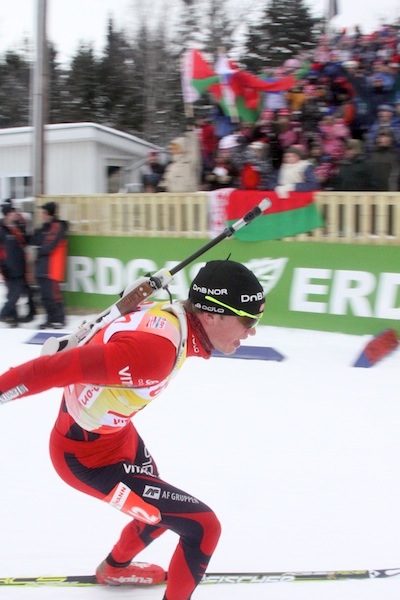
Tarjei Bø racing in Presque Isle, Maine, in February 2011. Finishing fourth and sixth in individual races there helped him claim the first overall World Cup title of his career, but this season he’s not excited to go back.
With seven months to go until the IBU World Cup arrives in Canmore, Alberta, and then travels to Presque Isle, Maine, international biathlon stars are already considering whether to skip the events.
“I wish the races were in Europe,” Norway’s Emil Hegle Svendsen told broadcaster NRK.
Roughly every five years, the World Cup travels to North America. The last time was in 2011, when the tour stopped in Presque Isle and nearby Fort Kent. At those races, most of the top stars vying for the overall World Cup title attended, but many of the others in the top 20 or 30 skipped the races. Field sizes were considerably smaller than for other World Cups.
The Norwegians’ main concern seems to be that the North American period of racing falls directly before World Championships, and they would rather prepare at home: Oslo is hosting the 2016 edition. At the very least, they would like to be in the right time zone.
“I hate that it’s set up like this,” Tarjei Bø, the most successful male athlete at the 2015 World Championships in Kontiolahti, Finland, told NRK.
“This is a headache for us all,” agreed his coach, Egil Gjelland.
But Max Cobb, the head of the IBU’s Technical Committee, which sets the World Cup Schedule, said in an interview that the committee had carefully considered whether there would be enough time for athletes to adjust back to being in Europe and prepare for the Oslo Championships.
After all, it’s not like athletes will fly directly to Oslo after Maine and start racing the next day.
“We looked at trying to maximize the amount of time between the North American World Cups and the World Championships,” Cobb said on Tuesday. “I think there’s two and a half weeks there, and that was a reasonable amount of time for preparation. If it had been a week less than that, then there would be a lot of teams considering not attending, or not sending their best athletes.”
In addition, he suggested that teams might even maximize that time by managing their rosters. For instance, the weekend competitions in Presque Isle are relays; teams could race their “B” squads in the relays, and send their “A” teams back to Norway or another home training base.
The first competition of World Championships is always a mixed relay, raced by only two men and two women from each country. That provides the rest of the athletes with even more time to train, adjust, and prepare.
“We felt like it was important to put Canmore first, so that teams could decide when to arrive in North America based on jetlag and altitude training and those kinds of things,” Cobb said of the scheduling decisions. “And Calgary being an international air hub, that they could choose exactly when they wanted to arrive with lots of direct flights from Europe. Do that, and then come back to Presque Isle two hours closer to Europe, and fly home from there.”
IBU President Anders Besseberg, himself a Norwegian, also wasn’t pleased with the threat of a boycott by the top Norwegians.
“The US and Canada have many good athletes who have to travel to Europe to compete here, and then I think it gets a little petty if one boycotts the races over there, so to speak,” he told NRK. “I think it is stupid if Norway does not compete with some of their best athletes.”
Cobb was slightly surprised to hear the criticism coming from the Norwegians, since he believed he had adequately addressed the situation with team staff when the schedule was set.
“I had some discussions with a couple of Norwegian coaches around the World Championships this year, and it sounded like they were reassured once they realized that there was in fact two and a half weeks,” he explained.
Still, the Norwegian men’s team made it clear that World Championship medals were the most important thing to them, and they’d consider staying at home in Europe for well over a month in preparation if that’s what it took.
“It is not often the United States has a World Cup, and then when you put it right before the World Championships it goes without saying that not everyone is going to go over there,” Johannes Thingnes Bø concluded.
The podium for the 10 k sprint at biathlon World Junior Championships: Aleksandr Dediukhin of Russia (center) took the win, followed by Fabien Claude of France (left). Sean Doherty (USA) earned bronze, his first international medal at the junior level. (Photo: IBU/Evgeny Tumashov)
A lot has changed since Sean Doherty won two golds and a silver at last year’s World Youth and Junior Championships for biathlon in Presque Isle, Maine.
The New Hampshire native went to Sochi, Russia, and competed in the Olympic Games – and at 18 years old was one of the youngest starters in the relay, helping the U.S. to a 16th-place finish.
He’s started in World Cup races at four different venues so far this season, contributing relay performances including an eighth-place team finish in Antholz, Italy. In individual racing, he made the 60-man pursuit cutoff in Nove Mesto, Czech Republic, and finished 45th.
And, in regards to World Youth and Junior Championships, Doherty made the big step up to the junior age division. He competed in four different Championships as a youth, starting at age 14, and won three gold medals, making him the winningest Championship biathlete in U.S. history.
So in one sense, it wasn’t surprising at all that Doherty won bronze in Saturday’s junior 10 kilometers sprint at this year’s Championships, held outside of Minsk, Belarus.
Sean Doherty (center, in bib 21) celebrates with U.S. Biathlon Association staff after winning the bronze medal in the 10 k sprint at World Junior Championships. (Photo: Jim Levins)
In another sense, it was a different accomplishment entirely. Junior athletes, aged 19 to 20 years old, are bigger and stronger than youths, and the competition is at a different level. Instead of being the best young biathletes, winners at the junior level are often on their way to being the best biathletes, period.
With one penalty, Doherty was able to ski aggressively and notch a time just 10.2 seconds slower than clean-shooting Alexsandr Dediukhin of Russia, who took the first championship title of his career.
“That Sean was able to win the Junior World Championship bronze medal with one penalty as a first year junior in Minsk speaks volumes for his dedication to excellence and the great support of the coaches and team around him,” U.S. Biathlon Association CEO Max Cobb told FasterSkier in an email. “It’s a huge accomplishment to succeed like this as an American in Europe’s favorite winter sport.”
Even when Doherty left the shooting mats for the final time, it wasn’t at all certain that he would end up on the podium. He sat in second place, 6.4 seconds behind the time set by Fabien Claude of France, an earlier starter who was the Junior World Champion in the pursuit last season.
Quickly, two other racers posted times in between: Niklas Homberg, of Germany, and Dediukhin. With the top four racers separated by just under 7 seconds and 3.3 kilometers to go, it was going to be a test of grit and ski speed.
In the end it was Homberg who fell by the wayside. Dediukhin pushed the hardest, putting seconds into Claude and winning by 4.6 seconds. Doherty’s efforts on the trails couldn’t match their speed, but far outpaced Homberg and left him securely in third place.
“I am very happy with the race today,” Doherty said in a USBA press release. “I felt good on the skis and I was able to keep that momentum all the way through the race. On the range, the last shot got me, but I am very excited for tomorrow.”
Tomorrow: Sunday’s 12.5 k pursuit, where the top finishers will have another shot at medals. It’s the event where Doherty won his first gold in 2013, after having set it up with a silver in that year’s sprint.
And there’s history, too. In that race where Doherty first found out what winning felt like, Homberg was fifth, Deiukhin sixth, and Claude tenth. The four men have been competing against each other for years.
USBA High Performance Director Bernd Eisenbichler believes that there’s potential for another medal in the pursuit.
“[Doherty] went into the race today very aggressive and confident and was in the medal mix from the first meter on,” he wrote in an email. “The last shot [in standing, a miss] was close, but that’s biathlon. He went out 4th and did a great last loop and with 3rd running time overall and 9 out of 10 hits, really deserves this medal. The wax crew did a great job with his skis and we all are looking forward to tomorrow now!”
And after that? Doherty has earned a nod for senior World Championships, to be held in March in Kontiolahti, Finland.
Doherty’s U.S. teammates will not be joining him in the pursuit. Jake Ellingson finished 65th with five penalties, and Brian Halligan 67th with three penalties.
In the junior women’s 7.5 k sprint, Maddie Phaneuf placed 33rd with two missed shots, and will start the 10 k pursuit on Sunday two minutes and five seconds behind Lena Arnaud of France, who posted a 2.4 second win. Mikaela Paluszek finished 54th with four penalties.
Canada’s Nathan Smith at his first-ever awards ceremony after placing a career-best fifth on Sunday in the IBU World Cup 12.5 k pursuit in Nove Mesto, Czech Republic. (Photo: Biathlon Canada/NordicFocus)
No part of Sunday could be described as “easy” for anyone racing the IBU World Cup pursuits. A little new snow and some wind had been in the forecast for the last day of racing in Nove Mesto, Czech Republic, and that seemed manageable.
Overnight, nearly half a foot of snow fell. Then, on Sunday afternoon, came the snow squalls, sporadically and unforgivingly, with increasing blizzard-like conditions making for a miserable-looking women’s race.
Heavily falling snow jammed rifles, and some women crossfired, like Germany’s Franziska Hildebrand, who was in the top five until shooting at the wrong targets in the final stage. She then skied the wrong number of penalty loops and was penalized six minutes, relegating her to 50th out of 51 finishers.
Meanwhile, the Czech Republic’s own Veronika Vitkova desperately tried to get the attention of race officials to reset her targets — the ones Hildebrand shot at. The technical delegate for the weekend, Max Cobb (also US Biathlon’s CEO) explained that video cameras in the range revealed Vitkova lost 52 seconds amid the confusion, and the jury deducted that from her final time, which put her in 11th overall.
And all that happened before the men’s race even started.
Canada’s Nathan Smith was ready for an equally slow-and-painful 12.5-kilometer men’s pursuit. He had seen blue skies during zero shift to snowfall during his warmup, amounting to a centimeter or so on the ground before the gun went off.
Fortunately, it lightened up to “a medium snowfall” for most of the race, he explained, up until the another big squall blew through on Smith’s final lap.
“Thankfully, I only had to deal with that for half a lap,” he wrote in an email.
But what a half a lap it was. After starting seventh, 38 seconds behind Saturday’s sprint winner Jakov Fak of Slovenia, Smith leapt to fifth with a clean first prone. Fak cleaned as well, as did France’s Martin Fourcade, who started fourth, Germany’s Simon Schempp, who started second, and the Czech Republic’s Michal Slesingr, who started fifth, respectively.
Smith, who posted a career-best seventh on Saturday, established himself behind them in fifth after the first shooting, 40.7 seconds after Fak. The top-12 men to leave the range all came out with perfect shooting.
Conditions were initially more favorable than the women’s race, with light snow and a slight-yet-variable wind.
But the weather gradually intensified, and with each passing shooting stage, the pressure picked up as well.
The 29-year-old Smith handled it like never before — cleaning all four stages for 20-for-20 shooting and keeping himself squarely in the top-six throughout the race.
“I was pretty nervous on the last standing, but channelled my previous fails to make sure I diligently aimed at the targets,” he wrote.
He focused on relaxing his left arm in prone and his left hand in standing — which worked.
After the last standing, Smith headed into the final lap in fifth, 5.2 seconds behind Ukraine’s Sergey Semenov in fourth and 22.7 seconds behind Fak, who was still in the lead despite a single miss on the last stage.
Slovenia’s Jakov Fak celebrates his second-straight win with a victory in Sunday’s 12.5 k pursuit at the IBU World Cup in Nove Mesto, Czech Republic. He held off Simon Schempp of Germany and France’s Martin Fourcade, respectively. (Photo: IBU/Květoslav Frgal)
(Fak completed his penalty loop just as Fourcade was leaving the range after cleaning his fourth-straight stage. Fak led the Frenchman into the last lap, where he extended his gap on him over the next 2.5 kilometers.)
Meanwhile, Smith simply needed to hold his position to set new World-Cup best, but that wasn’t easy, either.
“The Ukrainian [Semenov] and I had been skiing pretty similarly whenever I saw him,” Smith explained. “I tried my best to gain time but was a lot more concerned that someone might come up from behind.”
With 20.6 seconds separating Smith from sixth place (with Germany’s Erik Lesser) after the last stage, the Canadian skied the fifth-fastest course time on the last lap to secure fifth. He crossed the line 24.1 seconds after Fak, who proved untouchable on Sunday with a winning time of 37:24.9.
“I never started a pursuit in first and won so I am happy that I did that,” Fak told the IBU. “I wanted to shoot clean but do not have much experience shooting on lane one, so maybe next time I can do it.”
Fak’s 19-for-20 shooting and second-fastest overall course time was enough to hold off Fourcade and Schempp, who missed one on the second prone, by 4.4 seconds. Fourcade hit each one of his and was in contention for second until the last climb, where Fak attacked to drop both him and Schempp. The German proceeded to pass Fourcade about halfway up, accidentally stepping on Fourcade’s ski to leave the Frenchman staggering for a moment — a moment he couldn’t get back.
Fourcade let up and casually finished third, 8.9 seconds behind Schempp and 13.3 seconds after Fak. Semenov hung on to fourth, another seven seconds later, and Smith finished 3.8 seconds behind him in fifth.
Canadian Nathan Smith (second from r) after placing fifth in Sunday’s IBU World Cup pursuit in Nove Mesto, Czech Republic, for his first-ever flower ceremony. Slovenia’s Jakov Fak (second from l) won the race, Germany’s Simon Schempp (l) placed second, and France’s Martin Fourcade (third from l)made the podium in third. (Photo: Matthias Ahrens/Biathlon Canada)
With Russia’s Evgeniy Garanichev in sixth (+45.6), the top-six men walked together to the following flower ceremony, where Fourcade patted Schempp on the back, indicating no hard feelings.
“It was not easy on the tracks; there was only one spot that was fast,” Schempp later told the IBU. “I had no other chance to pass him. We talked it over and it is okay.”
For Smith, the ceremony itself marked his season-long goal.
“It feels awesome to achieve that and especially when the other guys up there are the perennial biathlon top dogs,” Smith explained of his new career high.
In addition to a bouquet and a glass vase Smith estimated weighed 20 pounds, “It won’t be so great for travelling with,” he joked, Smith also received 3,500 Euros for sixth, roughly $4,000 U.S. dollars.
On any other day, with 20-for-20 shooting, he felt he could have been on or certainly closer to the podium. Fourcade and Semenov also cleaned all four stages just ahead of him.
“Today was a little unlucky for me as the top-three men were basically the Overall World Cup leaders,” Smith told Biathlon Canada, referring to Fourcade, Schempp and Fak, who rank first, second and fourth in the overall standings, respectively. “If a couple of them faltered I could have been there, but it is tough to beat the best when they are on 100 per cent. I know though if you’re only a couple of places off the podium enough times, one day it will happen.”
Canada’s Nathan Smith at his first-ever awards ceremony after placing a career-best fifth on Sunday in the IBU World Cup 12.5 k pursuit. (Photo: Biathlon Canada/NordicFocus)
For the first time in his career, the Canadian also notched back-to-back clean races. He came close last year at the Sochi Olympics, with 29-out-of-30 shooting between two races, but completed the feat on Saturday and Sunday, knocking down 30 consecutive targets.
“Today is extra special because it is the first 20/20 clean of my biathlon career,” Smith added. “It feels awesome to have that success. It makes skiing less of a chore, and you’re excited to get back to the range after the next lap.”
In an email, Canada’s head coach Matthias Ahrens observed that Smith was more mentally prepared for the pressure situation he faced on Sunday, than when he found himself in third coming into the last shooting earlier this season in Östersund, Sweden, and ended up 16th.
“He keeps it cool, he is a pretty quiet guy but lots of thinking in his preparation,” Ahrens wrote.
“The skill and control he demonstrated is exactly what we expect to see from an athlete hungry for medals at world cup and world championship competitions,” wrote Chris Lindsay, Biathlon Canada’s high-performance director, in an email. “Both he and Brendan [Green] have taken on the leader roles within the team now that more of the younger athletes are being introduced to the World Cup. This leadership is most important when it is expressed though performance like we saw today.”
The second of three Canadian men in the pursuit, Green started 22nd and finished 30th (+3:13) with three penalties, one on his second prone and two more in the last stage.
“For me the hardest part today was the skiing,” Green wrote in an email. “It’s a tough 2.5km course to begin with and the conditions today made it a really slow grind. I had some tough luck with my skis today. It wasn’t an easy day for the wax techs in those conditions and I ended up on a pair of skis that just didn’t want to glide.
“We’re all still a little baffled as to why that pair wasn’t gliding well but after chatting a bit we have a few ideas,” he added. “It’s a lesson learned and we’ll get it right in these conditions next time!”
In the range, he recalled a “fairly consistent wind” each time he shot.
“I think I managed it well,” Green wrote. “I would have been happier with one less miss in my last standing bout but 17/20 was decent for today.”
Canada’s 22-year-old Macx Davies started 54th and finished 54th (+9:01.5) with nine penalties (2+3+2+2).
Nordgren 20th for Career-Best Pursuit
Coming off an all-time best 16th on Saturday, Leif Nordgren again led the U.S. in 20th on Sunday. He finished 2:37.9 behind the winner with three penalties, one on each prone stage and one more in the last standing.
“I felt pretty good today, definitely tired from 3 days of racing, but not bad,” Nordgren wrote in an email. “One nice thing about starting the pursuits a little higher up is that there’s always someone to ski with and catch a good draft. I think for almost every loop I just skied behind whoever I happened to exit the range with.”
Nordgren started 1:05 after Fak with Russia’s Matey Eliseev. With an initial prone miss, the American slipped to 21st, then was 25th leaving the second prone. He worked his way back to 21st with a clean standing, and was 19th leaving the range after one last penalty on the final shooting. Overall, Norgren posted the eighth-fastest range time.
“I was sort of welcoming these conditions,” he explained. “Anytime there are these types of winds in a pursuit race is a really good opportunity to move up in a pursuit race, much like last week in Otepaa [where he skied up from 51st to 19th in the pursuit].
“I was pretty happy with where I ended up, but it should have been better,” Nordgren added. “I made 3 mistakes on the shooting range, 2 of them were really stupid mistakes that I shouldn’t have made, and two more hits would have put me a few places higher. … It’s my best ever pursuit result, but knowing it could have easily been better makes it bittersweet.”
Tim Burke (US Biathlon) on his way to 37th in the men’s 12.5 k pursuit at the IBU World Cup in Nove Mesto, Czech Republic. (Photo: USBA/NordicFocus)
After Nordgren, Tim Burke started 38th and placed 37th for the U.S., 3:37.8 back with four penalties (1+2+1+0). Nineteen-year-old Sean Doherty started 57th and finished 45th (+5:02.1) with four misses as well (2+1+0+1).
“I think the best days of the season are still ahead of us,” Cobb wrote. “Just under a month to go until the World Champs.”
Max Cobb, who besides acting as CEO of USBA also chaired the International Biathlon Union’s Technical Committee, receives a hug from a fellow official after U.S. athlete Susan Dunklee placed fifth in the 2012 World Championships.
Today marks Max Cobb’s 25th year of work with the U.S. Biathlon Association (USBA) – an impressive tenure for anyone at any organization.
In that time, Cobb already has a lot of job descriptions. He is now the President and CEO of USBA, works closely with its fundraising foundation, acts as a Technical Delegate at multiple World Cups every year (including, last season, at the Olympics in Sochi, Russia), and headed the International Biathlon Union’s (IBU) Technical Committee for the last cycle.
Thanks to that last job, Cobb might be able to add the role “politician” to his list of titles.
Over the last year, Cobb and the rest of the Technical Committee developed a new comprehensive system of qualification for IBU events, encompassing qualifying points, Nations Cup scoring, quotas for major events, and a Wild Card system to supplement those quotas. In nearly every aspect of racing, scoring and qualification will change from the previous system.
Cobb and his team had to make the sell first to the IBU’s Executive Board, who sponsored the proposal at the IBU Congress held in Austria this weekend, and then at the Congress itself. And they delivered: every major proposal was passed, with votes of at least 45 of the 50 total national federations, Cobb told FasterSkier.
“With all the changes, we now have a really cohesive system that both is fair and supports teams moving up through the rankings if they are having good performances, but also really honors the performance of athletes from any nation regardless of where they are within the Nations Cup ranking,” Cobb said.
The changes added significant complexity to the IBU process. Previously, in order to qualify for the World Cup, athletes had to score one race on the second-tier IBU Cup circuit where they finished within a certain percentage of the winner’s time.
The new points system is similar to that employed by the International Ski Federation, in that there is both a race penalty based on the points of the top competitors, and an individual penalty based on the racer’s percent back from the winner. The two penalties are summed to determine an individual’s points for a given race.
The same system will be used throughout all levels of IBU competition, which has never been done before. This will allow competitors to develop a total points profile regardless of where they race, that reflects not just their own performance but the strength of the competition.
Cobb sees this as a particular boon to smaller, and less cash-flush, teams.
“It really leaves it up to a federation to decide, okay, are we going to deploy our team to the IBU Cup, where the level of our athletes is, really that will be the best development opportunities for them, or will we be able to have two teams, one on the IBU Cup and one on the World Cup?” he explained. “Under the previous system they really had to go to both. This allows them to choose.”
These nations might have previously had to stretch their budget to take advantage of particular weekends where there were more opportunity to score World Cup points – weekends with multiple individual competitions, for instance, rather than a sprint-pursuit-mass start weekend where two events were qualification-based.
The number of “wild card” entries at World Cups will increase from three to four per gender, and ten of these will also be available at World Championships under the new rules. In addition, the entries will be based on the athletes’ points, not their country’s Nations Cup score.
“We can allocate wild cards based on athletes’ performances,” Cobb said. “That didn’t really exist in the old system.”
And it might affect the way that countries try to qualify those athletes for major events.
“What we saw with the previous system was that it was really not a cohesive system and it really forced national federations to do some strategy things that didn’t make sense,” Cobb said. “In some cases it really put them in a place where they couldn’t look out for the best development process for their athletes. They had to chase points at various levels. That just didn’t make sense.”
In some ways, the system was a tough sell simply because it’s so much more complicated than the previous rules. Cobb said that he and the Technical Committee took a measured approach to explaining their proposal to the sport’s many stakeholders.
It started with a presentation he gave to the Executive Board in Sochi, and then continued from there. The Technical Committee began to explain the proposal to coaches on the World Cup and the IBU Cup at the end of the season, and then Assistant Race Director of the World Cup, Borut Nunar, ran models of how the points would look based on the previous season of results and presented again to the Executive Board in Oslo.
The final step was selling delegates at the Congress.
“We followed that up with more meetings at the Congress so that delegates to the Congress, who are frequently not coaches, could have an understanding too,” Cobb said. “And that was really productive. It gave people an informal setting in which to ask questions and kick things around and bring up their concerns, and go into detail about how it works.”
The new points system will go into effect this coming season, in order for athletes to develop a points profile, but qualification based on the new points will not go into effect until the 2015-2016 season.
Some changes will be more immediate, however, for instance the Nations Cup scoring on the World Cup and IBU Cup circuits.
In the new system proposed by Cobb and the Technical Committee, the points awarded for first through 80th place will remain the same, but fewer points will be awarded after 80th place. This, he said, will reward nations with one strong competitor more than the previous system had, and they will be more likely to gain a quota spot for that competitor.
Nations Cup points will be used to determine quotas in the 2015-2016 season, including a change that sees an in the number of athletes able to start in World Cups from the mid-level teams, as well as the addition of the Wild Cards.
World Championship qualification in particular will be affected by the new Nations Cup points: instead of four athletes per country gaining entry, lower-ranked teams will be able to enter only two or three athletes, again with the additional Wild Card spots going to up to two athletes per federation who do not have a quota.
The reason for the reduction in World Championship field size was not only to make the event more competitive and selective, but also to minimize past problems with course preparation and fairness. At several past Championships, snow conditions have changed significantly over the course of the race as over 150 racers start, 30 seconds at a time. Cobb himself has TD’ed several such events and dealt with the ensuing nightmares.
“That was really done to be able to have a World Championships that fits better for television, which is our major supporter in the sport, but also one where the size of the field is manageable,” Cobb explained. “Potentially with 50 members, there could have been 200 starters at a World Championships, and that is just unmanageable to be able to keep some element of fairness in the competition.”
Although the field size will be reduced, Cobb said he is confident that the athletes who deserve to be at World Championships will be entered.
“For the World Championships we have up to 10 wild cards available,” he said. “When we did our models, what we saw is that that really captured all the athletes who we felt were at an appropriate level to be entered there.”
All in all, Cobb said, all the complicated mathematical calculations will have a big reward – and he’s relieved that the biathlon world recognized it.
“I think that everybody saw that yes, it is more complex, but the complexity is being added in order to make it more accurate and a little more fair,” he explained. “And that the system really honors and respects the performance of the athletes. I think that’s why we saw overwhelming support. People voted in favor of a more fair, open, and sporting system. That was great to see – I was really gratified.”
The newly elected Technical Committee meets for the first time in October. Cobb was again voted onto it, and it remains to be seen whether the rest of the committee will re-select him as their Chair for another few years.
The biathlon range at Bohart Ranch in Bozeman, Mont. was installed in 1989 at the height of the sport in the small mountain town. The Bridger Biathlon Club is attempting to bring biathlon back to Bozeman and is starting by installing new targets from Norway. (Photo: Bridger Biathlon Club)
If you’ve been to Bohart Ranch in recent years, you’ve likely seen the Biathlon range nestled on the doorstep of the Bozeman, Mont., ski area. If you looked closely it would become apparent that the targets have had little use in recent history. They are mostly used for summer competition, and serve as a reminder of what had been.
The targets weren’t always as weathered. Biathlon in Bozeman was booming in the in 1980s. With renowned Olympic-level athletes such as Kari Swenson training in the area and a club based at Bohart Ranch, it seemed as if Bozeman was becoming a U.S. biathlon hub in the west.
However, the biathlon surge in Montana did not last. Biathlon in Bozeman began to diminish in the final decade of the twentieth century as cross-country skiing became more popular. By the time the 2000’s hit there was hardly any support for biathletes in the small Montana town.
Alex Love and Ben Sites train in West Yellowstone with the founders of the Bridger Biathlon Club in 2013. They are two of 45 potential athletes for the new ski club. (Photo: Bridger Biathlon Club)
Fast-forward to 2014, where a group of locals is attempting to change the absence of biathlon in Bozeman. Starting with a fundraiser in the fall of 2013, the newly formed Bridger Biathlon Club has already made major ground in bringing biathlon back.
The club’s goal is to provide a top-tier training program for biathletes of all abilities that hosts national and regional races. The club also plans to sustain a biathlon culture in Bozeman by maintaining facilities and equipment in addition to creating enthusiasm within the community.
While their goals are lofty, the club is tackling on task at a time.
The first item on the agenda is replacing the ghosts-of-biathlon-past and installing new state-of-the-art targets from Norway. The new targets are set to be installed in the fall of 2014 will carry a plaque to commemorate the late Peter Hale with who passed away in 2013.
Once the new targets are in place, the next undertaking is to build a club from the ground up.
According to the Bridger Biathlon Club’s marketing and public relations director, Katie Smith, the task of finding future biathletes in Bozeman is already off to a good start.
Alex Love prepares his rifle while training in West Yellowstone, Mont. in 2013. Love is one of the junior athletes who will train with the Bridger Biathlon Club in the fall of 2014. (Photo: Bridger Biathlon Club)
“A total of 45 kids, ages 8 to 14 have reached out to the Bridger Biathlon Club to express their strong interest in participating in a training program this coming season,” Smith said in an interview.
To ensure these skiers have no barriers of entry the sport, the Bridger Biathlon Club has already purchased rifles, ammo, and other equipment. As of this fall, the club will be without a head coach, but will be lead by those who started the club.
“BBC board members Stuart Jennings, Brain Wadsworth and Kari Swenson are leading the effort to establish BBC’s training program, and will be volunteering their time to coach BBC’s team,” said Smith.
Not only will the club be supporting new athletes in the upcoming season, it will also be hosting a series of U.S. Biathlon Association (USBA) races.
According to Smith the 2014/2015 national schedule has yet to be finalized, but the plan is to have two national races at Bohart during the season. The races will be held in conjunction with the USBA races in West Yellowstone, Mont.
The hope is to create a series of races in Montana, where athletes stay in Bozeman and travel between Bohart and West Yellowstone.
USBA President and CEO, Max Cobb, is excited with the prospects of a new club building in Bozeamn.
“It is great that biathlon is again blossoming in Bozeman,” Cobb wrote to FasterSkier. “For many years there were athletes coming out of the Bozeman area and making national teams. I hope that this rise in interest and the new facilities there will usher in a new generation of Bozeman biathletes and step by step we may once again see some on the national teams.”
Cobb said that he hoped the increased interest in biathlon would help spur an new wave of the sport in the Rocky Mountain region. Cobb sited efforts lead by the Casper Mountain Biathlon Club and it’s Board President Rob Rosser, as well as the recently upgraded facilities in West Yellowstone as signs that the region was ready for growth in the sport.
Once established at the local and national level the Bridger Biathlon Club hopes that it will continue to grow.
“We want to see the club grow exponentially. In the next five years we want to see a full training program where we have junior’s elite and masters,” Smith said.
For now, however, those in the club are excited that the sport they love is making an attempt to resurface in Bozeman.
“It’s time that biathlon came back to Bozeman. There is enough interest and there are a lot of kids out there who are excited about it. You can’t get more biathlon than Montana: Skiing and shooting at targets,” Smith said.
The post-Olympic funding announcements have come and gone, and while few sports see an increase at the end of a quadrennial cycle, some are hit harder than others. The U.S. Biathlon Association (USBA) isn’t one of them.
“We ended up being well-supported by the U.S. Olympic Committee,” USBA CEO Max Cobb told FasterSkier. “We didn’t end up getting exactly what we asked for, but the support from them remains really strong. That’s incredibly – it’s very important for us, to continue all of our programs.”
The American national team had a strong season last year, placing three different athletes on the World Cup podium. But nobody feels safe going into funding deliberations, Cobb said, implying that this might be particularly true for smaller sports.
“It’s a huge relief,” he said. “You never know, when a quad comes to an end, how the funding will be for the beginning of the next quad. So we’re incredibly grateful for this partnership with the USOC. We feel really good about how this has just improved every single year.”
USBA also has another trick up its sleeve: the U.S. Biathlon Foundation, a fundraising arm which contributed roughly $90,000 to USBA in 2012 (2013 tax documents are not yet available from Guidestar). USBA is also kicking off the new quad in style with its foundation, which is hosting a golf fundraiser at the end of the month in Ipswich, Massachusetts.
“It wil be hosted by Mark Burton, the chairman of our foundation, and Ray Bourque, one of our foundation trustees,” Cobb said. “Lowell, Tim, Susan, and Hannah are for sure coming, and maybe a couple of other athletes as well. The foundation continues to be a really important part of our overall program, and gives us extra resources we need to be able to run a strong program.”
Cobb, who besides his work at USBA also has a volunteer role as the head of the International Biathlon Union’s Technical Committee, says that he’s had to sink a not insignificant amount of time into getting the foundation going: “from a time management standpoint, it’s a lot of work.” There’s plenty for him to do already at the office without even getting into this new venture – but it’s worth it.
“I think every sport CEO or Executive Director has to devote a lot of time to generating resources,” he said. “I really enjoy all the time I spend with foundation trustees, because they are just super people, and they are very enthusiastic about our team. It’s great to see that. So it has always been fun.”
The USOC recently gave USBA an organizational development grant to hire an assistant, Audrey Chapman, to help with the Foundation work. That, Cobb said, has been another relief and will help the group do even more in the future.
As it stands, a single golf fundraiser like the one to be held in Massachusetts can generate considerable resources for the organization.
“In the past they have raised anywhere from $25,000 to $60,000,” Cobb said.
It’s very hard to predict. It’s a significant amount of our fundraising, for sure.”
After World Cup podium performances from Lowell Bailey (above), Tim Burke, and Susan Dunklee, the US Olympic Committee rewarded biathlon with relatively strong support in the post-Olympic year. (Photo: USBA/Nordic Focus)
Besides the actual money, it’s fostering relationships between donors and athletes that make these events a success, Cobb said, and hopefully one that will extend into the future.
“It’s a nice chance to get people together with the athletes in an environment that isn’t freezing cold, and the athletes are enjoying a beautiful day and a beautiful place and aren’t under any pressure, so it’s very different than meeting up at a World Cup,” he explained. “And the nice thing is, it’s a chance for us to bring people from outside our circle to meet the athletes and hear about the sport. It’s a good opportunity to spread the word about what we’re doing and perhaps find some more people who want to help support us.”
Between support from USOC and the foundation, Cobb says that USBA will be able to continue its programs unchecked this year and spur further success.
“It will allow us to do the right things with the national team over the course of the next year without any compromised,” he said.
That includes a summer training camp in Scandinavia which will send three athletes to the annual Blink rollerski festival in Norway for the first time, as well as allow the women’s team to train alongside Kaisa Makarainen of Finland, a two-time World Cup overall champion.
“In general, Bernd Eisenbichler and the coaches have tried to put together more opportunities and more side-by-side training with other top athletes from around the world,” he said. “And that has been well-received on both sides. The very positive side is that the Europeans are psyched to train with us as well.”
Targeted testing based on data from the IBU’s Athlete Biological Testing program led to the suspension of Irina Starykh, above, and another Russian biathlete for blood-doping. The IBU will now no longer do the biological passport tests at all future Olympic Games.
At the most recent Executive Board meeting in Going, Austria, the International Biathlon Union voted to discontinue blood testing as part of antidoping efforts at all future Olympic Games.
“Based on the experience of the last two Olympic Winter Game editions for which the IOC has sole testing authority, the IBU EB decided: In the future the IBU will conduct no own blood screens at OWG, but assist the IOC [International Olympic Committee] with expert advice for their test plan,” read the minutes of the Executive Board meeting, which were given to FasterSkier by three separate sources.
No further explanation has been given to the federations regarding the reasoning behind the decision, and IBU President Anders Besseberg has not responded to FasterSkier’s requests for comment. However, internal Executive Board documents show that IBU Secretary General Nicole Resch advocated for the change in her presentation to the board.
The IOC is responsible for much of the antidoping testing at the Olympic Games. In Sochi this winter, the IOC administered over 2,400 tests across all sports. At first blush, this would indicate that the additional independent testing done by individual sports federations may be redundant.
At issue, however, are blood tests which are used for Athlete Biological Passport (ABP) programs, a scheme which tracks levels of different markers in athletes’ blood over many years. This allows medical administrators to detect spikes in oxygen-carrying capacity or other physiological parameters which may be due to prohibited substances for which there is no analytical test.
The ABP model was developed by WADA and adopted by its Executive Board in 2009. The blood “module” of the ABP has been approved by the Court of Arbitration for Sport, and the international federations for track and field and cycling have brought ABP cases to CAS.
The IBU uses several passport-type approaches in its blood tests.
“The first is to do a blood profile for the WADA blood passport,” IBU Vice President for Medical Issues Dr. Jim Carrabre told FasterSkier. “The second purpose is for our own internal program called Arietta, which allows us to identify athletes at higher risk for blood manipulation.”
The IBU also has a combined system of cutoff values for hemoglobin levels and the off-model score (hemoglobin value – 60√reticulocyte value) and does not allow athletes to start competitions when they are above both these cutoffs, but does not use this system at the Olympics.
The IBU has championed its passport program and its ability to target specific athletes for additional testing. This led to the suspension of Russian biathletes Irina Starykh and Ekaterina Iourieva this winter after targeted testing led to positive tests for recombinant erythropoietin, a common blood-doping drug.
Carrabre said that biological passport data belongs to the federations and that the IOC would not be able to catch athletes using this technique at the Olympic Games.
“We would grant them permission to have [the data] they wanted to have that,” Carrabre explained. “However, the IOC as a testing authority, the length of time at the Games, it’s not enough for them to develop a passport that is positive. Not enough time to get enough tests. So you will never see a positive passport come out of the [IOC at the] Olympic Games. It has to be from the federations.”
Dr. Arne Ljungqvist, the outgoing head of the IOC Medical Commission, confirmed that the ABP program has never led to a suspension at an Olympic Games. But he said that the IOC’s testing was sufficient. He explained that federations dropping “no-start” testing was a direction he urged to move in, and had discussed with Besseberg. However, Ljungqvist was not familiar with the IBU’s Arietta and ABP testing.
And inside a biathlon community which has seen four positive tests from World Cup athletes this past season, limiting the amount of testing done at the Olympics seemed to be a perplexing move. Nobody else contacted by FasterSkier had the same reaction as Ljungqvist, that this was a “logical step because of the WADA ABP.”
That begins with Carrabre. The IBU did not appear to have consulted its own medical committee, which is responsible not only for health of the athletes but also for antidoping work, before taking the decision. Carrabre was not present for the vote although he is a member of the Executive Board due to a family health emergency. A longtime antidoping advocate, Carrabre said that he was not contacted regarding the proposed change. He also said that Resch’s internal board memo was never sent to him, not even after the meeting.
Carrabre is running for the IBU Presidency this fall against incumbent Anders Besseberg of Norway, on a broad platform that includes, among other things, improving antidoping efforts and transparency.
Dr. Fabio Manfredini, an Italian doctor who is also a member of the medical committee, wrote in an e-mail to FasterSkier that he had no comments on the decision. Dr. Pierre Jeannier of France, another member of the committee, confirmed that the Executive Board had not sought his opinion, either.
“I am not sure that is a medical problem – as you probably know there is an important IBU Congress in September, and maybe there are some fights before this,” he wrote in an e-mail to FasterSkier. “I had no contact with any members of IBU board. Jim Carrabre is our chairman. He is VP for medical issues, and I trust him. For me the political problem is the main problem.”
However, as neither indicated that they had been contacted before or during the deliberations, it appears that the Executive Board excluded all medical committee opinions, not only those from Carrabre, the candidate against Besseberg for President.
“It just blew my mind,” Carrabre told FasterSkier. “Like, where did it come from? We had a Medical Committee meeting a few weeks before in Prague, and Anders Besseberg and [Secretary General] Nicole Resch were at that meeting and had a chance to discuss that topic if it was an issue for them.”
Adding to the confusion, the issue was not placed on the Executive Board agenda before the meeting. This was among the issues addressed by Carrabre in a letter that he sent to all of the national federations after he saw the decision in the minutes. According to Carrabre, he has still not been able to reach President Besseberg to discuss the reasoning and execution of the decision.
The whole board was not present for the vote. In addition to Carrabre’s absence, Vice President for Special Issues Nami Kim was not in attendance. Vice President for Development Václav Fiřtík died unexpectedly this spring, and his position has not yet been filled. That left seven of an intended ten-member voting body to decide the change. It is not clear which Executive Board member proposed the change.
The decision and its lack of explanation have left many members of the biathlon community confused.
“I am as mystified about that as anybody,” U.S. Biathlon Association CEO Max Cobb, who is the chair of the IBU’s Technical Committee but not a member of the Executive Board, told FasterSkier. “I obviously don’t understand it. I can tell you that the feedback that we had at the Games was that the nations really wanted blood testing and blood screening to be done at the Olympics, because it’s an integral part of IBU’s antidoping effort.”
Cobb said that the only way he could imagine this to be an appropriate decision was if some other body was taking over the testing responsibilities, but “that seems hard to imagine.”
Biathlon Canada High Performance Director Chris Lindsay also saw the decision in the Executive Board minutes, and said that while his organization has not yet contacted the IBU about the issue, Biathlon Canada is likely to do so because “there is some fallout from this Executive Board meeting that we have some concerns about.”
His was particularly interested in the fate of the Athlete Biological Passport program, which he said was important in ensuring clean sport.
“Biathlon Canada is a signatory to a Canadian program called True Sport… and while the process of testing for people who are trying to manipulate the system may be inconvenient, it is well-accepted and well-understood amongst everyone – the athletes, the coaches, and the officials in Biathlon Canada – that we need to do everything that we possibly can to support initiatives that insure clean sport,” Lindsay said. “And I would suggest that that is a primary driving force behind behind Biathlon Canada as we seek clarification on the decisions made by the Executive Board.”
The U.S. Biathlon Association (USBA) has hired Jean Paquet as its Head Coach for Development. Formerly a national team coach for Biathlon Canada, Paquet will be responsible for both USBA’s “D” and “X” teams as well as for coordinating regional development programs across the U.S.
“We’re very, very excited,” USBA CEO Max Cobb told FasterSkier. “We had five really qualified candidates. We’ve been impressed with all the progress that the Canadian men’s team has made recently. [Paquet] has been directly working with the men’s national team and of course in the last few years coaching JP Le Guellec. We had great interviews with him and felt like he would be a great fit with the rest of the staff, which is a really important part of creating seamless transitions between developing athletes and the national team.”
Paquet was a regional coach in Quebec as well as serving as a coach for the Canadian team on World Cup tours, and was also the personal coach for Jean Philippe Le Guellec, the Quebec native who set a best mark for a Canadian man when he placed sixth at the 2010 Olympics, then went one better with fith place in Sochi.
But in part due to cuts from Own The Podium after Le Guellec’s retirement, Paquet was pushed out of Biathlon Canada.
“The new job is exactly what I was looking for, and coaching talented development athletes,” Paquet wrote in an e-mail to FasterSkier. “And Lake Placid is a training center I have always liked to go to for training. It is gonna be a transition for me, but I know most of the coaches and people involved in US biathlon, so it should be a fun challenge.”
Paquet represented Canada at World Championships spanning more than 15 years, and also competed in the 1992 Olympics in Albertville, France.
Cobb said that Paquet’s experience both on the development side in Quebec and with Canada’s top-level biathletes was a big selling point, and that USBA will hope to profit from some extra knowledge of the Canadian system.
“We’re really excited to have someone who has good North American background but at the same time comes with some different experiences,” he said. “Having [someone who] worked with Biathlon Canada and grew up through that system, we feel like it’s a great opportunity for us to benefit from all the things which are done so well up in Canada, and incorporate some of those into our own development programs.”
Chris Lindsay, the High Performance Director for Biathlon Canada, told FasterSkier that his organization was happy to see Paquet with a good-fitting job, even if it wasn’t in his home country.
“We’re of course at the same time saddened that we did not have a position for him, but Jean is an excellent friend of our program, and a member of the biathlon family,” he said. “We’re extremely happy that he will be able to continue his work in the sport and be able to work on the next generation of athletes.”
Paquet’s hiring is part of a development push by USBA, which has focused most of its budget on World Cup athletes in the past few years. But now, they are devoting considerable resources to the development pipeline to try to pad their roster and develop young athletes to rely on in the years to come.
“We’ve been talking and planning for over a year now to do more for athlete development,” Cobb said. “This is not the first step, but it’s the biggest step I would say, besides getting our plan together. It’s nice to see that finally moving forward. We know how much it’s needed, and we’re very very optimistic about the positive effect that this will have.”
Another nordic sport with its own governing body also jumps to mind: biathlon. The United States Biathlon Association, founded in 1980 after splitting from modern pentathlon, has had medals and podium finishes at every level except the Olympics: from World Youth and Junior Championships through the World University Games, World Military Championships, World Cup, and senior World Championships.
Recently, USBA felt financially secure enough to restart its development program. IRS financials are not released yet for the last year, but in 2011 and 2012 had total revenues of $2.6 and $2.4 million. In the past years USBA has forged close ties with the U.S. Olympic Committee (USOC), much to its benefit.
So, what did it take to get there, and what advice might USBA have for Nordic Combined, if they choose the separate-NGB route? FasterSkier called up Max Cobb, the President and CEO of USBA, to chat.
Max Cobb, who besides acting as CEO of USBA also chairs the International Biathlon Union’s Technical Committee, receives a hug from a fellow official after U.S. athlete Susan Dunklee placed fifth in the 2012 World Championships.
FasterSkier: I’m assuming that you’ve been following, to some extent, the news about USSA and Nordic Combined.
Max Cobb: Yes, I have heard some of the news.
FS: As someone who is running an NGB for a small nordic sport, do you have any words of wisdom for them? Advice? Warnings?
MC: I think that the good thing for the Nordic Combined guys is that they have a track record of being super successful. Like us, it takes time to reach that level.
FS: So that’s what you need to be able to make your case?
MC: I don’t really know enough about what is going on with those guys and with USSA. So I don’t know what I can say other than that I think the important thing is to continue to demonstrate that there’s an orientation towards high-performance success, and if you can demonstrate that the right the athletes are in the system for achieving that, then I think it’s possible to gain support from both sponsors and donors.
FS: Do you have a sense of how long, after USBA was started, it took for the organization to start to feel like it was on its feet?
MC: I think it grew very gradually. It wasn’t really until the late 80s or mid- to late-80s, after the 1984 Olympics, that the USOC provided a really substantial and reliable source of funding. We were able to offer fairly strong programming starting in 1986, and then in 1987 Josh Thompson won a silver medal [at World Championships] so there was a big push for the 1988 Games. So I think that was when biathlon really came into its own. But I think a lot of that … there was not very much funding available from the USOC between 1980 to 1984.
FS: It seems like there are more and more sports now, compared to back in 1980. Do you think it’s harder to get USOC’s attention if you are starting your own NGB now?
MC: In terms of what is different now, I would just say that in general, there are more resources available and more sophisticated fundraising around Olympic sport than there were in the mid-80s. That’s very clear to me.
FS:So that is good for nordic sports?
MC: I think in terms of identifying donors – just look at what the National Nordic Foundation has been able to do. They have raised a huge amount of money [note: for the 2012/2013 year, the National Nordic Foundation had revenue of just over $350,000]. It has been very impactful for the sport. That kind of relatively grassroots fundraising didn’t exist at all in the 1980s. You look at things like Rally Me and our whole digital communication, and that has made it much easier to bring together a very diffuse group of people who care, of supporters. When you think about doing paper mailings to groups like that [when USBA was getting started], it would have been impossible.
FS: Is that what you think Nordic Combined should be focusing on?
MC: I just make those comments in general. It’s not necessarily specific to what’s going on with Nordic Combined because I don’t really have a sense of what is envisioned there.
This winter, New Hampshire native Sean Doherty (c) upped his World Youth Championships medal total from three to six in two years, including this gold in the pursuit. He and other young athletes will be receiving more attention from USBA than in the past. (Photo: Katrina Howe)
Lots of federations make changes following an Olympic year – just look at the spate of coaching replacements around Europe, or the structural shifts which are ongoing at Cross Country Canada – but the U.S. Biathlon Association (USBA) is up for some particularly big moves this season.
The most visible differences are an expanded national team system, with both a development team (currently consisting of two athletes) and an “X” team of two juniors who have already had international success. Those efforts are already started: Maddie Phaneuf, a Maine Winter Sports Center athlete who placed fourth in the youth sprint at this past season’s World Championships, has already moved to Lake Placid.
Another visible change comes in the form of a “tryout” camp for elite junior and senior cross-country skiers to test their skills in biathlon and get introduced to the national team system. That, too, is already underway; USBA CEO Max Cobb said that 12 athletes will be invited to the camp, and “it’s a variety of different ages but we were impressed with the quality of the athletes.”
However, these developments are just the most noticeable and well-promoted symptoms of a deep underlying change at USBA. Cobb and the other staff have been hoping for years to reinvest in a development program, which had been almost completely lacking in the last Olympic cycle. This season, they are finally making it happen.
“I think it was a combination of being able to recognize that we could run our national team program with slightly less resources and still be really effective, especially the year after the Olympics when we don’t have so many special projects in the works, and feeling more confident that our sponsorship and fundraising are more solid and are a more predictable resource for us,” Cobb said in an interview on Wednesday.
The senior national team is small and, with the exception of new addition Casey Smith, consists entirely of athletes who competed in Sochi. Only the six “A” team athletes will be based in Lake Placid, while “B” team athletes are housed at the Maine Winter Sports Center. Having a small, experienced team and no Games to focus on has freed up resources (for instance, in 2012 USBA spent $1.6 million on the national team compared to $365,000 on development, according to the IRS 990 form).
It has also freed up some of the coaching staff’s energy. National team staff will now be involved in the development program instead of only the high performance program. For instance, take Bernd Eisenbichler. The German has been the High Performance Director for the national team for years, but this year has a new title: Chief of Sport.
“In that role, he now has oversight for all the athlete development program as well,” Cobb explained. “That was not part of his scope before now. We’re really excited about that. It gives him a new and fresh challenge, and he’s able now with the stability we have on the national team to manage both of those projects in a really productive way.”
Indeed, Eisenbichler was very enthusiastic about the development programs when reached in Bend a few weeks ago.
“I’m really excited about that, and a big reason why I’m staying with U.S. biathlon is that we have now combined the development system with the high performance system,” Eisenbichler said. “I want to see it. It’s really important that we have one philosophy in training and speak one language for the pipeline so that they can go through it and understand it. I think that was a very necessary step, and it’s a very exciting and a good step.”
Eisenbichler was involved with choosing the direction and the athletes for the development and X teams, and discussed the rationale slightly. With only a few athletes, the X team will be a small training group. That could lead to isolation or burnout of young athletes, but Eisenbichler believed that it was the right approach – and that the squads should expand in the future.
“The aim is to put our recruiting and development effort to a new stage, and through that get more people into the system,” he explained. “For me it doesn’t make sense just to put up numbers if we are not thinking that the level is high enough. This will hurt some people, but we have to be honest. The international level is as high as it has ever been… In fact, in the end, it’s not the best idea to put athletes in the situation where they are overwhelmed by the training load or the training partners. They have to be ready for the level they are getting called to. I think we did that really well this year and I hope that it will get bigger.”
Besides focusing on promising athletes, USBA will also be investing more effort and resources into its regional development structure, including clubs and coaches. As the national team convened in Lake Placid during the first week of May, so did another group.
“We started off with the first regional coach seminar that we’ve done in a long time, and I think we had ten or eleven coaches from Alaska to Maine there,” Cobb said.
Among the participants were recent national team retirees (and several-time Olympians) Sara Studebaker and Jeremy Teela, which Cobb was particularly pleased about.
“It’s great to see those retired athletes wanting to immediately come back and remain active in the sport as a coach,” he said. “And [former national-teamer] Zach Hall has already established himself as a coach up in Anchorage.”
The group had the chance to meet with Eisenbichler and national team coaches Jonne Kähkönen and Jonas Johansson and talk about the larger direction of development for U.S. biathletes.
“We had a meeting with our most important coaches in Lake Placid and overall I think it’s absolutely the right step for a small NGB like ours,” Eisenbichler said. “We cannot go different ways with development. The team must be one. That’s really what it’s about.”
Some efforts to involve the clubs will remain the same as they have always been, for example a weeklong camp in Jericho, Vermont, in August which features North American Rollerski Biathlon Championships. But USBA is also looking for the top regional clubs to host more outreach camps for young racers who have not yet reached the elite level of biathlon. He noted that across the country, such events are already on the schedule (which you can find here).
Cobb hopes that the sum and total of all of these efforts would be a stronger U.S. system in the future, noting that the vast majority of 2014 Olympians benefitted from such efforts earlier in their own careers.
“It was really inspiring to see the pressure from the current national team, saying, ‘you guys have got to do more for development’,” Cobb said. “Saying, ‘when we were young athletes there were programs for us, and that needs to happen again.’ It was really comforting to hear that and it’s a good sign that everyone sees this as a great step forward for us.”
But all of that takes capital, which is one thing which remains problematic for USBA. The Boston-based financial firm State Street is a title sponsor, which Cobb said increased stability, and the U.S. Biathlon Foundation has also changed the fundraising landscape. In 2012, the foundation had a total revenue of $131,000. Still, Cobb said, “financially we’re not really strong.”
Among other things, he hopes to leverage contacts, energy, and man-hours to help the country’s biathlon clubs with their own fundraising.
“The challenge for us is to try to help raise the money locally so that there are dollars behind their good intent,” he said. “So that those coaches can do it at least semi-professionally. That’s definitely a major initiative for us, is to help our regions do successful fundraising, particularly for being able to hire professional coaches.”
Overall, Cobb said, USBA knows that development works. Two of the 2014 Olympians (Studebaker and Susan Dunklee, who went on to claim her first World Cup podium a few weeks later) came into the sport during a recruitment push in 2008 and 2009; others, like Tim Burke, Lowell Bailey, Lanny Barnes, and Annelies Cook, were the product of years-long investment that had started when they were juniors. Revitalizing those programs is a no-brainer, even if it’s not easy.
“We have to really combine these different efforts because we are not in a situation like other nations where we have 20 people lined up waiting for the call for the A team,” Eisenbichler concluded.
2014 Olympian Susan Dunklee training in Lake Placid, N.Y., last fall. US Biathlon is hosting a tryout camp for its development team in Lake Placid this summer from June 23-26.
There could be such a thing as national-team walk-ons as a result of an upcoming US Biathlon (USBA) tryout camp, a new format of its kind aimed at talented endurance athletes in the J1, OJ or collegiate age category.
The camp itself will be include four straight days of dryland sessions and evaluations from June 23-26 at the Olympic Training Center in Lake Placid, N.Y. Anyone interested in becoming world-class competitors is encouraged to submit an application.
Max Cobb, the USBA president and CEO, explained in an email that the camp is about evaluating one’s stage in the journey toward becoming a world-class competitor. “If you are a top J1 / OJ or college age skier and want to pursue biathlon this is a great opportunity for you to get to know the sport and hear from top World Cup biathletes,” he wrote.
Coach Jonne Kähkönen (l) assists Leif Nordgren with a lactate test last October during a rollerski workout in Lake Placid, N.Y.
“We will not have more than 10 athletes at the camp to ensure they get good coaching attention and we have time to get to know each athlete,” Cobb explained. “We hope to find athletes that, with a year or two of training, could be on the X-Team, and if they progress as fast as Susan Dunklee did perhaps contend for a spot on the 2018 Olympic team and be medal contenders for the 2022 Olympics.”
He added that there is no fixed upper age limit, but the USBA is looking for athletes ready to commit four to eight years to succeeding at the Olympic level.
Women’s national-team coach Jonne Kähkönen, who heads up most of the team’s offseason training in Lake Placid, explained that they came up with the tryout format due to growing interest and inquiries received in the past year.
“We also will focus more on the biathlon development to ensure a good pool of athletes in the future,” Kähkönen wrote in an email.
As for who should apply, Kähkönen wrote that those who’ve achieved some top results would be a plus, “but we will run a few field tests and want to see the potential the individual has to grow as a biathlete. Any biathlon experience is also a plus, but not necessary; it is more about the talent and the ability to learn the skills. We have done this successfully with college-aged athletes and they have been able to built the skills at a later age, so any ‘time gain’ we can get is a good thing.”
And what will the four days hold?
“We haven’t finalized the exact schedule for the days, but it will be full four days of action,” Kähkönen explained. “We want to see everyone on foot / on roller skis, shooting, skills / coordination in general physical exercising (games, strength circuit, flexibility etc.), so it will be an exciting and action packed mini-camp!”
Dates: Start: June 23rd, after lunch End: June 26th, after lunch
Camp Activities:
US Biathlon is looking for talented endurance athletes who are interested in becoming world-class competitors. The tryout camp will help us evaluate your stage in this journey.
– Physical tests, e.g. uphill run, 30 meter test
– Strength tests and flexibility screening
– Roller ski technique training with World Cup athletes Tim Burke, Susan Dunklee and Olympic Champion Andrea Henkel
– Shooting drills and precision test
– Question and answer sessions with World Cup athletes Tim Burke, Susan Dunklee and Olympic Champion Andrea Henkel
– Final running Biathlon competition running at the Olympic Biathlon venue Mt van Hoevenberg
Mashed potato snow on the trails as Jean Philippe Le Guellec of Canada leads a pack of skiers in today’s Olympic biathlon pursuit.
FasterSkier’s coverage is made possible through the generous support of Rudy Project.
SOCHI, Russia – When Jean Philippe Le Guellec crashed on a fast downhill corner in today’s Olympic pursuit race, he was hardly alone.
True, the crash may have been extra painful for Le Guellec, who was in the lead at the time with about half of the race under his belt. But two other athletes crashed on the same corner on the first lap, and then one crashed in the same spot a second time.
“The course itself is very, very technical,” said U.S. Biathlon Association President Max Cobb, who is serving as the technical delegate for the Olympic biathlon races. “You go into these downhill corners pretty fast. You have to be really on it to get around them okay.”
Course safety was brought up as a concern by athletes after the World Cup test event here last winter, when Russia’s Maxim Tsvetkov crashed on an S-turn and went flying over an embankment into the forest. Organizers have since removed that corner from the race course, but as athletes found today, that didn’t mean that the course got so much easier.
The crashes were a new feature of Olympic racing, as the men’s sprint went off more or less without a hitch on Saturday. In Sunday’s women’s sprint, Ekaterina Shumilova of Russia crashed badly and broke the stock off of her rifle.
Le Guellec chalked all the crashes up to the fact that the snow was considerably slushier than it had been for the previous men’s race on Saturday.
“It was really hard today, it was completely different conditions,” he said. “It was super soft, unlike in the sprint. And it made it really hard to manage on the downhills, because the snow was really heavy and there were a lot of deep ruts. And it’s hard to step turn with little steps because you have to step really high to get over the ruts.”
Other racers agreed that the skiing was quite challenging – and not just on that one corner where four of 59 racers crashed.
“The downhill with the big corner there, I thought was okay,” U.S. biathlete Tim Burke said. “It was tricky for sure, especially if you’re going through three people wide. But it was doable. One of the other downhills, though, was so deep that it was just really tough to keep your skis going straight.”
Race winner Martin Fourcade, too, nearly fell coming down the hill into stadium for the final time.
The reason for the crashes – two of which came on the very first lap – seemed to be just that racers were not expecting such tough conditions. Besides the fact that they had not competed in such deep slush on Saturday, conditions seemed to have changed slightly since warm-up.
“From where I skied today, I didn’t see how you could fall,” Le Guellec’s coach Jean Paquet said. “But with fast skis, with good speed… they will try to address it for sure, I’m thinking.”
Cobb, however, said that there wasn’t much more that could be done.
“The problem that we face is that it has been really warm for the past few days,” Cobb said after he finished up his work for the day. “Today it was plus five, plus six [degrees Celsius] during the day, and it didn’t really get below freezing last night. So the conditions are going to be soft. We have almost two weeks of racing going on here so we can’t really salt the course at this point, especially in a head-to-head race where conditions are the same for everybody.”
While salting the course would initially freeze it up and speed up the conditions, Cobb explained that after about four days the course would begin to resemble “mashed potatoes.” He didn’t want to face those conditions for an entire week of racing, but said that salting the courses for Thursday and Friday’s individual competitions may be inevitable. He was hoping to at least make it through tomorrow’s women’s pursuit without using salt.
There is no end in sight for the warm weather. Nighttime freezing is not forecasted until sometime next week.
“It’s really hard to get a good course when it’s warming up all day,” Cobb said. “It’s a south-facing slope with really aggressive turns. I’m happy with how the organizing committee did everything that we asked, they got on the grooming as soon as possible and then got off it as soon as possible.”
Burke suggested that some snow could be removed from the downhills, to make the slush less deep.
“They could do the same thing they did on the uphills today,” Burke said. “They were really soft when we were warming up, and they kind of scraped them down to make it not so deep. But they just left the downhills the way they were, and I think they could definitely improve on that.”
Cobb, however, indicated that the technique was already in use, and course officials had been hand-raking the downhills in between each lap of skiing. All that was left was to hope that the skiers could recognize and adjust to the conditions.
While cross country skiers had today off from competition, the conditions and crashes in the biathlon race, situated on a trail system which adjoins the cross country venue, may indicate what’s to come for the world’s best skiers in tomorrow’s sprints and later in the week.
“You definitely have to be tactically aware and smart when the conditions are bad,” Cobb said. “It’s hard because when it gets deep sometimes there’s a little bit of structure to the ruts underneath, so you step on what looks like a smooth surface, and actually it’s got something that’s not smooth underneath it. That can throw you…. The athletes, obviously they’re World Cup athletes and they’re good at it. Sometimes you make a mistake and sometimes it’s just bad luck to get caught in a rut that you couldn’t see.”
Sara Studebaker, a 2010 Olympian, placed 44th in the Olympic sprint, her best result of the season: “it couldn’t happen at a better time.”
FasterSkier’s coverage is made possible through the generous support of Rudy Project.
SOCHI, Russia – At the end of Sunday’s 7.5 k biathlon sprint, three Americans could say they became Olympians for the very first time.
“In some ways, every race is the same and the goals are the same,” said Annelies Cook, who finished 53rd. “But I was definitely out there like, okay, if I finish this…. getting kind of teary-eyed. This is something that I’ve wanted for a really long time. I’m 29 and I’ve tried a few times before, and I haven’t been able to do it. So actually getting there, it’s a huge feeling for me.”
Susan Dunklee led the team with a 14th-place finish, the best ever in a sprint by a U.S. woman. It helped the close-knit U.S. women’s team start the Games off on a good note.
“It’s great and I think our team is great, we had such a great atmosphere going into these games,” 2010 Olympian Sara Studebaker said. “Susan had great results in Antholz. For me to be able to start, she was in fourth place when I started, and it was just like, this is great! Yeah! Go Team USA!”
It was a more-than-solid rookie performance that highlighted how well the team handled their first Olympic appearances. U.S. Biathlon President Max Cobb said he was “actually thrilled” with how Dunklee, Cook, and fellow newbie Hannah Dreissigacker handled themselves on Sunday.
Annelies Cook on the move.
“Obviously, it’s something you can’t replicate in training, to be at the Olympics and in your first competition,” Cobb said. “So I think it was great. I mean, I couldn’t be prouder of Susan’s performance. It is the best sprint performance ever in the Olympics for our women. So that’s fantastic.”
On The Range
Studebaker was the next U.S. finisher in 44th place with a single penalty. Cook had two penalties and Hannah Dreissigacker, who finished 65th, racked up four. But neither of the rookies felt that their shooting errors were due to the added pressure of the Games.
“It’s too bad I missed two, it’s such a tight field, you can’t make any mistakes,” Cook said. “But I’m happy that it wasn’t worse than that.”
For Dreissigacker’s part, she had been feeling good on the range all week and just wasn’t quite sure what happened. She missed a single shot in prone, after which she was ranked 53rd, but then three in standing which dropped her out of contention for the pursuit.
“My first shot was a little out of it, I wasn’t quite settled enough,” Dreissigacker said. “Sometimes I think when that happens it’s hard to get back in the rhythm. For me shooting is all about rhythm. “It probably didn’t help that I came in right with Dorothea Wierer, who is one of the fastest shooters on the World Cup. And I can usually shoot pretty fast too, but I think that I kind of let that rush me a little bit.
“I really thought I’d hit the last one actually,” she lamented. “And then it was like, are you kidding me?”
Studebaker was happy with her race – it was her best result all season – but had a similar reaction to her single missed shot in prone.
“It’s so funny – I always hit my prone shots!” she laughed. “And I’ve been missing them in the last few races. I missed one and it was, like, come on! It would be interesting to talk with the coaches and see what happened. But I’ll take it.”
Olympic Debuts
Rather than the external pressure, Dreissigacker said that the one way the Olympic atmosphere might have affected her performance was just her internal emotional state. With so many people cheering back home, she wanted badly to be able to turn in a good race.
Hannah Dreissigacker.
“Honestly, I was way more nervous for trials,” Dreissigacker said. “I’ve had so many trials this year, to get here, and I was way more nervous for those races. Today it was a more positive excitement. I was definitely nervous, but it wasn’t like, oh my God I have to do well. It was that I want to do well. Sometimes if it’s too personal, it’s a problem.”
Studebaker remembers how she felt at the Vancouver Olympics: a little doe-eyed, soaking everything in. This time around, she said, she was going for high performance since she already had her Games experience.
But she understood exactly what her teammates were going through.
“I don’t think anyone has been super nervous, but it’s different,” Studebaker said. “You’re at the Olympics! Your body knows that and in the back of your mind somewhere, you’re like, oh my gosh, it’s the Olympics! And even if you know that and you tell yourself that it’s just the same, it’s a big deal. For Hannah, she hasn’t been doing biathlon for that long, to be that close to making the pursuit, it’s great.”
For Dunklee, the key to leaving the hype behind was to make the race routine, just like any other competition she does all season.
“Once I got out here and started warming up, it was just normal race routine,” Dunklee said. “Everything felt normal that way, which was what I wanted. Just because it’s the Olympics you don’t want it to be super different.”
Cook said she had given it everything she had – the Olympic courses are notoriously hard, draped on the side of a mountain along with the cross country trails – and was left with absolutely nothing in the tank.
“It was hard!” Cook exclaimed. “It was good, I was nervous and I’m just so relieved that I finished. There’s this thing like okay, I just at least want to be an Olympian because I actually raced an Olympic race. So I’m really glad that I did that. It’s a hard course. It takes everything out of you and you have to put everything into it.”
Like Cook, Dunklee just missed out on qualifying for the Vancouver Games, which hit her hard. Here in Sochi, she’s making the most of the fact that she was an automatic qualifier this time around, and that she’s come very far in the sport in the last four years.
“It’s a long-term journey, and it hasn’t really hit me in some ways yet,” Dunklee said of finally being able to call herself an Olympian. “It’s something I’ve dreamed about since I was a kid. I always believed I was capable of it because of my role model, my dad [two-time Olympian Stan Dunklee]. They’re here, and they’re watching. I know they were out there.”
One Big Team
All the support from home is just one part of the picture for the U.S. biathletes. They have also been living next door to the U.S. cross country ski team in Sochi, a rare treat for a squad that spends the entire winter on the road, isolated from their North American friends.
That carries special weight for these four women, who were all ski racers in college: Dunklee, Dreissigcaker, and Studebaker and Dartmouth, and Cook at Utah. They spent years racing against many of the skiers who are now representing the U.S. in Sochi as well.
“It’s been awesome to be in the same place as the cross country skiers,” Dreissigacker said. “Yesterday during practice, I got to ski – the course is parallel for a while, so I got to cheer for them on their hill while I was doing my training. That was awesome.”
Being right here, facing the same hills on the course, made the U.S. skiers’ impressive first day of racing all the more meaningful for the biathletes, who didn’t get their start until the next day.
“I think that both Liz [Stephen] and Jessie [Diggins]’s finish yesterday was absolutely fantastic,” Dunklee said. “They were quite a ways back in the pack and they just fought like heck all the way up that hill, and it was very inspiring to see that.”
The two teams have also been watching the Olympic races together from their chalets in the Endurance Village.
“The cross country group came over and we watched the men’s biathlon race, and we have to explain, oh, this is this person, and this is what that means,” Cook said. “And I think the other girls watched the 30 k with them today and they were really psyched. It’s just nice to be around them because they are great people.”
Susan Dunklee racing to 14th place in the women’s 7.5 kilometer sprint race Saturday at the Sochi Olympics.
FasterSkier’s coverage is made possible through the generous support of Rudy Project.
SOCHI, Russia — Susan Dunklee was this close to an Olympic medal.
Her one miss in Sunday’s sprint race in Sochi was about a centimeter outside of the 10 o’clock edge of the target.
The errant bullet forced Dunklee into the penalty loop and pushed her down to 14th place on the day — tantalizingly close to the
The miss is the closest mark at 10 o’clock.
podium, but still good enough for the best-ever Olympic finish in a sprint race by an American woman, in Dunklee’s first-ever appearance at the games.
“You play the what-if game, and it’s a very small fraction of a second that can make or break that moment,” she said afterwards, reflecting on the missed shot—her very last one, after she’d knocked down nine in a row. “I thought about it for just a little too long.”
The miss meant that Dunklee had to ski a penalty lap, which added about 23 seconds to her time. She ended the race 22 seconds behind Russian Olga Vilukhina, the second-place finisher.
Dunklee coming over the crest of the big downhill above the shooting range.
The result left Dunklee, 27, and her coaches simultaneously shaking their heads, but also enthusiastic about what boiled down to a solid performance.
Coming into the race, her first-ever Olympic competition, she had been nervous, “more nervous than I ever have been before a race,” she said.
In Sochi, she said, “you see the rings everywhere and you’re thinking about it.”
Dunklee is a second-generation Olympian; her father, Stan Dunklee, competed in the 1976 and 1980 games as a cross-country skier.
“It’s something I’ve dreamed about since I was a kid. I always believed I was capable of it because of my role model, my dad,” she said.
Once she made it to the venue, however, “it was just normal race routine,” she added.
Dunklee’s first two laps were 17th– and 18th-fastest, respectively, in the 84-woman Olympic field, before she hit the gas for her last loop, which only three women skied more quickly.
U.S. Head Coach Per Nilsson said that the tough course in Sochi played to Dunklee’s strengths.
“It’s a lot of climbing, and you need to just put in the hammer and go,” he said. “But she’s good at that.”
Dunklee said she concentrated on the uphills, especially the long one that curved up and above the shooting range — a steep climb that flattened into a more gradual pitch towards the top.
“A lot of people kind of stop fighting after the steepness ends,” she said. “But it’s still going up, and you can lose a lot of time if you’re not fighting all the way through that gradual part…so that’s where I focused.”
The lone miss, she said, came as a surprise after she pulled the trigger.
“I felt like I had it, after I took that last shot,” she said. “I thought about it too much, and didn’t follow through quite enough. That
Dunklee climbing out of the stadium.
was a little heartbreaking, but I was able to laugh at myself right then and there and keep going.”
Nilsson said the result was a demonstration that Dunklee can find her best fitness at just the right point in the season, calling her a “woman for the championships.”
In fact, up until Dunklee notched a fourth place in a World Cup race last month, her previous best at the international level had been when she finished fifth at a World Championships competition in 2012—the focal point for that season, just like the Olympic events are for this one.
Nilsson said he thought that Dunklee had arrived at the Olympics in a good position—with the potential to vie for the podium on a good day, but without the pressure of being a favorite.
He said that pressure showed Sunday, with heavyweights like Norway’s Tora Berger and Belarus’s Darya Domracheva each missing a target on what Nilsson described as an “easy” shooting range. (That’s because of a downhill that leads into it, allowing athletes to rest, plus steep walls that block out wind.)
Dunklee’s result Sunday comes with a bonus: Her 14th place and 41-second gap to the winner in the sprint now becomes her start position, and her handicap, in Tuesday’s pursuit—what Max Cobb, the president of the U.S. Biathlon Association, called a “terrific setup.”
“It’s going to be an amazing pursuit,” he said. “It’s so close.”
Dunklee already has some experience starting a pursuit in the hunt—she began one in fourth place last month, at a World Cup competition in Antholz, Italy.
That race did not go smoothly, however—she skied and shot well during the first half of the race, before a disastrous third round of shooting that saw her miss three of five targets.
After that experience, though, Dunklee said she expects to be “more comfortable” in the mix.
“Maybe a little less nervous and more confident going into it,” she said. “I skied two laps really well in Antholz and was right in contention until then…And I know that if I can do that for two loops, I can do it for five.”