Tag: Maxim Vylegzhanin

  • Vylegzhanin Bests Northug For Russian Relay Win

    Vylegzhanin Bests Northug For Russian Relay Win

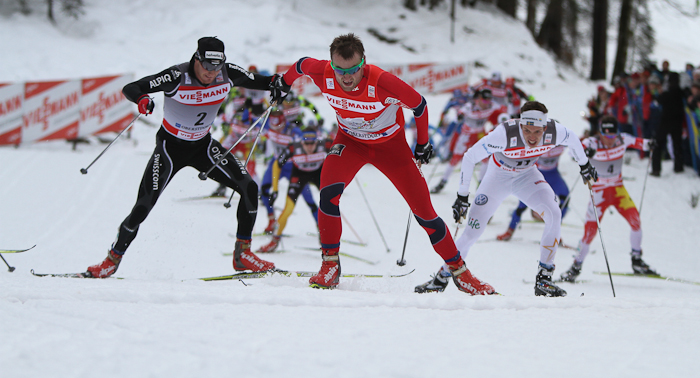
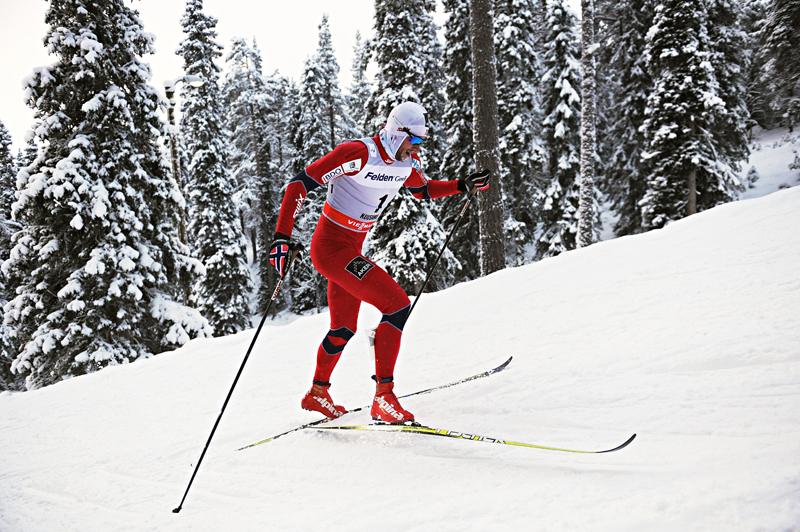
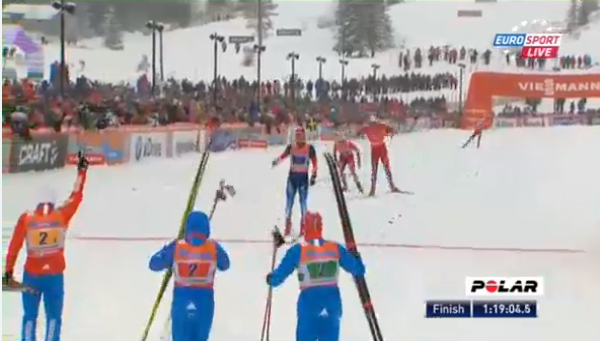
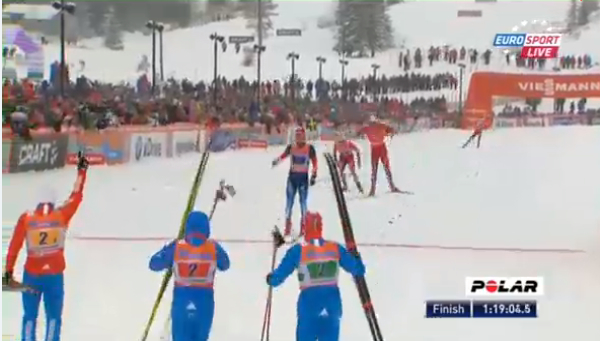
    Maxim Vylegzhanin bringing it home for Russia in the Lillehammer World Cup 4 x 7.5 k relay, as his teammates prepare to congratulate him at the finish. Vylegzhanin outlasted Norwegians Finn Haagen Krogh and Petter Northug for the victory for Russia I on Sunday.
    Maxim Vylegzhanin bringing it home for Russia at the Lillehammer World Cup 4 x 7.5 k relay, as his teammates prepare to congratulate him at the finish. Vylegzhanin outlasted Norwegians Finn Haagen Krogh and Petter Northug for the victory for Russia I on Sunday. Krogh took second, and Northug was third.

    Under snowy skies and on Norwegian terrain, Maxim Vylegzhanin and the Russian relay team seized victory in the men’s 4 x 7.5-kilometer relay Sunday in Lillehammer, greatly raising their team’s expectations ahead of the Sochi Winter Games.

    As the lone relay ahead of the much-anticipated Olympic contest, the event was an important test of the teams’ relative strengths, and an opportunity to try out relay orders. If Lillehammer made anything clear, it’s that the men’s relay is now dominated by a new Norway/Russia rivalry.

    The race began at noon with heavily falling snow, the tracks set deep in the powder and the steeper hills rutted and choppy enough to force the athletes into a wide, loping herringbone.  Eldar Rønning, skiing for Norway’s second of four teams, took the lead early and set a fast pace aimed at breaking up the pack.  In the heavy snow it didn’t take long to break apart the field.

    Norway I nearly fell off the back early on when Pål Golberg became tangled with another skier on a descent, knocking him off balance and forcing him to ski on only his left foot for much of the way down the powdery slope. Somehow, though, he managed to stay on his feet.  This impressive bit of skiing allowed Golberg, Saturday’s 15 k classic winner, to chase his way back up to the lead group.

    Coming through the stadium on the first of two 3.75-k laps, Russia I, led by Dmitriy Japarov, took the lead from Norway II’s Rønning and continued to push the pace. By 4.9 k the lead group was made up of Japarov, Rønning, Daniel Richardsson of Sweden, Jean Marc Gaillard of France, Stanislav Volzhentsev of Russia II, Tim Tscharnke of Germany, and Norway I, III, and IV.

    At the end of the first leg, Rønning charged into the stadium to hand off first to Chris Andre Jespersen, who was closely followed by Russia I and II, with Alexander Bessmertynkh and Alexander Utkin respectively. With Jespersen leading, the Norwegian teams would prove their classic skiing chops and their first three teams moved to the top of the field, only Bessmertynkh could hold the collective pace of Jespersen, Tønseth (NOR I), and Simen Haakon Oestensen (NOR III).

    At the handoff of the third leg and transition into skating, Tønseth tagged Martin Sundby first for Norway I, Alexander Legkov took over for Russia I just 0.2 seconds back in second, and Jespersen came through in third to send Sjur Røthe off for Norway II.

    After hungrily looking at the stadium screen as he watched his teammate Bessmertnkh approaching, Legkov took the lead from Sundby up the first climb, and wasted no time in trying to put the rest of the field under pressure.

    Legkov finally began to slow at the end of the first lap, and he relinquished the lead to Sundby as they passed through the stadium. Legkov did not spend long resting behind him, however.  As soon as the skiers left the stadium and began to climb up Lillehammer’s long hills, the Russian retook the lead and dialed up the pace once more.  This time, only Sundby and Røthe could stay with him; the rest of the field began to lose time to the Russian’s aggressive skiing.
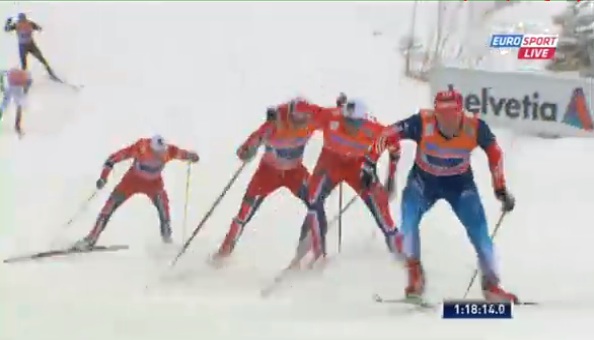
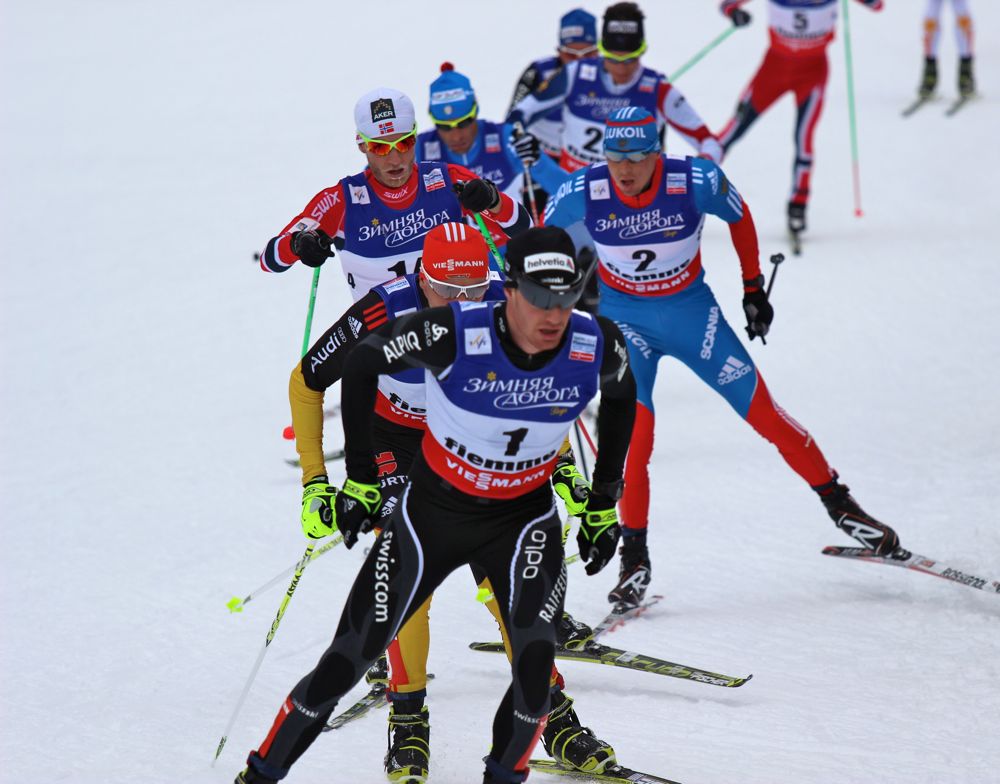
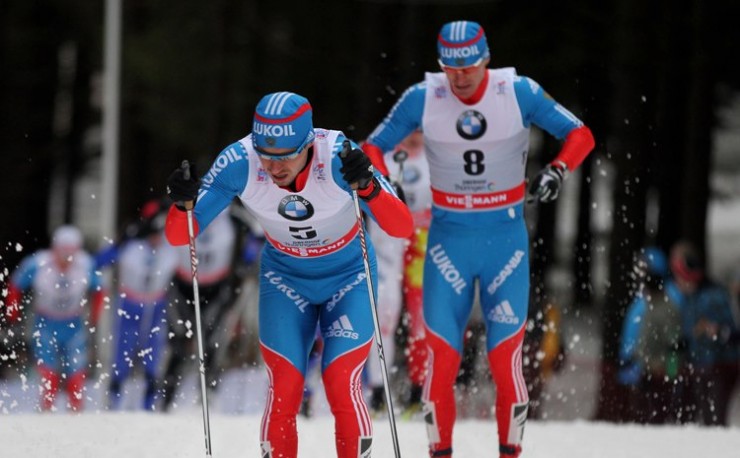
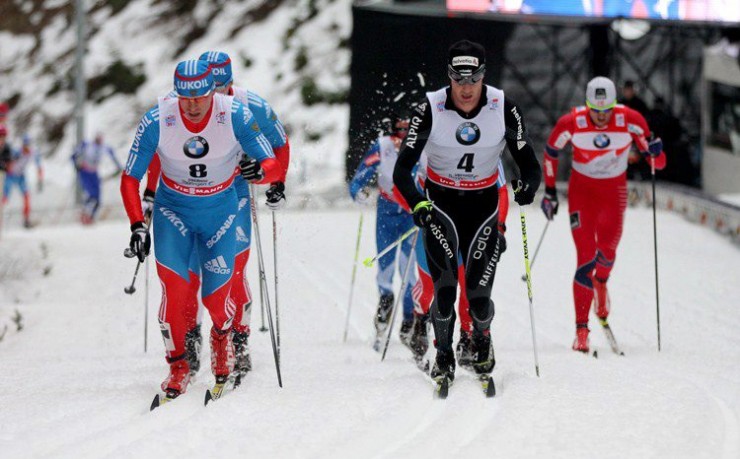
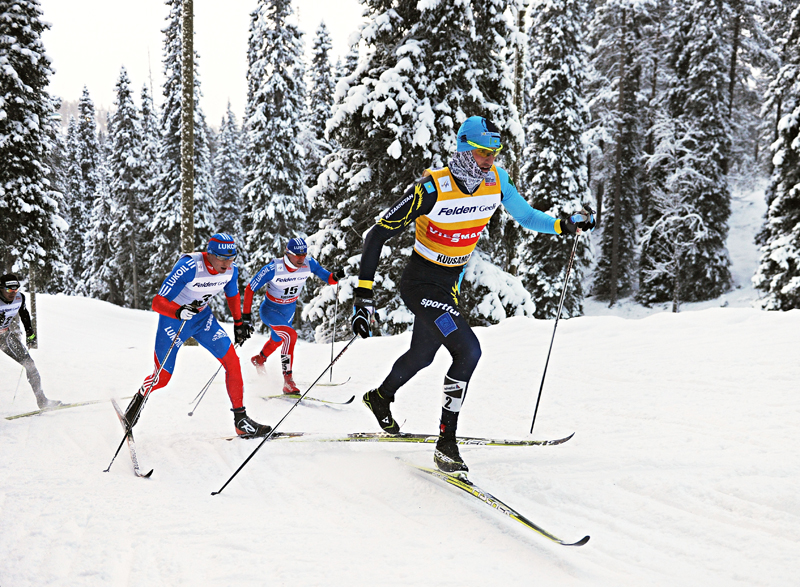
    Maxim Vylegzhanin leads Norway's Petter Northug (NOR I), Finn Haagen Krogh (NOR II) and Tord Asle Gjerdalen (NOR III) in the final leg of Sunday's Lillehammer World Cup 4 x 7.5 k relay. Vylegzhanin dropped the Norwegians to give Russia the victory.
    Maxim Vylegzhanin leads Norway’s Petter Northug (NOR I), Finn Haagen Krogh (NOR II) and Tord Asle Gjerdalen (NOR III) in the final leg of Sunday’s Lillehammer World Cup 4 x 7.5 k relay. Vylegzhanin dropped the Norwegians to give Russia the victory.

    On the final leg, Finn Haagen Krogh of Norway II, Vylegzhanin of Russia I, and the ever-confident Petter Northug of Norway I left the stadium together. By default, Krogh was left to lead the three. Vylegzhanin skied comfortably behind him in second and Northug stayed carefully behind the Russian.  For the first 6 k, Krogh’s lead was never challenged by either skier, and no one seemed to have any trouble keeping up with his steady tempo.

    The leader’s lack of swiftness was evident by a steadily encroaching field behind them, led by a hard-charging Tord Asle Gjerdalen of Norway III. Eighteen seconds behind Krogh at the start, Gjerdalen set off immediately on his leg to rejoin them, and in the last lap found himself back in the fold behind Northug.  Marcus Hellner also could be seen taking a hard turn for Sweden in a bid to catch up.  At 6 k, he was only 8 seconds behind Vylegzhanin, who had now taken over the lead.

    The Russian had plans for an early burst of speed and leading 1.5 k from the finish, Vylegzhanin took the leaders down a slope, already charging into the final hill before the long entrance into the stadium.  He quickly secured a sizeable gap on the Norwegians who appeared unprepared for Vylegzhanin’s early move. Northug, in particular, looked sluggish as he tried to respond to Vylegzhanin’s break.

    With Northug battling to catch up and Krogh hanging with him, Vylegzhanin’s sprint never wavered as he came barreling into the finish. Finally, at the end when Northug saw it was beyond him to win the day, he stood up, allowing Krogh’s lunging foot to take second for Norway II.

    Northug, who has been sick this fall, told NRK that today he “had no punch.”

    “In Russia we take them,” he added, according to a translation. “Clearly, it is one of the great dreams, to beat Russia at home. Then we rub it in.”

    Northug chose to downplay the importance of this race. “It is more important with the Olympic relay,” he said. “It is what the people will remember for years here, not how the Lillehammer relay went.”

    Norwegian National Team Coach Trond Nystad was more circumspect in his comments.  “Today we lost to a better team,” he told NRK. “With an optimal team settup  I think we should cope with Russia in the Olympics.”

    To Norwegian newspaper Dagbladet, Nystad conceded that his skiers had made some missteps in their strategy.

    “At the end we are a little inexperienced—we let him go on top there, and [were] unable to slide him [Northug] in at the end. We must take [that] with us.”

    The Russian team was quite excited with their victory. Legkov in particular looked very pleased, triumphantly pointing his finger up to indicate No. 1.

    “It is a great day and great victory for us,” Legkov told FIS. “This season is the most important and I am happy we showed such a great performance in the relay today. Maxim did a great move towards the end. I hope in Sochi we will perform in the same way.”

    The race demonstrated the strength of the Russian team, as well as the depth of the Norwegian team, which went second, third, fourth, and eighth on Sunday.

    Some Norwegian skiers were more philosophical about the relay.

    “The race showed that everything has to work out for the team to win and anything can happen, even with Petter Northug on the team,” Golberg said.

    “We had good fun to challenge Norway I!” Røthe added. “The Russian team was very strong and showed that they’ll be tough to beat on the home snow!”

    The Canadian and the U.S. men’s teams had a difficult day, finishing 14th and 17th respectively.  Canada finished 3:02 behind Russia and the U.S. was 3:48 out of first.

    Results

  • Sundby Holds Off Russian Assault for Ruka Triple Victory

    Sundby Holds Off Russian Assault for Ruka Triple Victory

    Martin Johnsrud Sundby (NOR) on his way to capturing the men's 15km skate title in Gaellivare (SWE). Photo: Nordic Focus/Fischer.
    Martin Johnsrud Sundby (NOR) on his way to capturing the men’s 15km skate title in Gaellivare (SWE) in 2012. Photo: Nordic Focus/Fischer.

    Martin Johnsrud Sundby (NOR) held off Russians Maxim Vylegzhanin and Alexander Legkov in the homestretch to claim victory in the Ruka Triple mini-tour.

    The Norwegian responded to a ferocious attack by Legkov with just two kilometers to go before making his own move on the final climb. Both Legkov and Vylegzhanin kept pace, but Sundby held the all-important pole-position into the hairpin turn at the back of the stadium, setting up well for the final 75 meter sprint to the finish.

    An excellent closer, Vylegzhanin came on strong, overtaking his teammate before running out of snow and his chance for the win.

    On another frigid day in Finland, racers contested a 15km freestyle pursuit, the first time the final day of this three race set was held in the skate technique since 2011.

    With new rules in place that cut stage race sprint bonus seconds in half, the field was tightly packed entering the final race. Another skier hit the course on average every two seconds, and 30th place was just 57 seconds off the lead.

    Top seed, Eldar Roenning (NOR), a self-admitted poor skater did not start, leaving Dmitriy Japarov (RUS) in the pole position.

    The lead pack quickly formed with sprinters and weaker skaters falling off the back in the first of six 2.5k laps. By the 5k mark, the top contenders had formed up, with Legkov, Sundby, and another Norwegian, Chris Andre Jespersen working at the front.

    Legkov could be seen testing his competition, and in a prescient moment, attacked early and hard on the steepest climb of the loop early in the third lap. He immediately backed off, but the 2013 Tour de Ski Champion was clearly serving notice that he would be a force for the remainder of the day.

    As the group approached the halfway mark, Frenchmen Maurice Manificat and Jean Marc Gaillard joined up, following Swedish stat Marcus Hellner. The trio had come up from the mid-twenties at the start, knocking roughly 50 seconds off their starting deficit.

    Just behind, two more men were battling to gain contact with the leaders. American Noah Hoffman, starting 1:02 down in bib 38 made contact just before the lap, as did Petter Northug (NOR).

    Wile the two latched on at similar times, they did so with varying levels of energy. Hoffman looked relaxed and strong as he settled into the pack, while Northug, clearly not in top form barely managed to maintain contact right at the back of the leaders.

    Northug, who has struggled with illness this fall, started 13th, 30 seconds down, and right in front of Legkov. He could not ride up with the Russian early, and it appeared unlikely that Northug, winner of this event last year, would be able to defend his title.

    While jockeying continued, Sundby and Legkov continued to do most of the work at the front, both continuing to look strong. Hoffman climbed as high as third, but a tactical error entering the fast downhill on the third lap, dropped him to the pack of the pack, and out of position for the final loop.

    The pace raised and fell as different skiers probed for weakness. Legkov accelerated several times, only to back off again.

    Unsurprisingly, when the race hit the steep climb with just over a kilometer to go, he reprised his attack from the second lap, this time showing no mercy. Sundby and Vylegzhanin responded, and within a few hundred meters, held a lead of 7.5 seconds.

    The podium had been decided, it was just a question of the order.

    The trio continued to pull away through the gradual terrain before Sundby made his move on the sprint hill up to the stadium. Jumping completely off the snow with each powerful V1 stride, he initially appeared to be moving away.

    But Legkov would not be sprung and pulled up, nearly fully abreast of the Norwegian, Vylegzhanin locked in just behind.

    Sundby did not get lear, but he earned the front spot into the tight hairpin at the back of the stadium, giving him first step into the homestretch.

    He needed that small boost, as Vylegzhanin, one of the few men who has bested a top-from Northug in a final distance sprint, came charing up over the short homestretch.

    The Russian got by Legkov, and most likely would have passed Sundby had the finish line arrived.

    Sundby told FIS after the race that he worked hard in the summer on his finish sprint, training with his brother to improve his speed. The work clearly paid off and Sundby was clearly thrilled with the start to his season.

    “This was beautiful,” he said with a broad grin in the finish area, after exclaiming “It is too cold here…”

    Sundby won his first World CUp race here in Kuusamo 5 years ago – a 15k classic. He has experienced significant ups and downs in his career, including struggles with asthma and a cardiac arrhythmia in 2011.

    He told Norwegian broadcaster NRK that his is not the biggest talent, but he is “sick-stubborn.”

    He continued “when I decide to try to achieve something, it’s blood, sweat and tears to get it. It is my strength, that I do not give up.

    Legkov, despite slipping to third, was also happy with his performance. “My shape has been good, and the result today gave me confidence for the next moths,” he told FIS. He is looking to defend his Tour de Ski title and of course, focus on the Olympics in his home country.

    Manificat, who was stuck at the back of the lead group when Legkov broke, did his best to bridge up. He never had a chance, but was clear in fourth holding off the young Sergey Ustiugov (RUS).

    Hoffman crossed in 9th, posting the fastest time of the day, 7.5 seconds ahead of Manificat.

    Northug completely lost contact with the lead group at the break, and came in just ahead of the first chase group to take 13th.

    Results

    Of Note:

    – Lukas Bauer (CZE), winner of the 10k classic on Saturday, battled in the lead pack, despite being significantly weaker in skating. He ended up 11th.

    – Hellner had the 3rd fastest time of the day.

    – Johannes Duerr (AUT) was 4th on the day, skiing from 54th to 18th.

    – Russia placed four in the top-10 and seven in the top-30.

    – Norwegian sprinter Paal Golberg, a surprising 4th in the classic, slipped to 23rd in the final standings.

    – Another Norwegian sprinter, Ole Vigen Hattestad, who earned his first ever World Cup distance points in the 10k, placing 20th, did not fare as well in the skate. He slipped from a start position of 9th down to 50th.

  • Tears from Northug As He Claims Second Overall World Cup Title

    Tears from Northug As He Claims Second Overall World Cup Title

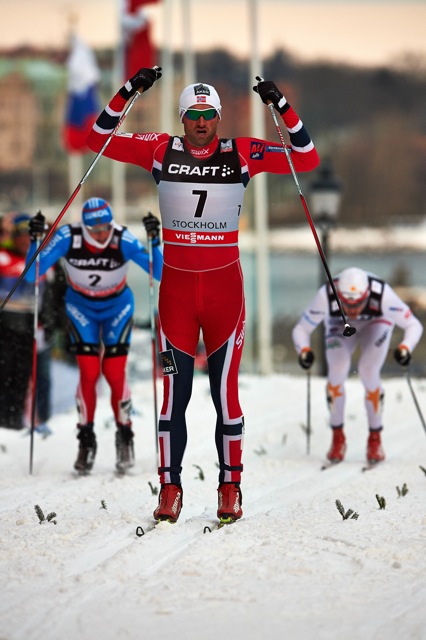
    Petter Northug celebrates his classic sprint victory in Stockholm on Wednesday.  (Photo: Fischer/Nordic Focus)
    Petter Northug (NOR) began and ended his World Cup Finals campaign in Stockholm and Falun, Sweden, with victory, and his win in the 15 k pursuit on Sunday secured his claim on the overall World Cup crystal globe. Photo: Fischer/Nordic Focus.

    He won the mini tour. He won the BMX trophy drive. He won the overall World Cup.

    “We’re going to let loose and do something fun tonight, but whatever that is, I still don’t know,” Petter Northug (NOR) said after finishing the 15 k freestyle pursuit on Sunday.

    You can hardly blame him. Northug completed an astonishing reversal in the season standings, finding late winter form and motivation to take his second overall World Cup title, his first since the 2010.

    With this victory at World Cup Finals, Northug becomes only the second Norwegian to take more than one overall title. He’s still shaded by Bjørn Dæhlie’s six triumphs, but Northug is in rare company.

    Leading into Sunday’s 15 k freestyle pursuit the question on everyone’s lips asked what Northug’s tactics would be. Would he try to keep the chasing pack away, or would he be caught and have to sprint for the finish?

    A yawning gap separated Northug from his closest competitor in the Falun mini tour on the start line; Maxim Vylegzhanin (RUS) started 30.5 seconds after Northug.

    Northug wasn’t concerned about Vylegzhanin.

    In prerace interviews he indicated to FIS that “I don’t care much about Maxim Vylegzhanin. I have to keep Legkov and Cologna behind.”

    Realistically, neither had a chance to overthrow Northug. Cologna started 1:20 behind the Norwegian. Indeed, Northug had gone as far to say that he would cancel his holiday if he lost it.

    “I’ll go on a camping trip in Falun,” Northug said to Aftenbladet after being asked what he’d do if he lost. “I don’t think that’s very pleasant.”

    Legkov, the closest to Northug in the overall, started 1:47 back. Barring a spectacular implosion, the title was Northug’s for the taking.

    Judging by Northug’s start, it appeared his tactic would be to slot in behind Vylegzhanin and pace himself to the finish. Northug came out of the starting gate sluggishly, without his characteristic spark.

    At the first 1.4 k checkpoint the clock revealed another story. Northug passed the mark in 3:47.7, with Vylegzhanin coming through 32 seconds later. The Norwegian had started in earnest.

    Further back, Martin Johsrud Sundby (NOR) had already latched onto Eldar Rønning, whom had started third, 40 seconds behind Northug.

    Rønning, the classic specialist, was already leaking time. After the first 3.6 k loop, the race began to take shape. Rønning faded, and Vylegzhanin formed an elite group of chasers containing Sundby and Finn Hagen Krogh (NOR), whom had already eaten up a significant margin after starting 54.4 seconds behind Northug.

    The chase was on, but the spirit of the chasers might have dampened after one lap through the stadium when they found themselves 39.8 seconds down to a determined Northug.

    As the chase group approached the uphill spectators were treated to some theatrics by Vylegzhanin when he took a drink from a coach and face planted after he poled between his legs. Perhaps World Cup racers are more human than we suppose. That misfortune effectively ended Vylegzhanin’s fight for a mini-tour podium. Seeing the Russian lying on the track behind them, Sundby and Krogh ratcheted up the pace and left the Russian for dead.

    Northug passed the 5 k mark in 12:38.5, coaxing his 83 kilograms up the long uphill. Half a minute later Sundby and Krogh roared past in hot pursuit of their teammate, taking 8 seconds out of Northug’s lead in the steep pitch.

    Northug’s overall rivals hadn’t made the necessary inroads to pose a real threat, with Cologna and Legkov passing the 5 k mark over 90 seconds down.

    It appeared the real drama would be if Northug could hold off his teammates. Sundby and Krogh were clearly hunting Northug, and if they didn’t have the same race suit on you’d have hardly thought they were Norwegian. Northug wasn’t getting any favors. Yet for all of Sundby’s and Krogh’s advances on the uphill, their downhill track craft muted their climbing prowess.

    Northug conceded seconds on the climbs but stabilized the losses on the downhill, taking advantage of the untidy snowplowing of his teammates.

    As they came into the stadium for the second time, a huge group had formed 1:36.7 behind Northug, led by Legkov. Even if the overall appeared out of his reach, the fight for second place between he and Cologna was on.

    As Northug crested the big hill again, Sundby and Krogh had sight of their teammate, only 24.9 seconds back at the 8.6 k mark.

    Vylegzhanin passed through in damage control after his fall, 1:10 behind Northug, while the pack led by Legkov and Ilia Chernousov (RUS) came through 1:26.9 seconds down.

    In the chasing pack Krogh took charge and tried to close those final meters to Northug, but the tall Norwegian was doing just enough to keep the chasers at bay. At the 12.2 k mark Northug had 14.9 seconds to play with in the final 3.7 kilometers of the season.

    Out of the stadium Northug grimaced up the last hills and swooped into the stadium, while Sundby and Krogh attacked each other behind.

    A few quick glances over his shoulder, and Northug knew he had done it. He cruised into the stadium and took his time towards the finish while Krogh and Sundby lit up the afterburners to fight for second place.

    In the end Northug stuck his toe across the line only 0.7 seconds ahead of Krogh, who got the better of Sundby in the end. Northug finished in a time of 35:48.3.

    In the end Northug’s margin of victory in the overall flattered to deceive, with a 180-point margin over Legkov by virtue of the 200 points awarded the Falun mini tour victor.

    Northug afterward was unexpectedly emotional.

    “It’s really fun to do it,” Northug told the NRK.. “It’s not simple to win the World Cup; many of my competitors prioritize the overall over world championships, and that is huge.”

    With Ja Vi Elsker, the Norwegian national anthem, playing over the loudspeakers as he raised the second crystal globe of his career, tears welled in his eyes. The jubilant champion felt relief after the pressure of the last two weeks.

    “It feels a little like I’ve stolen the overall title,” he said. “It has been a fantastic season. I won an individual world championships gold, additionally in an individual start, and the world cup overall. I’m very satisfied.”

    Even the head of the Norwegian ski federation Vidar Løfshus expressed his admiration.

    “We came here to win the crystal globe, and we did it,” he told the NRK. “Both the support crew and the athletes have done a great job.”

    Northug leaves Falun with a hefty payday and a new BMW. But you won’t see him driving it, as he’s donated the vehicle to charity.

    It was Northug’s day, but he wasn’t the only one with something to celebrate.

    Like Rønning the day before, Krogh delivered one of his best results of the season to take second place in the mini tour. He also posted the fastest time on the day in 34:54.6.

    “On a good day I can deliver a good result,” Krogh said to the NRK. “In the future I will deliver more consistent results than this year. I am prepared to train a lot to be even better next year.”

    Sundby was third and Legkov fourth in a time of 35:05.5 and 35:14.7 respectively.

    In the final analysis Legkov fell just short of his first overall World Cup title, but he can take consolation in claiming the distance world cup, winning the Tour de Ski, and improving upon two successive seasons where he finished the season fifth in the overall rankings. If his career arc continues on the same trajectory, he’ll be a contender for the overall next year.

    Northug topped the prize money list for the season, earning himself a substantial payday of 212,500 CHF. Legkov and Cologna were second and third, padding their bank accounts with 165,625 CHF and 136,250 CHF respectively.

    Norway took the Nations Cup competition with a 14,208 points. Russia accrued 9,130 points for second place, and Sweden third with 6,352 points.

    Results

  • Overall Title ‘In the Bag’ for Northug; Rønning Wins Mass Start in Falun

    Overall Title ‘In the Bag’ for Northug; Rønning Wins Mass Start in Falun

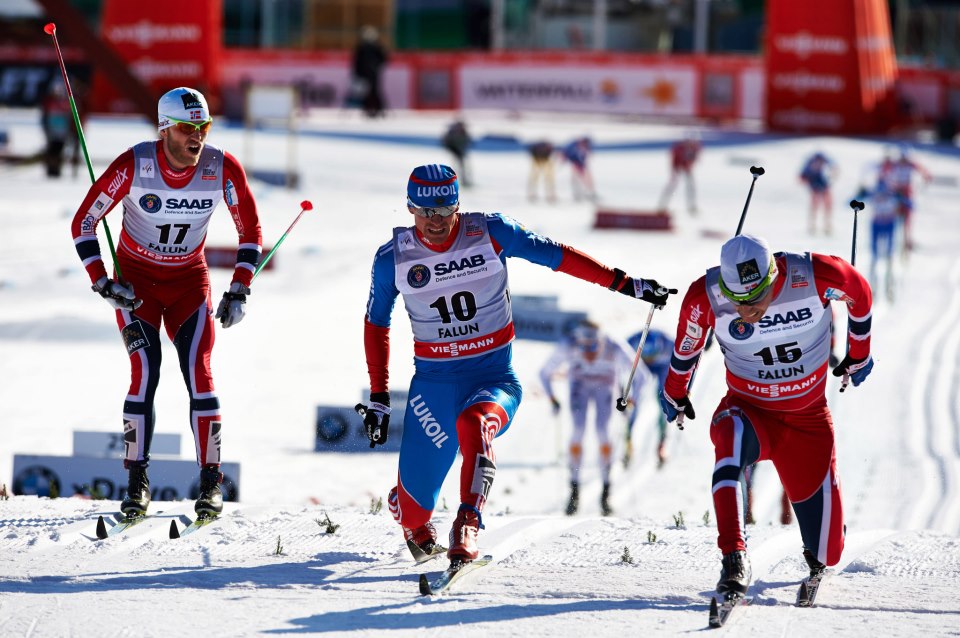
    Eldar Rønning (r) edges Russian Maxim Vylegzhanin (c) and fellow Norwegian Martin Johnsrud Sundby (l) in Saturday's 15 k classic mass start at 2013 World Cup Finals in Falun, Sweden. (Photo: Fischer/Nordic Focus; facebook.com/FIS Cross Country)
    Eldar Rønning (r) edges Russian Maxim Vylegzhanin (c) and fellow Norwegian Martin Johnsrud Sundby (l) in Saturday’s 15 k classic mass start at 2013 World Cup Finals in Falun, Sweden. (Photo: Fischer/Nordic Focus; facebook.com/FIS Cross Country)

    The typical plot line never materialized.

    Norway’s Petter Northug was supposed to spend the first several laps on Falun’s controversial track back in 25th and then surge to the front for the victory in the final 100 meters at World Cup Finals in Sweden.

    Instead, Northug’s teammate Eldar Rønning salvaged a tough season with a surprise 15-kilometer classic mass start victory, posting a time of 43:26 minutes on the 2015 World Championships course.

    Rønning, a classic specialist, made use of his late-season form, narrowly outsprinting Russia’s Maxim Vylegzhanin in the finishing straight with Norwegian Martin Johnsrud Sundby just behind in third.

    Saturday’s competition had three separate stories at work. First was the fight for the overall World Cup between Northug, Russia’s Alexander Legkov, and Switzerland’s Dario Cologna.  Second was the standing in the Falun mini tour, made more dramatic by the bonus seconds offered at the 5.6 k and 12.2 k marks.  Third was the contest for the race honors itself.

    Northug began the mass start with two victories in a row and appeared to be in indomitable late-season form.

    Legkov and Cologna are off their best, but even after Northug’s two successive victories, Legkov and Cologna only trailed the Norwegian by 56 and 69 points, respectively.

    It was up to Legkov and Cologna to deliver a strong result and stop Northug’s momentum.

    Northug was up to his usual antics in the first few laps of Falun’s unforgiving course, lazing to the back of the field while others took up the pace.

    It opened the door for someone like Legkov to up the pace. However, Legkov appeared to be missing a gear, as Northug observed.

    “It looked like Legkov had spent a night out on the town,” Northug told told NRK. “He looked tired.”

    Cologna initially looked dangerous.

    He gamely came to the fore at the first intermediate sprint for bonus seconds at 5.6 k, narrowly denied the full 15 seconds by Sundby. Cologna stayed at the front, and appeared to have recovered after a recent period of illness.

    But Cologna’s pace wasn’t enough to break the field. With Northug and Legkov jostling at the back in their own private battle, others were left to shape the race. Initially Finland’s Matti Heikkinen took up the donkey work at the front, but his moment was short-lived and he quickly disappeared back into the pack.

    The decisive pace change came from the unlikely figure of Emil Jonssen, the overall World Cup sprint champion.

    Many would bet on Jonssen dying quickly, but as the kilometers ticked by, it appeared the sprinter had could go the distance as well.

    At the 8-kilometer mark he made a move, with Northug lagging at the back of the field. By Northug’s account, this was the pivotal move of the race, and unlooked as it was initiated by the Swede.

    “The Swede brought up the speed and that’s what dropped Legkov and Cologna,” Northug told NRK. “I hadn’t expected help, so I must thank them for that.”

    Northug, ever an antagonist, was asked by a Swedish journalist whether he would repay the Swedish the favor.

    “No,” he deadpanned.

    In any event, Jonssen’s attack injected speed into the race. His aggression was more than a hubristic charge for a moments glory, and he took 10 bonus seconds at the 12.2 k mark, beaten again by a hungry Sundby. Jonsson looked like he was in contention for a breakthrough distance result.

    Northug had finally moved toward the front and crossed the intermediate sprint line in sixth place, seven seconds behind the winner.

    Legkov held on to the frantic pace at the front, crossing the 12.2 k mark in 10th place. Cologna was starting to break, dropping down to 12th, 12.2 seconds off the pace.

    After the final intermediate sprint, Jonssen faded. Sweden’s Daniel Richardsson, Sundby, Vylegzhanin, and Rønning all revved their formidable distance motors and charged, Northug clinging to the group. Legkov and Cologna were dropped.

    As the leaders began the final 3.3 k loop, the race was on, led by the giant, searching stride of Richardsson.

    Coming into the last hill, Sundby found another gear and led Rønning and Vylegzhanin into the infamous downhill, as Richardsson and Northug lost a few meters. Sundby was tearing the field apart.

    “I had a F***ing good day,” confirmed Sundby to adressa.no.

    Lurking just behind was the unheralded Rønning.

    As the frontrunners crested the big uphill and plunged down the final chicane Northug passed an ailing Richardsson and appeared to be within striking distance of Rønning, Sundby, and Vylegzhanin.

     As the camera angle panned to an aerial view of the race, however, it became evident that Northug left himself too much to do.

    “I was busy trying to stay focused on what happened behind rather than chase victory,” Northug said.

    Meanwhile, Rønning kept his feet on Falun’s tricky downhill, jumped into his slipstream, and slingshotted past the Russian in an impressive display of double poling. Sundby coasted in for third place, his double poling power failing him in the end.

    “I killed myself to get out that little extra, and I had good skis,” Rønning said. “In addition I’ve been working hard on my finish.”

    The victory came as a relief for Rønning.

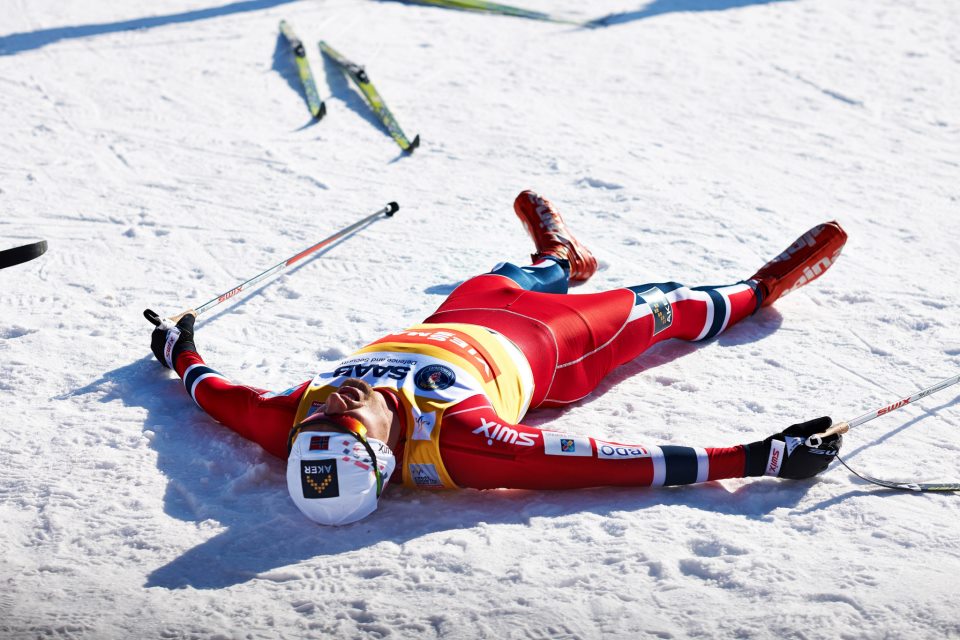
    Petter Northug after an exhausting fourth-place finish in Saturday's 15 k classic mass start at 2013 World Cup Finals in Falun, Sweden. (Photo: Fischer/Nordic Focus; facebook.com/FIS Cross Country)
    Petter Northug after an exhausting fourth-place finish in Saturday’s 15 k classic mass start at 2013 World Cup Finals in Falun, Sweden. (Photo: Fischer/Nordic Focus; facebook.com/FIS Cross Country)

    “It was great fun to win today. I have been struggling this season a bit and the victory here today means a lot for me,” Rønning said. “Now I can go into my Easter holiday with a good conscience.”

    Sundby concurred. “It’s great that Rønning took the win,” he said. “It’s been a tough season for him.”

    Northug never contested the victory, but his fourth-place finish was enough to solidify his lead in the mini tour and the overall title race.

    Contenders for the overall World Cup title, Cologna and Legkov didn’t deliver the result needed to unsettle Northug. Cologna finished 12th, and Legkov was 15th, respectively 17.9 and 25.6 seconds behind Rønning.

    Northug will go into the final day of the mini tour, a 15 k freestyle pursuit race, with a 30.5-second head start on Vylegzhanin. Rønning will start 40.2 seconds behind Northug in third. Northug had a 1:47 lead on Legkov as his closest title-rival.

    In the overall World Cup, Northug leads Legkov by 80 points, and Cologna by 87. For Legkov to win the overall title he would have to win Sunday, and Northug would have to finish lower than third.

    It would take a spectacular meltdown on the Norwegian’s part to relinquish his advantage.

    So does Northug think he’s secured his second overall World Cup title?

    “Normally I’d think it was over,” Northug said. “But it’s about being focused and trying to a have another good race in the morning.  I’m going to focus on resting until then.”

    Sundby isn’t so equivocal.

    “He has it in the bag.”

    Results

    Minitour Standing

    Overall World Cup Standing


  • Cologna Keeps Calm, Strikes Late to Nab World Championships Title

    Cologna Keeps Calm, Strikes Late to Nab World Championships Title

    Switzerland's Dario Cologna leads Tobias Angerer of Germany, Russia's Alexander Legkov and nearly 20 others during the skate portion of Saturday's 30 k skiathlon at the 2013 World Championships in Val di Fiemme, Italy. Cologna went on to win gold for his first medal at worlds.
    Switzerland’s Dario Cologna leads Tobias Angerer of Germany, Russia’s Alexander Legkov and nearly 20 others during the skate portion of Saturday’s 30 k skiathlon at the 2013 World Championships in Val di Fiemme, Italy. Cologna went on to win gold for his first medal at worlds.

    FasterSkier’s coverage of the 2013 FIS Nordic World Ski Championships in Val di Fiemme, Italy, is brought to you by the generous support of Fischer Sports.


    VAL DI FIEMME, Italy – When you’re as cool as Switzerland’s Dario Cologna, getting your ski tails stepped on and faceplanting with almost 90 guys behind you doesn’t faze you.

    Just over a kilometer into the men’s 30 k skiathlon at the 2013 Nordic World Ski Championships on Saturday, Cologna became one of the first casualties in an anxious and tightly packed group after the mass start. But no matter. The 26-year-old got up and clawed back into the top 10 by the end of the first 3.75 k classic lap.

    That’s the power of an Olympic gold, three Tour de Ski titles and numerous World Cup victories, and Cologna also had the drive for his first World Championships medal on his side.

    The Swiss rose from a minor slipup to the front of the pack by the second of the four-lap classic leg, challenging defending champ Petter Northug and his Norwegian teammate Martin Johnsrud Sundby, as well as Russia’s Alexander Legkov, Jens Filbrich of Germany, Sweden’s Marcus Hellner, and more in the 60-man strong crew.

    Despite changing leaders, the pace mostly stayed the same, even on the third lap when Hellner and Jean Marc Gaillard of France attempted to make something happen. Cologna had told himself before the race that he needed to take charge in the skate leg, and by the transition, he appeared in fighting position.

    The first into the exchange zone at 15 k, Norway’s Eldar Rønning stepped out of his classic skis and into his skates the fastest and led the group out of the stadium. Hannes Dotzler of Germany went with him, as did Legov, and Cologna hovered around 10th with Northug.

    In front of them, Sweden’s Daniel Richardsson surged ahead. Sundby answered, passing him and keeping the pace high. The group dropped to 20, and Cologna stayed steady take the lead with three laps remaining. Not long after, Cologna looked around for someone to share the load. He pulled over and started walking up the first big climb before Sundby decided he’d had enough and pushed onward up the other side.

    With no takers to help chase him down — perhaps part of Norway’s plot — Cologna made a bit of a gamble. Let Sundby go and be confident enough to rein him in, or make sure he doesn’t get away for good?

    Unrattled, the Swiss went with the first choice.

    Despite Sundby gapping the group by nearly 20 seconds, Cologna’s calculated move turned out to be spot-on; they caught him with about five kilometers to go.

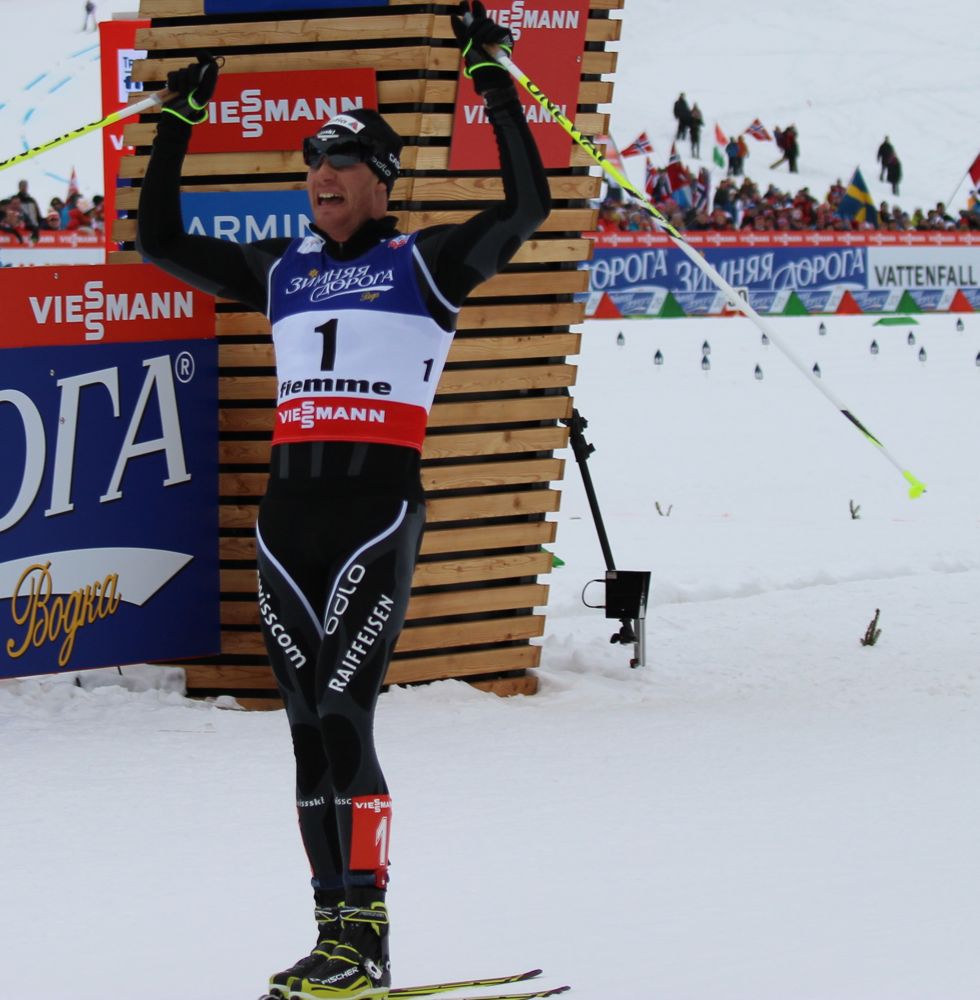
    Cologna celebrates his first World Championships gold after winning the 30 k skiathlon handily on Saturday at the 2013 World Championships in Val di Fiemme, Italy.
    Cologna celebrates his first World Championships gold after winning the 30 k skiathlon handily on Saturday at the 2013 World Championships in Val di Fiemme, Italy.

    “I really want to fight for the gold medal and not for the silver medal so I decided to close the gap myself,” Cologna said at a post-race press conference. “In the end it was the right decision. Everything was perfect for me.”

    By “perfect,” he was referring to his attack up the second to last hill, dropping all but three: Russian Maxim Vylegzhanin, Røthe and Sundby, respectively. They went with him with two kilometers to go, but couldn’t match his kick on the final climb. Cologna opened up a several-second gap on the other three, with Northug also closing from behind.

    Charging hard through the stadium, Cologna looked back as he entered the finishing lanes. He stopped pushing and cruised over the line with his hands in the air. Finally, he had done it, and his first World Championships medal just happened to be gold.

    Cologna finished in 1:13:09.3, and Sundby placed second, 1.8 seconds back, to top his individual bronze from the 2011 World Championships 15 k classic. Røthe, 24, was third for his first individual world medal, and seven-time world champion, Northug placed fourth (+5.2).

    “It was really a dream to win here and to win the first race is even better,” Cologna said in this first distance race of the Val di Fiemme World Championships, just a two-hour drive from his hometown of Val Müstair, Switzerland.

    “I felt great the whole race and to come alone into the stadium is always a great feeling,” he added. “It was also my plan.”

    Cologna said he expected someone to attack earlier, and when they didn’t, he took it upon himself to do so. After trying to drop the pack initially in the skate leg, he said it didn’t work so he chose to conserve while Sundby went for it.

    Meanwhile, he visualized that last uphill. Three weeks ago at the pre-Olympic World Cup in Sochi, Russia, Cologna dropped several Russians up something similar to win the skiathlon.

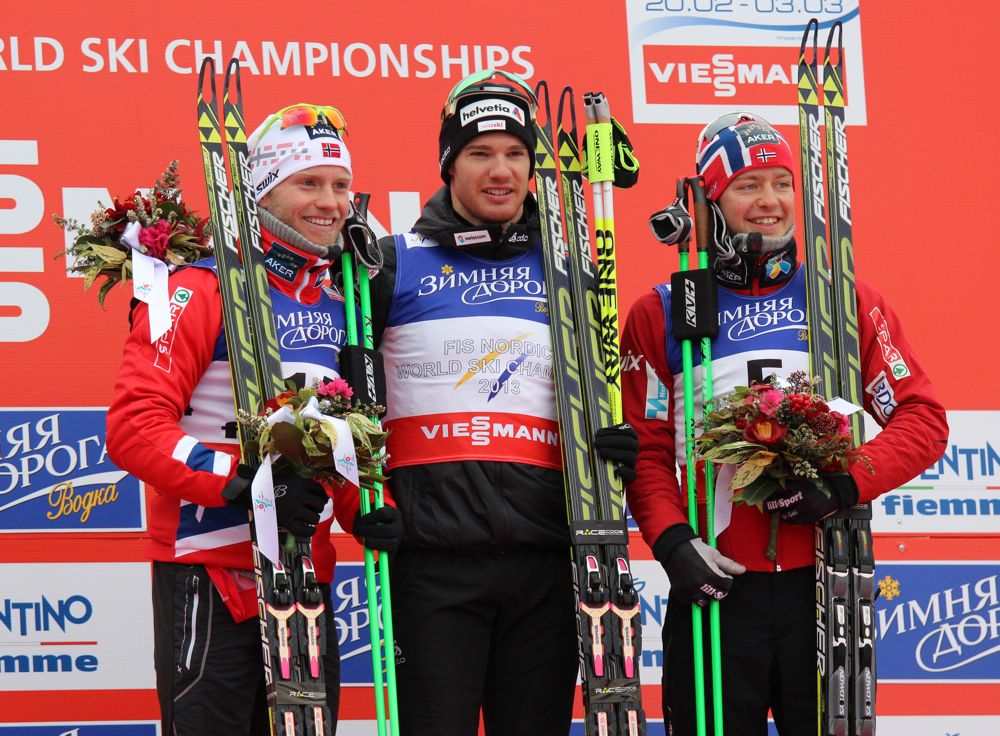
    Swiss winner Dario Cologna (c) with Norwegians Martin Sundby (l) in second and Sjur Røthe in third on the 30 k skiathlon podium at the 2013 World Championships in Val di Fiemme, Italy.
    Swiss Dario Cologna (c) with Norway’s Sundby (l) in second and Røthe in third on the 30 k skiathlon podium at the 2013 World Championships in Val di Fiemme, Italy.

    “Dario was the best today,” Sundby told reporters after Saturday’s race. “We [Norway] managed to get second and third and for me second place is like a victory.”

    A strong classic skier, Sundby took it upon himself in the offseason to make some major improvements to his skate technique, NRK reported. It paid off, as he felt strong enough to leave the group around on the first of four skate laps.

    “I did not quite know what happened. Suddenly I had fifteen seconds without really knowing what to do,” he told NRK.

    “I didn’t at any point think that this would hold for a gold medal,” he said at a press conference. “So for the third lap I tried to calm down, rest a bit and wait for the guys and be prepared for a very tough fourth lap.”

    That last lap turned out to be tough, with Sundby outlunging his teammate, Røthe, by two-tenths of a second for silver. After Vylegzhanin trailed Cologna up the last hill, Røthe and Sundby went on either side to pass the Russian. They soared down into the stadium in second and third, while Northug made a late move to pass Vylegzhanin as well.

    Røthe told reporters he was extremely satisfied with his career best, especially in sharing the podium with Sundby.

    “It’s my own fault that I wasn’t in back of Dario, but I’m really satisfied and it’s good that Martin’s by my side,” Røthe said.

    Norwegian men’s coach Trond Nystad said it was a good day for Norway with two medals in the men’s race and a podium sweep for the women.

    “Dario wins, that was deserved; he was a better skier today,” Nystad said. “We got two, three and four and we have to be happy with that.”

    As for which of his athletes he thought might be in the hunt for gold, Nystad said he wasn’t surprised by Sundby or Røthe, who was third in the Canmore World Cup skiathlon in December.

    “Of course, Petter who was fourth, he was also expected to be in there and fight for the medals, but he was sleeping a little bit on top of the hill,” Nystad said.

    “I would like all medal, so it was a disappointing race for me,” Northug told NRK. “Fortunately, two Norwegians medaled.”

    After Northug, Vylegzhanin led the Russians in fifth (+6.1), Legkov was sixth (+10.1) and Calle Halfvarsson of Sweden was seventh. Hellner placed eighth, Tobias Angerer of Germany was ninth and Gaillard finished 10th.

    — Audrey Mangan contributed reporting

    Results

  • Russia Annihilates in Sochi Team Sprint

    Russia Annihilates in Sochi Team Sprint

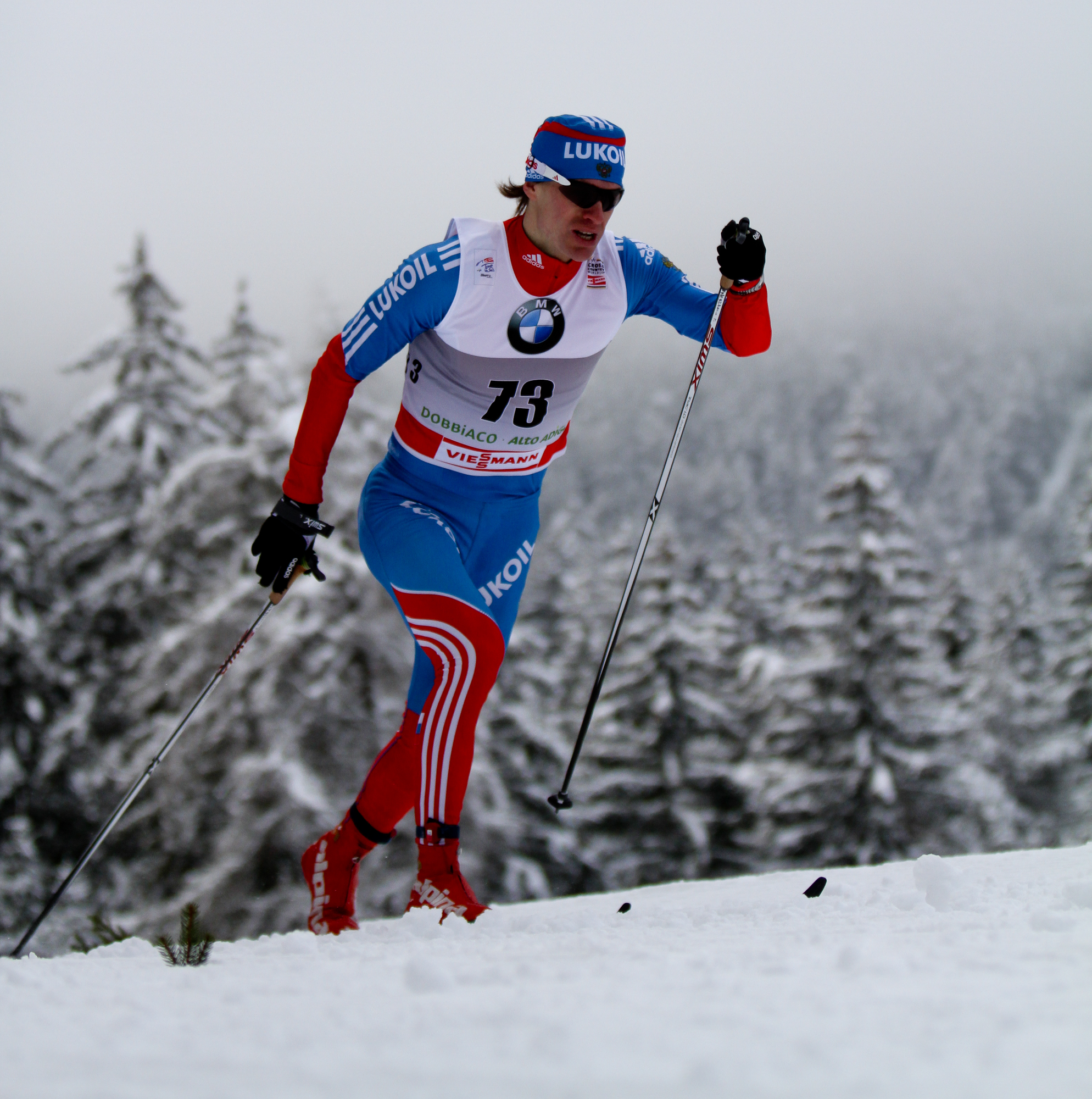
    Vylegzhanin
    Maxim Vylegzhanin (RUS) in action last season. In the classic team sprint in Sochi, Russia, on Sunday he anchored Russia to an 18-second win over Sweden and Germany.

    It doesn’t get much more perfect for a team sprint than a bluebird day in the mountains on the same snow that will hold Olympics  one year from now. The outcome doesn’t get much more perfect either, at least for the host country. In the classic team sprint, the final race of the test weekend for the Games, Russia’s first team of Dmitriy Japarov and Maxim Vylegzhanin blasted the field apart to win by 18 seconds over Sweden in second and Germany in third.

    Japarav put his feelings quite simply after Vylegzhanin crossed the finish line with no one in sight: “It feels great to be on the podium on the home soil,” he said. “Maxim did a very good job on his legs and we could build up the gap. It was our plan to go as fast as possible right from the start. I hope we can repeat the same performance also next year at the Olympics.”

    Has a team sprint ever been won by a difference of 18 seconds? If so, Sochi erased all memory of it on Sunday. The field was stunned when Japarav created a gap on the first leg, and even more so when they never relinquished it. Germany led the chase for most of the race and Tobias Angerer expressed his surprise at the decisive early surge.

    “We expected the Russians to be strong but it was surprising to see them go away so early,” he said.

    In another race — a distance event, or even a long an individual sprint — a bold early move might have backfired. Or at least the threat of it backfiring would have left some hope that there was still a chance for something unexpected to happen. Someone might blow up, or a chase group might reel in the break.

    But in a race that gets a reset button every few kilometers, Japarov and Vylegzhanin didn’t give anyone a chance. They know the Sochi terrain better than anyone, and with minutes to recharge in between legs they attacked the course afresh each time with unmatched confidence. The announcers could have called the race after the second round, when Vylegzhanin extended the lead to 20 seconds. Remarkably, both he and Japarov continued to post the fastest course splits even as they skied alone.

    The fight for silver, then, was the only contest left to decide. A small train pulled away from the rest of the field towards the middle of the race, with Germany, Sweden and the U.S. matching each other stride for stride. It wasn’t until the final lap that it broke apart. Andy Newell (USA) lost contact off the back as Emil Joensson (SWE) put on a surge to blow by Angerer. Joensson, currently the men’s World Cup sprint leader, redeemed himself of just missing the sprint heats on Friday to take silver by two seconds over Germany.

    “It was really hard to go uphill but today we had very good skis, which allowed us to take a good grip up the hill,” Joensson said. “I tried to save some energy for the last leg. It is great to be on the podium.”

    Russia’s second team took fourth (+28.08), an unusually fallible Norway finished fifth (+29.13) and Kazakhstan took sixth (+29.74). Newell fell on the last downhill, dropping the U.S. from fourth to seventh (+43.85).

    If it hadn’t felt like hype for the Games had started before, it certainly does now. Even the imagery looked Olympic; the sun came out for the first time all weekend, giving cameras an excuse to dwell on the picturesque Caucasus Mountains in the background as Japarov and Vylegzhanin strode away from the field as if it were standing still.

     Men’s classic team sprint results

  • Not This Tour, Dario: After Four Men Battle for 35 K, Northug Emerges to Win Finishing Sprint

    Not This Tour, Dario: After Four Men Battle for 35 K, Northug Emerges to Win Finishing Sprint

    Petter Northug (NOR) and Dario Cologna (SUI) fighting during last year’s Tour de Ski; in Italy today, they skied together for 35 kilometers before Northug emerged on top.

    At the beginning of today’s 35 k freestyle pursuit from Cortina to Toblach, Italy, three men were separated by less than ten seconds atop the Tour de Ski standings: Maxim Vylegzhanin of Russia, Dario Cologna of Switzerland, and Petter Northug of Norway.

    The three quickly joined together, but within a matter of a few kilometers, their group had almost doubled in size. With the pursuit format the winner of the race would take over leadership of the Tour, and all of a sudden, as the men left Cortina, the possibilities seemed to have grown.

    Starting from 27 and 28 seconds back, Alex Harvey of Canada and Alexander Legkov of Russia had worked their way into the mix. The five men skied fast but easily towards the top of the 350-meter climb that separates the two Italian towns, with Cologna doing the bulk of the work.

    In terms of rankings, it was a situation almost identical to last year’s Tour pursuit on this same course: Cologna had started with a 13-second lead on Northug, with a large gap back to Legkov, Devon Kershaw of Canada, and Vylegzhanin. Harvey now skied in the place of Kershaw, but the faces were all the same.

    And in this pursuit last season, Cologna had cultivated that initial small lead into a 1:20 advantage by the end, turning the Tour de Ski into a tour de force and never giving up his lead for the rest of the race.

    Today, it was clear it wouldn’t be so easy. Northug, for one, is in much better form for this year’s Tour – and has the advantage now of having done it once before, so he knows what he’s up against.

    “It was hard, but it was much harder here last year,” he told Norwegian broadcaster NRK. “I didn’t flow very well for the first five kilometers, but after that it got better and things went quite well.”

    Constantly leading was clearly not a situation Cologna was happy with: by the seven kilometer mark, for instance, he was pulling over to the side of the trail and waving his arms, motioning for one of the other men to take over. Vylegzhanin did, for a while; but soon it was back to Cologna at the front. Northug would lead occasionally, but never for more than a few hundred meters.

    Of course, that’s not how Northug saw things.

    “I tried to help all the way,” he told Norwegian broadcaster NRK. “When I took the lead it was easier to pick up the rest of the group, and it didn’t cost me anything.”

    With Marcus Hellner of Sweden and Lukas Bauer of the Czech Republic having made up a third of their 1:35 gap in the first few kilometers, Cologna evidently felt that he couldn’t sit back and allow the lead group to linger too long playing games. Again and again, he found himself at the front, driving the pace.

    Northug reported that the men tried to work together to avoid being caught, but it was difficult to communicate about how big the gap was.

    “There were a lot of languages,” he said. “The Russians were getting some seconds back in Russian, but I didn’t get much information even though I tried to ask them. Then Dario got some seconds back information, and I learned that it was a minute.”

    As the group neared the top of the 15-kilometer climb, the repeated accelerations as Northug took the lead and then gave it up proved too much for one member of the group: Harvey. Several times, he let the pack go and then caught back up when they decelerated. But eventually, he was broken and literally shut things down, double poling in the classic tracks on the side of the trail.

    While it looked like Harvey had hit a wall, he was simply playing smart: knowing that he had no chance of catching the first four, and that skiing alone was a waste of energy, he took a rest until Hellner, Bauer, and Ilia Chernousov caught him, and then embedded into their chase group. At that point the gap was about 1:35, and it stayed that way until the finish, when Chernousov beat Harvey in a sprint for fifth.

    But at the front, the leaders were embarking on a well-earned downhill. Passing between the ragged peaks of Geierwand, Durrenstein, and Birkenkofel – the trail even went through a long tunnel beneath the mountains at one point – the skiers were nonetheless unable to fully enjoy views of Tre Scarpari, or “three scars”, just to the east.

    Instead, they were focused on tactics and gamesmanship. The downhill was fast and nobody could get a gap, but the lead kept shifting between Cologna, Legkov, and Northug. Vylegzhanin was never dropped, but was visibly fatigued and rarely took his turns at the front. Although it would have been a great time to try to spring him loose, fourth place in the draft of three skiers on a downhill is a pretty safe place to be in a ski race, and the Russian, wearing the bib of the Tour leader, was pulled along.

    “We worked together well in the lead and got a good break on the second group,” Cologna told NRK. “I hope that it is one of us four who is the winner in the end.”

    As the kilometers ticked past, Cologna and Legkov doubtless began to worry not about the man currently wearing that leader’s bib, but who would have it at the end of the day. One figure loomed over the group, and that was Northug. Nobody in the pack was a slouch when it comes to finishing sprints, but Northug has bested all of them repeatedly.

    And yet Cologna and the Russians were unable, or unwilling, to take the risk of a big push in the pace to shake the Norwegian. As they entered the stadium – not to finish, but to head out on a several-kilometer loop before the end – Northug was sitting in fourth, just coasting along. He looked all around, assessing the layout of the finish, and ominously kneaded his quadriceps with his fists, getting his legs ready for a big effort.

    “I was just saving gunpowder for the end,” Northug later smirked to NRK.

    That should have been a signal to the others that they had better scram, now, if they wanted to avoid getting schooled by the Norwegian in the last hundred meters. But instead the pack slowed down. Northug moved to the front and commanded the pace, almost daring someone to go ahead and pass him, but nobody did.

    And so, on the last small hill before the finish, he took off, the Russians in pursuit and Cologna stuck behind them; things didn’t look up for the Swiss defending champion as they rounded the last several corners. Northug was untouchable, taking a 0.7-second win over Legkov, while Cologna was able to surge past the tired Vylegzhanin to claim third just 0.2 seconds back.

    “I should have beaten Legkov by more with a pickup like that,” Northug said, noting that he didn’t feel quite 100 percent. “There should have been a little more to go on.”

    One the bonus seconds were tallied – 15 for the win, ten for second place, and five for third – Northug had a slightly greater advantage at the top of the rankings: 5.7 seconds over Legkov, 10.9 over Cologna, and 16.6 over Vylegzhanin. Chernousov, Harvey, Hellner, and Bauer are roughly 1:40 behind Northug.

    Tomorrow’s stage, a 5 k classic prologue in Toblach, doesn’t faze Northug, who is sure it is an opportunity to extend his lead going into Saturday’s 15 k classic mass start.

    Finn Hagen Krogh of Norway and Curdin Perl of Switzerland were the first skiers from a large chase pack to cross the line, finishing ninth and tenth, +1:46.

    Results

  • Gutsy Skiing Lifts Russians in Tour Pursuit; Northug Third

    Gutsy Skiing Lifts Russians in Tour Pursuit; Northug Third

    Russian Maxim Vylegzhanin (bib 8) tailing teammate Ilia Chernousov on his way to 15 k classic pursuit victory in the second stage of the 2012/2013 Tour de Ski on Sunday in Oberhof, Germany. It was his first World Cup stage win. Photo: Marcel Hilger.

    Being No. 1 isn’t always best, at least that’s how Petter Northug and his coach felt Sunday in Oberhof, Germany.

    The Norwegian constantly vying to be on top secured his wish the day before, winning Saturday’s skate prologue, the first stage of the Tour de Ski. Given the red leader’s bib for Sunday’s 15-kilometer classic pursuit, Northug became the hunted.

    Sometimes that kind of pressure works wonders. Other times, it can swallow you whole. Despite getting overtaken by the 3 k mark by a charge led by Russia’s Alexander Legkov, Northug hung on to the front group and pulled off third at the finish. It wasn’t what Northug or his national-team coach, Trond Nystad, had envisioned, but it wasn’t the worst thing, either.

    Petter Northug striding early. Photo: Marcel Hilger.

    “Today is the one race, nothing more,” Nystad told NRK. “It’s about making great effort, it is a long Tour. It is not always an advantage to win.”

    Russian winner Maxim Vylegzhanin (who finished in 39:47) and Legkov (+0.1) in second saw it differently as they celebrated atop the podium. The two had successfully bested Northug from nearly start to the finish, passing him within the first few kilometers and leading through the end.

    Vylegzhanin and Legkov worked with teammate Ilia Chernousov, who started fifth and eventually placed sixth (+20.5), holding off competitors like Canadian Alex Harvey and Dario Cologna of Switzerland.

    “It was good to ski in front with Legkov and Chernousov, but it was not planned and we did not apply any tactics,” Vylegzhanin said at a press conference. “In the last lap Alexander Legkov was pushing hard and I followed him. In the finishing stretch I had a bit more power. It feels great to be in the lead of the Tour.”

    While Vylegzhanin and Legkov picked up the pace on the final lap, Chernousov fell behind, and Harvey, who had been skiing around third or fourth, tried to go with them. With 150 meters to go, the Russians double poled ferociously to the finish. Meanwhile, Northug and Cologna battled behind Harvey, passing him in the final stretch to finish third (+6.5) and fourth (+6.7), respectively, while Harvey settled for fifth (+7.7).

    Vylegzhanin (8) and Cologna (4) work up front during the Tour de Ski 15 k classic pursuit on Sunday in Oberhof, Germany. Cologna placed fourth behind Norway’s Petter Northug (r) in third. (Marcel Hilger photo)

    After starting nearly 27 seconds back from Northug, the 30-year-old Vlegzhanin edged Legkov by a fraction of a second for his first World Cup stage win. He placed 22nd in the same pursuit last year, where Legkov was fourth behind German winner Axel Teichmann, who did not start Sunday.

    While the Russians generally took turns leading, it was Legkov who appeared to be orchestrating the charge. Often, the 29-year-old jolted ahead, glancing back and at least once standing up completely to let his teammates catch up. Harvey said he was content skiing behind them and ahead of Cologna and Northug, who seemed to be struggling with their skis.

    “When we caught Northug, I expected the pace to die a little bit, but then the Russians started going crazy,” Harvey said on the phone. “So then I was like, ‘Man maybe we’re gonna keep our gap.’ Usually the guys are bunched up together in the middle of the second lap, but today they decided that they were gonna keep charging.”

    With a total of five laps, all seven guys hung on, including Finland’s Matti Heikkinen, who climbed up from 29th. Heikkinen finished seventh despite tripping on a lane change around 10 k and nearly taking out Harvey. According to Harvey, Heikkinen was issued a written warning and apologized to him at the finish.

    “I was kind of weirded out because I was riding in my track and he kind of came on me. It was close,” Harvey said. “Then he came back with us then he kind of blew up a bit later. If I fell, that might’ve been me so I was lucky to stay on my skis.”

    Harvey also kept his distance from the Russian ahead of him in the soft and sugary snow. He prepared for a crash by allowing them space at the top of the hills then made up time on the downhill corners.

    “The Russians, they go so hard on the hills, their legs are pretty shaky,” Harvey said with a laugh. “They’re not the best downhillers. If you can stay away from Legkov on the downhill, it’s probably a good thing.”

    For a majority of the race, Northug and Cologna switched positions near the back, hovering between fifth and seventh. Occasionally, one moved toward the front, but given the Russians’ relentless attack, neither made significant ground. Coming into the stadium for the last time, it came down to a sprint between Northug and Cologna, which the Norwegian won. Despite the mutual hard effort, both seemed to let up at the finish, acknowledging that it didn’t matter whether they finished third or fourth.

    While Northug wasn’t OK with losing to two Russians, he followed his plan of sticking with them and the lead group through the finish.

    “I figured that there would be war and the Russians came quickly at the end,” Northug told NRK. “I didn’t mean much to win today. Had it been on a World Championship gold medal, it had probably been a different war.”

    As for Cologna, the three-time Tour champion: “He’s where he wants to be,” Northug said.

    Personally, Northug, who has yet to win a Tour de Ski, wasn’t exactly happy. He felt heavy in the wet snow and struggled with his poles sinking.

    “I really wished I had been a little bit better shape both Saturday and today,” he told Langrenn. “I hope the good feeling that comes after the sprint in Val Müstair [Switzerland on Tuesday], and hopefully I get my best days late.”

    Men’s results

  • Not This Time: Northug Edges Russian in Kuusamo Finale

    Not This Time: Northug Edges Russian in Kuusamo Finale

    Petter Northug (NOR) on his way to his first victory of this year’s Ruka Triple mini tour on Sunday in the 15 k classic pursuit in Kuusamo, Finland. It was the only one that really mattered. Photo: Fischer/Nordic Focus.

    Petter Northug couldn’t stand to see it happen again. For the past two days, he had finished second to Russians – first Nikita Kriukov in the classic sprint, then Alexander Legkov in the 10-kilometer individual skate. Both times, the Norwegian favorite knew exactly what was on the line and sprinted hard to cross it.

    Both times, he lost.

    That must’ve been one of the only things on Northug’s mind Sunday in the 15 k classic pursuit, which he started with a 40-second lead.

    Within the first kilometer, he had extended it to nearly 50 seconds over Kazakhstan’s Alexey Poltoranin, who started second. Legkov went out of the gate third, 53 seconds after Northug, and led the quickly formed chase group around 2.5 k.

    At that point, nearly 15 men strung together to form an attack, but they didn’t make up much ground until nearly 9 k. With six kilometers (two laps) to go by the 10 k mark, Northug visibly picked up his tempo. Thirty-six seconds wasn’t quite enough time between him and the others, and if he lost it, he could drop from first to near 20th. That would be worse than placing second to a Russian again.

    Northug’s lead dwindled to 25 seconds by 11.4 k, and halfway through the last lap, it was down to 12.8 seconds. Poltoranin forged ahead with the last-ditch attack, and Northug responded with his characteristic double pole. He looked around once, and that was enough.

    Northug (1) tries to fend of the chase pack in the final kilometers of the Kuusamo World Cup 15 k classic pursuit on Sunday. He won by 1.2 seconds.

    “I felt like I had robbed 50,000 euros in a suitcase and that I had 100,000 police after me,” he told NRK. He could amass nearly that much if he won Sunday.

    Charging hardest up the last hill, Maxim Vylegzhanin of Russia whisked by Poltoranin as well as Dario Cologna, who had moved up considerably after starting 1:12 back. Vylegzhanin nearly caught Northug at the crest, and in a classic game of cat and mouse, Northug got away on the downhill. After skiing humbly in the pack until the last lap, Vylegzhanin came close again around the final curve into the stadium.

    Yet on the last day of the Ruka Triple mini tour, it was Northug who was fastest. He forged ahead in the final sprint, beating Vylegzhanin by 1.4 seconds in 41:38.3. Poltoranin was third (+3.4) and Cologna placed fourth (+7.8).

    “This is one of the toughest I’ve experienced,” Northug told TV2.no, according to a translation. “I don’t think I’ve ever fought so hard for a win before.”

    Knowing how difficult it would be to ski alone for six laps, he aimed to find his own pace for the first four.

    “I knew the group behind me would speed up,” he told FIS reporters. “I was preparing myself for the finish. I had little bit left for the last 150 meters.”

    Not much, though. In the finish area, a Norwegian coach had to lift the collapsed Northug off the ground.

    “I worked myself mentally on the last lap,” Northug said to NRK . “I was so tired. It was just painful.”

    The race tested all the top contenders, including Vylegzhanin, who notched his seventh World Cup podium after hanging behind teammates Dmitriy Japarov and Legkov for much of the race. Japarov and Poltoranin combined to share most of the load up front, and when Japarov fell around 12.5 k, Legkov looked to be Russia’s best chance.

    Alexey Poltoranin (KAZ), Alexander Legkov (RUS) and Maxim Vylegzhanin (RUS) chase Northug during the men’s pursuit in Kuusamo (FIN). Photo: Fischer/Nordic Focus.

    “After three days of competition it was very tough for me today,” Vylegzhanin told FIS. “I did everything that I could. I found a good place in the chasing group. I am very happy about the podium. I hope I will carry on the shape to the Tour de Ski and World Ski Championships.”

    After falling behind Vylegzhanin in the final stretch, Poltoranin said he was spent.

    “After the sprint on Friday I was very tired,” Poltoranin said of his fifth-place result. Then, he placed 15th in Saturday’s 10 k skate.

    “The free technique competition was not good for me,” he added. “However, today I felt very good. I had fast skis also [and] I prefer classical technique.”

    Northug took the overall World Cup lead ahead of Poltoranin. Rounding out the top 10 in Sunday’s pursuit and Ruka Triple standings, Russia’s Ilia Chernousov placed fifth (+21.1), Martin Johnsrud Sundby (NOR) was sixth (+22.4), Legkov finished seventh (+24.5), and Japarov was eighth (+24.6). Emil Joensson (SWE) placed ninth and Evgeniy Belov (RUS) took 10th.

    Just 30 seconds separated the top nine, and the top 15 finished within 45 seconds of Northug.

    ***

    Men’s pursuit results

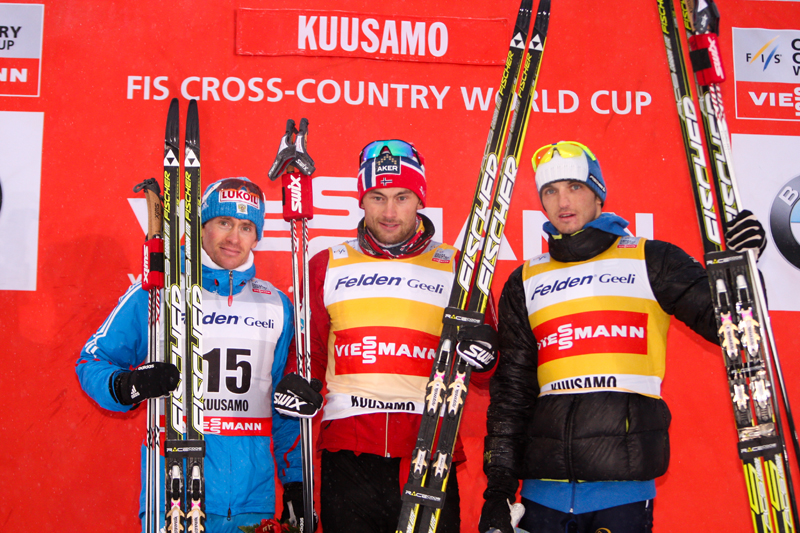
    Maxim Vylegzhanin (RUS), Petter Northug (NOR) and Alexey Poltoranin (KAZ) gather on the podium following the Kuusamo (FIN) mini-tour. Photo: Fischer/Nordic Focus.


  • Royal Palace Sprint Kicks off World Cup Finals

    Royal Palace Sprint Kicks off World Cup Finals

    The Stockholm city sprints, the first stage of the World Cup Finals, take place on Wednesday.

    All 2012 FIS World Cup Finals coverage is brought to you through the generous support of Fischer Sports USA, proud sponsors of Kikkan Randall, 2012 overall Sprint Cup Champion.

    STOCKHOLM, Sweden – The first leg of the 2012 World Cup Finals kick off with the Royal Palace Sprint in downtown Stockholm, Sweden on Wednesday.

    The race takes place on the doorstep of the King of Sweden, Carl the 16th Gustav, and is conducted in the classical technique.

    Snow was trucked in over the period of two-and-half days, with final grooming to take place Tuesday night.

    Members of the Russian team previewing the course.

    While temperatures have been warm during the day, there is hope that the course will set-up over night, creating firm fast tracks.

    Only the top-50 ranked skiers in the world, plus continental cup leaders, are granted start spots in the four-race competition.

    The US brings Kikkan Randall, Andy Newell, Liz Stephen, Jessie Diggins and Sylvan Ellefson while Canada will start Devon Kershaw, Alex Harvey, Chandra Crawford, Lenny Valjas, Dasha Gaiazova, Alysson Marshall, and Kevin Sandau.

    Randall has already locked up the Sprint Cup title, but is looking to hold off Charlotte Kalla (SWE) for fourth in the overall.

    Kershaw and Harvey have their own overall rankings to think about. The former is just 15 points ahead of Petter Northug, but with the Norwegian star reportedly withdrawing due to a continuing stomach ailment, there may not be much of a fight.

    Harvey is aiming to hold in the top-6 and is facing stiff competition from Russian Maxim Vylegzhanin.

    Both Newell and Randall are looking forward to a festive day.

    “It’s always a great atmosphere being so close to the downtown of a major city, especially down by the waterfront,” Randall told FasterSkier. “Pretty sweet too that the terrain features of the course are literally the steps of the Royal Palace.”

    Andy Newell racing in Stockholm, Sweden last season. Photo: Kellen MacFadyen.

    Newell concurred, adding that any urban sprint is a good time, and that racing in a country that holds an event on the King’s front porch is a special experience.

    Last year Newell used classic skis in the qualifier, but opted to double pole the heats on skate gear, a strategy he may repeat this time—if the track gets firm enough.

    The track must be firm enough to support vigorous double poling for the strategy to be appropriate, Newell explained.

    Last season the tactic worked well; he qualified ninth and advanced to the final, ultimately placing fifth.

    With the major climb coming right at the end, Randall expects fast starts in the heats, and Newell said that being in good position around the final corner into the big hill is key.

    Randall raced the 30k on Sunday in Oslo, with Newell contesting the 50k on Saturday. Both said they are ready to go, if not completely fresh.

    “This year is definitely a quicker turnaround than we’ve had to do before,” Randall said of the jump from Holmenkollen to Stockholm. “I’ve had a solid last couple of weeks and I feel like my racing shape is still strong…We’ll just have to see what’s left in the tank.”

    Matt Voisin contributed reporting.

  • Roenning Takes First 50k Win in Holmenkollen in Epic Sprint Finish

    Roenning Takes First 50k Win in Holmenkollen in Epic Sprint Finish

    Eldar Roenning (NOR) and Dario Cologna (SUI) sprint down the finish lanes for Holmenkollen glory. Photo: Fischer/Nordic Focus.

    As a classic specialist, Eldar Roenning (NOR) can oftentimes be overlooked when contemplating race favorites.

    The stocky Norwegian does not race the World Cup regularly, generally only hitting the events that play to his strengths in the traditional style of skiing, but he reached the top of the ski world on Saturday when he took the victory in the famed Holmenkollen 50k, defeating World Cup leader Dario Cologna in a mad sprint to the line.

    Martin Johnsrud Sundby (NOR) on his way to third place. Photo: Fischer/Nordic Focus.

    Fellow Norwegian Martin Johnsrud Sundby finished third, sure to please the King of Norway in attendance in the royal box along the homestretch.

    With temperatures failing to drop below freezing on Friday night, the tracks quickly disintegrated in the warm weather, and significant moisture built on the course.

    US Ski Team Head Coach Chris Grover told FasterSkier that the track was already gone in places before the race began and described the event as “a slog.”

    Roenning did not seem fazed by the slow track or the warm weather, remaining patient toward the front of the pack, in position to respond to attacks, but not going out of his way to push the pace or fight for bonus seconds.

    As is always the case in mass start 50k events, the race was wide open for until the last kilometer.

    The Norwegian team engaged in some tactics early on, opting to switch skis at the first opportunity while the rest of the field skied through. At the next pitstop, 10k later the Norwegians passed by while the rest of the field pulled over and then had to work to catch up.

    There were five opportunities to switch to new skis in the race, and athletes were allowed to take four.

    The strategy served only to apply a bit of pressure, and set the tone for the day—a relatively relaxed pace with periodic pushes from one skier or another creating a bit of stress on the pack before settling.

    Devon Kershaw (CAN) finds his pace behind Dario Cologna (SUI) in Oslo. Photo: Fischer/Nordic Focus.

    Canadians Devon Kershaw and Alex Harvey, both gunning for the podium described the overall pace as relatively easy throughout, and the main group remained large as it compressed on the long descent from the highpoint.

    Earlier in the race both Swede Anders Soedergren and Petter Eliassen (NOR) spent significant time pulling. Both men entered the day on the outside of the top-50—the ranking needed to contest the World Cup Finals.

    Soedergren especially is not a sprinter and would be well served by fracturing the pack as early as possible.

    The efforts of both men, however, did no more than drop some stragglers. While Eliassen did open a 30-meter gap at one point, there was never any real chance of an individual getting away.

    The race revolved more around the bonus sprints, especially early on, with a number of skiers looking for points in an effort to make the top-50 threshold. Sprinter Oystein Pettersen of Norway, Axel Tecihmann (GER), Ivan Babikov (CAN) and Calle Halfvarsson (SWE) all needed a solid bump to get in.

    Teichmann took the first preem at 3k followed closely by teammate Tim Tscharnke and Canadian sprinter Lenny Valjas with Halfvarsson in the mix as well—points are awarded to the top-10.

    Valjas was in the race, not to actually get points for himself, but to prevent others from doings so in an effort to help Babikov.

    Canadian National Team Head Coach Justin Wadsworth told FasterSkier that Valjas was also in need of a hard workout, so the plan worked well, though Babikov struggled and ended up dropping out.

    The bubble skiers quickly faded back through the pack and the race settled into a more standard routine, with the sporadic surges stretching out the pack, only to have it all compress on the descents.

    The course was the same as the World Championship 50k held just a year ago, with the series of grueling climbs up to Frognersettren and then the long winding decent back down.

    The preem sat right up at this high point, and in a nice variation from other such intermediate sprints, it wasn’t right at the steepest point. Skiers approached up a tough pitch but then the course flattened to double pole terrain before one last rise to the line.

    The five sprints lacked much drama with no one really willing to fully attack. Kershaw was one of three men to claim points all five times through, winning the final two to earn a total of 44 to go with his 10th place finish.

    Only Soedergren did better with 49 points.

    “I decided out there to just grab ones that wouldn’t take much out of me,” Kershaw told FasterSkier, adding that it was not his plan to chase the points.

    Kershaw described the pace as “pretty mellow,” and said “I think the incredibly slow, slushy snow played into that. Nobody could go for a flier off the front, so we just all skied around together.”

    The pace began to increase during the last 10k loop, with the Norwegians moving into position at the front. At one point the hosts held five of the ten positions in a sea of red suits.

    Quietly present, as always, was Cologna, who, with the overall World Cup title wrapped up, had no need for bonus seconds.

    He had one goal, to win, and stayed patiently in the mix, out of trouble toward the front, leading occasionally, but not pushing.

    The pack strung out the final time up to the top, but closed up once again headed to the stadium.

    The course looped through and headed out for one last short 3k trip with several smaller climbs before the finish.

    Sundby and Roenning drove the pace at the front with Cologna and Maxim Vylegzhanin (RUS) right behind.

    It quickly became clear that no one would break away before the final big hill, the gratishagen on the World Championship sprint course.

    Roenning led into the hill, and responded when Vylegzhanin attempted to get by. The Norwegian didn’t break and led over the top.

    The attack finally fractured the pack, and five men were left to fight for the win—Roenning, Sundby, Vylegzhanin, Cologna and Konstantin Glavatskikh (RUS).

    Roenning led down the backstretch and into the final hill in the stadium and Cologna accelerated by a fading Vylegzhanin.

    The two charged up the hill, running through the slush outside the tracks. Roenning led over the flat top and down into the homestretch. Cologna waited until the final flat before stepping out to make his move.

    He initially started to pull in front gaining a few inches, but Roenning responded, flying up onto his toes with each pole. He crept back, but it appeared that Cologna had the edge.

    And then, in a move that could have just as easily resulted in failure, Roenning switched to classic striding with just twenty meters to go. He immediately accelerated past, and by the time Cologna responded with a technique shift of his own, the race was over.

    Roenning crossed the line, and immediately flopped straight forward, face-planting in the snow. Cologna glided by, giving his competitor a pat on the back before collapsing in his own pile.

    While all eyes were focused on the top-two, Sundby, though no sprinter, overtook Vylegzhanin to claim bronze, a definite upset given the Russian’s strength in closing out longer events.

    The Russians may have been kept off the podium, but they still had a strong day, claiming fourth through eighth.

    After the race Roenning said he was surprised to win, but was happy to add a 50k victory to his resume.

    “I don’t see myself as a sprinter, but as an all-round skier… it is great to be good in all disciplines,” Roenning said.

    Cologna, who struggled with bad skis at the World Championships last year was pleased to get a measure of redemption.

    “Today, I had good skis, and felt better and better every round,” Cologna said. “To be on the podium at Holmenkollen is something special.”

    He said the race was “the longest 50k ever” that he had been part of and that “I think everybody is tired now and should be proud having completed the 50k.”

    Complete Results

    Holmenkollen podium, l-r: Dario Cologna (SUI), Eldar Roenning (NOR) and Martin Johnsrud Sundby (NOR). Photo: Fischer/Nordic Focus.
  • Northug Makes Usual Play to take Relay Victory for Norway

    Northug Makes Usual Play to take Relay Victory for Norway

    Team Norway poses after yet another 4x10km relay victory: Eldar Roenning, Niklas Dyrhaug, Martin Johnsrud Sundby and Petter Northug. Photo: Fischer/Nordic Focus.

    He may have failed in his attempt to win the Tour de Ski, couldn’t hang in the Marcialonga, and on Saturday, never factored into the 30k, placing 14th. But if there is one thing that Petter Northug can be counted on for, it is sprinting at the end of a mass start event.

    The men’s 4x10k relay was replete with attacks, counters, epic comebacks, and painful fades, but throughout it all it was hard to imagine any other outcome—Northug biding his time in the pack before throwing down an unmatchable sprint entering the stadium and holding in the homestretch for the victory.

    “I was confident that Petter could take the win today,” said Norwegian Martin Johnsrud Sundby, who skied the third leg. “With Petter at the end we have always a very strong guy.”

    Petter Northug (NOR) brings home the win in the men's 4x10km in Nove Mesto (CZE). Photo: Fischer/Nordic Focus.

    And that is exactly what happened. If Northug was orange, had four legs and stripes, someone could write a fine children’s book—“Sprinting is what Petters do best!”

    Despite the predictable finish, the race did not lack drama, and the key for Northug is positioning entering the last portion of the race.

    Coming of a sub-par race in the 30k, Northug could not be counted on to make up a large gap and still have fuel for the final charge, so when Niklaus Dyrhaug faded at the end of the second leg, bringing the Norwegian team to the halfway mark down 11 seconds, there was hope for the other nations.

    But Johnsrud Sundby, who has been quiet this season, wasted no time in closing the gap, and eventually handed off to Northug in the top spot.

    The race was full of yo-yos, with skiers slipping off the back of the pack, only to catch back on. Heading into the anchor lap, the lead group was down to five temporarily, and when Italy’s Thomas Morrigl made a gutsy move on the first climb, only Tim Tscharnke (GER) could follow.

    But the 10-second gap was short-lived. The race closed back up, and the pace dropped as no one was willing to risk another attack.

    The slowing was made evident as chasers Finland, USA, and the Czech Republic knocked over 30 seconds off the leaders in 2.5k near the start of the fourth leg.

    Maxim Vylegzhanin, running for Russia I, and one of the few men to best Northug at his own game, outsprinting the Norwegian in the 30k in La Clusaz, France last year, could find no such magic today, taking second, several meters ahead of Marcus Hellner (SWE).

    “I’m very happy today,” Vylegzhanin said after the race. “I was believed in our team, and I knew we were strong. It was a tough fight in the finishing straight but Petter Northug is in great shape and he was better.”

    While it is usually impossible to know what goes on in the minds of Russian coaches and team leaders, one has to wonder if there was any tension regarding the selection of the relay teams.

    Alexander Legkov and Ilia Chernousov were both relegated to the second squad, though Vylegzhanin, Konstantin Glavatskikh, and Stanislav Volzhentsev placed 3-5 in the 30k, and obviously performed well today.

    Dimitri Japarov (RUS) and Eldar Roenning (NOR) stride it out during the first leg of the men's 4x10km relay in Nove Mesto (CZE). Photo: Fischer/Nordic Focus.

    Lead off skier, Dmitriy Japarov did not race on Saturday.

    Chernousov was right in the mix in that race however, placing eight, less than two seconds behind his teammates, and while Legkov slipped to 19th, he skied with the leaders for most of the race.

    Whether the teams were selected solely based on Saturday, or if the fact that Chernousov and Legkov are part of a non-National Team training group, that is not smiled upon by team officials played a role, ultimately is irrelevant.

    Regardless of reasons it certainly appears that Chernousov and Legkov skied with something to prove.

    After Alexander Bessmertnykh dropped nearly 40 seconds on the opening leg, and Sergey Turyshev gave up nearly that much again, Legkov took over, posting the fastest leg time and closing the gap by 20 seconds.

    Chernousov took over 46 seconds back, but was able to completely close in the first 5k of the anchor leg. The effort clearly cost him, however, and he was unable to respond to Northug’s charge, finishing at the back of the lead group in 7th.

    The only skier who was even remotely close to Chernousov by time was Norwegian Finn Haagen Krough, racing for Norway II back in 13th place. Krough’s leg time was still 21 seconds slower than Chernousov’s.

    Complete Results

    The men's 4x10km relay podium in Nove Mesto (CZE). Photo: Fischer/Nordic Focus.
  • Back from Oblivion, Olsson Jump Starts Season with WC Win, Cologna Second After Leading Break

    Back from Oblivion, Olsson Jump Starts Season with WC Win, Cologna Second After Leading Break

    Johan Olsson (SWE) leads classical 30 k mass start in Nove Mesto (CZE). Photo: Fischer/Nordic Focus.

    After a two month hiatus from World Cup racing, Johan Olsson (SWE) demonstrated a complete return to form, pushing the pace from the get-go in the 30km classic mass start in Nove Mesto, Czech Republic, before countering a  vicious attack from Dario Cologna (SUI), and riding fast skis to victory.

    Olsson couldn’t have asked for a better start to the 2012 season. At the opening 15km skate in Sjusjoen, Norway, he skied to a convincing 30-second victory over Petter Northug (NOR). He followed up with a 5th place finish in the Kuusamo mini-tour and was on track to better his 2009 season in which he placed 14th in the overall standings while winning his first World Cup race.

    Following the final race in Kuusamo, however, Olsson didn’t even toe the start line on the World Cup for another two months, battling a series of upper respiratory illnesses, including bronchitis.

    “I had some tough weeks this winter, but my seasons are usually like that,” Olsson said, explaining that he is very sensitive to cold temperatures.

    After a strong result in a Scandinavian Cup race in mid-January, Olsson earned a start in Oteppa, Estonia, placing seventh. He continued to ski well at the Swedish National Championships, twice placing second to teammate Marcus Hellner, and after taking no chances in frigid Rybinsk, Russia last weekend, Olsson was back in action today.

    The sporadic racing and long-running battle with illness did not dampen the Swede’s aggression on the trail.

    Petter Northug (NOR), front and center during the mass start in Nove Mesto (CZE). Photo: Fischer/Nordic Focus.

    He led the race from the gun, and was never out of the top-5. Hellner and Anders Soedergren threw their hat in the ring at various points in the race as well, giving the Swedes a strong presence throughout the six-lap affair.

    With five intermediate bonus sprints, the intensity remained high, and with each successive lap the lead pack shrunk by several more skiers.

    Despite the challenges for bonus points, the real excitement didn’t begin until 10k remained in the race—not bad for a men’s mass start race where most events can be fast-forward to the final sprint.

    At the 20k mark Soedergren held the lead ahead of Alekander Legkov (RUS) with Hellner and Olsson in 3rd and 4th respectively. This was at the bottom of the large climb up to the bonus, and Devon Kershaw (CAN) worked up to take the top spot through the line in his quest for points.

    Cologna, the overall World Cup leader spent the first two thirds of the race comfortably ensconced in the middle of the pack. He made no effort for bonus points, missing out entirely the first time, and picking up a single point the next two times through.

    The Swiss star, however, was not off his game, he was merely biding his time, eyes set on the race victory.

    He quietly worked his way up toward the front, and on the second large climb of the lap, when Olsson accelerated, Cologna was in position to follow.

    The pack was caught unawares, and the pair immediately had 10 meters. Maxim Vylegzhanin (RUS) and local hero Lukas Bauer (CZE) tried to respond, opening a gap of their own on the main group.

    “We created a small gap and I thought it would be a good chance to go away,” Cologna said.

    With over five kilometers left in the race, the move was risky. Sustained breaks are not as fickle in cross-country as in cycling, but pulling away so early rarely leads to success.

    Cologna was committed however, and after Olsson, riding fast skis, led down the next descent, the Tour de Ski Champion took over, driving a fierce pace.

    From that point onward, Olsson had to content himself with riding Cologna’s tails. The two were well matched on the climbs, but even with slower skis, Olsson was hard-pressed to match Cologna’s double pole, resorting to kick significantly earlier in an effort to keep up.

    Some meters back, Eldar Roenning (NOR) joined up with Bauer and Vylegzhanin, but the three men were unable to close up. Lapping through the stadium they were six seconds behind the leaders and four up on the pack, and less than a kilometer later they had been absorbed.

    Cologna and Olsson blew through the final bonus sprint, stretching the lead to nearly twenty seconds. And one climb later, when the pack failed to make up ground, the margin appeared secure, though on several occasions, both Cologna and Olsson could be seen taking long looks back, watching for any threat.

    None would come, but Cologna, despite appearing the stronger, would have no chance to sprint for the win, ultimately undone by his skis.

    Johan Olsson (SWE) celebrates his victory with Dario Cologna (SUI) charging to the line for second. Photo: Fischer/Nordic Focus.

    Olsson moved into the lead on the final descent in the stadium, and cruised out to a 20 meter lead.

    Cologna attacked valiantly on the small rise before the homestretch, closing slightly, but that effort was erased on the next drop, and Olsson doubled poled home for his third career win.

    The Swede gave credit where credit was due, pointing to his skis as the key to victory.

    “I have had some good races lately with Otepää and Swedish Championships,” he said. “I think my shape is rising, but today the biggest difference was my skis.”

    He added that after the performance, he “might switch to downhill skiing.”

    Cologna said after the race that he had been planning an attack at some point, and that he is feeling in top form.

    Despite missing the win, he is now almost 400 points ahead of Northug in the overall. With the Norwegian planning on skipping the next several World Cups to prepare for the Vasaloppet, it would take a serious injury or illness to prevent Cologna from defending his overall title.

    Northug placed 14th today and did not earn a single bonus second. Kershaw, who placed 12th, accrued the largest number of bonus point. His 50 points are equivalent to an additional fourth place finish.

    Sixteen seconds after Olsson celebrated across the line Vylegzhanin led a charge of Russians at the front of the pack, to claim the final podium spot.

    He was closely followed by Konstantin Glavatskikh and Stanislav Volzhentsez in fourth and fifth respectively.

    Of Note:

    –       With Ilia Chernousov in eight, the Russians placed four skiers in the top eight.

    –       With Northug off-form, Niklaus Dyrhaug was the top Norwegian in 6th place. Dyrhaug skied well in the Tour de Ski, and provides a bright spot for the often maligned men’s distance squad.

    –       Sweden, led by Olsson, placed 1, 9, 11, and 13 with Ricakrdsson, Hellner and Soedergren in the mix.

    –       Bauer, limited as usual by his sprinting ability, placed 18th on home snow.

    –       Martin Jaks (CZE) saluted the home crowd, thanking them for their enthusiasm, as he skied home in 29th. Teammate Jiri Magal was 25th.

    –       22-year-old Hannes Dotzler (GER) followed up a 16th in the 15k classic in Estonia with a 15th today. Based on his limited World Cup starts, Dotzler appears to be something of a classic specialist.

    Complete Results

    Dario Cologna (SUI), Johan Olsson (SWE) and Maxim Vylegzhanin (RUS) take their respective steps on the podium following the 30 k classical mass start in Nove Mesto (CZE). Photo: Fischer/Nordic Focus.
  • Vylegzhanin and Chernousov Lead Dominant Russian Performance in Rybinsk Skiathlon

    Vylegzhanin and Chernousov Lead Dominant Russian Performance in Rybinsk Skiathlon

    Vylegzhanin on his way to victory in Rybinsk, Russia on Sunday in the 30 k skiathlon. Photo: Fischer/Nordic Focus.

    Rybinsk is like Russia’s version of Holmenkollen—perhaps not with quite as many spectators, but its fans were no less enthusiastic about the World Cup this weekend, and turned out in admirable numbers despite the cold to cheer on the national team. On Saturday, Russian skiers fell short of topping the podium in front of the home crowd, but that changed in a big way in the 30 k skiathlon on Sunday. Not only did Russia claim the top two spots, they took four of the top five and nine of the top 12.

    Maxim Vylegzhanin (RUS) delivered victory in Rybinsk, besting teammate Ilia Chernousov by six seconds on the twelve-lap course, and in a photo finish for third, Tobias Angerer (GER) broke up the Russian pack by outsprinting Eugeniy Dementiev (RUS). Petr Sendov (RUS) was 0.6 seconds behind in fifth, adding to Russia’s dominating showing.

    “This victory was very important for me because I couldn’t get to the podium in Rybinsk before,” said Vylegzhanin in a press conference following the race.

    “Something was always wrong either with skis or my shape. This time everything worked perfectly.”

    The Rybinsk crowd. Photo: Fischer/Nordic Focus.

    From the moment the gun went off, Russia pushed the pace. On the second lap, the top ten men were all in blue. In an interview with Skisport.ru after the post-race press conference, Vylegzhanin said that his team definitely used their numbers (15-strong out of 56 competitors) to their advantage, consciously using team tactics to try to break open the race in the classic portion.

    Vylegzhanin’s strategy was to wear his competitors down in the classic leg, as he considers it his stronger discipline. There were four intermediate bonuses available on Sunday, at the 6.5, 11.5, 21.4 and 26.5 k marks. At the sprint preem at the 11.6 k mark, Vylegzhanin was in third behind Konstantin Glavatskikh (RUS) and Dmitriy Japarov (RUS), but the pack wasn’t worn out yet, holding at around 30 skiers strong.

    In the exchange zone at the halfway point, Vylegzhanin had the lead and the front group had diminished to 19. As Kris Freeman (USA) described afterwards, the beginning of the skiathlon played out much faster than usual with the sprint bonuses, which were an added feature this year.

    The pace slowed once the skate leg got underway, and Vylegzhanin hovered in the top 10. The relaxed tempo helped his chances in the end, he told Skisport.ru.

    In the first skate preem at 21.4 k, Saturday’s winner Devon Kershaw (CAN) made a break to win 15 extra points, and continued to ski near the front for the rest of the race.

    Japarov and Italy’s Roland Clara attempted to break away shortly thereafter, but the pack reeled them back in, and as the group came through the stadium for the second to last time, Sedov set the pace, with four other Russians in the front.

    Chernousov made a move to take over on the last uphill before the stadium, but Vylegzhanin reacted, and the two put distance on the rest of the field. Chernousov still led as the stadium came into sight, but Vylegzhanin overtook him on the corner before the final straightaway and won by a six-second margin.

    Vylegzhanin said later that he had not particularly expected Chernousov to be the one to make the break at the end, but thought that everyone probably envisioned the last hill to be the spot where someone would try to make their move. With this in mind, he was ready to react to Chernousov’s surge.

    Vylegzhanin also told the Skisport.ru reporter that, though he was pleased with his first World Cup win of the season, it would have been more meaningful if so many Red Group skiers hadn’t been absent.

    Chernousov described his break as an attempt to repeat a nearly-successful identical move in Saturday’s 15 k, where he was just beat at the line by Kershaw.

    “I was really exhausted in the last three laps and tried to relax and use the same tactics as yesterday in the last uphill,” said Chernousov.

    Though he missed the top spot, the Russian was satisfied with his second podium in Rybinsk this weekend.

    Vylegzhanin and Chernousov put a comfortable gap on the rest of the field, but Angerer fought Demetiev for third, the only non-Russian in the top five. Demetiev’s fourth-place finish on Sunday was his first result back on the World Cup since the end of his two-year doping ban.

    “I’m happy to be on the podium again,” said Angerer. “Rybinsk becomes a very special place for me, I do not really know what is exactly special… I always feel well here.”

    “I tried to push hard and worked in front together with Roland Clara in the free technique part but at the end the Russians were too strong today.”

    Men’s results.

    Vylegzhanin (r) in front during the classic portion of the skiathlon next to Sergey Turyshev (RUS). Photo: Fischer/Nordic Focus.
  • Rybinsk World Cup Preview

    Rybinsk World Cup Preview

    Marit Bjoergen and Justyna Kowalczyk at the end of Stage 7 of the Tour de Ski. The two will face off again in Rybinsk on Saturday in the 10 k mass start freestyle.

    For the past few years, the World Cup in Rybinsk, Russia has been the weekend frequently skipped over by national teams and various individuals. With the overall World Cup title a focal point this season and no major championship to save up for, however, the expected fields are nearly double what they’ve recently been, in spite of the handful of athletes who have decided not to race in the extreme cold.

    The forecast initially looked borderline, but on Friday Rybinsk was predicted to get as high as 0F on Saturday. The FIS cutoff for a race to get cancelled or postponed is -4F. If Saturday’s temperature is right on the edge prior to the races, Canadian head coach Justin Wadsworth said he thinks officials will “blow on the thermometer a little bit and make it happen.” With the races set to go off in the afternoon, the temperature will likely have gotten as high as predicted by the time the men start at 2:15 pm local time.

    If the Moscow city sprints on Thursday were part of a push to attract more skiers to the Russian races, it worked. Sixty men and 53 women are on the start lists for the 10/15 k mass start freestyle races on Saturday, which include intermediate sprint bonuses. By comparison, only 30 women and 33 men took to the line in Rybinsk last year.

    Luckily for World Cup fans, that should this weekend a little more interesting. On the men’s side, current World Cup leader Dario Cologna (SUI) has decided not to race in the cold, and neither will the Swedes, Finns, and a few other big names—notably Petter Northug (NOR) and Lukas Bauer (CZE).

    There are still plenty of fast skiers set to battle it out head-to-head on Saturday. Home-field athletes Maxim Vylegzhanin and Alexander Legkov (RUS) currently sit fifth and sixth in the distance rankings, and will have plenty of motivation to perform well in front of Russian fans.

    The two mid-race sprint bonuses could potentially throw the race. Maurice Manificat (FRA) is coming off a bit of a down run following his second-place showing in the Tour de Ski final climb, but could be a contender. Devon Kershaw (CAN) seems on the brink of his first official World Cup win, and teammate Alex Harvey is coming off a fourth-place finish two weeks ago in Otepaa, Estonia. Ivan Babikov has rejoined his team in Europe, and after a strong finish in the Tour final climb, will be raring to go in the mass start.

    The American men’s squad, led by Kris Freeman, will have thinner ranks on Saturday. Noah Hoffman is still in Ramsau, Austria with the stomach flu, and sprinters Andy Newell and Simi Hamilton rejoined him after the Moscow sprint on Thursday.

    Freeman is coming off a comfortable win at Austrian nationals last weekend, and if he skis where he believes his fitness to at, he could mix it up with a top 15. Tad Elliott is back in World Cup action after staying in the US for a few SuperTours after nationals, and with plenty of time in Ramsau to adjust to the time difference, should be ready to go. Sylvan Ellefson is still hitting his stride on the World Cup, but with high energy carrying over from Thursday, could be ready for another good performance.

    On the women’s side, there are fewer big names skipping Rybinsk, and for good reason: Justyna Kowalczyk (POL) pulled 38 points ahead of Marit Bjoergen (NOR) in the overall World Cup on Thursday, and if Bjoergen wants to fight for it, she has to gut it out even at the remote venues.

    The course on Saturday features about 500 feet of climbing per lap, with the women doing four 2.5 k loops and the men six. In addition to Bjoergen, Therese Johaug and all of the big Norwegian names will be lining up. Charlotte Kalla (SWE) is also back for Rybinsk, fresh off of two Swedish national titles.

    The U.S. women have the momentum of a string of top performances on their side. Most recently, they placed three in the top-12 in Moscow, led by Jessie Diggins’s seventh—the 20-year-old undeniably on a roll this year.

    Kikkan Randall is sitting out the 10 k in order to be ready to go for Sunday’s skiathlon. According to USST head coach Chris Grover, Randall is prefectly healthy, but feels she needs to take Saturday off in order to be sharp the next day. Ida Sargent is also skipping the 10 k.

    Liz Stephen is coming off a 21st in Otepaa and a second at Austrian nationals, and the climbing-heavy course could work in her favor in Rybinsk. Holly Brooks, wrist mostly healed, is back on the American roster, and though she may have lost some strength in her arm and core while she recovered from the injury, her coach Erik Flora thinks she’s just as fit as ever.

    Sadie Bjornsen, though missing the heats in Moscow, nonetheless skied a respectable 39th. Bjornsen has said many times that falling just short of the points only gives her more motivation for the next race.

    Barring weather delay or cancellation, the Rybinsk men’s 15 k starts on Saturday at 2:15 pm in Russia (6:15 am EST), with the women starting 1.5 hours later.

    Men’s start list

    Women’s start list

  • Northug in Classic Finishing Form, Wins Men’s Skiathlon but Cologna Gains

    Northug in Classic Finishing Form, Wins Men’s Skiathlon but Cologna Gains


    Cologna, Vylegzhanin, and Northug charge to the line.

    OBERSTDORF, Germany – Four down, five to go, and an epic battle is developing in the men’s 2012 Tour de Ski.

    Over the course of the four events thus far, only 1.1 seconds separate Dario Cologna (SUI) form leader Petter Northug (NOR).

    Northug took his second stage victory of the Tour, but Cologna actually closed the gap due a strong showing in the intermediate sprints in the men’s 20km skiathlon in Oberstdorf, Germany.

    Despite the large climbs, and the challenges of the bonus sprints, set on top of the largest hill, no one could attempt a break away. As is often the case in men’s World Cup mass starts, it was a race of attrition, skiers gradually falling off the pace and slipping out of contention.

    Northug hitting one of the skate preems.

    Northug, who is looking to build a lead prior to the final climb, has been unable to shake Cologna at any point. They have kept a careful watch on each other throughout the early stages of the Tour, and both men appear in peak form.

    The bonus seconds provided interesting drama in a race that often comes down to the final kilometer.

    Skiers with ground to make up, Marcus Hellner, Lukas Bauer, and Alex Harvey, among others, were looking to close the gap at the intermediate sprints, while the leaders made sure they would not be losing ground.

    With bonus seconds awarded to the top-10, there were plenty of opportunities to attack, if only briefly.

    Bauer set the tone on the first sprint, running outside of the tracks and charging hard.

    Northug did not participate in the early sprints on the classic leg as he did not feel very good. He opted to conserve his energy for the skate, and the strategy paid off.

    He got his act together, and came back to nearly match Cologna’s total of 49 bonus seconds, ultimately coming up four short.

    Northug benefited from strong performances by teammates Kristian Tettli Rennemo and Niklas Dryhaug.

    The two men, out of the race for the overall, were tasked with assisting Northug.

    “They all had a job and that was to help Petter, and that is what they did and it paid off” Norwegian coach Trond Nystad told FasterSkier.

    Cologna grabbing some bonus seconds.

    “Take seconds, give him an easy track if they had a chance. Protect him and help him to move forward in the field,” Nystad continued.

    Northug acknowledged their help, pointing to that and his good skis as the difference in the race.

    On the last climb, the race for the preem was furious, and with the finish just 500 meters of downhill and flat away, there was no pause on the top as there had been in previous laps.

    Known for his ridiculous finishing kick in long races, Northug would not be denied. Riding a tight line on the corner into the stadium, he overtook first Hellner, then Cologna, and finally Maxim Vylegzhanin (RUS), to claim victory.

    “The last downhill is terrible when your legs feel like a ton,” Northug said of the final run to the finish. “You don’t have a good feeling in the downhill, but it is the same for everyone.”

    Cologna also passed the Russian, describing his own finishing speed as “90%” and joking that when he was at 100%, as in the sprint the day before, he bested Northug.

    As they crossed the line the two turned to take a long look at each other, mirroring the constant checking throughout the race.

    “Of course I know that I have to watch out a little bit for Petter and he also for me,” Cologna said after the race. “So there is a little bit of looking for where he is.”

    Swiss coach Guri Hetland said that Cologna enjoys the rivalry with Northug.

    “They are really really strong athletes, both of them,” Hetland told FasterSkier.

    “They both want to challenge each other and want to beat each other. It’s kind of a healthy competition relationship.”

    Hetland added that she thinks Northug motivates Cologna to be better, and added that he “doesn’t like to lose of course, and they are both like that.”

    Alexander Legkov (RUS) , who was 13th today, holds the third spot in the overall standings, 52 seconds back.

    But neither Northug nor Cologna feel the Tour is a two-man affair. Both point to the 35km Cortina to Toblach race as a critical point.

    The pursuit on gradual terrain provides plenty of opportunity for a strong chase group to make up minutes.

    Cologna doesn’t see that event as fair to the leaders, but said, “maybe Petter and I can work together and make a fast race,” and keep a solid gap.

    Hellner, who struggled in the pursuit in Oberhof, has bounced back well. A strong skate sprinter, and well-suited for the 35k, he should be at the heart of the chase group in that race.

    He moved up to 6th in the overall, just behind Canadian Devon Kershaw.

    It was quite the opposite for Axel Teichmann (GER), who broke out with a victory in the pursuit. His race today came to a de facto early end when one of his bindings popped off.

    Teichmann had to stop and reattach the plate, a hiatus that put him well off the back of the race.

    German coach Jochan Behle said he never got his back in the game completely, and even if he had, it is unlikely he would have been able to make up the ground.

    Teichmann will continue the Tour, however.

    Racers get the first of two rest days tomorrow. The Tour continues in Toblach, Italy with the skate sprint on Tuesday.

    Complete Results

    Nat Herz contributed reporting.

  • Team 3: Russia

    Russia

    2009-2010 Nations Cup Ranking: 3rd (7701 pts)

    2010-2011 Nations Cup Ranking: 3rd (6199 pts)

    Men: 2nd (4422 pts)

    Women: 7th (1777 pts)

    2011/2012 World Cup Team (Best Estimate)

    Men

    Stanislav Volzhentsev

    Maxim Vylegzhanin

    Petr Sedov

    Evgeniy Belov

    Konstantin Glavatsikh

    Ilia Chernousov

    Alexey Petukhov

    Nikolay Morilov

    Dmitriy Japarov

    Nikita Kruikov

    Sergey Shiryaev

    Alexander Panzhinsky

    Sergey Novikov

    Women

    Yulia Tchekaleva

    Anastasia Dotsenko

    Natalia Korosteleva

    Julia Ivanova

    Olga Mikhailova

    Natalja Iljina

    Valentina Novikova

    Svetlana Nikolaeva

    Olga Savialova

    Elena Soboleva


    What You May Have Missed Last Season

    It was impressive just how good the Russian distance skiing men were in 2010-2011 – especially in the last kilometer of racing.

    Maxim Vylegzhanin (L) during World Championships, Oslo 2011

    Alexander Legkov, Maxim Vylegzhanin, Ilia Chernousov, and Petr Sedov were all brilliant last season at various points, and all four finished in the top 20 in the World Cup Overall standings.

    In particular, for the first few weeks of the season it looked like Legkov was going to run away with the Crystal Globe. He finished in the top 10 six times in the first three weekends of racing, including a devastating attack a long way from home in the final day of racing during the mini-tour in Kuusamo, Finland, where he left Marcus Hellner and Dario Cologna standing still.

    And Legkov wasn’t alone in impressing the crowd with his finishing skills – Vylegzhanin did what most possible consider to be impossible, beating Petter Northug to the line at the end of the 30 k skate in La Clusaz, France.

    Joining his more highly-decorated and recognized teammates in the elite group this season was Chernousov, who had his best World Cup season to date. The highlight of Chernousov’s season was his big win on home turf, where he did a fantastic job of reeling in and then dispatching Frenchman Jean-Marc Gaillaird in the 20 k pursuit in Rybinsk, Russia.

    But despite having possibly the strongest team on paper, the Russians had the most devastating relay experience at World Championships in Oslo. After taking the tag in third place, just 20 seconds out of the lead, Legkov exploded spectacularly while skiing the third leg, giving up almost two minutes to the fastest leg time, and dropping the Russians back to seventh.

    On the flip side, while the men were solid except for the World Championships blunder, the Russian women did not impress. For the size of the Russian program, and considering the fact that it’s headed by Elena Vlyabe, who is second on the all-time World Cup wins list (45, or one less than Marit Bjoergen), the Russian women were nothing to write home about.

    Yulia Tchekaleva led the team with her best year on the World Cup to date, while Anastasia Dotsenko was a surprisingly effective sprinter, but just four women scored over one hundered points. The rest were mostly enthusiastic pack filler during the World Cup weekend in Rybinsk, Russia.

    But the Russian women failed to win a World Cup outright all season – even in Rybinsk, where the odds are usually pretty good (just look at all those RUS nation tags on the results list).

    Legkov leading Lukas Bauer during the 50 k classic at the 2010 Vancouver Olympics

    Notably, the Russians had significant quantity – they had 29 men and 29 women score at least one World Cup point. While a lot of those were collected during one three-race weekend in Rybinsk, Russia, it’s still an impressive number.

    What You Need To Know for This Season

    Several strong Russian women are back on the circuit, ready to bang heads with the best in the world.

    Irina Khazova has returned from a year-long break, where she had a baby, and has already put up an impressive second place result in the FIS race last weekend in a 10 k freesytle.

    Natalia Matveeva has returned from a doping ban, and while the formerly speedy sprinter has her eyes set on the home Olympics in Sochi 2014, there is no guarantee she’ll get to go.

    And it’s a good thing the Russian women are receiving reinforcements, as according to her FIS profile, Yulia Tchekaleva, the top female point producer from last season is injured and is currently not active.

    As for the men, Yevgeny Dementiev, also fresh off a two-year doping ban will be allowed to compete for a spot on the national team. The 2006 Olympic gold and silver medalist will be competing against a deep men’s team, and is now 28 years old, but could conceivably be a factor.

    The Russians are also strength training machines, cranking out all kinds of intense weight workouts, while wearing bullet-proof vests. And the lack of snow in Scandinavian isn’t a problem, as they have been working hard on synthetic skiing options.

    Evgeniy Belov (RUS) leading Alex Harvey (CAN) during the Under-23 World Championship pursuit.

    Who You Should Watch

    Holy smokes, the list could be endless, as Elena Soboleva, Konstantin Kuleev, Sergei Ustygov, and Gleb Retivykh all had top 10 finishes at World Junior Championships in Otepaa, Estonia last winter. The Russians always seem to have a home-run prospect in the pipeline, and last season FasterSkier picked break-out star Petr Sedov, who stormed to 20th in the World Cup Overall rankings.

    However, this year FasterSkier is tipping Evgeniy Belov, which is a bit of a no-brainer.

    The strong Russian was the only athlete to stay anywhere close to Canadian Alex Harvey in the Under-23 World Championship pursuit, scored 244 of his own World Cup points in just ten individual World Cup starts, was a member of three World Cup medal-winning 4×10 k relay teams, and to top it all off, is just 21 years old.

  • Russians Rule on the Mordarbacken; Kershaw 22nd

    Since the tail end of the 2011 Tour de Ski, Russia’s star distance skier, Alexander Legkov, has been missing in action. He fell ill with swine flu and couldn’t finish the Tour, then, with an abysmal performance in the relay at World Championships in Oslo, singlehandedly dashed his country’s hopes for a medal in that event.

    While the relay result stung, Legkov’s drought has been balanced by some strong performances by his teammates. There’s Maxim Vylegzhanin, the stalwart who took two silver medals at Worlds, along with Ilia Chernousov, who had a breakout World Cup win in Russia in January, then took bronze in the pursuit in Oslo.

    In Friday’s classic prologue at the World Cup Finals in Falun, Sweden, the story, and the cast of characters, was the same. Legkov was a disappointing 14th, but that was more than outweighed by his three teammates in the top four: Chernousov on top, Vylegzhanin in third, and 20-year-old Evgeniy Belov in fourth. Petter Northug  (NOR), in second place, was the only one who slowed the Russians’ assault on the podium.

    Three North Americans cracked the top 30, with Devon Kershaw (CAN) in 22nd, Alex Harvey (CAN) in 25th, and Kris Freeman (USA) in 30th. On the short 3.3-kilometer men’s course—Chernousov’s time was just under 11 minutes—there’s not much margin for error, and Harvey said his chances at a stronger result went up in smoke two strides in, when he broke a strap on one of his poles.

    He got a new one, but it was too short, and it took some shouting to get it—not what he was looking for at the start of a prologue.

    “You want to have the first k pretty smooth and relaxed,” Harvey said. “I was really bad.”

    The course took the men up and over the brutal Mordarbacken (Swedish for “murder hill”), which climbs 250 vertical feet in just over one kilometer, before rolling back down into the finish.

    The hill is tough enough on its own, but on Friday, its challenge was amplified by four or five inches of soft, new snow that fell before the race. Organizers regroomed the course a couple of hours ahead of the start, but according to Harvey, it didn’t help. There were no tracks going up the hill, making it tough to get grip.

    “Nobody had 100 percent kick, because of the track,” Harvey said. “So you have to deal with it…You have to understand, and live with the fact that your skis are not going to be super-grippy.”

    Even the strongest men on the World Cup, Northug included, were slowed to a near-walk on the Mordarbacken’s steepest pitches, but times were still tight.

    At the one-kilometer mark near the top of the hill, Northug was just nine seconds behind Belov, who was leading. But at that point, the Norwegian was all the way back in 17th.

    Pacing, Harvey said, was crucial.

    “You have to be going fast on the first k, but relaxed,” he said. “If you were smart enough on the first k, you can have energy left in the tank for the last k.”

    Kershaw, Harvey’s teammate, did have plenty left in the tank for the finish—he just didn’t start out hard enough. His phone was switched off after the race, but a message from his Twitter account summed up his feelings.

    “Bummer of a day Hal,” Kershaw wrote. “That makes no sense, but neither did my pacing in today’s prologue. 42nd at 1 k, finished 22nd…Disappointed.”

    Freeman, on the other hand, was a bit faster heading up the climb—he was in 19th at one kilometer, eight seconds out—but he faded slightly going over the top and back down, ending up 32 seconds from Chernousov. He also didn’t answer a phone call, but Chris Grover, the American head coach, noted that the result was the first time Freeman had cracked the top 30 in a prologue—he was 55th in his only other attempt, at the Tour de Ski.

    “”I’m feeling like my shape is better than it was at Worlds or [last weekend],” Freeman said in a press release. “It’s fun to get to the top of a hill and feel like there’s more there, like there’s more to give. I felt like my race was pretty good, and I am hoping for one more top 10 in Falun.”

    As for the top men, Northug’s second place was almost as good as a win, even though he finished just three seconds down on Chernousov. That was because he still managed to put 20 seconds—plus a 10-second time bonus—into his “most dangerous rival” for the World Cup Finals’ overall classification, Switzerland’s Dario Cologna.

    “I am well pleased with my race,” Northug told NRK, the Norwegian broadcaster.

    While the Russians had, by far, the best performance as a team—20-year-old Petr Sedov, in seventh, rounded out the squad’s five finishers—it’s the Norwegians and Swedes that are currently in control of the mini-tour’s overall standings.

    Northug currently leads by 16 seconds over Sweden’s Emil Joensson, with Jesper Modin (SWE) in third, 30 seconds down.

    Chernousov, thanks to the 15 bonus seconds he took for his win on Friday, is the top-ranked Russian, in fifth, but he’s sandwiched between Norwegians: Eldar Roenning in fourth, and Ola Vigen Hattestad in sixth.

    With two distance races remaining, a 20 k pursuit and a 15 k handicap-start freestyle, sprinters like Joensson, Modin, and Hattestad should lose places, while the Russians will likely move up. (Belov is currently 12th, and Vylegzhanin 13th.)

    Time bonuses will be awarded along the course of Saturday’s 20 k, a mass-start race, but regardless, it will be tough for any of the chasers to make up any ground on Northug, who has 30 seconds or more on all the credible challengers.

    Andy Newell (USA), in 15th, is currently the top-ranked North American, but he’ll have a hard time holding on to that spot.

    Harvey, in 19th, has a better shot at moving up, and he said on Friday that the weekend courses suit him. He doesn’t fare well on especially steep climbs in freestyle technique, but Harvey said that the trails in Falun are fairly tame.

    “Other than the Mordarbacken, everything else is rolling terrain,” he said. “I think it’s a good course for me.”

    Link to full results. Link to overall standings.

  • After 50 Long Kilometers on Skiing’s Hardest Course, Northug Outsprints Vylegzhanin Yet Again

    After 50 Long Kilometers on Skiing’s Hardest Course, Northug Outsprints Vylegzhanin Yet Again

    Petter Northug bringing home the gold.

    Blue skies, some uncountable number of ski fans estimated in excess of 105,000, the most prestigious individual ski race in the world, and all of it in Oslo, the self-anointed ski capital of the world. Such a day could end only one way: with Petter Northug once again accelerating away from his competition in the last 400 meters of the World Championship 50 k freestyle on his home turf.

    A World Cup men’s 50 k takes somewhere in excess of two hours, and for the most part, the first hour and twenty minutes is a race of attrition. The hangers-on (those with sub-par skis and anyone with less than strong form) slowly slip off the back. Today, however, the pace was not much more than a crawl from the start. The pack still counted 39 skiers at the 30-kilometer mark, even after four times up the two-kilometer Styggedalen climb.

    Gjerdalen in the pack.

    According to course designer Hermod Bjørkestøl, the loop was laid out to mirror the traditional elements of past Holmenkollen 50 k races. The version initially run in 1929 was a single 50 k and featured five hard climbs. When the course was switched to two 25 k loops, the climbs increased to six. Next came the 16.7 k circuit, used until 2009.

    The new 8.6 k loop, created specifically for World Championships, also has those six ascents, albeit in a different form: six laps, six times up the Styggedalen to Frognersetren.

    “It costs to go hard up to Frognersetren because… I think it is the hardest course on the circus of the World Cup,” said Tord Asle Gjerdalen, today’s bronze medal recipient.

    Despite the abundance of opportunities to attack on this “hardest course,” there were nothing more than feints off the front, with the likes of Pietro Piller Cottrer of Italy, Maurice Manificat of France and Remo Fischer of Switzerland taking a turn pushing the pace a little. Until 27 kilometers, when Canada’s Ivan Babikov took the lead over the top of the course at Frognersetren, there was nothing that could squarely be termed an attack.

    Even Babikov merely stepped up the pace a bit, and coming before the long, fast, descent, it wasn’t in a spot in the course

    Maxim Vylegzhanin (L) with an Italian, and Alex Harvey in the background.

    that could lead to a true breakaway.

    “I was leading for a bit because I felt pretty good,” Babikov said simply after the race.

    And so the race continued on its way, winding up from the stadium, past the Homenkollen chapel, around the sprint course and back to the stadium – ready to head back out toward the Styggedalen.

    It seemed impossible, with the likes of Northug, Marcus Hellner, Maxim Vylegzhanin, Daniel Rickardsson and others still onboard and brutal climbs looming ahead, that there would not be a move of consequence. Could the famed Holmenkollen 50 k really be a repeat of the 50 k skate at the 2006 Olympics, when more than 20 skiers entered the stadium with a shot for the medals?

    Hellner, however, was not interested in such an occurrence, and when the group hit the Styggedalen climb for the fifth time, the Swede took off, almost instantly shattering the pack. The gap was five meters, then ten, with only Piller Cottrer on Hellner’s heels.

    Stadium announcer Kjell Erik Kristiansen was barely able to contain himself, yelling into his microphone “This is not bullshit! This is serious!”

    Marcus Hellner leading the men's pack.

    Kristiansen was right, and his only error may have been understating the severity of Hellner’s punch. Piller Cottrer couldn’t hang, and quickly dropped back to the chasers. In his place Sjur Roethe, a 22-year-old Norwegian skiing in his first World Championships, put in the surge to try to close the gap.

    Hellner wouldn’t be able to replicate Therese Johaug’s successful early attack in the women’s 30 k. Roethe brought the Swede most of the way back before letting his elders take over. Hitting the crest, Ilia Chernousov of Russia, Northug, Roland Clara of Italy, Dario Cologna of Switzerland, Tobias Angerer of Germany, and Maxim Vylegzhanin of Russia had all regained contact, with Roethe left in no-man’s land a few seconds back.

    They hammered into the descent, but by the time the stadium was in sight, the chase pack had closed, albeit at the expense of 17 skiers who were now strung out along the trail behind. The game was now afoot, and when the climbing started again on the shorter, steeper hills above the stadium, Hellner hit the accelerator again.

    The top ten skiers opened a solid 20 meters on the remnants of the pack, but once again the drop back to the final lap brought them together. The pressure was certainly taking a toll: no longer was there a large group of skiers clumped at the front. Instead, the 22-skier group was now a snake, winding single file down the track. The skiers’ faces showed the strain

    Vylegzhanin, with Northug trailing.

    of high speed late in a long race.

    “I tried to do something there the last laps,” Hellner told FasterSkier after the race. “But it was hard.”

    The gold medalist in the Championships opening event, the freestyle sprint, Hellner hung tough but was eventually relegated to the back of the pack.

    “I didn’t have my best day,” he said, but added that he was very pleased to leave with two medals and the experience of racing the Championships at Holmenkollen.

    Gjerdalen, who kept a low profile most of the race, was always in the mix but rarely right at the front. He withstood Hellner’s first attack, but said that if someone else had made another move right over the top, he may not have been able to manage.

    “It’s like this in these longer races – sometimes you are feeling good and suddenly you are feeling bad again,” Gjerdalen said. That tough fifth time up Styggedalen was one of the bad times, but when the finish rolled around, the tables had turned and he felt “very much stronger.”

    Skiers were allowed to change skis up to four times at the lap, and nearly all of the leaders chose to do so with ten kilometers to go. Northug accelerated out of the feed zone at the high point of the stadium, getting a gap into the exchange.

    Belarus's Sergei Dolidovich.

    Even when Lukas Bauer and ageless wonder Sergei Dolidovich of Belarus skied straight through, Northug was out right on their tails, forcing his competition to briefly surge to get back on board.

    Rickardsson, the lengthy Swede who dominated the Drammen World Cup 15 k classic two weeks ago, took over at the front, continuing to push the pace, with Northug just behind. The suffering chasers gained a moment of respite when Rickardsson slowed almost to a stop on the flat at the high point of the course, looking for someone else to take over. There were no volunteers, and he took off again into the descent.

    When the pack left the stadium for the last time with less than four kilometers to race, there were seventeen skiers who seemed to be in contention for the win. And it was an impressive group; only a few of the prerace favorites had fallen back. With just a few steep hills left, the skiers steeled themselves against the attacks that were bound to come.

    And sure enough, Juha Lallukka, the practically unknown skier who ditched the field when he raced the third leg of Finland’s relay, pushed hard in an attempt to break up the pack. While Northug – the one everyone was worried about – didn’t drop, a number of others did, among them most of the Swedes and Babikov.

    By the time the men, led by Vylegzhanin, were zooming down the hill towards the stadium – and the long, steep hill on the sprint

    Norwegian Sjur Roethe.

    course, called the Gratishaugen – the pack was down to ten men. But even though quite a few athletes were still there, the climb had taken a serious toll on their legs, in ways that they couldn’t yet fully appreciate.

    Dolidovich was the first to find out. At 38 years of age and with just one World Cup victory under his belt – a 60 k skate race in Kuopio, Finland, in 2001 – Dolidovich surprised the field by finishing fourth in the 30 k pursuit earlier this week. He was in second place behind Vylegzhanin coming down over the bridge next to the stadium, and while it seemed unlikely that he could beat Northug in a sprint finish, he might have been headed for his first World Championships medal. Then, unable to control his legs any longer, he caught an edge and crashed into the wall, breaking a pole.

    The Norwegian fans held their breath: Northug was right behind the Belorussian.

    “He was falling, he went to the left so I just jumped over his right ski,” Northug said in a press conference. “So I was lucky there.”

    Just seconds later, a Norwegian in a white hat did the same thing going around the downhill corner. And again, the fans gasped.

    But Northug was still safe at the front. The unlucky skier was Petter Eliassen, who dusted himself off as best he could, his hopes dashed.

    Vylegzhanin after the race.

    Going up the Gratishaugen, Vylegzhanin put in a furious attack, which dropped all of the remaining skiers except for Northug and teammate Gjerdalen, who seemed able to follow but barely lost contact going over the top of the hill. The trio sprinted along the far side of the stadium, with the dramatic backdrop of the ski jump, trailed by five men: Rothe, Angerer, Alex Harvey of Canada, Rickardsson, and Lallukka.

    If the Gratishaugen was renamed Hellnerbakken earlier this week, then the final hill in the stadium will have to be renamed Northugbakken. Just as he had in the relay, Northug put on his signature move as he began up the hill, passing Vylegzhanin by the time he got to the first corner. Going across the top, he accelerated again. While Vylegzhanin never trailed by much, the outcome of the race was not in question. Northug was headed for gold.

    “It went as I expected, me and him fighting for the gold,” Northug said. “He beat me in La Clusaz so that was a big motivation for me. I think it was good that he beat me in December so I wanted to get my revenge on him. He’s a really good athlete, he’s really smart when he’s racing.”

    Despite the World Cup victory earlier this year, it was a familiar, sinking feeling for Vylegzhanin, who finished 0.7 seconds

    Northug after his fourth medal of the championships.

    behind Northug in this event at the 2009 World Championships. And earlier this week, he lost to the Norwegian by the same margin in the 30 k pursuit.

    “It is a stimulus for me, that I want to beat him next time,” the Russian said through an interpreter in the post-race press conference. “I have to be better at the finish.”

    Not much better – Northug had neither the time nor the energy to do any celebrating or showboating as he crossed the line. And when Vylegzhanin had increased his pace to chase Northug, Gjerdalen had been dropped in a serious way. In fact, it wasn’t clear that he could be able to hold off the men who were charging behind him.

    In the end, he did, and earned the first medal of his career.

    Less than two seconds after Gjerdalen finished, his teammate Rothe, an even less-likely candidate for a top-five finish today, won a photo finish ahead of Harvey and Angerer, giving Norway three of the top four finishers.

    When asked about the team’s plan for the race, Gjerdalen initially made a joke.

    The Norwegian fans near the high point of the course.

    “The plan was for all five to just go hard, and maybe just get a gap like Therese did, work together and maybe win by two minutes, and split the gold,” he said. “That was the plan. But then how to complete the plan….”

    On the serious side, though, he said that the World Championships had vindicated some of their weaker performances.

    “This has been a great Championship for us,” he said. “Both for girls and boys. Especially for us boys we have had a long way back and haven’t had the best results early this season, but we don’t even think about that now because it’s the Championships that matters. When we sat down in the springtime and talked about it it was only the Championships that we would think about after this season. So I’m quite happy to succeed now at Holmenkollen. It’s big for us, for the whole team.”

    As for Northug, today’s race proved once again that at the end of a distance race, nobody is better at moving fast.

    “The most important thing for Petter is that he trains with his brother, who is probably a little bit faster than him when you go form zero to one hundred meters,” said Vidar Lofshus, the Norwegian national team sports director. “And sometimes when you do like a sprint when you are out training, Thomas will even beat him. But when they come to a sprint like this and they are both

    Northug (R), with Lukas Bauer (L).

    tired, then Petter always beats him. But I think that’s most important. He’s always looking for how to improve his final sprint.”

    Northug pushed himself to exhaustion and expected to have an early night tonight. “I was very tired,” he said. “If you are going to win the 50 k then you have to be.”

    He said after his victory that he “has no wishes – I am happy,” and that the relay victory still meant more.

    “As a team, the most important was to win the relay,” he explained. “Championships in Norway are really the most important because so many people feel like they are part of the team. All the whole of Norway feels that they are almost part of the team.

    “Finally, now I can relax,” he said.

    -Nathaniel Herz contributed reporting.

  • Northug Triumphs in Oslo, Overcomes Harvey Attack

    Northug Triumphs in Oslo, Overcomes Harvey Attack

    Petter Northug celebrates his victory in the 30km pursuit.

    When asked whom he designed the Oslo courses for, the renowned Hermod Björkestöl, responsible for the layouts at the last three Olympics, responded simply “for entertainment.”

    And entertainment, in the form of drama and excitement, was provided in spades as Petter Northug (NOR) overcame a shocking early attack by Alex Harvey, and an impressive late challenge by the Russians to achieve his primary goal for the 2011 World Championships – an individual gold medal.

    Northug took the win in the final 500 meters, besting the Russian duo of Maxim Vylegzhanin and Ilia Chernousov in the men’s 30km pursuit and claiming his fifth career World Championship medal.

    Northug described the race as “my biggest chance to get an individual gold here in Oslo—maybe my biggest dream, and maybe my biggest achievement I can do as a skier in Norway.”

    The excitement didn’t being until well into the race, when Harvey found himself at the front, and decided to go. Coming up the large climb featured on the sprint course, Harvey attacked, and quickly opened up a gap entering the stadium.

    The move, at the 18 kilometer mark was unplanned, and in some respects, accidental.

    Harvey, at the top of the hill, pulls away.

    “I felt really easy in the group and my skis were fast,” Harvey explained. “I didn’t really attack. Everyone switched to offset and I just kept one-skating not too hard, and then I had a gap so then I decided to try to go.”

    Through the stadium Harvey’s teammate Ivan Babikov, skiing well toward the front already, took over and dropped the pace. “I tired to get him a couple more, maybe five seconds more—just go easy at the front, Babikov said.”

    That strategy worked briefly, but the Russians were not going to let the gap grow too big. Vylegzhanin said they were “very concerned” about Harvey’s ability to get away, and expended the energy to minimize the damage.

    The Russians were joined at the front by Italian Roland Clara, and the ever-present Dario Cologna (SUI). The gap reached nearly ten seconds, and the possibility of gold for the 22-year-old Canadian became a reality.

    But the pack started closing just past the 20-kilometer mark, reducing the lead to under seven seconds. Harvey still looked strong, but the chase was moving faster, and with nearly ten kilometers ago, the attack appeared to have failed.

    The next time check, however, proved otherwise. In the course of a kilometer-and-a-half, Harvey stretched the margin to 16 seconds and the game was on.

    “I was just skiing my own pace at the front, opening the gap,” Harvey said. “I was going for the win.”

    An early attack in a mass start is the ultimate gamble. If a skier gets clear, he can avoid the chaos of 15 men fighting for position heading into the final sprint, and more importantly, neutralize the finishing kick of Northug.

    Babikov takes the lead in the stadium and tries to drop the pace.

    Johan Olsson tried such a strategy at the 2010 Olympics, breaking even earlier and gapping the field in the classic portion. He was eventually caught a kilometer before the finish and impressively held on for the bronze.

    Harvey’s fate would not be so kind. His body betrayed him, his inner thighs inexplicably cramping.

    “I stopped skiing basically, he said. It was so bad that he couldn’t ride a flat ski and struggled to keep his feet on the descent from the top of the course.

    He still led coming back into the stadium, but the inevitable was clear. Norwegian Tord Asle Gjerdalen accelerated down the homestretch, Northug hot on his heels, and on the bridge headed back out for the final 3.75 kilometer loop, Harvey was absorbed.

    The race was wide open again, and with trail running out, the last lap featured one attack after another. Devon Kershaw, coming off four podium appearances in the Tour de Ski, charged hard on the biggest climb, a move he later admitted came too early. He held the pace, but couldn’t get clear, and when the race hit the final large hill below the stadium, he was unable to hold on.

    Italian distance specialist Giorgio DiCenta tried his luck next, but he too came up short.

    Gjerdalen leads Northug in the final charge to close the gap on Harvey.

    All this time, Northug was lurking just behind the leaders. Content to sit back through the classic portion, conserving energy, he had been prepared to work to close the gap on Harvey on the fourth lap. It never came to that, and he was able to hold toward the front, relatively free of trouble, without driving the train.

    Toward the top of the hill he finally went. “You don’t want to know what I’m saying to myself in my head—it’s not so kind words—I try to punish myself,” Northug said.

    The last thing he remembers thinking as he attacked? That this may be his only chance at the individual gold.

    He took the lead, but it was hardly vintage Northug. With three-quarters of a kilometer to go from the top of the hill, and the Russians and Marcus Hellner breathing down his neck, Northug had not yet put it away.

    Hellner of all people had no business being at the front. With the Swedish team missing the glide, he was unable to stay in contact on the classic portion of the race. At the transition, he was back in 29th, twenty seconds off the pace.

    It took the fastest skate time of the day to regain contact and be in position to fight for the medals. But he paid a price, and his efforts on the back climb were not enough.

    According to Swedish coach Rickard Grip, after battling to catch up, Hellner didn’t have quite enough to get by into the lead, and he also pointed out that Northug, among others, would be aware of Hellner’s tactic – attack early on that climb and hold to the finish.

    It worked perfectly in the sprint, but said Grip, “it is hard to win with the same type of way – two times in a row… Northug knows that he really had to keep his eyes open for what Marcus was doing.”

    Northug did just that, spotting Hellner amidst the fray. “I wasn’t worried, but for sure I have my thoughts in my head that he’s not going to beat me one more time here in front of the home crowd,” Northug said. He described such an outcome as “embarrassing,” and was actually happy to see his rival.

    “It was good that Marcus was showing his face….on the last uphill…that helped for motivation,” said Northug.

    Vylegzhanin (#6) leading the chase.

    His lack of concern for the Swede did not extend to Vylegzhanin. While the Russian is no sprinter—he made a rare sprint start in Drammen, placing 62nd—Northug knows firsthand that Vylegzhanin finishes well at the end of long races. In the La Clusaz 30k in December, Vylegzhanin outlunged Northug at the line for the victory.

    “I saw Vylegzhanin looked stronger,” Northug said. “So I knew that maybe he would be the hardest one to fight with in the end.

    “I have gone through this race in my head now for one year,” Northug continued. “I have been in the situation in training many times—I knew that in this track you have to stay in front, and the attack was also planned in my head.”

    The race flowed along the front of the jumping bleachers, taking the hard 90-degree corner into the backstretch, Northug still leading, and the Norwegain crowd roaring their approval.

    Vylegzhanin stayed strong, and Hellner held position in third. Up the last hill behind the cross-country stands, and around the back, Northug increased his speed again, and finally appeared to have the gap he needed. Hellner, finally spent, could do nothing when Chernousov sped by on the high flat, and limped across in sixth.

    Northug never opened more than a few meters on Vylegzhanin, and had not time to celebrate across the line. He doubled over, skidding to a stop and collapsed in a corner of the finish pen, not to rise for some minutes.

    Northug crosses the line, Vylegzhanin right behind. Chernousov is to the right.

    The Russians meanwhile celebrated their first medals of Championships, Vylegzhanin matching his silver medal performance in the 50k in 2009. Chernousov, on the other hand, made just his second major Championship start, and has just one career World Cup victory to his name.

    “We did our best to beat him,” Vylegzhanin said after the race. “We always try to have some power reserved in the finish in case we can beat him once.” He added with a smile “let’s see later in the Championship.”

    “We know it’s hard to be as good or better as him,” Vylegzhanin said of Northug. “But we are on the case.”

    In the sprint, Northug was polite after the race, congratulating his competitors, but never cracking even the semblance of a smile despite his silver medal. Today he was a different man, saluting the crowd, grinning broadly, as relieved as joyful.

    For the flower ceremony he donned the gold team jacket that thus far only Marit Bjorergen has received.

    “For me,” Northug said, “I knew if I won today it would be maybe easier for me to race the next week in the Championships because I have made my gold.”

    Northug also mentioned that he would have preferred a small group in the skate race. He wasn’t the only one surprised by the large pack.

    The pack early in the classic leg.

    The classic portion of the race looped three times around the five-kilometer course, a route that features 200 meters of total climbing. Despite the large climb, the field did not break up as many expected.

    Said BjörkestölI was actually surprised. My guess was that on the final round at the top [of the classic course]…there would be 10-15, and there was double.”

    The veteran trail designed speculated that the difficulty of the course may have actually been the issue, explaining, “If it is too tough, they do not dare to go.

    Canadian Devon Kershaw described the classic pace as “dead easy,” and American Noah Hoffman, who spent the first two loops with the lead pack concurred.

    “I think it was slower than the U-23 pursuit,” Hoffman said.

    Kershaw ended the day in ninth, losing a photo finish with Tobias Angerer (GER). Harvey held on for 12th, and Babikov took 15th. Norway, Italy and Canada all finished with three skiers in the top-15.

    It was great to be a Norwegian today.,” said fifth place finisher Martin Johnsrud Sundby (NOR). “I haven’t seen such team effort in many years.”

    Men’s 30km Pursuit – Results

    Nat Herz contributed reporting

    The race headed up the first hill.