Tag: Megan Imrie

  • Canada’s Le Guellec, Kocher Finish 26th in World Champs Pursuits; Team’s Seven Starters Have Mixed Success

    Canada’s Le Guellec, Kocher Finish 26th in World Champs Pursuits; Team’s Seven Starters Have Mixed Success

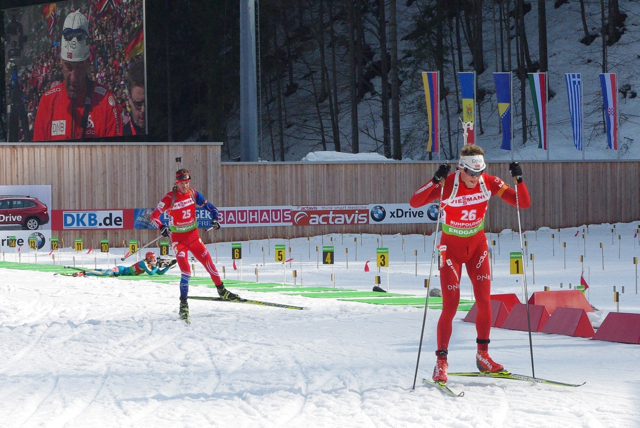
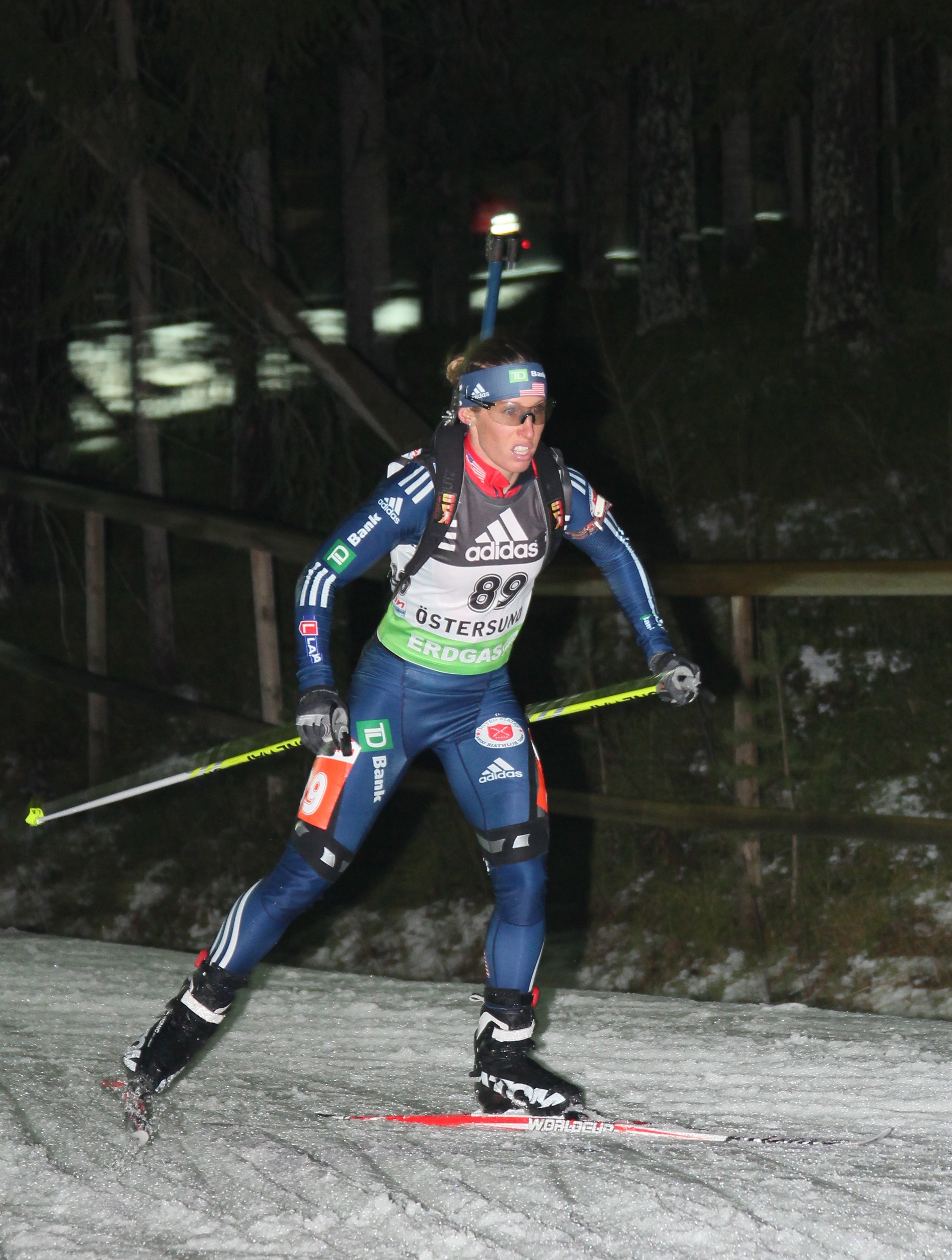
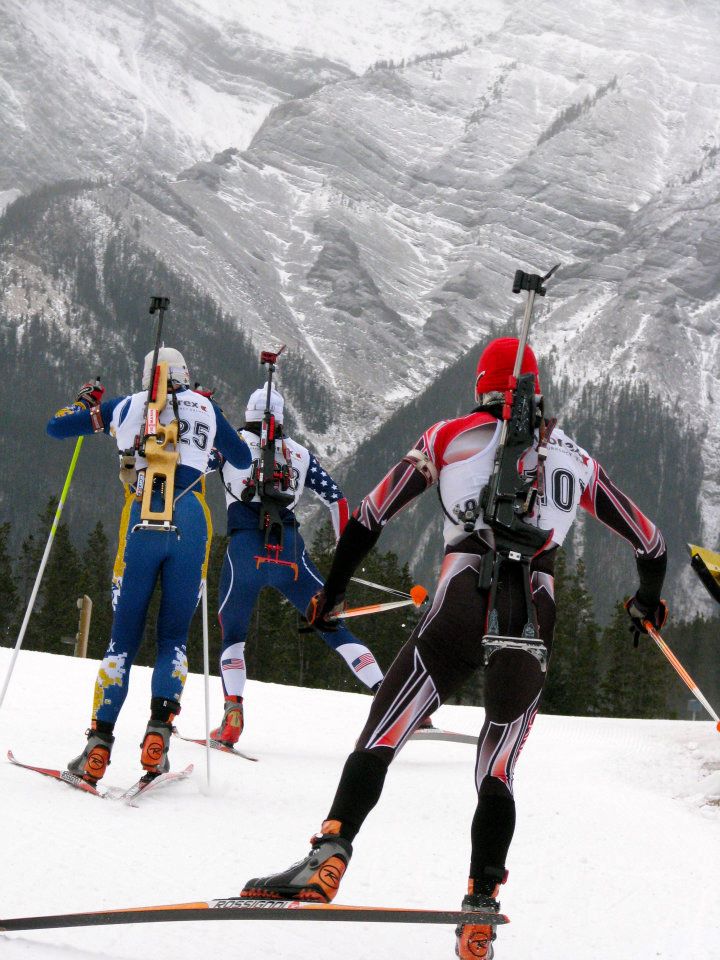
    Canada's Megan Imrie (2nd from left) was already attacking on the first hill out of the stadium.

    RUHPOLDING, Germany – Two Canadians had high hopes for Sunday’s pursuit: Jean Phillipe Le Guellec was 14th after Saturday’s World Championship sprint, and teammate Zina Kocher 18th. They were poised, it seemed, to have career-best finishes.

    Le Guellec had never finished in the top ten at World Championships, but started just 12 seconds outside it on Sunday. Kocher was shooting for a top-16, which would have guaranteed her funding through Athletics Canada for the next season.

    Bjorn Ferry (SWE), Le Guellec, and Dominik Landertinger (AUT).

    But neither of them hit the mark, and both ended up 26th at the end of the day.

    Le Guellec later wrote in an e-mail that he “wasn’t in such a good mood” after his 12.5 k, four-stage race.

    “Looking at results, obviously I stumped down quite a bit,” he said. “The race was going ok until the last shooting basically.”

    Le Guellec started off strong, cleaning his first stage and moving into the top ten, where he skied with Lowell Bailey of the U.S. and Andreas Birnbacher and Simon Schempp of Germany. Even after missing a shot in the second stage, he dropped no lower than 11th, and was back into ninth after a clean third stage.

    But in the last stage, he missed two shots. Le Guellec’s ski speed also didn’t do him any favors – he said after the sprint, too, that he had felt slow – and rather than regaining places on the final loop, he lost them.

    “I came out of the penalty loop in 17th,” he explained. “The last lap was no different [than the others], and I got passed by seven guys in the last kilometer of the race. I had nothing in the tank to fight back and dropped to 26th.”

    The Canadian, who placed 11th in this event at the 2010 Olympics, was very frustrated with his skiing; his course time was just the 38th-fastest of the day, and with only a single athlete (Roland Lessing of Estonia) cleaning the race, his solid shooting could have gained him more spots.

    “My skis were fast once again, but my ski shape was not great, and it’s not like the sprint where I felt not so good but actually did decent,” Le Guellec lamented. “I was getting passed by trains on all laps. With only a day of rest before the individual, I’m hoping my form will be better.”

    Kocher (r) and Poland's Krystyna Palka in their first standing bout.

    Kocher faced an opposite problem in her 10 k pursuit. Starting 18th, she immediately missed two shots and dropped to 27th.

    “Right off the bat, it had me a little bit off my game from the get-go,” she told FasterSkier in an interview at the finish line. “At the beginning I kept it easy, that was kind of my plan, just to draft and come in sure of myself. It didn’t quite work out when I missed two.”

    Kocher had discussed earlier the difficulty of dealing with the 16th-place requirement, and she said that after her initial errors, some of the pressure actually disappeared. After cleaning the second stage, she skied in the low twenties, and it seemed that with half the race still remaining, she might reach her goal after all.

    “When I was around 20th, I was like, ‘okay, I’m back in the game,’” Kocher said.

    But she struggled in standing, missing one and two shots in the two stages, and wound up, just like Le Guellec, in 26th.

    “I guess it was just a really hard race,” she said. “On that last standing I was getting pretty shaky. It was pretty hard work skiing today. So it’s not what I wanted, I really wanted 85 or 90% shooting, and that would have put me in that top 16 for sure.”

    Now, both racers are left looking forward to the longer, four-stage individual races which will be held Tuesday and Wednesday. His next race would be a challenge, Le Guellec admitted, especially in the deep, soft snow that has characterized the competitions so far.

    “The 20 k course is very demanding, and this is without taking conditions into account,” he wrote.

    Kocher was more positive, and pointed out that with two top-thirty finishes, she was in good shape to snag a position in the exclusive mass start race.

    “I’m psyched for the individual, and now I might have a good chance for the mass start,” she said.

    The Rest of the Canucks

    Megan Heinicke and Italy's Michela Ponza approaching the range.

    Team Canada started the day on Sunday with lots of opportunities – they had put a total of three women and four men in the pursuit out of four possible starters in each race in the sprint. The rest of the team had started much lower down the results sheet, but there potential to move up.

    Of the remaining starters, Megan Imrie and Megan Heinicke both gained at least ten places, with Imrie advancing from 51st to 39th and Heinicke from 52nd to 42nd.

    Imrie used strong shooting to make her move, only missing a single shot and gradually picking up a few places in each loop. Her racing earned her World Cup points, which are awarded to the top 40, for just the sixth time this season.

    Heinicke just barely missed that cutoff, but had a strong race as well, cleaning both prone stages and then missing a single shot in each standing stage.

    In the men’s race, Nathan Smith started 45th and after going zero-one in prone had moved up to the low 30s. But in his first standing stage, he had difficulty with the wind and missed three shots, dropping back down further than his starting position. He missed a single shot in the final stage and finished 43rd.

    Nathan Smith leading Scott Perras around the penalty loop.

    “Even the [stage] where I hit four, it was a hard four to hit,” Smith said of the standing stages. “It wasn’t easy. Maybe I should go a little bit easier into the range – I went a little bit too hard on the last large hill because I was trying to stay with guys.”

    Despite the frustration of his shooting, Smith told FasterSkier that he thought his skiing had improved from Saturday, and that it was good to have head-to-head competition and better peers on the trails, compared to the sprint where he was seeded with mostly slower skiers.

    “It was fun,” Smith said. “Especially on the flat part, there was some headwind, so it was a lot easier to stay behind someone. I think I only got to do that one lap – sometimes I had to pull the guys. But you could tell that there was a big difference.”

    Scott Perras started 50th and ended 54th on the back of six penalties, while Marc-Andre Bedard moved up from 55th to 52nd.

    Bedard said the race was “rough, but fun,” and that his four penalties were not enough to gain spots at this level of competition.

    “The fastest skiers are already up front,” he explained. “So to climb up from far behind – if you’re top 30, that’s good for moving around, but if you’re in the back, like 50s, to climb up then the others in front have to do very badly, because usually on the World Cup nobody shoots under 80%.”

    Like Le Guellec, Bedard said his skiing could use some work – but he wasn’t completely discouraged about his prospects for the individual race.

    “The skiing was not so strong, so I really concentrated on my shooting,” he said. “That pace was good for the individual, but a little too slow for the pursuit.”

    Full men’s and women’s results

    Men’s and women’s race reports

    Marc-Andre Bedard in action.


  • World Championships Sprint Roundup: Bergman’s Baby, Neuner Is Cold As Ice, and Much, Much More

    World Championships Sprint Roundup: Bergman’s Baby, Neuner Is Cold As Ice, and Much, Much More

    Tarjei Bø of Norway leading Jaroslav Soukup of the Czech Republic on the range; Bø, who finished third in this race last season, placed 17th.

    RUHPOLDING, Germany – With more than 250 racers contesting yesterday’s World Championships 7.5 and 10 k sprints, there was plenty of news that didn’t make it into our race reports – both from international stars and from our own interviews with U.S. and Canadian athletes. Here are some of the notable bits that we couldn’t fit in:

    – Bronze medalist Carl Johan Bergman of Sweden wasn’t really expecting a medal yesterday, but he was expecting something else – a baby. His wife, Norwegian biathlete Live Kjersti (Eikeland) Bergman, was due yesterday but hasn’t yet given birth. “Carl Johan is always very focused when he is there, for the most part,” she told Swedish daily Expressen before promising to “keep the baby in” until after Sunday’s pursuit so he could concentrate on winning another medal.

    – Bergman and French gold medalist Martin Fourcade hammed it up in the press conference when a journalist asked Bergman “what kind of person Fourcade is for you.” After making some jokes with his competitor, Bergman answered the fairly awkward question by saying Fourcade was an excellent biathlete, and that at least they had a good ski company in common (Rossignol).

    – The translation is a little rusty, but Norwegian biathlete Synnøve Solemdal basically called gold medalist Magdalena Neuner “cold as ice” in an interview with broadcaster NRK. “It looks like she is relaxing on a Sunday before each race,” said Solemdal, who had much more trouble, missing four shots and placing 32nd. “She just stands there and enjoying herself and looking very relaxed. It does not seem like she has any nerves. It’s fun to watch… She has so much pressure on her, just like all the Germans. What she did today deserves respect, and it has been a big inspiration for me.” The piece included shots of Neuner being mobbed by German media, and reported that she was so busy that she didn’t make it to the press conference until an hour and a half after she finished the race.

    – In other Norwegian news, NRK reported that Ole Einar Bjørndalen has cut his shooting times in half since the 2002 Olympics, where he won four gold medals. The legend placed 21st in the sprint, but is not out of the running for the pursuit; he won the last World Cup pursuit in Kontiolahti, Finland.

    – Teammate Lars Berger boasted earlier that he could win the sprint. Instead, he missed four shots and placed 32nd.

    – The men’s race was rough for the home country. Despite high expectations, the team was led by Andreas Birnbacher in 16th place. The race marked the return of double Olympic gold medalist Michael Greis, who underwent foot surgery in August. He contested a few World Cup races this season, but the 35-year-old hadn’t competed since mid-January; he finished 26th yesterday.

    – Thanks to the combination of ice and slush, quite a number of biathletes fell during yesterday’s races; Tim Burke made it through cleanly, but was sporting a bloody shin from a bobble during his warmup. Ever gracious to the athletes, Eurosport put together a highlight clip of all the crashes, which you can watch here.

    JP Le Guellec of Canada, who placed 14th, was actually impressed with how the organizing committee, led by TD Max Cobb, who is also the president of the U.S. Biathlon Association, dealt with the challenges of warm temperatures, sun, and slush. “I think the organizing committee did a really good job at salting the place, and making the more important spots harder,” he told FasterSkier. “But the sun is blaring, so there’s only so much you can do.”

    – Teammate Megan Imrie agreed, saying, “I’ve seen it a lot worse here with the slush, and I’ve also seen it very icy. So these conditions, I’ll take them.”

    -Meanwhile, Megan Heinickeis representing Canada at World Championships despite skiing just one World Cup this season; she lives in Germany and is not on the national team program, but attended trials races and qualified for the team. She was disappointed with her sprint but said that the pursuit might be better. “I think I’m just one of those people who has to get some carbon out of the system – generally I do better in the second race of back-to-back races, so I’m hoping I’m a little more engaged somehow,” she told FasterSkier.

    – U.S. racer Sara Studebakerwas upset after the mixed relay, but she thinks she’s on an upward trajectory after tying for 49th in the sprint, a result she called “fine” but nothing special: “If it keeps going from here it could be really good. I think pursuits suit me well – I can shoot well, usually. That can help a lot, and especially with prone, if you can shoot well then you can move up.”

    Susan Dunklee was probably the best American hope for a good finish in the sprint, but she struggled right out of the start, missing three shots in prone. She spent the rest of the race pushing the pace on the trails and made the pursuit. ” That’s kind of my eternal strategy, is always to just take it out on the course, on skis, any time the shooting goes wrong,” she said.

    – Starting last in bib 118, Dunklee bumped a few people down the results sheet long after they thought they were safe. Teammate Annelies Cook received a bump, although she was expecting it, as she knew Dunklee was behind her. Starting with bib 115, Cook crossed the line in 60th, which would have made the cut for the pursuit. But Bib 116, Dorothea Weirer of Italy, finished one spot in front of her, and then Dunklee crossed the line and Cook ended up 62nd. “It just sucks,” she said. “So close. I was gaining and I knew it was really close, but then [Weirer] came in and pushed me out, and Susan came in… I’m bummed that I missed [three] shots. I think it was a decent race for me, otherwise.”

  • Kocher’s 18th Is Oh-So-Close to Funding Cutoff; Other Canadian, U.S. Women Disappointed With Sprint

    Kocher’s 18th Is Oh-So-Close to Funding Cutoff; Other Canadian, U.S. Women Disappointed With Sprint

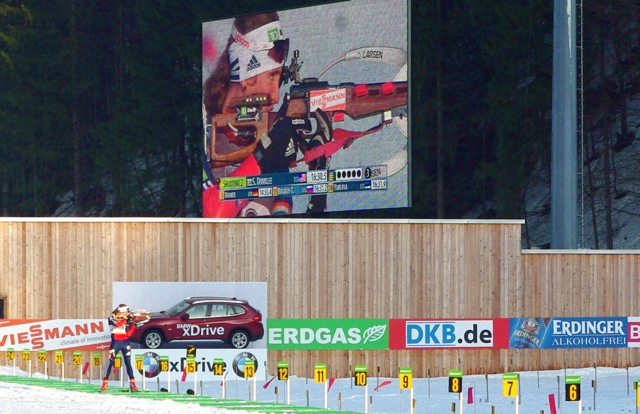
    Susan Dunklee on the range, and simultaneously on the big screen.

    RUHPOLDING, Germany – Canada’s Zina Kocher had a lot to think about during today’s 7.5 k sprint.

    But this her tenth World Championships, and Kocher says she’s learned a few things along the way. Today, she didn’t let all of the worries and problems get to her head. Instead, she stuck to business and finished 18th.

    Kocher heading up the course's first hill.

    “This is probably the most calm I’ve felt in a long time for a World Championship, so that’s crucial for sure,” she said in an interview at the finish line.

    What were some of the things that might have been distracting her?

    Perhaps the disastrous shooting stage in Thursday’s mixed relay, after which she was incredibly disappointed and felt she had let her team down.

    Or maybe she could have worried about her brother, who on Wednesday underwent open heart surgery for the eighth time due to a congenital heart defect. For all the other surgeries, Kocher has been in Canada, ready to stay by his side at the hospital. But not this time around.

    “I tried not to be distracted for the relay,” she said after shedding a tear or two at the finish: “I had a decent race and put it behind me for about 20 minutes.”

    If neither of those topics were enough of a burden, Kocher is also saddled with the responsibility of collecting a top-16 finish in order to regain funding from Athletics Canada; this season, for the first time in years, she hasn’t had that monthly stipend.

    “I definitely really need a top 16,” Kocher said. “It’s been really difficult – last year I really struggled with that, and totally blew up. This year I think that with my training camp in Kontiolahti, I stopped and just focused only on the process, and that has helped. Maybe just with maturity, I don’t know, slowly it’s starting to click.”

    Kocher spent 22 minutes and 55 seconds, to be exact, not thinking about any of those things. And it paid off. She missed two shots, which isn’t excellent, but it’s such a vast improvement from the mixed relay that it gave her something to celebrate.

    “One-one isn’t great, but it’s way better than the rest of my year, so I’m definitely feeling more confident,” she said.

    Kocher felt slow on the first loop, and she wasn’t far from the mark: her ski times improved from being ranked 26th in the opening 2.5 k, to 13th in the middle, and finally she laid down the sixth-fastest closing loop.

    “I didn’t want to die on the last lap, it actually was really good,” she said.

    Another bonus of Kocher’s performance? It might not be top-16, but it sets her up to achieve that much-needed result in the pursuit. She was just three seconds out of 16th today, and 30 from the top ten.

    “I think I’ll have a really good chance,” Kocher said.

    Four North Americans Sneak In to Pursuit; Three Don’t

    Studebaker in the penalty loop.

    Behind Kocher, the rest of the North Americans didn’t have such positive experiences on the Ruhpolding trails. The dropoff to the next result was large, with U.S. biathlete Sara Studebaker tying for 49th.

    Like Kocher, Studebaker had something to prove after an unsettlingly shaky relay performance. And while she didn’t have a result for the ages, the sprint was certainly a step up, because she had only two penalties.

    “It’s – fine,” Studebaker said. “I feel like my race today was – fine. A bit of an improvement over the relay, but I feel like in general this season skiing has been a little bit frustrating for me, and for me right now one and one is just a couple too many penalties to get a good result.”

    She was trailed by a trio of three more North Americans who snuck in to qualify for the pursuit. Canadians Megan Imrie and Megan Heinicke finished 51st and 52nd, separated by 0.2 seconds, and American Susan Dunklee placed 55th.

    Neither Canadian was particularly enthusiastic about her result, although they both said they had fun with the atmosphere here in Ruhpolding.

    “My skiing felt really good today, but I had more misses than I planned to,” Imrie told FasterSkier at the finish line. “In prone I wasn’t sure, they felt perfect. I was disappointed with that but everything else went pretty well. I enjoyed it.”

    Heinicke said that her race was “not so hot, to be honest.”

    Imrie leading Kocher.

    Imrie was the only one of the remaining women who started with Kocher in the first draw group. And she actually got to hitch a ride with her teammate, because Kocher was lapping when Imrie started.

    “That was good,” she said. “It’s always nice to sort of use each other a little bit. You just feel more comfortable.”

    Studebaker and teammate Lanny Barnes started in the third draw group. While starting with the fastest skiers is usually seen as beneficial, Studebaker said that starting a bit further back had been very helpful.

    “It was actually pretty fun out there because a lot of the good girls had started earlier, and so unlike some of my other starts which have been early and with that group, there was a lot of people who I was passing,” Studebaker said. “That is definitely a boost – like, ‘oh, I’m going to go after that person,’ and you can actually catch them instead of them being Magdalena Neuner and you think, ‘oh, shoot, there they go.’”

    Barnes finished 67th, and said she couldn’t find her speed; she had been living and racing at altitude since December, and only had five days to acclimate to the lower elevation.

    Lanny Barnes.

    Heinicke, Dunklee, Annelies Cook, and Yolaine Oddou all started in the last draw group, based on a decision made by coaches that the snow would speed up as the sun dropped behind the mountains. That may have been true, they all admitted, but they almost universally wished they’d had better competition to ski with.

    “Starting at the back, I passed some people, but honestly I was the fastest person that I skied with,” Heinicke said. “It’s always good for someone like me who is not in the top twenty ski times to have faster people around, so you can say, come on, follow her. From a mental side, I would prefer not starting in the back, having some faster skiers around, not have such a long pause, but the bottom line is, you’ve got to be able to execute your warmup and your race regardless of your start number.”

    Dunklee agreed.

    “When I first saw the start list last night, before I saw the reasoning for why we’d started later, I was just really bummed because all the names of the people I like to ski around were going to be done half an hour before I even started,” Dunklee said. “But then I realized it was an opportunity to ski my own race, and try to do my own thing, so that’s what I did.”

    The three listed some unintended benefits of the late start, however. Among them: fewer people on the course for the last loops, making it easier to pick the best, most efficient lines, and also a lack of spectators, which Dunklee said removed some pressure.

    Dunklee had four penalties, three of which came in prone.

    “I have no idea what happened,” she said of the errors. “I was definitely hoping for a lot better.”

    Teammate Cook finished 62nd, and Canada’s Yolaine Oddou 104th.

    Full results

    Race report

  • Canada Held Back By Slow Skiing, Disastrous Standing Stage by Kocher

    Canada Held Back By Slow Skiing, Disastrous Standing Stage by Kocher

    Canada's third racer, Jean Phillipe Le Guellec, leaving the range.

    RUHPOLDING, Germany – After placing sixth in a World Cup mixed relay earlier this season, the Canadian team came into today’s race at World Championships with high hopes. But they couldn’t handle the heat – literally, in this case, as temperatures neared 50 and the snow turned to slush.

    “Everything in the sun is pretty soft and mushy,” second-leg racer Zina Kocher told FasterSkier after the race. “It’s actually a pretty hard race, not just because of the snow – I can handle the slush – but it’s really hot. I’m dying right now!”

    Instead of the top result they had envisioned, the Canadians found themselves in 18th place at the end of the day.

    “It was disappointing,” Kocher sighed. “I think we all wanted a top eight.”

    That seemed out of reach for the Canadians right from the start. They were already at a disadvantage after losing Brendan Green to a back injury, but they were still not expecting to be sitting in 19th-place after Megan Imrie’s scramble leg.

    “Megan shot pretty well, but I haven’t talked to her, and I think she fell,” Kocher said.

    Kocher starting on her leg of the relay, still optimistic about gaining places.

    Kocher is currently ranked 23rd in the world, and seemed like a sure bet to pull Canada up through the field. But the usually speedy Alberta native wasn’t as fast today, and after one stage had only gained two places.

    Then, in standing, disaster struck. Kocher used all three spare rounds and was still left with three black targets. She had to ski three penalty loops, which is practically unheard of in relay racing. After the race, Kocher explained that the harsh 4 p.m. light, which created a stark contrast between bright sun and dark shadows, had been a challenge in the standing stage.

    “In zero I actually had a piece of white paper covering my right eye, and yesterday when I was training I thought that by the time I would race I wouldn’t [need] that,” she said. “But I should have worn it because by the time I came in for standing, I had a really hard time distinguishing the white and the black, so I really struggled.”

    Kocher dropped to 20th, and was unable to make up any ground on the final two-kilometer loop.

    Despite only using a single spare round, Jean Phillipe Le Guellec was also unable to move up. Anchor leg Nathan Smith gained two spots, but the team still landed about ten places lower on the results sheet than it was hoping.

    “Being that there’s no wind, and it’s a downhill [into the range], people are shooting really well,” Kocher said. “We just couldn’t get that gap back… I just tried to go for it, but it really didn’t work out at all, I’m very, very disappointed.”

    While Kocher’s difficulty on the range is an easy scapegoat for the team’s poor result, ski times were also slow. Imrie had just the 20th-fastest course time of the 27 scramble skiers, while Kocher – who was justifiably tired from skiing nearly an extra half a kilometer in the penalty loop – and Le Guellec were the 16th-fastest skiers on their legs. Smith’s time was the 12th-best among anchors.

    Still, in terms of improving, Kocher’s shooting woes are the most straightforward to fix.

    “Definitely I’ll be figuring out something, if it’s sunny again, how to deal with that,” she said. “And just remembering that it’s one race, we still have a few more, and all of our individual races.”

    Race report

    Results

  • North American Women Unable to Capitalize on Sprint Results; Studebaker Leads Way With 25th in Biathlon Pursuit

    North American Women Unable to Capitalize on Sprint Results; Studebaker Leads Way With 25th in Biathlon Pursuit

    Magdalena Neuner of Germany won today's World Cup pursuit in Oslo, Norway. Photo: NordicFocus/Fischer.

    After what was perhaps the best day ever for North American women on biathlon’s World Cup circuit, U.S. racer Sara Studebaker was offered a unique way to approach the coming pursuit.

    “There’s a bunch of you all hungry for more,” Studebaker’s brother Luke told her. Then he delved into new territory.

    “[You are] like a pack of North American grey wolves, once endangered to the point of extinction but now flourishing under revamped federal policies. Tomorrow you gulp the overabundant Euro-Elk down to a more manageable population, all this under the shade of newly rebounding aspen groves.”

    In Thursday’s sprint in Oslo, Norway, Canada’s Megan Imrie had led the way in 17th, with the last North American, Susan Dunklee, 46 seconds behind her in 35th. Every one of the women FasterSkier talked to after that race conveyed how excited they were about the group’s success, and about the potential to move up in the pursuit.

    So did they do it? Did Studebaker’s wolf pack notch another record-setting day?

    Well, not quite.

    “It was clearly a little bit rougher day for us as a team and a continent than in the sprint, but we all had moments of brilliance,” Studebaker told FasterSkier after the race.

    Studebaker leading Kocher on the Holmenkollen course. Photo: NordicFocus/USBA.

    The wolf pack had diminished by one before the race was even over, with Annelies Cook being lapped and consequently pulled. Cook had scored her first World Cup points on Thursday, finishing 33rd, but missed five shots in the first three stages on Saturday.

    “Biathlon giveth and it taketh away,” she wrote on her blog.

    And Imrie, who had led the way in the sprint, dropped to 41st with five penalties. She told FasterSkier that she was tired and disappointed in her skiing, and called the race “a tough one.”

    Instead of Imrie, Studebaker led the way in 25th after starting in 22nd and shooting clean for most of the 10 k, four-stage race. In the final standing bout, she missed two shots, which dropped her out of the top 20.

    “It was a little crazy to move backwards with only two penalties, but there was some really good shooting out there, and I’m happy with my race overall,” she told FasterSkier. “I feel like I’m in a good spot right now: my skiing is coming on and I’m feeling good, and my shooting is solid.”

    Studebaker said she wasn’t sure what happened in the final shooting stage, but hypothesized that the range approach might have done her in. It’s downhill, which would generally be seen as easy, but Studebaker pointed out that tucking into the range can leave athletes’ legs shaky and unstable when they need to stand perfectly still.

    “I felt good about my approach, and was super confident after my first standing, but sometimes you just miss,” she said. “It was a bummer, but that’s biathlon! I can’t really complain about 90 % shooting.”

    Studebaker was followed by Canada’s Zina Kocher, who slipped from bib 25 down to 29th place on the back of four penalties.

    Kaisa Makarainen of Finland, who eventually finished fifth. Photo: NordicFocus/Fischer.

    “Four misses is too much, especially on a day like today,” Kocher said. “I felt a little bit more tired than in the sprint, and then lost a sprint finish to [Norwegian] Elise Ringen after the final climb. I had been pushing my pace earlier on in the race and just didn’t have enough gas to stay ahead of Elise as she turned on the sprint before the downhill to the range.”

    Kocher said that she hadn’t had problems with the cold temperatures, which started out at -23 Celsius in the morning before warming to -14, or about six degrees Fahrenheit, by race time. And despite having slightly tired legs, she was already looking forward to “another chance to fight” in her next race.

    And Susan Duklee, too, was happy with her race. The American started and finished in 35th, maintaining her position despite five penalties.

    “I definitely had hoped to hit more targets in prone today, but I’m really excited about my standing,” Dunklee wrote in an e-mail, alluding to the fact that four of those five penalties came in prone. “I had been struggling with that in the last couple of races. I finished my bib number and didn’t lose any places- that’s progress for me.”

    Even though the women couldn’t entirely capitalize on their starting positions, Studebaker, Dunklee, and Kocher all looked at the bigger picture and believed that it had been a good weekend for the teams.

    “I’m still riding the energy from our team result the other day, and it was amplified even more when we saw how well the U.S. Ski Team girls did in Russia,” Dunklee said. “This week has been a tremendous confidence booster, and with only a few weeks until World Championships, this is a great time for the team to come on strong.”

    Kocher had the most tangible excitement, since her performance qualified her for Sunday’s 30-woman mass start. Once a mainstay in mass starts, Kocher hadn’t been invited to participate much recently, so this was a big step.

    “I’m incredibly pumped to be racing a mass start again,” she said. “It has been a very long time since I last qualified! I qualified in the first mass start of the season in 2010, but before that it was 2006-2007, the year before I had mono, that I was consistently doing them.”

    Of all the North American women, only Dunklee has participated in a mass start so far this season. Having more different women compete in the highest-profile races was one symptom of what Studebaker said were the rising fortunes of North American biathlon.

    “I think we’re slowly letting the Europeans know that they can’t count us out,” she said. “It seems like we’re all feeling strong just in time for the most important part of the season, which is key. We have plenty of opportunity to do a little more hunting.”

    Magdalena Neuner of Germany led the race from start to finish, winning by 36 seconds despite accruing two penalties. A clean-shooting Olga Zaitseva of Russia placed second and Darya Domracheva of Belarus third.
    Full results

    Tora Berger of Norway, who finished fourth and failed to snag a podium for the home country. Photo: NordicFocus/Fischer.
  • U.S., Canadian Women “Show Europe That North America Can Mix It Up” In Oslo Sprint

    U.S., Canadian Women “Show Europe That North America Can Mix It Up” In Oslo Sprint

    Sara Studebaker led the U.S. in World Cup action with a season-best 22nd-place finish. Photo: NordicFocus/USBA.

    After a gray winter that seemed to always be either snowless or stormy, the world’s best biathletes were thrilled to head to Antholz, Italy two weeks ago, where the sun finally shone in the Alps.

    The North Americans, it seems, are even happier to be in Oslo, Norway, where the World Cup kicked back into action with a pair of sprint races on Thursday.

    “There is a good vibe here in Oslo,” U.S. biathlete Annelies Cook told FasterSkier.

    Sure thing: of five North American women who started, all finished in the top 35, which they believed had never happened before.

    “Today was not only a great day for the US, but also for the Canadian women,” said Cook’s teammate Sara Studebaker. “[It’s] always great to show Europe that North America can mix it up.”

    “We’re all so happy for one another,” Cook agreed.

    The field was slightly smaller on Thursday, with only about 75 starters compared to 95 two weeks ago in Antholz. U.S. Biathlon Association President Max Cobb said that while all the major teams were in attendance, several brought reduced squads due to the recent Under-26 Championships in Slovakia and the high cost of staying in Scandinavia.

    But although the fields might not have been large, they were certainly talented. Germany’s Magdalena Neuner won the sprint with perfect shooting, extending her lead in the overall World Cup standings; second-place Darya Domracheva of Belarus and third-place Tora Berger of Norway are now ranked second and third in the overall standings as well. Only three of the top 20 women decided to sit the weekend out.

    That made the North Americans’ performances even more noteworthy. The group was led by Megan Imrie of Canada, who collected a career-best 17th-place finish after shooting ten for ten.

    “I was a little sick last week so I knew skiing wouldn’t be as strong as I would like,” Imrie explained while describing her race strategy. “I focused solely on the shooting process, taking each shot one breath at a time. The targets in Holmenkollen just wanted to fall today.”

    Imrie’s performance put her 1:46 behind Neuner and roughly 20 seconds out of the top ten.

    Canadian teammate Zina Kocher had an opposite experience en route to 25th place: she skied the ninth-fastest course time, but missed three shots, keeping her out of a top finish.

    Susan Dunklee (USA), 35th place. Photo: NordicFocus/USBA.

    “Definitely, shooting was frustrating,” Kocher told FasterSkier. “I seem to have a three-miss curse for sprint races this year! I’m not sure what happened in my prone, [because] everything felt good.”

    After missing twice in the initial prone stage, Kocher was ranked just 51st in the field. But aggressive skiing allowed her to claw her way up the results sheet despite missing another shot in standing.

    “Skiing was great, I had a ton of energy to push for every second,” Kocher said. “I’m hungry for more racing, and body feels great after this last training break.”

    Studebaker led the Americans and while her 22nd-place finish was a season-best, she seemed more excited for the quintet’s overall success.

    “It’s great to have an individually good day, but when the whole team does well it’s extra special,” Studebaker said.

    She did say that her finish was a good confidence boost given a long series of frustrating results so far this season; Studebaker finished one spot higher than she had in this race last year, with Oslo sprints now making up two of her top six World Cup finishes (she also placed 17th at World Championships last year).

    “I had a good training block last week, so I was ready to really go for it here in Oslo,” Studebaker said.

    Imrie agreed, saying that for the Canadians, who are heading back to Canmore after this weekend to train in preparation for World Championships, all systems were go as soon as they got to Norway.

    “It’s clear that our team has flicked their performance ‘on’ switch for this final weekend,” she wrote in an e-mail. “We’re all so happy with the direction we’re headed. Personal bests in Oslo are especially great – a feel good result, hugs all around, and then famous Norwegian waffles hot off the press. They will fuel me through the pursuit.”

    Another idea that might motivate her in Saturday’s race is the knowledge that four North Americans are chasing her down. Cook finished a career-best 33rd and fellow American Susan Dunklee 35th.

    Dunklee has had a breakthrough season, and the result was in line with her previous finishes; she skied the 14th-fastest course time and was hampered, like Kocher, by three penalties.

    Cook, however, had something of a breakthrough of her own, scoring World Cup points for the first time. She missed only one shot, which seemed like a victory in itself after some bad shooting days in previous races, she said.

    “Sometimes it seems like biathlon is a sport where you accidentally do well,” Cook mused in an e-mail. “It can be so unpredictable. I was so psyched to have a good day on the range – I really needed that for my confidence.”

    Cook cited fast skis and cheering from the hordes of schoolchildren lining the course as a few more reasons she flew around the trails.

    “It was a really good mental course for me, where I could focus on getting to the top of the one long climb, have a good rest and then finish the next before coming into the range,” she added.

    The one factor that could have curbed the North Americans’ enthusiasm about Oslo was the weather, which forecasted frigid temperatures for the weekend, so much so that Norwegian biathletes Lars Berger and Ole Einar Bjørndalen reportedly urged organizers to consider canceling the races. But the Canadian women didn’t seem fazed.

    “It was a bit cold today, a humid minus 10 [Celsius], so like a good Manitoba girl, I employed every hand warming strategy in the book,” Imrie said, pointing out the reason that cold races can be even tougher for biathletes than skiers: bulky gloves and mittens don’t work with rifle triggers.

    And what if temperatures hit the minus 18 Celsius predicted for the weekend?

    “A good warmup and lots of long underwear will be key,” Kocher said.

    Full results

    Cook en route to a career-best 33rd place. Photo: NordicFocus/USBA.
  • In Nove Mesto’s Blizzard of Deteriorating Conditions, Zaitseva Keeps Clean and Russia Places 3 in Top 6

    In Nove Mesto’s Blizzard of Deteriorating Conditions, Zaitseva Keeps Clean and Russia Places 3 in Top 6

    24th-place Svetlana Sleptsova of Russia was lucky to start before things turned nasty. Photo: NordicFocus/Fischer.

    This year’s World Cup biathlon schedule has presented a confusing dichotomy: it seems like races are either characterized by a lack or snow, or too much of it – sometimes at the same venue, just days apart.

    While panning television shots of athletes racing along thin white ribbons in the woods has become all too common, so too have the fuzzy, gray screens where cameras struggle to pick skiers out through heavy snowfall.

    The Nove Mesto stadium at the beginning of the race….

    “We’ve had a lot of tough condition races this year,” U.S. biathlete Sara Studebaker told FasterSkier. “I like to think that it’s just going to make us tougher and better in the long run.”

    Friday’s 7.5 k sprint race in Nove Mesto, Czech Republic, was no exception. What began as a pleasant day turned into a blustery snowstorm as the first starters emerged from the woods the range for their prone shoot.

    As more and more snow built up on the tracks, which at the start were “icy as a skating rink” according to American Susan Dunklee, the race turned into a nightmare – particularly for the latest starters, who weren’t able to ski even one loop on the icier trails. In addition, the wind became strong and variable, sometimes coming from one direction and at other points the complete opposite.

    “You could get lucky and come into the range when there wasn’t too much wind, or you could come in with some big gusts,” Studebaker said.

    … and at the end.

    The women’s hair was visibly blowing in the wind, and many had to take clicks on their rifle sights as they hit the shooting mats, or sometimes even in the middle of their stage. A few had to stop and brush the snow off of their sights.

    “I would not wish [these conditions] on my worst enemies,” said U.S. women’s coach Jonne Kahkonen.

    Only one of the 92 women was able to drop all the targets, and that was Olga Zaitseva of Russia. In a sprint, which features two shooting stages for ten shots total, the number is usually much higher.

    “I waited for the wind three or four times,” the Russian said in a postrace press conference. “On one shot, the rifle moved but it was a hit. I was the lucky one.”

    In Zaitseva’s case, the old phrase “luck of the draw” held some weight. The Russian started with bib 13, and while she definitely encountered challenges on the range, neither her skiing nor her shooting included conditions as tough as those faced by later starters.

    Berger pushing through for the podium. Photo: NordicFocus/Fischer.

    Second-place Tora Berger of Norway started several minutes behind Zaitseva, but was still in the first third of the field. She was impressed with Zaitseva’s shooting, and not disappointed with her result given her two penalties.

    “It was not easy to shoot,” she said. “The wind was so strong at times. It was not so bad when I was out there, but I think it was very hard for some of the late starters.”

    Magdalena Neuner of Germany placed third, and remains atop the overall World Cup standings. With her victory today, Zaitseva passed Kaisa Makarainen of Finland to move into third place. Makarainen had won Wednesday’s individual, but today missed six shots, including all five in her standing stage [meaning that she “dirtied”], and still managed to finish 14th.

    It was a good day for Russia, with not only Zaitseva’s victory but several more finishers in the top ten. Olga Vilukhina continued her best-ever season with a fifth-place finish, while Ekaterina Glazyrina improbably placed sixth despite starting with bib 55.

    The North Americans were led, as usual, by Canada’s Zina Kocher, who finished 23rd. Starting with bib 29, Kocher had a decent first shoot, accruing a single penalty, but then a disastrous standing stage. She was left to ski three more penalty loops before heading to the finish.

    “[It was a] definitely disappointing last standing,” she told FasterSkier. “I did what I could and went for it in standing, and then blasted out of there for a fast last lap.”

    Neuner in the snow. Photo: NordicFocus/Fischer.

    Her last lap was indeed fast – she ranked 12th over those 2.5 k and moved up ten places from when she had left the range. On the whole, though, Kocher was not particularly satisfied with her experience today.

    “Today was an extremely gusty day in the range and on the tracks,” she said. “A preposterous day actually. I was lucky to have started when I did, as snow started to dump after I was finished and the track slowed down a lot for the other competitors.”

    Even though Kocher, who had placed 15th in Wednesday’s sprint, was left looking for more, she has one more chance to get it in Nove Mesto. In Sunday’s pursuit, she will start almost two and a half minutes behind Zaitseva, but only 20 seconds out of the top 20 and one minute out of the top ten. With her ski speed and 20 opportunities for her competitors to make shooting errors, a lot is possible.

    “For the pursuit Sunday, I will once again just focus on moving up the ranks with good shooting,” the Canadian said. “The trick will be mastering the wind if it is similar to today.”

    After a career-best 20th place on Wednesday, teammate Megan Imrie slipped to 44th in the sprint on the back of five penalties.

    She finished one place and three seconds ahead of Dunklee, who was the first American on the results sheet. Dunklee did her Canadian competitor one worse and missed six shots. Her prone stage was particularly rough; she racked up four misses only 2.5 k into the race.

    “When I started the race, it was partly cloudy with a little bit of sunshine,” she wrote in an e-mail to FasterSkier. “When I came in for my first shooting, it had just started blizzarding.”

    With bib five, Dunklee had some of the best luck of the day, but couldn’t capitalize. Still, there were several great aspects of her race – she had the 12th fastest ski time over the 7.5 k race. That included a fourth-fastest first lap, which Dunklee said was deliberate after she never found her zip in Wednesday’s individual.

    “I did start today’s race fast because I wanted to feel like I was in the race right from the start,” she explained.

    Like so many other early starters, she felt fortunate that she’d at least had the chance to excel, even if she didn’t have her best race. Some teammates, she said, had been doomed from the start.

    Things turned blustery for Cook of the U.S.

    “Today was a very complicated weather day, and that impacted much of what you see on the results sheet,” she said. “By the time the last starters got on course, they didn’t have a fair chance. They were plowing through centimeters of new snow and could barely see the targets.”

    That group included Annelies Cook, who started with bib 71. Despite the poor visibility, Cook managed to hit seven of ten targets. And even though the tracks were slow, she placed 51st, good enough to qualify for the pursuit on Sunday.

    “Had Annelies started earlier, she probably could have made points (top 40), but that’s racing,” Studebaker said of her teammate’s performance.

    Studebaker will join the Dunklee and Cook on Sunday after finishing 54th with four penalties. It is the first time all season that three Americans will appear in the event, which includes only the top 60 finishers from the previous sprint.

    “I had a rough standing stage, but in general I feel okay about my race,” Studebaker said.

    The Idaho native has had several frustrating weekends so far this season, and has not shown the form that earned her four top-20 finishes last year. With the U.S. men having weaker performances in January than they had in December, Studebaker responded to questions about the team’s shape by saying that the main goal was to at their best in March for World Championships.

    Neuner working on her rifle. Photo: NordicFocus/Fischer.

    “For me, I know I’m not exactly where I had hoped to be right now, but I’m making slow improvements on the skis and am feeling confident that our plan, to be fast for World Championships, is going to work,” she told FasterSkier. “It’s for sure a bit frustrating for all of us after the season we had last year, but we’re learning to just evaluate ourselves on where we are, and looking forward.  The big thing for us right now is to be making progress.

    “Today was a better feeling on the tracks for me than Wednesday, so that’s an improvement, and I have to be confident that will continue.”

    The final U.S. racer, Tracy Barnes, was literally one of the last women to start, and her 87th-place finish reflected her bad luck. By the time Barnes was competing, the weather was no longer merely bad, but had become dangerous.

    “We couldn’t cool down on the warm-up loop due to the danger of falling trees,” Dunklee said.

    While there have been plenty of storm-marred races in the last few years, Neuner of Germany perhaps summed up the Nove Mesto sprint the best.

    “It was a crazy race,” she said. “We have seen some crazy days before, but this was special.”

    Full results

    The IBU debuted a new "leaders' box", which Berger, Neuner, and Zaitseva were able to enjoy while the storm raged outside. Photo: NordicFocus/Fischer.
  • Vertigo or No, Imrie Lands Career-Best 20th in Nove Mesto World Cup; Teammate Kocher 15th

    Vertigo or No, Imrie Lands Career-Best 20th in Nove Mesto World Cup; Teammate Kocher 15th

    Susan Dunklee led the U.S. in 49th; scroll down for a report on the Americans. Photo: nordicfocus.com courtesy of USBA.

    A couple of days ago, Canadian biathlete Megan Imrie couldn’t tell which way was up.

    Luckily, she’s feeling better – and up was where she landed on Wednesday, near the top of the results sheet in a World Cup individual race in Nove Mesto, Czech Republic. Despite a case of vertigo, Imrie finished a career-best 20th place.

    Athletes have to deal with a lot of variables when they’re preparing for competitions, but vertigo – a syndrome of dizziness and disorientation – isn’t usually one of them. Imrie, however, woke up one morning last week to find the room spinning. She hasn’t been able to do much besides wait it out.

    “Our flight left on Friday, and I still was too unstable to ski until Monday here in Nove Mesto,” Imrie told FasterSkier in an e-mail. “Walking was a trip, and skiing was out of the question – ditto shooting. I felt like I was on the lurching deck of ship.”

    Unable to train, Imrie had little hope for her first competition of 2012.

    “On Monday I wasn’t sure if I would race,” she said.

    But by Tuesday morning, she was able to ski, and decided to at least give biathlon a try.

    “I feel…not 100%, but it’s no longer affecting my skiing like it did earlier in the week,” she explained. “Getting in and out of prone position brought it on the most.”

    Incredibly, Imrie cleaned both of her prone stages in Nove Mesto and one of the standing stages as well; it was only in the final stage, a standing test, that she missed two shots. Until then, the clean-shooting Canadian had been in the top ten. Thanks to the individual format, however, a minute was tacked onto her time for each miss and she dropped to 18th, before slipping to 20th over the final three-kilometer loop.

    Imrie managed to keep her head straight and to adjust her shooting according to the wind, which she said was one of the main reasons for her success.

    “I am usually very diligent about wind and how it moves my bullets around,” she wrote. “Here it seems there is always a strong wind. Since it was also an individual race, I made a point of knowing exactly what kind of games the wind might throw my way.”

    All in all? She was “relieved” to have made it through the race, and the result was icing on the cake.

    “I’m very pleased with the race and a personal best,” Imrie said. “Skiing was tough, a soft slushy course, which I was mentally ready for. And shooting was with focus but without pressure.

    “I guess a little vertigo acted as a counterbalance for any unstable shooting.”

    Imrie’s one teammate in the race, Zina Kocher, didn’t have quite the hardship that Imrie had faced, and as such turned out an even better result. Kocher had three penalties, all in the first two stages, but used the 10th-fastest ski time to jet to 15th place.

    “The race wasn’t going very well after the first two shootings and I successfully turned it around with two clean bouts,” said a satisfied Kocher. “We arrived Saturday, so I am still feeling jet-lagged and could feel that heavy feeling in my legs halfway into the race.”

    It was her second top-20 performance of the season, and Kocher felt that she was laying the base for even better results.

    “With clean shooting today, I would have won, and that would have been an excellent day!” she told FasterSkier. “This isn’t impossible, it’s within reach… My misses were misses, but we are talking less than a centimeter to an inch or two of missing the target three times. It will come.”

    The Canadians skipped the first World Cup races of 2012, which were held in Oberhof, Germany last week, in favor of training on home turf, and both Kocher and Imrie felt it had paid off. Kocher said that it was “no secret” that recovery leads to better performances.

    “[The break] allowed us to recover from the last set of World Cups and get in a good amount of training to sustain us before preparation for World Championships,” she said. “Recovery is important after a racing trimester and a long flight, then it is just important to do a load of training without getting too punished.”

    Imrie said that as a North American, it’s also important to “refuel on family time,” something that European racers can get more easily as they travel the World Cup circuit. She, too, was able to put in solid training thanks to the longer break; before leaving Canada, she had done an interval session with ski star Chandra Crawford.

    “Family time was a blast, [and] in Canmore, training was perfect at the nordic center,” Imrie said.

    World Championships don’t start until March, but the Canadians seem primed for success in Nove Mesto and the next three World Cup venues.

    Especially, Kocher said, now that they have a little inspiration.

    “[Imrie] gets bonus points of awesomeness for putting together such a great race,” she gushed.

    * * *

    Annelies Cook, 60th place, on the shooting range. Photo: nordicfocus.com courtesy of USBA.

    The American team perhaps wished that they couldn’t tell up from down – none of the four women had a great day, and no doubt would have liked to swap with Finland’s Kaisa Makarainen, who picked up a 22-second win over Sweden’s Helena Ekholm despite having two penalties.

    As it was, Susan Dunklee again led the way for the U.S. when she placed 49th. Sara Studebaker was 59th, and Annelies Cook and Tracy Barnes in the 60’s.

    “The race today wasn’t very satisfying,” Dunklee wrote to FasterSkier in an e-mail. “Shooting was solid for me, but my skiing didn’t feel sharp at all and I wasn’t able to catch even a brief ride with the top names when they passed me. Usually that’s my favorite part of the race, the challenge of staying with them.”

    Dunklee had four penalties and the 46th-fastest course time. She believed that her added caution due to the format – which is both the longest distance that the women ever race, and features the most severe penalties for missed shots – actually hurt her performance.

    “I purposefully tried to pace myself a little smarter today than I did in my last individual, in Ostersund [Sweden],” she wrote. “But I think I made the mistake of going out too easy and never getting into race mode.”

    Tracy Barnes. photo: nordicfocus.com courtesy of USBA.

    Barnes, who landed 66th, had a different problem. It was her first World Cup start of the season, and to earn it she’d had to beat out several other American women in a series of trials races that included the IBU Cups in Forni Avoltri, Italy last week. While Barnes had excelled there – she placed 7th in the same event there on Saturday – it had used up some of her focus and energy.

    “I was a bit mentally fried from the trials last week and that carried over to my skiing and shooting,” Barnes told FasterSkier. “Normally my standing shooting is my strength, but I just didn’t have that aggressive mentality in I normally do to hit my targets. The same went for the skiing. I was tired from last week, but that really wasn’t the problem, I just couldn’t get myself to be aggressive.”

    Barnes said that she’ll take Thursday completely off from skiing and shooting in an attempt to recharge for Friday’s sprint race. She’s excited to be back on the World Cup, so she doesn’t anticipate any difficulties in regaining her focus.

    “The course [in Nove Mesto] is really tough, but fun,” she wrote. “It’s really great to be back on the World Cup and I will be fighting hard to try and stay here and have good results. It’s a great group to be around.”

    The Americans might not have been pleased with their results, but they were able to find things to be happy about anyway.

    “On the bright side, it is inspiring to see a couple North Americans near the top,” Dunklee said.

    Full results

    Sara Studebaker, 59th place. Photo: nordicfocus.com courtesy of USBA.
  • Un-Retired Zaitseva Picks Up First Win of Season; Imrie Notches Personal-Best 25th in Hochfilzen Sprint

    Un-Retired Zaitseva Picks Up First Win of Season; Imrie Notches Personal-Best 25th in Hochfilzen Sprint

    The podium, l-r: Darya Domracheva (Belarus, 2nd), Olga Zaitseva (Russia, 1st), and Helena Ekholm (Sweden, 3rd). Photo: nordicfocus.com courtesy of Fischer USA.

    Remember all those Russian shenanigans about firing coaches, during which Olympic biathlon gold medalist Olga Zaitseva abruptly announced her retirement in disgust?

    It’s a good thing that Zaitseva returned to biathlon, because recently she’s been on a tear. The 33-year-old Moscow native picked up her first win of the season on Friday in a 10 k sprint in Hochfilzen, Austria, to go along with two podium finishes from last weekend.

    She’s now finished on the podium four times in seven starts, and that’s the way she likes it.

    “I would like to be on the podium in all races,” she said in a press conference.

    Wouldn’t everyone? But part of Zaitseva’s confidence comes from working with the new coach, Wolfgang Pichler, who came in to head up the women’s team after a fairly disastrous 2010-11 season. Pichler had worked with the Swedes for over a decade, and launched the careers of Magdalena Forsberg, Anna Carin Zidek, and Helena Ekholm.

    “With the training schedule of our coach, we know that anything is possible,” Zaitseva said. “We have seen what he has done with his athletes before.”

    While many athletes her age would not necessarily jump on the chance to completely reconsider their training, Zaitseva, who won her first World Junior Championships medal in 1998 in Jericho, Vermont, seems enthusiastic.

    The feeling was mutual: Pichler has said that he believes the Russian women are more talented than the Swedes, and likes Zaitseva in particular.

    “Olga had a very good race,” he commented in a Russian Biathlon Union press release. “She demonstrated her professional level once again. Today was a great day! This result is a consequence of long and systematic work, which we did in the summer.”

    Zaitseva missed a single shot, which was an accomplishment on a particularly windy day when only three women shot clean.

    Behind her, two familiar faces rounded out the podium: Darya Domracheva of Belarus and Helena Ekholm of Sweden. But while neither was a surprise, it was for completely different reasons.

    Domracheva has already won two World Cup races this season, and has consistently racked up some of the fastest ski times in the field. Today, she was twenty seconds faster than Zaitseva on her skis, but missed one more shot and finished fourteen seconds back. In the press conference, she stated that she is aiming for the overall World Cup title; she currently trails Germany’s Magdalena Neuner by 28 points.

    Ekholm is no slouch on her skis, but more frequently shoots her way to the top. So far this season, she hadn’t been her usual sharpshooting self, but the Hochfilzen race was an improvement: like Zaitseva, she missed a single shot. Today was her first podium of the year.

    “I have been very frustrated, especially last week when I was so close,” Ekholm said in the press conference. “[Today] I finally felt normal in standing. I have been struggling with my shooting this year; that is not a usual situation for me. This week, I worked really hard on my shooting.”

    The 2009 overall World Cup champion finished thirty seconds down on Zaitseva. She was followed by the 2010 overall champion, Neuner, who had two penalties.

    * * *

    Out of all the North Americans, it could really only be said that one was thrilled with her performance. That honor went to Canada’s Megan Imrie, who despite windy conditions notched a career-best 25th place finish.

    “Today was my best result ever, which is always exciting,” she told FasterSkier. “I commented before the race that these were my favorite conditions: challenging wind for shooting, and fast, warm, skiing conditions.”

    While skiers might not find warm conditions to be the best, Imrie pointed to another consideration for biathletes: “When the temp’s above zero, my hands are the happiest of all- I can wear normal-person gloves, not massive insulated alpine ones, making shooting easier.”

    Imrie missed only two shots, which was one of the things separating her from the rest of the North Americans.

    “Hit targets were valuable today,” she said. “I made an error in my prone wind correction which resulted in two penalty loops. My standing was great- I was fully in control, and made a good lane choice (avoiding some high wind gusts) and just worked on one shot at a time.”

    Imrie finished 1:41 behind Zaitseva, but only 35 seconds out of the top ten thanks to large gaps in the top finishers. As such, she’ll be right in the thick of things for Saturday’s pursuit, and she’s excited for the possibilities.

    The 25-year-old said that her approach to racing this season was to keep things fun, and that seemed to have made a difference in her results so far.

    “I have been focusing on fully enjoying each race, like just being the goofball I am in the start pen,” Imrie explained. “It relaxes me, and I’m able to have more clarity during the race.

    “I’m easy to spot,” she joked. “I’ll be the one dancing around with huge mittens on.”

    Imrie’s teammate Zina Kocher had a more disappointing race, missing four shots. Luckily, her usual quick skiing helped her to 50th place, and she will join Imrie in the pursuit tomorrow. Despite starting two and a half minutes behind Zaitseva, with clean shooting Kocher could make a splash – she had the eighth-fastest ski time today.

    Rosanna Crawford, the final Canadian, missed three shots to place 73rd, and will sit out the rest of the weekend.

    “Not a great day for me,” she tweeted following the race.

    * * *

    Annelies Cook in her first World Cup race of the year. Photo: nordicfocus.com courtesy of USBA.

    If the Canadians had a single bright spot on the result sheet, then the Americans had none – or at least none that shone so strong.

    The team qualified a single athlete, Annelies Cook, for Saturday’s pursuit, which takes the top 60 finishers. Cook was the last qualifier.

    “I made it by the skin on my teeth,” she wrote in an e-mail. “I actually think it may have been my fast skis that got me into the pursuit! The course starts out rolling and then goes up a big climb and then is downhill with a small uphill before the finish. I think my split at the top of the uphill was out of the pursuit, so I am thankful for our good techs!”

    It was Cook’s first World Cup race of the season; she spent the first two weekends on the IBU Cup circuit before getting exchanged for Lanny Barnes and Laura Spector.

    “We want to have the athletes that perform to have a chance to show what they can also in the World Cup,” women’s coach Jonne Kahkonen told FasterSkier to explain the roster changes. “And also if the World Cup level is not there, the IBU Cup provides really good quality racing, so the train goes both directions.

    “With this we also want to have the bar high enough for the athletes, so that they have to push hard to get there – even though we don’t have huge numbers, we want to create a competitive situation.”

    Cook appreciated the strategy, and though she would have liked to have started the season on the World Cup, agreed that the progression was a smart decision.

    “The first IBU Cup went poorly and I had to get my confidence back up,” she said. “My goals were not to be on the IBU cup  but I also didn’t want to be racing at the World Cup and doing awful either. Last weekend [in Ridnaun, Italy] was awesome for me as far as skiing confidence went… that kind of feeling will keep you racing for another year.”

    Dunklee, skiing fast. Photo: nordicfocus.com courtesy of USBA.

    In the sprint, Cook missed three shots and had the 53rd fastest ski time; considering how great she felt, she said that she was disappointed not to have skied faster.

    “But I really love pursuits and being in a race with people around me,” she said, looking towards Saturday.

    Another inspiring thought? The only thing she can do is move up.

    Susan Dunklee and Sara Studebaker, the two other Americans, struggled on the range and placed 71st and 72nd with seven and five penalties.

    “The race for sure was not quite what we would’ve wanted today in the World Cup, but that’s biathlon,” Kahkonen said. “At the same time, I was pleased to see that both Susan and Sara are picking it up on the skis; Susan was less than a minute behind the fastest and Sara less than two minutes, for the first time this year. So, it is taking a bit longer but happening for sure.”

    Dunklee had the 18th-fastest course time of the day, and beat 23 starters even though some spent literally minutes less time in the penalty loop than she did.

    Full results

    Studebaker negotiating one of the course's downhills. Photo: nordicfocus.com courtesy of USBA.
  • Canadian Women “Stoked” About Newfound Depth and Consistency on Biathlon World Cup

    Megan Imrie at World Cup trials this fall. Photo courtesy of Glen Crawford.

    Lowell Bailey may be getting a lot of attention these days, but the American biathlete isn’t the only one to have found success in the early days of the 2012 World Cup season.

    Quietly, the Canadian women have upped their own profile – and their first two weeks of racing culminated in a ninth-place relay finish in Hochfilzen, Austria, tying the U.S. men’s performance.

    Team member Zina Kocher, who has been racing in senior-level international races since 2002, had only ever achieved that result twice, and never beaten it.

    “Our ninth in the relay is solid,” she told FasterSkier. “The team is moving up together and there is potential for better performances.”

    Kocher has been the star of the Canadian team so far, scoring World Cup points in every race she has entered and finishing as high as 15th in the sprint in Ostersund, Sweden. But she’s had company: Megan Imrie has been in the points, too, and collected three of the top ten performances of her five-year World Cup career.

    And that, for Canada, is good news.

    “Together Megan and Zina will be the backbone of a solid women’s team,” said Biathlon Canada High Performance Director Chris Lindsay. “We expect a huge improvement on last year’s results both individually and as a team.”

    Where Did Canada Go?

    While the Canadian program has definitely produced fast women in the past – 1994 Olympic gold medalist Myriam Bedard comes to mind – in last few years the team hasn’t shown much depth.

    In 2011, only Kocher and Imrie scored World Cup points (which are doled out to the first 40 finishers), and those were few and far between; neither woman made the top 70 in the overall rankings. In 2010, Kocher was ranked 31st and Heinicke the next closest in 65th. Kocher finished 2009 as the only Canadian who even made the rankings, clocking in at 41st.

    “When I was still a junior starting out, the women were stronger than me, and I definitely looked up to them,” Kocher said. “I always observed how they did this and that, and was always trying to keep up to them, trying to be as strong and stronger.”

    These days, there haven’t been as many senior athletes to serve as role models, just the same stalwart few who have been racing at a high level since they were very young.

    “Our women’s team hasn’t changed that much in a few years, in terms of members,” Imrie said.

    Canada has recently brought home several World Junior Championship medals, but it’s been hard to translate those results into a robust, deep team or widespread success at the senior level.

    Why?

    “Biathlon in Canada isn’t a well-known or easily accessible sport,” Kocher explained. “The depth in programs, coaches, environment, and finances all play a role… Financial reasons are a big cause of athletes quitting early on. And another aspect is talent and development of young athletes with a solid training program.”

    Kocher said that for the last few years, Biathlon Canada has not offered financial support to development or junior national team members – which, she said, would be fine if regional training centers and clubs could pick up the slack. In the past this hasn’t been easy, but luckily it’s starting to happen.

    “It’s getting better especially in Canmore and Valcartier, and now with the Biathlon Alberta Training Center we are on the right path to developing these programs,” Kocher said.

    While the teams are primarily intended for junior athletes, it’s not a coincidence that the senior women have been improving at the same time.

    A Changing Team, A Resurgent Zina

    For Kocher, the recent results aren’t actually the best she’d produced. The Alberta native has stood on the World Cup podium before, and scored eight top-ten finishes. But after several frustrating seasons and battles with injuries and mononucleosis, she’s feels like she is finally back on track.

    “[It’s] definitely not mind-blowing, just a solid start for the women’s team,” Kocher wrote in an e-mail. “For me, my ski speed is there with the top ten, and that is back to the previous performance potential from before I had mononucleosis.”

    Her return to form has come on the back of a major change in the Canadian national team: after seven years, Kocher was not re-nominated for the “A” team for this season. She decided it was time for a change and returned to Canmore to train with Richard Boruta, her first coach.

    Megan Tandy – who was the top Canadian at the Vancouver Olympics, finishing 36th in the pursuit – has since married coach Ilmar Heinicke, had a baby, moved to Germany, and took his name. Tandy missed most of the 2011 season, and this year declined a team nomination so that she could stay in Europe. That left only Imrie on the “A” team and Rosanna Crawford on the “B” team.

    Have the changes affected team chemistry?

    “No,” wrote Kocher. “We are a great bunch and there is really no animosity between anyone. We are always laughing… I’d say other teams might be jealous of our hysterical laughing fits!”

    While Kocher said that it initially felt “strange” not to be training with her usual national team group, she has enjoyed the switch to the Biathlon Alberta Regional Training Center.

    “Even though some of the girls aren’t as close to me in ski speed as Megan and Rosanna, I did have the young guys to chase!” she wrote. “I really enjoy the Alberta team and my teammates there.”

    While she’s no longer a member of the national team, she qualified for the World Cup through trials races and Biathlon Canada hasn’t reacted negatively to her decision to leave the team. Lindsay was still informed about Kocher’s training, and he still had the same goals for the star that he’d had when she was part of his squad.

    “Zina’s start has been exactly as expected,” he wrote in an e-mail. “She showed strong results in the physical testing over the summer and she is well situated to be among the top ten fastest skiers on the circuit. Her shooting results so far are in line with expectations and the plan has her continuing to improve shooting results for a peak at the World Championships.

    “We firmly believe that Zina is capable of making this her overall best season,” Lindsay concluded.

    Consistency from Imrie

    Imrie might be, too.

    While the 25-year-old scored World Cup points twice in both the 2010 and 2011 seasons, she more frequently finished in the 40s and 50s, with the odd shooting disaster dropping her far below that.

    The start to her 2012 season hasn’t been perfect – she placed 88th in the sprint in Hochfilzen after missing five shots, and did not make the pursuit – but it has been encouraging.

    In Ostersund, she placed 41st in the individual, 33rd in the sprint, and 43rd in the pursuit.

    “The season start has been better than in the past, but still I feel like I am capable of so much more,” Imrie said.

    Her 2011 campaign was cut short by a rib injury, so she came into the next training year relieved and happy to be skiing again. The injury also provided some forced recovery, she said, which made her better able to handle the training volume. As a more mature athlete, she’s begun to understand how important that is.

    “I’ve been a good student,” Imrie said. “I’ve learned how to manage my training workload, but also my rest and recovery. I’ve improved in gauging when I need rest versus when I need to push harder.”

    Aside from working with new coaches on shooting and ski technique, Imrie said that her strong start was most likely born from the simple fact that she loves the team.

    “I’m training again with Matthias Ahrens, who was my coach as a junior,” she said. “Our team is small, and the six of us who train in Canmore get along really well… I’ve stayed healthy from the outset, and looked forward to the team atmosphere each day.”

    She didn’t seem to have suffered from Kocher’s move away from the national team, either.

    “Rosanna and I train a little bit together, but a lot I do on my own,” she explained. “I’m lucky to be in Canmore, because if I need a training partner, I’m able to join up with cross country skiers, or other biathletes when our schedules fit. I’ve enjoyed many great afternoon workouts with Perianne Jones.”

    She understood Kocher’s move and didn’t hold it against her.

    “I know that Zina needed a different approach this year to training, so it was fine to be separate,” she said.

    A Team That’s “Stoked”

    Luckily for Canada the separation was only temporary, and Kocher and Imrie have been reunited in Europe. So far, they’re packing a strong one-two punch for the team. Lindsay, the high performance director, believed that Imrie could do even better than she had in the season openers, and follow Kocher more closely in the overall rankings.

    “Megan has proven that she is a force to be watched with her season opener,” he said. “We knew last year that she was capable of top-40 results… this year the goal is having consistent top 40 finishes with peaks in the low 20’s when everything goes right.”

    And with Crawford, who hasn’t had stellar individual performances this year but cleaned both stages of her relay leg, and Heinicke, who did not make Canada’s three-woman World Cup squad but appeared to be on form with her relay performance, the team is truly succeeding together.

    “We have all made improvements and are stoked about the season,” Imrie wrote.

    The results so far are something that would have been unusual a few seasons ago, when Kocher was the only one World Cup points.

    “For the three of us, all three making the pursuit, [and having] two in World Cup points in the sprint, this is a good overall performance,” Kocher said.

    “There is definitely potential for Megan and I to consistently be getting into points… I feel confident that we will be having a consistently better year, as whole team, than last year.”


  • Big Wins, and Winds, Are the Thing In Ostersund As Domracheva Takes Minute-Plus Victory

    Big Wins, and Winds, Are the Thing In Ostersund As Domracheva Takes Minute-Plus Victory

    Lanny Barnes (USA) racing to 48th place. Photo: Sam Merrens.

    Perhaps never before have the world’s best biathletes’ dreams of perfection been dashed so quickly at the beginning of a season.

    Over the last two days in Ostersund, Sweden, each one of the world’s top shooters has missed at least one shot. Usually, there’s just a few races like this in a season. This year, both the men’s and women’s World Cup openers have featured incredibly gusty, unpredictable winds.

    Even without shooting clean, a few athletes have been able to turn the weather into pure gold.

    “Wind and difficult conditions provide greater opportunities,” explained Canada’s Zina Kocher.

    The opportunity was greatest for Darya Domracheva, who picked up the win in Thursday’s 15 k individual by over a minute. While her margin wasn’t quite as large as Frenchman Martin Fourcade’s nearly two-minute victory yesterday, it was still unusual on the World Cup.

    “I was very lucky on the shooting range with good conditions,” Domracheva said in a press conference. “It was a very strong wind, and not the same wind for all of the athletes.”

    Many of the women could be seen adjusting their sights based on instructions from coaches as the raced onto the shooting range, and even then the wind could shift direction in the blink of an eye, leaving plenty of bullets lodged in the white background of the target rather than the black center where they belonged.

    The athletes were left with two options in the ever-changing conditions: try to shoot through the gusts and hope for the best, or wait for the wind to calm down. Neither seemed to be a great strategy.

    “I missed my fourth shot in prone because of a big gust and then took a few extra breaths to wait for the wind to die before shooting my last shot,” Kocher said. “Unfortunately, in standing I was not as successful, and maybe should have just been more aggressive and wasted less time. But it’s hard to say.”

    Domracheva’s win – the fourth of her career – came despite two missed shots, which in the individual format means two minutes of added time. Domracheva, one of the fastest skiers on the circuit, outskied second-place Anna Maria Nilsson of Sweden, who had only a single penalty. It was Nilsson’s first World Cup podium and came thanks to her strong shooting; she had only the 22nd-fastest ski time of the day.

    Magdalena Neuner of Germany finished third with three penalties, and Kaisa Makarainen of Finland placed fourth with four missed shots. Makarainen, who is last year’s overall World Cup champion, was the only woman to ski faster than Domracheva.

    While the wind was definitely the race’s defining factor, many of the women said that they also had to get their race-jitters out of the way and that the first race is always a shock in terms of difficulty.

    “After the second loop, I was thinking how hard it was today,” Neuner admitted in a press conference.

    Domracheva said that she was glad she had raced the IBU Cup last weekend, because she had missed six shots in the less prestigious race and gotten over her nerves.

    “I was very focused today,” she said.

    North Americans Solid But Uninspired

    After last year’s breakout performances by Americans Laura Spector and Sara Studebaker’s and yesterday’s ninth-place finish by Lowell Bailey, it wasn’t unreasonable to guess that the U.S. women might shine in the first race of the season.

    But almost immediately, it was clear that it was not to be. Spector – the second racer to hit the course – was caught on her first lap by Norway’s Synnøve Solemdal, who had started thirty seconds back.

    Solemdal ended up owning the third-fastest ski time on the day, so it wasn’t exactly a disaster. But then Spector proceeded to miss two shots in her first prone stage, adding two minutes to her time only three kilometers into a 15 k race.

    Luckily, her tough luck didn’t extend to the rest of her team. While Studebaker, who led the Americans in 44th place, wasn’t thrilled with her performance, she wasn’t too upset, either.

    Studebaker was "ambivalent" about her skiing. Photo: Sam Merrens.

    “Overall, I’m ambivalent about my race,” she wrote in an e-mail. “I had some high points in my shooting and skiing, and some low points. It feels good to get the first race out of the way.”

    The North Americans were led instead by Zina Kocher of Canada, who appeared to be returning to form after a disappointing 2011 season. After losing her national “A” team nomination, Kocher left the squad to join a new training center in Alberta, and the move appears to be paying off. Despite seven penalties, she finished 35th.

    “It is very abnormal to make World Cup points with seven misses in an individual so I am very grateful for this unexpected occurrence!” she told FasterSkier. “You should always give everything you have skiing regardless of the shooting result, because anything really can happen in biathlon.”

    The thing that happened was that Kocher skied fast – really fast. She had the ninth best course time of the day.

    “I’m definitely excited for the weekend, and for the rest of the month knowing that my physical form is exactly where I want it to be,” she said. “Today felt very smooth and strong… I was gliding around that course really well today.

    “It feels great to be back in Europe, back with the team and back to World Cup racing!”

    Kocher’s teammate Megan Imrie finished just a few places behind her in 41st. Imrie missed five shots, but encountered some other challenges along the way.

    “My rifle harness came off mid race and I had to stop two different times to fix it,” she wrote in an e-mail. “Total rookie move. I will be triple checking that bolt forever now.”

    Despite the technical difficulties, the result was one of the best of her career, and she was just 13 seconds away from collecting World Cup points. She described the Canadians’ skis as “insane” and thanked the technicians for their wizardry.

    “I feel like I’ve come a long way in training, and am very stoked to have a great season,” she said.

    Although her result wasn’t as good as what she had hoped for, Studebaker wasn’t worried about her performance; her five misses were fairly standard given the conditions and didn’t necessarily reflect any major shooting errors on her part.

    “You could see that a lot of people struggled on the range and with this being the first race, I think the results definitely reflect a tough early-season effort,” she said.

    Studebaker also noted that she doesn’t usually excel at the beginning of December.

    “I’m not usually at my strongest early in the season, and definitely need a few race efforts to get going and find my stride,” she explained. “It was nice to shake the dust off, so to speak. I know my shooting is there and that the skiing will come. I’m looking forward to Saturday and the sprint race.”

    Studebaker’s expectations for the day were a reminder of how far the U.S. women’s program has come in just a year. At this time in 2011, Studebaker had only one top-40 finish to her name, and it had come at the Olympics. But over the course of the 2011 season she finished in the points on fifteen separate occasions. Now, finishing out of the top forty feels like the exception rather than the norm.

    Studebaker might have been the top American, but it wasn’t by much. In her first-ever World Cup start, Susan Dunklee finished 45th, just over a second behind Studebaker.

    She got off to a good start: the rookie had the third-fastest time over the first three kilometers, and then cleaned her first World Cup shooting stage. The move put her in podium position, and she didn’t even know it.

    Dunklee on course. Photo: Sam Merrens.

    “Wow- good thing nobody told me that during the race,” Dunklee wrote in an e-mail when asked about her first loop.

    She swore that her fast start wasn’t completely due to adrenaline from the occasion; it’s just how she skis. Dunklee did her own thing – she was skiing with Neuner for a while, she said, but didn’t realize which German she was following.

    “[Women’s coach] Jonne [Kahkonen] had suggested that I treat this race like training, and that took a lot of pressure off,” she explained. “The crowd didn’t bother me, and neither did the lights or cameras. I felt surprisingly relaxed.

    “I was very calm and happy on the starting line- there was no place in the world that I wanted to be more than in that stadium tonight.”

    Dunklee missed seven shots, like Kocher, and had the 25th-fastest ski time.

    “I was hoping for a good launching off point to improve on during the rest of the season,” she said. “This result gives me confidence that I can be competitive in this field on a good day.

    “It was a blast!”

    Lanny Barnes was close behind in 48th, followed by Rosanna Crawford (CAN) in 70th and Spector in 73rd.

    Full results

    Laura Spector had a tough opening day. Photo: Sam Merrens.
  • Canadian Biathletes Wrap Up World Cup Trials – Photo Gallery

    Canadian Biathletes Wrap Up World Cup Trials – Photo Gallery

    Team Canada wrapped up its World Cup selection trials in Canmore on Tuesday with a pair of mass start races, which were won by Megan Imrie and Nathan Smith.

    With barely any snow in Scandinavia, the team was lucky to be at home in Canmore, where there has been skiing thanks to “Frozen Thunder,” a snow-saving operation. The team was racing to select two women and one man to join prequalified racers Imrie, LP Leguellec, Brendan Green, and Scott Perras on the World Cup at the end of the month. Team nominations have not been made public.

    In the women’s mass start, the race came down to a sprint finish by three athletes who went through the race in wildly different styles. Imrie, who had only a single penalty, came away with the 1.3-second win over Rosanna Crawford, who put her first-ever four-stage clean race in the books. But just two seconds behind her was Zina Kocher, who managed to ski almost to the top despite having five shooting penalties. All three women were 2010 Olympians.

    In Monday’s sprint, Imrie and Leguellec bested the fields, as reported on FasterSkier’s blog. In Tuesday’s mass start, however, the results were a bit more interesting. In the men’s race, Smith bested Smith by almost a minute, even though both men had two penalties over four shooting stages. Fellow national team member Marc-Andre Bedard finished third with three penalties, and junior Scott Gow – who finished second in the sprint – continued his strong run by placing fourth, just thirteen seconds behind Bedard.

  • Only The Strong Survive In Rainy Rupholding Shooter’s Duel – Updated

    Only The Strong Survive In Rainy Rupholding Shooter’s Duel – Updated

    Sara Studebaker led the U.S. women with a 55th-place finish in Rupholding on Thursday.

    To say that it was raining in Rupholding, Germany, on Thursday would be an understatement.

    “It was pouring rain, perhaps the worst rain I’ve ever skied in, winter or summer,” said U.S. biathlete Sara Studebaker. “It was tough out there… today was all about fighting through the conditions.”

    For most of the women’s World Cup field, it was a tough fight as the tracks slowed to a cement-like consistency and the downhills became rutted and treacherous.

    But three women set themselves above the fray in the 15 k individual race. In fact, even if fourth-place Valj Semerenko of Ukraine had shot clean and avoided a one-minute penalty, she still wouldn’t have been able to move up a single spot on the results sheet.

    Veterans Olga Zaitseva of Russia and Helena Ekholm of Sweden were the fifth and sixth starters, and they set a high standard for the rest of the field. In fact, they had already passed a few of the skiers ahead of them by the time they entered the first shooting stage.

    But the ante was upped again when Andrea Henkel of Germany set off wearing bib 30. She immediately moved into the lead with clean shooting and even faster skiiing than Zaitseva or Ekholm were able to muster.

    After three shooting stages, Henkel was still atop the leaderboard, followed by Zaitseva and Semerenko. But as the race wore on, the women tired, and skied each loop slower than the one before. In addition, Semerenko missed a shot in the final shooting, removing herself from contention.

    Only Zaitseva had the legs to push on, and her last loop was actually faster than her three middle loops. Her perseverance earned her a 14-second victory over Henkel – who had led for most of the race – with Ekholm rounding out the podium.

    When asked in a press conference whether she had been aware of Henkel’s position just ahead of her throughout the race, Zaitseva simply answered, “nyet.”

    She also said that nothing about her training had changed over the holiday break, and that the Russians were focused on skiing their fastest at World Championships.

    “I felt very good today had a good performance today both on the shooting range and skiing,” she told IBU News. “Starting early was a big help. It maybe was a little bit easier for me than some of the athletes who started later. I also had good skis for this kind of weather.”

    The drop to the rest of the field was severe. This was partly because only one other biathlete shot clean, and each miss is assigned a one-minute penalty. However, tenth-place Iana Romanova of Russia was almost three and a half minutes behind her winning teammate despite having only one penalty, and fifteenth-place Katja Haller of Italy, who also missed only a single shot, was more than four minutes back.

    It wasn’t the best day for the North Americans, but Megan Imrie of Canada had what could be considered a breakout race, finishing 35th with one penalty. She has only had two better results in four years of World Cup racing.

    “The race yesterday went well on the shooting range,” Imrie told FasterSkier in an e-mail. “With torrents of rain coming down, extreme conditions and a white-knuckle course, the range was my only place of calm. I have been playing around with my standing shooting tactics for a long time now. I seem to finally come across something that works. And with the way the day was going, I knew shooting was the ‘IT’ thing. My skiing was not quite as stellar, but World Champ’s is still a while from now, so I think it will pick up for March.”

    The other Canucks struggled, with Melanie Schulz and Zina Kocher finishing 70th and 82nd.

    The Americans also had a rough day: Studebaker led the team by tying for 55th place.

    “I was not feeling great skiing today,” she told FasterSkier. “It was a tough one mentally in the rain. Missing three shots also was not great – in my first standing I nearly fell on the downhill into the range and as a result my legs were super shaky. I just wasn’t able to recover and feel good in time for shooting.”

    Haley Johnson finished 62nd in her first World Cup start of the season, accumulating four penalties over the course of the day, while Laura Spector, fresh off of a career-best weekend in Oberhof, was 67th with five penalties.

    “We are all looking forward to the sprint race,” Studebaker said. “Saturday’s forecast looks much better, so hopefully we can improve on today’s results.”

    Competition continues in Rupholding on Friday with a men’s sprint.

    Full results

  • Even Without Ferry, Sweden Continues Golden Weekend with Thrilling Mixed Relay Victory

    Lowell Bailey shot clean and helped the United States to an 11th-place finish. Photo: nordicfocus.com, 2008.

    In Saturday’s World Cup sprint race, Bjorn Ferry gave habitual powerhouse Sweden its third victory of the new season, and its first in a men’s race.

    On Sunday, Sweden took win number four. After Helena Ekholm and Anna Carin Zidek, the team’s first two World Cup victors this season, left the Swedes within striking distance of the podium, Carl Johann Bergman used some last-minute heroics to take a 0.3 second win over Ukraine France and Russia.

    But if you thought that Ferry, yesterday’s winner, set him up, you’d be wrong. Ferry was slated to start today, but felt a bit off this morning.

    He was replaced instead by Fredrik Lindstrom, who used two rounds to move the Swedes from fourth place into second. At just 21 years of age and with a top individual World Cup finish of 10th place, Lindstrom probably wasn’t expected to be the hero of the day – but although Bergman got the glory of crossing the finish line first, he couldn’t have gotten there without his less-experienced teammate.

    “It was actually good for us to be a little back in the early part,” Lindstrom told IBU News. “It took away a little bit of the pressure. I was pretty relaxed when I took over.”

    By the end of Lindstrom’s leg, he was only five seconds behind the French, who had led from start to finish. But things were about to change.

    Martin Fourcade took the tag for France and proceeded to use all three spare rounds in prone. By the time he had left the range, he had dropped to fifth place. Bergman, too, used three spare rounds, and fell from second back to fourth. For a minute it looked like Lindstrom’s work had been in vain – Lukas Hofer of Italy was now in the lead, followed by Evgeny Ustyugov of Russia and Sergui Sednev of Ukraine.

    But Fourcade skied the second loop faster than anyone else, and was soon back in the lead. After cleaning the standing stage, he held a ten-second lead over Sednev, with five-second gaps back to Bergman and Ustyogov.

    And as exciting as the anchor leg had been so far, things were just getting started. Slowly but surely, the three chasers closed on Fourcade. With 1200 meters to go, he still led by two seconds. But with 700 meters to go, Bergman passed him, and looked like he would be able to hold on for the win.

    Though he had lost the lead, Fourcade still had two more skiers to hold off if he wanted to finish second. Try as he might, he couldn’t do it, and after a furious finishing sprint, Sednev nipped him at the line by exactly a second. Ustyugov was four seconds behind, unable to quite close the gap to the podium.

    It was the Swedes’ first victory in a mixed relay since 2007, when they won the World Championship. At this year’s World Championships in Khanty Mansiysk, Russia, they might be favorites.

    But so too might Norway, who started their second-best team today and finished 12th. Four different Norwegians have won World Cup races so far this year, and none of them started today. Because there were no nations cup points attached to the mixed relay, the Norwegian team used the opportunity to gain their up-and-comers some experience.

    The Norwegians ended up sandwiched between two North American teams. The Americans finished eleventh and the Canadians thirteenth – and each sat our their biggest star, too, with neither Tim Burke nor Jean-Phillipe Leguellec competing today.

    “Eleventh place is quite good for us,” U.S. head coach Per Nilsson told FasterSkier. “It was a good ending of the first trimester of World Cups. The most positive today was the shooting. We were actually the best team of all today! It was nice to see after the struggle we have had, especially for the men.”

    The U.S. used only five spare rounds in eight shooting stages, and both Annelies Cook and Lowell Bailey shot clean without having to use any spares.

    It was Cook’s second World Cup start ever, and she certainly made the most of it. After receiving the tag from Sara Studebaker in 15th place, she both skied and shot well, and tagged off to Bailey in 11th.

    “The relay was really great and it was special for me to be on a relay team with someone I grew up with, like Lowell,” Cook said in an e-mail. “I haven’t cleaned that many times in my biathlon career, so it always feels good to do it, especially at a World Cup! I felt much better on my skis today and it was pretty awesome to be running away from a German on my last lap, even if she did catch me right at the finish.”

    Bailey also cleaned, and moved the team up further, into ninth. But he said that he hadn’t even been skiing his fastest.

    “I was definitely feeling the last three weeks of racing and I didn’t feel 100 % on the tracks. But I had solid shooting in the range and was able to move up a couple of spots on account of that.  Now I’m looking forward to a little down time and a chance to recover.”

    Bailey tagged off to Leif Nordgren, who was starting just his second World Cup relay. Nordgren used three spare rounds over two stages and dropped the team back into eleventh.

    He wasn’t thrilled with his performance as the anchor leg, and told FasterSkier in an e-mail that his leg “wasn’t very good.”

    “I’ve had a few stomach problems this week, nothing to write home about, but it definitely didn’t help,” he said. “I’m still pretty young, so anything less than my best day isn’t going to do me any good. I had three mistakes in shooting. With the extra rounds it was no problem, but that’s still some lost time on the range.”

    Overall, though, the team seemed very happy with their result.

    “I think it is one of the best team performances on the shooting range that I can remember in recent history,” Bailey said. “We came into today hoping to break in to the top ten. We didn’t quite make it, but we are satisfied with the result. I think it was a bit of a surprise for a lot of people that we were right in the top ten throughout the race.

    “It was impressive to see Annelise Cook, in her second ever world cup start, shoot clean without extra rounds while many of the veterans around her struggled with the always fickle Pokljuka winds.”

    The Canadians were some of those athletes that Bailey saw struggling with the wind. They used twelve spare rounds and still hit the penalty loop three times.

    “Our team has a ton of potential in the mixed relay,” leadoff skier Megan Imrie told FasterSkier. “Unfortunately today, our standing shooting was exceptionally rough. We can maintain good contact with the leaders in the skiing, so when our shooting hits the mark, watch out.”

    The mixed relay concluded the first period of World Cups, and the athletes now have a break before competition resumes in Oberhof, Germany on January 5.

  • 100 Starts Later, Finn Takes First Biathlon Win; Imrie 69th

    For Kaisa Makarainen, 112 is the magic number.

    That’s how many starts it took for the 27-year-old Finnish biathlete to win her first World Cup race, which she did Friday on a freezing course in Ostersund, Sweden.

    Using clean shooting, and skiing that was as hot as the weather was cold—temperatures on the trails were as low as negative 19.2 Celsius, .8 degrees above the legal limit—Makarainen won the women’s 7.5 k sprint, 19 seconds ahead of 20-year-old German upstart Miriam Goessner. Darya Domracheva (BLR) edged Tina Bachmann (GER) by a second and a half for third place.

    Megan Imrie (CAN) led the North American contingent on a tough day, taking three penalties and finishing 69th. For the second straight race, Laura Spector was the top finisher for the U.S. squad—she was 80th, also with three penalties.

    Before Friday, Makarainen had made the World Cup podium five times, but never managed to climb to the top step.

    New U.S. women’s biathlon coach Janne Kahkonen worked with Makarainen in his previous job as the head of the Finnish squad. He said that when he started with that team four years ago, Makarainen “was already close to the top, and basically had all the pieces of the puzzle, but just could not put them all together on the same day.”

    Makarainen had strong seasons in 2008 and 2009, finishing 13th and 14th, respectively, in the overall World Cup, but last year, she took a dip to 22nd. She only cracked the podium once, after doing so four times in the two preceding years, and she faltered at the Vancouver Olympics, failing to finish higher than 45th.

    She clearly is no slouch on course: in Wednesday’s individual race, Makarainen had the fastest ski time. But four penalties knocked her down to 11th place, nearly two and a half minutes out of the lead. On Friday, though, she made no mistakes.

    “Today, she had the skis, the ski speed and the shooting, all together to make it a good biathlon race,” Kahkonen wrote in an e-mail.

    Makarainen’s accuracy was indeed flawless, but in the sprint, with just two trips to the range, it was not enough for her simply to shoot clean. Thirteen others did, including the winner of Wednesday’s race, Sweden’s Anna Carin Zidek.

    But while her aim could be matched, Makarainen was nearly untouchable out on the trails. She had the fastest ski time on two out of three 2.5-kilometer loops, and by the finish, nobody besides Goessner was close to matching her—third-placed Domracheva was more than 45 seconds back.

    Goessner, whose nickname is “Speedy Gonzales,” is the latest addition to a deep German women’s team. She spent most of last season racing cross-country, winning a silver medal at the Vancouver Olympics as part of her country’s relay squad.

    Despite collecting a smattering of top-10 finishes, she elected to return to the biathlon circuit this year, with the retirement of stars Simone Hauswald, Martina Beck, and Kati Wilhelm making room on the German team. It only took two competitions for Goessner’s decision to pay off.

    She shot clean on Friday, which she said was the first time she had done so, and she also had the fastest ski time—two seconds quicker than Makarainen. While her accuracy came at a cost—Goessner’s deliberate shooting was 20 ticks slower than Makarainen’s on their first trip to the range—it was clear that she was content with second place, her first-ever podium.

    “I wanted to show everyone that I’m a good shooter, and…today succeeded,” she was quoted as saying by Der Spiegel. “It was bitterly cold, but on the track I have not even noticed.”

    Link to full results.

  • Tcherezov, Domracheva WIn Biathlon Sprint, Burke 22nd

    Kontiolahti, Finland – Russian Ivan Tcherezov, who missed out an an individual medal at the Olympics, settling for a bronze in the relay, got a measure of revenge, winning the men’s 10km sprint in Finland.

    Darya Domracheva (BLR) the bronze medalist in the individual competition in Whistler won the omen’s 7.5km event, shooting clean on her way to an 8.4 second victory over Olga Zaitseva (RUS).

    Emil Hegle Svendsen (NOR) winning one of his Olympic medals.

    Tcherezov had a perfect day on the range, one of only four men in the top-16 to shoot clean.  He edged Norwegian Emil Svendsen by just 6.8 seconds.  Svendsen, winner of three medals in Whistler, also was perfect on the range.

    Martin Fourcade (FRA) rode the second fastest ski time to 3rd place, overcoming two misses.

    Tim Burke led the US men in 22nd, missing one shot each in prone and standing.  Lowell Bailey finished 38th.  He shot clean, but struggled skiing, turning in the 75th best time on course.  Leif Nordgren also shot well, with just a single miss.  Nordgren, racing in just his third World Cup race, had the 74th best ski time.

    Jean Philippe LeGuellec led the Canadian men in 31st.  LeGuellec, who had an excellent Olympics, misssed two shots, both in standing.  After cleaning prone, he was in 2nd.  He skied well – 18th best on the day, but faded somewhat on the last loop.

    Brendan Green was 62nd, Nathan Smith 67th, and Scott Perras 73rd for Canada.

    In the women’s race, Domracheva skied fast (2nd best on the day) and shot clean – a recipe for victory.  Zaitseva made up eight seconds on the range, but that was not enough to close the gap.

    German veteran Kati Wilhelm was 3rd, 13.5 seconds back.  She also shot clean on her way to her second podium of the season.

    Magdalena Neuner (GER), winner of three medals in Whistler, finished 5th despite two misses.  She was the only woman in the the top-8 to miss a shot.  Neuner did take over the overall World Cup lead from Helena Jonnson (SWE).  Jonnson was 9th today with one miss, and has yet to regain her pre-Olympic form where she won four races and finished 2nd in three others.

    Zina Kocher led the Canadian women with a strong 20th place finish.  Kocher rebounded from a disappointing Olympics to post her fourth top-20 result of the season.

    “I had a decent performance today and have climbed back into that top group where I belong after a disappointing Olympics,” said Kocher, who missed just one shot in her second of two trips to the range. “Hitting that last target would have put me in the top-10, but I’m in a good spot for opportunities in the pursuit.”

    Megan Imrie followed up an excellent leg in Friday’s mixed relay with her best-ever finish in an individual World Cup.  She place 32nd with one miss in each prone and standing while skiing very well (22nd).

    Megan Tandy wass 4th and Rosanna Crawford 57th for Canada.

    “As a team we reached a few milestones today and that is something we are very proud of,” said Zina Kocher, who created a nude calendar last year as a fundraiser with her four teammates. “I think we are continuing to progress, and we are starting to see that bold, beautiful biathlon girl power.”

    Sarah Studebaker finished 58th for the US with one miss.  Lanny Barnes was 78th with three misses.

    Racing continues on Sunday with a 10/12.5km pursuit.

    Burke, LeGuellec, Bailey, Kocher and Imrie all qualified for the pursuit.

    Women’s Complete Results

    Men’s Complete Results

  • Broken Bones Can’t Stop Slovakian Biathlete

    Broken Bones Can’t Stop Slovakian Biathlete

    The crowd at the women's 7.5k sprint at the 2010 Olympic Games. sal
    The crowd at the women's 7.5k sprint at the 2010 Olympic Games.

    Breaking two bones in your hand a month before the Olympic Games doesn’t sound like good preparation. But it sure didn’t hurt Anastasia Kuzmina.

    Shaking off an early miss, as well as the injury she suffered in early January, the Russian-turned-Slovakian won her country’s first Olympic medal in biathlon—and its first-ever gold in the Winter Games—on Saturday in the women’s 7.5k sprint.

    The announcers characterized Kuzmina’s win as a surprise, but her win comes after a silver medal in last year’s World Championships, affirming her ability to compete at the highest level after giving birth to her first child in 2007.

    An early starter—bib 19 of 88—she faced a long wait after finishing to see if she’d won. But instead of standing around in the steady drizzle that fell all afternoon, Kuzmina said that she went inside to change, preferring to minimize the suspense. When she emerged, she found that she was the winner by a second and a half over Germany’s Magdalena Neuner. Marie Dorin (FRA) took the bronze.

    Germany's Magdalena Neuner, en route to second place
    Germany's Magdalena Neuner, en route to second place

    Ivor Lehotan, the Vice President for Information of the International Biathlon Union—and a Slovakian—said that Kuzmina moved to the country two years ago to be with her husband and coach, Daniel Kuzmin.

    While Slovakia had been knocking on the door with a number of fourth- and fifth-place finishes at various championships, Lehotan said that it took someone with Kuzmina’s combination of Slovakian calm, and Russian strength and passion—an ideal mix for biathlon—to take the program to the next level.

    She missed her first shot of the day, in the prone stage, but then went on to hit the next four in that round, and all five in the standing. Kuzmina and Neuner, with one penalty each, were the only athletes in the top-nine who were able to overcome even a single miss—everyone else shot clean.

    With the rain, and with temperatures above freezing, race officials applied fertilizer to the course to firm it up—making “a huge difference from yesterday,” according to American Laura Spector, who finished 77th.

    “It was really nice actually—it wasn’t deep or slushy or anything,” she said. “It was actually quite fast.”

    Saturday’s race was the first-ever Olympic experience for the whole American team, with the exception of Lanny Barnes, and none of the women were able to crack the top half of the field. Sara Studebaker was the closest, in 45th—just one spot away. Barnes was another place behind Spector, in 78th, while Haley Johnson was 80th.

    Spector, Studebaker, and Barnes each had only one miss—a poised performance from the first two, given that they had never competed on such a big stage.

    “I was really nervous this morning,” Spector said. “I just had to tell myself I know how to prepare for a race…and I think that really helped calm me down.

    German fans in the stands
    German fans in the stands

    The stands were packed with boisterous fans in the stands near the range, with hundreds standing shoulder to shoulder on a small hill that sat just off to one side. Different countries had their own fan sections, each decked out in national colors and waving flags. But very few fans ventured beyond

    the stadium, making for some quiet race trails and an odd contrast, Spector said.

    The American team raced in some sharp new spandex—American flag-themed, with stars and stripes on the shoulders. Studebaker said that they were an improvement on the old, solid blue suits.

    Haley Johnson sporting the new American uniform
    Haley Johnson sporting the new American uniform

    “You can actually tell who we are, which is great,” she said. “The dark blue suits—they tend to get blended in with everybody else.”

    The Canadians women had an off day, led by Megan Tandy, who shot clean to finish in 46th. Zina Kocher, who regularly had been in the top-20 this season, missed three shots and finished 65th, while Rosanna Crawford and Megan Imrie were 72nd and 76th, respectively.