Tag: NorAm

  • Field Reports from Momentum Northwest and Mansfield Nordic

    momentum northwest

    Field Report from Momentum Northwest from the Canadian NorAms
    I just got back late Sunday from our first racing trip, to Silver Star for their NorAm. I brought six athletes up, all with some racing experience but they were definitely thrown in to the deep end of the pool given the immense number of Canadian juniors present, and the fact that these races represented qualifiers for upcoming junior trips and such. My guys were awed but stuck to their guns and performed really well, not only in results (which on paper weren’t exceptional but experientially they all came away with excellent lessons), but in execution of their race plans and general habits on a trip. 
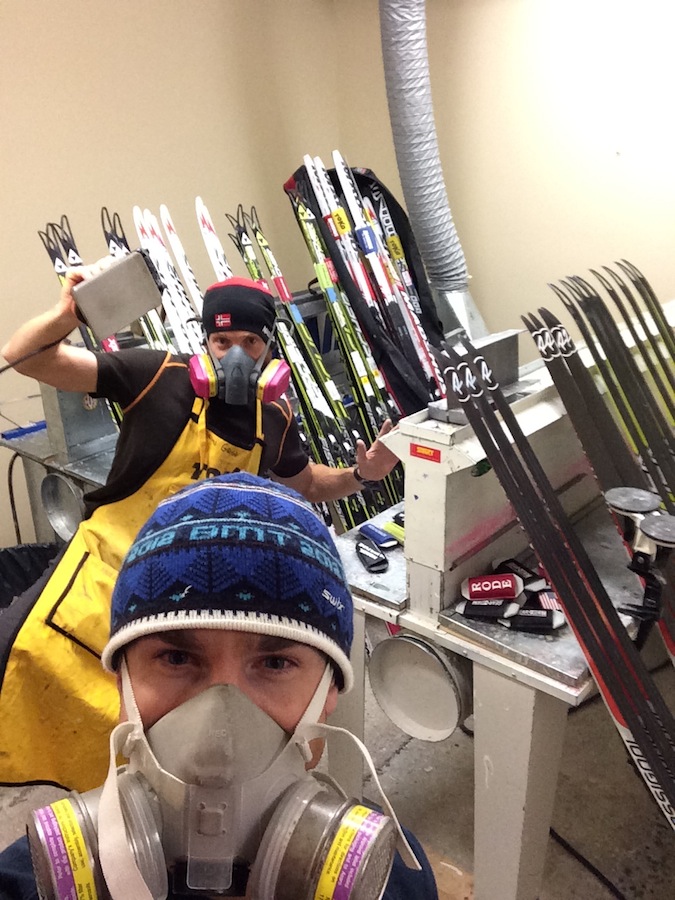
    I was able to team up with Scott J for the sprint waxing day. Temps were in the low-mid 20s (F) with fresh snow that had a fair bit of moisture. Base wax was LF Blue – a no-brainer for both Scott and I because we’ve always had success with that as an underlayer; no reason to test. 
    Scott arrived earlier than I did on the morning as he had an older athlete, and tested a variety of (4 different brands) topcoats. When I arrived I threw Jet Stream Red and Blue blocks into the mix, later to add Helix 2.0 Red. His winner was (a product from another brand). I put JetStream Blue against the (previous winner from the other brand) and it was solid – a toss-up in some places but JS ran really well (even better, I’d say) on initial acceleration, especially. We chose JS Blue as the block. 
    For liquids, he didn’t have any of the new Helix so I prepped up a test ski with 2.0 Red and put it against his own. The Helix kicked butt – free all the way from acceleration to top speed on downhills. Scott hadn’t had a chance to use the new versions yet so he was understandably excited to see the results. 
    We went with the LF Blue paraffin, JS Blue block, and Helix 2.0 Red. Because the weather didn’t change much but the tracks began glazing a bit following all the skiers, the Helix seemed to adapt well to that change and continued to run even in the heats. 
    The next day offered very similar snow but with new snow falling; I used the same combination of waxes and again they ran great; all my guys had skis comparable or better to those around them (even though many of those skiers around them were skiing faster; glide was better on downhills). 
    I’m excited to learn how effective that new Helix is, and that I’ve got a couple cans of the Red to work with. We have a few weeks of training before the first Junior Qualifier weekend in Bend, but I’ll touch base with you again after that to let you know how it goes. 
    Have a great holiday!
    Sam Naney, Head Coach Momentum Northwest

    mansfield nordic
    Field Report from Mansfield Nordic Club
    Eastern Cup #1, Craftsbury, VT
    December 19th, Freestyle sprints
    December 20th, 5km Freestyle for all
    Friday afternoon conditions were transformed corn snow the was fast and slick. Overnight, temps dropped to the mid-20s and new snow fell. For the men’s race, temps were mid 20’s rising toward 30 with intermittent sun and clouds. the snow was skied in, fast and slightly glazing from traffic (the qualifier was 2.5 laps per racer, with 200 male and 200 female racers). 
    Paraffin layer was a hard layer of graphite (Start brand) followed by Toko HF Red mixed with Toko LF Grey.
    In a test of Jetstream Red 2.0 Block and Helx Red 2.0 the block was preferred and this was the main topcoat for all skis, rotocorked in and brushed. 
    For structure, it was an extremely close call between the Blue Toko Structurite and a cross-hatch pattern created from a Swix tool. The blue was great climbing, but the Swix pattern was great at high speed and when riding flat skis. Because the course only featured one short, significant section of V1 we opted for the Swix tool. 
    All of our skiers felt that their skis were running great and we had some strong performances, most notably a 2nd place in the U16 qualification round. 
    During the qualifying round and before the heats, a big snowstorm rolled in and coated everything. Conditions slowed and the new snow on top of the manmade base meant interesting testing. For the heats we ended up actually dropping down in range to the Jetstream Blue 2.0 block via rotocork topped with Helx Blue 2.0 and the same structure. To make the structure more fine I applied it after corking but before brushing the Jetstream. Between rounds, a little more Blue 2.0 block was briefly hand-corked and re-brushed up.
    A touch more snow fell overnight and temps dropped to the low 20s, and the snow guns were blasting as well. Early Sunday morning ski testing was the best snow of the year so far: firm, silky corduroy. I think pretty much every coach/wax tech out there was having a blast due to the great conditions. 
    Paraffin layer was HF Blue for the women, and a mix of HF Blue and HF Red for men.
    I tested Jetsream Blue 2.0 block versus a mix of Jetstream Blue Powder and X-Cold powder mixed 1:1. Both felt great, so I was confident that a powder layer followed by a block would be a reasonable call. With the sun coming out and the track glazing a bit before start time, I took the X-cold out of the equation and just ironed Jetstream Blue powder into all skis. That was followed by the Jetstream Blue block rotocorked in, then the blue Structurite tool.
    The women were really psyched with their skis and we had at least one really great race. There was a delay to the men’s race, meaning another opportunity to test. The only change I made was mixing the Jetstream Red and Blue blocks together, and the men were equally pumped to have skis that they said were fast and smooth. Another podium in the U16 men’s field was a highlight and capped off a great first weekend of Eastern Cup racing! 
    Adam Terko, Head Coach, Mansfield Nordic Club
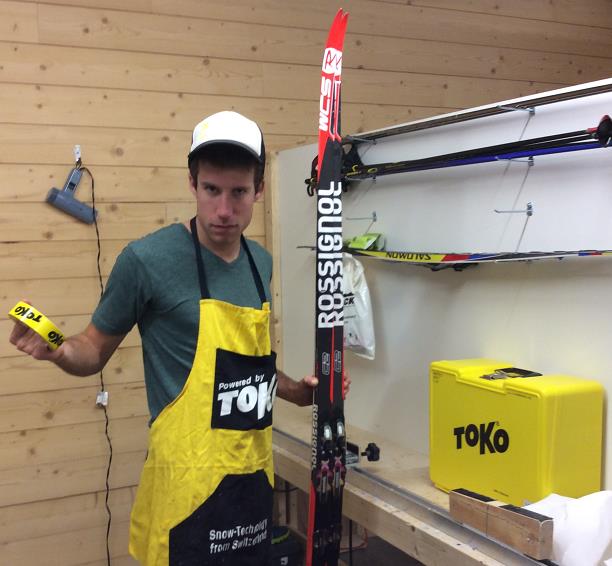
    adam terko mansfield
    toko grip and glide
    Toko Grip & Glide Wax: For No Wax Skis
    We get asked all of the time how treat no wax skis and more specifically often times how to prevent wax from clumping up in the kick zone in new falling snow around 32f.  The solution is simple: Toko Grip & Glide Wax.
    Apply Grip & Glide Wax to the entire base of the ski – both the glide areas as well as the kick zone.  The glide areas will glide faster and the grip zone will not have snow sticking to it.
    One thing to watch for though is if the kick zone (tread pattern) already has dirt in the corners and cracks. If this is the case, clean it well with a tooth brush and some wax remover if there is ski wax in there or just soapy water if it is just dirt.  Once this is done, then the regular preparation mentioned above will serve you well.
    Grip & Glide Wax is available at most Toko Nordic dealers and has a MSRP of $15.50 for 100ml (pictured above) and $19 for the 200ml size. Enjoy!
  • NorAm Leader Sandau Stays in North America to Hone Fitness for Ski Tour Canada

    NorAm Leader Sandau Stays in North America to Hone Fitness for Ski Tour Canada

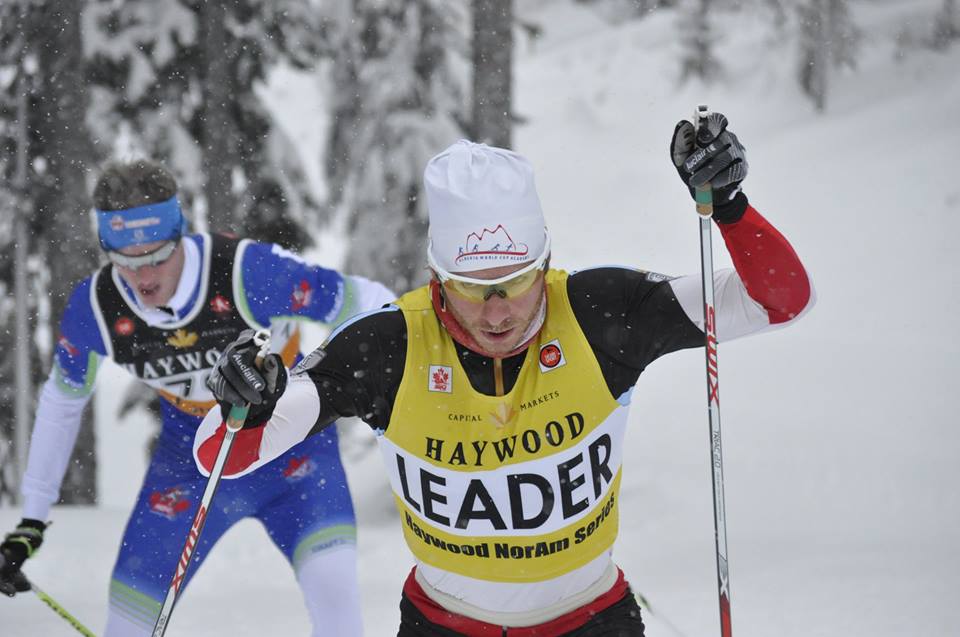
    Race winner Kevin Sandau (AWCA) (r) in the leader's bib leads Bob Thompson (Team Hardwood) during the men's NorAm 15 k freestyle individual start on Sunday in Vernon, British Columbia. (Photo: XTS Photography)
    Race winner Kevin Sandau (AWCA) (r) in the leader’s bib leads Bob Thompson (Team Hardwood) during the men’s NorAm 15 k freestyle individual start on Sunday in Vernon, British Columbia. (Photo: XTS Photography)

    Kevin Sandau is aiming for the Ski Tour Canada at the end of the season, so he didn’t feel like he needed to lead the NorAm circuit right away.

    But being the Period I leader? That was nice, he admitted.

    “To win NorAms is a pretty good feeling,” the Alberta World Cup Academy skier said in an interview. “West Yellowstone too, it was a tight race, so I was happy with that. At the beginning of the season I wasn’t gunning that do-or-die, I needed to win races. It’s great that I’m winning. But if I wasn’t, the season is long. It’s nice to see that there’s some good speed there and some good fitness even though the focus is on the later part of the season.”

    Sandau swept the distance races at the opening NorAm weekend in Canmore, Alberta, and then also won the 15 k skate in Sovereign Lakes, British Columbia. Before that, he had started the season in West Yellowstone, Montana, placing fifth in the 15 k skate just 20 seconds behind 2014 Olympian Brian Gregg of the United States.

    But it hasn’t been all racing; with his focus on a grueling World Cup tour at the end of the season, Sandau has been training as well. He skipped the sprint race at Sovereign Lakes to fit in two four-hour days of volume training.

    That unique focus on the season-ending World Cups is also leading Sandau to do something you don’t see so often: he’s turning down an opportunity to race on the World Cup.

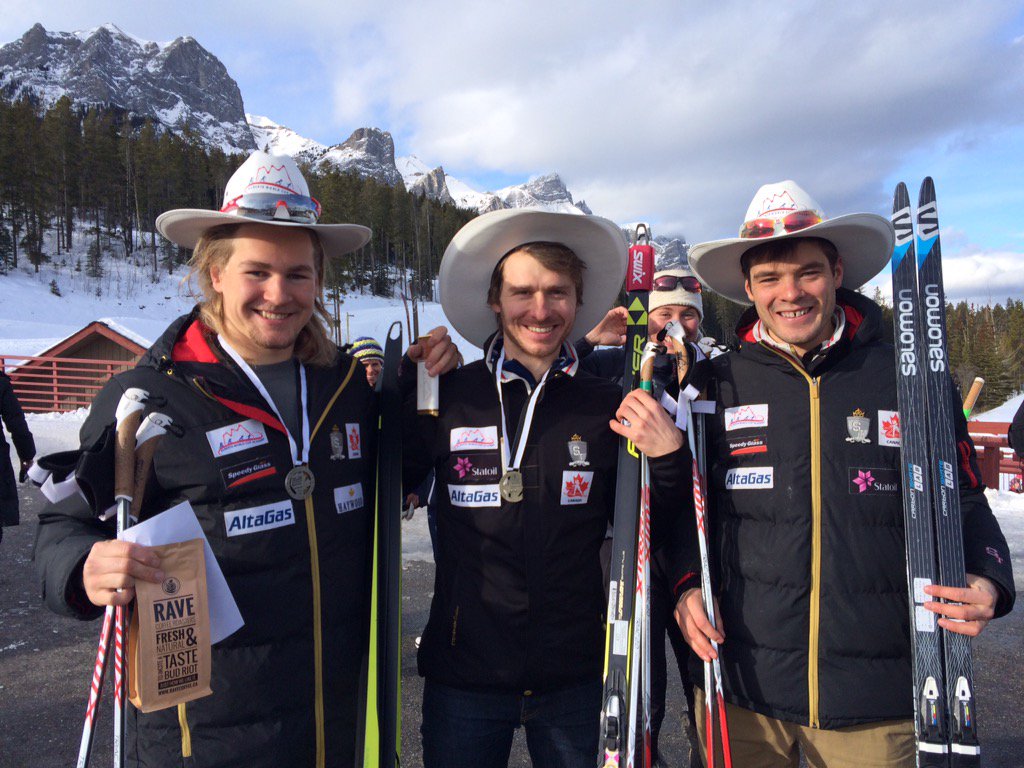
    Kevin Sandau (c) and his Alberta World Cup Academy teammates Knute Johnsgaard (l) and Patrick Stewart-Jones (r) placed first, second and fourth, respectively in the men's NorAm 16.5 k freestyle mass start on Dec. 6 in Canmore, Alberta. (Photo: Alberta World Cup Academy/Twitter)
    Kevin Sandau (c) and his Alberta World Cup Academy teammates Knute Johnsgaard (l) and Patrick Stewart-Jones (r) placed first, second and fourth, respectively in the men’s NorAm 16.5 k freestyle mass start on Dec. 6 in Canmore, Alberta. (Photo: Alberta World Cup Academy/Twitter)

    As the NorAm leader, Sandau has automatic start rights for Period II of racing. That is provided through FIS, which does the same for the leader of each Continental Cup circuit around the world, and is independent of the fact that Cross Country Canada has declared Period II to be an Under-25 tour (Sandau is 27 years old).

    But the provision does not include the Tour de Ski, which is the first batch of races after New Years; the Tour de Ski has only quota spots for each country, no additional quota spots for Continental Cup leaders.

    “Granted we have never filled our full quota before,” Sandau wrote in an email. “Tours are great bang for your buck in terms of the number of races over a short period of time, and I’ve always considered racing the Tour if the opportunity arose. I find I handle race volume pretty well. There is no domestic criteria to qualify for the tour (only World Cup criteria). They are announcing the team today I believe, but a few athletes on the World Cup Team didn’t meet the criteria and I would assume they will make concessions anyway to bring them.”

    After the Tour de Ski, Period II includes only two more World Cup weekends, with a team sprint, a relay, and importantly for Sandau, only one individual distance race.

    “For me that trip was never a focus at all,” Sandau said. “I’d rather stay in Canada and race.”

    And so he will head south to Houghton, Michigan, after New Years for U.S. National Championships, then follow the NorAm circuit to Thunder Bay, then to Western Canadian Championships, and finally to Eastern Canadian Championships. All with the goal of strong performances at the Ski Tour.

    “That leaves just under a month of time to incorporate an altitude block and volume block as final preparations for the Tour,” Sandau said. “It’s nice to have these races in Canada because the logistics of going to Europe and finding altitude to ski at and volume, it’s expensive and difficult, especially since I’m not on the World Cup team. They have the flexibility. For me it would be more difficult.”

    With not only normal World Cup quotas but also Nations Group start spots for Canada in the Ski Tour, Sandau is not worried about whether he will qualify. And once he gets there, he’s looking forward to a chance to ski his best races without the politics of team selection or national team spots.

    “It feels like a more level playing field for the domestic guys,” he said.

    Sandau was looking for a spot on the 2015 World Championships team last year, but was left off. Cross Country Canada did not fill all of their quota spots. Just before the Championships, which were in Falun, Sweden, Sandau was in Europe racing on a “B” tour.

    He won the 15 k skate at Latvian national championships, but then watched from afar as Canada only started three, not the allowed four, men in the 15 k skate, and one of them was Jesse Cockney, a sprint specialist.

    “When I found out they put a sprinter in the 15 k it was like a slap in the face,” Sandau said. “I was in Europe and it would have been a short flight over. But to them it was like I wasn’t part of their umbrella and so I didn’t meet their criteria, but there was other flexibility given to other athletes on that trip.”

    He also saw that Cross Country Canada is placing an emphasis on developing young athletes, and doesn’t see value in carrying older athletes on tours if they have not yet had international success. That’s bad enough for Sandau, but he sees it hurting the women’s team even more.

    “Especially women in this country, we don’t have too many and we don’t have too many above 25,” he said. “The last thing we should be doing is to discourage them from continuing to ski. I think that they can be seen as role models. They have a wealth of knowledge. It girls are getting beaten by older girls, they are just going to go back and want to be faster. Competition breeds excellence. It’s silly.

    “When you look at the big picture, you see that they say they want to focus on the younger generation but it’s kind of like, well, at the cost of ignoring the current generation?”

    -Kevin Sandau

    By qualifying for the Ski Tour Canada through domestic criteria and focusing his season on doing the preparations that he thinks will be best, Sandau hopes to avoid the drama and emotions that he experienced last season, and also in a failed bid for the 2014 Olympic team.

    “Last year when I was fighting to get a spot on the World Championships team because they had unused distance spots, I was a stress case and not sleeping and it was kind of sad,” he said. “That’s behind me now, but that’s why the Ski Tour is such a nice thing. As long as you qualify for a spot, there’s no age criteria on that spot and there’s just such a level playing field.”

  • Sandau Completes NorAm Distance Sweep; Beatty Tops Sovereign 10 k

    Sandau Completes NorAm Distance Sweep; Beatty Tops Sovereign 10 k

    Race winner Kevin Sandau (AWCA) (r) in the leader's bib leads Bob Thompson (Team Hardwood) during the men's NorAm 15 k freestyle individual start on Sunday in Vernon, British Columbia. (Photo: XTS Photography)
    Race winner Kevin Sandau (AWCA) in the leader’s bib ahead of Bob Thompson (NDC Thunder Bay) during the men’s NorAm 15 k freestyle individual start on Sunday in Vernon, British Columbia. (Photo: XTS Photography)

    VERNON, British Columbia — Kevin Sandau of the Alberta World Cup Academy (AWCA) has no time for quitters, including himself. Despite not being renominated to the Canadian National Senior Team this spring, Sandau’s decision to carry on with his career as a professional nordic ski racer proved to be worthwhile as he won his third-consecutive distance race of the NorAm season (in as many races) on Sunday, the men’s 15-kilometer individual start freestyle race at the Sovereign Lake Nordic Centre. 

    “Going up the climbs, I felt super smooth with my V1 skate,” Sandau, 27, said during an in-person interview after winning Sunday’s race by 37.3 seconds in 39:05.9. “I made sure to push the flats using a strong V2 to keep the speed up. … It was one of those days where I just felt invincible.” 

    Though doubt shrouded Sandau’s ambition for the sport earlier this year, his latest performances appear to cast all queries aside. 

    After two weekends of NorAm races, the Canadian will head into the New Year with three distance titles already under his belt, which puts him in a position to potentially earn future World Cup starts as the NorAm (Continental Cup) leader.

    “Third distance win in a row, I think that is a good way to end the 2015 year,” he said.

    Part of Sandau’s first-place performance on Sunday stemmed from not just his in-race focus, but his pre-race routine and weekend training, he said.

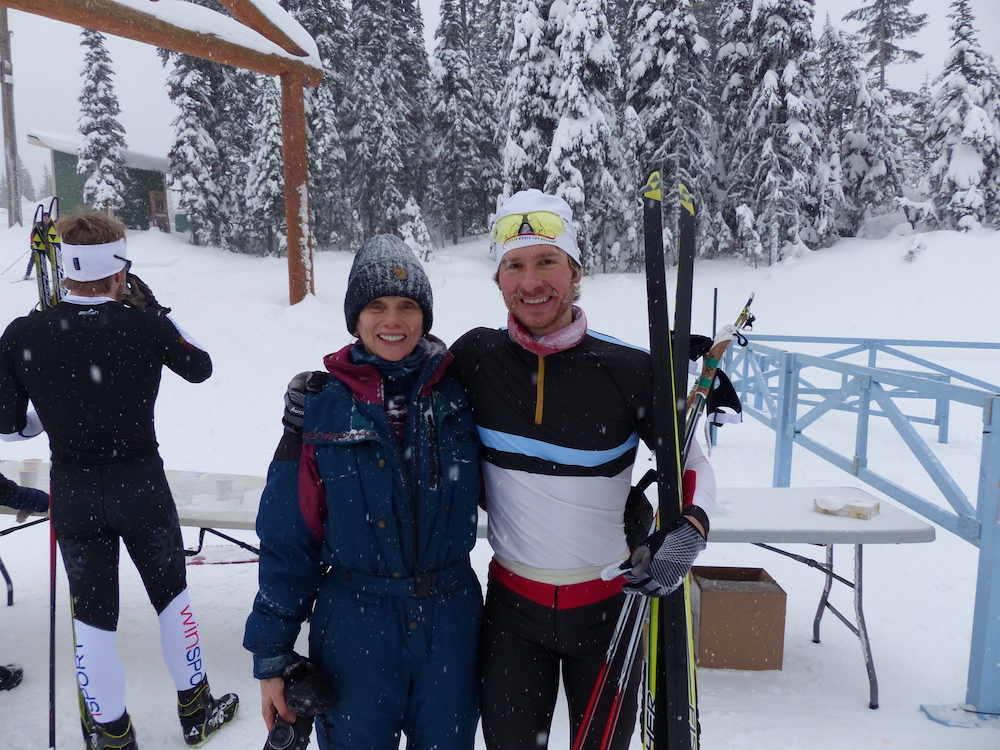
    Kevin Sandau and his mom after the men's NorAm 15 k freestyle individual start on Sunday in  Vernon, British Columbia. (Photo: Gerry Furseth)
    Kevin Sandau and his mom after the men’s NorAm 15 k freestyle individual start on Sunday in Vernon, British Columbia. (Photo: Gerry Furseth)

    “My warmup this morning felt bombproof,” Sandau said. “I also took [Saturday] off, didn’t do the sprint race, and did volume instead. … It [was] interesting to see how the body reacted to that.”

    While Sandau sat out the sprint, his AWCA teammate and second-place finisher for the men’s 15 k, Knute Johnsgaard, of the national U23+ Development Team, competed both days, and reached the podium in second in both races.

    “I thought I skied a good race and I am pretty happy with second,” Johnsgaard, 23, said. “But I’m still chasing that win.” 

    Johnsgaard’s podium on Sunday came from course knowledge and tact.

    “I’ve skied this course so many times,” he said. “You’re able to push pretty hard on the uphills because there is quite a few tucking sections where you can recover after the climbs.”

    While course experience was on Johnsgaard’s side, he left the Sovereign NorAm wanting a different kind of experience.

    “I have a very large stack of silver medals now, and I’d like to get gold soon,” he said.

    Just over 41 seconds behind Sandau, Russell Kennedy (Canmore) in third also craved the top spot on the podium.

    “Everyone wants to win from the start, but I’m hoping to get better and better as the season goes on,” Kennedy said. “I feel like I’ve got a good stepping stone, and I’m going to try to keep building off of that.”

    Kennedy spent most of his race getting splits for second behind Sandau, but and initially finished second 41.2 seconds after him. A later starter, Johnsgaard bumped Kennedy to third by 3.9 seconds.

    On the women’s side, Dahria Beatty (AWCA/U23 Development Team) won the women’s freestyle distance race at Sovereign Lake for the second year in a row.

    “I love this course,” the 21-year-old Beatty said after winning in 30:30.2, more than 32 seconds ahead of runner-up Jaqueline Mourao, originally from Brazil who trains with the Pierre Harvey Training Centre (CNEPH) in Quebec.

    “I’ve been racing on this course since I was 15; I raced here with the Yukon [team when] I was a junior,” Beatty added.

    With her course knowledge and Sunday’s snowfall during the race, she powered into the first climb.

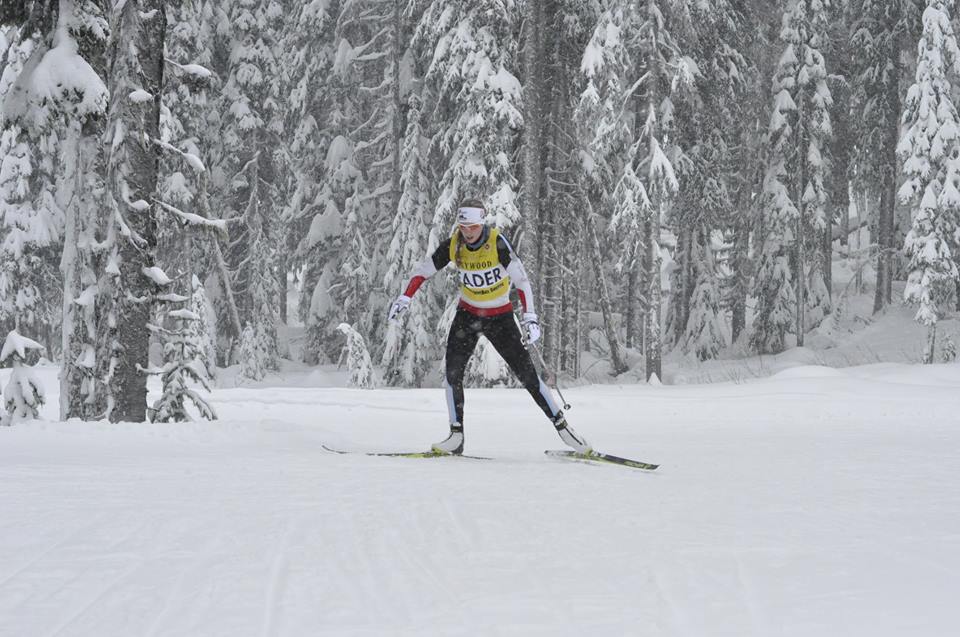
    Dahria Beatty (AWCA) in the leader's bib during a snowy women's NorAm 10 k freestyle individual start on Sunday in Vernon, British Columbia. (Photo:  XTS Photography)
    Dahria Beatty (AWCA) in the leader’s bib during a snowy women’s NorAm 10 k freestyle individual start on Sunday in Vernon, British Columbia. (Photo: XTS Photography)

    “A lot of people take the first climb conservatively because they are worried about blowing up,” Beatty said. “So I skied as hard as I could and as smooth as possible. I think that’s the key to this course, especially when it is snowing.”

    On the podium for the second-straight day, Andrea Dupont, (Rocky Mountain Racers) finished third, 1:02.7 after Beatty.

    “Today was okay,” Dupont, 25, said. “It was a bit of a slog because it really started dumping snow when the girls got on course.” 

    A sprint specialist, Dupont found pacing helped her to another top finish.

    “I wanted to not go out too hard, because I’m definitely a sprinter and I characteristically go out too hard and can’t hold it,” she said. “[Sunday] I went out easy and tried to hold it … and I think I’m on track.” 

    Another sprint favorite, Beatty came into Sunday on the hunt for a win after missing out on Saturday’s A-final.

    “I was a little disappointed with not making the A-final yesterday,” she said. “I wanted to come hard today and I knew that I could do well.”

    After charging up the first climb, Beatty continued to get positive splits and raced to a 32.2-second win over Mourao.

    “I kept getting splits saying I was 25 seconds up on second,” said Beatty, “When you get splits like that, it makes you ski faster because of the confidence boost,” she added.

    A three-time Brazilian Olympian, Mourao also felt a confidence boost after her race.

    Jaqueline Mourao (CNEPH) racing during snowy women's NorAm 10 k freestyle individual start on Sunday in Vernon, British Columbia. (Photo: XTS Photography)

    “I’ve never thought about podiums,” said the 40 year old, who’s also competed in biathlon. “And now, with the right preparation, the right skis, the opportunity I’m having, I can dream more.”

    Also an adept mountain biker, Mourao believed her time spent on the bike helped her during her time spent climbing on Sunday’s course.

    “I’m a mountain biker and I like climbing so the course was perfect for me,” she said. 

    The last weekend of racing until the New Year (and the next NorAm Jan. 14-17 in Thunder Bay, Ontario) for many of the Canadians, most feel the Sovereign Lake NorAm races were a solid close to 2015.

    “This is my last race of 2015,” said Beatty. “I won’t be racing until I head to Europe after Christmas [as the Continental Cup leader] and it’s nice to finish on a positive note.”

    — Gerry Furseth contributed reporting

  • Wednesday Workout: The Hetland Speed Drill with Michael Somppi

    Wednesday Workout: The Hetland Speed Drill with Michael Somppi

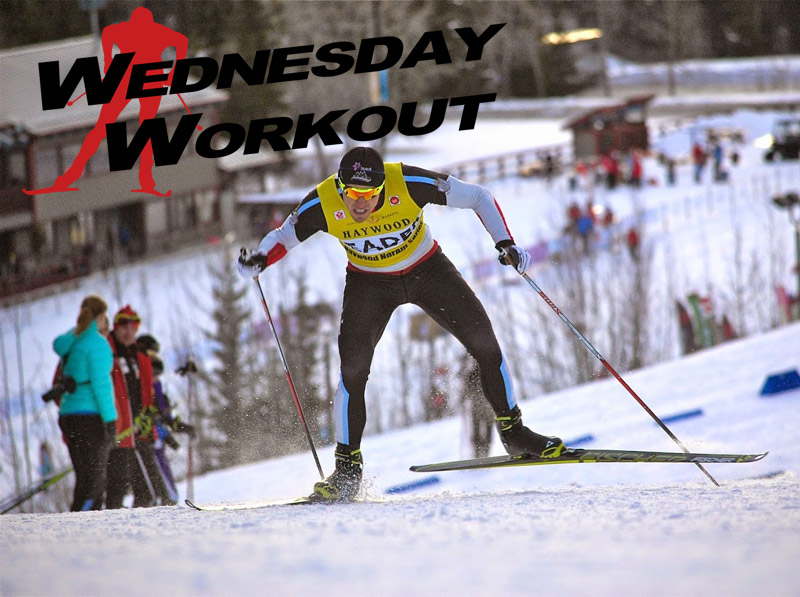
    Michael Somppi, of the Alberta World Cup Academy and Canadian National Development Team, racing to a NorAm freestyle-sprint win last weekend at Western Canadian Championships in Canmore, Alberta. (Photo: Angus Cockney)
    Michael Somppi, of the Alberta World Cup Academy and Canadian National Development Team, racing to a NorAm freestyle-sprint win last weekend at Western Canadian Championships in Canmore, Alberta. (Photo: Angus Cockney)

    This week’s workout comes from Michael Somppi, a 26-year-old Canadian National Development Team skier and Alberta World Cup Academy member. Also the current NorAm leader, Somppi won back-to-back races (a skate sprint and a skate mass start) at Western Canadian Championships this weekend for his first two victories of the season, and after a string of strong results this year, he explains one of his secrets to success.

    ***

    I learned a trick of the trade this spring at a National Team training camp from new Canadian coach, Tor-Arne Hetland.  It’s not a full workout, but more a tool you can use in your race-day warmup or post-interval session cool down.

    When Hetland first introduced our team to this tool, it was after a hard, speed-focused running workout and everyone’s legs were full of lactate.  He said of all the different things he’s tried over his years of racing and training, this was the most effective way he found to help the body flush lactate after a hard workout.  The recipe is four repetitions of 15 seconds on/45 seconds off, and the key to doing this effectively is the pacing.  The 15 seconds on is controlled Zone 4 speed.  It is not full-out sprinting.  The 45 seconds off is easy jogging or walking.  Don’t just stand still, keep moving.

    The Hetland Speed Drill 

    4 x 15 seconds on/45 seconds off (running): 15 seconds on at controlled Zone 4 speed (not full-out sprinting), 45 seconds off = easy jogging or walking.

    30 seconds on/60 seconds off (skiing): 30 seconds on at Zone 4 speed, 60 seconds off = easy skiing

    I used this tool after many hard ski-striding and running intensity workouts this past summer and can report it is helpful for flushing lactate.  I also started experimenting using this tool as part of my warm-up for running races to even greater effect.

    Michael Somppi leads the pack en route to the win in the men's 20 k freestyle mass start at Western Canadian Championships on Jan. 18 in Canmore, Alberta. (Photo: Angus Cockney)
    Michael Somppi leads the pack en route to the win in the men’s 20 k freestyle mass start at Western Canadian Championships on Jan. 18 in Canmore, Alberta. (Photo: Angus Cockney)

    After doing some Zone 1 and one longer Zone 3 effort, I would finish my warm up with the 4 x 15/45.  It worked so well for me that when I was faced with having to do a partial running warmup for my races at the Rossland NorAm due to lack of snow, I decided to use this tool again.  I felt ready to go when I hit the start line and performed well. [Note: Somppi placed third and fourth in the two classic distance races in Rosalind, B.C.]

    The reason I like using this short interval set for final warmup prep is because it’s a good way to elevate the heart rate and move the body at higher speed without producing much lactate.  With the efforts being short (15 seconds) and not full-out, you aren’t doing enough to build any significant lactate, however with the relatively short rest period (45 seconds) your heart rate doesn’t drop all the way back to where it originally was, so each consecutive effort your heart rate is becoming more elevated.

    Next I wanted to try using it in my race prep on snow.  I don’t generally need to do that kind of higher-speed effort before a distance race, but I thought this could be perfect for a sprint qualifier warm-up.  The problem is skiing is different than running with the whole glide aspect.  I decided 15 seconds would not be long enough for me to get the feeling I want in my race warmup so I altered it slightly to four reps of 30 seconds on/60 seconds off.  I used this formula as the final step in my warmup for the skate sprint qualifier this past weekend in Canmore and it worked out really well for me.

    This little piece of wisdom handed down to me from Hetland has been very useful for me and I hope you can find ways of benefitting from it as well.

  • NorAm Preview: All About Racing the Best in Canada, and the U.S.

    NorAm Preview: All About Racing the Best in Canada, and the U.S.

    American Brian Gregg (l) and Canadian Andy Shields of the Thunder Bay National Development Centre ski alongside each other in the 11 k classic individual start last weekend at the NorAm opener in Rossland, B.C. Gregg went on to place fifth and Shields was 12th. (Photo: FRESH cafe & apres/Facebook)
    American Brian Gregg (l) and Canadian Andy Shields of the Thunder Bay National Development Centre ski alongside each other in the 11 k classic individual start last weekend at the NorAm opener in Rossland, B.C. Gregg went on to place fifth and Shields was 12th. (Photo: FRESH cafe & apres/Facebook)

    While the opening weekend of the U.S. Super Tour marked the start of the North American race season in late November, Canada’s NorAm circuit kicked off last weekend in Rossland with two classic distance races, held despite challenging conditions and a lack of snow.

    The second stop of the NorAm circuit was originally scheduled for Whistler this Friday and Saturday, but once again, warm weather and insufficient snow led the races to be moved further inland to Sovereign Lake in Vernon, British Columbia, better known as Silver Star.

    This season, the NorAm will visit six venues, wrapping up at the Lappe Nordic Centre in Thunder Bay, Ontario, for Canadian Ski Nationals. The circuit attracts many of the most competitive Canadian and American domestic cross-country skiers, juniors and seniors alike, all trying to earn their stripes and log top results in an effort to get to Europe.

    Canadians Alysson Marshall and Heidi Widmer, teammates at the Alberta World Cup Academy (AWCA) in Canmore, Alberta, and on the national development team — also based in Canmore, started the winter off with strong results at the SuperTour opener in West Yellowstone, Mont. Marshall won the first sprint of the season, and Widmer placed second.

    In the 10 k freestyle the next day, Widmer again broke into the top 10 with a ninth-place finish, and Marshall finished 17th.

    Patrick Stewart-Jones (AWCA), Bob Thompson (Thunder Bay NDC), Michael Somppi (AWCA/NST D-team), and Andy Shields (AWCA) were among several Canadians racing in West Yellowstone. There, Shields made the sprint A-final, but finished sixth after breaking a pole. In the 15 k, Stewart-Jones led the Canadians in 17th. 

    One week later, Stewart-Jones emerged as the winner of the classic sprint in Bozeman — the second SuperTour stop in Montana. Marshall placed fifth in the women’s A-final, and the next day in the 10 k classic mass start, she finished 14th, just ahead teammate Dahria Beatty (AWCA/NST U23) in 15th. In the men’s 15 k classic mass start, Somppi was the top Canadian man 13th.

    Rossland’s opening NorAm races challenged organizers with difficult conditions, but quality racing still took place thanks to the hard work of the staff and volunteers. Warm weather and rain previously wreaked havoc on the snow, but below-freezing temperatures last weekend made for hard-packed, icy conditions for the two distance races. Leading up to the races, organizers ruled the course unsafe for a sprint and added another classic distance race to the schedule instead.

    Yukon's Annah Hanthorn racing to third on the opening day of the 2014/2015 NorAm season, in the women's 7.5 k classic in Rossland, B.C.  (Photo: FRESH cafe & apres/Facebook)
    Yukon’s Annah Hanthorn racing to third on the opening day of the 2014/2015 NorAm season, in the women’s 7.5 k classic in Rossland, B.C. (Photo: FRESH cafe & apres/Facebook)

    Marshall swept both races, as did American Kris Freeman. Somppi hit the podium in third in last Saturday’s 11 k classic, and was again the top Canadian in fourth in the following 15 k classic. Andrea Dupont (Rocky Mountain Racers) placed second to Marshall in the 7.5 k sprint on Day 1, and junior Annah Hanthorn (Yukon Territory Ski Team) placed third, then second in the women’s 11 k on Day 2.

    Following an Olympic year, there have been some shifts in the key Canadian players: Dasha Gaiazova, Amanda Ammar and Zoe Roy were three of the nation’s top women last season and retired this spring. Graham Nishikawa, the reigning overall men’s NorAm leader, has re-committed his focus to guiding Canadian Para-Nordic teammate Brian McKeever at International Paralympic Committee (IPC) World Cups and 2015 World Championships.

    Many of the top athletes are aiming for top results in order to qualify for later World Cups, U23 and Junior World Championships, and potentially senior World Championships in Falun, Sweden.

    “Making the transition from domestic to World Cup racing is what everyone on the development team is trying to achieve, me included,” Somppi wrote in an email. “Experience is certainly helpful. The more international racing you do, the more comfortable you get with it and the better you perform.”

    Women to Watch 

    Alysson Marshall at the 2014 Canadian Eastern Championships in Cantley, Quebec. (Photo http://shootstories.smugmug.com/Canadian-Eastern-Championships/i-TdxGVQW
    Alysson Marshall at the last season’s Canadian Eastern Championships in Cantley, Quebec. (Photo: Canadian Eastern Championships)

    Heidi Widmer (AWCA/NST D-team) – With last year’s overall NorAm cup winner Emily Nishikawa starting her season in Europe on the World Cup, Widmer is one favorite in the running for an overall NorAm title this season.

    The 23-year-old Sochi Olympian already has a podium under her belt from West Yellowstone, where she also posted the fastest women’s qualifying time in the sprint. In late October before the season officially started, she qualified fourth in the Frozen Thunder classic sprint among U.S. Ski Team members and other top Canadians, and then edged Nishikawa in the distance skate to finish ninth.

    Alysson Marshall (AWCA/NST D-team) — In six races so far this season, Marshall, 26, has won half of them. Marshall and Widmer have already been battling back and forth; neither has beaten the other in consecutive races this season (although Widmer did not race in Bozeman or Rossland). Marshall, 26, has been consistent in distance and sprinting, a critical asset in the run the overall NorAm title. Last season, she finished third in the NorAm standings behind Nishikawa and Widmer, respectively.

    Dahria Beatty (AWCA/NST U23 team) – One of the youngest threats on the circuit, Beatty, 20, is a first-year senior who proved as early as the Frozen Thunder classic sprint that she’s able to ski with the best. There in October in Canmore, she qualified second behind former Olympian Perianne Jones.

    Andrea Dupont (Rocky Mountain Racers) – After finishing fifth overall in the 2013/2014 NorAm (behind Ammar in fourth), this 34-year-old distance veteran is looking to lift herself to World Cup starts.

    A sprint specialist, Dupont stressed in an email the importance of dominant qualifiers, while adding that racing well in the heats and advancing throughout each round is important as well. But more than anything else, she wants better qualifiers than last season.

    “It isn’t enough to just get into the heats in Canada; you have to win the qualifier here if you want to have a chance of qualifying in Europe,” she explained.

    Despite her sprinting preference and sickness early in the season, Dupont claimed second place in Rossland’s 7.5 k classic race.

    Cendrine Brown (CNEPH/U23) – This 21-year-old member of the Pierre-Harvey Training Centre (CNEPH) in Quebec, made the junior-national team last season and competed at U23 World Championships in Val di Fiemme, Italy.

    This year, after focusing on speed to improve her sprinting, Brown has already recorded fourth- and sixth-place finishes in Rossland, and will continue to shoot for another U23 World Championships in Almaty, Kazakhstan. The first three NorAm weekends serve as trials for Canada’s U23 and World Junior teams.

    Brittany Webster (AWCA) — A two-time Olympian and veteran to high-level racing, Webster, 27, started her season off in 15th in the Bozeman classic sprint. She didn’t race in Rossland, but Webster has been busy this offseason; competing in her first off-road triathlon World Championships, where she won the amateur division.

    Also this fall, she launched a pursu.it crowd-funding campaign in September and has raised over $19,500 to help cover the cost of what she anticipates to be an expensive international race season.

    Men to Watch

    Michael Somppi (AWCA/NST D-team) racing in the Frozen Thunder classic sprint on Oct. 24. (Photo: Angus Cockney)
    Michael Somppi (AWCA/NST D-team) racing in the Frozen Thunder classic sprint on Oct. 24. (Photo: Angus Cockney)

    Michael Somppi (AWCA/NST D-team) – Third overall in the NorAm last season; Somppi, 26, is eager to build on his past performances. For now, he’s focused on superb racing before the end of December.

    At this point in my ski career, I’m 26 and if I want a shot at being a World Cup competitor I need to be able to podium at home,” Somppi wrote in an email. “So every time I step on the start line I’m looking to finish on the podium.”

    He was the top Canadian in both classic distance races in Rossland last weekend, claiming a bronze medal in the 11 k classic and finishing fourth in the 15 k.

    Raphaël Couturier (CNEPH/U23) – In August, Couturier, 21, was the only Canadian not part of the World Cup Team invited to come down from Quebec to train with the team at a dryland camp in Stratton, Vt. He ranked fifth overall in the NorAm last year, and has started the season in seventh and 10th in Rossland.

    Patrick Stewart-Jones (AWCA) – Wrapping up the 2013/2014 NorAm season in sixth overall, Stewart-Jones, 23, will be looking to improve his placing. Last winter, he posted some of his best results of the season at Canadian Olympic Team trials in Janaury (where he was third in the freestyle sprint and sixth in the 15 k classic), and was able to race at U23 World Championships as well as Scandinavian Cups in Latvia and Estonia.

    In six races, he has two top 10’s: one win and an eighth-place finish in the 11 k classic last weekend.

    Knute Johnsgaard (Independent) – Likely one of the biggest dark horses at the beginning of this season, Johnsgaard spends most of his training hours without company in the Yukon.

    Despite his training partner leaving for school, having limited time with his coach, and developing his own training plan with the help of Graham Nishikawa, Johnsgaard is confident in his training, the work he has done and how it will translate on the tracks.

    “I’m always really focused and motived to just get out and go by myself,” he explained. “It’s a little lonely sometimes but I don’t need anybody to ‘push’ me.”

    Johnsgaard, 22, added he likes being off the radar and not having anyone knowing how his training is going. To that end, he joked that he’s won every single time trial he’s done this year. He’s hoping to continue this streak and claim victories at NorAm races.

    Andy Shields (Thunder Bay NDC) – Last season, Shields finished ninth overall on the NorAm, yet his early season results indicate he’s had a successful summer of training that could put him closer to the top overall this time around. So far, the 23 year old has posted two sixth-place results: first in the West Yellowstone sprint and also in the 15 k classic last weekend.

    Wild Cards

    World Cup Academy teammates Kevin Sandau (NST D-team), Jesse Cockney (B-team), and Graeme Killick (B-team) were among the most competitive on the NorAm circuit last season, finishing second, fourth and seventh overall, respectively. Cockney and Killick earned Olympic spots for Sochi based on the mid-season NorAm races and all three have started their seasons on the World Cup in Europe.

    In an email, Sandau described his excitement to race on the World Cup and some of his expectations: “Davos is a very unique race and I think it plays well with my strengths with it being a longer distance and a course with longer climbs than most other world cups,” the 26 year old wrote. After some tuneup FIS races in Switzerland earlier this month, he placed 70th in the 15 k classic last weekend in Davos.

    “At the end of the day it really is the final result that counts, but more than anything I want to cross that line and just have that feeling of it being the perfect race,” he wrote.

    Multiple-time Paralympic gold medalist, Brian McKeever races to 13th in the Rossland NorAm 11 k classic on Dec. 13. (Photo: FRESH cafe & apres/Facebook)
    Multiple-time Paralympic gold medalist, Brian McKeever races to 13th in the Rossland NorAm 11 k classic on Dec. 13. (Photo: FRESH cafe & apres/Facebook)

    Last year’s overall NorAm leader, Graham Nishikawa is backing away from domestic racing to fulfill his commitments to the Para-Nordic Tea, although he confirmed he would take part in one or two NorAms to prepare for IPC World Cups. Despite the races not being his focus, Nishikawa, 31, is a potential treat if he makes it to the start line.

    His younger sister Emily matched him as the women’s overall NorAm winner last season. She is currently racing on the World Cup, where she posted a career-best 29th last weekend in Davos.

    “The major difference between racing on the World Cup and domestically is the depth of the field,” Emily Nishikawa explained in an email. “If you lose a few seconds, you will lose a few places as well. This probably won’t happen when racing domestically because the field is just that much smaller.”

    Annah Hanthorn and Maya MacIsaac-Jones, both 19-year-old juniors, finished third and fifth respectively in last weekend’s 7.5 k classic (and Hanthorn was second in the following 11 k classic). Then there’s always Perianne Jones, a perennial World Cup staple, who could make NorAm waves should she return to Canada.

    Already, it’s shaping up to be another exciting year of racing. Some athletes are most competitive in distance races, others sprinting, and a myriad of possible contenders can take the victory on any given day. Stay tuned for NorAm updates via the Continental Cup blog: http://blogs.fasterskier.com/continentalcup

    2014/2015 NorAm Schedule 

    • Dec. 13-14: Rossland NorAm opener (and U23/Junior World Trials 1): 7.5/11 k classic & 11/15 k classic
    • Dec. 19-20: Vernon freestyle interval start & classic sprint at Sovereign Lake (U23/Junior World Trials 2)
    • Jan. 8-11: Duntroon 15/30 k skiathlon, classic sprint, 10/15 k freestyle (U23/Junior World Trials 3)
    • Jan. 15-18: Western Canadian Championships in Canmore: 10/10 k classic, freestyle sprint, classic mass start
    • Jan. 30-Feb. 1: Eastern Canadian Championships in Cantley: freestyle sprint/prologue, 10/15 k freestyle, 15/20 k classic mass start
    • March 14-21: Canadian Ski Nationals in Thunder Bay: freestyle team sprint, 5/10 k freestyle, 10/15 k classic, 30/50 k freestyle mass start

    — Alex Kochon contributed reporting

  • Weekend Roundup: ‘Way More is Possible’

    Weekend Roundup: ‘Way More is Possible’

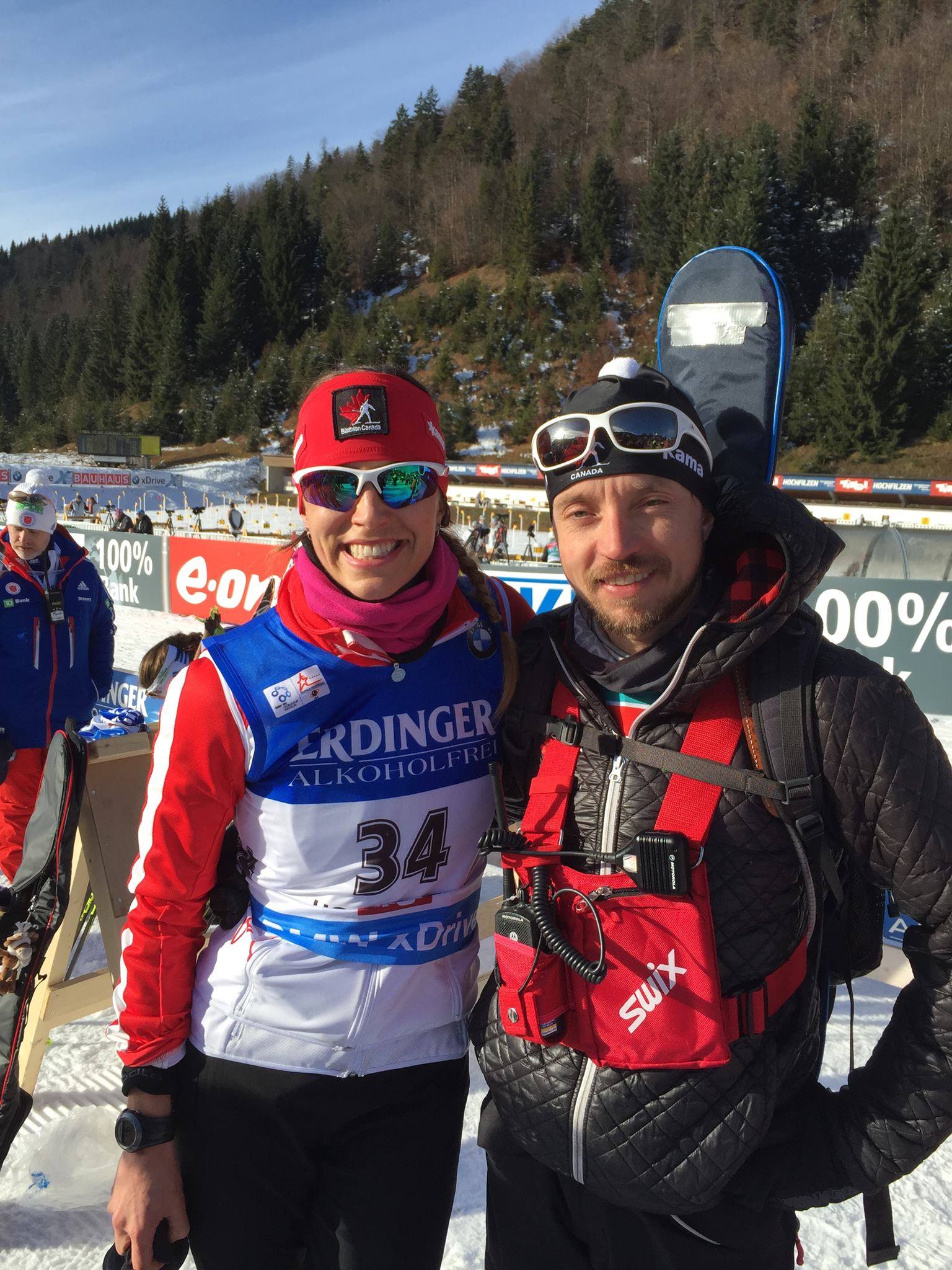
    Rosanna Crawford with coach Roddy Ward after placing a career-best fifth in the IBU World Cup 10 k pursuit on Sunday in Hochfilzen, Austria. “Such a fun race today, I moved from 34th to 5th for a new personal best with 19-for-20 shooting,” Crawford wrote on Facebook. (Photo: Chris Lindsay)
    Rosanna Crawford with coach Roddy Ward after placing a career-best fifth in the IBU World Cup 10 k pursuit on Sunday in Hochfilzen, Austria. “Such a fun race today, I moved from 34th to 5th for a new personal best with 19-for-20 shooting,” Crawford wrote on Facebook. (Photo: Chris Lindsay)

    While Roddy Ward, biathlon Canada national team coach, was referring to athlete Rosanna Crawford when he said, “Way more is possible,” it’s easily a sentiment that could be applied to the rest of the international nordic circuits after this past weekend of racing.

    The weekend’s racing began Friday with the IBU World Cup 7.5/10 k sprint in Hochfilzen, Austria, that saw Johannes Thingnes Bø of Norway and Kaisa Mäkäräinen of Finland claim victories in their respective races. American Tim Burke turned in the top North American finish after placing 13th, while teammate Susan Dunklee paced 29th for the women.

    Tim Burke on his way to 25th in the IBU World Cup 12.5 k pursuit on Sunday in Hochfilzen, Austria. (Photo: USBA/NordicFocus)
    Tim Burke on his way to 25th in the IBU World Cup 12.5 k pursuit on Sunday in Hochfilzen, Austria. (Photo: USBA/NordicFocus)

    The action continued in Hochfilzen on Saturday with the men’s 4 x 7.5 k and the women’s 4 x 6 k relays. Russia proved dominant in the men’s race, winning by roughly 20 seconds. Canada finished a team-best sixth place while the U.S. team was lapped after a combination a poor starting position and sub-par skis. In the women’s relay, Germany proved as strong as the Russian men, topping their field by over 20 seconds. The Canadian women were unable to match their male counterparts, however, and finished 11th.

    In the final day of IBU World Cup racing, one Canadian athlete demonstrated what exactly was possible. Crawford, who started the 10 k pursuit in 34th, wanted to improve her position, but when she crossed the line for a career-best fifth place it was apparent improving her position was just the beginning. On the men’s side, Burke was the top North American in 25th position.

    The weekend also brought FIS Cross Country World Cup action to Davos, Switzerland. Norwegians Therese Johaug and Maritn Johnsrud Sundby won Saturday’s 10/15 k classic interval starts. A trio of Americans made up of Liz Stephen, Jessie Diggins and Sadie Bjornsen went 20-21-22 in the 10 k to give the Americans three skiers in the top 30. Canadian Emily Nishikawa placed 29th for her best-ever World Cup finish. In the 15 k, Canadian Alex Harvey also found success, skiing to 17th, which he said was one of his best distance performances at altitude.

    In Sunday’s sprint, Ida Sargent returned to the spotlight after placing 16th, while teammates Kikkan Randall and Sophie Caldwell joined her in the top 30 after finishing in 20th and 22nd positions. On the men’s side, Canadian Lenny Valjas returned to form to place 13th while American Andy Newell placed 15th.

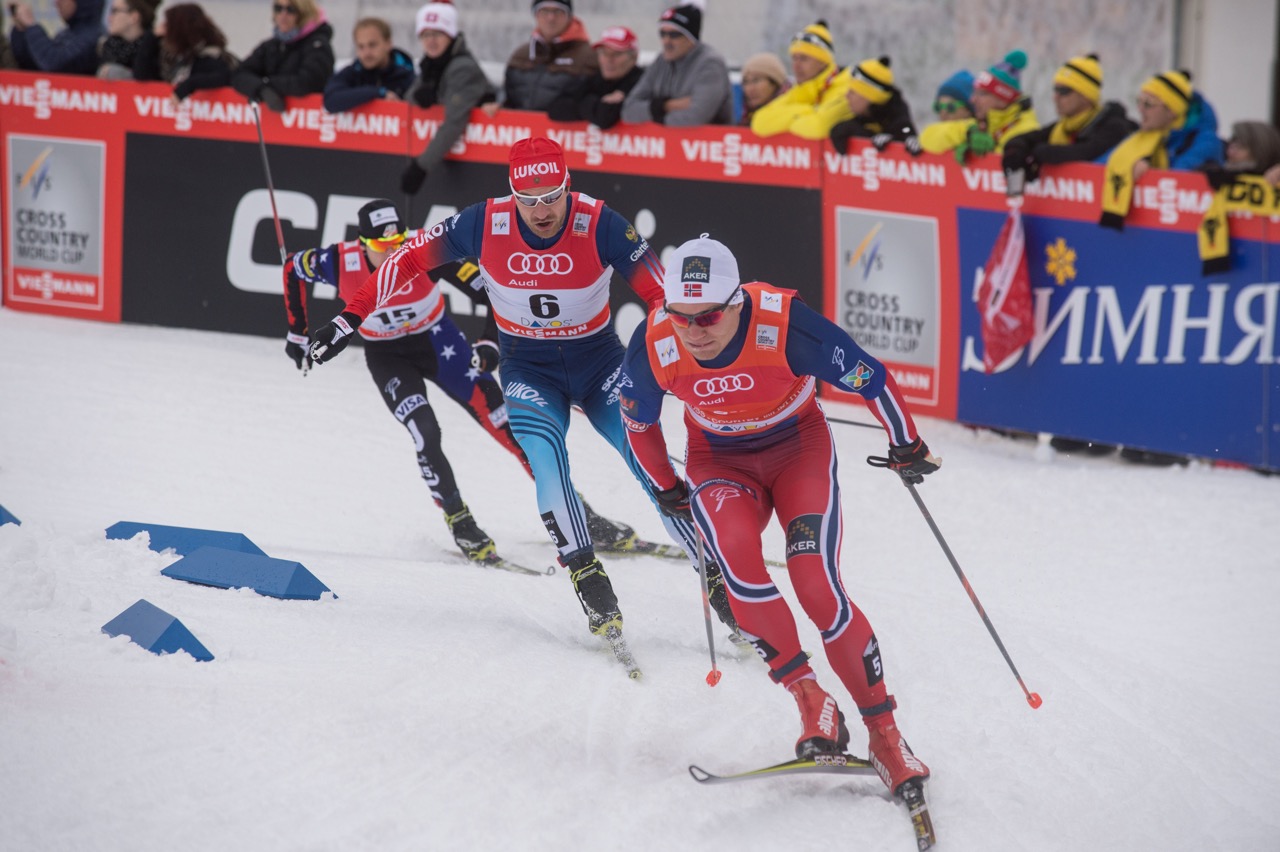
    Andy Newell (l) of the USST trails eventual 3rd place finisher Erik Brandsdal of Norway (r) and Alexey Petukhov of Russia (c) who eventually finished fourth in the 1.3 k freestyle sprint in Davos, Switzerland. (Photo: Fischer/Nordic Focus)
    Andy Newell (l) of the USST trails eventual 3rd place finisher Erik Brandsdal of Norway (r) and Alexey Petukhov of Russia (c) who eventually finished fourth in the 1.3 k freestyle sprint in Davos, Switzerland. (Photo: Fischer/NordicFocus)

    The real story of the day, however, was that Norway continued its winning streak with both its men and women sweeping Sunday’s races and earning 10 of 12 podium positions in Davos.

    Not just over the mountains from from Davos, Livigno, Italy hosted the La Sgambeda Marathon. While the women’s 42 k freestyle was dominated by Riitta-Liisa Roponen of Finland, American Holly Brooks was able to hold on for an impressive second place.

    Back across the home front, NorAm racing continued in Rossland, British Columbia despite warm conditions and a lack of snow. Both races were classic distance races with 7.5/11 k on Saturday and 11/15 k on Sunday, and Canadian Alysson Marshall and American Kris Freeman topped their respective fields each day.

    Last Thursday, the FIS Nordic Combined Continental Cup opened in Park City, Utah, where Taylor Fletcher posted the two best American performances in fifth and eighth place.

    The IPC World Cup also opened last Wednesday in Vuokatti, Finland, with Canadian Mark Arendz taking silver in his first race on Thursday: the 15 k standing biathlon. Two days later, his Canadian Para Nordic teammates Chris Klebl and Brittany Hudak both earned bronze in the 10 k sit-ski and 5 k standing, respectively. Also on Saturday, American Oksana Masters captured a career-best World Cup silver in the 5 k sit-ski, and Andy Soule just missed the podium in the 10 k sit-ski (behind Klebl) in fourth.

    On Sunday, Masters carried her momentum to win gold in the women’s sit-ski sprint, becoming the first American female Paralympic nordic skier to do so since the early 2000s. On Tuesday, she took her first-ever international biathlon silver in the biathlon sprint.

    La Sgambeda, Livigno, Italy 

    Friday’s women’s 42 k freestyle mass start report

    Saturday’s Pro Team Tempo prologue recap

    Sunday’s 35 k classic mass start recap

    IPC World Cup, Vuokatti, Finland

    Wednesday-Thursday recap | Mark Arendz opens with silver

    Saturday recap | Masters notches silver Klebl, Hudak power to bronze

    Sunday Masters wins sprint gold

    Tuesday Masters tallies biathlon silver

    IBU World Cup, Hochfilzen, Austria

    Friday’s 7. 5/10 k sprints: men’s report | women’s report

    Saturday’s 4 x 6 k and 4 x 7.5 k relays:  men’s report | women’s report

    Sunday’s 10/15 k pursuit: men’s report | women’s report

    FIS Cross Country World Cup, Davos, Switzerland

    Saturday’s 10/15 k classic interval start: men’s report | women’s report | U.S. report | Canadian report | men’s photo gallery | women’s photo gallery

    Sunday’s 1.3 k freestyle sprint: men’s report | women’s report | U.S. men’s report | U.S. Women’s report | Canadian report | notes and quotes

    NorAm Opener, Rossland, British Columbia

    Saturday’s 7.5/11 k classic report

    Sunday’s 11/15 k classic report

    Nordic Combined Continental Cup Opener, Park City, Utah

    Weekend recap + photo gallery

  • Photos Gallery: Biathlon NorAm / WYJC Trials Mass Starts in Canmore

    Photos Gallery: Biathlon NorAm / WYJC Trials Mass Starts in Canmore

    After the first round of NorAms being canceled in Canmore, Alberta, two weekends ago due to cold weather, the domestic biathlon season finally got off the ground on Thursday with the first race in a NorAm series which also served as Canada’s selection trials for its team to World Youth and Junior Championships in Minsk, Belarus. The team has not yet been named.

    On Sunday, a day of mass start competitions, Loppet Nordic Racing’s Jake Ellingson decided to take a day off in preparation for the next round of NorAms in Mount Itasca, Minnesota, and took the opportunity to shoot the day’s races with a camera instead of a rifle.

    While the youth and junior categories remained as competitive as ever, with not only the best Canadians vying for a trip to Minsk but several provinces also using the races as trials for the Canada Games and few Americans scattered in as well, the senior category lost the entries of Canada’s IBU Cup team, which departed for Europe that day. A strong field of Americans and remaining Canadians nonetheless battled it out.

    Relive the excitement in the gallery below.

    Links:

    Thursday report & results

    Saturday report & results

    Sunday report & results

  • In First Full Season, Canada’s Mark Rajack to Race for Trinidad and Tobago at Worlds

    In First Full Season, Canada’s Mark Rajack to Race for Trinidad and Tobago at Worlds

    Mark Rajack Rollerskiing with XC Ottawa; photo credit: Dave McMahon, XC Zone.
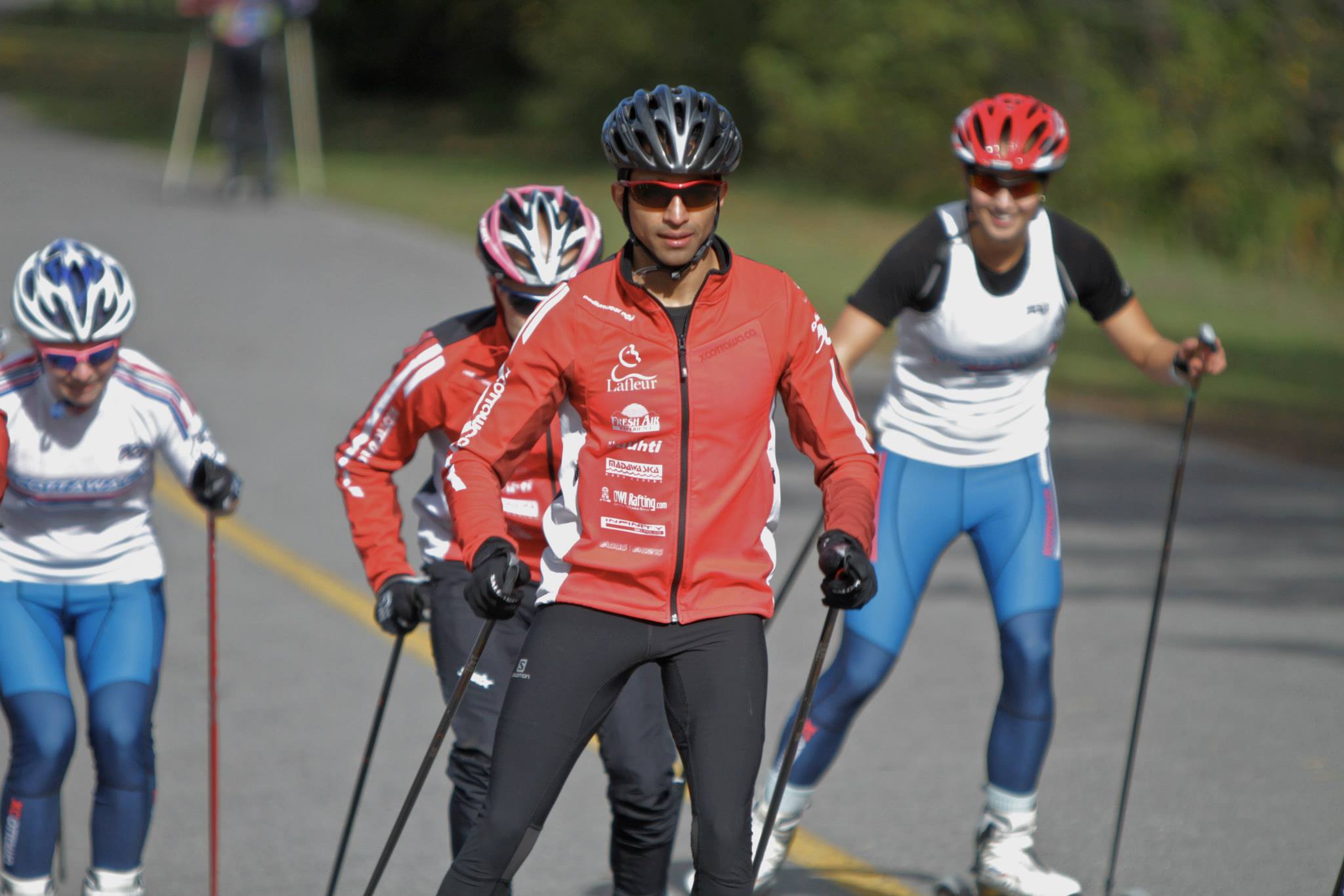
    Mark Rajack rollerskiing with XC Ottawa on Oct. 5. (Photo:Dave McMahon/XC Zone)

    OTTAWA, Ontario — Mark Rajack, a dual citizen of Canada and Trinidad and Tobago, was first introduced to nordic skiing two years ago in 2012, but in the time since, he’s not only learned to ski and compete in his new sport, but he’s also set his sights higher than many will in their skiing careers.

    Rajack, 33, lived in Trinidad and Tobago until the age of 6, at which point his parents were drawn to Ottawa for a job opportunity. From the time of his move, it would still be almost three decades until he would discover cross-country skiing.

    “You don’t come from a tropical country with a background in winter sport,” said Rajack, mostly a recreational cyclist before skiing. “I didn’t know that Gatineau Park [Ottawa’s largest ski-trail network and outdoor destination] existed until I started working at the local bike-and-ski shop.”

    Discovering Skiing

    I started [skiing] the year I turned 32 and it was an accident,” he explained in an interview at Carleton University on Sept. 3.

    He wanted to learn how to fix bicycles so he got a job working at a bike shop. In the process, he got to know some ski racers who worked part time at the same place. 

    “A lot of the bike shops here are ski shops in the winter, so it was through the racers working in that ski shop and through their community orientation that they managed to bring me on and just teach me to ski from scratch,” he said.

    Rajack’s initiation was not exactly a cake walk.

    It was horrible,” he recalled. “I had no glide. It was too cold. I got the wax wrong and with no technique it was just a struggle from the very start to the very end. And it was because I was expressing my struggles in skiing that a member of XC Ottawa said, ‘You know what, I’ll take you out and I’ll teach you to ski properly on my Zone-1 [easy] days.’ ”

    That skier was 23-year-old Andre Marchand, a longtime XC Ottawa skier and now Rajack’s good friend.

    I remember Mark picking up the technique instructions I was giving him pretty quickly,” he wrote in an online message. “It was impressive, and then after about 40 min of some pretty good technique skiing from a newbie, he just started falling over here and there, on downhills but also on flats… Now he’s regularly skiing for 2 or 3 hours at a time with Team XC Ottawa and he has no problems doing that!”

    Looking back, Rajack stressed the importance of the local ski community and the type of person it takes to get a newcomer excited about a sport and its culture.

    “It takes people who are fully inclusive and I’ve found that in the ski community we have here in Ottawa-Gatineau,” he said.

    Rollerskiing with XC Ottawa; photo credit: Dave McMahon, XC Zone.
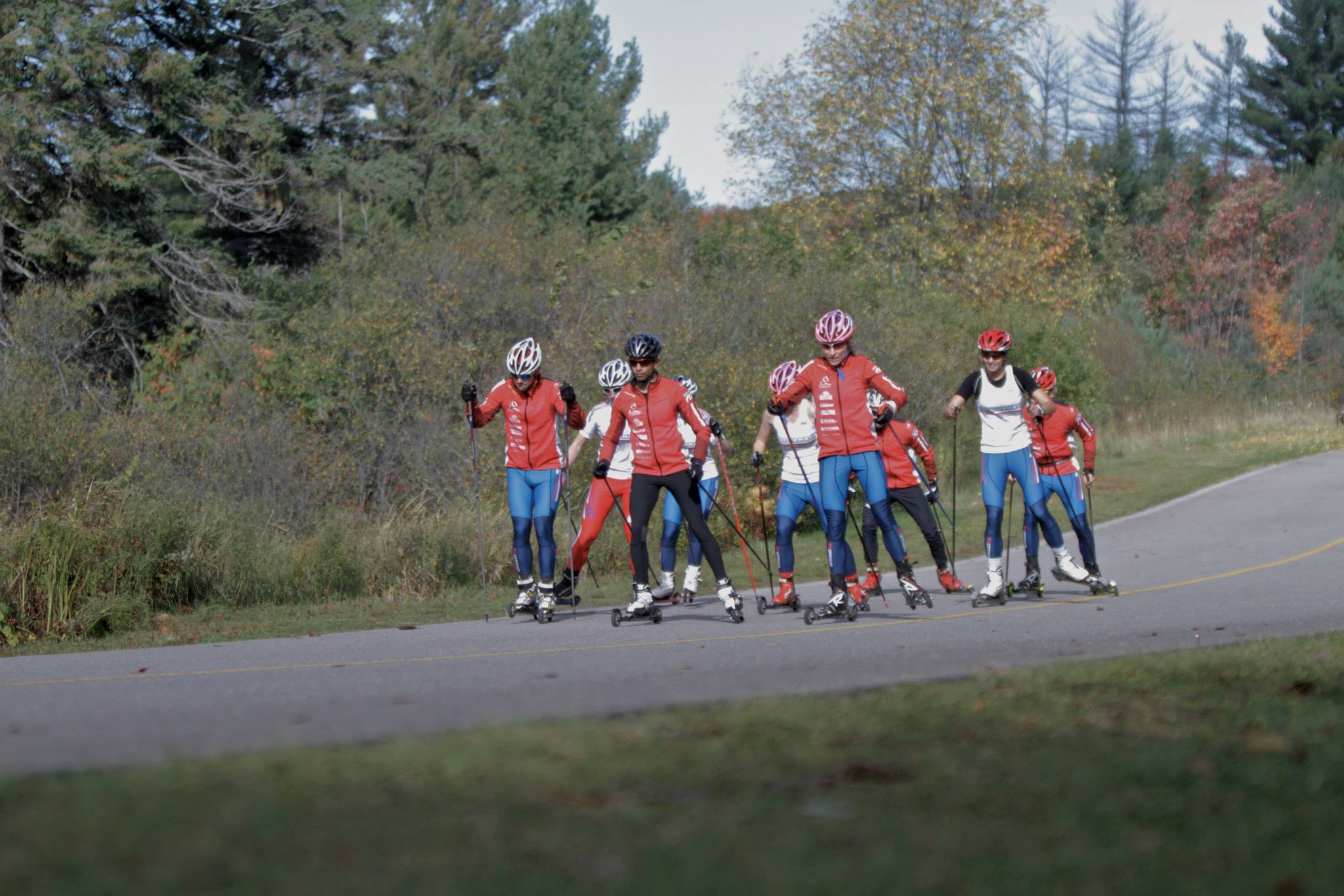
    Gatineau Parkway rollerskiing with XC Ottawa. (Photo: Dave McMahon/XC Zone)

    Setting Goals

    After getting on snow a few more times his first winter, the season of 2012/2013, Mark decided he wanted to venture deeper into the world of his newfound sport.

    I went to a race in Val Morin [in Laurentides, Quebec] with Andre just to see what it was about,” he said. “When I went to the race, his dad took me to the wax tent. His dad explained how races operate, I saw the culture behind the race, I saw the environment and I knew instantly that it was something that I would enjoy. It was then that I decided that I would try to get into racing. That would be the long-term goal.”

    Just 1 1/2 years down the line, Rajack is a member of the Trinidad and Tobago National Ski Team and aiming for 2015 World Championships in Falun, Sweden, and 2018 Winter Olympics in Pyeongchang, South Korea.

    One-and-a-half years down the line, Rajack is a member of the Trinidad and Tobago National Ski Team and aiming for 2015 World Championships in Falun, Sweden, and 2018 Winter Olympics in Pyeongchang, South Korea.

    “It took about three-to-four months before the idea entered my head that I had the option to ski for Trinidad and Tobago and then I started to look into it,” he said. “It was only through a fluke joke. Some of the skiers I was with were critiquing some of the techniques of the non-snow countries at the [2013] World Ski Championships and only then did I think, ‘You know what? That could be me!’ ”

    It just so happened that Trinidad and Tobago has a ski association, already linked to the International Ski Foundation (FIS), the president of which is a skier who lives in Calgary. Once Rajack made that connection, it was a matter of applying for his FIS license. With a mountain of ski technique and experience to climb, he set off to join a team.

    Naturally, he wanted to join Marchand, so he applied at XC Ottawa. It didn’t matter that he had no skiing or endurance sport background, “they were still able to justify bringing me on because I fit their mandate of national and international competition,” Rajack explained.

    With the pieces starting to fall into place, he jumped headfirst into the world of nordic racing and started to compete last February.

    “The premise of last year [2014] was learn to ski and race locally,” he said.

    He started with Eastern Canadian Championships in Cantley, Quebec, where he placed 53rd in the 15 k freestyle and 50th in the 20 k classic mass start — last in both events.

    “Next year’s focus is a different one,” he said. “Next year, there’s a focus on more NorAms than local races and I’m aiming to break the 300 FIS-point limit,” which is the FIS standard for Olympic qualification.“I always get that Jamaican bob-sled team reference,” he said.

    The other big focus for him this season is World Championships.

    “Me being the only skier for Trinidad and Tobago competing at an international level, I basically by default have qualified for Falun,” he said. World Champs differs from a standard World Cup, which has a tougher points criteria.

    “But when I get [to Falun] I have to qualify for the distance race,” he added. “It’s likely that people in my situation will only get to race the 10k free and then the classic-sprint qualifier.”

    Getting to race at least two races at World Championships will provide Rajack with a wealth of experience, and he was excited for the opportunity.

    “Without a doubt I’m very much looking forward to it,” he said.

    He’ll have a support team there to help him with waxing and other preparations, including coach Mike Vieira and Colin Abbott, a competitive skier with the Yukon Elite Squad. Rajack estimated the whole trip will cost him around $850 dollars, with complimentary accommodations, and he explained Viera and Abbott are paying their own way to support him.

    Abbott spent three years with XC Ottawa before leaving the city to train full time for another three years.

    “I kept close ties with XCOttawa and heard about Mark joining the team long before I met him,” Abbott wrote in an email. “I returned to Ottawa this year to complete my studies at Carleton University and met him in September this year. From what I have seen of him so far he is motivated, realistic and open to critical feedback. I believe he has the ability to make the 300 FIS point cutoff to qualify for the next Olympics in Korea.

    “As far as international success, he will probably never be a medal contender on the World Cup,” he added. “His technique is his biggest weakness right now and he knows it. He’s put in a lot of time this summer focusing on becoming more efficient.” 

    The Sacrifice

    With a new focus on racing, Rajack finds training taking up more and more of his time.

    “I’ve put my career on the back grill for the moment,” he said. “As a teacher with the Ottawa-Carleton district school board, I very well could have made choices that would’ve led to me being a full-time teacher at this point. I’ve made the decision to continue substitute teaching to focus on my skiing for the next four years.”

    In terms of finances, too, I was at one point saving for a downpayment on a house,” he said. “Potential house [or] potential Olympics.”

    In a place like Canada, where high-performance skiing does not hold the same clout that it does in other countries, there’s always the pressure, both societal and financial, to follow the path of least resistance: school, job, house.

    “I think it takes a bit of bravery to not lead that scripted life when there’s a lot of pressure to conform,” Rajack said.

    “I think it takes a bit of bravery to not lead that scripted life when there’s a lot of pressure to conform.” — Mark Rajack, Canadian dual citizen and Trinidad and Tobago’s lone national cross-country ski team member

    But he’s willing to make the sacrifice — even without financial assistance from the Trinidad and Tobago government.

    “At this time, the government is unable to provide support,” he said. “And I understand the challenge of understanding what someone like me is trying to do, especially that I’m, right now, off the island.”

    Unfortunately, that puts him in a sort of no-man’s-land for funding. Without the Trinidad and Tobago or the Canadian governments helping him out, and with the limited workload that he is able to fit in around training, finding sponsors will be one of the many challenges for Rajack in the coming months.

    What does he see as key in his preparations for international competition?

    “It just comes down to trusting people who have done this their whole lives, listening to them and believing that, if I follow what they do and if I keep my effort and dedication up, I’ll be well under that 300 FIS points standard by the time the Olympics roll around,” Rajack said.

    The Greater Good

    XC Ottawa; photo credit: Dave McMahon, XC Zone.
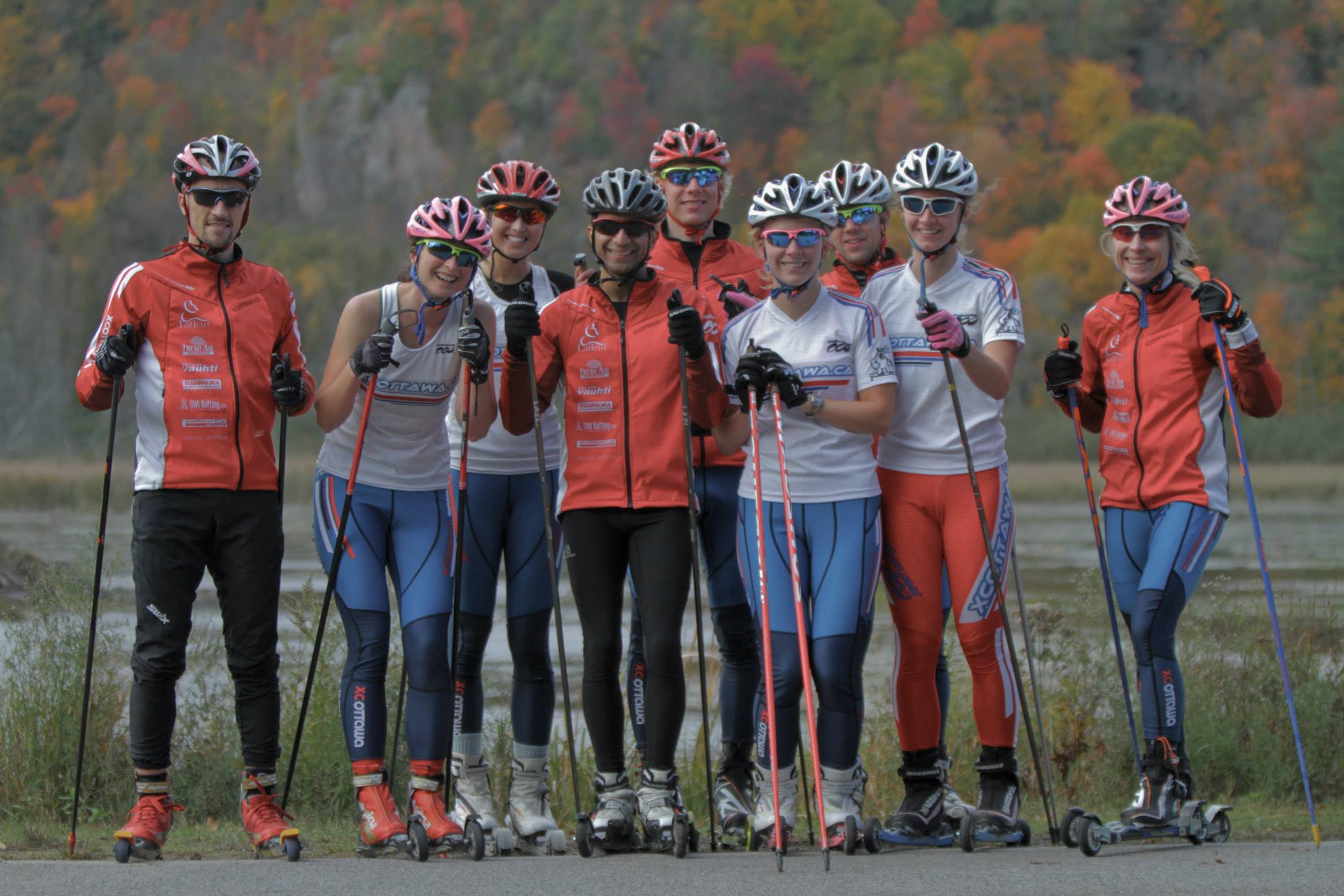
    XC Ottawa skiers in early October, including Mark Rajack (front c) and Andre Marchand (to Rajack’s right). (Photo: Dave McMahon/XC Zone)

    At the end of the day, it’s not all about the Olympics for Rajack. His dream is to help grow the sport that has already given so much to him and, in doing so, help those new to winter climates who struggle with getting used to the colder season just as he did when he moved to Canada.

    “There’s no way for me to be living in Trinidad and training to ski but if I could wish anything, ultimately, it is that we develop a rollerski team in Trinidad and Tobago,” he said. “In the same way that you have North American athletes who play tennis and golf who go down south to do whatever golf camps and tennis camps in the states, well the reverse can be true. We’ll take those rollerskiers and bring them up to [The Forêt] Montmorency or Nakkertok and get them time on snow and then put them in competition.

    “I don’t know if that will ever happen, but there’s always the dream and then there’s the reality — that would be the dream,” he continued. “The reality is that it will probably just be members of the Trinidad and Tobago diaspora [who become involved in skiing], which is spread right across the world. You’ve got Trinidadians living in every corner of the world and many of them, like me, live in northern climates and, like myself at one point, the winter is a significant negative impact on their quality of life.”

    “If, through my efforts, I could help a Trinidad and Tobago kid get to the World Cup in a way I would feel that I had made the World Cup as well.”

  • Pros of Tomorrow Presented by Fischer: Olivia Bouffard-Nesbitt

    Pros of Tomorrow Presented by Fischer: Olivia Bouffard-Nesbitt

    Olivia Bouffard-Nesbitt racing at the 2013 Canadian Nationals in Whistler (Courtesy photo).
    Olivia Bouffard-Nesbitt racing at the 2013 Canadian Nationals in Whistler, B.C. (Courtesy photo)

    This ‘Pros of Tomorrow’ series, brought to you by the generous support of Fischer Sports, aims to highlight some of the most notable up-and-coming athletes around the world, which may or may not be Fischer-sponsored skiers. If you have an idea for a top-notch skier you’d like to read more about, please email info@fasterskier.com with the subject line: ‘Pros of Tomorrow’. We’re also looking for stories about intriguing juniors, collegiate skiers, or lesser-known athletes; please email us with names — subject line: ‘From the Pack’.

    ***

    Olivia Bouffard-Nesbitt, 22, has been on skis as long as she can remember. Originally from Quebec’s Laurentides region, she started out on downhill skis until her parents deemed her “old enough to actually kick and glide,” she recalled. That was age 3.

    Bouffard-Nesbitt went on to race for several nordic teams, including a training centre in western Canada before joining Rocky Mountain Racers (RMR) in 2013 in Canmore, Alberta.

    Now readying for the 2014/2015 race season, she is in her last year as a U23 athlete. With experience competing overseas last winter, she’s a name to watch out for in North American ski racing and a likely candidate for Canada’s U23 World Championships and OPA tour. Last month, Petro-Canada named her its nordic-skiing recipient of its “Fuelling Athlete and Coaching Excellence” funding program.

    Raised by Skiers

    Bouffard-Nesbitt racing for Rocky Mountain Racers (RMR) at Frozen Thunder last fall in Canmore, Alberta.
    Bouffard-Nesbitt racing for Rocky Mountain Racers (RMR) at Frozen Thunder last fall in Canmore, Alberta. (Courtesy photo)

    Although cross-country skiing in particular was an integral part of her childhood, Bouffard-Nesbitt enjoyed competing in several sports. 

    “As a kid, I was always really into sports and I knew I wanted to be an athlete,” she said in a phone interview. “I didn’t know what sport. It was either gonna be soccer, running or skiing.”

    In her pre-teens, she played AA soccer, competed in both track and cross-country running and ski raced in the winter. But over the next few years her focus shifted more and more towards nordic skiing.

    “I did Fast and Female when I was 14, so I got flown out to Canmore because I won a contest,” she explained. “They were flying two girls from every province to Canmore for this event. That was my first time out West and I got to meet Chandra Crawford, who was a celebrity to me at that point. That was super motivating and I was on a high from that for a really long time.”

    Her inspiration from Fast and Female combined with the feeling that she was enjoying skiing the most out of all her sports prompted her to join the local Fondeurs Laurentides nordic team at 15.  Two years later, she fully committed to skiing, leaving  Quebec to train with coach Les Parsons in Edmonton, Alberta.

    “I was at the end of high school in Quebec, I graduated and decided that my choices were to go to CEGEP [a general-and-vocational college] in Montréal, go to Nakkertok ski club in Gatineau or go to Edmonton,” she said. “I went to Edmonton because Les Parsons, who was coaching the [Edmonton Nordic] team at the time, invited me out there and found a family to host me.”

    Having provided her with coaching advice in the past, Parsons positively influenced Bouffard-Nesbitt’s skiing and helped her overcome nerves in her earlier years of racing.

    “He changed my way of thinking about competition,” she said. “He reminded me that, ‘You can’t do any better than your best’ and ‘If you’re not having fun, there’s no point in doing it.’ ”

    After one year in Edmonton, Bouffard-Nesbitt decided it was time to make the next jump to one of Canada’s training centres and moved to Whistler to join the Callaghan Valley Training Centre (CVTC) in British Columbia.

    “He changed my way of thinking about competition. He reminded me that, ‘You can’t do any better than your best’ and ‘If you’re not having fun, there’s no point in doing it.’ ” — Olivia Bouffard-Nesbitt on former coach Les Parsons

    Overtrained

    Looking back, she described that first year with Callaghan Valley as an exciting one.

    “I felt like it was my first time being on a … I don’t wanna say real ski team, a more professional ski team, you know?” she said. “We had a team van and we all lived in the same place and our coach would drive us around everywhere. It was the first time I’d had a car drive beside me while I’m rollerskiing.”

    That winter of 2010/2011, she had what she considered her breakthrough year.

    “It was the year that I won the aggregate [overall] at nationals and I’d never done that before,” she said. “I’d never even medaled before at nationals.”

    The second year was a different story. It was the first time Bouffard-Nesbitt trained full time in the summer, having worked at a summer camp in past years. With the excitement from last season, she felt more pressure in year two.

    “After seeing how the team performed that first year, [CVTC coach] Chris [Manhard] expected a lot from us the second year,” she said. “It had been his first year with the team also, so the second year he was getting more pressure to have the team perform. The atmosphere changed.”

    Manhard respectfully declined to comment.

    As many athletes can attest to, it is much easier to push through the pain during training than to know when it’s time to call it. By the fall of 2011, Bouffard-Nesbitt was beyond the point of no return.  In mid-January 2012, she was unable to finish a 10 k skiathlon in Whistler. After that, she went home to Quebec.

    “Once I finally stopped training, it was like my body registered that I was giving it a break and then it just completely shut down,” she said. “I went from struggling in training to having heavy legs walking up stairs and sleeping like 12 or 13 hours a day. A month was pretty much sleeping. I went six months without training.”

    Insight

    Bouffard-Nesbitt stayed home until August 2013,  when she decided to get back into skiing with RMR and moved to Canmore. 

    “There was never one doubt in my mind about wanting to keep going,” she reflected. “People thought I had quit or that I was going to quit, but I had never ever considered it. To me, when it was happening, it was just, like, a blip. I didn’t think ‘this is the end of my career.’ I knew I was gonna get over it.”

     From left to right, Bouffard-Nesbitt, Dahria Beatty and Seb Townsend during the U23 World Championships trip last season. (Courtesy photo)

    From left to right, Bouffard-Nesbitt, Dahria Beatty and Seb Townsend during the U23 World Championships trip last season. (Courtesy photo)

    The toughest thing she recalled was knowing that she was out of the running for the U23 World Championships team that year. But she remembered the words of her former coach.

    “Another thing that Les would always tell me was to think long term,” she said. “He’d say, ‘This year doesn’t matter, next year doesn’t matter, what matters is 2018 if that’s what you’re aiming for.’ ”

    After six months of rest, she got back into training 30 minutes at a time and worked her way up to 50-minute workouts. For months, it was her fatigued legs that held her back. Finally, in the fall of 2012, she broke the 50-minute mark.

    “It was around Frozen Thunder that one day, I just magically passed that 50-minute threshold and finally I just felt good,” she said. “I skied for way longer and didn’t get tired legs and from then on I was good to go.”

    After a few months of training with RMR, Bouffard-Nesbitt posted a top-10 sprint result at 2013 Canadian nationals in Whistler and finished 22nd overall on the NorAm circuit.

    “There was never one doubt in my mind about wanting to keep going … I didn’t think ‘this is the end of my career.’ I knew I was gonna get over it.” — Bouffard-Nesbitt

    The Present

    Looking back on last season, Bouffard-Nesbitt has mixed feelings. 

    “I was really excited; I’d made trips I’d never made before, I qualified for Worlds, which was a really big goal of mine, and then I got selected for the B-tour,” she said.

    Bouffard-Nesbitt took part in the "Skiers4SchoolBox" Nicaragua trip planned by Perianne Jones, this spring.
    Bouffard-Nesbitt took part in the “Skiers4SchoolBox” Nicaragua trip planned by Perianne Jones, this spring.

    All of that marked her first time racing against an international field and doing so in Europe.

    At the same time, she was sick throughout the winter.

    “My immune system was not super-strong and I just kept catching colds,” she said. “I caught a cold [at the start of the season] in Silver Star before Rossland. I got sick again right after trials — I was pretty sick that time. Basically I couldn’t go two weeks without getting sick.”

    In Rossland, she pulled out a podium: third among the senior women. Other than that, she said she didn’t perform to her potential last season.

    Currently Bouffard-Nesbitt is working towards her goal of making the upcoming U23 World Championships and, farther down the line, the Canadian World Cups in 2016 and the 2018 Olympics.

    With RMR and her new home in Canmore, she thinks she’s in the right environment to achieve these goals.

    Beyond Skiing

    When she’s not skiing or training, Bouffard-Nesbitt can be found working for Buff Canada. 

    “I got the job because my teammate Andrea [Dupont] works there,” she said. “They dropped me in charge of what they call the professional collection. It’s a new collection of Buffs intended for industrial workers that isn’t really sold in Canada yet, but we’re trying to get it in stores. I work there part time, it’s about 20 hours a week if I am in Canmore. The boss knew I was a skier and it kinda transformed into a sponsorship. I still work there and I am still in charge of the professional collection and I’m also sponsored by them.”

    This past April, Bouffard-Nesbitt traveled with a number of high-profile Canadian skiers, including organizer and two-time Olympian Perianne Jones, to Nicaragua to help build a school.

    We realized after a couple days at the work site that the people at SchoolBOX saw just as much value in having outsiders come and play with the kids, rather than just, like, digging a hole the entire time,” Bouffard-Nesbitt said in an earlier interview. “It means a lot to the kids to see that people are coming all the way from Canada and that people care that much about their school.”

  • Save the Dates: 2014/2015 NorAm and SuperTour Schedules in a Nutshell

    Save the Dates: 2014/2015 NorAm and SuperTour Schedules in a Nutshell

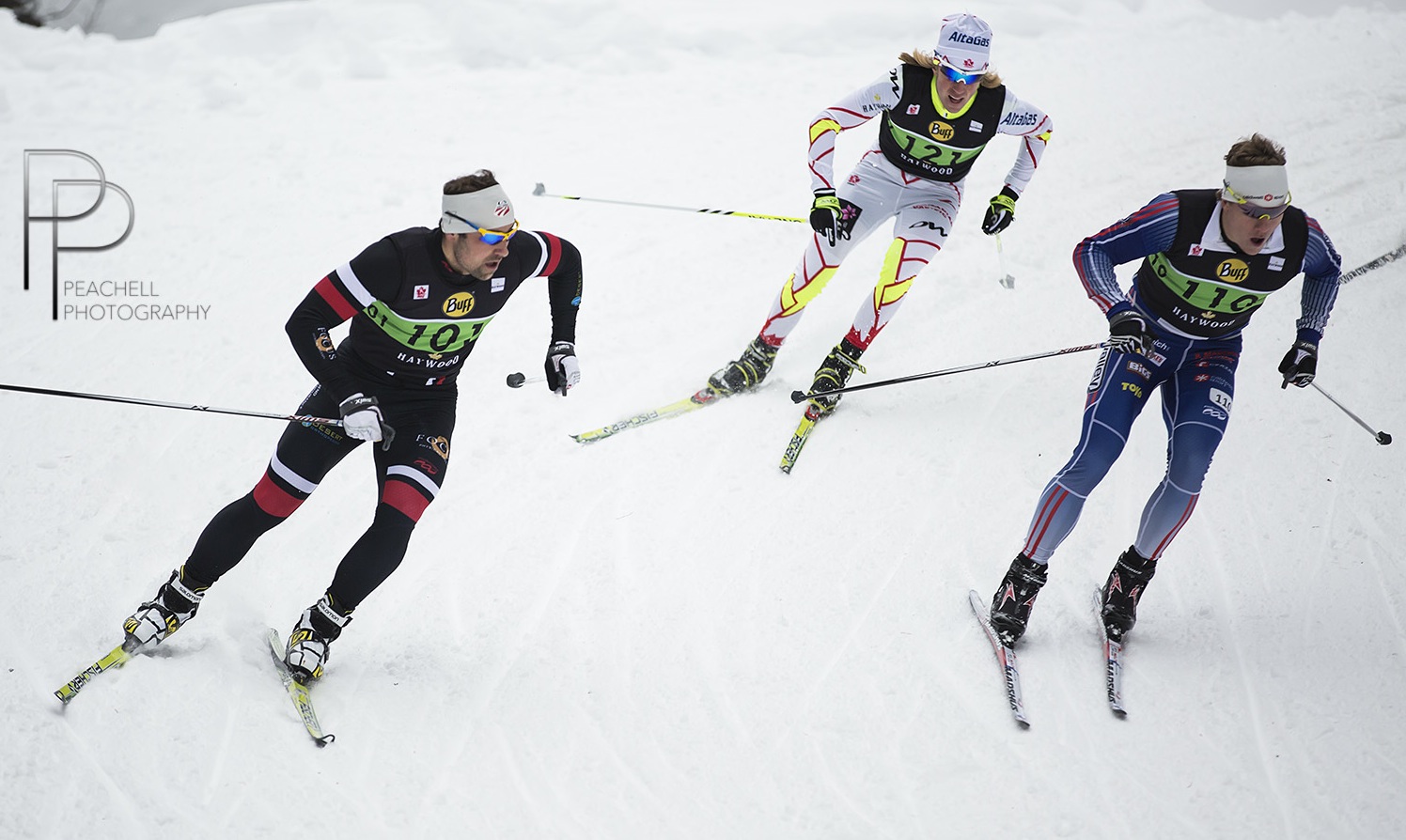
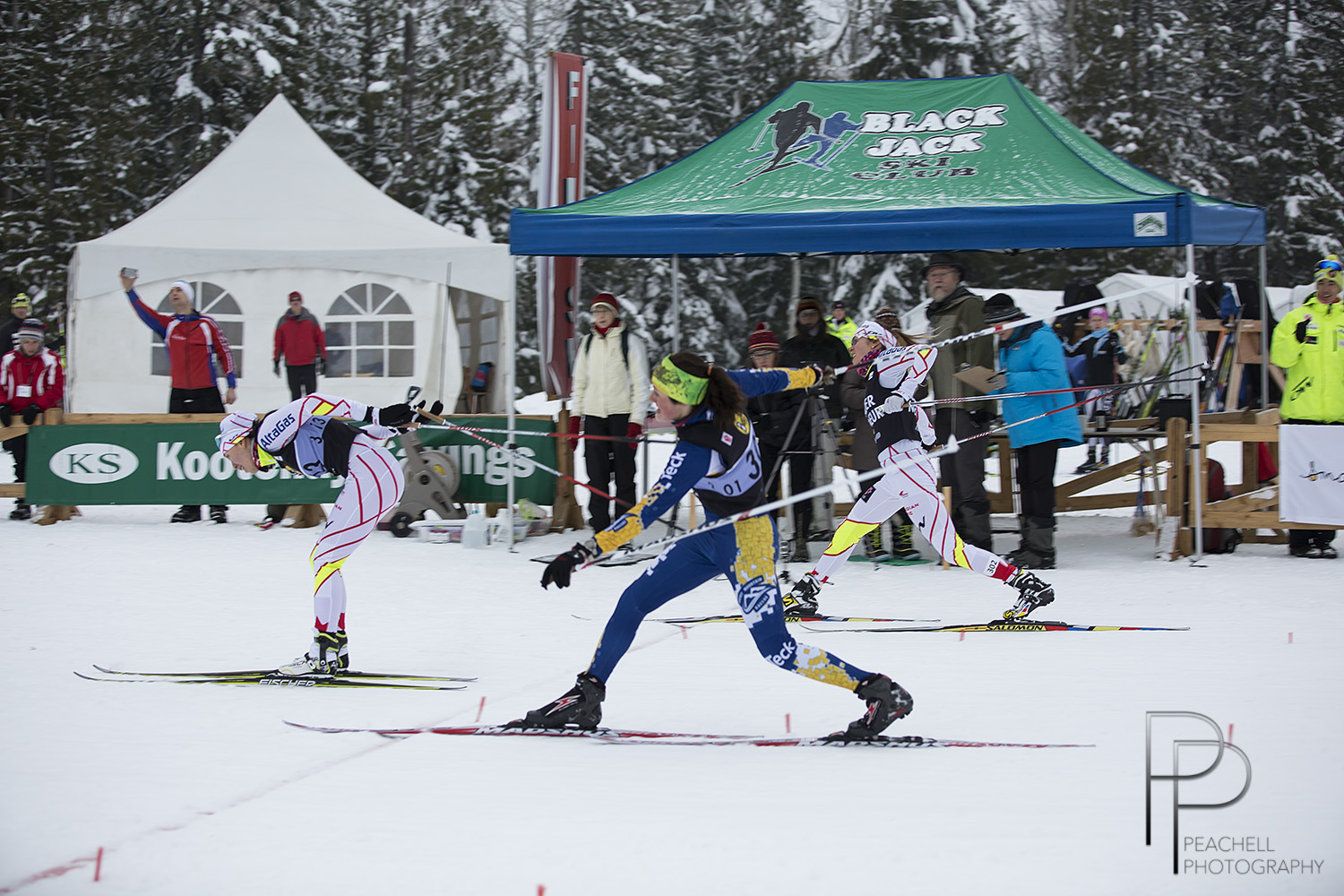
    NorAm action in Rossland, B.C., last winter: with Dakota Blackhorse-von Jess  of the Bend Endurance Academy (101) rounding a corner with Sun Valley's Miles Havlik (110) and Graeme Killick (121) of the Alberta World Cup Academy/CNST in the Black Jack NorAm 1.6 k skate sprint semifinals on Dec. 15. Blackhorse-von Jess won the semifinal and went on to place fifth in the A-final. Fourth in the semi, Havlick ended up second overall, and Killick placed 12th.  (Photo: Shelley Peachell/Peachell Photography, http://peachellphotography.com/)
    NorAm action in Rossland, B.C., last winter: Dakota Blackhorse-von Jess of the Bend Endurance Academy (101) rounds a corner with Sun Valley’s Miles Havlik (110) and Graeme Killick (121) of the Alberta World Cup Academy/CNST in the Black Jack NorAm 1.6 k skate sprint semifinals on Dec. 15, 2013. (Photo: Shelley Peachell/Peachell Photography)

    Note: This article has been updated to reflect the correct U.S. SuperTour schedule, notably West Yellowstone’s individual start. 

    Here’s what you have to look forward to this fall, domestically speaking. The Canadians are hosting a season-opening tuneup Oct. 24 in Canmore, Alberta, and it’s known as Frozen Thunder. After the classic sprint and freestyle-distance race (Oct. 31) at the Canmore Nordic Centre, North-American skiing attention will turn to Montana for the USSA SuperTour opener at its usual stop in West Yellowstone from Nov. 28-30.

    The SuperTour circuit then heads north to Bozeman, Mont., for the second weekend of races Dec. 5-7. Canadians will have a chance to race at home again at Cross Country Canada’s NorAm opener Dec. 13-14 in Rossland, British Columbia, which also serves as its U23/Junior World Championships Trials. Another set of trials takes place the next weekend, Dec. 20-21, at Whistler Olympic Park in Callaghan Valley, British Columbia.

    For the last two years, U.S. nationals has been held at Soldier Hollow, the 2002 Olympic venue just outside of Park City, Utah. This winter from Jan. 4-10, they’ll be in Houghton on Michigan’s Upper Peninsula. The SuperTour circuit ventures to Vermont for back-to-back weekends in Craftsbury from Jan. 30-Feb. 8 before the ultimate American distance race (also part of the SuperTour schedule): the American Birkebeiner Feb. 21 in Hayward, Wis.

    Another NorAm and the third-and-final set of Canadian U23/Junior World Trials is scheduled for Jan. 8-11 in Duntroon, Ontario. Western Canadian Championships in Canmore will follow from Jan.15-17, and Jan. 30-Feb. 1, Nakkertok will again host NorAm Easterns in Cantley, Quebec (just before U23 and Junior World Championships Feb. 2-8 in Almaty, Kazakhstan). The Gatineau Loppet will again double as Canadian Long Distance Championships with its 51 k classic mass start in mid-February.

    The NorAm season wraps up in Thunder Bay, Ontario, with Canadian Ski Nationals at Lappe Nordic, including the 50 k freestyle mass start.

    SuperTour Finals and U.S. Distance Nationals are set for March 20-26 in Sun Valley, Idaho — and the mixed relay is back.

    Emily Nishikawa (l) edges Olivia Bouffard-Nesbitt (c) and Heidi Widmer (r) in the women's 1.4 k skate sprint final at the Black Jack NorAm on Dec. 14 in Rossland, B.C. Widmer was second and Bouffard-Nesbitt placed third.  (Photo: Shelley Peachell/Peachell Photography, http://peachellphotography.com/)
    Emily Nishikawa (l) edges Olivia Bouffard-Nesbitt (c) and Heidi Widmer (r) in the women’s 1.4 k skate sprint final at the Black Jack NorAm on Dec. 14, 2013 in Rossland, B.C. (Photo: Shelley Peachell/Peachell Photography)

    2014/2015 NorAm schedule

    Oct. 24: Canmore Frozen Thunder sprint opener: classic sprint*

    Oct. 31: Canmore Frozen Thunder distance opener: freestyle distance*

    Dec. 13-14: Rossland NorAm opener (and U23/Junior World Trials 1): freestyle sprint & 10/15 k classic

    Dec. 20-21: Whistler classic sprint & freestyle interval start at Callaghan Valley (U23/Junior World Trials 2)

    Jan. 8-11: Duntroon 15/30 k skiathlon, classic sprint, 10/15 k freestyle (U23/Junior World Trials 3)

    Jan. 15-18: Western Canadian Championships in Canmore: 10/10 k classic, freestyle sprint, classic mass start

    Jan. 30-Feb. 1: Eastern Canadian Championships in Cantley: freestyle sprint/prologue, 10/15 k freestyle, 15/20 k classic mass start

    Feb. 14-15: Gatineau Loppet/Canadian Long Distance Championships: 51 k classic mass start*

    March 14-21: Canadian Ski Nationals in Thunder Bay: freestyle team sprint, 5/10 k freestyle, 10/15 k classic, 30/50 k freestyle mass start

    *Separate from NorAm series

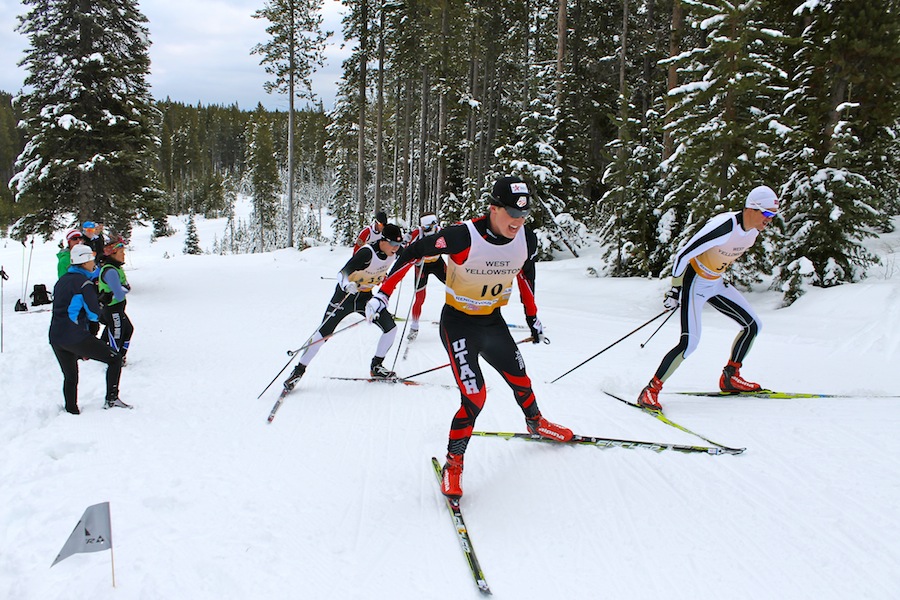
    Tucker McCrerey (Utah) takes the outside corner at the top of Tele Hill. McCrerey went on to place 19th in the 15 k skate at the 2013/2014 West Yellowstone SuperTour opener.
    Tucker McCrerey (Utah) takes the outside corner at the top of Tele Hill. McCrerey went on to place 19th in the 15 k skate at the 2013/2014 West Yellowstone SuperTour opener.

    2014/2015 SuperTour schedule

    Nov. 28-30: West Yellowstone SuperTour opener: Freestyle sprint & 10/15 k freestyle individual starts

    Dec. 5-7: Bozeman 10/15 k classic mass start & classic sprint

    Jan. 4-10: U.S. Cross Country Championships in Houghton: 10/15 k freestyle, classic sprint, 20/30 k classic mass start, freestyle sprint

    Jan. 30-Feb. 1: Craftsbury 20/30 k classic mass start & classic sprint

    Feb. 6-8: Craftsbury freestyle sprint, 10/10 k freestyle, 10/15 k classic mass start

    Feb. 21: American Birkebeiner in Hayward: 52 k freestyle mass start

    March 20-26: SuperTour Finals & U.S. Distance Nationals in Sun Valley: 10/15 k classic, freestyle sprint, mixed relay, 30/50 k freestyle mass start

    ***

    For the 2014/2015 International Ski Federation (FIS) cross-country calendar, click here.

  • The Ninjas Fight On: ‘The Team is Retired … We Hope That The Idea Will Live On’

    The Ninjas Fight On: ‘The Team is Retired … We Hope That The Idea Will Live On’

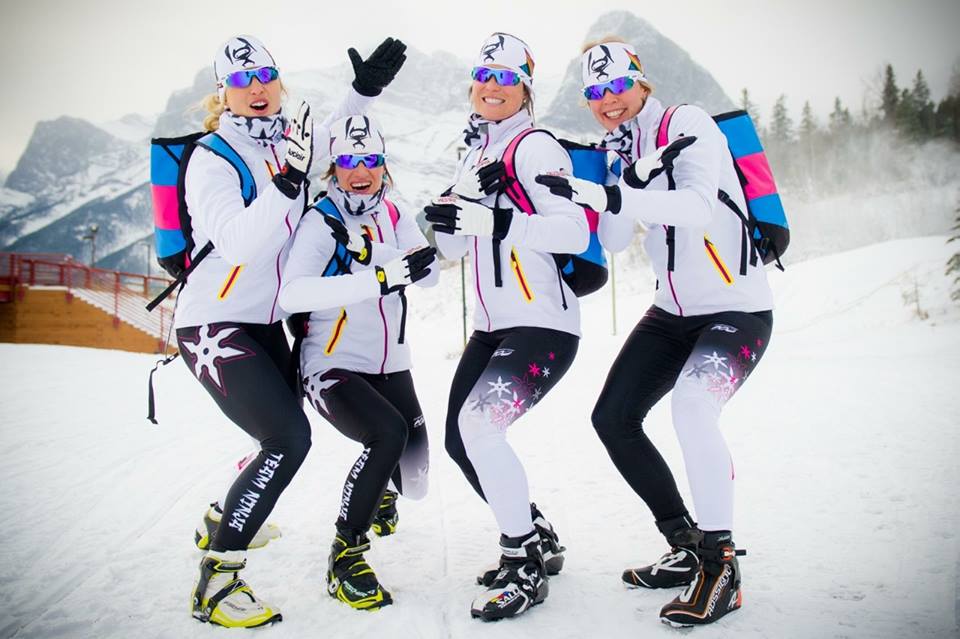
    Team Ninja: l-r Crawford, Ammar, Thomas, Roy; photo courtesy of Team Ninja. https://www.facebook.com/pages/Team-NINJA/181009732101939
    Team Ninja last season in Canmore, Alberta (from l-r) Chandra Crawford, Amanda Ammar, Alana Thomas, and Zoe Roy (Courtesy/Facebook photo)

    With Chandra Crawford, Alana Thomas, Zoë Roy, and team founder Amanda Ammar all bowing out of competitive cross-country skiing this year, Team Ninja only existed for a season, but what a season it was.

    FasterSkier recently checked in with each of the Ninjas, including Thomas, Ammar and Roy, to talk about the independent team and discuss what each of them intend to do as they turn the page to a post-ski racing chapter of life.

    Training with Team Ninja

    Once you get to a certain age, I don’t think you should be on a generic program. We all had our own focuses and goals and we didn’t hold hands the whole time but we came together for key workouts where we’d push each other hard.” — Amanda Ammar, two-time Olympian, former Canadian National Team member and Team Ninja founder

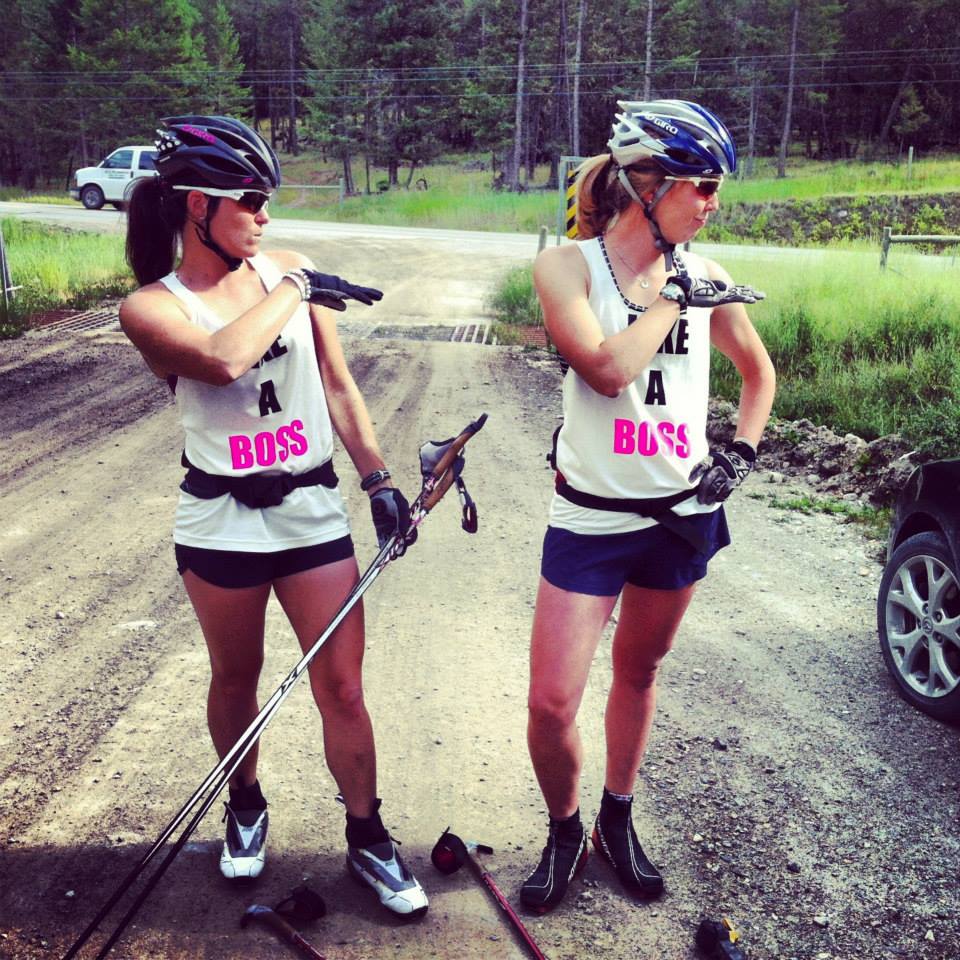
    Thomas (left) and Roy, Ninja training Like A Boss; Photo Courtesy of Team Ninja
    Thomas (left) and Roy, training “Like A Boss” (Courtesy photo)

    One of the features that set Team Ninja apart from other ski teams is that there wasn’t a single coach responsible for guiding all four athletes’ training regimens. Ammar was coached by Chris Butler, Crawford by Peter Larsson, Roy developed her own training program with help from several coaches, and Thomas worked with Jack Sasseville. This approach allowed each member to focus on their own strengths and weaknesses and helped them to work their training around work and injuries. Both Thomas and Ammar were plagued with lower-back issues, common among nordic skiers.

    Ammar tried upping her running hours to take strain off her upper body, only to develop a foot injury from too much running. With advice from U.S. Ski Team member Sadie Bjornsen, Ammar switched her training to swimming for a week and a half and soon after, she posted a personal best in a time trial up the Mt. Norquay access road in Banff, beating her previous best by two minutes.

    Thomas’s back pain stemmed from disc issues and affected her for a large portion of the year.

    “From July on through to January, training was really tough because of my back,” she said.

    For Thomas, it was Team Ninja’s support and positive attitude that motivated her to stick with it.

    While the Ninjas trained hard, it was their desire to have fun first and foremost that defined their training season. They had filled up Sriracha Hot Sauce bottles with a sport drink for “Ninja Juice” feeds on long runs, worn “Like A Boss” T-shirts for every workout at their training camp in Invermere, B.C., and had a blast while mountain biking on trails in Bend, Ore.

    An Olympic Year

    “I had a really solid race season, but it wasn’t quite good enough for the Olympics. I think it was a pretty good ratio having half our team going to the Olympics though! I was really happy to help along my teammates and be part of building their success.” — Zoe Roy

    Ammar leads Brittany Webster in the 15 k skiathlon at Olympic Trials (Photo: Angus Cockney)
    Ammar leads Brittany Webster in the 15 k skiathlon at Olympic Trials (Photo: Angus Cockney)

    When the dust settled after Canadian Olympic trials, two of the seven women on the Olympic team were Ninjas: Crawford and Ammar.

    For Ammar, qualifying for the Olympics was the big goal and, according to her, her team was instrumental in getting her to Sochi.

    “I needed those girls this past year,” she said. “They brought a whole new element of fun and working with them challenged me to push out of my comfort zone. That extra diversity of not having to train by myself really helped me raise the bar. Without them there was no way — plus we had so much fun.”

    Ammar described her Sochi experience as more or less an uphill battle. She and Brittany Webster, of Team Mito Canada, were added to the Olympic team after the official team naming, and as a result, prepared separate from the rest of the team.

    “It was really rough going to the Olympics, having to fight so hard to get there and then have my skis broken in transit,” Ammar said. “I felt like it wasn’t a really fair shot against the world.”

    Aside from the Olympics, Team Ninja made every stop of the NorAm circuit except Westerns. At the first NorAm of the season, they “Christmas-tree bombed” trees at the SilverStar venue. Roy posted two podiums, including a win, at Canadian Eastern Championships in February, and Ammar finished her season with the first national title of her career in the 30 k classic event at Canadian Nationals in March.

    The Future of Team Ninja

    After Nationals, Ammar, 28, was debating continuing her career.

    “At the end of the season it was almost hard for me to retire, I’m in the best shape of my life right now,” she said. “Mentally and physically I’ve never felt stronger than this season.”

    But having spent over 13 years racing competitively (her first nationals was Thunder Bay in 2000), and after having injury continually crop up, she decided it was time to move on.

    Reflecting on her final season, she was content with meeting her two big goals of qualifying for Sochi and winning a nationals distance race. Ammar plans to begin studying Chinese medicine at a Calgary acupuncture school this fall and has already been offered a position, upon the completion of her studies, at the Canmore Alberta clinic where she currently works as an administrative assistant.

    In terms of milestones, 2014 was it for Ammar. The weekend after her return from Sochi, her boyfriend of five years as well as her coach, Chris Butler took her backcountry skiing and proposed to her on top of a mountain.

    “All the Ninjas were betting that it [the proposal] would be at Christmas but when it didn’t happen I thought it’d be next fall,” she said. “I was surprised when he proposed right after the Olympics!”

    She said yes.

    Roy, 26, was happy to finish her career with a solid race season, ranking sixth overall on the NorAm circuit without racing at Nationals. Having raced on the U.S. collegiate circuit with the University of Utah, to the Scandinavian Cup, Roy says it’s time to try something new.

    “I’m moving on to different things,” she said.

    She’s currently the assistant manager at the Paintbox Lodge, owned by 2006 Olympic silver medalist Sara Renner and her husband Thomas Grandi, an alpine Olympian, in Canmore. Roy works with former Alberta World Cup Academy skier Kate Brennan.

    That’s her “summer plan,” she said, explaining she’d like to go into business with her brother.

    “My brother has started a backpack company so I’m thinking of going back to Bend to help him with that in the future,” she said. “This is still in the works but that’d be my plan in the fall.”

    After coping with injury for the last year, Thomas, 26, finally stepped back from skiing in January.

    “On any other team I would have quit earlier, but I wanted to be with the Ninjas and support their races, that was really what kept me around,” she said. “The other Ninjas were really successful and I’m very happy to have been part of it. … I had hoped that I could finish it off strong, but injury ended things a couple months earlier than expected.”

    With a degree in economics under her belt, Thomas will be working this summer at the CIBC bank in Canmore and shredding mountain bike trails in her free time. She plans to return to Ottawa, where she completed her undergrad, to start work on her master’s in the fall.

    The Ninja Spirit

    One thing that each of the Ninjas are adamant about is that, while Team Ninja may have raced its last Canadian Nationals, the team itself is not a thing of the past.

    “The team is retired, but anyone can think of themselves as a Ninja,” Thomas said. “We hope that the idea of team Ninja will live on.”

    The Ninja spirit created by the four athletes has inspired many younger skiers and has the potential of growing into something even bigger than the team that conceived it.

    “I’ve had a couple coaches approach me to keep it going,” Ammar said. “I didn’t realize we had connected with so many younger athletes, but I’d like to share this with younger generations of girls and boys. I’m just trying to figure out how to do this right now.”

    The Ninjas are entertaining the idea of starting an outreach camp for young skiers but for now, with limited time on their hands, they plan to start off small, stepping in to help coach the occasional practice with the Canmore Nordic junior team.

    Team Ninja Ninja Suit Kitty; photo courtesy of Alana Thomas: http://alanaskis.blogspot.ca/
    Team Ninja Ninja Suit Kitty (Photo: Alana Thomas/alanaskis.blogspot.ca)
  • The Adventures of Gregg and Liebsch: Part II

    The Adventures of Gregg and Liebsch: Part II

    Matt Liebsch enjoying the view from their chartered flight from Oroville, Wash., to Bozeman, Mont., on Dec. 7.
    Matt Liebsch (XC United/Team StrongHeart) enjoying the view from the chartered flight he shared with friend Brian Gregg (Team Gregg/Madshus) from Oroville, Wash., to Bozeman, Mont., on Dec. 7. (Courtesy photo)

    We know, you’ve been on the edge of your seat since the release of “The Adventures of Gregg and Liebsch: Part I,” and you can’t wait to find out what happened to the two Midwest pals in their quest to qualify for the Olympics. While the rest of the story has yet to be written, we’re happy to pick up where we left off: the plane ride from Washington state to Bozeman, Mont.

    ***

    Three hours later, they made it. Aside from an unpaved runway in Oroville, Wash., Matt Liebsch and Brian Gregg described their six-seat chartered flight as the smoothest plane ride they had ever been on. But Gregg’s wife, Caitlin, wasn’t so sure as she waited up for them the night before their SuperTour races.

    “Our ground speed was only about 150 knots, but it’s amazing what you can do when you take out the ups and downs and curves in the roads,” Liebsch said on the phone earlier this month.

    Had the weather been unfavorable – too windy or altogether too risky to fly – the two would’ve had to drive 575 miles east to Bozeman, a trek they made less than a week earlier in the opposite direction. In an effort to better their FIS profiles, Liebsch and Gregg competed in the first NorAm distance race of the season at Sovereign Lake, British Columbia, 2 ½ hours north of Oroville. They had raced the SuperTour season-openers the week before in West Yellowstone just south of Bozeman.

    Brian Gregg up front with the pilot.
    Brian Gregg in the co-pilot’s seat of a six-seat chartered plane. (Courtesy photo)

    Now they were on their way back to Montana to race the next day.

    With the plane’s passenger seats pushed down in to fit their skis and oversized duffel bags, Liebsch sprawled out in the back and Gregg sat up front with pilot and friend Monte Catlin as they took off shortly after 8 p.m.

    Flying about 9,000 feet above the ground, Liebsch said they could see the mile-high Mount Spokane in the distance. All the while, he had cell service. Knowing that they were going to touch down in Bozeman around 12:30 p.m. – too late for anyone to pick them up – Liebsch called a taxi.

    “I had 4G the whole time,” he said. “I didn’t know how we were gonna race the next day. When we landed in Bozeman it was like -17 [degrees].”

    Dropped off at the hotel at 1 a.m., Gregg greeted his wife with a knock on her door. She handed them their dinner – Walmart rotisserie chicken, Jasmine rice and homemade applesauce – and nodded off while they ate in the lobby.

    “We told her she should try to sleep, but the challenge is, there’s sort of a lot of excitement and I think Caitlin was nervous about the small plane,” Gregg said on the phone.

    The next morning on Sunday, Dec. 8, Gregg woke up at 8:30 a.m., “bouncing around,” Liebsch said.

    “I was kind of mad,” Liebsch recalled.

    With temperatures well below zero, the men’s 15-kilometer classic mass start was delayed until 1 p.m. The women were scheduled to race at noon.

    “There was so much adrenaline from the excitement of the flight and having a good race in Silver Star,” Gregg recalled after he placed first and Liebsch was second in the Sovereign Lake 15 k freestyle individual start.

    The chartered plane Brian Gregg and Matt Liebsch took to Bozeman, Mont., on Dec. 7. (Courtesy photo)
    The chartered plane Brian Gregg and Matt Liebsch took to Bozeman, Mont., on Dec. 7. (Courtesy photo)

    The two had made the last-minute trip to Bozeman because of their results. They agreed if they went 1-2 in the NorAm, they’d splurge for the $2,100-dollar chartered flight that same day.

    The morning after, Gregg said he suffered a bit of an energy crash. The fatigue starting to set in, Liebsch skipped warming up and tested his skis at noon. With two skate races in West Yellowstone followed by another in Canada, he didn’t pack any classic race skis.

    “I was going to race in my rock skis,” Liebsch said.

    Fortunately, Liebsch is the race services director at Gear West in Long Lake, Minn., and he had his coworkers wax and overnight two of his best classic skis to Bozeman. Once there, Montana State University (MSU) helped Liebsch and the Greggs with race wax.

    “It was just crazy that it all worked out,” Liebsch said. “Thinking back, that was nuts.”

    To satisfy the legal-racing limit of -4 degrees Fahrenheit, organizers delayed the women’s start delayed to 1:30 p.m., and the men didn’t go off until 2:30. Liebsh couldn’t believe they were actually going to race until he saw the women head out. Frostbitten from similarly cold temperatures the day before, he stayed inside until eight minutes before his race.

    Three months ago, Liebsch rolled his ankle in a half-marathon trail run and had relied on Level-1 classic training since. With low expectations for his first classic distance race of the season, he said the first couple kilometers were rough.

    “I felt pretty in control the whole classic race and I was pretty content to sit a row or two back from whoever was in the front,” he said. “I didn’t know if the travel or the race before would catch up with me … it was good to sit behind some really good classic skiers, too.”

    Frigid temperatures canceled the Bozeman classic sprint the day before, putting Gregg ahead in the overall SuperTour standings. Doing well enough in the classic distance race would solidify his lead for Period 1, which Caitlin led as well on the women’s side.

    “Brian was really like, ‘Hey, this opens the door for me to get that overall SuperTour World Cup leader and I’ll get to travel with Caitlin overseas,’ ” Liebsch recalled.

    Patrick Johnson (Far West) leads Brian Gregg in the 15 k classic mass start on Dec. 8 in Bozeman, Mont. (Photo: Anya Caldwell Bean)
    Patrick Johnson (Far West) leads Brian Gregg in the 15 k classic mass start on Dec. 8 in Bozeman, Mont. (Photo: Anya Caldwell Bean)

    “We went in with pretty low pressure,” Gregg said. “Our main goal was to be in the main pack, the lead pack.”

    Fueled by the nearly $2000 dollars they raised overnight to pay for the flight, Gregg and Liebsch kept in mind that they needed to perform.

    “It was nice that we had the fundraiser going, like, ‘Oh man we cant go down there and suck!’ ” Liebsch said. “Even during the race Brian and I would look at each other like, ‘We gotta stay in here.’ It was kind of funny. You just think of all those people that were donating to help you get there.”

    With two hills left in the race, Dmitriy Ozerskiy of Central Cross Country (CXC) attacked ahead of Miles Havlik (Sun Valley Ski Education Foundation) and Patrick Johnson (Far West) up front. Liebsch searched for an opportunity to pass Johnson on the narrow-and-twisty trail, but without much luck.

    “There wasn’t a lot of space to move up and Dmitriy was gone by that point,” he said. “A lot of herringboning the last two big hills and I actually kind of liked that.”

    Liebsch finished fourth and Gregg took fifth, 12.8 and 13.5 seconds back from Ozerskiy, who won in 44:47.7. Gregg ended up beating Ozerskiy by 1 point for the overall SuperTour lead and accompanying Period 2 World Cup starts in January.

    “We’re both very happy with fourth and fifth, and we’re really lucky MSU stepped up helped us wax both of our skis and Caitlin’s skis,” Gregg said. “It’s kind of a cool story, but it depends on a lot of different clubs that made it possible.”

    The Ongoing Journey

    A week later, the Greggs were back in British Columbia – this time for the Rossland NorAm – and Liebsch was home in Minnesota with his two kids and wife, who’s expecting their third child in late March/early April.

    Liebsch had considered racing the Davos World Cup in Switzerland that weekend, but decided to take a breather and rest up for U.S. nationals Jan. 4-10. He had spoken to the US Ski Team (USST) coaches in October about it, and there was a possibility that as many as three World Cup starts would be open for the men’s distance race in Davos.

    “It just got tight on turnaround time and do that international travel right before Christmas and leading up to nationals it didn’t make sense; it was going to cost a lot of money,” Liebsch said.

    He reasoned that an international flight with 11 to 13 hours of air-travel time plus another 4 ½ hours on a train would’ve left him “basically worthless” when he arrived three days before the race.

    “I’d also be trying to get the body used to that time change,” he said. “It just wasn’t going to set me up or Brian up for a successful result there. If we had really crushed it was West Yellowstone we might have skipped Silver Star and gone over.”

    In West Yellowstone, Gregg was second in the 15 k skate race (the first American), and 16th in the skate sprint. Liebsch placed fourth in the 15 k after sitting out the sprint.

    “My opportunity for a better FIS point result was going to be in Bozeman,” he explained. “We kind of knew after doing that crazy weekend travel we were going to be blown out. Racing right at that legal [temperature] cutoff, it takes a lot out of the body.”

    Team Gregg, with Caitlin (second from l) and Brian (r), and Matt Liebsch (l) in Bozeman, Mont. (Courtesy photo)
    Team Gregg, with Caitlin (second from l) and Brian (r), and Matt Liebsch (l) in Bozeman, Mont. (Courtesy photo)

    And so the two continue the Olympic-qualification dance and weigh their options in the next month leading up to the 2014 Winter Games in Sochi, Russia. In early January, the Greggs will take advantage of World Cup starts immediately after the U.S. nationals 20/30 k distance races on Jan. 8.

    “Right now, the plan is that Caitlin will take a 5 o’clock flight after the 20 k … to Prague,” Gregg said. “I’ll stay in Utah and help wrap up things here. I would probably fly the next day or two while we’re trying to work out logistics. I probably won’t do that first weekend in Nove Mesto [Czech Republic].”

    The goal is experience and racing overseas as much as possible this season, he said.

    “I think you learn so much just being over there,” he said. “Caitlin’s only had five World Cup starts; I got a bunch of starts in 2010 as the Period 4 World Cup leader. I think the more starts, you can get the better. If nationals go well, we’re staying over in Europe as the Period 3 and 4 World Cup leaders. There’s still a lot of work [ahead] … but it’s cool to know that that possible.”

    While the Greggs try to turn some heads on the World Cup circuit with top-50 results or better, Liebsch said he’d need to notch a top 15 at a race like Davos in order to crack the top-50 overall World Cup criteria.

    “The number one criteria is you’ve got to be ranked in the top 50 overall in the World Cup rankings,” he said of the U.S. Olympic standards. “A lot of women are going to make that criteria.”

    The men’s side is a bit more open, he said.

    “If I had gotten top 15 at Davos, I would’ve liked to think that would’ve been enough to get discretion done … that’s the number two criteria,” Liebsch explained. “And then the third criteria is looking at the FIS distance and sprint list. They’re gonna name up to a maximum of four sprinters and look at the distance list and fill in the rest of the team with distance guys.”

    That’s where he’s hoping his low FIS points, boosted by recent races in Montana and British Columbia, will help. At nationals, Liebsch will focus on the 30 k – just like Gregg – in order to be one of the top picks on the non-USST men’s distance list. That’s why he hasn’t focused on sprinting.

    “I didn’t do any sprint racing this year because historically I don’t have that genetic gift of tiger spring,” Liebsch said with a laugh. “If I could win the 30 k skate at nationals, that would be huge. I’ve never really had a bad 50 k skate result … Hopefully [I’m] skating well enough to get the nod for the 4 by 10 [relay at the Olympics].”

    With a World Cup top 30 under his belt (in Canmore 2010), he said the USST might consider that. They’ve also waved the discretion limitation; last season only 25 percent of the World Championships picks could be based on discretion. “This year, there’s no such clause,” Liebsch said.

    “Last year for world champs, they took five men; I was number six on the list,” he added.

    “They’re gonna name the people that make the hard criteria, then they’re going to look at the FIS distance list,” Liebsch explained. “They have that discretionary card in there to see if somebody’s trending upward very rapidly that gives them leeway to put them on the team, or if somebody’s tanking, they can take them off as well, that’s what I think.”

    “Brian and I have pretty good FIS profiles,” he continued. “The point opportunities at nationals will be pretty good, so the guys that have a good nationals have a good potential to move up.”

    Because of the rolling 12-month FIS profile, Liebsch said he can rely on his best races from last season, which came in the spring.

    “If I have a bad [nationals], I’m not going to move backward,” he said. “I want to stay healthy and make sure I have some good solid results. Ideally I’d like to be able to train and peak for February, but if you’re not on the Olympic team, you don’t get that luxury.”

    But for now, he was happy to be home.

    “It was super special to surprise my kids and get them off the bus,” he said after returning from Bozeman. “It’ll be nice to be at home for the holidays.”

  • Black Jack NorAm Photo Gallery

    Black Jack NorAm Photo Gallery

    Some of the best photos from last weekend’s NorAm at the Black Jack Ski Club in Rossland, B.C, with freestyle sprints on Dec. 14 followed by 10- and 15-kilometre classic individual starts on Dec. 15. All photos by Shelley Peachell/Peachell Photography.

    Want to know what happened? Check out our recaps: Saturday’s sprints | Sunday’s classic races

    Results: Sprint ResultsSprint BracketsMen’s 15 k classicWomen’s 10 k classic

  • Sandau, Fitzgerald Win Black Jack NorAm Classic Races

    Sandau, Fitzgerald Win Black Jack NorAm Classic Races

    Amanda Ammar (Team Ninja) racing to third in the 10 k classic individual start on Dec. 15 in Rossland, B.C.  (Photo: Shelley Peachell/Peachell Photography, http://peachellphotography.com/)
    Amanda Ammar (Team Ninja) racing to third in the 10 k classic individual start on Dec. 15 in Rossland, B.C. (Photo: Shelley Peachell/Peachell Photography)

    In the last big North American races before the holiday break, Kevin Sandau of the Alberta World Cup Academy (AWCA) and Canadian National Senior Development Team (NST) and American Kate Fitzgerald of Alaska Pacific University (APU) took top honors on Sunday in the Black Jack NorAm 15- and 10-kilometre classic individual starts in Rossland, B.C.

    Kate Fitzgerald (APU) racing to third in the West Yellowstone SuperTour 10 k freestyle individual start on Nov. 30.
    Kate Fitzgerald (APU) racing to third in the SuperTour 10 k freestyle individual start on Nov. 30 in West Yellowstone, Mont. She won the Black Jack NorAm 10 k classic individual start on Sunday in Rossland, B.C.

    On a day marked by warmer temperatures, tough waxing conditions and even tougher race courses, racers had only positive things to say about the quality of the race course and the depth of talented racers in the combined Canadian-American field.

    In the women’s 10 k, Fitzgerald gritted out the win in 31:53.7 after feeling “super strong.” In an email, she wrote that her coaches nailed the tricky waxing, and it helped to have a strong skier to race against.

    “Caitlin Gregg [Team Gregg/Madshus] started right in front of me and I caught up to her and we skied together the whole race after that,” Fitzgerald wrote. “She was awesome! We pushed each other and it was so much fun to have someone to ski with and work together!”

    The women’s SuperTour leader, Gregg ended up fourth, and Canadians Emily Nishikawa (AWCA/NST) and Amanda Ammar (Team Ninja) squeezed in for second and third, respectively. After leading the first of two laps by nearly seven seconds over Fitzgerald, Nishikawa finished 13.9 seconds back in second, and Ammar was another 9.9 seconds back in third. Gregg was 30.3 seconds back in fourth, and Zoe Roy finished 47.1 seconds off the winning pace in fifth.

    “There was an extremely strong field of women here this weekend, all of which I highly respect, and who are also in great shape,” Ammar wrote in an email. “I have been consistently getting stronger and stronger in each race. I’m right where I want to be.”

    Ammar added that the courses were hard, but doable. “These were the kind of trails I was brought up on,” she explained. “Hard steep climbs, and fun windy technical downhills. I had an absolute blast out there!”

    Sandau Edges Ellefson

    In the men’s 15 k, Sandau echoed the sentiments of the women, adding that it was nice to have warmer-racing temperatures compared to the frigidity of last weekend’s opening NorAm at Sovereign Lake. Although he dealt with some icing on his skis, Sandau did his best to maintain efficiency and came out on top in 42:08.4.

    Kevin Sandau (AWCA/NST) racing to victory in the NorAm 15 k classic individual start on Dec. 15 in Rossland, B.C.  (Photo: Shelley Peachell/Peachell Photography, http://peachellphotography.com/)
    Kevin Sandau (AWCA/NST) racing to victory in the NorAm 15 k classic individual start on Dec. 15 in Rossland, B.C. (Photo: Shelley Peachell/Peachell Photography)

    “I’m pretty happy with [Sunday’s] result,” he wrote. “It’s just how I wanted [to] end things going into the holiday break before Olympic trials.”

    Sylvan Ellefson (Ski & Snowboard Club Vail/Team HomeGrown) ended up second, just 3.2 seconds behind Sandau, and Graham Nishikawa rounded out the podium in third (+33.2), for his third top-three in over just two NorAm weekends. US Ski Team member Erik Bjornsen (APU) placed fourth (+44.3) and Andy Shields (NDC Thunder Bay) was fifth (+56.0).

    Ellefson was also satisfied with his race. In an email, he explained that despite feeling pretty tired midway through the race, he was able to dig deep to pull out a solid race.

    “The last 2k had to be the fastest 2k of my life,” Ellefson wrote. “I’m very happy with my results from the weekend and these results definitely help the confidence going into US Nationals in 3 weeks.

    “The courses here are amazing,” he added. “Amazingly hard, amazing beautiful. Whoever crafted them was a genius because any kids coming out of that Black Jack program can probably ski anywhere after running those courses. Technical and fun, almost seems like a downhill biker designed them. Up there with the hardest course I have ever skied without a doubt.”

    He was right on.

    Ethan Meginnes, co-owner of Joyride Bike Parks, wrote in an email that he helped construct the Black Jack course.

    “We build the course for the Red Bull Joyride slope style comp at Whistler as well as many other downhill bike trails,” he explained. “Dave Wood, Al Fisher and myself were the primary volunteer supervising the course build with a local contractor, Ed Mayer.”

    After this weekend, most of the racers on the circuit are dispersing for the holidays, quality time with friends and family, and local citizens’ races until the recommencement of racing January 8-12 in Canmore, Alberta.

    Results

  • The Adventures of Gregg and Liebsch: Part I

    The Adventures of Gregg and Liebsch: Part I

    Pilot Monte Catlin (l) with Brian Gregg (c) and Matt Liebsh before their three-hour flight from just south of the British Columbia border to Bozeman, Mont. (Courtesy photo)
    Pilot Monte Catlin (l) with Brian Gregg (c) and Matt Liebsh before their three-hour flight on Dec. 7 from just south of the British Columbia border to Bozeman, Mont., for a race the next day. (Courtesy photo)

    Editor’s Note: This is the first of a two-part story detailing the recent transcontinental journey of Brian Gregg and Matt Liebsch, which started with a two-day drive from Montana to British Columbia and a forgotten passport. Once in Canada, some quality time in Garrott Kuzzy’s former bed preceded a last-minute decision that would bring the friends 600-plus miles back to Montana — all for the sake of racing in hopes of qualifying for the upcoming Olympics.

    ***

    The idea popped into Brian Gregg’s psyche during the nearly 13-hour drive north to Vernon, British Columbia.

    The 29-year-old Washington native had just set himself up pretty nicely in the first domestic races of the season in West Yellowstone, Mont., placing second (and first American) in the SuperTour 15-kilometer freestyle, and 16th in the freestyle sprint – a nice bonus for the distance skier who comprises half of Team Gregg. (His wife, Caitlin, being the other half.)

    Brian Gregg and Matt Liebsch taking a "selfie" while training on the trails at the Sovereign Lake Nordic Centre in Vernon, B.C., last week.
    Brian Gregg (l) and Matt Liebsch taking a “selfie” while training on the trails at the Sovereign Lake Nordic Centre in Vernon, B.C., last week.

    He and his buddy Matt Liebsch (XC United/Team StrongHeart) had decided a while back that they’d pack up Sunday, Dec. 1, after the races drive north across the border for the first Canadian NorAms in Sovereign Lake. There was a 15 k freestyle race they’d set their sights on there, and both seeking an appealing International Ski Federation (FIS) profile in the leadup to the 2014 Winter Olympics – now just 55 days away – they were hunting for lower points.

    Neither necessarily needed a win, just a top finish within close proximity to the winner to do the job. Both Gregg and Liebsch, 30, are trying to qualify for their first Olympics. Neither are part of the U.S. national team so they’ve narrowed down a couple ways to go about achieving their dream: either lead the SuperTour to earn World Cup starts in January, ski fast enough over the next two months to be picked by coaches’ discretion, or be one of the top-ranked U.S. skiers on the FIS distance or sprint lists should the decision come down to that.

    For Gregg, the opportunity to finish the first SuperTour period as the overall leader was too good to pass up. With a strong standing coming out of West Yellowstone, he started to mull the possibility of driving back to Montana for the second set of races in Bozeman one weekend later.

    First, he and Liebsch would have to take care of business in Sovereign Lake on Dec. 7, but they could theoretically trek 700-some-odd miles back to Bozeman for the distance race there the next day. A schedule change that switched the classic sprint to Saturday and 10/15 k classic mass starts to Sunday in Bozeman suddenly made it all possible. Liebsch wasn’t sure and the two mostly joked about it on the way up.

    Between laughs, Gregg was trying to look up border-patrol phone numbers on his phone. The two had stayed overnight at hotel in Post Falls, Idaho, when it occurred to Gregg that he didn’t have his passport.

    He called Caitlin to see if she had it. “She’s like, ‘Yeah, it’s right here,’ ” Gregg recalled in a phone interview on Thursday from Rossland, B.C., where he and Caitlin were gearing up for the second set of NorAms. “Not good.”

    Gregg spent the next four hours of the drive trying to get in touch with a Canadian agent at the Osoyoos crossing. He got through to U.S. officials in Oroville, Wash., just across the border, who questioned how he got their number. The Canadians must’ve published it, they reasoned, and in turn gave Gregg the Canadian contact info.

    “They were like, ‘You really screwed up, didn’t you?’ ” Gregg said. “But if you can prove that you’re a U.S. citizen … it’s up to the discretion of the border-crossing officer.”

    Still hopeful and en route, Gregg hung up and called the Canadians. Also surprised with his ability to call directly, the Osoyoos officer recommended he keep driving. Gregg had a copy of his passport, and Caitlin texted him an enlarged picture of it to show the agent.

    “The guy was like, ‘I cant tell you that you will or won’t get in, but I would say I’d keep driving this direction if I were you,’ ” Liebsch said on the phone Thursday from his home in the Twin Cities. “He was totally fine with it. The only thing he was kind of irritated about it is we had [Brian’s] brother’s Mazda … and we didn’t have a note authorizing we could use it. But he let us through pretty quickly.”

    Matt Liebsch and Brian Gregg (back) having "fun" in the wax room getting 20 pairs of race and test skis ready at Sovereign Lake in Vernon, B.C. (Courtesy photo)
    Matt Liebsch and Brian Gregg (back) having “fun” in the wax room getting 20 pairs of race and test skis ready at Sovereign Lake in Vernon, B.C. (Courtesy photo)

    “[Brian’s] just cagey that way,” Liebsch added. “He makes stuff happen.”

    On the afternoon of Dec. 2, the two arrived at their condo rental in Silver Star – the same one Gregg and Liebsch stayed in while racing for Central Cross Country (CXC) in 2009 and trying to qualify for the 2010 Olympics.

    Four nights later, Gregg’s mom and sister, Tara, made the trip up and prepared their pre-race dinner: quinoa and wild Alaska salmon – Gregg’s favorite.

    Gregg slept in the same room Garrott Kuzzy dwelled in the night before winning that 2009 U.S. Olympics trial in Sovereign to help him qualify for the 2010 Games. Liebsch also landed in the top four in that race, but was the fourth man out when it came to qualifying for the Olympics.

    “This time around, I’m gonna make sure I have the points I need,” Liebsch said. “I want to be skiing really fast, too, to show that I need to be in Russia and some of those races.”

    Last Saturday’s bitter temperatures of -20 degrees Celsius (-4 Fahrenheit) delayed the start of the Sovereign Lake distance race, which was fine for Gregg and Liebsch who prepared their own skis with the help of Andrew “Sven” Kroese, who flew up from the Midwest-based Gear West, and Callaghan Valley Training Centre coaches Chris Manhard and Graham Maclean.

    Before the start, Gregg asked Liebsch if he wanted to make things interesting. Reunited with his passport thanks to Team Dominica’s Angelica Morrone Di Silvestri, who brought it up from West Yellowstone, Gregg had spent some time earlier in the week researching the cost of a chartered flight to Bozeman. He knew a guy: Monte Catlin, a Seattle-based firefighter who doubled as a pilot, from Gregg’s senior prom when Catlin took him and “a couple buddies” for an hour flight for “$80 or $90 bucks.”

    When he contacted Catlin about flying him and some ski pals to Bozeman, Catlin said he could fly four people for a total of $2,100 dollars. Gregg thought it was a great idea, but he and Liebsch couldn’t round up two others to split the cost. Catlin told Gregg to call him if anything changed; he could fly them last-minute.

    “ ‘If we go one-two, let’s buy the flight,’ ” Gregg said to Liebsch.

    Liebsch laughed and agreed, not entirely convinced it would happen even if they placed first and second.

    “Brian was spending more effort on it than I was,” he said. “I was like, ‘I’m just gonna ski here, race then have a nice Bugaboos coffee and ski on Sunday morning.’ ”

    Brian Gregg  (Team Gregg/Madshus) on his way to winning the 15 k freestyle individual start in 41:03.3, just 3.3 seconds ahead of friend and fellow American Matt Liebsch.
    Brian Gregg (Team Gregg/Madshus) on his way to winning the 15 k freestyle individual start in 41:03.3, just 3.3 seconds ahead of friend and fellow American Matt Liebsch.

    As the three-lap 15 k played out, it became evident that they were going to have to pay up. Gregg won the race, Liebsch finished 3.3 seconds back in second, and before thawing out, they were off in a mini van with Tara Gregg driving them 2 1/2 hours south across the border.

    Liebsch had frozen his left cornea in the race, a problem he’d run into before at the American Birkebeiner in Wisconsin.

    “People give me a hard time for wearing that big [visor],” Liebsch said. “[But] I got frozen up really good there … I lost my feet after the first lap, hands second lap, then my face went, my face started to freeze.”

    With the women starting after the men, Liebsch watched as he came through the lap lane and one female headed out in the same suit as him. “[I] was having an out of body experience, like, ‘Wait is that me? I’m going really slow.’ ”

    He came back to his senses on the way back to Osoyoos, making it across the border to a bombardment of congratulatory text messages. The two had advertised their journey on a fundraising website called Fundly, with the slogan: “Help Brian & Matt Get To The Start Line Tomorrow!”

    As of Friday, they had raised $2,030 of their $2,100-dollar goal.

    But right then and there, Liebsch was trying to direct them to the tiny airport where Catlin was waiting with his six-seater plane. Unable to manage the messages and turn-by-turn directions at the same time, they missed the turn. About 20 minutes later, Tara drove the mini van onto the tarmac and bid the skiers adieu as they hopped on.

    “I don’t think I could fly commercially again,” Liebsch said. “Two minutes later, we’re off.”

    Stay tuned for Part II…

  • Dupont, Stewart-Jones Race Tactically to Notch Sprint Wins at Sovereign Lake NorAm

    Dupont, Stewart-Jones Race Tactically to Notch Sprint Wins at Sovereign Lake NorAm

    (L-R) Emily Nishikawa, Alysson Marshall, and Andrea Dupont head into the finishing stretch of Sunday's classic sprint at the NorAm opening weekend at Sovereign Lake in Vernon, B.C. (Photo: Peggy Hung)
    (L-R) Emily Nishikawa, Alysson Marshall, and Andrea Dupont head into the finishing stretch of Sunday’s classic sprint at the NorAm opening weekend at Sovereign Lake in Vernon, B.C. (Photo: Peggy Hung)

    A day of cold and windy sprinting — with temperatures around -17 degrees Celsius — wrapped up this weekend’s NorAm races at Sovereign Lake. After all was said and done, Andrea Dupont (Rocky Mountain Racers) and Patrick Stewart-Jones of the Alberta World Cup Academy (AWCA) emerged as victors in the classic sprint.

    In the women’s race, Andrea Dupont skied a tactical-and-controlled race to win the A-final after squeaking through the semifinals as a lucky loser. Alysson Marshall of the AWCA and Canada’s Senior Development Team (NST) and Emily Nishikawa (AWCA/NST) were close behind in second and third, respectively. Rounding out the A-final was Heidi Widmer (AWCA/NST) and Ninja teammates Amanda Ammar and Zoe Roy.

    Dupont leading Marshall (c) in the finishing stretch (Photo: Peggy Hung)
    Dupont leading Marshall (c) in the finishing stretch of the Sovereign Lake NorAm sprint. Dupont won, Marshall was second and Emily Nishikawa placed third. (Photo: Peggy Hung)

    After sitting out Saturday’s 10 k freestyle as a precaution to protect her lungs from temperatures around -18 degrees Celsius, Dupont explained in an email that Sunday morning “was a bit of a shock to the system racing in the cold.”

    That said, she was happy with her final and her ability to “relax and work tactics (something that is not always my strength),” she wrote. “We had really great skis from our club parent volunteers, and I was able to use that extra bit of glide heading into the final climb, which was the defining point for the course.”

    With most of the pack together until the final hill, Dupont explained her skis helped her feel “super fresh” heading up it.

    “I came out of the climb first and it gives you a huge advantage heading into the finishing straight,” she wrote.

    Marshall was also pleased with her runner-up result, and concurred that the race was quite exciting.

    “The A-final was tight for most of the race,” she wrote in an email. “There are lots of corners and transitions so a fair amount of contact and lane switching going on but luckily no crashes. Andrea and I got into the lead on the final climb and Andrea lead into the finish. I was gaining on her but couldn’t quite catch her before the line.”

    On the men’s side, Stewart-Jones captured his first NorAm victory, which he wrote in an email he was “pretty excited about.”

    “I came close to winning a few times last year but never pulled it off,” he added.

    Phil Widmer (AWCA/NST) and Graeme Killick (AWCA/NST) placed second and third, and Knute Johnsgaard (Yukon Elite), Raphaël Couturier of Pierre Harvey National Training Centre and NST, and Simon LaPointe (Skinouk) rounded out the rest of the A-final.

    Patrick Stewart-Jones racing in the Sunday's classic sprint qualifier at the Sovereign Lake NorAm. (Photo: Peggy Hung)
    Patrick Stewart-Jones (AWCA) racing in the Sunday’s classic sprint qualifier at the Sovereign Lake NorAm. (Photo: Peggy Hung)

    Qualifying in fifth, Stewart-Jones explained that he felt the effects of Saturday’s 15 k freestyle, in which he placed fourth.

    “My plan for the heats was to ski as efficiently as possible to try and get to the final using the least energy possible,” he wrote. “I knew my finish was strong so I was just trying to get to the last few hundred metres in a position where I could challenge for the win.”

    Widmer (AWCA/NST) complimented Stewart-Jones on his race. “It was a cold, slow day of racing and I have to say I’m satisfied with the result,” Widmer wrote. “Patrick was very strong in the final and I wasn’t able to make up any ground on him in the finishing straight.”

    Next weekend’s NorAm, hosted by the Black Jack Ski Club in Rossland, B.C. will feature a freestyle sprint and 10/15 k individual starts. The fields will be much larger due to the addition of many stateside Americans heading up north to race, without a SuperTour next weekend.

    Marshall, for one, is looking forward to the challenge. “It will be fun to have some Americans at the races next weekend!” she wrote. “I’m really focusing on sprinting this year and it’s always nice to sprint against different skiers since we get used to the strengths and weaknesses of the girls we race against all the time.”

    “[The Americans] were fast last time we raced on Frozen Thunder and deeper fields are always more fun to compete in!” Widmer wrote.

    Additionally, Widmer is looking for some redemption next weekend. During his last race there, Widmer explained he “fell and came as close as I ever have to seriously hurting myself in a race. I was taken out and flew into a log jam at the side of the trail. It could have ended up much worse than it did as I walked away with only a broken pole and some scratches. Needless to say I’ll be looking for a much better result this time around!”

    Results

  • Sovereign Lake NorAm: Photo Gallery

    Sovereign Lake NorAm: Photo Gallery

    VERNON, B.C. — Photos from the season-opening NorAm at the Sovereign Lake Nordic Centre, with 10/15 k freestyle followed by classic-sprint races in temperatures near -18 degrees Celsius on Saturday and Sunday, respectively. All photos by Gerry Furseth and Peggy Hung.

    Dec. 7: Women’s 10 k and men’s 15 k freestyle individual starts (Race reportresults)

    Dec. 8: Women’s 1.2 k and men’s 1.4 k classic sprints (Race reportresults)

  • Notes and Quotes: Thomas and Killick Take Western Canadians in Grande Prairie

    Notes and Quotes: Thomas and Killick Take Western Canadians in Grande Prairie

    Graeme Killick (AWCA/CNT) racing earlier this season at the West Yellowstone SuperTours.
    Graeme Killick (AWCA/CNT) racing earlier this season at the West Yellowstone SuperTours.

    The Canadian Noram series wrapped up with the Western Canadians mini-tour in Grande Prairie, Alberta. Graeme Killick (AWCA) and Alana Thomas (Nakkertok) crossed the finish line first on Sunday to take the overall victory.

    Competition was intense despite the reduced field, with most of the racers from eastern Canada avoiding the travel and four of the usual suspects busy in Val di Fiemme.

    In Friday’s classic sprint, Heidi Widmer (AWCA) crossed ahead of Alysson Marshall (AWCA) and Kate Brennan (AWCA). Widmer was thrilled with the win; Marshall on the other hand was a bit frustrated crossing the line in second.

    Thomas (Nakkertok) leading Zoe Roy (RMR) and Emily Nishikawa (AWCA) in the 15 k skathlon at the Lappe Nordic NorAm on Jan. 3 in Thunder Bay, Ontario. (Courtesy photo)
    Thomas (Nakkertok) leading Zoe Roy (RMR) and Emily Nishikawa (AWCA) in the 15 k skathlon at the Lappe Nordic NorAm on Jan. 3 in Thunder Bay, Ontario. (Courtesy photo)

    “Friday went okay for me, I didn’t feel great in my qualifier but started feeling better as the heats went on,” she told FasterSkier. “I didn’t ski the final as tactically well as I wanted to but I was satisfied with the final result.”

    Jess Cockney (AWCA) outsprinted Brent McMurty (Foothills) and fastest qualifier Andy Shields (Thunder Bay NDC) in the men’s final. Michael Somppi (AWCA) narrowly missed out on the podium to shields after what he called “a mixup in the finishing lanes.”

    Saturday was classic distance interval starts in tricky waxing conditions.  Amanda Ammar (AWCA) finished in 31:56.0 to beat Thomas by 49 seconds, with Annika Hicks (AWCA) a further ten seconds back in the 10km event.

    “I was out on a mission,” Ammar told FasterSkier. “These trails were tailored perfect for me. Lots of striding, many exchanges, and technical downhills. I went out hard and made a gap early. It was a fantastic race, and I was pumped to have two classic podiums in a row.”

    Thomas, though, was happy with her race too.

    “I felt pretty good but had AMAZING skis thanks to help from the Foothills coaches, conditions were a little tricky so this played a big part,” she reported.

    Killick led the men’s 15km race in 40:27.1, with Kevin Sandau (AWCA) 41 seconds behind and Cockney at 1:01.

    Sunday’s 15km skate pursuit began with Ammar starting 12 seconds ahead of Thomas and 15 seconds ahead of Hicks.  Widmer skied the fastest in 43:24.46 to move from sixth to third and the final podium spot for the weekend.  Thomas quickly caught Ammar and won the sprint for the mini-tour title, with Thomas also taking the second fastest time for the day ahead of Ammar in third.

    The men closed out the weekend with a 30km skate pursuit.  Killick began the day with a 37 second lead and finished with 45 seconds, earning the second fastest time for the day with 1:14:06.6.  Cockney started in second and was caught by fourth starter Michael Somppi (AWCA).  Cockney edged Somppi at the line to take second overall with third starter Sandau sliding back to fourth overall while taking 5th for the day.

    FasterSkier contacted the podium finishers, and got comments about their races as well as the weekend on the whole and the wrap-up of the Canadian NorAm season.

    Overall Thoughts

    Widmer: I am really happy with the way my body responded this weekend. I haven’t done that much consecutive racing yet this season and have missed it! It’s such a fun and demanding format and having two skate races worked well for me. It is great to be able to stand on a podium again as well as traveling with the whole team together feels great. It’s been awhile since we’ve travelled with this big of a team this season and feels great – especially when everyone is doing so well!

    Hicks: As a whole, the weekend was really good. Two out of three races were really good, so I’m happy about that. I’m disappointed Sunday didn’t go better, because it would have been nice to fight for a podium position in the overall standings, but sometimes the body won’t let that happen. I was happy to hang onto 5th.

    Ammar: These mini tours are great fun! Obviously I would of liked to have done better in the sprint, but I’m so pumped about how good my classic race went. I’ve been feeling quite strong in this race, and it’s nice to see that it’s becoming consistent. Overall, this was a great weekend!

    Shields: Westerns was a great set of races for me. I wasn’t planning on making the long trip of Grande Prairie, but I decided to go around two weeks ago when I found out the flights were so cheap. Thunder Bay didn’t sent any coaches to this event so I got race support from the Augustana Vikings and their coach Les Parsons.

    Somppi: Overall it was a good weekend of racing. It felt good to be on the podium for the mini-Tour this time instead of finishing one step off in fourth like I did at Eastern Canadian Championships.

    Sprints

    Widmer: Sprint day was my focus and I wanted to put everything on the line in the qualification to see what would come of it – I was pleased to have it pay off on a speedy course. There was a lot of time between heats because there were a lot of racers to get through with the Juniors as well, so I did my best to conserve energy and not let my mind get too far from ski racing. The final was really fun – I just hammered from the gate and hoped I wouldn’t see anyone in my peripheral. My goal for the weekend was to take the win in the sprint and it’s my first NorAm title of the season so a great early birthday present!

    Thomas: I was pumped to make my first A-final of the year on Friday, unfortunately I crashed myself out of contention but felt awesome so was stoked for the rest of the weekend.

    Hicks: I had one of the best sprints of my life. I made the A final for my first time as a senior so that was exciting. I felt a little out of place standing on the start line in the final. I just tried to stay with the leaders as long as possible, but ran out of steam at the end. I can’t complain about a 5th place in a sprint though!

    Ammar: I was very disappointed with the sprint. I unfortunately fell in the qualification, and ended up having a high bib number, and since they weren’t timing heats, I ended up in a stacked first heat and didn’t even making it into the semi’s.

    Shields: The Mini-tours started off with one of my best sprint qualifiers of my career and I was able to make it to the A-final without too much trouble. In the final I was able to squeak onto the podium with a lunge. It was my first Senior NorAm podium of my career.

    Interval

    Widmer: The classic day was tough. It was really abrasive and transformed snow with a glazed track which meant a lot of running for me. Although it wasn’t my strongest race and didn’t play to my strengths, I came away with a lot of lessons learned about my ski selection as well as my body in classic skiing.

    Hicks: The 10km classic the next day went really well too. The conditions were really challenging. It was really icy and abrasive. I think everyone struggled a little with grip, but the Academy especially. Our glide was great, though. I was slipping a lot right off the start and thought “Oh no, this is not going to go well” but I just tried make it work and kept pushing. I crashed pretty hard on one of the downhills, which was unfortunately right when Amanda passed me, so I didn’t get a chance to ski with her. I was a little surprised I finished 3rd because I didn’t feel smooth at all, but I knew I put in a good effort.

    Marshall: Saturday was pretty rough, I was tired and struggled for kick on some sections so the race felt like a slog. I have been dealing with some ongoing health issues with my thyroid and have been tired and having trouble recovering. I decided not to race on Sunday to give my body a chance to get back on track and not get too beat down from three days of racing on tired legs.

    Somppi: The classic distance wasn’t great. I started well, skiing a strong opening 5km lap, but couldn’t hold the pace and crashed towards the end of my second lap.

    Pursuit

    Thomas: Sunday was just a total blast. I started 12 seconds down on my good friend Amanda and worked to catch her asap in the first few kilometers. From there we skied together and let it come to a sprint finish. I’ve never won a NorAM before so it was really great to do it on such a fun day!

    Widmer: The 15k Skate race went really well for me. I’ve done a lot of work on skating, especially one skate, this past training season and I have come to rely on it in the distance races. I started 6th, 1:08 back from the lead and after finding out Alysson was a scratch I knew I wanted to get Zoe and Annika in my sights as soon as possible on the winding race trails so that I would be motivated to catch them. It’s like hunting season in the pursuit races! A really fun format. After about 7km I caught Annika and Zoe, Annika had a crash so Zoe and I skied the second half of the race together and she gave me an awesome push. I put my head to the ground in the last 1.5km and did everything in my power to knock off as many seconds as possible to secure a 3rd place overall on the weekend and my first ever distance NorAm win.

    Hicks: The 15km skate was the biggest disappointment of the weekend. Usually, it’s my favourite race because I’m generally a stronger skater, and I was in a really good position (only 27 seconds back of Amanda in first). Unfortunately, my legs had nothing left in them, and I knew it right off the start. I really struggled to keep my turnover high, my legs were so heavy. I crashed on the downhill again, which really didn’t help matters. The whole race was just a struggle.

    Ammar: I’m happy with the skate race, with me skate races can go two ways, good or really really bad. Luckily Alana and I worked together kept the pace consistent, got a big enough gap that no one was a threat to catch us, then we battled at the last 100meters to the finish. I didnt race a gutsy race like the classic, but tried for a more tactical. Alana got me by a boot, and even though I was so close to winning, I still have to be happy with this result.

    Somppi: I started the final pursuit race in 4th place, much further behind the leader than I would have liked to be.  I had a tall task of making up 1 minute and 4 seconds on tour leader Graeme Killick.  Fortunately it was a skate 30km, which is a good race for me, so I figured I had a chance.  Graeme ended up skiing a very good race and held off all the challengers to win the mini-Tour.  I did my best to pace the 30km well and finish fast.  The final 6km I emptied the tank completely and was able to catch Jesse a few hundred metres from the finish line.  Knowing Jesse’s sprinting abilities I executed the best strategy I could think of, blowing by him on the final short climb and trying to hang on to a small gap to the finish line.  Unfortunately I didn’t get enough of a gap and he was able to tail me into the finish lanes then ski up beside me and win in an photo finish.

    Full results are at zone4, with separate sprint qualifying and heats results, individual-start results, and then final-stage times and overall standings.


  • NorAm Preview: World Cup Starts on the Line and More

    NorAm Preview: World Cup Starts on the Line and More

    The start of the NorAm men’s 15 k freestyle mass start last December in Rossland, B.C.. It could be chaos this weekend at the NorAm opener in Canmore, Alberta, with hundreds of Canadians vying for World Cup starts.

    Last weekend in West Yellowstone, Mont., the U.S. SuperTour opener drew a grand total of about two Canadians, which isn’t to say the races weren’t competitive. With nearly 300 entered in the distance race, including a couple Norwegians, Australians and even a Brazilian, they were.

    So why no representation from the neighbors to the north? Well, up in Canada there’s a little thing called the World Cup that’s about to take place in 10 days, and its qualifiers start Saturday when the NorAm circuit kicks off in Canmore, Alberta.

    While SuperTour skiers continue to seek World Cup starts at their qualifiers Thursday through Sunday in Bozeman, Mont. (U.S. quota spots are awarded based on SuperTour standings after West Yellowstone and Bozeman), the Canadians will be shooting to make their national quota in just two races this weekend.

    The difference is Canada as the host nation of the Québec and Alberta World Cups (Dec. 7-8 and Dec. 13-16, respectively) can enter 14 athletes per gender per individual race. The U.S. gets nine. Of those, four will be World Cup team members from each country, leaving up to 10 openings for domestic skiers in Canada and five in the U.S. for each competition.

    In Canada, nine skiers have already prequalified for certain races (after meeting national criteria last season), and most already accepted the starts. According to Cross Country Canada (CCC) High Performance Director Tom Holland, the rest can decide whether they’ll race the Canadian World Cups after this weekend’s qualifiers in Canmore.

    Of the nine, national biathlete Rosanna Crawford turned down cross-country World Cup sprints in both Québec and Alberta to chase a chance to race at Biathlon World Championships this winter. National Senior Development Team/Alberta World Cup Academy (AWCA) member Kevin Sandau, who’s already in Europe taking advantage of World Cup starts he earned on the NorAm last year, qualified for every Canadian World Cup race (with the exception of Québec’s team sprint). Even so, he planned to skip the Québec sprints and fly directly home to Canmore to prepare for the World Cup distance races there.

    In an email, Sandau wrote that he might do the Sovereign Lake NorAm, the second on the circuit Dec. 8-9 near Silver Star, British Columbia, instead. It all depends on his energy, he explained.

    Last year’s overall NorAm winner, Brent McMurtry (AWCA/NST) also won starts in every Canadian World Cup (as did women’s leader Alysson Marshall and her AWCA/NST teammate, NorAm runner-up Emily Nishikawa). Despite McMurtry’s strengths in distance over sprints, he plans to race all the Canadian World Cups in an effort to notch a top 12 in one of them. Why the lofty goal? McMurtry, like so many other Canadian development skiers, wants to qualify for World Championships in late February/early March.

    “That means that I’ll need to be racing really fast at the World Cups in Canmore,” McMurtry said. “Top twelve is a pretty big result, but a lot of it depends of the field of guys who are here. There’s lots of factors, but I think that’s within my reach.”

    There’s a lot of pressure riding on these first races of the season, and even prequalified skiers like McMurtry are feeling it. He will race for the first time this season in Canmore this weekend, and less than a week later, will have to get the World Cup jitters out in Québec.

    What someone would give to race at the Canadian World Cups in the first place. At most, they only come every two years with the last one taking place right before the 2010 Olympics in Canmore.

    That’s where these first NorAms come in. While the favorites mostly come from national training centres, like the World Cup Academy (see also: Thunder BayPierre-Harvey and Callaghan Valley), there are a few independent/other racers (think Amanda Ammar of the Canmore Nordic Centre and the Yukon elite skiers) who are also gunning to finish atop the NorAm sprint and distance races this weekend.

    Here’s a brief breakdown of last year’s NorAm leaders and who to watch this year:

    Top 6 Men

    1.          Brent McMurtry (AWCA/NST) Formerly of the Pierre-Harvey NTC (CNEPH) in Québec, he’s been training in Canmore since he was a kid and is now part of the Academy with perennial rival Kevin Sandau. This year, he and Sandau once again have the same goals: race internationally as much as possible.

    2.         Kevin Sandau (AWCA/NST) He didn’t exactly win last year’s NorAm title, but he essentially took the cake by leading pivotal periods and thus earning World Cup starts. He started and ended last season in Europe and finished with personal best results at World Cup Finals, so there’s no reason to think he’ll aim for anything else this winter.

    3.          Jesse Cockney (AWCA/NST) Another senior development skier, Cockney is known for his sprinting prowess, but he hung in for seventh at the Canadian Nationals 50 k classic mass start in March in Mont Sainte-Anne, Québec. And that was 10 laps.

    4.          Graeme Killick (AWCA/NST) Are we seeing a trend? Expect the Academy men to once again hog the NorAm podium throughout the season. Killick won two races last year: the West Yellowstone SuperTour 10 k classic and the Mont Orford NorAm 15 k freestyle. While he didn’t notch a victory at nationals last year (World Cup members Alex Harvey and Devon Kershaw took care of that), Killick has two national titles from 2010 and two silvers from 2011 in distance races.

    5.         Pate Neumann  (Canmore Nordic Ski Club) Not on the Academy this year, Neumann’s a bit of an unknown. He’s been busy as the Haig Glacier coordinator in Canmore, but he’s also known to bust out NorAm podiums once the racing season starts. Last year was one of his best with two second-place results and a third in NorAm distance races.

    6.          Graham Nishikawa (AWCA/NST) You might recognize this guy from as a World Cup racer last year and several seasons before that. While he didn’t win last year’s NorAm to secure overseas starts in the first period of this season, he’s good to go in Canmore after prequalifying for the Alberta World Cup skiathlon. This is someone you shouldn’t rule out of any race: he’s won both NorAm sprints and 30+ k distance events.

    Also:

    • Erik Carleton (Para-Nordic World Cup Team) Prequalified for Alberta World Cup 15 k classic mass start and 30 k skiathlon. Technically fifth on the 2011/2012 NorAm standings (behind Sandau, McMurtry, Cockney and Nishikawa) he was second to World Cup skier Ivan Babikov in the 10 k classic interval start at Canadian Nationals last year and seventh in the 15 k skate the next day. Won’t be racing many NorAms because of his international race schedule as a guide for Brian McKeever on the IPC World Cup (the two swept IPC World Cup Finals last year), but is someone to watch when he does find time to race in Canada.
    • Michael Somppi (AWCA/NST) Formerly of Thunder Bay, the ninth-place NorAm finisher last year is trying something new with the Academy and has ramped up the intensity in doing so. First, he’s shooting to qualify for the Canadian World Cups and if he does that, aiming for a top 30 there. This is another one that could pull out a stellar result in either a distance or sprint race; he’s been known to do both. Third in 10 k classic at nationals last year.
    • David Greer (YES) Previously raced for CNEPH, now with the newly formed Yukon Elite Squad (with Colin Abbot, Knute Johnsgaard, John Parry and Fabian Brook). Fourth in the 15 k skate at nationals last year.
    • Phil Widmer (AWCA) Prequalified for all the World Cup sprints after winning being a top qualifier at nationals last year. Also strong at the 10 to 15 k distances, with a fourth-place finish in the 15 k skate at nationals.
    Alberta World Cup Academy women, including Alana Thomas (back left), Alysson Marshall (second from back left) and Emily Nishikawa (second from front right) during a summer hike up Centennial Ridge near Canmore, Alberta. (Alana Thomas courtesy photo)


    Top 6 Women

    1.          Alysson Marshall (AWCA/NST) A World Cup racer who appeared on the circuit at the beginning and end of last season, Marshall made it into the points last year when she placed 28th at a World Cup classic sprint in Stockholm. The sprinter missed the first non-World Cup races this season due to a cold, but has otherwise been healthy this training season and has her sights set on qualifying for World Championships. In an email, she confirmed she planned to race all the Canadian World Cups she prequalified for.

    2.          Emily Nishikawa (AWCA/NST) Marshall’s teammate and main contender on the NorAm last year, Nishikawa joined her for training camps with the Canadian women’s World Cup team throughout the summer. This season, she’s looking to build on the momentum from last year, which included a national title in the 10 k skate and multiple NorAm distance wins.

    3.          Amanda Ammar (Canmore Nordic Ski Center) An independent skier last year, Ammar trained with World Cup members Chandra Crawford and Perianne Jones throughout the offseason. An Olympian who’s trying to make a go of it in World Championships year, expect big things out of Ammar, especially in classic distance races.

    4.         Kate Brennan (AWCA) Brennan notched her first NorAm victory last season in a 5 k classic race at Mont Orford and was seventh in the 5 k classic at nationals. If she’s healthy again this year, there’s no reason to expect her to reach the NorAm podium.

    5.         Andrea Dupont (Rocky Mountain Racers) Dupont’s got a new teammate in Zoe Roy (formerly of XC Oregon and Stella Racing), which could translate into continued success after some NorAm podiums and a pair of sprint-qualifier wins last season.

    6.          Andrea Lee (NDC Thunder Bay) Tenth in the 30 k at nationals last year, this U23 won the Mont Orford NorAm 15 k skate last year and placed fourth in a skate sprint in Whistler. The term “up-and-coming” doesn’t exactly do this racer justice.

    Also:

    • Alana Thomas (AWCA) New to the Academy, this former Nakkertok skier has been gearing up for the World Cup skiathlon in Canmore, which she prequalified for by placing third at a NorAm 15 k skiathlon (a trials event) at Whistler last year. While it’s one of her favorite races, Thomas also wants to secure other World Cup starts, so look for her to come out firing this weekend.
    • Marlis Kromm (AWCA) The fourth Canadian in the skate sprint at nationals (seventh overall) with a couple of NorAm sprint podiums, she’s also finished in the top 10 of distance races.
    • Heidi Widmer (AWCA) At just 21, she’s one of the Canada’s best domestic skate sprinters with a podium or close to it in every NorAm freestyle sprint. Enough said.
    • Zoe Roy (RMR) A Canadian citizen who’s back from Oregon (and the University of Utah), Roy should be a staple on the NorAm circuit this year – if she doesn’t get over to World Championships first.


    NorAm Schedule

    1. Canmore, Alberta: Dec. 1-2 (skate sprint & 15/20 k classic races = World Cup qualifiers for Québec and Alberta races the following two weekends)
    2. Sovereign Lake in Vernon, British Columba: Dec. 8-9 (same weekend as the World Cup skate sprints in Québec City, but race organizers at Sovereign Lake are expecting higher numbers – between 300 and 500 – for the event, which also includes the B.C. Cup.) Includes 10/15 k classic mass start & 10/15 k freestyle
    3. Thunder Bay, Ontario: Jan. 3-6 (first mini tour of the season with 15/20 k skiathlon, classic sprint & 10/15 k freestyle)
    4. Highlands Nordic in Duntroon, Ontario: Jan. 26-27 (classic sprint & 10/15 k freestyle)
    5. Eastern Championships hosted by Nakkertok at Mont Orford, Québec: Feb. 1-3 (mini tour: classic sprint, 10/15 k freestyle, 15/30 k pursuit)
    6. Western Championships hosted by Wapiti Nordic at Grande Prairie, Alberta: Feb. 22-24 (mini tour: freestyle sprint, 10/15 k classic, 15/30 k skate pursuit)

    Haywood Ski Nationals at Whistler, B.C.: March 23-30 (team sprint, 5/10 k freestyle, 10/15 k classic, classic sprint, 30/50 k freestyle mass start)

    ***

    See also: Canada World Cups: Who Gets to Go

  • Canada Keeps Convergence Train Rolling

    Canadian senior development team skier Alysson Marshall (right) skiing alongside World Cup team members Perianne Jones (l) and Chandra Crawford in their new OneWay suits last November. Marshall was one of five development team members that earned several World Cup starts last season, and the only one to crack the top 30 in an individual race. (Photo: Devon Kershaw and Len Valjas)

    Less than a week after racing in Germany last December, Alysson Marshall smiled as she soaked up her surroundings at the Sovereign Lake Nordic Centre in Vernon, British Columbia.

    The Canadian senior development team member had just completed the first four World Cups of her career and left Europe on an extremely high note. With national team skier Dasha Gaiazova, she placed 21st in the team sprint in Düsseldorf, Germany. Six days later, Marshall won a NorAm sprint qualifier and went on to take second to American Jessie Diggins.

    After the final, Marshall beamed as she talked about her thought process. It didn’t matter where she was, her mind was still on the World Cup.

    Marshall in her first race back on the NorAm circuit on Dec. 10, 2011. She won the classic sprint qualifier and was second in the A-final to Jessie Diggins (USA). (Photo by Jesse Winter/jessewinterphotography.com)

    ““I just wanted to take what I learned and bring it here,” Marshall said. “The speed of the girls there, and realizing how much faster you have to go.”

    That kind of attitude was exactly what the decision makers at Cross Country Canada (CCC) wanted to hear. By February, Marshall was back in Europe, first in a few Scandinavian Cup races and later in a string of World Cups.

    She wrapped up her season abroad in mid March, cracking the top 30 in a World Cup in Stockholm. There, she notched 28th in a classic sprint, which CCC took careful note of.

    Of about five development skiers that took part in Canada’s convergence program last year, Marshall was the poster child. Others, such as Kevin Sandau and Graham Nishikawa, came close to making the individual top-30 benchmark throughout the 2011/2012 season. According to CCC’s high-performance director Tom Holland, that meant the master plan was working.

    “The main thing is really to convert people that have probably been in our system; there’s not many people in this convergence area,” Holland said in a phone interview from the national team headquarters in Canmore, Alberta.

    “By getting these World Cup opportunities, you’re building confidence and experience,” he added. “If they have that potential, you’re gonna test them out and hopefully they can convert to World Cup skiers.”

    That’s where the term “convergence” comes in. After several years of inviting top development athletes to fill quota spots and race with their national-team idols on the World Cup, CCC made the program official last spring.

    By definition, to converge means to move toward one point or another, to come together and unite in a common interest or focus. In practice, CCC is helping skiers reach the highest level of international racing by awarding them World Cup starts at the beginning and end of each season. Racers are generally selected for the first period based on input from national-team coaches and officials as well as development-centre coaches, Holland said.

    Picking a couple of skiers to tag along with the national team in fall FIS races and the first World Cups isn’t easy, he added. Sometimes, coaches factor in results from the previous season or how summer training went.

    By March, athletes typically weed themselves out. The NorAm male and female winners guarantee themselves World Cup starts, and a few others that stand out in mid-season domestic races can also earn a trip out of the country.

    Last year, seven Canadian development skiers raced in OPA and Scandinavian Cup races in Switzerland, Latvia and Estonia. They did so under the umbrella and on the dime of CCC, which organized the two-week trip and subsidized all but $1,000 dollars of each athlete’s total cost.

    That’s the most a development skier would pay to go abroad, Holland said. Depending on the trip, CCC often takes care of all their expenses.

    Thoughts and Assessments

    Before earning a position on the Alberta World Cup Academy this spring, Alana Thomas (formerly of Nakkertok) was one of the seven invited to the OPA/convergence trip in February. For Thomas, 24, that was her first time competing in Europe.

    “The biggest and most important thing I took away from the experience was simply seeing the next level of racing,” she wrote in an email. “I tried hard to take note of how the European girls were skiing technically, how they were racing, pacing and warming up.”

    After a few races, Thomas started to make friends, some of which were Norwegian.

    “It turns out they are pretty regular, they just come from a strong ski culture,” she wrote. “It made the idea of racing with them and being able to challenge them seem doable, they aren’t superheroes or anything!”

    Next season, Thomas will try to secure a start in her first World Cup. With Canada hosting five World Cup races between Québec City and Canmore in early December, development skiers like Thomas have their sights set on capitalizing on that convergence opportunity at home.

    Meanwhile, CCC higher-ups are still stressing top 30.

    Kevin Sandau (senior development team/AWCA) came close to making the top-3o last year, twice placing 34th at the World Cup Finals in mid March in the 15 k classic and freestyle races in Falun, Sweden. Sandau is shown here racing the prologue a few days earlier in Falun.

    “The athletes that we’re looking at are coming from the senior -development level that can be in the top 30 or 40 on the World Cup,” said Justin Wadsworth, head coach of the Canadian national team.

    “It’s not just convergence meaning the next group down,” he added. “If the next group down really isn’t ready to make that step into solid World Cup level racing, then we need to start to either make those trips smaller or place them in area where we’re going to get the best bang for our buck development-wise.”

    When convergence trips became official last spring, FasterSkier reported CCC’s High Performance Committee budgeted more than $100,000 dollars for the program. Broken down, the money wasn’t quite enough, Holland said. He wished he could take more athletes, especially in the second period in March.

    Because of the 2012/2013 World Cup schedule, with two Canadian World Cups from Dec. 7-16 and the FIS World Championships in late February/early March, Holland said they wouldn’t bring athletes to OPA races (Europe’s equivalent of the NorAm) this season.

    “Putting on an OPA trip, you need a coach and a tech; there’s a big expense in doing that,” Holland said. “If you can get a few people to the World Cup piggybacking on what we already have … it’s a better bang for your buck.”

    He stressed that World Cups were the priority. As long as Canada had quota spots available, they’d send people capable of top-30 results there. That said, he didn’t rule out OPA trips down the road.

    This season, the upcoming world championships in Val di Fiemme, Italy, will serve as a convergence opportunity. A chosen few will first join the national team at FIS races in November, then all the elite Canadians will return for the Québec and Canmore World Cups. The second convergence period will likely start in mid February in Davos, right before world championships (Feb. 20-March 3).

    Holland said they were hoping for two to four additional quota spots at worlds. After that, he hoped they could keep some of development skiers in Europe. Typically, skiers are given two weeks in Europe. After that, the length of their stay is largely based on results.

    “We’re really looking hard at trips this year that we want to set up,” Wadsworth said. “We don’t want to set up trips for the sake of having trips. We want to make sure that the timing is right and that the athletes are in the convergence zone.”

    Last year, Wadsworth said the first period in November was a success, but the second trip wasn’t attended as well. Several skiers declined an opportunity to race on the Scandinavian and OPA circuits because of scheduling conflicts, such as the U23 World Championships at the end of February. Out of the U23 age bracket, Marshall, now 24, started with the Scando Cups and stayed in Europe to race five more World Cups.

    “It worked our really well for me,” Marshall said in a recent phone interview. “Just the opportunity to get over there in November was really good. In March, it was a great experience to be able to start so many World Cups and get some experience there. It provided opportunities that weren’t there before so I was a big fan of the new program.”

    She had nine starts last season, the most of any Canadian development skier. If she’s lucky, Marshall could be following the tracks of national-team member Lenny Valjas, who made it to the World Cup a similar way two years ago.

    Back then, convergence trips just weren’t called that.

    “He was a success story that kind of came out of systematically providing opportunities, but then we coined this term ‘convergence,’ ” Holland said. “That’s what we’re trying to do. We’re trying to converge the development athletes and give them opportunities, add to our World Cup skier pool.”

    Perhaps most importantly, the people earning those racing opportunities also get to live and train with national team members. Holland said that’s invaluable.

    “There’s the whole thing about confidence on the World Cup,” he said. “They’re learning not only about the racing, but about the lifestyle and how to take care of themselves and all of that. It’s just the experience. [Some of] the ones that got the most starts last year, like Kevin Sandau and Alysson Marshall, it was just tremendous and I expect them to settle in more this year and focus on the results page.”