Jennie Bender (CXC) while training for the 2012 Telemark Forest Mountain Bike Race in Cable, Wis. Upon discovering she had both Lyme disease and mono, she wasn’t able to compete in the 28.5-mile race on July 14. (CXC courtesy photo)
The symptoms started at a July training camp with Central Cross Country (CXC) in northern Wisconsin. The runner-up from last year’s SuperTour series, Jennie Bender, 24, wasn’t feeling well.
For two to three days at a time, she’d experience bouts of nausea. Then her neck felt sore, along with her jaw and teeth. One night, she tossed and turned with cold chills, and feared that she’d wake up a leper. The next day, she pushed on with her team during dryland training. Bender didn’t know what was wrong, but was sure she’d muscle through it.
Things got worse. Bender’s eyes started to get puffy and dry, she felt an unusual frequency of headaches, and finally, fatigue set in.
She went to the doctor and learned she had Lyme disease, a bacterial infection caused by a tick bite. When Bender called back for more information, they told her she also had mononucleosis, a viral infection commonly known as mono. She cried at first, but the second diagnosis made her laugh out loud.
“Like … seriously? You’re just messin … ” Bender recalled in a blog entry.
Left with one option, she chose to rest.
“I have never had either before,” Bender wrote in an email to FasterSkier. “So I had to stop cold turkey for a solid month [starting July 21], which needless to say was not easy. My legs felt like Jello and I had a lot of practice sitting.”
While absorbing all this during her three-hour drive back to Minneapolis, Bender had a bit of a scare. About 2 ½ hours in, she started singing to herself. That wasn’t the scary part.
“Suddenly I realized my speech was slow, and I couldn’t formulate my words very well,” she wrote on her blog. “My upper lip was also curling up in an abnormal way as I spoke (to myself), and I was trying to figure out if this was in my head, or actually happening. It lasted about 5-8 minutes, then slowly started to change back. This was followed by brief leg and forearm/hand tingling.”
Jennie Bender working out during a CXC training camp earlier this summer at Telemark Resort in Cable, Wis. (CXC photo)
She called several friends, which were doctors, and they advised that she go to the emergency room. She did so at 5 p.m. on a Saturday, and seven hours later, left the ER with little information.
“They concluded I didn’t have a tumor, or MS, or a slew of other worst case scenarios,” Bender wrote. “I keep thinking, what if they DID find something like that? My first reaction was that I would have had a better excuse than Mono for not doing the strength test during camp. Then, I would have freaked the heck out. Probably run around the hospital naked looking for that sheet cake to ape throw at bystanders.”
Since then, Bender has run through a roller coaster of emotions this offseason. She’s hated Facebook at times for photos of people training and been frustrated with herself for working out too soon. After making the podium at both U.S. and Canadian nationals last season, she’s had to reconsider her goals this year and be her biggest advocate in achieving them.
“This whole process has been a learning experience of how to trust myself,” she wrote. “After numerous blood tests, the Dr (correction many Drs) couldn’t tell me when to train or when not to, and neither could a coach. I was the only one who knew how I felt. I had to cancel many camps, convince people I shouldn’t do races or events, change my diet, disregard my yearly training plan, and change my mindset.
“I have no doubt in my mind. I will come back just as strong,” she added. “And I will be ready to slay. Just a speed bump.”
***
Here is the rest of FasterSkier’s interview with Bender, who is picking up the intensity in Canmore, Alberta:
Bender scrambling up the East End of Rundle (also known as EEOR) with former teammate Sara Hewitt (not shown) in Canmore, Alberta. (Courtesy photo / jenniebender.com)
FasterSkier: How’s Canmore?
Jennie Bender: I arrived in Canmore [Oct.] 11th to hang out with [former CXC teammate] Sara Hewitt before the team arrived on the 13th. We started skiing the 14th around the rolled out loop, and the snow has been holding on thus far. We had a warm spell with rain and I thought it was a goner, but it’s doing OK.
The team started out the week getting used to the altitude, so we have been doing mostly distance, but [Wednesday] the men started intensity, which will be the theme of the rest of the camp. The mens team up here consists of Eric Wolcott, Karl Nygren, Adam Martin, and Doug Debold, and they are looking really strong. Last year our woman’s team was a force, and now this year I have a feeling the men are going to shine.
FS:How’s your recovery and transition back to training been?
JB: I have been working on technique a lot this summer, and it really feel like I have made some improvements. I just need to transfer them to on snow. [New CXC head coach] Igor [Badamshin], along with some other positive influences, have opened my eyes to some big changes.
Technique wise, I am working on relaxing into the motions more. I muscle a lot of skiing, and I would like to take advantage of natural movement more so than in the past. … When I am healthy, I will do intensity. That should be soon.
FS:How long were you on medications?
JB: The doctors told me to take two weeks of antibiotics, but I heard so many horror stories from fellow friends and athletes who have had Lyme before, that I requested three weeks. I think I caught it early, but I don’t know if I picked it up in June or July. I don’t remember finding a tick on me, it was sort of ironic because I was the most paranoid athlete at camp towards tick prevention. Warning to others, Deet does not ward off ticks, only Permethrin, which can’t be sprayed on skin.
“I actually was just going to slow ride the race because I felt bad about skipping it,” Bender wrote on her blog. “Then I finally put together that I probably shouldn’t. Yes, it was actually a decision that was stressing me out, and not an obvious ‘No F-ing way’ for the normal, logical brain. You would be surprised how many hopeful ‘Are you going to race still?’ that I received.”
FS: How did you spend the rest of the summer?
JB: I had to miss the CXC altitude camp in Colorado, so I went to Vermont to visit home in late August and early September. There, I had a few setbacks, trained, then had to rest again. I would think I was easing into it, then realized just how little reserve to recover I had in me.
When I came back to Minnesota end of September, I finally started to get in some consistent training. Now I am here in Canmore, which feels really good. I still haven’t done much intensity, and of course picked up a slight cold right when I was going to lay it on, but I have been rolling with the punches thus far … so I just have to deal.
FS: What’s your outlook for the season ahead?
JB: My goals are still the same. I just have plan A, B, and bah humbug C. I want to race in the Canmore and Quebec World Cups, I want to race well at Nationals in Soldier Hollow, and I want to race spring in Europe. We’ll see how far my stubbornness and new technique gets me.
Through all of this, I have learned and reiterated three important things. 1) It’s important to know how to make yourself happy and laugh on your own. That being said, those who reach out to you when you start to fall off the map really mean a lot. 2) This summer, I have had the least amount of structure given to me since high school. Igor has urged us to know how to lead our own way, and at first I fought it, but now I understand its importance. You are your best coach, and confidence is key. 3) Every great athlete needs to have a setback story, so I am hoping this is mine, and now I can move on and ski fast.
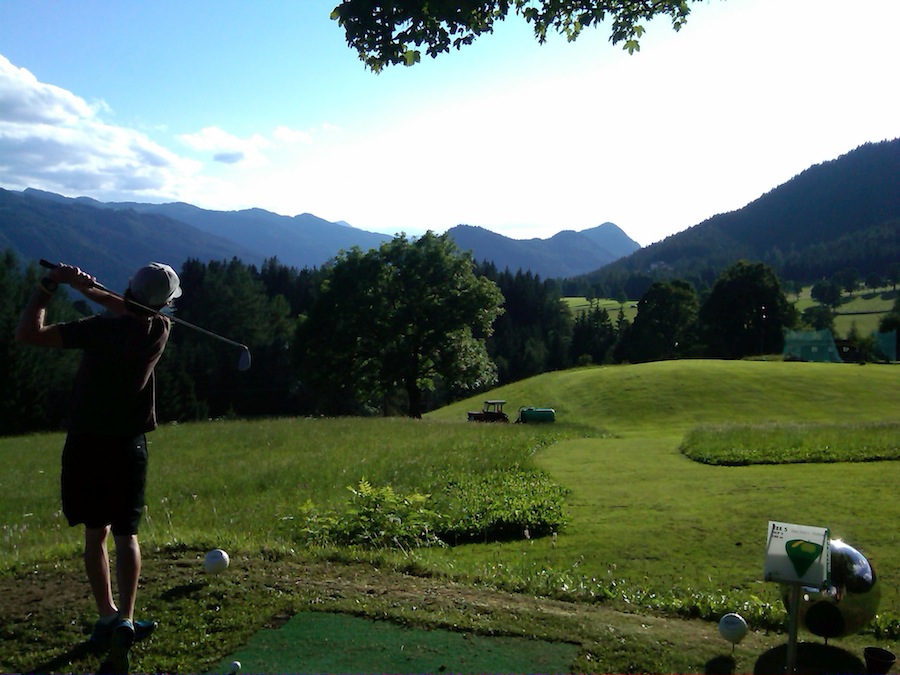
Tad Elliott takes a swing on an off day in Austria during the U.S Ski Team men’s training camp in Ramsau. The team spent about 12 days between Ramsau and Oberhof, Germany, with one day off in early August. Elliott frequently plays golf on his days off in the summer. (Andy Newell photo)
It’s almost September, and let’s be honest, you’re in great shape. Or you’re almost there. Just a little longer distances, some slightly harder efforts and bam!
You suddenly feel a tickle in your throat. Your head’s pounding, your legs are shot and your heart races when you start working out. You’re having trouble sleeping and this head cold is something you hadn’t bargained for.
What gives?
Probably overtraining. “Pish-posh,” you think. “I’m not an elite athlete. I don’t train full time and I’m sure I could be doing more.”
But you are human. Even the pros will tell you, the body needs proper rest to perform its best. Most nordic skiers on the U.S. Ski Team (USST) take one day off per week, and in a series of emails with FasterSkier, several explained why and what they do to pass the time.
You’re not going to lose your mojo by taking it easy, and you don’t have to go stir crazy on an off day, either. Schedule rest and recovery regularly on a day that’s convenient, when you’re busy with other things or have some travel to tend to. A little load off the legs isn’t going to kill you, and it could keep you going strong into the ski season.
***
On Monday, Jessie Diggins tweeted that she was helping her USST and Stratton Mountain School teammate Andy Newell “hammer some nails and build a deck in the hot sun while munching maple donuts,” and added the hashtag, “#GoodLife.”
In an email, Diggins wrote that Mondays are typically her days off. She spent yesterday working on Newell’s cabin in Weston, Vt., about 25 miles north of Stratton.
“On the rest day I try to get some work done – write a blog, catch up on emails, clean my room (okay, so maybe I don’t always get the cleaning done, but it’s a nice thought),” she wrote. “It’s also nice to do something fun on the day off, like go swimming or go to a movie or just chill out and read some good books. During a hard training week I feel like my energy between training sessions is pretty much gone, so the day off is when I get a chance to get caught up.”
While at a 10-day training camp with the Swedish national women’s team a couple of weeks ago, Diggins and four other American women had two days off, both of which were travel days. They took the first before camp started in Sälen, Sweden. Four days later, the entire group had another while driving to Torsby for four days of training in the ski tunnel. Diggins explained she stretched that day to let her muscles relax, and some of the women did yoga.
“Without the rest day, we wouldn’t have been able to make it through the camp healthy and with quality training sessions,” she continued. “The rest day is when the body builds itself back up and recovers.”
Stratton Mountain T2 Team members Andy Newell and Eric Packer (not shown) exploring Oberhof, Germany, during a rest day in early August. (Newell courtesy photo)
According to Newell, fitting in an off day isn’t always easy, especially while traveling. Regardless, he gets it in at some point.
“Sometimes I’ll go over 7 days without taking an off day just because of the scheduling,” he wrote. “For example when we were just on our Austria camps, which was 15 days long, I think I only took one true off day from training in Oberhof [Germany].”
During periods of high-volume training, Newell sometimes works out seven or eight days in a row to rack up the hours. He takes off a few days the following week.
“I think it’s fairly common that after intense blocks of training, professional skiers take easy weeks with 2 or even 3 off days,” he wrote.
In the summer, Newell likes to spend those days “hanging out in the sun, swimming, or working on the cabin,” he wrote. “Off days in VT are sweet because I get to hang out with a lot of my buddies who aren’t in the skiing world. We might all work on somebody’s house, pound nails, and then we all meet at the local red neck bar in Londonderry for happy hour or have a BBQ.”
See? Even the best skiers are human, too. But according to Newell, kicking back during the nearly five-month-long World Cup isn’t always so glamorous.
“Rest days during the winter can sometimes be really boring because we might be stuck in a hotel in some not so fun European town,” Newell wrote. “But as long as it’s not dumping snow or something we usually get together as a team and head out into town to walk around, hang out in a coffee shop, and just relax outside of our hotel rooms.
“We spend so much time in hotels during the winter it’s definitely worthwhile to get out and experience the local culture a little bit. It feels good to get the blood moving and walk around before you we get back to hanging out and playing guitar.”
Other USST members weigh in:
Holly Brooks: After what the Alaska Pacific University coach and skier described as an “intensive camp” in Sweden, Brooks flew to Seattle to spend three days with family before heading home to Anchorage, Alaska. She emailed FasterSkier from the Seattle airport, where her flight out was canceled.
Holly Brooks and her Swedish grandmother (“Farmor” in Swedish) after making Swedish Bula coffee bread at their family cabin at Snoqualmie Pass near Seattle, Wash., where Brooks learned to ski. Brooks spent three days there after two weeks in Sweden in August. (Courtesy photo)
“This was supposed to be a training day but turned into a ‘rest day’ by means of getting stuck here!” Brooks wrote. “Not ideal but some things are out of my control, right?
“I was lucky enough to squeeze two nights in at my family cabin at Snoqualmie Pass where I learned to ski,” she continued. “My grandmother who is Swedish and I had a blast making coffee bread or ‘Swedish Bula’ at our Stugan (Swedish for ‘The Cabin’)…. she was certainly on my mind during our trip and training camp there.”
Brooks usually takes one day off per week, which “could either mean a day with no activity whatsoever or it might be a light cross training activity.”
While in Sweden, the U.S. women tried a different format (two four-day blocks with one rest day in between) based on the Swedish national team’s schedule. Back home, the Americans train hard at camps for at least a week before a recovery day.
“I was certainly a bit tired at the start of the Torsby training block,” Brooks wrote. “I have a tendency to feel bad the first day of training after an off day. Fatigue was certainly built up as the camp went on and people were dropping like flies by the last day. However, by the last day (day 4 in Torsby) I felt better than the first. Sometimes your body will surprise you and it’s more resilient than you would initially expect it to be!”
But what about travel? Is it really the best time to be recovering?
“I prefer to not mix recovery days and travel, but with the amount of travel that we do in both the training and competition season, we would miss too much training if we regularly took time off for a restful recovery day AND a training day. It’s not ideal but it works, as long as your proactive about staying healthy in other ways, i.e. sleep, nutrition, trying to minimize stress, etc.
“After travel days I’m always careful to plan easy training as the body has a tendency to carry excess fluid and old injuries flare up out of no where. My first ski in the Torsby Tunnel I felt both my elbow tendinitis and a back problem; both injuries that I haven’t suffered from all summer. The next day they were gone but I think it’s important to note that easy training after travel – and perhaps even a good yoga session is a good idea!”
Tad Elliott: “When I was younger I took about ten rest days a year,” wrote the 24-year-old member of Ski and Snowboard Club Vail/Team HomeGrown. “Now with [USST men’s coach] Jason Cork writing my plan I take one rest day a week. Rest is just as important as those L4 intervals. Recovery is huge and key. In Austria I had one off day. We traveled that day and I just packed and unpacked and read a lot of my book on that day.”
Elliott lounging by the pool at the “castle” of his Team HomeGrown teammate, Cal Deline, in Avon, Colo. A U.S. Ski Team member, Elliott stayed with Deline in mid August while training with Vail juniors. They had a team barbecue that night, Aug. 17. (Courtesy photo)
What do you generally do at home in Colorado?
“For a rest day in Durango I do errands with my mom most of the time and read and take naps. I also try to play golf with my twin bro when he gets off of work. I play golf a lot on easy days and off days during the training months.”
What about when you’re racing internationally?
“On the World Cup and race season I rest and I rest hard. I sleep a lot and either read or watch movies. … I actually usually don’t leave the hotel except to go to the grocery store and stock up on fizzy water and snacks.”
Simi Hamilton: “I think rest days are just as important as hard training days for us as they’re essentially the only time we are letting our bodies fully absorb all the training that we’ve been doing,” the Sun Valley Ski Education Foundation skier wrote. “Plus, as XC athletes I think we’re so used to running around all day and constantly being ‘in motion’, so it’s good to learn how to just do nothing for a full day or two when you need to do that.”
What did you do on your single off day in Europe earlier this month, while traveling from Austria to Germany?
“I went out for a super easy 45 min. classic roller ski when we get to Oberhof. … Sometimes you just kind of need to do that on a rest day, especially if you’ve been in the car for a bunch of hours. … You just have to make sure you’re going super easy and you’re letting your mind drift away a little bit from where it usually is when you’re really training hard.”
Ida Sargent: “What I do on my off days depends on where I am,” wrote the Craftsbury Green Racing Project member. “Often in the winter our off days are travel days so we spend them in the van or on a plane. When I’m home at Craftsbury I like to do some work hours at the Center, which ends up usually being active recovery. I don’t train at all on those days at all but I like to stay busy and catch up on stuff.
“As far as rest days go, I think the most important thing is to listen to your body and do what you need that day. For me each rest day is different depending on how much energy I have.”
“Give a Man a Fish and Feed Him for a Day. Teach a Man to Fish and Feed Him for a Life Time.”
The common metric for the amount of cross-country ski training done in a year is the total number of hours spent training in the different intensity zones.
One of the more vicious hazards of becoming pre-occupied with hours put in is missing or ignoring the hours NOT put in. These are important for all skiers, and for juniors they are doubly so. If kids have come to a year-round ski training program one would hope it was not for short term success. Junior programs should be in the business of building a solid and intelligent training foundation, and part of that foundation is knowing how to use time off.
Time off includes recovery hours. While we often enter them in a training plan as “Rest” or “Off” days, it is easy to forget how important it is that athletes know how to use that time. Recovery hours are as fundamental a building block as any other part of the training plan. It is during recovery hours that the work sinks in and when the body and mind refresh themselves. It can be both a conscious and a subconscious break in a routine that prepares us well for the next load. The tricky part is that rest and off days are easy to miss or to misuse. The athletes need to understand the part recovery time plays well enough to give it the same quality of attention they give to any other aspect of training.
Give a Man a Fish
In our training plans at Burke we often use the expression “OFF off” for a rest day and “Off” for a training recovery day. Here is how we present that to the group as a whole (individual plans get more specific).
[NB: Before you read one word further allow for the fact that this contains the highly personalized opinions and spins of someone who tends to be a judgmental old fart. Armed with that proverbial salt shaker, read on.]
“What do we mean by ‘OFF off?’”
That means no structured training and largely a day of below zone one activity; it allows and encourages an easy walk, easy mobility, and rest. Reading, music, homework, making food, etc. It does not mean staying up late and sleeping in, blubbing around your room with computer games, breathing stale dorm air all day, and consuming a steady diet of snack food. That ain’t “off, ” that is backwards! The day in bed is useful too if you are running a little sick; HR 10+ bpm higher than normal, any hint of fever, and any other signs of impending illness. For any recovery day to be most helpful you should be IN bed not later than 10 and out of it by 8:30-9:00 AM. Kids need more sleep, and getting it at the right end of the day lets it do the job better.
A day described with only one “off” can and should mean a light run, and easy ski, an easy hike, a low key field game. It doesn’t mean a full day of top to bottom Alpine skiing or a century ride with your Dad. Research has shown that recovery is quicker and residual waste is processed out of the muscles best by activity at around 60% of the max heart rate. That can be a slightly lower key version of our usual recovery intervals (which are explained later), and that type of work is also constructive in maintaining a base. If you are healthy and feeling good, but know that you are a little tired or have been working extra hard, then a session of sub level one (e.g. 120 bpm up to level one e.g.130-135 bpm on a 3 min / 6 min cycle repeated 3 -4 times) is always a good off day activity. It keeps fresh oxygen in the system, and moves waste products out without creating any fatigue. This type of session is part of recovery, but don’t let it sneak into compulsive guilt training and let the intensity creep up. The mind needs a break too. Let it go somewhere else. Mellow out, enjoy it.
This may be all very well as far as it goes. It provides a reasonable set of ideas as to how to use a recovery day, but it doesn’t go too far to explain why these days are valuable, even critical, in planning an increasingly advanced approach to training.
Teach a Man to Fish
The school of training thought with which I am most comfortable puts a high value on the athletes gaining an understanding of why we do what we do, and on developing confidence and independence in training. We try to share information in a way that is directly useful to them and gives them a greater sense of investment in their efforts.
How do we best exchange and share information? What do we need to know about recovery time, and what does the athlete need to know? In my mind the best and first approach is to establish open and frequent communication between coach and athlete. Any early experience and understanding the athlete has is just that, but we should regularly draw on it and point out how accumulating individual experience increases the knowledge of capacity, and personal physiological response to stress and stimulus. Seeking and respecting the athlete’s input, however novice or “green” it is, is important. That builds mutual trust, a willingness to share thoughts, respect and a common purpose. Once established, that relationship becomes a powerful tool in effective information exchange.
If one of our goals is to help athletes become independent and self-confident, then we need to have concrete material to give them. Not rules—but ideas to discuss, to try on, to analyze and to digest. Kids like numbers. They seem less interested in and less convinced by anecdotal evidence. Having something concrete to go over with them can go a long way to convincing them that recovery is as important to moving ahead with training and ultimately going faster, as is any other single part of the foundation.
A good place to start is to review what we as coaches think we want and need from a recovery day; to revisit some of the science behind the idea and to see if we are consciously taking it into consideration and applying it in our programs for juniors. After that bring each athlete into the loop and clearly and simply share the principle of load and adaptation, of catabolic and anabolic processes, and the concepts of load, breakdown, recovery, and overcompensation. This goes a long way to letting kids see how interrelated all the work and rest is, and it encourages them to begin to develop an awareness of their own systems. Producing a diagram that illustrates the relationship between load and breakdown, recovery and repair, and eventual overcompensation and improvement over time will help involve the athlete much more effectively than simply saying, “Take today off.”
[While it isn’t the purpose of this article to go into detail on load and recovery one important related concept is worth considering; the load on an athlete is not only the load from a given workout, or series of workouts, but rather is the total load being carried. The total load is made up of additional factors from everyday life including relationships, school, social pressures, economics, family and work situations and the mass of stimuli and thoughts that bombard teenagers every day.]
A diagram can show how a hard load can weaken and break down the system, and how proper recovery can bring it back to a higher level. It can illustrate how new loads applied too soon or too frequently, and not allowing for full recovery, can turn the performance curve downward into overtraining.
“To avoid sickness or overtraining, the training plan ought to be designed such that the athlete achieves a complete recovery every two to four weeks.” — Endurance, Olympiatoppen. 2005.
For Juniors from 14-16 years old, I would be inclined to say recovery should happen every 6-10 days, and for 16-19 year olds, every 10-14 days. This is full recovery and would tend to require some time totally off.
We can look at hard numbers when it comes to determining how much recovery is necessary. The research has been done.
The book ENDURANCE -Training That Produces Results contains an interesting table that we can use as a starting place.
It compares the length of recovery times from work in different intensity zones, with the caveat that shorter periods of work require less recovery and that for the table the length of load is typical for the I-zone, i.e. an IZ 1 workout might be three hours and an IZ 4 workout might 30 minutes of total on time. On the far right of the table is the length of the “overcompensation phase” which occurs after a specific training load plus good and complete recovery and helps us gauge when to take the best advantage of the recovery process with the next session.
Average recovery times for well-trained endurance athletes after training in different intensity zones.
I Zone
HR (% max)
90-95% Recovery Incomplete
100% Recovery Complete
Over-compensation Duration
1
60-72
ongoing/in a few hours
up to 36 hours
1-3 days
2
72-82
7-12 hours
12-48 hours
2-4 days
3
82-87
12 hours
24-72 hours
3-5 days
4
87-92
12-24 hours
48-96 hours
3-6 days
5*
92-97
15-30 hours
60-120 hours
3-6 days
*As skiers we do not often exceed I Zone Five in training. The scale on the chart goes on to IZ 8. Everything over five is at thundering max heart rate and is of short anaerobic duration.
“Recovery time is also dependent to a large degree on the athlete’s total current life situation. A lot of stress in connection with work, studies, social and family situations can lengthen recovery time significantly.”
The thing that shouts out at me from this table is that, given all the other things that come into play with juniors we may, in our quest for filling in the hours, be short-changing vital recovery time. We are in the process of building a well-trained endurance athlete. We probably don’t have one yet so we should likely be ready to add time to the numbers here. If we rush it, or we completely trust the athletes’ own inexperienced evaluation of readiness without observing them closely, we may be asking for more than they can or should give; that is where the slippery slope to declining performance, chronic illness and overtraining can begin.
It helps to know as much about the individual athletes’ worlds as we reasonably can (living at home with an endorphin addicted Type-A parent can play hell on recovery time!), and we need to recognize that the hard workout doesn’t end when the sweat stops; it ends when good recovery time has passed and we are ready for the next and perhaps increased load. That comes back around to the importance of that relationship of communication between the athlete and the coach. It, too, needs to be trained and nurtured. Patience is key.
Having that in mind when we sit down to lay out the next plan is being forearmed and better guaranteed to come up with something good.
These may look familiar. The first two are unfortunate but ubiquitous adjuncts to the freshman year of college, the third to the junior and senior years of high school, and the fourth to all ages but endemic among high school girls. Two, three and four can frequently be aggravated by well-intentioned, caring and ambitious parents.
Oh boy, no training tomorrow!
A frequent problem for kids with early talent but no performance or process goals.
Hazard: A) Stay up late with pals after a hard week of training while immunity is still a bit compromised. B) Sleep in until noon, eat Froot Loops, play video games, put two hours into Facebook, stay up late. C) Add C2H5OH and set things back 10 days.
Rx: Get it together. Come out of denial and check your goals. What do you want? Very tough, because this is a lot of fun and being honest with oneself has perhaps not been learned yet.
Oh boy, no training tomorrow!
Hazard: A) “Gee, that’s great dear! Now we can do something together! Let’s go ride that century we had so much fun on last year. B) “Way cool! Let’s see how much vert we can do at the Glen!” C) I will be able to go do the time trial with the old team. We don’t have ski intervals until the next day.”
Rx: Just say NO to the craziness. Believe in your plan and say that a short easy ride is fine, but not another race with Dad. On the other hand, time with the old man, or mom, or finding powder in the glades with friends is good for the soul and the head. It is healthy and refreshing. The trick is to take another day OFF from activity and not to drive yourself down. Do not double up on workouts for two different sports! Be honest with your coach. An extra day off costs a lot less than an extra day ON.
Whew, no training tomorrow.
Hazard: A) “I am totally stressed out by these SAT tests. I’ll get up early and take three or four more before I start to catch up on calculus. Then I can spend the rest of the day trying to get the rough draft of my paper done.” B) “Oh my god I have to get this ED application in but I don’t where to send it! I have been waking up at night worried about not getting ‘pull’ and not getting in anywhere!”
Rx: Get a little help (coach, advisor at school, parent, friend) to put things in perspective. Talk it over. Find an order in which to deal with it. Chill time. Go fishing. Easy run with the pooch. Help the old coffin dodgers next door to stack wood.
Oh no. A day off.
Hazard: “I know I am going to get slower if I don’t train today. All of my intervals are getting slower so I know I need to work harder at them. I missed two sessions last week because I was sick but I feel a lot better so I’ll count those as days off and get out tomorrow and go for it. I won’t say anything to the coach. I’ll just work that little bit harder and he’ll be surprised when I win the time trial.” (Yup, he’ll be surprised all right, and even more so if you finish the first race!)
Rx: Toughest of all, because this frequently sneaks into other aspects of life. Most of all it wants honesty with the self and a willingness to pay attention to facts of physiology and psychology. These are the athletes who can sometimes be helped by numbers; lactate tests, charts and plans about recovery that clearly relate quality recovery to quality performance, and recovery workouts of which the athlete can clearly feel the effect. Knowledge is power here, and helping these athletes recognize the effects of their efforts in quantifiable terms is valuable.
There are different kinds of recovery for coach and athlete to consider. To get the best out of all of these, the more the athlete knows about what is happening in his body and the more committed he is to “doing it right,” the more thorough the recovery will be.
Planned Active Recovery, which is frequently written into the daily plan or is mutually understood so it can be added to a workout with only a verbal reminder. They can be elaborate or simple.
Examples:
At Burke, we’ve come to use “recovery intervals” either immediately after a hard interval session, or later the same day. The athletes like the results of these, and take no convincing to do them. A frequent choice is a series, following a light warm up, of 4 x 8 minutes in IZ 2 (70-80 % of max HR) rolling down to IZ 1 ( 60-70%) for 4 min, done as continuous work.
Another recovery workout that should be planned, and is often forgotten in the heat of battle, is the immediate post-race cool down. We lay out a fairly specific routine for that and do our best to make sure it gets done. It is one place where kids’ judgment sometimes needs back-up until they are a little older and a little more experienced. Done properly and on time, the post race workout can make a race day a good work day, and can, if you are on a two-race weekend, go a long way to enable throwing down a good effort the second day.
Planned Long Term Recovery. This is time planned in over the training period but not necessarily specified as a certain type of recovery work out. The Coach/Athlete team needs to consider it in some detail before and after individual workouts. It needs to be flexible in duration and in potential activity. The Recovery Time Chart (above) can be helpful here.
Example:
What this really affects is the rhythm of a training period; how long after a hard effort or a long effort do we wait before doing another one? We occasionally do a workout we call an “overspeed,” which is an effort for an extended period slightly above race pace, at a speed that is a little uncomfortable. These are tough both physically and psychologically, and we plan not only immediate active recovery, but also long term recovery allowing a good passage of time. We also carefully plan activity to rebuild and refresh the systems before we plan another hard session. For J1 athletes we might think about two such workouts in a month. There is a lot of room for other work in between.
Rest and Recreation. This is non-specific but very important time. It is private time. The sense of freedom and ownership of participation are here. It is important to recognize that sometimes R & R involves a workout that should be written into the plan and the plan should be adjusted to take it in. A junior who has a day off but runs into buddies who want to go for a 4 hour mountain bike ride, and decides to go along, might be hesitant to tell the coach who has 4 x 4 intervals planned for the next day. However, he should feel able to speak up, should speak up, and everyone should make necessary adjustments. The subsequent and perhaps critical communication should be thought out and should be constructive. Helping athletes value their goals, and their commitment to the game, helps them feel more confident in making the best choices.
The more juniors operate with coaches as consultants, and the more they find and adjust their own best programs, the closer they are to learning how to fish.
Home made energy bars (Photo courtesy of Sunn Jenteidrett)
This is the third article in a four-part series on eating to perform while balancing life and training demands. The information provided here is from the Norwegian organization “Sunn Jenteidrett,” which published the “Eat Smart” cookbook and resource guide on nutrition and training. Sunn Jenteidrett is dedicated towards increasing the awareness about nutrition and performance among young athletes, and is a joint effort of the Norwegian Ski Association, Norwegian Orienteering Association and Norwegian Track and Field Association, backed by the country’s Olympic Development Center.
The recovery snack contributes to making your body more receptive to harder training loads, and it prevents injuries, overtraining and infections. Follow up with a complete meal, preferably within two hours. If you are tired after your workout, make sure you’ve made your snack ahead of time, so that it is ready for your when you are done. Toss it in your gear bag, leave it in the car, have it ready in the fridge once you walk in the door – make it convenient!
Exercise drains the glycogen stores in your muscles, increases protein and fat metabolism and drains your body of salts, minerals and liquid. Be sure to replace lost liquids as soon as possible after your workout, with at least two cups of liquid immediately and then following up with more liquids the next two hours, until rehydration is complete. Hard intensity workouts and strength sessions metabolize protein, so it is important to include some protein in the recovery snack. Protein also stimulates the restoration of glycogen, as well as repairs muscle tears caused by the workout.
Some options for recovery snacks:
Smoothie with yogurt, banana, juice and fresh/frozen berries (the yogurt provides proteins, carbs and minerals such as calcium, while berries and bananas provide vitamins, carbs and minerals)
Milkshake (Go easy on full-fat dairy and added sugar – try using 1 or 2% milk and 2-4 tablespoons ice cream)
Sports bars and meal replacement bars
Chocolate milk
Yogurt and cereal/granola
Toast and a glass of milk
Sandwich with ham and/or cheese
Mango Lassi (Photo courtesy of Noema, flickr.com)
Recipe: Mango Lassi
What you need:
½ cup orange juice
¾ cup yogurt (plain or vanilla)
1 mango, cubed
What to do:
Puree the mango cubes in a food processor. Add juice and yogurt. You can use different varieties of juice and yogurt – using white grape juice will make it sweeter, as will mango-flavored fruit yogurt. Adding bananas will make your drink consistency thicker; ice cubes will make it colder. Experiment with different ingredients and see what you like!
A peanut butter and jelly sandwich can be a good post-workout recovery snack, according to U.S. Ski and Snowboard Association Sports Dietician Adam Korzun.
Bananas an hour prior to every race. Granola bars afterwards. Pasta the night before. As much as for any other aspect of the sport of cross-country skiing, there are dozens of beliefs, strategies, and misconceptions when it comes to food and nutrition.
To clear a few of them up–but by no means all of them–we spoke with recently-appointed U.S. Ski and Snowboard Association (USSA) Sports Dietician Adam Korzun. A native of Alabama, Korzun has worked with USSA for the past two years, including on a chef program at the 2010 Vancouver Olympic Games. Korzun took our questions on basics like hydration and recovery, then addressed some broader issues, like strategies for getting the right food while you’re traveling.
FasterSkier: So, since you’re a dietician, the first question is obvious: What’s your favorite food?
Adam Korzun: I wish that was a simple question. I don’t know if I could pick a favorite—I guess I have regional favorites. Where I am from, Alabama, I like a good old crawfish boil down south; in New England, seafood; coming out here [to Utah] and getting wild game. If I was on death row and I was having my last meal, it would be a huge meal.
FS: Can you talk to me about what your job entails? From the press release I read about your hiring at USSA, it sounds like you’re going to be working both with elite athletes, as well as ultimately creating some programs and guidelines for clubs and their members?
AK: In my job description, it’s pretty much just running the nutrition program for all of ski and snowboard. What that entails is doing nutrition counseling, planning, managing the educational kitchen here, running sessions, cooking on the road, organizing other chefs to travel with teams as needed. In addition, there’s the performance aspect of it—I’m involved in the performance testing and physiology.
FS: It sounds like you do a lot of work with the alpine skiers, but I’m guessing you help with cross-country and nordic combined as well?
AK: So far it’s been primarily at camps in Park City. It works really well that nordic combined is based out of Park City, so I spend a lot of time with them all summer. With nordic combined, I’ve been working with them on nutrition and timing, managing body composition for their sport, and ways to maximize their power and power-to-weight. I’m also getting involved and working closely with [Head Coach] Dave Jarrett, doing performance testing and tracking results.
I’ve only really worked with a couple of our cross-country skiers so far this summer. In two weeks, I’m heading out with the team to Lake Placid, and I’ll get to work with them there. I have worked with some of the club cross-country teams—just some nutrition presentations and open questions and
Adam Korzun (L) working with an athlete. Photo, USSA
discussions with some of our clubs that are in the area for the summer for training. Out in Lake Placid, we’re going to do some more testing, individual work with athletes, also work a bit of performance testing in there.
FS: So it sounds like you’re work is just as much exercise physiology as it is nutrition, huh?
AK: It is. With being more in the sports world of nutrition, it goes hand-in-hand. Understanding nutrition is one component of it, and really taking it to the next level is pulling in the physiology, like, ‘what energy sources are you using?’ If someone’s doing an exercise that’s 100 percent aerobic, their physiological demands aren’t nearly as high as when they’re beyond threshold. Using that [knowledge] to tailor nutrition plans, and also how they should be recovering from that—you’re not going to recover the same way from a core session as you are from a threshold session.
FS: Can you talk about the nutritional demands across the skiing disciplines? My guess is that the basics are the same for everyone, but then things maybe are more specific at the elite level.
AK: I think the basic compositions are the same, in what you’re looking for. Calcium is necessary for all athletes; iron is necessary for oxygen-binding capacity for all athletes. Protein is necessary for muscle development and synthesis, and repairing damaged tissue. The basics are the same, and it’s just how we fine-tune it for them. A sprint skier is not going to have the same energy systems as a distance skier. If we look at a moguls skier whose event is 20 seconds, versus a nordic combined skier, [those] are also different. Components will stay pretty close to the same, and then amounts are what’s going to be the big variable. The amount of carbohydrates and the composition of carbohydrates will depend on the demands and the type of training you go through.
FS: If there’s one area where athletes could improve their nutrition, what would it be?
AK: In athletic populations, the one thing that I find that I’ll work on the most with the rookies is a little bit more in timing and consistency. Just in timing their meals, and really paying attention to that. What did you have for breakfast this morning? How did it feel? Really timing what, exactly, is going to work for that session, and then translating that to the competition season. A lot of times you have it dialed in for the summer, and then you go off to wherever the competition is and it’s completely lost.
There’s also getting athletes to really start thinking about eating to train and eating to perform, and not just eating. You don’t eat the same every day–if you’re going out and doing interval training, it’s a lot different than jump training, and the energy demands are a lot different. For a sport that’s very conscious of power-to-weight [like nordic combined], [that’s] important. That’s one to the things I start with them right when they come in—I think you get in the mindset of, ‘oh I’m out there training and I eat whatever I want.’ One of the misconceptions is the whole train to eat mentality, rather than eat to train.
FS: For cross-country skiers, the area that always seems to be of biggest concern, nutritionally, is recovery. Can you talk about the body’s nutritional demands after a workout?
AK: If you look at the basics of recovery, it’s carbs and protein, within a certain amount of time after a workout. Post-workout, your body’s in a state of breakdown—you’ve used your energy stores. The muscle’s tissue is damaged and broken down. Your body needs to repair, but it can’t do that without energy. The idea is get carbohydrates and protein into your body as soon as possible.
The carbs will stop the muscle breakdown, and start to build muscle glycogen, which is your energy. Protein comes in once the breakdown stops, and you can use the protein to rebuild your muscles. You need the protein to repair, but you need the carbs to stop the breakdown.
The basics are carbs and protein, as soon as possible. That’s the approach we all took since recovery became a hotter topic, say, five or six years ago. You’ve got a range of carbohydrates, from 30 to 100 grams, and protein, from 10 to 30 grams. It’s a pretty broad range—I’ve been working on how intense your training session was, and using that as a guide for recovery. If you’re doing an hour-long core session, you’re keeping your heart rate relatively low—it’s not essential that you replenish 60 to 70 grams of carbs at that point. A piece of fruit could be an adequate carbohydrate source at that point, and then
Most foods are labeled with statistics showing the amount of carbohydrates and protein per serving.
adding some protein, like string cheese, could be perfect. Say you’re on the run—chocolate milk could be perfect right there.
That’s another thing: You’re looking at recovery as a snack, not as a meal. Within 20 to 30 minutes of finishing, your body’s primed to take the carbs and protein into the muscle cells. That said, you don’t need to overdo it—it’s just as snack, because then you’re going to have your meal one-and-a-half to two hours later. You look at what you depleted and how hard you worked to gauge how much you replenish.
If your session was a little bit more intense, maybe you want to have a turkey and cheese sandwich, or a peanut butter and jelly sandwich and a glass of chocolate milk, or maybe a fruit smoothie. You play around with the amounts, based on how hard you worked—that’s how you make sure you’re getting the right amount when you need it, but not getting excessive amounts when you don’t. I think that’s especially important in sports like cross-country and nordic combined—you can get away with it a little more if you’re a football player, but for someone who’s a cross-country or nordic combined athlete, it becomes really important that we work on getting the right nutrients at the right time.
FS: Are there any methods you can use to see if you’re recovering the right way and eating the right amount—not too much, not too little?
AK: There’s some folks that will tell you that good recovery can be seen in decreased muscle soreness. I don’t necessarily believe that myself. As far as the carbs and protein component, really looking at the energy level that day into the next day—that’s how recovery makes the most difference, is in those repeat training days. If you’ve got training coming up eight to 12 hours after your first session, the faster you eat, the better fueled and recovered you’ll be next time you go out. Just seeing how you feel, knowing how you feel—that’s kind of a subjective measure, but most people aren’t going to track morning blood glucose levels at a younger level.
FS: Wow, you’ll test blood glucose levels?
AK: I will probably do some of that at the camp coming up here in Lake Placid. It doesn’t make any sense to track glucose once, since it’s independently regulated. If you can track it over time—if you’re someone who is consistently 85 to 80, and one morning and you come in in the 60s, we can correlate that to what you ate the day before 100 percent of the time. ‘Oh yeah, I missed dinner,’ or ‘oh yeah, I didn’t recover right’—you can oftentimes connect it. It’s very useful in tracking trends, but one-time tests don’t give you any information.
FS: What else will you work on in Lake Placid?
AK: We’ll probably do a little bit more in monitoring, just in five days out there, to give them a sense of where they are. Just focusing on what they ate and how they feel, dialing those things in and getting really consistent on it throughout the season—this is one of those additional opportunities for those training camps. Also, they can be really be dialing in a lot of their nutrition parameters: What fuel at what time gives me the best energy?
We’ll also probably work on sweat rates, so we can dial in how much fluid is being lost during training sessions—so that they’ll know how much they need to replenish.
FS: How do you check a sweat rate?
AK: We’ll have them check a weight before they train, and have them check a weight immediately after they’re done training, and then factor in exactly in what they drank during the session. From the change in weight, we can determine how much fluid was lost—the rule of thumb is that per pound of weight you lose, 20 to 24 ounces of fluid need to be replaced. You want to come up with a plan so that they’re not dumping 36 ounces of water in their stomach as soon as they’re done, because you don’t absorb it.
Getting them to take the small, frequent doses of water is going to help them be better hydrated.
FS: Do you think hydration is something that’s often overlooked, since people are more focused on what they eat?
Eggs are a good source of protein.
AK: I think it’s easy to overlook. You may not be drinking enough, or you may need to add some electrolytes to what you’re drinking. When athletes come to this level, they’re so accustomed to drinking, and now it’s a question of getting the right amount and the right stuff that they need. [Also], good hydration doesn’t stop when training stops—it’s all day. There is a pretty big tendency—athletes are good at hydrating during training, but then when the day goes on, that’s when we want to be sure we’re maintaining that hydration level.
FS: Do you have to use recovery-specific products, or even athlete-specific products like bars, gels, drink mixes, etc.? Do those have anything in them that normal foods don’t? Or for the most part, can people rely on the stuff they find at the grocery store?
AK: When it comes to bars and gels, we use them, absolutely. When we’re here in Park City, I try to really push the athletes towards the food, because when they are traveling and competing, that’s when they need to rely on those bars. I don’t want them to have 23 bars a week in training sessions, and then get over to Europe being so sick of them that they don’t want ’em. We’ve all had the experience where you get somewhere and the food is terrible, and you have to have a bar for dinner. I always try to make sure that they have the right bars handy and tolerate them well, but my first goal is to really get them to have the real food when they can—and the bars when they need them.
Things like Gu and gels, they’ll be using those in most training session—we’ll be working on finding the ones they like, and timing them. They’ll use those pretty consistently during training, and then really try to go for the sandwich or the smoothie after a session.
FS: Are there any foods you see as being underrated, that people really should be eating more of?
AK: It may sound kind of cheesy, but I think almost all foods are kind of underrated in the sport world. There’s no marketing behind an apple, versus how much marketing there is behind some kind of protein concoction. I always try to steer them towards, ‘how can we try to make a smoothie without relying on all these concoctions?’ You’ve got a bar with 40 grams of carbs and 12 grams of protein—I say, ‘here’s food that’s exactly the same composition.’ I think all food tends to be underrated, in the fact that it doesn’t have any sexy appeal to it, as some of this other stuff does.
FS: What about the other way around? Are there things you would warn athletes to steer clear of?
AK: There’s no forbidden food or beverage—it’s all about how or when you consume it. You’re not going to get done with a training session and just hammer down 10 beers. And you wouldn’t want to have ribs before a race. But if you’re at a barbeque on the weekend…
I would hate to hone in on a miracle food. There’s foods higher in antioxidants that are full of essential amino acids, but as part of a whole, balanced dietary plan, you can achieve those almost anywhere. There are components of foods that are amazing, but they are present across a wide variety of food groups and types of food. That’s how I approach that one.
FS: We had a few questions from our readers. First, someone wrote in asking about getting enough iron, especially for women. What would you suggest to a cross-country skier who recently became a vegetarian, in terms of foods and supplements?
AK: That’s a good question. That’s one of the things we do screen our athletes for. We do complete iron profiles, checking their iron, hemoglobin, and serum iron stores. That is a huge deal, and it’s something we try to take a proactive approach on. It’s absolutely essential, knowing iron functions as the primary carrier of oxygen in the body.
Is it possible for vegetarians to get adequate iron? It is—it’s just a lot more difficult. Animal sources of iron are heme sources, which are much better absorbed than the vegetable counterparts, which are non-heme. Non-heme is a less efficiently absorbed form of iron.
When someone is a vegetarian and looking to have more iron-rich food in their diet, one thing they need to focus on is every time they’re having one of
According to Korzun, athletes should consume non-heme sources of iron, like chard, with vitamin C in order to facilitate absorption.
those non-heme sources of iron, they need to couple it with a vitamin C source. Quinoa is a source of iron: You’d want to have that with tomatoes, or having some lemon squeezed in there is another way that’s going to help with the absorption. Pumpkin seeds are one of the richest non-meat sources of iron: You add a quarter cup of pumpkin seeds to your oatmeal in the morning—having that with four ounces of orange juice is going to give you plenty of vitamin C.
There definitely are ways to get iron from non-meat sources—it just becomes much more difficult, because they’re not as well absorbed. Tofu can be a good source, but four ounces of tofu to give you six milligrams of iron is nowhere the same amount you’d get from shellfish. If they are really concerned about it, in a deficient state, that’s when you’d want to look towards supplementing your iron.
FS: Is there any other gender-specific nutritional advice you could provide people with?
AK: I think iron is a huge one—it’s especially important in younger women as they mature, but it’s important in men as well. That’s a big one. Also, calcium is a big one, especially in more of the aerobic sports. If people are getting stress fractures, that’s something that really needs to be looked into little more. The way calcium works in the body, we’ll say roughly until about age 25 that you store calcium. Beyond that, your body is no longer storing it—it’s just using what you put into it. For kids, thinking about it as a piggy bank, it’s really important to make sure you’re having three servings a day, especially if you’re someone coming off an injury. It’s one of those things you really need to be proactive on.
Vitamin D is the latest craze—that’s just really huge in the literature and the media right now. It’s a combination of a, people aren’t outside nearly as much any more and b, when they are outside they are covered up and c, they are able to test for it now. So, of course, we’re finding epidemic levels of vitamin D deficiency. Obviously, you find dairy products fortified with vitamin D, or otherwise go outside and get some sunshine.
FS: Another person asked about traveling to events and competitions, where most of the time you have to eat at restaurants. Since restaurants don’t always have the best choices from a health perspective, do you have any suggestions for getting foods that are nutritious, and that follow regular eating habits, while you’re traveling?
AK: That’s a really good one. We’ll actually pack food bags with us when we travel, especially when you know you’re going to go to a destination without common foods, and foods you’re used to. If you know a certain cereal or oatmeal is your go-to pre-competition meal, take it with you. You can get a little hotpot and cook it, and take ownership of nutrition for yourself. Kashi makes pre-cooked grains—there’s a lot of ways you can take food with you on the road.
If you’re domestically traveling, and you’re in a hotel, you [can] get sick of eating out—there’s a tendency not to get what you need. Find a local grocery store and find what you can pick through in a complete salad bar—look for a place where you can find what you’re used to eating, where you’re not relying on a menu as much. We have a tendency to overlook the grocery stores and the Whole Foods-type places. When you can walk into any one of those places and buy some bread and deli meat and make a sandwich, that’s going to save you quite a bit of money, and also make you a balanced meal. Salads, rotisserie chickens, you can kind of play around with them that way.
If you are worried about wasting the food, go in with a buddy—that’s one thing we’ll have the athletes do. You pack it in your luggage and plan for it. In New Zealand [where Korzun was traveling recently, with the U.S. Ski Team], the food is phenomenal, but you don’t have access to the bars, the fruit leathers, the amino acids to mix into the smoothies to beef up recovery. I traveled with all the bars and fruit leathers for the teams, just because I knew I wouldn’t be able to get them down there. If you’re going to country X, where the food is not great, that’s where you tell the athletes to make sure to bring enough to eat right before competitions. I think it’s a matter of planning ahead.