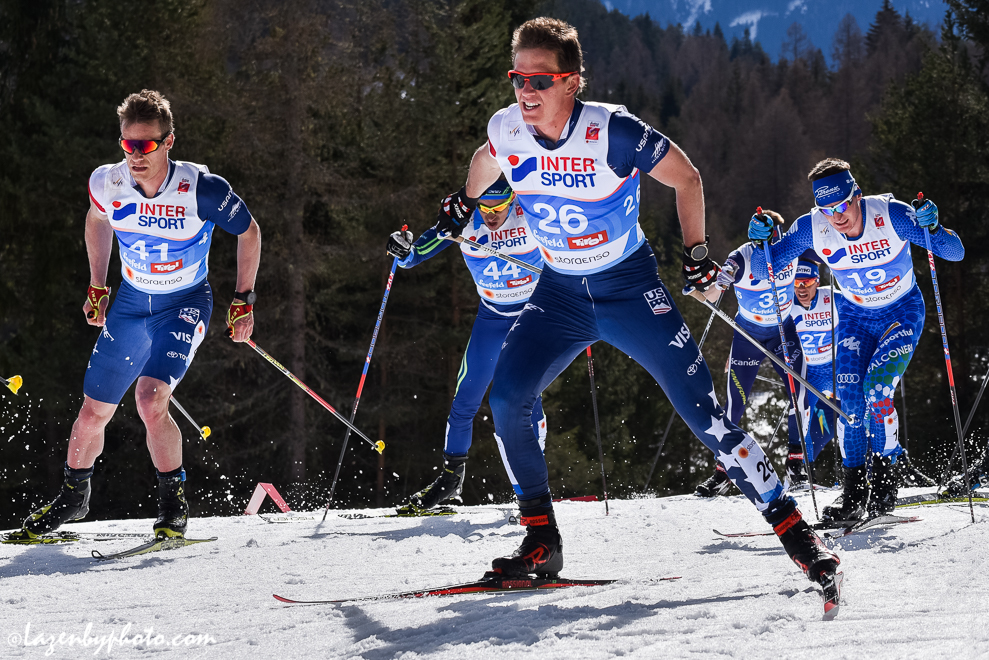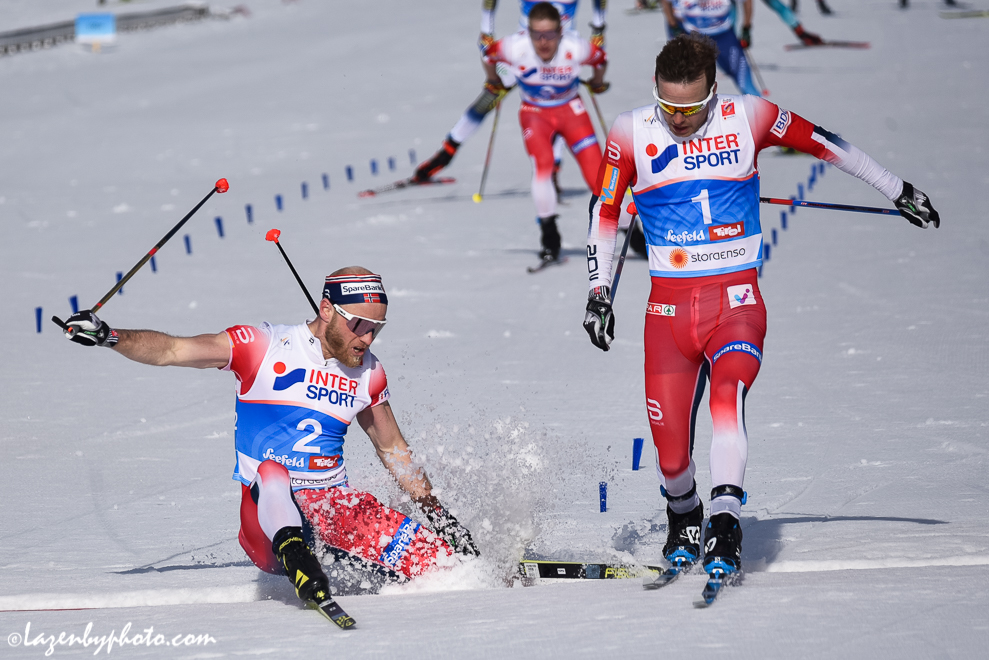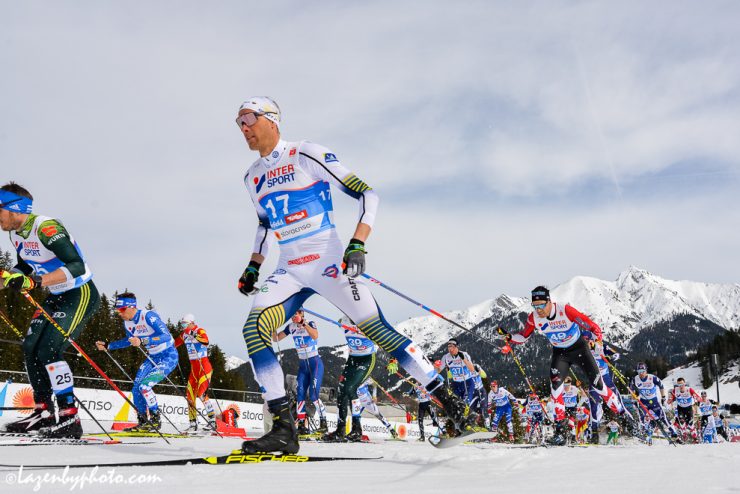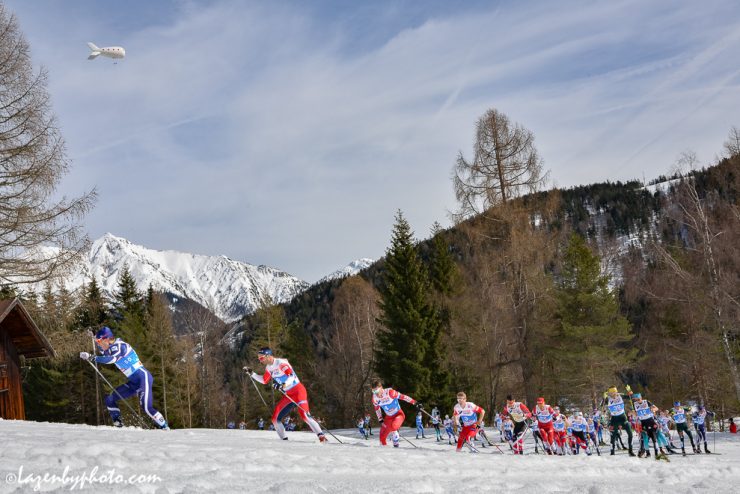
Tag: Simi Hamilton

  • Hamilton, Ogden win 2019 NENSA App Gap Challenge

    Hamilton, Ogden win 2019 NENSA App Gap Challenge

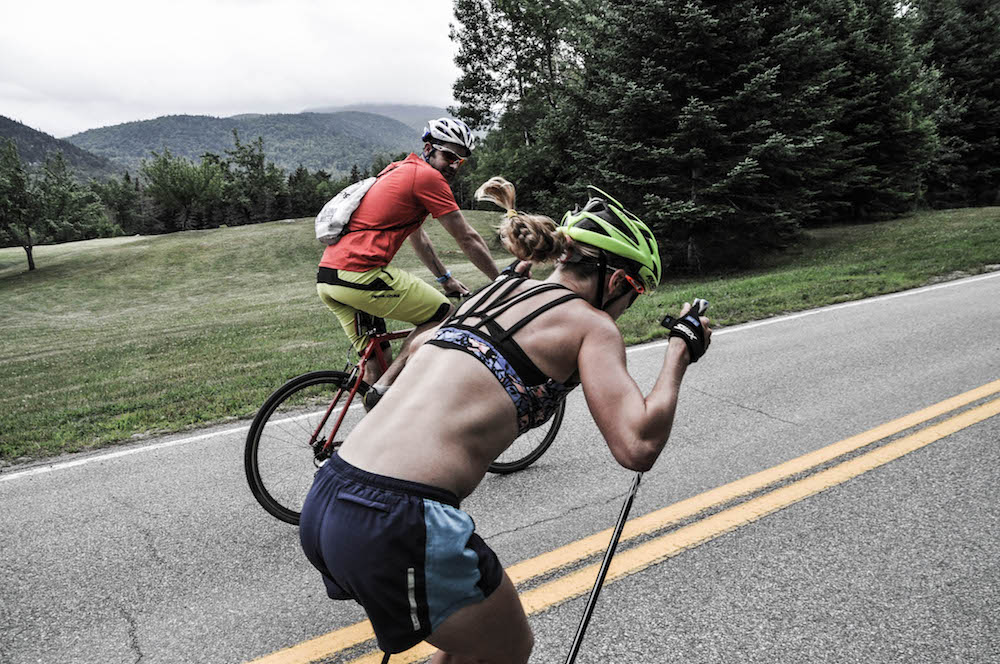
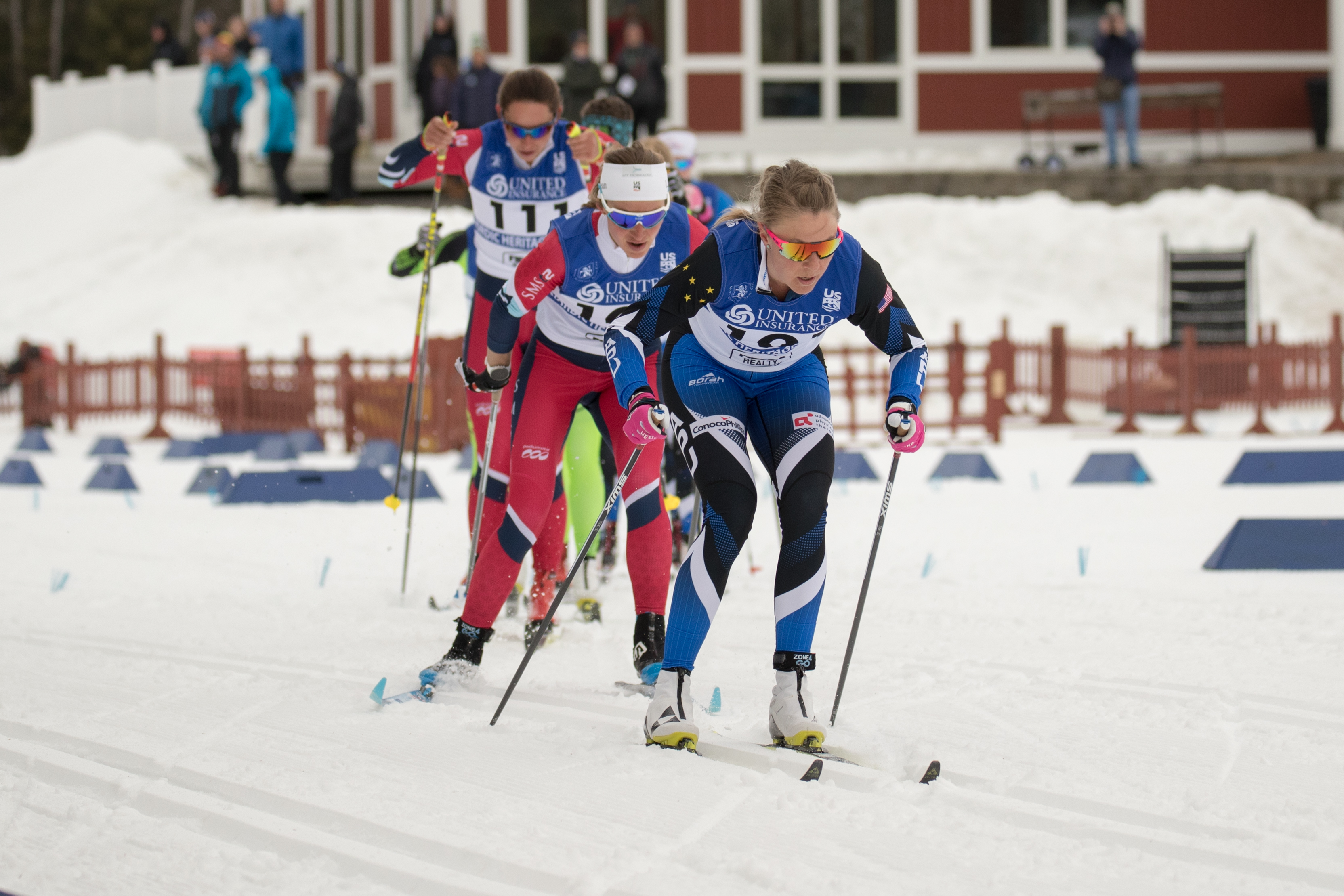
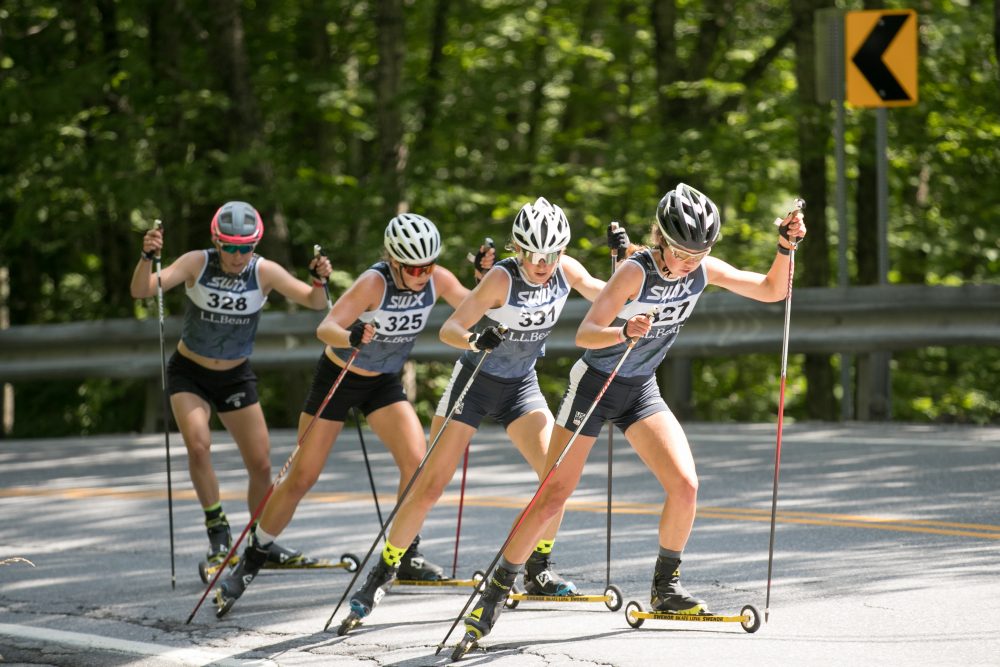
    From right to left: Caitlin Patterson, Sophie Caldwell, Evelina Sutro, and Katharine Ogden during the skate portion of the 2019 App Gap Challenge. (Photo: Reese Brown – xcski.org)

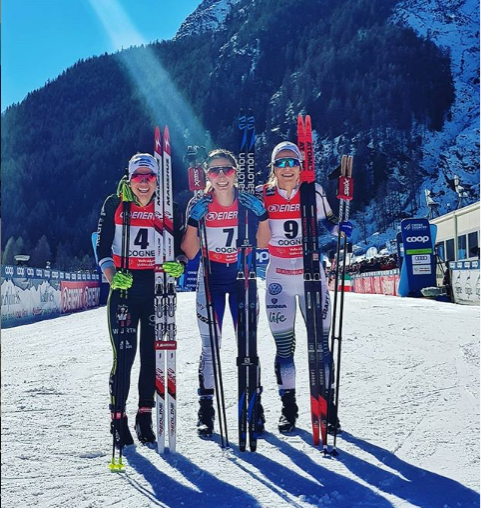
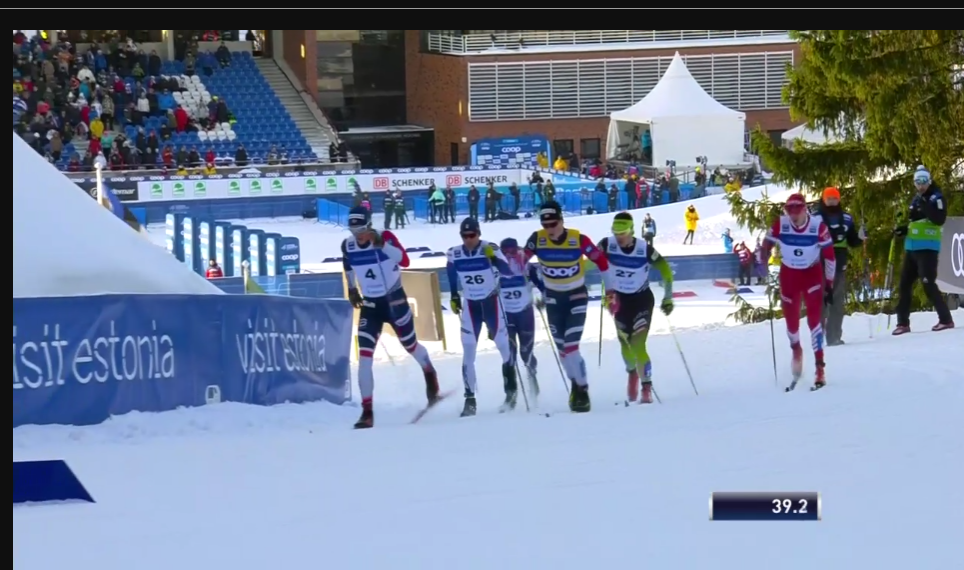
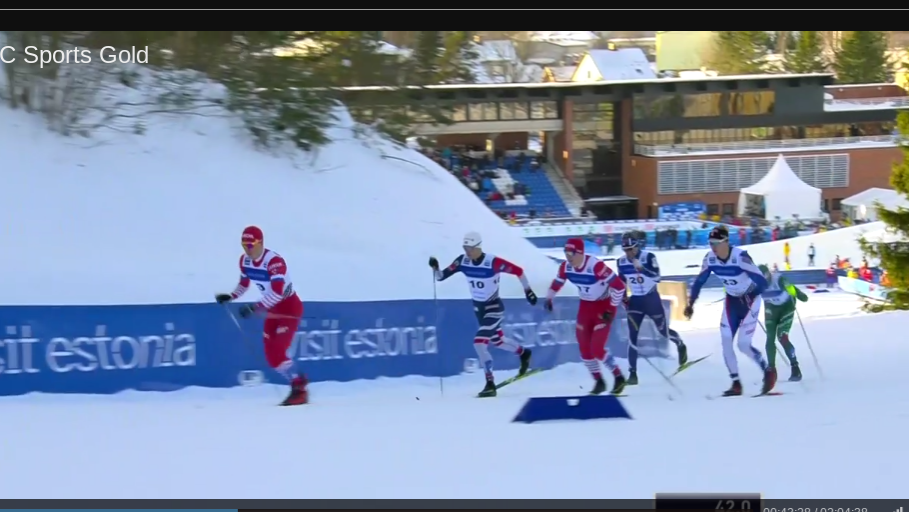
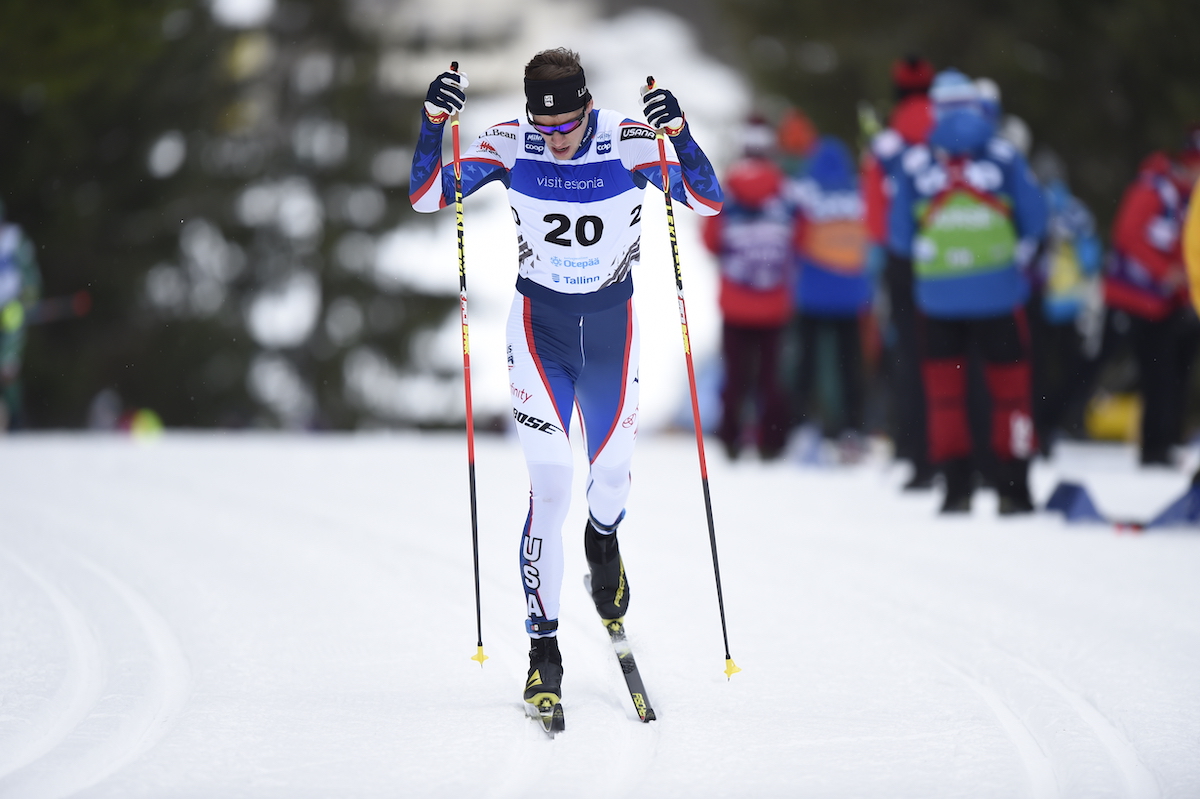
    On a bright, hot Saturday, Simi Hamilton (SMS T2/USST) and Katharine Ogden (Dartmouth/SMS T2) won the NENSA App Gap Challenge in Fayston, VT. Hamilton finished the race in 26:10 minutes, 26 seconds shy of Kyle Bratrud’s record-setting win last year. Ben Lustgarten of the Craftsbury Green Racing Project (CGRP) raced to second, 12 seconds back at 26:22. CGRP teammate Adam Martin followed in third place at 26:37.

    Ogden won in 32:15, with Sophie Caldwell (SMS T2/USST) finishing 21 seconds back in 32:36. CGRP’s Caitlin Patterson was third at 32:48.

    The App Gap is a rollerski skiathlon with a twist. Instead of beginning with a classic leg, the race starts with freestyle. At the Mad River Glen alpine area, approximately 5 k from the long course start, athletes change over to classic gear for the push to the finish.  
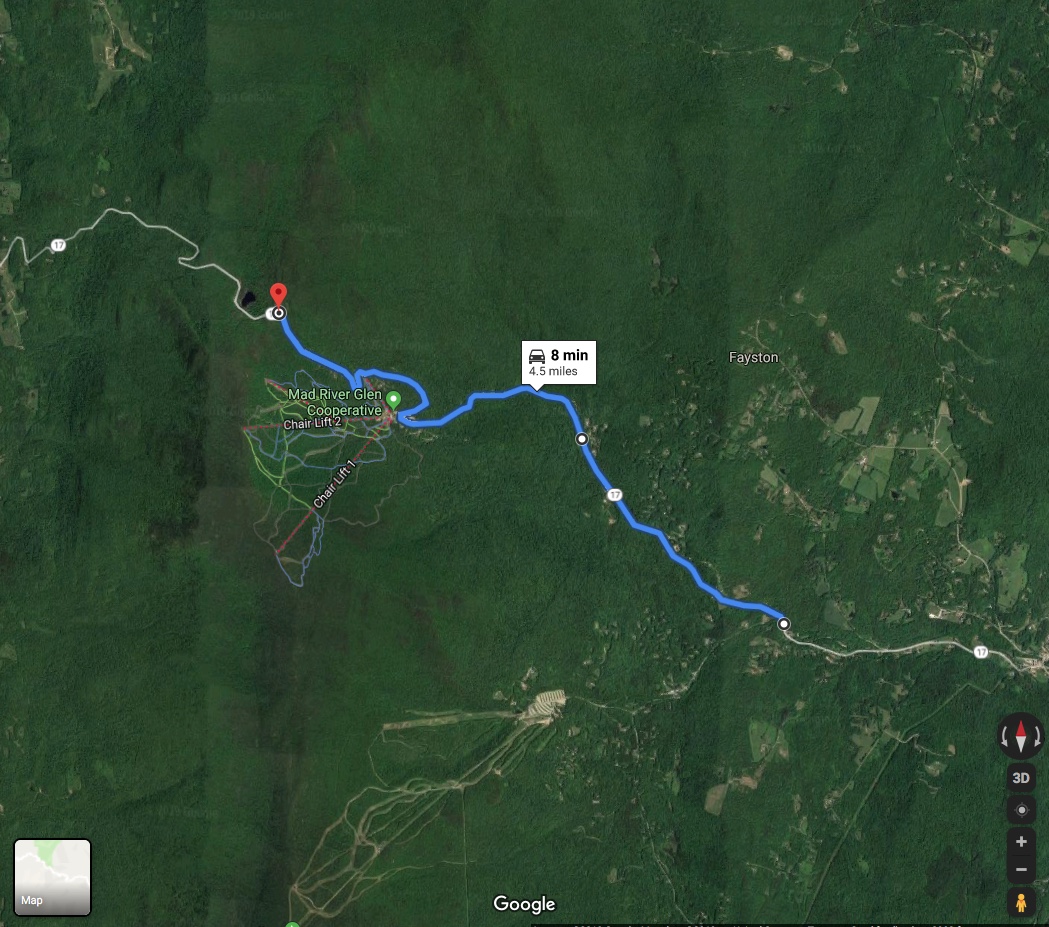
    NENSA App Gap Challenge course. The finish is marked by the red pin.

    In the past, the race distance was set at 7.25 k for men and 5 k for women. According to Justin Beckwith, the New England Nordic Ski Association (NENSA) competition director, coaches requested a longer course for their athletes. Thus, 17 women, including all the racers above, raced the longer 7.25 k course. Ogden’s time is the new women’s course record for the long course. Junior women skied the 5 k distance. 

    Working with local municipalities, Beckwith was able to get the westbound lane of Vermont State Route 17 closed for the race. The early kilometers have a fairly relaxed profile. As the skiers approach Mad River Glen, the road pitches up, with sections at thirteen and fifteen percent grade.

    “This was my first time skiing up App Gap,” Hamilton said after the race. “I’ve been up a few times on my bike, so I know the road a little bit. I wanted to conserve energy down on the flats, kind of see how hard everyone else was going to ski, and just stay relaxed on the climb.  These kinds of races tend to be either really good for me or really bad. I just wanted to see what I could do, and it turned out OK.”

    The skate to classic format suited Hamilton. 

    “Today it was pretty nice to be able to classic the upper section of the hill,” Hamilton said. “It gets so steep at the top that if you classic skied the bottom and then skated, it would really work your legs. It’s pretty nice today that we got to skate first and then classic.”

    With his European race schedule many months away, Hamilton was able to use the App Gap race as a low consequence fitness barometer. 

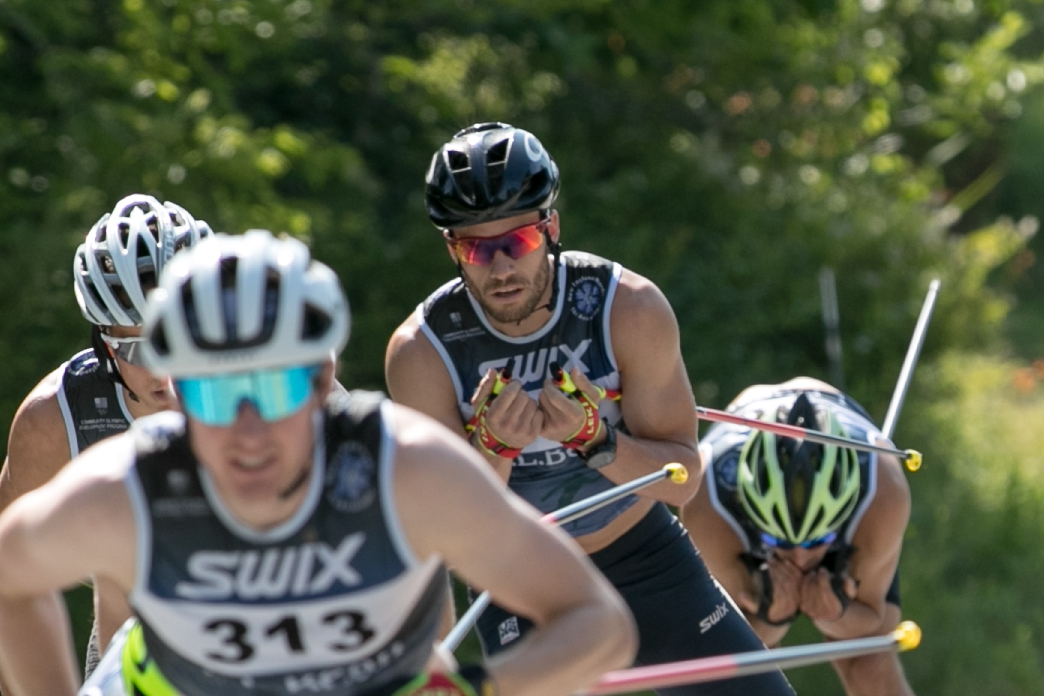
    Simi Hamilton bib 312 followed by fourth place finisher Akeo Maifeld-Carucci. (Photo: Reese Brown – xcski.org)

    “You never know how your body’s going to feel at this time of year because we haven’t really been doing a lot of hard intervals to get ready for this kind of effort,” said Hamilton. “At the same time, it’s really good to put a race bib on and revisit those feelings of really trying to go hard.  It’s a race in August, it’s awesome to feel great, but it’s not the end of the world if you don’t.” The world of online betting is becoming more and more popular every day, not only in Poland but also all over the world. Sports betting is especially current during big championships, tournaments or matches of famous football teams! Bookmaker bets – soccer or other sports really give a lot of fun, because thanks to them you can not only increase your interest in the sport or football team, but also to win big money! Yes, yes, modern sports betting for many players is not just a pleasant hobby, but the whole art, thanks to which they successfully earn millions of zlotys a month watching their favorite matches!

    For Lustgarten, App Gap came at the end of the first week of a two-week block of hard training. 

    It went pretty well today!” Lustgarten emailed. “I didn’t feel amazing during the warm up from the hard week of training, so I wanted to draft the leaders and just see what happened. The skate leg got tough near the transition with all the climbing. My V2 wasn’t as strong as it usually feels so I switched to V1 earlier and more often than I would have liked. But I managed to maintain contact with Adam and Simi through the exchange. I felt like I could relax in my kick double pole and tried to ski smooth and long. I felt ok and took the lead for a bit but then Simi pulled up next to me and I knew I was in trouble. We had maybe 500m to go and he picked up the pace and at the 200 m to go sign he did a nice little acceleration and dropped me. I didn’t have any other gears left. It was a solid effort
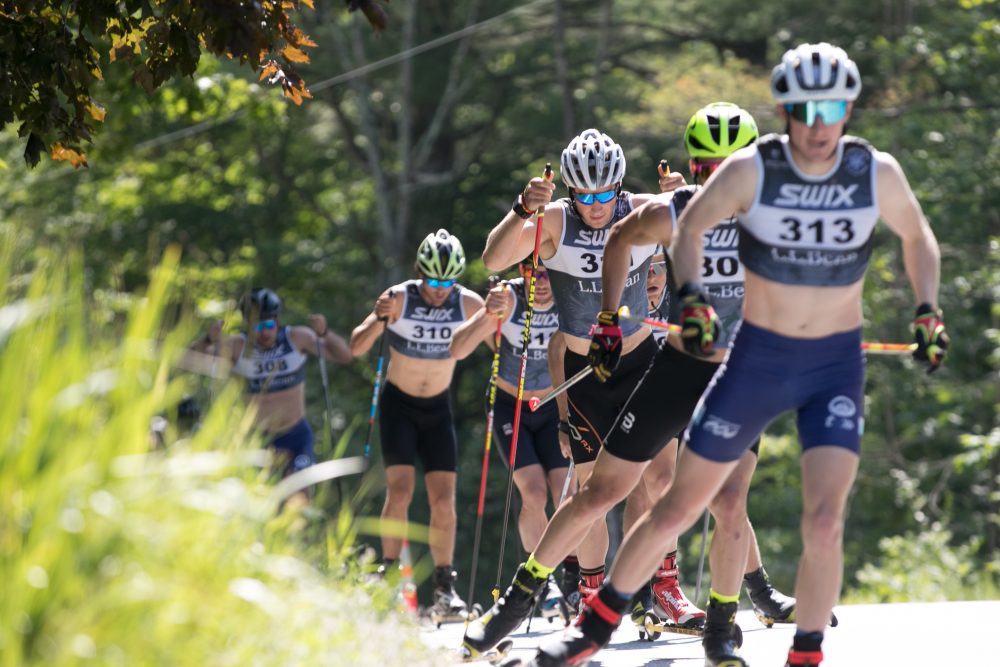
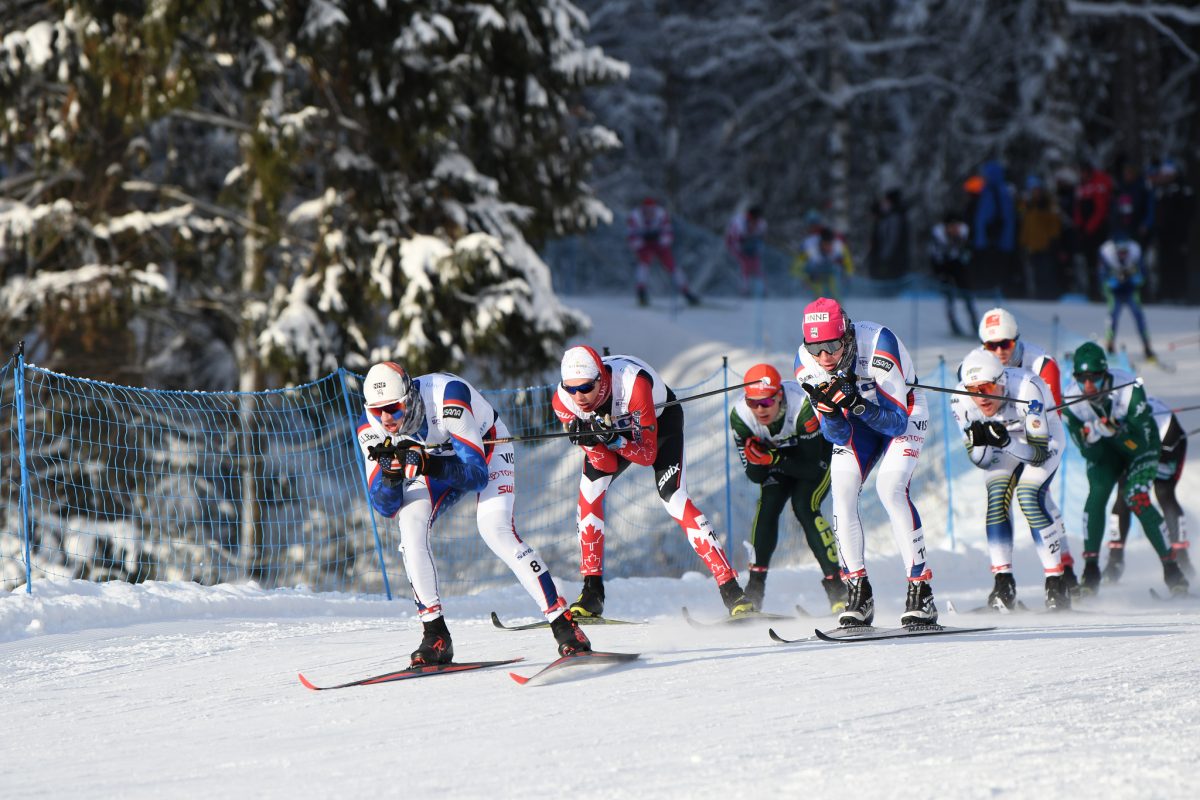
    The men’s front group on the skate leg. From Right to left: Kyle Bratrud, Ian Torchia, Ben Lustgarten, Adam martin, Simi Hamilton, Akeo Maifrld Carucci, and Ben Saxton. (Photo: Reese Brown – xcski.org)

    “We have had [App Gap] on the schedule for a while. It fits in well to our schedule to add a nice hard effort that is more maximal instead of longer L3 that we do during the summer. I have a mountain bike race tomorrow as well so this weekend is pretty challenging but it’s a nice mix to the standard training routine.”

    Asked about her day, Ogden said, “I’ve just been doing some solid training this summer, and it’s fun to get out and train and race and hang out with all the people I don’t see in the summer. It’s cool to hang out with [CGRP] a little bit, see my SMS T2 teammates – I don’t see them too much because I’m in Hanover, New Hampshire. I didn’t have a plan [for the race], I wanted to have some fun. … I tend to do well on a lot of race efforts,” Ogden added. “It’s always good for me to get out there and get going a little bit. I’ve been doing some bike racing this summer. Definitely not the last intensity of the year.”
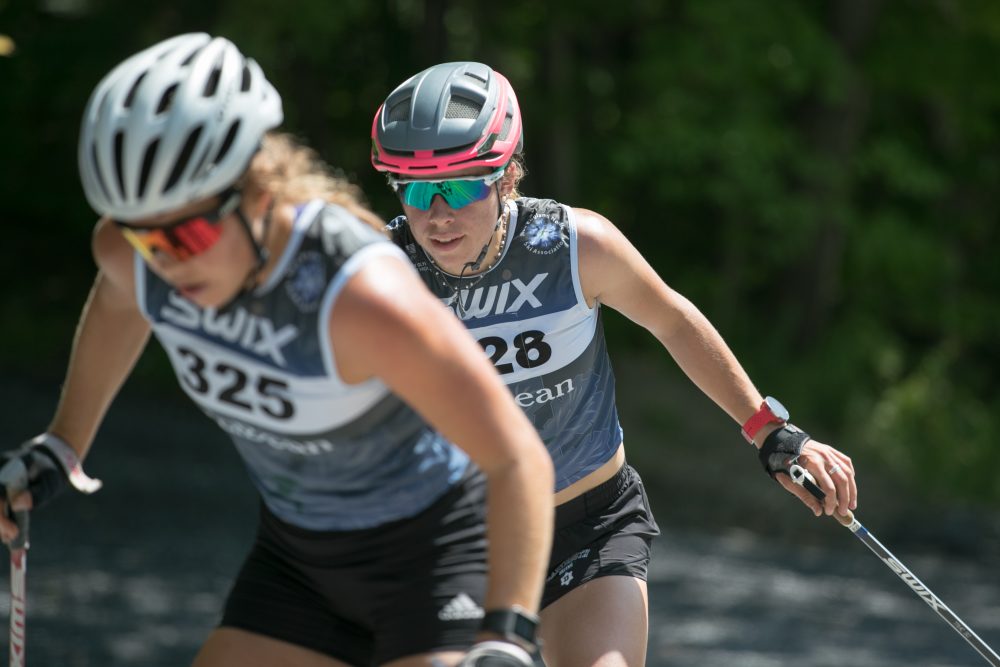
    Katharine Ogden (bib 328) and Evelina Sutro (bib 325) during the 2019 App Gap Challenge. (Photo: Reese Brown – xcski.org)

    Caldwell’s App Gap experience provided an opportunity to synch her top gear efforts with the terrain best suiting her. The Vermont based skier was the fourth ranked sprinter on last season’s World Cup.

    “Uphill races are generally not my strength,” Caldwell emailed. “My goal was to hang on for as long as possible and to try to conserve energy. I quickly realized that my strengths relative to the pack were the more gradual sections where I could double pole kick or V2, so I tried to save a little energy there and then match KO and Caitlin on the uphills. Caitlin led the entire skate section and then KO put in a surge on the classic that I tried to match and we took some turns leading there before she pulled away. It was a very hard effort and a nice test of fitness. I don’t read into rollerski races too much in the summer, but I was psyched with how today went!”
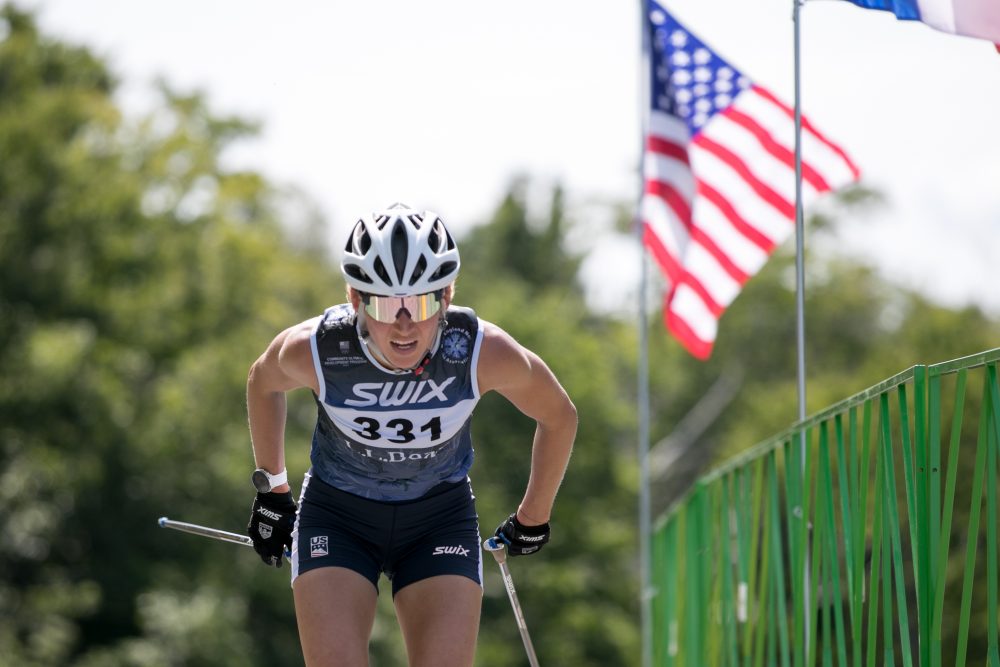
    Sophie Caldwell during the 2019 App Gap Challenge. (Photo: Reese Brown – xcski.org)

    Hilary McNamee, the third-place finisher in the women’s open division is also the head coach at Ford Sayre. She said that about half of her racers came to App Gap. She sees the day as an opportunity for her athletes to remain connected to race day sensations and environment. 

    “It’s a hard effort that we train through,”  McNamee said. “It’s more about putting on a bib. In the summer, if you’re not hopping into local races, you lose that feeling of putting on a bib, and getting nervous, and going through the warm-up process, and finding the race zone. For us, it’s about staying in touch with racing. To have it be our nordic community hosting the race is an added bonus. These are the people we’re going to see in a couple of months on snow, and it’s that excitement around our sport, that’s the biggest piece for me.”
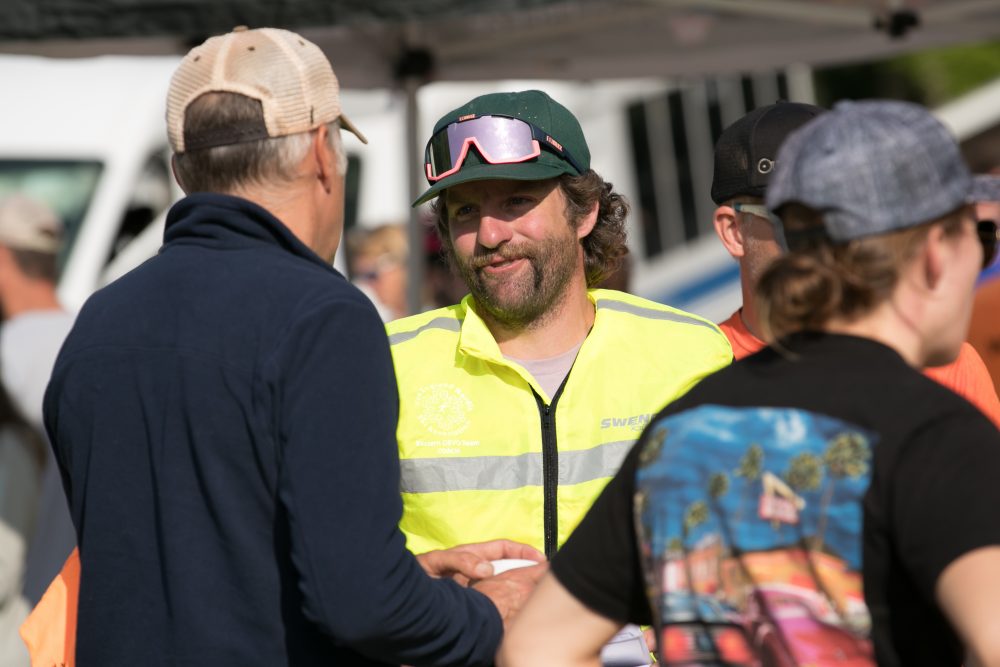
    The organizational guru, NENSA’s Justin Beckwith (yellow vest). (Photo: Reese Brown – xcski.org)

    Years ago, the App Gap was the low-key culmination of a summer camp at Green Mountain Valley School (GMVS) when Beckwith coached at there. After a hiatus when the App Gap race lapsed, it returned when Beckwith became New England Nordic Ski Association’s (NENSA) competition director.

    In 2017, the first year that NENSA organized the App Gap event, there were 57 finishers. That total bumped to 119 last year. This year’s App Gap featured 167 finishers. 

    “It all comes down to the action we have in our clubs right now,” Beckwith said. “It’s the vision we’re trying to promote.” 

    Beckwith credited clubs from beyond the local area buying into the event, saying that this was the first year Stratton Mountain School junior athletes had competed. 

    “The elite skiers love it,” Beckwith said.  “We had four of the top-10 overall ranked male and female skiers in the U.S. here this year. That’s really inspiring for the kids.”

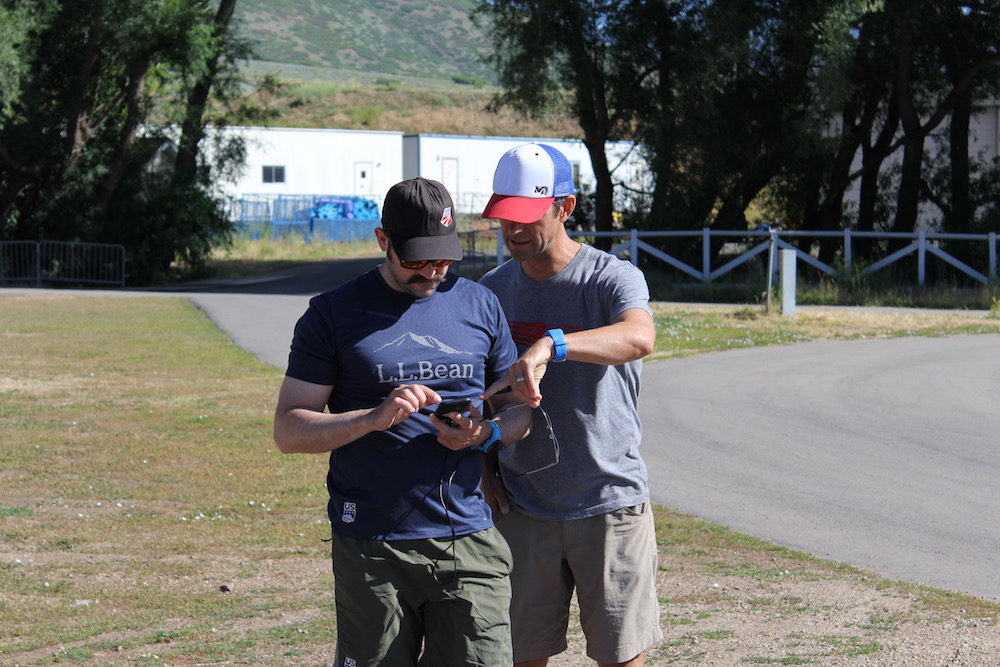
    Full 2019 App Gap Results


  • The Seeds of Collaborative Coaching

    The Seeds of Collaborative Coaching

    U.S. Ski Team coaches Jason Cork and Chris Grover go over details for a team distance time trial at Soldier Hollow in Midway, Utah during a past training camp. (Photo: Pat O’Brien)

    Fostering cultural change within complex organizations is painstaking. U.S. Ski & Snowboard is no different. Most often the most effective type of change comes less from edict and more from many a collection of stakeholder’s voice

    For the past decade, the U.S. cross-country team has had unparalleled success. Whether the metric is developing athletes to winning medals, most observers see a winning culture. That has not kept the minds at U.S. Ski & Snowboard from progressing.

    In mid-May, the U.S. Ski Team coaching staff along with the respective club coaches of U.S. Ski Team athletes met to learn from one another. The idea for this small coaches summit came from a trip this fall to Norway by three U.S. Ski Team officials. Chief of Sport at U.S. Ski & Snowboard Luke Bodensteiner, High Performance Director Troy Taylor, and Medical Director Kyle Wilkens had open access to learn how the Norwegian Ski Federation gets the most from its athletes and coaches.

    “When those guys came back, they walked us through some things they would like us to implement,” Keading said. “One suggestion which Norway does every spring, is a summit meeting for coaches, both national and home club, of all national team athletes. Coaches present to the group about each respective athlete’s training from the past year. What was new, what went well, what needs improvement, etc. The rest of the coaches are encouraged to critique and ask questions. The theme is transparency and continuous improvement.”

    The Norwegian coaching summit lasts two and a half days, whereas the U.S. Ski Team’s analog became a one-day format. Kaeding described the conversation as a “feedback mechanism” where athletes and training were discussed and upon closing the session, “decided as a group did this work or did this not work? And is this something we want to pursue in the following year,” Kaeding said.

    A feedback mechanism is vital to learning what worked, what didn’t, and what to implement in the next go around. Chugging forward with blinders on as an organization often brings stagnation.

    Kaeding explained that the U.S. system is more diverse in its training methods than in Norway. And the coaching summit allowed an opportunity for some of that diversity to be explored.

    “We don’t have one set way of doing everything,” Kaeding said. “Different clubs have different methodologies which I think is a strength. But it is not discussed a lot either.”

    In practice, what NGBs like U.S. Ski & Snowboard espouse is a primacy placed on championship medals. In 2018 Norway hauled in a record 39 winter Olympic medals.

    “Everybody is interested in how Norway is doing everything,” Kaeding matter of factly stated. From funding to junior development to learning through collaborative coaching.

    For the U.S. cross-country team’s first go at emulating a coaching summit, the format included a set schedule with some open-ended parameters on how and what each coach presented. The morning session revolved around U.S. Ski Team coach Jason Cork discussing Jessie Diggins, an athlete he has worked with for many years, U.S. Ski Team coach Matt Whitcomb elaborating on Simi Hamilton and Sophie Caldwell with additional comments from SMST2 coach Pat O’Brien, and Erik Flora, head of APU’s elite program, to discuss some of his athletes. The college perspective was provided by Dartmouth coach Cami Thompson-Graves and O’Brien who both work with U.S. Ski Team member Julia Kern.

    “Everyone was chipping in though because many people have a lot to do with many of these athletes,” said Kaeding. “In the afternoon, it was maybe a little bit broader, it was a little bit of what are we looking to accomplish at the next Olympics? How can we work together accomplishing these goals in the span of now until then? We did the same with World Juniors. And I gave a little presentation on how we want to become a bit more standardized and focused with our data collection and use technology.”

    Throughout the day, Kaeding said he enjoyed seeing how each coach presented information about their athletes. The organizers sent out a basic google sheet resembling a mini-training log: fields like annual time on roller skis, on snow time, time at specific intensity levels, time racing, and time doing strength. But that basic common document led some coaches to focus on quantitative aspects in their presentations, whereas as others emphasized the qualitative nature of their athletes’ approach to training and development.

    Jessie Diggins with coach Jason Cork during a rollerski in Lake Placid, N.Y. (Photo: Matt Whitcomb)

    “It was interesting to see each coach present about their athletes because there was no template given,” Kaeding said. “Jason [Cork] is very quantitative, he is very good at tracking metrics and has worked with Jessie for a long time. So he was able to provide a lot of information about her training over the years and what has gone well and what hasn’t. It is really informative to the coaches there who may have younger athletes coming up and are in a similar spot to where Jessie was or hopes to be. It is interesting to see the numbers, but it is interesting to see the coaches with no template given they are presenting on what they feel is important. But, the whole thing, we were trying it out. So I am sure there will be tweaks next year, but that is one thing I actually thought worked pretty well. You got to see how each coach kind of ticked too. I think that is part of it.”

    Kaeding’s perspective is that of both a coach (he is the former SMST2 head coach and USST D-team coach) and a data cruncher. He yearns to ask questions and determine how to answer those questions with data and build success.

    “From my perspective, what I got to hear a lot of are the things that happened and maybe this is why an athlete’s year or race didn’t go great, and we cannot really give you an answer why,” said Kaeding. “As a group, we were able to identify a few of those things and say at this conference next year, I want to be able to tell you why. For me, more of a data perspective, figuring out not only what do we want to measure but how can we figure a way to measure that. And come next year, with a little bit more of a quantifiable method, say here is where we screwed up, and that is fine. But right now, to me, it is not fine to be able to screw up and not know why. That was really valuable for me.”

  • Junior Skier of the Year

    Junior Skier of the Year

    Junior Skier of the Year


    Gus Schumacher leading the pack with teammate Ben Ogden (pink hat) in the draft — during the U20 30 k classic mass start at World Juniors in Lahti, Finland. (Photo: Doug Stephen)

    With the 2018/2019 season officially in the rearview, FasterSkier is running a series of articles highlighting some of the players and performances from the season. This year, the junior skier of the year is Gus Schumacher.

    Perhaps it is a testament to the steady growth of U.S. developmental programming or perhaps it is a trickle down effect as Americans see more success on the World Cup level; one thing is clear when you consider the depth of the current field of junior skiers, the future looks bright. Choosing just one athlete to recognize as Junior Skier of the Year was not an easy decision, but the outstanding achievements of Gus Schumacher in 2019 make the 18-year-old USST D-Team member from Anchorage, AK a worthy recipient.

    The U20 World Juniors 4 x 5 k relay first place team from the U.S, (l-r) Luke Jager, Ben Ogden, Johnny Hagenbuch, and Gus Schumacher. (Photo: JWSC2019 / Mikaela Takala)

    While his performance anchoring the gold medal U20 men’s relay team at Junior Worlds in Lahti was likely the most dramatic and noteworthy result Schumacher earned this season, his achievements extend much further. In fact, there was a major highlight for the Alaska Winter Stars standout each month.

    In January’s Senior National Championships, Schumacher took 7th in the 15-kilometer individual start freestyle, 5th in the freestyle sprint, and 4th in the 30 k mass start classic amongst a field of senior men vying for World Cup starts and a spot on the team at World Championships. His results made him the top junior athlete in each race, except for the skate sprint where Noel Keefe took 3rd.

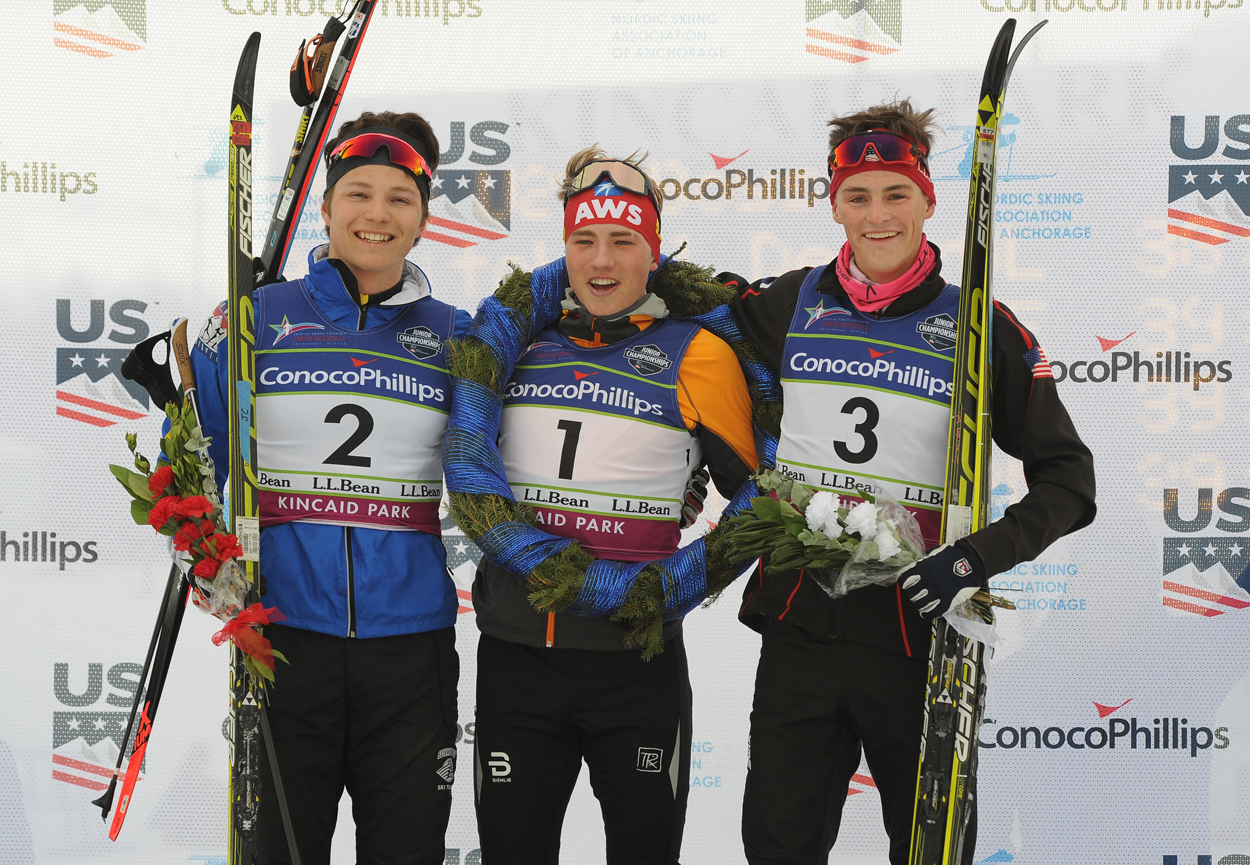
    Gus Schumacher (Alaska Winter Stars/Team Alaska), center, won the U20 men’s 15K classic mass start
    race Friday at the 2019 U.S. Ski & Snowboard Cross Country Junior National Championships at Kincaid
    Park. J.C. Schoonmaker (UAA-Auburn Ski Club/Far West), left, was second, followed by Cameron Wolfe
    (Ski and Snowboard Club Vail/Rocky Mountain), right. The win gave Schumacher a three-race sweep of
    the 2019 JN individual events. (Photo: Michael Dinneen)

    In February, in addition to his relay gold during World Juniors in Lahti, Finland, he placed individually in the top-10 twice with a 6th place finish in the 10 k skate and a 4th in the 30 k classic. He was also 16th in the classic sprint. These results were a significant improvement from his races during the 2018 World Junior Championships where his highest individual result was 15th in the skiathlon.

    In March, Schumacher swept Junior Nationals on home turf in Anchorage. Not only did he win each event and anchor the winning relay, but his victories in both distance races, a 10 k skate and a 15 k classic, were won by a margin of roughly a minute each. Because of his results at U.S. Nationals and World Juniors, Schumacher earned his first starts on the World Cup during the final races in Québec City later in the month.

    Finally, as the season wound down and April began, Schumacher wrapped up a fantastic season at Super Tour Finals in Presque Isle, ME. He took 8th overall in the freestyle sprint and landed himself on the podium with Simi Hamilton and Erik Bjornsen by taking 3rd in the 15 k classic. While skiing with the lead pack of 50 k racers, Schumacher also cruised to victory in the junior 30 k skate.

    The men’s podium for the 15-kilometer mass start classic during the Super Tour Finals in Presque Isle, ME. Erik Bjornsen (USST/APU; center) took the win ahead of Simi Hamilton (USST/SMST2; left) and Gus Schumacher (USST-D/APU; left). (Photo: U.S. Ski & Snowboard – Reese Brown)

    Before we wrap this up, we want to give a shout out to Kendall Kramer of Fairbanks who also swept Junior Nationals for U18 women. Kramer was also the top American in the 15 k classic at World Juniors with a 4th place finish, and ended her season in Québec with her first World Cup race starts at just 16-years-old. With results like these, she’ll certainly be in the running for this award in the coming years.

  • Race Rundown: A Pair of Bjornsen Wins at Super Tour Finals 10/15 k Mass Start Classic

    Race Rundown: A Pair of Bjornsen Wins at Super Tour Finals 10/15 k Mass Start Classic

    Super Tour Finals continued in the north woods of Presque Isle, ME with the first of the men’s and women’s distance events. Icy conditions caused a delay in racing and left fast classic tracks at the Nordic Heritage Center. The races can be streamed live or replayed on the U.S. Ski Team Facebook page.

    The start of the men’s 15-kilometer mass start classic race during the Super Tour Finals in Presque Isle, ME (Photo: U.S. Ski & Snowboard – Reese Brown)

    Men’s 15-kilometer Mass Start Classic

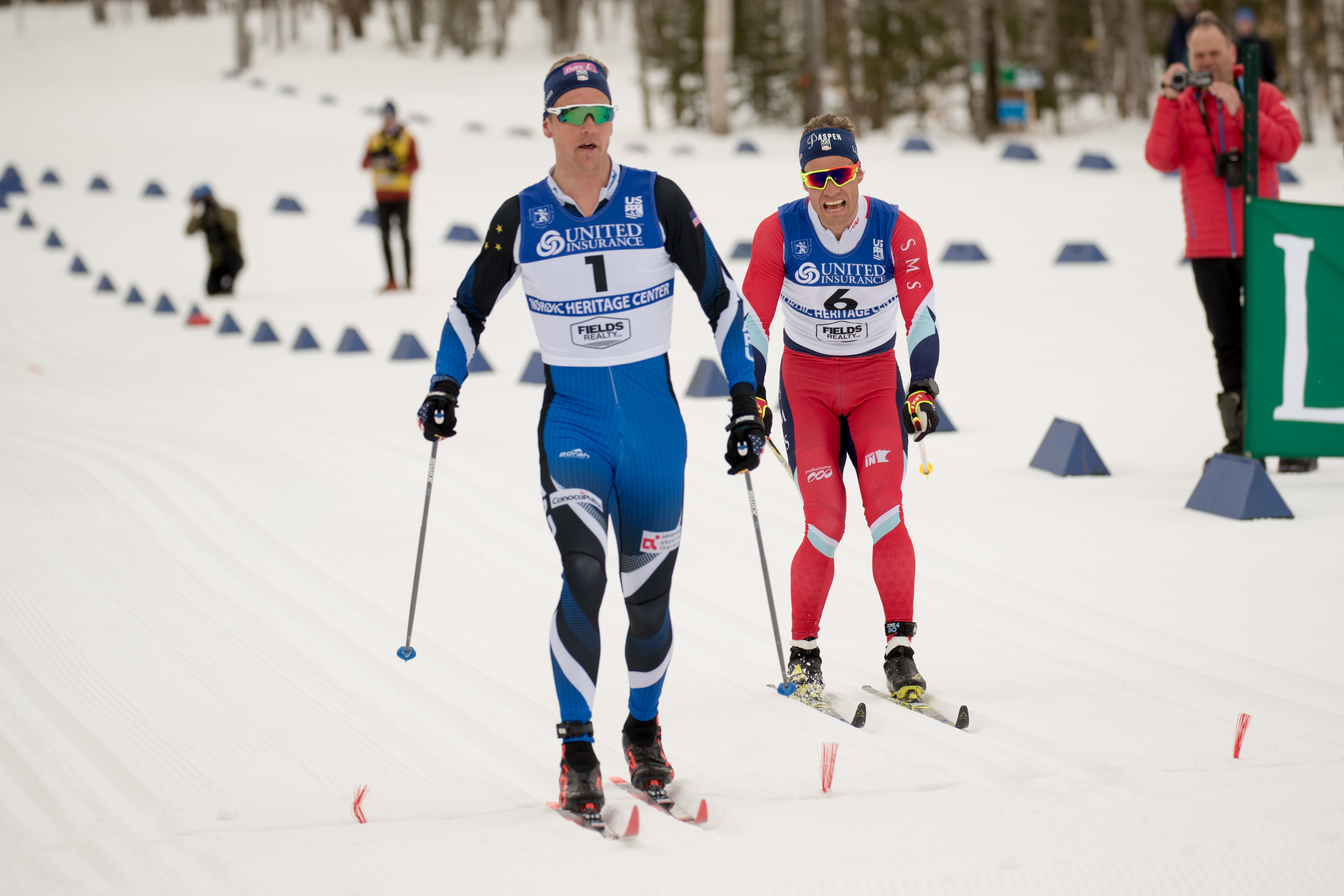
    Erik Bjornsen (USST/APU) outs prints Simi Hamilton (USST/SMST2) at the finish of the 15-kilometer mass start classic during the Super Tour Finals in Presque Isle, ME (Photo: U.S. Ski & Snowboard – Reese Brown)

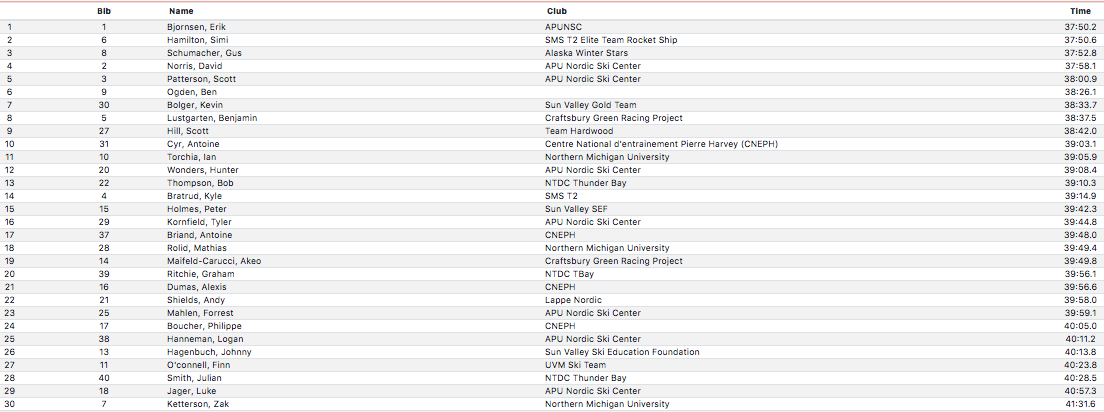
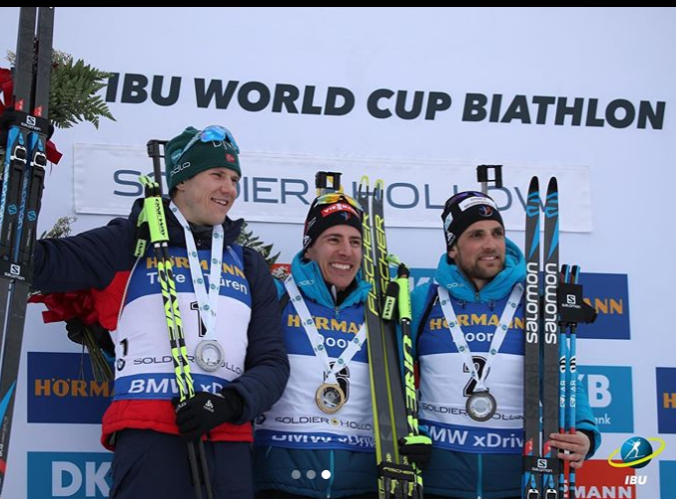
    In the men’s 15-kilometer race, a pack of six men led by Simi Hamilton (USST/SMS T2) gradually pulled away from the field over the first 10 k. Tucked in behind him were Erik Bjornsen (USST/APU), Gus Schumacher (USST – D/AWS), Scott Patterson (USST/APU), David Norris (APU), and Ben Ogden (USST – D/UVM). As the group approached the end of their last 3.75 k lap, Hamilton and Bjornsen broke away with Schumacher close on their tails. In a final double pole sprint, Bjornsen edged out Hamilton, stopping the clock at 37:50.2. Hamilton crossed the line 0.4 seconds behind, followed by Schumacher in third (+2.6).

    As a U-20 athlete, Schumacher’s podium finish is particularly noteworthy. Another strong U-20 result was had by USST D-Team athlete Ben Ogden (UVM) who took 6th.

    The men’s podium for the 15-kilometer mass start classic during the Super Tour Finals in Presque Isle, ME. Erik Bjornsen (USST/APU; center) took the win ahead of Simi Hamilton (USST/SMST2; left) and Gus Schumacher (USST-D/APU; left). (Photo: U.S. Ski & Snowboard – Reese Brown)

    Results

    Women’s 10-kilometer Mass Start Classic

    The start of the women’s 15-kilometer mass start classic race during the Super Tour Finals in Presque Isle, ME (Photo: U.S. Ski & Snowboard – Reese Brown)

    The women’s 10 k event spread out much more quickly, as Sadie Bjornsen (USST/APU) charged to the front stringing out the women behind her. Skiing alone for the second half of the race, Bjornsen took the win handily with a time of 29:00.5. This is Bjornsen’s second consecutive win as she also won Friday’s 1.4 k freestyle sprint. Chasing her teammate, Rosie Brennan (APU) crossed the line in second (+19.4), followed by Dahria Beatty of Canada (CNST) in third (+31.3). Hailey Swirbul (USST – D/APU) crossed the line just after Beatty as the third American (+41.5).


    Sadie Bjornsen leads the way during the women’s 10-kilometer mass start classic during the Super Tour Finals in Presque Isle, ME. (Photo: U.S. Ski & Snowboard – Reese Brown)

    Results


    (Click on images below to enlarge.)

    Men’s Live Results

    Women’s Live Results

    Racing continues tomorrow with 4 x 5 k team relays.

  • Klæbo Takes Home a Crystal Globe; Harvey Ends Career with a 2nd Place

    Klæbo Takes Home a Crystal Globe; Harvey Ends Career with a 2nd Place

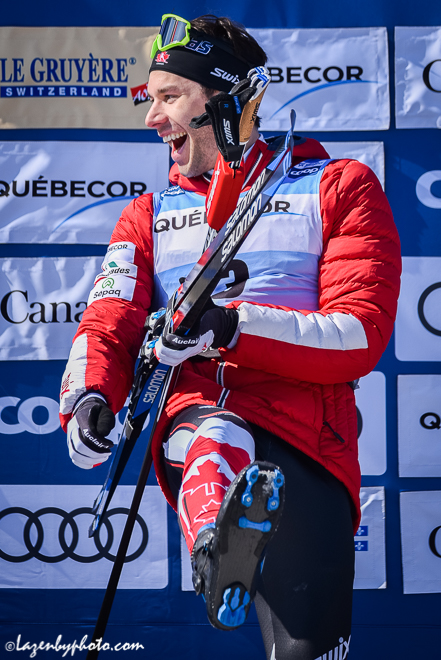
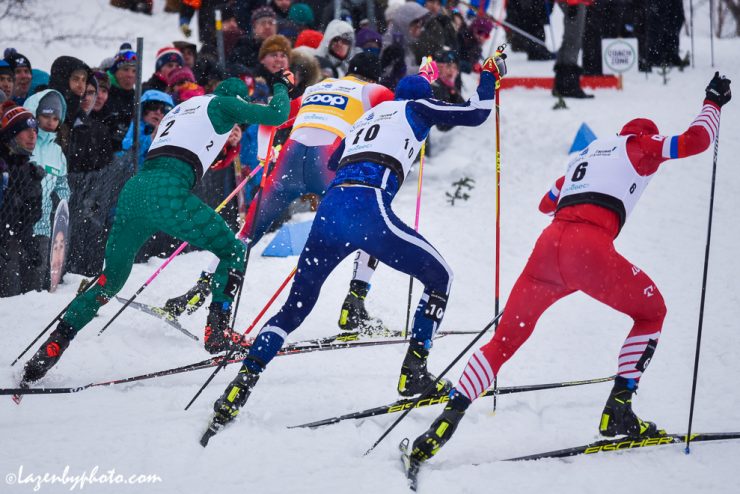
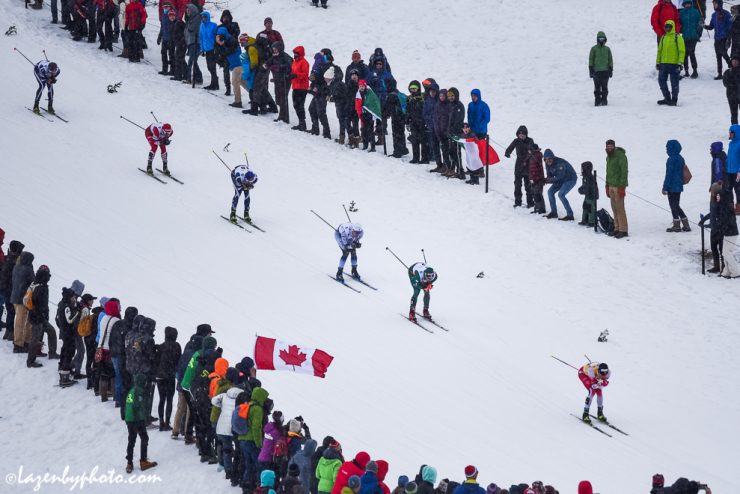
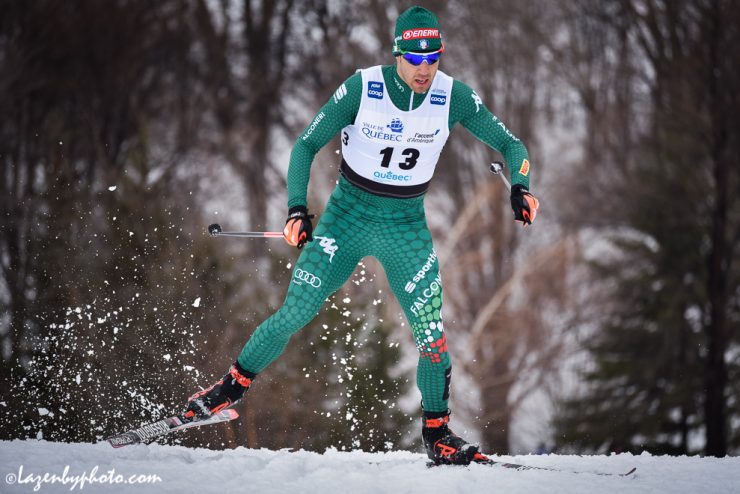
    One more riff: Harvey’s “air -guitar” remains in tune. (Photo: John Lazenby/lazenbyphoto.com)

    Alex Harvey finished his career racing for Canada with a bang today in Québec City, Canada. Harvey placed second to Norway’s Johannes Høsflot Klæbo in today’s 15-kilometer freestyle pursuit. It was Harvey’s second podium in as many races as he can now claim a perfect ending to his career. Another solid ending went to Klæbo, who with his win today earned the overall World Cup title. Although the point differential lent an air of intrigue to the racing as Klæbo and Alexander Bolshunov of Russia were fighting for the overall title today, Klæbo’s knack for theater and endurance left nothing to doubt. Bolshunov placed third on the day and second in the overall standings. 

    “It was a cool race out there, Klæbo told FasterSkier after the race. “Bolshunov and Harvey were really strong and I think Bolshunov did most of the job today. On the second lap there, I felt the pace behind was quite high so I decided to let them in and I saw that when they took the head with me I felt like it was much easier to stay behind. This was a really cool race and it’s really cool to have Harvey on the podium again. I am really happy for him and it was important for me that he took Bolshunov as well. I was saying thank you to him after the race. I think he was really happy, he said so.”

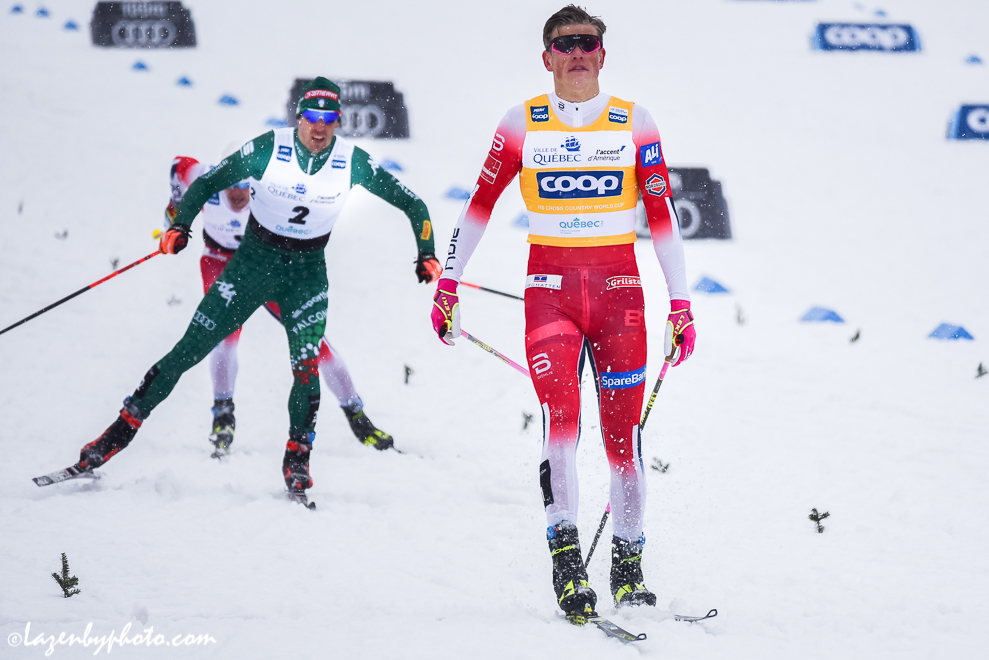
    For the Win. Johannes Høsflot Klæbo (NOR) wins the Overall World Cup Title at the World Cup Finals in Quebec City, Canada

    Klæbo’s sentiments weren’t guaranteed with Bolshunov as the chaser. Klæbo started the pursuit 52 seconds ahead of Bolshunov and Harvey. Because of this, Klæbo skied the first half of the race alone. But, in a chase lead by Bolshunov, Harvey and Bolshunov continued to make up time on the Norwegian. Just before the 8k mark, Bolshunov and Harvey came into eyesight of Klæbo and by the 8.2 checkpoint, the three skiers were skiing together. They were locked as a trio until near the finish.

    Bolshunov lead the second half of the race, with Harvey in second and Klæbo sitting in behind. But during the final climb, Klæbo found a last bit of energy and attacked, pulling ahead of Bolshunov and Harvey. He kept this lead to the finish, ending the race +2.8 seconds ahead of Harvey.

    Bolshunov seemed to have second place in the bag when he and Harvey came around the corner into the finishing stretch. Harvey came from behind with an inspiring final push and managed to overtake Bolshunov and grab second place. Today’s podium was the 28th and final podium of Harvey’s World Cup Career as he is set to retire at the end of this season. Bolshunov is ending his 2018/2-19 season with 10 podiums, five of which were wins.

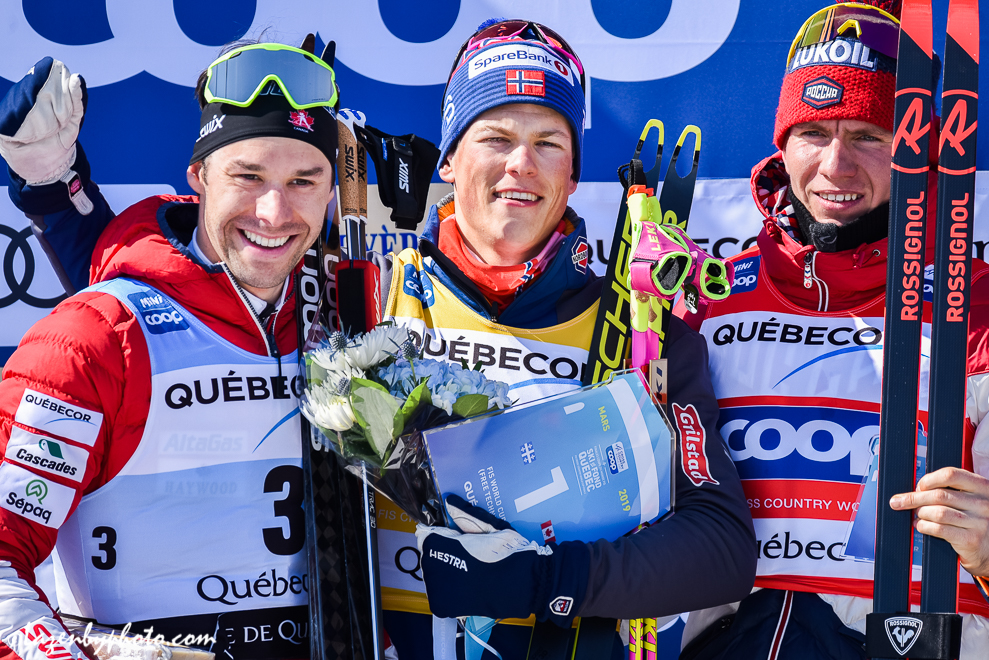
    All smiles at the end of the season. From left to right, Alex Harvey (CAN) was 2rd, Johannes Høsflot Klæbo (NOR) was 1st and Alexander Bolshunov (RUS) was 3rd.

    “I didn’t feel as strong today and I think that the pace behind was really high, so I decided to just let them get in and go behind and stay behind before the end there and then try to push all into the last uphill and before the finish there, “ Klæbo said of his race strategy. “The tactic worked quite good and it was even better to see Harvey beat the Russian guy, that was amazing.”

    Yet Klæbo qualified his statements to note that he harbors no deep-seated resent for the Russians. 

    “I don’t have any bad things to say about Russia at any time,” Klæbo said. “It’s good to have this type of duels I think. It’s really fun and exciting for the sport that we have this tight duel. I don’t know how many points it was at the end there, but I don’t think it was that much. It’s cool to have this type of competition and today was a lot of points to ahead today. The Canadian guys, it’s just friendly. No enemies at all, so it’s really cool and I think we all are very happy about Harvey and the way he can end his career.”

    Harvey and the podium stoke. (Photo: John Lazenby/lazenbyphoto.com)

    Harvey spoke to FasterSkier about his season and ending his career.

    “The last 5 months for me, basically since November, have been a struggle for me this year, so it’s a good way to end it. This is the best way to end a career with two podiums like that at home, so that’s the end.”

    The chase pack, consisting of Norwegians and Italians fought hard to gain time of the leaders, but in the end, the leader of the chase pack, Francesco De Fabiani of Italy, finished +1:13.3 behind Klæbo. Norway finished the day with six men in the top ten and Italy with two.

    lioresal

    Sjur Røthe was third in the Overall World Cup results. In today’s race, he was 10th, but he has won three World Cups and was second in a fourth race. Six Norwegian athletes finished in the top 10 of the season-long overall standings. De Fabiani and his teammate Federico Pellegrino were seventh and eighth respectively.   

    U.S. Ski Team member Erik Bjornsen was the next North American to finish, placing 20th. This is Bjornsen’s fifth top-20 this season.

    “It’s been kind of an up and down season,” Bjornsen said in the mixed zone. “I’ve usually been pretty consistent in the past and this seasons, there’s been a lot of doubts, I’ve also had some of my best results so I’m looking forward training harder this summer and having a little bit more of a relaxed summer and hopefully getting more consistent results next year.”

    Simi Hamilton placed 26th. Hamilton blasted the course to ski the third fastest time of day. Harvey and Bolshunov, wh0 turboed to catch Klæbo, were first and second respectively. Hamilton’s time of 28:48.9 was 33.5 seconds behind Harvey’s who skied the fastest time of day. British skier Andrew Young marked the fourth fastest time, 0.1 seconds slower than Hamilton.

    “It was good, it was really fun fast skiing, good course, short course, not a ton of climbing, but really rolly,” Hamilton said. “My skis were awesome, you never really know how a pursuit is going to go, just because there is so much that depends on the people you’re skiing with and obviously with the wind today it was just so good to be in someone’s draft, I was really lucky to start in front of the first wave so it was basically guaranteed to skiing with people the whole time and I felt great. It went awesome. It was a good one to end on.”

    Kevin Bolger and Scott Patterson skied together during today’s race, they finished 44th and 45th respectively. Also racing for the US were David Norris who was 55th, Logan Hanneman who was 65th and Ben Saxton who was 69th.

    The US started a number of athletes who are new to the World Cup circuit. The was the first World Cup weekend for Gus Schumacher who placed 52nd, Ben Ogden who placed 66th, and Peter Holmes who placed 70th.

    Schumacher spoke with FasterSkier after his race, “It was really good, I felt strong, and my skis were good. It was nice to just fight and race how I could. Yesterday was a little tough, conditions-wise, and today I just felt like it was kind of just me and my fitness out there.”

    The US Super Finals begin on March 28th in Presque Isle, Maine. These are the final races of the season for the U.S Ski Team.

    Men’s Results | Overall World Cup Standings- Men’s | Time of Day

  • Keep it Simple: Klæbo Wins with Harvey in 10th, Hamilton 13th

    Keep it Simple: Klæbo Wins with Harvey in 10th, Hamilton 13th

    Johannes Høflot Klæbo wins the sprint with Federico Pelligrino and Sindre Bjørnestad Skar following. (Photo: John Lazenby)
    Johannes Høflot Klæbo wins the sprint with Federico Pelligrino and Sindre Bjørnestad Skar following. (Photo: John Lazenby/lazenbyphoto.com)

    How to play the Johannes Høsflot Klæbo sprint game? It has got to go through every sprinter’s mind. As the day’s fastest qualifier, Klæbo set the tone in 3:07.61.

    Prior to Friday’s 1.6-kilometer freestyle sprint in Québec, the young Norwegian had started nine World Cup sprints this season. He had won seven of them and placed second in another. And he had already locked up another sprint cup crystal globe becoming the first to win the prize in three successive seasons. With the globe pressure off, Klæbo could play his hand. Which brings us back to how he’d ski on a long sprint course with soft conditions and how his competitors would counter.

    Russia’s Alexander Bolshunov, second in the World Cup overall standings, went head to head twice against Klæbo on Friday. In the quarterfinals, Bolshunov went full-throttle from the start. He looked like he could pull off the start-to-finish-pull for much of the first Klæbo encounter. Yet had did fade to place third in the heat which his nemesis won.

    In the final with Klæbo, Bolshunov had a timid start. He hung in the back. This time playing a different strategy. Around 1:20 into the final, Bolshunov did accelerate. He gained a few spots to move into fourth.

    ponstel

    Another skier in the final knowing it was Klæbo’s show, Italy’s Federico Pellegrino, made an up-tempo counter punch on a steep climb at the 1:55 mark. Hop-skating on the outside, Pellegrino pushed. Sindre Bjørnestad Skar of Norway led over the top and kept the Pellegrino move in check. With over a minute of racing to go, Klæbo kept in control. Skar took the lead, Klæbo followed, with the Italian and Bolshunov in third and fourth.

    Nonchalantly, Klæbo took over race control ten seconds later. Nothing shiny. Nothing really marked with flare. Just simple flat out free-skating, V2ing, and lovely sprinting. He won in 3:22.14. Pellegrino was second (+1.10), and Skar third (+1.55). Bolshunov skied to fourth (+1.57).

    “Quite difficult conditions today, it was a really fun race,” Klæbo told FIS after the race. “I think the quarterfinal was the toughest one, it was really hard. It seems like Bolshunov is in good shape so it should be an interesting weekend.”

    Coming into Friday’s races, Klæbo held a 14 point lead over Bolshunov for the World Cup overall. With the win, Klæbo earned 50 points, Bolshunov 40th for fourth. With two distances races remaining, it does get interesting. Klæbo leads with 1443 points to Bolshunov’s 1419.

    In the press conference, Pellegrino made light of his second place finish as he deferred to a skier he has gained much respect for.

    “This adds to the long list of second place behind Johannes,” Pellegrino said according to a translator. “It will be a long list. I will keep training very hard to be on top. I still have the legs to keep up so I will keep on trying. I have never made a podium in Québec before so I think I can do it again next year. I heard a lot of noise, ‘Pellegrino, Pellegrino’. In Europe, it’s hard to get people to come out and watch in bad weather. There was a lot of emotion in Alex [Harvey], but next year I hope they will still come to watch even without Alex. The courses were in good shape in spite of the conditions and the crowd here is amazing!”

    World Cup skiers understand Pellegrino’s sentiments. They too are here to soak in the Québec City atmosphere as it is an extension of Alex Harvey’s love for the sport and Québec’s love for him.  Harvey qualified in 23rd on Friday and finished 10th overall.

    “It was really good,” Harvey said in the mixed zone after the race. “I think in a stage event like this the goal for every sprint day is to make the semis, that’s where the sweet spot is for bonus seconds, so that was really good. … The semi-final was the fastest heat out of the two, it was just full gas the whole way with Bolshunov. So the other guys were just faster, but I haven’t qualified on the World Cup since December 2018. So I’m not the best sprinter anymore. So for me to make the semis it was great.”

    Simi Hamilton was the top American on the day in 13th. After qualifying in 11th, Hamilton bowed out after placing third in his quarterfinal, roughly .5 seconds behind Harvey who skied to second.

    “It’s just tough out there,” Hamilton said of the soft snow. “You know I think I’ve gotten better at skiing in those kinds of conditions, but still not totally there and it was just really soft and slow, made it extra hard with the headwind in places and it’s not fun skiing, but that’s ski racing. It’s not gonna be super enjoyable all the time. I think probably everyone feels like they can’t really ski out there today because it’s so hard.”

    U.S. skier Logan Hanneman made the top-30 cut after qualifying in 29th. Skiing near the back of his heat in the quarters, Hanneman lost his balance around a dicey downhill corner.

    “My ski just got grabbed by some of the snow,” Hanneman said of his tumble. “It’s pretty wet and deep on that corner especially and a snake jumped up and bit me and down I went. That’s how it goes I guess, but it’s tricky conditions out there and even on the downhill leading into it was grabbing the skis and going everywhere. You have to be light on your feet, which is not my forte.”

    Hanneman has seized several opportunities this season on the World Cup. He first qualified for the World Cup heats this past February in Cogne, Italy.

    “Just this season, I’ve only got a few World Cups in me and I qualified 15th in Cogne,” Hanneman said. “And then I qualified at World Champs and here and so I’m really happy to be making it into the heats now. I was really excited today to try to be a little more competitive in the heats because in the heats I’ve done before I’ve just been in the back. I don’t know when and where to pass because it’s so tight. So I was excited I felt pretty good on that uphill and I was excited for this uphill for sure and it didn’t happen so that’s okay.”

    Racing continues tomorrow with a 15 k classic mass start race for the men and a 10 k for the women.

    Results

  • Norway Sweeps Freestyle Sprint in Falun; Hamilton 22nd, Bolger 27th

    Norway Sweeps Freestyle Sprint in Falun; Hamilton 22nd, Bolger 27th

    Norway swept the men’s podium of the 1.4-kilometer freestyle sprint in Falun, Sweden. With a narrow margin, Johannes Høsflot Klæbo (center) took the win over Emil Iversen (l) and Sindre Bjørnestad Skar (r). (Photo: Instagram Screenshot @fiscrosscountry)

    The World Cup made its final European stop in Falun, Sweden before the field heads across the pond to Quebec City for the final series. For the men, the weekend opened with a 1.4-kilometer freestyle sprint, a last test before the freestyle sprint in Canada.

    Heading into the weekend, Norway’s Johannes Høsflot Klæbo sat comfortably in the lead for the overall sprint standings with string of six back-to-back wins, not including a win at the World Championships. The 22-year-old phenom had earned a remarkable 604 points and held a lead of 145 points over second place, his friendly rival from Italy, Federico Pellegrino. Klæbo had not lost a sprint since the second World Cup weekend in Lillehammer where a broken pole in the semifinal took him out of contention. He was also humbled in the first race of the season where he looked over his shoulder and laid off the gas too soon, allowing Russia’s Alexander Bolshunov to take him at the line.  

    While the top of the podium might be more memorable than the other positions, in reflecting on the season, one cannot overlook Pellegrino’s freestyle sprint results. The Italian has landed on the podium, most frequently in second, in all but one skate sprint event this season — the city sprints in Dresden where he was issued a yellow card for obstruction in his quarterfinal, leaving him in 30th for the day.  Eirik Brandsdal of Norway sat in third, followed by his teammate Sindre Bjørnestad Skar in fourth, and Gleb Retivykh of Russia in fifth.

    Despite Falun sitting roughly 60 degrees north in latitude, a fair amount of grass showed aside the ski jumps and between the folds of the ribbon of snow making up the course. Above freezing temperatures and plenty of sun quickly caused the windy course to become chewed up, especially on some of the downhills and corners. With variable weather leading into the weekend as well, the event coordinators reportedly kept the course closed, even to athletes, techs, and coaches in an effort to preserve a solid track. But despite their best efforts, the course was no match for the sun.

    As athletes skied their qualifier, the course eroded; uphills became soft and piles of corn snow could be found on the outside of the curves. This made for an exciting day of races as the sprints became a test of both speed and surefootedness. With numerous crashes in the heats for both men and women, tactics had to include staying on their feet as the athletes’ primary goal.

    Federico Pellegrino (right) leads Johannes Høsflot Klæbo (yellow bib), Ristomatti Hakola (bib 4), and Lauri Vuorinen (bib 30) during the quarterfinal of the 1.4-kilometer freestyle sprint in Falun, Sweden. (Photo: Instagram screenshot @chiccopelle/@nordicfocus)

    As expected given their introduction, Klæbo and Pellegrino went one-two in the qualifier. The two then met head to head in the first heat of the quarterfinal, where they debuted their chosen strategy of hanging back for the first half of the race, then slowly moving into better position before the last 30 seconds where they fired on all cylinders. Klæbo made his move a bit sooner than Pellegrino, demonstrating his signature powerful jump skate as he climbed a granular hill. Pellegrino took things closer to the wire, blasting his way into second place with a no pole skate in the final stretch. The two finished just 0.4 seconds apart in a heat where less than 1.5 seconds separated first through fourth.

    The remainder of the quarterfinal heats proved to be close as well, in particular, the third heat, which ended in a four-way photo finish between Skar, Francesco De Fabiani of Italy, Richard Jouve of France, and Andrew Young of Great Britain. As the heat did not prove to be the fastest, only Skar and De Fabiani advanced even though the men were only separated by 0.2 seconds in all.

    The course continued to keep things interesting in the semis, where Klæbo and Pellegrino faced Martin Bergström of Sweden, Bolshunov, Skar, and Miha Simenc of Slovenia. Again, Klæbo could be found toward the back 1:30 into the race, but his tactic did not play out as smoothly for him as it did in the quarters.

    Rounding a curve late in the long downhill that caused so many skiers to lose their footing, Klæbo found himself boxed out by Bolshunov, forcing him wide into the loose corn on a turn. This robbed the Norwegian of some of his momentum, making it harder for him to position himself with a  jump to the front as he did before.

    Federico Pellegrino (right) leads Alexander Bolshunov, Johannes Høsflot Klæbo (left), and Miha Simenc (back) around a turn through loose granular snow during the semifinal of the 1.4-kilometer freestyle sprint in Falun, Sweden. (Photo: Instagram screenshot @chiccopelle/@nordicfocus)

    Charging down the final stretch, Skar held the lead with Pellegrino on his tails. Klæbo surged desperately close behind, battling for position with Bolshunov and Bergström. With a final lunge, Pellegrino slid his boot across the line first, just 0.11 seconds head of Skar. Klæbo crossed 0.27 seconds behind Pellegrino in third, holding his breath that the heat would be fast enough to allow him to advance to the final as a lucky loser. Bergström finished fourth 0.91 seconds back, with an unlucky Bolshunov only 0.03 seconds behind him in fifth.

    While not as close as the first, the second semi still kept spectators on edge. A broken pole took out Lucas Chanavat of France who had qualified in fifth and was seen as a favorite to win the heat. From there, Emil Iversen and his teammate Brandsdal skied comfortably to take first and second in the heat respectively. Luckily for Klæbo and Bergström, the second heat was indeed slower than the first, so both were able to advance. This put Bergström, who skied for the University of Utah, in unchartered territory, as the 27-year-old had never before made the finals in a World Cup sprint.

    Perhaps this fact made Bergström more inclined to take the plunge. At the top of the perilous downhill midway through the final, the six men who had skied as a group to that point stood up and exchanged glances, not wanting to lead until later in the race. While his opponents paused, Bergström charged down the hill in front, staying on his feet through the curves. His lead did not last long, as he was overtaken by the three Norwegians, Iversen, Skar, and Klæbo, and by Pellegrino.

    Neck in neck at the finish of the 1.4-kilometer freestyle race in Falun, Sweden. Johannes Høsflot Klæbo (far right) took the win over Emil Iversen (left) and Sindre Bjørnestad Skar (right center). Federico Pellegrino (left center) walked away empty-handed in fourth. (Photo: Instagram screenshot @chiccopelle/@nordicfocus)

    Heart rates collectively increased for the racers and the crowd as Skar rounded the corner into the finish in first, just ahead of Pellegrino.

    Had Klæbo’s tactic failed him again? Just on the leaders’ tails, Klæbo and Iversen skied furiously to reel them in. With little room to spare, Klæbo battled his way to the front, throwing his foot to stop the clock at 2:52.38. Iversen too overtook the fading Skar and Pellegrino, sliding across the line just 0.1 seconds behind Klæbo, with Skar 0.18 seconds behind to close out the Norwegians’ podium sweep. Pellegrino was left with the wooden medal after crossing the line in fourth, 0.71 seconds behind Klæbo. Bergström took fifth (+1.97) and Brandsdal sixth (+2.18).

    “It was a really hard race,” Klæbo told the International Ski Federation (FIS) after the finish. “The conditions are quite difficult, especially on the downhills. So it was tough, but in the end there, it was really good conditions and it was a fair fight to the finish. So a bit of struggle in the semifinal, but in the final, a bit better.”

    The Norwegians celebrate after sweeping the men’s podium of the 1.4-kilometer freestyle sprint in Falun, Sweden. With a narrow margin, Johannes Høsflot Klæbo (center) took the win over Emil Iversen (l) and Sindre Bjørnestad Skar (r). (Photo: Instagram Screenshot @emilivers)

    U.S. skier Simi Hamilton (USST), qualified in 16th, but a hangup on an uphill early in his quarterfinal robbed him of his momentum and disrupted his plan, leaving him fifth in his heat. Hamilton ended the day in 22nd overall. Kevin Bolger (USST) advanced to the heats where he was eliminated, finishing in 27th overall.

    Also for the U.S., Logan Hanneman (APU) placed 39th, and Ben Saxton (SMS T2) was 60th.

    Alex Harvey of Canada ended his race in 31st. He was the only Canadian entered.

    While two out of four entrants finishing in the top-30 is a positive result for the U.S., head coach Chris Grover explained that luck was not in their favor. In both the men’s and women’s races, crashes and tangles plagued the Americans throughout the day.

    “Today was a day where everything started great, but it seemed like one version of misfortune struck followed by another, unfortunately,” Chris Grover told FasterSkier in a call. “But people were healthy, the service team made great skis all day long, so that was really good.”

    Bolger had perhaps the best luck of the day.

    “Kevin might have been the only guy who didn’t have a significant hangup or bauble out there,” reported Grover. He also felt that Bolger skied well technically, though Bolger felt his race left room for improvement.

    “I’m very happy to have come here and qualified with such a strong field,” wrote Bolger in an email. “I was feeling very strong leading into the quarterfinal, unfortunately, a few mistakes led to me losing some time and positioning in my heat, so I can say I’m a little upset leaving the day not having moved on or finishing better.  But every race is a learning experience, and I’m looking forward to the next race and applying new tactics!”

    Despite feeling strong, Hamilton struggled a bit to feel powerful in the soft conditions during his qualifier. At the start of the heats, he felt poised for a good day but was struck by the poor luck Grover mentioned.

    Simi Hamilton on course during the 1.4-kilometer freestyle sprint in Falun, Sweden. (Photo: Instagram screenshot @simihamilton/@nordicfocus)

    “In the quarter, I wanted to get up front, or as far up as I could, just so I could have the first line into those downhill corners and try to control the heat,” explained Hamilton in a call. “I got off to an okay start, not great, but I just kind of slotted behind Chanavat, knowing that he would probably ski pretty well and ski toward the front, so I felt like I was in a great position.

    “At the end of the long straightaway at the start, there’s a hard right-hand corner that goes into the little steep climb, and I just got completely skied into by one of the Finns, Mæki,” he continued. “I almost went down, but kind of saved it, but lost some pretty valuable time there and ended up getting stuck at the back. I still felt good at that point, my energy felt great, but I couldn’t really make any moves past people on the two climbs. And the nature of how the course was holding up today, it was pretty much impossible to pass people on the downhill corners, just because there was basically one line through the corners today and it was incredibly sketchy.”

    This experience was frustrating for Hamilton, who is known for his agility on skis. Typically, the downhills and corners would have played to his strengths.

    relafen

    “I’m still psyched about where my fitness and shape are right now, and I’m still mentally engaged with everything, so I’m looking forward to the races coming up in Quebec,” he concluded.

    The season has left Hamilton with “mixed feelings” as he has not been able to achieve the results he has felt capable of. He has also faced his fair share of illness.

    naprosyn online

    “I think there have been points in the season that I’ve been really proud of an happy about,” he reflected. “I feel like I’ve had quite a few races this year where I was really close to having a great day, but for whatever reason, I couldn’t quite get there. I’m thinking specifically about the two skate sprints in the Tour [de Ski], both of those were bittersweet because I felt great for both of those, and in Toblach, I had that weird fall on the uphill, and then in Val Mustair, I felt pretty good again but had a pretty tough heat with Chanavat and Pellegrino and couldn’t quite move on. So I’ve felt like in quite a few races, I was just ready to break through and it didn’t quite happen.

    “But at the same time, I think that there were a lot of positive moments and positive signs,” he continued. “I knew that my fitness was quite good all season, so I have a little more confidence in that, and have just kind of tried to enjoy it. It was definitely a bummer to get sick in January and miss Dresden, and then January and early February were just not awesome for me with getting sick and missing some training, and then a pretty bad weekend in Lahti. There were some down moments for sure, but looking back on the good races, I’m pretty proud of those.”

    After three Olympics and consistently racing on the World Cup circuit since 2010, the 31-year-old Aspen, CO native feels that he is in the twilight of his career.

    “All season, I was debating whether I was going to keep coming after this year or not, and right now I feel pretty fired up still and pretty motivated. I know that there are some really specific things that I can work on, so I haven’t fully made a decision yet, but I am definitely leaning toward skiing one more year. So right now, I’m just trying to focus on putting together the best sprint in Quebec and the best weekend in general that I can and have fun there skiing with a big North American team and have a lot of friends and family cheering us on, so I’m looking forward to that.”

    Racing in Falun continues tomorrow with 10/15k freestyle events.

    Qualification | Final Results

  • Saturday Race Rundown

    Saturday Race Rundown

    Women’s podium from the Falun, Sweden 1.4 k skate sprint. From left to right, Maiken Caspersen Falla of Norway in second, Stina Nilsson of Sweden in first, and Maja Dahlqvist of sweden in third. (Photo: @fiscrosscountry Instagram screenshot)

    FIS World Cup Falun, Sweden 1.4 k Freestyle Sprint

    On a day when sugary snow course picked off skiers trying to advance during Falun, Sweden’s 1.4-kilometer freestyle sprint, Stina Nilsson, yes of Sweden, took the win. She won the final in 3:07.72 over Norway’s Maiken Caspersen Falla  in second (+0.67). The day’s top qualifier, Maja Dahlqvist, placed third (+2.14).

    The Americans entered in the race were some of the key players who tumbled on course. Jessie Diggins (USST) qualified in 21st and was leading the second quarter final when she fell on a sugared downhill to place 28th overall. Both Sadie Bjornsen (USST), ranked fourth after qualification, and Sophie Caldwell advanced to the semis.

    Caldwell took a belly slide on the the course’s funky downhill to place sixth in her semi and finish 11th overall. In the second semi, Bjornsen was eliminated after placing fifth. She finished 10th overall.

    ponstel online

    Also for the U.S., Julia Kern (USST) placed 34th, Ida Sargent (USST) 37th, Rosie Brennan (APU) 53rd, and Kaitlynn Miller (CGRP) 61st.

    Results

    In the men’s 1.4 k skate sprint, Norway’s Johannes Høsflot Klæbo continued his winning ways with another sprint victory. He won the final in 2:52.38,  0.1 seconds over teammate Emil Iversen. Another Norwegian, Sindre Bjørnestad Skar, placed third (+0.28).

    U.S. skier Simi Hamilton (USST), who qualified in 16th, bowed out in the quarterfinals after placing fifth in his heat. Hamilton was 22nd overall. Kevin Bolger (USST) advanced to the heats where he was eliminated to end up 27th overall.

    Also for the U.S., Logan Hanneman (APU) placed 39th, and Ben Saxton (SMS T2) was 60th.

    Alex Harvey of Canada ended his race in 31st. He was the only Canadian entered.

    Men’s Results


  • Finding his Top Gear, Klæbo is Gone in Drammen

    Finding his Top Gear, Klæbo is Gone in Drammen

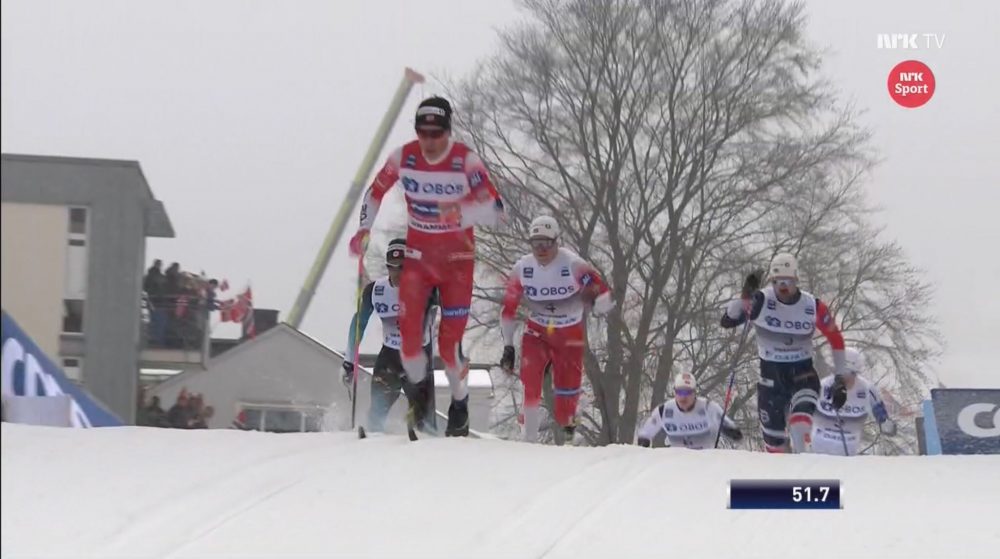
    A classic run-stride from Johannes Høsflot Klæbo during the finals of the 2019 Drammen city sprint. (Photo: NRK screenshot)

    For the rare athlete the field of play is truly a stage. A place to perform in the moment and seemingly acknowledge the moment as it happens. Johannes Høsflot Klæbo appears to have many of these days. And as he crossed the line in today’s 1.2-kilometer classic sprint in Drammen, Norway, Klæbo may as well have taken a bow. It was again a virtuoso sprint performance.

    In 2:37.90 minutes, Klæbo earned another win in Drammen — he took his first career win here last season.

    With thirty skiers making the rounds, and each adding their own dimension to the heats, Klæbo brings a presence that often gives the impression it is a solo show. On Tuesday he won the qualifier in 2:25.60 minutes. To put things in perspective, Russia’s Alexander Bolshunov, the second fastest qualifier, clocked a time of 2:29.14.

    A quick glance at the live timing brackets shows Klæbo making a clean sweep. Along with the qualifier, he won the first heat, the first semi, and indeed the final.

    It’s easy to get swept up in the Klæbo narrative. But out in the finals with the twenty-two-year-old were Norway’s Eirik Brandsdal, Sondre Turvoll Fossli,and Pål Trøan Aune, Richard Jouve of France, and Sweden’s Oskar Svensson.

    The other five skiers followed the lead of Klæbo’s dance in the finals. With an uptick in tempo fifty seconds into the race where Klæbo threw in his trademark run-stride, then a few cycles of double pole, and a quick transition into his run-stride he was off into the downhill with the others unable to catch his draft.

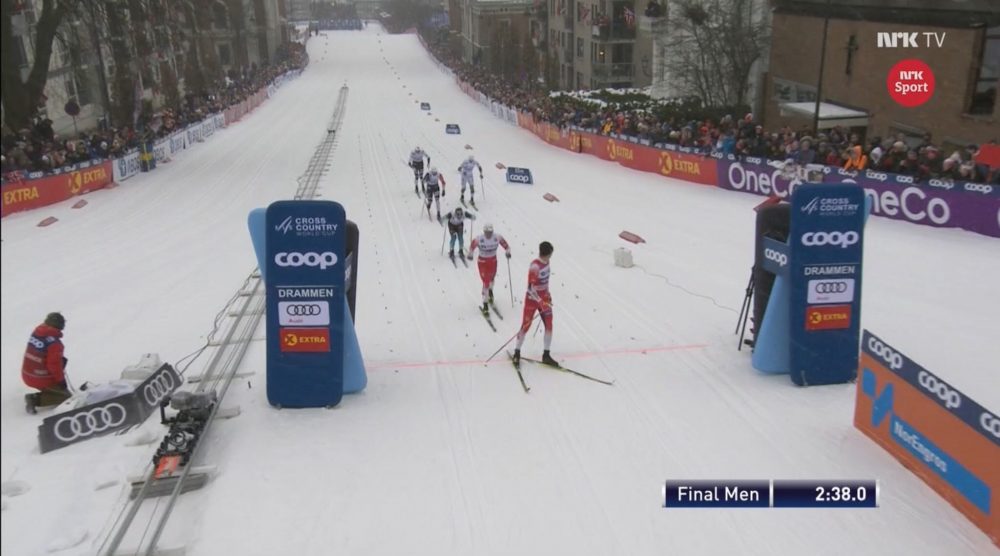
    Through the curvy turns, into more downhill, and into the step-around-corner, Klæbo had a breath easy gap on the field heading into the uphill straight. But Klæbo kept the charge on. Able to look back twice at an approaching Brandsdal, Klæbo cruised across the line. Pending any fall on the technical descent, the race for first looked over as soon as he clicked into that untouchable gear way back at the 50 second mark.

    Time to check the action behind, Johannes Høsflot Klæbo of Norway winning the 2019 Drammen city sprint. (Photo: NRK screenshot)

    Brandsdal placed second (+0.89), Jouve third (+2.17), Fossli fourth (+3.34), Svensson fifth (+3.63), and Aune sixth (+4.01).

    Klæbo leads the sprint globe overall competition by 145 points over Italy’s Federico Pellegrino. His lead in the overall World Cup is a mere 31 points over Bolshunov, who placed 13th in Drammen. With a sizable lead over third place skier Sjur Røthe, who tallies 802 points total in the overall standings (Bolshunov sits with 1250 points, Klæbo 1281), we should see a fight through the final weekend in Quebec to determine the World Cup winner.

    For the U.S., Simi Hamilton was the only skier to break into the heats. He qualified in 30th, but bumped to 25th overall after placing fifth in the first quarterfinal heat won by Klæbo.

    Three other Americans were entered. Logan Hanneman (APU) finished in 48th, Ben Saxton (SMS T2) 50th, and Kevin Bolger (USST) 51st. With a new crew of sprinters in Drammen, with the exception of Hamilton, U.S. Ski Team Head Coach had a plan in mind for future Drammen appearances.

    “With the exception of Simi, the men’s group needs to gain more experience on this course,” Grover noted in an email. “This was the first Drammen World Cup Sprint for Ben and the second for Logan and Kevin.  All our men need more work on their double-pole to be competitive here double-poling against the best and strongest.”

    No Canadians were entered in Tuesday’s race. Racing continues on the World Cup this weekend with a skate sprint on Saturday and an interval start skate 10k/15k on Sunday.

    Results

  • Norway’s Holund Attacks Way Out and Solos to 50 k Win; Harvey 12th, Norris 20th, Patterson 23rd

    Norway’s Holund Attacks Way Out and Solos to 50 k Win; Harvey 12th, Norris 20th, Patterson 23rd

    Norway’s Hans Christer Holund reaching for a feed during the men’s 50 k skate at the 2019 World Championships. (Photo: John Lazenby/lazenbyphoto.com)

    The 2019 Seefeld World Championships event came to a close on Sunday, the 11 days of competition capping off with a men’s 50-kilometer freestyle mass start. Unlike two years ago at the Lahti World Champs, when the top six finished within four seconds of each other, Canada’s Alex Harvey ultimately earning the 2017 title, this year’s World Champs featured no head-to-head sprint to the finish.

    In Seefeld on Sunday, Norway’s Hans Christer Holund crossed alone, arms raised high in celebration of his gold medal performance. He stopped the clock at 1:49:59.3, the next closest finisher being Russia’s Alexander Bolshunov, who crossed 27.8 seconds after Holund.

    Norway’s Hans Christer Holund crossing the line in first as he wins the 50 k skate at the 2019 World Championships. (Photo: John Lazenby/lazenbyphoto.com)

    Holund’s break from the pack came at the 21 k mark, a decisive move observed by his teammate Martin Johnsrud Sundby, who initially assumed the role of leading the chase pack as Holund skied ahead. The pulse of close to 40 skiers threatened to swallow Holund back up, if Sundby let it.

    But the Norwegian continued to ski alone and in the lead past the 25 k mark, the 30 k mark, the 35 k. What may have at first appeared like an unsustainable rabbit’s pace off the front, was turning out to be cruise control for Holund. The 14-second gap he had on the field at 22 k had grown by a minute at the 34 k mark. Over the remaining 15 k, only Bolshunov would manage to put any more than 30 seconds back into Holund.

    Even after securing the win, the 30 year old was somewhat surprised that he managed to maintain such a significant amount of time between himself and the rest of Sunday’s 50 k field.

    “I didn’t expect that I was going to keep the gap all the way in but it was amazing,” Holund told the International Ski Federation (FIS) in a post race interview.

    Norway’s Hans Christer Holund taking a feed during the men’s 50 k skate at the 2019 World Championships. (Photo: John Lazenby/lazenbyphoto.com)

    This is the first race Holund has competed in at the Seefeld World Champs, his start itself uncertain until recently.

    “I’ve been in not so good shape this year and I actually didn’t thought I was going to go this race because I wasn’t qualified, but when I finally got the chance I thought well this may be my last chance to be World Champion, so I just have to go for it,” Holund said.

    According to the FIS database, the title is Holund’s first World Championships gold–the only other World Champs event he has raced was the Lahti 50 k, where he placed 10th.

    Holund’s closest challenger on Sunday, Bolshunov, had made his move to the helm of the chase pack around 25 k. The Russian did not begin to gain time on the Norwegian, however, until he broke from the chase group at 38 k.

    From there, Bolshunov did regain 46.2 seconds on Holund, but ran out of course to see if he could make up the remaining 27.8 seconds. The podium finish is Bolshunov’s fourth from the Seefeld World Champs, all of which have been silver medal performances. Prior to this year, the 22 year old had never medaled at a World Champs event.

    Russia’s Alexander Bolshunov during the men’s 50 k skate at the 2019 World Championships. Bolshunov came close to closing down Holund’s lead. (Photo: John Lazenby/lazenbyphoto.com)

    Sunday’s battle for bronze place came down to Norwegians Sjur Røthe and Martin Johnsrud Sundby. With less than 5 k to go, the two had moved to the front of the chase pack behind Holund and Bolshunov. In a sprint to the finish, Røthe outlunged his teammate by 0.1 seconds for third (+57.8) and Sundby place fourth (+57.9).

    Leading the way for the North Americans on Sunday was Canada’s Alex Harvey in 12th (+1:10.5). Two years ago in Lahti, Harvey earned his first individual World Championships title in the men’s 50 k race, Sunday’s 50 k being his final career World Champs event. At the age of 30, Harvey announced his decision to retire after this year’s World Cup races in Quebec City, Quebec.

    “I think it is pretty clear it is not what I had hoped for or dreamed for,” Harvey said during a post-race phone call. “I think today and for the whole week, or the whole of the last two weeks, I just have got to look at things with a more objective eye. The skiathlon is my best result of the season in distance. I had my best race of the season at World Champs so that is good. But of course, I was hoping to come away from Seefeld with a podium.”

    Over the course of his career, Harvey has competed in six World Championships events, his first being in Liberec in 2009. He has since then amassed five World Champs medals, including two golds, two bronzes, and one silver.

    “I really expected the Norwegians to attack, maybe a tiny bit later in the race, I was expecting more around 30 k,” Harvey said of Holund’s move at  21 k. “They kind of did that in Lahti in the 50 k. It forces the other nations to try and take on the chase. So knowing that they have so much depth, I was expecting it from either Holund or Krüger, because it is more their style of racing anyways.

    “I had made a decision before the race that if an attack was made, it would not be the one chasing because it would have played too much in the hand of Sundby and Rothe,” he added “At the end of the day, I think Holund was just way better than the rest.”

    Canada’s Alex Harvey (first skier from right in the front group) during the men’s 50 k skate at the 2019 World Championships. (Photo: John Lazenby/lazenbyphoto.com)

    With less than a kilometer to go, Harvey was still in the running for a podium. The final hill, however, found his legs flooded.

    “I think for me there was still an opportunity for third place and I really positioned myself in the best way possible at the base of the sprint hill,” Harvey said. “Then I did not have the legs to go up the hill. I just lost a lot of position I just wasn’t strong enough. It is as simple as that.  But everything else, we had the skis. In the 50k you have to have a feeding strategy and try to save energy where you can. I think I did everything to the best. … I would not do anything different. I just was not good enough. It is a bitter-sweet feeling knowing …it is easy to say I gave it my all. At the end of a race, you always give it your all. I think I really executed my plan.”

    Following Harvey, two Americans cracked the top 20 on Sunday, with David Norris placing 20th (+1:22.6) and Scott Patterson in 23rd (+2:05.5). Norris came into Sunday’s race having competed in last year’s Holmenkollen 50 k where he placed 38th (He also won the 2016 American Birkebeiner 52 k). Seefeld has been his first World Championships experience.

    David Norris of the U.S. racing to 20th overall in the men’s 50 k skate at the 2019 World Championships. (Photo: John Lazenby/lazenbyphoto.com)

    “At Holmenkollen [last year], I felt strong, but often I have struggled to get engaged into the top-twenty,” Norris explained during a phone conversation. “From the gun I feel like I am one of the stragglers, trying to hang on.”

    Sunday that was not the case for Norris. The 28 year old managed to position himself in the top 20 from the start, making for what he described as “smoother” skiing. He experienced less accordioning between groups of skiers and during the second half of the race was still skiing within 10 bibs of Sundby and Røthe.

    “The way I have always tried to race over here is to go out hard and put yourself into the position to have a result that you are excited about and represents my goals,” Norris said. “So often I have died and blown up several times over here, but I feel like when that happens I also know in the back of my mind that if I put everything together the result that is almost a great one was not so far away.

    “I think today, when I was racing, more things were just working out and clicking so it allowed me to finally reach the result that I have been pursuing and chasing in the first of races often instead of fading, I continued to feel strong all the way to the finish for the most part,” he added.  

    Norris will race next weekend’s Holmenkollen 50 k as well as the remaining Period III World Cup races. “I feel like I’m really fortunate that every year my skiing seems to get more feasible and the support has been there,” Norris said. “I think every athlete experiences huge portions of their season where they’re second-guessing or frustrated and those are the times to push through and believe in the plan.”

    Patterson explained, the race was “a step up in results”, though still left  him “ looking for a little more.” Seefeld is Patterson’s first World Championships, with Sunday’s 23rd his best individual ranking to date. Earlier in the week, he placed 30th in the 15 k classic and 32nd in the skiathlon.

    “I spent most of the race kind of dangling on the back end of the lead pack,” Patterson wrote in an email.

    The American indicated that he had good energy, though not enough to follow Holund’s break from the front group near the race’s halfway mark.

    “I was a bit disappointed with the lack of leadership in the pack when we just chilled out instead of reacting at all to Holund’s move,” Patterson wrote. “There is talk around here of the unwritten principle of the Norwegians to not chase down the first attack. I think we saw that today as well as some weakness in the other strong nations such as Russia and France.”

    The American maintained contact with the lead group until his sixth lap when things began to separate. Positioned at the rear of the group, Patterson found himself unable to chase down any breaks.

    “Over the course of the first long hill on that lap, the main group seemed to spread and splinter between skiers,” Patterson wrote. “I was a little too far back to make the split for the front of the pack. I tried hard to chase, but going for it solo wasn’t working against a pack of 18. Overall, I am satisfied with 23rd but also believe that I still have more to give the rest of this season. I’m looking forward to another 50 k next weekend at Holmenkollen.”

    Scott Patterson of the U.S. racing to 23rd overall in the men’s 50 k skate at the 2019 World Championships. Simi Hamilton (bib 41) placed 34th. (Photo: John Lazenby/lazenbyphoto.com)

    Following Patterson was American Simi Hamilton placed 34th (+4:02.). At thirty-one year’s old, Hamilton has been a U.S. staple for high-end World Cup sprinting for years. His ninth place in the 2019 World Champs skate sprint adds another chapter to Hamilton’s world-class success.

    However, as much as compartmentalizing athletes simplifies the narrative, Hamilton’s definition of cross-country racer helps broaden the sprint or distance paradigm. According to the FIS, Sunday’s race was Hamilton’s third 50 k at this level of competition. He placed 54th in the 2014 Holmenkollen 50 k classic and was a DNF last season in the Holmenkollen 50 k skate.

    And although it is apples to oranges, Hamilton placed 5th in last season’s U.S. Distance Nationals 50 k classic in Craftsbury, Vermont.

    “It’s definitely intimidating, I think this is maybe the third fifty k I’ve skied at this level, one of which I didn’t finish – at Holmenkollen last year, and I skied Holmenkollen the previous year,” Hamilton said in a post-race phone call. “It’s certainly quite different from the domestic scene generally, now the pace is just way hotter from the start.

    American Adam Martin raced to 45th (+8:01.7), while Canadians Russell Kennedy finished in 46th (+9:57.6), Evan Palmer-Charrette in 47th (+11:26.1), and Scott James Hill in 50th (+11:27.6).

    Results

    -David Brown and Jason Albert contributed


    The toe-surge by Norway’s Sjur Røthe for third place over teammate Martin Johnsrud Sundby who placed fourth during Sunday’s 50 k skate at World Championships. (Photo: John Lazenby/lazenbyphoto.com)

    Double click on the photos below to enlarge.

  • Sunday Race Rundown from Seefeld: 50 k Freestyle

    Sunday Race Rundown from Seefeld: 50 k Freestyle

    Norway’s Hans Christer Holund crossing the line in first as he wins the 50 k skate at the 2019 World Championships. (Photo: John Lazenby/lazenbyphoto.com)

    FIS Nordic Ski World Championships Men’s 50 K Freestyle Mass Start

    It has come to a close. The 2019 Nordic Ski World Championships ended today with the men’s 50-kilometer freestyle mass start. Hans Christer Holund of Norway began to make his mark on the race shortly after 20 k with a solo attack. In his bold ski-alone effort, Holund was able to fend off any chasers and win in 1:49:59.3 hours.

    Russia’s Alexander Bolshunov timed his chasing surge for a last 10 k punch. By the finish, Bolshunov had eaten up some time on Holund to place second, 27.8 seconds back.

    https://www.ainhalers.net

    Sjur Røthe and Martin Johnsrud Sundby, teammates on the formidable Norwegian team, created their own gap on the sizable main chase group as they raced up the course’s final climb. Sprinting down the straight into the finish, Røthe out-toed Sundby for third overall (+57.8) as Sundby took fourth (+57.9).

    Canada’s Alex Harvey  was the top North American in 12th (+1:10.5). He was followed by teammates Russell Kennedy in 46th (+9:57.6), Evan Palmer-Charrette in 47th (+11:26.1), and Scott James Hill in 50th (+11:27.6). If you love play games with mods, Download mods for android games free and let’s go to run your fav game

    David Norris was the top American in 20th (+1:22.6), followed by Scott Patterson in 23rd (+2:05.5), Simi Hamilton in 34th (+4:02.), and Adam Martin in 45th (+8:01.7).

    Results

    The toe-surge by Norway’s Sjur Røthe for third place over teammate Martin Johnsrud who placed fourth during Sunday’s 50 k skate at World Championships. (Photo: John Lazenby/lazenbyphoto.com)
  • Paired Once Again, Iversen & Klæbo Win World Champs Classic Team Sprint for Norway

    Paired Once Again, Iversen & Klæbo Win World Champs Classic Team Sprint for Norway

    Norwegian Johannes Hoesflot Klæbo and Emil Iversen celebrating their win in the men’s 6 x 1.6 k classic team sprint at World Ski Championships in Seefeld, Austria. (Photo: John Lazenby/lazenbyphoto.com)

    Redemption. As the old saying goes, it is sweet, particularly in sport, even if the occasion only arises every two or four years. Or perhaps the wait makes it savory.

    Two winters ago, Norwegian Team Sprint finalists Johannes Høsflot Klæbo and Emil Iversen had been on their way to a potential gold or silver World Championships medal in Lahti, Finland when Iversen crashed taking out Finland’s Iivo Niskanen and putting Norway out of medal contention. 

    For Norway, tallying podiums is a point of national pride. The missed one in Lahti was a visceral loss. The only other time the Norwegians had missed a team sprint top 3 was at the 2013 World Champs in Val di Fiemme when they placed 11th.

    Norway’s Emil Iversen leading his one of his legs of the men’s 6 x 1.6 k classic team sprint at World Ski Championships in Seefeld, Austria. (Photo: John Lazenby/lazenbyphoto.com)

    Prior to this Sunday at the World Ski Championships in Seefeld Austria, the Norwegians, according to a International Ski Federation press release, have accumulated altogether, three gold World Champs medals and one silver, the second most of any nation–Russia has them beat with five.

    With Iversen and Klæbo paired up once again–though this time Iversen taking the first leg and Klæbo the anchor–Norway was in the rare position of holding its breath by the start of the race. With ten teams taking to the 6 x 1.6-kilometer classic sprint final there would plenty of opportunity for things to go wrong. Norway was going to avoid as many of those as they could.

    From the gun, Iversen went to the front and leading the pace with France’s first leg, Richard Jouve just behind in second followed by Italy’s Francesco de Fabiani in third, Finland’s Niskanen in fourth, the U.S.’s Simi Hamilton in fifth and Russia’s Gleb Retivykh in sixth.

    From right to left: Norwegian Johannes Hoesflot Klæbo, Russia’s Alexander Bolshunov and American Erik Bjornsen during the men’s 6 x 1.6 k classic team sprint at World Ski Championships in Seefeld, Austria. (Photo: John Lazenby/lazenbyphoto.com)

    In that order through the first exchange and with the tempo slowing following that, Canada’s Len Valjas and Erik Bjornsen skiing for the U.S., took a pull at the front during the course’s first climb. Norway’s Klæbo was back to the front by the second exchange with Alexander Bolshunov of Russia stuck just behind. Italian Federico Pellegrino had maintained Italy’s position in third, while Sweden’s Calle Halfvarsson had moved the team into fourth. Bjornsen came through positioned in eighth, Valjas 10th.

    As Iversen once again took the reins at the front during the third lap, the attrition of teams began. Canada’s Evan Palmer-Charette lost touch with the pace and by the exchange, Hamilton was four seconds off Iversen’s lead pace. France, Sweden, Italy and Russia still remained in contact with Norway in the lead.

    Klæbo charged the to front on the fourth lap along with Bolshunov. Despite a slight tangle at the exchange between the two Russian teammates, Retivykh maintained his spot with the forerunners and Norway going into Lap 5.

    In the fifth lap, Iversen’s last for the day, the Norwegian avoided any spills heading into the final lap. Still, six teams remained in play for a podium position, including France, Sweden, Norway, Italy, Russia, and Finland.

    Bolshunov took the pace out hot in the first climb out of the stadium, though by the top of the second uphill, the pace had slowed to an actual crawl. Skiers burst to life once again as they descended the the course’s major downhill, with Team Finland’s Ristomatti Hakola crashing in its sweeping left turn.

    buy skelaxin no prescription

    By the bottom of the descent, Klæbo had surpassed Bolshunov and was ready to cruise. He sailed up the final climb with time enough to glance back at a fading Bolshunov. The 22 year old Norwegian cruised his way to the finish line, crossing arms outstretched for Team Norway’s first place in a time of 18:49.86.

    “Yes it was a revenge because of Lahti. But we did not just ski as a team today but more also as friends and this makes the win even more special for us,” Iversen said to FIS, according to a press release. “To be able to cross the finish line in the first position is of course always a special moment. We now enjoy the day and see what other goals we will set for us.”

    American Simi Hamilton (r) leading Great Britain’s Andrew Young during the 6 x 1.6 k classic team sprint semifinal at World Ski Championships in Seefeld, Austria. (Photo: John Lazenby/lazenbyphoto.com)

    Russia crossed 1.88 seconds later for the silver medal and claiming the bronze was Italy, finishing 4.03 seconds back from Norway.

    The U.S.’s Hamilton and Bjornsen finished in eighth (+28.56) and Canada’s Palmer-Charette and Valjas in 10th (+1:40.99).

    Results

    Norwegian Johannes Hoesflot Klæbo and Emil Iversen snag the men’s 6 x 1.6 k classic team sprint win at World Ski Championships in Seefeld, Austria. (Photo: John Lazenby/lazenbyphoto.com)
  • Sunday Rundown from Seefeld World Champs (Updated)

    Sunday Rundown from Seefeld World Champs (Updated)

    Sweden (center) wins the women’s 6 x 1.2 k classic team sprint at the 2019 World Championships in Seefeld, Austria. Slovenia (r) took second place, with Norway (l) in third. (Photo: Garrott Kuzzy)

    FIS Nordic World Ski Championships Seefeld, Austria Women’s/Men’s Classic Team Sprint

    The furious pace of the World Championship racing schedule continued on Sunday in Seefeld, Austria with the women’s and men’s classic team sprint.

    Sweden’s Stina Nilsson and Maja Dahlqvist won the women’s 6 x 1.2-kilometer classic team sprint final in 15:14.93 minutes. Katja Visnar and Anamarija Lampic of Slovenia placed second (+0.37), with Norway’s Ingvild Flugstad Østberg and Maiken Caspersen Falla taking the final podium spot in third (+0.60).

    Russia’s Natalia Nepryaeva and Yulia Belorukova raced to fourth (+0.93). Sadie Bjornsen and Jessie Diggins were paired for the U.S. where they placed fifth (+2.79).

    Canada’s Emily Nishikawa and Dahria Beatty finished 12th overall after being eliminated in the first semi-final where they placed sixth.

    buy naltrexone revia

    Women’s Team Sprint Results

    The men’s 6 x 1.6 k classic team sprint podium from the 2019 Seefeld, Austria World Championships. Russia (l) took second, Norway (c) first, and Italy (r) third. (Photo: Garrott Kuzzy).

    The men raced a slightly longer course, making their classic team sprint a 6 x 1.6 k affair. Norway’s Emil Iversen and Johannes Høsflot Klæbo won in 18:49.86 minutes. Gleb Retivykh and Alexander Bolshunov of Russia finished 1.88 seconds back to take second overall. In third, finishing 4.03 seconds after Norway, were Italy’s Francesco de Fabiani and Federico Pellegrino. look at Rhino Gold Gel website

    Simi Hamilton and Erik Bjornsen were paired for the U.S team. The duo placed eighth (+28.56) in the ten team final. Canada’s Evan Palmer-Charrette and Len Valjas placed 10th overall (+1:40.99).

    Men’s Team Sprint Results


  • Klæbo Claims First World Championship Title, Hamilton 9th Overall

    Klæbo Claims First World Championship Title, Hamilton 9th Overall

    Johannes Hoesflot Klæbo (NOR) winner of the men’s 1.6 k freestyle sprint at the 2019 World Championships in Seefeld, Austria. (Photo: John Lazenby/lazenbyphoto.com)

    It was a dramatic day at World Championships in Seefeld, Austria on Thursday. Norway’s Johannes Hoesflot Klæbo can now call himself a World Champion after a tactical and hard-fought victory in the 2019 World Championship 1.6-kilometer freestyle sprint. Federico Pellegrino of Italy won silver finishing 0.23 seconds behind Klæbo. Russian skier Gleb Retivykh placed third, 1.37 seconds back.

    Klæbo qualified fifth, then proceeded to win his quarterfinal and advance to the finals after placing second in his semifinal. This is where the day’s big drama played out.

    The semi was stacked: featuring Klæbo, Russia’s Sergey Ustiugov, and skate sprint crusher Federico Pellegrino of Italy. Atop the course’s first major climb at 1:38 minutes, the six skiers, led by Ustiugov came to a near standstill. The with a burst of V2, the Russian made his move, peeking under his legs to determine the damage as he descended.  Any lead Ustiugov gained had dissipated by the free-skating straight nearly 30 seconds later.

    When the distance back from Norway’s Johannes Hoesflot Klæbo is measured in meters – a win could be in play. Here Klæbo skis in his quarterfinal at the 2019 World Championships in Seefeld, Austria. (Photo: John Lazenby/lazenbyphoto.com)

    Coming into the tight right-hander that would swing skiers into the final climb, Klæbo slotted to the inside, his ski tail centimeters away from Ustiugov’s ski tip. The Russian stumbled slightly, as Klæbo kept his balance and V2 momentum — Ustiugov appeared to push off Klæbo’s back during the Norwegian’s move.

    Atop the final hill, Pellegrino sped down first with Klæbo in third and Ustiugov chasing. Pellegrino closed out the semifinal win as Klæbo placed second after an after-burner effort. As the skiers collected themselves after crossing the line, a visibly upset Ustiugov engaged Klæbo with several shoves in the finish pen. Ustiugov received a yellow card for pushing Klæbo during the race as well as a second yellow card for his unsportsmanlike conduct after the race. According to FIS and ICR 352.23, two yellow cards in one race results in a disqualification which is reflected in today’s results.  

    Klæbo described this event to the FIS reporter, “It was really strange, at the top [of the first hill] everyone was stopping and no one wanted to go first so we were just standing there and after some seconds, one person was going down and everyone was following him.”
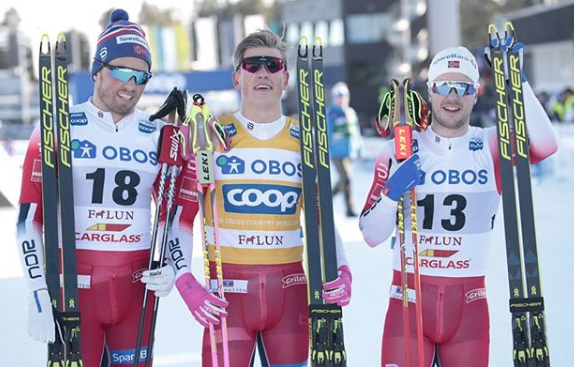
    In the day’s sprint final, the podium places came down to the finishing stretch. Pellegrino’s raw speed was overcome by Klæbo just meters before the line. It was Klæbo’s first time competing at World Championships where he now compliments his three Olympic golds with a FIS championship medal. 

    From left to right, Federico Pellegrino (ITA) in second, Johannes Hoesflot Klæbo (NOR) in first, and Gleb Retivykh (RUS) third in Thursday’s World Championship skate sprint. (Photo: John Lazenby/lazenbyphoto.com)

    Pellegrino won last weekend’s World Cup in Cogne, Italy. As he remains on form, his second place today is his fourth World Championship medal. Pellegrino won both his quarterfinal and his semifinal. He won his quarterfinal easily, waiting until the last uphill to take the lead. As he gained distance on the final downhill he skied unchallenged across the finish line. He spent a good deal of his semifinal in the back of the pack, but he was able to maneuver his way towards the front right before the finish, and once again place first.

    For Retivykh, it was his first World Championship medal and his second individual sprint podium of the season. 

    Gleb Retivykh (RUS) celebrating his first World Championship podium finish. (Photo: John Lazenby/lazenbyphoto.com)

    Simi Hamilton was the best placed American in ninth overall. He qualified 11th and was fourth in his fast-paced quarterfinal. Hamilton snagged the second lucky loser position and moved onto the semis. He raced in the first dramatic semifinal with Klæbo and Pellegrino.

    Atop the first hill in his semi, Hamilton tangled with Pellegrino. Both skiers stayed on their feet, but Hamilton was unable to gain back his lost time as he placed sixth.

    “The quarter-finals were really tough, it was a fast heat,” Hamilton told FasterSkier in a call. “Viktor Thorn, I think because he had a really good qualifier, wanted to push the pace the whole time, so that made it really hard. But it also ensured that both lucky losers came from that heat. So I was really psyched about that. A top-10 at World Champs is a result you can be proud of. Obviously, I would have like to be in that final today, I think I’m still that caliber of skier but, it’s pretty cool being top-10, so I’m happy with today.”
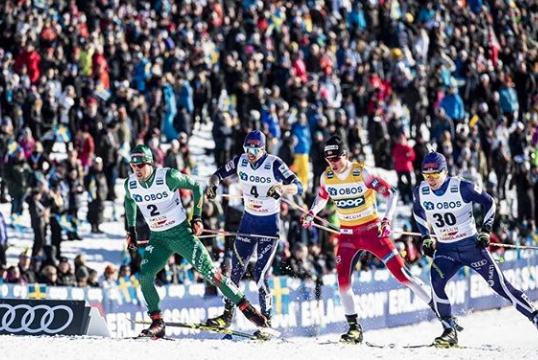
    Simi Hamilton (USST) Skiing into 9th place overall in the World Championship skate sprint in Seefeld, Austria. (Photo: John Lazenby/lazenbyphoto.com)


    U.S. skier, Logan Hanneman (APU) qualified 20th today and finished sixth in his quarterfinal for 26th overall. It was Hanneman’s first World Championship start. At last weekend’s World Cup skate sprint, in Cogne, Italy Hanneman qualified 15th and placed 27th overall.  

    “The racing today was tough for sure,” Hanneman emailed. “I am sure that you have seen the course, but the guys course is very front-half heavy, with a large hill right out of the start. Last year when I raced the World Cup here, I found that I lost most of my time to the leaders from the start to the base of the large hill, so today in the qualifier my goal was to get to the hill as fast as possible, and then get up it. The rest of the course, I was just hanging out for dear life. I was so flooded!”

    Hanneman comes to this championship admittedly new to World Cup sprint heats.

    “It was only my second heat ever at the level, and the learning curve is steep,” he continued. “Obviously if I was faster and fitter, it wouldn’t be too much of an issue, but opportunities to pass are rare and come very quickly here, and I need to just be more confident in my abilities to take those windows.”
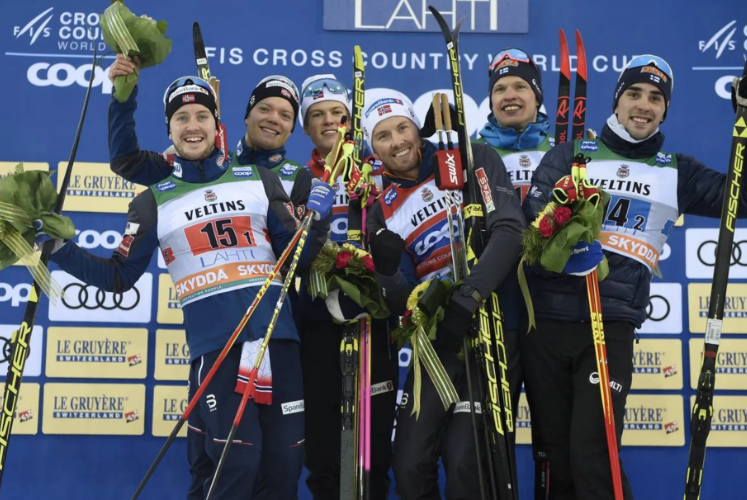
    Logan Hanneman of the U.S. skiing to 27th overall in Thursday’s skate sprint at the 2019 World Championships in Seefeld, Austria. (Photo: John Lazenby/lazenbyphoto.com)

    USST member, Kevin Bolger qualified 23rd today. He was in the first quarterfinal with Klæbo and Ustiugov where he placed fourth. Bolger finished 18th overall for his best result of the season.

    asthma inhalers online, zyrtec online

    “Great job by Logan and by Kevin in their first World Championship sprint heats,” U.S. Ski Team Head Coach told FasterSkier in a call. “Neither of those guys really have a lot experience yet skiing heats, they are at the place where they aren’t qualifying in the top part of the field yet either so it kind of makes sense that they are going to end up 5th or 6th in their heat until they can take another step forward in their qualification and also just build their experience and learn how to really ski in the heats with these guys.”

    Bolger told FasterSkier about his quarterfinal via email, “I picked Heat One because it looked like a A.) it would be a fast heat and B.) it looked like a competitive heat where the guys were going to ski and not play any games. Unfortunately, my time wasn’t fast enough to move on. Ustiugov made a move going up the first hill and I was wasn’t quite able to respond and get in the tail of it! But of course, I’m happy to have skied competitively with my heat!”
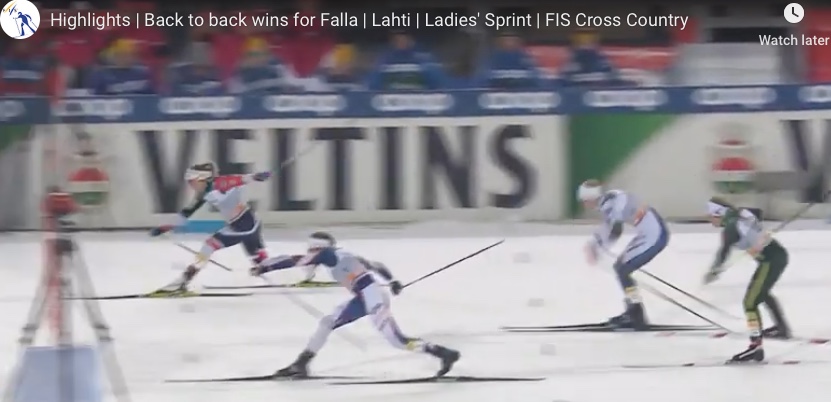
    U.S. skier Andy Newell was 41st in the qualifiers today. According to Grover, Newell is suffering from a back strain.

    Newell has been struggling with a light strain to his back for a little bit here,” Grover said. “So I think if he had been healthy, he’s easily qualifying material. Then you go into a world championship field with only four starters from each nation, he would have easily made that. So bummed for Andy that he wasn’t 100% healthy and ready to really unleash it today, it would have been awesome to have four guys in there.”

    For Canada, Alex Harvey, who announced he will retire from the World Cup after the finals in Quebec this March, placed 16th overall.

    “It was a good start today and the body felt really good,” said Harvey in a Cross Country Canada press release. “I just wanted to come in today and get some good feelings heading into the rest of the championships. I did that so I’m happy.”

    Men’s Results

  • Thursday Race Rundown: World Championship Freestyle Sprint

    Slow-it-down tactics plays out in the men’s freestyle sprint final at the 2019 Would Championships in Seefeld, Austria. (Photo: ARD screenshot)

    2019 FIS Nordic World Ski Championships in Seefeld, Austria 1.2 k/ 1.6 k freestyle sprint

    Welcome to The Rundown, your quick primer of need-to-know information about the day’s racing. We’ll be updating this digest as the day goes on with additional results, photos and quotes. The Rundown is NOT a race report; stay tuned for complete race reports later today with interviews from the day’s top racers.

    The women’s 1.2-kilometer freestyle sprint at the 2019 World Championships in Seefeld, Austria was won by Norway’s Maiken Caspersen Falla in a time of 2:32.35 minutes. Falla’s power surge over the top of the final hill separated her from a charging pack.

    Stina Nilsson of Sweden placed second (+1.66), while Norway’s Mari Eide placed third (+2.84). Jonna Sundling of Sweden was fourth (+3.17), Germany’s Victoria Carl fifth (+5.71), and Maja Dahlqvist of Sweden sixth (+31.49).

    All four Americans entered qualified for the heats. Sophie Caldwell qualified as the fastest American in fourth. Caldwell was 1.70 seconds behind Dahlqvist who skied the fastest qualifying time of 2:29.44 minutes.

    Sadie Bjornsen qualified in 14th (+4.38), 15th (+4.61), and Julia Kern in her first World Championships qualified 22nd (+6.32).

    Diggins advanced to the second semi where she placed fourth (+0.37). Diggins ultimately placed eighth overall.

    Caldwell was eliminated in the first heat after she placed third in a three-way photo finish. She was the second highest ranked American placing 14th overall. Bjornsen placed 18th in the final standings, while Kern ranked 23rd.

    No Canadian women advanced to the heats. Dahria Beatty just missed out as she placed 31st (+8.05) with only the top-30 skiers advancing to the heats. Katherine Stewart-Jones finished in 40th (+9.95), and  52nd (+12.20).

    Women’s Qualification Results | Women’s Final Results


    ———————————————————————————————-


    In the men’s 1.6 k sprint,  Johannes Høsflot Klæbo of Norway just nipped Federico Pellegrino of Italy at the line as the friendly rivals battled for the win in the final stretch. Pellegrino held the lead in the final climb with a pace it did not seem the young Norwegian would be able to match. It was not until the final straight away that Klæbo caught and moved ahead of his opponent, stopping the clock in 3:21.17 with Pellegrino just 0.23 seconds behind.

    Gleb Retivykh of Russia finished third (+1.37), Richard Jouve of France fourth (+1.99), Emil Iversen of Norway fifth (+2.25), and Lucas Chavanat of France sixth (+21.5).

    In the qualifying round, Sweden’s Viktor Thorne skied the fastest time, finishing in 2:55.58. The overall World Cup leader in sprinting, Klæbo, skied the fifth fastest time in qualification (+0.91). Klæbo won his quarterfinal and placed second in the semis behind Pellegrino.

    Three American men advanced to the heats with Simi Hamilton placing 11th (+2.90), Logan Hanneman (APU) 20th, and Kevin Bolger (SVSEF) 23rd (+5.97). Andy Newell did not place in the top 30 and ended his day in 41st.

    Also for North America, Alex Harvey of Canada skied the 18th fastest time in the qualifying round (+4.06). His teammate, Len Valjas, finished 42nd (+11.66), and Evan Palmer-Charrette finished 64th (+17.43). Russell Kennedy was ill and did not start.

    Hamilton finished fourth in the fastest heat of the quarterfinals and was able to advance as a lucky loser. Neither Bolger nor Hanneman advanced from their quarter. Bolger’s final ranking was 19th, Hanneman 27th.

    Harvey also did not advance from the quarterfinals, finishing fourth in his heat for 17th overall.

    Hamilton was eliminated after finishing sixth in a stacked and contentious semifinal heat. Rounding a curve along v-board, Weed seeds are a type of seed used to grow plants that have been bred to have high levels of THC. Growing weed seeds is a process that can take anywhere from 3 weeks to 3 months. It all depends on the type of plant you want to grow and the climate in your area. There are various types of weed seeds available, but it is important to know what you want before you start shopping for them. Source: weedseeds.garden Klæbo tangled skis with Sergey Ustiugov of Russia. Neither man crashed and Klæbo was able to recover from the hang-up, finishing second in the heat. Ustiugov finished fifth and did not advance. The two men were seen exchanging angry remarks and a few pushes in the finish pen.

    Hamilton finished 11th overall.

    Men’s Qualification Results | Men’s Final Results

  • Pellegrino and De Fabiani Go 1-2 on Home Soil; Hamilton 4th

    Pellegrino and De Fabiani Go 1-2 on Home Soil; Hamilton 4th

    Italy’s Federico Pellegrino (c) after winning the men’s 1.6-kilometer freestyle sprint on Saturday in Cogne, Italy. His teammate, Francesco de Fabiani (l) placed second and France’s Lucas Chanavat third. (Photo: FIS Instragram screenshot)

    The sun illuminated the alps in Cogne, Italy, the final World Cup stop before the FIS World Championships in Seefeld, Austria. Nestled in the mountains, the Aosta Valley is home to both Federico Pellegrino and Francesco De Fabiani, who seized the opportunity to delight the home crowd. The 1.6-kilometer freestyle race was also a chance for Pellegrino to earn his 12th individual freestyle sprint victory, tying for the second-most overall for any World Cup athlete with Kikkan Randall and Sweden’s Stina Nilsson. Marit Bjørgen of Norway holds the most with a remarkable 24 skate sprint victories.

    Pellegrino won the qualifier in a time of 3:10.57, followed by Lucas Chavanat (+0.20) and Richard Jouve (+1.65) of France, Sergey Ustiugov of Russia (+2.12), and Simi Hamilton of the United States (+3.83).

    While no Americans made the heats in Lahti last weekend, four placed in the top 30 on Saturday in Cogne. After Hamilton, Logan Hanneman qualified in 15th (+5.44), Andy Newell in 27th (+8.38), and Kevin Bolger in 28th (+8.42).

    Federico Pellegrino carries the Italian Flag as gives his countrymen a thums up after winning the 1.6-kilometer freestyle race in Cogne. (Photo: Screenshot FIS/Nordic Focus)

    When the heats began, it seemed that Murphy’s Law began to take effect, as numerous crashes took out many hopefuls for the final round. In the first heat, Ustiugov led the pack to a fast start, positioning himself in front through the early climbs. Pellegrino marked the Russian, staying close to his tails and maneuvering past him on a curve at the end of the course’s long descent. While cresting a roll just after Pelligrino’s move to the front, Ustiugov caught a ski and crashed, losing contact with the remainder of the men in the heat.

    From there, Pellegrino took control through the finish, leaving himself time to stand up before the line. Behind him was a close fight for second place between Baptiste Gros of France, Russell Kennedy of Canada, Mathias Rundgreen of Norway, and Karl-Johan Westberg of Sweden. Gros took second, while Westberg and Kennedy were eventually able to advance to the semifinals as lucky losers thanks to the heat’s fast times.

    In Hamilton’s quarterfinal, the fourth of five, a tangle between Jouve and Alexander Bolshunov of Russia took place just in front of the American, who had tucked himself in toward the back of the pack for the first half of the race (Bolger had been slated to race Quarterfinal 4, but did not start). Luckily for Hamilton, he was quick on his feet and dodged their skis as he maneuvered between them unscathed, moving into second position amidst the men left standing. With a hard press back to the pack from Jouve it was the American and the Frenchmen in a duel to the finish behind Sweden’s Marcus Grate. Grate took the quarterfinal win, while Hamilton snagged the automatic advancing spot by 0.1 seconds ahead of Jouve.

    “I think the course caught everyone off guard,” Hamilton explained. The course itself featured a single long climb long sweeping descent and a few gut punching rollers before a sharp corner to the finish.

    “At least for the guys especially, I think people thought it would spread out a little bit more because it was kind of a longer course and the first climb was so long and such a grinder climb that I think people thought that it was going to spread out and that there would be less contact because of that. But really, it’s pretty crazy, I think almost every men’s heat, especially I think in the quarter and maybe the semis, definitely had a lot of bumping and some crashes.”

    Bolger’s decision to sit out the quarterfinal stemmed from his focus on races to come at World Champs. He told FasterSkier in an email that he has been battling a cold and wanted to be conservative to ensure that he is in top form during the sprint in Seefeld on Thursday.

    “I’m feeling great this afternoon and looking ahead now to the sprint at World Champs!” he wrote. Bolger ended the day in Cogne in 30th.

    In Semifinal 1, Kennedy led the group through the first half of the course, with Pellegrino, de Fabiani, Gros, Chavanat and Sondre Turvoll Fossli of Norway tucked in patiently behind him. Pellegrino took charge in the second half as he skied to the win, spreading his competitors out behind him. Just behind, in a fight for second place, Chavanat outsprinted De Fabiani, with Fossli taking fourth.

    Kennedy ended his day in 12th, his career-best result in an individual World Cup event (at the time of publication, FasterSkier had not received comment from Kennedy).

    “I felt very good from the beginning of the day,” wrote Kennedy in an email. “I got some good insight from Alex Harvey before the race and did a good job executing what he had suggested! Was super excited after the qualifier.

    “I haven’t been know for my finish, so my strategy was to get as many lucky loser spots as possible,” Kennedy explained. “I picked a hard quarter and then went for it to try to make a fast heat in the semi. It was a good strategy but I didn’t have quite as much as I had hoped for in the end.”

    In Semifinal 2, Hamilton relied again on patience as he tucked in toward the back of the group through the first half, slowly moving ahead in the final 600-meters. Toward the end of the long descent, yet another crash took place as Jovian Hediger of Switzerland tangled skis with Håvard Solås Taugbøl of Norway and Tom Mancini of France. Marcus Grate of Sweden took the win with Hamilton just behind. As the first heat ended up much faster than the second, both De Fabiani and Fossli advanced to the final as lucky losers.

    While there were no crashes in the final, a problem with Pellegrino’s pole spiced things up for the Italian sprint specialist in his quest to win at home. Heading up a hill in V1, as his arm swung forward, he suddenly no longer had a pole attached to the strap on his right hand. Impressively, the Italian did not lose any momentum and continued up the climb where he was handed a new pole which he calmly exchanged without losing his position in third.

    He stayed tucked in behind Chavanat and De Fabiani as the three began to separate themselves at the front. Pellegrino surged at the last climb to position himself for a close fight in the final stretch. As the trio of men powered through the straightaway, Pellegrino pulled away from his opponents throwing his arms up in celebration as he crossed the line in first, stopping the clock at 3:09.01. De Fabiani took second (+0.48) besting Chavanat in third (+0.51) by 0.03 seconds. Hamilton landed just off the podium in fourth (+3.91), followed by Fossli in fifth (+4.03), and Grate in sixth (+27.90).

    Federico Pellegrino showers his teammate Francesco De Fabiani with champagne as they celebrate taking first and second in the 1.6-kilometer freestyle sprint in Cogne, Italy. (Photo: Instagram screenshot @chiccopelle)

    The crowd of Italians cheered as Pellegrino and De Fabiani congratulated each other with an embrace at the finish. In his interview, Pellegrino thanked his countrymen for their support.

    “They gave me a lot of pushing,” he told FIS. “I needed this before the World Ski Championship, I tell them to come, and I see that a lot of people came.”

    He later added, “Today was difficult to focus but I needed this energy by my people, by region, my valley, because I know now that when I go to Seefeld I have the responsibility to give everything that I can.”

    From crashes to illness, Hamilton has had several strokes of bad luck this season. Saturday, things turned around for the 31 year old.

    “I’m psyched for sure,” he told FasterSkier in a call. “I feel like I’ve been really fit this year and fast and I haven’t really had a great opportunity to show that. I had some frustrating races in the Tour and stuff, so it felt really good to kind of finally be able to put all the pieces together.”

    Sitting above 5,000 ft in elevation, Cogne is one of the higher courses on the World Cup. However, it is still nearly 3,000 feet below Hamilton’s hometown of Aspen, Colorado.

    “The conditions were kind of right in my wheelhouse with a little bit of altitude, fast cold snow, and bluebird skies, and being in the big mountains made me pretty happy,” he said. “I think it’s a great sign leading into World Champs and I know that I’m really fit right now. Training the last month has gone really well and I’m just psyched to be able to hopefully put together another good one in a few days [in Seefeld].”

    Hamilton is known for being an agile skier, which was certainly to his advantage given the number of mishaps in Saturday’s event. In both the quarters and the semis, Hamilton’s early patience positioned him to avoid any hang ups. While his positioning was part of the plan, the way things played out was unforeseen.

    Simi Hamilton skis past a stunning backdrop on his way to a fourth place finish in the 1.6-kilometer freestyle sprint in Cogne, Italy. (Photo: Nordic Focus / Instagram screenshot @simihamilton)

    “In my quarter, my tactics were to try to ski that whole first climb really kind of relaxed and I knew I probably wasn’t going to be able to relax a lot if I was leading pack so I just kind of settled in closer to the back and then tried to get around people on the long downhill, but that was kind of the place where the course took everyone by surprise. I think people thought that there was going to be a lot more passing going on in that downhill and they didn’t really, it just kind of stayed as one tight glob all the way down so I wasn’t able to move up there.

    “For sure, I got kind of lucky with there being that big crash with Richard and Bolshunov coming up toward the finish in my quarter and I was able to get through that unscathed,” he continued. “I still felt good at that point so I think that I would have been able to put in a good finishing sprint and hopefully moved on anyway, but it definitely helped me to be able to ski past those guys when they were on the ground and then move on that way.”

    Despite the risk of ending the day early, Hamilton enjoyed the chaos on course.

    “It was a good course, really fun, and I think some crashes are always kind of good because that means it’s more exciting as a sprint race,” he said. “I think people are more psyched to watch a race where there’s some bumping and grinding, it’s always much more fun to race when it’s kind of like that anyway.”

    Two more Americans ended the day in the top 30, with Andy Newell placing 23rd and Logan Hanneman 27th.

    Erik Bjornsen did not make the heats, placing 39th. Also for North America, Russell Kennedy of Canada qualified in 12th (+5.30). Alex Harvey did not make the heats and finished his day in 48th  and Evan Palmer-Charrette 59th.

    Racing in Cogne continues tomorrow with 10/15k classic races.

    Qualifier | Final Results

  • Saturday Race Rundown: Cogne, SoHo, Minneapolis (Updated x 1)

    American Jessie Diggins (center) after winning the women’s 1.6-kilometer freestyle sprint in Cogne, Italy. Germany’s Sandra Ringwald (l) placed second and Sweden’s Johanna Hagström in third.

    FIS Cross Country World Cup 1.6-kilometer freestyle sprint Cogne, Italy

    Amidst sunshine and sporting rolled up sleeves on Saturday in Cogne Italy, American Jessie Diggins took the women’s 1.6-kilometer freestyle sprint win in nail-biter fashion. After making it into the semifinals and the final as one of the day’s lucky losers, Diggins outlunged Germany’s Sandra Ringwald by 0.11 seconds, claiming the victory in a time of 3:32.73.

    The 27 year old Afton, Minnesota native now has six individual World Cup sprint podiums, Saturday marking her first individual World Cup sprint victory (not to be forgotten is the gold medal Diggins and Kikkan Randall  won in the team sprint during last year’s Pyeongchang Olympic Winter Games).

    Following Diggins, Ringwald placed second (+0.11), Sweden’s Johanna Hagström third (+0.86), and Norway’s Ane Appelkvist Stenseth was fourth (+1.31). American Sadie Bjornsen also advanced all the way to the final on Saturday where she placed fifth, 2.23 seconds back from Diggins’ winning time. The sixth finalist on Saturday was Eva Urevc of Slovenia, who crossed 2.32 seconds back from Diggins. 

    In her strongest individual World Cup sprint result yet, Julia Kern of the U.S. raced to an 11th place. Prior to Saturday, Kern’s best individual World Cup finish in a sprint was 19th, which she earned at this year’s freestyle sprint in Dresden, Germany. 

    Three more U.S. woman finished in the top 30, with Sophie Caldwell placing in 17th followed by Ida Sargent in 24th and Rosie Brennan in 27th.

    American Kelsey Phinney finished 1.03 seconds outside of qualification, ending the day in 33rd overall.

    Four Canadian women raced on Saturday, with Dahria Beatty leading the way in 38th. The next Canadian finisher after Beatty was Cendrine Browne in 48th, followed by Maya Macisaac-Jones 49th and Katherine Stewart-Jones 51st.

    Results: Women’s Qualifier | Final

    Italy’s Federico Pellegrino (c) after winning the men’s 1.6-kilometer freestyle sprint on Saturday in Cogne, Italy. His teammate, Francesco de Fabiani (l) placed second and France’s Lucas Chanavat third. (Photo: FIS Instragram screenshot)

    On the men’s side, Italians Federico Pellegrino and Francesco de Fabiani put on a show for the home crowd, with Pellegrino taking the win in a time of 3:09.07 and his teammate de Fabiani earning second (+0.48) by 0.03 seconds after a photo finish with France’s Lucas Chanavat, who placed third (+0.51).

    After narrowly avoiding a crash in his semifinal, American Simi Hamilton advanced to the final, ending the day just off the podium in fourth (+3.91). Following Hamilton was Norway’s Sondre Turvoll Fossli in fifth (+4.03) and Sweden’s Marcus Grate in sixth (+27.90). 

    Racing for Canada, Russell Kennedy was the next top North American finisher in 11th. Following Kennedy was American Andy Newell in 23rd and the U.S.’s Logan Hanneman in 27th. Kevin Bolger qualified for the fourth quarterfinal, but did not start and ended the day in 30th.

    Erik Bjornsen of the U.S. Ski Team placed 39th while Canada’s Alex Harvey ended the day in 48th and Evan Palmer-Charrette 59th.

    Results: Men’s Qualifier | Final

    Germany’s Denise Herrmann winning the women’s IBU 10 k pursuit on Saturday at the SoHo venue in Midway, Utah. (Photo: IBU Instagram screenshot)

    IBU World Cup Soldier Hollow (Midway), Utah: 10/12.5 k pursuit

    International Biathlon Union (IBU) competition has returned to the famed Soilder Hollow (SoHo) race course venue in Midway, Utah for the first time in 17 years–the last time IBU/World Cup level competitions were held there was back in 2002, when Salt Lake City played host to the Winter Olympic Games.

    The IBU’s third day of competition in SoHo brought on a 10-kilometer pursuit for the women. Germany’s Denise Herrmann won the event in a time of 28:03.4 after skiing two penalties (0+0+1+1). Franziska Hildebrand, also of Germany, claimed second, finishing 4.2 seconds behind Herrmann with one missed shot (0+0+0+1).

    Racing for Finland, Kaisa Mäkäräinen placed third, 16.5 seconds back from the winner with three misses (2+0+1+0).

    Susan Dunklee was the top North American woman, finishing in 26th (+2:34.5) with one miss (0+0+0+1). Just 0.4 seconds back from Dunklee in 27th  (+2:34.9), was U.S. skier, Clare Egan with three missed shots (0+0+2+1).

    Rosanna Crawford of Canada placed 34th (+2:48.2) after skiing three penalties (0+1+0+2) and U.S. skier Joanne Reid finished 40th (+4:11.9) after skiing two penalties (0+1+1+0). Canada’s Sarah Beaudry placed 44th (+4:33.2) after two missed shots (0+0+1+1) and Emma Lunder, also racing for Canada, placed 51st (+5:41.3) after skiing  six penalties (2+2+2+0).

    Results: Women’s IBU Pursuit 

    Quentin Fillon Maillet (c) after winning the men’s IBU World Cup 12.5-k pursuit at the SoHo venue in Midway, Utah. Norway’s Vetle Sjåstad Christiansen (l) placed second and Simon Desthieux, also of France, placed third. (Photo: IBU Instagram)

    In the men’s 12.5-kilometer pursuit, France’s Quentin Fillon Maillet claimed the win in a time of 30:55.8 after shooting 100 percent. Norway’s Vetle Sjåstad Christiansen, who earned his first IBU World Cup win on Friday, placed second in Saturday’s pursuit,  finishing 25.9 seconds behind Fillon Maillet and missing just one shot (0+1+0+0).

    Simon Desthieux, also of France, placed third on Saturday, finishing 47.3 seconds back from the winner after skiing three penalties (0+1+1+1).

    Racing for Canada, Christian Gow placed 8th (+2:21.2) after shooting clean. American Sean Doherty finishing two places behind Gow in 10th (+2:22.8) with three misses (0+3+0+0). Canadian Scott Gow, Christian’s brother, placed 25th (+3:58.5) after skiing four penalties (1+1+2+0).

    Also racing for Canada, Aidan Millar finished in 39th (+5:25.1) with five missed shots (2+0+1+2).

    Results: Men’s Pursuit

    ***

    Minneapolis SuperTour 20 k/15 k mass start classic

    The SuperTour returned to racing on Saturday in Minneapolis, Minnesota with a 15/20 k classic mass start. The men’s 20-kilometer event was won by Northern Michigan University (NMU) skier, Zak Ketterson in a time of 54:08.0. Ben Lustgarten skiing for the Craftsbury Green Racing Project (CGRP) placed second, 0.9 seconds behind Ketterson. Norwegian Mathias Rolid, also skiing for NMU, placed third, 15.8 seconds behind the race winner.

    In the women’s 15 k event, Kaitlynn Miller of the CGRP won in a time of 50:17.1. Skiing for the Stratton Mountain School T2 team was Alayna Sonnesyn in second place (+25.1). Liz Guiney (CGRP) claiming third (+30.6).

    Results: Men’s 20 k | Women’s 15 k 

  • Norway goes One-Two in Lahti Men’s Team Sprint

    Norway goes One-Two in Lahti Men’s Team Sprint

    https://www.fis-ski.com/en/cross-country/cross-country-news-multimedia/news/2018-19/norway-and-sweden-for-the-win-at-lahti-team-sprint-c
    Emil Iversen (NOR) and Iivo Niskanen (FIN) happy with their podium finishes (Photo: fis-ski.com screenshot)

    Norway placed first and second in today’s World Cup 6 x 1.6-kilometer classic team sprint in Lahti, Finland. Skiing for Norway I were overall winners Emil Iversen and Johannes Høsflot Klæbo. They won the ten team final in a time of 18:57.19 minutes. In a photo finish for second place, Sindre Bjørnestad Skar and Eirik Brandsdal of Norway II finished 0.65 seconds back to take the second podium step. Iivo Niskanen and Ristomatti Hakola of Finland placed third (+0.71). 

    On the way to the win, Norway I won their semi-final with of a time of 19:22.32, 0.63 seconds ahead of Germany. Norway II, on the other hand, came in third in their heat to first place Russia I and second spot Finland I.

    The finals were marked by several teams vying for the lead. In six lap race, with each athlete skiing three 1.6 k legs, the team sprint favors those with endurance and traditional flat-out World Cup speed. At times, the Swedes, the Italians, and Russians all made plays for the lead. None were able to make any advance stick or discourage Norway I.

    Norway II, the second overall team on the day, held a more conservative approach in the final. Coming into the start of the third lap, they were positioned in eighth. They began to surge toward the front during the race’s second half, moving into fourth after 4.8 k. During the final two laps, they maintained their position near the front. At the 17:40 minute point of the race, as Klæbo stamped his aerobic mark on the race with a surge on the final climb, Norway II tried to match the tempo, but sat in fourth. 

    At the hairpin turn atop the climb, where skiers began their long descent into the stadium, it was two team race for second with Klæbo meters ahead. 

    Finland I, in second as the skiers descended, skied a tactfully sound and uptempo race.  Niskanen was the smart-choice Finnish anchor as he raced the fastest lap time of the race (3:16.04 minutes) during his last lap.

    Finland came into the finish with what looked like a lock for second. But Norway II’s Brandsdal put on a sprint finish double pole clinic topped with a perfect out stretched toe and lunge at the line to take the second spot ahead of Finland I.

    2019 Lahti, Finland’s World Cup classic team sprint podium. From left to right, Norway II in second, Norway I in first, and Finland I in third. (Photo: fis-ski.com screenshot)

    USA I and USA II were in the same semi-final today: Simi Hamilton and Erik Bjornsen filled out USA I while

    Kevin Bolger and Logan Hanneman skied for USA II. USA II placed sixth and USA I was right behind, placing seventh in the semi-final. Neither team advanced to the finals. Take a look at the top gambling sites that you may find from India. This platform suggest only safe casino sites which you can gamble at regarding the circumstances with online gambling legislation.

    Bolger discussed the snow conditions via email, “Conditions were very wet, and sloppy which made it a Klister day.” Bolger also explained how condition affected skis today, “I felt like I had a really good A and B pair of skis coming into the race which made it easy on my tech Oleg to make sure that for each of my relay legs I had ripping fast skis — and I did, so a  huge shout out to him for giving me some of the best skis today!”

    On his final lap, Bolger skied the fastest lap time of his cohorts in a mark of 3:09.0 minutes.

    “Logan, this was the first team sprint he’s done, and he was impressive today,” Whitcomb told FasterSkier in a call. “He wasn’t quite good enough to advance past the semis, but he was close and he just got over here, so it’s a very good sign for him.”

    Hamilton also touched base with FasterSkier after the race, via email.

    “I was disappointed with how the race went today,” Hamilton emailed. “Erik skied really, really well and kept us in contention, but I came up short. I haven’t been feeling great all weekend, and the conditions, especially today, were a bit tough for me.”

    Hamilton took the month of January to focus on training and hasn’t raced a World Cup since January 1st.

    “I’m hoping that this weekend was just me blowing some cobwebs out of the body and the head,” Hamilton added. “I also haven’t raced a classic race since early December (and haven’t raced a classic sprint yet this year if you don’t count Ruka, where I had a fall at the start), so I felt quite rusty. Training has gone really well in the last couple weeks, and from everything I’ve gathered from hard workouts in the last 10 days, I know I’m fit right now. I think it’s just a matter of getting my sprint gear back which I may have lost a bit in the last 6 weeks.”

    Whitcomb summed up today’s results with this statement, “While the results were a little bit disappointing today in Lahti, I really believe we have a team that is well prepared for World Championships, we like to go to going into the Championships having knocked a few races out of the park and we had a couple hits this weekend, but not as many as we intended to. So we will be looking to swing hard in Cogne. I feel very confident about our Seefeld championships with this team, its a strong crew.”

    The World Cup will be move to Cogne, Italy next weekend before heading to Seefeld, Austria for World Championships.

    Men’s Results

  • Saturday Race Rundown; Caldwell Second in Lahti; Canadian Westerns

    Saturday Race Rundown; Caldwell Second in Lahti; Canadian Westerns

    Norway’s Maiken Caspersen Falla taking the World Cup win in the 1.4 k skate sprint in Lahti, Finland. Sophie Caldwell of the U.S. Ski Team placed second. (Photo: fis-ski.com screenshot)

    FIS World Cup Lahti, Finland 1.4 k/ 1.6 k Freestyle Sprint

    In the women’s skate sprint qualifier in Lahti, Finland Slovenia’s Eva Urevc laid down the fastest time in 2:40.67 minutes. Swiss skier Nadine Faehndrich was the second fastest qualifier, 4.21 seconds back, with the U.S. Ski Team’s (USST) Sophie Caldwell third (+4.36).

    Canada’s Dahria Beatty qualified 25th (+10.21). Also making the heats for the U.S. were Ida Sargent (USST) in 26th (+10.36), and Kelsey Phinney (SMS T2) in 27th (+10.54).

    Of the top three qualifiers, only Caldwell advanced to the finals. The final was won by Norway’s Maiken Caspersen Falla in 2:43.64. Falla advanced to the finals as a lucky loser from the first semifinal. That semi was won by Caldwell who ended up placing second (+0.11) in the final. Sweden’s Maja Dahlqvist sprinted to third overall (+0.37).

    Germany’s Sandra Ringwald placed fourth (+0.46), Norway’s Mari Eide fifth (+0.75), and Tiril Udnes Weng of Norway sixth (+0.94).

    Phinney placed 19th overall, Sargent 30th. Canada’s Beatty was 24th in the final standings.

    Also for the U.S., Julia Kern (USST D-Team) coming off of illness ended her day 38th overall. Hannah Halvorsen (USST D-Team) placed 41st.

    No other North Americans were entered.

    Women’s Qualification | Women’s Results

    Johannes Høsflot Klæbo won the men’s 1.6 k skate qualifier in 2:47.01 minutes. He was followed by teammate Haavard Solaas Taugboein second (+4.15). Qualifying in third was Finland’s Joni Maeki who clocked a time of 2:51.36.

    Klæbo won the final in 2:52.06 while Italy’s Federico Pellegrino raced to second (+0.30). Norway’s Finn Hågen Krogh was third (+0.61). Also from Norway, Eirik Brandsdal took fourth (+1.31) and Emil Iversen fifth (+1.75). Gleb Retivykh of Russia was sixth (+2.08).  

    No North American men qualified for the heats.

    Logan Hanneman (APU) for the U.S. placed 32nd overall after missing the heats by .22 seconds. Simi Hamilton (USST) finished 36th overall, and Erik Bjornsen (USST) 42nd.

    Evan Palmer-Charette was the lone Canadian entered; he placed 67th.

    Men’s Qualification | Men’s Results

    ***

    Rémi Drolet leads Julien Locke and Sam Hendry at the start of lap three. (Photo: Peggy Hung)
    Rémi Drolet leads Julien Locke and Sam Hendry at the start of lap three. (Photo: Peggy Hung)

    Canadian Western Championships, Telemark, Classic Mass Start

    Day two of Westerns dawned with low clouds and intermittent light snow at -11C for the classic mass starts.

    The men raced first, completing three laps of the new (and freshly homologated) 5km loop. Rémi Drolet (Black Jack) won in 42:18.4, getting from Julien Locke (CNST) on the last climb to earn a 4.8 second gap. Sam Hendry (Team R.A.D.) stayed with leaders until late in the second lap, finishing 42.2 seconds back. Rémi Drolet and Hendry are juniors who represented Canada at Junior Worlds in Lahti last month. Crystal Lust

    The first small climb of the Westerns 10km classic. Jasmine Drolet (#55) leads Novie McCabe (#61) in the left track. (Photo: Peggy Hung)
    The first small climb of the Westerns 10km classic. Jasmine Drolet (#55) leads Novie McCabe (#61) in the left track. (Photo: Peggy Hung)

    The open women skied two laps of the same course, with Novie McCabe (Methow) breaking clear on the first lap to win alone in 32:46.6. Jasmine Drolet (Black Jack) was second at 53.4 seconds followed by teammate Molly Miller at 1:28.1. All three raced at World Juniors in Lahti: Jasmine Drolet is 16 and the other two are 17.

    There were 386 finishers on Saturday.  Racing continues Sunday with relays.

    Results: mass start classic, full weekend

  • Back Where It All Started, Klæbo Wins Otepää Classic Sprint; Newell 15th

    Back Where It All Started, Klæbo Wins Otepää Classic Sprint; Newell 15th

    Norway’s Johannes Høsflot Klæbo winner of the men’s 1.6-kilometer classic sprint final on Saturday in Otepää, Estonia. (Photo: Fischer/Nordic Focus)

    If Norway’s Johannes Høsflot Klæbo felt any nostalgia stepping out onto the men’s 1.6-kilometer classic sprint course in Otepää, Estonia–it is where he earned his first World Cup sprint victory back in 2017–it by no means slowed the 22 year old down.

    After winning Saturday’s qualifier in a time of 3:21.99, Klæbo went on to win both his quarter and semi. He eventually crossed the final first in a time of 3:20.05 to complete his sweep of the day’s rounds.

    “It’s very cool to win here again,” Klæbo said during an interview with the International Ski Federation (FIS) after the race. “And I have a grandpa who is living here so that’s even better now, so I want to enjoy this.”

    With the win, his 18th individual World Cup victory (12th in sprint), Klæbo could be on his way to his most winningest season yet. Last winter he departed the World Cup with 10 wins total. Thanks to a strong Tour de Ski and a few sprint races this year, Klæbo has already accumulated six individual victories in the 2018/2019 season.

    The win this Saturday came in good company, as he raced the six man final with four other Norwegians: Pål Golberg, Eirik Brandsdal, Mattis Stenshagen and  Erik Valnes. Alexander Bolshunov was the lone non-Norwegian to make the final.

    American Andy Newell (bib 26) racing the first quarterfinal of the the men’s 1.6-kilometer classic sprint final on Saturday in Otepää, Estonia. (Photo: NBC Gold screenshot)

    Pitted against each other, Bolshunov appeared to be the only one in the final willing to challenge Klæbo. The two went head-to-head in the first major course climb, and by the following series of downhill S-turns, Bolshunov had positioned himself in the front. A brief double-pole section found Bolshunov and Klæbo side-by side once again, with Brandsdal and Stenshagen just behind.

    As the six finalists geared up for the second major climb, a steep nearly vertical pitch that forced all racers to herringbone, Klæbo maneuvered to the outside right of Bolshunov. Using a quick, herringbone clip that almost made his skis look like a fish out of water, Klæbo passed Bolshunov by the top of the ascent.

    After two double poles at the crest of the hill, Klæbo was tucked and descending back toward the stadium. His skis proved unmatchable by the Russian’s and by the bottom of the hill, he had put close to two meters on Bolshunov. Another meter behind Bolshunov was Golberg.

    With no foreseeable challenge to the win, Klæbo double poled breezily to the finishing stretch and crossed first, arms outstretched in his signature celebratory gesture.

    Norway’s Johannes Høsflot Klæbo (yellow bib) crossing first in the men’s 1.6-kilometer classic sprint final on Saturday in Otepää, Estonia. (Photo: Fischer/Nordic Focus)

    Bolshunov crossed second (+1.51) for his seventh World Cup podium of the season.

    In a lunge to the line, Golberg claimed third (+2.53) over Brandsdal in fourth (+2.57). Stenshagen crossed fifth (+7.69) and Valnes sixth (+11.99).

    Rounding out the top ten was Norwegian Sindre Bjørnestad Skar in seventh, Sweden’s Viktor Thorn in eighth, Norway’s Sondre Turvoll Fossli in ninth and Italy’s Federico Pellegrino in tenth.

    The U.S. had two men qualify, with Erik Bjornsen qualifying in 23rd (+8.20) and Andy Newell 26th (+8.75). Newell went on to race the first quarterfinal with Klæbo. Avoiding a crash from Russia’s Andrey Sobakarev in the herringbone hill, Newell crossed the quarterfinal in third to end the day in 15th overall.

    American Erik Bjornsen (bib 23) racing the first quarterfinal of the the men’s 1.6-kilometer classic sprint final on Saturday in Otepää, Estonia. (Photo: NBC Gold screenshot)

    Bjornsen, who was slotted into the second quarterfinal, jockeyed for position throughout his heat, taking aggressive lines during the course’s sweeping S-turns to move from fifth to third. He dropped back once again in the herringbone hill and crossed his heat in fifth for 24th overall.

    “I was happy to qualify well today,” Bjornsen wrote in an email. “This season hasn’t gone as well as I hoped but I think I can turn things around before world champs. Today was a step in the right direction. Positioning was quite important in the second half of the course. Unfortunately I wasn’t where I needed to be before the steep climb.”

    The U.S. Ski Team’s Kevin Bolger during his qualifier
    on Saturday in in Otepää, Estonia. (Photo: Fischer/Nordic Focus)

    Also racing for the U.S., American Kevin Bolger finished in 41st (+13.13) and Ben Saxton in 44th (+14.16). Len Valjas racing for Canada finished in 43rd (+13.61) and Bob Thompson, also for Canada, placed 51st (+15.96).

    Results: Qualifier | Final