Tag: SVSEF

  • Two Decades and 20+ World Cup Starts Later, Sinnott Retires from Skiing

    Two Decades and 20+ World Cup Starts Later, Sinnott Retires from Skiing

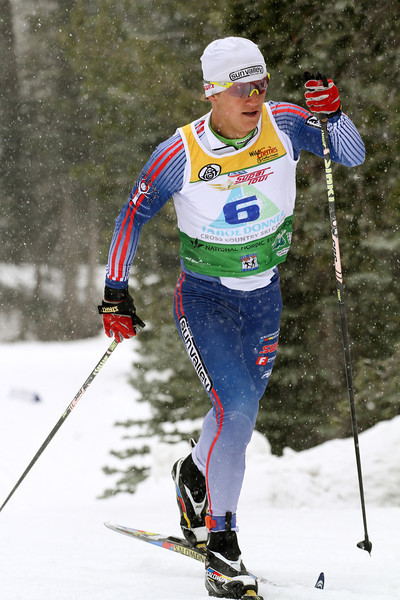
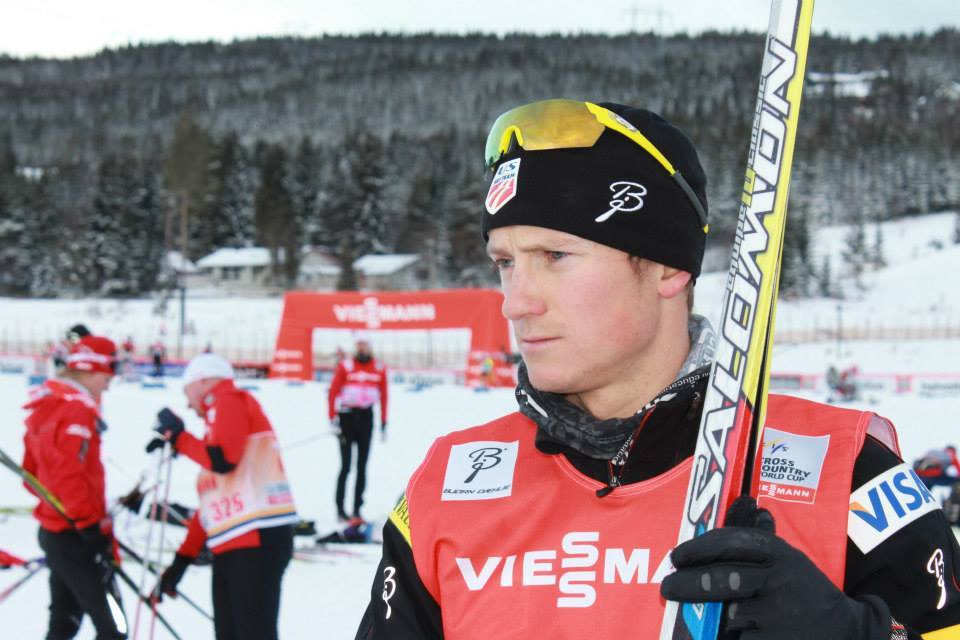
    Mikey Sinnott on the World Cup last December in Lillehammer, Norway. (Photo: Facebook/MWSC) https://www.facebook.com/maine.Winter.Sports.Center/photos/t.1309153346/10152451352903312/?type=3&theater
    Mikey Sinnott on the World Cup last December in Lillehammer, Norway. (Photo: Facebook/MWSC)

    A freshman skier in Sun Valley, Idaho, Mikey Sinnott was literally a foot shorter than the rest of the guys on his team, or so his longtime coach Rick Kapala says. Small but mighty, Sinnott came up through the Sun Valley Ski Education Foundation (SVSEF) junior ranks, making it to the Idaho youth championships and eventually winning two Junior National titles, and reaching Junior World Championships in 2004 and 2005 and U23 World Championships in 2006, 2007 and 2008.

    But before he was a globetrotter, Sinnott was a fighter — holding his own in a wrestling brawl with two dozen kids and a handful of coaches, an annual lighthearted tradition at the SVSEF. According to Kapala, who was always at the bottom of the pile, Sinnott was forever the last man standing. Everyone else would eventually give up, but not Mikey.

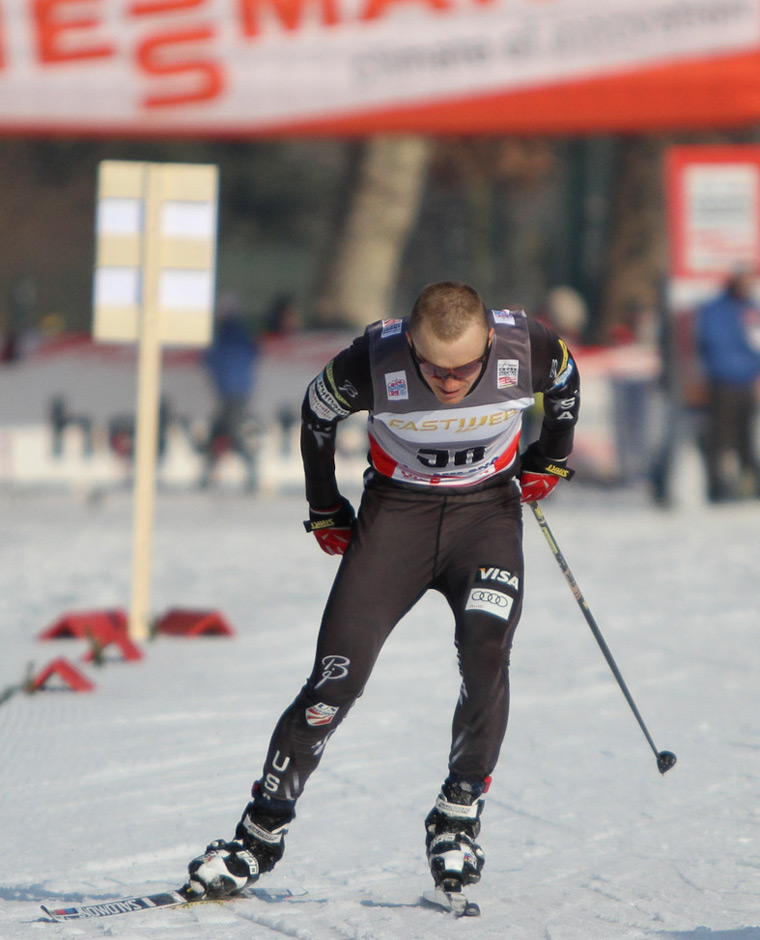
    Mikey Sinnott at the 2011 U.S. nationals classic sprint. (Photo: FlyingPointRoad/flyingpointroad.com)
    Mikey Sinnott at the 2011 U.S. nationals classic sprint, where he place second for a career best. He repeated the feat in 2012 with another silver in the classic sprint in Rumford, Maine. (Photo: FlyingPointRoad/flyingpointroad.com)

    “You could never pin Mikey,” the SVSEF head coach and nordic program director said. “He was the definition of scrappy.”

    As Kapala spoke those words on the phone Tuesday, he almost immediately retracted them. Sinnott would not want to be called scrappy, but that’s what he was. He didn’t tap out, Kapala said, he never quit.

    Looking back, he was glad Sinnott didn’t get overlooked like some U16s that haven’t reached physical maturity do. While Sinnott’s results and performances were promising, an outside coach observing him at a glance might not have picked him to achieve what he later would.

    But Sinnott understood the importance of grit, and paired with an academic gift that led him to study psychology and neuroscience at Dartmouth College, he had punched his ticket to success early on, Kapala said.

    His timing was also ideal. By the time he finished up at Dartmouth, where he was an NCAA All-American and named to the association’s Division I Skiing Championships Team all four years, Sinnott was ready for the big leagues, and his choice to return to Sun Valley was simple.

    They had started an Olympic development team (now the Gold Team) a few years earlier — an attractive option for a hometown skier looking to go pro.

    “At that point, I wasn’t going to go to northern Maine, I wasn’t going to go to the Midwest, I wasn’t going to go to Alaska — there weren’t really any other teams,” Sinnott reflected on the phone two weeks ago. “When I went off to college, that was one of Rick’s goals … to make the Sun Valley Ski Education program one of the cradle-to-the-grave programs like in Europe.

    “I think it’s been a very, very wonderful program,” he added after seven years on the team. “It’s been a model for how we need to start developing more in the U.S. Sun Valley was the model for what’s made the U.S. Ski Team [in the 1960s] … I think we continue to be that model and impress and improve.”

    In five seasons, Sinnott, now 29, amassed more than 20 World Cup starts. He claimed the overall SuperTour title in 2013 to start last season in Europe, where he raced seven of those World Cups.

    But last winter, starting in November, Sinnott didn’t feel anywhere close to on top of the world. He was fatigued and had been feeling that way since late October, yet he couldn’t pinpoint why. His legs lacked power, but he figured he could compensate with mental toughness, which some call ‘grit.’

    “I just kept telling myself that I had to make it work,” he said. “I never really had a lot of explosive energy in my legs for whatever reason, but I kind of knew that was the year, if I was going to fight through any stupidity, that was the year I had to do it … It was an Olympic year.”

    The Continental Cup leader who kicked his season off with the U.S. Ski Team (USST) in Kuusamo, Finland, Sinnott placed 74th in his first race (a classic sprint) and 113th in the 10 k classic the next day. By the end of the three-day series, he was 92nd overall.

    A few weeks later in mid-December, he spoke openly about not being in top form. But he still wanted to perform well at U.S. nationals and give his best shot at making the 2014 Winter Olympics in Sochi, Russia.

    At the same time, Sinnott, widely respected as a master of calculating points in the U.S., knew his domestic ranking wasn’t competitive enough to put him in the running for the Olympic team. If he wanted to make it to Sochi, his first Olympics in two Olympic cycles he’d been training through, he knew he needed a top 30 on the World Cup.

    The closest he’d come after Kuusamo was 78th in the classic sprint at Asiago World Cup in Italy. In late December, he returned to the U.S. for nationals in Utah, where he placed fourth in the 30 k freestyle mass start and fifth in the classic sprint. Even if he’d won all of nationals, Sinnott didn’t expect to make the Olympics. At the same time, he said anyone’s best chance was to ski faster than lone USST male there: Erik Bjornsen.

    “I knew how fast I was skiing and I knew I wasn’t going to beat him,” Sinnott said.

    “The U.S. Ski Team wants to do everything they can to not take any non-U.S. Ski Team members to the Olympics,” he added. “So I knew the only opportunity I had was to get a top 30 on the World Cup … That’s why I stayed [in Europe].”
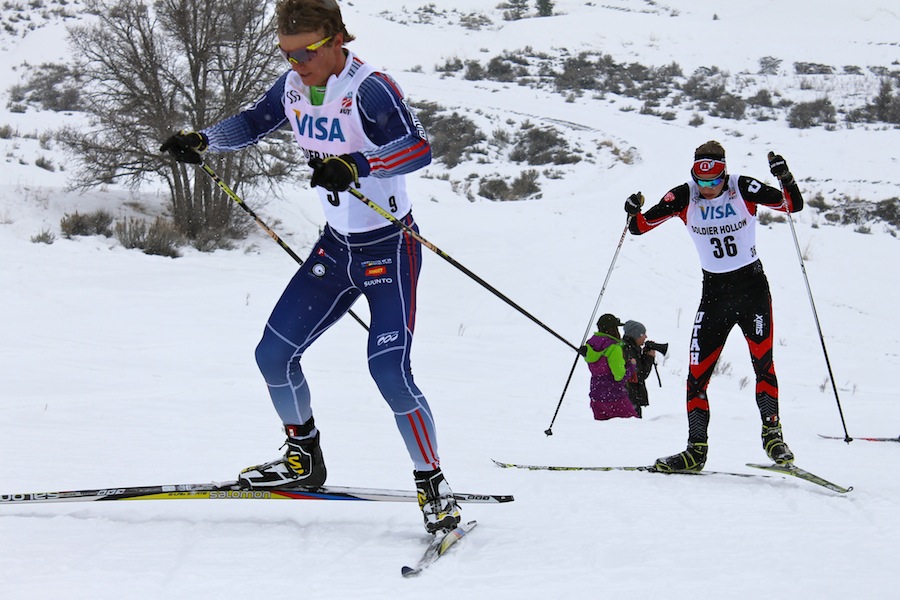
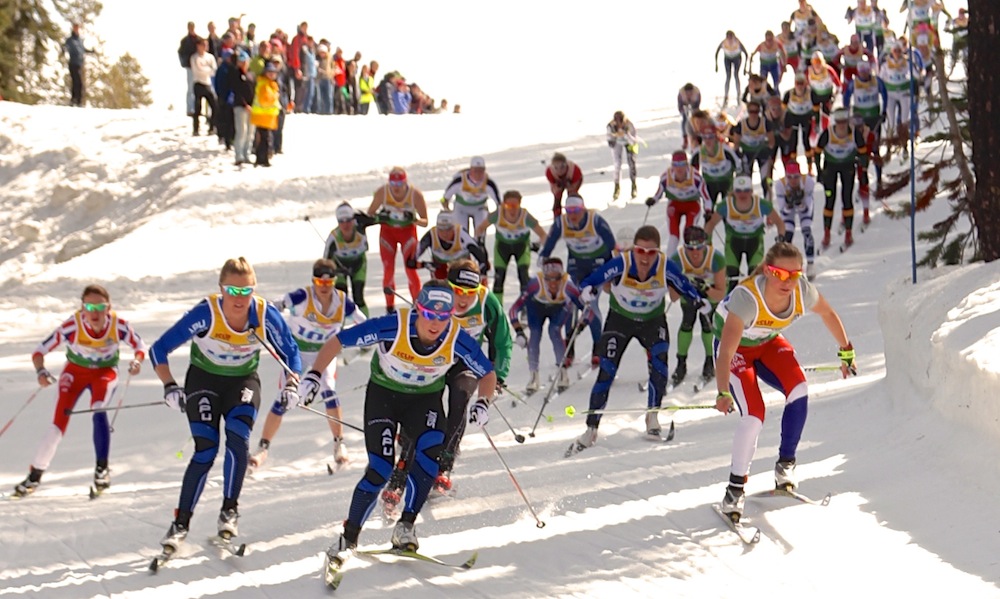
    Mikey Sinnott (l), of the Sun Valley Ski Education Foundation (SVSEF), climbs up and over a hill in the 30 k freestyle mass start at 2014 U.S. nationals. (Photo: Bert Boer - http://bertboyer.zenfolio.com) All proceeds from photo sales will be directly donated to NNF. Sinnott's former Sun Valley teammate Miles Havlick (5) leads the chase pack during the U.S. Nationals 30 k freestyle mass start while Sinnott (second from l) gets tangled on the way up. (Photo: Bert Boyer/All proceeds from photo sales donated to NNF)
    Mikey Sinnott (l), of the Sun Valley Ski Education Foundation (SVSEF), climbs up and over a hill in the 30 k freestyle mass start at 2014 U.S. nationals. (Photo: Bert Boyer/All proceeds from photo sales  donated to NNF)

    Olympic selections came and went, Sinnott wasn’t picked, and by the time February rolled around, he was back on the SuperTour circuit and feeling drained. He recalled one race in St. Paul, Minn., where he was skiing in the top three with four kilometers to go, and he was bored.

    “I was like, ‘I don’t know, maybe I should just drop out because I don’t even care,’ and that was kind of pathetic,” he reflected.

    He ended up third on the day, and later that month, placed 24th in the American Birkebeiner — an event, like nationals, he said he felt horrible in.

    “I’ve never just been so sluggish through an entire season like that,” Sinnott said. “It wasn’t an overtraining thing, but I just never felt that I had the spark.”

    He ended up eighth in the 2013/2014 SuperTour overall. Because he wasn’t among the closest contenders for an Olympic spot, he wasn’t crushed when he didn’t make the team. But his season did leave him with untied ends he would later have to reconcile.

    “There was no sudden crash or hope lingering on that some people were affected with because I had a better understanding [of the criteria],” Sinnott said. “When I was younger I thought, race your hardest and things will turn out well, and I quickly realized that wasn’t the case. You have to make your own luck and work your hardest because nothing’s going to be given to you … you have to force your way onto a team or force your way into a start race because you earned your way.”

    Change of Seasons, Change of Pace

    A couple Fridays ago, Sinnott was hanging up a piñata midday in his Sun Valley home. He wasn’t recovering from the morning’s training session with the Gold Team, and he wasn’t gearing up for an afternoon workout, either.

    Since last spring, he had been a working man in a different sense: marketing and writing for the Sun Valley Harvest Festival, one of the top 10 fall festivals in the country. And with the September festival in the rearview, he was prepping for a party at his place.
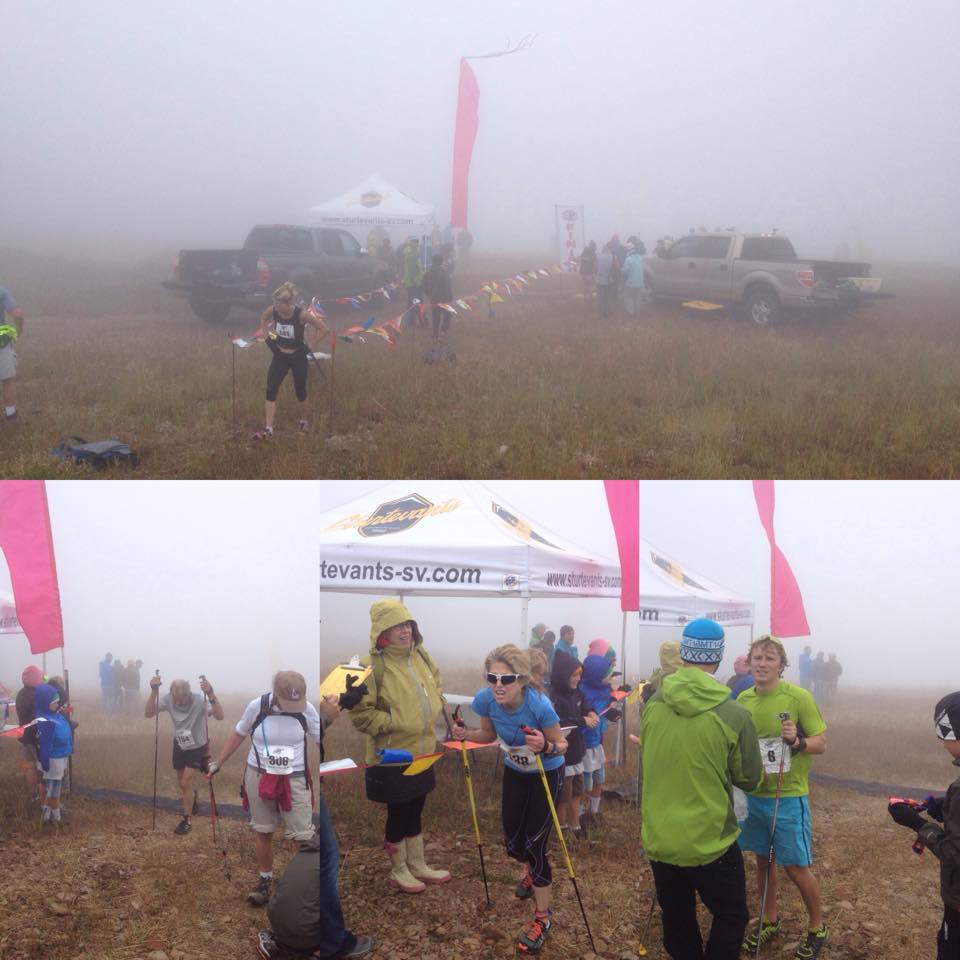
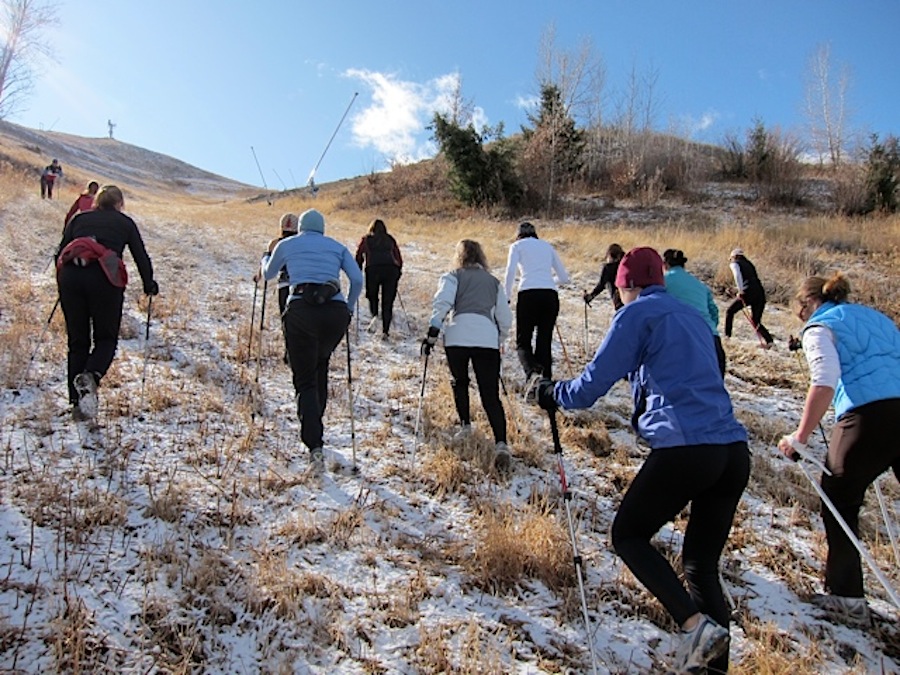
    Mikey Sinnott (lower r, in green) at the Sun Valley's annual Baldy Hill Climb, while Darlene Young (with poles, in blue) pushes on. (Photo: Facebook/Jon Engan) https://www.facebook.com/photo.php?fbid=10203960529367676&set=a.2885261424722.135136.1655738374&type=1&theater
    Mikey Sinnott (lower r, facing camera in green) at Sun Valley’s annual Baldy Hill Climb, while Darlene Young (with poles, in blue) pushes on. (Photo: Facebook/Jon Engan)

    He’d certainly been working out — just not in the traditional sense that he’d been accustomed to for the last seven years. He’d done the unofficial Ultimate Man.Ultimate Woman series, the brainchild of former Sun Valley coach Chris Mallory and a compilation of four local offroad endurance events: the Boulder Mountain Tour (30-kilometer ski race), Backcountry Run (16-mile trail run), Double Galena Grinder (45-mile mountain-bike race), and the Cheeso Double Baldy Hill Climb.

    The series ended Sept. 27 at the top of the 9,020-foot Bald Mountain, where Sinnott placed eighth on the day and fourth overall.

    Rather than run more than 3,000 meters to the summit, the ultimate men and women had to ascend it twice: biking up Baldy, riding the gondola down and running/hiking back up. Twenty-five people started the series, four finished, and among them, Sinnott skied the fastest time in the Boulder Mountain Tour (BMT) and notched the second-fastest time in another event. He lost an hour in the mountain-bike race and was down to fourth — last — by the end of the series.

    “Running after you bike is awful,” he said. “Eleven months ago, I signed up for [this] race series … I know I’m not going to do it again.”

    Meanwhile, after the BMT in February and before the Backcountry Run in July, Sinnott decided whether to continue ski racing through 2014/2015. Still unsure exactly what went wrong last winter — he tried to rest more; he tried to train more — he reasoned it was worth stepping back and trying to put everything back together, and started training again in May.
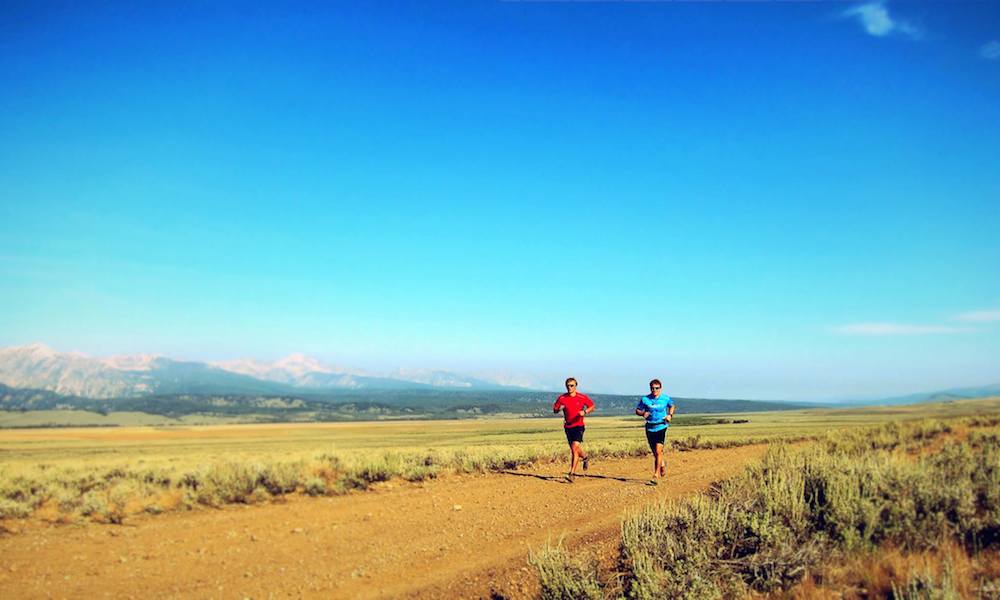
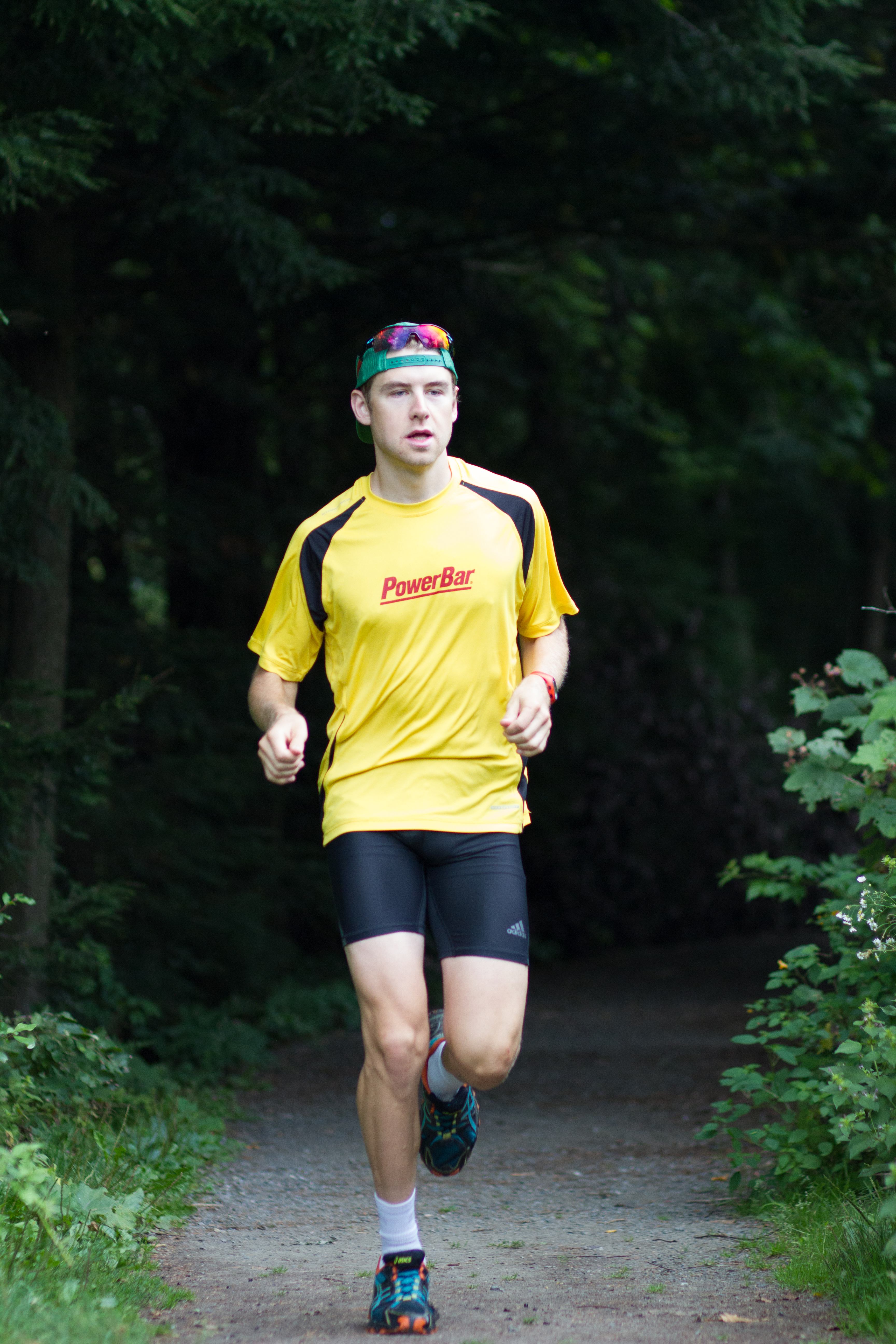
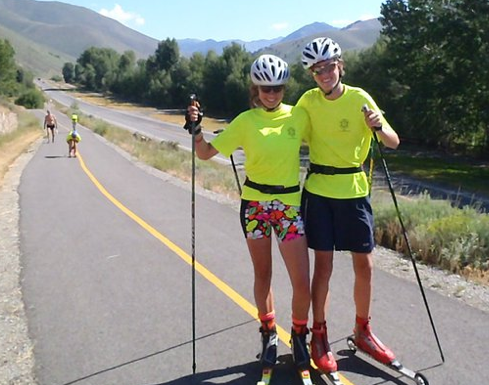
    Sinnott and Miles Havlick during an August 2013 training run through the sagebrush in the Upper Salmon River Valley, Idaho. (Photo: Facebook/Miles Havlick) https://www.facebook.com/mileshavlickxcskier/photos/t.1309153346/565991460102601/?type=3&theater
    Sinnott and Miles Havlick during an August 2013 training run through the sagebrush in the Upper Salmon River Valley, Idaho. (Photo: Facebook/Miles Havlick)

    It didn’t take long until he realized he wasn’t having fun anymore.

    “I just wasn’t enjoying getting out the door anymore,” he said. “If there wasn’t someone waiting for me, then I wasn’t motivated to go exercise on my own.”

    Reasoning he was “fighting an uphill battle in an uphill sport,” Sinnott said it wasn’t worth wasting his time or his coaches’. Kapala said they sat down and talked about it.

    “We sort of sensed it was coming,” Kapala explained. “There’s a natural lifespan to cross-country careers. Mike was certainly of the caliber that he could’ve chosen to ski another year or two years — I don’t think we would’ve seen any drop off in his production … but I think he looked at it like he was trying to make this Olympic squad …

    “I said, ‘You’ve had an exceptional career in ski racing,’ ” he added. “ ‘You really think the experiences in total that you’ve had in ski racing would be that much enhanced by slugging it out for another four years?’ He was already like, yeah, I think it’s time for some new challenges.”

    Sinnott said conversations with Gold Team head coach Colin Rodgers also helped open his eyes to where he stood mentally.
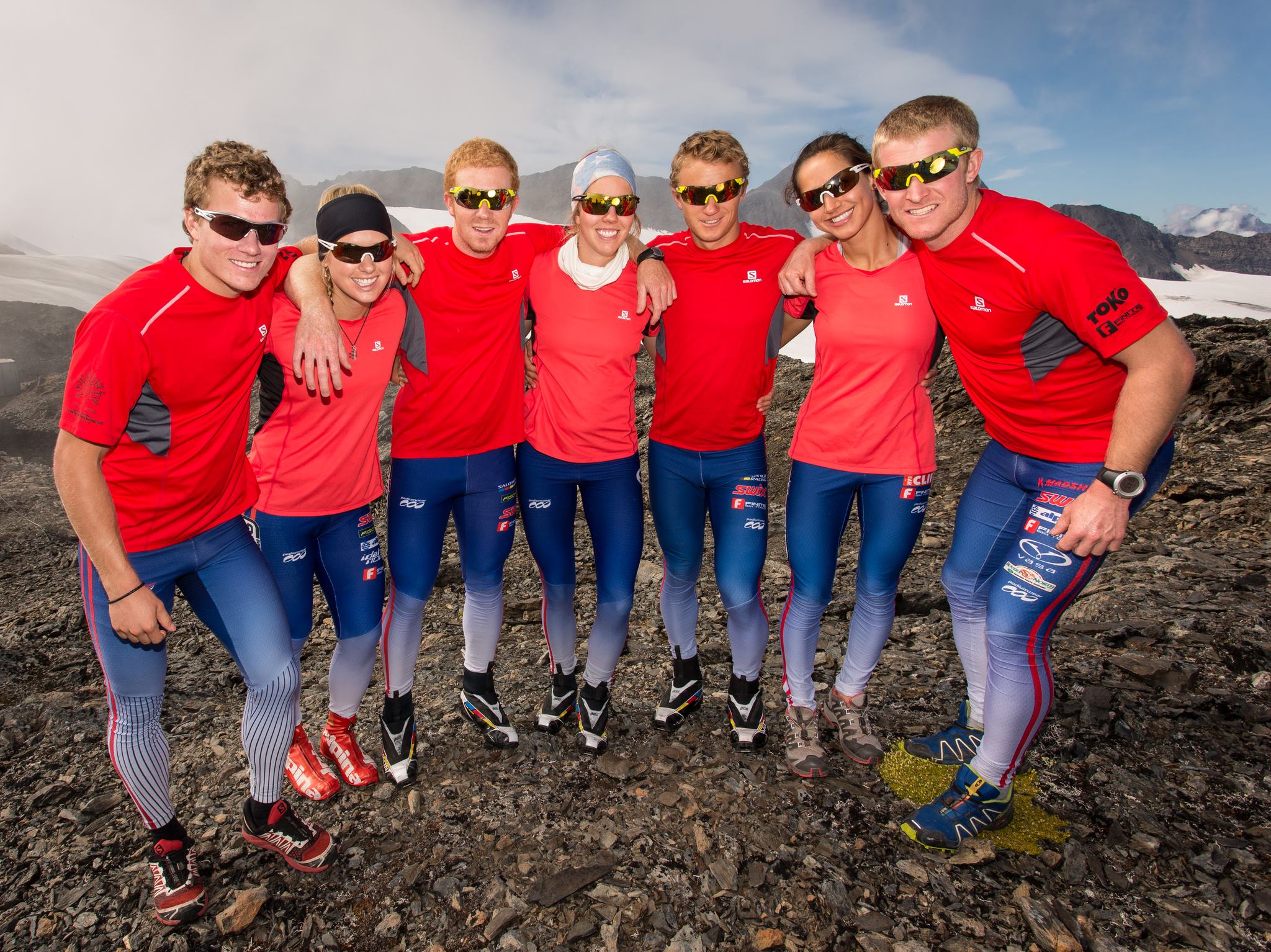
    Last season's Gold Team, with former skiers Sinnott (third from r) Chelsea Holmes (now at APU, second from r), and Rose Kemp (retired). (Photo: Facebook/SVSEF Gold Team) https://www.facebook.com/SVSEFXCGold
    Last season’s Gold Team, with former skiers Mikey Sinnott (retired, third from r) Chelsea Holmes (now at APU, second from r), and Rose Kemp (retired, second from l). (Photo: Facebook/SVSEF Gold Team)

    “He’s been saying for the last year I just didn’t have the same personality with skiing,” Sinnott said. “And I saw him recently and he thought I’d recovered into my old self. Rick’s super supportive … and they all just care so much. All my coaches just want what’s best for me.”

    Sinnott’s Favorite Moments:

    (as written in an email)

    “A few highlights for myself were the Dartmouth College National Championship, winning the Boulder Mountain Tour, my first European World Cup in Milan, and racing the Holmenkollen. Lots of memories, but those were special for a variety of reasons:I loved collegiate racing. It is the best domestic race series we have. Such comaraderie, and racing for something bigger than yourself. I loved how much of a team we were, and how meaningful it was to so many people to bring home the National Championship. Our school, our alums, the East Coast. I even remember heading straight to U23s while they were still tabulating the scores, and upon arrival getting a hearty cheer from Pat Casey. He was so proud to see a group of Americans, all under 23, be the top team.  It showed US skiing was on the rise, and we didn’t have to look up to the Euros anymore. It was a pretty cool feat, and an incredible group of people to be a part of. I think there were three or four future Olympians, and two future World Championship runners.
    Winning the Boulder Mountain Tour was special because it was my first real professional title, and it was in my home town, in front of family and friends.  Wow. Such a special moment to represent them. My home town is beyond supportive, and it feels great to show them what they are supporting.
    Of course skiing in Milan was all together unreal, and a wonderful new persepective on what could be achieved through skiing. I remember seeing Kikkan on the podium, and seeing her mobbed for autographs. I remember seeing lots of the U.S. team being mobbed for autographs. Riding the bus with all the world elites, joking with them (okay, Simi joked with them, I gawked a little), being in such a world center and to have it lined with fans of nordic skiing.  Wow. I thought it couldnt get any better… But oh did it.
    Finally, racing the Holmenkollen. I had a terrible race that day, and was well out the back from the get go. It was slushy and slow. I loved every minute of that suffer slog. The course was lined by thousands of fans who had camped out for days. They were chanting my name around every corner, before I was even in sight. There was such energy and appreciation and excitement, it was beyond contagious. They willed me onwards no matter how tired I became. I cannot express what that felt like, to be among the worst in the race, and still have this wall of humanity urging you and screaming for you. Wow.  Those Norwegians do it right.
    A lot of my best memories come from the people I met, and the people I shared my career with.  I could list a multitude more stories, but they mostly center around the people and how their interactions left an imprint on me. I stayed and raced for a week with a Norwegian racing team — so generous, so kind. Erik Stange took me for a ski tour outside Lillehammer that ended at a waffle house, only available via skiing. Last season, a friend came to watch me race in Davos and brought a huge poster that had personal remarks from a dozen or so close college friends encouraging, and cajoling me. It was great.”

    Looking back, Sinnott had a long list of career highlights: Dartmouth’s national championship, winning the 2008 BMT, his first European World Cup in Milan in 2012, and racing at Holmenkollen that same season.

    “I loved collegiate racing,” he explained. “It is the best domestic race series we have. Such camaraderie, and racing for something bigger than yourself. I loved how much of a team we were, and how meaningful it was to so many people to bring home the National Championship.

    “Winning the Boulder Mountain Tour was special because it was my first real professional title, and it was in my home town, in front of family and friends,” he added. “Such a special moment to represent them. My hometown is beyond supportive, and it feels great to show them what they are supporting.”

    And that’s why he planned to stick around town and help out while he plans his next move. Throughout the offseason, Sinnott has been working with U18 skiers and younger on the SVSEF Comp Team, shadowing them during workouts to push and motivate them a few times a week.

    “He’s getting ready to transition to the next phase of his life … [and] he’s taking this year to give back to our program,” Kapala said. “We’ve got this group of ten kick-ass U18 guys — think of that workout when they’re going out for this hour-and-a-half roll and Mike is embedded in that workout with them. … That’s huge.”

    Kapala said his program reserves some money for guest coaching, and while it’s not much, he knew Sinnott would do it for free.

    “I’ve been blessed with the coaching that I’ve had over the years … [with Kapala, Ruff Patterson in college, Travis Jones and Rodgers on the Gold Team],” Sinnott said. “I know that I don’t have some of those characteristics especially at a youth level … I don’t have the consistency day in and out required of a quality coach.”

    So he doesn’t necessarily envision himself as a full-time coach one day, but he’s happy to jump in as needed.

    In the meantime, he said he’ll be taking the next year to figure out his new career path and will continue to work with the Sun Valley Harvest Festival through the winter. He started the job in May as a means of keeping him mentally stimulated while training. When he stepped away from skiing in late May/early June, he began to call it his career.

    Sinnott spent the next several months focusing on the leadup to the festival and coaching on the side. He create a life plan beyond that, but he has a few ideas.

    “I thought I was going to map [it] out this summer —  that never happened,” he said. “I want to know exactly what I want to do before I start looking into grad school. Since I graduated, neuroscience has become a more popular field among the smarty pants of the world, and my brain has atrophied…”

    He has yet to find out what that field holds for him, but above all, Sinnott remembers enjoying school, the curriculum, “the knowledge, and the horizon they presented with some of the unknown,” he said.

    He has a Sun Valley mountain pass this winter, so he figured he’d take some downhill runs on powder days to sort it out. This month, he headed east for 10 days for a wedding in New Hampshire.

    “I’ll bring running shoes, but I don’t have to bring rollerskis, so that’s a plus,” he noted.

    And while he might travel a bit, and give races like the Birkie another try (at a more leisurely pace), he’ll continue to call Sun Valley his home.

    “I’ve traveled around and looked at various places and there’s nothing compared to here,” he said. “The Norwegian national team, they [came] here before the Olympics in Salt Lake and Vancouver, and they say this is the perfect training place.”

    And the team has been an integral part of his experiences.

    “It’s always been, the team I want to hang out with on the [domestic] circuit is Sun Valley,” he said. “They’re good people that I have fun with.”

    Leaving the Gold Team, which includes Miles Havlick, Matt Gelso, Ben Lustgarten, Mary Rose, Makayla Cappel, and Paige Schember, Sinnott said it’s in a good place.

    “[That’s] the best team in the country this year. They’re unbelievable,” he said. “There’s definitely times where I’ll see time trials and I’ll say, ‘Oh man, I wish I could be out there.’ If I wanted to be out there, I would be. It’s not like anyone told me no, I just don’t want to be out there anymore. It’s been really good to be more social and adventure with friends. I haven’t really second-guessed it.”

    Kapala said Sinnott could be the poster child of how to have a great life ski racing, which is why it’s so valuable having him around.

    “I’ve learned way more as a coach from Mike than Mike has learned from me,” he said. “I never got the sense that Mikey was just in it for results. Because of that, you get the kind of guy who’s perspective on the sport is really helpful and powerful and now he’s out there training with our juniors. … That’s another piece of us really getting somewhere.”

  • After Retiring from Pro Cycling, Durtschi Turns to Biathlon

    After Retiring from Pro Cycling, Durtschi Turns to Biathlon

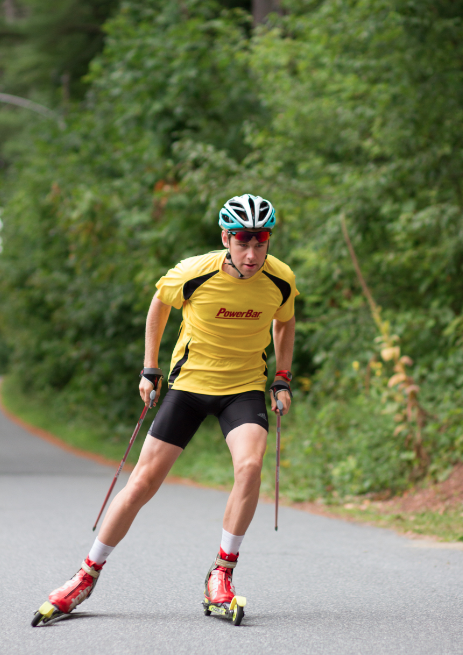
    After four years of professional cycling Max Durtschi has made the decision to join the biathlon  community. (Photo: Max Durtschi)
    After four years of professional cycling Max Durtschi has made the decision to join the biathlon community. (Photo: Max Durtschi)

    Max Durtschi is goal-oriented individual. So when the Sun Valley native retired from professional cycling in 2014, he decided that he needed a new endeavor.

    That endeavor became biathlon.

    It’s no surprise that Durtschi returned to nordic skiing. Under the guidance of coach Rick Kapala, he found success on the national and international level as a junior skier.

    However, by the time Durtschi reached his senior year of high school he had started to explore other avenues of his athleticism.

    An avid biker in the summers, Durtschi raced in the 2009 Junior National Championships and walked away with two titles in the Road Race and the Criterium. Not only did he win both races, he did it with a fractured right hand.

    After his two national championships, Durtschi began to race professionally and moved to Boulder, Colo. to train for cycling full-time.

    He was a member of the U.S. National Team for the next four years, and had the opportunity to train both domestically and abroad.

    Durtschi spent his first two seasons riding for Garmin-Cervelo’s continental program. While he was primarily based in Boulder, he rarely spent time in the U.S. as he was racing in Europe for most of the year.

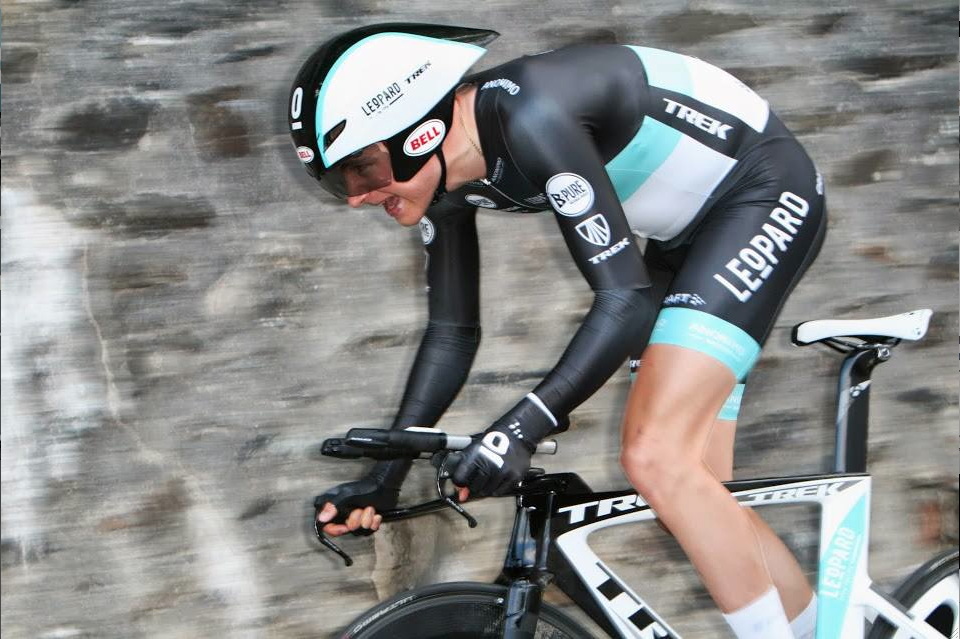
    Max Durtshi spent his last year professional cycling with the Leopard Trek Team in Europe. (Photo: Max Durtschi)
    Max Durtshi spent his last year professional cycling with the Leopard Trek Team in Europe. (Photo: Max Durtschi)

    After his two seasons with Garmin-Cervelo, Durtschi made the move to Europe so that he could be closer to the action. Last year he was part of the Leopard-Trek cycling team and was based in Lucca, Italy. Of the 11 nationalities boasted by the Trek team, Durtschi was the only American.

    Durtschi said his experience as a professional cyclist was one he would never forget.

    “It was a great experience,” he said in a phone interview. “I got to race in North and South America, Europe, Africa, and Asia. I got to meet and spend time with a lot of great people.”

    Cycling was also a learning opportunity for Durtschi. Not only did he continue to discover the joys of of the sport, but he also learned Italian, French and some Dutch.

    He also began to understand more about himself as an athlete. When confronted with a variety of different attitudes toward training, Durtschi realized the importance of being in tune to his personal needs.

    “The way the different nationalities approach the sport and training and racing is very different than what I grew up with. It really enforces the need to be true to yourself and to trust in your own preparation and process on race day,” he explained.

    While Durtschi was very grateful for all that his cycling career had given him over the years, something was missing.

    “The focus of the past five years had been cycling and I was ready to experience new things,” Durtschi said. “I was ready to be a college student, I wanted to get back to being in touch with friends and family, and I wanted to get back to being active in a way that wasn’t just solely cycling.”

    So when the racing season ended after the fall of 2013, he reevaluated his priorities and made the decision to return to Dartmouth College as a full-time student, where he had been attending school in the off season since 2010.

    However, ending his cycling career wasn’t without its challenges. Even as a busy pre-med student studying neuroscience, Durtschi still found himself with ample time on his hands.

    “It was daunting at first because my slate was quite open,” Durtschi said. “I’m a goal-oriented person and I wasn’t building up for a season or anything like that so it was a little scary. I focused on school and connecting with people.”

    This past winter, Durtschi began skiing frequently once again. Given his status as a former professional athlete whose salary was paid by corporate funds, racing for the Dartmouth ski team was out of the question. However, biathlon had always been in the back of his mind since his junior skiing years and it seemed as if all signs were pointing him in that direction.

    “There was a point this winter where some strange, serendipitous things happened that cued me in to give it a shot,” said Durtschi.

    He reached out to the U.S. Biathlon Association (USBA) and kept in contact with the organization throughout the rest of the winter and spring.

    Then in June, Durtschi was invited to the U.S. Biathlon Talent ID Recruiting Camp in Lake Placid, New York where he enjoyed the training atmosphere created by the team.

    Max Durtschi's goals for the upcoming season include improving his fitness and marksmanship. (Photo: Max Durtschi)
    Max Durtschi’s goals for the upcoming season include improving his fitness and marksmanship. (Photo: Max Durtschi)

    Currently, Durtschi is attending the joint U.S. Ski Team and USBA Camp in Lake Placid and will train at the Olympic facility for most of September.

    Durtschi said that there are many challenges that come with starting as a new biathlete.

    The Idaho native participated in sport shooting from a young age, but the rifle used in biathlon has proved much different. In addition, he said that shooting while skiing is even harder than it looks.

    “It’s been a fun challenge and I have a whole new level of respect for biathletes,” he said. “The targets are small and the challenge of shooting when your heart rate is high and you’re breathing hard is a whole different level.”

    For now, Durtschi plans to return to Dartmouth in the fall where he will attend classes and continue to train for the upcoming season.

    He will then take time off during the winter term in order to focus on his skiing and shooting. While Durtschi has a wealth of competitive experience under his belt, the Dartmouth junior is realistic about his first season racing as a biathlete. His main goals include continuing to improve his shooting and fitness. Once he’s done as much work as he can on those fronts, he plans to see to see where that takes him.

    “Right now my two main goals are to keep improving my fitness and improve my marksmanship. I’m hoping that it will lead to some exciting opportunities this winter,” Durtschi said when asked what his goals were for the upcoming season.

    “I don’t know what this season will look like. I’m just trying to keep my options open in terms of racing opportunities and hopefully I can make some big improvements this winter,” he said.

  • Wednesday Workout: APU’s Chelsea Holmes Breaks Down Strength Training

    Wednesday Workout: APU’s Chelsea Holmes Breaks Down Strength Training

    Chelsea Holmes performs a single-leg squat with her back foot on a plyo box. (All photos courtesy of Chelsea Holmes)
    Chelsea Holmes performs a single-leg squat with her back foot on a plyo box. (All photos courtesy of Chelsea Holmes)

    This week’s workout comes from Chelsea Holmes, who recently joined the Alaska Pacific University (APU) Elite Nordic Team after three seasons with the Sun Valley Ski Education Foundation in Sun Valley, Idaho. Originally from Girdwood, Alaska, Holmes, 27, returned to her hometown glacier earlier this summer as one of 14 of women with the North American Women’s Training Alliance — a U.S. Ski Team camp held annually in Anchorage and on Eagle Glacier. Below she gives a detailed explanation of what she does to build strength and work on her weaknesses.

    ***

    My Strengths (and many weaknesses)!

    Strength training should be an important staple in every endurance athlete’s regimen. It is important to note that the weight, duration, number of repetitions and sets are all individual and should be catered around the individual’s experience, age, and training plan. The quality of technique should be priority, and only when comfortable and confident in an exercise should an individual attempt maximal exercises.  Additionally it is recommended to have a partner to spot and assist in these exercises.

    My strength sessions often address numerous muscle groups and modes of training and development within a single session. This is due to the irregular and intense nature of cross-country ski training and the time constraints in a week.

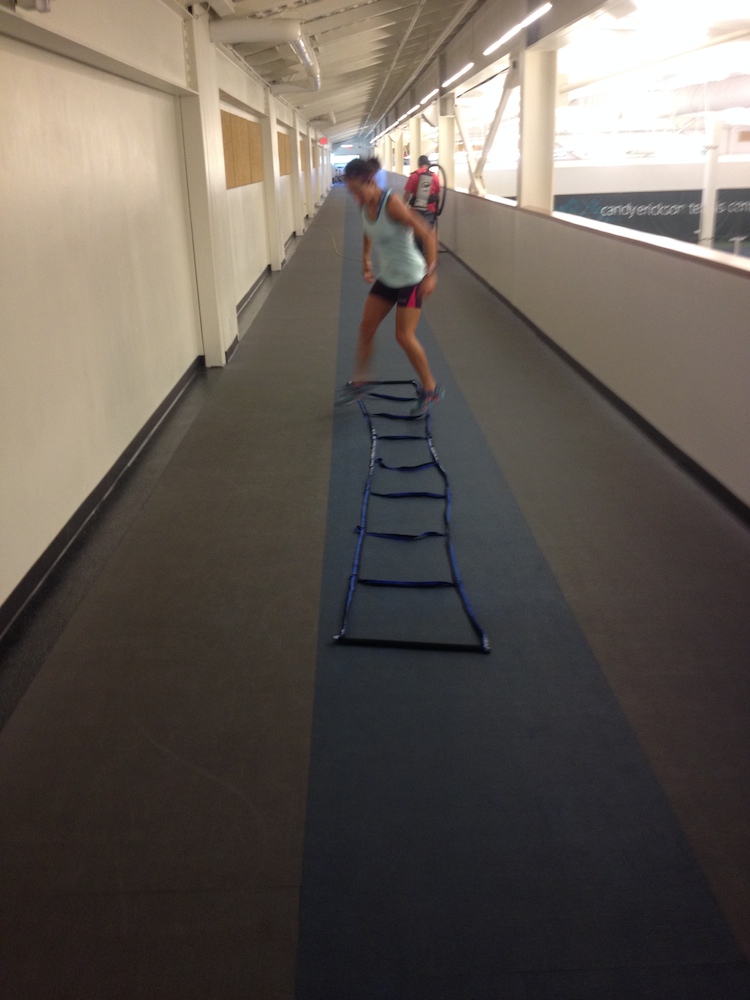
    Chelsea Holmes working on some ladder drills (Courtesy photo)
    Chelsea Holmes working on quickness with some ladder drills (Courtesy photo)

    My current routine includes:

    – Focus: Maximal-strength exercises where the load is high and the repetitions are low.

    – Quickness (often incorporated into my warmup): I like to spend some time during the workout doing either drills on a speed ladder (shown above) or jump rope. When jump roping, focus on speed and the power coming from your calves. Try 30 on both legs before moving to 15 per single leg.

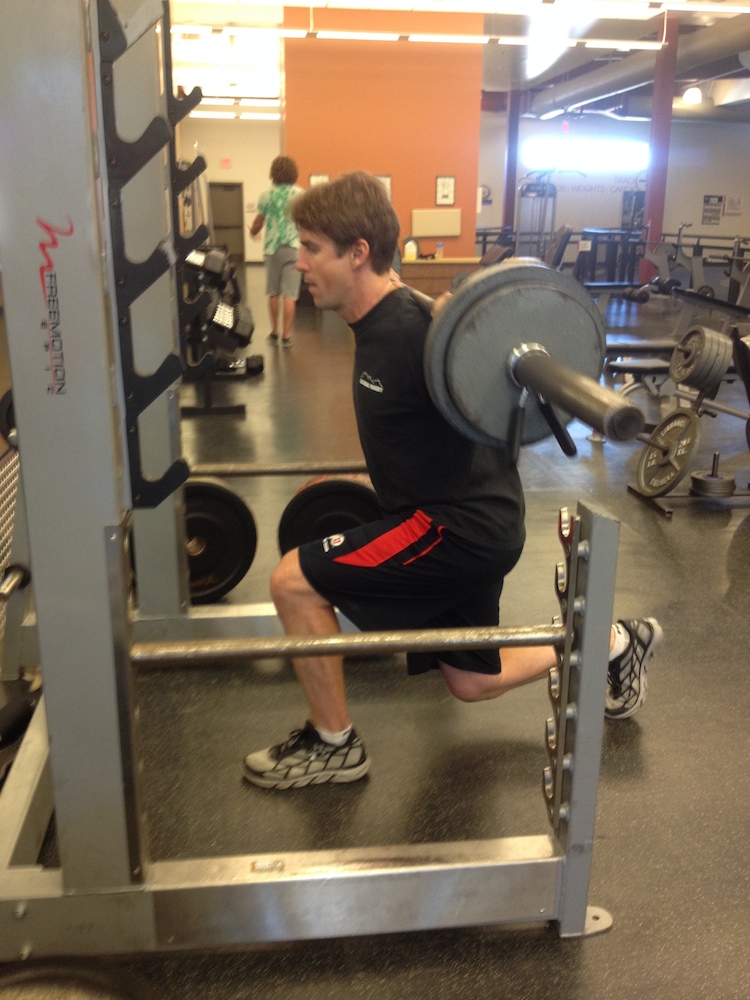
    Single-leg squats (All photos courtesy of Chelsea Holmes)
    Single-leg squats with back leg on floor, back toes pointing down

    What: Single-Leg Squats

    Position: In a standard-squat rack, put a reasonable weight on the squat bar. Lift the weight and once set and balanced, place one foot back behind you on a low stand with your foot perpendicular to the floor (useful tools: plyo boxes, stools), or, as shown at right, just place your back leg on the floor with your toe facing down. While keeping your front knee inline over your toe (no twisting or caving medially) perform a squat motion. Switch sides!

    The front leg should be the source of power, felt in the quadriceps, hamstring and gluteus. The back leg is there only for stability and balance. This should be felt in the quadriceps, hamstring, and gluteus. If you feel the need to use your back leg when powering up, go down in weight. Do not bend forward at the waist, or try to lift with your back.  Your core acts as a stabilizer here.

    Why: I have been using single-leg exercise because in the past I have noticed a personal tendency to favor a leg and compensate. I also use the single-leg squat as it should stimulate the intrinsic muscles as there is a balance component to the exercise. Maximal exercises develop the time to peak force, efficiency and maximal power.

    Note: After comfort and proficiency have been developed, try to superset this exercise. I will sometimes perform a set of 6-8 jumps (high jumps onto a plyo box, tuck jumps or skate jumps) directly after each set.

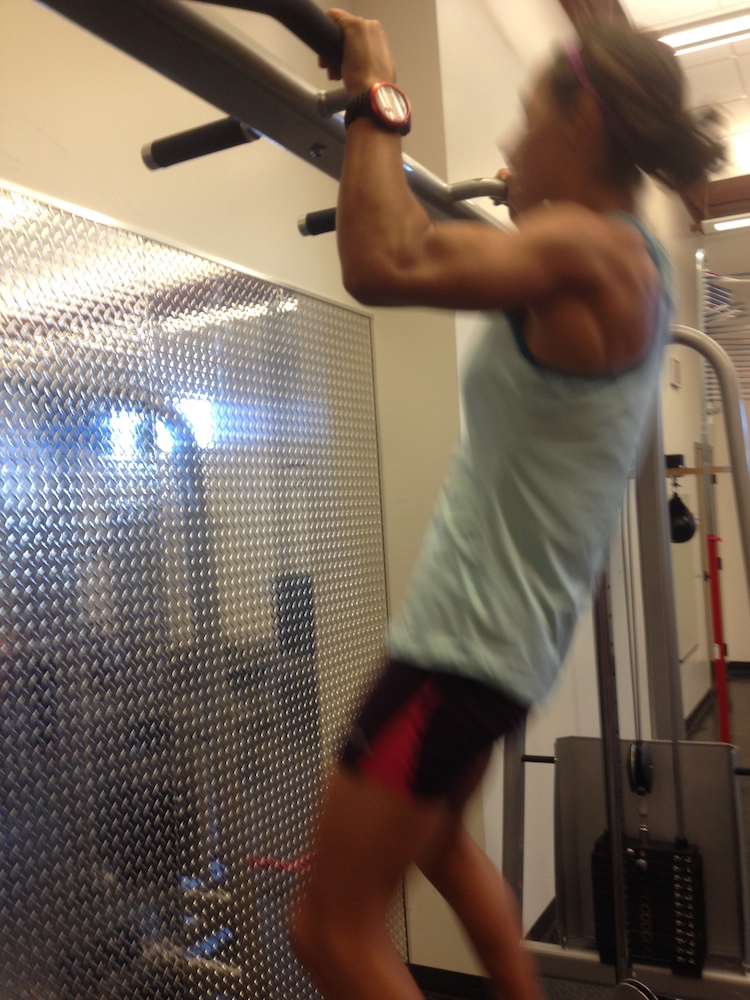
    Chelsea Holmes demonstrates a standard pull-up.
    Chelsea Holmes demonstrates a standard pull-up.

    What: Pull-Ups

    Position: A standard pull-up (shown above). The important cues to note in this exercise are full range of motion, a wide enough hand position that you are engaging your latissimus fully and minimal swing.  I most often use an overhand grip.

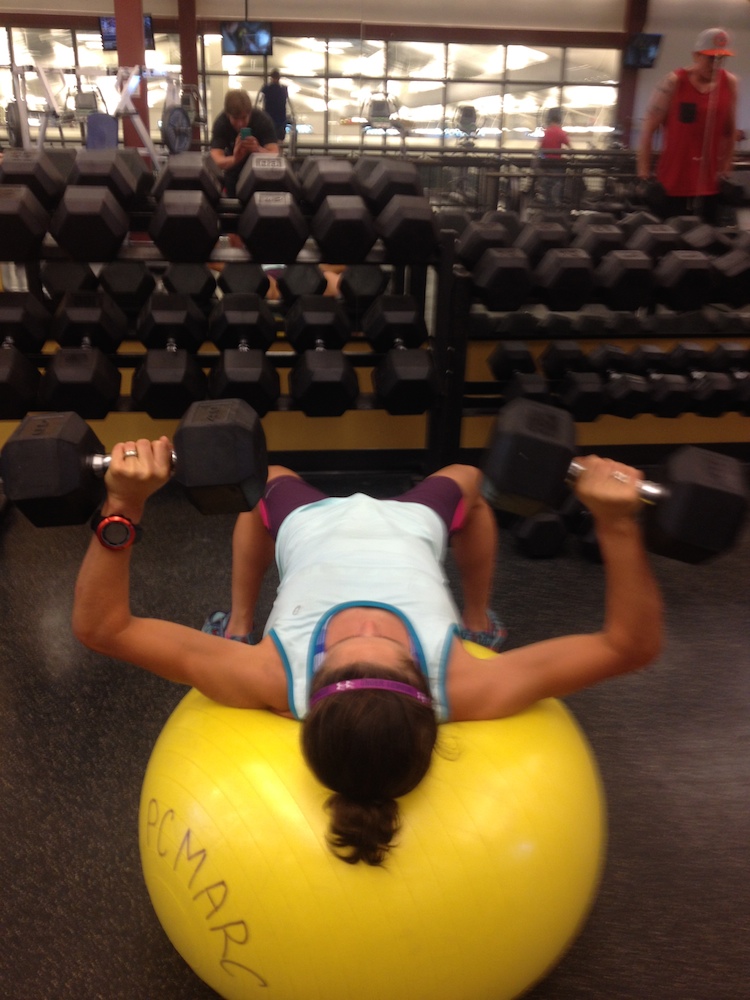
    Dumbbell press on a Swiss ball, as demonstrated by Chelsea Holmes
    Dumbbell press on a Swiss ball, as demonstrated by Chelsea Holmes

    What: Dumbbell Press on Swiss Ball

    This is a simple a bench press (shown above), only using dumbbells and instead of laying on a bench you are supported by laying with your upper back centered on a Swiss ball and feet planted in a stable position. From a sitting position on the Swiss ball, roll yourself forward on the ball so that the ball is centered underneath your upper back with your feet planted firmly and your core held in a plank position (of course, chest face up here!), perform a standard press.

    Why: There is so much focus on posterior exercises in skiing that it is important to ensure a balanced body.  I like the addition of a swiss ball because it adds a component of balance and core.

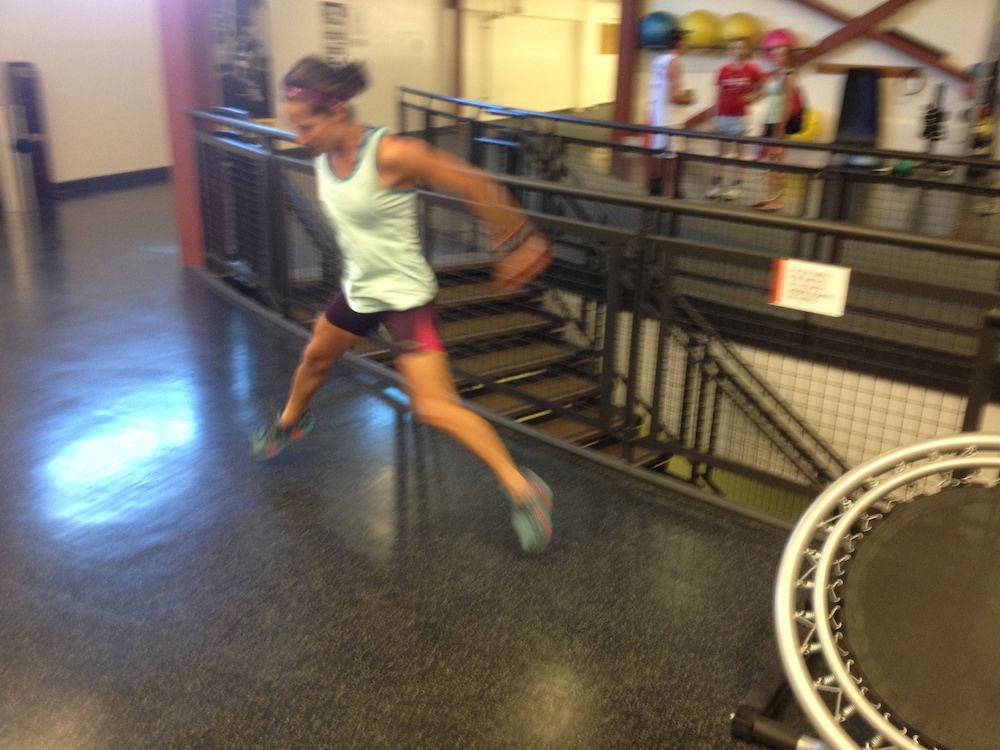
    Skate jumps with Chelsea Holmes
    Skate jumps with Chelsea Holmes

    What: Skate Jumps (above) — a lateral jump focused on developing quickness, power and stability. Do this exercise in front of a mirror to help focus on technique.

    Position: While standing on a single leg sink into the leg before exploding up and over lateral to the opposing leg.  Through the landing on the opposite leg, try to control the forces and stay balanced. Through the landing phase, you should end up in the starting position for the next jump. The jump should come from the forefoot.  Use your upper body mimic a powerful skating motion.

    What: Balance

    1. Single-leg squats on a Bosu ball or instability disk. (If using an instability disk, you might have to place the disk on a small box to allow for the range of motion through the squat.)

    In front of a mirror, stand one footed on a Bosu ball with the platform down. Place the foot, toe slightly turned out, with the ball of the foot being placed on top and in the center of the dome or disk.  Balancing on that foot, slowly perform a squat to a comfortable and stable depth. A broom handle held across the shoulders parallel to the floor can be a useful tool to ensure no twisting or leaning. The focus is balance, so really focus on minimal teetering and extraneous movement. When first beginning these, simply spend a few sessions doing half squats or just practice standing on one leg.

    These are not only great for balance but also the many stabilizer muscles that are extremely important but easy to forget about.  This exercise is great to practice breathing and total focus — it’s easy to get distracted in a busy gym! I prefer to do these in the second half of my workout when my body and mind begin to tire — mind over matter!

    It’s easy to get distracted in a busy gym! I prefer to do [single-leg squats] in the second half of my workout when my body and mind begin to tire — mind over matter!

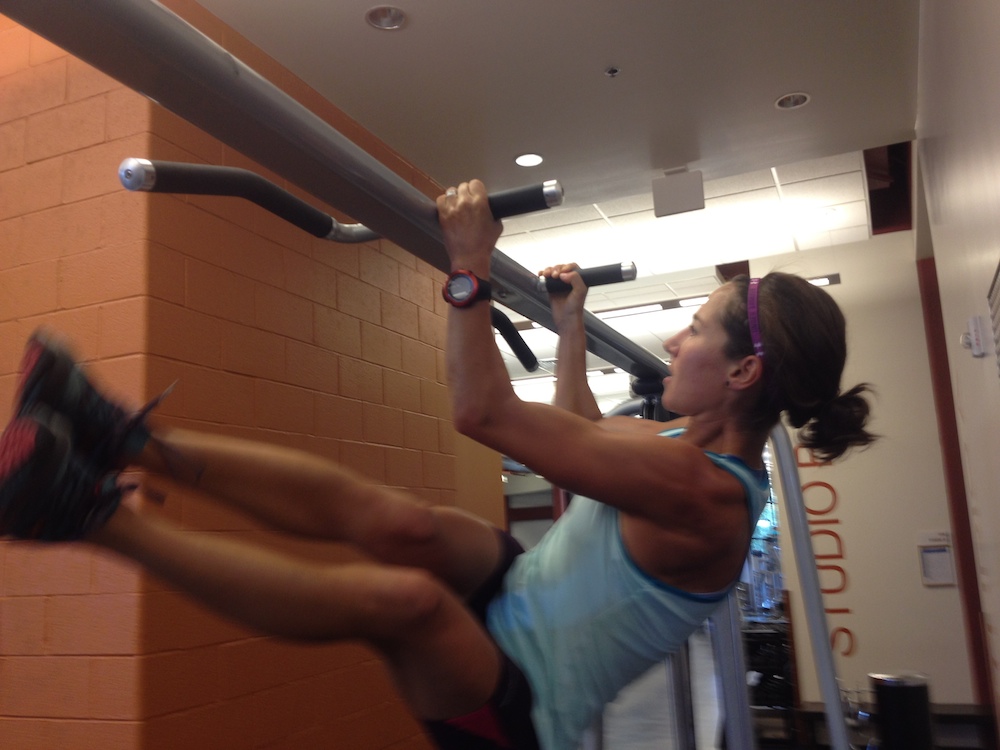
    Chelsea Holmes working on core with a leg raise and twist from the pull-up bar
    Chelsea Holmes finishes up some tough sets while working her core with a hanging twist. “Basically you pull up so that your elbows are at a 90 degree angle and the hold yourself there while bringing your legs up vertically (so that you are somewhat folded in half),” she explained in an email. “Then while holding your core strong you move your legs in a window-wiper motion… Only go so far to one side as you can feel your core then back the other side (so that your toes draw a full rainbow, back and forth, that’s one). I am not as strong, so I try to do 4-5 total.”

    What: Core

    1. Pikes — Either a TRX or a Swiss ball can be used in this situation.

    Position: Place yourself in a plank position with your feet either in the TRX stirrup (toes down) or if using a Swiss ball, place the top of your foot on the ball.  Your hands should be planted beneath your shoulders, palms against the ground and arms straight, similar to a push up position.

    Exercise: Bring your body into a pike position with as little arm and knee bend possible, return to plank, now bring your knees underneath your body, driving the opposing knee to opposing elbow. The knees should bend together and twist so that you feel a rotational core component. To get the most out of this exercise, don’t rush it!  Perform it in a controlled manner and with purpose.

    Why: I really like this exercise because it is full body, and no matter how many times I do it, it is always a challenge.  It has an isometric, concentric and eccentric component. Bang for your buck!

    2. Garhammers (video demo)

    Position: Hang from a pull-up bar with straight legs. Start by bringing you knees up so that your quadriceps are parallel to the ground, this is where the exercise starts and finishes for each repetition. Then drive your knees upwards by rotating your pelvis forward and focusing on your core making that movement.

    Please note, there is not a tremendous range of motion with this exercise. If you feel you are ready for a more advanced version of this exercise, after driving your knees up, straighten your lower legs and lower your legs slowly back to parallel.

    3. Alternating Push-Ups

    I truly despise pushups so I think I gravitated to this style because it is much harder for me than standard push-ups and as such I cannot do as many.  This is not a cop out, these are tough.

    Position: From a standard pushup position, move your right hand back along your body so it is planted below the bottom of your rib cage (it is placed next to your body, not away from it), while leaving your left hand up slightly away from the shoulder.  When you lower yourself into a pushup your upper right arm should track back parallel against your body so that it targets not only the front deltoid but your triceps as well.  Your left arm will track as it usually does in a standard push-up.   Start with 5 per side before switching.  If you feel your core begin to sag, move to your knees- I always end my sets worn out and doing the last push ups from my knees.

  • Sun Valley’s Vamps: No Ordinary Masters Program

    Sun Valley’s Vamps: No Ordinary Masters Program

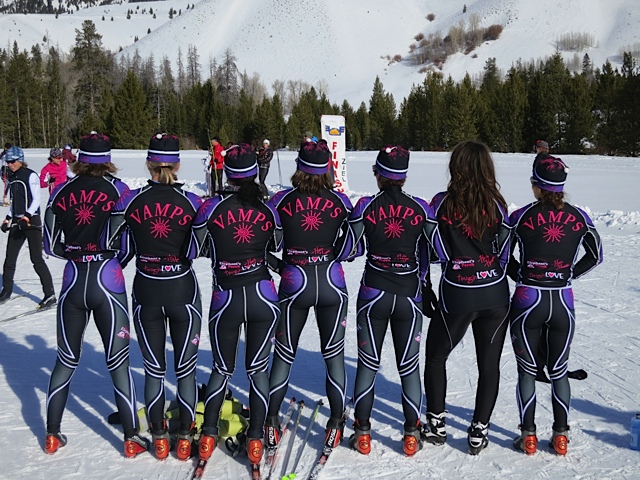
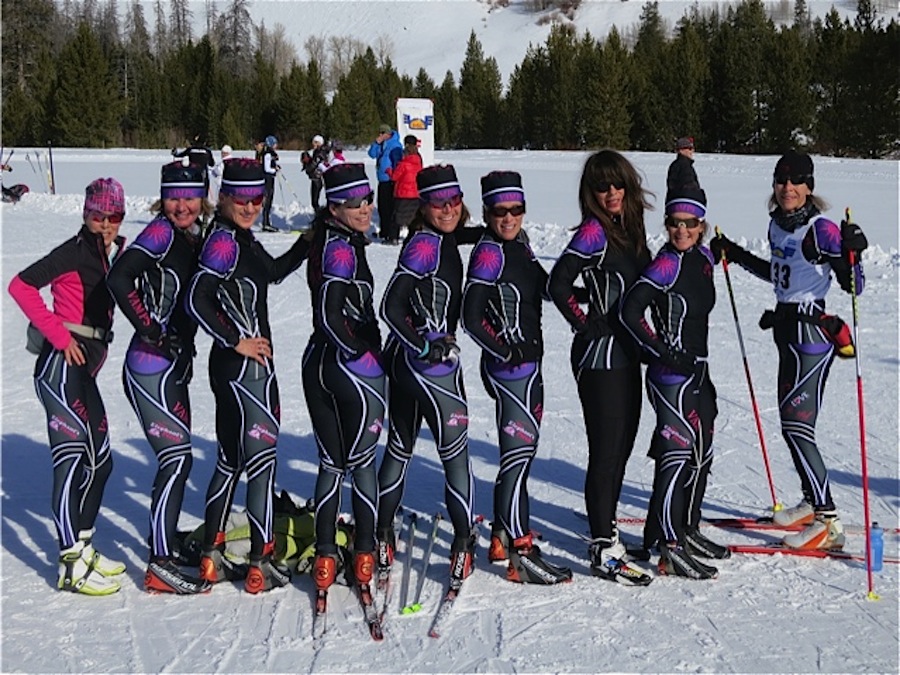
    The Sun Valley VAMPS, one of the largest all-female masters programs in the country, based out of Sun Valley, Idaho. (Photo: Muffy Ritz)
    The VAMPS, one of the largest all-female masters programs in the country, based out of Sun Valley, Idaho. (Photo: Muffy Ritz)

    Last winter, I had the good fortune to live in Sun Valley, Idaho, where I was quickly absorbed into the large nordic community the area is famous for. My workweek consisted of coaching juniors with the Sun Valley Ski Education Foundation (SVSEF), running a masters program through Galena Lodge, teaching private lessons through Blain County Recreation District, and working with the Vamps.

    ***

    Nordic Town USA is crawling with good skiers: Olympians, NCAA champions, U.S. Ski Team alumnae, Junior National champions, Birkie winners, and Masters World Cup medalists can be seen cruising the valley’s extensive trail system daily.

    If this sounds intimidating to the average skier training for a local race or just looking for a good workout, it’s not. It is inspirational. The skiing folks in Sun Valley know that these individuals make their sport credible. They also know the contributions many of these standouts have made.

    Muffy cleaned up at the Masters WC as did many other US athletes - Congratulations!
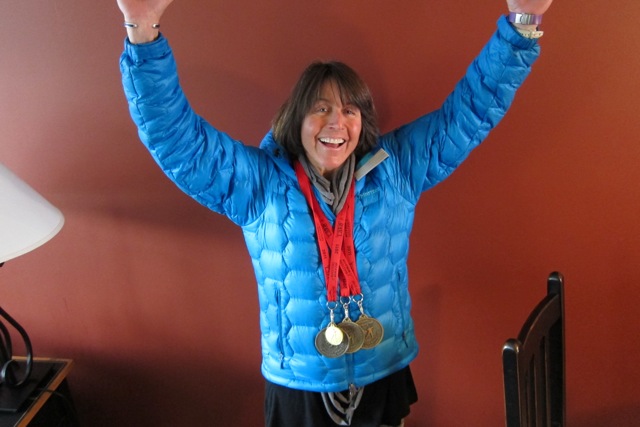
    VAMPS creator and director Muffy Ritz after winning three gold medals at the 2011 Masters World Cup. (Photo: Toko)

    Muffy Ritz, founder and director of the VAMPS program, has used her ski racing experience and love of the sport to become one of Sun Valley’s most prominent nordic leaders. Ritz got her start in cross-country skiing at the University of Colorado (CU). Tired of alpine racing, she tried out for the nordic team her junior year and discovered her passion.

    In a phone conversation, Ritz, 56, explained how she quickly picked up ski technique following her CU teammates around in practice. She loved the challenge of the sport, but what really comes through talking to Ritz is her love for the nordic skiing family. Becoming a nordic skier changed her life, and in turn, she’s changed others’ through skiing.

    A member of the U.S. Ski Team (USST) from 1982 to ’84, Ritz was also part of the rising ski-marathon movement in the 1980s as part of Team Rossignol. She proved her talent at endurance events by racing eight marathons over back-to-back weekends. She won the prestigious American Birkebeiner in 1985 and 1986.

    Ritz has proved her toughness on a bike as well, holding the second-fastest time in the Race Across America, a transcontinental road-cycling race, in 9 days, 6 hours and 32 minutes. She also holds several age-group titles in National Marathon Mountain Bike Championships.

    In 1990, Ritz left her position as a junior coach at the Green Mountain Valley School in Vermont and moved to Sun Valley. There, she connected with SVSEF Head Coach Rick Kapala and began a 10-year stint coaching juniors. In 2000, Ritz felt the need to turn her full attention to her newly formed Vamps, which stands  for “Vimmen And Muffy’s ProgramS.” (The name came about in the program’s second year. Previously called “Ladies’ Clinic,” Ritz and her participants were looking for a catchier name, something fun and maybe a little racy. Playing around with one of the Swedish skiers in the group who called women, “vimmen,” they settled on Vamps.)

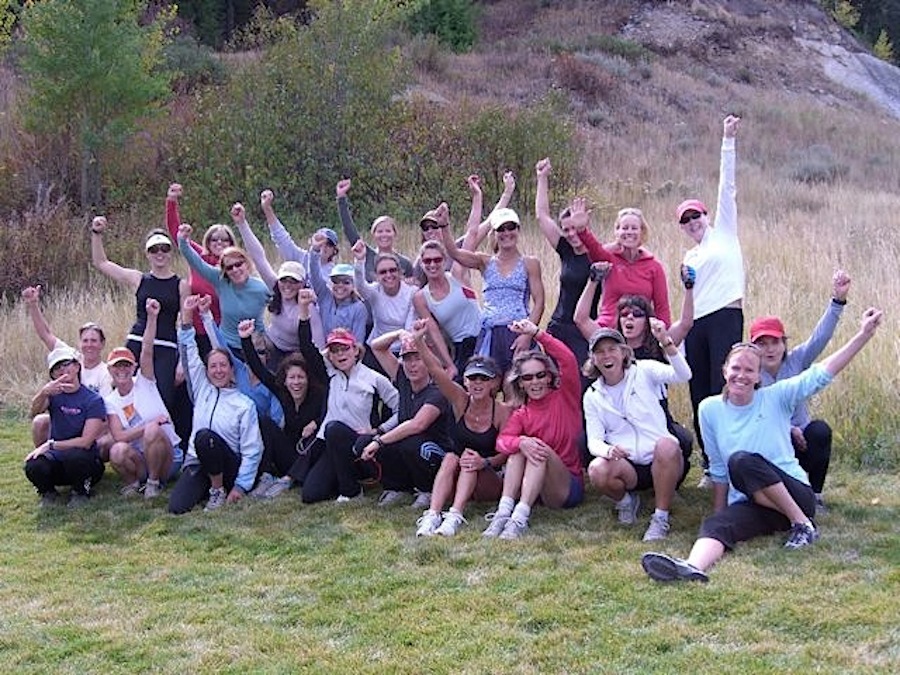
    Several VAMPS masters group members who completed the annual "Vamps Challenge."  (Photo: Muffy Ritz)
    Several members of VAMPS masters group who completed the annual dryland “Vamps Challenge,” an optional list of accomplishments that many women tackle each year in and around Sun Valley, Idaho.  (Photo: Muffy Ritz)

    Her brainchild, Vamps is 130-women strong with 11 coaches. So how did the largest all-women masters ski program in the U.S. start?

    It all began with one woman who requested biweekly private ski lessons from Ritz in 1996. A little worried about entertaining one student twice a week all season, Ritz proposed getting a group together to make the lessons more fun. This was the beginning of Vamps; four upper-intermediate level women who were committed to perfecting their skills and fitness.

    Word spread, and the following winter, Ritz had 40 women who wanted a weekly program. She quickly added a couple more coaches to deal with the various ability levels.

    By the winter of 1998-99, the Vamps grew to 60 and began to take on a life of its own. The popularity of the group rose from a fitness-driven, outdoorsy population of women who viewed cross-country skiing as a fun, social and sometimes-competitive way to spend the winter. The winter season was preceded by a dryland segment, which took place all over the valley in groups of eight.

    Ritz has never advertised the Vamps program. Spread entirely by word of mouth, drawing in women from their late-20s to late-70s with a range of experience goals, Vamps classes were taking Sun Valley by storm. She recalls charging $15 per 90-minute session that season, a killer value for the participants. In keeping with the spirit of making the program accessible, Ritz has kept the cost somewhere around $300 for 12 sessions.

    Nancy Fiddler and the AMPS, a highly competitive women's group within the Vamps masters program. (Photo: Muffy Ritz)
    Nancy Fiddler and the AMPS, a highly competitive women’s group within the Vamps masters program. (Photo: Muffy Ritz)

    It became necessary to form ability and interest-driven groups in order to meet the needs of the growing program. Ritz and her team of coaches came up with names like the Amps, a competitive group looking for a weekly high-intensity workout.

    There were groups for women who simply wanted to skate, as well as an all-classic group called the Scamps. The Super Tramps grew at the beginner-and-lower intermediate end to become a cohesive group of competent skiers with a keen desire to improve technically. The V2’s are a tight-knit group of friends, all over 60 years old.

    Vamps classes were being held in different skiing locales around the valley, but by 1999, Ritz moved her programs to the Sun Valley Nordic Center, where they enjoyed the benefits of liability insurance, consistent grooming and a spacious meeting room.

    She eventually capped Vamps at 130 participants, where it remains today. In 2002, it became mandatory to participate in the dryland program in order to be admitted into the Vamps ski program. Ritz explained that this was one way to screen participants and to keep the numbers under control.

    Being a Vamp

    It’s hard not to become infected by the Vamps spirit. The laughter, shouts of encouragement, and general party atmosphere that characterize a Vamps class are a reflection of Ritz herself.

    She is an enthusiastic cheerleader of every Vamp, offering personalized tips and encouragement. She makes every participant feel important and shows them the baby steps necessary to meeting their goals. Every Vamp wants to be as physically strong as Ritz and many are emboldened by her confident example. The bottom line is that skiing with Ritz is just plain fun.

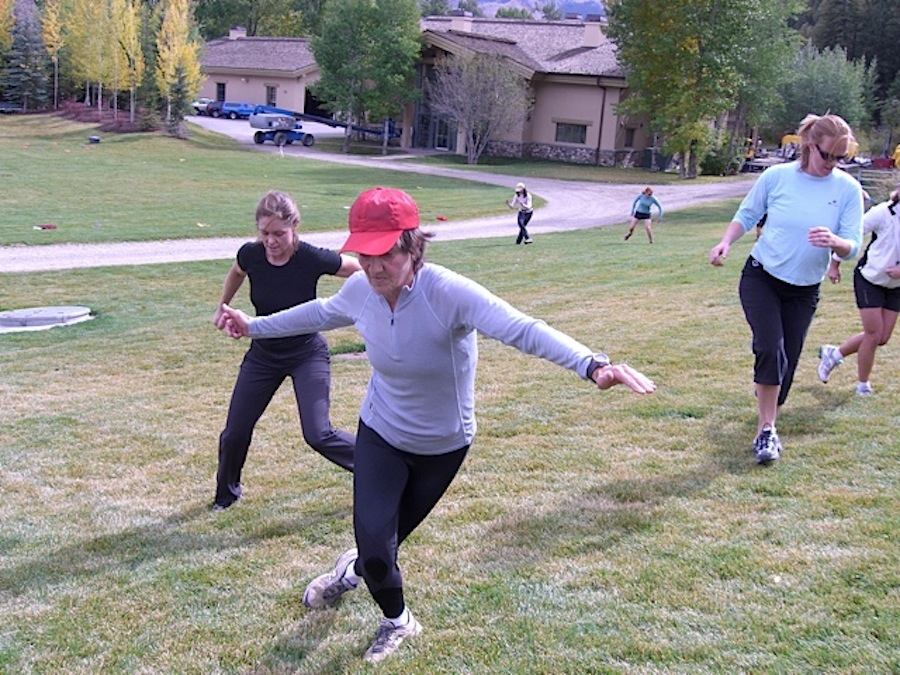
    Susan Usher (front), Julie Moses (l) and Christine Davis Jeffers (r) of the Vamps masters program work some dryland drills at River Run in Ketchum, Idaho. (Photo: Muffy Ritz)
    Susan Usher (front), Julie Moses (l) and Christine Davis Jeffers (r) of the VAMPS masters program work some dryland drills at River Run in Ketchum, Idaho. (Photo: Muffy Ritz)

    The coaches who work alongside Ritz have a deep pool of talent and experience. They are a cast of colorful characters who, between them, have a couple hundred years of racing and coaching experience.

    Ritz has never had any trouble filling her coaching roster; in fact, there is sometimes a waiting list to get on the Vamps coaching team. While the coaching staff consists of women who have had some kind of connection with Ritz through ski racing over the years, not just anyone qualifies to be a Vamps coach.

    First, Ritz requires that all on-snow Vamps coaches work the dryland segment. This is a several-month commitment in the fall, when the Vamps are gearing up for the winter season through some pretty hard-core workouts. Every coach is expected to lead some portion of the workouts, which consist of ski walking and bounding intervals, strength training, plyos, and technique work.

    Ritz is looking for coaches with some sort of training, such as PSIA or USSA certifications, as well as racing experience. Above all, she wants coaches with a passion for skiing who have the skills to pass this on to others. Essentially, if you want to coach Vamps, you had better bring something special to the table.

    In addition to Ritz, this season’s coaching roster includes: Brooke Hovey, Betsy Youngman, EJ Harpham, Mary Tess O’Sullivan, Joney Otteson, Joan Scheingraber, Colleen Hayes, Susie Quesnel, Katherine Sheldon, Kate Whitcomb, and Karoline Droege.

    The success of the Vamps may be based on the attitude of the group. It is not required that Vamps participants become ski racers. In fact, only about 15 percent of the Vamps regularly tie a number on each season. Ritz estimates a few more, about 30 percent, spend the year working toward the high point of Sun Valley’s race season, the Boulder Mountain Tour.

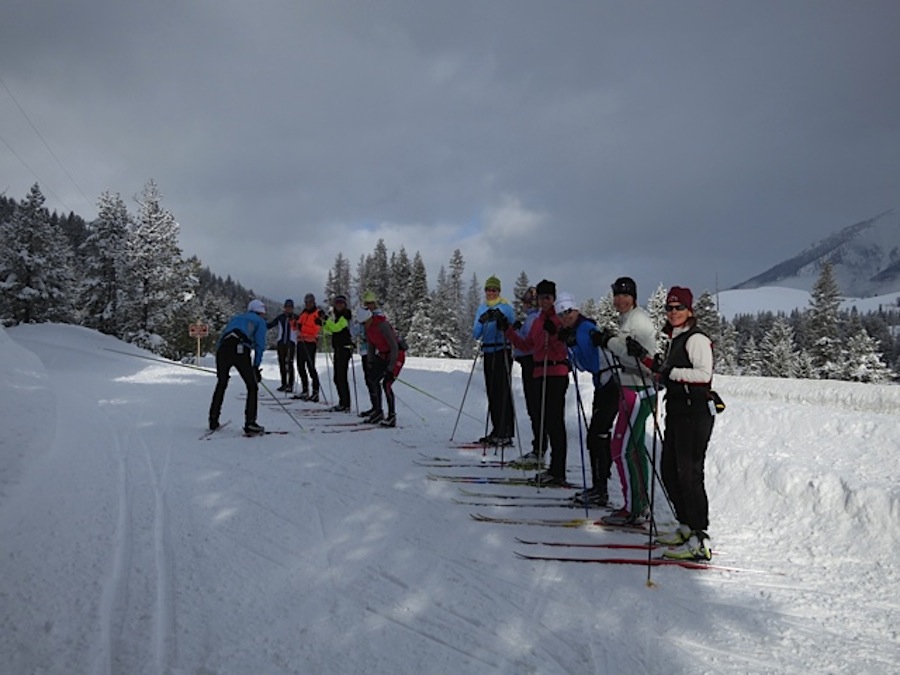
    The Sun Valley VAMPS (Photo: Muffy Ritz)
    The Sun Valley VAMPS, serious about having fun at the Billy Goat Loppet in Sun Valley, Idaho. (Photo: Muffy Ritz)

    Last winter, Ritz and 18 Vamps traveled to Asiago, Italy, to participate in the Masters World Cup for the first time as an official group. There had been casual forays of a small number of Vamps to the Masters World Cup in McCall, Idaho, and to Silver Star, B.C., but this was their inaugural international trip.

    In Asiago, they made quite a splash in their stylish black-and-purple race suits. They picked up a few age-group medals and showed others how to have a good time at a major European ski event.

    But the Vamps might be remembered best for one particular stunt at worlds. Somewhere along the course, one of the V2’s took a wrong turn, Ritz explained with a laugh. The rest of the V2’s gamely followed and they all wound up beating fellow American and master-racer extraordinaire Trina Hosmer. The results didn’t hold, of course, but the Vamps are still laughing about the incident.

    What the Vamps share is a willingness to work hard and to try new things. For some, this means racing the Birkie. For others, it is being able to ski without stopping to the high point on the Sun Valley trail system or to finally learn the V2 timing. The reasons to join the Vamps are basic: learning to ski, fitness, friendship, and having fun.

    For many, the Vamps experience is the beginning of a sporting life, according to Ritz. She has countless stories of women who have thrived by joining the program, many without any prior athletic experience. The older Vamps have bonded over the experience of taking up a new sport mid-life and pursuing it into their 60s and 70s. They ski together on days they don’t meet as a group, and use the summer and fall to meet for hikes and gym workouts.

    VAMPS dryland training (Photo: Muffy Ritz)
    VAMPS dryland training on Dollar Mountain (Photo: Muffy Ritz)

    The “Vamps Challenge” comes around during the fall dryland season and again in the winter. The challenge invites all Vamps and coaches to tackle a list of accomplishments on their own time. It includes a certain number of push-ups and air squats a week, hikes up local peaks or long ski routes, puzzles, and volunteer service. At the end, a party is thrown to honor those who completed the “Vamps Challenge.”

    The Vamps are a big piece of the nordic scene in Sun Valley, and not just because they seem to be all over the vast trail system practicing drills and pursuing their challenges. Community service is a big part of being a Vamp, and Ritz has long been a proponent on giving back to the sport.

    If you are a Vamp and not competing in an event, summer or winter, you should be signing up to help at an aid station or with registration. The Vamps are a cheerful presence at all the major Sun Valley races. Additionally, they are volunteers for Girls on the Run and other programs and are generous supporters at the annual Galena Benefit. The Vamps organize a scholarship fund each season to benefit women who might not otherwise be able to join the program.

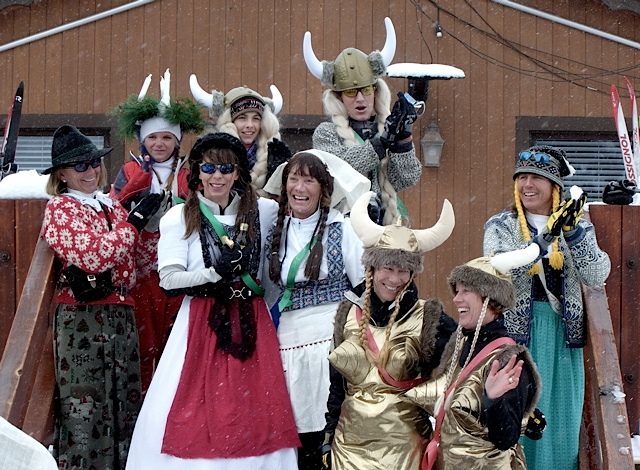
    Ritz admits that the Vamps are a consuming project. She works hard to make it the kind of program everyone wants to join. Traditions like the fall Pumpkin Hunt on Dollar Mountain, costume events, the Boulder Mountain Tour, and parties and gatherings are what distinguish the Vamps from other programs.

    Every conversation I have had with Ritz about the Vamps has been filled with excitement and pride. In the end, she said it’s all about giving women confidence through sport.

    VAMPS having fun at the Inga-Låmi cross-country ski tour at the Sun Valley Nordic Center. (Photo: Muffy Ritz)
    VAMPS having fun at the 2007 Inga-Låmi cross-country ski tour at the Sun Valley Nordic Center. (Photo: Muffy Ritz)

    ***

    About the Author: Nancy Fiddler is a two-time Olympian and 14-time National Champion. She has been coaching juniors and masters for 20 years in Mammoth Lakes and Truckee, Calif., and most recently in Sun Valley, Idaho. She lives most of the time in the Eastern Sierra with her husband and daughter and is currently trying to get in touch with her creative side through writing.

  • The 12: Sun Valley Gold Team

    The 12: Sun Valley Gold Team

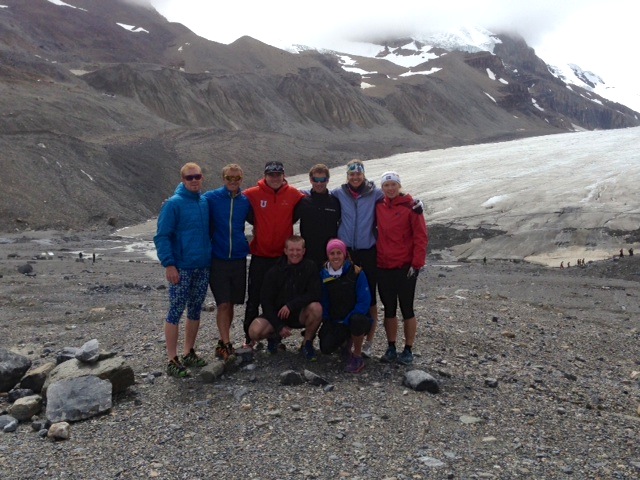
    Most of the Sun Valley Ski Education Foundation (SVSEF) Gold Team with two collegiate summer athletes, Makayla Cappel (DU) and Ben Lustgarten (Middlebury), near Canmore, Alberta. From left to right (back) Matt Gelso, Mikey Sinnott, Miles Havlik, Lustgarten, Cappel, and Rose Kemp. (Front) Head coach Colin Rodgers and Mary Rose. (Photo: Colin Rodgers)
    Most of the Sun Valley Ski Education Foundation (SVSEF) Gold Team with two collegiate summer athletes, Makayla Cappel (DU) and Ben Lustgarten (Middlebury), on the Athabasca Glacier in Banff/Jasper National Park during a recent camp in Canmore, Alberta. From left to right (back) Matt Gelso, Mikey Sinnott, Miles Havlik, Lustgarten, Cappel, and Rose Kemp. (Front) Head coach Colin Rodgers and Mary Rose. (Photo: Colin Rodgers)

    Note: This is the seventh preview in our series on U.S. elite teams, which we’ve dubbed the “The 12.” We asked coaches to tell us what’s new and whom to look out for in the coming season and will publish additional previews in the coming weeks in no particular order.

    Team: Sun Valley Ski Education Foundation (SVSEF) Gold Team

    Coaches: Rick Kapala (program director), Colin Rodgers (head coach), Shane MacDowell (service tech, formerly of Boulder Nordic Sport East)

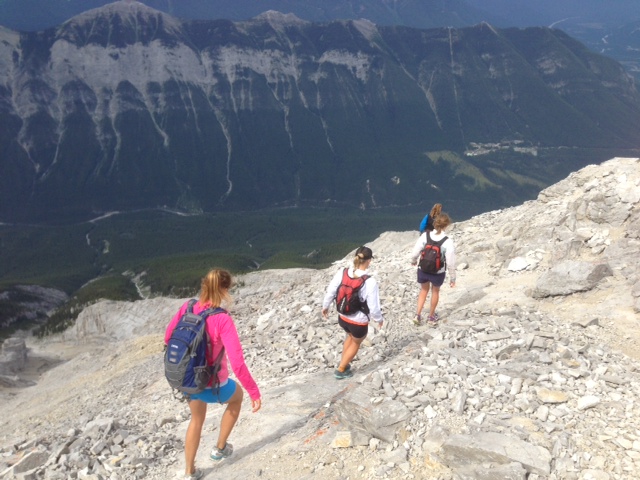
    Sun Valley training-group members Makayla Cappel and Rose Kemp hike down Mount Rundle in Banff National Park, Alberta. (Photo: Colin Rodgers)
    Sun Valley training-group members, including Makayla Cappel and Rose Kemp, hike down Mount Rundle in Banff National Park, Alberta. The team trained in Canmore from July 10-19. (Photo: Colin Rodgers)

    Gold Team roster: Mikey Sinnott, Miles Havlick, Matt Gelso;

    Chelsea Holmes, Rose Kemp, Mary Rose

    Who’s new: Havlick (University of Utah), Kemp (Utah), Rose (University of Colorado-Boulder)

    Who’s missing: Patrick Johnson, Reid Pletcher, Simi Hamilton, Alexia Turzian, Mali Noyes, Lucy Garrec, Clarke Sullivan (former service tech)

    According to coach Colin Rodgers, Johnson, who nabbed his first SuperTour win (and podium) in his rookie season after college last winter, is home in Anchorage, Alaska, for an environmental internship. Pletcher is working as a river guide on the Salmon River about an hour north of Sun Valley in Stanley, Idaho, after stepping back from racing last season due to lingering effects of a head injury. Noyes is also guiding on the Salmon River, and Hamilton – a Colorado native – moved to Vermont to train with fellow U.S. Ski Team sprinter Andy Newell and the Stratton Mountain School T2 Team.

    A Sun Valley local, Turzian is in Boulder, Colo., Garrec is in nearby Ketchum, and Sullivan, Sun Valley’s former head wax tech, is “ripping lips, building single track [mountain] bike/hiking trails, blasting ducks in Bozeman, MT,” Rodgers wrote in an email.

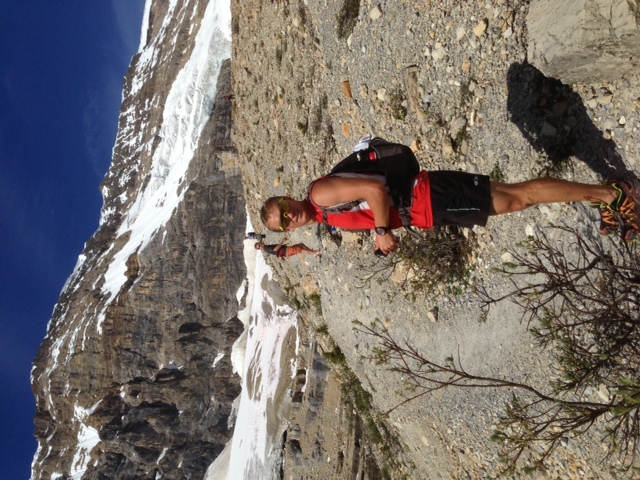
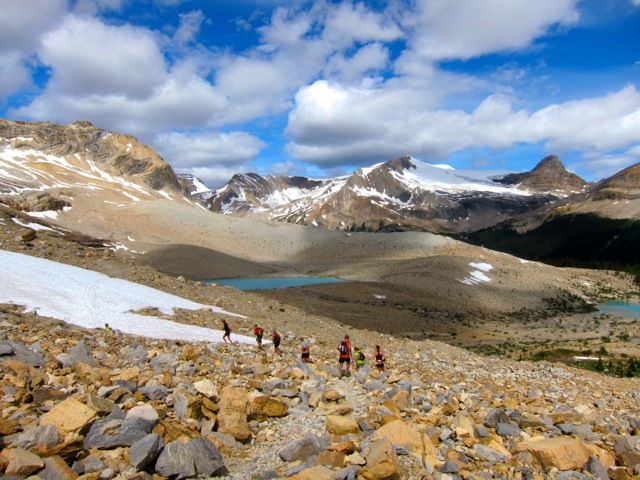
    Mikey Sinnott and Miles Havlik running on the Iceline Trail in YoHo National Park. (Photo: Colin Rodgers)
    Sun Valley Gold Team members Mikey Sinnott (front) and Miles Havlik running on the Iceline Trail in YoHo National Park in the Canadian Rocky Mountains in southeastern British Columbia earlier this month. (Photo: Colin Rodgers)

    Top results last season: Let’s start with Sinnott: the overall SuperTour winner last season with two SuperTour victories (both classic sprints; one in Minneapolis, the other in Aspen, Colo.) and a runner-up finish at U.S. nationals (also in a classic sprint). Sinnott’s finish atop the SuperTour leaderboard secured World Cup starts this fall, which won’t be a new experience, but he’s not taking them lightly.

    “In the past you kind of set up your season to get World Cup starts, so you’re kind of hitting that early season performance and then you’re kind of coming down from it when you get to the World Cup,” the 28-year-old Sinnott told FasterSkier in June. “This year I’ve got months beforehand where I can build and really organize it so that I’m hitting the World Cup in my top fitness.”

    Gelso, 25, podiumed at U.S. nationals in January, placing third in the 15-kilometer freestyle at Soldier Hollow in Midway, Utah. That same week, he placed fourth in the 30 k classic mass start at nationals. Gelso started the 2012/2013 season off with a second-place finish in the 10 k freestyle individual start in West Yellowstone, Mont., which elevated him to the World Cup in Canmore, Alberta, where he was 36th in the 30 k skiathlon.

    Fresh out of college, Havlik is one of the most promising rookies entering the pro scene after racking up his second-straight national title in the 20 k mass start at NCAA Championships in Ripton, Vt. Havlik placed fourth in the other race at NCAAs this season, the 10 k classic individual start, and helped Utah finish second to the University of Colorado in the overall team results. Throughout the course of his senior collegiate season, he won four invitationals.

    Holmes, 26, finished second twice on the SuperTour last season (first in the 10 k freestyle in West Yellowstone, and soon after in the 10 k classic in Bozeman). At SuperTour Finals in Truckee, Calif., she was third in the freestyle hill climb.

    Kemp achieved All-American status at NCAAs this year, placing eighth in the 15 k freestyle mass start at Rikert Nordic Center. She placed third in two 5 k classic races on the Rocky Mountain Intercollegiate Ski Association (RMISA) circuit, and Rose was fifth in a 5 k skate race and seventh twice in collegiate events last season.

    Coach’s comment:

    By Rodgers’ estimations, the Gold Team is well on its way to a successful racing season.

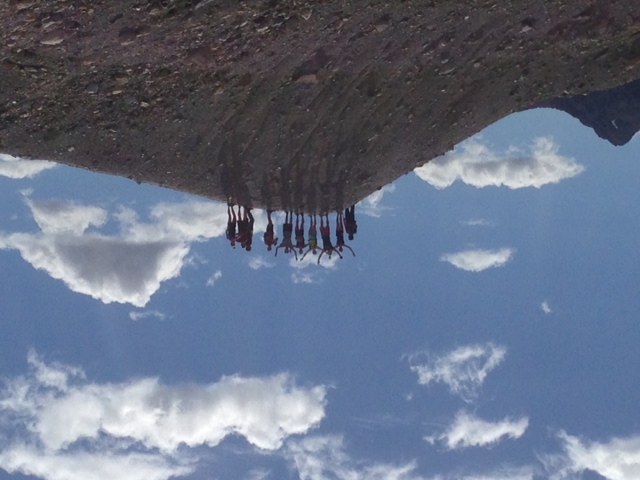
    The Sun Valley Gold Team on the Iceline Trail in YoHo National Park earlier this month. (Photo: Colin Rodgers)
    The Sun Valley Gold Team on the Iceline Trail in YoHo National Park earlier this month. (Photo: Colin Rodgers)

    “We are a mix of old and new faces, but all of the current athletes have roots in Idaho,” he explained. “Mikey, Matt and Chelsea have been a part of the program for many full years while Rose is a Boise native. Combined both Miles and Mary have trained in the Wood River Valley for quite some time so in a sense all are local talent.

    “Although we are a small squad, 3 men and 3 women, ambitions are high for this crew and collectively we are aiming at SuperTour Titles, National Championship Titles, an NNF Cup, World Cup Competition and Olympic starts all this winter!” Rodgers continued.

    The team started the training season in Bend, Ore., in May and met up again in the Wood River Valley in south-central Idaho for a few weeks. The SVSEF recently returned from Canmore, where it had its first dryland camp of the offseason, and has big plans for training on snow at Eagle Glacier in Alaska (Aug. 8-20), working out in Park City and Moab, Utah, in October, and getting back on snow in late October at Frozen Thunder in Canmore.

    “The Gold Team strives to work closely with its younger XC programs,” Rodgers wrote. “We have spent time working in conjunction with the summer collegiate/post-graduate group during weekly sessions. While we were in Canmore, we were just a small part of a large American contingent from the Intermountain West that consisted of junior athletes from the Intermountain Region including Park City, Jackson Hole and Sun Valley.”

    The Sun Valley Gold Team on the Iceline Trail in YoHo National Park earlier this month. (Photo: Colin Rodgers)
    The Sun Valley Gold Team on the Iceline Trail in YoHo National Park earlier this month. (Photo: Colin Rodgers)

     ***

    Other previews: Alaska Pacific University | Bridger Ski FoundationCraftsbury GRP | Maine Winter Sports CenterSSCV/Team HomeGrown | Stratton Mountain School T2

  • Part of the Team, Part IV: Female Youth Development Coaches

    Part of the Team, Part IV: Female Youth Development Coaches

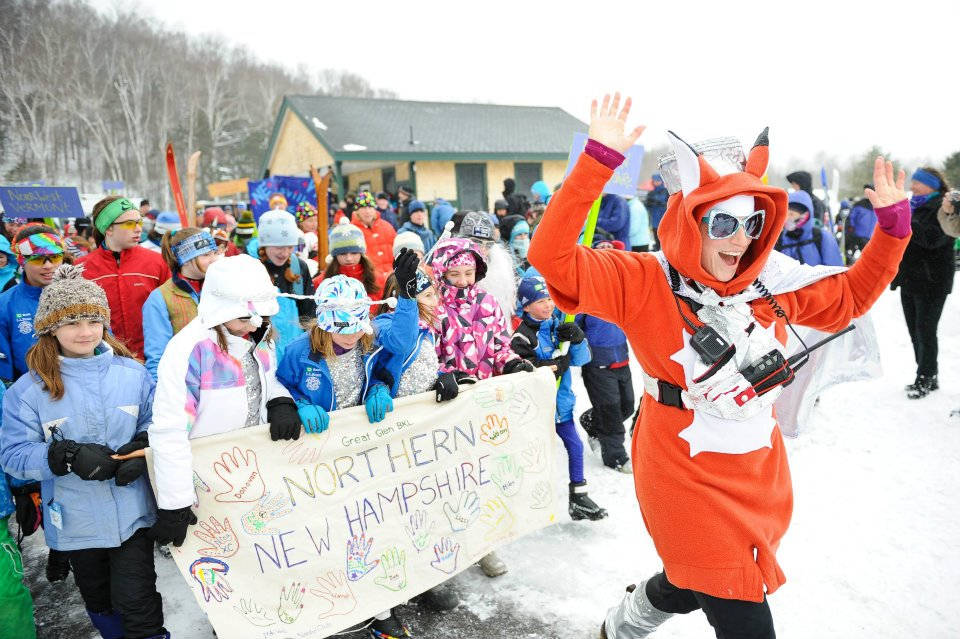
    The "NENSA Fox," Abby Weissman, youth programs director for the New England Nordic Ski Association (NENSA), at the 2012 TD Bank Bill Koch Festival. Weissman wears the fox costume at events and writes a weekly newsletter called “Fox Tales.” (Courtesy photo)
    The “NENSA Fox,” Abby Weissman (r), youth programs director for the New England Nordic Ski Association (NENSA), at the 2012 TD Bank Bill Koch Festival. Weissman wears the costume at events and writes a weekly newsletter called “Fox Tales.” (Photo: Kris Dobie)

    Editor’s note: This is the final piece of a four-part series called ‘Part of the Team: The Impact of Female Coaches in the U.S.’ In Part I, two-time Olympian and former U.S. Ski Team member Nancy Fiddler introduced herself, Part II took a look at several influential female collegiate coaches, and Part III explored female coaching at the junior level. Part IV discusses women who work with the little guys, the future of skiing, through youth programs across the country.

    ***

    For many years, the height of my winter weeks came on Friday afternoons at 3:00. The snowy parking lot of the Tamarack Cross Country Ski Center in Mammoth Lakes, Calif., would fill with cars full of kids with an end-of-school-week itch. Soon, the ski center was full of snowsuit-clad youngsters jostling for space on the pine benches.

    The ski center prepares for the Gliders’ arrival ahead of time, lining up rental boots on the counter in a row from smallest to biggest. Skis and poles are fanned out across the snow out front, and the coaches are dressed and ready for action. Dashing between the tasks of helping the youngest tie, zip, and Velcro their boots and fitting tiny hands into pole straps, while also greeting and chatting with parents, I was typically in a full sweat by the time the Gliders lined up behind their team nation flags at 3:15.

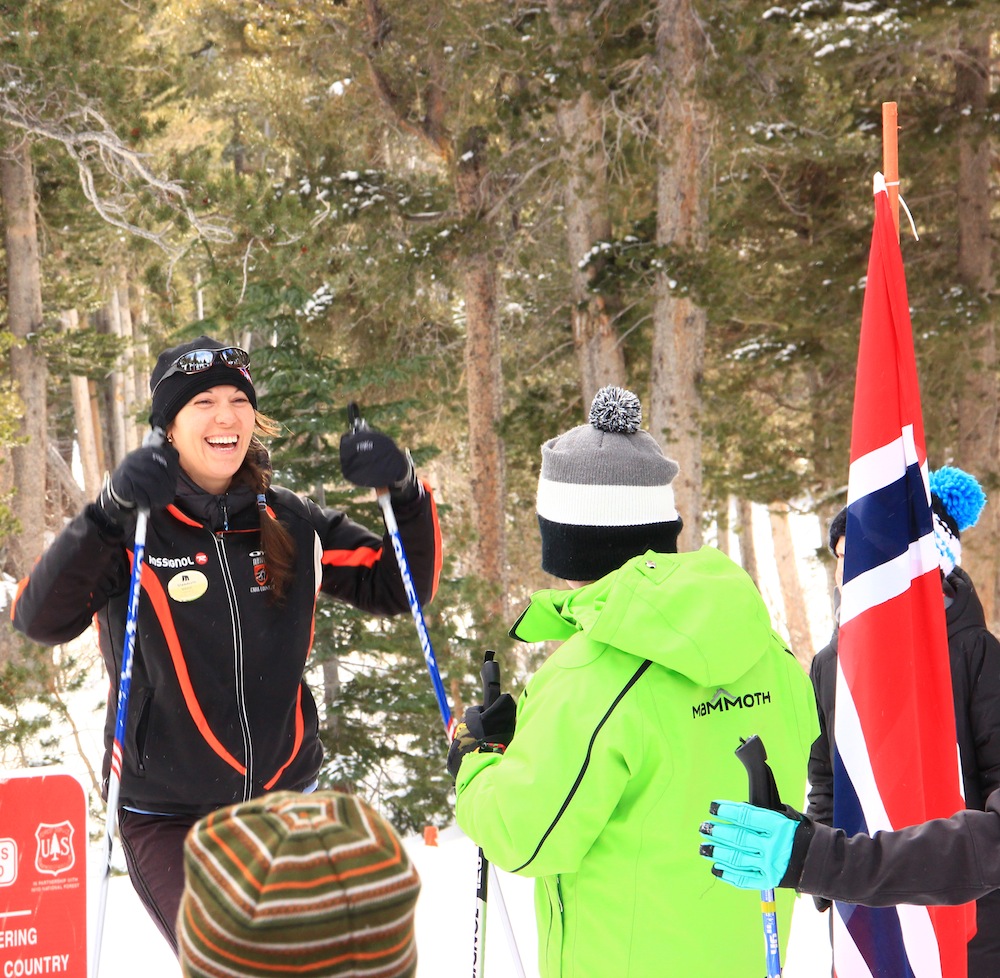
    Tamarack Gliders coach Marie French with her 10-11-year-old group, the "Norwegians." (Courtesy photo)
    Gliders coach Marie French with her 10-11-year-old group, the “Norwegians” at the Tamarack Cross Country Ski Center in Mammoth Lakes, Calif. (Courtesy photo)

    Fifty skiers between the ages of 6 and 10 are divided into Norwegians, Swedes, Americans, Russians, and Italians. The coaches stand at the head of the team lines. My favorite way to begin sessions was by calling first for quiet, and then for the Gliders’ Stomp. The sound of a hundred skis stomping on the packed snow begins in a disharmonious din, but grows into a unified beat of left, right, left, right, louder and louder. With the energy channeled, the coaches siphon off their groups, race through the teaching lanes and into the afternoon’s planned activities.

    Shouts, squeals, and laughter ring through the Lower Lakes Basin for the next hour and a quarter, as the kids skate through games of Sharks and Minnows, hunt for treasures, do relay races, or take off on adventures through the snowy forest. With plentiful snowfall in the Eastern Sierra, a favorite Glider activity is Powder Pigging.

    The goal of Powder Pigging is simple; climb a large hill either by means of a groomed trail or by breaking trail and then, simply, ski down through the un-groomed snow. The coaches themselves are big fans of Powder Pigging, because, after all, they are just overgrown kids who like to ski the trees. Powder Pigging is the hidden teacher of all skiing skills: balance, stance, weight shift, turning, and getting up after the occasional crash. Above all, Powder Pigging is the big motivator to ski repeatedly up the hill in pursuit of that perfect downhill run.

    Heading back to the ski center for the awaiting hot chocolate and Oreo snack after an exhilarating game or adventure, tired and happy, we smile those silly grins that almost hurt your face.

    Skiing with the youngest kids feels like the most important coaching I have ever done. When I retired from ski racing in 1993, I made it a goal to bring cross-country skiing to the kids of the Eastern Sierra. I began with high school and middle school teams, but didn’t get around to forming the Gliders program until my daughter, Laurel, was 5 and in need of an organized ski program.

    I had gone about the process in the wrong order, I realized. The youngest kids form the base of the skiing pyramid! They are the future of our sport; the life-long participants, the racers, the coaches, the officials, the instructors, and the parents of the next generation of cross-country skiers.

    Part IV of my series on the role of female coaches in U.S. skiing focuses on women who work with the youngest participants of the many cross-country ski programs around the country. I connected through email with six female youth coaches from Maine, Idaho, and California to find out more about their jobs, their programs, and their love of cross-country skiing.

    Grassroots ski programs take the form of Bill Koch Youth Ski League, local ski clubs, Ski P.E., and middle-school teams. The coaches who help foster these programs are working close to home with a large base of participants. Youth nordic ski coaches are often providing a child’s first outdoor winter experience. They are getting kids off couches and onto skis from New England to California.

    Sparking Interest

    “Our team is open to any kid who can find boots. We have no tryouts and supply two pairs of skis, two sets of poles and a uniform. We are trying to expose as many kids as we can to cross-country skiing in a community with a very strong alpine skiing leaning.” — Mary Ellen Benier, head nordic coach at Alder Creek Middle School, Truckee, Calif.

    With big ski mountains offering thousands of feet of terrain and plentiful snowfall, places like Truckee and Mammoth Lakes have a lot to offer downhillers. Kids growing up in these communities have plenty of opportunities to ski and snowboard the steep and deep, and play in the half pipes and terrain parks of giant ski areas. Attracting kids to cross-country skiing in these places can be challenging.

    Mary Ellen Benier, head coach of the Alder Creek Middle School nordic team, with Ian Smith (r) and David Dalicandro (l) last winter. (Photo: Mark Nadell/MacBeth Graphics)
    Mary Ellen Benier, head coach of the Alder Creek Middle School nordic team, with Ian Smith (r) and David Dalicandro (l) last winter. (Photo: Mark Nadell/MacBeth Graphics)

    Despite the lure of the alpine areas in the region, the Alder Creek Middle School (ACMS) team draws nearly 80 kids annually. The Tahoe-Truckee area is home to four major nordic areas with long operating seasons. The community of people who live in this area have embraced the active lifestyle, including nordic skiing. Benier and her co-coach, Mark Nadell, have worked hard to capture a large number of participants to the middle-school program.

    Benier wrote she aims to keep her program “big, fun, accessible and viable. My pay works out to probably .20/hr, so it’s a labor of love. The draw is the fun factor and the enthusiasm of the kids.”

    The ACMS team has become established in Truckee as a cool place to be, thanks to the efforts of Benier and the rest of the staff. It is affordable, the equipment has been taken care of, and it can compete with alpine and snowboarding teams with its reputation for being inclusive and fun. Kids want to be part of this energy.

    Nordic youth programs across the country are finding ways to attract the youngest skiers to the sport. Lauren Jacobs is the mid-Maine Healthy Hometowns coach for the Maine Winter Sports Center (MWSC). Jacobs’ job is to support active, outdoor lifestyles in the communities she serves. The MWSC offers year-round programming to help promote healthy living, and nordic skiing is a good solution to the long Maine winters.

    According to Jacobs, “The main issue I see is less about how to retain skiers for the long-term than it is about getting them to start in the first place,” she wrote. “Money plays a big role in this. Getting started in skiing can be an expensive endeavor, one that many parents are reluctant to try if they’re not sure their kids will enjoy it. Children who grow up in active, outdoor families often get started in sports like nordic skiing ‘automatically’, but kids who don’t come from that background can have a really difficult time getting involved.”

    Lauren Jacobs (Courtesy photo)
    Lauren Jacobs (Courtesy photo)

    Jacobs cites initiatives like the MWSC and New England Nordic Ski Association (NENSA) ski-lease programs as being instrumental in getting families to introduce their kids to nordic.

    The MWSC has figured out a way to expose large numbers of the general youth population to cross-country skiing. Jacobs explained that the children who come from skiing families come to the sport fairly easily. The MWSC is literally bringing skiing to the places where kids actually are; school and after-school programs.

    “One of my favorite things is bringing our Healthy Hometowns ski trailer to different schools for a couple weeks at a time,” she wrote. “Getting to ski with PE and Health classes means I’m getting to ski with all kids, whether they come from an outdoorsy background or not.”

    Jacobs echoed Benier’s commentary on boosting participation. “My job is to make the introductory experiences as positive, fun, and accessible as possible,” Jacobs wrote.

    Abby Weissman is NENSA’s youth and introductory programs director. A Maine native, she’s responsible for putting on major events like the Bill Koch Festival, which draws 600 kids and their families.

    New England is home to over 40 active Bill Koch League (BKL) clubs. There are a lot of kids who are exposed to skiing in New England because of this activity. Weissman is going into her sixth year working for NENSA and has seen the organization’s youth membership grow 40 percent since she started.

    “It’s all about momentum and community,” she wrote. “The key is to have lots of excited families who are bringing their energy and flavor to local programs. That’s where the growth comes from. There’s not a cookie cutter approach that will work perfectly for each club — it has to be adapted to the energy and needs of the families and skiers in that club.”

    Weissman is clear that everything NENSA accomplishes would not be possible without tremendous community support. She sings praises of the many volunteers who consistently give back.

    “There are a lot of moving parts and my favorite part of my job is seeing how wide the community reaches and how much we can accomplish when we work together,” she wrote.

    The Skis for Kids lease program, which Weissman oversees, provides over 300 pairs of skis to New England kids. Accessible equipment, abundant Bill Koch League clubs, and volunteer support and activism are providing plenty of cross-country skiing opportunities to children in the northeastern US.

    Must Love Skiing

    “I began coaching two years ago. I’d grown up alpine skiing and came to nordic skiing as an adult. I fell in love with the sport, the local nordic community and culture and wanted to get more involved and keep learning.” — Mia James, development coach at the Sun Valley Ski Education Foundation (SVSEF), Sun Valley, Idaho

    So how does one become a nordic youth coach? With all the kids out there running around on cross-country skis, it would take an army of leaders to provide a safe environment where the fun and learning take place. The female coaches referenced in this story have a diverse set of skills and backgrounds, but share one important passion: a special relationship with skiing.

    Sun Valley Ski Education Foundation (SVSEF) devolopment coaches Mia James (l) and Laurie Leman at the 2013 Devo Tri. (Photo: Nancy Fiddler)
    Sun Valley Ski Education Foundation (SVSEF) devolopment coaches Mia James (l) and Laurie Leman at the 2013 Devo Tri. (Photo: Nancy Fiddler)

    James has been coaching the Devo Team at Sun Valley for two years. She has done some local racing and knocked the American Birkebeiner off her bucket list. A self-acclaimed newbie, James is fueled by her enthusiasm and respect for skiing.

    “Like any new discovery, I want others to be as excited as I am about skiing,” she wrote.

    Being involved with 7- to 11-year-old kids on snow has been an empowering experience for James. She sees skiing as a source of lifelong fun and friendships.

    “I hope that I can build confidence by helping kids realize that with dedication and focus they can accomplish things they thought were beyond them – a lesson they will carry throughout life,” she wrote.

    It does take a village for someone like James to find a footing as a nordic ski coach. She credits the support of the SVSEF coaching staff, which she describes as outstanding examples of skiers, coaches and people.

    She acknowledges Muffy Ritz and her VAMPS (all-women masters nordic program with over 160 participants) program. “Like SVSEF, the VAMPS coaching staff is first rate — a huge source of technical knowledge, confidence, and enthusiasm. I certainly would not be the skier or coach I am without my VAMPS experience.”

    James sees herself as a contributor to the big picture of U.S. skiing. She feels she is at the foundation of the sport, helping establish future generations of skiers who will take it forward.

    At Tamarack Cross Country, Jane Lester has been teaching and coaching for 14 years. Like James, she was a latecomer, drawn to the sport because of its camaraderie. An occasional citizen racer, Lester loves the peaceful quality of skiing most of all.

    Lester heads up the Tamarack Gliders program for 5 to 11 year olds. She has used a lifetime of teaching experience to become the coach she is today. She feels that her special skill is developing personal connections with each student.

    “I am passionate about the sport so it is easy to come to work!” she wrote. “I feel like I am making a difference locally. We maintain a very high level of programming, all the way down to the 5 year olds.”

    Marie French has been coaching the Tamarack Gliders for five years – not much longer than she’s been skiing. Regardless, French is an avid participant in all the local races and attended the Masters World Cup in Italy last winter.

    “I like racing and training myself,” she explained. “It felt very natural to work with kids who have fun and passion for cross-country skiing”.

    French hopes to continue to improve as a skier and racer so that she can bring more knowledge back to the kids she works with. She is channeling her excitement about nordic skiing directly into the children and knows she is making a difference when the Gliders move up to the middle school team and then the high school team.

    Mary Ellen Benier at the 2013 U.S. Distance Nationals at Royal Gorge in Soda Springs, Calif. (Photo: Mark Nadell/MacBeth Graphics)
    Mary Ellen Benier at the 2013 U.S. Distance Nationals at Royal Gorge in Soda Springs, Calif. (Photo: Mark Nadell/MacBeth Graphics)

    Benier has been leading the ACMS team for eight years. She plunged into coaching when her son, Stefan, joined the team in sixth grade.

    “His draw to join the team was primarily social and resulted in nordic kids becoming his core group of friends through college,” she wrote.

    A skate-skiing enthusiast for 15 years before she took up coaching middle schoolers, Benier considers herself a proficient skier, but without any formal training or racing experience outside of the occasional Great Race.

    Benier’s son moved beyond middle school a long time ago, but Benier has continues to coach the team. “It is a benefit to our society to turn any kid onto exercise and a sport you can do for a lifetime,” she wrote.

    Once a mom, always a mom? Benier explained she possesses some special “kid skills” that apply to coaching. She brings something else to the mentoring table as well: “a female perspective on hurt feelings, tired bodies, bad days, silliness, total success, crushing failure, and hugs.”

    Lester and Benier share the desire to function as female role models for the girls. They’re concerned lots of girls drop out of sports in middle and high school, but Benier believes she is making a difference.

    “I can’t match the racing backgrounds of some male co-coaches, but I can offer the perspective of cross-country skiing as a lifestyle and what you can get out of it,” she wrote.

    Jacobs picked up nordic as a senior in high school at Gould Academy in Bethel, Maine. She skied her way onto the Bates team, where she competed for four years. From there, she skied for the Skibec Club in Quebec City, followed by two years with the Craftsbury Green Racing Project (CGRP).

    Jacobs blended her athletic career with an interest in coaching early on. “Coaching started for me as a young gymnast coaching other young gymnasts,” she wrote. “I guess I’ve sort of always been a coach! I just enjoy sharing the sports I love. It seems natural.”

    Coaching gymnastics was a stepping-stone to coaching high-school skiing in Farmington, Maine, after college. Jacobs got into coaching the local BKL program while training with Craftsbury , and it was not long after that she started working at MWSC.

    For Jacobs, her own experience serves as her platform for coaching. “As someone who didn’t start skiing until my senior year of high school, it’s nice to be able to tell kids that they don’t have to have grown up with skis on their feet to still love the sport and go far with it,” she explained.

    While not every kid will become a ski racer, Jacobs’ message is this: “I think it’s really important that the ski community recognizes how essential to our community every member is.”

    She points out that aspiring female nordic coaches in New England are fortunate in that they have an amazing group of mentors to look up to in elite and collegiate coaches Cami Thompson-Graves, Becky Woods, Tracey Cote and Pepa Miloucheva.

    Abby Weissman at the Frost Mountain Nordic Grand Prix (Courtesy photo)
    Abby Weissman at the Frost Mountain Nordic Grand Prix (Photo: Matt Trueheart)

    Weissman wrote that she fell “completely and wildly in love with cross-country skiing” when she moved to Carrabassett Valley, Maine, in 2004. A competitive runner in high school and college, her exposure to skiing was limited to family outings while growing up in Maine.

    Working in the Sugarloaf Outdoor Center and then as an English teacher at Carrabassett Valley Academy, she spent many hours nordic skiing in the woods nearby.

    “I worked really hard on my technique then with the goal of being a more efficient skier,” she wrote. “I wasn’t interested in competing, just being in good enough shape to enjoy long adventures.”

    Weissman feels that her experience as a “middle-of-the-pack athlete” has fueled her interest in coaching kids. “I loved the hard work of training and the thrill of competition but my goal was never to win events,” she wrote. “I just loved the process. I got so much out of being on a team and learning how to be an endurance athlete. It was always fun to me.”

    Besides working for NENSA, Weissman puts on Fast and Female events in New England. She’s inspired by the current U.S. women’s national team, which, she wrote is a “phenomenal example of teamwork and healthy competition.” She couldn’t ask for better role models for kids in the East.

    Weissman acknowledges NENSA’s former executive director Pat Cote for his leadership and encouragement. “He would always listen to my crazy ideas and never shot them down.”

    Kids on Skis

     “It’s all about fun for the younger skiers. If we catch their interest year after year, even if it’s with a ride on the groomer or rolling around in the powder, they will love cross-country skiing and come back for more.” — French
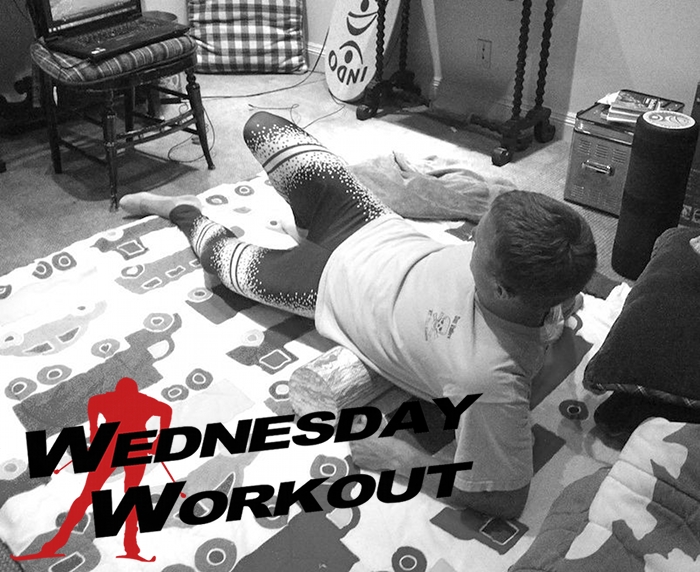
    The departing shot of this story – and series – is of the kids (and adults) who benefit from the creative energy of the female leaders of their programs. The many clubs, leagues, programs and teams around the country are alive and well. Youth development is producing outdoor enthusiasts, healthy kids, ski racers, and lifetime nordic skiers.

    At least for kids, the secret is in the play. Lester is a firm believer in teaching skills through fun activities.

    “Treasure hunts and patrol races are always big hits. No season would be complete without some time off track,” she wrote. “Powder pigging in the deep snow is a must! I think it is so important to access the fun and freedom of cross-country skiing to retain the youngest skiers. They already know how to play, it’s the coaches’ job to play with them!”

    Jacobs is a fan of ski games because “they get kids moving, increase balance and speed, and- more importantly-help establish a really positive, fun atmosphere among a group,” she wrote. adding that she uses scavenger hunts to encourage kids to ski longer distances.

    Another way to motivate kids to ski longer is the Kilometer Odometer chart used by the Tamarack Gliders. Lester doesn’t like to overemphasize skiing kilometers just for the sake of kilometers. She wrote that the chart works because “cross-country skiing is a very challenging sport and tracking the distance covered is a way for them to ‘see’ their accomplishments daily.”

    Lester likes the skill-pin program that they adopted from Auburn Ski Club as another motivator. “The kids earn pins according to the skills they master,” she explained. “They can move up through the different colors to help them track their improvement over the years.”

    Weissman’s nickname is “NENSA Fox” for the fox costume she wears at events. In keeping with this theme, she writes a weekly newsletter called “Fox Tales.” Working tirelessly to organize Bill Koch League events and competitions, Weissman stays on track with how youth participation fits into the big picture of skiing in the U.S.

    “Youth Development is one of the most important pieces of developing a thriving ski community,” she stated. “If the goal is to have top athletes at the Olympic level, then growing the base helps to have a bigger pool to draw from and more kids to raise the level of competition. I’m less concerned with the competition and more about the fun and the lasting benefits of being involved with sports at an early age.”
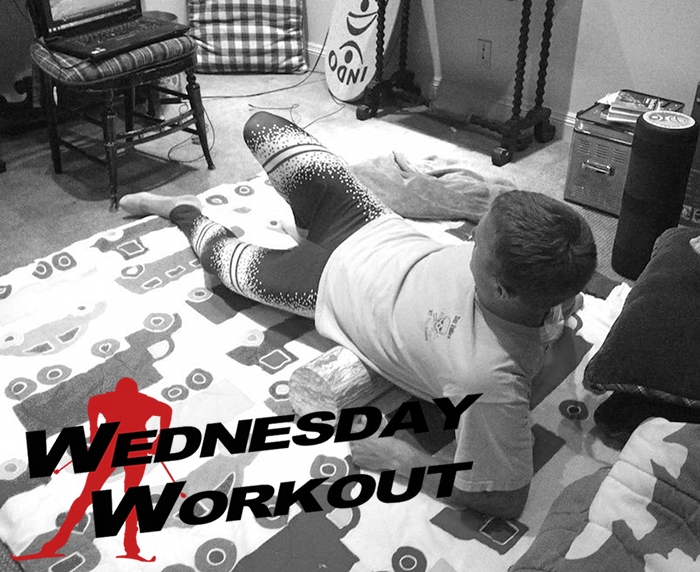
     ***

  • Wednesday Workout: Stretching with Sinnott

    Wednesday Workout: Stretching with Sinnott

    Mikey Sinnott of the Sun Valley Ski Education Foundation (SVSEF) Gold Team during his stretching routine, which he does almost daily for at least 30 minutes at a time. (Courtesy photo)
    Mikey Sinnott of the Sun Valley Ski Education Foundation (SVSEF) Gold Team during his stretching routine, which he does almost daily for at least 30 minutes at a time. (Courtesy photo)

    By Michael Sinnott | Mikeysinnott.com

    Welcome to Wednesday Workout, the newest workout series on FasterSkier. This week, Mikey Sinnott of the Sun Valley Ski Education Foundation (SVSEF) Gold Team details the stretching routine he’s prioritized, which he first wrote about on his blog. We asked him for more specifics so we can do the same.

    ***

    Stretching isn’t so much a workout as a routine. It’s like brushing your teeth. Nobody says brush this tooth at an angle horizontal to the gum line for 45 seconds at a speed of 71 brushes per-minute before moving on to blah blah blah. It’s a routine, done daily, done different every time.

    I think the hardest part about stretching is making it an enjoyable routine. For years, I pretended stretching was an overly silly, old man ritual. I would run through my routine from the soccer days- touching my toes, then pulling at the quads and holding each for twenty seconds before switching.

    After about 10 minutes, I was numb with boredom.

    I told myself it was superfluous. I sought out new research to prove my theory. It was I who was rather silly.

    The fact is, stretching makes a huge difference. Now that I am stretching more and more, I can feel tightening after a single day of forgotten practice. It opens the body to better range of motion, prevents injury and increases blood flow to aid in muscle tissue recovery. I can’t believe it took me so long to embrace it. I just had to work past the boredom.

    Sinnott stretching out his back and hamstrings. (Courtesy photo)
    Sinnott stretching out his back and hamstrings. (Courtesy photo)

    The trick for me was pairing stretching with another activity, and making it a comfortable, enticing activity.

    I started by setting up a stretching room. It’s not much, just a room with some blankets on the floor for comfort, a couple stretching aids and an entertainment system. I have a couple foam rollers (one softer and one harder), a lacrosse ball, a towel and pillows. My computer is set on a chair with the stereo attached.  To use the internet, I am forced into the stretching room. To be in the stretching room and not stretching is embarrassing.  Thus, I have tricked myself into stretching every day, for shame.

    Every day is different, but mostly I employ Netflix or Hulu to idly distract me while I soothe the broken fibers of my poor muscles. I pick a nice piece that suits my time frame – The Daily Show if time is tight, maybe Escape From Alcatraz if I have the time and am really hurting.

    Once the entertainment is playing, I put on some tights (better mobility) and settle into stretch until the credits roll.  I start by focusing on the parts of my body that are actively sore, before moving to the parts that I used heavily that day or that I will be leaning on tomorrow. As I said, there is no set routine. Sometimes I’ll hold a stretch for twenty seconds and sometimes it will be three minutes. I like an organic approach that allows me to focus on the needs of the day.

    Stretches for Thought:
    – Need: Lacrosse ball, or something similar
    – Instructions: Lay on your back on the ground. Put ball under one shoulder, allow to it sink beneath shoulder blade. Breathe slowly. Use feet to rock body back and fourth off the ground.
    – Also: Roll ball beneath hips or the IT band on the outside thigh. Use foam roller for tighter areas or longer muscles, like the low back, quadriceps and hamstrings.

    There is always a blend of techniques. My favorite right now is the lacrosse ball. I like to place it under a shoulder, reaching across my body and allowing the ball to sink into and under my scapula. I try to breathe long and slow, relaxing every little muscle. Working the ball deeper into my back. Releasing the stress. My feet help me rock back and forth, finding the sweet spots that need plenty of attention. The ball works equally as well on the hips and IT bands. It can penetrate and isolate smaller spots that a foam roller plows over.  If the lacrosse ball is too firm and painful, try a tennis ball to work those areas.  For the lower back and legs, where the muscles are longer, I use a foam roller.

    Of course, I still do the traditional form of stretching, too. I like a stretch that opens up my joints while elongating the muscles. For instance, I reach across my body on the toe touches, to open my opposite shoulder. I’ll reach behind my back and hold my own hands, pulling tighter until I feel the stretch throughout my lat, triceps, and shoulder.  Pillows and towels can be used to prop up body parts or to reach further down your leg for controlled deep stretches.

    I always end with a simple little neck stretch, pulling my head to each side, feeling it lengthen all the way down my back. It’s a little pat on the back for another session of body maintenance. This year I’ve been trying to stretch for at least thirty minutes, six times a week. Now that I have a comfortable place that helps the time fly by, it’s been no problem.

    Editor’s note: For other stretching ideas, check out Annika Ferber’s Skis, Strains and Sprains blog.

    Sometimes (and more often than you think) you've just gotta stretch. (Photo: Wikimedia Commons)
    Sometimes (and more often than you think) you’ve just gotta stretch. (Wikimedia Commons photo)
  • SuperTour Leader Sinnott Draws from Experience in Olympic Quest

    SuperTour Leader Sinnott Draws from Experience in Olympic Quest

    Mike Sinnnott (SVSEF) in Saturday's classic sprint qualifier. (Photo: Mark Nadell/MacBeth Graphics)
    Sun Valley’s Mikey Sinnnott racing to the third-fastest qualifying time in the SuperTour Finals classic sprint at Auburn Ski Club in Soda Springs, Calif., in April. Sinnott went on to make the A-final and place sixth in the sprint, and captured two bronze medals (freestyle prologue and hill climb) to finish as the 2012/2013 SuperTour leader. (Photo: Mark Nadell/MacBeth Graphics)

    When he last attempted to make the Olympics, Mikey Sinnott was four years younger and admittedly a step quicker. But the 28-year-old Sun Valley Ski Education Foundation (SVSEF) skier is confident he can offset aging with accumulated experience and earn a spot on the U.S. Olympic Team for the first time in his career.

    Finishing the 2012/2013 season as the overall U.S. Ski and Snowboard Association (USSA) SuperTour points leader gives Sinnott the right to compete on the World Cup circuit this winter – a place he has been before (in 2012) and knows can be unforgiving.

    “I think in the past you kind of set up your season to get World Cup starts, so you’re kind of hitting that early season performance and then you’re kind of coming down from it when you get to the World Cup,” Sinnott said in a phone interview from his hometown of Sun Valley, Idaho. “This year I’ve got months beforehand where I can build and really organize it so that I’m hitting the World Cup in my top fitness.”
    The ball is already rolling toward the November World Cup opener in Kuusamo, Finland. Sinnott recently returned from his second on-snow training camp in Bend, Ore., where he had been since May. With his racing schedule focused solely on World Cups, U.S. nationals and ideally the 2014 Olympics in Sochi, Russia, Sinnott said the less-compressed calendar would allow him to insert training blocks where travel between race weekends was previously.

    Sinnott at a World Cup freestyle sprint two seasons ago in Milan, Italy, where he placed 68th in the qualifier.
    Sinnott at a World Cup freestyle sprint in January 2012 in Milan, Italy, where he placed 68th in the qualifier.

    “It was really nice to see as we swing back into training how positively my body has responded to the rest,” Sinnott said of his post-season recovery. “I still feel like I have a great base built in, and that’s from the years of training before.”

    Past years have included national podiums, Boulder Mountain Tour and Noquemanon ski-marathon titles and international starts at the World Junior Championships, Under-23 World Championships and World Cups. The most recent season was a good one for Sinnott, but he was hesitant to call it his best.

    “I don’t really think that I had too much peak fitness last year, but I’d like to think that a couple of times when I felt stronger I would have been fairly competitive [at the international level],” Sinnott said. “There’s just so many variables that it’s hard to say. When I’m skiing well, will that transfer over to the World Cup? What makes me ski well maybe at one race isn’t [necessarily] what’s going to make me ski well at the World Cup.”

    Sinnott missed nearly an entire month of training last September due to illness. He thought the Olympics were a realistic goal four years ago, but said he overtrained and as a result, got sick.

    “It’s just been a consistent progression and kind of fixing the problems,” Sinnott said. “I’m kind of putting the past seasons all together to make one great season.”

    Sinnott will get back on snow in Alaska later in the summer and Canmore, Alberta, before the racing season kicks off. World Cup starts and the Olympics looming have not altered Sinnott’s mindset heading into the new season, but he compared the 24- and 28-year-old versions of himself.

    “I think there’s big differences between the two,” Sinnott said. “But I’d say both of them were good athletes – prepared, ready and on the cusp of a potential Olympiad.”

  • Acquisition Season Roundup

    Acquisition Season Roundup

    U.S. Ski Team members Sadie Bjornsen (second from l), Kikkan Randall (c) and Jessie Diggins (r) lead early in the women's 10 k classic mass start at 2013 SuperTour Finals. (Photo: Ryan Scott)
    Sadie Bjornsen, Kikkan Randall, and Jessie Diggins, leading the pack at 2013 SuperTour Finals this spring. (Photo: Ryan Scott)

    We probably haven’t heard the last of athletes joining new teams for the 2013-2014 season, but already there have been a number of notable acquisitions at the elite club level. The Stratton Mountain School T2 team gained Simi Hamilton from Sun Valley, Annie Pokorny from Middlebury, and Ben Saxton as a post-graduate from F.A.S.T. Performance Training. SVSEF, in turn, will soon bring on Miles Havlick from the University of Utah to join Matt Gelso and Mikey Sinnott.

    More new developments:

    • The Craftsbury Green Racing Project, home to Ida Sargent and Susan Dunklee, announced a few additions and departures for next year. Liz Guiney (University of New Hampshire), Andrew Dougherty (Denver University) and Peter Hegman (University of Vermont) have signed on as new or soon-to-be college graduates, Clare Egan has shifted her focus to biathlon, while Tim Reynolds and Dylan McGuffin were not on the roster.
    • In addition to Havlick, the Sun Valley Ski Education Foundation elite team will include new members in Rose Kemp (University of Utah) and Mary Rose (University of Colorado), according to an email from head coach Colin Rodgers.
    • The Alaska Pacific University Nordic Ski Club, the most dominant domestic squad many years running, has three new men in its training group. Head coach Erik Flora reported that Tyler Kornfield (University of Alaska, Fairbanks) and Lex Treinan (UAF) will join Erik Bjornsen, Reese Hanneman next season. The women’s roster remained relatively constant; Kikkan Randall, Sadie Bjornsen, Holly Brooks and Rosie Brennan again headline the team. Brent Knight and Mark Iverson, Flora said, are retiring from the group.
    • Sam Tarling (Dartmouth), who announced this spring his plans to continue skiing after graduation, is presently finalizing his team plans. He wrote in an email that he hopes to know who he’ll be skiing for by next week.

    New teams mean different things depending on the caliber of athlete. Hamilton’s move to Vermont was mainly for training purposes, as he spends most of the race season in Europe with the U.S. Ski Team, but others will have more of an impact on the domestic circuit. So far, it looks like the SuperTour can expect a sizable incoming class next season.


  • Elite Team Preview: Sun Valley Gold Team

    Elite Team Preview: Sun Valley Gold Team

    Sun Valley Ski Education Foundation 2012/2013 Gold Team (SVSEF photo)

    Note: This is the eighth preview in a quick-and-dirty series on U.S. elite teams. We asked coaches to send their 2012/2013 rosters and tell us what’s new for the coming season. We will be publishing additional reports over the next few weeks. Teams are presented in no particular order.

    Team: Sun Valley Ski Education Foundation (SVSEF) Gold Team

    Coaches: Colin Rodgers (head coach), Clarke Sullivan (service tech)

    Roster: Simi Hamilton (U.S. Ski Team), Mike Sinnott, Matt Gelso, Reid Pletcher, Patrick Johnson;

    Chelsea Holmes, Alexia Turzian, Mali Noyes, Lucy Garrec

    Who’s new: Patrick Johnson (2012 Middlebury grad); Lucy Garrec (University of Vermont grad, spent previous summers training in Sun Valley); Mali Noyes (moving up from junior squad, University of Utah grad)

    Who’s missing: Morgan Arritola (2010 Olympian, former USST member)

    Top results last season: A regular on the World Cup circuit, Hamilton landed in the Red Group and earned a spot on the USST A-team this spring. He notched a career best of seventh in March at a classic sprint in Drammen, Norway. Before that, he finished 10th in December at a World Cup skate sprint in Rogla, Slovenia.

    Mikey Sinnott (left) working on his sit-ups during a recent workout with the Lucy Garrec and the rest of the Sun Valley Gold Team in Idaho. (Photo courtesy of Colin Rodgers/SVSEF)

    Sinnott started several World Cup races this year and cracked the top 50 twice, finishing with a season-best 37th in a skate sprint in Moscow. Holmes made the podium at SuperTour Finals, finishing third in the hill climb in Jay, Vt. She was fifth in the 30 k freestyle mass start two days later.

    About six months after suffering serious head injuries in a rock-climbing accident, Pletcher won a SuperTour skate sprint at West Yellowstone last November. After graduating the University of Colorado at Boulder (CU) this spring, the 2011 NCAA champion is back home in Idaho, and SVSEF program director Rick Kapala thinks he’s ready for life as a full-time racer.

    “You can’t help but love his enthusiasm and effort,” Kapala wrote in an email. “I think Reid will be a force on the circuit right away … and that’s good not just for us but for skiing.”

    Another former NCAA champ, Gelso won a SuperTour 10 k in February in Aspen, Colo., and was sixth at U.S. nationals in both the 15 k skate and 30 k classic.

    Turzian worked hard to graduate CU last fall and was back into racing form by the end of the season, placing ninth in the 30 k skate at U.S. Distance Nationals in March. Kapala wrote they were “psyched to have her for a full season” this year.

    Gold Team rookie Patrick Johnson climbing Snowyside Peak near Ketchum, Idaho. (Photo courtesy of Colin Rodgers/SVSEF)

    As a Middlebury senior, Johnson won several NCAA races and EISA titles, and placed ninth at U.S. nationals in the 15 k skate. Kapala explained that Johnson’s distance strengths were important for Sun Valley, which has been “a little sprint heavy on [the] guys team for a couple of years.”

    Garrec had similar success at the college level, tallying numerous carnival victories and helping UVM win the 2012 NCAA championship with third- and fourth-place finishes. In past summers, she trained with Sun Valley as a guest.

    “Adding her was a very easy decision,” Kapala wrote. “She also seems to have a lot of confidence in her approach and we really value that sort of direct, no-bs approach to training.”

    Previously a Sun Valley junior, Noyes posted several strong results – including two SuperTour top 20’s – in her post-grad year. Kapala considers the junior-nationals champ an all-around skier, which is good for the distance-heavy women’s squad.

    From the program director: While Sun Valley will miss it’s longtime racer and former USST member Morgan Arritola, who retired this spring, Kapala wrote they were looking forward to maintaining the strength of both their women’s and men’s teams. Rodgers, an accomplished skier who still competes, enters his second years as head coach, and Kapala said the athletes value his attitude, work ethic and knowledge.

    The Gold Team has a new wax tech in Clarke, a former U.S. Nordic Combined staff member who also worked for Madshus and the Bridger Ski Foundation (and skier Torin Koos).

    “We had to take a step forward on the service side of things. It is just too much to ask someone to coach 8-10 athletes AND manage ski services,” Kapala wrote. “Clarke has been in the game quite awhile and worked for us last year. … He’s really into the process of helping the skiers in every way he can.”

    “Every season poses new challenges,” Kapala continued. “We are establishing our team personality, our  ‘QUAN’ if you will. Those other programs out there are very solid and for sure we can expect that our guys and gals will need to give it their all for us to meet our team goals and for them to meet their own goals. But that’s sport.  That’s what is fun and rewarding about being involved with sport at any level. It’s a blending of the human, the method and the spirit.

    ‘”We are very fortunate to be able to promote skiing in our community and across the US through the efforts of our Sun Valley program and while we are still months from the first big races at the World Cup and at the Super Tour, it also seems like we’ll be there tomorrow.  Every day, every workout is precious.  Today we GET to be cross-country skiers.”

    Coach’s comment: The entire Gold Team is currently training in Sun Valley for the week of July 4th, according to Rodgers.

    “We are doing some dry-land training and preparing for our on snow camp in [Alaska],” he wrote. “ We head up to Anchorage to train with APU on the 10th.  The plan includes 5 days of sea level training with sme speed and intensity followed by 7 days on-snow on Eagle Glacier.  Everyone is looking forward to some great training.”

    ***

    Other previews: Bend Endurance Academy | Craftsbury GRP | CXC | Far West | Maine Winter Sports Center | Methow OD | XC Oregon

  • Arritola Steps Away from Skiing, Leaves Gold Team

    Morgan Arritola, formerly of the Sun Valley Ski Education Foundation Gold Team, skates to a 15 k SuperTour victory in West Yellowstone, Mont., on Nov. 25, 2011. After more than 10 years with the team, the 2010 Olympian is hanging up her skis to pursue other interests.

    Inside the Sun Valley Ski Education Foundation center on Tuesday, Morgan Arritola made her usual rounds, visiting longtime friends and coaches and introducing them to her new addition – a puppy.

    A staple of the team for nearly a decade, the 25-year-old Olympian affectionately known as “Mo” wasn’t stopping in for training plans. She hadn’t just finished a workout and she wasn’t preparing to start one, either.

    Arritola was on a lunch break from her new full-time job at Scott Sports, her running-shoe sponsor. Still based in Ketchum, Idaho, she started there as a receptionist about a week earlier, and looking ahead to the summer, that was where she planned to spend the most time.

    After three seasons on the U.S. Ski Team, Arritola declined a fourth term two years ago. Last year, she notched two national titles and a world championship – in trail running – and after being featured in the Trail edition of Runners World’s last month, she said even that wasn’t going to be her priority.

    Arritola was essentially retiring from skiing and would likely step back from running to pursue other professional interests.

    “I’m not really focusing on any one particular thing or training for it,” she said on the phone while fielding incoming calls at work. “Life’s just taking a new turn, so that’s how that goes.”

    Running was something she jumped into, much like her early approach to skiing. After moving from Salem, Ore., to Sun Valley, Idaho, in high school, Arritola put on her first pair of nordic skis as a junior. Four or five weeks later, she won a race.

    From then on, Arritola’s nordic success was history. In addition to making two Junior World Championships, she notched several silver medals at U.S. Nationals, placed 11th in Switzerland’s Engadin Ski Marathon, and tallied two top-40 finishes at the 2010 Olympics.

    Last June, Arritola won the USATF Trail Half-Marathon National Championship in Bend, Ore., and went on to dominate the Xterra Trail Run nationals in Ogden, Utah, in September. That victory brought her to Hawaii for the Xterra Trail Running World Championship, which she won by nearly four minutes in December.

    Arritola (third from right) and former USST teammate Liz Stephen (second from left) atop the podium at the 2011 Xterra Trail Run National Championship at Snowbasin Resort in Ogden, Utah, on Sept. 25. Arritola won the 21 k event by roughly two minutes ahead of Steven in second. Photo courtesy of Liz Stephen.

    Known for her humbleness, Arritola downplayed her expectations and performance in the race.

    “It was really cool,” she said. “I didn’t really know what to expect, but I learned that I’m not very good at running in the heat. I thought I was going to die. It was really hot.”

    Her ski coach from the start, Sun Valley’s nordic program director Rick Kapala watched Arritola develop into a founding member of his Gold Team and an icon in Sun Valley circles. When she walked into the program’s main building, heads turned, he said.

    “She walks into the hut and kids are like, ‘That’s Morgan Arritola!’ ” Kapala said. “We live in a relatively small community here so she’s been highly visible as a very successful cross-country skier … and maybe the most successful and recognized athlete in our community in the last 10 years. She’s accomplished a lot.”

    Years of competitive racing can take its toll, even on a 20-something still in the height of his or her athletic career. A few weeks ago, Arritola said she decided to leave the Gold Team.

    “I’ll probably do some races here and there throughout the winter, [but] I’m not going to ski anymore,” Arritola said. “I’m working and I’m going to run.”

    Kapala said the news wasn’t unexpected.

    “We entered last year always knowing that it was going to be, to some extent, an evaluation period,” he said, echoing his statement to the Idaho Mountain Express nearly two years ago when Arritola turned down a U.S. Ski Team spot.

    At the time, Arritola said she wasn’t entirely satisfied with her performance at the Vancouver Olympics, where she was 34th in the 10 k freestyle race and 38th in the 15 k pursuit. In November 2011, she was also dabbling in endurance running and taking online courses through Montana State University.

    “On one hand, she showed herself and everybody else that she still can race really fast,” Kapala said. “But I also think that she’s somebody that, when she undertakes something, is 100 percent in. … Her choices have to be probably seen through the prism of ‘I know what it takes to be the best in the world, and can I do that, and do I want to do that?’ ”

    Following her trail-running world championship last December, Arritola came down with appendicitis and needed surgery. She missed U.S. Nationals in Rumford, Maine, and spent the first few weeks of January recovering. Back at full strength after a smooth healing process, Arritola said she was working to pay her medical bills.

    Despite winning some prize money at trail running nationals ($1,000) and worlds ($2,000), Arritola said being a two-sport athlete in skiing and running wasn’t bringing in the big bucks. That’s why she wasn’t going to concentrate on running, either.

    “I don’t consider myself a runner; I just go out and do races when I can,” she said. “I’m just ready for some different things in life I guess right now. That’s just what I’ve got to do and I like to work so that’s not a problem. It’s a lot of things, but kind of where I’m at right now.”

    A talented runner who often crushes local competitions, Kapala affirmed that foot races were never her focus.

    “She sees running as sort of an extracurricular recreational pursuit even though she’s really fast,” he said. “I think what she is looking for is probably just a little bit of freedom to chart some new paths in her life.”

    While she planned to do some running races this summer, starting with the Teva Mountain Games in June, Arritola said she wouldn’t be specifically training for any and didn’t plan to pursue trail running as a career.

    “I think it would involve going back to the lifestyle of skiing, which is pretty selfish,” she said. “I’ve done it for a lot of years and I’m just ready for something different. We’ll see what happens this year with running and everything and then, who knows?”

    Following a smattering of NorAm, SuperTour and Alpen Cup races last season, Arritola hung up her skis in late March after placing 18th in one of the first races at SuperTour Finals in Craftsbury, Vt. – the 3 k skate.

    “I did one race and then kind of decided that I was not into skiing and needed to not be there,” she said. “I left.”

    Back in Ketchum, Arritola was looking ahead. She spent the previous weekend with her mother, driving 20 hours to and from Washington to pick up a Swiss mountain dog. They named the puppy Eiger and Arritola planned to hike with the little guy, who was expected to grow to between 120 and 140 pounds.

    In the meantime, she was interested following other interests and potentially continuing her education. If she decided to go back to school, Arritola said she would probably study science or biology – maybe physical therapy or veterinary sciences if she had the time. Born and raised in the West, she was also open to moving.

    Kapala said he would do everything he could to keep her involved in Sun Valley’s development program.

    “I’m going to try to figure out how to get her out there skiing with our kids as much as her schedule allows,” he said. “For us, it’s been nothing but great, and the impact she’s had goes far beyond that she’s won some ski races and participated at World Championships and Olympics and scored World Cup points and all that stuff.

    “She shows to kids what’s capable if you show up and train hard and have the kind of attitude that Morgan has had, which is ‘I’m going to train really hard, I’m going to work really hard,” Kapala added.

    One of her teammates at Sun Valley, Simi Hamilton of the U.S. Ski Team wrote in an email that it was hard to see Arritola leave skiing, but he looked forward to running and climbing with her in the offseason.

    “I’m extremely excited to see Morgan pursue some of her other interests in life,” Hamilton wrote. “She is such a talented, diverse, and mature athlete and person. She is a great friend and I will for sure miss having her around.”

  • Hamilton Cruises To Victory in SuperTour Finals Prologue

    Hamilton Cruises To Victory in SuperTour Finals Prologue

    Simi Hamilton (SVSEF/USST) won the prologue at SuperTour Finals by 6.6 seconds on Saturday. Sylvan Ellefson (Team Homegrown) took second; Erik Bjornsen (APU/USST) and Noah Hoffman (Team HomeGrown/USST) tied for third.

    CRAFTSBURY, Vermont — Looking calm and relaxed as he finished the two-lap 3.2 k freestyle prologue on Saturday morning, Simi Hamilton (SVSEF/USST) skied to a comfortable win in the opening event of the SuperTour Finals at the Craftsbury Outdoor Center.

    He beat Sylvan Ellefson (Team HomeGrown) by 6.6 seconds, and in a tie for third, Noah Hoffman (Team HomeGrown/USST) and Erik Bjornsen (APU/USST) both claimed bronze (+11.5). Kris Freeman (USST), skiing for Team HomeGrown this week, took fifth (+14.0), with Mike Sinnott (SVSEF) only 0.1 behind in sixth.

    Hamilton won the prologue last year in Sun Valley, Idaho in similarly dominant fashion, so his comfortable margin this year hardly comes as a surprise. At this point, he’s established himself as the one to watch out for in the mid-distance 3.2 k.

    Simi Hamilton coming through the stadium halfway through the prologue.

    “It was fun,” said Hamilton of the effort this time around on Craftsbury’s man-made loop. “Hard, kind of short.”

    Though he appeared to be skiing easy the first lap, the Colorado native said his approach was to attack the course “as hard as you can the whole time.”

    The men started an hour behind the women and left the gate every 30 seconds, but the conditions remained fairly consistent and fast throughout the men’s race.

    Just as impressive as Hamilton’s gap on the rest of the field was Ellefson’s second-place showing in spite of a swollen ankle from his crash in Falun, Sweden just over a week ago.

    “It’s ok — not fantastic,” said Ellefson of his ankle’s condition. “It’s gotten more swollen since yesterday, and there’s a lot of snapping going on.”

    Walking around the venue, Ellefson was favoring his uninjured leg, but with the support of skate boots, he said the pain was manageable during the prologue.

    Ellefson gritting his teeth for the final few meters.

    “I’m not sure how classic racing is going to go,” he added.

    After getting his ankle checked out at a nearby hospital Saturday afternoon, the “snapping” noise was determined not to be the fracture Ellefson had feared, and he’s ready to race in the 15 k classic on Sunday.

    Prior to the prologue, Ellefson trailed CXC’s Karl Nygren by a slim four points in the overall SuperTour standings. With period 1 start rights for the World Cup next November on the line, Ellefson’s acknowledged that he might be taking more risks than he normally would.

    “Hopefully I can take April to really rest my ankle,” said Ellefson. “We’ll see what happens in the next week.”

    Hoffman was impressed with his competitors’ performances.

    “[Hamilton] has always been really good at prologues, and Sylvan skied really well today, especially with the hurt ankle,” said Hoffman.

    As for his own race, Hoffman was “pretty happy” with the result, which sets him up for a good starting position in Sunday’s mass start classic.

    “I’ve had trouble pacing prologues in the past,” he said. “I’m looking to be smooth, and not spaz or be too aggressive on the first lap. I think I get better at it every time I do it.”

    Hoffman shared the podium with Bjornsen, who lifted the former onto his shoulders to share the small podium step at the awards ceremony. Both clocked in at 6:10.9.

    “I went out fast and tried to stay relaxed, which seemed to work out,” said Bjornsen, who was in Toblach, Italy last week for OPA Cup Finals.

    Just as it had for the women, the conditions necessitated a running warm-up for the men, which some athletes were more used to than others.

    “I kind of prefer it — it’s quick, and when everyone’s in the same boat, it’s an easy way to warm up,” said Bjornsen.

    Freeman was the first starter for the men, and said the transition was “a little weird.”

    After coming home the Holmenkollen 50 k at the beginning of March, Freeman got sick, so the prologue was also his first intensity session since returning from Europe.

    “My plan was to ski big and strong and snappy, and I went big and strong, just not snappy,” he said.

    His goal is to improve throughout the week.

    “It’s always nice to race in New England, and I’ve always liked racing at Craftsbury, so I’m hoping to get in better shape as the week goes on.”

    David Norris (AWS/MSU) was the first collegiate finisher in 10th (+23.7) and Paddy Caldwell (SMS) turned in the best junior time in 15th overall (+25.4).

    Complete results.

  • Nordic Community Remembers Rob Kiesel

    Nordic Community Remembers Rob Kiesel

    Rob Kiesel — Photo courtesy of Sun Valley Ski Heritage Museum

    “Perhaps it was the wine of the cool autumn breeze. Or perhaps as climbers sometimes we meet, we met. Rob Kiesel was an aggressive downhill racer. Perhaps it was his single-minded drive, which induced success. Nevertheless he was somewhat new to climbing and this would be no leisurely climb.”

    — Excerpt from Gregory Lowe’s “Half Dome in the Winter” as it appeared in The American Alpine Journal (Vol. 15, Issue 1) by the American Alpine Club.

    ***

    Note: This story has been updated to include additional photos and comments from Harald Bjerke, as well as a quote from Ruff Patterson. 

    One of Kiesel’s longtime friends, Bob Rosso, laughed as he remembered a photo of the climb — one of the first winter ascents of Yosemite’s 4,737-foot granite dome. A rope jutted straight out from the rock to support Kiesel and his companions as they hovered in a cloud 3,000 feet above ground.

    Rob Kiesel Ketchum 1977
    Rob Kiesel built his first log home in Ketchum, Idaho, as pictured here in 1977. Photo courtesy of Harald Bjerke.

    That year in 1972, Kiesel was a mountaineer as well as a skier. He started as a competitive alpine racer, making the U.S. ski team and breaking his leg in Sun Valley, Idaho. Upon leaving the hospital there, he decided that was the area he wanted to live in. That was the story he told Marty Hall, his predecessor as head of the U.S. national cross-country ski team. It was Hall who more or less discovered Kiesel through their interactions in Sun Valley, where Kiesel helped found the first nordic team around the time he summited Half Dome.

    Kiesel always had questions — good, pointed ones — and great ideas, Hall said. His extensive knowledge of alpine wax gave made Kiesel a nordic pioneer in the glide-waxing revolution, and he went on to a 28-year career with Swix Sport.

    On Monday, Kiesel died suddenly near his small ranch in Joseph, Ore., after apparently having flu-like symptoms. Private and unassuming by nature, he did not worry too much, delayed a doctor’s visit and may have passed away while outside exercising. Friends estimated he was 65 or 66 — a testament to the fact that he never drew attention to himself and preferred seclusion.

    That’s why he chose Joseph as his home upon retiring from Swix a few years ago.

    “He just loved being there, removed from everybody and everything,” said Rosso, who owned an outdoors shop in Ketchum, Idaho. “He’s just one of those people with enormous accomplishments, but just shy.”

    Born in Ventura, Calif., in 1945, Kiesel was the son of an Olympian — Bob Kiesel — who won gold and set a world record in the 4×100-meter relay at the 1932 Los Angeles Games.

    The younger, more snowbound Kiesel moved to Ketchum in 1971. There in the same building that Rosso now owns, Kiesel started a climbing and backpacking store called Snug Mountaineering with Bob Gorton, who went on to a lengthy career at North Face. Rosso helped them develop a climbing school, and it wasn’t long before Kiesel delved into nordic.

    Recognizing a rising interest in backcountry ski touring, Kiesel decided to sell cross-country items. He also kept an eye on what was going on in Sun Valley, where he first started working with children in alpine. In 1971, Leif Odmark initiated the area’s first nordic team, attracting a small group of high-school athletes to the sport and coaching them for one race of the season — the Sun Valley Club race — with about 30 competitors.

    I wouldn’t be coaching today, nor begun coaching if it weren’t for Rob. Both my sister Susie and brother Pete wouldn’t have had the Alpine skiing careers they had if it weren’t for Rob. My brother Pete wouldn’t be guiding in Greenland or Nepal if it weren’t for Rob. More importantly, Rob was an integral part of our family.”

    — as written in an email by Ruff Patterson, Dartmouth College men’s nordic ski coach

    The following winter, Kiesel took over the program after convincing the Sun Valley Ski Education Foundation to incorporate nordic. At the time, it was an alpine-only operation in an area that had just recently discovered cross-country skiing.

    The organization agreed to let Kiesel head a nordic team, and he chose Rosso — who said he only knew how to coach swimming — as his assistant. Over the next few years, Kiesel developed the program and attracted skiers to Sun Valley for its racing culture and innovative grooming.

    According to Rosso, Kiesel liked to tinker and experiment. He spent time finding new ways to set cross-country track, perhaps most notably along the 32-kilometer Harriman Trail. There in the Wood River Valley, Kiesel helped develop one of the country’s first distance races for cross-country skiers — the Boulder Mountain Tour — in 1973.

    “There were these epic stories of Rob grooming a point-to-point trail with archaic 1970s snowmobile stuff,” said SVSEF Nordic Program Director Rick Kapala.

    One of the first to dream up a year-round trail from Galena Lodge to the Sawtooth recreation area near Sun Valley, Kiesel had to route the trail. Kapala recalled stories of him driving into the river on his snowmobile.

    In recent years, the annual race closed out at about 1,000 participants. Since Kiesel did not want a memorial service, Rosso said the race organizers intended to quietly dedicate the 2012 Boulder Mountain Tour to him.

    “It’s so hard for the rest of us to have closure,” Rosso said. “You want to celebrate his life and his accomplishments.”

    Excerpt from a blog entry on JohnnyKlister.com:

    “Young and stupid, I didn’t realize then how valuable Rob’s largesse was to our small program. (Young and stupid, I also didn’t know then how largely Rob had contributed to skiing.) Older and slightly less stupid, I know now that I’m indebted to Rob, very personally for the time and kindness he showed me, but also as a member of the larger US ski community, since Rob belonged to a very select group of US skiing pioneers, who help to carve out a place for us at the larger table of skiing and who invited anyone who cared to pull up a chair.”

    – Andrew Gardner, Middlebury College head nordic ski coach

    Forward Thinking

    Not long after Kiesel began working with young skiers and creating programs to certify adult instructors, he made an impression on the USST. Regular rendezvous in Sun Valley gave Hall — the U.S. head coach at the time — an opportunity to meet Kiesel, and he noticed Kiesel’s direct contributions there.

    Meanwhile, the U.S. team was eager to get on snow as early as possible. Around 1974, Hall and his staffers discovered a small patch of snow at the northeast entrance of West Yellowstone in Cooke City, Mont. The team began a season-opening ritual there, beginning as early as October and staying in a nearby hotel for almost month. While the racers skied in circles, the coaching staff experimented — most notably with the wax pocket.

    Kiesel came onto the national ski scene in 1975, when Hall hired him as assistant coach. His extensive knowledge of the alpine glide wax, which was leaps and bounds ahead of nordic technology, gave the U.S. team an edge and helped them gain recognition internationally.

    “We had a wax combination that I’m sure the Europeans knew about,” Hall said of their trip to the 1976 Innsbruck Olympics. “But they didn’t pay much attention to us.”

    That February in Austria, Bill Koch put the Americans on center stage, winning a silver medal in the 30 k. He finished an impressive sixth in the 15 k, and his relay team missed the podium by about 30 seconds in the 4×10 k relay.

    “We had some guys on radios, and they said these (coaches) out here don’t have a clue what we’re doing,” Hall said. “But the athletes were screaming at their coaches saying their splits are screwed up. … Not only had we hit the wax, but out skis were way faster than their skis.”

    It wasn’t long before their competitors realized what the Americans were doing in their wax room. Soon, the brown universal blob of wax was out, and Kiesel’s use of alpine wax, with different temperature and humidity ranges, was the norm.

    “He was the perfect guy at the perfect time,” Hall said. “The kids loved him. He and I got along real well. … He was really instrumental at that time.”

    Rob Kiesel USST coach 1980
    Kiesel as the USST head coach in 1980. Photo courtesy of Harald Bjerke.

    In 1978, Hall left the USST and put Kiesel in charge. He filled the head coach role through the 1980 Olympics in Lake Placid, N.Y.

    One of his athletes, Tim Caldwell, remembered him as an innovator in the mid ’70s, when the world was switching from wood to fiberglass skis.

    “He knew a lot of stuff about this part of the sport that we knew nothing about,” Caldwell said. “He helped us a lot certainly with that transition … and trying to lead us, but without being too overly controlling with what we were doing. I think we all enjoyed working with him.”

    Known for his steady attitude, Kiesel reacted similarly to good and poor performances, which Caldwell liked. Kiesel wasn’t one for excessive attention and seemed puzzled when he received any.

    “He wasn’t interested in talking to the press; he was just a quiet guy,” Hall said. “Great worker, great thinker. It just popped into my own brain, ‘Marty, you did a good thing (hiring him).’ I liked him.”

    Keep on Giving

    After leaving the team in 1980, Kiesel moved back to Idaho and landed a research and development position with Swix Sport. Through the company, he worked closely with his college roommate from Denver University, Harald Bjerke, now the chief hardgoods product manager at Swix.

    The two met regularly in Norway during Kiesel’s annual trips to the mountains to brainstorm waxing methods with the gurus. Roger Knight, the director of team and eastern operations at Boulder Nordic Sport, said Kiesel might have been the only American invited to the exclusive meetings with the Europeans.

    “He was sort of a mythical figure, so to speak,” said Knight, who was personally mentored by Kiesel.

    Winter Park 1964
    Former USST alpine racer, Kiesel showing off his downhill skills at Winter Park in 1964. Kiesel was on the alpine team at Denver University before taking up nordic in the 1970s. Photo courtesy of Harald Bjerke.

    When Knight began working for Swix in the late ’90s, he said it was Kiesel who helped him earn a full-time position as the Swix USA nordic product manager. Later on, Kiesel regularly came to help at big racing events, such as nationals, Knight said. He wasn’t paid, but wanted to work.

    “He’d never tell you what to do, but he’d always offer wisdom if you needed it,” Knight said. “People would say, ‘Who is this old guy in the way room?’ and he would leave, and I would say, ‘That’s the guy who invented fiberlene and fibertex.’ ”

    Another one of his disciples, Chris Hall started as an assistant ski coach at Sun Valley. Kiesel knew he was interested in ski service and recommended him to Swix Norway. From there, Chris began working with the Swix Racing Service on a special project before the 2002 Olympics, and went on to become the head service tech for the USST.

    Now the nordic race director for Fischer Skis US and also the Swix US nordic racing service director, Chris said Kiesel gave him the opportunities and confidence to move forward.

    He remembered thanking him at an SVSEF team banquet about eight years ago.

    “One of my speaking points was to thank Rob for the opportunity to take the ball and run with it, so to speak,” Chris wrote in an email. “Rob was a little taken back, as I believe he saw it as just doing the right thing.”

    Last January, Kiesel was inducted into the first annual Sun Valley Ski Hall of Fame. Kapala and Rosso were among those who helped select the nominees, and both were nervous Kiesel wouldn’t show.

    “When we talked to him about it, he couldn’t have been happier,” Kapala said. “He was just so gracious.”

    For many, it was the last time they caught a glimpse of the man, whom a few described as reclusive. Rosso said he occasionally drove 5 ½ hours from his ranch to visit him at the shop in Ketchum, but the visits dwindled once he retired.

    Kiesel was survived by his two children: his 28-year-old son, Jess, and younger daughter, Kaelin, 26, who had her first child a few months ago. Kapala said he coached Kiesel’s two children at Sun Valley, and both won junior national championships.  Back then, Kiesel kept a respectful distance while supporting Kapala was in the coaching role he founded some 30 years earlier.

    “It’s just sort of a very abrupt ending,” Kapala said.

    “There’s just a lot of people out there that knew him well,” Rosso said. “He was just larger than life.”

    ***

    An excerpt from an email written by Harald Bjerke, Kiesel’s longtime friend and college roommate:

    Rob never talked loud about his achievements. He did not want to be in focus. Rob had a lot of interests from gardening, reading, mountain climbing, cycling and food to motorcycles. It was always interesting to discuss with Rob because he had such a broad perspective of life.

  • Holmes Tops Hill Climb Competition in Sun Valley

    About halfway up Sun Valley’s Bald Mountain, Chelsea Holmes strained to see the top. Without much luck, she put her head down and poles forward, reciting a familiar mantra to push her to the finish.

    Chelsea Holmes racing at Sun Valley, Idaho, last season.

    “Just keep swimming, just keep swimming,” a little fish sang out in her head.

    In her first time racing Idaho’s Baldy Hill Climb on Saturday, the 24-year-old Holmes wasn’t hallucinating. She actually felt pretty good scaling 3,140 vertical feet on the 1.86-mile course; she just needed a snippet from Disney’s “Finding Nemo” to help her through.

    Holmes, who joined the Sun Valley Ski Education Foundation (SVSEF) this summer, was the first female to reach the 9,150-foot summit in 42:46, about 2 ½ minutes ahead of the second woman.

    While she said it wasn’t one of the course’s fastest times (former U.S. Ski Team member and 2011 national trail run champion Morgan Arritola won it in 39:50 last year), she was happy with her performance.

    “It’s fun and it’s not,” Holmes said. “I haven’t done a race effort in a while and you get to the top and you’re like, ‘Oh, what’s that feeling?’ ”

    The pain soon fades, at which point every finisher relishes in reaching the top, she said.

    “It’s just a fun atmosphere; it’s not super intense at all,” she said of the race, with fewer than 100 runners. Hikers and mountain bikers competed in separate categories.

    On the men’s side, Holmes’ former teammate with Far West Nordic in Truckee, Calif., Matt Gelso was second to seven-time champion Michael Tobin, who won in 37:08. Gelso finished 45 seconds later, beating Baldy’s five-time winner, Miles Fink-Debray, by more than two minutes.

    While Holmes approached the race as a tough training run, she also heeded others’ advice. Arritola, an SVSEF athlete who won the Xterra Trail Run National Championship on Sunday, told her to use poles.

    Initially hesitant – Holmes had only used poles for bounding – she asked around.

    “Not to mention, it makes it sound a little more intimidating that everyone uses poles,” Holmes said. “But it makes a difference. … Some of it’s slick in spots.”

    While the alpine trail run wasn’t her first (she did the Squaw Valley Hill Climb several times), it was at least three times as longer than her typical jaunts. In three years at Truckee, where she trained and eventually began coaching, Holmes had a go-to uphill that lasted 15 minutes. Besides a recent running time trial in Sun Valley, the Baldy Hill Climb was her first race of the summer.

    After spending part of August at home in Alaska following an SVSEF camp there, Holmes moved to Sun Valley, Idaho, in early September. There, she continued to her ski-specific training and measured her progress on the Olympic development team after mostly working out alone.

    “I spent more time rollerskiing, which actually isn’t that bad once you get in the swing of things,” she said of her summer plan. “There was more direction in my day-to-day training.”

    She added that her training was somewhat open with suggested workouts and time frames. That gave her room to breath and assess how she felt, she said.

    Looking forward, Holmes said she would miss Truckee, her first real home after leaving Alaska. She said her training with Far West and coaching at the Sugar Bowl Academy helped her grow after college, both technique- and goal-wise.

    Last year, she soared to two victories at the 2011 Canadian Nationals – in the 30 k and 5 k freestyle races – and was third in the USSA Super Tour Final freestyle hill climb.

    “I’m definitely excited about the winter,” Holmes said. “I’m curious to see where I’m at … I know I probably won’t make a jump like I did this past year, but I don’t know, it’ll just be interesting to see.”

    ***

    For results from the 2011 Baldy Hill Climb, click here.

  • Inside the National J2 Talent ID Camp

    Inside the National J2 Talent ID Camp

    Gavin Hess J2 Camp 2011
    Gavin Hess with Mid-Atlantic teammate Maile Sapp. Photo courtesy of Gavin Hess.

    The second annual National J2 Talent ID camp was held the first week of August at 6,000 feet in Sun Valley, Idaho. The top 43 14- and 15-year-olds from around the country descended upon the Sun Valley Ski Education Foundation (SVSEF) training facilities to learn from both their peers and the top coaches from around the country.

    Gavin Hess, a Pittsford, NY native, qualified to attend the camp by finishing the week at Junior Nationals this winter as one of the top J2s in the country. In only his first year racing, he notched 10th place finishes in both the freestyle sprint and the 5 k classic mass start, earning him All-American status for both efforts.

    FasterSkier caught up with Hess during a Monday night training session in Mendon, NY with his home club, Rochester Nordic Racing (RNR). In between sets of a strength workout, Hess talked about his experience at the camp, winning a U.S. Ski Team (USST) jacket, and his goals for the season.

    FasterSkier: How did the camp go? Had you been looking forward to going?

    Gavin Hess: I actually didn’t know it existed at first; it was really cool when I found out I made it. I was like, “OK awesome, lets do this!” So I scheduled flights—I figured it could be a once in a lifetime opportunity.

    FS: You got to work with a lot of the best coaches in the country while you were out there. How did the training throughout the week compare to what you’ve been doing?

    GH: Yeah, we had really, really good coaching. [Camp Director] Rick Kapala from SVSEF was awesome; a really funny, nice guy. There also were a bunch of college interns skiing with us.

    The training was very similar to what I’ve been doing—a lot more strength, but overall pretty similar.  There were way more coaches than I’m used to, and we did more technique drills, with coaches watching and stopping you to help you if needed it.  The coaching was awesome. That’s why I wanted to go, to get technique work in with the best coaches in the country.

    FS: Were you nervous before going at all?

    GH: I’d gotten my wisdom teeth taken out the week before, and didn’t do a lot of training that whole week, so I was worried about my fitness level being an issue. But I don’t think it was. The altitude had a bit of an effect, especially with the testing. I didn’t do as well as I’d hoped, but it was a good learning experience. We talked a lot about altitude, since Junior Nationals are in Soldier Hollow next year at like 5,000 feet.

    FS: You had some pretty tough tests that week.

    GH: Yeah, we did the Canadian Strength Test, which is a minute each of pull-ups, sit-ups, pushups, box jumps and bench dips. They give you a generic score, and they did it at all the REG camps too, so you could compare yourself strength-wise to everyone in the country, which is cool.

    They also did an uphill test up on Harper’s Hill on the trails behind the SVSEF training hut. It’s this notorious uphill running test that a lot of the USST guys have done, so it’s cool to compare yourself to their time.

    FS: Tell me about this competition you won.

    GH: It was a Facebook competition; something to raise awareness for NCCSEF [now the National Nordic Foundation], which funded part of the camp. It just tried spread the word.

    You had to like the foundation’s page to vote for a J2, so we had Jason [Hettenbaugh, RNR Head Coach] and [teammate] Reid Likely going absolutely crazy, spamming all over the place trying to get votes for me. Reid went over the top…but I’m glad he did, because I got a really cool jacket and some wax, which was a cool way to finish off the camp.

    FS: Now that you’re back, what’s the rest of your summer look like, training-wise?

    GH: I’ll just keep training hard. I won’t do as much biking as earlier this summer; in mid-July I finished my bike season so I could focus on skiing. I’m upping my running a lot, as I haven’t done much running in my life, and I think it’s a great way to train.

    FS: What are some of your goals for the upcoming season?

    GH: This season is really about getting experience racing at the national level more, since last year was my first national experience. I’ll go to a lot more Eastern Cups to get experience, and my really big goal is J1 Scando Cup in 2013, so it’s all working towards that.

  • From Athlete to Coach, Rodgers to Lead Sun Valley ODT

    Colin Rodgers (SVSEF) – Racing to fourth place at the 2011 Lake Placid SuperTour

    Colin Rodgers, a longtime member of the Sun Valley Ski Education Foundation (SVSEF) Olympic Development Team (ODT), has been named its head coach. He is taking over for Travis Jones, who stepped down this spring after three years on the job.

    “I am very fortunate for this opportunity,” Rodgers told FasterSkier in an interview. “I am going to be able to work with some great athletes that I already know really well.”

    A native of Vermont and a graduate of Middlebury College, Rodgers replaces Jones, who was looking for less time on the road and more time with his family.

    “I decided it was time, both for my sake and my kids sake and also for the sake of the athletes on the team,” Jones told FasterSkier in an interview earlier this spring.

    “They need somebody who can be psyched and ready to travel with them that much every winter, and who can really make the team their number one priority.”

    Jones cited the nearly 120 days on the road scheduled for the 2012 season, and a desire to spend more time with his young family as the primary reason for leaving the ODT.

    Rodgers made his mark on the elite ski scene as a sprinter. He had his best season in 2009, winning the SuperTour sprint title on the strength of two victories and two second place finishes.

    He also started five World Cup races that season, including three European events. His Olympic hopes were dashed by injury and he missed the second half of the 2010 season, but came back strong in 2011.

    Coaching has not been a major focus as a potential career for Rodgers, however.

    “I have always like spreading the enthusiasm I have for ski racing to other people. I have always been passionate about skiing since I was very young, but I never said to myself that I would be a coach – this year or down the line. It is something that justhappened.”

    He described the opportunity as “too good to pass up,” and sees the biggest shift in the transition from athlete to coach as an altering of focus.

    “It is about taking a step back about thinking about what I need for myself to succeed as an athlete to thinking about each individual on the team and their needs to reach their potential,” Rodgers said.

    Despite his new role, Rodgers did tell FasterSkier that he may have a few opportunities to pull on a bib over the course of the season.

    The elite ODT is the top level of the robust SVSEF pipeline. Last year’s team consisted of, among others, US Ski Team athletes Simi Hamilton and Morgan Arritola, SuperTour Sprint Champion Mike Sinnott, and collegiate standout Reid Pletcher.

    Rodgers does not see the quick transition from teammate to coach as an issue, noting that coaching is always a challenge, but one he is looking forward to.

    He sees his relationships with the ODT members as a plus, telling FasterSkier that “I think this is…a good opportunity for me because I know them so well as athletes. I have a good idea of what they need to take the next step.”

    Recognized as one of the top senior-level race teams in the country, the ODT will see a number of other changes in addition to the switch at the top.

    Eventual champion Nicole DeYong (152) leads second place finisher Kristina Trygstad-Saari (151) in the 2010 Owl Creek Chase (Photo: Hunter Mooneyham/Sundance Images)

    In an interview this spring, SVSEF Cross Country Program Director Rick Kapala told FasterSkier that a search was on for a full-time service technician to work the five-month competition season.

    Rodgers confirmed that this was still the case, but indicated that the position might not be filled.

    “We are hoping to have someone else help us out, but if we don’t, we have Chris Mallory, who is a huge asset. Between he and myself we can make it work,” Rodgers said.

    Mallory, however, coaches the SVSEF Comp Team – the program for high school aged athletes – a role that he will continue, limiting his availability for the ODT. According to Kapala, SVSEF hired a technician, Cory Wubbels for several projects last season, and he recognizes a need for a season-long staff member.

    “One of the things we think we probably did to Travis unfortunately is that we burned him out a little bit,” Kapala told FasterSkier. “He was on the road oftentimes alone with the ODT guys, carrying the huge load of both coaching those athletes as well as having to do ski service. And we gotta change that.”

    But Rodgers points out that it isn’t always easy finding the right person for the job.

    On the athlete front, there is also some turnover. Nicole Deyong will no longer be competing as a member of the ODT.

    “She won’t be somebody who will be exclusively chasing ski racing a whole lot longer here,” Kapala said, adding “I think the world of her. She is super-legit in every way. If we can keep her around in any capacity that would be great.”

    Holmes racing the 5km classic in West Yellowstone

    Chelsea Holmes, who posted excellent results while skiing for the Far West Farm Team and coaching with Sugar Bowl Academy joins the squad. She spent the spring in California working with coach Jeff Schloss according to Kapala, who sees the benefit of athletes maintaining relationships with multiple coaches.

    “Whatever she can get from our team and whatever she gets from Jeff, we want her to have the best of both relationships,” Kapala said.

    Holmes’ impressive 2011 campaign included two victories at the Canadian National Championships and a tenth place in the overall US SuperTour standings.

    While Holmes is the only brand new face on the team, veterans Morgan Arritola and Alexa Turzian will both have a bigger presence.

    Turzian will spend the summer training in Sun Valley before completing her studies at the University of Colorado in the fall and traveling with the ODT in the winter.

    Arritola, like Turzian, a native of the Sun Valley area, declined a position on the US Ski Team B-Team. Arritola spent four years with the US Ski team, including two on the A squad.

    With possible plans to pursue her education, Arritola may not be based out of Sun Valley for the entire year, but she will be racing with the team.

    Another returning ODT member, Katie Bono should be back at full strength after missing significant time in 2011 with mono.

    In addition to Holmes, Arritola, Turzian and Bono, the 2012 roster consists of Simi Hamilton Matt Gelso, Mikey Sinnott and Reid Pletcher, who is in the process of recovering from a climbing accident.

  • Far West Launches Senior Farm Team, Looking to Grow

    Far West Launches Senior Farm Team, Looking to Grow

    TRUCKEE, California – “The hope is that in the future, this can become a team on par with the Sun Valley Ski Education Foundation, CXC and XC Oregon,” said Ben Grasseschi, the head coach of the newly established Far West Senior Farm Team based in Truckee, California.

    The squad’s mission, to create a premium senior race team, is partly a personal goal for Grasseschi, who himself was left dangling after his collegiate skiing career.

    “I see there is a gap there, after college. A lot of skiers still want to continue to skiing, and now as a coach with the Far West division, I have an opportunity to create a niche team like that,” he said. Additionally, as a junior coach, Grasseschi understands the benefits that younger athletes can reap by just being around elite skiers – both learning from them, and knowing that opportunities exist when they graduate.

    “In the future, we hope to be a team on par with the Sun Valley Ski Education Foundation (SVSEF), and be a competitor to those bigger teams. I believe that more competition brings up the level of the athletes in the nation,” Grasseschi said. “We hope to be able to compete for athletes, and be a real option – where skiers can say, ‘I will choose Truckee,’ because they have great coaches and tons of snow and 333 days of sun per year.”

    Hosting the USSA SuperTour

    The Farm Team skiers will travel some, but their focus is mostly on local events. However, Far West and Truckee are hosting a SuperTour race at Northstar in March, which will be a great opportunity to show off the area and the program, Grasseschi said. He hopes SuperTour racers will stay for the Gold Rush marathon a couple of days later, as well.

    “This is a big thing for us and our program,” he said.

    Additionally, the Farm Team is planning a residency program next summer.

    “We will provide free housing to athletes who want to stay with us, train with us and see what we are about. Hopefully, they will then want to become a part of the team,” Grasseschi said.

    Impressive and varied roster

    The young team, which was officially launched in the beginning of November, has a roster that features a mix of homegrown skiers and athletes who have made Truckee and the Tahoe area their home. Most live, train and compete locally, but the Farm Team will be represented with two racers at the US Nationals: Matt Gelso and Chelsea Holmes.

    Gelso, a former U.S. Ski Team member, is a Far West skier who wanted to represent the Farm Team but was offered a better package with SVSEF. But through a regional deal with SVSEF, where the Farm Team shares the responsibility for coaching and funding, Gelso is able to race and represent both teams while living in Sun Valley.

    Holmes is originally from Alaska, but now lives in Truckee and works as an assistant coach at the Sugar Bowl Academy.

    Kara LaPoint is a Truckee native who recently graduated from college and now races with the Farm Team.

    Elias Bucher is a transplant from Switzerland who came over in 2008 to join the ski team at the University of Nevada-Reno (UNR), which was cut last year. Now, he wants to pursue his degree at UNR and continue competing, so he is a part of both the new UNR Winter Sports Club and the Farm Team.

    Gus Johnson is also a UNR Winter sports Club member, and Michael Collins is a former Colby College skier who moved to the area a few years ago, and wants to see how far he can go in the sport.

    Looking for sponsors

    Currently, the Far West Farm Team is funded mainly by grants from the Far West division. That means skiers get very little direct financial support this season.

    “We might be able to give a skier 750 dollars over the whole season, whereas those with SVSEF have access to maybe five or ten times as much as that,” Grasseschi said.

    But the team is still very fresh, and over time, Grasseschi hopes to attract more local sponsorship, and go after the big fish.

    “The title sponsor for the team is still available,” Grasseschi said.

    “We will try to attract more corporate sponsors. But for the time being, we are trying to get our name out there locally,” he said, adding that in athletes’ contracts, team members agree to give back to the local community through service-oriented projects like junior coaching.

    Several of the Farm Team athletes have also expressed interest in creating a community outreach project that would target Hispanic kids.

    “We have quite a few Hispanic kids in the community, and we would like to get them involved,” Grassechi said. “Part of their deal with Far West is that we’re not just here to be ski racers, but also to give back to the community.”

    Ben Grasseschi

    In addition to Grasseschi, who has more than 15 years of experience as a coach, the Farm Team coaching staff includes co-Head Coach August Teaugue, and assistants Glenn Jobe and Jeff Schloss.

  • NCAA Champion Gelso Set to Join Sun Valley

    Colorado's Matt Gelso (photo: Curtis C. Snyder)
    Matt Gelso racing to his NCAA title in the 10 k classic in Steamboat Springs, CO (photo: Curtis C. Snyder)

    Champions may be made in the summer, but if Matt Gelso is any proof, they don’t have to be made on rollerskis.

    Gelso, the 2010 NCAA champion in the 10 k classic, detests rollerskiing. It’s dangerous, he says, and it can cause compartment syndrome. And it hurts his elbows.

    “If there’s one thing that’s going to make me quit skiing, it’s going to be too much rollerskiing in the summer,” Gelso said.

    But while collegiate athletes might be able to sneak by without putting in big hours on the roads, Gelso recognizes that to make it at the next level, he’ll need to do more. That’s why he’s opted to join the Sun Valley Ski Education Foundation’s (SVSEF’s) Olympic  Development Team for the next year.

    “In the summer, I’ve been notoriously unstructured with my training,” Gelso said in an interview Wednesday. “A little bit more structure—especially forcing you to rollerski more—is something that I think is going to be very beneficial, and I like that about Sun Valley.”

    After four years at the University of Colorado, Gelso will join a proven program in SVSEF—one that has helped turn out two current U.S. Ski Team (USST) members in Simi Hamilton and Morgan Arritola. But he’s not in too much of a hurry to get there.

    The skiing in the Tahoe area, where Gelso lives, is still excellent: he said that he put in three hours on snow on Wednesday morning. And there are also a few triathlons to complete before relocating to Sun Valley later this summer.

    With the move, and with a planned increase in training, Gelso said that he’s not betting on immediate success this coming year, though he does mention qualifying for the U-23 Championships and World Championships as potential goals.

    After putting in between 500 to 530 hours during each of his four years at Colorado, Gelso is hoping to do at least 600 hours this year—and he knows that he may not be able to adapt immediately to the new setting and the jump in volume.

    “Adjusting to that is going to take some energy and time,” he said. “The basic idea is you need to give it a year or two, at least, to get your feet under you.”

    Meanwhile, Gelso said that he’s especially excited about the buffet of outdoor opportunities that Idaho has to offer—a big factor in his decision to move there. Rock climbing, kayaking and hiking will keep Gelso occupied during the hours that he’s not spending on rollerskis.

    Gelso doesn’t have any big trips planned, although he will travel to the U.S. Ski Team’s (USST’s) National Training Group camp in Park City starting next week. Two other camps with the USST, in Sun Valley and Lake Placid, are also possibilities.

    Gelso, a former USST member, was dropped from the team last year along with two other collegiate athletes, which generated no small amount of controversy—especially when USST staff maintained that NCAA programs were not compatible with international success. But despite losing his spot on the national team, Gelso said that he had no regrets about his time at Colorado, citing the high level of support he received when he was competing there.

    “The education, the skiing support, trainers, weight room, doctor’s appointments, waxing, traveling—the amount of support that the University of Colorado gave me was incredible…I would absolutely do the same thing [again],” said Gelso.

    “As far as the USST, they do their thing,” he said. “They have their program, and I have my program, and when they’re compatible, that’s great. When they’re not, no big deal.”

  • Willie’s 5k Run for the Environment

    Willie’s 5k Run for the Environment

    Willie’s 5k Run for the Environment was held on a perfect clear crisp Saturday morning, Oct 17th. Organized in honor of Willie Neal, of Jackson Hole, WY,  who lived in Sun Valley in 2008-09,   training and racing as a Post Grad with SVSEF. Tragically, Willie was killed in June 2009 when hit by a car while roller skiing in Maine.   In his memory,  SVSEF Comp Team member Daniel Sundali organized this run as a school project. The event took place north of Ketchum, at Hulen Meadows Park and drew more than 50 runners.

    Top finishers from SVSEF included Post Grad OJ Erik Fagerstrom (2nd overall),  J1Torin Tucker(6th overall), Coach Chris Mallory(7th overall). Top Master finisher: Scott Tucker of Ketchum(3rd overall). Many SVSEF athletes were race officials, including the organizer and starter J1 Danny Sundali; J1s Brandon Wade and Will Spiller were course officials. SVSEF ODT members Mikey Sinnott and Morgan Arritola opted to jog the course at uncharacteristically slow pace. Uber fit Master Bob Rosso, owner of the Elephant’s Perch and ubiquitous supporter of the SVSEF, was one of the top Master finishers.

    Willie was a dedicated environmental activist and the start area included information about Green Living and campaigns to combat idling. Ketchum recently enacted a no idling ordinance, supported by testimony from many in the SVSEF Nordic community.

  • Durtschi Wins Two National Titles

    Durtschi Wins Two National Titles

    Despite racing with a fractured right hand, Max Durtschi, 18 years old, raced to victory in both the road race and criterium in last weeks USA Junior National Championships.  Durtschi earned the stars and stripes jersey in both events held in Bend, Oregon.

    On Thursday (7/30) Durtschi pummeled the field in the grueling 108K Road Race. Starting in 90 degree F. temperatures the thermometer topped 100 degrees F. by the end, forcing 28 racers to abandon out of 122 racers.  Durtschi, who rides for Hammer/CMG under the direction of Mr. Oliver “Butch” Martin (2x Olympic cyclist), rode to a solo finish followed by Nathan Wilson (Arlington, VA/Kelly Benefits) who crossed the line over 35 seconds behind him. Steve Black (Vienna VA/Capital Velo Club) took third place.  The rest of the field finished two minutes behind.  “It was really magical to solo across the line.  With 3 kilometers to go it hit me that I was going to be national champion and I got goosebumps.  That race was so hard and I suffered so much, but I didn’t feel any pain when I realized that I was going to win.  It was especially wonderful to share it with my parents, teammates, friends, and supporters.

    The following day (7/31) the heat wave continued. Despite soaring temperatures, Durtschi placed 7th out of 107 racers in the 24K Time Trial (TT).  “The time trial did not go as well as I had planned.  After the road race the day before I had to wait nearly three hours to produce a sample for the Anti-Doping officials and that extra time in the sun took even more out of my legs.  The time trial course was hard and I lost focus a few too many times.”

    Sunday’s (8/2) 50K Criterium raced through the spectator-packed streets of downtown Bend, Oregon.  Durtschi did not disappoint.  Thrilling the crowd with fierce attacks on the field, he set an unrelenting tempo.  The fast pace quickly diminished the group of 110 racers as 41 lapped cyclists were eventually pulled.  Durtschi, who went off the front early, maintained his lead until Morgan Ryan (Ventura CA/Major Motion) and Steve Black (Vienna, VA/Capitol Velo Club) bridged the gap.  “We worked well together,” stated Durtschi, “ I was off the front for like 25 laps.  With three to go I thought, ‘alright Max you are going to win another one.’”  With half of a lap to go Durtschi attacked the other two riders and for a second time soloed across the line to win the national title.  “I had such an adrenaline rush.  The crowd was great, the announcer was going crazy.  It was hard to believe that I was National champion once, but twice, that is still sinking in.”

    Durtschi, who raced throughout USA Junior National Cycling Championships with a fractured hand stated, “I broke my hand during The Tour of the Red River Gorge (TRRG) in Kentucky.  But I was not going to let a broken hand stop me from competing in Nationals.”  Durtschi, who captured the King of the Mountain jersey in the TRRG, returned home to consult with Dr. Charlotte Alexander.  “Dr. Alexander and Christine Bobbins (physical therapist) were great.  They understood my need to compete and created a brace that would fit around my handlebars.  Without them I would not have been racing.”

    Durtschi skies with the Sun Valley Ski Education Foundation as a Nordic skier in the winter.

    Max Durtschi,18 years old from Ketchum, Idaho -  who skis for Sun Valley Ski Education Foundation (SVSEF) Nordic Comp Team - won two national titles last week at USA Junior National Cycling Championships (held in Bend, Oregon).
    Max Durtschi,18 years old from Ketchum, Idaho – who skis for Sun Valley Ski Education Foundation (SVSEF) Nordic Comp Team – won two national titles last week at USA Junior National Cycling Championships (held in Bend, Oregon).