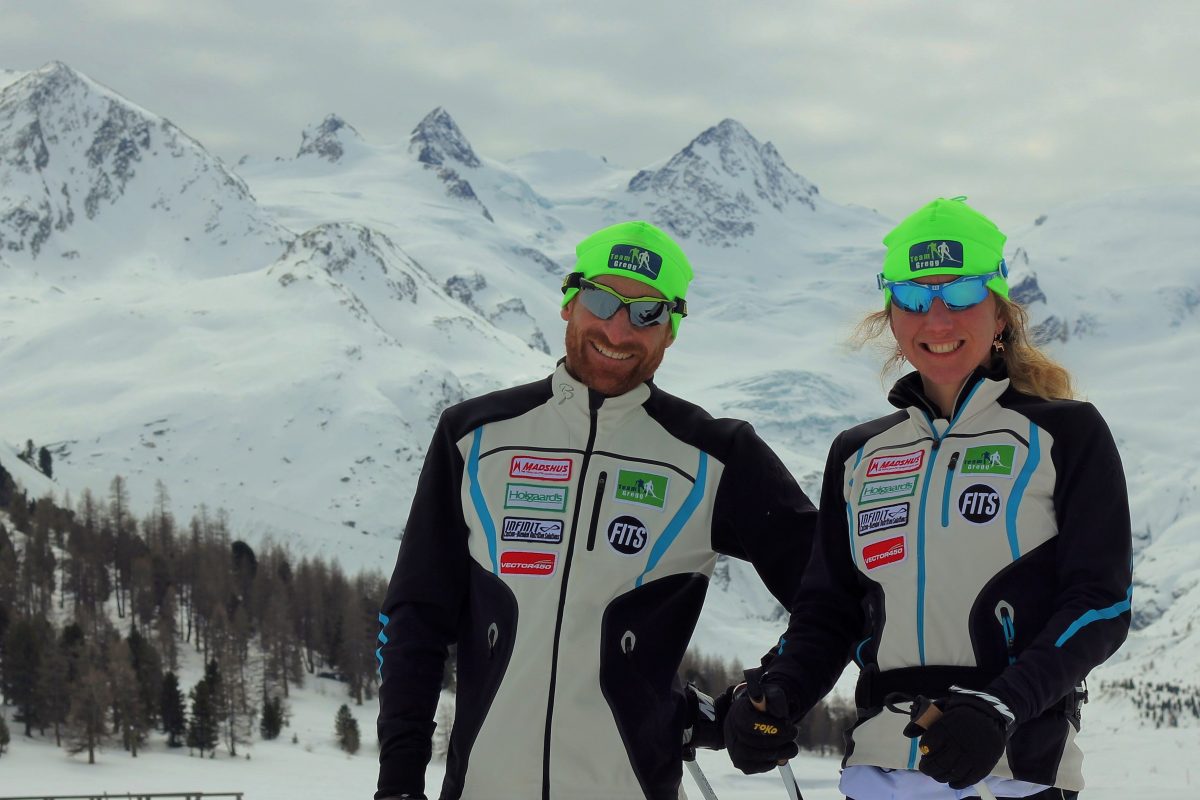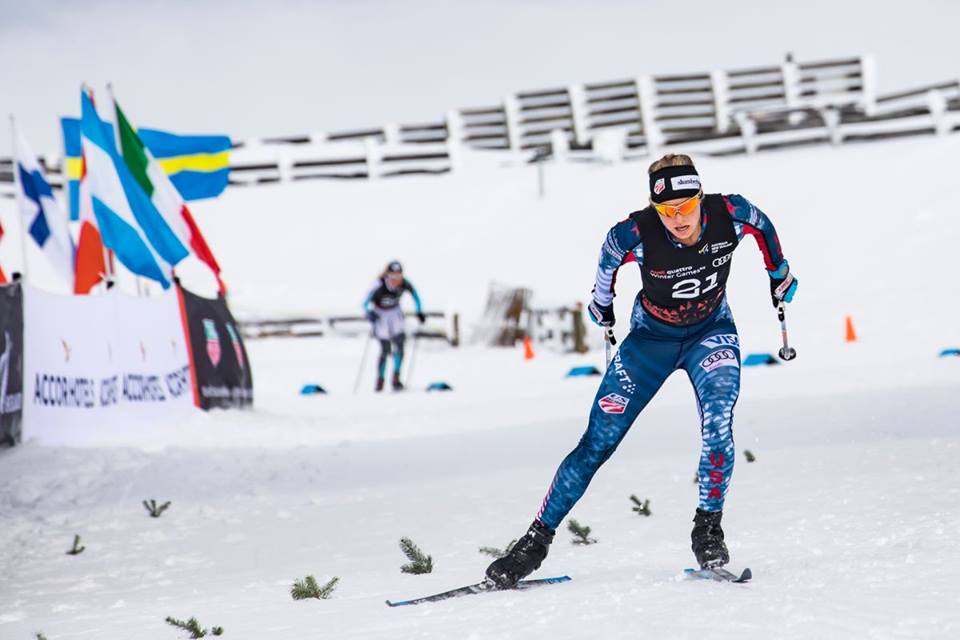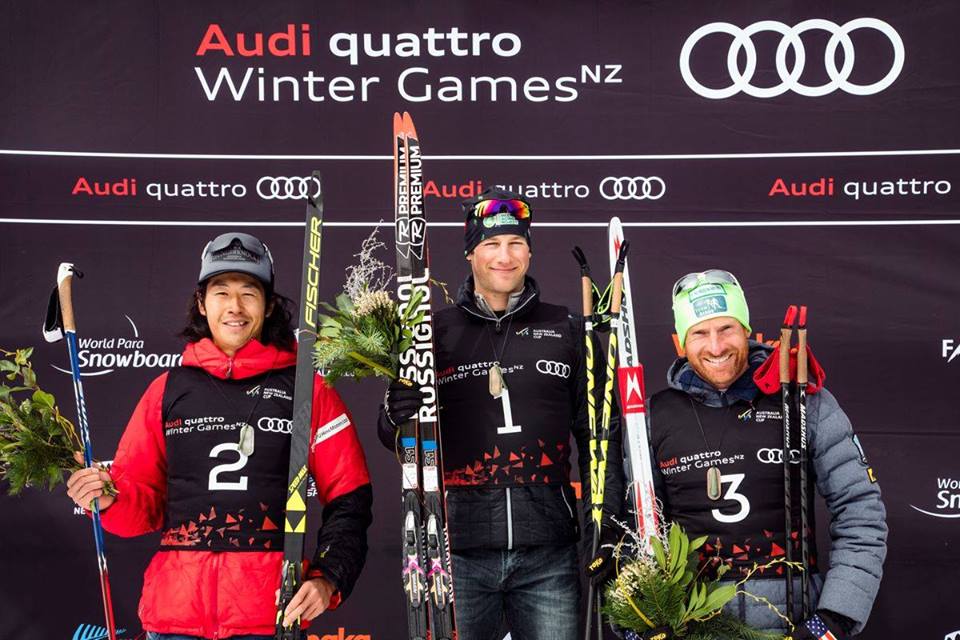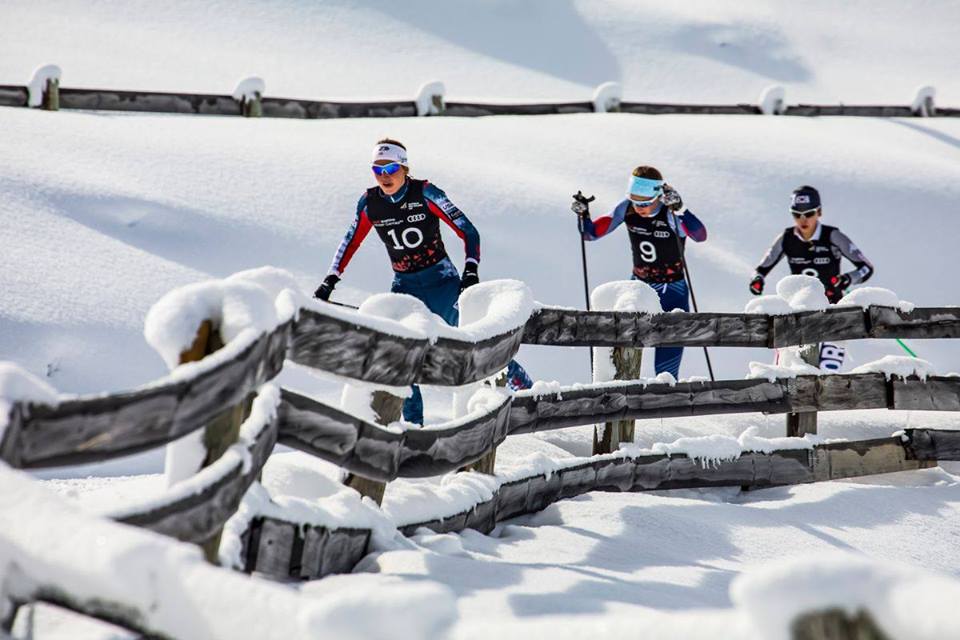
Tag: team gregg

  • True Value with the Greggs

    True Value with the Greggs


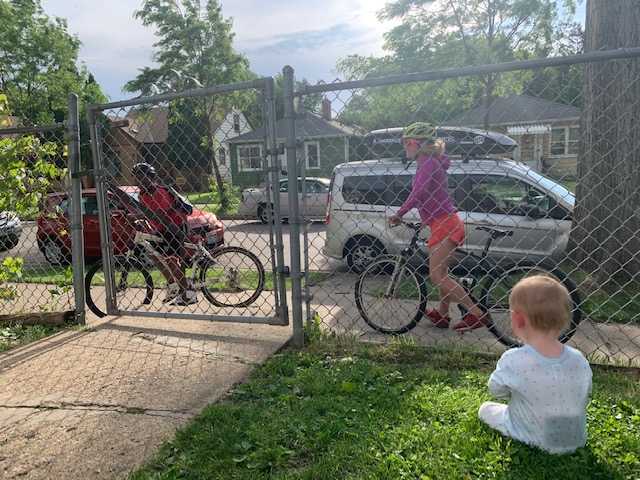
    Caitlin Gregg (right), Jazir (left), and Heidi on the lawn. (Photo: Brian Gregg)

    Since 2011, Brian and Caitlin Gregg have been residents of north Minneapolis. They added daughter Heidi to the mix a year and a half ago. They are close to Theodore Wirth Park, an urban magnet for cross-country skiing with amenities like snowmaking, homologated trails, and mountain biking in the non-snow months. The Loppet Foundation, a local non-profit, was poised to host the first World Cup in the U.S. since 2001 until concerns and regulations associated with Covid-19 caused the event to be canceled.

    Minneapolis has enjoyed a reputation as an arts and culture hub. The city skews left in its politics and serves as a gateway for Midwest winter sports. That image was shattered in the wake of George Floyd’s killing last month.

    Like many places, Minneapolis was a reminder of how many cityscapes have historically been racist by design. Since the early 1900s, Minneapolis has segregated with the assistance of racially restrictive deeds called racial covenants. In other words, specific properties included language in their deeds preventing people of color from acquiring them. 

    In 1917, according to an interactive map titled Mapping Prejudice, we see a single property near the west side of Wirth with a racial covenant. By 1919 blue blobs on the map indicating impacted properties were viral near that location. Then in 1923, another cluster began to propagate adjacent Wirth’s northeast edge. As the map’s timelapse rolls into the postwar year of 1946, those two racial covenant clusters balloon. They defined the area for years.

    Double click the images below to enlarge. Theodore Wirth Park is situated in the center of the respective maps.


    Where the Greggs reside specifically in north Minneapolis is an area of the city that is predominantly African American. “You mention it to someone that you live in north Minneapolis and it is known as the not as nice part of town which we never really understood,” said Caitlin Gregg. 

    As they looked for a home to buy in 2010 and 2011, their budget was small. So were their needs. One-bedroom. One-bath. They didn’t require more. And location, location, location was a bellwether. Brian, a 2014 Olympian, and Cailtin a 2010 Olympian, desired close to home skiing. Wirth Park was their place. At the time, Caitlin worked for a nearby Boys and Girls Club and loved the neighborhood. 

    “’That is a bad area, what are you doing?’” was the often-heard response when informing people of their housing find said Caitlin. “And some of these are friends of ours for a long time. I lived nearby and I felt like it was a great spot for what we were looking for. I was willing to find out what the neighborhood was like for myself.”
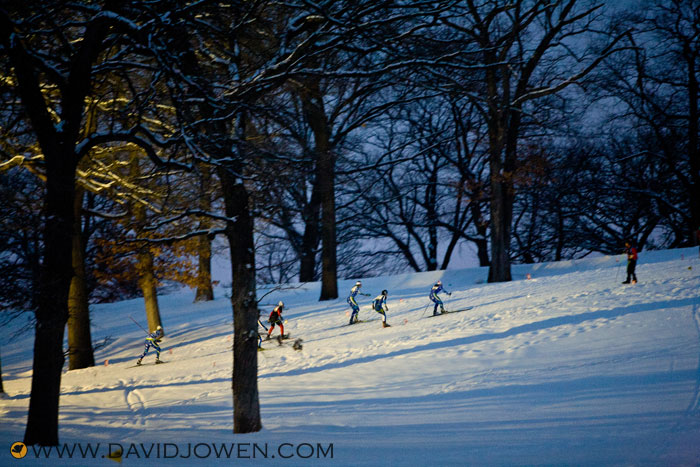
    Nighttime racing under the lights at Wirth Park. (Photo: David J. Owen Photography.)

    Both for Cailtin, who spent the first 10 years of growing up in a diverse section of Manhattan, and Brian, who grew up in the bucolic Methow Valley in Washington, living true to their values is a constant. “We definitely stand out here and I think it is an experience that everybody should have,” said Brian. “In the sense that to walk into a room and be completely different than everyone else. Imagine what it would be like for a person of color to come to a cross-country ski race?”

    The Greggs have worked intimately with the Boys and Girls Clubs near rural Hayward and Minneapolis and the Parks and Rec. Department in north Minneapolis. They have also collaborated with the Loppet Foundation to make cross-country skiing, mountain biking, and running accessible to the underserved and underrepresented. Their journey helping others as professional skiers began when they became involved with In The Arena, an organization linking Olympic athletes with empowering youth.  

    Most training logs serve the purpose of cataloging training hours by specifying items like time in zone, average heart rate, activity, and on and on. We’ve yet to see one with a column accruing time and energy given back. This is not to say many athletes have not found their cause and their voice; be it climate change, literacy, or eating disorders. The good work is out there.  

    It is a question being asked over and over by many pursuing excellence in nordic sport: “How is my cross-country skiing and my success in cross-country skiing helping? What is [it helping]? And how is that making the world a better place?” posed Brian as he explored how he and Caitlin have attempted to answer that question. “You have an immediate connection with people and in particular kids,” was one grounded response Brian gave.

    Living in a community with omnipresent reminders of systemic racism and exclusion, the Greggs have spent significant time ruminating on their value as athletes and why they may be important to communities. 

    Brian Gregg holds his three-week-old daughter, Heidi, during the flower ceremony after his second place finish at the 2019 Birkie. (Photo: Instagram @goteamgregg)

    “One thing that athletics does is that it shows that setting goals and setting big goals, and setting goals that honestly may be the majority of people think are not possible,” Brian said. “You can inspire others to do the same, to define their next goals and best achievements as the ones that are not easy, and probably the majority of people thought you would fail at.”

    Still, the constant stress of logging hours and resting adequately, and continuing the cycle, can be a deterrent to service and advocating for change. In the estimation of both Caitlin and Brian, however, their projects in north Minneapolis have made them better athletes. 

    “Whether or not we are better people I am not sure, but we are better athletes because of it, I think,” Caitlin said. “It gave us perspective and really realizing that we do love skiing and we do love pursuing our goals in skiing and we can do these things simultaneously. It does not have to be one or the other.”

    Caitlin recalled the times she first worked with local youth, describing herself as wearing bright colored Lycra and goofy glasses, and some sort of ski hat. We know the look as the slowly evolving concept of cross-country cool as defined by those faster than us. Others know it as something sartorially disastrous.  

    “I thought, ‘oh my gosh is anybody going to want to listen to us or want to be part of something that we are going to do, we are just so different’? The most incredible thing that I have learned from working with the kids and the program that we aim to do is that it did not matter. That was a huge lesson for me,” Caitlin said. It really didn’t matter to them. The most important thing was that we were there and we were present. They could count on us. They could trust us, and we came again and again and again. And we cared about them and about what they were doing. And that was needed so much and it really gave me a lot of hope.”

    None of this is to say the Greggs were not rattled with the recent marches and palpable anger in Minneapolis. Caitlin said it was simply unpredictable. Like others, they were advised to wet their fences to prevent potential fires from spreading and crack their windows at night so as to keep auditory tabs on what was transpiring outdoors. One morning after one of the most tumultuous riots to date in the city, Caitlin woke before 7 AM to the sounds of a small commotion. She went to the window with some anxiety, and saw one of the local kids, Joshua (9), zipping back and forth on his bike. He had asked his reluctant and slightly older sister to watch him – that was the grumbling Caitlin had heard. 

    “It was one of those moments, as if ok this is cool and good things in the world are still happening and will continue,” said Caitlin. 

    Joshua had learned recently to ride a bike. As a shy kid, it took him too long to convey to the Greggs that he didn’t know how to ride, but wanted to learn. Caitlin and Brian are known in their neighborhood as go-tos when it comes to how to access play in the outdoors. The Greggs helped secure a bike, and they were one degree separated from being Joshua’s human training wheels. Another neighborhood local, Jazir, who still swings by the Greggs daily, became a mentor to Joshua.

    Jazir came into the Gregg’s lives as a gregarious neighborhood kid. Like Joshua after him, the Greggs rallied to help Jazir find a bike. He was eventually connected with the Loppet Foundation’s mountain biking program and his trail riding love affair began. With Joshua’s new prowess on the bike as evidence, Jazir has paid it forward.

    Brian says their street near Wirth Park reflects the best of Minneapolis; a spectrum of people from all walks of life in close proximity to an urban jewel in Wirth Park. Caitlin, a trained environmental and city planner, said the city’s master plan called for a light rail system to connect their neighborhood with downtown and amenities on the city’s periphery. The original vision for the light rail would have blocked local access to Wirth. Through her involvement in the neighborhood association, Caitlin advocated for a modified plan allowing for easier park access. 

    The 2019 Theodore Wirth Regional Park Management Plan Analysis states, “Theodore Wirth Park values the mental and physical well being of their community and visitors and supports this by creating a safe, beautiful and fun environment for all seasons.” We all know it – easy access to open space is vital. 

    As the conversation with the Greggs waned, we didn’t touch on training or racing plans. I think we mentioned skiing once as Brian recalled a time deep in Wirth and deep in an interval session when a teenager he knew recognized him and called his name. It was an old neighbor named Quinn who was out skiing and had followed Brian’s 2014 Sochi quest. For the moment the Greggs are immersed in their full life and doing what they can to reflect and help their community. 

    There’s no doubt Minneapolis needs systemic change. If this moment is a tipping point, there’s optimism the city will be better off. It appears kids like Jazir and Joshua can keep Wirth local: the new light rail plan restores local entry points.


     

  • First Tracks as a New Parent: Caitlin Gregg (Part Two)

    First Tracks as a New Parent: Caitlin Gregg (Part Two)

    The “First Tracks” series highlights the pregnancy, postpartum, and parenting experiences of noteworthy athletes in cross-country skiing in various stages of their professional careers. The sharing of these experiences can benefit athletes in any stage of their career, whether they are an elite or recreational skier, by demonstrating that it is very possible to return to skiing, competition, and an active lifestyle with a growing family. The series will include the physical challenges of being an athlete during and after pregnancy, balancing family life with skiing, and the joy that starting a family can bring. You can read Part 1 of Caitlin’s story here.

    Caitlin and Brian Gregg meet their daughter, Heidi, who was born on February 5th, 2019. (Photo: @caitlincgregg)

    Heidi Mowgli Gregg was born February 5th, 2019. Caitlin’s mind did shift toward recovery and getting back to training, but not immediately.

    “Honestly, I was so grateful that the delivery went well. I think I had so much fear about delivering on the blood thinners that once that went by I was in such a good place and so excited.” 

    Brian was only able to take five days off surrounding the delivery, then needed to go back to work full-time, but Caitlin still received plenty of support in her transition to new motherhood.

    “I was really lucky because my mother-in-law came and she stayed with us for three weeks in the beginning, which was awesome.” 

    Brian’s mother helped round the clock, helping Caitlin get the rest and care that she needed. Caitlin recounted that it was particularly special to have her help since her own mother had passed away in the fall of 2017. After her mother-in-law left, Caitlin’s closest friend from high school flew out to offer her continued support for a couple of additional weeks.  

    She felt further supported by the women in the local ski community.

    “All of the moms in our ski community stepped up and everyone brought meals and little tidbits of advice. That was incredible. I feel very lucky that I had such good support and I think that was key.”

    As her body healed, Caitlin felt the itch to begin exercising again but did her best to temper her enthusiasm.

    “After the blood clot and I felt confident that I could train, I was able to do a lot of activity for the majority of my pregnancy. But after the delivery, I was really, really encouraged by a lot of people – athletes, non-athletes, my strength coach – to be patient in coming back.”

    Brian Gregg holds his three-week-old daughter, Heidi, during the flower ceremony after his second place finish at the 2019 Birkie. (Photo: Instagram @goteamgregg)

    For the first five weeks, Caitlin only went for short walks and otherwise rested and spent time with Heidi. During that time, they cheered for Brian while he raced to second place in the Birkie. While the weeks passed quickly, she struggled with the change of pace.

    “For me, the hardest part about recovery was for sure being patient and sitting still for five weeks. But at the same time, you have a new baby and everything is so exciting.”

    During that time, she continued to use her FitSplint, no longer to support her large belly during training, but as the postpartum core is like a deflated balloon, the band helped make up for the loss in stability during her walks and general movement.

    “I wore [the FitSplint] for the first couple of weeks walking and I thought it was really helpful to be there when I knew that my abs weren’t quite ready yet to be supporting my body and as things were transitioning and shifting after the delivery.”

    As Heidi arrived at the peak of an incredible winter for skiers in the Midwest, it was hard for Caitlin not to test the waters and get back on her skis.

    “It was probably the snowiest February we’ve had in Minnesota, so all the natural snow trails were open and the skiing was awesome. I remember Brian said, ‘Oh my gosh, let’s go out for a ski.’”

    She was leery of how her newly postpartum hips and loose core would handle skiing but decided the conditions were too good to pass up.

    Team Gregg snaps a photo to capture Caitlin’s first ski postpartum. Brian carried their newborn daughter Heidi zipped inside his jacket in an Ergo carrier. (Photo: Instagram @goteamgregg)

    “We went out and literally five minutes into the ski, I was like, ‘This is too much. I feel like Jell-O, this is just not fun,’” she laughed. “So we took a bunch of pictures and went home, and I waited another month or more before trying to ski again.” 

    Before jumping into heavy training, Caitlin prioritized rehabilitating her core and pelvic floor muscles so her body could function and move properly before being under heavy stress. She began following a program from the MUTU System, which focused on pelvic floor stabilization, and reactivating and strengthening her core from the inside outward. As she progressed through the program, she gradually added other types of training back in. 

    “I started lifting again at about six weeks, and I walked, and then I was able to start skiing again, and the skiing felt so good. Then, I was very patient with the running and would walk-run, so walk for five minutes then run for a minute and gradually increase until I could do a mile, then a couple of miles.”

    While advice for high-level training during pregnancy is limited, more information on athletic recovery is becoming available. Caitlin expressed gratitude for the active women and professional athletes who have spoken out about the challenges with postpartum recovery and how to overcome them and was grateful to learn from both their successes and failures. 

    “I had great advice and resources [for recovery]. From reading about Marit Bjorgen who maybe came back a little bit too quickly when she did start training again and had two pelvic stress fractures, I knew that calcium was super important. And I read that when you’re breastfeeding, you’re more at risk for gestational osteoporosis.”

    Overall, Caitlin was happy with the steps she took to return to training and competing and believes that being conservative, patient, and addressing the underlying small insufficiencies that can create larger problems down the road.  

    “On the flip side, you’re now a mom and you have a lot of things going on. So there were times when I was like, ‘Wow, I feel really good, but I am WAY more busy than I was before.’”

    As far as the conversation about goals for the future, Caitlin described an open-minded approach. They are thrilled with their new addition to the family, but finding time to fit in training full-time is a juggling act. In the mornings, a shared nanny comes to their house to take Heidi from 6:30 until 11:30. During that time, Caitlin is working for the Loppet Foundation leading and training with the Loppet Nordic Racing collegiate program. 

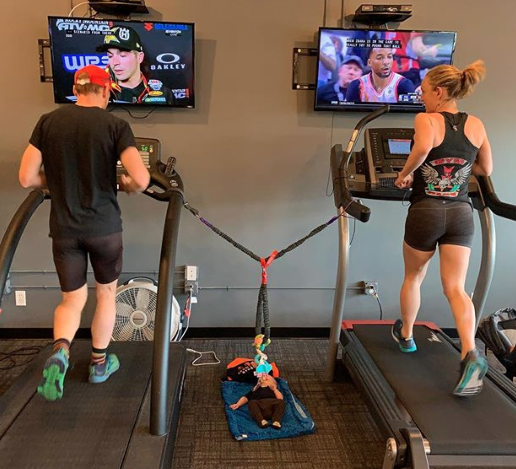
    Caitlin and Brian Gregg demonstrate how they make their afternoon training work with an infant. (Photo: Instagram @goteamgregg)

    In the afternoons, Team Gregg tries to include Heidi in their afternoon sessions. Sometimes she is in the gym with them – Caitlin endearingly called her as a “gym rat” – and sometimes she joins them on a run. These sessions look different than before, but she enjoys including Heidi in their lifestyle. 

    “Maybe you start lifting and she starts fussing. So then you go and take a little break. You hang out with her, and maybe you nurse, or you bounce her around, or you show her the mirror. Or sometimes, she’s your weight and you’re doing goblet squats with Heidi – she thinks it’s hilarious. You find ways to be super creative.

    “We took on this concept where we didn’t know what our lives would be like after Heidi came, so we really dove in with trying to make it kind of an adventure with Heidi,” she continued. “Again, following Kikkan and Holly and other moms we saw, they were bringing their kids out for ski adventures or hikes, so that was something that we were looking forward to.”

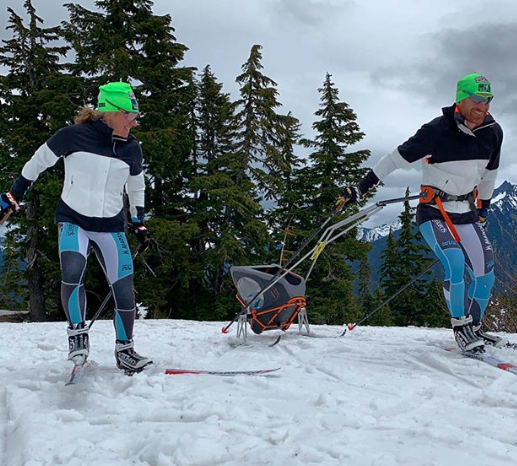
    Brian and Caitlin Gregg tow their daughter both skiing and running with the KidRunner. (Photo: Instagram @goteamgregg)

    The Greggs partnered with a Bend, OR based company called KidRunner who designed a revolutionary chariot-style running stroller. Recently, professional runner Lyndy Davis and fellow KidRunner ambassador clocked a time of 1:21:38 to set the Guinness Book of World Records fastest half-marathon while towing a hands-free stroller. It also has ski attachments, allowing Heidi to join them in the winter as well. 

    “One of our favorite things to do has been to go on a big family run or adventure and bring Heidi. She’s done it either on Brian’s chest, or in the KidRunner, and we’ve been able to bring her into the mountains and all over, which has been really fun.”

    These sessions look different than before, but Caitlin describes Heidi as an easy-going and happy baby who has so far loved joining them, even for 20 plus mile runs with Brian. 

    “So we’ve been trying to do what we did before, except we both have jobs and we have Heidi, which means we don’t get nearly enough sleep,” she concluded with a laugh. “But it’s pretty fun.”

    In early May, when Heidi was just three months old, the Gregg Family headed to Iceland to race the 25-kilometer freestyle and the 50 k classic two days later at the Fossavatn Ski Festival

    Apart from racing so soon postpartum, Caitlin felt trepidation around the idea of international travel with a three-month-old. 

    “I was kind of on the fence about Iceland. It seemed like a really fun adventure, but then right before, I got really nervous about what we were about to undertake.”

    Because they were trying to accommodate Brian’s work schedule, they had left Minneapolis on a red-eye flight Tuesday night, arriving midday Wednesday in Iceland then racing Thursday.

    “I’d say the one thing that I completely didn’t think about was that we had a three-month-old, so we weren’t going to sleep at all the night before the flight, and then I was sort of used to, ‘Okay, maybe you don’t get a great night sleep on the plane.’ But we were entertaining a newborn on the plane, so we had no sleep for two days. We were absolute zombies.”

    Unsure of how to navigate the child-care aspect of racing internationally, Caitlin reached out to her family. 

    “The biggest thing that helped was that we had my sister come.”

    Her sister, who lives in southern California, tried skiing for the first time that winter while visiting a pregnant Caitlin in Minneapolis. Caitlin explained that while her sister was excited to try skiing again and to spend time with Heidi while they raced, she also wanted to check out some of the tourist destinations in Iceland, like the Blue Lagoon. The foursome headed to the hot springs shortly after their arrival to Iceland.

    “So we went to the Blue Lagoon where Brian and I proceeded to just pass out and fall asleep,” she laughed. “And my sister was like, ‘What is wrong with them?’”

    The power nap seemed to be effective as Caitlin went on to win the 25 k skate race the next day. 

    “I think there is a lot of adrenaline [at races] and I had been skate skiing all winter, so I actually felt really good in the skate race,” she said.

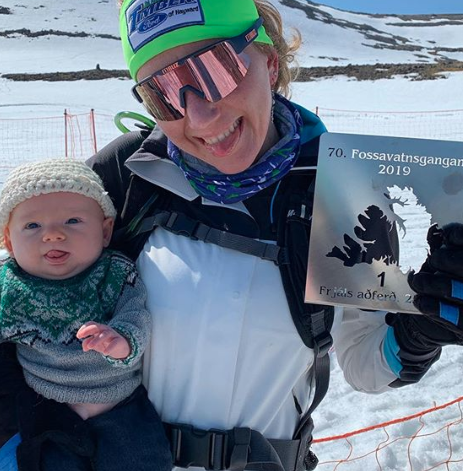
    Tongues out for first place at the Fossavatn 25 k in Isafjordur, Iceland. (Photo: Instagram @caitlincgregg)

    She also took third in the classic marathon, though she did not feel as strong there. Despite the lack of sleep and stress of international travel with an infant, which she felt they underestimated, she and Brian enjoyed racing with different expectations and tried to laugh about the hilarity of their situation rather than dwell on how exhausting and challenging it was. 

    “All in all, I thought we did awesome,” she laughed as she thought back on the trip overall. “I will say it changed my entire perspective on sleep before a race or time-management before a race.”

    Since the Fossavatn, Caitlin has enjoyed hopping into a few running races and will continue to do so as she trains for the 2020 Birkie. 

    “I think my attitude has been that everything now is new PR’s. Maybe I’ll never hit the same level as I was at before being a mom, but everything now is like, ‘Oh, it’s my PR as a mom.’ And I think that’s really fun, and a good way for me not to put too much pressure on myself and have an open mind that anything can happen. Sometimes I surprise myself, and sometimes I’m like, ‘Yup. That’s not that good.’”

    Caitlin has enjoyed the process of seeking out resources during after pregnancy and learning as much as she can about perinatal exercise. Rather than seeing pregnancy as a setback to her athletic career, she described the overall journey as “an exploration” and focuses on what she can learn from the experience. Her postpartum body is different and responds differently to training than before, but she doesn’t see the changes as negative. 

    “I think the biggest thing that I’ve noticed is that I maybe need to slow down a bit and be more aware of ‘How’s my body doing? How are my muscle imbalances?’ All of a sudden, all of these smaller details seem more important before. Maybe it’s because of all the talk about pelvic floor health and the core training, and maybe it’s because of having to take a step back and rebuild my fitness from the ground up. I think all of a sudden, the training has taken on a new challenge and a new fun element for me, so I’ve been having a really good time training. I can’t say that I go out every day and think to myself that I’m stronger or more fit than before or going to set PR’s or things like that, but it’s fun to see the subtle differences. I can’t exactly pinpoint what they are, but they’re different.”

    Some days, Caitlin feels like she can tap into her “mom strength” and nail a workout, other days that is not the case, especially after a rough night of sleep. As she looks to the future, she wants to continue to enjoy the exploration or her limits, while acknowledging that her priorities are now shifted.  The mobile app runs faster than the desktop version, consumes less power, is specially designed for a small smartphone screen, and takes into account the architecture of the mobile gadget. In addition, the mobile parimatch app has extensive functionality with many additional options. The mobile app has a user-friendly interface, high performance, and multilingual support.

    “I’m going to be very open-minded. I’m having fun training and the majority of the time, I feel really good. At the end of the day, I want to be the best mom that I can be and lead by example for Heidi. It’s a neat challenge.”

    Similar to the way Holly Brooks is becoming certified to offer coaching for expectant parents to help them emotionally prepare for the lifestyle change, Caitlin’s experience has inspired her to continue learning about pre and postnatal training with the hope of offering coaching to other female athletes that want to pursue athletic goals after pregnancy. 

    “I’m really fascinated about all of the prenatal and postnatal training and exercise and that I’d really like to dive in. I’m going to start doing more coaching and training, and I would really love to specialize in women who are pre and postnatal and help guide them through how I found my path with it so that they can be successful during their pregnancy and afterward and reach their goals. There’s so much out there, but it’s so hard to track it all down. I’d like to become a resource. There’s a whole world of creative solutions for all things revolving around fitness and new moms.”

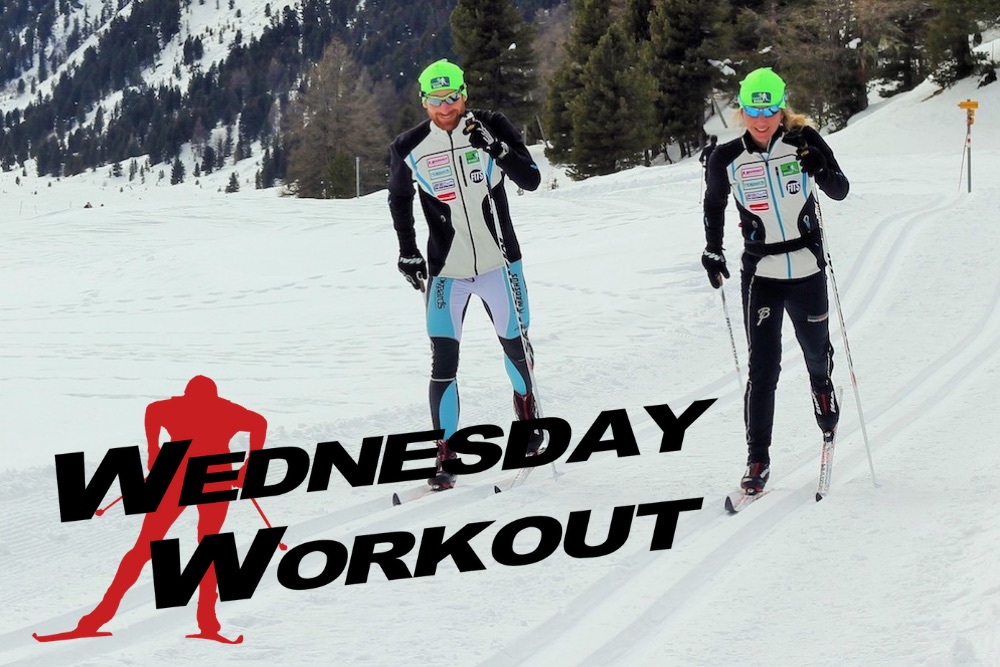
  • Wednesday Workout: ‘Trailheading’ with Team Gregg

    Wednesday Workout: ‘Trailheading’ with Team Gregg

    Team Gregg, Brian and Caitlin Gregg, out for an easy recovery ski together. (Courtesy photo)

    This week, we’re featuring a workout from the training logs of Team Gregg. These days, husband and wife Brian and Caitlin Gregg are adjusting to life, training and bodily changes as Caitlin is pregnant with their first child (a girl), due in early February. Read the full story here.

    Caitlin sent us the following “trailheading” workout, in reference to starting and ending a workout with someone else, which is how they often train together.

    ***

    One of the challenges in training and racing is that it is often challenging to find training partners at the same speed and ability as yourself.  I would argue that the best training partner is one who is just slightly faster than you.  Brian and I have been blessed with opportunity to be a married couple who have both competed in the Olympics.

    ethings.org

    Here are a few ways we get creative to maximize our workouts and fun:

    • Every training partner can offer something and we enjoy large training groups.  If you don’t have a training group, take it upon yourself to organize one.  Utilize a loop so that the group can kind of stay together.  If you are really searching, our neighbor’s house is for sale and you can join one of the many each cross-country ski groups in the Twin Cities.    
    • Utilize different ski speeds as equalizers.  On snow, put the slower person on the fast Redlines.  If you are rollerskiing, give the person who is in the best race shape the slow, soft wheels.  Using various rollerski wheels is a great way to prepare yourself for various snow conditions.
    Brian and Caitlin Gregg enjoying the fruits (and added weight) of their workout during a hike this summer. Brian carried the watermelon in a backpack to slow him down. (Courtesy photo)
    • Another tool we use is a weight vest.  For intervals, Brian will wear a weight vest and we can ski side by side pushing each other.  This summer, I had Brian carry a watermelon during a hike so that we could relate, plus it was delicious.
    • In preparation for the 2015 World Championships, at 9,000 feet in Colorado we would Jetstream bloc my skis so that I could be skiing at speeds more similar to sea level.  Plus, Brian and I could do intervals together.  
    • Although Brian and I might have the same duration for an interval, he will start behind me with the goal of trying to catch me by the end while my goal is to try and hold him off.  This also works really well for speed sessions. 

    Sample Workout: Team Gregg Husband/ Wife Intervals

    We have a great hill in Afton, Minnesota, that Brian and I try and get out to about once a week in the fall. It’s steep and long (for the Midwest) but you can also safely ski down between repeats.

    Warmup: Ski easy for 30 minutes with 15- to 20-second pickups. We usually start our warmup at the same time, but gradually over the 30 minutes, we separate and meet up again to do some pickups. We then do a set of pickups where Brian starts behind me and we try to finish the pickups together.

    Intervals: The workout is usually 5-8 x 4-5 minutes (with 3-4 minutes recovery) depending on how we are feeling and what our goal for week is. Brian will either put slower wheels on or wear a weight vest for the session. I will either put faster skis on or start a little before him.

    Brian Gregg snaps a selfie during a workout with his wife, Caitlin. (Courtesy photo)

    The Game (Goal): If it’s just the two of us, we try and make the intervals more fun and exciting by challenging each other to get to the top first, but also try to maintain or drop our times from the start of the session to the end. For example, getting to the top first on the first interval but then falling back or skiing slower each subsequent interval isn’t the goal.We focus on negative splitting each interval in the set, which requires good discipline early on.

    Cool down: We usually ski the cool down together and reflect on the session. Since we are out there together, we don’t always have feedback the way someone watching or filming the entire session from the sidelines would, but we can still be observant of how the other person is moving and offer some technique cues.

    After the session: It’s been incredibly fun to travel the world training and racing together as a married couple. We are extremely lucky that we have both been able to follow our dreams. There are still added challenges to this approach, though… One of the hardest parts of finishing a hard race or interval session together is that we are both exhausted at the same time, which means that there has to be some way of deciding who is going to cook or do the dishes at the end of the night. This is where we put high stakes on who executes a workout better or has a better result at a race. The winner gets to relax on the couch while the loser has to wash and dry! Just kidding; we do the dishes together 😉

    Brian and Caitlin Gregg (Team Gregg) out for a rollerski. (Courtesy photo)
  • Soon-To-Be Parents, Caitlin and Brian Gregg on the Winter Ahead

    Soon-To-Be Parents, Caitlin and Brian Gregg on the Winter Ahead

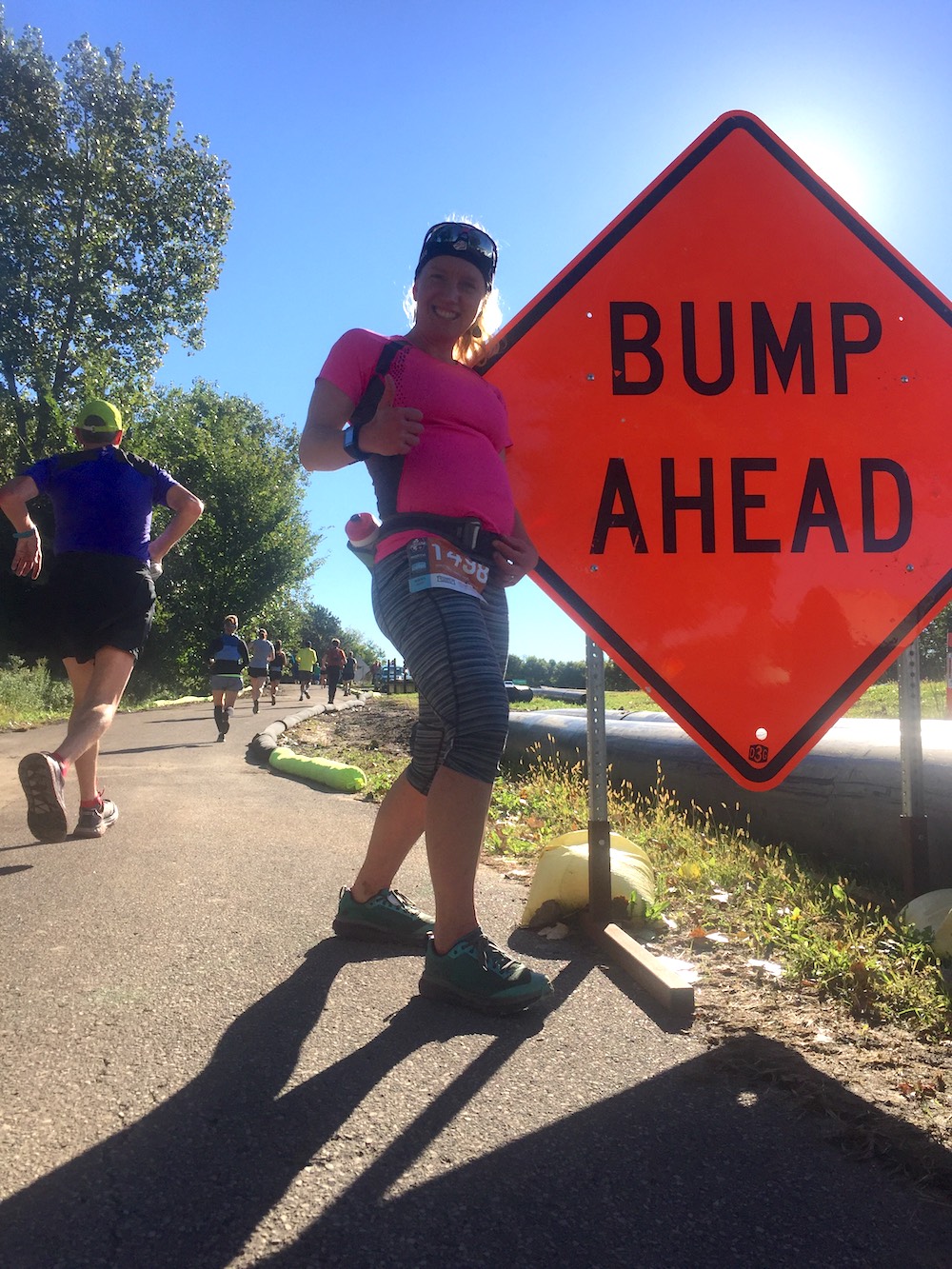
    Caitlin Gregg rocking her baby “bump” while 20 weeks pregnant at the Loppet Foundation’s Trail Loppet, an “urban trail run”, on Sept. 21 in Minneapolis, Minnesota. She and her husband Brian are expecting their first child in early February. (Courtesy photo)

    The questions started rolling in this spring. How’s training going? Are you going for 2019 World Championships? What’s the plan for next winter?

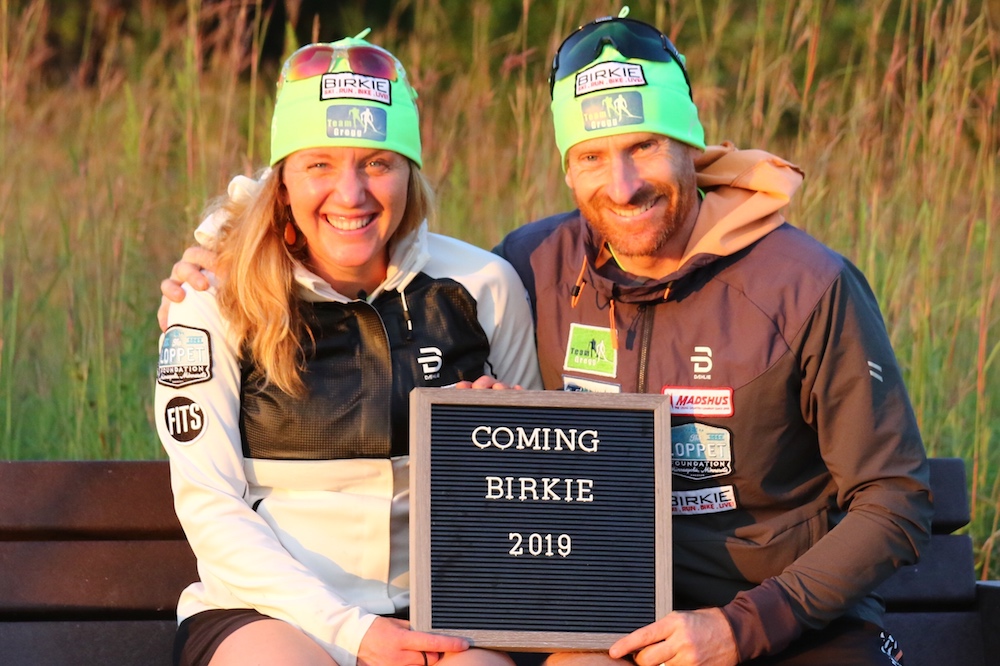
    When you’re Caitlin and Brian Gregg, Olympians and local superstars in the Midwest, it’s hard to keep your athletic profile on the DL. Since buying a house on Theodore Wirth Park seven years ago, the couple has immersed themselves in the greater Minneapolis community — both in and out of skiing. They’ve raced, coached and worked out alongside skiers of all levels. They’ve bolstered the Loppet Foundation and its Loppet Nordic Racing program while chasing their own athletic dreams. And for the most part, they’ve achieved everything they set out for.

    But not making the Olympics last winter was a blow for both Caitlin and Brian. They had both been on the edge — the infamous bubble — but didn’t make the 20-person cut for PyeongChang.

    And by Brian’s calculations, at least one of them should have.

    “The naming of the 2018 Olympic Team was a surprise to me,” Brian wrote in an email to FasterSkier in late September. “After Caitlin made the team in 2010 and myself in 2014 it was our dream to both be competing in 2018.  I did not expect to see so many discretionary selections and I had expected to see Eric Packer on the Olympic Team, and I thought I would be as well if they took as many as 20 athletes.  I am happy to see that we took a full team of athletes, although it was hard to see us not fill all of our distance men’s starts.  I believe the criteria and the selection committee failed our athletes.  I still believe we have room to improve our team selection and this year is better than last year, although we still have improvements to make.”

    Despite feeling that he and Packer ranked high enough on the U.S. Ski Team’s 2018 Olympic points list to make the cut, Brian wasn’t bitter. And he’s still planning to race this winter. But life for the Greggs is different this year.

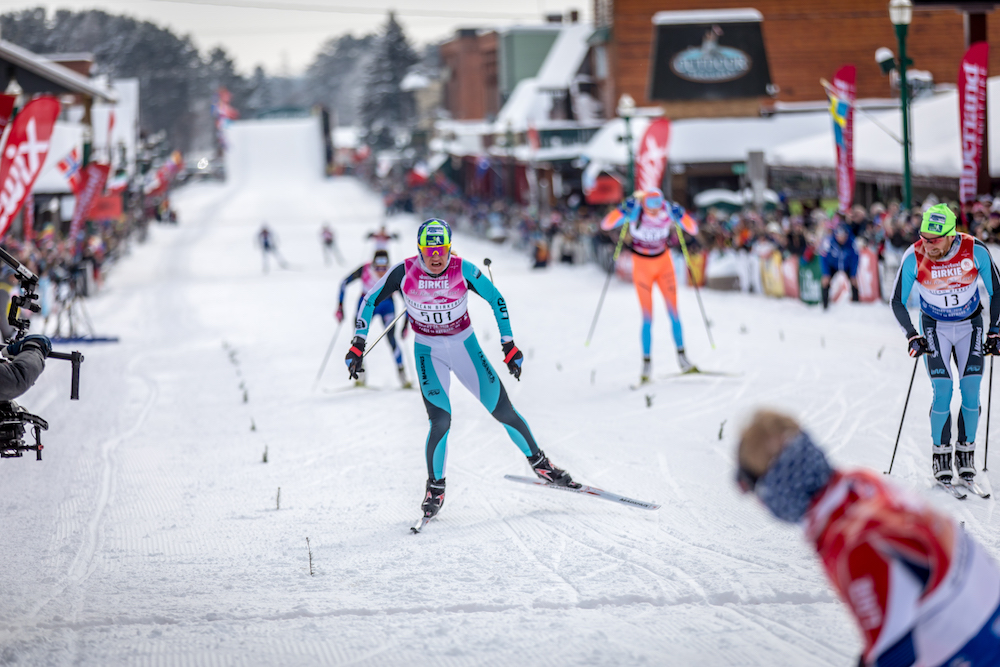
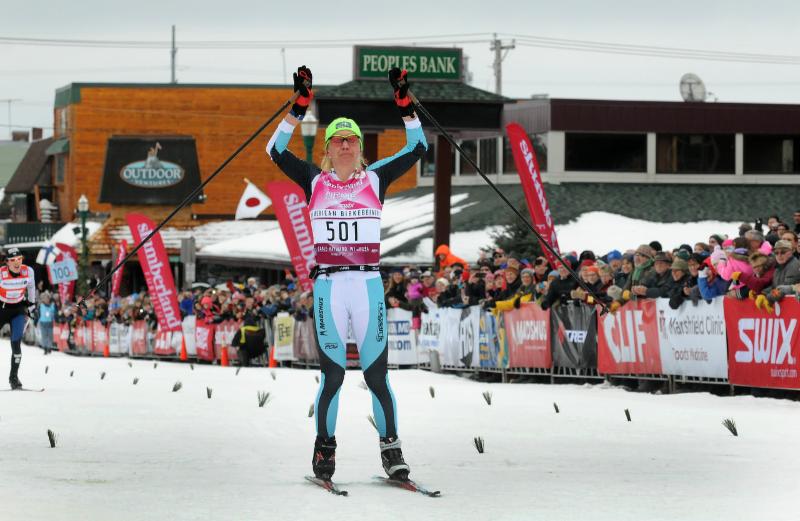
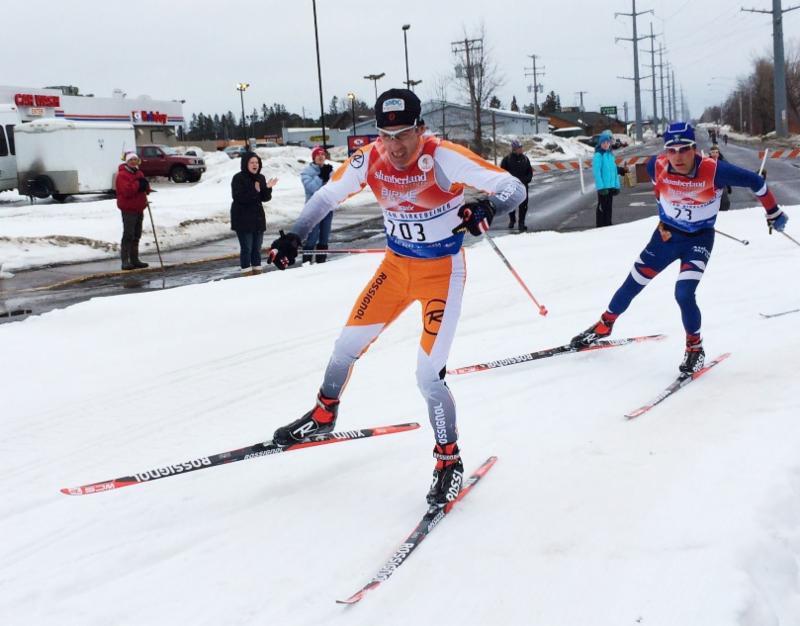
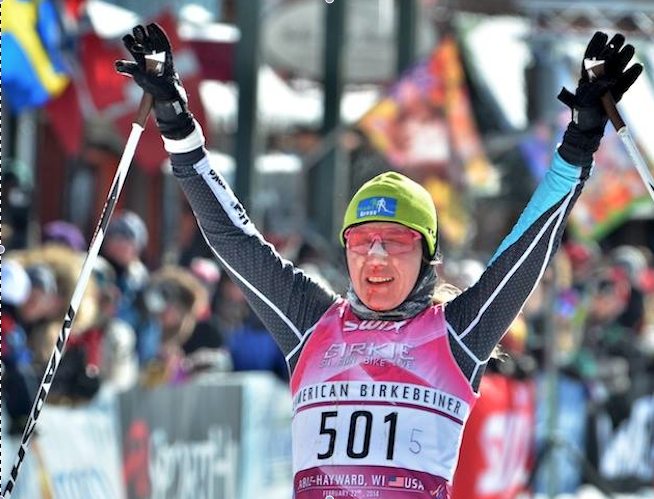
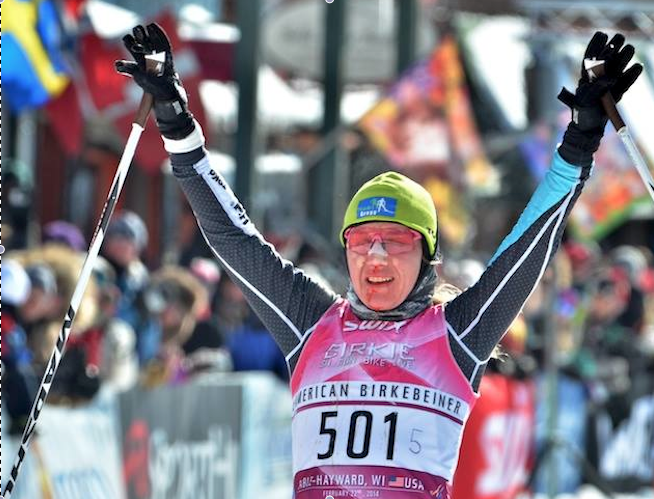
    Caitlin Gregg (501) winning her fifth American Birkebeiner last February in Hayward, Wisconsin, while skiing alongside her husband Brian Gregg (13), who placed 22nd in the elite men’s skate race. (Photo: ABSF/James Netz)

    For one, Brian has been working full time in financial services and taking night classes to become a certified financial planner. In a major step toward that, he passed the six-hour Series 7 exam two weeks ago. 

    That has meant less training, which he didn’t necessarily see as a detriment. In various running races this spring, summer and fall, Brian won the City Trails Loppet (a 10-mile urban trail run in St. Paul Park, Minnesota), finishing just ahead of his good friend Matt Liebsch, then ran a 1:12:43-hour road half marathon (Grandma’s Marathon) in June in Duluth, Minnesota, won the Loppet Foundation’s Trail Loppet half marathon (in 1:20:34) on Sept. 21, and placed seventh in the Birkie Trail Run Festival’s half marathon (1:24:00) on Sept. 28.

    “Now that I’m training a little less on the days where I don’t get out to do a workout, one of my big inspirations is my friend, Matt Liebsch,” Brian said on the phone in late August. “Seeing him not make the [Olympic] team in 2014, that was disappointing, but seeing how much fun he has in the sport, and we still train together four some-odd days a week. … Not all of our times are getting slower; you keep chipping away and pushing yourself. 

    “It’s good for your general mental health,” Brian added, referring to skiing as a lifestyle more than a job. “I just like it and I think the more people we can get into this sport and doing it, the world’s a better place that way.”

    Caitlin agreed. 

    “We both love the sport and we’re in a really fortunate scenario; it’s pretty neat to have a husband-wife Olympic duo,” she said on the phone while sitting with Brian at his office. “It definitely happens, but the fact that we’ve been able to support each other through that is pretty cool.”

    “It’s good for your general mental health. … I think the more people we can get into this sport and doing it, the world’s a better place that way.” — Brian Gregg on cross-country skiing

    Caitlin and Brian Gregg are expecting their first child on Feb. 9, two weeks before the 2019 American Birkebeiner. (Courtesy photo)

    While the two halves of Team Gregg are used to supporting each other at North American ski races — including an annual assortment of SuperTours and U.S. nationals — Caitlin has been doing more coaching and sideline cheering so far this year. While she had originally planned to keep her pregnancy a secret early on, Caitlin said that it became tough to dodge the training questions. 

    On Aug. 10, they posted an “expansion of Team Gregg” baby announcement on their Facebook page. During their Aug. 22 interview with FasterSkier, Caitlin was 16 weeks pregnant. And as of this week, now 22 weeks along, she’s past the halfway point. They’re expecting their first child — a girl — on Feb. 9, exactly two weeks before the 2019 American Birkebeiner (a ski marathon Caitlin has won a record-setting five times).

    “I told her she has two weeks to get ready and in shape,” Brian jested.

    “I was like, ‘Uh, yeah,’ ” Caitlin replied.

    ***

    It’s a girl! Brian (r) and Caitlin Gregg (beneath pink confetti/candy) discovered the gender of their baby, due Feb. 9, 2019, at a gender-reveal party in August. (Courtesy photo)

    The gender-reveal party (with a piñata filled with pink candy), a baby shower her high-school athletes threw her (with diapers filled with melted chocolate bars), it was all new to Caitlin.

    So was the news of a blood clot in her leg in early July. During their six-hour drive home from Thunder Bay, Ontario, where Brian had competed in Canada Day rollerski races while Caitlin cheered him on, Caitlin started feeling pain in her left calf. It worsened and she went to see her doctor, which revealed she had two blood clots in her calf. She was immediately put on blood thinners and instructed not to bike, rollerski or do anything with a heightened risk of falling.

    buy tetracycline, buy flagyl online

    “That was super scary,” she reflected. “… The doctors were like, ‘That’s really weird, you’re the last person we thought this would happen to; you’re so young and active.’ So we haven’t gotten any answers yet as to whether it’s an underlying [condition]. … There are a couple other genetic disorders you can have, inherited blood-clotting disorders that I just never knew about, potentially, [for] my entire career. I’ll get tested for those after the pregnancy, but one of the big bummers is that I have to be on blood thinners for the remainder of the pregnancy.”

    She immediately remembered Kikkan Randall’s blood clot scare in 2008 and decided to call her former U.S. teammate, a 2018 Olympic gold medalist.

    “She took a good 45 minutes and just talked to me and told me about her scenario and how it was for her and what she had to go through and all of the kind of different aspects of blood clots and the pregnancy and how everything turned out great, so that was super reassuring,” Caitlin said. 

    While their experiences were different (Randall had two surgeries to remove a recurring blood clot in her leg well before she became pregnant in 2015), Caitlin was comforted by their conversation. Two days after they spoke, Randall announced her breast-cancer diagnosis on July 11 on social media. She had never mentioned it to Caitlin.

    “To me, that was the epitome of a class act,” Caitlin said. “She didn’t once change the subject and say, ‘Don’t worry, that’s nothing,’ or belittle my fears or anxieties. She just listened and was super awesome and great mentor and very much present in what I was dealing with, so I immediately wrote her and said that was amazing, thank you so much, and I wished her the best.”

    For the duration of her pregnancy, Caitlin will take two shots of blood thinners each day. In addition to her exercise limitations, she’s also been advised not to fly or take long road trips for the time being.

    “For me, because the dose is so high … [the doctors are] more worried about internal bleeding and almost not knowing it, is the bigger thing,” she said. “I can still ride a stationary bike, and I can do a lot of exercises. I just have to make sure the risk of that falling — so mountain biking, riding a bike outside, rollerskiing — are kind of the big no-nos. … But I’m really looking forward to skiing on snow, especially on super-soft, powdery stuff. … Honestly other than that, pregnancy has been awesome.”

    In June, Caitlin, about six weeks pregnant, ran the same Grandma’s half marathon as Brian, finishing 19 minutes behind him in 1:31:38. In an effort to qualify for the 2019 New York City Marathon, the two had registered for the 13.1-mile road race before discovering that Caitlin was pregnant. Caitlin decided to run in what she called “Level 3” while being mindful of her heart rate and feeds during the race. She said she felt “awesome,” and their finishing times did the trick, qualifying them for next year’s NYC Marathon.

    Since then, she’s scaled back the racing, instead entering running races with a goal of “jogging/ walking/ pole hiking them”.

    Meanwhile, Brian has been getting out for workouts whenever he has time and plans to race at least the first period of the SuperTour circuit this coming season. In an effort to qualify for his first World Championships, he is focusing on strong performances in the 15-kilometer freestyle at the Sovereign Lake SuperTour/NorAm in December in British Columbia, and the U.S. nationals distance races in early January in Craftsbury, Vermont.

    “My training volume is hugely reduced this year, but I have been hitting all of my intensity sessions,” Brian wrote in an email. “My primary focus is on preparing to support my family and my baby girl, but my passion for ski training and racing will never go away.

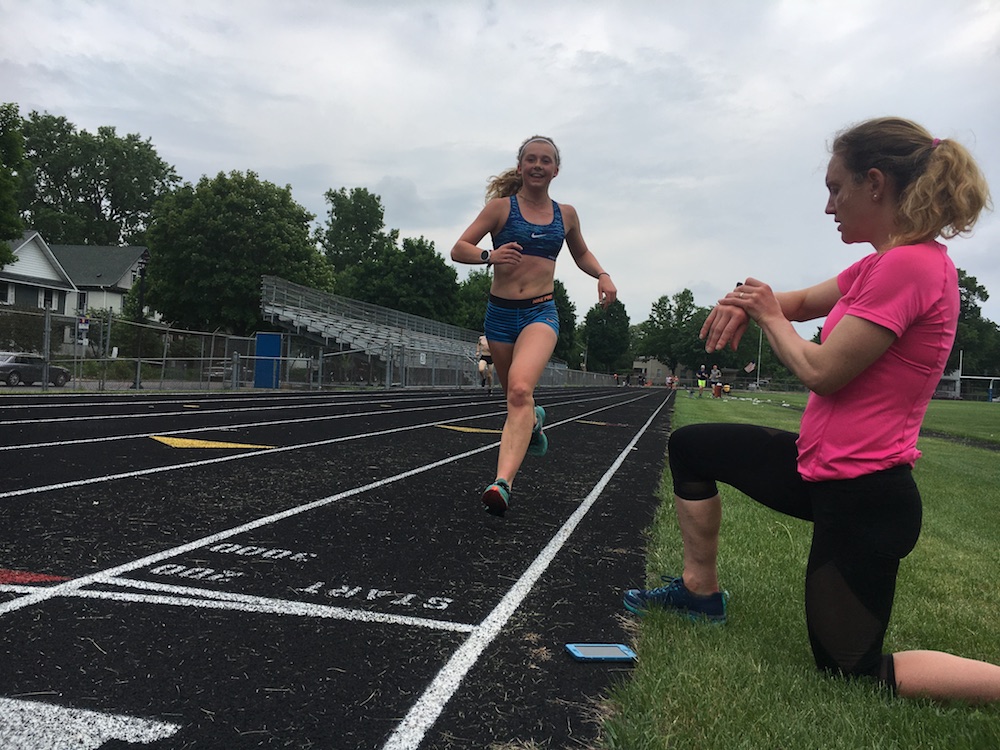
    Coach Caitlin Gregg (r) timing Sarah Olsen, a Loppet Nordic Racing junior skier, during a time trial this past spring. (Courtesy photo)

    While Caitlin won’t likely be able to travel to Canada and New England to support Brian at those races, she expects to stay busy at home while working with sponsors, like Madshus, as well as the Loppet Foundation. In addition to coaching 12 college skiers this summer, Caitlin was hired as the Loppet Foundation’s director of adult programming. She’s also an assistant coach with the foundation’s year-round Trail Kids program.

    “We’re both staying super busy, which I think is exhausting in a lot of ways, but it’s also really fun because it brings a lot of balance,” she said.

    “Sometimes it’s good to not have a lot of time to analyze your training session,” Brian said. “You’re sort of like, ‘I’ve got an hour and a half. I’m going to just try to get everything done in this hour and a half, and then I’m going right to class or school or working with this kids.’ ”

    The two are also adjusting to spending less time together. While they didn’t necessarily work out alongside each other, the Greggs frequently start and finish at the same place, which Caitlin described as “trailheading”.

    “Basically you drive to the same location and say, ‘All right, I’ll see you in two hours,’ ” she said. “There are some times when [we would] play around with rollerski speed wheels … or Brian uses a weight vest and that works pretty well.”

    During a summer hike on the Birkie Trail, Brian wore a backpack with a watermelon inside. Caitlin guessed it weighed 40 pounds.

    “It wasn’t that big of a watermelon,” Brian quipped.

    But when they’re not exercising, they’re working — which has become more full time for both of them.

    “We went from spending 24 hours a day together, 360 days a year or whatever — there was maybe a couple days or weeks where one of us would be somewhere else. Now Brian’s at the office all day or I’m out coaching,” Caitlin said.

    “I feel like I haven’t seen her for weeks,” Brian added.

    Yet they’re still having fun, and they’re still loving their ski-driven lives in the Twin Cities. Late last month, news broke that Minneapolis will host a 2020 World Cup race at Theodore Wirth Park, right outside their door.

    “Caitlin moved to North Minneapolis 10 years ago and the bulk of her training leading up to the 2010 Olympics and her 2015 World Championship medal were on the trails at Wirth,” Brian explained, referring to Caitlin’s bronze medal in the 10 k freestyle at 2015 World Championships. “I won my first Super Tour at Wirth and we strategically purchased our house 7 years ago next to Wirth because of the great training opportunities.

    buy erythromycin, vibramycin online

    “It has been incredible to be a part of the amazing Midwest ski community and the growth of the Loppet Foundation,” he added. “One of the major goals of the Loppet Foundation is to promote health and wellness with underprivileged youth and families.  We share this passion and it is just amazing to see our small community based organization grow … We have a large group of junior skiers and I would love to see those kids representing our home club in the World Cup, but you better believe we will be keeping those kids honest and going for a spot ourselves.”

    Brian and Caitlin Gregg with their baby’s first “singlet”. According to Caitlin, TNC Endurance stands for Team Nichole Coaching. “I worked with Nicole Porath for my training plan for Grandma’s marathon (which was going awesome) and then she helped guide me with the switch to the half-marathon and how to run it once I found out I was pregnant! She is an Olympic Marathon Trials competitor and mother of two. It was/ has been really fun working with her on some running training. I am excited to work with her after the baby is born too!” (Courtesy photo)

    As of last month, the Greggs are living debt-free in their home. They literally jogged to the bank before work one morning to sign the final paperwork. 

    In another “Team Gregg style” exercise session, they ran three miles for ice cream, then ran home. They’ve been known to run to farmer’s markets as well.

    Brian vouched for Caitlin’s “intense food cravings” in the first trimester, like the ramen noodles she wanted for breakfast one morning. 

    “I don’t think I’ve ever seen her have a bowl of ramen in her life,” he said.

    “A couple days later I was like, ‘Please take it out of the house, I can’t look at it,’ ” Caitlin said with a laugh.

    While life is busy as usual for the Greggs, they’ve both welcomed the transition from “full-time athlete status” to additional work and soon-to-be parenting responsibilities.

    “We’re super psyched, we’re having a lot of fun,” Caitlin said. “It helps when you don’t have so much time to think about where you were this time last year or overanalyze your training and just get out and do what you can and be thankful.”

    “I’m excited the ski trail comes by the office so I’ll be able ski to work on a good snow day,” Brian said.

    Asked what’s kept them in the sport this long, both were quick to answer. They absolutely love it.

    “We both are very goal-oriented, but the bottom line is we have an awesome community here and we have so much fun getting out and having such great company, no matter what the level of the company is,” Caitlin said of skiing with people of all ages and abilities. “We get excited having people to push us and push other people and really kind of show that you can make it a lifestyle and make it fun and continue no matter what you’re doing.” 

  • Who’s Still Skiing? More People Than You May Think

    Who’s Still Skiing? More People Than You May Think

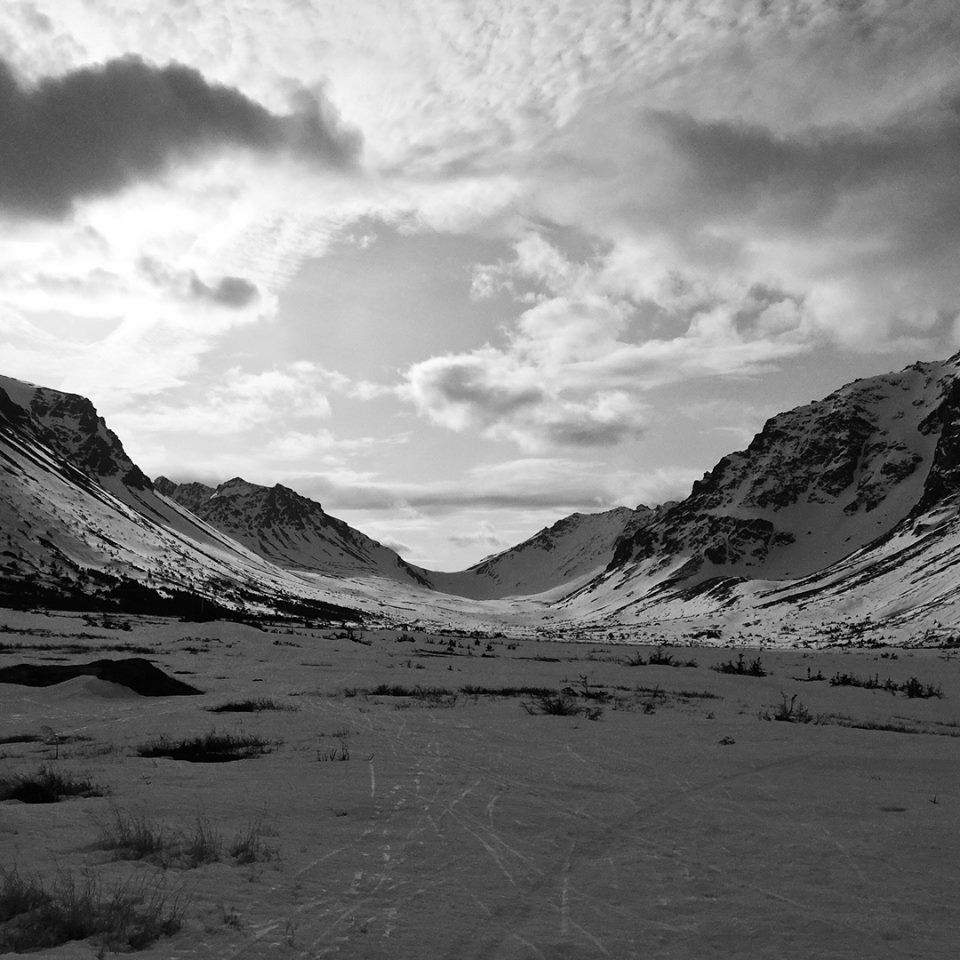
    Crust skiing on April 17 in Chugach State Park, at the edge of town above Anchorage, Alaska. (Photo: Gavin Kentch)

    This article has been updated with additional information on pro skiers who volunteered with Skiku, and additional pictures from Montana and New York.

    *   *   *

    It’s the last week of April. Skier New Year, May 1, looms next Tuesday. It’s roughly six months till the presumptive first race of the 2018/2019 season, seven till the first World Cup weekend. Whether you’re a pro or an amateur, whether you’re targeting your first World Championships or your first Birkie elite wave, now is the time to start thinking about setting goals and writing training plans.

    For a certain subset of athlete, those spring training plans still involve skiing. On snow. In some cases, really good snow, in surprisingly wintry weather.

    In honor of the last week of the offseason, please join FasterSkier as we channel our inner Us Weekly and flit through an extremely unscientific social-media roundup of those athletes who are still on snow, arranged in very approximate order of most to least surprising to be skiing at this time of year. (Actually, it’s only the Midwest and Vermont where it seems somewhat surprising to still have skiable snow in late April; no offense is intended to anywhere on the list after that.)

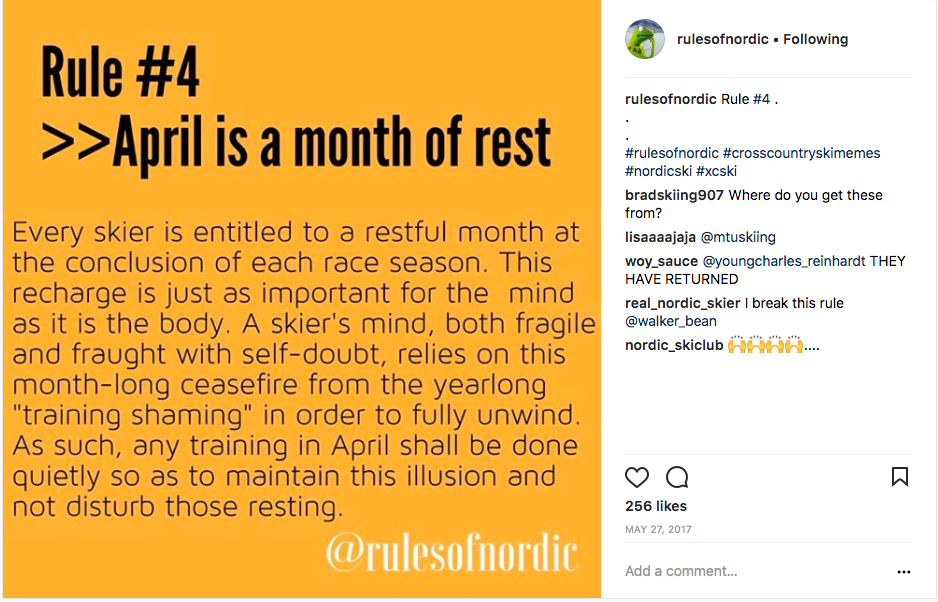
    And before we begin, a quick note on methodology: This social media roundup is by definition limited to those athletes who are not only currently out in the snow, but who are also posting about it on social media. This second criterion threatens to bring your average recovery-month athlete into conflict with what has been codified as Rule of Nordic No. 4, “April is a month of rest.”

    So, caveat lector: Just because your favorite skier has been taking a well-deserved break from finding and curating Instagram-worthy content for your enjoyment, this doesn’t mean that they’ve been sitting on their butt since Spring Series. They just might not want to tell you what they’ve been up to, and/or they wish to avoid damaging the fragile psyches of their colleagues.

    inhalers online

    With all that out of the way, on to:

    New York:

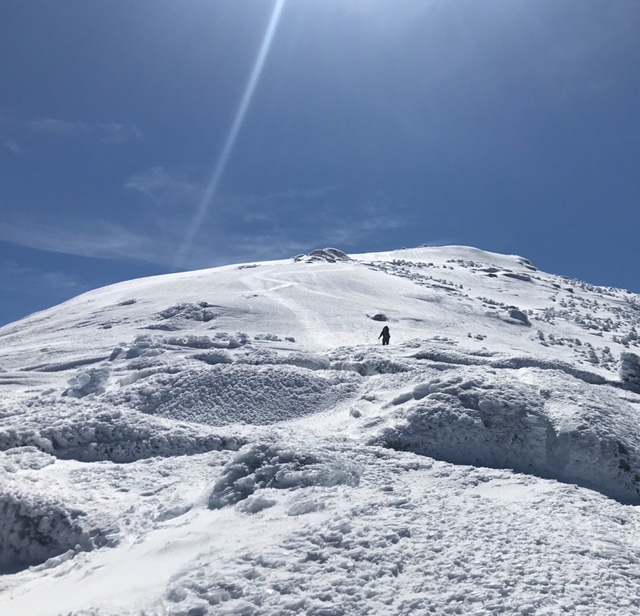
    Skiing on New York’s highest peak? Check. David Hochschartner of the North Country School in Lake Placid sent us this photo of backcountry shredding on Mount Marcy, the highest point in the state at 5,343 feet above sea level.

    “Monday skiing from bottom to the summit of Mount Marcy in New York,” Hochschartner wrote in an email to FasterSkier on Wednesday. “Over 3500′ vertical … backcountry skiing does not break rule #4 because it isn’t training, it’s just fun!”

    Backcountry skiing near the top of Mount Marcy in New York’s High Peaks region on Monday, April 23. (Photo: Tim Ely)

    The Midwest

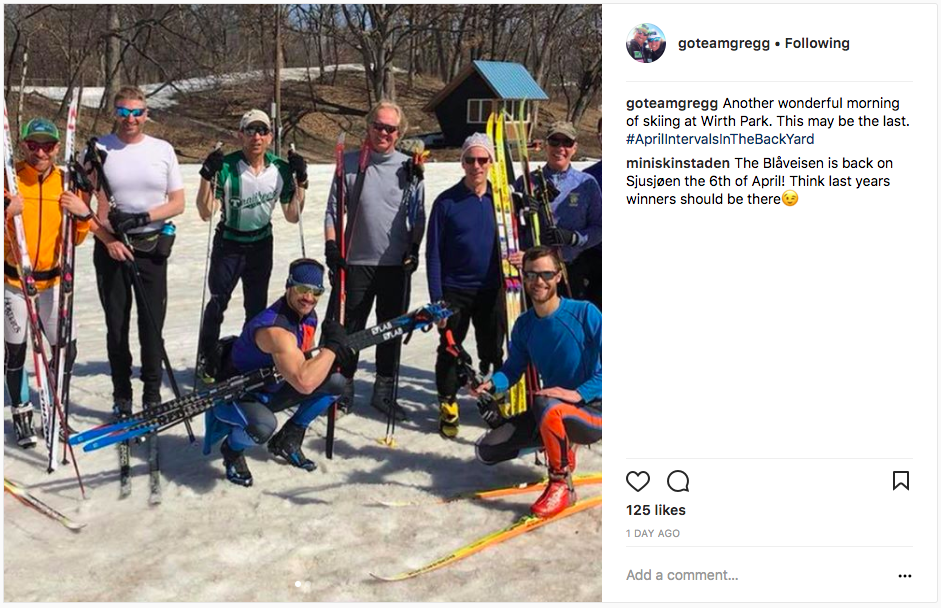
    It snowed in the Twin Cities last week. Like, a lot. Like, a short-notice classic race was held at Theodore Wirth Park on April 16, on fresh natural snow, in Extra Blue conditions. Coverage appears to have been pretty darn good.

    While things seem to be melting fast now, here was the scene at Wirth on Sunday morning, April 22, courtesy of Team Gregg:

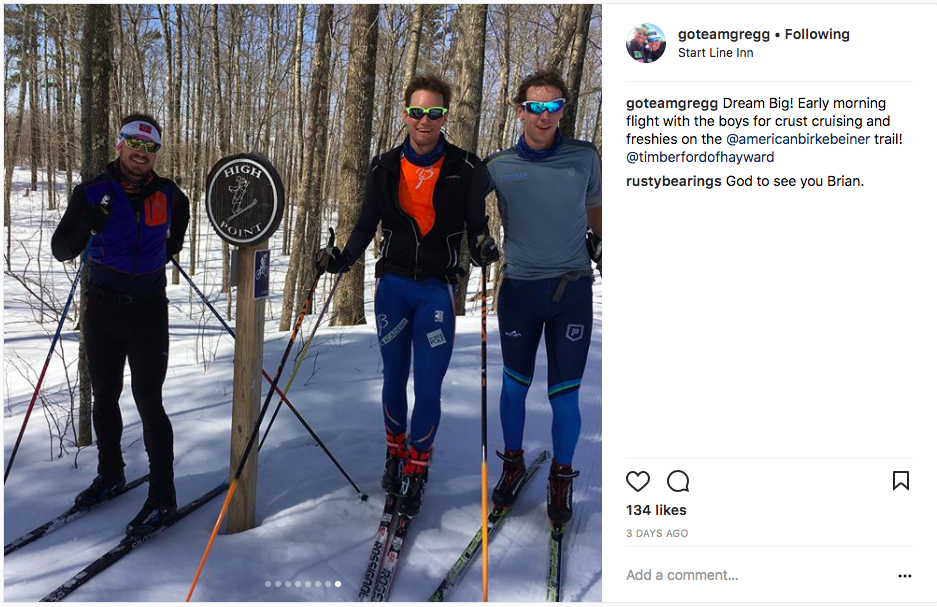
    And here’s the Birkie trail on April 20, same Instagram feed:

    The mid-April Midwest blizzard was notable, to be sure. But was it historic? Yes, says Ari Ofsevit, who now lives in Boston but was formerly the source behind Twin Cities XC Commentary and who remains the one-man operation behind the indispensable BirkieGuide.com.

    Here’s Ofsevit with some historical meteorological perspective:

    Basically, the current weather in the Twin Cities is pretty unprecedented. The only other similar year was 1975, when there was at least 3″ of snow on the ground in MSP for 11 days in April (this year had 12), but that year it was an old, melting base that mostly fell in late January. This year will set the following records:
    * Most days with at least 3″ of snow on the ground in April (skiable snow): 12
    * Most snow in April: 26.1″
    If the current forecast to hit the 70s this weekend holds, it won’t wind up the coldest April on record, but will likely be in the top three. But it’s a good combination of cold and snow, which hasn’t been seen to this degree before.
    The average year has the snow depth dipping below 3″ around March 1, so it’s an extra month and a half of winter.

    Vermont

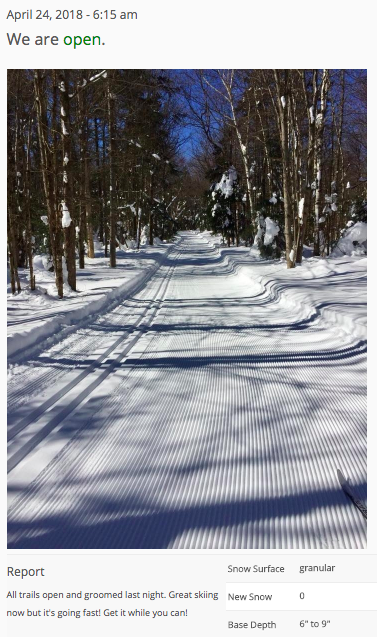
    There’s a lot of snow at Prospect Mountain in Woodford, Vermont, too. (“Getting 80″ in a week in March didn’t hurt,” Ofsevit notes.) Here’s a stunning screenshot from the conditions report for Tuesday, April 24 (just offscreen is the current temperature, 69°):

    Dartmouth skier Adam Glueck skied 50 k there on Sunday, describing conditions as “50+ F and transformed.”

    Montana

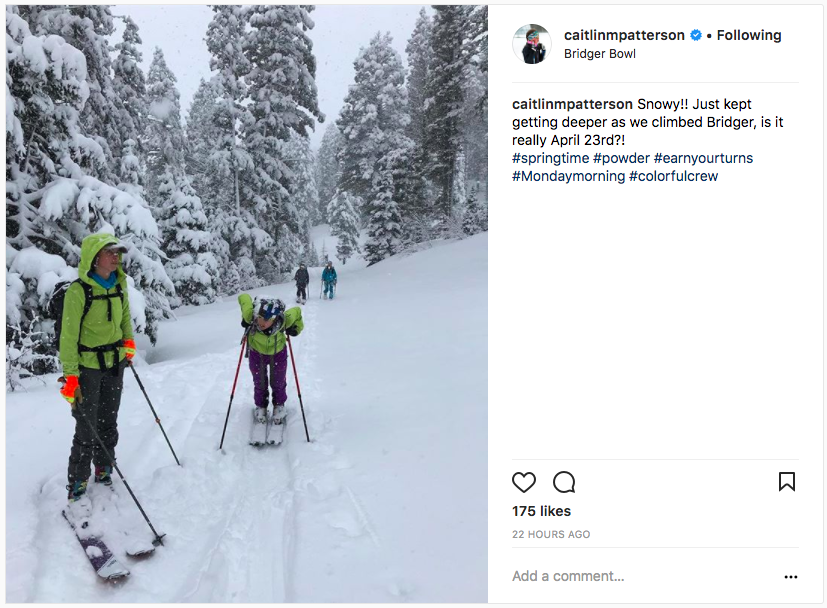
    Effective Tuesday morning, they were still grooming some nordic trails at Crosscut Mountain Sports Center (formerly Bohart Ranch). Pictures of nordic skiing there are hard to come by right now, so here’s a screenshot from Caitlin Patterson’s Instagram page showing backcountry skiing at adjoining Bridger Bowl on April 23 in fresh powder:

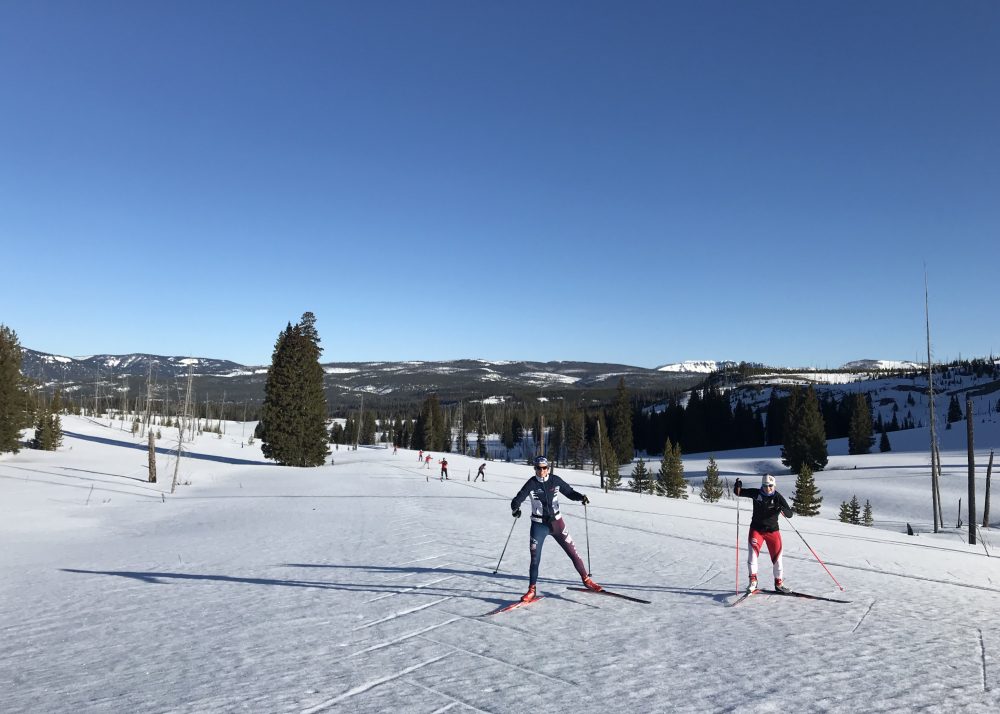
    And from two days before that, here’s some prime crust skiing at Fawn Pass on Saturday:

    Crust skiing at Fawn Pass, outside West Yellowstone, Montana, April 21, 2018. (Photo: Caitlin Patterson)

    Canada

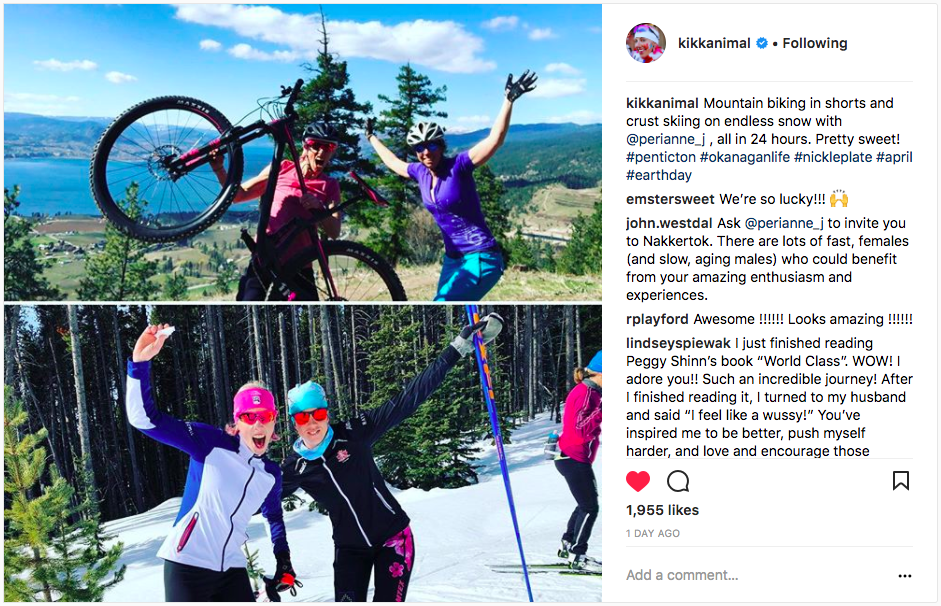
    Recently retired American skier Kikkan Randall doesn’t seem to be suffering from her move to Penctiton, B.C., judging from Sunday’s shot of crust skiing with former Canadian World Cup racer Perianne Jones:

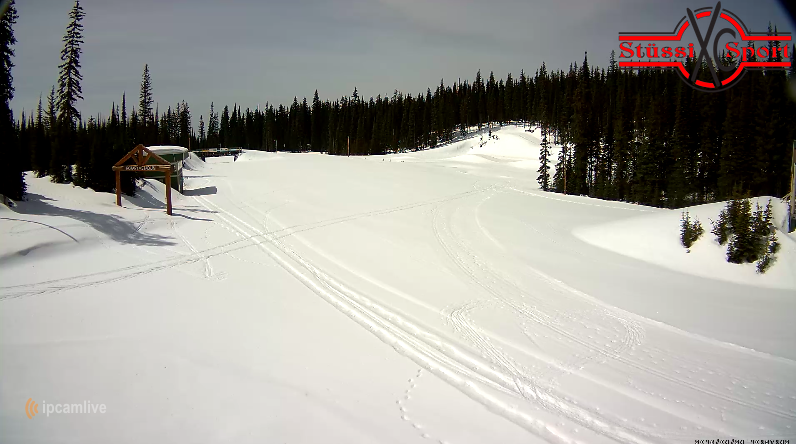
    And 100 kilometers to the north, Sovereign Lake Nordic Centre isn’t lacking for snow, either. Here’s a screenshot from the webcam as of Tuesday morning, showing impeccable coverage:

    That’s a base of 256 centimeters, or over eight feet (!) in American, according to a current conditions report. Sovereign Lake is closed to official skiing at present, but reopens from May 10-13 for its Spring Fling Ski Camp.

    Oregon

    Mt. Bachelor currently has a base of 85″ at 6,300 feet near the base of the alpine area, which is somehow less than Sovereign Lake but still, you know, more than seven feet of snow. Here’s the nordic grooming report from Tuesday morning:

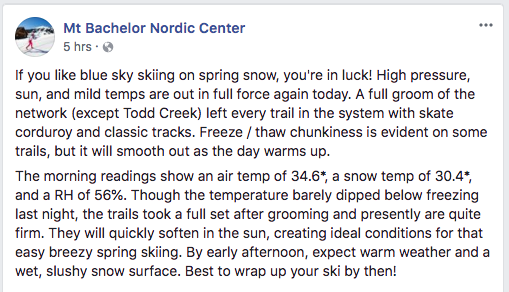
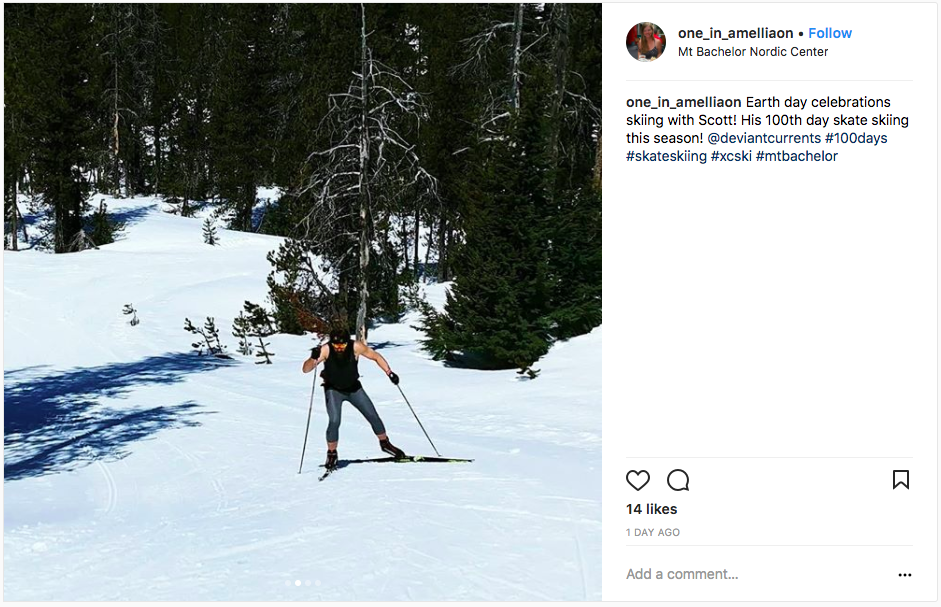
    And here’s a screenshot from local skier Amelia Roberts’s Instagram page, showing conditions on the Mt. Bachelor trails last weekend:

    Alaska

    There’s still a lot of snow in Alaska right now. Maybe not at sea-level Anchorage, which is staggering toward spring with a series of high-30s, mid-40s raw and windy days culminating in snow squalls Tuesday evening – Kincaid is down to the dregs of a snowmaking loop by this point, and formal grooming there ended last weekend – but pretty much everywhere else. This reporter found fresh snowfall and blowing spindrift at 2,200′ at the edge of town Monday morning, and most places higher than that are still snow-covered. There is over five feet of snow at Hatcher Pass, and temperatures there remained below freezing even as it rained at sea level on Tuesday. The Mat-Su Ski Club should presumably once more be grooming through mid-May with ease.

    (And this doesn’t even get into the Interior. They’re still grooming at Birch Hill in Fairbanks, for example, and a quick look around the state shows that most spots still have snow on the ground.)

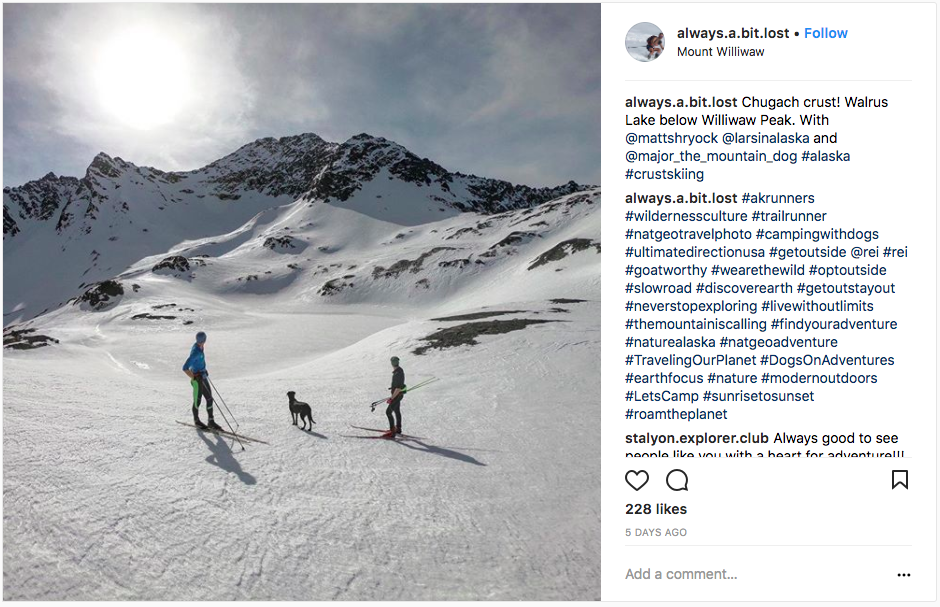
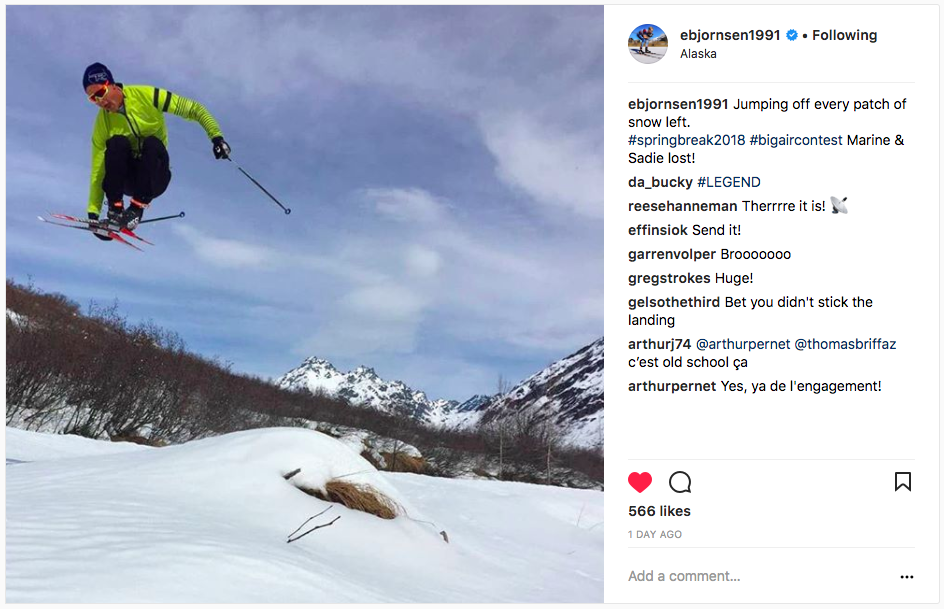
    Until then, there’s crust skiing. Here, for example, are local Master skier Kati Rehm, local dentist Adam Jensen, and local two-time Olympian Erik Bjornsen on recent crust ski outings around Anchorage:

    For those less fortunate, here are FBD’s nonpareil reviews of skate and classic rollerskis.

    Other

    P.S. Who’s not on snow right now? Plenty of athletes are taking a well-deserved break this month, see Rule 4, supra. Andy Newell (on the beach in Indonesia), Erika Flowers Newell (on the beach in Indonesia, with Andy), Jessie Diggins (on the beach in Boston), Noah Hoffman (enjoying retirement in New York City), Sadie Bjornsen (at Zion National Park), and Kaitlynn Miller (in Milan) are among the American skiers who are doing anything but clipping into their bindings right now. Plus honorable mention, volunteer division, to Tyler Kornfield, Rosie Brennan, Team Gregg, and Scott and Caitlin Patterson, all of whom spent roughly a week earlier this month doing ski education outreach in rural northwest Alaska through Skiku.

  • Caitlin Patterson Captures Third National Title in Anchorage 10 k Skate

    Caitlin Patterson Captures Third National Title in Anchorage 10 k Skate

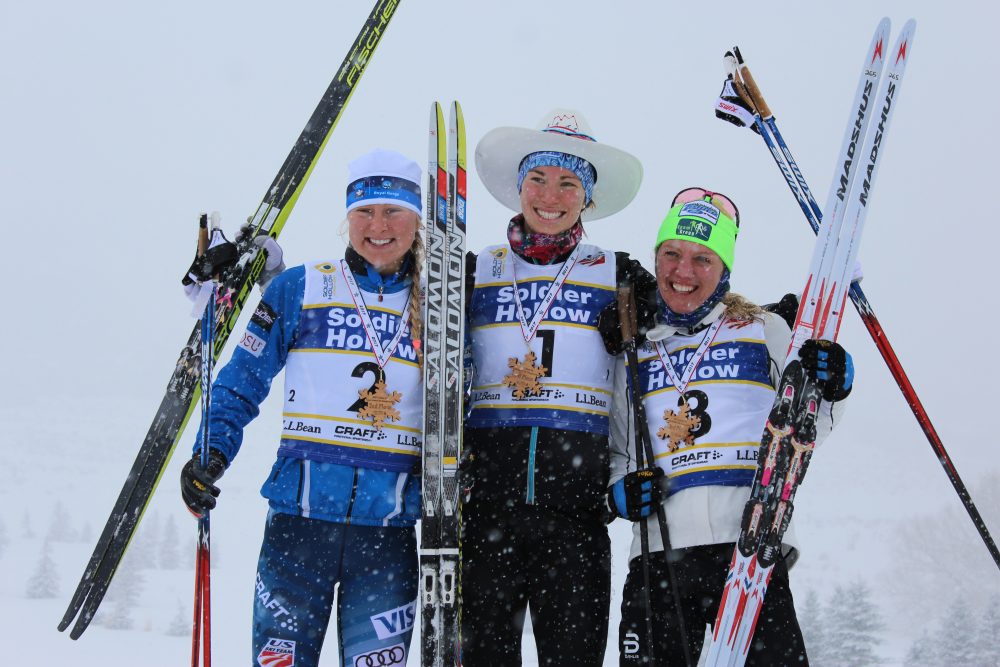
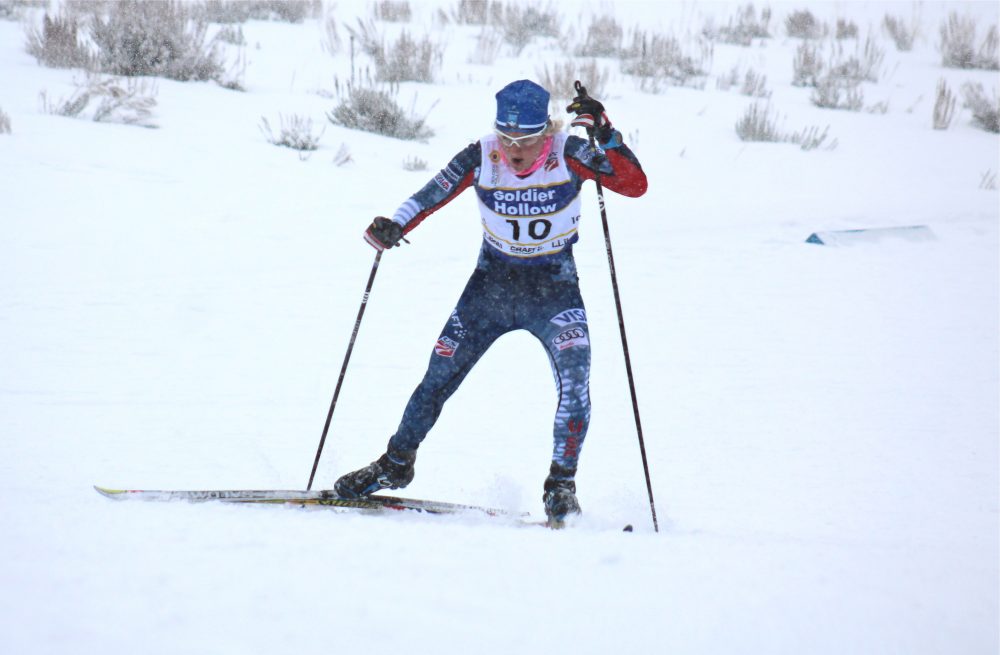
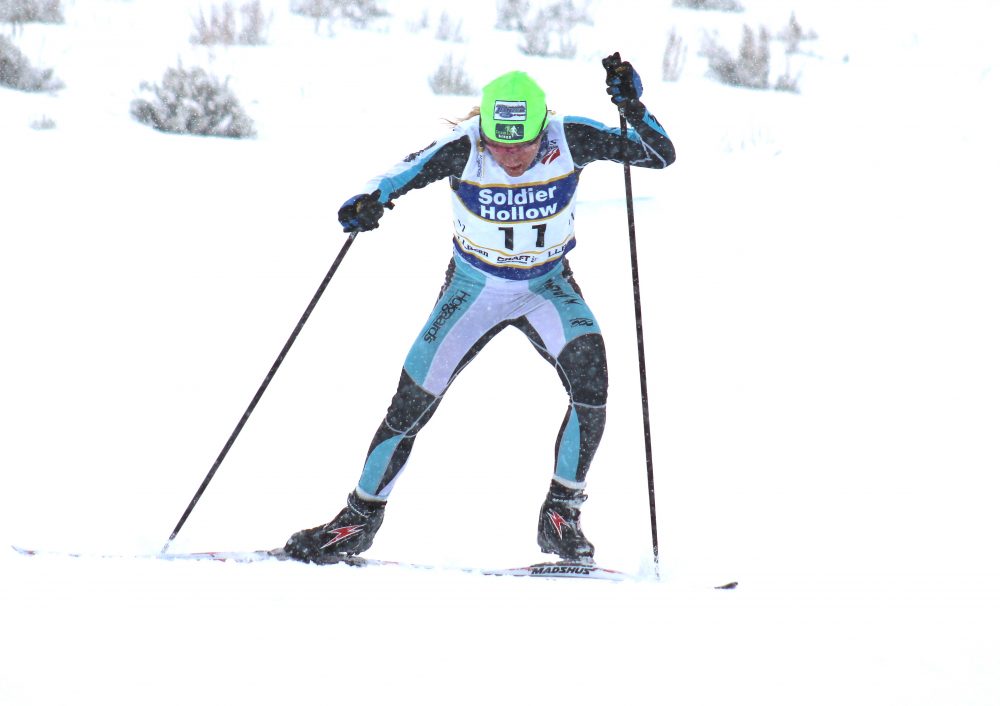
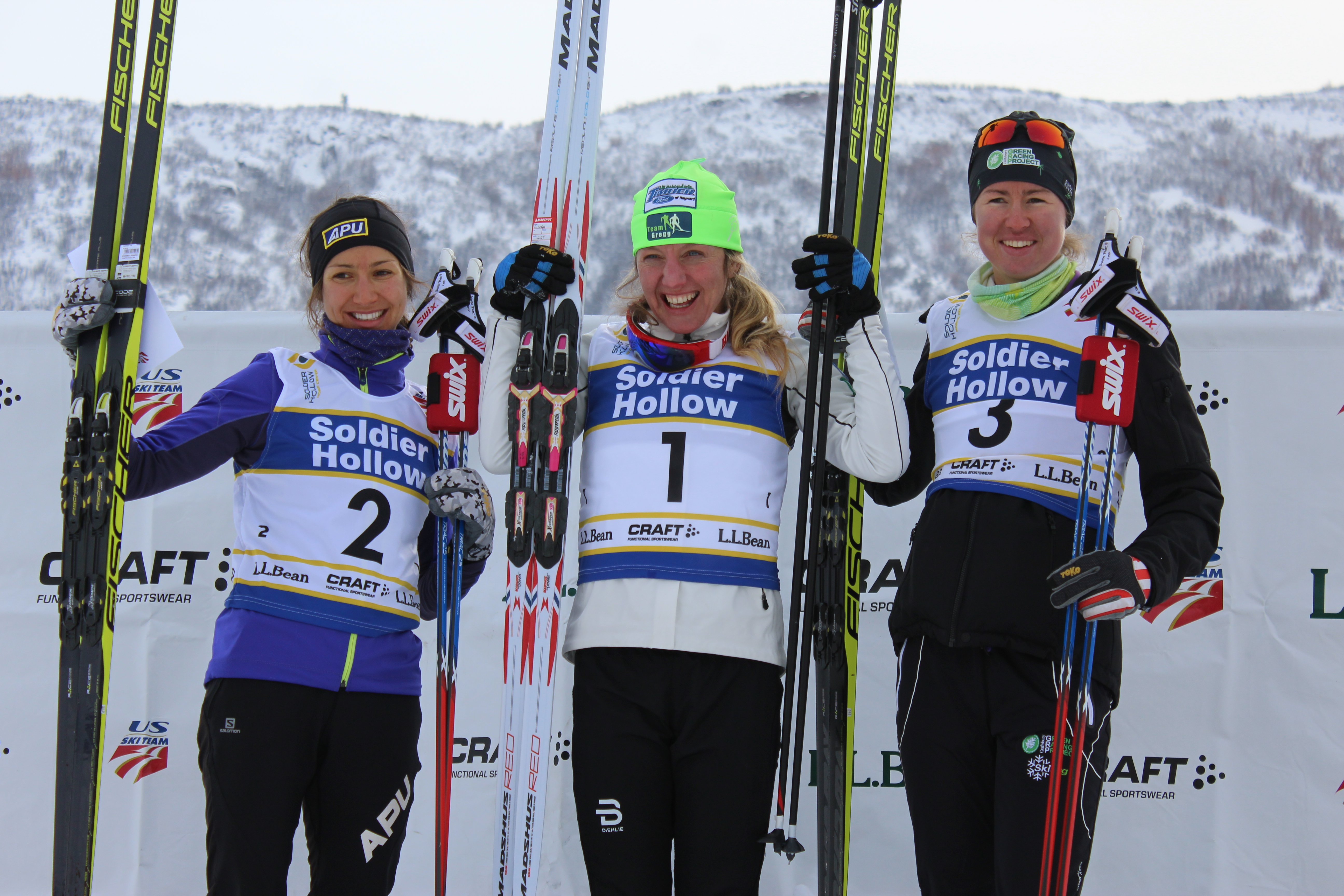
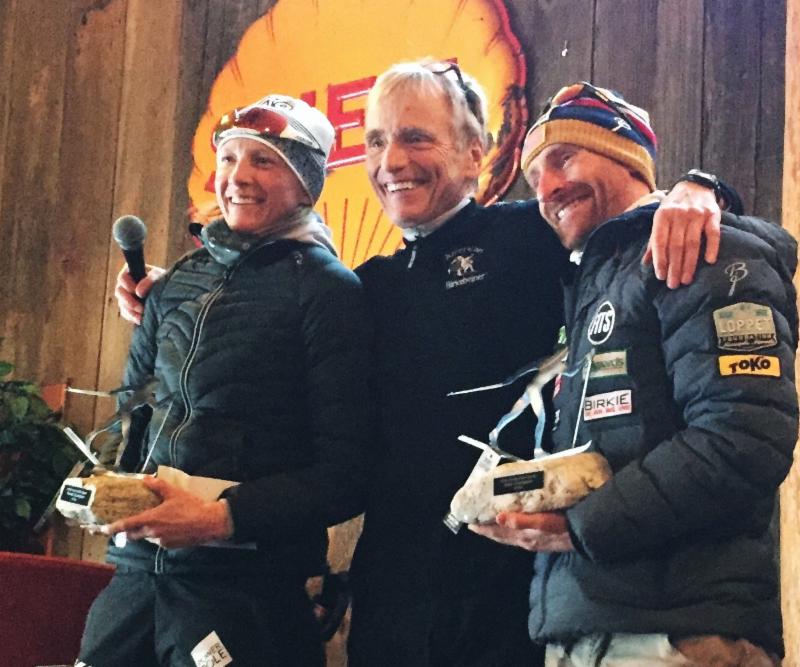
    The women’s 10 k freestyle podium on Wednesday at Day 1 of 2018 U.S. Cross Country Championships in Anchorage, Alaska, with (from left to right) Caitlin Gregg (Team Gregg) in second, Caitlin Patterson (Craftsbury Green Racing Project) in first, and Chelsea Holmes (Alaska Pacific University) in third.

    ANCHORAGE, Alaska — It was what most locals, or those familiar to the area, referred to as standard Anchorage weather: heavy, wet snow, temperatures reading around 31 degrees Fahrenheit, and a darkened sky that seemed to be brooding over whether or not to let the sun out of bed — the sky covered in a shroud of gray.

    With the Pacific Ocean just 600 meters to the southwest and Kincaid Park’s nordic venue, the host of this year’s 2018 U.S. Cross Country Ski Championships, nestled in the state’s gulf socket, low-visibility and unpredictable weather was, ironically, a foreseeable factor to Wednesday morning’s women’s race.

    After all, during the first week of January, sunrise in Anchorage is scheduled around 10:15 a.m. and the opening race of this year’s championship event, a women’s 10-kilometer freestyle individual start, was not slated to get underway until 15 minutes before then. The internal dialogue for a few early starters was whether a personal light might be a good addition to the commercial ones dotting the four-lap, 2.5 k manmade loop.

    “For a moment while I was warming up, I was wondering if I’d have to wear a headlamp,” Rosie Frankowski, who skis for Alaska Pacific University (APU) and started in bib number 20, said after the race. “But that’s Anchorage.”

    By the time the first women’s starter, Becca Rorabaugh, also of APU, departed the start gate, the continual glow from a few stadium lights outshone the dim carpet-colored sky. Close to half an inch of slushy snow covered the trail and more was well on its way.

    Skiers would not be deterred, however, as potential spots for the U.S. 2018 Olympic team were on the line.

    “I haven’t skied up here in a few years, but Alaska is sort of always unpredictable — this weird combo of manmade and freshly falling snow with bad visibility,” said Caitlin Patterson, who grew up in Anchorage, went to college at the University of Vermont, and currently trains and races with the Craftsbury Green Racing Project (CGRP) in Vermont.

    “Until yesterday, I’d never skied that wall hill before; we’d always used that as a downhill, but otherwise I’m pretty familiar with [the trail],” the 27 year old continued. “The loop in the stadium and all these things were ones we used for Alaska State over the years, so even when I couldn’t see through my glasses, to know the corners and so forth was good.”

    Caitlin Patterson (Craftsbury Green Racing Project) racing to first in the women’s 10-kilometer freestyle on Wednesday at the 2018 U.S. Cross Country Championships in Anchorage, Alaska.

    Familiarity with the course wasn’t the only edge Patterson had heading into the race. She also entered Wednesday’s 10 k as the overall SuperTour leader, an honor garnered thanks to her win in the 10 k freestyle at Sovereign Lake, British Columbia, and her second- and third-place finishes in the 10 k classic mass start and freestyle sprint qualifier, respectively, in West Yellowstone, Mont.

    The victory was her third national title. In 2016, she won both the 10 k classic and 20 k freestyle mass start.

    Combined with her World Cup performances in previous seasons, Patterson was a prime candidate for Wednesday’s win, which she claimed in a time of 27:09.1, though there were moments on course when she questioned the outcome of her race.

    “I wasn’t sure if it was going to turn into a win even midway through the race,” Patterson said.

    Patterson was the fourth starter to push past the wand and by the time she looped through the stadium for her second lap, APU’s Chelsea Holmes (bib 16) and Team Gregg’s Caitlin Gregg (bib 17), were starting their first laps. Though she was ahead of Gregg, Patterson received what she called “backwards splits”: Gregg’s pace on laps that Patterson had already completed.

    “I could see Caitlin [Gregg], see how the gap was progressing, and I also got some splits … how her first and second lap were comparing to my first and second, and I think I was running a few seconds down at that point,” Patterson recalled.

    Caitlin Gregg (CXC/Loppet Nordic Racing/Team Gregg) racing to second in the women’s 10 k freestyle on Wednesday at 2018 U.S. Cross Country Championships in Anchorage, Alaska.

    Gregg was also getting splits off Patterson, most of which informed her that the two were on par. It was in the final kilometer and half that Gregg learned she was losing time.

    “I was getting splits and I was pretty even for it seemed like three and half laps,” Gregg said after. “Then that last little bit she put a bit of a gap on me.”

    Patterson’s final half lap was fast enough to put close to 20 seconds on Gregg, and Gregg finished 19.7 seconds back in second. Having felt like she put in a solid race effort, Gregg was slightly surprised by the time gap, though quick to acknowledge Patterson’s strength on course.

    “I thought it was going to be really close there, but obviously she skied super strong,” Gregg said.

    Gregg, 37, who earned an individual bronze medal in the 10 k skate at 2015 World Championships and is aiming to qualify for her second Olympics (after making the Olympic team in 2010) holds high regard for the current women’s U.S. race circuit. Even after 19 years of U.S. nationals racing, the veteran skier is not immune to competition-day nerves.

    “I still get nervous,” Gregg said. “The weight of these races are super high and I think we have a lot of really fast domestic women right now, I mean Chelsea Holmes has been top 30 on the World Cup and last year Caitlin Patterson was in the top 30, so I’m really hoping that we get a good domestic representation at the Olympics.

    “We’re doing our part; working hard and skiing fast,” Gregg added. “Hopefully that gets recognized.”

    Chelsea Holmes (Alaska Pacific University) racing to third in the women’s 10 k freestyle on Wednesday at the 2018 U.S. Cross Country Championships in Anchorage, Alaska.

    Rounding out the women’s podium on Wednesday was APU’s Chelsea Holmes, 24.4 seconds back in third. Holmes raced World Cup Period 1 this season, with a season-best of 29th in the 10 k freestyle last month in Davos, Switzerland.

    “My body didn’t have quite what I wanted today, but that’s OK,” Holmes, 30, who grew up just south of Anchorage in Girdwood, Alaska, wrote in an email. “I actually don’t mind the short course, the race felt like it blew by and it was fun to get to lap by friends and family.” 

    Also a hopeful for the 2018 U.S. Olympic team, Holmes indicated she would be leaving no race unanswered at this year’s U.S. nationals. She plans to compete in both sprints over the next week as well as the 20 k classic mass start, which she won last year.

    “I’ve been working on my ‘Klaebo’. It’s pretty legit,” she wrote.

    Pressure can encroach upon many athlete’s performances this week, especially with Olympic spots on the line. Processing that pressure, for Holmes, came in the form of the season’s preparation.

    “As for the pressure, for sure it is there — even if it’s only from myself. How could it not be? Certainly I care immensely and I will do my best when the time comes to race, but between now and then I won’t be doing anything special,” she wrote. “I’ve prepared the best I know how and hopefully that is good enough. If not, I’ll still be me.”

    Finishing in fourth (+41.7), 17.3 seconds off the podium, was Frankowski.

    “I am definitely satisfied with my result today. Honestly, the new snow played into my hands as I like mushy, soft courses,” Frankowski wrote in an email. “On the other hand, a course with no A climbs and only two uphills that take 30 seconds to a minute, is not a course I’d tend to excel on. So I was quite surprised with being that close to a US Nationals podium, especially when the podium is made up of three ladies who I believe could score World Cup points on any given day (as Chelsea proved multiple times in Period 1).”

    Frankowski, 26, who was born and raised in Minneapolis, Minnesota, indicated that her next target would be the 20 k classic (though she also maintains a ritualistic “season-long goal” of being in the top four of the SuperTour rankings to, as she puts it, “get free race entries.”)

    “In all seriousness, I do hope they can find a way to add some longer and more grinding climbs to the 20k classic course with all the fresh snow Anchorage received today,” Frankowski wrote. “I believe it is important to have a race that is even slightly comparable to the Olympic or a World Cup venue, and although the organizers did a good job with what Mother Nature dealt earlier last December, I hope the priority is on utilizing the new snow to create a course that challenges racers who will be representing our country on an international level.”

    Also in the top 10 were three University of Colorado Boulder (CU) skiers, with Petra Hyncicova of the Czech Republic in fifth (+56.7), Norwegian Christina Rolandsen in sixth (+1:02.4) and Swedish freshman Hedda Bångman in 10th (+1:37.8). Erika Flowers of the Stratton Mountain School (SMS) Elite Team placed seventh (+1:26.0), the University of Alaska Anchorage’s Hailey Swirbul placed eighth (+1:30.2), and Becca Rorabaugh (APU) finished ninth (+1:36.5).

    U.S. nationals continues Friday with classic sprints at Kincaid.

    Swirbul Top Junior in Eighth

    https://www.instagram.com/p/BdgT2kzhNtr/

    Hailey Swirbul, a U20 skier for the University of Alaska Anchorage, led a strong showing by several junior girls in eighth overall. Hannah Halvorsen (U20, APU) was 14th overall, with Novie McCabe (U18, Methow Valley Nordic) one spot back in 15th.

    “I’m really pleased with how my body felt today,” Swirbul wrote to FasterSkier after the race, “and the result I was able to pull off with the help of fast skis (thanks to my coaches) and pacing from the skiers around me. I think the key today was to not stress about whatever the weather was doing and be light and quick through the slushy sections. It was important to pace the race well for me, because the conditions were slower than what we all were expecting after skiing on the race course the previous few days. My main goal was to qualify for World Juniors, and shoot for notable results compared to the western NCAA Division skiers. Overall, I can’t complain about how my first race of the week went!”

    Swirbul almost wasn’t on the starting line in UAA green and gold. 14 months ago, she called it “ridiculous” and “outrageous” that the college ski team in Anchorage had been cut when U.S. nationals were on the horizon, and lamented that no UAA race suits were going to be at the starting line. But the decision was ultimately reversed, the ski team was reinstated, and six UAA skiers raced on Wednesday.

    Results

  • Caitlin Gregg Suffers Lightning Strike in West Yellowstone, Unharmed and OK

    Caitlin Gregg Suffers Lightning Strike in West Yellowstone, Unharmed and OK

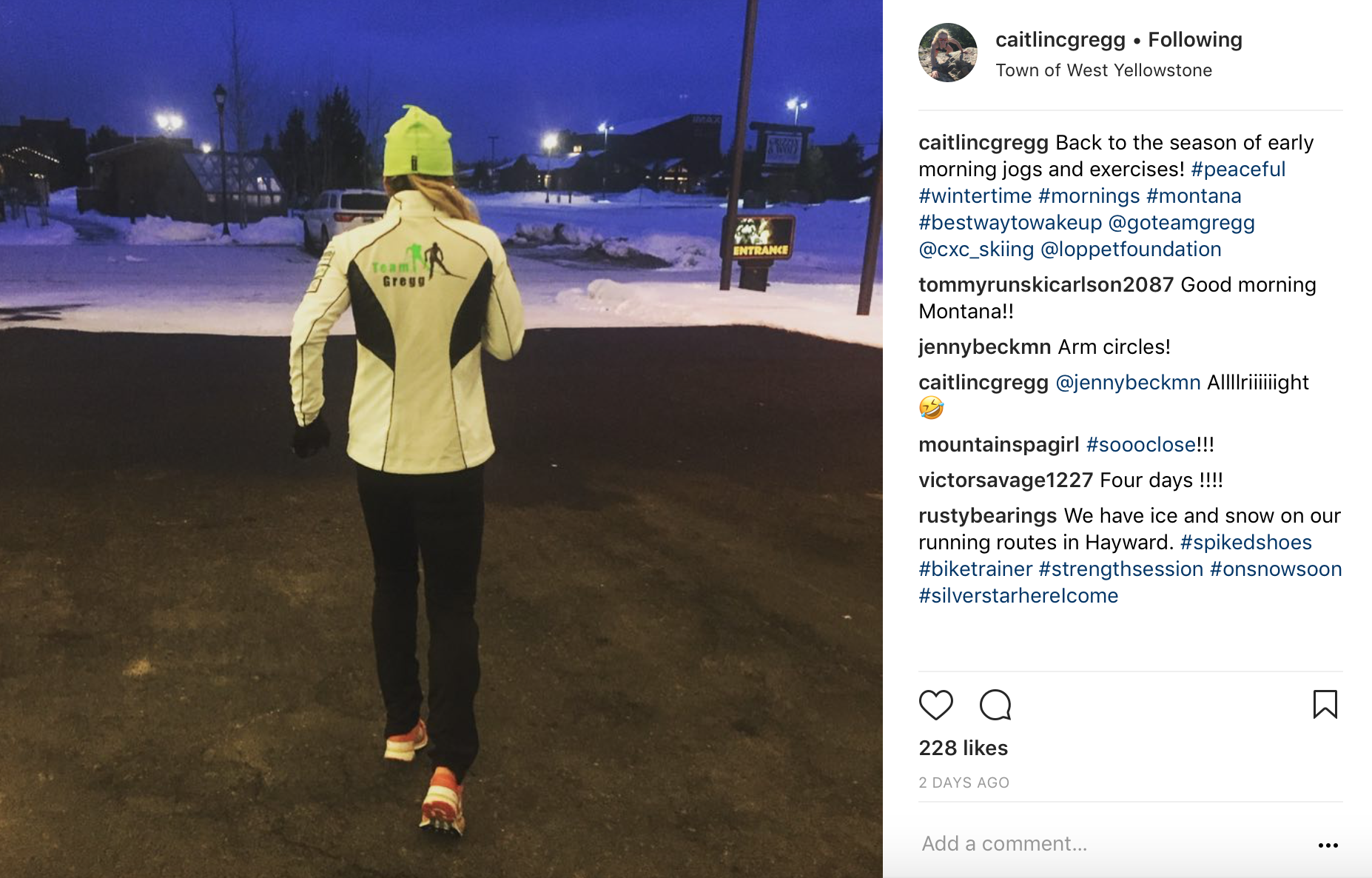
    Caitlin Gregg heading out on an early morning jog before sunrise on Tuesday, Nov. 14, in West Yellowstone, Montana. Later that morning, a little before 9 a.m., she was essentially struck by lightning while running to the nordic ski trails there. (Photo: Instagram/@caitlincgregg)

    She never heard thunder and never saw lightning before it happened, but in an instant, Caitlin Gregg realized the surge running through her body was a one-in-a-million type of occurrence.

    This past Tuesday morning started out like most others for Gregg, who turned 37 exactly a week earlier, during her annual visits to West Yellowstone, Montana. With her skis and poles in each hand, she headed for the Rendezvous Ski Trails on foot — a short jog from the hotel she and her husband, Brian, were staying at.

    It was 33 degrees Fahrenheit around 9 a.m. that morning and snow was falling, “a strange grapple type of snow/sleet”, Gregg, a 2015 World Championships bronze medalist, recalled in an email.

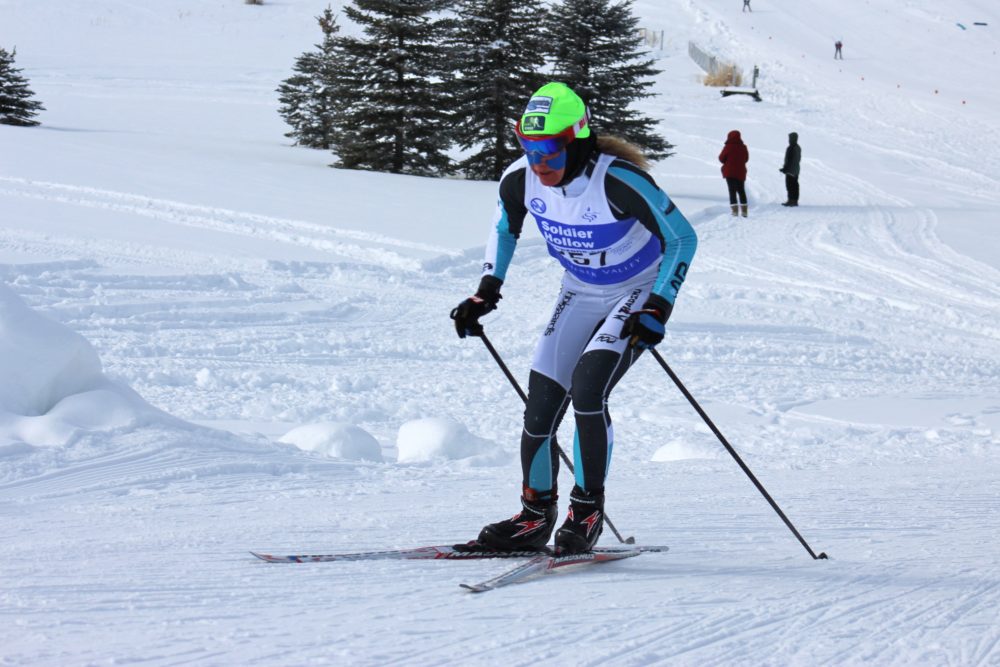
    Caitlin Gregg (Team Gregg) racing to first in the women’s 10 k freestyle at 2017 U.S. nationals last January at Soldier Hollow in Midway, Utah.

    She hadn’t been aware of any thunderstorms in the forecast. If she had, she would have never ventured out on her own, but rather caught a ride to the trailhead and waited for the storm to pass.

    “Many of my teammates throughout the years know how terrified I am of lightning and thunderstorms,” wrote Gregg, a member of Team Gregg and Loppet Nordic Racing, based out of Minneapolis, Minnesota.

    But it was just snowing, or so she thought.

    As she jogged along the road, wearing metal spikes on her shoes for traction, Gregg reached the corner of Electric Street. Suddenly and without warning, lightning — stemming from a natural phenomenon called thundersnow — struck a nearby tower.

    Simultaneously, an electric current surged through her body — up her left leg and out her left arm. She felt the surge followed by her jewelry burning on her skin.

    “It felt like touching an electric fence x 1,000,000,” she wrote. “I had no idea what was happening but a split second later I heard the largest clap of thunder. I realized right away that I needed to get help.”

    Gregg sought out medical attention at a hospital about an hour north in Big Sky, Montana.

    “They checked out my heart’s electrical signal and for any muscle breakdown,” she wrote. “Thankfully all are normal. So, I am a bit shaken but everything seems to be okay.”

    Her left hand “had some peripheral neuropathy and a pins and needles feeling for the rest of the day”, she recalled, but her jewelry didn’t leave any burn marks and she was cleared by the doctors to resume training as she felt up to it.

    “I have been taking it pretty easy and just being careful if I notice any changes,” she wrote. As of Thursday, she hadn’t.

    “I am grateful that I had a great group of teammates and coaches here who could help me out all day and have been skiing with me everyday since,” she added.

    “I learned (through this whole ordeal) that the majority of lightning ‘strikes’ on people are from nearby objects getting hit the the current traveling through the ground,” Gregg explained. “Totally crazy experience. There have been a lot of lightning jokes now circulating the team (CXC and LNR) about how my it will give me super powers [smiley face]. We will see but I am pretty happy to have walked away okay.”

    The day after, she posted a photo on Instagram of herself skiing with Midwest training partners.

    https://www.instagram.com/p/BbhtX4JjxEx/?taken-by=caitlincgregg

    While the odds of being struck by lightning in the U.S. in any one year is about 1 in 1 million (and the odds of being struck in one’s lifetime is 1 in 13,000), Gregg was feeling fortunate to be one of the survivors. According to the National Weather Service, she is one of about 300 Americans who survive lightning strikes each year. Ten percent of all lightning victims don’t make it.

    “I have a new perspective on life for sure now,” Gregg wrote. “I looked up some of the lightning statistics and reports and I am feeling very lucky!”

    And in a small town like West Yellowstone, with a population of about 1,200 (that sees an influx of several hundred skiers each November for the Yellowstone Ski Festival), news — as well as rumors — apparently spread fast.

    “A lot of people thought I died,” Gregg wrote. “The hotel manager was trying to convince people that I am not dead and still staying at his place :)”

    Feeling perhaps more alive or sparky, as she put it, than ever, Gregg is back on the path of trying to qualify for her second Olympics. (She represented the U.S. at the 2010 Winter Olympics in Vancouver, B.C. Her husband Brian, the other half of Team Gregg, raced at the 2014 Olympics in Sochi, Russia.)

    The Greggs arrived in West Yellowstone earlier than usual this year to get acclimated to the altitude, some 6,700 feet above sea level. She planned to race the International Ski Federation (FIS) sanctioned race there on Nov. 25 (women’s 5-kilometer freestyle individual start) before starting the season in earnest with the SuperTour opener: a freestyle sprint and 10 k classic mass start Dec. 2-3, also in West Yellowstone.

    “Despite this strange start to my season Brian and I are still very focused and driven to represent Team USA at the 2018 Olympics in Korea this February,” Gregg concluded.

    — Jason Albert provided reporting

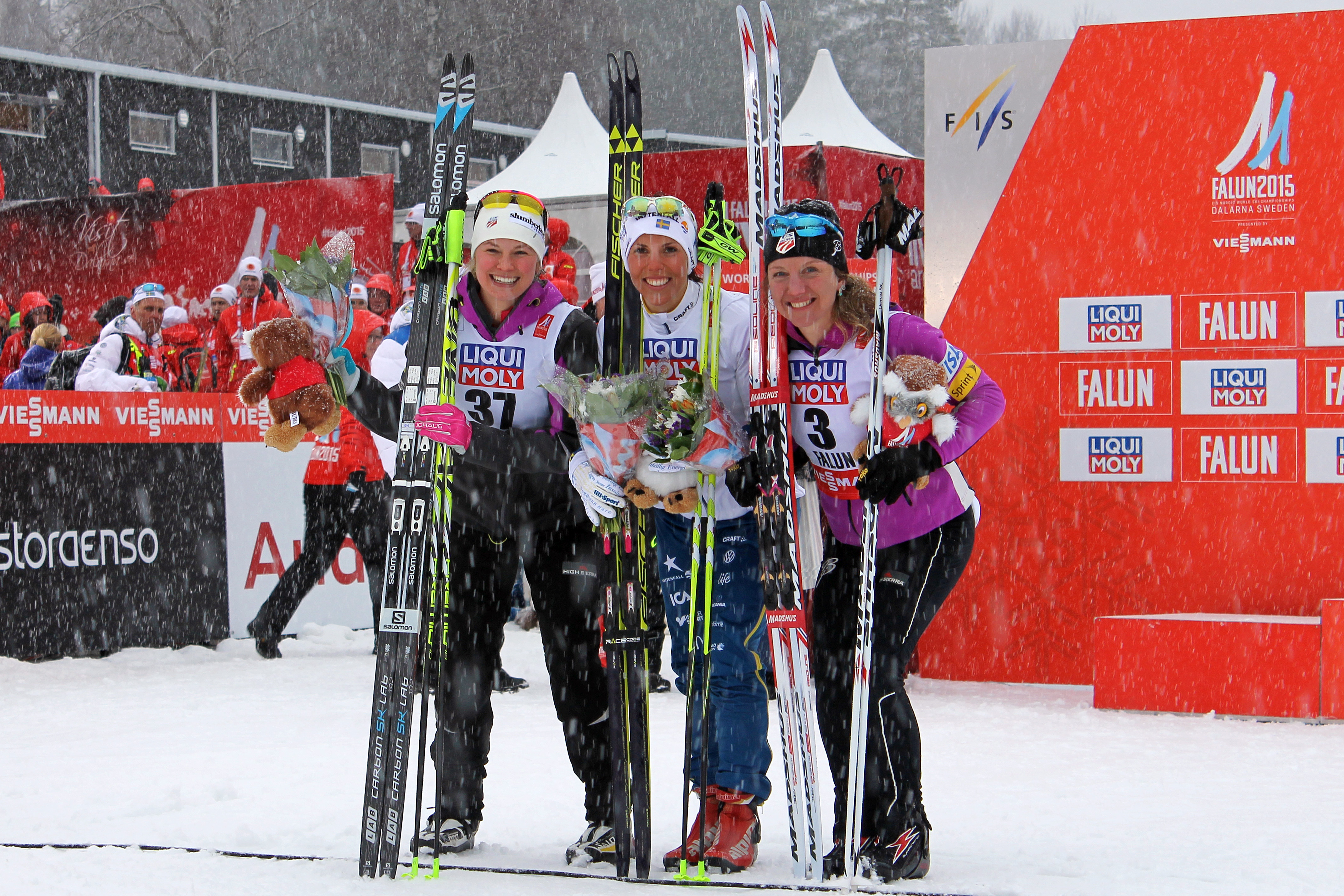
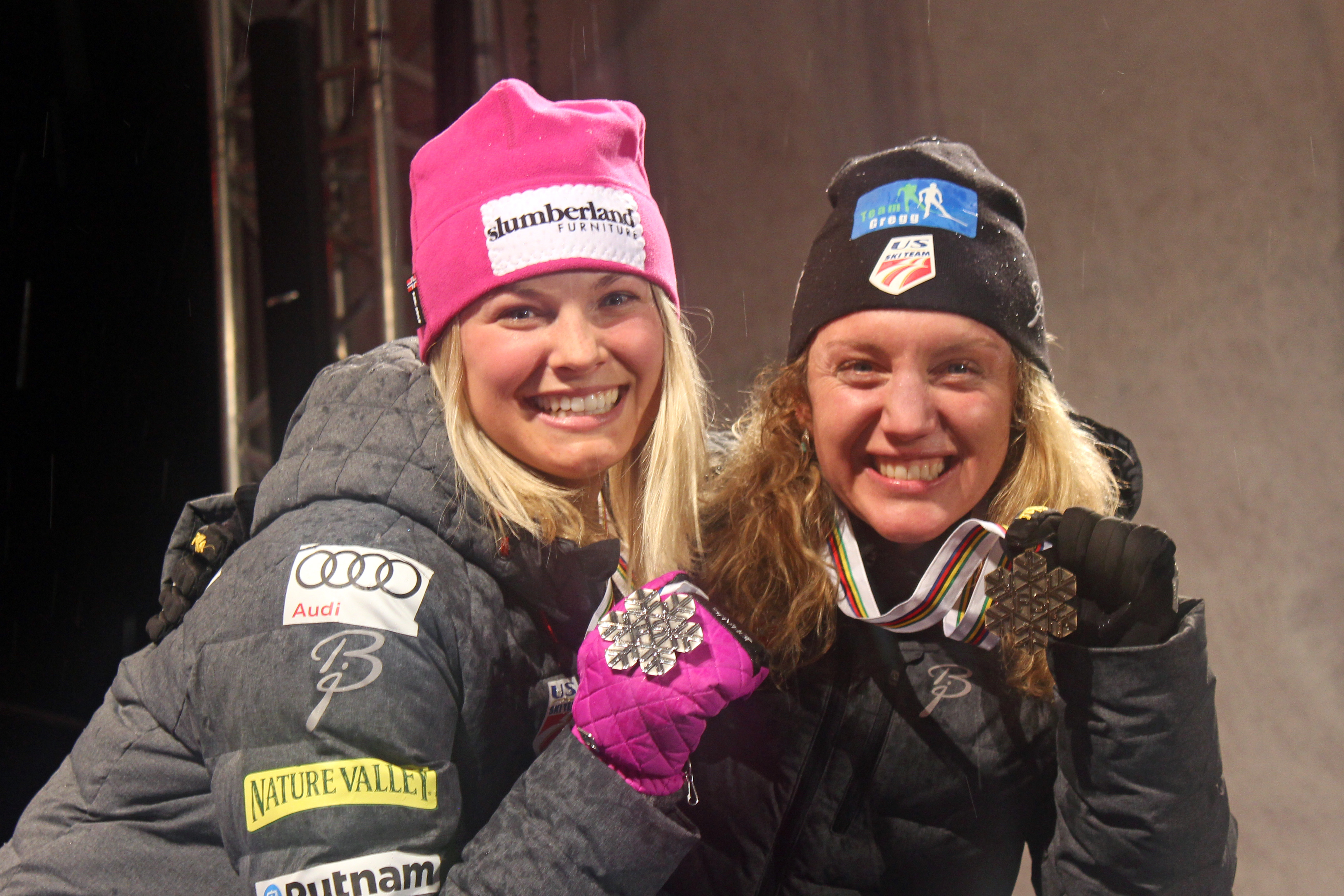
    Caitlin Gregg (r) with fellow American Jessie Diggins (l) and Sweden’s world champion Charlotte Kalla after reaching the podium in the 10 k freestyle at 2015 World Championships in Falun, Sweden. Gregg earned bronze, Diggins silver and Kalla gold.
  • Nordic Nation: The Two-Halves-Make-a-Whole Edition with Team Gregg

    Nordic Nation: The Two-Halves-Make-a-Whole Edition with Team Gregg

    Team Gregg, consisting of two halves that constitute a podium-threat whole, is featured on the latest episode of Nordic Nation. Caitlin (formerly Compton) Gregg, 36, and husband Brian Gregg, 33, the two members of Team Gregg, are based along the border of Wirth Park in Minneapolis, Minnesota. Yes, the two skiers are highly accomplished; both are former Winter Olympians and Caitlin earned a bronze medal in the 10-kilometer freestyle at the 2015 World Championships in Falun, Sweden. But their partnership has become a model of independent professional ski team viability.

    The sum total of Team Gregg: Brian Gregg (left) and Caitlin Gregg (right). (Courtesy photo)

    They are also a model of two hyper-driven people able to moderate their own personal goals for the collective greater good of the team. If you’ve ever had the opportunity to see the Greggs at a race venue, this much is clear: they have got each other’s back. Brian can be seen helping test skis, handing Caitlin feeds along the course and screaming encouragement. The same can be said of Caitlin. Neither is above doing the menial tasks to ensure the other has the best opportunity on race day.  

    Nordic Nation caught up with Caitlin and Brian Gregg on Sept. 13, a few days after their return from an on-snow camp at New Zealand’s Snow Farm. Along with the usual “how’s the training going”, questions, you’ll hear about the unique way the Greggs financed their house and what the future holds.

    (To subscribe to the Nordic Nation podcast channel, download the iTunes app. If you have iTunes, subscribe to Nordic Nation here.)

    Have a podcast idea? Please email nordicnation@fasterskier.com.

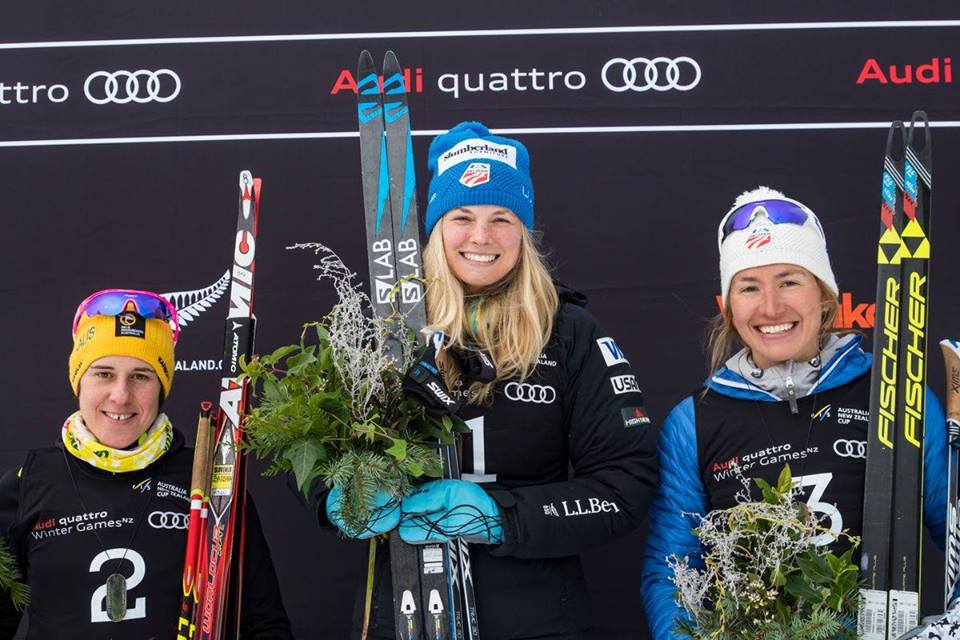
  • Lustgarten, Diggins Double Up on Wins at Winter Games NZ

    Lustgarten, Diggins Double Up on Wins at Winter Games NZ

    Jessie Diggins of U.S. Ski Team and Stratton Mountain School Elite Team on her way to win the women’s 5-kilometer freestyle at the 2017 Winter Games NZ hosted by the Snow Farm in Wananka, New Zealand. (Photo: Winter Games NZ Facebook/Neil Kerr)

    What if getting to snow-covered groomed trails came in three steps — those literally being from the front door to the trailhead. While recent winters may make this seem like a melting dream for many, a number of Americans made it their reality these past two weeks while staying at the Snow Farm in Wanaka, New Zealand.

    U.S. Ski Team (USST) members, as well as American skiers representing the Craftsbury Green Racing Project (CGRP), Sun Valley Ski Education Foundation (SVSEF), Stratton Mountain School (SMS), and Team Gregg, flew more than 24 hours to take full advantage of the Snow Farm’s accommodations and 55 kilometers of groomed track for several weeks in late August/early September. While each program held its own respective training camp, the coinciding times made for an American medley of skiers on the farm. Jessie Diggins, Sophie Caldwell, Ida Sargent, Simi Hamilton, and development-team member Julia Kern all made the trip for the USST’s camp, which ran from Aug. 22 to Sept. 11. 

    According to USST Women’s Coach Matt Whitcomb, the New Zealand camp is not mandatory for all team members.

    “Being an Olympic year we want to individually tailor each plan [for each athlete],” he explained in an email.

    Liz Stephen and Kikkan Randall opted to train in Sweden with the Swedish national team earlier this summer, and Andy Newell prioritized summer rollerski racing in Norway.

    “The travel didn’t make sense to do both,” Whitcomb continued. “For snow, Kikkan has glacier time in Alaska and Liz will do Foret Montmorency in early November. The same was true for Andy … [who] wanted to try Norway instead of New Zealand. While Kikkan has come down to the Southern Hemisphere with us, it makes sense for the Alaskans [including Sadie Bjornsen, Erik Bjornsen, Scott Patterson, Rosie Brennan, and Hannah Halvorsen, who train with Randall with Alaska Pacific University] to use the excellent facility on Eagle Glacier.”

    For those that made this year’s New Zealand trip, he said it’s certainly worth it.

    “While the trip to New Zealand means airfare that can cost around $1200-1300, the Snow Farm cooks exceptional food, grooms around 30k daily, and provides cozy lodging,” Whitcomb wrote.

    “We had a strong group of Americans at the Snow Farm this year, which made for entertaining dinners and competitive ping pong matches,” he continued. “[SVSEF head coach] Chris Mallory is very good.  We partnered up with Craftsbury Green Racing Project, SMS Elite Team, and Team Gregg for a bunch of sessions, and that made for some really effective days.”

    Whitcomb further explained that for those USST athletes returning to the New Zealand training camp, a few things were done differently in terms of lodging.

    “We tried something new this year,” Whitcomb wrote. “We live and train at the Snow Farm, which is situated at 5,000 [feet].  This year we trained for 7 days, and then rented a house in a hip little town called Wanaka where we recovered near sea-level for two nights, and cooked our own food.  I think this played an important role in most athletes having strong second and third weeks up on the rock. If week three is too much of a struggle, the training doesn’t get absorbed effectively, and it dampens the benefits of the camp.”

    The opportunity to get on snow, as well as the convenience of its location with regards to lodging, were reasons enough for many non-USST members to also travel to the Southern Hemisphere.

    “Not having to commute to skiing saves a lot of time and energy that we can put into training and effective recovery,” Ben Lustgarten of the CGRP wrote in an email to FasterSkier. “It is also really nice being at 5000 feet instead of 9500 feet like it would be on a glacier in Europe, and the skiing terrain here is much more conducive to a variety of workouts: intervals, specific technique work, races, easy distance, flats, hills, etc. I loved our training camp last year on the Dachstein glacier, but a 3km loop at 9000ft that takes 45 minutes to get to is really hard and doesn’t offer the variety of training that we can do here.”

    (Left to right) Japan’s Kaichi Naruse in second place, American Ben Lustgarten (Craftsbury Green Racing Project) in first and American Brian Gregg (Team Gregg) in third after the men’s 10 k freestyle, part of the Australia/New Zealand Cup, at the 2017 Winter Games NZ at the Snow Farm in Wananka, New Zealand. (Photo: Winter Games NZ Facebook/Neil Kerr)

    Several Americans also competed in the Snow Farm’s Winter Games NZ races, which featured a men’s and women’s 1.6 k classic sprint, 5/10 k freestyle races and a 10/15 k classic mass starts, all part of the Australia/New Zealand Cup.

    Some of them had already raced a Worldloppet marathon earlier in their stay, and Whitcomb explained each athlete’s race schedule in New Zealand varied depending on how they absorbed the training load. USST athletes were encouraged to do two to four races, choosing between the 42 k or 21 k Merino Muster Worldloppet and three Winter Games NZ races.

    “When it goes well, we stack it high,” he wrote.

    Racing kicked off on Thursday, Sept. 6, with the men’s 10 k and women’s 5 k individual starts. A light dusting of fresh snow covered the 2.5 k race loop, which challenged racers to a series of short steep uphills and two twisty downhills.

    That didn’t slow Lustgarten, who won the men’s 10 k in 27 minutes, 35.5 seconds. After pacing his first two laps and slowing a bit in his third, the 25-year-old Burlington, Vt., native heard his time was not too far from the win and went for it.

    “I got a split that I was 2 seconds from the lead with a lap to go, which made the last few minutes really painful, but I managed to get the win which was really exciting!” Lustgarten wrote. “I haven’t won a skate race in a really long time, so I was happy about that.”

    Finishing 8.9 seconds back from Lustgarten’s time was Japan’s Kaichi Naruse in second. American Brian Gregg of Team Gregg/Loppet Nordic Racing rounded out the podium in third (+49.7). Also making the top five were Americans Adam Martin (CGRP) in fourth (+51.9) and Matt Gelso (SVSEF) in fifth (+2:02).

    In the women’s 5 k, Diggins (USST/SMS Elite Team) came away with the win, covering the course in 14:53.8. Australian Barbara Jezersek followed 9.9 seconds back in second place, and Caldwell (USST/SMS Elite Team) reached the podium in third (+10.5). Rounding out the women’s top five were Caitlin Patterson (CGRP) in fourth (+34.7) and Caitlin Gregg (Team Gregg/Loppet Nordic Racing) in fifth (+42.8).

    Sophie Caldwell (10) of U.S. Ski Team and SMS Elite Team racing to third in the women’s 5 k freestyle at the 2017 Winter Games NZ at the Snow Farm in Wananka, New Zealand. (Photo: Winter Games NZ Facebook/Neil Kerr)

    “It was phenomenal!” Diggins said, according to a U.S. Ski & Snowboard press release. “They did so well to find all those hills—I like hills—and it was impressively hard.”

    Skiers returned Friday for the men’s and women’s 1.6 k classic sprints. Caldwell returned to the podium, this time in first, besting her USST teammate, Ida Sargent (USST/CGRP) in second and Patterson in third.

    “It’s only September and we still have two months before we head to Europe, but it’s always nice to have some encouraging races that confirm the training is paying off,” Caldwell told U.S. Ski & Snowboard. “I’ve had a really productive camp and was happy to end it with a win in the sprint and a third in the 5k, which was probably one of my best-ever distance skate results!”

    In the men’s sprint, Ben Saxton of the SMS Elite Team took the win, ahead of Lustgarten in second and Naruse in third. Saxton chose to double pole through the rounds, which were run in four heats of four, seeing the race as an opportunity to try different race tactics. 

    “I just love double poling, and getting a chance to stress and test that technique in a racing situation is always a valuable learning experience,” Saxton wrote in an email to FasterSkier.

    “I thought the trip was a really special opportunity to work on some technical aspects of skiing that don’t totally translate from snow to asphalt,” he continued. “Additionally, the diverse crowd of skiers at the Snow Farm ensured that the quality of training stayed high for all 3 weeks which always leads to big gains.”

    After using classic skis in the qualifier, Lustgarten also opted to double pole the heats, due to what he described as “slick” conditions.

    “Double poling the heats was a good idea with the downhill finish, but I felt incredibly awkward on the herring bone because I was so scared I would accidentally glide using my skate boots and skate skis, so I lost a few seconds on the climb but kept within the rules,” Lustgarten wrote. “Races this early in the season are good to point out what I need to work on, and I definitely need to add herring bone to the list.

    “I managed to make it to the A-Final and was right behind Saxton when he took off over the first long climb, and when he made a gap of 2 seconds or so he secured the win,” he continued. “I was happy to double pole past Japanese racer Kaichi for second place.”

    Lustgarten once again returned to the podium on Saturday, Sept. 9, the third consecutive day of racing, in the men’s 15 k classic mass start. With wind blowing snow into nearly white-out conditions, Lustgarten indicated that half of the battle was simply staying on course. He and his new CGRP teammate, Martin forged to the front joined only by Naruse after lap 1 of 4.

    “I had to snowplow a lot of the downhills and just look for the edges of the track,” Lustgarten wrote.  “It was hard to make any moves because every downhill we hit the leader would have to slow down a bit to see where the trail was, and those following would just rest and catch up.”

    Heading into his final lap, Lustgarten surged during one of the herringbone hills in an attempt to separate himself from Martin and Naruse.

    (Left to right) Australia’s Barbara Jezersek in second place, American Jessie Diggins (USST/SMS Elite Team) in first and American Caitlin Gregg (Team Gregg) in third after the women’s 5 k freestyle at the 2017 Winter Games NZ at the Snow Farm in Wananka, New Zealand. (Photo: Winter Games NZ Facebook/Neil Kerr)

    “I got about 1-2 seconds on Adam and Kaichi, and realized that I had to use that gap to try and win the race,” Lustgarten wrote. “I really did not feel like I had the energy to outkick anyone, so I wanted to see if I could get a gap. I burned all of my matches on the first 75% of the last lap cresting hills hard and climbing hard and making sure to double pole really well on the flats. I was completely exhausted by the last climb but had enough of a lead to secure the win! And I was so excited to see Adam come in second!”

    Lustgarten finished first in 47:50.8, while Martin crossed 23.3 seconds later in second. Naruse claimed third, 32.8 seconds back from Lustgarten.

    In the women’s 10 k, Diggins won in 34:49.9, besting Patterson in second by 26.6 seconds. Sargent snagged third, 1:00.3 back from Diggins.

    After returning to the U.S., USST members are currently training individually or with their clubs, Whitcomb explained. They’ll reunite Sept. 28 to Oct. 13 for a final dryland camp in Park City, Utah, where they’ll have a guest athlete from the German women’s team.

    Results:

    Men’s 10 k freestyle | Women’s 5 k freestyle

    Men’s classic sprint | Women’s classic sprint  

    Men’s 15 k classic mass start | Women’s 10 k classic mass start

  • Boulder Mountain Tour Wax Reports

    Toko logo

    (Original e-blast)

    Boulder Mountain Tour Wax Reports

    Team Gregg - logo

    BMT Co-Ed Team Sprint

    In our underlayer test we found LF Red to be the best. We ran a HF Blue/Red mix with Red JetStream 2.0 powder covered with Red JetStream 2.0 block.

    BMT

    We spent the week before the race testing in an inch or two of fresh snow and our ski results were consistent with the published Toko tip of using a slightly stiffer ski with a finer grind. We again found success with the same HF Blue/Red mix as in the sprint. JetStream Red 2.0 was a great powder choice since it has such an incredible range, although we both felt that our skis were fastest the final 15km. We top coated with a block roto corked in as well as liquid.

    Sun Valley SEF logo

    Testing up at Galena Lodge on Friday conditions were new soft snow with temperatures in the mid twenties, just a couple degrees cooler than were forecast for race day of the Boulder Mountain Tour. We found Toko LF Red running better than black waxes for a base layer, and HF Red also running very well. So that’s what we ran for base layers. The Red has a great broad range, and mixing yellow and AX134 in wasn’t helping. We received around another foot of wet snow overnight which made for one of the most challenging BMT’s ever! We powdered the skis morning of, with many of our athletes opting for White/Clear base skis. Toko Red Helix 2.0 won our top coat test which made for an easy last step after adding a broken structure.

    — Chris Mallory
    Sun Valley Gold Team Coach

    Why did we recommend avoiding soft skis in the Boulder Mountain Tour although the conditions were soft?

    When new snow is soft and dry, soft skis are generally very good. However when the new snow is wet and soft, there are other considerations to take into account. In soft new wet snow, two major considerations are flotation and moisture management.

    In new soft snow, when a person pushes off (skating), it is common for the skis to sink into the snow creating a braking effect and a huge energy loss. Using a stiffer ski (or at least avoiding a soft ski) minimizes this issue because it provides a stronger and wider platform that is less likely to sink and result in energy and speed loss.

    Unless new snow has a strong glaze or a strong moisture film on top, it is very sensitive to structure (especially in the mountain west). We have had this snow all winter and have gained a lot of experience with it. In addition to by using structure, moisture can also be managed by using a very hydrophobic wax (HF, JetStream, and HelX) and also a stiffer ski which reduces contact of the base on the snow. For this reason in these conditions, a ski with more camber was advantageous.

    I saw many people doing glide outs next to one another while tucking. In this deep loose new snow, this is not an effective way of comparing skis because the stiffer ski will almost certainly be much better when the camber is being worked (while skiing and pushing off). A softer ski would probably have been close in its gliding properties, but overall would have been poor comparatively.

    (Complete Toko e-blast)

  • U.S. Nationals & Eastern Cup Wax Reports


    Toko logo

    US Nationals Wax Report

    Team Gregg

    10/15km Freestyle:

    Cold temperatures made it important to have the bases hard. We used Toko LF blue and XCold powder for our base layer covered with JetStream Blue 2.0 block. The XCold powder made a big difference in our testing.

    Freestyle Sprint:

    Fresh falling wet snow, Red 2.0 Powder won our test and put Caitlin on the podium.

    — Report from Brian Gregg

    (By the way, congratulations to Caitlin Gregg for qualifying to represent the US at the World Championships!)

    Caitlin Gregg on her way to her 8th US Cross Country Nationals victory
    Caitlin Gregg on her way to her 8th US Cross Country Nationals victory

    US Nationals Wax Report

    Sun Valley Ski and Snowboard Teams

    The first races of the week, 10/15km skate distance races, brought us temperatures in the single digits and a 5km loop with some man-made and some natural snow. Many waxes were fast in the man-made so we made sure to test in the natural snow section to make sure nothing was a liability. Toko Blue 2.0 powder tested well for us, and for a topping we found JetStream Blue 2.0 block fleeced together with a cold liquid to be very fast, especially at speed.

    The classic sprints on Day 2 was one of those days it seemed like snow conditions were changing every 20min. We had snow and rain swapping back and forth all day and athletes skiing hardwax, zeros, double poling, and by the end, klister skiing. We found Zeros to be very fast in the rounds, but it seemed like the guys with klister were able to run the hills a bit better. We had Toko JetStream Blue block mixed with JetStream Red block testing well for glide early in the morning on fresh snow in the mid 20’s, and by the end of the day we were on warm liquids.

    For the 20/30km Classic mass starts we lucked out a little bit and had pretty stable klister skiing conditions all day on a man-made 3.7k loop. We powdered our skis with a Toko JetStream Red/Yellow mix, which felt really good, and by mid day we were adding Toko Helix Yellow as conditions got above freezing.

    In the final race of the week, a skate sprint qualifier, a warm snow storm rolled in about an hour before the race, really slowing trail conditions down. The forecast called for this so we left off the black underlayer and based with Toko HF Red. The JetStream Red/Yellow powder mix again felt really good, but with such a short race, we opted for a block/liquid combo instead. Cole, Jack and Kelsey all skied well, getting themselves on the U23 Team!

    — Chris MallorySun Valley Gold Team Coach

    (Congratulations to Cole Morgan for being named to the US World Championships team as well as World U23s!)

    Cole Morgan on his way to qualifying for the US World Championship teams in U23 at Soldier Hollow, UT as well as Senior Elite in Lahti, Finland.
    Cole Morgan on his way to qualifying for the US World Championship teams in U23 at Soldier Hollow, UT as well as Senior Elite in Lahti, Finland.

    Wax Report from Eastern Cup Races in Waterville, ME

    mansfield nordic club logo

    Saturday, Freestyle Sprint:

    Conditions went from warm all week to single-digit temps the night before the race. The snow was icy and fast with a marginal amount of dirtiness. A skier in our group who attends Colby had been sending me photos all week showing some rocky and dirty snow but the organizers did a great job and things were very clean and beautiful on race day!

    All skate skis were prepped with a very hard graphite underlayer from another brand and then received Toko HF Blue as the paraffin layer.

    This combination was fast right out of the gate, and sped up even more significantly with a layer of HelX Blue for the qualifier. The skis also received a quick hand-corking of a block on just the tails of the skis which we felt improved top speed. I stuck to “cold” hand applications of everything due to the short nature of the race and because I was concerned that changing the already-fast nature of the graphite/HF Blue paraffin layer with too much heat from an iron or rotocork could slow things down in the cold snow.

    Our skis were running well and we had a male and female Junior advancing to the Open heats which was great. We also had 3 more skiers in Junior heats so a long day was in store. Skis were a huge factor here, as stiff boards could really help a racer stay confident, balanced, and powerful on the fast icy snow.

    With the help of some new matched test skis (thanks Rossignol and Skirack!) we were able to retest a lot going into the heats, but despite slightly warming temps the moisture content and consistency of the snow remained similar. The course ended with a fast downhill and long flat portion so we really went for top-speed and just hand-corked a layer of the morning’s block on all skis. We liked a 1mm structure that was half of a cross-hatch pattern (“Screw Left”). I applied the structure after the block was corked in, but before it was brushed out, to slightly dull the structure. Skiers advancing to further heats had a quick layer of block re-applied and brushed.

    Skis were great and we had several breakthrough performances which really got momentum swinging for the next day!

    Sunday, Classic Mass Start:

    Very similar conditions with a frigid night and slightly warming daytime temps. Cold klisters were the name of the game, and durability was key. The night before all skis received a klister binder and an application of HelX Blue or HelX Red depending on start time. We knew from the day prior that the HelX would run well, and with almost 20 skiers to get klistered up on race day we wanted to make sure we had adequate time once things got rolling. Toko HF Blue was the paraffin on all skis.

    We tested both blue and purple klisters from various brands in the morning, and Toko Blue klister was doing well although we ended up on a blue klister from one brand mixed together with a purple klister from another brand. Even as the sun warmed the spectators and coaches, the snow remained cold and this was the combination we stayed on from the first race at 9:30AM to the final race at 12:45PM.

    Kick was fantastic and several more skiers had breakthrough performances! There were a few skiers who mentioned a little dragging, and if that was the case the skis received a dusting of Jetstream Blue Powder over the front of the kick zone.

    Things really got going in the action of the day and I am disappointed that I neglected to test structure or even apply a structure that would’ve been a safe call like the Toko Blue Structurite the night before, or the pattern that had worked well the previous day. I think we generally do a good job with structure so this was a big mis-step on my part.

    Waterville is a long drive for us, but the great atmosphere an strong results made for a very memorable weekend for MNC.

    — Adam Terko, Head Coach Mansfield Nordic Club

  • Canada’s Beatty First in SoHo Skate Sprint; Halvorsen, Gregg Complete Podium

    Canada’s Beatty First in SoHo Skate Sprint; Halvorsen, Gregg Complete Podium

    The women's freestyle-sprint prologue podium on Thursday, the final day of 2017 U.S. Cross Country Championships at Soldier Hollow in Midway, Utah. Canada's Dahria Beatty (AWCA/NST U25 Team) took first, Hannah Halvorsen (Sugar Bowl Academy/USST) second, and Caitlin Gregg (Team Gregg) third.
    The women’s freestyle-sprint prologue podium on Thursday, the final day of 2017 U.S. Cross Country Championships at Soldier Hollow in Midway, Utah. Canada’s Dahria Beatty (AWCA/NST U25 Team) took first, Hannah Halvorsen (Sugar Bowl Academy/USST) second, and Caitlin Gregg (Team Gregg) third.

    MIDWAY, Utah — One and done. That was the case Thursday for the U.S. Cross Country Championship’s freestyle sprint at Soldier Hollow (SoHo), where only a prologue (i.e. sprint qualifier) was held to determine the final standings; no heats were contested. For the fifty women who set off at 15-second intervals onto the no-place-to-rest 1.3-kilometer course, it was a study in energy expenditure. The main lesson was elementary: push up to the limits, tempt the blowup, empty the tank by the finish line. 

    The women raced in just-under-freezing temps and lightly falling snow. Simply another nationals-week weather and snow conundrum wax technicians have puzzled with throughout the week.

    Albert World Cup Academy (AWCA) and Canadian National U25 Team member Dahria Beatty was the seventh starter and raced to the fastest time on the day, winning the prologue in 3:13.60. Sugar Bowl Academy and U.S. Ski Team Development Team member Hannah Halvorsen took second (+3.15), and Team Gregg’s Caitlin Gregg third (+4.80).

    In fourth was Beatty’s AWCA and national U25 teammate Maya MacIsaac-Jones (+5.40). MacIsaac-Jones has been recovering from sesamoiditis, which caused pain in her forefoot, earlier in the season. Another Canadian, Mathilde Petitjean of the Pierre-Harvey National Training Centre (CNEPH), finished fifth (+7.22).

    The third-fastest American was Alaska Pacific University’s (APU) Chelsea Holmes (+7.24) who took sixth overall, two days after winning the 20 k classic mass start.

    The 22-year-old Beatty started this race season in Europe after earning Period 1 World Cup starts as the Continental Cup (NorAm) leader at the end of last season. On her recent Euro-stint, Beatty earned coveted World Cup points: she placed 25th in the Davos, Switzerland, skate sprint on December, and finished 26th a week later in the 10 k skate mass start in La Clusaz, France.

    Beatty prequalified for U23 World Championships, which will be held at SoHo from Jan. 30-Feb. 5.

    “I was actually qualified coming into these events, but I … came to try give myself that home course advantage,” Beatty said of her reason for coming to U.S. nationals. “It’s also nice when you know you’re prequalified so you can kind of take risks and see if they pay off. You don’t have to be afraid to blow up or anything.”

    Not only will Beatty have a leg up when it comes to a formulating a mental and physical map of how to ski the U23 sprint course, she’ll have a better idea of how to select her skis if another stint of helter-skelter weather descends on SoHo for U23 World Championships.

    “We had every snow condition, so that was good. I got to test my ski bag a lot,” Beatty added. “I learned more about my skis, which is a good thing.”

    Sugar Bowl Academy and U.S. Ski Team Development Team member Hannah Halvorsen racing to second in Thursday's skate-sprint prologue on the final day of 2017 U.S. nationals at Soldier Hollow.
    Sugar Bowl Academy and U.S. Ski Team Development Team member Hannah Halvorsen racing to second in Thursday’s skate-sprint prologue on the final day of 2017 U.S. nationals at Soldier Hollow.

    At 18, Halvorsen qualified to represent the U.S. at Junior World Championships. Like Beatty, she understood it would be a near full-throttle effort in the sprint.

    “I thought there is nothing really to lose I am just going to go for it,” Halvorsen said after the race.

    On a course where fast downhills diminish any rest time, and the ups command tempered pacing, Halvorsen played it right despite her junior status.

    “I would say I am still young and not quite tuned into that so I am working on [the pacing],” Halvorsen explained. “I think it worked out well today, but most of the time I am a little too slow or a little too fast in a qualifier to start it off. I think for me, I’m working on finding the right balance between power and tempo.”

    Soon enough, the fastest junior skiers from around globe will descend on SoHo. Halvorsen may have an ace-card advantage having succeeded this week.

    “I’ll be back here in about two weeks for World Juniors, and I think I learned a lot about the terrain here and skiing here and I think a big mental take away is just skiing with confidence and not worrying about who is who or what other people are doing and just believing in it and believing in my training.”

    More on the line than a 1.3 k sprint for Gregg

    Gregg has perhaps the most complex story of the three skiers on the overall podium. The basics are she had a two-podium week. She won last Saturday’s 10 k skate and was third in Thursday’s skate-sprint prologue. But that’s about as simple as this narrative gets. On Wednesday, Gregg disclosed via Facebook she’s troubleshooting an injury that’s compromising her classic skiing. She chose not to enter Tuesday’s 20 k mass start classic race.

    “I’m at the point right now where the injury is … not in a super-bad place,” Gregg told FasterSkier. “I would say it’s a manageable injury at this point. I can skate without pain, I can do daily activities without pain. If I do classic race, it does get extremely painful and causes me to limp. It causes me to favor that foot.”

    Caitlin Gregg (Team Gregg) racing to third in Thursday's skate sprint prologue at 2017 U.S. nationals at Solider Hollow.
    Caitlin Gregg (Team Gregg) racing to third in Thursday’s skate sprint prologue at 2017 U.S. nationals at Solider Hollow.

    To be clear, Gregg said she can skate, and she’s skating pain-free. Yet the prospect of aggravating her foot classic skiing at the cost of not being able to skate, or even ski in the short term, wasn’t worth the risk.

    “It was definitely one of those things where I was told by a lot of people, that without that race, I need that race for World Champs, and without that race I might not go,” Gregg elaborated when asked about the costs and benefits of skiing Tuesday’s 20 k classic. “And I also had a lot of people saying I’ve been in this position before, which honestly, it was very helpful to have people who’ve been there before and said they made the bad call and continued to push it and later were put into a boot, had to use crutches, and that’s something I don’t want to do.”

    At 36, Gregg’s logic had as much to do with a trip to Lahti, Finland — the location of this year’s World Championships — as it does with being rooted at home in Minneapolis.

    “My feeling was, if I didn’t make World Champs, I could at least go out and ski with my club team, Loppet Nordic Racing,” Gregg said. “I could go out and work with the kids, and I could skate to my heart’s content for the rest of the season. It was a tough call, but I really feel in my heart and in my gut that I made absolutely the right decision, and yeah, I’m going to stay behind it.”

    Gregg is open about her season’s objective: the World Championships 30 k skate. Over the year, she’s honed her Level 3 pacing and focused on her speed over the last few kilometers in long running races. All with that 30 k skate in mind. With her years of training, she noted this year has been about fine tuning. Thus far, longer skate races have not been part of the platform upon which Gregg can demonstrate to the U.S. coaches she’s ready for Lahti.

    Here’s a breakdown of Gregg’s skate races this season: she qualified third in West Yellowstone’s SuperTour 1.5 k skate (she placed eighth overall after the heats), a fourth in SilverStar’s NorAm 10 k skate, her U.S. nationals 10 skate win, and Thursday’s skate sprint third place.

    Despite not having the opportunity to display her long distance fitness beyond 10 k, and historically not known as a sprinter, Gregg had qualifying for World Championships front and center during the sprint.

    “Today was a big day though because I want to show the U.S. coaches, you know, I informed them of my injury and my decision, but I said I’m healthy to skate. I can’t classic, I’m healthy to skate. I said, I’m not going to go for any races at World Champs with classic in them, but I’m 100 percent good to go for skating, and I’m healthy and strong and fast at this point.”

    For certain, the U.S. coaches will be meeting to determine who’s in and who’s out. In a loaded World Championships schedule with seven races in 10 days for the women, it will come down to how the U.S. can maintain fresh skiers for each race — skiers who are likely to medal. Perhaps more so than ever, the U.S. women’s team has a good problem, with several potential top-five skiers on any given day. Sitting solidly in second on the SuperTour distance points list, Gregg will wait to see if her two-podium week put her in the running as a Lahti option.

    Results

    — Gerry Furseth and Gabby Naranja contributed

    (Above video by Kirk Nichols of The Utah Nordic Alliance)

  • Up and Over, Gregg Gets Going At U.S. Nationals with 10 k Skate Win

    Left to right: Chelsea Holmes of Alaska Pacific University, Caitlin Gregg of Team Gregg and Caitlin Patterson of the Craftsbury Green Racing Project standing on the podium for the women's 10-kilometer freestyle event on Saturday at U.S. nationals in Midway, Utah.
    The women’s 10 k freestyle podium on the first day of 2017 U.S. Cross Country Championships at Soldier Hollow, with (from left to right) Chelsea Holmes (APU) in second, race winner Caitlin Gregg (Team Gregg) and Caitlin Patterson (Craftsbury Green Racing Project) in third on Saturday in Midway, Utah.

    MIDWAY, Utah — With four grueling uphills per lap, the new U.S. Cross Country Championships women’s 10-kilometer course at Soldier Hollow (SoHo) totals some 400 meters of solid incline. Divide those 400 meters by eight and what do you get? The hill metric Caitlin Gregg, based in Minneapolis/St. Paul, Minn., has used as a race-season springboard for the past nine years.

    Maybe flats are easier to find on Gregg’s Twin City turf than the hills that abound in SoHo. But the 36 year old still considers herself a climber.

    Gregg proved a point after she won by 2.2 seconds in the women’s 10 k freestyle on Saturday, the first day of nationals: put a hill, any hill, in front of her and she’s going to climb it — whatever form that hill happens to take.

    Caitlin Gregg of Team Gregg on her way to a first place finish in the women’s 10-kilometer freestyle event on Saturday at U.S. nationals in Midway, Utah.
    Caitlin Gregg of Team Gregg on her way to a first place finish in the women’s 10-kilometer freestyle event on Saturday at U.S. nationals in Midway, Utah.

    In 2014, Gregg missed making the U.S. Olympic team, after competing in Vancouver in 2010.

    In 2015, she won a World Championships bronze medal. Then she got a U.S. Ski Team (USST) nomination for the 2016 season, only to return to the U.S. from the World Cup a few weeks early.

    Now representing Team Gregg with her husband Brian, she has her sights set on 2017 World Championships in Lahti, Finland. Gregg’s chances for world champs, however, depend greatly on her performances this week at U.S. nationals.

    So far, with her first place finish in 27:00.6 — Gregg’s eighth national title, according to the International Ski Federation (FIS) records — she’s off to a good start.

    “My competition has been really strong this year and that is something that I don’t think is a negative at all,” Gregg told FasterSkier on Saturday. “The goal of this entire country is to really step it up and be more competitive on the international field.”

    “I want it to be the top athlete, whoever it is [who goes to World Championships],” Gregg said. “Whether it is me or not, I just want [today’s 10 k] to be an opportunity for domestic athletes to get there.”

    The other domestic athletes Gregg referred in particular were her Saturday podium counterparts, Chelsea Holmes of Alaska Pacific University (APU), who finished second (+2.2), and Caitlin Patterson of the Craftsbury Green Racing Project (CGRP) in third (+9.1).

    Holmes earned World Cup starts last season and competed in the Ski Tour Canada, where she scored her first World Cup points. She explained she is taking the U.S. nationals day by day.
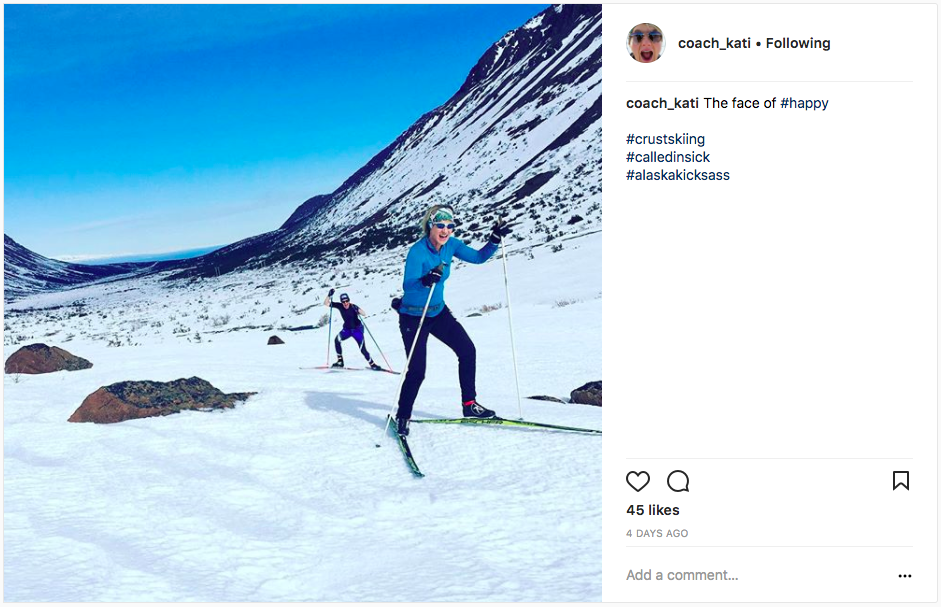
    “For me, I just try focusing on every day doing my best,” Holmes said. “I’m not a number person. I just try to do as best as I can and I kind of see where it gets me.”

    Caitlin Patterson of the Craftsbury Green Racing Project leading her teammate Kaitlynn Miller during the women’s 10-kilometer freestyle event on Saturday at U.S. nationals in Midway, Utah.
    Caitlin Patterson leading her Craftsbury Green Racing Project teammate Kaitlynn Miller during the women’s 10-kilometer freestyle on Saturday at U.S. nationals in Midway, Utah.

    Patterson, on the other hand, recently returned to the U.S. after racing on the World Cup for Period 1. She also scored World Cup points in November, and entered nationals confident she was a podium contender.

    “I had some pretty solid races [in Period 1] – some ups and downs there, too – and I was certainly hoping to come back and be able to have a strong showing here today,” Patterson said on Saturday. “Today was actually a little bit of a tough day for me, I didn’t quite feel as snappy as I was hoping, but I ended up OK.”

    Both Patterson and Holmes started in front of Gregg, who indicated she received no specific splits. But she did hear her positions being called out. At various points they ranged from second to fifth and sixth.

    “I didn’t really have a rabbit,” Gregg said. “So I tried to catch as many people as I could. I knew it really wasn’t really the longevity that was the issue it was just the right moment to attack. So I made a plan to attack at about 6 k and attack hard.”

    Around 6 k, Gregg did as she planned and put down the hammer, especially on the uphills. Despite being “in the hurt train” during her last 4 k of racing, she finished with just over two seconds to spare on second place.

    “It was more about racing against myself,” Gregg explained. “Be patient and then go.”

    Katharine Ogden of the U.S. Ski Team and Stratton Mountain School was fourth (+20.0) and the first under-23 finisher. Becca Rorabaugh and Rosie Frankowski finished fifth (+58.4)  and sixth (+1:05.0), respectfully, to give APU three of the top six.

    “I felt like I was able to move pretty well, most of it, but you really had to keep the pressure on the whole time,” Rorabaugh said. “Your body didn’t want to do it today, but you had to kind of just go there anyway.”

    Originally from Fairbanks, Alaska, Rorabaugh said the cold weather on Saturday morning — which delayed the women’s start by an hour — suited her.

    “I mean, I’m from Fairbanks. I can’t help it, I like it a little bit,” she said. “I wouldn’t consider myself as much of a skate skier, so this is my best skate result at nationals in a distance race so I’m excited about that. But I think the cold, definitely I have a comfort in the cold.”

    Results

  • How to Have Fast Skis ALL THE TIME, in EVERY CONDITION

    Toko Logo

    (Original e-blast)

    How to have fast skis ALL THE TIME and in EVERY CONDITION

    I love my job. The contact that I have with people in the ski community is pretty much always positive and enjoyable. We have great waxes and other products so of course generally interaction, feedback, and my motivation are very positive. However sometimes at events or otherwise, I have people approaching me trying to get me to guarantee super fast skis if they use a certain wax. A fairly rare thing is also that a person didn’t have the fast skis that they were hoping for. It is important to take a step back and take an overview so you all have the proper perspective on what makes a fast ski on any particular day.

    The 3 main factors to having fast skis are ski flex and design, structure, and wax. You could throw base material in there too, but most people have what they have, so that is more of a World Cup level topic. (Note that many skis have different base material that matches the type of conditions that they were designed to ski in, so this is addressed in the ski selection process. Example: Rossignol S3 or C3 have a “wet” clear base material to match the flex and structure that the skis come with).

    Far and away, the most important factor in having fast skis are the skis themselves. Given a particular condition, the skis need to match the condition in terms of their flex and design as well as match the skier (weight and ability).

    Let me use Rossignol as an example because I am very familiar with them and confident in them. Below is a quick chart explaining the flex/design of the top Rossignol skating skis, the Xium Premium S1, S2, and S3 skis. In each of these skis, the camber height is different as is the contact area of the skis to the snow if the skis are fitted properly. (The concepts are identical for Skate and Classic skis).

    Rossignol X-IUM Ski Profile

    If snow is cold, dry, and slow snow, a fast ski will generally have a low camber and a relatively long area of contact in the tip and tail sections. Assuming the structure and wax are “cold”, the skis should be good assuming they are fitted correctly. If the skis have a high camber and a short area of contact in cold, dry, and slow snow, the wax and structure can still slow the skis down further, but the skis will not be very good regardless of how optimal the other two factors are.

    It is the same in wet snow. Clearly, having a low camber and more contact between the ski base and the snow will result in more suction and more opportunity to pick up dirt creating more friction and more suction. Minimizing the contact results in much faster skis for the short term and especially after some kms are skied. The disadvantage of using a lower cambered ski with longer contact area can not be overcome with “wet” structure and wax to the point that the skis are really good. This is especially the case in dirtier snow where the addition of a deeper structure to compensate for the increased suction (surface tension) created by having a longer contact area will only result in more dirt attaching itself to the ski base which makes the ski slow due to the added friction of having dirt on the base as well as the increased suction because the structure is filling up with dirt and the previously hydrophobic base material is covered with dirt and no longer hydrophobic.

    In past years with different ski designs, many people including myself liked to err on the soft side, especially in the west where we get a lot of cold dry and slow snow. The current ski designs such as Rossignol need to be fitted properly and I personally lean toward the stiff side to ensure that the skis can function as intended.

    Bottom line is that in order to have fast skis in all conditions, the skis need to be the right flex and design for the conditions and they need to fit the skier such that the contact area matches the intent of the ski design. If you put a 200 pound guy on a ski designed for a skier of 160 pounds, there will be an increase in contact area. Also, the more aggressively a skier skis, the more care needs to be taken to ensure that the skis are stiff enough to accommodate being suspended on the right length contact zones.

    Looking at the chart above, you can see the different colors of the S1, S2, and S3 patterns. They match up with the Toko colors which makes sense because normally when you use one of those skis, you’d be waxing it with the color associated in the chart.

    Structure is often the next most important factor, especially in the two extreme conditions which are cold, dry, slow snow and wet snow. In cold dry fast snow that is for example transformed, a more aggressive structure can be used with success. This is why I keep mentioning “slow”. A base finish that is not a “cold” grind (very smooth) will not run fast in cold, dry, and slow snow regardless of the flex of the ski and what wax is chosen. In very wet snow, a “cold” grind will not run fast even if the ski and wax are optimal.

    All 3 factors in having fast skis need to be considered. Satisfying any one or even two factors will generally not yield fast skis if the third factor is in conflict with the conditions. Most times, the factor that is most in opposition to the conditions determines the speed of the skis, not the ones that are in agreement with it.

    So, my recommendation is to consider skis from a macro level starting with ski selection (should not be too soft!), then structure, and then finally wax. It is not as complicated as it sounds if you are a passionate ski racer (ie, you are willing to invest financially as well as in physical preparation). Have an S1 ski with a fine structure that you generally will wax with Toko Blue waxes (need to wax with a softer wax periodically for the health of the base). Have an S2 ski with a universal or cold universal structure that you will more commonly wax with Toko Red waxes. And lastly have a pair of S3 skis with a warm grind on them that you will mostly wax with Toko Yellow waxes. This way you already have skis optimally suited for each general condition that have a structure that matches the condition where you would use them. Then finally wax is the “icing on the cake” and will then be able to really make the skis fast.

    A ski racer could show up with all 3 of these skis prepared as described with no knowledge whatsoever of the conditions and basically always have good skis. With forecasting, it is possible to eliminate one or even two of the conditions associated with S1, S2, and S3 which makes it even easier and more convenient to have great skis. OK, now you know! Good luck and see you around!

    Photo from Women's Sprint Final at the Davos World Cup (Credit: Jacques Mignerey)
    Photo from Women’s Sprint Final at the Davos World Cup (Credit: Jacques Mignerey)

    Team Gregg

    Silver Star SuperTour Report

    Cold fresh snow racing continued with the Super Tour/ Nor Am at Sovereign Lakes Nordic Center in British Columbia. We raced on a cold hard paraffin with Toko JetStream Red 2.0 powder. It was a bit surprising that the Red 2.0 tested and performed so well considering the single digit temperatures. The range of the JetStream 2.0 Toko powders is fantastic. We covered the powder with Blue 2.0 Helix.

    The races were solid, but off the mark of where we really wanted to be. We are in the Methow Valley to train in prep for Nationals. We are feeling good and our preparation has us still ready to be on at Nationals.

  • Toko: Ski For Women and Birkie


    Toko logo

    Introducing the Alaska Ski for Women, a fundraiser to help stop the cycle of domestic abuse against women and children and also a really fun outing! Toko has supported this important event for the past 17 years.

    Alaska ski for women

    Alaska Ski for Women – an important event

    The colorful Alaska Ski for Women (ASFW) is North America’s largest women-only cross-country ski event. This is a great event where women of all ages and abilities come out to Nordic ski approximately 2.4 miles (4K), many in colorful costumes, while raising funds for local non-profit organizations that help stop the cycle of domestic abuse against women and children. This is not only a fun event, it’s also a fundraising event! Through the generous donations of ASFW participants, and the hard work of the all volunteer committee, the race has been able to make an impact in the community by contributing over $1,000,000 to groups that actively work to improve

    women’s lives. A special focus is ending the cycle of violence against women and their families and to help women in crisis find positive solutions to a healthier life.

    Alaska ski for women

    Held every year since 1997 the Anchorage event originally had nothing to do with the Super Bowl and started as a way to get more women out skiing together. That it was set on the same day as the football game was a coincidence -it was the only Sunday left with no race scheduled when the initial reservations were made. Since then, organizers kept the race on the day of the Super Bowl because it offered a great reason for women to have fun and raise money on a winter day when people are in a celebratory mood already.

    Alaska ski for women

    The primary purpose of this event is to get women out and take away their excuses. It certainly is a nice date and the event gets done in time to watch the Super Bowl. Race Director, Tamra Kornfield said 500 women signed up for the event this year, a slight drop from last year’s numbers but the goal is to get more women interested in the sport as well as supporting a good cause. While it’s not yet known exactly how much money was raised this year, Kornfeld said last year the group raised about $50,000 in donations. Teams dressed in costumes including a Chinese dragon, hot air balloons, a lion, a gorilla, devil’s club and public school busses. A team dressed as “Google Maps” claimed victory in the costume contest. Olympic cross country skier Kikkan Randall was one of the costume contest judges. Randall said that the trail was well-maintained with manmade snow despite the lack of natural snow. Were it not for the snow making equipment at Kincaid Park the last two season, the Ski for Women might well have been a walk as it was in 2005 when there was no snow on the ground.

    Alaska ski for women

    I have been a wax volunteer for the ASFW since the inaugural event in 1996. Initially a group of volunteers took over the Kincaid Park wax bunker and provided skate and kick wax services. TOKO started providing wax for the event in 1999 when I first came on board as a member of the TOKO Tech Team. The bunker was being renovated in 2001 for the World Special Olympics held in Anchorage and was unavailable for use for the Ski for Women. That year, myself and Mark Strabel set up our tables and tents in the stadium near the start and provided kick wax service to participants. Being near the start and seeing the costumes and the joy of the participants gave good reason to continue with kick wax service outside in the stadium. Glide wax service is also provided through rub-ons and paste. The following year TOKO became the proud and exclusive wax product sponsor of the Ski for Women and has been ever since.
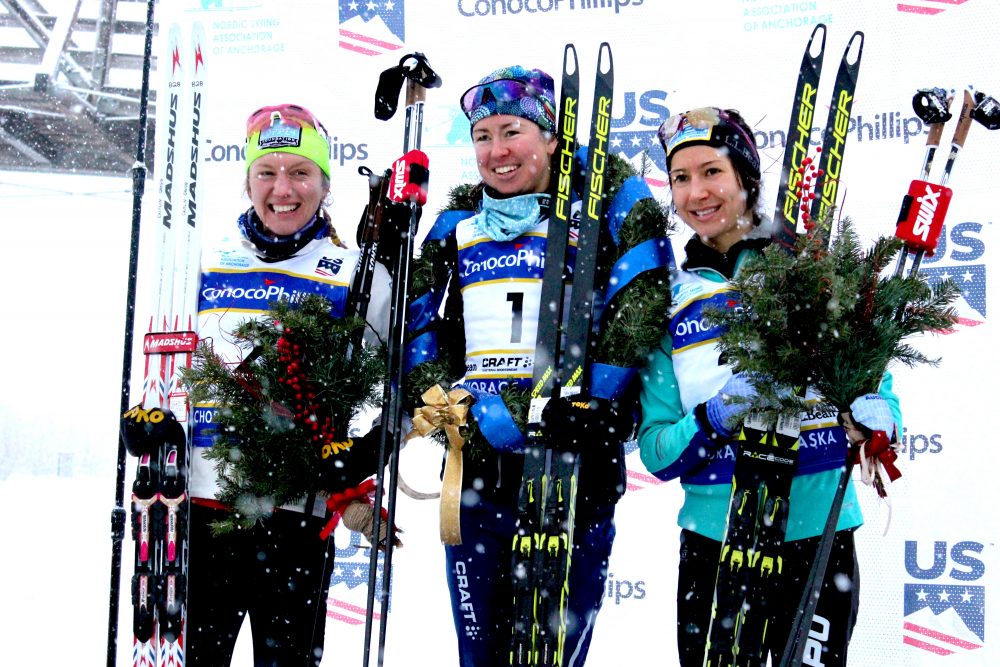
    Alaska ski for women

    In the 20 years I have been associated with this event there have been many volunteers who have stood outside and waxed skis. Some come for a year and others keep coming back. Each volunteer gets a TOKO hat and an apron. It is understood that regardless of the weather preceding the event or the forecast the day before, the morning of the ASFW will be cold and windy. These past few years I have been fortunate that a reliable core of volunteers has been available to wax. Chet Fehrmann, Ira Edwards, Eric Schwalber, Jay Holton and Matt Claman.

    Alaska ski for women

    Alaska ski for women

    Alaska ski for women

    Toko is proud to support the Alaska Ski for Women and will continue to support it. Thank you to the organizers and the other supporters who make it possible.

    – Patrick McGownd, Toko Tech Team Member since 1999

    John Bauer

    Bauer Wins the Pepsi Challenge

    Hayward’s 3 time olympian John Bauer won last weekend’s Pepsi Challenge race. Here’s what he ended up waxing with:

    I went with Toko HF Black then HF Red/ Yellow 50:50. I thought there was pretty good structure in the skis already so I did not re-rill. I did the red and yellow Structurite tool before adding JetStream Red and I put on a coat of the Red Helix. Perhaps I should have had more structure in…but there really wasn’t much one could do with the new snow that wasn’t much tilled when the sun hit it.

    I think it was a good effort. I skied relaxed and in the pack until I led out after 3k. Skied the Silver with a few pushes over the hills and then was alone at the 11k point on in. There were a few lurchy spots on the downhills and the skis were noisy on the sun-drenched hills.
    Congratulations to John on his overall win despite being 47 years old!

    momentum northwest

    Wax Report from JNQ Spokane, WA

    We had our last JNQ event last weekend in Spokane, and I took 10 athletes to compete in the mass start classic and individual start skate events.
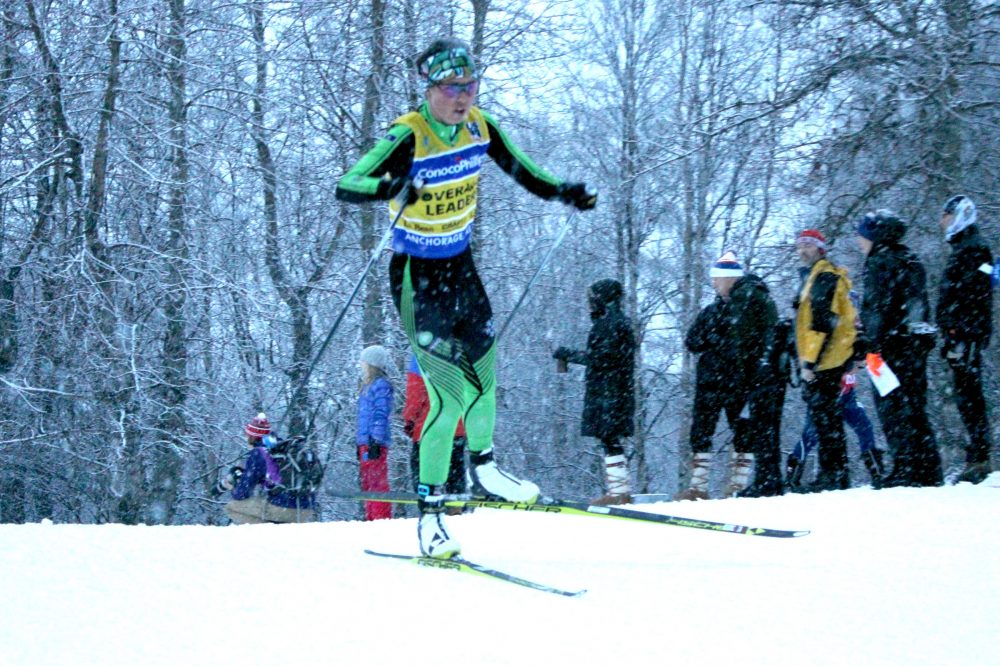
    Conditions were slated to be challenging: with warm temperatures and no recent snow it was transformed but somewhat sloppy. The classic race had a possibility of new snow which I was hoping to avoid! Given the high moisture and rapidly rising temps during the day we went with LF Yellow and LF black mixed for both days as a glide base layer. Then I tested JS Red and JS Yellow blocks and found some mixed results: the JS Red ran well in the more frozen snow, but even without the temperatures rising, as the tracks (classic) or platform (skate) got more skied and transformed further the Yellow came into play. I opted for yellow on both days given where our athletes were starting in the order, and also used the yellow structurite. Next I want to play around with some linear 1mm rill to accompany the structure sometimes, as I think that would help further channel the transformed snow’s moisture down the ski – thoughts?

    For kick in Saturday’s race, I first tested a green drywax vs. klister binder. Both skied comparably fast but out of fear of wear (lots of snowplowing, sharp corners) I went with the klister figuring it would increase tenacity. I covered the green binder first with Red, and tested that against a Red/Yellow mix. The Red was solid for most of the day’s races; it held well for kick and glide without getting slick as the tracks further glazed. However the later starters were the U14 classes and I wasn’t confident they’d be able to make it work (a few had issues in their warmup). I also wanted to keep the speed of the Red, so I just dabbed in some yellow. This small amount did the trick to add a bit more kick under the foot without sacrificing glide.
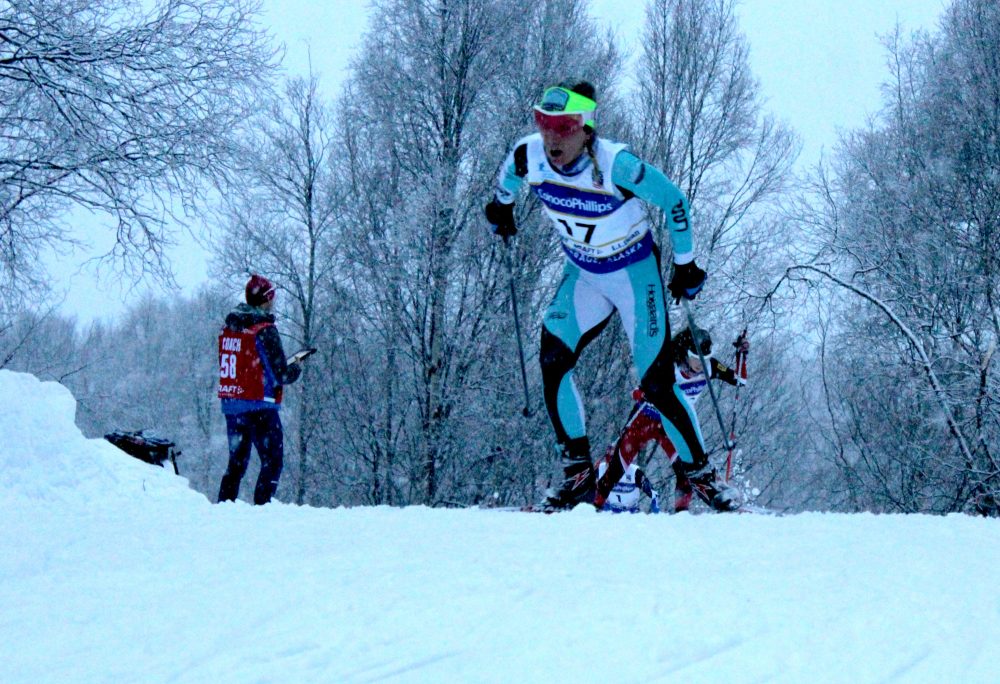
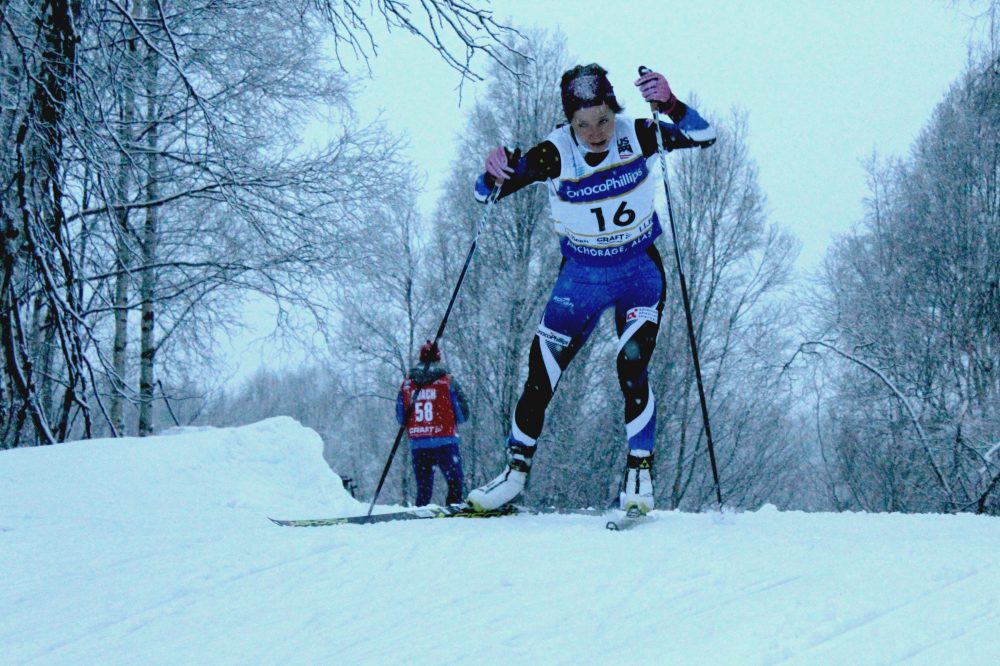
    – Sam Naney, Head Coach Momentum Northwest

    David norris birkie
    David Norris winning the American Birkebeiner (photo Paul Walsh)
    caitlin gregg birkie
    Caitlin Gregg wining the American Birkebeiner for a record 4th time! (Photo USSA)

    CXC Team logo

    American Birkebeiner
    CXC Wax Report

    The American Birkebeiner is truly the “Super Bowl of Skiing” and the 2016 American Birkebeiner Ski Foundation (ABSF) schedule of events did not disappoint the 12,000 skiers who flocked to Hayward, Wisconsin to enjoy the festivities and trails of the North Country. The crazy weather was a different story; it caused a bit of stress for skiers, coaches, and wax technicians, including the Central Cross Country Skiing (CXC) wax team of Karmen Whitham, Marty Donegan, and Bruce Manske.

    The glide wax was the easy part of Birkie waxing. We cleaned the ski bases with Toko LF Blue (-30 to -10 C); although the LF Blue is a hard wax, it aids in harden the base of a ski, and makes them run faster in transformed snow conditions; and, fluorine tribloc acts as a bonding agent for Top Finish products. Next, we applied a two layer of a 1:1 mixture of Toko HF Hot Wax Black and Toko HF Hot Wax Yellow (-6 to 0 C). The Black is very similar to the temperature Toko HF Hot Wax Red (-12 to -4 C), except the Black contains DLC additive for maximum dirt repellency. The Birkie groomers did an awesome job of preparing the course, but due to the thin snow cover and rainy weather, the course had a fair mount of dirty snow. Therefore, it was important to apply a double layer of wax. Toko HF Hot Wax Yellow has selected because of the high-fluorine content and its very durable, which aids in repelling water and dirt, and makes for fast skis.

    The CXC wax team top coated each ski with JetStream Bloc 2.0 Yellow. The JetStream was cranyoned on across each ski and then melted with a fiberlene-covered iron. A very thin second coat of JetStream was then crayoned on the skis. This layer we rubbed into the ski with a dedicated cork; followed by lightly brushing with a soft nylon brush and polishing with a Toko Thermopad. The JetStream improved the speed and glide of the skis due to its high abrasion-resistant design.

    The kick wax was challenging for most coaches and wax technicians due to the weather conditions, which included precipitation throughout the day, along with a glazing track, thousands of skiers, and the marathon distance factor. The CXC waxing crew, lead by Karmen Whitman, decided to use a combination of Toko Klisters. Nordic Base Klister Green was applied to the skis as a foundation layer; this was followed by a 1:1 mixture of Nordic Klister Yellow, designed for moist snow, and Nordic Klister Red, which has a wide range and is designed for transformed snow; Red is often used as a universal application.

    We tested covering the Klister with several different hard waxes, including Toko X-Cold; the hard wax cover had limited success, and we decided to primarily remain with the Toko Yellow and Red Klister combination. In a few cases, we added an additional layer of the Yellow/Red for additional kick, along with extended the Klister zones. Another test, with limited success, included adding a layer of a universal Silver Klister. Yes, the freeze and thaw conditions of the trail, and the changing conditions between coarse and transformed moist to wet fine grained snow created a variety of challenges.

    At the end of the day, The CXC Marathon Team, the CXC Masters Team, and the CXC coaching staff were very pleased with the performance of Toko wax and the results at the 2016 American Birkebeiner:
    Alice Flanders led the CXC women’s team in 10th in the 52k freestyle Birkie and Hillary Patzer finished 44nd. In the 55k classic Birkie, Nicolette Reker led the CXC women with a 20th place finish. Abbie Drach won the women’s Korterloppet in a time of 1:06:25.3. Duncan Douglas led the CXC men’s team finishing 31st in the 52k freestyle Birkie (as a 50year old!), with Cory Ellertson following close behind in 37th, while Chris Pappathopoulos finished 42nd. In the 55k classic, Nick Power just missed the top of the podium finishing second overall, with Andy Brown following close behind in fourth.

    Bruce Manske
    Central Cross Country Ski Association
    CXC Development Coach

    Sugar Bowl Ski Team & Academy

    Birkie Wax Report

    This year I was the only one of the Sugar Bowl to do the Birkie. Here are a couple strategies I used to have competitive skis while waxing for myself. The first thing I did was to apply my LF Moly layer at home before flying. This meant one less layer of waxing to do on Friday night. One great thing about the Birkie is the huge amount of testing and recommendations made public for the race. On Friday, I focused on getting a nice easy ski, with some pickups, to get ready for the race as well as eating a lot of food. After reading through the wax reports Friday afternoon, I wax my two wettest pairs of skis with Toko HF Yellow and Toko Jetstream Yellow Powder 2.0. I also applied a fairly aggressive structure pattern. The morning of the race I tested the two pairs of skis I waxed the night before. Once I picked the faster one I sprayed it down with Yellow Helix 2.0 and was ready to go. Toko makes wax recommendations for a ton of races you can find here. If you are traveling without a wax tech, there is a lot to be said for using wax recommendations, keeping the number of race morning wax decisions reasonable, and making sure you are physiologically ready to go.

    – Spencer Eusden, Sugar Bowl Elite Team

    47 Year Old John Bauer finishing 30th (and winning age group of course) in the American Birkebeiner

    John Bauer Birkie
    John skied on Toko LF Black then followed by Toko HF Black which he then covered with JetStream Yellow block (ironed with fiberlene), and finally covered with HelX 2.0 Yellow. John also pressed in a Toko linear structure followed by the Toko Red and Blue Structurite bits. Congratulations John! (Photo: Chris Young)

    Race report from Vuokatti, Finland Masters World Championships  

    Almost 1000 athletes representing 24 countries have recently concluded their competitions. Team USA concluded their “Global Warming in Finland” experience returning with 16 medals for the United States. 10 of those medals were won on Toko HF Yellow topped with Jet Stream Yellow!

    Day 1 of the competition was held on 80% manmade moist snow on a course averaging 20cm in depth with temps hovering at -9C for the classic event. Toko Red dry wax kicking on HF Blue / Jet Stream Blue worked very well for all, producing a Gold Medal for Trina Hosmer and a Silver for Bob Gray. Top 10 finishes were also recorded on Toko HF Blue for Carolyn Tiernan, Inge Scheve, Kent Murdoch, David Ford, and Louise Wholey who substituted Jet Stream Red and most likely other Toko solutions that have not yet been confirmed.

    Temperatures rose for the remaining events, becoming Zeros and klister type conditions for the remaining 6 races. All but the final Freestyle events were conducted with rain/snow falling at -1C to +3C just before and often during the races. Structure and massive fluoros became the weapons. The tracks were so thin, grey and brown on day 3, most classic skiers elected to go on Zeros for the 10K. Trina Hosmer was golden, Bob Gray was Silver and Abett Icks was Bronze on Toko HF Yellow/ Jet Stream Yellow. Most Toko skiers used the Red Structurite tool even though there was a fear of dirt because tracks and changing lanes were so sucky.

    The 4X5K relays had the benefit of some additional wet snow improving the dirt element somewhat. Many USA athletes had their highest placing of the week. One team in 5th, 3 teams in 4th, and a bronze for Katie Meyer, Donna Difolco, Carolyn Tiernan and Trina Hosmer. Toko HF Yellow/ Jet Stream Yellow were on the final 2 legs for certain for that team.

    The final distance races became easier calls on wax and ski selection. The classic event was all won on klister with the prior 4-day’s selection of all yellow combinations for glide. The skate event finally cooled down to -2C allowing the HF Red/Yellow covered with Jet Stream Red to make the podium. Two confirmed uses with a substitution of AX 134 with the Toko HF choice of the day produced great high-end speed of noteworthiness. Kent Murdoch and I were able to be in the top 3 at 500 Meters in all races that we used AX134. I came out of the worst start lanes in all 3 races to a top 5 position at the base of the first climb, thereby avoiding the cluster.

    Best finishes of the week were recorded with a 5th for Inge Scheve, 6th for Kent Murdoch, Bronze for Katie Meyer, Silver for Milan Baic, 5th for Donna Difolco, 5th for Nancy Bauer, 8th for David Ford, 4th for Carolyn Tiernan, Gold for Trina Hosmer, 5th for Abett Icks, Silver for Bob Gray and a Bronze for Carol Devoe. A confirmed 9 of those skiers had a Toko HF and Jet Stream layer. Great week for Toko gliding! Substantial testing produced solid waxing recommendations throughout the week.

    – Dave Ford, Toko Tech Team

    Noah Hoffman battling it out at the Lahti World Cup last weekend   Noah hoffman lahti

    noah hoffman lahti

    Team Gregg - logo

    Report from Owl Creek Chase

    Variable conditions for this years Owl Creek Chase 21k Classic. Sunny daily highs in the mid 40s and lows in the teens made for transformed snow but tilling brought fresh snow back for sections of the course. I prepped for glide with Toko HF Blue/HF Red mix at 1:1. I powdered with JetStream Red 2.0, with a sprinkling of Yellow 2.0 on the tails. I used a Toko Green base kick wax and Blue klister binder ironed in. I covered with a mix of Toko green base and another brand’s blue (under the foot). Skis were super fast, although I could have used a bit more klister for additional kick on the steep climbs and south facing slopes.
    – Brian Gregg

  • After Mid-Season Reset, Caitlin Gregg Racing for Birkie History

    After Mid-Season Reset, Caitlin Gregg Racing for Birkie History

    Caitlin Gregg en route to winning the Boulder Mountain Tour in Sun Valley, Idaho, earlier this month.
    Caitlin Gregg (Team Gregg/U.S. Ski Team) en route to winning the Boulder Mountain Tour in Sun Valley, Idaho, earlier this month. (Photo: Toko)

    After winning World Championships bronze in 2015 and, after years of racing, a U.S. Ski Team nomination come spring, Caitlin Gregg nonetheless found herself out of sorts when the World Cup kicked off in November.

    “Basically since the first weekend on the World Cup I just felt off,” Gregg said in an interview on Wednesday. “I couldn’t really figure out what it was. I had some races where there were good moments, but I just wasn’t able to put it together and I didn’t feel like myself. I felt like something needed to be reset.”

    There were good moments: the classic leg of a skiathlon in Lillehammer, or parts of races in the Tour de Ski. Competing in the grueling ten-day race series for the first time, Gregg hoped that as the races piled up she would feel better and better in comparison to the field.

    But by the time the Tour was finished, and she crossed the line at the top of the Alpe Cermis in 42nd place overall out of 43 women’s finishers, Gregg was ready to do something differently.

    Caitlin Gregg racing to 49th in the 10 k classic mass start at Stage 5 of the Tour de Ski in Oberstdorf, Germany. (Photo: Marcel Hilger)
    Caitlin Gregg racing to 49th in the 10 k classic mass start at Stage 5 of the Tour de Ski in Oberstdorf, Germany. (Photo: Marcel Hilger)

    “I made a tough decision – well, tough but not tough – to come back to the U.S.,” the Vermonter-turned-Minnesotan explained. “Tough in the sense that it’s always hard to leave opportunities for World Cup starts behind, but not so tough because I’m on the ‘B’ team and any extra day I’m over there, I’m paying for it.”

    While the other American finishers from the Tour headed to Seiser Alm, a high-elevation training site in Tyrolian Italy, Gregg went home to North Minneapolis.

    “I thought it would give me a good boost mentally and would give me the strength I needed for the next month of training,” Gregg said. “So I spent two weeks at home, and I worked at the Boys and Girls Club and skied with my Loppet Nordic Racing teammates and recharged, and then hit the ground running with my training.”

    It seems to have worked.

    “Since then, everything has been really good,” a relieved Gregg said. “My heart rates and lactates are back to normal and my energy feels great, so I’m pretty psyched.”

    The Greggs traveled to Wisconsin, mecca of the American Birkebeiner, to support the Birkie Tour; Caitlin’s husband Brian won the Seely Hills Classic.

    Then while Brian headed East for SuperTour racing, picking up three top-10’s in Lake Placid, N.Y., and Craftsbury, Vt., Caitlin Gregg stuck in the Midwest. She entered and won the Three Rivers Rennet in Bloomington, Minn., where she was fourth overall, and trained with her old friends.

    Americans Jessie Diggins (l) and Caitlin Gregg (r) hold up their silver and bronze medals from the 10 k freestyle at the 2015 FIS Nordic World Ski Championships in Falun, Sweden.
    Americans Jessie Diggins (l) and Caitlin Gregg (r) hold up their silver and bronze medals from the 10 k freestyle at the 2015 FIS Nordic World Ski Championships in Falun, Sweden.

    “I think I’m a unique athlete in the sense that so much of my career has been through community involvement,” she said. “Not just financial support – that for sure – but honestly, I’ve trained with more juniors and masters than I have with elite racers. Whether it’s early morning intervals or training in the dark, or doing a local citizens’ race, that’s where I get my energy.”

    She also made a detour to race, and win, the Boulder Mountain Tour in Sun Valley, first training at elevation in Frisco, Colorado.

    Gregg is hoping that energy will carry her to another Birkie win on Saturday, and then on to the Ski Tour Canada, the final period of World Cup racing for the season.

    “This year is big because I’m tied with an [Austrian] guy named Manfred Nagel for the most Birkie wins,” Gregg explained. “I think if I win I will be the all-time winningest, which is pretty cool. So I’m going to keep trying to do that for the rest of my life – they’re going to have to pull me off the Birkie trail some day. I’m actually standing on the trail right now.”

    Gregg won her third Birkie title in 2014, and missed the event the next year in preparation for World Champs – ultimately a successful move. But coming back to the race is clearly beyond exciting for one of its biggest cheerleaders.

    “The Birkie is huge because of the community,” Gregg said. “We’ve spent years here in Hayward… I know some elite racers on the World Cup don’t quite get it. But I think it is an event that brings home why people get excited for us when we have international success on the World Cup. Skiers here are psyched to be on your same equipment, or to know what your latest modes of training are, or the heart rate variability stuff, or what your drink mix is for the Birkie. It really brings home the sense that there’s an awesome ski community here.”

    Caitlin Gregg, winner of a particularly frigid 2014 Birkie. (Photo: American Birkebeiner Foundation)
    Caitlin Gregg, winner of a particularly frigid 2014 Birkie. (Photo: American Birkebeiner Foundation)

    In the end, Gregg plans for this to be one more season where the Birkie fits in well with her World Cup racing goals.

    “It’s funny because the Birkie motto is Ski, Run, Bike, Live, and it really is part of my life,” she said. “Sometimes the Birkie is what elite racers do when they are done with their careers. I like that Brian and I have been able to integrate it into our international careers – and other athletes too, like Holly Brooks, Tad Elliott, and Matt Liebsch. It’s not just something that you do when you’re done racing.”

    And after Saturday’s race, whatever the outcome, she will focus intensely on recovering and preparing for Canada.

    “For the first time maybe in my career, I feel like my age comes into play as a benefit,” Gregg laughed. “I don’t think a 50 k takes as much out of me as someone who is in their early 20’s. Finally there’s a perk to being old and having a zillion hours underneath me!”

    But seriously.

    “My training leading up to this race has been good, and it’s going to be a fast year this year with the conditions,” she said of possible post-marathon fatigue.
    So I think it’s not going to be a problem. I’ve talked to a lot of coaches and gotten some good insight into what to do afterwards for recovery.”

  • Toko Mega Field Report

    Toko logo

    SMS

    SMS T2 US Nationals Wax Report
    Classic Individual
    Warming temps, glazing tracks, new snow.
    I went pretty simple on glide for the classic race, waxing with HF Blue cut with AX134 for the guys in the AM, and a mix of HF Blue, AX134 and HF yellow for the ladies who were racing second. The traffic from all of the competitors was releasing a pretty decent amount of moisture and I wanted to soften the relatively colder HF blue paraffin for the later races. I found that I was not liking the way straight HF red was running early that week in testing so ended up on a mixed paraffin. AX134 tends to run really well at high speed or any place there is some free moisture or the track is glazed. I ended up using a different powder that I preferred in the higher moisture snow over either Jetstream red or yellow powder. Topcoat was Jetstream Red block. Safe and effective, tested well in the AM. Helix sprays felt good feel testing but weren’t drastically improving runout. I ran a pretty simple hand structure on the tails of the skis to deal with moisture in the track.
    For kick, I did not go ahead and race wax with Toko kick waxes. Their red and yellow hard waxes can run really well in the warmer range, the yellow being a great last wax to try before switching away from dry wax. Although I have had a lot of success with them, I stuck to a different brand that gave m e a few different options for both speed and kick. I ran a warmer wax over a light tacky binder to form my kicking layer and ran a colder wax over top for a shell.
    Skate Sprint:
    I ran a pretty similar glide combo to the classic distance day for the skate sprint. The only difference was the temperature was a bit colder so I pulled the warmer paraffin out of the mix. I found that both floro blocks and certain liquids were improving the top end speed on top of powders so I burnt powder early in the day for durability. I intended to have the floro powder down as an insurance policy for the rounds and didn’t want to rework the skis too much. In testing the day before I felt that Helix 2.0 spray was once again improving the slippery feel of the ski climbing but some other liquids had higher top end speed which I really wanted to get athletes to the front of the race for the rounds. Again, I went with a pretty moderate hand structure to keep the skate skis from being too aggressive and bitey on the climb back into the stadium. Skis seemed very competitive on the day with Anne Hart finishing a career best 2nd place in the skate sprint.
    Skate Mass Start:
    Warmer temps greeted us for the skate mass start race. I pushed people out on warmer softer skate skis, especially for the women’s race at 1:30 PM. I figured that given the humidity in the snow and the amount of traffic, we would see a pretty hard glaze develop. Athletes wanted enough structure (especially hand structure) to deal with this moisture while still having a stiff enough ski to deal with variable track conditions. I ran a pretty warm buildup for both the guys and girls skis with HF Red, warm powder, block and liquid. I found again that certain liquids delivered better characteristics than just blocks. I buried Helix 2.0 spray under the block on a few skis and corked together for climbing freeness and topped with another brands liquid that was gliding out really well and is always a very safe bet for warmer temperatures. I ran a full length light crossing structure on the skate skis with a heavier linear structure on the tail to help with the glaze but still climb well. It seemed that this pretty straightforward approach to prioritizing hand structure and topcoat testing the morning of worked well with 3 athletes in the top 5 for the women’s 20k race.
    Classic Sprint:
    Warm temperatures in the 30s cooling off to low 20s by the end of the round.
    I threw on paraffin without too much testing. I figured that I can always change the topcoats and dealing with kick would be more the priority. HF Red was a safe bet because it runs pretty well in a wide range of temperatures and conditions. I did burn a powder (the same powder from a different brand) that I had been running all week. It was very safe and seemed to improve speed with topcoats over it. For whatever the reason (pretty moist snow would be my guess) the Jetsteam powders were not clear test winners. I kept putting them on snow and could not get them to beat some other product out there. I find they usually prefer some more transformed snow, or much drier snow than the new moist lake effect snow we had. I ran the same topcoat build from the skate sprint.
    Again for kick wax I started with a pretty warm dry wax and shell and cleaned it off after the qualifier and the semi and kept stepping down to a colder option from the same hard waxes I used on the classic day. Structure was a light crossing structure on the tails only.
    Overall I felt we had decent skis on the week. I used Toko products where I knew they were safe and effective. When I could find something running better, I used it, but my familiarity with the waxing line and knowing that they wouldn’t be a liability allowed me to get skis waxed and focus my energy on testing and chasing more unknown variables.
    Pat O’Brien, Head Coach SMS T2
    Sugar Bowl Ski Team & Academy
    U.S.S.A. Nationals Wax Report           
    We were fortunate to have had Sugar Bowl assistant coach Christina Mishica, who grew up in Hancock and raced for Michigan Tech. Her hometown knowledge was especially valuable when picking skis and waxing. The early part of the week was characterized by conditions that favored colder grinds and underlayers. Despite the cold air temps, the snow was relatively fast, especially with glazing classic tracks and during the skate heats. Throughout the week, we liked the new Toko 2.0 Jetstream Red powder.
    Classic Individual: For base layer, we liked an under layer of Toko X-Cold powder, with our race paraffin a mix of HF Blue and HF AX134. The Blue provided good durability for the 10/15 km distances, while the AX134 helped the high end speed. That was key in a course where maintaining speed is crucial. For powder, the 2.0 Red Powder was consistently at the top of our test. The final layer was 2.0 Red Helix. With glazing tracks the Helix provided the best high-end speed. Blue and Red kickers with a klister/hardwax mixed binder provided good options for kick and speed.
    Skate Mass Start: With slightly warmer temps for this race day, we opted for a paraffin layer of HF Red. We kept the X-Cold powder in as an underlay; happy with the breaking speed it gave us. For topcoats, based on our success with 2.0 red through the week, this was our natural starting point. We had 2.0 Red Powder ironed in with a layer of 2.0 Red Block ironed in over the top. Ironing in the block gave us better durability than rotofleecing.
    Skate Sprint: Once again, Jetstream 2.0 Red Powder was a winner on the sprint day. We tried similar wax to the day before, and found that blocks were running better than any liquids. JetStream 2.0 Red Block was a clear winner in glide outs as well as on feel. Even as the day progressed, conditions remained consistent and our skis were good. We did rotofleece the block as opposed to corking it in.
    – Spencer Eusden, Sugar Bowl Elite Team
    Annie Hart Videos from Classic and Skate Sprints at US Nationals
    Team Gregg
    Seeley Hills Classic 38km Wax Report
    Temperatures plummeted from +25F friday to -8 F on race morning.  I knew going in to the race that finding speed would be the greatest challenge.  Caitlin and I have had fantastic results with Toko on the Birkie Trail over the years and went with one of our favorite combinations.  I hardened my base with a layer of LF Blue and Cold Powder before putting on my final race layer of HF Blue and Cold Powder.  I opted not to go with a flouro bloc with the temperature being so cold with the high forecasted as -2F.  I sanded my kick zone aggressively and ironed in a green base binder, making it pretty thick under the foot and tapering out the edge, ending about an inch short of my normal kick zone. I kicked on Toko Blue hard wax covered with one layer of flourinated Swix XF30.  My skis were rockets and I had great kick the entire race.  Thankfully I dressed warmly and enjoyed some fantastic classic skiing.  This same combination proved fantastic the next day in even colder temperatures for the Birkie Tour.
    – Brian Gregg
    (Congratulations to Brian on his win)


    Brian Gregg
    Brian Gregg at the Seeley Hills Classic (Photo credit: Once in a Blue Moon Studio- Kelly Randolph )
    brian gregg seeley hills
    The Seeley Hills Classic winners Natalia Naryshkina and Brian Gregg with race director Dennis Kruse

    CXC Team logo

    Wax Report from Seeley Hills Classic

    Glide:
    Applied Toko LF Blue — scraped warm
    Applied Toko LF Blue — cooled, scraped, brushed Apply Toko HF Blue — scraped warm Applied 2nd coat of Toko HF Blue, sprinkled in Toko Cold Powder, cooled, scraped, brushed Crayoned on Blue JetStream Ironed the JetStream with a sheet of fiberlene to protect the base Cooled and Brushed Brushed again, and then polished bases with a Toko pad

    Kick:
    Ironed in a thin coat Toko Base Green in kick zone (just to the Hard wax marking, not the Powder marking) Let cool, then cork smooth Five thin layers of Toko X-Cold kick wax — cork smooth each layer (just to the Hard wax marking, not the Powder marking) Two thin layers of Toko Blue kick wax — cork smooth each layer Two thin layers of Toko X-Cold kick wax — cork smooth each layer

    Congratulations to Natalia Naryshkina on her win

    – Bruce Manske, CXC Development Coach

    momentum northwest

    Reports from Junior Olympic Qualifiers
    BEND JNQ – Wax Report
    CLASSIC RACE: Conditions were slated to be cold and clear for the first day of racing, an individual start classic race. We base-waxed with Toko LF blue, a no-brainer given how versatile and wide-ranging that wax is. On race day I tested a few different blocks but given how cold it was I didn’t find huge differences between block vs. no block and so opted to focus my attention on finding a fast kick wax in the cold snow. I tried Toko X-Cold straight, Toko Blue straight, and compared them to a few other brands’ cold waxes. After some different combos I found that two layers of Toko BLUE covered with a layer of X-Cold for speed did the trick; it was faster than straight blue and provided the softness underneath for good kick. 
    SKATE RACE: It was a bit warmer and fresh snow was falling for the skate day. We stuck with Toko LF Blue for base paraffin but I jumped right on testing blocks and liquids when we arrived, along with structure. I was joint-waxing with Jordan Buetow of BEA and he had some Finite tools to use for structure, so we tested those against the Toko red structure tool, run only from the heel to the tail. The Finites ran a bit faster so we went with that; both the Toko and Finite were faster than no structure and I think had he not had the Finite we would’ve definitely chosen the red structurite over any other choices. 
    Block choice was between a wax he thought was best and Toko JS Blue and JS Red. I thought Blue would be the ticket but it was slower than his wax. But then putting Red against his wax I felt it was faster, especially on initial acceleration; once they were up to speed it was pretty equivalent. Jeff Hashimoto of Ellensburg concurred with me and they went with JS Red block, as well. 
    We had two podium finishes in the U14 race and several top-12s in the U16 and up categories – a sure sign that our skiers are getting more competent with their technique and fitness and able to compete with the experienced teams. 
    Kongsbergers Gunnar Hagen 7.5km: 
    This past weekend was the KSC Gunnar Hagen, a 30km and 7.5km classic race. Dave Ford was up there as the Toko rep so he and I set up our tables in the middle of the stadium and acted as the Wax Knowledge Stations for the day. He had tested early; the temps had gone from 26F in the middle of the night, up to 32F and then back down to 23F by race time. As such there was some transformation in the snow. He and I immediately thought of Base green thick ‘n short application, and tried it with success. He called it as the top pick, but when I tested straight Toko Yellow I found that to be quite good as well. Another brand’s wax was also running but I was nervous about its speed on the back sections of the course; it didn’t seem as free as the Yellow. My athletes all went on Yellow and felt the kick was great without icing. I ended up converting a lot of the masters skiers from their choices of klister or similar gook over to an application of Toko Yellow and they all reported great skis. Once again, I was pleased at how wide a range that wax has without suffering speed.
    – Sam Naney, Head Coach Momentum Northwest
     
    Toko logo
    Wax report from Wasatch Citizen Series 10k Classic at Mountain Dell, just outside of Salt Lake City, UT 16 January

    Recently, there had been a lot of 32f and snowing type weather, so I was curious to see what the weather was going to bring for this race.
    Upon arrival, snow termperature was 18f and air was 20f.  I was the first skier on the course and found that the well groomed tracks had completely filled in with new fallen windblown snow.  Windblown snow is generally very dry and “grabby”.  I tested various kick waxes (also joined by my fellow Toko Tech Team members) and we found that a few layers of Toko Nordic Grip Red covered by a thin layer of Blue was best.  Noteworthy was that as the track got skied in, the platform for skiing on was not very flat (due to all of the new snow not having been skied in perfectly flat – it resembled more of an old style track that was simply skied in).  Additionally the snow was breaking on itself (shearing).  So, the kick wax was sticking to the top layer of snow in the track, but the snow under the top layer wasn’t sticking to that snow resulting in less sure kick.  So, in general, the snow was a bit grabby, especially in the more shaded sections, and the kick was not very sure due to the nature of the track (despite the excellent grooming by the volunteer Tuna crew – thanks!).  If a person were to try for perfect kick, the only result would be  a sacrifice in glide since the kick was not bomber due to the nature of the snow in the tracks.
    As the air temperature rose to 28f and the snow to 24f, we settled on a race kick wax recommendation of straight Toko Nordic Grip Red put on as thinly as possible with a bit more underfoot.  For glide, we went with our recommendation which was LF Black, HF Red, and an application of JetStream Red (block/fiberlene application method).  As it turns out, the addition of HelX 2.0 Red was also excellent.  It was nice to see that after all the dialing it in and testing, this turned out to be the exact wax recommendation made two days before the event by TTT member Barry Makarewicz.  Nice job Barry!
    Thanks to the Tuna crew and Mountain Dell Groomers for a great day!
    wasatch citizen series


  • Photos From U.S. Nationals: 20/30 k Mass Start

    Photos From U.S. Nationals: 20/30 k Mass Start

    HOUGHTON, Mich. — Three days of racing at U.S. Cross Country Championships on the Michigan Tech Trails down and just one more to go with the 1.5-kilometer classic sprint taking place on Saturday. Check out the following photo gallery featuring some of the top moment’s from Thursday’s 20 and 30 k freestyle mass starts.

    Complete results

  • No Wax Skis and Team Gregg WC Report

    Toko Logo

    Toko EXpress

    Toko Grip & Glide Wax: For No Wax Skis
    We get asked all of the time how treat no wax skis and more specifically often times how to prevent wax from clumping up in the kick zone in new falling snow around 32f.  The solution is simple: Toko Grip & Glide Wax.
     
    Apply Grip & Glide Wax to the entire base of the ski – both the glide areas as well as the kick zone.  The glide areas will glide faster and the grip zone will not have snow sticking to it.
    One thing to watch for though is if the kick zone (tread pattern) already has dirt in the corners and cracks. If this is the case, clean it well with a tooth brush and some wax remover if there is ski wax in there or just soapy water if it is just dirt.  Once this is done, then the regular preparation mentioned above will serve you well.
     
    Grip & Glide Wax is available at most Toko Nordic dealers and has a MSRP of $15.50 for 100ml (pictured above) and $19 for the 200ml size. Enjoy!
    Tom Jorgenson
    World Cup Report from Tom Jorgenson, Team Gregg Coach and Waxer
    A wax room on the World Cup looks basically the same as a wax room anywhere, except there are more skis. Products from all brands are tested and used throughout the season, but there is nothing particularly special about the products used; pretty much every Toko product, for instance, is exactly the same as the Blue, Red, and Yellow 2.0 products you can buy at your local ski shop. There is nothing special about how they are applied, either; iron wax on, cool, scrape, brush. Just like the directions tell you.There is also nothing special about how decisions are made about what to use: we test. A lot. Toko offers a couple different suggestions for applying JetStream 2.0 Powder, and in Davos we used a Toko powder to test several different application methods to determine which was the fastest and most durable. If you want to learn what waxes to use at what times, or learn about how better to apply them, just test. Put different things on different skis, and go skiing. Write down what you learn; where a ski feels like it’s shooting you down the trail or where it ploughs into the snow, what kind of snow your kick wax drags in or how fast it wears off. It’s also important to ask questions; most people are very willing to share their knowledge and ideas, and you may be surprised that you know something worth sharing too. 


    So much waxing is just play. It’s experimentation, and patience. Each World Cup tech has a Moleskine notebook that they fill over the course of a season with notes about their athletes’ skis, schedules for race mornings, lists of what waxes are on which test skis and which were the best, what snow conditions were like on a particular day of racing and what race waxes were used. In just one week, I filled probably a dozen pages worth of notes. 
     
    I wish I had some sort of revelation to share about the secret to waxing perfect skis every time, or an insider’s tips and tricks from the World Cup. But the thing is, there really aren’t any. Just play around with different stuff, and have the patience to do things according to the directions. This is what Toko is so good at: they keep things simple. There are no secrets to using their products. And their products make World Cup-quality fast skis.

    Tom JorgensonTorin Koos

    Toko All Stars: Torin Koos

     1. Who was your skiing role model when you were growing up and why?
    Definitely Gunde Svan. From training to technique, he was so ahead of his time. He even would change out the alloy tips on his ski poles for titanium. When you’re doing that, you’re dialed in.
     
    2. What skier inspires you currently and why?
    Gianluca Cologna. It’s got to be tough to ski in the shadow of your older brother when he’s got three gold medals. But Gianluca’s been on the World Cup podium before. And he will be again. 
    3. Favorite race course and why?
    The big steep climbs of Oberstdorf make the German course my favorite race venue. I’ve only got one American Birkebeiner under my belt, but that course has a special vibe and flow as well.  
    4. Favorite workout and why?
    Ski bounding at SoHo. A skier is born in the summer.
     
    6. Favorite movie line and why?
     
     “Cinderella story. Outta nowhere. A former greenskeeper, now, about to become the Masters champion. It looks like a mirac… It’s in the hole! It’s in the hole! It’s in the hole!” 
     – Carl Spackler 
     
    Because its classic Caddyshack. And you gotta dream big.
    7. Favorite Toko glove model (and/or color) and why?
     
    Toko Profi. The fit and feel are just right with this glove.

    Torin Koos

    Torin Koos

    Sun Valley SuperTour Field Reports – What the teams used in their own words:

    3f5f1c43-4e43-43ef-992e-44906a88a0f6

    CL Sprint:
    For the CL sprint day I prepared a qualifier and round ski for each athlete. Temperatures were forecasted to get relatively cold and clear overnight and I figured we would at least be looking at some firm tracks in the morning and some sort of binder and hard wax for the qualifier before conditions soften and turned into unconsolidated sugar. One big challenge for an all classic weekend was to have a few different ski options to deal with changing conditions, especially as the western sun came out on saturday and forecasted snow moved in on sunday. Low base snowpack, coupled with lots of shoveling and a lack of moisture meant that the crystals didn’t have enough structure to form a solid track surface on the steeper climbs and we were going to see sugar out there at some point. Skiers needed a ski with enough camber to handle a warm dry wax, but with a soft enough finish to hold wax down on soft snowpack. For the qualifier I went ahead and applied LF blue, then HF blue. I didn’t go ahead and powder as I was planning on top coating skis during round and liked the speed of blocks over straight HF blue. In the morning I went ahead with JetStream Blue 2.0 block straight up as I liked the top end more than Helix spray in the tracks. I also went ahead and applied hard wax binder cut with a softer hard wax ironed in to the kick zone. Toko green hard wax binder excels in very abrasive conditions as it helps hold wax from stripping but when put on the night before can actually be too firm and inelastic to handle a soft dry wax in loose sugary conditions. For the qualifier I went ahead and used a warmer violet hard wax shelled with a blue hard wax for speed. I dialed in thickness and layering on athlete skis with the warmer wax bringing the kick up to a thickness they felt comfortable with, then shelled with a colder wax for a bit more speed and “freeness”.
    Round skis I worked up with a warmer paraffin and jumped to Jetstream red block and spray for a topcoat. By the time of the afternoon rounds, the sun had gotten high enough for some solar effect and slight glazing in places. I stripped off the binder and abandoned shelling the kick wax as temperatures were too warm to freeze the kicking wax in a short time table. I also applied light linear hand structure to the tail of the ski to deal with any moisture or glazing in the track on the downhill finish and try to wring out a bit more top end speed from skis.
    Overall I was relatively pleased with our skis although with limited testing resources and time during the rounds picking and dialing in race kick wax often involved some judgment calls especially on many new and unfamiliar race skis. Picking the appropriate ski for sugary conditions and dialing in thickness and and application definitely had the largest effect on kick security and speed, rather than picking the dry wax was working best around race time.
    MST Distance:
    For the distance race I figured we would be looking at conditions closer to the rounds of the CL sprint than the qualifier. I worked the same round skis up again with HF Red and burnt powder for some extra durability for the longer distance. I also went ahead and applied hard wax binder again cut with a soft dry wax for some durability and elasticity. With the warmer temperatures overnight I started athletes kick testing on a wax similar to their round ski from the day before. Although the snow had re-crystalized somewhat overnight, overall it was acting pretty warm and we quickly shot past the blue range into a stronger warm dry wax. Glide again was Jetstream red block with Helix spray. I left the same linear structure in the tails of the ski from the previous afternoon for the traffic of the mass start. As conditions broke down further for the guys race, I bumped them up into a stronger, stickier dry wax, trying very carefully not to over wax the pocket and slow the ski down considerably. A last minute snow squall minutes before the guys start had me rushing to cover with a colder wax and liquid floro the front and back of the zones to help minimize any risk of icing. Ultimately the snow held off and this probably want necessary and robbed some kick security but was worth the risk with the snow forecasted to start right as the gun went off for the guys race.
     – Pat O’Brien, Head Coach SMST2 Team
    Sun Valley
    Classic Sprint Super Tour December 5, 2015.
    Conditions: Hard track with cold temperatures in the early morning ~7 degrees Fahrenheit warming to mid 20s during the middle of the day. Mid- low humidity and tracks set very nicely despite the warm temps the proceeding days before.
    Waxes Used: HF Black paraffin base. Toko HF Red. Topcoat: Toko Red 2.0 JetStream Block for the qualifier. Toko HB 004 Block for the heats.  
     
    Classic Mass Start 10/15k December 6, 2015
    Conditions: Loose granular track with temperatures in the low 20s overnight. As the day progressed it looked like it was going to snow, but it never amounted to any accumulation. Highs around Men’s race time were 29-30 degrees F. Humidity was approximately 55-60%. Track deteriorated after the Women’s Mass Start competition.
    Waxes Used: HF Black paraffin base. Toko HF Red/Blue mix. Toko HB 004 Powder. Toko Red 2.0 JetStream Block.
     
    Both days another brand’s kick wax were used
    -Colin Rodgers, Head Coach Sun Valley Gold Elite Team
    Sugar Bowl Ski Team & Academy
    Saturday Classic Sprint:
    Heading into the races last weekend at Sun Valley conditions were classic dry western snow. However, there were a few factors that pushed us away from a colder glide options and ultimately to the paraffin layer, Toko HF Red, which we used. Primarily, warmer temperatures on the day before the race combined with heavy skier traffic on a small loop caused the tracks to ski much warmer than the surrounding snow. For a top coats we liked the temperature range the 2.0 Jetstream Red gave us. We went with a powder layer, ironed in the night before. On race morning we quickly learned that liquids were running better than blocks, even in the cold temps and opted for a 2.0 Helix Red as our race finish.

    Sunday Classic Distance:
    For Sunday’s race we stayed with our paraffin base layer of Toko HF Red. This was in part due to wide range of Toko Red and a decent chance for a mid-race 30°F snow storm. The top coat was again Toko Jetstream 2.0 Red Powder. We went with a 2.0 Red Block layer for the freer feel and breaking speed over the tops of hills. Since the course was a short and hilly loop most teams opted for more kick. While some teams used a base layer of klister with a colder hard wax cover, we were able to find a hard wax combination strong enough to get us up the hills.

    For kick on the weekend, we found that we were able to wax pretty warm while not sacrificing glide. We felt that having solid kick was important as the courses were all heavy striding. A kicker of Toko Yellow sandwiched in Toko Red was a good option, especially with the high humidity on Sunday
    – Spencer Eusden, Sugarbowl Elite Team

  • Bonus Photos from West Yellowstone SuperTour

    Bonus Photos from West Yellowstone SuperTour

    WEST YELLOWSTONE, Mont. — The Yellowstone Ski Festival in West Yellowstone, Mont. came to a close last Saturday, Nov. 28, but the action from the first SuperTour races of the season lives on in the following highlight photos.

    Race reports: Women’s sprint | Men’s sprint | Women’s 10 k | Men’s 10 k