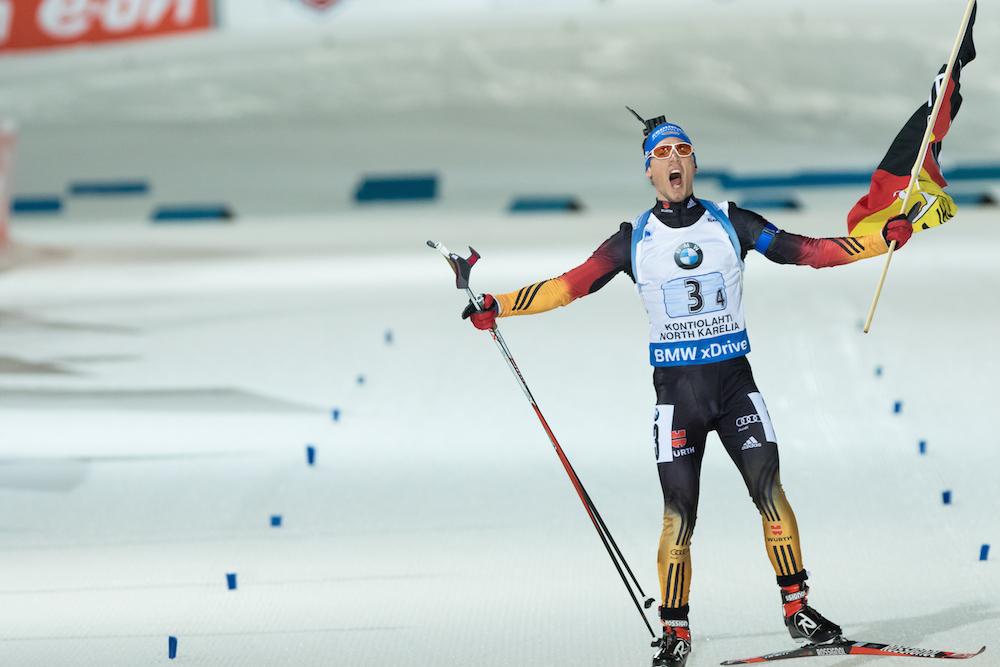
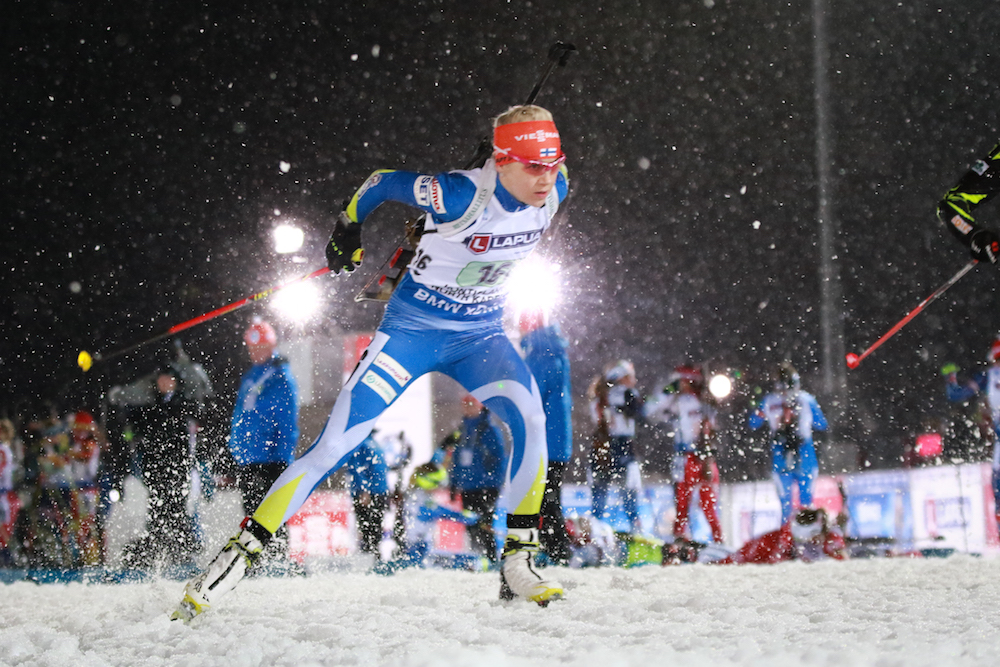
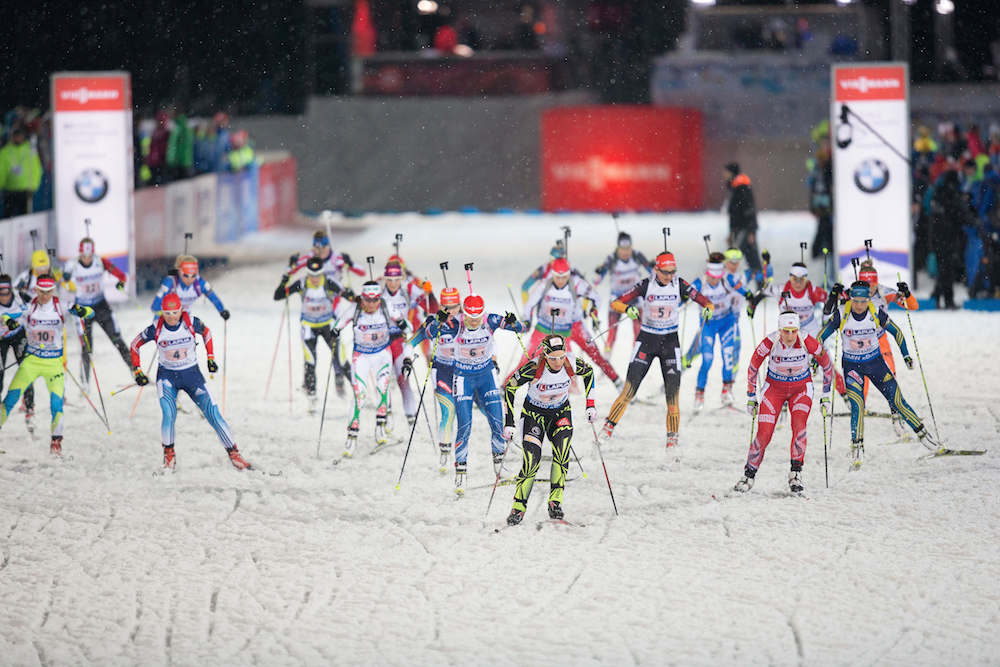
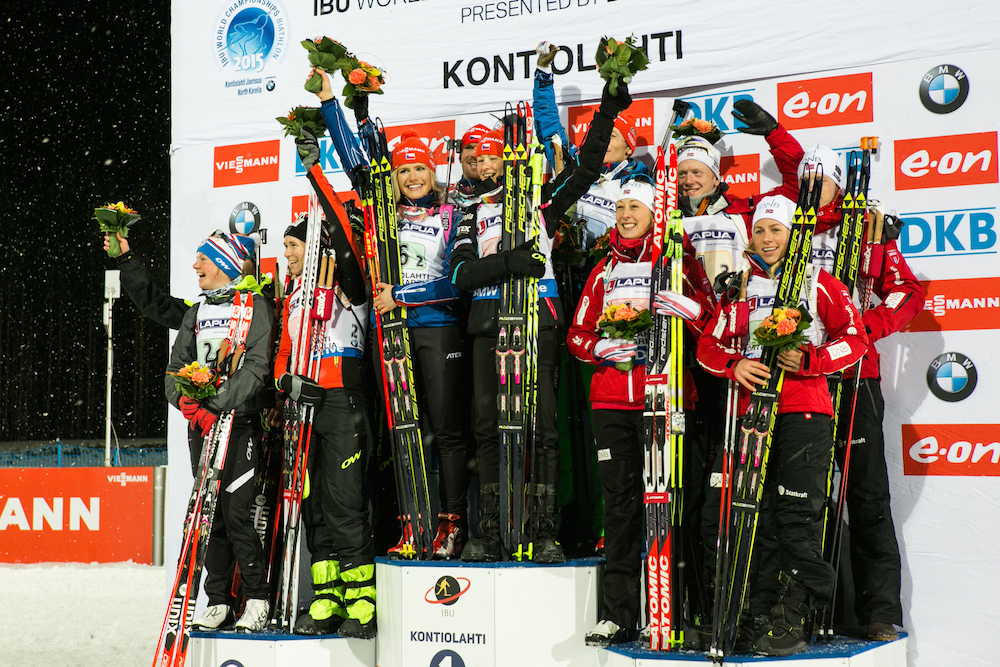
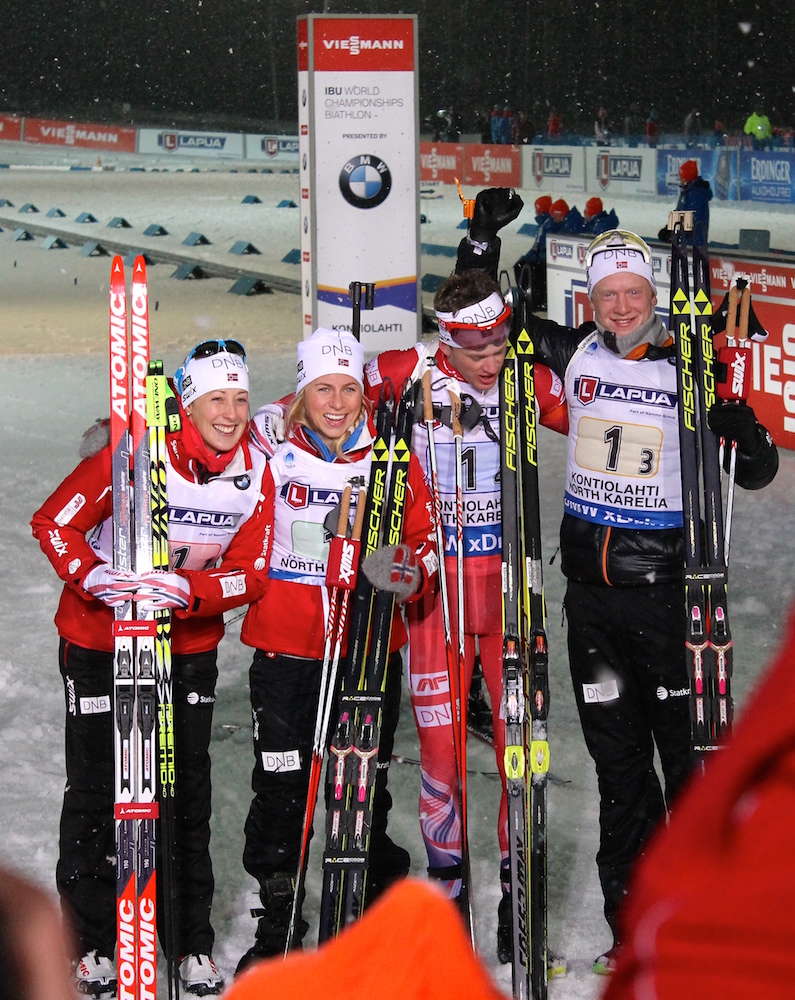
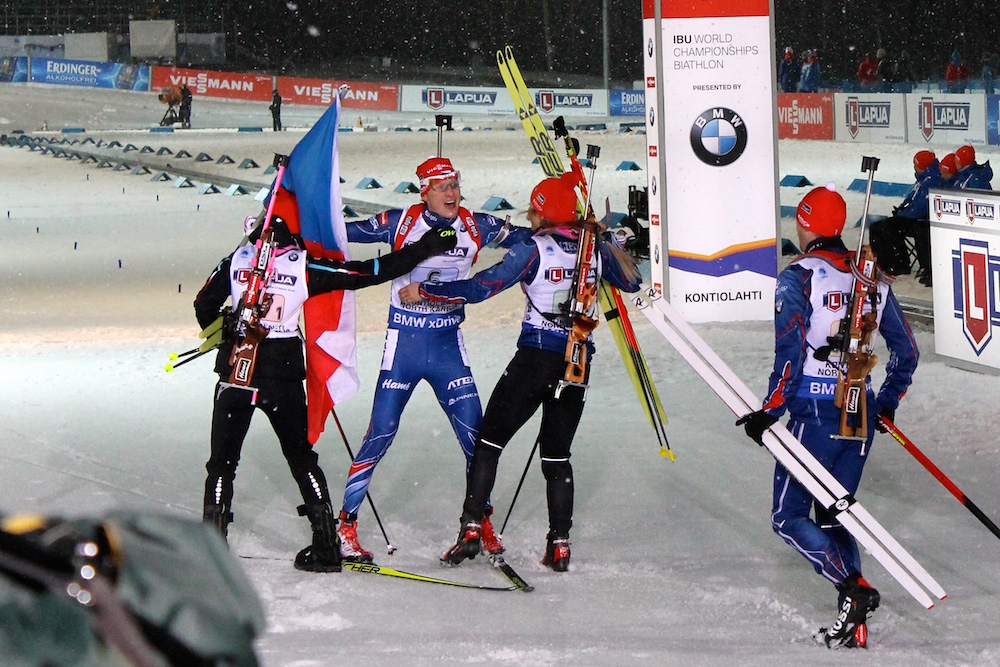
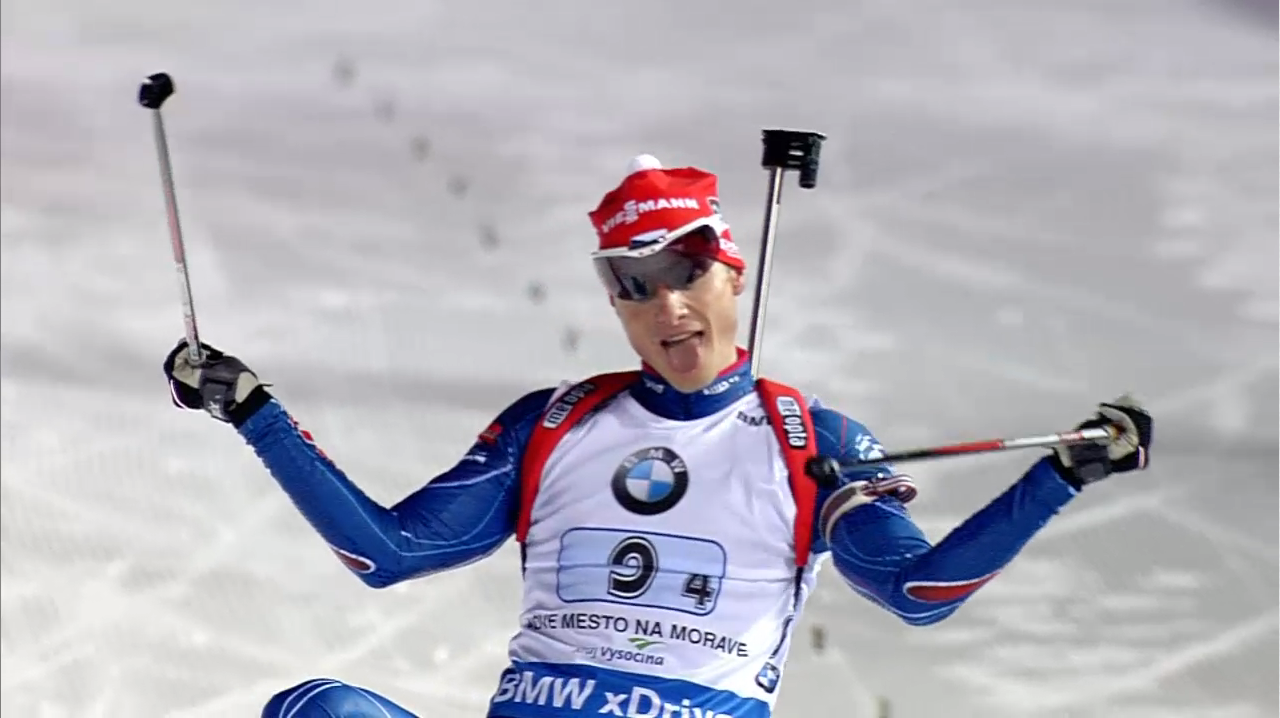
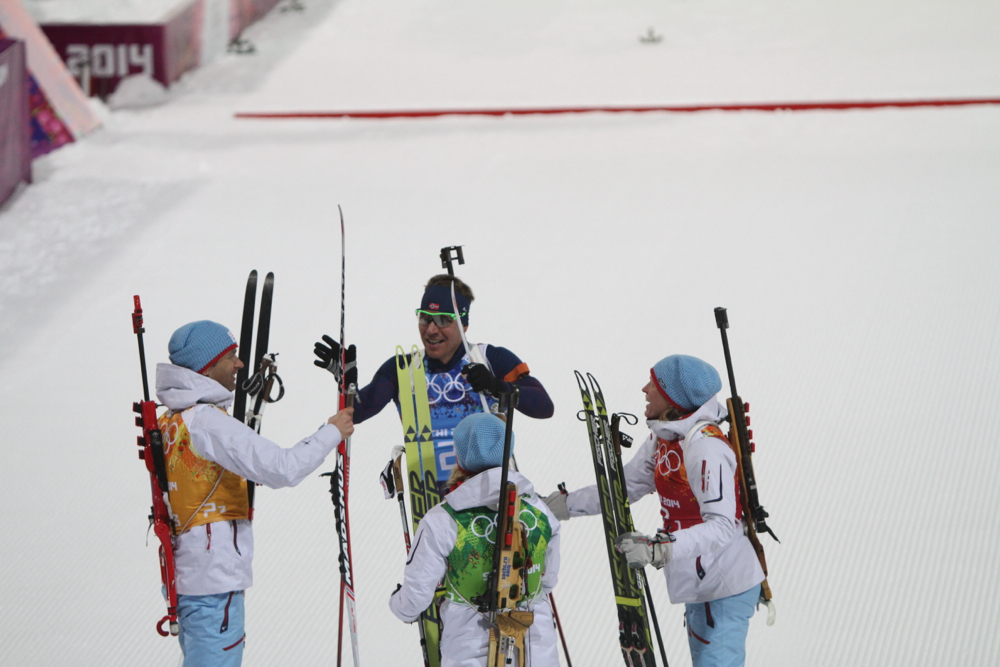
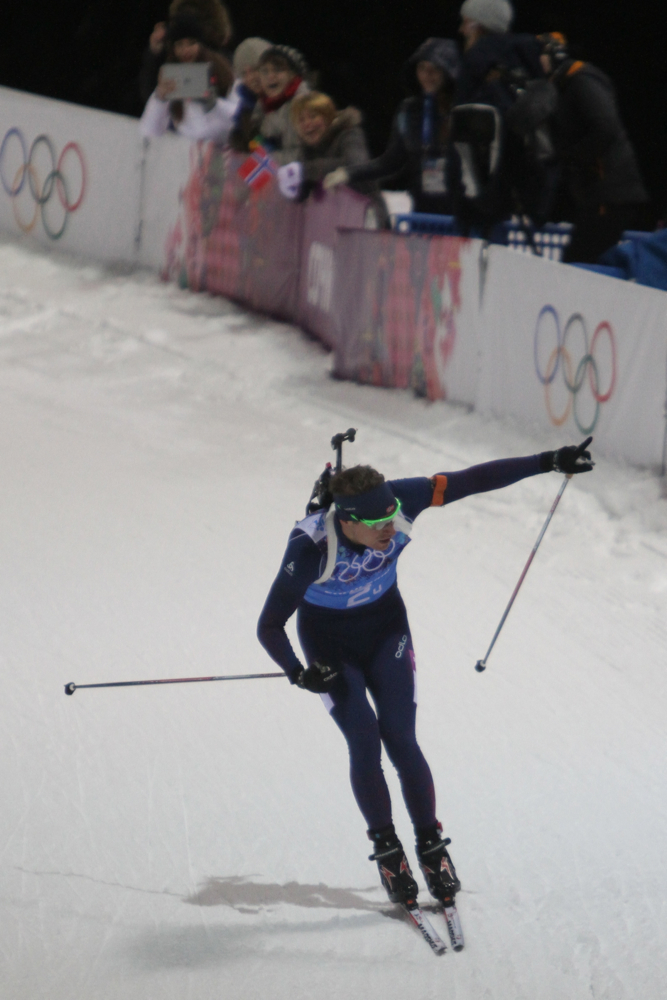
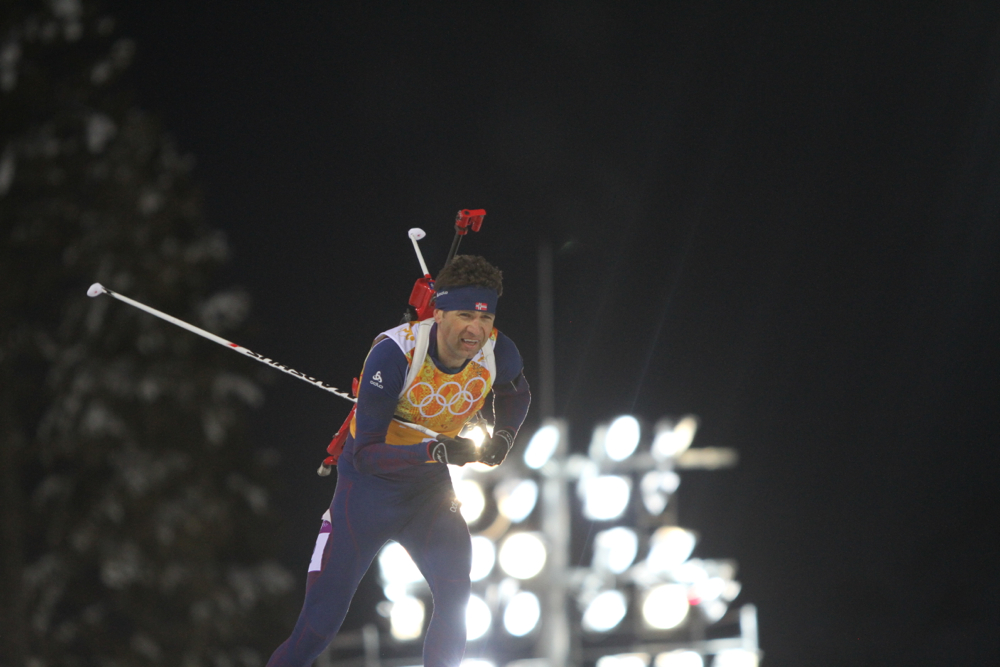
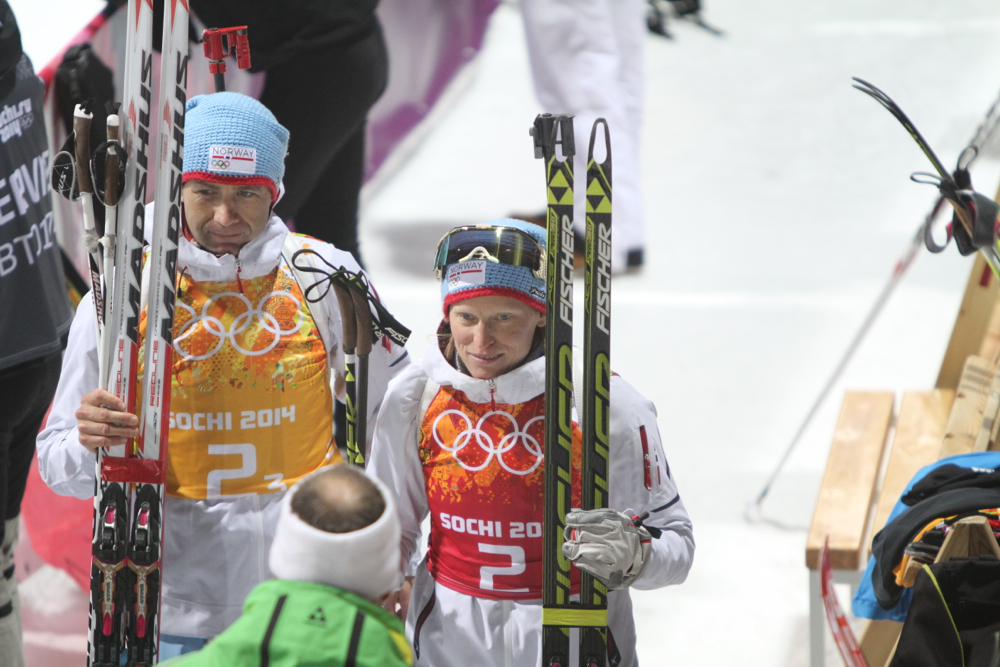
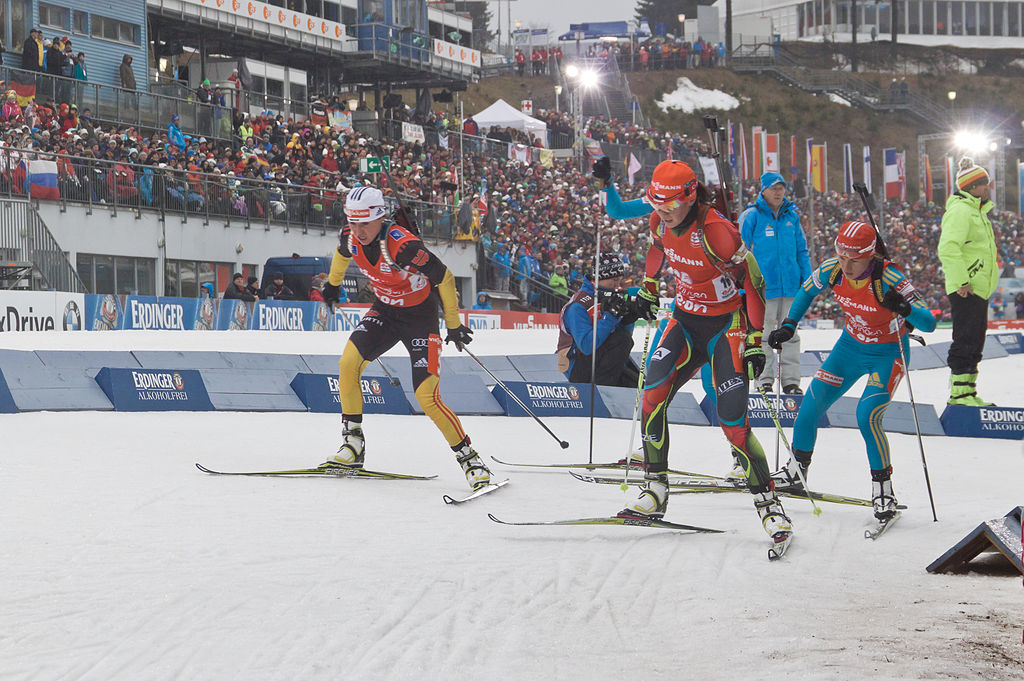
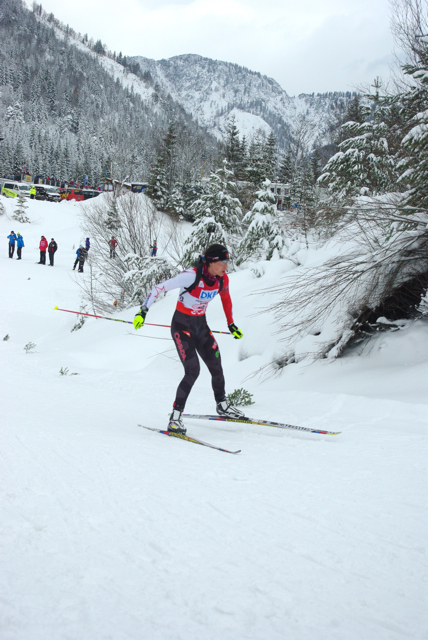
Germany’s Simon Schempp soaks up his team’s victory after anchoring the men’s relay to gold at 2015 IBU World Championships in Kontiolahti, Finland. (Photo: Kontiolahden Urheilijat/Risto Kuittinen)
For many teams, the first international races in mid-December are how World Cup rosters are decided. And that means they matter a great deal to athletes like Alexander Os.
A 2010 Olympian with seven individual World Cup podiums to his name, Os is now 35 years old. The Norwegian federation has made clear that they only want one old man on their national team, and that’s Ole Einar Bjørndalen, the “King of Biathlon.” Os has been named to World Cup teams every year, but he’s no longer on the national team.
So along with Michael Rösch, a German who transferred to Belgium, Os made a new team. It’s called Team Feskslo, or fish guts.
And just like last year, Os came to the season opening races in Sjusjøen looking to perform.
He didn’t win the sprint on Saturday as he had in 2014, but Os came very close to winning Sunday’s 15 k mass start competition. After leading the whole race, he missed two shots in the final shooting stage. That left him still at the front, but right with Germany’s Simon Schempp – the man who had won the sprint.
“Nice conclusion today,” Schempp tweeted after the competition.
He bested Os by 5.8 seconds, while Norway’s Tarjei Bø made a hard charge on the final loop to ski up to third, +8.8. It was an impressive performance despite six penalties; both Schempp and Os had three.
“He was a super talent, so he trouble a couple of seasons around 2010/2011 because of overtraining,” Bø told VG of Schempp. “Over the past year, he has had an incredible progress. Simon is one of the few complete biathletes, who is good to shoot and little lacking when it comes to skiing. He goes like a Norwegian, very easy on the skis… It is good that there are some foreigners here, because if it had only been Norwegians here we would not have received the ‘reality check’ we deserved to get.”
Bø said he felt great on his skis – he had the fastest ski time by 36 seconds over Germany’s Benedikt Doll – and wants to beat Schempp once the season begins.
“He says that, but I saw him in the rearview mirror,” Schempp laughed to VG, before sobering up. “These were just the first races of this season. Next week is the World Cup and it is more important for most people here.”
France’s Jean Guillaume Beatrix placed fourth, +17.6, and Germany’s Arnd Peiffer fifth, +19.5.
And as for the King of Biathlon, Bjørndalen returned to the scene after two months of illness this autumn. He placed 11th, +54.4 with five penalties and the sixth-fastest ski time.
“The shooting was all too bad,” he told Norwegian broadcaster NRK after the race. “But really an okay start. We will make it better eventually.”
Most of the American team was training rather than racing, but Leif Nordgren finished 19th with six penalties.
“For the shooting, it was quite windy again today,” Nordgren wrote in an email. “That made the shooting pretty tricky. I was happy with how the prone shooting went- it didn’t feel like it was only the second race. Standing was a little more rough, a lot of guys struggled with the standing today. I was disappointed for sure since it was such a good opportunity against tough competition, but considering the conditions, I’ll get over it quick!”
In the women’s race, Juliya Dzhyma of Ukraine used a clean five-shot sequence in the final standing stage to win the 12.5 k mass start over Franziska Preuss of Germany and Tiril Eckhoff of Norway, each of whom had one penalty; Marie Dorin Habert of France had been leading, but picked up two penalties.
That allowed Dzhyma to leapfrog from sixth place to an 11.6-second margin over Preuss. Eckhoff was another 5.3 seconds behind.
“On shooting the wind was blowing in the same direction, rather strongly, not always, but in gusts,” Dzhyma told xsport.ua after the race, according to a translation. “That means it’s luck – if you come when there’s the steady wind, you can adjust. If it’s a gust – it’s hard. The first standing, for example, I was not lucky – there were gusts and I went to two [penalty] loops. And then at the second [standing] was the opposite, it was lucky – the wind was steady and I worked cleanly.”
Indeed, there were many penalties throughout the field; four for Dzhyma and Preuss, and seven for Eckhoff.
“Today it was a real challenge on the shooting range,” Eckhoff told VG. “I misjudged it a little bit. I need to practice a bit in the wind.”
While Eckhoff and Preuss, both young, have established themselves as among the leaders of their teams with strong results last season, Dzhyma might be heading in that direction too. She has three World Cup podiums so far, but is yet to take a win.
“Of course, I want to run every race like it went today,” the 25-year-old said. “Let’s see how it goes. This season with our new coach very seriously changed and diversified the training, a change of emphasis. New emotions, new motivation. Work was fun and [we had] a good mood.”
Canada’s Megan Tandy placed 40th (+4:34.7) with seven penalties, three of which came in the first stage and knocked her to the back of the pack.
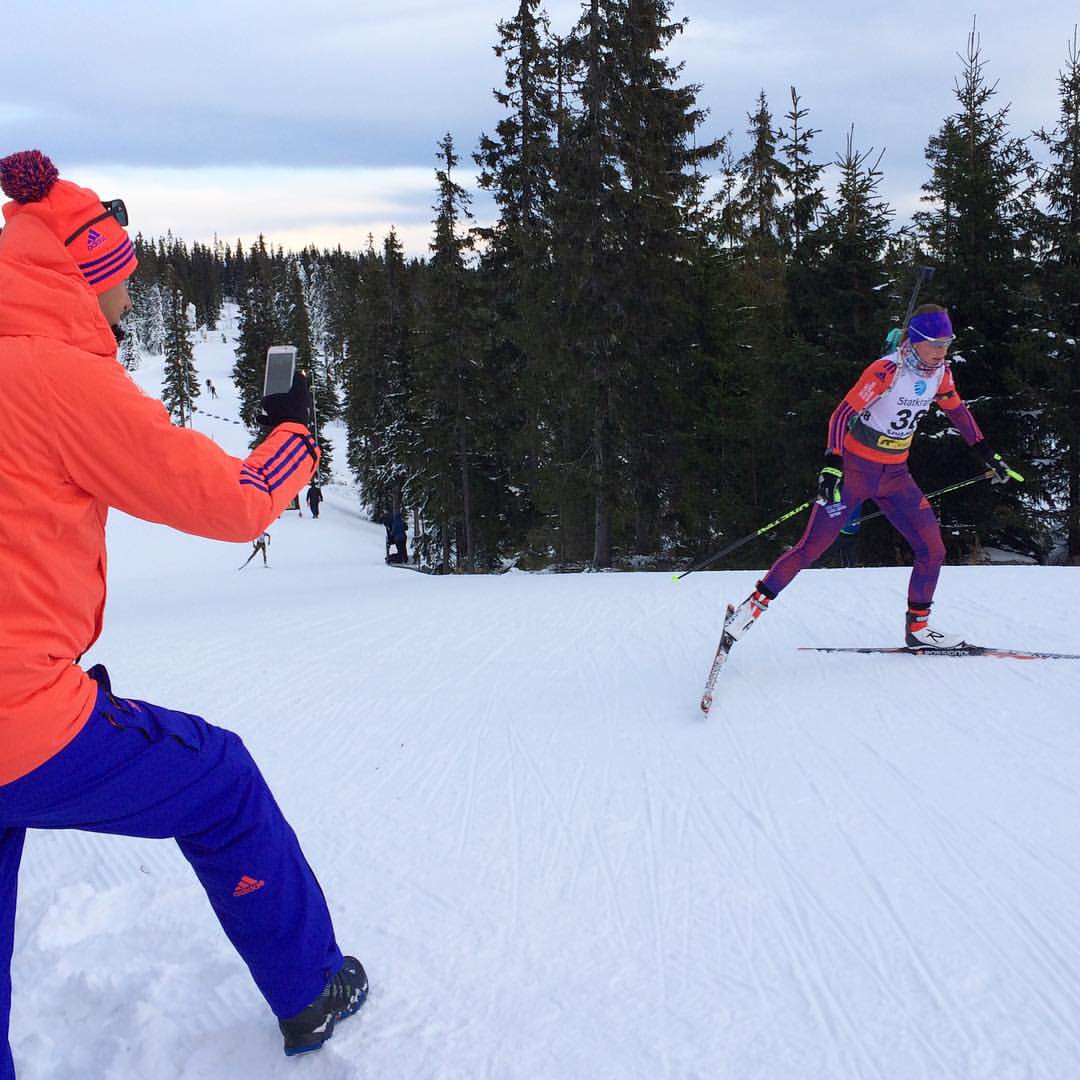
U.S. national team coach Jonas Johansson takes video of Annelies Cook as she skis to 25th place. (Photo: U.S. Biathlon Women / Facebook)
The international biathlon season started in earnest on Saturday, with Sjusjøen, Norway, hosting most of the top teams as well as a deep domestic field for 7.5 and 10 k sprint races.
In the women’s 7.5 k, Tiril Eckhoff just missed out on being able to give the home team a win. She finished 3.1 seconds behind a clean-shooting Dorothea Wierer of Italy, meaning that shooting ten for ten would have likely given her the victory.
“I am very pleased with how I did the shooting,” Eckhoff told Norway’s NRK broadcaster, according to a translation. “Especially the prone series. That’s something I can take forward with me.”
Last season in this race, Wierer also won with perfect shooting. In 2014 Eckhoff was also second, but with two penalties and 37 seconds behind.
The top Norwegian is closing the gap.
“I know I am stronger,” Eckhoff told NRK. “So time will tell whether I am as strong throughout the season.
Germany’s Maren Hammerschmidt was a surprise third place, with clean shooting like Wierer. Olga Abramova of Ukraine placed fourth, Franziska Preuss of Germany fifth, and Krystyna Guzik of Poland sixth, all with one penalty.
For several teams, the results will add to curiosity about roster choices for the first World Cup. Germany, for instance, had already selected Preuss, Laura Dahlmeier, and Franziska Hildebrand for the World Cup, but leaves three spots open. Hammerschmidt’s podium was unexpected. Vanessa Hinz and Karoline Horchler, who placed 14th and 16th, are also in the running, while former star Miriam Gössner missed five shots but with quick skiing was able to stay in the top 30.
Norway’s favorites struggled on the shooting range as well, with only Kaia Wøien Nicolaisen, not a usual member of the World Cup team, joining Eckhoff in the top ten. Fanny Horn Birkeland (formerly Welle-Strand Horn) missed four shots to place 20th, and Synnøve Solemdal also missed four to land 32nd.
Susan Dunklee led the American team in 21st place, +1:40.3. She was actually leading the race as well, after cleaning the prone stage.
But then she missed four shots in standing and dropped back in the penalty loop.
“My major focus in summer training was to improve my shooting speed and it has taken a big step,” Dunklee wrote in an email. “Normally I stick with the same race shooting cadence that I use in training but today I may have been better off to reset mid-stage after missing a few targets… I missed this race stuff during the summer; it’s good to be back at it. My ski shape feels a little sharper than it usually does in November.”
Dunklee’s teammate Annelies Cook placed 25th with two penalties just 3.7 seconds further back.
“The race was fun and hard today,” she wrote. “I am satisfied with how it went today, nothing was perfect so there is room to improve but I didn’t feel as far behind where I want to be as I have in the past. It was great to practice a ‘mini World Cup’ to have a soft entrance into the racing season. I have to say that I actually only felt nervous about two minutes before my start, so that was kind of nice having a more relaxed confident feeling leading into the race. I wanted to remember that it is just racing and is supposed to be something we do because it is fun to race.”
Canada’s Megan Tandy placed 23rd, +1:41.3, with a single missed shot.
“I was satisfied with shooting 9/10 in somewhat windy conditions, I felt focused and stuck with my shooting plan,” she explained. “Skiing was hard and I don’t think today’s ski performance reflects what I expect from myself this season.”
The Canadian team is not traveling to Europe until later this week when they will go straight to Östersund, Sweden, for the start of the World Cup.
Tandy, however, has been based in Europe already so made the trip to Norway on her own.
“It is always more stressful to be alone than in a team,” she wrote in an email. “I need to cover all of my own expenses and be organized (book my own flights, rental car etc.) However, I am well taken care of here!! My home coach, Knut Tore Berland, lives in Lillehammer so I actually have my own coach here to support me. I have known his family for almost 10 years and look forward to visiting them every November… The USA Team is taking care of my race skis which I really appreciate!”
Like Cook, she appreciated the lower-key start to the season, even though most of her World Cup competitors were actually already in the field in Sjusjøen.
“I feel like there was a lot less pressure here, especially because in the back of my head these are training races,” she wrote. “The stakes will certainly be higher [in Östersund] but I am sure that racing here will help me start the first World Cup feeling more confident and relaxed.”
Tandy moved to a new part of Germany this year, so her training hasn’t been the same as usual. She said that it was good to check back in with the field and get race time instead of just time trials.
“My on-snow preparation will be shorter than usual this year as I will travel back to Germany for 5 days so I can have a last visitation with my son before joining the Canadian Team in Östersund in time for the Individual race,” she explained. “This means that I haven’t tapered for these races, they are just integrated in my training plan and my goal here is to have a great week of snow training and use the races as experience and good hard sessions… I feel really glad to have the opportunity to race here.”
For the United States, Clare Egan placed 84th (+5:26.4) with seven penalties.
Racing continues on Sunday with mass starts, but the American women confirmed that they did not plan to compete.
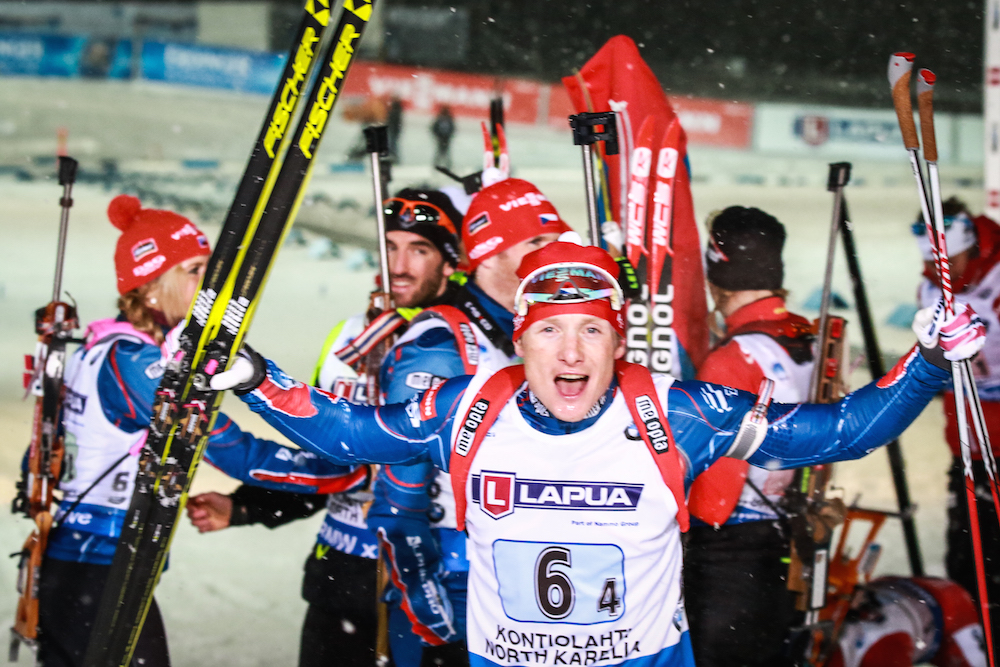
Ondrej Moravec celebrates a sizable win for the Czech Republic in Thursday’s mixed relay at 2015 IBU World Championships in Kontiolahti, Finland. (Photo: Kontiolahden Urheilijat/Jarno Artika)
KONTIOLAHTI, Finland — At least one team finished with big smiles at the end of Thursday’s epically slow-and-slushy 2 x 6 + 2 x 7 kilometer mixed relay on the first day of the 2015 International Biathlon Union (IBU) World Championships in eastern Finland.
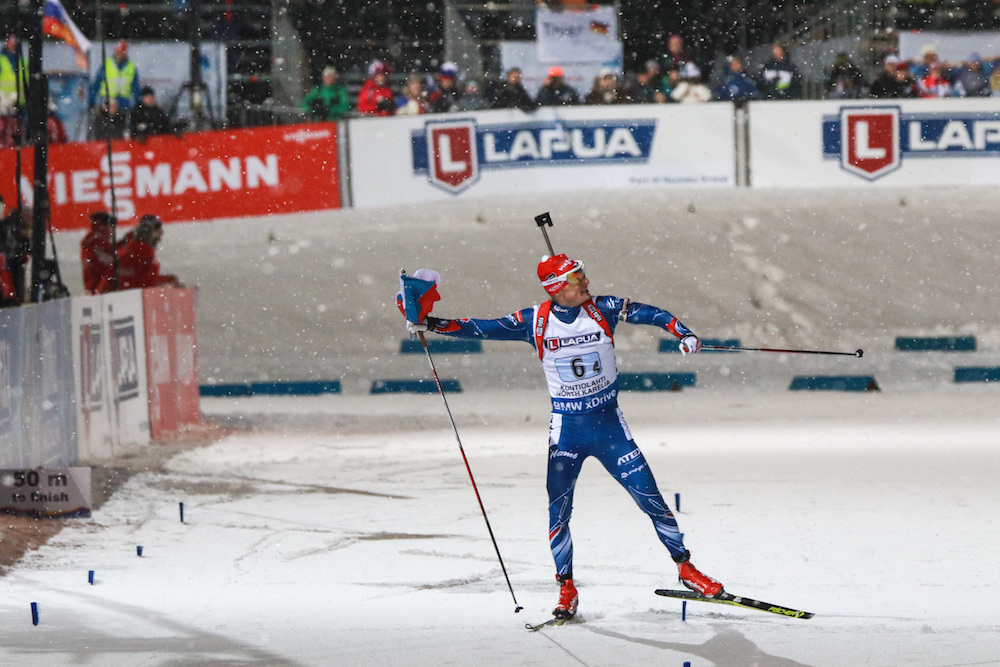
Ondrej Moravec anchored the Czech Republic to gold, and with plenty of time to play with before doing so, he grabbed his nation’s flag from a stadium spectator to carry across the line.
Ondrej Moravec celebrates at the finish after anchoring the Czech Republic to gold in Thursday’s mixed relay at 2015 IBU World Championships in Kontiolahti, Finland. (Photo: Kontiolahden Urheilijat/Jarno Artika)
Picking up one leg and pumping his free arm in the air, Moravec flashed a huge grin at the 4,500-person crowd and was greeted by three happy teammates in the finishing pen. Like the rest of the 26-team field, they had been through a lot in the last 1:20.27.2 hours, but what counted was that they handled the conditions better than any other team and came out on top.
Veronika Vitkova, Gabriela Soukalova, Michal Slesinger, and Moravec combined for a penalty-free effort, using a total of eight spares en route to the win. They finished 20.2 seconds ahead of France, which used eight spares as well. The defending Olympic mixed-relay champions, Norway finished third, 27.7 seconds back with three spares and a penalty loop.
While the Czech Republic, which notched silver from the mixed relay at the 2014 Sochi Olympics, consistently skied in the top three, its team mostly had the task of chasing down Belarus, which got out to an 20-second lead with second-leg Darya Domracheva.
Domracheva had come back from getting tagged in fifth, 19.4 seconds behind Vitkova as the first-leg leader. After trailing Japan’s Fuyuko Suzuki for most of her three 2 k laps, Vitkova pushed ahead of her before the exchange to give Soukalova a 2.1-second lead.
And while Soukalova was put in a prime position, after Vitkova used two spares on each round but cleaned to keep them at the front of the pack, she was nervous.
“I was afraid of the race before the start because I really don’t like these conditions,” Soukalova said in a post-race press conference about the at-least-ankle-deep snow in above-freezing temperatures. “It was really hard, but I tried to go [in] with a clear mind and just enjoy the race.”
Finland’s Kaisa Mäkäräinen racing from 11th to second as the second leg of the mixed relay at 2015 IBU World Championships in Kontiolahti, Finland. Her team went on to place ninth. (Photo: Kontiolahden Urheilijat/Jarno Artika)
She ended up cleaning both her stages and tagging Slesingr in third, 25.7 seconds after Domracheva and 5.7 seconds behind Finland’s Kaisa Mäkäräinen, who cleaned to bring her team from 11th (after Mari Laukkanen’s first leg) to second.
“You could see in the end of the race, one kilometer before the finish, I was completely exhausted,” Soukalova said. “So I really appreciate the good job of the rest of the team.”
After the second exchange, Slesingr brought the Czechs to second with a clean prone and two standing spares. He followed Vladimir Chepelin of Belarus out of the range for the second time, about 25 seconds back, after Chepelin used three standing spares.
With one 2.5 k lap to go, Slesingr closed the gap to 11.7 seconds and tagged Moravec in second. Norway handed off in third, 45 seconds back, after Johannes Thingnes Bø lifted the team from sixth to third with clean shooting.
From there, Moravec proceeded to stalk Belarusian anchor Yuryi Liadov, who used one spare in prone. On the second lap, Moravec passed Liadov and led him into the range for the last time.
While Liadov missed three more standing to leave the range for the last time in fourth, 25.7 seconds out of first, Moravec (who used one spare in each bout) remained in control heading into the final lap, leading France’s Martin Fourcade in second by 18.2 seconds. Fourcade cleaned both stages to bring France from fourth to second by the last stage, and he ended up skiing the fastest anchor leg to come within 15 seconds of Moravec by 6.1 k.
But with 1.4 k to go, the Czech anchor solidified the victory with the second-fastest course time on the last leg, 7 seconds slower than Fourcade.
“I was so surprised the Belarusian guy was a long time ahead of the race,” Moravec told the IBU media after the race. “I think it was also pretty good result for them, but I believe for myself that I can beat him and I did it and I was so happy.”
Anais Bescond of France (center, in black) leads the first leg out of the start in Thursday’s mixed relay at IBU World Championships in Kontiolahti, Finland. (Photo: Biathlon Canada/NordicFocus)
Belarus finished fourth, 31 seconds out of first and 4.3 seconds off the podium.
“I think it was a pretty good race for everybody on the team,” Moravec said in the press conference. “It was perfect.”
After Anais Bescond’s first leg, in which she used four spares (one prone and three standing), France rose from 12th to fourth with Marie Dorin Habert, who cleaned prone and used one standing spare. She also skied the third-fastest second leg after Mäkäräinen and Domracheva, respectively.
“I’m very happy with this medal and I hope next year we could change medals with the Czechs,” Habert said in the conference. “We have to work hard for it, but it’s a very nice day for the French team, too.”
Jean-Guillaume Béatrix kept France in fourth with a clean first stage and used three spares standing, coming into the final exchange 1:10.5 out of the lead and 25.6 seconds after third.
“It’s like running in the sand here,” Beatrix recalled. “I’m happy that in the end we can be on the podium because it was unbelievably hard.”
“It’s like running in the sand here. … It was unbelievably hard.” — Jean-Guillaume Béatrix (France)
Fourcade clawed back more than 15 seconds within his first two kilometers and proceeded to shoot a perfect 10-for-10 to keep his team ahead of Norway for silver.
The 2 x 6 + 2 x 7.5 k mixed relay at 2015 IBU World Championships in Kontiolahti, Finland, with the Czech Republic gold medalists (c), France (l) in second, and Norway (r) in third. (Photo: Kontiolahden Urheilijat/Jarno Artika)
“I have no thoughts about missing the team relay,” Fourcade said when asked whether he considered skipping the coed event to prepare for other races at World Championships. “It was important to me and important to team France so I’m really happy I did [it] and really happy we catch some medals.”
While Norway’s Fanny Well-Strand Horn cleaned both her stages to tag off in sixth, Tiril Eckhoff used all three spares in standing and skied a penalty loop. Yet she still managed to keep Norway in sixth, 1:32.4 out of first.
“It always sucks to get the penalty, but I just have to go and hope for the guys to take medal and they did so that was really good,” Eckhoff said.
The team’s third leg, Johannes Thingnes Bø noted how fast their skis were despite the conditions.
“The most [important] part of my race was the good skis today — they were really fast and also our shooting today was really strong,” the 21-year-old Bø said. “We had just one shooting that was bad. We are happy to get a medal.”
The Norwegian mixed-relay team, (from left to right) with Fanny Well-Strand Horn, Tiril Eckhoff, Tarjei Bø, and Johannes Thingnes Bø, after earning bronze at 2015 IBU World Championships in Kontiolahti, Finland.
His older brother, Tarjei Bø, who anchored the team to third, cleaned as well.
“We are always happy with the medal. Of course, we’re going for the gold medal each relay … but still bronze is good,” Tarjei, 26, said. “It’s a big difference with bronze medal and fourth place. I think as a group, we’re happy.”
And at the end of the day, the Belarus team — at least Domracheva — wasn’t bummed, either.
“This is the best place for a few years for us in mixed relay,” she told the IBU. “From start to start, we have better and better results. Fourth place is really close to the podium, and I’m glad with my own race and it was not easy conditions today. We saw for our guys also some really strong competitors, and it was a good biathlon fight.”
Also in the top 10, Austria placed fifth (+1:00.3) with three total spares, Germany was sixth (+1:22.8) with six spares, Italy finished seventh (+1:24.7) with 10 spares, and the U.S. tied its best World Championships mixed-relay result in eighth (+1:46.6) with one penalty and eight spares. Finland ended up ninth (+1:59.5) with eighth spares and Russia was 10th (+2:00.2) with just two spares.
Ukraine finished 11th (+2:10.3) ahead of Canada in 12th (+2:27.9). The Canadians tied their nation’s mixed-relay best at World Championships in 12th (a year after placing 11th at the Olympics) with a total of four spares. After leading the first two laps of the race, Japan placed 21st out of 26 teams.
The Czech Republic mixed relay team celebrates with anchor Ondrej Moravec (second from l) at the finish after winning Thursday’s race by 20.2 seconds over France at 2015 IBU World Championships in Kontiolahti, Finland.
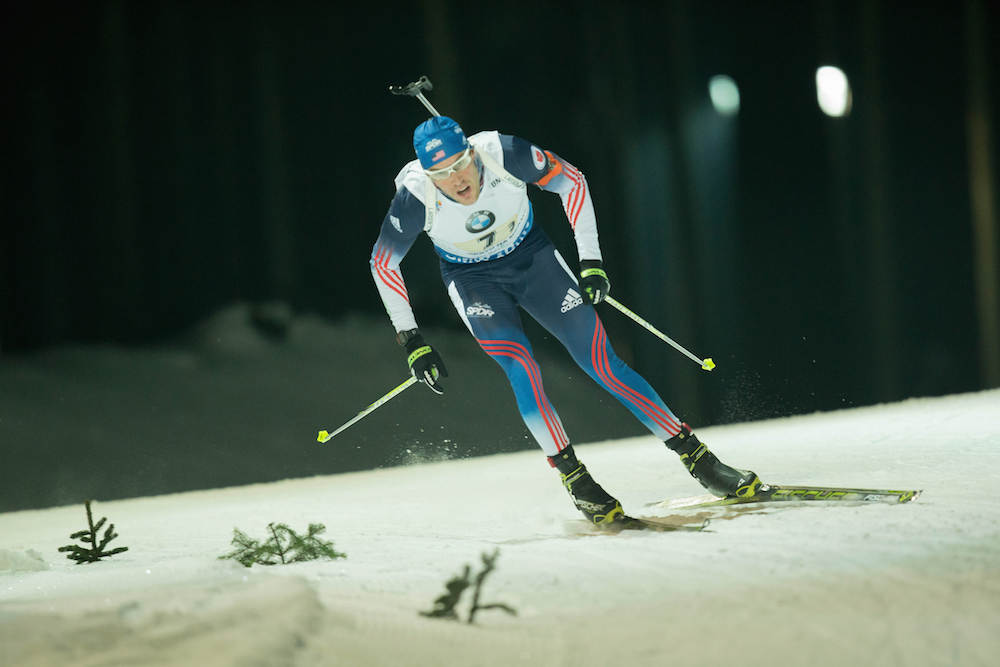
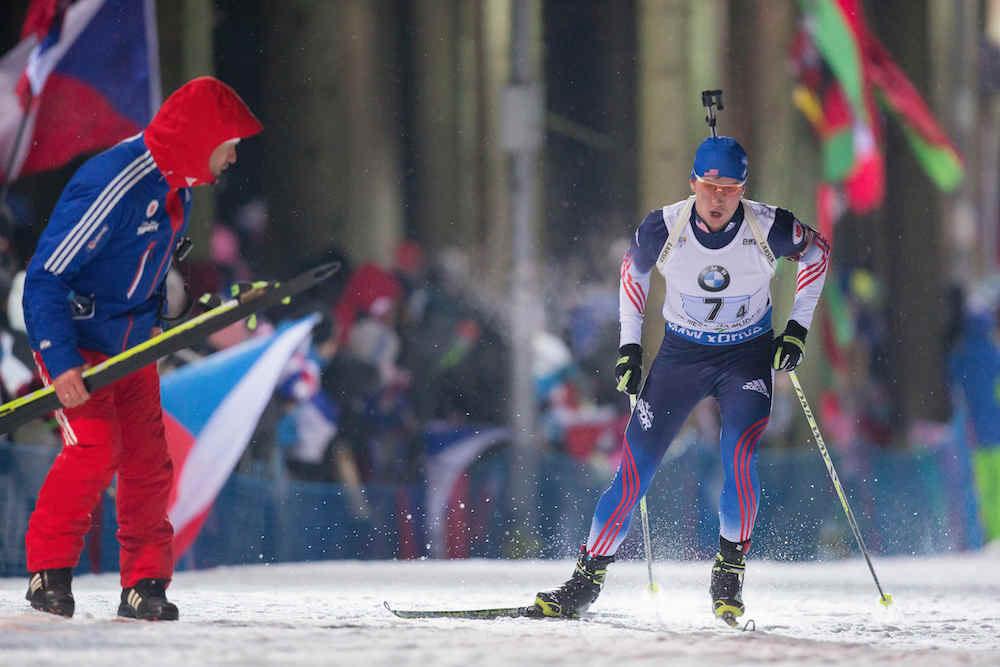
Leif Nordgren (US Biathlon) raced the third leg of Friday’s IBU World Cup mixed relay to put his team in fourth heading into the final exchange in Nove Mesto, Czech Republic. The U.S. ended up seventh. (Photo: USBA/NordicFocus)
Note: This article has been updated to include comments from U.S. anchor Sean Doherty.
Friday’s mixed relay had to have been one of Leif Nordgren’s best races of all time. Just last week, the 25-year-old US Biathlon A-teamer skied up from 51st to 19th in the men’s 12.5-kilometer pursuit at IBU Open European Championships in Otepää, Estonia, but US Biathlon Chief of Sport Bernd Eisenbichler didn’t see that race in person.
What he did witness was one of Nordgren’s most memorable performances in the mass start at 2011 World Championships in Khanty-Mansiysk, Russia, in which he placed 17th with three misses. And that rivaled what he did on Friday as the third of four legs in the 2 x 6 + 2 x 7.5 k mixed relay.
Nordgren brought the U.S. from 10th to fourth before the final exchange with clean prone shooting and a single standing miss. He used his spare to clean that stage and left the range for the last time in fourth, about a minute and a half behind the three race leaders (Norway, Ukraine and the Czech Republic).
“You have to give a really big compliment to Leif today; he had world-class shooting today,” Eisenbichler said on the phone after Friday’s race, the second of two mixed relays (with Annelies Cook and Tim Burke placing ninth for the U.S. in the single mixed relay).
“I never saw him in as good running shape as 2011 at World Championships … For sure, this was his best performance, and from 2011 to now, that’s four years so that’s really encouraging,” he added. “I’m extremely happy with where he is right now and I think he’s still going up to [2015] World Championships.”
American Sean Doherty hung in fifth for most of Friday’s mixed relay at the IBU World Cup in Nove Mesto, Czech Republic, before finishing seventh. (Photo: USBA/NordicFocus)
Building on the foundation teammates Susan Dunklee and Hannah Dreissigacker laid as the first and second legs, respectively, of the Americans’ mixed relay on Friday, Nordgren tagged Sean Doherty in fourth.
The 19-year-old Doherty anchored them to seventh, 2:23.8 behind the Norwegian winners (Fanny Welle-Strand Horn, Tiril Eckhoff, Johannes Thingnes Bø, and Tarjei Bø) and 0.2 seconds behind Germany in sixth.
“We were only two-tenths of a second out of the flower ceremony today, which is an exciting accomplishment, and it also makes us very hungry for more,” Dunklee wrote in an email. “Everyone skied very well today, and the guys did some fantastic work with the shooting.”
Dunklee used a total of four spares (two on each stage) to put the team in fourth after the first leg. She handed off to Dreissigacker, who used five spares (three prone and two standing) to tag Nordgren in 10th. Nordgren used just one spare, and Doherty used one in prone and two more in standing to finish seventh with a team total of 13 spares.
“I was really happy with the race today for my part,” Nordgren wrote in an email after posting the fifth-fastest course time and fifth-fastest range time on the third leg. “This whole year I’ve struggled to put both good shooting and good skiing together on the same day. Today I did just that, so I think I can be happy that things seem to moving in the right direction as we approach [World Championships] in Finland.”
Dunklee raced the fastest time of all 22 starters, leaving the range in 17th after her first shooting and improving to 10th before her last lap. By the time she got to Dreissigacker, Dunklee was up to fourth.
“I always expect Susan to crush it and pass people like crazy and tag off near the front,” Dreissigacker wrote in an email. “That’s normal for her. But she really outdid herself with the passing today! I had to laugh when I saw how much she’d moved up by the time I’d made my way over to the exchange zone. I was psyched!”
“I used more spares than I would have liked and channeled the frustration from the range into speed on the ski track,” Dunklee explained. “At the start of the second loop, I forgot entirely about pacing for a couple minutes and focused solely on regaining contact with the main pack. Then my body reminded me that that wasn’t a sustainable pace.”
She spent her last loop trying to ski “smarter” and save energy for the last climb. Leaving the range, she caught Switzerland’s Elisa Gasparin then slingshot by her before the last uphill.
Dreissigacker reflected that her first lap skiing in the top four felt fast, “but I wasn’t really feeling too much…so I was able to go harder than I maybe should have,” she wrote.
She seized the chance to ski behind France’s Marie Dorin Habert on her first lap, then slipped to seventh after her first shooting.
“I think that the wind was a bit variable on the first stage, but mostly I just wasn’t super well-settled,” Dreissigacker wrote. “I’ve been having a bit of a prone-shooting slump for the last few days, so I’m hoping to improve on that.”
Feeling the fatigue start to set in on her last two laps, Dreissigacker reminded herself how much she liked the course and “kept fighting.”
“In standing, I felt good through the first 5 shots, but had one close miss and then I got shaky shooting spares,” she wrote. “I accidentally fired one spare way too early when I wasn’t even on target, so I was just happy to hit that last one!”
Pushing to stay with Russia’s Ekaterina Shimulova on the last lap, Dreissigacker wasn’t able to do so and tagged Nordgren in 10th, 13 seconds behind Shimulova in eighth and 11.6 seconds back from Italy’s Federica Sanfilippo in ninth.
“I wanted to stay with [Shimulova] and catch up to the pack ahead so that Leif would have a good pack to ski with,” Dreissigacker wrote. “Luckily he had an awesome day and managed to catch the pack all by himself. The rest of the team did so well and it was really fun to watch the rest of the race and cheer as I cooled down.
“It was such an exciting finish!” she added. “Sean did awesome…and in a year or two, if not way sooner, he’ll be winning those photo-finishes.”
For Nordgren, fast skis helped, he explained, as he caught the group ahead of him on the first loop.
“I felt totally in control the first two loops, and I was able to push hard the last loop also,” he explained.
Nordgren added that by the end of last week, he could already feel like his shooting was starting to come around. He felt similarly about his ski shape: “I had glimpses of good shape in Antholz, but with an additional 3 races in Estonia I think it really forced that good shape to come back a little quicker,” he wrote.
“I really like that tracks here in Nove Mesto, I think they suit me perfectly, combine that with the near perfect snow conditions that we’ve had all week, and it just makes it really nice skiing,” Nordgren added. “As a team we all decided last night that we’d like to finish ahead of our bib number (7). So it was really close today, everyone from the team put in a really good effort, but sometimes it comes down to a few cm!!”
Doherty hung in fifth for most of his race before France’s Martin Fourcade and Germany’s Benedikt Doll passed him before the finish. The youngest member of the U.S. team, Doherty pushed to stay with them, but finished 2.3 and 0.2 seconds back, respectively.
“Funny thing, from where the warm up track is here in Nove Mesto you are a little bit out of the action, so I did not really know how well Leif was doing until I got into the start pen,” Doherty wrote in an email. “I was excited to be in such a good position, it is a great challenge and I am feeling good on the skis so I was excited to go against the other top athletes.
“Really I just tried to keep a good pace,” he added. “For standing I was trying to focus on the good things that I had been working on in training. It did not work out as well as it could have but that is biathlon and it was still a good fight to the line. … I am very happy with my personal performance, I am feeling stronger and stronger on the skis. As for the team overall it is great. It is nice to have everyone at full health and it is a good sign that our program is improving as a whole.”
At the end of the day, Eisenbichler was pleased, especially with both the team’s single mixed relay and four-person mixed relay finishing in ninth and seventh, respectively.
“Top 10 is really something we should always reach for,” he said. “It was really, really tight, especially in the mixed relay.”
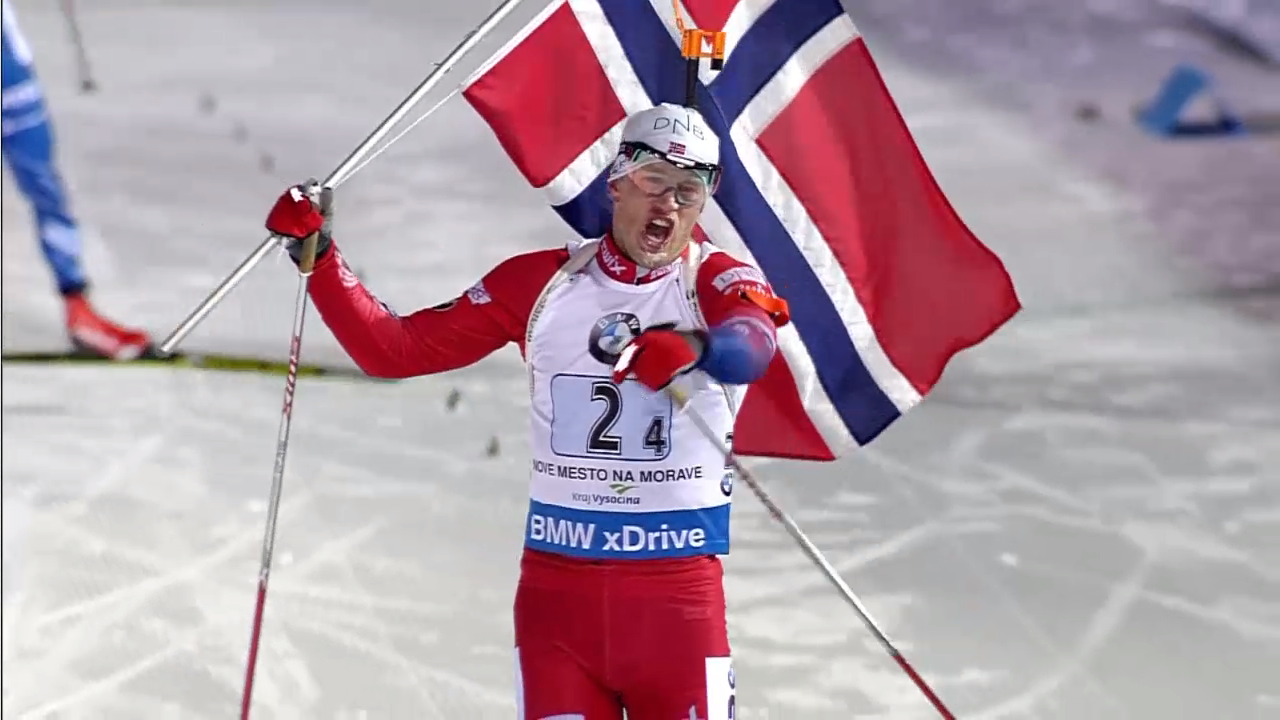
Tarjei Bø celebrates his win for Norway in the 2 x 6 + 2 x 7.5 k mixed relay on Friday at the IBU World Cup in Nove Mesto, Czech Republic. He held off Ondrej Moravec (l) of the Czech Republic by four seconds.
Norway won the four-person relay in 1:12:49.2 with six spares, holding the Czech Republic (with Veronika Vitkova, Gabriela Soukalova, Michal Slesingr, and Ondrej Moravec) by 4.1 seconds. The Czechs used five spares, and Ukraine (Iryna Varvynets, Valj Semerenko, Dmytro Pidruchnyi, and Sergey Semenov) held tough for third (+1:21.3) with one penalty (from Semenov on his prone stage) and seven spares.
“Moravec is one of the fastest standing shooters, so today I wanted to show Moravec that I am the fastest,” Norway’s anchor, Tarjei Bø, told the IBU.
Using just one spare in prone and cleaning standing, he took the lead by 13.9 seconds with one lap remaining. Moravec, who used one spare on his last stage, closed on him in the final kilometers to come within four seconds of Bø, who had enough time to grab a large Norwegian flag before the finish.
Czech Ondrej Moravec mocks Russian Alexey Volkov’s finish-line celebration after Moravec finished second in Friday’s mixed relay. Earlier that afternoon, Volkov anchored Russia to the single-mixed-relay win.
“I think we can be really happy with second,” Slesingr told the IBU. “[Ondrej and I] spent a little more time in standing … Before the race we would have been happy with second so there is no disappointment … We were able to give something back to all of the fans who came here … we can feel their support that has made biathlon almost the number one sport in Czech Republic.”
Russia placed fourth, France was fifth and Germany was sixth.
Canadians 14th
Canada skied in the top 15 throughout the race with Audrey Vaillancourt, Rosanna Crawford, Nathan Smith, and Brendan Green ultimately placing 14th (+5:12.3).
“Overall I think the team had a rough day, we all seemed to have problems with our standing shooting,” Vaillancourt wrote in an email.
After her first mass-start experience on the World Cup, she cleaned the first shooting, but used three spares in standing to tag Crawford 1:28.4 back in 14th.
“I had a good start, but on the second hill a girl stepped on my pole and it fell off my hand. I had to go backwards to get it back and therefore lost the pack,” Vaillancourt explained. “Then I tried to catch up, but couldn’t do it before the first shooting.
“Skiing felt good, but I had a hard time making up for the time I had lost,” she added. “It might have affected my standing shooting. I wanted to get in, clean, and leave as fast as I could, but it didn’t work out so well. Instead I ended up using 3 spares.”
Her skiing felt better than in past weeks, she added, after her team spent a week of training “on lots of real snow” in Mittenwald, Germany.
Crawford explained she was starting to feel like her “old self” as well on Friday, after she skied the 10th-fastest course time of the second-leg skiers. She used two spares on her first stage, and then used three more and had a penalty loop after standing.
“I wanted to catch the pack of three just in front of me so I could have someone to ski with. That worked but then I lost what ever I had gained with poor shooting,” she wrote.
Crawford handed to Smith in 15th, 2:30 back.
“I was a bit surprised by the analysis. I thought I skied better than it looks on paper,” she wrote. “But hopefully this will just have gotten all the gears running again and tomorrow [the sprint] will be better. It’s a really hard 2.5km course. One of the tougher ones on [World Cup] I’d say. So good technique and proper pacing will be important. But it’s also only 3 loops so you have to be sharp!”
Smith cleaned prone to bring Canada up to 13th, but used two spares in standing and dropped one spot on the last lap to 14th. Green kept them there, with a clean first stage but had three spares and one penalty on his last shooting. He finished 14th, more than a minute and 10 seconds behind Italy in 13th.
“We had little hiccups starting with Audrey loosing a pole and loosing contact to the group, Rosanna having a penalty loop, Brendan having a penalty loop, Nathan not being able to stay with [Austria’s Julian] Eberhard when he was passed,” Biathlon Canada Head Coach Matthias Ahrens wrote in an email. “Anyhow I believe we could be where the US team was today whom I congratulate for a great race by all members.”
“I think we’re disappointed. But are looking forward to the weekend,” Crawford wrote.
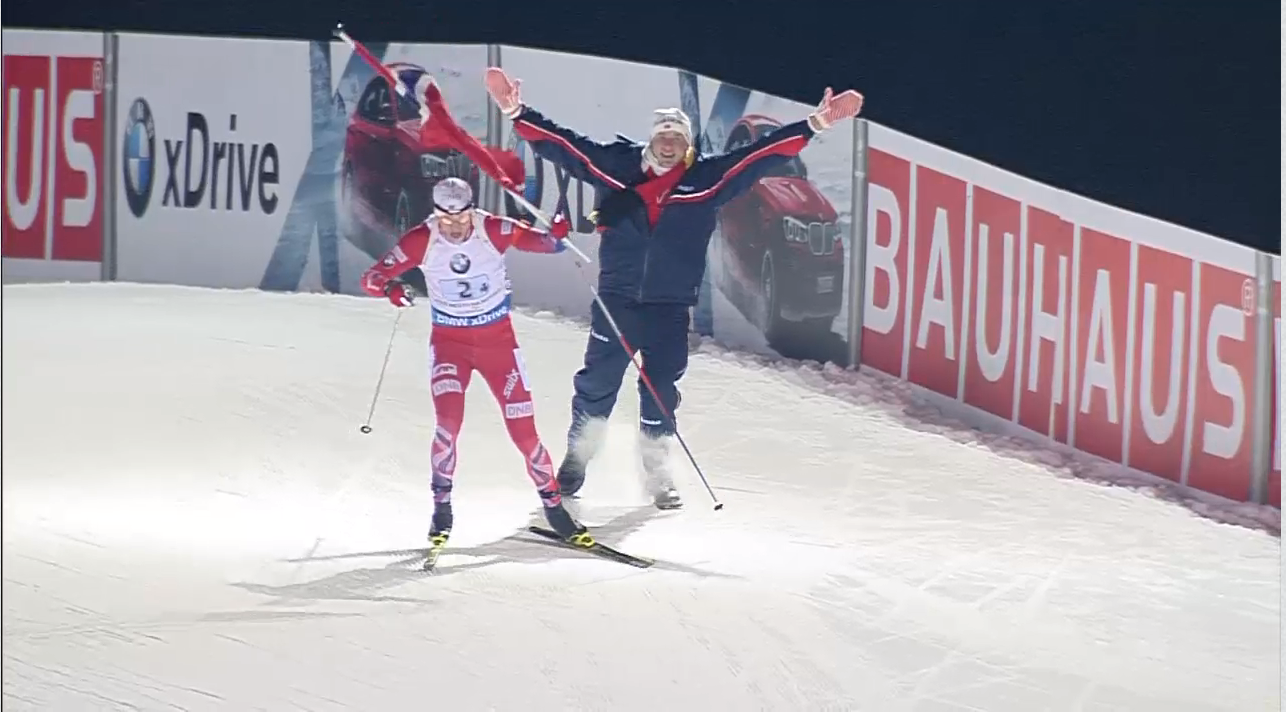
Tarjei Bø (l) receives the Norwegian flag from an excited fan as he cruises down the finishing stretch to celebrate his win for Norway in the 2 x 6 + 2 x 7.5 k mixed relay on Friday at the IBU World Cup in Nove Mesto, Czech Republic.
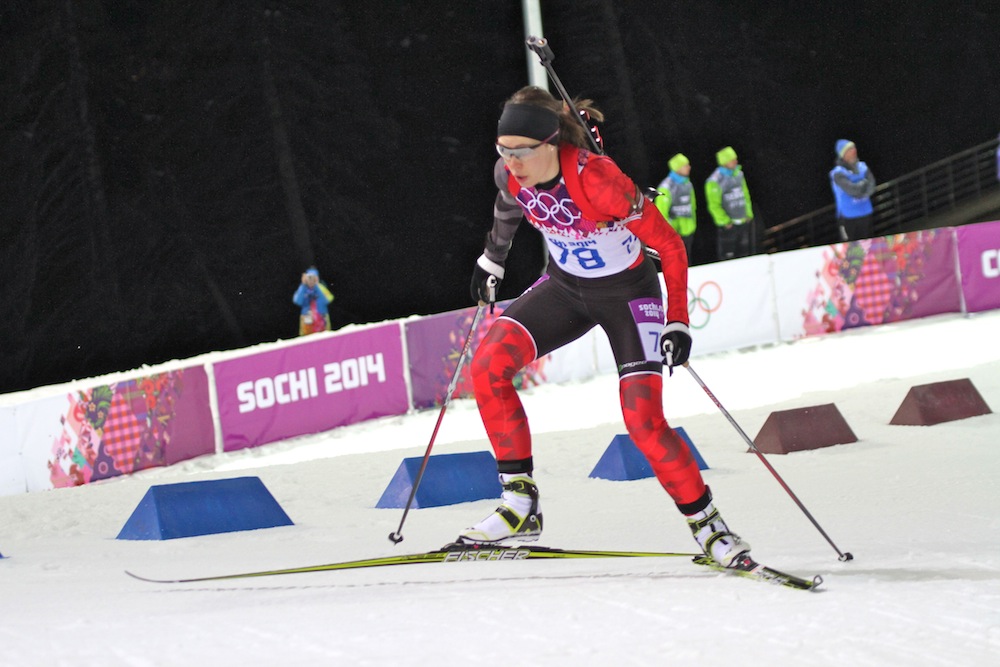
Megan Heinicke (Biathlon Canada) racing to 59th in the sprint at the 2014 Olympics near Sochi, Russia.
Megan Heinicke had a little something called home-course advantage working in her favor on Friday, and for that matter, on Wednesday and this Sunday as well.
The 26-year-old Canadian from Prince George, B.C., has called Ruhpolding, Germany, her home since September. Lucky for her, the fifth IBU World Cup stop of the season was there, with races Wednesday through Sunday. And on Friday, the six-year Biathlon Canada veteran qualified for her first-ever mass start after placing a career-best 11th in the 7.5-kilometer sprint.
“This was one of my strongest skiing performances ever,” Heinicke wrote in an email after Friday’s race, in which she topped her previous World Cup best by one place (she was 12th in the 15 k individual at the beginning of the season in Östersund). “I simply felt strong and there is nothing more fun than fighting hard when you feel strong.”
The 16th starter out of 98 women, she finished 52.3 seconds behind the winner after shooting 90 percent with a clean prone stage and one standing penalty.
That put her in third overall after prone, and while her standing miss set her back to 10th and she slipped one more spot to 11th on the last lap, Heinicke initially finished fifth of 16 women.
“I was well aware that starting with bib 16 meant that there were still a lot of strong girls behind me so I wasn’t disappointed to fall back a bit [in the final results],” she explained. “I was really hoping to stay in 10th, but 11th is a new personal best and I am really pleased with the result.”
Throughout the race, she heard she was in contention with top women like Darya Domracheva of Belarus (who started 14th and ended up second) and Italy’s Dorothea Wierer (who started 19th and placed ninth). She wasn’t sure what that meant or where it would put her, but she felt strong and assumed she was doing well.
Going into the race, Heinicke had hoped for a top 30, but more specifically, to “glide longer in the flat sections and be a bit more explosive with higher frequency on the few steep sections,” she wrote. “Shooting wise I had been trying out some keywords and those were all I wanted to think about on the range.”
On Wednesday, Heinicke had another first, racing to second in the opening leg of the women’s 4 x 6 relay and putting her team 25 seconds from the lead at the exchange. The Canadians ended up 11th — not quite the team-best fourth they accomplished just over a year ago — but Heinicke saw it as a stepping stone.
“I had a great relay leg this Wednesday and had also had a great relay leg in Oberhof which had me feeling determined and confident,” she wrote. “I am slowly starting to feel more confident and I have this fierce determination to shoot well which is enough to keep me focused.”
The level of support she’s received has helped her as well.
“I have had some big life changes this fall and am feeling like there is no pressure on me and I think that has been good for my head,” she explained. “I am really motivated by having several personal bests this season and I feel like the return of my self confidence is good for me. I am planning to keep racing with the same determined, task-oriented approach and who knows what can happen! I certainly wasn’t expecting these results to come this year!”
With Friday’s result, Heinicke was one of two Canadian women to qualify for Sunday’s 12.5 k mass start. Rosanna Crawford sat out Wednesday and Friday because of a cold, but is currently 12th in the overall World Cup (making the top-30 criteria) and listed to start in bib 12.
In her first-career mass start, Heinicke will start in bib 28.
“I am glad I have been able to start our relay a few times so I am not feeling too nervous about starting in the pack,” Heinicke wrote.
Also for Canada on Friday, Zina Kocher placed 48th, 2:18.8 behind the winner — Fanny Welle-Strand Horn of Norway. After starting 96th, Kocher found herself in the top 20 after a clean prone and the 23rd-fastest course time on the first lap. However, she missed three in standing, which put her back from 31st to 65th with one lap to go. Kocher posted the 13th-fastest course time overall.
Audrey Vaillancourt finished 68th (+3:13.7) with a single prone penalty, and Julia Ransom, in her second World Cup sprint, was 81st (+3:55.8) with four penalties: one prone and three standing.
Dunklee: ‘One of my best performances of the year’
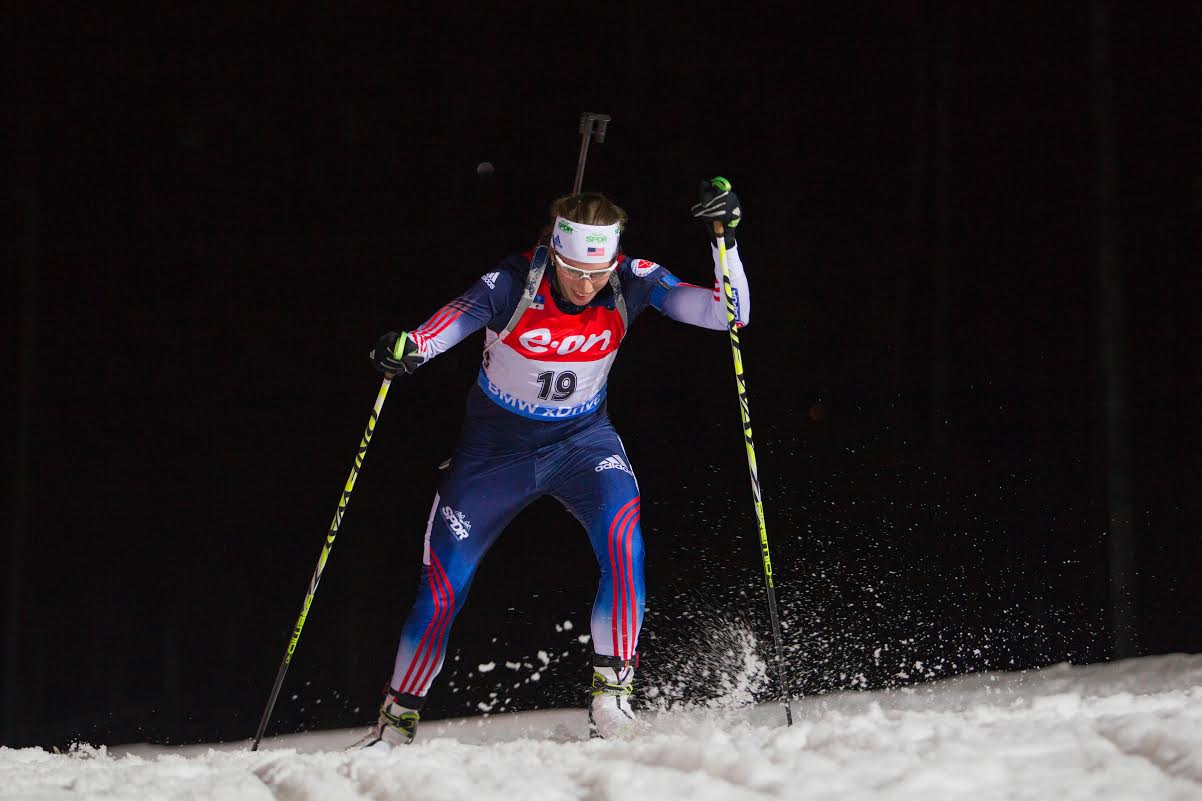
Susan Dunklee (US Biathlon) on her way to 26th on Friday in the women’s 7.5 k sprint at the IBU World Cup in Ruhpolding, Germany. (Photo: USBA/NordicFocus)
US Biathlon’s Susan Dunklee led the Americans in what she considered one of her best performances of the year, in which she placed 26th, 1:44 behind Horn.
Dunklee started 30th and skied right around 30th for most of the race, cleaning prone and missing one in standing, and posted the 30th-fastest course time overall.
In an email, she explained her skiing felt “snappy,” which left her surprised with the splits she was hearing: why weren’t they better?
“There are always factors out of your control as an athlete,” Dunklee wrote. “Today we saw some tricky waxing conditions with wet snow and we didn’t nail it quite as well as we usually do.”
Skiing aside, she explained she had her best shooting day of the season, “which is a huge confidence booster going forward,” she wrote. “Plus I was happy, relaxed and focused this morning; I was just plain psyched to be racing, more so than I have been lately.”
On Sunday, Dunklee as the lone American in the women’s mass start will start in bib 23.
“I’m ready to try again in the mass start,” she wrote.
Her teammates, Annelies Cook and Hannah Dreissigacker, placed 52nd and 77th, respectively on Friday. Cook cleaned prone and missed one standing to finish 2:30.1 behind the winner, and Dreissigacker fell behind with two prone penalties and another miss in standing to end up 3:41.2 back.
Horn Surprises for First World Cup Win
While much of the attention in Friday’s sprint went to Domracheva, who started 14th and cleaned both stages despite using one spare in prone, there was also a lot riding on Norway’s Tiril Eckhoff, the 31st starter who came within 4.2 seconds of Domracheva’s time heading into the final lap.
Norway’s Fanny Welle-Strand Horn celebrates her first IBU World Cup win and podium on Friday after the 7.5 sprint in Ruhpolding, Germany. (Photo: IBU/Ernst Wukits)
She couldn’t quite catch her, finishing 5.9 seconds behind Domracheva, but there was another Norwegian gunning for the win — Horn, who, at 26, had never before reached the World Cup podium.
Horn started 35th, two minutes after Eckhoff, and took the lead with a clean prone. She hit all her standing targets as well to stay in control, then raced the seventh-fastest last lap to edge Domracheva’s time by 3.4 seconds in 21:07.4.
“I have been in this game for a long time, five years in the World Cup,” she told the IBU afterward. “Today, everything worked out for me — skiing, waxing and shooting — I am really happy and I am really happy that I made 10 good shots.”
Norway took two of the top three with Eckhoff in third, after Domracheva in second.
“We had amazing skis today,” Eckhoff told the IBU. “We have a really strong team and it is really fun that I am on the podium with Fanny on top.”
While Domracheva lost a few seconds loading the spare, she was glad she was able to avoid a penalty loop.
“I am happy that I shot clean. Sometimes when things like that happens, an athlete misses the shot,” she said.
She also liked the modified course: “The new course is good; there were not so many girls falling anymore,” Domracheva said.
Ukraine’s Valj Semerenko placed fourth, 21 seconds after Horn, Finland’s Mari Laukkanen — an early leader after a clean prone stage — missed one standing to place fifth (+22.7), Germany’s Franziska Hildebrand cleaned for sixth (+28.6), and overall World Cup leader Kaisa Mäkäräinen missed one on each stage but skied the second-fastest course time to place seventh (+32).
Veronika Vitkova of the Czech Republic had the fastest course time, but missed three (one prone and two standing) to finish eighth (+41.2). Wierer was ninth for Italy (+43.3), and Czech Jitka Landova placed 10th (+50.9), 1.4 seconds ahead of Heinicke.
On Sunday, Mäkäräinen, who still leads the World Cup, will start the mass start in bib 1 alongside Domracheva in bib 2 and Semerenko in bib 3.
American Susan Dunklee on her way to 29th in Friday’s 7.5 k sprint at the IBU World Cup in Hochfilzen, Austria. Dunklee missed one prone and one standing. (Photo: USBA/NordicFocus)
No skiing? No sweat, according to US Biathlon’s Susan Dunklee.
Earlier this week, after leaving the first IBU World Cup venue in Östersund, Sweden, Dunklee and her team found the skiing in conditions in Hochfilzen, Austria, well — non-existent. Organizers were working on transporting snow great distances to hold the race.
“Considering how uncertain we were last week about whether these races would happen, the organizers have done a fantastic job,” Dunklee wrote on Friday. “They brought in all the necessary snow for a nice clean 2.5 km loop.”
But before that, the U.S. skiers prepped with some trail running.
“We did some running when we first arrived since the ski loop wasn’t ready yet and it was beautiful up in the mountains,” Dunklee explained in an email. “The great thing about not having natural snow is that the hiking trails are all still open so we got to explore more than usual.”
Dunklee’s an avid hiker, so that worked for her. Come Friday, when a 2.5-kilometer loop was ready to go for the women’s and men’s 7.5- and 10-k sprints, so was she.
“I feel like I already have all the pieces I need to be earning top tens,” she explained. “I am starting the season with top-end ski speed, a huge improvement from last year. I’ve been consistently hitting higher percentages of targets in practice than ever before.”
On Friday, she missed one prone and one standing for 80-percent shooting: not perfect, but something she made up for with the 11th-fastest course time. Dunklee finished 29th overall, 1:29.3 behind Finnish winner Kaisa Mäkäräinen.
“So far I have had solid results but nothing big,” Dunklee wrote. “I am a little disappointed it hasn’t come together for me yet, but the season is young.”
“I feel like I already have all the pieces I need to be earning top tens. … So far I have had solid results but nothing big.” — Susan Dunklee (US Biathlon) after placing 29th in Friday’s 7.5 k sprint
Finland’s Kaisa Mäkäräinen after winning the IBU World Cup pursuit last Sunday in Östersund, Sweden. Five days later, she repeated with a sprint victory in Hochfilzen, Austria. (Photo: IBU/NordicFocus)
For Mäkäräinen, Friday’s victory was her second straight after she topped the Östersund pursuit last Sunday. The defending IBU World Cup champion started 23rd and missed one in prone, but cleaned standing and consistently posted the fastest loop times to take the win in 20:55.6. Italy’s Karin Oberhofer cleaned for second, 10.4 seconds back, and as the 15th starter, her time remained ahead of Mäkäräinen until the last lap. But it gave Mäkäräinen a time to beat.
“I felt good on the first loop and the second loop, but I do not know where I got that power on the last loop,” Mäkäräinen told the IBU, referring to her illness earlier in the week. “My legs were feeling really tired … The sickness this week did not affect me on the shooting range, but it did on the tracks. I was not able to do my normal training all week, just a lot of slow skiing.”
She was pleased with her shooting, even with a penalty.
“I am quite happy and a bit surprised to win. My level is quite high now, so that helped me,” she said.
Norway’s Tiril Eckhoff in bib 18 was primed to take the lead from Oberhofer heading into the last stage before missing one, her only penalty of the day. She fell off the pace to place third, almost 20 seconds after Oberhofer and 29.9 seconds behind Mäkäräinen.
For Oberhofer, 29, who was fourth in the sprint at the Sochi Olympics last winter, it was her first individual podium.
“I trained a lot, hoping that maybe I might get to the podium at least once,” Oberhofer told the IBU. “In the last loop, I just concentrated on the tracks, did my best and it turned out good.”
While Dunklee will start 1:29 back from Mäkäräinen in Sunday’s 10 k pursuit, she predicted she’d have opportunities to move up with seven women starting within seven seconds ahead of her.
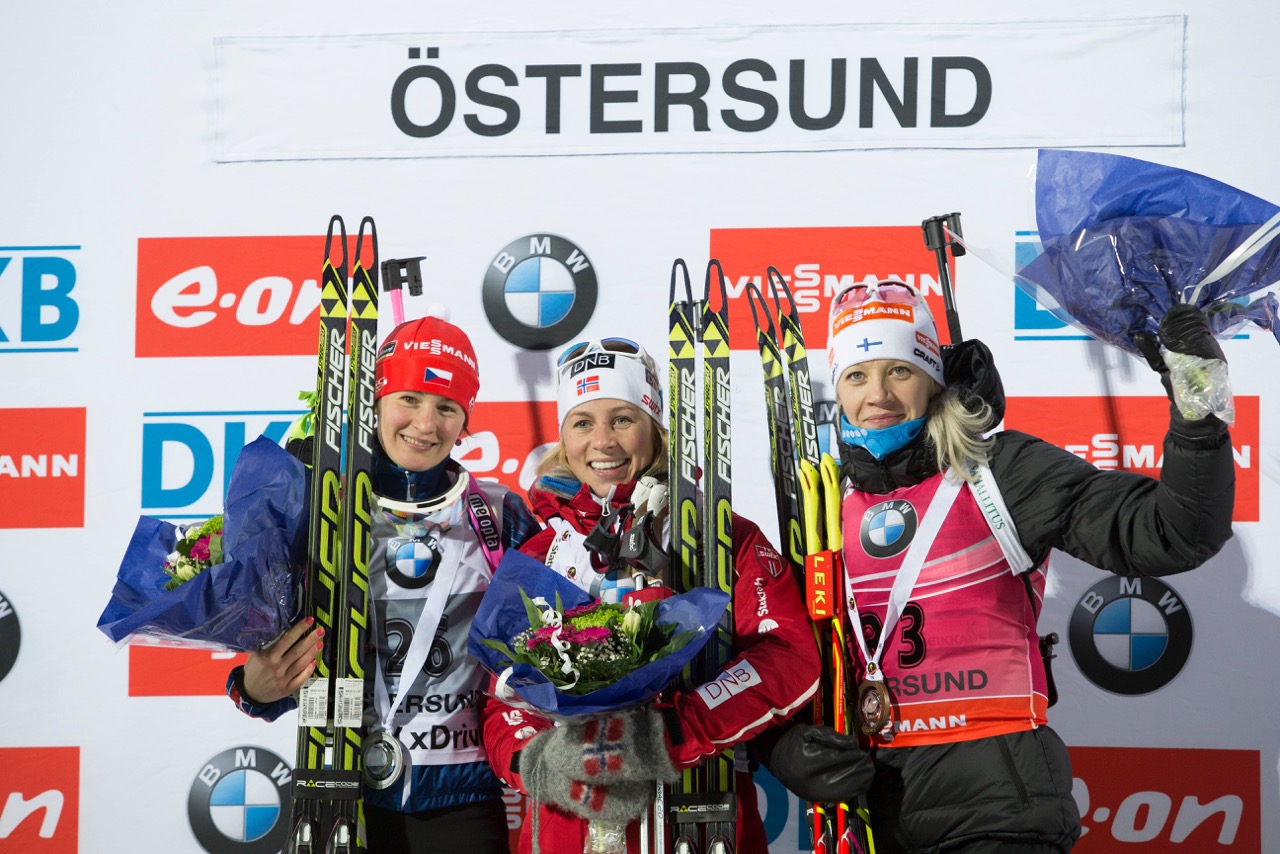
The women’s podium after the Hochfilzen World Cup 7.5 k sprint on Friday, with Finland’s Kaisa Mäkäräinen (c) in first, Italy ‘s Karin Oberhofer (l) in second, and Norway’s Tiril Eckhoff in third. (Photo: IBU/Ernst Wukits)
Five seconds behind her, Canada’s Rosanna Crawford will head out 34th, 1:34 behind Mäkäräinen, based on Friday’s result.
“Today was a tough day on the skis for me,” Crawford wrote in an email. “Right from the start I just didn’t feel I had that snap I needed and it warmed up quite a bit right before start which made for suction on the skis. On my last loop I just didn’t have the same energy I had last week. But you can’t expect to be fast all the time.”
The top Canadian in 34th, Crawford cleaned prone and missed one standing. She was pleased to shoot 90 percent — especially considering it was “blustery” during zero, then calm, then windy again during the race, she explained.
“I made a pretty big correction, so I was happy that I hit them all [on the first stage],” she said. “I seem to be having a lot of one misses so far this year, but 90% is still good.”
After fresh snow arrived Thursday, Crawford described the course as packed and fast — until the sun hit it on Friday afternoon. “[Then] things really slowed down,” she wrote.
The lone Canadian woman to advance to the pursuit in the top 60 (Megan Heinicke was 61st, Sarah Beaudry placed 63rd in her World Cup debut, Audrey Vaillancourt was 66th, and Zina Kocher finished 82nd), Crawford was hoping for a top 30 in the pursuit.
“For Sunday, hopefully I will be feeling better on the skis and able to move up some positions. The goal is to stay in the points,” she wrote.
Before that, she’ll race in the women’s 4×6 k relay on Saturday morning with Heinicke, Beaudry and Vaillancourt.
“I think if we each have a good leg that a top 10 is possible,” Crawford wrote. “Right now Audrey and Megan are just getting over a cold, I’m not skiing like I would like to be and it’s Sarah Beaudry’s first World Cup, so the focus will be some good shooting on all parts.”
“You can’t expect to be fast all the time.” — Rosanna Crawford (Biathlon Canada) after placing 34th on Friday
While Heinicke missed three (1+2) to finish 2:39.2 behind the winner, Beaudry, 20, who earned her World Cup starts last weekend in Canmore, Alberta, had a single standing penalty.
“Sarah had a great day on the range today, and I am sure things slowed down a lot by the time she hit the course [after starting 94th],” Crawford explained. “It’s always really exciting to be with someone who it’s their first World Cup, they bring so much energy to the team! Sarah is a blast to have around!”
Vaillancourt also missed one (1+0) and Kocher finished with five penalties (3+2).
American Annelies Cook qualified for the pursuit in 50th (+2:04.9) with a single prone miss.
“After a rough start in Östersund, I had to reevaluate my training a bit,” she explained in an email. “Clearly, I am lacking the high-end speed and lactate tolerance that I need to have to keep up on the World Cup. It’s easy to look back and try to figure out what went wrong, but it can be hard to let it go and just focus on what you can control. So that is what I am trying to do now.”
“It’s easy to look back and try to figure out what went wrong, but it can be hard to let it go and just focus on what you can control.” — Annelies Cook (US Biathlon), 50th on Friday
Cook added that she’s been working on speed, and since placing 79th in last weekend’s sprint and missing out on the following pursuit, she did some intervals and pushed as hard as she could on Friday.
“I am glad I can race in the pursuit and get one more hard session under my belt,” she wrote. “I have to say, I was actually pretty sore today … I must be getting old! But I felt good once I started to race. But I can’t hold on to that speed for the entire race yet, which is frustrating. I was really happy to clean standing after missing prone because that is one of my demons. I told myself I had to relax and I was going to clean, luckily it worked.”
While the Americans are one woman short for the relay, Cook and Dunklee will race on Sunday.
“It’s another opportunity to push hard, to ski with other girls and to challenge myself in the shooting range. Plus, it’s fun!” Cook wrote.
The third U.S. woman, Hannah Dreissigacker placed 78th on Friday (+3:12.7) with three penalties — one prone and two standing. Last weekend, she was 81st in the Östersund sprint.
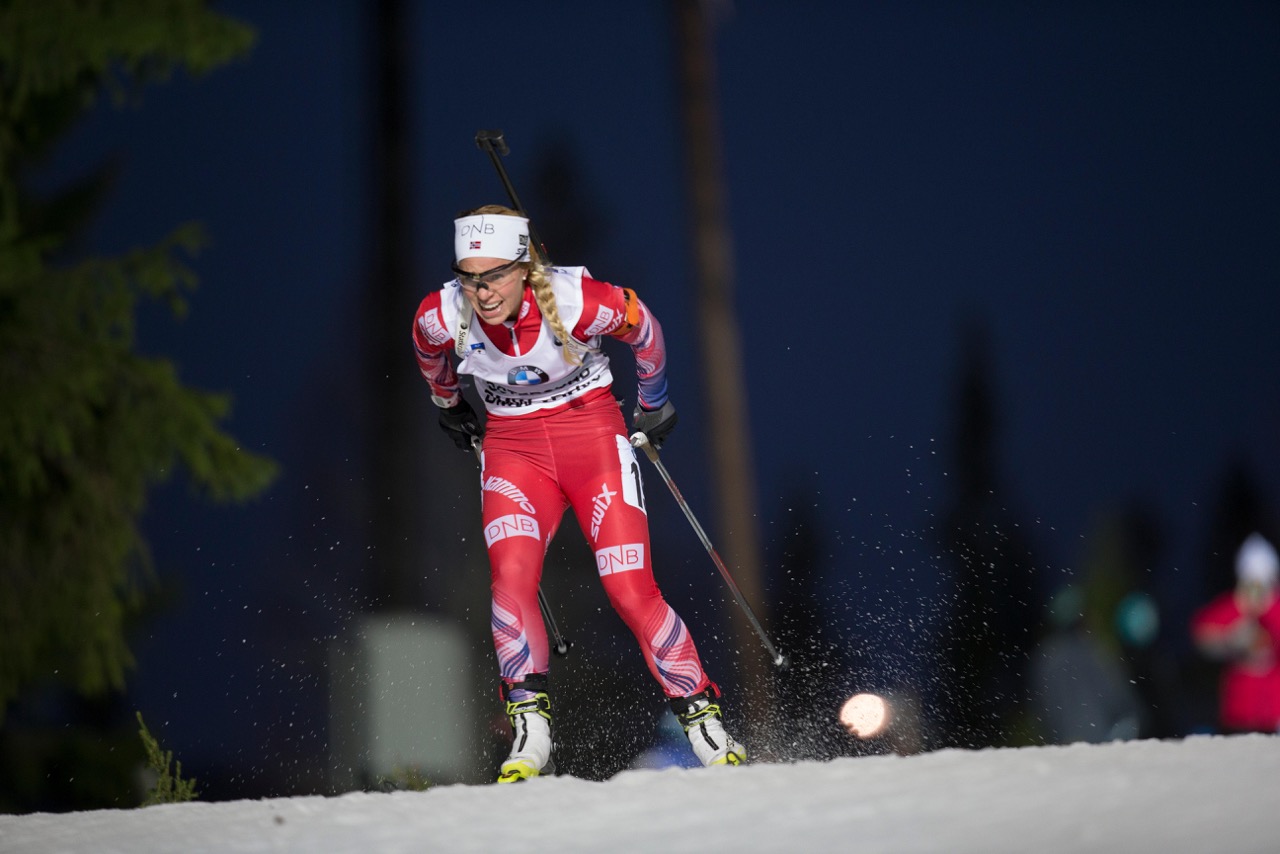
Tiril Eckhoff (NOR) gutting it out on the last loop en route to a victory in the World Cup sprint. Photo: Fischer/NordicFocus.com.
After Martin Fourcade of France opened the day of competition in Östersund, Sweden, by winning the men’s sprint, it looked like the biathlon World Cup was going to pick up right where it left off.
The most successful woman of the 2014 Olympics, Darya Domracheva, was a very early starter in the 7.5 k sprint, but despite a penalty she moved into first place by over a minute when she crossed the finish line – leaving fans guessing as to whether she skied so fast she’d end up on the podium regardless.
But the rest of the women’s field wasn’t going to just let her have it. 12 bibs later, Tiril Eckhoff of Norway showed that there was a new boss in town. She also had one penalty, but skied even faster than Domracheva, and charged into first place by 9.5 seconds.
“I never thought that I would do it,” the 24-year-old told Norwegian broadcaster NRK. “I thought maybe I’d be in the top ten.”
Eckhoff is, improbably, coached by her brother Stian. More than ten years her senior, Stian Eckhoff won the World Cup sprint in Östersund in both 2004 and 2005. He is now coaching the Norwegian women’s team.
“I’m a little surprised she’s already matching Domracheva,” he told NRK.
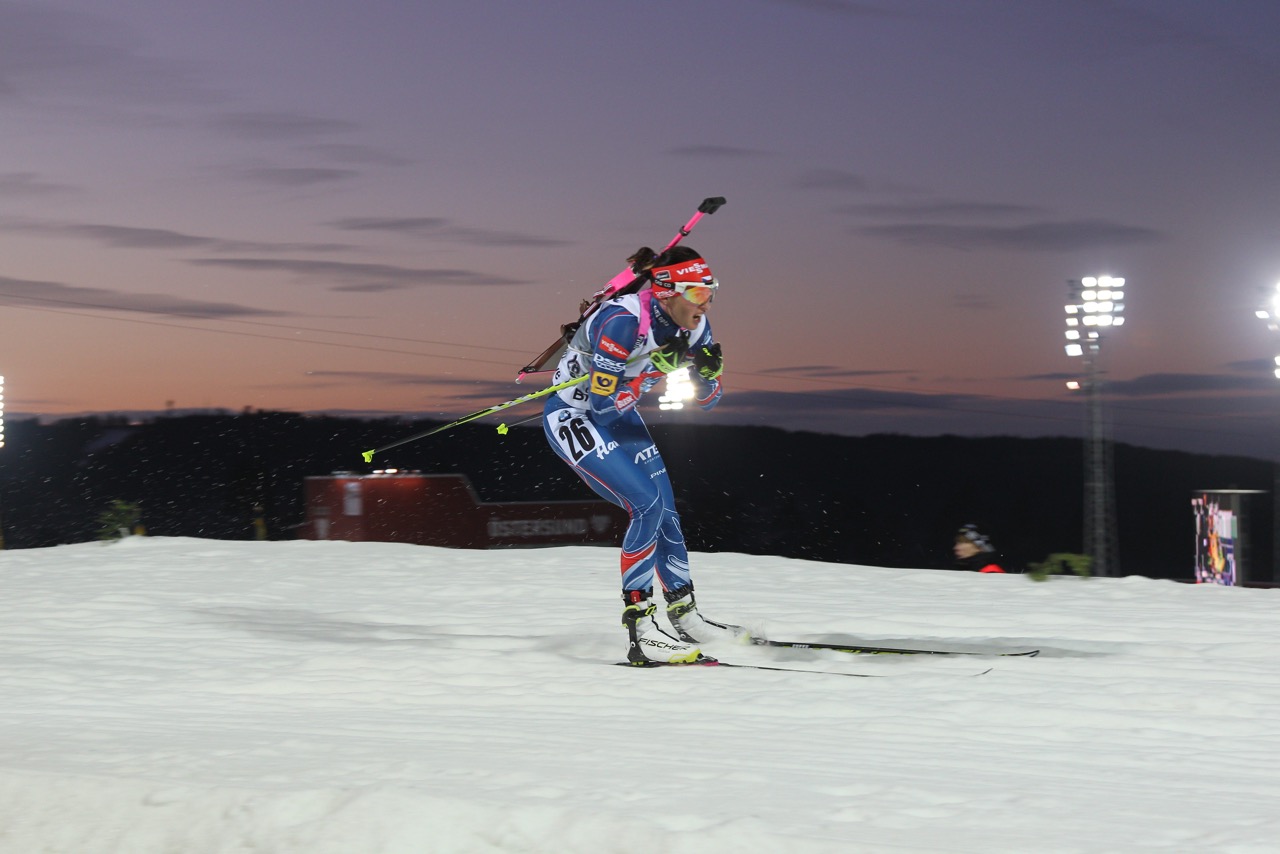
Veronika Vitkova (CZE). Fischer/NordicFocus.com.
The youngest Eckhoff was helped by Gabriela Soukalova, another star from last season. The Czech has been off to a rocky start, and suggested before the World Cup season began that she has been focusing on other aspects of her life (she recently starred in a nude photo campaign to raise awareness of cancer) and will get faster as the season goes on.
So, despite being passed by Eckhoff from two minutes back, Soukalova held on and seemed to have every inch of the old fight left in her. The two battled back and forth over the final kilometer and it’s safe to say that Soukalova’s presence and speed helped propel Eckhoff to the top of the podium.
“It hurt like shit at the end,” Eckhoff admitted to NRK.
It turned out to be close: Veronika Vitkova of the Czech Republic cleaned all ten targets, and left the shooting range with the lead. She lost seconds on the last lap, however, and ended up 4.6 seconds behind Eckhoff.
“Today was very hard on the trails,” Vitkova said in the post-race press conference. “The 15 k was better for me. Tiril was very fast today.”
Then came Kaisa Makarainen. The Finn had missed two targets, but also had the fastest ski time of the day by a whopping 30 seconds. A two-time World Cup overall champion, Makarainen pushed hard for the win. In the end she landed third as she crossed the finish line, exactly three seconds behind Vitkova.
Finally, the last threat came from Dorothea Wierer, a sharshooting Italian. Wierer, like Vitkova, had hit all her targets. She left the range in first place – but despite much-improved skiing this season, it wasn’t quite enough and she slipped off the podium by the finish, ending up in fourth place just one tenth of a second ahead of Domracheva.
Eckhoff could rest, assured of her victory – the very first in her career, although she earned bronze in the mass start at the 2014 Olympics.
“It feels amazing and indescribable,” she told NRK. “It’s absolutely magical to see yourself as number one.”
She also had some words for media outlets like NRK, who criticized her after she finished seventh in the individual race on Thursday and also questioned whether the Norwegian women’s team would be any good this season.
“It’s nice to come back to the Norwegian journalists,” she said in a press conference after the race. “They have been really tough, so it’s nice to show that I belong in the top…. it’s boring to get so much shit.”
Vitkova was also pleased.
“I’m very happy because it’s my second second-place finish on the World Cup,” she said in the press conference.
With the victory, Makarainen took the yellow overall leader’s bib from Domracheva. It’s still early in the season, but this is a familiar battle for fans of biathlon.
“With two penalties, it’s very nice to be on the podium,” she said. “With the prone penalty I was a little bit sad because my finger was just a little bit too fast. It wasn’t meant to go so fast.”
All three are looking forward to tomorrow’s pursuit, where the top five women will all start within ten seconds of one another. Eckhoff said that her strategy would be to wait for Makarainen to, inevitably, pass her, then tuck in and draft; Makarainen suggested that the race would be decided on the shooting range, “woman to woman.”
She also offered a plea to race organizers, after describing how difficult the skiing was over the unevenly-salted, icy, slushy, and choppy course which claimed more than a few skiers in crashes and broke the rifle stock of Baiba Bendika of Latvia.
“I hope they will prepare the course a little bit better tomorrow, so that we don’t have too many crashes,” Makarainen said. “It’s a very big danger now to get a lot of crashes. We saw them already today. It’s very soft and it’s also icy on the downhills… you just have to hope that you will not fall down.
Susan Dunklee (US Biathlon) en route to 21st in Thursday’s 15 k individual at the IBU World Cup opener in Östersund, Sweden. (Photo: USBA/NordicFocus)
It wasn’t pretty out there, American Susan Dunklee explained an email about the women’s first individual race of the season. “Deep slush with unpredictable patches of ice underneath” made for some not-so-graceful skiing in Thursday’s 15-kilometer World Cup race in Östersund, Sweden, she wrote.
But Dunklee found some comfort knowing that everyone else was flopping around, too.
US Biathlon’s early starter in bib 19 (of 96), she explained that the conditions worsened as the race wore on, but the snow was already deep and sluggish at the start. Still, she ended up skiing faster than most of the field with each passing loop, recording for the seventh-fastest course time overall (and the eighth- and sixth-fastest second and third loop times, respectively).
And while she initially finished 11th and ultimately ended up 21st with three penalties, 3:59.1 minutes behind Belarusian winner Darya Domracheva, Dunklee explained she wasn’t feeling in top form.
“My body did feel a little tired and I didn’t feel ‘sharp’ today,” she wrote. “I focused on whatever hill or corner was immediately ahead of me. This was a day to use the head as much as the muscles; constantly assessing and reacting to which side of the track had less slush and a harder surface.”
After cleaning the first prone, Dunklee missed two on the second stage for two minutes of penalties. She went on to clean her second prone and miss one on the final standing.
All the while, she didn’t hear any splits until her final loop. Even if she had, with just 18 women ahead of her, they wouldn’t have given her the most accurate sense of where she’d end up.
“Anything can happen in the shooting range, especially in the last stage when the pressure is on, so I take any mid-race splits with a grain of salt,” she explained. “The Individual is particularly unpredictable.”
Leaving the range for the last time, she was 11th at the time — which was where she’d end up at the finish. From there, Dunklee waited as she gradually slipped just outside the top 20, with later starters like Domracheva, third-place finisher Valj Semerenko (Ukraine), Tiril Eckhoff (Norway), Ekaterina Glazyrina (Russia), Sophie Boilley (France), Olga Podchufarova (Russia), and Megan Heinicke (Canada) placing in the top 12.
Enora Latuilliere (France), Weronika Nowakowska-Ziemniak (Poland), Franziska Pruess (Germany), Luise Kummer (Germany), and Jitka Landova (Czech Republic) also snuck ahead of her in the top 20.
“Darya passed me as if I were standing still and Tiril also caught me before the finish, so I was surprised to see I have the 7th fastest ski split,” Dunklee recalled. “They left me in the dust. It goes to show how wide open the field is this year — so many top women retired last year and now there is less depth and tremendous opportunity.
“I am happy to start off the season with a bunch World Cup points,” she added. “It’s a great feeling to know I still have plenty of room to improve too.”
The second U.S. finisher was Annelies Cook, who placed 73rd (+9:23.6) after four penalties (1+2+0+1). The team’s third woman, Hannah Dreissigacker was 86th (+11:19.7) with seven misses (3+0+1+3).
“Today certainly wasn’t our strongest team showing,” Dunklee said, after she and three teammates combined for seventh in the mixed relay on Sunday. “We often struggle at the start of the season. Many of the other teams have had more on-snow time than us, and lots of athletes are peaked right now because they had to recently qualify for a spot on their nation’s squad. The season is long, and we still have time to tune up. We will get there.”
Dorothea Wierer of Italy shone bright early in her career, sweeping all three races as World Junior Championships in 2011.
Then what?
Frequently a perfect shot, she initially had trouble adapting to the speed of the World Cup circuit. But in the past few seasons she upped her training, focus, and speed, and emerged in 2014 as a contender. She notched six different top-ten performances, including a podium in Pokljuka, Slovenia, and sixth place in the Olympic sprint.
This season, Wierer has started off with a bang and made it clear that her competitors should be worried.
After a convincing win in the opening sprint in Sjusjøen, Norway, on Saturday, she came right back with an 8-second victory over Norway’s Tiril Eckhoff in the 12.5 k mass start today.
“Anything could happen,” Eckhoff told Norwegian broadcaster NRK regarding the last shooting stage. “I hoped that Dorothea would miss.”
But she didn’t. At that point, Eckhoff had two penalties to Wierer’s one, but as the fastest skier in the field, the Norwegian had caught up by the time they hit the range for the final standing bout.
There, Eckhof missed two more, but Wierer only accrued one more penalty, and skied her way to the win.
Nicole Gontier of Italy placed third, 35 seconds back with two penalties, asserting Italy’s status as a much-improved team in advance of the World Cup opener in Östersund, Sweden, at the end of the month. In the sprint, Karin Oberhofer had represented Italy in third place, giving them two thirds of the podium spots on each day of racing.
The news wasn’t all bad for Norway, either, however. Eckhoff’s ski speed impressed, and veteran Synnøve Solemdal placed fourth with three penalties, a huge improvement over her disastrous sprint race.
Solemdal, a former World Cup winner, disappointed at the 2014 Olympics and later found out she had mononucleosis. She had placed 21st in the sprint.
“I would like to be further ahead than I am today, but I’ll stay calm,” she told NRK after the sprint. “I have less of a base than the others and I’ll continue to train into the winter. I don’t look at this as darkly as you might think.”
The Norwegians also took the next three places with Hilde Fenne, Kaia Wøien Nicolaisen, and Elise Ringen.
The Norwegian biathlon team celebrates gold in the first-ever Olympic mixed relay after Emil Hegle Svendsen showboated his way toward the finish line.
FasterSkier’s coverage is made possible through the generous support of Swix.
KRASNAYA POLYANA, Russia – Just 24 hours earlier, Emil Hegle Svendsen had nearly lost a gold medal in biathlon when he began celebrating his win in the 15 k mass start before crossing the finish line. The second-place racer, Martin Fourcade of France, lunged towards the line and only missed out by three hundredths of a second.
Today, Svendsen had a little more time to savor his victory. Entering the range with a more than 30-second lead, the Norwegian knocked down all five targets in quick succession and then raised his arms to the stands as he put his poles back on.
Svendsen waving to fans as he descended into the stadium the final time.
He still had 2.5 k to ski, but so what? He had plenty of time to keep celebrating. After a loop out on the course, where Svendsen took his sweet time, he waved to fans coming around the final downhill corner into the stadium. Then he played up the crowds as he coasted down the finishing stretch far ahead of the second-place team from the Czech Republic.
Svendsen later told NRK, a Norwegian television station, that he was looking for a Norwegian flag to carry across the line, but then became scared that such behavior was banned at the Olympics. (He may have been extra cautious because of the Norwegian ski team’s written reprimand from the International Olympic Committee for wearing black armbands.)
The man who had the most to celebrate, though, wasn’t so vocal.
Ole Einar Bjørndalen had raced the third leg for Norway, after Tora Berger and then Tiril Eckhoff combined to put the team in a dead heat for first place after the women’s legs were complete. Bjørndalen, who had earned his seventh Olympic gold medal in the Games’ opening sprint and had tied Norwegian skier Bjørn Dæhlie for the most medals in winter Olympic history with 12, skied the fastest course time of his leg and shot a perfect ten for ten.
He built a 43-second lead for Norway, which Svendsen got to simply savor as the anchor leg.
The gold medal for the team gave Bjørndalen a tie with Dæhlie for the most gold medals in winter Olympic history, and nudged his total medal haul up to 13, which nobody has ever matched. And he wasn’t just a tourist, at 40 years old, depending on the strength of his team – no, Bjørndalen made that gold medal.
And how does it feel to be the most decorated winter Olympian in history?
“It’s cool,” Bjørndalen shrugged in an in-venue TV interview, acting the typical reserved Scandinavian compared to Svendsen’s bravado. “Bjørn Dæhlie was a big hero to me.
Speaking to NRK after the race, Bjørndalen said that he still thinks Dæhlie is the better athlete.
Ole Einar Bjørndalen out on the trails, where he trounced the decades-younger competition.
“Clearly this record means a lot, and it’s a big achievement,” he said. “In his time, [Dæhlie ] had what I love about cross country skiing – the raw capacity. There is nobody in Norway who has had that capacity and the raw endurance talent that Dæhlie had.”
Meanwhile, his teammates were just thankful that Bjørndalen has remained a leader in their sport and their team.
“We’re all making history today,” Svendsen said in the press conference. “I think the whole team owes a big thanks to him. I think many of the things we think about in training is because of his extreme professionalism.”
“Ole’s amazing, what else can you say?” asked Eckhoff, who is 17 years younger than the legendary biathlete. “It’s amazing that we can be on the team with him today.”
Accolades aside, it was a remarkable race for Norway from start to finish, showing off what is possible in the mixed relay, a format which is new to the Olympics. With just two women and two men, a level of excellent performance is possible which is tougher to achieve with a full four-man or four-woman team.
Over the course of 40 targets, Norway used just two spare rounds to knock them all down. And in fact, both were used by Berger, the team’s scramble skier. Norway hit the next 30 targets in succession, a feat which has rarely been matched in relay racing.
“It was a fantastic achievement by everyone,” Berger, last year’s overall World Cup winner, told NRK. “It was really fun to go today.”
“It was really cool to be involved today,” agreed Eckhoff, the bronze medalist from the mass start who has never before been considered one of her country’s top two women and had only raced one mixed relay ever before.
The win was also a relief for Norway because, just as in cross country skiing, they had been having problems with ski preparation, which contributed to the team earning far fewer medals than had been projected.
And just like Marit Bjørgen and Ingvild Flugstad Østberg’s dominating win in the women’s team sprint today, the mixed relay gold brought an end to that disappointing drought.
“What has changed the most is that we have some better skis and our servicemen have found the problem with our material,” Svendsen said. “I think I can say a big thank you to our service team because it’s very important in skiing, as you can see in the last couple days. … This is the biggest race for that.”
The Czech Republic took silver to continue a remarkable Olympic campaign; it is their fifth medal of the Games in biathlon. Italy took bronze to earn their first Olympic medal since 1998.
—Nat Herz and Alex Matthews contributed reporting.
Darya Domracheva racing around the penalty loop, which didn’t slow her down at all en route to winning her third consecutive gold medal at the Games.
FasterSkier’s coverage is made possible through the generous support of Swix.
SOCHI, Russia – After just ten minutes of racing at the Laura biathlon stadium, it seemed like a foregone conclusion that Darya Domracheva or Belarus would win the women’s 12.5 k mass start.
Domracheva has already won two gold medals in this Olympics both in shows of solid dominance – the 10 k pursuit by 37 seconds, and the 15 k individual by a whopping minute and 15 seconds. Domracheva was in the lead pack, skiing fast, and shooting well.
The only hiccup came in the final shooting bout of the four-stage race. Domracheva, leading by about 20 seconds, missed a shot and headed to the penalty loop. But her nearest competitor, Gabriela Soukalova of the Czech Republic, also missed. So Domracheva held on to the advantage she had built up by skiing the fastest split times on each of the three middle laps.
“She is amazing,” said Tiril Eckhoff of Norway. “She skis like a dancer. She skis so good and I think she really deserves these three golds. She has been really amazing here.”
“I thought she was going to win today,” agreed Soukalova. “She was so strong in the last races that I didn’t believe that anybody would be faster than her. I didn’t race with her today. I thought it would be better to race just with myself and with nobody more.”
Domracheva coasted across the finish line in 35:25.6, first swinging her poles over her head like rodeo lassos and then by pumping her fists in the air.
Domracheva celebrating as she neared the finish line.
“I am really thankful to this great supportive atmosphere,” Domracheva said. “I heard Dasha, Dasha, all over the track. Here in Sochi without this support, it would be much much more difficult to achieve this result.”
The gold tied Domracheva with Kati Wilhelm of Germany for the most gold medals of any female biathlete. But Domracheva made history as the first to do it in a single Olympics – no other woman has achieved the feat, and only Ole Einar Bjørndalen in the men’s field. It also makes her the winningest Belorussian Olympian of all time.
The country’s president bestowed upon her the status of Hero of Belarus, which flabbergasted the 27-year-old biathlete. She is only the 11th person to receive the honor.
Behind Domracheva, Soukalova also skied alone, despite her one penalty. The 24-year-old, who burst onto the scene last season, won her first Olympic medal – and upped the tally to three for the small Czech team over the course of the biathlon races so far at the Games.
Fourth in both the sprint and the pursuit, the silver medal was redemption for Soukalova, who was a medal favorite coming into the Games although she insisted that she hadn’t thought she would be able to make the podium.
“I didn’t feel that I would be strong today before the races,” Soukalova said. “I was feeling to be exhausted because the conditions from the last two races were really hard. I didn’t believe I would be able to be on the podium here after the two times fourth position. I think this result, it’s the best motivation for me… All the races were so close, but happiness was missing. But today, I think I was finding it.”
The most interesting race of the day was for bronze. Evi Sachenbacher-Stehle of Germany – a recent convert to biathlon after winning gold in the team sprint at the 2010 Olympics – had shot a perfect clean race and left the range in third place after the final stage.
To hit 20 out of 20 is almost inconceivable, considering that Sachenbacher-Stehle had only picked up a rifle two years ago and made her World Cup debut partway through last season. But once she was in the hunt, she was sure to be a factor. At 33 years old and in her fifth Olympics, Sachenbacher-Stehle had experience and years of training under her belt.
Five seconds behind her was Tiril Eckhoff of Norway, who had missed a shot in the second stage and clawed her way back to the leaders. Ten years younger than her German rival, Eckhoff is one of the fastest and most aggressive skiers on the World Cup, and used her youthful optimism to chase after the veteran.
“I was actually thinking, I just have to stand up on the [turn],” Eckhoff said of her final loop of skiing. “I looked at Tora [Berger] and she fell down on the first loop. Tora is a really good downhill skier. So I was like, okay, I just have to stand on this curve and after that I just have to go. I knew that my last loop is pretty good and so I would have a good chance.”
By the time the pair came into the stadium, Eckhoff had skied the fastest closing-loop time and was in the lead. Sachenbacher tried to pass as they flew through the stadium in one direction, before climbing a short hill and shooting back across toward the finish. But Eckhoff was determined to end up on the podium and sprinted away, never quite letting Sachenbacher-Stehle draw even.
“I hoped for me that I could do it for the medal on the finish line,” Sachenbacher-Stehle said. “But I have not the high speed in the end. So it’s the unlucky fourth place, but I’m very happy with my race and even if it’s no medal. That’s life. Someone has to be fourth, and now I’m the fourth.”
The bronze medal was a godsend for Norway, which has been having a rough medal of the Olympics. Besides the woes of its cross country ski team, Berger – who won the overall World Cup last season as well as two individual golds and two individual silvers at World Championships – has been able to capture just one medal. Stars Emil Hegle Svendsen and Tarjei Bø have done no better, leaving Ole Einar Bjørndalen’s one gold to lead the team.
After a devastating crash early in the race that dropped her far off the back of the pack, Berger struggled to 15th place with two penalties.
It was a dream come true for Eckhoff, and tied the best result of her career. She finished third in the pursuit in Annency, France, earlier this season, and nearly snagged another podium in Antholz, Italy, but Berger caught her right at the finish and took the honor for herself.
Being on the podium today was much sweeter.
“I think it’s awesome,” Eckhoff said. “When Tora beat me, I was like, man, it’s impossible. So it’s good to just get the podium today.”
While the day ended up magical, it didn’t start out so well for Eckhoff.
“I was switching hotels because I was feeling a bit ill,” she laughed in the press conference. “Today I ate a burger. I was thinking, okay, this will be a nice day. And it was!”
Teja Gregorin of Slovenia, the bronze medalist in the pursuit, finished fifth, and young Polish star Monika Hojnisz sixth, both also with clean shooting.
Andrea Henkel of Germany leads Norway’s Tora Berger and Susan Dunklee of the United States in today’s 10 k pursuit in Antholz, Italy. Photo: USBA/NordicFocus.com.
Looking at the finish pen of the women’s 10 k biathlon pursuit in Antholz, Italy, today, you could be forgiven for thinking that a battle might have occurred.
World Cup athletes staggered across the finish line, some nearly falling before their final time was clocked. Their ski technique, usually the best in the world, looked shortened and powerless; sprint finishes happened in slow motion. Exhausted athletes lay in the snow for minutes trying to recover some energy.
“Every loop was pretty hard, and not just the last one,” winner Andrea Henkel of Germany said in the post-race press conference.
At 2,000 meters of elevation – about 6.500 feet – Antholz is the first time most the World Cup field has encountered significant elevation in weeks. Coming in the third week of intensive racing in a row, that was particularly punishing.
“I think the elevation got to everyone, and it was harder than usual,” American biathlete Susan Dunklee said in a phone interview. “Coming into standing, everyone’s legs were shaking a little bit. It was tough.”
Henkel, a 15-year veteran of the German national team, did exactly what she needed to do to win after starting the pursuit in bib two, 6.7 seconds behind Anais Bescond of France.
Calm and collected, Henkel cleaned each of her four stages, always taking a few seconds longer than her closest competitors to ensure accuracy. Darya Domracheva of Belarus, who had a sizeable lead coming into the first standing stage, missed two shots in each of the last two stages.
“I took my time in shooting and I got lucky that the others did not hit as many targets as I did,” Henkel said. “It all just worked out for me.”
She was clean again and again, as the group of skiers around her gradually shrank down. By the time she left the last stage, she had a ten-second lead on Nadezhda Skardino, also of Belarus.
It was a nailbiter of a final two kilometers, with Skardino edging closer and closer to Henkel. The 36-year-old German grimaced in pain as she pushed with everything she had. With 900 meters to go, Skardino had closed the gap to five seconds.
“I knew Skardino might come closer,” Henkel said. “I thought if I still had the lead at the Huberalm, then I had a chance.”
Dunklee fighting through a painful ten kilometers at elevation. Photo: USBA/NordicFocus.com.
She did: Skardino made contact coming into the stadium, but was unable to do any more than shadow Henkel to the finish line. Completely exhausted, Henkel managed to raise her fists in victory as she crossed with a 1.6-second advantage.
“Of course I wanted to win, but Andrea was strong and I am happy to be second,” Skardino said in the press conference. “It was a hard competition today but my skis were good and I felt really good so this race was easier than some other times.”
Tiril Eckhoff of Norway seemed to be headed to the second podium of her career when she left the final stage in third place, with 11 seconds of time on Domracheva, who was in fourth. But Norwegian teammate Tora Berger had no mercy and charged after the leaders, passing Domracheva immediately and overtaking Eckhoff in a finishing lane sprint. In her push for the yellow overall leader’s bib, she was uninterested in allowing her younger teammate to have any part of the glory.
“I didn’t realize that it was Tiril that I was fighting against,” Berger told Norwegian broadcaster NRK. “I just did what I had to do, because I wanted the podium.”
But the NRK commentators were having no part of it, calling her “relentless” and saying she doesn’t treat her teammates well on the trails.
For her part, Eckhoff was gracious
“I heard that she was coming, so it was very painful to get the seconds taken away from my lead,” she told NRK. “I tried my hardest, but the older athletes are still the best…. it was close. One day I will get there.”
Domracheva finished fifth and Teja Gregorin of Slovenia sixth. The breakout performance of the day came from Chaoqing Song of China, who finished tenth; it was just the second top-ten of her career and her best result since 2010.
Dunklee, who started the pursuit in fourth position just behind Domracheva and Henkel, finished 23rd. She cleaned the first stage but collected one penalty in the second prone, three in the first standing, and one more in the final standing.
“One poor standing stage cost me a lot of places and suddenly felt very tired on the skis on loop four and lost a lot of places there,” she said.
Early on, Dunklee had been skiing with Henkel in a top-five position.
“It was comfortable, and things were going according to plan,” she said of her first-ever pursuit start in such a strong position.
And it was a comfort to be skiing with Henkel, the girlfriend of Dunklee’s teammate Tim Burke.
“Andrea comes and trains with us in the U.S. sometimes, so I know that my ski speed can be right up there with hers,” she said. “I consciously choose to catch a ride with her at the start of the race. We have very different ski styles but it is still relaxing to let someone else lead and I trusted she would choose a smart pace.”
Even if the pair separated after Dunklee’s shooting woes began – they were compounded by a broken pole and losing some ammunition clips, which she estimated cost her about eight seconds on the range when an official had to bring her replacements – Dunklee found the German veteran’s win very motivating.
“I know how hard she works, and for how long, so I was so happy to see her on top today,” Dunklee said. “And because I know I can ski her pace on a good day, that’s a good feeling too.”
Next time, Dunklee hopes to be more “calm and in control” throughout the whole race, just like she said Henkel was today.
“I have some of the parts, but the whole thing didn’t come together,” Dunklee said. “Each time you do this it gets easier, so I think when I’m in this position next time it will be even better.”
Megan Heinicke, the lone Canadian to qualify for the 60-woman pursuit, did not start the race. Sara Studebaker, the other American who made the cut, finished 48th with four penalties, one in each shooting bout.
Biathletes Andrea Henkel (l) of Germany, Veronika Vitkova (second from r) of the Czech Republic, and Ukraine’s Valj Semerenko (r) in a World Cup pursuit last season in Oberhof, Germany. Semerenko placed third in the pursuit behind Russia’s Olga Zaitseva (not shown) in first and Vitkova in second. (Photo: Wikimedia Commons)
About halfway through the IBU World Cup women’s 10-kilometer pursuit on Sunday, Valj Semerenko’s luck started to change.
A penalty on her first prone had put her in 11th with four loops to go at Le Grand Bornand in Annecy, France. The Ukrainian had started third behind Switzerland’s Selina Gasparin and Finland’s Kaisa Mäkäräinen, respectively; backwards wasn’t the direction Semerenko was hoping for.
Most of the eventual top 16 cleaned the first stage, except Gasparin, Semerenko and Germany’s Franziska Preuss. Meanwhile, Mäkäräinen, Gabriela Soukalova of the Czech Republic, and Russia’s Olga Vilukhina moved to the front of the pack, all cleaning their second prone.
The first standing, however, threw a stick in their tracks. Mäkäräinen entered the range first and came out with three penalties, and Vilukhina missed one. Soukalova cleaned again for a 10-second lead over Semerenko and another Ukrainian, Olena Pidhrushna, who cleaned the first three stages.
Ukraine was quickly moving up in the standings, along with Russia’s Irina Starykh and Vilukhina, another 10 seconds behind heading into the final standing.
With the pressure on, Semerenko entered the range third behind Soukalova and Starykh, respectively. The Czech World Cup leader missed one, Starykh cleaned once more and Semerenko did the same to put 20 seconds into Soukalova and Norway’s Tiril Eckhoff, who came back from a penalty in the third stage.
With a kilometer remaining and the top two women accelerating toward the finish, Semerenko attacked on the final climb to drop Starykh and win her first World Cup in 28:05.4. Starykh was 4.2 seconds behind, and Eckhoff overtook Soukalova for third and her first World Cup podium, another 11.3 seconds back. Soukalova finished fourth (+21.9) about seven seconds ahead of Germany’s Laura Dahlmeier, who cleaned for fifth. Gasparin finished sixth (+37.1).
“I did not expect such success here in France,” the 27-year-old Semerenko, who turns 28 on Jan. 28, told IBU. “It is a nice New Year present to myself. I am happy to win, especially after such a battle with a great competitor like Irina on the last lap … It is just starting to sink in.”
After 20-for-20 shooting, Starykh dismissed suggestions that she was Russia’s top woman. “I do not think I am the top woman. This is the result of my summer training. I am only concerned about results,” she told IBU.
Despite her first World Cup podium, Eckhoff was similarly straightforward. “It was just my day,” she said. “I shot well and did my work.”
Crawford Cracks Top 20
Biathlon Canada’s Rosanna Crawford at last week’s IBU World Cup in Hochfilzen, Austria..
Out of four Canadian women in the pursuit, Rosanna Crawford had the best position from the beginning, starting 26th and a minute behind Gasparin. Her first prone didn’t go so well and she racked it up to the range’s quick entry from a downhill, which was especially tough in lanes 25 through 30.
“My first prone don’t think I switched over soon enough. The shots were everywhere,” Crawford wrote in an email. “From there I made sure to start my range entry sooner.”
The 25 year old then cleaned her second prone and missed one more on her first standing. She rose from 37th on the second loop to 29th on the third (with the ninth-fastest loop time), and finally 20th before her final loop. With Norway’s Fanny Well-Strand Horn about eight seconds ahead of her on the last loop, Crawford worked hard to catch her and credited her fast skis for helping her do so.
She finished 19th for her best pursuit result, 1:47.5 behind Semerenko and 1.1 seconds ahead of Horn.
“Anything is always possible in a pursuit,” Crawford explained. “It’s been a good 4 weeks in Europe but I am ready to go home and recover and see my family! The next trip will be a long one.”
The IBU World Cup resumes Jan. 3 in Oberhof, Germany.
Crawford’s teammate Megan Heinicke rose from 50th to 33rd with two penalties – one in the first and third stages – for her second-best pursuit result at the World Cup. Starting 1:41 behind, Heinicke figured a top 30 was possible given how tightly packed everyone was from the start.
Despite missing her first shot in the first prone, Heinicke, 25, clocked the third-fastest range time. The second time around, she was second fastest on both the range and the loop.
“The fast shooting times were part of my plan … I wanted to go into the shooting confident, focused, fast and aggressive,” Heinicke explained in an email. “While I did make a conscious decision to shoot aggressively on the whole I was more focused on the shooting process today which was a good thing.”
She ended up with the fastest overall shooting time, which surprised her.
“The ski times came about more naturally,” Heinicke wrote. “I was feeling a bit tired today and the loop times partially reflect my own feeling as well as the speed of the different groups I was skiing with.”
She finished 2:25.2 behind the winner and was pleased to end the day and trimester with 90-percent shooting.
“I feel a mixture of frustration and determination,” she said of the last five days in Annecy, which started with the Canadian women notching an unprecedented fourth in Thursday’s relay. “I have seen fast enough skiing, fast enough shooting and good enough shooting from myself to know that the top 30 and top 16 are realistic goals. Of course, to reach these goals I will need to do a better job of bringing everything together on the same day which makes me very determined to train smart and focused over Christmas.”
Heinicke’s headed home to her husband and son Predo Emil, who turned 3 in November and was at the races last week in Hochfilzen, Austria.
Rounding out the Canadian performances on Sunday, Megan Imrie placed 41st – one place behind where she started – with four standing penalties. Three came on the first standing and she missed one more on the last stage.
Zina Kocher had seven penalties to drop from 45th to 52nd (2+1+2+2) and American Susan Dunklee finished 53rd of 58 with 15-for-20 shooting (1+1+1+2).