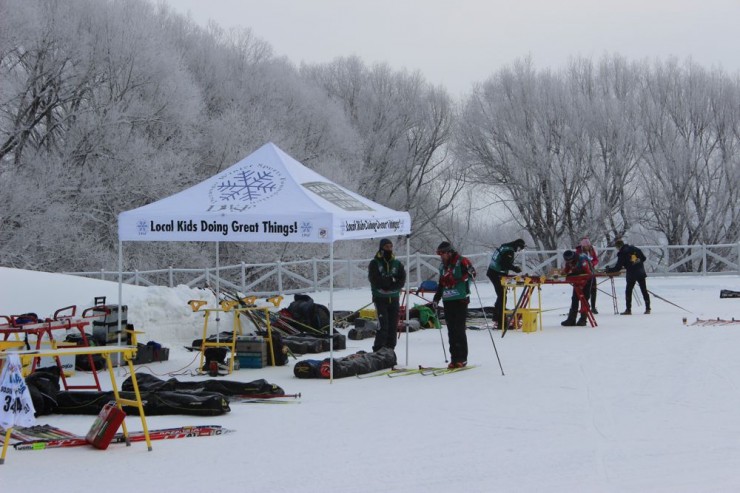
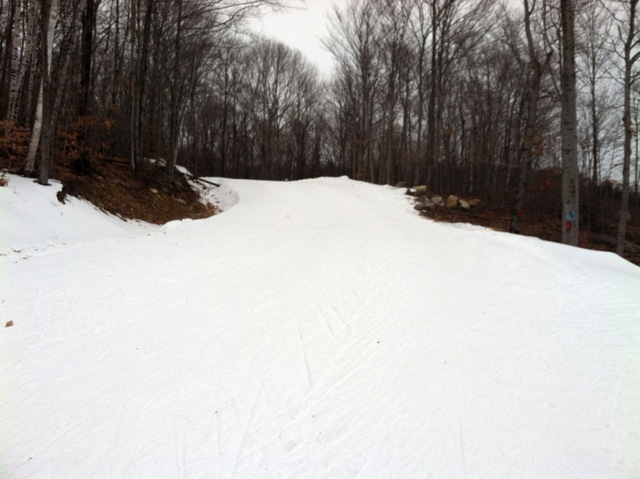
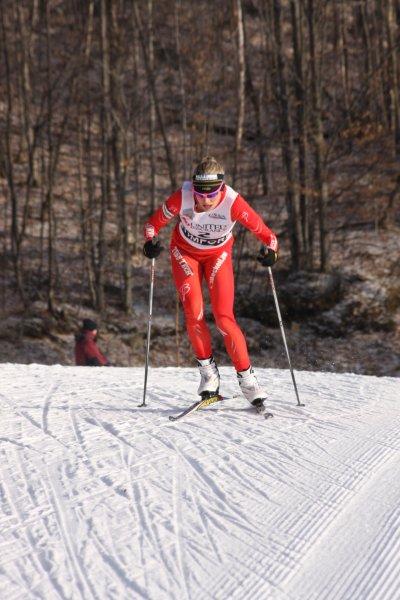
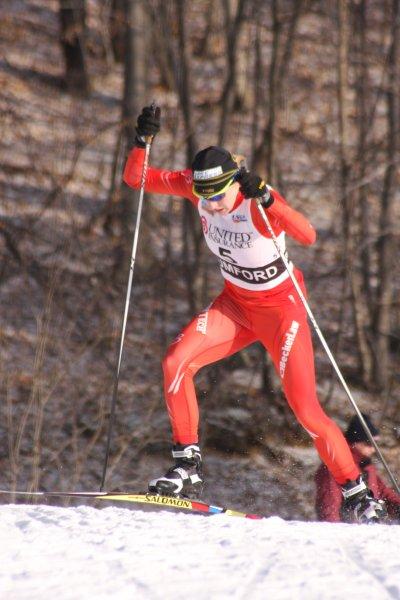
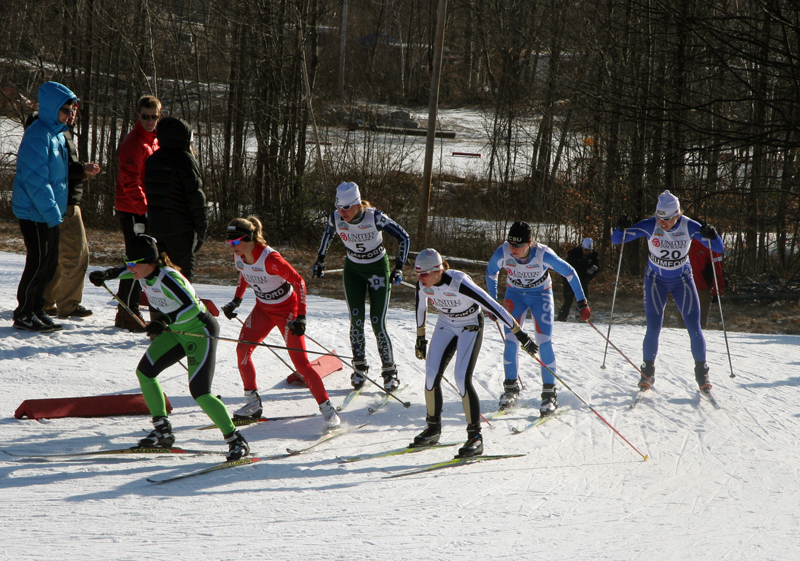
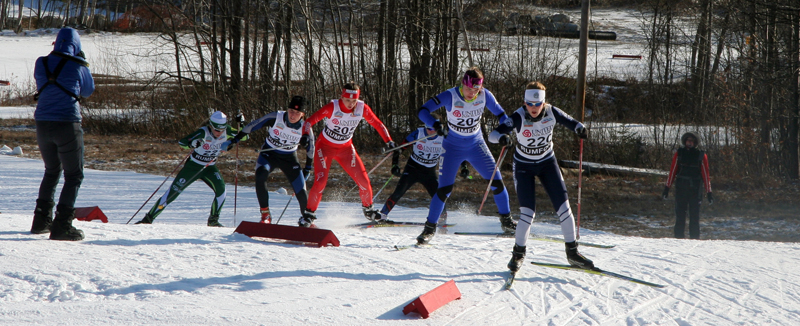
Teams make wax adjustments the morning of the classic sprint at Soldier Hollow. The first starter gets on course at 10:00 am MST.
FasterSkier’s coverage of the 2013 U.S. Cross Country Championships is brought to you through the generous support of The Memory Clinic in Bennington, Vt.
MIDWAY, Utah — Less than an hour remains until the first event of U.S. Nationals begins. Athletes arrived at Soldier Hollow Wednesday morning to brisk temperatures, overcast skies and a light dusting of new snow. Despite all the skate ski chatter that’s gone on, many athletes were warming up on classic equipment.
There are 221 men and 155 women on the classic sprint start list; qualification begins at 10:00 am and heats start at 1:00 pm MST. While you wait for results to start coming in this morning, here’s a snapshot of the scene in the stadium.
IMGP7539
IMGP7535
IMGP7533
IMGP7532
IMGP7531
IMGP7524
IMGP7536
IMGP7526
IMGP7525
IMGP7516
IMGP7517
IMGP7519
IMG_1812
IMG_1813
Teams make wax adjustments the morning of the classic sprint at Soldier Hollow. The first starter begins at 10:00 am MST.
The major focal points for the SuperTour field this year are qualifying for the Canadian World Cups in December and World Championships in February. Photo: Flying Point Road.
Ready or not, the 2013 SuperTour season is fast approaching. Here’s what you need to know about the domestic race scene this year.
At this point, we’ve pretty much said everything we can about the twelve senior ski programs in the U.S. We ran a series throughout the summer highlighting each team’s past accomplishments and goals for the future. Read back through ‘em for comprehensive rosters and standalone previews (scroll down for links). Now that it’s November, it’s time to discuss who stands a shot at beating whom.
First, there are a few unusual things about the race schedule to understand, as domestic results have an important role to play in qualifying athletes for bigger things this season. The U.S. can enter more athletes than usual in each World Cup race in Canada and can have eight athletes of each gender on its World Champs team, meaning that U.S. Ski Team (USST) members have a shot at top-end international competition this winter (those on the USST are not guaranteed World Championship slots, either).
Not surprisingly, the big focus is a combination of Canadian World Cup starts and World Championships. The overall, sprint and distance SuperTour leader(s) at the end of each competition period get World Cup start rights no matter what year it is, but being consistently fast enough to be in one of those positions is hard.
The five extra Nation’s Group spots afforded to the U.S. for each of the Quebec and Canmore World Cup races will be partially filled based on the SuperTour standings after the Bozeman races. With selection criteria theoretically reaching further into the field and requiring just two weekends of top results, the international stage suddenly seems much closer and more attainable. Who cares if SuperDario Cologna won’t be there, it’s still the World Cup!
World Championship criteria are a slightly different story, but early SuperTour races could still help decide who gets to go. The U.S. will bring up to eight men and eight women, with the first spots going to athletes who reach a certain World Cup ranking by January 14. After that, USSA goes down the National Ranking List, which is created off of competitors’ best four USSA-scored races from the twelve months prior to the selection date.
The road to Val di Fiemme, then, has already begun. The beginning of the current SuperTour and the week’s worth of racing at U.S. Nationals are further opportunities for athletes to turn in one of their four-best results and move up the ranking list.
Consequently, there’s a lot potentially riding on the SuperTour this year, despite the continued absence of leader bonuses at the end of the season. It’s not that everyone wasn’t trying hard before, but with a handful of top-level start rights on the line that only come around every so often, things could get feisty. Dreams will come true and hearts will be broken.
Now, the players: last year’s overall SuperTour leaders, Sylvan Ellefson (SSCV Team HomeGrown) and Jessie Diggins (SMS T2/USST), are already in Europe and out of the domestic picture for the next two weekends. Even so, the potential lineups for West Yellowstone and Bozeman are impressive.
The Rookies
Eric Packer (DAR). Photo: Flying Point Road.
For the purposes of this preview, athletes can pretty much be divided into two groups: knowns and unknowns. Every spring a handful of top-tier college skiers graduate and the domestic circuit gets an injection of new blood. Most graduates have competed in SuperTours before, but not when it’s actually been their job to ski fast.
So while the rookies aren’t joining the circuit as complete unknowns, their changed training circumstances can make the first results of the year a bit of a surprise. The 2012-2013 freshman class has generally never trained without academic demands competing for their time, and given the results they’ve been able to churn out even during school, count on them disrupting the status quo on the SuperTour this year.
Take Eric Packer, who joins the SMS T2 team from Dartmouth College and already has a handful of SuperTour and national podiums to his name. Packer was probably the most consistent college performer, sprinting and distance-wise, on the circuit last year, and could be ready for a significant step forward in his transition to full-time racing.
Reid Pletcher (CU) winning the skate sprint qualifier at West Yellowstone, 2011.
There’s also Reid Pletcher, who has been described as a “sprint fiend” and returns to skiing for Sun Valley this winter after graduating from CU. Remember how he won the skate sprint in West Yellowstone last year, just six months after a climbing accident landed him in the ICU? Yeah, that was ridiculous. Imagine what he might do this winter with a strong summer of training behind him.
Ryan Scott will be another sprinter to watch for. Regardless of the whole obstruction controversy, he was still in the classic finals at U.S. Nationals. At U23s he was the top American performer in the freestyle sprint. He didn’t race a whole lot after that, but his coaches at Ski & Snowboard Club Vail think he’s looking mighty fast in the run-up to the first race of the year.
In the women’s field, newcomer Sophie Caldwell (SMS T2) presents the greatest threat to the usual SuperTour standbys. Amy Glen (Craftsbury Green Racing Project) did beat her by a toe-length at the biggest college race of 2012, but the name Caldwell regularly shows up at or near the top of the results sheet week after week — whether it’s Sophie or one of her equally fast relatives.
The Upperclassmen
Though they represent relatively known quantities, the more seasoned SuperTour athletes are no less intimidating for it. They’ve been around the block and they know what it takes to be at the top of the domestic field.
Jennie Bender (CXC) was the second-ranked woman on the SuperTour last year, and stands a good chance at leading it in winter with Jessie Diggins now in Europe. Photo: Flying Point Road.
Central Cross Country (CXC) was indisputably the best all-around team last year, and won the National Nordic Foundation’s team trophy in a landslide to prove it. The Midwest squad has lost a few athletes and coaches to other programs since last spring, but still claims four athletes ranked in the top five on the SuperTour in 2012: Jennie Bender, Karl Nygren and Caitlin and Brian Gregg. Look out for their fire engine-red spandex when the gun goes off.
The next team to mention is undoubtedly Alaska Pacific University (APU). Sadie and Erik Bjornsen (APU/USST) are both racing stateside this November, and present a formidable threat when united with the rest of their teammates. Kate Fitzgerald, Becca Rorabough, Rosie Brennan, Reese Hanneman, Peter Kling — the Alaskans have a lot of returning talent. Thanks to Eagle Glacier, they’ll also be stepping onto their skis with more on-snow hours under their belts than anyone else.
From the Bridger Ski Foundation, Torin Koos and Leif Zimmerman present solid all-around threats. Zimmerman has traditionally pulled off a distance win at West Yellowstone every year, and Koos will no doubt be looking for redemption for getting erased from the results the last time he raced in the U.S. When we spoke with him in June, Koos said that every day he thinks about the Canadian World Cups more than anything else.
He’s probably not the only one. Mikey Sinnott (SVSEF), after finally earning his first World Cup starts in March, will be raring to get back. With two real, actual, sprints on the schedule in the first two weeks, Sinnott should be in contention to go to Canada. His teammate Matt Gelso is another name to watch in both sprint and distance. Representing Sun Valley’s women, Chelsea Holmes is coming off a strong finish to her 2012 season, where she was fifth in the 30 k at distance nationals.
Matt Liebsch (Team Strong Heart/Team Birkie) skiing to the finish. Photo: Flying Point Road.
Racing for Team StrongHeart/Team Birkie, Matt Liebsch is a perennial distance challenger. He took second in the 15 k freestyle at nationals and usually puts up solid distance results at the opening races. This year he’s been training in West Yellowstone longer than anyone getting ready to hit the ground running on November 23.
In the east, the CGRP has another impressive lineup. Tim Reynolds and Pat O’Brien both finished the season strong at distance nationals and will want to continue the trajectory in 2013. To the north, Maine Winter Sports Center’s Welly Ramsey has been logging the hours with Kris Freeman and apparently been able to keep up at times, which can only be good for his skiing. Skyler Davis will be on the domestic circuit for the first period, at least, and could be a sprint contender for SMS T2 if he’s in full form.
From Oregon, Dakota Blackhorse-von Jess (Bend Endurance Academy) proved last year he is not to be overlooked on a sprint day. And with more of those legitimately on the SuperTour schedule this year he’ll have plenty of opportunity to contend in the heats. XC Oregon added Santi and Carolyn Ocariz to its roster this year, and returning skiers Matt Briggs and Ollie Burruss will be looking to top their career-best SuperTour finishes from last season.
That’s a lot of skiers entering the starting gate this week, and this list doesn’t even include everyone. At some level, each athlete is trying to do the same thing: ski better than they ever have before and hope that it’s enough to break through to the next level. The trouble is, they’ll have to get around each other first.
* * *
For more in-depth discussion of each team and its athletes, read FasterSkier’s features from this summer:
The men's skiathlon gets underway at the 2012 World Junior Championships in Erzurum, Turkey. Photo: Terje Alstad.
For developing skiers all over the globe, the chance to compete at Junior and U23 World Championships can be the high point of an entire young career. American athletes compete for a spot on the team every year at U.S. Nationals, but before nationals even gets under way, up to two men and women in each age class can pre-qualify for the team if they meet a specific FIS-point standard at certain races.
That standard has changed for the coming season. Across the board, junior and U23 skiers aiming to pre-qualify for a trip to Liberec, Czech Republic, in 2013 have a lower FIS-point threshold to target. For juniors, the result has to come from within a smaller window on the race calendar. And for both age classes, the kinds of races that count as pre-qualifiers have been expanded outside the SuperTour.
The selection criteria are explained in full on the USSA website at the links provided below, but the new pre-qualifying standards break out like this:
Up to two male and two female athletes can prequalify by achieving a FIS point result under 50 points (down from 65 points for men and 75 points for women)
The 50-point result must be posted between November 1 and December 31, 2012 (last season the result could come any time between January 9 and December 5, 2011).
The result can come from any FIS sanctioned race within that time frame (in contrast to past limitation to SuperTours)
Up to two male and two female athletes can prequalify by achieving a FIS point result under 30 points (down from 50 points for men and 55 points for women)
The yearlong window in which to post a 30-point result hasn’t changed for U23s; the specific dates this year are January 9 and December 31, 2012.
The result can come from any FIS sanctioned race (in contrast to past limitation to SuperTours and the prior year’s World Junior/U23 Championships).
The altered criteria are the outcome of the recent USSA Congress in Park City, Utah. Though it hasn’t been explicitly stated in the past, the standards are reevaluated every spring. These newest iterations now clearly stipulate that USSA will reevaluate them at the next Congress.
There are several important changes going on with the new criteria. First, 50- and 30-point results are significantly harder to reach than the previous standards. In the 15 k freestyle at the 2011-2012 season opener in West Yellowstone, Mont. for example, the difference between the old 65-point mark for junior men and a 50-point race was 41 seconds (two places).
Enabling U23s to turn in a result from any FIS race over the course of a year also expands their opportunity to prequalify. Open collegiate races are now eligible, which is notable given that many of the U23s fighting to qualify are NCAA skiers. (The new 30-point standard doesn’t pre-qualify anyone from this past winter’s FIS races, as far as a preliminary search can tell).
Logan Hanneman in Erzurum this February. Photo: Reese Hanneman.
Lastly, shortening the timeframe for juniors to turn in a pre-qualifying result to the two months before U.S. Nationals is a reduction from the old yearlong window. Juniors can no longer qualify for the World Junior team with a result from the previous season.
According to U.S. Ski Team development coach Bryan Fish, these changes to the pre-qualifying criteria were made with a simple goal in mind: to continue giving those reserved spots to athletes in a position to be in the top 10 or top 15 at World Juniors and U23s.
If a top-15 has always been the desired result for pre-qualifying athletes, why the change in criteria?
The answer requires spending some time in the FIS database, but the short version is: FIS points in the US are dropping, but international results aren’t. At least, not at the same rate.
The trend is apparent when looking at points breakdowns for the same race over the course of, say, the past seven years. For example, in the men’s individual distance freestyle at U.S. Nationals, the average FIS points earned by the top five Americans decreased (with a few intermediate upward bumps) from 89.71 in 2006 to 30.23 in 2012.
The difference is even more striking when you look at a college race over the same period. In 2006 the top five men at an EISA carnival in Stowe, Vermont, averaged 144.88 points in the 10 k classic. In 2012 the mean is 49.27 points for the same race at the same venue.
So are Americans skiing that much faster, or are FIS points getting less reliable as indicators of where an athlete stacks up internationally?
Taking a similar look at U.S. results at World Juniors and U23s for the past seven years, the latter explanation seems to hold more weight. The FIS profiles of juniors selected for the team have followed the same overarching downward trend, and yet their results haven’t been dropping at the rate that the points would predict. In fact, they’ve remained fairly consistent. Arbitrarily picking the individual men’s 10 k, which alternates between skate and classic year to year, the American names pop up in similar places on the results between 2006 and 2012.
The growing disparity between FIS points and World Juniors performance suggests that the domestic point level that used to correlate to a top 15 at World Juniors is now much lower. Hence, stricter pre-qualifying standards.
Two American junior relay team members cheer in their anchor leg in Erzurum.
“In the past what we’d do is say, ‘If you get 50 FIS points, that puts you in top 10 at Junior Worlds,” said Fish. “But our athletes getting 50 in the US aren’t necessarily doing that at Junior Worlds. We had to delve a little deeper to make sure that athletes that are scoring X number of FIS points in the States, what does that actually equate to at Junior Worlds. It’s not a one-to-one ratio unfortunately.”
Artificially low FIS points explain the tougher criteria. The shorter, two-month window for juniors to reach the pre-qualifying standard has a much simpler explanation: a developing skier posting a 50-point result in January of one season doesn’t necessarily equate to having the same speed a year later.
“[The time period] is looking at who’s skiing fast leading up into that season,” said Fish. “We discussed it with a lot of coaches [at the Congress], and we agreed that a lot can happen in one calendar year. We felt pre-qualification criteria should be a little bit narrower.”
The reason for maintaining the same, longer window for U23s is that 20, 21, and 22-year olds are further along in their development. Fish explained that if a U23 can have a 30-point race one year, chances are better that he or she will be as fit the next winter.
“Those athletes are through the maturation phase, and certainly specializing in the sport a lot more than juniors,” he said.
Finally, expanding the prequalifying races to any FIS-sanctioned event is an attempt to make it easier for athletes to get to eligible races. The increased accessibility contributed to USSA reexamining the points criteria — had opportunities to qualify grown and the criteria remained the same, it would have suddenly been much easier meet the standard.
“The points are lower and there’s more opportunity, but again the general premise is to set a FIS point scale that would be consistent with a top 15 or top 10,” said Fish.
Ultimately, stricter pre-qualifying standards won’t change things for most juniors and U23s trying to make it to Liberec in 2013. The criteria only apply to two reserved spots on each team, and if nobody puts together a 50- or 30-point race within the designated time frames, the entire selection process will take place at U.S. Nationals, which will be held in Soldier Hollow, Utah, this January for the first time since 2006.
Torin Koos – all alone in the A final. Photo: Toko.
Tested and picked glide waxes yesterday as was the plan as I anticipated that today’s kick solution could be a demanding one. It did some freezing raining last night before they groomed. Still, the tracks got an ice glaze on them which made things a bit tricky this morning. We tested kick waxes, straight base green, straight klisters, and klisters covered. Before qualifying, our best wax was Nordic Green Klister covered by Nordic Red Klister. It kicked better than straight Base Green binder, especially on the hard ice sections on the climbs. It glided better than Red Klister covered with Nordic Grip Red. It was our best wax this morning and was also used to success. After qualifying, it got progressively colder, the wind blew a bit more, and the tracks dried out. The snow became more of a dry granular sugar. We rewaxed the test skis and checked it out again. This time the “Base Green Trick” was the best. This is where a short thick layer of Base Green Binder is applied, heated in, and smoothed. After it cools, add subsequent layers of Base Green trying to keep it as smooth as possible. Make the layers shorter working toward the middle. It is important to keep this application short – klister zone.
It was a great week. I was grateful for the super job Steve Bedard did testing and giving feedback. He is a new Rossignol (and Toko) Tech Rep for New England. I look forward to working with Steve in the future.
Also, a huge congratulations to all of the athletes, but especially to our Jessie Diggins and Torin Koos for taking 6 US national titles between them this year!
(Turns out Torin was DSQed. This was a strange occurrence. Here’s how FasterSkier covered the story. Anybody who has witnessed World Cup sprints knows that as Eric Packer said, this type of thing happens all the time without incident or comment. In fact, I saw other athletes do the same thing during Nationals including one of the top women 300 meters before the finish. Nobody said a thing except “that’s racing” Good luck with your appeal Torin!)
Visit the official event page here to see more photos.
RUMFORD, Maine — Watch the action from Thursday at Black Mountain of the men’s 15 k individual start skate race, which featured four laps of a 3.26 k loop.
RUMFORD, Maine — In case you missed it on Thursday, check out the action from the women’s 10 k skate race at Black Mountain, which featured three 3.26 k loops.
Jessie Diggins (CXC) comes out of her tuck and free skates into the stadium in the A-Final with teammate Jennie Bender just behind. Photo: James Doucett.
RUMFORD, Maine – Following a nail-biter of a skate sprint to open the U.S. Cross Country Championships, the athletes contesting Sunday’s classic sprint can be expected to finish out the week with another great race. And with important U23 Championship qualifying points still up for grabs, the younger skiers especially will be looking to fight to the top spot on the podium.
Athletes have been racing and training on the 1.4 and 1.6 k sprint courses all week and finally know exactly what to expect, where to make the move, and perhaps even the strengths and the weaknesses of the competitors they have been observing throughout the week.
However, there is one athlete on the start list that has shown no weakness this season, and certainly not this week. Jessie Diggins (CXC/USST) has taken all three U.S. Nationals titles this week and is looking to win the classic sprint to cap off a flawless week of racing. It is hard to bet against her, with a grand total of 12 wins this season between the SuperTour, NorAms and nationals.
After coming so close to victory on Tuesday’s opening skate sprint, Diggins’ CXC teammates Jennie Bender and Caitlin Gregg appear to be the contenders with a chance of knocking Diggins off the top step. Bender in particular is a strong classic sprinter, and has her eye on snatching her first gold medal of the week. Look for the two CXC stars to battle it out on Sunday.
Following an untimely pole break in the freestyle sprint, Ida Sargent (USST/CGRP) will be out for redemption. With three top results so far this week, including a second place in Thursday’s 20 k mass start classic, the strong classic skier will look to break free from the pack in the A-final.
Kate Fitzgerald (APU), fresh off a top five in the 20 k classic, should be shooting to climb onto the podium for the first time of this year’s nationals. Her teammate Rosie Brennan could also be a threat—her powerful technique will be an advantage in the long final straightaway.
Canadian star Dasha Gaiazova (RMR/CNST) enters her first sprint of the week. Known as an excellent sprinter on the World Cup, Gaiazova enters the race a favorite for the win. With numerous World Cup starts to her name, she may certainly use her speed and experience to outpace the field.
As of Saturday morning before training, Sadie Bjornsen (APU/USST) hadn’t decided if she would take to the line on Sunday, but if she ends up feeling well enough to put on a bib, it’s hard to count out a World Cup silver medalist.
Predictions:
Steve:
Jessie Diggins
Dasha Gaiazova
Ida Sargent
Jennie Bender
Kate Fitzgerald
Becca Rorabaugh
Matt:
Dasha Gaiazova
Jessie Diggins
Jennie Bender
Ida Sargent
Sadie Bjornsen (if racing) or Sophie Caldwell
Eliska Hajkova
Audrey:
Jessie Diggins
Jennie Bender
Dasha Gaiazova
Ida Sargent
Sadie Bjornsen (if racing) or Eliska Hajkova
Kate Fitzgerald
The men's A Final enters the stadium, Torin Koos (BSF) leads Dakota Blackhorse-von Jess (Bend Endurance Academy), Lars Flora (APU), Sylvan Ellefson (SSCV/Team Homegrown), Karl Nygren (CXC) and Tyler Kornfield (UAF). Photo: James Doucett.
Men:
The favorite coming into the event has to be Torin Koos(BSF/Rossignol), now with three straight U.S. Nationals sprint titles to his name. With a plethora of experience, Koos will look to capitalize on a course that has provided him with so much success over the years.
Aiming to end Koos’ stronghold on the sprints will be a number of elite racers. Sprint specialist Dakota Blackhorse-von Jess (Bend Endurance Academy) stands a good chance of ending Koos’ streak. Blackhorse-von Jess was able to ski behind Koos in the freestyle sprint earlier in the week and should now have a good idea of what to expect from the Olympian in the critical final few hundred meters of the stadium.
Mike Sinnott (SVSEF) will be looking to recapture the speed he had earlier in the season. Despite a sub-par U.S. Nationals so far, don’t count Sinnott out of the mix. Known as a strong sprinter, Sinnott will certainly be a threat. Sun Valley teammate Matt Gelso will look to improve upon his 30 k classic mass start, where he placed sixth.
The youngest U.S. Ski Team member, 20-year-old Skyler Davis (SMS/USST) will be looking to prove his berth on the national team. In 2011, Davis placed third in the event and will be looking to once again step onto the podium. Fellow USST D-team athlete Erik Bjornsen (APU/USST) also was on the podium in 2011 and will also be looking for a top result, though recent sickness may hold him back.
Eric Packer (Dartmouth) will return to Black Mountain on Sunday following a podium placing in Friday’s 30 k classic mass start. A strong sprinter, Packer will most definitely be in the mix. Tyler Kornfield (Alaska Winter Stars/University of Alaska Fairbanks) will be looking to make his second podium of the week. Sylvan Ellefson, (SSCV/Team HomeGrown) will hope take back the mere centimeters the eluded him in the week’s opening sprint.
Following a fourth place in the distance mass start, Lars Flora (APU) appears to be back to his old self. A veteran of the pack, Flora will look to use his years of experience to land yet another national podium spot.
The men's 30 k mass start. Photo: Flying Point Road.
Rumford, ME – In this podcast Sam Evans-Brown talked to the techs who prepped some of the winners’ skis to find out what exactly was the right combination for a rocket pair of skis. And for those of you who’s eyes cross when wax talk starts, we ask how to get fast skis with minimal research. Have a listen…
Jessie Diggins (CXC/USST) crossing the line as the 20 k classic national champion. Photo: Flying Point Road.
RUMFORD, Maine — The stadium at Black Mountain held its collective breath as spectators waited for the lead pack of the women’s 20 k classic mass start to come through for the last time at the U.S. Cross Country Championships. The question in everyone’s mind was, could Jessie Diggins (CXC/USST) pull off yet another win?
The race came down to tactics — the top five women stayed in a tight group for the first five laps, exchanging the lead on and off. But for Diggins, that was all part of the plan, and as she came up the gradual hill for the final 200 meters, she was charging hard with a considerable gap on runner-up Ida Sargent (CGRP/USST). Diggins’ teammate Jennie Bender (CXC) took third.
Diggins and Gaiazova leading the charge. Photo: Flying Point Road.
The lead pack of women for the latter part of the race consisted of Diggins, Bender, Sargent, Kate Fitzgerald (APU), Caitlin Gregg (CXC) and Dasha Gaiazova (RMR/CNST). They weren’t so much of a breakaway as simply the only women fit enough to hold the fast pace they were setting. A few college skiers hung in the top group for as long as they could, but one by one fell off the pace.
The lead group was skiing so close to one other that those who found themselves in the back row of the pack at any point had to stand up out of their tucks to avoid skiing on the tails of the women in front.
“There was a little bit of frantic stuff,” said Diggins after her win. “I think we did a good job taking turns … I wanted to stay near the front to avoid tangles, but didn’t want to be the one leading the entire race.”
She made her wishes known, too. There was quite a bit of chatter going on between skiers in the front group, as the women jockeyed to avoid doing the lead work for any significant stretch of time.
“I’d turn to someone and say, ‘OK, go, your turn,’ ” Diggins said. “I think it worked out really well, and on that last lap I was like, ‘All right, I don’t want it to come down to a five-way sprint,’ so I decided to just push it and I thought, ‘If I can make it come down to who’s willing to hurt the most, I might have a shot.”
She gave herself more than just a shot. Though it was less of a margin than she won by on Thursday, Diggins ended up crossing the finish line 11.6 seconds ahead of Sargent, who had stayed up front for much of the race, sometimes taking the lead.
Ida Sargent (CGRP) racing through the finish. Photo: Flying Point Road.
Sargent got off to a frustrating start at nationals this week, breaking a pole in the A-final of the skate sprint and was happy to have finally cracked the podium.
“This was my longest race this year, so it was a good experience,” she said as she caught her breath in the finish pen. “I was trying to catch [Diggins], but she’s pretty quick!”
Sargent said she had good kick, but her glide was less than perfect, which had her worried about getting caught on the downhills.
“I was really scared they were going to come blowing by me to the finish, so I was psyched to be able to hold them off,” she said.
Diggins and Sargent may ski for separate clubs teams, but their 1-2 performance had Matt Whitcomb, their U.S. Ski team coach, pretty happy. Both women are headed to Milan, Italy, after racing concludes this week to ski in the World Cup city sprints there next weekend.
“Jessie’s been playing around with some strategy this week and has been clearly skiing on fire,” he said. “She kept things under control … when she wins, there’s no stopping her.”
He also noted that second place was a great result for Sargent.
“She was mingling in the top 30 in Rogla,” he said. “So I was expecting something like this.”
Jennie Bender (CXC), happy to be finishing the 20 k. Photo: Flying Point Road.
Bender, who prefers classic races, took her second third-place finish of the week just two seconds behind Sargent (+13.6), contributing to a stellar week for CXC so far at nationals. Like the two women ahead of her, Bender skied in the lead pack for the majority of the 20 k, which made for a fun race, she said.
As for the shuffling back and forth that went on, she said it’s just a natural part of mass-start racing.
“It’s all part of the game,” she said. “You have to … take your time leading, and get back in the pack and relax. It makes it fun.”
Coaches were in a bit of a panic early Friday morning, as an unexpected inch or two of fresh, dry snow was enough to throw a wrench in what was expected to kick well. Sargent’s skis ended up dragging, but Diggins said her boards were running fairly well in both the kick and glide department.
“By the end, obviously, [the kick] was wearing off and you had to be very focused to make them kick,” Diggins said. “You know as you get tired, your technique starts to disintegrate, but I thought they were great.”
Gaiazova, who finished in fourth behind Bender at +16.7, felt lukewarm about her race, but is excited to get ready for her favorite event, the classic sprint on Sunday. Kate Fitzgerald (APU) was fifth at 28.2 seconds back, and besides Diggins.
U.S. Nationals competition resumes on Sunday with the classic sprints.
CXC leading the way in the sprint A-final on Tuesday. They will be a threat again for the classic mass start. Photo: Toko.
With two events down, the U.S .Cross Country Championships is now half over. Friday, January 6th, 2012 will kick off with the 20/30 k classical mass start events. Conditions appear to be remaining steady, making for relatively predictable glide, which allows coaches to concentrate on kick. This may prove to be useful as the event is the first classic event of these championships.
We’re especially excited about the race because it’s the first domestic mass start of the season.
The Course
The 3.26 k loop is identical to one used in the 10/15 k freestyle events held on Thursday. The ladies will start the day off at 9:00 a.m. by completing six laps, and the men will take to the course at 11:00 a.m. and complete a total of nine laps.
With all of the top names expected to start the event, the day is certain to bring about much excitement.
Men’s Preview
Sylvan Ellefson (SSCV/Team Homegrown) enters the race with a number of standout results so far this season. In Thursday’s 15 k freestyle, Ellefson took the reigns and captured a step on the podium, a position that eluded him by mere centimeters in Tuesday’s freestyle sprint. As an all-around skier, Ellefson looks to continue his strong showings so far this week in the remaining two events at Black Mountain.
Torin Koos (BSF/Rossignol), now with three consecutive U.S. Cross Country Championship sprint titles to his name, elected to take a rest day during Thursday’s 15 k freestyle. Koos may have conserved enough energy to outpace the field in the 30 k classical mass start. Koos also has a lot of racing experience—as Dakota Blackhorse-von Jess said after finishing second to Koos in the freestyle sprint, he’s “a crafty old-veteran.”
David Norris (Alaska Winter Stars) is a relatively young skier with a collection of top results. Norris returns to Black Mountain after being on the podium in the 15 k classic event last year. With momentum from todays 15 k freestyle, where he finished 8th, carrying him forward, Norris will be looking to improve upon the result. Keep your eyes out for the strong Alaskan.
Noah Hoffman (USST/Team Homegrown) cannot be counted out in any domestic event. With good World Cup results to his name so far this season, Hoffman will be looking to capture a U.S. Cross Country Championship before the week is over. Not known as a strong sprinter, Hoffman’s best chances appear to be in Friday’s distance event.
Bryan Cook (CGRP) a former CXC team member, has had a strong showings so far this season, beginning with a win at the opening Eastern Cup 10 k freestyle held in Craftsbury, Vermont. Couple that with his fifth place in Thursday’s 15 k freestyle and Cook appears ready to make a run for the podium.
Staff Predictions
Steve:
Sylvan Ellefson
Torin Koos
David Norris
Noah Hoffman
Bryan Cook
Matt:
Sylvan Ellefson
Noah Hoffman
Erik Bjorsen
Lars Flora
Michael Sinnott
Audrey:
Noah Hoffman
Sylvan Ellefson
Torin Koos
Erik Bjornsen
Tad Elliott
Women’s Preview
Jessie Diggins (USST/CXC) is a safe bet for the victory. With 11 victories to her name so far this season, and no result worse than second, Diggins looks poised to capture her third consecutive win of this year’s U.S. Cross Country Championships. Look for Diggins to ski at the front of the race before trying to break free in the final kilometers.
Dasha Gaiazova (Rocky Mountain Racers/Canadian National Ski Team) is a safe bet. It is hard to believe Gaiazova would cross the Canadian/United States border without high expectations. The World Cup skier has been a driving force for the Canadians. While known as a strong sprinter, Gaiazova certainly possesses the fitness to battle for the 20 k classic mass start win.
Jennie Bender (CXC) After strong results at the NorAms in recent weeks as well as a total of eleven top 10 finishes so far this season, Bender looks set to capture her second US Cross Country Championship podium of the week.
Kate Fitzgerald (APU) is fresh off a podium finish in the 10 k freestyle will be contending for another top result. She’s experienced constant improvement over the last few years and seems comfortable skiing at the top of the sport.
Eliska Hajkova (CU) is the 2011 NCAA 15 k classical champion. Already with two top 5 results this week, Hajkova will be looking to break into a podium spot before the week is over. The 20 k classical event suits Hajkova’s strengths.
RUMFORD, Maine – A cold and windy day on the trails of Black Mountain resulted in tactical sprint races on Tuesday. When the boots finally crossed the finish line it was a CXC sweep of the podium, check out how it went down.
Tad Elliott (CXC) charges ahead in the 30K skate at US Nationals 2011 Photo: Flying Point Road.
RUMFORD, Maine — Racing resumes at Black Mountain on Thursday at 9:00 am with the 10/15 k individual-start freestyle. With forecasts predicting temperatures to remain below freezing for the majority of the week, the upcoming races will likely all be held on hard-packed, fast courses.
The Course
On Wednesday, athletes and coaches were seen testing skis, training and acquainting themselves with the entirety of the 3.26 k lap of which the women with do three laps and the men will do four.
Athletes will continue downhill from the original sprint course.
The beginning of the distance loop remains identical to the first section of Tuesday’s sprint course. The longer loop splits off in the old relay exchange area and carries athletes further into Black Mountain’s trail network.
Following a lengthy downhill section, athletes will climb back up in elevation before dropping again. This is the section where athletes will want to conserve as much energy as possible before climbing the infamous High School Hill, a deciding section of the course where only the strongest of athletes will prevail.
With lungs and legs burning, athletes will descend back onto the sprint course before heading into the stadium, where they will either head out for yet another lap or power towards the finish.
Men’s Preview:
Tad Elliott (Team Homegrown/USST) is the defending national 30 k champion in the classic discipline, and the Durango native is an even better skater. He found his form in Davos, Switzerland last month, scoring his first World Cup points with a 27th place in the 30 k skate. Back on home turf, Elliott will be a major threat on Thursday. As the first starter, however, he will be at a disadvantage in receiving splits, with the rest of the men’s A-seed in the chase.
Elliott’s teammate Noah Hoffman (Team Homegrown/USST) sits in the opposite position on the start list: as the 17th skier out of the gate, the distance specialist will be able to hunt his competition down. With the 30 k classic only a day later on Friday, however, which is Hoffman’s stronger distance, he may decide to conserve energy for the longer event. Regardless, Hoffman is clearly fit—he missed qualifying for the sprint heats by less than a second on Tuesday, his 33rd place a significant jump up from the 54th he finished in last year.
Lars Flora (APU) quietly finished in the top five in the skate sprint on Tuesday. As his real strength lies in distance racing, he will be one to watch out for. He is the defending 15 k classic champion, and was the runner-up to Elliott in last year’s 30 k freestyle race.
Sylvan Ellefson (SSCV/Team Homegrown) should also be right in the action on Thursday. He’s been racing well this winter, and the fact that he made it into his first A-final on Tuesday speaks to the fact that he’s in prime shape for this week of racing.
Mike Sinnott (Sun Valley Ski Education Foundation) started off the season in top shape, taking an early lead in the overall SuperTour and continuing to race well for the December NorAms. He was 10th in the sprint earlier this week, but with the prospect of World Cup racing coming up, he’ll be aiming for a top result.
Karl Nygren (CXC) seems to be getting into surprisingly fast form. His smart tactics played a big role in his progress through to the finals on Tuesday, but the University of Colorado alum also considers himself to be a better distance skier. Leif Zimmermann (BSF/Madshus) should be right in the mix as well—after a win at the opening SuperTour, he had two top-5s in the NorAm 15 ks. Veteran Brian Gregg (CXC) did well in the skate distance in West Yellowstone, and is could pop a good result on Thursday.
Staff Predictions:
Steve:
Sylvan Ellefson
Noah Hoffman
Lars Flora
Tad Elliot
Mike Sinnott
Audrey:
Tad Elliott
Noah Hoffman
Lars Flora
Sylvan Ellefson
Matt:
Noah Hoffman
Tad Elliott
Sylvan Ellefson
Lars Flora
Leif Zimmermann
Women’s Preview:
After her 10th win of the season, Jessie Diggins (CXC/USST) is the safest bet for the top spot in the women’s 10 k. She may be skiing with a target on her back, but at least as the 16th starter she can be the one to hunt everyone else down. After their sprint podium sweep on Tuesday, her teammates Caitlin Gregg and Jennie Bender will also be major contenders. The trio is clearly feeding off each others’ performances, and after her fall in the last meters of the A-final, Bender in particular will be out for redemption, though skate is her weaker discipline.
Ida Sargent (CGRP/USST) had an unlucky day in the sprint, breaking a pole and failing to find another one for a significant stretch in the final. She certainly has the potential to do well on this course, as she’s a strong skater on the hills. There will be no shortage of climbing with the women heading up High School Hill three times.
Sadie Bjornsen (APU/USST) took Tuesday’s sprint off due to illness, but is on the start list for Thursday. She could still skip the 10 k, but even if she doesn’t, her health might slow her down. Her teammate Kate Fitzgerald (APU), however, could pop a big race. She was fifth in both distance races at Nationals last January, and has had solid skate distance results all season.
Eliska Hajkova (University of Colorado), who was 5th on Tuesday, will have the altitude advantage on her side in the distance race, and has been training on snow much longer this season than some of her competitors. Corey Stock (Cambridge Sports Union), who finished 4th in the sprint, could have another breakout performance in the distance. But since the 17-year-old had to skip Nationals last year due to injury, she’s still a bit of an unknown against this caliber of a distance field.
RUMFORD, Maine — There was no shortage of excitement at Black Mountain on Tuesday, where U.S. Cross Country Championships kicked off with a freestyle sprint. We checked in with the day’s winners Torin Koos (BSF/Rossignol) and Jessie Diggins (CXC/USST), as well as Caitlin Gregg (CXC), Jennie Bender (CXC), Ida Sargent (CGRP/USST), Corey Stock (CSU), Colin Rodgers (SVSEF), Karl Nygren (CXC), Joanne Reid (CU), Eliska Hajkova (CU), Bryan Cook (CGRP) and Nils Koons (CGRP).
The Men's A Final enters the stadium. Photo: James Doucett.
RUMFORD, Maine – Sam Evans-Brown caught up with skate sprint champion Torin Koos, and talked with other skiers in the men’s final to hear how the race unfolded. Listen in.
RUMFORD, Maine – A firm and fast track in addition to a finish stretch that greeted the racers with a hard wind created a race that was full of tactics today on the trails of Black Mountain for the US Cross Country Ski Championship. Here is a look at the ladies’ action.
Jessie Diggins, Caitlin Gregg and Jennie Bender of CXC on the women’s podium. Photo: Toko.
Gregg in the skate sprint at 2012 Nationals. Photo: Toko.
Caitlin Gregg (CXC) and Jennie Bender (CXC) in the semifinals. Photo: Toko.
Eliska Hajkova (CU), Sophie Caldwell (Dartmouth), Jessie Diggins (CXC), Maria Stuber (CGRP) and Corey Stock (CSU). Photo: Toko.
Jessie Diggins (CXC). Photo: Toko.
CXC leading the way. Photo: Toko.
Jennie Bender (CXC) in qualifying. Photo: Toko.
Ida Sargent (CGRP), Caitlin Gregg (CXC), Jennie Bender (CXC), Hannah Dreissigacker (CGRP), Kate Fitzgerald (APU) and Joanne Reid (CU).
Ida Sargent (CGRP) and Jennie Bender (CXC) leading the charge.
Maria Stuber (CGRP), Jessie Diggins (CXC), Eliska Hajkova (CU), Corey Stock (CSU) and Rosie Brennan (APU).
Maria Stuber (CGRP) leading the first semifinal.
Ida Sargent (CGRP), Hannah Dreissigacker (CGRP), Jessica Yeaton (AWS), Joanne Reid (CU) and Rebecca Konieczny (UAF).
Rounding the corner.
Ida Sargent (CGRP) and Jessica Yeaton (AWS) lead the pack.
Caitlin Gregg (CXC), Jennie Bender (CXC), Clare Egan (CGRP), Elizabeth Guiney (UNH) and Marit Rjabov (UAF).
Kate Fitzgerald (APU) and Sophie Caldwell (Dartmouth) charge the straightaway.
Checking results.
Annika Taylor (UNH) leading a junior women’s quarterfinal.
The first of the junior women’s quarterfinals.
The CXC women lead the pack up in the A-final.
The womens A-final.
The pack skis away from Ida Sargent (CGRP) after she falls without a pole. Matt Whitcomb runs to hand her a replacement.
RUMFORD, Maine — The old adage “If you don’t like the weather, wait a minute,” was overheard many times at Black Mountain on both Sunday and Monday, but waiting around all morning didn’t change the fact that Sunday night’s rain put a serious damper on U.S. Nationals.
News broke early Monday morning that an overnight downpour had soaked the artificial snow at Black Mountain and forced race organizers to postpone the scheduled freestyle sprint indefinitely. From 6:00 am to mid-day, coaches, athletes and wax techs waited around in uncertainty while the race jury discussed their options, inspected the entire sprint course, and reconvened to finalize the revised schedule.
At noon, the second meeting broke and program speculation was put to rest. Monday’s skate sprint was moved to Tuesday, Wednesday’s 10/15 k freestyle shifted to Thursday, and the second half of this week’s races — a 20/30 k classic and a classic sprint — remained on the schedule for Friday and Sunday as originally planned.
The snow in the stadium was a sheet of ice on Monday morning, and remained slick through stretches of both sun and flurries into the afternoon when temperatures approached freezing. Further from the stadium, where snow hadn’t been spread as deeply, patches of dirt were visible.
According to Chief of Competition Carlie Casey, the trail crew begin making repairs Monday evening after the weather was comfortably below 32 degrees F and the snow had had all day to dry out. The plan was to use snow from what was already stockpiled to spread over thin spots on the 1.4 and 1.6 k sprint courses, and turn on the snow guns to make the snow still needed to cover the distance course.
“It’ll get icy [at night], but once it gets hard it’ll be groomed over,” said Casey just after the final jury meeting dispersed at midday on Monday. “We just need to let it dry out as much as we can.”
Andy Shepard, President and CEO of Maine Winter Sports Center (MWSC), which owns Black Mountain, said that it was the high temperatures and moisture in the snow, not the amount of snow available, that ultimately pushed the decision to postpone Monday’s sprint. He attended the later jury meeting that made the final decision. Manmade snow in particular soaks up water, and if a Pisten Bully were let loose on the course in such a state, the machine leaves behind a sheet of boilerplate ice.
“Today wasn’t an issue of snow; we had plenty of snow,” Shepard said in a phone interview on Monday evening. “It would have been possible to hold the race today probably, but I think the race organizers made the right call given the moisture that was on the course and the difficulty with grooming trails with that much wetness in the snow.”
The snow that was being saved for the distance course would have to be remade.
Though the announcement of the rearranged race schedule let coaches know how to begin rewaxing their athletes’ skis, questions still remained about the level of priority given to U.S. Nationals over regular alpine operations at Black Mountain. The chairlift on the northernmost hill at was still running on Monday, and the boarders and skiers carving turns all day stood in stark contrast to the closed sprint course.
Shepard said alpine obligations had not detracted from preparations for nationals. He said 100 percent of the venue’s snowmaking efforts had been focused on the nordic event up until they thought they had made enough snow to last them the week.
None of the weather reports predicted the amount of rain Rumford ended up getting on Sunday night, and instead Black Mountain lost a lot of the saved snow they’d been counting on.
“I know there’s been frustration out there,” Shepard said. “I’ve heard people say we’re trying to get guns off the nordic trails to make money for the alpine area.”
That notion, he continued, was inaccurate. “We got to the point where we thought we had enough snow to do the event, and then we moved our snow guns back to the alpine hill.”
He estimated that MWSC had put $85,000 to $100,000 into preparations for nationals before Sunday’s rain hit.
“We went into [hosting nationals] knowing that if it came down to choosing between nordic and alpine, we’d prioritize nordic,” Shepard said. “It has not been the hand-wringing, controversial challenge that people might think it has been.
“After last year’s event, we needed to do everything we could so that if we found ourselves in this situation again…we had everything we needed to make snow.”
Competition resumes on Tuesday at 9 a.m. U.S. Ski Team Development Coach Bryan Fish, who is observing the week’s racing in order to select the J1 Scando, Wold Junior, and U23 Championship teams, thought the hairy weather conditions and the need for athletes to adjust to them was good preparation for racing in Europe.
“It’s something that we need to adapt to as athletes and coaches,” he said.
Fish also emphasized that, though the conditions were not ideal, at least everyone had the same challenge.
“Is it fair? I think so. Everyone has the same shot, the same opportunity to get on the snow, albeit limited,” he said.
As the course was closed Monday to skiers, few athletes made the trek to the venue and instead went running in preparation for competition to resume.
The athletes, and the development of skiing in the state of Maine, is ultimately the reason Maine Winter Sports Center decides to host Nationals, Shepard said. As a nonprofit organization, MWSC does not aim to make money off the event and given the amount of snowmaking the past two years has required, they don’t break even at the end of the week.
“We don’t go into this because it will make or lose money, we do it because it’s important in the U.S calendar and Black Mountain has historically been a top nordic venue in the country,” Shepard said. “It’s important to the community, to our organization, and [we] want to continue to be a part of national racing.”
Noah Hoffman (L) training with Kris Freeman in Sun Valley on Friday.
Kris Freeman (USST) will be the odds-on favorite to win Saturday’s U.S. national championship in the 50 k classic. But the way his last two seasons wrapped up, just making it to the start line in Sun Valley, ID, is a victory in and of itself.
In late March, 2009, Freeman was recuperating from surgery on his legs to relieve the debilitating symptoms of exertional compartment syndrome; he had been forced to end his season in February.
The same thing happened last year—Freeman’s last race was the Olympic 50 k on February 28, and he didn’t make it to the finish. This time, it was a weakened immune system that felled him, thanks to complications from type one diabetes.
2011 has been an improvement, even if Freeman didn’t make hit his big goals of a World Cup podium and peaking for World Championships. He raced all the way through the end of the season, finally concluding his European campaign last weekend in Sweden.
“This is a lot better,” he said. “I’m still standing, and it’s March, which is nice.”
Having notched several World Cup top-10’s this season, Freeman is the obvious headliner for the 50 k, the last of five U.S. national championship races held this year.
The previous four were in Rumford, ME, in January, but the 50 k is always left until the end of the season. Saturday’s race is the first in a series in Sun Valley; a four-stage mini-tour will follow next week.
Last year’s season-ending races were held in northern Maine, and while the athletes there were welcomed by the surrounding community, they were also greeted by unseasonably cold, single-digit temperatures.
This year couldn’t be a bigger contrast. On Friday, skiers in Sun Valley were training under brilliant sunshine, with temperatures in the high 30’s putting everyone in a good mood.
A view of the 7.2-kilometer loop that will be used for the U.S. 50 k championship in Idaho on Saturday.
Along with the fine weather, some 50 men have arrived in Sun Valley to contest Saturday’s 50 k, and a half-dozen could make Freeman’s life very difficult, especially since he’s just five days removed from Europe and “pretty jet-lagged.”
The biggest threat is probably Freeman’s teammate, Noah Hoffman, who turned some heads when he stuck with the lead pack through three-fifths of the 50 k at the World Championships earlier this month. He got sick the week after, and hasn’t raced since, but he told FasterSkier on Friday that he has recovered, and is feeling good.
Another pair of athletes will be racing on the rebound, too—the two Alaskan elder statesmen of James Southam and Lars Flora, who both ski for APU.
Flora had a strong start to his season, but got sick toward the tail end of his campaign in Europe, finally starting to come around in Sweden last weekend. Southam, on the other hand, will be trying to bounce back from a number of disappointing races in the early season, and at the national championships in Maine. Both own a handful of U.S. titles, and will be looking to add to their collection.
Flora returned to North American at the same time as Freeman, but Southam has the advantage of having been in Sun Valley for a week. Especially with the course lying at an altitude of 6,600 feet, that won’t hurt, and his body, Southam said, is “starting to come around.”
“This is the first race this year that I feel like kind of suits my skills,” he said. “So I’m looking forward to it.”
Those men will be the heavy hitters of the 50 k—as Southam put it, “I think there’s four of us.”
There are some others that could make a splash, tough. Stefan Kuhn, a Canadian, is in Sun Valley; he won the U.S. 50 k championships in Fairbanks in 2009, beating both Southam and Hoffman.
Kuhn has history on his side—Canadians have actually been on top in the last three U.S. 50 k championships, with Ivan Babikov winning in 2008 and 2010. (Canadians can win the race, and the prize money, but the U.S. title goes to the first American across the line.)
Other faces in the lead group could include those of Glenn Randall and Leif Zimmermann (BSF), along with Bryan Cook and Brian Gregg (CXC), Mike Sinnott (SVSEF), and Canadians Brent McMurtry and Kevin Sandau.
The race will be held on a 7.2-kilometer loop at Sun Valley’s Lake Creek trails, which are situated on a wide-open hillside between the creek bed and the Smoky Mountains.
The loop meanders alongside the creek for a few kilometers before veering into the hillside for its first big ascent. Then, a downhill and some rolling terrain takes athletes into the second climb, which is steeper and, at 50 vertical meters, at the legal limit set by the International Ski Federation, according to Chris Mallory, the Sun Valley coach who designed it.
Those two stiff climbs will quickly sort out the athletes who aren’t having good days, as well as those with bad skis.
“You can’t fake your way out there,” Southam said.
Situated directly above the stadium, that second hill is the last good place to make a move—afterwards, the course drops back down precipitously for 800 meters, before a final sprint for the line.
Those climbs will likely be where the race is won and lost, but don’t expect to see Freeman attacking them from the gun. In Sun Valley, according to his coach Zach Caldwell, Freeman is like “Petter Northug in a World Cup.”
While Freeman won’t want to wait for a sprint, Caldwell said, “it’s up to everyone else to try to get rid of him.”
The race, like most 50 k’s, will probably end up becoming a battle of attrition, with a small pack of the strongest men breaking away from the rest in the middle of the race. From there, though, it’s anybody’s guess what happens—whether Freeman struggles with jet lag, or whether Southam will finally find what it takes to win. As Freeman put it, “you can’t plan a 50 k too much.”
Men shooting in the mass start at U.S. Nationals. All photos by Gregory Haugen.
It may not have been the Olympics, but you couldn’t tell from the weather. Just like at Whistler Olympic Park last year, the weather for the US Biathlon Nationals at Mt. Itasca, MN had a little bit of everything, with some significant rain during the Sprint competitions on Thursday, gorgeous sunshine with firm snow during Saturday’s Pursuit, and light drizzle with heavy overcast for the Mass Start on Sunday.
The athletes had good attitudes however, and anyone who was asked about the rain and drizzle responded in generally the same way—“it is what it is”, or “you just deal with it”—and with a smile. The volunteers had similarly sunny attitudes, and after the flower ceremony for Saturday’s Pursuit was complete, the organizers treated them to their own “sprint” race. Coaches for several of the participating teams stayed around to show the volunteers just what it is like to shoot a biathlon rifle, and how difficult it is to hit the target after skiing a lap with your heart racing. The volunteers greatly appreciated this opportunity and came away with newfound respect for the challenges the athletes face.
12.5km/15km Mass Start
Currier.
Wynn Roberts (USBA), who won Saturday’s Pursuit ended the Mass Start in 4th place after missing three shots in the last standing. Russell Currier (MWSC) was the first man to leave the range after the final standing round, and had already completed his one penalty loop by the time Roberts and Mark Johnson (Mt. Itasca Biathlon) began their penalty laps with Bill Bowler (USBA) right on their heels. Currier would win by a 52.8 second margin.
Johnson had stellar shooting overall with only one miss in each of the standing rounds, and was well on his way to second place by the time Roberts finished his three trips around the loop. Bowler, who also missed one in the final standing followed Johnson to third place. All the more remarkable for Johnson is the fact that he has been racing cross-country all season, and only picked up the rifle again this past week for the Nationals. He admitted that his skiing was not what it could have been Sunday, but his shooting was clearly the deciding factor in his trip to the podium. Had the course been a few hundred meters longer Bowler might have had a chance to unseat Johnson. As it was he was only three seconds behind the Grand Rapids, MN native and would have to make do with third. Roberts’ three
final penalties clearly hurt and he was 1:22.1 off Currier’s winning time when he cruised over the finish line.
Roberts is off to California this coming week to provide some elite-level talent for the fledgling 4th Annual Mammoth Winter Biathlon. To finish the season he will head to Whistler for the North American Biathlon Championships.
Cook.
For the women, Tracy Barnes (Durango Biathlon) was the best shooter with three misses overall, which was good enough for third place. She shot clean in the second prone and first standing stages, while Annalies Cook (USBA + Team Cook) skied her way to the top of the podium, 1:09.5 over the second place finisher, Susan Dunklee (Craftsbury GRP). An impressive performance considering Cook’s seven total misses in the last three shooting stages. Dunklee distributed 6 total misses over the four shooting stages going 1-2-1-2, while Lanny Barnes (Durango Biathlon) suffered 6 misses as well and managed fourth place about 2-1/2 minutes behind her sister.
Masters
Sean Kato (Methow Valley Biathlon) swept the Sprint, Pursuit, and the Master Men’s 12.5km Mass Start, finishing 2:07.7 ahead of second place finisher Frank Gangi (National Guard). Wayne Peterson (J Bar) took third, ten seconds behind Gangi.
There was not an entrant for the Mass Start in the Master Women’s class.
Youth
Carly Wynn (Saratoga Biathlon) took the Youth Women’s 7.5km Mass Start title with a huge 4:17.4 gap between her and second place finisher Kelly Kjorlien (Mt. Itasca Biathlon). Tara Geraghty-Moats (Craftsbury GRP), who won the Sprint on Thursday suffered a very disappointing day at the range shooting 4-2-5-5 and ended up 13 seconds behind Kjorlien.
Tracy Barnes.
Casey Smith (Methow Valley Biathlon) dominated the Youth Men’s events all week and swept the top spots in the Sprint, Pursuit, and the 10km Mass Start. Sunday he shot clean in the first prone but then finished 1-2-2. Strong skiing earned him the win by over 49 seconds in front of Ray Wonders (Alaska Biathlon) who had one of the best shooting races of the day with three total misses (1-0-1-1). Kyle Rutar (Casper Mt. Biathlon Club) rounded out the podium 2:23.6 behind Smith having missed 9 shots on the day.
In news related to Methow Valley, many were surprised to learn this weekend that the public High School there actually has a biathlon range at the school! This has to be a first in the U.S., and it is exciting to imagine a pipeline of Olympic-caliber biathletes starting to flow from the Pacific Northwest. Great credit has to be given to all the biathlon enthusiasts in and around Winthrop for what must surely have been a herculean effort to see this accomplished.
Juniors
Corrine Malcolm (Hayward, WI) had almost nine minutes to wait at the finish line for second place finisher Andrea Mayo (MWSC) in the Jr. Women’s 1.5km event, having cleaned both prone stages while leaving two targets up on each of the standing rounds.
Raleigh Goessling (MWSC) didn’t have to wait quite as long for the second place athlete in the Jr. Men’s 15km, beating Ethan Dreissigacker (EABC/Crafttsbury) by 4:36.1. Goessling had a finishing time of 51:53.6, which would have landed him the 5th place spot behind Wynn Roberts had he been competing in the Men’s division. Keep an eye on Goessling in the next few years. Goessling clearly was dominant out on the skis, since he actually had one more penalty (5) than Dreissigacker.
Girls & Boys
Anna Kubek (Mt. Itasca Biathlon) was able to ski to a time of 34:02.8 with 6 penalties in the Girl’s 7.5km. Teammate Solveig Viren missed three more shots and wound up 2:15.9 behind her, but almost seven minutes ahead of third-place finisher Elise Putnam (Methow Valley Biathlon) who shot 3-1-3-3.
The Boy’s 10km event had the largest group with 17 starters, and once again Sean Doherty (Vermont Collegiate Biathlon) stood on top of the podium. He was able to overcome 9 missed shots to put 1:15.1 between him and second place Nick Proell (Nisswa / NW). Doherty completed the race in 36:36.6. Third place was taken by Jake Prince (Alaska Biathlon) who missed two shots in every stage and ended 2:37.9 behind Doherty.
Results can be found here, courtesy of Minnesota Biathlon.
Roberts, Currier, and Bowler duking it out in the men's race.
I wanted to report how the week here in Maine went for the MOD skiers. It was a super week for us results wise with Torin’s two wins along with a 5th place and Sam’s 9th place in the skate sprint yesterday.
As you are aware it was a tricky wax week with temps fluctuating in big swings on several of the race days. We were testing multiple brands of waxes every day. We ended up racing on Toko for both of Torin’s championship days. Were we consistently finding the HF Blue base layer to be our winner and we mixed Nordlite XCold Powder in during yesterday’s sprint. For top coats we mainly used the Jetstream block. For the warm day of the Classic sprint we used the Yellow block and for the Skate Sprint the Blue block was the wax for the colder conditions of the morning qualifier while we warmed it up a bit for the afternoon heats.
Regards,
Scott Johnston, Head Coach MOD
Lukas Bauer after winning the final stage of the 2011 Tour de Ski. Photo: Toko.
Bauer Wins Final Stage of Tour de Ski
Lukas Bauer stormed to the fastest time up the Alpe Chermis winning the final stage and finishing 3rd overall in the Tour de Ski.
Last Chance to Sign Up for Toko eBlasts before Drawing
On 15 January, we will draw 3 names that will receive $500 of Toko product each. The names will be selected randomly from those signed up to receive Toko eBlasts.
Over 130 Toko Wax Seminars Scheduled
Click here for the master schedule and to find a clinic near you.
A day after a dominant performance in the classic races, Alaska once again were top dogs at U.S. Nationals, though a number of CCSA skiers turned in outstanding performances in the freestyle events at Maine’s Chisholm Ski Club.
The Nanooks again swept the association’s top spots, with Raphaela Sieber and Lex Treinen finishing as the top CCSA skiers in the women’s 20K and men’s 30K races, respectively. Green Bay’s Carolyn Freeman and NMU’s Christina Turman also had outstanding races on the women’s side, while Alaska’s David Norris and the Wildcats’ Andy Liebner round out the top three CCSA skiers on the men’s side.
“Our region looks like we are reasonable strong against other regions,” Michigan Tech head coach Joe Haggenmiller said. “I am really impressed with the guys UAF and Northern [Michigan] have, and both those teams have some outstanding women too.”
“Our team may not be competing with them right now, but we are here with a really young team. They are racing hard and competing well and getting some good experience for the future. We are all finding out how much faster we need to get.”
It was a bit of an unusual day for CCSA skiers, as their ranks were nearly divided by skiers participating in the senior events and those taking part in the junior (under 20) races.
Likewise, thin snow conditions forced the race to be held in multiple laps (11 for men, 7 for women) over a 2.5K loop, making for a dizzying affair for skiers and coaches alike.
“I thought the course held up really well today,” Gustavus head coach Jed Friedrich said. “It didn’t get sugary or anything.”
For the women, the Nanooks’ Sieber finished nearly a minute ahead of her closest CCSA competitor; the German carving through the 20K course in 53 minutes and 16.7 seconds: good enough for 13th place overall.
Freeman, however, showed the form that carried her to the NCAA Championships a year ago with a brilliant race of her own, taking 15thoverall with a 54:11.0. Turman, also an NCAA competitor, took 22nd with her 55:23.8.
Alaska’s Theresia Schnurr and Northern Michigan’s Marie Soderman finished off excellent weeks of their own by taking fourth and fifth place among CCSA skiers. Schnurr completed the course in 55:56.1 for 27th place overall, while Soderman took 30th in 56:37.8.
Fellow Wildcat Ingrid Fjeldheim bounced back from a difficult classic race on Wednesday to take 35th overall and sixth in the CCSA. Her time of 57:04.1 put her just in front of Michigan Tech’s Malin Eriksson, in 36th place overall.
Erikkson’s teammate, Alice Flanders, had the result of the day for the junior girls, finishing as the CCSA’s top skier with a 14:33.0 in the 10K skate.
A pair of NMU racers were neck and neck for the conference’s second spot, as Libby Ellis (14:44.7) nipped Jordyn Ross (14:44.8) by one-tenth of a second for 18th place overall. Green Bay’s Kailey Mucha took 21st overall, followed by Alaska’s Heather Edic in 22nd.
On the men’s side, Treinen bested his second-place CCSA performance on Wednesday by taking the top spot Thursday with a seventh-place overall finish in 1:11:39.6. Teammate David Norris just missed out on his second straight top-ten overall spot, coming in 11th despite a crash and a broken ski: the freshman making a positive impact in his first CCSA competition.
After taking fifth in the CCSA and 32nd overall in the classic event, NMU’s Andy Liebner continued his fine start to the season by skating to 25th on Thursday. The junior’s time of 1:14:22.6 was the third fastest in the CCSA.
Another Wildcat, Martin Baanerud, placed 30th with a 1:15:07.3, while Ray Sabo was Alaska’s third scoring skier with his 1:15:57.9 – good enough for fifth in the CCSA and 34th overall.
Northern Michigan’s Erik Soderman led a trio of CCSA skiers in 39th through 41st place, respectively. Soderman’s 1:16:34.4 pushed him just ahead of Alaska’s John Parry (1:16:53.3) and Gustavus’ Jens Brabbit (1:16:57.8).
“I thought Jens had a pretty good race today,” Friedrich said. “He looks like he’s a contender again for an NCAA spot, and that’s all we can ask for. I think he is getting to where he needs to be.”
In the junior’s boys event (also a 10K skate), Alaska’s Tyler Kornfield rose to fourth with his time of 25:32.1. – a time that secured the sophomore into a spot on the U.S. Ski Team roster for the World Junior Championships.
Saint Scholastica’s Jeremy Hecker also turned in an outstanding performance, taking seventh in the junior race with an excellent 25:55.5. Green Bay’s Edward Gurney took 31st overall, while CSS’ Scott Johanik and Kasey Bacso finished 34th and 37th, respectively.
The CCSA programs now head to Duluth, Minn. for the CSS Invite on Jan. 15-16.
For more information on the CCSA, including a detailed breakdown of each of its 11 member schools, please visit www.ccsaski.com.