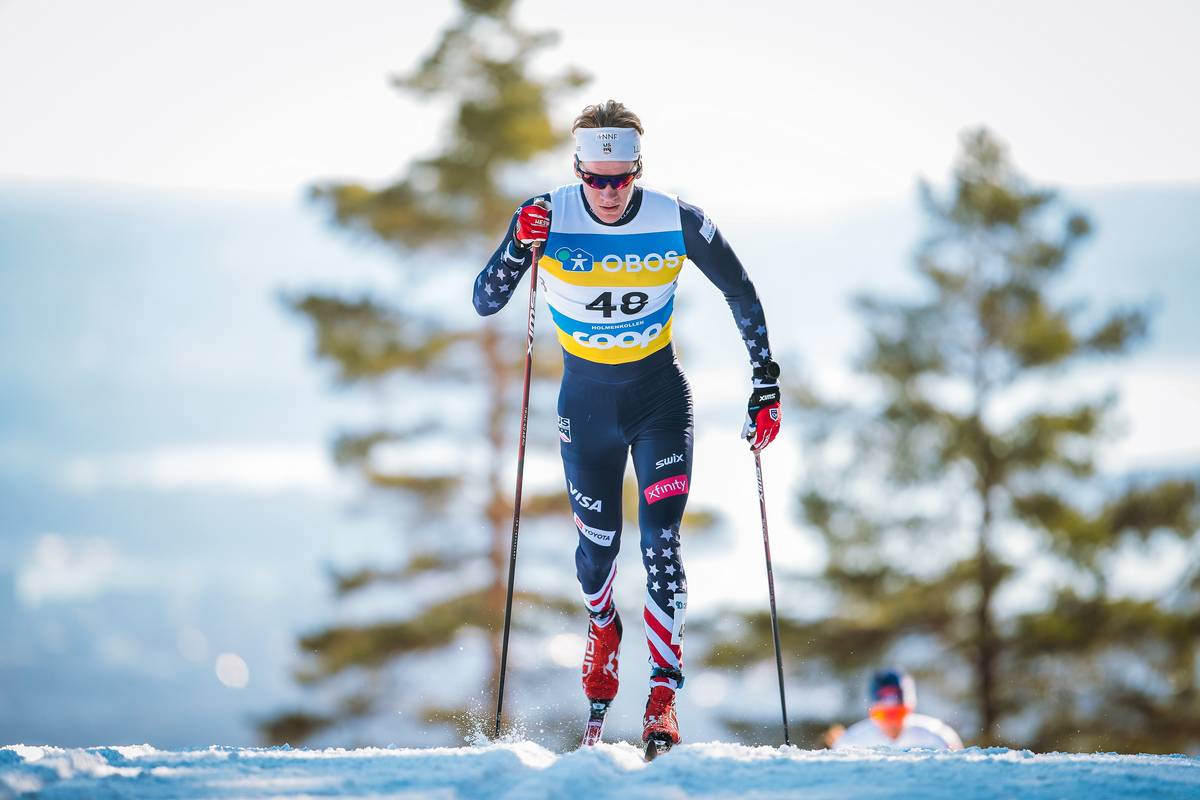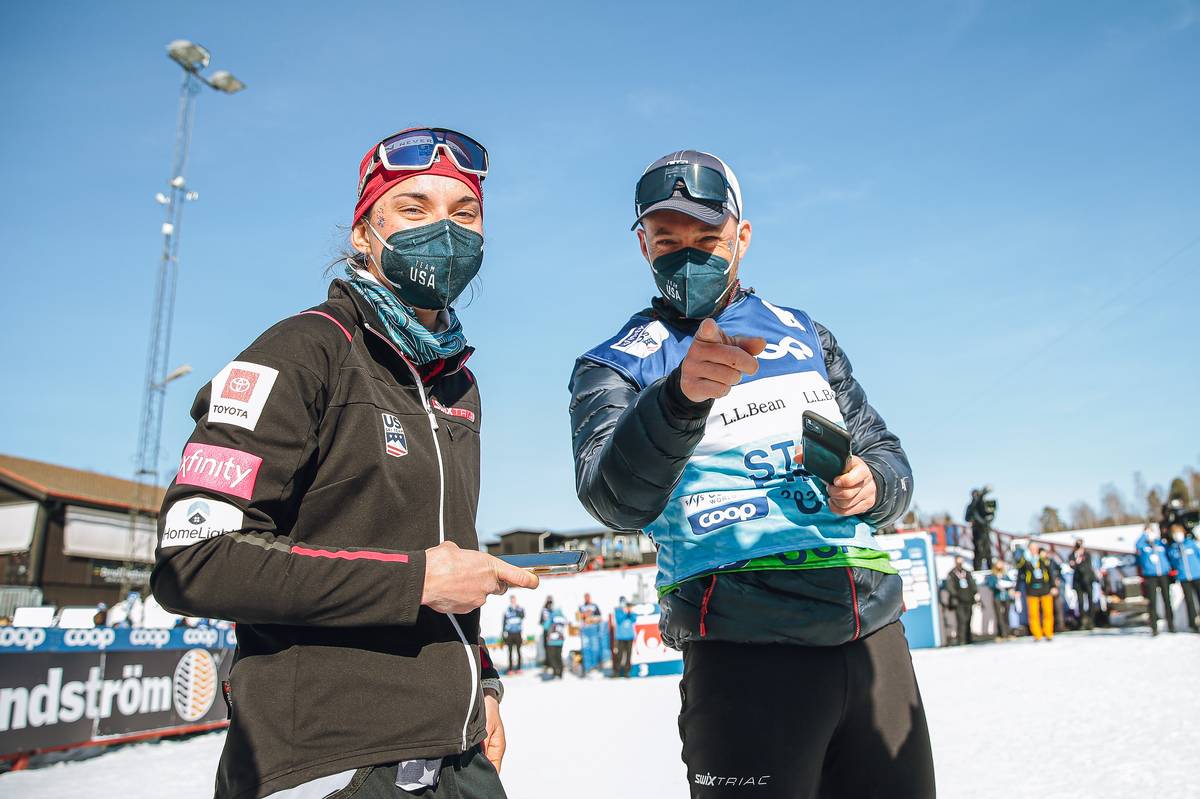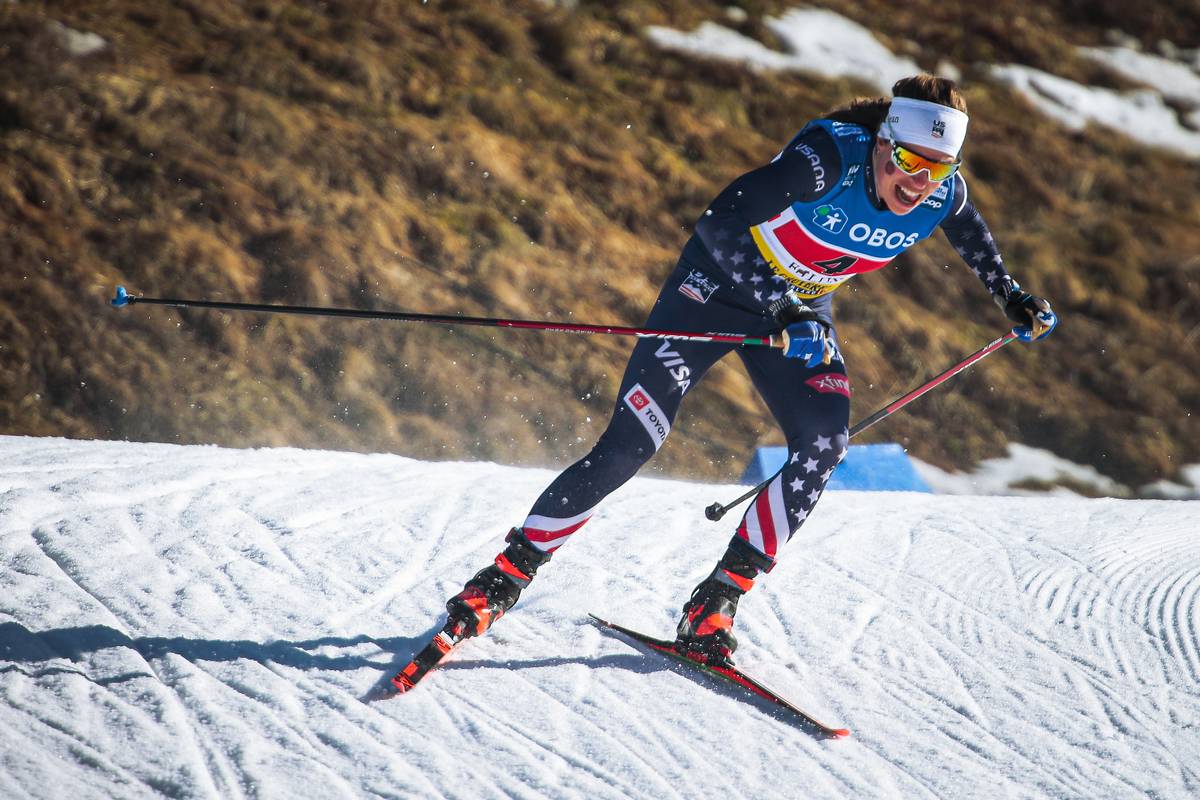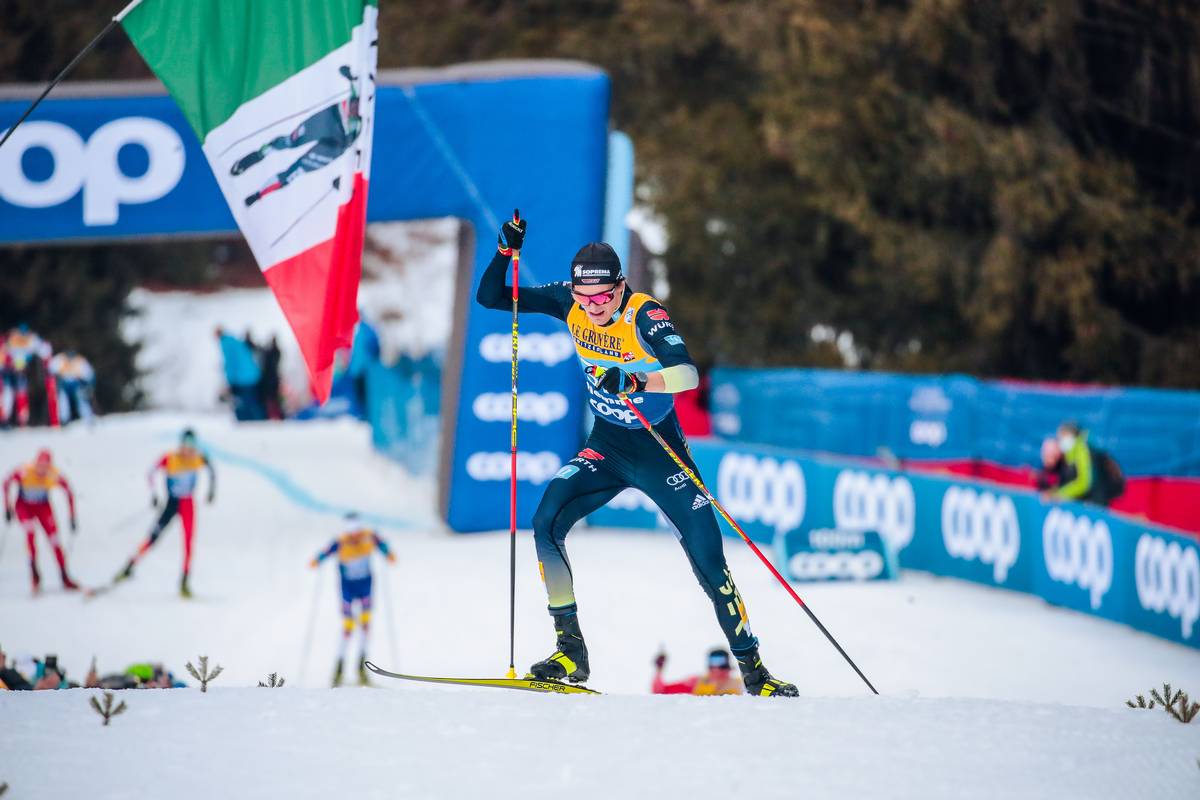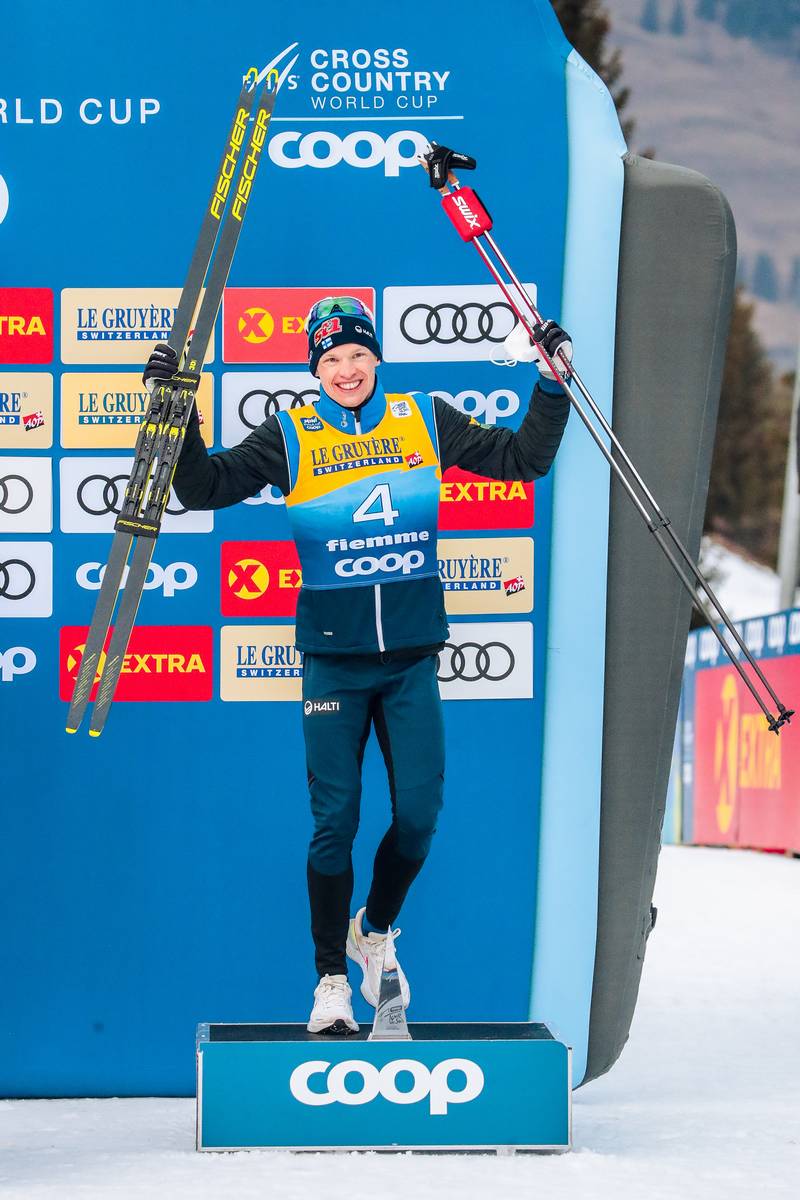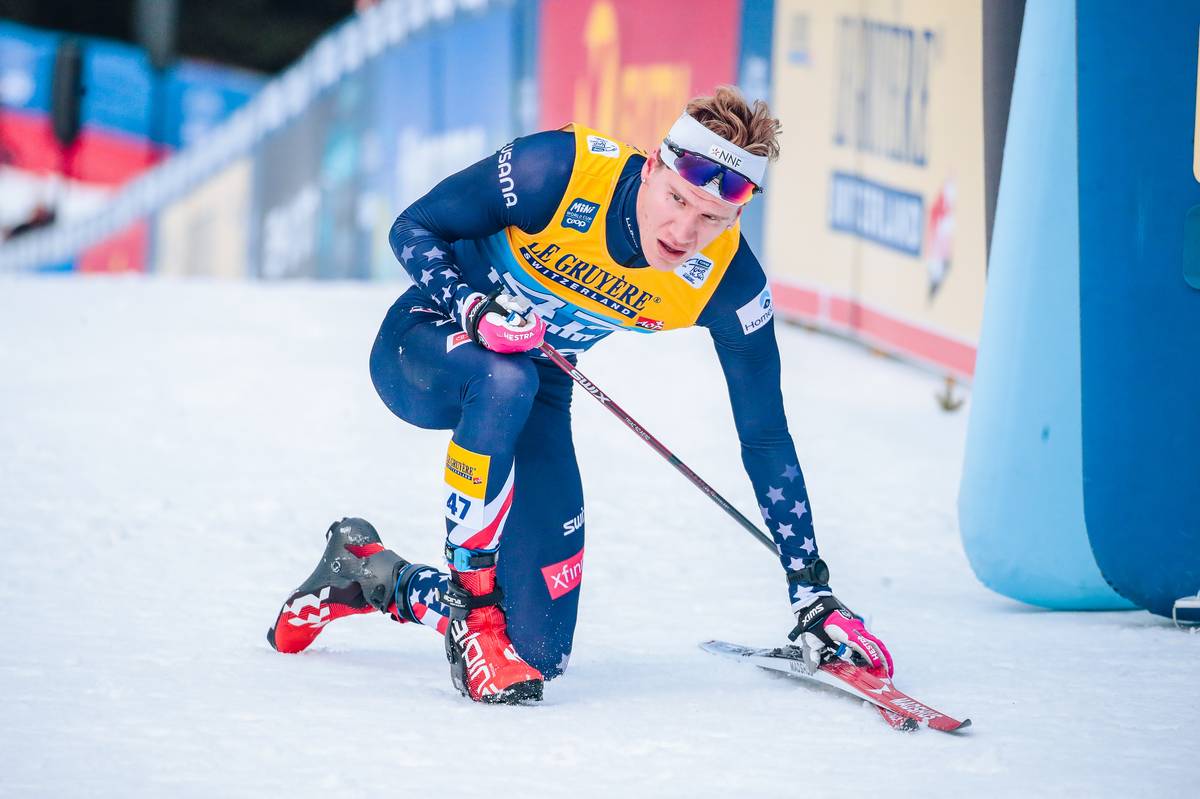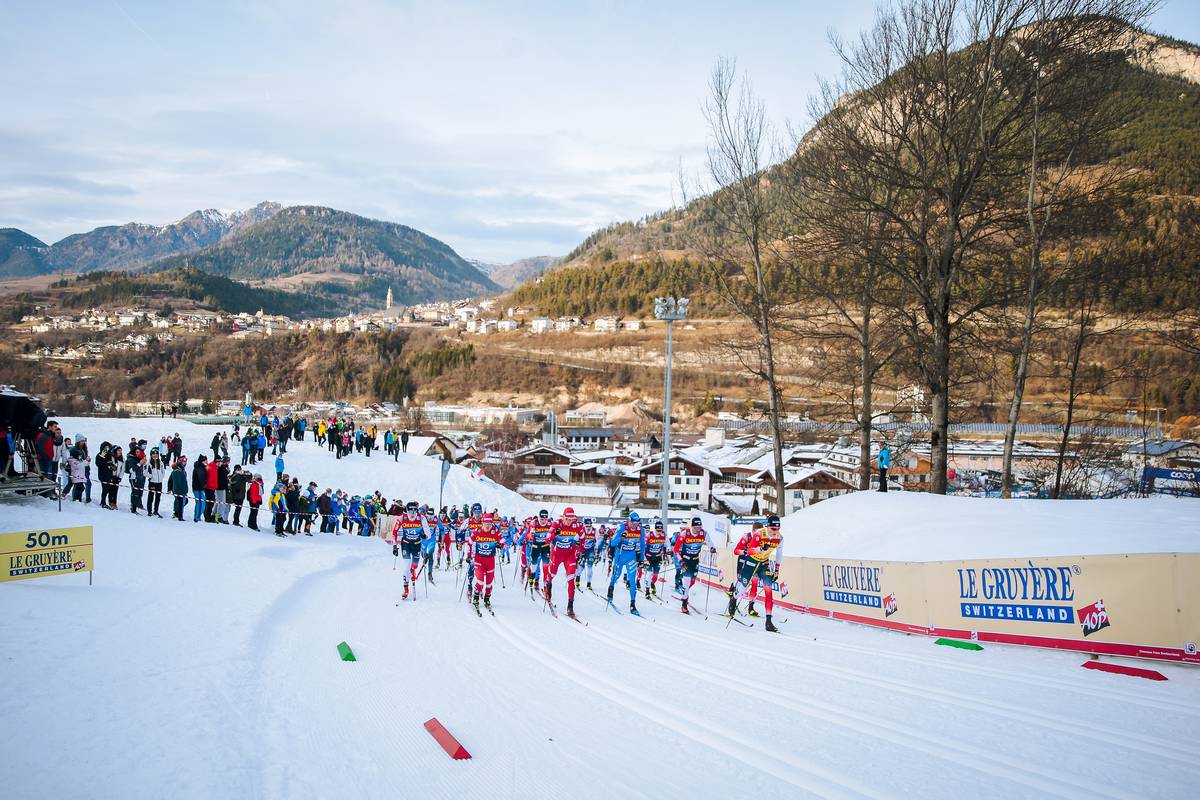

Tag: Zak Ketterson

  • World Champions Dominate Team Sprints as Crystal Globe Race Looms

    World Champions Dominate Team Sprints as Crystal Globe Race Looms

    This World Cup coverage is made possible through the generous support of Marty and Kathy Hall and A Hall Mark of Excellence Award. To learn more about A Hall Mark of Excellence Award, or to learn how you can support FasterSkier’s coverage, please contact info@fasterskier.com

    World Cup Finals began under overcast Finnish skies Friday, as the circuit looks to settle the questions of a long season over the next three days. Who was—and who wasn’t—racing in Friday’s non-World Cup point scoring event provided evidence that the Crystal Globes remain at the forefront of concerns this weekend.
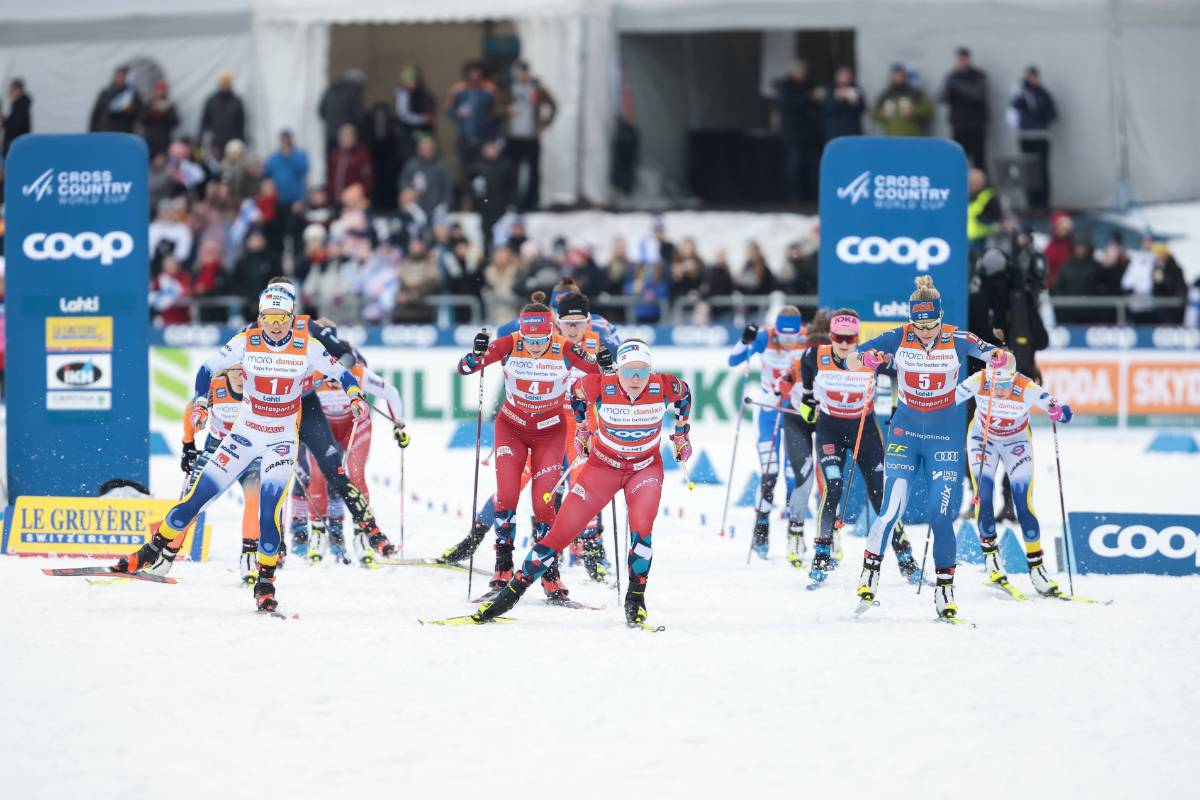
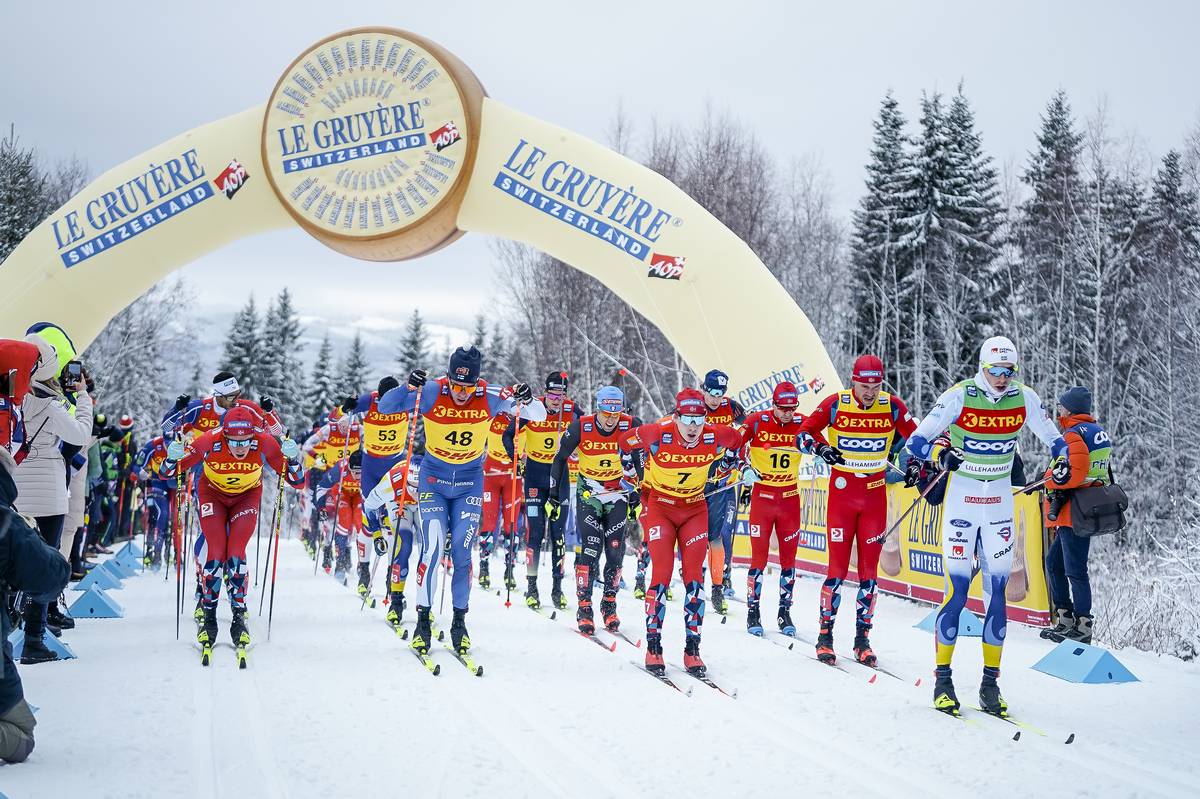
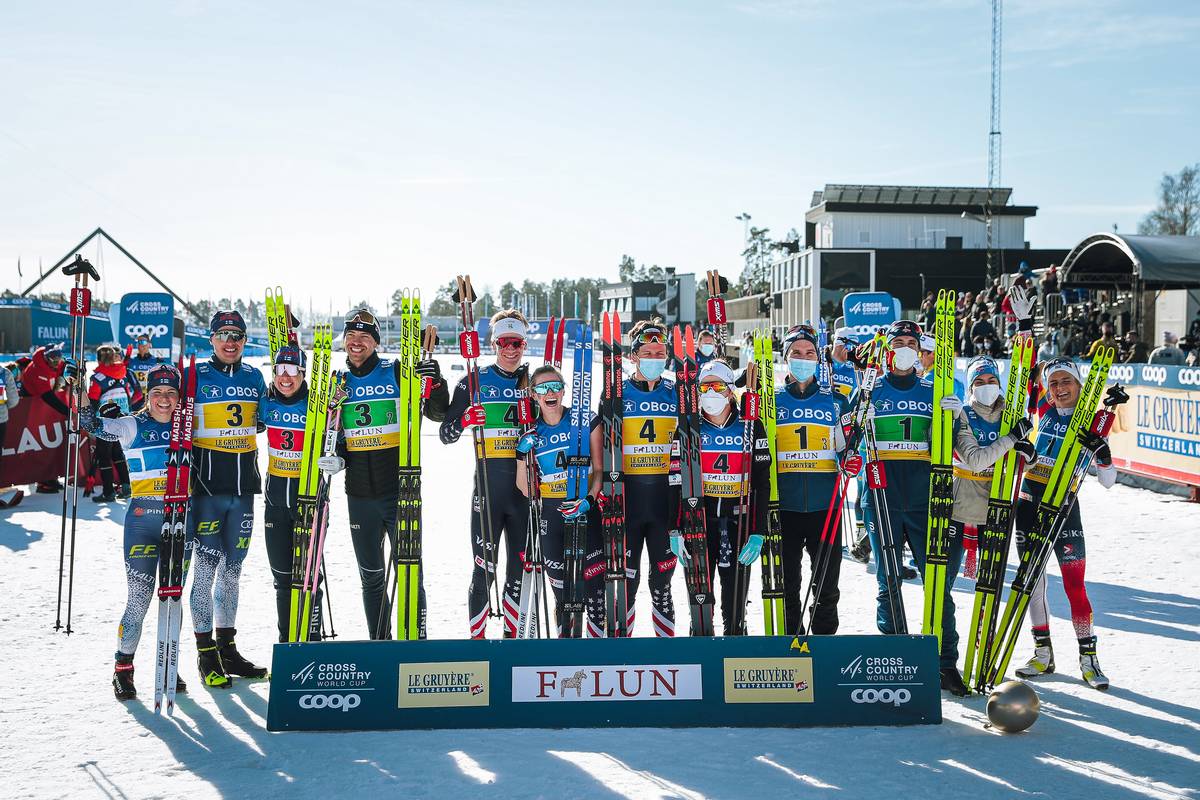
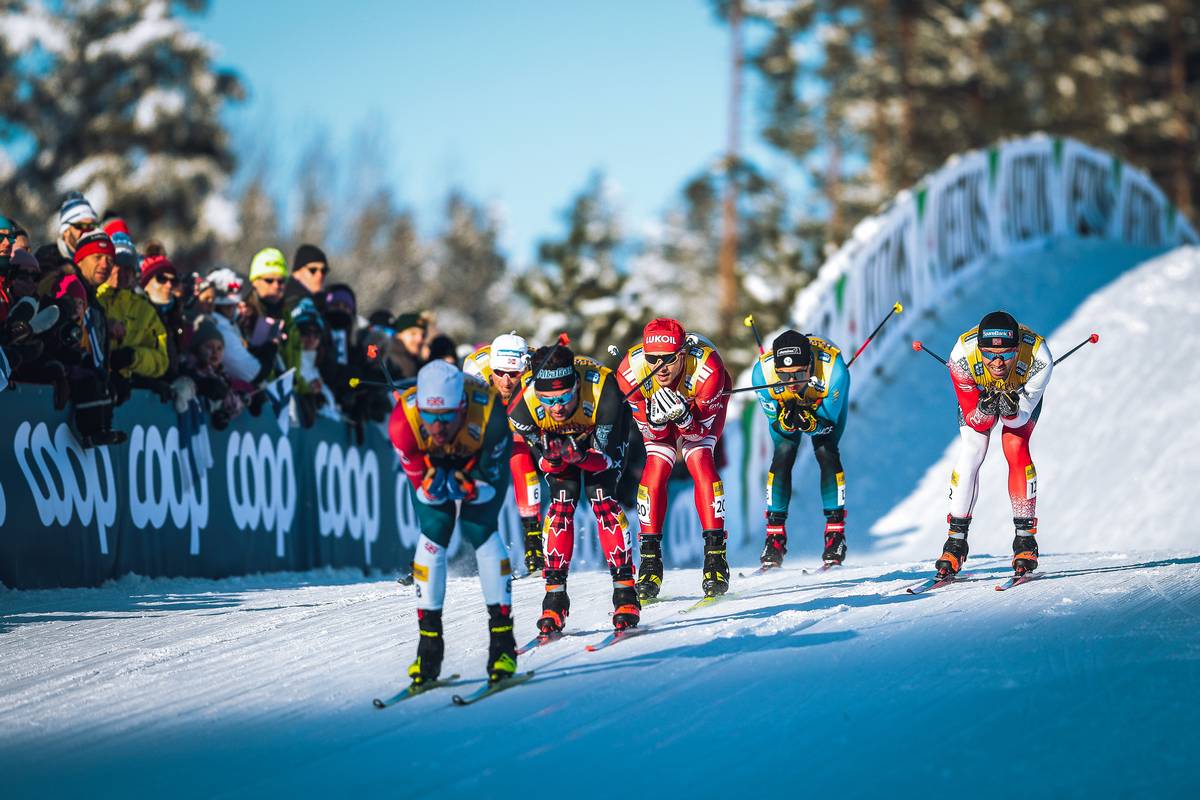
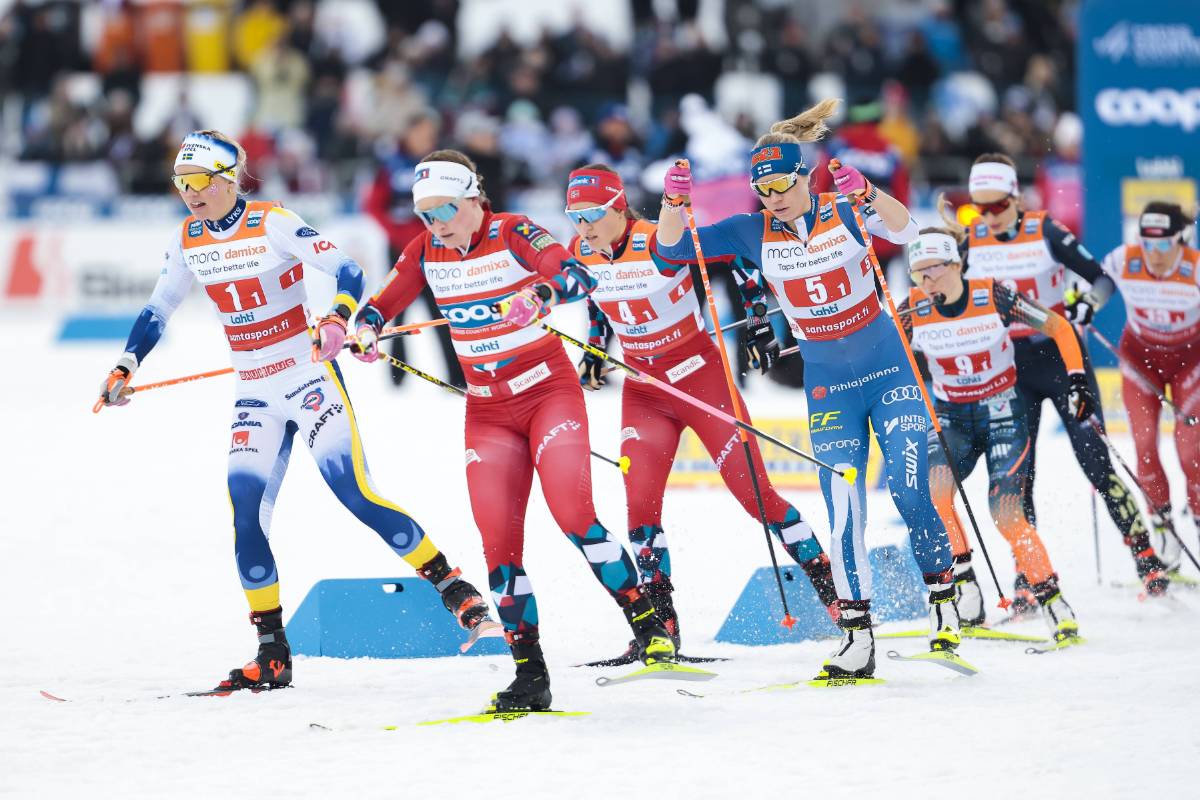
    The women’s Team Sprint as it began on Friday. Notable absences from top Crystal Globe contenders shaped the field Friday as World Cup Finals began in Lahti. (Photo: NordicFocus)

    With the Women’s Overall, Distance, and Sprint World Cup classifications all still undecided going into this weekend, Friday’s Team Sprint was absent any women standing within the top five of any of the World Cup classifications. The most notable absences drew attention straight to the top of the World Cup standings: Jessie Diggins (USA) sits second in both the Overall and Distance classifications, with 110 points separating her from Overall leader Tiril Udnes Weng (NOR), and just 22 points between her and Distance leader Kertuu Niskanen (FIN) ahead of Sunday’s 20 k classic. The gap is also 22 points in the Sprint classification between leader Nadine Faehndrich (SUI) and second place Maja Dahlqvist (SWE). The cascade of absences beyond the top two further revealed the closeness of the Women’s field. With points standings tight and the stakes for gaining an additional place or keeping one high, skiers like Rosie Brennan (USA), four points ahead of Heidi Weng (NOR) for fourth Overall, were absent. Julia Kern (USA) joined that list too, looking to hold onto a top five in the Sprint classification that she holds onto by just eight points over Laura Gimmler (GER).

    The Men’s Team Sprint field, meanwhile, was much more complete. Johannes Hoesflot Klaebo (NOR) holds an insurmountable 421 point lead over second place Paal Golberg (NOR) in the Overall. The same is true in the Sprint, where Klaebo holds a 254 point gap over Lucas Chavanat (FRA). The only Men’s Classification still technically unsettled is the Distance, where Paal Golberg’s 112 point lead on Klaebo would technically be passable if Klaebo were to win Sunday, win intermediate bonuses, and not have Golberg score any points (which appears unlikely). Further down the Men’s field, the majority of points gaps are larger, which played into Federico Pellegrino (ITA), Lucas Chanavat (FRA), Edvin Anger (SWE), and Richard Jouve (FRA) all being present in the field today. There were other who sat out this team event: notably, Ben Ogden (USA) who is pursuing the best American Men’s World Cup Overall finish since Bill Koch in the 1980s, sitting less than 20 points behind Calle Halfvarsson in seventh Overall.

    Women’s Team Sprint

    For all the absences from the Women’s field Friday, the defending World Champions in the Team Sprint—the Sweden I team of Emma Ribom and Jonna Sundling—still made it to the start line. Sweden I made it a good race, and a creative one too. “We wanted to have fun, to make it a more tactical race,” Sundling said to FIS media after the race was over.
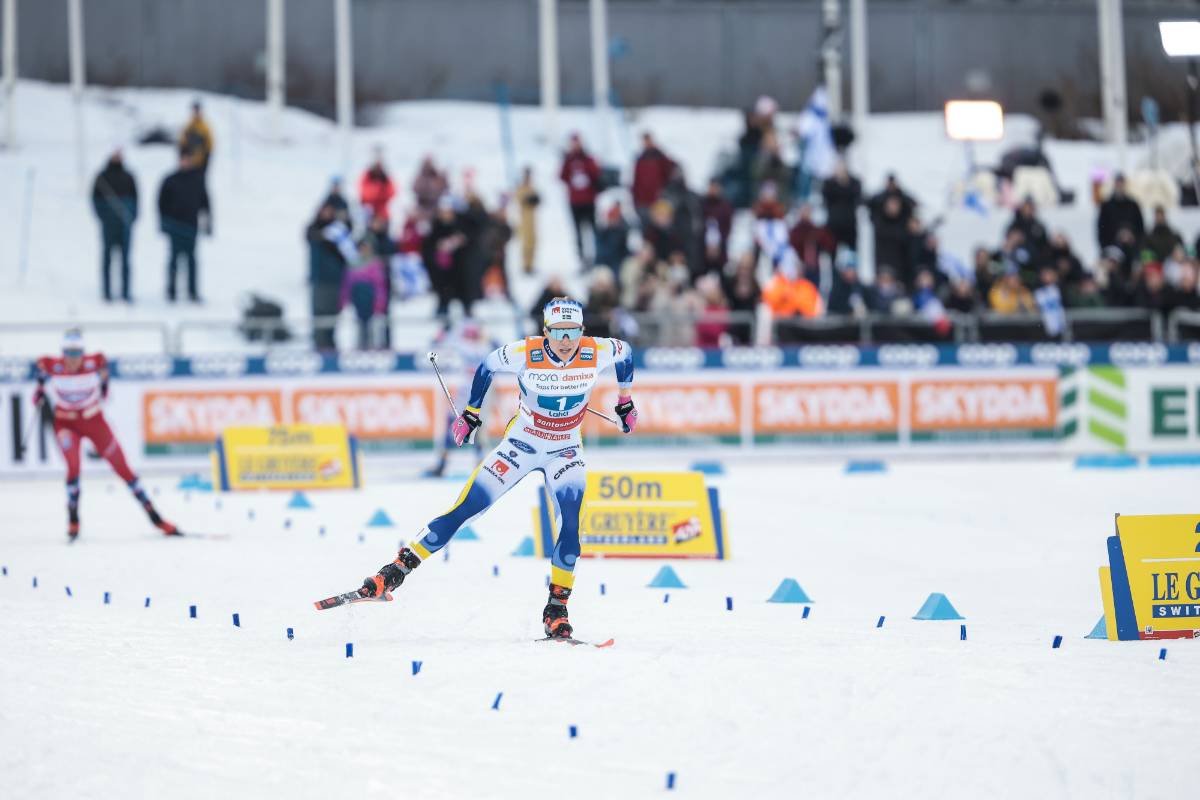
    Jonna Sundling made a clean finishing move to bring Sweden I—reigning World Champions—the win in Lahti, Finland. (Photo: NordicFocus)

    As to how that plan played out, Ribom and Sundling took turns dutifully marking the Norway I team of Julie Myhre and Anne Kjersti Kalvaa at the front of the race. When they reached the final climb on the Lahti course, Sundling simply hop-skated away to victory. It was a crisper, cleaner, version of the tactic that she had used in Planica to win the Team Sprint World Championship, and of the one she made in Drammen to win Falun’s 4 x 5 k Mixed Relay for Sweden last weekend

    Behind Sundling’s move, late-race heroics were making for a thrilling finish. The lead pack through most of the race had included the Sweden I team alongside Norway I and the Finland I team of Jasmi Joensuu and Jasmin Kahara. A move from Joensuu in her last leg had created a clean break for the trio of teams; through most of the last lap, Kahara looked like she would hold the separation between her and the chase group. When Sundling went, Anne Kjersti Kalvaa (NOR) was able to stick with her just long enough to win Norway I second place. Behind her, though, two German teams had started to chase down Kahara. As the Finn entered the stadium, Coletta Rydzek for Germany I and Sofie Krehl for Germany II were skiing in tandem, and skiing their way back up to the Finn. The race for third went to the line. Three lunges produced a result that saw Rydzek come across the finish in third place, while Finland I took fourth in a photo finish over fifth place Germany II.

    Men’s Team Sprint

    The Norwegian World Championship Team may have lacked Paal Golberg on Friday, but Erik Valnes would prove to serve as a worthy replacement to pair with Johannes Hoesflot Klaebo for Norway I. With the Italian World Championship runner-up team of Francesco De Fabiani and Federico Pellegrino also present, the Men’s race held promise for a close front-of-pack race, mixed with a field hungry to challenge the prevailing order among Team Sprint powers.
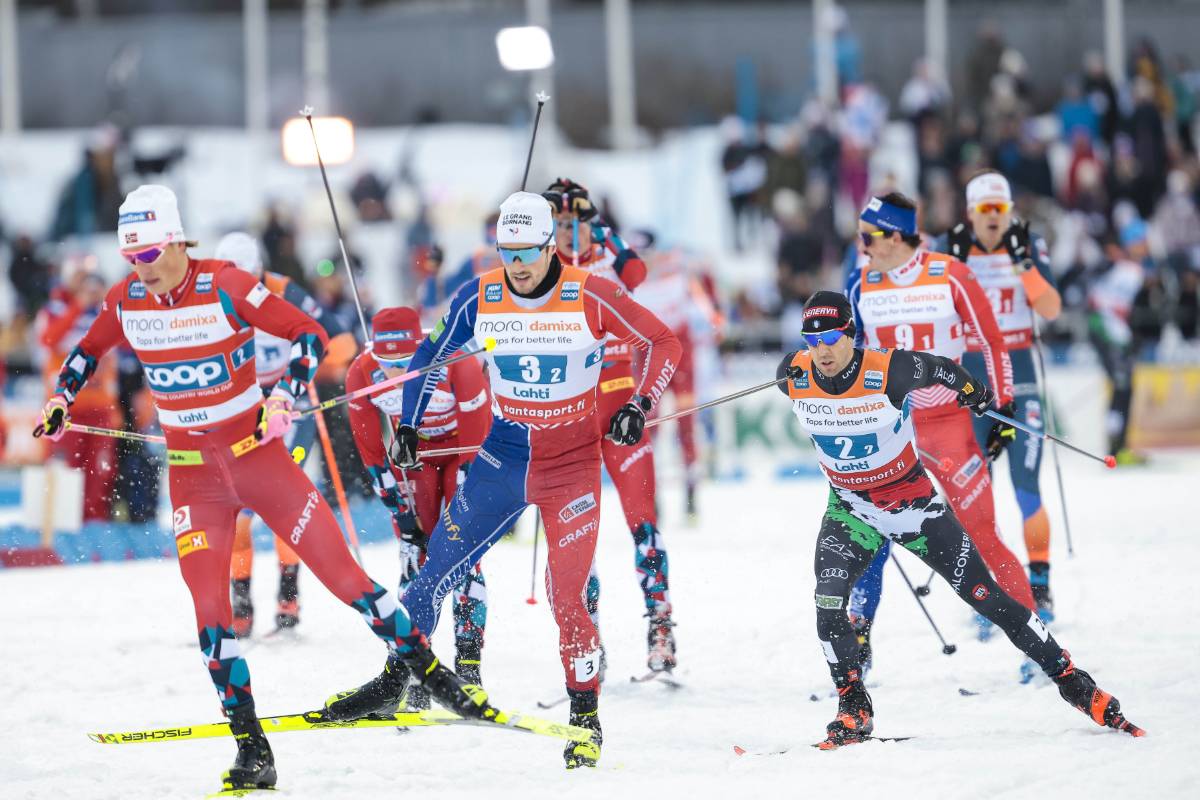
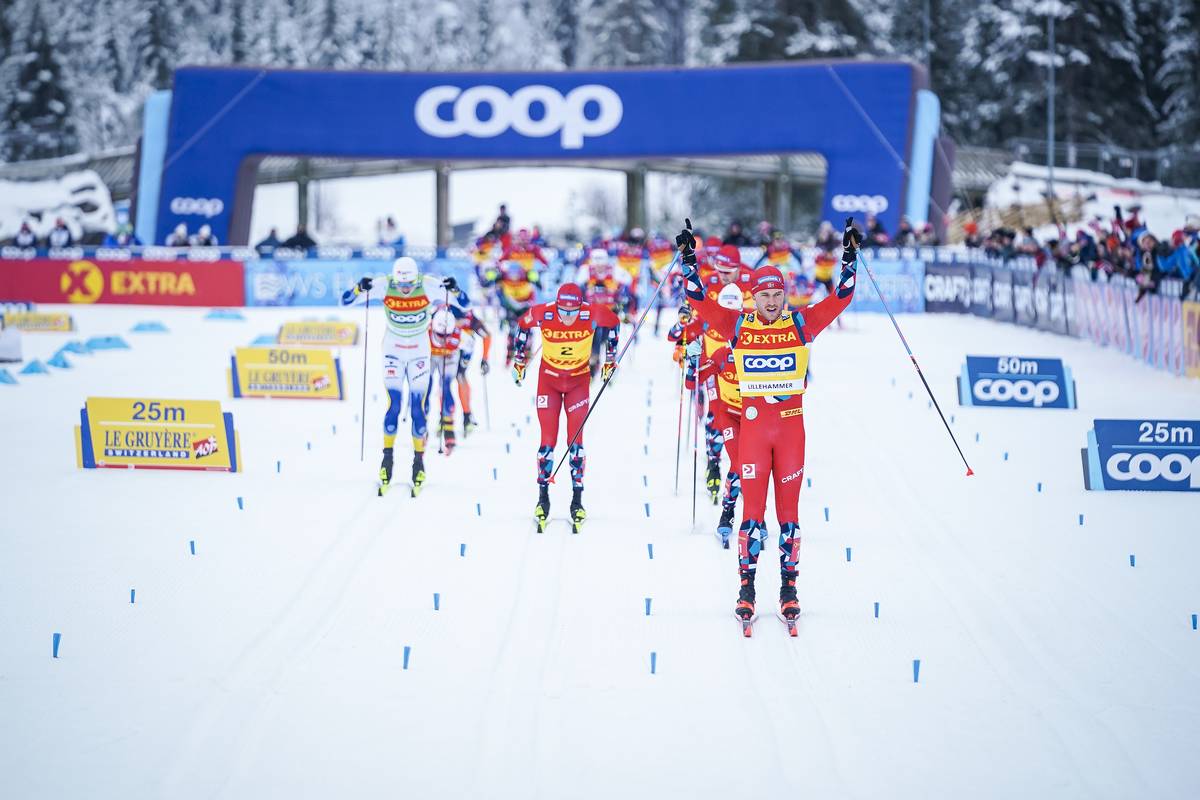
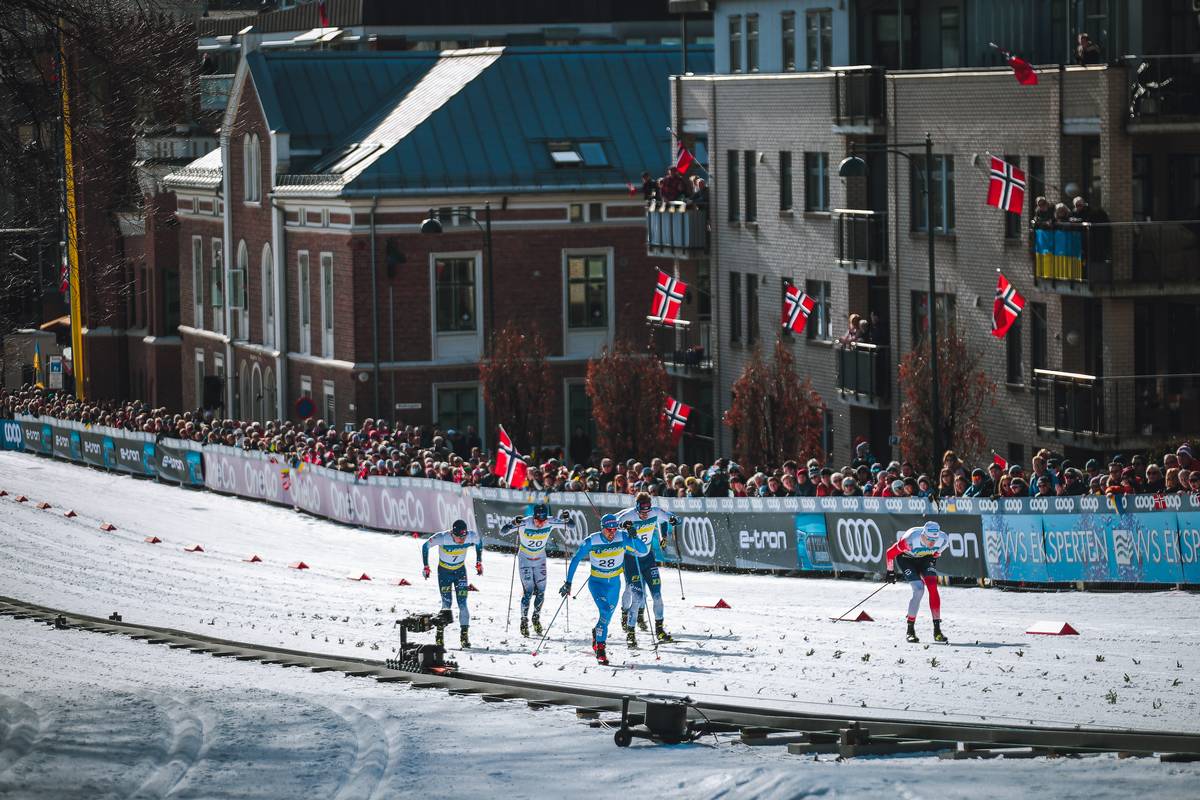
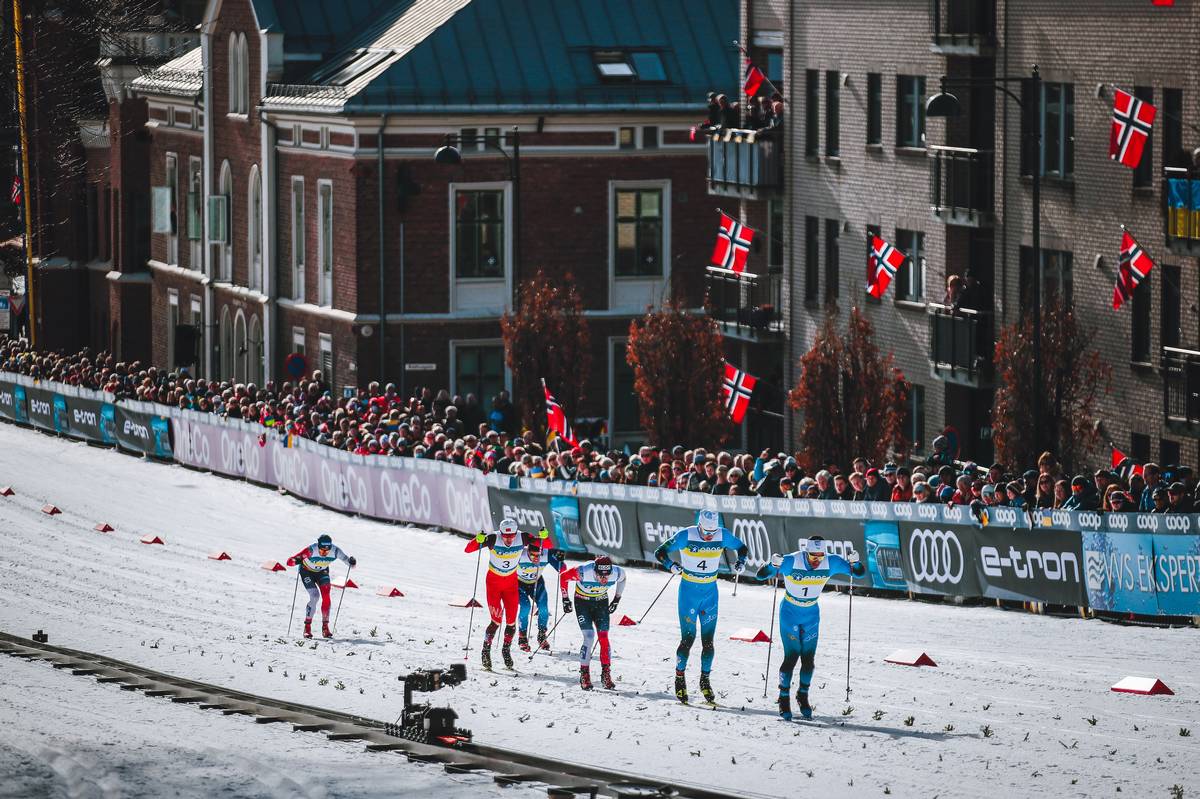
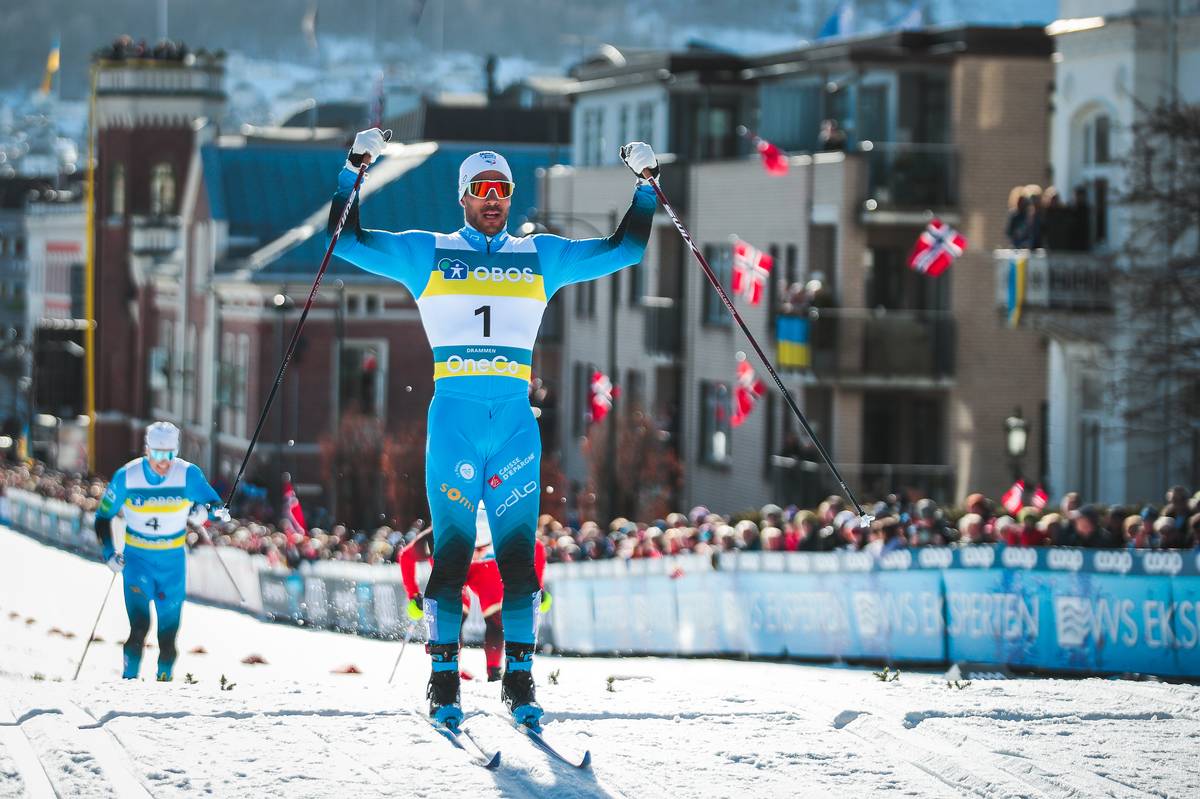
    The men’s field remained tight until Johannes Hoesflot Klaebo moved to bring Norway I the win with Italy I in tow. (Photo: NordicFocus)

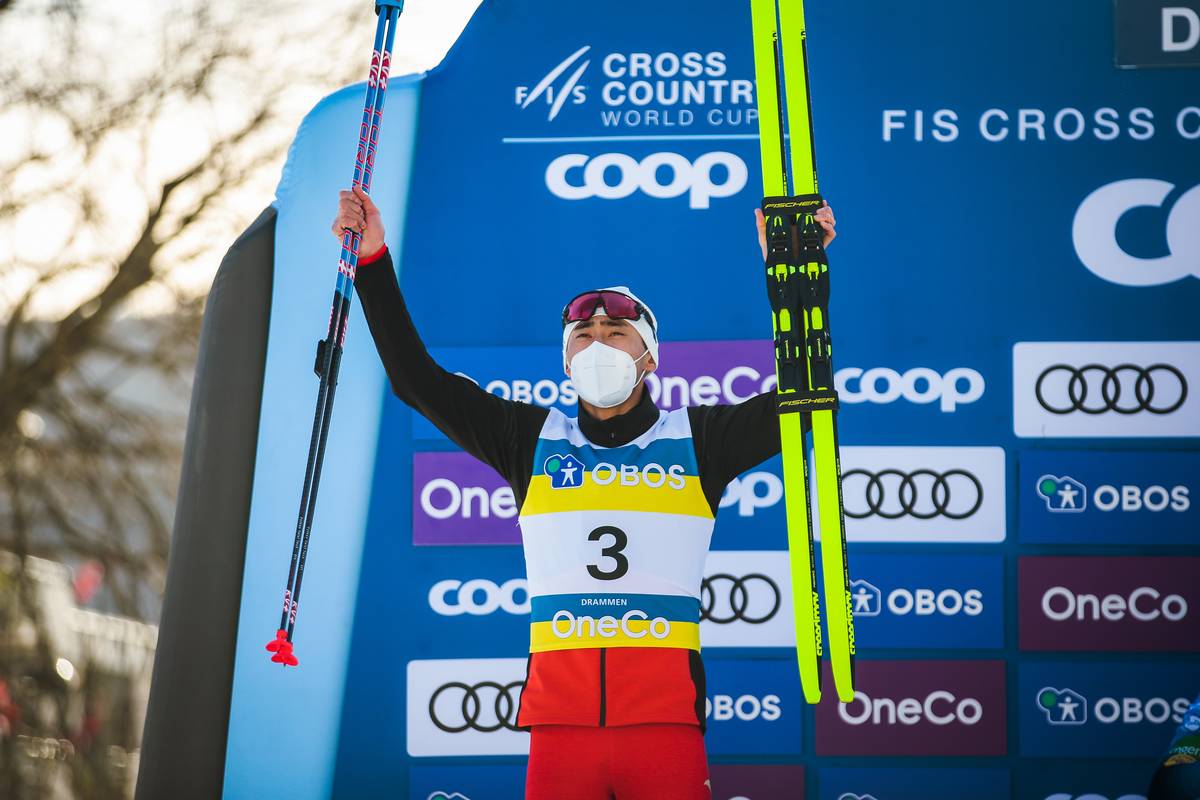
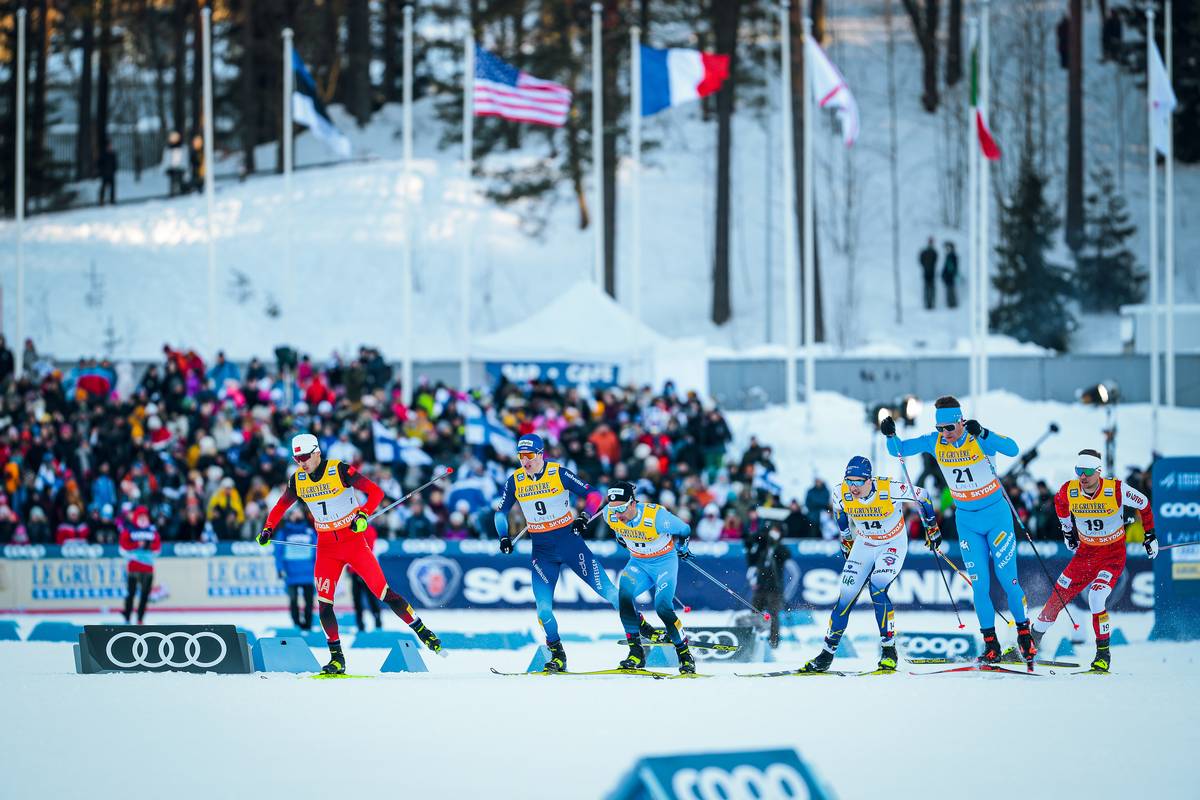
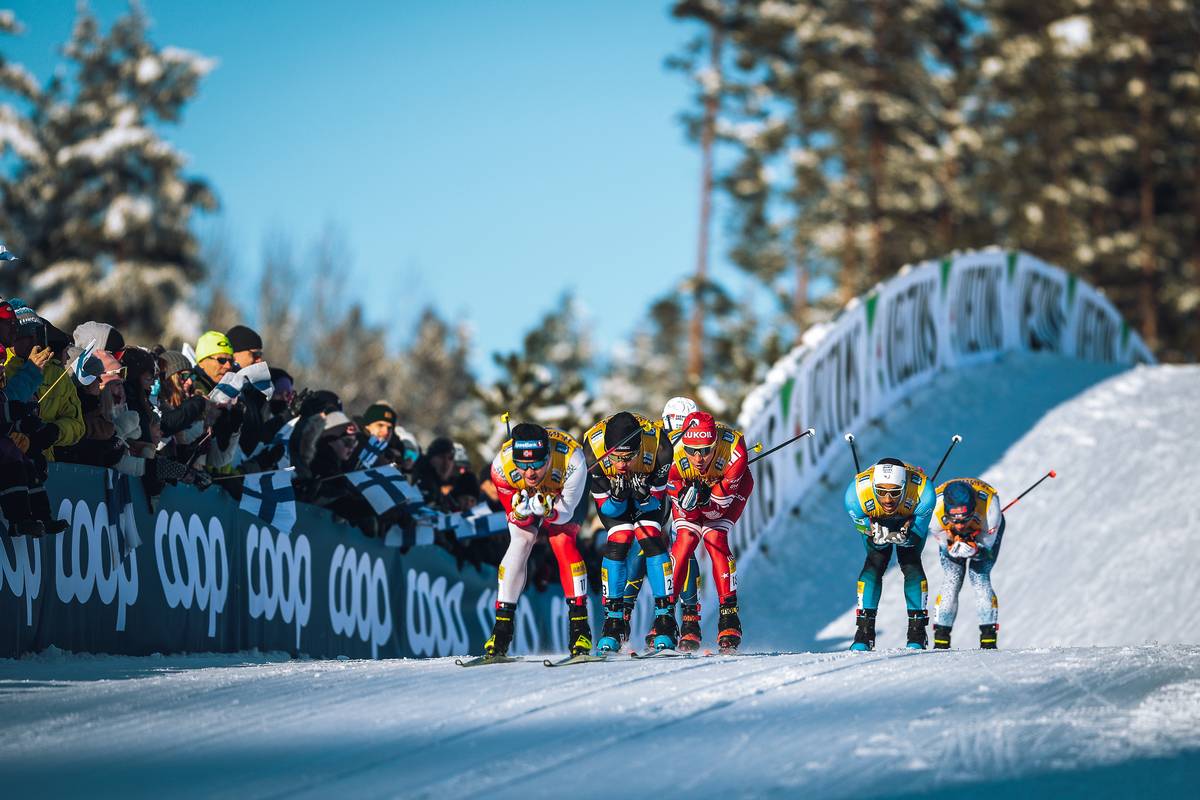
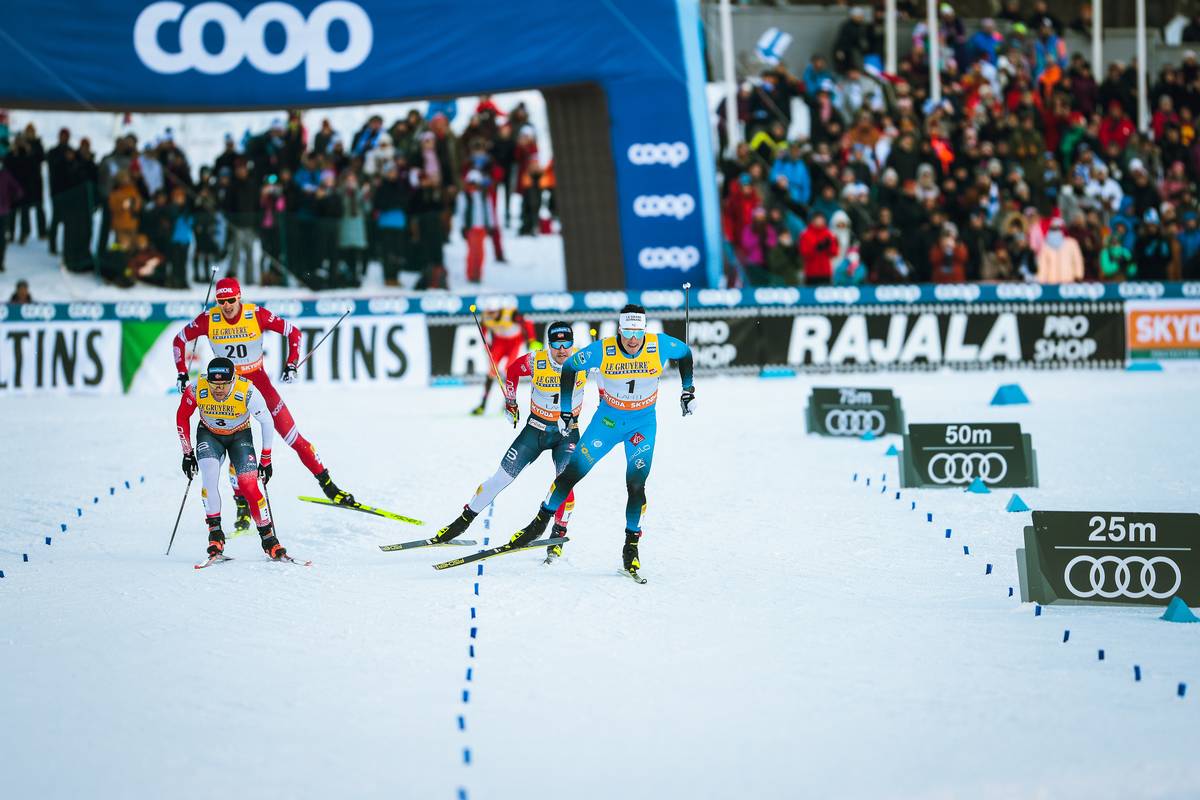
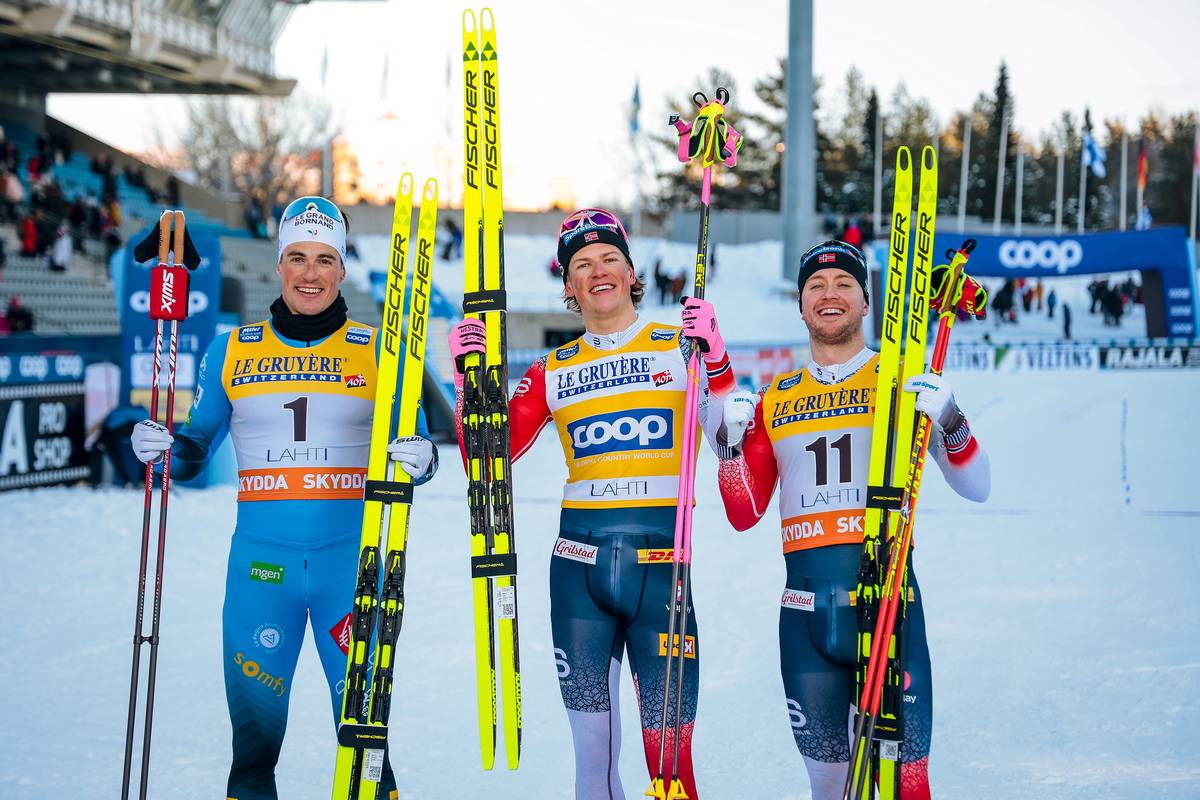
    That dynamic was on display through each of the early laps, as Federico Pellegrino and Johannes Hoesflot Klaebo danced around each other in the early part of the course, and a whole pack of teams filed in to try and keep with the two. In the final lap, Pellegrino looked for an opportunity to entice Klaebo into a long-burning attack; it’s no secret that leaving a sprint finish meant facing Klaebo’s finishing kick that none were likely to match. Klaebo, though, responded as he has throughout the season to this tactic, ticking his pace up just enough to keep the pack close, and then forcing the pack back to stasis. Four challenging teams made it to the last climb: Sweden I with Edvin Anger, Norway II with Sindre Bjoernestad Skar, France II with Richard Jouve, and Germany with Jan Stoelben. Then, Klaebo went, and Pellegrino followed. The pair had a gap into the stadium, and the prevailing order of the Team Sprint had held. Klaebo crossed the line to win for Norway I, Pellegrino crossed to take runner-up for Italy I, and Skar won a two-way sprint over Anger to take Norway II to third.

    Americans, Mix, Match, and Push Team Event

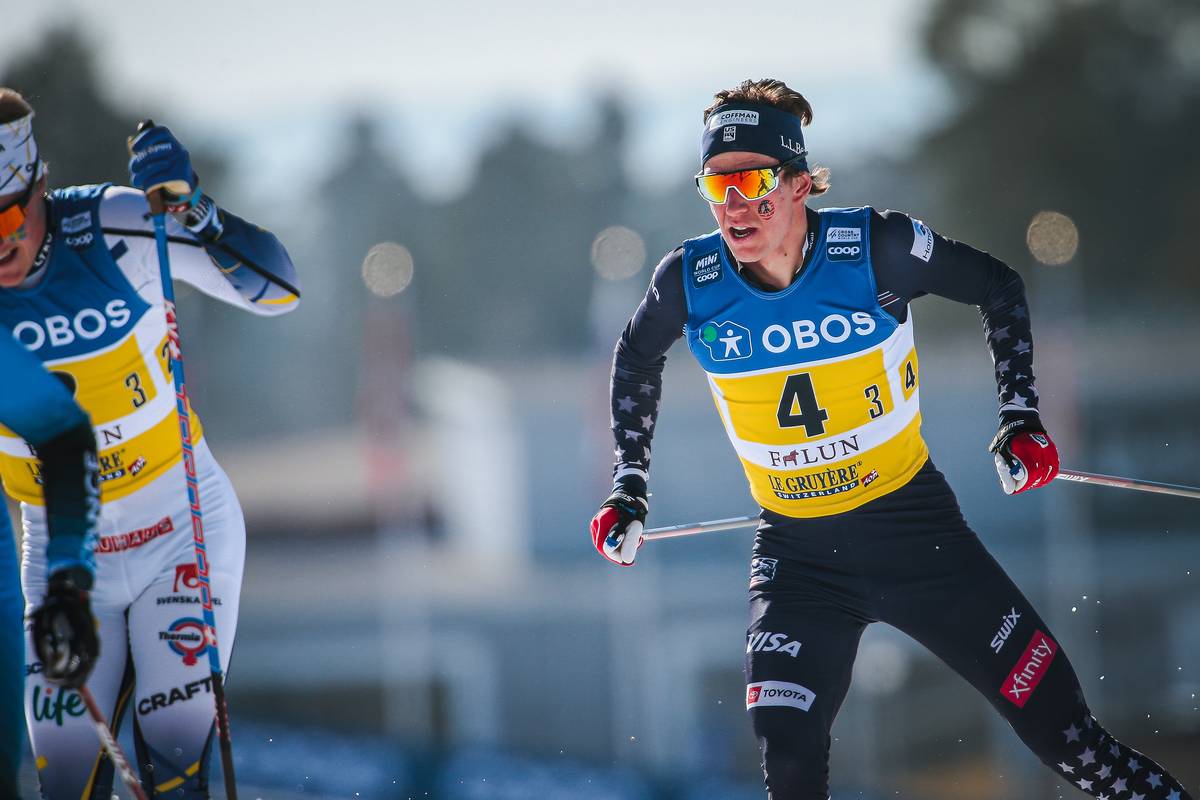
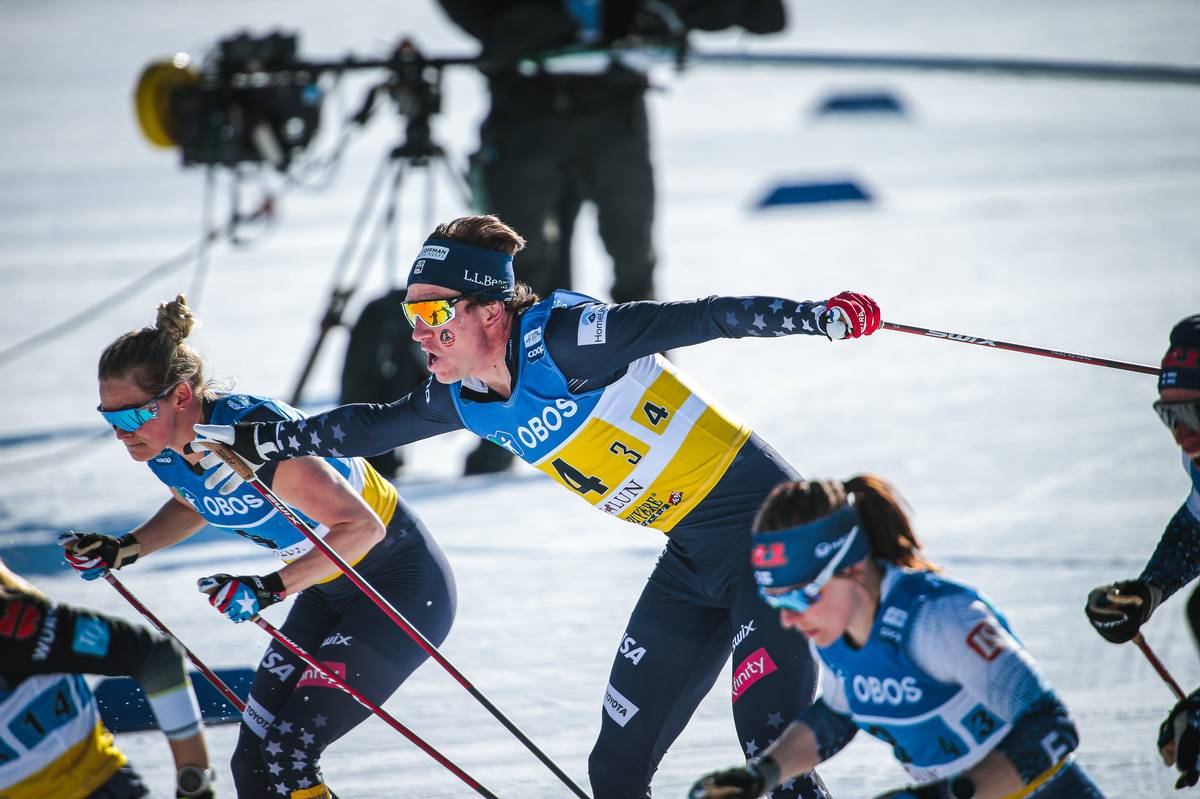
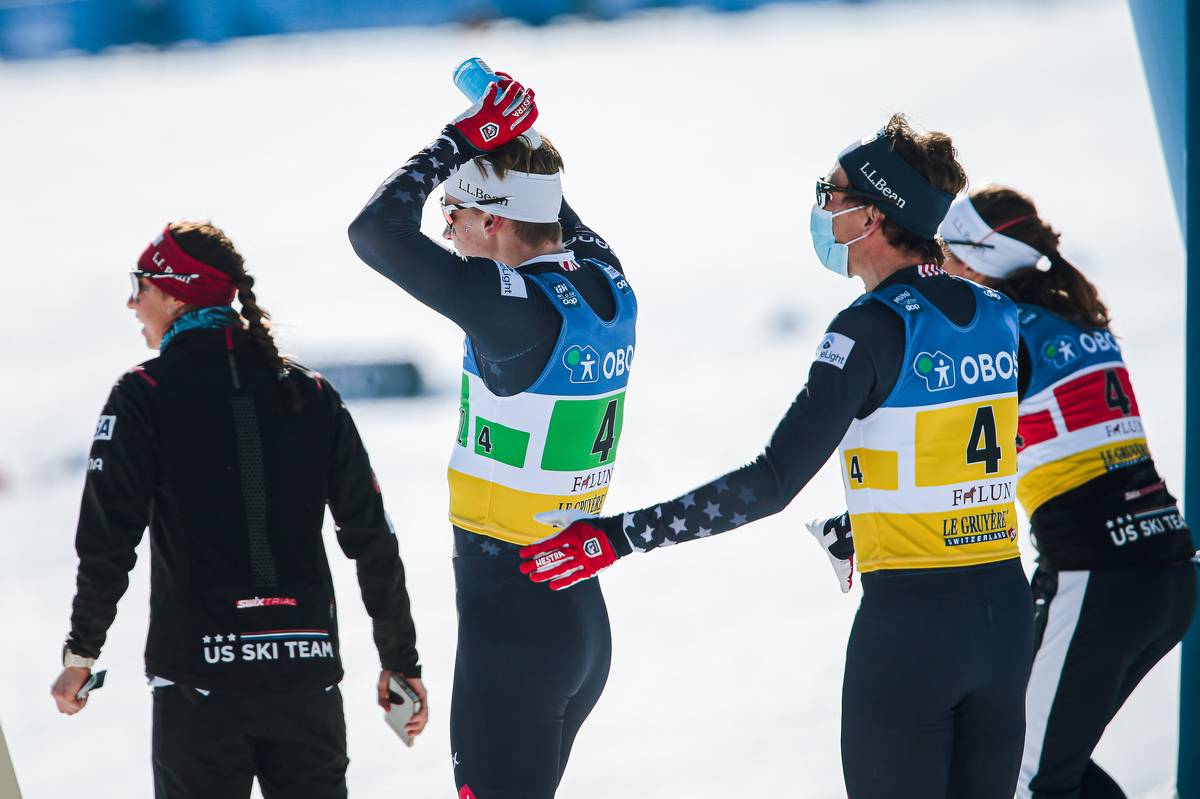
    Two American teams qualified for the Team Sprint finals. The USA I team for the Women featured the World Cup relay debut of Sammy Smith, who has qualified for heats in successive sprints in Drammen and Falun. Smith paired with Hailey Swirbul, who has become a relay mainstay for the US. “[I love] the energy of team events,” Swirbul said after last week’s Falun relay. “It really emphasizes how ski racing involves much more than only an individual to make a great day happen.”
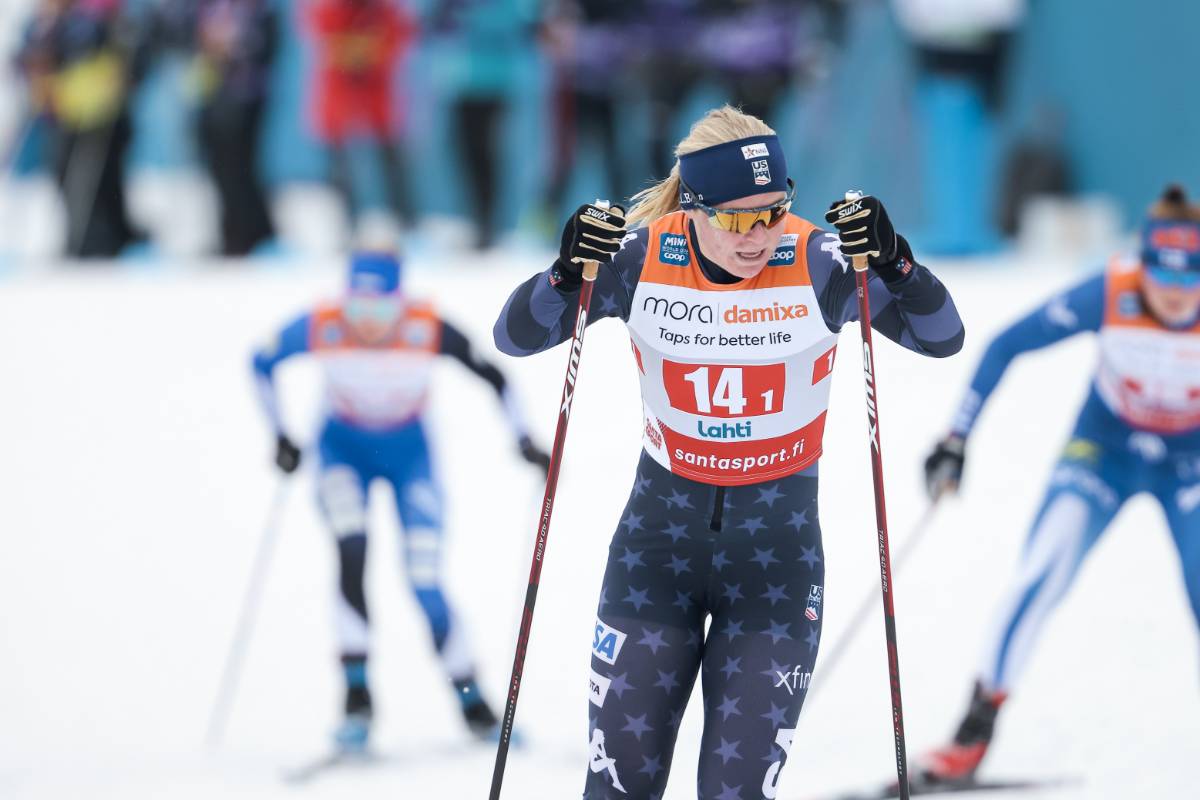
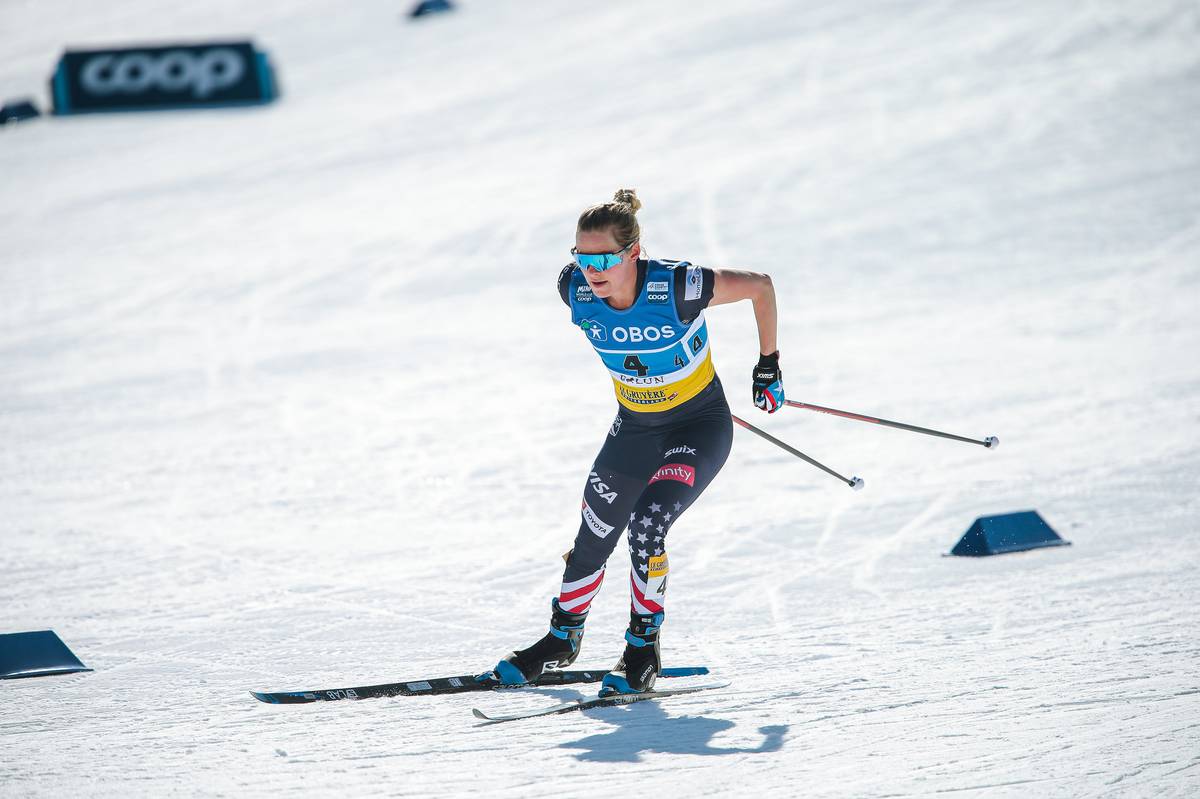
    Sammy Smith and Hailey Swirbul pushed all the way through Friday’s Team Sprint, landing the young USA I lineup in 11th place. (Photo: NordicFocus)

    Smith and Swirbul traded off skiing well within the relay pack early in Friday’s race. As the pack strung out through lap three, Smith slipped to 15th place as she handed to Swirbul for lap four. By the end, the pair had made a resurgent push to finish 11th place on the day, delivering an auspicious effort for the young Americans in a team event.

    “I really enjoyed getting to race with Sammy, and be in a more low pressure team event situation,” said Hailey Swirbul post-race. “It was a really cool way to build experience for Sammy and myself, and she skied really well today.”

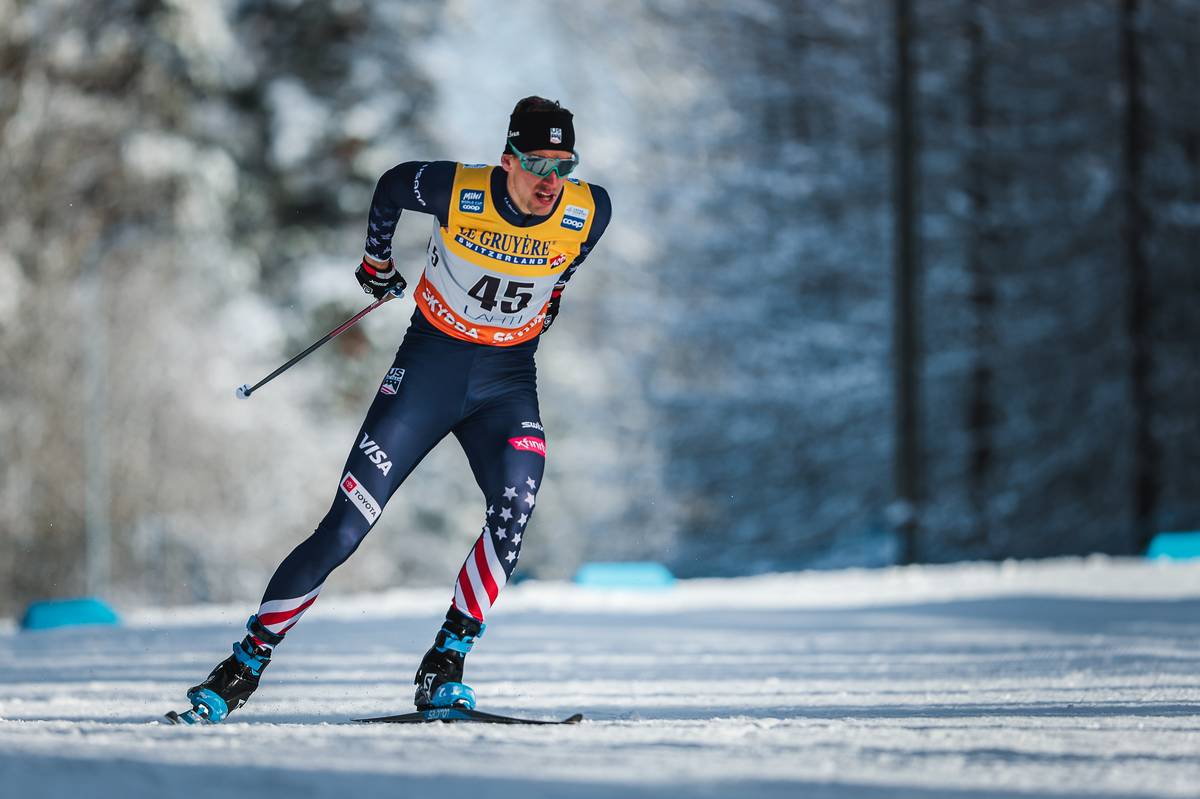
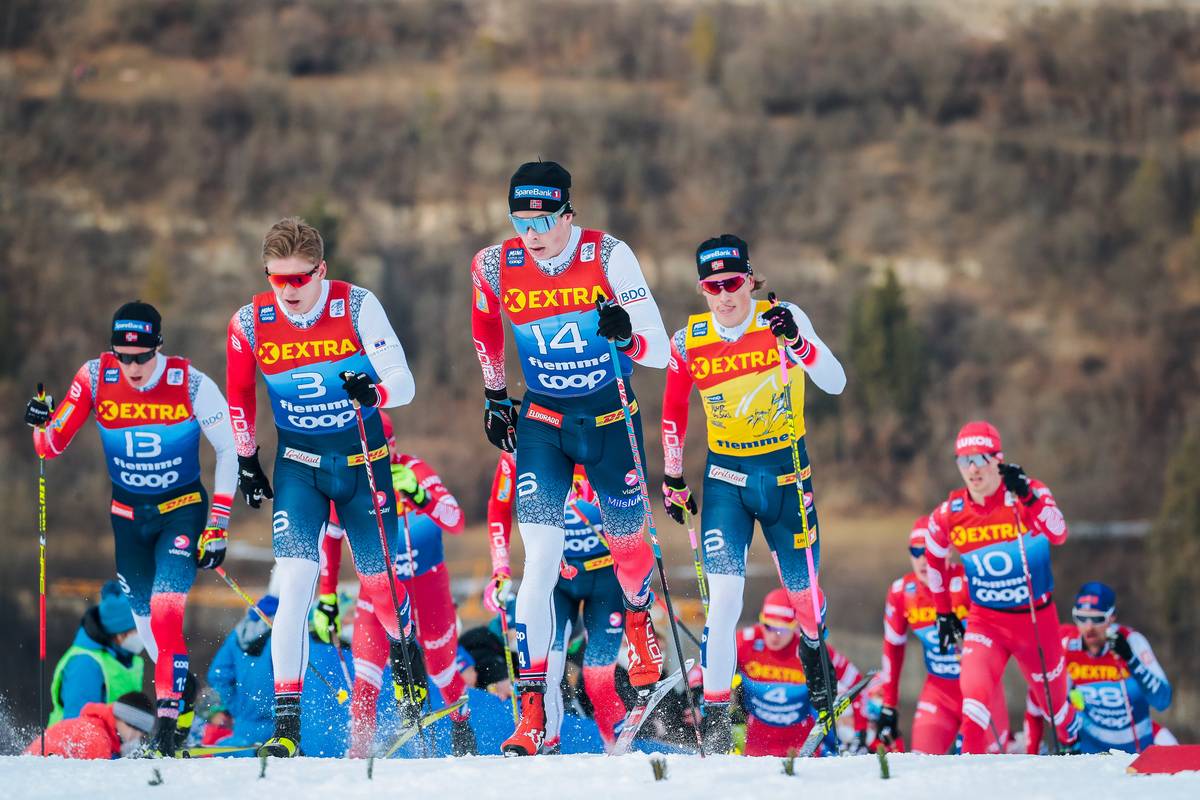
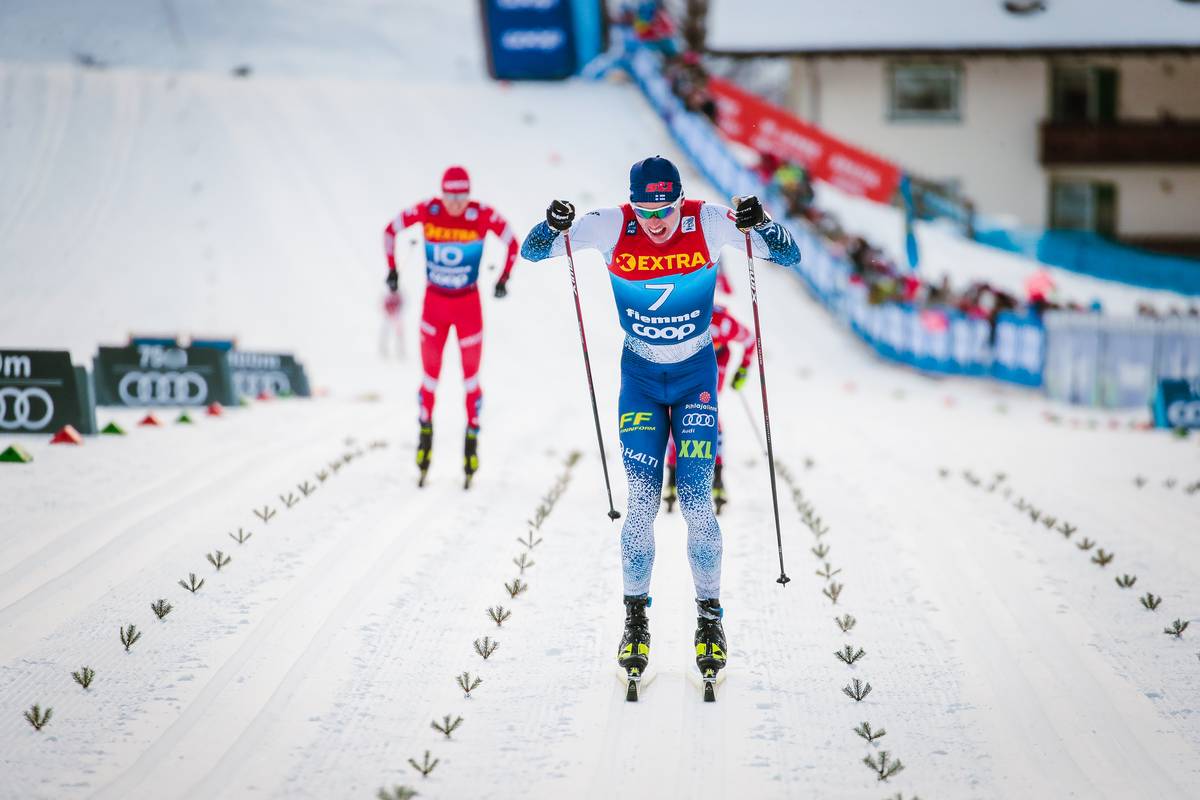
    The pairing of Zak Ketterson and JC Schoonmaker held in the tight men’s race through their first couple of exchanges, before pace increases at the front led to a falling off. The pair pushed on to take 13th place on the day.

    “Zak and I were pretty excited to just be able to ski with the pack and make decisions on the fly,” said Schoonmaker in post-race comments. “That’s some of the most fun you can have in ski racing. I definitely wish I could have hung in the main pack longer than I did because Zak was skiing super well, but we did what we could.”

    Schoonmaker added that this year’s team events have come with added joy for the men’s team. “It’s been really cool to get to race with some different guys this winter,” he said. “We have a strong men’s team right now so being partnered with any of those guys is an honor.”

    Sprint Classification Settled Tomorrow

    World Cup Finals continues tomorrow in Lahti, as a classic sprint is set to decide the winner of the Nadine Faehndrich-Maja Dahlqvist Sprint Crystal Globe race in the Women’s field. On the Men’s side, a final act is being planned for the dominant Sprint campaign of Johannes Hoesflot Klaebo. 

    Meanwhile, Jessie Diggins (USA) will begin her final, two-day push to reel back the Overall Crystal Globe, looking to best Tiril Udnes Weng NOR) with her finish tomorrow and net valuable World Cup points.

    Full Women’s Team Sprint RESULTS

    Full Men’s Team Sprint RESULTS
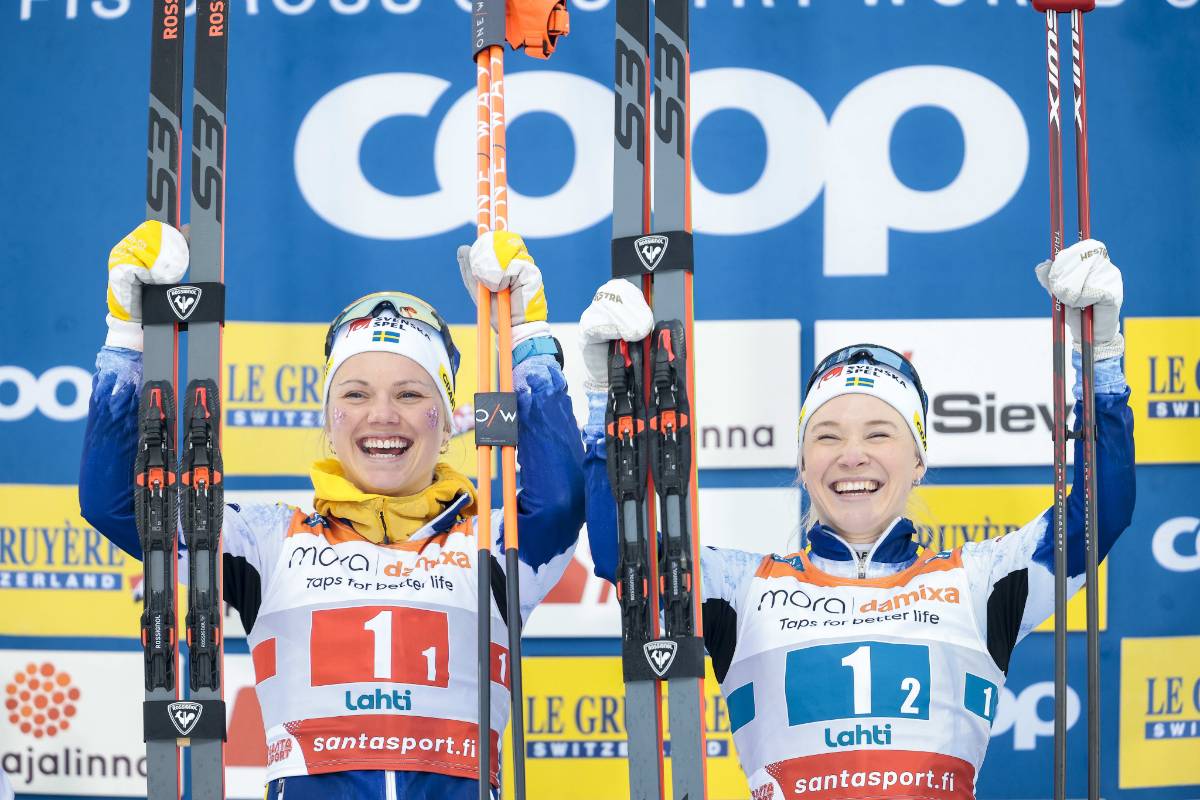
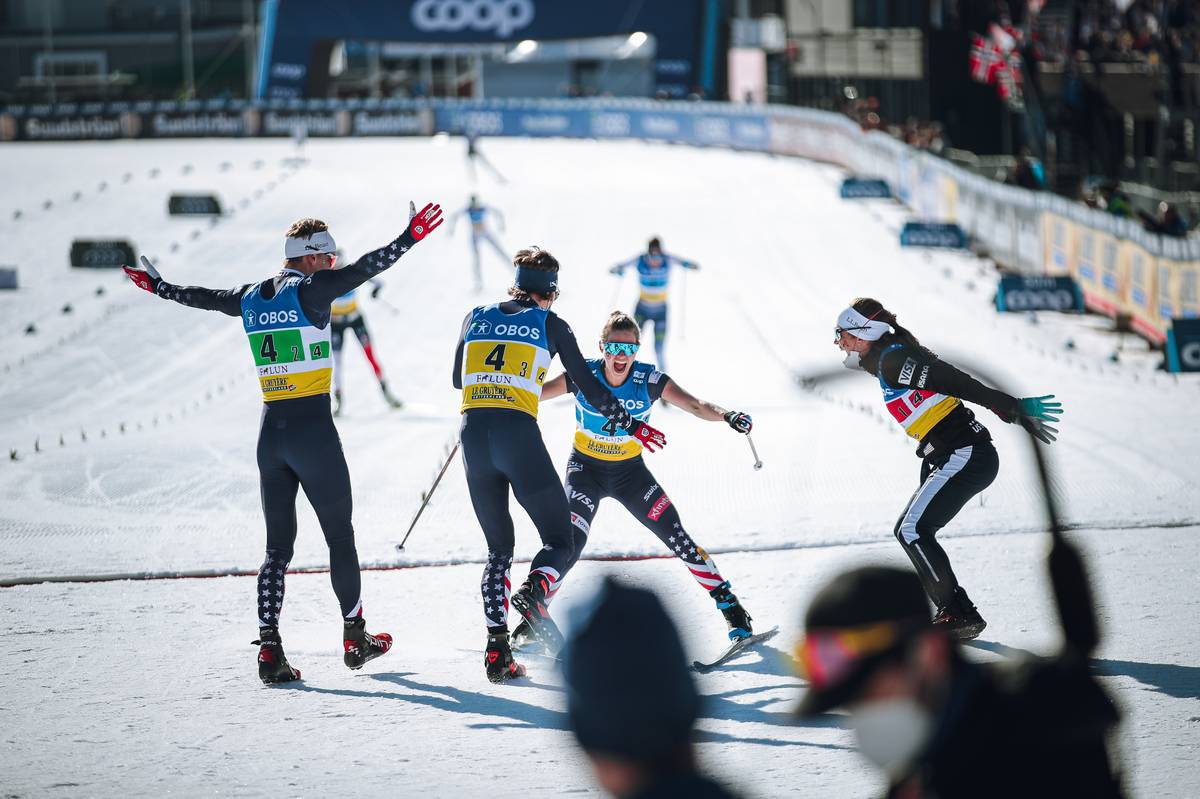
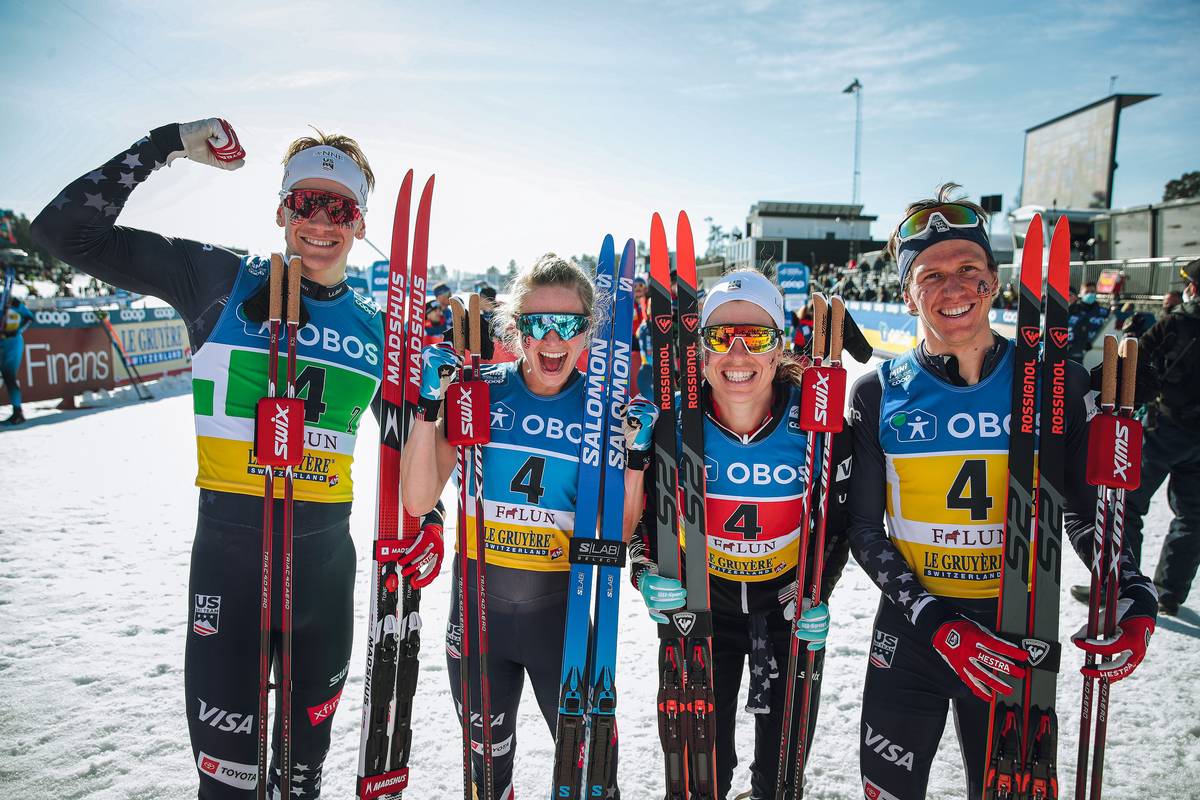
    Sweden I: Emma Ribom and Jonna Sundling, celebrate Friday’s Team Sprint win. (Photo: NordicFocus)
  • Ben Ogden Intrepid, Antoine Cyr Impressive, as North Americans Add Flair to TDS Sprint

    Ben Ogden Intrepid, Antoine Cyr Impressive, as North Americans Add Flair to TDS Sprint

    This World Cup coverage is made possible through the generous support of Marty and Kathy Hall and A Hall Mark of Excellence Award.  To learn more about A Hall Mark of Excellence Award, or to learn how you can support FasterSkier’s coverage, please contact info@fasterskier.com.

    Ben Ogden during Stage 5’s classic sprint in Val di Fiemme, Italy. Ogden made waves with his semifinal tactics. (Photo: Nordic Focus).

    Ben Ogden was going to risk it . . . This season, the young American skier has made a rapid push in World Cup sprints, twice racing to the verge of finals in Beitostolen and Davos. In boot throws, final sprints, pushes big and small he has come to understand the agony of inches. When he lined up for today’s Stage 5 Classic Sprint in Val di Fiemme, Italy, Ogden knew the trial was here again. Standing at the starting line of another World Cup sprint semifinal, he looked to his right and saw Johannes Hoesflot Klaebo, this year’s leader of the Tour de Ski. Klaebo seemed all but guaranteed to win today: he has never lost a Tour de Ski sprint. Never. And he has done so with the careful mix of easy tactics and better-than-anyone finishing sprint that has become his signature mode of racing. Ogden’s options were clear: he could either let this heat fall into that familiar, Klaebo-dominated mode—well-worn and always with the same result—or he could try and blow it up.

    Ogden chose the latter. “[If you] go crazy hard [in the semi-final] all you have to do is make the top four,” he said in post-race comments. The field left the stargint line at a slow pace; Calle Halfvarsson (SWE), Simone Mocellini (ITA), Johan Haeggstroem (SWE), and Sindre Bjoernstad Skar (NOR) allowing Klaebo to settle in. Ogden simply said, “Alright, I’m at least going to try.” Soon after the starting tracks were behind him, Ogden scrambled to the front, unleashing everything he had. He opened up a gap on the field; in a sign that Ogden had taken the field by surprise, Johannes Hoesflot Klaebo quickly scrambled through the pack to catch up. As they began striding up the only true hill on the Val di Fiemme course, Klaebo broke into his signature run. He was having to work for it; Ogden had caused a rift. “When we rounded the top of the hill, I looked back and it was just me and the king,” said Ogden. “That’s when I thought that maybe it could work.”

    The bulk of the Val di Fiemme course is a long, gradual downhill, culminating in a sharp left at the end of a small rise. In a final push, Klaebo made it through that the gap first, and order was restored after the chaos Ogden had caused: Klaebo first into the finals, followed by Halfvarsson and Simone Mocellini (ITA). Ogden lost a 4th place sprint to Haeggstroem for the final lucky loser spot, which would go to the 3rd and 4th place finishers from the heat Ogden had taken out so fast.

    After an early stumble in this semifinal, Sindre Bjoernstad Skar (NOR) had watched this most exciting heat from the best seat in the house (the back of the field), saying of the tactics that Ogden had, “Tried to rob the bank, and forgot the money.” Ben Ogden: American outlaw.

    Ben Ogden after falling just short of Finals again. “You’re crazy!” said Calle Halfvarsson of Ogden’s bold tactics in the semifinal. (Photo: Nordic Focus).

    “Johannes [Klaebo] gave me a fist bump,” said Ogden. “Calle [Halfvarsson] just said, ‘You’re crazy,’ but I’m going to keep trying everything. You have to try everything.” 

    Men’s Sprint Final: Klaebo on Top Again

    Klaebo delivered that fist bump on his way to the Final, where it seemed his trial in the semi-final had made a lasting impression. As the starting tracks gave way to scrubbed snow, Klaebo moved to the front of the pack, uncharacteristically controlling the race from the beginning. It almost seemed like an afterthought as Klaebo sped through the stadium for the win, followed by Halfvarsson 2nd, and Mocellini 3rd.

    Johannes Hoesflot Klaebo (NOR) sprints ahead during Stage 5 of the Tour de Ski in Val di Fiemme, Italy. (Photo: Nordic Focus).
    Cyr to Finals with Americans by his side

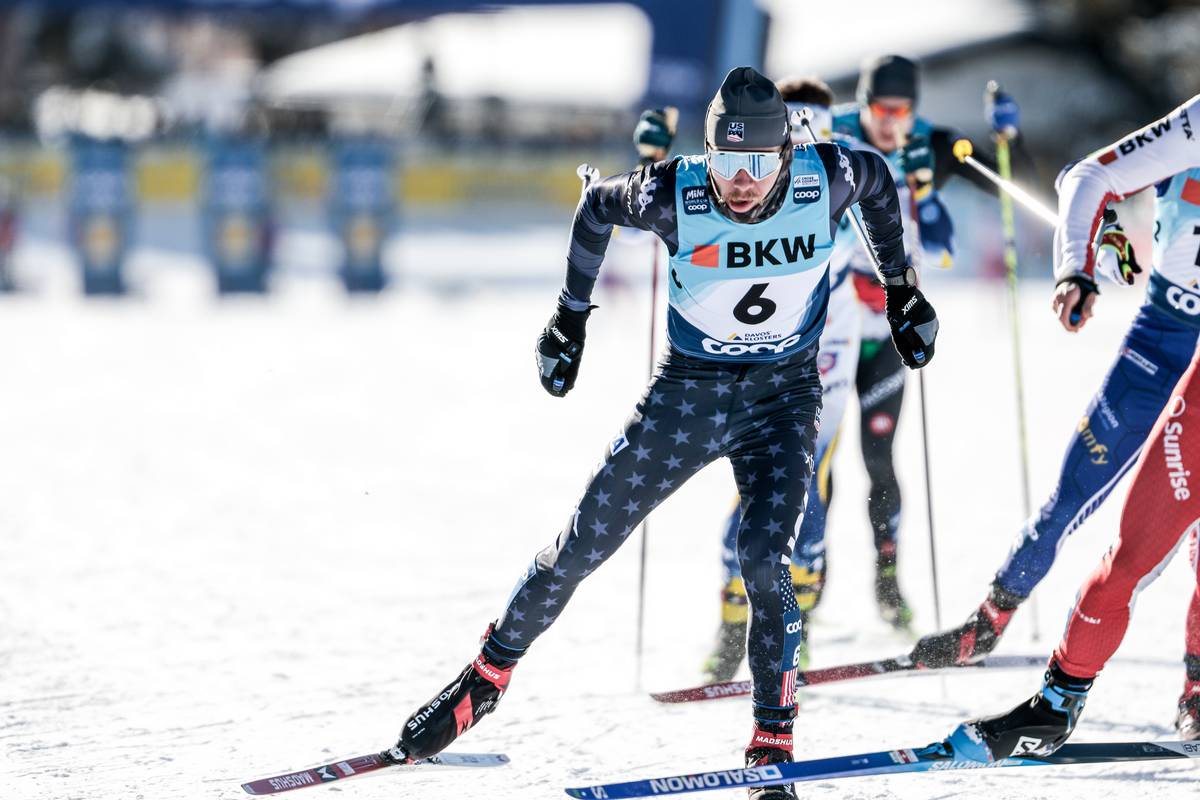
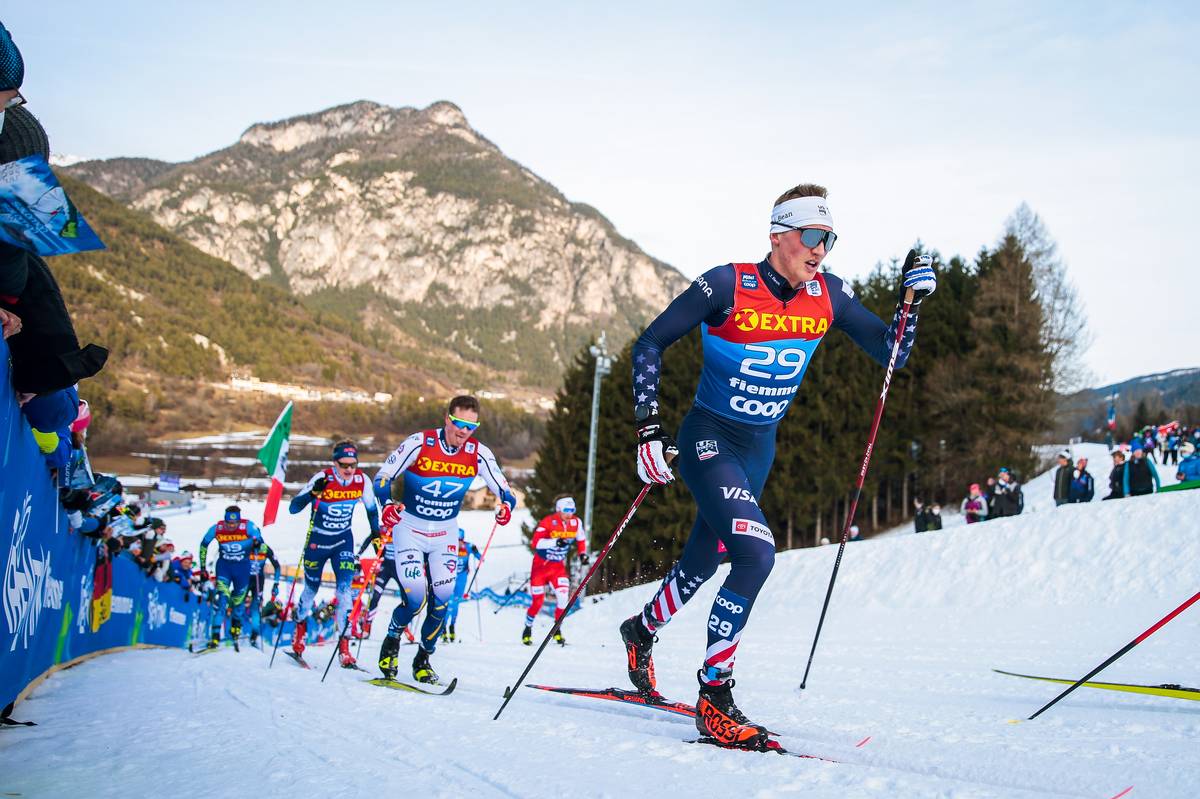
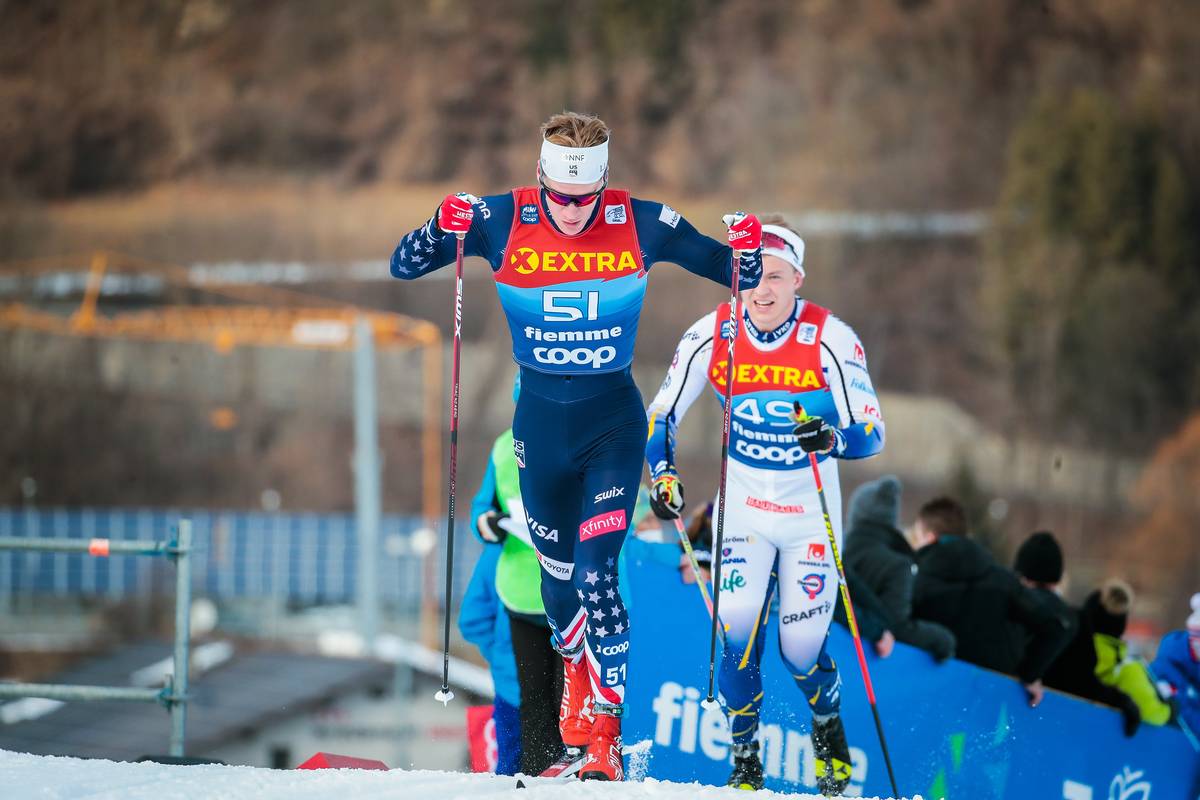
    What stood out during the day’s racing was who filled in the gaps. Next to Klaebo in the Final was a Canadian—Antoine Cyr—challenging for a podium for the first time since Alex Harvey had wound down his career with a 3rd place finish in Lillehammer, 2018. In progressing to the Final, Cyr had lined up in both the quarterfinal and semifinal alongside Zak Ketterson (USA) who had advanced to World Cup sprint heats for the first time. Ketterson said in post-race comments that he was determined to not let that milestone dictate his racing. “My plan was to not be timid at all.”

    Indeed, both Cyr and Ketterson controlled their heat through the early going, avoiding a stumble that tripped up the highest qualifier in the heat, Frenchmen Jules Chappaz. Ketterson looked to lead into the stadium, but made a mistake going into the sharp left on the last hill. “I got caught up and lost all my speed going into the stadium,” he said, referring to a moment where he moved to the inside and found Italian Francesco De Fabiani claiming that track. Cyr stayed out of the fray, and was able to show an impressive finishing sprint to win the heat. Ketterson’s race, in retrospect, showed early signs of the tenacity that Ogden would later demonstrate. It was a promising indication that the Minneapolis native could potentially join the ranks of Americans challenging at World Cup sprints.

    Zak Ketterson (USA) and Antoine Cyr (CAN) taking out their quarterfinal in Val di Fiemme. (Photo: Nordic Focus).

    In the semifinal, Cyr again led in the early going alongside another North American, JC Schoonmaker (USA). The pair were challenged by Frenchmen Lucas Chanavat, who quietly executed a perfect push into the stadium and got out in front of the field to take the first spot. That left Schoonmaker and Cyr to sprint for which nation would put a man into a World Cup sprint finals again. Schoonmaker started out with the advantage in the stadium sprint, but it soon became apparent that Cyr had the edge. He passed Schoonmaker 10 meters from the finish, and made his first World Cup Final, the first for a Canadian since that 3rd place for Harvey in 2018.

    Antoine Cyr (L) and JC Schoonmaker (R) sprint for a place in the Finals behind semifinal winner Lucas Chanavat (FRA). Cyr won the sprint and advanced to the final. (Photo: Nordic Focus).

    The skiing of the North American men was a factor that shook up the Tour de Ski Overall standings, too. Until today, this year’s Tour had remained deceptively close. Despite Klaebo’s dominance through all stages—winning every race—his overall lead was slim due to bonuses and his own racing style. Federico Pellegrino (ITA) and Paal Golberg (NOR) were both less than 15 seconds back from Klaebo for the yellow bib, with Pellegrino looking to close with a sprint today. Instead, Pellegrino found himself in a quarterfinal sprint with JC Schoonmaker, and there is no other way to write it; Schoonmaker outsprinted the Italian. Golberg too, found himself in a heat with the other Canadian qualifier on the day, Graham Ritchie, and Ritchie’s aggressive tactics led to a bunch sprint that the World Cup Overall Distance leader just couldn’t master. With skiers occupying the 2nd and 3rd overall placings out in the quarterfinals today, Klaebo had an open opportunity to seize a gap of over a minute (the winner received a 60 second time bonus in the Overall today). He did just that.

    Thus, the story on the day was North Americans advancing through the World Cup in their own distinctive way. In the cold and snow of the Italian Alps, they seemed to display a spirit, a tenacity, a dynamism usually associated with the deserts and dust of movie westerns. Through good, bad, and even ugly they pushed forward, shaking up this year’s Tour de Ski, and the World Cup too.

    Antoine Cyr (CAN) qualified for his first sprint finals during Stage 5, the first Sprint Final for a Canadian since Alex Harvey (CAN) in 2018. (Photo: Nordic Focus).

    Stage 5 Results

    Qualifier | Heats

    Tour de Ski Overall Standings

  • World Cup:  Period I into Period II

    World Cup: Period I into Period II

    Editors note:  FasterSkier’s coverage of FIS Cross Country World Cup Period I has been a cooperative effort among three dedicated staff writers: Ben Theyerl, Ken Roth, and John Teaford. Many early mornings, many calls and texts, many quotes and comments, many unforgiving deadlines bring this reporting to FasterSkier’s readers. We hope their insights  have served to improve everyone’s enjoyment of the excellent racing witnessed in Period I, and that they can serve to prepare viewers for the excitement and intrigue of Period II, and beyond.

    Jessie Diggins’ (USA) recent World Cup win in Davos has her positioned as one of the favorites entering Period II’s Tour de Ski. (Photo: Nordic Focus)
    Ken Roth

    In the Women’s World Cup, Period I has been a tale of two halves. During the first two weeks, Sweden looked unbeatable. Then, a not-so-funny thing happened on the way to global domination: illness overtook team Sweden, and they only placed one skier on the podium in individual races each of the last two weekends. For most teams, those results would be pretty good; for the Swedish women it was disappointing.

    While Sweden was fading, the U.S. was surging. Jessie Diggins was transcendent in Davos, taking a first and a second. Rosie Brennan bounced back from illness to ski to third in a great 20-k freestyle race and showed unmatched grit. In retrospect, the single biggest factor of the first four weeks was the start list. I’m not throwing any shade on the Americans’ success, but many of the top skiers were absent the last two weeks, and a fair assessment must acknowledge that reality. The other reality is that you can only beat whoever shows up, and the American squad looked great doing just that.

    As the World Cup tour enters Period II, the Swedes may be anticipating a resurgence. Sweden’s Tour de Ski start list includes most of their superstars. The question is, will they remain healthy? The Swedes do themselves a real disservice when they fail to provide details about absences, as information vacuums often fill with speculation. This was especially evident with regard to Frida Karlsson whose absence from Davos raised questions about her health (which Team Sweden has identified as a concern in the past).

    Norway lists the three Wengs on its start list, so the competition will be stiff. Tiril Udnes Weng is skiing so balanced between distance and sprinting that, barring illness, she should be the Tour favorite. For the same reasons, you have to put Diggins into the mix.

    Another big question lingers around the U.S. squad:  will anyone emerge to supplement the 1-2 punch of Diggins-Brennan? Julia Kern has been right on the edge in sprints; my guess is she’ll be the next American to podium, while the women’s squad remains mostly unchanged for Period II. And FIS, your holiday present to the ski world can be to change the rules for mixed relays; and do it now. Allow teams to ski in any order they want and to submit their lineups just before the race starts (Full disclosure: I’m totally stealing this idea from the Devon Kershaw Show). Can you imagine an anchor leg with Jessie Diggins given a lead and trying to hold off Johannes Klaebo? I would pay real money to see that—and I suspect most of the cross-country fan world would too!

    Ben Ogden (USA) enters Period II with top North American finishes in both sprint and distance events. (Photo: Nordic Focus)
    Ben Theyerl

    In his comments to FasterSkier’s Nat Herz describing the Beijing Olympics 15 k Classic Individual Start, Ben Ogden said that when Johannes Hoesflot Klaebo passed him he “Wasn’t going at a totally inhuman pace. I think one day I’ll be able to ski a longer percentage of the race at that speed.” I don’t think we anticipated how close that hypothetical day might be. With Ogden coming within an inch of Sprint Finals in consecutive weeks in Lillehammer and Beitostolen (in both Classic and Skate, to boot), it’s clear the gap is shrinking. JC Schoonmaker in sprints, and Gus Schumacher in distance races, have both continued to show the potential of the “young Americans” who were introduced to ski fans with Junior World Championship medals in 2018, 2019, and 2020. As far as percentages go, they’re not quite 100% of the way to Klaebo-pace for an entire race, but they’re definitely getting closer. Are we at a point where we might see the return of an American male to the podium for the first time since Simi Hamilton in Toblach, 2017? Considering the auspicious steps taken by young American skiers so far this season, I wouldn’t rule that out in Period II.

    Finn O’Connell, Zak Ketterson, Hunter Wonders at the Tour de Ski: When I spoke to Finn O’Connell following his nomination to the US Ski Team last May, he said that one of his biggest successes last year was figuring out, “What [being] a professional skier looked like.” Along with teammates Zak Ketterson and Hunter Wonders, O’Connell is in the group who became professional skiers during the pandemic, and who have seen the early steps in their careers severely complicated by COVID’s impact. O’Connell, who had earned World Cup starts in 2020-2021, will step on to a World Cup start line for the first time at the Tour de Ski. Having the Tour de Ski be your first World Cup experience poses some unique, and demanding, challenges. O’Connell is likely to take cues from teammate Zak Ketterson who faced the same prospect just a year ago. When I spoke to him last May about hopping from the SuperTour to the World Cup for a week straight of racing, Ketterson said, “[The Tour de Ski is] overwhelming. Those first few races do feel different. It’s hard not to be super nervous, and you’re not really skiing like yourself.” That might sound daunting, but Ketterson also added that the Tour de Ski as an introduction to the World Cup, “Made the rest of races [on the World Cup last season] seem very chill by comparison.”

    That TDS-inspired confidence led to Ketterson being part of the American team that won the Team Relay in Falun last season, and has seen him settle into World Cup racing this season, highlighted by a 26th in the 10 k Classic in Lillehammer. He’ll now return to the Tour de Ski for a second time. Hunter Wonders and Finn O’Connell meanwhile, will start their first TDS with the same kind of trial that Ketterson had in his first Grand Tour-style race last year.

    Johannes Hoesflot Klaebo (NOR) crosses the finish-line in Ruka wearing the yellow Overall World Cup leader’s bib. He’ll hope that a winning effort at the Tour de Ski may allow him to be wearing that bib again at the end of the 2023 season. (Photo: Nordic Focus)
    John Teaford

    Two weeks ago, Johannes Hosfloet Klaebo claimed his pursuit of the overall World Cup crystal globe was over. It sounded as though he might just concentrate on World Cup sprint events and save his distance-skiing energy for this season’s FIS World Championships. Then the start list for the Tour de Ski came out:  Klaebo’s name is on the list. Game on . . .

    FasterSkier’s Ben Theryl recently wrote about changes to the World Cup point system, summing up the changes as, “A whole lot more points for a whole lot more skiers” resulting in top skiers needing to ski more races if they hope to do well in the race for the overall Crystal Globe. Exiting Period I, Klaebo and Paal Golberg are both on the Norwegian team for the Tour de Ski (TDS), and embroiled in a close, point-by-point battle for the Crystal Globe. If Klaebo succeeds in winning this year’s TDS, he could claw back the overall title, not by hundreds of points at a time, but by a grinding accumulation of points that could—to the FIS’ delight—make the battle for the Crystal Globe very exciting, indeed.


    American Team Selections for Period II (including the Tour de Ski) can be found in FasterSkier’s recent posting from US Ski and Snowboard.

  • Schumaker and Cyr in Top 20, Golberg Gets First Race Win of Season in Classic 20 k

    Schumaker and Cyr in Top 20, Golberg Gets First Race Win of Season in Classic 20 k

    This World Cup coverage is made possible through the generous support of Marty and Kathy Hall and A Hall Mark of Excellence Award.  To learn more about A Hall Mark of Excellence Award or to learn how you can support FasterSkier’s coverage please contact info@fasterskier.com.

    Ben Ogden (foreground) and Zak Ketterson (background) during the Classic 20 k Sunday. (Photo: NordicFocus)

    If Saturday’s individual sprint race was a return to the archetype for this era of World Cup skiing, then Sunday marked something completely new. Part by design, part by necessity, the men’s field raced a 20 k classic mass start for the first time on the World Cup since the 2012 Tour de Ski (when Eldar Roenning (NOR) won over 2nd place Alex Harvey (CAN) and 3rd place Dario Cologna (SUI). 

    The part by design: FIS has moved to the 20 k mass start as part of equal distance racing for men and women on the World Cup, replacing the 15 k that had become the standard classic distance event. The 20 k is an odd distance that has rarely been raced (by either men or women) on the international scene . . . though it does seem to represent a good compromise for both the women’s field, and the men’s. 

    The part by necessity: this race was originally slated to be a 30 k skiathlon, but operating on man-made snow all weekend in Lillehammer, the organizing committee had to scratch plans and lay a classic track on a 3.3 k snowmaking loop where the field would ski 6 laps. The course chosen was the Biathlon loop, which meant that homologation standards usually present on the World Cup were not present on the course today.

    In an interview with FasterSkier after the race, US National Team member, Gus Schumacher, said that the course led to a clear expectation of how the race would play out. “We were kind of expecting a bunch sprint, because the course was missing those long, sustained climbing sections that most of our World Cups have. There were guys out there today who probably had higher aerobic capacities that weren’t necessarily able to flex it.”

    Then there was the glaring fact that the best classic distance skiers at 15 k in the past year —all three Olympic medalists in the 15 k —weren’t on the start line. Iivo Niskanen (FIN) was absent, Johannes Hoesflot Klaebo (NOR) scratched after his sprint win yesterday, and Alexander Bolshunov (RUS) is not participating in FIS World Cup events due to Team Russia’s suspension. In their place was a group of contenders who raced as a sustainable pack, through six tightly wound laps.

    In the end, the only signifier that might have distinguished one of the competitors in that pack was the yellow FIS World Cup overall leaders bib, worn by Paal Golberg (NOR). A marked man throughout the day, Golberg nonetheless moved to the front of the pack as they entered the Birkebeiner stadium, applying extra force to his double-pole, and opening up a gap that saw him pull away to his first race victory of the season. A pack of his countrymen followed close in his wake with Norway taking the top four spots on the day: 1st) Paal Golberg, 2nd) Sjur Roethe, and 3rd) Martin Loewstroem Nyenget, 4th) Didrik Toenseth.

    Paal Golberg (NOR) celebrates his first World Cup win of the season in Lillehammer’s 20 k Classic Mass Start. (Photo: NordicFocus)
    The 20 k Classic Mass Start

    Racing all the way to that Norwegian-heavy conclusion, however, was a tight-knit and colorful affair. The first kilometer of the day’s course featured its major climb, which from the gun saw Andrew Musgrave (GBR) move to the front in an unflinching double-pole. Musgrave didn’t relent as the rest of the field turned to striding, a pattern that would repeat through the early laps of the race. Musgrave would move off the front before each major climb, having discovered that the other skiers’ transitioning from double-poling to striding impeded the momentum he needed to double-pole the course. Best just to get off the front, then pay for it at the top of the climb. 

    Andrew Musgrave (r) double-poles ahead of the field early on in Sunday’s 20 k classic. (Photo: NordicFocus).

    Musgrave animated the field through that early part of the race; with the rest of the pack able to keep pace on their classic skis, there was little reason for them to push the pace. Who got to the front of the field wasn’t a question of strength or fitness through most of the race, but rather how well skiers could find the little pockets of space or snow needed to move up through the pack. For the Americans, Scott Patterson and Ben Ogden were able to move up within the first 2 laps of the race. Gradually, though, more and more blue suits with stars came into picture—Zak Ketterson, then Gus Schumacher, and then Hunter Wonders, until the whole US contingent was present somewhere in the pack. In particular, Gus Schumacher stood out, adorned as he was in a pink cap that he said, “Was for my mom, she likes the pink hat.” Two Canadians—Antoine Cyr and Olivier Leveille—also weaved purposefully through the field.

    Gus Schumacher (USA) skis behind Richard Jouve (FRA) in the pack during Sunday’s 20 k Classic. (Photo: NordicFocus)

    On lap 3, the field began to settle into the contours of the course, and anxious competitors started to test where they might be able to break the race open. The first main animator was Martin Loewstroem Nyenget—champion of the 2022 50 k Holmenkollen—who moved to the front of the pack on the climb that covered the first kilometer of the lap. The field quickly bunched up over the top of the climb; through the halfway point, the race remained a stalemate.

    Having not found the pressure point he wanted on the climb, Nyenget looked for it on the rolling terrain of the last two kilometers of the course. Again, the field picked up the pace; but again, no definitive gap developed as they hit the climb entering Lap 5. A similar move came from Finnish skier, Markus Vuorela, but the only effect was to stretch the lead group a bit, with skiers slowly fall off the pace.

    Going into the final lap, all that had built was anticipation. Thirty skiers still jockeyed for position within the pack, with Americans Gus Schumacher and Hunter Wonders among its ranks.

    It was the Swedish skiers who initiated a long attack. William Poromaa and Jens Burman ran to the front on the last big climb and continued to push the pace over the top. No doubt, the pair sensed that the new race format gave new life to the long-awaited hope that the Swedish men could re-establish themselves as elite distance skiers. That hope for a win now stretches back nearly a decade, since Daniel Rickardsson won the Holmenkollen 50 k in 2014. However, like most Swedish attacks in nearly every race since then, the ambitious pair were soon swarmed by a who’s-who of Norwegians. As the contenders entered the stadium, the sudden appearance of Golberg in the yellow leader’s bib was unanticipated, yet not at all surprising. Then came Roethe, Nyenget, and Toenseth, with Iversen and Krueger within striking distance too.

    Even during the sprint the field remained tight, with the top 30 finishing within the span of 10 seconds. Gus Schumacher held his own in the sprinting pack, placing 17th—his highest finish in a classic distance race since the Tour de Ski in 2021 (where he was 8th). Hunter Wonders also finished in the charging pack, finishing 31st.

    A pair of Canadian’s had also held strong in the pack: Antoine Cyr finished in 12th place, while Olivier Leveille came across the line in 27th.

    The pack rolls into the Lillehammer stadium after lap 5 of 6, led by William Poromaa (SWE). (Photo: NordicFocus)

    Gus Schumacher said that the fast field sprint reflected the general experience of being in the pack, “It was pretty chaotic throughout the race, jockeying for position without expending too much energy. I was definitely aware [the race] was getting more strung out and I was finding myself more up near the front as it went on, but there wasn’t a specific moment [where someone attacked]. 

    In a new race format with a classic, old-school feel, the World Cup moved on through Lillehammer with a weekend full of homegrown success for the home country, and some promising glimpses for their rivals ancient (Sweden) and new (USA). For the latter, the momentum is building in a unique way. Gus Schumacher said to FasterSkier that the distinguishing feature of this season for the team so far is, “We’re getting good results in a wide variety of races. It’s sprints and distance races this year, and the wax team is doing really well too. It’s really fun as a team right now, we’re building good momentum.”

    That momentum will certainly carry the US Ski Team, and the road show that is the Cross Country World Cup, to Beitostolen, Norway next week.

    Full Results

    Sunday’s all Norwegian podium. 1st) Paal Golberg, 2nd) Sjur Roethe, 3rd) Martin Lowestroem Nyenget. (Photo: NordicFocus)
  • Ketterson’s Season’s-Best in Lillehammer, Norway’s Depth on Display

    Ketterson’s Season’s-Best in Lillehammer, Norway’s Depth on Display

    A_Hall_Mark_of_Excellence_Award-logo-300.png (300×244)This World Cup coverage is made possible through the generous support of Marty and Kathy Hall and A Hall Mark of Excellence Award.  To learn more about A Hall Mark of Excellence Award or to learn how you can support FasterSkier’s coverage please contact info@fasterskier.com.


    Any time a Cross Country World Cup is contested on Norwegian snow, the story is likely to be about the racing prowess of the many additional Norwegian skiers who are granted start positions (a courtesy that FIS provides to host nations). Today’s World Cup 10 k Freestyle race was no exception, with the list of finishers in Lillehammer being led by a crowd of Norwegian stars and soon-to-be stars. With only one World Cup start on his record, 22 year old Iver Tildheim Andersen earned an unexpected win over his more famous countrymen, Didrik Toenseth (2nd) and Hans Christer Holund (3rd).

    Zak Ketterson (USA) on his way to a World Cup career-best 26th place in the men’s 10 k freestyle. (Photo: NordicFocus)

    Up and coming North American skiers also took advantage of this moment to shine, as Zak Ketterson posted a World Cup career-best 26th place finish, closely followed by Gus Schumacher in 32nd. Other American finishers included Scott Patterson (40th), Hunter Wonders (45th), and Ben Ogden (56th). Canadian finishers included an impressive World Cup performance by Oliver Leveille (36th), followed by Antoine Cyr (46th), and Graham Ritchie (51st).

    The additional story in Lillehammer, though, was about who was NOT on the roster of starters: in this case, World Cup leader Johannes Hoesflot Klaebo. Norwegian news reports indicate that Klaebo’s absence from the race was due to illness (a sore throat, with early reports suggesting it is unrelated to Covid). It is unknown whether he will be at the start for tomorrow’s World Cup Sprint. With Klaebo’s absence from today’s racing, his Norwegian teammate, Paal Golberg, takes over the lead in the World Cup Distance standings.

    Andrew Musgrave (GBR) skied a typically aggressive race, becoming the only non-Norwegian to place within the top ten. He would finish a very impressive 4th. (Photo: NordicFocus)

    Fresh snow decorated the trees along the Lillehammer course, but the snow that lay on the ground appeared heavy and wet. On a day marked by relatively warm conditions, many racers were feeling their way into the race rather than charging blindly ahead. Early splits were widely spread as skiers attempted to sort out the conditions and determine where best to glide and where best to drive. One of the early standouts was England’s Andrew Musgrave. Skiing barehanded on this relatively warm Norwegian day, Musgrave was one of the few who pushed the pace early.

    Ketterson’s 26th place represents a season’s-best finish, and an indicator that his training and his preparation are bringing him into form at just the right time. “I think just having another year of professional training under my belt has made a really big difference,” he commented. “Last year was my first season with Team Birkie and I was able to make a pretty big jump. This summer and fall has just been a continuation of the momentum we picked up last year and it’s been pretty cool to see it working out so far.”

    While Ketterson’s career-best World Cup finish was last spring in Falun when he was 15th in the 15 k skate, today’s result bodes well for the remainder of Ketterson’s World Cup season. “I think it is a great sign of things to come,” he said. “It’s easy to forget that it’s still only the beginning of December and it is a very long season!

    A fresh new face on the Norwegian cross country scene, 22 year old Iver Tildheim Andersen (NOR) celebrates victory in the the World Cup Men’s 10 k Freestyle. (Photo: NordicFocus)

    For surprise winner, Andersen, the day was one that must’ve felt like a dream. “It was pretty amazing,” he said. “I didn’t actually expect to win this race.”

    Andersen raced aggressively from the start, continuing to extend his lead throughout the race, and delivering a blistering finish that saw him take the lead by a large margin after the first half of finishers. Ultimately, his hold on the leader’s chair would be confirmed as Norwegian after Norwegian fell short of his finishing time.

    “It was a good feeling, for sure, hearing that I’d taken the lead, and just keep increasing the gap,” he said. “I was hoping to improve my best from the World Cup, and I did . . . So I’m very happy.”

    Andersen’s only other World Cup finish had been a creditable 24th place in last years Holmenkollen 50 k. Considering his win in today’s Lillehammer World Cup, it seems we should expect to see Andersen appearing at many more World Cup starting lines.

    Norway ended the day with nine of the top ten finishers in this men’s race. In a further display of Norwegian dominance, Klaebo’s withdrawal provided an opportunity for a Norwegian replacement-skier—Henrik Doennestad—who finished 15th, only 35 seconds behind the winner.

    In Klaebo’s absence, the World Cup Distance Leader’s jersey passes to Paal Golberg who finished 6th today in Lillehammer, and 2nd in both the 10 k and 20 k World Cup distance races last week in Ruka.

    Racing continues in Lillehammer with the Men’s and Women’s Sprints on Friday, and the Men’s and Women’s Mass Start 20 k Classic on Sunday.

    Lillehammer World Cup 10 k Men’s Freestyle RESULTS
    Didrik Toenseth (NOR), Iver Tildheim Andersen (NOR), Hans Christer Holund (NOR) earned the podium positions for host country Norway in the World Cup 10km Freestyle in Lillehammer. (Photo: NordicFocus)
  • Ruka Men’s 10 Kilometer Classic Individual Start:  It’s all Team Norway.

    Ruka Men’s 10 Kilometer Classic Individual Start: It’s all Team Norway.

    A_Hall_Mark_of_Excellence_Award-logo-300.png (300×244)This World Cup coverage is made possible through the generous support of Marty and Kathy Hall and A Hall Mark of Excellence Award.  To learn more about A Hall Mark of Excellence Award or to learn how you can support FasterSkier’s coverage please contact info@fasterskier.com.


    Ruka Men’s 10K Classic Individual Start

    Ruka presented less challenging conditions this year compared to last year for the athletes.  Temperatures were in the high teens (-8.0 Centigrade) with racers running on green cold waxes. Humidity was 100 percent, which posed the possibility of tracks glazing during the race. The racers competed on a 5-kilometer course with 30 seconds between the start of each racer.

    Johannes Hoesflot Klæbo (NOR) on his way to victory in the 10k in Ruka (FIN). (Photo: Nordic Focus)

    Results:

    The Norwegians dominated the field.  Johannes Klæbo finished first, besting countrymen Paal Golberg by 20.5 seconds followed by Martin Nyenget who was 28 seconds behind Klæbo.  An outstanding performance was turned in by Andrew Musgrave of Great Britain, who finished in fifth, 40.3 seconds behind Klæbo. Norweigans took six of the top ten spots.

    The top American was Ben Ogden, finishing 28th, 1:23.9 back.  He was closely followed by Zak Ketterson who finished 31st, 1:24.6 out of first.  Rounding out the field for the Americans was Hunter Wonders, who is also a competitive canoe racer, finishing in 39th. 2020 Junior World Champion in the 10 kilometer, Gus Schumacher, finished 48th. Scott Patterson finished 54th.

    The top Canadian was Graham Ritchie, finishing 35th.  He was followed by Olivier Leveile who finished 44th.

    Hunter Wonders (USA) on his way to 39th place in the 10k classic. (Photo: Nordic Focus)

    The Race:

    The steep climbs of Ruka proved challenging for the men who consistently jumped out of the tracks early on climbs, preferring to run up the loose snow on the sides of the course.  Prior to the race there had been much discussion about Klæbo’s health.  Questions continued to swirl when he hit the one-kilometer split in 21st place and still trailed at the 3.1- kilometer split.

    Calle Halfvarsson (SWE) on his way to 4th place in the 10k in Ruka (FIN). (Photo: Nordic Focus)

    Calle Halfvarsson of Sweden gave many of the Swedish fans in the crowd a thrill as he led the race at the first three splits.  Ogden was in the hunt at the one-kilometer mark, only 12.5 seconds out of the lead, but by the 3.1 checkpoint, his trailing margin had widened to 22.4 seconds.

    Starting at about the six-kilometer mark, Klæbo removed any doubt about his nagging injury when he jumped into the lead establishing a six second advantage over countryman Halfvarsson.  Meanwhile, Musgrave had pulled himself from 23rd to sixth place, only seven seconds away from a podium spot.  Musgrave turned in the fastest time from the 3.1 to 5.0-kilometer split.


    Andrew Musgrave (GBR) – FIS world cup cross-country, having an outstanding weekend in Ruka. (Photo Credit: NordicFocus)
    However, because of the start order, Klæbo was never really able to relax since he had started the race ahead of Golberg.  When Klæbo finished he had a 28 second lead over the next best finisher.  But most of the contenders were still on course, so he was uncertain as to where he would finish.  However, the writing was on the wall as Golberg entered the stadium and it became apparent that he wouldn’t be able to catch Klæbo.

    The only remaining question was would Norway capture all of the podium positions?  The question was only partially answered when Halfvarsson crossed the eight-kilometer checkpoint in fourth but was only 0.2 seconds behind Nyenget.  At the finish it appeared that Halfvarsson was struggling mightily but was able to hang on for a fourth place finish.  The results; Norway 1-2-3.

    Complete Results

    Paal Golberg (NOR), Johannes Hoesflot Klaebo (NOR) and Martin Loewstroem Nyenget (NOR) share the 10k classic podium in Ruka (FIN). (Photo: NordicFocus)
  • New Faces on the U.S. Ski Team: A Q&A with Zak Ketterson

    New Faces on the U.S. Ski Team: A Q&A with Zak Ketterson

    U.S. Ski & Snowboard recently announced its U.S. Ski Team nominations for the 2022-23 season. Of the 22 athletes named to the team this season, six were not on the previous year’s roster, either newly named or renamed: Michael Earnhart, Walker Hall, Zak Ketterson, Will Koch, Finn O’Connell, and Sammy Smith.

    To help fans get to know these new(er) faces, FasterSkier is doing a series of interviews, providing insights into the factors that have contributed to development, progress, and growth for these athletes last season. In this installment, we talk with Zak Ketterson about his renomination to the U.S. Ski Team on its B-Team, his World Cup breakthroughs this past season, and the growth of his club, Team Birkie. 

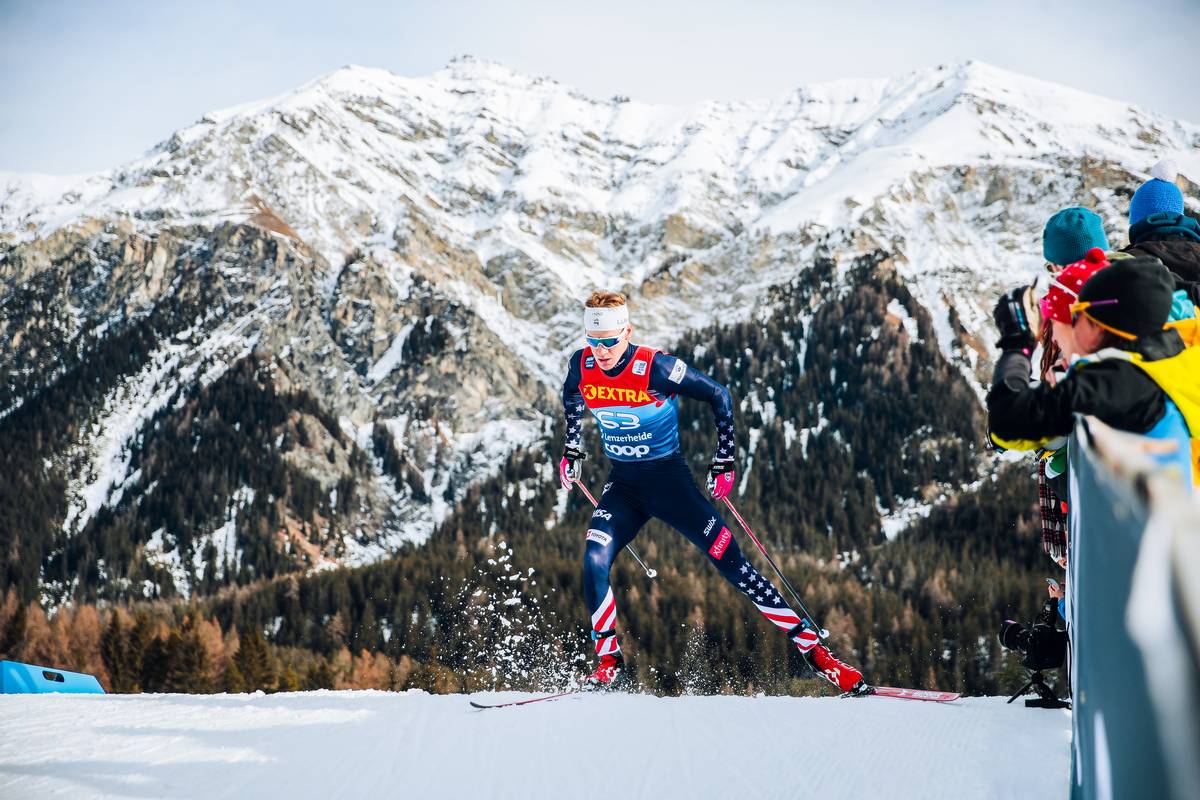
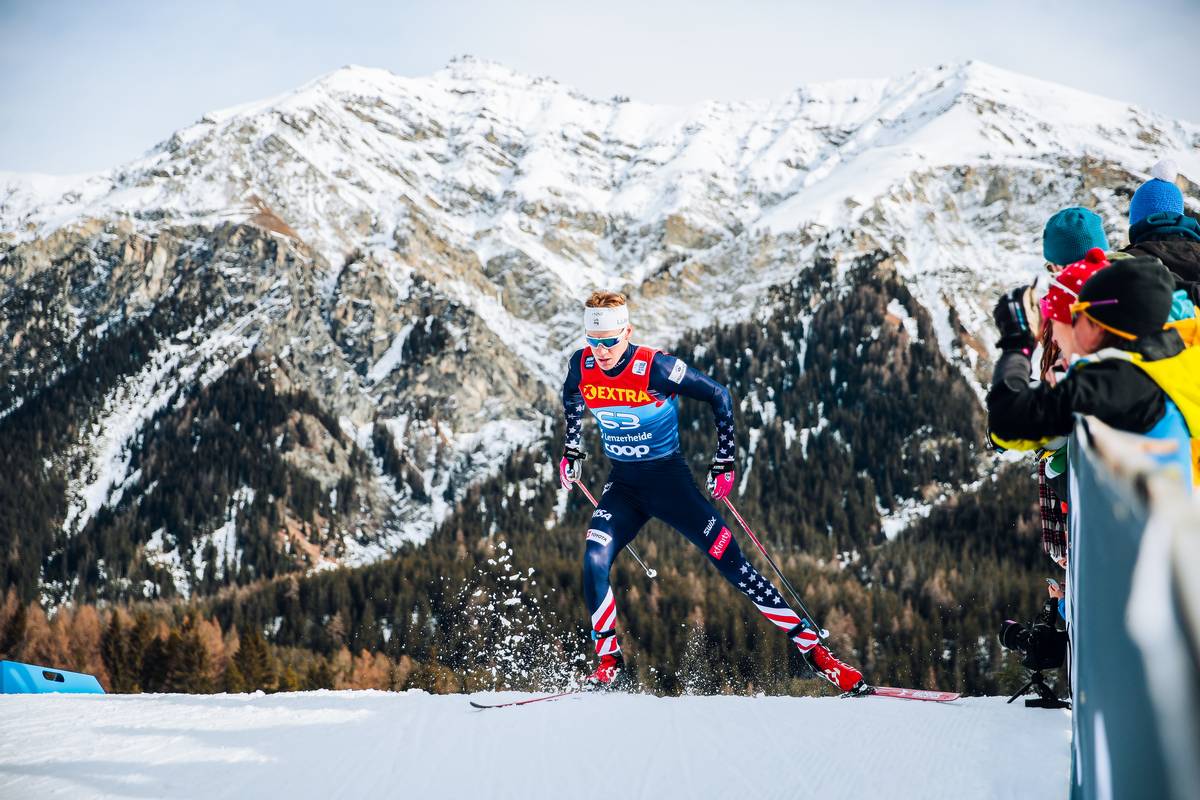
    Zak Ketterson races the freestyle sprint qualifier in Lenzerheide, SUI, the first event of the 2021/22 Tour de Ski. (Photo: NordicFocus)

    Ben Theyerl/FasterSkier (FS): Can you start off by telling us a little bit about yourself?

    Zak Ketterson (ZK): I grew up in the Twin Cities area in Bloomington (MN). I didn’t really start skiing until 7th grade, when I got into it because my older brother (Jan) was on the high school team. Up until then, I had been into more of the traditional American sports – basketball, football, baseball – and even after my first few seasons of nordic skiing, I really didn’t like it that much better. I really wanted to play basketball, but I kept with skiing because I was having a lot of success in it, which is always fun, and like I said, I was getting to spend time with my brother and our teammates.

    My first introduction to competitive skiing was the Minnesota high school league and trying to win the Minnesota state meet. That was the highest level of skiing in my head at the time, and in Minnesota, that’s the thing to win. Even as I progressed to being at Junior Nationals and started competing nationally, I wanted to win the State Meet.

    When I got out to JNs, it was like, ‘oh, there’s a lot of good skiers from elsewhere,’ and that made me start thinking I wanted to continue with skiing – maybe do it in college. I went to Northern Michigan University (NMU), so stayed very local because being from the Midwest is pretty important to me. I just think it’s the coolest ski community, and always have, and going to NMU was cool because I got to follow the footsteps of Ian Torchia, Adam Martin, Kyle Bratrud, and go there with Leo Hipp and be teammates with them all – I didn’t have to leave.

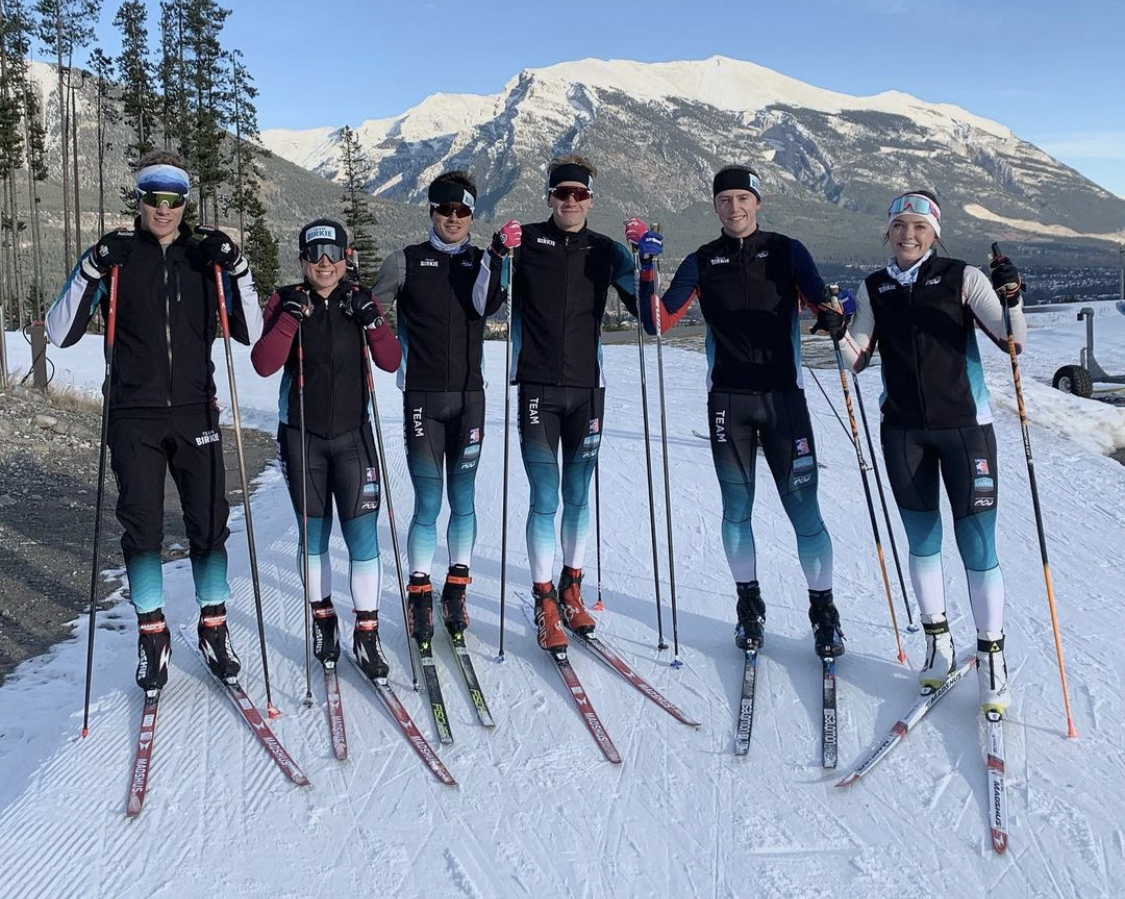
    Skis on snow in Canmore. Athletes Christian Gostout, Ingrid Thyr Andrew Millan, Zak Ketterson, Tony Mathie and Jordan Schuster (l-r). (Photo: Team Birkie)

    I worked with Sten (Fjeldheim) and NMU for five years and would say that was really where skiing turned into an actual passion for me. I fell in love with the process of improvement, training, and learning a lot more of the nitty-gritty stuff involved with this sport.

    The Midwest thing really ended up influencing my decision to keep skiing afterwards as well. The [American Birkebeiner Ski Foundation] and the Loppet [Foundation] came to me with the idea of Team Birkie, which had been in the works ever since the CXC [Elite] team went away in the Midwest. And it worked out that it could finally come together last season. I was graduating, and it was already in the back of my mind that it would be really cool to be on a local team and building something new. When the Team Birkie opportunity came around, I was excited to say the least. It was a little scary to be part of something new, but I think we were pretty proud of what we were able to put together, and now, to see more people joining the team this year is even more exciting.

    FS: Congratulations on the U.S. Ski Team nomination. If you take us back to last fall, what were your goals for the 2021-22 season?

    ZK: There was a lot of big question marks – which is natural, I guess, when you’re going through a really big training environment switch. I was really comfortable at NMU for five years, and leaving that my mind was more towards how do I really take on the role of being a professional skier? Like, I moved back to Minneapolis, where I grew up, but I was renting an apartment and in the real world for the first time and starting with a new team where there were even more big question marks around what it would look like. So, I was nervous.

    But the first week of practice here it just felt like coming home, and that the right pieces were falling into place. I had my old teammate Leo Hipp as my coach, and one of my old Loppet (Loppet Nordic Racing, or LNR) coaches Caitlin Gregg right there to work with me. It all sorted itself out very quickly, and I was just comfortable going into the racing season.

    My goal then was to try and make some World Cups. I was hoping to have a successful first year doing pretty well on the SuperTour, which would lead to that main goal. When it kicked off in December, the races were was in Duluth and Cable, which again, just really made things feel comfortable. It felt like being on my home course. Even then, I was a little surprised with how well those went. I was ecstatic to come out of those weekends as SuperTour leader, to say the least, but I think myself and my coaches were a little surprised that it happened.

    That had a real validating effect for the whole team that we were on the right track with how we were approaching the new training environment at Team Birkie.

    After his first season on Team Birkie and first experiences racing on the World Cup, Zak Ketterson earned a spot on the U.S. Ski Team B-Team. (Photo: Instagram @zaketterson)

    FS: I was wondering about what happened right after that period. You earned a Tour de Ski start for leading the SuperTour, and so you went from racing the ultra-familiar on the Birkie trail to being on the start line of what is essentially the Grand Tour of skiing. How did you handle that stark transition?

    ZK: I was very focused on just skiing the Tour de Ski (TDS), and not thinking about what it may lead to, or who I was going to be skiing against.

    If you get an opportunity like that, you don’t turn it down. But flying over to Switzerland and seeing how big of a spectator event the TdS was and seeing these guys you’ve just seen racing on TV in the starting area with you, it’s a different world from Cable, for sure. I think it’s a sentiment most first time World Cup skiers would share – it’s overwhelming. Those first few races do feel different. It’s hard not to be super nervous and you’re not really skiing like yourself.

    Doing the TdS as my first World Cup race was a whirlwind. There were some terrible races, some solid races, and some decent results. But I do think doing it as my introduction to the World Cup made the rest of the races seem very chill by comparison.

    FS: One thing I noticed about your World Cup season is that you did well in some of the less ‘traditional’ formats, like the Alpe (Cermis) hill climb, or being on a mixed relay. Is there anything about your approach to racing that you think helps you adapt to those unique challenges?

    ZK: I don’t know. I think sometimes if you expect to do super well in a race you put too much pressure on yourself – the Drammen sprint this year was a good example of that for myself. I know sprinting, and so I put too much pressure on myself to do well in the sprint, and it ended up being one of my worst races. Going into some races with no expectations this year really worked well to race relaxed.

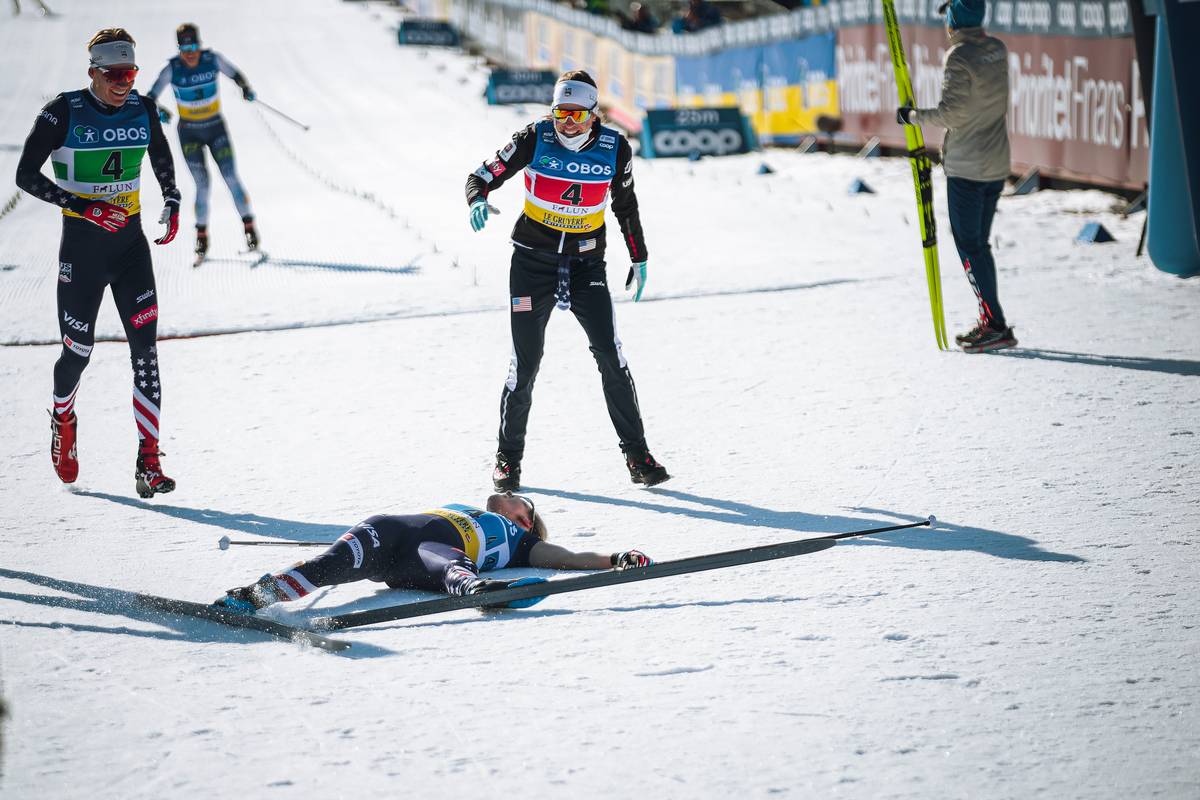
    Rosie Brennan and Zak Ketterson rush to celebrate a mixed relay win in Falun with their collapsed team anchor, Jessie Diggins. (Photo: NordicFocus)

    FS: Do you think you can pick one highlight of the season?

    ZK: That’s a good question…I think it’s pretty easy to say the two Falun races (the 15 k Skate, and Mixed Team Relay), but I think more so than just the results that came there. I was coming off of some really tough races that were making me have those moments where you question whether you have to re-think your training and go back to the drawing board, and then I just tried to start from scratch when I got to Falun and came away with some great results (Ketterson finished 15th in the 15 k skate, and was part of the 1st place USA mixed relay team).

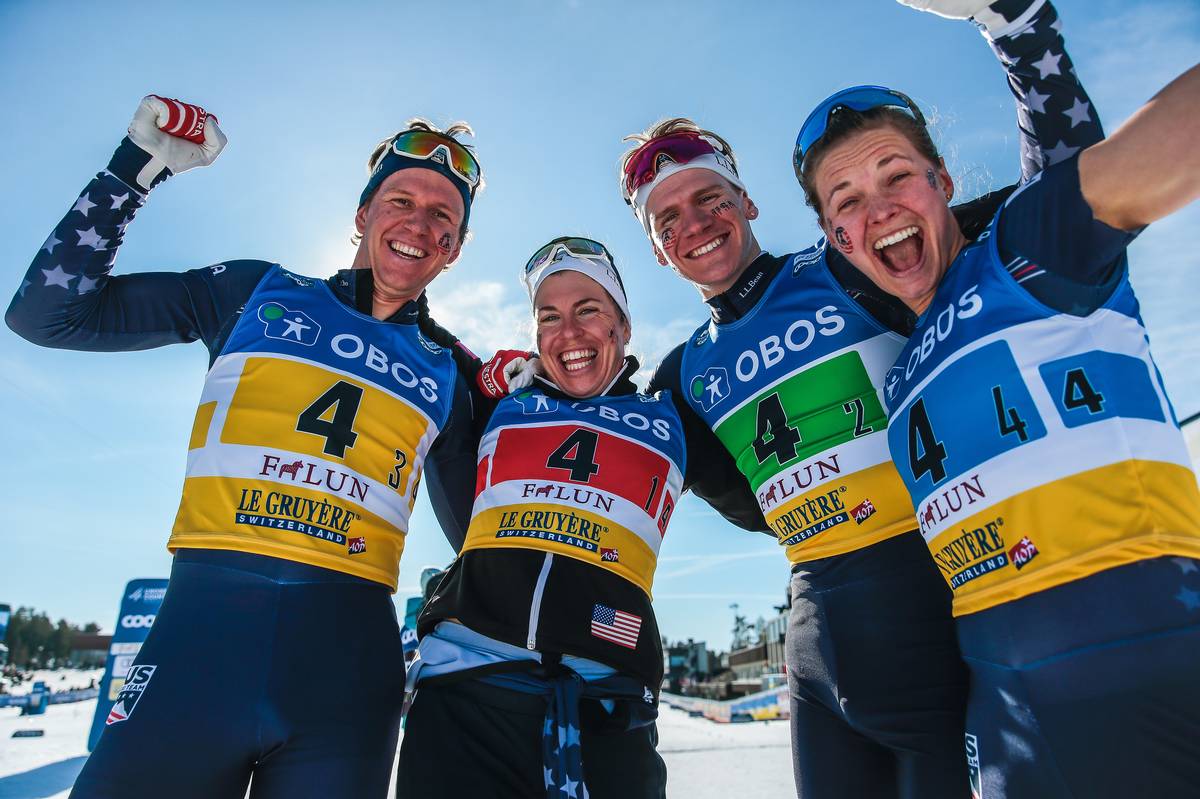
    USA I takes the win in Falun’s 4 x 5 k mixed relay. From left to right, Scott Patterson, Rosie Brennan, Zak Ketterson, and Jessie Diggins. (Photo: NordicFocus)

    FS: Now turning to joining up again with the U.S. Ski Team. Did you make it out to Bend [for the USST spring training camp]?

    ZK: I ended up staying in Europe after Falun actually, staying with an old NMU teammate in Norway to get some great spring skiing in. I wasn’t really expecting the call from Chris Grover (USSS Program Director) that I made the team, if I’m honest, and so when I did, I had just put in a big block of skiing in Norway, was half-way across the world, and decided that I probably couldn’t and shouldn’t hop into a huge training camp in Bend.

    I’m really close with a lot of the guys and girls on the team so I’m not too worried about hopping in when I get to some of the other camps in summer. The big thing with the U.S. Team is the funding for the World Cup and the support; it will just take a lot of the complications to get to the racing out of it, so I can just focus on skiing well.

    FS: What are your goals from here? Next season?

    ZK: My goal in the sport is to become a really good World Cup skier, so anything that gets me there is going to be super important this next year. I think at the moment, the goals for next season are dependent on the if I get Period I starts, and from there, just trying to improve my placings on World Cup.

    Zak Ketterson races into the top-15 during a 15k skate in Falun, SWE in Mar. 2022. (Photo: NordicFocus)

    FS: I’ve both skied with, and now interviewed, a lot of your old LNR and NMU teammates, and one thing that sticks out to me is that you’ve contributed to, and been part of, some pretty great team environments in your ski career. What do you bring from those experiences to the US team now?

    ZK: Well, like you said, I’ve been super fortunate with LNR and NMU to always have a really good training group where I feel like we’re there to make each other better in a really supportive way. I can recognize that it’s not us trying to out do each other everyday in training. That’s the attitude I hopefully can bring to the US Team. At the end of the day, if we’re doing better as individual skiers it helps make your teammates better. Keeping the ego out of it and really approaching it like a team environment is important to me.

    FS: You’ve touched on Team Birkie a few times now. That strikes me as a pretty unique confluence of time and place for you graduating NMU and then joining up with a new team in the Midwest. Can you say a little bit about where that program is going? What is it like to be working with the Greggs – Caitlin and Brian – who both bring a lot of experience on the World Cup to preparing you to step onto that stage?

    ZK: It’s so cool to have both of them at training pretty much every day. When I look at my goals, I have two people right there who’ve done it and know what it takes. To go to practice and have them hold me accountable, to literally have Brian right there doing intervals and holding me to what I need to be doing given what we’re finding in the training data is just a unique experience that I’m lucky to have. They’re also just really well prepared to offer training advice, life advice, and logistical advice for me – because with Team Gregg, it was them doing all of that stuff.

    Zak Ketterson races the 50k classic at Holmenkollen in March 2022. (Photo: NordicFocus)

    FS: Team Birkie also recently made team announcements, and I couldn’t help but notice that there’s 1) a lot of new skiers coming out of college, and that 2) many of them, even if they have been skiing elsewhere in college, have Midwestern roots. And with what you’ve said about your loyalty to the region, I was wondering if you have any reflections on that?

    ZK: I’d definitely encourage other people from other regions join up with us, but it’s really cool to have a lot Midwestern skiers recognizing the resources we have here, and wanting to come back to this community. Both Renae (Anderson) and Erin (Bianco) for example, skied out east at Colby and Bowdoin. I know that they had really positive experiences as students there and will bring those back here. That’s cool. The goal with Team Birkie is that those who come from this ski community in Minnesota, Wisconsin, and Michigan can stay in it and reach the top of the sport. And the number of skiers coming back to pursue that adds a lot of pride and ownership to that mission for all of us.

    FS: Final question then: What’s more likely, Petter Northug starts another World Cup, or the Minnesota Vikings win a Super Bowl?

    ZK: Unfortunately, I would say both have about a 0% chance of happening.

    I just got done having the most typical Minnesota sports experience watching the Timberwolves build me up to let me down in the playoffs. Hopefully Team Birkie can escape the Minnesota sports curse.

    FS: Well, if you’re the quarterback of Team Birkie, I think you’re doing better than Kirk Cousins is for the Vikings.

    ZK: That’s not saying much, but I really appreciate it.

    FS: Well in any case, thanks Zak, and good luck this season!

    ZK: Thank you!

    Zak Ketterson crests a climb dutinh his World Cup debut in the freestyle sprint in Lenzerheide, SUI in January 2022. (Photo: NordicFocus).
  • The Devon Kershaw Show: Finals in Falun, eff yeah

    The Devon Kershaw Show: Finals in Falun, eff yeah

    It was full sun and full gas in Falun, Sweden, for one last hurrah of World Cup racing. The three-day weekend brought us new formats, American podium performances (plural!) and any number of other highlights. Thanks for listening over the course of the World Cup tour — we’ll be back periodically during the off-season with interviews and updates.

    You can email us at devon@fasterskier.com and nat@fasterskier.com. We’ll catch up with a mailbag episode in the next few weeks.

    USA I takes the win in Falun’s 4 x 5 k mixed relay. From left to right, Scott Patterson, Rosie Brennan, Zak Ketterson, and Jessie Diggins. (Photo: NordicFocus)
  • With Diggins as Anchor, USA I Comes Out On Top in Falun’s Mixed Relay

    With Diggins as Anchor, USA I Comes Out On Top in Falun’s Mixed Relay

    Julia Kern and US Ski Team head coach Matt Whitcomb watch the 4 x 5 k relay from the stadium. (Photo: NordicFocus)

    This World Cup coverage is made possible through the generous support of Marty and Kathy Hall and the A Hall Mark of Excellence Award.  To learn more about A Hall Mark of Excellence Award or to learn how you can support FasterSkier’s coverage pleasecontact info@fasterskier.com.

    While it was perhaps not the final event originally planned for the season, today’s 4 x 5-kilometer freestyle mixed relay in Falun, Sweden shaped up to be quite a way to go out. Particularly for Team USA, who broke away in the final lap to take the win in 42:01.8. 

    With Rosie Brennan scrambling to tag Zak Ketterson for the second leg, Scott Patterson skating third, and Jessie Diggins anchor, it was a team composed of four skiers who had all raced into the top-15 in yesterday’s 10/15 k skate, three within the top-eight. Perhaps the only team more loaded was Norway 1, which featured Heidi Weng, Hans Christer Holund, Didrik Tønseth, and Therese Johaug, all of whom placed in the top-five yesterday, including both of the day’s winners in the final two relay spots. Also a force, Finland I consisted of three Olympic medalists, one of whom is the 2022 men’s World Cup distance champion with the lineup: Kerttu Niskanen, Perttu Hyvarinen, Iivo Niskanen, and Krista Pärmäkoski. 

    Each nation was allowed two teams, allowing the US to start a second lineup of Julia Kern, Logan Hanneman, Adam Martin, and Caitlin Patterson. Canada raced one team, which included Katherine Stewart-Jones, Antoine Cyr, Philippe Boucher, and Jasmine Drolet, racing in that order. 

    Stars and stripes at the front, as Julia Kern scrambles for USA II in Falun’s mixed relay. (Photo: NordicFocus)

    New to the World Cup, the mixed relay is modeled after the biathlon competition format, which debuted in 2005. It had originally been slotted onto the calendar for the Canmore World Cup events in March 2020, which were canceled as COVID-19 began to spread around the globe. It had been tested on the tracks in Falun during the 2021 Swedish senior national championships, with local club leader Johan Eriksson saying afterward, “Team cohesion was strengthened when ladies and gentlemen fought against the same goal line. At the same time, the entertainment was great with reversals in the result lists and tactical moves in team line-ups.”

    The entertainment value was certainly high today, particularly for American ski fans. Racing a distance now only seen in relays, it would be a painful blend of sprinting and distance. And the Americans would be lucky to have a woman anchoring the team who has previously been described as the “Queen of the 5 k skate”. 

    Rosie Brennan scrambles for USA I during the inaugural World Cup 4 x 5 k mixed relay in Falun. (Photo: NordicFocus)

    As expected, the pace was high from the start, as the Star Wars theme blared through the stadium loud-speakers. Up for the task at hand, Brennan went toe-to-toe with the other women at the front through two 2.5 k laps. Later describing the event as “fast and furious”, Brennan kept USA I within the lead group, Kern duking it out on USA II  alongside through the first lap.

    “I think our goal today was to stay out of trouble and stay in the pack, and then let Diggy do her thing that she does best,” Rosie told FIS post-race with a laugh. “And that worked out really well.”

    Brennan handed off to Ketterson at the first exchange, in line with Germany I, Norway I, and Sweden I, Finland I just behind. 

    Though new to the World Cup this season, Team Birkie’s Ketterson has consistently shown his range. Domestically, he won three SuperTour sprints, and stood on the podium in four distance races, one of which was also a win. He chiseled away at the World Cup puzzle, finishing just outside the top-30 during the Tour de Ski, and returning following the Olympic break to place 41st in Lahti’s distance classic race and at the 50 k classic at Holmenkollen. Smashing a 15th place finish in yesterday’s 15 k free, Falun has been a breakthrough weekend.

    Though 5 k is not a distance men traditionally race on the World Cup, Ketterson emailed post-race that the event felt familiar and reminiscent of his early days in the sport. 

    I am a huge fan of the 5 k race distance as I spent four years in Minnesota high school races doing that distance multiple times a week in the winter. Today brought me back to those days! It was super chaotic pack skiing but I felt really strong the whole time and did my best to keep up with the leaders. Honestly, when Jessie is your anchor, you don’t really have to worry too much about the rest!”

    Zak Ketterson tags Scott Patterson during the 4 x 5 k mixed relay in Falun. (Photo: NordicFocus)

    On lightning fast tracks with matching skis, Ketterson skied smoothly within the large lead group, keeping USA I within contact of the leaders, while Sjur Røthe tried to crack open pack for Norway II. Tagging Patterson roughly four seconds back, USA I sat in 10th, alongside Canada, at the second exchange. USA II tagged in 14th, +34 seconds back. 

    Still a large and dense group of front runners, Patterson worked at the back of the lead group to minimize further time losses, keeping his team within reach of the podium. With both Norwegian teams at the front in the second lap, Patterson whittled down the American’s time back, tagging Diggins 2.2 seconds behind the leaders to “do her thing” over two 2.5 k laps. Canada had lost contact with the front group, sitting in 11th (+17.9), while USA II tagged following a gap in 15th (+1:14.5). 

    “My goal was to hang on with the pack early and get in the groove, then try to match accelerations later,” Patterson wrote after the race. “I knew I wasn’t going to be the one with super accelerations but could sprint the whole way. During the race I was thinking ‘Just hold on’, so Jessie could work her magic relay anchoring skills. There were a few moments where some gaps formed but I barely managed to cling on.”

    Scott Patterson races the third leg for USA I in Falun. (Photo: NordicFocus)
    Scott Patterson makes the final tag to Jessie Diggins during the 4 x 5 k mixed relay in Falun. (Photo: NordicFocus)

    Diggins quickly got to work. Halfway through the first lap, it was Diggins marking Johaug at the front, with Krista Pärmäkoski for Finland I and Victoria Carl for Germany I tucked into their wake. Recall that Carl had anchored the German relay team for an Olympic silver medal in Zhangjiakou just a few weeks ago.

    Skis ripping on the downhill, Diggins moved to the front to lap through the stadium 1.4 seconds ahead of Finland I and Norway I, Frida Karlsson for Sweden I challenging Germany’s Carl just behind. 

    Jessie Diggins brings USA 1 through the stadium in the lead after her first lap. (Photo: NordicFocus)

    Diggins worked patiently up the climb, once more tucking behind the rapid fire tempo of Johaug on the uphill, and tucking calmly into the draft of the Norwegian and Finn heading into the descent. Diggins hit the second climb hard as the three women hop-skated up and over. Among the best descenders on the World Cup, Diggins skis were only fueling the fire, allowing her to maintain her lead in the rolling last kilometer and into the stadium which erupted with noise from the packed sidelines. 

    Rounding the final bend with a clear shot to victory, Diggins took a few tuck skate pushes before powering in V2 across the line with a fist pump and loud cheer, and maybe an expletive, before collapsing onto all fours surrounded by her ecstatic teammates.

    Nerves run high as the American team waits for Jessie Diggins at the finish of the 4 x 5 k mixed relay in Falun. (Photo: NordicFocus)
    USA I celebrates victory as Jessie Diggins crosses the finish of the 4 x 5 k mixed relay. (Photo: NordicFocus)

    Outsprinting the World Cup distance champion, Pärmäkoski edged out Johaug to bring Finland I to the line in second (+3.8), leaving Norway I just 0.5 seconds behind in third. Having strung out over the last lap, Sweden I took fourth (+9.1), with Germany I fifth following another gap (+16.2).

    A packed podium for the 4 x 5 k mixed relay in Falun. USA I took the win ahead of Finland I and Norway I. (Photo: NordicFocus)

    Describing the experience of winning the mixed relay on the final day of World Cup racing, Diggins told FIS with a laugh, “[It] feels like champagne getting sprayed on you.”

    Surrounded by her teammates, she continued, “That was so, so fun. We really pulled together as a team. We live together as a team for four months on the road, so it’s pretty cool to get to end the season racing for each other. I’m so proud of these guys, so I was feeling pretty inspired.”

    Jessie Diggins helps USA I to the mixed relay win in Falun. (Photo: NordicFocus)

    Later sharing her strategy in a post-race audio clip as the remainder of the team packed their bags to begin travel home tomorrow, Diggins discussed her strategy as anchor, adding how the rockets under her feet allowed the race to unfold somewhat differently than she anticipated.

    “I knew that those downhill working corners were one of my strengths, so I knew that if I got to the top of that big sprint climb first, then I could ski all the other downhills how I want and have a good shot at setting up a finishing sprint. As it turned out, we had such great skis that I didn’t need that finishing sprint, but it was so fun to go ski that as hard as I could. Again, I’m just so proud of the team. It was so special and fun to share that with everyone, and I can’t think of a more perfect way to end a really awesome year.”

    Full post-race audio clip from Jessie Diggins:

    USA I ends the season on top in the 4 x 5 k relay. From left to right, Zak Ketterson, Jessie Diggins, Rosie Brennan, and Scott Patterson. (Photo: NordicFocus)

    “What a way to close out the World Cup season!!!!!” Brennan emphasized in an email. “After Scott and Zak had great days yesterday, I felt that we definitely had a chance, but I was not expecting a victory like that! It was fast and tactical racing out there and in the scramble leg, I wanted to stay near the front of the pack and stay out of trouble. I found myself further back in the pack than I wanted on the 2nd lap, but also knew a fall or broken pole would cost us so I tried to be patient, calm and tag off in the pack. Zak, Scott and I had the same strategy and Scott made a great move to get ahead of a split in the pack to tag Jessie in a great place. Jessie skied an insane leg and I feel lucky to have her as a teammate!” 

    Echoing her sentiments to conclude his post-race email from the road, Patterson added, “It’s really cool to win the last World Cup and especially awesome to be part of the team. The mixed gender event was extra special as the guys were finally able to tap into the relay energy the women have cultivated over many years.”

    Canada’s anchor Jasmine Drolet receives a tag from Philippe Boucher during Falun’s mixed relay. (Photo: NordicFocus)
    Adam Martin tags his Craftsbury teammate Caitlin Patterson, who raced the anchor leg for USA II. (Photo: NordicFocus)

    Losing contact over the third and fourth legs, consequently racing alone, Canada ended the day in 12th (+1:45.2), while USA II pushed alongside Finland II through its final lap. Edged out in the final sprint, Katri Lylynpera (FIN) snuck her boot over the line ahead of Caitlin Patterson’s, leaving USA II in 14th (+2:10.9). 

    Celebrations fed by cheering crowds, energy was high throughout the stadium. Regardless of finish order, acts of camaraderie and sportsmanship could be seen and heard as cameras meandered through the groups of athletes waiting for their relay teammates. We could hear a Frenchman congratulate Norway’s Tønseth on ending his season with an individual win, Ketterson and Kern anxiously trying to predict what might happen in the American’s final legs, along with a host of supportive cheers as teammates and coaches egged on the racers.

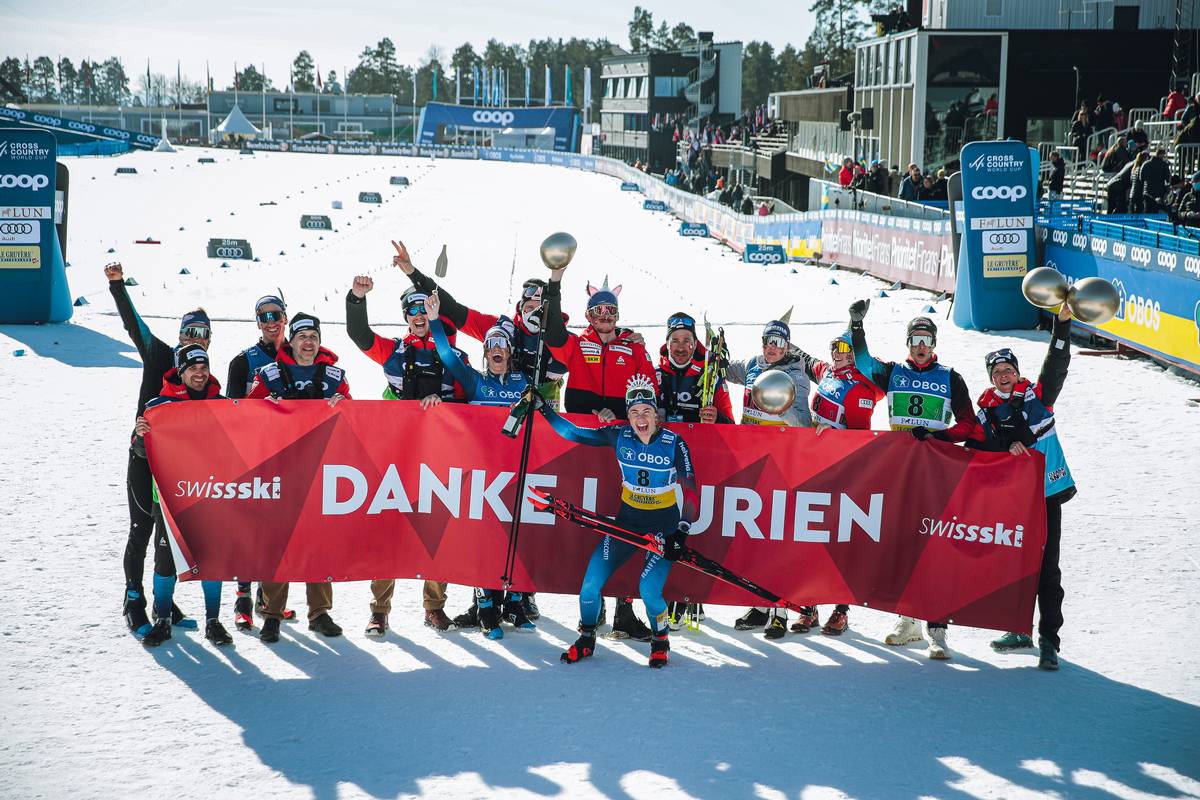
    Awaiting the Swiss anchor Laurien Van der Graaff was a princess tiara, teammates in golden unicorn horns, and a large banner that read “Danke Laurien”, in celebration of her retirement. The 34-year-old has long been a presence on the World Cup, collecting a slew of podiums and a World Championship team sprint silver medal along the way.  

    The Swiss program celebrates the retirement of Laurien Van der Graaff at the finish of the 4 x 5 k mixed relay in Falun. (Photo: NordicFocus)

    With revelry and thrill in the air, only the mixed team sprint remained on deck as the 2021/22 World Cup season drew to a close in Falun. The American program did not enter the team sprint competition, and will next compete as a team at the Whistler Olympic Park in British Columbia March 20th – 27th. The event will serve as both the Canadian National Championship and SuperTour Finals.

    Results

  • North American Men End on High Note in Falun 15 k Free; Patterson 7th, Léveillé 9th, Ketterson 15th

    North American Men End on High Note in Falun 15 k Free; Patterson 7th, Léveillé 9th, Ketterson 15th

    This World Cup coverage is made possible through the generous support of Marty and Kathy Hall and the A Hall Mark of Excellence Award.  To learn more about A Hall Mark of Excellence Award or to learn how you can support FasterSkier’s coverage please contact info@fasterskier.com.

    Following the men’s Olympic 50-turned-28.6 k in Zhangjiakou, long-time American distance champion Kris Freeman and Devon Kershaw called Scott Patterson an “Olympic Specialist”, commenting on how Patterson had found many of his top results at either World Ski Championships or during the Olympics in PyeongChang and Zhangjiakou. 

    His top championship results are this: 8th in the 30 k free in Beijing, 11th in the 15/15 k skiathlon; 14th in the skiathon and 10th in the 50 k classic during the 2021 World Ski Championships in Oberstdorf, Germany; 21st in the skiathlon in the skiathlon during the 2019 World Champs in Seefeld, Austria; 18th in the skiathlon, 21st in the 15k skate and 11th in the 50 k classic during the 2018 Olympics in PyeongChang.  

    Until today, Patterson had raced into the Top-20 on the World Cup five times individually, with his best result – and only other individual Top-10 – arriving in 2017 in the 30 k skiathlon during a pre-Olympic World Cup in PyeongChang. This event saw just 31 finishers, and a scan of the results sheet shows only a small number of names that frequent this site. 

    Scott Patterson races to 7th place during the 15 k individual start skate in Falun. (Photo: NordicFocus)

    But here in Falun, Sweden, Patterson popped a 7th place finish in the 15-kilometer individual start skate, finishing 42 seconds behind winner Didrik Tønseth (NOR) as the first non-Scandinavian athlete on the tails of five Norwegians plus Calle Halfvarsson of Sweden. 

    Roughly another 40 seconds back, Team Birkie’s Zak Ketterson was rolling too. In a steady effort that saw him inside the Top-20 throughout the day, he not only his first World Cup points, but finished 15th, +1:20.8 on Tønseth. 

    In short, Patterson and Ketterson shaped the final men’s distance race of the season into a high note for the U.S. And both men did it as early-starters, before the seeded group.

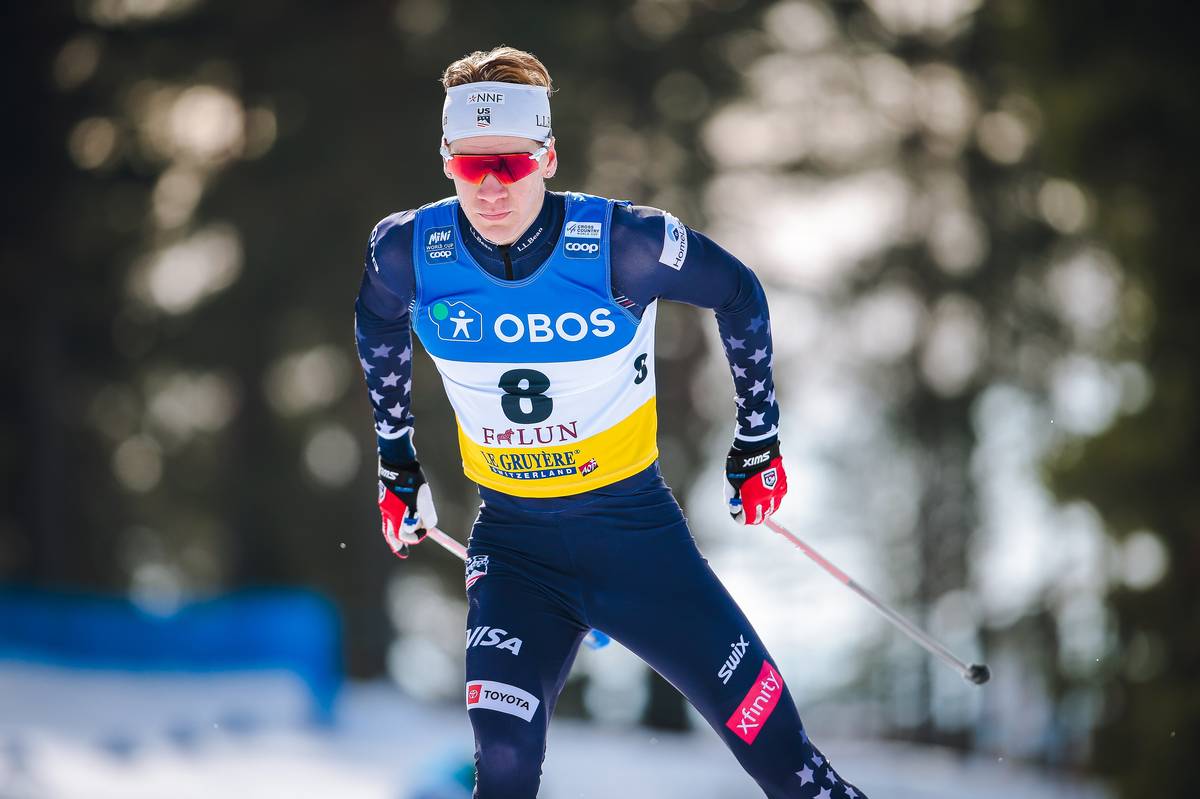
    Zak Ketterson (bib 8) leads Logan Hanneman during the 15 k individual start skate in Falun. (Photo: NordicFocus)

    Diving into the race, a winning strategy looked to be a conservative first of four laps on the championship-caliber course in Falun. While the top-three established themselves early, the eventual winner, Tønseth, did not make his charge for the win until the final lap. 23-year-old Harald Østberg Amundsen (NOR) was on top at the first lap, followed by Halfvarsson of Sweden, and then Tønseth. At the half, it was Halfvarsson on top, with Amundsen and Tønseth just under four seconds back. Then, Tønseth slowly turned the dial upward. 

    With one lap to go, Tønseth had five seconds on the Swede, and ten on his young countryman. With just over 2 k to go, this lead had grown to +13.3 seconds, of which he ceded very little through the finish. Tønseth stopped the clock at a ripping 31:57.6, knocking down the time of Halfvarsson who had started eleven bibs earlier. The Swede kept the second spot on the podium (+9.0), while Amundsen, who faded in the second half, kept pace from the back-half of the seeded group to finish third (+20.4). 

    Sweden’s Calle Halfvarsson sets the mark at the finish of the 15 k skate in Falun, while Scott Patterson races the final meters in the background. (Photo: NordicFocus)
    Norway’s Didrik Tønseth wins the 15 k individual start skate in Falun. (Photo: NordicFocus)

    Today marked Tønseth’s second consecutive podium, after taking 3rd at Holmenkollen last weekend, and his career first World Cup victory in freestyle. It had been a nearly three year stretch since his previous World Cup podium, which took place in Québec City in March, 2019.

    “I’m happy to end it like this,” Tønseth told FIS after the race. “This year has been pretty good, to finish it off with victories – I’m really happy with that. Considering the last two seasons before this one have been tough, and it was not working, but this one has been better and better, and I ended  up at the top, so I’m really happy.”

    Norway’s Didrik Tønseth wins the 15 k individual start skate in Falun. (Photo: NordicFocus)

    On his season highlights, Tønseth continued, “For me, the most important is that my body works and I can train it. I can train hard, and things respond, and I’m happy to go ski fast.”

    Asked his feelings on sharing the podium with teammate Amundsen, Tønseth said, “He is a rookie, but he showed last year, he is a good cross country skier. I’m happy for him to be on the podium and I’m happy to beat him as well.”

    Falun’s 15 k skate podium: Didrik Tønseth (NOR) took the win ahead of Calle Halfvarsson (SWE) and Harald Østberg Amundsen (NOR). (Photo: NordicFocus)

    Expanding on the conservative start – though the eventual podium athletes would simply reshuffle themselves throughout the race, the remainder of the top-10 saw some changes, like France’s Clement Parisse falling from fourth place at the halfway mark to 8th at the finish, and two Finns, Remi Lindholm and Iivo Niskanen, dropping from fifth and seventh at the first lap to 14th and tenth at the finish. 

    Meanwhile, the seemingly more patient starters, like Martin Løwstrøm Nyenget, who won last weekend’s 50 k classic at Holmenkollen, were climbing the rankings at time checks. Nyenget was in eighth at the half, before ascending to fifth at the finish (+23.6), just behind his teammate Hans Christer Holund, who took fourth (+21.2).

    Both Patterson and Ketterson exemplified this tactic also, knocking off three spots each between the halfway mark and the finish. Propagating a banner day for North America, Canada’s Olivier Léveillé was also steadily climbing the ranks, moving up from 16th at 7.5k to finish 9th (+48.9). Léveillé’s teammate Antoine Cyr had skied up from 37th at the half to finish 25th (+1:42.3), while fellow Canadian Phillippe Boucher took 29th (+1:45.0) as the third member of his team inside the top-30.

    Canada’s Antoine Cyr skis to 25th in Falun’s 15 k free. (Photo: NordicFocus)

    While Patterson was 15th in Falun last year, and has aforementioned strong results on championship courses like this one, Patterson said in a post-race call that the venue has actually been a challenge for him through his career. Though it’s a championship course, it lacks the high altitude factor of Zhangjiakou, where Patterson thrived, and has just one major climb, the signature “Morderbakken” which rises 65 vertical meters over the course of roughly 0.6 k. Gaining from his experiences racing on this course, Patterson shared what he’s done to solve the puzzle.

    “A lot of my approach today was trying to find some of the same feelings as last year, which was a lot of pushing hard, working through all the transitions. There’s a lot of time out there — beyond Morderbakken, there’s a lot of twisting down hills and gradual flats where it’s easy to lose time. But if you’re on form and thinking about it all the time, it’s a good place to gain time.”

    Scott Patterson takes 7th place in the 15 k individual start skate in Falun. (Photo: NordicFocus)

    Patterson also shared that he was unsure how his form would be today, as he was carrying fatigue from his performance at the Holmenkollen, which he identified as below his expectations. 

    “I started questioning my fitness. So it was nice to turn that around today with a good race and actually remind myself that I can ski well again and also appreciate a good distance skate race.”

    Overall, the season has been one of high highs and low lows for the 30-year-old. A late-fall broken wrist inhibited his ability to capitalize on the fitness he built over the summer, along with his early-season results, which would be critical for making the 2022 Olympic team. Patterson discussed the turning point of his season, which will end on a high note. 

    “[I hit a] big turning point going into nationals, where I had a lot of pressure, but I felt like I was actually starting to find my form and race well. So that was one big point, just coming into nationals and actually pulling out those results to make the Olympic team. But also, just going into the Olympics, I I had a really good training block in Bozeman. I was staying with my parents instead of going over to Livigno, like a lot of the US Olympic team. And I think that was really productive for me getting some altitude training, but also just keeping the stress low, which really helped going into the Olympics.”

    Here’s the full interview with Patterson, including non-race season highlights and how a trivia night in Lahti helped bring the North American contingent closer together, making today’s results even more exciting for Patterson to be part of.

    Adam Martin pushes to the line at the finish of the men’s 15 k individual start skate in Falun. (Photo: NordicFocus)
    Canada’s Xavier McKeever down the home stretch in the men’s 15 k free in Falun. (Photo: NordicFocus)

    Outside the Top-30 for the U.S., Crafttsbury’s Adam Martin skied to 44th (+2:20.9), while Logan Hanneman finished 52nd (+2:58.4), and Peter Holmes took 68th (+4:20.0). For Canada, Thomas Stephen was 61st (+3:32.2), while Xavier McKeever was 62nd (+3:36.9). 

    Post-race interview with Matt Whitcomb:

    With World Cup individual racing now complete for the 2021/22 season, awards for both the overall and distance champions were handed out today in Falun. 

    Though he was 10th today, Finland’s Iivo Niskanen ended his season with 493 points, overtaking previous leader Alexander Bolshunov (RUS) to win the distance standings. Bolshunov remained in second, trailing by 75 points. After a remarkable Olympic run, Bolshunov missed the final two distance races on the World Cup following FIS’ ban of Russian and Belarusian athletes on March 1st. Also unable to compete in the final two World Cup distance events after contracting COVID-19, Johannes Høsflot Klæbo finished third, at an 80 point deficit.

    Finland’s Iivo Niskanen is the 2022 World Cup distance champion. (Photo: NordicFocus)

    With Niskanen still the only podium member present to accept his awards, this leaderboard was reshuffled for the overall standings. Having won the 2021/22 Tour de Ski and consistently proved his range beyond the sprint course, Klæbo ran away with the overall World Cup victory to finish with 1375 points. He’s had some cake, but receiving the crystal globe will have to wait for the time being. 

    Bolshunov held his ground in second place, 497 points back, while Niskanen took third in the overall standings, 631 points behind Klæbo. 

    A Norwegian coach accepts the overall World Cup crystal globe on behalf of winner Johannes Høsflot Klæbo. (Photo: NordicFocus)

    You can expect more analysis on the seasons of these World Cup champions, but first, we’ve got one final day of World Cup racing on deck. The final day of racing in Falun will feature a mixed-gender 4 x 5 k relay in the morning, followed by a mixed team sprint in the afternoon. 

    Results

    World Cup: Overall | Distance


  • Jouve takes back-to-back classic sprint wins, earning France the 2022 World Cup sprint globe; Ritchie leads for North America with Top-20

    Jouve takes back-to-back classic sprint wins, earning France the 2022 World Cup sprint globe; Ritchie leads for North America with Top-20

    This World Cup coverage is made possible through the generous support of Marty and Kathy Hall and the A Hall Mark of Excellence Award.  To learn more about A Hall Mark of Excellence Award or to learn how you can support FasterSkier’s coverage please contact info@fasterskier.com.

    It’s the last hurrah, folks! The World Cup Finals kicked off in Falun, Sweden today with a classic sprint. While the season has been a wild ride for many reasons – spills and thrills in the Tour de Ski, COVID-cancellations, Olympic Games, geopolitical nightmares – Falun evidenced that spring is on it’s way and it’s time for the World Cup crews to head home take a break, and begin anew.

    Contrasting the dim light and long shadows of far-north Ruka, Finland at the opposite bookend of the season, the sprints in Falun were raced under bright sun, with temperatures well-above freezing, bare ground and green grass emerging from beside ski tracks.  

    Zak Ketterson leads the U.S. in 39th during the classic sprint qualification round in Falun, SWE. (Photo: NordicFocus)

    The American men, particularly in sprint, headed into the Falun weekend at a significant disadvantage. Kevin Bolger announced on Instagram Thursday that he had tested positive for COVID, while Ben Ogden, JC Schoonmaker, and Luke Jager – the remainder of the four sprint men who competed during the 2022 Olympics in Zhangjiakou – are currently competing at the NCAA championships in Soldier Hollow, UT. The sprint field as a whole has been weakened; Russian athletes were banned from competition on March 1st, while Norway’s top-six sprinters, including sprint and overall World Cup leader Johannes Høsflot Klæbo, each tested positive for COVID following the World Cup race weekend in Lahti, Finland. With no Russian’s and the top-Norwegians out, the men’s field had been cracked wide open.  

    Finland’s Joni Mæki posts the fastest time in the classic sprint qualifier in Falun, SWE. (Photo: NordicFocus)

    Finland’s Joni Mæki took the top spot in qualification, setting the mark at 2:51.58. Sivert Wiig of Norway took second in the qualifier (+0.69), with Sweden’s Calle Halfvarsson in third (+1.41). Three nations represented in the top-three.

    Though new-to-FasterSkier names made the top-30, the early heats featured little surprise. Building momentum from a podium day in Drammen last week, France sent three of its top men to the semifinals: Lucas Chanavat and Richard Jouve, who had been third and first, respectively in Drammen, plus Jules Chappaz. Long-time sprint force Federico Pellegrino of Italy also moved through with an automatic spot, joining the day’s top-three qualifiers in the next round.

    What did shake up the quarters was some trouble for the two Chinese athletes in the field. Shang Jincai, who had qualified in 25th, had a false start in heat three. Jincai looked as though he had been trying to keep himself so primed for forward momentum at the start beep, that he lost his balance, kicking a foot forward to catch himself well-before the beep and thus triggering the start. After a discussion with a jury member, while Pellegrino shook his head and raised his hands nearby, looking impatient, Jincai received a yellow card and was disqualified. 

    After stumbling on a climb and losing ground, Wang Qiang (CNH) races to 18th in the classic sprint quarterfinal in Falun, SWE. (Photo: NordicFocus)

    In the next heat, Wang Qiang, who qualified in 9th and took second in Drammen, fell when hopping out of the track to run uphill, roughly two minutes into the heat. Qiang had been in the lead, though the pack remained tight. After a few missteps, he was back to his feet, chasing as real estate ran out, while Lars Agnar Hjelmeset (NOR) and Calle Halfvarsson (SWE) took the reins at the front to go 1-2 in the heat. Qiang raced his way back to fourth, just over a second back, but it was not enough for a lucky loser spot.  

    Richard Jouve (FRA) takes control through the rounds in Falun. (Photo: NordicFocus)

    In the semis, France’s Jouve took control of the fast first heat, beginning a surge just under-two minutes in as the men ran up the steep climb and banked left to head back toward the stadium. Around the last corner, Jouve still held the lead with Mæki (FIN) just off his shoulder. Jouve pulled ahead in the double pole sprint through the lanes, while Mæki, Wiig (NOR), and Chanavat (FRA) raced each other and the clock down the final meters. At the line, it was Norway-France-Finland, spread by 0.38 seconds, fifth and sixth less than a second behind also. Each of the top-four finishers advanced into the final round.

    The second heat was significantly less smooth, though times did not reflect the chaos and were only marginally slower than the first. As the course broke down, it looked to be continually harder to keep klister free and stay upright. Heading into the final downhill in strong position to take the heat, France’s Jules Chappaz looked as if his klister snagged some loose granules of snow; as he pushed off the outside ski to stay in the curve, the ski looked unable to slide and he crashed into the abrasive corn. 

    The remaining athletes in the head narrowly dodged Chappaz, allowing Hjelmeset and Pellegrino to take the lead and eventually win the heat. Sweden’s Halfvarsson also went down earlier in the heat, looking to have similarly iced up while running up the first climb, leaving him off the back after the subsequent downhill.

    After leading into the final downhill, a dejected Jules Chappaz (FRA) recovers from a crash to finish his semifinal. (Photo: NordicFocus)

    Once again, Jouve took control of the final early, with Pellegrino marking. Mæki stayed wide on the first climb looking for better snow, but came over the top and into the curve behind the top three. Jouve, still calling the shots, led into the downhill, but he could not create any significant gaps there; Wiig, Pellegrino, Chanavat and Mæki quickly accordioned onto the backs of his ski tails.

    Looking confident and composed despite being unable to break away, Jouve remained at the front heading into the final curve. Once in the lanes, Jouve began to pull ahead a final time, creating a gap of several meters to Mæki and Chanavat, who were evenly matched in the double pole sprint. 

    Richard Jouve (bib 10) leads the men’s classic sprint final to the finish in Falun, while four athletes vie for the remaining two podium positions. (Photo: NordicFocus)

    Emptying his lungs with a triumphant cry, Jouve coasted over the line for the win in 3:03.62, while Mæki and Chanavat threw their boots forward in a photo finish for the second and third podium spots roughly half a second behind. From the slow-mo, it was Mæki with the better lunge, nipping Chanavat by 0.03.

    Just behind Wiig crossed fourth (+1.41), with Pellegrino fifth (+2.06), followed by a gap to Hjelmeset in sixth (+13.18).

    Richard Jouve (FRA) lets out a victory cry as he takes the classic sprint win in Falun. (Photo: NordicFocus)
    The men’s classic sprint podium in Falun, Sweden: Richard Jouve (FRA) took the win ahead of Joni Mæki (FIN) and Lucas Chanavat (FRA). (Photo: NordicFocus)

    “I’m very proud,” Jouve told FIS after the race. “Off myself, my team. It’s amazing.” 

    With the win today, Jouve also took the lead in the sprint World Cup standings, advancing by just six points ahead of Johannes Høsflot Klæbo (NOR). The season saw Jouve land on four World Cup podiums, finish seventh in the freestyle sprint during the Olympics, and then earn his career first World Cup win in Drammen’s classic sprint last Thursday.

    “It’s amazing,” said an emotional Jouve, seemingly in happy disbelief. “The season was very great for me, to win at the end of the season is already a dream, but to grab [the globe], it’s big. Fantastic.”

    With a win in the final sprint stage, Richard Jouve becomes the 2022 World Cup sprint champion, hoisting his crystal globe. (Photo: NordicFocus)
    French teammates Richard Jouve (left) and Lucas Chanavat (right) end their season in first and third, respectively, in the World Cup sprint standings. (Photo: NordicFocus)

    A quick review of the final standings: With 568 points, Jouve is the 2022 sprint World Cup champion, with Klæbo second (-6) and Chanavat third (-107). Italy’s Pellegrino was fourth (-238), with Norway’s Håvard Solås Taugbøl fifth (-244). 

    The US had three starters for today’s final sprint stage. Zak Ketterson led the way for the American team in 39th (+9.92), followed by Logan Hanneman in 47th (+10.79), and Peter Holmes 54th (+13.38). 

    Listen to post-race interview with U.S. Ski Team Head Coach Matt Whitcomb here.

    Logan Hanneman skis to 46th in qualification in Falun. (Photo: NordicFocus)
    Graham Ritchie leads the way for North America, finishing 20th in Falun’s individual classic sprint. (Photo: NordicFocus)

    Racing for Canada, Graham Ritchie was the sole North American to break into the heats after qualifying in 28th (+8.11). Racing in the third quarterfinal heat, Ritchie crossed fourth, roughly three seconds behind Chanavat and Pellegrino, the heat winners. The effort landed him in 20th overall once final rounds were decided. 

    Missing the top-30 by just 0.27 seconds, Antoine Cyr was next for Canada in 31st (+8.76), with Xavier McKeever next in 44th (+10.54), followed by Rémi Drolet in 57th (+14.59). 

    Antoine Cyr just misses the mark in qualification, finishing 31st. (Photo: NordicFocus)

    Racing in Falun continues tomorrow with a 15 k individual start skate.

    Results:

    Qualification | Final | World Cup Sprint Standings


  • Norway Sweeps Podium as Revelry Returns at Holmenkollen 50 k; Martin Leads US in 26th

    Norway Sweeps Podium as Revelry Returns at Holmenkollen 50 k; Martin Leads US in 26th

    This World Cup coverage is made possible through the generous support of Marty and Kathy Hall and the A Hall Mark of Excellence Award.  To learn more about A Hall Mark of Excellence Award or to learn how you can support FasterSkier’s coverage please contact info@fasterskier.com.

    In Oslo on Sunday, came another sign of the times.

    The Holmenkollen Ski Festival, the beating heart and center of the modern sport of skiing since Torjus Hemmestveit won the first 50-kilometer cross country race held there in 1888, has only stopped for extraordinary interruptions in human and natural history. (Interestingly enough, the Hemmestveit family immigrated from Norway to Minnesota, marking the first and only North American connection to the Holmenkollen 50 k men’s podium until Canadian Pierre Harvey won the race exactly a century later in 1988.) The latter – a natural lack of snow – has been fairly harmless (but ominous), but the former has only ever been due to a World War. That is, of course, until the last two years, when the COVID-19 pandemic forced first no spectators at skiing’s most well-attended event in 2020, and then full cancellation in 2021. 

    After a three-year wait, the bustling, flag-waving, marching band playing (there was definitely a marching band!), Norwegian crowd was back out under the hot Oslo sun, in what seemed a matter of national pride.

    Revelry returns to the iconic Holmenkollen 50 k in Oslo, NOR. (Photo: NordicFocus)

    They could only hope that the same sense of the matter extended to their countrymen doing the racing at Holmenkollen. Coming into today, it had been a full five years since a Norwegian had won the 50 k at Holmenkollen, when Martin Johnsrud Sundby did so in a 2017 classic mass start. With the Russian athletes who have been at the forefront of the event since then banned (the Russians completed a podium sweep in 2019, before Alexander Bolshunov won in 2020), Norway was poised to make a run at adding to the thirty-five champions it has seen at its most famous race. One of those previous 35, Sjur Røthe, was in the field on Sunday. Alongside him was Beijing Olympic 30 k bronze medalist Simen Hegstad Kreuger, Didrik Tønseth, and Hans Christer Holund. 

    Of course, in a 50 k classic, they would have to try and beat the best classic skier in the world. Iivo Niskanen was looking to revive another long Holmenkollen tradition – the Finns ruining the Norwegians national outing. Fresh off a pair of individual medals at the Beijing games in the 15 k Classic (gold), and 30 k skiathlon (silver), the 50 k Holmenkollen classic seemed like a perfect opportunity for Niskanen to add to his legacy as a modern giant of the classic technique.

    The field was set to race six laps of an 8.3 k course that organizers billed as the toughest on the World Cup (see below). With temperatures at the noon start reaching 8℃ (about 47℉), the FIS camera couldn’t help but turn to the extra set of skis layed out in the stadium each lap, no doubt waiting to resupply skiers with the warm klister that was in demand today.

    The Holmenkollen 50 k course. (Photo: Holmenkollen Ski Festival)

    For a 50 k, the field began at a furious pace today, with much of the first 15 k led out by pulls from the skiers, mainly Norwegian and Finnish with the odd Andorran (Ireneu Esteve Altimiras) thrown in, that indicated that they were in control of the race and willing to give the long-burn attack a try today. Within the top group of twenty that eventually formed, however, there wasn’t one skier that looked strong enough to break-away and win by minutes in, say, the way that Marit Bjørgen controlled the Holmenkollen race in her heyday, or the way Therese Johaug did in her final Holmenkollen appearance yesterday.

    By the beginning of the fourth lap (24.9 k), the lead group had narrowed down to about fifteen skiers. Included were a slew of Norwegians, including Sjur Røthe, Didrik Tønseth, Martin Løwstrøm Nyenget, and Harald Østberg Amundsen, Iivo Niskanen (FIN), Britain’s Andrew Musgrave, 2018 champion Dario Cologna (SUI), and young Swedish hopeful William Poromaa.

    Adam Martin races the 50 k mass start classic at Holmenkollen in Oslo, NOR. (Photo: NordicFocus)

    With the pack established, the group seemed to allow the pace to let up over the course of the next 8 k. The one exception was Iivo Niskanen, who throughout the whole day positioned himself at the front of the pack for a series of bonus points offered on course. They revealed a prescient concern for Niskanen – he is still in the running to win the distance World Cup this season, and came into today 3rd place behind two athletes, Alexander Bolshunov (1st) and Johannes Høsflot Klæbo (2nd) who may not race again. He had every incentive to chase down the points, with the question arising whether having to maneuver to the front every 5 k or so to take the checkpoints would cost him the energy needed for a bid at the win.

    When the lead group came into the stadium to complete their 4th lap (33.2 k), Sjur Røthe made a move towards the second set of skis layed out for him with a fresh kick zone of wax. The whole field followed. That is, save Amundsen, who flew past the transition zone and into the steep climb that led away from the stadium.

    Whether it was the ski swap itself, or the fact that the race was now 15 k out from the finish, the move going into the 5th lap seemed to blow open a pack that had been subdued for the last 15 k. Amundsen didn’t try and ease up to allow a larger pack to reform, but instead tried to drive onward. The effect was that the field, led by Andrew Musgrave, had to increase their pace to try and cover Amundsen’s move. Musgrave didn’t pack such a punch in his acceleration that the top skiers couldn’t follow, and as they came into the final lap, the Norwegian hopefuls of Nygenet, Røthe, and Tønseth, along with livo Niskanen and William Poromaa, were the skiers left to vie for Holmenkollen 50 k crown.

    Young talents: Harald Østberg Amundsen (NOR) races alongside William Poromaa (SWE) during the 50 k mass start classic at Holmenkollen. (Photo: NordicFocus)

    The home country, as if its skiers sensed a special mix of history combined with a perfect Oslo day, got to see one of the oldest, most impressive sights in ski-sport. Three Norwegians, led by Didrik Tønseth, then Martin Løwstrøm Nyenget and Sjur Røthe, moved together towards the finish line. Iivo Niskanen and William Poromaa stayed in the frame, but by the final 2 k, they were out of the picture.

    In a scene that thousands of Norwegian spectators had dreamed about since their most famous race had been thrown into disarray two years ago, they were treated to the end of a Holmenkollen weekend with three Norwegians at the front, vying for the podium, a rare landmark for the treasured and iconic event.

    Tønseth led the pack as they moved into a long downhill that went into the stadium. From there, Røthe out-glided his two teammates, with Nyenget in behind them. At the end of a long downhill straight, one final hill led around and down again to the final stretch. As Røthe approached the hill, he positioned himself outside of the tracks, which seemed an indication that his great glide into the stadium may have also foreshadowed a want of kick wax. He was forced to run up the last hill, searching for every little bit of klister left in its zone (in a dance very familiar to many of us skiers), while Nyenget was the picture of perfect classic technique, driving through to go over the top of the hill in first place. Røthe stumbled slightly, Nyenget burst into the final stretch, and they came across the line like that. Nyenget the winner (2:03:27.3), Røthe second (+0.6), and Tønseth in third (+3.5).

    Martin Løwstrøm Nyenget embraces his teammate Sjur Røthe after going one-two at Holmenkollen. (Photo: NordicFocus)

    The three Norweigans completed the first podium sweep for the home country at Holmenkollen since 1985, and the first since the event has been held as a World Cup. The center of Norwegian skiing, after two years where it has stumbled through, has held, and held firmly. Nyenget, Røthe, and Tønseth doing their home nation proud on a sunny Oslo day that seemed to foreshadow brighter times ahead for Holmenkollen, and the sport that is ski racing the festival energized over a century ago.

    The US trio of Scott Patterson, Adam Martin, and Zak Ketterson that started the day came away with great results as well. Martin, who was recently pulled up to the World Cup based on his results in the SuperTour, came in 26th (+5:03.2). Scott Patterson, coming off an 8th place finish in the Beijing 30 k, finished 31st (+6:05.5), and Zak Ketterson finished in 41st (+7:14.8).

    “It was a beautiful day today,” wrote Martin after the race. “It was warm, and it did get slushy on some of the climbs, but most of the course held up really well. I think we had great wax.”

    On his approach to the day, Martin continued, “I suspect pretty much every guy out there starts with the same strategy: hang on to the lead group until the finish or it’s no longer possible. That was my strategy, at least. I think I managed two laps or something, and then I skied the rest of the race with a smaller group of skiers who also fell behind.

    This is Martin’s third time racing at the 50 k at Holmenkollen, with today marking a step forward, after taking one backward in his last appearance. “I placed 31st in 2019 with a smaller field after World Champs, and I finished last (but did finish) in 2020 after Ian Torchia and I erroneously opted for zeros.”

    Zak Ketterson races the 50 k mass start classic at Holmenkollen in Oslo, NOR. (Photo: NordicFocus)
    Scott Patterson races the 50 k mass start classic at Holmenkollen in Oslo, NOR. (Photo: NordicFocus)

    Canadians Remi Drolet finished in 48th (+10:27.1), while Philippe Boucher came in 54th (+17:36.0). Staying in Norway following the U23/Junior Ski World Ski Championships, Tom Stephen also started for the 50 k, however, he withdrew following the third lap and did not finish. 

    20-year-old Thomas Stephen (CAN) races the 50 k classic at Holmenkollen in Oslo, NOR. (Photo: NordicFocus)

    Full Results


  • After a week of upheavals, the World Cup sprint show goes on in Drammen; France’s Jouve wins, while China gets its first podium

    After a week of upheavals, the World Cup sprint show goes on in Drammen; France’s Jouve wins, while China gets its first podium

    This World Cup coverage is made possible through the generous support of Marty and Kathy Hall and the A Hall Mark of Excellence Award.  To learn more about A Hall Mark of Excellence Award or to learn how you can support FasterSkier’s coverage please contact info@fasterskier.com.


    Cross country skiing’s most ancient, classic, weekend of racing in Norway (the Holmenkollen ski festival) began with a sprint through the center of Drammen, about 45-kilometers (30 mi) south of Oslo, and despite its best efforts, got caught up in these confounding and confusing times.

    If you didn’t focus in completely, the scenes in Drammen looked pleasantly familiar in a way that could keep you in the timeless state of mind associated with Holmenkollen. It was reassuringly nice to see sprint racing return, after two years, to the type of venue that led to its exciting, spectator-friendly, rise in the first place. A genuine town-center sprint, trucked in artificial snow and all, with a genuine (and very enthusiastic) crowd.

    Graham Ritchie (CAN) races in the second heat of the classic sprint quarterfinals in Drammen, NOR. (Photo: NordicFocus)

    Bring some focus into the racing though, particularly who was in the men’s field day, and you couldn’t help but see the upheaving forces of the moment doing their upheaving. COVID still had a heavy-hand in the field today, with the entire Norwegian men’s sprint team (who had raced in Lahti last weekend), including Johannes Høsflot Klæbo, having recently tested positive. Then, there was the FIS imposed ban on Russian and Belarusian athletes, which also went into effect this week in response to their government’s invasion of Ukraine. In all, 7 of the top 10 in the FIS Sprint Points Classification were absent from the field in Drammen. There was a spectral quality, something eerie, to just how much world events have managed to find and catch the quiet corner of nordic skiing in the past couple of weeks.

    For their part, the FIS decked out Drammen in blue and yellow in a sign of solidarity with Ukraine. From bibs, to fencing boards, to the souvenir flags held in the crowd. Idealists will note the poignant gesture, especially in a country where, in a friendlier geopolitical sense, blue and yellow are the colors of neighbor and rival, Sweden. Regardless, it was a stunning way for the FIS to symbolize the implied meaning surrounding the policies they implemented surrounding Russia this week. Cynics, on the other hand, could also read it as the FIS trying to stave off some of the pointed criticism that’s been directed at larger international sport’s governing bodies like UEFA, FIFA, and the IOC surrounding their handling of Russia.

    Logan Hanneman skis to 50th during the classic sprint qualifier in Drammen, NOR. (Photo: NordicFocus)

    No matter the forces affecting skiing, the fact remained that there was skiing to be had. And without Norway’s top squad and Russia, it brought out the interesting prospect of watching racers who have navigated tactically around them to podium finishes all season – Richard Jouve (FRA), Lucas Chanavat (FRA), Federico Pellegrino (ITA), and Joni Mæki (FIN) among them – now represent the top of the field themselves.

    In the qualifier, it was Jouve who took first place by an impressive margin, finishing in a time of 2:26.35, -2.07 sec over second place Ondrej Cerny (CZE). Following up on an impressive Olympic sprint in his home country, Chinese skier Wang Qiang took 3rd place (+2.66). Among North American athletes, the Canadian men had an impressive showing, sending three to the heats with Graham Ritchie qualifying 13th (+5.91), Antoine Cyr in 19th (+6.42), and Pierre Grall-Johnson 23rd (+6.85).

    Antoine Cyr (CAN) races to 19th in qualification in Drammen. (Photo: NordicFocus)
    Sun Valley’s Peter Holmes races the classic sprint qualifier in Drammen, NOR. (Photo: NordicFocus)

    The American men were just outside the top-30 mark necessary to race the quarterfinals, with Kevin Bolger just +0.7 off the last spot in 35th (+8.90), Logan Diekmann 39th (+9.40), Logan Hanneman in 50th (+11.19), Peter Holmes in 53rd (+12.05), and Zak Ketterson in 54th (+12.26).

    The heats then, were filled with a motley mix of familiar sprint stars and younger talent from the home country Norway.

    The course they raced was a classic town center sprint – a long gradual stretch going out from the start that narrowed as they hit two technique-zoned uphills leading into a hairpin. From there, it was a gradual downhill into another tight hairpin that opened up to a 4-track wide sprint finishing straight that allowed the best sprinters to open up and hit top speed.

    Despite his absence, Klæbo’s tactical maneuvering and push-and-pull with pace was still felt throughout the race. Richard Jouve raced out of the first quarterfinal, and the typically aggressive Frenchmen held steady at the front of the pack, before shooting around the first hairpin turn that returned to the stadium. From there, he held control of the race to advance comfortably to the semi-finals and win the heat (2:32.98). He was followed by Sivert Wiig (NOR) in 2nd (+0.61), who would escape a tangle earlier in the race that saw Canadian Pierre Grall-Johnson fall and break a pole.

    Canada’s Pierre Grall-Johnson (CAN) races the quarterfinal of Drammen’s classic sprint. (Photo: NordicFocus)

    The exception to the relative care in pacing that many of the racers showed in the quarterfinals came in the third heat, where Wang Qiang from China shot out of the gate and went full bore throughout the race. By the time they hit the first technique zone, he had a comfortable gap on his competitors, who wouldn’t come back to him. In the process of taking the field out fast, Qiang had also made it by far the fastest quarterfinal at a winning time of 2:30.94. Second place Lauri Vuorinen (FIN) (+0.72), third place Pål Trøan Aune (NOR) (+0.99), and fourth place Harlad Østberg Amundsen (NOR) (+1.08) all advanced to the semi-final with two lucky losers coming out of the heat.

    Wang Qiang (CHN) is off the front during the men’s quarterfinals in Drammen. (Photo: NordicFocus)

    The 4th heat saw Joni Mæki (FIN) and Federico Pellegrino (ITA) follow early moves from Renaud Jay (FRA) and Ludek Seller (CZE) before reminding observers of their well-earned reputations as two of the best top-end speed racers in a finishing straight. Mæki advanced in first place (2:34.44), with Pellegrino in second (+0.62).

    The semi-finals brought a similar field to the one that had advanced to the quarterfinals, with the familiar names of Richard Jouve and Lucas Chanavat joined by the young Norwegian pairing of Wiig and Amundsen, Swiss skier Jovian Hediger, and Wang Qiang.

    Qiang again attacked from the start, with a lesser, but still commanding, gap established by the time he hit the first corner to head back towards the stadium. Jouve was the only skier that covered the gap off of that corner, and was able to pull along his countryman and Wiig with him before they all came together for the final sprint. There, the Frenchmen both showed their sprinting prowess, with Jouve winning the heat in 2:31.94 and Chanavat in 2nd (+0.74). Qiang’s early attack again proved to shape the field beyond his own racing, again making sure that both lucky losers, he and Wiig, came from the first semi-final.

    Qiang’s attempts to force a semi-final with two lucky losers was aided by the way that the second semi-final raced, starting out at a steady pace before halting to a crawl around the first corner. George Ersson (SWE) got caught in front before Federico Pellegrino took charge on the downhill going into the stadium. By the time he rounded the corner into the finishing straight, he was in control of an otherwise tight pack. Pellegrino crossed the line in first (2:42.16) to advance to the finals, along with Norway’s Aune, who finished second (+0.16).

    Federico Pellegrino (ITA) and Pål Trøan Aune (NOR) lead in the final stretch during the men’s semifinal in Drammen, NOR. (Photo: NordicFocus)

    That set up a final with French pairing of Richard Jouve and Lucas Chanavat, the Norwegian pairing of Sivert Wiig and Pål Trøan Aune, Italian Federico Pellegrino, and Chinese Wang Qianq.

    Qiang was subdued in the final compared to his previous heats, but then again, Richard Jouve had also stepped up the pace earlier in the final. The result was a tight pack with Jouve and Qiang at the front, with a quick but controlled pace through the early two climbs on course. Jouve took the pack into the first corner, and it was there, again emulating the absent Klæbo, where he chose to shoot around, concealing his burst of speed from the back part of the pack so that by the time they knew they needed to respond Jouve was already well on his way down the long descent.

    Men’s final led out by the French pairing of Richard Jouve and Lucas Chanavat in Drammen on Thursday. (Photo: NordicFocus)

    Their positioning in second and third, respectively, allowed Wang Qiang and Lucas Chanavat to try and match Jouve’s move, but as the pack hit the final stretch it became clear that Jouve hadn’t just made a move, he had made a move and followed it up with a burst of speed that left him peerless on the day.

    Jouve crossed the line comfortably in first (2:32.84), with a lightly-packed sprint for the podium behind him.

    Richard Jouve takes the win in Drammen. (Photo: NordicFocus)
    Wang Qiang became the first Chinese athlete to podium in a World Cup, finishing 2nd in the classic sprint in Drammen. (Photo: NordicFocus)

    Leading that, after having shown tenacity and panache all day, was the Chinese skier Qiang Wang, who crossed the line in second (+1.59), with poles raised and a shout that stood at the end of a half-decade journey for his country. China, weeks off of having hosted the Olympic games, has earned a World Cup podium in nordic skiing, with Wang showing real promise for what may come from that country’s program.

    Lucas Chanavat crossed the line in third (+2.32) to round out the top 3, while Sivert Wiig finished in fourth (+3.14), Federico Pellegrino in fifth (+5.34) and Pål Trøan Aune in sixth (+11.25).

    Richard Jouve (FRA) takes the win in Drammen, NOR, with a first podium for China’s Wang Qiang, who took second ahead of Lucas Chanavat (FRA) in third. (Photo: NordicFocus)

    It was an appropriate podium for a particular moment in skiing where the world’s motion on all scales has upended the familiar rituals that come with the final stretch of the World Cup that Holmenkollen traditionally marks the beginning of. The world’s best skier out in quarantine, his closest competitors removed from the competition, and the schedule for the last month of the season in flux as we enter it.

    At once, we saw something familiar – Richard Jouve with a commanding performance alongside his countrymen – and something wholly new – a Chinese skier not only at a European World Cup race, but at the front. A strange, but moving race, for a strange and moving time.

    Once the final results were determined, Antoine Cyr led the Canadians in 19th after finishing fourth in quarterfinal four. His Olympic team sprint partner, Graham Ritchie, was next for Canada in 21st, with Pierre Grall-Johnson 27th.

    Full Results

    Qualifiers | Finals

    French Team celebrates a podium fronted (Richard Jouve- 1st) and backed (Lucas Chanavat – 3rd) by their countrymen. (Photo: NordicFocus)
  • In Front of a Long-Awaited Crowd, Klæbo and Chanavat Take It to the Line in Lahti Freestyle Sprint

    In Front of a Long-Awaited Crowd, Klæbo and Chanavat Take It to the Line in Lahti Freestyle Sprint

    This World Cup coverage is made possible through the generous support of Marty and Kathy Hall and the A Hall Mark of Excellence Award.  To learn more about A Hall Mark of Excellence Award or to learn how you can support FasterSkier’s coverage please contact info@fasterskier.com.


    By Rachel Bachman Perkins and Ian Tovell

    During a brief reprieve from racing, the top tier of international racing made its way from the high desert of Zhangjiakou, China to a venue tucked into snow-capped pines and nestled amongst the lakes of southern Finland. With more start spots per country than during the Games and some athletes choosing a weekend away from the World Cup, a number of new faces appeared on the start lists in Lahti for the 1.6-kiilometer freestyle sprint. 

    Logan Diekmann (BSF Pro) makes his first World Cup appearance in the 1.6 k freestyle sprint qualifier in Lahti, FIN. (Photo: NordicFocus)

    For the U.S., these names included Logan Diekmann (BSF Pro Team) and Bill Harmeyer (SMS T2), both of whom earned their first World Cup starts this weekend via their performance on the SuperTour circuit this season. These athletes joined Kevin Bolger, Logan Hanneman, and Zak Ketterson; the Team Birkie athlete also earned his first World Cup starts earlier this year at the Tour de Ski.

    Diekmann currently leads the SuperTour sprint standings with 119 points. He was second in the freestyle sprint during the U.S. Cross Country Championships in Soldier Hollow in January and skied to 5th in the sprint in both Duluth and Lake Placid. 

    Harmeyer was ranked third in the sprint standings with 83 points, behind Noel Keeffe who is currently racing at the 2022 U23 World Ski Championships in Lygna, NOR. Harmeyer has consistently posted top-five times in qualification during the SuperTour sprint races, and has raced into the final in three out of six SuperTour sprints. A fall in the quarterfinal during US Nationals left him in 24th after qualifying in fifth. 

    Bill Harmeyer (SMS T2) makes his first World Cup appearance in the 1.6 k freestyle sprint qualifier in Lahti, FIN. (Photo: NordicFocus)

    Lucas Chanavat (FRA) was the top qualifier finishing the course in a time of 2:57.85. All five of the Americans finished outside the top-30 in qualification, but Canadian Graham Ritchie cracked into the heats for North America in 27th (+7.73). 

    The quarterfinal rounds played out mostly as expected, with Chanavat and Johannes Høsflot Klæbo (NOR) advancing from the first round after a close finish. Norway’s Håvard Solås Taugbøl and Olympic silver medalist Federico Pellegrino of Italy crossed the line first and second in heat two, spread by just 0.06 seconds. Winning the third heat, Andrew Young (GBR) crossed the line in 3:04.32, just ahead of Russia’s Gleb Retivykh (+.20). 

    The fourth quarterfinal heat saw a close finish, as Sindre Bjørnestad Skar (NOR) took the race to the line alongside Richard Jouve of France and Alexander Bolshunov of Russia were right at his heels. Skar won the closing sprint with Jouve +0.01 behind and Bolshunov in third (+0.07). Michal Novak (+.49) of the Czech Republic finished in fourth, with both Novak and Bolshunov narrowly missing out on lucky losers.  

    Fast racing in the fifth heat saw four competitors advance to the next round. Janik Riebli (SUI) won the heat in a time of 2:59.56, while China’s Qiang Wang finished second (+.10) to move onto the semis. A top prospect for the Chinese ski program, this is Wang’s first World Cup appearance since the pandemic began. Wang was fifth in qualification during the Olympic freestyle sprint in Zhangjiakou, where he took second in his heat to Norway’s Erik Valnes before being issued a disqualification for obstruction and being relegated last in the heat.

    Qiang Wang (CHN) leads at the start of the fifth quarterfinal heat in Lahti. (Photo: NordicFocus)

    Following the pace of the leaders, Maciej Starega (+.64) of Poland and Arnaud Chautemps (+1.61) of France crossed the line third and fourth to advance into the semis as lucky losers.

    In the first semifinal, five skiers all remained close coming into the finish to vie for the two automatic spots. Pellegrino was able to hold the field off and win the semi with a time of 2:59.57, however, he was later disqualified, pushing him to sixth place.  Klæbo crossed in second  (+.07), guaranteeing his spot in the final, while Chanavant and Taugbøl were third (+.21) and fourth (+.37), respectively. Due to Pellegrino’s disqualification, Taugbøl was able to make it through to the final as a lucky loser. 

    In the second semi, Retivykh held off a push from Skar to win in 2:59.67, with the Norwegian 0.02 behind. Wang crossed third (+.34) with a time fast enough to earn the second lucky loser spot in the final.

    Sindre Bjørnestad Skar leads his heat during the freestyle sprint in Lahti, FIN. (Photo: NordicFocus)

    In the final, an early tangle between Wang and Retivykh as the two rounded a corner sent the Chinese athlete to the ground, losing contact with the pack. 

    The remaining five men stayed close as they powered through the course. Rounding the bend into the final 100 meters, four skiers remained in contention for the podium, but it was Klæbo who slingshot from the outside, putting his closing speed on display as he threw his boot to win a photo finish with Chanavat in 2:58.34, Skar and Taugbøl on their tails. 

    Johannes Høsflot Klæbo with a look before taking the win in the freestyle sprint in Lahti, FIN. (Photo: NordicFocus)

    The Norwegian had advantage at the finish, with Chanavat just 0.04 seconds back in second place. Skar held off his teammate for the final podium spot in third (+.23), while Taugbøl took fourth (+0.58). Retivykh crossed a few meters back in fifth (+0.90), while Wang rebounded from his crash to finish 7.77 seconds behind in sixth.

    A close race for second and third heads into the final 25 meters in Lahti. (Photo: NordicFocus)

    “It was amazing,” Klæbo told FIS after the race. “It isn’t so many days since we competed in the Olympics, but still, it’s always fun to race.” 

    Klæbo commented on the excitement of racing in Lahti, which has hosted many championship events including the 2019 World Championships. He added that the racing on these tracks is often tight, which keeps it exciting for spectators – of which there were many today. When asked about racing in front of a crowd after nearly two years of empty stadiums, Klæbo smiled.

    “It was amazing. I think what they have done, and finally seeing the end of the COVID situation – I think it’s amazing. It’s always great to compete against a big crowd, and it was amazing today as well.” 

    Johannes Høsflot Klæbo (NOR) takes the win in Lahti’s freestyle sprint ahead of Lucas Chanavat (FRA) and Sindre Bjørnestad Skar (NOR). (Photo: NordicFocus)
    Graham Ritchie races in the quarterfinal of the freestyle sprint in Lahti, FIN. (Photo: NordicFocus)

    After finishing fifth in a tightly spread third quarterfinal heat, Graham Ritchie bumped up from his bib rank to finish 24th.

    Kevin Bolger was the top American qualifier in Lahti in 33rd (+8.90), just 0.41 seconds off the mark needed for the top-30. On his tails was Diekmann in 34th (+9.14), with Hanneman close behind in 39th (+9.79). Ketterson was next for the U.S. in 49th (+12.13), with Harmeyer next in 50th (+12.28).

    Kevin Bolger leads the American men in 33rd during the freestyle sprint qualifier in Lahti, FIN. (Photo: NordicFocus)
    Antoine Cyr (CAN) races the qualifier of Lahti’s freestyle sprint. (Photo: NordicFocus)

    Outside the top-30 for Canada, Antoine Cyr was 40th in qualification (+9.99), with Olivier Léveillé next in 46th (+11.79), followed by Phillippe Boucher in 55th (+14.02) and Rémi Drolet in 58th (+15.87). 

    Racing continues tomorrow with a 15 k individual start classic.

    Results:

    Qualification | Final

  • Fresh Snow and World Class Grooming Set the Stage for a Weekend SuperTour Distance Pursuit in Craftsbury

    Fresh Snow and World Class Grooming Set the Stage for a Weekend SuperTour Distance Pursuit in Craftsbury

    In the wake of a winter storm, athletes found ideal race conditions for a weekend of distance racing at the Craftsbury Outdoor Center, which hosted the Henchey Memorial Carnival. (Photo: NENSA Facebook Page)

    By Ian Tovell and Rachel Bachman Perkins

    Find FasterSkier’s coverage of Friday’s freestyle sprints here

    Saturday: 10 k Interval Start Classic

    After another 4+ inches of snow fell throughout the day on Friday, NENSA described the conditions for today’s 10-kilometer interval start race as a “banner day for classic skiing” on the two-lap course at the Craftsbury Outdoor Center. The weekend of racing, titled the Henchey Memorial Carnival, included athletes of all levels, was described as “a celebration of the type of ski racing that [the late Bill Henchey] loved.” All three stages scored points toward the U.S. SuperTour Standings, while Friday and Saturday encompassed the UVM Carnival, and Saturday and Sunday’s distance races were part of NENSA’s Eastern Cup race series that allows developing athletes to qualify for Junior Nationals.

    Results from the 10 k classic stage on Saturday established the start order and deficit for Sunday’s 7.5/10 k freestyle pursuit. The women took to the course first on Saturday at 9:45, with the men following at noon.

    As the women lapped through the 5 k checkpoint, a familiar name topped the standings. Friday’s sprint winner Katharine Ogden (SMS T2) came through the halfway point in a time of 15:23.5. Rosie Frankowski (APU) was in second, 5.3 seconds back, while Alayna Sonnesyn (SMS T2) came through in third (+9.4). Second alternate for the Canadian Olympic Team, Jasmine Drolet (DAR) came through in fourth (+14.9), with Becca Rorabaugh (APU) right behind in fifth (+15.0).  Ava Thurston (Mansfield Nordic Club) was 8th (+36.2), as the first U18 skier through the 5k mark.

    Over the second lap, Ogden held onto her lead, claiming her second victory of the weekend in a time of 30:59.8. Though she has won all three SuperTour sprint races she has entered, this is Ogden’s first domestic distance win of the season. She was second to Caitlin Patterson (CGRP) in the 10 k classic in the U.S. Cross Country Championships in early January, then took second to Rosie Brennan in the same event the following weekend in Sun Valley.  

    The race today was a lot of fun,” Ogden wrote to FasterSkier after the race. “It was a gorgeous Vermont day. Sunny, new snow, perfect grooming. Basically, a wonderful time. I love racing in Craftsbury with so many people I love. I also had some awesome skis, which is always a blast. It was especially fun to have my mom and dad and sister there! In terms of pacing and tactics, this course really has a lot of constant output, so I was mostly just focusing on skiing well and smoothly, and taking advantage of swapping between doublepole and striding to get little bits of recovery where I could. I got to ski with a little pack of EISA people (past and present) at the very end, which was fun.”

    SMS T2 went one-two, as Sonneysn was able to catch and overtake Frankowski, placing second (+26.6) and third (+26.8), respectively. Yet another Sonnesyn-Frankowski matchup… 

    The women’s 10 k classic podium after the second day of SuperTour racing in Craftsbury, VT. (Photo: Craftsbury Outdoor Center/John Lazenby)

    Rorabaugh crossed in fourth (+29.3), with Drolet rounding out the top-five (+34.4). Thurston was able to stay in the top-10 placing ninth (+2:18.5). 

    As the first collegiate racer, Drolet (DAR) topped the EISA podium with a time of 31:34.2. Yesterday’s collegiate sprint winner, Anna Bizyukova (UVM) was second (+36.1) and tied for seventh overall (+1:09.5). Erin Bianco (CBC) placed third (+58.3) and took the final spot in the top-10 overall (+1:31.7).

    In the men’s race, it was between two athletes through the 5 k mark; Adam Martin (CGRP) went through with a time of 13:18.6 with Zak Ketterson (Team Birkie) only 2.1 seconds behind. Johnny Hagenbuch (SVSEF) was third (+9.3) at the half, with teammate Peter Holmes (SVSEF) in fifth (+15.0).  Sitting in fourth was Finn O’Connell (BSF Pro), but his split did not register as he crossed the checkpoint.

    Adam Martin races the 10 k interval start classic during the Henchey Memorial Carnival in Craftsbury, VT. (Photo: Craftsbury Outdoor Center/John Lazenby)

    Martin was able to hold on for the win, closing the race with the fastest second lap split. Taking the win at home, he stopped the clock at 26:56.9. Martin took second in last weekend’s 10 k mass start free in Lake Placid, and won the 15 k classic at both the U.S. Cross Country Championships in Soldier Hollow, and the second SuperTour race weekend in Cable, WI.

    Yesterday’s sprint winner Ketterson held solidly onto his position, finishing in second (+12.4), while Hagenbuch came through in third (+24.4). 

    I’m really psyched to win today,” Martin wrote in a post-race email. “Interval start classic races are my favorite, so racing today at Craftsbury was close to my ideal race. A big snow storm came through Thursday night into Friday, so today’s near perfect conditions are a testament to our incredible grooming crew. I started toward the end of the A-seed directly in front of Zak Ketterson. I believe Zak put some time on me in the first 3 or 4 k, but I was able to claw that back by the lap mark and narrowly increase my lead by the finish. It deserves mention in all races, but at home when I know many of the volunteers, I especially want to thank everyone who came out to help put the races on, and as always our incredibly hard working wax techs.”

    The men’s 10 k classic podium after the second day of SuperTour racing in Craftsbury, VT. (Photo: Craftsbury Outdoor Center/John Lazenby)

    O’Connell finished fourth (+29.5) in the men’s overall, with Karl Schulz of Sun Valley next to round out the top-five (+38.1). It was a strong day for the Craftsbury Green Racing Project and the Sun Valley Gold Team, as both placed three skiers in the top-10.  

    In the collegiate race, Finn Sweet of UVM took first in a time of 28:08.5 beating two fellow Vermonters. Peter Wolter (MID) was not far behind, coming in second (+1.7). Fellow UVM skier, Gregory Burt finished third (+3.7). These athletes were 11th, 12th, and 14th in the overall standings, respectively. 

    10 k Classic Results:

    Women | Men

    Sunday: 7.5/10 k Freestyle Pursuit

    The final day of racing in the Henchey Memorial Carnival featured a pursuit start for the 7.5/10-kilometer freestyle races, with start order and time back from the first starter determined by the previous stage’s results. Switching the order of the previous day, the men took to the course first, with Adam Martin (CGRP) heading out 12 seconds ahead of Zak Ketterson (Team Birkie). Johnny Hagenbuch (SVSEF) left the gate 24 seconds back, with Finn O’Connell (BSF Pro) next (+29.0), and Karl Schulz (SVSEF) starting fifth (+38.0).

    With live timing giving splits solely based on time of day, overall position was tough to track from afar. As racers lapped through the 5 k checkpoint, Schulz had skied the fastest first lap, coming through midway in a time of 12:29.4. Goble Reid of BSF Pro came through with the second fastest time (+9.5), just ahead of teammate O’Connell (+10.3). Reid had started 13th, 1:18 back from Martin. Sam Wood (+12.9) of Sun Valley came through with the fourth-fastest time after starting 12th overall, 1:14 back. “Retired” long-time Craftsbury Green Racing Project team member Ben Lustgarten rounded out the top-five fastest splits at the midway point (+ 13.6).  Both Martin (+37.8) and Ketterson (+25.4) were outside the top-10.  

    As mentioned, lap splits only tell part of the story. As the overall winner of the pursuit is whoever crosses the line first, moves and countermoves at the front of the field tell the true story of the day. Wearing a target on his back, Martin was quickly chased down by yesterday’s podium athletes, Ketterson and Hagenbuch. Lapping through the stadium, all three athletes raced together, heading out what would be a tactical second half. In the hunt were O’Connell and Schulz, both of whom were also within reach of the podium.

    In the final kilometer, Hagenbuch began to lead the charge toward the finish, creating a small gap to Ketterson and Martin who were evenly matched as the leaders headed into the finish lanes. Hagenbuch held his advantage through the finish to stop the clock in a time of 26:02.0, which would also be the third fastest time of day.

    Johnny Hagenbuch (SVSEF) pulls away for the win in the men’s 10 k freestyle pursuit, while Adam Martin (CGRP) and Zak Ketterson (Team Birkie) fight for second and third. (Photo: Craftsbury Outdoor Center/John Lazenby)

    Dead even through the finish, Martin and Ketterson both crossed 1.2 seconds behind Hagenbuch, with second place going to Martin and third to Ketterson. O’Connell was next to the line for fourth (+3.3), with Schulz skiing the fastest time of day to take fifth (+13.0).

    “It was a really fun weekend of racing in Craftsbury!” Hagenbuch wrote in a post-race email. “This was the first time I’ve competed here since I was a junior in high school in 2019, and happily the courses are much less intimidating now than they were then… The conditions for the classic race were just about as perfect as it gets; we may have raced on Blue Extra kickwax.”

    Hagenbuch also provided a detailed look inside the men’s race, adding his own approach to the day, recognizing his time deficit and strengths. 

    “Being only 24 seconds back from Adam Martin at the start of the pursuit, I was pretty confident that I could at least catch him. I started with some intent, and I was able to reel in Zak Ketterson and Adam as Finn O’Connell and Karl Schulz reeled me in. The level of exertion dropped a lot once I caught the leaders, and I just tried to ski as smoothly as I could for the remainder of the first lap and the first half of the second five-kilometer lap. I picked up the pace at the start of the long climb from the low-point of the course – the one that includes ‘Screaming Mimi’ – and tried to hold high power through the climb. I established a decent gap – something that I didn’t necessarily expect – but had to keep pushing to hold off the chase group. Fortunately, I was able to maintain the lead and relax a little bit into the finish.”

    The men’s podium after the 10-kilometer freestyle pursuit in Craftsbury, VT. (Photo: Craftsbury Outdoor Center/John Lazenby)

    This is Hagenbuch’s third consecutive 10 k freestyle win of the season; he also stood atop the podium after racing on his home trails in Sun Valley, then again following the 10 k free in Lake Placid two weeks later. Putting together a solid weekend in Craftsbury, the 20-year-old was also third in the sprint qualifier on Friday, which he described as “one of his bests”. A member of the 2022 Junior World Championships team, and a soon-to-be Dartmouth College student, Hagenbuch concluded with insight into what lies ahead for him over the next few months.

    “I’ll stay in Craftsbury this week, and then I’ll go directly to the pre-camp for World Juniors/U23s in Norway, which will actually be my first time to the country. Post-World Juniors, I’d like to remain in Europe for whatever competitions are offered to me. I would then go directly to SuperTour Finals in Whistler. From Canada, I would leave on March 28th to miss the first day of school and start classes on Tuesday in Hanover. It will be a whirlwind, but I’m really looking forward to it!”

    As only Friday and Saturday’s events were part of the UVM carnival, collegiate race numbers dwindled on Sunday. The top EISA skier for the second day in a row was Finn Sweet (UVM) with a winning time of 27:44.6. Going one-two for UVM, teammate Bjørn Westervelt was the second collegiate skier across the line (+3:04.4), while Bowdoin’s Carson Williams finished third (+3:59).

    Katharine Ogden leads the women’s 7.5 k freestyle pursuit in Craftsbury. (Photo: Craftsbury Outdoor Center/John Lazenby)

    In the women’s 7.5 k pursuit, Katherine Ogden (SMS T2) was first on course with a sizable gap to the next racer. Her teammate, Alayna Sonnesyn, and APU’s Rosie Frankowski of APU Nordic headed out at 26 and 27 seconds back, respectively. Becca Rorabaugh of APU was next out of the start gate at 30 seconds back, with Alexandra Lawson of Craftsbury beginning 42 seconds back as the fifth starter. 

    Working to close the gap to Ogden during the first lap, Frankowski skied the fastest split through the 3.75k checkpoint with a time of 9:27.0 with Sonnesyn skiing the second fastest split  (+1.9). Their work proved effective, as they caught the leader and lapped through the stadium as a group.

    Rorabaugh had the third fastest 3.75 k split at the half (+14.7), while Lina Sutro (SMS T2) of SMS T2 skied the fourth fastest (+16.7) and Lawson the fifth (+15.9).

    In Craftsbury’s Day 3 recap video (embedded below),  produced by Mountain X Media, Frankowski described the second lap as “cat and mouse” as each of the athletes took advantage of her individual strengths to push different sections of the course. Eventually, Ogden began to fall off the pace, while Sonnesyn and Frankowski stayed tight through the final kilometer. 

    Rosie Frankowski (APU) leads Alayna Sonnesyn (SMS T2) and Becca Rorabaugh (APU) up a climb during the women’s 7.5 k freestyle pursuit in Craftsbury. (Photo: Craftsbury Outdoor Center/John Lazenby)

    In the end, Sonnesyn found the advantage, heading into the finish lanes with a gap over the other two women to take the win in 19:40.5. Frankowski crossed 3.5 seconds back for second place, with Ogden taking third after a 23.5 second gap. Rorabaugh was fourth (+31.3), with Lawson fifth (+57.5). U18 standout Ava Thurston (Mansfield Nordic Club) skied her way from 9th to 6th (+1:31.8).

    “I felt really good today and am excited about that!” Sonnesyn wrote to FasterSkier after the race. “It’s been a lot of racing the last 10 days and I was feeling the fatigue start to accumulate, but I’m also feeling confident in my distance skate skiing right now, so I was pretty excited to work hard out there.”

    Over those ten days of racing, Sonnesyn has raced in five events and only missed the podium once in Friday’s freestyle sprint. She also won the 10 k mass start freestyle last weekend in Lake Placid.

    “It was really fun to do a pursuit race today! We don’t typically do pursuits in the U.S. and the last few years I’ve only competed in World Cup pursuits where I started in the wave, so it was a unique and exciting day. I knew Rosie, Becca and I would want to work pretty hard in the beginning to chase down Katharine and that’s exactly what we did (although we never outwardly spoke about this plan with each other). We charged pretty hard from the start and once we became a full pack we started playing a little more cat and mouse on the second lap. We were all trying to conserve energy for the final few kilometers while also keeping up the pace, which made for some tactical racing. 

    “The last 1.5k are pretty much all uphill. From the bottom Rosie started charging again and I hung on. Prior to reaching the super steep pitch on Screaming Mimi, I put in a surge so I could take the most direct route around the corner. From there, I put my head down and gave it everything I had left up the last bit of the climb and into the finish.”

    The women’s podium after the 7.5 k freestyle pursuit in Craftsbury, VT. (Photo: Craftsbury Outdoor Center/John Lazenby)

    A graduate of UVM and now a member of the Stratton Mountain School T2 team, Sonnesyn has perhaps spent more of her competitive ski career based in the Northeast than near her childhood home in Plymouth, MN. 

    “The Midwest will always be my home but Vermont has become my second home the past eight years. It was pretty incredible hearing so many people cheering my name this weekend and definitely kept me charging up those hills. Really fun to be around such a great ski community and feel the love for the sport. Makes me appreciate this sport and all of the people in it!”

    Wrapping up with her next steps, the two-time American Birkebeiner champion (2019 and 2021) has her eyes set on the Midwest’s marquee event. 

    “I’m currently en route back to the Midwest to spend a few weeks at home training for the Birkie. I’m excited to be back and the fever is definitely setting in!”

    In the collegiate standings, UVM’s Annie McColgan took the win as the Catamounts topped both the men’s and women’s EISA podiums. McColgan’s time of 22:57.0 put her in 14th overall in the women’s standings. The second collegiate athlete was Emma Strack of St. Lawrence University (+2:20.9), with teammate Charlotte Browne in third (+6:15.5). 

    *****

    As Period III draws to a close, the SuperTour race calendar breaks for the remainder of the 2022 Olympic Winter Games. The next race event will be the 50 k American Birkie, kicking off on February 26 in Hayward, WI.

    7.5 / 10 k Freestyle Pursuit Results

    Men | Women

  • It’s Ogden and Ketterson Again in the Craftsbury SuperTour Freestyle Sprint

    It’s Ogden and Ketterson Again in the Craftsbury SuperTour Freestyle Sprint

    SuperTour racing continued on Friday in Craftsbury, Vermont, as part of the Henchey Memorial Carnival, which also included Eastern Cup and collegiate racing. The three-day event is presented by the Craftsbury Outdoor Center, NENSA, U.S. Ski & Snowboard, and the University of Vermont (UVM), the EISA carnival host school.

    Racers were faced with snowy conditions for the opening 1.4-kilometer freestyle sprint as a winter storm made its way across the Northeast. Friday morning’s grooming report mentioned 6 inches of fresh snow, as more continued to fall throughout the morning. 

    On the women’s side, last weekend’s 10k freestyle winner, Alayna Sonnesyn (SMS T2), won the qualifier in 3:58.27, ahead of BSF Pro Team’s Lauren Jortberg in second and APU’s Rosie Frankowski in third. Perhaps a nod to the wintery conditions, these top three finishers were separated by over six seconds.

    Sonnesyn advanced from the first heat of the quarterfinals into the semis, where she finished third in the first heat behind Katharine Ogden (SMS T2) and Ava Thurston (Mansfield Nordic Club), who crossed the line together, roughly 0.4 seconds ahead of Sonnesyn. As the second semi, which was won by Jortberg, was roughly four seconds faster on average, Sonnesyn did not earn a lucky loser spot in the final. Instead, Jortberg advanced with Anna Bizyukova of UVM, Frankowski, and Craftsbury’s own Margie Freed. 

    Despite the trend seen in the qualifier, the final featured tight racing, with the top five athletes finishing within two seconds of one another. Just 0.6 seconds separated second from fifth.

    A scene from the women’s final of the 1.4k freestyle sprint in Craftsbury. (Photo: Instagram @nensa_nordic)

    Coming out on top was Ogden, who won the final in 3:59.08. After racing on the World Cup from the opening races in Ruka through the midway point of the Tour de Ski, Ogden has gone three-for-three in SuperTour sprints since returning stateside, winning classic sprints in Soldier Hollow and Lake Placid before checking off a skate win today.

    Just behind, Jortberg took second place (+1.30) with U18 athlete Thurston closing in third (+1.78). Bizyukova was next to the line in fourth (+1.86), with Frankowski less than a meter behind in fifth (+1.91). Freed rounded out the women’s final in sixth (+4.51).

    “I think that the biggest thing to note about today was that it was blizzarding!” wrote Ogden in a post-race email. “The heavy falling snow made the heat racing very tactical and rewarded being very quick off of the line. There was one lane on the course that was packed down by traffic and the other areas were pretty soft!”

    Ogden was just 11 points behind Caitlin Patterson on the Olympic qualification distance list, based on the athletes’ best two distance races on the SuperTour or at the U.S. Cross Country Championships, during which Ogden competed in only one race – the 10k individual start classic where she was second to Patterson. The following weekend in Sun Valley, she was second in one distance race and fourth in the other, behind three Olympians and ahead of Patterson in each. As the races at U.S. Nationals were scored at a higher point value, Patterson took the final Olympic spot, leaving Ogden on the wrong side of the cusp. 

    Nevertheless, Ogden has found silver linings in the additional time back east. 

    “It was a blast to be able to race with the EISA. I miss skiing for Dartmouth (Ogden graduated in 2021), so it was fun getting to ski with some of my old teammates and some new Dartmouth skiers. It was also pretty great to ski in lots of natural snow, we rarely get a snowstorm this big anymore and it was undeniably very fun.” 

    The women’s podium after the opening freestyle sprint race which kicked off a weekend of SuperTour, Eastern Cup, and EISA racing. (Photo: APU Nordic Ski Center / Instagram)

    As Thurston is, remarkably, still in high school, Bizyukova was the top collegiate racer to earn today’s EISA sprint title. The second and third placed collegiate racers both hailed from Dartmouth College, with Callie Young finishing fifth in the first semifinal and 10th overall, and Jasmine Drolet taking sixth in the second semi for 11th overall.  

    The men of the Sun Valley Ski Education Foundation (SVSEF) Gold Team swept the top-three spots in the men’s qualifier, with Karl Schulz leading the way in 3:23.48. Peter Holmes was 0.33 behind in second, with Johnny Hagenbuch in third (+1.21).

    Schulz carried momentum from the qualifier win into the first quarterfinal, which he won by half a second, but his day ended soon after in the semifinal. Racing in a fast first heat that contained two eventual podium winners and found both lucky losers, Schulz was fifth in the heat, +1.72 behind winner Matias Øvrum of UVM. Sam Wood (SVSEF) was second in the heat, ahead of last weekend’s sprint winner Zak Ketterson (Team Birkie) and Gregory Burt (UVM). 

    In the second semi, which was nearly three seconds slower, Canada’s Étienne Hébert (CNEPH) edged out Holmes by 0.1 seconds to go 1-2 and advance to the final round. 

    Zak Ketterson leads up the final climb in the men’s freestyle sprint final in Craftsbury. (Photo courtesy Zak Ketterson)

    The top two spots in the final were decided by a close finish between Ketterson and Øvrum, with Ketterson crossing 0.28 ahead in a time of 3:22.57 to earn his third SuperTour sprint title of the season. Øvrum was second, though he was named the collegiate race winner for UVM, with Hébert crossing the line a few meters behind on his own in third (+2.17). 

    “I’ve always really liked racing at Craftsbury,” Ketterson wrote to FasterSkier after the race. “It’s an awesome place and this year Team Birkie has been lucky enough to stay right at the Outdoor Center. The race course is right out our back door!”

    Ketterson also provided insights to the final round for those following from afar.

    “The final was really close! I gave it everything I had at the top of the last hill but I definitely started to get tired and bogged down a bit into the finish. Matias skied a smart race and gave me a really good challenge in the last few meters but luckily I was able to fend him off. It was a tricky day with super soft fresh snow and I’m happy I was able to execute.”

    Zak Ketterson races a snowy freestyle sprint qualifier in Craftsbury. (Photo courtesy Zak Ketterson)

    Wood was fourth in the men’s final (+6.9), with Burt fifth (+7.17), and Holmes sixth (+10.82).

    The men’s freestyle sprint podium after the opening day of SuperTour racing in Craftsbury. (Photo: Instagram @nensa_nordic)

    As mentioned, Øvrum was the top collegiate racer, with Burt second, going one–two for UVM. Third place among college athletes was Allan Luke of Dartmouth, who finished sixth in the first semifinal and 12th overall. 

    Craftsbury’s Day 1 coverage of the the 2022 Henchey Memorial Carnival: SuperTour, NENSA Eastern Cup and UVM EISA carnival.

    Results:

    Women’s Qualifier | Heats | Collegiate

    Men’s Qualifier | Heats | Collegiate

    Full Heat Brackets


  • Ketterson and Ogden Take Classic Sprint Win on New Tracks at Mt Van Hoevenberg

    Ketterson and Ogden Take Classic Sprint Win on New Tracks at Mt Van Hoevenberg

    By Rachel Bachman Perkins and Ben Theyerl

    After a brief break, the SuperTour picked up in Lake Placid this weekend, with a fluoro-free Period III kicking off with a 1.5-kilometer classic sprint. The frigid forecast called for overnight lows of -5 Fahrenheit, with a wind chill as low as -23F. Highs during the day were only predicted to climb into the low single digits. Qualifiers were scheduled for 10/10:45 am, with quarterfinals for the open men beginning at noon – hopefully, enough time for a few degrees of warmth to reach the trails. 

    The weekend competitions would be hosted on Mt. Van Hoevenberg’s new World Cup trails, which are paved for rollerski use in the summer, and played host to NENSA’s “Keys to the Castle” sprint event in September. For those familiar with the venue, the new courses are tucked into the north-facing hillside, just south of the 1980 Olympic stadium and biathlon range. The new serpentine loop intersects with the final Ks of the classic “Ladies 5” outer loop, but overall remains closer to the stadium to allow access to the recently improved snowmaking system. 

    Jessie Diggins (SMS T2/USST) pushes over the climb during the final round of the Keys to the Castle sprint. (Photo: Matt Whitcomb)

    With a large reservoir and advanced technology, this new World Cup loop can be made winter competition ready within four days, though Van Hoevenberg’s nearly 50k of open trail might suggest that coverage is not currently an issue.

    There was praise for the course from many athletes, including those that have seen both Lake Placid, and everywhere in the world beyond Lake Placid. 

    “It raced much more like a world cup course!” said Alayna Sonnesyn (SMS), in an email to FasterSkier. Katharine Ogden (SMS) too, said of the course, “it was WAY more fun than the old one…[which] was pretty flat.”

    The course designers at Lake Placid seem to have carefully been taking notes on what makes sprint racing exciting over the course of its evolution as a discipline in the sport. An historic venue for American skiing, these developments may be a long-time coming for Mt. Van Hoevenberg, but it’s clear that they were executed with mastery so VanHo can continue to expand upon its legacy in the decades to come. 

    This course featured a long, final uphill climb to test a skier’s mettle, then a short, technical downhill into the finish to test their tactical brains. And in between; transitions, transitions, and more transitions.

    Becca Rorabaugh (APU) said of this : “The final climb always turned into a drag race, and I liked the pitch because it favored a bit of a stride over an all-out run. Skiers still had to be alert through the downhill and finish, though; positions often changed in the stadium.”

    The weekend, hosted by the Olympic Regional Development Authority (ORDA) in Lake Placid, also served as the second NENSA Eastern Cup weekend. Thus, senior athletes from American elite clubs lined up alongside regional junior racers, eastern collegiate racers, and Canadian athletes who traveled from Quebec, Ontario, and beyond. 382 athletes, 176 women and 206 men, on the start lists for the qualifier, and separate heats were run for the U18/U20 and U16 categories. 

    Without livestream, FasterSkier has relied on live timing and athlete interviews to shed light on how the sprint races unfolded. 


    Men’s 1.5-kilometer Classic Sprint

    After returning from a stint in Europe where he raced the Tour de Ski, Team Birkie’s Zak Ketterson set the mark in the men’s qualifier, stopping the clock at 3:04.79. Sun Valley’s Peter Holmes skied the next fastest time in qualification (+0.72), while Étienne Hébert was just behind in third (+1.41). Hébert hails from Quebec and currently trains at the Centre National d’Entraînement Pierre-Harvey (CNEPH), based at Mont Ste Anne.

    Each of these men moved smoothly through the rounds, with Ketterson getting edged out by Bill Harmeyer (SMS T2) in the first semi, and Homes and Hébert going 1-2 in the second. Racing in the second semi saw a tighter spread and faster times, bringing Julien Locke (Black Jack Ski Club) and Logan Diekmann (BSF Pro) who had finished a close third and fourth, respectively, along to the final as lucky losers. 

    Zak Ketterson (Team Birkie) leads his heat during the 1.5-kilometer classic sprint in Lake Placid. (Photo: © 2022 Nancie Battaglia)

    The final featured a tight finish among the top four men, with Ketterson off the front to finish in 3:04.71, earning his second consecutive classic sprint victory. Ketterson had dominated the classic sprint in Cable, WI, and stood at the top of the SuperTour leaderboard, thereby earning start spots for the Tour de Ski. The timing of the Tour caused him to miss the subsequent classic sprint in Soldier Hollow, UT. 

    During the Tour, his first World Cup starts, Ketterson was less than a second shy of qualifying for the classic sprint heats in Oberstdorf, Germany, and had been roughly five second out of the Top-30 the day prior in a 15k skate. He was the only American on the men’s team to finish the Tour. After the Tour, Ketterson made a quick turnaround to attend the weekend of distance racing in Sun Valley, Idaho, where his results (15th in the 15k classic and 34th in the 10k free) were far below what might be expected from him. 

    Zak Ketterson races the freestyle sprint qualifier in Lenzerheide, SUI, the first event of the 2021/22 Tour de Ski. (Photo: NordicFocus)

    In a post-race email to FasterSkier, Ketterson shared how he felt about the Tour and what the recovery process has been like for him. 

    The Tour de Ski was a fantastic learning experience with lots of ups and downs. I am pretty happy with my performance on the Tour given it was my first time on the World Cup, but I definitely think I will be faster next time around now that I have had the experience. Post Tour I was incredibly empty, both physically and mentally. To have to change gears pretty much immediately after the last stage of the Tour and head straight to Sun Valley for some super competitive SuperTour races at high altitude was definitely a recipe for disaster on my body. I felt like I was just going through the motions and my body wanted nothing to do with those races.

    “​​These last few weeks at home in Minneapolis provided me with some long-overdue recovery. My hunch after some really lackluster racing in Sun Valley was that there was no need to overthink anything and that the issue was probably just that I was tired. I took time at home to mentally and physically reset and started to feel a lot more like myself as the Placid races approached. Today, it all came together and I felt a lot more race-ready.”

    Ketterson also commented on the improvements that have been made at the Mt Van Hoevenberg venue, explaining how it supports the growth and elevation of domestic skiing.

    “I am blown away with the venue at Mt. Van Hoevenberg! The venue truly feels like it’s ready for World Cups, or even another Olympics. It’s really inspiring to see big investments into nordic skiing venues in the United States, and I can’t stress enough how big it is for us athletes. I can’t wait to come back to Lake Placid sometime later to really experience this place because I think it’s so awesome here.”

    Behind Ketterson, just 0.26 seconds separated second through fourth in the men’s final. Holmes won the boot slide to snag second (+0.72), while Harmeyer took the final podium spot in third (+0.92). Hébert was just 0.06 seconds shy of the podium, ending the day in fourth (+0.98).

    The men’s final of the 1.5-kilometer classic sprint, the first event of the weekend of SuperTour racing hosted by Mt. Van Hoevenberg in Lake Placid. (Photo: © 2022 Nancie Battaglia)

    Harmeyer provided insights into his approach to the day, along with insights into the moves that contributed to the excitement at the finish line.

    I felt really good in the heats today,” he wrote via email. “The course was certainly difficult and tactical. Placement in the group was really important and that was especially apparent in the final. We had a group of four dudes going over the top of the final climb into the long descent before the finish. It was an absolute scramble trying to get into the tracks on that final downhill. At one point, I had my left ski in the right part of the track and Étienne had his right ski in the left side of the track. Not easy to squeeze two guys going 30+ mph into a single track but somehow, I came out ahead which was just enough to lunge at the finish for third.”

    During Period I, Harmeyer took third in the classic sprint final in Cable, and was just off the podium in fourth the weekend prior after the freestyle sprint in Duluth, MN. After qualifying in fifth, a crash in the quarterfinal left him 24th in the freestyle sprint in Soldier Hollow during the U.S. Cross Country Championships. A few days later, he was 51st in the 15k classic. In the Soldier Hollow SuperTour classic sprint, Harmeyer qualified in fourth, and just missed the final to end his day in eighth. 

    Reflecting on the season as a whole, Harmeyer wrote, “I had a really good start to the season with some strong races in the Midwest. But overall, things have been frustrating. I’ve been struggling with some cold weather triggered exercise induced asthma that got really bad after the first supertours in the Midwest. I continued to struggle with it through a disappointing Senior nationals and decided to take a bit of time off to reset, recover and do some testing. I’m hopeful the worst is behind me and that I’ve got some good protocols lined up to prevent anything from happening in the future. My primary goal for the remainder of the season is to win the Stowe Derby, specifically the derby meister.”

    Wrapping up with a comment on the venue, Harmeyer added, “The new courses at Lake Placid are sweet! The sprint course is incredibly tactical but also rewards tough, explosive skiing. I had an absolute blast out there in the heats. The distance courses are hard but I’m excited to be doing a mass start on those for this Sunday. Overall, Van Ho has done a great job with course management and their snowmaking to put together some killer courses.”

    After a gap, Diekmann crossed the line in fifth (+5.81), while Locke rounded out the men’s final in sixth (+9.11). 

    The men’s SuperTour classic sprint podium on a frigid day of racing at Mt Van Hoevenberg near Lake Placid, NY. (Photo: © 2022 Nancie Battaglia)


    Women’s 1.5-kilometer Classic Sprint

    The women’s field began right where it left off in SuperTour classic sprints, with the winner of the last race at Soldier Hollow, Katharine Ogden, (SMS) finishing the qualifier in first place (3:40.49). She was followed by Lauren Jortberg (BSF Pro Team) in second (+2.2), and Ava Thurston (Mansfield Nordic Club) in third (+6.1). The qualifier indicated, again, the overall strength of the field that has characterized this year’s SuperTour, with the heat qualifiers all within 30-seconds of each other (26.0 seconds to be exact).

    That field remained tight in the quarterfinals as well. All five quarterfinals saw winning times within a mere five seconds of one other, with Katharine Ogden turning in the fastest time of the round at 3:42.77, and Alayna Sonnesyn winning her heat in 3:46.12. 

    Katharine Ogden (bib 1) races her way through the classic sprint heats during the SuperTour race weekend in Lake Placid. (Photo: © 2022 Nancie Battaglia)

    Ogden commented to FasterSkier that she “didn’t really have any strategy in particular. I find that it is better for me to make strategy in the moment during sprint heats because you never know what’s going to happen out there… I just tried to conserve as much energy as possible in the quarter and semi.” It would pay off later on.

    Meanwhile, also progressing to the semifinals was the APU one-two punch of Rosie Frankowski and Becca Rorabaugh out of quarterfinal 2. Despite being primarily known as a distance racer, Frankowski, came into today leading the SuperTour sprint classification and “set a blistering pace,” according to teammate Rorabaugh. With it, she pulled the duo into the semifinals together.

    After all the quarterfinals were through, the semifinals were set with a who’s-who at the top of the SuperTour sprint standings, rounded out by Canadian Katie Weaver (Hollyburn XC Ski Club) and Minnesotan Margie Freed (Craftsbury).

    The first semifinal featured a battle between two SMS T2 teammates, Katharine Ogden and Alayna Sonnesyn, and two APU teammates, Rosie Frankowski and Becca Rorabaugh. Frankowski again set the pace for the heat, with teammate Rorabaugh commenting that “[Rosie] is so strong on the uphills that she pulls the whole heat to a faster time.” Frankowski, however, couldn’t quite outlast Ogden and Sonnesyn, who used the downhill after the final climb to launch into the first two positions. Ogden won the heat in a time of 3:39.23, with Sonnesyn and Frankowski in second and third, respectively, by less than a second. Rorabaugh finished fourth, but along with Frankowski won the lucky loser spots into the finals – setting up another round of the SMS-APU duel.

    In the other semifinal, a close battle throughout yielded a win for Lauren Jortberg (3:45.15)  and a second place for Erika Flowers (+0.90). The result sent another teammate pairing into the finals, with both skiers coming from Bridger Ski Foundation (BSF).

    The women’s classic sprint final takes to the tracks in Mt. Van Hoevenberg. (Photo: © 2022 Nancie Battaglia)

    At Lake Placid – a place that has over the past century proved to be able to gather the entire world around skiing – it was perhaps appropriate that the women’s final would bring together three teams from across the American continent. Two from Vermont (SMS), two from Montana, two from Alaska (APU), and away they went!

    Katharine Ogden commented that the field didn’t waste any time: “It was pretty hard from the gun, as per usual.” 

    Rorabaugh, meanwhile, made a change in strategy, deciding to follow her teammate Frankowski more closely in the early part of the race. “I was trying to stay closer to the front of the pack since I had let a large gap form in the semifinal that I couldn’t make up,” she explained.

    That adjustment was one that helped create a pack that was tight throughout the race, and that was a bit harder to find a position in.

    Sonnesyn commented that this led to her having to adjust. “I had great energy but got tangled up a few times on the second hill, so I really had to ski from behind in the second half of the race,” she wrote. “Luckily, I had great skis and remained calm and was able to push through the final stretch.”

    In that final stretch, on the final hill, a “drag race,” as Rorabaugh described it, ensued. It was instigated by Ogden, who saw the final climb as the place to make her move, and made it. She came over the top in first place.

    “[I] got lucky,” she told FasterSkier. “Pat [O’Brien, SMS T2 head coach] had provided me with some really fast skis that allowed my move to stick going back down the hill.”

    Perhaps it wasn’t all luck though. Ogden came across the finish line in first place (3:40.13) after winning the qualifier, her quarterfinal, and her semifinal. It was an all-around dominant performance for one of the U.S. brightest stars in the classic sprint.

    Katharine Ogden wins the women’s 1.5-kilometer classic sprint in Lake Placid, NY. (Photo: © 2022 Nancie Battaglia)

    Meanwhile, Becca Rorabaugh had powered through the transition into the final downhill and came up with the reward of second place (+3.40), She was followed by Alayna Sonnesyn, who remained cool, calm, and collected as she skied her way through the pack to third place (+4.29).

    The final was rounded out by fourth place Rosie Frankowski (+4.74), fifth place Lauren Jortberg (+5.63) and sixth place Erika Flowers (+17.77).

    The women’s classic sprint podium on day one of SuperTour racing in Lake Placid, NY. (Photo: © 2022 Nancie Battaglia)

    The result was reached at the end of an exciting day that encapsulated the beauty of ski racing – with excitement and energy perfectly juxtaposed against the extreme absence of that energy in the air. Preparing for cold temperatures that are forecasted again for the 10k freestyle mass start tomorrow, the top finishers today all expressed that the temps are part of the appeal in the northeast this weekend.

    From Rorabaugh, “I don’t mind cold temperatures – I grew up in Fairbanks, Alaska!”

    From Sonnesyn, “I like to think the Midwesterner in me prepared well!” 

    And from Ogden, the perfect Vermont tip: “As Sverre [Caldwell] told us last night, tricky race conditions can work to your advantage if you prepare better than anyone else. Wise man :)”


    Results

    Qualification: Men | Women

    Sprint Brackets


  • Race Rundown: Ketterson and Ogden Win SuperTour Classic Sprint in Lake Placid

    Race Rundown: Ketterson and Ogden Win SuperTour Classic Sprint in Lake Placid

    Here’s a quick results recap from today’s SuperTour classic sprint in Lake Placid, NY. Stay tuned tomorrow for detailed coverage including comments from athletes. 

    Period III of SuperTour racing kicked off in Lake Placid this morning with a frigid classic sprint. Recent improvements at Mt Hoevenberg included a new 5-kilometer World Cup and 1.5k sprint course, where athletes faced off today.

    On the men’s race, Zak Ketterson (Team Birkie) skied the fastest time in the men’s qualifier, stopping the clock at 3:04.79. Sun Valley’s Peter Holmes skied the next fastest time in qualification (+0.72), while Étienne Hébert (CNEPH) was just behind in third (+1.41).

    The men’s SuperTour classic sprint podium on a frigid day of racing at Mt Van Hoevenberg near Lake Placid, NY. (Photo: © 2022 Nancie Battaglia)

    In a tightly spread final, Ketterson found the advantage to take the win in 3:04.71. The second and third podium spots were decided by a boot slide, which included the fourth place skier who just missed the mark. These men were Holmes (+0.72) in second, with Bill Harmeyer (SMS T2) in third (+0.92), and Hébert in fourth (+0.98). Logan Diekman (BSF Pro) skied to fifth in the men’s final, with (+5.81), with Julien Locke (Black Jack Ski Club) in sixth (+9.11).

    Following her dominant performance in the most recent SuperTour classic sprint, Katharine Ogden (USST/SMS T2) swept the women’s race. Ogden was the top qualifier in 3:40.49, with Lauren Jortberg in second (+2.13) and U18 racer Ava Thurston (Mansfield Nordic Club) in third (+6.04). 

    Ogden won her way through the rounds, taking the first quarterfinal and semi by narrow margins before smashing the final round to win by over three seconds in 3:40.13. Becca Rorabaugh (APU) was second in the women’s final (+3.40), with Alayna Sonnesyn (SMS T2) in third (+4.29), just ahead of Rosie Frankowski (APU) in fourth (+4.74). Jortberg was fifth in the final (+5.63), with BSF teammate Erika Flowers in sixth (+17.77).

    The women’s classic sprint podium on day one of SuperTour racing in Lake Placid, NY. (Photo: © 2022 Nancie Battaglia)

    Results

    Qualification: Men | Women

    Sprint Brackets

  • Klæbo Wins Second Tour de Ski; Røthe Reigns on Alpe Cermis, Ketterson 48th

    Klæbo Wins Second Tour de Ski; Røthe Reigns on Alpe Cermis, Ketterson 48th

    Hall and the A Hall Mark of Excellence Award.  To learn more about A Hall Mark of Excellence Award or to learn how you can support FasterSkier’s coverage please contact info@fasterskier.com.


    We began this year’s coverage of the Men’s Tour de Ski with a prelude from 5 time Tour de France champion Bernard Hinault. So let us begin this coda with him as well.

    On the cycling classic Paris-Roubaix, “the hell of the north” – famous for its cobblestones, and the mud, blood, sweat, and tears they bring – Hinault said in 1981, “[It’s] bulls**t.” He had just won the race.

    Johannes Høsflot Klæbo (NOR) may feel the same about a certain climb in Val di Fiemme, Italy he continues to find himself on year-after-year at the end of the Tour de Ski.

    The profile of the point-to-point hill climb up the Alpe Cermis, the capstone of the Tour de Ski. (Photo: Screenshot 2022 FIS Broadcast)

    Even among cross-country skiers and ski fans (admittedly, a Venn diagram that is nearly a singular circle), the final 10-kilometer stage of the Tour de Ski, and its roughly 3-kilometer, 28% gradient pitch-including climb up the Alpe Cermis, seems like a stupid proposition. We love skiing because it juxtaposes the brilliance and pure white benevolence of winter with the brutality, the pure push, the goddamn slog that fighting through it on a pair of skis can be. The Alpe – well – it piles onto the latter without balancing it with the former. We watch and look and say to ourselves why? But in piling on the pain, and the pure difficulty, the Alpe enters an uncanny valley as deep and awe-inspiring as its climb is high and mighty.

    In short, why the Alpe? It’s masochistic, and it’s the most beautiful race in the world.

    Johannes Høsflot Klæbo finished 5th in the Alpe Cermis hill climb to solidify his overall win in the 2021/22 Tour de Ski. (Photo: NordicFocus)

    You don’t have to look any further than Klæbo’s history on the climb to tell you so. The Norwegian, with an opportunity to surpass none other than Bjørn Dæhlie himself for career Individual World Cup wins with a win in today’s stage (as it stood before the start, the two were tied at 46 apiece), has had both triumph and tribulation on the Alpe in previous editions of the Tour. In his first climb up the Alpe 2018/19, he came across the line in first after a pursuit start, becoming the youngest ever winner of the Tour de Ski. In his last climb up the Alpe in 2019/2020, he lost a one second advantage he carried into the day, consequently losing the Tour to Alexander Bolshunov (RUS).

    This time around, his task was simpler. Instead of the 1 second advantage he had on Bolshunov in 19/20, he carried exactly two minutes over the Russian going into a mass start today. No need to be first to the top; all he would have to do was stick to the red suits of Alexander Bolshunov and his Russian teammates.

    When the field, which remained compact throughout the approach, hit the bottom of the Alpe Cermis, Klæbo was doing exactly that. Alexey Chervotkin (RUS) had led the pack through most of the first six k, which followed the flow of the river valley, with his fellow countrymen Bolshunov, Ivan Yakimushkin (RUS), and Denis Spitsov (RUS) close behind. Also slotted within the field was the only American left to start today’s race, Zak Ketterson.

    The animating move as the terrain kicked up, however, came from Iivo Niskanen (FIN), who went into the day in third place (+2:49) in the Tour standings, and was looking to maintain his place on the podium. 

    At the 7.5k checkpoint, Niskanen led a pack that resembled a cell in mitosis – stretched, but not yet split into packs with lives of their own. Less than a second behind him was a familiar sight, Sjur Røthe (NOR), who had previously won on the Alpe during his last ascent in 2019. Klæbo crossed the checkpoint in fifth place, with Bolshunov in sixth. Ketterson, meanwhile, was in the pack that followed – coming across in 26th place (+15.9).

    Sjur Røthe takes the win in Stage 6 of the 2021/22 Tour de Ski. (Photo: NordicFocus)

    The decisive pitch came shortly after the checkpoint. At a 26% section, Sjur Røthe’s attack was less a thrilling burst of energy than a confident crawl away from the pack. He created a gap, and looked to be set to face the last 1.6k of the climb alone.

    That was, of course, until another face familiar to the Alpe slowly crawled out of the pack too. Last year’s hill climb winner, Denis Spitsov (RUS), skied up to Røthe , setting up a two-way battle that had, as Røthe didn’t race the Tour last year, been two years in the making.

    The chase group that included Klæbo, Bolshunov, and Niskanen stayed together passed the 24% gradient. Niskanen, though, soon started to show signs that he was about to crack. When his V1 finally gave way to a coach’s skate, it was in one of the hairpins set-up to ease the gradient on the skiers. He brought, for a split second, the chase group to a complete pause. Bolshunov, who was the second skier behind Niskanen, was caught up for a moment, which allowed Klæbo to shoot to the outside and overtake both of them.

    Niskanen faded, but Bolshunov now had to expend energy to stay up with Klæbo, who some 1.2k out from the finishing line was showing a resolve on the Alpe that he hadn’t in his previous ascents.

    So it had broken into a race of sub-races. The lead group with Røthe and Spitsov, gunning for the stage win. The chase group, 20 seconds off, looking to decide the overall of this year’s Tour de Ski.

    Sjur Røthe (NOR) leads in the final kilometer of the Stage 6 hill climb ahead of Denis Spitsov (RUS). (Photo: NordicFocus)

    When the Alpe finally, impossibly, gave way to gradients that were in the single-digits, Røthe proved the Puncheur over Spitsov. His V1 gave way to a V2 that still somehow maintained some grace to it, and he came across the blue line painted in the snow at the top of the Alpe a champion again. Spitsov, not losing sight of the Røthe, crossed the line in second (+2.4).

    The chase group meanwhile, was now being led by two skiers wearing suits not seen near the front of a Men’s World Cup so far this season. Indeed, it was two young Germans, Friedrich Moch and Lucas Bögl, who were pulling Klæbo and Bolshunov through the final moments of this year’s Tour. When the terrain gave way, Moch took it one step farther, gapping the field to claim his first individual World Cup podium in 3rd place (+18.9), and becoming the first German man to podium at a World Cup since Tim Tscharnke in 2015 (also in Val Di Fiemme).

    Friedrich Moch (GER) climbs to third up the Alpe Cermis. (Photo: NordicFocus)

    Then, 15 seconds later, the Tour was decided. Klæbo came in 5th place on the day (+34.9), gaining 3 seconds on Bolshunov who came in 8th (+38.1). Niskanen’s aggressive racing too, turned out to re-work the podium. He finished 12th on the stage (+1:00.4), maintaining his position for a third place overall finish in the Tour.

    Iivo Niskanen (FIN) skiied his way to 3rd place overall in the Tour on the Hill Climb in Val Di Fiemme. (Photo: NordicFocus).

    The final standings for this year’s Tour de Ski then: Johannes Høsflot Klæbo with the win (2:24:56.0), Alexander Bolshunov in second (+2:03.2), and Iivo Niskanen third (+3:14.5).

    For Klæbo , it is his second overall Tour de Ski championship. He becomes only the 2nd Norwegian, after Martin Johnsrud Sundby, to win multiple Tours. He leaves tied with Bjørn Dæhlie on Individual World Cup stage wins. He also closes his most apparent weakness in the World Cup circuit, finishing 5th on the Alpe Cermis after previously never having breached the Top 10.

    And yet, as he said in an interview with FIS media: Klæbo is “glad it’s over. It will be nice to get some days off now and rest for the Olympics.”

    Johannes Hoesflot Klaebo (NOR) wins his 2nd Tour de Ski title (Photo: NordicFocus).

    What lessons do we take from this year’s Tour de Ski then? While it has waxed and waned in importance and depth in championship seasons, it is a barometer by which we can see the history and the achievement of the sport’s greatest skiers. There are World Championships and World Cups, but the Tour is the Tour. As we head towards the sport’s biggest stage in Beijing next month, this edition reminds us that we are witnessing something one-of-a-kind in a Norwegian, still young at 25, that is poised to re-write any notion of what is possible in this sport: Johannes Høsflot Klæbo. Against the toughest and most glorious test in skiing on the Alpe Cermis, he has finally passed.

    On his first climb up the Alpe, Zak Ketterson finished 48th (+3:01.3). He becomes the only American man to finish this year’s Tour de Ski, coming off the SuperTour in the U.S. to complete the sport’s most grueling test, and do so as his first World Cup starts no less. He finished 54th overall (+16:06.4).

    Zak Ketterson finishes his first climb up the Alpe Cermis, rounding out his first World Cup starts at the 2021/22 Tour de Ski. (Photo: NordicFocus)

    Results:
    Stage 6

    Tour de Ski Overall Standings: Cumulative Time | Points

  • Klæbo Pulls Away for Fourth Stage Win in 15k Mass Start Classic to Build Overall Tour Lead

    Klæbo Pulls Away for Fourth Stage Win in 15k Mass Start Classic to Build Overall Tour Lead

    Athletes take to the tracks for Stage 5 of the 2021/22 Tour de Ski, a 15-kilometer mass start classic in Val di Fiemme, Italy. (Photo: NordicFocus)

    This World Cup coverage is made possible through the generous support of Marty and Kathy Hall and the A Hall Mark of Excellence Award.  To learn more about A Hall Mark of Excellence Award or to learn how you can support FasterSkier’s coverage please contact info@fasterskier.com.

    From Switzerland, to Germany, to the Italian Dolomites, the 2021/22 Tour de Ski continued today with its fifth of six stages, a 15-kilometer classic in Val di Fiemme. Dwindling from over 100 racers in the opening stages in Lenzerheide, just 62 men took the tracks in Stage 5, perhaps reducing the inevitable congestion of a mass start during the first of six 2.5k loops.

    With the end of the Tour fast approaching, today’s race was all about time gaps. With three wins over four stages, Johannes Høsflot Klæbo (NOR) led the tour by 1:03 over teammate Pål Golberg, and perhaps more importantly, 1:19 over Russia’s Alexander Bolshunov, who entered the Tour on the heels of overall victories in both 2020 and 2021. With an abbreviated schedule that perhaps favors sprinters more than the usual seven-plus stage grind, Klæbo’s lead was not unprecedented, however, the Norwegian’s track record up the final hill climb on the infamous Alpe Cermis pales in comparison to the Russian’s.

    Over the last four iterations of the Tour de Ski, Bolshunov has incrementally shaved a position or two off each year. Finishing sixth in 2018 by time of day, he advanced to fifth in 2019, third in 2020, and second in 2021. In contrast, Klæbo was 21st up the hill in 2020 and skied the 27th fastest time of day in 2019. He did not compete in the 2018 or 2021 Tours. 

    A slew of Norwegians lead the way in the opening laps of the 15k mass start classic in Val di Fiemme. (Photo: NordicFocus)

    Though the margin was only 15 seconds between the men, Bolshunov had also beaten Klæbo in the previous classic stage, on the second day of racing in Lenzerheide. With a time bonus opportunity today at 8.5k, Bolshunov had the potential to do some damage in the overall standings.

    With both athletes through the opening kilometers cleanly, without crashes or broken equipment, the tension began to build through the middle laps. 

    At the halfway mark, Stage 2 winner and 15k classic specialist Iivo Niskanen (FIN) led the way through the stadium with a train of athletes, mostly Norwegian and Russian, on his tails. Klæbo sat comfortably in 4th (+1.3), with Bolshunov back in 17th (+6.8). Klæbo surged ahead of Niskanen to collect the maximum time bonus of 15 seconds at 8.5k, before allowing the Finn to continue the work at the front. Bolshunov was 9th at the time bonus, earning only 2 seconds. 

    Iivo Niskanen leads the way in Stage 5. (Photo: NordicFocus)

    At 10k, Niskanen and Klæbo began to break away from the lead group, led by Bolshunov, who had skied into third, now five seconds back on Klæbo. 

    Pulling away with 5k to go is not a tactic we typically see from Klæbo, who historically has been better served by tactical finishes where the pack remains tight until the final kilometer, where he’s able to use his sprint acceleration to excel. Niskanen showed in Stage 2 his capability to run away with a win, but could Klæbo keep pace?

    By the next lap, Klæbo showed that not only could he match the Finn, but he could drop him. The two were separated by 9.5 seconds at the 12.5k checkpoint, with the chase group over 23 seconds behind Klæbo. Halfway through the final lap, Klæbo had grown his lead to nearly 17 seconds over a fading Niskanen, with Russia’s Alexey Chervotkin leading the chase group 26 seconds back from the leader.

    Running away with a fourth stage win, Johannes Høsflot Klæbo crosses the line of the 15k mass start classic while his chasers in the background descend into the stadium. (Photo: NordicFocus)

    Climbing powerfully up the final climb, pushing into the downhill, and cruising confidently through the finish lanes for the win, Klæbo took a fourth Stage win in 41:31.2. Niskanen held his ground for second (+20.8), while Chervotkin continued to chase the podium for third (+23.7), edging out his teammate Denis Spitsov by 0.3 seconds at the line. 

    Iivo Niskanen pushes to second place in Stage 5, while Russian chasers fight for the final podium spot in his wake. (Photo: NordicFocus)
    Stopping the watches, Alexey Chervotkin (right) and Denis Spitsov cross third and fourth, respectively, at the finish of Stage 5 in Val di Fiemme. (Photo: NordicFocus)

    Losing time in the overall standings, Bolshunov crossed the line 5th (+27.9). Between the time difference of the finish and the net loss of 13 seconds at the time bonus, this set Bolshunov back in the overall Tour standings by 2 minutes, though he remains in second place behind Klæbo.

    Bolshunov coasts over the line for fifth in the 15k mass start classic in Val di Fiemme. (Photo: NordicFocus)

    Commenting on his win and the growth of his advantage, Klæbo called it an “amazing day” in his post-race interview with FIS. 

    “We had amazing skis, and I think I used the rest day yesterday pretty good, so it was amazing to go out there with great grip and great gliding.”

    On his fatigue as the tour wanes, Klæbo continued, “I think we all are tired, but I was just trying to push all I could today, and like I said, amazing skis and the shape was good so it was amazing to actually win from the front for a change.”

    The men’s podium after Stage 5 of the Tour de Ski: Johannes Høsflot Klæbo (NOR) took the win ahead of Iivo Niskanen (FIN) in second and Alexey Chervotkin (RUS) in third. (Photo: NordicFocus)

    The start format of the final hill climb has shifted from a pursuit start based on overall standings in the tour, indicating that the first to the top of the hill would be the winner, to a mass start where overall standings become more foggy. This may mean that Klæbo is steadily being passed through the climb tomorrow, often those more lithe than the muscular sprint champion, while an athlete like Bolshunov climbs with more real estate, and perhaps less demoralization, near the front.  

    In response to the format, Klæbo explained: “[It’s not my favorite for sure, but I want to push everything I can tomorrow, then we’ll just see how it goes, but looking forward to tomorrow’s race as well.”

    Gus Schumacher races Stage 5 of the 2021/22 Tour de Ski in Val di Fiemme. (Photo: NordicFocus)

    It was a challenging day for the American men today, with only Gus Schumacher and Zak Ketterson remaining in the tour. Schumacher skied to 50th (+4:15.5) while Ketterson finished 59th (+5:42.9). Luke Jager and Ben Ogden, both sprint focused, pulled from the Tour after Stage 4. 

    “This is my first tour, and probably the first time I’ve done this many races in so few days,” Ketterson said after his race. “You kind of go into the race, just seeing what will happen. Today was pretty tough, of course, but I guess it’s just the nature of skiing that you have to just look toward the next stage. We have another race tomorrow and it’s a new chance. So, just have to have short term memory loss, I guess.”

    Zak Ketterson races Stage 5 of the 2021/22 Tour de Ski in Val di Fiemme, ITA. (Photo: NordicFocus)

    In terms of what he has learned over the last week in his first starts on the World Cup, Ketterson explained that this biggest adjustment has been to the level of racing and the density of world-class athletes.

    “The most interesting thing, if I have an off day in the US on the SuperTour, may I’ll be in the top 10, maybe top 20… but here, if you have a bad race, you get exposed. So it’s just seeing that you just have to stay super focused, because if you slip even a little bit here, you just lose so much.” 

    Full audio from post-race interview with Zak Ketterson, hosted by U.S. Ski & Snowboard cross country communications manager Tom Horrocks.

    Leaders of the day, Iivo Niskanen (FIN) and Johannes Høsflot Klæbo (NOR) set the pace in the 15-kilometer mass start classic in Val di Fiemme. (Photo: NordicFocus)

    Taking a last look at the overall standings before the final stage, Iivo Niskanen sits in third by time (+2:49) behind Klæbo and Bolshunov, with Norway’s Erik Valnes and Golberg in fourth (+3:04) and fifth (+3:09), respectively. Klæbo sits atop the points standings with 93, leading Valnes in second with 63, and Bolshunov in third with 42.

    Stage 5 Results

    Overall Tour Standings: Cumulative Time | Points