This coverage is made possible through the generous support of Marty and Kathy Hall and A Hall Mark of Excellence Award. To learn more about A Hall Mark of Excellence Award, or to learn how you can support FasterSkier’s coverage, please contact info@fasterskier.com.
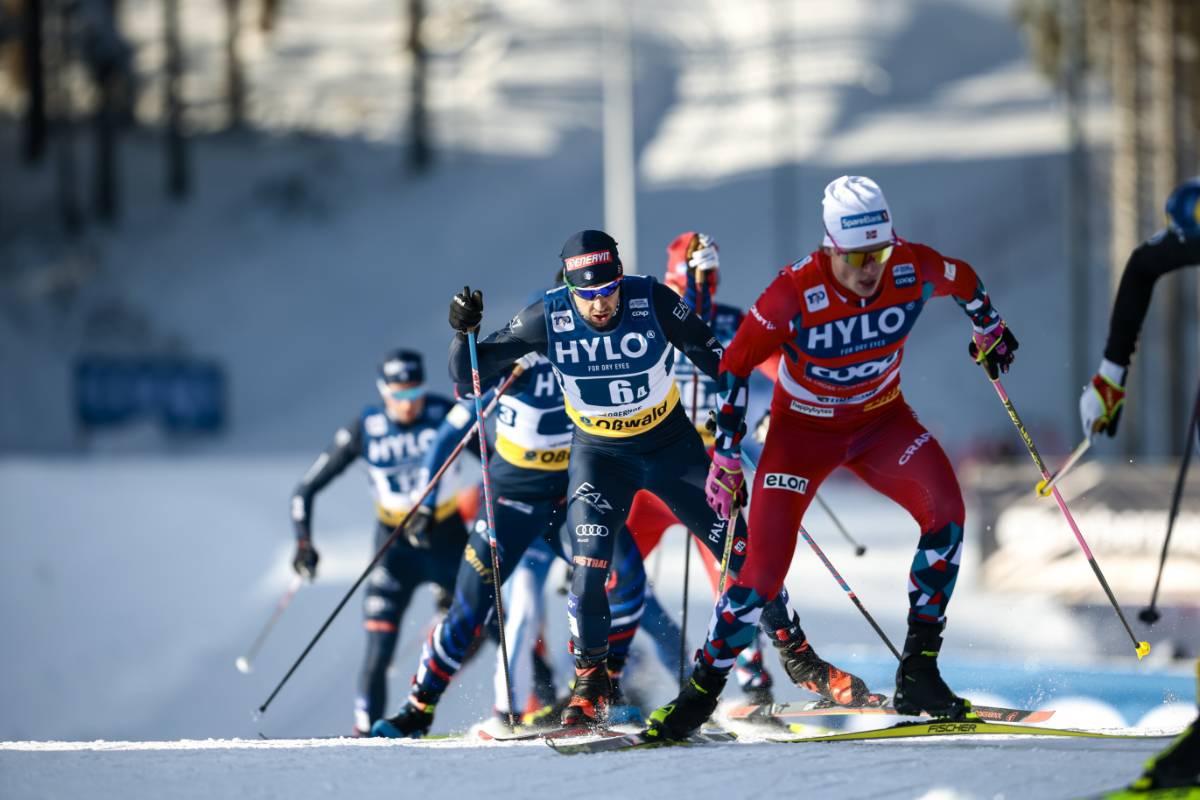
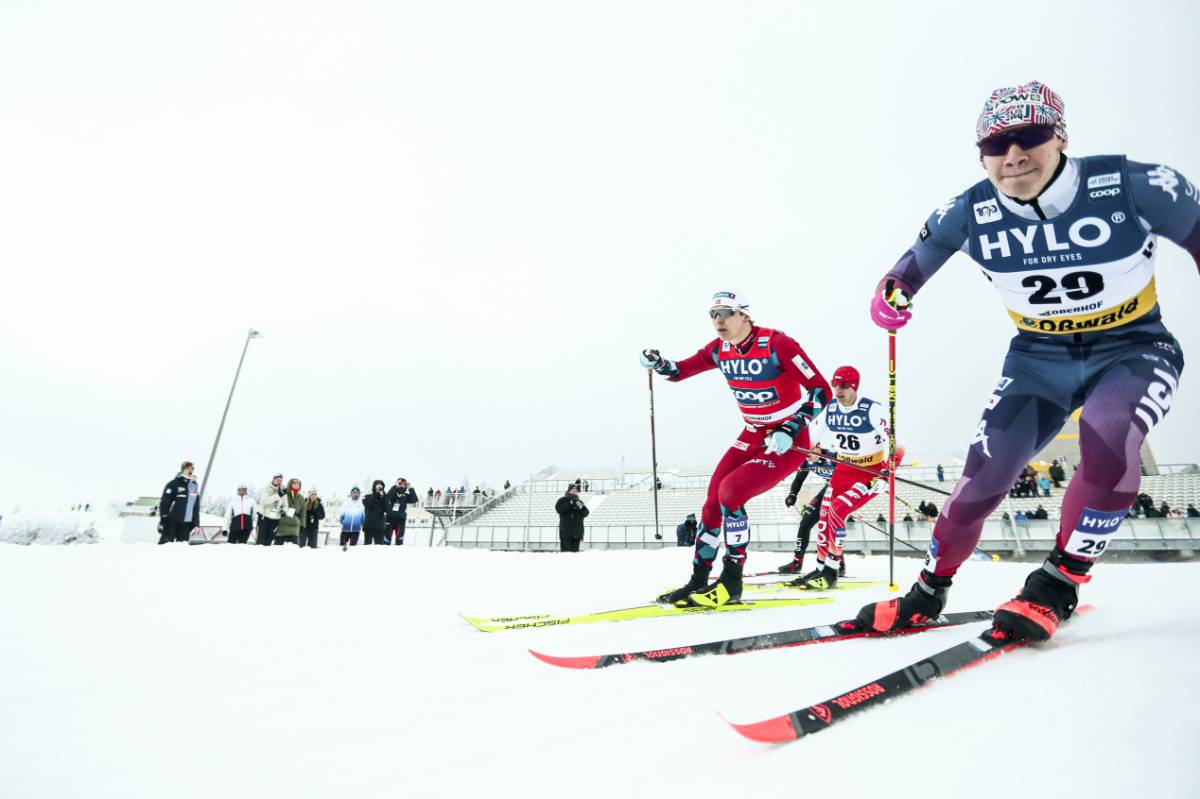
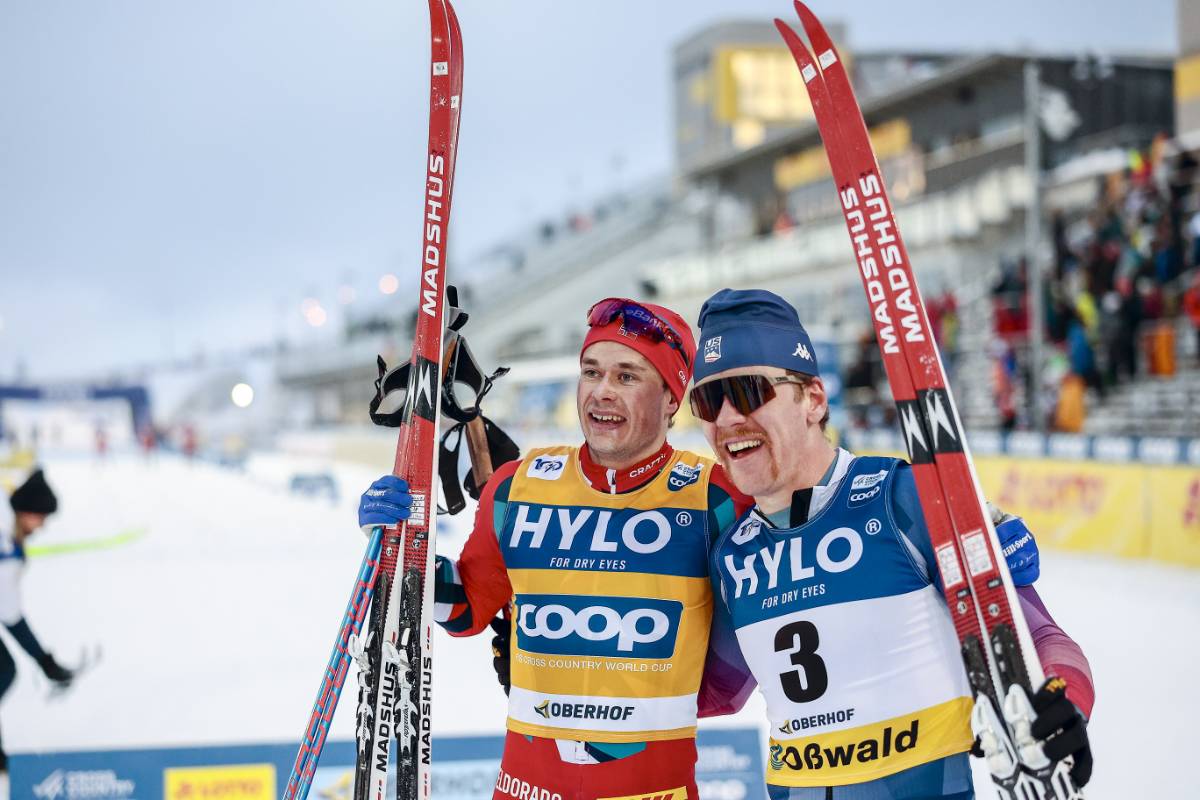
Johannes Hoesflot Klaebo (NOR) and Federico Pellegrino (ITA) lead the Team Relay field during the final leg in Oberhof. Klaebo would edge of Pellegrino to put Norway I in 1st, and Italy I in 2nd, on the day. (Photo: Nordic Focus)
This weekend in Oberhof framed the Men’s World Cup’s hierarchy in stark terms. Coming into Sunday’s 4 x 7.5 k Men’s Relay, five different Norwegian skiers had combined to sweep both Friday’s classic sprint, and Saturday’s 20 k Classic mass start. Remarkably, Norway had done so even without some of their most notable names: Johannes Hoesflot Klaebo, Didrik Toenseth, and Simen Hegstad Krueger had ceded the World Cup spotlight to Erik Valnes and Martin Loewstroem Nyenget, among others. This level of dominance created a vision of Sunday’s Team Relay when athletes clad in the colors of Norway would combine forces; a daunting prospect for the rest of the World Cup field. But Norway could only field two teams in the Relay, leaving room for one more team on the podium.
That’s not to say that Norway winning was a foregone conclusion. Tey would still need to pick teams. Out a dense thicket of Norwegian contenders, the first four names pulled were Martin Loewstroem Nyenget, Erik Valnes, Paal Golberg, and Johannes Hoesflot Klaebo. They would make up Norway I.
Individual fortunes on skiing’s World Cup are especially capricious, but the Team Relay has a way of remaining steady over the years. So it came as no surprise when Klaebo surged to the front in a carefully orchestrated finishing straightaway to win for Norway I ahead of his closest contemporary rival, Italy I’s Federico Pellegrino. Moments after that finish, a similar scenario would play out for both country’s second relay teams. Mattis Stenshagen finished in third for Norway II, and Simone Mocellini finished close behind to take fourth for Italy II.
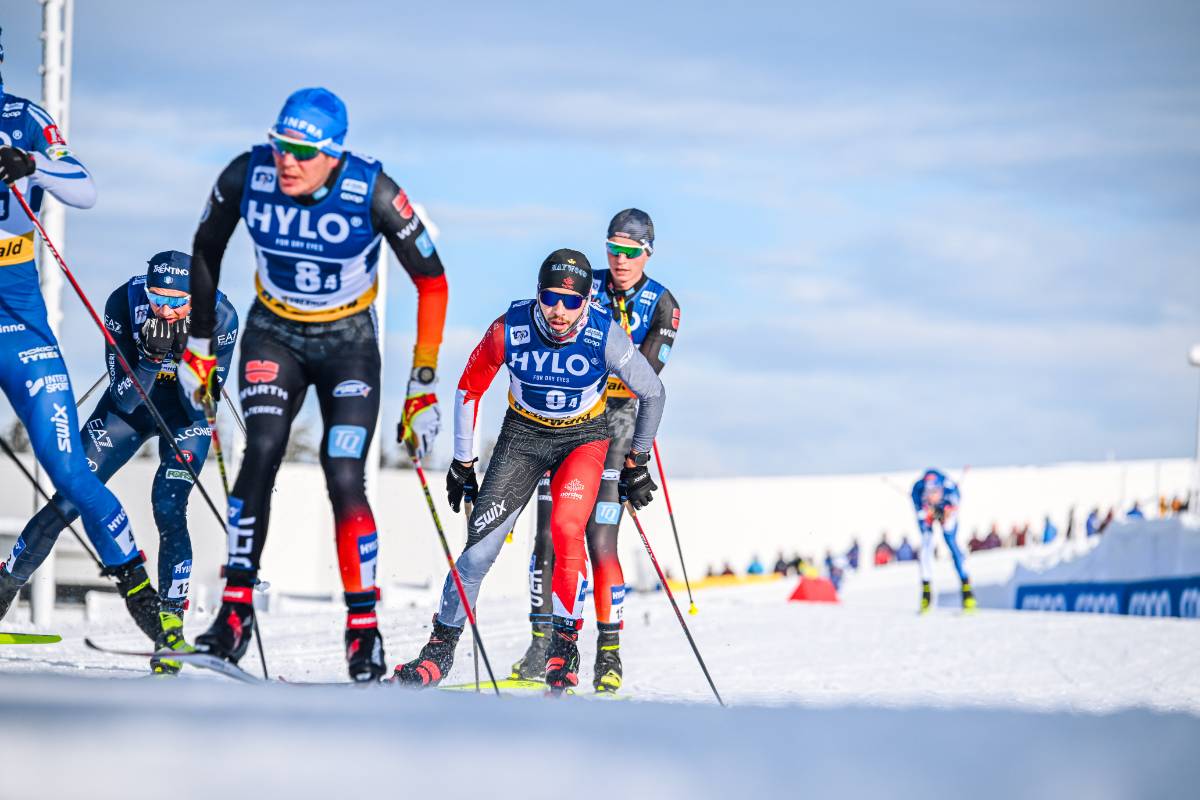
Olivier Leveille (CAN) finished a strong Canadian performance with his anchor leg in Oberhof. Team Canada finished eighth in the 4 x 7.5 k Team Relay. (Photo: Nordic Focus)
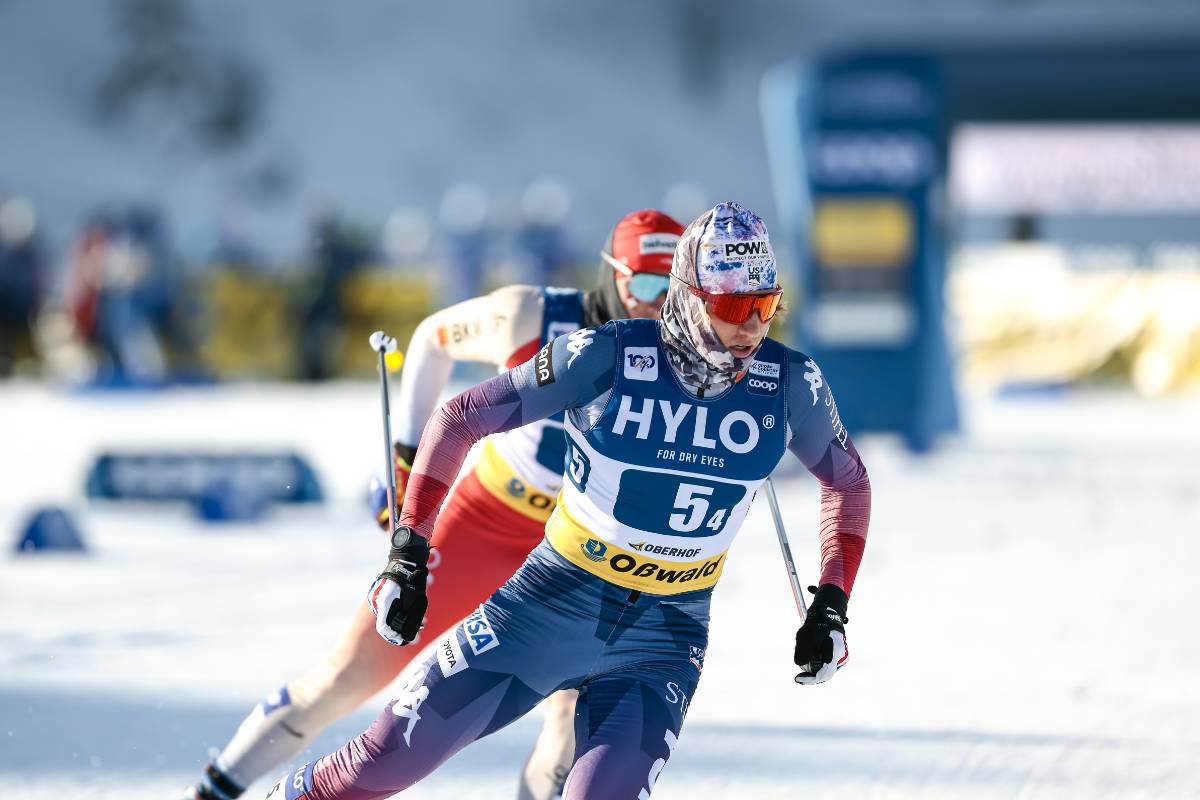
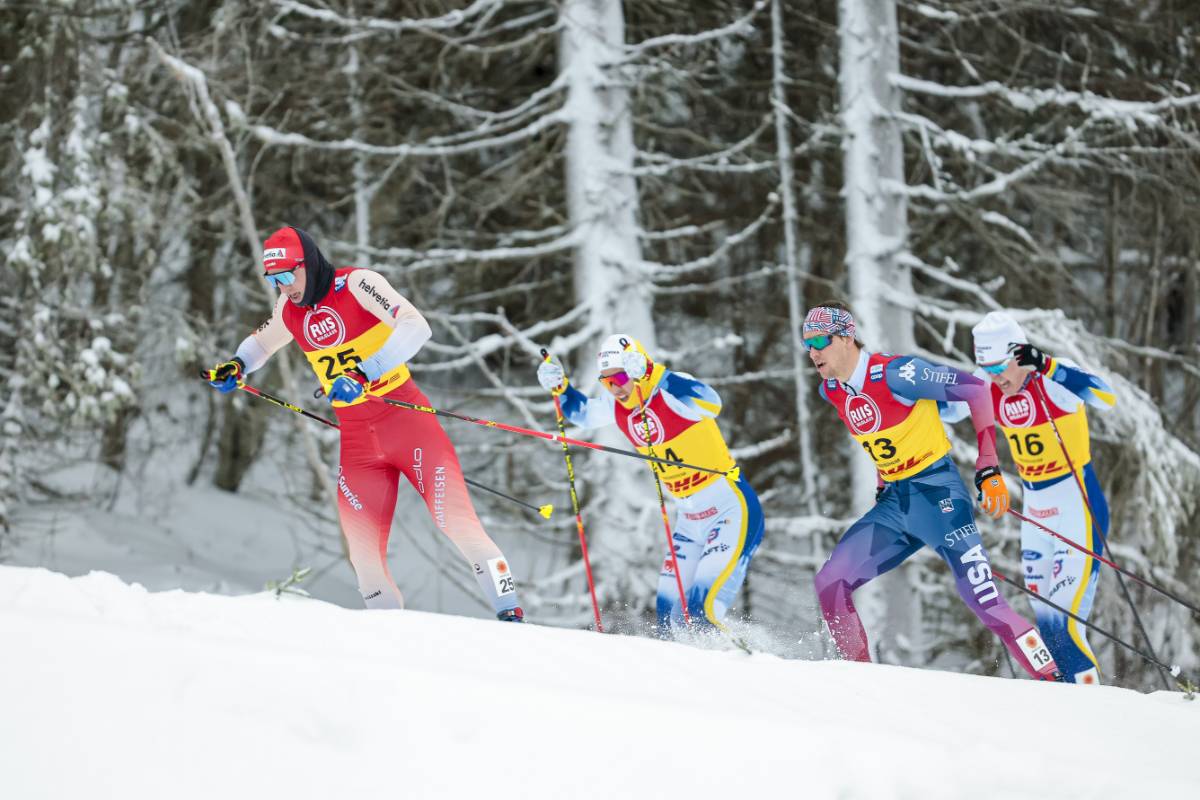
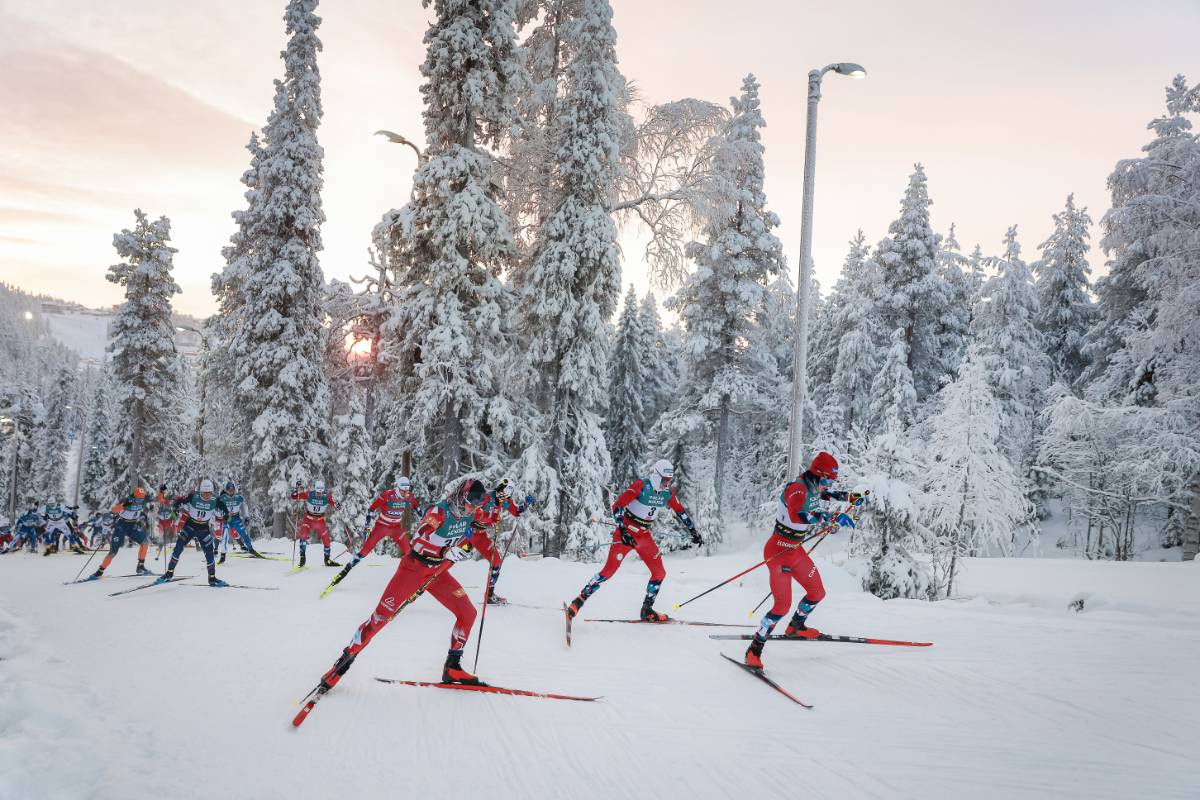
The conclusion to the race, filled with the names of sprint stars like Klaebo, Pellegrino, and Mocellini, was an accurate indication of the tactical nature of how the field raced throughout the day. Each leg featured two laps of a 3.75 k course that concluded with a steep climb before a long, downhill, run-in to the finish. The pace had been relaxed through the early-goings before hard, deliberate pushes through the final half kilometer by the leaders. That created a lead pack of ten teams that expanded and contracted through the course of each leg. Firmly positioned within that pack was Team Canada, skiing to eighth place behind the combined efforts of Xavier McKeever, Antoine Cyr, Sasha Masson, and Olivier Leveille. Meanwhile, the American team skied to a 13th place finish with Zak Ketterson, Ben Ogden, Scott Patterson, and Gus Schumacher. Ketterson, who skied the first leg, was firmly placed in the main peloton until a downhill tangle with Germany II’s Jan-Friedrich Doerks left him fighting to regain contact. Ketterson managed to do so, but right as he skied onto the tails of Canada’s McKeever the pace surged at the front. It proved to be too much for the American who would hand off to Ogden at the first exchange with a one minute gap to the front of the race. Subsequent American skiers found themselves battling in vain to reduce that gap for the remainder of the day.
Gus Schumacher (USA) outsprinted Swiss skier Valerio Grond to give the Americans a 13th place finish in the Team Relay in Oberhof. (Photo: Nordic Focus)
Men’s 4 x 7.5 k Team Relay
The relay’s first leg—Classic—would set the pattern in the way the course was raced. The field remained relaxed throughout its first run of the 3.75 k lap, nearly coming to a stand-still at the top of the final climb. Then, as the Oberhof course rose out of the stadium, the top skiers would turn the pace up, stretch out the field through the lap, navigate another small contraction on the downhill leading to the final, steep, climb, where they would wait to dive off the top toward the finish-line. In the first leg, that pattern was duly set by Swedish skier Edvin Anger, alongside Norway I’s Nyenget, and Norway II”s Haavard Solaas Taugboel. Nyenget proved to have the hardest pull, and brought Norway I into the first exchange in first place.
In the second leg, also skied Classic, an early move from France I’s Hugo LaPalus established him in position off the front. For their part, Valnes and Finland’s Iivo Niskanen remained steadfast in their approach to the course, and didn’t lift the pace until the second time through the challenging “A”-climb. There, Niskanen strided away in a steady, deliberate move. Valnes followed. It was the furthest the field bent without breaking. Niskanen and Valnes came into the second exchange with a ten second gap over Italy I’s Elia Barp and the rest of the main field.
The beginning of Legs 3 and 4—skied Freestyle—helped reset the field. Norway I’s Golberg and Finland I’s Arsi Ruuskanen came back to the ten team main field. Towards the end of the lap, the pace ticked up just enough to string the field out, with the notable mover being Krueger for Norway II, who would help firmly position both Norwegian team’s at the front. Richard Jouve for France I and Friedrich Moch for Germany I also tried their luck at creating a gap towards the front, but into the final exchange, a group of nine teams remained within ten seconds of each other.
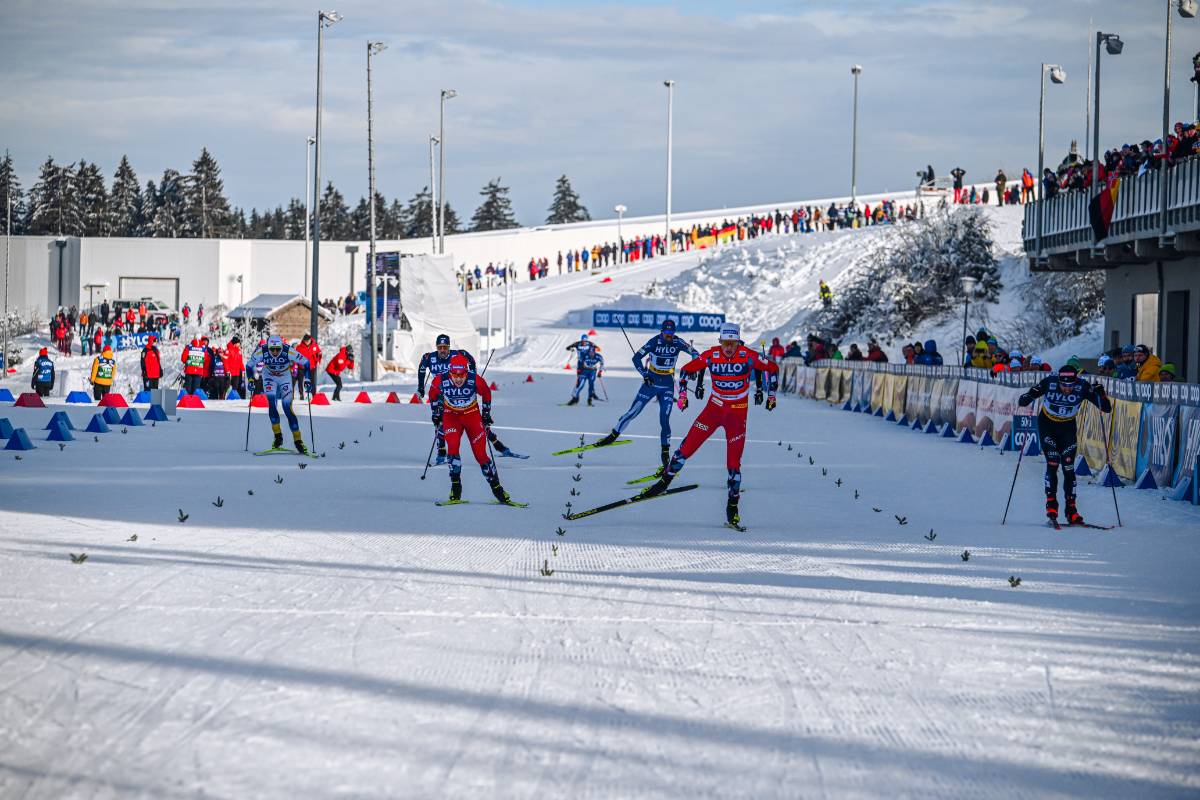
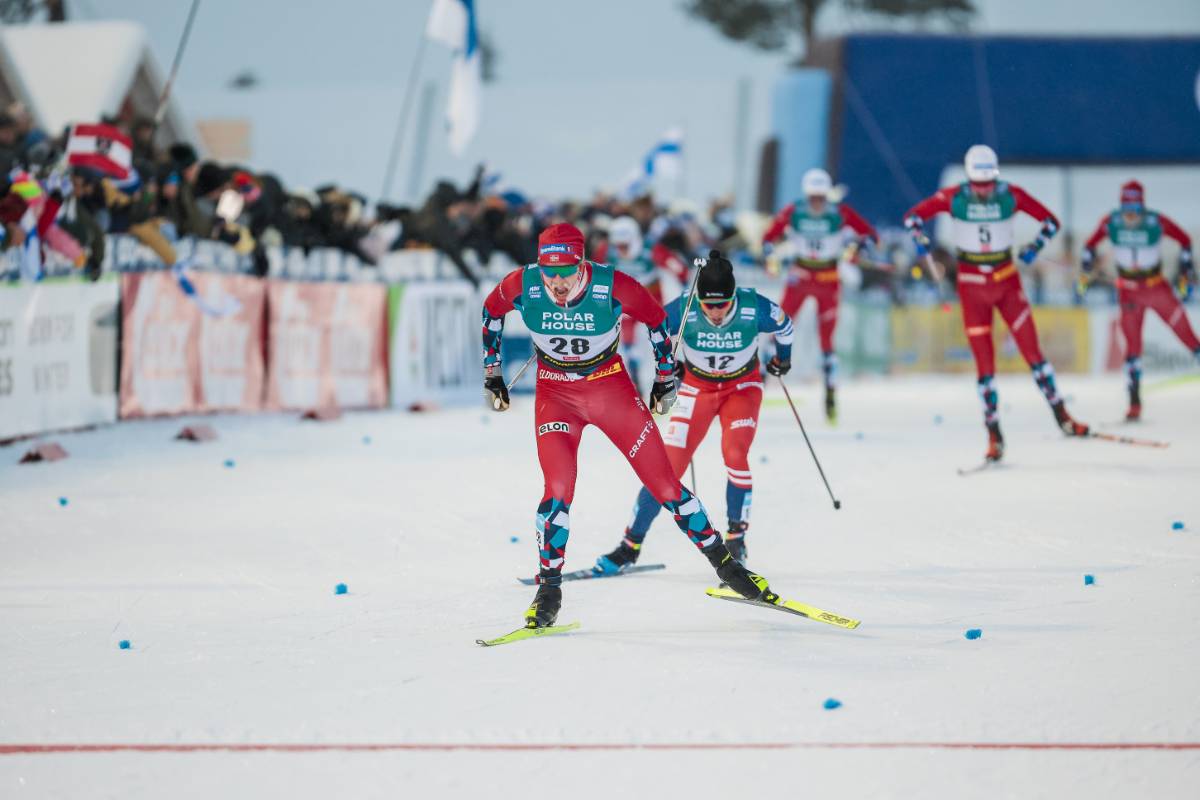
The finishing sprint in Sunday’s Team Relay in Oberhof. Johannes Hoesflot Klaebo edged out Federico Pellegrino to give Norway I the win. (Photo: Nordic Focus)
That left an anchor leg comprised of some of the best World Cup sprinters to sort things out. Pellegrino made an early effort to re-join up the front of the field; Sweden I’s William Poromaa joined. When the field surged on the final lap, only Pellegrino proved capable of matching Klaebo’s lift of pace. The pair would stagger briefly on the final climb, allowing their countrymen—Stenshagen for Norway II and Mocellini for Italy II—to re-join the picture. The final sprint saw Klaebo claim victory for Norway I over Pellegrino for Italy I. It was a fitting close to an episodic day like so many seen at World Cup races before.
World Cup Moves to Switzerland Next Weekend
The World Cup gets a quick reprieve before resuming action in the Swiss Alpine village of Goms next week. Friday opens with another Team Relay, this one mixed with the Women’s and Men’s fields together. A Freestyle Sprint and Freeestyle 20 k close out the weekend.
This coverage is made possible through the generous support of Marty and Kathy Hall and A Hall Mark of Excellence Award. To learn more about A Hall Mark of Excellence Award, or to learn how you can support FasterSkier’s coverage, please contact info@fasterskier.com.
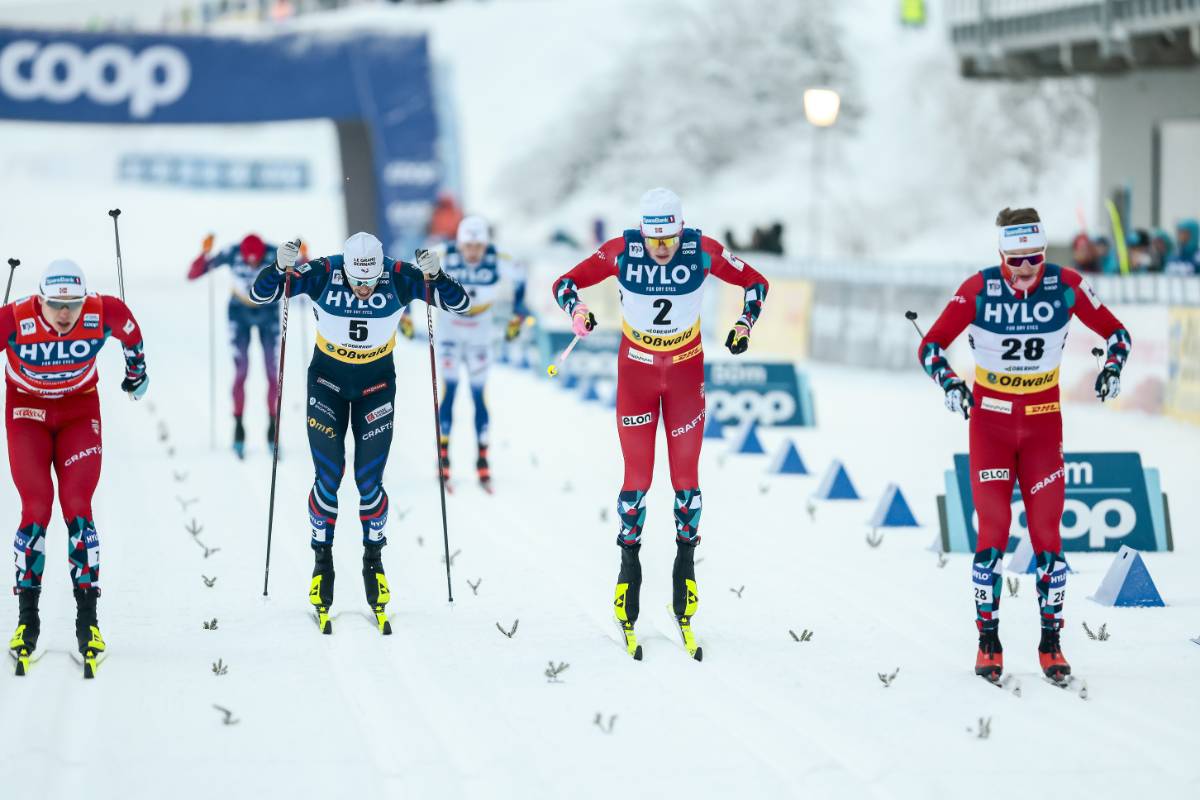
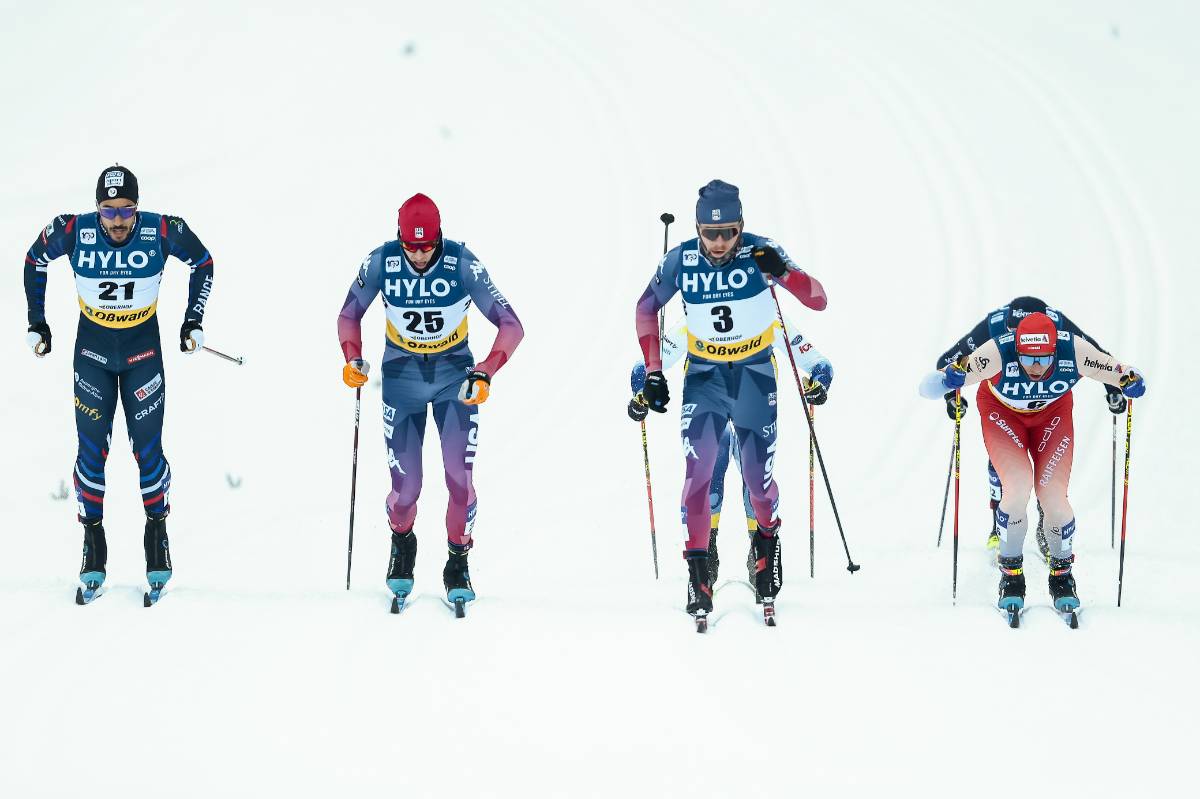
Erik Valnes (NOR), Lucas Chanavat (FRA), Johannes Hoesflot Klaebo (NOR), and Ansgar Evensen (NOR) (L-R) sprint for the line during semifinals in Oberhof. Klaebo would finish in third in the heat, and miss out on a World Cup sprint final for the first time in six years. (Photo: Nordic Focus)
It was a rare day on the World Cup, but patterns, established and emerging, were apparent too. The rare part: Friday in Oberhof marked the first time in six years that Johannes Hoesflot Klaebo (NOR) was eliminated before the Finals in a World Cup Sprint race. In the first semifinal, Ansgar Evensen (NOR) carried out a defiant move on the steep Oberhof climb that gave way to a long final sprint, a pack of three including Klaebo, World Cup Sprint Leader, Erik Valnes (NOR), and Tour de Ski points champion Lucas Chanavat (FRA) vied for the second spot into the Final. Valnes would end up taking it. Klaebo pulled up in third in the heat, momentarily in a lucky loser spot until the second semifinal bested his time. With Klaebo’s day having ended, so too did a streak of 39 straight sprint podium finishes. There were notable circumstances in the post-mortem on that streak. Klaebo was back in the start list following a bout of flu over the holiday break, but also just barely arrived in Germany ahead of Oberhof, as most of the Norwegian national team was delayed in travels late into Germany last night. During the first semifinal, the resulting conditions got translated to a notable result.
That precedent meant the possibility for something new in the Sprint Final. Even there, deviation from the usual World cup script was minimal; Norwegians dominated the field at the start line, and the race at the finish. Four Norwegians—Valnes, Evensen, Even Northug, and Harlad Oestberg Amundsen—were joined by Ben Ogden (USA), and Swiss skier, Valerio Grond. As he had in the semifinal with Klaebo, Evensen waited through the twists and turns of the first kilometer on the Oberhof course, and then pushed a final, steep, climb to create a lead pack that included all his countrymen into the final sprint. At that point, Valnes had a plan. “I saw Ansgar [Evensen]’s climb in the quarterfinal and semifinal,” he said to FIS media post-race. “So I was aiming for the back of his ski on the final climb.” Valnes would shoot off with Evensen, with Valnes getting the win in a closely-contended double-pole finish. Evensen took second, while Northug sprinted to round out the podium in a Norwegian sweep.
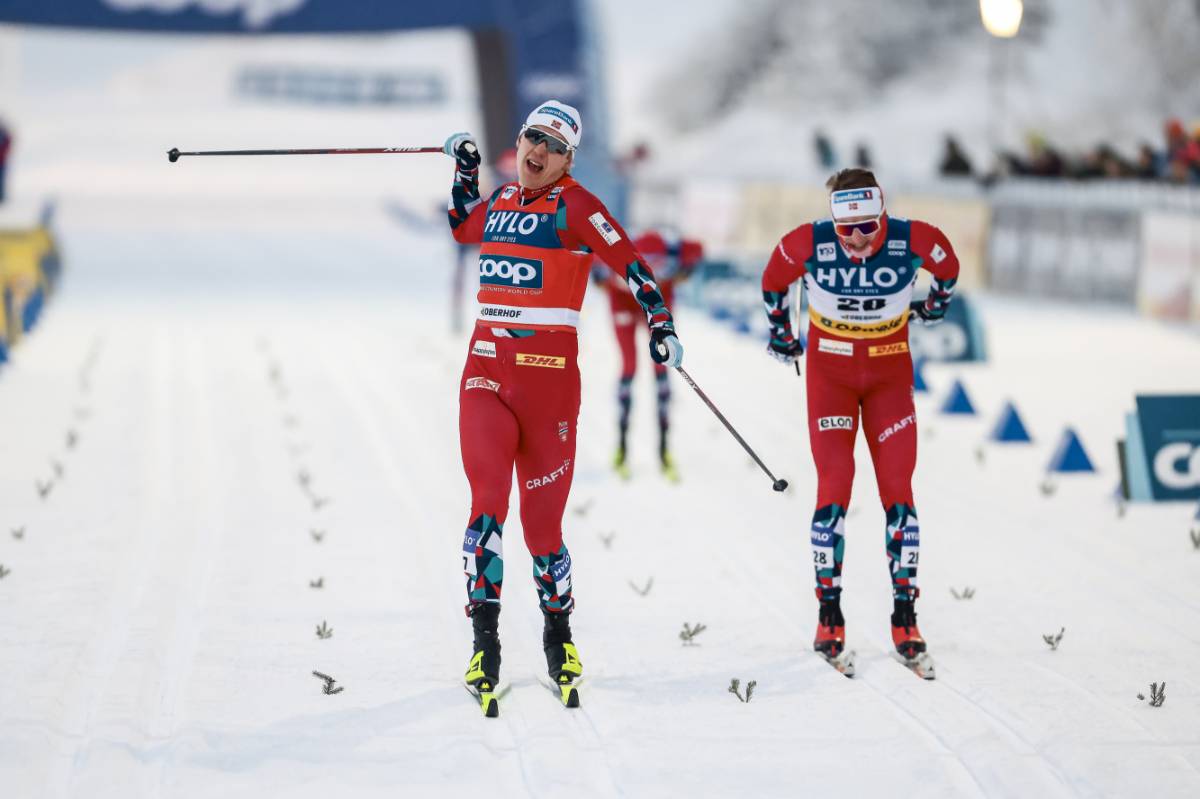
Erik Valnes (NOR) celebrates as he crosses the finish-line in the Oberhof. Ansgar Evensen (NOR) behind him, and Even Northug (NOR), would complete a first Norwegian sprint podium sweep of the season. (Photo: Nordic Focus)
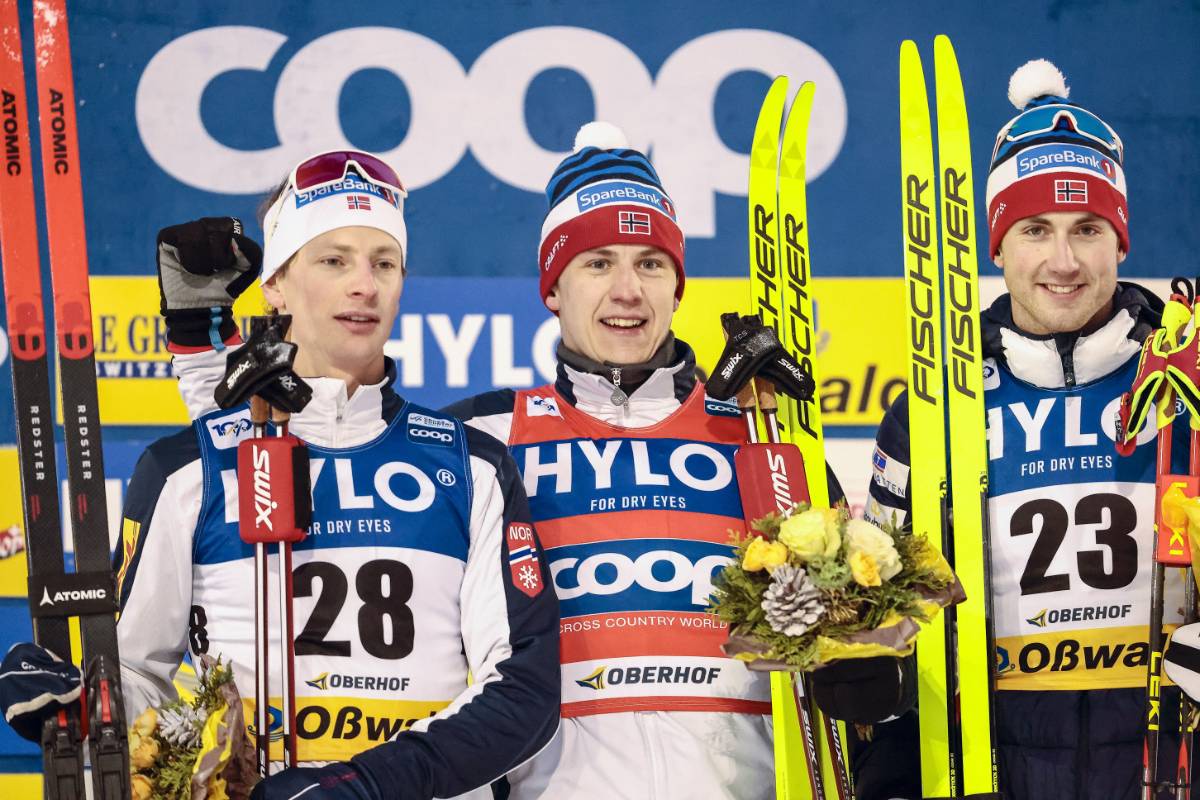
The final result put irony at the heart of the day; in the first race in six years where the most dominant individual Norwegian skier missed the Final, the Norwegians had their most dominant sprint day as a team, sweeping the podium for the first time this season.
Amid the established precedent of Norwegians topping the men’s results, there was a more auspicious, emerging one too, to note for the Americans. Ogden made it through to the Finals for the third time this season, making it the fourth time in six World Cup sprints that an American has stood on the line in the Finals. Ogden confidently controlled his quarterfinal, then completed a resilient final punch over the last climb in his semi-final to take second in the heat ahead of World Cup Overall leader, Amundsen, and French sprinter Richard Jouve. In the Final, the definitive surge of speed from Evensen and Valnes proved to break the pack and leave Ogden near the back, where he would finish sixth. “During the Finals, Valnes was definitely looking at that [final] hill too,” said Ogden after the race. “And that’s where it felt like the pace lifted until all the way over the finish line.”
Like Klaebo’s individual result, Ogden’s sixth place finish was put into context by how his countrymen did on the day. All four American men made the heats in Oberhof: an upward trend for the Team USA. Kevin Bolger skied into the semifinals to take 12th place, while JC Schoonmaker took 24th. Zak Ketterson, meanwhile, overcame being caught up in the Norwegian team travel woes out of Olso to make his first sprint heats of the season, and finish 16th.
Ogden saw the day as a steady progression of his ability in sprint races. “I’m psyched to get a few [sprint] final opportunities this season,” he said. “I am starting to feel more comfortable moving through the quarterfinals and semi-finals, but it’s still a challenge, and I have to be careful with heat selection. A goal going forward is going to be figuring out how to conserve energy in those so I reach the Final ready to push.”
All four American men who started the Classic Sprint in Oberhof made the heats, with Ben Ogden taking sixth, Kevin Bolger in 12th, Zak Ketterson in 16th, and JC Schoonmaker in 24th. (Photo: Courtesy Image/Chris Grover).
Americans Show Poise, Confidence, in Heats
Of the four Americans that qualified for the heats, Ketterson was the first to take to the line, skiing out of a first heat that included Klaebo and Valnes. Ketterson showed confidence throughout the heat, accelerating along with the field as German skier, Jan Stoelben, launched an attack on the final climb. Into the final run-in, the two Norwegians formed a line in front of the pack to take first and second, but Ketterson had pulled into the ensuing sprint for third and fourth. As Klaebo eased up crossing the line in first, Ketterson’s skis crossed the tails of his skis, sending the Minnesotan falling in the finish pen, but falling into third place in the heat. Ketterson would hold onto the lucky loser spot through the next heat, but faster times throughout the quarterfinals eventually left him in 16th place.
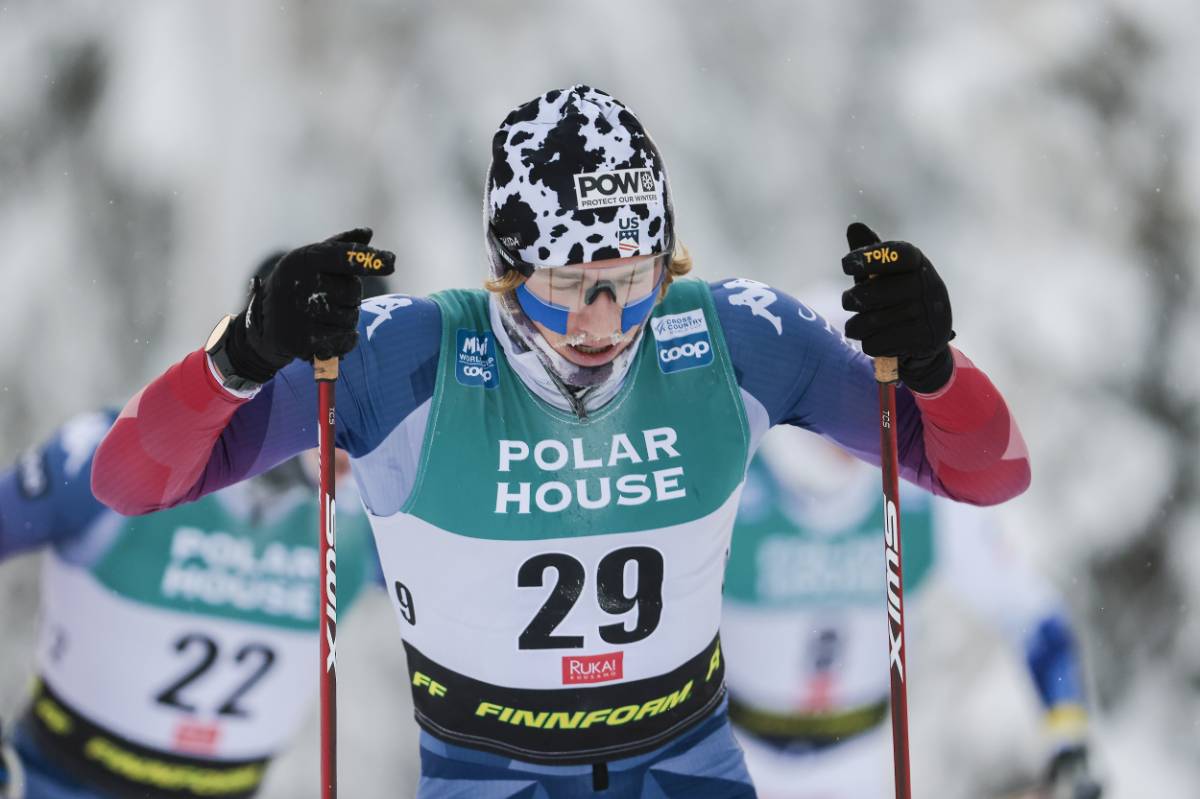
Zak Ketterson (USA) skied into his first heats of the World Cup season in Oberhof, eventually finishing 16th in a closely contested quarterfinal. (Photo: Nordic Focus).
Schoonmaker featured in the next quarterfinal, alongside Chanavat, Marcus Grate (SWE), and the only Canadian qualifier on the day, Antoine Cyr. The North Americans remained in the fast-moving quarterfinal until the very last climb when Chanavat and Grate both emphasized the control they had showed throughout the first kilometer, and subsequently eased into the semifinals in first and second. Schoonmaker and Cyr would round out an otherwise-tight pack, finishing fifth and sixth in the heat, respectively.
The final quarterfinal heat featured Ogden an Bolger lining up alongside each other, alongside Jouve and Grond. “It’s never a plan to take a heat as a teammate-but the way heats played out it made sense for me,” said Bolger post-race. Ogden and Bolger stuck together through the early part of the course, rounding the twists and turns in Oberhof with stars and stripes leading. “I thought we controlled the heat really well!” added Bolger. “Ben is a seasoned classic heats skier and I’m not, so I was just trying to stay as close to him as I could.” The pace was pronounced, and even as Bolger started to fall into the pack while Ogden shot up the final steep climb to mark Grond, he kept with the pace. Ogden would take control of the heat in the final sprint, advancing to the semifinals in first. Bolger surged to finish in fourth place, and, in the fast heat, move into the semifinals as a lucky loser.
Ben Ogden and Kevin Bolger head out on course during quarterfinal action in Oberhof. Ogden would win the heat, and finish sixth on the day, as Kevin Bolger secured a lucky loser spot in fourth, and finished 12th on the day. (Photo: Nordic Focus).
“There is no better feeling than to be able to move onto the semis from a heat with a teammate,” said Kevin Bolger on the quarterfinal performance.
Bolger would run into a pack of Norwegians, with Klaebo, Evensen and Valnes in semifinal 1. Bolger showed similar poise in the early part of the heat, but the surge that came on the final climb turned out to be just one push beyond what the Wisconsinite could manage on the day, and he would finish the semi-final in sixth, earning a 12th place on the day. The result was Bolger’s best ever in a classic sprint on the World Cup, which he is taking both as a great singular performance, and one that he can build off of. “It was a sick day!” he said. “I have confidence in my classic skiing and sprinting, but qualifying had always been the hill to get over for me- I knew if I could break that barrier, I’d be competitive in the heats, and it showed today. [Still,] the ultimate goal [for me] is to get back on the US Ski Team, and it won’t happen unless I get into a sprint final, so that’s the goal moving forward and the only focus I have.”
Ben Ogden (USA) smiles alongside World Cup Overall leader Harald Oestberg Amundsen (NOR) after Ogden made his third World Cup sprint final of the season. (Photo: Nordic Focus).
Ogden took a similar approach to his quarterfinal in his semi-final 2, going out front to control the pack early, and then holding on as Valerio Grond (SUI) and Even Northug (NOR) pushed the middle part of the Oberhof course. Ogden, though, could match the surge that came on the final climb, launching to the outside to go over the top in third place, and then showing his ability to put out a powerful double-pole finish to take second place behind Northug.
When the Final came, Ogden found himself in a similar position to Bolger in his semifinal. The final surge came on the final hill, and Ogden, this time, couldn’t quite match the pace exhibited by his Norwegian rivals. He would finish the heat in sixth place, and sixth place overall on the day.
The Americans follow up today’s classic sprint with tomorrow’s 20 k Classic Mass Start. The marked depth that was present in the sprints today will no doubt be what they are after tomorrow, as the same crew of sprinters—Ogden, Schoonmaker, Ketterson—gets augmented by the distance prowess of Gus Schumacher and Scott Patterson. For a team that is heading home to North America in a month, things are trending up; the depth of the results from Team USA confirm the consistency that the men’s half of the Stifel US Ski Team is starting to gain this season.
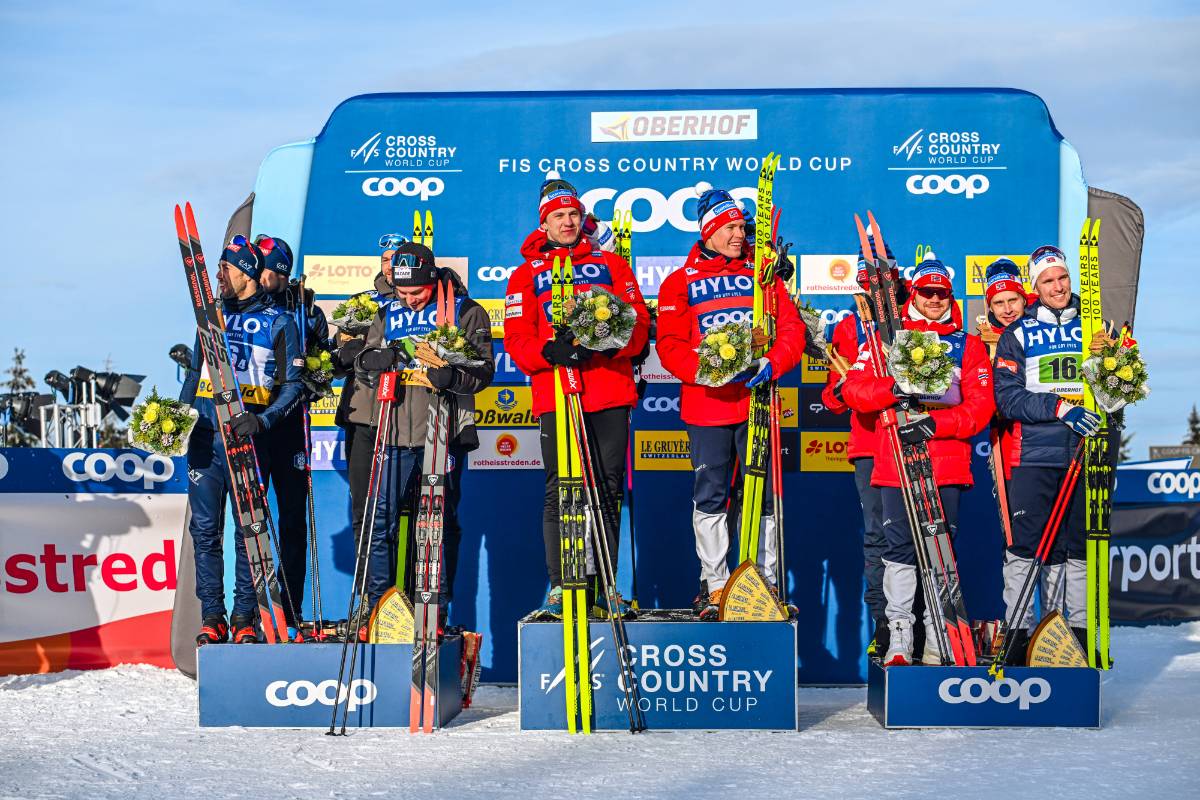
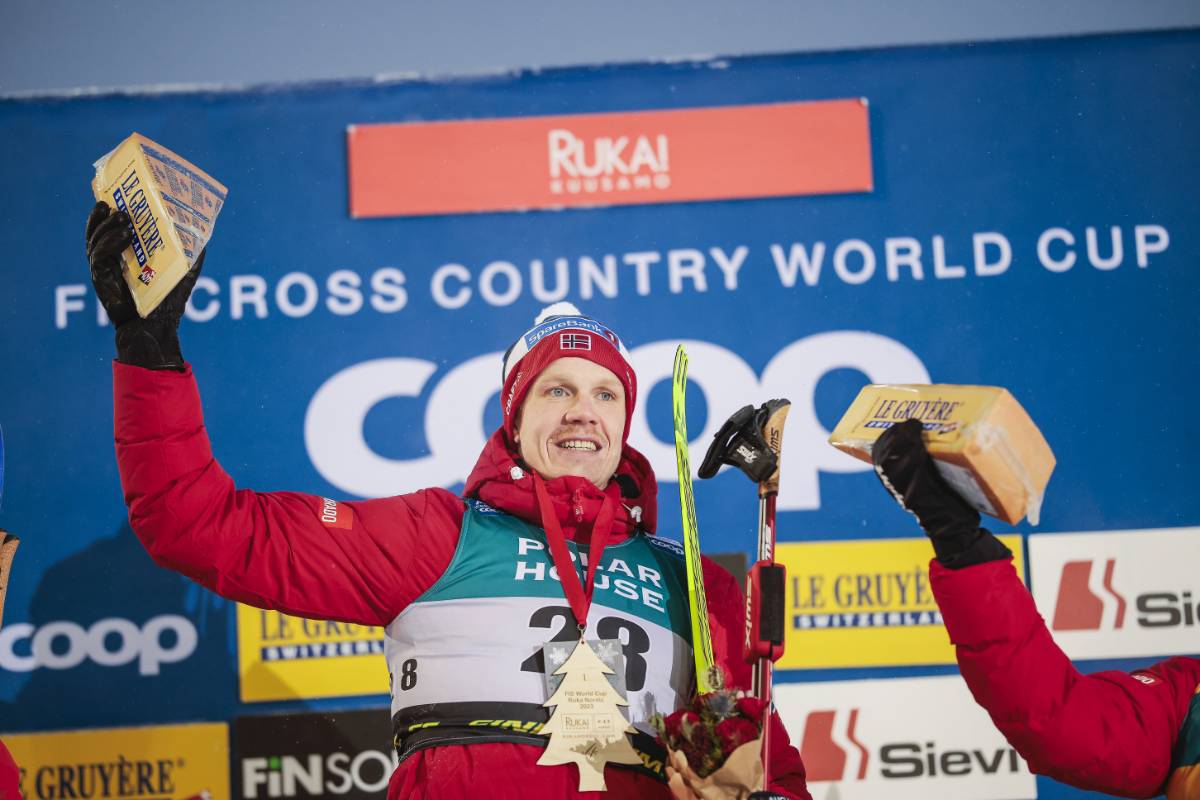
Norwegian Sweep: Erik Valnes first, Ansgar Evensen second, and Even Northug third. The first day in six years that Johannes Hoesflot Klaebo didn’t finish on a World Cup Sprint podium would still be colored in Norwegian red, white, and blue. (Photo: Nordic Focus).
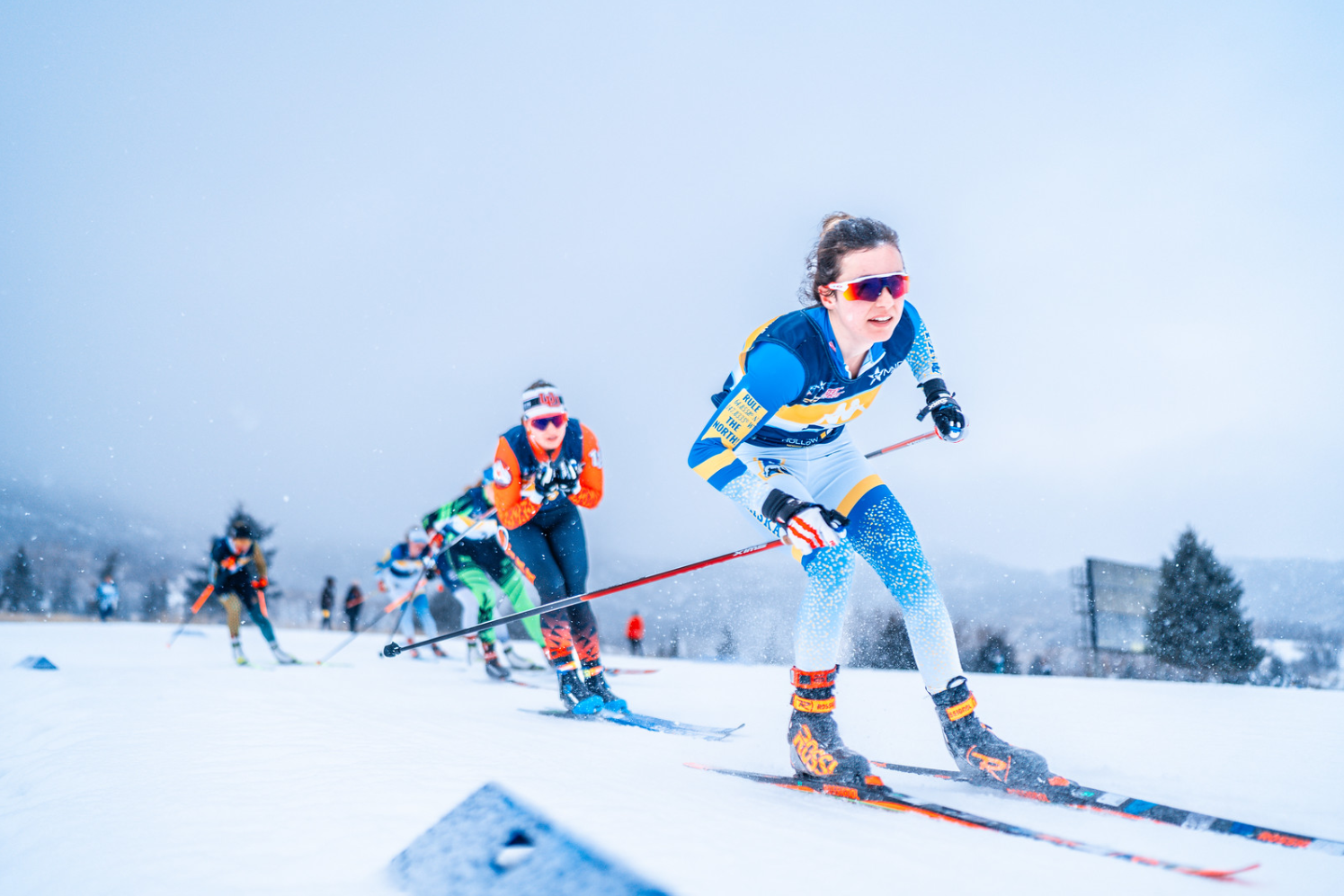
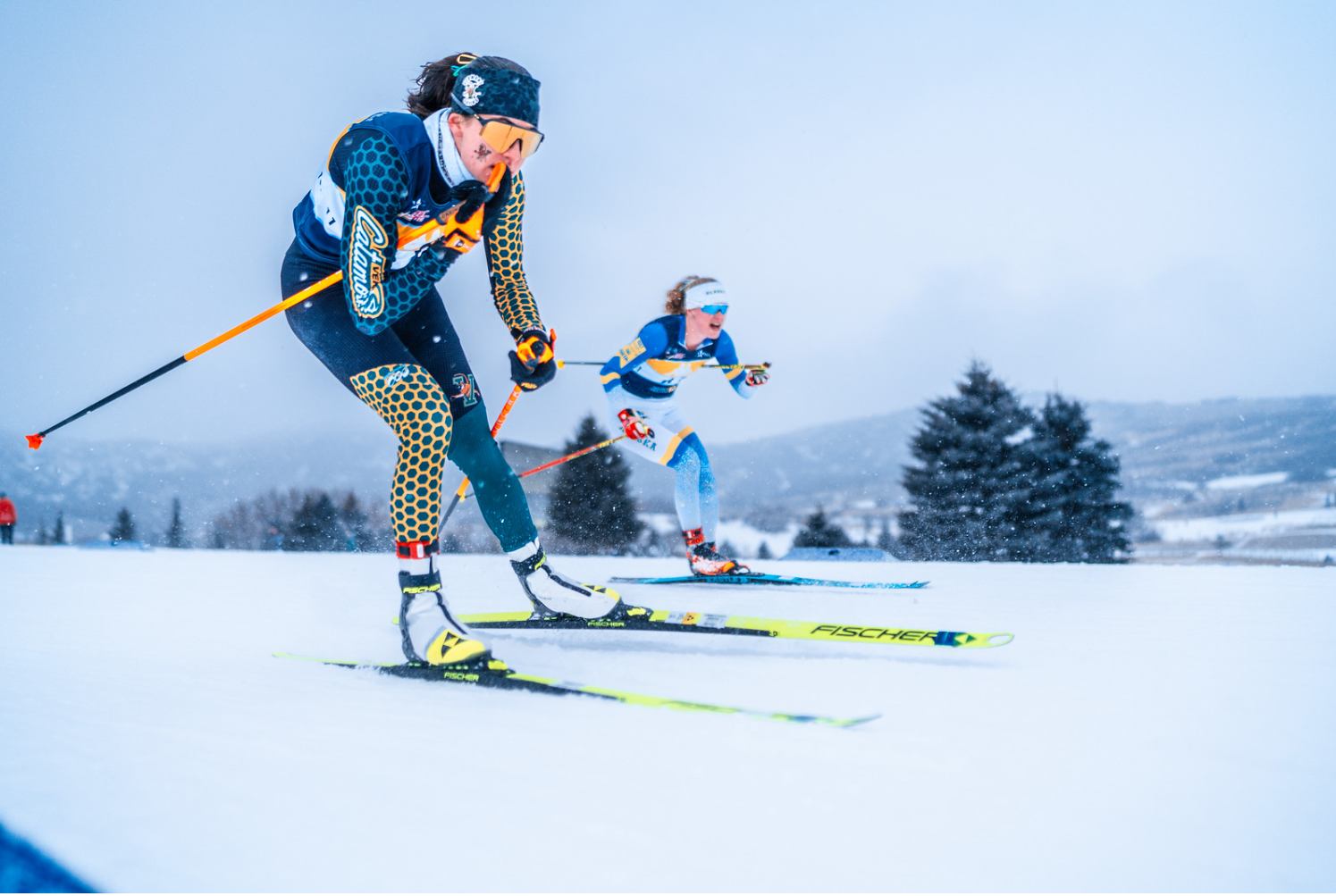
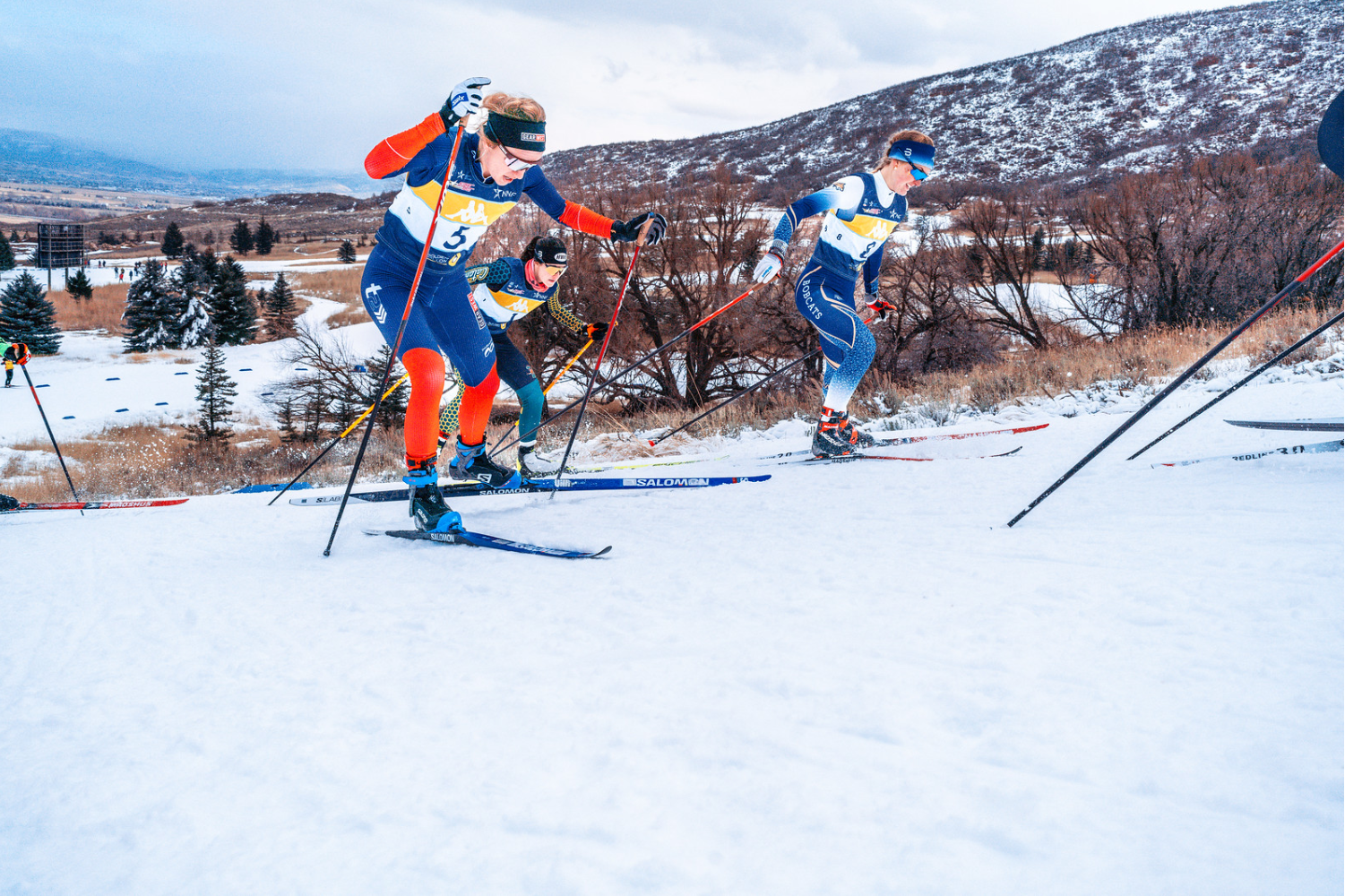
Kendall Kramer (University of Alaska-Fairbanks) leads the Women’s pack during Friday’s 20 k Skate Mass Start at US Nationals. (Photo: Tobias Albrigsten/@UntraceableG)
We all work better when we work together—that would seem to be the credo being employed by American skiers these days. At the conclusion of US Nationals at Utah’s Soldier Hollow, American skiing has rarely looked better, whether internationally or domestically.
The warm temps and blue skies of early week at the US Cross Country Ski National Championships gave way to, of all things, snow. Morning light came up on Soldier Hollow; snow drifted in rather than stormed, but flakes falling from the sky rather than blasting from trailside snow guns was a good late-week reminder for the ski community: despite all this season’s continental snow troubles (Alaskan excepted!), this is indeed a winter sport.
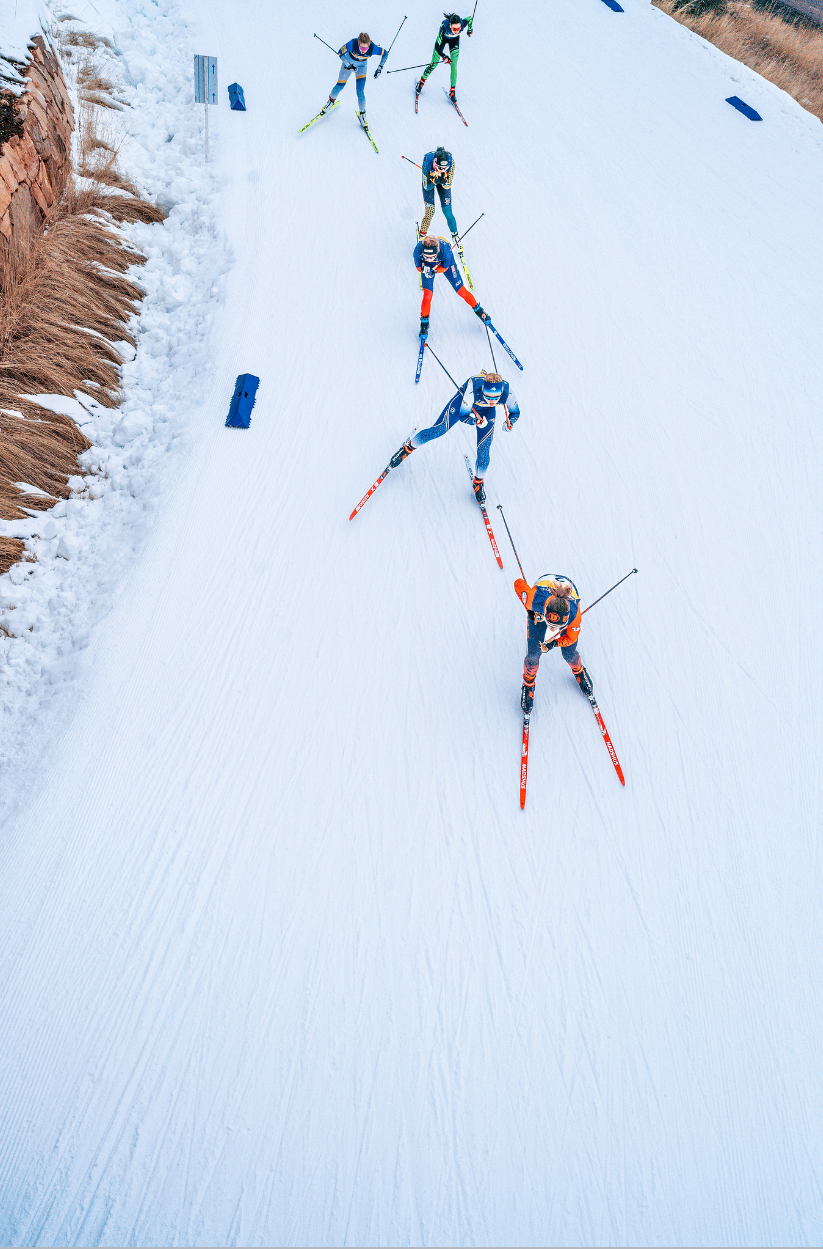
On that new snow—over six laps of a hill-heavy, rarely flat, 3.3 k course—skiers tackled the 20 k Skate Mass Start. A recurrent observation heard by coaches, ski administrators, and athletes was “You can’t quite believe how big this event has gotten.” Momentum was another word heard frequently throughout the week, as some of the biggest fields to ever race at US Nationals combined with daily reports of that day’s Tour de Ski, where American skiers enjoyed a banner day. Until Friday, though, the evidence was merely in the number of skiers on the start sheets, and the number of clubs from a greater number of places milling around Soldier Hollow’s makeshift race village. Seeing fields of 100 skiers wind up Soldier Hollow was a whole different type of confirmation of that momentum. Crowded fields of the fittest athletes in the country brought their own journeys in the sport, their numbered affiliations, and their collective abilities to ski together. The ground rumbled, shouts from the sidelines roared, and the field—at least in early stages of the races—seemed to become a singular thing. US skiing, moving together in concert, became something sublime that could be readily seen and felt.
Haley Brewster made a decisive move late in Friday’s 20 k race to claim her first career national championship. (Photo: Tobias Albrigsten/@UntraceableG)
Women’s 20 k Skate Mass Start
Of course, it was a ski race. After that roaring start up the hollow’s steady incline, the Women’s 20 k Mass Start field started to jockey for where and when to make a decisive move towards the National Championship.
When the race started at 10am, natural snow was falling, but hadn’t yet accumulated enough on the glazed deck of artificial snow. The course displayed one defining principle that dictated how the mass start would be raced: for every long climb on the Soldier Hollow course there was an equal or greater downhill that followed. If a skier was going to make a tactical move on an uphill, they had to be sure they could hold off their rivals on the subsequent downhill. For nearly six laps, a nine-skier lead pack waited for that move.
For much of the race, University of Alaska-Fairbanks’ Kendall Kramer was the leading presence at the front of the pack, hinting at the importance of pushing the transition between uphill and downhill in the fast snow by pushing over and well into each downhill. She was joined mid-race by Craftsbury Ski Club’s Margie Freed who—between apparent good skis and smart drafting—was able to join Kramer in the lowlands of the course and at times, push to form minor separation ahead of the field.
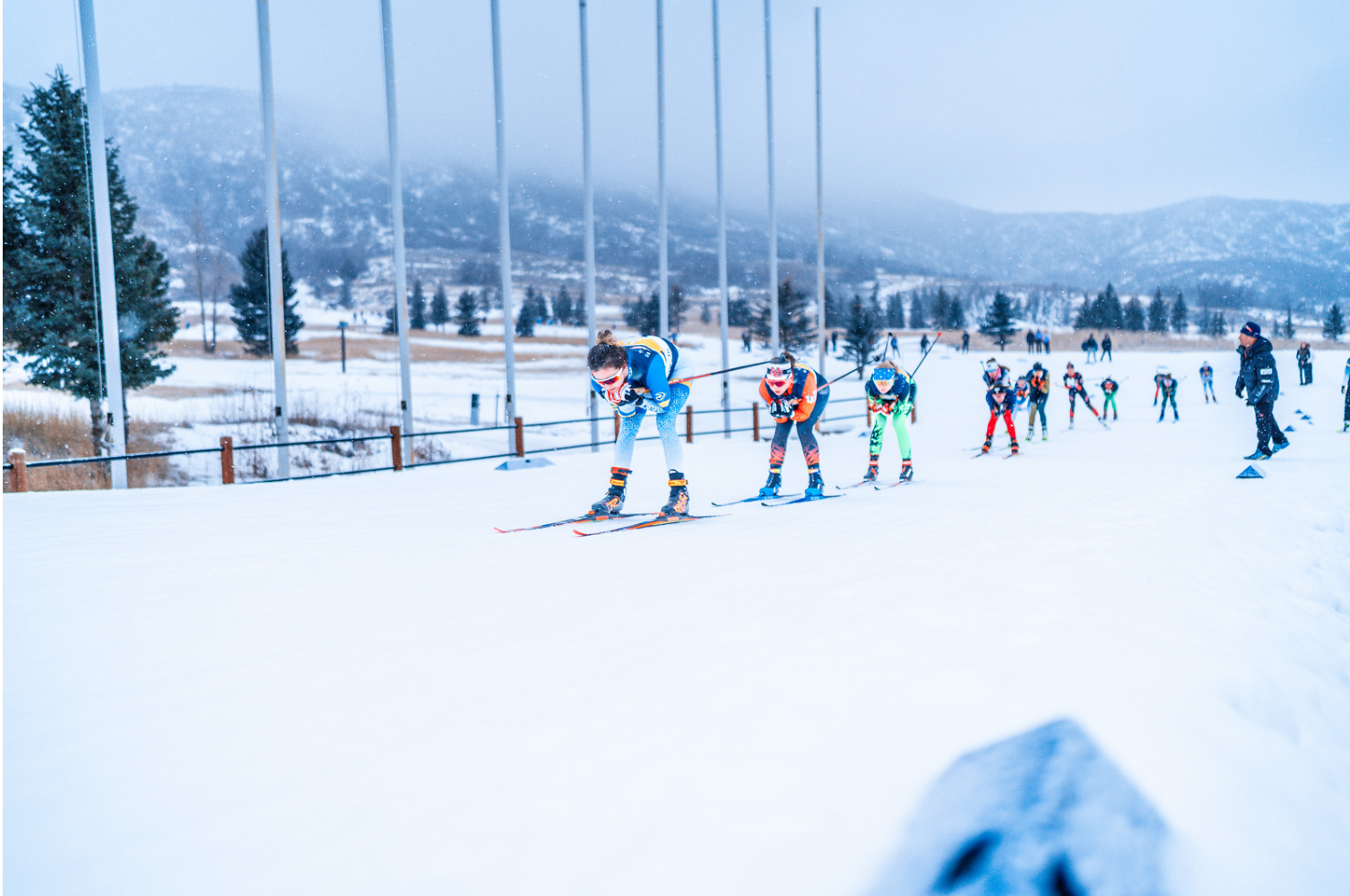
The lead pack in Friday’s 20 k Skate winds into Soldier Hollow stadium. (Photo: Tobias Albrigsten/@UntraceableG)
As Kramer and Freed headed into the final lap, they were joined by University of Vermont’s (UVM) Haley Brewster. Brewster and Kramer rounded the top with Freed in tow. In the final climb, Brewster made her decisive up-tick in pace, gaining separation over Kramer in an attempt to ward off a sprint finish after the final downhill. Likewise, Kramer gained separation over Freed, and Freed likewise from the rest of the field. The final stretch featured momentary celebrations, as each crossed with space between: Brewster in first, Kramer second, and Freed in third.
The win gave Brewster—a UVM Junior and former Ski and Snowboard Club Vail skier— her first national championship. The result also marked Kramer’s second national podium, after she finished third American in the skate sprint last year in Houghton, Michigan. It was also the first US Nationals podium for Freed. The Minnesota native is in the midst of her first season competing in Biathlon, having just completed her first stint on the IBU World Cup, making the 20 k skate result an auspicious one.
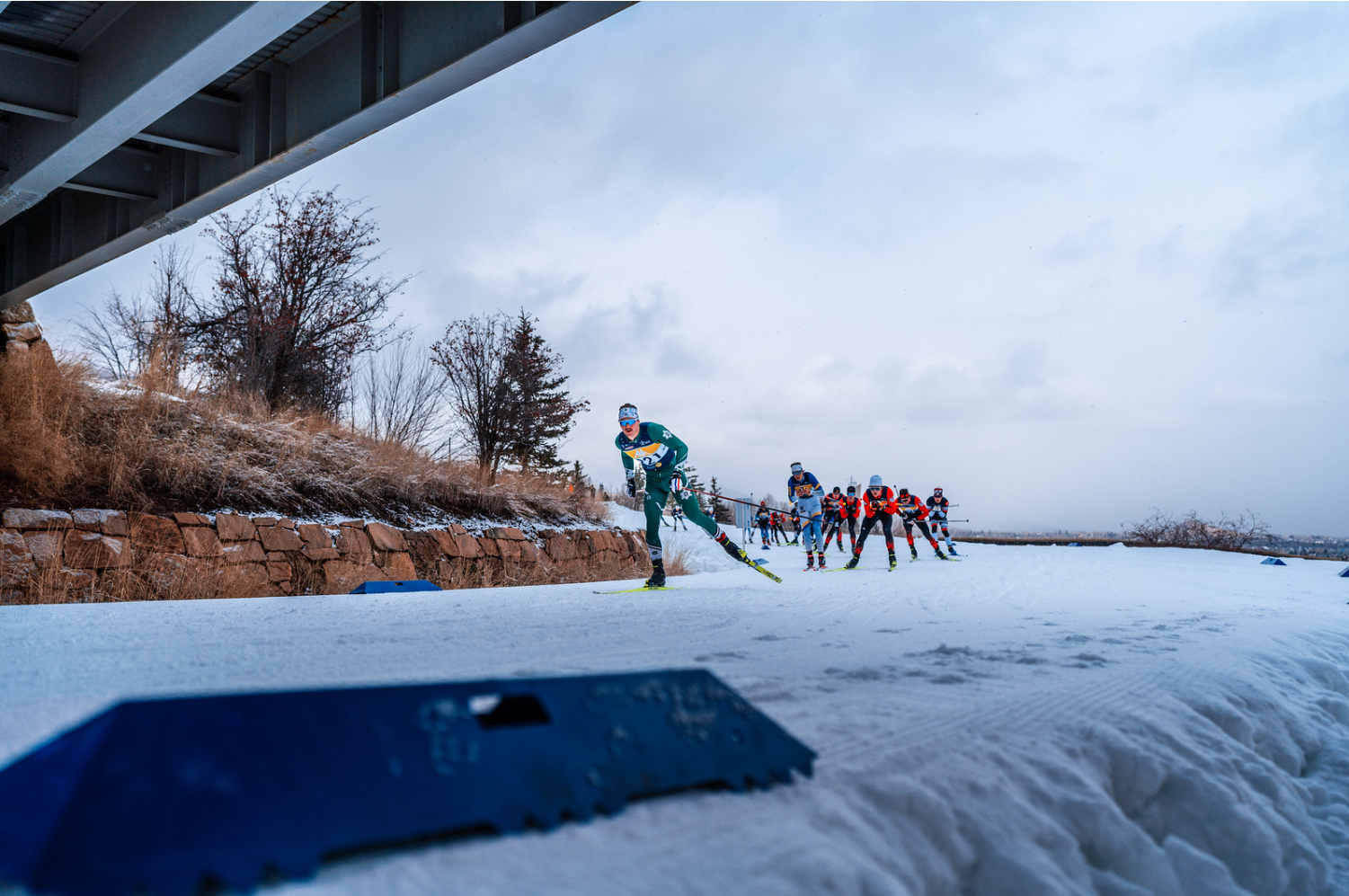
John Steel Hagenbuch (Dartmouth Ski Team) leads the Men’s pack during Friday’s 20 k Skate. Hagenbuch would make a decisive move to win his second career national championship. (Photo: Tobias Albrigsten/@UntraceableG)
Men’s 20 k Skate Mass Start
By the time the Men’s field started at 12:15pm, the fresh flakes of the morning had accumulated significantly on top of the course’s artificial snow. In the Women’s morning races, the course (and the new snow) had been worked in. In the Men’s race, a new layer of natural snow now clashed with the fast-running, transformed artificial snow underneath. Reports of skis “catching” when they hit a particularly heavy patch of natural snow were heard throughout the finishing pen after the race, which reiterated premonitions many observers had of how the Men’s field would race the course.
With ski speeds diminished on downhills, there was a little more to be gained by an earlier attack in the Men’s race than in the Women’s race. For the right skier—with the right strategy—a race that was likely to become a mass start slog could be broken apart by an aggressive attack.
That skier turned out to be Dartmouth’s John Steel Hagenbuch. Hagenbuch waited near the front of the fifteen-skier lead pack until the start of the fourth lap. Then, he accelerated over the top of the fifth lap’s initial climb and pressed on, alone, through the last five kilometers of the race. Hagenbuch’s move was followed by other skiers testing their own long-range attacks as University of Utah’s (UU) Frenchman, Tom Mancini, and UU teammate and British-Canadian skier, Joe Davies, were able to make subsequent breaks in the field. Hagenbuch’s final gap was a commanding 40 seconds on second place Mancini. Davies rounded out the podium in third place, 54 seconds off the lead. The pair of Peter Wolter (Sun Valley), and Elijah Weenig (University of Denver) came next in fourth and fifth to round out the American podium.
The win was the second national championship for Hagenbuch after his victory in the 10 k Individual Start Skate at US Nationals last year. Mancini scored his first podium at US Nationals with his runner-up finish. Davies finished a strong week in which he also podiumed in Tuesday’s 10 k classic. Davies will represent Great Britain at Junior World Ski Championships later this month in Planica, Slovenia.
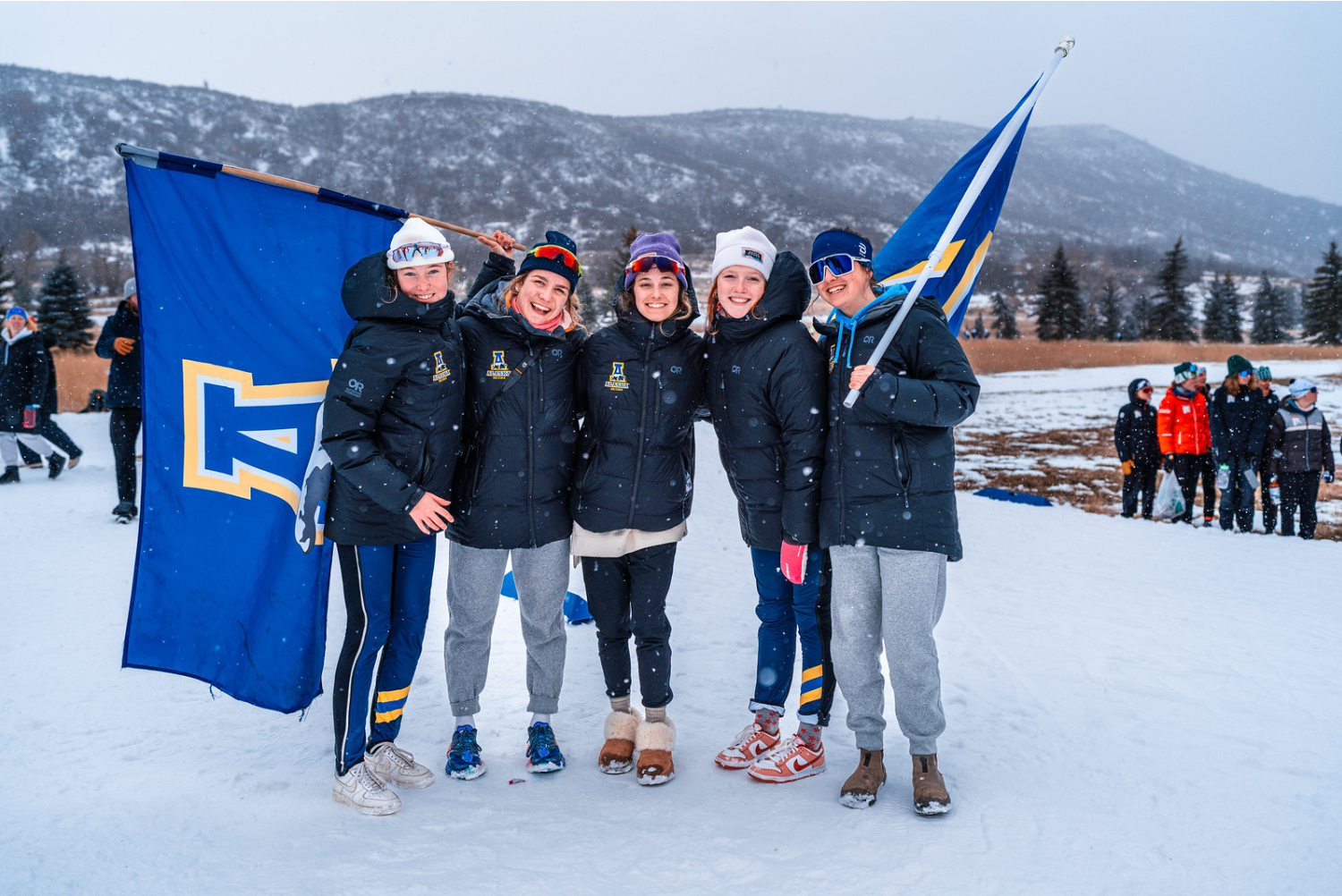
The University of Alaska-Fairbanks team out to cheer the Men’s race in Soldier Hollow, Utah Friday. (Photo: Tobias Albrigsten/@UntraceableG)
US Nationals Bids Farewell to Soldier Hollow
US Nationals concluded with Friday’s races. As they did, the snow started to gather again in the sky over Utah heralding the start of this ski season in earnest. Some Nationals competitors now know where they’ll be racing later this season: qualifying for trips, securing spots on national teams for World Junior/U23 Ski Championships, or possibly earning starts on the World Cup. For US Skiing, in general, the conclusion of Nationals revealed another world of possibilities as many in Soldier Hollow this week dared to dream bigger. The United States ski community now goes out into the world as one, demonstrating the credo that’s transformed the sport during this generation: we all work better when we work together.
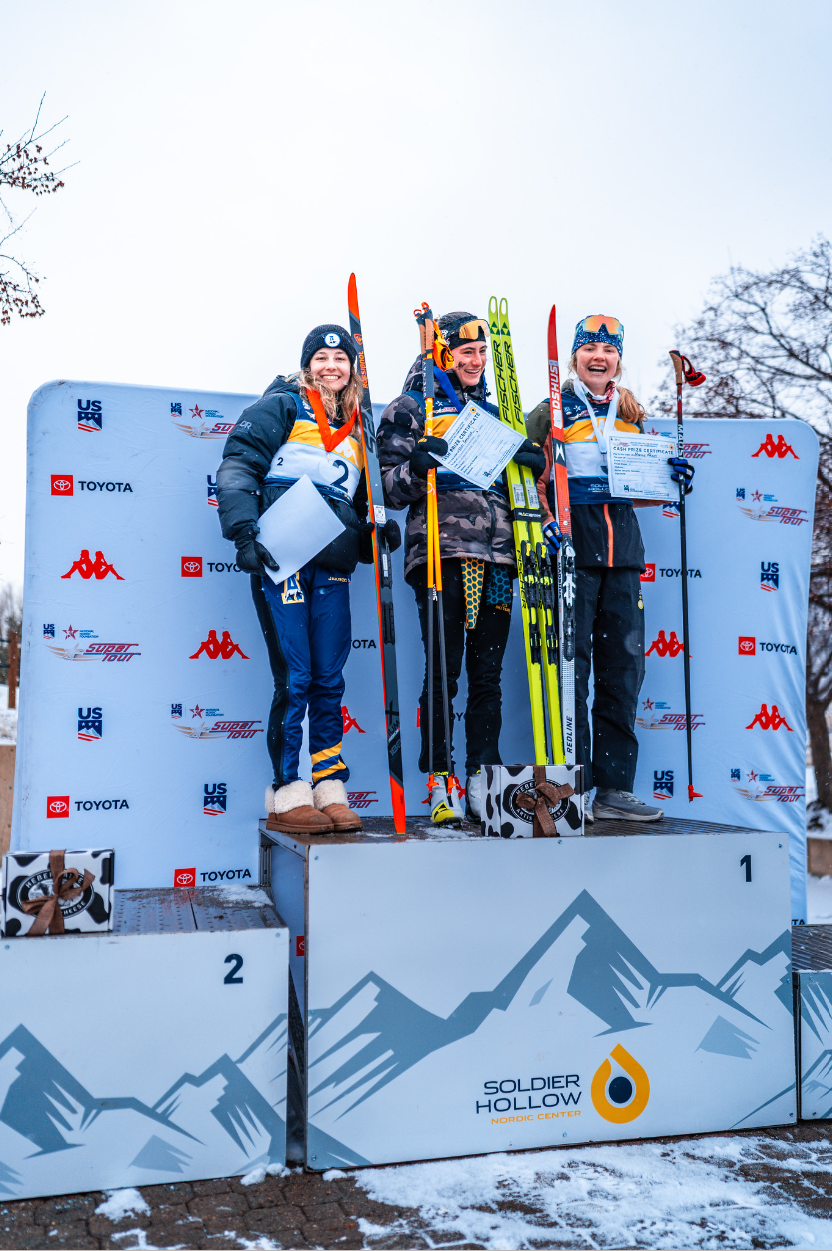
The Women’s podium in Friday’s 20 k Mass Start, Haley Brewster (UVM) first, Kendall Kramer (UAF) second, and Margie Freed (Craftsbury Ski Club) third.
Tobias Albrigsten contributed photos to this coverage of US Nationals. A full gallery from Friday’s Skate Race is available on his website here, and you can follow him on Instagram @UntraceableG.
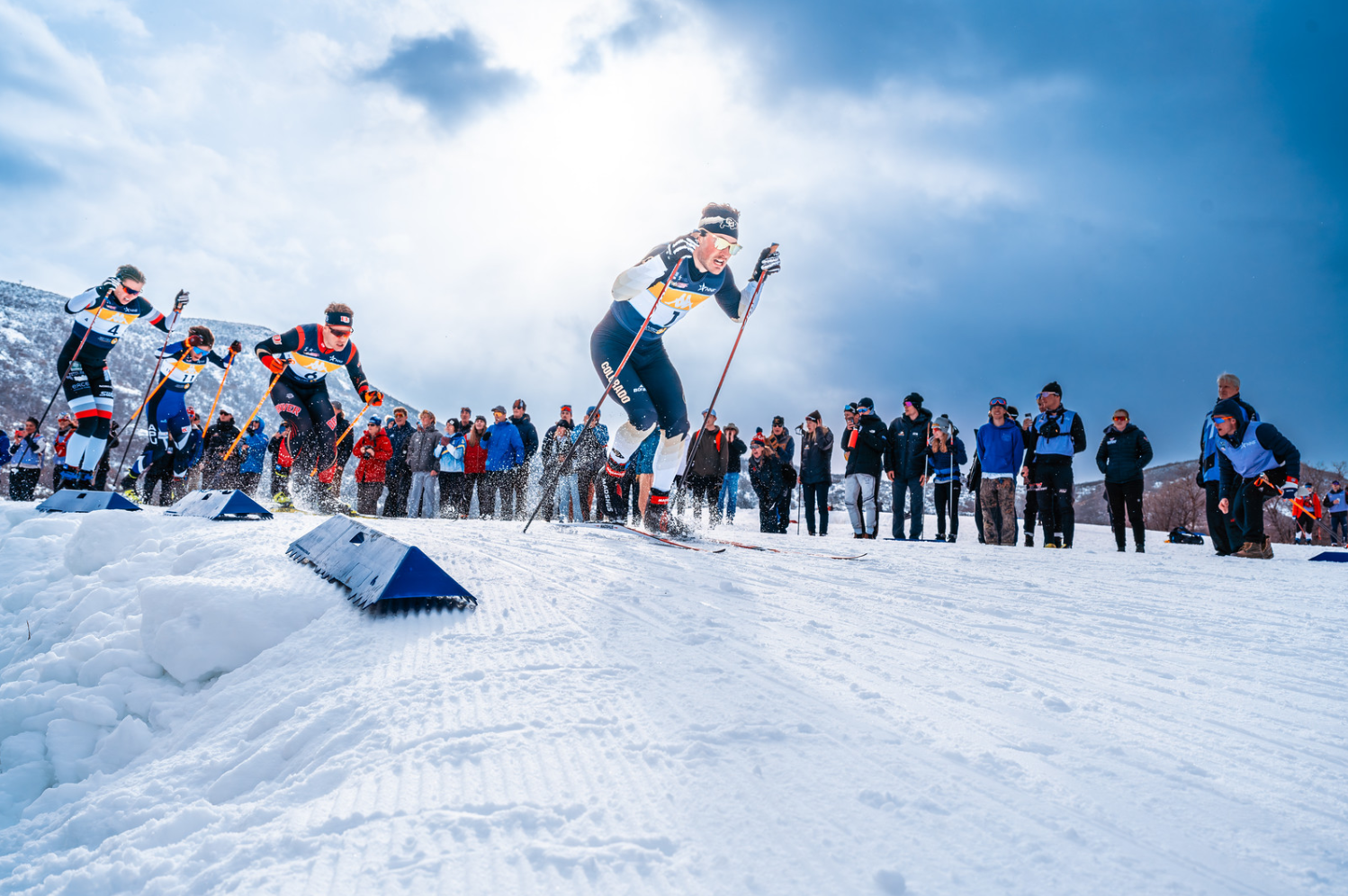
Will Koch leads the Men’s Final over the top—and finished on top—of the US National Championship Skate Sprint on Thursday in Soldier Hollow. (Photo: Tobias Albrigsten/@UntraceableG)
Though temperatures hadn’t dropped much at Soldier Hollow on Thursday, things felt different. The pure blue skies that had been a reliable fact of life at this year’s US Cross Country Ski National Championships (US Nationals) were clouded over as skiers took to the course for Skate Sprint qualifying. Temperatures hovered just below freezing creating fast, abrasive, consistent snow. The result was consistent wax conditions between morning qualifying and afternoon heats.
Logan Diekmann (BSF Pro Team), John Steel Hagenbuch (Dartmouth Ski Team), and Micahel Earnhart (APU) (L-R) during the Men’s Skate Sprint Final. (Photo: (Photo: Tobias Albrigsten/@UntraceableG)
Men’s Skate Sprint
Two years ago, when US Nationals was last held at Soldier Hollow, University of Colorado Sophomore, Will Koch, qualified first in that year’s Classic Sprint. Things on Thursday were the same: again Koch qualified in the top position. Two years ago, Koch had skied out in the quarterfinals. On Thursday, things felt different . . .
Skiing from the first quarterfinal heat, Koch held the pack together from the front, glancing side-to-side as he marked any surges from his competitors. Time and time again—through quarterfinals, semifinals, and Finals Koch had a response. Though things would wax and wane in a Men’s final that featured 2021 Classic Sprint runner-up Logan Diekmann (BSF Pro Team), last year’s Sprint Champion Kristoffer Alm Karsrud (Northern Michigan University), John Steel Hagenbuch (Dartmouth Ski Team), Michel Earnhart (Alaska Pacific University), and Florian Knopf (University of Denver), Koch would hold off all-comers, putting in a final burst to put bib #1 into position #1. Just behind Koch was Logan Diekmann, edging out John Steel Hagenbuch to complete the Men’s Overall podium.
The Men’s field had winnowed down over the course of heats that tended to be raced faster and faster throughout the day. The Soldier Hollow course, with its downhill finish and steep climbs, should theoretically be a very tactical one, but its length—and its location 6,000ft above sea level—seemed to lead to a more outright version of sprint racing, where maneuvering gave way to pure stamina on the day. Koch’s first quarterfinal had been a relatively lax affair early on, but subsequent heats would start the heated action earlier and earlier within the course. The third quarterfinal featuring Tom Mancini (University of Utah), Graham Houtsma (BSF Pro Team), Florian Knopf (DU), and Kristoffer Alm Karsrud (NMU) would push from wire to wire to pull two lucky losers into the semifinals. Mancini and Houtsma advanced 1-2 in the heat, while Knopf and Karsrud would contest a chaotic final sprint that saw them both claim semifinal spots. Both semifinals also featured more aggressive tactics, with the second semifinal seeing the top junior performance of the day, as Trey Jones (CU) sprinted to fourth place in the heat. Jones was joined on the junior podium by quarterfinalists Fin Bailey (Stratton Mountain School) and Murphy Kimball (Alaska Winter Stars).
The Women’s Sprint Final pushes over the top of the ultimate Soldier Hollow climb. Karianne Olsvik Dengerud (UU), at the front, would take the win in the Skate Sprint. (Photo: Tobias Albrigsten/@UntraceableG)
Women’s Skate Sprint
Tactical nuances were evident in the Women’s Skate Sprint field throughout the day, but they tended to be more subtle than definitive, fast-surging, field-breaking pushes. The Sprint Final, which featured top qualifier Haley Brewster (University of Vermont), Karianne Olsvik Denegrud (UU), Alayna Sonnesyn (SMS), Alex Lawson (Craftsbury Ski Club), Tuesday’s classic champion Tilde Baangman (Montana State), and Mariel Merlii Pulles (University of Alaska-Fairbanks) did show that those nuanced tactics had an effect. Sonnesyn led from the front of the field, with UU’s Dengerud marking her through the first set of hills. The pair had, at points, appeared to open a gap, but the rest of the field surged as the race went into the final climb to make for a closely contested race in the finishing straightaway. Emerging from that pack was University of Vermont’s Haley Brewster, who would work the long downhill into the finishing stretch to put herself within a group that featured Dengerud and Sonnesyn, and then use the final stretch to challenge their place at the front. That led to an exciting final sprint between four skiers in which Dengerud narrowly came out on top. Sonnesyn would follow in second, and Brewster would round out the Overall podium in third place. Behind them, Alex Lawson had created space to take fourth place on the day, and to step onto the American podium in third place behind Brewster and Sonnesyn.
Alayna Sonnesyn (SMS) skied to her first US National Championship in Thursday’s Skate Sprint. (Photo: Tobias Albrigsten/@UntraceableG)
Sonnesyn’s second place Overall delivered her first American National Championship (she had finished runner-up in the 2020 Skate Sprint at US Nationals in Houghton, Michigan). It also marked the first time that UU’s Dengerud, a native Norwegian, stepped onto the top spot of the podium at US Nationals.
Earlier in in the day, Dartmouth Ski Team’s Ava Thurston was the only junior to advance to the semifinal before finishing 12th on the day. Thurston was joined on the junior podium by quarter finalists Nina Schamberger (UU) 19th on the day and in second, and Sofia Scirica (Middlebury College) 29th on the day and in third.
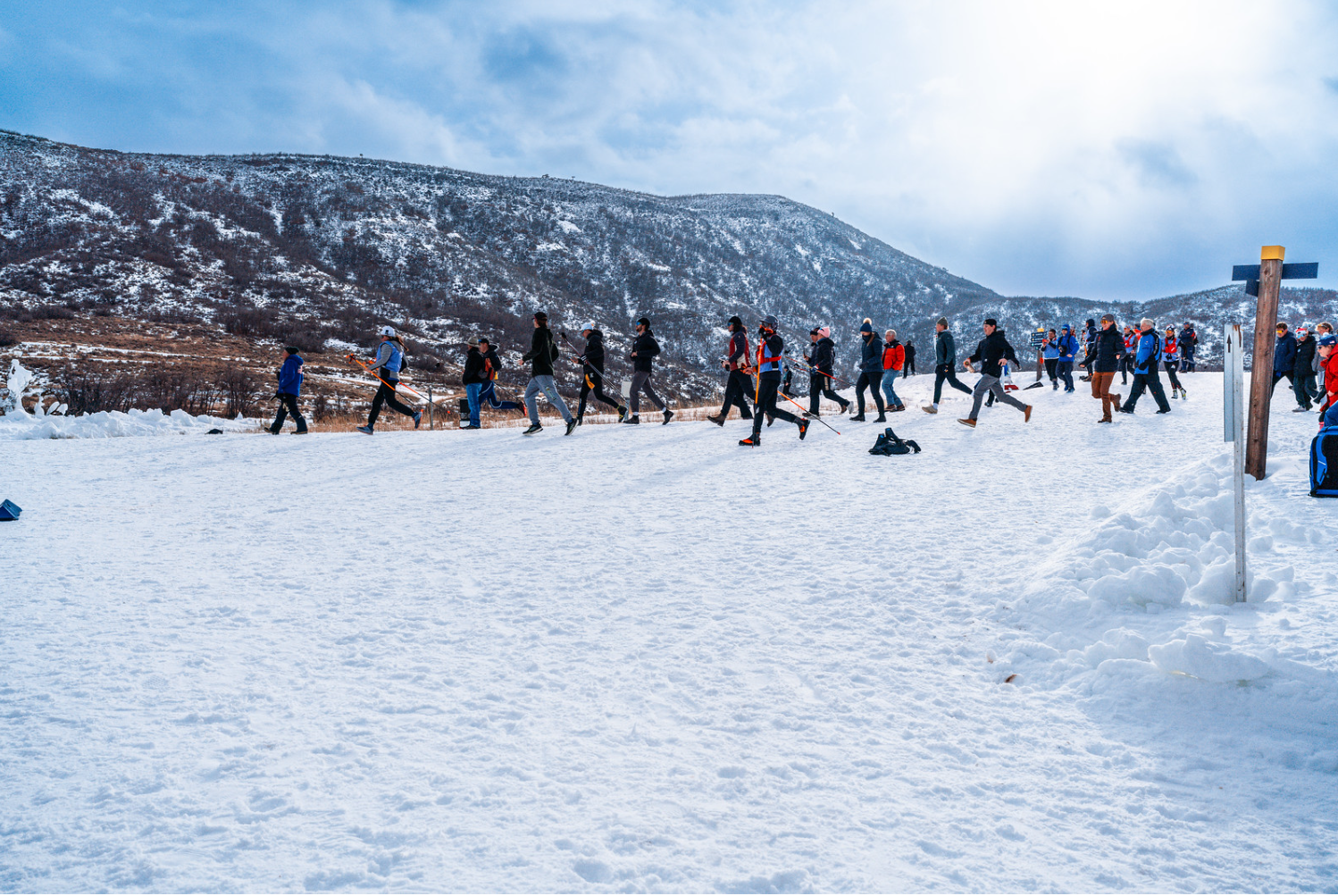
Spectators on the move during a sprint heat Thursday. (Photo: Tobias Albrigsten/@UntraceableG)
Snow Likely for Friday’s 20 k Mass Start Skate
A front developing over the Wasatch is headed towards Soldier Hollow ahead of the 20 k mass start skate race that will mark the finale of US Nationals on Friday. That left for an anticipatory mood around wax cabins, the Heber Valley, and the US ski community. When Soldier Hollow first hosted a National Championship in 2006, 36 skiers completed that year’s mass start skate race, then a 30 k. On Friday, the field is likely to be four times that size. With an American ski community that has been largely starved of snow, the scene is set for a race that will be a reminder of the joys and the revelry that this winter sport of skiing can bring.
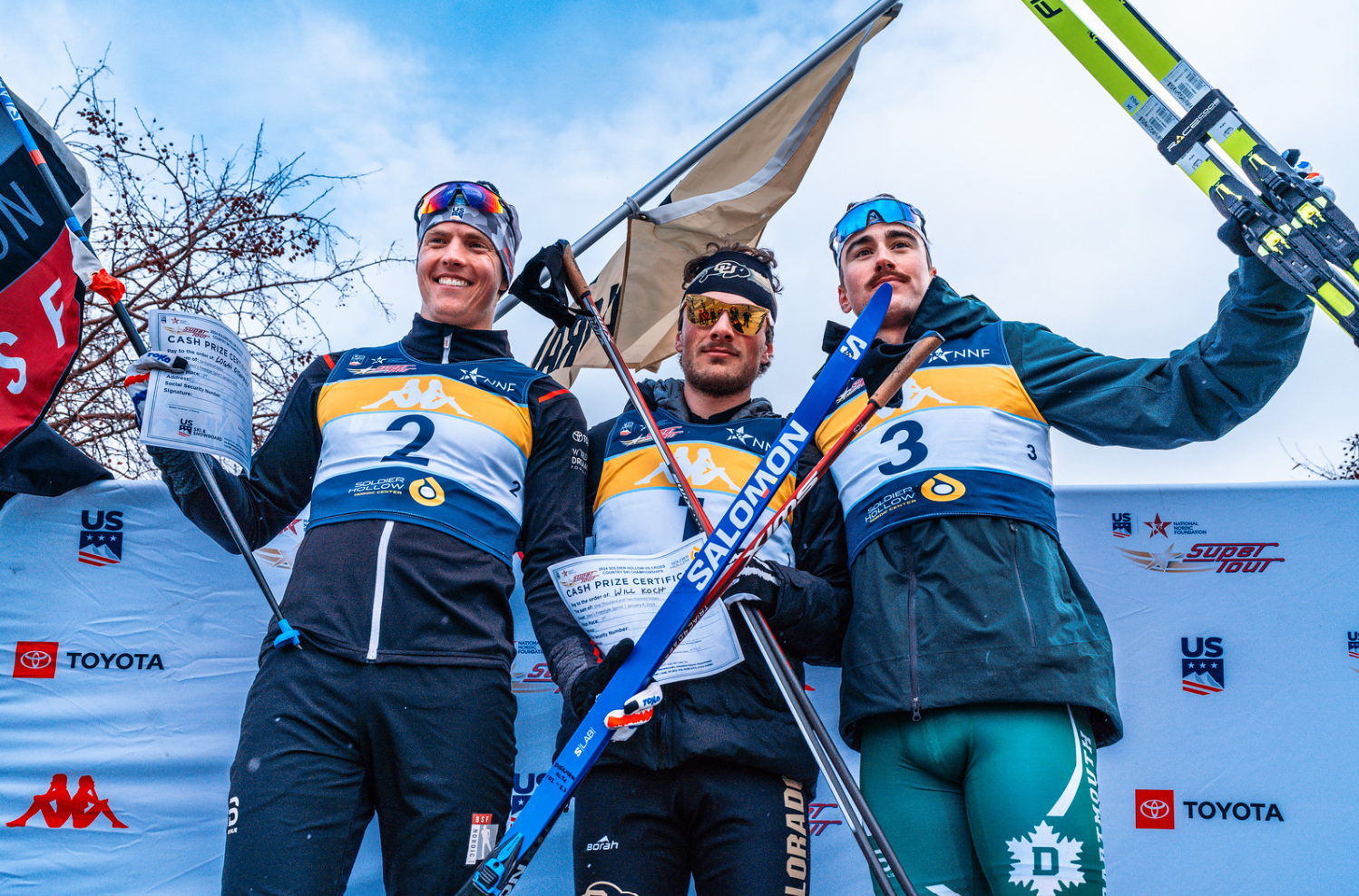
The Men’s Skate Sprint podium: 1st) Will Koch (CU) first, Logan Diekmann (BSF Pro Team) second, and John Steel Hagenbuch (Dartmouth) third. (Photo: Tobias Albrigsten/@UntraceableG)
Tobias Albrigsten contributed photos to this coverage of US Nationals. A full gallery from Thursdays Skate Sprint is available on his website here, and you can follow him on Instagram @UntraceableG.
Blue skies and warm conditions greeted racers on the first day of US Nationals at Soldier Hollow, Utah. Rolling terrain and long sustained climbs featured in the 3×3.3 k course skiers completed as they raced a 10 k Classic Individual Start. (Photo: Tobias Albrigsten/UnTraceableGlobal.com)
Race day at Soldier Hollow in Midway, Utah offers a microcosm for the role the venue has played in US skiing. The once, and possibly future, Olympic venue is consistent, stark, and starkly consistent in its conditions, its terrain, and in the quality of the events the crew at the Soldier Hollow Nordic Center put on. The typical SoHo day starts dark, dry and frigid, before the sun crests the Wasatch Mountains and gives way to blue skies, t-shirts on course, and klister on wax benches. The course is undulating, pitched, and constantly rolling. And the venue, which just twenty years ago was cut into a long, open gully, on the Eastern Slope of the Wasatch ahead of the 2002 Salt Lake Olympics, has become the US ski racing communities perennial favorite place to meet up to push themselves, each other, and sport of nordic skiing, forward.
The first day of the 2024 US Cross Country Ski National Championships (colloquially “US Nationals,” or “Senior Nationals”) were classic SoHo. A field of over 400 athletes split between the Men’s and Women’s fields opened the week with a 10 k classic individual start. The three lap, 3.3 km course was a total challenge as a classic race, requiring skiers to be strong within all the nuances of striding, double-pole, and kick-double-pole. Each lap began with a climb “up the hollow,” a consistent pitch that in turn rewarded skiers who could apply consistent power across a double-pole at the bottom of the hill, and a long stride near the top. Then, the course horseshoed into a fast rolling section of the venue’s sprint loop (to be raced Thursday), before finishing with another climb up “cabin hill,” another, steeper consistent pitch that rewarded quick-tempoed striding, and, on increasingly warm artificial snow throughout the day, a well-selected klister from the wax cabin. It was a day that leaned into all the variables that make ski racing unique, underlying results that stand as a testament to the complex nature of putting together a single, great performance.
When the Women’s field began, the sun had just peeked over the Hollow, which led to fairly rapidly changing kick conditions over the course of the start order as the course warmed. Early pace-setters included Nina Schamberger (University of Utah) along with her teammates Karianne Olsvik Dengerud and Sydney Palmer-Leger. Schamberger would prove the top junior (U20) on the day, finishing seventh Overall, while Palmer-Leger and Dengerud would finish second and third, respectively.
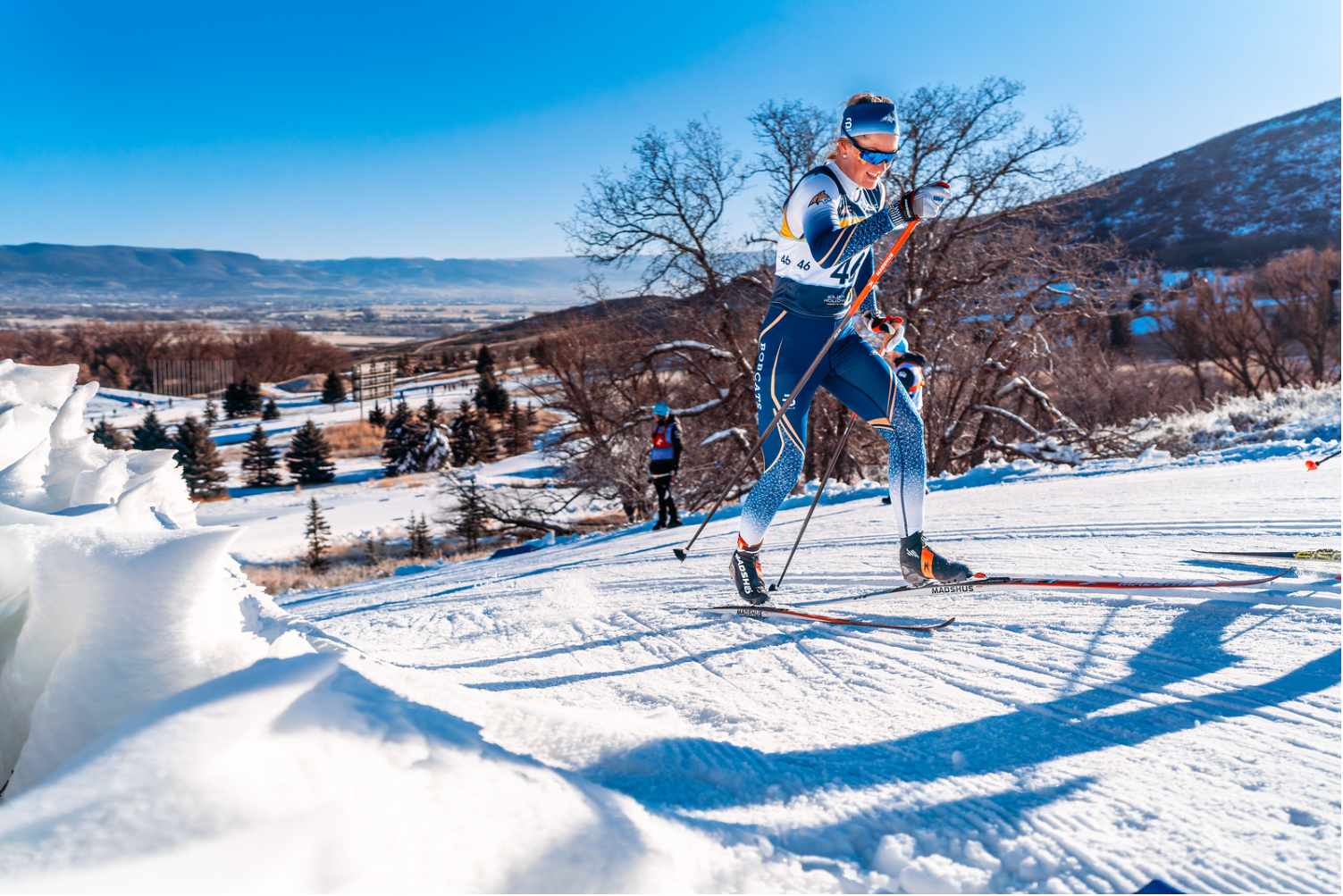
Swedish skier—and Montana State University sophmore—Tilda Baangman started fast and kept a steady pace as she posted the best time of the day in the Women’s 10 k Classic. (Photo: Tobias Albrigsten/UnTraceableGlobal.com)
As the busy field of racers continued to wind its way up the hollow though, a blue and gold suit with bib 46 flashed by. Over the radio of Montana State Bobcats Assistant Coach Lizzie Larkins, a voice reported that Bobcats sophomore, Tilde Baangman, had the fastest split through lap 1. Baangman didn’t relent through the rest of the race, and ended up topping the field by nearly 20 seconds over Palmer-Leger. That made things official, with Baangman taking home her first win at Senior Nationals, and Palmer-Leger (second Overall) the American national champion. For Palmer-Leger, the result marked her first national championship, one-upping a second place in last year’s 20 k classic mass start in Houghton, Michigan.
University of Denver Junior, Andreas Kirkeng, posted the fastest time of the day in the Men’s 10 k Classic. The Norwegian took his second straight victory in the US Nationals distance classic race, after wining last year’s 20 k mass start in Houghton, Michigan. (Photo: Tobias Albrigsten/UnTraceableGlobal.com)
By the time the Men’s field began, Soldier Hollow had warmed up and the snow had started to transform. Whereas in the morning, there were klisters and hard wax covers and hybrids in between, the conditions had definitively crossed above freezing and into klister territory. APU skier Joe Davies set the lead pace. His 23:53.1 10 k would stand as the benchmark as the top contenders continued to push through the course before University of Denver’s Andreas Kirkeng started to trade splits with Davies. Through the entirety of Kirkeng’s race, times swung back and forth between the pair, before Kirkeng burst across the finish line to post the day’s best time of 23:50.8, just 2.3 seconds ahead of Davies. For Kirkeng, the Classic result improved upon a ninth overall in last year’s 20 k classic mass start at Senior Nationals in Houghton, Michigan, and gave him his second win at US Senior Nationals. Kirkeng, who hails from Norway, was followed in the Overall by Joe Davies, who skis under the flag of Great Britain as a British-Canadian skier, which made Luke Jager (third overall) the American national champion. For Jager, the result marked his second national championship in a distance classic race in as many years, and his third national championship Overall after also winning last year’s Classic Sprint. Jager was joined on the American podium by second place (fourth Overall) Peter Wolter (Sun Valley Ski Education Foundation), and third place (seventh Overall) David Norris (Team Birkie). The top junior skier was Dartmouth Ski Team’s Jack Lange, in 17th Overall.
Luke Jager won his third career national title during Tuesday’s 10 k classic. The APU Nordic Center skier was third Overall in the race, behind Norway’s Andreas Kirkeng (first) and Great Britain’s Joe Davies (second). (Photo: Tobias Albrigsten/UnTraceableGlobal.com)
Action continues at US Nationals tomorrow, with the country’s best Para-skiers highlighted in a Sit Ski Sprint. That same sprint course will then play host to a Skate Sprint on Thursday. SoHo looks to be keeping to its trademark weather pattern ahead of the sprint racing action, with low lows and high highs in the forecast. Then though, there’s the possibility of snow. That might not just add to the excitement of the racing come Friday’s Skate Mass Start, but also serve to lift the spirits of the US ski community gathered from all corners of a continent that’s struggled with natural snowfall this year.
A classic Soldier Hollow day: sunny skies, warm snow, and a large field made for a bright start to US Nationals in Soldier Hollow, Utah Tuesday. Action resumes with a Sit Ski Sprint on Wednesday, before a Skate Sprint on Thursday. (Photo: Tobias Albrigsten/UnTraceableGlobal.com)
Tobias Albrigsten contributed photos to this coverage of US Nationals. A full gallery from Tuesday’s 10 k Classic is available on his website here, and you can follow him on Instagram @UntraceableG.
This coverage is made possible through the generous support of Marty and Kathy Hall and A Hall Mark of Excellence Award. To learn more about A Hall Mark of Excellence Award, or to learn how you can support FasterSkier’s coverage, please contact info@fasterskier.com.
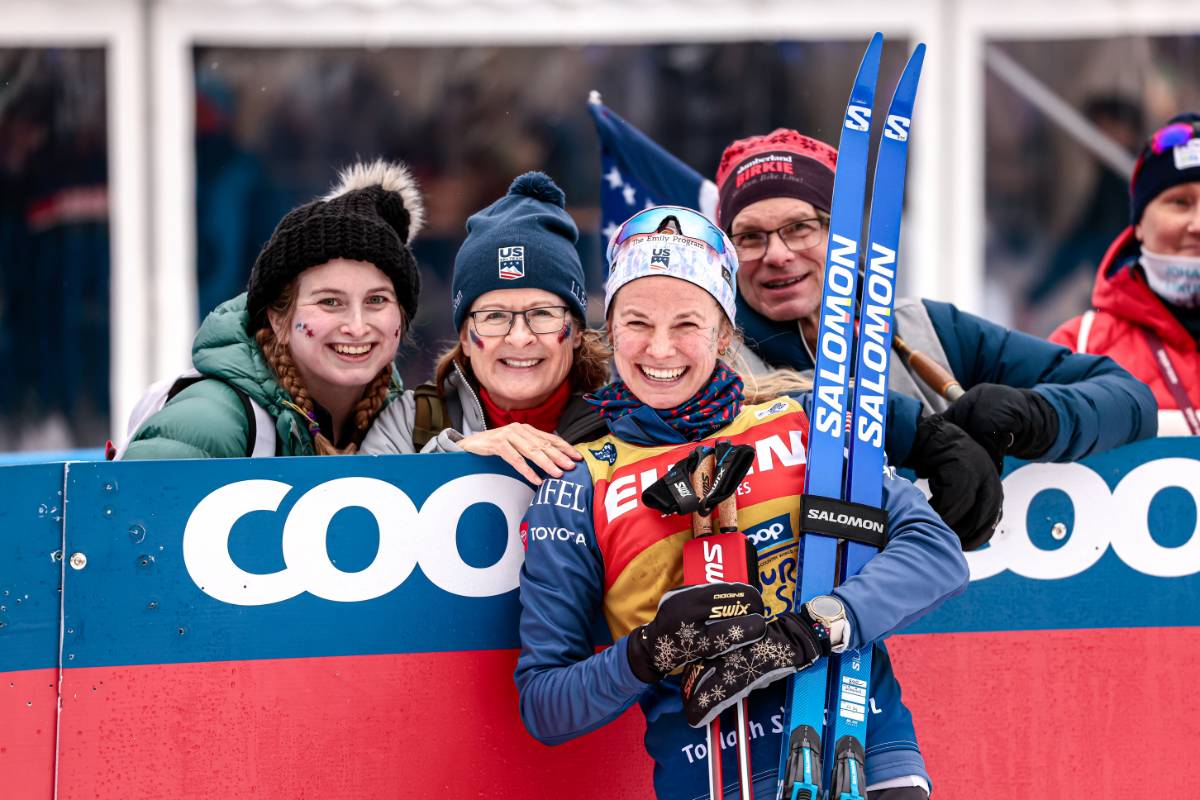
The Diggins family celebrates after Jessie Diggins (USA) moved into the Tour de Ski lead with a third place performance in Stage 2’s 10 k Classic. (Photo: NordicFocus)
The Tour de Ski operates on two parallel narrative arcs. Day-to-day, stage-to-stage, it highlights the singularity of great ski performances, while over the course of a week it points to the dynamism that makes great skiers great. On Stage 2 of this year’s Tour, those arcs were one and the same.
No one skis classic technique quite like Kerttu Niskanen (FIN). And no one can close a race like Jessie Diggins (USA). Through the undulating ups and downs of the Toblach course, those two declarative statements were translated to the result sheet with only Victoria Carl (GER) skiing into second place to split Niskanen and Diggins. Niskanen won her sixth career World Cup race, taking a seven second victory over the resurgent Carl. Diggins, meanwhile, closed a five-second gap on teammate Rosie Brennan in the final two kilometers to take her second career individual classic podium. In doing so, Diggins took control in this year’s Tour de Ski.
Brennan would finish fourth, only 15 seconds behind the winner, a performance that moved Brennan from 26th place in the Tour de Ski standings to sixth place.
Other American finishers included Novie McCabe 29th, Sophia Laukli 39th, Sammy Smith 52nd, Julia Kern 59th. Canada’s Katherine Stewart-Jones did not start Stage 2, leaving Canada absent from this year’s Tour de Ski Women’s Overall standings.
Kerttu Niskanen (FIN) skied to her sixth World Cup victory on Saturday, with a win in the 10 k Classic. (Photo: NordicFocus)
Niskanen not only stood atop the field today, but also stood out as the veteran among veterans who competed for the win. The Finnish skier, Now age 35, the Finn expressed her satisfaction in post-race interviews. “I’m really happy . . . I’m back,” she beamed. “The beginning of the season has been difficult for me, so to see it come together was nice.” Niskanen’s six career World Cup wins have all come in the 10 k Classic (including one victory during the peak of Therese Johaug’s (NOR) great career).
Meanwhile, Diggins continues to tread relatively new tracks in her own storied career: This was her second-ever outright distance classic podium (after placing third place on Stage 2 of the 2021 Tour de Ski in Val Mustair). After taking third in Stage 2 of 2021’s Tour de Ski, Diggins went on to wear the Yellow Bib at the top of the Alpe Cermis as the Tour champion. After today, she again wears the Yellow Bib. After that 2021 podium, Diggins spoke to FasterSkier:“My goals for today were to ski smooth and really work the downhills,” she said then. “When I felt good on the last half of the last lap I just decided to push it!” She compared that earlier success in Toblach with her efforts today: “I tried to make sure I was racing the downhills and the flats just as hard as the uphills.” Two years after her first success in Toblach, not only was the result the same, but the way in which Diggins achieved the result was the same, too.
Jessie Diggins (USA) delivered a strong finishing push to take third in Stage 2 of this year’s Tour de Ski. Diggins leads the Overall going into Stage 3. (Photo: NordicFocus)
10 k Classic Individual Start
The dynamics of this Tour de Ski 10 k Classic Individual Start were just slightly different than what the World Cup is used to, as the method for determining the start list turned not towards the Overall World Cup Standings, but to the Tour de Ski standings after a sprint race on Stage 1. With the perennial Distance contenders spread throughout yesterday’s results, they would be spread throughout the field today. Serendipity did set up some structure, though; a pack of top distance racers including Brennan (bib 28) starting back-to-back starting with bib 20, Lotta Udnes Weng (NOR), and stretching to bib 29, Niskanen, and bib 30 Ebba Andersson (SWE). A second, looser pack of top racers started later on based on their strong sprints yesterday, with Diggins in bib 42 and Carl in bib 48.
Rosie Brennan (USA) skied to a fourth place finish in Stage 2 of the Tour de Ski. The 10 k classic result put Brennan in the top ten of the Tour de Ski Overall headed to Stage 3 on Sunday in Toblach, Italy. (Photo: NordicFocus)
The back-to-back pair of Brennan and Niskanen would set the leading times throughout the course. In the first half of the race, they were splitting seconds with Brennan ahead of Niskanen by 1.8 seconds through the 5 k mark, and Niskanen ahead of Brennan by the same margin a kilometer later at the 6.7 k mark. On a course that followed a rolling, punchy set of downhills, Niskanen was able to put in a finishing burst. Brennan crossed the line in first—but for only a few moments before the full extent of Niskanen’s closing speed became evident at the finish line. The Finn crossed the line 15 seconds ahead of Brennan in what would turn out to be the definitive result of the day.
“Today was better than [yesterday’s sprint race],” Brennan said. “I can’t say I felt ‘bad,’ per se. Yesterday, I just felt like I wasn’t skiing tactically that well. This distance course was definitely better than me, and while I wouldn’t say I felt great today, I was happy I made it work.”
Back on course, there were indications that Diggins was having an extraordinarily good day on classic skis. As Niskanen crossed the finish, Diggins was nearing the 5 k half-way mark less than ten seconds off the lead. By 8 k, she was still within 15 seconds of Niskanen’s top time, but five seconds off Brennan in fourth. Like Niskanen, Diggins would make up time with a brilliant final push, shooting to the podium with a five second advantage over Brennan at the finish. Carl would come in moments later to split the slim difference between Niskanen and Diggins. The German finished three seconds ahead of Diggins, and seven seconds off the lead in second place.
Tour de Ski Standings After Stage 2
Stage 2 begins to bring clarity to this year’s race for the Tour de Ski Overall, but any conclusions are still taken with a view towards the races to come, rather than the end of the Tour. After time bonuses, Diggins holds the Yellow Bib by seven seconds over Carl going into Stage 3, a 20 k pursuit race. After a strong ninth place finish, Stage 1 winner Linn Svahn (SWE) remains within striking distance in third place at 11 seconds back.
Diggins noted in post-race comments that she’s feeling more relaxed than in the past with the Yellow Bib, and pointed towards a particular source of comfort as a reason why: “I got a chance to hear my family cheer for me out on course,” she said. “Just having the support of our family over here is a big deal because we realize we don’t get it all that often. It’s a mental break, and a physical break when they’re here over the holidays, and it put me in a great place for the Tour.”
After her podium finish in Stage 2, Jessie Diggins (USA) holds a seven second lead in the Tour de Ski over Victoria Carl (GER) and third place Linn Svahn (SWE) . (Photo: NordicFocus)
Svahn’s resilient performance proved a silver lining on a day that saw struggles from Sweden’s top distance skiers. Andersson, who won this season’s opening 10 k Classic race in Ruka, finished Stage 2 in 13th place, and sits 18th in the Overall at +1:28 back. Last year’s Tour de Ski champion, Frida Karlsson (SWE) finished Stage 2 in 11th place, and is also 11th in the Overall at +1:11 minutes back.
Brennan moved herself into sixth place in the TDS Overall standings with her Stage 2 race, and sits amid a top ten that is still tightly packed. With a 20 k Pursuit next on the schedule, Brennan remains poised to challenge for the Tour de Ski Overall. McCabe sits in 32nd Overall, with Laukli in 45th, Smith in 52nd and Kern in 56th rounding out the American Women in the standings.
In a tightly packed top 10, Rosie Brennan is already looking forward to all that is to come. “[I’m looking forward to] Davos,” she said. “It’s my favorite place to race, and while I haven’t done the course that is prepared, I like to think that ‘all things Davos suit me,’ so I’m optimistic for the races to come after tomorrow.”
This coverage is made possible through the generous support of Marty and Kathy Hall and A Hall Mark of Excellence Award. To learn more about A Hall Mark of Excellence Award, or to learn how you can support FasterSkier’s coverage, please contact info@fasterskier.com.
Linn Svahn (SWE) has been plagued by shoulder injuries, having been forced to wait nearly three years between World Cup victories. With her victory in Tour de Ski Stage 1, she seemed pleased to be making up for lost time. (Photo: Modica/NordicFocus)
Over eighteen editions, the rhythms of the Tour de Ski have become familiar for the World Cup for both skier and viewer alike. The stark change of scenery from the arctic fields and fjords of Northern Europe in Period I to the mountain valleys of Southern Europe indicates that the stakes have been raised right alongside the topography. Seven stages, contested over nine exhausting days, create an event whose stature grows with each passing year, following paths to victory forged by skiing’s greats.
Toblach played host to this year’s first Tour de Ski skate sprint stage. A fixture since the discipline was first pioneered in the early 2000s, the Toblach Sprint course has played an outsized role in garnering Sprint racing’s reputation as a tactical discipline that highlights not just the outright physical speed of the world’s greatest skiers, but the thoughtfulness with which they race, too. The Toblach course, “is really windy and punchy,” said Rosie Brennan (USA) on the skate sprint she raced today, “which makes it difficult to pass and requires really quick acceleration,” This year, the final stretch that rewarded drafting for many previous years was tempered by a chicane, but one that didn’t temper the overall effect. Sweden’s Linn Svahn mixed cunning and physical prowess throughout the entire day, earning her first individual World Cup win in nearly three years to open this year’s Tour de Ski. She was followed onto the podium by her teammate, Jonna Sundling, and Norwegian sprint specialist, Kristine Stavaas Skistad.
For the Americans, it was Diggins qualifying second. And with promising early-season results in sprinting, there was an early opportunity to gain some advantage over other rivals in chasing her second Tour de Ski victory. She would be joined in the last quarterfinal of the day by sixth place qualifier Julia Kern (USA), with Rosie Brennan (USA) skiing out of the fourth quarterfinal to round out the three heat qualifiers for the Americans during Stage 1. Ultimately, Diggins would finish ninth, Kern 11th, and Brennan 27th.
The only Canadian competitor—Katherine Stewart-Jones—finished qualifying in an uncharacteristic 64th.
Linn Svahn (SWE), bib 3, won the final sprint on Tour de Ski Stage 1 to take her first World Cup win in two years Friday. (Photo: NordicFocus)
Svahn’s win capped an early season, and early career renaissance. At 24 years old, she already has experienced the full depth of skiing’s highs and lows, scoring perennial Sprint wins on the World Cup for two years in both 2019-2020 and 2020-2021, before a shoulder injury led to a long recovery. She won today by outsprinting the entire current crop of top sprint contenders. The win puts Svahn into the yellow bib of the Tour de Ski’s Overall leader going into Sunday’s 10 k Classic Interval Start race.
Jessie Diggins (USA) and Julia Kern (USA) skied in lockstep during their quarterfinal on Friday. Diggins finished the day in 7th Overall in the Tour de Ski standings, setting her up to compete for a second career TDS victory this week. (Photo: NordicFocus)
Diggins Starts Strong in Tour de Ski Overall Chase
Diggins came into the 2024 Tour de Ski as the leader of the World Cup’s Overall classification; however, that didn’t come with the usual Yellow bib that the World Cup leader wears. Instead, last year’s Tour de Ski winner Karlsson (SWE) was in Yellow. Both Diggins and Karlsson would advance out of qualifying.
Before Diggins would take to the quarterfinal, the Swedish-Norwegian duo of Sundling and Skistad would lead a hard-driving quarterfinal alongside Frida Karlsson that saw the Yellow bib finish in third. The second quarterfinal produced a lucky loser in Estonia’s Patricija Eiduka, so Karlsson would be on the outside looking in for the semi-finals. Karlsson would finish Stage 1 in 14th place.
Rosie Brennan (USA) finished 27th at Stage 1 of this year’s Tour de Ski. She goes into Stage 2 in 26th place Overall, one minute behind the race leader. (Photo: NordicFocus)
When the fifth quarterfinal featuring Jessie Diggins and Julia Kern started on course, Diggins was in a good spot to gain an early advantage over other Overall contenders. She skied with the intention to take the chance early, driving the pace from the start. Kern remained steady behind Diggins, and the two kept together through pulses and pushes along the course’s undulating terrain. Norway’s Mathilde Myhrvold was the only other skier in the field capable of following the Americans’ driving pace. In the closing moments of the heat, Kern relented ever-so-slightly, and the Norwegian shot up the final stretch to put in a boot throw for the second semifinal spot behind heat winner, Diggins. Following Diggins’ pace had paid off for Kern; she was into the semifinal as the first lucky loser.
“The tactic in the quarterfinal was, ‘ok, let’s pick this one’ and hopefully [Julia and I] could scare some people out of picking that heat, which worked,” said Diggins in post-race comments. Kern echoed the sentiment, saying “Jessie and I talked beforehand and we wanted to string it out so it didn’t come down to a sprint in the end.”
Jessie Diggins (USA) throws her boot across the line during the semifinal of Friday’s Skate Sprint in Toblach, Italy. (Photo: NordicFocus)
The American pair would advance to the second semifinal together. Diggins led the heat out hard alongside the Swedish pair of Emma Ribom and Johanna Haeggstroem; Kern fell off the back early. Diggins would push over the course’s decisive International Bridge hill coming out of the first lap, but the Swede’s were able to mark her. Off the final corner, Diggins forged a middle path between the Swede’s, but was unable to keep up with their finishing push. Diggins finished the heat in fifth, giving her a ninth place finish, and seventh Overall in the Tour de Ski after Stage 1 (See the section below on how that placings-discrepancy is possible).
Kern described the semifinal in post race interviews. “[It] was a pretty similar [to the quarterfinal],” she said. “But I was pretty worked from the last heat.”
“I was not aggressive enough [in my semi-final],” said Diggins. “I just didn’t hold my line well enough, and I wish I could do that one over . . . In general, though, I’m really happy with how I skied. The fitness is right where it needs to be.”
The other semifinal saw a tactically savvy Svahn waiting patiently, marking Sundling, and ultimately sprinting around her to first. Sundling secured second in a photo finish over Kristine Stavaas Skistad, with last year’s World Cup Sprint runner-up, Nadine Faehndrich (SUI), getting the second lucky loser spot to round out the Finals field. The semifinals importance to the Tour de Ski Overall was that Victoria Carl finished the heat in sixth place, and 12th in Stage 1. That left Jessie Diggins (seventh) furthest up the Tour de Ski standings of the main contenders for this year’s Overall, with a 10 k Classic race to follow tomorrow.
Tour de Ski Standings After Stage 1
Svahn will wear the Yellow bib into Tour de Ski Stage 2 with a two second lead over today’s second place finisher, Sundling and a time of 1:55.
Math matters at the Tour de ski, so it’s worth reviewing Page 43 of your handy FIS World Cup Rule Book. For Tour de Ski sprint races, times are passed on qualifying results, but time bonuses are calculated off the heat results. Therefore, Stage 1 results do not necessarily equate to Tour de Ski standings after Stage 1.
Linn Svahn’s time Overall time comes from her qualifying time (see Qualifying Results here) , 2:55.01, which is first truncated to the nearest second before each successive stage, hence 2:55. Then, she earned a 60 second time bonus for her Sprint heat finish position, 1st place, so 2:55 – 1:00 = 1:55, and 1st place in the Tour de Ski Overall. Stage 1 second place finisher Sundling qualified in first with a time of 2:51, and earned a 54 second time bonus for her place in the Finals, so is two seconds off Svahn with a 1:57.
For Diggins, her second-best qualifying time of 2:54, plus a time bonus of 28 seconds for her ninth place heat finish equates to 2:26 (+0:31), seventh place in the Tour de Ski Overall. Kern also is in the top ten of the Tour de Ski Overall, moving up from 11th on Stage 1 with bonuses to 10th Overall (+0:39). Rosie Brennan is in 26th (+1:01).
Note the parentheses there, as it’s how a three-minute sprint race with split second time gaps translates into the Overall dynamic that will now be raced out over the next week. Going into tomorrow’s 10 k classic, Diggins is roughly 30 seconds off the Yellow Bib, while Brennan is roughly one minute off the same mark. Those are some handy marks for viewers to consider as racers approach tomorrow’s first distance-racing challenge: the 10 k Classic Interval Start.
The podium of Friday’s Freestyle Sprint, Stage 1 of this year’s Tour de Ski in Toblach, Italy. Linn Svahn (SWE) first, Jonna Sundling (SWE) second, Kristine Stavaas Skistad (NOR) third. (Photo: NordicFocus)
This coverage is made possible through the generous support of Marty and Kathy Hall and A Hall Mark of Excellence Award. To learn more about A Hall Mark of Excellence Award, or to learn how you can support FasterSkier’s coverage, please contact info@fasterskier.com.
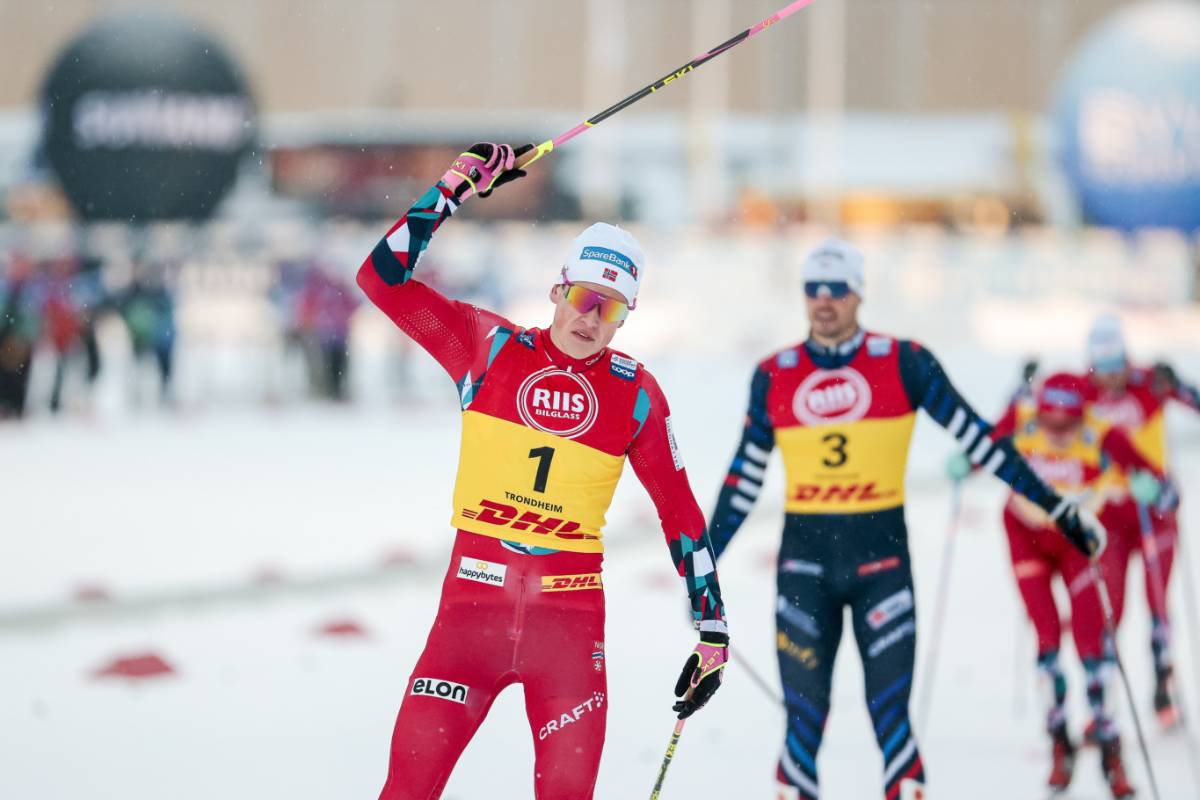
Johannes Hoesflot Klaebo (NOR) spins his pole in celebration as he crosses the finish line to win the Men’s Freestyle Sprint in his hometown of Trondheim, Norway. (Photo: Nordic Focus)
The World Cup’s all-time winningest sprint racer probably didn’t need a home-field advantage, but Trondheim native, Johannes Hoesflot Klaebo, got one as the World Cup pulled into the warm, wet, sea-side city on the Norwegian coast. Klaebo’s smile greeted his home crowd after a dominant win, as fans saw a course that rewards careful tactics raced perfectly by the master of this particular craft. Klaebo earned his 70th World Cup win ahead of Lucas Chanavat (FRA) and Harald Oestberg Amundsen (NOR); but the joy Klaebo showed as he headed away from the finish line seemed to mark this win as unique. Understanding why may be a pretty simple prospect. Twenty years ago in the Trondheim ski stadium, there was a boy who crossed that finish line dreaming of doing so at the front of the World Cup. Even after having cruised victorious across so many World Cup finish lines, it seems that Trondheim’s finish line is the one that Klaebo values most. His dreams in skiing have come true many times over; in Trondheim, we saw how important it is for Klaebo to live out those dreams in front of his hometown crowd.
Americans followed up last week’s Classic Sprint podium (third place for JC Schoonmaker) by qualifying three skiers into the heats in Trondheim: Schoonmaker qualified eighth, finishing the day in 21st. Ben Ogden qualified 18th and ultimately finished 19th. Kevin Bolger qualified 13th, but proved to be the top American finisher on the day, winning his quarterfinal heat and finishing 12th. Other American finishers included Gus Schumacher 37th, Zanden McMullen 44th, Will Koch 47th, Luke Jager 57th. Canadians Antoine Cyr and Leo Grandbois qualified 43rd and 53rd, respectively.
Kevin Bolger (USA) qualified 13th in Friday’s Freestyle Sprint before winning his quarterfinal. Sixth in his semifinal, he would finish the day in 12th. (Photo: Nordic Focus)
Men’s Freestyle Sprint
Throughout the day, Chanavat would be the skier Klaebo marked as the pair followed each other from the first quarterfinal through to the semifinal, and then from the semifinal through to the final. In pushing the Trondheim hills at exactly the right moments—over the top of the first hill that led away from the start, and then again over the much longer climb that led to the final sprint—Chanavat was able to stick with Klaebo, and was rewarded with a second place finish.
Ogden featured in the first quarterfinal alongside Klaebo and Chanavat where the careful maneuvering of Klaebo and Chanavat left the heat relatively slow on the day. Ogden briefly held a lucky loser spot after a late kick saw the American cross the line in fourth, but his time would not prove fast enough to see him advance to the semifinal. He finished the day in 19th.
In what would prove to be the fastest heat of the day, Schoonmaker joined with Haavard Solaas Taugboel (NOR) and Amundsen in the fourth quarterfinal. Taugboel set a hard-charging pace from the start, with Schoonmaker marking the pace. As the terrain kicked up, so did Schoonmaker, but his up-tick was matched on the same line by Amundsen who launched to the front of the pack. Forced inside, Schoonmaker cut through the pack as it shot towards the finishing straight, coming into the stadium in fourth place. In the final sprint, he would take fifth behind Sweden’s Johan Haeggstrom by a boot’s throw; Schoonmaker missed out on a lucky loser’s spot by 0.05 seconds.
Schoonmaker shared his race experience with FasterSkier: “I felt OK about it,” he said. “Not my best racing but I did what I could. I just felt like I didn’t ski super smart and wasted energy with lots of attacks that didn’t pay off. It was tight in the end so I feel like I can do better just got to learn from this one.”
JC Schoonmaker (USA) featured in the fastest quarterfinal of the day, missing out on a lucky loser spot by 0.05 seconds behind eventual silver medalist, Harald Oestberg Amundsen (NOR). (Photo: Nordic Focus)
The fifth quarterfinal featured Kevin Bolger in a heat led out by Swiss skier, Valerio Grond. Bolger was careful in the early goings before Sweden’s Emil Danielsson started to push the pace up the long Trondheim climb. Instead of answering on his own, Bolger held his line behind Grond, and the duo eventually created a small gap over the top of the hill that led to the finishing stretch. Around the final stadium u-turn, Grond shot wide—briefly losing his balance—allowing Bolger to take a clean inside line and make a final push to win the quarterfinal.
Sprint Semifinals
Bolger would land as the lone American in the second semifinal, a heat filled with Norwegians. Taugboel again employed his aggressive pace-setting tactics, leading from the start. Bolger followed Taugboel in the early part of the heat, and the pair shot over the first hill towards the course’s main climb in first and second. That was when Bolger made his bid for a finals spot, moving to the outside and putting in a burst up the climb; however, he was overtaken by Taugboel, Amundsen, and fellow Norwegian Erik Valnes. By the time that trio shot into the stadium, Bolger was off the back and wouldn’t factor into the final sprint. Taugboel would win the heat with Valnes second and Amundsen taking a lucky loser spot.
Kevin Bolger (USA) during his quarterfinal on Friday. Bolger followed Valerio Grond (SUI) before sprinting his way to a semi-finals bid and a 12th place finish Friday. (Photo: Nordic Focus)
Sprint Final
Klaebo was simply not going to be beaten on this day—not in a freestyle sprint, not in front of a Trondheim crowd. He continues to be capable of altering his heat-strategy at will according to the predictive strategies of his rivals. Chanavat had led each of his heats throughout the day. In the final, Chanavat again surged to the front; Klaebo followed. Together they exhausted the field, creating a gap at the top of the final downhill. Klaebo’s skis are consistently faster than any of his rivals, and today proved no exception. Applying a few perfectly timed free-skating strokes at the belly of the final downhill, he propelled himself easily past a visibly-surprised Chanavat. Klaebo entered the final tight turn with the lead, and extended it all the way to the finish line where he spun his pole overhead in jaunty celebration.
In the finishing area, Chanavat was overheard to say, “Where did he come from?” even as he smiled at his own podium performance. The answer to Chanavat’s question is a simple one: “He comes from Trondheim . . .”
The results of Trondheim’s Freestyle Sprint reiterated the Norwegian dominance of the Men’s World Cup field; however, the result in Trondheim came with an extra bit of intrigue. With the World Championships slated to return to this same Trondheim venue in 2025, there’s now a result to base on which to base speculation for next year. With Klaebo out in front—and a final featuring so many of his countrymen—there is plenty for this hometown crowd to look forward to when the FIS World Championships arrives in Trondheim in 2025.
American Progress in Perspective
Kevin Bolger’s 12th place finish on the day—matching his best result from last year—added to an auspicious start to the season for American men. For the American team, Bolger’s result showed that there is added depth to go along with the new highs achieved during Period I. The duo of JC Schoonmaker and Ben Ogden capped Period I with a podium finish and sprint finals appearance, and Bolger’s result today ensured that the American men have put a skier through to at least the semifinals in each of the first three World Cup sprints this season. They’ll have a chance to resume that sprint-streak when the World Cup returns to action in the first stage of this year’s Tour de Ski, a Freestyle Sprint in Toblach, Italy.
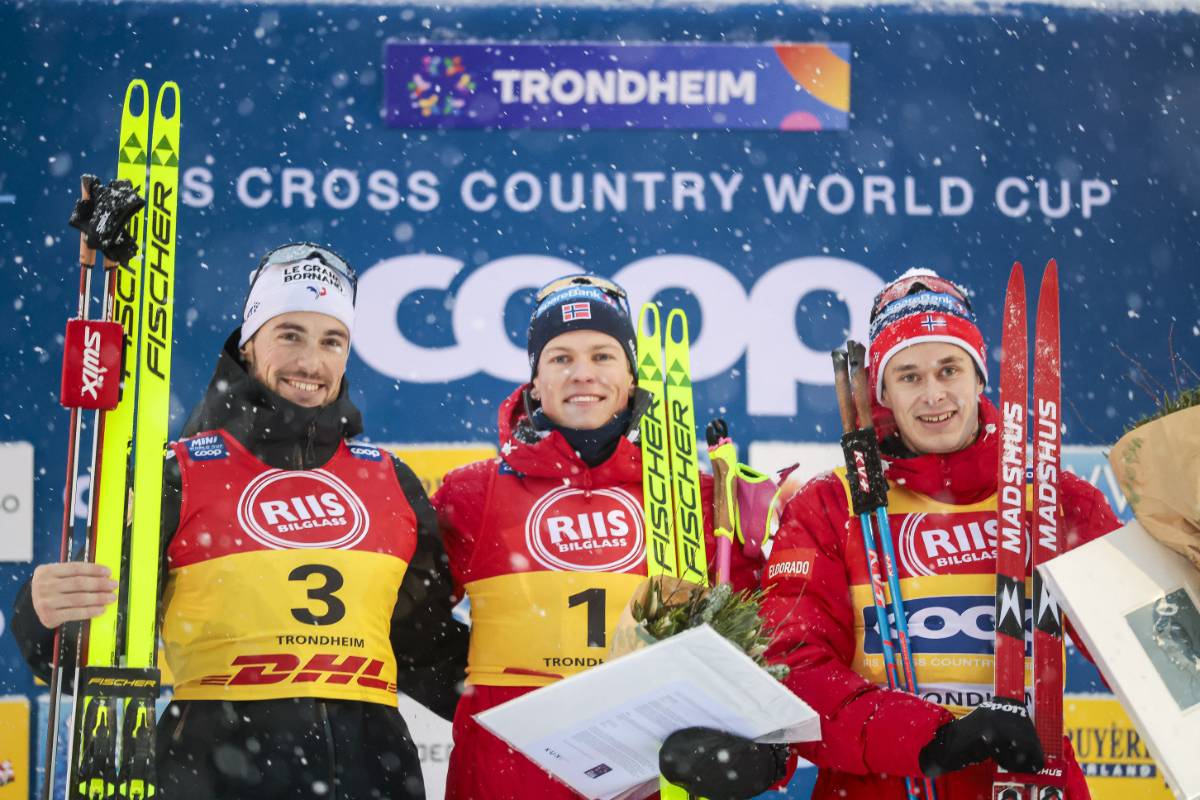
Johannes Hoesflot Klaebo (NOR) stands atop his hometown podium in Tronheim, Norway. He was joined by Lucas Chanavat (FRA) in second, and Harald Oestberg Amundsen (NOR) in third. (Photo: Nordic Focus)
This coverage is made possible through the generous support of Marty and Kathy Hall and A Hall Mark of Excellence Award. To learn more about A Hall Mark of Excellence Award, or to learn how you can support FasterSkier’s coverage, please contact info@fasterskier.com.
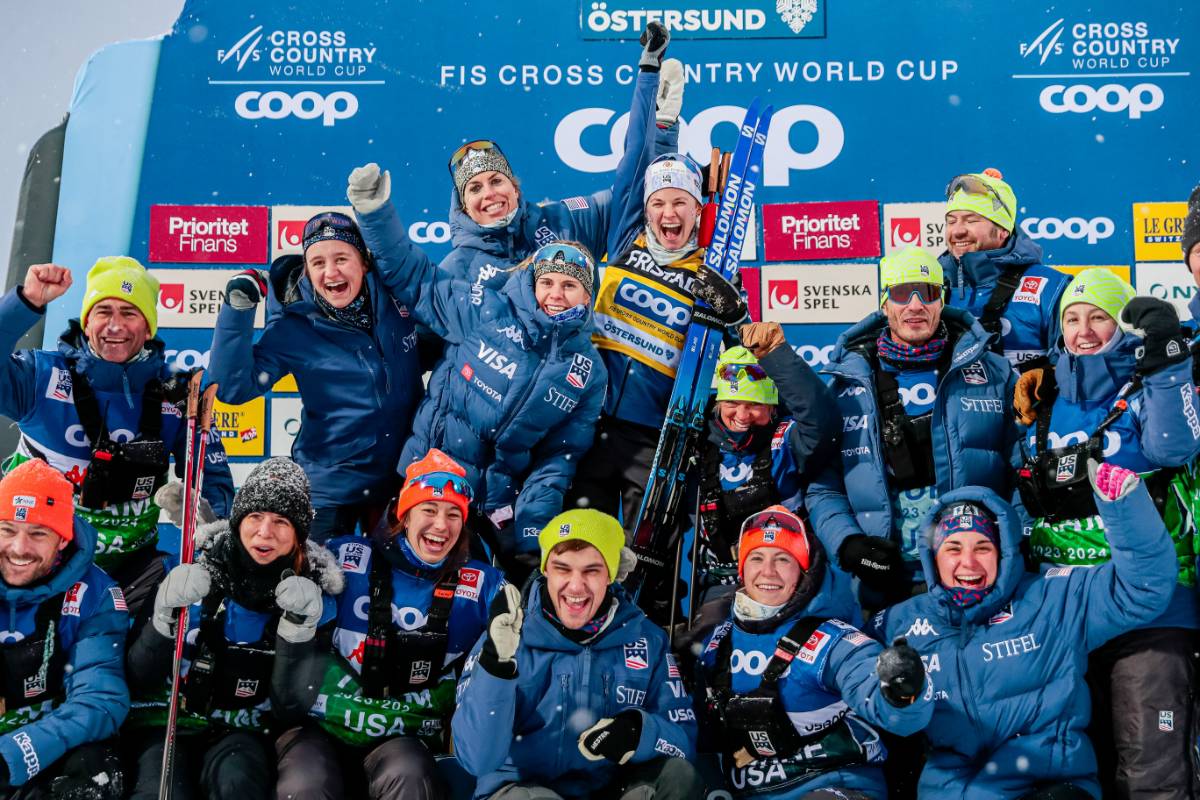
Team USA celebrates with Jessie Diggins (USA) who took her second win of the season in Sunday’s 10 k Skate in Oestersund, Sweden. (Photo: Nordic Focus)
At the end of the World Cup’s two-week stint in Sweden, there was one performance that defined the early stages of the 2023-24 World Cup season: At Sunday’s 10 k individual start skate race, Jessie Diggins was seen sharing smiles before the race, setting top time splits throughout it, in first place as she crossed the line, and in jubilation as she stepped to the top step of the podium for the second time in as many weekends.
“[I] continued focusing on finding the flow in the course and the joy in skiing,” Diggins said post-race. “I even smiled a couple times throughout the race.”
Where Diggins has gone this season, Rosie Brennan has followed closely, imbuing Team USA’s early season success with stalwart consistency. Rosie Brennan skied to a fifth place finish today, continuing a start to the season where she has finished in the top ten of every race, no matter the discipline, distance, or technique. “[The] consistency has been good, it’s something I’ve struggled with,” Brennan said in post-race comments. She added that the difference for her this season has been that the consistent results have come bounded by the lows and highs of World Cup racing. “Today, I was battling the whole time and I didn’t feel like my best self,” she said, “but on the other hand, I’ve felt like I’m very consistent while struggle to break through and have truly amazing races in the past, and I’ve had those this year too.”
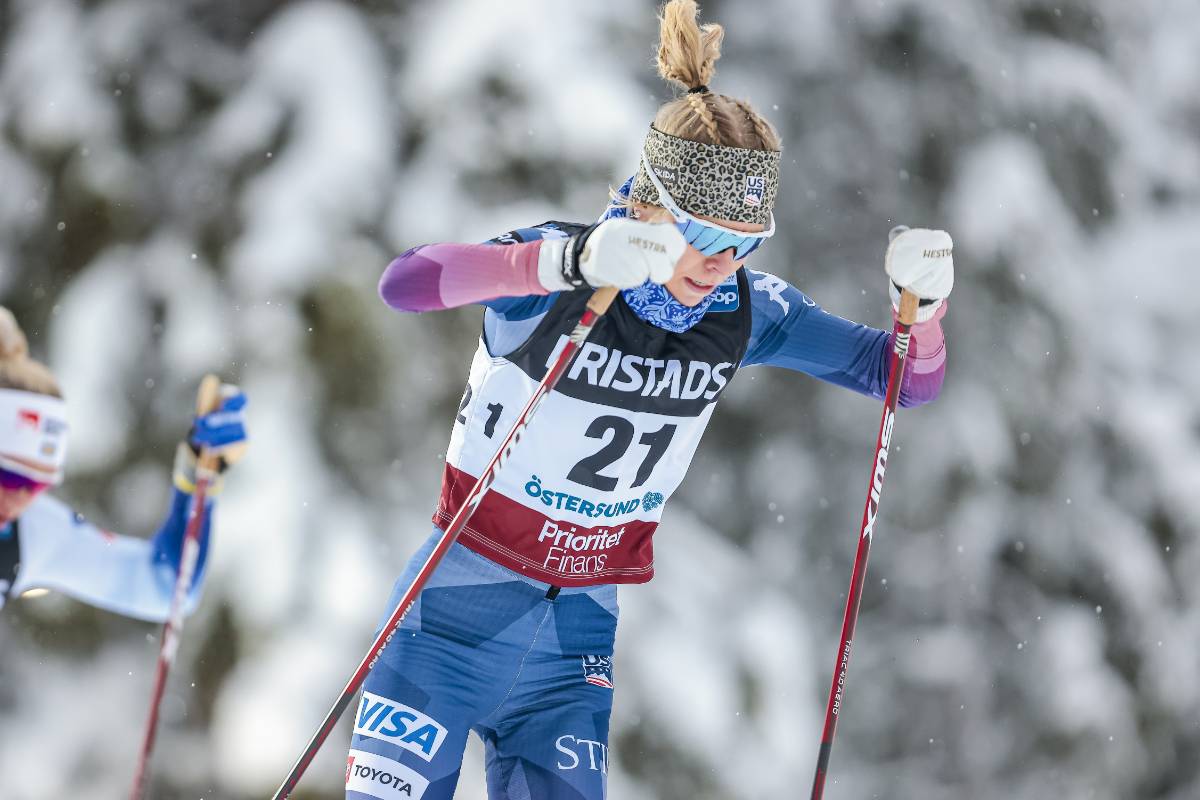
The two veterans were also joined by Sophia Laukli, who continued her quick progression up the World Cup standings by racing to her first top ten performance of the season, in eighth place. It marked Laukli’s first career top ten in a non-hill climb World Cup event (where Laukli has already podiumed). “Earlier this week, coaches watched Sophia do a big workout,” said U.S. Head Coach Matt Whitcomb. “And there was a remark that she was skiing like a top ten skier. And it turns out, she was.”
All together, the nation with the most athletes in the top ten on Sunday in Oestersund—the Americans, with three.
The results have set a tone: joy, camaraderie, and celebration coursing not just through the American team, but throughout the entirety of the World Cup circuit. Under the lights of Oestersund this weekend, jackets emblazoned “USA” flooded the stadium after nearly every race. In those jackets are wax techs, coaches, and a group of athletes spanning multiple generations of U.S. skiing, all finding success on the World Cup together. There have been firsts for young skiers, consistency for veterans, and a whole lot of podiums.
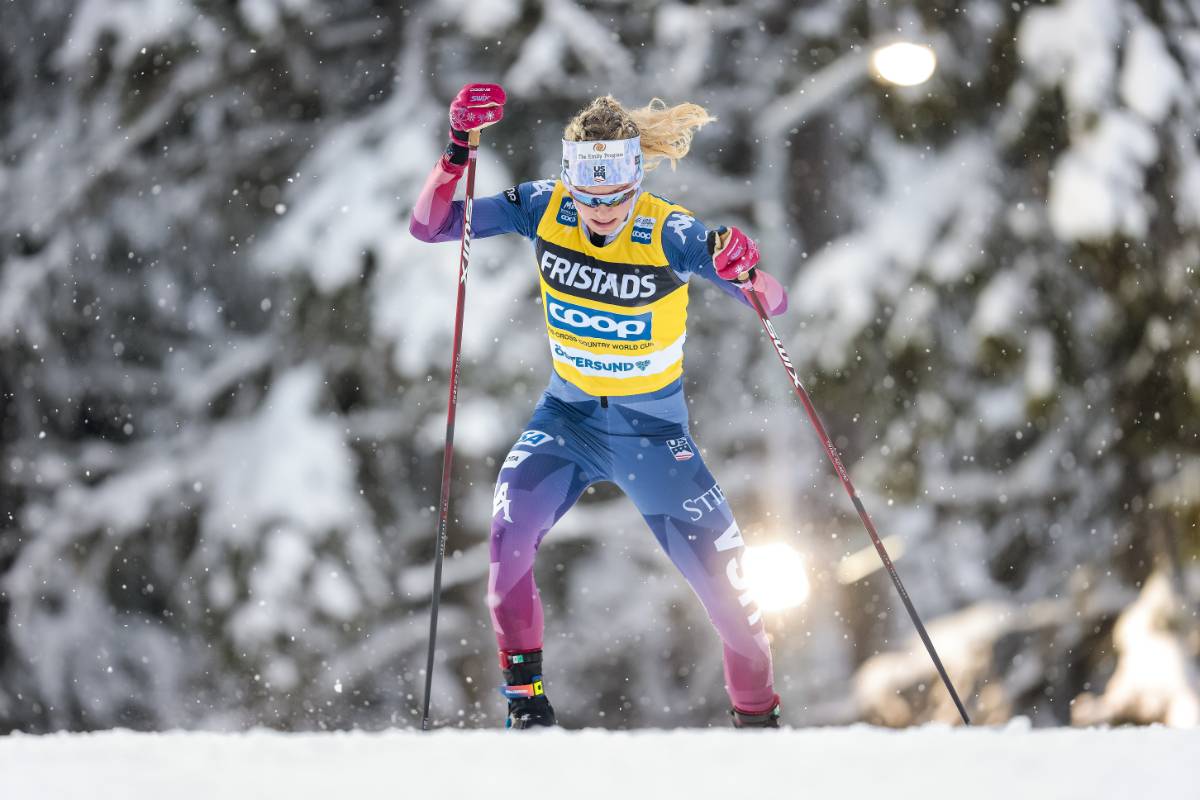
Jessie Diggins (USA) on her way to her second win of the season in Sunday’s 10 k skate in Oestersund, Sweden. (Photo: Nordic Focus)
Energizing it all has been Diggins, overall leader of the World Cup circuit. Diggins smiled and danced before she started the 10 k skate race on Sunday, then led at every time check on her way to what was her 50th career World Cup podium, and 16th win. In post-race comments, she was resolute on celebrating the success of those who stand behind her, saying “Our wax techs have been really incredible,” she said. “I had amazing skis.” She also added that there was a specific source of inspiration for her after watching yesterday’s historic podium finish for teammate JC Schoonmaker in the Men’s classic sprint: “This one was for the boys!”
Women’s 10 k Skate Individual Start
The women’s start list on Sunday featured a field that was more evenly spread with contenders than is usual during an individual start. Previous World Cup winner Linn Svahn (SWE) started in bib 2, while last week’s 10 k skate runner-up Ebba Andersson (SWE) started in bib 55, the third last starter on the day. Right in the middle of the start order was Brennan, bib 35, with Diggins starting two minutes behind wearing bib 39.
The start order made for a race that saw early starters set unusually high marks as they went through the first time checks. Standing out among this pack was bib 21, Laukli, who through the first 5.4 k had the top split in the field. Laukli would only be topped throughout by bib 22 behind her, Frenchwoman Flora Dolci, with the two skiers both setting times on the gradual but unrelenting Oestersund course that would put them in the top ten on the day.
Sophia Laukli (USA) continued her prodigious climb up the World Cup standings, placing eighth during Sunday’s 10 k Skate. (Photo: Nordic Focus)
Dolci’s eventual fourth place finish meant that when Rosie Brennan came through the first time check at 2.1 k, her first-place -2.2 second split defined the parameters for where the top of the field would be skiing the rest of the day. Brennan was supplanted by Diggins at the early split, who had an 11 second lead over the field. With Laukli still holding sixth place, the early splits provided an indication of the good day the Americans would have at the 10 k finish.
The only skiers who would consistently split Diggins and Brennan in the time checks throughout the day were Dolci; Norway’s Heidi Weng, who would take second; and Germany’s Victoria Carl, who would take third. Ebba Andersson (SWE) would also challenge early in the race before fading to ninth place as Sweden’s top finisher. Carl’s performance was the other especially notable performance on the day, as she earned her first World Cup podium after 150 World Cup starts.
Team USA: “A Great Weekend”
Rosie Brennan (USA) skied to fifth place on Sunday. The American hasn’t finished outside the top ten at a World Cup race all season. (Photo: Nordic Focus)
As Team USA heads into the end of Period I in Trondheim, Norway next weekend, skiers are processing what Matt Whitcomb said was, “a great weekend for the team when it comes to feeling that sense of connection between each other.”
“The consistent results will help with things like the Tour de Ski and the [World Cup] Overall,” said Brennan. “[Those are] are things I enjoy fighting for and am looking forward to.”
“I’m very surprised with how well this season has started,” said Diggins. “But I will happily accept happy surprises.”
Diggins noted in post-race comments that she attributes the results she’s had to a focus on process. “The results and podiums are the icing on the cake,” she said. “But what that cake is made of is a week-to-week, race-to-race focus.” Diggins also added that there is a renewed clarity behind the laughs and smiles on the World Cup this season. “I’m here because I love ski racing, so that’s what I’m going to focus on.”
Jessie Diggins and Rosie Brennan still stand 1st and 2nd, respectively, at the top of the World Cup Overall standings. As the Americans leave Sweden, it’s mainly the Swedish team on their tails, with Emma Ribom in third place one of six Swedes in the top ten of the World Cup Overall. The dynamic of the World Cup field remains steady.
On Sunday in Oestersund, though, steadiness wasn’t a thought as the whole of the American team—and the American ski community watching from half a world away—allowed revelry to take over. It’s a hard thing to stand atop a World Cup podium, and Jessie Diggins—even after sixteen victories—seems to understand that the best way acknowledge that fact was to let each hug she shared with her teammates and coaches be filled with joy, and joy alone.
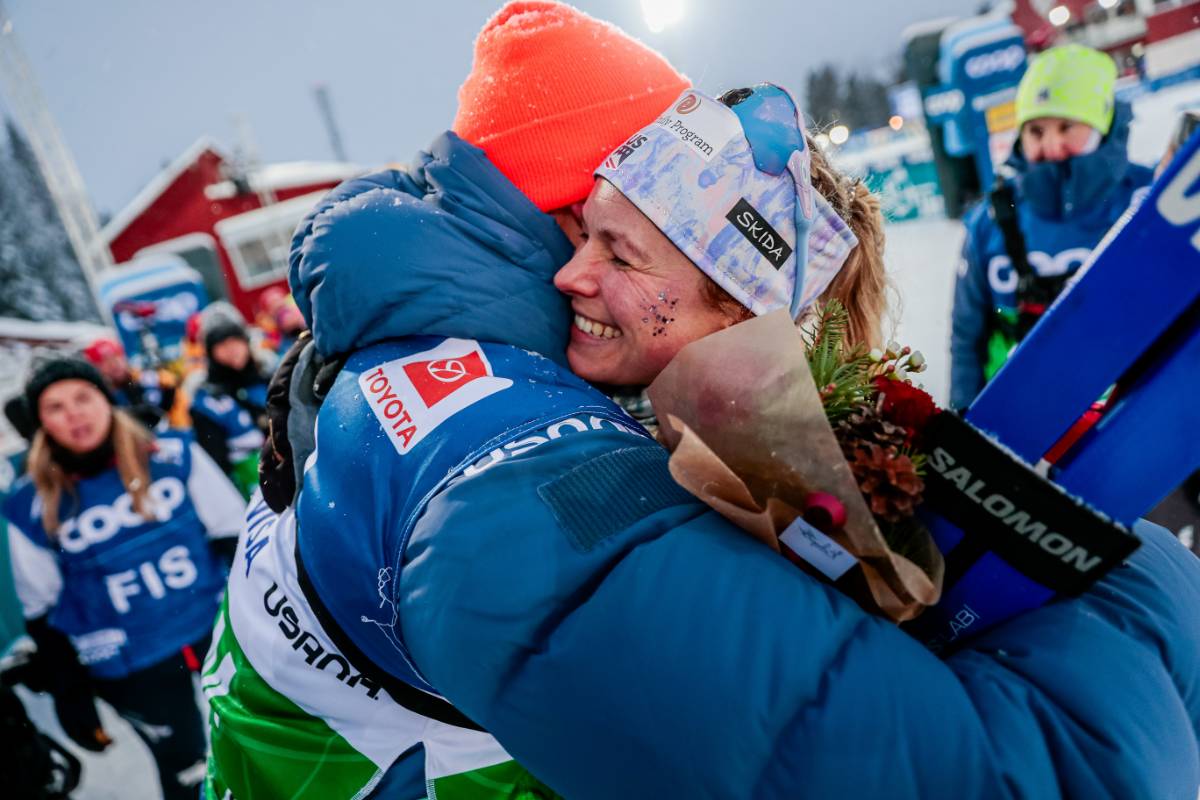
Jessie Diggins (USA) and Stifel U.S. Ski Team Head Coach Matt Whitcomb share a hug after Diggins’ second World Cup win of the season in Oestersund’s 10 k Skate. (Photo: Nordic Focus)
This coverage is made possible through the generous support of Marty and Kathy Hall and A Hall Mark of Excellence Award. To learn more about A Hall Mark of Excellence Award, or to learn how you can support FasterSkier’s coverage, please contact info@fasterskier.com.
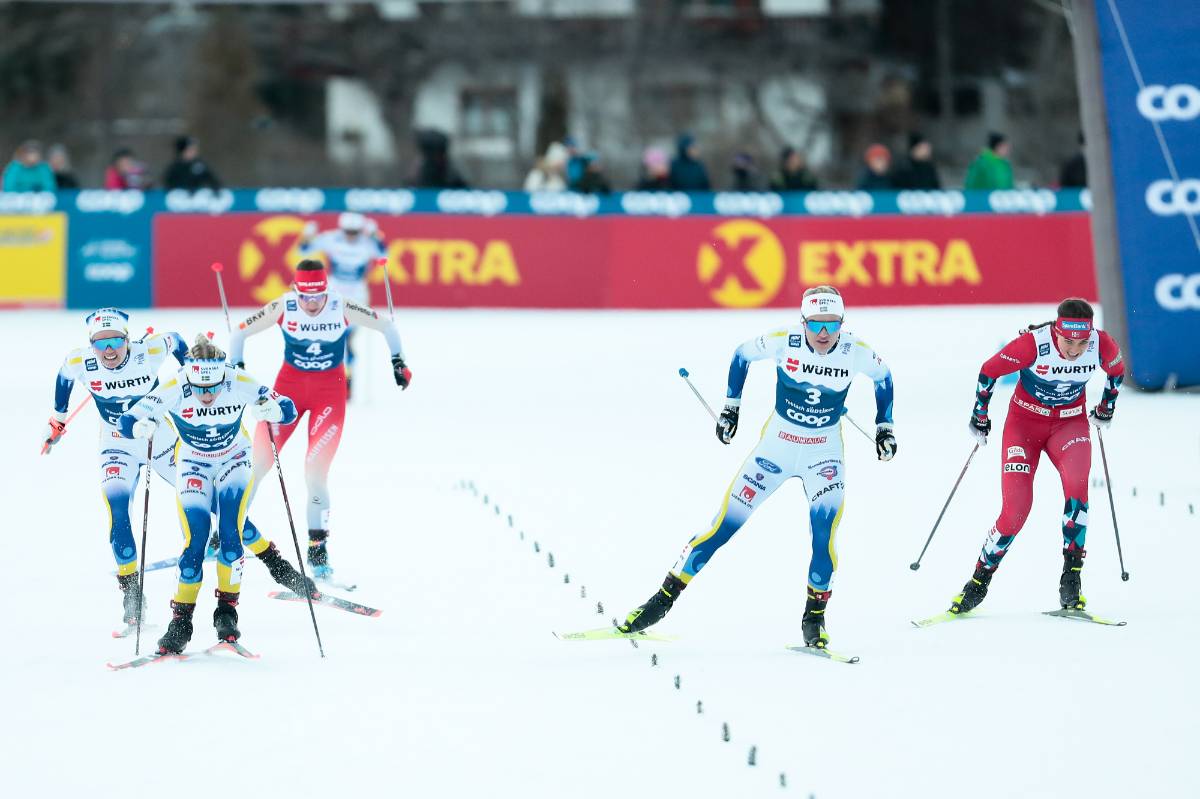
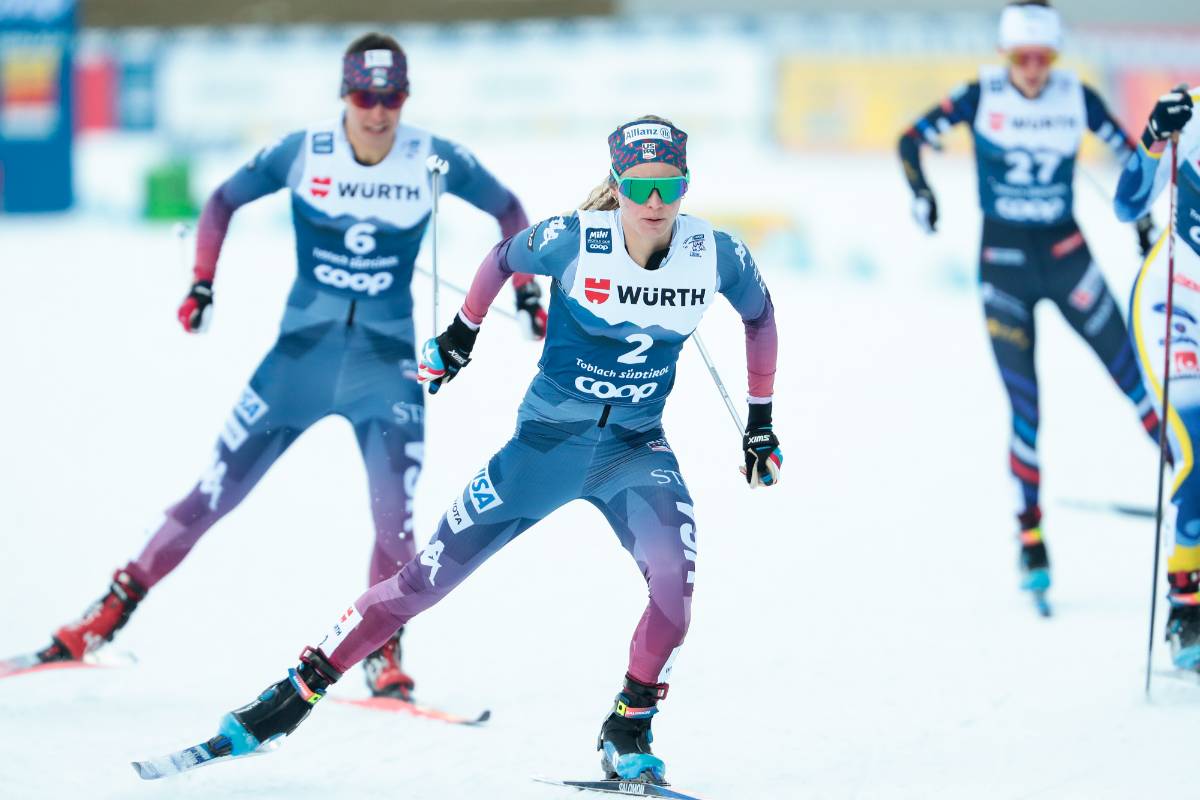
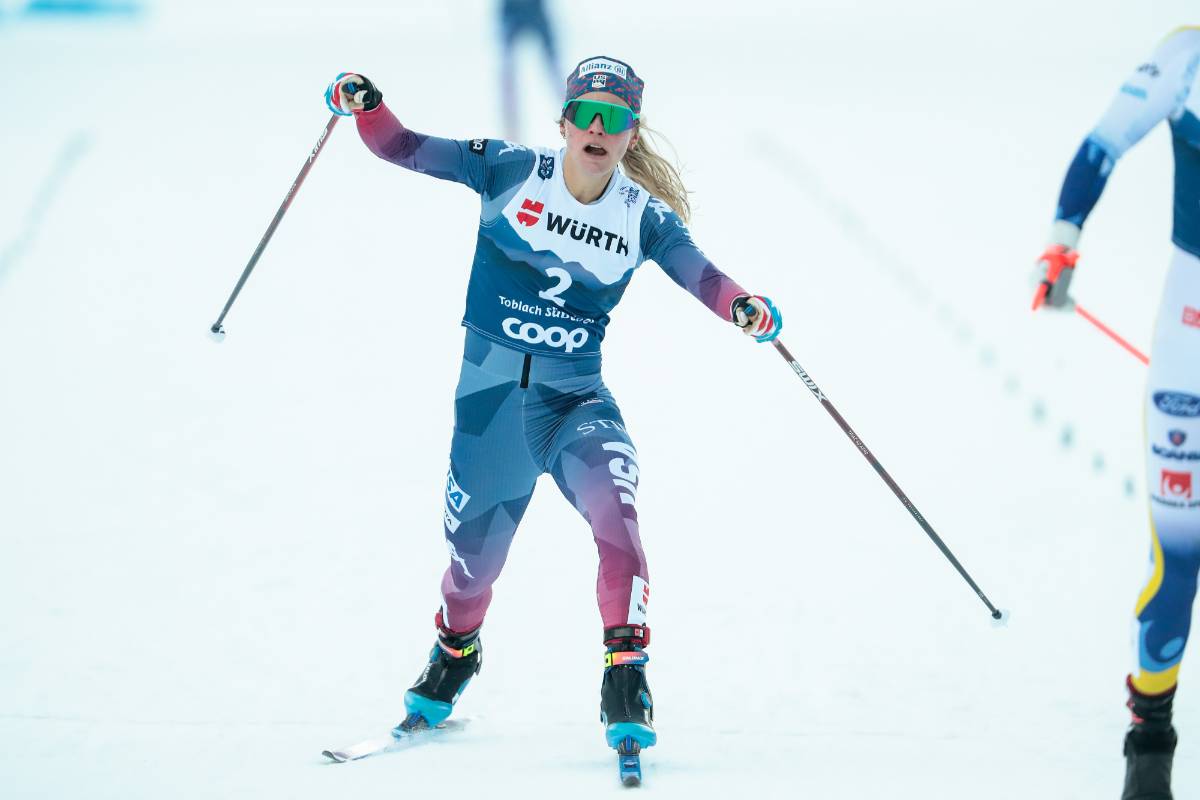
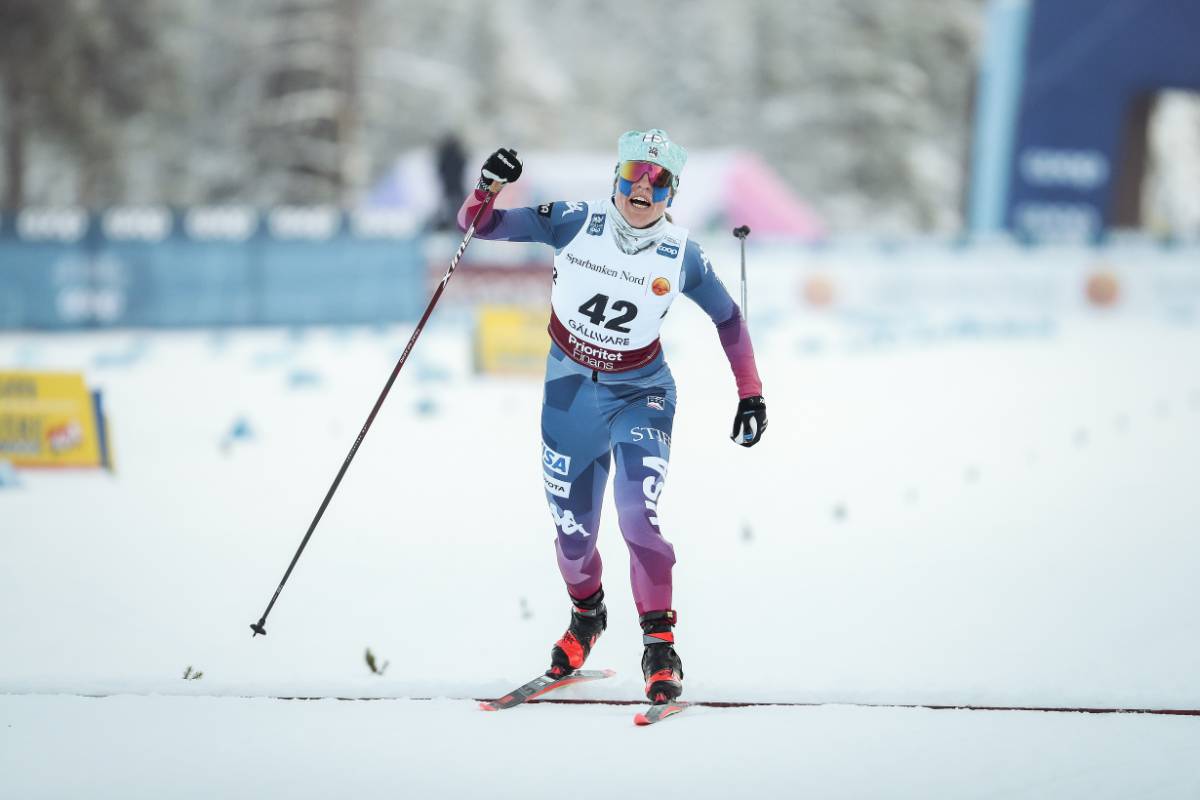
Jessie Diggins (USA) sprints across the line to win her first FIS World Cup of the 2023-2024 season in the 10 k Freestyle in Gallivare, Sweden (Photo: Nordic Focus)
Gallivare, Sweden marks the outer limit of the World Cup circuit. The latitude: as northern as it gets. The course: as “unrelentingly technical” as it gets. The weather: at 5℉ (-15℃) this morning, about as cold as it gets, too. Eleven years ago, Gallivare was the venue that saw the US Ski Team break in from the fringes of World Cup standings as a 21 year old Jessie Diggins rounded the final stadium corner and sprinted across the finish line with a dramatic ski toss, securing third place in a Team Relay: the first relay podium in modern US Ski Team history. “I had a lot of memories this week,” Diggins said today, “of that race, and digging deeper than I ever had in my life back then.” Eleven years later in Gallivare, there was less doubt. Diggins—now reigning World Champion in the 10 k Skate—skied each technical turn and bump of Gallivare’s 5 k loop faster than anyone else could, winning her first race of the 2023-24 World Cup season.
Diggins built a steadily-compounding lead over her nearest challenger, Sweden’s Ebba Andersson, that stretched from two seconds at the 2 k mark to a 23.1 seconds lead at the finish. On a course that featured tightly-wound corners and punchy uphills, Diggins pointed to her ability to take time in the spaces between as key to her success. “[There were] a lot of transitions, I tried to really find the flow in that course,” she said. “There’s a ton of thinking that can be done out there, and you always have to be working and pushing and sending it on the downhills. US Ski Team Head Coach Matt Whitcomb added that, “What makes [Jessie] so devastating on this course is her ability to ski into the hills, over the hills, and through the corners better than most, and better than anyone today.”
Rosie Brennan (USA) finished sixth in a tightly contested top ten in Gallivare’s 10 k Freestyle. (Photo: Nordic Focus)
Diggins’ win provided a definitive cap on a day when Americans delivered strong results. Joining Diggins near the top of the standings was Rosie Brennan in sixth place, a performance that moved Diggins and Brennan into first and second, respectively, in the World Cup Overall standings. This marks the first time in World Cup history that Americans have held the top two positions at once. In all, five American women scored top 30 results, underscoring the early season momentum that was evident in Ruka last weekend. Those results included Sophia Laukli one-upping her 14th place from last weekend’s 20 k skate with a 13th today, a strong 18th place finish from Julia Kern, and Novie McCabe 29th, her third top 30 in as many distance starts this season.
Jessie Diggins (USA) smiles after taking the win in the 10 k skate in Gallivare, Sweden on Saturday. (Photo: Nordic Focus)
“I’m really proud of my teammates and everyone behind us,” Diggins said of the American team’s strong all-around performance. “They’re putting their heart and soul into this, and it shows.”
Sweden’s Moa Ilar rounded out the podium in third place, a notable performance considering the bout of COVID currently sweeping through the Swedish team. The Swedish team’s situation kept the always-competitive Frida Karlsson out of this weekend’s racing; sill, there is the prospect of an exciting early-season 4 x 7.5 k Team Relay tomorrow as the dominant Swedish team meets the surging Americans.
Novie McCabe (USA) placed 29th in the Gallivare 10 k Freestyle, her third top 30 finish in as many starts this season. McCabe was one of five American Women in the top 30. (Photo: Nordic Focus)
“Amazing, Unexpectedly Good Start”
There were early signs that the American team was going to have a good day in Gallivare: starting in bib 4, Alayna Sonneysn set a top five split among the earliest starters. Sonnesyn skied to an eventual 40th place, but was followed in succession by Novie McCabe, Julia Kern, and Sophia Laukli who all showed top splits within their respective sections of the World Cup field.
Sophia Laukli’s 13th place solidified a strong start building off her 14th in the 20 k Skate in Ruka last weekend. Laukli said post-race that she, “[has] a bit more ambition when it comes to the World Cup, seeing how the running success from the summer has combined with early results, I’m starting to set some bigger goals in the back of my mind.”
The early pace-setting for Gallivare’s top finishers would come from Frenchwoman Delphine Claudel, who consistently took the top split at each early check point. Claudel would finish the day in fifth. At every check point of the winding, dipping, climbing Gallivare course, Andersson and Diggins marked one another. Andersson would top Claudel’s split, and then the question of whether Diggins would be able to match or top Andersson’s time would follow in short order. From the first 1.9 k split, Diggins continued to build her margin over Andersson. There was a consistent vector in Diggins’ growing margin of victory, as well. At 5 k, Diggins had a 13.2 second split over Andersson. At the finish, it was 23.1 seconds.
Jessie Diggins told FIS media that she was enjoying her “amazing, unexpectedly good start.” Those results have been interspersed with some on-the-edge moments, including the dramatic, final-kilometer pole break in last week’s 20 k skate race, and a moment during today’s 10 k skate where Diggins told FasterSkier she “almost flew off one of the corners, because I got pretty aggressive . . . [that’s] when I race best.” Likewise, the technical Gallivare course served to liven up the World Cup circuit. “This was a really fun course for me,” said Diggins. “I had a lot of fun skiing it all week.”
Ebba Andersson (SWE), Jessie Diggins (USA), Moa Ilar (SWE) celebrate podium performances at the FIS World Cup 10 k Freestyle in Gaellivare , Sweden. (Photo: Modica/NordicFocus
Jan Thomas Janssen (NOR) pulled off an unlikely victory in his first World Cup start in three years during Sunday’s 20 k Freestyle Mass Start in Ruka, Finland. (Photo: Nordic Focus)
Jan Thomas Jenssen (NOR) hadn’t been entered in a World Cup race since 2020. On Sunday in Ruka, the highlight to Jenssen’s weekend of racing was expected to be his start in the 20 k, not his finish. But something strange was swirling in the chill Arctic air, and Sunday was one for the dark horses. In the final stretch of Sunday’s race that bent two unlikely skiers—Michal Novak (CZE), and the 27 year-old Jenssen—emerged from a pack of World Champions and Olympic medalists. Jenssen rounded the final corner on Ruka’s World Cup weekend to find no one—not one skier—between him and the finish line. Norwegian men would sweep the weekend, but they would do so with a most unlikely trio: Erik Valnes winning the Men’s Sprint on Friday, a 10 k Classic victory on Saturday from Martin Loewstroem Nyenget, and Jan Thomas Jenssen on Sunday.
Gus Schumacher led American finishers with a tremendous 16th place. Scott Patterson remained with Schumacher until the last, finishing 20th, while Zanden McMullen pulled up to the finish in 28th to round out a trio of Americans in the top 30. John Steel Hagenbuch scored the best result of his young World Cup career, taking 45th in just his fourth World Cup start. Zak Ketterson was 52nd, Luke Jager 68th, and Ben Ogden 71st. Among Canadians, Antoine Cyr finished 26th, Olivier Leveille 40th, Xavier McKeever 46th, Graham Ritchie 58th, Leo Grandbois 64th.
There are two substantial take-aways from the World Cup’s opening weekend in Ruka: (1) the Norwegian men’s team is still the dominant force in men’s skiing, animating almost all of the races and filling out most of its lead packs and sprint finals. (2) Ski racing is magical: terrain, weather, conditions, and circumstances can still align in such a way that an athlete who’s worked hard and steadily for years may, on any given day, find himself victorious.
Consider how Jan Thomas Jenssen ended up in the field Sunday. He had earned a single discretionary start from the Norwegian national team after a steady season’s-worth of races in last year’s Scandinavian Cup (the second-tier of FIS competition) in which Jenssen finished second. The Overall winner of the Scandinavian Cup earns an automatic World Cup bid for Period I. Last year, Jenssen’s countrymen Harald Oestberg Amundsen won the Scandinavian Cup; Amundsen also proved his mettle in Sunday’s action, ending up with a podium finish in third place. Jenssen likely wouldn’t have gotten a start in Ruka in any other year. For the first time since Ruka began hosting the World Cup opener 15 years ago, Sunday’s race was a mass start contest rather than a pursuit based on Saturday’s classic results.
The men’s field on course in Ruka during Sunday’s 20 k Freestyle Mass Start. (Photo: Nordic Focus)
Also contributing to the potential for Jenssen’s unlikely victory was the form of the usual dominant figures in the men’s field. Johannes Hoesflot Klaebo was notably off-form for a third day in a row, helping pull a duo of Americans, Schumacher and Patterson, to a 16th place and 20th place, respectively, before easing across the finish line in 21st place. Saturday’s winner, Nyenget, followed an early agitation from Austrian Mika Vermeulen that left him out of the final running, while 2023 World Cup Distance Globe winner, Paal Golberg (NOR), was left struggling to maintain his place in the lead pack rather than searching for ways to drop it.
All these circumstances aligned for Jenssen: an all out effort, a World Cup win, and a loss for words. “I don’t even know what to say,” was Jenssen’s only statement to FIS media after the race, before he headed to his first ever podium on the sport’s biggest stage.
Men’s 20 k Freestyle Mass Start
There were other, bigger forces, at play on Sunday, too. Ruka’s 2.5 k course is composed of a long, steep, steady uphill, followed by a long downhill that wound into the stadium. In warmer, icy conditions, that set-up may have allowed break-away attacks to gain enough ground to snap the field on the downhill. This was Ruka, above the Arctic circle, in November, though. Cold, dry snow was the order of the day; as a result, the field largely acquiesced to the fact that the long downhill would serve to mitigate punchy efforts rather than help them succeed.
Ruka’s course conditions also allowed competitors, coaches, and wax technicians to worry less about the effects of the new non-fluoro wax protocols. After yesterday’s 10 k Classic, US Ski Team Coach Jason Cork said that the cold, powdery snow in Ruka—where fluoros and their characteristic moisture-resistance have the least effect—probably leaves open the question of the new wax protocols effect on skis. “It’s hard to know for certain [what the effect will be],” said Cork. “There are a lot of new products coming out—nearly daily—but our expectations going into the season was that the non-fluoro rule would create the least impact in cold, dry conditions like we’ve seen in Ruka.”
Gus Schumacher (USA) skied to 16th place in Sunday’s 20 k Freestyle Mass Start. “I’m in a solid place and can just kind of go with the flow and not do anything crazy from here,” said Schumacher of his results in Ruka. (Photo: Nordic Focus)
All of this created a mass-start race that stretched rather than snapped, as the field largely stayed together over the first 10 k. Some early action occurred when Mika Vermeulen (AUT) pressed the issue on the downhill leading into the stadium at the 5 k checkpoint. He was joined by Nyenget, but by 10 k the break-away was looking back, anticipating being gathered up by the pack. Through the early kilometers, Americans Schumacher, Patterson, Ogden, and McMullen remained in contact with each other, hovering around the 25th-30th spots in the pack.
By the 10 k mark, a pair of Frenchmen—Jules LaPierre and Hugo LaPalus—had started to push to the front in an apparent counter to the Vermeulen/Nyenget move, before Simen Hegstad Krueger (NOR) pushed into the final downhill in a move that animated the pack and created a split. By 12.5 k, there was a group of Norwegian’s at the front that slowly, but surely, was joined and punctuated by other nationalities. There were the Frenchmen, Britain’s Andrew Musgrave, Switzerland’s Beda Klee, Vermeulen, and Novak . A break occurred behind the first 15 skiers; this chase group was where Schumacher, Patterson, and notably, Klaebo, all ended up skiing for the final five kilometers.
Jan Thomas Jenssen (NOR) sprints ahead of Micah Novak (CZE) to win his first ever World Cup. (Photo: Nordic Focus)
The lead group remained compact despite jockeying, with the decisive moment coming in the seventh lap. “The leaders surged or the bonus points, blasted through and kept going,” said Schumacher in post-race comments to FasterSkier. In the final run-in, true urgency set up a sprint. That’s when Novak took his shot, followed by Jenssen. The duo broke clear in a hop-skate towards the Ruka stadium, with Jenssen’s line allowing him to steer clear of Novak, and towards his own first ever World Cup win.
The American action for the day came in the chase group, where Schumacher was able to create a bit of separation and win the final push to 16th place. “I felt like if I tried to cover that [gap], I’d lose time up the big hill on the last lap,” Schumacher said. “So I just tried to relax into the final.” The result was Schumacher’s best-ever showing at the Ruka World Cup opener, marking an auspicious beginning to the Alaskan’s campaign. “The goal for Ruka is always not to stress too much about where I’m at,” said Schumacher. “But that’s easier said than done. Mostly, I’m just a little relieved to know I’m in a solid place and can just kind of go with the flow and not do anything crazy from here.”
The World Cup leaves Ruka to head even more North next week, setting up in the Swedish town of Gallivare for a 10 k skate followed by the season’s first Team Relay.
Rosie Brennan (USA) double-poles across the line on her way to a second place in Saturday’s World Cup 10 k Classic race in Ruka, Finland. The result was Brennan’s first classic World Cup podium of her career. (Photo: NordicFocus)
The first time Rosie Brennan stepped onto a World Cup podium, she was holding a pair of classic skis. That was in Lillehammer eight years ago, December 2015, when she skied the scramble leg in Team USA’s third place finish. Since then, there has been more team revelry, plenty of skate podiums, some fast-starts, some near misses, but never an individual classic podium. Above all, in the intervening time, there has been perseverance. Stride for stride, season after season, working in muted humility half a world away until the day that her classic skiing would make an entire ski community roar.
On Saturday—under the Arctic skies in Ruka, Finland Saturday—that day came. A breakthrough and a milestone: Rosie Brennan’s first individual classic World Cup podium. She took second place in the 10 k Classic interval start, just five seconds off winner, Sweden’s Ebba Andersson, and another five seconds ahead of third place, Frida Karlsson (SWE).
“[It’s been] a lot of hours of training, technique, and getting stronger,” said Brennan in post-race comments to FasterSkier. “I love classic skiing, and it’s been one those things I’ve been striving for because I knew it was possible.”
Brennan’s teammate, Jessie Diggins (USA), skied strongly to an 11th place finish. Other American finishers included Novie McCabe in 30th, Sophia Laukli 44th, and Julia Kern 50th. Canadian finishers included Katherine Stewart-Jones 25th, and Amelia Wells 53rd.
Rosie Brennan (USA) and Stifel U.S. Ski Team Head Coach, Matt Whitcomb, embrace after Brennan skied to second place in Saturday’s 10 k Classic race. (Photo: NordicFocus)
Through ten kilometers of punchy hills, fresh, frigid snow, and taut time checks, Brennan persisted. To boil down this career milestone to “Brennan persisted” is purposeful understatement. There’s been budding momentum for Brennan in classic skiing for a couple of seasons, but her biggest progressions up the World Cup rankings have come with heartbreaks that cut the other way. During 2023’s Tour de Ski she finished fourth in a 15 k classic mass start in Val di Fiemme: her best finish ever. But, she lost a ski toss to Kertuu Niskanen (FIN) for the podium. Later that month during the World Championship 30 k, Brennan gritted her way into the final kilometer in medal contention before finishing in fifth place. She remarked at the time that she “[was] feeling a mix of everything. I’m feeling I’m getting good at this fourth, fifth, sixth place situation.”
At the time, Brennan’s close friend and former teammate Sadie Bjornsen said to FasterSkier’s Nat Herz that, “Ninety-nine percent of the time you’re fourth. That’s just the reality of life. And the way you keep coming back from that is what is really inspiring.” Adding that, “It’s such a theme of Rosie’s story: Knock me down, I’ll bend. But I don’t break.”
The race Brennan skied Saturday was extraordinary at first glance. For Brennan though, it was typical: she brought the special characteristics that, after many years of practice, are rising to both the top of people’s minds, and the top of the results sheet. After many seasons’ persistence, her patience is paying off. The first classic podium of Brennan’s career comes at the opening of a new season, and seems to open up a world of possibility for Brennan and her teammates. Stifel U.S. Ski Team Head Coach, Matt Whitcomb, commented to FasterSkier that “it was emotional, perhaps, the most amazing race she’s ever put together.”
Ebba Andersson (SWE) remained steady on her way to victory in Saturday’s 10 k Classic race. Andersson’s win marked her second consecutive year as Ruka’s 10 k Classic champion. (Photo: NordicFocus)
By the end of the first lap on Ruka’s three-lap, 3.3 k course, Andersson had opened up a small but steady gap over Frida Karlsson and Rosie Brennan. Her finishing kick on the Ruka stadium climb that featured so significantly in Saturday’s Classic Sprint races confirmed the drive of her efforts through the entire ten kilometers, and earned Andersson a repeat victory as Ruka’s 10 k Classic champion.
Andersson wore bib 50, which meant her time splits came at the tail-end of the main group of competitors. The field was especially stretched today as Linn Svahn (SWE), wearing bib 5 and on her way to a top ten finish, did much of the early pace-setting. German Katharina Hennig, bib 34, was the first in the field to match her efforts, and from that point on, the field was swapping seconds from checkpoint-to-checkpoint. Close to Hennig in the early-goings was Jessie Diggins, wearing bib 40, who would hold a strong position throughout the course and come home to finish 11th place, the second American on the day.
Karlsson, wearing bib 44, would consistently outkick Katerina Hennig’s (GER) efforts into the time-checks, and when Brennan, bib 46, posted split times in and around Karlsson and Hennig, the race’s podium picture began to become clear. Karlsson enjoyed a one second lead over Brennan at the 5 k mark, but Brennan would close gap to the Swede, edging her out for second place.
The tightly-grouped finishing times of Saturday’s 10 k bode well for a tight pack tomorrow as Ruka’s World Cup opening weekend concludes with a 20 k mass start skate race on Sunday.
Ahvo Taipale pops champagne at the end of a 45 year career as the owner and operator of Finn Sisu, the Twin Cities’ oldest race-oriented ski shop. (Photo: Finn Sisu)
Like most Midwestern states, the majority of Minnesota is an unending grid of corn and soy fields. Land isn’t so much land as it is commodity. Inhabiting that landscape tends to be a constant reminder to think in terms of economy. Life, like farming, is a series of inputs and outputs, costs, and benefits. Unlike most Midwestern states, though, things get wilder the farther North you go in Minnesota. Lakes, lots of them, jut in on the back forty. The Earth is filled with ore. The pines displace the corn. The metaphysical effect is that impulses towards wildness and creativity get nourished, not dulled. Across six million people that produces a disproportionate number of that very American archetype: the original. A peculiar list of names. Bob Dylan, Terry Gilliam, Alan Page, Bud Grant, Herb Brooks, Paul Bunyan, Jim Klobuchar, Amy Klobuchar, Paul Wellstone, Paul Westerberg, Judy Garland, Jessie Diggins, and of course, Prince.
While Prince may be the only individual on the list who is known, universally, by a single name, Minnesota skiers add one more name: Ahvo. After 45 years, Ahvo Taipale is retiring from his role as the owner and operator of Finn Sisu Ski Shop. To most Midwestern skiers, he’s always just been there. But in his telling of the story, even he came in his own time.
“I first came to this country in 1968 to attend the University of Minnesota as an agriculture exchange student,” said Taipale when FasterSkier caught up to him this month. “I was doing what I always did as a farm boy in Finland: ski racing. I went up to the Duluth Loppet in I’d say 1973 or 1974, and I won the race. I was about to head out back to the Twin Cities when this group of people approached me, and one of them said, ‘you are Finnish, we are from Finland too.’ And they were, it was just that some of them were from the Two Harbors-Finland, Minnesota area, and I thought, well, I’ve accidentally found my way home.”
The past and future of skiing in Minnesota would merge at that moment. Ahvo would be the bridge between. He caught the tail-end of the Norse diaspora that originally brought cross-country skiing to Minnesota in the late nineteenth century, and then charted a unique future for the sport in America through his passion and savvy as a businessman.
“There were two parts that led to me starting a shop,” he said. “One was that I didn’t want to be traveling the world, I wanted to settle into a place. The second was that I was racing as much as I could in Minnesota, and through that, was starting to sell skis from Finland to others, because there was no shop that was selling high-quality racing skis in the United States.”
In 1978, Taipale imported a shop’s worth of racing equipment, and set himself up on University Ave. in the center of the Twin Cities. The shop’s name? Finn Sisu. “[Naming it] was easy,” said Taipale. “Everyone knew me as the Finn. And I was telling them all about Sisu, the untranslatable Finnish value of stoic determination and tenacity of purpose.”
Ahvo Taipale out on the snow in his capacity as a coach for the University of Minnesota, one of the many other roles he filled beyond shop owner while at Finn Sisu. (Photo: Finn Sisu)
The name would also cause Ahvo to foster cultural exchange between Finland and the United States, and lead to the other lasting part of his business life: the sauna. A few days after Finn Sisu opened its doors, a customer came in off the street and inquired about that other great Finnish export, the sauna. “They asked, ‘you’re a sauna business?’ and I thought about it for about three seconds and said, ‘Yes, of course!’” said Taipale, “Truth was, I had never built a sauna before.” His upbringing kicked in though, “When you are a farm kid and another way to do business walks right in the door, you figure it out.” Finn Sisu Ski Shop becameFinn Sisu Ski and Sauna.
Over the subsequent forty years. Finn Sisu quickly became the go-to shop for high school teams and citizen racers alike in Minnesota. From the point of purchase at Finn Sisu, new ideas and new communities would start to take hold within Minnesota, and US, skiing. In turn, Ahvo would be there to support them. “I had a very simple policy that we would support any new club that came to me asking for some kind of support,” said Taipale. “If it was as simple as buying a spot on their t-shirt, we would do that. Oh boy, do I have a lot of t-shirts! As a businessman, I knew that was where my customers were coming from, and as a skier, I like more people to ski with.”
At the same time, Ahvo began to take an active part in developing the places that his customers were skiing, pushing the Twin Cities Metro Government to protect and expand its network of ski trails. “They initially came to me, because I guess I was easy to identify as someone who is passionate about skiing as a shop owner, but I really took to the dream of having the best trail system in the world here in Minneapolis,” said Taipale. “I could see that the Twin Cities were expanding. When I first got here, all the places we think of as ski areas now were relatively on the edge of the city—Battle Creek, Elm Creek, even Theodore Wirth Park—but that was quickly not going to be the case.”
From the 1980s on, he would lend his support to each new trail system proposal that came up. In the process, another dream of his started to formulate: “I wanted us to have the most snowmaking of any city in the world” said Taipale. As the Twin Cities grew, the ski facilities became world-class. Achieving all his goals as a promoter though, would turn out to span his entire career. “We got to a point where we had four snowmaking loops, which is what Oslo, Norway has. But we didn’t have one in St. Paul, in my neighborhood, until 2022 when Battle Creek opened. So now we have five, more than Oslo, and I skied 127 days last year, almost all, outside of the Birkie Trail and Korkki in Duluth, were at Battle Creek. That was thirty years’ worth of work, but well worth it.”
More trails were needed to accommodate more races, more clubs, and more skiers. In the late 1980s, Taipale started Vakava racing, which would go on to become the Twin Cities’ largest training group for a number of years and would expand Finn Sisu’s calendar to include wax clinics, ski clinics, and training opportunities with the scores of Minneapolis skiers that would go on to make pro clubs and the US Ski Team. For Ahvo, the business was always on his mind first and foremost in doing so, but he also admitted, that it was “Easy to get carried away with doing more, because why wouldn’t you? Skiing is fun to do, and skiers are good people too!”
Ahvo Taipale presents during a wax clinic alongside then-CXC Coach and present US Ski Team coach Jason Cork in 2011. (Photo: Finn Sisu)
Business grew. Wood skis gave way to fiberglass and carbon fiber. Three-pin bindings were replaced by the “new nordic norm” (NNN). Skate skis became the new game in town, then the only game in town, then split with their old-school “classic” counterparts. Ahvo always kept his eye out for the latest and greatest. As he built out training groups that looked to push skiing beyond its traditional wintertime season, Taipale began to import rollerskis, which were still in their early stages of development. “At the time, we were importing these rollerskis that had three wheels, which you don’t see anymore.” On a trip back to Finland though, he came across an engineer that had been tinkering around with rollerski design. “He really focused on making more durable wheels that could support heavier skier and make it actually feel like skiing, and what he came up with was a two-wheel design with a fiberglass shaft, and they looked almost like what you would think of as a skate rollerski today.” They were also, said Ahvo, “very bright, neon yellow.” The engineer had just started a company, Marwe. Taipale was giddy to bring them back to the United States, but there was one problem. “He already had a marketing firm that had drawn up a plan to import them to the United States.” Taipale though, knew the customers that those numbers represented, and knew that the marketing firm hadn’t counted for enough. “Their initial order was something like 30, and I simply said, ‘I will order ten times that right now and be back for another order in a week.’ And I did.” Finn Sisu would outfit the US Ski Team with Marwe skis for years and continues to sell them today.
By the mid-2000’s, the Twin Cities ski community was exponentially bigger than it had been in the 1970’s. New shops with a racing focus had started to pop up, with Taipale welcoming and supporting them, “competition helps everyone, and even today, the community is underserved.” Finn Sisu was growing likewise. Some of Ahvo’s original customers were bringing in their sons, daughters, grandsons, and granddaughters. Employees who had started working with Taipale as part-time high school workers were now full-time specialists in nordic skiing, and had been at the shop for decades. Finn Sisu needed a new, bigger, home. In 2009, the familiar awning outside their University Ave. location moved north to the Lauderdale neighborhood of St. Paul, and into their present location off Larpenteur Ave.
A Park Bugle report on Finn Sisu’s location-switch from their longtime University Ave., St. Paul, location to Lauderdale in 2009. (Photo: Park Bugle Archives, www.parkbugle.org)
There was new space, new products, and a new feel at the new Finn Sisu location, but at its beating heart was the same warm presence of Taipale, now an elder statesman in the US ski community he had steadily kept on track, literally, for three decades. He had furrowed in and formed a community that now distinctly bore a semblance to his principles of hard-work, passion, and yes, sisu. For many skiers, trips to Finn Sisu were as much about the feeling that the experience as they were about the skis you left with. For some, it was a late summer trip to the nearby Como Park zoo before it closed on Labor Day weekend, a sure sign of winter to come. Opening the door with the familiar white beard holding forth with characteristic expression about where the sport of skiing, and skiing technology, and skiers, were going. When FasterSkier recounted a personal memory of a piece of wisdom from Ahvo, “cyclists and runners you can make into skate skiers quick, but learning to stride takes time,” he simply responded, “that is very true.” The skis you picked up always came with a story, even if they were brand new, because Ahvo couldn’t help it. And if there wasn’t a good fit, then you would get trademark honesty and generosity: “You might need to look elsewhere,” he’d say. “And have a great season!”
Ahvo Taipale during a Vakava training session. (Photo: Finn Sisu)
Approaching the age of 80, Taipale had begun to start to look at retirement. Pretty early in the process though, a set of principles that had guided him in business for fifty years became the clear priority in moving on from it. “I always have said to myself that I am very lucky to have been very successful in business,” he said. “Money couldn’t be the priority; the customer had to be.” Towards that, Taipale made the decision to sell to those that came from the community that encompassed Finn Sisu, to his employees. “I wanted there to be continuity,” he said. “Our customers who have come to Finn Sisu for fifty years can walk in, and it’s still Finn Sisu.”
After a few years of putting different coalitions and proposals together, the right deal came along. Novak, Rhode, and Weium would buy the shop from Taipale. Last month, they took Finn Sisu over as the owners and operators, and Ahvo Taipale took on his first new job title in 45 years: retired.
“To do something for 45 years is a long time,” he said. “All you can hope for is to be steady, and that is what I am most proud about. [Over that time,] I can only remember three bad days. Three days over nearly half-a-century, I will take that. I feel really lucky to have known the ski community and have them have known me. I couldn’t be a successful businessperson if it wasn’t in skiing.” He also acknowledges that along with that steadiness in business, comes a stubbornness in moving out of it: “I will still be around the shop. I will still be skiing over 100 days. I will probably do more, come to think of it.”
After a career spanning half a century, the continuity is there for Taipale. “I began skiing in Finland because it was the quickest way across the lake to get to school,” he remembered. “And here I am in the Twin Cities, where it’s still the quickest way across the lakes!” Through steady years skiing them, he took on the ingenuity and wildness those lakes fostered across the landscape of Minnesota, spread it to its people, and continues today, beloved by a land he came to as a stranger, and now calls home, the man simply known as Ahvo.
Ahvo Taipale at the Finn Sisu wax bench. (Photo: Finn Sisu)
Nate Rhode, Tom Novak, and Karen Weium alongside Ahvo Taipale, who sold Finn Sisu to three longtime employees after 45 years in business. (Photo: Finn Sisu)
Finn Sisu may not have been the first place to sell skis in the Twin Cities, but it was the first “ski shop.”
Ahvo Taipale, a Finnish immigrant and Agricultural Engineer, had spent a decade competing (and often winning) cross-country ski races across the Midwest before he looked around at the growing number of Twin Cities skiers doing new races like the American Birkebeiner and realized that someone would need to provide all those skis. In 1978, he opened his shop, Finn Sisu. Since then, amid the vibrance and diversity of Minnesota’s largest city, there has always been the option to park in the little nook off Larpenteur Ave. (or University Ave. before 2009), walk under the blue and white cartoon Viking, open the door, and furrow completely into cross-country skiing. At Finn Sisu, you can buy skis. But you can also spend five minutes, or an hour, or a whole afternoon, living amidst all that those thin planks of wood had created. Over the course of 45 years, the place to buy skis—Finn Sisu—became the center of a ski community.
Last month, Taipale sold Finn Sisu to three long-time employees: Nate Rhode, Tom Novack, and Karen Weium. It was the biggest transaction of Taipale’s career, and couched among the terms and conditions were the intrinsic motivations that keep and grow a ski shop, and how to foster the community. In two parts, we at FasterSkier will investigate just that. First, the plans for Finn Sisu as it goes forward with a new collective ownership. Then, in Part II, the story of Ahvo Taipale, the Finnish farm boy who’s been on skis—and providing others with skis of their own—his entire life.
The center of ski city: A Twin City’s skier heads into Finn Sisu after an historic storm left nearly two and a half feet of snow on the streets of St. Paul, winter 2012. (Photo: Finn Sisu)
Part I: “The Keys are for Sale!”
Ahvo Taipale set the tone with the first addition made to his ski buisness at Finn Sisu. A customer walked into the new shop in the winter of 1978—named after Taipale’s homeland and its national spirit—with a different product in mind. “I was sitting there, and they came in and asked, ‘this is a Finnish shop, yes?’” said Taipale in an interview with FasterSkier. “Well, I am Finnish, yes,” he replied. “You must sell saunas?” was the customer’s next question. Taipale’s boyhood farmer instincts kicked in: “When someone presents you with a way to make money, you take it. So, I figured out how to make a sauna.” Finn Sisu Ski became Finn Sisu Ski and Sauna. That not only led to a Twin City ski community joke a la the Ole and Lena-type—“I went into Finn Sisu the other day and bought a pair of skis, and Ahvo said, ‘Would you like a sauna with that?’”—but became representative of Taipale’s core business philosophy. Over the years, he would amalgamate more than just new product-line items, adding different folks, with different talents, to his ever-growing shop.
Karen Weium was one of those. The new owner of Finn Sisu was a customer, first, at Taipale’s shop, stretching back through her time on skis, which includes a staggering streak of 35 American Birkebeiners. For Weium, the visit to Finn Sisu was a periodic one over the years as she managed a first career in publishing. “I came in about a decade ago to help Ahvo with some photos,” she said. “From there, little-by-little, started to do more.” When did it cross her mind that she might be on the path to owning the shop? Not until the deal was nearly done.
That became the case with Weium’s new co-owners, too. Tom Novak is a particular kind of gear-nut, a ski technician’s ski technician who came into the business when wood bases were being prepared with pine tar. He now owns a stone-grinding machine that’s capable of turning out grinds on carbon fiber skis with digital precision. Nate Rhode’s college job was working for Taipale before he walked a similar path to his now-predecessor. To hear Taipale tell it, “Tom went into engineering after college at the University of Minnesota, and then came back to me saying, ‘I like the atmosphere in skiing much better,’ and I replied, ‘well I did too!’”
Ahvo Taipale and US Ski Team coach Jason Cork host a wax clinic in 2017, one of many events establishing a community around Finn Sisu over the years. (Photo: Finn Sisu)
The group that now owns Finn Sisu is just the center of an expansive network that includes customers, lesson-goers, Valkava racers, sauna owners, and Birkie skiers (lots of Birkie skiers). In each case, the customer experience was what they got up front, and what formed their most important impression of the Finn Sisu they wanted to be part of, “Ahvo was generous up front, honest, and just came you an immediate sense of his knowledge and passion for the sport,” said Weium. “It made me want to be more a part of it, and I am very lucky that I did that.”
That was the way of doing business over the years, as Taipale adapted and expanded his practice with the sport he was working to grow in the United States. When the racers started coming, he expanded the types of skis he could sell. When more people looked to get into the sport, he expanded to offering entry-level skis. Rollerskis came, new wax formulas, fiberglass and then carbon fiber skis, NNN bindings, and stone grinds. But with every customer, the philosophy was the same: “Be honest, be truthful, and get them what they need” said Taipale. If that meant fitting and re-fitting skis for hours, he would do it. If that meant occasionally admitting that he didn’t have the best fit, he would send them where they could find it. “The customer won’t remember exactly what they bought,” he said. “But they will remember their experience that went into finding it.” Taipale also was attendant to the race community that his shop had found an impetus in serving, “When I started out, I needed to be at races, because I knew that was where my customers are. I still do that, but there’s a lot more happening now. High school races and junior national qualifiers, and college racing, and I am not anywhere close to being in school anymore!” To serve those racing communities, Taipale sourced expertise elsewhereL: “I always like employing young people who are passionate about the sport,” he said. “Because they know how it is changing and how I need to change my approach to giving customers good service.”
Much of that dissemination of critical ski business information happened in the same types of settings that customers at Finn Sisu came to expect. “It [was and is] the kind of shop people like to hang around and listen to how we are working with our customers.” In the shop’s main ski fitting area, you can find one employee talking details about ski fit as another holds forth on the kinds of debates skiers like to have, ranging from technical to down right existential: “How about that wax in that temperature?” “Classic or skate?” “How cold is too cold?” Over his half century in the shop, hearing Ahvo hold forth on any and all topics was as big a draw as the shop inventory.
What Finn Sisu has become is likely to continue. “Ahvo will still be around to be Ahvo, I’m sure,” said Weium. “But what we have from the way he conducted business is a blueprint for creating a shop that people want to be part of.”
What will that look like? “We’re hoping that it’s not too noticeable,” Weium admitted. “If people have valued our way of doing business, then our main job is to conduct ourselves with those values.” That core focus sets Finn Sisu up to change as the sport changes: “We recognize that things change and change very quickly in the ski business,” said Weium. “A couple of years ago, for example, we pretty much went from having fluorocarbon topcoats in the front display cases, and now they’d sit on the shelf all winter if we had them out. There’s also a lot changes to how we sell skis. The young racers we work with used to all come in to get fleets of skis on their own, and now, we’re doing a whole lot more team fleet orders, which points to a different attitude towards accessing this sport at that level. These types of things are things that we as a shop don’t control, but are essential for us to adapt to quickly.”
The famous Finn Sisu Viking rocks a pair of Marwe rollerskis. (Photo: Finn Sisu)
That same adaptability is something that the new owners at Finn Sisu are maintaining when it comes to the parts of the business that extend to community-building and service. “There’s things like the training group we have at one point that was the largest training group in the Twin Cities,” said Weium. “And now, we’re super small compared to the Loppet Foundation, Minneapolis Ski Club, and Endurance United.” In weathering the sometimes-rocky trail that comes when little cultural shifts change the sport the shop is centered around, there’s a kind of paradox that Weium points to for success: “As a business, we’re very focused on doing our best in every interaction with customers,” she said. “But with sponsoring races or programs or events, we have gained a lot of experience knowing that not everything has to be a success. There will be starts and stops, but the important thing is for us to continue to support the ski community, that’s something Ahvo really cared about.”
Both the old and new owners of Finn Sisu agree that what all the philosophy and community-involvement lead to is a simple pleasure with profound implications. “With us having been here for fifty years, we’re one of the few shops that is lucky enough to have served multiple generations of skiers,” said Weium. “It’s always a cool moment when a parent comes in and says, ‘I bought my skis here when I was in high school and now my kids are getting into the sport.’”
“I got to see skiers grow up and bring new skiers into the sport with their families,” said Taipale. “How lucky am I to have done that?”
Finn Sisu in full swing. (Photo: Finn Sisu)
Continuity, in customers, and in community, is ultimately what proved to be the defining quality of Taipale, and the ski shop that he started forty-five years ago. “[When I started to think about retirement] a couple of years ago, I got an evaluation and went to the business brokers saying that they could put it on the market. I pretty quickly thought about all the skiers that we serve, and kind of panicked that there might be an operator who would shut down the ski side of the business and keep the sauna side open. Pretty quickly after that, the staff got used to me saying ‘keys are here, and they’re for sale!’”It ultimately took a few years, but spearheaded by Nate Rhode, the right combination of Finn Sisu staff and community members were ultimately coming together with a simple mission: keep it going. The deal they reached allowed Taipale to step away into retirement, and for the new collective to immediately take the shop over, rather than financing things in a way that would have essentially changed the business. “I wanted to get it done, but not change it too much,” said Taipale.” So something like giving them the option to buy the building later and lease it [for cheap] so that they would still be in the same neighborhood, especially when we are the only shop on that side of the [Twin] Cities, was very important.”
As the ski season begins to appear on the horizon, business at Finn Sisu doesn’t look all that different. And that, said Weium, is the sign that things are going well. “There’s definitely some anticipation of how the winter will go,” she said. “But I think if anything, we’re all more thankful to be part of it.” Taipale, meanwhile, is into retirement, having headed back to the country that gifted him his love of skiing, saunas, and of course, sisu. His parting words were a vote of confidence: “I wanted there to be continuity [at Finn Sisu]. And there is now. Customers who have come to Finn Sisu for 50 years can walk in, and it’s still Finn Sisu. I feel very lucky about that.” And the keys to the Twin Cities oldest ski shop? They’re in the hands of Karen Weium, Tom Novak, and Nate Rhode’s. Finn Sisu is not for sale, anymore.
A banner on Crested Butte’s Victorian-era City Hall bids the Crested Butte Nordic Team (CBNT) well last winter. (Photo: Crested Butte Nordic)
Even for the US Postal Service, delivering mail to the end of the road at 9,000 feet is a challenge. Home delivery is out of the question: in Crested Butte, Colorado, you need a PO box, no matter who you are. As a consequence, a trip to pick up packages at the Post Office is something you make a day out of, and each member of the disparate factions that make up life in our mountain town—the ranchers, cowboys, ski bums, remote workers, and millionaire second homeowners—has to wait their turn. The post office is an egalitarian space by necessity.
I was taking my turn last March when I picked up a phone call from Than Acuff. An all-trades character in a town that has knack for producing them, Than is most prominently the Crested Butte News’one-man sports department, where he covers the gamut from homegrown Olympians to local beer league softball in his “Sports Barrel.” When I answered, I let on that I’m at the Post Office, and he responds, “So that means we can go really in-depth, right?!?”
As it turns out, we did. We talked through how the Crested Butte Nordic Team (CBNT) had just finished our last Junior National Qualifier, and how a handful of our athletes now had their sights set on Junior Nationals in Fairbanks, Alaska. We covered how, as a coach, I was proudly looking forward to following our athletes up to Alaska.
Then, we slipped into retrospection. When the season started out last November, it was my first as the Head Coach in town, after taking over a growing program from Molly Susla, our previous leader of nearly a decade. It was a quick learning curve, as we were slated to host the first race of the year for Rocky Mountain Nordic last December. Than and I started there, and traced a throughline from the support that had poured into putting on that race to what turned out to be an extraordinarily successful season for CBNT. We both agreed that the weekend had been the best of what our small town could be. Parents whose kids had outgrown CBNT decades ago took day-long shifts volunteering on course, little kids came out to look up to our junior skiers, our steadfast local photographer Xavi Fane (who’s photographs are featured in this article) weaved through the woods in his Telemark gear to get the best shot, the Mayor came by just to say hi, and one of our parents, Pat O’Neil, supplied a self-curated mix of Taylor Swift, Johnny Cash, and the Grateful Dead from which a random sample of the color commentary went, “Jerry Garcia, BIG nordic skiing fan, not many people know.” It was cold. It was fun. It was quirky. It was tough. It had also set a tone for the Crested Butte kids that followed them throughout their season. Up front, they saw that to be successful in the sport of skiing they didn’t have to aspire to be anything that they weren’t already. All we had to do as a team was lean into the qualities that shaped them as people, and the community they lived in.
Some of Crested Butte’s hearty volunteers (l-r) Kevin Krill, Rich Smith, Tony Veit, Tim White, and Emma Lohr. (Photo: Xavi Fane).
After reminiscing, I said bye to Than, and from right behind me in the post office line, a voice went, “That was super fun to hear!” I turned to find Carol Kastning, whose son Andrew had skied on the Team in another iteration, long before my time, and had gone on to race and coach in Alaska, where, a couple weeks after this conversation, he would lend his voice as a commentator for Junior Nationals. Mrs. Kastning and I proceeded to recap my impromptu report, before starting to trace the throughline of that season the other way, back in time, to illuminate a nordic community that had waxed and waned in its character over the years, but never in its spirit. The theme recurred: in Crested Butte, nordic skiing had been a constant fixture, a solitary winter pursuit that so many in this deep pocket of the world had figured out how to form a life, and a community, around.
Other members of the post office line chimed in with their variations on that theme. There were old hippies who had cleared out the mine tailings and equipment to lay the ski trails we now use every day, and parents whose kids had just taken their first stride on skis and now wanted to join in, too. Two people conversing turned into five, and then ten. A moment in the last remaining egalitarian space in town echoed out towards the past and future of a community, and did so focused around skiing.
I picked up my packages and started to walk back to my office at the Crested Butte Nordic Center. Fresh snowflakes were falling. That directed my disposition up towards the mountains, and thoughts of skiing them rose to the top of my mind. Quickly, they were met by more thoughts about the little post office gathering I had just left that had looked to make meaning out what skiing them meant.
Looking down the Slate River at Mt. Crested Butte during a winter morning. (Photo: Xavi Fane)
I decided it was best not to search too hard. The essence of Crested Butte, this mountain town, most probably was located up in the mountains. Get two tectonic forces deep down in the Earth crashing against each other, and they’ll push up a mountain range. Likewise, the forces that move life along in a mountain town follow the same physics. On one plate, the landscape drives some kind of radically democratic impulse. Sublime is the mood of the high country, on its peaks and in its low, endless expanses. It’s rendered an uncharacteristic cession of human hubris, caused us to have marked off thousands of miles of the Rocky Mountains as land that was made for you and me – National Forests, Parks, and Wilderness Areas. On the opposing plate, however, there is the ever-more-exuberant desire to own it for oneself. Where those two forces have collided, a history has formed. For thousands of years, the Ute came to the Slate River Valley where Crested Butte currently lies in the summer and left when the snow fell, before the coal miners showed up to stake their claim. After a century, a generation of Hippies moved into those miners’ abandoned shacks, and 50 years later, a Billionaire owns half of town. Those same miners’ shacks come affixed with seven figures in the real estate ads that look to sell them.
Viewed that way—through the lens of this latest convergence—skiing, of the cross-country variety, seemed to me the chosen medium for the Crested Butte community to keep its particular impulses as a place made for you and me a vivid thing. Seventy years ago, the coal mine that had once owned the town closed down. In the intervening time, the people of Crested Butte built, of all things, a Nordic Center where the coal mine once stood. On that March morning outside the Post Office, I chose to believe that wasn’t a coincidence.
Sawyer Ezzell (CBNT) skis up the a-climb with Mt. Crested Butte behind. (Photo: Xavi Fane).
That sure sent me on a tangent; one which is, in many ways, ongoing. The snowflakes in March turned out to be a small part in the grand procession of what would end up being one of the biggest winters on record in Crested Butte. When I met up with the CBNT athletes in June to start summer training, we were still on snow. Then, for the next twelve weeks, we worked on growing as skiers, as athletes, and as members of our community, matching the way we trained to the temperament of the place we were doing it in. We learned that anytime of year is a good time to hop on snow, that long days running in the mountains feel short when in good company, and that while the journey towards being the best we can be is immeasurably long, the effort toward it takes place everyday.
All the while, construction was starting on what will become the new Crested Butte Nordic Center, “the Outpost.” What began in June with bricks from the old coal coke ovens being dug up outside our present Center is now a maze of exterior plywood walls and interior studs, due to be completed this winter. On Friday, August 12th, the entirety of the Crested Butte nordic community got together to celebrate this bigger, better version of the Crested Butte Nordic Center, which will hopefully hold a bigger, better, version of ourselves.
As part of that celebration, I was asked to make a few remarks, alongside a couple of the Crested Butte Nordic Team athletes. Those remarks are printed below. They reflect on the meaning of building a ski community which, while particular to our community, is reflective of the mechanism skiing plays in building community anywhere our sport is practiced.
Murray Banks delivers remarks alongside members of the Crested Butte Devo Team during a celebration of the new Crested Butte Nordic Center this month. (Photo: Xavi Fane)
We also reflect briefly on and on our new team room’s namesake, Murray Banks, a name familiar to many from the New England ski community. As a coach for nearly fifty years, he played a pivotal role in founding Mansfield Nordic in Vermont’s Champlain Valley. He continued as a driving force in the Crested Butte nordic community for nearly twenty years. Those who know him know his disposition, and energy, are those of a much younger person. As a counter, my own penchant for being a bit of an old soul has created a middle-ground for us to form a relationship that has been an outsized blessing since I moved to town. The best way to paint the ethos of our Crested Butte coaching staff with him and I in it is that at the wax bench on a given race weekend, you’ll find one coach who has over fifty years of experience and one coach who has three years, and the latter is supposedly in charge. We push, pull, and complement. Where his knowledge of pine tar ends, my knowledge of fluoro-free top coats begins.
Most pertinent to the purpose of sharing here, I’ve included the words shared by three of our Crested Butte Nordic Team athletes on what skiing, the ski community, and growing up with Crested Butte Nordic means to them. They are Piper O’Neil, Katie O’Neil, and Sawyer Ezzell, and their words should hold everyone over for inspiration until the snow falls, not only here in Crested Butte, but in the many ski communities like it that have used this sport as a medium to turn a solitary pursuit and its lessons into a source of positive community-building.
(l-r) Sawyer Ezzell, Katie O’Neil, and Piper O’Neil—members of the Crested Butte Nordic Team—deliver remarks during a celebration of the new Crested Butte Nordic Center. (Photo: Xavi Fane)
The following are remarks delivered at the ground-breaking of the new Crested Butte Nordic Center, the Outpost, on Friday, August 12th.
(Edited for length and clarity)
Remarks of Ben Theyerl:
I tend to hold that skiing itself doesn’t change us, but instead that it allows us to recognize latent qualities within ourselves. I also tend to think that there’s no better place to understand this fact than here in Crested Butte. These towering peaks around us, the mountain meadows, and the ancient pine and aspen stands – they are here, in this valley, whether we experience them or not. What skiing represents is a way to get there: a medium to see that world as it is, and once seen, it’s a different world. Shades of green, blue, and white become richer, and with them the shades of life do too. The instant becomes glacial, each breath brings in joy – in the moment, and in the work left to do.
All that is to say, that my job as a ski coach isn’t to mold young people into anything that they aren’t already. Rather, my job is, interval-to-interval, practice-to-practice, ski-to-ski, and stride-to-stride, to help them know themselves; to discover the unique qualities within themselves that make them not just better skiers, but better teammates, friends, and members of their communities, and specifically of this community of Crested Butte. This summer, over the past couple winters, I’ve been alongside the kids here as they’ve gotten to know the mountains that surround us, to tread carefully and with steady steps towards peaks, valleys, finish lines, and each other. At each turn, it seems they choose to take the option to do more, to be open to more, to push themselves. I mean that in the sport of ski racing, yes, but I also mean that in all the other parts of life skiing touches. Each day they wake up and choose to take more joy in their experiences, choose to invite others in wherever possible, and choose not to dull the edges of the love they can show towards others, and towards the world.
Members of the Crested Butte Nordic Team get in a late June ski in the Elk Mountains earlier this year. (Photo: Courtesy Image)
They have, in short, managed to lace the practice of skiing with value and meaning. And, even more impressively, they have managed to match those values with the place that they practice it in. This little town where there remains a sense that we’re all in this together, where there’s a rough nod to the little bit of everything, I do that belongs to you, full of down-to-Earth and dream-chasing folks, learning and growing in a little valley where the only platitude is that it is one of the most beautiful places on Earth. In this community, Crested Butte, this new building represents a place for that praxis these kids have formed to grow; a bigger, better version of Crested Butte Nordic to hold a bigger, better, version of ourselves.
A couple of our skiers, Sawyer Ezzell, Piper O’Neil and Katie O’Neil, will cover the details (read their remarks below) of what exactly that is going to look like in a few seconds, but before they do, I just wanted to pause and reflect on what we’ve built here. To match the practice of skiing with values that build community is a monumental task, which even after it has happened, can easily disappear, or be transitory. We can tend to forget that here. That the community created here is infinitesimally fragile compared to the mountains that surround us and shape our experience here. Which is why, as someone tasked with tending to that community, it gives me a whole lot of comfort that our Team Room will be named after someone who is a testament to the possibility that values and the communities, they form can remain durable, because he has done so, and done so on skis for over a half-a-century: Murray Banks.
To speak on what Murray means to this ski community would be redundant to this audience. I’m lucky enough to say though, that my journey in this sport has extended far beyond skiing in this valley, and that has given me a glimpse into what he has brought, and means, to a wider ski community – one that spans a whole continent, and a whole lot of time. Before he was here, he was back in Vermont, and via the confluence of time and place many of the kids that he coached back there were at one point or another teammates or competitors, and are friends of mine. What I was struck by when I started reflecting conversations with these friends is that no matter who the skier is, the conversation never remains at a surface level very long. It’s never, ‘how’s Murray?’ ‘Oh, he’s doing well.’ Invariably, our conversation turns quickly towards the very core of why we do this sport. We point towards the most significant lesson he teaches: to find joy in this sport, and more importantly, to never waver in spreading it. To take the path towards inclusion, towards reveling in the joy of life, and in, ultimately, building a community that reflects the things about life that make it important.
When you see joy inching its way into your life, be it via skis or elsewhere, you ought to loose the doorjambs, feed it, let it fill up your spirit, and then immediately work hard to spread it to as many others as you can. That’s what this new iteration of Crested Butte Nordic looks to do, and in doing so, continues a role that skiing has played in shaping this community that we hope will last as long as these mountains around us stand.
I’ll hand it over to Piper, Katie and Sawyer to expand on what this new iteration will look like…
Remarks of Piper O’Neil, Katie O’Neil, and Sawyer Ezzell:
Over the last four years, the Crested Butte Nordic Team has expanded from only filling the first row in our van to filling the whole van all the way to the back and hoping that the door still shuts.
In our new Team Room in the Outpost, we are excited to have a space that’s truly our own. As a team that views itself more as a family, we can’t wait to make the Team Room a home where we can grow as athletes, as a team, and as people. One of our team values is making sure the physical and mental health of our athletes is put first. We can focus on having the time and space to build a solid foundation where athletes feel safe to address personal struggles and support each other. As we continue to strengthen our team and program, the younger CB Nordic athletes will hopefully fall into the family we got absorbed into. More and more athletes are eager to ski and pursue the sport competitively, and the Outpost will give them the space and resources to do just that.
With this new facility the program can further develop into what we know it can be. We believe in the value of empowerment through investment, and we are endlessly grateful for the time and funding that went into creating this new and amazing space for us. As the parents of the team and Nordic Center Staff know, we basically live at the Nordic Center, so we are so appreciative for never ending care and support. So from the Nordic Team family, thank you so much for giving our family a real home.
Members of the Crested Butte Nordic Team last winter. (Photo: Alison White)
This coverage is made possible through the generous support of Marty and Kathy Hall and A Hall Mark of Excellence Award. Learn more about A Hall Mark of Excellence Award—or about supporting FasterSkier coverage—by contacting info@fasterskier.com.
Sophia Laukli at the 2022 Lysebotn Opp race. Laukli returned to take second place in 2023. (Photo: Ingeborg Scheve)
7.5 kilometers, 27 hairpin turns, up a fjord. For the better part of two decades, the climb up the Lysebotn Opp has marked the high point, figurative and literal, of cross-country skiing’s summer calendar.
Last year, that point was reached first by an American, Sophia Laukli, and foreshadowed her arrival as one of the world’s best climbers, no matter the season. In the intervening year between then and now, Laukli won her first podium on the Tour de Ski’s Alpe Cermis climb, and rose to the fore of the Trail running world, capped by a win at the Marathon du Mont Blanc. It’s been, for lack of a better phrase, quite the ascent, all leading back to the Lysebotn Opp again this week.
On the start line with the defending champion Laukli, was a group filled with athletes familiar to World Cup audiences, Eva Urevc (SLO), Helene Marie Fossesholm (NOR), Ingvild Flugstad Oestberg (NOR) among them. The most notable though, was another skier that has taken on new heights and new titles over the past year, 30 k and Relay World Champion Ebba Andersson (SWE).
The Lysevegen – 27 hairpins over 7.5 k that brings skiers from the village of Lysebotn to the top of the Fjord surrounding the town (Photo: Bora).
It was Andersson who was the most notable presence as the race wound through the kilometer approach to the Opp in this year’s race. Andersson marked Ingvild Flugstad Oestberg, as they formed a steady pace-line ahead the race’s main pack. Laukli, for her part, began this year’s Lysebotn Opp the way she had began last year’s ascent, preferring to stay in the pack rather than stamp out the pace at the front.
That Laukli planned on being there to defend her win became quickly apparent as soon as the race hit the climb’s base. As the pace drove up from the front from Andersson, Oestberg, Urevc (SLO) and Katarina Janatova (CZE), Laukli quickly wound through the pack to find the front of the race. As Laukli moved through the pack, Andersson moved out from the wheel of Oestberg that she had followed to the climb to lead the pack for the first time. Rather than an explosive burst, the move met the now steep road, and that little kick up in the pace led to quick separation throughout. By the time that Andersson emerged from the tunnel that led to the hairpin-rich bulk of the climb, she had two skiers on her wheel: Eva Urevc, and Sophia Laukli.
Ebba Andersson (SWE, Bib 301) is among the top competitors at this year’s Blink Festival in Sandnes, Norway (NOR). Andersson pulled ahead on the Lysebotn Opp to win the opening hill climb ahead of Sophia Laukli (USA). (Photo: NordicFocus)
The trio drove a steady V2, until one continued to drive on more. Ebba Andersson kept power and pace in her climb that would see her leave Laukli and Urevc down the road, and her alone at the top of the climb as the winner on the Lysebotn Opp.
Laukli was the first to fall off Andersson’s wheel, with Urevc coming soon after. The few following moments where Laukli and Urevc found themselves in the limbo of the race, though, were some of the most revealing to the nature of the athletes involved. Far from a fade, Laukli soon kicked her tempo up, and started to surge towards the line. The move reiterated all that observers have come to know about Laukli as an athlete in the space between her ascents of the Opp. She can climb. She can do so better than nearly anyone. A year’s worth of racing and results have only reiterated the fact. And yet, watching a remarkable athlete handle one of the sporting world’s hardest prospects wasn’t any less remarkable.
Laukli crossed the line in second place, 34 seconds off Andersson, with Urevc rounding out the podium in third place at 1 minute 4 seconds off the winner. With her second place finish, Laukli pulled alongside Liz Stephen as the only two American women to have multiple podiums on the Lysebotn Opp climb, with Stephen having taken third place in 2011, and winning in 2014. Back on skis for a brief moment in a summer full of trail racing and mountain climbs, Laukli gave an indication that there’s plenty to look forward to once the snow falls.
American Birkebeiner VI in 1979. The “Birkie” will celebrate its 50th anniversary next February. (Photo: Telemark Education Foundation).
Tony Wise could see 10,000 years at once. The last ice age had sent a glacier down over Wisconsin, and then tore it back. In the process, the landscape and lilt of a place emerged. Deep-pocketed kettles, ridges, gentle and subtle rolling hills, all draped in the needly green of the pines. Gaze at it, and time didn’t seem like something that moved forward, but instead danced within the bounds of a whole epoch. A 400ft moraine that rose up from the Superior Upland outside of Cable, Wisconsin: the Ojibwe called it kawabaming—the place to look out from. Look out, and it kept going. Time stretched out and blurred, forward and back. Ten thousand years didn’t seem like much.
Wise was a local boy who had just returned from serving as a tank commander overseas during World War II. During his service in Europe, he’d found himself in the Bavarian Alps, where he’d been introduced to a way of moving across the Earth that filled the metaphysical space found on top of the local hill he now stood on. Skiing was an ancient way to front the winter, and a wholly new thrill in each and every turn. Hopes and histories were about to mix as Wise sought to purchase a piece of Wisconsin land to develop into a sking destination. Wise carved a number into one side of birch tree. Walt Kliszcz—a local railroad man who held the deed—carved a number into the other side. They met in the middle: $750.00. Wise renamed the hill Mt. Telemark, then built a ski hill, a lodge, a race, and a dream.
Tony Wise in 1972 outside of the old Telemark Lodge in Cable, Wisconsin. (Photo: Telemark Education Foundation).
Everything that successively unfurled was united by the understanding of time and place that Wise found at the top of Mt. Telemark. In transformation, there was always tradition. In 1973, when Wise set out to start a cross-country ski race, he simply adopted a Norwegian legend from 1206—the Birkebeiners—who saved the country by ushering the baby Prince Haakon to safety on skis. In its first year, the American Birkebeiner had 35 participants. In 2023, the “Birkie” was up to 13,000. In each ski stride over each glacial ridge and valley in the interim, the Birkie began to be interwound with the place Wise had set it in. The challenge was always there. Ski 50 kilometers. Like no other race out there though, people could find themselves having quickly done twenty or thirty Birkies over as many years. Soon, there were so many in that category they started a club for them all, the Birchleggers. It all added to the legend of Wise’s race, starting out there in the shadow of the place to look out from.
Which all leads to the big irony for the American Birkebeiner in 2023. For a race in a place that has staked itself on blurring the very concept of time to match the place it exists in, there is one span that is all anyone around the Birkie can talk about these days: 50 years. The American Birkebeiner is starting out on its 50th anniversary year.
Tony Wise himself now belongs to the realm of Paul Bunyan and the Birkebeiners—legends out there among the Northwoods. His careful balance of plotting out the new in the landscape is being heralded by a whole cadre of dedicated staff, volunteers, and skiers at the American Birkebeiner Ski Foundation (ABSF). At the helm is Ben Popp, ABSF Executive Director since 2013. He’s another homegrown local who has inherited Wise’s ebullient energy and community-focused spirit.
When FasterSkier caught up with Popp to talk all things Birkie, he put the passage of fifty years right back into Birkie terms. “It’s been on the horizon for fifty years,” he said. “And yet, it feels like it came up super-fast!” Which is to say that the Birkie remains comfortable dancing within multiple timelines. While shovels hit the ground in one place, the groundwork is being laid out for the race’s biggest milestone yet come February 2024.
Popp’s way of directing all that energy follows what he calls a “three-step filter: 1) what is the history behind what we want to do? 2) Does what we’re doing build on that history in a way that’s good for what we define as the “Birkie” community, and 3) Can we do it sustainably?” What that has yielded during the first ten years of Popp’s tenure is a bolstered Birkie Trail system, including a new start area, increased participation in the Birkie’s now year-round event schedule, and a larger staff, presence, and place for the Birkie in the Hayward, the Northwoods, and the ski community writ large.
The filter is starting to be reflexive in time. The two big projects ahead for the Birkie in its semicentennial include looking back and figuring out the right way to mark the occasion at next year’s American Birkebeiner event, while also transforming Mt. Telemark and the remnants of the former resort into a world-class ski facility.
The ski trail affectionately dubbed “Tele-henge,” the ABSF’s ski trail through the old lobby, and future site of Mt. Telemark Village. (Photo: ABSF)
Telemark Looks Out Again
It was the “only place where the Lodge is bigger than the hill,” said Olympic gold medalist Alpine skier Billy Kidd at the opening of Tony Wise’s Telemark Lodge in 1970. With 400 rooms, the hotel offered more rooms than the ski hill outside had vertical feet. The Lodge was an outstretched behemoth that was demolished in 2021. All that now remains are towering old brutalist walls, deemed “Tele-henge” by the skiers down the hill at the new Birkie start line area. The meandering tale of how the Telemark Lodge got to Stonehenge status though, had left specters that still glowed with life. Mainly, the Birkebeiner, and the sport of cross-country skiing that it had helped build in the United States.
Which has got the Birkie Foundation dreaming big. After years of unstable ownership, the lodge was acquired by ABSF in 2018. Once the Lodge was condemned and demolished two years ago, the creative energies started to flow.
“For Telemark, there’ll be three big pieces: the ski trails, the mountain bike trails, and the Base Camp building” says Popp. A partnership with Wisconsin-based Trek Bicycles, along with a major grant from the One Track Mind Foundation promises to build an additional 17 miles of single-track mountain bike trail on top of the existing Chequamegon Area Mountain Bike Association (CAMBA) trail network over the next three to four years. Rock Solid Trail Contracting, the builders behind the renowned trails in Copper Harbor, Michigan, are on the job. “Four miles are already done, and by the end of this summer, we’ll have nine miles added on,” says Popp.
The new rollerski loop at the base of Mt. Telemark, outside of Cable, Wisconsin. (Photo: ABSF)
Over at the Birkie start-line, the pavement of a new 5-kilometer rollerski loop—the first of its kind in the Midwest—is “just now starting to cure,” says Popp. The loop is laid through the old remnants of the Telemark base area and is giving skiers from everywhere access to Birkie terrain year-round for the first time. The loop is slated to host Central Cross-Country Skiing’s (CXC) Regional Elite Group (REG) camp later this summer, and just hosted its first Igor Legacy U14 camp this summer. The trail also become a favorite multi-use trail. “We get some older folks just strolling out there,” said Popp. “Hard place for a walk!”
As for the winter ski trails themselves, the ABSF’s focus isn’t so much on building new trails, but rather restoration of trails. Down at the base of Mt. Telemark, in view of abandoned Alpine ski lift towers, are the cuts and juts of a trail designed by American ski pioneers Marty Hall, Sven Wiik, and John Caldwell. These trails once hosted the Gitchee Gami Games with fields that included not just the best American skiers of the era, Bill Koch, Martha Rockwell, Stan Dunklee, Tim Caldwell, but notable names from ski history like Oddvar Bra and Arto Koivisto. A contemporaneous Sports Illustrated article on the 1977 edition reported that it was part of a then “controversial series” put on by the International Ski Federation (FIS), what would become the World Cup. An aged wooden sign between two tall maples identifies these as “The Telemark World Cup Trails.” With some clearing and modifications for grooming, skiers will be able to take to them again. The World Cup trails have an outsized place in the purpose of the whole Telemark Village project. While not the most resource-intensive, the project drives, or rather, skis, to the heart of the sport the Birkie community ultimately comes together around, and also represents the unique dance of making, and re-making, the energy of Telemark and all it stood for.
The resource-intensive side is there though, in the form of the planned “Telemark Base Camp Building,” an estimated $3.5 million nordic center that will come fully equipped to welcome World Cup athletes and first-timers alike. “I think the heart of what Telemark represented could be captured by the idea that on a given afternoon back in the day, you might have Bill Koch and a kid who’d never heard of the sport an hour before in the same place, and we want to get back to that,” says Popp on the essence driving the Base Camp’s purpose.
The Telemark Village Base Camp building is the next priority in the Birkie’s major restoration of the former Telemark Lodge site. (Photo: ABSF)
The plans call for a full-service nordic center—rentals, changing rooms, spaces for local business partners to sell coffee and food—while also acting as a jumping off point to experience the unique history of Telemark. Key to that is using the remnants of the Lodge to build a park-like plaza, where a collaborative project with the local Cable history museum will lay out Birkie history back to when Tony Wise carved his number into an old Birch tree.
The final piece of the project is up at the top of Mt. Telemark where an observation tower is being built out of recycled lift towers from Wise’s original alpine ski operation. The tower will act as a capstone on the Telemark project that Popp says tells Birkie they’re doing things right, “There’s a throughline in that project that really reiterates how there really is a rootedness in the values of honoring our history, and the history of this place. There were two people down in Spooner, Wisconsin who donated to make the tower possible, which included the naming rights, and they asked that it honor the original Ojibwe name of the area. So how do we make that happen? Well, the person to naturally ask is an Ojibwe Tribal Historian, and it just so happens that the only guy to do all fifty Birkie races, Ernie St. Germaine, is the preeminent Ojibwe historian.”
The former Telemark Lodge stadium hosts CXC’s U14 Igor Legacy Camp last weekend. (Photo: Ted Theyerl)
In other words, the drive of this version Telemark is to keep all that was contained in the old Telemark going. The ABSF capital campaign around it totals $10.5 million, with Popp saying, “we’re about half-way there on fundraising, and we feel like have about half of what we want to build done.” The purpose though, remains clear, “ultimately, that money isn’t ours. It’s an amalgamation of a whole lot of people and communities that value what the Birkie is. When you think about all 250,000 people that have completed the race since 1973, plus many more who touch our trails, or volunteer, or touch us in some other way, it’s a lot of angles that we want to make sure we’re covering in any single project. It’s pretty cool to have that presence, and to have that responsibility.”
“Celebrate in the Right Way” at the 50th Birkie
Just how expansive the Birkie community has become in 50 years makes for a big proposition come next February: “With the 50th, we really want to do justice to the countless people that have taken part in anything we have done over the past half century” says Popp, “The guiding question is what is a meaningful way to make sure that we represent what this thing, the Birkie, really means?”
The Birkie start line area in Spring 2023. (Photo: ABSF)
For the Birkie Foundation, those preparations started well in advance of the coming anniversary year, and included, at least at first, a kind of disappointment. In keeping with the kind of full circle nature that the Birkie paints with time, plans were underway to make the 50th Birkie the first World Cup ski race in Cable since Wise’s Gitchi Gami Games in 1977. A joint bid was underway with the Loppet Foundation in Minneapolis, Minnesota to make the World Cup’s 2023 North American tour one that covered city style racing in the Twin Cities, paired with the US’ most prominent international ski event. “At some point though,” says Popp, “we had to make a decision that was best for the Birkie organization, and we decided we couldn’t take on that financial risk without it potentially leading to us not being able to do the community-oriented projects that are already underway.”
The Loppet’s World Cup bid was accepted, which means the World Cup will visit the Midwest Friday February 17th to Monday, February 19th, one week before the 50th running of the American Birkebeiner on Saturday, February 27th. “It’s going to create an unbelievable atmosphere within the Midwest,” says Popp, “for ten days, no matter how you engage with cross-country skiing, all roads will lead here.” The Loppet Foundation, on its part, has also alluded that while the official World Cup joint bid may have passed, the spirit of the World Cup’s return to the United States will be bonded to the celebration of the Birkie’s 50th anniversary.
If registrations are any indication, the roads leading to the Midwest will be busy come February. “The pace has been incredible, we’ve had Birkie start wave after wave fill so far,” says Popp. In planning out what those registrants will experience, there’s been an approach to plot out change carefully. After all, says Popp, “if what the Birkie is has gotten us to fifty years, we want to make sure that we’re not messing with it!” The overall approach to race planning then, is one that is looking to accentuate the best aspects of the Birkie, rather than change them wholesale.
While no official announcement is expected until August, Popp says that the Birkie has “secured some agreements to keep some of the best World Cup athletes in the Midwest to do the Birkie.” It’s a step taken to help honor the marked competitiveness that has been set the race apart in American skiing throughout its history. “We’ve had Bjorn Daehlie, Vegard Ulvang, and what I’m willing to bet is the majority of American Olympic cross-country skiers, do the race, and we want to build on that legacy next year,” says Popp.
The Men’s elite field starts at the American Birkebeiner in 2023. (Photo: ABSF)
The Birkie is also looking to honor the kinds of characters and legends who have all added to the races lore. “One of the first groups we always go to plotting our next steps is the Birchleggers—those who have done 20+ races— because that really represents the beating heart of what we do” says Popp. In initial outreach, the Birchleggers returned a clear essence that the Birkie will key in on in the year approaching the 50th anniversary race. “What stuck out is that there was two paradoxical ideas which really play well together: they were saying, 1) My experience with the Birkie is unique to me, and that’s why I keep doing it, and 2) I want new people to be able to come to the race and form their own unique experience too.”
What does that look like in practice? Popp finds anecdotal evidence in the king of the Birchleggers, Ernie St. Germaine. The only active “Birkie founder,” one of the original 35 racers in 1973, St. Germaine plans on being the only skier to complete all 50 races come next February. St. Germaine has dutifully made the fifty-kilometer trek every February, but in recent years, has done so sans the crowded field on race day as part of the Birkie’s “open track” option. “It was something that fell into our laps with COVID, right?” says Popp, “but we realized was one way to allow some of our most dedicated skiers to continue being part of the race. Yes, most are going to want to be part of Saturday, but for some, the time, the space, and the camaraderie afforded doing so on the Wednesday before opens up a whole new way to engage.”
St. Germaine has continued on the spirit of inclusivity beyond just his racing as well. He has been a key part of the ABSF’s “Birkie One” initiative to “to reduce barriers and increase participation in skiing, running, and biking for marginalized groups in communities near and far.” An active member of the Ojibwe tribe, St. Germaine has helped bridge the Birkie with the local Anishinabeg people, including initiatives to restore trails on the Lac Courte Oreilles College campus outside of Hayward. The initiative has also helped the Birkie see where the existing infrastructure around the race, and the places people use to train for the race, can be more accessible. The paved rollerski loop at Telemark, for example, was officially designated mixed-use when it opened, to allow trail access to those who otherwise might not be able to access unpaved roads.
And finally, there are plans for the 50th Birkie to be a Birkie. For thousands to front the powerlines, then climb to the high point, flow through “OO,” over and with the terrain. For each individual to take on climbing “B**** Hill,” and over Fish Hatchery, and the Lake, and the International Bridge onto Main St., Hayward, Wisconsin, before swapping the thousands of stories that form in the ridges and creases of the land between.
It’s out there where the Birkie still dances within the bounds of some kind of glacial time, surrounded by glacial terrain. A new fixture of the place that Tony Wise once dreamed of among the tamaracks and pines. Over 50 years, the stories have multiplied, the time blurred and stretched, the particular feeling becoming something ever more complicated. Best not break its power into pieces. It’s all got coined under one tent, one community, this thing called the “Birkie.” Best to keep it there, and say what has been said on Main St. Hayward, Wisconsin at the end of February a thousand times before: “Can’t wait for next year!”
Birkie finishers celebrate in 1991. True to Birkie form, all three are still involved in the race in 2023. (Photo: Ted Theyerl)
Newly appointed Team Birkie Head Coach, Chad Salmela. (Photo: Team Birkie)
Chad Salmela has a gift for pinpointing the critical characteristics of a moment and building something special from it. See “Here Comes Diggins,” the emphatically shouted announcement of an historic performance in American skiing, one that defined the careers of Olympic champions Jessie Diggins and Kikkan Randall, and of Salmela, himself. When it comes to Nordic skiing, Salmela knows what to say, how to put analysis into a context that audiences will understand, how to involve both enthusiasm and nuance. Now, as he takes on a new role deeply rooted in the Midwest ski community, he understands the nuance through-and-through.
Salmela has been named new Head Coach of Team Birkie, marking the latest milestone in his long and varied journey as one of American skiing’s renaissance characters. He has been a top junior, US Biathlon team member, US Biathlon coach, successful college program-building coach at St. Scholastica in skiing and (in his current day-job) running, Thresholdpodcaster (current side gig), American Birkebeiner finish-line announcer (current side-side-gig), a Duluth nordic skiing fixture, sometime Fasterskiercontributor, occasional pop culture zeitgeist, and yes, “the voice of the Olympic cross-country skiing on NBC.” The ski community possesses a special commitment, passion, and thoughtfulness towards the sport, but rarely does a single individual in it have all those dials turned to the max. Chad does. And so, when people go looking for all those things that make the sport great, they find them reflected in Chad.
At his core, though, Chad Salmela is a coach; one stepping back into skiing seven years after his last coaching job. During the interim, he has been a full-time running coach. In fact, in his new role at Team Birkie, he will still be a full-time running coach. Salmela is stepping in as Head Coach with Team Birkie part-time. Which begs the question, what is Team Birkie going to look like?
It’s all part of the plan to innovate and develop the elite club model: more coaches, enmeshed in the wider Midwest ski community, with backing from Central Cross-Country Skiing (CXC), the Loppet Foundation (the Loppet), and the American Birkebeiner Ski Foundation (the Birkie). All of it is going towards a “commitment to the idea of elite team in the Midwest.”
The plan will require some hammering out: that’s where Chad Salmela steps in, thinking through—and putting into action—much of what goes into US Skiing. Which made for an opportune time for FasterSkier to catch up with Salmela for a conversation that captured his thoughts on the vision for Team Birkie, how coaching philosophy has developed over the years, and what excites him about jumping back into practicing as a coach after years spent analyzing an evolving sport.
Chad Salmela (far left) at the 2016 NCAA qualifiers with College of St. Scholastica (CSS) skiers Reitler Hodgert and Kelsey Dickinson as well as assistant nordic coach, Josh Tesch. Seven years on, Salmela is stepping back into coaching skiing with Team Birkie. (Courtesy Photo)
This interview has been edited for length and clarity.
Ben Theyerl/FasterSkier (FS): How did you end up in the role of Head Coach for Team Birkie?
Chad Salmela (CS): It’s been a long process. I told Yuriy Gustev (CXC Skiing Executive Director) flat out no when he first approached me. But as most people who know Yuriy know, he has a good way of getting you to say yes.
I quit coaching skiing seven years ago at the St. Scholastica for a lot of really good personal reasons. Skiing is uniquely demanding to coach on any level. The deciding factor to go ahead here was that I can manage Team Birkie time-wise, from Duluth, and I do not have to leave my job coaching running at St. Scholastica. That is not something I could not have done when I first switched from coaching skiing to coaching running. My training plans are templated, recruiting systems are in place, the budget is workable year-to-year.
When it comes to why Team Birkie? It isn’t something that the Midwestern ski community really wants to see fizzle out again.
I think I see stepping in as stepping into a positive trend in program development for US Skiing. I think we’ve got away from “guru-ism,” where one coach has all the answers. I used to want that as an athlete. We all want that. But the idea here is that athletes won’t be working with one coach, they’ll be working with a whole bunch of coaches. At its core, we are looking to do this collaboratively.
FS: Before we dig into the details of that structure, what are the aspects of nordic skiing that you’ve missed?
CS: Coming back to a sport you’ve spent a lot of your life in is a joyful experience on its own. I still am not ready to hop into a wax trailer or follow the circuit, but I’m at a stage as a coach where I’ve not only gone through being an athlete and then coming back to the sport as a coach, but have also gone through the sport as a coach, left, and am now coming back again. That’s quite the journey.
I also have really missed the technical aspects of this sport. Which is funny, I used to get dinged as a ski coach because my athletes felt like I didn’t spend enough on technique. The technical complexity of skiing tough; it’s been ingrained in me as an observer of skiing. I got my start coaching when I was brought in to the US Biathlon program in 1998 to work with their athletes on technique, because at the time, there was a perception that we were way behind the Europeans. Back then, I was essentially pulling from stuff I was seeing watching Thomas Alsgaard or Ole Einar Bjørndalen in Europe, and back here it called into question some of the really common things we were talking about in America. I guess that’s when I got a reputation for being a coach with an opinion.
Fast-forward to today. I’ve been following skiing as a commentator, and the appeal is still the same. In the last seven years, freestyle technique has changed a lot. Where power is going and when has changed a lot. That is all stuff I’ve gotten to watch, but not work with athletes on. Last week, Zak sent over some of his clips from Bend Camp and it was really fun to start digging in on.
FS: Is the structure of Team Birkie going to undergo any wholesale changes?
CS: I don’t entirely know what it is going to look like yet. I don’t have any plans to make wholesale changes to the program, but I think those decisions will emerge as the we start to get going.
It’s a decision not to change. Like Zak; I don’t really want to mess with what Zak is doing. I don’t have a lot of experience coaching elite athletes at his stage of development. I have a lot of experience developing them to the elite level. Zak already has a system that has got him 98% of the way to where he wants to be. His best friend, Leo Hipp, has been writing his training plan, and it has worked. I see my job as coming in and just seeing if there are little things to poke at in his process and provide an extra person to review what went well and what went bad. I hope I can help him find the 2%, right? At his level, that is the difference between being hoping to qualify for a sprint heat and putting yourself in the mix to make the Final every week.
Coaching is always a mix of art and science. I recognize that I am not the answer. I am a possible collaborator to get to an answer. That’s the important tone that I’m trying to set as a coach.
FS: There is a diverse set of coaching talent working with Team Birkie. What value do you see in pulling together a lot of coaches from across the Midwest together, versus, say, you doing it all yourself?
CS: I think it’s primarily out of necessity. The constraints on my time made me open to the the idea that putting a good group of people together would make the team stronger.
I feel really fortunate to have younger coaches to work with who I think all have great experiences, but maybe aren’t ready to take on a whole program like this. I feel like I want to approach this role as more the “high performance director” or whatever you want to call it. Let the younger coaches who are excited to be on the circuit be at the races, living and breathing the coaching experience, and I can help them put all those things into a perspective that will create a cohesive program for our athletes to follow throughout the training year.
FS: Do you feel like the profession of ski coaching is any more complicated these days than it was when you first started?
CS: No, I just think we understand more than we did thirty years ago. Back then, we didn’t know what we didn’t know.
I think we’ve all come into a tighter orbit around some basic truths about training that we can abide by. To pick things up as a coach has gotten simpler as a result. You need to work hard. You need to be consistent. You need to be focused. You need to do a lot of it. Do that, and you are 95% to the elite level. The extra 5% is technical knowledge and experience. That is what coaches can bring to the table. It also happens to be where the difference is on the international stage.
FS: When it comes to implementing the vision you have for Team Birkie with the coaching staff you have, what does it look like day-to-day?
CS: It still is kind of impossible to tell because we haven’t started the programs yet. I would describe it as “fuzzy but coming into view.” I am ok leaving it there at this stage. I’d rather design the program in a way that is going to work for what we have. I don’t want to retrofit. Most of our athletes have a way and a place they’re comfortable with training right now as it is. So like Zak, right, is probably going to end up training mostly in Norway this summer. We have athletes who are coaching or working with Loppet Nordic Racing. Again, we don’t want to be intrusive into the basic building blocks of what they are doing.
FS: You’ve returned a couple of times to Zak Ketterson in talking about getting this program rolling. He has been a strong advocate for Team Birkie and the idea of professional skiing while based out of the Midwest. Does it feel like he is a kind of co-creator in what Team Birkie is going to look like in the future?
CS: The elite program as it stands is basically Zak. If he hadn’t said that we should keep this going, I don’t know if it would. His desire has brought us Midwesterners into focus though. Simply, he is a good example that we are not doing all we can to support developing athletes here. If they don’t have a place to ski after college, then we can’t expect them to stay in the region. If Zak wants it, then others probably do too, and we should be stepping up and doing it. Our collective commitment is to the idea of an elite team in the Midwest. That is what we want to create going forward.
As for the coaching, based on our first interactions over the past couple of weeks, I think we’re off to a really good start. Zak is probably more respectful of what I have to say than I feel I’ve earned with him, which is a testament to his character.
FS: There have been a few iterations of an elite Midwest team in the past, and you’ve been around to see them all. There was the original Team Birkie (which existed ~1990-95) and then notably, the CXC Elite Team that included Jessie Diggins, Adam Martin, Bryan Fish and Jason Cork, among others. When you look back at those, are there any lessons learned about creating something that is truly sustainable for a longer period of time?
CS: It’s a great question that I’m not sure I have a clear answer to. I wasn’t really around for the original Team Birkie idea, but I was very familiar with the CXC Elite Team. Why did that go away? It was a victim of its own success, mostly. Bryan Fish and Jason Cork both went from CXC directly to the US Ski Team, and US Skiing has benefitted immensely from it. There was talented coaches who could have continued that CXC Elite Team, but the timing just kind of snapped the whole thing. You have to develop key people before they become your key people.
If you wanted to identify why the Midwest has had a harder time re-establishing something since the CXC Team, I think there is a kind of paradox at play. Our strengths, when they aren’t focused, become weaknesses. The Midwest has more developing athletes racing than any other region in the country, but we have always been more dispersed than other regions. We have a lot of talent in a lot of different places and different programs. Once we focus some of that energy, good things happen. We’ve also had kids growing up here and having to leave to do the next level of skiing for a long time. Whether it was college or club, we would keep a relatively small portion of the talented skiers from the Midwest staying in the Midwest. They were, and still are, going to New England, Alaska, or the West. That is a pretty large logistical hiccup in supporting our homegrown skiers. So, if anything, what we’re now trying to do is focus up our energy again. We want kids from the Midwest to feel like we have their backs.
FS: At the “elite” club level, there are a lot of different models to make things sustainably successful. Is there something about the challenge of coming up with that which is exciting to you, versus, say, a college program?
CS: I think it’s more about where the program is and where I can take it. That’s been a fixture of my coaching career. I’ve always walked into “underdog” programs. I’ve never inherited the Green Bay Packers, you know?
FS: (As a Packers fan) I don’t know if you would want that mess right now…
CS: Yes. But like, the Scholastica program didn’t exist when I was hired. US Biathlon was on the fringe of the sport when I was there. There are a lot of challenges that come with picking up a kind of fixer-upper, but there are also a lot of opportunities to do things creatively.
FS: Are there natural strengths for Team Birkie that you can see building on?
CS: I think those are really clear. This is the only ski program in a major metropolitan area. For some, that is an absolute turn-off, but for others, it is really exciting. There is a draw; there’s a reason why the World Cup is coming here next year, right? Our athletes who have left still feel connected too. Jessie Diggins has been based out of Vermont for a decade and she is still gunning relentlessly for a World Cup here. That is something genuinely special, and so for me, is the energy in which a program like Team Birkie needs to exist in. The Midwest, especially this year, is the hub of American excitement around skiing, and that gives us a platform to build on that draw.
FS: Has the excitement around the recent milestones in American skiing, a lot of which you have been the voice for, motivated you to return to coaching at all?
CS: I really don’t know. I think the key thing is that I wasn’t looking to get back into coaching. I understood why Team Birkie reached out to me though, and so now, I am willing to give it a shot. The most telling thing was when I laid it out to my wife, she just shrugged and went, “yeah, it sounds like the perfect thing for you.”
Chad Salmela in another of his varied roles, interviewing David Norris after his win in the 2023 American Birkebiener. (Photo: (c) 2023 American Birkebeiner Ski Foundation)
FS: I suspect a lot of our readers know you first and foremost through your commentary work for NBC and Ski and Snowboard Live. Both there, and in this conversation, we’re hearing from a guy who has been thinking about this sport for a long time in a thoughtful, sustained, and focused way. As you hop into coaching and developing the sport again, how do you think we are doing on that front?
CS: I think the US is doing a relatively good job. The biggest thing we are doing now compared to thirty years ago is keeping talent in the sport long enough to make the decision that they truly want to go for the top level. We have never done that at as high a hit rate as we are now. That speaks to a huge amount of time and focus by a lot of people to get the sport in the United States organized. You couldn’t even list all the names that were important, it was a huge effort. There are old timers and people younger than me who have all contributed.
FS: Where do think the domestic circuit you are stepping into plays in that?
CS: I think the pro teams are a good thing. Strong investment in the circuit they compete in is good too. It’s not all straight-forward. As the US Team on the World Cup has become one of the best programs in the world, the gap between the two circuits has grown. There’s also, the, for lack of a better word, “pay-to-play” problem. I think the clubs provide a way to help mitigate that slightly, we have to provide a way for the people who want to pursue the sport to the highest levels to afford it.
CS: I have had to learn and develop, for sure. I was a brash kid when I was say, a 20-year-old kid. When you are brash, you are hiding insecurities. Age and attitude go hand-in-hand. I think as I matured, I found ways to manage my insecurities better, and in that respect, have become a better coach.
Improving as a coach requires you to ask what you are missing in your own motivations. The need to be competitive comes naturally. Thinking about the science and philosophy around being competitive does not always. A lot of growth comes simply because the ultimate arbiter in a sport like this is performance. You are kind of, what I call, scrubbing yourself on the washboard of the sport, physically and emotionally, and there is a lot of value to that. What I worry most about as a coach is that you might lose the meaning of doing the sport in just focusing on winning. That is so easy to do when you are in your 20s or 30s, and now as a father, it is the biggest thing I think about getting my kids into the sport.
Coaching-wise, when you first start out a program, you aren’t as preoccupied with winning, but more so performing at a level that people are going to want to be part of the program going forward. That can cause you to hold on too tight. I definitely said things that were a little more callous than needed to be said because if you are putting everything into it, you will get tired, and you will get frustrated. You learn from making mistakes like that. For every two athletes who like what I have done as a coach for them, there are probably a dozen that do not feel that way. That is one of the laws of coaching. It is not because you are setting out to make someone upset. It’s that you are a little too focused on the wrong things with that athlete.
That, if anything, is what has helped me grow as a coach. I have gotten better at really focusing on what matters to everybody on a team, so that people get something out of it that isn’t frustration. This sport is hard enough that there will be plenty of frustration over the course of your career, no matter who you are.
More than anything, I want people to get a great experience from being on a team. They should have a great experience that makes their lives better. You are not going to get good out of bad. You are going to get good out of good and finding that tone from everyone involved is how the strongest programs are built.
The Stillwater Area High School Girls team celebrates on the steps of the Giant’s Ridge chalet after a State Championship in 2018. (Photo: MSHSL Archives)
It was, “a race people still talk about,” said long-time Stillwater Area High School Coach Bill Simpson when FasterSkier interviewed him in February.
Distinctive red and white letterman jackets looked on from the stadium, medals clanging from the giant “S” insignias in the cold Iron Range wind. Giant’s Ridge, just outside of Biwabik, looked like the Hoosiers Field House if the janitor had forgotten to turn the heat on. A pairing of two future stars of the sport, Annie Hart and Jessie Diggins, sprinted to the finish of the Minnesota State High School State Nordic Ski Meet side-by-side. Diggins gained an edge, and her teammates joined one-by-one behind as the result became clear and the jubilation began. The Stillwater Ponies won the Minnesota High School State Nordic Ski Championships for the ninth time in program history, the most of any Girl’s program in Minnesota State Meet history.
Thirteen years on from her State Meet win, Jessie Diggins became the first American to win an individual World Championship in cross-country skiing. In the wave of adulation from the traditional European skiing world that followed, observers honed in on the two defining characteristics that Diggins has made her signature approach to skiing: 1) a complete focus on the success of her team and 2) her ability to push deeper than any other athlete in the sport. Or, as US Ski Team Program Director Chris Grover characterized it, the recognition that 1) “[The Americans are] a team having fun and enjoying the process” and 2) the “[other side], you see [Jessie] suffering. You see the tempo, pushing so, so hard.”
For Diggins, how she pushes and who she pushes for have been connected in her skiing from the beginning. The characteristics that led to an American landing on top of a World Championship podium were forged in an arena unique to American skiing—Minnesota high school skiing, with its over two-thousand yearly participants.
In a pre-World Championships press conference in February, Diggins said shooting for the team title of Minnesota State Champions with her Stillwater teammates “was the first time that I broke through that first level you push to in racing. I went, ‘Oh my God, there’s so much more in my body than I ever realized, and I can do this.’” For her, there was a traceable line from Giant’s Ridge to Planica, Slovenia, “having to figure out how to allow myself to care as much about my own races as I would care about my teams.” Still today, Diggins adds, “put my teammates at the finish line, and it all comes out.”
In high school skiing, said Bill Simpson, “the golden rule is not to turn anyone away.” In Stillwater, and in the High School circuit it races, there is an emphasis on accessibility and the absolute power of teamwork which serves as a grassroots source for what the wider-world of skiing is recognizing as American skiing’s signature qualities: the importance of teamwork, of celebrating the competitors as much as the competition itself, and of pursuing the experience of ski racing as much as the competition.
Today, high school circuits face the ever-evolving challenge of balancing tradition and that “golden rule” of accessibility, all while pushing forward with more skiers than ever.
Tradition in the North Star State
The Minnesota High School State Meet has been held every year since 1939, making it the oldest continuously running cross-country ski race in the United States. The tradition was a confluence of the state’s particular melting pot last century, when the Scandinavian diaspora saw many pioneers of the modern ski sport immigrate to the Midwest. For generations of Minnesotans (before the Vikings started playing Football), the popular way to pass a Sunday afternoon was at the foot of a ski jump. All it took was a Duluth boy named Billy Anderson approaching his physical education teacher to get a high school league formed, and from 1933 on, the Minnesota State Nordic Ski Meet has been held. Cross-country skiing, second in popularity to ski jumping as a nordic skiing discipline early on, was added permanently after 1938. For a full history of this nascent period, read Ryan Rogers’ extensively researched history of skiing in the state, Winter’s Children.
Bill Simpson started coaching the Stillwater Ponies in the mid-70s. Simpson, a teacher in Marine on St. Croix, was recruited to coach the first Stillwater High School Girls’ Team after Title IX was passed in 1972 and showed up to his first State Meet in 1975. “Even after Title IX, girls still weren’t allowed to ski jump in high school competition,” said Simpson. That ultimately led to the Nordic Ski State Meet becoming a cross-country only affair after 1977 and marked the start of the rapid development of the sport thereafter.
Simpson quickly went on a recruiting drive when the Girls team was added, grooming trails right around the Marine on St. Croix elementary school that allowed kids to stick around after school and hop on skis. Keeping the barrier to entry low paid off. When that group of Marine on St. Croix elementary schoolers reached Stillwater High School in the mid-80s, they would enjoy an unrivaled stretch of success, winning the State Team Championship every year from 1982-1987.
The star of those Stillwater Ponies teams was Kris Hansen. Hansen would win the State Meet individually in 1985 and 1986, which coincided with a rapid shift from classic to freestyle skiing, “In 1985, everyone was still classic skiing, with some marathon skate thrown-in. In 1986, everyone was skate skiing,” Hansen wrote to FasterSkier in February. Hansen was a sophomore and junior during her ’85 and ’86 triumphs, and contributed to the last of Stillwater’s mid-80s team title in 1987 while being ineligible to win the individual title after missing qualifying to compete at World Junior Championships. That unfortunate rule would lead to a fortunate lesson: “Competing that year taught me the absolute power of being part of a team,” Hansen said. “There was constant thinking on how to strengthen our collective performance and achieve that group goal [of a Team title].”
For Hansen, the lessons learned became the core of the philosophy around which she would structure the Stillwater team when she returned to coach it in the late 1990s. Her old coach, Bill Simpson, was still around, and fostering local kids’ love of skiing from an early age. Then and today, the Stillwater program fluctuates between 100-200 skiers on its roster at a time. It rivals the biggest club programs in the country, while drawing from a stretch of hilly bluffs and Twin Cities exurbs alongside the St. Croix river. It is one of the larger programs in Minnesota, but is also just one of 94 school districts in the state that sponsor a high school program. The sum total of high schoolers racing in Minnesota every year is over 2000. Programs stretch from small Iron Range towns to downtown Minneapolis, with skiers putting on skinny skis in just about every topography Minnesota has to offer. Golf courses, woodlots on the back forty, one of those 10,000 lakes or the shores of a one so big they called it Superior; you’re likely to find ski tracks on any of them when the winter hits. It’s what Hansen calls “the magic of the high school program: you don’t need to come from a ski family to learn and grow as a skier here.”
Accessibility, Community, Teamwork: the High School Skiing Ethos
In Stillwater, and other programs like it, the tradition of high school skiing forms a feedback loop that continues today. “We had a community where young people had mentors their own age,” Hansen said. “And then, the opportunity to become mentors for others. Everyone feels their value in a place like that.”
Hansen’s approach helped build another Stillwater Team Champion team in 2008, and then again in 2010, with Jessie Diggins leading both efforts. Her personal highlight as a coach, though, would come eight years later. “Both of my twins skied at the State Meet as team captains, Hansen remembered. “My daughter’s team won and my son’s team was runner-up. And then Jessie and Kikkan won their Gold; February 2018 is hard to beat.”
It was a moment of clairvoyance for what had powered US Skiing to an historic milestone. High school skiing is an outlier in skier development models across the world. It is a kind of inherited relic from when American culture intersected the Scandinavian diaspora early last century in the Midwest. But its key ethos is something that remained all the way through to Pyeongchang. A basis in community, a commitment to accessibility, and a unique emphasis on the power of team in an individual sport: high school skiing had been informing decades of US skiers, and now one of them, Jessie Diggins, had taken it, leaned in, and propelled herself and her teammates to the top of the sport. Hansen could celebrate on the terms by which she defines the sport of skiing: one member of her team stood atop an Olympic podium with a medal, another generation was learning simultaneously back in Minnesota. Her ski community was still growing, still pushing, still welcoming more young athletes to try skiing, and then emphasizing working together once they were on there.
Five years on from the Pyeongchang gold medal, Diggins is still forging new paths for American skiing, while her approach to the sport has become a grounding for an entirely new generation on a nation-wide scale. Aside from winning an individual World Championship in Planica, she also teamed up with Julia Kern to help win a bronze for the US in the Team Sprint, helping Kern become the first American athlete of the next generation of US skiers to win a World Championship medal. In a pre-race press conference, Diggins was as attentive to her teammates strengths as ever, emphasizing her trust and her admiration for Kern’s “fitness, her distance chops, the raw speed, the tactics, the confidence, and her ability to also just dig, all out, for the team. That above all, is what is really special about our team.”
The Challenges of Keeping “the Magic Power” Intact
Stillwater High School skiers during practice in 2019. (Photo: Brian Peterson)
For the country’s oldest ski circuit, change has always been a feature rather than a bug. Those changes have almost always included debates on how to keep the accessibility of high school skiing open, while preparing skiers to compete in the sport of cross-country skiing at its highest level. “There has always been a weird spot where the top athletes here are some of the top athletes in the country,” said Simpson. “There is something cool about that though, too; we have athletes in Norway one week, and then back at their Section race the next. How many high school sports is that happening in?” In the past, balancing a sport with an international outlook has meant cutting ski jumping from the Nordic ski program, adding classic skiing back into the sport after it was abandoned in the late 1980s, and adopting a pursuit format for the State Meet. Presently, though, the biggest challenges in keeping community-based Minnesota high school strong are the shifting demographics of the Gopher State’s communities, themselves.
“For a long time, there were new programs every few years, but that’s not so much the case anymore,” said Simpson. “And the schools in the [rural] northern part of the state are increasingly putting co-ops together” in order to try and keep their numbers on a similar scale to the Twin Cities schools, where participation in cross-country skiing has exploded during the pandemic. The trend highlights a long-rooted dynamic between more rural programs from the state’s varied rural landscapes and the Twin Cities metro area.
That rural-metro divide is also one that is increasingly colored by another distinct phenomenon: the rise of club skiing in the Midwest. Long a fixture of Western junior circuits, club skiing was a relatively small component of junior skiing in Minnesota, and in neighboring Wisconsin and Michigan, until a generation ago. Since then, big programs such as the Twin Cities’ Loppet Nordic Racing, which currently holds the title of Best Club in the country at Junior Nationals, have increasingly become home for high school athletes with a year-round focus on ski training, and from across a wide swath of communities that once trained in their own, distinct programs. “I worry about the club culture,” said Hansen. “For me, the feature of the high school program is that you don’t need to come from a ski family, and you don’t need to have a huge bank account to learn and grow as a skier and as a member of a team.” In contrast to the no-fee or modest fee structure most high school programs have traditionally had, club ski programs in the state can cost a family anywhere from hundreds to thousands of dollars in yearly registration fees (many do offer scholarships to offset costs for families). Many deliberations from the Minnesota High School Coaches’ Association over the past decade have allowed a hybrid model to emerge in the state, where athletes often race and belong to both a club and a high school program. “That is a tricky balancing act always” said Simpson, but also “One that makes the best out of the realities that people are willing to invest in skiing.”
Logistical challenges also loom large in the future of the high school circuit. “We’re a winter sport, and [in Minnesota] we’re losing winters with climate change,” said Simpson. “We’re increasingly competing for time on a limited number of man-made snow loops with every other team in the state.” For Stillwater, that means an hour-long drive to get on snow compared to being able to step out of the high school on groomed snow consistently when Simpson started. Man-made loops once used by Metro area schools exclusively in the early season are also increasingly becoming called upon for schools from beyond the Metro, and for more of the season, than ever before. Snowmaking efforts in Duluth have eased the congestion in recent years, but the chase for snow still requires “more time set aside to get to venues and is a prohibitive cost for schools looking to add the sport” explained Simpson.
A Great Race and a Grand Tradition Continues
“Year-to-year, thousands of kids [are] involved in high school skiing,” says Simpson. “If we can hold onto that number, and hold onto what has made high school skiing special, we’ll be doing ok.”
“I will always cherish my athletes coming together with their best performances and to see a community work so hard to achieve something together,” said Kris Hansen.
With an eye towards capturing that special essence of high school skiing, athletes, coaches, supporters, communities, and teams returned to Giant’s Ridge last February. It rained on day one before the sky cleared and a bout of brutal Minnesota winter cold swept over the glacial knolls and through the bare oaks and maples. The crowd that gathered had yet to watch Jessie Diggins stand atop a World Championship podium (that championship milestone would be achieved a few weeks later) but arrived knowing that what it would see was what they had seen on display from that champion, in this venue, that had radiated out through the sport of skiing over the past decade. The kids were here, and they would push for themselves, for their communities and, most importantly, for their teams.
This year, those values came fast, hard, and close into the Giant’s Ridge stadium. In the Girls’ race, results came down to a split second. In the Boys’ race, results were decided by even less. Zoe Devine, from the small Iron Range town of Ely, won the girls race over Duluth’s Lydia Kraker. Benon Brattebo, from the Twin Cities’ suburb Eden Prairie, outstretched Blaine’s Ben Lewis; their times both officially even, 26:00.9. Red and black suits flooded into the stadium to celebrate a team championship—this time belonging to Duluth East—with Stillwater taking second in the Girls’ competition.
The athletes had pushed hard for each other and had given it their all. Powerhouse programs that have long stood out in their nearly century-long existence etched their name into yet another year of lore. It was typical of Minnesota high school skiing, which only served to highlight how atypical it was. The letterman jackets, the familiar faces here year-after-year as athletes, then coaches, then parents, then just fans. It was a race that a decade from now, as one of the wise-old stalwarts of the whole spectacle, Bill Simpson, would put it, will prove to be one “people still talk about.” And that is as good a reassurance as any that high school skiing is a grand tradition, and a vital one too.
Stillwater senior Jessie Diggins, right, finishes ahead of St. Paul Academy senior Annie Hart in the 2010 edition of the Minnesota State Meet. (Photo: MSHSL Archives)
Jessie Diggins at Wirth Park following the cancellation of the 2020 Minneapolis World Cup. (Photo: Loppet Foundation/(c) 2020 F/Go Photography)
What are European World Cup skiers asking ahead of the circuit’s first-ever visit to Minneapolis next February?
According to Jessie Diggins, “They’re like, have you heard of the Mall of America?”
In a recent media event held at Theodore Wirth Park, Diggins—with fellow Minnesotan US Ski Team member Zak Ketterson—highlighted plans to make the first FIS World Cup held in the United States in 22 years an even bigger Twin Cities attraction than a mall with a whole theme park (soon to be two!) inside of it.
Alongside Loppet Foundation Executive Director Claire Wilson, Diggins highlighted the deep significance of the Minneapolis World Cup to her and the greater US ski community, and the tangible excitement among World Cup skiers to make the trek to North America next season.
“No one racing on the World Cup right now has ever competed in the United States. None of us. It will have been 22 years.” said Diggins. That includes the Afton, Minnesota native, who has long advocated for bringing a World Cup to Minneapolis, including the successful bid in March 2020 that ultimately was cancelled due to the COVID-19 pandemic.
“I’ve always wanted to bring it back here to the community that raised me and gave me all these opportunities. I feel like I owe everything in my ski career to Minnesota—the welcoming, inclusive environment around cross-country skiing has always made me feel happy,” said Diggins.
Plenty of members of the ski community, and the Minnesota media, were present in the Loppet Adventure Sunday, but so too were the Olympic medals, Crystal Globes, and the World Championship medal that Diggins had won in the decade since she swept Junior Nationals at Wirth Park in 2011. Sure, Diggins is bringing it all back home. But for her and for US skiing, that’s a home that has been profoundly transformed by her accomplishments, and the ethos she has expressed on her way to those accomplishments.
“We are going to put on a very elite event without elitism,” said Claire Wilson. “We are here to do this with joy, and I can think of no other elite athlete that models that joy better than Jessie Diggins.”
Wilson detailed the material plans in place to bring that spirit to the event, scheduled 2024’s President’s Day weekend, February 17th-19th. Key to the Loppet Foundation is a presenting partnership with the Share Winter Foundation that will make the event free for all to attend. The partnership will also see a free-to-ski event at Wirth the day after the World Cup races.
Wilson also announced that the Loppet is committing resources to make the World Cup event “carbon neutral or carbon negative” towards “being an example” of the climate advocacy that many in the cross-country ski community, including Diggins, are doing to promote a sustainable future for the sport.
US Ski Team Member and Minneapolis native Zak Ketterson, who also participated in the event last Sunday, has seen first-hand the transformation of Wirth Park, and US skiing, to the point where bringing a World Cup is now a viable reality. “When I was racing in high school races here, the World Cup couldn’t have been further from my mind,” Ketterson commented to FasterSkier. “If you would’ve told me back then I’d be a World Cup skier with the opportunity to race in my home town, I would not have believed you.”
Diggins also reached back in her own memories of the World Cup to explain why the prospect of racing in the United States was an important milestone, saying “I remember sitting in the basement with my dad watching VHS tapes of races that had finished two years before when I was a kid. Now, kids will be able to literally reach out and touch the athletes here at home.”
The timing of the event next President’s Day weekend is meant to capture the idea of the World Cup as both a celebration of the growth of the US cross-country skiing community, and an opportunity to expand it. “In contrast to [2020] when this was a sprint race on a Tuesday,” said Wilson, “we’ll have a full weekend of racing this time around, one week prior to the Birkie. We’re hoping tens of thousands of people are going to come and make this an entire celebration of the sport of skiing in the United States.”
Zak Ketterson counts himself among the community that will head to the Twin Cities to celebrate. “I am honestly really excited about this World Cup being a built-in trip home,” he said. “It’ll be a unique experience getting to sleep in my own bed and race a World Cup the next day. I’m definitely going to have these races in the back of my mind all summer and fall.”
Diggins also spoke to the “celebration” aspect being at the heart of the athlete experience going into the World Cup next year, saying, “It would be fun to win this World Cup…I’m certainly going to try…but what I’m most looking forward to is getting to celebrate bringing the World Cup here and what it will take: so many volunteers, so many people working over the course of six years to make this happen. I know that is going to be the best feeling.”
Some of the details of what Diggins, and the World Cup field, will be racing in Minneapolis remain to be sorted out. The discipline and distances will be finalized at FIS’ Congress later this month. What other events will color the racing are also still up in the air, though Wilson has said that this World Cup event will likely be pared down and more focused on the actual racing than 2020’s full festival plans. And behind the scenes, the long process of finding the volunteer force to work the event is just in the beginning stages.
The Loppet though, is finding confidence in what was previously a source of sorrow: the cancellation of their first World Cup bid in 2020. As Diggins eloquently put it, “They’ve already hosted a World Cup, it’s just that this will be the first one with athletes racing at it.”
Minnesotan natives Zak Ketterson and Jessie Diggins alongside Scott Patterson and Rosie Brennan after winning the 4 x 5 k Mixed Relay in Falun last year. (Photo: NordicFocus)

 This coverage is made possible through the generous support of Marty and Kathy Hall and A Hall Mark of Excellence Award. To learn more about A Hall Mark of Excellence Award, or to learn how you can support FasterSkier’s coverage, please contact info@fasterskier.com.