This World Cup coverage is made possible through the generous support of Marty and Kathy Hall and A Hall Mark of Excellence Award. To learn more about A Hall Mark of Excellence Award, or to learn how you can support FasterSkier’s coverage, please contact info@fasterskier.com.
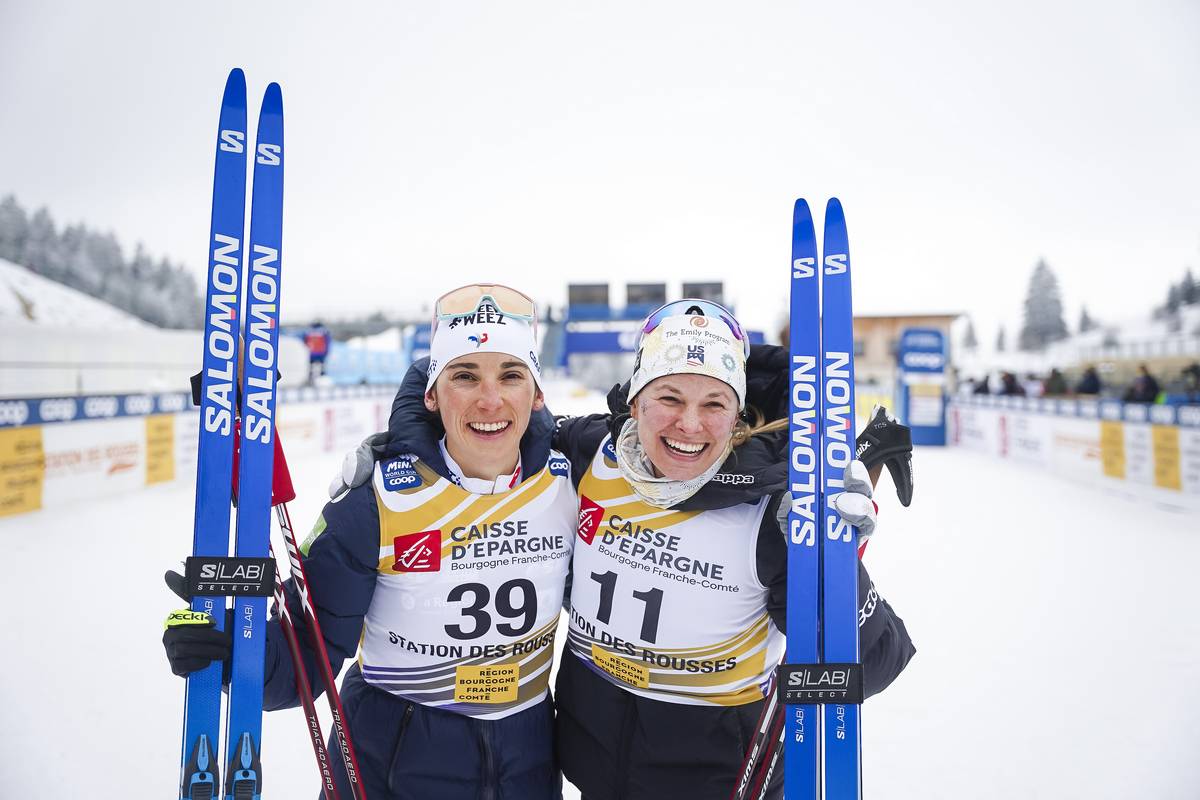
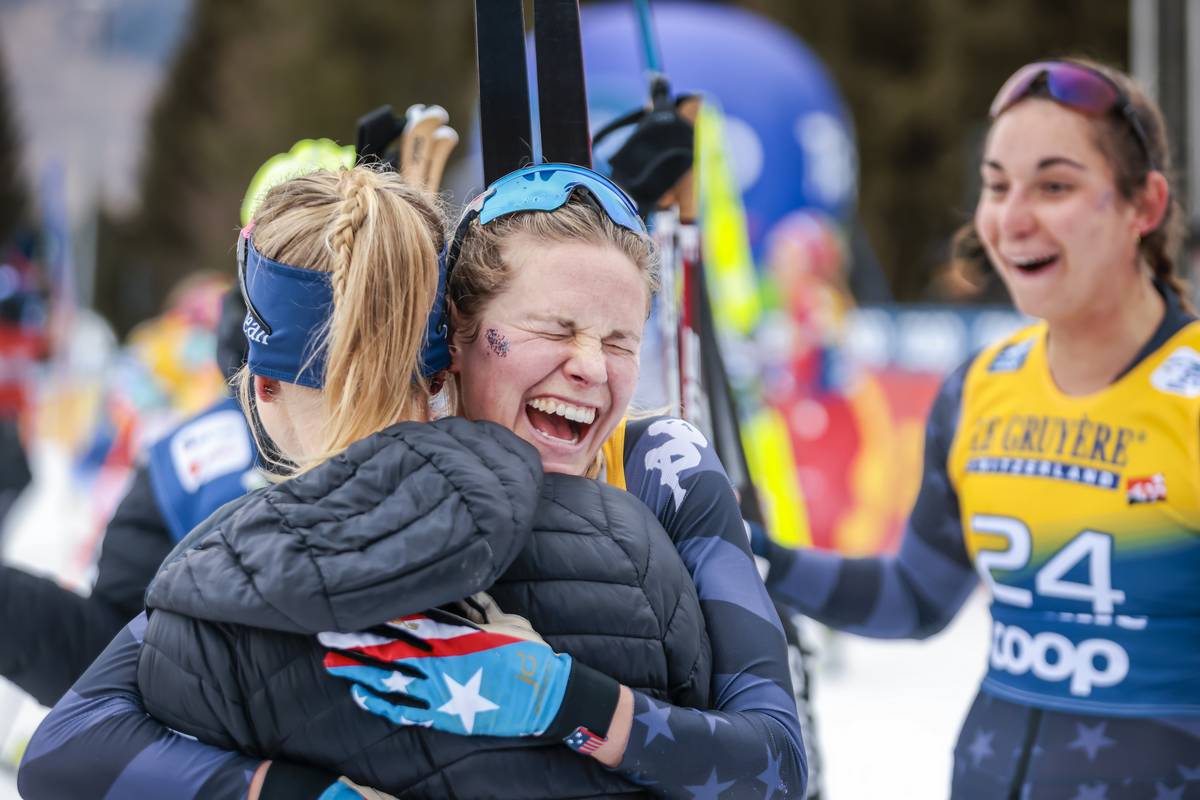
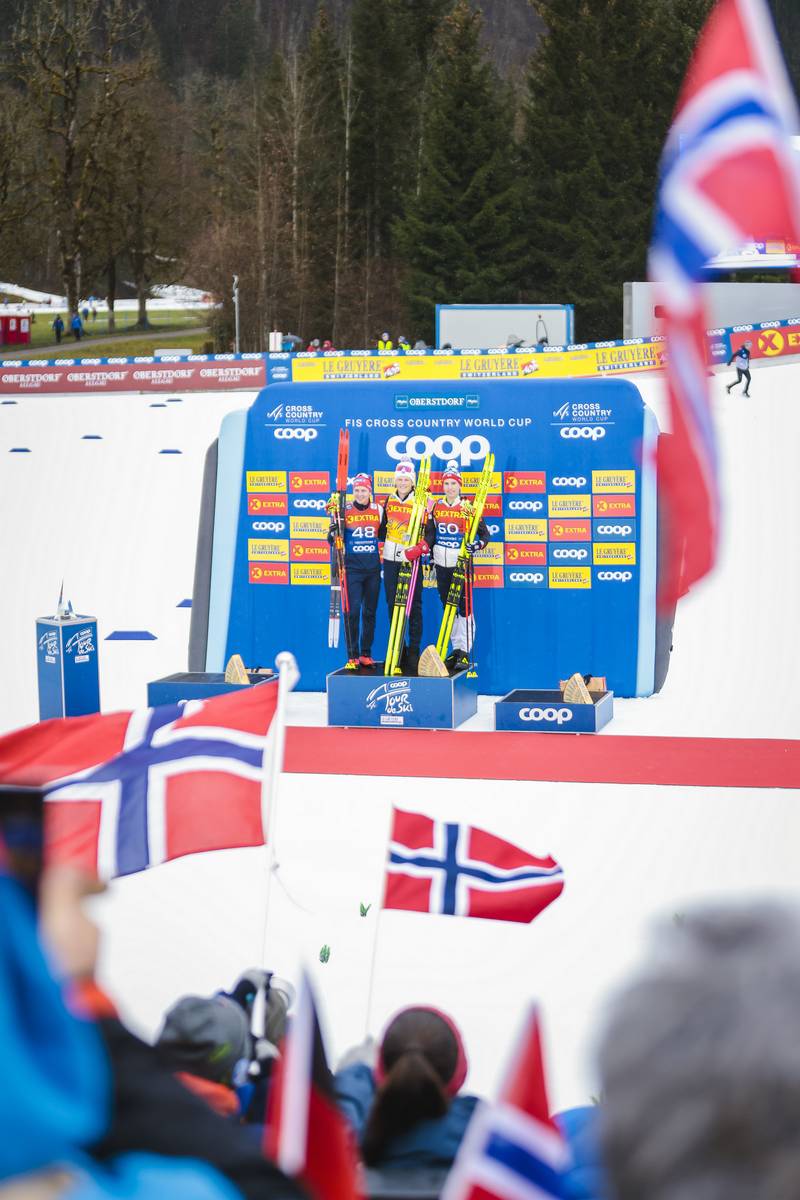
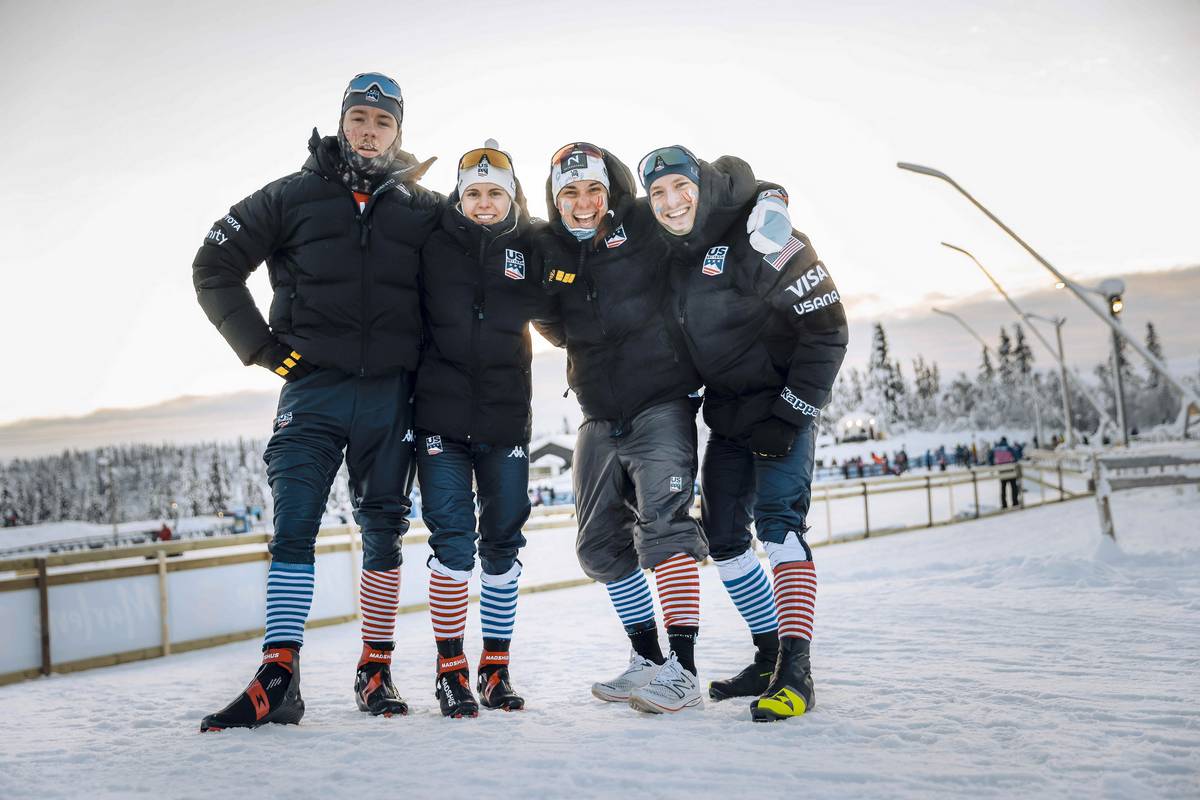
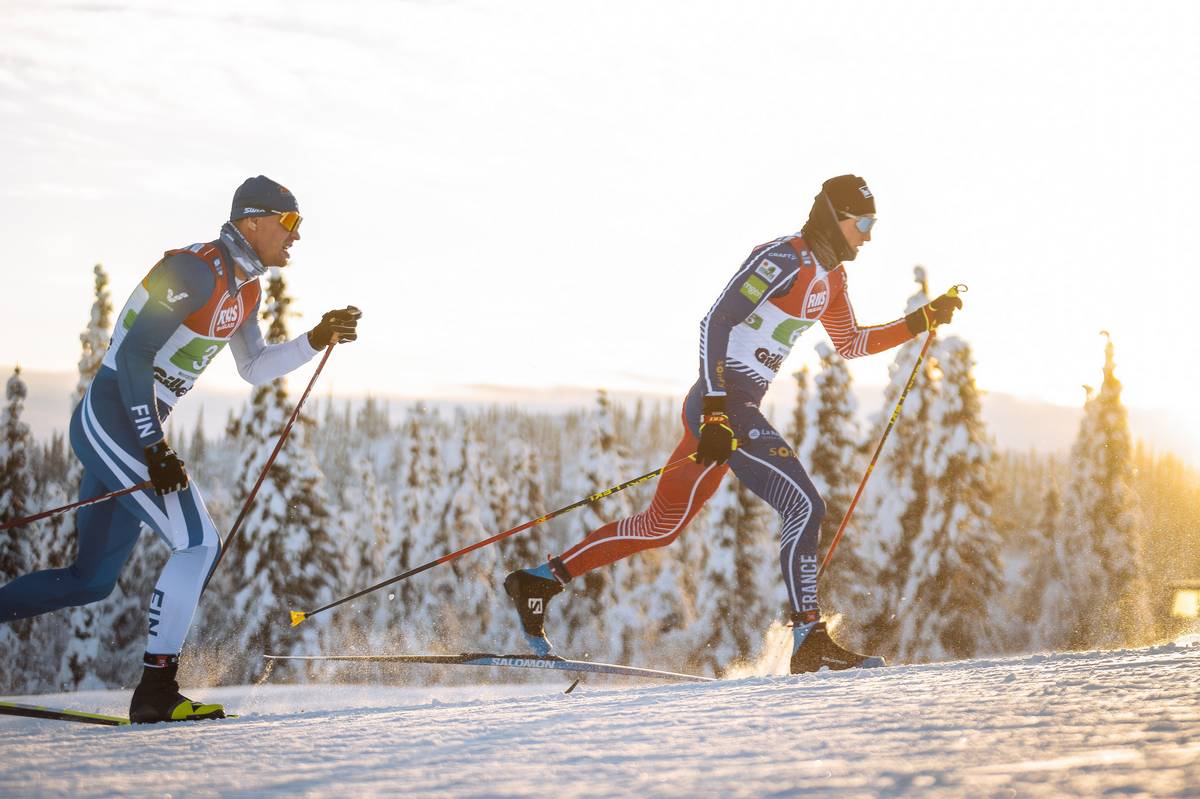
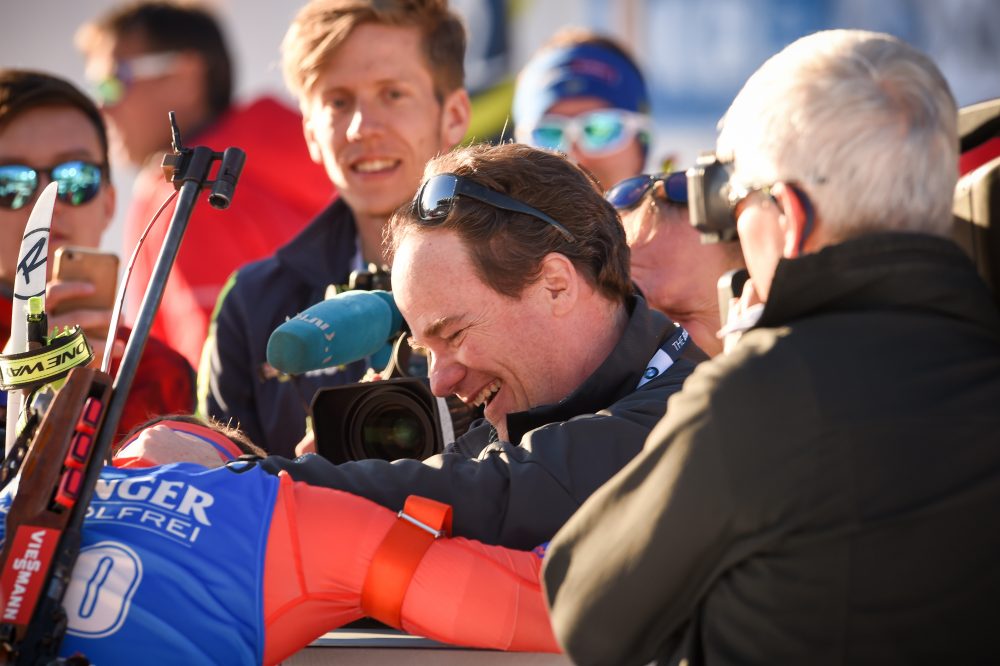
Delphine Claudel (FRA) and Jessie Diggins (USA) embrace after placing second and third in the 10 k Skate in Les Rousses. (Photo: NordicFocus).
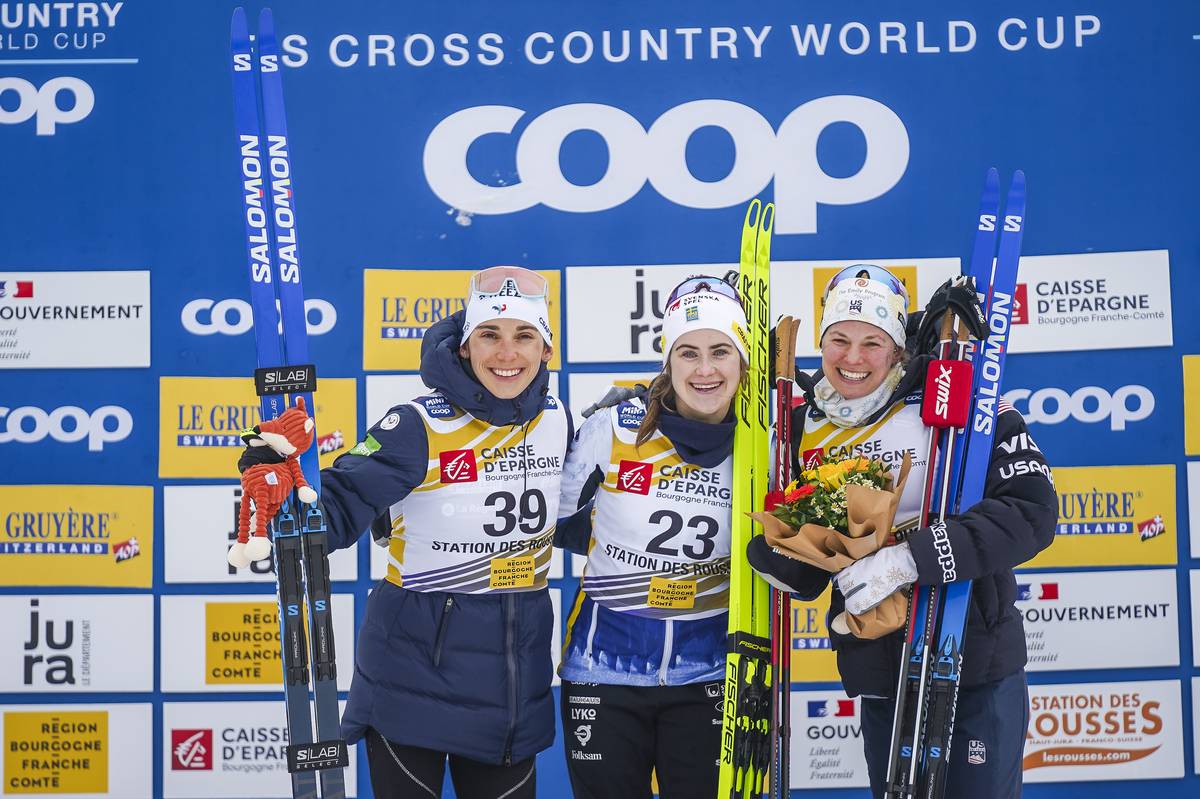
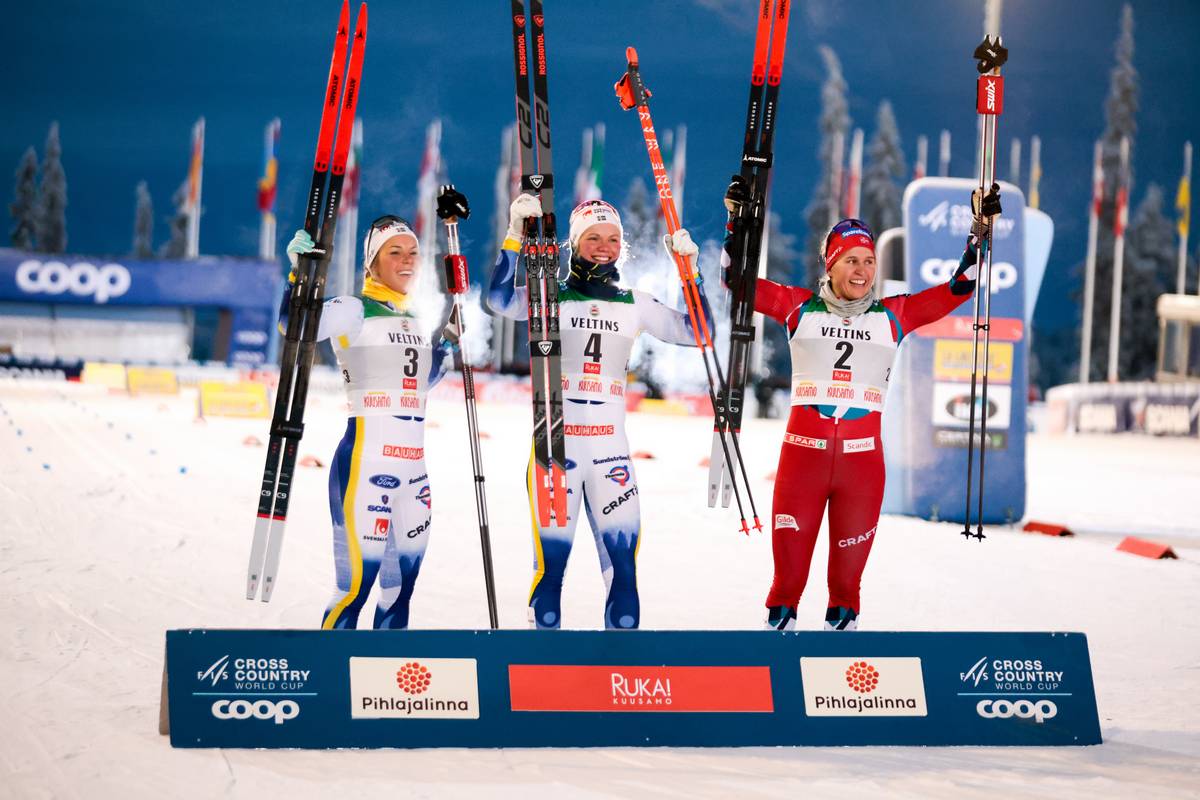
If there is a common theme to the cross country skiing World Cup, it is change. Tweaks, adjustments, selections, illness, and injury all factor into who even makes it to the starting line; certainty is just too much to ask for. For many seasons, Jessie Diggins has been an outstanding performer on the Women’s circuit, though in past weeks she has looked anything but her best. Today in Les Rousses, Diggins returned from time off; she was ready to start anew. And the 10 k skate—an event that relies on speed, confidence, and guts—seemed the perfect event for her to do so. Diggins’ efforts paid off with a return to the World Cup podium, finishing third behind first-place Ebba Anderson (SWE), and runner-up Delphine Claudel (FRA).
“That was an awesome day,” Diggins said. “I want to make sure I never take a great day for granted. It was just so fun to be back on the podium.”
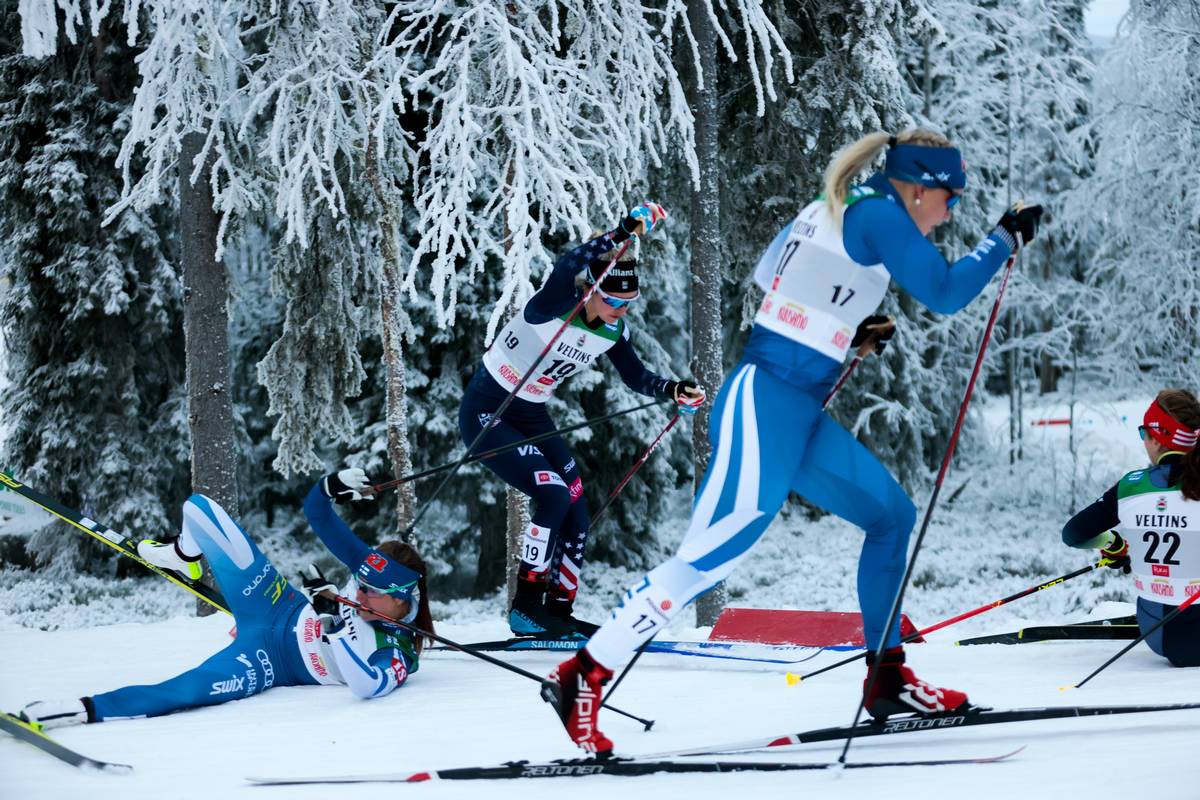
Rosie Brennan (5th) and Julia Kern (11th) both skied exceptional races in Les Rousses. Other American finishers included Hailey Swirbul 23rd, Alayna Sonnesyn 32nd, Sarah Goble 34th, Alexandra Lawson 35th. Nordiq Canada did not enter racers in today’s World Cup events.
When Diggins started today’s 10 k Individual Start Skate, it marked new steps taken toward the World Championships in Plainça, less than a month away. Diggins has preached patience this year, both for herself and for the ever-expanding ensemble of American women on the Team she leads. That US Ski Team ensemble today included Swirbul who returned to the World Cup after an early season spent patiently pursuing goals on the domestic circuit, and becoming a triple National Champion in the process. It also included World Cup debuts for Goble, the Michigan native and Bridger Ski Foundation Pro Team skier, and Lawson, the through-and-through Vermonter from Craftsbury Green Racing Project.
“[I’m] honestly just so happy for the whole team,” commented Diggins. “It’s been so cool this week, seeing Alex, Will, and Peter all start their first World Cups. I’ve been thinking a lot about that . . . when you do something for a while, you kind of forget how cool it is; you kind of lose the magic a little. I kind of made a promise to myself that I was going to ski it like it was my first World Cup.”
Diggins wore bib 11 on the day, the first of the main contenders to race the three laps of Les Rousses’ 3.3 k loop. Diggins had the job of setting the bar; from check-point to check-point, she did so. When she crossed the finish-line, she was in first place with over a 20 second gap to second place. No matter what happened in the field that followed, it was clear that Diggins had raced as Jessie Diggins could.
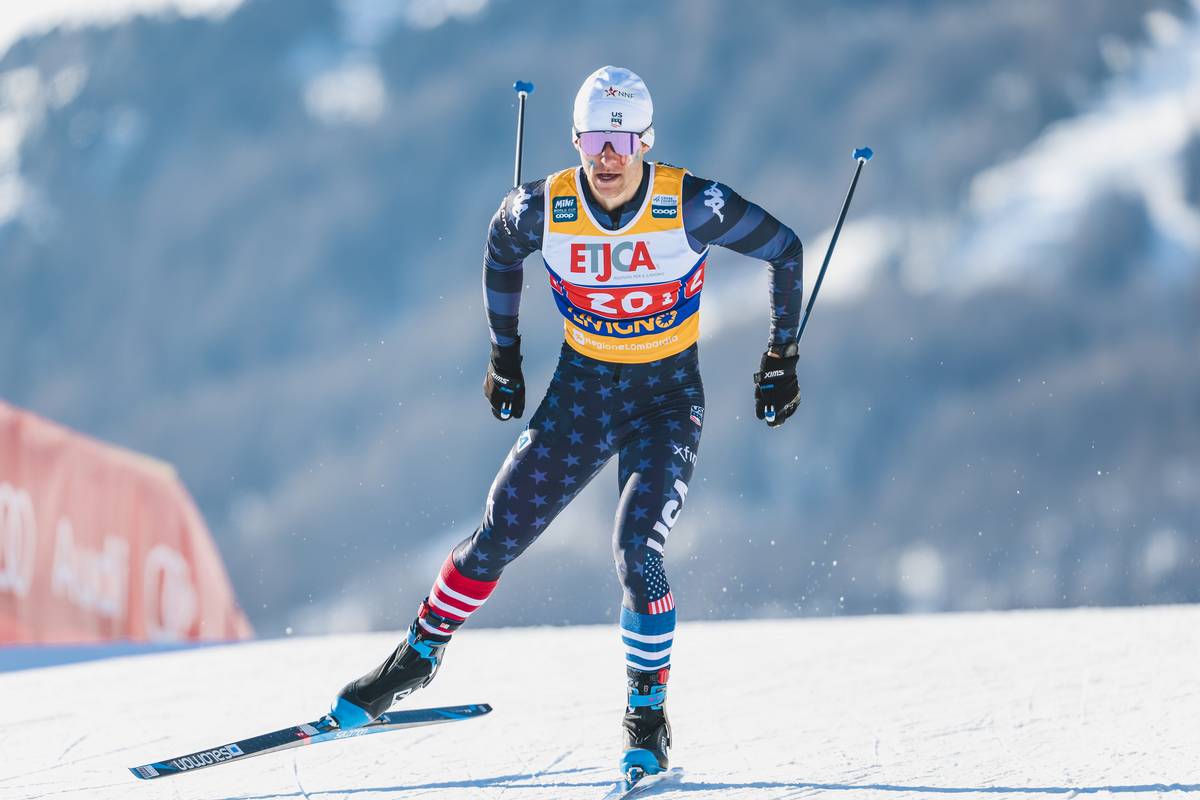
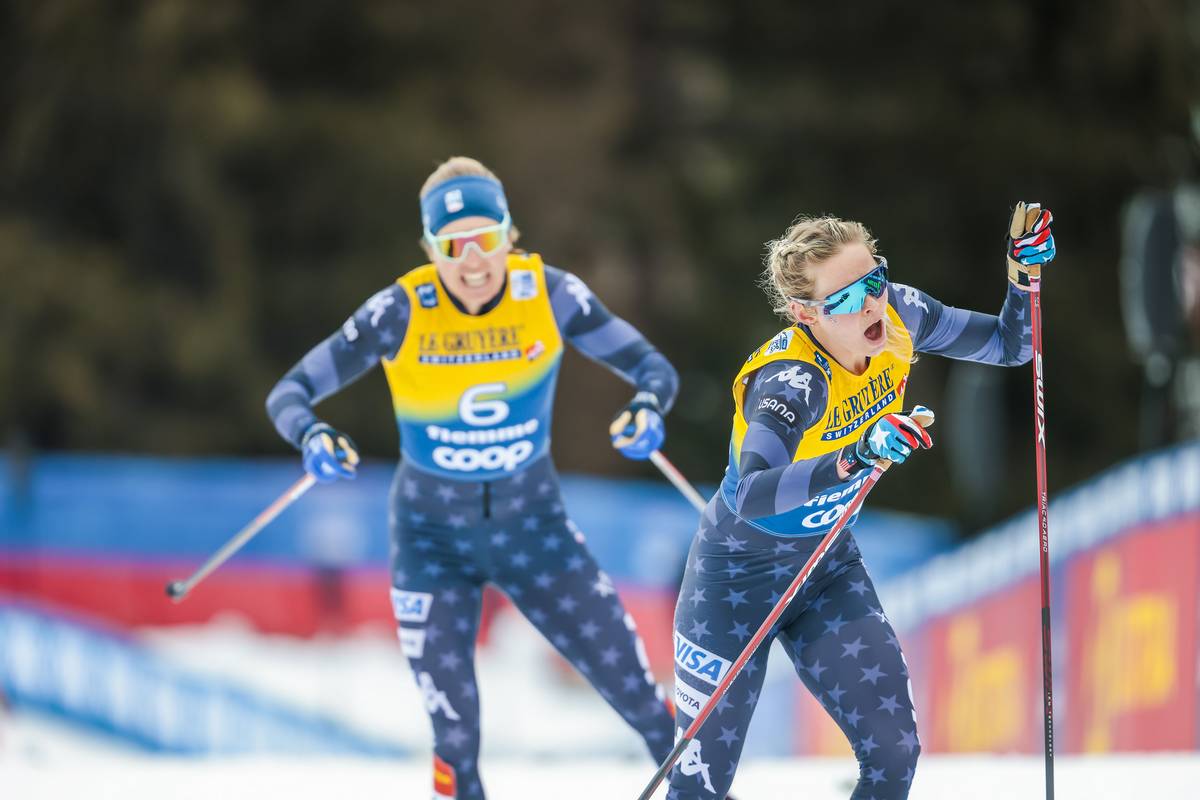
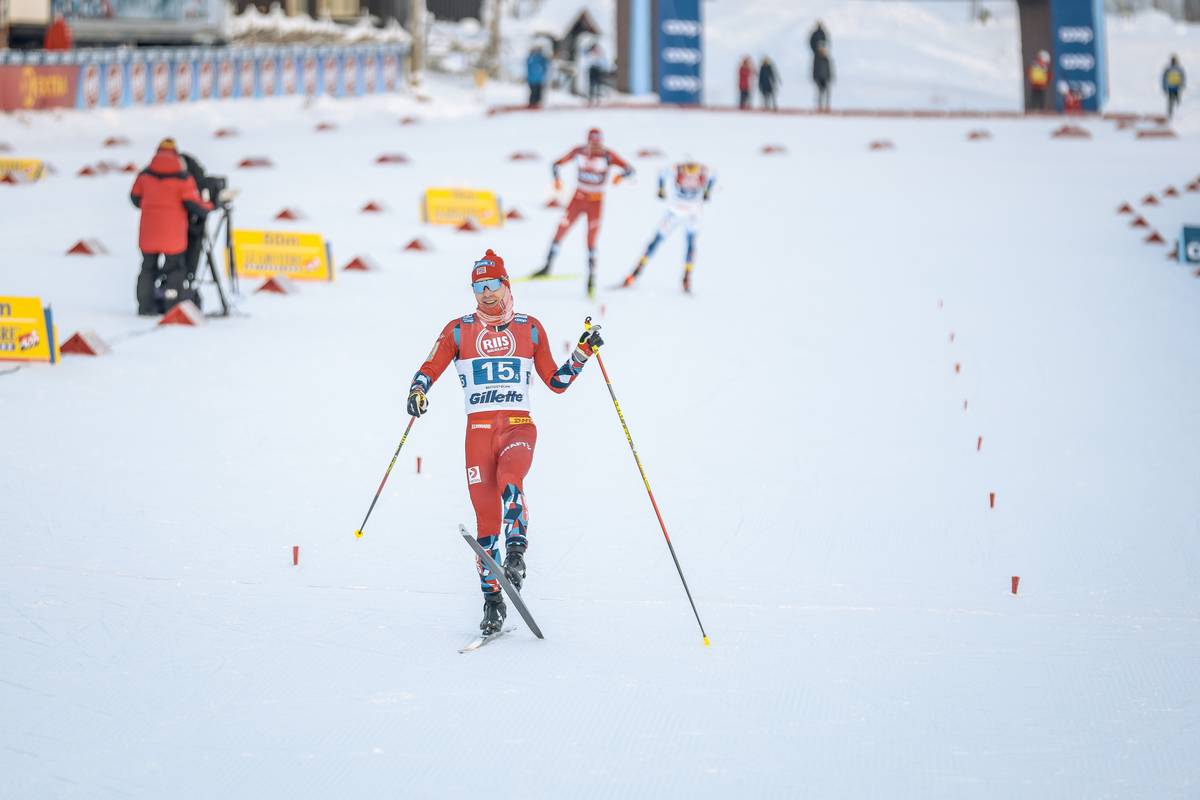
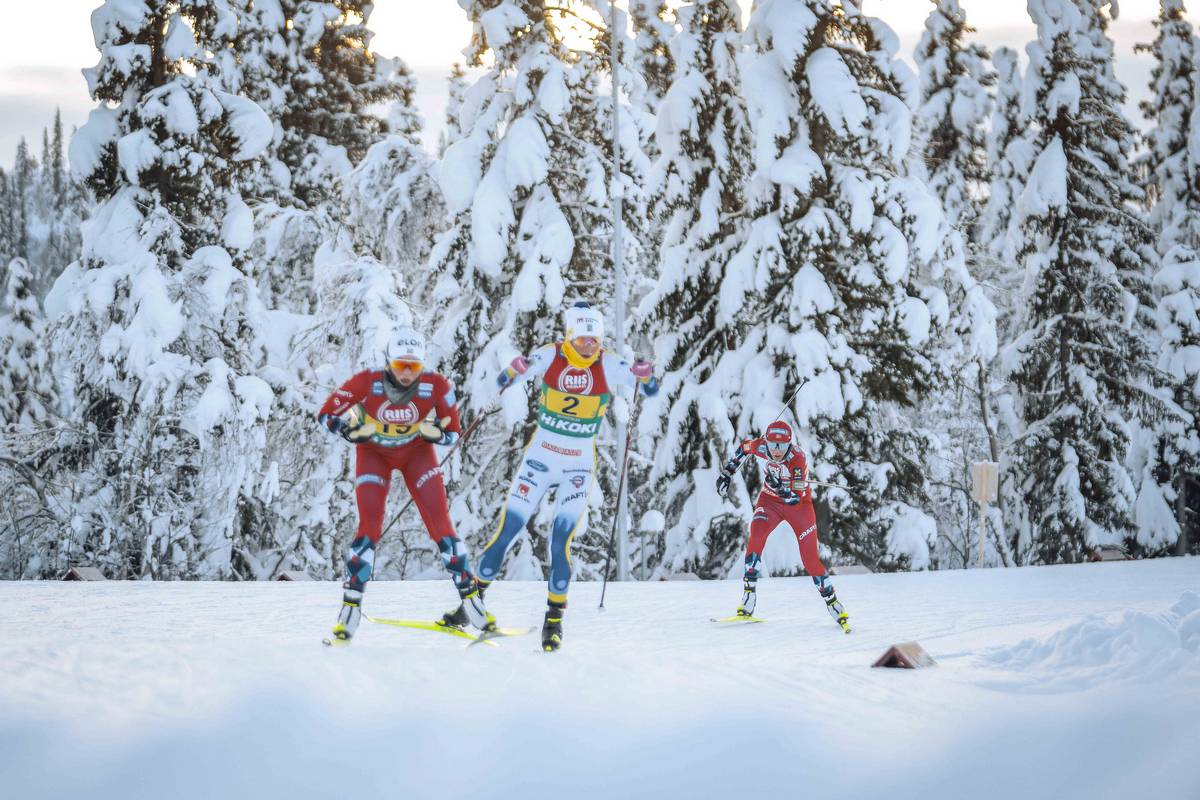
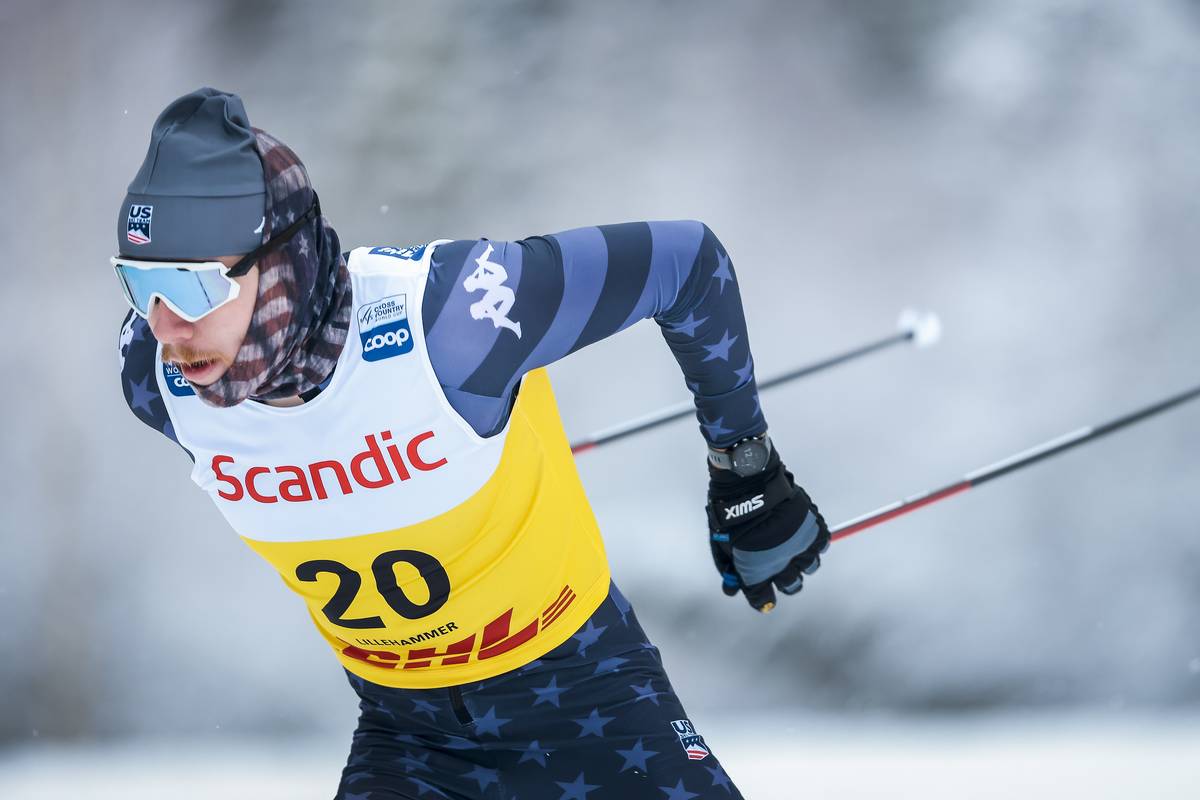
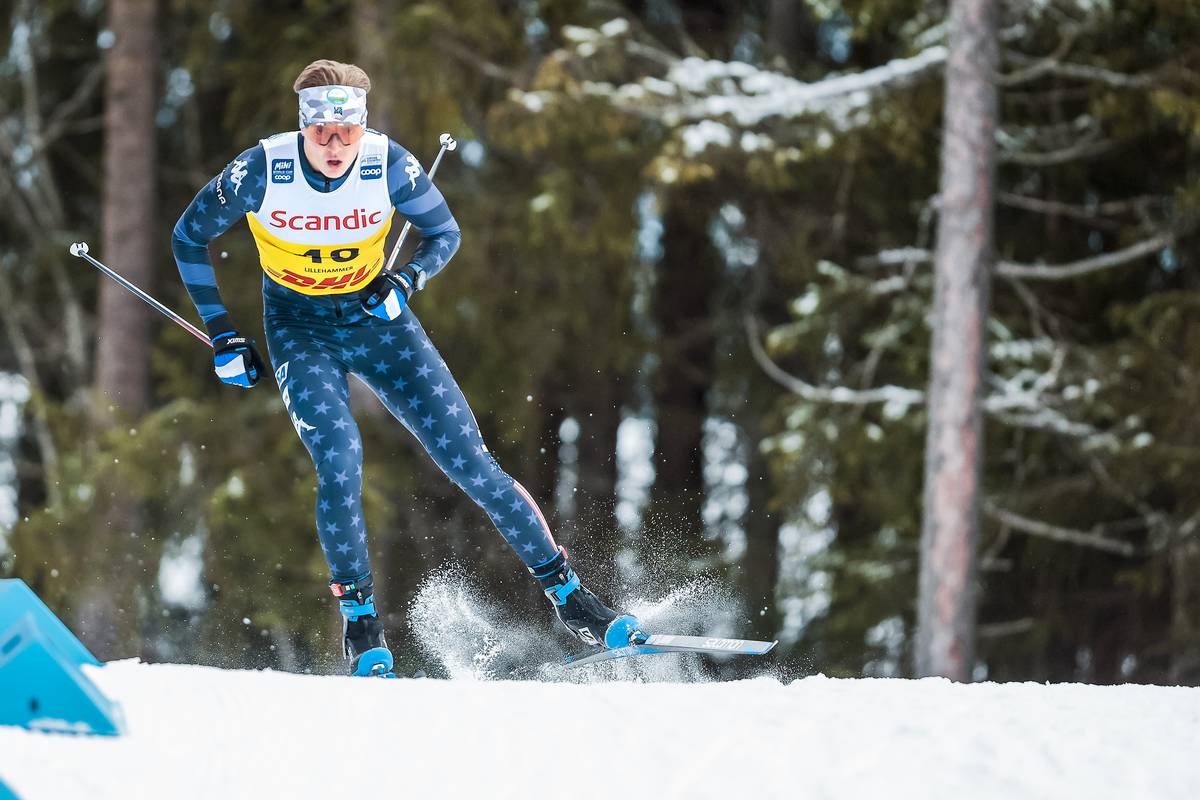
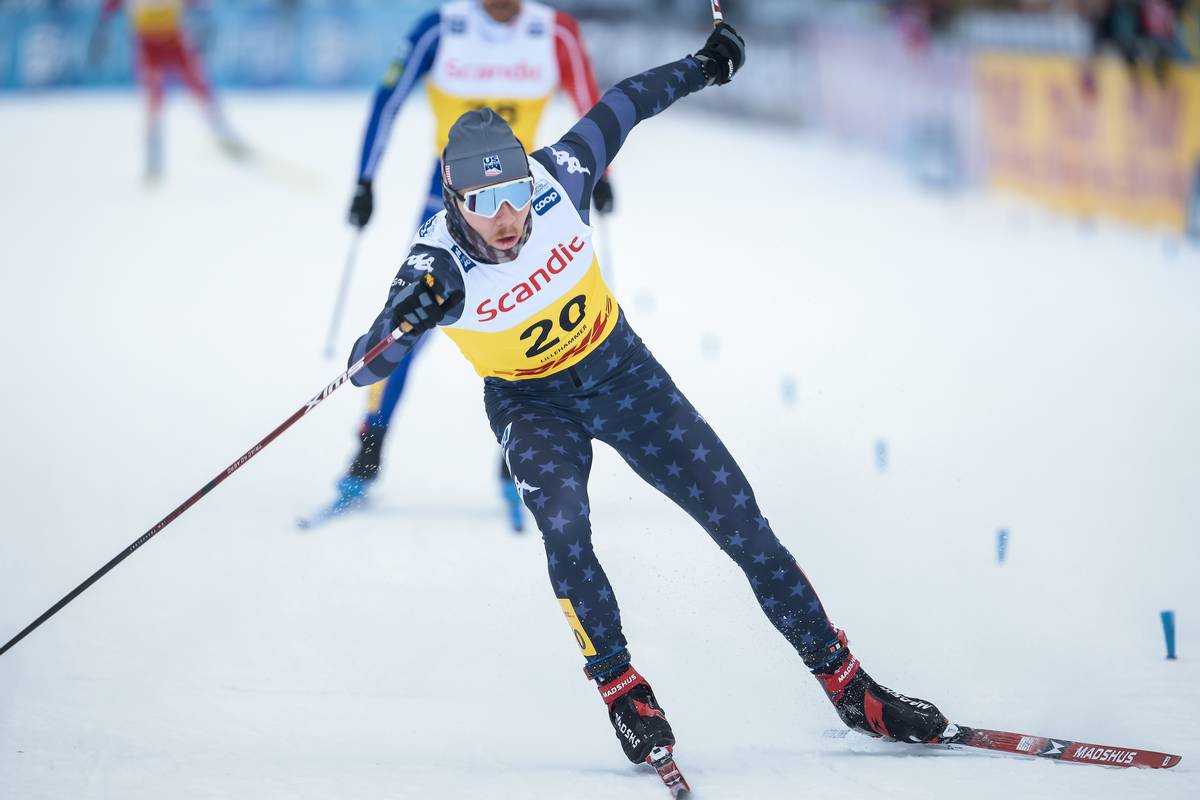
Sarah Goble (USA) during her World Cup debut on Friday in Les Rousses. (Photo: NordicFocus).
For Americans, extra excitement abounded on the day as Rosie Brennan sped around the course, trading close margins with Diggins at the time-checks. Brennan continued her steady, season-long march toward the top of the World Cup field, finishing her race in fifth place only 20 seconds from the podium. Julia Kern also put in a strong performance on the day, finishing in 11th place.
Behind Brennan, Ebba Andersson was leaving no doubt about who was the strongest skier in the field. In a testament to the depth and strength of the Swedish Women’s Team, it was almost easy to forget that Andersson herself was also returning to the World Cup for the first time since Lillehammer’s races in December (after an extended period of illness). She remained at the top of the field at each time check, and crossed the line 20.5 seconds ahead of Diggins to win her second World Cup of the season, and third of her career.
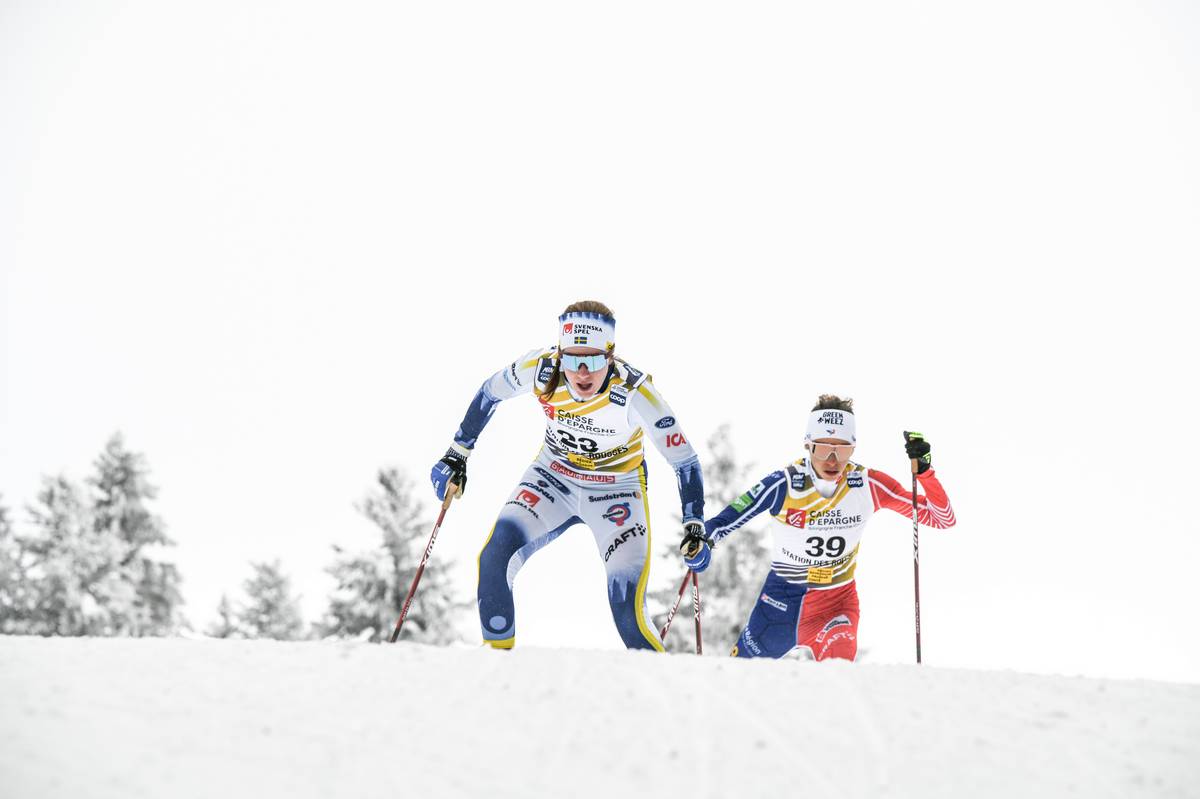
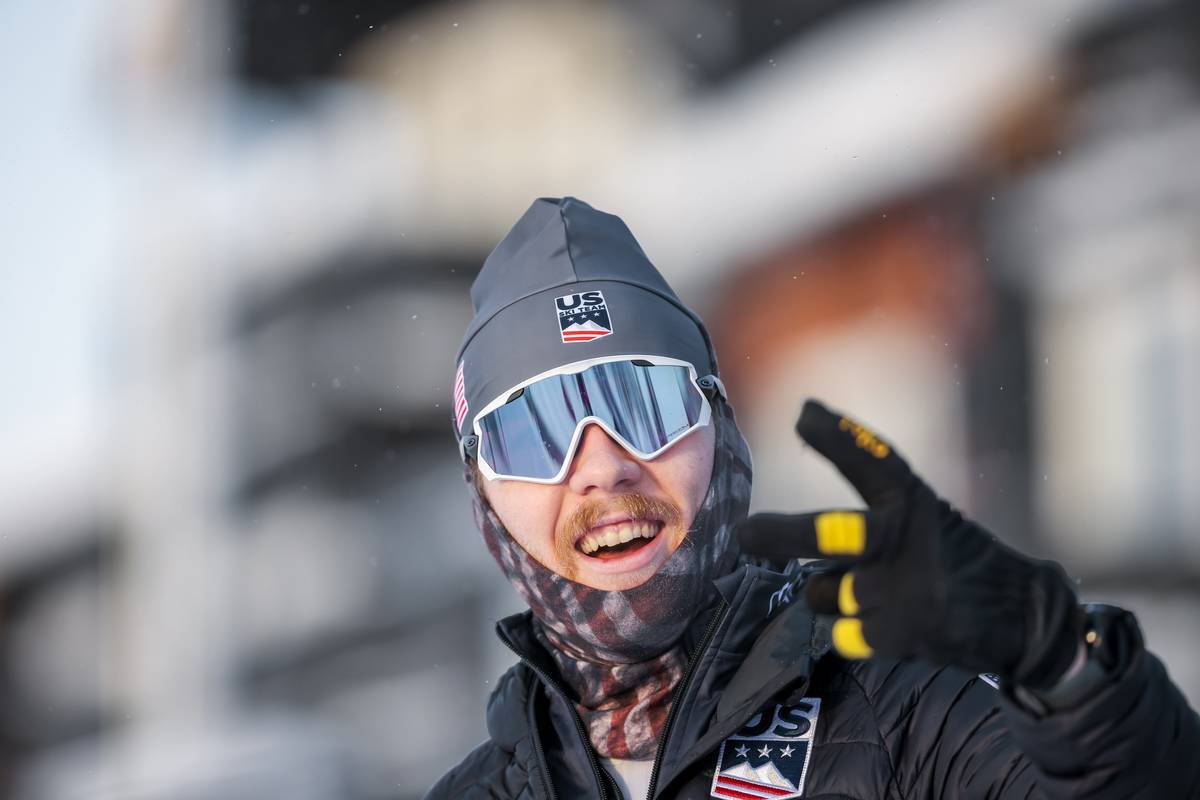
Winner Ebba Andersson (SWE) ahead of 2nd place Delphine Claudel (FRA) on course Friday. (Photo: NordicFocus).
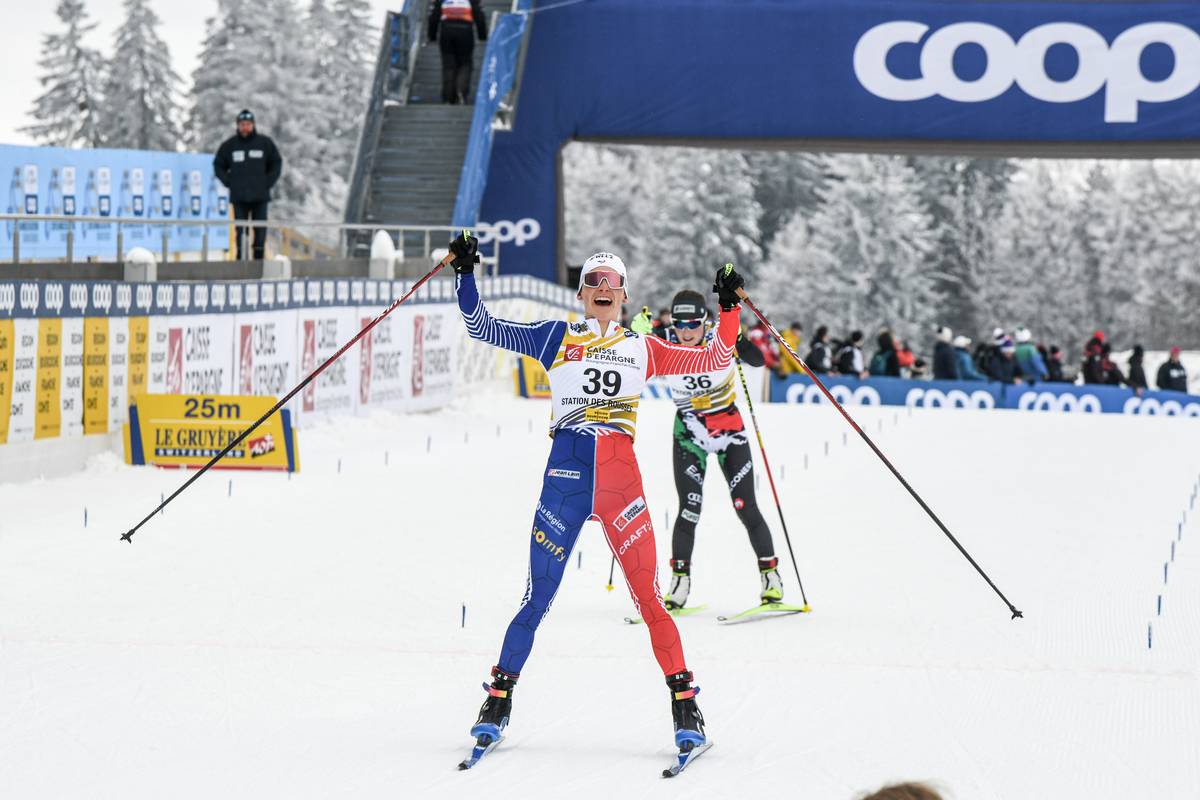
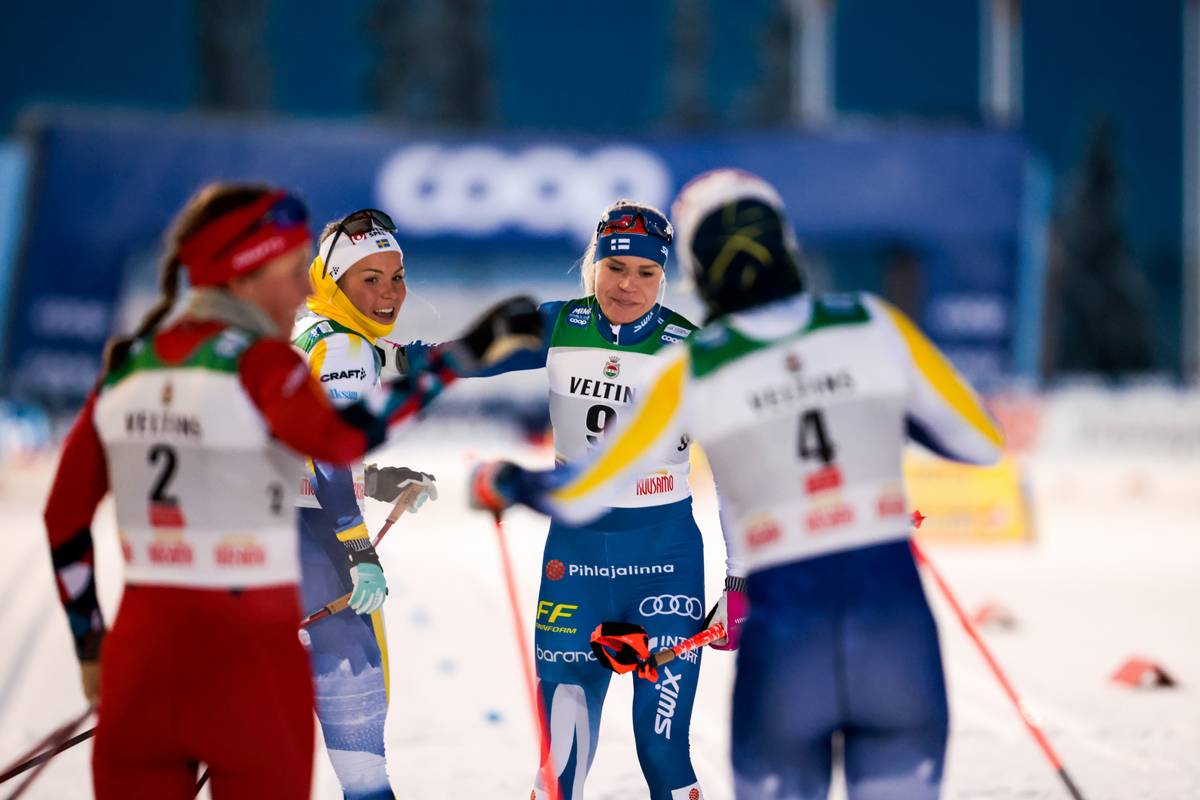
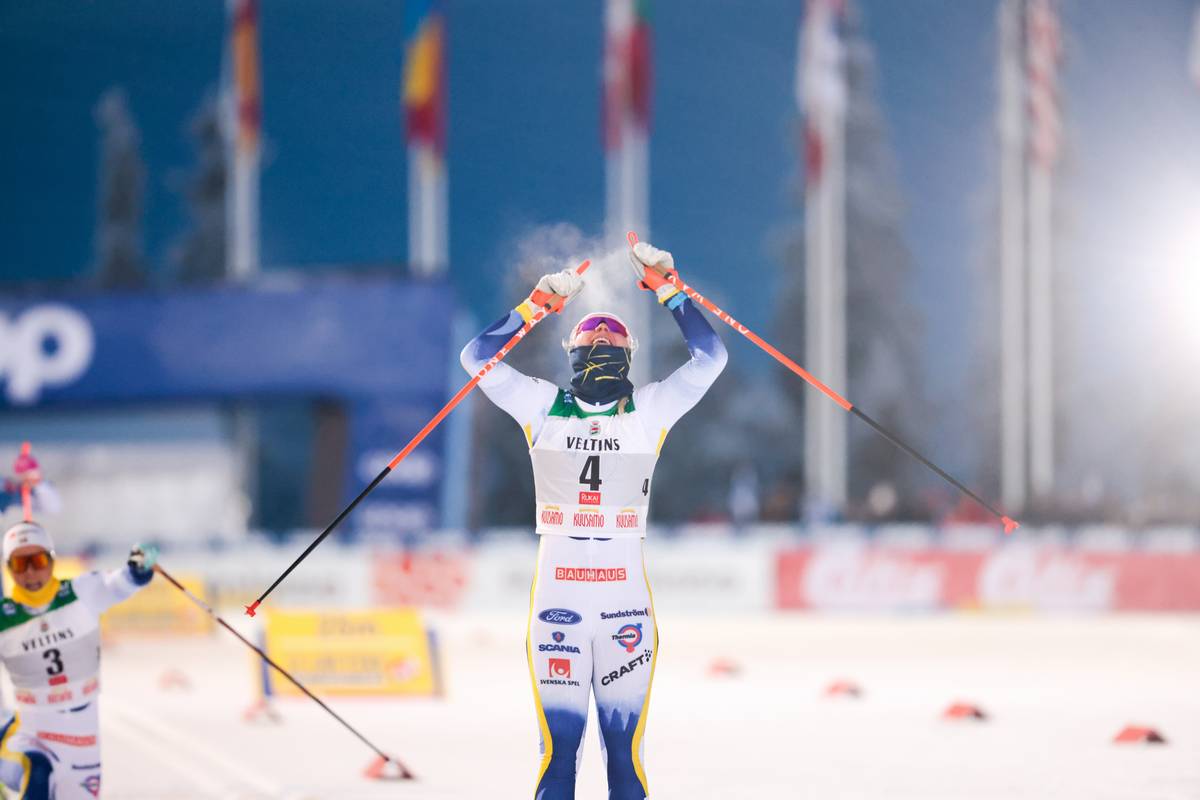
Andersson and Diggins were both across the finish line, and the World Cup podium for the day looked reasonable enough for a World Cup podium. But one skier wearing the red and blue of the home country began drawing attention as she hovered around Diggins’ time in the check points. It was Claudel, bib 39, who a few weeks ago summited the Alpe di Cermis to win her first World Cup. Claudel had been on the World Cup podium before that win, but they had all been on the Alpe di Cermis Hill Climb. She was always considered a climbing specialist. Was, that is, until she finished today. As she closed in on the last three kilometers of the race, her split times showed a back and forth battle with Diggins. As Claudel entered the stadium in Les Rousses, the French crowd rose in unison for their countrywoman. Les Rousess has been on the World Cup for three years running, but has been denied its day in the sun by pandemic cancellations. Now, after three years of waiting, the French were watching one of their own sprint toward an implausible result. Claudel closed in on the line, lifted two poles towards the sky, and found herself on a World Cup podium in second place, 13 seconds behind Andersson and just ahead of Diggins. Andersson, rose from the leader’s chair, ran to Claudel in the finishing area. “That crowd was incredible,” she said to Claudel, still elated. The energy of the day had lifted both women, and Claudel’s performance affirmed for Les Rousses that the wait had been well worth it.
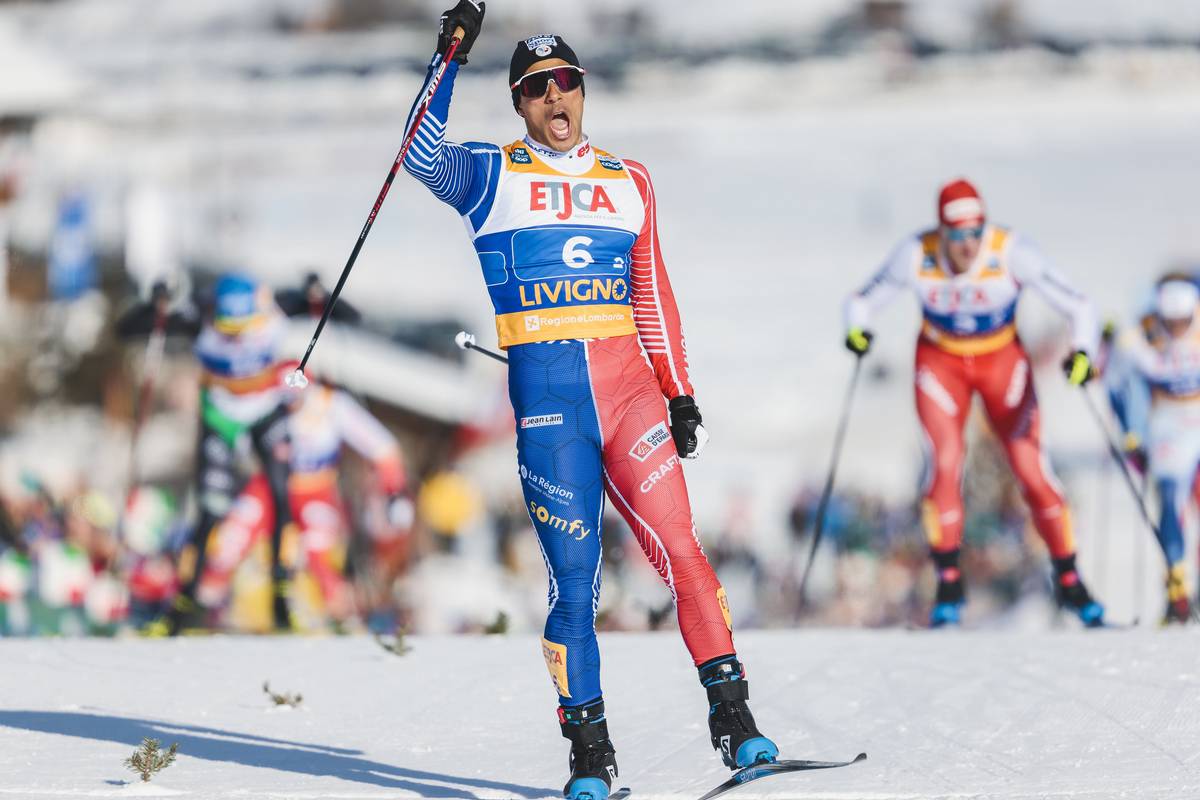
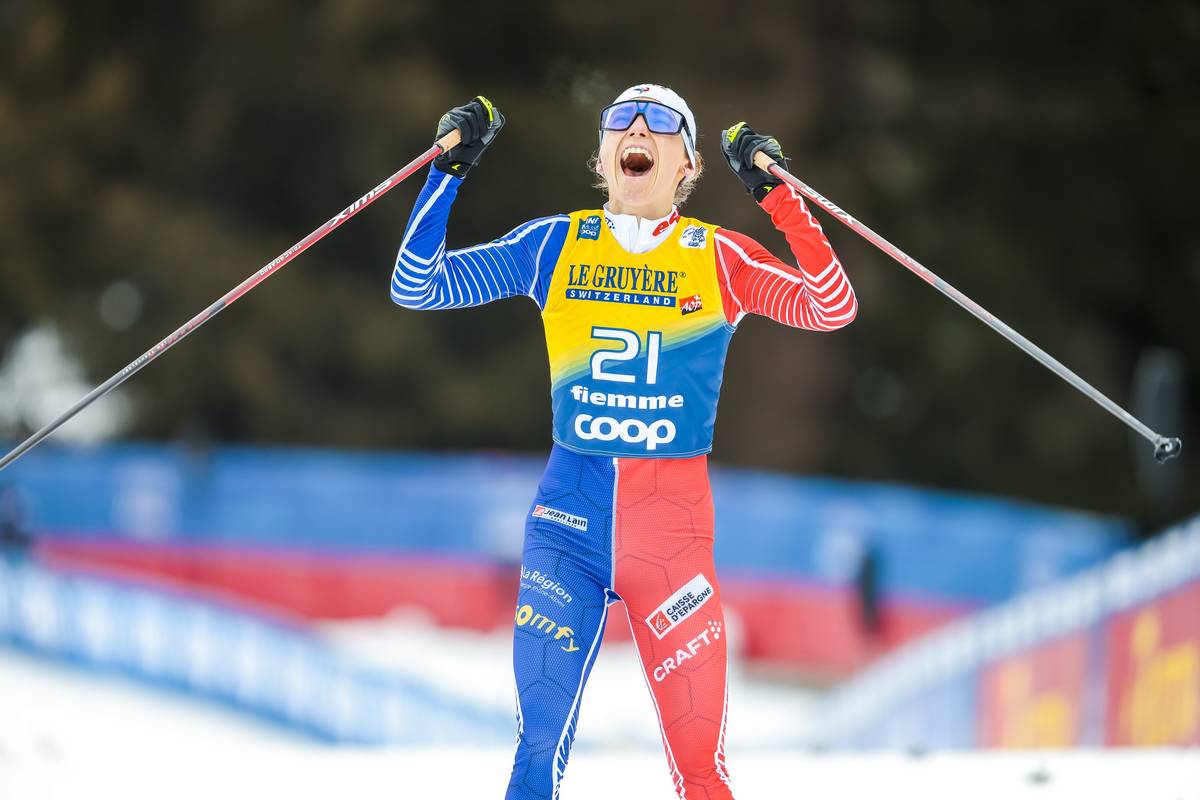
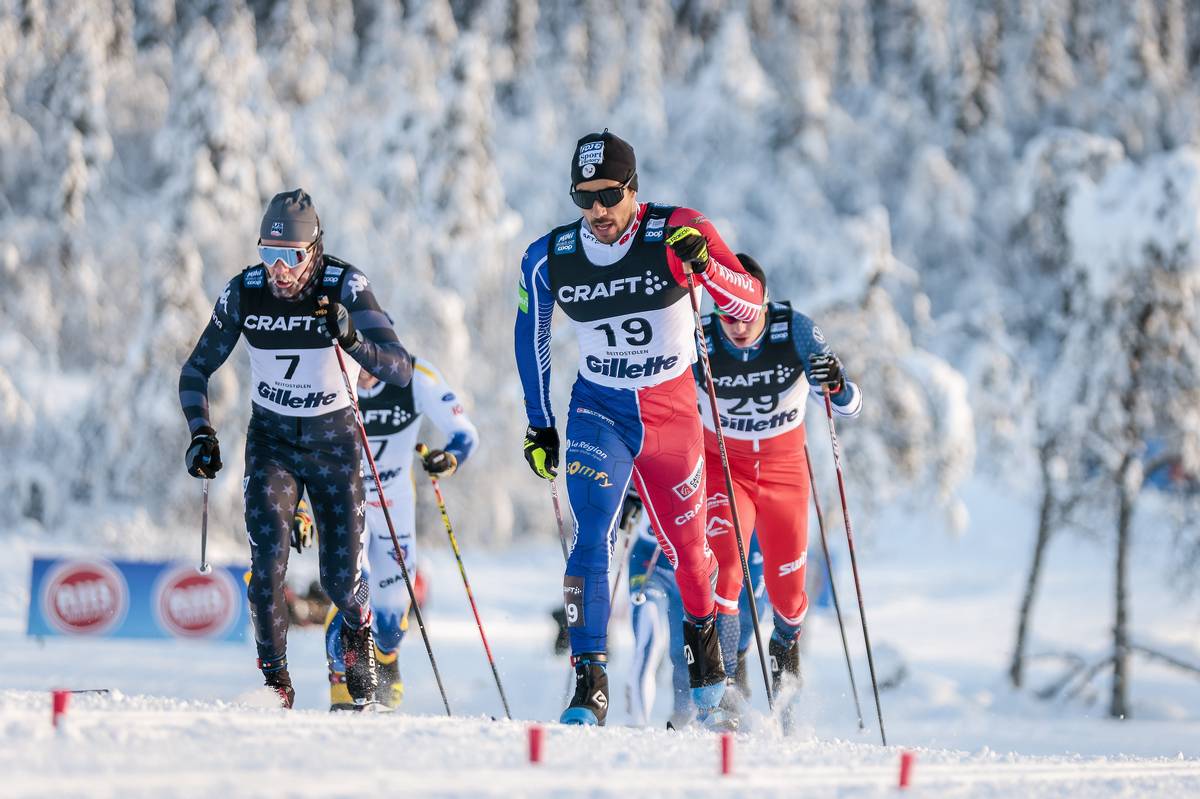
Delphine Claudel crosses the line to finish 2nd place at the first World Cup held in France since 2016 (Photo: NordicFocus).
Ebba Andersson added another win for a dominant Swedish National Team. Jessie Diggins returned to the World Cup, and returned to the podium. The skier who came between them on the podium, though, had showed that arriving at those conclusions is not simply an accident. Defying expectations, Delphine Claudel skied herself onto a World Cup distance podium. It was a reminder that for Claudel—and for the skiers surrounding her on the podium—the uncertainty of ski racing was one that could be met with will, patience, drive, and belief in one’s self. It was all there in the return of the World Cup to Les Rousses.
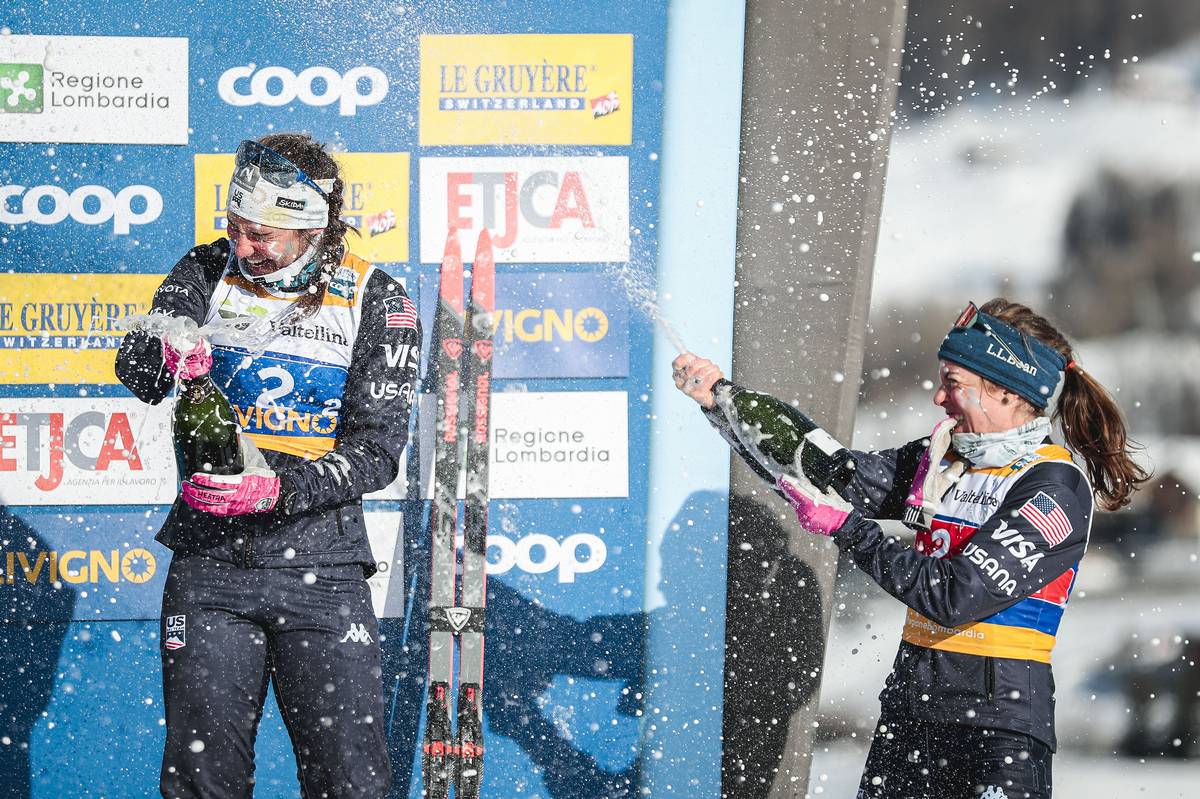
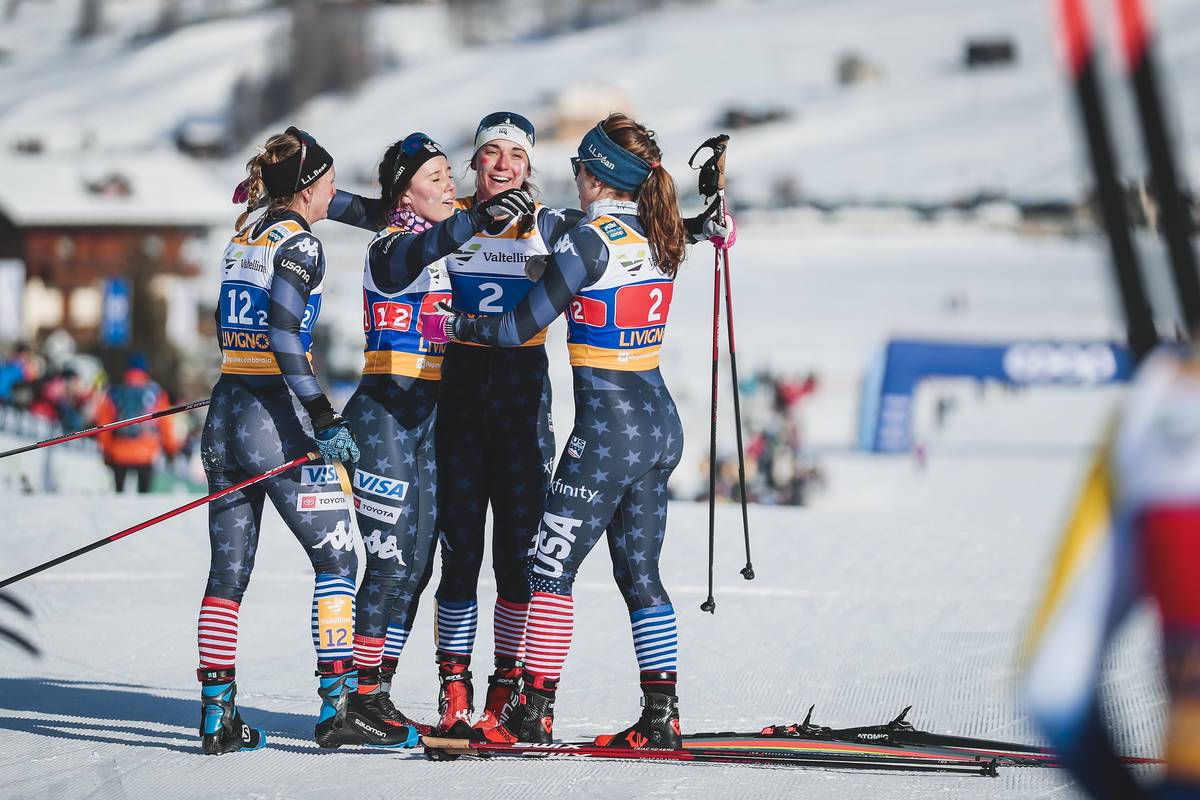
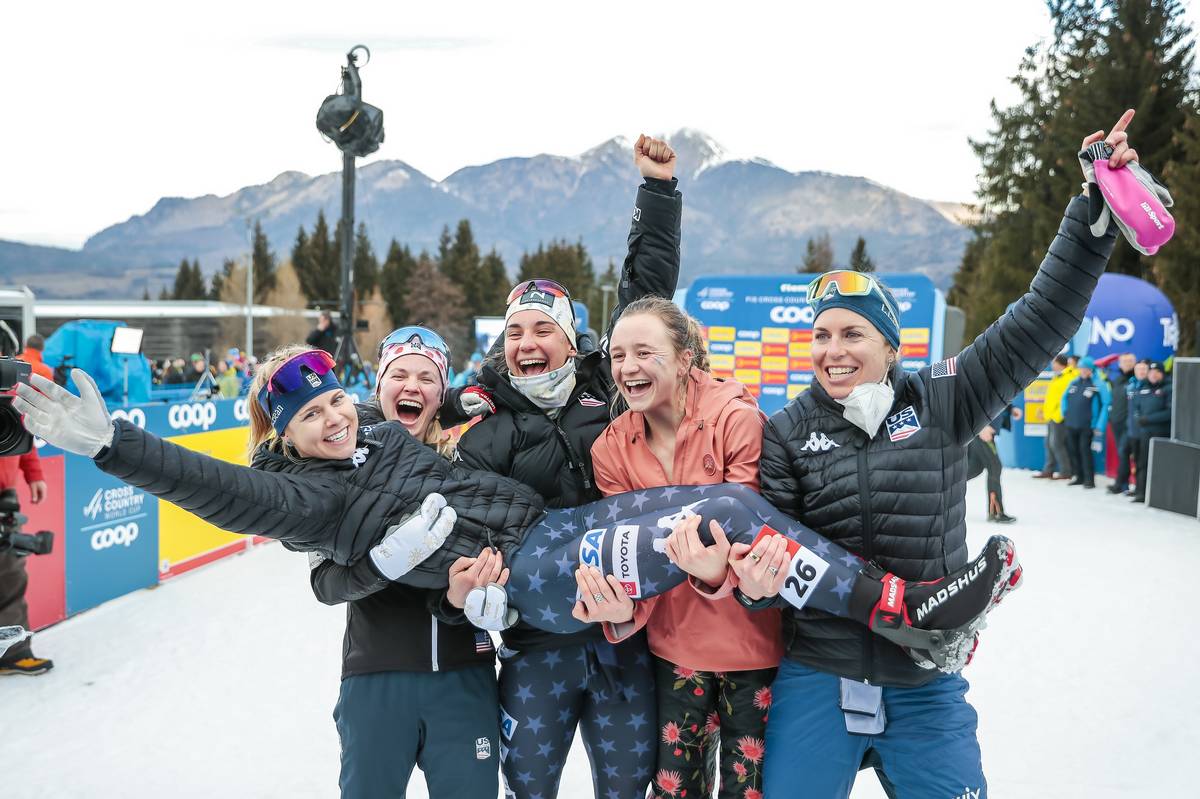
Julia Kern (USA) and Rosie Brennan (USA) celebrate after a third place finish in Sunday’s Team Sprint. (Photo: Nordic Focus)
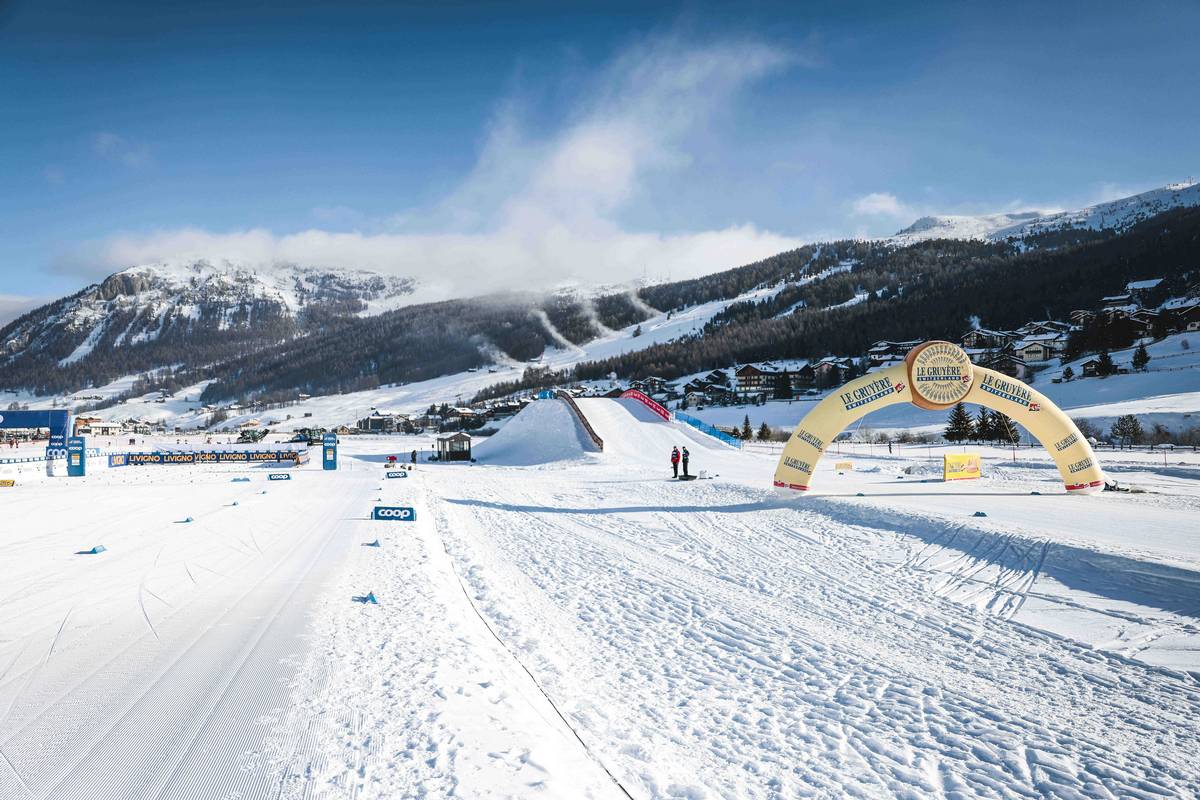
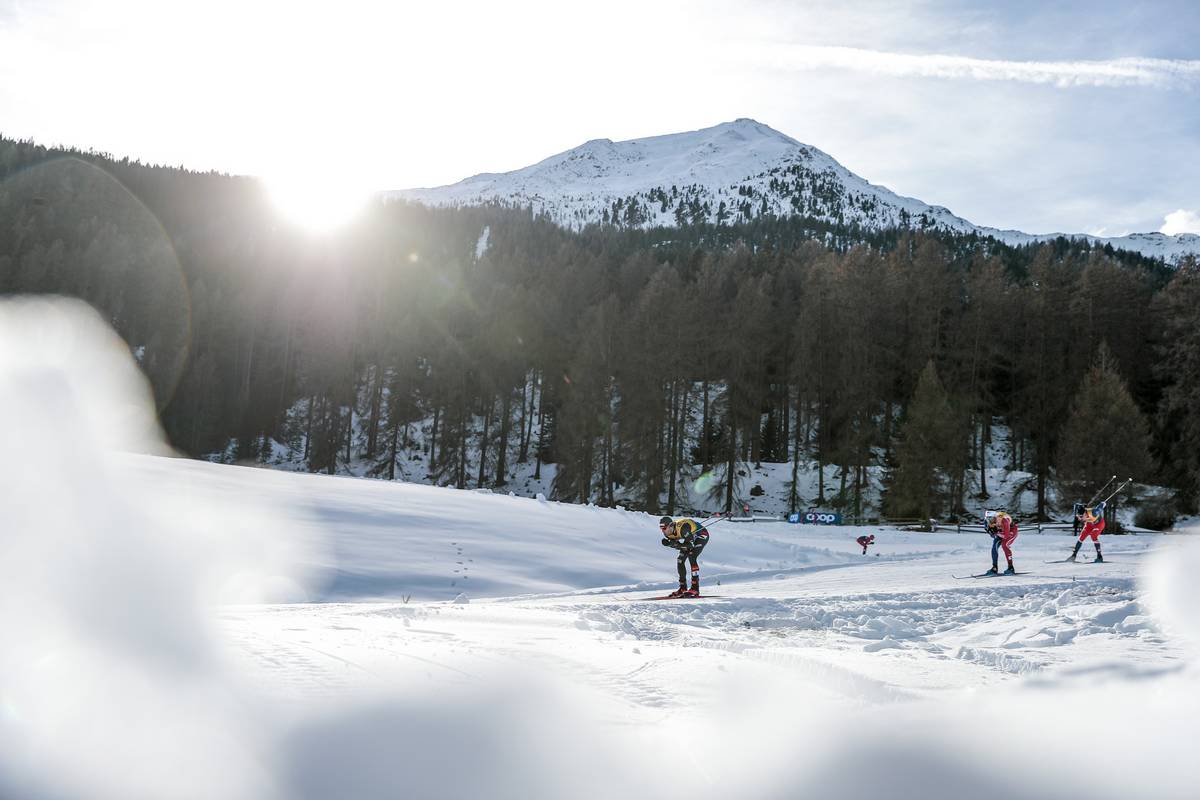
The high alpine valley containing Livigno, Italy is as beautiful and sublime as any place on Earth, seemingly heaven-sent to feature the high drama of the FIS Cross Country World Cup; for the first time, Livigno was hosting World Cup races this weekend.
That idyllic scene made Sunday’s Team Sprint all the stranger, since so many of the usual players and storylines were absent from the World Cup. As FasterSkier reported on yesterday’s Sprint, many factors affected the participation in Livigno: the staging of Norwegian National Championships, athletes taking planned breaks in their racing schedules, untimely illnesses, Livigno’s daunting elevation (Livigno sits at an elevation of 6000ft), and upcoming World Championships in Planica, Slovenia. Johannes Hoesflot Klaebo (NOR) had packed his bags and returned to Norway after his victory in Saturday’s individual Sprints. Jessie Diggins (USA) was taking a break from racing to refine her training. The field of U23 athletes had largely abandoned the World Cup in preparation for U23 World Championships in Whistler starting next week.
What was left in Livigno then? Well, the mountains towered, the sun shone down without a cloud in the sky, the snow was good, and the Italian fans were ready. It was, in other words, still a perfect scene for a ski race, and so those who had stayed on the World Cup—along with a few who were making their first appearances in it—gathered for a Skate Team Sprint in which partners skied three legs apiece on a 1.2 k loop around the valley floor.
The Alpine valley of Livigno, Italy hosted its first World Cup this weekend. (Photo: NordicFocus)
Women’s Race
In a weekend marked by a lull in the World Cup, there was one glaring irony: the front of the women’s field was marked by top skiers trying to re-establish themselves in the World Cup standings. For all their dominance, it has been a difficult year for the Swedish women’s team. A shoulder injury has kept Linn Svahn out for much of the season, and persistent illnesses have struck Jonna Sundling andEmma Ribom early in the World Cup season. In Livigno, the Swedes were looking for an opportunity to return to high-level competition. In selecting their teams, the Swedes split the Beijing Olympic Team Sprint Silver Medal duo of Maja Dahlqvist and Jonna Sundling, and paired both with new partners. Dahlqvist joined up with Linn Svahn to form Sweden II, and Sundling joined with Emma Ribom to form Sweden I.
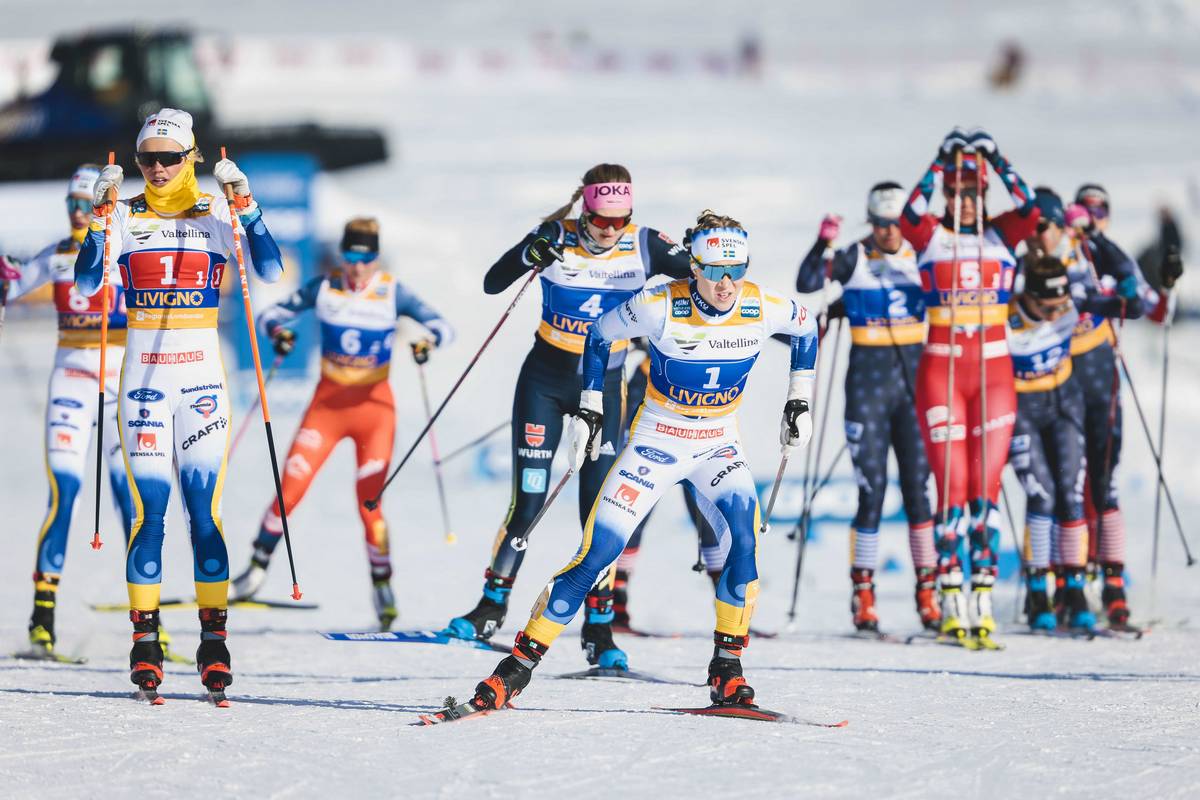
Jonna Sundling (SWE) heads out from the exchange after the tag from Emma Ribom (SWE). (Photo: NordicFocus)
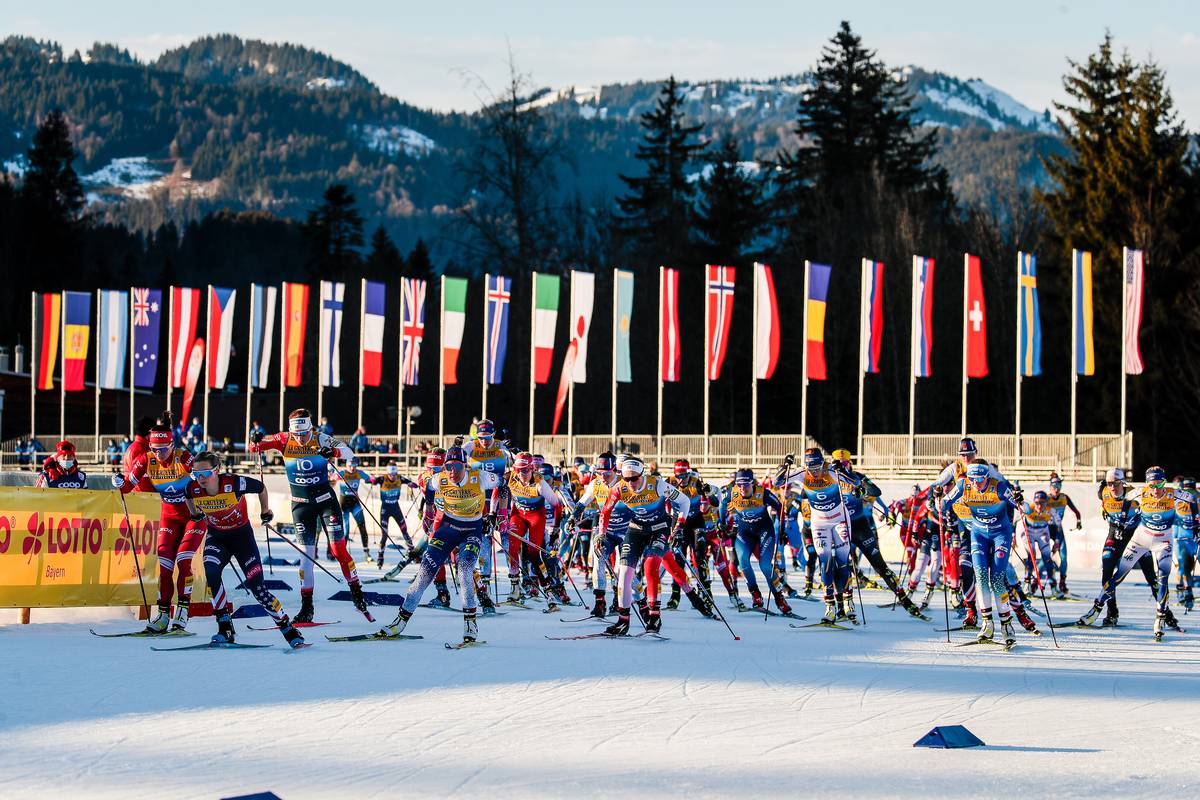
There was little to separate the field on the relatively flat Livigno course; through most of the race, the field remained largely intact. Out of the third exchange (entering the fourth lap) the Swedish pair of Dahlqvist and Sundling started to up the tempo on their persistent V2. Only two teams followed: Germany and the United States. The United States I team was represented in the move by Julia Kern, who paired up with Rosie Brennan to form a strong unit for the US. The USA II team of Lauren Jortberg and Alayna Sonnesyn were also in the final today, but had not quite bridged the gap to the front pack. Germany was represented by the pairing of Sofie Krehl and Laura Gimmler.
The pack of four teams—Sweden I, Sweden II, Germany I, and United States I—held through the fifth lap. The move to win was made by Maja Dahlqvist on the only true feature of the course—a short, steep, pitch where she unleashed a powerful V1 that led her to the win over Sundling who sprinted to second place for Sweden I. Behind the pair of Swedish sprinters, Kern had affected the same high-tempo attack for third, and beat out the German anchor skier, Gimmler.
American women celebrate after United States I—Rosie Brennan and Julia Kern—finished third in Sunday’s Team Sprint. (Photo: NordicFocus)
Men’s Race
The unusual scenes of this World Cup brought some welcome novelty, especially for American ski fans, in the Men’s race. A pair of American men even younger than the skiers who are now becoming the familiar faces on the US Ski Team made their World Cup debut in the Individual Sprint yesterday, and paired with more experienced teammates in comprising the Team Sprint duos today. That included Adam Witkowski—a native of upstate New York now skiing for Michigan Tech—who paired with Logan Diekmann to form the United States II team. The team rosters also included Will Koch—the Vermonter and University of Colorado Buffalo—skiing with veteran Kevin Bolger on United States I. United States I advanced to the Final.
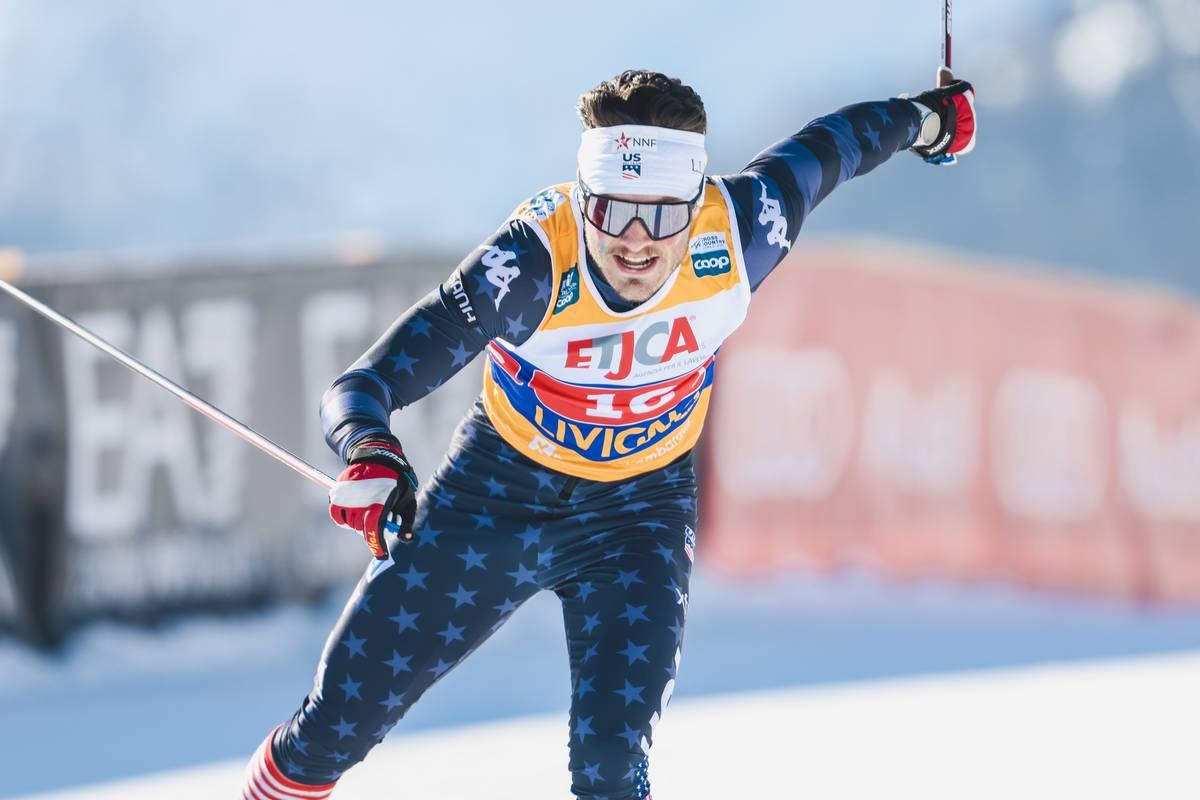
Adam Witkowski (USA) made his first World Cup starts in Livigno this weekend. Witkowski and Logan Diekmann (USA) combined to form USA II in the Team Sprint. (Photo: NordicFocus)
Focus on who might win the Men’s race was firmly turned towards those teams hailing from the surrounding Alps. The Italians, on home soil, fielded the strong team of Francesco De Fabiani and anchor Federico Pellegrino. The French, too, fielded reigning Sprint champion Richard Jouve in the anchor leg, paired with Renaud Jay.
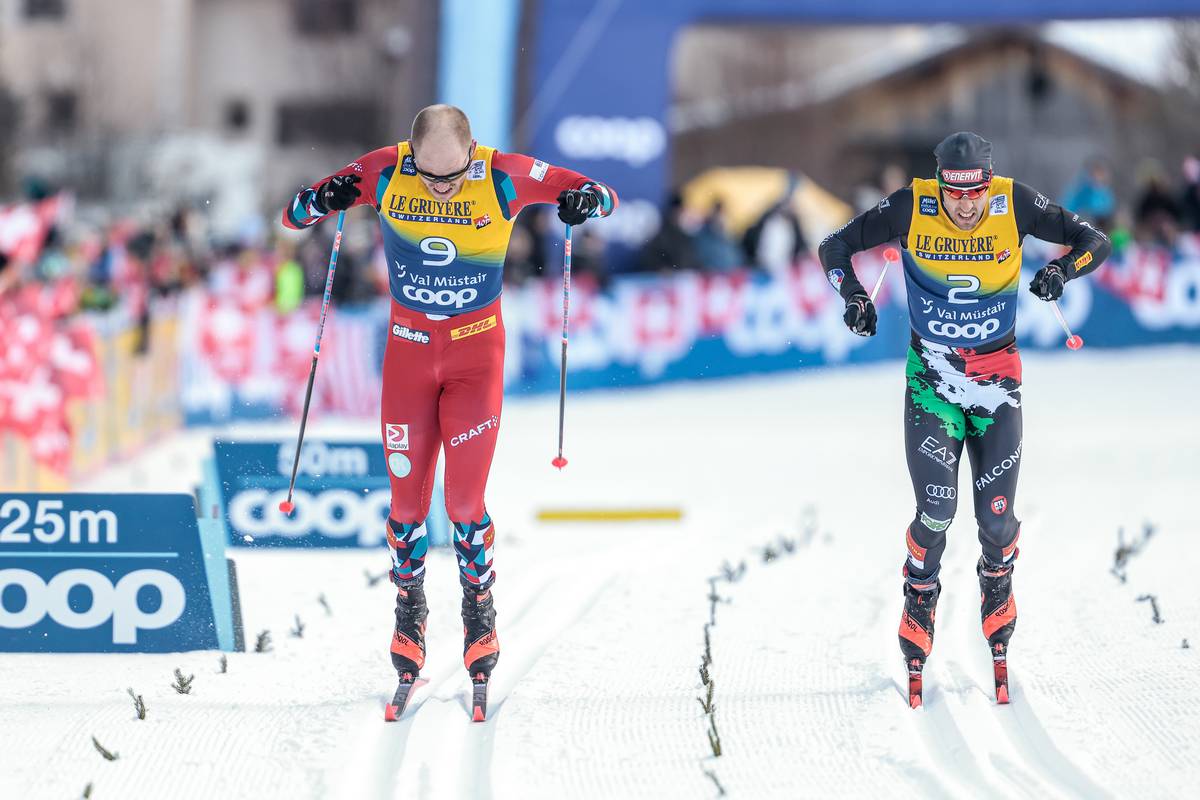
The men’s field remained tightly woven and tense throughout the course of the six lap race. Skiers looked for a track to gain a place, or test out a high-tempo attack. It wasn’t really until the last leg—the anchor’s anchor leg—that Richard Jouve and Federico Pellegrino moved on the only sharp incline on course and made it a sprint. Jouve gained a slight advantage in doing so, and it was enough to seal the win for France, as Pellegrino brought Italy to a second place finish on the day. Behind the battle for first and second, it was Valerio Grond (SUI) who escaped the pack to earn the bronze with his partner, Janik Riebli (Saturday’s Individual Sprint bronze medallist).
Richard Jouve (FRA) brings home the win with teammate Renaud Jay (FRA). The French head towards a race on home soil in Les Rousses next weekend. (Photo: NordicFocus)
The pairing of Koch and Bolger for the United States finished in 12th place on the day, but just 20 seconds off the leaders. The combination of the experienced Bolger alongside the younger Koch underscored the range and depth that the American program has fostered over the past decade. Koch’s first start on the World Cup extends the scope of that accomplishment across time too, as he joins Novie McCabe in being the second generation of his family to have skied on the World Cup for the United States.
Will Koch (USA) teamed with Kevin Bolger (USA) in Sunday’s Team Sprint. (Photo: NordicFocus)
On to Les Rousses
With familiar pieces of the World Cup scattered to the winds during this weekend in Livigno, perhaps the biggest story going forward is just who might be on the start line next weekend when the World Cup travels from Italy to France. The French will finally be able to host a World Cup in Les Rousses after Covid restrictions and insufficient snow coverage forced cancellation two years ago. It’s a reminder that the World Cup is subject to the whims of life, weather, sickness, and all else. There’s never absolute certainty, which only heightens the experience when the sun is shining, the snow is plentiful, and the best athletes in the world converge to ski race for ski racing’s sake.
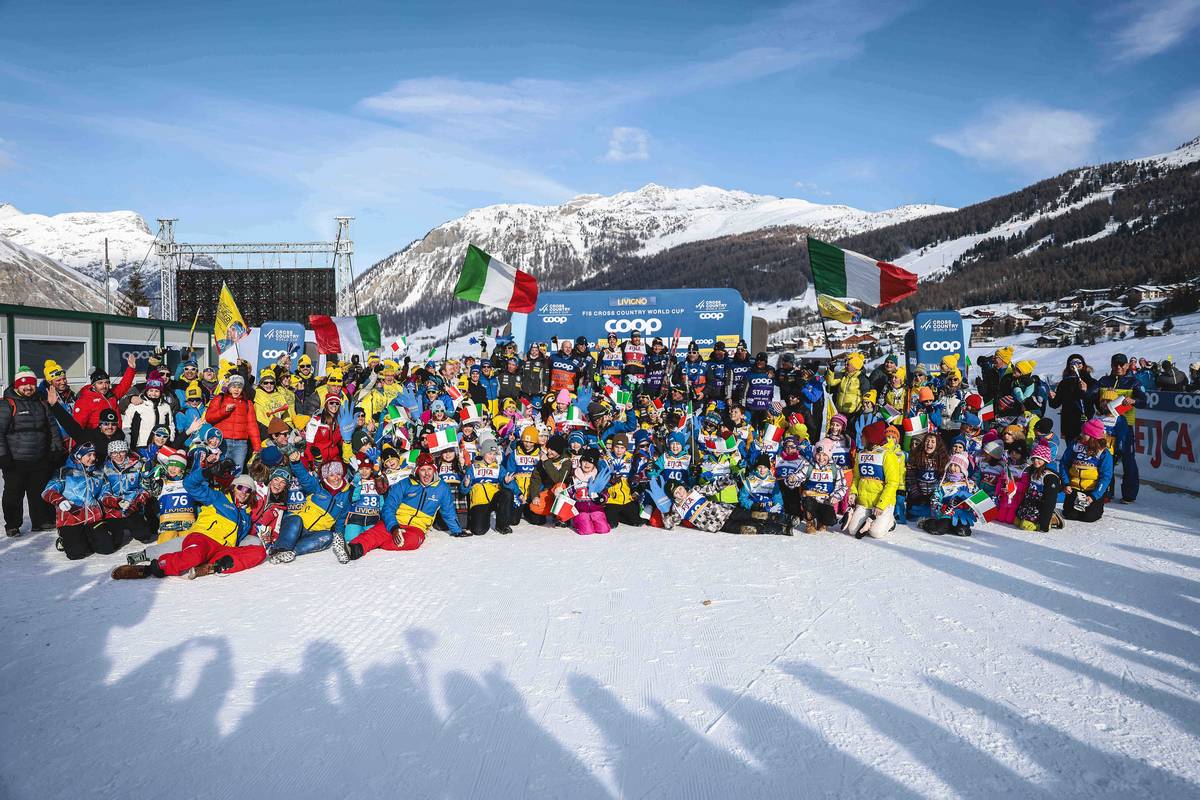
The Italians celebrate a successful World Cup weekend in Livigno, Italy. (Photo: NordicFocus).
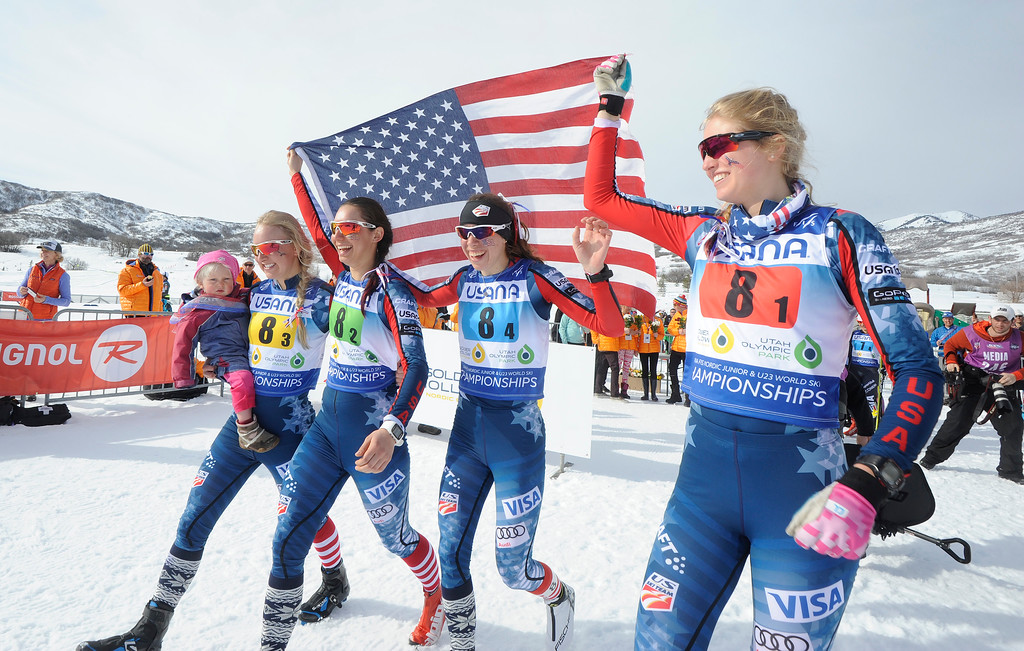
The 2019 U20 World Juniors 4 x 5 k relay first place team from the U.S. All the members of the 2019 team have qualified for U23 World Championships. (Photo: JWSC2019 / Mikaela Takala)
Following a record-setting number of athletes competing in the U.S. Nationals in Houghton last week— over 400 skiers from across the US made the trip to the Copper Country—US Ski and Snowboard has announced the selections for the US World Junior and U23 Championships, to be held in Whistler, British Columbia from January 28th-February 4th. Athlete selections have also been announced for the U18 Nordic Nation’s Cup Trip, to be held in Jyvaskyla, Finland February 17th-19th.
The sheer number of competitors at US Nationals, along with a continued trend towards more competition to make one of US Ski and Snowboard’s Development trips is a “sign that we’re continuing in the right direction,” said US Ski and Snowboard Cross Country Development Director Bryan Fish. “The showing from our U23 athletes on the World Cup to the number of U18 skiers that are competitive to make the [Nordic Nation’s Cup] trip is a sign of not only strength, but crucially, depth in our development system.”
Fish added that the competition at US Nationals—as well as diversity of clubs and regions where skiers are coming from—drives home a clear message: “If there’s one thing that we’re doing right [in US Skiing],” he said, “it’s that we’re working together.”
The 2023 Women’s Senior field rolls out during the 20 k Classic Mass Start. (Photo: FasterSkier)
U23 Team
FIS World U23 Ski Championships will take place in Whistler, British Columbia from January 28th-February 4th. The following skiers have qualified to compete in those championships:
Male
J.C. Schoonmaker (University of Alaska – Anchorage)
Gus Schumacher (Alaska Winter Stars)
Luke Jager (University of Utah)
Zanden McMullen (APU Nordic Ski Center)
John Steel Hagenbuch (Dartmouth College)
Qualified but declined:Ben Ogden (University of Vermont/SMS T2)
Female
Sophia Laukli (University of Utah)
Novie McCabe (University of Utah)
Sydney Palmer-Leger (University of Utah)
Anabel Needham (Michigan Tech.)
Kendall Kramer (University of Alaska – Fairbanks)
JC Schoonmaker during this year’s Tour de Ski. (Photo: Nordic Focus)
World Juniors Team
The FIS World Junior Ski Championships will take place from January 28th-February 4th, 2023 in Whistler, British Columbia.
Male
Adrik Kraftson (Northern Michigan University)
Anders Weiss (Montana State University)
Max Kluck (Bridger Ski Foundation)
Jack Lange (Dartmouth College)
Jack Conde (Montana State University)
Qualified but declined: Tabor Greenberg (Green Mountain Valley School)
Alternates: Luka Riley (University of Colorado), Trey Jones (Steamboat Springs Winter Sport)
Female
Samantha Smith (Sun Valley)
Nina Schamberger (Summit Nordic Ski Club)
Haley Brewster (University of Vermont)
Ava Thurston (Dartmouth College)
Rose Horning (Ski and Snowboard Club Vail)
Hattie Barker (University of New Hampshire)
Alternates: Greta Hansen (Minneapolis Ski Club), Emma Reeder (Dartmouth College)
Gus Schumacher with US Ski Team D-Team Greta Anderson and Bernie Nelson following his win in the 10 k Classic at 2020 World Juniors in Oberwiesenthal, Germany. (photo: courtesy Greta Anderson)
The FIS World U23 Ski Championships are in North America! Thinking of going to watch the best skiers of tomorrow, today, in-person? Check out Whistler’s guide to Nordic skiing here!
U18 Nordic Nation’s Cup Team
The US delegation to the Nordic Nation’s Cup will compete in Jyvaskyla, Finland from February 17th-19th.
Alternates: Lena Poduska (Jackson Hole), Delaney Jackson (Mt. Bachelor)
The U18 Nations Cup team poses with the flag in Otepaa, Estonia. Bottom row (from left to right): Annie McColgan (Mt Bachelor SEF), Kate Oldham (AVSC), Charlotte Ogden (SMS), Abigail Streinz (Craftsbury), Adriana Proffitt (Alaska Nordic Racing), Nina Seeman (SMS); Top row: Lane Myshrall (PCSS), Will Koch (SMS), Brian Bushey (GMVS), Michael Earnhart (Alaska Nordic Racing), Joshua Valentine (GMVS), Kai Mittelsteadt (Bridger SF). (Photo: Jane Mittelsteadt)
The selection criteria for World Juniors, U23, and U18 are primarily based off objective criteria, with some room for subjective discretion based on the desire of US Ski and Snowboard to fill their FIS allotment for the competition – which currently stands at 8 athletes per gender for World Junior/U23 Ski Championships, with four starting spots/gender allotted for each race. The objective criteria is primarily based on results in three different competitions: 1) the World Cup, 2) FIS points, 3) US Nationals.
Summary on how those three qualification different pathways work:
World Cup—A top 30 individual result during Period I of the World Cup (Ruka through Davos, this year) automatically qualifies an athlete for the World U23 or World Juniors team. This is a pathway primarily used by U23 athletes who are racing Period I of the World Cup.
FIS points—two results in FIS races that earn below 50 points for men, or 50 points for women, during the same period as Period I of the World Cup also serves as an automatic qualifier. This is also a pathway primarily used by U23 athletes, but one used by those who are on the SuperTour during Period I.
US Nationals—toptwo of three results at the 2023 US Cross-Country Ski Championships in Houghton, using the old World Cup point system (read how that works here), are counted towards the points total for selection. This pathway is primarily used by athletes qualifying for World Juniors. It is also the only pathway for athletes qualifying for the U18 Nordic Nation’s Trip.
US U23 Team member Sophia Laukli recently stepped onto a World Cup podium for the first time after cresting the Alpe di Cermis in 3rd place at the 2023 Tour de Ski. (Photo: Nordic Focus)
Selection Analysis
The selection criteria for U23 and World Juniors has not seen broad change for some time, but what has changed recently is just how many U23 skiers are now qualifying for the U23 Championships based on their World Cup results. Of the male contingent representing the US this year in Whistler, nearly the entire team qualified based off World Cup results, with Ben Ogden notably declining the spot he earned based on his seven top 30 individual results during the qualifying period this season. Gus Schumacher, JC Schoonmaker, and Luke Jager also qualified via the World Cup on the Men’s side, while Sophia Laukli and Novie McCabe did so on the Women’s side.
The fact that the best U23 athletes in the country are racing—and doing well—on the World Cup just reiterates something that US ski fans have been able to see for some time. This is an extraordinarily talented group of athletes able to compete at high levels at younger ages than previous generations of American skiers. That spells out progress for the US skiing development system, but what will follow from are implications on a domestic circuit that has typically centered around US Nationals as the primary means of qualifying for Junior World Championship teams. With a number of high-level skiers choosing to race in Houghton last week, it’s clear that Nationals still is an important part of the ski calendar, but this aspect of the competition is likely to be diminished as the US sees more skiers performing well on the World Cup.
One of the other unique aspects of the “trips” qualification this year is that the World U23/Junior Championships are in North America. Junior Worlds competitions so often are staged in Europe that US Ski and Snowboard has always designed its junior programming with that assumption, and with the goal of acquainting young American skiers with the travel and competition demands of competing in a primarily European sport. With Whistler being an exception to the rule for World Juniors, the U18 Nordic Nation’s Cup (to be held in Jyvaskyla, Finland) is the sole opportunity for young skiers to head to Europe to compete. It’s also worth noting that this U18 trip did not happen last year, as the Nordic Nation’s Cup was part of the wave of COVID cancellations that interrupted the European calendar last January.
Those two factors have combined to produce an unusually high number of World Juniors skiers choosing to either also race the U18 Nordic Nation’s Cup or race the Nordic Nation’s Cup instead of going to World Juniors in Whistler. That could strike some as odd at first, but there is plenty of individualized thought affecting when and where U18 skiers that are already qualifying for World Juniors should be first getting international experience, and how to balance individual goals with more domestic goals, such as doing well at Junior Nationals, in a way that captures their desires and goals in the sport.
The U.S. women’s relay after taking a historic third in the 4 x 3.3 k relay at 2017 Junior World Championships on Sunday at Soldier Hollow in Midway Utah, with (from left to right) Hannah Halvorsen, Julia Kern, Katharine Ogden, and Hailey Swirbul. (Photo: U.S. Ski Team/Tom Kelly)
1/16/23 Correction: A previous version of this article reported Ben Ogden’s club as just Stratton Mountain School T2. Ogden is also a part of the University of Vermont Ski Team.
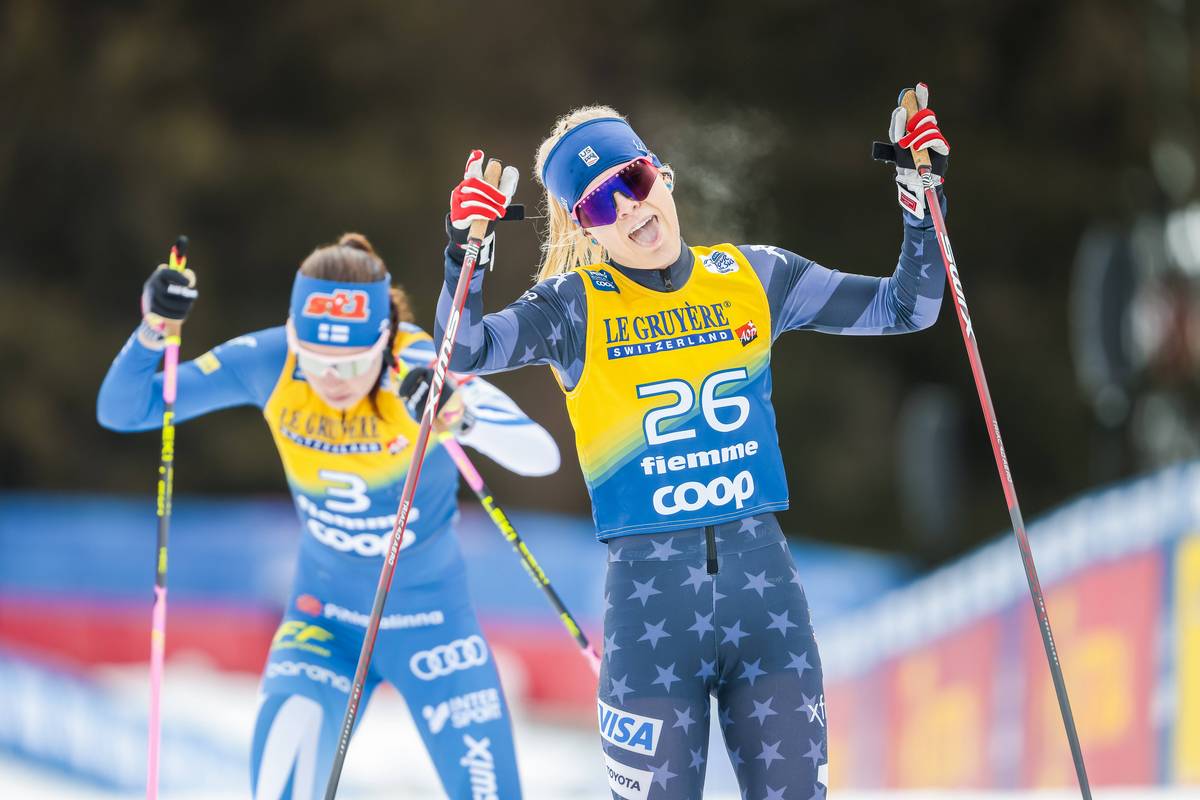
Sophia Laukli (USA) crosses the finish line on the top of the Alpe Cermis for 3rd place, her first career World Cup podium. Laukli highlighted a day in which the Americans put three in the top ten. (Photo: NordicFocus)
The Alpe Cermis
When the Grand Tour of skiing—the Tour de Ski—was dreamed up by Vegard Ulvang and Jurg Capol in 2006, one of the first definitive decisions was that it would need a Queen Stage: a stage that sought to distill the essence of ski racing—the brutal beauty of the slog—to its purest state. The Tour de France had its Alp d’Huez, and the Tour de Ski would have the Alpe di Cermis.
Through seventeen editions of the Tour de Ski, the climb of Alpe di Cermis has become nothing less than iconic in Nordic Skiing. This is where Therese Johaug and Marit Bjoergen cemented their legends in tandem, year-after-year, battle-after-battle, racing up the fall line. This is where Johannes Hoesflot Klaebo lost the 2020 Tour to Alexander Bolshunov on the final day. Martin Johnsrud Sundby, Petter Northug, Dario Cologna, Jessie Diggins, Heidi Weng: all have played prominent roles in past hill climbs. In 2015, it’s where Liz Stephen notched a 5th place, and kicked off the breakout World Cup season for the American women, culminating in the team’s first ever distance World Championships medals (That Falun 10 k where Jessie Diggins and Caitlin Gregg were 2nd and 3rd).
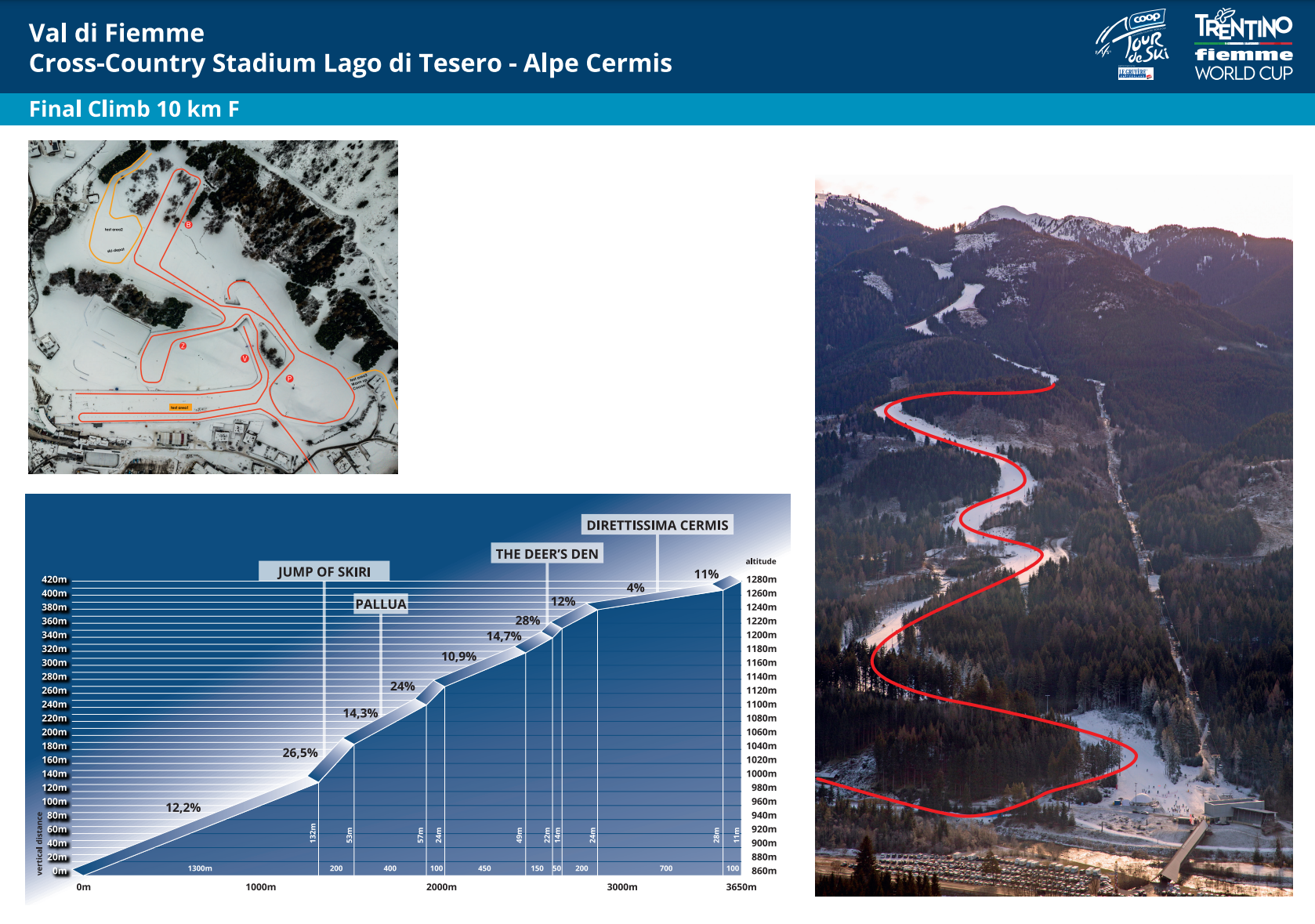
Course Profile for Tour de Ski Stage 7 at the Alpe Cermis. (Photo: Fiemme World Cup)
The Alpe is the culmination; it is also the main event. Things were no different for this year’s Tour de Ski. On the women’s side, Frida Karlsson hoped to arrive at the summit in possession of the Yellow Bib. On the men’s side, Klaebo looked to do the same, but with ghosts of Alpe’s past haunting his each and every stride. Both Karlsson and Klaebo had dominated over the course of the first six stages, but both, remarkably, remained vulnerable. Karlsson (2:31:16.0) held an advantage of 1:12 over second place Tiril Udnes Weng, while Klaebo carried a 1:02 advantage over second place Calle Halfvarsson in the men’s field. Simen Hegstad Krueger—winner on the Alpe in 2021—held fifth place overall at 1:45 back. In a normal ski race, those margins would have all but guaranteed victory for the leaders. But in a race up the Alpe de Cermis—where the final kilometers stretch out time gaps with every meter gained—no lead is ever safe.
The American woman hold up Sophia Laukli after her 3rd place finish on the day. The Americans had three in the top ten, as Laukli was joined by Jessie Diggins in 5th and Rosie Brennan in 6th place. (Photo: NordicFocus)
Laukli Highlights Women’s Race with First Podium
Sophia Laukli spent the past year seeking out the most challenging propositions in endurance sports, and learning to make them her specialty. Last year on the Alpe, she recorded a 5th place finish alongside teammate Novie McCabe in 7th that marked a definitive breakout. Already then, the goal was set. Return to the Alpe in 2023, and seize it. In the interim, she has run and skied her way to the top of climbs around the world, winning the Lysbotn Opp rollerski climb last July ahead of Heidi Weng and Delphine Claudel, who were 1st and 3rd up the Alpe, respectively, last year. Through highs and lows in this Tour, she was able to keep sight of her “big goals for today” as she put it in post-race comments.
When it comes to the unexpected, however, one can only prepare just so much: “Right before the climb started, I got tripped up and lost all the positions I had made up [by working the flat section],” she said. “I was back to being in the back of the pack going into the climb.”
Her experience on the climb told her two things: “Tactically, it’s very difficult to pass people, and [the Alpe] is a long climb.” Laukli held it together. She found her teammates, Jessie Diggins and Rosie Brennan, climbing in 5th and 6th place through the crux of the Alpe. Laukli held her emotions in check, saying she, “[didn’t go] full-on panic mode, and [it] saved me today.” There was poise. There was patience. And there was also a whole lot of power. It appeared impossible that she could climb back to the podium, and yet Sophia Laukli had taken that word and controlled it: it was impossible how well she was skiing.
That fact became most apparent in the final 200 meters of the race. Having begun the day at the back of the pack, Laukli had raced herself into position to stand on the podium for the first time in her World Cup career. None of that would come easy; she crossed the finish line and folded over in the snow. Five minutes later, she stepped onto the podium in third place. The 22 year old Maine native, and current University of Utah skier, became the first of her new generation of American women to achieve that milestone.
Jessie Diggins (USA) hugs Sophia Laukli (USA) on top of the Alpe di Cermis. (Photo: NordicFocus)
In the end, Laukli’s finish was just 35.7 seconds behind French climbing specialist Delphine Claudel. Claudel entered the steepest sections of the climb behind Frida Karlsson, the overall leader. At a hairpin 1.5 k from the finish, a brief tangle between Karlsson and Heidi Weng allowed Claudel to establish a gap, and Weng was the one who followed. But none were able to surpass Claudel at the finish line where the Frenchwoman claimed her first World Cup victory, and her first win on the Alpe di Cermis.
Delphine Claudel (FRA) crosses the line for the first World Cup win of her career atop the Alpe di Cermis. (Photo: NordicFocus)
For her part, Laukli seemed to search beyond herself to explain her astounding performance. “I lucked out I guess,” she said. “My tired was less than other people’s tired, and so it was enough.” Laukli’s achievements on the day could have overshadowed what other American women accomplished: one of the team’s best days ever, putting three in the top ten. There was the tenacity of Jessie Diggins, pushing to the front of the race early on in the Alpe climb, working “through disappointments but never losing belief” as she would say after the race. Then through the middle part of the climb, Rosie Brennan had joined Diggins, pushing to improve her Overall 5th place standing on the day. It all came together: “[It felt surprisingly] nice and comfortable,” Brennan said. “Usually [on the Alpe], you are alone and work on just keeping a rhythm, but today is was like ‘now I gotta stay with them.’” The American women had come together for the toughest test in ski racing.
Jessie Diggins (USA) and Rosie Brennan (USA) push up the Alpe Cermis together, finishing 5th and 6th on the day. (Photo: NordicFocus)
As Laukli pushed for third, Diggins and Brennan stuck together to finish fifth and sixth on the day. Brennan moved up to fourth Overall, her best Tour de Ski overall finish ever. “[The World Cup] has been a hard start for me this year, and I’m starting to come around. [This Tour de Ski] was a good sign for the future.”
With her race today, Jessie Diggins moved up to 11th Overall in this year’s Tour de Ski. Diggins commented that she is “more proud of how I handled this Tour than any other one. I just didn’t stop believing and kept going. Now it’s time to recover, and keep training.”
Diggins did add that she would undertake some post-race evaluation on how she was recovering: “I’m not 100% sure when my next race will be,” she said.
Karlsson won the 17th edition of the Tour de Ski with a 15th place finish on the Alpe, remaining 33 seconds ahead of Niskanen and Tiril Udnes Weng. The finish culminated a week in which Karlsson continuously bolstered her reputation as the dominant distance skier in the women’s field. Karlsson’s win also marks another milestone for the current generation of Swedish women skiers, delivering the first Overall Tour de Ski win since Charlotte Kalla won in 2008.
Krueger Wins Day, Klaebo Wins Tour in Men’s Race
Johannes Hoesflot Klaebo lifts his 3rd Tour de Ski trophy of his career. (Photo: NordicFocus)
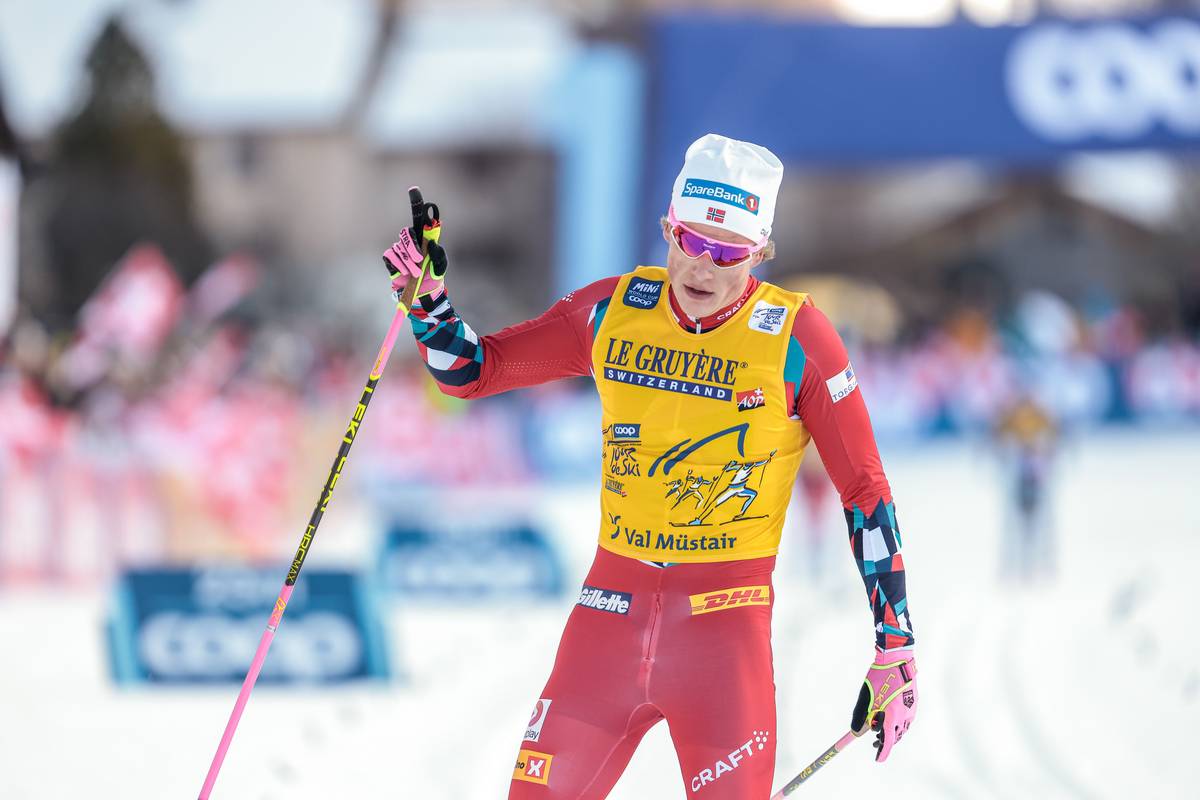
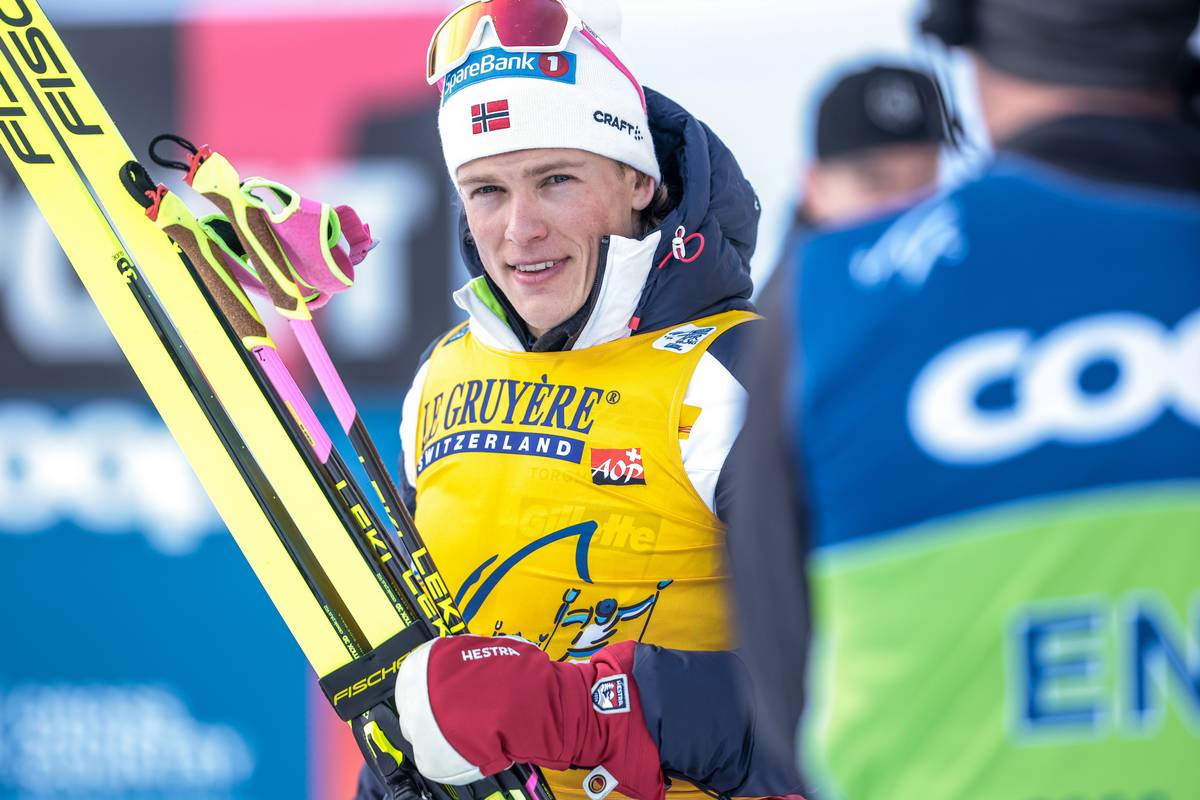
Part of the emerging legend of the Alpe Cermis is that it has been the only arena capable of diminishing the otherwise-unstoppable force of Johannes Hoesflot Klaebo. Klaebo entered the day having won all six of this year’s Tour de Ski previous stages, another of the many accomplishments that only he can claim in the sport of skiing. Even so, there was almost no speculation that Klaebo would make this year’s Tour a clean sweep with a win on the Alpe di Cermis. The Alpe has made appear Klaebo human before; it would most likely do so again.
The lingering question was whether he could avoid a repeat of 2020 when Alexander Boshunov and Sergey Ustigov successfully wrested the yellow bib from Klaebo on the climb. With previous Alpe di Cermis winner, Simen Hegstad Krueger, in fifth place—1:45 behind Klaebo—there was still a possibility that the climb could prove to be Klaebo’s undoing yet again.
That possibility turned into real tension when Krueger initiated a move at the base of the climb, opening a gap in the field. A group of Norwegian men quickly formed, but without Klaebo. Sjur Roethe, Hans Christer Holund, and Didrik Toenseth moved up with Krueger. Klaebo was still within reach, but his lack of push to stay with the field indicated a concession from him; he would let the climbers go and focus on keeping the yellow bib on his back at the finish.
Klaebo, wearing the yellow bib, in behind the lead pack of his countrymen at the base of the Alpe Cermis climb (Photo: NordicFocus)
Krueger set a blistering pace up the steepest sections of the climb, dropping both Toenseth and Roethe (last year’s Alpe winner). Hans Christer Holund was the only one up to the task of marking Krueger, with Krueger doing the bulk of the work as he searched for seconds on Klaebo. Between the 8 k and 9 k mark, Krueger trimmed 47 seconds from his 1:45 gap to Klaebo. The math was evident: it would be hard, but not impossible, for Krueger to win the Tour. The aggressive push from Krueger meant that some of those who had tried to keep with him didn’t just lose touch with the pack when they went, but really fell off. That allowed skiers who had been more conservative through the early section to challenge for the final podium spot, including Frenchman Jules Lapierre and German Friedrich Moch. Klaebo kept to himself through their machinations, and Lapierre soon had established a gap over the other challengers.
In the end, Krueger crossed the finish line only five seconds ahead of Hans Christer Holund to win the Alpe for a second time. The Frenchman Lapierre crossed with the most emphatic celebration on the day: his first World Cup podium. Krueger’s celebration was perhaps a bit subdued: he had looked back to find that Klaebo had put in a remarkable second effort over the final kilometer. The Alpe, it turned out, did manage to expose Klaebo’s humanity, but the struggle also revealed his character. A skier who appears so often to win by virtue of talent and tactics earned a special victory today by racing with his heart.
Simen Hegstad Krueger crossed the finish line in first in his 2nd career win on the Alpe Cermis climb. Krueger moved up to 2nd place in this year’s Tour de Ski. (Photo: NordicFocus)
Part of the Alpe’s legend is in posing a challenges to skiers, but it also appears that the Alpe di Cermis has a sense of justice. Klaebo has clearly been the best skier in this Tour de Ski; with his third Overall victory, he moves a step closer to becoming its most successful skier of all time. That he has not already notched that title speaks to both his youth (we often forget how young Klaebo is), and to the prowess of the skier he chases: Dario Cologna, who during his career earned four Tour de Ski titles.
Scott Patterson finished 14th on the Alpe Cermis, earning the distinction of top American on the day. (Photo: NordicFocus)
Behind the Norwegian battle at the top of the Alpe Cermis, the American men were busy continuing their steady climb toward the top of the World Cup. Scott Patterson was the top finisher for the Americans, finishing 14th in his second climb of the Alpe (he was 38th last year). Patterson said in post-race comments that the result marked a high point for him at this Tour de Ski, and that he is, “looking forward to the focus on the longer races later in the season,” including the 50 k in Holmenkollen.
Ben Ogden was the top American finisher in the Overall Tour de Ski standings, finishing 13th after a 24th place finish in his first climb of Alpe di Cermis.
Ben Ogden, the top-placed American man in this year’s Tour de Ski at 13th Overall. (Photo: NordicFocus)
Conclusion to the 17th Tour de Ski
With that, the 17th edition of the Tour de Ski comes to a close. World Cup Skiing departs the slopes of Alpe di Cermis, leaving more stories etched in the snow on each steep hairpin. It reminds us once again of all that makes ski racing beautiful when the time is right, when the skiers are prepped, and when and all of our eyes watching.
The World Cup takes a collective rest for the next two weeks, before resuming in Livigno, Italy on January 21st. From all of us at FasterSkier, thanks for following along for another edition of the Tour de Ski!
The American men at the top of the Alpe Cermis. (L-R) Gus Schumacher, Ben Ogden, Finn O’Connell, Scott Patterson, and Hunter Wonders. (Photo: Tom Horrocks/USSS)
This World Cup coverage is made possible through the generous support of Marty and Kathy Hall and A Hall Mark of Excellence Award. To learn more about A Hall Mark of Excellence Award, or to learn how you can support FasterSkier’s coverage, please contact info@fasterskier.com.
Ben Ogden during Stage 5’s classic sprint in Val di Fiemme, Italy. Ogden made waves with his semifinal tactics. (Photo: Nordic Focus).
Ben Ogden was going to risk it . . . This season, the young American skier has made a rapid push in World Cup sprints, twice racing to the verge of finals in Beitostolen and Davos. In boot throws, final sprints, pushes big and small he has come to understand the agony of inches. When he lined up for today’s Stage 5 Classic Sprint in Val di Fiemme, Italy, Ogden knew the trial was here again. Standing at the starting line of another World Cup sprint semifinal, he looked to his right and saw Johannes Hoesflot Klaebo, this year’s leader of the Tour de Ski. Klaebo seemed all but guaranteed to win today: he has never lost a Tour de Ski sprint. Never. And he has done so with the careful mix of easy tactics and better-than-anyone finishing sprint that has become his signature mode of racing. Ogden’s options were clear: he could either let this heat fall into that familiar, Klaebo-dominated mode—well-worn and always with the same result—or he could try and blow it up.
Ogden chose the latter. “[If you] go crazy hard [in the semi-final] all you have to do is make the top four,” he said in post-race comments. The field left the stargint line at a slow pace; Calle Halfvarsson (SWE), Simone Mocellini (ITA), Johan Haeggstroem (SWE), and Sindre Bjoernstad Skar (NOR) allowing Klaebo to settle in. Ogden simply said, “Alright, I’m at least going to try.” Soon after the starting tracks were behind him, Ogden scrambled to the front, unleashing everything he had. He opened up a gap on the field; in a sign that Ogden had taken the field by surprise, Johannes Hoesflot Klaebo quickly scrambled through the pack to catch up. As they began striding up the only true hill on the Val di Fiemme course, Klaebo broke into his signature run. He was having to work for it; Ogden had caused a rift. “When we rounded the top of the hill, I looked back and it was just me and the king,” said Ogden. “That’s when I thought that maybe it could work.”
The bulk of the Val di Fiemme course is a long, gradual downhill, culminating in a sharp left at the end of a small rise. In a final push, Klaebo made it through that the gap first, and order was restored after the chaos Ogden had caused: Klaebo first into the finals, followed by Halfvarsson and Simone Mocellini (ITA). Ogden lost a 4th place sprint to Haeggstroem for the final lucky loser spot, which would go to the 3rd and 4th place finishers from the heat Ogden had taken out so fast.
After an early stumble in this semifinal, Sindre Bjoernstad Skar (NOR) had watched this most exciting heat from the best seat in the house (the back of the field), saying of the tactics that Ogden had, “Tried to rob the bank, and forgot the money.” Ben Ogden: American outlaw.
Ben Ogden after falling just short of Finals again. “You’re crazy!” said Calle Halfvarsson of Ogden’s bold tactics in the semifinal. (Photo: Nordic Focus).
“Johannes [Klaebo] gave me a fist bump,” said Ogden. “Calle [Halfvarsson] just said, ‘You’re crazy,’ but I’m going to keep trying everything. You have to try everything.”
Men’s Sprint Final: Klaebo on Top Again
Klaebo delivered that fist bump on his way to the Final, where it seemed his trial in the semi-final had made a lasting impression. As the starting tracks gave way to scrubbed snow, Klaebo moved to the front of the pack, uncharacteristically controlling the race from the beginning. It almost seemed like an afterthought as Klaebo sped through the stadium for the win, followed by Halfvarsson 2nd, and Mocellini 3rd.
Johannes Hoesflot Klaebo (NOR) sprints ahead during Stage 5 of the Tour de Ski in Val di Fiemme, Italy. (Photo: Nordic Focus).
Cyr to Finals with Americans by his side
What stood out during the day’s racing was who filled in the gaps. Next to Klaebo in the Final was a Canadian—Antoine Cyr—challenging for a podium for the first time since Alex Harvey had wound down his career with a 3rd place finish in Lillehammer, 2018. In progressing to the Final, Cyr had lined up in both the quarterfinal and semifinal alongside Zak Ketterson (USA) who had advanced to World Cup sprint heats for the first time. Ketterson said in post-race comments that he was determined to not let that milestone dictate his racing. “My plan was to not be timid at all.”
Indeed, both Cyr and Ketterson controlled their heat through the early going, avoiding a stumble that tripped up the highest qualifier in the heat, Frenchmen Jules Chappaz. Ketterson looked to lead into the stadium, but made a mistake going into the sharp left on the last hill. “I got caught up and lost all my speed going into the stadium,” he said, referring to a moment where he moved to the inside and found Italian Francesco De Fabiani claiming that track. Cyr stayed out of the fray, and was able to show an impressive finishing sprint to win the heat. Ketterson’s race, in retrospect, showed early signs of the tenacity that Ogden would later demonstrate. It was a promising indication that the Minneapolis native could potentially join the ranks of Americans challenging at World Cup sprints.
Zak Ketterson (USA) and Antoine Cyr (CAN) taking out their quarterfinal in Val di Fiemme. (Photo: Nordic Focus).
In the semifinal, Cyr again led in the early going alongside another North American, JC Schoonmaker (USA). The pair were challenged by Frenchmen Lucas Chanavat, who quietly executed a perfect push into the stadium and got out in front of the field to take the first spot. That left Schoonmaker and Cyr to sprint for which nation would put a man into a World Cup sprint finals again. Schoonmaker started out with the advantage in the stadium sprint, but it soon became apparent that Cyr had the edge. He passed Schoonmaker 10 meters from the finish, and made his first World Cup Final, the first for a Canadian since that 3rd place for Harvey in 2018.
Antoine Cyr (L) and JC Schoonmaker (R) sprint for a place in the Finals behind semifinal winner Lucas Chanavat (FRA). Cyr won the sprint and advanced to the final. (Photo: Nordic Focus).
The skiing of the North American men was a factor that shook up the Tour de Ski Overall standings, too. Until today, this year’s Tour had remained deceptively close. Despite Klaebo’s dominance through all stages—winning every race—his overall lead was slim due to bonuses and his own racing style. Federico Pellegrino (ITA) and Paal Golberg (NOR) were both less than 15 seconds back from Klaebo for the yellow bib, with Pellegrino looking to close with a sprint today. Instead, Pellegrino found himself in a quarterfinal sprint with JC Schoonmaker, and there is no other way to write it; Schoonmaker outsprinted the Italian. Golberg too, found himself in a heat with the other Canadian qualifier on the day, Graham Ritchie, and Ritchie’s aggressive tactics led to a bunch sprint that the World Cup Overall Distance leader just couldn’t master. With skiers occupying the 2nd and 3rd overall placings out in the quarterfinals today, Klaebo had an open opportunity to seize a gap of over a minute (the winner received a 60 second time bonus in the Overall today). He did just that.
Thus, the story on the day was North Americans advancing through the World Cup in their own distinctive way. In the cold and snow of the Italian Alps, they seemed to display a spirit, a tenacity, a dynamism usually associated with the deserts and dust of movie westerns. Through good, bad, and even ugly they pushed forward, shaking up this year’s Tour de Ski, and the World Cup too.
Antoine Cyr (CAN) qualified for his first sprint finals during Stage 5, the first Sprint Final for a Canadian since Alex Harvey (CAN) in 2018. (Photo: Nordic Focus).
This World Cup coverage is made possible through the generous support of Marty and Kathy Hall and A Hall Mark of Excellence Award. To learn more about A Hall Mark of Excellence Award, or to learn how you can support FasterSkier’s coverage, please contact info@fasterskier.com.
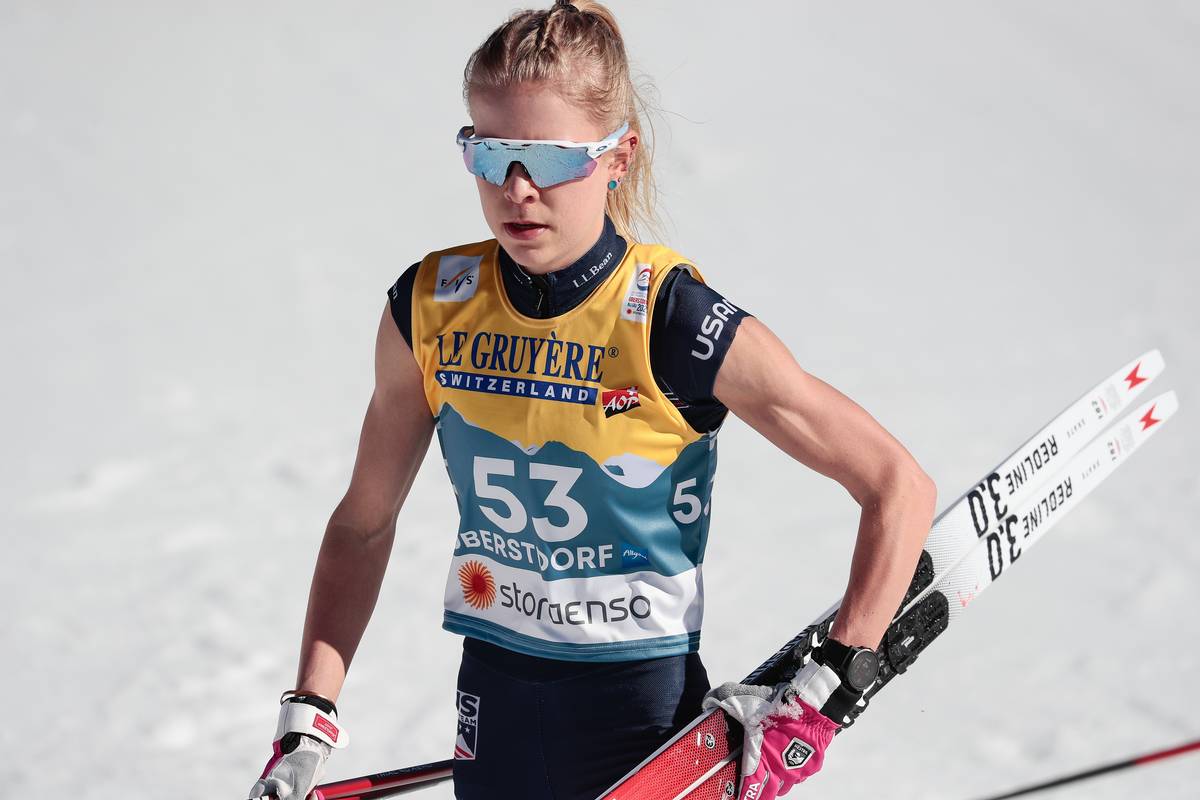
Gus Schumacher (USA) strides on his way to a 15th place finish in Stage 3 of the Tour de Ski in Oberstdorf, Germany (Photo: Nordic Focus).
Gus Schumacher crossed the finish line, and started a long skidding stop. His skis chattered as klister gripped in spots and bits on the transformed, re-frozen snow at Oberstdorf, Germany. Finally, he came to a stop in front of the leader’s chair. Schumacher had raced brilliantly—improving his overall position from 62nd to top 20 in the Tour de Ski—but the look of happy astonishment on his face was not due to his own performance, but to the identity of the occupant of the leader’s chair at the side of the finish corral: his teammate, Ben Ogden, sat perched there in the chair—smiling broadly, cool as ever, throwback Oakley’s and all.
Ben Ogden (USA) sits in the leader’s chair after crossing the finish line early on in Tuesday’s 10 K classic individual start action. (Photo: Tom Horrocks/US Ski and Snowboard).
“It almost didn’t feel right,” Ogden said on sitting down in the leader’s chair during the 10 k individual start classic race that wound itself around three laps of Oberstdorf’s 3.3 k course. The leader’s chair is reserved for those who sit atop the World Cup field: that’s the sort of thing that would’ve been a dream for Ogden. After today, those sorts of dreams are a bit closer to reality.
Ogden started his race with an auspicious 2 k checkpoint where the 23 year old Vermonter was 10 seconds up on a field. Five kilometers later—the checkpoint at roughly 7 k—his lead had come down to two seconds, but when Ogden finally powered into the stadium, he had closed his race with determination. There was no doubt where he stood in the early standings—there were 27.8 seconds between Ogden and 2nd place—but there were many more racers still to come . . .
The perennial powerhouses of the men’s World Cup were slated to start later in the race. Paal Golberg, the Overall leader, wore bib 42. Johannes Hoesflot Klaebo, the Tour de Ski Leader, started a minute and a half after that wearing bib 45. Ogden and Schumacher pulled up the live timing and waited for the perspective to be gained, for the whole picture to come into view. What was apparent, though, as Schumacher’s time popped up as 2nd behind only Ogden, and Hunter Wonders soon finished to slot in between them in 2nd place, was that the American men were having a great day. Just how great would have to wait, would have to be tempered by the Norwegian race playing out behind them.
Golberg was the leading edge of that piece of the picture. He was in a dead heat with Ogden through the 2 k checkpoint. Thoughts that Golberg would open a gap later in the race could have been excused: he is the Overall leader of the World Cup this year, and in the finest form of his racing career. Today, though, the checkpoints through the race indicated a dead heat. By 8 k, Goldberg held the lead by just two seconds over Ogden. As Golberg sprinted across the line he had only managed to gain a single second more: 1st) Paal Golberg, 2nd) Ben Ogden +3.1 sec.
Paal Golberg (NOR) crosses the line during Tuesday’s action. Golberg finished 5th place on the day. (Photo: NordicFocus).
That Klaebo was quickly coming through behind Golberg—and opening a gap over the second half of the course—seemed like an afterthought. It is almost easy to overlook the astonishing nature of Klaebo’s racing, even when he appeared sure to win the race by the time he passed the 6 k checkpoint with an 11 second gap over Golberg and Ogden. By 8 k that gap had expanded to 20 seconds. At the finish, Klaebo’s winning margin extended to 28.3 seconds over 2nd place Golberg.
A little further down the start list, a few more of the perennial favorites filed in with results. Simen Hegsted Krueger (NOR) split the difference between Klaebo and Golberg, and finished in 2nd place +12.4 seconds off of Klaebo’s 21:38.5. Didrik Toenseth (NOR) and Calle Halfvarsson (SWE), wearing bibs 60 and 64, soon bested Golberg as well, with Toenseth rounding out the podium in 3rd place +22.4 seconds, and Halfvarsson in 4th place +24.9 seconds.
An all-Norwegian podium on Stage 3 of this year’s Tour de Ski. 1st) Johannes Hoesflot Klaebo, 2nd) Simen Hegstad Krueger, 3rd) Didrik Toenseth. (Photo: NordicFocus).
When the whole picture came together, the full extent of what the Americans had achieved on the day was realized. Ben Ogden—who up until this point has made his progress through the World Cup field primarily through his Sprint results—had the best result of his young career, coming in 6th place. Hunter Wonders had the best result of his young career too, finishing in 11th place on the day. Gus Schumacher turned in a 15th place finish, and Scott Patterson finished in 29th place. Americans had 4 men in the top 30: that’s quite a day.
That team accomplishment strikes a particular chord given the conditions in Oberstdorf. Skiing is always a team effort, but on some days, the team becomes every bit as important as the effort. With the abrasive, warm conditions that confronted the World Cup today— with the pastures of Bavaria looking like the month of July—classic technique racing becomes a coordinated dance of a team of techs, coaches, athletes, and racers. As Gus Schumacher said in his post-race comments, “When the skis are running this [well], everything else is secondary.” For the Americans to have one of their best days ever will be viewed in that context. An accomplishment which speaks to the heart of a program that has pioneered emphasizing the holistic work required for individual results on the sport’s highest level.
That US team will now turn towards the opportunity to do some skiing together on Stage 4 tomorrow, where a pursuit start awaits with a 20 k Skate on the same man-made loop in Oberstdorf. As the US men look to hold onto places gained in the pack, Tour de Ski leader Johannes Hoesflot Klaebo will look to expand his lead over 2nd place Golberg, a lead that currently stands at 37 seconds through three stages of racing. Simen Hegstad Krueger is just three seconds behind Golberg in 3rd place overall, with Didrik Toenseth in 4th place at 57 seconds back.
In the meantime, across the American continent today, many skiers will be echoing the feelings of Ben Ogden on Stage 3 today: “It was a real treat,” he said. “A ton of fun.”
Ben Ogden (USA) competing in Stage 3 of the Tour de Ski in Oberstdorf, Germany. Ogden had a career-best 6th place finish on the day. (Photo: NordicFocus)
This World Cup coverage is made possible through the generous support of Marty and Kathy Hall and A Hall Mark of Excellence Award. To learn more about A Hall Mark of Excellence Award or to learn how you can support FasterSkier’s coverage please contact info@fasterskier.com.
Johannes Hoesflot Klaebo (NOR) strides solitary at the front of Stage 2 of the Tour de Ski in Val Mulstair. (Photo: Nordic Focus).
There’s Johannes Hoesflot Klaebo, and then there’s everyone else: that’s what was proven in Sunday’s 10 k Pursuit at the Tour de Ski in Val Mustair, Switzerland.
There were the usual darts, pushes, and pulls in the Men’s pursuit field that started in an order derived from yesterday’s individual skate sprint results. Eyes were on which Norwegians—Paal Golberg, Hans Christer Holund, Didrik Toenseth, and Sjur Roethe—would shoot through the pack after finishing down in yesterday’s rankings. Iivo Niskanen (FIN) was sure to do what he does best: classic ski. The American Ben Ogden would look to hold onto a strong position for the Americans.
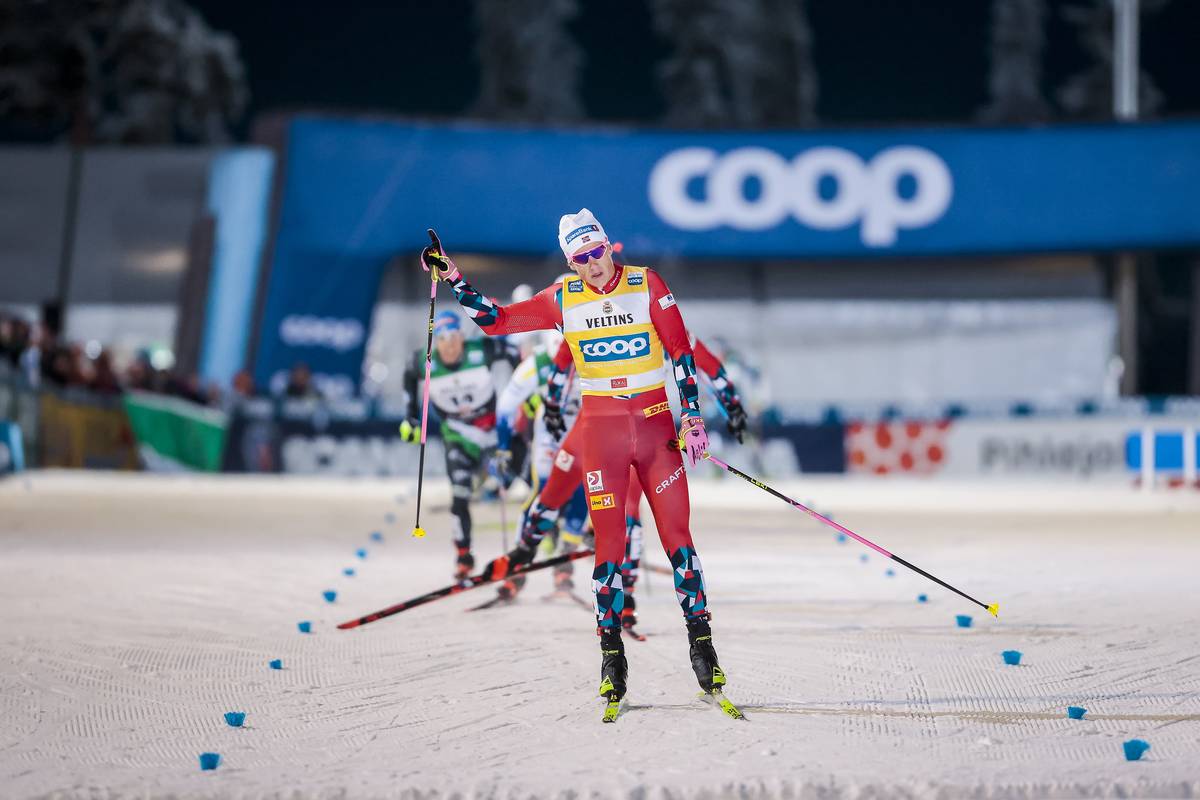
That all did happen, but it all happened in a different frame from that of the race leader. Johannes Hoesflot Klaebo started with a seven second gap on Federico Pellegrino, and then just kept it. There wasn’t any bunch sprint at the end, there wasn’t any jockeying on the race course, there was just Klaebo, putting pole plant after pole plant into the Swiss snow, eclipsing an entire field of the world’s best, gliding across the finish line with a 10 second gap, and then looking back. For a moment in the finishing pen, Klaebo just leaned on his poles. Skiers fought and threw themselves across the line to gain a place. They collapsed in heaps. They staggered through the back-pats and high-fives of post-race camaraderie. Klaebo was just there, the setting sun casting a shadow over his shoulder that may well have been an eclipse over the entire the field. He eventually made his rounds, shaking hands and offering congratulations. But there was a moment where it seemed that the athlete who’s spent his career charging towards skiing history—he tied Petter Northug for Tour de Ski stage wins with his 13th today—couldn’t help but sense the extraordinary place he occupies.
With his win in Sunday’s Pursuit, Johannes Hoesflot Klaebo (NOR) tied Petter Northug (NOR) for the most Tour de Ski Stage Wins (13) . (Photo: Nordic Focus).
Men’s 10 k Pursuit
Golberg is still the Overall Leader of the World Cup this year after Klaebo’s absence through parts of Lillehammer and Beitostolen in Period I; if Klaebo is to re-take the overall lead, he will need to wrestle it away from Golberg’s top form. After an 8th place finish yesterday, Golberg started 20 seconds behind Klaebo, with the sprint specialists of yesterday placed between them. Through the early-goings of the 10 k pursuit, the main chase pack held firm with the top sprinters of yesterday. Most notable among them was Federico Pellegrino, who started in Bib 2 today and had a comparatively small seven second gap back from Klaebo at the start. Pellegrino never challenged Klaebo, but he did remain off the front of the chase group that included Richard Jouve (FRA), Michal Novak (CZE), and Sindre Bjornstad Skar (NOR) for much of the first half of the race.
Ben Ogden (USA) in the main pack during Stage 2 of the Tour de Ski. Ogden finished 18th on the day. (Photo: Nordic Focus).
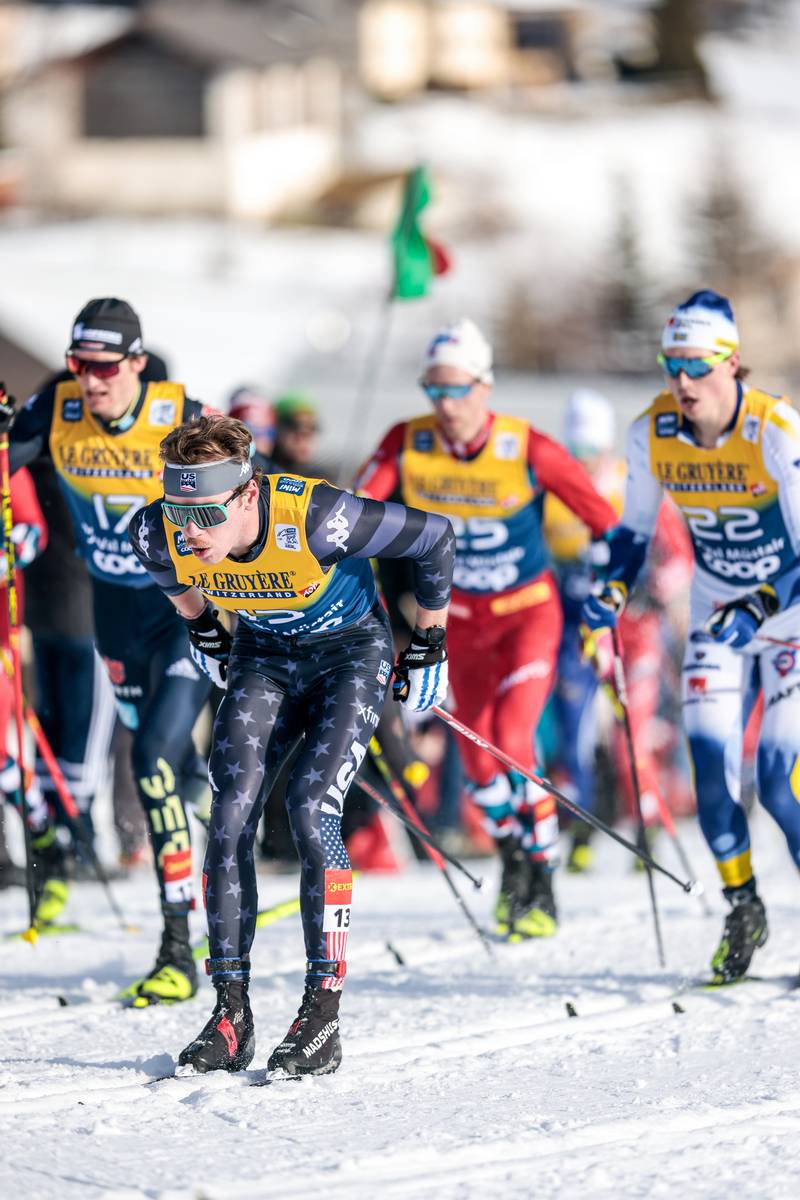
Golberg, wearing bib 9, had started out in the front of what quickly coalesced into the main peloton of the race in the first couple of kilometers. This pack was where the main action that will set the Tour de Ski up for its latter stages took place. The skiers that will be looking forward to the 10 k/20 k combination of races in Oberstdorf for Stage 3 and Stage 4, and who can look behind at the Stage 1 Sprint wishing they had a bit more punch, weaved their way through in this main group to set themselves up for stronger starts in the racing to come. That included Simen Hegstad Krueger, who moved up from 18th to 4th place on Stage 2, Martin Loewstrom Nyenget who moved from 42nd to 6th, Hans Christer Holund from 48th to 9th, Didrik Toenseth from 25th to 10th, and Iivo Niskanen from 57th to 14th. Notably, some Americans were able to make similar jumps further down the pack, with Scott Patterson moving up from 94th to 59th and Hunter Wonders moving up from 80th to 53rd on the day.
At around the 4.5 k mark, Golberg started to make his move from this main group to the chase group containing the sprint specialists Jouve, Novak, and Pellegrino. No one followed the Norwegian, and Golberg’s joining the chase group seemed to transform it from a chase group to the Golberg group—with some of the best lead-out men in the World. Over the second half of the race, Golberg controlled the chase pack as he fought to reel in Klaebo. His pace-setting soon broke Jouve and Novak, but with the persistent and ever-inspiring grit that has defined his season so far, Federico Pellegrino stuck onto Golberg’s every move. As the kilometers stretched out, that little fact began to grow in its importance, as the two skiers closed in on the finishing sprint; back in Pellegrino’s realm.
When Golberg and Pellegrino did enter the stadium for the final time, they were locked in next to each other. Everyone in the stadium, including the victorious Klaebo, could turn and be treated to a genuinely exciting sprint for 2nd where Pellegrino moved out from behind Golberg, put in a kick, and then saw the Norwegian somehow counter. A boot’s throw from both skiers initially looked as if Pellegrino had been successful, but upon review, Golberg was given the 2nd place nod, as Pellegrino hung on to claim a 3rd place podium finish in a distance race. Something that is worth italicizing for its novelty at this point in the sprinter’s career.
Paal Golberg (NOR) and Federico Pellegrino (ITA) sprint for 2nd place. Golberg won the boot toss, and Pellegrino finished 3rd. (Photo: Nordic Focus).
The Italians kept the finish line exciting from there as well, with Francesco De Fabiani soon coming into the stadium in battle with American Ben Ogden. Ogden started 13th place on the day, and had kept his position in the main pack well as the powerhouse distance skiers of the World Cup sought to move to the front of the field today. De Fabiani and Ogden came into the stadium looking for 17th place, and were willing to go all out for it right to the line. In the end, the Italian won this round of the boot throw, and Ogden came away from two days of racing in this year’s Tour in 18th place. “For many Americans the threshold for an average race is starting to change,” Ogden said. “That said, we are still hungry and place emphasis on the process rather than the result. That way through thick and thin we are still learning and getting better every day. Everyone here has long term goals well beyond the top 30 and I am really proud that many are making forward steps.”
The Tour de Ski gets its first rest day tomorrow, as the circuit travels from the Swiss side of the Alps to the German side in Oberstdorf for Stage 3: 10 k Individual Start Classic. The sun has set on Val Mustair, the shadows cast on the skiers all clumped together and entangled but for one: the solitary figure of Johannes Hoesflot Klaebo, looming large.
Previous Coverage of this year’s Tour de Ski: Stage I
Federico Pellegrino (ITA) leading the chase group mid-way through Stage 2 of this year’s Tour de Ski. The Tour de Ski finished in Val Mustair, and now heads to Germany for Stage 3 on Tuesday. (Photo: Nordic Focus).
The FIS instituted an overhaul of the points system used to determine the best individual skier in the World. We’re already seeing the consequences.
Johannes Hoesflot Klaebo (NOR) crosses the finish line in Ruka, Finland while wearing the yellow Overall World Cup leaders bib. (Photo: NordicFocus).
Johannes Hoesflot Klaebo had won all three races of the World Cup’s opening weekend races in Ruka. Any offseason doubts spurred by reports of his injuries or independent training practices went away. He was still the best skier in the world. Then, the following Friday in Lillehammer, illness forced Klaebo to sit out a 10 k skate race. His teammate Paal Golberg took over the World Cup overall lead with a 6th place finish. Klaebo returned the next day to handily win the sprint race: usually, that would mean he would return to the top of the World Cup standings, and that he would start Sunday’s 20 k classic in the yellow overall leader’s bib (which he would likely continue wearing for weeks to come. Instead, Klaebo declared the season over. “I gave up the opportunity to win the World Cup overall when I did not start yesterday,” he remarked to Langrenn, in a statement that rightfully made headlines. When the next day’s race did come, Klaebo was nowhere to be found. Instead, the yellow leader’s bib went back to Golberg, where it remains.
That Klaebo is the best male skier in the World is an easy conclusion to reach by watching any World Cup race in which he participates. Whether or not the World Cup points system is designed to objectively confirm that observation is a more complicated question, especially so since the International Ski Federation (FIS) instituted changes to its long-standing individual points system this season. Now three weeks into implementation, those systemic changes are resulting in more skiers earning more World Cup points. As a result, coaches and athletes are adjusting race plans, commentators are struggling to shake old habits, and the best skier in the world is apparently giving up on the whole thing. The rules of the game have changed, and it looks to be having an effect.
Top 50 is the New Top 30: The Changes
The start of the women’s 10 k Freestyle Mass Start during Stage 3 of the 2021/22 Tour de Ski in Oberstdorf, Germany. (Photo: NordicFocus)
In remarks following the 10 k classic in Beitostolen—where Jessie Diggins finished 6th and Rosie Brennan finished 8th—US Ski Team Head Coach Matt Whitcomb’s reflections focused on one number: “It’s easy to forget that just 15 years ago it was often that we would have zero people in the top 30 in distance, so this is a natural progression and an important thing to remember.”
For years, “top 30” meant earning World Cup points. That level of finishing result became a signifier for a specific kind of success—gaining a foothold on the World Cup stage—and that expanded to serve as that same signifier at every stage of international skiing progress. In the United States, every collegiate circuit uses a version of the World Cup points system to 30th place for NCAA Championship qualification. Some regions use a version of the “top 30” system to determine selection for US Junior Nationals. The “top 30” system etched itself into the sport’s evolution too. When the sprint became an integral part of skiing in the early 2000s, there was no set number of competitors who would move on from qualifiers to heats . . . until, that is, the FIS decided on the top 30.
“Top 30 is good.” That’s what skiing has told us for a long time. So what happens when that single World Cup point gets pushed out to the skier in 50th place?
Well, it looks something like this:
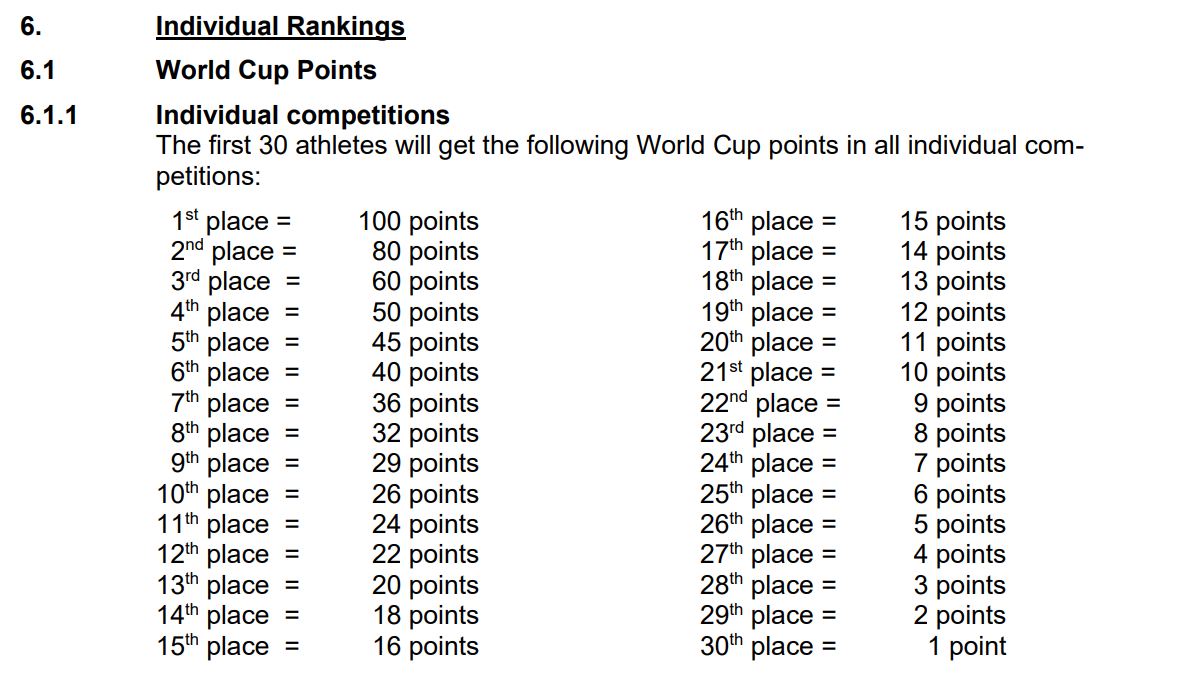
The NEW FIS World Cup points system:
(Photo: “Rules for the FIS Cross-Country World Cup 2022-23.” 2022. “International Ski Federation.”)
The OLD FIS World Cup points system:
(Photo: “Rules for the FIS Cross-Country World Cup 2021-22.” 2021. “International Ski Federation.”)
In the NEW system, the points stretch further down the results, and the steps down are much, much, smaller.
Points stretching further down the results will primarily have consequences for skiers seeking selection to the World Cup, rather than the World Cup Overall competition itself. With the points stretching to 50th place (just short of the size of a usual World Cup field) there is now a more quantifiable way to compare developing skiers and assign discretionary starts for national ski federations. Whereas under the top 30 system, skiers outside of the points were at the whims of the sometimes wonky FIS points system, there is now a better chance to judge a skier’s potential on the World Cup based on their performance on the World Cup.
Smaller steps in points from 1st place (100 points) down is where the World Cup Overall competition really changes. See Table 1. below with the points awarded for 1st-5th place in the NEW system, and Table 2. with the points awarded for 1st-5th place in the OLD system, and the equivalent place-points total under the NEW system.
Table 1. Place-points total for 1st-5th place, NEW system
NEW System Place
NEW System Points
1st
100
2nd
95
3rd
90
4th
85
5th
80
Table 2. Place-points total for 1st-5th place, and equivalent place-points total in NEW system
OLD System Place
OLD System World Cup Points
NEW System place-points equivalent.
1st
100
1st
2nd
80
5th
3rd
60
11th
4th
50
16th
5th
45
19th
When it comes to points earned, getting 1st place just doesn’t matter as much as it used to. That key change is amplified when considering that FIS has made very slight changes to the system surrounding the individual points matrix awarded for each race.
Bonus Points System Remains the Same
In a bid to introduce more dynamic racing a few years ago, FIS introduced a bonus point system in which checkpoint bonuses became incentives for World Cup points. That system remains unchanged and is found here:
(Photo: “Rules for the FIS Cross-Country World Cup 2022-23.” 2022. “International Ski Federation.”)
Based on the points classifications found in cycling’s Grand Tours (the “Green Jersey,” for Tour de France fans), the bonus system was intended to introduce a series of points that skiers would tactically approach as intermediate sprints. The dynamics of ski races are very different from the dynamics of a cycling race, however, and in practice, the sight of skiers shuffling for a sprint in the middle of a distance race has been rare.
Why? Unlike cycling, ski racers exhibit less obvious discrepancies between who is a great sprinter and who is a great distance competitor. In mass start ski races, it’s rare to see a breakaway that is not comprised of skiers who would also excel at distance racing. The bonus points, in reality, have almost always gone to top contenders for the race itself.
The NEW points system seems to retroactively fit the existing bonus points system into this skiing reality. The consequences: in the OLD system, the 15 points for being 1st place through an intermediate checkpoint could almost never displace the points total for finishing 1st versus 2nd, or 2nd versus 3rd. In the NEW system though, with five points separating each of the first five places, winning the intermediate sprints could theoretically displace the 1st place finisher for the most points won on the day for a skier in 3rd or 4th place.
Example: In a 20 k mass start, the skier who will eventually finish 3rd place controls the front of the race for the first 10 k, earning 30 bonus points for winning two bonus point checkpoints (15 points each). The skier who will eventually finish 1st place is further down the pack through the early part of the race, but still in the top 10 through the checkpoints. They are 10th through each bonus point checkpoint, earning 2 total bonus points, before making a push to win the race. The 1st place skier’s total points for the race: 100 (1st place) + 2 (bonus points) = 102 total points. The 3rd place skier’s: 90 (3rd place) + 30 (bonus points) = 120 points total.
That may be unlikely, but it is at least now in the realm of possibility. Again, a whole lot more points for a whole lot more skiers.
Other Tweaks: Relays and Tour de Ski Bonus
There are two other notable tweaks in the new FIS system that pertain to specific events:
The first is that team events no longer are scored for individual points. That has already proven consequential in the way that the only team event so far this season has been raced. For instance, Matt Whitcomb identified the fact that no points were up for grabs as having directly influenced his decision that Jessie Diggins sat out the 4 x 5 km Team Relay in Beitostolen. Similarly, neither current World Cup overall leaders—Paal Golberg (NOR) for the men, nor Tiril Udnes Weng (NOR) for the women—raced the relay.
The second change is less drastic, but will be significant when the World Cup turns to the Tour de Ski (TDS) in a few weeks. FIS reduced the points bonus for winning the overall classification at the TDS from 400 points to 300 points, and adjusted the points bonuses for lower placings accordingly. The reduced emphasis in points—and subsequent reductions in prize money per placing—could result in the Tour de Ski becoming a less significant part of the World Cup calendar than it has been in recent years.
What It All Means
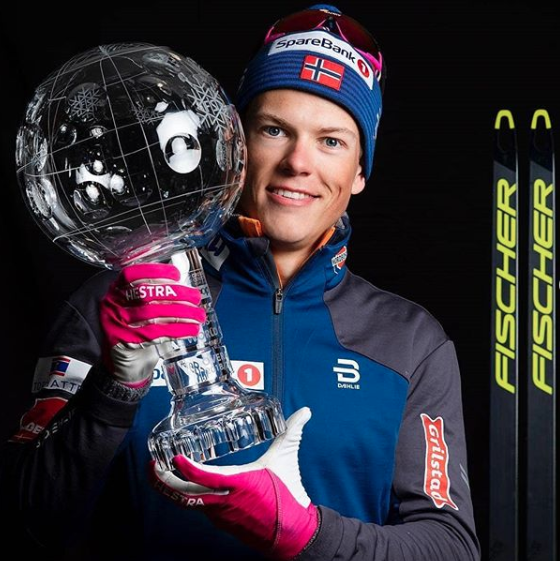
Johannes Høsflot Klæbo poses with his crystal globe after winning the 2019 Overall World Cup title. (Photo: Nordic Focus)
So, is Johannes Hoesflot Klaebo justified in his World Cup fatalism? The answer just might be that the FIS wants him to be. By pushing more points onto competitors who so often come 2nd, 3rd, or 4th place to the young Norwegian, they have created a new dynamic in this year’s bid for the Overall Crystal Globe. Consider the top two skiers in the current classification:
Top Two Places of Men’s Overall World Cup Points after Three weeks of racing, OLD system vs. NEW system:
Paal Golberg (NOR) – NEW system 756 points, OLD system 575 points, Net Change: +181 points.
Johannes Hoesflot Klaebo – NEW system430 points,OLD system430 points, Net Change: 0 points.
Klaebo’s points have not changed because the benchmark for the FIS points system has not changed. He has won every race he has entered, and 1st place is still worth 100 points (with 15 points for winning sprint qualifiers). Golberg, though, has benefitted from starting more races, and getting more points for being top 10, not top 1. It is a simple comparison, but it is also the only one that really, reallymatters for evaluating the change that the FIS wanted to make to the World Cup adopting the NEW system. The eventual winner of the Crystal Globe will now be determined by an incentive to do well in the races you start, and to start more races. Those are just the rules of the game; once the rules are understood, then it’s possible to understand what the new rules are incentivizing. FIS has followed that all the way through with its NEW point system, assuring that the season-long champion will be the skier who is most consistent and who competes most often.
As for us—the fans—is this the system by which we want our skiers rewarded? Should the best skier also have to be the most consistent? Should the strongest skier in a mass start go off the front early, or show their strategic aptitude by controlling a pack? Should skiers specialize in sprinting or distance? Should they continue to have to do well in both? And, of course, is the “top 50” the new “top 30?”
New points systems instituted by FIS has ski fans, ski coaches, and skiers talking; that new system also has the game being played differently on the World Cup tour this season.
This World Cup coverage is made possible through the generous support of Marty and Kathy Hall and A Hall Mark of Excellence Award. To learn more about A Hall Mark of Excellence Award, or to learn how you can support FasterSkier’s coverage, please contact info@fasterskier.com.
USA I Relay Team before the start Sunday. (L-R) Ben Ogden, Sophia Laukli, Julia Kern, and Hunter Wonders. (Photo: Nordic Focus)
In the third week of World Cup racing, the defining question seemed to be not who would be first to the finish line, but who was missing from the starting line.
In Sunday’s Team Relay, though the notable absences were in the American lineup…
US Team Makes Tough Decision on Relay Lineup
US Ski Team Head Coach, Matt Whitcomb delivered the news to FasterSkier that Jessie Diggins and Rosie Brennan would not start in Sunday’s relays, undoing the female half of last season’s 4 x 5 k – winning US relay team that won at World Cup Finals. Both Diggins and Brennan have been vocal about team events like the relay being their favorite part of racing on the World Cup, and the event has been a point of emphasis in previous World Cup seasons.
“It feels weird to say I support this as a coach,” said Whitcomb on the decision to take Diggins and Brennan out of a team event. “But we’ve now been doing this long enough to know that an athlete just cannot sustain the full schedule of [the World Cup]. There are traps that are set for them along the way, and this relay just is one of them. It falls at a time when they really need to rest.”
For Brennan, the absence was primarily a matter of health, with Whitcomb adding, “We were lucky to get two good days of racing after she was sick in Lillehammer. We feel like we might be getting ahead of ourselves if we try to put a third together.”
For Diggins, the stress of having started all eight World Cup races so far this season—combined with the new World Cup scoring system—preceded the decision not to race today. “One of the interesting dynamics of the new World Cup scoring this year is that there are no individual points scored for relays, like there has been in the past,” said Whitcomb. “When it comes to chasing the Overall [World Cup Title] (something Diggins identified as a goal in preseason talks with the media) the relay doesn’t add to the pile.”
In place of Diggins and Brennan, the announced teams for the US turned towards the young generation of skiers who have accompanied the veteran stars of US skiing the past few seasons. The US announced two relay teams Sunday morning:
USA I: Classic Leg 1 – Julia Kern, Classic Leg 2 – Hunter Wonders, Skate Leg 1 – Sophia Laukli, Skate Leg 2 – Ben Ogden.
USA II: Classic Leg 1 – Alayna Sonnesyn, Classic Leg 2 – Zak Ketterson, Skate Leg 1 – Novie McCabe, Skate Leg 2 – Gus Schumacher.
Once teams were announced, however, the theme of rest came back into play. At the end of a third consecutive three-day weekend of racing in Period I, the unique demands on the US Ski Team—traveling continents to compete against nation’s with plenty of skiers to reinforce their World Cup squads close at hand—precipitated the decision to scratch USA II, and see the US start only its USA I team.
The USA I team that did race looked forward to a 4 x 5 k format that has been pioneered at Junior World Championships the past few seasons. US anchor Ben Ogden said to FasterSkier that the 5 k “makes for an interesting race because it’s short enough where if you’re feeling good you can hang with skiers much better than you. I think for the US team this new format is really exciting because on the right day we can be right there with the top dogs even if we are not all fighting for the podium every other day.”
Still, there was some trepidation in the US camp about choosing to strategically re-charge on the day. “[Emotionally] this is tough, because we’ve built our program around [team events like today],” said Whitcomb. “[Team events] are an important metric that speak beyond just who is getting on the podium or in the top 30. It’s a sign of a healthy [national] program when you do well in a [team] event” said Whitcomb.
The Race
By the metric of team success, all signs still point toward cross country skiing being alive and well in Norway, but the finishing order that Norwegian coaches might have envisioned was not the way the script played out on the rolling 2.5 k course (on which each athlete skied two laps): Norway II would finish first on the day, followed by Norway I and Sweden I.
The first leg of the Team Relay rolls out Sunday in Beitostolen. (Photo: Nordic Focus).
Moments of clarity eluded today’s race—a push by one skier over one hill, an uptick of tempo by another as they exited the stadium—but those efforts regularly vanished like frozen crystals in the cold Beitostolen air. In the final lap of the final leg, however, a push by Simen Hegstad Krueger finally turned into something real. As the course ticked up, Krueger pushed away from a pack including Norway I teammate, Emil Iversen, and Sweden’s Calle Halfvarrsson. Over each successive hill, Krueger’s gap on the Swedish-Norwegian pair behind him grew until it was insurmountable. Krueger skated across the finish line for Norway—Norway II to be precise—as Iversen and Halfvarsson battled to the line behind him. Iversen won that battle for Norway too, earning second place. Sweden took third.
Simen Hegsted Krueger (NOR) crosses the finish line in 1st place for Norway II. (Photo: Nordic Focus).
In a clip to FIS media after the race, Norway II skier Mikael Gunnulfsen summed up the result eloquently: “I guess the second team got to the finish line first.”
During a weekend when some Norwegians expressed concern over not meeting the lofty standards of Norwegian skiing on their home turf, the final day saw a result in which Norway II beat Norway I, and the whole country came away with a win. If team relay events are indeed a sign of a national program’s health, then the Norwegians depart Beitostolen secure in the knowledge that their national program still sets the bar in cross-country skiing.
But that conclusion was not clear for large swaths of the race leading to it. In the early going, it was Finland which dictated the dynamic of the pack. Johanna Matintalo (FIN I) kept things controlled alongside Anne Kjersti Kalvaa (NOR I) as the first classic leg wound around the Beitostolen course for lap one. Julia Kern was tucked in the pack for USA I, skiing relaxed even as Matintalo pushed the pace heading up the A-climb. By the time skiers came into the first exchange, Matintalo and Kalvaa had opened a slight gap of around five seconds for Finland and Norway, with the chase group having strung out to two distinct packs. The chase group that came into the stadium first was led by Sweden I, while the second contained Kern at around 12 seconds back. Kern handed off to Wonders for USA I.
Wonders quickly closed the gap as a chase group formed behind Martin Loewstroem Nyenget (NOR I) and Pertuu Hyvarinen (FIN I), who remained off the front. Nyenget looked to increase the pace, but in each little window, Hyvarinen was able to bring his ski tips right back to the Norwegian’s tails. William Poromaa for Sweden I took charge of the chase group headed into the leg’s second lap, right as Nygenet started to stride away from Hyvarinen on the A-climb. Hyvarinen was soon swallowed up by the chase group, but Nygenet faded too. The result: after much Classic sound and fury, the relay field was back together as it headed into the second exchange for the skate portion of the race. Wonders skied a strong leg to cap his weekend, having held 10th place in the pack for USA I.
Perttu Hyvarinen (FIN) and Theo Schely (FRA) late in the 2nd leg on Sunday, chasing Norway I’s Martin Lowestroem Nyenget. (Photo: Nordic Focus).
The race continued into the first skate leg, with moves instigated by Sweden I skier Frida Karlsson, who moved to the front of the pack as the course turned upwards, driving an increased pace which slowly diminished the field’s size. Soon, there was a definitive lead group: Karlsson alongside Heidi Weng for Norway I, Silje Theodorsen for Norway II, and Flora Dolci for France I. As they entered the second 2.5 k loop of the leg, Karlsson eased up. In that instant, one skier from the chase group—Finland I’s Kertuu Niskanen—skated to join up with the leaders, in a moment that knowledgable onlookers might have met with a confused “Who put a Niskanen on the skate leg?” Even so, Niskanen’s strong move seemed to validate that decision, her technical prowess and experience showing through no matter what kind of skis she attached to her boots.
Frida Karlsson (SWE) skied a commanding leg for Sweden I which saw the field break open. Norway I and Norway II follow. (Photo: Nordic Focus).
Karlsson slowly turned the pace up through the second lap, and France I’s Dolci eventually faltered, leaving Sweden I, Norway I, Norway II, and Finland I in the race for the podium entering the final exchange. Sophia Laukli kept the US in 10th through her skate leg, minimizing the gap to the leaders to 43 seconds as other teams saw it blow wide open.
Skating in the anchor leg, Finland’s Joni Maki finally broke, and Halfvarsson for Sweden I, Iversen for Norway I, and Krueger for Norway II skied together for a lap. Little jaunts and jukes from all three lead back to stalemate until, on the final lap, one jaunt turned into a jolt, and Krueger pulled away. The field filled in behind, with the Norwegians adding an extra team on the podium, seemingly for emphasis. USA I finished 10th on the day with Ogden skiing the anchor leg.
Ben Ogden (USA) after finishing his leg of the relay race Sunday. The US finished in 10th place. (Photo: Nordic Focus).
Pushing Forward, and Up, to Davos
The World Cup circuit’s frantic hop around the Scandinavian peninsula in the past three weeks now gives way towards the Alps as teams travel to Davos, Switzerland. In the run-up to those events, eyes and ears will turn toward news of who will be racing there, including the potential return of Johannes Hoesflot Klaebo, Iivo Niskanen, and Federico Pellegrino. Davos will feature a skate sprint and 20 k individual start skate race.
Ben Ogden says that the US camp is coming off today feeling “excited and motivated headed to Davos,” adding that personally he “needs a few more restful days, but I’m excited for the sprint and to get back to the land of the sun!”
The team will be bolstered by the return of Diggins and Brennan, and with Matt Whitcomb saying Davos is a chance to, “end period I with some high notes. [Diggins and Brennan] both have a great shot to be on the podium in both races next week, so we want to be as prepared as we can for that.”
With the snow-draped trees and soft light present on course—and no World Cup points up for grabs—Sunday’s World Cup mixed relay was a relaxed affair centered around ski racing for the sake of ski racing. Even on its highest level, ski racing remains joyful and keen, like the edge that sharpens itself for the work yet to come.
Ben Ogden (USA) and Richard Jouve (FRA) in the semi-final of the men’s classic sprint in Beitostolen, Norway. (Photo: Nordic Focus)
The sun had begun to set in Beitostolen, Norway. The day—and the day’s racing—entered its golden hour as Norwegian fans anticipated more success for World Cup Sprint Leader, Paal Golberg (NOR). That all changed in a flash as Golberg—wearing the yellow Leader’s bib—crashed on a curve in the men’s Classic Sprint final. Golberg fumbled in the snow, a stark contrast to the control he has shown through the first few weeks of this year’s World Cup. The field stretched out in front of him, the Norwegian “sure thing” having been removed from the equation. Something new was about to play out at the front of this World Cup Sprint race.
The field hit the final climb with reigning overall World Cup Sprint champion, Richard Jouve (FRA), at the the front of the pack. After his tumble, Golberg managed to scramble gamely back into the field, personifying a stubbornness to restore logical order to the day’s proceedings. This is men’s cross-country skiing in 2022, where Norwegian domination of the men’s podium seems to be a given. As the field entered the stadium, though, two unexpected skiers—one clad in green and black, the other in blue and white—overtook the scene among those vying for podium positions. While Jouve eased across the line for a win, behind him jubilation ensued as Simone Mocellini (ITA) in green and black charged into second, leading Calle Halfvarsson (SWE) in blue and white who claimed third. Something new, indeed.
The men’s final in the finishing strech. Richard Jouve (FRA) (R) over Simone Mocellini (ITA) (L) (Photo: Nordic Focus)
Thus it was that a day where pre-race expectations for new-comers to gain a foothold in the World Cup sprint field crescendoed (note the verb) at a finish line marked by an ebullient Italian celebration recalling the days of Maurilio De Zolt and Marco Albarello.
The promise that there might be new faces at the front of today’s race stemmed from the fact that the only certain sprint contenders in this current era of skiing—Johannes Hoesflot Klaebo (NOR) and Federico Pellegrino (ITA)—were both absent, the former due to illness and the latter due to a desire to “recharge the batteries”. Accordingly, the day provided early indications of a more wide-open field. In the first quarterfinal, the top qualifier on the day, France’s Jules Chappaz, was outsprinted by Golberg and Even Northug (NOR) in a late race push where the Norwegian pair took the inside line on the hill leading into the stadium and simply outran everyone. That successful inside move would become a trend, and one of that strategy’s most effective practitioners was Ben Ogden (USA), who was the only American to advance to the heats (he qualified 7th). Skiing in the fourth quarterfinal, Ogden claimed the inside lane going into the rolling downhill that marked the first 500m of the course, and stayed in control as the field swept into the first climb of the day. This junction—later the site of Golberg’s fall—saw the field narrow into tracks, and in Ogden’s heat saw another Norwegian favorite, Haavard Solaas Taugboel, get tangled. Ogden was behind the fall, side-stepped it, and remained in touch with the field as they crested the climb. Entering the last climb, he pushed to the inside and outran Michal Novak (CZE) and Renaud Jay (FRA) to advance to the semi-finals.
The quarterfinal heat offered the latest sign of Ogden’s growing poise and comfort in sprint heats, and one in which he also possessed the most definitive punch of the whole bunch.
Ogden advanced to the second semifinal, where he joined the seasoned duo of Jouve and Joni Maki (FIN) alongside a youthful contingent of Niilo Moilanen (FIN), Michal Novak (CZE), and Anton Persson (SWE). Jouve used the race as a test-drive for his winning strategy on the day, taking control of the race on the first climb before delivering his final push on the next. Maki mirrored Jouve throughout the race, while Ogden was initially forced to the front before settling back and making a final storm on the last hill. Notably, on the hill, Ogden was again a powerful force running into a position equal with Jouve as they entered the stadium; however, Ogden faded slightly in the final sprint, while Maki came up to claim the 2nd place spot behind Jouve. Ogden’s finishing time was not fast enough to earn a lucky loser’s position in the final. He finished a very impressive seventh on the day.
Friday’s second semifinal featured Richard Jouve (FRA) (R) taking the win over Joni Maki (FIN) (2nd from R) and Ben Ogden (USA) (3rd from R) (Photo: Nordic Focus)
The other semi-final saw Golberg play out his strategy, following from the gun, staying out of trouble until the final climb, and then marking Lucas Chanavat (FRA) over the final climb into a 2nd place spot in the heat.
In that semifinal sprint, what seemed like a forgone conclusion with Golberg’s straight line speed was interrupted by a boot throw from the next lane over. It was Calle Halfvarsson, who ended up taking the first lucky loser spot. Behind him, Simone Mocellini powered into 4th place and the second lucky loser spot. The pair had mirrored Golberg, earning further opportunities to face him in the final.
Simone Mocellini, the young Italian who ignited hopes for his country’s skiing future with a 2nd place finish today. (Photo: Nordic Focus)
In retrospect, their placement behind the yellow bib concealed Halfvarsson and Mocellini’s potential in the race to come. That potential was realized in the final when Golberg went down, Mocellini surged, and Calle Halfvarsson drove forward to step onto a podium for the first time since Seefeld in 2018.
Simone Mocellini, the young Italian, offered up a scene reminiscent of old times when talented Italians could upset the Norwegians on their home soil: hardcore ski fans may recall the Lillehammer Olympics Team Relay in 1994. The Norwegians surely will. Whether today was an introductory phrase or an early coda, however, will be up to Mocellini, the conductor at the heart of the jubilant orchestra that greeted him at the finish line today.
WSCA founder Maria Stuber (College of St. Scholastica) presents on the WSCA mission in Oslo, Norway, 2019. (Photo: Courtesy Image)
Formed in 2019, the Women’s Ski Coaches Association (WSCA) has been a consistent and ardent supporter of creating gender equality in all areas of North American skiing. With WSCA founders—St. Scholastica Head Coach Maria Stuber and Staffer, Craftsbury Green Racing Project Biathlete (and former St. Scholastica skier) Kelsey Dickinson at the organizational core—a strong actor-network has been formed to advocate for women in the ski coaching profession. This has included some notable partnerships with organizations at the heart of US Skiing, including the foundation of theTrail to Gold Fellowship with the National Nordic Foundation this season which will see five women coaches complete a two-week internship on the World Cup this season.
In its latest program launch last month, the WSCA turned to the ski industry. The GearUP program, which announced its first cohort last month, will see ten women coaches from across the North American ski community outfitted with gear from participating ski brands. Fischer, Rossignol, Salomon, Atomic, Madshus, and Swix are all participating. The coaches in this inaugural cohort are all working with representatives of their paired brands, providing the experience of building a lasting relationship with a ski company. Those relationships are often the difference between a club having a reliable way to outfit skiers, and having to patch together equipment from limited inventories, ski swaps, and used marketplaces.
The impetus for GearUP comes from a perceived skew in the “social capital” within our sport. WSCA staffer Kelsey Dickinson addressed that discrepancy in an interview with FasterSkier:
“I don’t think it is a secret that getting [ski equipment] in [the United States and Canada] is almost entirely up to who you know, and that disproportionately skews towards male coaches when a disproportionate number of brand representatives are male.” says Dickinson. That has fostered a space in the skiing community where women coaches struggle to establish themselves: “It’s not that there is intentional exclusion on the part of these brands. [It’s more so] that there are a bunch of coaches vying for a limited number of brand representatives, and there isn’t a lot of thought put into who is working with who.” The individual interactions in the ski industry sum up to a culture that has excluded women coaches, even if it has formed passively: “The ski coach needs equipment, and they will go to whoever they know best. [The brand representative] is more likely to respond to an old teammate, or an old coach…with both parts of that equation being disproportionately male in [the United States ski community], it has tended to exclude women [coaches],” said Dickinson.
WSCA Staffer and Craftsbury Green Racing Project Athlete Kelsey Dickinson skiing to third in the 10 k pursuit at last year’s U.S. Biathlon Nationals. (Photo: John Lazenby/lazenbyophoto.com)
The motivation behind GearUP is to deliberately change some of the individual interactions of ski coaches with brand representatives so that it leads to a cultural shift where women coaches are more welcome in the ski industry space. For nearly every major ski brand in North America, it was an easy sell. “There was almost no hesitation by any of the big ski brands,” said Dickinson. “Once we went to them and said, ‘this is a place where we don’t think women coaches feel welcome and here is why’ they almost universally came back with a response that said, ‘we are willing to help out however we can to start correcting [the culture] on our end.’”
The result was that every major ski brand (Fischer, Rossignol, Atomic, Salomon, and Madshus), as well as Swix, signed on to outfit at least one female coach with a pair of skate skis, a pair of classic skis, and other brand accessories. Swix agreed to provide the whole cohort with two pairs of poles each. Originally, the program was intended to covereight coaches, but Dickinson and Stuber were able to secure two more additional spots to expand the cohort of coaches to ten. “We had sixty-one applications, which was way more than [WSCA] or the brands expected,” said Dickinson. “Once we went to [equipment sponsors] with the quality of that applicant pool, they were willing to expand the program to reflect the commitment of women coaches in the nordic community.”
(l-r) WSCA members Maria Stuber (CSS), Kristen Bourne (Now with the US Ski Team), Kristen Monahan-Smith (Michigan Tech), and Tracey Cote (Colby College) at NCAA Championships in Jackson, New Hampshire in 2021. (Courtesy Photo).
The inaugural cohort was announced last month, and Dickinson and Stuber are already brainstorming about the potential for future expansion of GearUP. “Part of why we wanted to do this now is that with the [supply-chain issues of the past few seasons] there was a pressing need for coaches, and also a kind of challenge to brands,” said Dickinson. “We know it’s hard, but this might be an opportunity to come out of this difficult moment with a better culture for women—and women coaches—going forward.”
Future iterations of GearUP will hopefully include a greater percentage of the applicant pool being outfitted, along with more brands from the periphery of the ski industry being involved. Even more crucial may be that new relationships may extend beyond a pair of new skis and boots. “Hopefully, this is resonating out right now,” said Dickinson. “The brand representatives are meeting our coaches and realizing there’s entire clubs and programs with great women coaches that have just been out of the loop on getting the equipment they need, when they need it, to be successful in skiing. At the end of the day, [GearUP] isn’t about skis, it is about skiing.”
The Inaugural WSCA GearUP Program Cohort
Patricia Casey – Alaska Nordic Racing Program (Eagle River, Alaska).
Aliya Brown – Bogus Basin Nordic Team (Boise, Idaho).
Leslie Bode – Thunder Bay National Team Development Centre (Thunder By, Ontario).
Katie Eichten – Spooner Rails On Trails (Spooner, Wisconsin).
Rachel Koroscil – Canmore Nordic Ski Club (Canmore, Alberta).
Dana Hatton – Yarmouth High School (Yarmouth, Maine).
Sydney Michalak – Crosscut Mountain Sports Center (Bozeman, Montana).
Callie Knapp – Endurance United (Minneapolis, Minnesota).
Mackenzie Rizio – Mount Anthony Union High School/Prospect Mountain Ski Club (Bennington, Vermont).
Kirsys Campbell – Jackson Hole Ski Club (Jackson, Wyoming).
This World Cup coverage is made possible through the generous support of Marty and Kathy Hall and A Hall Mark of Excellence Award. To learn more about A Hall Mark of Excellence Award or to learn how you can support FasterSkier’s coverage please contact info@fasterskier.com.
Ben Ogden (foreground) and Zak Ketterson (background) during the Classic 20 k Sunday. (Photo: NordicFocus)
If Saturday’s individual sprint race was a return to the archetype for this era of World Cup skiing, then Sunday marked something completely new. Part by design, part by necessity, the men’s field raced a 20 k classic mass start for the first time on the World Cup since the 2012 Tour de Ski (when Eldar Roenning (NOR) won over 2nd place Alex Harvey (CAN) and 3rd place Dario Cologna (SUI).
The part by design: FIS has moved to the 20 k mass start as part of equal distance racing for men and women on the World Cup, replacing the 15 k that had become the standard classic distance event. The 20 k is an odd distance that has rarely been raced (by either men or women) on the international scene . . . though it does seem to represent a good compromise for both the women’s field, and the men’s.
The part by necessity: this race was originally slated to be a 30 k skiathlon, but operating on man-made snow all weekend in Lillehammer, the organizing committee had to scratch plans and lay a classic track on a 3.3 k snowmaking loop where the field would ski 6 laps. The course chosen was the Biathlon loop, which meant that homologation standards usually present on the World Cup were not present on the course today.
In an interview with FasterSkier after the race, US National Team member, Gus Schumacher, said that the course led to a clear expectation of how the race would play out. “We were kind of expecting a bunch sprint, because the course was missing those long, sustained climbing sections that most of our World Cups have. There were guys out there today who probably had higher aerobic capacities that weren’t necessarily able to flex it.”
Then there was the glaring fact that the best classic distance skiers at 15 k in the past year —all three Olympic medalists in the 15 k —weren’t on the start line. Iivo Niskanen (FIN) was absent, Johannes Hoesflot Klaebo (NOR) scratched after his sprint win yesterday, and Alexander Bolshunov (RUS) is not participating in FIS World Cup events due to Team Russia’s suspension. In their place was a group of contenders who raced as a sustainable pack, through six tightly wound laps.
In the end, the only signifier that might have distinguished one of the competitors in that pack was the yellow FIS World Cup overall leaders bib, worn by Paal Golberg (NOR). A marked man throughout the day, Golberg nonetheless moved to the front of the pack as they entered the Birkebeiner stadium, applying extra force to his double-pole, and opening up a gap that saw him pull away to his first race victory of the season. A pack of his countrymen followed close in his wake with Norway taking the top four spots on the day: 1st) Paal Golberg, 2nd) Sjur Roethe, and 3rd) Martin Loewstroem Nyenget, 4th) Didrik Toenseth.
Paal Golberg (NOR) celebrates his first World Cup win of the season in Lillehammer’s 20 k Classic Mass Start. (Photo: NordicFocus)
The 20 k Classic Mass Start
Racing all the way to that Norwegian-heavy conclusion, however, was a tight-knit and colorful affair. The first kilometer of the day’s course featured its major climb, which from the gun saw Andrew Musgrave (GBR) move to the front in an unflinching double-pole. Musgrave didn’t relent as the rest of the field turned to striding, a pattern that would repeat through the early laps of the race. Musgrave would move off the front before each major climb, having discovered that the other skiers’ transitioning from double-poling to striding impeded the momentum he needed to double-pole the course. Best just to get off the front, then pay for it at the top of the climb.
Andrew Musgrave (r) double-poles ahead of the field early on in Sunday’s 20 k classic. (Photo: NordicFocus).
Musgrave animated the field through that early part of the race; with the rest of the pack able to keep pace on their classic skis, there was little reason for them to push the pace. Who got to the front of the field wasn’t a question of strength or fitness through most of the race, but rather how well skiers could find the little pockets of space or snow needed to move up through the pack. For the Americans, Scott Patterson and Ben Ogden were able to move up within the first 2 laps of the race. Gradually, though, more and more blue suits with stars came into picture—Zak Ketterson, then Gus Schumacher, and then Hunter Wonders, until the whole US contingent was present somewhere in the pack. In particular, Gus Schumacher stood out, adorned as he was in a pink cap that he said, “Was for my mom, she likes the pink hat.” Two Canadians—Antoine Cyr and Olivier Leveille—also weaved purposefully through the field.
Gus Schumacher (USA) skis behind Richard Jouve (FRA) in the pack during Sunday’s 20 k Classic. (Photo: NordicFocus)
On lap 3, the field began to settle into the contours of the course, and anxious competitors started to test where they might be able to break the race open. The first main animator was Martin Loewstroem Nyenget—champion of the 2022 50 k Holmenkollen—who moved to the front of the pack on the climb that covered the first kilometer of the lap. The field quickly bunched up over the top of the climb; through the halfway point, the race remained a stalemate.
Having not found the pressure point he wanted on the climb, Nyenget looked for it on the rolling terrain of the last two kilometers of the course. Again, the field picked up the pace; but again, no definitive gap developed as they hit the climb entering Lap 5. A similar move came from Finnish skier, Markus Vuorela, but the only effect was to stretch the lead group a bit, with skiers slowly fall off the pace.
Going into the final lap, all that had built was anticipation. Thirty skiers still jockeyed for position within the pack, with Americans Gus Schumacher and Hunter Wonders among its ranks.
It was the Swedish skiers who initiated a long attack. William Poromaa and Jens Burman ran to the front on the last big climb and continued to push the pace over the top. No doubt, the pair sensed that the new race format gave new life to the long-awaited hope that the Swedish men could re-establish themselves as elite distance skiers. That hope for a win now stretches back nearly a decade, since Daniel Rickardsson won the Holmenkollen 50 k in 2014. However, like most Swedish attacks in nearly every race since then, the ambitious pair were soon swarmed by a who’s-who of Norwegians. As the contenders entered the stadium, the sudden appearance of Golberg in the yellow leader’s bib was unanticipated, yet not at all surprising. Then came Roethe, Nyenget, and Toenseth, with Iversen and Krueger within striking distance too.
Even during the sprint the field remained tight, with the top 30 finishing within the span of 10 seconds. Gus Schumacher held his own in the sprinting pack, placing 17th—his highest finish in a classic distance race since the Tour de Ski in 2021 (where he was 8th). Hunter Wonders also finished in the charging pack, finishing 31st.
A pair of Canadian’s had also held strong in the pack: Antoine Cyr finished in 12th place, while Olivier Leveille came across the line in 27th.
The pack rolls into the Lillehammer stadium after lap 5 of 6, led by William Poromaa (SWE). (Photo: NordicFocus)
Gus Schumacher said that the fast field sprint reflected the general experience of being in the pack, “It was pretty chaotic throughout the race, jockeying for position without expending too much energy. I was definitely aware [the race] was getting more strung out and I was finding myself more up near the front as it went on, but there wasn’t a specific moment [where someone attacked].
In a new race format with a classic, old-school feel, the World Cup moved on through Lillehammer with a weekend full of homegrown success for the home country, and some promising glimpses for their rivals ancient (Sweden) and new (USA). For the latter, the momentum is building in a unique way. Gus Schumacher said to FasterSkier that the distinguishing feature of this season for the team so far is, “We’re getting good results in a wide variety of races. It’s sprints and distance races this year, and the wax team is doing really well too. It’s really fun as a team right now, we’re building good momentum.”
That momentum will certainly carry the US Ski Team, and the road show that is the Cross Country World Cup, to Beitostolen, Norway next week.
This World Cup coverage is made possible through the generous support of Marty and Kathy Hall and A Hall Mark of Excellence Award. To learn more about A Hall Mark of Excellence Award or to learn how you can support FasterSkier’s coverage please contact info@fasterskier.com.
Ben Ogden (USA) raced boldly on Saturday, finishing less than a boot’s-length away from the World Cup Sprint Final. (Photo: NordicFocus)
Lillehammer, Norway—that most timeless of ski venues—provided viewers with a familiar scene on Saturday: Johannes Hoesflot Klaebo exiting the final turn in the lead, gliding away from the field en route to an easy win in an individual skate sprint. It was the 32nd win of his career in the event—exactly double the number of any other skier in history. The man behind him on that list—Federico Pellegrino (ITA)—was also 2nd behind him on the day. Even the name of the skier in 3rd place—Northug—fit the scene, though in this iteration the Northug was Even, not Petter.
So it was that the first skate sprint of the 2022-2023 season ended with a podium that could have been plucked from any skate sprint in the past half-decade. Partially because of that fact—and because Johannes Hoesflot Klaebo first staked his ground in the event before moving on to also dominating every other discipline of skiing—the skate sprint has become the archetypal stand-in for this current era of cross-country skiing.
Johannes Hoesflot Klaebo (NOR) celebrates down the finishing stretch during Saturday’s World Cup Sprint Final. (Photo: NordicFocus)
Anyone looking for winds of change in the sport would probably want to watch for little changes in the landscape of a World Cup skate sprint. On Saturday in Lillehammer, those little changes came clad in Stars and Stripes, as Americans Ben Ogden and JC Schoonmaker finished the day in 7th and 8th, respectively. Luke Jager also qualified for the heats, finishing in 27th. Three Americans in the heats, two contending in the semifinals; a year ago, that would’ve been cause for hopeful surprise, as the young potential of this current generation of young men began to peak through onto the sport’s highest level. At the beginning of this season, however, today’s qualifying crop marked more of a hopeful progression, as that group of American men looked to expand on a newfound comfort in World Cup sprinting that they’ve gained over the course of last season.
That progression was on full display once the heats started rolling. Ogden would ski out of the fourth quarterfinal heat, taking the inside lane alongside seasoned veterans Erik Valnes (NOR) and James Clugnet (GBR). Ogden marked moves by Valnes and Clugnet as they charged the uphill. Around the sharp-left that marked the beginning of lap two into the downhill again, Ogden moved to the outside, swept around the corner into the hill, and this time led the charge rather than marking it. By the time the field hit the long flat of the Lillehammer stadium, Ogden was clear in front, allowing him to avoid a tangle-up involving Valnes and Clugnet. Clugnet broke a pole and lost the chance to advance to the semifinal.
Ogden’s strategic success may be indicative of big things to come: the skier who last spring in an interview with FasterSkier claimed that he “[is] not known for my detailed race plans” had out-witted and out-skied competitors who are fixtures in World Cup sprint fields. In an interview with FasterSkier US Ski Team Head Coach, Matt Whitcomb, said that Ogden’s patience was a noticeable difference between this week’s sprint and last week in Ruka. “When Ben was leading in the heats today, he wasn’t spazzing like he was in Ruka, he was controlled. [That meant] that when he did go—he hit the gas pedal—the vehicle went a lot faster.”
Those same patient-minded tactics were the hallmark of the American’s approach throughout the day. In the next quarterfinal heat after Ogden’s, Luke Jager followed JC Schoonmaker as the latter executed the same plan. Jager fell off the pace just at the end, but Schoonmaker held off all-comers, including Richard Jouve (FRA), to win the heat and advance to the semi-finals.
Luke Jager (USA) during qualification on Saturday. He would advance to the quarterfinals, and finish the day in 27th. (Photo: NordicFocus)
On this nuanced approach to the day’s heats, US Ski Team Head Coach Matt Whitcomb pointed to Schoonmaker, Ogden, and Jager’s experience gained over the past year. “When you struggle through a season and qualify once or twice, you don’t get very much sprint experience,” Whitcomb said. “Once you get to a point where you are getting through the quarterfinals, your experience starts to double each day. And that’s what we are seeing: a year of skiing into heats and skiing them aggressively.”
Whitcomb also stressed that the key lesson learned for the talented American sprinters was patience. “For athletes that have that natural…[what I’d call] Tesla power, the key is to not use too many matches early in the heat,” Whitcomb said.
The American pair of Ogden and Schoonmaker held steady on that patience while starting together in the second semi-final of the day. In that heat, they were outnumbered by a Norwegian contingent that included World Cup Overall leader Paal Golberg, Ansgar Evensen, and Erik Valnes. The Norwegians also appeared to approach the heat with a preference for patience. A furious pace from the gun quickly gave way to a kind of stalemate in which Ogden found himself at the front of the pack, leading the first climb alongside Evensen. Paal Golberg tucked comfortably behind Ogden (indicating that Norway and USA were attempting to utilize similar tactics) as they went into the second turn around the downhill. Ogden moved to the outside; Golberg, Jouve, Evensen and Schoonmaker followed; and the five came into the stadium together. That was the crystallizing moment for the Americans on the day. Ogden and Schoonmaker, in a semi-final, fending off the World Cup Overall leader and Richard Jouve, the only other skier in the world than Klaebo to have won a skate sprint this calendar year.
Ben Ogden (USA) stretches for the line in his semifinal. Ogden finished 3rd in the heat, with JC Schoonmaker (USA) 4th. (Photo: NordicFocus)
The Americans came up just short. Golberg won the heat, besting Evensen by a boot throw. The patience of Ogden and Schoonmaker in the beginning of this relatively slow heat likely cost them a shot at the lucky loser times, as they finished 3rd and 4th, respectively. Thus, the American’s maturity was met with some decidedly bitter irony. Still, it was mature racing, and will surely be marked by a mature analysis.
In the opposite semi-final, four Norwegians matched up against Federico Pellegrino and a twenty year-old Swede named Edvin Anger making only his 3rd World Cup start. The Swede’s second start was last weekend in the Ruka Classic Sprint, where he showed a propensity for racing at full gas from the beginning of each and every heat. That crashed spectacularly in Ruka, as he was spit out the back of the pack in the semi-final, but it didn’t change his approach this week.
Anger went hard from the gun, the Norwegians filed in, Klaebo moved out from the back and moved to the front, and everyone else sprint for 2nd. This time though, Anger kept the pace. He advanced to his first sprint final, and in the process animated the pace to the degree that 3rd place Pellegrino and 4th place Even Northug advanced to the final with the lucky loser times.
Federico Pellegrino (ITA), who finished 2nd on the day after earning a lucky loser spot into the Final. (Photo: NordicFocus)
The final began as a near-replay of this semi-final: Anger went out hard, the Norwegians filed in, Klaebo moved out from the back and moved to the front, and everyone else sprint for 2nd. There was a change to the script, though: the old veteran, Federico Pellegrino, had seen Anger’s move in the semi-final, and decided to follow him this time. Result: the old veteran passed up the new kid on the block, and solidified second place on the day. Klaebo 1st place, Pellegrino 2nd place, Northug 3rd place.
The established champions still had their way, for now.
On his day progressing to the cusp of the final, Ben Ogden said in an email to FasterSkier that:
“today is a massive step for me in my [sprint progression from last year]. My goals this year are to feel more control and composure in the quarterfinal and advance regularly. Today was huge for that confidence and I’m really happy with how things turned out. Always hungry for more, but [today] was satisfying.”
JC Schoonmaker also emphasized that experience was the most important quality to his sprint success, saying in an email with FasterSkier that:
“It is tough to be so close to making it to the final, but with better tactics I know it is possible. A lot of heat skiing for me has been gaining experience and making sure that I’m learning from every race I compete in.”
Schoonmaker added that the highlight of the day was lining up next to his teammate Luke Jager in the quarterfinal, “Racing that with Luke was more fun than anything really.”
Tune in next Friday in Beitostolen to see where the boys sprint from here…
Federico Pellegrino (ITA), Johannes Hoesflot Klaebo (NOR) and Even Northug (NOR), (l-r) take the freestyle sprint podium in Lillehammer, Norway. (Photo: NordicFocus)
Ruka covered in a fresh layer of frost ahead of the first World Cup race of the season Friday. (Photo: NordicFocus).
This World Cup coverage is made possible through the generous support of Marty and Kathy Hall and the A Hall Mark of Excellence Award. To learn more about A Hall Mark of Excellence Award or to learn how you can support FasterSkier’s coverage please contact info@fasterskier.com.
The temperature was a balmy -11℃ (12℉). A glow hung in the sky and new snow decorated the trees; a welcoming winter scene in Ruka, Finland. With the FIS Cross-Country World Cup making its start there on Friday, the crisp, clear, sub-arctic conditions seemed to be an indicator of good things ahead.
Ruka’s 1.4 k classic sprint course remains unchanged from previous years. (To see a breakdown on this course, check out our video from 2018 with Andy Newell here). The straightforward read on the Ruka loop is that for all the jockeying and positioning possible in the first 1 k of rolling terrain, the last hill—the big one—plays an outsized role in deciding who wins. Yet, the critical read on why it has produced such awesome racing over the years is that the place in the racing calendar is just as important. The jitters and nerves of an entire offseason bear down on skiers in a way where the decisive moments in a day come not on the hill meant to test their mettle, but in the moments before where they know that test is coming. Don’t miss the forest for trees. Don’t miss the whole race because of the big hill.
Alayna Sonnesyn on the 1.4 k Ruka classic sprint course during qualifying on Friday. (Photo: NordicFocus).
The women’s field came into that course today anticipating an extra degree of variability. For all the variety of the World Cup last season, its classic sprints were surprisingly predictable. Only four skiers notched wins: overall sprint champion Maja Dahlqvist (SWE), Natalia Nepryaeva (RUS), Maiken Caspersen Falla (NOR) and Jona Sundling (SWE). This season, Falla has retired, and Nepryaeva is out due to the FIS’ Russian suspension. With no skier showing a firm hold on the sprint events, today looked to be anyone’s race.
The Americans started a full lineup of six skiers, with Jessie Diggins qualifying for heats in 11th place, +4.68 seconds off winner Ane Appelkvist Stenseth (2:48.85). Julia Kern also qualified for the heats, placing 23rd (+5.39 sec). Kern ended up in the first quarterfinal along with the winner Stenseth, while Diggins took to the 3rd quarterfinal in a match up with 2nd place qualifier Tiril Udnes Weng (NOR) (+0.56).
The first quarterfinal also featured Sweden’s Emma Ribom, who was coming off an FIS sprint victory over most of the Swedish national team last week. For the 24 year old, that result follows an offseason in which she had top results in rollerski races of all types, from sprints to a 42 k classic marathon win in Trollhaettan.
Julia Kern (USA) and Emma Ribom (SWE) in the first quarterfinal on Friday. (Photo: NordicFocus).
In that quarterfinal, Stenseth (NOR) set a pattern her countrywomen would follow throughout the day; taking the inside lane at the start and leading out the early action. The Swedish counter throughout the day was to let the Norwegians do the pace-setting and hit that decisive last hill hard. Kern meanwhile comfortably moved in the pack, always near the front but never commanding the lead. When they hit the last hill, Ribom surged and Stenseth followed from the other side of the trail. Ribom crossed in 1st – 2:47.54, and Stenseth crossed in 2nd – 2:48.21 (+0.67). Kern had followed the Stenseth move up the hill, and held on in a late sprint with Anna Svendsen (NOR) for 3rd place 2:48.60 (+1.06).
The first heat had been fast, though Kern in 3rd place would be forced to wait out the rest of the quarterfinals before learning if her time was good enough to earn a lucky loser spot.
In the 3rd quarterfinal, Jessie Diggins tucked in behind the Norwegian pair of Tiril Udnes Weng and Kristine Stavås Skistad, and through the early part of the race was in a comfortable position in the pack. As that field rounded the corner that led to the course’s only prolonged downhill, however, Finn Katri Lylynpera and German Katharina Hennig tangled up and went down. Diggins was held up ever-so-slightly, but the spot on the course was unfortunate, stifling the momentum Diggins hoped to build by skiing out from the back of the field. She ended the heat in 5th place.
Jessie Diggins (USA) got caught behind a pile-up during her quarterfinal Friday. Diggins qualified 11th on the first day of World Cup season. (Photo: NordicFocus).
When the rest of the dust had settled on the quarterfinals, the first heat proved to be the fastest, sending Julia Kern into the semi-finals where she would race out of the second heat.
In the first semi, Emma Ribom and Maja Dahlqvist formed a Swedish contingent matching up to a three-strong Norwegian contingent of Tiril Udnes Weng, Ane Applekvist Stenseth and Anna Svendsen. The sixth skier in the heat was the host nation’s Jasmi Joensuu (FIN), who also has a strong American skiing connection – an alumni of Denver University, where she was an All-American and part of DU’s NCAA national title winning teams in 2016 and 2019.
Former Denver University skier Jasmi Joensuu (FIN) (3rd from left) had a breakout day, finishing 4th place overall. (Photo: NordicFocus).
On the Ruka hill, Joensuu earned the distinction of having the best finishing kick of the day. In a heat where the Norweigans took it out fast, and then Maja Dahlqvist took them out even faster, the Finn was able to hold on to the pack just long enough so she could kick back into contention in the final climb. Joensuu followed Weng and Stenseth on the hill, who overtook Ribom and Dahlqvist, but saw themselves be out-double poled in the sprint. The result: Emma Ribom 1st place, 2:44.99, Dahlqvist 2nd (+0.05), Weng 3rd (+0.09), and Joensuu 4th (+0.67). It was the fastest heat of the day.
Julia Kern started her semi-final alongside Johanna Hagstroem (SWE), Frida Karlsson (SWE), Kristine Stavås Skistad (NOR), Lotta Udnes Weng (NOR), and Tereza Beranova (CZE). The Norwegians again took the inside track and took the heat out in front. Kern, for her part, chose to stick behind the pairing of Swedes early in the race, The pack didn’t have the same ferocious pace as the previous heat, instead seeing a quiet battle for positioning going into the final hill. Kern came into that in 3rd place, before losing ground as Czech Tereza Beranova made a massive push. That broke the field into a final sprint early, with Hagstroem (SWE) coming out on top in 1st – 2:47.16 and Skistad (NOR) getting Beranova by a boot’s throw for the 2nd spot (+0.43). Kern finished the heat in 6th place (+4.92).
Julia Kern after the semi-finals on Friday. Kern finished the heat after a strong performance in the qualifier and quarterfinal. (Photo: NordicFocus).
The Final: three Swedes – Emma Ribom, Johanna Hagstroem, and Maja Dahlqvist, two Norwegians – Kristine Stavås Skistad, and Tiril Udnes Weng, and one Finn – Jasmi Joensuu. The dynamic was everything a spectator would expect watching the rest of the days racing, but the decisive moment was not.
The Norweigans took the final out hard from the gun, while the Swedes took the early part of the race to find the right position. That eventually led to a moment of attrition, where the field slowed and stared over into the downhill, not daring to be the first down into it. That led to a more jumbled pack going into the final hill than usual, but it was still a similar race to what had been seen all day. The Swedes took to the uphill at full speed, and seemed to gain a slight advantage on their Norwegian and Finnish pursuers. The final turn looked to be all that was left between them and a podium sweep. Dahlqvist led it out, then Ribom, then Hagstroem.
And then, Dahlqvist went down. One of those trips that every skier has tripped. A little touch of the toe under the boot, and she hit the ground. Ribom and Hagstroem were left to sprint for the victory, and Ribom took the win, 2:49.22.
Hagstroem in 2nd (+0.91) and Weng in 3rd (+0.93) rounded out the podium in the first race on the first day of the World Cup season. Last year’s sprint champion, Maja Dahqvist, crossed the line well after the field, broken Swix Triac in hand.
Emma Ribom crosses the line for her first World Cup win in the Ruka classic sprint. (Photo: NordicFocus).
On a course designed to open the World Cup with a piece of decisive terrain, its latest chapter was defined by an accident that no amount of engineering could snuff out. Maja Dahlqvist, the reigning sprint champion takes a tumble. Emma Ribom, the 24 year-old, takes her first World Cup win. New season, same Swedes.
Women’s podium: 1st – Emma Ribom (SWE), 2nd – Johanna Hagstroem, 3rd – Tiril Udnes Weng (NOR). (Photo: NordicFocus).
American skiers had strong results further down the qualifying list. Rosie Brennan placed just outside of heats in 32nd (+9.15), while Alayna Sonnesyn placed 43rd (+12.36), Novie McCabe placed 52nd (+17.28), and Lauren Jortberg placed 54th (+19.33).
Lauren Jortberg (USA) during qualifying on Friday. (Photo: NordicFocus).
The Canadians also saw a strong grouping of skiers in the results, with Dahria Beatty 38th (+10.16), Katherine Stewart-Jones in 45th (+12.48), and Olivia Bouffard-Nesbitt in 46th (+14.03).
Novie McCabe (USA) during qualifying on Friday (Photo: NordicFocus).
A common sight in the Intermountain West for the past 35 years: Rick Kapala on race day. Kapala is stepping away from coaching, and into sport development, this season. (Photo: Sun Valley Ski Education Foundation – SVSEF).
“I’m sorry, but once I start talking cross-country skiing, I can’t stop,” admits Rick Kapala. Remove the “talking” from that statement, and it’s still a succinct summary of long-time Sun Valley coach Rick Kapala’s career.
This season will mark the first time in thirty-five years that Kapala won’t be manning the wax bench on race day for the Sun Valley Ski Education Foundation. This summer, he turned to a new role at the Sun Valley Ski Education Foundation withthe title “Sport Development Director.” In his stead, formerBates College Coach Becky Woods will take over his former Program Director duties.
For those who have known Kapala during his long tenure in US skiing, his new title signals an exciting prospect. Kapala has been a constant, forward-thinking mind in US Skiing. He has played a role in creating a domestic professional skiing scene, helped start theNational Nordic Foundation, and counts a plethora of key figures in US Skiing as his former athletes, coaches, and mentees.
FasterSkier caught up with Kapala to reflect on his own journey to this point and get a glimpse into some of the most exciting ideas pushing US Skiing, from one of its most passionate minds.
(This interview has been edited for length and clarity.)
FS/FasterSkier (FS): Let’s start with your biography as a coach. Can you give us a summary of your career as a coach and at Sun Valley?
Rick Kapala (RK): Coaching for me started at my alma mater, Michigan Technological University (Michigan Tech), the year I graduated. Then I moved out west and I coached for a couple years in Washington state at a club program run by Pacific Lutheran University.
Then I moved to Anchorage which was where I was really fortunate in my timing. I landed coaching at West Anchorage High School as their ski coach, track, and cross-country coach. And the stable of athletes I had there was full. Nina Campbell, Joey Caterinichio, and Chris Grover are just a few your readers might know. I was really lucky that was my first exposure to sort of an “all-in” type coaching job. Then I came down to Sun Valley in the summer of 1987 and have been here ever since.
FS: What did the Sun Valley team look like when you got to Idaho?
RK: We had a pretty good little program, this being the ski town that it is. The Alpine program was big, but the cross-country team was this small, ancillary program. We had seven to nine on the high school team, and then seven or eight middle schoolers.
FS: How did you approach building out that program back then? Was it adding a younger development program? Bolstering numbers for the high schoolers?
RK: There was a separate, kind of “Bill Koch League” (learn-to-ski) type program in the Valley. We assimilated that and made it our Devo program under the umbrella of our offerings. The program immediately began to grow from there. I attribute that to having really good coaches at that younger age who were really invested in the right way over the course of the first four or five years I was in Sun Valley. That eventually led to steady growth for the Comp (high school) program. That model is the basic infrastructure of a club. The same can be said about New England with theBill Koch League, or in Minneapolis withthe Minnesota Youth Ski League. Really dedicated coaches at the younger level are what end up powering competitive programs.
FS: At what point did Sun Valley grow beyond the junior programming? When did the Gold Team (Sun Valley’s Pro Team) and Post-Grad programs start to develop?
RK: The genesis of theGold Team was a really fortuitous set of circumstances. We had a great coach, Chris Grover (who Kapala had coached at West Anchorage), landed in Sun Valley after the Nagano Olympics in 1998. He had been with the national team, but at the time there were budget cuts. Grover, coming off of that, had a pretty profound instinct that skiing couldn’t just develop within the [United States Ski and Snowboard Association]. He came to me and said, “we should start a pro team [in Sun Valley],” which, in retrospect, was such an important development because it allowed us to imagine a whole new ecosystem for our programming.
Having Grover come off of the national team also made it an easy prospect to get athletes here.Chris Cook, for example, got cut loose from the national team, and Grover was able to step in and give him an obvious avenue to keep pursuing professional skiing. That was key—having an avenue to go down. Cook won a national championship the first year he was at Sun Valley, and then made it to the Olympic Games.
That was a part of the fortuitous nature I talked about too. That the next Olympics were in Salt Lake City [in 2002]. The Gold Team was originally the Olympic Development Program—we got told eventually we couldn’t use that name, but it gave us a lot of visibility from the community here in Sun Valley, and a clear “brand” for talented skiers to know what they were pursuing here.
Ben Lustgarten and Rick Kapala at a SVSEF training session in 2014 (Photo: Ben Lustgarten).
FS:What strikes me as interesting about that “fortuitous” timing is that there was a push around US skiing at the same time Sun Valley’s team got started to have those Olympic Development programs around the country, but most of them weren’t nearly as sustainable as Sun Valley ended up being. In the past few years, we’re seeing a renewed push to introduce more pro racing opportunities across the country, whether that’sBridger Ski Foundation’s team in Bozeman, orTeam Birkie in the Midwest. What are some of the things that have made Sun Valley sustainable that could help make those programs sustainable as well?
RK: Whenever I get a question like this, I always start with a disclaimer. Sun Valley is a really unique place that affords us some big advantages when it comes to building and sustaining new programming. We have one of the richest traditions of skiing in the country, and it is still a ski town—it hasn’t sprawled out in the same way that other places have. It is also a fairly affluent community.
The industry here is skiing too, that always is going to be an advantage. We have an outsized role in our community because of that. When we roller ski in the summer, people are cheering on our kids, that’s not happening in other places, right?
I think we have had to center our approach around the idea that we are a community asset here. We try to have success, just like any sports team, but what we are really trying to be is the highest-quality recreational and competitive opportunity for kids in our valley. That gives kids the resources they need to take skiing as far as they can. Whether that was Morgan Arritola, or now Sammy Smith and Cora Faye Scott. They all came through a program that at the start was really a way to get out and involved in our community and kept true to that impetus. Naturally, that is going to engender warmth and engagement from outside of just the ski community. There is also making sure that the talent that is coming through the Gold Team, for example, is able to invest in the wider community here. We need to make sure they have the chance to do that. And they have.
I am not saying the model here is the model everywhere. What theLoppet Foundation has done to make skiing the big deal it is in Minneapolis—that’s phenomenal—they figured out how to balance programming, events, and facilities in a way where kids might just want to go skiing on Sundays rather than watch the Minnesota Vikings play football. And not every kid will, but they have the option to and feel like it is worth it. That is so important.
Or in Anchorage, right, skiers are on the front page of the newspaper. That’s a big deal. It is the same in Sun Valley, and I think that speaks to creating a community ecosystem that celebrates and invests in skiing.
FS: I am struck by how the skiers that the Gold Team has a pretty consistent mix of kids from your junior program and from other programs across the country . . .
RK: That’s super intentional. There just needs to be a critical mass to be able to inspire and also, provide a high-quality training environment. Johnny Hagenbuch, right now, for example: when he got to a point as a junior, having the Gold Team for him to hop into for training made a big difference in his development.
FS: With regard to “development,” we haven’t covered your new position in detail. You’re moving from individual athletic development to a more club-wide role. What does that look like in Sun Valley, and how do you see what you’re doing in Sun Valley pertaining to US Skiing in general?
RK: Well first, I don’t want to say I have answers beyond the community here. I think keeping my focus here is really important.
My new position as “Sport Development Director” is multi-pronged. I’m still doing the resource development for the Nordic Team and coordinating events like the upcoming SuperTour. Then, there are a few other initiatives that follow along the lines of thinking, “what is the next thing?” in sport development. One of those is coach education. In our organization [at Sun Valley] we have about one-hundred coaches on the payroll during the season. Right now, the coaches certification process they go through is kind of transactional with US Ski and Snowboard, right? Meaning they take this coaches’ course and maybe do a continuing education credit, but that might be it. One thing I think is big incongruency in [American] skiing right now is that we work on cultivating a growth mindset for our athletes, but we don’t have the same mentality for our coaches, let alone the resources to make it possible. I think that’s where we need to go. Like Doctors have the American Medical Association, we need to have an organization—or use our existing organizations—to cultivate a culture of what I’d call “professional development.” As a ski community, we’re past the point where we are simply hiring people to coach based on the merits of their skiing. I think it is a positive development that it is a distinguishable profession, but now we need to do the work to not make it a profession where everyone is kind of self-educating.
Kapala out in the Idaho mountains in 2022. (Photo: SVSEF).
FS: I’ve been thinking about that a lot the past few weeks, coming off of theNational Coaches’ Symposium and off ofDr. Stephen Seiler’s talk with NNF last week (which Kapala was partly the brainpower behind). My operable knowledge of physiology as a coach up to now was based on what I learned at an REG camp presentation as a sixteen- or seventeen-year-old kid, and all of a sudden it was like, “whoa, this whole field has evolved a bunch” and I came away with three or four things I was ready to change in my coaching right away . . .
RK: Yeah, and that coaches conference happens what, every two years? Imagine if we made that part of coaching culture. That collaboration and knowledge-sharing: it is imperative. I’ve been paying attention to the system of coaching in international soccer, for example, where American coaches are going over to Germany and realizing just how beneficial the structure and rigor of coaching education is over there.
FS: As in, the accreditation system?
RK: Not so much the accreditation, but more so just how seriously they invest in all the individual aspects of sport development. Like this American soccer coach I was listening to a podcast with [Jesse Marsch, who came up through the German coaching system and now is the first American coach in English Premier League history with Leeds United]. He said he had a year-long course in sports psychology just to get accredited in Germany. We are no year to making that investment in something as beneficial as that.
One of my other initiatives is on that front: I’d like to create a dedicated professional position at Sun Valley who can work with our athletes on sports psychology and wellness. We have always been great at catering to the physical aspects of our athletes, but not the emotional, or just human, aspect of human athletic performance.
FS: Putting the resources to institutionalize new developments in athletic performance seems to be a theme of your work. I ran across an articlefrom our archives where you talk about making training camps, like the U16 camp system, a regular part of the developmental pipeline in the US. That was a decade ago, and now, that’s well-established across US skiing. Is sports psychology and wellness the next front for that you think?
RK: The U16 camp idea was a collaborative idea that came from a couple coaches at REG camp being like, “this is a great system, why aren’t we expanding this type of incentive and experience to kids at the crucial point where they decide to go all in on skiing or not?” And we could do it quickly with relatively few resources. That is the same thing with wellness and catering to that aspect of our athletes. I actually think it is even more important in the American context, too, because we’re correcting for that persistent “toughness” or “suck-it-up” mentality that is a feature in our athletic culture. That has never worked when you look at skiing.
FS: It was interesting that in Johan Olsson’s presentation at the National Coaching Symposium a couple weeks ago, he citeda study on [UCLA’s legendary basketball coach John Wooden] where the main finding was essentially that his main feedback to his players was positive, rather than negative; that was a revelation in the 1970s.
RK: Yeah, and then a couple years after that, [Indiana University basketball coach] Bobby Knight was throwing chairs at his players! Somewhere it got lost, and so we still have to address it in the landscape of our coaching.
FS: Is the answer doing more coach education and dedicating resources to making it part of our clubs?
RK: Yes, I also think it goes to a base-level of empathy. One of the cool things about skiing now versus when I first started coaching is that there is a critical mass of people—coaches or even just parents of athletes—who went through all the highs and lows of ski racing as athletes themselves. We have a depth of knowledge present in skiing that just did not exist in the 1970s and 1980s, and it is so helpful as an athlete to not just have one coach, but a support network, that can help you navigate a really hard, and really rewarding sport. That is special, and we have that going for us.
FS: How do you incorporate that experience into the practice of coaching?
RK: I actually think it is a community thing. Which enough individuals working together is always going to lead to. At the end of the day, that is what we have that is special. I’ve been in this game long enough to see how skiing connections last. Our kids meet other kids from across Intermountain West at JNQs, and they go on to become their friends, neighbors, teammates later in life. It just lasts.
I think about what drives our community to do this sport a lot. There’s certainly not a lot of money in it, and there is not the capital of a lot of Division One college scholarships on offer. I think the ethos of it truly is that the people in cross-country skiing love it deeply. Love it individually, and together.
FS: That’s a beautiful way to say a really true thing. Just to try and collect some of the themes I am seeing run through this, the “Rick Kapala” philosophy towards skiing development seems to include a community powered by that ethos—that love of skiing you talk about—that provides a “complete ecosystem” in terms of the resources needed for athletes to succeed. And you seem to be very careful to say that needs to match the specific context of the place in which the ski community exists.
RK: I think that is fairly well put. The levers we can pull in Sun Valley are different than what those in Minneapolis—or you in Crested Butte—can pull. So you have to be collaborative and observe what works and what doesn’t in the place you are, and then take in knowledge from other places too. That’s how we ultimately make skiing in this country go ’round.
We can’t just do what the Norwegians or Swedes are doing. We have to think about how we do things soundly, but differently. We have been successful in doing that to some extent, but there is always room to improve—which was the most important lesson of my coaching career.
FS: And that’s the most important thing you’re now bringing to development?
RK: For sure.
Long-time SVSEF XC Program Director Rick Kapala. (Photo: SVSEF)
Convened for the first time since the pandemic, USSS’s biennial coaches National Coaches’ Symposium brings focus to US Skiing’s progress, and highlights the ever-evolving nature of the sport.
U.S. Ski and Snowboard Development Team Coach Greta Anderson encourages athletes during the men’s 30k distance race during the 2022 U.S. Cross Country Championships in Soldier Hollow. (Photo: Tobias Albrigtsen / @untraceableg)
Last held in 2019, the US Ski and Snowboard’s National Coaches’ Symposium has traditionally provided insight into program priorities and training philosophies of those coaches working directly with the US Ski Team. With in-person conventions having been interrupted by the Covid pandemic, this season’s re-convening of the two-day Coaches’ Symposium represented a welcome return to the dialogue that has typically benefitted the Nordic skiing community. The virtual venue ostensibly helped reduce attendance costs for coaches, but also spoke to a key theme of accessibility and collaboration touched on as a strength of contemporary US skiing throughout the conference.
Friday
U.S. Ski Team head coach Matt Whitcomb (right) and Julia Kern course-side during the 4 x 5 k mixed relay amidst the 2021-2022 World Cup Finals in Falun, SWE. (Photo: NordicFocus)
Friday’s program began with an introduction from US Ski Team Sport Development Director, Bryan Fish. “There’s 138 people on the call right now,” Fish said, which reminded attendees that the audience was larger than could have fit into the Center of Excellence in Park City where previous symposiums had convened. There was much important information that presenters were to convey, and many eager listeners had gathered to hear it.
Dr. Hans Kristian Stadheim
Friday’s keynote speaker was Dr. Hans Kristian Stadheim, the current British National Team Endurance Performance Director, and a coach long-renowned for his intricate and scientific approach to endurance as it specifically applies to nordic skiing. As Matt Whitcomb commented in his introduction of Dr. Stadheim, “when you’re at the World Cup, Hans stands out as the one who’s really digging into what makes [ski training and racing] work.”
Hans Kristian Stadheim, current Director for the British National Ski Team. (Photo: Courtesy Image).
Stadheim’s presentation, “The Norwegian training method and experiences working with British team,” discussed the evidence behind current trends in nordic ski training, including the principles behind Norway’s dominance that Stadheim applied to building an elite program in Britain. He used his coaching with Simen Hegstad Krüger (NOR) as a case study for pointing out the training trajectory that the Norweigans follow for fostering a skier from junior to Olympic champion. The big takeaway from this example was that, “[The Norwegian] method is a gradual increase in training load with stress on limiting high volume at an early age.”
That point fueled a lively Q and A facilitated by Matt Whitcomb, which focused on implications for coaches working with junior and college athletes. Stadheim—along with useful addendums from Whitcomb—provided thoughts on balancing Threshold and VO2 max work, recovery metrics, and fitting individualized training into a team environment. Key recommendations included:
Intensity work for juniors should focus heavily on increasing VO2 max.
Recovery should be gauged dynamically using analytical tools and athlete perception.
Building a national program requires retention of a robust base of athletes from the junior level through to higher levels of competition.
The remainder of Friday’s program featured discussions and demonstrations by medical and training staff members of the US Ski Team. Jen Kimball and Tschana Schillier, alongside Luke Jager, demonstrated mobility and strength movements that target particular weaknesses seen in cross-country athletes. Dr. Heather Cichanowski and Dr. Tod Olin detailed the medical community’s interest in the high occurrence of respiratory issues among competitive skiers, chiefly asthma and vocal cord dysfunction. Then, Jessica LaRoche wrapped up the program with a talk on athlete wellness.
Saturday
Johan Olsson smiles after winning the 15 k freestyle at the 2015 FIS Nordic World Ski Championships in Falun, Sweden. (Photo: NordicFocus).
Johan Olsson
Saturday’s presentations began with a keynote from Swedish skiing legend Johan Olsson. Since his retirement in 2015, Olsson has developed a career as a TV contributor to Swedish National Television’s (SVT) ski coverage. From a career that included fourteen Olympic and World Championship medals (2nd only to Gunde Svan in the history of Swedish skiing), Olsson shared anecdotes that illustrated breakthroughs in his approach to ski racing, with a special focus on mental preparation. Olsson’s career took place prior to the detailed focus on mental preparation and wellness in training that are common at the elite level today. His anecdotes, therefore, illustrated an innovative individual approach that soon saw parts become common in competitive skiing today.
Johan Olsson during the 2015 World Championships in Falun, Sweden. Olsson won the 15 k skate in Falun. (Photo: NordicFocus)
In one anecdote, Olsson detailed how his development of a dedicated mental approach to racing grew out of his own treatment for anxiety. After a disappointing 15k Classic at 2009 World Championships, Olsson’s wife Anna (also an accomplished Swedish skier) prescribed a self-imposed grieving period for him. “You have until 6pm tonight to be sad,” she said. “But then you will come to dinner and be the same positive Johan you always are.” Olsson popped in a cassette tape of “the saddest Neil Young songs I could find” and went about devising psychological strategies not unlike those found in Sport Psychology books today. A year later—at the 2010 Vancouver Olympics—Olsson’s charge in his relay leg saw Team Sweden win Gold in the event for the first time since Calgary in 1988. It was the culmination of a persistent application of techniques he had devised while wallowing in the saddest songs of Neil Young who—in an ironic twist—was seen passing through the crowd while Olsson stood atop the Olympic podium. Full circle, indeed.
Bryan Fish
Bryan Fish described trends in training and development philosophy on which he and US Ski and Snowboard are currently focused. Fish’s presentation implicitly conveyed the strong progress US Skiing has made, as well as identifying next steps. Strong points identified include a philosophy towards “not training the most, but training really well,” an emphasis on strength training, and a spirit of collaboration among US Ski Team programs, local clubs, and regional associations.
Bryan Fish, U.S. Ski and Snowboard Sport XC Development Manager, at a SuperTour in Duluth last December. (Photo: Jordan Woods/Woods Creek Productions)
Greta Anderson
What Bryan Fish had described as US Ski Team’s “holistic approach” was a continued focus during Greta Anderson’s presentation. Anderson spoke in detail on the number of athletes being reached by international trips, national training/elite groups, and regional elite groups. She further emphasized the ways each region uniquely incorporates its ski resources into this developmental program. For example, Eastern collegiate coaches played active roles in the Eastern/Midwestern U16 camp. In the Midwest, Team Birkie pros and U14 Dream Camp both expanded the region’s Regional Elite Group camp to more skiers. Anderson reiterated that these types of partnerships with clubs and programs feeding the US’ national development pathway were likely to continue. Matt Whitcomb quickly followed with an appeal to mobilize the US skiing community through the National Nordic Foundation, which will hold its annual Drive to 25 from November 21st-25th this year.
US Ski and Snowboard Cross Country D-Team head coach Greta Anderson supports athletes during the Sun Valley SuperTour races in January. (Photo: Tobias Albrigtsen / @untraceableg)
Jason Cork
In the final presentation of the symposium, Jason Cork narrowed US skiing’s development focus from the entire system to just one athlete: Jessie Diggins. In a candid and entertaining talk that considered the ethereal mix of trust, knowledge, and competence required in the coach-athlete relationship, Cork delved into the minutiae of training numbers, and how data derived from Diggins’ training logs reveals pertinent information about peaking. He rattled off Diggins’ history-making results in a casual tone, while being much more serious about the types of workouts, training cycles, and long-term trajectories that led to World Cup Overall wins and Olympic medals. Those accomplishments would tend to suggest that American skiing is doing things right, and that this symposium was a valuable opportunity to describe the knowledge, the practice, and the craft of bringing those performances about.
Jason Cork and Jessie Diggins out on a sunny day in Australia last August. Cork has worked with Diggins for 12 seasons, stretching back to their time on the CXC Elite Team. (Photo: Julia Kern)
“Let’s let this knowledge radiate out to our athletes,” said Bryan Fish in closing out US Ski and Snowboard’s first-ever virtual coaching symposium. It was a call-to-action that resonated on Zoom screens across America, leaving a whole community of coaches ready for the demanding season to come.
Members of the US Army’s 10th Mountain Division training below Mt. Rainier in the winter of 1941. In 1942, the 10th found a home at Camp Hale, Colorado. 53,800 acres of the area surrounding the training site was designated the Camp Hale – Continental Divide National Monument by President Biden last week. (Photo: Colorado Snowsports Museum).
In a ceremony held last week in Colorado’s high country, President Biden proclaimed The Camp Hale – Continental Divide National Monument, the first National Monument designated during his presidency. The ceremony was conducted on the former grounds of Camp Hale deep in the Pando Valley between Leadville and Vail. Camp Hale was the training site of the famous 10th Mountain Division—the “skiing soldiers”—who played a critical role in the Italian theater of World War II. After the war, members of the 10th went on to form the core group of instructors, coaches, and entrepreneurs who established skiing in the United States.
In declaring 53,800 acres of Colorado’s Tenmile Range a National Monument, President Biden stated:
“The rugged landscape serves as a living testament to a pivotal moment in America’s military history, as these peaks and valleys forged the elite soldiers of the famed 10th Mountain Division – the Army’s first and only mountain infantry division – which helped free Europe from the grip of Nazi control in World War II.”
Map of the newly designated Camp Hale – Continental Divide National Monument, located about 20 miles south of Vail, Colorado. (Photo: National Forest Service).
The roster of 10th Mountain Division veterans includes many who profoundly influenced the modern skiing and outdoor industry: Aspen Ski Club founders Friedl Pfeiffer and John Litchfield; Vail Resort founder, Pete Seibert; Head Ski Company founder, Howard Head; Nike founder, Bill Bowerman. In the cross country ski world, there are many 10th Mountain Division veterans whose legacies within the sport are evident, and whose names will be familiar: Chummy Broomhall, 1948 and 1952 Olympian, designer of 1960 and 1980 Olympic courses, tireless booster of skiing in Maine, and namesake of the Maine State Collegiate Championship; the Von Trapp brothers, founders of the Trapp Family Lodge that established Vermont as a cross-country ski destination; Tony Wise, founder of the American Birkiebeiner, Telemark Lodge, the Worldloppet, and a key figure in the founding of the World Cup; Leif Odmark, “Mr. Sun Valley,” who coached the US Olympic team and influenced such cross country notables as John Caldwell, Si Dunklee, John Burton, and George Hovland.
10th Mountain Division in World War II
Camp Hale in the Fall of 1942, when 15,000 servicemen and women of the 10th Mountain Division arrived. (Photo: Colorado Snowsports Museum).
With Hitler’s invasion of Poland in September of 1939, Americans began realizing the potential for the US to be drawn into war. Having predicted that battles were likely to be waged in Europe’s high mountains, National Ski Patrol founder, Minnie Dole, proposed the creation of a ski force within the US military. Based on his assertion that, “It is easier to train a skier to be a soldier than a soldier to be a skier,” Dole proposed recruiting heavily from the populations of eastern collegiate skiers and midwestern Scandinavian immigrants. By the summer of 1942, the 10th Mountain Division had been established, including 300 expert skiers from across the United States. Those experienced skiers formed the Mountain Training Group which was responsible for teaching the rest of the Division—some 16,000 soldiers—how to ski.
The last American Division sent to Europe during World War II, the 10th deployed to Italy in December of 1944. The Allied campaign in Italy had stalled on the southern slopes of the Apennine Mountains where the German “Gothic Line” held strong from San Marino to Mt. Belvedere near Pisa. If the Allies could break the German’s defensive positions on Mt. Belvedere, 30 miles north of Pisa, they could push through the Po Valley and push the German divisions back to the Alps. A daring strategy was devised byLt. Gen George Price Hays who proposed launching an attack across terrain onRiva Ridge that the Germans would deem untraversable. On Feb 18, 1945—in the dead of night—the 10th mounted an assault up five different routes on the sheer rock face. The skill and courage of 10th Mountain Division soldiers allowed the audacious attack to succeed. Mt. Belvedere and the Apennines were taken; German forces fell back. In April of 1945, the German Army in Italy surrendered, followed only two weeks later by the end of the war in Europe.
The 10th Mountain Division’s success came at a high cost: 992 men were killed in action, with another 3,800 wounded during just four months of fighting. Among those lost was the greatest American ski jumper of that generation, Torger Tokle, who was struck by a German artillery shell at the base of Riva Ridge, and for whom the memorial given by fellow 10th Mountain Division soldier, Lyle Munson, serves as an epigram for those lost: “[He] died in much the same fashion he lived, engaged in action up to the hilt.”
For many years following the war, members of the 10th Mountain Division remained “engaged in action,” and the ingenuity and vitality of the American ski industry is what our nation has to show for their efforts. That their base in Colorado’s mountains is now a National Monument is part of the way that Americans—and American skiers—may continue to thank them for their service.
Members of the 10th Mountain Division perform an evacuation for a wounded member during the Allies’ Italian campaign in 1945. (Photo: Colorado Snowsports Museum).
Olympic champion Johannes Høsflot Klæbo of Norway receives an official Soldier Hollow cap from a young skier after conducting a clinic for local cross country ski racers at the Olympic venue of Soldier Hollow near Midway, Utah. (Photo: (c) 2022 Tom Kelly)
Practice had ended for the Soldier Hollow Comp and Devo teams, but no one went to take their roller skis off. They were waiting for something that didn’t happen everyday; shortly, their patience was rewarded. The winningest male World Cup skier of all time—Olympic Champion, World Champion—glided around a gentle left-hand bend, dragged his wheels to a perfect stop in front of the crowd, picked up a microphone, and smiled a familiar smile: Johannes Høsflot Klæbo had arrived.
Hosting the day, Tom Kelly asked the questions that each of us in the American ski community might ask if the best skier in the world showed up on our local trail system:
For the kids:
Tom Kelly (TK): What advice would you give to our [youth] skiers here today?
Johannes Høsflot Klæbo (JK): The most important part is to have fun. That was my focus when I was that age, and all the way up until I was starting on the national team. For me also, I was small, like really small, so I tried to really work on my technique to make up for that.
For the (slightly) older kids:
TK: When you were young, which skiers were you looking up to?
JK: The skier I was looking up to was Petter Northug. [I also looked up to] my grandfather – who [is] my coach, but also just there for me and still is here for me and I look up to him for that.
And for the US Ski Community looking forward to the future:
TK: What do you think about [Soldier Hollow] as a venue for the [2030 Winter Olympic games]?
JK: “Yes definitely. This is a venue built for the Olympics and I remember watching some great races here in 2002. 2030 is eight years away, which, I guess I will try to keep [myself] going until then.”
On this day, it became apparent that Soldier Hollow is part of Klæbo’s plan to keep himself going . . . but why Soldier Hollow? Why would Johannes Høsflot Klæbo feel the need for a change? He’s the central figure in ski-obsessed Norway; for Norwegians, Utah is practically the edge of the skiing universe, and Klæbo’s achievements wouldn’t imply the need for rethinking his usual plans and strategies. At the age of 25, he’s already amassed seven Olympic medals, eight World Championship medals, and 48 World Cup victories (more than any male skier in the sport’s history). Ironically, these achievements may be credited to Klæbo’s insistence on doing things his own way (not simply as a member of the Norwegian Ski Team). Klæbo’s athletic support system is almost exclusively his family: his Grandfather serves as his primary coach, and his brother plays an important role in managing everything that goes into being Johannes Høsflot Klæbo. When viewed in that light, it seems less unusual that Klæbo would choose to spend time training in a new environment, and under a new plan.
Johannes Høsflot Klæbo holds up one of the 3 Olympic medals he won at last February’s Beijing Games. Klaebo has been in Park City, Utah this month, preparing for the upcoming World Cup season. (Photo: Nordic Focus).
Klæbo is already experiencing a 2022-2023 season that differs from his normal program. His widely publicized mid-summer hamstring injury has necessitated changes to his usual training plan, including the incorporation of pool-therapy and swim-training to maintain fitness while he rehabs the injury. Fortunately, Klæbo seems to maintain a focus on skiing that is total. He likes to push, to experience the thrill of skiing fast, and to prove that he can go faster than anyone else. That persistent curiosity for the sport that is his profession seems to have motivated his trip to Utah. When Tom Kelly asked Klæbo what he knew about Soldier Hollow before showing up to train there last week he responded, “Honestly, I didn’t know much. I just wanted to try something new. [I] knew this was an Olympic venue with a good roller ski track, and I could see what skiing in America was like.”
When details of Klæbo’s 2022-23 plans emerged in June, the key innovation those plans revealed was to institute a program of high-altitude training separate from the Norwegian national team. With training at Soldier Hollow (elevation 5,882ft/1792m) and Park City (elevation 7,000ft/2,134m), Utah is the first of four stays at altitude that Klæbo plans for a season that will also include Livigno, Italy; Davos, Switzerland; and an as-yet undetermined location prior to the World Championships next March in Planica, Slovenia (which will take place at an altitude of 3120ft/951m).
Johannes Høsflot Klæbo pauses in his own training to lead drills for Soldier Hollow Comp and Devo team skiers. (Photo: (c) 2022 Tom Kelly).
Altitude training camps have become commonplace additions to training plans for endurance athletes of all disciplines. The basic principle of altitude training takes advantage of the body’s ability to acclimatize to relatively low-oxygen environments by the production of more red blood cells to help supply the lungs with the oxygen (in-depth descriptions of altitude training philosophies can be found in this episode of the Devon Kershaw Show with Sports Scientist and Outside columnist Alex Hutchinson). With this consistent and well-established reliance on periods of high-altitude training, Soldier Hollow will be a key site for elite skiers from across the country, beginning with US Ski Team, US Biathlon Team, and a number of clubs convening on the Soldier Hollow loop for fall camps and the Schutzenski Roller Ski Festival (Oct.10th-16th).
When Olympic champion Johannes Høsflot Klæbo picks up the microphone, skiers and ski fans are likely to listen closely. (Photo: (c) 2022 Tom Kelly).
Klæbo’s decision to spend this month at Park City bodes well for the reputation of Soldier Hollow as an altitude training destination. That development—along with so much else happening in US skiing—is truly exciting. Klæbo’s appearance at Soldier Hollow provides credence: when the best skier in the world chooses to train here, the rest of the skiing world is likely to follow. As Tom Kelly suggested to Klæbo on Saturday, perhaps this training approach will develop, “A few kids [from Park City] who will be here in 2030 to challenge you.”
Klæbo’s appearance at Soldier Hollow is likely to focus the gaze of the international skiing community on this unique training venue. (Photo: (c) 2022 Tom Kelly).
Team USA’s gold medal-winning team relay at the 2022 Beijing Paralympic Games: (l-r) guide Sam Wood, Oksana Masters, Sydney Peterson, Jake Adicoff, and Dan Cnossen. Last month, the International Paralympic Committee (IPC) transferred Para Nordic sport governance to the FIS. (Photo: Mark Reis / Team USA).
The International Ski Federation’s (FIS) annual Congress held at the end of May this year was an unusuallydramatic affair. Fights over media rights – whether to look at serializing the sport of Nordic skiing into something like Formula 1’s Drive to Survive – sent skiing’s international governing body into a metaphorically different part of the Netflix catalog, less Dive to Survive and more House of Cards, West Wing, or Newsroom. If only Aaron Sorkin could write in Swiss German or French.
It was as close to a watershed moment as there comes in the world of international sport governance. One moment, para nordic was viewed as a separate sport with separate governments, the next it was wholly integrated into the larger nordic skiing world.
That governmental change is one that came about as the result of two tides in the world of Paralympic sports.
One is overall growth; since the first winter Paralympic Games were held in Örnsköldsvik, Sweden in 1976, the winter Paralympic movement has grown in participation and competitiveness at the Paralympic games, as well as developed a robust number of para programs in skiing at all levels of development. At Örnsköldsvik 1976, there were 198 athletes from 16 nations at the Para Winter Games. At the Beijing 2022 Games, there were 564 athletes from 46 nations. That’s a stark trajectory of Paralympic sport and its promise to allow every person, with any physical ability, pursue sport at its highest level.
Oksana Masters at the 2022 Beijing Paralympic Games. Masters won 6 medals in Beijing, including 3 gold medals (2 in individual Biathlon events, 1 as part of USA’s relay team). Between summer and winter Paralympic games, Masters total medal count is 17. (Photo: Mark Reis / Team USA).
The parallel tide to this has been growth in complexity and size of the organization that up until now has governed all sports involved in the para sport, the International Paralympic Committee (IPC). With that, especially over the past decade, has come complex but necessary debates about resource disparities between para and non-para disciplines, and over whether the IPC should have a bigger governmental presence over the sports it oversees than the comparatively less centralized and more hands-off International Olympic Committee (IOC) that oversees the broader Olympic movement. Last December, those debates culminated in a call for the IPC to adopt a revised constitution. Akey provision called for the decentralization of sport governance for 10 sports – including alpine skiing, biathlon, and nordic skiing – to their respective international federations. With alpine skiing, biathlon, and nordic skiing included in this provision, there was a clear imperative directed to both FIS and the International Biathlon Union (IBU) to take up both the issue of adopting the IPC’s proposal to transfer governance, and to further build the two federation’s partnerships so that they included governance of para nordic and para biathlon.
The timeline for moving out the 10 sports from the IPC to their respective federations targeted a deadline to achieve the goal by the close of the next Paralympic/Olympic cycle – by the 2026 Milan-Cortina games. By acting in 2022, FIS and IBU took action to achieve that goal some four years earlier than was set, indicating that the move was one that was in the works since, or possibly prior to, the IPC’s decision in May.
U.S. Paralympics nordic skiing director Eileen Carey said in an email to Fasterskier that the move to transfer para nordic to FIS did, “happen faster than I anticipated.” However, Carey points out that this only reaffirms the growth and opportunity that FIS sees in para nordic, “I have been involved with para sports since 2010 and there’s been a shift from being perceived as a burden to manage or not worth the effort to people recognizing the value and importance of para sports. When [ski programs] have incorporated para-athletes into their programming, they have seen an increase in participation, fan base, donors, and sponsors. Para sports are compelling, and more people and organizations are recognizing that as visibility increases.”
US Para Nordic Director Eileen Carey embraces Oksana Masters during the 2018 PyeongChang Paralympic games. (Photo: Mark Reis / Team USA).
On the benefits of FIS taking over the governance of para nordic, Carey says she is, “hopeful about the potential implications of this transition as it relates to the professionalism in our events, athlete promotion and support.” Incorporating para nordic into the FIS World Cup, Continental Cup, and domestic schedules will start to make the final integrative step for para nordic, as Carey puts it, that “we are one sport.”
FIS looks to North America, and finds a path cut by Para
There’s also a unique set of implications that FIS taking on para nordic might have for the growth of nordic skiing in North America. Historically, para nordic and para biathlon have had a much larger presence on the North American continent than the FIS’ non-para counterpart. While the FIS Nordic Ski World Championships have only ever been held twice in North America –in Rumford, Maine in 1950 and Thunder Bay, Ontario in 1995 – the IPC Para Nordic Ski World Championships have more regularly visited the continent, including to Jackson, Wyoming in 1990,Fort Kent, Maine in 2005,Cable, Wisconsin in 2015, Prince George, British Columbia in 2019. This year’s Para World Cup finals will be at Soldier Hollow, Utah in March as well. Beyond that, North American venues have had aregular presence on the IPC Para World Cup in a way that they simply have not on the FIS World Cup schedule.
An integrated para and non-para World Cup has already taken place in partnership between FIS and IPC inDresden, Germnay in January 2020, which will serve as a model as FIS goes forward into what Carey says, “[will be] a season with a lot of learnings.” As FIS does look to integrate para nordic into that FIS World Cup schedule, it’s almost a certainty that they will be leveraging the experience of organizers who have developed and hosted IPC events in the past.
Which leads to an interesting proposition for us in North America. The draft schedule for the 2023-2024 FIS World Cup released this spring includes a joint Minneapolis/Cable World Cup to coincide with the American Birkiebeiner’s 50th anniversary (to read more on the American Birkebeiner Ski Foundation’s plans, readour interview with Executive Director Ben Popp). As previously noted, Cable has already hosted IPC World Cups and IPC Para Nordic Ski World Championships in the past decade, meaning that FIS will look to a proven organizing group to make their return to the North American continent a success. That model of partnering with organizers with para nordic event experience could be a beacon as FIS looks to return to the North American continent in 2023 and be key in making North America the site of more World Cups in the future.
USA’s Dan Cnossen skis past the old Telemark Lodge in Cable, Wisconsin during a 2013 IPC Para Nordic World Cup. With the FIS looking to return the Nordic World Cup to North America, organizers who gained experience hosting top-level racing through the IPC will be looked to for valuable insights on making events successful in North America. (Photo: James Netz).
Growth for Para Nordic in the United States and beyond
U.S. Para Nordic paving the way for the sport would fit with historical developments as well. Carey points out that “In the U.S., we are ahead of the curve in integrating para athletes into clubs and teams and events…Our U.S. Ski & Snowboard and biathlon clubs are the development incubators for para nordic just as they are for the U.S. Ski Team. From theBill Koch Festival to our National Championships, [these] are the same races sit skiers, one-armed skiers, and visually impaired skiers are doing to develop the sport.” That integration and investment has led to a program that regularly wins Paralympic medals and World Championships. Athletes likeOksana Masters,Dan Cnossen,Kendall Gretsch, andJake Adicoff have made the U.S. a dominant and world-leading para program, charting a path for U.S. skiing success on a broader scale and reorienting nordic skiing’s examples to what is going on in the U.S. Carey says that the most important hope is that the FIS umbrella will help further “highlight, support, and develop” these athletes, and upcoming athletes like them, as they continue to inspire and send the message that the sport of skiing is for everyone, regardless of their physical abilities.
Team USA’s Jake Adicoff competes at the 2022 Beijing Paralympic Games. Adicoff was part of Team USA’s gold medal winning mixed Team Relay team. (Photo: Mark Reis / Team USA).
While the intricacies of sport governance can be boring – Carey also noted that the FIS system simply makes things like event insurance and athlete licensing less of a barrier to entry for para skiers – they also underscore important cultural shifts in the world of nordic skiing. One that sees more skiers, from more backgrounds, introduced to a sport where the quiet freedom that moving through a big, big world is one of the more sublime feelings available on Earth. To travel to another part of that metaphorical Netflix category, the political thriller will hopefully in time lead to the carefree beauty of viewing one of those BBC nature documentaries, probably Frozen Planet, for more of us everywhere.
Dan Cnossen competes at the 2022 Beijing Paralympic Games. Cnossen won 2 gold medals at the 2022 games, and has won 7 Paralympic medals between two games in 2022 and 2018. (Photo: Mark Reis / Team USA).
For the first time ever, an American will preside over international governance of a nordic sport. On Tuesday, the International Biathlon Union (IBU) announced that longtime U.S. Biathlon President and CEO Max Cobb has been named the IBU Secretary General. Cobb will finish up his second term on the IBU Executive Board and leave his post as at U.S. biathlon at the end of September, then begin his new role overseeing international competition, governance, and sport development this October.
The appointment of Cobb as IBU Secretary General marks the culmination of a long career in U.S. biathlon in which he has overseen the organization through stark growth in the sport, success on an international scale for U.S. biathletes, and through unique challenges like hosting the 2002 Salt Lake City Olympics, where Cobb served as the chief of competition.
On his new appointment, Cobb said in an email with FasterSkier that, “I am really honored to be selected for this position. The chance to serve the sport I love from a different position is really exciting. [Outgoing Secretary] Niklas Carlsson did a fantastic job and the IBU staff is well-structured and very capable.”
Cobb’s journey to overseeing biathlon is one marked by persistent and carefully thoughtful forward-thinking, along with an enduring connection to the nordic community in the United States. A New Englander through-and-through, Cobb competed at Dartmouth College while taking on leadership roles heading up the College’s Outing Club and Biathlon Club. It was the latter that translated into a career, accepting a job opportunity with the U.S. Biathlon Association in 1989. Founded in 1983, U.S. biathlon was still in its nascent, path-finding stages then, looking to build off the successes it had seen concurrently with U.S. skiing more broadly in the late 1970s and early 1980s. There were flashbulb glimpses that the U.S. could bring the popular discipline of biathlon to a new continent, a bronze in the women’s team relay event at the 1984 World Championships (Holly Beatie, Julie Newman, and Kari Swenson), and an individual silver for Josh Thompson in 1987 (20 k Individual). Without real infrastructure to develop the sport however, U.S. biathlon would have to reset towards the long-term goal of getting more talented athletes, in more places, into the sport before success would come again.
In 1992 Cobb took up that challenge as U.S. Biathlon’s Program Director, and since has been the steady hand guiding the sport between the punctuated successes that usually draw attention. First there was a gold medal at Junior World Championships in 1997 with Jay Hakkinen, then later the World Championship medals – first a silver with Tim Burke in 2013 (20 k Individual), then gold and silver with Lowell Bailey and Susan Dunklee, respectively, in 2017 (20 k Individual and 12.5 k Mass Start), and again a silver with Susan Dunklee in 2020 (7.5 k Sprint). In between, the development of training sites from Soldier Hollow (concurrent with the 2002 Salt Lake City Games) to Fort Kent, Maine (which, tucked away in the most rural corner of a rural state, improbably hosted a World Cup in 2004).
The U.S. Biathlon team and staff celebrate Lowell Bailey’s World Championship gold medal in Hochfilzen in 2017. (Photo: USBA/NordicFocus.com/Twitter)
Those highlights represent a consistent attitude and approach by biathletes across the United States put into sum by their consistent leader, as Cobb reflected, “The biggest take away is challenges can’t keep you from pursuing ambitious objectives. Collaboration, planning and determination to achieve a bold vision often overcomes more than we could ever imagine. Teamwork aligned around a common vision is powerful, but it takes time and constant tending. Today, Americans are regularly bringing home medals – something that seemed impossible three decades ago.”
Now tasked with scaling his approach to an international scale, Cobb sees a different set of challenges which stand in tandem, not separated, from the world’s geopolitics and concerns. “I think the most immediate challenge [this winter] will be the high cost of energy in Europe that will impact every part of international sport; from travel for the athletes to the energy needed to host major events,” said Cobb. His solution follows a pattern he’s already helped develop, with the IBU being on the forefront of sport sustainability – they were the first international winter sports governing body to meet the UN’s planning requirements to go carbon neutral by 2050 last year. “Our sport gives us a platform from which we can help influence millions to live lives that are climate friendly, we all have to act more sustainably in our daily lives and at our events.”
A 2016 photo of Max Cobb, the president and CEO of U.S. Biathlon and newly named IBU Secretary General. (Photo: Nordic Focus)
Cobb is also looking to prioritize confronting the challenge of resource disparity that is inhibiting parity in the sport – a persistent problem across the broader nordic disciplines. “[There’s a] big technology and training gap between the very biggest nations who have armies of ski tech and coaches and middle-sized teams with just a few hard-working staff. As this gap grows it could endanger the diverse set of nations that can win medals, [which] has been a hallmark of international biathlon for many decades.”
In confronting all of the challenges, Cobb said his hope is, “To serve the athletes well, both those in the sport today and those who need a chance to discover the wonderful challenge that [biathlon] is – two opposing disciplines with an unforgiving clock marking every second to the tenth.”
Lowell Bailey (USA) celebrates with Max Cobb after winning the gold in the 20 k indivudual at the 2017 IBU World Championships in Hochfilzen, Austria. (Photo:NordicFocus)

 This World Cup coverage is made possible through the generous support of Marty and Kathy Hall and A Hall Mark of Excellence Award. To learn more about A Hall Mark of Excellence Award, or to learn how you can support FasterSkier’s coverage, please contact info@fasterskier.com.